EP2866280A1 - Rechargeable secondary battery - Google Patents
Rechargeable secondary battery Download PDFInfo
- Publication number
- EP2866280A1 EP2866280A1 EP20140183355 EP14183355A EP2866280A1 EP 2866280 A1 EP2866280 A1 EP 2866280A1 EP 20140183355 EP20140183355 EP 20140183355 EP 14183355 A EP14183355 A EP 14183355A EP 2866280 A1 EP2866280 A1 EP 2866280A1
- Authority
- EP
- European Patent Office
- Prior art keywords
- light absorbing
- electrode
- collector plate
- electrode assembly
- region
- Prior art date
- Legal status (The legal status is an assumption and is not a legal conclusion. Google has not performed a legal analysis and makes no representation as to the accuracy of the status listed.)
- Granted
Links
Images






Classifications
-
- H—ELECTRICITY
- H01—ELECTRIC ELEMENTS
- H01M—PROCESSES OR MEANS, e.g. BATTERIES, FOR THE DIRECT CONVERSION OF CHEMICAL ENERGY INTO ELECTRICAL ENERGY
- H01M4/00—Electrodes
- H01M4/02—Electrodes composed of, or comprising, active material
- H01M4/64—Carriers or collectors
- H01M4/66—Selection of materials
-
- H—ELECTRICITY
- H01—ELECTRIC ELEMENTS
- H01M—PROCESSES OR MEANS, e.g. BATTERIES, FOR THE DIRECT CONVERSION OF CHEMICAL ENERGY INTO ELECTRICAL ENERGY
- H01M10/00—Secondary cells; Manufacture thereof
- H01M10/04—Construction or manufacture in general
- H01M10/0413—Large-sized flat cells or batteries for motive or stationary systems with plate-like electrodes
-
- H—ELECTRICITY
- H01—ELECTRIC ELEMENTS
- H01M—PROCESSES OR MEANS, e.g. BATTERIES, FOR THE DIRECT CONVERSION OF CHEMICAL ENERGY INTO ELECTRICAL ENERGY
- H01M10/00—Secondary cells; Manufacture thereof
- H01M10/04—Construction or manufacture in general
- H01M10/0436—Small-sized flat cells or batteries for portable equipment
-
- H—ELECTRICITY
- H01—ELECTRIC ELEMENTS
- H01M—PROCESSES OR MEANS, e.g. BATTERIES, FOR THE DIRECT CONVERSION OF CHEMICAL ENERGY INTO ELECTRICAL ENERGY
- H01M10/00—Secondary cells; Manufacture thereof
- H01M10/04—Construction or manufacture in general
- H01M10/0463—Cells or batteries with horizontal or inclined electrodes
-
- H—ELECTRICITY
- H01—ELECTRIC ELEMENTS
- H01M—PROCESSES OR MEANS, e.g. BATTERIES, FOR THE DIRECT CONVERSION OF CHEMICAL ENERGY INTO ELECTRICAL ENERGY
- H01M4/00—Electrodes
- H01M4/02—Electrodes composed of, or comprising, active material
- H01M4/04—Processes of manufacture in general
-
- H—ELECTRICITY
- H01—ELECTRIC ELEMENTS
- H01M—PROCESSES OR MEANS, e.g. BATTERIES, FOR THE DIRECT CONVERSION OF CHEMICAL ENERGY INTO ELECTRICAL ENERGY
- H01M4/00—Electrodes
- H01M4/02—Electrodes composed of, or comprising, active material
- H01M4/64—Carriers or collectors
- H01M4/70—Carriers or collectors characterised by shape or form
-
- H—ELECTRICITY
- H01—ELECTRIC ELEMENTS
- H01M—PROCESSES OR MEANS, e.g. BATTERIES, FOR THE DIRECT CONVERSION OF CHEMICAL ENERGY INTO ELECTRICAL ENERGY
- H01M50/00—Constructional details or processes of manufacture of the non-active parts of electrochemical cells other than fuel cells, e.g. hybrid cells
- H01M50/40—Separators; Membranes; Diaphragms; Spacing elements inside cells
- H01M50/409—Separators, membranes or diaphragms characterised by the material
- H01M50/411—Organic material
- H01M50/414—Synthetic resins, e.g. thermoplastics or thermosetting resins
- H01M50/417—Polyolefins
-
- H—ELECTRICITY
- H01—ELECTRIC ELEMENTS
- H01M—PROCESSES OR MEANS, e.g. BATTERIES, FOR THE DIRECT CONVERSION OF CHEMICAL ENERGY INTO ELECTRICAL ENERGY
- H01M50/00—Constructional details or processes of manufacture of the non-active parts of electrochemical cells other than fuel cells, e.g. hybrid cells
- H01M50/40—Separators; Membranes; Diaphragms; Spacing elements inside cells
- H01M50/463—Separators, membranes or diaphragms characterised by their shape
-
- H—ELECTRICITY
- H01—ELECTRIC ELEMENTS
- H01M—PROCESSES OR MEANS, e.g. BATTERIES, FOR THE DIRECT CONVERSION OF CHEMICAL ENERGY INTO ELECTRICAL ENERGY
- H01M50/00—Constructional details or processes of manufacture of the non-active parts of electrochemical cells other than fuel cells, e.g. hybrid cells
- H01M50/50—Current conducting connections for cells or batteries
- H01M50/531—Electrode connections inside a battery casing
-
- H—ELECTRICITY
- H01—ELECTRIC ELEMENTS
- H01M—PROCESSES OR MEANS, e.g. BATTERIES, FOR THE DIRECT CONVERSION OF CHEMICAL ENERGY INTO ELECTRICAL ENERGY
- H01M50/00—Constructional details or processes of manufacture of the non-active parts of electrochemical cells other than fuel cells, e.g. hybrid cells
- H01M50/50—Current conducting connections for cells or batteries
- H01M50/531—Electrode connections inside a battery casing
- H01M50/536—Electrode connections inside a battery casing characterised by the method of fixing the leads to the electrodes, e.g. by welding
-
- H—ELECTRICITY
- H01—ELECTRIC ELEMENTS
- H01M—PROCESSES OR MEANS, e.g. BATTERIES, FOR THE DIRECT CONVERSION OF CHEMICAL ENERGY INTO ELECTRICAL ENERGY
- H01M2200/00—Safety devices for primary or secondary batteries
-
- Y—GENERAL TAGGING OF NEW TECHNOLOGICAL DEVELOPMENTS; GENERAL TAGGING OF CROSS-SECTIONAL TECHNOLOGIES SPANNING OVER SEVERAL SECTIONS OF THE IPC; TECHNICAL SUBJECTS COVERED BY FORMER USPC CROSS-REFERENCE ART COLLECTIONS [XRACs] AND DIGESTS
- Y02—TECHNOLOGIES OR APPLICATIONS FOR MITIGATION OR ADAPTATION AGAINST CLIMATE CHANGE
- Y02E—REDUCTION OF GREENHOUSE GAS [GHG] EMISSIONS, RELATED TO ENERGY GENERATION, TRANSMISSION OR DISTRIBUTION
- Y02E60/00—Enabling technologies; Technologies with a potential or indirect contribution to GHG emissions mitigation
- Y02E60/10—Energy storage using batteries
-
- Y—GENERAL TAGGING OF NEW TECHNOLOGICAL DEVELOPMENTS; GENERAL TAGGING OF CROSS-SECTIONAL TECHNOLOGIES SPANNING OVER SEVERAL SECTIONS OF THE IPC; TECHNICAL SUBJECTS COVERED BY FORMER USPC CROSS-REFERENCE ART COLLECTIONS [XRACs] AND DIGESTS
- Y02—TECHNOLOGIES OR APPLICATIONS FOR MITIGATION OR ADAPTATION AGAINST CLIMATE CHANGE
- Y02P—CLIMATE CHANGE MITIGATION TECHNOLOGIES IN THE PRODUCTION OR PROCESSING OF GOODS
- Y02P70/00—Climate change mitigation technologies in the production process for final industrial or consumer products
- Y02P70/50—Manufacturing or production processes characterised by the final manufactured product
Definitions
- the invention relates to a rechargeable battery comprising an electrode assembly, a collector plate connecting the electrode assembly to a terminal of the battery, the electrode assembly comprising an electrode, wherein the electrode is welded directly to the collector plate.
- a rechargeable lithium ion secondary battery may be used, for example, in a small-sized electronic device, such as a notebook computer or a cellular phone. Also, because recently developed rechargeable lithium ion secondary batteries have advantageous characteristics, including high output power, high capacity, and lightness in weight, as compared to other types of rechargeable secondary batteries, they are widely used in hybrid vehicles or electric vehicles.
- a collector plate is generally welded to an electrode assembly by a laser beam.
- an active material non-coating portion of the electrode assembly is inserted into a slit of the collector plate, followed by irradiating laser beam, thereby electrically connecting the collector plate to the electrode assembly.
- the laser beam may be induced to the inside of the active material non-coating portion, a separator and/or an electrode plate are vulnerable to damages, thereby resulting in internal short circuit between electrode plates.
- the present invention provides a rechargeable secondary battery, which can prevent a separator and/or electrode plates from being damaged and can prevent the electrode plates from being internally short circuited by preventing laser beam and/or spatter from being induced into an active material non-coating portion of an electrode assembly when a collector plate is laser-welded to the electrode assembly.
- This object is achieved for the rechargeable battery mentioned in the beginning by a light absorbing member that is coupled to the electrode and that is in close contact with the collector plate.
- the light absorbing member effectively protects internal components of the battery, e.g. the separator and/or electrode plates from being damaged, as the light absorbing member blocks the laser beam during the welding process, such that the laser beam cannot readily reach the internal components of the battery. Furthermore, spatter caused by the welding process is blocked by the light absorbing member, too.
- the light absorbing member may be an electrical insulator in order to prevent undesired electrical contacts caused by the light absorbing member.
- the light absorbing member comprises or even consists of polypropylene (PP), polyethylene (PE) or ethylene propylene diene monomer (EPDM) or a mixture thereof, with which the light absorbing member can be easily and economically manufactured.
- PP polypropylene
- PE polyethylene
- EPDM ethylene propylene diene monomer
- the collector plate is preferably welded to an end of the electrode in a lengthwise direction of the electrode, and the light absorbing member is positioned on a side of the electrode in a direction perpendicular to the lengthwise direction. Hence, the weld connection between the electrode and the collector plate and the light absorbing member are arranged in a space-saving manner.
- the electrode comprises an active material coating portion and an active material non-coating portion, wherein the collector plate is welded to and the light absorbing member is preferably coupled to the active material non-coating portion.
- the invention provides a rechargeable secondary battery, which can maximize an internal margin (active material coating area) of an electrode assembly by welding the collector plate to the electrode assembly by laser welding in a direction parallel to the lengthwise direction of the electrode assembly, which simplifies the design of the collector plate and which reduces the number of manufacturing process steps.
- the active material coating portion is separated from the collector plate and protected by the light absorbing member.
- the collector plate and the non-coating portion are laser-welded to each other at a laser-welded portion, wherein the light absorbing member can define a barrier between the laser-welded portion and the active material coating portion, thereby protecting in particular the active material coating portion from the laser beam.
- the light absorbing member is preferably positioned between the active material coating portion and the collector plate.
- An essentially impermeable barrier can be provided, in case the light absorbing member fills a space between the active material coating portion and the collector plate.
- the space between the active material coating portion and the collector plate may be filled by the light absorbing member in combination or together with the active material non-coating portion.
- the active material non-coating portion may include a first region parallel to a lengthwise direction of the active material coating portion, a second region at a distance to the first region perpendicular to the lengthwise direction of the active material coating portion, and a bent region formed between the first region and the second region.
- the collector plate can be dimensioned smaller perpendicular to the lengthwise direction of the active material coating portion and compared to the electrode assembly, thereby reducing space required for the collector plate and its weight.
- the light absorbing member is preferably positioned at an outermost region of the electrode assembly, such that the space available for the active material coating portion can be maximized without increasing the size of the battery.
- the collector plate has a width extending perpendicular to a lengthwise direction of the electrode assembly.
- the collector plate can be welded to the electrode assembly and contact the light absorbing member across the width, thereby maximizing the contact area of the collector plate available for contacting the electrode assembly.
- the battery may comprise two light absorbing members, between which the electrode extends. Hence, the electrode assembly is protected from being damaged independently of the direction of the laser beam used for laser welding.
- the electrode assembly may comprise two electrodes that are welded to the collector plate.
- the light absorbing member is preferably positioned between the two electrodes and may even contact both of the electrodes, such that only one light absorbing member can be used for preventing that the laser extends along the electrodes and damages the electrode assembly.
- the collector plate may have an essentially clamp-, C- or U-shaped cross-section and encompasses the electrode and the light absorbing member. Hence, by encompassing the electrode and the light absorbing member, an easy positioning of the electrode and the light absorbing member with respect to the collector plate during assembly of the battery is facilitated.
- the electrode assembly can comprises two electrodes and a second collector plate, wherein each of the electrodes is welded to another one of the collector plates and wherein one light absorbing member is coupled to each of the electrodes and is in close contact to each of the collector plates.
- the collector plates can each be laser welded to one of the electrodes without the risk that the electrode assembly is damaged by the laser beam used.
- the rechargeable secondary battery may include a case, the electrode assembly accommodated in the case, the light absorbing member coupled to the electrode assembly, the collector plate welded to the electrode assembly and making close contact with the light absorbing member, and the terminal connected to the collector plate and extending to the outside of the case.
- a color of the light absorbing member may be black, such that the light absorbing member has a high light absorption coefficient.
- the electrode assembly may further include the separator making close contact with the active material coating portion, and the separator may be separated from the collector plate by the light absorbing member.
- the collector plate may include a first region connected to the terminal, a second region extending from the first region and welded to the end in the lengthwise direction of the active material non-coating portion of the electrode assembly, and a bent region formed between the first region and the second region.
- the electrode assembly may include a first electrode plate including a first coating portion and a first non-coating portion, a second electrode plate including a second coating portion and a second non-coating portion, and the separator disposed between the first and second electrode plates, wherein the battery comprises: a first light absorbing member coupled to the first non-coating portion, and a second light absorbing member coupled to the second non-coating portion.
- the first light absorbing member may prevent the laser beam from being induced to the first coating portion of the first electrode plate, the second coating portion of the second electrode plate and the separator.
- the second light absorbing member may prevent the laser beam from being induced to the first coating portion of the first electrode plate, the second coating portion of the second electrode plate and the separator.
- the light absorbing member having a high light absorption coefficient is interposed between active material non-coating portions in the electrode assembly, it is possible to prevent a separator and/or electrode plates from being damaged and to prevent the electrode plates from being internally short circuited by preventing laser beam and/or spatter from being induced into an active material non-coating portion of an electrode assembly when a collector plate is laser-welded to the electrode assembly.
- the rechargeable secondary battery can maximize an internal margin (active material coating area) of an electrode assembly by welding a collector plate to an electrode assembly by laser beam in a direction parallel to a lengthwise direction of the electrode assembly, rather than in a direction perpendicular to the lengthwise direction of the electrode assembly, can simplify a design of the collector plate, and can reduce the number of manufacturing process steps.
- the above mentioned lengthwise directions may be parallel directions, which point into the same direction.
- FIG. 1a is a perspective view of a rechargeable secondary battery according to an embodiment of the present invention
- FIG. 1b is a cross-sectional view taken along the line 1 b-1 b of FIG. 1 a
- FIG. 1c is a cross-sectional view taken along the line 1c-1c of FIG. 1a
- FIG. 1d is a partially perspective view of a collector plate and structures of elements around the collector plate
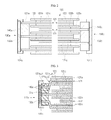
- FIG. 2 is a cross-sectional view illustrating a welding structure of a collector plate and an electrode assembly according to an embodiment of the present invention.
- the rechargeable secondary battery 100 includes a case 110, an electrode assembly 120, a first collector plate 130a, first light absorbing members 140a, a first insulation member 150a, a second collector plate 130b, second light absorbing members 140b, a second insulation member 150b, a cap plate 160, a first terminal 170a and a second terminal 170b.
- the case 110 may refer to a can, and/or may encompass the cap plate 160.
- the case 110 includes a pair of long side walls 111 a and 111 b that are substantially planar and face each other, a pair of short side walls 112a and 112b that connect the long side walls 111 a and 111 b and face each other, and a bottom wall 113 connecting the long side walls 111 a and 111 b to the short side walls 112a and 112b.
- areas of the long side walls are larger than those of the short side walls.
- the case 110 may have an open top area sealed with the cap plate 160.
- the electrode assembly 120 and an electrolyte solution are accommodated in the case 110.
- the case 110 may be made of one material selected from the group consisting of aluminum, an aluminum alloy, copper, a copper alloy, iron, an iron alloy, stainless steel and equivalents thereof, but aspects of the present invention are not limited thereto.
- the electrode assembly 120 may include a pair of long side areas 120a and 120b that are substantially planar and face each other, and a pair of short side areas 120c and 120d that connect the long side areas 120a and 120b and face each other.
- the long side areas are wider than the short side areas.
- first non-coating portions 121a that are not coated with a first active material (not shown) and second non-coating portions 122a that are not coated with a second active material (not shown) extend, for example, a predetermined length in opposite directions. That is to say, the first non-coating portions 121 a may extend and protrude to one side a predetermined length through the long side areas 120a and 120b and the short side areas 120c and 120d, and the second non-coating portions 122a may extend and protrude to the other side a predetermined length through the long side areas 120a and 120b and the short side areas 120c and 120d. In addition, the first non-coating portions 121a and the second non-coating portions 122a of the electrode assembly 120 may extend a predetermined length toward the short side walls 112a and 112b provided in the case 110, respectively.
- the electrode assembly 120 may be formed by winding or laminating a stacked structure having a first electrode plate 121, a second electrode plate 122, and a separator 123 interposed between the first and second electrode plates 121 and 122, which are formed of a thin plate or layer.
- the first electrode plate 121 may function as a positive electrode and the second electrode plate 122 may function as a negative electrode, or vice versa.
- the first electrode plate 121 may be formed by applying a first electrode active material 121c (to be referred to as a first coating portion), such as a transition metal, on the first electrode collector plate 121 b formed of, for example, aluminum or aluminum foil.
- the first electrode plate 121 may include first non-coating portions 121 a on which the first electrode active metal is not applied.
- the first non-coating portions 121a may function as passages for current flowing between the first electrode plate 121 and the outside of the first electrode plate 121.
- the present invention does not limit the material of the first electrode plate 121 to those listed herein.
- the second electrode plate 122 may be formed by applying a second electrode active material 122c (to be referred to as a second coating portion), such as graphite or carbon, on the second electrode collector plate 122b formed of metal foil, such as copper, a copper alloy or nickel.
- the second electrode plate 122 may include second non-coating portions 122a on which the second electrode active metal is not applied.
- the second non-coating portions 122a may function as passages for current flowing between the second electrode plate 122 and the outside of the second electrode plate 122.
- the present invention does not limit the material of the second electrode plate 122 to those listed herein.
- the relative polarities of the first and second electrode plates 121 and 122 may differ from what is described above.
- the separator 123 may be positioned between the first electrode plate 121 and the second electrode plate 122 to prevent short circuiting and allow movement of lithium ions.
- the separator 123 may be formed of, for example, polyethylene, polypropylene, or a combined film of polypropylene and polyethylene. The present invention does not limit the material of the separator 123 to those listed herein.
- the electrode assembly 120 and an electrolyte solution are accommodated within the case 110.
- the electrolyte solution may include an organic solvent, such as ethylene carbonate (EC), propylene carbonate (PC), diethyl carbonate (DEC), ethyl methyl carbonate (EMC), or dimethyl carbonate (DMC), and a lithium salt, such as LiPF6 or LiBF4.
- the electrolyte may be a liquid, a solid, or a gel.
- the first light absorbing members 140a are coupled to the first non-coating portions 121a. That is to say, the first light absorbing members 140a are fitted into spaces between the plurality of first non-coating portions 121 a. In such a manner, the first active material 121 c of the first electrode plate 121, the separator 123 and the second electrode plate 122, which are positioned at one side of each of the first light absorbing members 140a, are not exposed to the outside. In other words, the first active material 121 c of the first electrode plate 121, the separator 123 and the second electrode plate 122 are separated from the first collector plate 130a by the first light absorbing members 140a.
- the first light absorbing members 140a may be electrical insulators.
- the first light absorbing members 140a may have a black-series color to increase an absorption coefficient of laser beam, but not limited thereto.
- the first light absorbing members 140a may be made of one selected from the group consisting of polypropylene (PP), polyethylene (PE), ethylene propylene diene monomer (EPDM) and equivalents thereof, but not limited thereto.
- PP polypropylene
- PE polyethylene
- EPDM ethylene propylene diene monomer
- a material not reacting with an electrolytic solution may be used in forming the first light absorbing members 140a.
- the first collector plate 130a is positioned inside the case 110 and is electrically connected between a first terminal 170a and the electrode assembly 120.
- the first collector plate 130a includes a substantially planar first region 131 a electrically connected to the first terminal 170a, a substantially planar second region 132a bent from the first region 131 a and electrically connected to the first non-coating portions 121 a of the electrode assembly 120, and a bent region 133a between the first region 131 a and the second region 132a.
- a third region 134a which is bent from the second region 132a, may further be formed in the second region 132 to surround the outermost first non-coating portion 121 a.
- the substantially planar second region 132a of the first collector plate 130a is welded to ends in a lengthwise direction of the first non-coating portions 121 a.
- a widthwise direction of the second region 132a of the first collector plate 130a is substantially perpendicular to the lengthwise direction of the first non-coating portions 121 a.
- the first light absorbing members 140a may be substantially perpendicular to the lengthwise direction of the first non-coating portions 121 a.
- a fuse hole 135a having a substantially rectangular shape is formed in the first region 131 a of the first collector plate 130a.
- a pair of fuse parts 136a having relatively small cross-sectional areas, may be at opposite sides of the fuse hole 135a.
- widths of the fuse parts 136a may be smaller than a width of the first region 131 a or the second region 132a.
- through-holes are shown in the first region 131a to form the fuse parts 136a; however, cut portions may also be formed in the first region 131 a to form the fuse parts 136a.
- the fuse parts 136a may be fused by heat generated when an external short-circuit or over-charge occurs to the rechargeable secondary battery 100, thereby blocking a charge and/or discharge current. Accordingly, the safety of the rechargeable secondary battery 100 is improved.
- coupling holes 137a and 138a may be formed in the first region 131 a of the first collector plate 130a to be coupled to a fastening region 171 a of the first terminal 170a and a coupling protrusion 174a, which will later be described.
- the first collector plate 130a may include aluminum, an aluminum alloy, titanium, stainless steel, gold, tantalum, niobium, hafnium, zirconium, vanadium, indium, cobalt, tungsten, tin, beryllium, molybdenum, and alloys thereof.
- the present invention does not limit the material of the first collector plate 130a to those listed herein.
- the fuse parts 136a are also made of aluminum.
- the melting point of aluminum is approximately 659°C. Thus, if the fuse parts 136a reach a temperature of approximately 659°C due to an overcurrent, the fuse parts 136a may naturally melt and break.
- the first insulation part 150a may be constructed such that it substantially surrounds the first region 131 a of the first collector plate 130a.
- the first insulation part 150a may be positioned between the cap plate 160 and the first region 131 a of the first collector plate 130a, and may surround the fastening region 171 a of the first terminal 170a, a flange 173a, and the first region 131 a of the first collector plate 130a.
- the first insulation part 150a may include an upper region 151 a and approximately four side regions 152a.
- the upper region 151 a may be interposed between the first region 131 a of the first collector plate 130a and the flange 173a of the first terminal 170a, and the cap plate 160.
- the four side regions 152a may surround the side region of the first region 131 a of the first collector plate 130a, the fastening region 171 a of the first terminal 170a, and the side region of the flange 173a.
- the first insulation part 150a may be made of, for example, polyphenylene sulfide (PPS) (which does not react with the electrolyte solution) and equivalents thereof, but the present invention does not limit the material of the first insulation part 150a to those listed herein.
- the cap plate 160 may cover an open portion of the case 110 while allowing the first terminal 170a to be exposed to or to protrude to the outside. A boundary between the case 110 and the cap plate 160 may be welded by laser beam.
- an electrolyte injection hole 161 may be formed in the cap plate 160.
- the electrolyte injection hole 161 may be closed by a plug 162, and a safety vent 163 having a relatively small thickness may also be in the cap plate 160.
- the cap plate 160 may be made of a substantially the same material as the case 110.
- the first terminal 170a is electrically connected to the first collector plate 130a and outwardly extends a predetermined length while passing through the cap plate 160. That is to say, the first terminal 170a is coupled to the first region 131 a of the first collector plate 130a and outwardly extends a predetermined length while passing through the first insulation part 150a and the cap plate 160.
- the first terminal 170a may be electrically and mechanically coupled to the coupling hole 137a provided in the first region 131 a of the first collector plate 130a.
- the first terminal 170a may include a pillar-shaped fastening region 171 a, and a fixing region 172a fixed to the case 110 or the fastening region 171 a outside the cap plate 160 and having a bus bar (not shown) coupled thereto.
- a leaf-shaped flange 173a horizontally extending a predetermined length may further be formed inside the case 110 or in the cap plate 160 in the fastening region 171a.
- the flange 173a may include a coupling protrusion 174a coupled to the coupling hole 138a downwardly extending and provided in the first region 131 a of the first collector plate 130a.
- a top surface of the flange 173a may make close contact with the upper region 151 a of the first insulation part 150a.
- the fuse parts 136a and the bent region 133a of the first collector plate 130a may be received in a predetermined space formed by the side regions 152a of the first insulation part 150a.
- the fastening region 171 a, the fixing region 172a, the flange 173a, and the coupling protrusion 174a, forming the first terminal 170a may include one selected from the group consisting of aluminum, an aluminum alloy, and equivalents thereof, but the present invention does not limit the materials of the fastening region 171 a, the fixing region 172a, the flange 173a and the coupling protrusion 174a to those listed herein.
- the fastening region 171 a positioned on the cap plate 160 may be coupled to the fixing region 172a to be riveted or welded, and the fastening region 171 a and the coupling protrusion 174a positioned under the cap plate 160 may be coupled to the coupling holes 137a and 138a provided in the first region 131 a of the first collector plate 130a to be riveted or welded.
- the fastening region 171 a of the first terminal 170a may pass through the cap plate 160, and a seal gasket 181 a may further be formed on the outer circumference thereof. Therefore, the first terminal 170a may be insulated from the cap plate 160.
- the seal gasket 181a may be made of polyphenylene sulfide (PPS) (which does not react with the electrolyte solution), but the present invention does not limit the material of the seal gasket 181a to that listed herein.
- An upper insulation part 182a may be provided between the fixing region 172a and the case 110.
- the upper insulation part 182a may make close contact with the seal gasket 181 a.
- the upper insulation part 182a insulates the first fixing region 172a from the cap plate 160.
- the upper insulation part 182a may be made of polyphenylene sulfide (PPS), but the present invention does not limit the material of the upper insulation part 182a to that listed herein.
- PPS polyphenylene sulfide
- the fixing region 172a and the cap plate 160 may be electrically connected to each other by a high-resistance member (not shown).
- the second collector plate 130b, the second light absorbing members 140b and the second terminal 170b may be substantially the same as the first collector plate 130a, the first light absorbing members 140a and the first terminal 170a.
- a fuse hole 135b and a fuse part 136b may be provided in the second collector plate 130b. In some embodiments, the fuse opening 135b and the fuse part 136b may not be provided in the second collector plate 130b.
- the second light absorbing members 140b are coupled to the second non-coating portions 122a. That is to say, the second light absorbing members 140b are fitted into spaces formed by a plurality of second non-coating portions 122a. In such a manner, the second active material 122c of the second electrode plate 122, the separator 123 and the first electrode plate 121, which are positioned at one side of each of the second light absorbing members 140b, are not exposed to the outside. In other words, the second active material 122c of the second electrode plate 122, the separator 123 and the first electrode plate 121 are separated from the second collector plate 130b by the second light absorbing members 140b.
- first light absorbing members 140a and the second light absorbing members 140b extend a predetermined length in opposite directions. That is to say, the first light absorbing members 140a extend a predetermined length to one side through the long side areas 120a and 120b and the short side areas 120c and 120d of the electrode assembly 120, and the second light absorbing members 140b extend a predetermined length to the other side through the long side areas 120a and 120b and the short side areas 120c and 120d of the electrode assembly 120. In addition, the first light absorbing members 140a and the second light absorbing members 140b extend a predetermined length toward the short side walls 112a and 112b provided in the case 110.
- the light absorbing members 140a and 140b may be positioned in the active material non-coating portions 121 a and 122a at the outermost region of the electrode assembly 120 (see the right side region of FIG. 2 ) or may not be positioned in the active material non-coating portions 121a and 122a (see the left side region of FIG. 2 ).
- the outermost light absorbing members 140a and 140b may or may not be provided according to sizes or designs of the collector plates 130a and 130b, but aspects of the present invention are not limited thereto.
- first collector plate 130a and the second collector plate 130b, and the first light absorbing members 140a and the second light absorbing members 140b have substantially the same configurations, respectively, the following description will focus on the first collector plate 130a and the first light absorbing members 140a.
- FIG. 3 is a cross-sectional view illustrating a welding structure of a collector plate and an electrode assembly according to another embodiment of the present invention.
- each of the first non-coating portions 121a includes a first region 121a_a substantially parallel to a lengthwise direction of the first coating portion 121c, a second region 121a_c substantially perpendicular to a widthwise direction of the first collector plate 130a, and a bent region 121a_b formed between the first region 121a_a and the second region 121a_c.
- a second electrode plate 122 and two separators 123 are interposed between two first electrode plates 121 stacked one on the other.
- a thickness formed by the two first non-coating portions 121 a may be smaller than the overall thickness of the electrode assembly 120. Therefore, as illustrated in FIG. 3 , the first non-coating portions 121 a and the first light absorbing members 140a are pressed, and a thickness formed by the first non-coating portions 121 a and the first light absorbing members 140a may be smaller than the overall thickness of the electrode assembly 120. Accordingly, a first collector plate 130a may be designed such that a width of the first collector plate 130a is smaller than the overall width of the electrode assembly 120.
- FIG. 4 is a perspective view illustrating a winding method of an electrode assembly in a rechargeable secondary battery according to an embodiment of the present invention.
- the rechargeable secondary battery 100 includes a first electrode plate 121, a second electrode plate 122, and two separators 123.
- the first electrode plate 121 includes a first coating portion 121c and first non-coating portions 121a, and first light absorbing members 140a are positioned on or attached to a top surface and/or a bottom surface of each of the first non-coating portions 121 a.
- a width of each of the first light absorbing members 140a may be equal to or smaller than a width of each of the first non-coating portions 121 a.
- the second electrode plate 122 includes a second active material coating portion 122c and second non-coating portions 122a, and second light absorbing members 140b are positioned on or attached to top surfaces and/or bottom surfaces of the second non-coating portions 122a.
- a width of each of the second light absorbing members 140b may be equal to or smaller than a width of each of the second non-coating portions 122a.
- two separators 123 positioned on the top and bottom surfaces of the second electrode plate 122 are longer than the first and second electrode plates 121 and 122, so that the outermost part of the electrode assembly 120 is surrounded by the separators 123, thereby improving the safety of the rechargeable secondary battery 100.
- a winder 190 makes close contact with a top end of the electrode assembly 120 and rotates in a clockwise direction, for example, thereby obtaining the electrode assembly 120 shown in FIG. 2 .
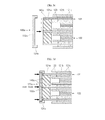
- FIGS. 5a to 5d are cross-sectional views illustrating a welding method of a collector plate and an electrode assembly in a rechargeable secondary battery according to an embodiment of the present invention.
- the first light absorbing members 140a may be positioned on the bottom surfaces of the first non-coating portions 121a and the second light absorbing members 140b may be positioned on the bottom surfaces of the second non-coating portions 122a.
- the first light absorbing members 140a may be positioned on the top surfaces of the first non-coating portions 121 a and the second light absorbing members 140b may be positioned on the top surfaces of the second non-coating portions 122a.
- the first light absorbing members 140a may be positioned on the top and bottom surfaces of the first non-coating portions 121 a and the second light absorbing members 140b may be positioned on the top and bottom surfaces of the second non-coating portions 122a.
- the first light absorbing members 140a may be interposed between two first non-coating portions 121 a, for example.
- the ends of the first non-coating portions 121 a are exposed to the outside through the first light absorbing members 140a.
- the first coating portion 121 c of the first electrode plate 121, the separators 123 and the second electrode plate 122 are not exposed to the outside through the first light absorbing members 140a.
- the first collector plate 130a is coupled to the first non-coating portions 121 a. That is to say, the substantially planar second region 132a makes close contact with the first non-coating portions 121 a and the first light absorbing members 140a, the second region 132a having a substantially perpendicular width with respect to a lengthwise direction of the first non-coating portions 121 a of the first collector plate 130a.
- the third region 134a of the first collector plate 130a makes close contact with the outermost first non-coating portion 121 a.
- laser beam is incident into the planar second region 132a of the first collector plate 130a.
- the incident direction of the laser beam is substantially parallel to the lengthwise direction of the electrode assembly 120. Therefore, while the planar second region 132a of the first collector plate 130a and the ends of the first non-coating portions 121 a are melted and cooled, they are welded to each other.
- the first light absorbing members 140a absorb the laser beam, thereby preventing the laser beam and/or spatter from being incident into the first coating portion 121 c of the first electrode plate 121, the separators 123 and the second electrode plate 122.
- the separators 123 and/or the first and second electrode plates 121 and 122 can be prevented from being damaged and the first and second electrode plates 121 and 122 can be prevented from being internally short circuited.
- an internal margin that is, an area of the first coating portion 121 c of the electrode assembly 120 can be maximized by welding a collector plate to an electrode assembly by laser beam, a design of the first collector plate 130a can be simplified, and the number of manufacturing process steps can be reduced.
- Figs. 6a to 6d are cross-sectional views illustrating a welding method of a collector plate and an electrode assembly in a rechargeable secondary battery according to another embodiment of the present invention.
- a thickness of each of first light absorbing members 140a may be similar to a thickness of the first electrode plate 121 or the second electrode plate 122.
- the thickness of each of the first light absorbing members 140a may be similar to a thickness of each of separators 123.
- the first light absorbing members 140a may be positioned on top surfaces and/or bottom surfaces of the first non-coating portions 121a.
- the first light absorbing members 140a adjacent to each other may be spaced apart from each other without making contact with each other.
- a distance between the first non-coating portions 121 a is minimized by pressing the first non-coating portions 121 a. Accordingly, the adjacent first light absorbing members 140a may make close contact with each other. As the result of the pressing, the overall thickness of the first non-coating portions 121 a becomes smaller than the overall thickness of the electrode assembly 120.
- the first collector plate 130a is coupled to the compressed first non-coating portions 121 a.
- the planar second region 132a of the first collector plate 130a makes contact with ends of the first non-coating portions 121 a
- the third region 134a makes close contact with the outermost first non-coating portion 121 a or the outermost first light absorbing member 140a.
- laser beam is incident into the second region 132a of the first collector plate 130a. That is to say, the laser beam is incident in the substantially parallel direction with respect to the lengthwise direction of the electrode assembly 120. Therefore, the second region 132a of the first collector plate 130a and the first non-coating portions 121 a are melted and cooled, and they are electrically connected to each other.
- the first light absorbing members 140a prevent the laser beam and/or spatter from being induced into the first coating portion 121 c of the first electrode plate 121, the separators 123 and the second electrode plate 122, thereby preventing the first and second electrode plates 121 and 122 and the separators 123 from being damaged and preventing the first and second electrode plates 121 and 122 from being internally short circuited.
- an overall thickness formed by the first non-coating portions 121a and the first light absorbing members 140a is minimized by a pressing process of the first non-coating portions 121a, thereby minimizing a width of the first collector plate 130a, that is, the planar second region 132a.
Landscapes
- Chemical & Material Sciences (AREA)
- Chemical Kinetics & Catalysis (AREA)
- Electrochemistry (AREA)
- General Chemical & Material Sciences (AREA)
- Engineering & Computer Science (AREA)
- Manufacturing & Machinery (AREA)
- Materials Engineering (AREA)
- Connection Of Batteries Or Terminals (AREA)
- Secondary Cells (AREA)
Abstract
Description
- This application claims priority to and the benefit of Korean Patent Application No.
10-2013-0126566, filed on October 23, 2013 - The invention relates to a rechargeable battery comprising an electrode assembly, a collector plate connecting the electrode assembly to a terminal of the battery, the electrode assembly comprising an electrode, wherein the electrode is welded directly to the collector plate.
- A rechargeable lithium ion secondary battery may be used, for example, in a small-sized electronic device, such as a notebook computer or a cellular phone. Also, because recently developed rechargeable lithium ion secondary batteries have advantageous characteristics, including high output power, high capacity, and lightness in weight, as compared to other types of rechargeable secondary batteries, they are widely used in hybrid vehicles or electric vehicles.
- In the manufacturing process of the rechargeable secondary battery, a collector plate is generally welded to an electrode assembly by a laser beam. For example, an active material non-coating portion of the electrode assembly is inserted into a slit of the collector plate, followed by irradiating laser beam, thereby electrically connecting the collector plate to the electrode assembly.
- However, according to the manufacturing process, since the laser beam may be induced to the inside of the active material non-coating portion, a separator and/or an electrode plate are vulnerable to damages, thereby resulting in internal short circuit between electrode plates.
- Hence, it is an object oft he invention to provide a rechargeable battery that can be easily produced with a high yield. In particular, the present invention provides a rechargeable secondary battery, which can prevent a separator and/or electrode plates from being damaged and can prevent the electrode plates from being internally short circuited by preventing laser beam and/or spatter from being induced into an active material non-coating portion of an electrode assembly when a collector plate is laser-welded to the electrode assembly.
- This object is achieved for the rechargeable battery mentioned in the beginning by a light absorbing member that is coupled to the electrode and that is in close contact with the collector plate.
- The light absorbing member effectively protects internal components of the battery, e.g. the separator and/or electrode plates from being damaged, as the light absorbing member blocks the laser beam during the welding process, such that the laser beam cannot readily reach the internal components of the battery. Furthermore, spatter caused by the welding process is blocked by the light absorbing member, too.
- The solutions according to the invention can be combined as desired and further improved by the following embodiments that are advantageous on their own, in each case.
- According to a first possible embodiment, the light absorbing member may be an electrical insulator in order to prevent undesired electrical contacts caused by the light absorbing member.
- In particular, the light absorbing member comprises or even consists of polypropylene (PP), polyethylene (PE) or ethylene propylene diene monomer (EPDM) or a mixture thereof, with which the light absorbing member can be easily and economically manufactured.
- The collector plate is preferably welded to an end of the electrode in a lengthwise direction of the electrode, and the light absorbing member is positioned on a side of the electrode in a direction perpendicular to the lengthwise direction. Hence, the weld connection between the electrode and the collector plate and the light absorbing member are arranged in a space-saving manner.
- The electrode comprises an active material coating portion and an active material non-coating portion, wherein the collector plate is welded to and the light absorbing member is preferably coupled to the active material non-coating portion. Thus, the invention provides a rechargeable secondary battery, which can maximize an internal margin (active material coating area) of an electrode assembly by welding the collector plate to the electrode assembly by laser welding in a direction parallel to the lengthwise direction of the electrode assembly, which simplifies the design of the collector plate and which reduces the number of manufacturing process steps. Hence, the active material coating portion is separated from the collector plate and protected by the light absorbing member.
- The collector plate and the non-coating portion are laser-welded to each other at a laser-welded portion, wherein the light absorbing member can define a barrier between the laser-welded portion and the active material coating portion, thereby protecting in particular the active material coating portion from the laser beam.
- In order to define the barrier and to protect the active material coating portion, the light absorbing member is preferably positioned between the active material coating portion and the collector plate.
- An essentially impermeable barrier can be provided, in case the light absorbing member fills a space between the active material coating portion and the collector plate. In particular, the space between the active material coating portion and the collector plate may be filled by the light absorbing member in combination or together with the active material non-coating portion.
- The active material non-coating portion may include a first region parallel to a lengthwise direction of the active material coating portion, a second region at a distance to the first region perpendicular to the lengthwise direction of the active material coating portion, and a bent region formed between the first region and the second region. Thus, the collector plate can be dimensioned smaller perpendicular to the lengthwise direction of the active material coating portion and compared to the electrode assembly, thereby reducing space required for the collector plate and its weight.
- The light absorbing member is preferably positioned at an outermost region of the electrode assembly, such that the space available for the active material coating portion can be maximized without increasing the size of the battery.
- The collector plate has a width extending perpendicular to a lengthwise direction of the electrode assembly. The collector plate can be welded to the electrode assembly and contact the light absorbing member across the width, thereby maximizing the contact area of the collector plate available for contacting the electrode assembly.
- The battery may comprise two light absorbing members, between which the electrode extends. Hence, the electrode assembly is protected from being damaged independently of the direction of the laser beam used for laser welding.
- The electrode assembly may comprise two electrodes that are welded to the collector plate. The light absorbing member is preferably positioned between the two electrodes and may even contact both of the electrodes, such that only one light absorbing member can be used for preventing that the laser extends along the electrodes and damages the electrode assembly.
- The collector plate may have an essentially clamp-, C- or U-shaped cross-section and encompasses the electrode and the light absorbing member. Hence, by encompassing the electrode and the light absorbing member, an easy positioning of the electrode and the light absorbing member with respect to the collector plate during assembly of the battery is facilitated.
- The electrode assembly can comprises two electrodes and a second collector plate, wherein each of the electrodes is welded to another one of the collector plates and wherein one light absorbing member is coupled to each of the electrodes and is in close contact to each of the collector plates. Thus, the collector plates can each be laser welded to one of the electrodes without the risk that the electrode assembly is damaged by the laser beam used.
- The rechargeable secondary battery may include a case, the electrode assembly accommodated in the case, the light absorbing member coupled to the electrode assembly, the collector plate welded to the electrode assembly and making close contact with the light absorbing member, and the terminal connected to the collector plate and extending to the outside of the case.
- In order to avoid undesired reflections oft he laser beam, a color of the light absorbing member may be black, such that the light absorbing member has a high light absorption coefficient.
- The electrode assembly may further include the separator making close contact with the active material coating portion, and the separator may be separated from the collector plate by the light absorbing member.
- The collector plate may include a first region connected to the terminal, a second region extending from the first region and welded to the end in the lengthwise direction of the active material non-coating portion of the electrode assembly, and a bent region formed between the first region and the second region.
- The electrode assembly may include a first electrode plate including a first coating portion and a first non-coating portion, a second electrode plate including a second coating portion and a second non-coating portion, and the separator disposed between the first and second electrode plates, wherein the battery comprises: a first light absorbing member coupled to the first non-coating portion, and a second light absorbing member coupled to the second non-coating portion.
- When the collector plate and the electrode assembly are laser-welded to each other, the first light absorbing member may prevent the laser beam from being induced to the first coating portion of the first electrode plate, the second coating portion of the second electrode plate and the separator.
- When the collector plate and the electrode assembly are laser-welded to each other, the second light absorbing member may prevent the laser beam from being induced to the first coating portion of the first electrode plate, the second coating portion of the second electrode plate and the separator.
- As described above, in the rechargeable secondary battery according to the embodiment of the present invention, since the light absorbing member having a high light absorption coefficient is interposed between active material non-coating portions in the electrode assembly, it is possible to prevent a separator and/or electrode plates from being damaged and to prevent the electrode plates from being internally short circuited by preventing laser beam and/or spatter from being induced into an active material non-coating portion of an electrode assembly when a collector plate is laser-welded to the electrode assembly.
- In addition, the rechargeable secondary battery can maximize an internal margin (active material coating area) of an electrode assembly by welding a collector plate to an electrode assembly by laser beam in a direction parallel to a lengthwise direction of the electrode assembly, rather than in a direction perpendicular to the lengthwise direction of the electrode assembly, can simplify a design of the collector plate, and can reduce the number of manufacturing process steps.
- The above mentioned lengthwise directions may be parallel directions, which point into the same direction.
- Additional aspects and/or advantages of the invention will be set forth in part in the description which follows and, in part, will be obvious from the description, or may be learned by practice of the invention.
- The invention is described hereinafter in more detail and in an exemplary manner using advantageous embodiments and with reference to the schematic drawings. The embodiments are merely possible configurations in which, however, the individual features as described above can be provided independently of one another and can be omitted in the drawings.
- The objects, features and advantages of the present invention will be more apparent from the following detailed description in conjunction with the accompanying drawings, in which:
-
FIG. 1a is a perspective view of a rechargeable secondary battery according to an embodiment of the present invention,FIG. 1b is a cross-sectional view taken along theline 1 b-1 b ofFIG. 1 a, -
FIG. 1c is a cross-sectional view taken along theline 1c-1c ofFIG. 1a , andFIG. 1d is a partially perspective view of a collector plate and structures of elements around the collector plate; -
FIG. 2 is a cross-sectional view illustrating a welding structure of a collector plate and an electrode assembly according to an embodiment of the present invention; -
FIG. 3 is a cross-sectional view illustrating a welding structure of a collector plate and an electrode assembly according to another embodiment of the present invention; -
FIG. 4 is a perspective view illustrating a winding method of an electrode assembly in a rechargeable secondary battery according to an embodiment of the present invention; -
FIGS. 5a to 5d are cross-sectional views illustrating a welding method of a collector plate and an electrode assembly in a rechargeable secondary battery according to an embodiment of the present invention; and -
FIGS. 6a to 6d are cross-sectional views illustrating a welding method of a collector plate and an electrode assembly in a rechargeable secondary battery according to another embodiment of the present invention. - Example embodiments will now be described more fully hereinafter with reference to the accompanying drawings; however, they may be embodied in different forms. Rather, these embodiments are provided so that this disclosure will be thorough and complete, and will fully convey the scope of the disclosure to those skilled in the art.
- Like reference signs refer to like elements throughout. As used herein, the term "and/or" includes any and all combinations of one or more of the associated listed items.
-
FIG. 1a is a perspective view of a rechargeable secondary battery according to an embodiment of the present invention,FIG. 1b is a cross-sectional view taken along theline 1 b-1 b ofFIG. 1 a,FIG. 1c is a cross-sectional view taken along theline 1c-1c ofFIG. 1a , andFIG. 1d is a partially perspective view of a collector plate and structures of elements around the collector plate, andFIG. 2 is a cross-sectional view illustrating a welding structure of a collector plate and an electrode assembly according to an embodiment of the present invention. - As illustrated in
FIGS. 1a to 1d andFIG. 2 , the rechargeablesecondary battery 100 according to the embodiment of the present invention includes acase 110, anelectrode assembly 120, afirst collector plate 130a, firstlight absorbing members 140a, afirst insulation member 150a, asecond collector plate 130b, secondlight absorbing members 140b, asecond insulation member 150b, acap plate 160, afirst terminal 170a and asecond terminal 170b. - While one
electrode assembly 120 is show inFIG. 1c , embodiments are not limited thereto, for example, there may be greater than oneelectrode assembly 120. In embodiments of the present invention, thecase 110 may refer to a can, and/or may encompass thecap plate 160. - The
case 110 includes a pair oflong side walls short side walls long side walls bottom wall 113 connecting thelong side walls short side walls case 110 may have an open top area sealed with thecap plate 160. Theelectrode assembly 120 and an electrolyte solution are accommodated in thecase 110. Thecase 110 may be made of one material selected from the group consisting of aluminum, an aluminum alloy, copper, a copper alloy, iron, an iron alloy, stainless steel and equivalents thereof, but aspects of the present invention are not limited thereto. - The
electrode assembly 120 may include a pair oflong side areas short side areas long side areas - In the
electrode assembly 120, firstnon-coating portions 121a that are not coated with a first active material (not shown) and secondnon-coating portions 122a that are not coated with a second active material (not shown) extend, for example, a predetermined length in opposite directions. That is to say, the firstnon-coating portions 121 a may extend and protrude to one side a predetermined length through thelong side areas short side areas non-coating portions 122a may extend and protrude to the other side a predetermined length through thelong side areas short side areas non-coating portions 121a and the secondnon-coating portions 122a of theelectrode assembly 120 may extend a predetermined length toward theshort side walls case 110, respectively. - The
electrode assembly 120 may be formed by winding or laminating a stacked structure having afirst electrode plate 121, asecond electrode plate 122, and aseparator 123 interposed between the first andsecond electrode plates first electrode plate 121 may function as a positive electrode and thesecond electrode plate 122 may function as a negative electrode, or vice versa. - The
first electrode plate 121 may be formed by applying a first electrodeactive material 121c (to be referred to as a first coating portion), such as a transition metal, on the firstelectrode collector plate 121 b formed of, for example, aluminum or aluminum foil. Thefirst electrode plate 121 may include firstnon-coating portions 121 a on which the first electrode active metal is not applied. The firstnon-coating portions 121a may function as passages for current flowing between thefirst electrode plate 121 and the outside of thefirst electrode plate 121. The present invention does not limit the material of thefirst electrode plate 121 to those listed herein. - The
second electrode plate 122 may be formed by applying a second electrodeactive material 122c (to be referred to as a second coating portion), such as graphite or carbon, on the secondelectrode collector plate 122b formed of metal foil, such as copper, a copper alloy or nickel. Thesecond electrode plate 122 may include secondnon-coating portions 122a on which the second electrode active metal is not applied. The secondnon-coating portions 122a may function as passages for current flowing between thesecond electrode plate 122 and the outside of thesecond electrode plate 122. The present invention, however, does not limit the material of thesecond electrode plate 122 to those listed herein. In other embodiments, the relative polarities of the first andsecond electrode plates - The
separator 123 may be positioned between thefirst electrode plate 121 and thesecond electrode plate 122 to prevent short circuiting and allow movement of lithium ions. Theseparator 123 may be formed of, for example, polyethylene, polypropylene, or a combined film of polypropylene and polyethylene. The present invention does not limit the material of theseparator 123 to those listed herein. - The
electrode assembly 120 and an electrolyte solution are accommodated within thecase 110. The electrolyte solution may include an organic solvent, such as ethylene carbonate (EC), propylene carbonate (PC), diethyl carbonate (DEC), ethyl methyl carbonate (EMC), or dimethyl carbonate (DMC), and a lithium salt, such as LiPF6 or LiBF4. The electrolyte may be a liquid, a solid, or a gel. - The first
light absorbing members 140a are coupled to the firstnon-coating portions 121a. That is to say, the firstlight absorbing members 140a are fitted into spaces between the plurality of firstnon-coating portions 121 a. In such a manner, the firstactive material 121 c of thefirst electrode plate 121, theseparator 123 and thesecond electrode plate 122, which are positioned at one side of each of the firstlight absorbing members 140a, are not exposed to the outside. In other words, the firstactive material 121 c of thefirst electrode plate 121, theseparator 123 and thesecond electrode plate 122 are separated from thefirst collector plate 130a by the firstlight absorbing members 140a. Therefore, in the laser welding process between thefirst collector plate 130a and the firstnon-coating portions 121 a, which will be described below, laser beam or spatter is not induced into the firstactive material 121c of thefirst electrode plate 121, theseparator 123 and thesecond electrode plate 122. - Meanwhile, the first
light absorbing members 140a may be electrical insulators. In addition, in the laser welding process to be described below, the firstlight absorbing members 140a may have a black-series color to increase an absorption coefficient of laser beam, but not limited thereto. - In detail, the first
light absorbing members 140a may be made of one selected from the group consisting of polypropylene (PP), polyethylene (PE), ethylene propylene diene monomer (EPDM) and equivalents thereof, but not limited thereto. In an exemplary embodiment, a material not reacting with an electrolytic solution may be used in forming the firstlight absorbing members 140a. - The
first collector plate 130a is positioned inside thecase 110 and is electrically connected between afirst terminal 170a and theelectrode assembly 120. In detail, in one embodiment, thefirst collector plate 130a includes a substantially planarfirst region 131 a electrically connected to thefirst terminal 170a, a substantially planarsecond region 132a bent from thefirst region 131 a and electrically connected to the firstnon-coating portions 121 a of theelectrode assembly 120, and abent region 133a between thefirst region 131 a and thesecond region 132a. Athird region 134a, which is bent from thesecond region 132a, may further be formed in the second region 132 to surround the outermost firstnon-coating portion 121 a. - Here, the substantially planar
second region 132a of thefirst collector plate 130a is welded to ends in a lengthwise direction of the firstnon-coating portions 121 a. To this end, a widthwise direction of thesecond region 132a of thefirst collector plate 130a is substantially perpendicular to the lengthwise direction of the firstnon-coating portions 121 a. In addition, in order to prevent the laser welding process performed between the second region 132 of thefirst collector plate 130a and the ends in the lengthwise direction of the firstnon-coating portions 121a from being interfered, the firstlight absorbing members 140a may be substantially perpendicular to the lengthwise direction of the firstnon-coating portions 121 a. - In addition, a
fuse hole 135a having a substantially rectangular shape is formed in thefirst region 131 a of thefirst collector plate 130a. A pair offuse parts 136a, having relatively small cross-sectional areas, may be at opposite sides of thefuse hole 135a. In one embodiment, widths of thefuse parts 136a may be smaller than a width of thefirst region 131 a or thesecond region 132a. In the illustrated embodiment, through-holes are shown in thefirst region 131a to form thefuse parts 136a; however, cut portions may also be formed in thefirst region 131 a to form thefuse parts 136a. Thefuse parts 136a may be fused by heat generated when an external short-circuit or over-charge occurs to the rechargeablesecondary battery 100, thereby blocking a charge and/or discharge current. Accordingly, the safety of the rechargeablesecondary battery 100 is improved. - In addition,
coupling holes first region 131 a of thefirst collector plate 130a to be coupled to afastening region 171 a of thefirst terminal 170a and acoupling protrusion 174a, which will later be described. - Here, the
first collector plate 130a may include aluminum, an aluminum alloy, titanium, stainless steel, gold, tantalum, niobium, hafnium, zirconium, vanadium, indium, cobalt, tungsten, tin, beryllium, molybdenum, and alloys thereof. However, the present invention does not limit the material of thefirst collector plate 130a to those listed herein. In an embodiment, when thefirst collector plate 130a is made of aluminum, thefuse parts 136a are also made of aluminum. The melting point of aluminum is approximately 659°C. Thus, if thefuse parts 136a reach a temperature of approximately 659°C due to an overcurrent, thefuse parts 136a may naturally melt and break. - The
first insulation part 150a may be constructed such that it substantially surrounds thefirst region 131 a of thefirst collector plate 130a. In detail, thefirst insulation part 150a may be positioned between thecap plate 160 and thefirst region 131 a of thefirst collector plate 130a, and may surround thefastening region 171 a of thefirst terminal 170a, aflange 173a, and thefirst region 131 a of thefirst collector plate 130a. In more detail, thefirst insulation part 150a may include anupper region 151 a and approximately fourside regions 152a. Theupper region 151 a may be interposed between thefirst region 131 a of thefirst collector plate 130a and theflange 173a of thefirst terminal 170a, and thecap plate 160. The fourside regions 152a may surround the side region of thefirst region 131 a of thefirst collector plate 130a, thefastening region 171 a of thefirst terminal 170a, and the side region of theflange 173a. Thefirst insulation part 150a may be made of, for example, polyphenylene sulfide (PPS) (which does not react with the electrolyte solution) and equivalents thereof, but the present invention does not limit the material of thefirst insulation part 150a to those listed herein. - The
cap plate 160 may cover an open portion of thecase 110 while allowing the first terminal 170a to be exposed to or to protrude to the outside. A boundary between thecase 110 and thecap plate 160 may be welded by laser beam. In addition, anelectrolyte injection hole 161 may be formed in thecap plate 160. Theelectrolyte injection hole 161 may be closed by aplug 162, and asafety vent 163 having a relatively small thickness may also be in thecap plate 160. Thecap plate 160 may be made of a substantially the same material as thecase 110. - The
first terminal 170a is electrically connected to thefirst collector plate 130a and outwardly extends a predetermined length while passing through thecap plate 160. That is to say, thefirst terminal 170a is coupled to thefirst region 131 a of thefirst collector plate 130a and outwardly extends a predetermined length while passing through thefirst insulation part 150a and thecap plate 160. Thefirst terminal 170a may be electrically and mechanically coupled to thecoupling hole 137a provided in thefirst region 131 a of thefirst collector plate 130a. Thefirst terminal 170a may include a pillar-shapedfastening region 171 a, and a fixingregion 172a fixed to thecase 110 or thefastening region 171 a outside thecap plate 160 and having a bus bar (not shown) coupled thereto. In addition, a leaf-shapedflange 173a horizontally extending a predetermined length may further be formed inside thecase 110 or in thecap plate 160 in thefastening region 171a. Theflange 173a may include acoupling protrusion 174a coupled to thecoupling hole 138a downwardly extending and provided in thefirst region 131 a of thefirst collector plate 130a. Here, a top surface of theflange 173a may make close contact with theupper region 151 a of thefirst insulation part 150a. In addition, thefuse parts 136a and thebent region 133a of thefirst collector plate 130a may be received in a predetermined space formed by theside regions 152a of thefirst insulation part 150a. - Here, the
fastening region 171 a, the fixingregion 172a, theflange 173a, and thecoupling protrusion 174a, forming thefirst terminal 170a, may include one selected from the group consisting of aluminum, an aluminum alloy, and equivalents thereof, but the present invention does not limit the materials of thefastening region 171 a, the fixingregion 172a, theflange 173a and thecoupling protrusion 174a to those listed herein. - In addition, the
fastening region 171 a positioned on thecap plate 160 may be coupled to the fixingregion 172a to be riveted or welded, and thefastening region 171 a and thecoupling protrusion 174a positioned under thecap plate 160 may be coupled to thecoupling holes first region 131 a of thefirst collector plate 130a to be riveted or welded. - The
fastening region 171 a of thefirst terminal 170a may pass through thecap plate 160, and aseal gasket 181 a may further be formed on the outer circumference thereof. Therefore, thefirst terminal 170a may be insulated from thecap plate 160. In an embodiment, theseal gasket 181a may be made of polyphenylene sulfide (PPS) (which does not react with the electrolyte solution), but the present invention does not limit the material of theseal gasket 181a to that listed herein. - An
upper insulation part 182a may be provided between the fixingregion 172a and thecase 110. Theupper insulation part 182a may make close contact with theseal gasket 181 a. Theupper insulation part 182a insulates thefirst fixing region 172a from thecap plate 160. In an embodiment, theupper insulation part 182a may be made of polyphenylene sulfide (PPS), but the present invention does not limit the material of theupper insulation part 182a to that listed herein. Further, when a battery has thecase 110 and thecap plate 160 charged as a positive electrode, the fixingregion 172a and thecap plate 160 may be electrically connected to each other by a high-resistance member (not shown). - Meanwhile, the
second collector plate 130b, the secondlight absorbing members 140b and thesecond terminal 170b may be substantially the same as thefirst collector plate 130a, the firstlight absorbing members 140a and thefirst terminal 170a. In addition, afuse hole 135b and afuse part 136b may be provided in thesecond collector plate 130b. In some embodiments, thefuse opening 135b and thefuse part 136b may not be provided in thesecond collector plate 130b. - However, the second
light absorbing members 140b are coupled to the secondnon-coating portions 122a. That is to say, the secondlight absorbing members 140b are fitted into spaces formed by a plurality of secondnon-coating portions 122a. In such a manner, the secondactive material 122c of thesecond electrode plate 122, theseparator 123 and thefirst electrode plate 121, which are positioned at one side of each of the secondlight absorbing members 140b, are not exposed to the outside. In other words, the secondactive material 122c of thesecond electrode plate 122, theseparator 123 and thefirst electrode plate 121 are separated from thesecond collector plate 130b by the secondlight absorbing members 140b. Therefore, in the laser welding process between thesecond collector plate 130b and the secondnon-coating portions 122a, which will be described below, laser beam or spatter is not induced into the secondactive material 122c of thesecond electrode plate 122, theseparator 123 and thefirst electrode plate 121. - In addition, the first
light absorbing members 140a and the secondlight absorbing members 140b extend a predetermined length in opposite directions. That is to say, the firstlight absorbing members 140a extend a predetermined length to one side through thelong side areas short side areas electrode assembly 120, and the secondlight absorbing members 140b extend a predetermined length to the other side through thelong side areas short side areas electrode assembly 120. In addition, the firstlight absorbing members 140a and the secondlight absorbing members 140b extend a predetermined length toward theshort side walls case 110. - As illustrated in
FIG. 2 , thelight absorbing members non-coating portions FIG. 2 ) or may not be positioned in the activematerial non-coating portions FIG. 2 ). The outermostlight absorbing members collector plates - Since the
first collector plate 130a and thesecond collector plate 130b, and the firstlight absorbing members 140a and the secondlight absorbing members 140b have substantially the same configurations, respectively, the following description will focus on thefirst collector plate 130a and the firstlight absorbing members 140a. -
FIG. 3 is a cross-sectional view illustrating a welding structure of a collector plate and an electrode assembly according to another embodiment of the present invention. - As illustrated in
FIG. 3 , each of the firstnon-coating portions 121a includes a first region 121a_a substantially parallel to a lengthwise direction of thefirst coating portion 121c, a second region 121a_c substantially perpendicular to a widthwise direction of thefirst collector plate 130a, and a bent region 121a_b formed between the first region 121a_a and the second region 121a_c. For example, asecond electrode plate 122 and twoseparators 123 are interposed between twofirst electrode plates 121 stacked one on the other. Thus, even if the firstlight absorbing members 140a are interposed between the two firstnon-coating portions 121 a stacked one on the other, a thickness formed by the two firstnon-coating portions 121 a may be smaller than the overall thickness of theelectrode assembly 120. Therefore, as illustrated inFIG. 3 , the firstnon-coating portions 121 a and the firstlight absorbing members 140a are pressed, and a thickness formed by the firstnon-coating portions 121 a and the firstlight absorbing members 140a may be smaller than the overall thickness of theelectrode assembly 120. Accordingly, afirst collector plate 130a may be designed such that a width of thefirst collector plate 130a is smaller than the overall width of theelectrode assembly 120. -
FIG. 4 is a perspective view illustrating a winding method of an electrode assembly in a rechargeable secondary battery according to an embodiment of the present invention. - As illustrated in
FIG. 4 , in a manufacturing method of the rechargeablesecondary battery 100 according to the embodiment of the present invention, the rechargeablesecondary battery 100 includes afirst electrode plate 121, asecond electrode plate 122, and twoseparators 123. - Here, the
first electrode plate 121 includes afirst coating portion 121c and firstnon-coating portions 121a, and firstlight absorbing members 140a are positioned on or attached to a top surface and/or a bottom surface of each of the firstnon-coating portions 121 a. In addition, a width of each of the firstlight absorbing members 140a may be equal to or smaller than a width of each of the firstnon-coating portions 121 a. In order to facilitate welding of thefirst collector plate 130a, the ends of the firstnon-coating portions 121 a are exposed to the outside through the firstlight absorbing members 140a. - In addition, the
second electrode plate 122 includes a second activematerial coating portion 122c and secondnon-coating portions 122a, and secondlight absorbing members 140b are positioned on or attached to top surfaces and/or bottom surfaces of the secondnon-coating portions 122a. In addition, a width of each of the secondlight absorbing members 140b may be equal to or smaller than a width of each of the secondnon-coating portions 122a. In order to facilitate welding of thesecond collector plate 122, ends of the secondnon-coating portions 122a are exposed to the outside through the secondlight absorbing members 140b. - Meanwhile, two
separators 123 positioned on the top and bottom surfaces of thesecond electrode plate 122 are longer than the first andsecond electrode plates electrode assembly 120 is surrounded by theseparators 123, thereby improving the safety of the rechargeablesecondary battery 100. - Lastly, a
winder 190 makes close contact with a top end of theelectrode assembly 120 and rotates in a clockwise direction, for example, thereby obtaining theelectrode assembly 120 shown inFIG. 2 . -
FIGS. 5a to 5d are cross-sectional views illustrating a welding method of a collector plate and an electrode assembly in a rechargeable secondary battery according to an embodiment of the present invention. - As illustrated in
FIG. 5a , before theelectrode assembly 120 is wound, the firstlight absorbing members 140a may be positioned on the bottom surfaces of the firstnon-coating portions 121a and the secondlight absorbing members 140b may be positioned on the bottom surfaces of the secondnon-coating portions 122a. Conversely, before theelectrode assembly 120 is wound, the firstlight absorbing members 140a may be positioned on the top surfaces of the firstnon-coating portions 121 a and the secondlight absorbing members 140b may be positioned on the top surfaces of the secondnon-coating portions 122a. - Alternatively, before the
electrode assembly 120 is wound, the firstlight absorbing members 140a may be positioned on the top and bottom surfaces of the firstnon-coating portions 121 a and the secondlight absorbing members 140b may be positioned on the top and bottom surfaces of the secondnon-coating portions 122a. - As illustrated in
FIG. 5b , after theelectrode assembly 120 is wound, the firstlight absorbing members 140a may be interposed between two firstnon-coating portions 121 a, for example. Here, the ends of the firstnon-coating portions 121 a are exposed to the outside through the firstlight absorbing members 140a. In addition, thefirst coating portion 121 c of thefirst electrode plate 121, theseparators 123 and thesecond electrode plate 122 are not exposed to the outside through the firstlight absorbing members 140a. - As illustrated in
FIG. 5c , after theelectrode assembly 120 is wound, thefirst collector plate 130a is coupled to the firstnon-coating portions 121 a. That is to say, the substantially planarsecond region 132a makes close contact with the firstnon-coating portions 121 a and the firstlight absorbing members 140a, thesecond region 132a having a substantially perpendicular width with respect to a lengthwise direction of the firstnon-coating portions 121 a of thefirst collector plate 130a. In addition, thethird region 134a of thefirst collector plate 130a makes close contact with the outermost firstnon-coating portion 121 a. - As illustrated in
Fig. 5d , laser beam is incident into the planarsecond region 132a of thefirst collector plate 130a. Here, the incident direction of the laser beam is substantially parallel to the lengthwise direction of theelectrode assembly 120. Therefore, while the planarsecond region 132a of thefirst collector plate 130a and the ends of the firstnon-coating portions 121 a are melted and cooled, they are welded to each other. Here, even if the laser beam passes through the planarsecond region 132a of thefirst collector plate 130a, the firstlight absorbing members 140a absorb the laser beam, thereby preventing the laser beam and/or spatter from being incident into thefirst coating portion 121 c of thefirst electrode plate 121, theseparators 123 and thesecond electrode plate 122. - Therefore, the
separators 123 and/or the first andsecond electrode plates second electrode plates - In addition, since the welding using laser beam is performed in a substantially parallel direction with respect to a lengthwise direction of the
electrode assembly 120, rather than in a direction perpendicular to the lengthwise direction of theelectrode assembly 120, an internal margin (that is, an area of thefirst coating portion 121 c) of theelectrode assembly 120 can be maximized by welding a collector plate to an electrode assembly by laser beam, a design of thefirst collector plate 130a can be simplified, and the number of manufacturing process steps can be reduced. -
Figs. 6a to 6d are cross-sectional views illustrating a welding method of a collector plate and an electrode assembly in a rechargeable secondary battery according to another embodiment of the present invention. - As illustrated in
Fig. 6a , a thickness of each of firstlight absorbing members 140a may be similar to a thickness of thefirst electrode plate 121 or thesecond electrode plate 122. In addition, the thickness of each of the firstlight absorbing members 140a may be similar to a thickness of each ofseparators 123. Further, the firstlight absorbing members 140a may be positioned on top surfaces and/or bottom surfaces of the firstnon-coating portions 121a. - In such a manner, before the first
non-coating portions 121 a are bent, the firstlight absorbing members 140a adjacent to each other may be spaced apart from each other without making contact with each other. - As illustrated in
Fig. 6b , a distance between the firstnon-coating portions 121 a is minimized by pressing the firstnon-coating portions 121 a. Accordingly, the adjacent firstlight absorbing members 140a may make close contact with each other. As the result of the pressing, the overall thickness of the firstnon-coating portions 121 a becomes smaller than the overall thickness of theelectrode assembly 120. - As illustrated in
Fig. 6c , thefirst collector plate 130a is coupled to the compressed firstnon-coating portions 121 a. Here, the planarsecond region 132a of thefirst collector plate 130a makes contact with ends of the firstnon-coating portions 121 a, and thethird region 134a makes close contact with the outermost firstnon-coating portion 121 a or the outermost firstlight absorbing member 140a. - As illustrated in
Fig. 6d , laser beam is incident into thesecond region 132a of thefirst collector plate 130a. That is to say, the laser beam is incident in the substantially parallel direction with respect to the lengthwise direction of theelectrode assembly 120. Therefore, thesecond region 132a of thefirst collector plate 130a and the firstnon-coating portions 121 a are melted and cooled, and they are electrically connected to each other. - Here, the first
light absorbing members 140a prevent the laser beam and/or spatter from being induced into thefirst coating portion 121 c of thefirst electrode plate 121, theseparators 123 and thesecond electrode plate 122, thereby preventing the first andsecond electrode plates separators 123 from being damaged and preventing the first andsecond electrode plates non-coating portions 121a and the firstlight absorbing members 140a is minimized by a pressing process of the firstnon-coating portions 121a, thereby minimizing a width of thefirst collector plate 130a, that is, the planarsecond region 132a.
Claims (15)
- A rechargeable battery (100) comprising an electrode assembly (120), a collector plate (130a) connecting the electrode assembly (120) to a terminal (170a) of the battery (100), the electrode assembly (120) comprising an electrode (121), wherein the electrode (121) is welded directly to the collector plate (130a), characterized by a light absorbing member (140a) that is coupled to the electrode (121) and that is in close contact with the collector plate (130a).
- The rechargeable battery (100) of claim 1, characterized in that the light absorbing member (140a) is an electrical insulator.
- The rechargeable battery (100) of claim 1 or 2, characterized in that the light absorbing member (140a) comprises polypropylene (PP), polyethylene (PE) or ethylene propylene diene monomer (EPDM).
- The rechargeable battery (100) of any of claims 1 to 3, characterized in that the collector plate (130a) is welded to an end of the electrode (121) in a lengthwise direction of the electrode (121), and the light absorbing member (140a) is positioned on a side of the electrode (121) in a direction perpendicular to the lengthwise direction.
- The rechargeable battery (100) of any of claims 1 to 4, characterized in that the electrode (121) comprises an active material coating portion (121c) and an active material non-coating portion (121a), wherein the collector plate (130a) is welded to and the light absorbing member (140a) is coupled to the active material non-coating portion (121a).
- The rechargeable battery (100) of claim 5, characterized in that the collector plate (130a) and the non-coating portion (121a) are laser-welded to each other at a laser-welded portion, wherein the light absorbing member (140a) defines a barrier between the laser-welded portion and the active material coating portion (121 c).
- The rechargeable battery (100) of claim 5 or 6, characterized in that the light absorbing member (140a) is positioned between the active material coating portion (121c) and the collector plate (130a).
- The rechargeable battery (100) of claim 7, characterized in that the light absorbing member (140a) fills a space between the active material coating portion (121c) and the collector plate (130a).
- The rechargeable battery of any of claims 5 to 8, characterized in that the active material non-coating portion (121a) includes a first region (121a_a) parallel to a lengthwise direction of the active material coating portion (121c), a second region (121a_c) at a distance to the first region (121a_a) perpendicular to the lengthwise direction of the active material coating portion (121c_), and a bent region (121a_b) formed between the first region (121a_a) and the second region (121a_c).
- The rechargeable battery (100) of any of claims 1 to 9, characterized in that the light absorbing member (140a) is positioned at an outermost region of the electrode assembly (120).
- The rechargeable battery (100) of any of claims 1 to 10, characterized in that the collector plate (130a) has a width extending perpendicular to a lengthwise direction of the electrode assembly (120), wherein the collector plate (130a) is welded to the electrode assembly (120) and contacts the light absorbing member (140a) across the width.
- The rechargeable battery (100) of any of claims 1 to 11, characterized in that the battery (100) comprises two light absorbing members (140a), between which the electrode (121) extends.
- The rechargeable battery (100) of any of claims 1 to 11, characterized in that the electrode assembly (120) comprises two electrodes (121) welded to the collector plate (130a), between which the light absorbing member (140a) is positioned.
- The rechargeable battery (100) of any of claims 1 to 13, characterized in that the collector plate (130a) has an essentially U-shaped cross-section and encompasses the electrode (121) and the light absorbing member (140a).
- The rechargeable battery (100) of any of claims 1 to 14, characterized in that the electrode assembly (120) comprises two electrodes (121, 122) and a second collector plate (130b), wherein each of the electrodes (121, 122) is welded to another one of the collector plates (130a, 130b) and wherein one light absorbing member (140a, 140b) is coupled to each of the electrodes (121, 122) and in close contact to each of the collector plates (130a, 130b).
Applications Claiming Priority (1)
| Application Number | Priority Date | Filing Date | Title |
|---|---|---|---|
| KR1020130126566A KR101726909B1 (en) | 2013-10-23 | 2013-10-23 | Rechargeable secondary battery having light absorption member |
Publications (2)
| Publication Number | Publication Date |
|---|---|
| EP2866280A1 true EP2866280A1 (en) | 2015-04-29 |
| EP2866280B1 EP2866280B1 (en) | 2017-01-11 |
Family
ID=51453678
Family Applications (1)
| Application Number | Title | Priority Date | Filing Date |
|---|---|---|---|
| EP14183355.8A Active EP2866280B1 (en) | 2013-10-23 | 2014-09-03 | Rechargeable secondary battery |
Country Status (5)
| Country | Link |
|---|---|
| US (1) | US9859566B2 (en) |
| EP (1) | EP2866280B1 (en) |
| JP (1) | JP6470516B2 (en) |
| KR (1) | KR101726909B1 (en) |
| CN (1) | CN104577177A (en) |
Cited By (2)
| Publication number | Priority date | Publication date | Assignee | Title |
|---|---|---|---|---|
| EP3136471A1 (en) * | 2015-08-25 | 2017-03-01 | Samsung SDI Co., Ltd. | Battery |
| EP3799198A1 (en) * | 2019-09-30 | 2021-03-31 | Samsung SDI Co., Ltd. | Secondary battery |
Families Citing this family (13)
| Publication number | Priority date | Publication date | Assignee | Title |
|---|---|---|---|---|
| KR102573330B1 (en) | 2016-06-24 | 2023-08-30 | 삼성에스디아이 주식회사 | Rechargeable battery |
| JP6607225B2 (en) * | 2017-04-13 | 2019-11-20 | トヨタ自動車株式会社 | Stacked battery |
| DE102017207169A1 (en) | 2017-04-28 | 2018-10-31 | Robert Bosch Gmbh | cell stack |
| US10673028B2 (en) * | 2017-09-28 | 2020-06-02 | Maxwell Holdings, Ltd. | Electrochemical element |
| KR102288406B1 (en) | 2018-01-05 | 2021-08-09 | 주식회사 엘지에너지솔루션 | Laser Welding Device Having Screen Block For Laser Beam |
| KR102606100B1 (en) * | 2018-01-17 | 2023-11-24 | 삼성에스디아이 주식회사 | Secondary battery |
| KR102097444B1 (en) * | 2019-01-30 | 2020-04-06 | 주식회사 유앤에스에너지 | Current collector for positive electrodes |
| USD937196S1 (en) * | 2019-05-06 | 2021-11-30 | Hangzhou Yushu Technology Co., Ltd. | Battery pack |
| JPWO2022074709A1 (en) * | 2020-10-05 | 2022-04-14 | ||
| CN221805790U (en) * | 2022-02-25 | 2024-10-01 | 宁德时代新能源科技股份有限公司 | Battery cells, batteries and electrical devices |
| CN114725628B (en) * | 2022-04-21 | 2024-05-10 | 远景动力技术(江苏)有限公司 | Battery assembly and battery manufacturing method |
| KR20240026780A (en) * | 2022-08-22 | 2024-02-29 | 주식회사 엘지에너지솔루션 | PCB Comprising Laser Blocking Portion and Battery Cell Assembly Comprising the Same |
| KR20250009035A (en) * | 2023-07-10 | 2025-01-17 | 주식회사 엘지에너지솔루션 | Electrode lead welding method |
Citations (5)
| Publication number | Priority date | Publication date | Assignee | Title |
|---|---|---|---|---|
| JPH08115744A (en) * | 1994-10-19 | 1996-05-07 | Sony Corp | Cylindrical non-aqueous electrolyte secondary battery and manufacturing method thereof |
| EP1096582A1 (en) * | 1999-10-26 | 2001-05-02 | Matsushita Electric Industrial Co., Ltd. | Current collecting structure of an electrode plate unit for rechargeable battery comprising thermal sprayed metal coatings and manufacturing method thereof |
| EP1744393A2 (en) * | 2005-07-12 | 2007-01-17 | Nissan Motor Company Limited | Improvements in or relating to batteries |
| WO2009048303A2 (en) * | 2007-10-12 | 2009-04-16 | Kim's Techknowledge Inc. | Electrochemical cell |
| EP2472642A2 (en) * | 2010-12-30 | 2012-07-04 | Samsung SDI Co., Ltd. | Rechargeable battery |
Family Cites Families (21)
| Publication number | Priority date | Publication date | Assignee | Title |
|---|---|---|---|---|
| JP3545490B2 (en) * | 1995-03-24 | 2004-07-21 | みかど化工株式会社 | Structure of plant growing sheet and plant growing floor |
| JP3702308B2 (en) | 1996-09-26 | 2005-10-05 | 日本電池株式会社 | Nonaqueous electrolyte secondary battery |
| JP3578303B2 (en) | 1997-03-12 | 2004-10-20 | トヨタ自動車株式会社 | Method for producing electrode of sealed prismatic battery |
| JP3831525B2 (en) * | 1998-06-30 | 2006-10-11 | 三洋電機株式会社 | battery |
| JP2000021436A (en) * | 1998-07-03 | 2000-01-21 | Denso Corp | Cylindrical battery |
| JP2000133241A (en) * | 1998-10-30 | 2000-05-12 | Japan Storage Battery Co Ltd | Non-aqueous electrolyte battery and method for manufacturing non-aqueous electrolyte battery |
| CN1277330C (en) | 1999-08-10 | 2006-09-27 | 三洋电机株式会社 | Non-aqueous electrolyte secondary battery and its mfg. method |
| JP2002075322A (en) | 2000-08-31 | 2002-03-15 | Yuasa Corp | Sealed battery |
| KR100449757B1 (en) * | 2001-11-23 | 2004-09-22 | 삼성에스디아이 주식회사 | Battery unit and secondary battery applying the such |
| JP2004152731A (en) * | 2002-11-01 | 2004-05-27 | Matsushita Electric Ind Co Ltd | Manufacturing method of alkaline storage battery |
| JP4556428B2 (en) * | 2003-12-24 | 2010-10-06 | 株式会社Gsユアサ | battery |
| KR100599793B1 (en) | 2004-05-19 | 2006-07-13 | 삼성에스디아이 주식회사 | Secondary Battery and Electrode Assembly Used in the Same |
| KR100590006B1 (en) * | 2004-06-23 | 2006-06-14 | 삼성에스디아이 주식회사 | Secondary Battery and Electrode Assembly Used in the Same |
| US20060093922A1 (en) * | 2004-09-22 | 2006-05-04 | Kim Cheon S | Composite material tape for lithium secondary battery and lithium secondary battery using the same |
| KR100627313B1 (en) * | 2004-11-30 | 2006-09-25 | 삼성에스디아이 주식회사 | Secondary battery |
| JP2007250395A (en) | 2006-03-16 | 2007-09-27 | Honda Motor Co Ltd | Battery manufacturing method |
| JP5195208B2 (en) * | 2008-09-17 | 2013-05-08 | トヨタ自動車株式会社 | Battery and battery manufacturing method |
| JP2010267469A (en) * | 2009-05-14 | 2010-11-25 | Toyota Motor Corp | Battery and manufacturing method thereof |
| US8748030B2 (en) * | 2010-06-09 | 2014-06-10 | Samsung Sdi Co., Ltd. | Secondary battery |
| US8501341B2 (en) * | 2010-06-30 | 2013-08-06 | Samsung Sdi Co., Ltd. | Rechargeable battery |
| KR101222415B1 (en) | 2011-01-13 | 2013-01-14 | 로베르트 보쉬 게엠베하 | Secondary battery |
-
2013
- 2013-10-23 KR KR1020130126566A patent/KR101726909B1/en active Active
-
2014
- 2014-04-29 US US14/264,971 patent/US9859566B2/en active Active
- 2014-06-05 CN CN201410247016.2A patent/CN104577177A/en active Pending
- 2014-07-09 JP JP2014141413A patent/JP6470516B2/en active Active
- 2014-09-03 EP EP14183355.8A patent/EP2866280B1/en active Active
Patent Citations (5)
| Publication number | Priority date | Publication date | Assignee | Title |
|---|---|---|---|---|
| JPH08115744A (en) * | 1994-10-19 | 1996-05-07 | Sony Corp | Cylindrical non-aqueous electrolyte secondary battery and manufacturing method thereof |
| EP1096582A1 (en) * | 1999-10-26 | 2001-05-02 | Matsushita Electric Industrial Co., Ltd. | Current collecting structure of an electrode plate unit for rechargeable battery comprising thermal sprayed metal coatings and manufacturing method thereof |
| EP1744393A2 (en) * | 2005-07-12 | 2007-01-17 | Nissan Motor Company Limited | Improvements in or relating to batteries |
| WO2009048303A2 (en) * | 2007-10-12 | 2009-04-16 | Kim's Techknowledge Inc. | Electrochemical cell |
| EP2472642A2 (en) * | 2010-12-30 | 2012-07-04 | Samsung SDI Co., Ltd. | Rechargeable battery |
Cited By (3)
| Publication number | Priority date | Publication date | Assignee | Title |
|---|---|---|---|---|
| EP3136471A1 (en) * | 2015-08-25 | 2017-03-01 | Samsung SDI Co., Ltd. | Battery |
| US10109837B2 (en) | 2015-08-25 | 2018-10-23 | Samsung Sdi Co., Ltd. | Secondary battery |
| EP3799198A1 (en) * | 2019-09-30 | 2021-03-31 | Samsung SDI Co., Ltd. | Secondary battery |
Also Published As
| Publication number | Publication date |
|---|---|
| CN104577177A (en) | 2015-04-29 |
| JP6470516B2 (en) | 2019-02-13 |
| US20150111091A1 (en) | 2015-04-23 |
| JP2015082499A (en) | 2015-04-27 |
| EP2866280B1 (en) | 2017-01-11 |
| KR20150046946A (en) | 2015-05-04 |
| KR101726909B1 (en) | 2017-04-13 |
| US9859566B2 (en) | 2018-01-02 |
Similar Documents
| Publication | Publication Date | Title |
|---|---|---|
| EP2866280B1 (en) | Rechargeable secondary battery | |
| US9219268B2 (en) | Rechargeable secondary battery | |
| US11289782B2 (en) | Secondary battery | |
| US9472802B2 (en) | Secondary battery | |
| US20200295339A1 (en) | Secondary battery | |
| US8758929B2 (en) | Secondary battery | |
| US10693121B2 (en) | Rechargeable battery | |
| US8999568B2 (en) | Secondary battery having an electrode terminal including a collecting plate, a connecting part, and a terminal part | |
| US11387528B2 (en) | Secondary battery | |
| EP2863453B1 (en) | Battery module | |
| US9190636B2 (en) | Rechargeable battery | |
| EP2905828B1 (en) | Rechargeable battery | |
| US10998534B2 (en) | Secondary battery | |
| US9490470B2 (en) | Secondary battery | |
| US9768437B2 (en) | Rechargeable battery | |
| US10522813B2 (en) | Secondary battery | |
| US10312497B2 (en) | Rechargeable battery | |
| US20130288101A1 (en) | Secondary battery | |
| EP2477257B1 (en) | Secondary battery |
Legal Events
| Date | Code | Title | Description |
|---|---|---|---|
| PUAI | Public reference made under article 153(3) epc to a published international application that has entered the european phase |
Free format text: ORIGINAL CODE: 0009012 |
|
| 17P | Request for examination filed |
Effective date: 20140903 |
|
| AK | Designated contracting states |
Kind code of ref document: A1 Designated state(s): AL AT BE BG CH CY CZ DE DK EE ES FI FR GB GR HR HU IE IS IT LI LT LU LV MC MK MT NL NO PL PT RO RS SE SI SK SM TR |
|
| AX | Request for extension of the european patent |
Extension state: BA ME |
|
| R17P | Request for examination filed (corrected) |
Effective date: 20151028 |
|
| RBV | Designated contracting states (corrected) |
Designated state(s): AL AT BE BG CH CY CZ DE DK EE ES FI FR GB GR HR HU IE IS IT LI LT LU LV MC MK MT NL NO PL PT RO RS SE SI SK SM TR |
|
| GRAP | Despatch of communication of intention to grant a patent |
Free format text: ORIGINAL CODE: EPIDOSNIGR1 |
|
| RIC1 | Information provided on ipc code assigned before grant |
Ipc: H01M 2/16 20060101ALI20160506BHEP Ipc: H01M 4/66 20060101ALI20160506BHEP Ipc: H01M 2/26 20060101AFI20160506BHEP Ipc: H01M 10/04 20060101ALI20160506BHEP |
|
| INTG | Intention to grant announced |
Effective date: 20160608 |
|
| GRAS | Grant fee paid |
Free format text: ORIGINAL CODE: EPIDOSNIGR3 |
|
| GRAJ | Information related to disapproval of communication of intention to grant by the applicant or resumption of examination proceedings by the epo deleted |
Free format text: ORIGINAL CODE: EPIDOSDIGR1 |
|
| GRAL | Information related to payment of fee for publishing/printing deleted |
Free format text: ORIGINAL CODE: EPIDOSDIGR3 |
|
| INTC | Intention to grant announced (deleted) | ||
| GRAR | Information related to intention to grant a patent recorded |
Free format text: ORIGINAL CODE: EPIDOSNIGR71 |
|
| GRAA | (expected) grant |
Free format text: ORIGINAL CODE: 0009210 |
|
| INTG | Intention to grant announced |
Effective date: 20161201 |
|
| AK | Designated contracting states |
Kind code of ref document: B1 Designated state(s): AL AT BE BG CH CY CZ DE DK EE ES FI FR GB GR HR HU IE IS IT LI LT LU LV MC MK MT NL NO PL PT RO RS SE SI SK SM TR |
|
| REG | Reference to a national code |
Ref country code: GB Ref legal event code: FG4D |
|
| REG | Reference to a national code |
Ref country code: CH Ref legal event code: EP |
|
| REG | Reference to a national code |
Ref country code: AT Ref legal event code: REF Ref document number: 862012 Country of ref document: AT Kind code of ref document: T Effective date: 20170115 |
|
| REG | Reference to a national code |
Ref country code: IE Ref legal event code: FG4D |
|
| REG | Reference to a national code |
Ref country code: DE Ref legal event code: R096 Ref document number: 602014006157 Country of ref document: DE |
|
| REG | Reference to a national code |
Ref country code: LT Ref legal event code: MG4D |
|
| REG | Reference to a national code |
Ref country code: NL Ref legal event code: MP Effective date: 20170111 |
|
| REG | Reference to a national code |
Ref country code: AT Ref legal event code: MK05 Ref document number: 862012 Country of ref document: AT Kind code of ref document: T Effective date: 20170111 |
|
| PG25 | Lapsed in a contracting state [announced via postgrant information from national office to epo] |
Ref country code: NL Free format text: LAPSE BECAUSE OF FAILURE TO SUBMIT A TRANSLATION OF THE DESCRIPTION OR TO PAY THE FEE WITHIN THE PRESCRIBED TIME-LIMIT Effective date: 20170111 |
|
| PG25 | Lapsed in a contracting state [announced via postgrant information from national office to epo] |
Ref country code: NO Free format text: LAPSE BECAUSE OF FAILURE TO SUBMIT A TRANSLATION OF THE DESCRIPTION OR TO PAY THE FEE WITHIN THE PRESCRIBED TIME-LIMIT Effective date: 20170411 Ref country code: LT Free format text: LAPSE BECAUSE OF FAILURE TO SUBMIT A TRANSLATION OF THE DESCRIPTION OR TO PAY THE FEE WITHIN THE PRESCRIBED TIME-LIMIT Effective date: 20170111 Ref country code: HR Free format text: LAPSE BECAUSE OF FAILURE TO SUBMIT A TRANSLATION OF THE DESCRIPTION OR TO PAY THE FEE WITHIN THE PRESCRIBED TIME-LIMIT Effective date: 20170111 Ref country code: GR Free format text: LAPSE BECAUSE OF FAILURE TO SUBMIT A TRANSLATION OF THE DESCRIPTION OR TO PAY THE FEE WITHIN THE PRESCRIBED TIME-LIMIT Effective date: 20170412 Ref country code: IS Free format text: LAPSE BECAUSE OF FAILURE TO SUBMIT A TRANSLATION OF THE DESCRIPTION OR TO PAY THE FEE WITHIN THE PRESCRIBED TIME-LIMIT Effective date: 20170511 Ref country code: FI Free format text: LAPSE BECAUSE OF FAILURE TO SUBMIT A TRANSLATION OF THE DESCRIPTION OR TO PAY THE FEE WITHIN THE PRESCRIBED TIME-LIMIT Effective date: 20170111 |
|
| REG | Reference to a national code |
Ref country code: FR Ref legal event code: PLFP Year of fee payment: 4 |
|
| PG25 | Lapsed in a contracting state [announced via postgrant information from national office to epo] |
Ref country code: PL Free format text: LAPSE BECAUSE OF FAILURE TO SUBMIT A TRANSLATION OF THE DESCRIPTION OR TO PAY THE FEE WITHIN THE PRESCRIBED TIME-LIMIT Effective date: 20170111 Ref country code: SE Free format text: LAPSE BECAUSE OF FAILURE TO SUBMIT A TRANSLATION OF THE DESCRIPTION OR TO PAY THE FEE WITHIN THE PRESCRIBED TIME-LIMIT Effective date: 20170111 Ref country code: ES Free format text: LAPSE BECAUSE OF FAILURE TO SUBMIT A TRANSLATION OF THE DESCRIPTION OR TO PAY THE FEE WITHIN THE PRESCRIBED TIME-LIMIT Effective date: 20170111 Ref country code: RS Free format text: LAPSE BECAUSE OF FAILURE TO SUBMIT A TRANSLATION OF THE DESCRIPTION OR TO PAY THE FEE WITHIN THE PRESCRIBED TIME-LIMIT Effective date: 20170111 Ref country code: LV Free format text: LAPSE BECAUSE OF FAILURE TO SUBMIT A TRANSLATION OF THE DESCRIPTION OR TO PAY THE FEE WITHIN THE PRESCRIBED TIME-LIMIT Effective date: 20170111 Ref country code: AT Free format text: LAPSE BECAUSE OF FAILURE TO SUBMIT A TRANSLATION OF THE DESCRIPTION OR TO PAY THE FEE WITHIN THE PRESCRIBED TIME-LIMIT Effective date: 20170111 Ref country code: BG Free format text: LAPSE BECAUSE OF FAILURE TO SUBMIT A TRANSLATION OF THE DESCRIPTION OR TO PAY THE FEE WITHIN THE PRESCRIBED TIME-LIMIT Effective date: 20170411 Ref country code: PT Free format text: LAPSE BECAUSE OF FAILURE TO SUBMIT A TRANSLATION OF THE DESCRIPTION OR TO PAY THE FEE WITHIN THE PRESCRIBED TIME-LIMIT Effective date: 20170511 |
|
| REG | Reference to a national code |
Ref country code: DE Ref legal event code: R097 Ref document number: 602014006157 Country of ref document: DE |
|
| PG25 | Lapsed in a contracting state [announced via postgrant information from national office to epo] |
Ref country code: SK Free format text: LAPSE BECAUSE OF FAILURE TO SUBMIT A TRANSLATION OF THE DESCRIPTION OR TO PAY THE FEE WITHIN THE PRESCRIBED TIME-LIMIT Effective date: 20170111 Ref country code: IT Free format text: LAPSE BECAUSE OF FAILURE TO SUBMIT A TRANSLATION OF THE DESCRIPTION OR TO PAY THE FEE WITHIN THE PRESCRIBED TIME-LIMIT Effective date: 20170111 Ref country code: CZ Free format text: LAPSE BECAUSE OF FAILURE TO SUBMIT A TRANSLATION OF THE DESCRIPTION OR TO PAY THE FEE WITHIN THE PRESCRIBED TIME-LIMIT Effective date: 20170111 Ref country code: RO Free format text: LAPSE BECAUSE OF FAILURE TO SUBMIT A TRANSLATION OF THE DESCRIPTION OR TO PAY THE FEE WITHIN THE PRESCRIBED TIME-LIMIT Effective date: 20170111 Ref country code: EE Free format text: LAPSE BECAUSE OF FAILURE TO SUBMIT A TRANSLATION OF THE DESCRIPTION OR TO PAY THE FEE WITHIN THE PRESCRIBED TIME-LIMIT Effective date: 20170111 |
|
| PLBE | No opposition filed within time limit |
Free format text: ORIGINAL CODE: 0009261 |
|
| STAA | Information on the status of an ep patent application or granted ep patent |
Free format text: STATUS: NO OPPOSITION FILED WITHIN TIME LIMIT |
|
| PG25 | Lapsed in a contracting state [announced via postgrant information from national office to epo] |
Ref country code: SM Free format text: LAPSE BECAUSE OF FAILURE TO SUBMIT A TRANSLATION OF THE DESCRIPTION OR TO PAY THE FEE WITHIN THE PRESCRIBED TIME-LIMIT Effective date: 20170111 Ref country code: DK Free format text: LAPSE BECAUSE OF FAILURE TO SUBMIT A TRANSLATION OF THE DESCRIPTION OR TO PAY THE FEE WITHIN THE PRESCRIBED TIME-LIMIT Effective date: 20170111 |
|
| 26N | No opposition filed |
Effective date: 20171012 |
|
| PG25 | Lapsed in a contracting state [announced via postgrant information from national office to epo] |
Ref country code: SI Free format text: LAPSE BECAUSE OF FAILURE TO SUBMIT A TRANSLATION OF THE DESCRIPTION OR TO PAY THE FEE WITHIN THE PRESCRIBED TIME-LIMIT Effective date: 20170111 |
|
| REG | Reference to a national code |
Ref country code: CH Ref legal event code: PL |
|
| PG25 | Lapsed in a contracting state [announced via postgrant information from national office to epo] |
Ref country code: MC Free format text: LAPSE BECAUSE OF FAILURE TO SUBMIT A TRANSLATION OF THE DESCRIPTION OR TO PAY THE FEE WITHIN THE PRESCRIBED TIME-LIMIT Effective date: 20170111 |
|
| REG | Reference to a national code |
Ref country code: IE Ref legal event code: MM4A |
|
| REG | Reference to a national code |
Ref country code: BE Ref legal event code: MM Effective date: 20170930 |
|
| PG25 | Lapsed in a contracting state [announced via postgrant information from national office to epo] |
Ref country code: LU Free format text: LAPSE BECAUSE OF NON-PAYMENT OF DUE FEES Effective date: 20170903 |
|
| PG25 | Lapsed in a contracting state [announced via postgrant information from national office to epo] |
Ref country code: LI Free format text: LAPSE BECAUSE OF NON-PAYMENT OF DUE FEES Effective date: 20170930 Ref country code: CH Free format text: LAPSE BECAUSE OF NON-PAYMENT OF DUE FEES Effective date: 20170930 Ref country code: IE Free format text: LAPSE BECAUSE OF NON-PAYMENT OF DUE FEES Effective date: 20170903 |
|
| REG | Reference to a national code |
Ref country code: FR Ref legal event code: PLFP Year of fee payment: 5 |
|
| PG25 | Lapsed in a contracting state [announced via postgrant information from national office to epo] |
Ref country code: BE Free format text: LAPSE BECAUSE OF NON-PAYMENT OF DUE FEES Effective date: 20170930 |
|
| PG25 | Lapsed in a contracting state [announced via postgrant information from national office to epo] |
Ref country code: MT Free format text: LAPSE BECAUSE OF NON-PAYMENT OF DUE FEES Effective date: 20170903 |
|
| PG25 | Lapsed in a contracting state [announced via postgrant information from national office to epo] |
Ref country code: HU Free format text: LAPSE BECAUSE OF FAILURE TO SUBMIT A TRANSLATION OF THE DESCRIPTION OR TO PAY THE FEE WITHIN THE PRESCRIBED TIME-LIMIT; INVALID AB INITIO Effective date: 20140903 |
|
| PG25 | Lapsed in a contracting state [announced via postgrant information from national office to epo] |
Ref country code: CY Free format text: LAPSE BECAUSE OF FAILURE TO SUBMIT A TRANSLATION OF THE DESCRIPTION OR TO PAY THE FEE WITHIN THE PRESCRIBED TIME-LIMIT Effective date: 20170111 |
|
| PG25 | Lapsed in a contracting state [announced via postgrant information from national office to epo] |
Ref country code: MK Free format text: LAPSE BECAUSE OF FAILURE TO SUBMIT A TRANSLATION OF THE DESCRIPTION OR TO PAY THE FEE WITHIN THE PRESCRIBED TIME-LIMIT Effective date: 20170111 |
|
| PG25 | Lapsed in a contracting state [announced via postgrant information from national office to epo] |
Ref country code: TR Free format text: LAPSE BECAUSE OF FAILURE TO SUBMIT A TRANSLATION OF THE DESCRIPTION OR TO PAY THE FEE WITHIN THE PRESCRIBED TIME-LIMIT Effective date: 20170111 |
|
| PG25 | Lapsed in a contracting state [announced via postgrant information from national office to epo] |
Ref country code: AL Free format text: LAPSE BECAUSE OF FAILURE TO SUBMIT A TRANSLATION OF THE DESCRIPTION OR TO PAY THE FEE WITHIN THE PRESCRIBED TIME-LIMIT Effective date: 20170111 |
|
| REG | Reference to a national code |
Ref country code: DE Ref legal event code: R079 Ref document number: 602014006157 Country of ref document: DE Free format text: PREVIOUS MAIN CLASS: H01M0002260000 Ipc: H01M0050531000 |
|
| P01 | Opt-out of the competence of the unified patent court (upc) registered |
Effective date: 20230528 |
|
| PGFP | Annual fee paid to national office [announced via postgrant information from national office to epo] |
Ref country code: DE Payment date: 20250902 Year of fee payment: 12 |
|
| PGFP | Annual fee paid to national office [announced via postgrant information from national office to epo] |
Ref country code: GB Payment date: 20250904 Year of fee payment: 12 |
|
| PGFP | Annual fee paid to national office [announced via postgrant information from national office to epo] |
Ref country code: FR Payment date: 20250908 Year of fee payment: 12 |