EP2863569A1 - Low-information interactive multi-base station collaborative MIMO and corresponding scheduling method and apparatus - Google Patents
Low-information interactive multi-base station collaborative MIMO and corresponding scheduling method and apparatus Download PDFInfo
- Publication number
- EP2863569A1 EP2863569A1 EP20140197380 EP14197380A EP2863569A1 EP 2863569 A1 EP2863569 A1 EP 2863569A1 EP 20140197380 EP20140197380 EP 20140197380 EP 14197380 A EP14197380 A EP 14197380A EP 2863569 A1 EP2863569 A1 EP 2863569A1
- Authority
- EP
- European Patent Office
- Prior art keywords
- base station
- mobile terminal
- signal
- quality
- mobile terminals
- Prior art date
- Legal status (The legal status is an assumption and is not a legal conclusion. Google has not performed a legal analysis and makes no representation as to the accuracy of the status listed.)
- Granted
Links
- 238000000034 method Methods 0.000 title claims abstract description 25
- 230000002452 interceptive effect Effects 0.000 title 1
- 239000011159 matrix material Substances 0.000 claims abstract description 68
- 238000004891 communication Methods 0.000 claims description 29
- 230000008054 signal transmission Effects 0.000 claims description 5
- 230000003993 interaction Effects 0.000 abstract description 6
- 230000008569 process Effects 0.000 abstract description 4
- 230000000875 corresponding effect Effects 0.000 description 33
- 230000005540 biological transmission Effects 0.000 description 14
- 230000008030 elimination Effects 0.000 description 13
- 238000003379 elimination reaction Methods 0.000 description 13
- 230000004044 response Effects 0.000 description 13
- 230000001629 suppression Effects 0.000 description 11
- 238000010586 diagram Methods 0.000 description 9
- 238000005516 engineering process Methods 0.000 description 7
- 230000006855 networking Effects 0.000 description 3
- 201000004569 Blindness Diseases 0.000 description 2
- 238000001514 detection method Methods 0.000 description 2
- 238000012544 monitoring process Methods 0.000 description 2
- 230000001276 controlling effect Effects 0.000 description 1
- 230000003292 diminished effect Effects 0.000 description 1
- 238000005259 measurement Methods 0.000 description 1
- 238000010295 mobile communication Methods 0.000 description 1
- 238000012806 monitoring device Methods 0.000 description 1
- 238000012545 processing Methods 0.000 description 1
- 238000012216 screening Methods 0.000 description 1
- 230000011664 signaling Effects 0.000 description 1
Images



Classifications
-
- H—ELECTRICITY
- H04—ELECTRIC COMMUNICATION TECHNIQUE
- H04B—TRANSMISSION
- H04B7/00—Radio transmission systems, i.e. using radiation field
- H04B7/02—Diversity systems; Multi-antenna system, i.e. transmission or reception using multiple antennas
- H04B7/04—Diversity systems; Multi-antenna system, i.e. transmission or reception using multiple antennas using two or more spaced independent antennas
- H04B7/06—Diversity systems; Multi-antenna system, i.e. transmission or reception using multiple antennas using two or more spaced independent antennas at the transmitting station
- H04B7/0613—Diversity systems; Multi-antenna system, i.e. transmission or reception using multiple antennas using two or more spaced independent antennas at the transmitting station using simultaneous transmission
- H04B7/0615—Diversity systems; Multi-antenna system, i.e. transmission or reception using multiple antennas using two or more spaced independent antennas at the transmitting station using simultaneous transmission of weighted versions of same signal
- H04B7/0619—Diversity systems; Multi-antenna system, i.e. transmission or reception using multiple antennas using two or more spaced independent antennas at the transmitting station using simultaneous transmission of weighted versions of same signal using feedback from receiving side
- H04B7/0621—Feedback content
- H04B7/0632—Channel quality parameters, e.g. channel quality indicator [CQI]
-
- H—ELECTRICITY
- H04—ELECTRIC COMMUNICATION TECHNIQUE
- H04B—TRANSMISSION
- H04B7/00—Radio transmission systems, i.e. using radiation field
- H04B7/02—Diversity systems; Multi-antenna system, i.e. transmission or reception using multiple antennas
- H04B7/022—Site diversity; Macro-diversity
- H04B7/024—Co-operative use of antennas of several sites, e.g. in co-ordinated multipoint or co-operative multiple-input multiple-output [MIMO] systems
-
- H—ELECTRICITY
- H04—ELECTRIC COMMUNICATION TECHNIQUE
- H04B—TRANSMISSION
- H04B7/00—Radio transmission systems, i.e. using radiation field
- H04B7/02—Diversity systems; Multi-antenna system, i.e. transmission or reception using multiple antennas
- H04B7/04—Diversity systems; Multi-antenna system, i.e. transmission or reception using multiple antennas using two or more spaced independent antennas
- H04B7/0413—MIMO systems
- H04B7/0417—Feedback systems
-
- H—ELECTRICITY
- H04—ELECTRIC COMMUNICATION TECHNIQUE
- H04B—TRANSMISSION
- H04B7/00—Radio transmission systems, i.e. using radiation field
- H04B7/02—Diversity systems; Multi-antenna system, i.e. transmission or reception using multiple antennas
- H04B7/04—Diversity systems; Multi-antenna system, i.e. transmission or reception using multiple antennas using two or more spaced independent antennas
- H04B7/0413—MIMO systems
- H04B7/0456—Selection of precoding matrices or codebooks, e.g. using matrices antenna weighting
- H04B7/0482—Adaptive codebooks
-
- H—ELECTRICITY
- H04—ELECTRIC COMMUNICATION TECHNIQUE
- H04B—TRANSMISSION
- H04B7/00—Radio transmission systems, i.e. using radiation field
- H04B7/02—Diversity systems; Multi-antenna system, i.e. transmission or reception using multiple antennas
- H04B7/04—Diversity systems; Multi-antenna system, i.e. transmission or reception using multiple antennas using two or more spaced independent antennas
- H04B7/06—Diversity systems; Multi-antenna system, i.e. transmission or reception using multiple antennas using two or more spaced independent antennas at the transmitting station
- H04B7/0613—Diversity systems; Multi-antenna system, i.e. transmission or reception using multiple antennas using two or more spaced independent antennas at the transmitting station using simultaneous transmission
- H04B7/0615—Diversity systems; Multi-antenna system, i.e. transmission or reception using multiple antennas using two or more spaced independent antennas at the transmitting station using simultaneous transmission of weighted versions of same signal
- H04B7/0619—Diversity systems; Multi-antenna system, i.e. transmission or reception using multiple antennas using two or more spaced independent antennas at the transmitting station using simultaneous transmission of weighted versions of same signal using feedback from receiving side
- H04B7/0621—Feedback content
- H04B7/0626—Channel coefficients, e.g. channel state information [CSI]
-
- H—ELECTRICITY
- H04—ELECTRIC COMMUNICATION TECHNIQUE
- H04W—WIRELESS COMMUNICATION NETWORKS
- H04W72/00—Local resource management
- H04W72/50—Allocation or scheduling criteria for wireless resources
- H04W72/54—Allocation or scheduling criteria for wireless resources based on quality criteria
- H04W72/542—Allocation or scheduling criteria for wireless resources based on quality criteria using measured or perceived quality
-
- H—ELECTRICITY
- H04—ELECTRIC COMMUNICATION TECHNIQUE
- H04W—WIRELESS COMMUNICATION NETWORKS
- H04W28/00—Network traffic management; Network resource management
- H04W28/02—Traffic management, e.g. flow control or congestion control
- H04W28/04—Error control
-
- H—ELECTRICITY
- H04—ELECTRIC COMMUNICATION TECHNIQUE
- H04W—WIRELESS COMMUNICATION NETWORKS
- H04W48/00—Access restriction; Network selection; Access point selection
- H04W48/16—Discovering, processing access restriction or access information
-
- H—ELECTRICITY
- H04—ELECTRIC COMMUNICATION TECHNIQUE
- H04W—WIRELESS COMMUNICATION NETWORKS
- H04W48/00—Access restriction; Network selection; Access point selection
- H04W48/20—Selecting an access point
Definitions
- the invention relates to the suppression of inter-cell interference (ICI) in wireless network, particularly relates to a method and apparatus for the suppression of ICI through cooperative multiple-input multiple-output(MIMO) wireless transmission among multiple base stations.
- ICI inter-cell interference
- ICI introduced by the frequency reuse is an important factor limiting the downlink capacity.
- an mobile terminal located in the cell boundary that is, inter-cell area, receives a significant signal from its dominating base station(Base station, BS), it also receives signal from other base station(s) via the same time-frequency resource. And the signal from other base station(s) constitutes an interference to this mobile terminal.
- Base station Base station
- both the base station (BS) to which the mobile terminal currently belongs and the base station (BS) to which the mobile terminal are approaching send the same signal via the same time-frequency resource, i.e. time slot and sub-carrier.
- time-frequency resource i.e. time slot and sub-carrier.
- the drawback of macro diversity solution lies in that adjacent base stations are required to send the same signal to the same mobile terminal via the same time-frequency resource, which limits the total user number supported by the system.
- CSI Channel Status Information
- CCI co-channel interference
- the optimal performance is attained, yet at the expense of introducing an extremely high computation complexity, by the above solution, and it is of a more severity that since each base station needs an exchange of its own related channel information via the backhaul network, wherein the backhaul network is used for the interaction of the data and signaling between base stations and between base station(s) and its(their) scheduling apparatus, a high consumption of network resource caused by large scale of information transmission improves the backhaul network load and delay of the information transmission degrades system performance.
- the present invention provides a multi-base station cooperative MIMO with low information interaction, wherein:
- the scheduling apparatus can be either a physically individual network device or be integrated into the base station physically.
- the way the scheduling apparatus schedules the MIMO communication between a base station and mobile terminal is as follows:
- the base station acquires signal-quality-related information between the base station and each adjacent mobile terminal, and reports to a scheduling apparatus to which the base station belongs, wherein the base station reports the signal-quality-related information indicating that a mobile terminal is about to conduct a inter-cell handoff, and the identification information of the mobile terminal to the scheduling apparatus. And signal-quality-related information indicating that the signal quality is above the fourth predetermined threshold, and the identification information of the mobile terminal can also be reported to the scheduling apparatus by the base station.
- the scheduling apparatus selects, for each mobile terminal, at least one base station to transmit the downlink signal to the mobile terminal, which will be jointly referred to as service base station hereafter, a mobile terminal may have one or more service base stations, the scheduling apparatus also determines, when necessary, a base station to eliminate the interference for a specific mobile terminal on a specific time-frequency resource, and reports the scheduling result to the base station(s). And, according to the scheduling result, for each mobile terminal, the scheduling apparatus further controls to correspondingly transmit service data of the mobile terminal to its service base station.
- each base station determines the to-be-served mobile terminal(s) and the mobile terminal(s) for which the interference should be eliminated.
- each base station calculates a pre-coded matrix to generate signals to be transmitted utilizing CSI between this base station and the to-be-served mobile terminal(s) and between this base station and the mobile terminal(s) for which the interference should be eliminated.
- a method in a scheduling apparatus of a wireless network, for scheduling MIMO communication between mobile terminal and multiple cooperative base stations located in the cooperative area under the control of the scheduling apparatus, comprising the steps of: a. acquiring signal-quality-related information between each of the multiple cooperative base stations and the corresponding multiple mobile terminals in vicinity of the base station; b. when a signal-quality-related information relevant to a mobile terminal indicates that the difference among the quality of multiple optimal signals is less than a first predetermined threshold, indicating at least two base stations among the multiple base stations relevant to the quality of multiple optimal signals to serve as service base stations of the mobile terminal and to transmit downlink signal to the mobile terminal via the same time-frequency resource.
- a method in a base station of a wireless network, for conducting a MIMO communication based on scheduling with a mobile terminal, comprising the steps of: A. acquiring signal-quality-related information between the base station and each mobile terminal in its vicinity; B. acquiring the indication information relevant to the base station, indicating mobile terminals associated with the base station; C. when the indication information indicates that mobile terminals associated with the base station includes multiple mobile terminals which need a downlink signal transmission via the same time-frequency resource from the base station, generating a pre-coded matrix according to the CSI between the base station and the multiple mobile terminals; D. pre-coding, by utilizing the pre-coded matrix, the service data to be transmitted to the multiple mobile terminals so as to generate pre-coded downlink signals to be transmitted to the multiple mobile terminals.
- the base station when the indication information indicates that the mobile terminals associated with the base station actually include a mobile terminal to which the base station is required to transmit a downlink signal as well as a mobile terminal for which the base station is required to eliminate interference, the base station generates a pre-coded matrix utilizing the CSI between the base station and the mobile terminal to which the base station is required to transmit a downlink signal and the CSI between the base station and the mobile terminal for which the base station is required to eliminate interference.
- a scheduling means in a scheduling apparatus of a wireless network, for scheduling MIMO communication between mobile terminals and multiple cooperative base stations located in the cooperative area under the control of the scheduling apparatus, comprising: a signal acquiring unit for acquiring signal-quality-related information between each of the multiple cooperative base stations and the corresponding multiple mobile terminals in vicinity of the base station; a first indication unit for, when a signal-quality-related information relevant to a mobile terminal indicates that the difference among the quality of multiple optimal signals is less than a first predetermined threshold, indicating at least two base stations among the multiple base stations relevant to the quality of multiple optimal signals to serve as service base stations of the mobile terminal and to transmit downlink signal to the mobile terminal via the same time-frequency resource,.
- a communication means in a base station of a wireless network, for conducting a MIMO communication based on scheduling with a mobile terminal, comprising: a signal quality acquiring unit for acquiring signal-quality-related information between the base station and each mobile terminal in its vicinity; an indication information acquiring unit for acquiring the indication information relevant to the base station, and the indication information is used for indicating the mobile terminals associated with the base station; a matrix generating unit for, when the indication information indicates that the mobile terminals associated with the base station include multiple mobile terminals which need a downlink signal transmission via the same time-frequency resource from the base station, generating a pre-coded matrix according to the CSI between the base station and the multiple mobile terminals; and a pre-coding device for pre-coding, by utilizing the pre-coded matrix, the service data to be transmitted to the multiple mobile terminals so as to generate pre-coded downlink signals to be transmitted to the multiple mobile terminals.
- the present invention includes, but is not limited to the following advantages:
- pre-coding conducted by the base station has nothing to do with the CSI between the base station and mobile terminal non-associated with it, not to speak of the CSI between other base station and mobile terminal associated with the other base station.
- Fig. 1 shows a topology diagram of wireless network for supporting the scheduling of the communication between the base station and mobile terminal according to one embodiment of the present invention.
- the depicted network may be WiMAX network, 3G network or next generation mobile communication network, and is not limited to these specific embodiments.
- Each base station located in the cooperative area under the control of a scheduling apparatus that is, each base station communicatively coupled to the scheduling apparatus, is referred to as a cooperative base station hereafter, as is just like the base stations a, b ,c in Fig. 1 .
- the scheduling apparatus can be either a physically individual network device or integrated into a base station. It should be understood that the scheduling apparatus is not limited to be an independent network equipment or base station, it may be a network equipment dedicated for carrying out the scheduling solution of the present invention.
- the signal-quality-related information acquired by each base station needs to be converged to the scheduling apparatus via the backhaul network, therefore, it is preferably characteristic of small data size.
- RSSI or CQI is the preferable signal-quality-related information since it is just a simple number.
- each base station reports the acquired signal-quality-related information, taking RSSI as an example hereafter, to the scheduling apparatus D via the backhaul network.
- the base station may report, without any screening, all the acquired RSSI with identification of the corresponding mobile terminal to the scheduling apparatus D; or may report those RSSI of which signal quality is above a fourth predetermined threshold among all the RSSI, those RSSI to which the mobile terminal corresponding is being indicated to be about to handoff, and together with identification of the corresponding mobile terminal to the scheduling apparatus D, because other RSSI with worse signal quality is useless for scheduling process of the scheduling apparatus D so that load of the backhaul network is further reduced to some extent.
- providing that each base station report all the gathered RSSI to the scheduling apparatus D and the RSSI converged to scheduling apparatus D includes those RSSI between each cooperative base station and each mobile terminal in Fig.1 .
- scheduling apparatus D applies an analysis to the converged RSSI so as to schedule the MIMO communication between each cooperative base station and each mobile terminal.
- RSSI-based scheduling strategy of scheduling apparatus D is taken as follows:
- scheduling apparatus D may indicate, based on space division capability of each base station and receiving capability, e.g. number of the receiving antenna etc., of the mobile terminal, 2 of the 3 base stations a,b,c or all of the 3 base stations to serve the mobile terminal via the same time-frequency resource.
- scheduling apparatus D takes the remaining space division capability of each base station via each time-frequency resource into consideration in the course of its scheduling.
- a base station has a space division capability of 2 and it is serving 2 mobile terminals via T2F2, at this time, scheduling apparatus D does not send a more requirement that the base station serve a new mobile terminal or apply interference elimination to a new mobile terminal via T2F2.
- scheduling apparatus D may not consider the remaining space division capability of each base station, instead, it is the base station that determines whether to accept the scheduling of this time according to the remaining space division capability of its own after receiving the indication information from scheduling apparatus D.
- scheduling apparatus D while scheduling apparatus D specifies the corresponding service base station for each mobile terminal, it also determines a time-frequency resource, used for the transmission of downlink signal to the mobile terminal, for the service base station. Providing that scheduling apparatus D determines the same one time-frequency resource: T1F1, used for the transmission of downlink signal to the corresponding mobile terminal shown in Fig.1 , for each cooperative base station, then while base station a,b cooperatively transmit downlink signal to mobile terminal 0, base stations c,b are also using T1F1 to transmit independently downlink signal to mobile terminals 1, 2 respectively, so, the interference therein is necessary to be considered.
- T1F1 time-frequency resource
- scheduling apparatus D may indicate base station c to suppress the interference introduced to mobile terminal 0 by transmission to mobile terminal 1 when base station c is transmitting the signal to mobile terminal 1, and indicate base stations a,b to suppress the interference introduced to mobile terminal 1 by transmission to mobile terminal 0 when the base stations a,b are transmitting the signal to mobile terminal 0.
- scheduling apparatus D only when the quality of signal between base station c and mobile terminal 0 is above a third predetermined threshold, does scheduling apparatus D indicate base station c to suppress the interference introduced to mobile terminal 0 by transmission to mobile terminal 1 while, at the same time, base station c transmit the signal to mobile terminal 1; likewise, when the quality of signal between base stations a,b and mobile terminal 1 is not above the third predetermined threshold, scheduling apparatus D does not indicate base stations a,b to suppress the interference introduced to mobile terminal 1 by transmission to mobile terminal 0 when they are transmitting the signal to mobile terminal 0.
- Mobile terminal associated respectively with the each shown cooperative base station can hither be determined as follows:
- scheduling apparatus D informs each base station with the above information and the corresponding time-frequency resource, and control to push service data, to be transmitted to each mobile terminal, to the corresponding service base station.
- Each base station transmits downlink signal to the mobile terminal to be served by the base station according to the instruction from scheduling apparatus D, and concurrently eliminate the interference introduced to some mobile terminal according to the instruction from scheduling apparatus D. Description is given for each base station respectively as bellows:
- base station a needs to eliminate the interference introduced to mobile terminal 1 since it is communicatively coupled to mobile terminal 1 with a strong signal but does not have to serve mobile terminal 1.
- the signal quality between mobile terminal 1 and base station c is better, by a second predetermined threshold, the signal quality between mobile terminal1 and base station a.
- base station a needs to pre-code the service data to be transmitted to mobile terminal 0.
- the information for base station a to generate the pre-coding matrix merely includes: the CSI, i.e. instant channel response matrix H_a0, between base station a and mobile terminal 0 and the CSI, i.e.
- instant channel response matrix H_a1 between base station a and mobile terminal 1.
- base station a pre-codes, by utilizing the pre-coded matrix, the service data to be transmitted to mobile terminal 0 so as to get the pre-coded downlink signal to be transmitted to mobile terminal 0.
- multi-user MIMO or beam forming can be utilized for a null steering in the direction to mobile terminal 1 so that while the base station a is serving mobile terminal 0, it also can diminish the interference introduced to mobile terminal 1.
- the time-frequency resource of T1F1 used by base station a to transmit downlink signal to mobile terminal 0 can be coordinated by scheduling apparatus D, and is also used for base station b to serve mobile terminal 0.
- the cooperative working mode of base station a,b includes but not limited to Space-time coding, spatial multiplexing, spatial diversity and so on. With spatial multiplexing as an example, description is made as follows:
- Scheduling apparatus D may apply the space-time coding to the channel-coded service data, and transmit one of the 2 coded signals to base station a and the other to base station b.
- Base station a applies a pre-coding to the space-time coded signal; or, with transmitting the entire service data to base station a and base station b, Scheduling apparatus D allows them to apply respectively a channel-coding to get ⁇ S(0), S(1), S(2), ..., S(2n), ... ⁇ and complete the space-time coding, then respectively select, based on pre-settings or scheduling, one signal stream to transmit to mobile terminal 0 after applying pre-coding.
- the signal-quality-related information acquired by each base station varies in their form.
- the base station needs to acquire separately a CSI, e.g. instant channel response matrix H, before the base station applies the pre-coding.
- the base station directly applies the acquired CSI to the generation of pre-coded matrix when it performs the pre-coding.
- the base station may acquire the CSI repeatedly to real-timely update their own pre-coded matrix.
- each base station when performing the computation of the pre-coded matrix, each base station does not need to interact with other base station about the CSI used for calculating the pre-coded matrix, it just needs to fulfill, according to CSI acquired by itself, the pre-coding with a good performance of interference suppression, which avoids a large consumption of backhaul network resources.
- base station b needs to serve mobile terminals 0,2 by utilizing T1F1, without having to eliminate the interference for any mobile terminal.
- base station b needs to acquire the CSI between itself and mobile terminal 0, and the CSI between itself and mobile terminal 2, which, for example, includes that: the instant channel response matrix H_b0 between base station b and mobile terminal 0, and the instant channel response matrix H_b2 between base station b and mobile terminal 2, to generate the pre-coded matrix used for pre-coding the service data to be transmitted to mobile terminals 0,2 based on the prior art.
- the pre-coded matrix can make sure that the signal bound to a mobile terminal can be received correctly and no or little interference is introduced to another mobile terminal.
- a pre-coded downlink signal to be transmitted to mobile terminals 0,2, is achieved. It should be understood that, the abovementioned can be implemented based on multi-user MIMO or beam forming technique,
- base station b and base station a cooperatively serve mobile terminal 0 by utilizing any kind of MIMO technique for single user in coordination, and may also serve mobile terminal 2 with any kind of MIMO technique for single user, for example, space-time coding, spatial multiplexing, spatial diversity and so on, which will not be mentioned redundantly hereafter.
- base station c needs to merely transmit downlink signal to mobile terminal 1 by utilizing T1F1, without having to eliminate the interference for any mobile terminal.
- base station c may also serve mobile terminal 1 with any kind of MIMO technique for single user, for example, space-time coding, spatial multiplexing, spatial diversity and so on, which will not be mentioned redundantly hereafter.
- multiple cooperative areas can also achieve inter-area cooperation through the information interaction among the scheduling apparatuses.
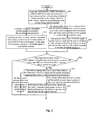
- Fig. 2 shows a flow chart of the method for scheduling MIMO between mobile terminal and multiple cooperative base stations located in the cooperative area under the control of a scheduling apparatus in the scheduling apparatus of the wireless network according to one embodiment of the present invention.
- scheduling apparatus D acquires signal-quality-related information, which is identified by identification information of the corresponding mobile terminal, between base stations a, b, c and mobile terminals in their respective vicinity.
- scheduling apparatus D is a network device physically separated to each base station, and receives the signal-quality-related information, e.g. RSSI, between each base station and mobile terminal 0, mobile terminal 1, mobile terminal 2, which is reported by base station a, b, c.
- step S10 comprises: base station a acquires the RSSI between itself and mobile terminals 0, 1, 2; base station a receives the RSSI reported by base station b, c.
- base station a acquires the RSSI between itself and mobile terminals 0, 1, 2; base station a receives the RSSI reported by base station b, c.
- step S11 is performed, wherein, scheduling apparatus D schedules the MIMO communication between each cooperative base station and each mobile terminal according to the RSSI reported by each base station, just as follows:
- scheduling apparatus D indicates base stations a, b, c transmit independently, by utilizing the same time-frequency resource T1F1, downlink signal to their served mobile terminals respectively.
- scheduling apparatus D can detect that base stations a, b, c transmit independently, by utilizing the same time-frequency resource, downlink signal to their served mobile terminal respectively.
- scheduling apparatus D may indicate each cooperative base station under its control to eliminate the interference introduced by the reuse of time-frequency resource.
- step 13 scheduling apparatus D detects that different base stations transmit downlink signal to different mobile terminal via the same time-frequency resource, then, taking mobile terminal 0 as an example, step S 13 is executed preferably, that is, it is determined upon the signal-quality-related information whether the signal quality between base station c and mobile terminal 0 is higher than a third predetermined threshold.
- Step S14 is performed to indicate base station c to suppress the interference introduced to mobile terminal0 by transmission to mobile terminal1 when the base station c is transmitting the signal to mobile terminal1; likewise, for mobile terminal 1, only when the determination in step S13 denotes that the quality of signal between either base station a or base station b and mobile terminal1 is more than the third predetermined threshold, does scheduling apparatus D indicate, in Step S 14, that the corresponding base station to suppress the interference introduced to mobile terminal 1. For mobile terminal 2, it follows a rule similar to the above the determination of whether the base stations a,c needs to apply an interference suppression to it.
- scheduling apparatus D also considers the spatial diversity of each base station via some time-frequency resource. For an instance, assuming that spatial diversity of base station a is 2, representing that the total number of mobile terminal that the base station a can both serve and eliminate interference for does not exceed 2, then, after the determination that base station a serves mobile terminal 0 via T1F1, base station has only 1 spatial diversity remained on T1F1. And after the further determination that base station a applies interference suppression to mobile terminal 1 via T1F1, base station a has no spatial diversity left on T1F1, and it can not serve more mobile terminal or apply interference suppression to more mobile terminal.
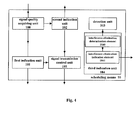
- Fig. 3 shows a flow chart of the method for conducting a MIMO communication based on scheduling with the mobile terminal in the base station of the wireless network according to one embodiment of the present invention. More description is given in combination with Fig.1 .
- each of the base stations in Fig.1 acquires the signal-quality-related information between itself and every mobile terminal in its vicinity.
- Step 21 the acquisition, in Step 21, of the indication information relevant to the base station is implemented by the following sub-step, not shown in Fig.1 .
- S212 to receive, from the scheduling apparatus, the indication information relevant to the base station, wherein the indication information is used for indicating one or more mobile terminals associated with the base station.
- each base station screens the acquired signal-quality-related information between itself and each mobile terminal, which may, specifically, result in the signal-quality-related information for indicating that the mobile terminal is about to conduct a inter-cell handoff and the signal-quality-related information for indicating signal quality is above the forth predetermined threshold. And the above signal-quality-related information is ready for being rendered to scheduling apparatus D. Assuming that signal quality between base station a and mobile terminal 2 is bad, worse than the fourth predetermined threshold, and mobile terminal 2 does not need a inter-cell handoff, then base station a may choose not to report to scheduling apparatus D with the quality between itself and mobile terminal 2.
- scheduling apparatus D when scheduling apparatus D chooses a service base station or an interference-eliminating base station for some mobile terminal, it may make the above choice only among those base stations having respectively reported the signal-quality-related information between themselves and that mobile terminal.
- step S21 after acquisition of indication information from scheduling apparatus D, each base station performs corresponding operation based on the indication information. Brief description is made as follows, with base stations a, b, c as example respectively, and reference is made to the necessary part of the above context.
- step S22' on one time-frequency resource, some base station has merely one mobile terminal associated with the base station itself, that is, the base station only needs to serve one mobile terminal, and does not have to eliminate interference for any mobile terminal.
- the above case corresponds to the base station c shown in Fig.1 .
- base station c only needs utilizing all its transmitting antenna to transmit, via the time-frequency resource of T1F1, downlink signal to mobile terminal 1 with current single-user MIMO technology.
- the single-user MIMO technology available for base station c includes space-time coding, spatial multiplexing, spatial diversity and so on.
- base station b needs to serve 2 mobile terminals: mobile terminal 0, mobile terminal 2. Therefore, in Step S22' base station b needs to pre-code the service data to be transmitted to the above 2 mobile terminals, and it only needs to be aware of the instant channel response matrix H_b0 between base station b and mobile terminal 0 and H_b2 between base station b and mobile terminal 2 to generate the pre-coded matrix.
- the way base station b transmits downlink signal to mobile terminal 0, mobile terminal 2 includes multi-user MIMO or beam forming and so on.
- base station a needs to both serve mobile terminal 0 by utilizing the time-frequency resource of T1F1 and eliminate interference for mobile terminal 1. Therefore, in step S22, base station a only needs to know the instant channel response matrix H_a0 between base station a itself and mobile terminal 0 and H_a2 between base station a itself and mobile terminal 2. Multi-user MIMO or beam forming etc. can be utilized for base station a to serve mobile terminal 0 and simultaneously eliminate the interference for mobile terminal 1.
- base station a, b Since, for base station a, b, CSI needs to be acquired for the generation of pre-coded matrix, then, when they ever got the information of RSSI or CQI rather than CSI in step S20, base station a, b have to detect, e.g. channel estimation etc., the corresponding channel indicated by scheduling apparatus D. And when acquired information in step S20 is CSI, base stations a,b may directly apply the CSI relevant to the corresponding mobile terminal of all the acquired CSI to the generation of pre-coded matrix. During the interval between a scheduling and the one next to it, the base station may acquire the CSI repeatedly to real-timely update the pre-coded matrix used by their own.
- scheduling apparatus D finds, by analysis, that base station e is not a appropriate to serve as a service base station for any mobile terminal, scheduling apparatus D does not indicate base station e to serve some mobile terminal, and of course no request for interference elimination by base station e. Except for the above case, base station e may not be required to serve other mobile terminal or eliminate interference for some mobile terminal via T1F1 because of no remaining spatial diversity for base station e via T1F1.
- Fig. 4 shows a functional block diagram of a scheduling apparatus for scheduling MIMO communication between mobile terminal and multiple cooperative base stations located in the cooperative area under the control of a scheduling apparatus in the scheduling apparatus of the wireless network, according to one embodiment of the present invention.
- the shown scheduling means 10 comprises: a signal quality acquiring unit 100, a first indication unit 101, a second indication device 102, a detection unit 103, a third indication unit 104 and a signal transmission controlling unit 105.
- the third indication unit 104 further comprises an element for determining elimination of interference 1040, and an element for indicating elimination of interference 1041.
- the signal quality acquiring unit 100 in scheduling apparatus D acquires signal-quality-related information independently between base station a, base station b, base station c and mobile terminals in their respective vicinity.
- scheduling apparatus D is a network device physically separated to each base station, and receives the signal-quality-related information, e.g. RSSI, between each base station and mobile terminal 0, mobile terminal 1, mobile terminal 2, which is reported by base station a, b, c.
- the functionality of the signal quality acquiring unit 100 comprises: acquiring independently the RSSI respectively between base station a itself and mobile terminals 0, 1, 2; receiving the RSSI reported by base stations b,c.
- exemplary description is given as follows for the case in which base station is physically separated to scheduling apparatus D as shown in Fig.1 .
- the signal quality acquiring unit 100 provides every indication unit with the acquired signal-quality-related information based respectively on which each indication unit conducts the corresponding indication to each base station. Discussion is given respectively for the mobile terminals shown in Fig.1 .
- the first and second indication unit of scheduling apparatus D indicates that base station a, b, c transmit independently, by utilizing the same time-frequency resource:T1F1, downlink signal to their served mobile terminal respectively.
- the detection unit 103 of scheduling apparatus D can detect that base station a, b, c transmit independently, by utilizing the same time-frequency resource, downlink signal to their served mobile terminal respectively.
- the third indication unit 104 may indicate each cooperative base station to eliminate the interference introduced by the reuse of time-frequency resource.
- interference elimination determination element 1040 in the third indication unit 104 determines, upon the signal-quality-related information, whether or not the signal quality between base station c and mobile terminal 0 is higher than a third predetermined threshold.
- interference elimination determination element 1040 inform interference elimination indication element 1041 to indicate base station c to suppress the interference introduced to mobile terminal0 by transmission to mobile terminal1 while, at the same time, the base station c transmits the signal to mobile terminal1; likewise, for mobile terminal 1, only when the determination by interference elimination determination element 1040 denotes that the quality of signal between either base station a or base station b and mobile terminal1 is more than the third predetermined threshold, does interference elimination indication element 1041 indicate that the corresponding base station to suppress the interference introduced to mobile terminal1. for mobile terminal 2, it follows a rule similar to the above the determination of whether the base station a,c needs to apply an interference suppression to it.
- scheduling apparatus D also considers the spatial diversity of each base station via some time-frequency resource. For an instance, assuming that spatial diversity of base station a is 2(representing that the total number of mobile terminal that the base station a can both serve and eliminate interference for does not exceed 2), then, after the determination that base station a serve mobile terminal 0 via T1F1, base station has only 1 spatial diversity remained via T1F1. and after the further determination that base station a apply interference suppression to mobile terminal 1 via T1F1, base station a has no spatial diversity, via T1F1, left and it can not serve more mobile terminal or apply interference suppression to more mobile terminal.
- the consideration for the spatial diversity within scheduling apparatus D can be implemented by the spatial diversity monitoring element which is not shown in the figures and performs corresponding action on every indication unit based on remaining spatial diversity of each base station.
- the signal transmission control unit 105 is mainly used to control, base on indication information acquired by every indication unit, to dispatch service data to be transmitted to each mobile terminal to each service base station specified for the corresponding mobile terminal.
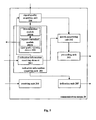
- Fig. 5 shows a functional block diagram of a communication means for conducting a MIMO communication based on scheduling with the mobile terminal in the base station of the wireless network according to one embodiment of the present invention. More descriptions are given still in combination with Fig.1 .
- a communication means 20 is configured within every base station shown in Fig.1 , which comprises: a signal quality acquiring unit 200, a indication information acquiring unit 201, a matrix generating unit 202, a pre-coding unit 203, a receiving unit 204 and an indication unit 205 , wherein, the indication information acquiring unit 201 further comprises: a signal quality reporting element 2010, and an indication information receiving element 2011, more specifically, the signal quality reporting element 2010 further comprises a determination module 20100 and a report-controlled module 20101.
- the signal quality acquiring unit 200 in each of the base stations in Fig.1 respectively acquires the signal-quality-related information between the mother base station in which it resides and every mobile terminal in the vicinity of the mother base station.
- indication information acquiring unit 201 has its sub-device operating as follows:
- the signal quality reporting element 2010 reports the signal-quality-related information, acquired by the signal quality acquiring unit 200, between the base station and every mobile terminal in its vicinity to the scheduling apparatus to which the base station belongs to.
- the indication information receiving element 2011 receives, from the scheduling apparatus, the indication information relevant to the base station.
- the determination module 20100 in the signal quality reporting element 2010 screens the acquired signal-quality-related information between the mother base station in which it resides in and each mobile terminal, which may, specifically, result in the signal-quality-related information for indicating that the mobile terminal is about to conduct a inter-cell handoff and the signal-quality-related information for indicating signal quality is above the forth predetermined threshold, which is delivered to the report-controlled module 20101 to report scheduling apparatus D. Assuming that signal quality between base station a and mobile terminal 2 is bad, e.g.
- the determination module 20100 within base station a may choose not to report to scheduling apparatus D with the quality between itself and mobile terminal 2. It should be understood that, for the following scheduling, when scheduling apparatus D chooses a service base station or a interference-eliminating base station for some mobile terminal, it may make the above choice only among those base stations having respectively reported the signal-quality-related information between themselves and that mobile terminal.
- the base station performs corresponding operation based on the indication information acquired by the indication information acquiring unit 201.
- the indication information acquiring unit 201 Brief description is made as follows, with base stations a, b, c as example respectively, and reference is made to the necessary part of the above context.
- base station c only needs utilizing all its transmitting antenna to transmit, via the time-frequency resource of T1F1, downlink signal to mobile terminal 1 with current single-user MIMO technology.
- the single-user MIMO technology available for base station c includes space-time coding, spatial multiplexing, spatial diversity and so on.
- the processing device used for single-user MIMO is not shown in the figure.
- base station b needs to serve 2 mobile terminals: mobile terminal 0, mobile terminal 2. Therefore, pre-coding unit 203 of base station b needs to pre-code the service data which is received from scheduling apparatus D and to be transmitted to the above 2 mobile terminals, and the matrix generating unit 202 only needs to be aware of the instant channel response matrix H_b0 between base station b and mobile terminal 0 and H_b2 between base station b and mobile terminal 2 to generate the pre-coded matrix.
- Base station b can transmit downlink signal to mobile terminals 0, 2 via the same time-frequency resource by means of multi-user MIMO or beam forming and so on.
- Base station a needs to both serve mobile terminal 0 by utilizing the time-frequency resource of T1F1 and eliminate interference for mobile terminal 1. Therefore, the matrix generating unit 202 only needs to know the instant channel response matrix H_a0 between base station a itself and mobile terminal 0 and H_a2 between base station a itself and mobile terminal 2.
- the way in which base station a serves mobile terminal 0 and simultaneously eliminates the interference for mobile terminal 1 includes multi-user MIMO or beam forming and so on.
- CSI needs to be acquired for the generation of pre-coded matrix
- a unit for acquiring channel quality have to detect, e.g. channel estimation etc., the corresponding channel according to the indication information to attain the CSI.
- pre-coding device within the base station may directly apply the corresponding-mobile terminal-related part of all the acquired CSI to the generation of pre-coded matrix.
- a base station may acquire the CSI repeatedly to real-timely update the pre-coded matrix of its own.
- base station a is a scheduling apparatus, and receiving unit 204 of the communication means 20 thereon receives, from other base stations, and converges the signal-quality-related information between each of the base stations and the mobile terminals in its vicinity respectively. And indication unit 205 dispatches the indication information locally acquired by indication information acquiring unit 201 to each of the other base station.
- the communication means 20 of each base station should be equipped with the device having similar functionality to monitor the remaining spatial diversity capability of its own so as to determine whether or not to follow the corresponding scheduling instruction from the scheduling apparatus.
- Fig. 6 shows a diagram of the system for conducting a multi-base station cooperative MIMO with low information interaction and the scheduling therein according to one embodiment of the present invention, wherein M cooperative base stations of which all belong to the same scheduling apparatus D' are connected to scheduling apparatus D' a via Backhaul network.
- the pre-coder is actually pre-coding device hereinbefore.
- the system shown in Fig.6 has a work flow as follows in view of the above corresponding content.
- the Backhaul network shown in Fig.6 merely exemplary illustrates the connection among the base stations and the connection between each base station and the scheduling apparatus.
- the networking manner may take the form of star, bus, or any other networking topology.
Landscapes
- Engineering & Computer Science (AREA)
- Computer Networks & Wireless Communication (AREA)
- Signal Processing (AREA)
- Quality & Reliability (AREA)
- Computer Security & Cryptography (AREA)
- Mobile Radio Communication Systems (AREA)
- Radio Transmission System (AREA)
Abstract
Description
- The invention relates to the suppression of inter-cell interference (ICI) in wireless network, particularly relates to a method and apparatus for the suppression of ICI through cooperative multiple-input multiple-output(MIMO) wireless transmission among multiple base stations.
- In a wireless system with reuse of frequency resource, ICI introduced by the frequency reuse is an important factor limiting the downlink capacity. When an mobile terminal located in the cell boundary, that is, inter-cell area, receives a significant signal from its dominating base station(Base station, BS), it also receives signal from other base station(s) via the same time-frequency resource. And the signal from other base station(s) constitutes an interference to this mobile terminal.
- In an OFDM/OFDMA system, there are 2 solutions involving cooperation among multiple base stations to solve the foregoing issue, as bellows:
- Based on the solution of Macro macro diversity, for a mobile terminal located in the cell boundary, both the base station (BS) to which the mobile terminal currently belongs and the base station (BS) to which the mobile terminal are approaching send the same signal via the same time-frequency resource, i.e. time slot and sub-carrier. Thus, interference suppression and diversity gain can be achieved since the base stations have individual transmission channels respectively.
- The drawback of macro diversity solution lies in that adjacent base stations are required to send the same signal to the same mobile terminal via the same time-frequency resource, which limits the total user number supported by the system.
- Base on network MIMO, all antennas of all base stations act together as a single radio antenna array. According to all the Channel Status Information (CSI), e.g. channel response array, between all base stations and mobile terminals, a precoding matrix is generated to enable the joint precoding among multiple base stations to eliminate the co-channel interference(CCI) among user terminals. Since the CSI between all base stations and mobile terminals are taken into account in the precoding of this technology, interference introduced by reuse of time-frequency resource is diminished to the extreme extent by network MIMO and optimal performance is attained.
- The optimal performance is attained, yet at the expense of introducing an extremely high computation complexity, by the above solution, and it is of a more severity that since each base station needs an exchange of its own related channel information via the backhaul network, wherein the backhaul network is used for the interaction of the data and signaling between base stations and between base station(s) and its(their) scheduling apparatus, a high consumption of network resource caused by large scale of information transmission improves the backhaul network load and delay of the information transmission degrades system performance.
- Thus, a new solution is needed to overcome the above issue in the current technology, which should suppress the above interference effectively without introducing too much requirement for the consumption of backhaul network resources, and meanwhile have a low computation complexity.
- To attain the object suggested above, the present invention provides a multi-base station cooperative MIMO with low information interaction, wherein:
- Multiple base stations may serve the same mobile terminal in MIMO mode via the same time-frequency resource;
- One base station may simultaneously serve multiple mobile terminals in SDMA mode via the same time-frequency resource;
- When serving multiple mobile terminals on one time-frequency resource is required and eliminating the interference for other mobile terminal is not needed, or when serving one or multiple more mobile terminals on one time-frequency resource is required and eliminating the interference for other one or more mobile terminals is also needed concurrently, the base station needs to pre-code the to-be-transmitted data. All mobile terminals, including the one(s) for of which the interference base station is eliminated eliminating the interference by the base station and the one(s) also served by the base station, are considered as the mobile terminals associated with the base station. Particularly, according to the present invention, at the base stations where precoding is needed, the process of generation of pre-coded matrix is independently carried out in various base stations. That is, to calculate a pre-coded matrix, each base station only needs to acquire channel state information (CSI), specifically based on the channel estimation of the base station or on the feedback from the mobile terminal, between the base station and the mobile terminal for which service and interference elimination should be provided by the base station on the corresponding time-frequency resource, which is determined by the scheduling apparatus.
- When service should be provided to mobile terminal on merely one time-frequency resource and no interference elimination is needed for any mobile terminal, no pre-coding is needed. Those skilled in the art should understand that, pre-coding in present invention specifically refers to the pre-coding utilizing the pre-coded matrix generated based on the CSI and used for differentiating multiple user spatially. And the pre-coding differs from the MIMO pre-coding for individual user, e.g. STBC etc.
- it is determined by a scheduling apparatus, especially by a device/module for scheduling in the scheduling apparatus, whether a mobile terminal should be jointly served by multiple cooperative base stations and whether a base station should serve multiple mobile terminals or eliminate their interference.
- The scheduling apparatus can be either a physically individual network device or be integrated into the base station physically.
- The way the scheduling apparatus schedules the MIMO communication between a base station and mobile terminal is as follows:
- The base station acquires signal-quality-related information between the base station and each adjacent mobile terminal, and reports to a scheduling apparatus to which the base station belongs, wherein the base station reports the signal-quality-related information indicating that a mobile terminal is about to conduct a inter-cell handoff, and the identification information of the mobile terminal to the scheduling apparatus. And signal-quality-related information indicating that the signal quality is above the fourth predetermined threshold, and the identification information of the mobile terminal can also be reported to the scheduling apparatus by the base station.
- Subsequently, according to the signal-quality-related information reported by all the cooperative base stations under its control, the scheduling apparatus selects, for each mobile terminal, at least one base station to transmit the downlink signal to the mobile terminal, which will be jointly referred to as service base station hereafter, a mobile terminal may have one or more service base stations, the scheduling apparatus also determines, when necessary, a base station to eliminate the interference for a specific mobile terminal on a specific time-frequency resource, and reports the scheduling result to the base station(s). And, according to the scheduling result, for each mobile terminal, the scheduling apparatus further controls to correspondingly transmit service data of the mobile terminal to its service base station.
- Then, according to the scheduling result from the scheduling apparatus, each base station determines the to-be-served mobile terminal(s) and the mobile terminal(s) for which the interference should be eliminated. Next, each base station calculates a pre-coded matrix to generate signals to be transmitted utilizing CSI between this base station and the to-be-served mobile terminal(s) and between this base station and the mobile terminal(s) for which the interference should be eliminated.
- According to one embodiment of the present invention, there is provided a method, in a scheduling apparatus of a wireless network, for scheduling MIMO communication between mobile terminal and multiple cooperative base stations located in the cooperative area under the control of the scheduling apparatus, comprising the steps of: a. acquiring signal-quality-related information between each of the multiple cooperative base stations and the corresponding multiple mobile terminals in vicinity of the base station; b. when a signal-quality-related information relevant to a mobile terminal indicates that the difference among the quality of multiple optimal signals is less than a first predetermined threshold, indicating at least two base stations among the multiple base stations relevant to the quality of multiple optimal signals to serve as service base stations of the mobile terminal and to transmit downlink signal to the mobile terminal via the same time-frequency resource.
- According to another embodiment of the present invention, there is provided a method, in a base station of a wireless network, for conducting a MIMO communication based on scheduling with a mobile terminal, comprising the steps of: A. acquiring signal-quality-related information between the base station and each mobile terminal in its vicinity; B. acquiring the indication information relevant to the base station, indicating mobile terminals associated with the base station; C. when the indication information indicates that mobile terminals associated with the base station includes multiple mobile terminals which need a downlink signal transmission via the same time-frequency resource from the base station, generating a pre-coded matrix according to the CSI between the base station and the multiple mobile terminals; D. pre-coding, by utilizing the pre-coded matrix, the service data to be transmitted to the multiple mobile terminals so as to generate pre-coded downlink signals to be transmitted to the multiple mobile terminals.
- Accordingly, when the indication information indicates that the mobile terminals associated with the base station actually include a mobile terminal to which the base station is required to transmit a downlink signal as well as a mobile terminal for which the base station is required to eliminate interference, the base station generates a pre-coded matrix utilizing the CSI between the base station and the mobile terminal to which the base station is required to transmit a downlink signal and the CSI between the base station and the mobile terminal for which the base station is required to eliminate interference.
- According to yet another embodiment of the present invention, there is provided a scheduling means, in a scheduling apparatus of a wireless network, for scheduling MIMO communication between mobile terminals and multiple cooperative base stations located in the cooperative area under the control of the scheduling apparatus, comprising: a signal acquiring unit for acquiring signal-quality-related information between each of the multiple cooperative base stations and the corresponding multiple mobile terminals in vicinity of the base station; a first indication unit for, when a signal-quality-related information relevant to a mobile terminal indicates that the difference among the quality of multiple optimal signals is less than a first predetermined threshold, indicating at least two base stations among the multiple base stations relevant to the quality of multiple optimal signals to serve as service base stations of the mobile terminal and to transmit downlink signal to the mobile terminal via the same time-frequency resource,.
- According to yet another embodiment of the present invention, there is provided a communication means, in a base station of a wireless network, for conducting a MIMO communication based on scheduling with a mobile terminal, comprising: a signal quality acquiring unit for acquiring signal-quality-related information between the base station and each mobile terminal in its vicinity; an indication information acquiring unit for acquiring the indication information relevant to the base station, and the indication information is used for indicating the mobile terminals associated with the base station; a matrix generating unit for, when the indication information indicates that the mobile terminals associated with the base station include multiple mobile terminals which need a downlink signal transmission via the same time-frequency resource from the base station, generating a pre-coded matrix according to the CSI between the base station and the multiple mobile terminals; and a pre-coding device for pre-coding, by utilizing the pre-coded matrix, the service data to be transmitted to the multiple mobile terminals so as to generate pre-coded downlink signals to be transmitted to the multiple mobile terminals.
- The present invention includes, but is not limited to the following advantages:
- 1. attaining the effective suppression of inter-cell interference;
- 2. throughput is improved due to that one or more base stations may serve multiple mobile terminals via the same time-frequency resource while suppressing the inter-user interference;
- 3. the information for scheduling in present invention does not consume much resources of backhaul network because data size is small, in comparison to the channel response matrix H(a multidimensional complex matrix) via backhaul network in which the network MIMO happens, if a relative signal strength indicator (RSSI) or a channel quality indicator (CQI) is employed as the signal-quality-related information. Moreover, since the base station, preferably, may selectively report signal-quality-related information between portion of the mobile terminals and itself to the scheduling apparatus, consumption of the resources of backhaul network can be further reduced. And likewise, transmission of the scheduling result merely consumes little backhaul network resources.
- 4. There is a little need of computation for the base station to generate pre-coded matrix in present invention, which is quite limited. Since pre-coding process is independently carried out in various base stations, for one base station, it merely needs to detect and acquire the
- CSI, informed by the scheduling apparatus, between the base station itself and mobile terminal associated with it so as to carry out the pre-coding. And pre-coding conducted by the base station has nothing to do with the CSI between the base station and mobile terminal non-associated with it, not to speak of the CSI between other base station and mobile terminal associated with the other base station.
- Other features, aspects and advantages of the present invention will become obvious by reading the following description of non-limiting embodiments with the aid of appended drawings. Wherein, same or similar reference numerals refer to the same or similar steps or units/means/apparatus.
-
Fig. 1 shows a topology diagram of a wireless network for supporting the scheduling of the communication between a base station and mobile terminals according to one embodiment of the present invention; -
Fig. 2 shows a flow chart of the method for scheduling MIMO between mobile terminal and multiple cooperative base stations located in the cooperative area under the control of a scheduling apparatus in the scheduling apparatus of the wireless network according to one embodiment of the present invention; -
Fig. 3 shows a flow chart of the method for conducting a MIMO communication based on scheduling with the mobile terminal in the base station of the wireless network according to one embodiment of the present invention; -
Fig. 4 shows a function block diagram of a scheduling apparatus for scheduling MIMO communication between mobile terminal and multiple cooperative base stations located in the cooperative area under the control of a scheduling apparatus in the scheduling apparatus of the wireless network, according to one embodiment of the present invention; -
Fig. 5 shows a function block diagram of a communication means for conducting a MIMO communication based on scheduling with the mobile terminal in the base station of the wireless network according to one embodiment of the present invention; -
Fig. 6 shows a diagram of the system for conducting a multi-base station cooperative MIMO with low information interaction and the scheduling therein according to one embodiment of the present invention; -
Fig. 1 shows a topology diagram of wireless network for supporting the scheduling of the communication between the base station and mobile terminal according to one embodiment of the present invention. It should be understood by those skilled in the art that the depicted network may be WiMAX network, 3G network or next generation mobile communication network, and is not limited to these specific embodiments. Each base station located in the cooperative area under the control of a scheduling apparatus, that is, each base station communicatively coupled to the scheduling apparatus, is referred to as a cooperative base station hereafter, as is just like the base stations a, b ,c inFig. 1 . The scheduling apparatus can be either a physically individual network device or integrated into a base station. It should be understood that the scheduling apparatus is not limited to be an independent network equipment or base station, it may be a network equipment dedicated for carrying out the scheduling solution of the present invention. - Explanation is made for the present invention from the system perspective in view of
Fig. 1 : - Firstly, each base station respectively acquires signal-quality-related information between the base station itself and each mobile terminal in its vicinity. The signal-quality-related information may be a relative signal strength indicator (RSSI), a channel quality indicator (CQI), or CSI, e.g. instant or long-time channel response, and so on. Taking RSSI for instance, the way the base station acquires signal-quality-related information includes that:
- the base station asks each mobile terminal in its vicinity for a transmission of a sounding signal to the base station itself via a specified time-frequency resource, and then the base station measures the quality of the sounding signal to obtain the signal-quality-related information.
- the base station transmits, to every mobile terminals in its vicinity, a signal dedicated for conducting signal quality measurement, e.g. pilot signal etc., then the mobile terminals feedback the measured signal-quality-related information to the base station;
- the base station directly obtains the signal-quality-related information by measuring the uplink traffic signal from the mobile terminals.
- It should be understood that the signal-quality-related information acquired by each base station needs to be converged to the scheduling apparatus via the backhaul network, therefore, it is preferably characteristic of small data size. In comparison to the channel response matrix H with a large data size, RSSI or CQI is the preferable signal-quality-related information since it is just a simple number.
- Next, each base station reports the acquired signal-quality-related information, taking RSSI as an example hereafter, to the scheduling apparatus D via the backhaul network. Wherein, the base station may report, without any screening, all the acquired RSSI with identification of the corresponding mobile terminal to the scheduling apparatus D; or may report those RSSI of which signal quality is above a fourth predetermined threshold among all the RSSI, those RSSI to which the mobile terminal corresponding is being indicated to be about to handoff, and together with identification of the corresponding mobile terminal to the scheduling apparatus D, because other RSSI with worse signal quality is useless for scheduling process of the scheduling apparatus D so that load of the backhaul network is further reduced to some extent. For this instance, providing that each base station report all the gathered RSSI to the scheduling apparatus D and the RSSI converged to scheduling apparatus D includes those RSSI between each cooperative base station and each mobile terminal in
Fig.1 . - Subsequently, scheduling apparatus D applies an analysis to the converged RSSI so as to schedule the MIMO communication between each cooperative base station and each mobile terminal. Without loss of generality, some example is taken for the RSSI-based scheduling strategy of scheduling apparatus D as follows:
- when RSSI indicates that the relationship of the signal quality, abbreviated as SX ,wherein X is the reference number for corresponding base station, between a mobile terminal and base station a,b,c as follows: Sa>Sb>Sc , and Sa- Sb<a first predetermined threshold TH1, and Sa-Sc>TH1, then, scheduling apparatus D indicates that base stations a,b cooperatively serve the mobile terminal in MIMO mode via the same time-frequency resource, e.g. T1F1. Wherein the
mobile terminal 0 is assumed to meet the above condition and be served by base stations a,b. - It should be appreciated by those skilled in the art that when Sa>Sb>Sc and Sa- Sc<TH1, scheduling apparatus D may indicate, based on space division capability of each base station and receiving capability, e.g. number of the receiving antenna etc., of the mobile terminal, 2 of the 3 base stations a,b,c or all of the 3 base stations to serve the mobile terminal via the same time-frequency resource.
- In the present invention, there is a relationship between the number of the transmitting antenna of the base station and the space division multiple address and interference elimination technology used during the period that multiple mobile terminals are served or the interference of one/more mobile terminal, served by the base station, is eliminated. That is, the number, referred to as space division capability, of mobile terminals that a base station can cover via a single time-frequency resource, including the mobile terminals served by the base station and the mobile terminals for which interference need to be eliminated by the base station, is limited to the number/spacing of the transmitting antenna of the base station. Thus, according to one preferable embodiment of the present invention, scheduling apparatus D takes the remaining space division capability of each base station via each time-frequency resource into consideration in the course of its scheduling. For example, a base station has a space division capability of 2 and it is serving 2 mobile terminals via T2F2, at this time, scheduling apparatus D does not send a more requirement that the base station serve a new mobile terminal or apply interference elimination to a new mobile terminal via T2F2. Of course, scheduling apparatus D may not consider the remaining space division capability of each base station, instead, it is the base station that determines whether to accept the scheduling of this time according to the remaining space division capability of its own after receiving the indication information from scheduling apparatus D.
- when RSSI indicates that the difference between the optimum signal quality and the sub-optimum signal quality is more than a second predetermined threshold and the mobile terminal is located within the cooperative area, indicate the base station corresponding to the optimum signal quality to serve the mobile terminal. Wherein
mobile terminals - Those skilled in the related art can determine an appropriate value for the predetermined thresholds in present invention without creative effort, so, no more is necessary to be mentioned about this hereafter.
- According to one embodiment of the present invention, while scheduling apparatus D specifies the corresponding service base station for each mobile terminal, it also determines a time-frequency resource, used for the transmission of downlink signal to the mobile terminal, for the service base station. Providing that scheduling apparatus D determines the same one time-frequency resource: T1F1, used for the transmission of downlink signal to the corresponding mobile terminal shown in
Fig.1 , for each cooperative base station, then while base station a,b cooperatively transmit downlink signal tomobile terminal 0, base stations c,b are also using T1F1 to transmit independently downlink signal tomobile terminals - According to one embodiment of the present invention, scheduling apparatus D may indicate base station c to suppress the interference introduced to
mobile terminal 0 by transmission tomobile terminal 1 when base station c is transmitting the signal tomobile terminal 1, and indicate base stations a,b to suppress the interference introduced tomobile terminal 1 by transmission tomobile terminal 0 when the base stations a,b are transmitting the signal tomobile terminal 0. - According to one embodiment of the present invention, only when the quality of signal between base station c and
mobile terminal 0 is above a third predetermined threshold, does scheduling apparatus D indicate base station c to suppress the interference introduced tomobile terminal 0 by transmission tomobile terminal 1 while, at the same time, base station c transmit the signal tomobile terminal 1; likewise, when the quality of signal between base stations a,b andmobile terminal 1 is not above the third predetermined threshold, scheduling apparatus D does not indicate base stations a,b to suppress the interference introduced tomobile terminal 1 by transmission tomobile terminal 0 when they are transmitting the signal tomobile terminal 0. - Mobile terminal associated respectively with the each shown cooperative base station can hither be determined as follows:
- base station a: to serve
mobile terminal 0 via the same time-frequency resource, e.g. T1F1, with that of base station b, and eliminate the interference introduced tomobile terminal 1; - base station b: to serve
mobile terminal 0 with base stations a via the same time-frequency resource, T1F1, and servemobile terminal 2 via T1F1; - base station c: to serve
mobile terminal 1 via T1F1. - Then, scheduling apparatus D informs each base station with the above information and the corresponding time-frequency resource, and control to push service data, to be transmitted to each mobile terminal, to the corresponding service base station.
- Each base station transmits downlink signal to the mobile terminal to be served by the base station according to the instruction from scheduling apparatus D, and concurrently eliminate the interference introduced to some mobile terminal according to the instruction from scheduling apparatus D. Description is given for each base station respectively as bellows:
- As mentioned above, besides having to serve
mobile terminal 0, base station a needs to eliminate the interference introduced tomobile terminal 1 since it is communicatively coupled tomobile terminal 1 with a strong signal but does not have to servemobile terminal 1. The signal quality betweenmobile terminal 1 and base station c is better, by a second predetermined threshold, the signal quality between mobile terminal1 and base station a. With the above condition, base station a needs to pre-code the service data to be transmitted tomobile terminal 0. According to the information of mobile terminal, associated with base station a under the instruction of scheduling apparatus D, the information for base station a to generate the pre-coding matrix merely includes: the CSI, i.e. instant channel response matrix H_a0, between base station a andmobile terminal 0 and the CSI, i.e. instant channel response matrix H_a1, between base station a andmobile terminal 1. After generating the pre-coded matrix based on the prior art, base station a pre-codes, by utilizing the pre-coded matrix, the service data to be transmitted tomobile terminal 0 so as to get the pre-coded downlink signal to be transmitted tomobile terminal 0. And in details, multi-user MIMO or beam forming can be utilized for a null steering in the direction tomobile terminal 1 so that while the base station a is servingmobile terminal 0, it also can diminish the interference introduced tomobile terminal 1. - The time-frequency resource of T1F1 used by base station a to transmit downlink signal to
mobile terminal 0 can be coordinated by scheduling apparatus D, and is also used for base station b to servemobile terminal 0. The cooperative working mode of base station a,b includes but not limited to Space-time coding, spatial multiplexing, spatial diversity and so on. With spatial multiplexing as an example, description is made as follows: - Scheduling apparatus D may control to divide the channel-coded service data: {S(0), S(1), S(2), ..., S(2n), ...}, to be transmitted to
mobile terminal 0, to the corresponding service base station, into 2 signal streams, and transmit them to base station a and base station b correspondingly, wherein the signal stream to the base station a is: {S(0), S(2), S(4), ..., S(2n),...}; and the signal stream to the base station b is: {S(1), S(3), S(5), ..., S(2n-1),...}. then, base station a pre-code the service data: {S(0), S(1), S(2), ..., S(2n), ...}by utilizing the above pre-coded matrix. - Scheduling apparatus D may transmit the entire service data to the above 2 service base station of
mobile terminal 0, and channel-coding is completed by 2 service base station respectively to accomplish {S(0), S(1), S(2), ..., S(2n), ...} and next, base station a and base station b determines, based on pre-settings or scheduling, signal streams which is for base station a and base station b to transmit respectively tomobile terminal 0. - In the case where the 2 base stations transmit downlink signal to
mobile terminal 0 by utilizing space-time coding, Scheduling apparatus D may apply the space-time coding to the channel-coded service data, and transmit one of the 2 coded signals to base station a and the other to base station b. Base station a applies a pre-coding to the space-time coded signal; or, with transmitting the entire service data to base station a and base station b, Scheduling apparatus D allows them to apply respectively a channel-coding to get {S(0), S(1), S(2), ..., S(2n), ...}and complete the space-time coding, then respectively select, based on pre-settings or scheduling, one signal stream to transmit tomobile terminal 0 after applying pre-coding. - As mentioned above, the signal-quality-related information acquired by each base station varies in their form. When it takes the form of RSSI or CQI, the base station needs to acquire separately a CSI, e.g. instant channel response matrix H, before the base station applies the pre-coding. When it takes the form of CSI, the base station directly applies the acquired CSI to the generation of pre-coded matrix when it performs the pre-coding. During the interval between a scheduling and the one next to it, the base station may acquire the CSI repeatedly to real-timely update their own pre-coded matrix.
- It can be directly discerned that, with the present invention, when performing the computation of the pre-coded matrix, each base station does not need to interact with other base station about the CSI used for calculating the pre-coded matrix, it just needs to fulfill, according to CSI acquired by itself, the pre-coding with a good performance of interference suppression, which avoids a large consumption of backhaul network resources.
- base station b needs to serve
mobile terminals - Therefore, base station b needs to acquire the CSI between itself and
mobile terminal 0, and the CSI between itself andmobile terminal 2, which, for example, includes that: the instant channel response matrix H_b0 between base station b andmobile terminal 0, and the instant channel response matrix H_b2 between base station b andmobile terminal 2, to generate the pre-coded matrix used for pre-coding the service data to be transmitted tomobile terminals mobile terminals - Just as abovementioned, base station b and base station a cooperatively serve
mobile terminal 0 by utilizing any kind of MIMO technique for single user in coordination, and may also servemobile terminal 2 with any kind of MIMO technique for single user, for example, space-time coding, spatial multiplexing, spatial diversity and so on, which will not be mentioned redundantly hereafter. - base station c needs to merely transmit downlink signal to
mobile terminal 1 by utilizing T1F1, without having to eliminate the interference for any mobile terminal. - base station c may also serve
mobile terminal 1 with any kind of MIMO technique for single user, for example, space-time coding, spatial multiplexing, spatial diversity and so on, which will not be mentioned redundantly hereafter. - According to one embodiment of present invention, multiple cooperative areas can also achieve inter-area cooperation through the information interaction among the scheduling apparatuses.
- Detailed description is given from a system perspective as above. Next, description is given respectively from the side of scheduling apparatus and base station with reference to
Fig.1 and in view of the method flow chart and device functional block diagram. -
Fig. 2 shows a flow chart of the method for scheduling MIMO between mobile terminal and multiple cooperative base stations located in the cooperative area under the control of a scheduling apparatus in the scheduling apparatus of the wireless network according to one embodiment of the present invention. - Firstly, in step S10, scheduling apparatus D acquires signal-quality-related information, which is identified by identification information of the corresponding mobile terminal, between base stations a, b, c and mobile terminals in their respective vicinity. In this embodiment, scheduling apparatus D is a network device physically separated to each base station, and receives the signal-quality-related information, e.g. RSSI, between each base station and
mobile terminal 0,mobile terminal 1,mobile terminal 2, which is reported by base station a, b, c. In a variation, assuming that the functionality of scheduling apparatus D in integrated into base station a, then ,for base station a, implementation of step S10 comprises: base station a acquires the RSSI between itself andmobile terminals fig.1 . - After signal-quality-related information is acquired, step S11 is performed, wherein, scheduling apparatus D schedules the MIMO communication between each cooperative base station and each mobile terminal according to the RSSI reported by each base station, just as follows:
- for
mobile terminal 0, with the indication by RSSI that the relationship of the signal quality, abbreviated as SX with X is the reference number for corresponding base station, between it and base station a,b,c as follows: Sa>Sb>Sc , and Sa-Sb< a first predetermined threshold (TH1), and Sa- Sc>TH1, then, scheduling apparatus D indicates in step S11 that base station a,b cooperatively serve as the service base station ofmobile terminal 0 and transmit, by utilizing the same time-frequency resource T1F1, downlink signal tomobile terminal 0. Wherein themobile terminal 0 is assumed to meet the above condition and be served by base stations a,b. Considering the number of base stations by which one mobile terminal can be served concurrently depends on receiving capability and the MIMO mode adopted by the mobile terminal, thus, when the signal quality between one mobile terminal and base station a , b, c respectively is almost the same with each other, scheduling apparatus D determines at least one of the 3 base stations to serve the mobile terminal according to its receiving capability and corresponding MIMO mode. In this embodiment, without loss of generality, one mobile terminal is assumed to be served by, at most, 2 base stations concurrently. - for
mobile terminals mobile terminal 1 and all the base stations respectively, serve as the service base station ofmobile terminal 1 to transmit downlink signal to it. - Providing that scheduling apparatus D indicates base stations a, b, c transmit independently, by utilizing the same time-frequency resource T1F1, downlink signal to their served mobile terminals respectively.
- Then, in step S12, scheduling apparatus D can detect that base stations a, b, c transmit independently, by utilizing the same time-frequency resource, downlink signal to their served mobile terminal respectively. Hereafter, merely based on the above, scheduling apparatus D may indicate each cooperative base station under its control to eliminate the interference introduced by the reuse of time-frequency resource.
- However, there exists a blindness in the above way. For an instance, even if base station a transmits, by its maximum power, downlink signal to
mobile terminal 0 which is served by base station a without eliminating the interference ofmobile terminal 2, the signal quality of the signal from base station has been severely deteriorated, before the signal reachesmobile terminal 2, which leads little interference tomobile terminal 2, because base station a is very far away frommobile terminal 2. If, at this time, base station a is indicated to transmit downlink signal tomobile terminal 0 via by utilizing T1F1 and eliminate the interference formobile terminal 2 at the same time, then spatial diversity on the resource of T1F1 will be consumed in vain. - Based on this, in
step 13, scheduling apparatus D detects that different base stations transmit downlink signal to different mobile terminal via the same time-frequency resource, then, takingmobile terminal 0 as an example, stepS 13 is executed preferably, that is, it is determined upon the signal-quality-related information whether the signal quality between base station c andmobile terminal 0 is higher than a third predetermined threshold. Only when the quality of signal between base station c andmobile terminal 0 is above the third predetermined threshold, Step S14 is performed to indicate base station c to suppress the interference introduced to mobile terminal0 by transmission to mobile terminal1 when the base station c is transmitting the signal to mobile terminal1; likewise, formobile terminal 1, only when the determination in step S13 denotes that the quality of signal between either base station a or base station b and mobile terminal1 is more than the third predetermined threshold, does scheduling apparatus D indicate, inStep S 14, that the corresponding base station to suppress the interference introduced tomobile terminal 1. Formobile terminal 2, it follows a rule similar to the above the determination of whether the base stations a,c needs to apply an interference suppression to it. - Preferably, scheduling apparatus D also considers the spatial diversity of each base station via some time-frequency resource. For an instance, assuming that spatial diversity of base station a is 2, representing that the total number of mobile terminal that the base station a can both serve and eliminate interference for does not exceed 2, then, after the determination that base station a serves
mobile terminal 0 via T1F1, base station has only 1 spatial diversity remained on T1F1. And after the further determination that base station a applies interference suppression tomobile terminal 1 via T1F1, base station a has no spatial diversity left on T1F1, and it can not serve more mobile terminal or apply interference suppression to more mobile terminal. -
Fig. 3 shows a flow chart of the method for conducting a MIMO communication based on scheduling with the mobile terminal in the base station of the wireless network according to one embodiment of the present invention. More description is given in combination withFig.1 . - Firstly, in step S20, each of the base stations in
Fig.1 acquires the signal-quality-related information between itself and every mobile terminal in its vicinity. - For the case in
Fig.1 that base station is independent to the scheduling apparatus physically, the acquisition, in Step 21, of the indication information relevant to the base station is implemented by the following sub-step, not shown inFig.1 . - S211 : to report the acquired signal-quality-related information between the base station and every mobile terminal in its vicinity to the scheduling apparatus to which the base station belongs to.
- S212: to receive, from the scheduling apparatus, the indication information relevant to the base station, wherein the indication information is used for indicating one or more mobile terminals associated with the base station.
- Wherein, according to one variation of present invention, in the sub-step S211, each base station screens the acquired signal-quality-related information between itself and each mobile terminal, which may, specifically, result in the signal-quality-related information for indicating that the mobile terminal is about to conduct a inter-cell handoff and the signal-quality-related information for indicating signal quality is above the forth predetermined threshold. And the above signal-quality-related information is ready for being rendered to scheduling apparatus D. Assuming that signal quality between base station a and
mobile terminal 2 is bad, worse than the fourth predetermined threshold, andmobile terminal 2 does not need a inter-cell handoff, then base station a may choose not to report to scheduling apparatus D with the quality between itself andmobile terminal 2. It should be understood that, for the following scheduling, when scheduling apparatus D chooses a service base station or an interference-eliminating base station for some mobile terminal, it may make the above choice only among those base stations having respectively reported the signal-quality-related information between themselves and that mobile terminal. - In step S21, after acquisition of indication information from scheduling apparatus D, each base station performs corresponding operation based on the indication information. Brief description is made as follows, with base stations a, b, c as example respectively, and reference is made to the necessary part of the above context.
- The simplest case is denoted in step S22', on one time-frequency resource, some base station has merely one mobile terminal associated with the base station itself, that is, the base station only needs to serve one mobile terminal, and does not have to eliminate interference for any mobile terminal. The above case corresponds to the base station c shown in
Fig.1 . Then base station c only needs utilizing all its transmitting antenna to transmit, via the time-frequency resource of T1F1, downlink signal tomobile terminal 1 with current single-user MIMO technology. The single-user MIMO technology available for base station c includes space-time coding, spatial multiplexing, spatial diversity and so on. - As to the case for base station b, base station b needs to serve 2 mobile terminals:
mobile terminal 0,mobile terminal 2. Therefore, in Step S22' base station b needs to pre-code the service data to be transmitted to the above 2 mobile terminals, and it only needs to be aware of the instant channel response matrix H_b0 between base station b andmobile terminal 0 and H_b2 between base station b andmobile terminal 2 to generate the pre-coded matrix. The way base station b transmits downlink signal tomobile terminal 0,mobile terminal 2 includes multi-user MIMO or beam forming and so on. - As to the case for base station a, base station a needs to both serve
mobile terminal 0 by utilizing the time-frequency resource of T1F1 and eliminate interference formobile terminal 1. Therefore, in step S22, base station a only needs to know the instant channel response matrix H_a0 between base station a itself andmobile terminal 0 and H_a2 between base station a itself andmobile terminal 2. Multi-user MIMO or beam forming etc. can be utilized for base station a to servemobile terminal 0 and simultaneously eliminate the interference formobile terminal 1. - Since, for base station a, b, CSI needs to be acquired for the generation of pre-coded matrix, then, when they ever got the information of RSSI or CQI rather than CSI in step S20, base station a, b have to detect, e.g. channel estimation etc., the corresponding channel indicated by scheduling apparatus D. And when acquired information in step S20 is CSI, base stations a,b may directly apply the CSI relevant to the corresponding mobile terminal of all the acquired CSI to the generation of pre-coded matrix. During the interval between a scheduling and the one next to it, the base station may acquire the CSI repeatedly to real-timely update the pre-coded matrix used by their own.
- According to one embodiment of the present invention, assuming that cooperative base stations in the coverage area of scheduling apparatus D further comprises base station e, corresponding to S22'" in
Fig.3 , not shown in the Figure, and the signal quality between base station e and each mobile terminal is very bad, then since base station e has not reported the signal-quality-related information between itself and any of the mobile terminals, or regardless of a report of the signal-quality-related information from base station e, scheduling apparatus D finds, by analysis, that base station e is not a appropriate to serve as a service base station for any mobile terminal, scheduling apparatus D does not indicate base station e to serve some mobile terminal, and of course no request for interference elimination by base station e. Except for the above case, base station e may not be required to serve other mobile terminal or eliminate interference for some mobile terminal via T1F1 because of no remaining spatial diversity for base station e via T1F1. - It should be understood by those skilled in the art that, in the foregoing specification, the relative order of the steps in every Flowchart of the present invention only applies to the embodiments of the invention and does not intend to bring a limitation to protection scope of present invention. The protection scope of the present invention is defined by the appended claims.
-
Fig. 4 shows a functional block diagram of a scheduling apparatus for scheduling MIMO communication between mobile terminal and multiple cooperative base stations located in the cooperative area under the control of a scheduling apparatus in the scheduling apparatus of the wireless network, according to one embodiment of the present invention. - The shown scheduling means 10 comprises: a signal
quality acquiring unit 100, afirst indication unit 101, asecond indication device 102, adetection unit 103, athird indication unit 104 and a signaltransmission controlling unit 105. Wherein, thethird indication unit 104 further comprises an element for determining elimination ofinterference 1040, and an element for indicating elimination ofinterference 1041. - Firstly, the signal
quality acquiring unit 100 in scheduling apparatus D acquires signal-quality-related information independently between base station a, base station b, base station c and mobile terminals in their respective vicinity. In this embodiment, scheduling apparatus D is a network device physically separated to each base station, and receives the signal-quality-related information, e.g. RSSI, between each base station andmobile terminal 0,mobile terminal 1,mobile terminal 2, which is reported by base station a, b, c. In an variation, assuming that the functionality of scheduling apparatus D in integrated into base station a, then, as to base station a therein, the functionality of the signalquality acquiring unit 100 comprises: acquiring independently the RSSI respectively between base station a itself andmobile terminals Fig.1 . - The signal
quality acquiring unit 100 provides every indication unit with the acquired signal-quality-related information based respectively on which each indication unit conducts the corresponding indication to each base station. Discussion is given respectively for the mobile terminals shown inFig.1 . - for
mobile terminal 0, with the indication, by RSSI, that the relationship of the signal quality (abbreviated as SX, wherein X is the reference number for corresponding base station)between it and base station a,b,c as follows: Sa>Sb>Sc, and Sa- Sb<a first predetermined threshold (TH1), and Sa- Sc>TH1, then, thefirst indication unit 101 indicates that base station a, b cooperatively serve as the service base station ofmobile terminal 0 and transmit, by utilizing the same time-frequency resource:T1F1, downlink signal tomobile terminal 0. wherein the mobile terminal0 is assumed to meet the above condition and be served by base station a,b. It should be understood by one skilled in the art that: the signal quality between one mobile terminal and base station a, b, c respectively may be very close to each other, then, thefirst indication unit 101 indicates any 2 of the 3 base station: a,b,c or all the 3 base stations to transmit the downlink signal to the mobile terminal via the same time-frequency resource: T1F1. Considering the number of base stations by which one mobile terminal can be served concurrently depends on receiving capability(e.g. number of receiving antenna) and the MIMO mode adopted by the mobile terminal, thus, when the signal quality between one mobile terminal and base station a , base station b, base station c is respectively almost the same with each other, scheduling apparatus D determines the one or more of the 3 base stations that serve the mobile terminal according to its receiving capability and corresponding MIMO mode. In this embodiment, without loss of generality, one mobile terminal is assumed to be served by, at most, 2 base stations concurrently. - for
mobile terminal second indication unit 102 indicates that base station c, which ranks first among all the base stations for signal quality betweenmobile terminal 1 and all the base stations respectively, serve as the service base station ofmobile terminal 1 to transmit downlink signal to it. - Providing that the first and second indication unit of scheduling apparatus D indicates that base station a, b, c transmit independently, by utilizing the same time-frequency resource:T1F1, downlink signal to their served mobile terminal respectively.
- Then, the
detection unit 103 of scheduling apparatus D can detect that base station a, b, c transmit independently, by utilizing the same time-frequency resource, downlink signal to their served mobile terminal respectively. Hereafter, merely based on the above, thethird indication unit 104 may indicate each cooperative base station to eliminate the interference introduced by the reuse of time-frequency resource. - However, there exists a blindness in the above way. For an instance, even if base station a transmits, by its maximum power, downlink signal to mobile terminal0 which is served by base station a without eliminating the interference of
mobile terminal 2, the signal quality of the signal from base station has been severely deteriorated, before the signal reachesmobile terminal 2 because base station, which leads little interference tomobile terminal 2, because base station a is very far away frommobile terminal 2. if, at this time, base station a is indicated transmit downlink signal tomobile terminal 0 via by utilizing T1F1 and eliminate the interference formobile terminal 2 at the same time, then spatial diversity on the resource of T1F1 will be consumed in vain. - Based on this, with
mobile terminal 0 as an example, preferably, interferenceelimination determination element 1040 in thethird indication unit 104 determines, upon the signal-quality-related information, whether or not the signal quality between base station c andmobile terminal 0 is higher than a third predetermined threshold. Only when the quality of signal between base station c and mobile terminal0 is above the third predetermined threshold, does interferenceelimination determination element 1040 inform interferenceelimination indication element 1041 to indicate base station c to suppress the interference introduced to mobile terminal0 by transmission to mobile terminal1 while, at the same time, the base station c transmits the signal to mobile terminal1; likewise, formobile terminal 1, only when the determination by interferenceelimination determination element 1040 denotes that the quality of signal between either base station a or base station b and mobile terminal1 is more than the third predetermined threshold, does interferenceelimination indication element 1041 indicate that the corresponding base station to suppress the interference introduced to mobile terminal1. formobile terminal 2, it follows a rule similar to the above the determination of whether the base station a,c needs to apply an interference suppression to it. - Preferably, scheduling apparatus D also considers the spatial diversity of each base station via some time-frequency resource. For an instance, assuming that spatial diversity of base station a is 2(representing that the total number of mobile terminal that the base station a can both serve and eliminate interference for does not exceed 2), then, after the determination that base station a serve
mobile terminal 0 via T1F1, base station has only 1 spatial diversity remained via T1F1. and after the further determination that base station a apply interference suppression tomobile terminal 1 via T1F1, base station a has no spatial diversity, via T1F1, left and it can not serve more mobile terminal or apply interference suppression to more mobile terminal. The consideration for the spatial diversity within scheduling apparatus D can be implemented by the spatial diversity monitoring element which is not shown in the figures and performs corresponding action on every indication unit based on remaining spatial diversity of each base station. - The signal
transmission control unit 105 is mainly used to control, base on indication information acquired by every indication unit, to dispatch service data to be transmitted to each mobile terminal to each service base station specified for the corresponding mobile terminal. -
Fig. 5 shows a functional block diagram of a communication means for conducting a MIMO communication based on scheduling with the mobile terminal in the base station of the wireless network according to one embodiment of the present invention. More descriptions are given still in combination withFig.1 . - A communication means 20 is configured within every base station shown in
Fig.1 , which comprises: a signalquality acquiring unit 200, a indicationinformation acquiring unit 201, amatrix generating unit 202, apre-coding unit 203, a receivingunit 204 and anindication unit 205 , wherein, the indicationinformation acquiring unit 201 further comprises: a signal quality reporting element 2010, and an indicationinformation receiving element 2011, more specifically, the signal quality reporting element 2010 further comprises adetermination module 20100 and a report-controlled module 20101. - Firstly, the signal
quality acquiring unit 200 in each of the base stations inFig.1 respectively acquires the signal-quality-related information between the mother base station in which it resides and every mobile terminal in the vicinity of the mother base station. - For the case shown in
Fig.1 that base station is independent to the scheduling apparatus physically, indicationinformation acquiring unit 201 has its sub-device operating as follows: - The signal quality reporting element 2010 reports the signal-quality-related information, acquired by the signal
quality acquiring unit 200, between the base station and every mobile terminal in its vicinity to the scheduling apparatus to which the base station belongs to. - The indication
information receiving element 2011 receives, from the scheduling apparatus, the indication information relevant to the base station. - Wherein, according to one variation of present invention, the
determination module 20100 in the signal quality reporting element 2010 screens the acquired signal-quality-related information between the mother base station in which it resides in and each mobile terminal, which may, specifically, result in the signal-quality-related information for indicating that the mobile terminal is about to conduct a inter-cell handoff and the signal-quality-related information for indicating signal quality is above the forth predetermined threshold, which is delivered to the report-controlled module 20101 to report scheduling apparatus D. Assuming that signal quality between base station a andmobile terminal 2 is bad, e.g. worse than the fourth predetermined threshold, andmobile terminal 2 does not need a inter-cell handoff, then thedetermination module 20100 within base station a may choose not to report to scheduling apparatus D with the quality between itself andmobile terminal 2. It should be understood that, for the following scheduling, when scheduling apparatus D chooses a service base station or a interference-eliminating base station for some mobile terminal, it may make the above choice only among those base stations having respectively reported the signal-quality-related information between themselves and that mobile terminal. - Henceforth, the base station performs corresponding operation based on the indication information acquired by the indication
information acquiring unit 201. Brief description is made as follows, with base stations a, b, c as example respectively, and reference is made to the necessary part of the above context. - The simplest case is exemplarily denoted with base station c: base station c only needs utilizing all its transmitting antenna to transmit, via the time-frequency resource of T1F1, downlink signal to
mobile terminal 1 with current single-user MIMO technology. The single-user MIMO technology available for base station c includes space-time coding, spatial multiplexing, spatial diversity and so on. For simplicity, the processing device used for single-user MIMO is not shown in the figure. - base station b needs to serve 2 mobile terminals:
mobile terminal 0,mobile terminal 2. Therefore,pre-coding unit 203 of base station b needs to pre-code the service data which is received from scheduling apparatus D and to be transmitted to the above 2 mobile terminals, and thematrix generating unit 202 only needs to be aware of the instant channel response matrix H_b0 between base station b andmobile terminal 0 and H_b2 between base station b andmobile terminal 2 to generate the pre-coded matrix. Base station b can transmit downlink signal tomobile terminals - Base station a needs to both serve
mobile terminal 0 by utilizing the time-frequency resource of T1F1 and eliminate interference formobile terminal 1. Therefore, thematrix generating unit 202 only needs to know the instant channel response matrix H_a0 between base station a itself andmobile terminal 0 and H_a2 between base station a itself andmobile terminal 2. The way in which base station a servesmobile terminal 0 and simultaneously eliminates the interference formobile terminal 1 includes multi-user MIMO or beam forming and so on. - Since, for base stations a, b, CSI needs to be acquired for the generation of pre-coded matrix, then, when the information acquired ever by the signal
quality acquiring unit 200 is RSSI or CQI rather than CSI, a unit for acquiring channel quality have to detect, e.g. channel estimation etc., the corresponding channel according to the indication information to attain the CSI. And when the information acquired by the signalquality acquiring unit 200 is exactly CSI, pre-coding device within the base station may directly apply the corresponding-mobile terminal-related part of all the acquired CSI to the generation of pre-coded matrix. During the interval between a scheduling and the one next to it, a base station may acquire the CSI repeatedly to real-timely update the pre-coded matrix of its own. - According to one embodiment of the present invention, base station a is a scheduling apparatus, and receiving
unit 204 of the communication means 20 thereon receives, from other base stations, and converges the signal-quality-related information between each of the base stations and the mobile terminals in its vicinity respectively. Andindication unit 205 dispatches the indication information locally acquired by indicationinformation acquiring unit 201 to each of the other base station. - When the scheduling apparatus is not equipped with the spatial diversity monitoring device for monitoring the remaining capability of spatial diversity for each base station, the communication means 20 of each base station should be equipped with the device having similar functionality to monitor the remaining spatial diversity capability of its own so as to determine whether or not to follow the corresponding scheduling instruction from the scheduling apparatus.
-
Fig. 6 shows a diagram of the system for conducting a multi-base station cooperative MIMO with low information interaction and the scheduling therein according to one embodiment of the present invention, wherein M cooperative base stations of which all belong to the same scheduling apparatus D' are connected to scheduling apparatus D' a via Backhaul network. - Base station i (i =1,..., M) has a pre-coded matrix generator, namely, the matrix generating unit hereinbefore, for calculating base station i's own pre-coded matrix Wi so as to implement SDMA and interference elimination. The pre-coder is actually pre-coding device hereinbefore.
- The system shown in
Fig.6 has a work flow as follows in view of the above corresponding content. - 1) each base station reports signal-quality-related information, e.g. RSSI or CQI, between mobile terminals and the base station itself to scheduling apparatus D' via the Backhaul network;
- 2) scheduling apparatus D' determines service relation between each cooperative base station and mobile terminals, and schedules the determined indication information to be transmitted to the corresponding cooperative base station. With the scheduling determination under the control of scheduling apparatus, user data dispatcher may correspondingly transmit the user data stream to the service base station of corresponding mobile terminal. Di, as shown in the Figure, represents the user data stream to be transmitted to base station i;
- 3) Based on indication information of scheduling determination, base station i detect the CSI, e.g. Hi, between base station i itself and the mobile terminal associated with base station i, and the matrix generating device for generating a pre-coded matrix of base station i generates, according to the above CSI, pre-coded matrix Wi to carry out the beam forming or multi-user MIMO.
- It should be understood that, the Backhaul network shown in
Fig.6 merely exemplary illustrates the connection among the base stations and the connection between each base station and the scheduling apparatus. For practical networking, the networking manner may take the form of star, bus, or any other networking topology. - Hereinbefore, description is given for some embodiments of present invention, however, present invention is not limited to particular system, device, or protocol. And the one skilled in the art can make all kinds of variation or amendment within the scope of claims that issue from this application.
Claims (9)
- A method, in a base station of a wireless network, for conducting a MIMO communication with a mobile terminal based on scheduling, comprising the steps of:A. acquiring signal-quality-related information between said base station and each mobile terminal in the vicinity of said base station;B. acquiring indication information relevant to said base station, indicating mobile terminals associated with said base station;C. when said indication information indicates that said mobile terminals associated with said base station include multiple mobile terminals which need a downlink signal transmission via the same time-frequency resource from said base station, generating a pre-coded matrix according to the CSI between said base station and the multiple mobile terminals;D. pre-coding, by utilizing said pre-coded matrix, service data to be transmitted to the multiple mobile terminals so as to generate pre-coded downlink signals to be transmitted to the multiple mobile terminals.
- A method according to claim 1, wherein the step C further comprises a step of:- when said indication information indicates that said mobile terminals associated with said base station include multiple mobile terminals to which said base station is required to transmit, via the same time-frequency resource, a downlink signal and another at least one mobile terminal for which said base station is required to eliminate interference, generating said pre-coded matrix according to CSI between said base station and said multiple mobile terminals served by said base station and CSI between said base station and said another at least one mobile terminal;
and step D further comprises a step of:- pre-coding, by utilizing said pre-coded matrix, downlink signals to be transmitted to said multiple mobile terminals so as to generate pre-coded downlink signals to be transmitted to said multiple mobile terminals;
or
step C comprises a step of:- when said indication information indicates that said mobile terminal associated with said base station includes one mobile terminal to which said base station is required to transmit a downlink signal and another one or more mobile terminals for which said base station is required to eliminate interference, said base station generating said pre-coded matrix according to CSI between said base station and said mobile terminal served by said base station and CSI between said base station and said another one or more mobile terminals;
step D comprises a step of:- pre-coding, by utilizing said pre-coded matrix, service data to be transmitted to said mobile terminal so as to generate pre-coded downlink signals to be transmitted to said mobile terminal. - A method according to claims 1 or 2, wherein, before the step b, the method further comprises a step of:- receiving signal-quality-related information reported by other at least one base station;
said step B further comprises a step of:- determining associated indication information for said base station and said other one or more base stations respectively according to said signal-quality-related information acquired by said base station and signal-quality-related information reported by said other one or more base stations, said indication information is used for indicating mobile terminals respectively associated with said other one or more base stations;
and the method further comprises the step of:- informing said other one or more base stations with said associated indication information respectively determined for said other one or more base stations. - A method according to any of claims 1-3, wherein the step B further comprises:- acquiring indication information relevant to said base station, wherein said indication information is used for indicating a mobile terminal associated with said base station;
B1.reporting the acquired signal-quality-related information between said base station and each mobile terminal in the vicinity of said base station to scheduling apparatus to which said base station belongs;
B2. receiving indication information relevant to said base station from said scheduling apparatus, wherein, said indication information is used for indicating one or more mobile terminal associated with said base station;
wherein the step B1 further comprises:- determining signal-quality-related information indicating that signal quality is above a fourth predetermined threshold therein, among all said acquired signal-quality-related information between said base station and each mobile terminal in the vicinity of said base station;- reporting said determined signal-quality-related information indicating that signal quality is above said fourth predetermined threshold therein to said scheduling apparatus. - A communication means, in a base station of wireless network, for conducting, based on scheduling, a MIMO communication with the mobile terminal, comprising:a signal quality acquiring unit for acquiring signal-quality-related information between said base station and each mobile terminal in the vicinity of said base station;an indication information acquiring unit for acquiring, according to said acquired signal-quality-related information, the indication information relevant to said base station, wherein said indication information is used for indicating the mobile terminal associated with said base station;a matrix generating unit for generating, when said indication information indicates that said mobile terminal associated with said base station includes multiple mobile terminals to which said base station is required to transmit a downlink signal via the same time-frequency resource, a pre-coded matrix according to the CSI between said base station and said multiple mobile terminals; anda pre-coding unit for pre-coding, by utilizing said pre-coded matrix, service data to be transmitted to said multiple mobile terminals so as to generate pre-coded downlink signals to be transmitted to said multiple mobile terminals.
- A communication means according to claim 5, wherein said matrix generating unit is further used for generating, when said indication information indicates that said mobile terminal associated with said base station includes multiple mobile terminals to which said base station is required to transmit a downlink signal via the same time-frequency resource and another one or more mobile terminals for which said base station is required to eliminate interference, said pre-coded matrix according to CSI between said base station and said multiple mobile terminals served by said base station and CSI between said base station and said another one or more mobile terminals; and
said pre-coding unit is further used for pre-coding, by utilizing said pre-coded matrix, downlink signals to be transmitted to said multiple mobile terminals so as to generate pre-coded downlink signals to be transmitted to said multiple mobile terminals;
or
the matrix generating unit is for generating, when said indication information indicates that said mobile terminal associated with said base station includes one mobile terminal to which said base station is required to transmit a downlink signal and another one or more mobile terminals for which said base station is required to eliminate interference, said pre-coded matrix according to CSI between said base station and said mobile terminal served by said base station and CSI between said base station and said another one or more mobile terminals;
said pre-coding unit is for pre-coding, by utilizing said pre-coded matrix, service data to be transmitted to said mobile terminal so as to generate pre-coded downlink signals to be transmitted to said mobile terminal. - A communication means according to claim 5 or 6, further comprising:an receiving unit for receiving signal-quality-related information reported by other one or more base stations;
said indication information acquiring unit is further for determining respectively associated indication information for said base station and said other one or more base stations according to signal-quality-related information acquired by said base station and signal-quality-related information reported by said other one or more base stations, wherein said indication information is used for indicating one or more mobile terminals associated with said base station; and
said communication means further comprises:an informing unit for informing said other one or more base stations with said associated indication information respectively determined for said other one or more base stations. - A communication means according to any of claims 5 to 7, wherein said indication information acquiring means further comprises:a signal quality reporting element for reporting the acquired signal-quality-related information between said base station and each mobile terminal in the vicinity of said base station to scheduling apparatus to which said base station belongs;an indication information receiving element for receiving indication information relevant to said base station from said scheduling apparatus, wherein, said indication information is used for indicating one or more mobile terminal associated with said base station.
- A communication means according to claim 8, wherein said signal quality reporting element further comprises:a determination module for determining signal-quality-related information indicating that signal quality is above a fourth predetermined threshold therein, among all the acquired signal-quality-related information between said base station and each mobile terminal in the vicinity of said base station;a controlled reporting module for reporting the determined signal-quality-related information indicating that signal quality is above said fourth predetermined threshold therein to said scheduling apparatus.
Applications Claiming Priority (2)
| Application Number | Priority Date | Filing Date | Title |
|---|---|---|---|
| CN2007100450520A CN101373998B (en) | 2007-08-20 | 2007-08-20 | Low information interactive multi-base station collaboration MIMO as well as scheduling method and apparatus thereof |
| EP08783619.3A EP2182663B1 (en) | 2007-08-20 | 2008-08-06 | Low-information interactive multi-base station collaborative mimo and corresponding scheduling method and apparatus |
Related Parent Applications (2)
| Application Number | Title | Priority Date | Filing Date |
|---|---|---|---|
| EP08783619.3A Division EP2182663B1 (en) | 2007-08-20 | 2008-08-06 | Low-information interactive multi-base station collaborative mimo and corresponding scheduling method and apparatus |
| EP08783619.3A Division-Into EP2182663B1 (en) | 2007-08-20 | 2008-08-06 | Low-information interactive multi-base station collaborative mimo and corresponding scheduling method and apparatus |
Publications (2)
| Publication Number | Publication Date |
|---|---|
| EP2863569A1 true EP2863569A1 (en) | 2015-04-22 |
| EP2863569B1 EP2863569B1 (en) | 2016-05-11 |
Family
ID=40377818
Family Applications (2)
| Application Number | Title | Priority Date | Filing Date |
|---|---|---|---|
| EP14197380.0A Not-in-force EP2863569B1 (en) | 2007-08-20 | 2008-08-06 | Low-information interactive multi-base station collaborative MIMO and corresponding scheduling method and apparatus |
| EP08783619.3A Not-in-force EP2182663B1 (en) | 2007-08-20 | 2008-08-06 | Low-information interactive multi-base station collaborative mimo and corresponding scheduling method and apparatus |
Family Applications After (1)
| Application Number | Title | Priority Date | Filing Date |
|---|---|---|---|
| EP08783619.3A Not-in-force EP2182663B1 (en) | 2007-08-20 | 2008-08-06 | Low-information interactive multi-base station collaborative mimo and corresponding scheduling method and apparatus |
Country Status (7)
| Country | Link |
|---|---|
| US (1) | US8867477B2 (en) |
| EP (2) | EP2863569B1 (en) |
| JP (1) | JP5554708B2 (en) |
| KR (1) | KR101481390B1 (en) |
| CN (1) | CN101373998B (en) |
| ES (1) | ES2545960T3 (en) |
| WO (1) | WO2009024018A1 (en) |
Cited By (2)
| Publication number | Priority date | Publication date | Assignee | Title |
|---|---|---|---|---|
| CN108271260A (en) * | 2016-12-30 | 2018-07-10 | 华为技术有限公司 | Wave beam determines method, base station and user equipment |
| CN108476083A (en) * | 2016-02-05 | 2018-08-31 | 株式会社Ntt都科摩 | User equipment and base station |
Families Citing this family (141)
| Publication number | Priority date | Publication date | Assignee | Title |
|---|---|---|---|---|
| US8369782B1 (en) | 2007-08-13 | 2013-02-05 | Marvell International Ltd. | Bluetooth wideband scan mode |
| US8577305B1 (en) | 2007-09-21 | 2013-11-05 | Marvell International Ltd. | Circuits and methods for generating oscillating signals |
| US8588705B1 (en) | 2007-12-11 | 2013-11-19 | Marvell International Ltd. | System and method of determining Power over Ethernet impairment |
| EP2635077B1 (en) | 2008-06-16 | 2016-11-23 | Marvell World Trade Ltd. | Short-range wireless communication |
| US8600324B1 (en) | 2008-06-27 | 2013-12-03 | Marvell International Ltd | Circuit and method for adjusting a digitally controlled oscillator |
| KR101241910B1 (en) * | 2008-07-07 | 2013-03-12 | 엘지전자 주식회사 | A collaborative mimo using a sounding channel in a multi-cell environment |
| CN101651880B (en) * | 2008-08-11 | 2013-12-25 | 株式会社Ntt都科摩 | Multi-cell coordination sending method |
| US8472968B1 (en) * | 2008-08-11 | 2013-06-25 | Marvell International Ltd. | Location-based detection of interference in cellular communications systems |
| US8693442B2 (en) | 2008-09-22 | 2014-04-08 | Blackberry Limited | Multi-site MIMO cooperation in cellular network |
| US9288764B1 (en) | 2008-12-31 | 2016-03-15 | Marvell International Ltd. | Discovery-phase power conservation |
| JP5224247B2 (en) * | 2009-02-27 | 2013-07-03 | Kddi株式会社 | Station design support apparatus and computer program |
| CN101820405B (en) * | 2009-02-27 | 2013-11-06 | 富士通株式会社 | Multiple input and multiple output cooperative communication method as well as precoding device and wireless communication system |
| KR101548536B1 (en) * | 2009-03-09 | 2015-09-01 | 삼성전자주식회사 | Network device of selecting target terminals transceiving signals based on interference control scheme among a plurality of terminals and method for selecting the target terminals in the network device |
| CN102227941A (en) * | 2009-03-12 | 2011-10-26 | 上海贝尔股份有限公司 | Method and device for content synchronization of downlink service data in cooperative MIMO |
| WO2010102424A1 (en) * | 2009-03-12 | 2010-09-16 | 上海贝尔股份有限公司 | Method for allocating same resource for multiple base stations of collaborative mimo and apparatus |
| JP5156674B2 (en) * | 2009-03-13 | 2013-03-06 | 株式会社Kddi研究所 | Wireless communication system, transmitting station, and rotation angle control device |
| CN101841399B (en) * | 2009-03-16 | 2013-08-07 | 上海贝尔股份有限公司 | Method and device for implementing uplink synchronization HARQ (Hybrid Automatic Repeat Request) process in multi-base station cooperative receiving network |
| CN101841496B (en) * | 2009-03-17 | 2013-03-13 | 上海贝尔股份有限公司 | Multi-cell cooperative communication method and device in multi-input multi-output system |
| EP3358773B1 (en) * | 2009-03-20 | 2020-05-27 | Telefonaktiebolaget LM Ericsson (publ.) | Hybrid-arq mechanism for cooperative base stations uplink |
| CN102227949B (en) * | 2009-03-25 | 2013-04-24 | 上海贝尔股份有限公司 | Method and equipment for controlling co-channel interference in wireless communication system |
| KR101800294B1 (en) * | 2009-04-02 | 2017-12-20 | 삼성전자주식회사 | Apparatus and method for error minimization of cell boundary users in multi-call communication system |
| US8472427B1 (en) | 2009-04-06 | 2013-06-25 | Marvell International Ltd. | Packet exchange arbitration for coexisting radios |
| WO2010118557A1 (en) * | 2009-04-16 | 2010-10-21 | 上海贝尔股份有限公司 | Method and apparatus for selecting object terminal in multiple base stations mimo system |
| US9077493B2 (en) * | 2009-04-17 | 2015-07-07 | Intel Mobile Communications GmbH | System and method for establishing a localized single frequency network |
| CN101868004B (en) * | 2009-04-17 | 2014-11-05 | 华为技术有限公司 | Downlink control information transmission method, device and system |
| CN101873675B (en) * | 2009-04-22 | 2015-08-19 | 中兴通讯股份有限公司 | A kind of sending method of multi-point cooperative transmission cooperative group information and base station |
| US8532041B1 (en) | 2009-04-24 | 2013-09-10 | Marvell International Ltd. | Method for transmitting information in a regulated spectrum and network configured to operate in the regulated spectrum |
| EP2246991B1 (en) * | 2009-04-27 | 2013-11-06 | Alcatel Lucent | Uplink communication in a wireless communication network |
| WO2010124439A1 (en) * | 2009-04-27 | 2010-11-04 | 华为技术有限公司 | Configuring method, device and system for collaboration zone |
| CN102334375B (en) * | 2009-04-28 | 2014-01-15 | 上海贝尔股份有限公司 | A mobile communication method, base station and system using a multi-layer virtual antenna structure |
| CN106533513B (en) * | 2009-04-28 | 2020-06-26 | 三菱电机株式会社 | Mobile communication system, base station and mobile terminal |
| CN101877609B (en) | 2009-04-30 | 2013-06-12 | 富士通株式会社 | Communication device, base station and multipoint cooperative communication method |
| CN101883402A (en) * | 2009-05-07 | 2010-11-10 | 中兴通讯股份有限公司 | A method and system for cooperatively transmitting data |
| CN101888665B (en) * | 2009-05-13 | 2013-03-13 | 普天信息技术研究院有限公司 | Local scheduler-based multi-point cooperative transmission method |
| JP5574738B2 (en) * | 2009-05-14 | 2014-08-20 | 三菱電機株式会社 | Wireless communication system, wireless base station device, control device, and wireless terminal device |
| KR101530559B1 (en) * | 2009-06-04 | 2015-06-22 | 삼성전자 주식회사 | Method and Apparatus for receiving and transmitting feedback information for CoMP operations in wireless communication cellular systems |
| CN101924609B (en) * | 2009-06-12 | 2013-03-13 | 中国移动通信集团公司 | Processing method of uplink data in coordinated multipoint transmission and related device |
| JP2011004161A (en) * | 2009-06-18 | 2011-01-06 | Sharp Corp | Communication system, communication equipment and communication method |
| CN101932111B (en) * | 2009-06-26 | 2015-04-01 | 中兴通讯股份有限公司 | Method and system for resource scheduling between enhanced base stations |
| EP2451230A1 (en) * | 2009-06-29 | 2012-05-09 | Fujitsu Limited | Wireless communication system, base station apparatus, terminal apparatus, and wireless communication method for wireless communication system |
| BRPI1013960B1 (en) | 2009-07-20 | 2021-05-18 | Huawei Technologies Co., Ltd | METHOD AND SYSTEM FOR PRE-PROCESSING COOPERATIVE COMMUNICATION AND BASE STATION |
| CN101958738B (en) | 2009-07-20 | 2016-08-03 | 华为技术有限公司 | A kind of mthods, systems and devices of the pretreatment of collaboration communication |
| CN101965060A (en) * | 2009-07-24 | 2011-02-02 | 中兴通讯股份有限公司 | Method for coordinated multi-point transmission and reception and corresponding base station |
| CN101990301A (en) * | 2009-07-31 | 2011-03-23 | 中兴通讯股份有限公司 | Diversity receiving system and method under multi-carrier network |
| CN101989894B (en) * | 2009-07-31 | 2013-10-09 | 华为技术有限公司 | Cooperative communication method, equipment and system |
| US9935692B2 (en) * | 2009-08-07 | 2018-04-03 | Nec Corporation | Radio communicating system, radio communicating method, radio station, control station and program |
| US9083481B2 (en) * | 2009-08-17 | 2015-07-14 | Joseph Chueh | System, method and computer-readable medium for actively cancelling interfernce signals |
| WO2011021122A1 (en) * | 2009-08-18 | 2011-02-24 | Koninklijke Philips Electronics N.V. | A method for operating a radio station in a mobile network |
| CN101997581A (en) * | 2009-08-19 | 2011-03-30 | 中兴通讯股份有限公司 | Multi-point collaboration processing method and device |
| CN102025457B (en) * | 2009-09-09 | 2013-04-17 | 华为技术有限公司 | Method and base station for cooperative communication |
| US20110064035A1 (en) * | 2009-09-11 | 2011-03-17 | Guerreiro Igor Moaco | Method and Apparatus for Reducing Multi-User-Interference in a Wireless Communication System |
| CN102025453B (en) * | 2009-09-14 | 2015-01-21 | 华为技术有限公司 | Space division multiplexing-based encoding method, device and system in cooperative multiple input multiple output (MIMO) communication |
| US9066369B1 (en) | 2009-09-16 | 2015-06-23 | Marvell International Ltd. | Coexisting radio communication |
| US8781005B2 (en) | 2009-10-01 | 2014-07-15 | Qualcomm Incorporated | Scalable quantization of channel state information for MIMO transmission |
| JP4896196B2 (en) * | 2009-10-01 | 2012-03-14 | 株式会社エヌ・ティ・ティ・ドコモ | Cooperative transmission method, cooperative transmission system, aggregation station, and radio base station |
| US9961579B2 (en) * | 2009-10-01 | 2018-05-01 | Qualcomm Incorporated | Scalable channel feedback for wireless communication |
| CN102045856B (en) * | 2009-10-14 | 2013-09-11 | 上海贝尔股份有限公司 | Signal receiving method and equipment thereof |
| CN102056320A (en) * | 2009-11-04 | 2011-05-11 | 华为技术有限公司 | Base station coordination system and method |
| CN102083124B (en) * | 2009-11-30 | 2014-04-30 | 中兴通讯股份有限公司 | Method and system for dynamically feeding back system information sent and received by CoMP (Cooperation Multi-Point) |
| US20110317656A1 (en) * | 2009-12-23 | 2011-12-29 | Qualcomm Incorporated | Cluster-specific reference signals for communication systems with multiple transmission points |
| BR112012017302A2 (en) | 2010-01-13 | 2016-04-19 | Alcatel Lucent | channel information feedback device and method for multicellular pampering |
| KR20110093361A (en) * | 2010-02-12 | 2011-08-18 | 엘지전자 주식회사 | A wireless communication system supporting single base station multiple input / output communication and multiple base station MIO communication, a feedback method for multiple base station MIO |
| JP5398585B2 (en) * | 2010-02-26 | 2014-01-29 | ソフトバンクモバイル株式会社 | Wireless communication system and inter-base station cooperative communication control method |
| CN101801039B (en) * | 2010-03-29 | 2012-07-04 | 华中科技大学 | Method for reducing delay in multiple base station cooperation |
| GB2479378B (en) * | 2010-04-07 | 2013-04-17 | Toshiba Res Europ Ltd | Remotely weighted SDMA transmission |
| US9363038B2 (en) | 2010-04-13 | 2016-06-07 | Qualcomm Incorporated | Evolved node B channel quality indicator (CQI) processing for heterogeneous networks |
| CN102237974B (en) * | 2010-05-07 | 2013-12-18 | 华为技术有限公司 | Method and device for acquiring pre-coding matrix |
| US8767771B1 (en) | 2010-05-11 | 2014-07-01 | Marvell International Ltd. | Wakeup beacons for mesh networks |
| CN101834701B (en) * | 2010-05-12 | 2015-10-21 | 中兴通讯股份有限公司 | A kind of method, system and mobile terminal realizing coordinated multipoint transmission |
| JP2011259241A (en) * | 2010-06-09 | 2011-12-22 | Ntt Docomo Inc | Inter-base station cooperation mimo-transmission method and base station device |
| AU2011262653B2 (en) * | 2010-06-09 | 2016-06-16 | Samsung Electronics Co., Ltd. | Mobile communication system and packet control method in the mobile communication system |
| US8548511B2 (en) * | 2010-06-21 | 2013-10-01 | Qualcomm Incorporated | Energy saving mode with maintained number of advertised transmit antennas |
| US8345616B2 (en) * | 2010-06-24 | 2013-01-01 | Microsoft Corporation | Scheduling communications in a mobile device |
| JP5066594B2 (en) * | 2010-07-27 | 2012-11-07 | 株式会社エヌ・ティ・ティ・ドコモ | Wireless communication apparatus and wireless communication method |
| JP5073021B2 (en) * | 2010-07-28 | 2012-11-14 | 株式会社エヌ・ティ・ティ・ドコモ | Intracluster cooperation and intercluster interference avoidance method, radio communication system, aggregation station, and radio base station |
| JP5621934B2 (en) * | 2010-08-31 | 2014-11-12 | 富士通株式会社 | Scheduling for cooperative multi-cell MIMO systems |
| KR101616491B1 (en) | 2010-10-20 | 2016-04-28 | 마벨 월드 트레이드 리미티드 | Pre-association discovery |
| US20120120890A1 (en) * | 2010-11-12 | 2012-05-17 | Electronics And Telecommunications Research Institute | Apparatus and method for transmitting multimedia data in multimedia service providing system |
| CN102055563B (en) * | 2010-12-24 | 2012-12-12 | 清华大学 | Adaptive joint linear precoding method applicable to multi-base station coordination |
| WO2012097469A1 (en) * | 2011-01-18 | 2012-07-26 | Nokia Siemens Networks Oy | Multi-channel state information feedback with cell-specific adaptive granularity |
| US8750278B1 (en) | 2011-05-26 | 2014-06-10 | Marvell International Ltd. | Method and apparatus for off-channel device invitation |
| JP5872683B2 (en) | 2011-05-27 | 2016-03-01 | ▲ホア▼▲ウェイ▼技術有限公司 | Method and base station for coordinating cell interference |
| US8983557B1 (en) | 2011-06-30 | 2015-03-17 | Marvell International Ltd. | Reducing power consumption of a multi-antenna transceiver |
| EP2557706B1 (en) * | 2011-08-12 | 2014-03-05 | TELEFONAKTIEBOLAGET LM ERICSSON (publ) | Channel quality index determination |
| US8948090B2 (en) * | 2011-08-25 | 2015-02-03 | Qualcomm Incorporated | Multi-point PUCCH attachment |
| CN102983935B (en) * | 2011-09-07 | 2017-10-27 | 株式会社Ntt都科摩 | Precoding, pre-coding/pre-decoding method and emitter and mobile terminal based on interference alignment |
| JP5972543B2 (en) * | 2011-09-08 | 2016-08-17 | シャープ株式会社 | Base station apparatus, program, integrated circuit, mobile station apparatus, and communication system |
| US9055519B2 (en) * | 2011-09-09 | 2015-06-09 | Qualcomm Incorporated | Access Points selection apparatus and methods |
| CN103001731B (en) * | 2011-09-16 | 2017-08-04 | 南京中兴软件有限责任公司 | One kind collaboration multicast communication generation pre-coding matrix method and system |
| US9125216B1 (en) | 2011-09-28 | 2015-09-01 | Marvell International Ltd. | Method and apparatus for avoiding interference among multiple radios |
| WO2013050084A1 (en) * | 2011-10-07 | 2013-04-11 | Nokia Siemens Networks Oy | Joint processing |
| WO2013087034A1 (en) * | 2011-12-15 | 2013-06-20 | 华为技术有限公司 | Interference coordination method, base station and communication system |
| CN104081817B (en) * | 2012-01-27 | 2018-03-20 | 三菱电机株式会社 | mobile communication system |
| WO2013114086A1 (en) * | 2012-01-31 | 2013-08-08 | Sca Ipla Holdings Inc | Communications terminal and method |
| WO2013119810A1 (en) | 2012-02-07 | 2013-08-15 | Marvell World Trade Ltd. | Method and apparatus for multi-network communication |
| CN104170489B (en) * | 2012-03-19 | 2019-10-15 | 富士通互联科技有限公司 | Wireless communication system, wireless base station, wireless terminal, and wireless communication method |
| KR101949890B1 (en) * | 2012-04-02 | 2019-04-26 | 삼성전자주식회사 | Method and apparatus for providing a cooperative service in a wireless communication system |
| US9008045B2 (en) * | 2012-04-12 | 2015-04-14 | Time Warner Cable Enterprises Llc | Handoffs between access points in a Wi-Fi environment |
| US9537638B2 (en) * | 2012-05-11 | 2017-01-03 | Qualcomm Incorporated | Method and apparatus for performing coordinated multipoint feedback under multiple channel and interference assumptions |
| KR102008331B1 (en) | 2012-05-31 | 2019-08-07 | 삼성전자주식회사 | Apparatus and method of cooperating with multiple base stations in wireless communication system |
| US9450649B2 (en) | 2012-07-02 | 2016-09-20 | Marvell World Trade Ltd. | Shaping near-field transmission signals |
| CN103580782B (en) | 2012-07-24 | 2017-10-17 | 华为技术有限公司 | The base band processing device and wireless communication system of wireless communication system |
| KR20140046518A (en) * | 2012-10-04 | 2014-04-21 | 삼성전자주식회사 | Method and apparatus for scheduling management in communication system |
| CN102916735B (en) * | 2012-10-17 | 2016-06-08 | 东南大学 | Utilize the wireless communications method of large-scale antenna array |
| US9768940B2 (en) * | 2012-12-09 | 2017-09-19 | Lg Electronics Inc. | Method and device for transmitting and receiving signal in multi-cell cooperative communication system |
| US9301308B2 (en) | 2012-12-21 | 2016-03-29 | Telefonaktiebolaget L M Ericsson (Publ) | Determining a cluster set of mobile devices |
| US9077440B2 (en) | 2013-01-04 | 2015-07-07 | Telefonaktiebolaget L M Ericsson (Publ) | Digital suppression of transmitter intermodulation in receiver |
| CN103916931B (en) * | 2013-01-05 | 2017-06-20 | 中国移动通信集团公司 | The terminal access method of heterogeneous network, big base station, small base station, terminal and system |
| CN103945556B (en) * | 2013-01-21 | 2017-10-31 | 电信科学技术研究院 | A kind of method of scheduling of resource, system and equipment |
| CN103945555B (en) * | 2013-01-21 | 2018-03-20 | 电信科学技术研究院 | Resource regulating method and equipment under coordinated multipoint transmission |
| EP2757731B1 (en) * | 2013-01-21 | 2015-02-18 | Fujitsu Limited | MIMO Wireless Communication System |
| WO2014115946A1 (en) * | 2013-01-22 | 2014-07-31 | 엘지전자 주식회사 | Method for supporting coordinated multi-point transmission and reception scheme in wireless communication system and device for same |
| EP2954622B1 (en) * | 2013-02-05 | 2017-04-05 | Telefonaktiebolaget LM Ericsson (publ) | Determining a cluster set of mobile devices |
| CN105027621A (en) | 2013-02-25 | 2015-11-04 | 日本电气株式会社 | Wireless terminal, wireless communication system, handover method, and storage medium |
| CN103249124B (en) * | 2013-04-09 | 2015-09-16 | 东南大学 | Dense distribution formula wireless communications method and system thereof |
| CN104105210B (en) * | 2013-04-15 | 2018-03-30 | 电信科学技术研究院 | A kind of method and apparatus for carrying out CoMP transmission |
| CN104105211B (en) * | 2013-04-15 | 2018-01-19 | 电信科学技术研究院 | Transmission dispatching method and equipment |
| US10164693B2 (en) * | 2013-05-09 | 2018-12-25 | Intel IP Corporation | Reduction of buffer overflow |
| CN104284440B (en) | 2013-07-04 | 2019-05-21 | 电信科学技术研究院 | Dispatching method, cooperative transmission node and center cooperation point in down collaboration transmission |
| CN104284438B (en) * | 2013-07-09 | 2018-09-11 | 电信科学技术研究院 | A kind of data transmission method and apparatus and system of cooperative multipoint transmission central dispatching |
| CN104333908B (en) * | 2013-07-22 | 2019-01-04 | 电信科学技术研究院 | Data transmission method, system and equipment |
| US9402268B2 (en) * | 2013-08-02 | 2016-07-26 | Samsung Electronics Co., Ltd. | Transmission and scheduling schemes for wireless fronthaul |
| CN104349481B (en) * | 2013-08-06 | 2019-04-09 | 上海诺基亚贝尔股份有限公司 | Resource allocation method and device in wireless communication system |
| JP6255798B2 (en) * | 2013-08-23 | 2018-01-10 | 富士通株式会社 | Signal quality measuring method, communication method, control device, and communication system |
| WO2015116202A2 (en) | 2014-01-31 | 2015-08-06 | Hewlett Packard Development Company, L.P. | Localization using access point |
| WO2015119635A1 (en) * | 2014-02-10 | 2015-08-13 | Hewlett Packard Development Company, L.P. | Distance estimation |
| CN104980380A (en) * | 2014-04-14 | 2015-10-14 | 株式会社Ntt都科摩 | Base station, communication system and method thereof |
| CN105392200B (en) * | 2014-08-25 | 2020-09-08 | 中兴通讯股份有限公司 | Interference coordination method and device |
| US10263730B2 (en) * | 2014-10-29 | 2019-04-16 | Nec Corporation | Communication system and method, base station, and user terminal |
| GB2538513B (en) * | 2015-05-19 | 2021-04-28 | British Broadcasting Corp | Broadcast network |
| JP6275340B2 (en) * | 2015-07-09 | 2018-02-07 | 三菱電機株式会社 | Transmitting apparatus, receiving apparatus, control station, and transmission precoding method |
| US9967884B2 (en) * | 2015-11-10 | 2018-05-08 | Netgear, Inc. | Dedicated backhaul for whole home coverage |
| JP6437161B2 (en) | 2016-05-18 | 2018-12-12 | 三菱電機株式会社 | Transmitting station, control station, receiving station, data transmission system and data transmission method |
| US10349214B2 (en) | 2016-07-28 | 2019-07-09 | Hewlett Packard Enterprise Development Lp | Localization using access point |
| US10356681B2 (en) | 2016-09-21 | 2019-07-16 | Netgear, Inc. | Client roaming in a distributed multi-band wireless networking system |
| CN109327910B (en) * | 2017-07-31 | 2023-05-12 | 中兴通讯股份有限公司 | A method and device for configuring physical channel resources |
| US10243665B2 (en) | 2017-08-25 | 2019-03-26 | Cisco Technology, Inc. | Positional precoding deration for cooperative MIMO |
| US10659112B1 (en) | 2018-11-05 | 2020-05-19 | XCOM Labs, Inc. | User equipment assisted multiple-input multiple-output downlink configuration |
| CN112954710A (en) * | 2019-11-26 | 2021-06-11 | 中国电信股份有限公司 | Method, system and storage medium for improving uplink coverage capability of terminal |
| CN115733524B (en) * | 2021-08-31 | 2025-07-18 | 大唐移动通信设备有限公司 | Signal processing method, system, equipment and device |
| CN119052934B (en) * | 2024-07-25 | 2025-10-24 | 中国移动通信集团设计院有限公司 | Base station scheduling method, device, equipment, storage medium and product |
Citations (2)
| Publication number | Priority date | Publication date | Assignee | Title |
|---|---|---|---|---|
| KR20070046755A (en) * | 2005-10-31 | 2007-05-03 | 삼성전자주식회사 | Method and system for data transmission in communication system |
| KR20070068300A (en) * | 2005-12-26 | 2007-06-29 | 삼성전자주식회사 | Device for transmitting and receiving data in communication system |
Family Cites Families (22)
| Publication number | Priority date | Publication date | Assignee | Title |
|---|---|---|---|---|
| US6307849B1 (en) * | 1997-09-08 | 2001-10-23 | Qualcomm Incorporated | Method and system for changing forward traffic channel power allocation during soft handoff |
| US6522881B1 (en) * | 2000-03-08 | 2003-02-18 | Lucent Technologies Inc. | Method and apparatus for selecting an access point in a wireless network |
| CA2381048C (en) * | 2001-04-11 | 2006-03-21 | Research In Motion Limited | System and method for balancing communication traffic loading between adjacent base stations in a mobile communications network |
| US20030069043A1 (en) * | 2001-10-10 | 2003-04-10 | Pallav Chhaochharia | Methods and devices for wirelessly transmitting data in dependence on location |
| US7447506B1 (en) * | 2002-03-29 | 2008-11-04 | Good Technology, Inc. | Apparatus and method for reducing network congestion |
| EP1508992A3 (en) * | 2003-08-18 | 2008-05-21 | Samsung Electronics Co., Ltd. | Apparatus and method for scheduling resource in a multiuser MIMO radio communication system |
| US20050227703A1 (en) * | 2004-03-30 | 2005-10-13 | Cheng Steven D | Method for using base station power measurements to detect position of mobile stations |
| EP1768271B1 (en) | 2004-08-11 | 2018-12-12 | Panasonic Intellectual Property Management Co., Ltd. | Communication system, base station control device, and base station device |
| US7428268B2 (en) | 2004-12-07 | 2008-09-23 | Adaptix, Inc. | Cooperative MIMO in multicell wireless networks |
| JP2006191533A (en) | 2004-12-09 | 2006-07-20 | Matsushita Electric Ind Co Ltd | Communication terminal device, control station, and multicarrier communication method |
| CN1797987B (en) * | 2004-12-30 | 2011-02-16 | 都科摩(北京)通信技术研究中心有限公司 | Communication system for self-adaptive scheduling MIMO, and method for self-adaptive scheduling users |
| KR20060096365A (en) * | 2005-03-04 | 2006-09-11 | 삼성전자주식회사 | User Scheduling Method for Multi-User Multi-Input Multiple Output Communication System |
| CN101091390B (en) * | 2005-06-09 | 2011-01-12 | 桥扬科技有限公司 | Method and apparatus for power efficient broadcast and communication system |
| US7720173B2 (en) * | 2005-10-17 | 2010-05-18 | Samsung Electronics Co., Ltd | Apparatus and method for transmitting/receiving data in multi-user multi-antenna communication system |
| KR100996023B1 (en) * | 2005-10-31 | 2010-11-22 | 삼성전자주식회사 | Apparatus and method for data transmission and reception in a multi-antenna communication system |
| US20100329222A1 (en) | 2005-11-01 | 2010-12-30 | Hallbjoerner Paul | Mimo based wireless telecommunications method and system |
| CN1964217B (en) * | 2005-11-08 | 2011-11-23 | 株式会社Ntt都科摩 | A multicarrier MIMO system and its communication method |
| US7684337B2 (en) | 2006-01-17 | 2010-03-23 | Mitsubishi Electric Research Laboratories, Inc. | Method and system for communicating in cooperative relay networks |
| US8116267B2 (en) * | 2006-02-09 | 2012-02-14 | Samsung Electronics Co., Ltd. | Method and system for scheduling users based on user-determined ranks in a MIMO system |
| US8005175B2 (en) * | 2006-03-17 | 2011-08-23 | Futurewei Technologies, Inc. | Method and apparatus for interference mitigation in an OFDMA-based communication system |
| US20080070576A1 (en) * | 2006-09-20 | 2008-03-20 | Susan Wu Sanders | Method of handoff in a wireless communication system |
| US20090047984A1 (en) * | 2007-08-16 | 2009-02-19 | Sridhar Gollamudi | Method for selecting a serving carrier in a multi-carrier system |
-
2007
- 2007-08-20 CN CN2007100450520A patent/CN101373998B/en active Active
-
2008
- 2008-08-06 EP EP14197380.0A patent/EP2863569B1/en not_active Not-in-force
- 2008-08-06 EP EP08783619.3A patent/EP2182663B1/en not_active Not-in-force
- 2008-08-06 ES ES08783619.3T patent/ES2545960T3/en active Active
- 2008-08-06 WO PCT/CN2008/001430 patent/WO2009024018A1/en not_active Ceased
- 2008-08-06 KR KR1020107005945A patent/KR101481390B1/en not_active Expired - Fee Related
- 2008-08-06 JP JP2010521281A patent/JP5554708B2/en not_active Expired - Fee Related
- 2008-08-06 US US12/674,238 patent/US8867477B2/en not_active Expired - Fee Related
Patent Citations (4)
| Publication number | Priority date | Publication date | Assignee | Title |
|---|---|---|---|---|
| KR20070046755A (en) * | 2005-10-31 | 2007-05-03 | 삼성전자주식회사 | Method and system for data transmission in communication system |
| US20070160162A1 (en) * | 2005-10-31 | 2007-07-12 | Samsung Electronics Co., Ltd. | Method and system for transmitting data in a communication system |
| KR20070068300A (en) * | 2005-12-26 | 2007-06-29 | 삼성전자주식회사 | Device for transmitting and receiving data in communication system |
| US20080096488A1 (en) * | 2005-12-26 | 2008-04-24 | Samsung Electronics Co., Ltd. | Apparatus and method for transmitting and receiving data in a communication system |
Non-Patent Citations (1)
| Title |
|---|
| HILDE SKJEVLING ET AL: "Precoding for Distributed Space-Time Codes in Cooperative Diversity-Based Downlink", COMMUNICATIONS, 2006. ICC '06. IEEE INTERNATIONAL CONFERENCE ON, IEEE, PI, 1 June 2006 (2006-06-01), pages 1265 - 1270, XP031025232, ISBN: 978-1-4244-0354-7 * |
Cited By (3)
| Publication number | Priority date | Publication date | Assignee | Title |
|---|---|---|---|---|
| CN108476083A (en) * | 2016-02-05 | 2018-08-31 | 株式会社Ntt都科摩 | User equipment and base station |
| CN108271260A (en) * | 2016-12-30 | 2018-07-10 | 华为技术有限公司 | Wave beam determines method, base station and user equipment |
| CN108271260B (en) * | 2016-12-30 | 2021-11-30 | 华为技术有限公司 | Beam determination method, base station and user equipment |
Also Published As
| Publication number | Publication date |
|---|---|
| KR20100063721A (en) | 2010-06-11 |
| WO2009024018A1 (en) | 2009-02-26 |
| US8867477B2 (en) | 2014-10-21 |
| CN101373998B (en) | 2012-07-25 |
| EP2182663A1 (en) | 2010-05-05 |
| EP2182663A4 (en) | 2014-06-25 |
| JP2010537520A (en) | 2010-12-02 |
| US20120020319A1 (en) | 2012-01-26 |
| KR101481390B1 (en) | 2015-01-12 |
| EP2863569B1 (en) | 2016-05-11 |
| ES2545960T3 (en) | 2015-09-17 |
| EP2182663B1 (en) | 2015-07-15 |
| JP5554708B2 (en) | 2014-07-23 |
| CN101373998A (en) | 2009-02-25 |
Similar Documents
| Publication | Publication Date | Title |
|---|---|---|
| EP2182663B1 (en) | Low-information interactive multi-base station collaborative mimo and corresponding scheduling method and apparatus | |
| KR101387532B1 (en) | Method of transmitting Feedback Information for performing Collaborative MIMO | |
| EP2612448B1 (en) | Channel state feedback for multi-cell mimo | |
| JP5682710B2 (en) | Method and user equipment used in MIMO communication network | |
| US8295193B2 (en) | Method for transmitting and receiving feedback information | |
| KR101467960B1 (en) | Method and apparatus for removing interference between signals received by several mobile stations | |
| JP6329133B2 (en) | Method and configuration in a wireless communication system | |
| EP2850750B1 (en) | Method and arrangement in a wireless communication system | |
| CN101686214B (en) | Method and device for performing channel quality indicator estimation | |
| WO2010005162A1 (en) | Collaborative mimo using sounding channel in multi-cell environment | |
| EP4070494B1 (en) | Joint channel state information for virtual user equipment | |
| CN108370266A (en) | Method and device for transmitting and receiving channel state information in a wireless communication system using multiple antennas | |
| WO2011085817A1 (en) | Feedback signaling | |
| KR20100105220A (en) | Apparatus and method for reducing inter-cell interference in multiple input multiple output system | |
| CN110011706B (en) | Method and device for optimizing cooperative transmission | |
| JP2015510312A (en) | Data transmission method and apparatus in wireless communication system | |
| KR20110081753A (en) | Feedback method and device of channel quality information in multi-antenna system | |
| CN106792926B (en) | Mode switching method and system and applicable base station | |
| CN101919182A (en) | Method and device for coordinating signal transmission with other base stations in base station | |
| CN107026685A (en) | MIMO signal dispatches system |
Legal Events
| Date | Code | Title | Description |
|---|---|---|---|
| PUAI | Public reference made under article 153(3) epc to a published international application that has entered the european phase |
Free format text: ORIGINAL CODE: 0009012 |
|
| 17P | Request for examination filed |
Effective date: 20141211 |
|
| AC | Divisional application: reference to earlier application |
Ref document number: 2182663 Country of ref document: EP Kind code of ref document: P |
|
| AK | Designated contracting states |
Kind code of ref document: A1 Designated state(s): AT BE BG CH CY CZ DE DK EE ES FI FR GB GR HR HU IE IS IT LI LT LU LV MC MT NL NO PL PT RO SE SI SK TR |
|
| R17P | Request for examination filed (corrected) |
Effective date: 20151022 |
|
| RBV | Designated contracting states (corrected) |
Designated state(s): AT BE BG CH CY CZ DE DK EE ES FI FR GB GR HR HU IE IS IT LI LT LU LV MC MT NL NO PL PT RO SE SI SK TR |
|
| GRAP | Despatch of communication of intention to grant a patent |
Free format text: ORIGINAL CODE: EPIDOSNIGR1 |
|
| INTG | Intention to grant announced |
Effective date: 20151211 |
|
| RIC1 | Information provided on ipc code assigned before grant |
Ipc: H04L 1/00 20060101AFI20151201BHEP Ipc: H04B 7/04 20060101ALI20151201BHEP Ipc: H04B 7/06 20060101ALI20151201BHEP Ipc: H04W 48/16 20090101ALN20151201BHEP Ipc: H04W 48/20 20090101ALN20151201BHEP Ipc: H04W 72/12 20090101ALI20151201BHEP Ipc: H04W 28/04 20090101ALN20151201BHEP |
|
| GRAS | Grant fee paid |
Free format text: ORIGINAL CODE: EPIDOSNIGR3 |
|
| GRAA | (expected) grant |
Free format text: ORIGINAL CODE: 0009210 |
|
| AC | Divisional application: reference to earlier application |
Ref document number: 2182663 Country of ref document: EP Kind code of ref document: P |
|
| AK | Designated contracting states |
Kind code of ref document: B1 Designated state(s): AT BE BG CH CY CZ DE DK EE ES FI FR GB GR HR HU IE IS IT LI LT LU LV MC MT NL NO PL PT RO SE SI SK TR |
|
| REG | Reference to a national code |
Ref country code: GB Ref legal event code: FG4D |
|
| REG | Reference to a national code |
Ref country code: CH Ref legal event code: EP |
|
| REG | Reference to a national code |
Ref country code: AT Ref legal event code: REF Ref document number: 799394 Country of ref document: AT Kind code of ref document: T Effective date: 20160515 |
|
| REG | Reference to a national code |
Ref country code: IE Ref legal event code: FG4D |
|
| REG | Reference to a national code |
Ref country code: DE Ref legal event code: R096 Ref document number: 602008044270 Country of ref document: DE |
|
| REG | Reference to a national code |
Ref country code: FR Ref legal event code: PLFP Year of fee payment: 9 |
|
| REG | Reference to a national code |
Ref country code: LT Ref legal event code: MG4D |
|
| REG | Reference to a national code |
Ref country code: NL Ref legal event code: MP Effective date: 20160511 |
|
| PG25 | Lapsed in a contracting state [announced via postgrant information from national office to epo] |
Ref country code: NL Free format text: LAPSE BECAUSE OF FAILURE TO SUBMIT A TRANSLATION OF THE DESCRIPTION OR TO PAY THE FEE WITHIN THE PRESCRIBED TIME-LIMIT Effective date: 20160511 Ref country code: NO Free format text: LAPSE BECAUSE OF FAILURE TO SUBMIT A TRANSLATION OF THE DESCRIPTION OR TO PAY THE FEE WITHIN THE PRESCRIBED TIME-LIMIT Effective date: 20160811 Ref country code: FI Free format text: LAPSE BECAUSE OF FAILURE TO SUBMIT A TRANSLATION OF THE DESCRIPTION OR TO PAY THE FEE WITHIN THE PRESCRIBED TIME-LIMIT Effective date: 20160511 Ref country code: LT Free format text: LAPSE BECAUSE OF FAILURE TO SUBMIT A TRANSLATION OF THE DESCRIPTION OR TO PAY THE FEE WITHIN THE PRESCRIBED TIME-LIMIT Effective date: 20160511 |
|
| REG | Reference to a national code |
Ref country code: AT Ref legal event code: MK05 Ref document number: 799394 Country of ref document: AT Kind code of ref document: T Effective date: 20160511 |
|
| PG25 | Lapsed in a contracting state [announced via postgrant information from national office to epo] |
Ref country code: ES Free format text: LAPSE BECAUSE OF FAILURE TO SUBMIT A TRANSLATION OF THE DESCRIPTION OR TO PAY THE FEE WITHIN THE PRESCRIBED TIME-LIMIT Effective date: 20160511 Ref country code: PT Free format text: LAPSE BECAUSE OF FAILURE TO SUBMIT A TRANSLATION OF THE DESCRIPTION OR TO PAY THE FEE WITHIN THE PRESCRIBED TIME-LIMIT Effective date: 20160912 Ref country code: GR Free format text: LAPSE BECAUSE OF FAILURE TO SUBMIT A TRANSLATION OF THE DESCRIPTION OR TO PAY THE FEE WITHIN THE PRESCRIBED TIME-LIMIT Effective date: 20160812 Ref country code: HR Free format text: LAPSE BECAUSE OF FAILURE TO SUBMIT A TRANSLATION OF THE DESCRIPTION OR TO PAY THE FEE WITHIN THE PRESCRIBED TIME-LIMIT Effective date: 20160511 Ref country code: LV Free format text: LAPSE BECAUSE OF FAILURE TO SUBMIT A TRANSLATION OF THE DESCRIPTION OR TO PAY THE FEE WITHIN THE PRESCRIBED TIME-LIMIT Effective date: 20160511 Ref country code: SE Free format text: LAPSE BECAUSE OF FAILURE TO SUBMIT A TRANSLATION OF THE DESCRIPTION OR TO PAY THE FEE WITHIN THE PRESCRIBED TIME-LIMIT Effective date: 20160511 |
|
| PG25 | Lapsed in a contracting state [announced via postgrant information from national office to epo] |
Ref country code: IT Free format text: LAPSE BECAUSE OF FAILURE TO SUBMIT A TRANSLATION OF THE DESCRIPTION OR TO PAY THE FEE WITHIN THE PRESCRIBED TIME-LIMIT Effective date: 20160511 Ref country code: BE Free format text: LAPSE BECAUSE OF NON-PAYMENT OF DUE FEES Effective date: 20160831 |
|
| PG25 | Lapsed in a contracting state [announced via postgrant information from national office to epo] |
Ref country code: SK Free format text: LAPSE BECAUSE OF FAILURE TO SUBMIT A TRANSLATION OF THE DESCRIPTION OR TO PAY THE FEE WITHIN THE PRESCRIBED TIME-LIMIT Effective date: 20160511 Ref country code: EE Free format text: LAPSE BECAUSE OF FAILURE TO SUBMIT A TRANSLATION OF THE DESCRIPTION OR TO PAY THE FEE WITHIN THE PRESCRIBED TIME-LIMIT Effective date: 20160511 Ref country code: RO Free format text: LAPSE BECAUSE OF FAILURE TO SUBMIT A TRANSLATION OF THE DESCRIPTION OR TO PAY THE FEE WITHIN THE PRESCRIBED TIME-LIMIT Effective date: 20160511 Ref country code: DK Free format text: LAPSE BECAUSE OF FAILURE TO SUBMIT A TRANSLATION OF THE DESCRIPTION OR TO PAY THE FEE WITHIN THE PRESCRIBED TIME-LIMIT Effective date: 20160511 Ref country code: CZ Free format text: LAPSE BECAUSE OF FAILURE TO SUBMIT A TRANSLATION OF THE DESCRIPTION OR TO PAY THE FEE WITHIN THE PRESCRIBED TIME-LIMIT Effective date: 20160511 |
|
| REG | Reference to a national code |
Ref country code: DE Ref legal event code: R097 Ref document number: 602008044270 Country of ref document: DE |
|
| PG25 | Lapsed in a contracting state [announced via postgrant information from national office to epo] |
Ref country code: PL Free format text: LAPSE BECAUSE OF FAILURE TO SUBMIT A TRANSLATION OF THE DESCRIPTION OR TO PAY THE FEE WITHIN THE PRESCRIBED TIME-LIMIT Effective date: 20160511 Ref country code: BE Free format text: LAPSE BECAUSE OF FAILURE TO SUBMIT A TRANSLATION OF THE DESCRIPTION OR TO PAY THE FEE WITHIN THE PRESCRIBED TIME-LIMIT Effective date: 20160511 Ref country code: AT Free format text: LAPSE BECAUSE OF FAILURE TO SUBMIT A TRANSLATION OF THE DESCRIPTION OR TO PAY THE FEE WITHIN THE PRESCRIBED TIME-LIMIT Effective date: 20160511 |
|
| PLBE | No opposition filed within time limit |
Free format text: ORIGINAL CODE: 0009261 |
|
| STAA | Information on the status of an ep patent application or granted ep patent |
Free format text: STATUS: NO OPPOSITION FILED WITHIN TIME LIMIT |
|
| PG25 | Lapsed in a contracting state [announced via postgrant information from national office to epo] |
Ref country code: MC Free format text: LAPSE BECAUSE OF FAILURE TO SUBMIT A TRANSLATION OF THE DESCRIPTION OR TO PAY THE FEE WITHIN THE PRESCRIBED TIME-LIMIT Effective date: 20160511 |
|
| REG | Reference to a national code |
Ref country code: CH Ref legal event code: PL |
|
| 26N | No opposition filed |
Effective date: 20170214 |
|
| PG25 | Lapsed in a contracting state [announced via postgrant information from national office to epo] |
Ref country code: CH Free format text: LAPSE BECAUSE OF NON-PAYMENT OF DUE FEES Effective date: 20160831 Ref country code: LI Free format text: LAPSE BECAUSE OF NON-PAYMENT OF DUE FEES Effective date: 20160831 |
|
| PG25 | Lapsed in a contracting state [announced via postgrant information from national office to epo] |
Ref country code: SI Free format text: LAPSE BECAUSE OF FAILURE TO SUBMIT A TRANSLATION OF THE DESCRIPTION OR TO PAY THE FEE WITHIN THE PRESCRIBED TIME-LIMIT Effective date: 20160511 |
|
| REG | Reference to a national code |
Ref country code: IE Ref legal event code: MM4A |
|
| PG25 | Lapsed in a contracting state [announced via postgrant information from national office to epo] |
Ref country code: IE Free format text: LAPSE BECAUSE OF NON-PAYMENT OF DUE FEES Effective date: 20160806 |
|
| REG | Reference to a national code |
Ref country code: FR Ref legal event code: PLFP Year of fee payment: 10 |
|
| PG25 | Lapsed in a contracting state [announced via postgrant information from national office to epo] |
Ref country code: LU Free format text: LAPSE BECAUSE OF NON-PAYMENT OF DUE FEES Effective date: 20160806 |
|
| PG25 | Lapsed in a contracting state [announced via postgrant information from national office to epo] |
Ref country code: HU Free format text: LAPSE BECAUSE OF FAILURE TO SUBMIT A TRANSLATION OF THE DESCRIPTION OR TO PAY THE FEE WITHIN THE PRESCRIBED TIME-LIMIT; INVALID AB INITIO Effective date: 20080806 |
|
| PG25 | Lapsed in a contracting state [announced via postgrant information from national office to epo] |
Ref country code: CY Free format text: LAPSE BECAUSE OF FAILURE TO SUBMIT A TRANSLATION OF THE DESCRIPTION OR TO PAY THE FEE WITHIN THE PRESCRIBED TIME-LIMIT Effective date: 20160511 Ref country code: MT Free format text: LAPSE BECAUSE OF NON-PAYMENT OF DUE FEES Effective date: 20160831 Ref country code: IS Free format text: LAPSE BECAUSE OF FAILURE TO SUBMIT A TRANSLATION OF THE DESCRIPTION OR TO PAY THE FEE WITHIN THE PRESCRIBED TIME-LIMIT Effective date: 20160511 |
|
| PG25 | Lapsed in a contracting state [announced via postgrant information from national office to epo] |
Ref country code: BG Free format text: LAPSE BECAUSE OF FAILURE TO SUBMIT A TRANSLATION OF THE DESCRIPTION OR TO PAY THE FEE WITHIN THE PRESCRIBED TIME-LIMIT Effective date: 20160511 |
|
| REG | Reference to a national code |
Ref country code: FR Ref legal event code: PLFP Year of fee payment: 11 |
|
| PG25 | Lapsed in a contracting state [announced via postgrant information from national office to epo] |
Ref country code: TR Free format text: LAPSE BECAUSE OF FAILURE TO SUBMIT A TRANSLATION OF THE DESCRIPTION OR TO PAY THE FEE WITHIN THE PRESCRIBED TIME-LIMIT Effective date: 20160511 |
|
| PGFP | Annual fee paid to national office [announced via postgrant information from national office to epo] |
Ref country code: DE Payment date: 20180823 Year of fee payment: 11 Ref country code: FR Payment date: 20180827 Year of fee payment: 11 |
|
| PGFP | Annual fee paid to national office [announced via postgrant information from national office to epo] |
Ref country code: GB Payment date: 20180822 Year of fee payment: 11 |
|
| REG | Reference to a national code |
Ref country code: DE Ref legal event code: R119 Ref document number: 602008044270 Country of ref document: DE |
|
| GBPC | Gb: european patent ceased through non-payment of renewal fee |
Effective date: 20190806 |
|
| PG25 | Lapsed in a contracting state [announced via postgrant information from national office to epo] |
Ref country code: FR Free format text: LAPSE BECAUSE OF NON-PAYMENT OF DUE FEES Effective date: 20190831 Ref country code: DE Free format text: LAPSE BECAUSE OF NON-PAYMENT OF DUE FEES Effective date: 20200303 |
|
| PG25 | Lapsed in a contracting state [announced via postgrant information from national office to epo] |
Ref country code: GB Free format text: LAPSE BECAUSE OF NON-PAYMENT OF DUE FEES Effective date: 20190806 |