EP2863479A1 - State detection device - Google Patents
State detection device Download PDFInfo
- Publication number
- EP2863479A1 EP2863479A1 EP13803961.5A EP13803961A EP2863479A1 EP 2863479 A1 EP2863479 A1 EP 2863479A1 EP 13803961 A EP13803961 A EP 13803961A EP 2863479 A1 EP2863479 A1 EP 2863479A1
- Authority
- EP
- European Patent Office
- Prior art keywords
- antenna
- printed wiring
- wiring substrate
- detection device
- face
- Prior art date
- Legal status (The legal status is an assumption and is not a legal conclusion. Google has not performed a legal analysis and makes no representation as to the accuracy of the status listed.)
- Withdrawn
Links
- 238000001514 detection method Methods 0.000 title claims abstract description 90
- 239000000758 substrate Substances 0.000 claims abstract description 74
- 239000004020 conductor Substances 0.000 claims abstract description 59
- 239000002184 metal Substances 0.000 claims abstract description 30
- 230000005540 biological transmission Effects 0.000 claims abstract description 21
- 230000008878 coupling Effects 0.000 claims description 6
- 238000010168 coupling process Methods 0.000 claims description 6
- 238000005859 coupling reaction Methods 0.000 claims description 6
- 238000010586 diagram Methods 0.000 description 15
- 238000004519 manufacturing process Methods 0.000 description 9
- 230000000694 effects Effects 0.000 description 8
- 230000002349 favourable effect Effects 0.000 description 4
- 229910000831 Steel Inorganic materials 0.000 description 3
- 238000006243 chemical reaction Methods 0.000 description 3
- 239000010959 steel Substances 0.000 description 3
- 238000009423 ventilation Methods 0.000 description 3
- 241001125929 Trisopterus luscus Species 0.000 description 1
- 239000000284 extract Substances 0.000 description 1
Images







Classifications
-
- B—PERFORMING OPERATIONS; TRANSPORTING
- B60—VEHICLES IN GENERAL
- B60C—VEHICLE TYRES; TYRE INFLATION; TYRE CHANGING; CONNECTING VALVES TO INFLATABLE ELASTIC BODIES IN GENERAL; DEVICES OR ARRANGEMENTS RELATED TO TYRES
- B60C23/00—Devices for measuring, signalling, controlling, or distributing tyre pressure or temperature, specially adapted for mounting on vehicles; Arrangement of tyre inflating devices on vehicles, e.g. of pumps or of tanks; Tyre cooling arrangements
- B60C23/02—Signalling devices actuated by tyre pressure
- B60C23/04—Signalling devices actuated by tyre pressure mounted on the wheel or tyre
- B60C23/0408—Signalling devices actuated by tyre pressure mounted on the wheel or tyre transmitting the signals by non-mechanical means from the wheel or tyre to a vehicle body mounted receiver
-
- H—ELECTRICITY
- H01—ELECTRIC ELEMENTS
- H01Q—ANTENNAS, i.e. RADIO AERIALS
- H01Q1/00—Details of, or arrangements associated with, antennas
- H01Q1/52—Means for reducing coupling between antennas; Means for reducing coupling between an antenna and another structure
-
- B—PERFORMING OPERATIONS; TRANSPORTING
- B60—VEHICLES IN GENERAL
- B60C—VEHICLE TYRES; TYRE INFLATION; TYRE CHANGING; CONNECTING VALVES TO INFLATABLE ELASTIC BODIES IN GENERAL; DEVICES OR ARRANGEMENTS RELATED TO TYRES
- B60C23/00—Devices for measuring, signalling, controlling, or distributing tyre pressure or temperature, specially adapted for mounting on vehicles; Arrangement of tyre inflating devices on vehicles, e.g. of pumps or of tanks; Tyre cooling arrangements
- B60C23/02—Signalling devices actuated by tyre pressure
- B60C23/04—Signalling devices actuated by tyre pressure mounted on the wheel or tyre
-
- B—PERFORMING OPERATIONS; TRANSPORTING
- B60—VEHICLES IN GENERAL
- B60C—VEHICLE TYRES; TYRE INFLATION; TYRE CHANGING; CONNECTING VALVES TO INFLATABLE ELASTIC BODIES IN GENERAL; DEVICES OR ARRANGEMENTS RELATED TO TYRES
- B60C23/00—Devices for measuring, signalling, controlling, or distributing tyre pressure or temperature, specially adapted for mounting on vehicles; Arrangement of tyre inflating devices on vehicles, e.g. of pumps or of tanks; Tyre cooling arrangements
- B60C23/02—Signalling devices actuated by tyre pressure
- B60C23/04—Signalling devices actuated by tyre pressure mounted on the wheel or tyre
- B60C23/0408—Signalling devices actuated by tyre pressure mounted on the wheel or tyre transmitting the signals by non-mechanical means from the wheel or tyre to a vehicle body mounted receiver
- B60C23/0422—Signalling devices actuated by tyre pressure mounted on the wheel or tyre transmitting the signals by non-mechanical means from the wheel or tyre to a vehicle body mounted receiver characterised by the type of signal transmission means
- B60C23/0433—Radio signals
- B60C23/0447—Wheel or tyre mounted circuits
- B60C23/0452—Antenna structure, control or arrangement
-
- B—PERFORMING OPERATIONS; TRANSPORTING
- B60—VEHICLES IN GENERAL
- B60C—VEHICLE TYRES; TYRE INFLATION; TYRE CHANGING; CONNECTING VALVES TO INFLATABLE ELASTIC BODIES IN GENERAL; DEVICES OR ARRANGEMENTS RELATED TO TYRES
- B60C23/00—Devices for measuring, signalling, controlling, or distributing tyre pressure or temperature, specially adapted for mounting on vehicles; Arrangement of tyre inflating devices on vehicles, e.g. of pumps or of tanks; Tyre cooling arrangements
- B60C23/02—Signalling devices actuated by tyre pressure
- B60C23/04—Signalling devices actuated by tyre pressure mounted on the wheel or tyre
- B60C23/0491—Constructional details of means for attaching the control device
- B60C23/0498—Constructional details of means for attaching the control device for rim attachments
-
- H—ELECTRICITY
- H01—ELECTRIC ELEMENTS
- H01Q—ANTENNAS, i.e. RADIO AERIALS
- H01Q1/00—Details of, or arrangements associated with, antennas
- H01Q1/12—Supports; Mounting means
- H01Q1/22—Supports; Mounting means by structural association with other equipment or articles
- H01Q1/2208—Supports; Mounting means by structural association with other equipment or articles associated with components used in interrogation type services, i.e. in systems for information exchange between an interrogator/reader and a tag/transponder, e.g. in Radio Frequency Identification [RFID] systems
- H01Q1/2241—Supports; Mounting means by structural association with other equipment or articles associated with components used in interrogation type services, i.e. in systems for information exchange between an interrogator/reader and a tag/transponder, e.g. in Radio Frequency Identification [RFID] systems used in or for vehicle tyres
-
- H—ELECTRICITY
- H01—ELECTRIC ELEMENTS
- H01Q—ANTENNAS, i.e. RADIO AERIALS
- H01Q1/00—Details of, or arrangements associated with, antennas
- H01Q1/27—Adaptation for use in or on movable bodies
- H01Q1/32—Adaptation for use in or on road or rail vehicles
-
- H—ELECTRICITY
- H01—ELECTRIC ELEMENTS
- H01Q—ANTENNAS, i.e. RADIO AERIALS
- H01Q1/00—Details of, or arrangements associated with, antennas
- H01Q1/27—Adaptation for use in or on movable bodies
- H01Q1/32—Adaptation for use in or on road or rail vehicles
- H01Q1/3208—Adaptation for use in or on road or rail vehicles characterised by the application wherein the antenna is used
- H01Q1/3233—Adaptation for use in or on road or rail vehicles characterised by the application wherein the antenna is used particular used as part of a sensor or in a security system, e.g. for automotive radar, navigation systems
-
- H—ELECTRICITY
- H01—ELECTRIC ELEMENTS
- H01Q—ANTENNAS, i.e. RADIO AERIALS
- H01Q1/00—Details of, or arrangements associated with, antennas
- H01Q1/27—Adaptation for use in or on movable bodies
- H01Q1/32—Adaptation for use in or on road or rail vehicles
- H01Q1/325—Adaptation for use in or on road or rail vehicles characterised by the location of the antenna on the vehicle
- H01Q1/3291—Adaptation for use in or on road or rail vehicles characterised by the location of the antenna on the vehicle mounted in or on other locations inside the vehicle or vehicle body
-
- H—ELECTRICITY
- H01—ELECTRIC ELEMENTS
- H01Q—ANTENNAS, i.e. RADIO AERIALS
- H01Q11/00—Electrically-long antennas having dimensions more than twice the shortest operating wavelength and consisting of conductive active radiating elements
- H01Q11/02—Non-resonant antennas, e.g. travelling-wave antenna
- H01Q11/08—Helical antennas
-
- H—ELECTRICITY
- H01—ELECTRIC ELEMENTS
- H01Q—ANTENNAS, i.e. RADIO AERIALS
- H01Q7/00—Loop antennas with a substantially uniform current distribution around the loop and having a directional radiation pattern in a plane perpendicular to the plane of the loop
-
- H—ELECTRICITY
- H01—ELECTRIC ELEMENTS
- H01Q—ANTENNAS, i.e. RADIO AERIALS
- H01Q9/00—Electrically-short antennas having dimensions not more than twice the operating wavelength and consisting of conductive active radiating elements
- H01Q9/04—Resonant antennas
- H01Q9/16—Resonant antennas with feed intermediate between the extremities of the antenna, e.g. centre-fed dipole
Definitions
- the present invention relates to a condition detection device and more particularly relates to a condition detection device that transmits a detection result by a radio wave to the outside and is used by being mounted on a metal face such as a rim in a tire.
- Systems that monitor air pressure in a tire are generally a tire condition detection device provided with a radio device and mounted to a rim well portion in the tire, wherein the radio device transmits air data (for example, see Patent Document 1).
- An antenna provided to the tire condition detection device is affected by a metal portion of a rim or the like coming close thereto, and characteristics thereof often change greatly; thus, an antenna design is needed for a condition where the tire condition detection device is disposed to the metal of the rim or the like.
- rim shapes are various; in particular, if a distance between the antenna and the metal configuring the rim differs according to the shape of the rim, both a resonant frequency and an impedance of the antenna greatly change.
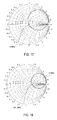
- a tire condition detection device provided with a transmission unit whose transmission frequency is 315 MHz and an antenna whose resonant frequency is 315 MHz is mounted to the rim in an optimal condition, favorable impedance characteristics are obtained as illustrated in FIG. 17 .
- this tire condition detection device is separated slightly from the rim or mounted to a rim of another shape, the resonant frequency of the antenna frequently shifts significantly as illustrated in FIG. 18 .
- the resonant frequency of the antenna frequently shifts significantly; therefore, to retain favorable antenna characteristics, antenna design needs to be performed one by one for each shape of the rim.
- Patent Document 2 the tire condition detection device disclosed in Patent Publication No. 4868192 (Patent Document 2). As illustrated in FIGS.
- this tire condition detection device 10 is provided with a sensor 410 that detects a predetermined physical condition of a tire; an antenna 450 that has a predetermined resonant frequency; a detection and transceiver circuit 400 that transmits information of a detection result of the sensor 410 as a radio wave from the antenna 450; and a case 130 that houses a device main body 30, in which the sensor 410, the antenna 450, the detection and transceiver circuit 400, and the like are formed, and through which the radio wave passes; wherein the tire condition detection device 10 is used by mounting the case 130 to a rim 4 in the tire.
- the device main body 30, which is configured from printed wiring substrates 351, 352 fixed to the case 130, is provided inside the case; the antenna 450 is provided by being fixed on one face side of the printed wiring substrate 351; and a planar conductor 361 is provided that is fixed in a condition of being electrically insulated from the antenna 450 in a position with a predetermined distance from the antenna 450 to form a boundary face between the antenna 450 and the rim 4 when the case 130 is mounted to the rim 4 and is set to a potential equivalent to a reference potential of the detection and transceiver circuit 400; wherein the planar conductor 361 is fixed to the printed wiring substrate 351 by a plurality of retaining members 371 so one face of the planar conductor 361 becomes parallel to another face of the printed wiring substrate 351 at a predetermined interval D therefrom and a predetermined space is formed between the another face of the printed wiring substrate 351 and one face of the planar conductor 361.
- the antenna 450 is a coil-shaped antenna whose resonant frequency is set to a transmission and reception frequency of a transceiver unit and is formed by printed wiring provided on the printed wiring substrate 351, printed wiring provided on the printed wiring substrate 352, and a columnar connection conductor 354 that conductively connects the printed wiring of the printed wiring substrate 351 and the printed wiring of the printed wiring substrate 352 and fixes these printed wiring substrates 351, 352 to each other.
- input and output terminals 441, 442 of the detection and transceiver circuit 400 provided to the printed wiring substrate 351 on which the detection and transceiver circuit 400 is formed and feeding points 451, 452 of the antenna 450 are connected by feeding conductors 461a, 461b, 461c, and 462.
- the planar conductor 361 set to the reference potential of the detection circuit in the position of the predetermined distance D from the antenna 450 is provided in the device and the device is mounted to the rim 4, the planar conductor 361 becomes the boundary face between the antenna 450 and the rim 4; therefore, the effect of the metal configuring the rim 4 affecting the antenna 450 can be significantly reduced compared to the conventional art. Therefore, even if the shape of the rim 4 to which mounting takes place changes, favorable antenna characteristics can be obtained, the manufacturing costs can be reduced, and mass production becomes possible.
- the present inventor discovered that because the antenna 450 is an antenna of an extremely small size, a frequency bandwidth thereof becomes narrow, and therefore, if dimensions of the antenna 450 shift somewhat and the resonant frequency of the antenna 450 shifts, the transmission and reception frequency falls outside the frequency band of the antenna, a consistent condition between the transceiver unit and the antenna 450 worsens, and performance is reduced. In such a situation, the dimensions of the antenna need to be fine-tuned, but such fine-tuning is laborious.
- the present invention is made to provide a condition detection device that can widen a frequency band of an antenna more than a conventional example so a transmission and reception frequency is in the frequency band of the antenna even if a resonant frequency of the antenna shifts somewhat.
- the present invention proposes a condition detection device used by mounting a case to a metal face, provided with: a sensor that detects a predetermined physical quantity of a surrounding area, a first printed wiring substrate and a second printed wiring substrate provided in planar opposition, a plurality of antenna printed wirings formed on the first printed wiring substrate and a plurality of antenna printed wirings formed on the second printed wiring substrate, a plurality of coupling conductors that forms a coil-shaped antenna having a predetermined resonant frequency by coupling the antenna printed wirings formed on the first printed wiring substrate and the antenna printed wirings formed on the second printed wiring substrate, a transmission circuit that is formed on the first printed wiring substrate and transmits information of the physical quantity detected by the sensor as a radio wave from the coil-shaped antenna, an output terminal of the transmission circuit provided on the first printed wiring substrate, a conductor that conductively connects a feeding point of the antenna and the output terminal, a case that houses the first printed wiring substrate and the second printed wiring substrate and through with the radio wave
- condition detection device of the present invention because the planar conductor set to the reference potential of the detection circuit is provided in the position the predetermined distance from the antenna in the device and the planar conductor becomes the boundary face between the antenna and the metal face when the device is mounted to the metal face, the effect of the metal face affecting the antenna can be significantly reduced compared to the conventional art.
- the case when mounting the condition detection device to the metal face, the case is fixed to the metal face so a bottom face of the case opposed the metal face.
- the planar conductor set to the reference potential is disposed between the antenna and the metal face; therefore, when the condition detection device is mounted to the metal face, the planar conductor becomes the boundary face between the antenna and the metal face, thereby enabling the effect of the metal face affecting the antenna to be significantly reduced compared to the conventional art.
- the frequency band of the antenna can be widened more than the conventional example so the transmission and reception frequency is in the frequency band of the antenna even if the resonant frequency of the antenna shifts somewhat.
- FIG. 1 is a diagram illustrating a tire mounted with a tire condition detection device according to one embodiment of the present invention
- FIG. 2 is a diagram illustrating a tire structure according to one embodiment of the present invention
- FIG. 3 is an external perspective view illustrating the tire condition detection device according to one embodiment of the present invention
- FIG. 4 is a plan view illustrating the tire condition detection device according to one embodiment of the present invention
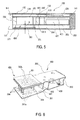
- FIG. 5 is a side cross-sectional view illustrating the tire condition detection device according to one embodiment of the present invention
- FIGS. 6 and 7 are external perspective views illustrating a device main body according to one embodiment of the present invention
- FIG. 8 is an external perspective view illustrating a main portion of the device main body according to one embodiment of the present invention
- FIG. 9 is a block diagram illustrating an electrical system circuit of the tire condition detection device according to one embodiment of the present invention.
- components that are the same as those of the conventional example will be represented with the same reference signs.
- a tire condition detection device 100 in the present embodiment is fixed in a predetermined position of a rim 4 inside an air chamber 3 of a tire 1; detects a pressure and a temperature in the air chamber 3 of a tire main body 2 by a sensor unit that is provided in this tire condition detection device 100 and is provided with a pressure detection element and a temperature detection element, which will be described below; and converts these detection results into digital values. Moreover, the tire condition detection device 100 generates and transmits digital information including these digital values. This digital information includes, other than the digital values of the detection results above, identification information specific to the tire condition detection device 100. Note that the tire 1 used in the present embodiment is a tire used with a heavy-duty truck or the like and is embedded with a steel carcass in the tire 1.
- the tire used in the present embodiment is normally used with large vehicles and is embedded with a belt made of steel and a carcass made of steel.
- the tire 1 is, for example, a well-known tubeless radial tire and includes a wheel and a rim in the present embodiment.
- the tire 1 is configured from the tire main body 2, the rim 4, and the wheel 5, and the tire main body 2 is configured from a well-known cap tread 21; under tread 22; belts 23A, 23B; carcass 24; and the like.
- a case 130 of the tire condition detection device 100 forms a substantially rectangular parallelepiped shape, has a projecting portion for screwing at both end portions in a longitudinal direction thereof, and is configured from a case main body 131 and a lid body 132.
- a housing space 134 for housing a device main body 300 is formed inside the case main body 131, and an opening of the housing space 134 is closed by fixing the lid body 132 to the case main body 131 by a screw 141.
- a ventilation hole 133 is formed in the lid body 132 allowing air to flow through to the housing space 134 from the outside via this ventilation hole 133 even in a condition where the lid body 132 is fixed to the case main body 131.
- the device main body 300 is formed by disposing two printed wiring substrates 351, 352 that form a substantially rectangular shape in a parallel manner at a predetermined interval, and these printed wiring substrates 351, 352 are fixed to each other by a columnar connection conductor 354 that configures an antenna 450, a third printed wiring substrate 353 for coupling, and the like.
- the antenna 450 of a coil shape having a center axis that extends in a width direction of the first and second printed wiring substrates 351, 352 is formed on another end portion in a longitudinal direction of the device main body 300, and electronic components that configure an electronic circuit that includes the sensor unit 410 and a battery 420 are mounted on one end side.
- the printed wiring substrate 353 for coupling is soldered to each of the two printed wiring substrates 351, 352.
- the first printed wiring substrate 351 and the second printed wiring substrate 352 are coupled by a plurality of columnar connection conductors 354 that is provided therebetween, that fixes one printed wiring substrate to another printed wiring substrate at a predetermined interval, and that conductively connects printed wiring of the one printed wiring substrate to printed wiring of the another printed wiring substrate.
- a detection and transceiver circuit 400 illustrated in FIG. 9 is formed on the first printed wiring substrate 351 of the device main body 300. That is, the detection and transceiver circuit 400 is configured from the sensor unit 410, the battery 420, a main control unit 430, a transceiver unit 440, and the antenna 450.
- the sensor unit 410 is mounted on a surface of the main body 300; is configured from an air pressure detection element 411, a temperature detection element 412, and an analog/digital conversion circuit 413; detects, for example, an air pressure and a temperature in the air chamber of the tire by the air pressure detection element 411 and the temperature detection element 412; and converts into digital values by the analog/digital conversion circuit 413 and outputs to the main control unit 430 these detection results.
- the battery 420 is fixed to a surface of the second printed wiring substrate 352, is coupled to the device main body 300 by a connection conductor, and feeds power to the detection and transceiver circuit 400 formed on the first printed wiring substrate 351.
- the main control unit 430 is configured from a well-known CPU, memory, and the like; accepts the detection results by the sensor unit 410 as the digital values, and generates and outputs to the transceiver unit 440 the digital information including these digital values. Note that this digital information includes, other than the digital values of the detection results above, identification information set in advance specific to the device main body 300 (written in advance in the memory or set by a DIP switch).
- the transceiver unit 440 switches between transmission and reception based on indications from the main control unit 430; when transmitting, transmits the digital information input from the main control unit 430 by a radio wave of a predetermined frequency, for example, 315 MHz, from the antenna 450; when receiving, detects a digital signal from the radio wave of 315 MHz received via the antenna 450; and extracts and outputs to the main control unit 430 the digital information from the detected digital signal.
- a transmission frequency and a reception frequency of the transceiver unit 440 are set to the same frequency.
- input and output terminals 441, 442 connected to the antenna 450 of the transceiver unit 440 are formed on the first printed wiring substrate 351.
- the antenna 450 is a coil-shaped antenna whose resonant frequency is set to the transmission and reception frequency of the transceiver unit 440 and is formed by the columnar connection conductors 354 that conductively connect printed wiring 351a provided on the first printed wiring substrate 351, printed wiring 352a provided on the second printed wiring substrate 352, the printed wiring of the first printed wiring substrate 351, and the printed wiring of the second printed wiring substrate 352 and fix these printed wiring substrates 351, 352 to each other.
- the input and output terminals 441, 442 connected to the antenna 450 of the transceiver unit 440 formed on the first printed wiring substrate 351 and feeding points 451, 452 of the antenna 450 are conductively connected by feeding conductors 461a, 461b, 461c, and 462.
- a planar conductor plate 361 forming a rectangular shape is fixed on another end portion outer face of the second printed wiring substrate 352 by four retaining members 371.
- the planar conductor plate 361 is provided in a position of the antenna 450 so as to be parallel to the printed wiring substrate 352 positioned on a bottom face side of the case main body 131 when the device main body 300 is housed in the case 130.
- the planar conductor plate 361 is fixed by the retaining members 371 so as to maintain a predetermined interval D with the second printed wiring substrate 352.
- This planar conductor plate 361 is set to a reference potential by being conductively connected to a predetermined conductor pattern (conductor pattern connected to an anode of the battery 420) of the second printed wiring substrate 352.
- the retaining members 371 are fixed to four corners of the planar conductor plate 361. As illustrated in FIG. 12 , the retaining member 371 forms a shape where a projecting portion 371b of a cylindrical shape of a smaller diameter than a main body 371a is provided at both ends of the main body 371a of a cylindrical shape.
- the planar conductor plate 361 is disposed so as to form a boundary face between the antenna 450 and the rim 4 when the case 130 of the tire condition detection device 100 is mounted to the rim 4.
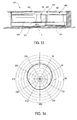
- a directivity of a transmission radio wave at this time becomes as illustrated in FIG. 14 .
- the antenna 450 has the resonant frequency of 325 MHz, and an antenna impedance at 315 MHz is 50 ohms.
- the interval D between the printed wiring substrate 352 and the planar conductor plate 361 at this time is set to 1.5 mm by the retaining members 371.
- Impedance characteristics of the tire condition detection device 100 in the present embodiment are illustrated in FIG. 15
- characteristics of a power efficiency (Pin/Pout) and a VSWR regarding an input impedance of the antenna 450 are illustrated in FIG. 16 .
- a characteristic curve A represents an outer periphery of a range where an input impedance Z1 of the antenna 450 becomes such that 25 ⁇ ⁇ Z1 ⁇ 100 ⁇ .
- a characteristic curve B illustrates an impedance curve in the present embodiment and represents that the input impedance Z1 of the antenna 450 becomes such that 25 ⁇ Z1 ⁇ 100 ⁇ between a frequency of 316 MHz at a point B1 and a frequency of 314.5 MHz at a point B2.
- a characteristic curve C illustrates an impedance curve in the conventional example and represents that the input impedance Z1 of the antenna becomes such that 25 ⁇ ⁇ Z1 ⁇ 100 ⁇ between a frequency of 315.5 MHz at a point C1 and a frequency of 314.5 MHz at a point C2. Therefore, it is understood that in the present embodiment, a frequency band where the input impedance Z1 of the antenna 450 becomes such that 25 ⁇ ⁇ Z1 ⁇ 100 ⁇ is widened 0.5 MHz compared to the conventional example.
- a curve P represents the power efficiency
- a curve S represents the VSWR
- the case 130 when mounting the tire condition detection device 100 to the rim 4, the case 130 is fixed to a surface of the rim 4 so a bottom face of the case 130 opposes the surface of the rim 4, and because the planar conductor plate 361 set to the reference potential is disposed between the antenna 450 and the surface of the rim 4 by fixing the case 130 to the rim 4 in this manner, when the tire condition detection device 100 is mounted to the rim 4, the planar conductor plate 361 becomes the boundary face between the antenna 450 and the rim 4; therefore, the effect of a metal configuring the rim 4 affecting the antenna 450 can be significantly reduced compared to the conventional art.
- the planar conductor plate 361 is fixed not to the first printed wiring substrate 351 on which the input and output terminals 441, 442 of the transceiver unit 440 connected to the feeding points 451, 452 of the antenna 450 are formed but to the second printed wiring substrate 352 opposing the first printed wiring substrate 351 and the planar conductor plate 361 is disposed away from the input and output terminals 441, 442 connected to the antenna 450 of the transceiver unit 440, the frequency band where the input impedance Z1 of the antenna 450 is such that 25 ⁇ Z1 ⁇ 100 ⁇ increases 0.5 MHz compared to the conventional example.
- the tire condition detection device 100 that can detect both the air pressure and the temperature in the tire is configured, but an information acquisition device that can detect either the air pressure or the temperature or another physical quantity may also be configured.
- condition detection device that has the rim in the tire as the metal face to which mounting takes place and detects physical quantities in the tire is configured, but it is needless to say that similar effects are exhibited even when a condition detection device that detects physical quantities of a surrounding area by being mounted to a metal face other than that of the tire is configured.
- condition detection device of the present invention can reduce not only the effect from the rim of the tire but also from a surrounding casing to antenna characteristics, it can be diverted to other uses.
- application can be to one that can detect an air pressure inside the pneumatic fender 6 with the pneumatic fender condition detection device 101, transmit a detection value thereof by a radio wave using the pneumatic fender condition detection device 101 to a remote location, and monitor the air pressure inside the pneumatic fender 6 without touching the pneumatic fender 6 by receiving this detection value.
- the effect of the metal face affecting the antenna when the condition detection device is mounted to the metal face can be reduced, and the frequency band of the antenna can be widened so the transmission and reception frequency is in the frequency band of the antenna even if the resonant frequency of the antenna shifts somewhat.
Landscapes
- Engineering & Computer Science (AREA)
- Mechanical Engineering (AREA)
- Remote Sensing (AREA)
- Computer Security & Cryptography (AREA)
- Radar, Positioning & Navigation (AREA)
- Measuring Fluid Pressure (AREA)
- Arrangements For Transmission Of Measured Signals (AREA)
- Details Of Aerials (AREA)
Abstract
Description
- The present invention relates to a condition detection device and more particularly relates to a condition detection device that transmits a detection result by a radio wave to the outside and is used by being mounted on a metal face such as a rim in a tire.
- Systems that monitor air pressure in a tire are generally a tire condition detection device provided with a radio device and mounted to a rim well portion in the tire, wherein the radio device transmits air data (for example, see Patent Document 1). An antenna provided to the tire condition detection device is affected by a metal portion of a rim or the like coming close thereto, and characteristics thereof often change greatly; thus, an antenna design is needed for a condition where the tire condition detection device is disposed to the metal of the rim or the like. However, rim shapes are various; in particular, if a distance between the antenna and the metal configuring the rim differs according to the shape of the rim, both a resonant frequency and an impedance of the antenna greatly change.
- For example, if a tire condition detection device provided with a transmission unit whose transmission frequency is 315 MHz and an antenna whose resonant frequency is 315 MHz is mounted to the rim in an optimal condition, favorable impedance characteristics are obtained as illustrated in
FIG. 17 . However, if this tire condition detection device is separated slightly from the rim or mounted to a rim of another shape, the resonant frequency of the antenna frequently shifts significantly as illustrated inFIG. 18 . - That is, if the shape or the like of the rim to which the tire condition detection device is mounted differs, the resonant frequency of the antenna frequently shifts significantly; therefore, to retain favorable antenna characteristics, antenna design needs to be performed one by one for each shape of the rim.
- Because there is a need to make an antenna provided with optimal characteristics for each shape of the rim in this manner, there are problems where manufacturing costs per unit increase and mass production is difficult.
- Because of this, the present inventor, with an object of providing a tire condition detection device that can obtain favorable antenna characteristics even if a shape of a rim to which mounting will take place changes, can reduce manufacturing costs, and can be mass produced, devised the tire condition detection device disclosed in Patent Publication No.
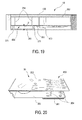
4868192 FIGS. 19 to 23 , this tirecondition detection device 10 is provided with asensor 410 that detects a predetermined physical condition of a tire; anantenna 450 that has a predetermined resonant frequency; a detection andtransceiver circuit 400 that transmits information of a detection result of thesensor 410 as a radio wave from theantenna 450; and acase 130 that houses a devicemain body 30, in which thesensor 410, theantenna 450, the detection andtransceiver circuit 400, and the like are formed, and through which the radio wave passes; wherein the tirecondition detection device 10 is used by mounting thecase 130 to arim 4 in the tire. With this tirecondition detection device 10, the devicemain body 30, which is configured from printedwiring substrates case 130, is provided inside the case; theantenna 450 is provided by being fixed on one face side of the printedwiring substrate 351; and aplanar conductor 361 is provided that is fixed in a condition of being electrically insulated from theantenna 450 in a position with a predetermined distance from theantenna 450 to form a boundary face between theantenna 450 and therim 4 when thecase 130 is mounted to therim 4 and is set to a potential equivalent to a reference potential of the detection andtransceiver circuit 400; wherein theplanar conductor 361 is fixed to the printedwiring substrate 351 by a plurality of retainingmembers 371 so one face of theplanar conductor 361 becomes parallel to another face of the printedwiring substrate 351 at a predetermined interval D therefrom and a predetermined space is formed between the another face of the printedwiring substrate 351 and one face of theplanar conductor 361. - Furthermore, the
antenna 450 is a coil-shaped antenna whose resonant frequency is set to a transmission and reception frequency of a transceiver unit and is formed by printed wiring provided on the printedwiring substrate 351, printed wiring provided on the printedwiring substrate 352, and acolumnar connection conductor 354 that conductively connects the printed wiring of the printedwiring substrate 351 and the printed wiring of the printedwiring substrate 352 and fixes these printedwiring substrates - Furthermore, input and
output terminals transceiver circuit 400 provided to the printedwiring substrate 351 on which the detection andtransceiver circuit 400 is formed andfeeding points antenna 450 are connected byfeeding conductors - In this manner, when the
planar conductor 361 set to the reference potential of the detection circuit in the position of the predetermined distance D from theantenna 450 is provided in the device and the device is mounted to therim 4, theplanar conductor 361 becomes the boundary face between theantenna 450 and therim 4; therefore, the effect of the metal configuring therim 4 affecting theantenna 450 can be significantly reduced compared to the conventional art. Therefore, even if the shape of therim 4 to which mounting takes place changes, favorable antenna characteristics can be obtained, the manufacturing costs can be reduced, and mass production becomes possible. -
- Patent Document 1: Japanese Unexamined Patent Application Publication No.
2006-327460A - Patent Document 2: Japanese Patent No.
4868192B - However, while performing research to improve the tire condition detection device above, the present inventor discovered that because the
antenna 450 is an antenna of an extremely small size, a frequency bandwidth thereof becomes narrow, and therefore, if dimensions of theantenna 450 shift somewhat and the resonant frequency of theantenna 450 shifts, the transmission and reception frequency falls outside the frequency band of the antenna, a consistent condition between the transceiver unit and theantenna 450 worsens, and performance is reduced. In such a situation, the dimensions of the antenna need to be fine-tuned, but such fine-tuning is laborious. - The present invention is made to provide a condition detection device that can widen a frequency band of an antenna more than a conventional example so a transmission and reception frequency is in the frequency band of the antenna even if a resonant frequency of the antenna shifts somewhat.
- To achieve the object above, the present invention proposes a condition detection device used by mounting a case to a metal face, provided with: a sensor that detects a predetermined physical quantity of a surrounding area, a first printed wiring substrate and a second printed wiring substrate provided in planar opposition, a plurality of antenna printed wirings formed on the first printed wiring substrate and a plurality of antenna printed wirings formed on the second printed wiring substrate, a plurality of coupling conductors that forms a coil-shaped antenna having a predetermined resonant frequency by coupling the antenna printed wirings formed on the first printed wiring substrate and the antenna printed wirings formed on the second printed wiring substrate, a transmission circuit that is formed on the first printed wiring substrate and transmits information of the physical quantity detected by the sensor as a radio wave from the coil-shaped antenna, an output terminal of the transmission circuit provided on the first printed wiring substrate, a conductor that conductively connects a feeding point of the antenna and the output terminal, a case that houses the first printed wiring substrate and the second printed wiring substrate and through with the radio wave passes, and a planar conductor that is fixed in an electrically insulated condition from the antenna in a position a predetermined distance from the antenna to form a boundary face between the antenna and a metal face when the case is mounted to the metal face and that is set to a potential equivalent to a reference potential of the transmission circuit, wherein the planar conductor is fixed to the second printed wiring substrate by a plurality of retaining members so a face of the second printed wiring substrate and a face of the planar conductor are parallel with a predetermined interval therebetween and so a predetermined space is formed between the face of the second printed wiring substrate and the face of the planar conductor.
- According to the condition detection device of the present invention, because the planar conductor set to the reference potential of the detection circuit is provided in the position the predetermined distance from the antenna in the device and the planar conductor becomes the boundary face between the antenna and the metal face when the device is mounted to the metal face, the effect of the metal face affecting the antenna can be significantly reduced compared to the conventional art.
- According to the present invention, when mounting the condition detection device to the metal face, the case is fixed to the metal face so a bottom face of the case opposed the metal face. By the case being fixed to the metal face in this manner, the planar conductor set to the reference potential is disposed between the antenna and the metal face; therefore, when the condition detection device is mounted to the metal face, the planar conductor becomes the boundary face between the antenna and the metal face, thereby enabling the effect of the metal face affecting the antenna to be significantly reduced compared to the conventional art. Therefore, a need to make an antenna provided with optimal characteristics for each shape of the metal face such as the rim of the tire is eliminated, and the same antenna can be used in fixing to a metal face of any shape; therefore, manufacturing costs for one tire condition detection device can be significantly reduced compared to the conventional art and mass production of the tire condition detection device is easily enabled. Moreover, the frequency band of the antenna can be widened more than the conventional example so the transmission and reception frequency is in the frequency band of the antenna even if the resonant frequency of the antenna shifts somewhat.
-
- FIG. 1
- is a diagram illustrating a tire mounted with a tire condition detection device according to one embodiment of the present invention.
- FIG. 2
- is a diagram illustrating a tire structure according to one embodiment of the present invention.
- FIG. 3
- is an external perspective view illustrating the tire condition detection device according to one embodiment of the present invention.
- FIG. 4
- is a plan view illustrating the tire condition detection device according to one embodiment of the present invention.
- FIG. 5
- is a side cross-sectional view illustrating the tire condition detection device according to one embodiment of the present invention.
- FIG. 6
- is an external perspective view illustrating a device main body according to one embodiment of the present invention.
- FIG. 7
- is an external perspective view illustrating the device main body according to one embodiment of the present invention.
- FIG. 8
- is an external perspective view illustrating a main portion of the device main body according to one embodiment of the present invention.
- FIG. 9
- is a block diagram illustrating an electrical system circuit of the tire condition detection device according to one embodiment of the present invention.
- FIG. 10
- is a diagram illustrating a positional relationship between a feeding conductor and a planar conductor plate according to one embodiment of the present invention.
- FIG. 11
- is an external perspective view illustrating the planar conductor plate and retaining members according to one embodiment of the present invention.
- FIG. 12
- is an external perspective view illustrating the retaining member according to one embodiment of the present invention.
- FIG. 13
- is a diagram illustrating a relationship between a rim and the planar conductor plate when the tire condition detection device according to one embodiment of the present invention is mounted to the tire.
- FIG. 14
- is a diagram illustrating a directivity of a transmission radio wave of the tire condition detection device according to one embodiment of the present invention.
- FIG. 15
- is a diagram illustrating a Smith chart according to one embodiment of the present invention.
- FIG. 16
- is a diagram illustrating a relationship between power efficiency and a VSWR regarding an input impedance according to one embodiment of the present invention.
- FIG. 17
- is a Smith chart describing antenna characteristics in an appropriate condition according to a conventional example according to a conventional example.
- FIG. 18
- is a Smith chart describing a fluctuation of the antenna characteristics according to a conventional example.
- FIG. 19
- is a side cross-sectional view illustrating a tire condition detection device according to a conventional example.
- FIG. 20
- is an external perspective view illustrating a device main body according to a conventional example.
- FIG. 21
- is an external perspective view illustrating the device main body according to a conventional example.
- FIG. 22
- is a diagram illustrating a relationship between a rim and a planar conductor plate when the tire condition detection device according to a conventional example is mounted to a tire.
- FIG. 23
- is a diagram illustrating a positional relationship between a feeding conductor and the planar conductor plate according to a conventional example.
- FIG. 24
- is a diagram illustrating an example where a condition detection device of the present invention is applied to a pneumatic fender.
- Hereinafter, an embodiment of the present invention is described with reference to the accompanying drawings.
-
FIG. 1 is a diagram illustrating a tire mounted with a tire condition detection device according to one embodiment of the present invention,FIG. 2 is a diagram illustrating a tire structure according to one embodiment of the present invention,FIG. 3 is an external perspective view illustrating the tire condition detection device according to one embodiment of the present invention,FIG. 4 is a plan view illustrating the tire condition detection device according to one embodiment of the present invention,FIG. 5 is a side cross-sectional view illustrating the tire condition detection device according to one embodiment of the present invention,FIGS. 6 and7 are external perspective views illustrating a device main body according to one embodiment of the present invention,FIG. 8 is an external perspective view illustrating a main portion of the device main body according to one embodiment of the present invention, andFIG. 9 is a block diagram illustrating an electrical system circuit of the tire condition detection device according to one embodiment of the present invention. In the diagrams, components that are the same as those of the conventional example will be represented with the same reference signs. - As illustrated in
FIG. 1 , a tirecondition detection device 100 in the present embodiment is fixed in a predetermined position of arim 4 inside anair chamber 3 of atire 1; detects a pressure and a temperature in theair chamber 3 of a tiremain body 2 by a sensor unit that is provided in this tirecondition detection device 100 and is provided with a pressure detection element and a temperature detection element, which will be described below; and converts these detection results into digital values. Moreover, the tirecondition detection device 100 generates and transmits digital information including these digital values. This digital information includes, other than the digital values of the detection results above, identification information specific to the tirecondition detection device 100. Note that thetire 1 used in the present embodiment is a tire used with a heavy-duty truck or the like and is embedded with a steel carcass in thetire 1. - As illustrated in
FIG. 2 , the tire used in the present embodiment is normally used with large vehicles and is embedded with a belt made of steel and a carcass made of steel. Thetire 1 is, for example, a well-known tubeless radial tire and includes a wheel and a rim in the present embodiment. InFIGS. 1 and 2 , thetire 1 is configured from the tiremain body 2, therim 4, and thewheel 5, and the tiremain body 2 is configured from a well-knowncap tread 21; undertread 22;belts carcass 24; and the like. - As illustrated in
FIGS. 3 to 5 , acase 130 of the tirecondition detection device 100 forms a substantially rectangular parallelepiped shape, has a projecting portion for screwing at both end portions in a longitudinal direction thereof, and is configured from a casemain body 131 and alid body 132. As illustrated inFIG. 5 , ahousing space 134 for housing a devicemain body 300 is formed inside the casemain body 131, and an opening of thehousing space 134 is closed by fixing thelid body 132 to the casemain body 131 by ascrew 141. Moreover, aventilation hole 133 is formed in thelid body 132 allowing air to flow through to thehousing space 134 from the outside via thisventilation hole 133 even in a condition where thelid body 132 is fixed to the casemain body 131. - As illustrated in
FIGS. 6 to 8 , the devicemain body 300 is formed by disposing two printedwiring substrates wiring substrates columnar connection conductor 354 that configures anantenna 450, a third printedwiring substrate 353 for coupling, and the like. Theantenna 450 of a coil shape having a center axis that extends in a width direction of the first and second printedwiring substrates main body 300, and electronic components that configure an electronic circuit that includes thesensor unit 410 and abattery 420 are mounted on one end side. The printedwiring substrate 353 for coupling is soldered to each of the two printedwiring substrates - The first printed
wiring substrate 351 and the second printedwiring substrate 352 are coupled by a plurality ofcolumnar connection conductors 354 that is provided therebetween, that fixes one printed wiring substrate to another printed wiring substrate at a predetermined interval, and that conductively connects printed wiring of the one printed wiring substrate to printed wiring of the another printed wiring substrate. - A detection and
transceiver circuit 400 illustrated inFIG. 9 is formed on the first printedwiring substrate 351 of the devicemain body 300. That is, the detection andtransceiver circuit 400 is configured from thesensor unit 410, thebattery 420, amain control unit 430, atransceiver unit 440, and theantenna 450. - The
sensor unit 410 is mounted on a surface of themain body 300; is configured from an airpressure detection element 411, atemperature detection element 412, and an analog/digital conversion circuit 413; detects, for example, an air pressure and a temperature in the air chamber of the tire by the airpressure detection element 411 and thetemperature detection element 412; and converts into digital values by the analog/digital conversion circuit 413 and outputs to themain control unit 430 these detection results. - The
battery 420 is fixed to a surface of the second printedwiring substrate 352, is coupled to the devicemain body 300 by a connection conductor, and feeds power to the detection andtransceiver circuit 400 formed on the first printedwiring substrate 351. - The
main control unit 430 is configured from a well-known CPU, memory, and the like; accepts the detection results by thesensor unit 410 as the digital values, and generates and outputs to thetransceiver unit 440 the digital information including these digital values. Note that this digital information includes, other than the digital values of the detection results above, identification information set in advance specific to the device main body 300 (written in advance in the memory or set by a DIP switch). - The
transceiver unit 440 switches between transmission and reception based on indications from themain control unit 430; when transmitting, transmits the digital information input from themain control unit 430 by a radio wave of a predetermined frequency, for example, 315 MHz, from theantenna 450; when receiving, detects a digital signal from the radio wave of 315 MHz received via theantenna 450; and extracts and outputs to themain control unit 430 the digital information from the detected digital signal. Note that a transmission frequency and a reception frequency of thetransceiver unit 440 are set to the same frequency. Moreover, input andoutput terminals antenna 450 of thetransceiver unit 440 are formed on the first printedwiring substrate 351. - The
antenna 450 is a coil-shaped antenna whose resonant frequency is set to the transmission and reception frequency of thetransceiver unit 440 and is formed by thecolumnar connection conductors 354 that conductively connect printedwiring 351a provided on the first printedwiring substrate 351, printedwiring 352a provided on the second printedwiring substrate 352, the printed wiring of the first printedwiring substrate 351, and the printed wiring of the second printedwiring substrate 352 and fix these printedwiring substrates - Furthermore, as illustrated in
FIG. 10 , the input andoutput terminals antenna 450 of thetransceiver unit 440 formed on the first printedwiring substrate 351 and feedingpoints antenna 450 are conductively connected by feedingconductors - Furthermore, a
planar conductor plate 361 forming a rectangular shape is fixed on another end portion outer face of the second printedwiring substrate 352 by four retainingmembers 371. Theplanar conductor plate 361 is provided in a position of theantenna 450 so as to be parallel to the printedwiring substrate 352 positioned on a bottom face side of the casemain body 131 when the devicemain body 300 is housed in thecase 130. Theplanar conductor plate 361 is fixed by the retainingmembers 371 so as to maintain a predetermined interval D with the second printedwiring substrate 352. Thisplanar conductor plate 361 is set to a reference potential by being conductively connected to a predetermined conductor pattern (conductor pattern connected to an anode of the battery 420) of the second printedwiring substrate 352. Moreover, as illustrated inFIG. 11 , the retainingmembers 371 are fixed to four corners of theplanar conductor plate 361. As illustrated inFIG. 12 , the retainingmember 371 forms a shape where a projectingportion 371b of a cylindrical shape of a smaller diameter than amain body 371a is provided at both ends of themain body 371a of a cylindrical shape. - Furthermore, as illustrated in
FIG. 13 , theplanar conductor plate 361 is disposed so as to form a boundary face between theantenna 450 and therim 4 when thecase 130 of the tirecondition detection device 100 is mounted to therim 4. A directivity of a transmission radio wave at this time becomes as illustrated inFIG. 14 . - Furthermore, in the condition where the
planar conductor plate 361 is mounted on the second printedwiring substrate 352, theantenna 450 has the resonant frequency of 325 MHz, and an antenna impedance at 315 MHz is 50 ohms. The interval D between the printedwiring substrate 352 and theplanar conductor plate 361 at this time is set to 1.5 mm by the retainingmembers 371. - Impedance characteristics of the tire
condition detection device 100 in the present embodiment are illustrated inFIG. 15 , and characteristics of a power efficiency (Pin/Pout) and a VSWR regarding an input impedance of theantenna 450 are illustrated inFIG. 16 . - In
FIG. 15 , a characteristic curve A represents an outer periphery of a range where an input impedance Z1 of theantenna 450 becomes such that 25 Ω < Z1 < 100 Ω. Moreover, a point A1 represents a point of a best impedance with the frequency of 315 MHz (Z0 = 50 + 0 [Ω]). Moreover, a characteristic curve B illustrates an impedance curve in the present embodiment and represents that the input impedance Z1 of theantenna 450 becomes such that 25 Ω< Z1 < 100 Ω between a frequency of 316 MHz at a point B1 and a frequency of 314.5 MHz at a point B2. Moreover, a characteristic curve C illustrates an impedance curve in the conventional example and represents that the input impedance Z1 of the antenna becomes such that 25 Ω < Z1 < 100 Ω between a frequency of 315.5 MHz at a point C1 and a frequency of 314.5 MHz at a point C2. Therefore, it is understood that in the present embodiment, a frequency band where the input impedance Z1 of theantenna 450 becomes such that 25 Ω < Z1 < 100 Ω is widened 0.5 MHz compared to the conventional example. - In
FIG. 16 , a curve P represents the power efficiency, and a curve S represents the VSWR; it is illustrated that when the input impedance Z1 of theantenna 450 is such that 25 Ω < Z1 < 100 Ω, the VSWR becomes 2 or less and a power efficiency of 90% or more can be obtained. - As above, according to the tire
condition detection device 100 of the present embodiment, when mounting the tirecondition detection device 100 to therim 4, thecase 130 is fixed to a surface of therim 4 so a bottom face of thecase 130 opposes the surface of therim 4, and because theplanar conductor plate 361 set to the reference potential is disposed between theantenna 450 and the surface of therim 4 by fixing thecase 130 to therim 4 in this manner, when the tirecondition detection device 100 is mounted to therim 4, theplanar conductor plate 361 becomes the boundary face between theantenna 450 and therim 4; therefore, the effect of a metal configuring therim 4 affecting theantenna 450 can be significantly reduced compared to the conventional art. Moreover, because theplanar conductor plate 361 is fixed not to the first printedwiring substrate 351 on which the input andoutput terminals transceiver unit 440 connected to the feeding points 451, 452 of theantenna 450 are formed but to the second printedwiring substrate 352 opposing the first printedwiring substrate 351 and theplanar conductor plate 361 is disposed away from the input andoutput terminals antenna 450 of thetransceiver unit 440, the frequency band where the input impedance Z1 of theantenna 450 is such that 25 Ω< Z1 < 100 Ω increases 0.5 MHz compared to the conventional example. It is thought that a reason why the frequency band is widened compared to the conventional example in this manner is because a stray capacitance formed between the input andoutput terminals antenna 450 of thetransceiver unit 440 and theplanar conductor plate 361 is reduced by disposing theplanar conductor plate 361 in a position away from the input andoutput terminals transceiver unit 440. - Therefore, because a need to make an antenna provided with optimal characteristics for each shape of the rim is eliminated and the same antenna can be used with rims of any shape, manufacturing costs of one tire condition detection device can be significantly reduced compared to the conventional art and mass production of the tire condition detection device is easily enabled. Moreover, because the frequency band where the input impedance Z1 of the
antenna 450 that becomes such that 25 Ω< Z1 < 100 Ω is widened compared to the conventional example, a need to perform fine-tuning of the antenna is eliminated even if the resonant frequency of the antenna shifts somewhat. - Furthermore, in the above embodiment, the tire
condition detection device 100 that can detect both the air pressure and the temperature in the tire is configured, but an information acquisition device that can detect either the air pressure or the temperature or another physical quantity may also be configured. - Furthermore, in the above embodiment, the condition detection device that has the rim in the tire as the metal face to which mounting takes place and detects physical quantities in the tire is configured, but it is needless to say that similar effects are exhibited even when a condition detection device that detects physical quantities of a surrounding area by being mounted to a metal face other than that of the tire is configured.
- Furthermore, because the condition detection device of the present invention can reduce not only the effect from the rim of the tire but also from a surrounding casing to antenna characteristics, it can be diverted to other uses. For example, as illustrated in
FIG. 24 , with apneumatic fender 6 used when a ship is berthed at or grappled to a quay or another ship as well, application can be to one that can detect an air pressure inside thepneumatic fender 6 with the pneumatic fendercondition detection device 101, transmit a detection value thereof by a radio wave using the pneumatic fendercondition detection device 101 to a remote location, and monitor the air pressure inside thepneumatic fender 6 without touching thepneumatic fender 6 by receiving this detection value. - The effect of the metal face affecting the antenna when the condition detection device is mounted to the metal face can be reduced, and the frequency band of the antenna can be widened so the transmission and reception frequency is in the frequency band of the antenna even if the resonant frequency of the antenna shifts somewhat.
-
- 1
- Tire
- 2
- Tire main body
- 3
- Air chamber
- 4
- Rim
- 5
- Wheel
- 100
- Tire condition detection device
- 130
- Case
- 131
- Case main body
- 132
- Lid body
- 133
- Ventilation hole
- 134
- Housing space
- 141
- Screw
- 300
- Device main body
- 351
- First printed wiring substrate
- 351a
- Printed wiring
- 352
- Second printed wiring substrate
- 352a
- Printed wiring
- 353
- Third printed wiring substrate
- 354
- Columnar connection conductor
- 361
- Planar conductor plate
- 371
- Retaining member
- 400
- Detection and transceiver circuit
- 410
- Sensor unit
- 411
- Air pressure detection element
- 412
- Temperature detection element
- 413
- Analog/digital conversion circuit
- 420
- Battery
- 421, 422
- Connection conductor
- 430
- Main control unit
- 440
- Transceiver unit
- 441, 442
- Input and output terminal
- 450
- Antenna
- 451, 452
- Feeding point
- 461a, 461b, 461c, 462
- Feeding conductor
Claims (3)
- A condition detection device used by mounting a case to a metal face, comprising:a sensor detecting a predetermined physical quantity of a surrounding area;a first printed wiring substrate and a second printed wiring substrate provided in planar opposition;a plurality of antenna printed wirings formed on the first printed wiring substrate and a plurality of antenna printed wirings formed on the second printed wiring substrate;a plurality of coupling conductors forming a coil-shaped antenna having a predetermined resonant frequency by coupling the antenna printed wirings formed on the first printed wiring substrate and the antenna printed wirings formed on the second printed wiring substrate;a transmission circuit formed on the first printed wiring substrate and transmitting information of the physical quantity detected by the sensor as a radio wave from the coil-shaped antenna;an output terminal of the transmission circuit provided on the first printed wiring substrate; a conductor conductively connecting a feeding point of the antenna and the output terminal;a case housing the first printed wiring substrate and the second printed wiring substrate and through which the radio wave passes; and a planar conductor fixed in an electrically insulated condition from the antenna in a position a predetermined distance from the antenna to form a boundary face between the antenna and a metal face when the case is mounted to the metal face and being set to a potential equivalent to a reference potential of the transmission circuit; whereinthe planar conductor is fixed to the second printed wiring substrate by a plurality of retaining members so a face of the second printed wiring substrate and a face of the planar conductor are parallel with a predetermined interval therebetween and so a predetermined space is formed between the face of the second printed wiring substrate and the face of the planar conductor.
- The condition detection device according to claim 1, wherein
an axis of the coil-shaped antenna is set parallel to the face of the planar conductor. - The condition detection device according to claim 1 or 2, wherein
in a relationship between a length L of an axis direction of the coil-shaped antenna and a wavelength λ of the transmission frequency of the transmission circuit, the length L is set so a value of L/λ is 0.25 or less.
Applications Claiming Priority (2)
| Application Number | Priority Date | Filing Date | Title |
|---|---|---|---|
| JP2012133431 | 2012-06-13 | ||
| PCT/JP2013/063268 WO2013187163A1 (en) | 2012-06-13 | 2013-05-13 | State detection device |
Publications (2)
| Publication Number | Publication Date |
|---|---|
| EP2863479A1 true EP2863479A1 (en) | 2015-04-22 |
| EP2863479A4 EP2863479A4 (en) | 2016-03-02 |
Family
ID=49757995
Family Applications (1)
| Application Number | Title | Priority Date | Filing Date |
|---|---|---|---|
| EP13803961.5A Withdrawn EP2863479A4 (en) | 2012-06-13 | 2013-05-13 | State detection device |
Country Status (7)
| Country | Link |
|---|---|
| US (1) | US20150122005A1 (en) |
| EP (1) | EP2863479A4 (en) |
| JP (1) | JPWO2013187163A1 (en) |
| KR (1) | KR101633750B1 (en) |
| CN (1) | CN104919653A (en) |
| AU (1) | AU2013275529B2 (en) |
| WO (1) | WO2013187163A1 (en) |
Cited By (1)
| Publication number | Priority date | Publication date | Assignee | Title |
|---|---|---|---|---|
| EP4010206A4 (en) * | 2019-08-05 | 2023-08-02 | Bridgestone Americas Tire Operations, LLC | Tire electronics assembly |
Families Citing this family (4)
| Publication number | Priority date | Publication date | Assignee | Title |
|---|---|---|---|---|
| DE112011104017T5 (en) * | 2010-12-02 | 2013-09-05 | The Yokohama Rubber Co., Ltd. | Tires equipped with an information retrieval device |
| CN115864014A (en) * | 2017-03-31 | 2023-03-28 | 株式会社友华 | Antenna device |
| DE112018007758T5 (en) * | 2018-06-22 | 2021-03-04 | The Yokohama Rubber Co., Ltd. | Pneumatic tires and mounting sheets |
| JP7097793B2 (en) * | 2018-10-17 | 2022-07-08 | 株式会社Kelk | Detection device |
Family Cites Families (8)
| Publication number | Priority date | Publication date | Assignee | Title |
|---|---|---|---|---|
| JP2006074627A (en) * | 2004-09-03 | 2006-03-16 | Neomax Co Ltd | Bar antenna |
| KR100691162B1 (en) * | 2005-05-16 | 2007-03-09 | 삼성전기주식회사 | Perpendicular hellical antenna |
| JP2006327460A (en) | 2005-05-27 | 2006-12-07 | Sanyo Electric Co Ltd | Tire air pressure warning system |
| CN201417818Y (en) * | 2009-03-18 | 2010-03-03 | 深圳市麦捷微电子科技股份有限公司 | Sheet-type multilayer radio-frequency antenna |
| CN201576738U (en) * | 2009-08-27 | 2010-09-08 | 杭州物网科技有限公司 | Ultrahigh frequency radio-frequency identification tag antenna based on folding silt antenna |
| CN102612443B (en) * | 2009-09-01 | 2015-02-11 | 横滨橡胶株式会社 | Tire-state detection device |
| JP5716891B2 (en) * | 2010-11-10 | 2015-05-13 | 横浜ゴム株式会社 | Information acquisition device |
| DE112011104017T5 (en) * | 2010-12-02 | 2013-09-05 | The Yokohama Rubber Co., Ltd. | Tires equipped with an information retrieval device |
-
2013
- 2013-05-13 EP EP13803961.5A patent/EP2863479A4/en not_active Withdrawn
- 2013-05-13 WO PCT/JP2013/063268 patent/WO2013187163A1/en not_active Ceased
- 2013-05-13 AU AU2013275529A patent/AU2013275529B2/en not_active Ceased
- 2013-05-13 US US14/407,900 patent/US20150122005A1/en not_active Abandoned
- 2013-05-13 CN CN201380031169.7A patent/CN104919653A/en active Pending
- 2013-05-13 JP JP2013552746A patent/JPWO2013187163A1/en active Pending
- 2013-05-13 KR KR1020147034864A patent/KR101633750B1/en not_active Expired - Fee Related
Cited By (2)
| Publication number | Priority date | Publication date | Assignee | Title |
|---|---|---|---|---|
| EP4010206A4 (en) * | 2019-08-05 | 2023-08-02 | Bridgestone Americas Tire Operations, LLC | Tire electronics assembly |
| US12097729B2 (en) | 2019-08-05 | 2024-09-24 | Bridgestone Americas Tire Operations, Llc | Tire electronics assembly |
Also Published As
| Publication number | Publication date |
|---|---|
| US20150122005A1 (en) | 2015-05-07 |
| WO2013187163A1 (en) | 2013-12-19 |
| KR101633750B1 (en) | 2016-07-08 |
| JPWO2013187163A1 (en) | 2016-02-04 |
| KR20150008187A (en) | 2015-01-21 |
| EP2863479A4 (en) | 2016-03-02 |
| CN104919653A (en) | 2015-09-16 |
| AU2013275529A1 (en) | 2015-01-29 |
| AU2013275529B2 (en) | 2016-02-04 |
Similar Documents
| Publication | Publication Date | Title |
|---|---|---|
| US8988207B2 (en) | Information acquiring device | |
| EP1976714B1 (en) | Tire monitor system having tire valve antenna | |
| AU2013275529B2 (en) | Condition detection device | |
| US10270163B2 (en) | Communication module and communication device including same | |
| US9711840B2 (en) | Antenna structure and electronic device using the same | |
| US20120132718A1 (en) | Transponder tagged object and method for manufacturing a transponder tagged object | |
| US20160218423A1 (en) | Radio frequency antenna | |
| EP2474429B1 (en) | Tire-state detection device | |
| EP2627011B1 (en) | Transmission device | |
| US20050195111A1 (en) | Monopole antenna | |
| US7768468B2 (en) | Arrangement and method for increasing bandwidth | |
| KR20170128673A (en) | Shorted Patch Antenna | |
| US20190001764A1 (en) | Tire pressure monitoring unit | |
| US8217840B2 (en) | Dual-band antenna assembly | |
| Deng et al. | A Compact and High-Efficiency Antenna Design for Tire Pressure Monitoring System Applications | |
| CN121569166A (en) | Measuring device with cylindrical monopole antenna | |
| US20060273890A1 (en) | Tire pressure monitoring system | |
| US20080231516A1 (en) | Multi-frequency antenna and an electric device thereof | |
| CN101114730B (en) | Tire Electronics Assembly with Multi-Band Antenna | |
| US12519494B2 (en) | Antenna unit and transmitter | |
| KR20050040504A (en) | Receiving antenna for tire pressure monitoring system of using rfcx cable | |
| JP7607142B2 (en) | Parasitic element | |
| KR102041827B1 (en) | Micro strip antenna and fuse including the same |
Legal Events
| Date | Code | Title | Description |
|---|---|---|---|
| PUAI | Public reference made under article 153(3) epc to a published international application that has entered the european phase |
Free format text: ORIGINAL CODE: 0009012 |
|
| 17P | Request for examination filed |
Effective date: 20150113 |
|
| AK | Designated contracting states |
Kind code of ref document: A1 Designated state(s): AL AT BE BG CH CY CZ DE DK EE ES FI FR GB GR HR HU IE IS IT LI LT LU LV MC MK MT NL NO PL PT RO RS SE SI SK SM TR |
|
| AX | Request for extension of the european patent |
Extension state: BA ME |
|
| DAX | Request for extension of the european patent (deleted) | ||
| RA4 | Supplementary search report drawn up and despatched (corrected) |
Effective date: 20160128 |
|
| RIC1 | Information provided on ipc code assigned before grant |
Ipc: H01Q 1/32 20060101ALI20160122BHEP Ipc: H01Q 7/00 20060101ALI20160122BHEP Ipc: H01Q 11/08 20060101ALI20160122BHEP Ipc: B60C 23/04 20060101AFI20160122BHEP Ipc: H01Q 1/22 20060101ALI20160122BHEP Ipc: H01Q 9/16 20060101ALI20160122BHEP |
|
| STAA | Information on the status of an ep patent application or granted ep patent |
Free format text: STATUS: REQUEST FOR EXAMINATION WAS MADE |
|
| STAA | Information on the status of an ep patent application or granted ep patent |
Free format text: STATUS: THE APPLICATION IS DEEMED TO BE WITHDRAWN |
|
| 18D | Application deemed to be withdrawn |
Effective date: 20181201 |