EP2862868A1 - Intermediate for production of nucleoside analogue, and method for producing same - Google Patents
Intermediate for production of nucleoside analogue, and method for producing same Download PDFInfo
- Publication number
- EP2862868A1 EP2862868A1 EP13806205.4A EP13806205A EP2862868A1 EP 2862868 A1 EP2862868 A1 EP 2862868A1 EP 13806205 A EP13806205 A EP 13806205A EP 2862868 A1 EP2862868 A1 EP 2862868A1
- Authority
- EP
- European Patent Office
- Prior art keywords
- group
- amino
- carbon atoms
- protected
- production method
- Prior art date
- Legal status (The legal status is an assumption and is not a legal conclusion. Google has not performed a legal analysis and makes no representation as to the accuracy of the status listed.)
- Granted
Links
- 0 Cc1nc(*)c2nc(*)[n]c2n1 Chemical compound Cc1nc(*)c2nc(*)[n]c2n1 0.000 description 5
Classifications
-
- C—CHEMISTRY; METALLURGY
- C07—ORGANIC CHEMISTRY
- C07H—SUGARS; DERIVATIVES THEREOF; NUCLEOSIDES; NUCLEOTIDES; NUCLEIC ACIDS
- C07H23/00—Compounds containing boron, silicon or a metal, e.g. chelates or vitamin B12
-
- C—CHEMISTRY; METALLURGY
- C07—ORGANIC CHEMISTRY
- C07F—ACYCLIC, CARBOCYCLIC OR HETEROCYCLIC COMPOUNDS CONTAINING ELEMENTS OTHER THAN CARBON, HYDROGEN, HALOGEN, OXYGEN, NITROGEN, SULFUR, SELENIUM OR TELLURIUM
- C07F7/00—Compounds containing elements of Groups 4 or 14 of the Periodic Table
- C07F7/02—Silicon compounds
- C07F7/08—Compounds having one or more C—Si linkages
- C07F7/10—Compounds having one or more C—Si linkages containing nitrogen having a Si-N linkage
-
- C—CHEMISTRY; METALLURGY
- C07—ORGANIC CHEMISTRY
- C07H—SUGARS; DERIVATIVES THEREOF; NUCLEOSIDES; NUCLEOTIDES; NUCLEIC ACIDS
- C07H19/00—Compounds containing a hetero ring sharing one ring hetero atom with a saccharide radical; Nucleosides; Mononucleotides; Anhydro-derivatives thereof
- C07H19/02—Compounds containing a hetero ring sharing one ring hetero atom with a saccharide radical; Nucleosides; Mononucleotides; Anhydro-derivatives thereof sharing nitrogen
- C07H19/04—Heterocyclic radicals containing only nitrogen atoms as ring hetero atom
- C07H19/16—Purine radicals
-
- Y—GENERAL TAGGING OF NEW TECHNOLOGICAL DEVELOPMENTS; GENERAL TAGGING OF CROSS-SECTIONAL TECHNOLOGIES SPANNING OVER SEVERAL SECTIONS OF THE IPC; TECHNICAL SUBJECTS COVERED BY FORMER USPC CROSS-REFERENCE ART COLLECTIONS [XRACs] AND DIGESTS
- Y02—TECHNOLOGIES OR APPLICATIONS FOR MITIGATION OR ADAPTATION AGAINST CLIMATE CHANGE
- Y02P—CLIMATE CHANGE MITIGATION TECHNOLOGIES IN THE PRODUCTION OR PROCESSING OF GOODS
- Y02P20/00—Technologies relating to chemical industry
- Y02P20/50—Improvements relating to the production of bulk chemicals
- Y02P20/55—Design of synthesis routes, e.g. reducing the use of auxiliary or protecting groups
Definitions
- the present invention relates to a novel intermediate for production of a nucleoside analog which serves as an intermediate for production of an oligonucleotide analog having stable and excellent antisense or antigene activity or having excellent activity as a detection reagent (probe) for a specific gene or as a primer for initiation of amplification of a specific gene, and a method for producing the same.
- Patent Literature 1 describes an oligonucleotide analog having stable and excellent antisense or antigene activity or having excellent activity as a detection reagent (probe) for a specific gene or as a primer for initiation of amplification of a specific gene, and the following nucleoside analog: which serves as an intermediate for production of the oligonucleotide analog.
- the patent literature also describes steps A-3 and A-4 as a method for producing the nucleoside analog.
- Patent Literature 1 makes no mention about a silyl protective group, though it specifically describes only an example wherein R 7 is a p-toluenesulfonyloxy group.
- the production method described in Patent Literature 1 disadvantageously has a significantly reduced reaction yield, when the nucleobase is a 2-isobutyrylamino-6-hydroxypurin-9-yl group (yield of 6% in two steps of Reference Example 15 and Example 24).
- Patent Literature 2 describes a nucleoside analog with the 2'- and 4'-positions bridged by a NHCOCH 2 group, and discloses the step of synthesizing compound 40 from compound 39 in Example 5(6).
- the present inventors have conducted diligent studies to solve the problems mentioned above and consequently completed the present invention by finding that use of a production intermediate having a specific protective group can improve the reaction yield regardless of the type of nucleobase.
- the production method of the present invention is a production method for producing a compound represented by the general formula (III) or a salt thereof, comprising reacting a trimethylsilylated compound, which was obtained by reaction of a compound represented by the following general formula: wherein R 4 , R 5 , and R 6 are the same or different and each represents a hydrogen atom, a hydroxy group, a protected hydroxy group, an alkoxy group having 1 to 4 carbon atoms, a mercapto group, a protected mercapto group, an alkylthio group having 1 to 4 carbon atoms, an amino group, a protected amino group, an amino group substituted by (an) alkyl group(s) having 1 to 4 carbon atoms, an alkyl group having 1 to 4 carbon atoms, or a halogen atom, with a trimethylsilylating agent, with a compound represented by the following general formula: wherein X, Y, and Z are the same or different and each represents a protective group for the hydroxy
- the group ⁇ is a group consisting of a hydroxy group, a protected hydroxy group, an alkoxy group having 1 to 4 carbon atoms, a mercapto group, a protected mercapto group, an alkylthio group having 1 to 4 carbon atoms, an amino group, a protected amino group, an amino group substituted by (an) alkyl group(s) having 1 to 4 carbon atoms, an alkyl group having 1 to 4 carbon atoms, and a halogen atom.
- the compound of the present invention is a compound represented by the above general formula (III) or a salt thereof.
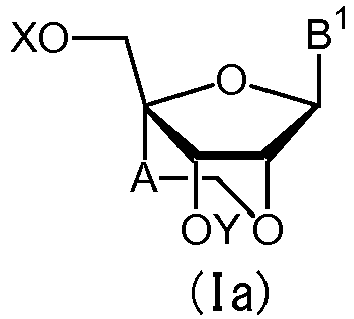
- the production method of the present invention is a production method for producing a compound represented by the general formula (I) or a salt thereof, comprising the step of producing a compound represented by the general formula (III) or a salt thereof, the step comprising reacting a trimethylsilylated compound, which was obtained by reaction of a compound represented by the following general formula: wherein R 4 , R 5 , and R 6 are as defined above, with a trimethylsilylating agent, with a compound represented by the following general formula: wherein X, Y, Z, A, and R are as defined above, or a salt thereof: to obtain the compound represented by the following general formula or a salt thereof: wherein X, Y, Z, A, R, and B are as defined above: wherein X, Y, A, and B are as defined above.
- examples of the "alkylene group having 1 to 4 carbon atoms" represented by A can include methylene, ethylene, trimethylene, and tetramethylene groups.
- the alkylene group is preferably a methylene or ethylene group, more preferably a methylene group.
- protective groups can include: "aliphatic acyl groups” such as alkylcarbonyl groups (e.g., formyl, acetyl, propionyl, butyryl, isobutyryl, pentanoyl, pivaloyl, valeryl, isovaleryl, octanoyl, nonanoyl, decanoyl, 3-methylnonanoyl, 8-methylnonanoyl, 3-ethyloctanoyl, 3,7-dimethyloctanoyl, undecanoyl, dodecanoyl, tridecanoyl, tetradecanoyl, pentadecanoyl, hexadecanoyl, 1-methylpentadecanoyl, 14-methylpentadecanoyl, 13,13-dimethyltetradecanoyl, heptadecanoyl, 15-methylhexadecanoyl, oct
- the "protective group for the hydroxy group" represented by X or Y is preferably a "methyl group substituted by 1 to 3 aryl groups” or a "methyl group substituted by 1 to 3 aryl groups with the aryl ring substituted by lower alkyl, lower alkoxy, halogen, or a cyano group", more preferably a benzyl, ⁇ -naphthylmethyl, p-methoxybenzyl, dimethoxytrityl, or monomethoxytrityl group.
- the "protective group for the hydroxy group” represented by Z is preferably an aliphatic acyl group having 2 to 4 carbon atoms (e.g., an acetyl, propionyl, or butyryl group), more preferably an acetyl group.
- the "protected hydroxy group” included in the group ⁇ is preferably an "ethyl group substituted by a nitrated aryl group” or an "arylated aminocarbonyl group", more preferably a 1-(4-nitrophenyl)ethyl group or a diphenylaminocarbonyl group.
- the "silyl protective group" represented by R can be a "silyl protective group” such as a tri-lower alkylsilyl group (e.g., trimethylsilyl, triethylsilyl, isopropyldimethylsilyl, t-butyldimethylsilyl, methyldiisopropylsilyl, methyl-di-t-butylsilyl, or triisopropylsilyl); or a monoaryl di-lower alkylsilyl or diaryl mono-lower alkylsilyl group (e.g., diphenylmethylsilyl, diphenylbutylsilyl, diphenylisopropylsilyl, t-butyldiphenylsilyl, or phenyldiisopropylsilyl).
- the silyl protective group is preferably a monoaryl di-lower alkylsilyl or diaryl mono-
- examples of the "alkoxy group having 1 to 4 carbon atoms" included in the group ⁇ can include methoxy, ethoxy, n-propoxy, isopropoxy, n-butoxy, isobutoxy, s-butoxy, and t-butoxy groups.
- the alkoxy group is preferably a methoxy or ethoxy group.
- examples of the protective group in the "protected mercapto group” included in the group ⁇ can include those listed above as the protective group for the hydroxy group as well as “disulfide-forming groups” such as alkylthio groups (e.g., methylthio, ethylthio, and t-butylthio) and arylthio groups (e.g., benzylthio).
- the protective group is preferably an "aliphatic acyl group” or an "aromatic acyl group", more preferably a benzoyl group.
- examples of the "alkylthio group having 1 to 4 carbon atoms" included in the group ⁇ can include methylthio, ethylthio, propylthio, isopropylthio, butylthio, isobutylthio, s-butylthio, and t-butylthio groups.
- the alkylthio group is preferably a methylthio or ethylthio group.
- examples of the protective group in the "protected amino group” included in the group ⁇ can include: "aliphatic acyl groups” such as alkylcarbonyl groups (e.g., formyl, acetyl, propionyl, butyryl, isobutyryl, pentanoyl, pivaloyl, valeryl, isovaleryl, octanoyl, nonanoyl, decanoyl, 3-methylnonanoyl, 8-methylnonanoyl, 3-ethyloctanoyl, 3,7-dimethyloctanoyl, undecanoyl, dodecanoyl, tridecanoyl, tetradecanoyl, pentadecanoyl, hexadecanoyl, 1-methylpentadecanoyl, 14-methylpentadecanoyl, 13,13-dimethyltetradecanoyl, heptadecan
- examples of the "amino group substituted by (an) alkyl group(s) having 1 to 4 carbon atoms" included in the group ⁇ can include methylamino, ethylamino, propylamino, isopropylamino, butylamino, isobutylamino, s-butylamino, t-butylamino, dimethylamino, diethylamino, dipropylamino, diisopropylamino, dibutylamino, diisobutylamino, di(s-butyl)amino, and di(t-butyl) amino groups.
- the amino group substituted by (an) alkyl group(s) is preferably a methylamino, ethylamino, dimethylamino, diethylamino, or diisopropylamino group.
- examples of the "alkyl group having 1 to 4 carbon atoms" included in the group ⁇ can include methyl, ethyl, propyl, isopropyl, butyl, isobutyl, s-butyl, and t-butyl.
- the alkyl group is preferably a methyl or ethyl group.
- the "halogen atom" included in the group ⁇ refers to a fluorine atom, a chlorine atom, a bromine atom, or an iodine atom and is preferably a fluorine atom or a chlorine atom.
- the "purin-9-yl group” or the “substituted purin-9-yl group” represented by B is preferably a 6-aminopurin-9-yl (i.e., adeninyl) group, a 6-aminopurin-9-yl group with the amino group protected, a 2,6-diaminopurin-9-yl group, a 2-amino-6-chloropurin-9-yl group, a 2-amino-6-chloropurin-9-yl group with the amino group protected, a 2-amino-6-fluoropurin-9-yl group, a 2-amino-6-fluoropurin-9-yl group with the amino group protected, a 2-amino-6-bromopurin-9-yl group, a 2-amino-6-bromopurin-9-yl group with the amino group protected, a 2-amino-6-hydroxypurin-9-yl (i.e., guanin
- salts refers to a salt of compound (II) or (III), because these compounds can form salts.
- Such salts can be preferably metal salts such as alkali metal salts (e.g., sodium salt, potassium salt, and lithium salt), alkaline earth metal salts (e.g., calcium salt and magnesium salt), aluminum salt, iron salt, zinc salt, copper salt, nickel salt, and cobalt salt; amine salts such as inorganic salts (e.g., ammonium salt) and organic salts (e.g., t-octylamine salt, dibenzylamine salt, morpholine salt, glucosamine salt, phenylglycine alkyl ester salt, ethylenediamine salt, N-methylglucamine salt, guanidine salt, diethylamine salt, triethylamine salt, dicyclohexylamine salt, N,N'-dibenzylethylenediamine salt, chloroprocaine salt,
- the larger number between or among (1) and (2), (3) and (4), (5) and (6), (7) and (8), (9) and (10), or (11) to (13) mentioned above represents a more preferred embodiment of the production method.
- the production method of the present invention is also preferably a production method, wherein X is arbitrarily selected from (1) and (2); Y is arbitrarily selected from (3) and (4); Z is arbitrarily selected from (5) and (6); A is arbitrarily selected from (7) and (8); B is arbitrarily selected from (9) and (10); or R is arbitrarily selected from (11) to (13); or these forms are arbitrarily combined.
- Preferred embodiments of the compound (III) of the present invention are as follows:
- the larger number between or among (1) and (2), (3) and (4), (5) and (6), (7) and (8), (9) and (10), or (11) to (13) mentioned above represents a more preferred embodiment of the compound.
- the production intermediate of the present invention is also preferably a compound or a salt thereof, wherein X is arbitrarily selected from (1) and (2); Y is arbitrarily selected from (3) and (4); Z is arbitrarily selected from (5) and (6); A is arbitrarily selected from (7) and (8); B is arbitrarily selected from (9) and (10); or R is arbitrarily selected from (11) to (13); or these forms are arbitrarily combined, particularly preferably 2'-O-acetyl-3',5'-di-O-benzyl-4'-(2-t-butyldiphenylsilyloxyethyl)-6-N-benzoyladenosine, 2'-O-acetyl-3',5'-di-O-benzyl-4'-(2-t-butyl
- the compound (IVb) is purine, or substituted purine optionally having a substituent selected from the group consisting of (a) hydroxy group(s), (a) protected hydroxy group(s), (an) alkoxy group(s) having 1 to 4 carbon atoms, (a) mercapto group (s), (a) protected mercapto group(s), (an) alkylthio group(s) having 1 to 4 carbon atoms, (an) amino group (s), (a) protected amino group (s), (an) amino group(s) substituted by (an) alkyl group(s) having 1 to 4 carbon atoms, (an) alkyl group(s) having 1 to 4 carbon atoms, and (a) halogen atom(s) and is preferably a compound or a salt thereof selected from the following group:
- Adenine with the amino group protected, guanine with the amino group protected, and salts thereof preferably adenine with the amino group protected with an "aliphatic acyl group” or an "aromatic acyl group", guanine with the amino group protected with an "aliphatic acyl group” or an "aromatic acyl group”, and salts thereof, more preferably N6-benzoyladenine, N6-acetyladenine, N6-phenoxyacetyladenine, N6-(t-butyl)phenoxyacetyladenine, N2-isobutyrylguanine, N2-acetylguanine, N2-phenoxyacetylguanine, N2-(t-butyl)phenoxyacetylguanine, and salts thereof, even more preferably N6-benzoyladenine, N2-isobutyrylguanine, and salts thereof.
- the trimethylsilylated compound according to the present invention refers to a compound that is produced through the reaction of compound (IVb) with a trimethylsilylating agent resulting in the bonding of a trimethylsilyl group in place of a hydrogen atom bonded to a nitrogen atom of an amino group, a hydrogen atom bonded to a nitrogen atom in the heterocyclic ring and/or a hydrogen atom bonded to an oxygen atom of a hydroxy group in the compound (IVb).
- the trimethylsilylated compound is relatively unstable and is therefore used in the subsequent reaction without being isolated.
- the trimethylsilylated compound is preferably a compound in which a trimethylsilyl group is bonded in place of a hydrogen atom bonded to a nitrogen atom of an amino group, a hydrogen atom bonded to a nitrogen atom in the heterocyclic ring and/or a hydrogen atom bonded to an oxygen atom of a hydroxy group, in an adenine in which the amino group is protected with an "aliphatic acyl group” or an "aromatic acyl group” or a guanine in which the amino group is protected with an "aliphatic acyl group” or an "aromatic acyl group", or a salt thereof, more preferably a compound in which a trimethylsilyl group is bonded in place of a hydrogen atom bonded to a nitrogen atom of an amino group, a hydrogen atom bonded to a nitrogen atom in the heterocyclic ring and/or a hydrogen atom bonded to an oxygen atom of a hydroxy group, in an N6-
- the trimethylsilylated compound is, for example, N6-benzoyl-N6,N9-bis(trimethylsilyl)adenine or O6,N2,N9-tris(trimethylsilyl)-N2-isobutyrylguanine.
- the compound (III), the compound (IVb), or the trimethylsilylated compound of the compound (IVb) according to the present invention may have tautomerism. Any tautomeric structure of the following substructure in these compounds is included in the scope of the present invention: wherein R 7 represents a hydrogen, a protective group for the hydroxy group, a protective group for the amino group, or a trimethylsilyl group.
- an oligonucleotide analog having stable and excellent antisense or antigene activity or having excellent activity as a detection reagent (probe) for a specific gene or as a primer for initiation of amplification of a specific gene, and intermediate compound (III) for the production of nucleoside analog compound (I) which serves as an intermediate for the production thereof can be produced at high yields regardless of the type of nucleobase.
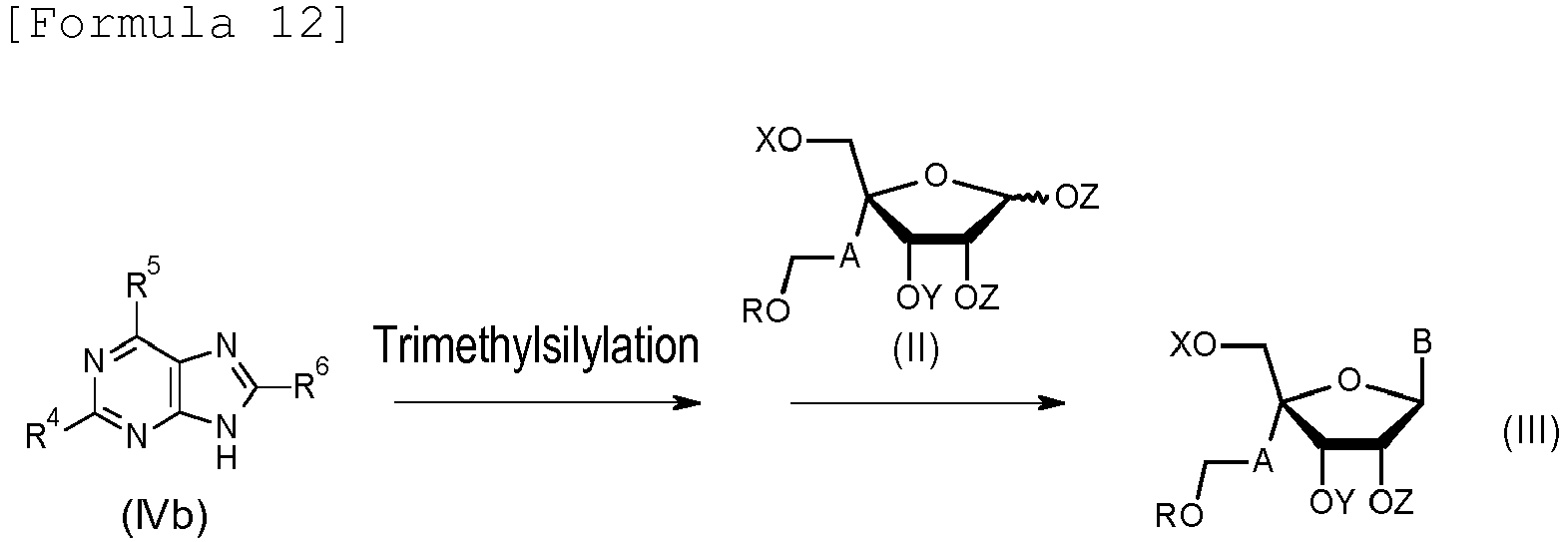
- the production method of the present invention is a method for producing compound (III), comprising reacting compound (IVb) with a trimethylsilylating agent, and then reacting the obtained trimethylsilylated compound with compound (II).
- R 4 , R 5 , R 6 , X, Y, Z, A, R, and B are as defined above.
- Compound (II) which is a starting material in this step, can be produced through the reaction of compound (3) of method A described in Japanese Patent Laid-Open No. 2000-297097 with a silyl protecting agent in the presence of a base catalyst in an inert solvent.
- the silyl protecting agent used is a tri-lower alkylsilyl chloride such as trimethylsilyl chloride, triethylsilyl chloride, isopropyldimethylsilyl chloride, t-butyldimethylsilyl chloride, methyldiisopropylsilyl chloride, methyl-di-t-butylsilyl chloride, or triisopropylsilyl chloride; or a monoaryl di-lower alkylsilyl or diaryl mono-lower alkylsilyl chloride such as diphenylmethylsilyl chloride, diphenylbutylsilyl chloride, diphenylisopropylsilyl chloride, t-butyldiphenylsilyl chloride, or phenyldiisopropylsilyl chloride.
- a tri-lower alkylsilyl chloride such as trimethylsilyl chloride, triethyl
- Examples of the solvent used can include: aromatic hydrocarbons such as benzene, toluene, and xylene; halogenated hydrocarbons such as methylene chloride, chloroform, carbon tetrachloride, 1,2-dichloroethane, chlorobenzene, and dichlorobenzene; nitriles such as acetonitrile and isobutyronitrile; amides such as formamide, N,N-dimethylformamide, N,N-dimethylacetamide, N-methyl-2-pyrrolidone, N-methylpyrrolidinone, and hexamethylphosphortriamide; and carbon sulfide.
- the solvent is preferably N,N-dimethylformamide.
- Examples of the base catalyst used include organic bases such as triethylamine, pyridine, N-methylmorpholine, DBU, and imidazole.
- the base catalyst is preferably imidazole.
- the reaction temperature differs depending on the starting compound, solvent, and base catalyst used and is usually 0°C to 100°C, preferably 0°C to 50°C.
- the reaction time differs depending on the starting compound, solvent, and base catalyst used, and the reaction temperature and is usually 0.5 hours to 24 hours, preferably 1 hour to 8 hours.
- the compound (II) of interest of this reaction is obtained, for example, by: concentrating the reaction mixture; adding water and an immiscible organic solvent such as ethyl acetate to the residue; after washing with water, separating the organic layer containing the compound of interest; drying the organic layer over anhydrous magnesium sulfate or the like; and then distilling off the solvent.
- an immiscible organic solvent such as ethyl acetate
- the obtained compound can be further purified, if necessary, by a routine method, for example, recrystallization or silica gel column chromatography.
- the trimethylsilylating agent used can be trimethylsilyl chloride, N,O-bis(trimethylsilyl)acetamide (BSA), N,O-bis(trimethylsilyl)trifluoroacetamide, N-methyl-N-(trimethylsilyl)trifluoroacetamide, 1,1,1,3,3,3-hexamethyldisilazane (HMDS), or trimethylsilyl trifluoromethanesulfonate and is preferably trimethylsilyl chloride or N,O-bis(trimethylsilyl)acetamide (BSA).
- BSA N,O-bis(trimethylsilyl)acetamide
- HMDS 1,1,1,3,3,3-hexamethyldisilazane
- HMDS 1,1,1,3,3,3-hexamethyldisilazane
- trimethylsilyl trifluoromethanesulfonate is preferably trimethylsilyl chloride or N,O-bis(trimethylsilyl)acet
- the trimethylsilylating agent is usually used at 1 to 100 equivalents, preferably 2 to 50 equivalents, particularly preferably 5 to 30 equivalents, with respect to one reaction site of 1 to 4 hydrogen atoms bonded to a nitrogen atom of the N-H group or an oxygen atom of a hydroxy group in the compound (IVb).
- Examples of the solvent used can include: aromatic hydrocarbons such as benzene, toluene, and xylene; halogenated hydrocarbons such as methylene chloride, chloroform, carbon tetrachloride, 1,2-dichloroethane, chlorobenzene, and dichlorobenzene; nitriles such as acetonitrile and isobutyronitrile; amides such as formamide, N,N-dimethylformamide, N,N-dimethylacetamide, N-methyl-2-pyrrolidone, N-methylpyrrolidinone, and hexamethylphosphortriamide; 1,1,1,3,3,3-hexamethyldisilazane (HMDS); and carbon sulfide.
- the solvent is preferably toluene, acetonitrile, or HMDS.
- an organic base such as triethylamine, pyridine, N-methylmorpholine, DBU, or imidazole may be used as a base catalyst according to the need.
- the base catalyst is preferably triethylamine.
- the reaction temperature differs depending on the starting compound, solvent, and base catalyst used and is usually 0°C to 180°C, preferably 20°C to 120°C.
- the compound of interest of this reaction is used in the subsequent step without being isolated, for example, after concentration of the reaction mixture and drying of the residue under reduced pressure.
- This step involves reacting the said trimethylsilylated compound with the said compound (II) in the presence of an acid catalyst in an inert solvent to produce compound (III).
- Examples of the solvent used can include: aromatic hydrocarbons such as benzene, toluene, and xylene; halogenated hydrocarbons such as methylene chloride, chloroform, carbon tetrachloride, 1,2-dichloroethane, chlorobenzene, and dichlorobenzene; nitriles such as acetonitrile and isobutyronitrile; amides such as formamide, N,N-dimethylformamide, N,N-dimethylacetamide, N-methyl-2-pyrrolidone, N-methylpyrrolidinone, and hexamethylphosphortriamide; and carbon sulfide.
- the solvent is preferably an aromatic hydrocarbon or a nitrile, more preferably toluene or acetonitrile.
- Examples of the acid catalyst used include Lewis acid catalysts such as aluminum chloride, tin tetrachloride, titanium tetrachloride, trifluoroboron, and trimethylsilyl trifluoromethanesulfonate.
- the acid catalyst is preferably trimethylsilyl trifluoromethanesulfonate.
- the reaction temperature differs depending on the starting compound, solvent, and acid catalyst used and is usually 0°C to 150°C, preferably 70°C to 120°C.
- the reaction time differs depending on the starting compound, solvent, and acid catalyst used, and the reaction temperature and is usually 0.5 hours to 24 hours, preferably 1 hour to 8 hours.
- the compound (III) of interest of this reaction is obtained, for example, by: concentrating the reaction mixture; adding water and an immiscible organic solvent such as ethyl acetate to the residue; after washing with water, separating the organic layer containing the compound of interest; drying the organic layer over anhydrous magnesium sulfate or the like; and then distilling off the solvent.
- an immiscible organic solvent such as ethyl acetate
- the obtained compound can be further purified, if necessary, by a routine method, for example, recrystallization or silica gel column chromatography.
- the trimethylsilylated compound in this step of producing compound (III), can also be formed in a reaction system containing compound (IVb) and a trimethylsilylating agent and then reacted with compound (II) in one pot without being isolated.
- the trimethylsilylating agent used in the one-pot reaction is, for example, N,O-bis(trimethylsilyl)acetamide (BSA) or 1,1,1,3,3,3-hexamethyldisilazane (HMDS) and is preferably N,O-bis(trimethylsilyl)acetamide.
- BSA N,O-bis(trimethylsilyl)acetamide
- HMDS 1,1,1,3,3,3-hexamethyldisilazane
- step (1) The compound (containing an amount corresponding to 28.8 g, 44.2 mmol) obtained in step (1) was dissolved in acetic acid (150 mL), and this solution was cooled to 0°C. Acetic anhydride (82.2 mL, 871 mmol) and concentrated sulfuric acid (cat. 10 ⁇ L) were added thereto, and the mixture was then stirred for 30 minutes. After the completion of the reaction, the reaction solution was put in ice water (50 mL), and the mixture was stirred for 1 hour. Saturated saline (ca. 50 mL) was added thereto, followed by extraction with ethyl acetate (50 mL x 3).
- HMDS HMDS (20 mL) and trimethylsilyl chloride (4 mL) were added to N6-benzoyladenine (268 mg, 1.12 mmol), and the mixture was refluxed overnight, concentrated under reduced pressure, and dried to obtain trimethylsilylated N6-benzoyladenine.
- step (2) The compound (521 mg, 0.748 mmol) obtained in step (2) was dissolved in dry toluene (10 mL). Under a nitrogen stream, the above-mentioned trimethylsilylated N6-benzoyladenine and trimethylsilyl trifluoromethanesulfonate (TMSOTf, 166 ⁇ L, 0.901 mmol) were added to this solution, and the mixture was stirred. After 5 minutes, the consumption of the starting material was confirmed by thin-layer chromatography (TLC), followed by heating to reflux for 2 hours. After the completion of the reaction, a saturated aqueous solution of sodium bicarbonate (ca. 2 mL) was added to the reaction solution, and the mixture was filtered through celite.
- TMSOTf trimethylsilylated N6-benzoyladenine and trimethylsilyl trifluoromethanesulfonate
- the filtrate was subjected to extraction with dichloromethane (ca. 10 mL).
- the organic layer was washed with a saturated sodium bicarbonate solution and saturated saline in this order, dried over anhydrous magnesium sulfate, and then concentrated under reduced pressure.
- step (1) the compound (102 mg, 0.106 mmol) obtained in step (1) was dissolved in dry dichloromethane (2 mL), pyridine (100 ⁇ L) and methanesulfonyl chloride (36 ⁇ L, 0.465 mmol) were added to this solution, and the mixture was stirred at room temperature for 12 hours. Then, water (ca. 1 mL) was added thereto, followed by extraction with dichloromethane (5 mL). The organic layer was washed with saturated saline, dried over anhydrous magnesium sulfate, and then concentrated under reduced pressure. The residue was dissolved in a mixed solvent of pyridine (3 mL) and methanol (2 mL).
- HMDS 500 mL
- trimethylsilyl chloride 125 mL
- the mixture was refluxed overnight, concentrated under reduced pressure, and dried to obtain trimethylsilylated N2-isobutyrylguanine.
- Example 1(2) The compound (15.0 g, 21.5 mmol) obtained in Example 1(2) was dissolved in dry toluene (200 mL). Under a nitrogen stream, the above-mentioned trimethylsilylated N2-isobutyrylguanine and TMSOTf (4.80 mL, 26.1 mmol) were added to this solution, and the mixture was stirred. After 5 minutes, the consumption of the starting material was confirmed by TLC, followed by heating to reflux for 2 hours. After the completion of the reaction, a saturated aqueous solution of sodium bicarbonate (ca. 50 mL) was added to the reaction solution, and the mixture was filtered through celite. The filtrate was subjected to extraction with dichloromethane (ca. 300 mL).
- dichloromethane ca. 300 mL
- Example 2 The compound (6.18 g, 8.87 mmol) obtained in Example 1(2) was dissolved in dry toluene (120 mL). Under a nitrogen stream, N2-isobutyrylguanine (2.83 g, 13.3 mmol) and N,O-bis(trimethylsilyl)acetamide (BSA, 9.60 mL, 38.8 mmol) were added to this solution, and the mixture was heated to reflux for 1 hour. Subsequently, TMSOTf (3.40 mL, 18.5 mmol) was added to the reaction solution, and the mixture was further heated to reflux for 45 minutes. After the completion of the reaction, the title compound (6.44 g, yield: 85%; which was a mixture containing an isomer glycosylated at the 7-position of guanine) was obtained in the same way as in Example 3.
- N2-isobutyrylguanine (2.83 g, 13.3 mmol)
- BSA N,O-bis(trimethylsilyl
- step (1) The compound (3.00 g, 4.84 mmol) obtained in step (1) was dissolved in dry dichloromethane (25 mL). Under a nitrogen stream, pyridine (4 mL) and methanesulfonyl chloride (750 ⁇ L, 9.69 mmol) were added to this solution, and the mixture was stirred at room temperature for 12 hours. After the completion of the reaction, water (ca. 5 mL) was added thereto, followed by extraction with dichloromethane (ca. 30 mL). The organic layer was washed with saturated saline, dried over anhydrous magnesium sulfate, and then concentrated under reduced pressure.
- Example 1(2) The compound (206 mg, 0.336 mmol) obtained in Example 1(2) was dissolved in dry acetonitrile (4 mL). Under a nitrogen stream, thymine (62.8 mg, 0.498 mmol) and N,O-bis(trimethylsilyl)acetamide (BSA, 0.37 mL, 1.5 mmol) were added to this solution, and the mixture was heated to reflux for 1 hour. Subsequently, TMSOTf (0.125 mL, 0.678 mmol) was added to the reaction solution, and the mixture was further heated to reflux for 40 minutes. After the completion of the reaction, a saturated aqueous solution of sodium bicarbonate was added to the reaction solution, followed by extraction with dichloromethane.
- step (1) The compound (55.4 mg, 0.106 mmol) obtained in step (1) was dissolved in dry dichloromethane (1 mL). Under a nitrogen stream, pyridine (0.1 mL) and methanesulfonyl chloride (16.5 ⁇ L, 0.213 mmol) were added to this solution, and the mixture was stirred at room temperature for 3 hours. After the completion of the reaction, water was added thereto, followed by extraction with dichloromethane. The organic layer was washed with saturated saline, dried over anhydrous magnesium sulfate, and then concentrated under reduced pressure. The residue was dissolved in a mixed solvent of pyridine (0.5 mL) and methanol (0.5 mL), and the solution was cooled to 0°C.
- an oligonucleotide analog having stable and excellent antisense or antigene activity or having excellent activity as a detection reagent (probe) for a specific gene or as a primer for initiation of amplification of a specific gene, and intermediate compound (III) for the production of nucleoside analog compound (Ia) or (I) which serves as an intermediate for the production thereof can be produced at high yields regardless of the type of nucleobase.
Landscapes
- Chemical & Material Sciences (AREA)
- Organic Chemistry (AREA)
- Health & Medical Sciences (AREA)
- Life Sciences & Earth Sciences (AREA)
- Engineering & Computer Science (AREA)
- Biochemistry (AREA)
- Biotechnology (AREA)
- General Health & Medical Sciences (AREA)
- Genetics & Genomics (AREA)
- Molecular Biology (AREA)
- Saccharide Compounds (AREA)
- Pharmaceuticals Containing Other Organic And Inorganic Compounds (AREA)
Abstract
Description
- The present invention relates to a novel intermediate for production of a nucleoside analog which serves as an intermediate for production of an oligonucleotide analog having stable and excellent antisense or antigene activity or having excellent activity as a detection reagent (probe) for a specific gene or as a primer for initiation of amplification of a specific gene, and a method for producing the same.
- Patent Literature 1 describes an oligonucleotide analog having stable and excellent antisense or antigene activity or having excellent activity as a detection reagent (probe) for a specific gene or as a primer for initiation of amplification of a specific gene, and the following nucleoside analog:


- Patent Literature 1, however, makes no mention about a silyl protective group, though it specifically describes only an example wherein R7 is a p-toluenesulfonyloxy group. Particularly, the production method described in Patent Literature 1 disadvantageously has a significantly reduced reaction yield, when the nucleobase is a 2-isobutyrylamino-6-hydroxypurin-9-yl group (yield of 6% in two steps of Reference Example 15 and Example 24). In addition, it is less than industrially satisfactory, even when the nucleobase is any of other groups, for example, when the nucleobase is a 6-benzoylaminopurin-9-yl group, the yield of step A-3 is as low as 52%.
- Patent Literature 2 describes a nucleoside analog with the 2'- and 4'-positions bridged by a NHCOCH2 group, and discloses the step of synthesizing compound 40 from compound 39 in Example 5(6).

-
- Patent Literature 1: Japanese Patent Laid-Open No.
2000-297097 - Patent Literature 2: International Publication No.
WO2011/052436 A1 - Thus, the present inventors have conducted diligent studies to solve the problems mentioned above and consequently completed the present invention by finding that use of a production intermediate having a specific protective group can improve the reaction yield regardless of the type of nucleobase.
- The production method of the present invention is a production method for producing a compound represented by the general formula (III) or a salt thereof, comprising reacting a trimethylsilylated compound, which was obtained by reaction of a compound represented by the following general formula:

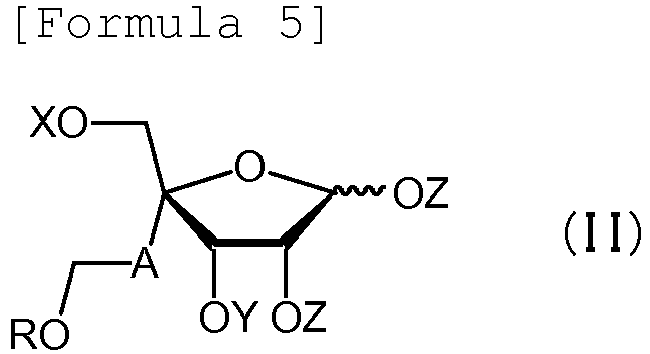
to obtain the compound represented by the following general formula or a salt thereof:
- The group α is a group consisting of a hydroxy group, a protected hydroxy group, an alkoxy group having 1 to 4 carbon atoms, a mercapto group, a protected mercapto group, an alkylthio group having 1 to 4 carbon atoms, an amino group, a protected amino group, an amino group substituted by (an) alkyl group(s) having 1 to 4 carbon atoms, an alkyl group having 1 to 4 carbon atoms, and a halogen atom.
- The compound of the present invention is a compound represented by the above general formula (III) or a salt thereof.
- Also, the production method of the present invention is a production method for producing a compound represented by the general formula (I) or a salt thereof, comprising the step of producing a compound represented by the general formula (III) or a salt thereof, the step comprising reacting a trimethylsilylated compound, which was obtained by reaction of a compound represented by the following general formula:


to obtain the compound represented by the following general formula or a salt thereof:

- In the present invention, examples of the "alkylene group having 1 to 4 carbon atoms" represented by A can include methylene, ethylene, trimethylene, and tetramethylene groups. The alkylene group is preferably a methylene or ethylene group, more preferably a methylene group.
- In the present invention, the "protective group for the hydroxy group" represented by X, Y, or Z and the protective group in the "protected hydroxy group" included in the group α refer to protective groups that are cleavable by a chemical method such as hydrogenolysis, hydrolysis, electrolysis, or photolysis or by a biological method such as hydrolysis in the human body. Examples of such protective groups can include: "aliphatic acyl groups" such as alkylcarbonyl groups (e.g., formyl, acetyl, propionyl, butyryl, isobutyryl, pentanoyl, pivaloyl, valeryl, isovaleryl, octanoyl, nonanoyl, decanoyl, 3-methylnonanoyl, 8-methylnonanoyl, 3-ethyloctanoyl, 3,7-dimethyloctanoyl, undecanoyl, dodecanoyl, tridecanoyl, tetradecanoyl, pentadecanoyl, hexadecanoyl, 1-methylpentadecanoyl, 14-methylpentadecanoyl, 13,13-dimethyltetradecanoyl, heptadecanoyl, 15-methylhexadecanoyl, octadecanoyl, 1-methylheptadecanoyl, nonadecanoyl, eicosanoyl, and heneicosanoyl), carboxylated alkylcarbonyl groups (e.g., succinoyl, glutaroyl, and adipoyl), halogeno-lower alkylcarbonyl groups (e.g., chloroacetyl, dichloroacetyl, trichloroacetyl, and trifluoroacetyl), lower alkoxy lower alkylcarbonyl groups (e.g., methoxyacetyl), and unsaturated alkylcarbonyl groups (e.g., (E)-2-methyl-2-butenoyl); "aromatic acyl groups" such as arylcarbonyl groups (e.g., benzoyl, α-naphthoyl, and β-naphthoyl), halogenoarylcarbonyl groups (e.g., 2-bromobenzoyl and 4-chlorobenzoyl), lower alkylated arylcarbonyl groups (e.g., 2,4,6-trimethylbenzoyl and 4-toluoyl), lower alkoxylated arylcarbonyl groups (e.g., 4-anisoyl), carboxylated arylcarbonyl groups (e.g., 2-carboxybenzoyl, 3-carboxybenzoyl, and 4-carboxybenzoyl), nitrated arylcarbonyl groups (e.g., 4-nitrobenzoyl and 2-nitrobenzoyl), lower alkoxycarbonylated arylcarbonyl groups (e.g., 2-(methoxycarbonyl)benzoyl), and arylated arylcarbonyl groups (e.g., 4-phenylbenzoyl); "tetrahydropyranyl or tetrahydrothiopyranyl groups" such as tetrahydropyran-2-yl, 3-bromotetrahydropyran-2-yl, 4-methoxytetrahydropyran-4-yl, tetrahydrothiopyran-2-yl, and 4-methoxytetrahydrothiopyran-4-yl; "tetrahydrofuranyl or tetrahydrothiofuranyl groups" such as tetrahydrofuran-2-yl and tetrahydrothiofuran-2-yl; "lower alkoxymethyl groups" such as methoxymethyl, 1,1-dimethyl-1-methoxymethyl, ethoxymethyl, propoxymethyl, isopropoxymethyl, butoxymethyl, and t-butoxymethyl; "lower alkoxylated lower alkoxymethyl groups" such as 2-methoxyethoxymethyl; "halogeno-lower alkoxymethyl" such as 2,2,2-trichloroethoxymethyl and bis(2-chloroethoxy)methyl; "lower alkoxylated ethyl groups" such as 1-ethoxyethyl and 1-(isopropoxy)ethyl; "halogenated ethyl groups" such as 2,2,2-trichloroethyl; a "methyl group substituted by 1 to 3 aryl groups" such as benzyl, α-naphthylmethyl, β-naphthylmethyl, diphenylmethyl, triphenylmethyl, α-naphthyldiphenylmethyl, and 9-anthrylmethyl; a "methyl group substituted by 1 to 3 aryl groups with the aryl ring substituted by lower alkyl, lower alkoxy, halogen, or a cyano group" such as 4-methylbenzyl, 2,4,6-trimethylbenzyl, 3,4,5-trimethylbenzyl, 4-methoxybenzyl, 4-methoxyphenyldiphenylmethyl, 4,4'-dimethoxytriphenylmethyl, 2-nitrobenzyl, 4-nitrobenzyl, 4-chlorobenzyl, 4-bromobenzyl, and 4-cyanobenzyl; "lower alkoxycarbonyl groups" such as methoxycarbonyl, ethoxycarbonyl, t-butoxycarbonyl, and isobutoxycarbonyl; "halogen-substituted lower alkoxycarbonyl groups" such as 2,2,2-trichloroethoxycarbonyl; "alkenyloxycarbonyl groups" such as vinyloxycarbonyl and aryloxycarbonyl; and "aralkyloxycarbonyl groups with the aryl ring optionally substituted by 1 or 2 lower alkoxy or nitro groups" such as benzyloxycarbonyl, 4-methoxybenzyloxycarbonyl, 3,4-dimethoxybenzyloxycarbonyl, 2-nitrobenzyloxycarbonyl, and 4-nitrobenzyloxycarbonyl. The "protective group for the hydroxy group" represented by X or Y is preferably a "methyl group substituted by 1 to 3 aryl groups" or a "methyl group substituted by 1 to 3 aryl groups with the aryl ring substituted by lower alkyl, lower alkoxy, halogen, or a cyano group", more preferably a benzyl, β-naphthylmethyl, p-methoxybenzyl, dimethoxytrityl, or monomethoxytrityl group. The "protective group for the hydroxy group" represented by Z is preferably an aliphatic acyl group having 2 to 4 carbon atoms (e.g., an acetyl, propionyl, or butyryl group), more preferably an acetyl group. The "protected hydroxy group" included in the group α is preferably an "ethyl group substituted by a nitrated aryl group" or an "arylated aminocarbonyl group", more preferably a 1-(4-nitrophenyl)ethyl group or a diphenylaminocarbonyl group.
- In the present invention, the "silyl protective group" represented by R can be a "silyl protective group" such as a tri-lower alkylsilyl group (e.g., trimethylsilyl, triethylsilyl, isopropyldimethylsilyl, t-butyldimethylsilyl, methyldiisopropylsilyl, methyl-di-t-butylsilyl, or triisopropylsilyl); or a monoaryl di-lower alkylsilyl or diaryl mono-lower alkylsilyl group (e.g., diphenylmethylsilyl, diphenylbutylsilyl, diphenylisopropylsilyl, t-butyldiphenylsilyl, or phenyldiisopropylsilyl). The silyl protective group is preferably a monoaryl di-lower alkylsilyl or diaryl mono-lower alkylsilyl group, more preferably a t-butyldiphenylsilyl group.
- In the present invention, examples of the "alkoxy group having 1 to 4 carbon atoms" included in the group α can include methoxy, ethoxy, n-propoxy, isopropoxy, n-butoxy, isobutoxy, s-butoxy, and t-butoxy groups. The alkoxy group is preferably a methoxy or ethoxy group.
- In the present invention, examples of the protective group in the "protected mercapto group" included in the group α can include those listed above as the protective group for the hydroxy group as well as "disulfide-forming groups" such as alkylthio groups (e.g., methylthio, ethylthio, and t-butylthio) and arylthio groups (e.g., benzylthio). The protective group is preferably an "aliphatic acyl group" or an "aromatic acyl group", more preferably a benzoyl group.
- In the present invention, examples of the "alkylthio group having 1 to 4 carbon atoms" included in the group α can include methylthio, ethylthio, propylthio, isopropylthio, butylthio, isobutylthio, s-butylthio, and t-butylthio groups. The alkylthio group is preferably a methylthio or ethylthio group.
- In the present invention, examples of the protective group in the "protected amino group" included in the group α can include: "aliphatic acyl groups" such as alkylcarbonyl groups (e.g., formyl, acetyl, propionyl, butyryl, isobutyryl, pentanoyl, pivaloyl, valeryl, isovaleryl, octanoyl, nonanoyl, decanoyl, 3-methylnonanoyl, 8-methylnonanoyl, 3-ethyloctanoyl, 3,7-dimethyloctanoyl, undecanoyl, dodecanoyl, tridecanoyl, tetradecanoyl, pentadecanoyl, hexadecanoyl, 1-methylpentadecanoyl, 14-methylpentadecanoyl, 13,13-dimethyltetradecanoyl, heptadecanoyl, 15-methylhexadecanoyl, octadecanoyl, 1-methylheptadecanoyl, nonadecanoyl, eicosanoyl, and heneicosanoyl), carboxylated alkylcarbonyl groups (e.g., succinoyl, glutaroyl, and adipoyl), halogeno-lower alkylcarbonyl groups (e.g., chloroacetyl, dichloroacetyl, trichloroacetyl, and trifluoroacetyl), lower alkoxy lower alkylcarbonyl groups (e.g., methoxyacetyl), aryloxy lower alkylcarbonyl groups (e.g., a phenoxyacetyl group), aryloxy lower alkylcarbonyl groups (e.g., a 4-(t-butyl)phenoxyacetyl group), and unsaturated alkylcarbonyl groups (e.g., (E)-2-methyl-2-butenoyl); "aromatic acyl groups" such as arylcarbonyl groups (e.g., benzoyl, α-naphthoyl, and β-naphthoyl), halogenoarylcarbonyl groups (e.g., 2-bromobenzoyl and 4-chlorobenzoyl), lower alkylated arylcarbonyl groups (e.g., 2,4,6-trimethylbenzoyl and 4-toluoyl), lower alkoxylated arylcarbonyl groups (e.g., 4-anisoyl), carboxylated arylcarbonyl groups (e.g., 2-carboxybenzoyl, 3-carboxybenzoyl, and 4-carboxybenzoyl), nitrated arylcarbonyl groups (e.g., 4-nitrobenzoyl and 2-nitrobenzoyl), lower alkoxycarbonylated arylcarbonyl groups (e.g., 2-(methoxycarbonyl)benzoyl), and arylated arylcarbonyl groups (e.g., 4-phenylbenzoyl); "lower alkoxycarbonyl groups" such as methoxycarbonyl, ethoxycarbonyl, t-butoxycarbonyl, and isobutoxycarbonyl; "lower alkoxycarbonyl groups substituted by halogen or a tri-lower alkylsilyl group" such as 2,2,2-trichloroethoxycarbonyl and 2-trimethylsilylethoxycarbonyl; "alkenyloxycarbonyl groups" such as vinyloxycarbonyl and aryloxycarbonyl; and "aralkyloxycarbonyl groups with the aryl ring optionally substituted by 1 or 2 lower alkoxy or nitro groups" such as benzyloxycarbonyl, 4-methoxybenzyloxycarbonyl, 3,4-dimethoxybenzyloxycarbonyl, 2-nitrobenzyloxycarbonyl, and 4-nitrobenzyloxycarbonyl. The protective group is preferably an "aliphatic acyl group" or an "aromatic acyl group", more preferably an isobutyryl or benzoyl group, most preferably an isobutyryl group.
- In the present invention, examples of the "amino group substituted by (an) alkyl group(s) having 1 to 4 carbon atoms" included in the group α can include methylamino, ethylamino, propylamino, isopropylamino, butylamino, isobutylamino, s-butylamino, t-butylamino, dimethylamino, diethylamino, dipropylamino, diisopropylamino, dibutylamino, diisobutylamino, di(s-butyl)amino, and di(t-butyl) amino groups. The amino group substituted by (an) alkyl group(s) is preferably a methylamino, ethylamino, dimethylamino, diethylamino, or diisopropylamino group.
- In the present invention, examples of the "alkyl group having 1 to 4 carbon atoms" included in the group α can include methyl, ethyl, propyl, isopropyl, butyl, isobutyl, s-butyl, and t-butyl. The alkyl group is preferably a methyl or ethyl group.
- In the present invention, the "halogen atom" included in the group α refers to a fluorine atom, a chlorine atom, a bromine atom, or an iodine atom and is preferably a fluorine atom or a chlorine atom.
- In the present invention, the "purin-9-yl group" or the "substituted purin-9-yl group" represented by B is preferably a 6-aminopurin-9-yl (i.e., adeninyl) group, a 6-aminopurin-9-yl group with the amino group protected, a 2,6-diaminopurin-9-yl group, a 2-amino-6-chloropurin-9-yl group, a 2-amino-6-chloropurin-9-yl group with the amino group protected, a 2-amino-6-fluoropurin-9-yl group, a 2-amino-6-fluoropurin-9-yl group with the amino group protected, a 2-amino-6-bromopurin-9-yl group, a 2-amino-6-bromopurin-9-yl group with the amino group protected, a 2-amino-6-hydroxypurin-9-yl (i.e., guaninyl) group, a 2-amino-6-hydroxypurin-9-yl group with the amino group protected, a 2-amino-6-hydroxypurin-9-yl group with the amino group and hydroxy group protected, a 6-amino-2-methoxypurin-9-yl group, a 6-amino-2-chloropurin-9-yl group, a 6-amino-2-fluoropurin-9-yl group, a 2,6-dimethoxypurin-9-yl group, a 2,6-dichloropurin-9-yl group, or a 6-mercaptopurin-9-yl group, more preferably a 6-benzoylaminopurin-9-yl group, an adeninyl group, a 2-isobutyrylamino-6-hydroxypurin-9-yl group, or a guaninyl group.
- In the present invention, the "salt thereof" refers to a salt of compound (II) or (III), because these compounds can form salts. Such salts can be preferably metal salts such as alkali metal salts (e.g., sodium salt, potassium salt, and lithium salt), alkaline earth metal salts (e.g., calcium salt and magnesium salt), aluminum salt, iron salt, zinc salt, copper salt, nickel salt, and cobalt salt; amine salts such as inorganic salts (e.g., ammonium salt) and organic salts (e.g., t-octylamine salt, dibenzylamine salt, morpholine salt, glucosamine salt, phenylglycine alkyl ester salt, ethylenediamine salt, N-methylglucamine salt, guanidine salt, diethylamine salt, triethylamine salt, dicyclohexylamine salt, N,N'-dibenzylethylenediamine salt, chloroprocaine salt, procaine salt, diethanolamine salt, N-benzyl-phenethylamine salt, piperazine salt, tetramethylammonium salt, and tris(hydroxymethyl)aminomethane salt); inorganic acid salts such as hydrohalides (e.g., hydrofluoride, hydrochloride, hydrobromide, and hydroiodide), nitrate, perchlorate, sulfate, and phosphate; organic acid salts such as lower alkanesulfonates (e.g., methanesulfonate, trifluoromethanesulfonate, and ethanesulfonate), arylsulfonates (e.g., benzenesulfonate and p-toluenesulfonate), acetate, malate, fumarate, succinate, citrate, tartrate, oxalate, and maleate; and amino acid salts such as glycine salt, lysine salt, arginine salt, ornithine salt, glutamate, and aspartate.
- Preferred embodiments of the production method of the present invention are as follows:
- (1) The production method, wherein X is a methyl group substituted by 1 to 3 aryl groups, or a methyl group substituted by 1 to 3 aryl groups with the aryl ring substituted by lower alkyl, lower alkoxy, halogen, or a cyano group.
- (2) The production method, wherein X is a benzyl group, a p-methoxybenzyl group, a dimethoxytrityl group, or a monomethoxytrityl group.
- (3) The production method, wherein Y is a methyl group substituted by 1 to 3 aryl groups, or a methyl group substituted by 1 to 3 aryl groups with the aryl ring substituted by lower alkyl, lower alkoxy, halogen, or a cyano group.
- (4) The production method, wherein Y is a benzyl group, a β-naphthylmethyl group, or a p-methoxybenzyl group.
- (5) The production method, wherein Z is an aliphatic acyl group having 2 to 4 carbon atoms.
- (6) The production method, wherein Z is an acetyl group.
- (7) The production method, wherein A is a methylene group or an ethylene group.
- (8) The production method, wherein A is a methylene group.
- (9) The production method, wherein B is a 6-aminopurin-9-yl (i.e., adeninyl) group, a 6-aminopurin-9-yl group with the amino group protected, a 2,6-diaminopurin-9-yl group, a 2-amino-6-chloropurin-9-yl group, a 2-amino-6-chloropurin-9-yl group with the amino group protected, a 2-amino-6-fluoropurin-9-yl group, a 2-amino-6-fluoropurin-9-yl group with the amino group protected, a 2-amino-6-bromopurin-9-yl group, a 2-amino-6-bromopurin-9-yl group with the amino group protected, a 2-amino-6-hydroxypurin-9-yl (i.e., guaninyl) group, a 2-amino-6-hydroxypurin-9-yl group with the amino group protected, a 2-amino-6-hydroxypurin-9-yl group with the amino group and hydroxy group protected, a 6-amino-2-methoxypurin-9-yl group, a 6-amino-2-chloropurin-9-yl group, a 6-amino-2-fluoropurin-9-yl group, a 2,6-dimethoxypurin-9-yl group, a 2,6-dichloropurin-9-yl group, or a 6-mercaptopurin-9-yl group.
- (10) The production method, wherein B is a 6-benzoylaminopurin-9-yl group, an adeninyl group, a 2-isobutyrylamino-6-hydroxypurin-9-yl group, or a guaninyl group.
- (11) The production method, wherein R is a tri-lower alkylsilyl group, a monoaryl di-lower alkylsilyl group, or a diaryl mono-lower alkylsilyl group.
- (12) The production method, wherein R is a monoaryl di-lower alkylsilyl group or a diaryl mono-lower alkylsilyl group.
- (13) The production method, wherein R is a t-butyldiphenylsilyl group.
- The larger number between or among (1) and (2), (3) and (4), (5) and (6), (7) and (8), (9) and (10), or (11) to (13) mentioned above represents a more preferred embodiment of the production method. The production method of the present invention is also preferably a production method, wherein X is arbitrarily selected from (1) and (2); Y is arbitrarily selected from (3) and (4); Z is arbitrarily selected from (5) and (6); A is arbitrarily selected from (7) and (8); B is arbitrarily selected from (9) and (10); or R is arbitrarily selected from (11) to (13); or these forms are arbitrarily combined.
- Preferred embodiments of the compound (III) of the present invention are as follows:
- (1) The compound or a salt thereof, wherein X is a methyl group substituted by 1 to 3 aryl groups, or a methyl group substituted by 1 to 3 aryl groups with the aryl ring substituted by lower alkyl, lower alkoxy, halogen, or a cyano group.
- (2) The compound or a salt thereof, wherein X is a benzyl group, a p-methoxybenzyl group, a dimethoxytrityl group, or a monomethoxytrityl group.
- (3) The compound or a salt thereof, wherein Y is a methyl group substituted by 1 to 3 aryl groups, or a methyl group substituted by 1 to 3 aryl groups with the aryl ring substituted by lower alkyl, lower alkoxy, halogen, or a cyano group.
- (4) The compound or a salt thereof, wherein Y is a benzyl group, a β-naphthylmethyl group, or a p-methoxybenzyl group.
- (5) The compound or a salt thereof, wherein Z is an aliphatic acyl group having 2 to 4 carbon atoms.
- (6) The compound or a salt thereof, wherein Z is an acetyl group.
- (7) The compound or a salt thereof, wherein A is a methylene group or an ethylene group.
- (8) The compound or a salt thereof, wherein A is a methylene group.
- (9) The compound or a salt thereof, wherein B is a 6-aminopurin-9-yl (i.e., adeninyl) group, a 6-aminopurin-9-yl group with the amino group protected, a 2,6-diaminopurin-9-yl group, a 2-amino-6-chloropurin-9-yl group, a 2-amino-6-chloropurin-9-yl group with the amino group protected, a 2-amino-6-fluoropurin-9-yl group, a 2-amino-6-fluoropurin-9-yl group with the amino group protected, a 2-amino-6-bromopurin-9-yl group, a 2-amino-6-bromopurin-9-yl group with the amino group protected, a 2-amino-6-hydroxypurin-9-yl (i.e., guaninyl) group, a 2-amino-6-hydroxypurin-9-yl group with the amino group protected, a 2-amino-6-hydroxypurin-9-yl group with the amino group and hydroxy group protected, a 6-amino-2-methoxypurin-9-yl group, a 6-amino-2-chloropurin-9-yl group, a 6-amino-2-fluoropurin-9-yl group, a 2,6-dimethoxypurin-9-yl group, a 2,6-dichloropurin-9-yl group, or a 6-mercaptopurin-9-yl group.
- (10) The compound or a salt thereof, wherein B is a 6-benzoylaminopurin-9-yl group, an adeninyl group, a 2-isobutyrylamino-6-hydroxypurin-9-yl group, or a guaninyl group.
- (11) The compound or a salt thereof, wherein R is a tri-lower alkylsilyl group, a monoaryl di-lower alkylsilyl group, or a diaryl mono-lower alkylsilyl group.
- (12) The compound or a salt thereof, wherein R is a monoaryl di-lower alkylsilyl group or a diaryl mono-lower alkylsilyl group.
- (13) The compound or a salt thereof, wherein R is a t-butyldiphenylsilyl group.
- The larger number between or among (1) and (2), (3) and (4), (5) and (6), (7) and (8), (9) and (10), or (11) to (13) mentioned above represents a more preferred embodiment of the compound. The production intermediate of the present invention is also preferably a compound or a salt thereof, wherein X is arbitrarily selected from (1) and (2); Y is arbitrarily selected from (3) and (4); Z is arbitrarily selected from (5) and (6); A is arbitrarily selected from (7) and (8); B is arbitrarily selected from (9) and (10); or R is arbitrarily selected from (11) to (13); or these forms are arbitrarily combined, particularly preferably 2'-O-acetyl-3',5'-di-O-benzyl-4'-(2-t-butyldiphenylsilyloxyethyl)-6-N-benzoyladenosine, 2'-O-acetyl-3',5'-di-O-benzyl-4'-(2-t-butyldiphenylsilyloxyethyl)-2-N-isobutyrylguanosine, or a salt thereof, most preferably 2'-O-acetyl-3',5'-di-O-benzyl-4'-(2-t-butyldiphenylsilyloxyethyl)-2-N-isobutyrylguanosine or a salt thereof.
- The compound (IVb) is purine, or substituted purine optionally having a substituent selected from the group consisting of (a) hydroxy group(s), (a) protected hydroxy group(s), (an) alkoxy group(s) having 1 to 4 carbon atoms, (a) mercapto group (s), (a) protected mercapto group(s), (an) alkylthio group(s) having 1 to 4 carbon atoms, (an) amino group (s), (a) protected amino group (s), (an) amino group(s) substituted by (an) alkyl group(s) having 1 to 4 carbon atoms, (an) alkyl group(s) having 1 to 4 carbon atoms, and (a) halogen atom(s) and is preferably a compound or a salt thereof selected from the following group:
- Adenine with the amino group protected, guanine with the amino group protected, and salts thereof, preferably adenine with the amino group protected with an "aliphatic acyl group" or an "aromatic acyl group", guanine with the amino group protected with an "aliphatic acyl group" or an "aromatic acyl group", and salts thereof, more preferably N6-benzoyladenine, N6-acetyladenine, N6-phenoxyacetyladenine, N6-(t-butyl)phenoxyacetyladenine, N2-isobutyrylguanine, N2-acetylguanine, N2-phenoxyacetylguanine, N2-(t-butyl)phenoxyacetylguanine, and salts thereof, even more preferably N6-benzoyladenine, N2-isobutyrylguanine, and salts thereof.
- The trimethylsilylated compound according to the present invention refers to a compound that is produced through the reaction of compound (IVb) with a trimethylsilylating agent resulting in the bonding of a trimethylsilyl group in place of a hydrogen atom bonded to a nitrogen atom of an amino group, a hydrogen atom bonded to a nitrogen atom in the heterocyclic ring and/or a hydrogen atom bonded to an oxygen atom of a hydroxy group in the compound (IVb). The trimethylsilylated compound is relatively unstable and is therefore used in the subsequent reaction without being isolated. The trimethylsilylated compound is preferably a compound in which a trimethylsilyl group is bonded in place of a hydrogen atom bonded to a nitrogen atom of an amino group, a hydrogen atom bonded to a nitrogen atom in the heterocyclic ring and/or a hydrogen atom bonded to an oxygen atom of a hydroxy group, in an adenine in which the amino group is protected with an "aliphatic acyl group" or an "aromatic acyl group" or a guanine in which the amino group is protected with an "aliphatic acyl group" or an "aromatic acyl group", or a salt thereof, more preferably a compound in which a trimethylsilyl group is bonded in place of a hydrogen atom bonded to a nitrogen atom of an amino group, a hydrogen atom bonded to a nitrogen atom in the heterocyclic ring and/or a hydrogen atom bonded to an oxygen atom of a hydroxy group, in an N6-benzoyladenine, N6-acetyladenine, N6-phenoxyacetyladenine, N6-(t-butyl)phenoxyacetyladenine, N2-isobutyrylguanine, N2-acetylguanine, N2-phenoxyacetylguanine, or N2-(t-butyl)phenoxyacetylguanine, or a salt thereof, particularly preferably a compound in which a trimethylsilyl group is bonded in place of a hydrogen atom bonded to a nitrogen atom of an amino group, a hydrogen atom bonded to a nitrogen atom in the heterocyclic ring and/or a hydrogen atom bonded to an oxygen atom of a hydroxy group, in an N6-benzoyladenine or N2-isobutyrylguanine, or a salt thereof.
- The trimethylsilylated compound is, for example, N6-benzoyl-N6,N9-bis(trimethylsilyl)adenine or O6,N2,N9-tris(trimethylsilyl)-N2-isobutyrylguanine.
- The compound (III), the compound (IVb), or the trimethylsilylated compound of the compound (IVb) according to the present invention may have tautomerism. Any tautomeric structure of the following substructure in these compounds is included in the scope of the present invention:

- According to the present invention, an oligonucleotide analog having stable and excellent antisense or antigene activity or having excellent activity as a detection reagent (probe) for a specific gene or as a primer for initiation of amplification of a specific gene, and intermediate compound (III) for the production of nucleoside analog compound (I) which serves as an intermediate for the production thereof can be produced at high yields regardless of the type of nucleobase.
- The production method of the present invention is a method for producing compound (III), comprising reacting compound (IVb) with a trimethylsilylating agent, and then reacting the obtained trimethylsilylated compound with compound (II).
- Compound (II), which is a starting material in this step, can be produced through the reaction of compound (3) of method A described in Japanese Patent Laid-Open No.
2000-297097 - The silyl protecting agent used is a tri-lower alkylsilyl chloride such as trimethylsilyl chloride, triethylsilyl chloride, isopropyldimethylsilyl chloride, t-butyldimethylsilyl chloride, methyldiisopropylsilyl chloride, methyl-di-t-butylsilyl chloride, or triisopropylsilyl chloride; or a monoaryl di-lower alkylsilyl or diaryl mono-lower alkylsilyl chloride such as diphenylmethylsilyl chloride, diphenylbutylsilyl chloride, diphenylisopropylsilyl chloride, t-butyldiphenylsilyl chloride, or phenyldiisopropylsilyl chloride.
- Examples of the solvent used can include: aromatic hydrocarbons such as benzene, toluene, and xylene; halogenated hydrocarbons such as methylene chloride, chloroform, carbon tetrachloride, 1,2-dichloroethane, chlorobenzene, and dichlorobenzene; nitriles such as acetonitrile and isobutyronitrile; amides such as formamide, N,N-dimethylformamide, N,N-dimethylacetamide, N-methyl-2-pyrrolidone, N-methylpyrrolidinone, and hexamethylphosphortriamide; and carbon sulfide. The solvent is preferably N,N-dimethylformamide.
- Examples of the base catalyst used include organic bases such as triethylamine, pyridine, N-methylmorpholine, DBU, and imidazole. The base catalyst is preferably imidazole.
- The reaction temperature differs depending on the starting compound, solvent, and base catalyst used and is usually 0°C to 100°C, preferably 0°C to 50°C.
- The reaction time differs depending on the starting compound, solvent, and base catalyst used, and the reaction temperature and is usually 0.5 hours to 24 hours, preferably 1 hour to 8 hours.
- After the completion of the reaction, the compound (II) of interest of this reaction is obtained, for example, by: concentrating the reaction mixture; adding water and an immiscible organic solvent such as ethyl acetate to the residue; after washing with water, separating the organic layer containing the compound of interest; drying the organic layer over anhydrous magnesium sulfate or the like; and then distilling off the solvent.
- The obtained compound can be further purified, if necessary, by a routine method, for example, recrystallization or silica gel column chromatography.
- The trimethylsilylating agent used can be trimethylsilyl chloride, N,O-bis(trimethylsilyl)acetamide (BSA), N,O-bis(trimethylsilyl)trifluoroacetamide, N-methyl-N-(trimethylsilyl)trifluoroacetamide, 1,1,1,3,3,3-hexamethyldisilazane (HMDS), or trimethylsilyl trifluoromethanesulfonate and is preferably trimethylsilyl chloride or N,O-bis(trimethylsilyl)acetamide (BSA).
- The trimethylsilylating agent is usually used at 1 to 100 equivalents, preferably 2 to 50 equivalents, particularly preferably 5 to 30 equivalents, with respect to one reaction site of 1 to 4 hydrogen atoms bonded to a nitrogen atom of the N-H group or an oxygen atom of a hydroxy group in the compound (IVb).
- Examples of the solvent used can include: aromatic hydrocarbons such as benzene, toluene, and xylene; halogenated hydrocarbons such as methylene chloride, chloroform, carbon tetrachloride, 1,2-dichloroethane, chlorobenzene, and dichlorobenzene; nitriles such as acetonitrile and isobutyronitrile; amides such as formamide, N,N-dimethylformamide, N,N-dimethylacetamide, N-methyl-2-pyrrolidone, N-methylpyrrolidinone, and hexamethylphosphortriamide; 1,1,1,3,3,3-hexamethyldisilazane (HMDS); and carbon sulfide. The solvent is preferably toluene, acetonitrile, or HMDS.
- In this step, for example, an organic base such as triethylamine, pyridine, N-methylmorpholine, DBU, or imidazole may be used as a base catalyst according to the need. The base catalyst is preferably triethylamine.
- The reaction temperature differs depending on the starting compound, solvent, and base catalyst used and is usually 0°C to 180°C, preferably 20°C to 120°C.
- After the completion of the reaction, the compound of interest of this reaction is used in the subsequent step without being isolated, for example, after concentration of the reaction mixture and drying of the residue under reduced pressure.
- This step involves reacting the said trimethylsilylated compound with the said compound (II) in the presence of an acid catalyst in an inert solvent to produce compound (III).
- Examples of the solvent used can include: aromatic hydrocarbons such as benzene, toluene, and xylene; halogenated hydrocarbons such as methylene chloride, chloroform, carbon tetrachloride, 1,2-dichloroethane, chlorobenzene, and dichlorobenzene; nitriles such as acetonitrile and isobutyronitrile; amides such as formamide, N,N-dimethylformamide, N,N-dimethylacetamide, N-methyl-2-pyrrolidone, N-methylpyrrolidinone, and hexamethylphosphortriamide; and carbon sulfide. The solvent is preferably an aromatic hydrocarbon or a nitrile, more preferably toluene or acetonitrile.
- Examples of the acid catalyst used include Lewis acid catalysts such as aluminum chloride, tin tetrachloride, titanium tetrachloride, trifluoroboron, and trimethylsilyl trifluoromethanesulfonate. The acid catalyst is preferably trimethylsilyl trifluoromethanesulfonate.
- The reaction temperature differs depending on the starting compound, solvent, and acid catalyst used and is usually 0°C to 150°C, preferably 70°C to 120°C.
- The reaction time differs depending on the starting compound, solvent, and acid catalyst used, and the reaction temperature and is usually 0.5 hours to 24 hours, preferably 1 hour to 8 hours.
- After the completion of the reaction, the compound (III) of interest of this reaction is obtained, for example, by: concentrating the reaction mixture; adding water and an immiscible organic solvent such as ethyl acetate to the residue; after washing with water, separating the organic layer containing the compound of interest; drying the organic layer over anhydrous magnesium sulfate or the like; and then distilling off the solvent.
- The obtained compound can be further purified, if necessary, by a routine method, for example, recrystallization or silica gel column chromatography.
- In this step of producing compound (III), the trimethylsilylated compound can also be formed in a reaction system containing compound (IVb) and a trimethylsilylating agent and then reacted with compound (II) in one pot without being isolated.
- The trimethylsilylating agent used in the one-pot reaction is, for example, N,O-bis(trimethylsilyl)acetamide (BSA) or 1,1,1,3,3,3-hexamethyldisilazane (HMDS) and is preferably N,O-bis(trimethylsilyl)acetamide.
- Hereinafter, the present invention will be described more specifically with reference to Examples and Reference Examples.
- 2'-O-Acetyl-3',5'-di-O-benzyl-4'-(2-t-butyldiphenylsilyloxyethyl)-6-N-benzoyladenosine

- 3,5-di-O-Benzyl-4-(2-hydroxyethyl)-1,2-O-isopropylidene-α-D-erythropentofuranose (18.3 g, 44.2 mmol) was dissolved in dry dimethylformamide (DMF, 55 mL). Under a nitrogen stream, imidazole (15.7 g, 218 mmol) was added to this solution, and the mixture was cooled to 0°C. t-Butyldiphenylchlorosilane (23.0 mL, 88.4 mmol) was added thereto, and the mixture was stirred for 15 minutes. After the completion of the reaction, the reaction solution was diluted with ether (ca. 3 mL). A saturated aqueous solution of sodium bicarbonate (ca. 50 mL) was added thereto, and the mixture was concentrated under reduced pressure. Ether and DMF were distilled off. Water (ca. 10 mL) was added to the residue, followed by extraction with ethyl acetate (30 mL x 3). The organic layer was washed with saturated saline, dried over anhydrous magnesium sulfate, and then concentrated under reduced pressure. The residue was purified by silica gel column chromatography (elution solvent: hexane/ethyl acetate = 5/1) to obtain the title compound (28.8 g).
- The compound (containing an amount corresponding to 28.8 g, 44.2 mmol) obtained in step (1) was dissolved in acetic acid (150 mL), and this solution was cooled to 0°C. Acetic anhydride (82.2 mL, 871 mmol) and concentrated sulfuric acid (cat. 10 µL) were added thereto, and the mixture was then stirred for 30 minutes. After the completion of the reaction, the reaction solution was put in ice water (50 mL), and the mixture was stirred for 1 hour. Saturated saline (ca. 50 mL) was added thereto, followed by extraction with ethyl acetate (50 mL x 3). The organic layer was washed with a saturated aqueous solution of sodium bicarbonate and saturated saline in this order, dried over anhydrous magnesium sulfate, and then concentrated under reduced pressure. The residue was purified by silica gel column chromatography (elution solvent: hexane/ethyl acetate = 10/1) to obtain the title compound (mixture of α and β forms, 26.0 g, yield: 84% (2 steps)). The NMR data of the α form obtained by the further purification of a portion of the obtained compound will be shown below.
1H-NMR (400MHz, CDCl3) δ (ppm): 1.02 (9H, s), 1.84 (3H, s), 1.93 (3H, s), 1.95-2.18 (2H, m), 3.40 (1H, d), 3.50 (1H, d), 3.80-3.93 (2H, m), 4.35-4.60 (5H, m), 5.29 (1H, d), 6.03 (1H, s), 7,20-7.40 (16H, m), 7.60-7.70 (4H, m). - HMDS (20 mL) and trimethylsilyl chloride (4 mL) were added to N6-benzoyladenine (268 mg, 1.12 mmol), and the mixture was refluxed overnight, concentrated under reduced pressure, and dried to obtain trimethylsilylated N6-benzoyladenine.
- The compound (521 mg, 0.748 mmol) obtained in step (2) was dissolved in dry toluene (10 mL). Under a nitrogen stream, the above-mentioned trimethylsilylated N6-benzoyladenine and trimethylsilyl trifluoromethanesulfonate (TMSOTf, 166 µL, 0.901 mmol) were added to this solution, and the mixture was stirred. After 5 minutes, the consumption of the starting material was confirmed by thin-layer chromatography (TLC), followed by heating to reflux for 2 hours. After the completion of the reaction, a saturated aqueous solution of sodium bicarbonate (ca. 2 mL) was added to the reaction solution, and the mixture was filtered through celite. The filtrate was subjected to extraction with dichloromethane (ca. 10 mL). The organic layer was washed with a saturated sodium bicarbonate solution and saturated saline in this order, dried over anhydrous magnesium sulfate, and then concentrated under reduced pressure. The residue was purified by silica gel column chromatography (elution solvent: dichloromethane/methanol = 100/1) to obtain the title compound (482 mg, yield: 74%).
1H-NMR (400MHz, CDCl3) δ (ppm): 1.02 (9H, s), 1.88-1.97 (1H, m), 2.02 (3H, s), 2.15-2.25 (1H, s), 3.44 (1H, d), 3.75-3.90 (3H, m), 4.37-4.61 (5H, m), 5.86 (1H, t), 6.26 (1H, d), 7.20-7.65 (23H, m), 8.03 (2H, d), 8.31 (1H, s), 8.77 (1H, s), 9.04 (1H, s). - The compound (475 mg, 0.542 mmol) obtained in Example 1(3) was dissolved in dry tetrahydrofuran (THF, 5 mL). A solution of tetrabutylammonium fluoride in THF (1 mol/L, 705 µL, 0.705 mmol) was added to this solution, and the mixture was stirred at room temperature for 12 hours. After the completion of the reaction, the reaction solution was concentrated under reduced pressure. The residue was purified by silica gel column chromatography (elution solvent: dichloromethane/methanol = 50/1) to obtain the title compound (269 mg, yield: 78%). 1H-NMR (400MHz, CDCl3) δ (ppm): 1.88-1.95 (1H, m), 2.08(3H, s), 2.20-2.30 (2H, m), 3.47 (1H, d), 3.74 (1H, d), 3.76-3.85 (2H, m), 4.42-4.68 (5H, m), 5.97 (1H, t), 6.35 (1H, d), 7.24-7.65 (13H, m), 8.03 (2H, d), 8.26 (1H, s), 8.76 (1H, s), 9.06 (1H, s).
- Under a nitrogen stream, the compound (102 mg, 0.106 mmol) obtained in step (1) was dissolved in dry dichloromethane (2 mL), pyridine (100 µL) and methanesulfonyl chloride (36 µL, 0.465 mmol) were added to this solution, and the mixture was stirred at room temperature for 12 hours. Then, water (ca. 1 mL) was added thereto, followed by extraction with dichloromethane (5 mL). The organic layer was washed with saturated saline, dried over anhydrous magnesium sulfate, and then concentrated under reduced pressure. The residue was dissolved in a mixed solvent of pyridine (3 mL) and methanol (2 mL). This solution was cooled to 0°C. A 5 mol/L aqueous sodium hydroxide solution (5 mL) was added thereto, and the mixture was stirred for 10 minutes. After the completion of the reaction, the reaction solution was subjected to extraction with dichloromethane (5 mL x 3). The organic layer was washed with a phosphate buffer (pH 6.86, 0.025 M) and saturated saline in this order, dried over anhydrous magnesium sulfate, and concentrated under reduced pressure. The obtained residue was purified by silica gel column chromatography (elution solvent: dichloromethane/methanol = 50:1) to obtain the title compound (84.3 mg, yield: 91%). This compound was completely consistent with the compound described in Example 10 of Japanese Patent Laid-Open No.
2000-297097 -

- HMDS (500 mL) and trimethylsilyl chloride (125 mL) were added to N2-isobutyrylguanine (7.14 g, 32.3 mmol), and the mixture was refluxed overnight, concentrated under reduced pressure, and dried to obtain trimethylsilylated N2-isobutyrylguanine.
- The compound (15.0 g, 21.5 mmol) obtained in Example 1(2) was dissolved in dry toluene (200 mL). Under a nitrogen stream, the above-mentioned trimethylsilylated N2-isobutyrylguanine and TMSOTf (4.80 mL, 26.1 mmol) were added to this solution, and the mixture was stirred. After 5 minutes, the consumption of the starting material was confirmed by TLC, followed by heating to reflux for 2 hours. After the completion of the reaction, a saturated aqueous solution of sodium bicarbonate (ca. 50 mL) was added to the reaction solution, and the mixture was filtered through celite. The filtrate was subjected to extraction with dichloromethane (ca. 300 mL). The organic layer was washed with a saturated sodium bicarbonate solution and saturated saline in this order, dried over anhydrous magnesium sulfate, and then concentrated under reduced pressure. The residue was purified by silica gel column chromatography (elution solvent: dichloromethane/methanol = 100/1.5) to obtain the title compound (16.0 g, yield: 86%; which was a mixture containing an isomer glycosylated at the 7-position of guanine).
- The compound (6.18 g, 8.87 mmol) obtained in Example 1(2) was dissolved in dry toluene (120 mL). Under a nitrogen stream, N2-isobutyrylguanine (2.83 g, 13.3 mmol) and N,O-bis(trimethylsilyl)acetamide (BSA, 9.60 mL, 38.8 mmol) were added to this solution, and the mixture was heated to reflux for 1 hour. Subsequently, TMSOTf (3.40 mL, 18.5 mmol) was added to the reaction solution, and the mixture was further heated to reflux for 45 minutes. After the completion of the reaction, the title compound (6.44 g, yield: 85%; which was a mixture containing an isomer glycosylated at the 7-position of guanine) was obtained in the same way as in Example 3.
- The compound (16.0 g, 18.6 mmol) obtained in Example 3 was dissolved in THF (160 mL). A solution of tetrabutylammonium fluoride in THF (1 mol/L, 25 mL, 25.0 mmol) was added to this solution, and the mixture was stirred at room temperature for 12 hours. After the completion of the reaction, the reaction solution was concentrated under reduced pressure. The residue was purified by silica gel column chromatography (elution solvent: dichloromethane/methanol = 20/1) to obtain the title compound (9.97 g, yield: 75%; which was a mixture containing an isomer glycosylated at the 7-position of guanine).
- The compound (3.00 g, 4.84 mmol) obtained in step (1) was dissolved in dry dichloromethane (25 mL). Under a nitrogen stream, pyridine (4 mL) and methanesulfonyl chloride (750 µL, 9.69 mmol) were added to this solution, and the mixture was stirred at room temperature for 12 hours. After the completion of the reaction, water (ca. 5 mL) was added thereto, followed by extraction with dichloromethane (ca. 30 mL). The organic layer was washed with saturated saline, dried over anhydrous magnesium sulfate, and then concentrated under reduced pressure. The residue was dissolved in a mixed solvent of pyridine (25 mL) and methanol (10 mL), and the solution was cooled to 0°C. An aqueous sodium hydroxide solution (5 mol/L, 25 mL) was added to this solution, and the mixture was stirred for 30 minutes. Then, the reaction solution was subjected to extraction with a dichloromethane (ca. 50 mL x 3) solution. The organic layer was washed with saturated saline, dried over anhydrous magnesium sulfate, and concentrated under reduced pressure. Then, the residue was completely separated and purified from an isomer glycosylated at the 7-position of guanine by silica gel column chromatography (elution solvent: dichloromethane/methanol = 100/1.5) to obtain the title compound (1.81 g, yield: 43% (4 steps)). This compound was completely consistent with the compound described in Example 24 of Japanese Patent Laid-Open No.
2000-297097 -

- The compound (206 mg, 0.336 mmol) obtained in Example 1(2) was dissolved in dry acetonitrile (4 mL). Under a nitrogen stream, thymine (62.8 mg, 0.498 mmol) and N,O-bis(trimethylsilyl)acetamide (BSA, 0.37 mL, 1.5 mmol) were added to this solution, and the mixture was heated to reflux for 1 hour. Subsequently, TMSOTf (0.125 mL, 0.678 mmol) was added to the reaction solution, and the mixture was further heated to reflux for 40 minutes. After the completion of the reaction, a saturated aqueous solution of sodium bicarbonate was added to the reaction solution, followed by extraction with dichloromethane. The organic layer was washed with saturated saline, dried over anhydrous magnesium sulfate, and then concentrated under reduced pressure. The residue was purified by silica gel column chromatography (elution solvent: hexane/ethyl acetate = 1/2) to obtain the title compound (190 mg, yield: 74%).
1H-NMR (400MHz, CDCl3) δ (ppm): 1.04 (9H, s), 1.47 (3H, s), 1.74-1.85 (1H, m), 2.02 (3H, s), 2.03-2.08 (1H, m), 3.39 (1H, d, J=10.3Hz), 3.69-3.83 (2H, m), 3.86 (1H, d, J=11Hz), 4.32-4.56 (5H, m), 5.33 (1H, t), 6.06 (1H, d, J=5.1Hz), 7.19-7.61 (20H, m), 7.93 (1H, s). - The compound (185 mg, 0.242 mmol) obtained in Reference Example 1 was dissolved in THF (2 mL). A solution of tetrabutylammonium fluoride in THF (1 mol/L, 0.34 mL, 0.34 mmol) was added to this solution, and the mixture was stirred overnight at room temperature. After the completion of the reaction, the reaction solution was concentrated under reduced pressure. The residue was purified by silica gel column chromatography (elution solvent: hexane/ethyl acetate = 1/4) to obtain the title compound (121 mg, yield: 95%).
1H-NMR (400MHz, CDCl3) δ (ppm): 1.49 (3H, s), 1.73-1.80 (1H, m), 2.06 (3H, s), 2.11-2.17 (1H, m), 3.24-3.28 (1H, m), 3.41 (1H, d, J=10.3Hz), 3.72-3.75 (2H, m), 3.77 (1H, d, J=10.3Hz), 4.34-4.62 (5H, m), 5.39 (1H, t), 6.16 (1H, d, J=5.1Hz), 7.20-7.41 (11H, m). - The compound (55.4 mg, 0.106 mmol) obtained in step (1) was dissolved in dry dichloromethane (1 mL). Under a nitrogen stream, pyridine (0.1 mL) and methanesulfonyl chloride (16.5 µL, 0.213 mmol) were added to this solution, and the mixture was stirred at room temperature for 3 hours. After the completion of the reaction, water was added thereto, followed by extraction with dichloromethane. The organic layer was washed with saturated saline, dried over anhydrous magnesium sulfate, and then concentrated under reduced pressure. The residue was dissolved in a mixed solvent of pyridine (0.5 mL) and methanol (0.5 mL), and the solution was cooled to 0°C. An aqueous sodium hydroxide solution (5 mol/L, 1 mL) was added to this solution, and the mixture was stirred for 5 minutes. Then, the reaction solution was subjected to extraction with dichloromethane. The organic layer was washed with saturated saline, dried over anhydrous magnesium sulfate, and concentrated under reduced pressure. Then, the residue was purified by silica gel column chromatography (elution solvent: dichloromethane/methanol = 100/1.5 → 100/2) to obtain the title compound (40.1 mg, yield: 82%). This compound was completely consistent with the compound described in Example 6 of Japanese Patent Laid-Open No.
2000-297097 - According to the present invention, an oligonucleotide analog having stable and excellent antisense or antigene activity or having excellent activity as a detection reagent (probe) for a specific gene or as a primer for initiation of amplification of a specific gene, and intermediate compound (III) for the production of nucleoside analog compound (Ia) or (I) which serves as an intermediate for the production thereof can be produced at high yields regardless of the type of nucleobase.
Claims (16)
- A production method for producing a compound represented by the general formula (III) or a salt thereof, comprising reacting a trimethylsilylated compound, which was obtained by reaction of a compound represented by the general formula:

with a compound represented by the general formula:

or a salt thereof:
to obtain the compound represented by the following general formula or a salt thereof:
the group α is a group consisting of a hydroxy group, a protected hydroxy group, an alkoxy group having 1 to 4 carbon atoms, a mercapto group, a protected mercapto group, an alkylthio group having 1 to 4 carbon atoms, an amino group, a protected amino group, an amino group substituted by (an) alkyl group(s) having 1 to 4 carbon atoms, an alkyl group having 1 to 4 carbon atoms, and a halogen atom. - The production method according to claim 1, wherein X is a methyl group substituted by 1 to 3 aryl groups, or a methyl group substituted by 1 to 3 aryl groups with the aryl ring substituted by lower alkyl, lower alkoxy, halogen, or a cyano group.
- The production method according to claim 1, wherein X is a benzyl group, a p-methoxybenzyl group, a dimethoxytrityl group, or a monomethoxytrityl group.
- The production method according to any one of claims 1 to 3, wherein Y is a methyl group substituted by 1 to 3 aryl groups, or a methyl group substituted by 1 to 3 aryl groups with the aryl ring substituted by lower alkyl, lower alkoxy, halogen, or a cyano group.
- The production method according to any one of claims 1 to 3, wherein Y is a benzyl group, a β-naphthylmethyl group, or a p-methoxybenzyl group.
- The production method according to any one of claims 1 to 5, wherein Z is an aliphatic acyl group having 2 to 4 carbon atoms.
- The production method according to any one of claims 1 to 5, wherein Z is an acetyl group.
- The production method according to any one of claims 1 to 7, wherein A is a methylene group or an ethylene group.
- The production method according to any one of claims 1 to 7, wherein A is a methylene group.
- The production method according to any one of claims 1 to 9, wherein B is a 6-aminopurin-9-yl group, a 6-aminopurin-9-yl group with the amino group protected, a 2,6-diaminopurin-9-yl group, a 2-amino-6-chloropurin-9-yl group, a 2-amino-6-chloropurin-9-yl group with the amino group protected, a 2-amino-6-fluoropurin-9-yl group, a 2-amino-6-fluoropurin-9-yl group with the amino group protected, a 2-amino-6-bromopurin-9-yl group, a 2-amino-6-bromopurin-9-yl group with the amino group protected, a 2-amino-6-hydroxypurin-9-yl group, a 2-amino-6-hydroxypurin-9-yl group with the amino group protected, a 2-amino-6-hydroxypurin-9-yl group with the amino group and hydroxy group protected, a 6-amino-2-methoxypurin-9-yl group, a 6-amino-2-chloropurin-9-yl group, a 6-amino-2-fluoropurin-9-yl group, a 2,6-dimethoxypurin-9-yl group, a 2,6-dichloropurin-9-yl group, or a 6-mercaptopurin-9-yl group.
- The production method according to any one of claims 1 to 9, wherein B is a 6-benzoylaminopurin-9-yl group, an adeninyl group, a 2-isobutyrylamino-6-hydroxypurin-9-yl group, or a guaninyl group.
- The production method according to any one of claims 1 to 11, wherein R is a tri-lower alkylsilyl group, a monoaryl di-lower alkylsilyl group, or a diaryl mono-lower alkylsilyl group.
- The production method according to any one of claims 1 to 11, wherein R is a monoaryl di-lower alkylsilyl group or a diaryl mono-lower alkylsilyl group.
- The production method according to any one of claims 1 to 11, wherein R is a t-butyldiphenylsilyl group.
- A compound represented by the general formula:

or a salt thereof, wherein
the group α is a group consisting of a hydroxy group, a protected hydroxy group, an alkoxy group having 1 to 4 carbon atoms, a mercapto group, a protected mercapto group, an alkylthio group having 1 to 4 carbon atoms, an amino group, a protected amino group, an amino group substituted by (an) alkyl group(s) having 1 to 4 carbon atoms, an alkyl group having 1 to 4 carbon atoms, and a halogen atom. - A production method for producing a compound represented by the general formula (I) or a salt thereof, comprising the step of producing a compound represented by the general formula (III) or a salt thereof, the step comprising reacting a trimethylsilylated compound, which was obtained by reaction of a compound represented by the general formula:

with a trimethylsilylating agent,
with a compound represented by the general formula:
and R represents a silyl protective group,
or a salt thereof:
to obtain the compound represented by the following general formula or a salt thereof:

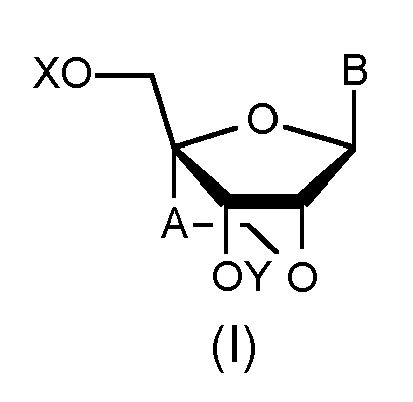
the group α is a group consisting of a hydroxy group, a protected hydroxy group, an alkoxy group having 1 to 4 carbon atoms, a mercapto group, a protected mercapto group, an alkylthio group having 1 to 4 carbon atoms, an amino group, a protected amino group, an amino group substituted by (an) alkyl group(s) having 1 to 4 carbon atoms, an alkyl group having 1 to 4 carbon atoms, and a halogen atom.
Applications Claiming Priority (2)
| Application Number | Priority Date | Filing Date | Title |
|---|---|---|---|
| JP2012137049 | 2012-06-18 | ||
| PCT/JP2013/066578 WO2013191129A1 (en) | 2012-06-18 | 2013-06-17 | Intermediate for production of nucleoside analogue, and method for producing same |
Related Child Applications (1)
| Application Number | Title | Priority Date | Filing Date |
|---|---|---|---|
| EP19196243.0 Division-Into | 2019-09-09 |
Publications (3)
| Publication Number | Publication Date |
|---|---|
| EP2862868A1 true EP2862868A1 (en) | 2015-04-22 |
| EP2862868A4 EP2862868A4 (en) | 2015-10-28 |
| EP2862868B1 EP2862868B1 (en) | 2020-04-08 |
Family
ID=49768725
Family Applications (1)
| Application Number | Title | Priority Date | Filing Date |
|---|---|---|---|
| EP13806205.4A Active EP2862868B1 (en) | 2012-06-18 | 2013-06-17 | Intermediate for production of nucleoside analogue, and method for producing same |
Country Status (6)
| Country | Link |
|---|---|
| US (1) | US9738681B2 (en) |
| EP (1) | EP2862868B1 (en) |
| JP (1) | JP6150440B2 (en) |
| ES (1) | ES2798301T3 (en) |
| TW (1) | TW201402594A (en) |
| WO (1) | WO2013191129A1 (en) |
Families Citing this family (2)
| Publication number | Priority date | Publication date | Assignee | Title |
|---|---|---|---|---|
| EP3507367A4 (en) | 2016-07-05 | 2020-03-25 | Aduro BioTech, Inc. | Locked nucleic acid cyclic dinucleotide compounds and uses thereof |
| EP4047005A4 (en) | 2019-10-18 | 2024-03-06 | Daiichi Sankyo Company, Limited | METHOD FOR PRODUCING BICYCLIC PHOSPHORAMIDITE |
Family Cites Families (6)
| Publication number | Priority date | Publication date | Assignee | Title |
|---|---|---|---|---|
| BRPI0008131B8 (en) * | 1999-02-12 | 2021-05-25 | Daiichi Sankyo Co Ltd | compound or a salt thereof, oligonucleotide analog, pharmaceutical composition, probe for a gene, initiator to begin amplification, use of an oligonucleotide analog or a pharmacologically acceptable salt thereof, antisense agent, and, antigen agent |
| TWI347948B (en) * | 2002-11-19 | 2011-09-01 | Sankyo Co | Novel 2',5'-oligoadenylic acid compositions |
| EP2530155B1 (en) * | 2002-11-25 | 2016-03-16 | Masafumi Matsuo | ENA nucleic acid drugs modifying splicing in mRNA precursor |
| DE602004015832D1 (en) * | 2003-11-07 | 2008-09-25 | Daiichi Sankyo Co Ltd | METHOD FOR DETECTING GENETIC POLYMORPHISM |
| DK2170917T3 (en) | 2007-05-30 | 2012-10-08 | Isis Pharmaceuticals Inc | N-Substituted bicyclic nucleic acid analogs with aminomethylene bridge |
| AU2010312751B2 (en) * | 2009-10-29 | 2014-07-24 | Osaka University | Bridged artificial nucleoside and nucleotide |
-
2013
- 2013-06-17 ES ES13806205T patent/ES2798301T3/en active Active
- 2013-06-17 JP JP2014521453A patent/JP6150440B2/en active Active
- 2013-06-17 US US14/409,318 patent/US9738681B2/en not_active Expired - Fee Related
- 2013-06-17 WO PCT/JP2013/066578 patent/WO2013191129A1/en not_active Ceased
- 2013-06-17 TW TW102121335A patent/TW201402594A/en unknown
- 2013-06-17 EP EP13806205.4A patent/EP2862868B1/en active Active
Also Published As
| Publication number | Publication date |
|---|---|
| US9738681B2 (en) | 2017-08-22 |
| TW201402594A (en) | 2014-01-16 |
| US20150152132A1 (en) | 2015-06-04 |
| JP6150440B2 (en) | 2017-06-21 |
| EP2862868B1 (en) | 2020-04-08 |
| ES2798301T3 (en) | 2020-12-10 |
| EP2862868A4 (en) | 2015-10-28 |
| US20160068561A9 (en) | 2016-03-10 |
| JPWO2013191129A1 (en) | 2016-05-26 |
| WO2013191129A1 (en) | 2013-12-27 |
Similar Documents
| Publication | Publication Date | Title |
|---|---|---|
| JP5685526B2 (en) | Method for producing nucleoside | |
| US7427672B2 (en) | Artificial nucleic acids of n-o bond crosslinkage type | |
| JP5669073B2 (en) | Cross-linked artificial nucleosides and nucleotides | |
| EP2957567B1 (en) | Nucleoside and nucleotide, having nitrogen-containing hetercycle structure | |
| US7615619B2 (en) | Nucleoside analogues and oligonucleotide derivative comprising nucleotide analogue thereof | |
| JP6270742B2 (en) | Method for producing cross-linked nucleic acid derivative | |
| US10961269B2 (en) | Bridged nucleic acid GuNA, method for producing same, and intermediate compound | |
| US20150337002A1 (en) | Nucleoside and nucleotide having sulfonamide structure | |
| JP2001089496A (en) | New bicyclonucleoside analogues | |
| EP2862868B1 (en) | Intermediate for production of nucleoside analogue, and method for producing same | |
| JP7650412B2 (en) | 5'-Modified Nucleosides and Nucleotides Using the Same | |
| JP7751302B2 (en) | Bridged Nucleosides and Nucleotides | |
| US20250313591A1 (en) | Method for producing production intermediate, production intermediate thereof, and method for producing crosslinked artificial nucleic acid intermediate by using same | |
| JP2004307464A (en) | New artificial nucleic acid with saccharide s-type conformation | |
| JP2002284793A (en) | Nucleic acid reagents containing novel bicyclonucleoside analogs |
Legal Events
| Date | Code | Title | Description |
|---|---|---|---|
| PUAI | Public reference made under article 153(3) epc to a published international application that has entered the european phase |
Free format text: ORIGINAL CODE: 0009012 |
|
| 17P | Request for examination filed |
Effective date: 20141204 |
|
| AK | Designated contracting states |
Kind code of ref document: A1 Designated state(s): AL AT BE BG CH CY CZ DE DK EE ES FI FR GB GR HR HU IE IS IT LI LT LU LV MC MK MT NL NO PL PT RO RS SE SI SK SM TR |
|
| AX | Request for extension of the european patent |
Extension state: BA ME |
|
| DAX | Request for extension of the european patent (deleted) | ||
| RA4 | Supplementary search report drawn up and despatched (corrected) |
Effective date: 20150928 |
|
| RIC1 | Information provided on ipc code assigned before grant |
Ipc: C07H 23/00 20060101ALI20150922BHEP Ipc: C07H 19/16 20060101AFI20150922BHEP Ipc: C07F 7/10 20060101ALI20150922BHEP |
|
| STAA | Information on the status of an ep patent application or granted ep patent |
Free format text: STATUS: EXAMINATION IS IN PROGRESS |
|
| 17Q | First examination report despatched |
Effective date: 20170331 |
|
| GRAP | Despatch of communication of intention to grant a patent |
Free format text: ORIGINAL CODE: EPIDOSNIGR1 |
|
| STAA | Information on the status of an ep patent application or granted ep patent |
Free format text: STATUS: GRANT OF PATENT IS INTENDED |
|
| INTG | Intention to grant announced |
Effective date: 20191018 |
|
| GRAS | Grant fee paid |
Free format text: ORIGINAL CODE: EPIDOSNIGR3 |
|
| GRAA | (expected) grant |
Free format text: ORIGINAL CODE: 0009210 |
|
| STAA | Information on the status of an ep patent application or granted ep patent |
Free format text: STATUS: THE PATENT HAS BEEN GRANTED |
|
| AK | Designated contracting states |
Kind code of ref document: B1 Designated state(s): AL AT BE BG CH CY CZ DE DK EE ES FI FR GB GR HR HU IE IS IT LI LT LU LV MC MK MT NL NO PL PT RO RS SE SI SK SM TR |
|
| REG | Reference to a national code |
Ref country code: CH Ref legal event code: EP Ref country code: AT Ref legal event code: REF Ref document number: 1254250 Country of ref document: AT Kind code of ref document: T Effective date: 20200415 |
|
| REG | Reference to a national code |
Ref country code: DE Ref legal event code: R096 Ref document number: 602013067747 Country of ref document: DE |
|
| REG | Reference to a national code |
Ref country code: IE Ref legal event code: FG4D |
|
| REG | Reference to a national code |
Ref country code: NL Ref legal event code: MP Effective date: 20200408 |
|
| REG | Reference to a national code |
Ref country code: LT Ref legal event code: MG4D |
|
| PG25 | Lapsed in a contracting state [announced via postgrant information from national office to epo] |
Ref country code: LT Free format text: LAPSE BECAUSE OF FAILURE TO SUBMIT A TRANSLATION OF THE DESCRIPTION OR TO PAY THE FEE WITHIN THE PRESCRIBED TIME-LIMIT Effective date: 20200408 Ref country code: GR Free format text: LAPSE BECAUSE OF FAILURE TO SUBMIT A TRANSLATION OF THE DESCRIPTION OR TO PAY THE FEE WITHIN THE PRESCRIBED TIME-LIMIT Effective date: 20200709 Ref country code: PT Free format text: LAPSE BECAUSE OF FAILURE TO SUBMIT A TRANSLATION OF THE DESCRIPTION OR TO PAY THE FEE WITHIN THE PRESCRIBED TIME-LIMIT Effective date: 20200817 Ref country code: NL Free format text: LAPSE BECAUSE OF FAILURE TO SUBMIT A TRANSLATION OF THE DESCRIPTION OR TO PAY THE FEE WITHIN THE PRESCRIBED TIME-LIMIT Effective date: 20200408 Ref country code: FI Free format text: LAPSE BECAUSE OF FAILURE TO SUBMIT A TRANSLATION OF THE DESCRIPTION OR TO PAY THE FEE WITHIN THE PRESCRIBED TIME-LIMIT Effective date: 20200408 Ref country code: NO Free format text: LAPSE BECAUSE OF FAILURE TO SUBMIT A TRANSLATION OF THE DESCRIPTION OR TO PAY THE FEE WITHIN THE PRESCRIBED TIME-LIMIT Effective date: 20200708 Ref country code: SE Free format text: LAPSE BECAUSE OF FAILURE TO SUBMIT A TRANSLATION OF THE DESCRIPTION OR TO PAY THE FEE WITHIN THE PRESCRIBED TIME-LIMIT Effective date: 20200408 Ref country code: IS Free format text: LAPSE BECAUSE OF FAILURE TO SUBMIT A TRANSLATION OF THE DESCRIPTION OR TO PAY THE FEE WITHIN THE PRESCRIBED TIME-LIMIT Effective date: 20200808 |
|
| REG | Reference to a national code |
Ref country code: AT Ref legal event code: MK05 Ref document number: 1254250 Country of ref document: AT Kind code of ref document: T Effective date: 20200408 |
|
| PG25 | Lapsed in a contracting state [announced via postgrant information from national office to epo] |
Ref country code: RS Free format text: LAPSE BECAUSE OF FAILURE TO SUBMIT A TRANSLATION OF THE DESCRIPTION OR TO PAY THE FEE WITHIN THE PRESCRIBED TIME-LIMIT Effective date: 20200408 Ref country code: HR Free format text: LAPSE BECAUSE OF FAILURE TO SUBMIT A TRANSLATION OF THE DESCRIPTION OR TO PAY THE FEE WITHIN THE PRESCRIBED TIME-LIMIT Effective date: 20200408 Ref country code: BG Free format text: LAPSE BECAUSE OF FAILURE TO SUBMIT A TRANSLATION OF THE DESCRIPTION OR TO PAY THE FEE WITHIN THE PRESCRIBED TIME-LIMIT Effective date: 20200708 Ref country code: LV Free format text: LAPSE BECAUSE OF FAILURE TO SUBMIT A TRANSLATION OF THE DESCRIPTION OR TO PAY THE FEE WITHIN THE PRESCRIBED TIME-LIMIT Effective date: 20200408 |
|
| REG | Reference to a national code |
Ref country code: ES Ref legal event code: FG2A Ref document number: 2798301 Country of ref document: ES Kind code of ref document: T3 Effective date: 20201210 |
|
| PG25 | Lapsed in a contracting state [announced via postgrant information from national office to epo] |
Ref country code: AL Free format text: LAPSE BECAUSE OF FAILURE TO SUBMIT A TRANSLATION OF THE DESCRIPTION OR TO PAY THE FEE WITHIN THE PRESCRIBED TIME-LIMIT Effective date: 20200408 |
|
| REG | Reference to a national code |
Ref country code: DE Ref legal event code: R097 Ref document number: 602013067747 Country of ref document: DE |
|
| PG25 | Lapsed in a contracting state [announced via postgrant information from national office to epo] |
Ref country code: MC Free format text: LAPSE BECAUSE OF FAILURE TO SUBMIT A TRANSLATION OF THE DESCRIPTION OR TO PAY THE FEE WITHIN THE PRESCRIBED TIME-LIMIT Effective date: 20200408 Ref country code: RO Free format text: LAPSE BECAUSE OF FAILURE TO SUBMIT A TRANSLATION OF THE DESCRIPTION OR TO PAY THE FEE WITHIN THE PRESCRIBED TIME-LIMIT Effective date: 20200408 Ref country code: CZ Free format text: LAPSE BECAUSE OF FAILURE TO SUBMIT A TRANSLATION OF THE DESCRIPTION OR TO PAY THE FEE WITHIN THE PRESCRIBED TIME-LIMIT Effective date: 20200408 Ref country code: SM Free format text: LAPSE BECAUSE OF FAILURE TO SUBMIT A TRANSLATION OF THE DESCRIPTION OR TO PAY THE FEE WITHIN THE PRESCRIBED TIME-LIMIT Effective date: 20200408 Ref country code: EE Free format text: LAPSE BECAUSE OF FAILURE TO SUBMIT A TRANSLATION OF THE DESCRIPTION OR TO PAY THE FEE WITHIN THE PRESCRIBED TIME-LIMIT Effective date: 20200408 Ref country code: AT Free format text: LAPSE BECAUSE OF FAILURE TO SUBMIT A TRANSLATION OF THE DESCRIPTION OR TO PAY THE FEE WITHIN THE PRESCRIBED TIME-LIMIT Effective date: 20200408 Ref country code: DK Free format text: LAPSE BECAUSE OF FAILURE TO SUBMIT A TRANSLATION OF THE DESCRIPTION OR TO PAY THE FEE WITHIN THE PRESCRIBED TIME-LIMIT Effective date: 20200408 |
|
| REG | Reference to a national code |
Ref country code: CH Ref legal event code: PL |
|
| PLBE | No opposition filed within time limit |
Free format text: ORIGINAL CODE: 0009261 |
|
| STAA | Information on the status of an ep patent application or granted ep patent |
Free format text: STATUS: NO OPPOSITION FILED WITHIN TIME LIMIT |
|
| PG25 | Lapsed in a contracting state [announced via postgrant information from national office to epo] |
Ref country code: SK Free format text: LAPSE BECAUSE OF FAILURE TO SUBMIT A TRANSLATION OF THE DESCRIPTION OR TO PAY THE FEE WITHIN THE PRESCRIBED TIME-LIMIT Effective date: 20200408 Ref country code: PL Free format text: LAPSE BECAUSE OF FAILURE TO SUBMIT A TRANSLATION OF THE DESCRIPTION OR TO PAY THE FEE WITHIN THE PRESCRIBED TIME-LIMIT Effective date: 20200408 |
|
| 26N | No opposition filed |
Effective date: 20210112 |
|
| PG25 | Lapsed in a contracting state [announced via postgrant information from national office to epo] |
Ref country code: LU Free format text: LAPSE BECAUSE OF NON-PAYMENT OF DUE FEES Effective date: 20200617 |
|
| REG | Reference to a national code |
Ref country code: BE Ref legal event code: MM Effective date: 20200630 |
|
| PG25 | Lapsed in a contracting state [announced via postgrant information from national office to epo] |
Ref country code: CH Free format text: LAPSE BECAUSE OF NON-PAYMENT OF DUE FEES Effective date: 20200630 Ref country code: LI Free format text: LAPSE BECAUSE OF NON-PAYMENT OF DUE FEES Effective date: 20200630 Ref country code: IE Free format text: LAPSE BECAUSE OF NON-PAYMENT OF DUE FEES Effective date: 20200617 |
|
| PG25 | Lapsed in a contracting state [announced via postgrant information from national office to epo] |
Ref country code: BE Free format text: LAPSE BECAUSE OF NON-PAYMENT OF DUE FEES Effective date: 20200630 Ref country code: SI Free format text: LAPSE BECAUSE OF FAILURE TO SUBMIT A TRANSLATION OF THE DESCRIPTION OR TO PAY THE FEE WITHIN THE PRESCRIBED TIME-LIMIT Effective date: 20200408 |
|
| PG25 | Lapsed in a contracting state [announced via postgrant information from national office to epo] |
Ref country code: TR Free format text: LAPSE BECAUSE OF FAILURE TO SUBMIT A TRANSLATION OF THE DESCRIPTION OR TO PAY THE FEE WITHIN THE PRESCRIBED TIME-LIMIT Effective date: 20200408 Ref country code: MT Free format text: LAPSE BECAUSE OF FAILURE TO SUBMIT A TRANSLATION OF THE DESCRIPTION OR TO PAY THE FEE WITHIN THE PRESCRIBED TIME-LIMIT Effective date: 20200408 Ref country code: CY Free format text: LAPSE BECAUSE OF FAILURE TO SUBMIT A TRANSLATION OF THE DESCRIPTION OR TO PAY THE FEE WITHIN THE PRESCRIBED TIME-LIMIT Effective date: 20200408 |
|
| PG25 | Lapsed in a contracting state [announced via postgrant information from national office to epo] |
Ref country code: MK Free format text: LAPSE BECAUSE OF FAILURE TO SUBMIT A TRANSLATION OF THE DESCRIPTION OR TO PAY THE FEE WITHIN THE PRESCRIBED TIME-LIMIT Effective date: 20200408 |
|
| P01 | Opt-out of the competence of the unified patent court (upc) registered |
Effective date: 20230502 |
|
| PGFP | Annual fee paid to national office [announced via postgrant information from national office to epo] |
Ref country code: IT Payment date: 20230510 Year of fee payment: 11 Ref country code: FR Payment date: 20230510 Year of fee payment: 11 Ref country code: DE Payment date: 20230502 Year of fee payment: 11 |
|
| PGFP | Annual fee paid to national office [announced via postgrant information from national office to epo] |
Ref country code: GB Payment date: 20230427 Year of fee payment: 11 Ref country code: ES Payment date: 20230706 Year of fee payment: 11 |
|
| REG | Reference to a national code |
Ref country code: DE Ref legal event code: R119 Ref document number: 602013067747 Country of ref document: DE |
|
| GBPC | Gb: european patent ceased through non-payment of renewal fee |
Effective date: 20240617 |
|
| PG25 | Lapsed in a contracting state [announced via postgrant information from national office to epo] |
Ref country code: DE Free format text: LAPSE BECAUSE OF NON-PAYMENT OF DUE FEES Effective date: 20250101 |
|
| PG25 | Lapsed in a contracting state [announced via postgrant information from national office to epo] |
Ref country code: FR Free format text: LAPSE BECAUSE OF NON-PAYMENT OF DUE FEES Effective date: 20240630 |
|
| PG25 | Lapsed in a contracting state [announced via postgrant information from national office to epo] |
Ref country code: GB Free format text: LAPSE BECAUSE OF NON-PAYMENT OF DUE FEES Effective date: 20240617 Ref country code: IT Free format text: LAPSE BECAUSE OF NON-PAYMENT OF DUE FEES Effective date: 20240617 |
|
| REG | Reference to a national code |
Ref country code: ES Ref legal event code: FD2A Effective date: 20250801 |
|
| PG25 | Lapsed in a contracting state [announced via postgrant information from national office to epo] |
Ref country code: ES Free format text: LAPSE BECAUSE OF NON-PAYMENT OF DUE FEES Effective date: 20240618 |