EP2862626A1 - Mesoporous mixed oxide catalyst, method for preparing same and method for synthesizing 1,3-butadiene using same - Google Patents
Mesoporous mixed oxide catalyst, method for preparing same and method for synthesizing 1,3-butadiene using same Download PDFInfo
- Publication number
- EP2862626A1 EP2862626A1 EP14795346.7A EP14795346A EP2862626A1 EP 2862626 A1 EP2862626 A1 EP 2862626A1 EP 14795346 A EP14795346 A EP 14795346A EP 2862626 A1 EP2862626 A1 EP 2862626A1
- Authority
- EP
- European Patent Office
- Prior art keywords
- oxide catalyst
- solution
- average pore
- composite oxide
- mesoporous composite
- Prior art date
- Legal status (The legal status is an assumption and is not a legal conclusion. Google has not performed a legal analysis and makes no representation as to the accuracy of the status listed.)
- Granted
Links
Images



Classifications
-
- B—PERFORMING OPERATIONS; TRANSPORTING
- B01—PHYSICAL OR CHEMICAL PROCESSES OR APPARATUS IN GENERAL
- B01J—CHEMICAL OR PHYSICAL PROCESSES, e.g. CATALYSIS OR COLLOID CHEMISTRY; THEIR RELEVANT APPARATUS
- B01J23/00—Catalysts comprising metals or metal oxides or hydroxides, not provided for in group B01J21/00
- B01J23/16—Catalysts comprising metals or metal oxides or hydroxides, not provided for in group B01J21/00 of arsenic, antimony, bismuth, vanadium, niobium, tantalum, polonium, chromium, molybdenum, tungsten, manganese, technetium or rhenium
- B01J23/24—Chromium, molybdenum or tungsten
- B01J23/28—Molybdenum
-
- B—PERFORMING OPERATIONS; TRANSPORTING
- B01—PHYSICAL OR CHEMICAL PROCESSES OR APPARATUS IN GENERAL
- B01J—CHEMICAL OR PHYSICAL PROCESSES, e.g. CATALYSIS OR COLLOID CHEMISTRY; THEIR RELEVANT APPARATUS
- B01J37/00—Processes, in general, for preparing catalysts; Processes, in general, for activation of catalysts
- B01J37/02—Impregnation, coating or precipitation
- B01J37/03—Precipitation; Co-precipitation
- B01J37/031—Precipitation
-
- B—PERFORMING OPERATIONS; TRANSPORTING
- B01—PHYSICAL OR CHEMICAL PROCESSES OR APPARATUS IN GENERAL
- B01J—CHEMICAL OR PHYSICAL PROCESSES, e.g. CATALYSIS OR COLLOID CHEMISTRY; THEIR RELEVANT APPARATUS
- B01J21/00—Catalysts comprising the elements, oxides, or hydroxides of magnesium, boron, aluminium, carbon, silicon, titanium, zirconium, or hafnium
- B01J21/06—Silicon, titanium, zirconium or hafnium; Oxides or hydroxides thereof
- B01J21/08—Silica
-
- B—PERFORMING OPERATIONS; TRANSPORTING
- B01—PHYSICAL OR CHEMICAL PROCESSES OR APPARATUS IN GENERAL
- B01J—CHEMICAL OR PHYSICAL PROCESSES, e.g. CATALYSIS OR COLLOID CHEMISTRY; THEIR RELEVANT APPARATUS
- B01J23/00—Catalysts comprising metals or metal oxides or hydroxides, not provided for in group B01J21/00
- B01J23/002—Mixed oxides other than spinels, e.g. perovskite
-
- B—PERFORMING OPERATIONS; TRANSPORTING
- B01—PHYSICAL OR CHEMICAL PROCESSES OR APPARATUS IN GENERAL
- B01J—CHEMICAL OR PHYSICAL PROCESSES, e.g. CATALYSIS OR COLLOID CHEMISTRY; THEIR RELEVANT APPARATUS
- B01J23/00—Catalysts comprising metals or metal oxides or hydroxides, not provided for in group B01J21/00
- B01J23/70—Catalysts comprising metals or metal oxides or hydroxides, not provided for in group B01J21/00 of the iron group metals or copper
- B01J23/76—Catalysts comprising metals or metal oxides or hydroxides, not provided for in group B01J21/00 of the iron group metals or copper combined with metals, oxides or hydroxides provided for in groups B01J23/02 - B01J23/36
- B01J23/84—Catalysts comprising metals or metal oxides or hydroxides, not provided for in group B01J21/00 of the iron group metals or copper combined with metals, oxides or hydroxides provided for in groups B01J23/02 - B01J23/36 with arsenic, antimony, bismuth, vanadium, niobium, tantalum, polonium, chromium, molybdenum, tungsten, manganese, technetium or rhenium
- B01J23/85—Chromium, molybdenum or tungsten
- B01J23/88—Molybdenum
- B01J23/887—Molybdenum containing in addition other metals, oxides or hydroxides provided for in groups B01J23/02 - B01J23/36
- B01J23/8872—Alkali or alkaline earth metals
-
- B—PERFORMING OPERATIONS; TRANSPORTING
- B01—PHYSICAL OR CHEMICAL PROCESSES OR APPARATUS IN GENERAL
- B01J—CHEMICAL OR PHYSICAL PROCESSES, e.g. CATALYSIS OR COLLOID CHEMISTRY; THEIR RELEVANT APPARATUS
- B01J23/00—Catalysts comprising metals or metal oxides or hydroxides, not provided for in group B01J21/00
- B01J23/70—Catalysts comprising metals or metal oxides or hydroxides, not provided for in group B01J21/00 of the iron group metals or copper
- B01J23/76—Catalysts comprising metals or metal oxides or hydroxides, not provided for in group B01J21/00 of the iron group metals or copper combined with metals, oxides or hydroxides provided for in groups B01J23/02 - B01J23/36
- B01J23/84—Catalysts comprising metals or metal oxides or hydroxides, not provided for in group B01J21/00 of the iron group metals or copper combined with metals, oxides or hydroxides provided for in groups B01J23/02 - B01J23/36 with arsenic, antimony, bismuth, vanadium, niobium, tantalum, polonium, chromium, molybdenum, tungsten, manganese, technetium or rhenium
- B01J23/85—Chromium, molybdenum or tungsten
- B01J23/88—Molybdenum
- B01J23/887—Molybdenum containing in addition other metals, oxides or hydroxides provided for in groups B01J23/02 - B01J23/36
- B01J23/8876—Arsenic, antimony or bismuth
-
- B—PERFORMING OPERATIONS; TRANSPORTING
- B01—PHYSICAL OR CHEMICAL PROCESSES OR APPARATUS IN GENERAL
- B01J—CHEMICAL OR PHYSICAL PROCESSES, e.g. CATALYSIS OR COLLOID CHEMISTRY; THEIR RELEVANT APPARATUS
- B01J29/00—Catalysts comprising molecular sieves
- B01J29/03—Catalysts comprising molecular sieves not having base-exchange properties
- B01J29/0308—Mesoporous materials not having base exchange properties, e.g. Si-MCM-41
-
- B—PERFORMING OPERATIONS; TRANSPORTING
- B01—PHYSICAL OR CHEMICAL PROCESSES OR APPARATUS IN GENERAL
- B01J—CHEMICAL OR PHYSICAL PROCESSES, e.g. CATALYSIS OR COLLOID CHEMISTRY; THEIR RELEVANT APPARATUS
- B01J29/00—Catalysts comprising molecular sieves
- B01J29/03—Catalysts comprising molecular sieves not having base-exchange properties
- B01J29/0308—Mesoporous materials not having base exchange properties, e.g. Si-MCM-41
- B01J29/0341—Mesoporous materials not having base exchange properties, e.g. Si-MCM-41 containing arsenic, antimony, bismuth, vanadium, niobium, tantalum, polonium, chromium, molybdenum, tungsten, manganese, technetium or rhenium
-
- B—PERFORMING OPERATIONS; TRANSPORTING
- B01—PHYSICAL OR CHEMICAL PROCESSES OR APPARATUS IN GENERAL
- B01J—CHEMICAL OR PHYSICAL PROCESSES, e.g. CATALYSIS OR COLLOID CHEMISTRY; THEIR RELEVANT APPARATUS
- B01J29/00—Catalysts comprising molecular sieves
- B01J29/03—Catalysts comprising molecular sieves not having base-exchange properties
- B01J29/035—Microporous crystalline materials not having base exchange properties, such as silica polymorphs, e.g. silicalites
-
- B—PERFORMING OPERATIONS; TRANSPORTING
- B01—PHYSICAL OR CHEMICAL PROCESSES OR APPARATUS IN GENERAL
- B01J—CHEMICAL OR PHYSICAL PROCESSES, e.g. CATALYSIS OR COLLOID CHEMISTRY; THEIR RELEVANT APPARATUS
- B01J35/00—Catalysts, in general, characterised by their form or physical properties
- B01J35/60—Catalysts, in general, characterised by their form or physical properties characterised by their surface properties or porosity
- B01J35/61—Surface area
- B01J35/613—10-100 m2/g
-
- B—PERFORMING OPERATIONS; TRANSPORTING
- B01—PHYSICAL OR CHEMICAL PROCESSES OR APPARATUS IN GENERAL
- B01J—CHEMICAL OR PHYSICAL PROCESSES, e.g. CATALYSIS OR COLLOID CHEMISTRY; THEIR RELEVANT APPARATUS
- B01J35/00—Catalysts, in general, characterised by their form or physical properties
- B01J35/60—Catalysts, in general, characterised by their form or physical properties characterised by their surface properties or porosity
- B01J35/61—Surface area
- B01J35/615—100-500 m2/g
-
- B—PERFORMING OPERATIONS; TRANSPORTING
- B01—PHYSICAL OR CHEMICAL PROCESSES OR APPARATUS IN GENERAL
- B01J—CHEMICAL OR PHYSICAL PROCESSES, e.g. CATALYSIS OR COLLOID CHEMISTRY; THEIR RELEVANT APPARATUS
- B01J35/00—Catalysts, in general, characterised by their form or physical properties
- B01J35/60—Catalysts, in general, characterised by their form or physical properties characterised by their surface properties or porosity
- B01J35/61—Surface area
- B01J35/617—500-1000 m2/g
-
- B—PERFORMING OPERATIONS; TRANSPORTING
- B01—PHYSICAL OR CHEMICAL PROCESSES OR APPARATUS IN GENERAL
- B01J—CHEMICAL OR PHYSICAL PROCESSES, e.g. CATALYSIS OR COLLOID CHEMISTRY; THEIR RELEVANT APPARATUS
- B01J35/00—Catalysts, in general, characterised by their form or physical properties
- B01J35/60—Catalysts, in general, characterised by their form or physical properties characterised by their surface properties or porosity
- B01J35/63—Pore volume
- B01J35/633—Pore volume less than 0.5 ml/g
-
- B—PERFORMING OPERATIONS; TRANSPORTING
- B01—PHYSICAL OR CHEMICAL PROCESSES OR APPARATUS IN GENERAL
- B01J—CHEMICAL OR PHYSICAL PROCESSES, e.g. CATALYSIS OR COLLOID CHEMISTRY; THEIR RELEVANT APPARATUS
- B01J35/00—Catalysts, in general, characterised by their form or physical properties
- B01J35/60—Catalysts, in general, characterised by their form or physical properties characterised by their surface properties or porosity
- B01J35/63—Pore volume
- B01J35/635—0.5-1.0 ml/g
-
- B—PERFORMING OPERATIONS; TRANSPORTING
- B01—PHYSICAL OR CHEMICAL PROCESSES OR APPARATUS IN GENERAL
- B01J—CHEMICAL OR PHYSICAL PROCESSES, e.g. CATALYSIS OR COLLOID CHEMISTRY; THEIR RELEVANT APPARATUS
- B01J35/00—Catalysts, in general, characterised by their form or physical properties
- B01J35/60—Catalysts, in general, characterised by their form or physical properties characterised by their surface properties or porosity
- B01J35/63—Pore volume
- B01J35/638—Pore volume more than 1.0 ml/g
-
- B—PERFORMING OPERATIONS; TRANSPORTING
- B01—PHYSICAL OR CHEMICAL PROCESSES OR APPARATUS IN GENERAL
- B01J—CHEMICAL OR PHYSICAL PROCESSES, e.g. CATALYSIS OR COLLOID CHEMISTRY; THEIR RELEVANT APPARATUS
- B01J35/00—Catalysts, in general, characterised by their form or physical properties
- B01J35/60—Catalysts, in general, characterised by their form or physical properties characterised by their surface properties or porosity
- B01J35/64—Pore diameter
- B01J35/647—2-50 nm
-
- B—PERFORMING OPERATIONS; TRANSPORTING
- B01—PHYSICAL OR CHEMICAL PROCESSES OR APPARATUS IN GENERAL
- B01J—CHEMICAL OR PHYSICAL PROCESSES, e.g. CATALYSIS OR COLLOID CHEMISTRY; THEIR RELEVANT APPARATUS
- B01J37/00—Processes, in general, for preparing catalysts; Processes, in general, for activation of catalysts
- B01J37/02—Impregnation, coating or precipitation
- B01J37/0201—Impregnation
-
- C—CHEMISTRY; METALLURGY
- C07—ORGANIC CHEMISTRY
- C07C—ACYCLIC OR CARBOCYCLIC COMPOUNDS
- C07C11/00—Aliphatic unsaturated hydrocarbons
- C07C11/12—Alkadienes
- C07C11/16—Alkadienes with four carbon atoms
- C07C11/167—1, 3-Butadiene
-
- C—CHEMISTRY; METALLURGY
- C07—ORGANIC CHEMISTRY
- C07C—ACYCLIC OR CARBOCYCLIC COMPOUNDS
- C07C5/00—Preparation of hydrocarbons from hydrocarbons containing the same number of carbon atoms
- C07C5/42—Preparation of hydrocarbons from hydrocarbons containing the same number of carbon atoms by dehydrogenation with a hydrogen acceptor
- C07C5/48—Preparation of hydrocarbons from hydrocarbons containing the same number of carbon atoms by dehydrogenation with a hydrogen acceptor with oxygen as an acceptor
-
- B—PERFORMING OPERATIONS; TRANSPORTING
- B01—PHYSICAL OR CHEMICAL PROCESSES OR APPARATUS IN GENERAL
- B01J—CHEMICAL OR PHYSICAL PROCESSES, e.g. CATALYSIS OR COLLOID CHEMISTRY; THEIR RELEVANT APPARATUS
- B01J2235/00—Indexing scheme associated with group B01J35/00, related to the analysis techniques used to determine the catalysts form or properties
- B01J2235/15—X-ray diffraction
-
- B—PERFORMING OPERATIONS; TRANSPORTING
- B01—PHYSICAL OR CHEMICAL PROCESSES OR APPARATUS IN GENERAL
- B01J—CHEMICAL OR PHYSICAL PROCESSES, e.g. CATALYSIS OR COLLOID CHEMISTRY; THEIR RELEVANT APPARATUS
- B01J2523/00—Constitutive chemical elements of heterogeneous catalysts
-
- B—PERFORMING OPERATIONS; TRANSPORTING
- B01—PHYSICAL OR CHEMICAL PROCESSES OR APPARATUS IN GENERAL
- B01J—CHEMICAL OR PHYSICAL PROCESSES, e.g. CATALYSIS OR COLLOID CHEMISTRY; THEIR RELEVANT APPARATUS
- B01J35/00—Catalysts, in general, characterised by their form or physical properties
- B01J35/70—Catalysts, in general, characterised by their form or physical properties characterised by their crystalline properties, e.g. semi-crystalline
-
- C—CHEMISTRY; METALLURGY
- C07—ORGANIC CHEMISTRY
- C07C—ACYCLIC OR CARBOCYCLIC COMPOUNDS
- C07C2523/00—Catalysts comprising metals or metal oxides or hydroxides, not provided for in group C07C2521/00
- C07C2523/70—Catalysts comprising metals or metal oxides or hydroxides, not provided for in group C07C2521/00 of the iron group metals or copper
- C07C2523/76—Catalysts comprising metals or metal oxides or hydroxides, not provided for in group C07C2521/00 of the iron group metals or copper combined with metals, oxides or hydroxides provided for in groups C07C2523/02 - C07C2523/36
- C07C2523/84—Catalysts comprising metals or metal oxides or hydroxides, not provided for in group C07C2521/00 of the iron group metals or copper combined with metals, oxides or hydroxides provided for in groups C07C2523/02 - C07C2523/36 with arsenic, antimony, bismuth, vanadium, niobium, tantalum, polonium, chromium, molybdenum, tungsten, manganese, technetium or rhenium
- C07C2523/85—Chromium, molybdenum or tungsten
- C07C2523/88—Molybdenum
- C07C2523/887—Molybdenum containing in addition other metals, oxides or hydroxides provided for in groups C07C2523/02 - C07C2523/36
-
- Y—GENERAL TAGGING OF NEW TECHNOLOGICAL DEVELOPMENTS; GENERAL TAGGING OF CROSS-SECTIONAL TECHNOLOGIES SPANNING OVER SEVERAL SECTIONS OF THE IPC; TECHNICAL SUBJECTS COVERED BY FORMER USPC CROSS-REFERENCE ART COLLECTIONS [XRACs] AND DIGESTS
- Y02—TECHNOLOGIES OR APPLICATIONS FOR MITIGATION OR ADAPTATION AGAINST CLIMATE CHANGE
- Y02P—CLIMATE CHANGE MITIGATION TECHNOLOGIES IN THE PRODUCTION OR PROCESSING OF GOODS
- Y02P20/00—Technologies relating to chemical industry
- Y02P20/50—Improvements relating to the production of bulk chemicals
- Y02P20/582—Recycling of unreacted starting or intermediate materials
Definitions
- the present invention relates to a mesoporous composite oxide catalyst, a method for preparing the same and a method for synthesizing 1,3-butadiene using the same. More particular, the present invention relates to a mesoporous composite oxide catalyst wherein a composite oxide catalyst with a large surface area is obtained by introducing certain porous silica into a multi-component bismuth-molybdate catalyst, to improve a conversion ratio of butane, and selectivity and yield of 1,3-butadiene, and provide economic efficiency, a method for preparing the same and a method for synthesizing 1,3-butadiene using the same.
- 1,3-butadiene is a representative raw material of synthetic rubbers and is one of major basic oils, the price of which sharply changes according to supply and demand situation in petrochemistry.
- Naphtha cracking, direct dehydrogenation of normal-butene, oxidative dehydrogenation of normal-butene and the like are used for preparation of 1,3-butadiene.
- Naphtha cracking for preparing 1,3-butadiene has an advantage of high price competitiveness as compared to other methods, but disadvantageously has difficulty in increasing production of only butadiene and requires large-scale investment for this purpose, because naphtha cracking is not a process for preparing only butadiene and thus relates to demand for ethylene and propylene.
- oxidative dehydrogenation of normal-butene is performed at a low temperature and reduces energy consumption because it is an exothermic reaction, unlike direct dehydrogenation, and inhibits production of carbon precipitates which poisons catalysts and thereby reduces lifespan of the catalysts, or removes the produced carbon precipitates due to addition of an oxidizing agent.
- Various types of metal oxides as the catalysts are used for oxidative dehydrogenation of normal-butene.
- bismuth-molybdate-based catalysts are known to exhibit superior catalyst activity.
- multi-component bismuth-molybdate catalysts to which various metal components are added are actively researched.
- US Patent No. 8,003,840 which discloses a bismuth-molybdate catalyst containing an ⁇ phase and an y phase which are mixed each other
- US Patent No. 8,367,885 discloses a Mo-Bi-Fe-Ni multi-component catalyst using these catalysts which has an n-butene conversion ratio of about 55 to about 65% and 1,3-butadiene yield of about 60% or less.
- Co-precipitation is generally used in the preparation of the multi-component metal oxide catalyst such as bismuth-molybdate catalyst.
- the co-precipitation is a method of preparing catalysts by mixing two or more metal solutions under control of pH and inducing precipitation, which enables production of a powder with a high purity at a low cost due to simple process and is industrially inconvenient.
- pH and concentrations are changed as co-precipitation proceeds, thus making it difficult to obtain a powder having uniform and fine particles.
- a high baking temperature is required to form a crystal phase of the composite oxide catalyst, thus disadvantageously reducing the surface area of catalyst acting according to the mechanism of adsorption-reaction-desorption.
- Composite oxide catalysts formed of only metal oxide prepared by co-precipitation are known to generally have a surface area of 10 m 2 /g.
- EP Patent No. 2,343,123 discloses multi-component bismuth-molybdate containing at least cobalt or nickel, in which particles of silica such as fumed silica are dispersed, in order to improve surface area.
- the present invention has been made in view of the above problems, and the present invention obtains a high surface area by introduction of certain porous silica, thereby improving conversion ratio of butene, selectivity and yield of 1,3-butadiene and economic efficiency upon oxidative dehydrogenation of normal-butene.
- a mesoporous composite oxide catalyst represented by the following Formula 1: [Formula 1] (x%)Mo a Bi b Fe c Co d E e O y +(100-x)%SiO 2 wherein E is at least one selected from Group I elements on the periodic table, a is 0.001 to 13, b, c, d and e are each independently 0.001 to 10, x is an integer of 1 to 99, and y is a value determined by other components for adjusting a valance, wherein the mesoporous composite oxide catalyst has pores, an average pore volume of the pores is 0.01 to 2 cm 3 /g and an average pore size of the pores is 2 to 50 nm.
- a method for preparing a mesoporous composite oxide catalyst including:
- a method for preparing a mesoporous composite oxide catalyst including:
- a method for synthesizing 1,3-butadiene by oxidative dehydrogenation of normal-butene using the mesoporous composite metal oxide catalyst as a catalyst is provided.
- the present invention advantageously provides a composite oxide catalyst with a large surface area for synthesizing 1,3-butadiene by introducing certain porous silica into a multi-component bismuth-molybdate catalyst, thereby improving a conversion ratio of butene, and selectivity and yield of 1,3-butadiene, and having economic efficiency from the viewpoint of decreasing an amount of used metal than conventional methods and thereby reducing catalyst production cost.
- the present invention provides a mesoporous composite oxide catalyst as a catalyst for synthesizing 1,3-butadiene.
- mesoporous composite oxide catalyst refers to a structure in which a composite oxide catalyst is sufficiently introduced into support pores as well as on the surface of a silica support, unless otherwise mentioned.
- the catalyst is represented by the following Formula 1: [Formula 1] (x%)Mo a Bi b Fe c Co d E e O y +(100-x) %SiO 2 wherein E is at least one selected from Group I elements on the periodic table, a is 0.001 to 13, b, c, d and e are each independently 0.001 to 10, x is an integer of 1 to 99, and y is a value determined by other components for adjusting a valance, wherein the mesoporous composite oxide catalyst has pores, an average pore volume of the pores is 0.01 to 2 cm 3 /g and an average pore size of the pores is 2 to 50 nm.
- the catalyst has a high surface area of 20 to 1,400 m 2 /g.
- the average pore volume of the pores in the catalyst is 0.01 to 1.5 cm 3 /g, the average pore size is 2 to 10 nm, and the catalyst has a high surface area of 50 to 900 m 2 /g.
- the average pore size of the pores in the catalyst is 0.03 to 1 cm 3 /g, the average pore size is 2 to 5 nm, and the catalyst has a high surface area of 83 to 879 m 2 /g.
- E comprises at least one of cesium (Cs) and rubidium (Rb).
- a is 1 to 12 or 8 to 12.
- b, c, d and e are each independently 1 to 10 or 1 to 9.
- x is an integer of 1 to 90, or is an integer of 30 to 60.
- SiO 2 has an average pore volume of 0.5 to 2 cm 3 /g or 1.1 to 1.4 cm 3 /g, an average pore size of 2 to 10 nm or 3 to 5 nm, and a surface area of 500 to 1,400 m 2 /g or 880 to 1,337 m 2 /g.
- SiO 2 has an MCM-41 type of crystal structure and exhibits the spectrum of FIG. 5 .
- the silica having an MCM-41 type of crystal structure has peaks in the 2-theta range of 1.50 to 2.38, 3.40 to 3.89, and 4.12 to 4.51 upon small angle XRD ( FIG. 5 ).
- SiO 2 has an SBA-15 type of crystal structure and exhibits the spectrum of FIG. 6 .
- the silica having an MCM-41 type of crystal structure has peaks in the 2-theta range of 0.60 to 1.18, 1.49 to 1.73, and 1.80 to 1.98 upon small angle XRD ( FIG. 6 ).
- the mesoporous composite metal oxide catalyst according to the present invention is for example prepared by the following method including:
- the mesoporous composite metal oxide catalyst according to the present invention is prepared by the following method including:
- the silica powder is prepared by adding a silica source to a basic aqueous solution, in which a cationic surfactant is dispersed, or an acidic aqueous solution, in which a block copolymer is dispersed, and subjecting the resulting solution to heat or pressure treatment.
- the silica obtained by drying and baking the heat- or pressure-treated solution is added to a metal precursor solution, followed by drying and baking, to obtain a mesoporous composite oxide catalyst.
- the average pore size of the mesoporous silica can be increased to 2 to 50 nm or more by controlling heat treatment temperature and heat treatment time or adding an expander such as trimethyl benzene (TMB).
- the composite metal oxide catalyst according to the present invention is obtained by mixing metal oxide, which is prepared by co-precipitation and obtained by baking, with mesoporous silica, but the preparation method is not limited thereto.
- the silica powder may have an MCM-41 type of crystal structure formed by stirring a cationic surfactant solution with the silica source to prepare a solution, thermally treating the solution at 333K to 373K, controlling a pH of the solution, and drying and baking the solution.
- the cationic surfactant solution for example comprises at least one selected from cetyltrimethylammonium bromide, cetyltrimethylammonium chloride, decyltrimethylammonium bromide, decyltrimethylammonium chloride, hexadecyltrimethylammonium bromide, and hexadecyltrimethylammonium chloride.
- the silica source may have a reactive group which is condensed with the surfactant and may for example comprise at least one selected from tetramethylorthosilicate, tetraethylorthosilicate and sodium silicate.
- the molar ratio of cationic surfactant to silica may be 1:5.
- the silica powder may have a SBA type of crystal structure formed by stirring a block copolymer solution with a silica source to prepare a solution, thermally treating the solution at 333K to 373K, and drying and baking the solution.
- the block copolymer may be a block copolymer containing an ethylene glycol block and a propylene glycol block and may for example comprise at least one of a diblock copolymer of an ethylene glycol block and a propylene glycol block, and a triblock copolymer containing an ethylene glycol block, a propylene glycol block and an ethylene glycol block.
- the silica source may be selected from types described above.
- the block copolymer and the silica are used in a molar ratio of 1:40 to 1:80.
- the molar ratio of the block copolymer to the silica may be 1:65.
- drying is for example carried out at 323K to 473K.
- baking is for example carried out at 673K to 873K.
- the heat- or pressure-treated silica mixture solution is dried and baked before use, but the present invention is not limited thereto.
- the metal precursor solution may be a nitrate salt, an ammonium salt or the like.
- a molybdenum precursor is separately dissolved in distilled water and the precursor mixture solution is then mixed with the molybdenum precursor solution.
- an acidic solution for example, nitric acid
- a precursor solution containing cesium, cobalt, iron and bismuth is added to the precursor solution containing molybdenum and metal components are then co-precipitated.
- the co-precipitated solution is stirred for 0.5 to 24 hours, preferably, 1 to 2 hours for sufficient stirring.
- the mesoporous silica is added to the stirred solution, and the resulting mixture is dried at 323K to 473K for 12 to 24 hours to remove moisture and other liquid components and thereby obtain a solid sample.
- the solid sample thus obtained is molded into a hollow, pellet or sphere form and thermally treated in an electric furnace at a temperature of 673K to 873K to prepare a composite oxide catalyst, but the present invention is not limited thereto.
- the composite oxide catalyst may be prepared by mixing the mesoporous silica with the dried sample of the stirred solution during molding, but the present invention is not limited thereto.
- the catalyst may be applied to oxidative dehydrogenation of normal-butene, but the present invention is not limited thereto. Specifically, 1,3-butadiene can be synthesized by oxidative dehydrogenation of normal-butene using the catalyst described above.
- normal-butene as a reactant is adsorbed onto a catalyst, oxygen in the catalyst lattice is reacted with two hydrogen of butene to produce 1,3-butadiene and water, and the reaction proceeds in a way that an oxygen molecule as the reactant fills the vacant oxygen position of the catalyst lattice.
- the oxidative dehydrogenation is carried out by reacting a reactant containing normal-butene, oxygen, nitrogen and steam in a molar ratio of 1 : 0.5 to 2 : 2 to 20 : 5 to 20 using the catalyst at a reaction temperature of 250 to 350°C and at a space velocity of 50 to 5,000 h -1 , based on butene.
- reaction temperature and the space velocity are within the range of 280 to 330°C and 50 to 1000 h -1 , based on butane, respectively.
- the oxidative dehydrogenation is carried out by charging the catalyst as a fixed bed in a shell-tube reactor including a multiple fixed tube and being provided at an outside thereof with a heat medium circulation unit and continuously passing the reactant through the catalyst layer.
- the oxidative dehydrogenation is carried out using a shell-tube reactor including a multiple fixed tube filled with 1,000 to 2,000 cc of the catalyst and being provided at an outside thereof with a heat medium circulation unit.
- the method for synthesizing 1,3-butadiene according to the present invention may include charging the composite oxide catalyst prepared according to the preparation method as a fixed bed; performing oxidative dehydrogenation of a reactant containing a butene-containing C4 mixture, oxygen, nitrogen and steam while continuously passing the reactant through the catalyst layer of the reactor to obtain a dehydrogenation product mixture; and purification of separating 1,3-butadiene from the dehydrogenation product mixture.
- the method may further include recycling the reactant, if necessary.
- the obtained 1,3-butadiene may be subjected to purification including quenching, compression, absorbance, degassing and separation of butadiene. Specifically, water and heavy ingredients are removed from the product discharged from the reactor by quenching and the resulting product is subjected to the absorbance process through compression at a pressure appropriate for absorbance.
- 1,3-butadiene is absorbed using a solvent and is separated from nitrogen, oxygen and CO x .
- gas and by-products absorbed together with the solvent are removed.
- 1,3-butadiene is separated from the solvent by separation of the butadiene based on the difference in physical properties. If necessary, the method may further include circulating the starting material of the respective steps.
- CTABr cetyltrimethylammonium bromide
- a sodium silicate solution was added to the solution at a stoichlometric ratio of 0.12 Na 2 O:0.5 SiO 2 :0.1 CTABr:30 H 2 O, and was stirred at 60°C for one hour to prepare an emulsion.
- the emulsion was thermally treated at 100°C for 48 hours, and pH changed as synthesis processed was titrated with an aqueous nitric acidic solution or an aqueous hydrochloric acidic solution to maintain pH 10, thereby preparing a silica mixture solution containing silica.
- the silica mixture solution was filtered, washed with distilled water or ethanol and dried at 100°C to obtain a solid sample.
- the solid sample was baked in an electric furnace at 550°C for 5 hours and the prepared silica was added to the metal precursor solution using Cs as E in Formula 1 to prepare a composite oxide catalyst.
- cobalt nitrate Co(NO 3 ) 2 ⁇ 6H 2 O
- iron nitrate Fe(NO 3 ) 3 ⁇ 9H 2 O
- bismuth nitrate Ba(NO 3 ) 2 ⁇ 5H 2 O
- cesium nitrate CsNO 3
- ammonium molybdate ((NH 4 )6Mo 7 O 24 ⁇ 4H 2 O)
- bismuth nitrate, cesium nitrate, cobalt nitrate and iron nitrate were dissolved in an aqueous nitric acid solution and the solution was stirred to prepare an aqueous metal nitrate solution.
- ammonium molybdate was dissolved in distilled water in a double jacket reactor while maintaining 40°C, the aqueous metal nitrate solution was added to the solution while stirring and the resulting mixture was stirred at 40°C for one hour.
- the stirred solution was dried in a 120°C oven for 18 hours and then ground, and the mesoporous silica was added thereto to obtain a solid powder.
- the solid powder was kneaded with distilled water and alcohol, extrusion-molded into a pellet having a diameter of 6 mm, and a length of 6 mm, and the molded product was thermally treated at 450°C in an electric furnace for 7 hours to prepare a mesoporous composite metal oxide catalyst having a composition of 30wt% Mo 12 Bi 1 Fe 2 Co 5 Cs 0.10 O y + 70wt% SiO 2 and a mesoporous composite metal oxide catalyst having a composition of 60wt% Mo 12 Bi 1 Fe 2 Co 5 Cs 0.10 O y + 40wt% SiO 2 , respectively.
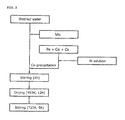
- the preparation process of the catalyst is shown in FIG. 1 .
- the triblock copolymer produced by BASF Corp.
- poly(ethylene glycol)-poly(propylene glycol)-poly(ethylene glycol) was dissolved in a 40°C hydrochloric acid solution, and tetraethylortho silicate (TEOS) was added to the solution and was stirred for one hour to prepare an emulsion.
- TEOS tetraethylortho silicate
- the emulsion was thermally treated at 40°C for 24 hours and at 100°C for 12 hours, to prepare a silica mixture solution.
- the silica mixture solution was filtered, washed with distilled water or ethanol and dried at 100°C to obtain a solid sample.
- the solid sample was baked in an electric furnace at 550°C for 5 hours and the prepared silica was added to the metal precursor solution using Cs as E in Formula 1 to prepare a composite oxide catalyst.
- cobalt nitrate Co(NO 3 ) 2 ⁇ 6H 2 O
- iron nitrate Fe(NO 3 ) 3 ⁇ 9H 2 O
- bismuth nitrate Ba(NO 3 ) 2 ⁇ 5H 2 O
- cesium nitrate CsNO 3
- ammonium molybdate ((NH 4 )6Mo 7 O 24 ⁇ 4H 2 O)
- bismuth nitrate, cesium nitrate, cobalt nitrate and iron nitrate were dissolved in an aqueous nitric acid solution and the solution was stirred to prepare an aqueous metal nitrate solution.
- ammonium molybdate was dissolved in distilled water in a double jacket reactor while maintaining 40°C, the aqueous metal nitrate solution was added to the solution while stirring and the resulting mixture was stirred at 40°C for one hour.
- the stirred solution was dried in a 120°C oven for 18 hours and then ground, and the mesoporous silica was added thereto to obtain a solid powder.
- the solid powder was kneaded with distilled water and alcohol, extrusion-molded into a pellet having a diameter of 6 mm, and a length of 6 mm, and the molded product was thermally treated at 450°C in an electric furnace for 7 hours to prepare a mesoporous composite metal oxide catalyst having a composition of 30wt% Mo 12 Bi 1 Fe 2 Co 5 Cs 0.10 O y + 70wt% SiO 2 and a mesoporous composite metal oxide catalyst having a composition of 60wt% Mo 12 Bi 1 Fe 2 Co 5 Cs 0.10 O y + 40wt% SiO 2 , respectively.
- the preparation process of the catalyst is shown in FIG. 2 .
- a metal catalyst using Cs as E in Formula 1 was prepared using cobalt nitrate (Co(NO 3 ) 2 ⁇ 6H 2 O), iron nitrate (Fe(NO 3 ) 3 ⁇ 9H 2 O), bismuth nitrate (Bi(NO 3 ) 2 ⁇ 5H 2 O), cesium nitrate (CsNO 3 ) and ammonium molybdate ((NH 4 ) 6 Mo 7 O 24 ⁇ 4H 2 O) by the following method.
- bismuth nitrate, cesium nitrate, cobalt nitrate and iron nitrate were dissolved in an aqueous nitric acid solution and the solution was stirred to prepare an aqueous metal nitrate solution.
- ammonium molybdate was dissolved in distilled water in a double jacket reactor while maintaining 40°C, the aqueous metal nitrate solution was added to the solution while stirring and the resulting mixture was stirred at 40°C for one hour.
- the stirred solution was dried in a 120°C oven for 18 hours and was ground, and a resulting powder was kneaded with distilled water and alcohol, extrusion-molded into a pellet having a diameter of 6 mm and a length of 6 mm, and the molded product was thermally treated at 450°C in an electric furnace for 7 hours to prepare a mesoporous composite metal oxide catalyst having a composition of Mo 12 Bi 1 Fe 2 Co 5 Cs 0.10 O y .
- the preparation process of the catalyst is shown in FIG. 3 .
- X-ray diffraction and ICP-AES results showed successful preparation of the catalysts obtained in Examples 1 to 2 and Comparative Example 1. From results of X-ray diffraction analysis, it was confirmed that the catalyst was obtained as a mixed phase of CoMoO 4 , (Co 0.7 Fe 0.3 )MoO 4 and Bi 2 Mo 3 O 12 , an element ratio of the catalyst prepared by ICP-AES was Mo:Bi:Fe:Co:Cs of 12:1: 2:5:0.1 when the element ratio was calculated as a relative ratio of other metal component to Bi.
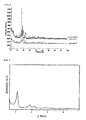
- Example 2 X-ray diffraction spectra of the 60wt% Mo 12 Bi 1 Fe 2 Co 5 Cs 0.10 O y + 40wt% SiO 2 catalyst corresponding to Example 2 prepared according to the present invention and the catalyst of Example 1 prepared by co-precipitation according to a conventional method are shown in FIG. 4 .
- X-ray diffraction analysis of the mesoporous composite oxide catalyst corresponding to Example 2 showed that the mesoporous composite oxide catalyst has peaks in the 2-theta range of 9.84 to 9.96, 13.02 to 13.20, 18.62 to 18.70, 23.18 to 23.26, 25.54 to 25.62, 26.38 to 26.46, 28.30 to 28.38, 32.00 to 32.08, 33.58 to 33.66, and 45.04 to 45.12 ( FIG. 4 ).
- the 2-theta peak ranges of the catalyst according to Example 2 are the same as the 2-theta ranges of 9.84 to 9.96, 13.02 to 13.20, 18.62 to 18.70, 23.18 to 23.26, 25.54 to 25.62, 26.38 to 26.46, 28.30 to 28.38, 32.00 to 32.08, 33.58 to 33.66, and 45.04 to 45.12 of the catalyst according to Comparative Example 1.
- Example 2 produced according to the present invention the same catalyst crystal phase as in Comparative Example 1 was successfully produced.
- MCM-41 has a structure in which cylindrical mesopores having a size of 2 to 50 nm satisfying the range defined according to IUPAC are three-dimensionally well arrayed and the spectrum of FIG. 5 corresponds to characteristic peaks thereof.
- the silica having an MCM-41 type of crystal structure prepared according to the flowchart shown in FIG. 1 exhibits peaks in the 2-theta range of 1.50 to 2.38, 3.40 to 3.89, and 4.12 to 4.51 upon small angle XRD ( FIG. 5 ).
- the surface area, the average pore volume and the average pore size of the MCM-41 type porous silica were calculated by BET, t-plot and BJH, respectively, based on adsorption isotherm of nitrogen.
- the porous silica had a surface area of 1,337 m 2 /g, an average pore volume of 1.4 cm 3 /g and an average pore size of 3.0 nm.
- the mesoporous composite metal oxide catalyst having a composition of 30wt% Mo 12 Bi 1 Fe 2 Co 5 Cs 0.10 O y + 70wt% SiO 2 prepared by adding the porous silica having the characteristics in Example 1, and a mesoporous composite metal oxide catalyst having a composition of 60wt% Mo 12 Bi 1 Fe 2 Co 5 Cs 0.10 O y + 40wt% SiO 2 had the surface area, the average pore volume and the average pore size as shown in the following Table 1.
- SBA-15 has a structure in which cylindrical mesopores having a size of 2 to 50 nm satisfying the range defined according to IUPAC are three-dimensionally well arrayed and the pores are connected to one another and the spectrum of FIG. 6 corresponds to characteristic peaks thereof.
- the silica having an SBA-15 type of crystal structure prepared according to the flowchart shown in FIG. 2 exhibits peaks in the 2-theta range of 0.60 to 1.18, 1.49 to 1.73, and 1.80 to 1.98 upon small angle XRD ( FIG. 6 ).
- the surface area, the average pore volume and the average pore size of the MCM-41 type porous silica were calculated by BET, t-plot and BJH, respectively, based on adsorption isotherm of nitrogen.
- the porous silica had a surface area of 880 m 2 /g, an average pore volume of 1.1 cm 3 /g and an average pore size of 5.0 nm.
- the mesoporous composite metal oxide catalyst having a composition of 30wt% Mo 12 Bi 1 Fe 2 Co 5 Cs 0.10 O y + 70wt% SiO 2 prepared by adding the porous silica having the characteristics in Example 2, and a mesoporous composite metal oxide catalyst having a composition of 60wt% Mo 12 Bi 1 Fe 2 Co 5 Cs 0.10 O y + 40wt% SiO 2 had the surface area, the average pore volume and the average pore size as shown in the following Table 2.
- Normal-butene was fed into the reactor together with oxygen, nitrogen and steam, a molar ratio of butane to oxygen to nitrogen to steam was set at 1:0.5:8:5 and space velocity (GHSV) was 250 h -1 based on normal-butene.
- GHSV space velocity
- a butane flow was controlled using a mass flow controller (MFC) for liquid, oxygen and nitrogen was fed using a mass flow controller for gas, and steam was injected using a liquid pump.
- the steam was injected as water using a vaporizer, vaporized at 200°C and was injected into the reactor as a mixture with other reactants, butene, oxygen and nitrogen.
- the catalyst was pre-treated at 400°C for 2 hours under an air atmosphere before injection of the reactant, the reactants were continuously injected into the catalyst layer while maintaining the reaction temperature at 320°C, and reaction proceeded. Then, the resulting product was analyzed by gas chromatography at an interval of 1 to 2 hours.
- the product flow contained, in addition to the target, 1,3-butadiene, carbon dioxide, carbon monooxide, C4 by-products, normal-butene, trans-2-butene, cis-2-butene, oxygen, nitrogen and the like.
- Conversion ratio % the number of moles of reacted normal - butene / the number of moles of supplied normal - butene x 100
- Selectivity % the number of moles of produced 1 , 3 - butadiene / the number of moles of reacted normal - butene x 100
- Yield % the number of moles of produced 1 , 3 - butadiene / the number of moles of supplied normal - butene x 100 TABLE 3 Types X(%) S_BD (%) Y(%) Hot spot (°C)
- Example 1 75.1 94.7 71.1 369
- Example 2 83.9 95.9 80.5 372 Comparative Example 3 70.3 92.1 64.7 362
- Examples 1 to 2 containing the porous silica according to the present invention exhibited improved conversion ratio of normal-butene, selectivity of 1,3-butadiene and yield, as compared to Comparative Example 1, the metal oxide catalyst containing no porous silica prepared by a conventional method.
- porous silica is substituted for a predetermined content or more, for example, 40 wt% or more, of the composite oxide catalyst for synthesizing 1,3-butadiene, and the amount of used metal was thus less than in the case of a conventional catalyst, thus providing economic efficiency capable of reducing preparation cost.
- the mesoporous composite metal oxide catalyst for synthesizing 1,3-butadiene having larger surface area and improved catalyst performance and economic efficiency than in the case of a conventional method can be obtained by introducing certain porous silica into preparation of catalyst for synthesizing 1,3-butadiene.
Landscapes
- Chemical & Material Sciences (AREA)
- Organic Chemistry (AREA)
- Engineering & Computer Science (AREA)
- Materials Engineering (AREA)
- Chemical Kinetics & Catalysis (AREA)
- Dispersion Chemistry (AREA)
- Crystallography & Structural Chemistry (AREA)
- Catalysts (AREA)
- Organic Low-Molecular-Weight Compounds And Preparation Thereof (AREA)
- Low-Molecular Organic Synthesis Reactions Using Catalysts (AREA)
- Silicates, Zeolites, And Molecular Sieves (AREA)
- Nanotechnology (AREA)
Abstract
Description
- The present invention relates to a mesoporous composite oxide catalyst, a method for preparing the same and a method for synthesizing 1,3-butadiene using the same. More particular, the present invention relates to a mesoporous composite oxide catalyst wherein a composite oxide catalyst with a large surface area is obtained by introducing certain porous silica into a multi-component bismuth-molybdate catalyst, to improve a conversion ratio of butane, and selectivity and yield of 1,3-butadiene, and provide economic efficiency, a method for preparing the same and a method for synthesizing 1,3-butadiene using the same.
- 1,3-butadiene is a representative raw material of synthetic rubbers and is one of major basic oils, the price of which sharply changes according to supply and demand situation in petrochemistry. Naphtha cracking, direct dehydrogenation of normal-butene, oxidative dehydrogenation of normal-butene and the like are used for preparation of 1,3-butadiene. Naphtha cracking for preparing 1,3-butadiene has an advantage of high price competitiveness as compared to other methods, but disadvantageously has difficulty in increasing production of only butadiene and requires large-scale investment for this purpose, because naphtha cracking is not a process for preparing only butadiene and thus relates to demand for ethylene and propylene. Advantageously, oxidative dehydrogenation of normal-butene is performed at a low temperature and reduces energy consumption because it is an exothermic reaction, unlike direct dehydrogenation, and inhibits production of carbon precipitates which poisons catalysts and thereby reduces lifespan of the catalysts, or removes the produced carbon precipitates due to addition of an oxidizing agent. Various types of metal oxides as the catalysts are used for oxidative dehydrogenation of normal-butene. In particular, bismuth-molybdate-based catalysts are known to exhibit superior catalyst activity. To increase pure bismuth-molybdate catalysts composed of only bismuth molybdenum oxide and activity thereof, multi-component bismuth-molybdate catalysts to which various metal components are added are actively researched. For example,
US Patent No. 6,921,831 discloses various examples of Qd[BiaPbbMocOy]eOx (Q=Cu, Au, V or a mixture thereof) catalysts,US Patent No. 8,003,840 which discloses a bismuth-molybdate catalyst containing an α phase and an y phase which are mixed each other, andUS Patent No. 8,367,885 discloses a Mo-Bi-Fe-Ni multi-component catalyst using these catalysts which has an n-butene conversion ratio of about 55 to about 65% and 1,3-butadiene yield of about 60% or less. - Co-precipitation is generally used in the preparation of the multi-component metal oxide catalyst such as bismuth-molybdate catalyst. The co-precipitation is a method of preparing catalysts by mixing two or more metal solutions under control of pH and inducing precipitation, which enables production of a powder with a high purity at a low cost due to simple process and is industrially inconvenient. However, pH and concentrations are changed as co-precipitation proceeds, thus making it difficult to obtain a powder having uniform and fine particles. In addition, a high baking temperature is required to form a crystal phase of the composite oxide catalyst, thus disadvantageously reducing the surface area of catalyst acting according to the mechanism of adsorption-reaction-desorption. Composite oxide catalysts formed of only metal oxide prepared by co-precipitation are known to generally have a surface area of 10 m2/g.
-
EP Patent No. 2,343,123 discloses multi-component bismuth-molybdate containing at least cobalt or nickel, in which particles of silica such as fumed silica are dispersed, in order to improve surface area. - However, there is a demand for continued research associated with composite oxide catalysts with a high surface area which improves conversion ratio of butene, as well as selectivity and yield of 1,3-butadiene and enhances economic efficiency.
- Therefore, the present invention has been made in view of the above problems, and the present invention obtains a high surface area by introduction of certain porous silica, thereby improving conversion ratio of butene, selectivity and yield of 1,3-butadiene and economic efficiency upon oxidative dehydrogenation of normal-butene.
- That is, it is one object of the present invention to provide a novel mesoporous composite oxide catalyst which has a high surface area, as a composite oxide catalyst for synthesizing 1,3-butadiene, by addition of silica having a certain porous structure and a method for preparing the same.
- It is another object of the present invention to provide a method for efficiently synthesizing 1,3-butadiene using the catalyst to improve conversion ratio of butene, and selectivity and yield of 1,3-butadiene upon oxidative dehydrogenation of normal-butene.
- In accordance with one aspect of the present invention, provided is a mesoporous composite oxide catalyst represented by the following Formula 1:
[Formula 1] (x%)MoaBibFecCodEeOy+(100-x)%SiO2
wherein E is at least one selected from Group I elements on the periodic table, a is 0.001 to 13, b, c, d and e are each independently 0.001 to 10, x is an integer of 1 to 99, and y is a value determined by other components for adjusting a valance,
wherein the mesoporous composite oxide catalyst has pores, an average pore volume of the pores is 0.01 to 2 cm3/g and an average pore size of the pores is 2 to 50 nm. - In accordance with another aspect of the present invention, provided is a method for preparing a mesoporous composite oxide catalyst, the method including:
- preparing a precursor mixture solution of Bi, Fe, Co and E in the following
Formula 1 and a precursor solution of Mo; - adding the precursor mixture solution to the Mo precursor solution, performing co-precipitation, mixing 99 to 1% by weight of a silica powder having an average pore volume, of 0.5 to 2 cm3/g, an average pore size of 2 to 10 nm and a surface area of 500 to 1,400 m2/g with 1 to 99% by weight of the co-precipitated solution, and drying the resulting mixture, to obtain a solid powder; and
- molding and baking the solid powder to obtain a mesoporous composite oxide catalyst represented by the following
Formula 1, including pores and having an average pore volume of 0.01 to 2 cm3/g and an average pore size of 2 to 50 nm.
[Formula 1] (x%)MoaBibFecCOdEeOy+(100-x) %SiO2
wherein E is at least one selected from Group I elements on the periodic table, a is 0.001 to 13, b, c, d and e are each independently 0.001 to 10, x is an integer of 1 to 99, and y is a value determined by other components for adjusting a valance. - In accordance with another aspect of the present invention, provided is a method for preparing a mesoporous composite oxide catalyst, the method including:
- preparing a precursor mixture solution of Bi, Fe, Co and E in the following
Formula 1 and a precursor solution of Mo; - adding the precursor mixture solution to the Mo precursor solution, followed by co-precipitating, drying and grinding;
- mixing 1 to 99% by weight of the co-precipitated and ground product with 99 to 1% by weight of a silica powder having an average pore volume of 0.5 to 2 cm3/g, an average pore size of 2 to 10 nm and a surface area of 500 to 1,400 m2/g to obtain a solid powder; and
- drying and baking the solid powder to obtain a mesoporous composite oxide catalyst represented by the following
Formula 1, including pores and having an average pore volume of 0.01 to 2 cm3/g and an average pore size of 2 to 50 nm.
[Formula 1] (x%) MOaBibFecCodEeOy+(100-x) %SiO2
wherein E is at least one selected from Group I elements on the periodic table, a is 0.001 to 13, b, c, d and e are each independently 0.001 to 10, x is an integer of 1 to 99, and y is a value determined by other components for adjusting a valance. - Furthermore, in accordance with another aspect of the present invention, provided is a method for synthesizing 1,3-butadiene by oxidative dehydrogenation of normal-butene using the mesoporous composite metal oxide catalyst as a catalyst.
- As apparent from the fore-going, the present invention advantageously provides a composite oxide catalyst with a large surface area for synthesizing 1,3-butadiene by introducing certain porous silica into a multi-component bismuth-molybdate catalyst, thereby improving a conversion ratio of butene, and selectivity and yield of 1,3-butadiene, and having economic efficiency from the viewpoint of decreasing an amount of used metal than conventional methods and thereby reducing catalyst production cost.
-
-
FIG. 1 is a flowchart illustrating a process of synthesizing a composite oxide catalyst containing silica having an MCM-41 type of crystal structure according to a first embodiment of the present invention; -
FIG. 2 is a flowchart illustrating a process of synthesizing a composite oxide catalyst containing silica having an SBA-15 type of crystal structure according to a second embodiment of the present invention; -
FIG. 3 is a flowchart illustrating a process of synthesizing a metal oxide catalyst by co-precipitation according to a conventional method; -
FIG. 4 is an X-ray diffraction spectrum of the metal oxide catalyst prepared according to the flowchart shown inFIG. 3 and the composite oxide catalyst prepared according to the flowchart shown inFIG. 2 and containing 40wt% of silica having an SBA-15 type of crystal structure; -
FIG. 5 is a small angle XRD spectrum of silica having an SBA-15 type of crystal structure prepared according to the flowchart shown inFIG. 1 ; and -
FIG. 6 is a small angle XRD spectrum of silica having an SBA-15 type of crystal structure prepared according to the flowchart shown inFIG. 2 . - Hereinafter, the present invention will be described in detail.
- The present invention provides a mesoporous composite oxide catalyst as a catalyst for synthesizing 1,3-butadiene.
- As used herein, the term "mesoporous composite oxide catalyst" refers to a structure in which a composite oxide catalyst is sufficiently introduced into support pores as well as on the surface of a silica support, unless otherwise mentioned.
- Specifically, the catalyst is represented by the following Formula 1:
[Formula 1] (x%)MoaBibFecCodEeOy+(100-x) %SiO2
wherein E is at least one selected from Group I elements on the periodic table, a is 0.001 to 13, b, c, d and e are each independently 0.001 to 10, x is an integer of 1 to 99, and y is a value determined by other components for adjusting a valance,
wherein the mesoporous composite oxide catalyst has pores, an average pore volume of the pores is 0.01 to 2 cm3/g and an average pore size of the pores is 2 to 50 nm. - In addition, the catalyst has a high surface area of 20 to 1,400 m2/g.
- In a specific example, the average pore volume of the pores in the catalyst is 0.01 to 1.5 cm3/g, the average pore size is 2 to 10 nm, and the catalyst has a high surface area of 50 to 900 m2/g.
- In another example, the average pore size of the pores in the catalyst is 0.03 to 1 cm3/g, the average pore size is 2 to 5 nm, and the catalyst has a high surface area of 83 to 879 m2/g.
- In
Formula 1, E comprises at least one of cesium (Cs) and rubidium (Rb). - In Formula 1, a is 1 to 12 or 8 to 12.
- In Formula 1, b, c, d and e are each independently 1 to 10 or 1 to 9.
- In
Formula 1, x is an integer of 1 to 90, or is an integer of 30 to 60. - For example, SiO2 has an average pore volume of 0.5 to 2 cm3/g or 1.1 to 1.4 cm3/g, an average pore size of 2 to 10 nm or 3 to 5 nm, and a surface area of 500 to 1,400 m2/g or 880 to 1,337 m2/g.
- In a specific example, SiO2 has an MCM-41 type of crystal structure and exhibits the spectrum of
FIG. 5 . For reference, the silica having an MCM-41 type of crystal structure has peaks in the 2-theta range of 1.50 to 2.38, 3.40 to 3.89, and 4.12 to 4.51 upon small angle XRD (FIG. 5 ). - In another example, SiO2 has an SBA-15 type of crystal structure and exhibits the spectrum of
FIG. 6 . For reference, the silica having an MCM-41 type of crystal structure has peaks in the 2-theta range of 0.60 to 1.18, 1.49 to 1.73, and 1.80 to 1.98 upon small angle XRD (FIG. 6 ). - The mesoporous composite metal oxide catalyst according to the present invention is for example prepared by the following method including:
- preparing a precursor mixture solution of Bi, Fe, Co and E in the following
Formula 1 and a precursor solution of Mo; - adding the precursor mixture solution to the Mo precursor solution, performing co-precipitation, mixing 99 to 1% by weight of a silica powder having an average pore volume of 0.5 to 2 cm3/g, an average pore size of 2 to 10 nm and a surface area of 500 to 1,400 m2/g with 1 to 99% by weight of the co-precipitated solution, and drying the resulting mixture, to obtain a solid powder; and
- molding and baking the solid powder to obtain a mesoporous composite oxide catalyst represented by the following
Formula 1, including pores and having an average pore volume of 0.01 to 2 cm3/g and an average pore size of 2 to 50 nm.
[Formula 1] (x%) MoaBibFecCodEeOy+(100-x) %SiO2
- wherein E is at least one selected from Group I elements on the periodic table, a is 0.001 to 13, b, c, d and e are each independently 0.001 to 10, x is an integer of 1 to 99, and y is a value determined by other components for adjusting a valance.
- In another embodiment, the mesoporous composite metal oxide catalyst according to the present invention is prepared by the following method including:
- preparing a precursor mixture solution of Bi, Fe, Co and E in the following
Formula 1 and a precursor solution of Mo; - adding the precursor mixture solution to the Mo precursor solution, followed by co-precipitating, drying and grinding;
- mixing 1 to 99% by weight of the co-precipitated and ground product with 99 to 1% by weight of a silica powder having an average pore volume of the pores, of 0.5 to 2 cm3/g, an average pore size of 2 to 10 nm and a surface area of 500 to 1,400 m2/g; and
- drying and baking the solid powder to obtain a mesoporous composite oxide catalyst represented by the following
Formula 1, including pores and having an average pore volume of 0.01 to 2 cm3/g and an average pore size of 2 to 50 nm. - For example, the silica powder is prepared by adding a silica source to a basic aqueous solution, in which a cationic surfactant is dispersed, or an acidic aqueous solution, in which a block copolymer is dispersed, and subjecting the resulting solution to heat or pressure treatment.
- The silica obtained by drying and baking the heat- or pressure-treated solution is added to a metal precursor solution, followed by drying and baking, to obtain a mesoporous composite oxide catalyst. In addition, the average pore size of the mesoporous silica can be increased to 2 to 50 nm or more by controlling heat treatment temperature and heat treatment time or adding an expander such as trimethyl benzene (TMB).
- The composite metal oxide catalyst according to the present invention is obtained by mixing metal oxide, which is prepared by co-precipitation and obtained by baking, with mesoporous silica, but the preparation method is not limited thereto.
- In a specific example, the silica powder may have an MCM-41 type of crystal structure formed by stirring a cationic surfactant solution with the silica source to prepare a solution, thermally treating the solution at 333K to 373K, controlling a pH of the solution, and drying and baking the solution.
- The cationic surfactant solution for example comprises at least one selected from cetyltrimethylammonium bromide, cetyltrimethylammonium chloride, decyltrimethylammonium bromide, decyltrimethylammonium chloride, hexadecyltrimethylammonium bromide, and hexadecyltrimethylammonium chloride.
- The silica source may have a reactive group which is condensed with the surfactant and may for example comprise at least one selected from tetramethylorthosilicate, tetraethylorthosilicate and sodium silicate.
- The cationic surfactant and the silica are present in a molar ratio of surfactant:silica=1:2 to 1:10. For example, the molar ratio of cationic surfactant to silica may be 1:5.
- In another example, the silica powder may have a SBA type of crystal structure formed by stirring a block copolymer solution with a silica source to prepare a solution, thermally treating the solution at 333K to 373K, and drying and baking the solution.
- The block copolymer may be a block copolymer containing an ethylene glycol block and a propylene glycol block and may for example comprise at least one of a diblock copolymer of an ethylene glycol block and a propylene glycol block, and a triblock copolymer containing an ethylene glycol block, a propylene glycol block and an ethylene glycol block.
- The silica source may be selected from types described above.
- The block copolymer and the silica are used in a molar ratio of 1:40 to 1:80. For example, the molar ratio of the block copolymer to the silica may be 1:65.
- In the present invention, drying is for example carried out at 323K to 473K.
- In addition, in the present invention, baking is for example carried out at 673K to 873K.
- In addition, the heat- or pressure-treated silica mixture solution is dried and baked before use, but the present invention is not limited thereto.
- The metal precursor solution may be a nitrate salt, an ammonium salt or the like.
- For example, in
Formula 1, when cesium is selected as an E component, cesium, cobalt, iron and bismuth precursors are simultaneously dissolved in distilled water, a molybdenum precursor is separately dissolved in distilled water and the precursor mixture solution is then mixed with the molybdenum precursor solution. In order to increase solubility of the respective precursors, an acidic solution (for example, nitric acid) or the like may be added. When the precursors are completely dissolved, a precursor solution containing cesium, cobalt, iron and bismuth is added to the precursor solution containing molybdenum and metal components are then co-precipitated. The co-precipitated solution is stirred for 0.5 to 24 hours, preferably, 1 to 2 hours for sufficient stirring. - The mesoporous silica is added to the stirred solution, and the resulting mixture is dried at 323K to 473K for 12 to 24 hours to remove moisture and other liquid components and thereby obtain a solid sample. The solid sample thus obtained is molded into a hollow, pellet or sphere form and thermally treated in an electric furnace at a temperature of 673K to 873K to prepare a composite oxide catalyst, but the present invention is not limited thereto. The composite oxide catalyst may be prepared by mixing the mesoporous silica with the dried sample of the stirred solution during molding, but the present invention is not limited thereto.
- The catalyst may be applied to oxidative dehydrogenation of normal-butene, but the present invention is not limited thereto. Specifically, 1,3-butadiene can be synthesized by oxidative dehydrogenation of normal-butene using the catalyst described above.
- According to the present invention, normal-butene as a reactant is adsorbed onto a catalyst, oxygen in the catalyst lattice is reacted with two hydrogen of butene to produce 1,3-butadiene and water, and the reaction proceeds in a way that an oxygen molecule as the reactant fills the vacant oxygen position of the catalyst lattice.
- The oxidative dehydrogenation is carried out by reacting a reactant containing normal-butene, oxygen, nitrogen and steam in a molar ratio of 1 : 0.5 to 2 : 2 to 20 : 5 to 20 using the catalyst at a reaction temperature of 250 to 350°C and at a space velocity of 50 to 5,000 h-1, based on butene.
- For example, the reaction temperature and the space velocity are within the range of 280 to 330°C and 50 to 1000 h-1, based on butane, respectively.
- In addition, the oxidative dehydrogenation is carried out by charging the catalyst as a fixed bed in a shell-tube reactor including a multiple fixed tube and being provided at an outside thereof with a heat medium circulation unit and continuously passing the reactant through the catalyst layer.
- For example, the oxidative dehydrogenation is carried out using a shell-tube reactor including a multiple fixed tube filled with 1,000 to 2,000 cc of the catalyst and being provided at an outside thereof with a heat medium circulation unit.
- The method for synthesizing 1,3-butadiene according to the present invention may include charging the composite oxide catalyst prepared according to the preparation method as a fixed bed; performing oxidative dehydrogenation of a reactant containing a butene-containing C4 mixture, oxygen, nitrogen and steam while continuously passing the reactant through the catalyst layer of the reactor to obtain a dehydrogenation product mixture; and purification of separating 1,3-butadiene from the dehydrogenation product mixture. The method may further include recycling the reactant, if necessary.
- For example, the obtained 1,3-butadiene may be subjected to purification including quenching, compression, absorbance, degassing and separation of butadiene. Specifically, water and heavy ingredients are removed from the product discharged from the reactor by quenching and the resulting product is subjected to the absorbance process through compression at a pressure appropriate for absorbance.
- In the absorbance process, 1,3-butadiene is absorbed using a solvent and is separated from nitrogen, oxygen and COx. In the degassing process, gas and by-products absorbed together with the solvent are removed. Finally, 1,3-butadiene is separated from the solvent by separation of the butadiene based on the difference in physical properties. If necessary, the method may further include circulating the starting material of the respective steps.
- Hereinafter, the present invention will be described in detail with reference to examples, but the examples should not be construed as limiting the scope and spirit of the present invention.
- For preparation of porous silica, cetyltrimethylammonium bromide (CTABr) as a surfactant was dissolved in 60°C distilled water, a sodium silicate solution was added to the solution at a stoichlometric ratio of 0.12 Na2O:0.5 SiO2:0.1 CTABr:30 H2O, and was stirred at 60°C for one hour to prepare an emulsion.
- The emulsion was thermally treated at 100°C for 48 hours, and pH changed as synthesis processed was titrated with an aqueous nitric acidic solution or an aqueous hydrochloric acidic solution to maintain
pH 10, thereby preparing a silica mixture solution containing silica. The silica mixture solution was filtered, washed with distilled water or ethanol and dried at 100°C to obtain a solid sample. - The solid sample was baked in an electric furnace at 550°C for 5 hours and the prepared silica was added to the metal precursor solution using Cs as E in
Formula 1 to prepare a composite oxide catalyst. - For reference, as the metal precursors, cobalt nitrate (Co(NO3)2·6H2O), iron nitrate (Fe(NO3)3·9H2O), bismuth nitrate (Bi(NO3)2·5H2O), cesium nitrate (CsNO3) and ammonium molybdate ((NH4)6Mo7O24·4H2O) were used.
- Specifically, bismuth nitrate, cesium nitrate, cobalt nitrate and iron nitrate were dissolved in an aqueous nitric acid solution and the solution was stirred to prepare an aqueous metal nitrate solution.
- Separately, ammonium molybdate was dissolved in distilled water in a double jacket reactor while maintaining 40°C, the aqueous metal nitrate solution was added to the solution while stirring and the resulting mixture was stirred at 40°C for one hour.
- The stirred solution was dried in a 120°C oven for 18 hours and then ground, and the mesoporous silica was added thereto to obtain a solid powder. The solid powder was kneaded with distilled water and alcohol, extrusion-molded into a pellet having a diameter of 6 mm, and a length of 6 mm, and the molded product was thermally treated at 450°C in an electric furnace for 7 hours to prepare a mesoporous composite metal oxide catalyst having a composition of 30wt% Mo12Bi1Fe2Co5Cs0.10Oy + 70wt% SiO2 and a mesoporous composite metal oxide catalyst having a composition of 60wt% Mo12Bi1Fe2Co5Cs0.10Oy + 40wt% SiO2, respectively. The preparation process of the catalyst is shown in
FIG. 1 . - For preparation of porous silica, the triblock copolymer (produced by BASF Corp.) of poly(ethylene glycol)-poly(propylene glycol)-poly(ethylene glycol) was dissolved in a 40°C hydrochloric acid solution, and tetraethylortho silicate (TEOS) was added to the solution and was stirred for one hour to prepare an emulsion.
- The emulsion was thermally treated at 40°C for 24 hours and at 100°C for 12 hours, to prepare a silica mixture solution. The silica mixture solution was filtered, washed with distilled water or ethanol and dried at 100°C to obtain a solid sample.
- The solid sample was baked in an electric furnace at 550°C for 5 hours and the prepared silica was added to the metal precursor solution using Cs as E in
Formula 1 to prepare a composite oxide catalyst. - For reference, as the metal precursors, cobalt nitrate (Co(NO3)2·6H2O), iron nitrate (Fe(NO3)3·9H2O), bismuth nitrate (Bi(NO3)2·5H2O), cesium nitrate (CsNO3) and ammonium molybdate ((NH4)6Mo7O24·4H2O) were used.
- Specifically, bismuth nitrate, cesium nitrate, cobalt nitrate and iron nitrate were dissolved in an aqueous nitric acid solution and the solution was stirred to prepare an aqueous metal nitrate solution.
- Separately, ammonium molybdate was dissolved in distilled water in a double jacket reactor while maintaining 40°C, the aqueous metal nitrate solution was added to the solution while stirring and the resulting mixture was stirred at 40°C for one hour.
- The stirred solution was dried in a 120°C oven for 18 hours and then ground, and the mesoporous silica was added thereto to obtain a solid powder. The solid powder was kneaded with distilled water and alcohol, extrusion-molded into a pellet having a diameter of 6 mm, and a length of 6 mm, and the molded product was thermally treated at 450°C in an electric furnace for 7 hours to prepare a mesoporous composite metal oxide catalyst having a composition of 30wt% Mo12Bi1Fe2Co5Cs0.10Oy + 70wt% SiO2 and a mesoporous composite metal oxide catalyst having a composition of 60wt% Mo12Bi1Fe2Co5Cs0.10Oy + 40wt% SiO2, respectively. The preparation process of the catalyst is shown in
FIG. 2 . - A metal catalyst using Cs as E in
Formula 1 was prepared using cobalt nitrate (Co(NO3)2·6H2O), iron nitrate (Fe(NO3)3·9H2O), bismuth nitrate (Bi(NO3)2·5H2O), cesium nitrate (CsNO3) and ammonium molybdate ((NH4)6Mo7O24·4H2O) by the following method. - Specifically, bismuth nitrate, cesium nitrate, cobalt nitrate and iron nitrate were dissolved in an aqueous nitric acid solution and the solution was stirred to prepare an aqueous metal nitrate solution.
- Separately, ammonium molybdate was dissolved in distilled water in a double jacket reactor while maintaining 40°C, the aqueous metal nitrate solution was added to the solution while stirring and the resulting mixture was stirred at 40°C for one hour.
- The stirred solution was dried in a 120°C oven for 18 hours and was ground, and a resulting powder was kneaded with distilled water and alcohol, extrusion-molded into a pellet having a diameter of 6 mm and a length of 6 mm, and the molded product was thermally treated at 450°C in an electric furnace for 7 hours to prepare a mesoporous composite metal oxide catalyst having a composition of Mo12Bi1Fe2Co5Cs0.10Oy. The preparation process of the catalyst is shown in
FIG. 3 . - X-ray diffraction and ICP-AES results showed successful preparation of the catalysts obtained in Examples 1 to 2 and Comparative Example 1. From results of X-ray diffraction analysis, it was confirmed that the catalyst was obtained as a mixed phase of CoMoO4, (Co0.7Fe0.3)MoO4 and Bi2Mo3O12, an element ratio of the catalyst prepared by ICP-AES was Mo:Bi:Fe:Co:Cs of 12:1: 2:5:0.1 when the element ratio was calculated as a relative ratio of other metal component to Bi.
- For example, X-ray diffraction spectra of the 60wt% Mo12Bi1Fe2Co5Cs0.10Oy + 40wt% SiO2 catalyst corresponding to Example 2 prepared according to the present invention and the catalyst of Example 1 prepared by co-precipitation according to a conventional method are shown in
FIG. 4 . For reference, X-ray diffraction analysis of the mesoporous composite oxide catalyst corresponding to Example 2 showed that the mesoporous composite oxide catalyst has peaks in the 2-theta range of 9.84 to 9.96, 13.02 to 13.20, 18.62 to 18.70, 23.18 to 23.26, 25.54 to 25.62, 26.38 to 26.46, 28.30 to 28.38, 32.00 to 32.08, 33.58 to 33.66, and 45.04 to 45.12 (FIG. 4 ). - For reference, as shown in
FIG. 4 , the 2-theta peak ranges of the catalyst according to Example 2 are the same as the 2-theta ranges of 9.84 to 9.96, 13.02 to 13.20, 18.62 to 18.70, 23.18 to 23.26, 25.54 to 25.62, 26.38 to 26.46, 28.30 to 28.38, 32.00 to 32.08, 33.58 to 33.66, and 45.04 to 45.12 of the catalyst according to Comparative Example 1. This means that, in Example 2 produced according to the present invention, the same catalyst crystal phase as in Comparative Example 1 was successfully produced. - As a result of small angle XRD analysis of the mesoporous silica prepared for addition to the catalyst in Example 1 (the 2-theta value at an X axis in the spectrum is 5 degrees or less; small angle XRD), a crystal structure of MCM-41, which was a type of mesoporous silica prepared under the basic atmosphere using CTABr as a surfactant, was observed. This spectrum is shown in
FIG. 5 . - For reference, MCM-41 has a structure in which cylindrical mesopores having a size of 2 to 50 nm satisfying the range defined according to IUPAC are three-dimensionally well arrayed and the spectrum of
FIG. 5 corresponds to characteristic peaks thereof. The silica having an MCM-41 type of crystal structure prepared according to the flowchart shown inFIG. 1 exhibits peaks in the 2-theta range of 1.50 to 2.38, 3.40 to 3.89, and 4.12 to 4.51 upon small angle XRD (FIG. 5 ). - In addition, the surface area, the average pore volume and the average pore size of the MCM-41 type porous silica were calculated by BET, t-plot and BJH, respectively, based on adsorption isotherm of nitrogen. As a result, the porous silica had a surface area of 1,337 m2/g, an average pore volume of 1.4 cm3/g and an average pore size of 3.0 nm.
- The mesoporous composite metal oxide catalyst having a composition of 30wt% Mo12Bi1Fe2Co5Cs0.10Oy + 70wt% SiO2 prepared by adding the porous silica having the characteristics in Example 1, and a mesoporous composite metal oxide catalyst having a composition of 60wt% Mo12Bi1Fe2Co5Cs0.10Oy + 40wt% SiO2 had the surface area, the average pore volume and the average pore size as shown in the following Table 1.
TABLE 1 Catalyst Surface area Average pore volume Average pore size [m2/g] [cm3/g] [nm] 30wt% MoBiFeCoCs + 70wt% MCM-41 870 1.0 2.9 60wt% MoBiFeCoCs + 40wt% MCM-41 83 0.3 2.0 - As a result of small angle XRD of the silica prepared for addition to the catalyst in Example 2, a crystal structure of an SBA-15 type which was mesoporous silica prepared under the acidic atmosphere using a block copolymer was observed. This spectrum is shown in
FIG. 6 . - For reference, SBA-15 has a structure in which cylindrical mesopores having a size of 2 to 50 nm satisfying the range defined according to IUPAC are three-dimensionally well arrayed and the pores are connected to one another and the spectrum of
FIG. 6 corresponds to characteristic peaks thereof. The silica having an SBA-15 type of crystal structure prepared according to the flowchart shown inFIG. 2 exhibits peaks in the 2-theta range of 0.60 to 1.18, 1.49 to 1.73, and 1.80 to 1.98 upon small angle XRD (FIG. 6 ). - In addition, the surface area, the average pore volume and the average pore size of the MCM-41 type porous silica were calculated by BET, t-plot and BJH, respectively, based on adsorption isotherm of nitrogen. As a result, the porous silica had a surface area of 880 m2/g, an average pore volume of 1.1 cm3/g and an average pore size of 5.0 nm.
- The mesoporous composite metal oxide catalyst having a composition of 30wt% Mo12Bi1Fe2Co5Cs0.10Oy + 70wt% SiO2 prepared by adding the porous silica having the characteristics in Example 2, and a mesoporous composite metal oxide catalyst having a composition of 60wt% Mo12Bi1Fe2Co5Cs0.10Oy + 40wt% SiO2 had the surface area, the average pore volume and the average pore size as shown in the following Table 2.
TABLE 2 Catalyst Surface area Average pore volume Average pore size [m2/g] [cm3/g] [nm] 30wt% MoBiFeCoCs + 70wt% SBA-15 619 1.0 5.0 60wt% MoBiFeCoCs + 40wt% SBA-15 141 0.5 4.3 - Meanwhile, physical properties of the metal oxide catalyst prepared according to a conventional method in Comparative Example 1 by nitrogen adsorption like as in Examples 1 to 2 were measured. As a result, it was found that the surface area was 3.3 m2/g, the average pore volume was 0.01 cm3/g, and the average pore size was 39 nm.
- 75 mL of the 60 wt% MoBiFeCoCs + 40 wt% SiO2 mesoporous composite metal oxide catalyst obtained in Examples 1 and 2 and 75 mL of the composite metal oxide catalyst obtained in Comparative Example 1 were charged in a metal tubular reactor as a fixed bed and catalyst activity of the catalysts were measured.
- Normal-butene was fed into the reactor together with oxygen, nitrogen and steam, a molar ratio of butane to oxygen to nitrogen to steam was set at 1:0.5:8:5 and space velocity (GHSV) was 250 h-1 based on normal-butene.
- A butane flow was controlled using a mass flow controller (MFC) for liquid, oxygen and nitrogen was fed using a mass flow controller for gas, and steam was injected using a liquid pump. The steam was injected as water using a vaporizer, vaporized at 200°C and was injected into the reactor as a mixture with other reactants, butene, oxygen and nitrogen.
- The catalyst was pre-treated at 400°C for 2 hours under an air atmosphere before injection of the reactant, the reactants were continuously injected into the catalyst layer while maintaining the reaction temperature at 320°C, and reaction proceeded. Then, the resulting product was analyzed by gas chromatography at an interval of 1 to 2 hours.
- The product flow contained, in addition to the target, 1,3-butadiene, carbon dioxide, carbon monooxide, C4 by-products, normal-butene, trans-2-butene, cis-2-butene, oxygen, nitrogen and the like.
- Normal-conversion ratio of butene (X), selectivity (S_BD) of 1,3-butadiene and yield (Y) were calculated. Obtained results are shown in the following Table 3 and conversion ratio (X), selectivity (S_BD) and yield (Y) in Table 3 are calculated by the following
Equations 


TABLE 3 Types X(%) S_BD (%) Y(%) Hot spot (°C) Example 1 75.1 94.7 71.1 369 Example 2 83.9 95.9 80.5 372 Comparative Example 3 70.3 92.1 64.7 362 - As can be seen from Table 3 above, Examples 1 to 2 containing the porous silica according to the present invention exhibited improved conversion ratio of normal-butene, selectivity of 1,3-butadiene and yield, as compared to Comparative Example 1, the metal oxide catalyst containing no porous silica prepared by a conventional method.
- Furthermore, in Examples 1 to 2 according to the present invention, certain porous silica is substituted for a predetermined content or more, for example, 40 wt% or more, of the composite oxide catalyst for synthesizing 1,3-butadiene, and the amount of used metal was thus less than in the case of a conventional catalyst, thus providing economic efficiency capable of reducing preparation cost.
- Consequently, it can be seen that the mesoporous composite metal oxide catalyst for synthesizing 1,3-butadiene having larger surface area and improved catalyst performance and economic efficiency than in the case of a conventional method can be obtained by introducing certain porous silica into preparation of catalyst for synthesizing 1,3-butadiene.
Claims (15)
- A mesoporous composite oxide catalyst represented by the following Formula 1:
[Formula 1] (x%) MoaBibFecCodEeOy+(100-x) %SiO2
wherein E is at least one selected from Group I elements on the periodic table, a is 0.001 to 13, b, c, d and e are each independently 0.001 to 10, x is an integer of 1 to 99, and y is a value determined by other components for adjusting a valance,
wherein the mesoporous composite oxide catalyst has pores, an average pore volume of the pores is 0.01 to 2 cm3/g and an average pore size is 2 to 50 nm. - The mesoporous composite oxide catalyst according to claim 1, wherein the catalyst has a surface area of 20 to 1,400 m2/g.
- The mesoporous composite oxide catalyst according to claim 1, wherein x is an integer of 30 to 60.
- The mesoporous composite oxide catalyst according to claim 1, wherein SiO2 has an average pore volume of 0.5 to 2 cm3/g, an average pore size of 2 to 10 nm, and a surface area of 500 to 1,400 m2/g.
- The mesoporous composite oxide catalyst according to claim 4, wherein SiO2 has an MCM-41 type of crystal structure and has peaks in the 2-theta range of 1.50 to 2.38, 3.40 to 3.89, and 4.12 to 4.51 upon small angle XRD.
- The mesoporous composite oxide catalyst according to claim 4, wherein SiO2 has an SBA-15 type of crystal structure and has peaks in the 2-theta range of 0.60 to 1.18, 1.49 to 1.73, and 1.80 to 1.98 upon small angle XRD.
- A method for preparing a mesoporous composite oxide catalyst, the method comprising:preparing a precursor mixture solution of Bi, Fe, Co and E in the following Formula 1 and a precursor solution of Mo;adding the precursor mixture solution to the Mo precursor solution, performing co-precipitation, mixing 99 to 1% by weight of a silica powder having an average pore volume of 0.5 to 2 cm3/g, an average pore size of 2 to 10 nm and a surface area of 500 to 1,400 m2/g with 1 to 99% by weight of the co-precipitated solution, and drying the resulting mixture, to obtain a solid powder; andmolding and baking the solid powder to obtain a mesoporous composite oxide catalyst represented by the following Formula 1, including pores and having an average pore volume of 0.01 to 2 cm3/g and an average pore size of 2 to 50 nm.
[Formula 1] (x%) MoaBibFecCodEeOy+(100-x) %SiO2
wherein E is at least one selected from Group I elements on the periodic table, a is 0.001 to 13, b, c, d and e are each independently 0.001 to 10, x is an integer of 1 to 99, and y is a value determined by other components for adjusting a valance. - A method for preparing a mesoporous composite oxide catalyst, the method comprising:preparing a precursor mixture solution of Bi, Fe, Co and E in the following Formula 1 and a precursor solution of Mo;adding the precursor mixture solution to the Mo precursor solution, followed by co-precipitating, drying and grinding;mixing 1 to 99% by weight of the co-precipitated and ground product with 99 to 1% by weight of a silica powder having an average pore volume of 0.5 to 2 cm3/g, an average pore size of 2 to 10 nm and a surface area of 500 to 1,400 m2/g; anddrying and baking the solid powder to obtain a mesoporous composite oxide catalyst represented by the following Formula 1, including pores and having an average pore volume of 0.01 to 2 cm3/g and an average pore size of 2 to 50 nm.
[Formula 1] (x%)MoaBibFecCodEeOy+(100-x) %SiO2
wherein E is at least one selected from Group I elements on the periodic table, a is 0.001 to 13, b, c, d and e are each independently 0.001 to 10, x is an integer of 1 to 99, and y is a value determined by other components for adjusting a valance. - The method according to claim 7 or 8, wherein the silica powder is prepared by adding a silica source to a basic aqueous solution in which a cationic surfactant is dispersed, or an acidic aqueous solution in which a block copolymer is dispersed and treating the mixture solution with heat or pressure.
- The method according to claim 7 or 8, wherein the silica powder has an MCM-41 type of crystal structure by thermally treating a stirred solution of the cationic surfactant solution and the silica source at 333K to 373K, followed by controlling pH, drying and baking.
- The method according to claim 7 or 8, wherein the silica powder has a SBA type of crystal structure by thermally treating a stirred solution of the block copolymer solution and the silica source at 333K to 373K, followed by drying and baking.
- The method according to claim 7 or 8, wherein the drying is carried out at 323K to 473K.
- The method according to claim 7 or 8, wherein the baking is carried out at 673K to 873K.
- A method for synthesizing 1,3-butadiene by oxidative dehydrogenation of normal-butene using the mesoporous composite metal oxide catalyst according to any one of claims 1 to 6 as a catalyst.
- The method according to claim 14, wherein the oxidative dehydrogenation is carried out by reacting a reactant containing normal-butene, oxygen, nitrogen and steam of 1 : 0.5 to 2 : 2 to 20 : 5 to 20 at a molar ratio using the catalyst at a reaction temperature of 250 to 350°C and at a space velocity of 50 to 5,000 h-1.
Applications Claiming Priority (3)
| Application Number | Priority Date | Filing Date | Title |
|---|---|---|---|
| KR20130050408 | 2013-05-06 | ||
| KR1020140052496A KR101507686B1 (en) | 2013-05-06 | 2014-04-30 | Mesoporous complex oxide catalyst, method for preparing the catalyst, and method for preparing 1,3-butadiene using thereof |
| PCT/KR2014/003950 WO2014182018A1 (en) | 2013-05-06 | 2014-05-02 | Mesoporous mixed oxide catalyst, method for preparing same and method for synthesizing 1,3-butadiene using same |
Publications (3)
| Publication Number | Publication Date |
|---|---|
| EP2862626A1 true EP2862626A1 (en) | 2015-04-22 |
| EP2862626A4 EP2862626A4 (en) | 2016-05-04 |
| EP2862626B1 EP2862626B1 (en) | 2024-03-27 |
Family
ID=52453108
Family Applications (1)
| Application Number | Title | Priority Date | Filing Date |
|---|---|---|---|
| EP14795346.7A Active EP2862626B1 (en) | 2013-05-06 | 2014-05-02 | Mesoporous mixed oxide catalyst, method for preparing same and method for synthesizing 1,3-butadiene using same |
Country Status (6)
| Country | Link |
|---|---|
| US (1) | US9782765B2 (en) |
| EP (1) | EP2862626B1 (en) |
| JP (1) | JP5907637B2 (en) |
| KR (2) | KR101507686B1 (en) |
| CN (1) | CN104519995B (en) |
| WO (1) | WO2014182018A1 (en) |
Cited By (1)
| Publication number | Priority date | Publication date | Assignee | Title |
|---|---|---|---|---|
| WO2017009665A1 (en) * | 2015-07-16 | 2017-01-19 | Johnson Matthey Public Limited Company | Process for the preparation of butadiene from butenes by oxidative dehydrogenation |
Families Citing this family (16)
| Publication number | Priority date | Publication date | Assignee | Title |
|---|---|---|---|---|
| KR101716552B1 (en) * | 2014-12-03 | 2017-03-14 | 주식회사 엘지화학 | Multi-component complex metal oxides catalyst, method for preparing the same, and method for preparing 1,3-butadiene using the same |
| KR101747501B1 (en) * | 2014-12-05 | 2017-06-14 | 주식회사 엘지화학 | Complex oxide catalyst for manufacturing butadiene and method for preparing the same |
| KR101714127B1 (en) * | 2014-12-11 | 2017-03-08 | 주식회사 엘지화학 | Metal complex oxide catalyst for producing butadiene and preparation method thereof |
| US20180071721A1 (en) * | 2015-03-03 | 2018-03-15 | Nippon Kayaku Kabushiki Kaisha | Catalyst for conjugated diolefin production and method for producing same |
| CN106881098B (en) * | 2015-12-15 | 2019-08-09 | 上海华谊新材料有限公司 | Composite oxide catalysts and its preparation method and application |
| CN105413695B (en) * | 2015-12-22 | 2018-09-25 | 中国科学院山西煤炭化学研究所 | A kind of ethanol condensed catalyst and preparation method and application for preparing 1,3- butadiene |
| JP6579010B2 (en) * | 2016-03-23 | 2019-09-25 | 三菱ケミカル株式会社 | Composite oxide catalyst and method for producing conjugated diene |
| CN107138147B (en) * | 2017-04-18 | 2020-04-24 | 南昌大学 | Method for preparing high specific surface area stannic oxide catalyst by using mesoporous silicon dioxide as hard template |
| US10407363B2 (en) | 2017-08-16 | 2019-09-10 | Saudi Arabian Oil Company | Steam-less process for converting butenes to 1,3-butadiene |
| WO2019131890A1 (en) * | 2017-12-27 | 2019-07-04 | 積水化学工業株式会社 | Catalyst and method for producing same, and method for producing diene compound using said catalyst |
| CN111250097A (en) * | 2018-11-30 | 2020-06-09 | 中国石油化工股份有限公司 | Non-noble metal isobutane dehydrogenation catalyst with spherical mesoporous silica as carrier and preparation method and application thereof |
| CN111250144A (en) * | 2018-11-30 | 2020-06-09 | 中国石油化工股份有限公司 | Non-noble metal propane dehydrogenation catalyst with modified spherical mesoporous silica as carrier and preparation method and application thereof |
| CN111330563B (en) * | 2020-03-25 | 2022-12-06 | 杭州楚环科技股份有限公司 | A kind of ordered mesoporous carbon-titanium oxide composite catalyst and preparation method thereof |
| KR102700718B1 (en) | 2020-07-14 | 2024-08-28 | 주식회사 엘지화학 | Ammoxidation catalyst for propylene, manufacturing method of the same catalyst, ammoxidation methode using the same catalyst |
| CN113289670B (en) * | 2021-04-14 | 2022-11-08 | 中山大学 | Catalyst for preparing 1,3-butadiene and preparation method thereof |
| CN115155553A (en) * | 2022-08-03 | 2022-10-11 | 辽宁大学 | Preparation method of amorphous aluminosilicate solid acid catalyst and its application in catalyzing γ-valerolactone decarboxylation to produce butene |
Family Cites Families (20)
| Publication number | Priority date | Publication date | Assignee | Title |
|---|---|---|---|---|
| DE69109746T2 (en) * | 1990-06-06 | 1995-10-26 | Mitsui Toatsu Chemicals | Process for the production of acrolein or methacrolein. |
| JP3142549B2 (en) * | 1990-09-10 | 2001-03-07 | 三菱レイヨン株式会社 | Iron / antimony / molybdenum-containing oxide catalyst composition and method for producing the same |
| US5143707A (en) * | 1991-07-24 | 1992-09-01 | Mobil Oil Corporation | Selective catalytic reduction (SCR) of nitrogen oxides |
| CN1034853C (en) * | 1992-01-24 | 1997-05-14 | 北京大学 | Loading type butadiene catalyst made by butylene oxidation dehydrogen |
| KR19980039168U (en) | 1996-12-20 | 1998-09-15 | 양재신 | Car parking brake safety device |
| WO2003039744A1 (en) * | 2001-11-08 | 2003-05-15 | Mitsubishi Chemical Corporation | Composite oxide catalyst and method for preparation thereof |
| CN101066528B (en) * | 2001-11-08 | 2010-09-29 | 三菱化学株式会社 | Composite oxide catalyst and preparation method thereof |
| US6921831B2 (en) | 2002-01-18 | 2005-07-26 | E. I. Du Pont De Nemours And Company | Modified BiMo catalyst and process for use thereof |
| JP4676887B2 (en) * | 2006-01-16 | 2011-04-27 | 三菱レイヨン株式会社 | Method for producing α, β-unsaturated carboxylic acid, catalyst therefor and method for producing the same |
| KR101170177B1 (en) | 2006-04-18 | 2012-07-31 | 에스케이종합화학 주식회사 | Bismuth molybdate-based catalysts, method of preparing thereof and method of preparing 1,3-Butadiene using thereof |
| EP1930074A1 (en) | 2006-12-08 | 2008-06-11 | Robert Prof. Dr. Schlögl | Novel mesoporous mixed metal oxide catalyst and method for the preparation thereof |
| JP2008221203A (en) * | 2007-02-13 | 2008-09-25 | Babcock Hitachi Kk | Nitrogen oxide removing catalyst and nitrogen oxide removing method |
| KR100932373B1 (en) | 2007-05-30 | 2009-12-16 | 에스케이에너지 주식회사 | Method for preparing multicomponent bismuth molybdate catalyst according to pH change and method for preparing 1,3-butadiene using the catalyst |
| JP5075043B2 (en) * | 2007-08-08 | 2012-11-14 | トヨタ自動車株式会社 | Method for producing catalyst carrier |
| US8178468B2 (en) | 2008-04-10 | 2012-05-15 | Shell Oil Company | Catalysts, preparation of such catalysts, methods of using such catalysts, products obtained in such methods and uses of products obtained |
| KR20120026049A (en) * | 2009-05-29 | 2012-03-16 | 미쓰비시 가가꾸 가부시키가이샤 | Method for producing conjugated diene |
| JP2011148720A (en) * | 2010-01-20 | 2011-08-04 | Mitsui Chemicals Inc | Method for producing butadiene |
| US8546634B2 (en) * | 2010-09-29 | 2013-10-01 | Asahi Kasei Chemicals Corporation | Method for production of conjugated diolefin |
| JP5794862B2 (en) | 2011-08-24 | 2015-10-14 | 旭化成ケミカルズ株式会社 | Oxides containing molybdenum, bismuth, iron and cobalt |
| CN102627519B (en) * | 2012-03-28 | 2014-09-10 | 清华大学 | Method and system for preparing butadiene |
-
2014
- 2014-04-30 KR KR1020140052496A patent/KR101507686B1/en active Active
- 2014-05-02 US US14/418,027 patent/US9782765B2/en active Active
- 2014-05-02 EP EP14795346.7A patent/EP2862626B1/en active Active
- 2014-05-02 CN CN201480002027.2A patent/CN104519995B/en active Active
- 2014-05-02 JP JP2015521565A patent/JP5907637B2/en active Active
- 2014-05-02 WO PCT/KR2014/003950 patent/WO2014182018A1/en not_active Ceased
-
2015
- 2015-02-06 KR KR1020150018607A patent/KR101796821B1/en active Active
Cited By (3)
| Publication number | Priority date | Publication date | Assignee | Title |
|---|---|---|---|---|
| WO2017009665A1 (en) * | 2015-07-16 | 2017-01-19 | Johnson Matthey Public Limited Company | Process for the preparation of butadiene from butenes by oxidative dehydrogenation |
| GB2548427A (en) * | 2015-07-16 | 2017-09-20 | Johnson Matthey Plc | Process |
| GB2548427B (en) * | 2015-07-16 | 2018-03-21 | Johnson Matthey Plc | Improved alkene dehydrogenation process |
Also Published As
| Publication number | Publication date |
|---|---|
| KR20140131872A (en) | 2014-11-14 |
| US9782765B2 (en) | 2017-10-10 |
| JP5907637B2 (en) | 2016-04-26 |
| KR20150024373A (en) | 2015-03-06 |
| US20150151292A1 (en) | 2015-06-04 |
| CN104519995A (en) | 2015-04-15 |
| EP2862626B1 (en) | 2024-03-27 |
| KR101507686B1 (en) | 2015-03-31 |
| CN104519995B (en) | 2016-11-23 |
| WO2014182018A1 (en) | 2014-11-13 |
| EP2862626A4 (en) | 2016-05-04 |
| JP2015527192A (en) | 2015-09-17 |
| KR101796821B1 (en) | 2017-11-13 |
Similar Documents
| Publication | Publication Date | Title |
|---|---|---|
| EP2862626B1 (en) | Mesoporous mixed oxide catalyst, method for preparing same and method for synthesizing 1,3-butadiene using same | |
| Li et al. | The synthesis of glycerol carbonate from glycerol and CO 2 over La 2 O 2 CO 3–ZnO catalysts | |
| EP2177266A2 (en) | The complex oxide catalyst of Bi/Mo/Fe for the oxidative dehydrogenation of 1-butene to 1,3-Butadiene and process thereof | |
| KR101701973B1 (en) | Method for preparing ferrite metal oxide catalyst | |
| KR101338637B1 (en) | Single-step Precipitation Method of Producing Magnesia-zirconia Mixed Carrier for Catalyst for Oxidative Dehydrogenation of n-Butane, Magnesium Orthovanadate Catalyst Supported on Magnesia-zirconia Mixed Carrier, and Method of Producing n-Butene and 1,3-Butadiene Using Said Catalyst | |
| KR101337301B1 (en) | Aluminosilicate Nano-spheres having 3-Dimensional Open Pores, Method for Preparing the Same and Method for Producing Acrylic Acid from Glycerol Using the Same | |
| KR101716552B1 (en) | Multi-component complex metal oxides catalyst, method for preparing the same, and method for preparing 1,3-butadiene using the same | |
| KR20160006594A (en) | High performance poly-oxometalate catalyst and method for producing the same | |
| JP5906167B2 (en) | Metal oxide catalyst, method for producing the same, and method for producing alkadiene | |
| EP3072586A1 (en) | Bismuth molybdate-based catalyst having zeolite coating layer, method for producing same, and method for preparing 1,3-butadiene using same | |
| Boz et al. | WO3-based porous MCM-48 catalysts for renewable acrolein synthesis by the dehydration of glycerol | |
| KR102079734B1 (en) | Ferrite catalyst for oxidative dehydrogenation, method for preparing the same and method of preparing butadiene using the same | |
| KR101148505B1 (en) | Improved synthesis of severely sterically hindered amino-ether alcohols and diaminopolyalkenyl ethers using a high activity powder catalyst | |
| KR101973614B1 (en) | Method of preparing catalyst for oxidative dehydrogenation | |
| KR20190005521A (en) | Method for preparing catalyst for oxidative dehydrogenation reaction and method for preparing butadiene using the same catalyst | |
| Lee et al. | Effects of metal cation on the skeletal isomerization of 1-butene over clinoptilolite | |
| EP3673993B1 (en) | Catalyst for oxidative dehydrogenation reaction of butene and production method therefor | |
| Ouchabi et al. | Effects of NiMoO4 impregnation on the catalytic activity of Cu3 (PO4) 2 in the conversion of isopropanol | |
| Dai et al. | Soft-templating synthesis of mesoporous MgSiO composites with high surface areas as solid base catalysts for efficient synthesis of dimethyl carbonate via transesterification | |
| KR20180092090A (en) | Method for preparing metal oxide catalyst and method for preparing acrylonitrile using the same | |
| KR102299904B1 (en) | Binder-mixtured catalyst for oxidative dehydrogenation reaction, method for preparing the same catalyst and method for preparing butadiene | |
| POPA et al. | SYNTHESIS AND CHARACTERIZATION OF A CATALYST FORMED BY DIRECT INCORPORATION OF SOME HETEROPOLYACIDS INTO MESOPOROUS MATERIALS | |
| KR20170138854A (en) | Oxidative dehydrogenation catalyst, method for manufacturing catalyst and method for manufacturing propylene | |
| KR20170079302A (en) | Method for preparing multi-component ferrite metal oxide catalyst | |
| JP2008229511A (en) | Catalyst for producing dimethyl ether, method for producing the same, and method for producing dimethyl ether using the same |
Legal Events
| Date | Code | Title | Description |
|---|---|---|---|
| PUAI | Public reference made under article 153(3) epc to a published international application that has entered the european phase |
Free format text: ORIGINAL CODE: 0009012 |
|
| 17P | Request for examination filed |
Effective date: 20150119 |
|
| AK | Designated contracting states |
Kind code of ref document: A1 Designated state(s): AL AT BE BG CH CY CZ DE DK EE ES FI FR GB GR HR HU IE IS IT LI LT LU LV MC MK MT NL NO PL PT RO RS SE SI SK SM TR |
|
| AX | Request for extension of the european patent |
Extension state: BA ME |
|
| RA4 | Supplementary search report drawn up and despatched (corrected) |
Effective date: 20160404 |
|
| RIC1 | Information provided on ipc code assigned before grant |
Ipc: B01J 37/03 20060101ALI20160329BHEP Ipc: B01J 23/887 20060101ALI20160329BHEP Ipc: C07C 11/167 20060101ALI20160329BHEP Ipc: B01J 23/00 20060101ALI20160329BHEP Ipc: B01J 23/76 20060101ALI20160329BHEP Ipc: B01J 23/28 20060101AFI20160329BHEP Ipc: B01J 23/31 20060101ALI20160329BHEP |
|
| DAX | Request for extension of the european patent (deleted) | ||
| STAA | Information on the status of an ep patent application or granted ep patent |
Free format text: STATUS: EXAMINATION IS IN PROGRESS |
|
| 17Q | First examination report despatched |
Effective date: 20180723 |
|
| GRAP | Despatch of communication of intention to grant a patent |
Free format text: ORIGINAL CODE: EPIDOSNIGR1 |
|
| STAA | Information on the status of an ep patent application or granted ep patent |
Free format text: STATUS: GRANT OF PATENT IS INTENDED |
|
| INTG | Intention to grant announced |
Effective date: 20240105 |
|
| GRAS | Grant fee paid |
Free format text: ORIGINAL CODE: EPIDOSNIGR3 |
|
| GRAA | (expected) grant |
Free format text: ORIGINAL CODE: 0009210 |
|
| STAA | Information on the status of an ep patent application or granted ep patent |
Free format text: STATUS: THE PATENT HAS BEEN GRANTED |
|
| AK | Designated contracting states |
Kind code of ref document: B1 Designated state(s): AL AT BE BG CH CY CZ DE DK EE ES FI FR GB GR HR HU IE IS IT LI LT LU LV MC MK MT NL NO PL PT RO RS SE SI SK SM TR |
|
| REG | Reference to a national code |
Ref country code: GB Ref legal event code: FG4D |
|
| REG | Reference to a national code |
Ref country code: CH Ref legal event code: EP |
|
| REG | Reference to a national code |
Ref country code: DE Ref legal event code: R096 Ref document number: 602014089787 Country of ref document: DE |
|
| REG | Reference to a national code |
Ref country code: IE Ref legal event code: FG4D |
|
| PG25 | Lapsed in a contracting state [announced via postgrant information from national office to epo] |
Ref country code: LT Free format text: LAPSE BECAUSE OF FAILURE TO SUBMIT A TRANSLATION OF THE DESCRIPTION OR TO PAY THE FEE WITHIN THE PRESCRIBED TIME-LIMIT Effective date: 20240327 |
|
| REG | Reference to a national code |
Ref country code: LT Ref legal event code: MG9D |
|
| PG25 | Lapsed in a contracting state [announced via postgrant information from national office to epo] |
Ref country code: GR Free format text: LAPSE BECAUSE OF FAILURE TO SUBMIT A TRANSLATION OF THE DESCRIPTION OR TO PAY THE FEE WITHIN THE PRESCRIBED TIME-LIMIT Effective date: 20240628 |
|
| PG25 | Lapsed in a contracting state [announced via postgrant information from national office to epo] |
Ref country code: RS Free format text: LAPSE BECAUSE OF FAILURE TO SUBMIT A TRANSLATION OF THE DESCRIPTION OR TO PAY THE FEE WITHIN THE PRESCRIBED TIME-LIMIT Effective date: 20240627 Ref country code: HR Free format text: LAPSE BECAUSE OF FAILURE TO SUBMIT A TRANSLATION OF THE DESCRIPTION OR TO PAY THE FEE WITHIN THE PRESCRIBED TIME-LIMIT Effective date: 20240327 |
|
| PG25 | Lapsed in a contracting state [announced via postgrant information from national office to epo] |
Ref country code: RS Free format text: LAPSE BECAUSE OF FAILURE TO SUBMIT A TRANSLATION OF THE DESCRIPTION OR TO PAY THE FEE WITHIN THE PRESCRIBED TIME-LIMIT Effective date: 20240627 Ref country code: NO Free format text: LAPSE BECAUSE OF FAILURE TO SUBMIT A TRANSLATION OF THE DESCRIPTION OR TO PAY THE FEE WITHIN THE PRESCRIBED TIME-LIMIT Effective date: 20240627 Ref country code: LT Free format text: LAPSE BECAUSE OF FAILURE TO SUBMIT A TRANSLATION OF THE DESCRIPTION OR TO PAY THE FEE WITHIN THE PRESCRIBED TIME-LIMIT Effective date: 20240327 Ref country code: HR Free format text: LAPSE BECAUSE OF FAILURE TO SUBMIT A TRANSLATION OF THE DESCRIPTION OR TO PAY THE FEE WITHIN THE PRESCRIBED TIME-LIMIT Effective date: 20240327 Ref country code: GR Free format text: LAPSE BECAUSE OF FAILURE TO SUBMIT A TRANSLATION OF THE DESCRIPTION OR TO PAY THE FEE WITHIN THE PRESCRIBED TIME-LIMIT Effective date: 20240628 Ref country code: FI Free format text: LAPSE BECAUSE OF FAILURE TO SUBMIT A TRANSLATION OF THE DESCRIPTION OR TO PAY THE FEE WITHIN THE PRESCRIBED TIME-LIMIT Effective date: 20240327 Ref country code: BG Free format text: LAPSE BECAUSE OF FAILURE TO SUBMIT A TRANSLATION OF THE DESCRIPTION OR TO PAY THE FEE WITHIN THE PRESCRIBED TIME-LIMIT Effective date: 20240327 |
|
| REG | Reference to a national code |
Ref country code: NL Ref legal event code: MP Effective date: 20240327 |
|
| PG25 | Lapsed in a contracting state [announced via postgrant information from national office to epo] |
Ref country code: SE Free format text: LAPSE BECAUSE OF FAILURE TO SUBMIT A TRANSLATION OF THE DESCRIPTION OR TO PAY THE FEE WITHIN THE PRESCRIBED TIME-LIMIT Effective date: 20240327 Ref country code: LV Free format text: LAPSE BECAUSE OF FAILURE TO SUBMIT A TRANSLATION OF THE DESCRIPTION OR TO PAY THE FEE WITHIN THE PRESCRIBED TIME-LIMIT Effective date: 20240327 |
|
| PG25 | Lapsed in a contracting state [announced via postgrant information from national office to epo] |
Ref country code: NL Free format text: LAPSE BECAUSE OF FAILURE TO SUBMIT A TRANSLATION OF THE DESCRIPTION OR TO PAY THE FEE WITHIN THE PRESCRIBED TIME-LIMIT Effective date: 20240327 |
|
| REG | Reference to a national code |
Ref country code: AT Ref legal event code: MK05 Ref document number: 1669400 Country of ref document: AT Kind code of ref document: T Effective date: 20240327 |
|
| PG25 | Lapsed in a contracting state [announced via postgrant information from national office to epo] |
Ref country code: NL Free format text: LAPSE BECAUSE OF FAILURE TO SUBMIT A TRANSLATION OF THE DESCRIPTION OR TO PAY THE FEE WITHIN THE PRESCRIBED TIME-LIMIT Effective date: 20240327 |
|
| PG25 | Lapsed in a contracting state [announced via postgrant information from national office to epo] |
Ref country code: IS Free format text: LAPSE BECAUSE OF FAILURE TO SUBMIT A TRANSLATION OF THE DESCRIPTION OR TO PAY THE FEE WITHIN THE PRESCRIBED TIME-LIMIT Effective date: 20240727 |
|
| PG25 | Lapsed in a contracting state [announced via postgrant information from national office to epo] |
Ref country code: PT Free format text: LAPSE BECAUSE OF FAILURE TO SUBMIT A TRANSLATION OF THE DESCRIPTION OR TO PAY THE FEE WITHIN THE PRESCRIBED TIME-LIMIT Effective date: 20240729 Ref country code: SM Free format text: LAPSE BECAUSE OF FAILURE TO SUBMIT A TRANSLATION OF THE DESCRIPTION OR TO PAY THE FEE WITHIN THE PRESCRIBED TIME-LIMIT Effective date: 20240327 |
|
| PG25 | Lapsed in a contracting state [announced via postgrant information from national office to epo] |
Ref country code: ES Free format text: LAPSE BECAUSE OF FAILURE TO SUBMIT A TRANSLATION OF THE DESCRIPTION OR TO PAY THE FEE WITHIN THE PRESCRIBED TIME-LIMIT Effective date: 20240327 |
|
| PG25 | Lapsed in a contracting state [announced via postgrant information from national office to epo] |
Ref country code: EE Free format text: LAPSE BECAUSE OF FAILURE TO SUBMIT A TRANSLATION OF THE DESCRIPTION OR TO PAY THE FEE WITHIN THE PRESCRIBED TIME-LIMIT Effective date: 20240327 Ref country code: CZ Free format text: LAPSE BECAUSE OF FAILURE TO SUBMIT A TRANSLATION OF THE DESCRIPTION OR TO PAY THE FEE WITHIN THE PRESCRIBED TIME-LIMIT Effective date: 20240327 |
|
| PG25 | Lapsed in a contracting state [announced via postgrant information from national office to epo] |
Ref country code: AT Free format text: LAPSE BECAUSE OF FAILURE TO SUBMIT A TRANSLATION OF THE DESCRIPTION OR TO PAY THE FEE WITHIN THE PRESCRIBED TIME-LIMIT Effective date: 20240327 |
|
| PG25 | Lapsed in a contracting state [announced via postgrant information from national office to epo] |
Ref country code: PL Free format text: LAPSE BECAUSE OF FAILURE TO SUBMIT A TRANSLATION OF THE DESCRIPTION OR TO PAY THE FEE WITHIN THE PRESCRIBED TIME-LIMIT Effective date: 20240327 |
|
| PG25 | Lapsed in a contracting state [announced via postgrant information from national office to epo] |
Ref country code: SK Free format text: LAPSE BECAUSE OF FAILURE TO SUBMIT A TRANSLATION OF THE DESCRIPTION OR TO PAY THE FEE WITHIN THE PRESCRIBED TIME-LIMIT Effective date: 20240327 |
|
| PG25 | Lapsed in a contracting state [announced via postgrant information from national office to epo] |
Ref country code: SM Free format text: LAPSE BECAUSE OF FAILURE TO SUBMIT A TRANSLATION OF THE DESCRIPTION OR TO PAY THE FEE WITHIN THE PRESCRIBED TIME-LIMIT Effective date: 20240327 Ref country code: SK Free format text: LAPSE BECAUSE OF FAILURE TO SUBMIT A TRANSLATION OF THE DESCRIPTION OR TO PAY THE FEE WITHIN THE PRESCRIBED TIME-LIMIT Effective date: 20240327 Ref country code: RO Free format text: LAPSE BECAUSE OF FAILURE TO SUBMIT A TRANSLATION OF THE DESCRIPTION OR TO PAY THE FEE WITHIN THE PRESCRIBED TIME-LIMIT Effective date: 20240327 Ref country code: PT Free format text: LAPSE BECAUSE OF FAILURE TO SUBMIT A TRANSLATION OF THE DESCRIPTION OR TO PAY THE FEE WITHIN THE PRESCRIBED TIME-LIMIT Effective date: 20240729 Ref country code: PL Free format text: LAPSE BECAUSE OF FAILURE TO SUBMIT A TRANSLATION OF THE DESCRIPTION OR TO PAY THE FEE WITHIN THE PRESCRIBED TIME-LIMIT Effective date: 20240327 Ref country code: IS Free format text: LAPSE BECAUSE OF FAILURE TO SUBMIT A TRANSLATION OF THE DESCRIPTION OR TO PAY THE FEE WITHIN THE PRESCRIBED TIME-LIMIT Effective date: 20240727 Ref country code: ES Free format text: LAPSE BECAUSE OF FAILURE TO SUBMIT A TRANSLATION OF THE DESCRIPTION OR TO PAY THE FEE WITHIN THE PRESCRIBED TIME-LIMIT Effective date: 20240327 Ref country code: EE Free format text: LAPSE BECAUSE OF FAILURE TO SUBMIT A TRANSLATION OF THE DESCRIPTION OR TO PAY THE FEE WITHIN THE PRESCRIBED TIME-LIMIT Effective date: 20240327 Ref country code: CZ Free format text: LAPSE BECAUSE OF FAILURE TO SUBMIT A TRANSLATION OF THE DESCRIPTION OR TO PAY THE FEE WITHIN THE PRESCRIBED TIME-LIMIT Effective date: 20240327 Ref country code: AT Free format text: LAPSE BECAUSE OF FAILURE TO SUBMIT A TRANSLATION OF THE DESCRIPTION OR TO PAY THE FEE WITHIN THE PRESCRIBED TIME-LIMIT Effective date: 20240327 |
|
| PG25 | Lapsed in a contracting state [announced via postgrant information from national office to epo] |
Ref country code: IT Free format text: LAPSE BECAUSE OF FAILURE TO SUBMIT A TRANSLATION OF THE DESCRIPTION OR TO PAY THE FEE WITHIN THE PRESCRIBED TIME-LIMIT Effective date: 20240327 |
|
| REG | Reference to a national code |
Ref country code: CH Ref legal event code: PL |
|
| PG25 | Lapsed in a contracting state [announced via postgrant information from national office to epo] |
Ref country code: IT Free format text: LAPSE BECAUSE OF FAILURE TO SUBMIT A TRANSLATION OF THE DESCRIPTION OR TO PAY THE FEE WITHIN THE PRESCRIBED TIME-LIMIT Effective date: 20240327 |
|
| REG | Reference to a national code |
Ref country code: DE Ref legal event code: R097 Ref document number: 602014089787 Country of ref document: DE |
|
| PG25 | Lapsed in a contracting state [announced via postgrant information from national office to epo] |
Ref country code: MC Free format text: LAPSE BECAUSE OF FAILURE TO SUBMIT A TRANSLATION OF THE DESCRIPTION OR TO PAY THE FEE WITHIN THE PRESCRIBED TIME-LIMIT Effective date: 20240327 |
|
| PG25 | Lapsed in a contracting state [announced via postgrant information from national office to epo] |
Ref country code: DK Free format text: LAPSE BECAUSE OF FAILURE TO SUBMIT A TRANSLATION OF THE DESCRIPTION OR TO PAY THE FEE WITHIN THE PRESCRIBED TIME-LIMIT Effective date: 20240327 |
|
| PG25 | Lapsed in a contracting state [announced via postgrant information from national office to epo] |
Ref country code: LU Free format text: LAPSE BECAUSE OF NON-PAYMENT OF DUE FEES Effective date: 20240502 |
|
| PG25 | Lapsed in a contracting state [announced via postgrant information from national office to epo] |
Ref country code: MC Free format text: LAPSE BECAUSE OF FAILURE TO SUBMIT A TRANSLATION OF THE DESCRIPTION OR TO PAY THE FEE WITHIN THE PRESCRIBED TIME-LIMIT Effective date: 20240327 Ref country code: LU Free format text: LAPSE BECAUSE OF NON-PAYMENT OF DUE FEES Effective date: 20240502 Ref country code: DK Free format text: LAPSE BECAUSE OF FAILURE TO SUBMIT A TRANSLATION OF THE DESCRIPTION OR TO PAY THE FEE WITHIN THE PRESCRIBED TIME-LIMIT Effective date: 20240327 Ref country code: CH Free format text: LAPSE BECAUSE OF NON-PAYMENT OF DUE FEES Effective date: 20240531 |
|
| PLBE | No opposition filed within time limit |
Free format text: ORIGINAL CODE: 0009261 |
|
| STAA | Information on the status of an ep patent application or granted ep patent |
Free format text: STATUS: NO OPPOSITION FILED WITHIN TIME LIMIT |
|
| REG | Reference to a national code |
Ref country code: BE Ref legal event code: MM Effective date: 20240531 |
|
| 26N | No opposition filed |
Effective date: 20250103 |
|
| PG25 | Lapsed in a contracting state [announced via postgrant information from national office to epo] |
Ref country code: IE Free format text: LAPSE BECAUSE OF NON-PAYMENT OF DUE FEES Effective date: 20240502 |
|
| PG25 | Lapsed in a contracting state [announced via postgrant information from national office to epo] |
Ref country code: SI Free format text: LAPSE BECAUSE OF FAILURE TO SUBMIT A TRANSLATION OF THE DESCRIPTION OR TO PAY THE FEE WITHIN THE PRESCRIBED TIME-LIMIT Effective date: 20240327 Ref country code: BE Free format text: LAPSE BECAUSE OF NON-PAYMENT OF DUE FEES Effective date: 20240531 |
|
| PGFP | Annual fee paid to national office [announced via postgrant information from national office to epo] |
Ref country code: DE Payment date: 20250422 Year of fee payment: 12 |
|
| PGFP | Annual fee paid to national office [announced via postgrant information from national office to epo] |
Ref country code: FR Payment date: 20250422 Year of fee payment: 12 |
|
| PG25 | Lapsed in a contracting state [announced via postgrant information from national office to epo] |
Ref country code: CY Free format text: LAPSE BECAUSE OF FAILURE TO SUBMIT A TRANSLATION OF THE DESCRIPTION OR TO PAY THE FEE WITHIN THE PRESCRIBED TIME-LIMIT; INVALID AB INITIO Effective date: 20140502 |
|
| PG25 | Lapsed in a contracting state [announced via postgrant information from national office to epo] |
Ref country code: HU Free format text: LAPSE BECAUSE OF FAILURE TO SUBMIT A TRANSLATION OF THE DESCRIPTION OR TO PAY THE FEE WITHIN THE PRESCRIBED TIME-LIMIT; INVALID AB INITIO Effective date: 20140502 |
|
| PGFP | Annual fee paid to national office [announced via postgrant information from national office to epo] |
Ref country code: GB Payment date: 20260324 Year of fee payment: 13 |