EP2862607A1 - Method for preparing concentrated aqueous solution of organic compound - Google Patents
Method for preparing concentrated aqueous solution of organic compound Download PDFInfo
- Publication number
- EP2862607A1 EP2862607A1 EP20130806641 EP13806641A EP2862607A1 EP 2862607 A1 EP2862607 A1 EP 2862607A1 EP 20130806641 EP20130806641 EP 20130806641 EP 13806641 A EP13806641 A EP 13806641A EP 2862607 A1 EP2862607 A1 EP 2862607A1
- Authority
- EP
- European Patent Office
- Prior art keywords
- concentration
- aqueous solution
- organic compound
- mass
- raw material
- Prior art date
- Legal status (The legal status is an assumption and is not a legal conclusion. Google has not performed a legal analysis and makes no representation as to the accuracy of the status listed.)
- Granted
Links
- 239000007864 aqueous solution Substances 0.000 title claims abstract description 564
- 150000002894 organic compounds Chemical class 0.000 title claims abstract description 332
- 238000000034 method Methods 0.000 title claims description 94
- XLYOFNOQVPJJNP-UHFFFAOYSA-N water Substances O XLYOFNOQVPJJNP-UHFFFAOYSA-N 0.000 claims abstract description 37
- 230000018044 dehydration Effects 0.000 claims description 175
- 238000006297 dehydration reaction Methods 0.000 claims description 175
- 238000000889 atomisation Methods 0.000 claims description 171
- 125000004432 carbon atom Chemical group C* 0.000 claims description 28
- 125000003178 carboxy group Chemical group [H]OC(*)=O 0.000 claims description 25
- 125000002887 hydroxy group Chemical group [H]O* 0.000 claims description 25
- 238000011084 recovery Methods 0.000 claims description 21
- 125000003277 amino group Chemical group 0.000 claims description 13
- 238000004519 manufacturing process Methods 0.000 claims description 11
- 125000002915 carbonyl group Chemical group [*:2]C([*:1])=O 0.000 claims description 10
- 230000001678 irradiating effect Effects 0.000 claims description 10
- 125000004036 acetal group Chemical group 0.000 claims description 7
- 125000001976 hemiacetal group Chemical group 0.000 claims description 7
- 125000001273 sulfonato group Chemical group [O-]S(*)(=O)=O 0.000 claims description 7
- 150000005846 sugar alcohols Polymers 0.000 claims description 6
- ABLZXFCXXLZCGV-UHFFFAOYSA-N Phosphorous acid Chemical group OP(O)=O ABLZXFCXXLZCGV-UHFFFAOYSA-N 0.000 claims description 5
- QGZKDVFQNNGYKY-UHFFFAOYSA-O ammonium group Chemical group [NH4+] QGZKDVFQNNGYKY-UHFFFAOYSA-O 0.000 claims description 5
- 125000002467 phosphate group Chemical group [H]OP(=O)(O[H])O[*] 0.000 claims description 5
- 125000003368 amide group Chemical group 0.000 claims description 3
- 125000001951 carbamoylamino group Chemical group C(N)(=O)N* 0.000 claims description 3
- 125000004185 ester group Chemical group 0.000 claims description 3
- 125000001033 ether group Chemical group 0.000 claims description 3
- 239000002994 raw material Substances 0.000 description 374
- PEDCQBHIVMGVHV-UHFFFAOYSA-N Glycerine Chemical compound OCC(O)CO PEDCQBHIVMGVHV-UHFFFAOYSA-N 0.000 description 276
- 229940126062 Compound A Drugs 0.000 description 168
- NLDMNSXOCDLTTB-UHFFFAOYSA-N Heterophylliin A Natural products O1C2COC(=O)C3=CC(O)=C(O)C(O)=C3C3=C(O)C(O)=C(O)C=C3C(=O)OC2C(OC(=O)C=2C=C(O)C(O)=C(O)C=2)C(O)C1OC(=O)C1=CC(O)=C(O)C(O)=C1 NLDMNSXOCDLTTB-UHFFFAOYSA-N 0.000 description 165
- 239000007788 liquid Substances 0.000 description 57
- JVTAAEKCZFNVCJ-UHFFFAOYSA-N lactic acid Chemical compound CC(O)C(O)=O JVTAAEKCZFNVCJ-UHFFFAOYSA-N 0.000 description 56
- SRBFZHDQGSBBOR-IOVATXLUSA-N D-xylopyranose Chemical compound O[C@@H]1COC(O)[C@H](O)[C@H]1O SRBFZHDQGSBBOR-IOVATXLUSA-N 0.000 description 38
- 239000003595 mist Substances 0.000 description 35
- 230000000052 comparative effect Effects 0.000 description 30
- 239000004310 lactic acid Substances 0.000 description 28
- 235000014655 lactic acid Nutrition 0.000 description 28
- DNIAPMSPPWPWGF-UHFFFAOYSA-N monopropylene glycol Natural products CC(O)CO DNIAPMSPPWPWGF-UHFFFAOYSA-N 0.000 description 21
- WQZGKKKJIJFFOK-GASJEMHNSA-N Glucose Natural products OC[C@H]1OC(O)[C@H](O)[C@@H](O)[C@@H]1O WQZGKKKJIJFFOK-GASJEMHNSA-N 0.000 description 19
- PYMYPHUHKUWMLA-UHFFFAOYSA-N arabinose Natural products OCC(O)C(O)C(O)C=O PYMYPHUHKUWMLA-UHFFFAOYSA-N 0.000 description 19
- SRBFZHDQGSBBOR-UHFFFAOYSA-N beta-D-Pyranose-Lyxose Natural products OC1COC(O)C(O)C1O SRBFZHDQGSBBOR-UHFFFAOYSA-N 0.000 description 19
- 239000008103 glucose Substances 0.000 description 19
- 235000013772 propylene glycol Nutrition 0.000 description 19
- DNIAPMSPPWPWGF-GSVOUGTGSA-N (R)-(-)-Propylene glycol Chemical compound C[C@@H](O)CO DNIAPMSPPWPWGF-GSVOUGTGSA-N 0.000 description 18
- NOEGNKMFWQHSLB-UHFFFAOYSA-N 5-hydroxymethylfurfural Chemical compound OCC1=CC=C(C=O)O1 NOEGNKMFWQHSLB-UHFFFAOYSA-N 0.000 description 12
- 238000010438 heat treatment Methods 0.000 description 12
- -1 hydroxy aldehyde Chemical class 0.000 description 12
- RJGBSYZFOCAGQY-UHFFFAOYSA-N hydroxymethylfurfural Natural products COC1=CC=C(C=O)O1 RJGBSYZFOCAGQY-UHFFFAOYSA-N 0.000 description 12
- 238000001704 evaporation Methods 0.000 description 10
- 235000001014 amino acid Nutrition 0.000 description 8
- 230000008020 evaporation Effects 0.000 description 8
- 239000012159 carrier gas Substances 0.000 description 7
- 238000009692 water atomization Methods 0.000 description 7
- KRKNYBCHXYNGOX-UHFFFAOYSA-N citric acid Chemical compound OC(=O)CC(O)(C(O)=O)CC(O)=O KRKNYBCHXYNGOX-UHFFFAOYSA-N 0.000 description 6
- 229910052799 carbon Inorganic materials 0.000 description 5
- 238000010586 diagram Methods 0.000 description 5
- 238000002474 experimental method Methods 0.000 description 5
- 150000001261 hydroxy acids Chemical class 0.000 description 5
- DHMQDGOQFOQNFH-UHFFFAOYSA-N Glycine Chemical compound NCC(O)=O DHMQDGOQFOQNFH-UHFFFAOYSA-N 0.000 description 4
- 150000001413 amino acids Chemical class 0.000 description 4
- ARCGXLSVLAOJQL-UHFFFAOYSA-N trimellitic acid Chemical compound OC(=O)C1=CC=C(C(O)=O)C(C(O)=O)=C1 ARCGXLSVLAOJQL-UHFFFAOYSA-N 0.000 description 4
- LYCAIKOWRPUZTN-UHFFFAOYSA-N Ethylene glycol Chemical compound OCCO LYCAIKOWRPUZTN-UHFFFAOYSA-N 0.000 description 3
- OFOBLEOULBTSOW-UHFFFAOYSA-N Malonic acid Chemical compound OC(=O)CC(O)=O OFOBLEOULBTSOW-UHFFFAOYSA-N 0.000 description 3
- OKKJLVBELUTLKV-UHFFFAOYSA-N Methanol Chemical compound OC OKKJLVBELUTLKV-UHFFFAOYSA-N 0.000 description 3
- MUBZPKHOEPUJKR-UHFFFAOYSA-N Oxalic acid Chemical compound OC(=O)C(O)=O MUBZPKHOEPUJKR-UHFFFAOYSA-N 0.000 description 3
- 150000001732 carboxylic acid derivatives Chemical class 0.000 description 3
- MTHSVFCYNBDYFN-UHFFFAOYSA-N diethylene glycol Chemical compound OCCOCCO MTHSVFCYNBDYFN-UHFFFAOYSA-N 0.000 description 3
- 238000004128 high performance liquid chromatography Methods 0.000 description 3
- 230000003993 interaction Effects 0.000 description 3
- 230000008569 process Effects 0.000 description 3
- 230000009467 reduction Effects 0.000 description 3
- AFENDNXGAFYKQO-VKHMYHEASA-N (S)-2-hydroxybutyric acid Chemical compound CC[C@H](O)C(O)=O AFENDNXGAFYKQO-VKHMYHEASA-N 0.000 description 2
- ARXKVVRQIIOZGF-UHFFFAOYSA-N 1,2,4-butanetriol Chemical compound OCCC(O)CO ARXKVVRQIIOZGF-UHFFFAOYSA-N 0.000 description 2
- WHBMMWSBFZVSSR-UHFFFAOYSA-N 3-hydroxybutyric acid Chemical compound CC(O)CC(O)=O WHBMMWSBFZVSSR-UHFFFAOYSA-N 0.000 description 2
- VZCYOOQTPOCHFL-OWOJBTEDSA-N Fumaric acid Chemical compound OC(=O)\C=C\C(O)=O VZCYOOQTPOCHFL-OWOJBTEDSA-N 0.000 description 2
- WHUUTDBJXJRKMK-UHFFFAOYSA-N Glutamic acid Natural products OC(=O)C(N)CCC(O)=O WHUUTDBJXJRKMK-UHFFFAOYSA-N 0.000 description 2
- 239000004471 Glycine Substances 0.000 description 2
- AEMRFAOFKBGASW-UHFFFAOYSA-N Glycolic acid Chemical compound OCC(O)=O AEMRFAOFKBGASW-UHFFFAOYSA-N 0.000 description 2
- QNAYBMKLOCPYGJ-REOHCLBHSA-N L-alanine Chemical compound C[C@H](N)C(O)=O QNAYBMKLOCPYGJ-REOHCLBHSA-N 0.000 description 2
- CKLJMWTZIZZHCS-REOHCLBHSA-N L-aspartic acid Chemical compound OC(=O)[C@@H](N)CC(O)=O CKLJMWTZIZZHCS-REOHCLBHSA-N 0.000 description 2
- WHUUTDBJXJRKMK-VKHMYHEASA-N L-glutamic acid Chemical compound OC(=O)[C@@H](N)CCC(O)=O WHUUTDBJXJRKMK-VKHMYHEASA-N 0.000 description 2
- KKEYFWRCBNTPAC-UHFFFAOYSA-N Terephthalic acid Chemical compound OC(=O)C1=CC=C(C(O)=O)C=C1 KKEYFWRCBNTPAC-UHFFFAOYSA-N 0.000 description 2
- 150000001412 amines Chemical class 0.000 description 2
- 238000004458 analytical method Methods 0.000 description 2
- 235000003704 aspartic acid Nutrition 0.000 description 2
- QMKYBPDZANOJGF-UHFFFAOYSA-N benzene-1,3,5-tricarboxylic acid Chemical compound OC(=O)C1=CC(C(O)=O)=CC(C(O)=O)=C1 QMKYBPDZANOJGF-UHFFFAOYSA-N 0.000 description 2
- OQFSQFPPLPISGP-UHFFFAOYSA-N beta-carboxyaspartic acid Natural products OC(=O)C(N)C(C(O)=O)C(O)=O OQFSQFPPLPISGP-UHFFFAOYSA-N 0.000 description 2
- 239000012141 concentrate Substances 0.000 description 2
- 230000007423 decrease Effects 0.000 description 2
- 230000003247 decreasing effect Effects 0.000 description 2
- 150000002009 diols Chemical class 0.000 description 2
- 238000005516 engineering process Methods 0.000 description 2
- BTCSSZJGUNDROE-UHFFFAOYSA-N gamma-aminobutyric acid Chemical compound NCCCC(O)=O BTCSSZJGUNDROE-UHFFFAOYSA-N 0.000 description 2
- 235000013922 glutamic acid Nutrition 0.000 description 2
- 239000004220 glutamic acid Substances 0.000 description 2
- QQVIHTHCMHWDBS-UHFFFAOYSA-N isophthalic acid Chemical compound OC(=O)C1=CC=CC(C(O)=O)=C1 QQVIHTHCMHWDBS-UHFFFAOYSA-N 0.000 description 2
- 230000007246 mechanism Effects 0.000 description 2
- XNGIFLGASWRNHJ-UHFFFAOYSA-N phthalic acid Chemical compound OC(=O)C1=CC=CC=C1C(O)=O XNGIFLGASWRNHJ-UHFFFAOYSA-N 0.000 description 2
- CYIDZMCFTVVTJO-UHFFFAOYSA-N pyromellitic acid Chemical compound OC(=O)C1=CC(C(O)=O)=C(C(O)=O)C=C1C(O)=O CYIDZMCFTVVTJO-UHFFFAOYSA-N 0.000 description 2
- YGSDEFSMJLZEOE-UHFFFAOYSA-N salicylic acid Chemical compound OC(=O)C1=CC=CC=C1O YGSDEFSMJLZEOE-UHFFFAOYSA-N 0.000 description 2
- 238000004904 shortening Methods 0.000 description 2
- 235000000346 sugar Nutrition 0.000 description 2
- 150000008163 sugars Chemical class 0.000 description 2
- VZCYOOQTPOCHFL-UHFFFAOYSA-N trans-butenedioic acid Natural products OC(=O)C=CC(O)=O VZCYOOQTPOCHFL-UHFFFAOYSA-N 0.000 description 2
- 150000004072 triols Chemical class 0.000 description 2
- 238000011144 upstream manufacturing Methods 0.000 description 2
- DNIAPMSPPWPWGF-VKHMYHEASA-N (+)-propylene glycol Chemical compound C[C@H](O)CO DNIAPMSPPWPWGF-VKHMYHEASA-N 0.000 description 1
- OGNSCSPNOLGXSM-UHFFFAOYSA-N (+/-)-DABA Natural products NCCC(N)C(O)=O OGNSCSPNOLGXSM-UHFFFAOYSA-N 0.000 description 1
- FGFMUGUEKCTIKK-BTVCFUMJSA-N (2r,3s,4r,5r)-2,3,4,5,6-pentahydroxyhexanal;propane-1,2-diol Chemical compound CC(O)CO.OC[C@@H](O)[C@@H](O)[C@H](O)[C@@H](O)C=O FGFMUGUEKCTIKK-BTVCFUMJSA-N 0.000 description 1
- RNMYYSLKWMWYEZ-FAOVPRGRSA-N (2r,3s,4r,5r)-2,3,4,5,6-pentahydroxyhexanal;propane-1,2-diol;propane-1,2,3-triol Chemical compound CC(O)CO.OCC(O)CO.OC[C@@H](O)[C@@H](O)[C@H](O)[C@@H](O)C=O RNMYYSLKWMWYEZ-FAOVPRGRSA-N 0.000 description 1
- BJEPYKJPYRNKOW-REOHCLBHSA-N (S)-malic acid Chemical compound OC(=O)[C@@H](O)CC(O)=O BJEPYKJPYRNKOW-REOHCLBHSA-N 0.000 description 1
- RBNPOMFGQQGHHO-UHFFFAOYSA-N -2,3-Dihydroxypropanoic acid Natural products OCC(O)C(O)=O RBNPOMFGQQGHHO-UHFFFAOYSA-N 0.000 description 1
- YPFDHNVEDLHUCE-UHFFFAOYSA-N 1,3-propanediol Substances OCCCO YPFDHNVEDLHUCE-UHFFFAOYSA-N 0.000 description 1
- CBCKQZAAMUWICA-UHFFFAOYSA-N 1,4-phenylenediamine Chemical compound NC1=CC=C(N)C=C1 CBCKQZAAMUWICA-UHFFFAOYSA-N 0.000 description 1
- VILCJCGEZXAXTO-UHFFFAOYSA-N 2,2,2-tetramine Chemical compound NCCNCCNCCN VILCJCGEZXAXTO-UHFFFAOYSA-N 0.000 description 1
- GGNXEEPVSZWNKA-UHFFFAOYSA-N 2-hydroxypropanoic acid;propane-1,2,3-triol Chemical compound CC(O)C(O)=O.OCC(O)CO.OCC(O)CO GGNXEEPVSZWNKA-UHFFFAOYSA-N 0.000 description 1
- SPOCMKJONURMHU-UHFFFAOYSA-N 2-hydroxypropanoic acid;propane-1,2,3-triol Chemical compound CC(O)C(O)=O.CC(O)C(O)=O.OCC(O)CO SPOCMKJONURMHU-UHFFFAOYSA-N 0.000 description 1
- SJZRECIVHVDYJC-UHFFFAOYSA-N 4-hydroxybutyric acid Chemical compound OCCCC(O)=O SJZRECIVHVDYJC-UHFFFAOYSA-N 0.000 description 1
- 229940006015 4-hydroxybutyric acid Drugs 0.000 description 1
- IJGRMHOSHXDMSA-UHFFFAOYSA-N Atomic nitrogen Chemical compound N#N IJGRMHOSHXDMSA-UHFFFAOYSA-N 0.000 description 1
- RBNPOMFGQQGHHO-UWTATZPHSA-N D-glyceric acid Chemical compound OC[C@@H](O)C(O)=O RBNPOMFGQQGHHO-UWTATZPHSA-N 0.000 description 1
- FEWJPZIEWOKRBE-JCYAYHJZSA-N Dextrotartaric acid Chemical compound OC(=O)[C@H](O)[C@@H](O)C(O)=O FEWJPZIEWOKRBE-JCYAYHJZSA-N 0.000 description 1
- RPNUMPOLZDHAAY-UHFFFAOYSA-N Diethylenetriamine Chemical compound NCCNCCN RPNUMPOLZDHAAY-UHFFFAOYSA-N 0.000 description 1
- PIICEJLVQHRZGT-UHFFFAOYSA-N Ethylenediamine Chemical compound NCCN PIICEJLVQHRZGT-UHFFFAOYSA-N 0.000 description 1
- ZDXPYRJPNDTMRX-VKHMYHEASA-N L-glutamine Chemical compound OC(=O)[C@@H](N)CCC(N)=O ZDXPYRJPNDTMRX-VKHMYHEASA-N 0.000 description 1
- COLNVLDHVKWLRT-QMMMGPOBSA-N L-phenylalanine Chemical compound OC(=O)[C@@H](N)CC1=CC=CC=C1 COLNVLDHVKWLRT-QMMMGPOBSA-N 0.000 description 1
- XCUKXQIWLIKTET-KYWOWLQSSA-N OCC=1C=COC=1C=O.OC[C@@H](O)[C@H](O)[C@@H](O)C=O Chemical compound OCC=1C=COC=1C=O.OC[C@@H](O)[C@H](O)[C@@H](O)C=O XCUKXQIWLIKTET-KYWOWLQSSA-N 0.000 description 1
- KDYFGRWQOYBRFD-UHFFFAOYSA-N Succinic acid Natural products OC(=O)CCC(O)=O KDYFGRWQOYBRFD-UHFFFAOYSA-N 0.000 description 1
- FEWJPZIEWOKRBE-UHFFFAOYSA-N Tartaric acid Natural products [H+].[H+].[O-]C(=O)C(O)C(O)C([O-])=O FEWJPZIEWOKRBE-UHFFFAOYSA-N 0.000 description 1
- ZJCCRDAZUWHFQH-UHFFFAOYSA-N Trimethylolpropane Chemical compound CCC(CO)(CO)CO ZJCCRDAZUWHFQH-UHFFFAOYSA-N 0.000 description 1
- 239000002253 acid Substances 0.000 description 1
- 235000004279 alanine Nutrition 0.000 description 1
- 229940061720 alpha hydroxy acid Drugs 0.000 description 1
- 150000001280 alpha hydroxy acids Chemical class 0.000 description 1
- 150000001371 alpha-amino acids Chemical class 0.000 description 1
- 235000008206 alpha-amino acids Nutrition 0.000 description 1
- BJEPYKJPYRNKOW-UHFFFAOYSA-N alpha-hydroxysuccinic acid Natural products OC(=O)C(O)CC(O)=O BJEPYKJPYRNKOW-UHFFFAOYSA-N 0.000 description 1
- 150000001277 beta hydroxy acids Chemical class 0.000 description 1
- WQZGKKKJIJFFOK-VFUOTHLCSA-N beta-D-glucose Chemical compound OC[C@H]1O[C@@H](O)[C@H](O)[C@@H](O)[C@@H]1O WQZGKKKJIJFFOK-VFUOTHLCSA-N 0.000 description 1
- UCMIRNVEIXFBKS-UHFFFAOYSA-N beta-alanine Chemical compound NCCC(O)=O UCMIRNVEIXFBKS-UHFFFAOYSA-N 0.000 description 1
- 150000001576 beta-amino acids Chemical class 0.000 description 1
- KDYFGRWQOYBRFD-NUQCWPJISA-N butanedioic acid Chemical compound O[14C](=O)CC[14C](O)=O KDYFGRWQOYBRFD-NUQCWPJISA-N 0.000 description 1
- 235000015165 citric acid Nutrition 0.000 description 1
- 150000001875 compounds Chemical class 0.000 description 1
- 150000004985 diamines Chemical class 0.000 description 1
- 150000001991 dicarboxylic acids Chemical class 0.000 description 1
- 229910001873 dinitrogen Inorganic materials 0.000 description 1
- 230000000694 effects Effects 0.000 description 1
- 230000009881 electrostatic interaction Effects 0.000 description 1
- 239000003480 eluent Substances 0.000 description 1
- 238000005265 energy consumption Methods 0.000 description 1
- 230000007613 environmental effect Effects 0.000 description 1
- AIJZIRPGCQPZSL-UHFFFAOYSA-N ethylenetetracarboxylic acid Chemical compound OC(=O)C(C(O)=O)=C(C(O)=O)C(O)=O AIJZIRPGCQPZSL-UHFFFAOYSA-N 0.000 description 1
- 239000001530 fumaric acid Substances 0.000 description 1
- 125000000524 functional group Chemical group 0.000 description 1
- DNXDYHALMANNEJ-UHFFFAOYSA-N furan-2,3-dicarboxylic acid Chemical compound OC(=O)C=1C=COC=1C(O)=O DNXDYHALMANNEJ-UHFFFAOYSA-N 0.000 description 1
- 229960003692 gamma aminobutyric acid Drugs 0.000 description 1
- 150000001281 gamma hydroxy acids Chemical class 0.000 description 1
- 239000007789 gas Substances 0.000 description 1
- ZDXPYRJPNDTMRX-UHFFFAOYSA-N glutamine Natural products OC(=O)C(N)CCC(N)=O ZDXPYRJPNDTMRX-UHFFFAOYSA-N 0.000 description 1
- 235000004554 glutamine Nutrition 0.000 description 1
- 230000005484 gravity Effects 0.000 description 1
- 125000000623 heterocyclic group Chemical group 0.000 description 1
- 239000001257 hydrogen Substances 0.000 description 1
- 229910052739 hydrogen Inorganic materials 0.000 description 1
- 239000011261 inert gas Substances 0.000 description 1
- VZCYOOQTPOCHFL-UPHRSURJSA-N maleic acid Chemical compound OC(=O)\C=C/C(O)=O VZCYOOQTPOCHFL-UPHRSURJSA-N 0.000 description 1
- 239000011976 maleic acid Substances 0.000 description 1
- 239000001630 malic acid Substances 0.000 description 1
- 235000011090 malic acid Nutrition 0.000 description 1
- 239000000463 material Substances 0.000 description 1
- 238000005259 measurement Methods 0.000 description 1
- 125000001570 methylene group Chemical group [H]C([H])([*:1])[*:2] 0.000 description 1
- 230000008520 organization Effects 0.000 description 1
- 230000010355 oscillation Effects 0.000 description 1
- 235000006408 oxalic acid Nutrition 0.000 description 1
- FJKROLUGYXJWQN-UHFFFAOYSA-N papa-hydroxy-benzoic acid Natural products OC(=O)C1=CC=C(O)C=C1 FJKROLUGYXJWQN-UHFFFAOYSA-N 0.000 description 1
- WXZMFSXDPGVJKK-UHFFFAOYSA-N pentaerythritol Chemical compound OCC(CO)(CO)CO WXZMFSXDPGVJKK-UHFFFAOYSA-N 0.000 description 1
- COLNVLDHVKWLRT-UHFFFAOYSA-N phenylalanine Natural products OC(=O)C(N)CC1=CC=CC=C1 COLNVLDHVKWLRT-UHFFFAOYSA-N 0.000 description 1
- 229920000166 polytrimethylene carbonate Polymers 0.000 description 1
- 238000012827 research and development Methods 0.000 description 1
- 229960004889 salicylic acid Drugs 0.000 description 1
- 239000011975 tartaric acid Substances 0.000 description 1
- 235000002906 tartaric acid Nutrition 0.000 description 1
- 150000000000 tetracarboxylic acids Chemical class 0.000 description 1
- JYKSTGLAIMQDRA-UHFFFAOYSA-N tetraglycerol Chemical compound OCC(O)CO.OCC(O)CO.OCC(O)CO.OCC(O)CO JYKSTGLAIMQDRA-UHFFFAOYSA-N 0.000 description 1
- 150000003628 tricarboxylic acids Chemical class 0.000 description 1
Images


Classifications
-
- B—PERFORMING OPERATIONS; TRANSPORTING
- B01—PHYSICAL OR CHEMICAL PROCESSES OR APPARATUS IN GENERAL
- B01D—SEPARATION
- B01D1/00—Evaporating
-
- B—PERFORMING OPERATIONS; TRANSPORTING
- B01—PHYSICAL OR CHEMICAL PROCESSES OR APPARATUS IN GENERAL
- B01D—SEPARATION
- B01D3/00—Distillation or related exchange processes in which liquids are contacted with gaseous media, e.g. stripping
- B01D3/006—Distillation or related exchange processes in which liquids are contacted with gaseous media, e.g. stripping by vibration
-
- B—PERFORMING OPERATIONS; TRANSPORTING
- B01—PHYSICAL OR CHEMICAL PROCESSES OR APPARATUS IN GENERAL
- B01D—SEPARATION
- B01D1/00—Evaporating
- B01D1/0011—Heating features
- B01D1/0017—Use of electrical or wave energy
-
- B—PERFORMING OPERATIONS; TRANSPORTING
- B01—PHYSICAL OR CHEMICAL PROCESSES OR APPARATUS IN GENERAL
- B01D—SEPARATION
- B01D17/00—Separation of liquids, not provided for elsewhere, e.g. by thermal diffusion
- B01D17/02—Separation of non-miscible liquids
-
- B—PERFORMING OPERATIONS; TRANSPORTING
- B01—PHYSICAL OR CHEMICAL PROCESSES OR APPARATUS IN GENERAL
- B01J—CHEMICAL OR PHYSICAL PROCESSES, e.g. CATALYSIS OR COLLOID CHEMISTRY; THEIR RELEVANT APPARATUS
- B01J19/00—Chemical, physical or physico-chemical processes in general; Their relevant apparatus
- B01J19/08—Processes employing the direct application of electric or wave energy, or particle radiation; Apparatus therefor
- B01J19/10—Processes employing the direct application of electric or wave energy, or particle radiation; Apparatus therefor employing sonic or ultrasonic vibrations
-
- C—CHEMISTRY; METALLURGY
- C02—TREATMENT OF WATER, WASTE WATER, SEWAGE, OR SLUDGE
- C02F—TREATMENT OF WATER, WASTE WATER, SEWAGE, OR SLUDGE
- C02F1/00—Treatment of water, waste water, or sewage
- C02F1/34—Treatment of water, waste water, or sewage with mechanical oscillations
- C02F1/36—Treatment of water, waste water, or sewage with mechanical oscillations ultrasonic vibrations
-
- C—CHEMISTRY; METALLURGY
- C07—ORGANIC CHEMISTRY
- C07C—ACYCLIC OR CARBOCYCLIC COMPOUNDS
- C07C7/00—Purification; Separation; Use of additives
- C07C7/005—Processes comprising at least two steps in series
-
- B—PERFORMING OPERATIONS; TRANSPORTING
- B01—PHYSICAL OR CHEMICAL PROCESSES OR APPARATUS IN GENERAL
- B01J—CHEMICAL OR PHYSICAL PROCESSES, e.g. CATALYSIS OR COLLOID CHEMISTRY; THEIR RELEVANT APPARATUS
- B01J2219/00—Chemical, physical or physico-chemical processes in general; Their relevant apparatus
- B01J2219/08—Processes employing the direct application of electric or wave energy, or particle radiation; Apparatus therefor
- B01J2219/0873—Materials to be treated
- B01J2219/0877—Liquid
Definitions
- the present invention relates to the method for producing a concentrated aqueous solution of an organic compound and to the dehydration concentration method.
- Patent Documents 1 and 2 disclose the technique of separating lactic acid by irradiating a fermented product of a plant material with an ultrasonic wave and atomizing water.
- Patent Document 3 discloses the method for producing concentrated glycerol, which includes dehydration concentration of a glycerol aqueous solution having a viscosity of equal to or less than 25 mPa ⁇ s by irradiating the glycerol aqueous solution with an ultrasonic wave and atomizing water.
- the present invention is intended for the method for producing a concentrated aqueous solution of an organic compound, which includes a concentration adjustment step of adjusting an aqueous solution containing the organic compound at a concentration of less than 40% by mass to contain the organic compound at a concentration of equal to or greater than 40% by mass, the organic compound having two or more hydrophilic groups in a molecule; and a dehydration concentration step of irradiating the aqueous solution whose organic compound concentration is adjusted to equal to or greater than 40% by mass at the concentration adjustment step with an ultrasonic wave to atomize water.
- the present invention is intended for the dehydration concentration method including a step of adjusting an aqueous solution containing an organic compound at a concentration of less than 40% by mass to contain the organic compound at a concentration of equal to or greater than 40% by mass, the organic compound having two or more hydrophilic groups in a molecule; and a step of irradiating the aqueous solution whose organic compound concentration is adjusted to equal to or greater than 40% by mass with an ultrasonic wave to atomize water.
- the method for producing a concentrated aqueous solution of an organic compound according to the present embodiment includes a concentration adjustment step and a dehydration concentration step.
- concentration adjustment step an aqueous solution containing an organic compound having two or more hydrophilic groups in a molecule (such an organic compound is hereinafter referred to as an "organic compound A" in the present application) at a concentration of less than 40% by mass is used as a raw material aqueous solution, and the raw material aqueous solution is adjusted such that the concentration of the organic compound A becomes equal to or greater than 40% by mass.
- dehydration concentration is performed in such a manner that the aqueous solution adjusted such that the concentration of the organic compound A becomes equal to or greater than 40% by mass at the concentration adjustment step (such an aqueous solution is hereinafter referred to as a "high-concentration raw material aqueous solution" in the present application) is irradiated with an ultrasonic wave to atomize water.
- the concentration of the organic compound contained in mist drops generated in ultrasonic wave irradiation increases as the concentration of the organic compound in the aqueous solution increases to a certain concentration limit.
- concentration of the organic compound contained in the mist drops generated in ultrasonic wave irradiation decreases.
- the present inventors have also found that, in the case where the organic compound has two or more hydrophilic groups in the molecule, if the concentration of the organic compound in the aqueous solution is equal to or greater than 40% by mass, the concentration of the organic compound contained in the mist drops generated in ultrasonic wave irradiation is extremely low.
- the concentration of the organic compound contained in the mist drops is low as just described are not clear, the following reasons are assumed. Since the organic compound having two or more hydrophilic groups in the molecule has many hydrophilic groups, the molecules of such an organic compound interacting with each other are more than those of an organic compound having a single hydrophilic group in a molecule, and interaction between the organic compounds each having two or more hydrophilic groups in the molecule is stronger than that between the organic compounds each having a single hydrophilic group in the molecule. Thus, it is difficult to atomize the organic compound having two or more hydrophilic groups in the molecule.
- the concentration of the organic compound in the aqueous solution increases, the frequency of interaction between the organic compounds is higher than that of interaction between the organic compound and water, resulting in difficulty in atomization. Because of the synergy of these factors, in the case of the organic compound having two or more hydrophilic groups in the molecule, if the concentration of the organic compound in the aqueous solution is equal to or greater than 40% by mass, the concentration of the organic compound contained in the mist drops generated in ultrasonic wave irradiation is extremely low, and water is selectively removed from the aqueous solution. As a result, the efficiency of dehydration concentration by ultrasonic wave irradiation can be enhanced.
- the concentration of the organic compound A in the raw material aqueous solution is, before dehydration concentration, adjusted from less than 40% by mass to equal to or greater than 40% by mass. Accordingly, the concentration of the organic compound A contained in mist drops generated in irradiation of the high-concentration raw material aqueous solution whose concentration is adjusted with an ultrasonic wave decreases, and water is selectively removed from the high-concentration raw material aqueous solution. As a result, the efficiency of dehydration concentration by ultrasonic wave irradiation, i.e., the efficiency of dehydration per energy in ultrasonic wave irradiation, can be enhanced.
- the raw material aqueous solution contains the organic compound A having two or more hydrophilic groups in the molecule.
- the number of carbon atoms in the molecule of the organic compound A is preferably two or more, and more preferably three or more. From the viewpoint of solubility in water, the number of carbon atoms in the molecule of the organic compound A is preferably 22 or less, more preferably 12 or less, and much more preferably 6 or less.
- the molecular weight of the organic compound A is preferably 50 or more, more preferably 60 or more, and much more preferably 70 or more. From the viewpoint of solubility in water, the molecular weight of the organic compound A is preferably 400 or less, more preferably 300 or less, and much more preferably 200 or less.
- the organic compound A has two or more hydrophilic groups in the molecule.
- the hydrophilic group is a functional group forming a weak bond to a water molecule by, e.g., electrostatic interaction or hydrogen bonding and having ionicity or high polarity showing affinity for water.
- examples of the hydrophilic group include a hydroxyl group, a carboxyl group, a carbonyl group, an ester group, an acetal group, a hemiacetal group, an ether group, an amino group, an ammonium group, an amide group, a sulfonate group, a sulfate ester group, a phosphonate group, a phosphate group, and an ureido group.
- the hydrophilic group includes one or more chosen from the group consisting of a hydroxyl group, a carboxyl group, a carbonyl group, an acetal group, a hemiacetal group, an amino group, an ammonium group, a sulfonate group, a sulfate ester group, a phosphonate group, or a phosphate group.
- the hydrophilic group includes one or more chosen from the group consisting of a hydroxyl group, a carboxyl group, a carbonyl group, an acetal group, a hemiacetal group, an amino group, or a sulfonate group.
- the hydrophilic group includes one or more chosen from the group consisting of a hydroxyl group or a carboxyl group.
- the number of hydrophilic groups in the molecule of the organic compound A is two or more from the viewpoint of a high efficiency of dehydration concentration by ultrasonic wave irradiation. From the viewpoint of a high efficiency of dehydration concentration by ultrasonic wave irradiation and an economic efficiency, the number of hydrophilic groups in the molecule of the organic compound A is preferably 10 or less, more preferably 8 or less, much more preferably 5 or less, and still much more preferably 3 or less.
- a plurality of hydrophilic groups may be bonded to the same carbon atom, or may be bonded respectively to adjacent carbon atoms or to carbon atoms positioned with, e.g., one or more methylene groups being interposed therebetween.
- the organic compound A may have both of the foregoing characteristics.
- the organic compound formed such that a plurality of hydrophilic groups are bonded to the same carbon atom or the organic compound formed such that a plurality of hydrophilic groups are bonded respectively to adjacent carbon atoms are preferable.
- the organic compound A may have two or more of a single type of hydrophilic group in the molecule, or may have two or more types of hydrophilic group in the molecule. Alternatively, the organic compound A may have both of the foregoing characteristics.
- the degree of solubility (hereinafter abbreviated as a "solubility degree") of the organic compound A in a water of 100 g at 25°C is preferably 67 g or more, more preferably 100 g or more, and much more preferably 150 g or more. Still much more preferably, the solubility degree of the organic compound A is such a degree that the organic compound A can dissolve in water at any ratio.
- Examples of the organic compound A having two or more of a single type of hydrophilic group in the molecule include polyhydric alcohol having two or more hydroxyl groups, polyhydric carboxylic acid having two or more carboxyl groups, and polyhydric amine having two or more amino groups.
- polyhydric alcohol examples include diols each having two hydroxyl groups in a molecule, such as ethylene glycol, diethylene glycol, 1,2-propanediol (propylene glycol), and 1,3-propanediol; triols each having three hydroxyl groups in a molecule, such as glycerol, trimethylolpropane, and 1,2,4-butanetriol; tetraols each having four hydroxyl groups in a molecule, such as pentaerythritol; and sugars such as glucose and xylose.
- diols each having two hydroxyl groups in a molecule such as ethylene glycol, diethylene glycol, 1,2-propanediol (propylene glycol), and 1,3-propanediol
- triols each having three hydroxyl groups in a molecule, such as glycerol, trimethylolpropane, and 1,2,4-butanetriol
- polyhydric carboxylic acid examples include dicarboxylic acids such as oxalic acid, malonic acid, succinic acid, maleic acid, fumaric acid, phthalic acid, isophthalic acid, terephthalic acid, and furandicarboxylic acid; tricarboxylic acids such as citric acid, trimellitic acid (benzene-1,2,4-tricarboxylic acid), and benzene-1,3,5-tricarboxylic acid; and tetracarboxylic acids such as ethylene tetracarboxylic acid and benzene-1,2,4,5-tetracarboxylic acid.
- dicarboxylic acids such as oxalic acid, malonic acid, succinic acid, maleic acid, fumaric acid, phthalic acid, isophthalic acid, terephthalic acid, and furandicarboxylic acid
- tricarboxylic acids such as citric acid, trimellitic acid (benzene-1,2,4-tricar
- polyhydric amine examples include diamines such as ethylenediamine and paraphenylene diamine; triamines such as diethylenetriamine; and tetraamines such as triethylenetetramine.
- Examples of the organic compound A having two or more types of hydrophilic group in the molecule include hydroxy acid having a hydroxyl group and a carboxyl group, amino acid having a carboxyl group and an amino group, and hydroxy aldehyde having a hydroxyl group and a carbonyl group.
- Hydroxy acid may be ⁇ -hydroxy acids in each of which a hydroxyl group and a carboxyl group are bonded to the same carbon atom, such as lactic acid and 2-hydroxybutyric acid; ⁇ -hydroxy acids in each of which a hydroxyl group and a carboxyl group are bonded respectively to different carbon atoms, such as 3-hydroxybutyric acid; or ⁇ -hydroxy acids in each of which a hydroxyl group and a carboxyl group are bonded respectively to different carbon atoms, such as 4-hydroxybutyric acid.
- Hydroxy acid may be aliphatic hydroxy acid or aromatic hydroxy acid.
- aliphatic hydroxy acid include 2-hydroxybutyric acid, glycolic acid, lactic acid, glyceric acid, malic acid, tartaric acid, and citric acid.
- aromatic hydroxy acid include salicylic acid.
- Amino acid may be ⁇ -amino acids in each of which a carboxyl group and an amino group are bonded to the same carbon atom, such as glycine, ⁇ -alanine, glutamine, glutamic acid, and aspartic acid; ⁇ -amino acids in each of which a carboxyl group and an amino group are bonded respectively to different carbon atoms, such as ⁇ -alanine; or ⁇ -amino acids in each of which a carboxyl group and an amino group are bonded respectively to different carbon atoms, such as ⁇ -aminobutyric acid.
- Amino acid may be aliphatic amino acid or aromatic amino acid.
- aliphatic amino acid include glycine, alanine, glutamic acid, and aspartic acid.
- aromatic amino acid include phenylalanine.
- hydroxy aldehyde examples include hydroxymethylfurfural.
- polyhydric alcohol having two or more hydroxyl groups, hydroxy acid having a hydroxyl group and a carboxyl group, hydroxy aldehyde having a hydroxyl group and a carbonyl group, or heterocyclic aldehyde having a heterocycle and a carbonyl group is preferably used from the viewpoint of a high efficiency of dehydration concentration by ultrasonic wave irradiation. More preferably, glycerol (a solubility degree of ⁇ ), lactic acid (a solubility degree of equal to or greater than 614 g), glucose (a solubility degree of 91 g), or hydroxymethylfurfural (a solubility degree of ⁇ ) is used.
- the concentration of the organic compound A in the raw material aqueous solution is less than 40% by mass
- the concentration of the organic compound A in the raw material aqueous solution is, from the viewpoint of a high efficiency at the concentration adjustment step, preferably equal to or less than 35% by mass, more preferably equal to or less than 30% by mass, much more preferably equal to or less than 25% by mass, and still much more preferably equal to or less than 20% by mass.
- the concentration of the organic compound A in the raw material aqueous solution is equal to or greater than 0.1% by mass, preferably equal to or greater than 0.5% by mass, more preferably equal to or greater than 1 % by mass, much more preferably equal to or greater than 3% by mass, and still much more preferably 5% by mass.
- a component(s) to be removed from the raw material aqueous solution or a component(s) remaining in the raw material aqueous solution after ultrasonic wave irradiation such as methanol, may be contained together with the organic compound A in the raw material aqueous solution within such a range that effectiveness in enhancement of a dehydration concentration efficiency by ultrasonic wave irradiation is not reduced.
- the method for adjusting the raw material aqueous solution containing the organic compound A at a concentration of less than 40% by mass to the high-concentration raw material aqueous solution containing the organic compound A at a concentration of equal to or greater than 40% by mass is not limited.
- concentration adjustment method examples include (a) the method for mixing a raw material aqueous solution containing an organic compound A at a concentration of less than 40% by mass with an organic compound A or with an aqueous solution containing an organic compound A at a concentration of greater than 40% by mass (such an aqueous solution is hereinafter also referred to as a "high-concentration aqueous solution”); and (b) the method for dehydrating and concentrating a raw material aqueous solution containing an organic compound A at a concentration of less than 40% by mass.
- the method (a) is preferable from the viewpoint of a high process efficiency.
- the concentration of the organic compound A in the high-concentration aqueous solution is, from the viewpoint of a high efficiency of concentration adjustment of the raw material aqueous solution, preferably equal to or greater than 45% by mass, more preferably equal to or greater than 50% by mass, and much more preferably equal to or greater than 60% by mass.
- the concentration of the organic compound A in the high-concentration aqueous solution is equal to or less than 99% by mass, preferably equal to or less than 95% by mass, more preferably equal to or less than 90% by mass, much more preferably equal to or less than 80% by mass, and still much more preferably equal to or less than 70% by mass.
- the product formed by such a process i.e., the concentrated aqueous solution of the organic compound A formed by dehydration concentration using ultrasonic wave irradiation, is preferably used as the high-concentration aqueous solution.
- the concentration of the high-concentration raw material aqueous solution may be adjusted in such a manner that the concentration of the organic compound A is increased to equal to or greater than 40% by mass by dehydration concentration of the raw material aqueous solution.
- the dehydration concentration step may include ultrasonic wave irradiation, or may include, e.g., moisture evaporation by heating.
- the high-concentration raw material aqueous solution adjusted, by the method (a) or (b), so as to contain the organic compound A at a concentration of equal to or greater than 40% by mass may be supplied into an atomization tank provided with an ultrasonic oscillator.
- concentration adjustment may be performed by the method (a) or (b) in an ultrasonic atomizer including an atomization tank provided with an ultrasonic oscillator.
- the concentration of the organic compound A in the high-concentration raw material aqueous solution after concentration adjustment is preferably equal to or greater than 45% by mass, more preferably equal to or greater than 50% by mass, and much more preferably equal to or greater than 60% by mass.
- the concentration of the organic compound A in the high-concentration raw material aqueous solution after concentration adjustment is equal to or less than 99% by mass, preferably equal to or less than 95% by mass, more preferably equal to or less than 90% by mass, much more preferably equal to or less than 80% by mass, and still much more preferably equal to or less than 70% by mass.
- the high-concentration raw material aqueous solution whose concentration is adjusted is irradiated with an ultrasonic wave
- a liquid pillar of the high-concentration raw material aqueous solution stands at a liquid surface, and water is atomized from the liquid pillar.
- the high-concentration raw material aqueous solution is dehydrated and concentrated.
- the dehydration concentration step may be performed at a certain time interval after the concentration adjustment step, or may be performed concurrently with the concentration adjustment step.
- the frequency of ultrasonic vibrations applied to the high-concentration raw material aqueous solution is preferably equal to or higher than 20 kHz, and more preferably equal to or higher than 1 MHz. From the same viewpoint as above, the frequency of ultrasonic vibrations applied to the high-concentration raw material aqueous solution is preferably equal to or lower than 10 MHz, and more preferably equal to or lower than 5 MHz.
- the high-concentration raw material aqueous solution can be irradiated with an ultrasonic wave by the ultrasonic oscillator provided in the atomization tank capable of storing the high-concentration raw material aqueous solution.
- the temperature of the high-concentration raw material aqueous solution in ultrasonic wave irradiation is not limited as long as the high-concentration raw material aqueous solution is in a liquid form. From the viewpoint of a high efficiency of atomization by ultrasonic wave irradiation and reduction in energy consumption, the temperature of the high-concentration raw material aqueous solution in ultrasonic wave irradiation is equal to or higher than 10°C, preferably equal to or higher than 20°C, more preferably equal to or higher than 30°C, much more preferably equal to or higher than 40°C, and still much more preferably equal to or higher than 50°C.
- the temperature of the high-concentration raw material aqueous solution in ultrasonic wave irradiation is preferably equal to or lower than 100°C, more preferably equal to or lower than 90°C, much more preferably equal to or lower than 80°C, still much more preferably equal to or lower than 70°C.
- the temperature of the high-concentration raw material aqueous solution can be controlled by a temperature control mechanism attached to the atomization tank capable of storing the high-concentration raw material aqueous solution.
- Liquid drops atomized from the high-concentration raw material aqueous solution by ultrasonic wave irradiation can be discharged with carrier gas.
- carrier gas e.g., air, nitrogen gas, and other types of inert gas may be used as the carrier gas.
- the temperature of the carrier gas is not limited as long as there is no significant temperature difference between the carrier gas and the high-concentration raw material aqueous solution irradiated with an ultrasonic wave.
- the carrier gas is preferably at normal temperature or the same temperature as that of the high-concentration raw material aqueous solution.
- the concentration of the organic compound A in the high-concentration raw material aqueous solution in ultrasonic wave irradiation is preferably equal to or greater than 40% by mass, more preferably equal to or greater than 45% by mass, much more preferably equal to or greater than 50% by mass, and still much more preferably equal to or greater than 60% by mass.
- the concentration of the organic compound A in the high-concentration raw material aqueous solution in ultrasonic wave irradiation is preferably equal to or less than 99% by mass, more preferably equal to or less than 90% by mass, much more preferably equal to or less than 80% by mass, and still much more preferably equal to or less than 70% by mass.
- the concentration of the organic compound A in the high-concentration raw material aqueous solution in ultrasonic wave irradiation may fall outside the foregoing concentration range as long as the effectiveness in dehydration concentration by ultrasonic wave irradiation is not influenced.
- the concentration of the organic compound A in the atomized liquid drops is equal to or less than 5% by mass, preferably equal to or less than 3% by mass, more preferably equal to or less than 1% by mass, much more preferably equal to or less than 0.5% by mass, and still much more preferably equal to or less than 0.25% by mass.
- the viscosity of the high-concentration raw material aqueous solution in ultrasonic wave irradiation is, at the temperature in ultrasonic wave irradiation, preferably equal to or less than 25 mPa ⁇ s, more preferably equal to or less than 20 mPa ⁇ s, and much more preferably equal to or less than 15 mPa ⁇ s.
- the viscosity of the high-concentration raw material aqueous solution in ultrasonic wave irradiation is, at a more-preferable temperature of 50°C, preferably equal to or less than 25 mPa ⁇ s, more preferably equal to or less than 20 mPa ⁇ s, and much more preferably 15 mPa ⁇ s.
- the viscosity of the high-concentration raw material aqueous solution in ultrasonic wave irradiation can be obtained with reference to ISO 12058 published by the International Organization for Standardization.
- the viscosity of the high-concentration raw material aqueous solution can be obtained based on a time required for a ball to fall, due to the gravity, in an inclined capillary filled with the high-concentration raw material aqueous solution.
- the concentration of the organic compound A in the concentrated aqueous solution after dehydration concentration is preferably equal to or greater than 40% by mass, more preferably equal to or greater than 45% by mass, much more preferably equal to or greater than 50% by mass, and still much more preferably equal to or greater than 60% by mass.
- the concentration of the organic compound A in the concentrated aqueous solution after dehydration concentration is preferably equal to or less than 100% by mass, more preferably equal to or less than 98% by mass, and much more preferably equal to or less than 95% by mass.
- the viscosity of the concentrated aqueous solution after dehydration concentration is, at the temperature in ultrasonic wave irradiation, preferably equal to or less than 25 mPa ⁇ s, more preferably equal to or less than 20 mPa ⁇ s, and much more preferably equal to or less than 15 mPa ⁇ s.
- the viscosity of the concentrated aqueous solution after dehydration concentration is, at a more-preferable temperature of 50°C, preferably equal to or less than 25 mPa ⁇ s, more preferably equal to or less than 20 mPa ⁇ s, and much more preferably equal to or less than 15 mPa ⁇ s.
- the method for producing the concentrated aqueous solution of the organic compound according to the present embodiment may further include a recovery step of recovering the aqueous solution of the organic compound A dehydrated and concentrated at the dehydration concentration step.
- the recovery step may be performed after the dehydration concentration step, may be performed concurrently with the dehydration concentration step, or may be performed concurrently with the concentration adjustment step and the dehydration concentration step. Since the recovery step is performed concurrently with the dehydration concentration step or with the concentration adjustment step and the dehydration concentration step, the concentrated aqueous solution of the organic compound A can be continuously produced. At the recovery step, the concentrated aqueous solution may be continuously or intermittently recovered.
- the concentrated aqueous solution of the organic compound A recovered at the recovery step can be, as described above, used as the high-concentration aqueous solution used for concentration adjustment at the concentration adjustment step.
- an ultrasonic atomizer 10 illustrated in FIG. 1 is used to mix, outside an atomization tank 11, a raw material aqueous solution containing an organic compound A at a concentration of less than 40% by mass with an organic compound A or with a high-concentration aqueous solution containing an organic compound A at a concentration of greater than 40% by mass, thereby preparing a high-concentration raw material aqueous solution adjusted so as to contain the organic compound A at a concentration of equal to or greater than 40% by mass.
- a raw material aqueous solution is dehydrated and concentrated to prepare a high-concentration raw material aqueous solution adjusted so as to contain an organic compound A at a concentration of equal to or greater than 40% by mass.
- the high-concentration raw material aqueous solution is supplied into the atomization tank 11 of the ultrasonic atomizer 10 (the concentration adjustment step).
- the dehydration concentration method for concentration adjustment include water atomization by ultrasonic wave irradiation, and moisture evaporation by heating.
- the high-concentration raw material aqueous solution is irradiated with an ultrasonic wave by an ultrasonic oscillator 12 provided in the atomization tank 11 to atomize water.
- the high-concentration raw material aqueous solution is dehydrated and concentrated (the dehydration concentration step).
- the ultrasonic atomizer 10 illustrated in FIG. 1 is used.
- An organic compound A or a high-concentration aqueous solution is supplied into the atomization tank 11, and then a raw material aqueous solution is added thereto.
- a high-concentration raw material aqueous solution adjusted so as to contain the organic compound A at a concentration of equal to or greater than 40% by mass is prepared (the concentration adjustment step).
- the high-concentration raw material aqueous solution is irradiated with an ultrasonic wave by the ultrasonic oscillator 12 to atomize water.
- the high-concentration raw material aqueous solution is dehydrated and concentrated (the dehydration concentration step).
- the ultrasonic atomizer 10 illustrated in FIG. 1 is used.
- a raw material aqueous solution is supplied into the atomization tank 11, and then an organic compound A or a high-concentration aqueous solution is added thereto.
- a high-concentration raw material aqueous solution adjusted so as to contain the organic compound A at a concentration of equal to or greater than 40% by mass is prepared (the concentration adjustment step).
- the high-concentration raw material aqueous solution is irradiated with an ultrasonic wave by the ultrasonic oscillator 12 to atomize water.
- the high-concentration raw material aqueous solution is dehydrated and concentrated (the dehydration concentration step).
- the concentrated aqueous solution of the organic compound A formed after dehydration concentration may be discharged and recovered through a concentrated aqueous solution discharge pipe 13 extending from the atomization tank 11 (the recovery step).
- an ultrasonic atomizer 10 illustrated in FIGS. 2 to 4 is used to mix, outside an atomization tank 11, a raw material aqueous solution containing an organic compound A at a concentration of less than 40% by mass with an organic compound A or with a high-concentration aqueous solution containing an organic compound A at a concentration of greater than 40% by mass, thereby preparing a high-concentration raw material aqueous solution adjusted so as to contain the organic compound A at a concentration of equal to or greater than 40% by mass.
- a raw material aqueous solution is dehydrated and concentrated to prepare a high-concentration raw material aqueous solution adjusted so as to contain an organic compound A at a concentration of equal to or greater than 40% by mass. Then, the high-concentration raw material aqueous solution is directly supplied into the atomization tank 11 of the ultrasonic atomizer 10 (the initial stage of the concentration adjustment step).
- the dehydration concentration method for concentration adjustment in the latter case include water atomization by ultrasonic wave irradiation, and moisture evaporation by heating.
- a high-concentration raw material aqueous solution is prepared in such a manner that an aqueous solution containing an organic compound A at a concentration of less than 40% by mass is adjusted to contain the organic compound A at a concentration of equal to or greater than 40% by mass (the concentration adjustment step).
- the high-concentration raw material aqueous solution is being continuously or intermittently supplied through a raw material supply pipe 15 which extends from a raw material tank 14 and which is connected to the atomization tank 11, the high-concentration raw material aqueous solution is, in the atomization tank 11, irradiated with an ultrasonic wave by an ultrasonic oscillator 12 provided in the atomization tank 11 to atomize water.
- the high-concentration raw material aqueous solution is dehydrated and concentrated (the dehydration concentration step).
- a raw material aqueous solution may be, outside the raw material tank 14, mixed with an organic compound A or with a high-concentration aqueous solution, thereby preparing a high-concentration raw material aqueous solution containing the organic compound A at a concentration of equal to or greater than 40% by mass.
- a raw material aqueous solution may be dehydrated and concentrated, thereby preparing a high-concentration raw material aqueous solution adjusted so as to contain an organic compound A at a concentration of equal to or greater than 40% by mass.
- the high-concentration raw material aqueous solution may be supplied into the raw material tank 14 and stored in the raw material tank 14 (Aspect 2A-(i)-a).
- the concentration adjustment step of the high-concentration raw material aqueous solution in Aspect 2A-(i)-a may be performed concurrently with the dehydration concentration step.
- part or all of the high-concentration aqueous solution to be mixed with the raw material aqueous solution may be, in the former method, the concentrated aqueous solution of the organic compound A formed at the dehydration concentration step.
- Examples of the latter dehydration concentration method for concentration adjustment include water atomization by ultrasonic wave irradiation, and moisture evaporation by heating.
- the high-concentration raw material aqueous solution supplied into the raw material tank 14 may be the same as the high-concentration raw material aqueous solution initially supplied into the atomization tank 11.
- An organic compound A or a high-concentration aqueous solution may be supplied into the raw material tank 14, and then a raw material aqueous solution is added to the organic compound A or the high-concentration aqueous solution to prepare a high-concentration raw material aqueous solution adjusted so as to contain the organic compound A at a concentration of equal to or greater than 40% by mass (Aspect 2A-(i)-b).
- the concentration adjustment step of the high-concentration raw material aqueous solution in Aspect 2A-(i)-b may be performed concurrently with the dehydration concentration step.
- a raw material aqueous solution may be supplied into the raw material tank 14, and then an organic compound A or a high-concentration aqueous solution is added to the raw material aqueous solution to prepare a high-concentration raw material aqueous solution adjusted so as to contain the organic compound A at a concentration of equal to or greater than 40% by mass (Aspect 2A-(i)-c).
- the concentration adjustment step of the high-concentration raw material aqueous solution in Aspect 2A-(i)-c may be performed concurrently with the dehydration concentration step. In such a case, part or all of the high-concentration aqueous solution to be mixed with the raw material aqueous solution may be the concentrated aqueous solution of the organic compound A formed at the dehydration concentration step.
- the ultrasonic atomizer 10 illustrated in FIG. 3 may be used to supply the concentrated aqueous solution of the organic compound A formed at the dehydration concentration step to the raw material tank 14 through the return pipe 16 which branches from the concentrated aqueous solution discharge pipe 13 and which is connected to the raw material tank 14, and therefore part or all of the high-concentration aqueous solution to be added to the raw material aqueous solution supplied into the raw material tank 14 may be the concentrated aqueous solution of the organic compound A (Aspect 2A-(i)-c').
- a raw material aqueous solution may be supplied into the raw material tank 14, and may be dehydrated and concentrated to prepare a high-concentration raw material aqueous solution adjusted so as to contain an organic compound A at a concentration of equal to or greater than 40% by mass (Aspect 2A-(i)-d).
- Examples of the dehydration concentration method for concentration adjustment include water atomization by ultrasonic wave irradiation, and moisture evaporation by heating.
- the high-concentration raw material aqueous solution is dehydrated and concentrated (the dehydration concentration step).
- the supply flow rate of the raw material aqueous solution to be supplied is controlled such that the concentration of the organic compound A in the high-concentration raw material aqueous solution in the atomization tank 11 becomes equal to or greater than 40% by mass.
- the concentration adjustment step and the dehydration concentration step are performed concurrently with each other in the atomization tank 11.
- the concentration of the organic compound A in the high-concentration raw material aqueous solution increases due to dehydration concentration by ultrasonic wave irradiation.
- the concentration of the organic compound A in the high-concentration raw material aqueous solution in the atomization tank 11 can be maintained high in such a manner that the supply flow rate of the raw material aqueous solution to be supplied to the atomization tank 11 through the raw material supply pipe 15 is decreased.
- the concentration of the high-concentration aqueous solution may be initially adjusted in the atomization tank 11. However, from the viewpoint of shortening of an operation time, it is preferable that an organic compound A or a high-concentration aqueous solution whose concentration is adjusted outside the ultrasonic atomizer 10 is supplied into the atomization tank 11.
- the ultrasonic atomizer 10 illustrated in FIG. 4B may be used to supply a raw material aqueous solution into the raw material tank 14.
- the concentrated aqueous solution of the organic compound A formed at the dehydration concentration step may join the raw material aqueous solution through the return pipe 18 which branches from the concentrated aqueous solution discharge pipe 13 and which is connected to the raw material supply pipe 15, and therefore a high-concentration raw material aqueous solution adjusted so as to contain the organic compound A at a concentration of equal to or greater than 40% by mass may be prepared (Aspect 3A-(i)-f).
- the concentration adjustment step of the high-concentration raw material aqueous solution in Aspect 3A-(i)-f is performed concurrently with the dehydration concentration step. Moreover, the concentrated aqueous solution of the organic compound A formed at the dehydration concentration step is used as the high-concentration aqueous solution to be mixed with the raw material aqueous solution.
- Examples of the method for preparing the high-concentration raw material aqueous solution to be supplied to the atomization tank 11 through the raw material supply pipe 15 include the methods of Aspect 3A-(iii)-a, Aspect 3A-(iii)-b, Aspect 3A-(iii)-b', Aspect 3A-(iii)-c, Aspect 3A-(iii)-c', Aspect 3A-(iii)-d, Aspect 3A-(iii)-e, Aspect 3A-(iii)-f, and Aspect 3A-(iii)-g corresponding respectively to Aspect 3A-(i)-a, Aspect 3A-(i)-b, Aspect 3A-(i)-b', Aspect 3A-(i)-c, Aspect 3A-(i)-c', Aspect 3A-(i)-d, Aspect 3A-(i)-e, Aspect 3A-(i)-f, and
- the ultrasonic atomizer 10 illustrated in FIGS. 2 to 4 is used to supply a high-concentration raw material aqueous solution prepared outside the atomization tank 11 into the atomization tank 11 through the raw material supply pipe 15 (the concentration adjustment step). Subsequently, while such a high-concentration raw material aqueous solution is being continuously or intermittently supplied through the raw material supply pipe 15, the high-concentration raw material aqueous solution is, in the atomization tank 11, irradiated with an ultrasonic wave by the ultrasonic oscillator 12 to atomize water. As a result, the high-concentration raw material aqueous solution is dehydrated and concentrated (the dehydration concentration step).
- the high-concentration raw material aqueous solution initially supplied into the atomization tank 11 is the same as the high-concentration aqueous solution supplied at the dehydration concentration step.
- the concentrated aqueous solution of the organic compound A formed after dehydration concentration is continuously or intermittently discharged and recovered through the concentrated aqueous solution discharge pipe 13 (the recovery step).
- the ultrasonic atomizer 10 illustrated in FIG. 2 is used, and an organic compound A or a high-concentration aqueous solution containing an organic compound A at a concentration of greater than 40% by mass is stored in the atomization tank 11.
- the concentration adjustment step and the dehydration concentration step are performed concurrently with each other in the atomization tank 11.
- the concentration of the organic compound A in the high-concentration raw material aqueous solution increases due to dehydration concentration by ultrasonic wave irradiation.
- the concentration of the organic compound A in the high-concentration raw material aqueous solution in the atomization tank 11 can be maintained high in such a manner that the supply flow rate of the raw material aqueous solution to be supplied to the atomization tank 11 through the raw material supply pipe 15 is decreased.
- the concentration of the high-concentration aqueous solution may be initially adjusted in the atomization tank 11. However, from the viewpoint of shortening of an operation time, it is preferable that an organic compound A or a high-concentration aqueous solution whose concentration is adjusted outside the ultrasonic atomizer 10 is supplied into the atomization tank 11.
- the concentration of an organic compound in a sampled organic compound aqueous solution was measured using HPLC.
- the analysis conditions for HPLC were as follows:
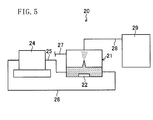
- FIG. 5 illustrates an experimental ultrasonic atomizer 20 used for the following experiment.
- a carrier gas supply pipe 27 extending from a gas source which is not shown in the figure is joined to an upper part of the atomization tank 21.
- a mist collecting pipe 28 extends from a top part of the atomization tank 21, and is joined to a mist collector 29.
- Glycerol (the number of carbon atoms: 3, the molecular weight: 92, and the number of hydrophilic groups: 3) was added to a glycerol aqueous solution containing glycerol at a concentration of 20.7% by mass to adjust the glycerol concentration of the resultant to 48% by mass. Then, a glycerol aqueous solution, whose concentration is adjusted to 48% by mass, of 841 g was supplied into the raw material tank 24 of the experimental ultrasonic atomizer 20.
- Lactic acid (the number of carbon atoms: 3, the molecular weight: 90, and the number of hydrophilic groups: 2) was added to a lactic acid aqueous solution containing lactic acid at a concentration of 5.00% by mass to adjust the lactic acid concentration of the resultant to 44% by mass. Then, a lactic acid aqueous solution, whose concentration is adjusted to 44% by mass, of 805 g was supplied into the raw material tank 24 of the experimental ultrasonic atomizer 20.
- 1,2-propanediol (the number of carbon atoms: 3, the molecular weight: 76, and the number of hydrophilic groups: 2) was added to a 1,2-propanediol aqueous solution containing 1,2-propanediol at a concentration of 5.00% by mass to adjust the 1,2-propanediol concentration of the resultant to 51% by mass. Then, a 1,2-propanediol aqueous solution, whose concentration is adjusted to 51 % by mass, of 504 g was supplied into the raw material tank 24 of the experimental ultrasonic atomizer 20.
- a lactic acid aqueous solution, which contains lactic acid at a concentration of 4.8% by mass, of 857 g was supplied into the raw material tank 24 of the experimental ultrasonic atomizer 20. While the lactic acid aqueous solution whose temperature is controlled to 70°C was circulating between the raw material tank 24 and the atomization tank 21 through the raw material supply pipe 25 and the return pipe 26, dehydration concentration by ultrasonic wave irradiation was performed for 1.7 hours in the batch operation. Then, as in the first example, the amount of liquid drops collected by the mist collector 29, the lactic acid concentration in the liquid drops, and the lactic acid concentration in the dehydrated and concentrated aqueous solution in the atomization tank 21 were measured.
- a lactic acid aqueous solution, which contains lactic acid at a concentration of 20% by mass, of 701 g was supplied into the raw material tank 24 of the experimental ultrasonic atomizer 20. While the lactic acid aqueous solution whose temperature is controlled to 50°C was circulating between the raw material tank 24 and the atomization tank 21 through the raw material supply pipe 25 and the return pipe 26, dehydration concentration by ultrasonic wave irradiation was performed for 2.0 hours in the batch operation. Then, as in the first example, the amount of liquid drops collected by the mist collector 29, the lactic acid concentration in the liquid drops, and the lactic acid concentration in the dehydrated and concentrated aqueous solution in the atomization tank 21 were measured.
- a glucose aqueous solution which contains glucose at a concentration of 20% by mass, of 801 g was supplied into the raw material tank 24 of the experimental ultrasonic atomizer 20. While the glucose aqueous solution whose temperature is controlled to 50°C was circulating between the raw material tank 24 and the atomization tank 21 through the raw material supply pipe 25 and the return pipe 26, dehydration concentration by ultrasonic wave irradiation was performed for 0.9 hour in the batch operation. Then, as in the first example, the amount of liquid drops collected by the mist collector 29, the glucose concentration in the liquid drops, and the glucose concentration in the dehydrated and concentrated aqueous solution in the atomization tank 21 were measured.
- a glycerol aqueous solution, which contains glycerol at a concentration of 30% by mass, of 801 g was supplied into the raw material tank 24 of the experimental ultrasonic atomizer 20. While the glycerol aqueous solution whose temperature is controlled to 50°C was circulating between the raw material tank 24 and the atomization tank 21 through the raw material supply pipe 25 and the return pipe 26, dehydration concentration by ultrasonic wave irradiation was performed for 0.3 hour in the batch operation. Then, as in the first example, the amount of liquid drops collected by the mist collector 29, the glycerol concentration in the liquid drops, and the glycerol concentration in the dehydrated and concentrated aqueous solution in the atomization tank 21 were measured.
- a 1,2-propanediol aqueous solution, which contains 1,2-propanediol at a concentration of 31% by mass, of 402 g was supplied into the raw material tank 24 of the experimental ultrasonic atomizer 20. While the 1,2-propanediol aqueous solution whose temperature is controlled to 50°C was circulating between the raw material tank 24 and the atomization tank 21 through the raw material supply pipe 25 and the return pipe 26, dehydration concentration by ultrasonic wave irradiation was performed for 0.4 hour in the batch operation.
- the amount of liquid drops collected by the mist collector 29, the 1,2-propanediol concentration in the liquid drops, and the 1,2-propanediol concentration in the dehydrated and concentrated aqueous solution in the atomization tank 21 were measured.
- a xylose aqueous solution, which contains xylose at a concentration of 30% by mass, of 802 g was supplied into the raw material tank 24 of the experimental ultrasonic atomizer 20. While the xylose aqueous solution whose temperature is controlled to 50°C was circulating between the raw material tank 24 and the atomization tank 21 through the raw material supply pipe 25 and the return pipe 26, dehydration concentration by ultrasonic wave irradiation was performed for 0.5 hour in the batch operation. Then, as in the first example, the amount of liquid drops collected by the mist collector 29, the xylose concentration in the liquid drops, and the xylose concentration in the dehydrated and concentrated aqueous solution in the atomization tank 21 were measured.
- Tables 1 and 2 show the results of the foregoing experiment.
- Tables 1 and 2 show the results of the foregoing experiment.
- the amount of liquid drops collected by the mist collector 29 was 413 g in the first example, 83.8 g in the second example, 414 g in the third example, 54.8 g in the fourth example, 27.4 g in the fifth example, 73.0 g in the sixth example, 58.2 g in the seventh example, 434 g in the first comparative example, 444 g in the second comparative example, 311 g in third comparative example, 110 g in the fourth comparative example, 51.0 g in the fifth comparative example, 41.0 g in the sixth comparative example, and 86.0 g in the seventh comparative example.
- the concentration of the organic compound contained in the liquid drops collected by the mist collector 29 was a glycerol concentration of 0.19% by mass in the first example, a glycerol concentration of 0% by mass in the second example, a lactic acid concentration of 0.64% by mass in the third example, a glucose concentration of 0% by mass in the fourth example, a 1,2-propanediol concentration of 0.91% by mass in the fifth example, a xylose concentration of 0.91% by mass in the sixth example, a hydroxymethylfurfural concentration of 0.11% by mass in the seventh example, a glycerol concentration of 8.8% by mass in the first comparative example, a lactic acid concentration of 2.4% by mass in the second comparative example, a lactic acid concentration of 12% by mass in the third comparative example, a glucose concentration of 6.8% by mass in the fourth comparative example, a glycerol concentration of 4.2% by mass in the fifth comparative example, a 1,2-propanediol concentration of
- the first to seventh examples show a lower concentration of the organic compound contained in the collected liquid drops as compared to that in the first to seventh comparative examples.
- the aqueous solution of the organic compound is efficiently dehydrated and concentrated in the atomization tank 21. That is, a dehydration efficiency per energy in ultrasonic wave irradiation can be enhanced.
- Glycerol was added to a glycerol aqueous solution containing glycerol at a concentration of 20% by mass to adjust the glycerol concentration of the resultant to 60% by mass. Then, a glycerol aqueous solution, whose concentration is adjusted to 60% by mass, of 300 g was supplied into the raw material tank 24 of the experimental ultrasonic atomizer 20, and a glycerol aqueous solution, whose concentration is adjusted to 60% by mass, of 200 g was supplied into the atomization tank 21.
- the temperature of the glycerol aqueous solution was controlled to 50°C, and the supply flow rate of the glycerol aqueous solution to be supplied from the raw material tank 24 to the atomization tank 21 is adjusted such that the supply speed thereof is 113 g/hr.
- Dehydration concentration by ultrasonic wave irradiation was performed for 1.0 hour in the semi-batch operation (Aspect 2A-(i)-a). Then, as in the first example, the amount of liquid drops collected by the mist collector 29, the glycerol concentration in the liquid drops, and the glycerol concentration in the dehydrated and concentrated aqueous solution in the atomization tank 21 were measured.
- the temperature of the glycerol aqueous solution was controlled to 50°C.
- the supply flow rate of the glycerol aqueous solution to be supplied from the raw material tank 24 to the atomization tank 21 is adjusted such that the supply speed thereof is 37 g/hr, and therefore the glycerol concentration in the glycerol aqueous solution in the atomization tank 21 is maintained at equal to or greater than 40% by mass.
- Dehydration concentration by ultrasonic wave irradiation was performed for 1.1 hours in the semi-batch operation (Aspect 2B). Then, as in the first example, the amount of liquid drops collected by the mist collector 29, the glycerol concentration in the liquid drops, and the glycerol concentration in the dehydrated and concentrated aqueous solution in the atomization tank 21 were measured.
- Glycerol was added to a glycerol aqueous solution containing glycerol at a concentration of 20% by mass to adjust the glycerol concentration of the resultant to 60% by mass. Then, a glycerol aqueous solution, whose concentration is adjusted to 60% by mass, of 300 g was supplied into the raw material tank 24 of the experimental ultrasonic atomizer 20, and a glycerol aqueous solution, whose concentration is adjusted to 60% by mass, of 201 g was supplied into the atomization tank 21. The temperature of the glycerol aqueous solution was controlled to 50°C.
- the supply flow rate of the glycerol aqueous solution to be supplied from the raw material tank 24 to the atomization tank 21 is adjusted such that the supply speed thereof is 104 g/hr, and the recovery flow rate of the concentrated glycerol aqueous solution to be recovered from the atomization tank 21 is adjusted such that the discharge speed thereof is 74 g/hr.
- Dehydration concentration by ultrasonic wave irradiation was performed for 1.0 hour in the continuous operation (Aspect 3A-(i)-a). Then, as in the first example, the amount of liquid drops collected by the mist collector 29, the glycerol concentration in the liquid drops, and the glycerol concentration in the dehydrated and concentrated aqueous solution in the atomization tank 21 were measured.
- the temperature of the glycerol aqueous solution was controlled to 50°C.
- the supply flow rate of the glycerol aqueous solution to be supplied from the raw material tank 24 to the atomization tank 21 is adjusted such that the supply speed thereof is 40 g/hr, and the recovery flow rate of the concentrated glycerol aqueous solution to be recovered from the atomization tank 21 is adjusted such that the discharge speed thereof is 61 g/hr.
- the glycerol concentration in the glycerol aqueous solution in the atomization tank 21 is maintained at equal to or greater than 40% by mass.
- Dehydration concentration by ultrasonic wave irradiation was performed for 1.1 hours in the continuous operation (Aspect 3B). Then, as in the first example, the amount of liquid drops collected by the mist collector 29, the glycerol concentration in the liquid drops, and the glycerol concentration in the dehydrated and concentrated aqueous solution in the atomization tank 21 were measured.
- Table 3 shows the experimental results of the eighth to eleventh examples.
- the amount of liquid drops collected by the mist collector 29 was 18 g in the eighth example, 16 g in the ninth example, 26 g in the tenth example, and 21 g in the eleventh example.
- the concentration of the organic compound contained in the liquid drops collected by the mist collector 29 was a glycerol concentration of 0% by mass in the eighth example, a glycerol concentration of 0% by mass in the ninth example, a glycerol concentration of 0% by mass in the tenth example, and a glycerol concentration of 0% by mass in the eleventh example.
- the concentration of the organic compound contained in the dehydrated and concentrated aqueous solution in the atomization tank 21 was a glycerol concentration of 67% by mass in the eighth example, a glycerol concentration of 64% by mass in the ninth example, a glycerol concentration of 71% by mass in the tenth example, and a glycerol concentration of 65% by mass in the eleventh example.
- the present invention is useful for the method for producing a concentrated aqueous solution of an organic compound and for the dehydration concentration method.
Landscapes
- Chemical & Material Sciences (AREA)
- Chemical Kinetics & Catalysis (AREA)
- Organic Chemistry (AREA)
- Engineering & Computer Science (AREA)
- Water Supply & Treatment (AREA)
- Mechanical Engineering (AREA)
- Toxicology (AREA)
- General Health & Medical Sciences (AREA)
- Health & Medical Sciences (AREA)
- Analytical Chemistry (AREA)
- Oil, Petroleum & Natural Gas (AREA)
- Physics & Mathematics (AREA)
- Thermal Sciences (AREA)
- Environmental & Geological Engineering (AREA)
- Life Sciences & Earth Sciences (AREA)
- Hydrology & Water Resources (AREA)
- Organic Low-Molecular-Weight Compounds And Preparation Thereof (AREA)
- Furan Compounds (AREA)
- Saccharide Compounds (AREA)
- Vaporization, Distillation, Condensation, Sublimation, And Cold Traps (AREA)
Abstract
Description
- The present invention relates to the method for producing a concentrated aqueous solution of an organic compound and to the dehydration concentration method.
- Research and development have been made on the dehydration technique of atomizing water by irradiating an aqueous solution of an organic compound with an ultrasonic wave.
- For example, Patent Documents 1 and 2 disclose the technique of separating lactic acid by irradiating a fermented product of a plant material with an ultrasonic wave and atomizing water.
- Moreover, Patent Document 3 discloses the method for producing concentrated glycerol, which includes dehydration concentration of a glycerol aqueous solution having a viscosity of equal to or less than 25 mPa·s by irradiating the glycerol aqueous solution with an ultrasonic wave and atomizing water.
-
- PATENT DOCUMENT 1: Japanese Unexamined Patent Publication No.
2010-115165 - PATENT DOCUMENT 2: Japanese Unexamined Patent Publication No.
2010-233543 - PATENT DOCUMENT 3: Japanese Unexamined Patent Publication No.
2012-144530 - The present invention is intended for the method for producing a concentrated aqueous solution of an organic compound, which includes a concentration adjustment step of adjusting an aqueous solution containing the organic compound at a concentration of less than 40% by mass to contain the organic compound at a concentration of equal to or greater than 40% by mass, the organic compound having two or more hydrophilic groups in a molecule; and a dehydration concentration step of irradiating the aqueous solution whose organic compound concentration is adjusted to equal to or greater than 40% by mass at the concentration adjustment step with an ultrasonic wave to atomize water.
- The present invention is intended for the dehydration concentration method including a step of adjusting an aqueous solution containing an organic compound at a concentration of less than 40% by mass to contain the organic compound at a concentration of equal to or greater than 40% by mass, the organic compound having two or more hydrophilic groups in a molecule; and a step of irradiating the aqueous solution whose organic compound concentration is adjusted to equal to or greater than 40% by mass with an ultrasonic wave to atomize water.
-
- [
FIG. 1] FIG. 1 is a block diagram illustrating the configuration of an ultrasonic atomizer used in a first aspect. - [
FIG. 2] FIG. 2 is a block diagram illustrating the configuration of an ultrasonic atomizer used in second and third aspects. - [
FIG. 3] FIG. 3 is a block diagram illustrating the configuration of an ultrasonic atomizer used in Aspects 2A and 3A. - [
FIG. 4] FIGS. 4A to 4C are block diagrams illustrating another ultrasonic atomizer used in Aspects 2A and 3A. - [
FIG. 5] FIG. 5 is a block diagram illustrating the configuration of an experimental ultrasonic atomizer used in examples. - An embodiment will be described in detail below.
- The method for producing a concentrated aqueous solution of an organic compound according to the present embodiment includes a concentration adjustment step and a dehydration concentration step. At the concentration adjustment step, an aqueous solution containing an organic compound having two or more hydrophilic groups in a molecule (such an organic compound is hereinafter referred to as an "organic compound A" in the present application) at a concentration of less than 40% by mass is used as a raw material aqueous solution, and the raw material aqueous solution is adjusted such that the concentration of the organic compound A becomes equal to or greater than 40% by mass. At the dehydration concentration step, dehydration concentration is performed in such a manner that the aqueous solution adjusted such that the concentration of the organic compound A becomes equal to or greater than 40% by mass at the concentration adjustment step (such an aqueous solution is hereinafter referred to as a "high-concentration raw material aqueous solution" in the present application) is irradiated with an ultrasonic wave to atomize water.
- The present inventors have found the following. In the case where dehydration concentration is performed by irradiating the aqueous solution of the organic compound having two or more hydrophilic groups in the molecule with an ultrasonic wave and atomizing water, the concentration of the organic compound contained in mist drops generated in ultrasonic wave irradiation increases as the concentration of the organic compound in the aqueous solution increases to a certain concentration limit. When the concentration of the organic compound in the aqueous solution irradiated with the ultrasonic wave exceeds the concentration limit, the concentration of the organic compound contained in the mist drops generated in ultrasonic wave irradiation decreases. Moreover, the present inventors have also found that, in the case where the organic compound has two or more hydrophilic groups in the molecule, if the concentration of the organic compound in the aqueous solution is equal to or greater than 40% by mass, the concentration of the organic compound contained in the mist drops generated in ultrasonic wave irradiation is extremely low.
- Although the reasons why the concentration of the organic compound contained in the mist drops is low as just described are not clear, the following reasons are assumed. Since the organic compound having two or more hydrophilic groups in the molecule has many hydrophilic groups, the molecules of such an organic compound interacting with each other are more than those of an organic compound having a single hydrophilic group in a molecule, and interaction between the organic compounds each having two or more hydrophilic groups in the molecule is stronger than that between the organic compounds each having a single hydrophilic group in the molecule. Thus, it is difficult to atomize the organic compound having two or more hydrophilic groups in the molecule. Moreover, when the concentration of the organic compound in the aqueous solution increases, the frequency of interaction between the organic compounds is higher than that of interaction between the organic compound and water, resulting in difficulty in atomization. Because of the synergy of these factors, in the case of the organic compound having two or more hydrophilic groups in the molecule, if the concentration of the organic compound in the aqueous solution is equal to or greater than 40% by mass, the concentration of the organic compound contained in the mist drops generated in ultrasonic wave irradiation is extremely low, and water is selectively removed from the aqueous solution. As a result, the efficiency of dehydration concentration by ultrasonic wave irradiation can be enhanced.
- According to the method for producing the concentrated aqueous solution of the organic compound in the present embodiment, the concentration of the organic compound A in the raw material aqueous solution is, before dehydration concentration, adjusted from less than 40% by mass to equal to or greater than 40% by mass. Accordingly, the concentration of the organic compound A contained in mist drops generated in irradiation of the high-concentration raw material aqueous solution whose concentration is adjusted with an ultrasonic wave decreases, and water is selectively removed from the high-concentration raw material aqueous solution. As a result, the efficiency of dehydration concentration by ultrasonic wave irradiation, i.e., the efficiency of dehydration per energy in ultrasonic wave irradiation, can be enhanced.
- The raw material aqueous solution contains the organic compound A having two or more hydrophilic groups in the molecule.
- From the viewpoint of a high efficiency of dehydration concentration by ultrasonic wave irradiation, the number of carbon atoms in the molecule of the organic compound A is preferably two or more, and more preferably three or more. From the viewpoint of solubility in water, the number of carbon atoms in the molecule of the organic compound A is preferably 22 or less, more preferably 12 or less, and much more preferably 6 or less.
- From the viewpoint of a high efficiency of dehydration concentration by ultrasonic wave irradiation, the molecular weight of the organic compound A is preferably 50 or more, more preferably 60 or more, and much more preferably 70 or more. From the viewpoint of solubility in water, the molecular weight of the organic compound A is preferably 400 or less, more preferably 300 or less, and much more preferably 200 or less.
- The organic compound A has two or more hydrophilic groups in the molecule. The hydrophilic group is a functional group forming a weak bond to a water molecule by, e.g., electrostatic interaction or hydrogen bonding and having ionicity or high polarity showing affinity for water. Specifically, examples of the hydrophilic group include a hydroxyl group, a carboxyl group, a carbonyl group, an ester group, an acetal group, a hemiacetal group, an ether group, an amino group, an ammonium group, an amide group, a sulfonate group, a sulfate ester group, a phosphonate group, a phosphate group, and an ureido group.
- From the viewpoint of a high efficiency of dehydration concentration by ultrasonic wave irradiation, the hydrophilic group includes one or more chosen from the group consisting of a hydroxyl group, a carboxyl group, a carbonyl group, an acetal group, a hemiacetal group, an amino group, an ammonium group, a sulfonate group, a sulfate ester group, a phosphonate group, or a phosphate group. More preferably, the hydrophilic group includes one or more chosen from the group consisting of a hydroxyl group, a carboxyl group, a carbonyl group, an acetal group, a hemiacetal group, an amino group, or a sulfonate group. Much more preferably, the hydrophilic group includes one or more chosen from the group consisting of a hydroxyl group or a carboxyl group.
- The number of hydrophilic groups in the molecule of the organic compound A is two or more from the viewpoint of a high efficiency of dehydration concentration by ultrasonic wave irradiation. From the viewpoint of a high efficiency of dehydration concentration by ultrasonic wave irradiation and an economic efficiency, the number of hydrophilic groups in the molecule of the organic compound A is preferably 10 or less, more preferably 8 or less, much more preferably 5 or less, and still much more preferably 3 or less.
- In the organic compound A, a plurality of hydrophilic groups may be bonded to the same carbon atom, or may be bonded respectively to adjacent carbon atoms or to carbon atoms positioned with, e.g., one or more methylene groups being interposed therebetween. Alternatively, the organic compound A may have both of the foregoing characteristics. Of these organic compounds A, the organic compound formed such that a plurality of hydrophilic groups are bonded to the same carbon atom or the organic compound formed such that a plurality of hydrophilic groups are bonded respectively to adjacent carbon atoms are preferable.
- The organic compound A may have two or more of a single type of hydrophilic group in the molecule, or may have two or more types of hydrophilic group in the molecule. Alternatively, the organic compound A may have both of the foregoing characteristics.
- In the case of an optional organic compound A formed to have compatibility with water, dehydration concentration by ultrasonic wave irradiation produces a prominent effect. From the viewpoint of a high efficiency of dehydration concentration by ultrasonic wave irradiation, the degree of solubility (hereinafter abbreviated as a "solubility degree") of the organic compound A in a water of 100 g at 25°C is preferably 67 g or more, more preferably 100 g or more, and much more preferably 150 g or more. Still much more preferably, the solubility degree of the organic compound A is such a degree that the organic compound A can dissolve in water at any ratio.
- Examples of the organic compound A having two or more of a single type of hydrophilic group in the molecule include polyhydric alcohol having two or more hydroxyl groups, polyhydric carboxylic acid having two or more carboxyl groups, and polyhydric amine having two or more amino groups.
- Examples of polyhydric alcohol include diols each having two hydroxyl groups in a molecule, such as ethylene glycol, diethylene glycol, 1,2-propanediol (propylene glycol), and 1,3-propanediol; triols each having three hydroxyl groups in a molecule, such as glycerol, trimethylolpropane, and 1,2,4-butanetriol; tetraols each having four hydroxyl groups in a molecule, such as pentaerythritol; and sugars such as glucose and xylose.
- Examples of polyhydric carboxylic acid include dicarboxylic acids such as oxalic acid, malonic acid, succinic acid, maleic acid, fumaric acid, phthalic acid, isophthalic acid, terephthalic acid, and furandicarboxylic acid; tricarboxylic acids such as citric acid, trimellitic acid (benzene-1,2,4-tricarboxylic acid), and benzene-1,3,5-tricarboxylic acid; and tetracarboxylic acids such as ethylene tetracarboxylic acid and benzene-1,2,4,5-tetracarboxylic acid.
- Examples of polyhydric amine include diamines such as ethylenediamine and paraphenylene diamine; triamines such as diethylenetriamine; and tetraamines such as triethylenetetramine.
- Examples of the organic compound A having two or more types of hydrophilic group in the molecule include hydroxy acid having a hydroxyl group and a carboxyl group, amino acid having a carboxyl group and an amino group, and hydroxy aldehyde having a hydroxyl group and a carbonyl group.
- Hydroxy acid may be α-hydroxy acids in each of which a hydroxyl group and a carboxyl group are bonded to the same carbon atom, such as lactic acid and 2-hydroxybutyric acid; β-hydroxy acids in each of which a hydroxyl group and a carboxyl group are bonded respectively to different carbon atoms, such as 3-hydroxybutyric acid; or γ-hydroxy acids in each of which a hydroxyl group and a carboxyl group are bonded respectively to different carbon atoms, such as 4-hydroxybutyric acid.
- Hydroxy acid may be aliphatic hydroxy acid or aromatic hydroxy acid. Examples of aliphatic hydroxy acid include 2-hydroxybutyric acid, glycolic acid, lactic acid, glyceric acid, malic acid, tartaric acid, and citric acid. Examples of aromatic hydroxy acid include salicylic acid.
- Amino acid may be α-amino acids in each of which a carboxyl group and an amino group are bonded to the same carbon atom, such as glycine, α-alanine, glutamine, glutamic acid, and aspartic acid; β-amino acids in each of which a carboxyl group and an amino group are bonded respectively to different carbon atoms, such as β-alanine; or γ-amino acids in each of which a carboxyl group and an amino group are bonded respectively to different carbon atoms, such as γ-aminobutyric acid.
- Amino acid may be aliphatic amino acid or aromatic amino acid. Examples of aliphatic amino acid include glycine, alanine, glutamic acid, and aspartic acid. Examples of aromatic amino acid include phenylalanine.
- Examples of hydroxy aldehyde include hydroxymethylfurfural.
- Of these compounds, polyhydric alcohol having two or more hydroxyl groups, hydroxy acid having a hydroxyl group and a carboxyl group, hydroxy aldehyde having a hydroxyl group and a carbonyl group, or heterocyclic aldehyde having a heterocycle and a carbonyl group is preferably used from the viewpoint of a high efficiency of dehydration concentration by ultrasonic wave irradiation. More preferably, glycerol (a solubility degree of ∞), lactic acid (a solubility degree of equal to or greater than 614 g), glucose (a solubility degree of 91 g), or hydroxymethylfurfural (a solubility degree of ∞) is used.
- Although the concentration of the organic compound A in the raw material aqueous solution is less than 40% by mass, the concentration of the organic compound A in the raw material aqueous solution is, from the viewpoint of a high efficiency at the concentration adjustment step, preferably equal to or less than 35% by mass, more preferably equal to or less than 30% by mass, much more preferably equal to or less than 25% by mass, and still much more preferably equal to or less than 20% by mass. From the same viewpoint as above, the concentration of the organic compound A in the raw material aqueous solution is equal to or greater than 0.1% by mass, preferably equal to or greater than 0.5% by mass, more preferably equal to or greater than 1 % by mass, much more preferably equal to or greater than 3% by mass, and still much more preferably 5% by mass.
- Note that a component(s) to be removed from the raw material aqueous solution or a component(s) remaining in the raw material aqueous solution after ultrasonic wave irradiation, such as methanol, may be contained together with the organic compound A in the raw material aqueous solution within such a range that effectiveness in enhancement of a dehydration concentration efficiency by ultrasonic wave irradiation is not reduced.
- The method for adjusting the raw material aqueous solution containing the organic compound A at a concentration of less than 40% by mass to the high-concentration raw material aqueous solution containing the organic compound A at a concentration of equal to or greater than 40% by mass is not limited.
- Examples of the concentration adjustment method include (a) the method for mixing a raw material aqueous solution containing an organic compound A at a concentration of less than 40% by mass with an organic compound A or with an aqueous solution containing an organic compound A at a concentration of greater than 40% by mass (such an aqueous solution is hereinafter also referred to as a "high-concentration aqueous solution"); and (b) the method for dehydrating and concentrating a raw material aqueous solution containing an organic compound A at a concentration of less than 40% by mass. The method (a) is preferable from the viewpoint of a high process efficiency.
- In the method (a), the concentration of the organic compound A in the high-concentration aqueous solution is, from the viewpoint of a high efficiency of concentration adjustment of the raw material aqueous solution, preferably equal to or greater than 45% by mass, more preferably equal to or greater than 50% by mass, and much more preferably equal to or greater than 60% by mass. From the viewpoint of a high efficiency of dehydration concentration by ultrasonic wave irradiation and easiness in preparing the high-concentration aqueous solution, the concentration of the organic compound A in the high-concentration aqueous solution is equal to or less than 99% by mass, preferably equal to or less than 95% by mass, more preferably equal to or less than 90% by mass, much more preferably equal to or less than 80% by mass, and still much more preferably equal to or less than 70% by mass.
- From the viewpoint of a high process efficiency in the method for producing the concentrated aqueous solution of the organic compound according to the present embodiment, the product formed by such a process, i.e., the concentrated aqueous solution of the organic compound A formed by dehydration concentration using ultrasonic wave irradiation, is preferably used as the high-concentration aqueous solution.
- In the method (b), the concentration of the high-concentration raw material aqueous solution may be adjusted in such a manner that the concentration of the organic compound A is increased to equal to or greater than 40% by mass by dehydration concentration of the raw material aqueous solution. The dehydration concentration step may include ultrasonic wave irradiation, or may include, e.g., moisture evaporation by heating.
- At the concentration adjustment step, the high-concentration raw material aqueous solution adjusted, by the method (a) or (b), so as to contain the organic compound A at a concentration of equal to or greater than 40% by mass may be supplied into an atomization tank provided with an ultrasonic oscillator. Alternatively, concentration adjustment may be performed by the method (a) or (b) in an ultrasonic atomizer including an atomization tank provided with an ultrasonic oscillator.
- From the viewpoint of a high efficiency of dehydration concentration by ultrasonic wave irradiation, the concentration of the organic compound A in the high-concentration raw material aqueous solution after concentration adjustment is preferably equal to or greater than 45% by mass, more preferably equal to or greater than 50% by mass, and much more preferably equal to or greater than 60% by mass. From the same viewpoint as above, the concentration of the organic compound A in the high-concentration raw material aqueous solution after concentration adjustment is equal to or less than 99% by mass, preferably equal to or less than 95% by mass, more preferably equal to or less than 90% by mass, much more preferably equal to or less than 80% by mass, and still much more preferably equal to or less than 70% by mass.
- When the high-concentration raw material aqueous solution whose concentration is adjusted is irradiated with an ultrasonic wave, a liquid pillar of the high-concentration raw material aqueous solution stands at a liquid surface, and water is atomized from the liquid pillar. As a result, the high-concentration raw material aqueous solution is dehydrated and concentrated. Note that the dehydration concentration step may be performed at a certain time interval after the concentration adjustment step, or may be performed concurrently with the concentration adjustment step.
- From the viewpoint of a high efficiency of dehydration concentration by ultrasonic wave irradiation, the frequency of ultrasonic vibrations applied to the high-concentration raw material aqueous solution is preferably equal to or higher than 20 kHz, and more preferably equal to or higher than 1 MHz. From the same viewpoint as above, the frequency of ultrasonic vibrations applied to the high-concentration raw material aqueous solution is preferably equal to or lower than 10 MHz, and more preferably equal to or lower than 5 MHz. The high-concentration raw material aqueous solution can be irradiated with an ultrasonic wave by the ultrasonic oscillator provided in the atomization tank capable of storing the high-concentration raw material aqueous solution.
- The temperature of the high-concentration raw material aqueous solution in ultrasonic wave irradiation is not limited as long as the high-concentration raw material aqueous solution is in a liquid form. From the viewpoint of a high efficiency of atomization by ultrasonic wave irradiation and reduction in energy consumption, the temperature of the high-concentration raw material aqueous solution in ultrasonic wave irradiation is equal to or higher than 10°C, preferably equal to or higher than 20°C, more preferably equal to or higher than 30°C, much more preferably equal to or higher than 40°C, and still much more preferably equal to or higher than 50°C. From the viewpoint of reduction in facility load such as pressurization and temperature control, the temperature of the high-concentration raw material aqueous solution in ultrasonic wave irradiation is preferably equal to or lower than 100°C, more preferably equal to or lower than 90°C, much more preferably equal to or lower than 80°C, still much more preferably equal to or lower than 70°C. The temperature of the high-concentration raw material aqueous solution can be controlled by a temperature control mechanism attached to the atomization tank capable of storing the high-concentration raw material aqueous solution.
- Liquid drops atomized from the high-concentration raw material aqueous solution by ultrasonic wave irradiation can be discharged with carrier gas. Although not limited, e.g., air, nitrogen gas, and other types of inert gas may be used as the carrier gas. The temperature of the carrier gas is not limited as long as there is no significant temperature difference between the carrier gas and the high-concentration raw material aqueous solution irradiated with an ultrasonic wave. However, the carrier gas is preferably at normal temperature or the same temperature as that of the high-concentration raw material aqueous solution.
- From the viewpoint of a high efficiency of dehydration concentration by ultrasonic wave irradiation, the concentration of the organic compound A in the high-concentration raw material aqueous solution in ultrasonic wave irradiation is preferably equal to or greater than 40% by mass, more preferably equal to or greater than 45% by mass, much more preferably equal to or greater than 50% by mass, and still much more preferably equal to or greater than 60% by mass. From the same viewpoint as above, the concentration of the organic compound A in the high-concentration raw material aqueous solution in ultrasonic wave irradiation is preferably equal to or less than 99% by mass, more preferably equal to or less than 90% by mass, much more preferably equal to or less than 80% by mass, and still much more preferably equal to or less than 70% by mass. Note that, at the dehydration concentration step, the concentration of the organic compound A in the high-concentration raw material aqueous solution in ultrasonic wave irradiation may fall outside the foregoing concentration range as long as the effectiveness in dehydration concentration by ultrasonic wave irradiation is not influenced.
- From the viewpoint of a high efficiency of dehydration concentration by ultrasonic wave irradiation, the concentration of the organic compound A in the atomized liquid drops is equal to or less than 5% by mass, preferably equal to or less than 3% by mass, more preferably equal to or less than 1% by mass, much more preferably equal to or less than 0.5% by mass, and still much more preferably equal to or less than 0.25% by mass.
- From the viewpoint of a high efficiency of dehydration concentration by ultrasonic wave irradiation, the viscosity of the high-concentration raw material aqueous solution in ultrasonic wave irradiation is, at the temperature in ultrasonic wave irradiation, preferably equal to or less than 25 mPa·s, more preferably equal to or less than 20 mPa·s, and much more preferably equal to or less than 15 mPa·s. From the same viewpoint as above, the viscosity of the high-concentration raw material aqueous solution in ultrasonic wave irradiation is, at a more-preferable temperature of 50°C, preferably equal to or less than 25 mPa·s, more preferably equal to or less than 20 mPa·s, and much more preferably 15 mPa·s. The viscosity of the high-concentration raw material aqueous solution in ultrasonic wave irradiation can be obtained with reference to ISO 12058 published by the International Organization for Standardization. Specifically, the viscosity of the high-concentration raw material aqueous solution can be obtained based on a time required for a ball to fall, due to the gravity, in an inclined capillary filled with the high-concentration raw material aqueous solution.
- From the viewpoint of a high efficiency of dehydration concentration by ultrasonic wave irradiation, the concentration of the organic compound A in the concentrated aqueous solution after dehydration concentration is preferably equal to or greater than 40% by mass, more preferably equal to or greater than 45% by mass, much more preferably equal to or greater than 50% by mass, and still much more preferably equal to or greater than 60% by mass. From the viewpoint of reduction in environmental load and a high economic efficiency, the concentration of the organic compound A in the concentrated aqueous solution after dehydration concentration is preferably equal to or less than 100% by mass, more preferably equal to or less than 98% by mass, and much more preferably equal to or less than 95% by mass.
- From the viewpoint of economic dehydration concentration by ultrasonic wave irradiation, the viscosity of the concentrated aqueous solution after dehydration concentration is, at the temperature in ultrasonic wave irradiation, preferably equal to or less than 25 mPa·s, more preferably equal to or less than 20 mPa·s, and much more preferably equal to or less than 15 mPa·s. From the same viewpoint as above, the viscosity of the concentrated aqueous solution after dehydration concentration is, at a more-preferable temperature of 50°C, preferably equal to or less than 25 mPa·s, more preferably equal to or less than 20 mPa·s, and much more preferably equal to or less than 15 mPa·s.
- The method for producing the concentrated aqueous solution of the organic compound according to the present embodiment may further include a recovery step of recovering the aqueous solution of the organic compound A dehydrated and concentrated at the dehydration concentration step.
- The recovery step may be performed after the dehydration concentration step, may be performed concurrently with the dehydration concentration step, or may be performed concurrently with the concentration adjustment step and the dehydration concentration step. Since the recovery step is performed concurrently with the dehydration concentration step or with the concentration adjustment step and the dehydration concentration step, the concentrated aqueous solution of the organic compound A can be continuously produced. At the recovery step, the concentrated aqueous solution may be continuously or intermittently recovered.
- Note that the concentrated aqueous solution of the organic compound A recovered at the recovery step can be, as described above, used as the high-concentration aqueous solution used for concentration adjustment at the concentration adjustment step.
- Specific Aspects of the method for producing the concentrated aqueous solution of the organic compound according to the present embodiment will be described.
- In a batch operation (i) of the first aspect, an
ultrasonic atomizer 10 illustrated inFIG. 1 is used to mix, outside anatomization tank 11, a raw material aqueous solution containing an organic compound A at a concentration of less than 40% by mass with an organic compound A or with a high-concentration aqueous solution containing an organic compound A at a concentration of greater than 40% by mass, thereby preparing a high-concentration raw material aqueous solution adjusted so as to contain the organic compound A at a concentration of equal to or greater than 40% by mass. Alternatively, a raw material aqueous solution is dehydrated and concentrated to prepare a high-concentration raw material aqueous solution adjusted so as to contain an organic compound A at a concentration of equal to or greater than 40% by mass. Then, the high-concentration raw material aqueous solution is supplied into theatomization tank 11 of the ultrasonic atomizer 10 (the concentration adjustment step). Examples of the dehydration concentration method for concentration adjustment in the latter case include water atomization by ultrasonic wave irradiation, and moisture evaporation by heating. Then, in theatomization tank 11, the high-concentration raw material aqueous solution is irradiated with an ultrasonic wave by anultrasonic oscillator 12 provided in theatomization tank 11 to atomize water. As a result, the high-concentration raw material aqueous solution is dehydrated and concentrated (the dehydration concentration step). - In a batch operation (ii) of the first aspect, the
ultrasonic atomizer 10 illustrated inFIG. 1 is used. An organic compound A or a high-concentration aqueous solution is supplied into theatomization tank 11, and then a raw material aqueous solution is added thereto. In this manner, a high-concentration raw material aqueous solution adjusted so as to contain the organic compound A at a concentration of equal to or greater than 40% by mass is prepared (the concentration adjustment step). Then, in theatomization tank 11, the high-concentration raw material aqueous solution is irradiated with an ultrasonic wave by theultrasonic oscillator 12 to atomize water. As a result, the high-concentration raw material aqueous solution is dehydrated and concentrated (the dehydration concentration step). - In a batch operation (iii) of the first aspect, the
ultrasonic atomizer 10 illustrated inFIG. 1 is used. A raw material aqueous solution is supplied into theatomization tank 11, and then an organic compound A or a high-concentration aqueous solution is added thereto. In this manner, a high-concentration raw material aqueous solution adjusted so as to contain the organic compound A at a concentration of equal to or greater than 40% by mass is prepared (the concentration adjustment step). Then, in theatomization tank 11, the high-concentration raw material aqueous solution is irradiated with an ultrasonic wave by theultrasonic oscillator 12 to atomize water. As a result, the high-concentration raw material aqueous solution is dehydrated and concentrated (the dehydration concentration step). - In any of the batch operations (i) to (iii) of the first aspect, the concentrated aqueous solution of the organic compound A formed after dehydration concentration may be discharged and recovered through a concentrated aqueous
solution discharge pipe 13 extending from the atomization tank 11 (the recovery step). - In a semi-batch operation (i) of Aspect 2A, an
ultrasonic atomizer 10 illustrated inFIGS. 2 to 4 is used to mix, outside anatomization tank 11, a raw material aqueous solution containing an organic compound A at a concentration of less than 40% by mass with an organic compound A or with a high-concentration aqueous solution containing an organic compound A at a concentration of greater than 40% by mass, thereby preparing a high-concentration raw material aqueous solution adjusted so as to contain the organic compound A at a concentration of equal to or greater than 40% by mass. Alternatively, a raw material aqueous solution is dehydrated and concentrated to prepare a high-concentration raw material aqueous solution adjusted so as to contain an organic compound A at a concentration of equal to or greater than 40% by mass. Then, the high-concentration raw material aqueous solution is directly supplied into theatomization tank 11 of the ultrasonic atomizer 10 (the initial stage of the concentration adjustment step). Examples of the dehydration concentration method for concentration adjustment in the latter case include water atomization by ultrasonic wave irradiation, and moisture evaporation by heating. Independently of the high-concentration raw material aqueous solution initially supplied into theatomization tank 11, a high-concentration raw material aqueous solution is prepared in such a manner that an aqueous solution containing an organic compound A at a concentration of less than 40% by mass is adjusted to contain the organic compound A at a concentration of equal to or greater than 40% by mass (the concentration adjustment step). While such a high-concentration raw material aqueous solution is being continuously or intermittently supplied through a rawmaterial supply pipe 15 which extends from araw material tank 14 and which is connected to theatomization tank 11, the high-concentration raw material aqueous solution is, in theatomization tank 11, irradiated with an ultrasonic wave by anultrasonic oscillator 12 provided in theatomization tank 11 to atomize water. As a result, the high-concentration raw material aqueous solution is dehydrated and concentrated (the dehydration concentration step). - In the method for preparing the high-concentration raw material aqueous solution to be supplied to the
atomization tank 11 through the rawmaterial supply pipe 15, a raw material aqueous solution may be, outside theraw material tank 14, mixed with an organic compound A or with a high-concentration aqueous solution, thereby preparing a high-concentration raw material aqueous solution containing the organic compound A at a concentration of equal to or greater than 40% by mass. Alternatively, a raw material aqueous solution may be dehydrated and concentrated, thereby preparing a high-concentration raw material aqueous solution adjusted so as to contain an organic compound A at a concentration of equal to or greater than 40% by mass. Then, the high-concentration raw material aqueous solution may be supplied into theraw material tank 14 and stored in the raw material tank 14 (Aspect 2A-(i)-a). The concentration adjustment step of the high-concentration raw material aqueous solution in Aspect 2A-(i)-a may be performed concurrently with the dehydration concentration step. In such a case, part or all of the high-concentration aqueous solution to be mixed with the raw material aqueous solution may be, in the former method, the concentrated aqueous solution of the organic compound A formed at the dehydration concentration step. Examples of the latter dehydration concentration method for concentration adjustment include water atomization by ultrasonic wave irradiation, and moisture evaporation by heating. The high-concentration raw material aqueous solution supplied into theraw material tank 14 may be the same as the high-concentration raw material aqueous solution initially supplied into theatomization tank 11. - An organic compound A or a high-concentration aqueous solution may be supplied into the
raw material tank 14, and then a raw material aqueous solution is added to the organic compound A or the high-concentration aqueous solution to prepare a high-concentration raw material aqueous solution adjusted so as to contain the organic compound A at a concentration of equal to or greater than 40% by mass (Aspect 2A-(i)-b). The concentration adjustment step of the high-concentration raw material aqueous solution in Aspect 2A-(i)-b may be performed concurrently with the dehydration concentration step. In such a case, part or all of the high-concentration aqueous solution to be mixed with the raw material aqueous solution may be the concentrated aqueous solution of the organic compound A formed at the dehydration concentration step. For example, theultrasonic atomizer 10 illustrated inFIG. 3 may be used to supply the concentrated aqueous solution of the organic compound A formed at the dehydration concentration step to theraw material tank 14 through areturn pipe 16 which branches from the concentrated aqueoussolution discharge pipe 13 and which is connected to theraw material tank 14, and therefore part or all of the high-concentration aqueous solution supplied into theraw material tank 14 may be the concentrated aqueous solution of the organic compound A (Aspect 2A-(i)-b'). - A raw material aqueous solution may be supplied into the
raw material tank 14, and then an organic compound A or a high-concentration aqueous solution is added to the raw material aqueous solution to prepare a high-concentration raw material aqueous solution adjusted so as to contain the organic compound A at a concentration of equal to or greater than 40% by mass (Aspect 2A-(i)-c). The concentration adjustment step of the high-concentration raw material aqueous solution in Aspect 2A-(i)-c may be performed concurrently with the dehydration concentration step. In such a case, part or all of the high-concentration aqueous solution to be mixed with the raw material aqueous solution may be the concentrated aqueous solution of the organic compound A formed at the dehydration concentration step. For example, theultrasonic atomizer 10 illustrated inFIG. 3 may be used to supply the concentrated aqueous solution of the organic compound A formed at the dehydration concentration step to theraw material tank 14 through thereturn pipe 16 which branches from the concentrated aqueoussolution discharge pipe 13 and which is connected to theraw material tank 14, and therefore part or all of the high-concentration aqueous solution to be added to the raw material aqueous solution supplied into theraw material tank 14 may be the concentrated aqueous solution of the organic compound A (Aspect 2A-(i)-c'). - A raw material aqueous solution may be supplied into the
raw material tank 14, and may be dehydrated and concentrated to prepare a high-concentration raw material aqueous solution adjusted so as to contain an organic compound A at a concentration of equal to or greater than 40% by mass (Aspect 2A-(i)-d). Examples of the dehydration concentration method for concentration adjustment include water atomization by ultrasonic wave irradiation, and moisture evaporation by heating. - Such a high-concentration raw material aqueous solution may be prepared in the course of supplying the raw material aqueous solution from the
raw material tank 14 to theatomization tank 11 through the rawmaterial supply pipe 15. - For example, the
ultrasonic atomizer 10 illustrated inFIG. 4A may be used to supply a raw material aqueous solution into theraw material tank 14. In the course of supplying the raw material aqueous solution to theatomization tank 11 through the rawmaterial supply pipe 15, an organic compound A or a high-concentration aqueous solution may join the raw material aqueous solution through an organic-compound-A supply pipe 17 connected to the rawmaterial supply pipe 15, and therefore a high-concentration raw material aqueous solution adjusted so as to contain the organic compound A at a concentration of equal to or greater than 40% by mass may be prepared (Aspect 2A-(i)-e). The concentration adjustment step of the high-concentration raw material aqueous solution in Aspect 2A-(i)-e is performed concurrently with the dehydration concentration step. - The
ultrasonic atomizer 10 illustrated inFIG. 4B may be used to supply a raw material aqueous solution into theraw material tank 14. In the course of supplying the raw material aqueous solution to theatomization tank 11 through the rawmaterial supply pipe 15, the concentrated aqueous solution of the organic compound A formed at the dehydration concentration step may join the raw material aqueous solution through areturn pipe 18 which branches from the concentrated aqueoussolution discharge pipe 13 and which is connected to the rawmaterial supply pipe 15, and therefore a high-concentration raw material aqueous solution adjusted so as to contain the organic compound A at a concentration of equal to or greater than 40% by mass may be prepared (Aspect 2A-(i)-f). The concentration adjustment step of the high-concentration raw material aqueous solution in Aspect 2A-(i)-f is performed concurrently with the dehydration concentration step. Moreover, the concentrated aqueous solution of the organic compound A formed at the dehydration concentration step is used as the high-concentration aqueous solution to be mixed with the raw material aqueous solution. - The
ultrasonic atomizer 10 illustrated inFIG. 4C may be used to supply a raw material aqueous solution into theraw material tank 14. In the course of supplying the raw material aqueous solution to theatomization tank 11 through the rawmaterial supply pipe 15, a high-concentration raw material aqueous solution adjusted so as to contain an organic compound A at a concentration of equal to or greater than 40% by mass may be prepared in aconcentration adjuster 19 provided in the raw material supply pipe 15 (Aspect 2A-(i)-g). The concentration adjustment step of the high-concentration raw material aqueous solution in Aspect 2A-(i)-g is performed concurrently with the dehydration concentration step. Moreover, in theconcentration adjuster 19, the concentrated aqueous solution of the organic compound A formed at the dehydration concentration step may be used to perform concentration adjustment. - The
concentration adjuster 19 may be an atomization tank in which a raw material aqueous solution is dehydrated and concentrated by ultrasonic atomization. In such a case, atomization tanks each provided with an ultrasonic oscillator are continuously provided. The concentration of a raw material aqueous solution is adjusted in the upstream atomization tank serving as theconcentration adjuster 19, and the high-concentration raw material aqueous solution whose concentration is adjusted is dehydrated and concentrated in thedownstream atomization tank 11. Theconcentration adjuster 19 may be a unit other than the dehydration concentration unit using ultrasonic atomization, such as a heating tank capable of evaporating moisture of a raw material aqueous solution by heating to dehydrate and concentrate the raw material aqueous solution. - In a semi-batch operation (ii) of Aspect 2A, the
ultrasonic atomizer 10 illustrated inFIGS. 2 to 4 is used to supply an organic compound A or a high-concentration aqueous solution into theatomization tank 11. A raw material aqueous solution is added to the organic compound A or the high-concentration aqueous solution to prepare a high-concentration raw material aqueous solution adjusted so as to contain the organic compound A at a concentration of equal to or greater than 40% by mass (the initial stage of the concentration adjustment step). Independently of the high-concentration raw material aqueous solution initially supplied into theatomization tank 11, a high-concentration raw material aqueous solution is prepared in such a manner that an aqueous solution containing an organic compound A at a concentration of less than 40% by mass is adjusted to contain the organic compound A at a concentration of equal to or greater than 40% by mass (the concentration adjustment step). While such a high-concentration raw material aqueous solution is being continuously or intermittently supplied through the rawmaterial supply pipe 15, the high-concentration raw material aqueous solution is, in theatomization tank 11, irradiated with an ultrasonic wave by theultrasonic oscillator 12 to atomize water. As a result, the high-concentration raw material aqueous solution is dehydrated and concentrated (the dehydration concentration step). - Examples of the method for preparing the high-concentration raw material aqueous solution to be supplied to the
atomization tank 11 through the rawmaterial supply pipe 15 include the methods of Aspect 2A-(ii)-a, Aspect 2A-(ii)-b, Aspect 2A-(ii)-b', Aspect 2A-(ii)-c, Aspect 2A-(ii)-c', Aspect 2A-(ii)-d, Aspect 2A-(ii)-e, Aspect 2A-(ii)-f, and Aspect 2A-(ii)-g corresponding respectively to Aspect 2A-(i)-a, Aspect 2A-(i)-b, Aspect 2A-(i)-b', Aspect 2A-(i)-c, Aspect 2A-(i)-c', Aspect 2A-(i)-d, Aspect 2A-(i)-e, Aspect 2A-(i)-f, and Aspect 2A-(i)-g. - In a semi-batch operation (iii) of Aspect 2A, the
ultrasonic atomizer 10 illustrated inFIGS. 2 to 4 is used to supply a raw material aqueous solution into theatomization tank 11. An organic compound A or a high-concentration aqueous solution is added to the raw material aqueous solution to adjust the concentration of the organic compound A to equal to or greater than 40% by mass, thereby preparing a high-concentration raw material aqueous solution (the initial stage of the concentration adjustment step). Independently of the high-concentration raw material aqueous solution initially supplied into theatomization tank 11, a high-concentration raw material aqueous solution is prepared in such a manner that an aqueous solution containing an organic compound A at a concentration of less than 40% by mass is adjusted to contain the organic compound A at a concentration of equal to or greater than 40% by mass (the concentration adjustment step). While such a high-concentration raw material aqueous solution is being continuously or intermittently supplied through the rawmaterial supply pipe 15, the high-concentration raw material aqueous solution is, in theatomization tank 11, irradiated with an ultrasonic wave by theultrasonic oscillator 12 to atomize water. As a result, the high-concentration raw material aqueous solution is dehydrated and concentrated (the dehydration concentration step). - Examples of the method for preparing the high-concentration raw material aqueous solution to be supplied to the
atomization tank 11 through the rawmaterial supply pipe 15 include the methods of Aspect 2A-(iii)-a, Aspect 2A-(iii)-b, Aspect 2A-(iii)-b', Aspect 2A-(iii)-c, Aspect 2A-(iii)-c', Aspect 2A-(iii)-d, Aspect 2A-(iii)-e, Aspect 2A-(iii)-f, and Aspect 2A-(iii)-g corresponding respectively to Aspect 2A-(i)-a, Aspect 2A-(i)-b, Aspect 2A-(i)-b', Aspect 2A-(i)-c, Aspect 2A-(i)-c', Aspect 2A-(i)-d, Aspect 2A-(i)-e, Aspect 2A-(i)-f, and Aspect 2A-(i)-g. - In a semi-batch operation (iv) of Aspect 2A, the
ultrasonic atomizer 10 illustrated inFIGS. 2 to 4 is used to supply a high-concentration raw material aqueous solution prepared outside theatomization tank 11 into theatomization tank 11 through the raw material supply pipe 15 (the concentration adjustment step). Subsequently, while such a high-concentration raw material aqueous solution is being continuously or intermittently supplied through the rawmaterial supply pipe 15, the high-concentration raw material aqueous solution is, in theatomization tank 11, irradiated with an ultrasonic wave by theultrasonic oscillator 12 to atomize water. As a result, the high-concentration raw material aqueous solution is dehydrated and concentrated (the dehydration concentration step). Thus, in the semi-batch operation (iv) of Aspect 2A, the high-concentration raw material aqueous solution initially supplied into theatomization tank 11 is the same as the high-concentration aqueous solution supplied at the dehydration concentration step. - Examples of the method for preparing the high-concentration raw material aqueous solution include the methods of Aspect 2A-(iv)-a, Aspect 2A-(iv)-b, Aspect 2A-(iv)-c, Aspect 2A-(iv)-d, Aspect 2A-(iv)-e, and Aspect 2A-(iv)-g corresponding respectively to Aspect 2A-(i)-a, Aspect 2A-(i)-b, Aspect 2A-(i)-c, Aspect 2A-(i)-d, Aspect 2A-(i)-e, and Aspect 2A-(i)-g. In the case where the concentration adjustment step and the dehydration concentration step are performed concurrently with each other, the methods of Aspect 2A-(iv)-b', Aspect 2A-(iv)-c', and Aspect 2A-(iv)-f corresponding respectively to Aspect 2A-(i)-b', Aspect 2A-(i)-c', and Aspect 2A-(i)-f which are the aspects in which the concentrated aqueous solution of the organic compound A formed at the dehydration concentration step is used as the high-concentration aqueous solution to be mixed with the raw material aqueous solution can be employed.
- In any of the semi-batch operations (i) to (iv) of Aspect 2A, the concentrated aqueous solution of the organic compound A formed after dehydration concentration may be discharged and recovered through the concentrated aqueous
solution discharge pipe 13 extending from the atomization tank 11 (the recovery step). - In a semi-batch operation of Aspect 2B, the
ultrasonic atomizer 10 illustrated inFIG. 2 is used, and an organic compound A or a high-concentration aqueous solution containing an organic compound A at a concentration of greater than 40% by mass is stored in theatomization tank 11. While a raw material aqueous solution stored in theraw material tank 14 and containing an organic compound A at a concentration of less than 40% by mass is being continuously or intermittently supplied through the rawmaterial supply pipe 15 which extends from theraw material tank 14 and which is connected to theatomization tank 11, the raw material aqueous solution and the high-concentration aqueous solution are, in theatomization tank 11, mixed together to prepare a high-concentration raw material aqueous solution adjusted so as to contain the organic compound A at a concentration of equal to or greater than 40% by mass (the concentration adjustment step). Meanwhile, the high-concentration raw material aqueous solution is irradiated with an ultrasonic wave by theultrasonic oscillator 12 provided in theatomization tank 11 to atomize water. As a result, the high-concentration raw material aqueous solution is dehydrated and concentrated (the dehydration concentration step). At this point, the supply flow rate of the raw material aqueous solution to be supplied is controlled such that the concentration of the organic compound A in the high-concentration raw material aqueous solution in theatomization tank 11 becomes equal to or greater than 40% by mass. - In the semi-batch operation of Aspect 2B, the concentration adjustment step and the dehydration concentration step are performed concurrently with each other in the
atomization tank 11. At this point, in theatomization tank 11, the concentration of the organic compound A in the high-concentration raw material aqueous solution increases due to dehydration concentration by ultrasonic wave irradiation. Thus, the concentration of the organic compound A in the high-concentration raw material aqueous solution in theatomization tank 11 can be maintained high in such a manner that the supply flow rate of the raw material aqueous solution to be supplied to theatomization tank 11 through the rawmaterial supply pipe 15 is decreased. The concentration of the high-concentration aqueous solution may be initially adjusted in theatomization tank 11. However, from the viewpoint of shortening of an operation time, it is preferable that an organic compound A or a high-concentration aqueous solution whose concentration is adjusted outside theultrasonic atomizer 10 is supplied into theatomization tank 11. - In the semi-batch operation of Aspect 2B, the concentrated aqueous solution of the organic compound A formed after dehydration concentration may be discharged and recovered through the concentrated aqueous
solution discharge pipe 13 extending from the atomization tank 11 (the recovery step). - In a continuous operation (i) of Aspect 3A, the
ultrasonic atomizer 10 illustrated inFIGS. 2 to 4 is used to mix, outside theatomization tank 11, a raw material aqueous solution containing an organic compound A at a concentration of less than 40% by mass with an organic compound A or with a high-concentration aqueous solution containing an organic compound A at a concentration of greater than 40% by mass, thereby preparing a high-concentration raw material aqueous solution adjusted so as to contain the organic compound A at a concentration of equal to or greater than 40% by mass. Alternatively, a raw material aqueous solution is dehydrated and concentrated to prepare a high-concentration raw material aqueous solution adjusted so as to contain an organic compound A at a concentration of equal to or greater than 40% by mass. Then, the high-concentration raw material aqueous solution is directly supplied into theatomization tank 11 of the ultrasonic atomizer 10 (the initial stage of the concentration adjustment step). Examples of the dehydration concentration method for concentration adjustment in the latter case include water atomization by ultrasonic wave irradiation, and moisture evaporation by heating. Then, independently of the high-concentration raw material aqueous solution initially supplied into theatomization tank 11, a high-concentration raw material aqueous solution is prepared in such a manner that an aqueous solution containing an organic compound A at a concentration of less than 40% by mass is adjusted to contain the organic compound A at a concentration of equal to or greater than 40% by mass (the concentration adjustment step). While such a high-concentration raw material aqueous solution is being continuously or intermittently supplied through the rawmaterial supply pipe 15 which extends from theraw material tank 14 and which is connected to theatomization tank 11, the high-concentration raw material aqueous solution is, in theatomization tank 11, irradiated with an ultrasonic wave by theultrasonic oscillator 12 provided in theatomization tank 11 to atomize water. As a result, the high-concentration raw material aqueous solution is dehydrated and concentrated (the dehydration concentration step). The concentrated aqueous solution of the organic compound A formed after dehydration concentration is continuously or intermittently discharged and recovered through the concentrated aqueoussolution discharge pipe 13 extending from the atomization tank 11 (the recovery step). - In the method for preparing the high-concentration raw material aqueous solution to be supplied to the
atomization tank 11 through the rawmaterial supply pipe 15, a raw material aqueous solution may be, outside theraw material tank 14, mixed with an organic compound A or with a high-concentration aqueous solution, thereby preparing a high-concentration raw material aqueous solution adjusted so as to contain the organic compound A at a concentration of equal to or greater than 40% by mass. Alternatively, a raw material aqueous solution may be dehydrated and concentrated, thereby preparing a high-concentration raw material aqueous solution adjusted so as to contain an organic compound A at a concentration of equal to or greater than 40% by mass. Then, the high-concentration raw material aqueous solution may be supplied into theraw material tank 14 and stored in the raw material tank 14 (Aspect 3A-(i)-a). The concentration adjustment step of the high-concentration raw material aqueous solution in Aspect 3A-(i)-a may be performed concurrently with the dehydration concentration step. In such a case, part or all of the high-concentration aqueous solution to be mixed with the raw material aqueous solution may be, in the former method, the concentrated aqueous solution of the organic compound A formed at the dehydration concentration step. Examples of the latter dehydration concentration method for concentration adjustment include water atomization by ultrasonic wave irradiation, and moisture evaporation by heating. The high-concentration raw material aqueous solution supplied into theraw material tank 14 may be the same as the high-concentration raw material aqueous solution initially supplied into theatomization tank 11. - An organic compound A or a high-concentration aqueous solution may be supplied into the
raw material tank 14, and then a raw material aqueous solution is added to the organic compound A or the high-concentration aqueous solution to prepare a high-concentration raw material aqueous solution adjusted so as to contain the organic compound A at a concentration of equal to or greater than 40% by mass (Aspect 3A-(i)-b). The concentration adjustment step of the high-concentration raw material aqueous solution in Aspect 3A-(i)-b may be performed concurrently with the dehydration concentration step. In such a case, part or all of the high-concentration aqueous solution to be mixed with the raw material aqueous solution may be the concentrated aqueous solution of the organic compound A formed at the dehydration concentration step. For example, theultrasonic atomizer 10 illustrated inFIG. 3 may be used to supply the concentrated aqueous solution of the organic compound A formed at the dehydration concentration step to theraw material tank 14 through thereturn pipe 16 which branches from the concentrated aqueoussolution discharge pipe 13 and which is connected to theraw material tank 14, and therefore part or all of the high-concentration aqueous solution supplied into theraw material tank 14 may be the concentrated aqueous solution of the organic compound A (Aspect 3A-(i)-b'). - A raw material aqueous solution may be supplied into the
raw material tank 14, and then an organic compound A or a high-concentration aqueous solution is added to the raw material aqueous solution to prepare a high-concentration raw material aqueous solution adjusted so as to contain the organic compound A at a concentration of equal to or greater than 40% by mass (Aspect 3A-(i)-c). The concentration adjustment step of the high-concentration raw material aqueous solution in Aspect 3A-(i)-c may be performed concurrently with the dehydration concentration step. In such a case, part or all of the high-concentration aqueous solution to be mixed with the raw material aqueous solution may be the concentrated aqueous solution of the organic compound A formed at the dehydration concentration step. For example, theultrasonic atomizer 10 illustrated inFIG. 3 may be used to supply the concentrated aqueous solution of the organic compound A formed at the dehydration concentration step to theraw material tank 14 through thereturn pipe 16 which branches from the concentrated aqueoussolution discharge pipe 13 and which is connected to theraw material tank 14, and therefore part or all of the high-concentration aqueous solution to be added to the raw material aqueous solution supplied into theraw material tank 14 may be the concentrated aqueous solution of the organic compound A (Aspect 3A-(i)-c'). - A raw material aqueous solution may be supplied into the
raw material tank 14, and may be dehydrated and concentrated to prepare a high-concentration raw material aqueous solution adjusted so as to contain an organic compound A at a concentration of equal to or greater than 40% by mass (Aspect 3A-(i)-d). Examples of the dehydration concentration method for concentration adjustment include water atomization by ultrasonic wave irradiation, and moisture evaporation by heating. - Such a high-concentration raw material aqueous solution may be prepared in the course of supplying the raw material aqueous solution from the
raw material tank 14 to theatomization tank 11 through the rawmaterial supply pipe 15. - For example, the
ultrasonic atomizer 10 illustrated inFIG. 4A may be used to supply a raw material aqueous solution into theraw material tank 14. In the course of supplying the raw material aqueous solution to theatomization tank 11 through the rawmaterial supply pipe 15, an organic compound A or a high-concentration aqueous solution may join the raw material aqueous solution through the organic-compound-A supply pipe 17 connected to the rawmaterial supply pipe 15, and therefore a high-concentration raw material aqueous solution adjusted so as to contain the organic compound A at a concentration of equal to or greater than 40% by mass may be prepared (Aspect 3A-(i)-e). The concentration adjustment step of the high-concentration raw material aqueous solution in Aspect 3A-(i)-e is performed concurrently with the dehydration concentration step. - The
ultrasonic atomizer 10 illustrated inFIG. 4B may be used to supply a raw material aqueous solution into theraw material tank 14. In the course of supplying the raw material aqueous solution to theatomization tank 11 through the rawmaterial supply pipe 15, the concentrated aqueous solution of the organic compound A formed at the dehydration concentration step may join the raw material aqueous solution through thereturn pipe 18 which branches from the concentrated aqueoussolution discharge pipe 13 and which is connected to the rawmaterial supply pipe 15, and therefore a high-concentration raw material aqueous solution adjusted so as to contain the organic compound A at a concentration of equal to or greater than 40% by mass may be prepared (Aspect 3A-(i)-f). The concentration adjustment step of the high-concentration raw material aqueous solution in Aspect 3A-(i)-f is performed concurrently with the dehydration concentration step. Moreover, the concentrated aqueous solution of the organic compound A formed at the dehydration concentration step is used as the high-concentration aqueous solution to be mixed with the raw material aqueous solution. - The
ultrasonic atomizer 10 illustrated inFIG. 4C may be used to supply a raw material aqueous solution into theraw material tank 14. In the course of supplying the raw material aqueous solution to theatomization tank 11 through the rawmaterial supply pipe 15, a high-concentration raw material aqueous solution adjusted so as to contain an organic compound A at a concentration of equal to or greater than 40% by mass may be prepared in theconcentration adjuster 19 provided in the raw material supply pipe 15 (Aspect 3A-(i)-g). The concentration adjustment step of the high-concentration raw material aqueous solution in Aspect 3A-(i)-g is performed concurrently with the dehydration concentration step. Moreover, in theconcentration adjuster 19, the concentrated aqueous solution of the organic compound A formed at the dehydration concentration step may be used to perform concentration adjustment. - The
concentration adjuster 19 may be an atomization tank in which a raw material aqueous solution is dehydrated and concentrated by ultrasonic atomization. In such a case, atomization tanks each provided with an ultrasonic oscillator are continuously provided. The concentration of a raw material aqueous solution is adjusted in the upstream atomization tank serving as theconcentration adjuster 19, and the high-concentration raw material aqueous solution whose concentration is adjusted is dehydrated and concentrated in thedownstream atomization tank 11. Theconcentration adjuster 19 may be a unit other than the dehydration concentration unit using ultrasonic atomization, such as a heating tank capable of evaporating moisture of a raw material aqueous solution by heating to dehydrate and concentrate the raw material aqueous solution. - In a continuous operation (ii) of Aspect 3A, the
ultrasonic atomizer 10 illustrated inFIGS. 2 to 4 is used to supply an organic compound A or a high-concentration aqueous solution into theatomization tank 11. A raw material aqueous solution is added to the organic compound A or the high-concentration aqueous solution to prepare a high-concentration raw material aqueous solution adjusted so as to contain the organic compound A at a concentration of equal to or greater than 40% by mass (the initial stage of the concentration adjustment step). Independently of the high-concentration raw material aqueous solution initially supplied into theatomization tank 11, a high-concentration raw material aqueous solution is prepared in such a manner that an aqueous solution containing an organic compound A at a concentration of less than 40% by mass is adjusted to contain the organic compound A at a concentration of equal to or greater than 40% by mass (the concentration adjustment step). While such a high-concentration raw material aqueous solution is being continuously or intermittently supplied through the rawmaterial supply pipe 15, the high-concentration raw material aqueous solution is, in theatomization tank 11, irradiated with an ultrasonic wave by theultrasonic oscillator 12 to atomize water. As a result, the high-concentration raw material aqueous solution is dehydrated and concentrated (the dehydration concentration step). The concentrated aqueous solution of the organic compound A formed after dehydration concentration is continuously or intermittently discharged and recovered through the concentrated aqueous solution discharge pipe 13 (the recovery step). - Examples of the method for preparing the high-concentration raw material aqueous solution to be supplied to the
atomization tank 11 through the rawmaterial supply pipe 15 include the methods of Aspect 3A-(ii)-a, Aspect 3A-(ii)-b, Aspect 3A-(ii)-b', Aspect 3A-(ii)-c, Aspect 3A-(ii)-c', Aspect 3A-(ii)-d, Aspect 3A-(ii)-e, Aspect 3A-(ii)-f, and Aspect 3A-(ii)-g corresponding respectively to Aspect 3A-(i)-a, Aspect 3A-(i)-b, Aspect 3A-(i)-b', Aspect 3A-(i)-c, Aspect 3A-(i)-c', Aspect 3A-(i)-d, Aspect 3A-(i)-e, Aspect 3A-(i)-f, and Aspect 3A-(i)-g. - In a continuous operation (iii) of Aspect 3A, the
ultrasonic atomizer 10 illustrated inFIGS. 2 to 4 is used to supply a raw material aqueous solution into theatomization tank 11. An organic compound A or a high-concentration aqueous solution is added to the raw material aqueous solution to adjust the concentration of the organic compound A to equal to or greater than 40% by mass, thereby preparing a high-concentration raw material aqueous solution (the initial stage of the concentration adjustment step). Independently of the high-concentration raw material aqueous solution initially supplied into theatomization tank 11, a high-concentration raw material aqueous solution is prepared in such a manner that an aqueous solution containing an organic compound A at a concentration of less than 40% by mass is adjusted to contain the organic compound A at a concentration of equal to or greater than 40% by mass (the concentration adjustment step). While such a high-concentration raw material aqueous solution is being continuously or intermittently supplied through the rawmaterial supply pipe 15, the high-concentration raw material aqueous solution is, in theatomization tank 11, irradiated with an ultrasonic wave by theultrasonic oscillator 12 to atomize water. As a result, the high-concentration raw material aqueous solution is dehydrated and concentrated (the dehydration concentration step). The concentrated aqueous solution of the organic compound A formed after dehydration concentration is continuously or intermittently discharged and recovered through the concentrated aqueous solution discharge pipe 13 (the recovery step). - Examples of the method for preparing the high-concentration raw material aqueous solution to be supplied to the
atomization tank 11 through the rawmaterial supply pipe 15 include the methods of Aspect 3A-(iii)-a, Aspect 3A-(iii)-b, Aspect 3A-(iii)-b', Aspect 3A-(iii)-c, Aspect 3A-(iii)-c', Aspect 3A-(iii)-d, Aspect 3A-(iii)-e, Aspect 3A-(iii)-f, and Aspect 3A-(iii)-g corresponding respectively to Aspect 3A-(i)-a, Aspect 3A-(i)-b, Aspect 3A-(i)-b', Aspect 3A-(i)-c, Aspect 3A-(i)-c', Aspect 3A-(i)-d, Aspect 3A-(i)-e, Aspect 3A-(i)-f, and Aspect 3A-(i)-g. - In a continuous operation (iv) of Aspect 3A, the
ultrasonic atomizer 10 illustrated inFIGS. 2 to 4 is used to supply a high-concentration raw material aqueous solution prepared outside theatomization tank 11 into theatomization tank 11 through the raw material supply pipe 15 (the concentration adjustment step). Subsequently, while such a high-concentration raw material aqueous solution is being continuously or intermittently supplied through the rawmaterial supply pipe 15, the high-concentration raw material aqueous solution is, in theatomization tank 11, irradiated with an ultrasonic wave by theultrasonic oscillator 12 to atomize water. As a result, the high-concentration raw material aqueous solution is dehydrated and concentrated (the dehydration concentration step). Thus, in the continuous operation (iv) of Aspect 3A, the high-concentration raw material aqueous solution initially supplied into theatomization tank 11 is the same as the high-concentration aqueous solution supplied at the dehydration concentration step. The concentrated aqueous solution of the organic compound A formed after dehydration concentration is continuously or intermittently discharged and recovered through the concentrated aqueous solution discharge pipe 13 (the recovery step). - Examples of the method for preparing the high-concentration raw material aqueous solution include the methods of Aspect 3A-(iv)-a, Aspect 3A-(iv)-b, Aspect 3A-(iv)-c, Aspect 3A-(iv)-d, Aspect 3A-(iv)-e, and Aspect 3A-(iv)-g corresponding respectively to Aspect 3A-(i)-a, Aspect 3A-(i)-b, Aspect 3A-(i)-c, Aspect 3A-(i)-d, Aspect 3A-(i)-e, and Aspect 3A-(i)-g. In the case where the concentration adjustment step and the dehydration concentration step are performed concurrently with each other in a steady state, the methods of Aspect 3A-(iv)-b', Aspect 3A-(iv)-c', and Aspect 3A-(iv)-f corresponding respectively to Aspect 3A-(i)-b', Aspect 3A-(i)-c', and Aspect 3A-(i)-f which are the aspects in which the concentrated aqueous solution of the organic compound A formed at the dehydration concentration step is used as the high-concentration aqueous solution to be mixed with the raw material aqueous solution can be employed.
- In a continuous operation of Aspect 3B, the
ultrasonic atomizer 10 illustrated inFIG. 2 is used, and an organic compound A or a high-concentration aqueous solution containing an organic compound A at a concentration of greater than 40% by mass is stored in theatomization tank 11. While a raw material aqueous solution stored in theraw material tank 14 and containing an organic compound A at a concentration of less than 40% by mass is being continuously or intermittently supplied through the rawmaterial supply pipe 15 which extends from theraw material tank 14 and which is connected to theatomization tank 11, the raw material aqueous solution and the high-concentration aqueous solution are, in theatomization tank 11, mixed together to prepare a high-concentration raw material aqueous solution adjusted so as to contain the organic compound A at a concentration of equal to or greater than 40% by mass (the concentration adjustment step). Meanwhile, the high-concentration raw material aqueous solution is irradiated with an ultrasonic wave by theultrasonic oscillator 12 provided in theatomization tank 11 to atomize water. As a result, the high-concentration raw material aqueous solution is dehydrated and concentrated (the dehydration concentration step). The concentrated aqueous solution of the organic compound A formed after dehydration concentration is continuously or intermittently discharged and recovered through the concentrated aqueoussolution discharge pipe 13 extending from the atomization tank 11 (the recovery step). At this point, the supply flow rate of the raw material aqueous solution to be supplied and the recovery flow rate of the concentrated aqueous solution to be recovered are controlled such that the concentration of the organic compound A in the high-concentration raw material aqueous solution in theatomization tank 11 becomes equal to or greater than 40% by mass. - In the continuous operation of Aspect 3B, the concentration adjustment step and the dehydration concentration step are performed concurrently with each other in the
atomization tank 11. At this point, in theatomization tank 11, the concentration of the organic compound A in the high-concentration raw material aqueous solution increases due to dehydration concentration by ultrasonic wave irradiation. Thus, the concentration of the organic compound A in the high-concentration raw material aqueous solution in theatomization tank 11 can be maintained high in such a manner that the supply flow rate of the raw material aqueous solution to be supplied to theatomization tank 11 through the rawmaterial supply pipe 15 is decreased. The concentration of the high-concentration aqueous solution may be initially adjusted in theatomization tank 11. However, from the viewpoint of shortening of an operation time, it is preferable that an organic compound A or a high-concentration aqueous solution whose concentration is adjusted outside theultrasonic atomizer 10 is supplied into theatomization tank 11. - Regarding the foregoing embodiment, the concentrated aqueous solution producing method and the concentration step thereof will be further described as follows.
- <1> The method for producing a concentrated aqueous solution of an organic compound, including a concentration adjustment step of adjusting an aqueous solution containing the organic compound at a concentration of less than 40% by mass to contain the organic compound at a concentration of equal to or greater than 40% by mass, the organic compound having two or more hydrophilic groups in a molecule; and a dehydration concentration step of irradiating the aqueous solution whose organic compound concentration is adjusted to equal to or greater than 40% by mass at the concentration adjustment step with an ultrasonic wave to atomize water.
- <2> The method of <1>, in which the concentration of the organic compound in the raw material aqueous solution is preferably equal to or less than 35% by mass, more preferably equal to or less than 30% by mass, much more preferably equal to or less than 25% by mass, and still much more preferably equal to or less than 20% by mass, and is equal to or greater than 0.1 % by mass, preferably equal to or greater than 0.5% by mass, more preferably equal to or greater than 1% by mass, much more preferably equal to or greater than 3% by mass, and still much more preferably equal to or greater than 5% by mass.
- <3> The method of <1> or <2>, in which the concentration of the organic compound in the aqueous solution whose concentration is adjusted at the concentration adjustment step is preferably equal to or greater than 45% by mass, more preferably equal to or greater than 50% by mass, and much more preferably equal to or greater than 60% by mass, and is equal to or less than 99% by mass, preferably equal to or less than 95% by mass, more preferably equal to or less than 90% by mass, much more preferably equal to or less than 80% by mass, and still much more preferably equal to or less than 70% by mass.
- <4> The method of any one of <1> to <3>, in which concentration adjustment at the concentration adjustment step is performed in such a manner that the aqueous solution containing the organic compound at a concentration of less than 40% by mass is mixed with the organic compound or an aqueous solution containing the organic compound at a concentration of greater than 40% by mass, and the aqueous solution containing the organic compound at a concentration of less than 40% by mass is mixed with the organic compound or the aqueous solution containing the organic compound at a concentration of greater than 40% by mass, preferably equal to or greater than 45% by mass, more preferably equal to or greater than 50% by mass, and much more preferably equal to or greater than 60% by mass and at a concentration of equal to or less than 99% by mass, preferably equal to or less than 95% by mass, more preferably equal to or less than 90% by mass, much more preferably equal to or less than 80% by mass, and still much more preferably equal to or less than 70% by mass.
- <5> The method of any one of <1> to <4>, which further includes a recovery step of recovering the concentrated aqueous solution of the organic compound formed by dehydration concentration at the dehydration concentration step.
- <6> The method of any one of <1> to <5>, in which the concentration adjustment at the concentration adjustment step is performed in an ultrasonic atomizer including an atomization tank provided with an ultrasonic oscillator.
- <7> The method of any one of <1> to <6>, in which, at the concentration adjustment step, the aqueous solution whose organic compound concentration is adjusted to equal to or greater than 40% by mass is supplied into the atomization tank provided with the ultrasonic oscillator.
- <8> The method of any one of <1> to <7>, in which the concentrated aqueous solution of the organic compound is produced by a batch operation.
- <9> The method of any one of <1> to <7>, in which the concentrated aqueous solution of the organic compound is produced by a semi-batch operation in which the aqueous solution formed, at the concentration adjustment step, in such a manner that the aqueous solution containing the organic compound at a concentration of less than 40% by mass is adjusted to contain the organic compound at a concentration of equal to or greater than 40% by mass is continuously or intermittently supplied to the aqueous solution of the organic compound which is to be dehydrated and concentrated at the dehydration concentration step.
- <10> The method of any one of <1> to <7>, in which the concentrated aqueous solution of the organic compound is produced by a continuous operation in which the aqueous solution formed, at the concentration adjustment step, in such a manner that the aqueous solution containing the organic compound at a concentration of less than 40% by mass is adjusted to contain the organic compound at a concentration of equal to or greater than 40% by mass is continuously or intermittently supplied to the aqueous solution of the organic compound which is to be dehydrated and concentrated at the dehydration concentration step, and the concentrated aqueous solution of the organic compound is continuously or intermittently recovered.
- <11> The method of <9> or <10>, in which the concentration adjustment of the concentration adjustment step for the aqueous solution to be continuously or intermittently supplied to the aqueous solution of the organic compound which is to be dehydrated and concentrated at the dehydration concentration step is performed concurrently with the dehydration concentration step in such a manner that the aqueous solution containing the organic compound at a concentration of less than 40% by mass is mixed with the aqueous solution containing the organic compound at a concentration of greater than 40% by mass, preferably equal to or greater than 45% by mass, more preferably equal to or greater than 50% by mass, and much more preferably equal to or greater than 60% by mass and at a concentration of equal to or less than 99% by mass, preferably equal to or less than 95% by mass, more preferably equal to or less than 90% by mass, much more preferably equal to or less than 80% by mass, and still much more preferably equal to or less than 70% by mass.
- <12> The method of <11>, in which part or all of the aqueous solution containing the organic compound at a concentration of greater than 40% by mass is the concentrated aqueous solution of the organic compound formed by dehydration concentration at the dehydration concentration step.
- <13> The method of any one of <1> to <7>, in which the concentrated aqueous solution of the organic compound is produced by a semi-batch operation in which, while the aqueous solution containing the organic compound at a concentration of less than 40% by mass is continuously or intermittently supplied to the aqueous solution of the organic compound which is to be dehydrated and concentrated at the dehydration concentration step, the concentration adjustment step is performed in such a manner that the supply flow rate of the aqueous solution containing the organic compound at a concentration of less than 40% by mass is controlled such that the aqueous solution of the organic compound which is to be dehydrated and concentrated contains the organic compound at a concentration of equal to or greater than 40% by mass.
- <14> The method of any one of <1> to <7>, in which the concentrated aqueous solution of the organic compound is produced by a continuous operation in which, while the aqueous solution containing the organic compound at a concentration of less than 40% by mass is continuously or intermittently supplied to the aqueous solution of the organic compound which is to be dehydrated and concentrated at the dehydration concentration step, and the concentrated aqueous solution of the organic compound formed by dehydration concentration at the dehydration concentration step is continuously or intermittently recovered, the concentration adjustment step is performed in such a manner that the supply flow rate of the aqueous solution containing the organic compound at a concentration of less than 40% by mass and the recovery flow rate of the concentrated aqueous solution are controlled such that the aqueous solution of the organic compound which is to be dehydrated and concentrated contains the organic compound at the concentration of equal to or greater than 40% by mass.
- <15> The method of any one of <1> to <14>, in which, at the dehydration concentration step, the concentration of the organic compound in the aqueous solution in ultrasonic wave irradiation is preferably equal to or greater than 40% by mass, more preferably equal to or greater than 45% by mass, much more preferably equal to or greater than 50% by mass, and still much more preferably equal to or greater than 60% by mass, and is preferably equal to or less than 99% by mass, more preferably equal to or less than 90% by mass, much more preferably equal to or less than 80% by mass, and still much more preferably equal to or less than 70% by mass.
- <16> The method of any one of <1> to <15>, in which, at the dehydration concentration step, the concentration of the organic compound in liquid drops atomized is equal to or less than 5% by mass, preferably equal to or less than 3% by mass, more preferably equal to or less than 1% by mass, much more preferably equal to or less than 0.5% by mass, and still much more preferably equal to or less than 0.25% by mass.
- <17> The method of any one of <1> to <16>, in which, at the dehydration concentration step, the viscosity of the aqueous solution in ultrasonic wave irradiation is preferably equal to or less than 25 mPa·s, more preferably equal to or less than 20 mPa·s, and much more preferably equal to or less than 15 mPa·s.
- <18> The method of any one of <1> to <17>, in which, at the dehydration concentration step, the concentration of the organic compound in the concentrated aqueous solution after dehydration concentration is preferably equal to or greater than 40% by mass, more preferably equal to or greater than 45% by mass, much more preferably equal to or greater than 50% by mass, and still much more preferably equal to or greater than 60% by mass, and is preferably equal to or less than 100% by mass, more preferably equal to or less than 98% by mass, and much more preferably equal to or less than 95% by mass.
- <19> The method of any one of <1> to <18>, in which, at the dehydration concentration step, the viscosity of the concentrated aqueous solution of the organic compound after dehydration concentration is preferably equal to or less than 25 mPa·s, more preferably equal to or less than 20 mPa·s, and much more preferably 15 mPa·s.
- <20> The method of any one of <1> to <19>, in which the temperature of the aqueous solution irradiated with the ultrasonic wave at the dehydration concentration step is preferably equal to or higher than 10°C, more preferably equal to or higher than 20°C, much more preferably equal to or higher than 30°C, and still much more preferably equal to or higher than 40°C, and is preferably equal to or lower than 100°C, more preferably equal to or lower than 90°C, much more preferably equal to or lower than 80°C, still much more preferably equal to or lower than 70°C.
- <21> The method of <20>, in which the temperature of the aqueous solution irradiated with the ultrasonic wave at the dehydration concentration step is equal to or higher than 50°C and equal to or lower than 100°C.
- <22> The method of any one of <1> to <21>, in which the frequency of ultrasonic vibrations applied to the aqueous solution at the dehydration concentration step is preferably equal to or higher than 20 kHz, and more preferably equal to or higher than 1 MHz, and is preferably equal to or lower than 10 MHz, and more preferably equal to or lower than 5 MHz.
- <23> The method of any one of <1> to <22>, in which the organic compound has, as the hydrophilic groups, one or more chosen from the group consisting of a hydroxyl group, a carboxyl group, a carbonyl group, an ester group, an acetal group, a hemiacetal group, an ether group, an amino group, an ammonium group, an amide group, a sulfonate group, a sulfate ester group, a phosphonate group, a phosphate group, or an ureido group, preferably has one or more chosen from the group consisting of a hydroxyl group, a carboxyl group, a carbonyl group, an acetal group, a hemiacetal group, an amino group, an ammonium group, a sulfonate group, a sulfate ester group, a phosphonate group, or a phosphate group, more preferably has one or more chosen from the group consisting of a hydroxyl group, a carboxyl group, a carbonyl group, an acetal group, a hemiacetal group, an amino group, or a sulfonate group, and much more preferably has one or more chosen from the group consisting of a hydroxyl group or a carboxyl group
- <24> The method of <23>, in which the organic compound contains polyhydric alcohol.
- <25> The method of <24>, in which the polyhydric alcohol which is the organic compound is one or more chosen from the group consisting of diols each having two hydroxyl groups in a molecule, triols each having three hydroxyl groups in a molecule, tetraols each having four hydroxyl groups in a molecule, or sugars.
- <26> The method of any one of <23> to <25>, in which the organic compound contains an organic compound having a carboxyl group.
- <27> The method of <26>, in which the organic compound having the carboxyl group is one or more chosen from the group consisting of polyhydric carboxylic acid having two or more carboxyl groups in a molecule, hydroxy acid having a hydroxyl group and a carboxyl group in a molecule, or amino acid having a carboxyl group and an amino group in a molecule.
- <28> The method of any one of <1> to <27>, in which the molecule of the organic compound has preferably equal to or greater than two carbon atoms and more preferably equal to or greater than three carbon atoms, and has preferably equal to or less than 22 carbon atoms, more preferably equal to or less than 12 carbon atoms, and much more preferably six carbon atoms.
- <29> The method of any one of <1> to <28>, in which the molecular weight of the organic compound is preferably equal to or greater than 50, more preferably equal to or greater than 60, and much more preferably equal to or greater than 70, and is preferably equal to or less than 400, equal to or less than 300, and equal to or less than 200.
- <30> The method of any one of <1> to <29>, in which the number of hydrophilic groups in the molecule of the organic compound is preferably equal to or less than 10, more preferably equal to or less than eight, much more preferably equal to or less than five, and still much more preferably equal to or less than three.
- <31> The method of any one of <1> to <30>, in which the organic compound is an organic compound in which a plurality of hydrophilic groups are bonded to the same carbon atom, or an organic compound in which a plurality of hydrophilic groups are bonded respectively to adjacent carbon atoms.
- <32> The method of any one of <1> to <31>, in which the degree of solubility of the organic compound in a water of 100 g at 25°C is preferably equal to or greater than 67 g, more preferably equal to or greater than 100 g, and much more preferably equal to or greater than 150 g.
- <33> A dehydration concentration method including the step of adjusting an aqueous solution containing an organic compound at a concentration of less than 40% by mass to contain the organic compound at a concentration of equal to or greater than 40% by mass, the organic compound having two or more hydrophilic groups in a molecule; and the step of irradiating the aqueous solution whose organic compound concentration is adjusted to equal to or greater than 40% by mass with an ultrasonic wave to atomize water.
- The concentration of an organic compound in a sampled organic compound aqueous solution was measured using HPLC. The analysis conditions for HPLC were as follows:
- Device Name: LaChrom Elite (manufactured by Hitachi High-Technologies Corporation);
- Column: ICSep ICE-ION-300;
- Eluent: 0.0085 N Sulfric Acid at 0.4 mL/min;
- Detector: RI (L-2490 manufactured by Hitachi High-Technologies Corporation);
- Column Temperature: 40°C;
- Amount of Liquid to be Supplied: 20 µL; and
- Holding Time: 40 min.
- (Ultrasonic Atomizer for Experiment)
-
FIG. 5 illustrates an experimentalultrasonic atomizer 20 used for the following experiment. - The experimental
ultrasonic atomizer 20 includes anatomization tank 21 provided with a temperature control mechanism. An ultrasonic oscillator 22 (having an oscillation frequency of 2.4 MHz and an output of 30 W) is provided in theatomization tank 21. A rawmaterial supply pipe 25 extending from araw material tank 24 is joined to a lower part of theatomization tank 21. Areturn pipe 26 provided with a liquid supply pump which is not shown in the figure extends from the lower part of theatomization tank 21, and is joined to theraw material tank 24. Thus, an aqueous solution circulates between theraw material tank 24 and theatomization tank 21 through the rawmaterial supply pipe 25 and thereturn pipe 26. A carriergas supply pipe 27 extending from a gas source which is not shown in the figure is joined to an upper part of theatomization tank 21. Amist collecting pipe 28 extends from a top part of theatomization tank 21, and is joined to amist collector 29. - Glycerol (the number of carbon atoms: 3, the molecular weight: 92, and the number of hydrophilic groups: 3) was added to a glycerol aqueous solution containing glycerol at a concentration of 20.7% by mass to adjust the glycerol concentration of the resultant to 48% by mass. Then, a glycerol aqueous solution, whose concentration is adjusted to 48% by mass, of 841 g was supplied into the
raw material tank 24 of the experimentalultrasonic atomizer 20. While the glycerol aqueous solution whose temperature is controlled to 60°C was circulating between theraw material tank 24 and theatomization tank 21 through the rawmaterial supply pipe 25 and thereturn pipe 26, dehydration concentration by ultrasonic wave irradiation was performed for 9.0 hours in the batch operation. Then, the amount of liquid drops collected by themist collector 29, the glycerol concentration in the liquid drops, and the glycerol concentration in the dehydrated and concentrated aqueous solution in theatomization tank 21 were measured. - Glycerol was added to a glycerol aqueous solution containing glycerol at a concentration of 10.1 % by mass to adjust the glycerol concentration of the resultant to 59% by mass. Then, a glycerol aqueous solution, whose concentration is adjusted to 59% by mass, of 804 g was supplied into the
raw material tank 24 of the experimentalultrasonic atomizer 20. While the glycerol aqueous solution whose temperature is controlled to 50°C was circulating between theraw material tank 24 and theatomization tank 21 through the rawmaterial supply pipe 25 and thereturn pipe 26, dehydration concentration by ultrasonic wave irradiation was performed for 2.5 hours in the batch operation. Then, as in the first example, the amount of liquid drops collected by themist collector 29, the glycerol concentration in the liquid drops, and the glycerol concentration in the dehydrated and concentrated aqueous solution in theatomization tank 21 were measured. - Lactic acid (the number of carbon atoms: 3, the molecular weight: 90, and the number of hydrophilic groups: 2) was added to a lactic acid aqueous solution containing lactic acid at a concentration of 5.00% by mass to adjust the lactic acid concentration of the resultant to 44% by mass. Then, a lactic acid aqueous solution, whose concentration is adjusted to 44% by mass, of 805 g was supplied into the
raw material tank 24 of the experimentalultrasonic atomizer 20. While the lactic acid aqueous solution whose temperature is controlled to 50°C was circulating between theraw material tank 24 and theatomization tank 21 through the rawmaterial supply pipe 25 and thereturn pipe 26, dehydration concentration by ultrasonic wave irradiation was performed for 6.0 hours in the batch operation. Then, as in the first example, the amount of liquid drops collected by themist collector 29, the lactic acid concentration in the liquid drops, and the lactic acid concentration in the dehydrated and concentrated aqueous solution in theatomization tank 21 were measured. - Glucose (the number of carbon atoms: 6, the molecular weight: 180, and the number of hydrophilic groups: 5) was added to a glucose aqueous solution containing glucose at a concentration of 5.00% by mass to adjust the glucose concentration of the resultant to 62% by mass. Then, a glucose aqueous solution, whose concentration is adjusted to 62% by mass, of 800 g was supplied into the
raw material tank 24 of the experimentalultrasonic atomizer 20. While the glucose aqueous solution whose temperature is controlled to 50°C was circulating between theraw material tank 24 and theatomization tank 21 through the rawmaterial supply pipe 25 and thereturn pipe 26, dehydration concentration by ultrasonic wave irradiation was performed for 1.0 hour in the batch operation. Then, as in the first example, the amount of liquid drops collected by themist collector 29, the glucose concentration in the liquid drops, and the glucose concentration in the dehydrated and concentrated aqueous solution in theatomization tank 21 were measured. - First, 1,2-propanediol (the number of carbon atoms: 3, the molecular weight: 76, and the number of hydrophilic groups: 2) was added to a 1,2-propanediol aqueous solution containing 1,2-propanediol at a concentration of 5.00% by mass to adjust the 1,2-propanediol concentration of the resultant to 51% by mass. Then, a 1,2-propanediol aqueous solution, whose concentration is adjusted to 51 % by mass, of 504 g was supplied into the
raw material tank 24 of the experimentalultrasonic atomizer 20. While the 1,2-propanediol aqueous solution whose temperature is controlled to 50°C was circulating between theraw material tank 24 and theatomization tank 21 through the rawmaterial supply pipe 25 and thereturn pipe 26, dehydration concentration by ultrasonic wave irradiation was performed for 0.5 hour in the batch operation. Then, as in the first example, the amount of liquid drops collected by themist collector 29, the 1,2-propanediol concentration in the liquid drops, and the 1,2-propanediol concentration in the dehydrated and concentrated aqueous solution in theatomization tank 21 were measured. - Xylose (the number of carbon atoms: 5, the molecular weight: 150, and the number of hydrophilic groups: 4) was added to a xylose aqueous solution containing xylose at a concentration of 5.00% by mass to adjust the xylose concentration of the resultant to 42% by mass. Then, a xylose aqueous solution, whose concentration is adjusted to 42% by mass, of 801 g was supplied into the
raw material tank 24 of the experimentalultrasonic atomizer 20. While the xylose aqueous solution whose temperature is controlled to 50°C was circulating between theraw material tank 24 and theatomization tank 21 through the rawmaterial supply pipe 25 and thereturn pipe 26, dehydration concentration by ultrasonic wave irradiation was performed for 0.4 hour in the batch operation. Then, as in the first example, the amount of liquid drops collected by themist collector 29, the xylose concentration in the liquid drops, and the xylose concentration in the dehydrated and concentrated aqueous solution in theatomization tank 21 were measured. - Hydroxymethylfurfural (the number of carbon atoms: 6, the molecular weight: 126, and the number of hydrophilic groups: 3) was added to a hydroxymethylfurfural aqueous solution containing hydroxymethylfurfural at a concentration of 5.00% by mass to adjust the hydroxymethylfurfural concentration of the resultant to 51% by mass. Then, a hydroxymethylfurfural aqueous solution, whose concentration is adjusted to 51% by mass, of 600 g was supplied into the
raw material tank 24 of the experimentalultrasonic atomizer 20. While the hydroxymethylfurfural aqueous solution whose temperature is controlled to 50°C was circulating between theraw material tank 24 and theatomization tank 21 through the rawmaterial supply pipe 25 and thereturn pipe 26, dehydration concentration by ultrasonic wave irradiation was performed for 1.5 hours in the batch operation. Then, as in the first example, the amount of liquid drops collected by themist collector 29, the hydroxymethylfurfural concentration in the liquid drops, and the hydroxymethylfurfural concentration in the dehydrated and concentrated aqueous solution in theatomization tank 21 were measured. - A glycerol aqueous solution, which contains glycerol at a concentration of 22% by mass, of 801 g was supplied into the
raw material tank 24 of the experimentalultrasonic atomizer 20. While the glycerol aqueous solution whose temperature is controlled to 50°C was circulating between theraw material tank 24 and theatomization tank 21 through the rawmaterial supply pipe 25 and thereturn pipe 26, dehydration concentration by ultrasonic wave irradiation was performed for 2.3 hours in the batch operation. Then, as in the first example, the amount of liquid drops collected by themist collector 29, the glycerol concentration in the liquid drops, and the glycerol concentration in the dehydrated and concentrated aqueous solution in theatomization tank 21 were measured. - A lactic acid aqueous solution, which contains lactic acid at a concentration of 4.8% by mass, of 857 g was supplied into the
raw material tank 24 of the experimentalultrasonic atomizer 20. While the lactic acid aqueous solution whose temperature is controlled to 70°C was circulating between theraw material tank 24 and theatomization tank 21 through the rawmaterial supply pipe 25 and thereturn pipe 26, dehydration concentration by ultrasonic wave irradiation was performed for 1.7 hours in the batch operation. Then, as in the first example, the amount of liquid drops collected by themist collector 29, the lactic acid concentration in the liquid drops, and the lactic acid concentration in the dehydrated and concentrated aqueous solution in theatomization tank 21 were measured. - A lactic acid aqueous solution, which contains lactic acid at a concentration of 20% by mass, of 701 g was supplied into the
raw material tank 24 of the experimentalultrasonic atomizer 20. While the lactic acid aqueous solution whose temperature is controlled to 50°C was circulating between theraw material tank 24 and theatomization tank 21 through the rawmaterial supply pipe 25 and thereturn pipe 26, dehydration concentration by ultrasonic wave irradiation was performed for 2.0 hours in the batch operation. Then, as in the first example, the amount of liquid drops collected by themist collector 29, the lactic acid concentration in the liquid drops, and the lactic acid concentration in the dehydrated and concentrated aqueous solution in theatomization tank 21 were measured. - A glucose aqueous solution, which contains glucose at a concentration of 20% by mass, of 801 g was supplied into the
raw material tank 24 of the experimentalultrasonic atomizer 20. While the glucose aqueous solution whose temperature is controlled to 50°C was circulating between theraw material tank 24 and theatomization tank 21 through the rawmaterial supply pipe 25 and thereturn pipe 26, dehydration concentration by ultrasonic wave irradiation was performed for 0.9 hour in the batch operation. Then, as in the first example, the amount of liquid drops collected by themist collector 29, the glucose concentration in the liquid drops, and the glucose concentration in the dehydrated and concentrated aqueous solution in theatomization tank 21 were measured. - A glycerol aqueous solution, which contains glycerol at a concentration of 30% by mass, of 801 g was supplied into the
raw material tank 24 of the experimentalultrasonic atomizer 20. While the glycerol aqueous solution whose temperature is controlled to 50°C was circulating between theraw material tank 24 and theatomization tank 21 through the rawmaterial supply pipe 25 and thereturn pipe 26, dehydration concentration by ultrasonic wave irradiation was performed for 0.3 hour in the batch operation. Then, as in the first example, the amount of liquid drops collected by themist collector 29, the glycerol concentration in the liquid drops, and the glycerol concentration in the dehydrated and concentrated aqueous solution in theatomization tank 21 were measured. - A 1,2-propanediol aqueous solution, which contains 1,2-propanediol at a concentration of 31% by mass, of 402 g was supplied into the
raw material tank 24 of the experimentalultrasonic atomizer 20. While the 1,2-propanediol aqueous solution whose temperature is controlled to 50°C was circulating between theraw material tank 24 and theatomization tank 21 through the rawmaterial supply pipe 25 and thereturn pipe 26, dehydration concentration by ultrasonic wave irradiation was performed for 0.4 hour in the batch operation. Then, as in the first example, the amount of liquid drops collected by themist collector 29, the 1,2-propanediol concentration in the liquid drops, and the 1,2-propanediol concentration in the dehydrated and concentrated aqueous solution in theatomization tank 21 were measured. - A xylose aqueous solution, which contains xylose at a concentration of 30% by mass, of 802 g was supplied into the
raw material tank 24 of the experimentalultrasonic atomizer 20. While the xylose aqueous solution whose temperature is controlled to 50°C was circulating between theraw material tank 24 and theatomization tank 21 through the rawmaterial supply pipe 25 and thereturn pipe 26, dehydration concentration by ultrasonic wave irradiation was performed for 0.5 hour in the batch operation. Then, as in the first example, the amount of liquid drops collected by themist collector 29, the xylose concentration in the liquid drops, and the xylose concentration in the dehydrated and concentrated aqueous solution in theatomization tank 21 were measured. - Tables 1 and 2 show the results of the foregoing experiment.
[Table 1] Examples 1 2 3 4 5 6 7 Operation Batch Batch Batch Batch Batch Batch Batch Organic Compound A Glycerol Glycerol Lactic Acid Glucose 1,2-propanediol Xylose hydroxymethylfurfural Aqueous Solution Temperature in Atomization (°C) 60 50 50 50 50 50 50 Atomization Time (hr.) 9.0 2.5 6.0 1.0 0.5 0.4 1.5 Amount of Supplied Aqueous Solution (g) 841 804 805 800 504 801 600 Concentration of A in Aqueous Solution (% by mass) 48 59 44 62 51 42 51 Amount of Liquid Drops Collected as Mist (g) 413 83.8 414 54.8 27.4 73.0 58.2 Concentration of A in Collected Liquid Drops (% by mass) 0.19 0 0.64 0 0.91 0.91 0.11 Concentration of A in Concentrated Aqueous Solution (% by mass) 93 66 83 67 55 49 58 [Table 2] Comparative Examples 1 2 3 4 5 6 7 Operation Batch Batch Batch Batch Batch Batch Batch Organic Compound A Glycerol Lactic Acid Lactic Acid Glucose Glycerol 1,2-propanediol Xylose Aqueous Solution Temperature in Atomization (°C) 50 70 50 50 50 50 50 Atomization Time (hr.) 2.3 1.7 2.0 0.9 0.3 0.4 0.5 Amount of Supplied Aqueous Solution (g) 801 857 701 801 801 402 802 Concentration of A in Aqueous Solution (% by mass) 22 4.8 20 20 30 31 30 Amount of Liquid Drops Collected as Mist (g) 434 444 311 110 51.0 41.0 86.0 Concentration of A in Collected Liquid Drops (% by mass) 8.8 2.4 12 6.8 4.2 3.1 3.0 Concentration of A in Concentrated Aqueous Solution (% by mass) 36 8.2 26 24 32 34 34 - The amount of liquid drops collected by the
mist collector 29 was 413 g in the first example, 83.8 g in the second example, 414 g in the third example, 54.8 g in the fourth example, 27.4 g in the fifth example, 73.0 g in the sixth example, 58.2 g in the seventh example, 434 g in the first comparative example, 444 g in the second comparative example, 311 g in third comparative example, 110 g in the fourth comparative example, 51.0 g in the fifth comparative example, 41.0 g in the sixth comparative example, and 86.0 g in the seventh comparative example. - The concentration of the organic compound contained in the liquid drops collected by the
mist collector 29 was a glycerol concentration of 0.19% by mass in the first example, a glycerol concentration of 0% by mass in the second example, a lactic acid concentration of 0.64% by mass in the third example, a glucose concentration of 0% by mass in the fourth example, a 1,2-propanediol concentration of 0.91% by mass in the fifth example, a xylose concentration of 0.91% by mass in the sixth example, a hydroxymethylfurfural concentration of 0.11% by mass in the seventh example, a glycerol concentration of 8.8% by mass in the first comparative example, a lactic acid concentration of 2.4% by mass in the second comparative example, a lactic acid concentration of 12% by mass in the third comparative example, a glucose concentration of 6.8% by mass in the fourth comparative example, a glycerol concentration of 4.2% by mass in the fifth comparative example, a 1,2-propanediol concentration of 3.1 % by mass in the sixth comparative example, and a xylose concentration of 3.0% by mass in the seventh comparative example. - The concentration of the organic compound in the dehydrated and concentrated aqueous solution in the
atomization tank 21 was a glycerol concentration of 93% by mass in the first example, a glycerol concentration of 66% by mass in the second example, a lactic acid concentration of 83% by mass in the third example, a glucose concentration of 67% by mass in the fourth example, a 1,2-propanediol concentration of 55% by mass in the fifth example, a xylose concentration of 49% by mass in the sixth example, a hydroxymethylfurfural concentration of 58% by mass in the seventh example, a glycerol concentration of 36% by mass in the first comparative example, a lactic acid concentration of 8.2% by mass in the second comparative example, a lactic acid concentration of 26% by mass in the third comparative example, a glucose concentration of 24% by mass in the fourth comparative example, a glycerol concentration of 32% by mass in the fifth comparative example, a 1,2-propanediol concentration of 34% by mass in the sixth comparative example, and a xylose concentration of 34% by mass in the seventh comparative example. - As will be seen from Tables 1 and 2, the first to seventh examples show a lower concentration of the organic compound contained in the collected liquid drops as compared to that in the first to seventh comparative examples. Thus, the aqueous solution of the organic compound is efficiently dehydrated and concentrated in the
atomization tank 21. That is, a dehydration efficiency per energy in ultrasonic wave irradiation can be enhanced. - Glycerol was added to a glycerol aqueous solution containing glycerol at a concentration of 20% by mass to adjust the glycerol concentration of the resultant to 60% by mass. Then, a glycerol aqueous solution, whose concentration is adjusted to 60% by mass, of 300 g was supplied into the
raw material tank 24 of the experimentalultrasonic atomizer 20, and a glycerol aqueous solution, whose concentration is adjusted to 60% by mass, of 200 g was supplied into theatomization tank 21. The temperature of the glycerol aqueous solution was controlled to 50°C, and the supply flow rate of the glycerol aqueous solution to be supplied from theraw material tank 24 to theatomization tank 21 is adjusted such that the supply speed thereof is 113 g/hr. Dehydration concentration by ultrasonic wave irradiation was performed for 1.0 hour in the semi-batch operation (Aspect 2A-(i)-a). Then, as in the first example, the amount of liquid drops collected by themist collector 29, the glycerol concentration in the liquid drops, and the glycerol concentration in the dehydrated and concentrated aqueous solution in theatomization tank 21 were measured. - A glycerol aqueous solution, whose glycerol concentration is 30% by mass, of 201 g was supplied into the
raw material tank 24 of the experimentalultrasonic atomizer 20, and a glycerol aqueous solution, whose glycerol concentration is 60% by mass, of 251 g was supplied into theatomization tank 21. The temperature of the glycerol aqueous solution was controlled to 50°C. The supply flow rate of the glycerol aqueous solution to be supplied from theraw material tank 24 to theatomization tank 21 is adjusted such that the supply speed thereof is 37 g/hr, and therefore the glycerol concentration in the glycerol aqueous solution in theatomization tank 21 is maintained at equal to or greater than 40% by mass. Dehydration concentration by ultrasonic wave irradiation was performed for 1.1 hours in the semi-batch operation (Aspect 2B). Then, as in the first example, the amount of liquid drops collected by themist collector 29, the glycerol concentration in the liquid drops, and the glycerol concentration in the dehydrated and concentrated aqueous solution in theatomization tank 21 were measured. - Glycerol was added to a glycerol aqueous solution containing glycerol at a concentration of 20% by mass to adjust the glycerol concentration of the resultant to 60% by mass. Then, a glycerol aqueous solution, whose concentration is adjusted to 60% by mass, of 300 g was supplied into the
raw material tank 24 of the experimentalultrasonic atomizer 20, and a glycerol aqueous solution, whose concentration is adjusted to 60% by mass, of 201 g was supplied into theatomization tank 21. The temperature of the glycerol aqueous solution was controlled to 50°C. The supply flow rate of the glycerol aqueous solution to be supplied from theraw material tank 24 to theatomization tank 21 is adjusted such that the supply speed thereof is 104 g/hr, and the recovery flow rate of the concentrated glycerol aqueous solution to be recovered from theatomization tank 21 is adjusted such that the discharge speed thereof is 74 g/hr. Dehydration concentration by ultrasonic wave irradiation was performed for 1.0 hour in the continuous operation (Aspect 3A-(i)-a). Then, as in the first example, the amount of liquid drops collected by themist collector 29, the glycerol concentration in the liquid drops, and the glycerol concentration in the dehydrated and concentrated aqueous solution in theatomization tank 21 were measured. - A glycerol aqueous solution, whose glycerol concentration is 30% by mass, of 262 g was supplied into the
raw material tank 24 of the experimentalultrasonic atomizer 20, and a glycerol aqueous solution, whose glycerol concentration is 60% by mass, of 251 g was supplied into theatomization tank 21. The temperature of the glycerol aqueous solution was controlled to 50°C. The supply flow rate of the glycerol aqueous solution to be supplied from theraw material tank 24 to theatomization tank 21 is adjusted such that the supply speed thereof is 40 g/hr, and the recovery flow rate of the concentrated glycerol aqueous solution to be recovered from theatomization tank 21 is adjusted such that the discharge speed thereof is 61 g/hr. Thus, the glycerol concentration in the glycerol aqueous solution in theatomization tank 21 is maintained at equal to or greater than 40% by mass. Dehydration concentration by ultrasonic wave irradiation was performed for 1.1 hours in the continuous operation (Aspect 3B). Then, as in the first example, the amount of liquid drops collected by themist collector 29, the glycerol concentration in the liquid drops, and the glycerol concentration in the dehydrated and concentrated aqueous solution in theatomization tank 21 were measured. - Table 3 shows the experimental results of the eighth to eleventh examples.
[Table 3] Examples 8 9 10 11 Operation Semi-Batch Semi-Batch Continuous Continuous Organic Compound A Glycerol Glycerol Glycerol Glycerol Aqueous Solution Temperature in Atomization (°C) 50 50 50 50 Atomization Time (hr.) 1.0 1.1 1.0 1.1 Amount of Aqueous Solution Supplied into Raw Material Tank (g) 300 201 300 262 Concentration of A in Aqueous Solution Supplied into Raw Material Tank (% by mass) 60 30 60 30 Amount of Aqueous Solution Supplied into Atomization Tank (g) 200 251 201 251 Concentration of A in Aqueous Solution Supplied into Atomization Tank (% by mass) 60 60 60 60 Supply Speed from Raw Material Tank to Atomization Tank (g/hr) 113 37 104 40 Discharge Speed from Atomization Tank (g/hr) - - 74 61 Amount of Liquid Drops Collected as Mist (g) 18 16 26 21 Concentration of A in Collected Liquid Drops (% by mass) 0 0 0 0 Concentration of A in Concentrated Aqueous Solution (% by mass) 67 64 71 65 - The amount of liquid drops collected by the
mist collector 29 was 18 g in the eighth example, 16 g in the ninth example, 26 g in the tenth example, and 21 g in the eleventh example. - The concentration of the organic compound contained in the liquid drops collected by the
mist collector 29 was a glycerol concentration of 0% by mass in the eighth example, a glycerol concentration of 0% by mass in the ninth example, a glycerol concentration of 0% by mass in the tenth example, and a glycerol concentration of 0% by mass in the eleventh example. - The concentration of the organic compound contained in the dehydrated and concentrated aqueous solution in the
atomization tank 21 was a glycerol concentration of 67% by mass in the eighth example, a glycerol concentration of 64% by mass in the ninth example, a glycerol concentration of 71% by mass in the tenth example, and a glycerol concentration of 65% by mass in the eleventh example. - As will be seen from Table 3, in the case of dehydration concentration of the glycerol aqueous solution by ultrasonic wave irradiation in any of the semi-batch operation and the continuous operation, the glycerol concentration in the collected liquid drops is low. Thus, the glycerol aqueous solution is efficiently dehydrated and concentrated in the
atomization tank 21. - The present invention is useful for the method for producing a concentrated aqueous solution of an organic compound and for the dehydration concentration method.
-
- 10, 20
- Ultrasonic Atomizer
- 11, 21
- Atomization Tank
- 12, 22
- Ultrasonic Oscillator
- 13
- Concentrated Aqueous Solution Discharge Pipe
- 14, 24
- Raw Material Tank
- 15, 25
- Raw Material Supply Pipe
- 16, 18, 26
- Return Pipe
- 17
- Organic-Compound-A Supply Pipe
- 19
- Concentration Adjuster
- 27
- Carrier Gas Supply Pipe
- 28
- Mist Collecting Pipe
- 29
- Mist Collector
Claims (19)
- A method for producing a concentrated aqueous solution of an organic compound, comprising:a concentration adjustment step of adjusting an aqueous solution containing the organic compound at a concentration of less than 40% by mass to contain the organic compound at a concentration of equal to or greater than 40% by mass, the organic compound having two or more hydrophilic groups in a molecule; anda dehydration concentration step of irradiating the aqueous solution whose organic compound concentration is adjusted to equal to or greater than 40% by mass at the concentration adjustment step with an ultrasonic wave to atomize water.
- The method of claim 1, wherein
concentration adjustment is performed at the concentration adjustment step in such a manner that the aqueous solution containing the organic compound at the concentration of less than 40% by mass is mixed with the organic compound or an aqueous solution containing the organic compound at a concentration of greater than 40% by mass. - The method of claim 1 or 2, further comprising:a recovery step of recovering the concentrated aqueous solution of the organic compound formed by dehydration concentration at the dehydration concentration step.
- The method of any one of claims 1 to 3, wherein
the concentration adjustment at the concentration adjustment step is performed in an ultrasonic atomizer including an atomization tank provided with an ultrasonic oscillator. - The method of any one of claims 1 to 4, wherein
at the concentration adjustment step, the aqueous solution whose organic compound concentration is adjusted to equal to or greater than 40% by mass is supplied into the atomization tank provided with the ultrasonic oscillator. - The method of any one of claims 1 to 5, wherein
the concentrated aqueous solution of the organic compound is produced by a batch operation. - The method of any one of claims 1 to 5, wherein
the concentrated aqueous solution of the organic compound is produced by a semi-batch operation in which
the aqueous solution formed, at the concentration adjustment step, in such a manner that the aqueous solution containing the organic compound at the concentration of less than 40% by mass is adjusted to contain the organic compound at the concentration of equal to or greater than 40% by mass is continuously or intermittently supplied to the aqueous solution of the organic compound which is to be dehydrated and concentrated at the dehydration concentration step. - The method of any one of claims 1 to 5, wherein
the concentrated aqueous solution of the organic compound is produced by a continuous operation in which
the aqueous solution formed, at the concentration adjustment step, in such a manner that the aqueous solution containing the organic compound at the concentration of less than 40% by mass is adjusted to contain the organic compound at the concentration of equal to or greater than 40% by mass is continuously or intermittently supplied to the aqueous solution of the organic compound which is to be dehydrated and concentrated at the dehydration concentration step, and
the concentrated aqueous solution of the organic compound is continuously or intermittently recovered. - The method of claim 7 or 8, wherein
the concentration adjustment of the concentration adjustment step for the aqueous solution to be continuously or intermittently supplied to the aqueous solution of the organic compound which is to be dehydrated and concentrated at the dehydration concentration step is performed concurrently with the dehydration concentration step in such a manner that the aqueous solution containing the organic compound at the concentration of less than 40% by mass is mixed with the aqueous solution containing the organic compound at the concentration of greater than 40% by mass. - The method of claim 9, wherein
part or all of the aqueous solution containing the organic compound at the concentration of greater than 40% by mass is the concentrated aqueous solution of the organic compound formed by dehydration concentration at the dehydration concentration step. - The method of any one of claims 1 to 5, wherein
the concentrated aqueous solution of the organic compound is produced by a semi-batch operation in which,
while the aqueous solution containing the organic compound at the concentration of less than 40% by mass is continuously or intermittently supplied to the aqueous solution of the organic compound which is to be dehydrated and concentrated at the dehydration concentration step, the concentration adjustment step is performed in such a manner that a supply flow rate of the aqueous solution containing the organic compound at the concentration of less than 40% by mass is controlled such that the aqueous solution of the organic compound which is to be dehydrated and concentrated contains the organic compound at the concentration of equal to or greater than 40% by mass. - The method of any one of claims 1 to 5, wherein
the concentrated aqueous solution of the organic compound is produced by a continuous operation in which,
while the aqueous solution containing the organic compound at the concentration of less than 40% by mass is continuously or intermittently supplied to the aqueous solution of the organic compound which is to be dehydrated and concentrated at the dehydration concentration step, and the concentrated aqueous solution of the organic compound formed by dehydration concentration at the dehydration concentration step is continuously or intermittently recovered, the concentration adjustment step is performed in such a manner that a supply flow rate of the aqueous solution containing the organic compound at the concentration of less than 40% by mass and a recovery flow rate of the concentrated aqueous solution are controlled such that the aqueous solution of the organic compound which is to be dehydrated and concentrated contains the organic compound at the concentration of equal to or greater than 40% by mass. - The method of any one of claims 1 to 12, wherein
a temperature of the aqueous solution irradiated with the ultrasonic wave at the dehydration concentration step is equal to or higher than 10°C and equal to or lower than 100°C. - The method of any one of claims 1 to 13, wherein
the organic compound has, as the hydrophilic groups, one or more chosen from a group consisting of a hydroxyl group, a carboxyl group, a carbonyl group, an ester group, an acetal group, a hemiacetal group, an ether group, an amino group, an ammonium group, an amide group, a sulfonate group, a sulfate ester group, a phosphonate group, a phosphate group, or an ureido group. - The method of claim 14, wherein
the organic compound contains polyhydric alcohol. - The method of claim 14 or 15, wherein
the organic compound contains an organic compound having a carboxyl group. - The method of any one of claims 1 to 16, wherein
the molecule of the organic compound has equal to or greater than two carbon atoms and equal to or less than 22 carbon atoms. - The method of any one of claims 1 to 17, wherein
a molecular weight of the organic compound is equal to or greater than 50 and equal to or less than 400. - A dehydration concentration method comprising:a step of adjusting an aqueous solution containing an organic compound at a concentration of less than 40% by mass to contain the organic compound at a concentration of equal to or greater than 40% by mass, the organic compound having two or more hydrophilic groups in a molecule; anda step of irradiating the aqueous solution whose organic compound concentration is adjusted to equal to or greater than 40% by mass with an ultrasonic wave to atomize water.
Applications Claiming Priority (2)
| Application Number | Priority Date | Filing Date | Title |
|---|---|---|---|
| JP2012137907 | 2012-06-19 | ||
| PCT/JP2013/003604 WO2013190794A1 (en) | 2012-06-19 | 2013-06-07 | Method for preparing concentrated aqueous solution of organic compound |
Publications (3)
| Publication Number | Publication Date |
|---|---|
| EP2862607A1 true EP2862607A1 (en) | 2015-04-22 |
| EP2862607A4 EP2862607A4 (en) | 2016-03-16 |
| EP2862607B1 EP2862607B1 (en) | 2018-08-01 |
Family
ID=49768409
Family Applications (1)
| Application Number | Title | Priority Date | Filing Date |
|---|---|---|---|
| EP13806641.0A Not-in-force EP2862607B1 (en) | 2012-06-19 | 2013-06-07 | Method for preparing concentrated aqueous solution of organic compound |
Country Status (8)
| Country | Link |
|---|---|
| US (1) | US9855513B2 (en) |
| EP (1) | EP2862607B1 (en) |
| JP (1) | JP6095492B2 (en) |
| CN (1) | CN104394954B (en) |
| ES (1) | ES2689442T3 (en) |
| MY (1) | MY178383A (en) |
| PH (1) | PH12014502844B1 (en) |
| WO (1) | WO2013190794A1 (en) |
Families Citing this family (3)
| Publication number | Priority date | Publication date | Assignee | Title |
|---|---|---|---|---|
| JP2022065220A (en) * | 2019-03-06 | 2022-04-27 | シャープ株式会社 | Seawater desalination apparatus and seawater desalination method |
| JP7181142B2 (en) | 2019-03-28 | 2022-11-30 | 株式会社フジミインコーポレーテッド | Method for producing silica sol |
| CN113694547B (en) * | 2021-09-28 | 2023-01-24 | 乐得清药业扬州有限公司 | Ultrasonic atomization concentration device |
Family Cites Families (22)
| Publication number | Priority date | Publication date | Assignee | Title |
|---|---|---|---|---|
| US2400409A (en) * | 1942-09-05 | 1946-05-14 | Nat Agrol Company Inc | Methods for dehydration of alcohols |
| US4599459A (en) * | 1984-08-31 | 1986-07-08 | Masanao Hirose | Method for the ultrasonic treatment of a dilute alcoholic solution |
| US5395592A (en) * | 1993-10-04 | 1995-03-07 | Bolleman; Brent | Acoustic liquid processing device |
| JP3459458B2 (en) | 1993-11-17 | 2003-10-20 | 大関株式会社 | Distillation apparatus, distillation method using the same, method for producing liquor, and liquor obtained therefrom |
| JPH0819735A (en) * | 1994-07-06 | 1996-01-23 | Oozeki Kk | Concentrating/fractionating apparatus and concentrating/fractionating method and alcohol producing method utilizing thereof |
| JPH08131701A (en) * | 1994-11-11 | 1996-05-28 | Fukoku Co Ltd | Solution concentration controller |
| JP2002224502A (en) | 2001-01-31 | 2002-08-13 | Honda Electronic Co Ltd | Method and apparatus for separating two mixed solutions by ultrasonic waves |
| JP2003200031A (en) * | 2001-12-28 | 2003-07-15 | Nakakin:Kk | Mixing device for concentration adjustment |
| JP3782029B2 (en) * | 2002-03-19 | 2006-06-07 | 株式会社小山本家酒造 | Sake production method |
| JP2003289847A (en) * | 2002-04-05 | 2003-10-14 | Honda Electronic Co Ltd | Japanese sake cocktail base and method for producing the same |
| GB2404880B (en) * | 2003-07-25 | 2005-10-12 | Ultrasound Brewery | Ultrasonic solution separator |
| JPWO2006070839A1 (en) * | 2004-12-28 | 2008-06-12 | 超音波醸造所有限会社 | Ultrasonic separation method of solution and ultrasonic separation apparatus used in this method |
| ATE533544T1 (en) | 2004-12-29 | 2011-12-15 | Ultrasound Brewery | METHOD FOR ULTRASONIC SEPARATION OF A SOLUTION AND ULTRASONIC SEPARATION APPARATUS FOR USE IN THE METHOD |
| JP5246907B2 (en) | 2005-08-23 | 2013-07-24 | ナノミストテクノロジーズ株式会社 | Solution separation method and separation device used in this method |
| US7834225B1 (en) * | 2006-03-07 | 2010-11-16 | Nanomist Systems, Llc | Method and device for separation of liquid mixtures without thermal distillation |
| JP5565849B2 (en) * | 2007-12-12 | 2014-08-06 | ナノミストテクノロジーズ株式会社 | Ultrasonic separation method of solution |
| JP4339393B1 (en) * | 2008-11-13 | 2009-10-07 | 富士子 大本 | Polylactic acid production method, polylactic acid production apparatus, biodegradable plastic production method, and biodegradable plastic production apparatus |
| EP2213351A1 (en) | 2009-02-03 | 2010-08-04 | Carl-Johan Lindquist | A distillation system and a method |
| JP4382146B1 (en) | 2009-03-31 | 2009-12-09 | 富士子 大本 | Polylactic acid production method, polylactic acid production apparatus, biodegradable plastic production method, and biodegradable plastic production apparatus |
| JP2012096206A (en) * | 2010-11-05 | 2012-05-24 | Ebara Corp | Regenerative apparatus of heat transport medium |
| WO2012086191A1 (en) * | 2010-12-20 | 2012-06-28 | 花王株式会社 | Process for production of concentrated glycerin |
| JP5797015B2 (en) * | 2011-05-26 | 2015-10-21 | 三菱重工業株式会社 | Apparatus and method for dehydrating water-containing oil |
-
2013
- 2013-06-05 JP JP2013119195A patent/JP6095492B2/en active Active
- 2013-06-07 US US14/409,915 patent/US9855513B2/en not_active Expired - Fee Related
- 2013-06-07 MY MYPI2014703844A patent/MY178383A/en unknown
- 2013-06-07 WO PCT/JP2013/003604 patent/WO2013190794A1/en not_active Ceased
- 2013-06-07 CN CN201380032485.6A patent/CN104394954B/en not_active Expired - Fee Related
- 2013-06-07 ES ES13806641.0T patent/ES2689442T3/en active Active
- 2013-06-07 EP EP13806641.0A patent/EP2862607B1/en not_active Not-in-force
-
2014
- 2014-12-19 PH PH12014502844A patent/PH12014502844B1/en unknown
Also Published As
| Publication number | Publication date |
|---|---|
| CN104394954B (en) | 2016-03-09 |
| ES2689442T3 (en) | 2018-11-14 |
| EP2862607B1 (en) | 2018-08-01 |
| WO2013190794A1 (en) | 2013-12-27 |
| US9855513B2 (en) | 2018-01-02 |
| EP2862607A4 (en) | 2016-03-16 |
| PH12014502844A1 (en) | 2015-02-09 |
| JP6095492B2 (en) | 2017-03-15 |
| MY178383A (en) | 2020-10-10 |
| CN104394954A (en) | 2015-03-04 |
| JP2014024057A (en) | 2014-02-06 |
| PH12014502844B1 (en) | 2019-03-06 |
| US20150151213A1 (en) | 2015-06-04 |
Similar Documents
| Publication | Publication Date | Title |
|---|---|---|
| EP2862607B1 (en) | Method for preparing concentrated aqueous solution of organic compound | |
| Ibrahim et al. | Density functional theory and FTIR spectroscopic study of carboxyl group | |
| US9481611B2 (en) | System and method for producing fertilizer from organic waste | |
| CA2795293C (en) | Separation method | |
| Ruiz-Bermejo et al. | Prebiotic microreactors: a synthesis of purines and dihydroxy compounds in aqueous aerosol | |
| Yuan et al. | Heterotypic supramolecular hydrogels | |
| KR20150096714A (en) | Recovering and using carboxylic acids from a fermentation broth | |
| CN113578086B (en) | Production process of urea solution for vehicles | |
| CN101948400A (en) | Preparation method of methyl anthranilate | |
| Staszak et al. | Application of nanofiltration in the process of the separation of model fermentation broths components | |
| CN103261135A (en) | Manufacturing method of concentrated glycerin | |
| CN101148637A (en) | Hydrolyzate rich in biologically active peptides for promoting beer yeast fermentation and its preparation method and application | |
| Jahed et al. | Enhanced cellular uptake of phenamil through inclusion complex with histidine functionalized β-cyclodextrin as penetrative osteoinductive agent | |
| JP2013151490A (en) | Method of producing organic compound | |
| Newkome et al. | Synthesis of water-soluble, ester-terminated dendrons and dendrimers containing internal PEG linkages | |
| CN106431506B (en) | Method for treating concentrated nitric acid-containing wastewater | |
| CN103183720A (en) | Extraction method of low molecular peptide in milk and milk products | |
| Kamm et al. | Formation of aminium lactates in lactic acid fermentation. Fermentative production of 1, 4‐piperazinium‐(L, L)‐dilactate and its use as a starting material for the synthesis of dilactide (Part 2) | |
| LU603576B1 (en) | Preparation Method for Precise Transdermal Absorption of Anti-Aging Skincare Ingredients Regulated by Supramolecular Hydrogen Bonds | |
| CN106834380A (en) | The technique that a kind of High-temperature Liquefaction method prepares maltose | |
| CN108333278B (en) | A kind of chelating agent-based vanillin enzymatic synthesis method | |
| JPH06269639A (en) | Concentrated palm serum and preparation thereof | |
| CN121271993B (en) | A method for targeted preparation of ACE inhibitory peptides from donkey-hide gelatin | |
| JP2010110741A (en) | Method for producing fermentation residue concentrate | |
| CN119219488A (en) | Preparation method and application of gemini low foam ether ester nonionic surfactant |
Legal Events
| Date | Code | Title | Description |
|---|---|---|---|
| PUAI | Public reference made under article 153(3) epc to a published international application that has entered the european phase |
Free format text: ORIGINAL CODE: 0009012 |
|
| 17P | Request for examination filed |
Effective date: 20150113 |
|
| AK | Designated contracting states |
Kind code of ref document: A1 Designated state(s): AL AT BE BG CH CY CZ DE DK EE ES FI FR GB GR HR HU IE IS IT LI LT LU LV MC MK MT NL NO PL PT RO RS SE SI SK SM TR |
|
| AX | Request for extension of the european patent |
Extension state: BA ME |
|
| DAX | Request for extension of the european patent (deleted) | ||
| RA4 | Supplementary search report drawn up and despatched (corrected) |
Effective date: 20160211 |
|
| RIC1 | Information provided on ipc code assigned before grant |
Ipc: B01D 1/00 20060101ALI20160205BHEP Ipc: B01D 17/00 20060101AFI20160205BHEP |
|
| STAA | Information on the status of an ep patent application or granted ep patent |
Free format text: STATUS: EXAMINATION IS IN PROGRESS |
|
| 17Q | First examination report despatched |
Effective date: 20161130 |
|
| GRAP | Despatch of communication of intention to grant a patent |
Free format text: ORIGINAL CODE: EPIDOSNIGR1 |
|
| STAA | Information on the status of an ep patent application or granted ep patent |
Free format text: STATUS: GRANT OF PATENT IS INTENDED |
|
| INTG | Intention to grant announced |
Effective date: 20180321 |
|
| RIN1 | Information on inventor provided before grant (corrected) |
Inventor name: SAITO, JUNNOSUKE Inventor name: NAMBA, MASANORI |
|
| GRAS | Grant fee paid |
Free format text: ORIGINAL CODE: EPIDOSNIGR3 |
|
| GRAA | (expected) grant |
Free format text: ORIGINAL CODE: 0009210 |
|
| STAA | Information on the status of an ep patent application or granted ep patent |
Free format text: STATUS: THE PATENT HAS BEEN GRANTED |
|
| AK | Designated contracting states |
Kind code of ref document: B1 Designated state(s): AL AT BE BG CH CY CZ DE DK EE ES FI FR GB GR HR HU IE IS IT LI LT LU LV MC MK MT NL NO PL PT RO RS SE SI SK SM TR |
|
| REG | Reference to a national code |
Ref country code: GB Ref legal event code: FG4D |
|
| REG | Reference to a national code |
Ref country code: CH Ref legal event code: EP Ref country code: AT Ref legal event code: REF Ref document number: 1023636 Country of ref document: AT Kind code of ref document: T Effective date: 20180815 |
|
| REG | Reference to a national code |
Ref country code: IE Ref legal event code: FG4D |
|
| REG | Reference to a national code |
Ref country code: DE Ref legal event code: R096 Ref document number: 602013041296 Country of ref document: DE |
|
| REG | Reference to a national code |
Ref country code: ES Ref legal event code: FG2A Ref document number: 2689442 Country of ref document: ES Kind code of ref document: T3 Effective date: 20181114 |
|
| REG | Reference to a national code |
Ref country code: NL Ref legal event code: MP Effective date: 20180801 |
|
| REG | Reference to a national code |
Ref country code: LT Ref legal event code: MG4D |
|
| REG | Reference to a national code |
Ref country code: AT Ref legal event code: MK05 Ref document number: 1023636 Country of ref document: AT Kind code of ref document: T Effective date: 20180801 |
|
| PG25 | Lapsed in a contracting state [announced via postgrant information from national office to epo] |
Ref country code: RS Free format text: LAPSE BECAUSE OF FAILURE TO SUBMIT A TRANSLATION OF THE DESCRIPTION OR TO PAY THE FEE WITHIN THE PRESCRIBED TIME-LIMIT Effective date: 20180801 Ref country code: IS Free format text: LAPSE BECAUSE OF FAILURE TO SUBMIT A TRANSLATION OF THE DESCRIPTION OR TO PAY THE FEE WITHIN THE PRESCRIBED TIME-LIMIT Effective date: 20181201 Ref country code: FI Free format text: LAPSE BECAUSE OF FAILURE TO SUBMIT A TRANSLATION OF THE DESCRIPTION OR TO PAY THE FEE WITHIN THE PRESCRIBED TIME-LIMIT Effective date: 20180801 Ref country code: GR Free format text: LAPSE BECAUSE OF FAILURE TO SUBMIT A TRANSLATION OF THE DESCRIPTION OR TO PAY THE FEE WITHIN THE PRESCRIBED TIME-LIMIT Effective date: 20181102 Ref country code: BG Free format text: LAPSE BECAUSE OF FAILURE TO SUBMIT A TRANSLATION OF THE DESCRIPTION OR TO PAY THE FEE WITHIN THE PRESCRIBED TIME-LIMIT Effective date: 20181101 Ref country code: NO Free format text: LAPSE BECAUSE OF FAILURE TO SUBMIT A TRANSLATION OF THE DESCRIPTION OR TO PAY THE FEE WITHIN THE PRESCRIBED TIME-LIMIT Effective date: 20181101 Ref country code: AT Free format text: LAPSE BECAUSE OF FAILURE TO SUBMIT A TRANSLATION OF THE DESCRIPTION OR TO PAY THE FEE WITHIN THE PRESCRIBED TIME-LIMIT Effective date: 20180801 Ref country code: SE Free format text: LAPSE BECAUSE OF FAILURE TO SUBMIT A TRANSLATION OF THE DESCRIPTION OR TO PAY THE FEE WITHIN THE PRESCRIBED TIME-LIMIT Effective date: 20180801 Ref country code: PL Free format text: LAPSE BECAUSE OF FAILURE TO SUBMIT A TRANSLATION OF THE DESCRIPTION OR TO PAY THE FEE WITHIN THE PRESCRIBED TIME-LIMIT Effective date: 20180801 Ref country code: NL Free format text: LAPSE BECAUSE OF FAILURE TO SUBMIT A TRANSLATION OF THE DESCRIPTION OR TO PAY THE FEE WITHIN THE PRESCRIBED TIME-LIMIT Effective date: 20180801 Ref country code: LT Free format text: LAPSE BECAUSE OF FAILURE TO SUBMIT A TRANSLATION OF THE DESCRIPTION OR TO PAY THE FEE WITHIN THE PRESCRIBED TIME-LIMIT Effective date: 20180801 |
|
| PG25 | Lapsed in a contracting state [announced via postgrant information from national office to epo] |
Ref country code: HR Free format text: LAPSE BECAUSE OF FAILURE TO SUBMIT A TRANSLATION OF THE DESCRIPTION OR TO PAY THE FEE WITHIN THE PRESCRIBED TIME-LIMIT Effective date: 20180801 Ref country code: AL Free format text: LAPSE BECAUSE OF FAILURE TO SUBMIT A TRANSLATION OF THE DESCRIPTION OR TO PAY THE FEE WITHIN THE PRESCRIBED TIME-LIMIT Effective date: 20180801 Ref country code: LV Free format text: LAPSE BECAUSE OF FAILURE TO SUBMIT A TRANSLATION OF THE DESCRIPTION OR TO PAY THE FEE WITHIN THE PRESCRIBED TIME-LIMIT Effective date: 20180801 |
|
| PG25 | Lapsed in a contracting state [announced via postgrant information from national office to epo] |
Ref country code: RO Free format text: LAPSE BECAUSE OF FAILURE TO SUBMIT A TRANSLATION OF THE DESCRIPTION OR TO PAY THE FEE WITHIN THE PRESCRIBED TIME-LIMIT Effective date: 20180801 Ref country code: CZ Free format text: LAPSE BECAUSE OF FAILURE TO SUBMIT A TRANSLATION OF THE DESCRIPTION OR TO PAY THE FEE WITHIN THE PRESCRIBED TIME-LIMIT Effective date: 20180801 Ref country code: EE Free format text: LAPSE BECAUSE OF FAILURE TO SUBMIT A TRANSLATION OF THE DESCRIPTION OR TO PAY THE FEE WITHIN THE PRESCRIBED TIME-LIMIT Effective date: 20180801 Ref country code: IT Free format text: LAPSE BECAUSE OF FAILURE TO SUBMIT A TRANSLATION OF THE DESCRIPTION OR TO PAY THE FEE WITHIN THE PRESCRIBED TIME-LIMIT Effective date: 20180801 |
|
| REG | Reference to a national code |
Ref country code: DE Ref legal event code: R097 Ref document number: 602013041296 Country of ref document: DE |
|
| PG25 | Lapsed in a contracting state [announced via postgrant information from national office to epo] |
Ref country code: SM Free format text: LAPSE BECAUSE OF FAILURE TO SUBMIT A TRANSLATION OF THE DESCRIPTION OR TO PAY THE FEE WITHIN THE PRESCRIBED TIME-LIMIT Effective date: 20180801 Ref country code: DK Free format text: LAPSE BECAUSE OF FAILURE TO SUBMIT A TRANSLATION OF THE DESCRIPTION OR TO PAY THE FEE WITHIN THE PRESCRIBED TIME-LIMIT Effective date: 20180801 Ref country code: SK Free format text: LAPSE BECAUSE OF FAILURE TO SUBMIT A TRANSLATION OF THE DESCRIPTION OR TO PAY THE FEE WITHIN THE PRESCRIBED TIME-LIMIT Effective date: 20180801 |
|
| PLBE | No opposition filed within time limit |
Free format text: ORIGINAL CODE: 0009261 |
|
| STAA | Information on the status of an ep patent application or granted ep patent |
Free format text: STATUS: NO OPPOSITION FILED WITHIN TIME LIMIT |
|
| 26N | No opposition filed |
Effective date: 20190503 |
|
| PG25 | Lapsed in a contracting state [announced via postgrant information from national office to epo] |
Ref country code: SI Free format text: LAPSE BECAUSE OF FAILURE TO SUBMIT A TRANSLATION OF THE DESCRIPTION OR TO PAY THE FEE WITHIN THE PRESCRIBED TIME-LIMIT Effective date: 20180801 |
|
| PG25 | Lapsed in a contracting state [announced via postgrant information from national office to epo] |
Ref country code: MC Free format text: LAPSE BECAUSE OF FAILURE TO SUBMIT A TRANSLATION OF THE DESCRIPTION OR TO PAY THE FEE WITHIN THE PRESCRIBED TIME-LIMIT Effective date: 20180801 |
|
| REG | Reference to a national code |
Ref country code: CH Ref legal event code: PL |
|
| GBPC | Gb: european patent ceased through non-payment of renewal fee |
Effective date: 20190607 |
|
| REG | Reference to a national code |
Ref country code: BE Ref legal event code: MM Effective date: 20190630 |
|
| PG25 | Lapsed in a contracting state [announced via postgrant information from national office to epo] |
Ref country code: TR Free format text: LAPSE BECAUSE OF FAILURE TO SUBMIT A TRANSLATION OF THE DESCRIPTION OR TO PAY THE FEE WITHIN THE PRESCRIBED TIME-LIMIT Effective date: 20180801 |
|
| PG25 | Lapsed in a contracting state [announced via postgrant information from national office to epo] |
Ref country code: GB Free format text: LAPSE BECAUSE OF NON-PAYMENT OF DUE FEES Effective date: 20190607 Ref country code: IE Free format text: LAPSE BECAUSE OF NON-PAYMENT OF DUE FEES Effective date: 20190607 |
|
| PG25 | Lapsed in a contracting state [announced via postgrant information from national office to epo] |
Ref country code: BE Free format text: LAPSE BECAUSE OF NON-PAYMENT OF DUE FEES Effective date: 20190630 Ref country code: LU Free format text: LAPSE BECAUSE OF NON-PAYMENT OF DUE FEES Effective date: 20190607 Ref country code: LI Free format text: LAPSE BECAUSE OF NON-PAYMENT OF DUE FEES Effective date: 20190630 Ref country code: CH Free format text: LAPSE BECAUSE OF NON-PAYMENT OF DUE FEES Effective date: 20190630 |
|
| PG25 | Lapsed in a contracting state [announced via postgrant information from national office to epo] |
Ref country code: PT Free format text: LAPSE BECAUSE OF FAILURE TO SUBMIT A TRANSLATION OF THE DESCRIPTION OR TO PAY THE FEE WITHIN THE PRESCRIBED TIME-LIMIT Effective date: 20181201 Ref country code: FR Free format text: LAPSE BECAUSE OF NON-PAYMENT OF DUE FEES Effective date: 20190630 |
|
| PG25 | Lapsed in a contracting state [announced via postgrant information from national office to epo] |
Ref country code: CY Free format text: LAPSE BECAUSE OF FAILURE TO SUBMIT A TRANSLATION OF THE DESCRIPTION OR TO PAY THE FEE WITHIN THE PRESCRIBED TIME-LIMIT Effective date: 20180801 |
|
| PG25 | Lapsed in a contracting state [announced via postgrant information from national office to epo] |
Ref country code: MT Free format text: LAPSE BECAUSE OF FAILURE TO SUBMIT A TRANSLATION OF THE DESCRIPTION OR TO PAY THE FEE WITHIN THE PRESCRIBED TIME-LIMIT Effective date: 20180801 Ref country code: HU Free format text: LAPSE BECAUSE OF FAILURE TO SUBMIT A TRANSLATION OF THE DESCRIPTION OR TO PAY THE FEE WITHIN THE PRESCRIBED TIME-LIMIT; INVALID AB INITIO Effective date: 20130607 |
|
| PGFP | Annual fee paid to national office [announced via postgrant information from national office to epo] |
Ref country code: DE Payment date: 20210511 Year of fee payment: 9 |
|
| PGFP | Annual fee paid to national office [announced via postgrant information from national office to epo] |
Ref country code: ES Payment date: 20210705 Year of fee payment: 9 |
|
| PG25 | Lapsed in a contracting state [announced via postgrant information from national office to epo] |
Ref country code: MK Free format text: LAPSE BECAUSE OF FAILURE TO SUBMIT A TRANSLATION OF THE DESCRIPTION OR TO PAY THE FEE WITHIN THE PRESCRIBED TIME-LIMIT Effective date: 20180801 |
|
| REG | Reference to a national code |
Ref country code: DE Ref legal event code: R119 Ref document number: 602013041296 Country of ref document: DE |
|
| PG25 | Lapsed in a contracting state [announced via postgrant information from national office to epo] |
Ref country code: DE Free format text: LAPSE BECAUSE OF NON-PAYMENT OF DUE FEES Effective date: 20230103 |
|
| REG | Reference to a national code |
Ref country code: ES Ref legal event code: FD2A Effective date: 20230728 |
|
| PG25 | Lapsed in a contracting state [announced via postgrant information from national office to epo] |
Ref country code: ES Free format text: LAPSE BECAUSE OF NON-PAYMENT OF DUE FEES Effective date: 20220608 |