EP2860907A1 - Planning of optical connections in a WDM optical network - Google Patents
Planning of optical connections in a WDM optical network Download PDFInfo
- Publication number
- EP2860907A1 EP2860907A1 EP20130306388 EP13306388A EP2860907A1 EP 2860907 A1 EP2860907 A1 EP 2860907A1 EP 20130306388 EP20130306388 EP 20130306388 EP 13306388 A EP13306388 A EP 13306388A EP 2860907 A1 EP2860907 A1 EP 2860907A1
- Authority
- EP
- European Patent Office
- Prior art keywords
- candidate optical
- traffic demand
- candidate
- traffic
- optical connection
- Prior art date
- Legal status (The legal status is an assumption and is not a legal conclusion. Google has not performed a legal analysis and makes no representation as to the accuracy of the status listed.)
- Withdrawn
Links
- 230000003287 optical effect Effects 0.000 title claims abstract description 185
- 238000000034 method Methods 0.000 claims abstract description 33
- 238000005457 optimization Methods 0.000 claims abstract description 26
- 230000005540 biological transmission Effects 0.000 claims description 10
- 230000004931 aggregating effect Effects 0.000 claims description 6
- 230000009467 reduction Effects 0.000 claims description 3
- 238000004590 computer program Methods 0.000 claims description 2
- 238000001514 detection method Methods 0.000 claims description 2
- 230000002776 aggregation Effects 0.000 description 9
- 238000004220 aggregation Methods 0.000 description 9
- 230000006870 function Effects 0.000 description 8
- 239000011159 matrix material Substances 0.000 description 4
- 230000002457 bidirectional effect Effects 0.000 description 3
- 238000004891 communication Methods 0.000 description 2
- 230000006735 deficit Effects 0.000 description 2
- 239000013307 optical fiber Substances 0.000 description 2
- 235000008694 Humulus lupulus Nutrition 0.000 description 1
- 238000006243 chemical reaction Methods 0.000 description 1
- 230000021615 conjugation Effects 0.000 description 1
- 238000010276 construction Methods 0.000 description 1
- 230000001419 dependent effect Effects 0.000 description 1
- 230000003370 grooming effect Effects 0.000 description 1
- 230000004048 modification Effects 0.000 description 1
- 238000012986 modification Methods 0.000 description 1
- 230000008569 process Effects 0.000 description 1
- 230000008929 regeneration Effects 0.000 description 1
- 238000011069 regeneration method Methods 0.000 description 1
Images


Classifications
-
- H—ELECTRICITY
- H04—ELECTRIC COMMUNICATION TECHNIQUE
- H04J—MULTIPLEX COMMUNICATION
- H04J14/00—Optical multiplex systems
- H04J14/02—Wavelength-division multiplex systems
- H04J14/0227—Operation, administration, maintenance or provisioning [OAMP] of WDM networks, e.g. media access, routing or wavelength allocation
- H04J14/0254—Optical medium access
- H04J14/0267—Optical signaling or routing
-
- H—ELECTRICITY
- H04—ELECTRIC COMMUNICATION TECHNIQUE
- H04J—MULTIPLEX COMMUNICATION
- H04J14/00—Optical multiplex systems
- H04J14/02—Wavelength-division multiplex systems
- H04J14/0227—Operation, administration, maintenance or provisioning [OAMP] of WDM networks, e.g. media access, routing or wavelength allocation
-
- H—ELECTRICITY
- H04—ELECTRIC COMMUNICATION TECHNIQUE
- H04J—MULTIPLEX COMMUNICATION
- H04J14/00—Optical multiplex systems
- H04J14/02—Wavelength-division multiplex systems
- H04J14/0227—Operation, administration, maintenance or provisioning [OAMP] of WDM networks, e.g. media access, routing or wavelength allocation
- H04J14/0254—Optical medium access
- H04J14/0267—Optical signaling or routing
- H04J14/0271—Impairment aware routing
-
- H—ELECTRICITY
- H04—ELECTRIC COMMUNICATION TECHNIQUE
- H04L—TRANSMISSION OF DIGITAL INFORMATION, e.g. TELEGRAPHIC COMMUNICATION
- H04L41/00—Arrangements for maintenance, administration or management of data switching networks, e.g. of packet switching networks
- H04L41/08—Configuration management of networks or network elements
- H04L41/0896—Bandwidth or capacity management, i.e. automatically increasing or decreasing capacities
-
- H—ELECTRICITY
- H04—ELECTRIC COMMUNICATION TECHNIQUE
- H04L—TRANSMISSION OF DIGITAL INFORMATION, e.g. TELEGRAPHIC COMMUNICATION
- H04L41/00—Arrangements for maintenance, administration or management of data switching networks, e.g. of packet switching networks
- H04L41/14—Network analysis or design
- H04L41/145—Network analysis or design involving simulating, designing, planning or modelling of a network
-
- H—ELECTRICITY
- H04—ELECTRIC COMMUNICATION TECHNIQUE
- H04Q—SELECTING
- H04Q11/00—Selecting arrangements for multiplex systems
- H04Q11/0001—Selecting arrangements for multiplex systems using optical switching
- H04Q11/0062—Network aspects
-
- H—ELECTRICITY
- H04—ELECTRIC COMMUNICATION TECHNIQUE
- H04Q—SELECTING
- H04Q11/00—Selecting arrangements for multiplex systems
- H04Q11/0001—Selecting arrangements for multiplex systems using optical switching
- H04Q11/0062—Network aspects
- H04Q2011/0079—Operation or maintenance aspects
Definitions
- the invention relates to the technical field of optical communication systems, in particular to methods and devices for network design and planning.
- multilayer network design optimization consists in taking into account jointly the constraints of the diverse layers composing the WDM optical network, e.g. an optical transport layer and an electrical client layer. Multilayer network design optimization aims at reducing the cost of the network.
- the network parameters that are available for optimization typically include:
- a network planning method that would seek an optimal solution, i.e. the one providing the lower network cost for all parameters in a real network would be very complex and time consuming.
- Network planning methods which are both simple and efficient are needed.
- network planning methods that are not too computation-intensive may be implemented in planning tools integrated in control systems that provide the path computing in deployed networks.
- the invention provides a method for planning a plurality of optical connections in a WDM optical network as a function of a plurality of traffic demands in accordance with claim 1 and a device for planning a plurality of optical connections in a WDM optical network as a function of a plurality of traffic demands in accordance with claim 15.
- aspects of the invention stem from the observation that the prohibition of loops in a path computation process, while necessary to avoid a diverging number of solutions, may yield suboptimal connection maps in some cases.
- Transparent optical switching nodes 1 are connected by optical links 2 to form a given topology.
- the term "transparent" is applied to a transmission system, in which the signal remains optical without being converted into an electronic signal when passing through a network switching node.
- Transparency in optical communication networks is a characteristic that makes it possible to reduce the cost and power consumption of network equipment by eliminating optical-electrical-optical conversions, and therefore the corresponding transducers.
- Transparent switching capability may exist in some or all of the switching nodes 1 of the optical network.
- Suitable optical switching nodes 1 include for example Alcatel Lucent's 1626 Light Manager and Alcatel Lucent's 1830 Photonic Service Switch.
- Figure 1 also represents a plurality of traffic demands d, each of which corresponds to a given amount of traffic to be carried between two end nodes.
- the demand d is represented as a straight dashed line linking both end nodes, although the actual path to be followed by the traffic is necessarily a sequence of the optical links 2, i.e. often enough not a straight line.
- traffic is transported by optical connections, preferably transparent, which are generally bidirectional.
- an optical link 2 between two nodes 1 comprises preferably a pair of optical fibers, i.e. one for each direction.
- a network planning tool preferably computer-implemented, is used in order to determine how to transport traffic demands d in an efficient manner, i.e. using a minimum amount of resources. It is especially of interest to minimize the number of WDM optical transponders used. A suitable method will now be described.
- the method is adapted for planning a plurality of optical connections in a WDM optical network as a function of a plurality of traffic demands.
- a traffic demand is defined by a pair of end nodes and a capacity to be transported, e.g. in a bidirectional manner.
- the method comprises an initial routing step that operates as follows.
- a loopless network path that connects the pair of end nodes of the traffic demand is allocated.
- Each candidate optical connection comprises a transmission capacity and a connection path that corresponds to one of:
- Each traffic demand is then allocated to a candidate optical connection or a chain of candidate optical connections of the defined set.
- the candidate optical connection or chain of candidate optical connections is selected so as to carry the capacity of the traffic demand between the end nodes of the traffic demand along the loopless network path allocated to the traffic demand.
- the method continues with an optimization step that operates as follows.
- a candidate optical connection to be withdrawn is selected among the set of candidate optical connections and a reduced set of candidate optical connections is defined by withdrawing the candidate optical connection to be withdrawn.
- the reduced set of candidate optical connections is provided as a solution to the planning problem.
- the initial traffic demands may be provided under the form of a configuration file in a computer memory or other data repository.
- the resulting set of candidate optical connections with their traffic demand allocations may be provided in the same manner.
- the WDM optical network may be considered as a multilayer system. Indeed, the WDM optical signals form a transport layer the main features of which are transparency, wavelength continuity, traffic aggregation and high data rates.
- the modulated data carried by the WDM optical signals forms a client layer that can only be attained by terminating the optical transport layer.
- the term “candidate optical connections” refers to continuous connections in the transport layer of the WDM optical network, i.e. signals that do not attain the client layer between the source and the destination of the optical connection.
- Such optical connections may be signaled as Lambda-LSP's in a GMPLS framework, where LSP stands for Label-switched path and GMPLS for Generalized Multiprotocol label-switching. It should be noted that signal regeneration may be necessary in certain long optical connections, e.g. due to physical impairments and/or wavelength continuity constraints.
- the routing step may be implemented in diverse manners.
- a main aspect of the routing step is the prohibition of loops, i.e. a path that goes twice through the same node.
- the routing step is restricted to loopless paths so that the initial path computation can be completed at a reasonable computational cost without divergence.
- the routing step may involve the computation of one path per traffic demand or a plurality of path per traffic demand.
- the routing step comprises, for at least one or for each traffic demand, the computing of a single loopless network path that connects the pair of end nodes of the traffic demand, e.g. the shortest path.
- the routing step comprises, for at least one or for each traffic demand:
- the path computation determines k shortest paths for each traffic demand, where k is an integer number greater than 1. This embodiment is advantageous in that it provides a higher number of paths combinations to promote traffic aggregation at the routing step, if such traffic aggregation is desired.
- the step of defining a set of candidate optical connections may be implemented diverse manners as well. Main aspects of the set of candidate optical connections are:
- the set of candidate optical connections comprises a respective candidate optical connection or chain of candidate optical connections for each one of the traffic demands. This embodiment does not provide any aggregation of the traffic demands.
- the routing step further comprises:
- the method continues to an optimization step that seeks to reduce the set of optical connections, while eliminating the prohibition of loops.
- the selection of the candidate optical connection to be withdrawn may be implemented using a variety of criteria.
- the candidate optical connection to be withdrawn is selected among the set of candidate optical connections as a function of a low used-capacity criterion. Namely, this embodiment is based on the consideration that connections that have a low used-capacity should be tested first, because it should be easier to re-route their relatively limited amount of traffic onto the remaining candidate connections.
- the low transmission capacity criterion may be defined to select the candidate optical connection having a lowest used-capacity in absolute terms, e.g. in Gb/s of used capacity, or in relative terms, in percentage of used capacity vs. total capacity of the connection.
- the candidate optical connection to be withdrawn is selected among the set of candidate optical connections as a function of a high free-capacity criterion.
- this embodiment is based on the consideration that connections that have a high free-capacity should be tested first, because it should optimize the cost reduction by avoiding cases in which a high rate optical connection serves to carry low bandwidth traffic. This makes especially sense when a mix of optical connection rates are deployed in the network, e.g. 10Gb/s, 40Gb/s and 100Gb/s.
- the high free-capacity criterion may be defined to select the candidate optical connection having a highest free-capacity in absolute terms, e.g. in Gb/s of free capacity, or in relative terms, in percentage of free capacity vs. total capacity of the connection.
- connection length in number of hops or in absolute distance, the physical quality of the transmission, and the like.
- withdrawing of an optical connection having high physical impairments may be useful to reduce the number of regenerators employed by the corresponding traffic demands.
- the optimization step is carried out so as to keep at least a predefined amount of free-capacity in the remaining optical connections, e.g. about 5% of the total capacity. This measure is useful to keep the network ready for accommodating a future traffic growth, e.g. a predictable one.
- the optimization step further comprises:
- the optimization step is carried out so as to avoid the withdrawing of an optical connection that is filled up beyond a predefined threshold, e.g. above 95% of the total capacity.
- a predefined threshold e.g. above 95% of the total capacity.
- the method further comprises iterating the optimization step with the reduced set of candidate optical connections obtained at the previous optimization step until a convergence criterion is fulfilled.
- the convergence criterion may be defined in several ways.
- the convergence criterion is the detection that no candidate optical connection to be re-used is available in the reduced set for a traffic demand allocated to the candidate optical connection to be withdrawn.
- the convergence criteria is only fulfilled when all candidate optical connections have been tested for the candidate optical connection to be withdrawn, so that the set of optical connections cannot be further reduced by repeating the optimization step of the method.
- the letters A, B, C and D denote optical switching nodes having a transparent switching capability and the number 2 denotes a physical link between two nodes, e.g. optical fibers.
- the traffic demands in each example are defined in the tables 1 to 3 appended below.
- the traffic demands and the resulting optical connections contemplated are bidirectional. However, single-direction demands and connections may be managed in the same manner.
- all optical connections contemplated are a total capacity of 10 Gb/s. However, the same methods are applicable to connections at any data rates, e.g. 2.5, 40, 100, 200 Gb/s and others.
- the connection capacities within the network are not necessarily uniform, e.g. due to some hardware heterogeneity of the optical nodes.
- Table 1 Traffic matrix for Fig. 2 Demand Capacity Source Destination Allocated Path d1 1 A C A-C d2 3 B C B-C d3 2 A B A-B
- FIG 2 illustrates the routing step.
- the traffic demands are denoted by a dashed-line (left side).
- the paths are allocated as a result of a simple shortest path computation.
- the routing step does not perform any aggregation of the traffic demands. Namely, three candidate optical connections c1, c2 and c3 each carrying a single demand are defined as a result of the routing step (right side).
- FIG 3 illustrates the optimization step.
- Candidate optical connections c1 is selected as the connection to be withdrawn as shown by the star, e.g. by using the lowest used-capacity criterion (left side).
- a re-routing solution is sought for traffic demand d1 among the reduced set made of c2 and c3.
- the chain of optical connections c2-c3 provides a suitable solution.
- the traffic demand d1 is re-allocated to the connection c2 on the subpath A-B and to the connection c3 on the subpath B-C, as shown by the arrows (left side).
- connection c1 is not considered anymore.
- the planned connection map (right side) fulfills all the traffic demands with only two optical connections c2 and c3. One connection was saved through the optimization step.
- Table 2 Traffic matrix for Fig. 4 Demand Capacity Source Destination Allocated Path d1 1 A C A-B-C d2 5 A D A-B-D d3 2 D C D-B-C
- the same notations are used as in example 1.
- the left side of Figure 4 illustrates the routing step.
- the paths are allocated as a result of a simple shortest path computation.
- the routing step does not perform any aggregation of the traffic demands. Namely, three candidate optical connections c1, c2 and c3 each carrying a single demand are defined as a result of the routing step.
- the right side of Figure 4 illustrates the optimization step.
- Candidate optical connections c1 is selected as the connection to be withdrawn as shown by the star, e.g. by using the lowest used-capacity criterion (right side).
- a re-routing solution is sought for traffic demand d1 among the reduced set made of c2 and c3.
- the chain of optical connections c2-c3 provides a suitable solution.
- the traffic demand d1 is re-allocated to the connection c2 on the subpath A-B-D and to the connection c3 on the subpath D-B-C, as shown by the arrows (right side).
- connection c1 is not considered anymore.
- the planned connection map (right side) fulfills all the traffic demands with only two optical connections c2 and c3. One connection was saved through the optimization step.
- the demand d1 is now routed through a looped path that could never have been found by the routing step.
- Table 3 Traffic matrix for Fig. 5 Demand Capacity Source Destination Allocated Path d1 1 A C A-B-C d2 1 A B A-B d3 1 B C B-C d4 5 A D A-B-D d5 5 D C D-B-C
- Example 3 illustrates how traffic demand aggregation may already be implemented at the routing step. The same notations are used as in example 1.
- Figure 5 illustrates the routing step.
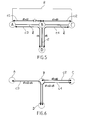
- the routing step does perform aggregation of the traffic demands d1 and d2 on the subpath A-B and d1 and d3 on the subpath B-C. Namely, four candidate optical connections c1, c2, c3 and c4 are obtained for carrying the five traffic demands as a result of the routing step.
- Figure 6 illustrates the optimization step.
- Candidate optical connections c1 is selected as the connection to be withdrawn as shown by the star, e.g. by using the lowest used-capacity criterion ( Fig. 5 ).
- a re-routing solution is sought among the reduced set made of c2, c3, c4 and c5 for both traffic demands d1 and d2 on the path A-B.
- the chain of optical connections c3-c4 provides a suitable solution for demand d1 and that the chain of optical connections c3-c4-c2 provides a suitable solution for demand d2.
- the traffic demand d1 is re-allocated to the connection c3 on the path A-B-D and to the connection c4 on the path D-B-C.
- the traffic demand d2 is re-allocated to the connection c3 on the path A-B-D, to the connection c4 on the path D-B-C and to the connection c2 on the path C-B.
- connection c1 is not considered anymore.
- the planned connection map now fulfills all the traffic demands with only three optical connections c2, c3 and c4.
- One additional connection was saved through the optimization step.
- the order in which the demands are reallocated may bear some importance. This order may be selected as a function of diverse parameters.
- the reallocation is executed as a function of the capacity of the traffic demands, from the largest capacity to the smallest capacity.
- the class of service of the demands may be taken into consideration similarly, from the most constrained to the less constrained. "Best effort" services may also be discarded in some cases, e.g. when such discarding saves an optical connection.
- the above methods may be implemented by a computer program comprising instruction codes executable by a computer to execute the method, or by a computer-implemented planning tool comprising a processor configured for executing the method.
- the planning tool could be e.g. hardware means like e.g. an ASIC, or a combination of hardware and software means, e.g. an ASIC and an FPGA, or at least one microprocessor and at least one memory with software modules located therein.
Landscapes
- Engineering & Computer Science (AREA)
- Computer Networks & Wireless Communication (AREA)
- Signal Processing (AREA)
- Data Exchanges In Wide-Area Networks (AREA)
Abstract
in a routing step:
allocating a loopless network path to each traffic demand,
allocating each traffic demand (dl-d3) to a candidate optical connection (c1-c3) or chain of candidate optical connections selected so as to carry the capacity of the traffic demand along the loopless network path allocated to the traffic demand,
and in an optimization step:
defining a reduced set of candidate optical connections (c2-c3) by withdrawing the candidate optical connection to be withdrawn (cl),
for each traffic demand (dl) allocated to the candidate optical connection to be withdrawn,
determining a candidate optical connection or a chain of candidate optical connections to be re-used among the reduced set of candidate optical connections (c2-c3), and
re-allocating the traffic demand (dl) to the candidate optical connection or chain of candidate optical connections to be re-used.
Description
- The invention relates to the technical field of optical communication systems, in particular to methods and devices for network design and planning.
- When a WDM optical network has to be dimensioned in order to address a given traffic matrix, multilayer network design optimization consists in taking into account jointly the constraints of the diverse layers composing the WDM optical network, e.g. an optical transport layer and an electrical client layer. Multilayer network design optimization aims at reducing the cost of the network.
- The network parameters that are available for optimization typically include:
- Path selection for each traffic demand, as there are many possible paths from the source to the destination. Besides, each traffic demand may have a different class of service.
- Intermediate grooming points, i.e. points of termination of the optical layer at intermediate nodes to reduce a total number of WDM interfaces by making efficient use of wavelength channels.
- Physical layer parameters (e.g. channel capacity) and constraints (e.g. wavelength continuity and physical transmission reach).
- A network planning method that would seek an optimal solution, i.e. the one providing the lower network cost for all parameters in a real network would be very complex and time consuming.
- Network planning methods which are both simple and efficient are needed. In particular, network planning methods that are not too computation-intensive may be implemented in planning tools integrated in control systems that provide the path computing in deployed networks.
- For that purpose, the invention provides a method for planning a plurality of optical connections in a WDM optical network as a function of a plurality of traffic demands in accordance with
claim 1 and a device for planning a plurality of optical connections in a WDM optical network as a function of a plurality of traffic demands in accordance with claim 15. - More detailed embodiments are defined in the dependent claims.
- Aspects of the invention stem from the observation that the prohibition of loops in a path computation process, while necessary to avoid a diverging number of solutions, may yield suboptimal connection maps in some cases.
- These and other aspects of the invention will be apparent from and elucidated with reference to the embodiments described hereinafter, by way of example, with reference to the drawings.
-
Figure 1 is a schematic representation of an optical network in which embodiments of the invention can be implemented. -
Figure 2 is a functional representation of an optical network in which a routing step is executed, in accordance with a first example. -
Figure 3 is a functional representation of the optical network ofFigure 2 in which an optimization step is executed, in accordance with the first example. -
Figure 4 is a functional representation of an optical network in which a routing step and an optimization step are executed, in accordance with a second example. -
Figure 5 is a functional representation of an optical network in which a routing step is executed, in accordance with a third example. -
Figure 6 is a functional representation of the optical network ofFigure 5 in which an optimization step is executed, in accordance with the third example. - With reference to
Figure 1 , a transparent WDMoptical network 10 is schematically illustrated. Transparentoptical switching nodes 1 are connected byoptical links 2 to form a given topology. The term "transparent" is applied to a transmission system, in which the signal remains optical without being converted into an electronic signal when passing through a network switching node. Transparency in optical communication networks is a characteristic that makes it possible to reduce the cost and power consumption of network equipment by eliminating optical-electrical-optical conversions, and therefore the corresponding transducers. Transparent switching capability may exist in some or all of theswitching nodes 1 of the optical network. - A variety of telecommunication equipment exists to implement such a network. Suitable
optical switching nodes 1 include for example Alcatel Lucent's 1626 Light Manager and Alcatel Lucent's 1830 Photonic Service Switch. -
Figure 1 also represents a plurality of traffic demands d, each of which corresponds to a given amount of traffic to be carried between two end nodes. The demand d is represented as a straight dashed line linking both end nodes, although the actual path to be followed by the traffic is necessarily a sequence of theoptical links 2, i.e. often enough not a straight line. In such a network, traffic is transported by optical connections, preferably transparent, which are generally bidirectional. For that purpose, anoptical link 2 between twonodes 1 comprises preferably a pair of optical fibers, i.e. one for each direction. A network planning tool, preferably computer-implemented, is used in order to determine how to transport traffic demands d in an efficient manner, i.e. using a minimum amount of resources. It is especially of interest to minimize the number of WDM optical transponders used. A suitable method will now be described. - The method is adapted for planning a plurality of optical connections in a WDM optical network as a function of a plurality of traffic demands. A traffic demand is defined by a pair of end nodes and a capacity to be transported, e.g. in a bidirectional manner.
- The method comprises an initial routing step that operates as follows.
- To each traffic demand, a loopless network path that connects the pair of end nodes of the traffic demand is allocated.
- A set of candidate optical connections suitable for fulfilling all the traffic demands is defined. Each candidate optical connection comprises a transmission capacity and a connection path that corresponds to one of:
- the loopless network path allocated to a traffic demand, and
- a subpath of the loopless network path allocated to a traffic demand.
- Each traffic demand is then allocated to a candidate optical connection or a chain of candidate optical connections of the defined set. The candidate optical connection or chain of candidate optical connections is selected so as to carry the capacity of the traffic demand between the end nodes of the traffic demand along the loopless network path allocated to the traffic demand.
- The method continues with an optimization step that operates as follows.
- A candidate optical connection to be withdrawn is selected among the set of candidate optical connections and a reduced set of candidate optical connections is defined by withdrawing the candidate optical connection to be withdrawn.
- Then, for each traffic demand allocated to the candidate optical connection to be withdrawn:
- it is determined whether there exists a candidate optical connection or a chain of candidate optical connections to be re-used among the reduced set of candidate optical connections, that has a free-capacity adapted to carry the capacity of the traffic demand between the end nodes of the traffic demand, and
- when such connections exist, the traffic demand is re-allocated to the candidate optical connection or chain of candidate optical connections to be re-used.
- Upon detecting that all the traffic demands allocated to the candidate optical connection to be withdrawn have been re-allocated, the reduced set of candidate optical connections is provided as a solution to the planning problem.
- The initial traffic demands may be provided under the form of a configuration file in a computer memory or other data repository. The resulting set of candidate optical connections with their traffic demand allocations may be provided in the same manner.
- The WDM optical network may be considered as a multilayer system. Indeed, the WDM optical signals form a transport layer the main features of which are transparency, wavelength continuity, traffic aggregation and high data rates. The modulated data carried by the WDM optical signals forms a client layer that can only be attained by terminating the optical transport layer.
- As used herein, the term "candidate optical connections" refers to continuous connections in the transport layer of the WDM optical network, i.e. signals that do not attain the client layer between the source and the destination of the optical connection. Such optical connections may be signaled as Lambda-LSP's in a GMPLS framework, where LSP stands for Label-switched path and GMPLS for Generalized Multiprotocol label-switching. It should be noted that signal regeneration may be necessary in certain long optical connections, e.g. due to physical impairments and/or wavelength continuity constraints.
- The routing step may be implemented in diverse manners. A main aspect of the routing step is the prohibition of loops, i.e. a path that goes twice through the same node. The routing step is restricted to loopless paths so that the initial path computation can be completed at a reasonable computational cost without divergence. The routing step may involve the computation of one path per traffic demand or a plurality of path per traffic demand.
- In a simple embodiment, the routing step comprises, for at least one or for each traffic demand, the computing of a single loopless network path that connects the pair of end nodes of the traffic demand, e.g. the shortest path.
- In another embodiment, the routing step comprises, for at least one or for each traffic demand:
- computing a plurality of candidate loopless network paths that connect the pair of end nodes of the traffic demand, and
- selecting the loopless network path allocated to the traffic demand within the plurality of candidate loopless network paths as a function of a transponder-cost of the set of candidate optical connections resulting from the selection.
- In an embodiment the path computation determines k shortest paths for each traffic demand, where k is an integer number greater than 1. This embodiment is advantageous in that it provides a higher number of paths combinations to promote traffic aggregation at the routing step, if such traffic aggregation is desired.
- The step of defining a set of candidate optical connections may be implemented diverse manners as well. Main aspects of the set of candidate optical connections are:
- The set of candidate optical connections must fulfill all the traffic demands.
- The set of candidate optical connections should be as cost-efficient as possible, e.g. by performing some aggregation of the traffic demands to limit a number of transponders used.
- In a simple embodiment, the set of candidate optical connections comprises a respective candidate optical connection or chain of candidate optical connections for each one of the traffic demands. This embodiment does not provide any aggregation of the traffic demands.
- In another embodiment, the routing step further comprises:
- determining that the loopless network paths allocated to a plurality of traffic demands have a shared path or subpath, i.e. a shared sequence of at least two nodes,
- defining a candidate optical connection as an aggregating candidate optical connection, wherein the aggregating candidate optical connection follows the shared path or subpath and has a transmission capacity suitable for cumulating the capacities of the plurality of traffic demands, and
- allocating the plurality of traffic demands to the aggregating candidate optical connection.
- It should be noted that the higher the number k of paths that are computed for each traffic-demand, the higher the number of shared paths or subpaths that may be found in the routing step to aggregate the traffic demands. However, an high number k will generate a huge number of path combinations to be tested and thus increase the computation time.
- After the routing step, the method continues to an optimization step that seeks to reduce the set of optical connections, while eliminating the prohibition of loops.
- The selection of the candidate optical connection to be withdrawn may be implemented using a variety of criteria.
- In an embodiment, the candidate optical connection to be withdrawn is selected among the set of candidate optical connections as a function of a low used-capacity criterion. Namely, this embodiment is based on the consideration that connections that have a low used-capacity should be tested first, because it should be easier to re-route their relatively limited amount of traffic onto the remaining candidate connections. As an example, the low transmission capacity criterion may be defined to select the candidate optical connection having a lowest used-capacity in absolute terms, e.g. in Gb/s of used capacity, or in relative terms, in percentage of used capacity vs. total capacity of the connection.
- In another embodiment, the candidate optical connection to be withdrawn is selected among the set of candidate optical connections as a function of a high free-capacity criterion. Namely, this embodiment is based on the consideration that connections that have a high free-capacity should be tested first, because it should optimize the cost reduction by avoiding cases in which a high rate optical connection serves to carry low bandwidth traffic. This makes especially sense when a mix of optical connection rates are deployed in the network, e.g. 10Gb/s, 40Gb/s and 100Gb/s. As an example, the high free-capacity criterion may be defined to select the candidate optical connection having a highest free-capacity in absolute terms, e.g. in Gb/s of free capacity, or in relative terms, in percentage of free capacity vs. total capacity of the connection.
- Many alternative selection criteria may be employed, e.g. based on a variety of parameters such as the connection length in number of hops or in absolute distance, the physical quality of the transmission, and the like. In particular, the withdrawing of an optical connection having high physical impairments may be useful to reduce the number of regenerators employed by the corresponding traffic demands.
- Preferably, the optimization step is carried out so as to keep at least a predefined amount of free-capacity in the remaining optical connections, e.g. about 5% of the total capacity. This measure is useful to keep the network ready for accommodating a future traffic growth, e.g. a predictable one. In a corresponding embodiment, the optimization step further comprises:
- determining a free-capacity of each optical connection of the reduced set,
- prohibiting the reallocation of the traffic demand to an optical connection when the reallocation will cause reduction of the free-capacity of the optical connection below a predefined free-capacity threshold.
- Preferably, the optimization step is carried out so as to avoid the withdrawing of an optical connection that is filled up beyond a predefined threshold, e.g. above 95% of the total capacity. This measure improves the efficiency of the method since it is unlikely that the use of resources, e.g. optical transponders may be substantially improved by deleting a connection that is very efficiently used, i.e. close to full capacity.
- In an embodiment, the method further comprises iterating the optimization step with the reduced set of candidate optical connections obtained at the previous optimization step until a convergence criterion is fulfilled.
- The convergence criterion may be defined in several ways.
- In an embodiment, the convergence criterion is the detection that no candidate optical connection to be re-used is available in the reduced set for a traffic demand allocated to the candidate optical connection to be withdrawn.
- In an embodiment, the convergence criteria is only fulfilled when all candidate optical connections have been tested for the candidate optical connection to be withdrawn, so that the set of optical connections cannot be further reduced by repeating the optimization step of the method.
- For the sake of illustration, the above principles will now be applied to three examples illustrated in the
Figures 2 to 6 . In these Figures, the letters A, B, C and D denote optical switching nodes having a transparent switching capability and thenumber 2 denotes a physical link between two nodes, e.g. optical fibers. The traffic demands in each example are defined in the tables 1 to 3 appended below. For the sake of simplicity, the traffic demands and the resulting optical connections contemplated are bidirectional. However, single-direction demands and connections may be managed in the same manner. For the sake of simplicity also, all optical connections contemplated are a total capacity of 10 Gb/s. However, the same methods are applicable to connections at any data rates, e.g. 2.5, 40, 100, 200 Gb/s and others. The connection capacities within the network are not necessarily uniform, e.g. due to some hardware heterogeneity of the optical nodes. -
Table 1: Traffic matrix for Fig. 2 Demand Capacity Source Destination Allocated Path d1 1 A C A-C d2 3 B C B-C d3 2 A B A-B -
Figure 2 illustrates the routing step. InFigure 2 , the traffic demands are denoted by a dashed-line (left side). The paths are allocated as a result of a simple shortest path computation. The routing step does not perform any aggregation of the traffic demands. Namely, three candidate optical connections c1, c2 and c3 each carrying a single demand are defined as a result of the routing step (right side). -
Figure 3 illustrates the optimization step. Candidate optical connections c1 is selected as the connection to be withdrawn as shown by the star, e.g. by using the lowest used-capacity criterion (left side). As a result, a re-routing solution is sought for traffic demand d1 among the reduced set made of c2 and c3. Then it is found that the chain of optical connections c2-c3 provides a suitable solution. Then the traffic demand d1 is re-allocated to the connection c2 on the subpath A-B and to the connection c3 on the subpath B-C, as shown by the arrows (left side). - As a result, connection c1 is not considered anymore. The planned connection map (right side) fulfills all the traffic demands with only two optical connections c2 and c3. One connection was saved through the optimization step.
-
Table 2: Traffic matrix for Fig. 4 Demand Capacity Source Destination Allocated Path d1 1 A C A-B-C d2 5 A D A-B-D d3 2 D C D-B-C - The same notations are used as in example 1. The left side of
Figure 4 illustrates the routing step. The paths are allocated as a result of a simple shortest path computation. The routing step does not perform any aggregation of the traffic demands. Namely, three candidate optical connections c1, c2 and c3 each carrying a single demand are defined as a result of the routing step. - The right side of
Figure 4 illustrates the optimization step. Candidate optical connections c1 is selected as the connection to be withdrawn as shown by the star, e.g. by using the lowest used-capacity criterion (right side). As a result, a re-routing solution is sought for traffic demand d1 among the reduced set made of c2 and c3. Then it is found that the chain of optical connections c2-c3 provides a suitable solution. Then the traffic demand d1 is re-allocated to the connection c2 on the subpath A-B-D and to the connection c3 on the subpath D-B-C, as shown by the arrows (right side). - As a result, connection c1 is not considered anymore. The planned connection map (right side) fulfills all the traffic demands with only two optical connections c2 and c3. One connection was saved through the optimization step.
- Moreover, the demand d1 is now routed through a looped path that could never have been found by the routing step.
-
Table 3: Traffic matrix for Fig. 5 Demand Capacity Source Destination Allocated Path d1 1 A C A-B-C d2 1 A B A-B d3 1 B C B-C d4 5 A D A-B-D d5 5 D C D-B-C - Example 3 illustrates how traffic demand aggregation may already be implemented at the routing step. The same notations are used as in example 1.
-
Figure 5 illustrates the routing step. The paths are allocated as a result of a k-shortest path computation, e.g. k=2. The routing step does perform aggregation of the traffic demands d1 and d2 on the subpath A-B and d1 and d3 on the subpath B-C. Namely, four candidate optical connections c1, c2, c3 and c4 are obtained for carrying the five traffic demands as a result of the routing step. -
Figure 6 illustrates the optimization step. Candidate optical connections c1 is selected as the connection to be withdrawn as shown by the star, e.g. by using the lowest used-capacity criterion (Fig. 5 ). As a result, a re-routing solution is sought among the reduced set made of c2, c3, c4 and c5 for both traffic demands d1 and d2 on the path A-B. - Then it is found that the chain of optical connections c3-c4 provides a suitable solution for demand d1 and that the chain of optical connections c3-c4-c2 provides a suitable solution for demand d2. The traffic demand d1 is re-allocated to the connection c3 on the path A-B-D and to the connection c4 on the path D-B-C. The traffic demand d2 is re-allocated to the connection c3 on the path A-B-D, to the connection c4 on the path D-B-C and to the connection c2 on the path C-B.
- As a result, connection c1 is not considered anymore. The planned connection map now fulfills all the traffic demands with only three optical connections c2, c3 and c4. One additional connection was saved through the optimization step.
- Again, the demands d1 and d2 are now routed through looped paths that could never have been found by the routing step, even by applying a k-shortest paths search (k>1).
- When the withdrawing of an optical connection causes the rerouting of several traffic demands, as illustrated in example 3 with demands d1 and d2, the order in which the demands are reallocated may bear some importance. This order may be selected as a function of diverse parameters. In preferred embodiments, the reallocation is executed as a function of the capacity of the traffic demands, from the largest capacity to the smallest capacity. The class of service of the demands may be taken into consideration similarly, from the most constrained to the less constrained. "Best effort" services may also be discarded in some cases, e.g. when such discarding saves an optical connection.
- The above methods may be implemented by a computer program comprising instruction codes executable by a computer to execute the method, or by a computer-implemented planning tool comprising a processor configured for executing the method. In embodiments, the planning tool could be e.g. hardware means like e.g. an ASIC, or a combination of hardware and software means, e.g. an ASIC and an FPGA, or at least one microprocessor and at least one memory with software modules located therein.
- The invention is not limited to the described embodiments. The appended claims are to be construed as embodying all modification and alternative constructions that may be occurred to one skilled in the art, which fairly fall within the basic teaching here, set forth.
- The use of the verb "to comprise" or "to include" and its conjugations does not exclude the presence of elements or steps other than those stated in a claim. Furthermore, the use of the article "a" or "an" preceding an element or step does not exclude the presence of a plurality of such elements or steps.
- In the claims, any reference signs placed between parentheses shall not be construed as limiting the scope of the claims.
Claims (14)
- A method for planning a plurality of optical connections in a WDM optical network as a function of a plurality of traffic demands, wherein each traffic demand (d1-d5) comprises a pair of end nodes and a capacity, the method comprising:in a routing step:to each traffic demand, allocating a loopless network path that connects the pair of end nodes of the traffic demand,defining a set of candidate optical connections (c1-c4) suitable for fulfilling all the traffic demands, wherein the candidate optical connections are continuous connections in a transport layer of the WDM optical network, wherein each candidate optical connection comprises a transmission capacity and a connection path that corresponds to one of:the loopless network path allocated to a traffic demand,a subpath of the loopless network path allocated to a traffic demand,allocating each traffic demand (d1-d5) to a candidate optical connection (c1-c4) or a chain of candidate optical connections selected so as to carry the capacity of the traffic demand between the end nodes of the traffic demand along the loopless network path allocated to the traffic demand,and in an optimization step:selecting a candidate optical connection to be withdrawn (c1) among the set of candidate optical connections,defining a reduced set of candidate optical connections (c2-c4) by withdrawing the candidate optical connection to be withdrawn (c1),for each traffic demand (d1) allocated to the candidate optical connection to be withdrawn,determining a candidate optical connection or a chain of candidate optical connections to be re-used among the reduced set of candidate optical connections (c2-c4), so that the candidate optical connection or chain of candidate optical connections to be re-used has a free-capacity adapted to carry the capacity of the traffic demand between the end nodes of the traffic demand, andre-allocating the traffic demand (d1) to the candidate optical connection or chain of candidate optical connections to be re-used,detecting that all the traffic demands allocated to the candidate optical connection to be withdrawn have been re-allocated, andproviding the reduced set of candidate optical connections.
- The method in accordance claim 1, wherein the routing step further comprises, for each traffic demand:computing a single loopless network path that connects the pair of end nodes of the traffic demand.
- The method in accordance with claim 1, wherein the routing step further comprises, for each traffic demand:computing a plurality of candidate loopless network paths that connect the pair of end nodes of the traffic demand, andselecting the loopless network path allocated to the traffic demand within the plurality of candidate loopless network paths as a function of a transponder-cost of the set of candidate optical connections resulting from the selection.
- The method in accordance with any one of claims 1 to 3, wherein the step of defining a set of candidate optical connections suitable for fulfilling all the traffic demands comprises defining a respective candidate optical connection or chain of candidate optical connections for each one of the traffic demands.
- The method in accordance with any one of claims 1 to 3, wherein the routing step further comprises:determining that the loopless network paths allocated to a plurality of traffic demands have a shared path or subpath,defining a candidate optical connection as an aggregating candidate optical connection, wherein the aggregating candidate optical connection follows the shared path or subpath and has a transmission capacity suitable for cumulating the capacities of the plurality of traffic demands, andallocating the plurality of traffic demands to the aggregating candidate optical connection.
- The method in accordance with any one of claims 1 to 5, further comprising iterating the optimization step with the reduced set of candidate optical connections obtained at the previous optimization step until a convergence criterion is fulfilled.
- The method in accordance with claim 6, wherein the convergence criterion is the detection that no candidate optical connection to be re-used is available in the reduced set for a traffic demand allocated to the candidate optical connection to be withdrawn.
- The method in accordance with any one of claims 1 to 7, wherein the candidate optical connection to be withdrawn is selected among the set of candidate optical connections as a function of a low used-capacity criterion.
- The method in accordance with claim 8, wherein the low transmission capacity criterion is fulfilled by the candidate optical connection having a lowest used-capacity in absolute or relative terms.
- The method in accordance with any one of claims 1 to 7, wherein the candidate optical connection to be withdrawn is selected among the set of candidate optical connections as a function of a high free-capacity criterion.
- The method in accordance with claim 10, wherein the high free-capacity criterion is fulfilled by the candidate optical connection having a highest free-capacity in absolute or relative terms.
- The method in accordance with any one of claims 1 to 11, wherein the optimization step further comprises:determining a free-capacity of each optical connection of the reduced set,prohibiting the reallocation of the traffic demand to an optical connection when the reallocation will cause reduction of the free-capacity of the optical connection below a predefined free-capacity threshold.
- A computer program comprising instruction codes executable by a computer to execute the method in accordance with any one of claims 1 to 12.
- A device for planning a plurality of optical connections in a WDM optical network as a function of a plurality of traffic demands, wherein each traffic demand comprises a pair of end nodes and a capacity, the device comprising:a data repository for storing the plurality of traffic demands, anda processor configured for:in a routing step:to each traffic demand, allocating a loopless network path that connects the pair of end nodes of the traffic demand,defining a set of candidate optical connections suitable for fulfilling all the traffic demands, wherein each candidate optical connection comprises a transmission capacity and a connection path that corresponds to one of:the loopless network path allocated to a traffic demand,a subpath of the loopless network path allocated to a traffic demand,allocating each traffic demand to a candidate optical connection or a chain of candidate optical connections selected so as to carry the capacity of the traffic demand between the end nodes of the traffic demand along the loopless network path allocated to the traffic demand,and in an optimization step:selecting a candidate optical connection to be withdrawn among the set of candidate optical connections,defining a reduced set of candidate optical connections by withdrawing the candidate optical connection to be withdrawn,for each traffic demand allocated to the candidate optical connection to be withdrawn,determining a candidate optical connection or a chain of candidate optical connections to be re-used among the reduced set of candidate optical connections, so that the candidate optical connection or chain of candidate optical connections to be re-used has a free-capacity adapted to carry the capacity of the traffic demand between the end nodes of the traffic demand, andre-allocating the traffic demand to the candidate optical connection or chain of candidate optical connections to be re-used,detecting that all the traffic demands allocated to the candidate optical connection to be withdrawn have been re-allocated, andproviding the reduced set of candidate optical connections.
Priority Applications (3)
| Application Number | Priority Date | Filing Date | Title |
|---|---|---|---|
| EP20130306388 EP2860907A1 (en) | 2013-10-08 | 2013-10-08 | Planning of optical connections in a WDM optical network |
| US14/482,199 US9351056B2 (en) | 2013-10-08 | 2014-09-10 | Planning of optical connections in a WDM optical network |
| CN201410508759.0A CN104518909B (en) | 2013-10-08 | 2014-09-28 | The planning of optics connection in WDM optic networks |
Applications Claiming Priority (1)
| Application Number | Priority Date | Filing Date | Title |
|---|---|---|---|
| EP20130306388 EP2860907A1 (en) | 2013-10-08 | 2013-10-08 | Planning of optical connections in a WDM optical network |
Publications (1)
| Publication Number | Publication Date |
|---|---|
| EP2860907A1 true EP2860907A1 (en) | 2015-04-15 |
Family
ID=49486414
Family Applications (1)
| Application Number | Title | Priority Date | Filing Date |
|---|---|---|---|
| EP20130306388 Withdrawn EP2860907A1 (en) | 2013-10-08 | 2013-10-08 | Planning of optical connections in a WDM optical network |
Country Status (3)
| Country | Link |
|---|---|
| US (1) | US9351056B2 (en) |
| EP (1) | EP2860907A1 (en) |
| CN (1) | CN104518909B (en) |
Families Citing this family (1)
| Publication number | Priority date | Publication date | Assignee | Title |
|---|---|---|---|---|
| EP2860907A1 (en) * | 2013-10-08 | 2015-04-15 | Alcatel Lucent | Planning of optical connections in a WDM optical network |
Citations (7)
| Publication number | Priority date | Publication date | Assignee | Title |
|---|---|---|---|---|
| EP1005195A2 (en) * | 1998-11-24 | 2000-05-31 | Lucent Technologies Inc. | Network topology optimization methods and apparatus for designing IP networks with performance guarantees |
| US6073248A (en) * | 1997-10-29 | 2000-06-06 | Lucent Technologies Inc. | Distributed precomputation of signal paths in an optical network |
| WO2002011403A2 (en) * | 2000-07-31 | 2002-02-07 | Rsoft Design Group, Inc. | Method for designing rings in telecommunications network |
| US20030009598A1 (en) * | 2001-04-12 | 2003-01-09 | Gunluk Oktay Necip | Method for designing demand-sensitive rings |
| WO2003047144A1 (en) * | 2001-11-30 | 2003-06-05 | Pirelli & C. S.P.A. | Method for planning or provisioning data transport networks |
| US20060002310A1 (en) * | 2004-07-02 | 2006-01-05 | Ali Zolfaghari | System and method for second order multi-layer traffic grooming for optical network optimization |
| EP2571184A1 (en) * | 2011-09-16 | 2013-03-20 | Alcatel Lucent | Allocation of spectral capacity in a wavelength-division multiplexing optical network |
Family Cites Families (15)
| Publication number | Priority date | Publication date | Assignee | Title |
|---|---|---|---|---|
| US6850705B2 (en) * | 2001-03-17 | 2005-02-01 | Fujitsu Limited | Online distributed path routing method and system |
| US7716271B1 (en) * | 2001-06-05 | 2010-05-11 | Massachusetts Institute Of Technology | Routing and wavelength assignment in optical networks |
| US20040247317A1 (en) * | 2003-06-06 | 2004-12-09 | Sadananda Santosh Kumar | Method and apparatus for a network database in an optical network |
| WO2006081150A2 (en) * | 2005-01-21 | 2006-08-03 | Raza Microelectronics, Inc. | System and method for performing concatenation of diversely routed channels |
| DE602005023793D1 (en) * | 2005-11-29 | 2010-11-04 | Telecom Italia Spa | OPTIMIZED DYNAMIC ROUTES IN AN OPTICAL NETWORK |
| JP4629640B2 (en) * | 2006-09-29 | 2011-02-09 | 富士通株式会社 | Optical network design method, design program, and storage medium storing design program |
| US8031704B2 (en) * | 2007-10-22 | 2011-10-04 | Infinera Corporation | Network planning and optimization of equipment deployment |
| US9490894B2 (en) * | 2008-12-08 | 2016-11-08 | Ciena Corporation | Coherent probe and optical service channel systems and methods for optical networks |
| US8433192B2 (en) * | 2008-12-08 | 2013-04-30 | Ciena Corporation | Dynamic performance monitoring systems and methods for optical networks |
| US8315519B2 (en) * | 2009-06-03 | 2012-11-20 | Nec Laboratories America, Inc. | Systems and methods for transmitting signals in communication networks |
| US20140193154A1 (en) * | 2010-02-22 | 2014-07-10 | Vello Systems, Inc. | Subchannel security at the optical layer |
| US8644710B2 (en) * | 2011-06-15 | 2014-02-04 | Verizon Patent And Licensing Inc. | Optical transport having full and flexible bandwidth and channel utilization |
| JP5811764B2 (en) * | 2011-10-21 | 2015-11-11 | 富士通株式会社 | Demand accommodation design method and demand accommodation design system |
| CN104704759B (en) * | 2012-10-08 | 2017-11-24 | 华为技术有限公司 | Transport Function Virtualization of Optical Network Based on Wavelength Division Multiplexing (WDM) |
| EP2860907A1 (en) * | 2013-10-08 | 2015-04-15 | Alcatel Lucent | Planning of optical connections in a WDM optical network |
-
2013
- 2013-10-08 EP EP20130306388 patent/EP2860907A1/en not_active Withdrawn
-
2014
- 2014-09-10 US US14/482,199 patent/US9351056B2/en active Active
- 2014-09-28 CN CN201410508759.0A patent/CN104518909B/en active Active
Patent Citations (7)
| Publication number | Priority date | Publication date | Assignee | Title |
|---|---|---|---|---|
| US6073248A (en) * | 1997-10-29 | 2000-06-06 | Lucent Technologies Inc. | Distributed precomputation of signal paths in an optical network |
| EP1005195A2 (en) * | 1998-11-24 | 2000-05-31 | Lucent Technologies Inc. | Network topology optimization methods and apparatus for designing IP networks with performance guarantees |
| WO2002011403A2 (en) * | 2000-07-31 | 2002-02-07 | Rsoft Design Group, Inc. | Method for designing rings in telecommunications network |
| US20030009598A1 (en) * | 2001-04-12 | 2003-01-09 | Gunluk Oktay Necip | Method for designing demand-sensitive rings |
| WO2003047144A1 (en) * | 2001-11-30 | 2003-06-05 | Pirelli & C. S.P.A. | Method for planning or provisioning data transport networks |
| US20060002310A1 (en) * | 2004-07-02 | 2006-01-05 | Ali Zolfaghari | System and method for second order multi-layer traffic grooming for optical network optimization |
| EP2571184A1 (en) * | 2011-09-16 | 2013-03-20 | Alcatel Lucent | Allocation of spectral capacity in a wavelength-division multiplexing optical network |
Also Published As
| Publication number | Publication date |
|---|---|
| US20150098699A1 (en) | 2015-04-09 |
| US9351056B2 (en) | 2016-05-24 |
| CN104518909B (en) | 2018-04-27 |
| CN104518909A (en) | 2015-04-15 |
Similar Documents
| Publication | Publication Date | Title |
|---|---|---|
| EP3041169B1 (en) | Network cost optimization | |
| US9602387B2 (en) | Network topology optimization | |
| US20240405875A1 (en) | Multi-layer network system and path setting method in multi-layer network | |
| US8363553B2 (en) | Optimized dynamic routing in an optical network | |
| EP2567550B1 (en) | Selecting an optical path for a new connection with the minimum number of optical regenerators | |
| US10587472B2 (en) | Highly reliable path accommodation design apparatus and method | |
| US9319131B2 (en) | Adding new alternative paths for restoration in WSON network | |
| EP2432157A1 (en) | Method and system for implementing alternate routes in optical transmission network of wavelength switched optical network (wson) | |
| EP3136649A1 (en) | Method and system for providing load information of an optical data transmission system | |
| US9351056B2 (en) | Planning of optical connections in a WDM optical network | |
| US10700777B2 (en) | Method and system for assigning performance indicators to objects of a network | |
| Jinno et al. | Minimal virtualized-elastic-regenerator placement and least congestion resources assignment for translucent elastic optical networks | |
| Xu et al. | SRLG-diverse routing of multiple circuits in a heterogeneous optical transport network | |
| Skoog et al. | Analysis and implementation of a 3-way handshake signaling protocol for highly dynamic transport networks | |
| JP5814850B2 (en) | Network facility amount calculation device and network facility amount calculation method | |
| US20260106821A1 (en) | Sparse Route Computation for Determining Optical Paths with Defined Optical Regenerator Locations | |
| Asano et al. | Strategic Virtualized-Elastic-Regenerator Placement and Adaptive Modulation Selection for Translucent Elastic Optical Networks (EONs) | |
| EP3001591A1 (en) | Provisioning an optical connection in an optical network | |
| Gifre et al. | Modulation format-aware restoration and re-optimization in Flexgrid optical networks |
Legal Events
| Date | Code | Title | Description |
|---|---|---|---|
| PUAI | Public reference made under article 153(3) epc to a published international application that has entered the european phase |
Free format text: ORIGINAL CODE: 0009012 |
|
| 17P | Request for examination filed |
Effective date: 20131008 |
|
| AK | Designated contracting states |
Kind code of ref document: A1 Designated state(s): AL AT BE BG CH CY CZ DE DK EE ES FI FR GB GR HR HU IE IS IT LI LT LU LV MC MK MT NL NO PL PT RO RS SE SI SK SM TR |
|
| AX | Request for extension of the european patent |
Extension state: BA ME |
|
| R17P | Request for examination filed (corrected) |
Effective date: 20151015 |
|
| RBV | Designated contracting states (corrected) |
Designated state(s): AL AT BE BG CH CY CZ DE DK EE ES FI FR GB GR HR HU IE IS IT LI LT LU LV MC MK MT NL NO PL PT RO RS SE SI SK SM TR |
|
| RAP1 | Party data changed (applicant data changed or rights of an application transferred) |
Owner name: ALCATEL LUCENT |
|
| 17Q | First examination report despatched |
Effective date: 20181024 |
|
| STAA | Information on the status of an ep patent application or granted ep patent |
Free format text: STATUS: THE APPLICATION IS DEEMED TO BE WITHDRAWN |
|
| 18D | Application deemed to be withdrawn |
Effective date: 20190305 |