EP2860248A1 - Cineraria-derived chromosomal DNA involved in synthesis of flavonoid, and use thereof - Google Patents
Cineraria-derived chromosomal DNA involved in synthesis of flavonoid, and use thereof Download PDFInfo
- Publication number
- EP2860248A1 EP2860248A1 EP20140193057 EP14193057A EP2860248A1 EP 2860248 A1 EP2860248 A1 EP 2860248A1 EP 20140193057 EP20140193057 EP 20140193057 EP 14193057 A EP14193057 A EP 14193057A EP 2860248 A1 EP2860248 A1 EP 2860248A1
- Authority
- EP
- European Patent Office
- Prior art keywords
- gene
- cineraria
- polynucleotide
- promoter
- seq
- Prior art date
- Legal status (The legal status is an assumption and is not a legal conclusion. Google has not performed a legal analysis and makes no representation as to the accuracy of the status listed.)
- Withdrawn
Links
- 229930003935 flavonoid Natural products 0.000 title claims description 10
- 150000002215 flavonoids Chemical class 0.000 title claims description 10
- 235000017173 flavonoids Nutrition 0.000 title claims description 10
- 230000015572 biosynthetic process Effects 0.000 title description 7
- 238000003786 synthesis reaction Methods 0.000 title description 6
- 239000013611 chromosomal DNA Substances 0.000 title description 5
- 241001633993 Cineraria Species 0.000 title 1
- 108010062650 Flavonoid 3',5'-hydroxylase Proteins 0.000 claims abstract description 90
- 108090000623 proteins and genes Proteins 0.000 claims abstract description 54
- 108091033319 polynucleotide Proteins 0.000 claims abstract description 46
- 102000040430 polynucleotide Human genes 0.000 claims abstract description 46
- 239000002157 polynucleotide Substances 0.000 claims abstract description 46
- 239000002773 nucleotide Substances 0.000 claims abstract description 24
- 125000003729 nucleotide group Chemical group 0.000 claims abstract description 24
- 230000014509 gene expression Effects 0.000 claims abstract description 20
- 230000002401 inhibitory effect Effects 0.000 claims abstract description 11
- 108091030071 RNAI Proteins 0.000 claims abstract description 7
- 230000009368 gene silencing by RNA Effects 0.000 claims abstract description 7
- GCPYCNBGGPHOBD-UHFFFAOYSA-N Delphinidin Natural products OC1=Cc2c(O)cc(O)cc2OC1=C3C=C(O)C(=O)C(=C3)O GCPYCNBGGPHOBD-UHFFFAOYSA-N 0.000 claims description 19
- 235000007242 delphinidin Nutrition 0.000 claims description 19
- HKUHOPQRJKPJCJ-UHFFFAOYSA-N pelargonidin Natural products OC1=Cc2c(O)cc(O)cc2OC1c1ccc(O)cc1 HKUHOPQRJKPJCJ-UHFFFAOYSA-N 0.000 claims description 17
- 235000006251 pelargonidin Nutrition 0.000 claims description 17
- 230000009105 vegetative growth Effects 0.000 claims description 16
- 210000000056 organ Anatomy 0.000 claims description 13
- JKHRCGUTYDNCLE-UHFFFAOYSA-O delphinidin Chemical compound [O+]=1C2=CC(O)=CC(O)=C2C=C(O)C=1C1=CC(O)=C(O)C(O)=C1 JKHRCGUTYDNCLE-UHFFFAOYSA-O 0.000 claims 1
- XVFMGWDSJLBXDZ-UHFFFAOYSA-O pelargonidin Chemical compound C1=CC(O)=CC=C1C(C(=C1)O)=[O+]C2=C1C(O)=CC(O)=C2 XVFMGWDSJLBXDZ-UHFFFAOYSA-O 0.000 claims 1
- 241000182534 Pericallis hybrida Species 0.000 abstract description 51
- 238000000034 method Methods 0.000 abstract description 14
- 108091026890 Coding region Proteins 0.000 abstract description 11
- 241000196324 Embryophyta Species 0.000 description 45
- 241000723353 Chrysanthemum Species 0.000 description 35
- 235000007516 Chrysanthemum Nutrition 0.000 description 35
- 108020004414 DNA Proteins 0.000 description 32
- 101100226484 Arabidopsis thaliana CYP75B1 gene Proteins 0.000 description 30
- 101100494423 Oryza sativa subsp. japonica CYP75B3 gene Proteins 0.000 description 30
- 239000012634 fragment Substances 0.000 description 25
- 239000002299 complementary DNA Substances 0.000 description 24
- 239000013612 plasmid Substances 0.000 description 21
- 239000013598 vector Substances 0.000 description 20
- FFNDMZIBVDSQFI-UHFFFAOYSA-N delphinidin chloride Chemical compound [Cl-].[O+]=1C2=CC(O)=CC(O)=C2C=C(O)C=1C1=CC(O)=C(O)C(O)=C1 FFNDMZIBVDSQFI-UHFFFAOYSA-N 0.000 description 18
- 108010058731 nopaline synthase Proteins 0.000 description 18
- 241000207748 Petunia Species 0.000 description 16
- YPVZJXMTXCOTJN-UHFFFAOYSA-N pelargonidin chloride Chemical compound [Cl-].C1=CC(O)=CC=C1C(C(=C1)O)=[O+]C2=C1C(O)=CC(O)=C2 YPVZJXMTXCOTJN-UHFFFAOYSA-N 0.000 description 16
- 238000010276 construction Methods 0.000 description 13
- VEVZSMAEJFVWIL-UHFFFAOYSA-O cyanidin cation Chemical compound [O+]=1C2=CC(O)=CC(O)=C2C=C(O)C=1C1=CC=C(O)C(O)=C1 VEVZSMAEJFVWIL-UHFFFAOYSA-O 0.000 description 12
- 244000225942 Viola tricolor Species 0.000 description 11
- 235000004031 Viola x wittrockiana Nutrition 0.000 description 11
- 230000009466 transformation Effects 0.000 description 11
- 238000009396 hybridization Methods 0.000 description 10
- 210000001519 tissue Anatomy 0.000 description 10
- 241000490229 Eucephalus Species 0.000 description 8
- 241000220317 Rosa Species 0.000 description 8
- 230000000694 effects Effects 0.000 description 8
- KZMACGJDUUWFCH-UHFFFAOYSA-O malvidin Chemical compound COC1=C(O)C(OC)=CC(C=2C(=CC=3C(O)=CC(O)=CC=3[O+]=2)O)=C1 KZMACGJDUUWFCH-UHFFFAOYSA-O 0.000 description 8
- 108091028043 Nucleic acid sequence Proteins 0.000 description 7
- 210000000349 chromosome Anatomy 0.000 description 7
- 238000013518 transcription Methods 0.000 description 7
- 230000035897 transcription Effects 0.000 description 7
- 238000013519 translation Methods 0.000 description 7
- 108090000790 Enzymes Proteins 0.000 description 6
- 102000004190 Enzymes Human genes 0.000 description 6
- 108700039691 Genetic Promoter Regions Proteins 0.000 description 6
- FAPWRFPIFSIZLT-UHFFFAOYSA-M Sodium chloride Chemical compound [Na+].[Cl-] FAPWRFPIFSIZLT-UHFFFAOYSA-M 0.000 description 6
- 235000007336 cyanidin Nutrition 0.000 description 6
- 241000109329 Rosa xanthina Species 0.000 description 5
- 235000004789 Rosa xanthina Nutrition 0.000 description 5
- 150000001413 amino acids Chemical group 0.000 description 5
- 229930014669 anthocyanidin Natural products 0.000 description 5
- 235000008758 anthocyanidins Nutrition 0.000 description 5
- 238000010586 diagram Methods 0.000 description 5
- 108091032973 (ribonucleotides)n+m Proteins 0.000 description 4
- 102000040650 (ribonucleotides)n+m Human genes 0.000 description 4
- DHMQDGOQFOQNFH-UHFFFAOYSA-N Glycine Chemical compound NCC(O)=O DHMQDGOQFOQNFH-UHFFFAOYSA-N 0.000 description 4
- 235000009584 malvidin Nutrition 0.000 description 4
- 229930015721 peonidin Natural products 0.000 description 4
- 235000006404 peonidin Nutrition 0.000 description 4
- OGBSHLKSHNAPEW-UHFFFAOYSA-N peonidin chloride Chemical compound [Cl-].C1=C(O)C(OC)=CC(C=2C(=CC=3C(O)=CC(O)=CC=3[O+]=2)O)=C1 OGBSHLKSHNAPEW-UHFFFAOYSA-N 0.000 description 4
- 229930015717 petunidin Natural products 0.000 description 4
- 235000006384 petunidin Nutrition 0.000 description 4
- QULMBDNPZCFSPR-UHFFFAOYSA-N petunidin chloride Chemical compound [Cl-].OC1=C(O)C(OC)=CC(C=2C(=CC=3C(O)=CC(O)=CC=3[O+]=2)O)=C1 QULMBDNPZCFSPR-UHFFFAOYSA-N 0.000 description 4
- 239000013615 primer Substances 0.000 description 4
- 235000018102 proteins Nutrition 0.000 description 4
- 102000004169 proteins and genes Human genes 0.000 description 4
- 108091008146 restriction endonucleases Proteins 0.000 description 4
- 241000589158 Agrobacterium Species 0.000 description 3
- 240000006497 Dianthus caryophyllus Species 0.000 description 3
- 235000009355 Dianthus caryophyllus Nutrition 0.000 description 3
- 108091026898 Leader sequence (mRNA) Proteins 0.000 description 3
- 150000001452 anthocyanidin derivatives Chemical class 0.000 description 3
- 230000002759 chromosomal effect Effects 0.000 description 3
- 108010060641 flavanone synthetase Proteins 0.000 description 3
- 108010015706 flavonoid 3'-hydroxylase Proteins 0.000 description 3
- 239000011780 sodium chloride Substances 0.000 description 3
- PADQINQHPQKXNL-LSDHHAIUSA-N (+)-dihydrokaempferol Chemical compound C1([C@@H]2[C@H](C(C3=C(O)C=C(O)C=C3O2)=O)O)=CC=C(O)C=C1 PADQINQHPQKXNL-LSDHHAIUSA-N 0.000 description 2
- 235000008358 Clitoria ternatea Nutrition 0.000 description 2
- 108010015742 Cytochrome P-450 Enzyme System Proteins 0.000 description 2
- 102000002004 Cytochrome P-450 Enzyme System Human genes 0.000 description 2
- 239000004471 Glycine Substances 0.000 description 2
- 241000410021 Pericallis cruenta Species 0.000 description 2
- 208000020584 Polyploidy Diseases 0.000 description 2
- 108091036066 Three prime untranslated region Proteins 0.000 description 2
- RAYJUFCFJUVJBB-UHFFFAOYSA-N dihydrokaempferol Natural products OC1Oc2c(O)cc(O)cc2C(=O)C1c3ccc(O)cc3 RAYJUFCFJUVJBB-UHFFFAOYSA-N 0.000 description 2
- 230000002708 enhancing effect Effects 0.000 description 2
- 238000002474 experimental method Methods 0.000 description 2
- NWKFECICNXDNOQ-UHFFFAOYSA-N flavylium Chemical compound C1=CC=CC=C1C1=CC=C(C=CC=C2)C2=[O+]1 NWKFECICNXDNOQ-UHFFFAOYSA-N 0.000 description 2
- 238000010230 functional analysis Methods 0.000 description 2
- 125000002887 hydroxy group Chemical group [H]O* 0.000 description 2
- 238000001727 in vivo Methods 0.000 description 2
- 108010083942 mannopine synthase Proteins 0.000 description 2
- 238000004519 manufacturing process Methods 0.000 description 2
- 244000005700 microbiome Species 0.000 description 2
- 230000006798 recombination Effects 0.000 description 2
- 230000022532 regulation of transcription, DNA-dependent Effects 0.000 description 2
- 238000011160 research Methods 0.000 description 2
- 239000000523 sample Substances 0.000 description 2
- 238000005406 washing Methods 0.000 description 2
- 101150078635 18 gene Proteins 0.000 description 1
- 108010000700 Acetolactate synthase Proteins 0.000 description 1
- 241000207875 Antirrhinum Species 0.000 description 1
- 239000004475 Arginine Substances 0.000 description 1
- 241000208837 Asterales Species 0.000 description 1
- 241000701489 Cauliflower mosaic virus Species 0.000 description 1
- 241000411951 Centrosema virginianum Species 0.000 description 1
- 101710134884 Chalcone synthase 5 Proteins 0.000 description 1
- 240000005605 Clitoria ternatea Species 0.000 description 1
- 108010066133 D-octopine dehydrogenase Proteins 0.000 description 1
- 108020001019 DNA Primers Proteins 0.000 description 1
- 239000003155 DNA primer Substances 0.000 description 1
- 108010044229 Dihydroflavanol 4-reductase Proteins 0.000 description 1
- 241000588724 Escherichia coli Species 0.000 description 1
- 108700007698 Genetic Terminator Regions Proteins 0.000 description 1
- WHUUTDBJXJRKMK-UHFFFAOYSA-N Glutamic acid Natural products OC(=O)C(N)CCC(O)=O WHUUTDBJXJRKMK-UHFFFAOYSA-N 0.000 description 1
- 108091092195 Intron Proteins 0.000 description 1
- 101100288095 Klebsiella pneumoniae neo gene Proteins 0.000 description 1
- ODKSFYDXXFIFQN-BYPYZUCNSA-P L-argininium(2+) Chemical compound NC(=[NH2+])NCCC[C@H]([NH3+])C(O)=O ODKSFYDXXFIFQN-BYPYZUCNSA-P 0.000 description 1
- WHUUTDBJXJRKMK-VKHMYHEASA-N L-glutamic acid Chemical compound OC(=O)[C@@H](N)CCC(O)=O WHUUTDBJXJRKMK-VKHMYHEASA-N 0.000 description 1
- AGPKZVBTJJNPAG-WHFBIAKZSA-N L-isoleucine Chemical compound CC[C@H](C)[C@H](N)C(O)=O AGPKZVBTJJNPAG-WHFBIAKZSA-N 0.000 description 1
- FFEARJCKVFRZRR-BYPYZUCNSA-N L-methionine Chemical compound CSCC[C@H](N)C(O)=O FFEARJCKVFRZRR-BYPYZUCNSA-N 0.000 description 1
- AYFVYJQAPQTCCC-GBXIJSLDSA-N L-threonine Chemical compound C[C@@H](O)[C@H](N)C(O)=O AYFVYJQAPQTCCC-GBXIJSLDSA-N 0.000 description 1
- KZSNJWFQEVHDMF-BYPYZUCNSA-N L-valine Chemical compound CC(C)[C@H](N)C(O)=O KZSNJWFQEVHDMF-BYPYZUCNSA-N 0.000 description 1
- 244000061176 Nicotiana tabacum Species 0.000 description 1
- 235000002637 Nicotiana tabacum Nutrition 0.000 description 1
- 241000133276 Osteospermum Species 0.000 description 1
- 108700001094 Plant Genes Proteins 0.000 description 1
- 244000018633 Prunus armeniaca Species 0.000 description 1
- 235000009827 Prunus armeniaca Nutrition 0.000 description 1
- 240000004808 Saccharomyces cerevisiae Species 0.000 description 1
- 241000208255 Solanales Species 0.000 description 1
- 244000061456 Solanum tuberosum Species 0.000 description 1
- 235000002595 Solanum tuberosum Nutrition 0.000 description 1
- 238000002105 Southern blotting Methods 0.000 description 1
- 239000004098 Tetracycline Substances 0.000 description 1
- 208000035199 Tetraploidy Diseases 0.000 description 1
- AYFVYJQAPQTCCC-UHFFFAOYSA-N Threonine Natural products CC(O)C(N)C(O)=O AYFVYJQAPQTCCC-UHFFFAOYSA-N 0.000 description 1
- 239000004473 Threonine Substances 0.000 description 1
- KZSNJWFQEVHDMF-UHFFFAOYSA-N Valine Natural products CC(C)C(N)C(O)=O KZSNJWFQEVHDMF-UHFFFAOYSA-N 0.000 description 1
- 238000009825 accumulation Methods 0.000 description 1
- 235000001014 amino acid Nutrition 0.000 description 1
- 229940024606 amino acid Drugs 0.000 description 1
- 230000003321 amplification Effects 0.000 description 1
- 229930002877 anthocyanin Natural products 0.000 description 1
- 235000010208 anthocyanin Nutrition 0.000 description 1
- 239000004410 anthocyanin Substances 0.000 description 1
- 150000004636 anthocyanins Chemical class 0.000 description 1
- ODKSFYDXXFIFQN-UHFFFAOYSA-N arginine Natural products OC(=O)C(N)CCCNC(N)=N ODKSFYDXXFIFQN-UHFFFAOYSA-N 0.000 description 1
- 210000004027 cell Anatomy 0.000 description 1
- 230000008859 change Effects 0.000 description 1
- 239000001666 citrus aurantium l. flower Substances 0.000 description 1
- 230000000295 complement effect Effects 0.000 description 1
- 238000009402 cross-breeding Methods 0.000 description 1
- 235000013922 glutamic acid Nutrition 0.000 description 1
- 239000004220 glutamic acid Substances 0.000 description 1
- 230000012010 growth Effects 0.000 description 1
- 230000033444 hydroxylation Effects 0.000 description 1
- 238000005805 hydroxylation reaction Methods 0.000 description 1
- 238000000338 in vitro Methods 0.000 description 1
- 230000005764 inhibitory process Effects 0.000 description 1
- 238000003780 insertion Methods 0.000 description 1
- 230000037431 insertion Effects 0.000 description 1
- AGPKZVBTJJNPAG-UHFFFAOYSA-N isoleucine Natural products CCC(C)C(N)C(O)=O AGPKZVBTJJNPAG-UHFFFAOYSA-N 0.000 description 1
- 229960000310 isoleucine Drugs 0.000 description 1
- 229930027917 kanamycin Natural products 0.000 description 1
- 229960000318 kanamycin Drugs 0.000 description 1
- SBUJHOSQTJFQJX-NOAMYHISSA-N kanamycin Chemical compound O[C@@H]1[C@@H](O)[C@H](O)[C@@H](CN)O[C@@H]1O[C@H]1[C@H](O)[C@@H](O[C@@H]2[C@@H]([C@@H](N)[C@H](O)[C@@H](CO)O2)O)[C@H](N)C[C@@H]1N SBUJHOSQTJFQJX-NOAMYHISSA-N 0.000 description 1
- 229930182823 kanamycin A Natural products 0.000 description 1
- 229930182817 methionine Natural products 0.000 description 1
- 238000010369 molecular cloning Methods 0.000 description 1
- 238000003199 nucleic acid amplification method Methods 0.000 description 1
- 230000037361 pathway Effects 0.000 description 1
- 239000000049 pigment Substances 0.000 description 1
- 230000008569 process Effects 0.000 description 1
- 238000010839 reverse transcription Methods 0.000 description 1
- 238000003757 reverse transcription PCR Methods 0.000 description 1
- 150000003839 salts Chemical class 0.000 description 1
- NLJMYIDDQXHKNR-UHFFFAOYSA-K sodium citrate Chemical compound O.O.[Na+].[Na+].[Na+].[O-]C(=O)CC(O)(CC([O-])=O)C([O-])=O NLJMYIDDQXHKNR-UHFFFAOYSA-K 0.000 description 1
- 239000001509 sodium citrate Substances 0.000 description 1
- 239000000758 substrate Substances 0.000 description 1
- 229960002180 tetracycline Drugs 0.000 description 1
- 229930101283 tetracycline Natural products 0.000 description 1
- 235000019364 tetracycline Nutrition 0.000 description 1
- 150000003522 tetracyclines Chemical class 0.000 description 1
- 238000011426 transformation method Methods 0.000 description 1
- 239000004474 valine Substances 0.000 description 1
- 108700026220 vif Genes Proteins 0.000 description 1
Images


Classifications
-
- C—CHEMISTRY; METALLURGY
- C12—BIOCHEMISTRY; BEER; SPIRITS; WINE; VINEGAR; MICROBIOLOGY; ENZYMOLOGY; MUTATION OR GENETIC ENGINEERING
- C12N—MICROORGANISMS OR ENZYMES; COMPOSITIONS THEREOF; PROPAGATING, PRESERVING, OR MAINTAINING MICROORGANISMS; MUTATION OR GENETIC ENGINEERING; CULTURE MEDIA
- C12N15/00—Mutation or genetic engineering; DNA or RNA concerning genetic engineering, vectors, e.g. plasmids, or their isolation, preparation or purification; Use of hosts therefor
- C12N15/09—Recombinant DNA-technology
- C12N15/63—Introduction of foreign genetic material using vectors; Vectors; Use of hosts therefor; Regulation of expression
- C12N15/79—Vectors or expression systems specially adapted for eukaryotic hosts
- C12N15/82—Vectors or expression systems specially adapted for eukaryotic hosts for plant cells, e.g. plant artificial chromosomes (PACs)
- C12N15/8241—Phenotypically and genetically modified plants via recombinant DNA technology
- C12N15/8242—Phenotypically and genetically modified plants via recombinant DNA technology with non-agronomic quality (output) traits, e.g. for industrial processing; Value added, non-agronomic traits
- C12N15/8243—Phenotypically and genetically modified plants via recombinant DNA technology with non-agronomic quality (output) traits, e.g. for industrial processing; Value added, non-agronomic traits involving biosynthetic or metabolic pathways, i.e. metabolic engineering, e.g. nicotine, caffeine
- C12N15/825—Phenotypically and genetically modified plants via recombinant DNA technology with non-agronomic quality (output) traits, e.g. for industrial processing; Value added, non-agronomic traits involving biosynthetic or metabolic pathways, i.e. metabolic engineering, e.g. nicotine, caffeine involving pigment biosynthesis
-
- C—CHEMISTRY; METALLURGY
- C12—BIOCHEMISTRY; BEER; SPIRITS; WINE; VINEGAR; MICROBIOLOGY; ENZYMOLOGY; MUTATION OR GENETIC ENGINEERING
- C12N—MICROORGANISMS OR ENZYMES; COMPOSITIONS THEREOF; PROPAGATING, PRESERVING, OR MAINTAINING MICROORGANISMS; MUTATION OR GENETIC ENGINEERING; CULTURE MEDIA
- C12N15/00—Mutation or genetic engineering; DNA or RNA concerning genetic engineering, vectors, e.g. plasmids, or their isolation, preparation or purification; Use of hosts therefor
- C12N15/09—Recombinant DNA-technology
- C12N15/63—Introduction of foreign genetic material using vectors; Vectors; Use of hosts therefor; Regulation of expression
- C12N15/79—Vectors or expression systems specially adapted for eukaryotic hosts
- C12N15/82—Vectors or expression systems specially adapted for eukaryotic hosts for plant cells, e.g. plant artificial chromosomes (PACs)
- C12N15/8216—Methods for controlling, regulating or enhancing expression of transgenes in plant cells
- C12N15/8222—Developmentally regulated expression systems, tissue, organ specific, temporal or spatial regulation
- C12N15/8223—Vegetative tissue-specific promoters
- C12N15/8225—Leaf-specific, e.g. including petioles, stomata
-
- C—CHEMISTRY; METALLURGY
- C12—BIOCHEMISTRY; BEER; SPIRITS; WINE; VINEGAR; MICROBIOLOGY; ENZYMOLOGY; MUTATION OR GENETIC ENGINEERING
- C12N—MICROORGANISMS OR ENZYMES; COMPOSITIONS THEREOF; PROPAGATING, PRESERVING, OR MAINTAINING MICROORGANISMS; MUTATION OR GENETIC ENGINEERING; CULTURE MEDIA
- C12N9/00—Enzymes; Proenzymes; Compositions thereof; Processes for preparing, activating, inhibiting, separating or purifying enzymes
- C12N9/0004—Oxidoreductases (1.)
- C12N9/0071—Oxidoreductases (1.) acting on paired donors with incorporation of molecular oxygen (1.14)
- C12N9/0073—Oxidoreductases (1.) acting on paired donors with incorporation of molecular oxygen (1.14) with NADH or NADPH as one donor, and incorporation of one atom of oxygen 1.14.13
Definitions
- the present invention relates to a novel cineraria-derived polynucleotide containing a transcription control region of flavonoid 3',5'-hydroxylase (F3'5'H), a 5'-untranslated region, an exon, an intron, a 3'-untranslated region and a sequence required for terminating transcription, a novel gene construct containing the polynucleotide, and a genetically modified plant containing that construct.
- F3'5'H flavonoid 3',5'-hydroxylase
- Enzymes that govern B ring hydroxylation consist of flavonoid 3'-hydroxylase (F3'H) and flavonoid 3',5'-hydroxylase (F3'5'H), and the genes of both enzymes are acquired from numerous plants including petunias. Based on a comparison of amino acid sequences, F3'H and F3'5'H belong sub-families classified into CYP75B and CYP75A, respectively, of the cytochrome P450 super family (refer to Non-Patent Document 1). Recently, enzymes having F3'5'H activity of aster and osteospermum (which are both members of the aster family) have been reported to belong to the CYP75B sub-family.
- plants belonging to the aster family are presumed to have genes belonging to the CYP75B that overlap, and acquired a function for encoding enzymes having F3'5'H activity (refer to Non-Patent Document 2).
- an exogenous gene is linked to a constitutive promoter or pedal-specific promoter in order to express the exogenous gene in petals.
- a promoter of a constitutive gene involved in flavonoid biosynthesis is frequently used for the petal-specific promoter.
- a promoter such as that derived from chalcone synthase present in snapdragons is used in carnations to accumulate delphinidin (refer to Patent Document 1 and Patent Document 2).
- a nucleotide sequence required to terminate transcription referred to as a terminator is frequently used in addition to a promoter to express a target gene.
- a terminator is frequently used, it is not easy to predict in advance which terminator should be used to allow a target gene to function properly.
- Non-Patent Document 2 chromosomal genes of plant genes (translation sequence regions or terminator regions containing promoters and introns) are allowed to function by inserting directly into a plant.
- plants frequently exhibit a high degree of polyploidy.
- Cultivated roses are tetraploids
- cultivated chrysanthemums are hexaploids
- cineraria are octoploids.
- genes of enzymes such as F3'5'H involved in flavonoid synthesis are predicted to be present in these plants in at least the number of the polyploidy. Even if all of these are not transcribed and function, since the plant is able to demonstrate F3'5'H activity, it is not easy to isolate a promoter that is actually able to function from these plants.
- RNAi double-stranded RNA
- a cDNA-derived sequence such as an F3'H cDNA sequence
- an unrelated sequence such as an E. coli-derived GUS sequence
- An object of the present invention is to provide a novel cineraria-derived polynucleotide able to function as a promoter of a coding region of flavonoid 3',5'-hydroxylase (F3'5'H) for use as a tool for changing flower color, and to provide a novel F3'5'H gene construct that contains that polynucleotide.
- F3'5'H flavonoid 3',5'-hydroxylase
- an object of the present invention is to provide a novel cineraria-derived polynucleotide that contains a transcription control region of flavonoid 3',5'-hydroxylase (F3'5'H) gene, a 5'-untranslated region, an exon, an intron, a 3'-untranslated region and a sequence required for terminating transcription, and to provide a novel gene construct containing that polynucleotide and a genetically modified plant containing that construct.
- F3'5'H flavonoid 3',5'-hydroxylase
- the inventors of the present invention acquired a gene construct able to actually function from a chromosomal clone of cineraria, and expressed that construct in petunias and chrysanthemums, thereby leading to completion of the present invention.
- the present invention provides the following [1] to [14]:
- novel cineraria-derived polynucleotide able to function as a promoter of a coding region of flavonoid 3',5'-hydroxylase (F3'5'H), and the novel F3'5'H gene construct comprising the polynucleotide, according to the present invention can be preferably used as a tool for changing petal color.
- sequence of an intron of the novel cineraria-derived polynucleotide able to function as a promoter of a coding region of flavonoid 3',5'-hydroxylase (F3'5'H) according to the present invention can be preferably used as a loop sequence in a gene construct for inhibiting expression of a gene by RNAi.
- a "polynucleotide that hybridizes under stringent conditions” refers to a polynucleotide obtained by using colony hybridization, plaque hybridization or southern blot hybridization and the like, and an example thereof is a DNA that can be immobilized by allowing a probe (such as polynucleotide having the nucleotide sequence indicated in SEQ ID NO: 6) to act on a support immobilized with a polynucleotide to be detected, carrying out hybridization for 2 hours at 42°C in the presence of 0.7 to 1.0 M NaCl, followed by carrying out hybridization for 12 to 16 hours at 42°C in the presence of 0.7 to 1.0 M NaCl, and washing the filter at 42°C using a roughly 0.1 to 2-fold SSC solution (the composition of a 1-fold concentration SSC solution consisting of 150 mM sodium chloride and 15 mM sodium citrate).
- Hybridization can be carried out in compliance with, for example, the method described in Molecular
- hybridization conditions is low stringent conditions.
- Low stringent conditions refer to conditions of, for example, conditions of 0.1% SDS at 5 x SSC and 42°, and preferably conditions of 0.1% SDS at 5 x SSC and 50°C, during washing following hybridization. More preferably, high stringent conditions are used for the hybridization conditions.
- High stringent conditions refer to, for example, conditions of 0.1% SDS at 0.1 x SSC and 65°C. Under these conditions, DNA having high homology can be expected to be efficiently obtained as the temperature is raised.
- a plurality of factors such as temperature or salt concentration are thought to influence the stringency of hybridization, and similar stringency can be realized by a person with ordinary skill in the art by suitably selecting these factors.
- DNA that hybridizes under stringent conditions is a DNA having a certain sequence identity or higher with the nucleotide sequence of a DNA used as a probe, and the sequence identity is, for example, 70% or higher, preferably 80% or higher, more preferably 90% or higher, even more preferably 93% or higher, particularly preferably 95% or higher, and most preferably 98% or higher.
- a cDNA library was produced using poly-A + RNA prepared from this RNA using the ZAP-cDNA® Library Construction Kit (Stratagene, Product No. 200450) in accordance with the method recommended by the manufacturer.
- This cDNA library was then screened using butterfly pea F3'5'H cDNA (Clitoria ternatea) (see Plant Biotechnology, 23, 5-11 (2006 )) labeled with the DIG System (Roche Applied Science) in accordance with the method recommended by the manufacturer.
- the resulting phages demonstrating 48 signals were purified. Plasmids were obtained from these phages by in vivo excision in accordance with the method recommended by the manufacturer (Stratagene).
- the nucleotide sequences of the cDNA moieties contained in these plasmids were determined, numerous genes that demonstrated homology with cytochrome P450 were able to be obtained when a Blast search was performed of DNA databases, and the genes were able to be classified into 8 types.
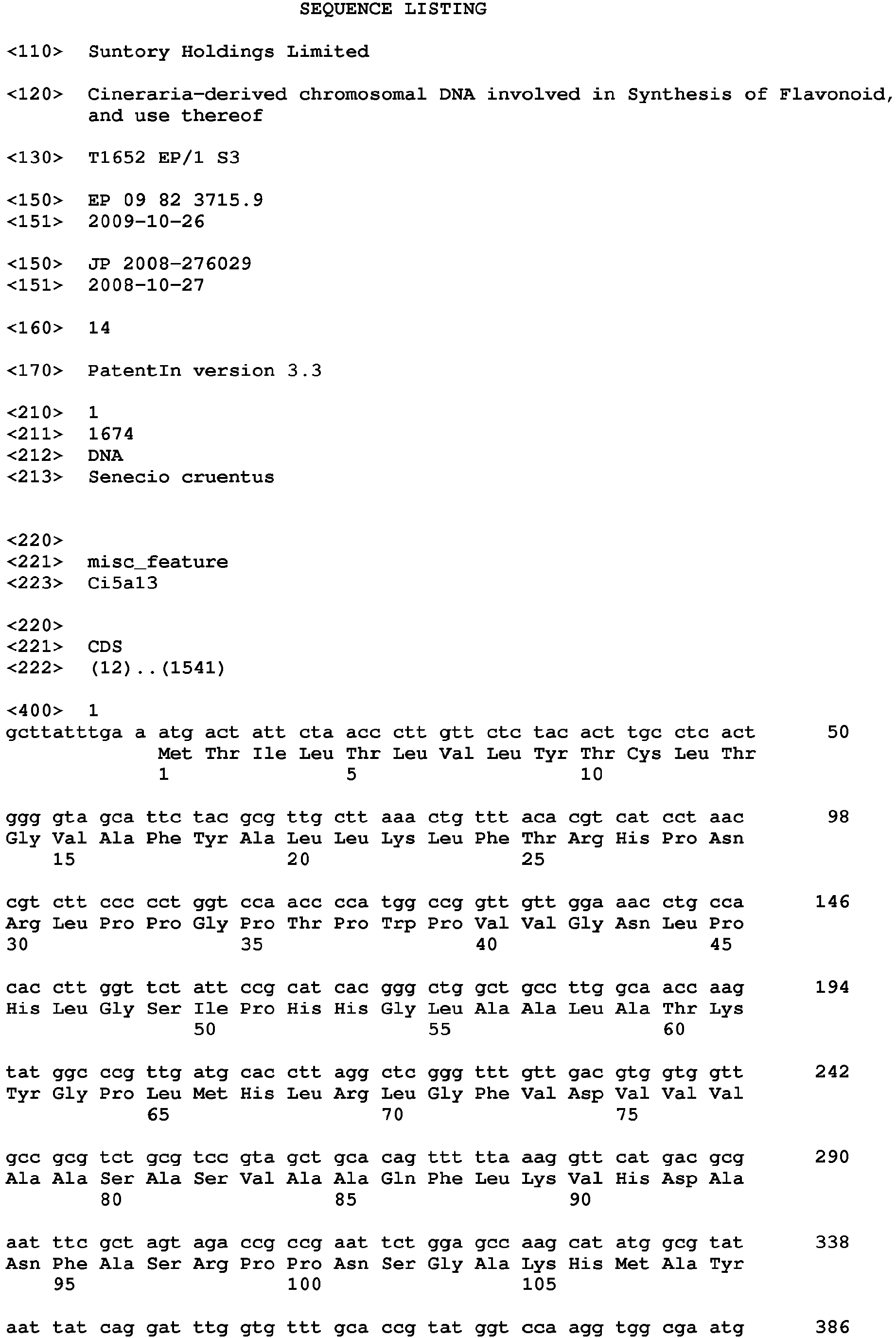
- the complete nucleotide sequences of two clones (Ci5a13 (SEQ ID NO: 1) and Ci5a18 (SEQ ID NO: 3)) that were presumed to be classified as CYP75B were respectively determined.
- Ci5a13 and Ci5a18 were inserted between a constitutive promoter, MacI promoter (see Plant Molecular Biology, 15: 373-381, 1990 ), on a binary vector pBinPLUS (see Trangenic Research, 4: 288-290, 1995 ) and a mannopine synthase terminator, and were respectively designated as pSPB2875 and pSPB2786.
- the resulting binary vectors were transformed in petunia strain Skr4xSw63 using the Agrobacterium method.
- Japanese Patent No. 308726 should be referred to regarding the transformation method and petunia strain.
- Several stains of the transformed petunias exhibited a darker flower color than the host.
- levels of cyanidin and its derivative, peonidin were markedly increased in strains introduced with Ci5a13, while in strains introduced with Ci5a18, levels of delphinidin and its derivatives, petunidin and malvidin, were markedly increased.
- Ci5a13 was determined to encode F3'H while Ci5a18 was determined to encode F3'5'H.
- Table 1 shows the analyzed values (number of ⁇ g per g of flower petal) of pelargonidin, cyanidin, peonidin, delphinidin, petunidin and malvidin in flower petals of the petunia transformants.
- Table 1 Petunia Pelargonidin ( ⁇ g/g) Cyanidin ( ⁇ g/g) Peonidin ( ⁇ g/g) Delphinidin ( ⁇ g/g) Petunidin ( ⁇ g/g) Malvidin ( ⁇ g/g) Pre-transformed host 20 0 12 0 5.3 91 Introduction of Ci5a13 Exp. No. 9 1.5 2.5 520 0 2.5 87 Exp. No. 23 2.3 5.6 550 0 5.6 130 Introduction of Ci5a18 Exp. No. 4 12 1.6 40 7.8 66 570 Exp. No. 12 7.8 11 91 11 86 700
- Chromosomal DNA was extracted from the same cineraria leaves of Example 1, and a chromosome library was produced using the ⁇ BlueSTARTM Xho I Half-Site Arms Kit (Novagen, http://www.merckbiosciences.com/product/69242). The resulting 200,000 plaques were screened using a Ci5a18 cDNA fragment labeled with DIG. This cDNA fragment was amplified using primers (Ci5a18F1 (SEQ ID NO: 7): 5'-CATCTGTTTTCTGCCAAAGC-3' and Ci5a18R1 (SEQ ID NO: 8): 5'-GGATTAGGAAACGACCAGG-3') as primers and using Ci5a18 as a template.
- Ci5a18 amino acid sequence (SEQ ID NO: 4) were methionine, glycine, glutamic acid and isoleucine, respectively, in the chromosomal clones, these consisted of threonine, arginine, glycine and valine (see SEQ ID NO: 6).
- FIG. 2 indicates the structure of the DNA fragment of about 5.7 kb (SEQ ID NO: 6) excised from gCi01-pBluestar with PvuI and EcoRV.
- This binary vector had nptII gene that can be used to select T-DNA regions with kanamycin.
- RT-PCR Consisting of reverse transcription using Superscript 2 First Strand System (Invitrogen) followed by amplification by PCR.
- Ci5a18F1 SEQ ID NO: 7
- Ci5a18R1 SEQ ID NO: 8 were used for the primers. Transcription products were not detected in the leaves. The most transcription products were detected in the flower petals at stage 3 (time at which the petals start to open).
- Flower petal stage 3 is the time at which structural genes involved in flavonoid synthesis relating to flower color are expressed at the highest levels (see Plant Physiol., 132: 1652-1663, 2003 ).
- the above results indicate that a DNA sequence derived from a chromosome gene of F3'5'H of cineraria of the aster family (containing a promoter, translation region and terminator) (SEQ ID NO: 6) functions in petunias of the aster family, or in other words, that the promoter according to the present invention indicated in SEQ ID NO: 9 is suitable for controlling a structural gene involved in flavonoid synthesis relating to flower color.
- the plants are not necessarily closely related, and they respectively belong to different orders consisting of the order Asterales and the order Solanales.
- a genetically modified plant obtained in this manner can be increased by vegetative growth such as bud cutting.
- the introduced gene is inserted into chromosomal DNA of the host plant, is transmitted to progeny, and normally demonstrates a phenotype even in the progeny.
- This binary vector was introduced into the chrysanthemum variety, Improved Regan, according to the Agrobacterium method. Chrysanthemum transformation was carried out in accordance with, for example, the method described in International Publication WO94/28140 , although not limited thereto.
- pCGP3618 comprises an expression cassette containing rose chalcone synthase promoter, pansy F3'5'H #18 and nopaline synthase terminator, and an expression cassette containing an inverted repeat sequence of chrysanthemum F3'H gene containing rose chalcone synthase promoter and an intron of cineraria F3'5'H gene, and a nopaline synthase terminator.
- This vector was constructed with the intent of inhibiting expression of F3'H gene in chrysanthemum while simultaneously expressing F3'5'H gene.
- a DNA fragment of about 569 bp containing a first intron from position 3093 to position 3617 of the nucleotide sequence shown in SEQ ID NO: 6 of cineraria F3'5'H gene was amplified using plasmid gCi01 as a template and using the following synthetic DNA primers:
- This 569 bp DNA fragment was sub-cloned to plasmid pCR2.1 (Invitrogen), and the resulting plasmid was designated as pCGP3445.
- pCGP3445 was digested with XhoI and SalI, and a DNA fragment of about 560 bp was recovered. This DNA fragment was inserted into pCGP2203 digested with XhoI (described in PCT/AU2008/001694 , consisting of pansy F3'5'H #18 cDNA inserted between rose CHS promoter and nos terminator), and the resulting plasmid was further digested with SmaI to remove the roughly 260 bp DNA fragment derived from pansy F3'5'H #18 cDNA. The resulting plasmid was designated as pCGP3602.
- Plasmid pCGP3609 (Rose CHS Promoter + Forward Chrysanthemum F3'H cDNA + Intron of Cineraria F3'5'H Gene + Nopaline Synthase Terminator)>
- Plasmid pCGP3133 (described in PCT/AU2008/001694 , containing a portion of chrysanthemum F3'H gene amplified by PCR followed by addition of an XhoI sequence to both ends thereof) was digested with NcoI and BamHI, and the resulting roughly 1.1 kb DNA fragment was recovered and blunted followed by inserting into an SmaI site of pCGP3602.
- a plasmid in which cDNA was linked in the forward direction downstream from a promoter was designated as pCGP3609.
- the DNA construct consisting of forward chrysanthemum F3'H cDNA + intron of cineraria F3'5'H gene + reverse chrysanthemum F3'H cDNA is hereinafter also referred to as ds chrysanthemum F3'H (cineraria intron 1).
- a DNA fragment containing rose CHS promoter + ds chrysanthemum F3'H (cineraria intron 1) + nopaline synthase terminator was recovered from pCGP3613 by digesting with restrictases BglII and NotI. This DNA fragment was then blunted and linked with a DNA fragment obtained by digesting pCGP2217 (described in PCT/AU2008/001694 ) with PmeI to obtain plant transformation vector pCGP3618 shown in FIG. 3 .
- a DNA fragment containing rose CHS promoter + ds chrysanthemum F3'H (cineraria intron 1) + nopaline synthase terminator was recovered from pCGP3613 by digesting with restrictases BglII and NotI. This DNA fragment was then blunted and linked with a DNA fragment obtained by digesting pCGP1988 (described in PCT/AU03/01111 ) with PmeI to obtain a plant transformation vector pCGP3617 shown in FIG. 4 .
- Example 8 Construction of Transformation Vector pCGP3620 (Promoter Region of Cineraria F3'5'H + Pansy F3'5'H #18 cDNA + Nopaline Synthase Terminator)
- a DNA sequence of the promoter region of cineraria F3'5'H was amplified by PCR using plasmid gCi1, containing cineraria F3'5'H chromosomal DNA, as a template and using the following synthetic DNA as primers:
- the resulting roughly 1.5 kb DNA fragment was linked with a DNA fragment obtained by blunting pBluescript KS+ digested with EcoRI.
- the resulting plasmid was designated as pCGP3604.
- a DNA fragment (approx. 1.9 kb) containing pansy F3'5'H #18 cDNA + nopaline synthase terminator was recovered by digesting plasmid pCGP2203 with EcoRI and NotI. This DNA fragment was linked with pCGP3604 digested with EcoRI and NotI to obtain plasmid pCGP3615.
- Plasmid pCGP3615 was digested with NotI and blunted. An roughly 3.6 kb DNA fragment was obtained by further digesting with EcoRV. This DNA fragment was then linked with pCGP1988 digested with PmeI to obtain plant transformation binary vector pCGP3620 shown in FIG. 5 .
- T-DNA moieties of pCGP3246 and pCGP3617 were inserted into chrysanthemum variety, Improved Regan, as described in Example 5. Flower color of flowers of the transformant changed from the pink color of Improved Regan to an apricot color. In addition, pelargonidin, which is not contained in flowers of the Improved Regan variety, was contained in flowers of the transformant.
- the content of pelargonidin in the transformant derived from pCGP3617 was an average of about 56%.
- pelargonidin was contained that is not contained in naturally-occurring chrysanthemums, and a new flower color was able to be obtained as a result thereof. This constitutes an industrially useful result.
- the use of a cineraria intron was determined to make it possible to efficiently inhibit F3'H gene while also making it possible to demonstrate a more prominent change in flower color.
- T-DNA moieties of pCGP3429 Rose CHS Promoter + Pansy F3'5'H #18 cDNA + Nopaline Synthase Terminator; rose CHS promoter + ds chrysanthemum F3'H (not inserted with intron) + nopaline synthase terminator, described in PCT/AU2008/001694 ) and pCGP3618 (described in Example 6) were introduced into the chrysanthemum variety, Improved Regan, as described in Example 5. Flower color of the resulting transformant become bluer in comparison with the Improved Regan variety. In addition, delphinidin was produced that is not contained in Improved Regan.
- the delphinidin content of the transformant derived from pCGP3429 reached a maximum of 80%.
- Chrysanthemum endogenous F3'H and externally introduced F3'5'H are thought to hydrolyze the same substrate (such as dihydrokaempferol) and be used in the synthesis of cyanidin and delphinidin, respectively.
- Enhancing expression of F3'5'H as well as inhibiting activity of F3'H are effective for enhancing delphinidin content.
- the high content of delphinidin in chrysanthemums introduced with pCGP3618 as compared with that in those introduced with pCGP3429 suggests that the cineraria intron sequence is effective in inhibiting expression of F3'H gene.
- novel cineraria-derived polynucleotide according to the present invention that is able to function as a promoter of a coding region of flavonoid 3',5'-hydroxylase (F3'5'H), and a novel F3'5'H gene construct containing this polynucleotide, can be preferably used as a tool for changing flower color.
- an intron sequence (polynucleotide that is all or a portion of a first intron from position 3093 to position 3617 of the nucleotide sequence shown in SEQ ID NO: 6) of the novel cineraria-derived polynucleotide according to the present invention that is able to function as a promoter of a coding region of flavonoid 3',5'-hydroxylase (F3'5'H) can be preferably used as a loop sequence in a gene construct for inhibiting gene expression by RNAi.
- the present invention also relates to the following items:
Landscapes
- Health & Medical Sciences (AREA)
- Life Sciences & Earth Sciences (AREA)
- Genetics & Genomics (AREA)
- Engineering & Computer Science (AREA)
- Chemical & Material Sciences (AREA)
- Biomedical Technology (AREA)
- Wood Science & Technology (AREA)
- Organic Chemistry (AREA)
- Biotechnology (AREA)
- Zoology (AREA)
- Bioinformatics & Cheminformatics (AREA)
- General Engineering & Computer Science (AREA)
- Molecular Biology (AREA)
- General Health & Medical Sciences (AREA)
- Microbiology (AREA)
- Biochemistry (AREA)
- Plant Pathology (AREA)
- Biophysics (AREA)
- Physics & Mathematics (AREA)
- Cell Biology (AREA)
- Medicinal Chemistry (AREA)
- Nutrition Science (AREA)
- Breeding Of Plants And Reproduction By Means Of Culturing (AREA)
- Micro-Organisms Or Cultivation Processes Thereof (AREA)
Abstract
Description
- The present invention relates to a novel cineraria-derived polynucleotide containing a transcription control region of flavonoid 3',5'-hydroxylase (F3'5'H), a 5'-untranslated region, an exon, an intron, a 3'-untranslated region and a sequence required for terminating transcription, a novel gene construct containing the polynucleotide, and a genetically modified plant containing that construct.
- In roses, as shown in
FIG. 1 , the number of hydroxyl groups of ring B (upper right) has a considerable effect on anthocyanidin (flower color), and when the number of hydroxyl groups is three, flower color frequently changes from blue to violet. In fact, many flowers ranging from blue to violet in color contain anthocyanin derived from delphinidin. - Enzymes that govern B ring hydroxylation consist of flavonoid 3'-hydroxylase (F3'H) and flavonoid 3',5'-hydroxylase (F3'5'H), and the genes of both enzymes are acquired from numerous plants including petunias. Based on a comparison of amino acid sequences, F3'H and F3'5'H belong sub-families classified into CYP75B and CYP75A, respectively, of the cytochrome P450 super family (refer to Non-Patent Document 1). Recently, enzymes having F3'5'H activity of aster and osteospermum (which are both members of the aster family) have been reported to belong to the CYP75B sub-family. On the other hand, these plants also have enzymes belonging to the CPY75B sub-family that have F3'H activity. Thus, plants belonging to the aster family are presumed to have genes belonging to the CYP75B that overlap, and acquired a function for encoding enzymes having F3'5'H activity (refer to Non-Patent Document 2).
- However, a protein designated as F3'5'H of cineraria (Pericallis cruenta or Senecio cruentus), which is also a member of the aster family, is registered as Accession No. AAX19888 of the protein database of the National Center for Biotechnology Information (http://ww.ncbi.nim-nih.gov/). Although examples of measuring the activity of this protein in yeast have been reported (refer to Non-Patent Document 2), since results of measuring the activity of this protein in plants have not been reported, its function is unclear.
- Since plants such as roses and carnations are unable to synthesize delphinidin due to the absence of F3'5'H gene, there are no varieties having a violet to blue flower color. It would be industrially useful if it were possible to produce varieties having violet to blue color. Recently, varieties having violet to blue color, which were unable to be obtained with conventional cross-breeding, have been developed by expressing F3'5'H gene in roses and carnations by utilizing genetic recombination techniques (refer to Non-Patent
Document 1 and Non-Patent Document 3). In addition, examples have also been reported of changing flower color using genetic recombination techniques (refer to Non-Patent Document 4). - For example, several plants are unable to produce bright red and orange flowers as a result of not producing pelargonidin. Since the dihydroflavonol 4-reductase of flowers such as petunias is unable to reduce dihydrokaempferol, they do not produce pelargonidin. On the other hand, it has been demonstrated experimentally in vitro that inhibiting expression of flavonoid 3'-hydroxylase (F3'H) gene in chrysanthemums results in accumulation of pelargonidin (refer to Non-Patent Document 5). However, there are no chrysanthemums currently known that actually accumulate pelargonidin as a primary anthocyanidin.
- In these reports, an exogenous gene is linked to a constitutive promoter or pedal-specific promoter in order to express the exogenous gene in petals. A promoter of a constitutive gene involved in flavonoid biosynthesis is frequently used for the petal-specific promoter. For example, a promoter such as that derived from chalcone synthase present in snapdragons is used in carnations to accumulate delphinidin (refer to
Patent Document 1 and Patent Document 2). - However, it is difficult to predict the degree to which a target gene is expressed in a certain plant when using a certain promoter. In addition, a nucleotide sequence required to terminate transcription referred to as a terminator is frequently used in addition to a promoter to express a target gene. Although the gene terminators of nopaline synthase, mannopine synthase and octopine synthase derived from Agrobacterium are frequently used, it is not easy to predict in advance which terminator should be used to allow a target gene to function properly. In addition, although there are also cases in which chromosomal genes of plant genes (translation sequence regions or terminator regions containing promoters and introns) are allowed to function by inserting directly into a plant (refer to, for example, Non-Patent Document 2), in such cases as well, it is difficult to predict whether or not the inserted gene will actually function.
- Moreover, plants frequently exhibit a high degree of polyploidy. Cultivated roses are tetraploids, cultivated chrysanthemums are hexaploids, and cineraria are octoploids. Thus, genes of enzymes such as F3'5'H involved in flavonoid synthesis are predicted to be present in these plants in at least the number of the polyploidy. Even if all of these are not transcribed and function, since the plant is able to demonstrate F3'5'H activity, it is not easy to isolate a promoter that is actually able to function from these plants.
- A method involving transcription of double-stranded RNA (to also be referred to as RNAi) is generally widely used to inhibit gene expression.
- In red petunias that produce cyanidin, expression of F3'H gene is inhibited by transcribing its double-stranded RNA, while at the same time, petunias having an orange color are obtained by causing pelargonidin to accumulate by expressing DFR enzyme gene derived from roses (refer to Non-Patent Document 6).
- In addition, in chrysanthemums as well, there are examples of inhibiting expression of F3'H gene, causing excess expression of pansy F3'5'H gene and accumulating delphinidin by transcribing its double-stranded RNA (pCGP3429, refer to Patent Document 3).
- When transcribing double-stranded RNA, a cDNA-derived sequence (such as an F3'H cDNA sequence) or an unrelated sequence (such as an E. coli-derived GUS sequence) can be inserted between sequences generating an inverted repeat sequence. Although inhibition efficiency of a target gene has been reported to be increased when an intron sequence is inserted therein (refer to Non-Patent Document 7), since there are numerous types of intron sequences, it is not easy even for a person skilled in the art to predict which specific intron sequence should be used.
-
- Patent Document 1: Published Japanese Translation of PCT Publication No.
H8-511683 - Patent Document 2: Published Japanese Translation of PCT Publication No.
H11-505116 - Patent Document 3:
PCT/AU2008/001694 - Non-Patent Document 1: Phytochemistry Rev. (2006), 5, 283-291
- Non-Patent Document 2: Plant Mol. Biol. (2006), 61, 365-381
- Non-Patent Document 3: Plant Cell Physiol. (2007), 48, 1589-1600
- Non-Patent Document 4: Curr. Opin. Biotechnol. (2008), 19, 190-197
- Non-Patent Document 5: Phytochemistry (1993), 35, 145-150
- Non-Patent Document 6: Plant Biotechnology (2004), 21, 377-386
- Non-Patent Document 7: Nature (2000), 407, 319-320
- An object of the present invention is to provide a novel cineraria-derived polynucleotide able to function as a promoter of a coding region of flavonoid 3',5'-hydroxylase (F3'5'H) for use as a tool for changing flower color, and to provide a novel F3'5'H gene construct that contains that polynucleotide.
- In addition, an object of the present invention is to provide a novel cineraria-derived polynucleotide that contains a transcription control region of flavonoid 3',5'-hydroxylase (F3'5'H) gene, a 5'-untranslated region, an exon, an intron, a 3'-untranslated region and a sequence required for terminating transcription, and to provide a novel gene construct containing that polynucleotide and a genetically modified plant containing that construct.
- As a result of repeatedly conducting experiments and extensive research to solve the aforementioned problems, the inventors of the present invention acquired a gene construct able to actually function from a chromosomal clone of cineraria, and expressed that construct in petunias and chrysanthemums, thereby leading to completion of the present invention.
- More specifically, the present invention provides the following [1] to [14]:
- [1] a cineraria-derived petal-specific promoter selected from the group consisting of:
- (1) all or a portion of polynucleotide having the nucleotide sequence indicated in SEQ ID NO: 9, and
- (2) a polynucleotide that hybridizes with all or a portion of the polynucleotide having the nucleotide sequence indicated in SEQ ID NO: 9 under stringent conditions and functions as a promoter of a coding region of flavonoid 3',5'-hydroxylase (F3'5'H).
- [2] An F3'5'H gene construct comprising the cineraria-derived petal-specific promoter described in [1] above.
- [3] The F3'5'H gene construct described in [2] above, further comprising a cineraria-derived terminator selected from the group consisting of:
- (1) all or a portion of a polynucleotide having the nucleotide sequence indicated in SEQ ID NO: 10, and
- (2) a polynucleotide that hybridizes with all or a portion of the polynucleotide having the nucleotide sequence indicated in SEQ ID NO: 10 under stringent conditions and functions as a terminator of a coding region of flavonoid 3'5'-hydroxylase (F3'5'H).
- [4] The F3'5'H gene construct described in [3] above selected from the group consisting of:
- (1) a polynucleotide having the nucleotide sequence indicated in SEQ ID NO: 6, and
- (2) a polynucleotide that hybridizes with the polynucleotide having the nucleotide sequence indicated in SEQ ID NO: 6 under stringent conditions and is able to express flavonoid 3',5'-hydroxylase (F3'5'H) in petunias or chrysanthemums.
- [5] A vector comprising the petal-specific promoter described in [1] above or the F3'5'H gene construct described in any of [2] to [4] above.
- [6] A microorganism containing the vector described in [5] above.
- [7] A plant introduced with the petal-specific promoter described in [1] above or the F3'5'H gene construct described in any of [2] to [4] above, a tissue thereof, a progeny thereof or a vegetative growth form thereof.
- [8] A gene construct for inhibiting expression of a gene by RNAi having a polynucleotide that is all or a portion of a first intron at position 3093 to position 3617 of the nucleotide sequence indicated in SEQ ID NO: 6 in a loop.
- [9] The gene construct described in [8] above, wherein the gene for which expression is inhibited is flavonoid 3'-hydroxylase.
- [10] A plant introduced with the gene construct described in [9] above, an organ thereof, a tissue thereof, a progeny thereof or a vegetative growth form thereof.
- [11] The plant described in [10] above, in which the flavonoid content thereof has changed before and after the introduction, an organ thereof, a tissue thereof, a progeny thereof or a vegetative growth form thereof.
- [12] The plant described in [10] above, in which the delphinidin content thereof has changed before and after the introduction, an organ thereof, a tissue thereof, a progeny thereof or a vegetative growth form thereof.
- [13] The plant described in [10] above, in which the pelargonidin content thereof has changed before and after the introduction, an organ thereof, a tissue thereof, a progeny thereof or a vegetative growth form thereof.
- [14] The plant described in [10] above, in which the flower color thereof has changed before and after the introduction, or progeny thereof.
- The novel cineraria-derived polynucleotide able to function as a promoter of a coding region of flavonoid 3',5'-hydroxylase (F3'5'H), and the novel F3'5'H gene construct comprising the polynucleotide, according to the present invention can be preferably used as a tool for changing petal color.
- In addition, the sequence of an intron of the novel cineraria-derived polynucleotide able to function as a promoter of a coding region of flavonoid 3',5'-hydroxylase (F3'5'H) according to the present invention (polynucleotide that is all or a portion of a first intron at position 3093 to position 3617 of the nucleotide sequence indicated in SEQ ID NO: 6) can be preferably used as a loop sequence in a gene construct for inhibiting expression of a gene by RNAi.
-
-
FIG. 1 is a schematic diagram of pathways of rose flower color pigment synthesis. -
FIG. 2 is a structural schematic diagram of an F3'5'H gene construct according to the present invention. -
FIG. 3 is a structural schematic diagram of a vector pCGP3618 for plant transformation. -
FIG. 4 is a structural schematic diagram of a vector pCGP3617 for plant transformation. -
FIG. 5 is a structural schematic diagram of a vector pCGP3620 for plant transformation. - The following provides a more detailed explanation of the present invention.
- In the present specification, a "polynucleotide that hybridizes under stringent conditions" refers to a polynucleotide obtained by using colony hybridization, plaque hybridization or southern blot hybridization and the like, and an example thereof is a DNA that can be immobilized by allowing a probe (such as polynucleotide having the nucleotide sequence indicated in SEQ ID NO: 6) to act on a support immobilized with a polynucleotide to be detected, carrying out hybridization for 2 hours at 42°C in the presence of 0.7 to 1.0 M NaCl, followed by carrying out hybridization for 12 to 16 hours at 42°C in the presence of 0.7 to 1.0 M NaCl, and washing the filter at 42°C using a roughly 0.1 to 2-fold SSC solution (the composition of a 1-fold concentration SSC solution consisting of 150 mM sodium chloride and 15 mM sodium citrate). Hybridization can be carried out in compliance with, for example, the method described in Molecular Cloning: A Laboratory Manual, 2nd edition (Cold Spring Harbor Laboratory, Cold Spring Harbor, N.Y., 1989).
- In addition, an example of hybridization conditions is low stringent conditions. Low stringent conditions refer to conditions of, for example, conditions of 0.1% SDS at 5 x SSC and 42°, and preferably conditions of 0.1% SDS at 5 x SSC and 50°C, during washing following hybridization. More preferably, high stringent conditions are used for the hybridization conditions. High stringent conditions refer to, for example, conditions of 0.1% SDS at 0.1 x SSC and 65°C. Under these conditions, DNA having high homology can be expected to be efficiently obtained as the temperature is raised. However, a plurality of factors such as temperature or salt concentration are thought to influence the stringency of hybridization, and similar stringency can be realized by a person with ordinary skill in the art by suitably selecting these factors.
- An example of a DNA that hybridizes under stringent conditions is a DNA having a certain sequence identity or higher with the nucleotide sequence of a DNA used as a probe, and the sequence identity is, for example, 70% or higher, preferably 80% or higher, more preferably 90% or higher, even more preferably 93% or higher, particularly preferably 95% or higher, and most preferably 98% or higher.
- The following provides a detailed explanation of the present invention through non-limiting examples.
- RNA was extracted from the petals of blue cineraria Senetti (Suntory Flowers) buds in accordance with ordinary methods. A cDNA library was produced using poly-A + RNA prepared from this RNA using the ZAP-cDNA® Library Construction Kit (Stratagene, Product No. 200450) in accordance with the method recommended by the manufacturer. This cDNA library was then screened using butterfly pea F3'5'H cDNA (Clitoria ternatea) (see Plant Biotechnology, 23, 5-11 (2006)) labeled with the DIG System (Roche Applied Science) in accordance with the method recommended by the manufacturer. The resulting phages demonstrating 48 signals were purified. Plasmids were obtained from these phages by in vivo excision in accordance with the method recommended by the manufacturer (Stratagene).
- The nucleotide sequences of the cDNA moieties contained in these plasmids were determined, numerous genes that demonstrated homology with cytochrome P450 were able to be obtained when a Blast search was performed of DNA databases, and the genes were able to be classified into 8 types. The complete nucleotide sequences of two clones (Ci5a13 (SEQ ID NO: 1) and Ci5a18 (SEQ ID NO: 3)) that were presumed to be classified as CYP75B were respectively determined.
- Each cDNA moiety of Ci5a13 and Ci5a18 was inserted between a constitutive promoter, MacI promoter (see Plant Molecular Biology, 15: 373-381, 1990), on a binary vector pBinPLUS (see Trangenic Research, 4: 288-290, 1995) and a mannopine synthase terminator, and were respectively designated as pSPB2875 and pSPB2786.
- The resulting binary vectors were transformed in petunia strain Skr4xSw63 using the Agrobacterium method. Japanese Patent No.
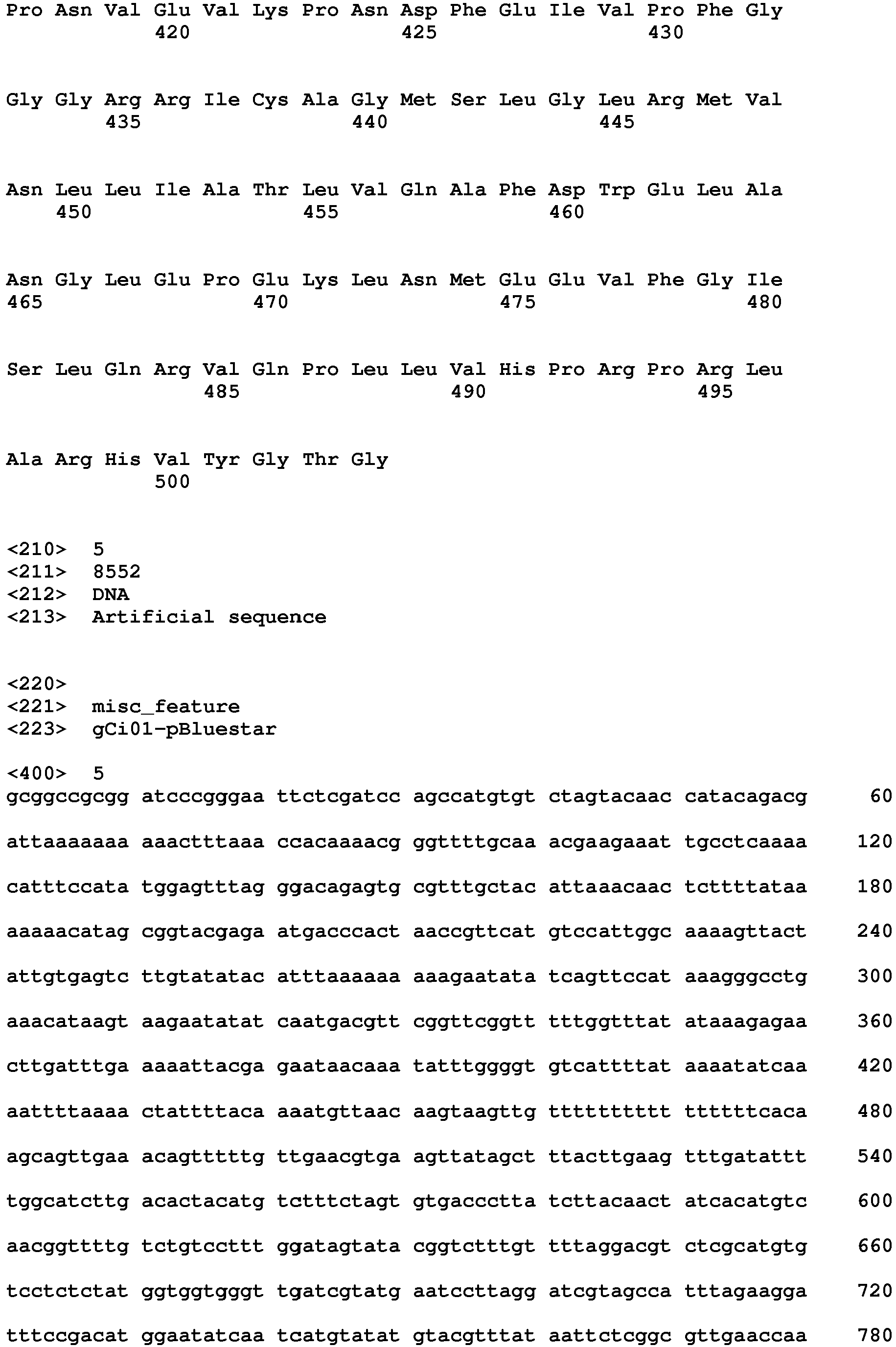
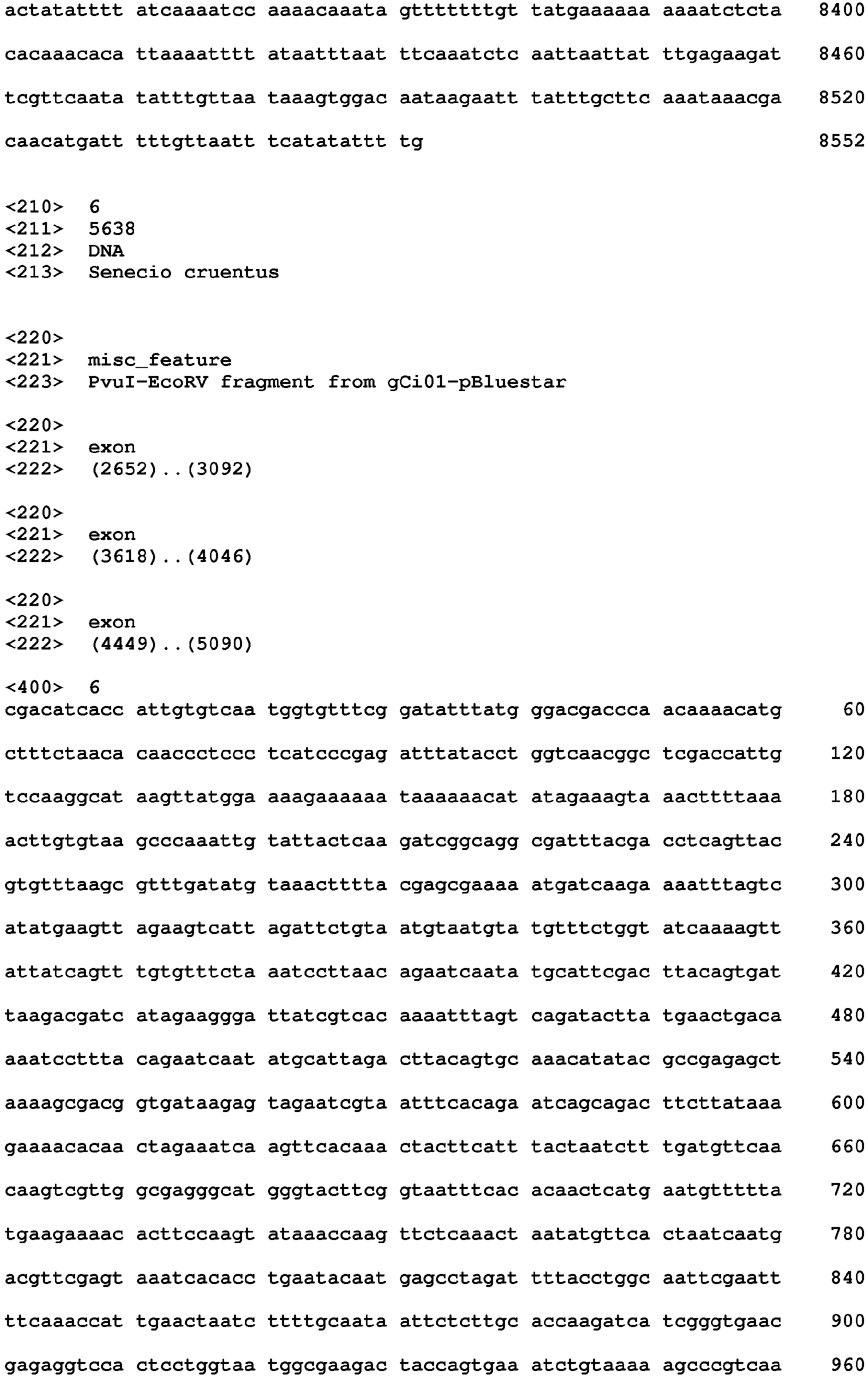
308726 Table 1 Petunia Pelargonidin (µg/g) Cyanidin (µg/g) Peonidin (µg/g) Delphinidin (µg/g) Petunidin (µg/g) Malvidin (µg/g) Pre-transformed host 20 0 12 0 5.3 91 Introduction of Ci5a13 Exp. No. 9 1.5 2.5 520 0 2.5 87 Exp. No. 23 2.3 5.6 550 0 5.6 130 Introduction of Ci5a18 Exp. No. 4 12 1.6 40 7.8 66 570 Exp. No. 12 7.8 11 91 11 86 700 - Chromosomal DNA was extracted from the same cineraria leaves of Example 1, and a chromosome library was produced using the λBlueSTAR™ Xho I Half-Site Arms Kit (Novagen, http://www.merckbiosciences.com/product/69242). The resulting 200,000 plaques were screened using a Ci5a18 cDNA fragment labeled with DIG. This cDNA fragment was amplified using primers (Ci5a18F1 (SEQ ID NO: 7): 5'-CATCTGTTTTCTGCCAAAGC-3' and Ci5a18R1 (SEQ ID NO: 8): 5'-GGATTAGGAAACGACCAGG-3') as primers and using Ci5a18 as a template. Four plaques were ultimately obtained from the resulting 17 plaques, and these were converted to plasmids by in vivo excision. When their DNA nucleotide sequences were determined, they were found to contain the same sequence. Among these, clones obtained using gCi01-pBluestar were used in subsequent experiments. The nucleotide sequence of a gCi01-pBluestar clone is shown in SEQ ID NO: 5. This sequence was expected to contain a promoter region and translation region of cineraria F3'5'H. In the amino acid sequence of the translation region, four amino acids had changed from the Ci5a18 amino acid sequence shown in SEQ ID NO: 4. Namely, although residue nos. 151, 159, 161 and 329 of the Ci5a18 amino acid sequence (SEQ ID NO: 4) were methionine, glycine, glutamic acid and isoleucine, respectively, in the chromosomal clones, these consisted of threonine, arginine, glycine and valine (see SEQ ID NO: 6).
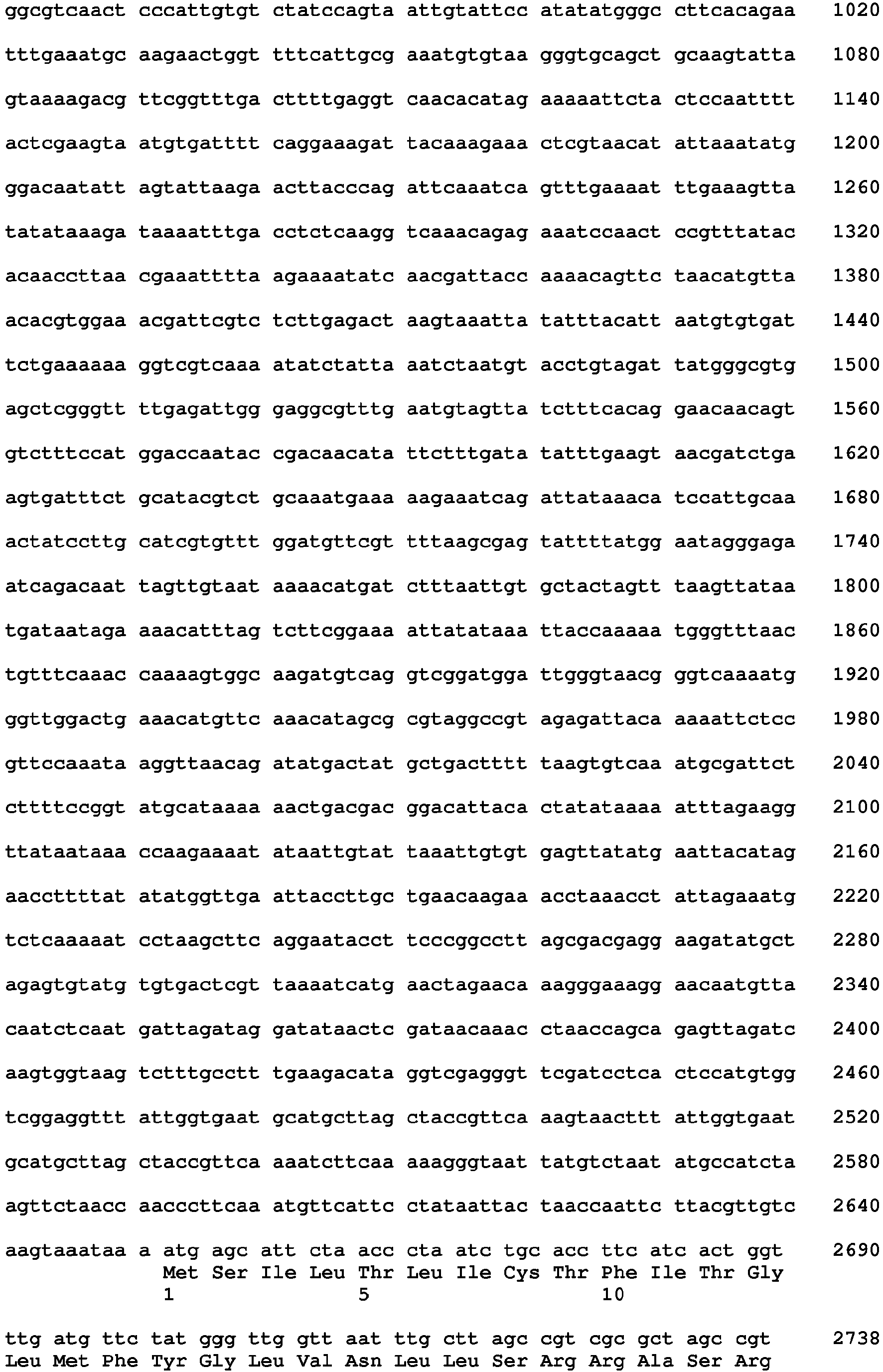
- A DNA fragment of about 5.7 kb excised from gCi01-pBluestar with PvuI and EcoRV (SEQ ID NO: 6) was blunt-ended using a DNA blunting kit (Takara). This DNA fragment was then cloned to an SmaI site of pBinPLUS and designated as pSPB3130.
FIG. 2 indicates the structure of the DNA fragment of about 5.7 kb (SEQ ID NO: 6) excised from gCi01-pBluestar with PvuI and EcoRV. - This binary vector had nptII gene that can be used to select T-DNA regions with kanamycin.
- When this binary vector was introduced into petunias using the method described in Example 2, flower color became darker than that of the host. Typical results for anthocyanidins are shown in the following Table 2.
Table 2 Petunia Pelargonidin (µg/g) Cyanidin (µg/g) Peonidin (µg/g) Delphinidin (µg/g) Petunidin (µg/g) Malvidin (µg/g) Pretransformed host 16 0 10 0 3.6 70 Exp. No. 12 11 1.2 28 1.2 35 670 Exp. No. 24 4.3 2.3 40 7.0 170 1300 - In addition, RNA was extracted from the leaves and flowers of recombinant petunias (by dividing the growth stages into five stages, see Nature, 366: 276-279 (1993)) using RNeasyPlant (Qiagen), and transcription products derived from introduced genes were amplified by RT-PCR (consisting of reverse transcription using Superscript 2 First Strand System (Invitrogen) followed by amplification by PCR). The previously described Ci5a18F1 (SEQ ID NO: 7) and Ci5a18R1 (SEQ ID NO: 8) were used for the primers. Transcription products were not detected in the leaves. The most transcription products were detected in the flower petals at stage 3 (time at which the petals start to open).
Flower petal stage 3 is the time at which structural genes involved in flavonoid synthesis relating to flower color are expressed at the highest levels (see Plant Physiol., 132: 1652-1663, 2003). The above results indicate that a DNA sequence derived from a chromosome gene of F3'5'H of cineraria of the aster family (containing a promoter, translation region and terminator) (SEQ ID NO: 6) functions in petunias of the aster family, or in other words, that the promoter according to the present invention indicated in SEQ ID NO: 9 is suitable for controlling a structural gene involved in flavonoid synthesis relating to flower color. In classifying plants of the aster family and potato family, the plants are not necessarily closely related, and they respectively belong to different orders consisting of the order Asterales and the order Solanales. This means that a DNA sequence derived from a chromosome gene of the aster family was demonstrated to have function in a plant of a different order. A genetically modified plant obtained in this manner can be increased by vegetative growth such as bud cutting. In addition, the introduced gene is inserted into chromosomal DNA of the host plant, is transmitted to progeny, and normally demonstrates a phenotype even in the progeny. - A DNA fragment (SEQ ID NO: 6) of about 5.7 kb excised from gCi01-pBluestar (SEQ ID NO: 5) with PvuI and EcoRV was inserted into an SmaI site of pCGP1988 (see
PCT/AU03/01111 WO94/28140 - pCGP3618 comprises an expression cassette containing rose chalcone synthase promoter,
pansy F3'5'H # 18 and nopaline synthase terminator, and an expression cassette containing an inverted repeat sequence of chrysanthemum F3'H gene containing rose chalcone synthase promoter and an intron of cineraria F3'5'H gene, and a nopaline synthase terminator. This vector was constructed with the intent of inhibiting expression of F3'H gene in chrysanthemum while simultaneously expressing F3'5'H gene. - The following provides a stepwise description of the construction process.
- A DNA fragment of about 569 bp containing a first intron from position 3093 to position 3617 of the nucleotide sequence shown in SEQ ID NO: 6 of cineraria F3'5'H gene was amplified using plasmid gCi01 as a template and using the following synthetic DNA primers:
- CinF 5146-5170S
- (5'-GCATCCCGGGAGTTCGACAGGTTTTGTACTTTCAC-3')
- (SEQ ID NO: 11) (containing sequence from position 3083 to position 3107 from SEQ ID NO: 6, and
- recognition sequence of restriction enzyme SmaI); and,
- CinR 5670-5690RV
- (5'GCATGTCGACGATATACACCTCCTCCTGTAGTTACG-3')
- (SEQ ID NO: 12) (containing complementary sequence of the sequence from position 3606 to position 3624
- of SEQ ID NO: 6 and recognition sequence of restriction enzymes SalI and EcoRV).
- This 569 bp DNA fragment was sub-cloned to plasmid pCR2.1 (Invitrogen), and the resulting plasmid was designated as pCGP3445.
- pCGP3445 was digested with XhoI and SalI, and a DNA fragment of about 560 bp was recovered. This DNA fragment was inserted into pCGP2203 digested with XhoI (described in
PCT/AU2008/001694 pansy F3'5'H # 18 cDNA inserted between rose CHS promoter and nos terminator), and the resulting plasmid was further digested with SmaI to remove the roughly 260 bp DNA fragment derived frompansy F3'5'H # 18 cDNA. The resulting plasmid was designated as pCGP3602. - Plasmid pCGP3133 (described in
PCT/AU2008/001694 - A roughly 1.1 kb DNA fragment obtained by digesting plasmid pCGP3133 with XbaI was blunted followed by insertion into an EcoRV site of pCGP3609. The plasmid in which cDNA was inserted in the reverse direction was designated as pCGP3613. The DNA construct consisting of forward chrysanthemum F3'H cDNA + intron of cineraria F3'5'H gene + reverse chrysanthemum F3'H cDNA is hereinafter also referred to as ds chrysanthemum F3'H (cineraria intron 1).
- A DNA fragment containing rose CHS promoter + ds chrysanthemum F3'H (cineraria intron 1) + nopaline synthase terminator was recovered from pCGP3613 by digesting with restrictases BglII and NotI. This DNA fragment was then blunted and linked with a DNA fragment obtained by digesting pCGP2217 (described in
PCT/AU2008/001694 FIG. 3 . - A DNA fragment containing rose CHS promoter + ds chrysanthemum F3'H (cineraria intron 1) + nopaline synthase terminator was recovered from pCGP3613 by digesting with restrictases BglII and NotI. This DNA fragment was then blunted and linked with a DNA fragment obtained by digesting pCGP1988 (described in
PCT/AU03/01111 FIG. 4 . - A DNA sequence of the promoter region of cineraria F3'5'H was amplified by PCR using plasmid gCi1, containing cineraria F3'5'H chromosomal DNA, as a template and using the following synthetic DNA as primers:
- CinF 3113-3128RV (5'-GAAATGTGTAAGGGTGCAGCTGC-3') (SEQ
- ID NO: 13 (containing a PvuII recognition site); and,
- CinR 4694-4714RI
- (5'-TTTATTTACTTGACAACGTAAGAATTCGTTAGTAATTATAGG-3')
- (SEQ ID NO: 14) (containing an EcoRI recognition site).
- The resulting roughly 1.5 kb DNA fragment was linked with a DNA fragment obtained by blunting pBluescript KS+ digested with EcoRI. The resulting plasmid was designated as pCGP3604.
- A DNA fragment (approx. 1.9 kb) containing
pansy F3'5'H # 18 cDNA + nopaline synthase terminator was recovered by digesting plasmid pCGP2203 with EcoRI and NotI. This DNA fragment was linked with pCGP3604 digested with EcoRI and NotI to obtain plasmid pCGP3615. - Plasmid pCGP3615 was digested with NotI and blunted. An roughly 3.6 kb DNA fragment was obtained by further digesting with EcoRV. This DNA fragment was then linked with pCGP1988 digested with PmeI to obtain plant transformation binary vector pCGP3620 shown in
FIG. 5 . - T-DNA moieties of pCGP3246 and pCGP3617 were inserted into chrysanthemum variety, Improved Regan, as described in Example 5. Flower color of flowers of the transformant changed from the pink color of Improved Regan to an apricot color. In addition, pelargonidin, which is not contained in flowers of the Improved Regan variety, was contained in flowers of the transformant.
- In contrast to the content of pelargonidin (ratio of pelargonidin to total amount of anthocyanidins) of the transformant derived from pCGP3426 being an average of about 17%, the content of pelargonidin in the transformant derived from pCGP3617 was an average of about 56%. In cases of having introduced either vector, pelargonidin was contained that is not contained in naturally-occurring chrysanthemums, and a new flower color was able to be obtained as a result thereof. This constitutes an industrially useful result. In addition, the use of a cineraria intron was determined to make it possible to efficiently inhibit F3'H gene while also making it possible to demonstrate a more prominent change in flower color.
- T-DNA moieties of pCGP3429 (Rose CHS Promoter +
Pansy F3'5'H # 18 cDNA + Nopaline Synthase Terminator; rose CHS promoter + ds chrysanthemum F3'H (not inserted with intron) + nopaline synthase terminator, described inPCT/AU2008/001694 - The novel cineraria-derived polynucleotide according to the present invention that is able to function as a promoter of a coding region of flavonoid 3',5'-hydroxylase (F3'5'H), and a novel F3'5'H gene construct containing this polynucleotide, can be preferably used as a tool for changing flower color.
- In addition, an intron sequence (polynucleotide that is all or a portion of a first intron from position 3093 to position 3617 of the nucleotide sequence shown in SEQ ID NO: 6) of the novel cineraria-derived polynucleotide according to the present invention that is able to function as a promoter of a coding region of flavonoid 3',5'-hydroxylase (F3'5'H) can be preferably used as a loop sequence in a gene construct for inhibiting gene expression by RNAi.
-
- 35S:
Cauliflower mosaic virus 35S promoter - LB: Left border
- SuRB: Tobacco acetolactate synthase
- Rose CHS: Rose chalcone synthase 5'-untranslated sequence (= promoter)
- BPF3'5'H #18: Black
pansy F3'5'H # 18 gene - nos: Nopaline synthase 3'-untranslated sequence ds chrys F3'H: Double-stranded chrysanthemum F3'H cinF3'5'H intron: Cineraria F3'5'H gene intron RB: Right border
- TetR: Tetracycline resistance gene
- ds chrys F3'H: Double-stranded chrysanthemum F3'H CinF3'5'B5': Cineraria F3'5'H gene 5'-untranslated region (= promoter)
- The present invention also relates to the following items:
- 1. A cineraria-derived petal-specific promoter selected from the group consisting of:
- (1) all or a portion of polynucleotide having the nucleotide sequence indicated in SEQ ID NO: 9, and
- (2) a polynucleotide that hybridizes with all or a portion of the polynucleotide having the nucleotide sequence indicated in SEQ ID NO: 9 under stringent conditions and functions as a promoter of a coding region of flavonoid 3',5'-hydroxylase (F3'5'H).
- 2. An F3'5'H gene construct comprising the cineraria-derived petal-specific promoter according to
item 1. - 3. The F3'5'H gene construct according to item 2, further comprising a cineraria-derived terminator selected from the group consisting of:
- (1) all or a portion of a polynucleotide having the nucleotide sequence indicated in SEQ ID NO: 10, and
- (2) a polynucleotide that hybridizes with all or a portion of the polynucleotide having the nucleotide sequence indicated in SEQ ID NO: 10 under stringent conditions and functions as a terminator of a coding region of flavonoid 3'5'-hydroxylase (F3'5'H).
- 4. The F3'5'H gene construct according to
item 3 selected from the group consisting of:- (1) a polynucleotide having the nucleotide sequence indicated in SEQ ID NO: 6, and
- (2) a polynucleotide that hybridizes with the polynucleotide having the nucleotide sequence indicated in SEQ ID NO: 6 under stringent conditions and is able to express flavonoid 3',5'-hydroxylase (F3'5'H) in petunias or chrysanthemums.
- 5. A vector comprising the petal-specific promoter according to
item 1 or the F3'5'H gene construct according to any one of items 2 to 4. - 6. A microorganism containing the vector according to
item 5. - 7. A plant introduced with the petal-specific promoter according to
item 1 or the F3'5'H gene construct according to any one of items 2 to 4, an organ thereof, a tissue thereof, a progeny thereof or a vegetative growth form thereof. - 8. A gene construct for inhibiting expression of a gene by RNAi having a polynucleotide that is all or a portion of a first intron at position 3093 to position 3617 of the nucleotide sequence indicated in SEQ ID NO: 6 in a loop.
- 9. The gene construct according to item 8, wherein the gene for which expression is inhibited is flavonoid 3',5'-hydroxylase.
- 10. A plant introduced with the gene construct according to item 9, an organ thereof, a tissue thereof, a progeny thereof or a vegetative growth form thereof.
- 11. The plant according to item 10, in which the flavonoid content thereof has changed before and after the introduction, an organ thereof, a tissue thereof, a progeny thereof or a vegetative growth form thereof.
- 12. The plant according to item 10, in which the delphinidin content thereof has changed before and after the introduction, an organ thereof, a tissue thereof, a progeny thereof or a vegetative growth form thereof.
- 13. The plant according to item 10, in which the pelargonidin content thereof has changed before and after the introduction, an organ thereof, a tissue thereof, a progeny thereof or a vegetative growth form thereof.
- 14. The plant according to item 10, in which the flower color thereof has changed before and after the introduction, or progeny thereof.






Claims (7)
- A gene construct for inhibiting expression of a gene by RNAi having a polynucleotide that is all or a portion of a first intron at position 3093 to position 3617 of the nucleotide sequence indicated in SEQ ID NO: 6 in a loop.
- The gene construct according to claim 1, wherein the gene for which expression is inhibited is flavonoid 3',5'-hydroxylase.
- A plant introduced with the gene construct according to claim 2, an organ thereof, a tissue thereof, a progeny thereof or a vegetative growth form thereof.
- The plant according to claim 3, in which the flavonoid content thereof has changed before and after the introduction, an organ thereof, a tissue thereof, a progeny thereof or a vegetative growth form thereof.
- The plant according to claim 4, in which the delphinidin content thereof has changed before and after the introduction, an organ thereof, a tissue thereof, a progeny thereof or a vegetative growth form thereof.
- The plant according to claim 4, in which the pelargonidin content thereof has changed before and after the introduction, an organ thereof, a tissue thereof, a progeny thereof or a vegetative growth form thereof.
- The plant according to claim 4, in which the flower color thereof has changed before and after the introduction, or progeny thereof.
Applications Claiming Priority (2)
| Application Number | Priority Date | Filing Date | Title |
|---|---|---|---|
| JP2008276029 | 2008-10-27 | ||
| EP09823715.9A EP2345717B1 (en) | 2008-10-27 | 2009-10-26 | Cinerarium-derived chromosomal dna involved in synthesis of flavonoid, and use thereof |
Related Parent Applications (2)
| Application Number | Title | Priority Date | Filing Date |
|---|---|---|---|
| EP09823715.9A Division EP2345717B1 (en) | 2008-10-27 | 2009-10-26 | Cinerarium-derived chromosomal dna involved in synthesis of flavonoid, and use thereof |
| EP09823715.9A Division-Into EP2345717B1 (en) | 2008-10-27 | 2009-10-26 | Cinerarium-derived chromosomal dna involved in synthesis of flavonoid, and use thereof |
Publications (1)
| Publication Number | Publication Date |
|---|---|
| EP2860248A1 true EP2860248A1 (en) | 2015-04-15 |
Family
ID=42128964
Family Applications (2)
| Application Number | Title | Priority Date | Filing Date |
|---|---|---|---|
| EP20140193057 Withdrawn EP2860248A1 (en) | 2008-10-27 | 2009-10-26 | Cineraria-derived chromosomal DNA involved in synthesis of flavonoid, and use thereof |
| EP09823715.9A Not-in-force EP2345717B1 (en) | 2008-10-27 | 2009-10-26 | Cinerarium-derived chromosomal dna involved in synthesis of flavonoid, and use thereof |
Family Applications After (1)
| Application Number | Title | Priority Date | Filing Date |
|---|---|---|---|
| EP09823715.9A Not-in-force EP2345717B1 (en) | 2008-10-27 | 2009-10-26 | Cinerarium-derived chromosomal dna involved in synthesis of flavonoid, and use thereof |
Country Status (4)
| Country | Link |
|---|---|
| US (2) | US8852942B2 (en) |
| EP (2) | EP2860248A1 (en) |
| JP (1) | JP5597807B2 (en) |
| WO (1) | WO2010050605A1 (en) |
Families Citing this family (2)
| Publication number | Priority date | Publication date | Assignee | Title |
|---|---|---|---|---|
| KR20140125393A (en) * | 2012-02-24 | 2014-10-28 | 산토리 홀딩스 가부시키가이샤 | Torenia-originated promoter capable of acting in petals |
| CN122070364A (en) * | 2023-10-20 | 2026-05-19 | 三得利控股株式会社 | Transgenic plants with altered flower color and the novel compounds they contain |
Citations (4)
| Publication number | Priority date | Publication date | Assignee | Title |
|---|---|---|---|---|
| WO1994028140A1 (en) | 1993-05-20 | 1994-12-08 | International Flower Developments Pty. Ltd. | Transgenic flowering plants |
| JPH11505116A (en) | 1995-05-16 | 1999-05-18 | インターナショナル フラワー ディベロップメンツ プロプライアタリー リミティド | Transgenic plant showing altered flower color and method for producing the same |
| JP3087246B2 (en) | 1991-07-11 | 2000-09-11 | インターナショナル フラワー ディベロップメンツ プロプライアタリー リミティド | Gene sequences encoding flavonoid pathway enzymes and uses thereof |
| WO2009062259A1 (en) * | 2007-11-15 | 2009-05-22 | International Flower Developments Pty Ltd | Genetically modified plants with altered inflorescence |
Family Cites Families (4)
| Publication number | Priority date | Publication date | Assignee | Title |
|---|---|---|---|---|
| JPH11178572A (en) | 1997-12-22 | 1999-07-06 | Iwate Prefecture | Gentian chalcone synthase gene promoter |
| JP2003159078A (en) | 2001-11-28 | 2003-06-03 | Hokko Chem Ind Co Ltd | DNA of gene for flower color synthase of Cineralia |
| EP2292765B1 (en) * | 2002-08-30 | 2013-06-19 | Suntory Holdings Limited | Flavonoid 3',5' Hydroxylase gene sequences and uses therefor |
| JP5582504B2 (en) * | 2007-11-15 | 2014-09-03 | サントリーホールディングス株式会社 | Genetically modified chrysanthemum |
-
2009
- 2009-10-26 US US13/124,985 patent/US8852942B2/en not_active Expired - Fee Related
- 2009-10-26 JP JP2010535859A patent/JP5597807B2/en not_active Expired - Fee Related
- 2009-10-26 EP EP20140193057 patent/EP2860248A1/en not_active Withdrawn
- 2009-10-26 EP EP09823715.9A patent/EP2345717B1/en not_active Not-in-force
- 2009-10-26 WO PCT/JP2009/068736 patent/WO2010050605A1/en not_active Ceased
-
2014
- 2014-01-16 US US14/156,961 patent/US20140165235A1/en not_active Abandoned
Patent Citations (5)
| Publication number | Priority date | Publication date | Assignee | Title |
|---|---|---|---|---|
| JP3087246B2 (en) | 1991-07-11 | 2000-09-11 | インターナショナル フラワー ディベロップメンツ プロプライアタリー リミティド | Gene sequences encoding flavonoid pathway enzymes and uses thereof |
| WO1994028140A1 (en) | 1993-05-20 | 1994-12-08 | International Flower Developments Pty. Ltd. | Transgenic flowering plants |
| JPH08511683A (en) | 1993-05-20 | 1996-12-10 | インターナショナル フラワー ディベロップメンツ プロプライアタリー リミティド | Transgenic flowering plant |
| JPH11505116A (en) | 1995-05-16 | 1999-05-18 | インターナショナル フラワー ディベロップメンツ プロプライアタリー リミティド | Transgenic plant showing altered flower color and method for producing the same |
| WO2009062259A1 (en) * | 2007-11-15 | 2009-05-22 | International Flower Developments Pty Ltd | Genetically modified plants with altered inflorescence |
Non-Patent Citations (18)
| Title |
|---|
| "Molecular Cloning: A Laboratory Manual, 2nd edition", 1989, COLD SPRING HARBOR LABORATORY |
| CHRISTIAN SEITZ ET AL: "Cloning, Functional Identification and Sequence Analysis of Flavonoid 3'-hydroxylase and Flavonoid 3',5'-hydroxylase cDNAs Reveals Independent Evolution of Flavonoid 3',5'-hydroxylase in the Asteraceae Family", PLANT MOLECULAR BIOLOGY, KLUWER ACADEMIC PUBLISHERS, DORDRECHT, NL, vol. 61, no. 3, 1 June 2006 (2006-06-01), pages 365 - 381, XP019405441, ISSN: 1573-5028, DOI: 10.1007/S11103-006-0012-0 * |
| CURR. OPIN. BIOTECHNOL., vol. 19, 2008, pages 190 - 197 |
| HUANG HE ET AL: "Flower Colour Modification of Chrysanthemum by Suppression of F3'H and Overexpression of the Exogenous Senecio cruentus F3'5'H Gene", PLOS ONE, vol. 8, no. 11, 8 November 2013 (2013-11-08), pages e74395, XP055174367, DOI: 10.1371/journal.pone.0074395 * |
| MENG L ET AL: "Pericallis cruenta flavonoid-3',5'-hydroxylase mRNA, complete cds", NUCLEOTIDE,, 1 May 2005 (2005-05-01), XP008146874 * |
| NATURE, vol. 366, 1993, pages 276 - 279 |
| NATURE, vol. 407, 2000, pages 319 - 320 |
| PHYTOCHEMISTRY REV., vol. 5, 2006, pages 283 - 291 |
| PHYTOCHEMISTRY, vol. 35, 1993, pages 145 - 150 |
| PLANT BIOTECHNOLOGY, vol. 21, 2004, pages 377 - 386 |
| PLANT BIOTECHNOLOGY, vol. 23, 2006, pages 5 - 11 |
| PLANT CELL PHYSIOL., vol. 48, 2007, pages 1589 - 1600 |
| PLANT MOL. BIOL., vol. 61, 2006, pages 365 - 381 |
| PLANT MOLECULAR BIOLOGY, vol. 15, 1990, pages 373 - 381 |
| PLANT PHYSIOL., vol. 132, 2003, pages 1652 - 1663 |
| TANAKA Y ET AL: "Seeing is believing: engineering anthocyanin and carotenoid biosynthetic pathways", CURRENT OPINION IN BIOTECHNOLOGY, LONDON, GB, vol. 19, no. 2, 1 April 2008 (2008-04-01), pages 190 - 197, XP022620672, ISSN: 0958-1669, [retrieved on 20080409], DOI: 10.1016/J.COPBIO.2008.02.015 * |
| TRANGENIC RESEARCH, vol. 4, 1995, pages 288 - 290 |
| TSUDA S ET AL: "Flower color modification of Petunia hybrida commercial varieties by metabolic engineering", PLANT BIOTECHNOLOGY, JAPANESE SOCIETY FOR PLANT CELL AND MOLECULAR BIOLOGY, TOKYO, JP, vol. 21, no. 5, 1 January 2004 (2004-01-01), pages 377 - 386, XP003002092, ISSN: 1342-4580 * |
Also Published As
| Publication number | Publication date |
|---|---|
| JPWO2010050605A1 (en) | 2012-03-29 |
| WO2010050605A1 (en) | 2010-05-06 |
| EP2345717A4 (en) | 2012-05-02 |
| US20110219477A1 (en) | 2011-09-08 |
| US20140165235A1 (en) | 2014-06-12 |
| EP2345717B1 (en) | 2015-08-05 |
| JP5597807B2 (en) | 2014-10-01 |
| US8852942B2 (en) | 2014-10-07 |
| EP2345717A1 (en) | 2011-07-20 |
Similar Documents
| Publication | Publication Date | Title |
|---|---|---|
| EP2423312B1 (en) | Method for production of chrysanthemum plant having delphinidin-containing petals | |
| EP2602324B1 (en) | Method for production of chrysanthemum plant having petals containing modified anthocyanin | |
| EP2187730B1 (en) | Genetically modified chrysanthemums | |
| EP2206784B1 (en) | Unsaturated fatty acid synthase gene originating in marchantiales plant and utilization of the same | |
| EP2345717B1 (en) | Cinerarium-derived chromosomal dna involved in synthesis of flavonoid, and use thereof | |
| CN103249301B (en) | Method for cultivating lilies containing delphinin in the petals | |
| JP5638807B2 (en) | Lignan hydroxylase | |
| EP2845901A1 (en) | Novel campanula flavonoid 3',5'-hydroxylase gene and use of same | |
| JP5186683B2 (en) | Method for producing transformed plant body and use thereof | |
| EP2479269B1 (en) | Perilla frutescens var. crispa-origin promoter functioning in petal | |
| JPWO2011001777A1 (en) | How to lighten or darken flowers | |
| JP2009153402A (en) | Novel protein having 4 coumaroyl CoA ligase activity and DNA encoding the same |
Legal Events
| Date | Code | Title | Description |
|---|---|---|---|
| PUAI | Public reference made under article 153(3) epc to a published international application that has entered the european phase |
Free format text: ORIGINAL CODE: 0009012 |
|
| 17P | Request for examination filed |
Effective date: 20141213 |
|
| AC | Divisional application: reference to earlier application |
Ref document number: 2345717 Country of ref document: EP Kind code of ref document: P |
|
| AK | Designated contracting states |
Kind code of ref document: A1 Designated state(s): AT BE BG CH CY CZ DE DK EE ES FI FR GB GR HR HU IE IS IT LI LT LU LV MC MK MT NL NO PL PT RO SE SI SK SM TR |
|
| 17Q | First examination report despatched |
Effective date: 20160624 |
|
| STAA | Information on the status of an ep patent application or granted ep patent |
Free format text: STATUS: THE APPLICATION IS DEEMED TO BE WITHDRAWN |
|
| 18D | Application deemed to be withdrawn |
Effective date: 20171010 |