EP2857400A1 - Heterocyclic compound - Google Patents
Heterocyclic compound Download PDFInfo
- Publication number
- EP2857400A1 EP2857400A1 EP13797604.9A EP13797604A EP2857400A1 EP 2857400 A1 EP2857400 A1 EP 2857400A1 EP 13797604 A EP13797604 A EP 13797604A EP 2857400 A1 EP2857400 A1 EP 2857400A1
- Authority
- EP
- European Patent Office
- Prior art keywords
- group
- optionally substituted
- compound
- alkyl
- substituted
- Prior art date
- Legal status (The legal status is an assumption and is not a legal conclusion. Google has not performed a legal analysis and makes no representation as to the accuracy of the status listed.)
- Withdrawn
Links
- 150000002391 heterocyclic compounds Chemical class 0.000 title description 2
- 150000001875 compounds Chemical class 0.000 claims abstract description 304
- 150000003839 salts Chemical class 0.000 claims abstract description 67
- 230000002401 inhibitory effect Effects 0.000 claims abstract description 24
- 208000023275 Autoimmune disease Diseases 0.000 claims abstract description 21
- 238000011282 treatment Methods 0.000 claims abstract description 20
- 238000011321 prophylaxis Methods 0.000 claims abstract description 13
- 125000001424 substituent group Chemical group 0.000 claims description 313
- 125000004169 (C1-C6) alkyl group Chemical group 0.000 claims description 185
- 125000006615 aromatic heterocyclic group Chemical group 0.000 claims description 165
- 125000005843 halogen group Chemical group 0.000 claims description 130
- 125000002950 monocyclic group Chemical group 0.000 claims description 127
- 238000000034 method Methods 0.000 claims description 104
- 125000002887 hydroxy group Chemical group [H]O* 0.000 claims description 85
- 125000000217 alkyl group Chemical group 0.000 claims description 79
- 125000005915 C6-C14 aryl group Chemical group 0.000 claims description 78
- 125000004093 cyano group Chemical group *C#N 0.000 claims description 78
- 125000003277 amino group Chemical group 0.000 claims description 73
- 125000003917 carbamoyl group Chemical group [H]N([H])C(*)=O 0.000 claims description 72
- 125000004191 (C1-C6) alkoxy group Chemical group 0.000 claims description 71
- 239000003814 drug Substances 0.000 claims description 68
- 125000006376 (C3-C10) cycloalkyl group Chemical group 0.000 claims description 58
- 125000004043 oxo group Chemical group O=* 0.000 claims description 47
- 125000000623 heterocyclic group Chemical group 0.000 claims description 40
- 125000004916 (C1-C6) alkylcarbonyl group Chemical group 0.000 claims description 37
- 125000004454 (C1-C6) alkoxycarbonyl group Chemical group 0.000 claims description 34
- 229910052757 nitrogen Chemical group 0.000 claims description 33
- 125000004433 nitrogen atom Chemical group N* 0.000 claims description 31
- 125000002837 carbocyclic group Chemical group 0.000 claims description 30
- 125000002252 acyl group Chemical group 0.000 claims description 29
- 125000006717 (C3-C10) cycloalkenyl group Chemical group 0.000 claims description 26
- 125000003178 carboxy group Chemical group [H]OC(*)=O 0.000 claims description 26
- 125000004397 aminosulfonyl group Chemical group NS(=O)(=O)* 0.000 claims description 23
- 239000003795 chemical substances by application Substances 0.000 claims description 23
- 229910052799 carbon Inorganic materials 0.000 claims description 22
- 125000003118 aryl group Chemical group 0.000 claims description 21
- 125000005530 alkylenedioxy group Chemical group 0.000 claims description 18
- 125000004435 hydrogen atom Chemical group [H]* 0.000 claims description 15
- 125000005913 (C3-C6) cycloalkyl group Chemical group 0.000 claims description 14
- 102000015617 Janus Kinases Human genes 0.000 claims description 14
- 108010024121 Janus Kinases Proteins 0.000 claims description 14
- 125000000449 nitro group Chemical group [O-][N+](*)=O 0.000 claims description 14
- 125000006517 heterocyclyl carbonyl group Chemical group 0.000 claims description 13
- 241000124008 Mammalia Species 0.000 claims description 10
- 238000004519 manufacturing process Methods 0.000 claims description 10
- 125000005974 C6-C14 arylcarbonyl group Chemical group 0.000 claims description 8
- 125000004739 (C1-C6) alkylsulfonyl group Chemical group 0.000 claims description 7
- 125000004432 carbon atom Chemical group C* 0.000 claims description 5
- ZKSWKBGWEIIMTN-UHFFFAOYSA-N 2-[4-[1-(2,6-difluorophenyl)-4-oxo-5H-pyrazolo[4,3-c]pyridin-3-yl]phenyl]acetamide Chemical compound NC(=O)Cc1ccc(cc1)-c1nn(-c2c(F)cccc2F)c2cc[nH]c(=O)c12 ZKSWKBGWEIIMTN-UHFFFAOYSA-N 0.000 claims description 3
- MAFXNJMXGCVYEU-UHFFFAOYSA-N 3-(3-fluorophenyl)-1-trityl-5H-pyrazolo[4,3-c]pyridin-4-one Chemical compound FC1=CC=CC(C=2C=3C(=O)NC=CC=3N(N=2)C(C=2C=CC=CC=2)(C=2C=CC=CC=2)C=2C=CC=CC=2)=C1 MAFXNJMXGCVYEU-UHFFFAOYSA-N 0.000 claims description 3
- IIAGNFAHUWBSIR-UHFFFAOYSA-N 3-[(1-cyclopentyl-4-oxo-5H-pyrazolo[4,3-c]pyridin-3-yl)amino]benzenesulfonamide Chemical compound NS(=O)(=O)c1cccc(Nc2nn(C3CCCC3)c3cc[nH]c(=O)c23)c1 IIAGNFAHUWBSIR-UHFFFAOYSA-N 0.000 claims description 3
- MDCUZVQXTWGSJY-UHFFFAOYSA-N 4-(1-cyclopentyl-4-oxo-5h-pyrrolo[3,2-c]pyridin-3-yl)thiophene-2-carboxamide Chemical compound S1C(C(=O)N)=CC(C=2C=3C(=O)NC=CC=3N(C3CCCC3)C=2)=C1 MDCUZVQXTWGSJY-UHFFFAOYSA-N 0.000 claims description 3
- 229940122245 Janus kinase inhibitor Drugs 0.000 claims description 3
- 206010039073 rheumatoid arthritis Diseases 0.000 abstract description 19
- 201000004681 Psoriasis Diseases 0.000 abstract description 18
- 208000022559 Inflammatory bowel disease Diseases 0.000 abstract description 17
- 208000009137 Behcet syndrome Diseases 0.000 abstract description 16
- 208000021386 Sjogren Syndrome Diseases 0.000 abstract description 16
- 201000006417 multiple sclerosis Diseases 0.000 abstract description 16
- 201000000596 systemic lupus erythematosus Diseases 0.000 abstract description 16
- 206010028980 Neoplasm Diseases 0.000 abstract description 13
- 208000034578 Multiple myelomas Diseases 0.000 abstract description 12
- 206010035226 Plasma cell myeloma Diseases 0.000 abstract description 12
- 201000011510 cancer Diseases 0.000 abstract description 12
- 206010006895 Cachexia Diseases 0.000 abstract description 10
- 206010060862 Prostate cancer Diseases 0.000 abstract description 10
- 208000000236 Prostatic Neoplasms Diseases 0.000 abstract description 10
- 206010046799 Uterine leiomyosarcoma Diseases 0.000 abstract description 10
- 208000032839 leukemia Diseases 0.000 abstract description 10
- 206010028537 myelofibrosis Diseases 0.000 abstract description 10
- -1 IL-28 Proteins 0.000 description 508
- 238000006243 chemical reaction Methods 0.000 description 116
- 125000002496 methyl group Chemical group [H]C([H])([H])* 0.000 description 113
- 239000002904 solvent Substances 0.000 description 65
- 235000002639 sodium chloride Nutrition 0.000 description 60
- 125000006239 protecting group Chemical group 0.000 description 47
- 125000001997 phenyl group Chemical group [H]C1=C([H])C([H])=C(*)C([H])=C1[H] 0.000 description 45
- 239000003112 inhibitor Substances 0.000 description 44
- 229910052731 fluorine Inorganic materials 0.000 description 41
- 150000001408 amides Chemical class 0.000 description 39
- 229910052751 metal Inorganic materials 0.000 description 39
- 239000002184 metal Substances 0.000 description 39
- 229940079593 drug Drugs 0.000 description 37
- 125000001153 fluoro group Chemical group F* 0.000 description 37
- 239000002585 base Substances 0.000 description 36
- 150000004945 aromatic hydrocarbons Chemical class 0.000 description 31
- 125000000956 methoxy group Chemical group [H]C([H])([H])O* 0.000 description 30
- 150000002148 esters Chemical class 0.000 description 29
- 125000001495 ethyl group Chemical group [H]C([H])([H])C([H])([H])* 0.000 description 28
- 229940052308 general anesthetics halogenated hydrocarbons Drugs 0.000 description 28
- 150000008282 halocarbons Chemical class 0.000 description 28
- 239000012046 mixed solvent Substances 0.000 description 28
- 229930195734 saturated hydrocarbon Natural products 0.000 description 28
- 150000003462 sulfoxides Chemical class 0.000 description 28
- 150000002170 ethers Chemical class 0.000 description 27
- 150000002825 nitriles Chemical class 0.000 description 27
- 125000001559 cyclopropyl group Chemical group [H]C1([H])C([H])([H])C1([H])* 0.000 description 26
- 125000000999 tert-butyl group Chemical group [H]C([H])([H])C(*)(C([H])([H])[H])C([H])([H])[H] 0.000 description 24
- 125000002777 acetyl group Chemical group [H]C([H])([H])C(*)=O 0.000 description 23
- 125000002757 morpholinyl group Chemical group 0.000 description 23
- 238000002360 preparation method Methods 0.000 description 23
- 208000037265 diseases, disorders, signs and symptoms Diseases 0.000 description 21
- 150000001298 alcohols Chemical class 0.000 description 19
- 239000003153 chemical reaction reagent Substances 0.000 description 19
- 201000010099 disease Diseases 0.000 description 19
- 150000007530 organic bases Chemical class 0.000 description 19
- 150000001721 carbon Chemical group 0.000 description 18
- 239000003054 catalyst Substances 0.000 description 17
- 229910052801 chlorine Inorganic materials 0.000 description 17
- 125000001160 methoxycarbonyl group Chemical group [H]C([H])([H])OC(*)=O 0.000 description 16
- 238000003786 synthesis reaction Methods 0.000 description 16
- QTBSBXVTEAMEQO-UHFFFAOYSA-N Acetic acid Chemical compound CC(O)=O QTBSBXVTEAMEQO-UHFFFAOYSA-N 0.000 description 15
- 150000001447 alkali salts Chemical class 0.000 description 15
- 125000001511 cyclopentyl group Chemical group [H]C1([H])C([H])([H])C([H])([H])C([H])(*)C1([H])[H] 0.000 description 15
- 150000002576 ketones Chemical class 0.000 description 15
- 239000000047 product Substances 0.000 description 15
- XLYOFNOQVPJJNP-UHFFFAOYSA-N water Substances O XLYOFNOQVPJJNP-UHFFFAOYSA-N 0.000 description 15
- WKBOTKDWSSQWDR-UHFFFAOYSA-N Bromine atom Chemical group [Br] WKBOTKDWSSQWDR-UHFFFAOYSA-N 0.000 description 14
- 125000003226 pyrazolyl group Chemical group 0.000 description 14
- 125000003718 tetrahydrofuranyl group Chemical group 0.000 description 14
- 230000037396 body weight Effects 0.000 description 13
- 125000001449 isopropyl group Chemical group [H]C([H])([H])C([H])(*)C([H])([H])[H] 0.000 description 13
- 125000001436 propyl group Chemical group [H]C([*])([H])C([H])([H])C([H])([H])[H] 0.000 description 13
- 125000001412 tetrahydropyranyl group Chemical group 0.000 description 13
- 239000002253 acid Substances 0.000 description 12
- 125000003754 ethoxycarbonyl group Chemical group C(=O)(OCC)* 0.000 description 12
- 150000007529 inorganic bases Chemical class 0.000 description 12
- 125000001309 chloro group Chemical group Cl* 0.000 description 11
- 125000004076 pyridyl group Chemical group 0.000 description 11
- 125000000719 pyrrolidinyl group Chemical group 0.000 description 11
- FBPFZTCFMRRESA-KVTDHHQDSA-N D-Mannitol Chemical compound OC[C@@H](O)[C@@H](O)[C@H](O)[C@H](O)CO FBPFZTCFMRRESA-KVTDHHQDSA-N 0.000 description 10
- IAZDPXIOMUYVGZ-UHFFFAOYSA-N Dimethylsulphoxide Chemical compound CS(C)=O IAZDPXIOMUYVGZ-UHFFFAOYSA-N 0.000 description 10
- 150000004703 alkoxides Chemical class 0.000 description 10
- 125000003710 aryl alkyl group Chemical group 0.000 description 10
- 125000001485 cycloalkadienyl group Chemical group 0.000 description 10
- 230000032050 esterification Effects 0.000 description 10
- 238000005886 esterification reaction Methods 0.000 description 10
- 150000007524 organic acids Chemical class 0.000 description 10
- VEXZGXHMUGYJMC-UHFFFAOYSA-N Hydrochloric acid Chemical compound Cl VEXZGXHMUGYJMC-UHFFFAOYSA-N 0.000 description 9
- WHXSMMKQMYFTQS-UHFFFAOYSA-N Lithium Chemical compound [Li] WHXSMMKQMYFTQS-UHFFFAOYSA-N 0.000 description 9
- KAESVJOAVNADME-UHFFFAOYSA-N Pyrrole Chemical compound C=1C=CNC=1 KAESVJOAVNADME-UHFFFAOYSA-N 0.000 description 9
- QAOWNCQODCNURD-UHFFFAOYSA-N Sulfuric acid Chemical compound OS(O)(=O)=O QAOWNCQODCNURD-UHFFFAOYSA-N 0.000 description 9
- 125000003236 benzoyl group Chemical group [H]C1=C([H])C([H])=C(C([H])=C1[H])C(*)=O 0.000 description 9
- 125000000113 cyclohexyl group Chemical group [H]C1([H])C([H])([H])C([H])([H])C([H])(*)C([H])([H])C1([H])[H] 0.000 description 9
- 125000005043 dihydropyranyl group Chemical group O1C(CCC=C1)* 0.000 description 9
- RAXXELZNTBOGNW-UHFFFAOYSA-N imidazole Natural products C1=CNC=N1 RAXXELZNTBOGNW-UHFFFAOYSA-N 0.000 description 9
- 125000000959 isobutyl group Chemical group [H]C([H])([H])C([H])(C([H])([H])[H])C([H])([H])* 0.000 description 9
- 229910052744 lithium Inorganic materials 0.000 description 9
- 125000003538 pentan-3-yl group Chemical group [H]C([H])([H])C([H])([H])C([H])(*)C([H])([H])C([H])([H])[H] 0.000 description 9
- 125000001501 propionyl group Chemical group O=C([*])C([H])([H])C([H])([H])[H] 0.000 description 9
- 125000002914 sec-butyl group Chemical group [H]C([H])([H])C([H])([H])C([H])(*)C([H])([H])[H] 0.000 description 9
- 125000002221 trityl group Chemical group [H]C1=C([H])C([H])=C([H])C([H])=C1C([*])(C1=C(C(=C(C(=C1[H])[H])[H])[H])[H])C1=C([H])C([H])=C([H])C([H])=C1[H] 0.000 description 9
- 125000004217 4-methoxybenzyl group Chemical group [H]C1=C([H])C(=C([H])C([H])=C1OC([H])([H])[H])C([H])([H])* 0.000 description 8
- 102000003814 Interleukin-10 Human genes 0.000 description 8
- 108090000174 Interleukin-10 Proteins 0.000 description 8
- AFVFQIVMOAPDHO-UHFFFAOYSA-N Methanesulfonic acid Chemical compound CS(O)(=O)=O AFVFQIVMOAPDHO-UHFFFAOYSA-N 0.000 description 8
- ZMXDDKWLCZADIW-UHFFFAOYSA-N N,N-Dimethylformamide Chemical compound CN(C)C=O ZMXDDKWLCZADIW-UHFFFAOYSA-N 0.000 description 8
- XYFCBTPGUUZFHI-UHFFFAOYSA-N Phosphine Chemical compound P XYFCBTPGUUZFHI-UHFFFAOYSA-N 0.000 description 8
- 229910000102 alkali metal hydride Inorganic materials 0.000 description 8
- 150000008046 alkali metal hydrides Chemical class 0.000 description 8
- 125000001797 benzyl group Chemical group [H]C1=C([H])C([H])=C(C([H])=C1[H])C([H])([H])* 0.000 description 8
- 125000000596 cyclohexenyl group Chemical group C1(=CCCCC1)* 0.000 description 8
- 125000005049 dihydrooxadiazolyl group Chemical group O1N(NC=C1)* 0.000 description 8
- 125000005879 dioxolanyl group Chemical group 0.000 description 8
- 150000002430 hydrocarbons Chemical group 0.000 description 8
- 238000006460 hydrolysis reaction Methods 0.000 description 8
- 229940126585 therapeutic drug Drugs 0.000 description 8
- 125000001544 thienyl group Chemical group 0.000 description 8
- 125000000008 (C1-C10) alkyl group Chemical group 0.000 description 7
- OISVCGZHLKNMSJ-UHFFFAOYSA-N 2,6-dimethylpyridine Chemical compound CC1=CC=CC(C)=N1 OISVCGZHLKNMSJ-UHFFFAOYSA-N 0.000 description 7
- 125000006374 C2-C10 alkenyl group Chemical group 0.000 description 7
- 102000004127 Cytokines Human genes 0.000 description 7
- 108090000695 Cytokines Proteins 0.000 description 7
- LFQSCWFLJHTTHZ-UHFFFAOYSA-N Ethanol Chemical compound CCO LFQSCWFLJHTTHZ-UHFFFAOYSA-N 0.000 description 7
- OAKJQQAXSVQMHS-UHFFFAOYSA-N Hydrazine Chemical compound NN OAKJQQAXSVQMHS-UHFFFAOYSA-N 0.000 description 7
- 125000005018 aryl alkenyl group Chemical group 0.000 description 7
- 125000001584 benzyloxycarbonyl group Chemical group C(=O)(OCC1=CC=CC=C1)* 0.000 description 7
- GDTBXPJZTBHREO-UHFFFAOYSA-N bromine Substances BrBr GDTBXPJZTBHREO-UHFFFAOYSA-N 0.000 description 7
- 229910052794 bromium Inorganic materials 0.000 description 7
- 125000000484 butyl group Chemical group [H]C([*])([H])C([H])([H])C([H])([H])C([H])([H])[H] 0.000 description 7
- 230000000694 effects Effects 0.000 description 7
- 125000002485 formyl group Chemical group [H]C(*)=O 0.000 description 7
- 125000003566 oxetanyl group Chemical group 0.000 description 7
- 229940124597 therapeutic agent Drugs 0.000 description 7
- 125000006552 (C3-C8) cycloalkyl group Chemical group 0.000 description 6
- UHOVQNZJYSORNB-UHFFFAOYSA-N Benzene Chemical compound C1=CC=CC=C1 UHOVQNZJYSORNB-UHFFFAOYSA-N 0.000 description 6
- ZAMOUSCENKQFHK-UHFFFAOYSA-N Chlorine atom Chemical compound [Cl] ZAMOUSCENKQFHK-UHFFFAOYSA-N 0.000 description 6
- 102100030703 Interleukin-22 Human genes 0.000 description 6
- 102000004889 Interleukin-6 Human genes 0.000 description 6
- 108090001005 Interleukin-6 Proteins 0.000 description 6
- 108010000837 Janus Kinase 1 Proteins 0.000 description 6
- PCLIMKBDDGJMGD-UHFFFAOYSA-N N-bromosuccinimide Chemical compound BrN1C(=O)CCC1=O PCLIMKBDDGJMGD-UHFFFAOYSA-N 0.000 description 6
- MUBZPKHOEPUJKR-UHFFFAOYSA-N Oxalic acid Chemical compound OC(=O)C(O)=O MUBZPKHOEPUJKR-UHFFFAOYSA-N 0.000 description 6
- KDLHZDBZIXYQEI-UHFFFAOYSA-N Palladium Chemical compound [Pd] KDLHZDBZIXYQEI-UHFFFAOYSA-N 0.000 description 6
- DNIAPMSPPWPWGF-UHFFFAOYSA-N Propylene glycol Chemical compound CC(O)CO DNIAPMSPPWPWGF-UHFFFAOYSA-N 0.000 description 6
- WTKZEGDFNFYCGP-UHFFFAOYSA-N Pyrazole Chemical compound C=1C=NNC=1 WTKZEGDFNFYCGP-UHFFFAOYSA-N 0.000 description 6
- JUJWROOIHBZHMG-UHFFFAOYSA-N Pyridine Chemical compound C1=CC=NC=C1 JUJWROOIHBZHMG-UHFFFAOYSA-N 0.000 description 6
- ZMANZCXQSJIPKH-UHFFFAOYSA-N Triethylamine Chemical compound CCN(CC)CC ZMANZCXQSJIPKH-UHFFFAOYSA-N 0.000 description 6
- DTQVDTLACAAQTR-UHFFFAOYSA-N Trifluoroacetic acid Chemical compound OC(=O)C(F)(F)F DTQVDTLACAAQTR-UHFFFAOYSA-N 0.000 description 6
- 102100033438 Tyrosine-protein kinase JAK1 Human genes 0.000 description 6
- 239000000460 chlorine Substances 0.000 description 6
- KRKNYBCHXYNGOX-UHFFFAOYSA-N citric acid Chemical compound OC(=O)CC(O)(C(O)=O)CC(O)=O KRKNYBCHXYNGOX-UHFFFAOYSA-N 0.000 description 6
- XBDQKXXYIPTUBI-UHFFFAOYSA-N dimethylselenoniopropionate Natural products CCC(O)=O XBDQKXXYIPTUBI-UHFFFAOYSA-N 0.000 description 6
- VYFYYTLLBUKUHU-UHFFFAOYSA-N dopamine Chemical compound NCCC1=CC=C(O)C(O)=C1 VYFYYTLLBUKUHU-UHFFFAOYSA-N 0.000 description 6
- 125000005745 ethoxymethyl group Chemical group [H]C([H])([H])C([H])([H])OC([H])([H])* 0.000 description 6
- 229940093915 gynecological organic acid Drugs 0.000 description 6
- 125000003387 indolinyl group Chemical group N1(CCC2=CC=CC=C12)* 0.000 description 6
- 239000003446 ligand Substances 0.000 description 6
- BDAGIHXWWSANSR-UHFFFAOYSA-N methanoic acid Natural products OC=O BDAGIHXWWSANSR-UHFFFAOYSA-N 0.000 description 6
- 125000004184 methoxymethyl group Chemical group [H]C([H])([H])OC([H])([H])* 0.000 description 6
- 235000005985 organic acids Nutrition 0.000 description 6
- 239000011541 reaction mixture Substances 0.000 description 6
- 230000019491 signal transduction Effects 0.000 description 6
- 125000005931 tert-butyloxycarbonyl group Chemical group [H]C([H])([H])C(OC(*)=O)(C([H])([H])[H])C([H])([H])[H] 0.000 description 6
- LMDZBCPBFSXMTL-UHFFFAOYSA-N 1-ethyl-3-(3-dimethylaminopropyl)carbodiimide Chemical compound CCN=C=NCCCN(C)C LMDZBCPBFSXMTL-UHFFFAOYSA-N 0.000 description 5
- RTZKZFJDLAIYFH-UHFFFAOYSA-N Diethyl ether Chemical compound CCOCC RTZKZFJDLAIYFH-UHFFFAOYSA-N 0.000 description 5
- XTHFKEDIFFGKHM-UHFFFAOYSA-N Dimethoxyethane Chemical compound COCCOC XTHFKEDIFFGKHM-UHFFFAOYSA-N 0.000 description 5
- XEKOWRVHYACXOJ-UHFFFAOYSA-N Ethyl acetate Chemical compound CCOC(C)=O XEKOWRVHYACXOJ-UHFFFAOYSA-N 0.000 description 5
- 108010065805 Interleukin-12 Proteins 0.000 description 5
- 102000013462 Interleukin-12 Human genes 0.000 description 5
- JGFZNNIVVJXRND-UHFFFAOYSA-N N,N-Diisopropylethylamine (DIPEA) Chemical compound CCN(C(C)C)C(C)C JGFZNNIVVJXRND-UHFFFAOYSA-N 0.000 description 5
- PXHVJJICTQNCMI-UHFFFAOYSA-N Nickel Chemical compound [Ni] PXHVJJICTQNCMI-UHFFFAOYSA-N 0.000 description 5
- WYURNTSHIVDZCO-UHFFFAOYSA-N Tetrahydrofuran Chemical compound C1CCOC1 WYURNTSHIVDZCO-UHFFFAOYSA-N 0.000 description 5
- 235000011054 acetic acid Nutrition 0.000 description 5
- 239000003242 anti bacterial agent Substances 0.000 description 5
- 125000005098 aryl alkoxy carbonyl group Chemical group 0.000 description 5
- 125000003785 benzimidazolyl group Chemical group N1=C(NC2=C1C=CC=C2)* 0.000 description 5
- 210000004027 cell Anatomy 0.000 description 5
- 229910052802 copper Inorganic materials 0.000 description 5
- 239000010949 copper Substances 0.000 description 5
- 239000002934 diuretic Substances 0.000 description 5
- 235000010355 mannitol Nutrition 0.000 description 5
- 125000004170 methylsulfonyl group Chemical group [H]C([H])([H])S(*)(=O)=O 0.000 description 5
- 150000007522 mineralic acids Chemical class 0.000 description 5
- 238000002156 mixing Methods 0.000 description 5
- 239000000203 mixture Substances 0.000 description 5
- UYWQUFXKFGHYNT-UHFFFAOYSA-N phenylmethyl ester of formic acid Natural products O=COCC1=CC=CC=C1 UYWQUFXKFGHYNT-UHFFFAOYSA-N 0.000 description 5
- 125000004193 piperazinyl group Chemical group 0.000 description 5
- 125000005936 piperidyl group Chemical group 0.000 description 5
- 229940002612 prodrug Drugs 0.000 description 5
- 239000000651 prodrug Substances 0.000 description 5
- 108090000623 proteins and genes Proteins 0.000 description 5
- 238000001953 recrystallisation Methods 0.000 description 5
- 125000000026 trimethylsilyl group Chemical group [H]C([H])([H])[Si]([*])(C([H])([H])[H])C([H])([H])[H] 0.000 description 5
- CYPYTURSJDMMMP-WVCUSYJESA-N (1e,4e)-1,5-diphenylpenta-1,4-dien-3-one;palladium Chemical compound [Pd].[Pd].C=1C=CC=CC=1\C=C\C(=O)\C=C\C1=CC=CC=C1.C=1C=CC=CC=1\C=C\C(=O)\C=C\C1=CC=CC=C1.C=1C=CC=CC=1\C=C\C(=O)\C=C\C1=CC=CC=C1 CYPYTURSJDMMMP-WVCUSYJESA-N 0.000 description 4
- ASOKPJOREAFHNY-UHFFFAOYSA-N 1-Hydroxybenzotriazole Chemical compound C1=CC=C2N(O)N=NC2=C1 ASOKPJOREAFHNY-UHFFFAOYSA-N 0.000 description 4
- XKRFYHLGVUSROY-UHFFFAOYSA-N Argon Chemical compound [Ar] XKRFYHLGVUSROY-UHFFFAOYSA-N 0.000 description 4
- 239000004215 Carbon black (E152) Substances 0.000 description 4
- JRWZLRBJNMZMFE-UHFFFAOYSA-N Dobutamine Chemical compound C=1C=C(O)C(O)=CC=1CCNC(C)CCC1=CC=C(O)C=C1 JRWZLRBJNMZMFE-UHFFFAOYSA-N 0.000 description 4
- PXGOKWXKJXAPGV-UHFFFAOYSA-N Fluorine Chemical compound FF PXGOKWXKJXAPGV-UHFFFAOYSA-N 0.000 description 4
- VZCYOOQTPOCHFL-OWOJBTEDSA-N Fumaric acid Chemical compound OC(=O)\C=C\C(O)=O VZCYOOQTPOCHFL-OWOJBTEDSA-N 0.000 description 4
- 208000001953 Hypotension Diseases 0.000 description 4
- 108010065637 Interleukin-23 Proteins 0.000 description 4
- 102000013264 Interleukin-23 Human genes 0.000 description 4
- 102000004388 Interleukin-4 Human genes 0.000 description 4
- 108090000978 Interleukin-4 Proteins 0.000 description 4
- 108010019437 Janus Kinase 2 Proteins 0.000 description 4
- 108010019421 Janus Kinase 3 Proteins 0.000 description 4
- 102100032028 Non-receptor tyrosine-protein kinase TYK2 Human genes 0.000 description 4
- 102000004140 Oncostatin M Human genes 0.000 description 4
- 108090000630 Oncostatin M Proteins 0.000 description 4
- NBIIXXVUZAFLBC-UHFFFAOYSA-N Phosphoric acid Chemical compound OP(O)(O)=O NBIIXXVUZAFLBC-UHFFFAOYSA-N 0.000 description 4
- NQRYJNQNLNOLGT-UHFFFAOYSA-N Piperidine Chemical compound C1CCNCC1 NQRYJNQNLNOLGT-UHFFFAOYSA-N 0.000 description 4
- OFOBLEOULBTSOW-UHFFFAOYSA-N Propanedioic acid Natural products OC(=O)CC(O)=O OFOBLEOULBTSOW-UHFFFAOYSA-N 0.000 description 4
- CDBYLPFSWZWCQE-UHFFFAOYSA-L Sodium Carbonate Chemical compound [Na+].[Na+].[O-]C([O-])=O CDBYLPFSWZWCQE-UHFFFAOYSA-L 0.000 description 4
- WQDUMFSSJAZKTM-UHFFFAOYSA-N Sodium methoxide Chemical compound [Na+].[O-]C WQDUMFSSJAZKTM-UHFFFAOYSA-N 0.000 description 4
- 108010010057 TYK2 Kinase Proteins 0.000 description 4
- 102100033444 Tyrosine-protein kinase JAK2 Human genes 0.000 description 4
- 102100025387 Tyrosine-protein kinase JAK3 Human genes 0.000 description 4
- 230000009471 action Effects 0.000 description 4
- 229960003556 aminophylline Drugs 0.000 description 4
- PECIYKGSSMCNHN-UHFFFAOYSA-N aminophylline Chemical compound NCCN.O=C1N(C)C(=O)N(C)C2=NC=N[C]21.O=C1N(C)C(=O)N(C)C2=NC=N[C]21 PECIYKGSSMCNHN-UHFFFAOYSA-N 0.000 description 4
- 150000008064 anhydrides Chemical class 0.000 description 4
- 239000005557 antagonist Substances 0.000 description 4
- YNHIGQDRGKUECZ-UHFFFAOYSA-L bis(triphenylphosphine)palladium(ii) dichloride Chemical compound [Cl-].[Cl-].[Pd+2].C1=CC=CC=C1P(C=1C=CC=CC=1)C1=CC=CC=C1.C1=CC=CC=C1P(C=1C=CC=CC=1)C1=CC=CC=C1 YNHIGQDRGKUECZ-UHFFFAOYSA-L 0.000 description 4
- 238000004440 column chromatography Methods 0.000 description 4
- 229960000265 cromoglicic acid Drugs 0.000 description 4
- 239000013078 crystal Substances 0.000 description 4
- 125000004925 dihydropyridyl group Chemical group N1(CC=CC=C1)* 0.000 description 4
- HSUGRBWQSSZJOP-RTWAWAEBSA-N diltiazem Chemical compound C1=CC(OC)=CC=C1[C@H]1[C@@H](OC(C)=O)C(=O)N(CCN(C)C)C2=CC=CC=C2S1 HSUGRBWQSSZJOP-RTWAWAEBSA-N 0.000 description 4
- 229960004166 diltiazem Drugs 0.000 description 4
- VLARUOGDXDTHEH-UHFFFAOYSA-L disodium cromoglycate Chemical compound [Na+].[Na+].O1C(C([O-])=O)=CC(=O)C2=C1C=CC=C2OCC(O)COC1=CC=CC2=C1C(=O)C=C(C([O-])=O)O2 VLARUOGDXDTHEH-UHFFFAOYSA-L 0.000 description 4
- 229960001089 dobutamine Drugs 0.000 description 4
- 239000011737 fluorine Substances 0.000 description 4
- 150000004820 halides Chemical class 0.000 description 4
- 229930195733 hydrocarbon Natural products 0.000 description 4
- JYGXADMDTFJGBT-VWUMJDOOSA-N hydrocortisone Chemical compound O=C1CC[C@]2(C)[C@H]3[C@@H](O)C[C@](C)([C@@](CC4)(O)C(=O)CO)[C@@H]4[C@@H]3CCC2=C1 JYGXADMDTFJGBT-VWUMJDOOSA-N 0.000 description 4
- 208000021822 hypotensive Diseases 0.000 description 4
- 230000001077 hypotensive effect Effects 0.000 description 4
- 125000002632 imidazolidinyl group Chemical group 0.000 description 4
- CGIGDMFJXJATDK-UHFFFAOYSA-N indomethacin Chemical compound CC1=C(CC(O)=O)C2=CC(OC)=CC=C2N1C(=O)C1=CC=C(Cl)C=C1 CGIGDMFJXJATDK-UHFFFAOYSA-N 0.000 description 4
- 230000002757 inflammatory effect Effects 0.000 description 4
- PNDPGZBMCMUPRI-UHFFFAOYSA-N iodine Chemical compound II PNDPGZBMCMUPRI-UHFFFAOYSA-N 0.000 description 4
- 229940098779 methanesulfonic acid Drugs 0.000 description 4
- 239000000041 non-steroidal anti-inflammatory agent Substances 0.000 description 4
- 229940021182 non-steroidal anti-inflammatory drug Drugs 0.000 description 4
- 230000003287 optical effect Effects 0.000 description 4
- 125000000160 oxazolidinyl group Chemical group 0.000 description 4
- NFHFRUOZVGFOOS-UHFFFAOYSA-N palladium;triphenylphosphane Chemical compound [Pd].C1=CC=CC=C1P(C=1C=CC=CC=1)C1=CC=CC=C1.C1=CC=CC=C1P(C=1C=CC=CC=1)C1=CC=CC=C1.C1=CC=CC=C1P(C=1C=CC=CC=1)C1=CC=CC=C1.C1=CC=CC=C1P(C=1C=CC=CC=1)C1=CC=CC=C1 NFHFRUOZVGFOOS-UHFFFAOYSA-N 0.000 description 4
- WEXRUCMBJFQVBZ-UHFFFAOYSA-N pentobarbital Chemical compound CCCC(C)C1(CC)C(=O)NC(=O)NC1=O WEXRUCMBJFQVBZ-UHFFFAOYSA-N 0.000 description 4
- 229910000073 phosphorus hydride Inorganic materials 0.000 description 4
- XNGIFLGASWRNHJ-UHFFFAOYSA-N phthalic acid Chemical compound OC(=O)C1=CC=CC=C1C(O)=O XNGIFLGASWRNHJ-UHFFFAOYSA-N 0.000 description 4
- 125000000612 phthaloyl group Chemical group C(C=1C(C(=O)*)=CC=CC1)(=O)* 0.000 description 4
- 125000000714 pyrimidinyl group Chemical group 0.000 description 4
- 125000000168 pyrrolyl group Chemical group 0.000 description 4
- 238000000926 separation method Methods 0.000 description 4
- NDVLTYZPCACLMA-UHFFFAOYSA-N silver oxide Chemical compound [O-2].[Ag+].[Ag+] NDVLTYZPCACLMA-UHFFFAOYSA-N 0.000 description 4
- 239000000126 substance Substances 0.000 description 4
- 125000000472 sulfonyl group Chemical group *S(*)(=O)=O 0.000 description 4
- 229910052717 sulfur Inorganic materials 0.000 description 4
- 125000004568 thiomorpholinyl group Chemical group 0.000 description 4
- JOXIMZWYDAKGHI-UHFFFAOYSA-N toluene-4-sulfonic acid Chemical compound CC1=CC=C(S(O)(=O)=O)C=C1 JOXIMZWYDAKGHI-UHFFFAOYSA-N 0.000 description 4
- VZCYOOQTPOCHFL-UHFFFAOYSA-N trans-butenedioic acid Natural products OC(=O)C=CC(O)=O VZCYOOQTPOCHFL-UHFFFAOYSA-N 0.000 description 4
- RIOQSEWOXXDEQQ-UHFFFAOYSA-N triphenylphosphine Chemical compound C1=CC=CC=C1P(C=1C=CC=CC=1)C1=CC=CC=C1 RIOQSEWOXXDEQQ-UHFFFAOYSA-N 0.000 description 4
- BWHDROKFUHTORW-UHFFFAOYSA-N tritert-butylphosphane Chemical compound CC(C)(C)P(C(C)(C)C)C(C)(C)C BWHDROKFUHTORW-UHFFFAOYSA-N 0.000 description 4
- 125000003774 valeryl group Chemical group O=C([*])C([H])([H])C([H])([H])C([H])([H])C([H])([H])[H] 0.000 description 4
- CXNIUSPIQKWYAI-UHFFFAOYSA-N xantphos Chemical compound C=12OC3=C(P(C=4C=CC=CC=4)C=4C=CC=CC=4)C=CC=C3C(C)(C)C2=CC=CC=1P(C=1C=CC=CC=1)C1=CC=CC=C1 CXNIUSPIQKWYAI-UHFFFAOYSA-N 0.000 description 4
- GVJHHUAWPYXKBD-IEOSBIPESA-N α-tocopherol Chemical compound OC1=C(C)C(C)=C2O[C@@](CCC[C@H](C)CCC[C@H](C)CCCC(C)C)(C)CCC2=C1C GVJHHUAWPYXKBD-IEOSBIPESA-N 0.000 description 4
- BGRJTUBHPOOWDU-NSHDSACASA-N (S)-(-)-sulpiride Chemical compound CCN1CCC[C@H]1CNC(=O)C1=CC(S(N)(=O)=O)=CC=C1OC BGRJTUBHPOOWDU-NSHDSACASA-N 0.000 description 3
- ZWEHNKRNPOVVGH-UHFFFAOYSA-N 2-Butanone Chemical compound CCC(C)=O ZWEHNKRNPOVVGH-UHFFFAOYSA-N 0.000 description 3
- 125000006176 2-ethylbutyl group Chemical group [H]C([H])([H])C([H])([H])C([H])(C([H])([H])*)C([H])([H])C([H])([H])[H] 0.000 description 3
- OSWFIVFLDKOXQC-UHFFFAOYSA-N 4-(3-methoxyphenyl)aniline Chemical compound COC1=CC=CC(C=2C=CC(N)=CC=2)=C1 OSWFIVFLDKOXQC-UHFFFAOYSA-N 0.000 description 3
- ZCYVEMRRCGMTRW-UHFFFAOYSA-N 7553-56-2 Chemical group [I] ZCYVEMRRCGMTRW-UHFFFAOYSA-N 0.000 description 3
- WFDIJRYMOXRFFG-UHFFFAOYSA-N Acetic anhydride Chemical compound CC(=O)OC(C)=O WFDIJRYMOXRFFG-UHFFFAOYSA-N 0.000 description 3
- CSCPPACGZOOCGX-UHFFFAOYSA-N Acetone Chemical compound CC(C)=O CSCPPACGZOOCGX-UHFFFAOYSA-N 0.000 description 3
- WEVYAHXRMPXWCK-UHFFFAOYSA-N Acetonitrile Chemical compound CC#N WEVYAHXRMPXWCK-UHFFFAOYSA-N 0.000 description 3
- BSYNRYMUTXBXSQ-UHFFFAOYSA-N Aspirin Chemical compound CC(=O)OC1=CC=CC=C1C(O)=O BSYNRYMUTXBXSQ-UHFFFAOYSA-N 0.000 description 3
- WVDDGKGOMKODPV-UHFFFAOYSA-N Benzyl alcohol Chemical compound OCC1=CC=CC=C1 WVDDGKGOMKODPV-UHFFFAOYSA-N 0.000 description 3
- 241000283690 Bos taurus Species 0.000 description 3
- 125000000882 C2-C6 alkenyl group Chemical group 0.000 description 3
- VTYYLEPIZMXCLO-UHFFFAOYSA-L Calcium carbonate Chemical compound [Ca+2].[O-]C([O-])=O VTYYLEPIZMXCLO-UHFFFAOYSA-L 0.000 description 3
- 241000282472 Canis lupus familiaris Species 0.000 description 3
- 208000005024 Castleman disease Diseases 0.000 description 3
- 241000282693 Cercopithecidae Species 0.000 description 3
- 206010009900 Colitis ulcerative Diseases 0.000 description 3
- 241000699800 Cricetinae Species 0.000 description 3
- 208000011231 Crohn disease Diseases 0.000 description 3
- 206010012438 Dermatitis atopic Diseases 0.000 description 3
- YMWUJEATGCHHMB-UHFFFAOYSA-N Dichloromethane Chemical compound ClCCl YMWUJEATGCHHMB-UHFFFAOYSA-N 0.000 description 3
- LTMHDMANZUZIPE-AMTYYWEZSA-N Digoxin Natural products O([C@H]1[C@H](C)O[C@H](O[C@@H]2C[C@@H]3[C@@](C)([C@@H]4[C@H]([C@]5(O)[C@](C)([C@H](O)C4)[C@H](C4=CC(=O)OC4)CC5)CC3)CC2)C[C@@H]1O)[C@H]1O[C@H](C)[C@@H](O[C@H]2O[C@@H](C)[C@H](O)[C@@H](O)C2)[C@@H](O)C1 LTMHDMANZUZIPE-AMTYYWEZSA-N 0.000 description 3
- BALXUFOVQVENIU-GNAZCLTHSA-N Ephedrine hydrochloride Chemical compound Cl.CN[C@@H](C)[C@H](O)C1=CC=CC=C1 BALXUFOVQVENIU-GNAZCLTHSA-N 0.000 description 3
- 241000282326 Felis catus Species 0.000 description 3
- 101001002470 Homo sapiens Interferon lambda-1 Proteins 0.000 description 3
- 229920002153 Hydroxypropyl cellulose Polymers 0.000 description 3
- 102100026720 Interferon beta Human genes 0.000 description 3
- 102100037850 Interferon gamma Human genes 0.000 description 3
- 108090000467 Interferon-beta Proteins 0.000 description 3
- 108010074328 Interferon-gamma Proteins 0.000 description 3
- 102000003812 Interleukin-15 Human genes 0.000 description 3
- 108090000172 Interleukin-15 Proteins 0.000 description 3
- 102100039879 Interleukin-19 Human genes 0.000 description 3
- 108010002586 Interleukin-7 Proteins 0.000 description 3
- 102000000704 Interleukin-7 Human genes 0.000 description 3
- KFZMGEQAYNKOFK-UHFFFAOYSA-N Isopropanol Chemical compound CC(C)O KFZMGEQAYNKOFK-UHFFFAOYSA-N 0.000 description 3
- WMFOQBRAJBCJND-UHFFFAOYSA-M Lithium hydroxide Chemical compound [Li+].[OH-] WMFOQBRAJBCJND-UHFFFAOYSA-M 0.000 description 3
- HOKDBMAJZXIPGC-UHFFFAOYSA-N Mequitazine Chemical compound C12=CC=CC=C2SC2=CC=CC=C2N1CC1C(CC2)CCN2C1 HOKDBMAJZXIPGC-UHFFFAOYSA-N 0.000 description 3
- OKKJLVBELUTLKV-UHFFFAOYSA-N Methanol Chemical compound OC OKKJLVBELUTLKV-UHFFFAOYSA-N 0.000 description 3
- KWYHDKDOAIKMQN-UHFFFAOYSA-N N,N,N',N'-tetramethylethylenediamine Chemical compound CN(C)CCN(C)C KWYHDKDOAIKMQN-UHFFFAOYSA-N 0.000 description 3
- SJRJJKPEHAURKC-UHFFFAOYSA-N N-Methylmorpholine Chemical compound CN1CCOCC1 SJRJJKPEHAURKC-UHFFFAOYSA-N 0.000 description 3
- GRYLNZFGIOXLOG-UHFFFAOYSA-N Nitric acid Chemical compound O[N+]([O-])=O GRYLNZFGIOXLOG-UHFFFAOYSA-N 0.000 description 3
- 241000283973 Oryctolagus cuniculus Species 0.000 description 3
- CWKFWBJJNNPGAM-IPZCTEOASA-N Ozagrel hydrochloride Chemical compound Cl.C1=CC(/C=C/C(=O)O)=CC=C1CN1C=NC=C1 CWKFWBJJNNPGAM-IPZCTEOASA-N 0.000 description 3
- 241001494479 Pecora Species 0.000 description 3
- KWYUFKZDYYNOTN-UHFFFAOYSA-M Potassium hydroxide Chemical compound [OH-].[K+] KWYUFKZDYYNOTN-UHFFFAOYSA-M 0.000 description 3
- RJKFOVLPORLFTN-LEKSSAKUSA-N Progesterone Chemical compound C1CC2=CC(=O)CC[C@]2(C)[C@@H]2[C@@H]1[C@@H]1CC[C@H](C(=O)C)[C@@]1(C)CC2 RJKFOVLPORLFTN-LEKSSAKUSA-N 0.000 description 3
- RWRDLPDLKQPQOW-UHFFFAOYSA-N Pyrrolidine Chemical compound C1CCNC1 RWRDLPDLKQPQOW-UHFFFAOYSA-N 0.000 description 3
- 241000700159 Rattus Species 0.000 description 3
- 206010039491 Sarcoma Diseases 0.000 description 3
- HEMHJVSKTPXQMS-UHFFFAOYSA-M Sodium hydroxide Chemical compound [OH-].[Na+] HEMHJVSKTPXQMS-UHFFFAOYSA-M 0.000 description 3
- 229920002472 Starch Polymers 0.000 description 3
- 229930006000 Sucrose Natural products 0.000 description 3
- CZMRCDWAGMRECN-UGDNZRGBSA-N Sucrose Chemical compound O[C@H]1[C@H](O)[C@@H](CO)O[C@@]1(CO)O[C@@H]1[C@H](O)[C@@H](O)[C@H](O)[C@@H](CO)O1 CZMRCDWAGMRECN-UGDNZRGBSA-N 0.000 description 3
- DKGAVHZHDRPRBM-UHFFFAOYSA-N Tert-Butanol Chemical compound CC(C)(C)O DKGAVHZHDRPRBM-UHFFFAOYSA-N 0.000 description 3
- YXFVVABEGXRONW-UHFFFAOYSA-N Toluene Chemical compound CC1=CC=CC=C1 YXFVVABEGXRONW-UHFFFAOYSA-N 0.000 description 3
- 108060008682 Tumor Necrosis Factor Proteins 0.000 description 3
- 102100040247 Tumor necrosis factor Human genes 0.000 description 3
- 201000006704 Ulcerative Colitis Diseases 0.000 description 3
- 229960001138 acetylsalicylic acid Drugs 0.000 description 3
- 230000002378 acidificating effect Effects 0.000 description 3
- 238000005917 acylation reaction Methods 0.000 description 3
- 239000003513 alkali Substances 0.000 description 3
- 125000004414 alkyl thio group Chemical group 0.000 description 3
- 238000005804 alkylation reaction Methods 0.000 description 3
- 125000000304 alkynyl group Chemical group 0.000 description 3
- 229940024606 amino acid Drugs 0.000 description 3
- 235000001014 amino acid Nutrition 0.000 description 3
- 150000001413 amino acids Chemical class 0.000 description 3
- 150000003863 ammonium salts Chemical class 0.000 description 3
- 230000003444 anaesthetic effect Effects 0.000 description 3
- 230000003110 anti-inflammatory effect Effects 0.000 description 3
- 239000012298 atmosphere Substances 0.000 description 3
- 125000004429 atom Chemical group 0.000 description 3
- 201000008937 atopic dermatitis Diseases 0.000 description 3
- 230000003115 biocidal effect Effects 0.000 description 3
- ZADPBFCGQRWHPN-UHFFFAOYSA-N boronic acid Chemical compound OBO ZADPBFCGQRWHPN-UHFFFAOYSA-N 0.000 description 3
- 239000000496 cardiotonic agent Substances 0.000 description 3
- 230000001684 chronic effect Effects 0.000 description 3
- 125000001995 cyclobutyl group Chemical group [H]C1([H])C([H])([H])C([H])(*)C1([H])[H] 0.000 description 3
- 229950007304 denopamine Drugs 0.000 description 3
- VHSBBVZJABQOSG-MRXNPFEDSA-N denopamine Chemical compound C1=C(OC)C(OC)=CC=C1CCNC[C@@H](O)C1=CC=C(O)C=C1 VHSBBVZJABQOSG-MRXNPFEDSA-N 0.000 description 3
- 206010012601 diabetes mellitus Diseases 0.000 description 3
- 229960005156 digoxin Drugs 0.000 description 3
- LTMHDMANZUZIPE-PUGKRICDSA-N digoxin Chemical compound C1[C@H](O)[C@H](O)[C@@H](C)O[C@H]1O[C@@H]1[C@@H](C)O[C@@H](O[C@@H]2[C@H](O[C@@H](O[C@@H]3C[C@@H]4[C@]([C@@H]5[C@H]([C@]6(CC[C@@H]([C@@]6(C)[C@H](O)C5)C=5COC(=O)C=5)O)CC4)(C)CC3)C[C@@H]2O)C)C[C@@H]1O LTMHDMANZUZIPE-PUGKRICDSA-N 0.000 description 3
- LTMHDMANZUZIPE-UHFFFAOYSA-N digoxine Natural products C1C(O)C(O)C(C)OC1OC1C(C)OC(OC2C(OC(OC3CC4C(C5C(C6(CCC(C6(C)C(O)C5)C=5COC(=O)C=5)O)CC4)(C)CC3)CC2O)C)CC1O LTMHDMANZUZIPE-UHFFFAOYSA-N 0.000 description 3
- 125000000723 dihydrobenzofuranyl group Chemical group O1C(CC2=C1C=CC=C2)* 0.000 description 3
- 238000004821 distillation Methods 0.000 description 3
- 229960003638 dopamine Drugs 0.000 description 3
- 229960002534 ephedrine hydrochloride Drugs 0.000 description 3
- AEUTYOVWOVBAKS-UWVGGRQHSA-N ethambutol Chemical compound CC[C@@H](CO)NCCN[C@@H](CC)CO AEUTYOVWOVBAKS-UWVGGRQHSA-N 0.000 description 3
- OVBPIULPVIDEAO-LBPRGKRZSA-N folic acid Chemical compound C=1N=C2NC(N)=NC(=O)C2=NC=1CNC1=CC=C(C(=O)N[C@@H](CCC(O)=O)C(O)=O)C=C1 OVBPIULPVIDEAO-LBPRGKRZSA-N 0.000 description 3
- 235000019253 formic acid Nutrition 0.000 description 3
- 125000000524 functional group Chemical group 0.000 description 3
- 230000002140 halogenating effect Effects 0.000 description 3
- 125000005842 heteroatom Chemical group 0.000 description 3
- 125000005844 heterocyclyloxy group Chemical group 0.000 description 3
- 125000004051 hexyl group Chemical group [H]C([H])([H])C([H])([H])C([H])([H])C([H])([H])C([H])([H])C([H])([H])* 0.000 description 3
- 230000007062 hydrolysis Effects 0.000 description 3
- 239000001863 hydroxypropyl cellulose Substances 0.000 description 3
- 102000004114 interleukin 20 Human genes 0.000 description 3
- 229940076144 interleukin-10 Drugs 0.000 description 3
- 108010074108 interleukin-21 Proteins 0.000 description 3
- 229940100601 interleukin-6 Drugs 0.000 description 3
- 229910052740 iodine Inorganic materials 0.000 description 3
- 125000004491 isohexyl group Chemical group C(CCC(C)C)* 0.000 description 3
- 125000001972 isopentyl group Chemical group [H]C([H])([H])C([H])(C([H])([H])[H])C([H])([H])C([H])([H])* 0.000 description 3
- 229960005042 mequitazine Drugs 0.000 description 3
- VLKZOEOYAKHREP-UHFFFAOYSA-N n-Hexane Chemical compound CCCCCC VLKZOEOYAKHREP-UHFFFAOYSA-N 0.000 description 3
- 125000001971 neopentyl group Chemical group [H]C([*])([H])C(C([H])([H])[H])(C([H])([H])[H])C([H])([H])[H] 0.000 description 3
- 229910017604 nitric acid Inorganic materials 0.000 description 3
- 229910052760 oxygen Inorganic materials 0.000 description 3
- 125000004430 oxygen atom Chemical group O* 0.000 description 3
- 229950003837 ozagrel Drugs 0.000 description 3
- YJVFFLUZDVXJQI-UHFFFAOYSA-L palladium(ii) acetate Chemical compound [Pd+2].CC([O-])=O.CC([O-])=O YJVFFLUZDVXJQI-UHFFFAOYSA-L 0.000 description 3
- 125000001147 pentyl group Chemical group C(CCCC)* 0.000 description 3
- 239000008194 pharmaceutical composition Substances 0.000 description 3
- 239000000825 pharmaceutical preparation Substances 0.000 description 3
- 125000003170 phenylsulfonyl group Chemical group C1(=CC=CC=C1)S(=O)(=O)* 0.000 description 3
- 239000000583 progesterone congener Substances 0.000 description 3
- BDERNNFJNOPAEC-UHFFFAOYSA-N propan-1-ol Chemical compound CCCO BDERNNFJNOPAEC-UHFFFAOYSA-N 0.000 description 3
- 235000019260 propionic acid Nutrition 0.000 description 3
- 235000018102 proteins Nutrition 0.000 description 3
- 102000004169 proteins and genes Human genes 0.000 description 3
- UMJSCPRVCHMLSP-UHFFFAOYSA-N pyridine Natural products COC1=CC=CN=C1 UMJSCPRVCHMLSP-UHFFFAOYSA-N 0.000 description 3
- IUVKMZGDUIUOCP-BTNSXGMBSA-N quinbolone Chemical compound O([C@H]1CC[C@H]2[C@H]3[C@@H]([C@]4(C=CC(=O)C=C4CC3)C)CC[C@@]21C)C1=CCCC1 IUVKMZGDUIUOCP-BTNSXGMBSA-N 0.000 description 3
- 239000002994 raw material Substances 0.000 description 3
- 239000000376 reactant Substances 0.000 description 3
- 102000005962 receptors Human genes 0.000 description 3
- 108020003175 receptors Proteins 0.000 description 3
- 238000006722 reduction reaction Methods 0.000 description 3
- VYPSYNLAJGMNEJ-UHFFFAOYSA-N silicon dioxide Inorganic materials O=[Si]=O VYPSYNLAJGMNEJ-UHFFFAOYSA-N 0.000 description 3
- 125000003808 silyl group Chemical group [H][Si]([H])([H])[*] 0.000 description 3
- 239000001509 sodium citrate Substances 0.000 description 3
- NLJMYIDDQXHKNR-UHFFFAOYSA-K sodium citrate Chemical compound O.O.[Na+].[Na+].[Na+].[O-]C(=O)CC(O)(CC([O-])=O)C([O-])=O NLJMYIDDQXHKNR-UHFFFAOYSA-K 0.000 description 3
- 235000019698 starch Nutrition 0.000 description 3
- 239000008107 starch Substances 0.000 description 3
- 125000004434 sulfur atom Chemical group 0.000 description 3
- 229960004940 sulpiride Drugs 0.000 description 3
- 125000001981 tert-butyldimethylsilyl group Chemical group [H]C([H])([H])[Si]([H])(C([H])([H])[H])[*]C(C([H])([H])[H])(C([H])([H])[H])C([H])([H])[H] 0.000 description 3
- 229940088594 vitamin Drugs 0.000 description 3
- 229930003231 vitamin Natural products 0.000 description 3
- 235000013343 vitamin Nutrition 0.000 description 3
- 239000011782 vitamin Substances 0.000 description 3
- 150000003722 vitamin derivatives Chemical class 0.000 description 3
- WWYNJERNGUHSAO-XUDSTZEESA-N (+)-Norgestrel Chemical compound O=C1CC[C@@H]2[C@H]3CC[C@](CC)([C@](CC4)(O)C#C)[C@@H]4[C@@H]3CCC2=C1 WWYNJERNGUHSAO-XUDSTZEESA-N 0.000 description 2
- OQANPHBRHBJGNZ-FYJGNVAPSA-N (3e)-6-oxo-3-[[4-(pyridin-2-ylsulfamoyl)phenyl]hydrazinylidene]cyclohexa-1,4-diene-1-carboxylic acid Chemical compound C1=CC(=O)C(C(=O)O)=C\C1=N\NC1=CC=C(S(=O)(=O)NC=2N=CC=CC=2)C=C1 OQANPHBRHBJGNZ-FYJGNVAPSA-N 0.000 description 2
- MFLVZFXCSKVCSH-URBRKQAFSA-N (3s)-6,7-dimethoxy-3-[(5r)-4-methoxy-6-methyl-5,6,7,8-tetrahydro-[1,3]dioxolo[4,5-g]isoquinolin-6-ium-5-yl]-3h-2-benzofuran-1-one;chloride Chemical compound [Cl-].C[NH+]1CCC2=CC=3OCOC=3C(OC)=C2[C@@H]1[C@@H]1C2=CC=C(OC)C(OC)=C2C(=O)O1 MFLVZFXCSKVCSH-URBRKQAFSA-N 0.000 description 2
- 125000004209 (C1-C8) alkyl group Chemical group 0.000 description 2
- 125000006553 (C3-C8) cycloalkenyl group Chemical group 0.000 description 2
- 125000006636 (C3-C8) cycloalkylcarbonyl group Chemical group 0.000 description 2
- 125000006625 (C3-C8) cycloalkyloxy group Chemical group 0.000 description 2
- METKIMKYRPQLGS-GFCCVEGCSA-N (R)-atenolol Chemical compound CC(C)NC[C@@H](O)COC1=CC=C(CC(N)=O)C=C1 METKIMKYRPQLGS-GFCCVEGCSA-N 0.000 description 2
- IAKHMKGGTNLKSZ-INIZCTEOSA-N (S)-colchicine Chemical compound C1([C@@H](NC(C)=O)CC2)=CC(=O)C(OC)=CC=C1C1=C2C=C(OC)C(OC)=C1OC IAKHMKGGTNLKSZ-INIZCTEOSA-N 0.000 description 2
- 125000003088 (fluoren-9-ylmethoxy)carbonyl group Chemical group 0.000 description 2
- GVJHHUAWPYXKBD-UHFFFAOYSA-N (±)-α-Tocopherol Chemical compound OC1=C(C)C(C)=C2OC(CCCC(C)CCCC(C)CCCC(C)C)(C)CCC2=C1C GVJHHUAWPYXKBD-UHFFFAOYSA-N 0.000 description 2
- 125000004973 1-butenyl group Chemical group C(=CCC)* 0.000 description 2
- 125000004972 1-butynyl group Chemical group [H]C([H])([H])C([H])([H])C#C* 0.000 description 2
- 125000006039 1-hexenyl group Chemical group 0.000 description 2
- PAMIQIKDUOTOBW-UHFFFAOYSA-N 1-methylpiperidine Chemical compound CN1CCCCC1 PAMIQIKDUOTOBW-UHFFFAOYSA-N 0.000 description 2
- 125000006023 1-pentenyl group Chemical group 0.000 description 2
- 125000006017 1-propenyl group Chemical group 0.000 description 2
- 125000000530 1-propynyl group Chemical group [H]C([H])([H])C#C* 0.000 description 2
- 238000005160 1H NMR spectroscopy Methods 0.000 description 2
- LTMRRSWNXVJMBA-UHFFFAOYSA-L 2,2-diethylpropanedioate Chemical compound CCC(CC)(C([O-])=O)C([O-])=O LTMRRSWNXVJMBA-UHFFFAOYSA-L 0.000 description 2
- SGTNSNPWRIOYBX-UHFFFAOYSA-N 2-(3,4-dimethoxyphenyl)-5-{[2-(3,4-dimethoxyphenyl)ethyl](methyl)amino}-2-(propan-2-yl)pentanenitrile Chemical compound C1=C(OC)C(OC)=CC=C1CCN(C)CCCC(C#N)(C(C)C)C1=CC=C(OC)C(OC)=C1 SGTNSNPWRIOYBX-UHFFFAOYSA-N 0.000 description 2
- HZAXFHJVJLSVMW-UHFFFAOYSA-N 2-Aminoethan-1-ol Chemical compound NCCO HZAXFHJVJLSVMW-UHFFFAOYSA-N 0.000 description 2
- VHVPQPYKVGDNFY-DFMJLFEVSA-N 2-[(2r)-butan-2-yl]-4-[4-[4-[4-[[(2r,4s)-2-(2,4-dichlorophenyl)-2-(1,2,4-triazol-1-ylmethyl)-1,3-dioxolan-4-yl]methoxy]phenyl]piperazin-1-yl]phenyl]-1,2,4-triazol-3-one Chemical compound O=C1N([C@H](C)CC)N=CN1C1=CC=C(N2CCN(CC2)C=2C=CC(OC[C@@H]3O[C@](CN4N=CN=C4)(OC3)C=3C(=CC(Cl)=CC=3)Cl)=CC=2)C=C1 VHVPQPYKVGDNFY-DFMJLFEVSA-N 0.000 description 2
- 125000004974 2-butenyl group Chemical group C(C=CC)* 0.000 description 2
- 125000000069 2-butynyl group Chemical group [H]C([H])([H])C#CC([H])([H])* 0.000 description 2
- 125000006020 2-methyl-1-propenyl group Chemical group 0.000 description 2
- BSKHPKMHTQYZBB-UHFFFAOYSA-N 2-methylpyridine Chemical compound CC1=CC=CC=N1 BSKHPKMHTQYZBB-UHFFFAOYSA-N 0.000 description 2
- 125000006024 2-pentenyl group Chemical group 0.000 description 2
- WRMNZCZEMHIOCP-UHFFFAOYSA-N 2-phenylethanol Chemical compound OCCC1=CC=CC=C1 WRMNZCZEMHIOCP-UHFFFAOYSA-N 0.000 description 2
- 125000003903 2-propenyl group Chemical group [H]C([*])([H])C([H])=C([H])[H] 0.000 description 2
- 125000001494 2-propynyl group Chemical group [H]C#CC([H])([H])* 0.000 description 2
- FPQQSJJWHUJYPU-UHFFFAOYSA-N 3-(dimethylamino)propyliminomethylidene-ethylazanium;chloride Chemical compound Cl.CCN=C=NCCCN(C)C FPQQSJJWHUJYPU-UHFFFAOYSA-N 0.000 description 2
- BMYNFMYTOJXKLE-UHFFFAOYSA-N 3-azaniumyl-2-hydroxypropanoate Chemical compound NCC(O)C(O)=O BMYNFMYTOJXKLE-UHFFFAOYSA-N 0.000 description 2
- AKUVRZKNLXYTJX-UHFFFAOYSA-N 3-benzylazetidine Chemical compound C=1C=CC=CC=1CC1CNC1 AKUVRZKNLXYTJX-UHFFFAOYSA-N 0.000 description 2
- 125000004975 3-butenyl group Chemical group C(CC=C)* 0.000 description 2
- 125000000474 3-butynyl group Chemical group [H]C#CC([H])([H])C([H])([H])* 0.000 description 2
- 125000006041 3-hexenyl group Chemical group 0.000 description 2
- VHYFNPMBLIVWCW-UHFFFAOYSA-N 4-Dimethylaminopyridine Chemical compound CN(C)C1=CC=NC=C1 VHYFNPMBLIVWCW-UHFFFAOYSA-N 0.000 description 2
- WUBBRNOQWQTFEX-UHFFFAOYSA-N 4-aminosalicylic acid Chemical compound NC1=CC=C(C(O)=O)C(O)=C1 WUBBRNOQWQTFEX-UHFFFAOYSA-N 0.000 description 2
- 125000003119 4-methyl-3-pentenyl group Chemical group [H]\C(=C(/C([H])([H])[H])C([H])([H])[H])C([H])([H])C([H])([H])* 0.000 description 2
- FTOAOBMCPZCFFF-UHFFFAOYSA-N 5,5-diethylbarbituric acid Chemical compound CCC1(CC)C(=O)NC(=O)NC1=O FTOAOBMCPZCFFF-UHFFFAOYSA-N 0.000 description 2
- 125000006043 5-hexenyl group Chemical group 0.000 description 2
- MJZJYWCQPMNPRM-UHFFFAOYSA-N 6,6-dimethyl-1-[3-(2,4,5-trichlorophenoxy)propoxy]-1,6-dihydro-1,3,5-triazine-2,4-diamine Chemical compound CC1(C)N=C(N)N=C(N)N1OCCCOC1=CC(Cl)=C(Cl)C=C1Cl MJZJYWCQPMNPRM-UHFFFAOYSA-N 0.000 description 2
- BUCORZSTKDOEKQ-UHFFFAOYSA-N 7-chloro-4-hydroxy-N-methyl-5-phenyl-3H-1,4-benzodiazepin-2-imine Chemical compound C=12C=C(Cl)C=CC2=NC(=NC)CN(O)C=1C1=CC=CC=C1 BUCORZSTKDOEKQ-UHFFFAOYSA-N 0.000 description 2
- RZVAJINKPMORJF-UHFFFAOYSA-N Acetaminophen Chemical compound CC(=O)NC1=CC=C(O)C=C1 RZVAJINKPMORJF-UHFFFAOYSA-N 0.000 description 2
- LPMXVESGRSUGHW-UHFFFAOYSA-N Acolongiflorosid K Natural products OC1C(O)C(O)C(C)OC1OC1CC2(O)CCC3C4(O)CCC(C=5COC(=O)C=5)C4(C)CC(O)C3C2(CO)C(O)C1 LPMXVESGRSUGHW-UHFFFAOYSA-N 0.000 description 2
- QGZKDVFQNNGYKY-UHFFFAOYSA-N Ammonia Chemical compound N QGZKDVFQNNGYKY-UHFFFAOYSA-N 0.000 description 2
- 206010003571 Astrocytoma Diseases 0.000 description 2
- IJGRMHOSHXDMSA-UHFFFAOYSA-N Atomic nitrogen Chemical compound N#N IJGRMHOSHXDMSA-UHFFFAOYSA-N 0.000 description 2
- KUVIULQEHSCUHY-XYWKZLDCSA-N Beclometasone Chemical compound C1CC2=CC(=O)C=C[C@]2(C)[C@]2(Cl)[C@@H]1[C@@H]1C[C@H](C)[C@@](C(=O)COC(=O)CC)(OC(=O)CC)[C@@]1(C)C[C@@H]2O KUVIULQEHSCUHY-XYWKZLDCSA-N 0.000 description 2
- 206010004593 Bile duct cancer Diseases 0.000 description 2
- 206010006187 Breast cancer Diseases 0.000 description 2
- 208000026310 Breast neoplasm Diseases 0.000 description 2
- FERIUCNNQQJTOY-UHFFFAOYSA-N Butyric acid Chemical compound CCCC(O)=O FERIUCNNQQJTOY-UHFFFAOYSA-N 0.000 description 2
- 125000003320 C2-C6 alkenyloxy group Chemical group 0.000 description 2
- 125000003601 C2-C6 alkynyl group Chemical group 0.000 description 2
- 125000005914 C6-C14 aryloxy group Chemical group 0.000 description 2
- QMBJSIBWORFWQT-DFXBJWIESA-N Chlormadinone acetate Chemical compound C1=C(Cl)C2=CC(=O)CC[C@]2(C)[C@@H]2[C@@H]1[C@@H]1CC[C@@](C(C)=O)(OC(=O)C)[C@@]1(C)CC2 QMBJSIBWORFWQT-DFXBJWIESA-N 0.000 description 2
- HEDRZPFGACZZDS-UHFFFAOYSA-N Chloroform Chemical compound ClC(Cl)Cl HEDRZPFGACZZDS-UHFFFAOYSA-N 0.000 description 2
- JZUFKLXOESDKRF-UHFFFAOYSA-N Chlorothiazide Chemical compound C1=C(Cl)C(S(=O)(=O)N)=CC2=C1NCNS2(=O)=O JZUFKLXOESDKRF-UHFFFAOYSA-N 0.000 description 2
- GJSURZIOUXUGAL-UHFFFAOYSA-N Clonidine Chemical compound ClC1=CC=CC(Cl)=C1NC1=NCCN1 GJSURZIOUXUGAL-UHFFFAOYSA-N 0.000 description 2
- 206010009944 Colon cancer Diseases 0.000 description 2
- 208000001333 Colorectal Neoplasms Diseases 0.000 description 2
- QPLDLSVMHZLSFG-UHFFFAOYSA-N Copper oxide Chemical compound [Cu]=O QPLDLSVMHZLSFG-UHFFFAOYSA-N 0.000 description 2
- 239000005751 Copper oxide Substances 0.000 description 2
- 229910021589 Copper(I) bromide Inorganic materials 0.000 description 2
- 229910021595 Copper(I) iodide Inorganic materials 0.000 description 2
- CMSMOCZEIVJLDB-UHFFFAOYSA-N Cyclophosphamide Chemical compound ClCCN(CCCl)P1(=O)NCCCO1 CMSMOCZEIVJLDB-UHFFFAOYSA-N 0.000 description 2
- UHDGCWIWMRVCDJ-CCXZUQQUSA-N Cytarabine Chemical compound O=C1N=C(N)C=CN1[C@H]1[C@@H](O)[C@H](O)[C@@H](CO)O1 UHDGCWIWMRVCDJ-CCXZUQQUSA-N 0.000 description 2
- IROWCYIEJAOFOW-UHFFFAOYSA-N DL-Isoprenaline hydrochloride Chemical compound Cl.CC(C)NCC(O)C1=CC=C(O)C(O)=C1 IROWCYIEJAOFOW-UHFFFAOYSA-N 0.000 description 2
- 201000004624 Dermatitis Diseases 0.000 description 2
- FEWJPZIEWOKRBE-JCYAYHJZSA-N Dextrotartaric acid Chemical compound OC(=O)[C@H](O)[C@@H](O)C(O)=O FEWJPZIEWOKRBE-JCYAYHJZSA-N 0.000 description 2
- QOSSAOTZNIDXMA-UHFFFAOYSA-N Dicylcohexylcarbodiimide Chemical compound C1CCCCC1N=C=NC1CCCCC1 QOSSAOTZNIDXMA-UHFFFAOYSA-N 0.000 description 2
- WDJUZGPOPHTGOT-OAXVISGBSA-N Digitoxin Natural products O([C@H]1[C@@H](C)O[C@@H](O[C@@H]2C[C@@H]3[C@@](C)([C@@H]4[C@H]([C@]5(O)[C@@](C)([C@H](C6=CC(=O)OC6)CC5)CC4)CC3)CC2)C[C@H]1O)[C@H]1O[C@@H](C)[C@H](O[C@H]2O[C@@H](C)[C@@H](O)[C@@H](O)C2)[C@@H](O)C1 WDJUZGPOPHTGOT-OAXVISGBSA-N 0.000 description 2
- IIUZTXTZRGLYTI-UHFFFAOYSA-N Dihydrogriseofulvin Natural products COC1CC(=O)CC(C)C11C(=O)C(C(OC)=CC(OC)=C2Cl)=C2O1 IIUZTXTZRGLYTI-UHFFFAOYSA-N 0.000 description 2
- 108010052167 Dihydroorotate Dehydrogenase Proteins 0.000 description 2
- 102100032823 Dihydroorotate dehydrogenase (quinone), mitochondrial Human genes 0.000 description 2
- JWCSIUVGFCSJCK-CAVRMKNVSA-N Disodium Moxalactam Chemical compound N([C@]1(OC)C(N2C(=C(CSC=3N(N=NN=3)C)CO[C@@H]21)C(O)=O)=O)C(=O)C(C(O)=O)C1=CC=C(O)C=C1 JWCSIUVGFCSJCK-CAVRMKNVSA-N 0.000 description 2
- AOJJSUZBOXZQNB-TZSSRYMLSA-N Doxorubicin Chemical compound O([C@H]1C[C@@](O)(CC=2C(O)=C3C(=O)C=4C=CC=C(C=4C(=O)C3=C(O)C=21)OC)C(=O)CO)[C@H]1C[C@H](N)[C@H](O)[C@H](C)O1 AOJJSUZBOXZQNB-TZSSRYMLSA-N 0.000 description 2
- 208000001976 Endocrine Gland Neoplasms Diseases 0.000 description 2
- PEDCQBHIVMGVHV-UHFFFAOYSA-N Glycerine Chemical compound OCC(O)CO PEDCQBHIVMGVHV-UHFFFAOYSA-N 0.000 description 2
- UXWOXTQWVMFRSE-UHFFFAOYSA-N Griseoviridin Natural products O=C1OC(C)CC=C(C(NCC=CC=CC(O)CC(O)C2)=O)SCC1NC(=O)C1=COC2=N1 UXWOXTQWVMFRSE-UHFFFAOYSA-N 0.000 description 2
- 241000282414 Homo sapiens Species 0.000 description 2
- 206010071119 Hormone-dependent prostate cancer Diseases 0.000 description 2
- ZJVFLBOZORBYFE-UHFFFAOYSA-N Ibudilast Chemical compound C1=CC=CC2=C(C(=O)C(C)C)C(C(C)C)=NN21 ZJVFLBOZORBYFE-UHFFFAOYSA-N 0.000 description 2
- 206010061218 Inflammation Diseases 0.000 description 2
- 108010047761 Interferon-alpha Proteins 0.000 description 2
- 102000006992 Interferon-alpha Human genes 0.000 description 2
- 108010050904 Interferons Proteins 0.000 description 2
- 102000014150 Interferons Human genes 0.000 description 2
- 102000019223 Interleukin-1 receptor Human genes 0.000 description 2
- 108050006617 Interleukin-1 receptor Proteins 0.000 description 2
- 102000051628 Interleukin-1 receptor antagonist Human genes 0.000 description 2
- 108090001007 Interleukin-8 Proteins 0.000 description 2
- 102000004890 Interleukin-8 Human genes 0.000 description 2
- 102000015696 Interleukins Human genes 0.000 description 2
- 108010063738 Interleukins Proteins 0.000 description 2
- XEEYBQQBJWHFJM-UHFFFAOYSA-N Iron Chemical compound [Fe] XEEYBQQBJWHFJM-UHFFFAOYSA-N 0.000 description 2
- 102000042838 JAK family Human genes 0.000 description 2
- 108091082332 JAK family Proteins 0.000 description 2
- 229940116839 Janus kinase 1 inhibitor Drugs 0.000 description 2
- ZCVMWBYGMWKGHF-UHFFFAOYSA-N Ketotifene Chemical compound C1CN(C)CCC1=C1C2=CC=CC=C2CC(=O)C2=C1C=CS2 ZCVMWBYGMWKGHF-UHFFFAOYSA-N 0.000 description 2
- FBOZXECLQNJBKD-ZDUSSCGKSA-N L-methotrexate Chemical compound C=1N=C2N=C(N)N=C(N)C2=NC=1CN(C)C1=CC=C(C(=O)N[C@@H](CCC(O)=O)C(O)=O)C=C1 FBOZXECLQNJBKD-ZDUSSCGKSA-N 0.000 description 2
- JAYAGJDXJIDEKI-PTGWOZRBSA-N Lanatoside C Chemical compound O([C@H]1[C@@H](OC(C)=O)C[C@@H](O[C@@H]1C)O[C@H]1[C@@H](O)C[C@@H](O[C@@H]1C)O[C@H]1[C@@H](O)C[C@@H](O[C@@H]1C)O[C@@H]1C[C@@H]2[C@]([C@@H]3[C@H]([C@]4(CC[C@@H]([C@@]4(C)[C@H](O)C3)C=3COC(=O)C=3)O)CC2)(C)CC1)[C@@H]1O[C@H](CO)[C@@H](O)[C@H](O)[C@H]1O JAYAGJDXJIDEKI-PTGWOZRBSA-N 0.000 description 2
- JAYAGJDXJIDEKI-UHFFFAOYSA-N Lanatoside C Natural products CC1OC(OC2CC3C(C4C(C5(CCC(C5(C)C(O)C4)C=4COC(=O)C=4)O)CC3)(C)CC2)CC(O)C1OC(OC1C)CC(O)C1OC(OC1C)CC(OC(C)=O)C1OC1OC(CO)C(O)C(O)C1O JAYAGJDXJIDEKI-UHFFFAOYSA-N 0.000 description 2
- NNJVILVZKWQKPM-UHFFFAOYSA-N Lidocaine Chemical compound CCN(CC)CC(=O)NC1=C(C)C=CC=C1C NNJVILVZKWQKPM-UHFFFAOYSA-N 0.000 description 2
- 201000009906 Meningitis Diseases 0.000 description 2
- 206010027476 Metastases Diseases 0.000 description 2
- 208000003250 Mixed connective tissue disease Diseases 0.000 description 2
- YNAVUWVOSKDBBP-UHFFFAOYSA-N Morpholine Chemical compound C1COCCN1 YNAVUWVOSKDBBP-UHFFFAOYSA-N 0.000 description 2
- 241000699666 Mus <mouse, genus> Species 0.000 description 2
- 201000003793 Myelodysplastic syndrome Diseases 0.000 description 2
- NWIBSHFKIJFRCO-WUDYKRTCSA-N Mytomycin Chemical compound C1N2C(C(C(C)=C(N)C3=O)=O)=C3[C@@H](COC(N)=O)[C@@]2(OC)[C@@H]2[C@H]1N2 NWIBSHFKIJFRCO-WUDYKRTCSA-N 0.000 description 2
- FXHOOIRPVKKKFG-UHFFFAOYSA-N N,N-Dimethylacetamide Chemical compound CN(C)C(C)=O FXHOOIRPVKKKFG-UHFFFAOYSA-N 0.000 description 2
- JLTDJTHDQAWBAV-UHFFFAOYSA-N N,N-dimethylaniline Chemical compound CN(C)C1=CC=CC=C1 JLTDJTHDQAWBAV-UHFFFAOYSA-N 0.000 description 2
- MZRVEZGGRBJDDB-UHFFFAOYSA-N N-Butyllithium Chemical compound [Li]CCCC MZRVEZGGRBJDDB-UHFFFAOYSA-N 0.000 description 2
- IMNFDUFMRHMDMM-UHFFFAOYSA-N N-Heptane Chemical compound CCCCCCC IMNFDUFMRHMDMM-UHFFFAOYSA-N 0.000 description 2
- OVBPIULPVIDEAO-UHFFFAOYSA-N N-Pteroyl-L-glutaminsaeure Natural products C=1N=C2NC(N)=NC(=O)C2=NC=1CNC1=CC=C(C(=O)NC(CCC(O)=O)C(O)=O)C=C1 OVBPIULPVIDEAO-UHFFFAOYSA-N 0.000 description 2
- JRNVZBWKYDBUCA-UHFFFAOYSA-N N-chlorosuccinimide Chemical compound ClN1C(=O)CCC1=O JRNVZBWKYDBUCA-UHFFFAOYSA-N 0.000 description 2
- LQZMLBORDGWNPD-UHFFFAOYSA-N N-iodosuccinimide Chemical compound IN1C(=O)CCC1=O LQZMLBORDGWNPD-UHFFFAOYSA-N 0.000 description 2
- UFWIBTONFRDIAS-UHFFFAOYSA-N Naphthalene Chemical compound C1=CC=CC2=CC=CC=C21 UFWIBTONFRDIAS-UHFFFAOYSA-N 0.000 description 2
- DDUHZTYCFQRHIY-UHFFFAOYSA-N Negwer: 6874 Natural products COC1=CC(=O)CC(C)C11C(=O)C(C(OC)=CC(OC)=C2Cl)=C2O1 DDUHZTYCFQRHIY-UHFFFAOYSA-N 0.000 description 2
- 229910021586 Nickel(II) chloride Inorganic materials 0.000 description 2
- MWUXSHHQAYIFBG-UHFFFAOYSA-N Nitric oxide Chemical compound O=[N] MWUXSHHQAYIFBG-UHFFFAOYSA-N 0.000 description 2
- GQPLMRYTRLFLPF-UHFFFAOYSA-N Nitrous Oxide Chemical compound [O-][N+]#N GQPLMRYTRLFLPF-UHFFFAOYSA-N 0.000 description 2
- 208000001132 Osteoporosis Diseases 0.000 description 2
- 229910019142 PO4 Inorganic materials 0.000 description 2
- CXOFVDLJLONNDW-UHFFFAOYSA-N Phenytoin Chemical compound N1C(=O)NC(=O)C1(C=1C=CC=CC=1)C1=CC=CC=C1 CXOFVDLJLONNDW-UHFFFAOYSA-N 0.000 description 2
- GLUUGHFHXGJENI-UHFFFAOYSA-N Piperazine Chemical compound C1CNCCN1 GLUUGHFHXGJENI-UHFFFAOYSA-N 0.000 description 2
- 206010035664 Pneumonia Diseases 0.000 description 2
- NFQIAEMCQGTTIR-UHFFFAOYSA-N Repirinast Chemical compound C12=CC=C(C)C(C)=C2NC(=O)C2=C1OC(C(=O)OCCC(C)C)=CC2=O NFQIAEMCQGTTIR-UHFFFAOYSA-N 0.000 description 2
- VYGQUTWHTHXGQB-FFHKNEKCSA-N Retinol Palmitate Chemical compound CCCCCCCCCCCCCCCC(=O)OC\C=C(/C)\C=C\C=C(/C)\C=C\C1=C(C)CCCC1(C)C VYGQUTWHTHXGQB-FFHKNEKCSA-N 0.000 description 2
- 206010039085 Rhinitis allergic Diseases 0.000 description 2
- RYMZZMVNJRMUDD-UHFFFAOYSA-N SJ000286063 Natural products C12C(OC(=O)C(C)(C)CC)CC(C)C=C2C=CC(C)C1CCC1CC(O)CC(=O)O1 RYMZZMVNJRMUDD-UHFFFAOYSA-N 0.000 description 2
- ZBVKEHDGYSLCCC-UHFFFAOYSA-N Seratrodast Chemical compound O=C1C(C)=C(C)C(=O)C(C(CCCCCC(O)=O)C=2C=CC=CC=2)=C1C ZBVKEHDGYSLCCC-UHFFFAOYSA-N 0.000 description 2
- KEAYESYHFKHZAL-UHFFFAOYSA-N Sodium Chemical compound [Na] KEAYESYHFKHZAL-UHFFFAOYSA-N 0.000 description 2
- PXIPVTKHYLBLMZ-UHFFFAOYSA-N Sodium azide Chemical compound [Na+].[N-]=[N+]=[N-] PXIPVTKHYLBLMZ-UHFFFAOYSA-N 0.000 description 2
- UIIMBOGNXHQVGW-UHFFFAOYSA-M Sodium bicarbonate Chemical compound [Na+].OC([O-])=O UIIMBOGNXHQVGW-UHFFFAOYSA-M 0.000 description 2
- FAPWRFPIFSIZLT-UHFFFAOYSA-M Sodium chloride Chemical compound [Na+].[Cl-] FAPWRFPIFSIZLT-UHFFFAOYSA-M 0.000 description 2
- 201000002661 Spondylitis Diseases 0.000 description 2
- KDYFGRWQOYBRFD-UHFFFAOYSA-N Succinic acid Natural products OC(=O)CCC(O)=O KDYFGRWQOYBRFD-UHFFFAOYSA-N 0.000 description 2
- 206010051379 Systemic Inflammatory Response Syndrome Diseases 0.000 description 2
- QJJXYPPXXYFBGM-LFZNUXCKSA-N Tacrolimus Chemical compound C1C[C@@H](O)[C@H](OC)C[C@@H]1\C=C(/C)[C@@H]1[C@H](C)[C@@H](O)CC(=O)[C@H](CC=C)/C=C(C)/C[C@H](C)C[C@H](OC)[C@H]([C@H](C[C@H]2C)OC)O[C@@]2(O)C(=O)C(=O)N2CCCC[C@H]2C(=O)O1 QJJXYPPXXYFBGM-LFZNUXCKSA-N 0.000 description 2
- FEWJPZIEWOKRBE-UHFFFAOYSA-N Tartaric acid Natural products [H+].[H+].[O-]C(=O)C(O)C(O)C([O-])=O FEWJPZIEWOKRBE-UHFFFAOYSA-N 0.000 description 2
- GUGOEEXESWIERI-UHFFFAOYSA-N Terfenadine Chemical compound C1=CC(C(C)(C)C)=CC=C1C(O)CCCN1CCC(C(O)(C=2C=CC=CC=2)C=2C=CC=CC=2)CC1 GUGOEEXESWIERI-UHFFFAOYSA-N 0.000 description 2
- LYZGJWXNOGIVQA-UHFFFAOYSA-M Thiamylal sodium Chemical compound [Na+].CCCC(C)C1(CC=C)C(=O)NC([S-])=NC1=O LYZGJWXNOGIVQA-UHFFFAOYSA-M 0.000 description 2
- GSEJCLTVZPLZKY-UHFFFAOYSA-N Triethanolamine Chemical compound OCCN(CCO)CCO GSEJCLTVZPLZKY-UHFFFAOYSA-N 0.000 description 2
- 229940123371 Tyrosine kinase 2 inhibitor Drugs 0.000 description 2
- IOPQYDKQISFMJI-UHFFFAOYSA-N [1-[2-bis(4-methylphenyl)phosphanylnaphthalen-1-yl]naphthalen-2-yl]-bis(4-methylphenyl)phosphane Chemical group C1=CC(C)=CC=C1P(C=1C(=C2C=CC=CC2=CC=1)C=1C2=CC=CC=C2C=CC=1P(C=1C=CC(C)=CC=1)C=1C=CC(C)=CC=1)C1=CC=C(C)C=C1 IOPQYDKQISFMJI-UHFFFAOYSA-N 0.000 description 2
- BZKPWHYZMXOIDC-UHFFFAOYSA-N acetazolamide Chemical compound CC(=O)NC1=NN=C(S(N)(=O)=O)S1 BZKPWHYZMXOIDC-UHFFFAOYSA-N 0.000 description 2
- 229960000571 acetazolamide Drugs 0.000 description 2
- DPXJVFZANSGRMM-UHFFFAOYSA-N acetic acid;2,3,4,5,6-pentahydroxyhexanal;sodium Chemical compound [Na].CC(O)=O.OCC(O)C(O)C(O)C(O)C=O DPXJVFZANSGRMM-UHFFFAOYSA-N 0.000 description 2
- 230000021736 acetylation Effects 0.000 description 2
- 238000006640 acetylation reaction Methods 0.000 description 2
- 239000003929 acidic solution Substances 0.000 description 2
- RJURFGZVJUQBHK-UHFFFAOYSA-N actinomycin D Natural products CC1OC(=O)C(C(C)C)N(C)C(=O)CN(C)C(=O)C2CCCN2C(=O)C(C(C)C)NC(=O)C1NC(=O)C1=C(N)C(=O)C(C)=C2OC(C(C)=CC=C3C(=O)NC4C(=O)NC(C(N5CCCC5C(=O)N(C)CC(=O)N(C)C(C(C)C)C(=O)OC4C)=O)C(C)C)=C3N=C21 RJURFGZVJUQBHK-UHFFFAOYSA-N 0.000 description 2
- 230000010933 acylation Effects 0.000 description 2
- 239000000654 additive Substances 0.000 description 2
- 239000000556 agonist Substances 0.000 description 2
- 229910052783 alkali metal Inorganic materials 0.000 description 2
- 229910052784 alkaline earth metal Inorganic materials 0.000 description 2
- 230000029936 alkylation Effects 0.000 description 2
- 125000005133 alkynyloxy group Chemical group 0.000 description 2
- FPIPGXGPPPQFEQ-OVSJKPMPSA-N all-trans-retinol Chemical compound OC\C=C(/C)\C=C\C=C(/C)\C=C\C1=C(C)CCCC1(C)C FPIPGXGPPPQFEQ-OVSJKPMPSA-N 0.000 description 2
- 201000010105 allergic rhinitis Diseases 0.000 description 2
- 229940087168 alpha tocopherol Drugs 0.000 description 2
- HSFWRNGVRCDJHI-UHFFFAOYSA-N alpha-acetylene Natural products C#C HSFWRNGVRCDJHI-UHFFFAOYSA-N 0.000 description 2
- 229910000147 aluminium phosphate Inorganic materials 0.000 description 2
- 229960004909 aminosalicylic acid Drugs 0.000 description 2
- SGRYPYWGNKJSDL-UHFFFAOYSA-N amlexanox Chemical compound NC1=C(C(O)=O)C=C2C(=O)C3=CC(C(C)C)=CC=C3OC2=N1 SGRYPYWGNKJSDL-UHFFFAOYSA-N 0.000 description 2
- 229960003731 amlexanox Drugs 0.000 description 2
- VIROVYVQCGLCII-UHFFFAOYSA-N amobarbital Chemical compound CC(C)CCC1(CC)C(=O)NC(=O)NC1=O VIROVYVQCGLCII-UHFFFAOYSA-N 0.000 description 2
- 229960000723 ampicillin Drugs 0.000 description 2
- AVKUERGKIZMTKX-NJBDSQKTSA-N ampicillin Chemical compound C1([C@@H](N)C(=O)N[C@H]2[C@H]3SC([C@@H](N3C2=O)C(O)=O)(C)C)=CC=CC=C1 AVKUERGKIZMTKX-NJBDSQKTSA-N 0.000 description 2
- 230000000954 anitussive effect Effects 0.000 description 2
- 230000001088 anti-asthma Effects 0.000 description 2
- 230000001430 anti-depressive effect Effects 0.000 description 2
- 230000000561 anti-psychotic effect Effects 0.000 description 2
- 239000000043 antiallergic agent Substances 0.000 description 2
- 239000003416 antiarrhythmic agent Substances 0.000 description 2
- 239000000924 antiasthmatic agent Substances 0.000 description 2
- 229940088710 antibiotic agent Drugs 0.000 description 2
- 239000003146 anticoagulant agent Substances 0.000 description 2
- 229940127219 anticoagulant drug Drugs 0.000 description 2
- 239000001961 anticonvulsive agent Substances 0.000 description 2
- 239000000935 antidepressant agent Substances 0.000 description 2
- 229940005513 antidepressants Drugs 0.000 description 2
- 229960003965 antiepileptics Drugs 0.000 description 2
- 229940121375 antifungal agent Drugs 0.000 description 2
- 239000003429 antifungal agent Substances 0.000 description 2
- 239000003524 antilipemic agent Substances 0.000 description 2
- 239000002246 antineoplastic agent Substances 0.000 description 2
- 229940041181 antineoplastic drug Drugs 0.000 description 2
- 239000003963 antioxidant agent Substances 0.000 description 2
- 230000003078 antioxidant effect Effects 0.000 description 2
- 235000006708 antioxidants Nutrition 0.000 description 2
- 239000003904 antiprotozoal agent Substances 0.000 description 2
- 239000003435 antirheumatic agent Substances 0.000 description 2
- 229940124584 antitussives Drugs 0.000 description 2
- 239000003699 antiulcer agent Substances 0.000 description 2
- 229910052786 argon Inorganic materials 0.000 description 2
- 206010003246 arthritis Diseases 0.000 description 2
- 125000002102 aryl alkyloxo group Chemical group 0.000 description 2
- 125000004391 aryl sulfonyl group Chemical group 0.000 description 2
- 229960002274 atenolol Drugs 0.000 description 2
- QVGXLLKOCUKJST-UHFFFAOYSA-N atomic oxygen Chemical compound [O] QVGXLLKOCUKJST-UHFFFAOYSA-N 0.000 description 2
- LMEKQMALGUDUQG-UHFFFAOYSA-N azathioprine Chemical compound CN1C=NC([N+]([O-])=O)=C1SC1=NC=NC2=C1NC=N2 LMEKQMALGUDUQG-UHFFFAOYSA-N 0.000 description 2
- 125000002393 azetidinyl group Chemical group 0.000 description 2
- 229950000210 beclometasone dipropionate Drugs 0.000 description 2
- SRSXLGNVWSONIS-UHFFFAOYSA-N benzenesulfonic acid Chemical compound OS(=O)(=O)C1=CC=CC=C1 SRSXLGNVWSONIS-UHFFFAOYSA-N 0.000 description 2
- 229940092714 benzenesulfonic acid Drugs 0.000 description 2
- BLFLLBZGZJTVJG-UHFFFAOYSA-N benzocaine Chemical compound CCOC(=O)C1=CC=C(N)C=C1 BLFLLBZGZJTVJG-UHFFFAOYSA-N 0.000 description 2
- 125000000499 benzofuranyl group Chemical group O1C(=CC2=C1C=CC=C2)* 0.000 description 2
- 125000004196 benzothienyl group Chemical group S1C(=CC2=C1C=CC=C2)* 0.000 description 2
- 125000004541 benzoxazolyl group Chemical group O1C(=NC2=C1C=CC=C2)* 0.000 description 2
- SESFRYSPDFLNCH-UHFFFAOYSA-N benzyl benzoate Chemical compound C=1C=CC=CC=1C(=O)OCC1=CC=CC=C1 SESFRYSPDFLNCH-UHFFFAOYSA-N 0.000 description 2
- MUALRAIOVNYAIW-UHFFFAOYSA-N binap Chemical group C1=CC=CC=C1P(C=1C(=C2C=CC=CC2=CC=1)C=1C2=CC=CC=C2C=CC=1P(C=1C=CC=CC=1)C=1C=CC=CC=1)C1=CC=CC=C1 MUALRAIOVNYAIW-UHFFFAOYSA-N 0.000 description 2
- 239000011230 binding agent Substances 0.000 description 2
- OYVAGSVQBOHSSS-UAPAGMARSA-O bleomycin A2 Chemical compound N([C@H](C(=O)N[C@H](C)[C@@H](O)[C@H](C)C(=O)N[C@@H]([C@H](O)C)C(=O)NCCC=1SC=C(N=1)C=1SC=C(N=1)C(=O)NCCC[S+](C)C)[C@@H](O[C@H]1[C@H]([C@@H](O)[C@H](O)[C@H](CO)O1)O[C@@H]1[C@H]([C@@H](OC(N)=O)[C@H](O)[C@@H](CO)O1)O)C=1N=CNC=1)C(=O)C1=NC([C@H](CC(N)=O)NC[C@H](N)C(N)=O)=NC(N)=C1C OYVAGSVQBOHSSS-UAPAGMARSA-O 0.000 description 2
- 239000006172 buffering agent Substances 0.000 description 2
- KDYFGRWQOYBRFD-NUQCWPJISA-N butanedioic acid Chemical compound O[14C](=O)CC[14C](O)=O KDYFGRWQOYBRFD-NUQCWPJISA-N 0.000 description 2
- 239000011575 calcium Substances 0.000 description 2
- 235000010216 calcium carbonate Nutrition 0.000 description 2
- 159000000007 calcium salts Chemical class 0.000 description 2
- YKPUWZUDDOIDPM-SOFGYWHQSA-N capsaicin Chemical compound COC1=CC(CNC(=O)CCCC\C=C\C(C)C)=CC=C1O YKPUWZUDDOIDPM-SOFGYWHQSA-N 0.000 description 2
- PFKFTWBEEFSNDU-UHFFFAOYSA-N carbonyldiimidazole Chemical compound C1=CN=CN1C(=O)N1C=CN=C1 PFKFTWBEEFSNDU-UHFFFAOYSA-N 0.000 description 2
- 229920003123 carboxymethyl cellulose sodium Polymers 0.000 description 2
- 229940063834 carboxymethylcellulose sodium Drugs 0.000 description 2
- 229960003791 cefmenoxime Drugs 0.000 description 2
- HJJDBAOLQAWBMH-YCRCPZNHSA-N cefmenoxime Chemical compound S([C@@H]1[C@@H](C(N1C=1C(O)=O)=O)NC(=O)\C(=N/OC)C=2N=C(N)SC=2)CC=1CSC1=NN=NN1C HJJDBAOLQAWBMH-YCRCPZNHSA-N 0.000 description 2
- 229960003202 cefsulodin Drugs 0.000 description 2
- SYLKGLMBLAAGSC-QLVMHMETSA-N cefsulodin Chemical compound C1=CC(C(=O)N)=CC=[N+]1CC1=C(C([O-])=O)N2C(=O)[C@@H](NC(=O)[C@@H](C=3C=CC=CC=3)S(O)(=O)=O)[C@H]2SC1 SYLKGLMBLAAGSC-QLVMHMETSA-N 0.000 description 2
- 229920002678 cellulose Polymers 0.000 description 2
- 239000001913 cellulose Substances 0.000 description 2
- 229960004782 chlordiazepoxide Drugs 0.000 description 2
- 229960001616 chlormadinone acetate Drugs 0.000 description 2
- MVPPADPHJFYWMZ-UHFFFAOYSA-N chlorobenzene Chemical compound ClC1=CC=CC=C1 MVPPADPHJFYWMZ-UHFFFAOYSA-N 0.000 description 2
- OSASVXMJTNOKOY-UHFFFAOYSA-N chlorobutanol Chemical compound CC(C)(O)C(Cl)(Cl)Cl OSASVXMJTNOKOY-UHFFFAOYSA-N 0.000 description 2
- 229960001657 chlorpromazine hydrochloride Drugs 0.000 description 2
- HVYWMOMLDIMFJA-DPAQBDIFSA-N cholesterol Chemical compound C1C=C2C[C@@H](O)CC[C@]2(C)[C@@H]2[C@@H]1[C@@H]1CC[C@H]([C@H](C)CCCC(C)C)[C@@]1(C)CC2 HVYWMOMLDIMFJA-DPAQBDIFSA-N 0.000 description 2
- LOUPRKONTZGTKE-UHFFFAOYSA-N cinchonine Natural products C1C(C(C2)C=C)CCN2C1C(O)C1=CC=NC2=CC=C(OC)C=C21 LOUPRKONTZGTKE-UHFFFAOYSA-N 0.000 description 2
- 229960002896 clonidine Drugs 0.000 description 2
- 239000003426 co-catalyst Substances 0.000 description 2
- 229910000431 copper oxide Inorganic materials 0.000 description 2
- NKNDPYCGAZPOFS-UHFFFAOYSA-M copper(i) bromide Chemical compound Br[Cu] NKNDPYCGAZPOFS-UHFFFAOYSA-M 0.000 description 2
- LSXDOTMGLUJQCM-UHFFFAOYSA-M copper(i) iodide Chemical compound I[Cu] LSXDOTMGLUJQCM-UHFFFAOYSA-M 0.000 description 2
- OPQARKPSCNTWTJ-UHFFFAOYSA-L copper(ii) acetate Chemical compound [Cu+2].CC([O-])=O.CC([O-])=O OPQARKPSCNTWTJ-UHFFFAOYSA-L 0.000 description 2
- 239000006071 cream Substances 0.000 description 2
- 238000002425 crystallisation Methods 0.000 description 2
- 150000001924 cycloalkanes Chemical class 0.000 description 2
- 150000001925 cycloalkenes Chemical class 0.000 description 2
- 125000004465 cycloalkenyloxy group Chemical group 0.000 description 2
- 125000000000 cycloalkoxy group Chemical group 0.000 description 2
- 125000001047 cyclobutenyl group Chemical group C1(=CCC1)* 0.000 description 2
- 125000000582 cycloheptyl group Chemical group [H]C1([H])C([H])([H])C([H])([H])C([H])([H])C([H])(*)C([H])([H])C1([H])[H] 0.000 description 2
- 125000006639 cyclohexyl carbonyl group Chemical group 0.000 description 2
- PAFZNILMFXTMIY-UHFFFAOYSA-N cyclohexylamine Chemical compound NC1CCCCC1 PAFZNILMFXTMIY-UHFFFAOYSA-N 0.000 description 2
- 125000000640 cyclooctyl group Chemical group [H]C1([H])C([H])([H])C([H])([H])C([H])([H])C([H])(*)C([H])([H])C([H])([H])C1([H])[H] 0.000 description 2
- YEIOLSIOGKBJAR-UHFFFAOYSA-N cyclopenta-1,3-dien-1-yl(diphenyl)phosphanium;dichloronickel;iron(2+) Chemical compound [Cl-].[Cl-].[Fe+2].[Ni+2].C1=C[CH-]C([PH+](C=2C=CC=CC=2)C=2C=CC=CC=2)=C1.C1=C[CH-]C([PH+](C=2C=CC=CC=2)C=2C=CC=CC=2)=C1 YEIOLSIOGKBJAR-UHFFFAOYSA-N 0.000 description 2
- NXQGGXCHGDYOHB-UHFFFAOYSA-L cyclopenta-1,4-dien-1-yl(diphenyl)phosphane;dichloropalladium;iron(2+) Chemical compound [Fe+2].Cl[Pd]Cl.[CH-]1C=CC(P(C=2C=CC=CC=2)C=2C=CC=CC=2)=C1.[CH-]1C=CC(P(C=2C=CC=CC=2)C=2C=CC=CC=2)=C1 NXQGGXCHGDYOHB-UHFFFAOYSA-L 0.000 description 2
- 125000002433 cyclopentenyl group Chemical group C1(=CCCC1)* 0.000 description 2
- 125000006638 cyclopentyl carbonyl group Chemical group 0.000 description 2
- 229960004397 cyclophosphamide Drugs 0.000 description 2
- 125000000298 cyclopropenyl group Chemical group [H]C1=C([H])C1([H])* 0.000 description 2
- 125000006255 cyclopropyl carbonyl group Chemical group [H]C1([H])C([H])([H])C1([H])C(*)=O 0.000 description 2
- OPTASPLRGRRNAP-UHFFFAOYSA-N cytosine Chemical compound NC=1C=CNC(=O)N=1 OPTASPLRGRRNAP-UHFFFAOYSA-N 0.000 description 2
- 230000003247 decreasing effect Effects 0.000 description 2
- 230000018044 dehydration Effects 0.000 description 2
- 238000006297 dehydration reaction Methods 0.000 description 2
- PGRHXDWITVMQBC-UHFFFAOYSA-N dehydroacetic acid Chemical compound CC(=O)C1C(=O)OC(C)=CC1=O PGRHXDWITVMQBC-UHFFFAOYSA-N 0.000 description 2
- 239000003405 delayed action preparation Substances 0.000 description 2
- 230000001419 dependent effect Effects 0.000 description 2
- 201000001981 dermatomyositis Diseases 0.000 description 2
- 229960003957 dexamethasone Drugs 0.000 description 2
- UREBDLICKHMUKA-CXSFZGCWSA-N dexamethasone Chemical compound C1CC2=CC(=O)C=C[C@]2(C)[C@]2(F)[C@@H]1[C@@H]1C[C@@H](C)[C@@](C(=O)CO)(O)[C@@]1(C)C[C@@H]2O UREBDLICKHMUKA-CXSFZGCWSA-N 0.000 description 2
- 229960003529 diazepam Drugs 0.000 description 2
- AAOVKJBEBIDNHE-UHFFFAOYSA-N diazepam Chemical compound N=1CC(=O)N(C)C2=CC=C(Cl)C=C2C=1C1=CC=CC=C1 AAOVKJBEBIDNHE-UHFFFAOYSA-N 0.000 description 2
- MXFYYFVVIIWKFE-UHFFFAOYSA-N dicyclohexyl-[2-[2,6-di(propan-2-yloxy)phenyl]phenyl]phosphane Chemical group CC(C)OC1=CC=CC(OC(C)C)=C1C1=CC=CC=C1P(C1CCCCC1)C1CCCCC1 MXFYYFVVIIWKFE-UHFFFAOYSA-N 0.000 description 2
- 229960000648 digitoxin Drugs 0.000 description 2
- WDJUZGPOPHTGOT-XUDUSOBPSA-N digitoxin Chemical compound C1[C@H](O)[C@H](O)[C@@H](C)O[C@H]1O[C@@H]1[C@@H](C)O[C@@H](O[C@@H]2[C@H](O[C@@H](O[C@@H]3C[C@@H]4[C@]([C@@H]5[C@H]([C@]6(CC[C@@H]([C@@]6(C)CC5)C=5COC(=O)C=5)O)CC4)(C)CC3)C[C@@H]2O)C)C[C@@H]1O WDJUZGPOPHTGOT-XUDUSOBPSA-N 0.000 description 2
- BEPAFCGSDWSTEL-UHFFFAOYSA-N dimethyl malonate Chemical compound COC(=O)CC(=O)OC BEPAFCGSDWSTEL-UHFFFAOYSA-N 0.000 description 2
- HPYNZHMRTTWQTB-UHFFFAOYSA-N dimethylpyridine Natural products CC1=CC=CN=C1C HPYNZHMRTTWQTB-UHFFFAOYSA-N 0.000 description 2
- 229910001873 dinitrogen Inorganic materials 0.000 description 2
- PCHPORCSPXIHLZ-UHFFFAOYSA-N diphenhydramine hydrochloride Chemical compound [Cl-].C=1C=CC=CC=1C(OCC[NH+](C)C)C1=CC=CC=C1 PCHPORCSPXIHLZ-UHFFFAOYSA-N 0.000 description 2
- USIUVYZYUHIAEV-UHFFFAOYSA-N diphenyl ether Chemical compound C=1C=CC=CC=1OC1=CC=CC=C1 USIUVYZYUHIAEV-UHFFFAOYSA-N 0.000 description 2
- 239000002988 disease modifying antirheumatic drug Substances 0.000 description 2
- 239000007884 disintegrant Substances 0.000 description 2
- 230000001882 diuretic effect Effects 0.000 description 2
- 239000002552 dosage form Substances 0.000 description 2
- 239000003937 drug carrier Substances 0.000 description 2
- 239000012039 electrophile Substances 0.000 description 2
- 238000000132 electrospray ionisation Methods 0.000 description 2
- 201000011523 endocrine gland cancer Diseases 0.000 description 2
- WHWZLSFABNNENI-UHFFFAOYSA-N epinastine Chemical compound C1C2=CC=CC=C2C2CN=C(N)N2C2=CC=CC=C21 WHWZLSFABNNENI-UHFFFAOYSA-N 0.000 description 2
- 229960003449 epinastine Drugs 0.000 description 2
- 125000006125 ethylsulfonyl group Chemical group 0.000 description 2
- 125000002534 ethynyl group Chemical group [H]C#C* 0.000 description 2
- 125000005290 ethynyloxy group Chemical group C(#C)O* 0.000 description 2
- 239000003172 expectorant agent Substances 0.000 description 2
- 230000003419 expectorant effect Effects 0.000 description 2
- 238000000605 extraction Methods 0.000 description 2
- RFHAOTPXVQNOHP-UHFFFAOYSA-N fluconazole Chemical compound C1=NC=NN1CC(C=1C(=CC(F)=CC=1)F)(O)CN1C=NC=N1 RFHAOTPXVQNOHP-UHFFFAOYSA-N 0.000 description 2
- 229960004884 fluconazole Drugs 0.000 description 2
- 239000001530 fumaric acid Substances 0.000 description 2
- 235000011087 fumaric acid Nutrition 0.000 description 2
- 229960003883 furosemide Drugs 0.000 description 2
- ZZUFCTLCJUWOSV-UHFFFAOYSA-N furosemide Chemical compound C1=C(Cl)C(S(=O)(=O)N)=CC(C(O)=O)=C1NCC1=CC=CO1 ZZUFCTLCJUWOSV-UHFFFAOYSA-N 0.000 description 2
- 125000002541 furyl group Chemical group 0.000 description 2
- 229950000501 gabexate Drugs 0.000 description 2
- ASUTZQLVASHGKV-JDFRZJQESA-N galanthamine Chemical compound O1C(=C23)C(OC)=CC=C2CN(C)CC[C@]23[C@@H]1C[C@@H](O)C=C2 ASUTZQLVASHGKV-JDFRZJQESA-N 0.000 description 2
- WIGCFUFOHFEKBI-UHFFFAOYSA-N gamma-tocopherol Natural products CC(C)CCCC(C)CCCC(C)CCCC1CCC2C(C)C(O)C(C)C(C)C2O1 WIGCFUFOHFEKBI-UHFFFAOYSA-N 0.000 description 2
- 239000007789 gas Substances 0.000 description 2
- 210000004211 gastric acid Anatomy 0.000 description 2
- 238000001415 gene therapy Methods 0.000 description 2
- 239000003163 gonadal steroid hormone Substances 0.000 description 2
- DDUHZTYCFQRHIY-RBHXEPJQSA-N griseofulvin Chemical compound COC1=CC(=O)C[C@@H](C)[C@@]11C(=O)C(C(OC)=CC(OC)=C2Cl)=C2O1 DDUHZTYCFQRHIY-RBHXEPJQSA-N 0.000 description 2
- 229960002867 griseofulvin Drugs 0.000 description 2
- 230000012010 growth Effects 0.000 description 2
- 229910052736 halogen Inorganic materials 0.000 description 2
- 150000002367 halogens Chemical class 0.000 description 2
- LNEPOXFFQSENCJ-UHFFFAOYSA-N haloperidol Chemical compound C1CC(O)(C=2C=CC(Cl)=CC=2)CCN1CCCC(=O)C1=CC=C(F)C=C1 LNEPOXFFQSENCJ-UHFFFAOYSA-N 0.000 description 2
- 238000010438 heat treatment Methods 0.000 description 2
- 229920000669 heparin Polymers 0.000 description 2
- 125000004404 heteroalkyl group Chemical group 0.000 description 2
- 229950006187 hexamethonium bromide Drugs 0.000 description 2
- 229960002003 hydrochlorothiazide Drugs 0.000 description 2
- 229960000890 hydrocortisone Drugs 0.000 description 2
- NPZTUJOABDZTLV-UHFFFAOYSA-N hydroxybenzotriazole Substances O=C1C=CC=C2NNN=C12 NPZTUJOABDZTLV-UHFFFAOYSA-N 0.000 description 2
- 235000010977 hydroxypropyl cellulose Nutrition 0.000 description 2
- 229960002491 ibudilast Drugs 0.000 description 2
- 125000002883 imidazolyl group Chemical group 0.000 description 2
- 230000028993 immune response Effects 0.000 description 2
- 125000003453 indazolyl group Chemical group N1N=C(C2=C1C=CC=C2)* 0.000 description 2
- 125000001041 indolyl group Chemical group 0.000 description 2
- 229960000905 indomethacin Drugs 0.000 description 2
- 230000006698 induction Effects 0.000 description 2
- 239000011261 inert gas Substances 0.000 description 2
- 208000027866 inflammatory disease Diseases 0.000 description 2
- 230000004054 inflammatory process Effects 0.000 description 2
- 239000004615 ingredient Substances 0.000 description 2
- 230000005764 inhibitory process Effects 0.000 description 2
- 229940079322 interferon Drugs 0.000 description 2
- 229940117681 interleukin-12 Drugs 0.000 description 2
- 229940124829 interleukin-23 Drugs 0.000 description 2
- 238000001990 intravenous administration Methods 0.000 description 2
- 239000011630 iodine Substances 0.000 description 2
- 238000006317 isomerization reaction Methods 0.000 description 2
- 125000001786 isothiazolyl group Chemical group 0.000 description 2
- 239000007951 isotonicity adjuster Substances 0.000 description 2
- 125000000842 isoxazolyl group Chemical group 0.000 description 2
- 229960004130 itraconazole Drugs 0.000 description 2
- 229960004958 ketotifen Drugs 0.000 description 2
- 229960002614 lanatoside c Drugs 0.000 description 2
- 229960000433 latamoxef Drugs 0.000 description 2
- 229960004400 levonorgestrel Drugs 0.000 description 2
- 229960004194 lidocaine Drugs 0.000 description 2
- 239000007788 liquid Substances 0.000 description 2
- ZCSHNCUQKCANBX-UHFFFAOYSA-N lithium diisopropylamide Chemical compound [Li+].CC(C)[N-]C(C)C ZCSHNCUQKCANBX-UHFFFAOYSA-N 0.000 description 2
- 201000007270 liver cancer Diseases 0.000 description 2
- 229960002373 loxoprofen Drugs 0.000 description 2
- BAZQYVYVKYOAGO-UHFFFAOYSA-M loxoprofen sodium hydrate Chemical compound O.O.[Na+].C1=CC(C(C([O-])=O)C)=CC=C1CC1C(=O)CCC1 BAZQYVYVKYOAGO-UHFFFAOYSA-M 0.000 description 2
- 239000000314 lubricant Substances 0.000 description 2
- 159000000003 magnesium salts Chemical class 0.000 description 2
- HQKMJHAJHXVSDF-UHFFFAOYSA-L magnesium stearate Chemical compound [Mg+2].CCCCCCCCCCCCCCCCCC([O-])=O.CCCCCCCCCCCCCCCCCC([O-])=O HQKMJHAJHXVSDF-UHFFFAOYSA-L 0.000 description 2
- VZCYOOQTPOCHFL-UPHRSURJSA-N maleic acid Chemical compound OC(=O)\C=C/C(O)=O VZCYOOQTPOCHFL-UPHRSURJSA-N 0.000 description 2
- 239000011976 maleic acid Substances 0.000 description 2
- 238000001819 mass spectrum Methods 0.000 description 2
- 238000010576 medium-pressure preparative liquid chromatography Methods 0.000 description 2
- PSGAAPLEWMOORI-PEINSRQWSA-N medroxyprogesterone acetate Chemical compound C([C@@]12C)CC(=O)C=C1[C@@H](C)C[C@@H]1[C@@H]2CC[C@]2(C)[C@@](OC(C)=O)(C(C)=O)CC[C@H]21 PSGAAPLEWMOORI-PEINSRQWSA-N 0.000 description 2
- 201000001441 melanoma Diseases 0.000 description 2
- 238000002844 melting Methods 0.000 description 2
- 230000008018 melting Effects 0.000 description 2
- 229910044991 metal oxide Inorganic materials 0.000 description 2
- 150000004706 metal oxides Chemical class 0.000 description 2
- 230000009401 metastasis Effects 0.000 description 2
- 229960000485 methotrexate Drugs 0.000 description 2
- 229920000609 methyl cellulose Polymers 0.000 description 2
- TZIHFWKZFHZASV-UHFFFAOYSA-N methyl formate Chemical compound COC=O TZIHFWKZFHZASV-UHFFFAOYSA-N 0.000 description 2
- 239000001923 methylcellulose Substances 0.000 description 2
- 229960002900 methylcellulose Drugs 0.000 description 2
- 235000010981 methylcellulose Nutrition 0.000 description 2
- 229960003746 metildigoxin Drugs 0.000 description 2
- IYJMSDVSVHDVGT-PEQKVOOWSA-N metildigoxin Chemical compound O1[C@H](C)[C@@H](OC)[C@@H](O)C[C@@H]1O[C@@H]1[C@@H](C)O[C@@H](O[C@@H]2[C@H](O[C@@H](O[C@@H]3C[C@@H]4[C@]([C@@H]5[C@H]([C@]6(CC[C@@H]([C@@]6(C)[C@H](O)C5)C=5COC(=O)C=5)O)CC4)(C)CC3)C[C@@H]2O)C)C[C@@H]1O IYJMSDVSVHDVGT-PEQKVOOWSA-N 0.000 description 2
- IUBSYMUCCVWXPE-UHFFFAOYSA-N metoprolol Chemical compound COCCC1=CC=C(OCC(O)CNC(C)C)C=C1 IUBSYMUCCVWXPE-UHFFFAOYSA-N 0.000 description 2
- 229960002237 metoprolol Drugs 0.000 description 2
- 239000003094 microcapsule Substances 0.000 description 2
- VKHAHZOOUSRJNA-GCNJZUOMSA-N mifepristone Chemical compound C1([C@@H]2C3=C4CCC(=O)C=C4CC[C@H]3[C@@H]3CC[C@@]([C@]3(C2)C)(O)C#CC)=CC=C(N(C)C)C=C1 VKHAHZOOUSRJNA-GCNJZUOMSA-N 0.000 description 2
- 229960003248 mifepristone Drugs 0.000 description 2
- BQJCRHHNABKAKU-KBQPJGBKSA-N morphine Chemical compound O([C@H]1[C@H](C=C[C@H]23)O)C4=C5[C@@]12CCN(C)[C@@H]3CC5=CC=C4O BQJCRHHNABKAKU-KBQPJGBKSA-N 0.000 description 2
- 229960005195 morphine hydrochloride Drugs 0.000 description 2
- XELXKCKNPPSFNN-BJWPBXOKSA-N morphine hydrochloride trihydrate Chemical compound O.O.O.Cl.O([C@H]1[C@H](C=C[C@H]23)O)C4=C5[C@@]12CCN(C)[C@@H]3CC5=CC=C4O XELXKCKNPPSFNN-BJWPBXOKSA-N 0.000 description 2
- DVOUJRUFCBNRQW-UHFFFAOYSA-N mucoxin Chemical compound O1C(C(O)CCCCCCCCCCCCCCCCC)CC(O)C1C1OC(C(O)CCCCCC=2C(OC(C)C=2)=O)CC1 DVOUJRUFCBNRQW-UHFFFAOYSA-N 0.000 description 2
- 239000003158 myorelaxant agent Substances 0.000 description 2
- OHDXDNUPVVYWOV-UHFFFAOYSA-N n-methyl-1-(2-naphthalen-1-ylsulfanylphenyl)methanamine Chemical compound CNCC1=CC=CC=C1SC1=CC=CC2=CC=CC=C12 OHDXDNUPVVYWOV-UHFFFAOYSA-N 0.000 description 2
- 230000001613 neoplastic effect Effects 0.000 description 2
- 208000015122 neurodegenerative disease Diseases 0.000 description 2
- 229910052759 nickel Inorganic materials 0.000 description 2
- QMMRZOWCJAIUJA-UHFFFAOYSA-L nickel dichloride Chemical compound Cl[Ni]Cl QMMRZOWCJAIUJA-UHFFFAOYSA-L 0.000 description 2
- HYIMSNHJOBLJNT-UHFFFAOYSA-N nifedipine Chemical compound COC(=O)C1=C(C)NC(C)=C(C(=O)OC)C1C1=CC=CC=C1[N+]([O-])=O HYIMSNHJOBLJNT-UHFFFAOYSA-N 0.000 description 2
- 229960001597 nifedipine Drugs 0.000 description 2
- KJONHKAYOJNZEC-UHFFFAOYSA-N nitrazepam Chemical compound C12=CC([N+](=O)[O-])=CC=C2NC(=O)CN=C1C1=CC=CC=C1 KJONHKAYOJNZEC-UHFFFAOYSA-N 0.000 description 2
- 229960001454 nitrazepam Drugs 0.000 description 2
- 229940053934 norethindrone Drugs 0.000 description 2
- VIKNJXKGJWUCNN-XGXHKTLJSA-N norethisterone Chemical compound O=C1CC[C@@H]2[C@H]3CC[C@](C)([C@](CC4)(O)C#C)[C@@H]4[C@@H]3CCC2=C1 VIKNJXKGJWUCNN-XGXHKTLJSA-N 0.000 description 2
- 229960004708 noscapine Drugs 0.000 description 2
- 229960003343 ouabain Drugs 0.000 description 2
- LPMXVESGRSUGHW-HBYQJFLCSA-N ouabain Chemical compound O[C@@H]1[C@H](O)[C@@H](O)[C@H](C)O[C@H]1O[C@@H]1C[C@@]2(O)CC[C@H]3[C@@]4(O)CC[C@H](C=5COC(=O)C=5)[C@@]4(C)C[C@@H](O)[C@@H]3[C@@]2(CO)[C@H](O)C1 LPMXVESGRSUGHW-HBYQJFLCSA-N 0.000 description 2
- 235000006408 oxalic acid Nutrition 0.000 description 2
- 125000002971 oxazolyl group Chemical group 0.000 description 2
- 229960000986 oxetacaine Drugs 0.000 description 2
- 239000007800 oxidant agent Substances 0.000 description 2
- 238000007254 oxidation reaction Methods 0.000 description 2
- 239000001301 oxygen Substances 0.000 description 2
- 229910052763 palladium Inorganic materials 0.000 description 2
- ULYNIEUXPCUIEL-UHFFFAOYSA-L palladium(2+);triethylphosphane;dichloride Chemical compound [Cl-].[Cl-].[Pd+2].CCP(CC)CC.CCP(CC)CC ULYNIEUXPCUIEL-UHFFFAOYSA-L 0.000 description 2
- LXNAVEXFUKBNMK-UHFFFAOYSA-N palladium(II) acetate Substances [Pd].CC(O)=O.CC(O)=O LXNAVEXFUKBNMK-UHFFFAOYSA-N 0.000 description 2
- PIBWKRNGBLPSSY-UHFFFAOYSA-L palladium(II) chloride Chemical compound Cl[Pd]Cl PIBWKRNGBLPSSY-UHFFFAOYSA-L 0.000 description 2
- 230000009996 pancreatic endocrine effect Effects 0.000 description 2
- 229960001639 penicillamine Drugs 0.000 description 2
- 229960001412 pentobarbital Drugs 0.000 description 2
- 239000000546 pharmaceutical excipient Substances 0.000 description 2
- CPJSUEIXXCENMM-UHFFFAOYSA-N phenacetin Chemical compound CCOC1=CC=C(NC(C)=O)C=C1 CPJSUEIXXCENMM-UHFFFAOYSA-N 0.000 description 2
- DDBREPKUVSBGFI-UHFFFAOYSA-N phenobarbital Chemical compound C=1C=CC=CC=1C1(CC)C(=O)NC(=O)NC1=O DDBREPKUVSBGFI-UHFFFAOYSA-N 0.000 description 2
- 229960002695 phenobarbital Drugs 0.000 description 2
- 229960002036 phenytoin Drugs 0.000 description 2
- 235000021317 phosphate Nutrition 0.000 description 2
- XHXFXVLFKHQFAL-UHFFFAOYSA-N phosphoryl trichloride Chemical compound ClP(Cl)(Cl)=O XHXFXVLFKHQFAL-UHFFFAOYSA-N 0.000 description 2
- 230000026731 phosphorylation Effects 0.000 description 2
- 238000006366 phosphorylation reaction Methods 0.000 description 2
- 230000004962 physiological condition Effects 0.000 description 2
- 229960002292 piperacillin Drugs 0.000 description 2
- WCMIIGXFCMNQDS-IDYPWDAWSA-M piperacillin sodium Chemical compound [Na+].O=C1C(=O)N(CC)CCN1C(=O)N[C@H](C=1C=CC=CC=1)C(=O)N[C@@H]1C(=O)N2[C@@H](C([O-])=O)C(C)(C)S[C@@H]21 WCMIIGXFCMNQDS-IDYPWDAWSA-M 0.000 description 2
- 201000006292 polyarteritis nodosa Diseases 0.000 description 2
- 239000001267 polyvinylpyrrolidone Substances 0.000 description 2
- 229920000036 polyvinylpyrrolidone Polymers 0.000 description 2
- 235000013855 polyvinylpyrrolidone Nutrition 0.000 description 2
- SCVFZCLFOSHCOH-UHFFFAOYSA-M potassium acetate Chemical compound [K+].CC([O-])=O SCVFZCLFOSHCOH-UHFFFAOYSA-M 0.000 description 2
- XAEFZNCEHLXOMS-UHFFFAOYSA-M potassium benzoate Chemical compound [K+].[O-]C(=O)C1=CC=CC=C1 XAEFZNCEHLXOMS-UHFFFAOYSA-M 0.000 description 2
- BWHMMNNQKKPAPP-UHFFFAOYSA-L potassium carbonate Chemical compound [K+].[K+].[O-]C([O-])=O BWHMMNNQKKPAPP-UHFFFAOYSA-L 0.000 description 2
- 125000001844 prenyl group Chemical group [H]C([*])([H])C([H])=C(C([H])([H])[H])C([H])([H])[H] 0.000 description 2
- 238000002953 preparative HPLC Methods 0.000 description 2
- 239000003755 preservative agent Substances 0.000 description 2
- 230000002335 preservative effect Effects 0.000 description 2
- 108090000765 processed proteins & peptides Proteins 0.000 description 2
- 230000001737 promoting effect Effects 0.000 description 2
- AQHHHDLHHXJYJD-UHFFFAOYSA-N propranolol Chemical compound C1=CC=C2C(OCC(O)CNC(C)C)=CC=CC2=C1 AQHHHDLHHXJYJD-UHFFFAOYSA-N 0.000 description 2
- 125000004742 propyloxycarbonyl group Chemical group 0.000 description 2
- 150000003180 prostaglandins Chemical class 0.000 description 2
- LEHBURLTIWGHEM-UHFFFAOYSA-N pyridinium chlorochromate Chemical compound [O-][Cr](Cl)(=O)=O.C1=CC=[NH+]C=C1 LEHBURLTIWGHEM-UHFFFAOYSA-N 0.000 description 2
- ZSKGQVFRTSEPJT-UHFFFAOYSA-N pyrrole-2-carboxaldehyde Chemical compound O=CC1=CC=CN1 ZSKGQVFRTSEPJT-UHFFFAOYSA-N 0.000 description 2
- QJBZDBLBQWFTPZ-UHFFFAOYSA-N pyrrolnitrin Chemical compound [O-][N+](=O)C1=C(Cl)C=CC=C1C1=CNC=C1Cl QJBZDBLBQWFTPZ-UHFFFAOYSA-N 0.000 description 2
- LOUPRKONTZGTKE-LHHVKLHASA-N quinidine Chemical compound C([C@H]([C@H](C1)C=C)C2)C[N@@]1[C@H]2[C@@H](O)C1=CC=NC2=CC=C(OC)C=C21 LOUPRKONTZGTKE-LHHVKLHASA-N 0.000 description 2
- 230000009467 reduction Effects 0.000 description 2
- 229950009147 repirinast Drugs 0.000 description 2
- JQXXHWHPUNPDRT-WLSIYKJHSA-N rifampicin Chemical compound O([C@](C1=O)(C)O/C=C/[C@@H]([C@H]([C@@H](OC(C)=O)[C@H](C)[C@H](O)[C@H](C)[C@@H](O)[C@@H](C)\C=C\C=C(C)/C(=O)NC=2C(O)=C3C([O-])=C4C)C)OC)C4=C1C3=C(O)C=2\C=N\N1CC[NH+](C)CC1 JQXXHWHPUNPDRT-WLSIYKJHSA-N 0.000 description 2
- 229960001225 rifampicin Drugs 0.000 description 2
- YGSDEFSMJLZEOE-UHFFFAOYSA-N salicylic acid Chemical compound OC(=O)C1=CC=CC=C1O YGSDEFSMJLZEOE-UHFFFAOYSA-N 0.000 description 2
- 229960004540 secukinumab Drugs 0.000 description 2
- 239000000932 sedative agent Substances 0.000 description 2
- 230000001624 sedative effect Effects 0.000 description 2
- 229960003090 seratrodast Drugs 0.000 description 2
- 229910001923 silver oxide Inorganic materials 0.000 description 2
- 229960002855 simvastatin Drugs 0.000 description 2
- RYMZZMVNJRMUDD-HGQWONQESA-N simvastatin Chemical compound C([C@H]1[C@@H](C)C=CC2=C[C@H](C)C[C@@H]([C@H]12)OC(=O)C(C)(C)CC)C[C@@H]1C[C@@H](O)CC(=O)O1 RYMZZMVNJRMUDD-HGQWONQESA-N 0.000 description 2
- 229910000029 sodium carbonate Inorganic materials 0.000 description 2
- 239000012312 sodium hydride Substances 0.000 description 2
- 229910000104 sodium hydride Inorganic materials 0.000 description 2
- LPXPTNMVRIOKMN-UHFFFAOYSA-M sodium nitrite Chemical compound [Na+].[O-]N=O LPXPTNMVRIOKMN-UHFFFAOYSA-M 0.000 description 2
- 159000000000 sodium salts Chemical class 0.000 description 2
- YWIVKILSMZOHHF-QJZPQSOGSA-N sodium;(2s,3s,4s,5r,6r)-6-[(2s,3r,4r,5s,6r)-3-acetamido-2-[(2s,3s,4r,5r,6r)-6-[(2r,3r,4r,5s,6r)-3-acetamido-2,5-dihydroxy-6-(hydroxymethyl)oxan-4-yl]oxy-2-carboxy-4,5-dihydroxyoxan-3-yl]oxy-5-hydroxy-6-(hydroxymethyl)oxan-4-yl]oxy-3,4,5-trihydroxyoxane-2- Chemical compound [Na+].CC(=O)N[C@H]1[C@H](O)O[C@H](CO)[C@@H](O)[C@@H]1O[C@H]1[C@H](O)[C@@H](O)[C@H](O[C@H]2[C@@H]([C@@H](O[C@H]3[C@@H]([C@@H](O)[C@H](O)[C@H](O3)C(O)=O)O)[C@H](O)[C@@H](CO)O2)NC(C)=O)[C@@H](C(O)=O)O1 YWIVKILSMZOHHF-QJZPQSOGSA-N 0.000 description 2
- 239000007787 solid Substances 0.000 description 2
- 239000012453 solvate Substances 0.000 description 2
- 238000000638 solvent extraction Methods 0.000 description 2
- VNFWTIYUKDMAOP-UHFFFAOYSA-N sphos Chemical group COC1=CC=CC(OC)=C1C1=CC=CC=C1P(C1CCCCC1)C1CCCCC1 VNFWTIYUKDMAOP-UHFFFAOYSA-N 0.000 description 2
- 125000003003 spiro group Chemical group 0.000 description 2
- LXMSZDCAJNLERA-ZHYRCANASA-N spironolactone Chemical compound C([C@@H]1[C@]2(C)CC[C@@H]3[C@@]4(C)CCC(=O)C=C4C[C@H]([C@@H]13)SC(=O)C)C[C@@]21CCC(=O)O1 LXMSZDCAJNLERA-ZHYRCANASA-N 0.000 description 2
- 229960002256 spironolactone Drugs 0.000 description 2
- VACCAVUAMIDAGB-UHFFFAOYSA-N sulfamethizole Chemical compound S1C(C)=NN=C1NS(=O)(=O)C1=CC=C(N)C=C1 VACCAVUAMIDAGB-UHFFFAOYSA-N 0.000 description 2
- 229960005158 sulfamethizole Drugs 0.000 description 2
- 229960001940 sulfasalazine Drugs 0.000 description 2
- MOBOUQJWGBVNCR-NQYJQULFSA-N sulfazecin Chemical compound OC(=O)[C@H](N)CCC(=O)N[C@H](C)C(=O)N[C@@]1(OC)CN(S(O)(=O)=O)C1=O MOBOUQJWGBVNCR-NQYJQULFSA-N 0.000 description 2
- 239000000375 suspending agent Substances 0.000 description 2
- 208000024891 symptom Diseases 0.000 description 2
- 239000011975 tartaric acid Substances 0.000 description 2
- 235000002906 tartaric acid Nutrition 0.000 description 2
- 229960000351 terfenadine Drugs 0.000 description 2
- FPGGTKZVZWFYPV-UHFFFAOYSA-M tetrabutylammonium fluoride Chemical compound [F-].CCCC[N+](CCCC)(CCCC)CCCC FPGGTKZVZWFYPV-UHFFFAOYSA-M 0.000 description 2
- VZGDMQKNWNREIO-UHFFFAOYSA-N tetrachloromethane Chemical compound ClC(Cl)(Cl)Cl VZGDMQKNWNREIO-UHFFFAOYSA-N 0.000 description 2
- YLQBMQCUIZJEEH-UHFFFAOYSA-N tetrahydrofuran Natural products C=1C=COC=1 YLQBMQCUIZJEEH-UHFFFAOYSA-N 0.000 description 2
- ZFXYFBGIUFBOJW-UHFFFAOYSA-N theophylline Chemical compound O=C1N(C)C(=O)N(C)C2=C1NC=N2 ZFXYFBGIUFBOJW-UHFFFAOYSA-N 0.000 description 2
- 229960001525 thiamylal sodium Drugs 0.000 description 2
- 125000002769 thiazolinyl group Chemical group 0.000 description 2
- 125000000335 thiazolyl group Chemical group 0.000 description 2
- AWLILQARPMWUHA-UHFFFAOYSA-M thiopental sodium Chemical compound [Na+].CCCC(C)C1(CC)C(=O)NC([S-])=NC1=O AWLILQARPMWUHA-UHFFFAOYSA-M 0.000 description 2
- 229960000340 thiopental sodium Drugs 0.000 description 2
- 229960003989 tocilizumab Drugs 0.000 description 2
- 229960000984 tocofersolan Drugs 0.000 description 2
- 229960005342 tranilast Drugs 0.000 description 2
- NZHGWWWHIYHZNX-CSKARUKUSA-N tranilast Chemical compound C1=C(OC)C(OC)=CC=C1\C=C\C(=O)NC1=CC=CC=C1C(O)=O NZHGWWWHIYHZNX-CSKARUKUSA-N 0.000 description 2
- 229940125725 tranquilizer Drugs 0.000 description 2
- 239000003204 tranquilizing agent Substances 0.000 description 2
- 230000002936 tranquilizing effect Effects 0.000 description 2
- 150000003852 triazoles Chemical class 0.000 description 2
- GGUBFICZYGKNTD-UHFFFAOYSA-N triethyl phosphonoacetate Chemical compound CCOC(=O)CP(=O)(OCC)OCC GGUBFICZYGKNTD-UHFFFAOYSA-N 0.000 description 2
- FAPSXSAPXXJTOU-UHFFFAOYSA-L trimethyl-[6-(trimethylazaniumyl)hexyl]azanium;dibromide Chemical compound [Br-].[Br-].C[N+](C)(C)CCCCCC[N+](C)(C)C FAPSXSAPXXJTOU-UHFFFAOYSA-L 0.000 description 2
- GETQZCLCWQTVFV-UHFFFAOYSA-N trimethylamine Chemical compound CN(C)C GETQZCLCWQTVFV-UHFFFAOYSA-N 0.000 description 2
- LWIHDJKSTIGBAC-UHFFFAOYSA-K tripotassium phosphate Chemical compound [K+].[K+].[K+].[O-]P([O-])([O-])=O LWIHDJKSTIGBAC-UHFFFAOYSA-K 0.000 description 2
- 230000002485 urinary effect Effects 0.000 description 2
- 229960003824 ustekinumab Drugs 0.000 description 2
- 201000003365 uterine corpus sarcoma Diseases 0.000 description 2
- 239000005526 vasoconstrictor agent Substances 0.000 description 2
- 229940124549 vasodilator Drugs 0.000 description 2
- 239000003071 vasodilator agent Substances 0.000 description 2
- 229960001722 verapamil Drugs 0.000 description 2
- 125000000391 vinyl group Chemical group [H]C([*])=C([H])[H] 0.000 description 2
- 229920002554 vinyl polymer Polymers 0.000 description 2
- UGOMMVLRQDMAQQ-UHFFFAOYSA-N xphos Chemical group CC(C)C1=CC(C(C)C)=CC(C(C)C)=C1C1=CC=CC=C1P(C1CCCCC1)C1CCCCC1 UGOMMVLRQDMAQQ-UHFFFAOYSA-N 0.000 description 2
- 239000002076 α-tocopherol Substances 0.000 description 2
- 235000004835 α-tocopherol Nutrition 0.000 description 2
- WGVKWNUPNGFDFJ-DQCZWYHMSA-N β-tocopherol Chemical compound OC1=CC(C)=C2O[C@@](CCC[C@H](C)CCC[C@H](C)CCCC(C)C)(C)CCC2=C1C WGVKWNUPNGFDFJ-DQCZWYHMSA-N 0.000 description 2
- GZIFEOYASATJEH-VHFRWLAGSA-N δ-tocopherol Chemical compound OC1=CC(C)=C2O[C@@](CCC[C@H](C)CCC[C@H](C)CCCC(C)C)(C)CCC2=C1 GZIFEOYASATJEH-VHFRWLAGSA-N 0.000 description 2
- DNXHEGUUPJUMQT-UHFFFAOYSA-N (+)-estrone Natural products OC1=CC=C2C3CCC(C)(C(CC4)=O)C4C3CCC2=C1 DNXHEGUUPJUMQT-UHFFFAOYSA-N 0.000 description 1
- JWZZKOKVBUJMES-UHFFFAOYSA-N (+-)-Isoprenaline Chemical compound CC(C)NCC(O)C1=CC=C(O)C(O)=C1 JWZZKOKVBUJMES-UHFFFAOYSA-N 0.000 description 1
- CEMAWMOMDPGJMB-UHFFFAOYSA-N (+-)-Oxprenolol Chemical compound CC(C)NCC(O)COC1=CC=CC=C1OCC=C CEMAWMOMDPGJMB-UHFFFAOYSA-N 0.000 description 1
- PROQIPRRNZUXQM-UHFFFAOYSA-N (16alpha,17betaOH)-Estra-1,3,5(10)-triene-3,16,17-triol Natural products OC1=CC=C2C3CCC(C)(C(C(O)C4)O)C4C3CCC2=C1 PROQIPRRNZUXQM-UHFFFAOYSA-N 0.000 description 1
- RJNRORZRFGUAKL-ADMBVFOFSA-N (1r)-1-[(3ar,5r,6s,6ar)-6-[3-(dimethylamino)propoxy]-2,2-dimethyl-3a,5,6,6a-tetrahydrofuro[2,3-d][1,3]dioxol-5-yl]ethane-1,2-diol;hydrochloride Chemical compound Cl.O1C(C)(C)O[C@@H]2[C@@H](OCCCN(C)C)[C@@H]([C@H](O)CO)O[C@@H]21 RJNRORZRFGUAKL-ADMBVFOFSA-N 0.000 description 1
- NDSDGUULXHNXGA-RPDRRWSUSA-N (1r,2s)-1-[(6r)-2,4-diamino-5,6,7,8-tetrahydropteridin-6-yl]propane-1,2-diol Chemical compound NC1=NC(N)=C2N[C@@H]([C@@H](O)[C@@H](O)C)CNC2=N1 NDSDGUULXHNXGA-RPDRRWSUSA-N 0.000 description 1
- BZFVGPPELIFTQP-FKTZTGRPSA-N (1r,4r,7r)-4,7-dimethyl-3-oxobicyclo[2.2.1]heptane-7-carbaldehyde Chemical compound C1C[C@@H]2CC(=O)[C@@]1(C)[C@]2(C)C=O BZFVGPPELIFTQP-FKTZTGRPSA-N 0.000 description 1
- UHSXRTHJCJGEKG-UQKRIMTDSA-N (1s)-1-[(3,4,5-trimethoxyphenyl)methyl]-1,2,3,4-tetrahydroisoquinolin-2-ium-6,7-diol;chloride Chemical compound Cl.COC1=C(OC)C(OC)=CC(C[C@H]2C3=CC(O)=C(O)C=C3CCN2)=C1 UHSXRTHJCJGEKG-UQKRIMTDSA-N 0.000 description 1
- XUFXOAAUWZOOIT-SXARVLRPSA-N (2R,3R,4R,5S,6R)-5-[[(2R,3R,4R,5S,6R)-5-[[(2R,3R,4S,5S,6R)-3,4-dihydroxy-6-methyl-5-[[(1S,4R,5S,6S)-4,5,6-trihydroxy-3-(hydroxymethyl)-1-cyclohex-2-enyl]amino]-2-oxanyl]oxy]-3,4-dihydroxy-6-(hydroxymethyl)-2-oxanyl]oxy]-6-(hydroxymethyl)oxane-2,3,4-triol Chemical compound O([C@H]1O[C@H](CO)[C@H]([C@@H]([C@H]1O)O)O[C@H]1O[C@@H]([C@H]([C@H](O)[C@H]1O)N[C@@H]1[C@@H]([C@@H](O)[C@H](O)C(CO)=C1)O)C)[C@@H]1[C@@H](CO)O[C@@H](O)[C@H](O)[C@H]1O XUFXOAAUWZOOIT-SXARVLRPSA-N 0.000 description 1
- KIUKXJAPPMFGSW-DNGZLQJQSA-N (2S,3S,4S,5R,6R)-6-[(2S,3R,4R,5S,6R)-3-Acetamido-2-[(2S,3S,4R,5R,6R)-6-[(2R,3R,4R,5S,6R)-3-acetamido-2,5-dihydroxy-6-(hydroxymethyl)oxan-4-yl]oxy-2-carboxy-4,5-dihydroxyoxan-3-yl]oxy-5-hydroxy-6-(hydroxymethyl)oxan-4-yl]oxy-3,4,5-trihydroxyoxane-2-carboxylic acid Chemical class CC(=O)N[C@H]1[C@H](O)O[C@H](CO)[C@@H](O)[C@@H]1O[C@H]1[C@H](O)[C@@H](O)[C@H](O[C@H]2[C@@H]([C@@H](O[C@H]3[C@@H]([C@@H](O)[C@H](O)[C@H](O3)C(O)=O)O)[C@H](O)[C@@H](CO)O2)NC(C)=O)[C@@H](C(O)=O)O1 KIUKXJAPPMFGSW-DNGZLQJQSA-N 0.000 description 1
- VLPIATFUUWWMKC-SNVBAGLBSA-N (2r)-1-(2,6-dimethylphenoxy)propan-2-amine Chemical compound C[C@@H](N)COC1=C(C)C=CC=C1C VLPIATFUUWWMKC-SNVBAGLBSA-N 0.000 description 1
- AJZJIYUOOJLBAU-CEAXSRTFSA-N (2r,3r)-2,3-dihydroxybutanedioic acid;n,n,2-trimethyl-3-phenothiazin-10-ylpropan-1-amine Chemical compound OC(=O)[C@H](O)[C@@H](O)C(O)=O.C1=CC=C2N(CC(CN(C)C)C)C3=CC=CC=C3SC2=C1.C1=CC=C2N(CC(CN(C)C)C)C3=CC=CC=C3SC2=C1 AJZJIYUOOJLBAU-CEAXSRTFSA-N 0.000 description 1
- NWZSZGALRFJKBT-KNIFDHDWSA-N (2s)-2,6-diaminohexanoic acid;(2s)-2-hydroxybutanedioic acid Chemical compound OC(=O)[C@@H](O)CC(O)=O.NCCCC[C@H](N)C(O)=O NWZSZGALRFJKBT-KNIFDHDWSA-N 0.000 description 1
- RDJGLLICXDHJDY-NSHDSACASA-N (2s)-2-(3-phenoxyphenyl)propanoic acid Chemical compound OC(=O)[C@@H](C)C1=CC=CC(OC=2C=CC=CC=2)=C1 RDJGLLICXDHJDY-NSHDSACASA-N 0.000 description 1
- WEEYASWRWODDTJ-ZDUSSCGKSA-N (2s)-2-[[4-[(2,4-diaminopteridin-6-yl)methyl]-2,3-dihydro-1,4-benzothiazine-7-carbonyl]amino]hexanedioic acid Chemical compound C1CSC2=CC(C(=O)N[C@@H](CCCC(O)=O)C(O)=O)=CC=C2N1CC1=NC2=C(N)N=C(N)N=C2N=C1 WEEYASWRWODDTJ-ZDUSSCGKSA-N 0.000 description 1
- QZNNVYOVQUKYSC-JEDNCBNOSA-N (2s)-2-amino-3-(1h-imidazol-5-yl)propanoic acid;hydron;chloride Chemical compound Cl.OC(=O)[C@@H](N)CC1=CN=CN1 QZNNVYOVQUKYSC-JEDNCBNOSA-N 0.000 description 1
- YKFCISHFRZHKHY-NGQGLHOPSA-N (2s)-2-amino-3-(3,4-dihydroxyphenyl)-2-methylpropanoic acid;trihydrate Chemical compound O.O.O.OC(=O)[C@](N)(C)CC1=CC=C(O)C(O)=C1.OC(=O)[C@](N)(C)CC1=CC=C(O)C(O)=C1 YKFCISHFRZHKHY-NGQGLHOPSA-N 0.000 description 1
- LJRDOKAZOAKLDU-UDXJMMFXSA-N (2s,3s,4r,5r,6r)-5-amino-2-(aminomethyl)-6-[(2r,3s,4r,5s)-5-[(1r,2r,3s,5r,6s)-3,5-diamino-2-[(2s,3r,4r,5s,6r)-3-amino-4,5-dihydroxy-6-(hydroxymethyl)oxan-2-yl]oxy-6-hydroxycyclohexyl]oxy-4-hydroxy-2-(hydroxymethyl)oxolan-3-yl]oxyoxane-3,4-diol;sulfuric ac Chemical compound OS(O)(=O)=O.N[C@@H]1[C@@H](O)[C@H](O)[C@H](CN)O[C@@H]1O[C@H]1[C@@H](O)[C@H](O[C@H]2[C@@H]([C@@H](N)C[C@@H](N)[C@@H]2O)O[C@@H]2[C@@H]([C@@H](O)[C@H](O)[C@@H](CO)O2)N)O[C@@H]1CO LJRDOKAZOAKLDU-UDXJMMFXSA-N 0.000 description 1
- DNXIKVLOVZVMQF-UHFFFAOYSA-N (3beta,16beta,17alpha,18beta,20alpha)-17-hydroxy-11-methoxy-18-[(3,4,5-trimethoxybenzoyl)oxy]-yohimban-16-carboxylic acid, methyl ester Natural products C1C2CN3CCC(C4=CC=C(OC)C=C4N4)=C4C3CC2C(C(=O)OC)C(O)C1OC(=O)C1=CC(OC)=C(OC)C(OC)=C1 DNXIKVLOVZVMQF-UHFFFAOYSA-N 0.000 description 1
- MZOFCQQQCNRIBI-VMXHOPILSA-N (3s)-4-[[(2s)-1-[[(2s)-1-[[(1s)-1-carboxy-2-hydroxyethyl]amino]-4-methyl-1-oxopentan-2-yl]amino]-5-(diaminomethylideneamino)-1-oxopentan-2-yl]amino]-3-[[2-[[(2s)-2,6-diaminohexanoyl]amino]acetyl]amino]-4-oxobutanoic acid Chemical compound OC[C@@H](C(O)=O)NC(=O)[C@H](CC(C)C)NC(=O)[C@H](CCCN=C(N)N)NC(=O)[C@H](CC(O)=O)NC(=O)CNC(=O)[C@@H](N)CCCCN MZOFCQQQCNRIBI-VMXHOPILSA-N 0.000 description 1
- DIWRORZWFLOCLC-HNNXBMFYSA-N (3s)-7-chloro-5-(2-chlorophenyl)-3-hydroxy-1,3-dihydro-1,4-benzodiazepin-2-one Chemical compound N([C@H](C(NC1=CC=C(Cl)C=C11)=O)O)=C1C1=CC=CC=C1Cl DIWRORZWFLOCLC-HNNXBMFYSA-N 0.000 description 1
- 239000001096 (4-ethenyl-1-azabicyclo[2.2.2]octan-7-yl)-(6-methoxyquinolin-4-yl)methanol hydrochloride Substances 0.000 description 1
- DKSZLDSPXIWGFO-BLOJGBSASA-N (4r,4ar,7s,7ar,12bs)-9-methoxy-3-methyl-2,4,4a,7,7a,13-hexahydro-1h-4,12-methanobenzofuro[3,2-e]isoquinoline-7-ol;phosphoric acid;hydrate Chemical compound O.OP(O)(O)=O.OP(O)(O)=O.C([C@H]1[C@H](N(CC[C@@]112)C)C3)=C[C@H](O)[C@@H]1OC1=C2C3=CC=C1OC.C([C@H]1[C@H](N(CC[C@@]112)C)C3)=C[C@H](O)[C@@H]1OC1=C2C3=CC=C1OC DKSZLDSPXIWGFO-BLOJGBSASA-N 0.000 description 1
- SGKRLCUYIXIAHR-AKNGSSGZSA-N (4s,4ar,5s,5ar,6r,12ar)-4-(dimethylamino)-1,5,10,11,12a-pentahydroxy-6-methyl-3,12-dioxo-4a,5,5a,6-tetrahydro-4h-tetracene-2-carboxamide Chemical compound C1=CC=C2[C@H](C)[C@@H]([C@H](O)[C@@H]3[C@](C(O)=C(C(N)=O)C(=O)[C@H]3N(C)C)(O)C3=O)C3=C(O)C2=C1O SGKRLCUYIXIAHR-AKNGSSGZSA-N 0.000 description 1
- MTDHILKWIRSIHB-UHFFFAOYSA-N (5-azaniumyl-3,4,6-trihydroxyoxan-2-yl)methyl sulfate Chemical compound NC1C(O)OC(COS(O)(=O)=O)C(O)C1O MTDHILKWIRSIHB-UHFFFAOYSA-N 0.000 description 1
- AKYHKWQPZHDOBW-UHFFFAOYSA-N (5-ethenyl-1-azabicyclo[2.2.2]octan-7-yl)-(6-methoxyquinolin-4-yl)methanol Chemical compound OS(O)(=O)=O.C1C(C(C2)C=C)CCN2C1C(O)C1=CC=NC2=CC=C(OC)C=C21 AKYHKWQPZHDOBW-UHFFFAOYSA-N 0.000 description 1
- DJAHKBBSJCDSOZ-AJLBTXRUSA-N (5z,9e,13e)-6,10,14,18-tetramethylnonadeca-5,9,13,17-tetraen-2-one;(5e,9e,13e)-6,10,14,18-tetramethylnonadeca-5,9,13,17-tetraen-2-one Chemical compound CC(C)=CCC\C(C)=C\CC\C(C)=C\CC\C(C)=C/CCC(C)=O.CC(C)=CCC\C(C)=C\CC\C(C)=C\CC\C(C)=C\CCC(C)=O DJAHKBBSJCDSOZ-AJLBTXRUSA-N 0.000 description 1
- MMRINLZOZVAPDZ-LSGRDSQZSA-N (6r,7r)-7-[[(2z)-2-(2-amino-1,3-thiazol-4-yl)-2-methoxyiminoacetyl]amino]-3-[(1-methylpyrrolidin-1-ium-1-yl)methyl]-8-oxo-5-thia-1-azabicyclo[4.2.0]oct-2-ene-2-carboxylic acid;chloride Chemical compound Cl.S([C@@H]1[C@@H](C(N1C=1C([O-])=O)=O)NC(=O)\C(=N/OC)C=2N=C(N)SC=2)CC=1C[N+]1(C)CCCC1 MMRINLZOZVAPDZ-LSGRDSQZSA-N 0.000 description 1
- HMLGSIZOMSVISS-ONJSNURVSA-N (7r)-7-[[(2z)-2-(2-amino-1,3-thiazol-4-yl)-2-(2,2-dimethylpropanoyloxymethoxyimino)acetyl]amino]-3-ethenyl-8-oxo-5-thia-1-azabicyclo[4.2.0]oct-2-ene-2-carboxylic acid Chemical compound N([C@@H]1C(N2C(=C(C=C)CSC21)C(O)=O)=O)C(=O)\C(=N/OCOC(=O)C(C)(C)C)C1=CSC(N)=N1 HMLGSIZOMSVISS-ONJSNURVSA-N 0.000 description 1
- GMVPRGQOIOIIMI-UHFFFAOYSA-N (8R,11R,12R,13E,15S)-11,15-Dihydroxy-9-oxo-13-prostenoic acid Natural products CCCCCC(O)C=CC1C(O)CC(=O)C1CCCCCCC(O)=O GMVPRGQOIOIIMI-UHFFFAOYSA-N 0.000 description 1
- FPVKHBSQESCIEP-UHFFFAOYSA-N (8S)-3-(2-deoxy-beta-D-erythro-pentofuranosyl)-3,6,7,8-tetrahydroimidazo[4,5-d][1,3]diazepin-8-ol Natural products C1C(O)C(CO)OC1N1C(NC=NCC2O)=C2N=C1 FPVKHBSQESCIEP-UHFFFAOYSA-N 0.000 description 1
- YJSTYQGZKJHXLN-OLGWUGKESA-N (8r,9s,10r,13s,14s,17r)-17-ethynyl-17-hydroxy-13-methyl-11-methylidene-2,6,7,8,9,10,12,14-octahydro-1h-cyclopenta[a]phenanthren-3-one Chemical compound O=C1CC[C@@H]2[C@H]3C(=C)C[C@](C)([C@](C=C4)(O)C#C)[C@@H]4[C@@H]3CCC2=C1 YJSTYQGZKJHXLN-OLGWUGKESA-N 0.000 description 1
- 125000004738 (C1-C6) alkyl sulfinyl group Chemical group 0.000 description 1
- 125000003161 (C1-C6) alkylene group Chemical group 0.000 description 1
- SYTBZMRGLBWNTM-SNVBAGLBSA-N (R)-flurbiprofen Chemical compound FC1=CC([C@H](C(O)=O)C)=CC=C1C1=CC=CC=C1 SYTBZMRGLBWNTM-SNVBAGLBSA-N 0.000 description 1
- WHTVZRBIWZFKQO-AWEZNQCLSA-N (S)-chloroquine Chemical compound ClC1=CC=C2C(N[C@@H](C)CCCN(CC)CC)=CC=NC2=C1 WHTVZRBIWZFKQO-AWEZNQCLSA-N 0.000 description 1
- BJEPYKJPYRNKOW-REOHCLBHSA-N (S)-malic acid Chemical compound OC(=O)[C@@H](O)CC(O)=O BJEPYKJPYRNKOW-REOHCLBHSA-N 0.000 description 1
- PMGQWSIVQFOFOQ-BDUVBVHRSA-N (e)-but-2-enedioic acid;(2r)-2-[2-[1-(4-chlorophenyl)-1-phenylethoxy]ethyl]-1-methylpyrrolidine Chemical compound OC(=O)\C=C\C(O)=O.CN1CCC[C@@H]1CCOC(C)(C=1C=CC(Cl)=CC=1)C1=CC=CC=C1 PMGQWSIVQFOFOQ-BDUVBVHRSA-N 0.000 description 1
- MPQKYZPYCSTMEI-FLZPLBAKSA-N (r)-[(2s,4s,5r)-5-ethenyl-1-azabicyclo[2.2.2]octan-2-yl]-(6-methoxyquinolin-4-yl)methanol;dihydrate;hydrochloride Chemical compound O.O.Cl.C([C@H]([C@H](C1)C=C)C2)CN1[C@@H]2[C@H](O)C1=CC=NC2=CC=C(OC)C=C21 MPQKYZPYCSTMEI-FLZPLBAKSA-N 0.000 description 1
- BQNSLJQRJAJITR-UHFFFAOYSA-N 1,1,2-trichloro-1,2-difluoroethane Chemical compound FC(Cl)C(F)(Cl)Cl BQNSLJQRJAJITR-UHFFFAOYSA-N 0.000 description 1
- 125000001607 1,2,3-triazol-1-yl group Chemical group [*]N1N=NC([H])=C1[H] 0.000 description 1
- 125000001359 1,2,3-triazol-4-yl group Chemical group [H]N1N=NC([*])=C1[H] 0.000 description 1
- 125000004505 1,2,4-oxadiazol-5-yl group Chemical group O1N=CN=C1* 0.000 description 1
- 125000003626 1,2,4-triazol-1-yl group Chemical group [*]N1N=C([H])N=C1[H] 0.000 description 1
- 125000001305 1,2,4-triazol-3-yl group Chemical group [H]N1N=C([*])N=C1[H] 0.000 description 1
- WSLDOOZREJYCGB-UHFFFAOYSA-N 1,2-Dichloroethane Chemical compound ClCCCl WSLDOOZREJYCGB-UHFFFAOYSA-N 0.000 description 1
- CFGDUGSIBUXRMR-UHFFFAOYSA-N 1,2-dihydropyrrol-2-ide Chemical class C=1C=[C-]NC=1 CFGDUGSIBUXRMR-UHFFFAOYSA-N 0.000 description 1
- 125000004509 1,3,4-oxadiazol-2-yl group Chemical group O1C(=NN=C1)* 0.000 description 1
- 125000004521 1,3,4-thiadiazol-2-yl group Chemical group S1C(=NN=C1)* 0.000 description 1
- RYHBNJHYFVUHQT-UHFFFAOYSA-N 1,4-Dioxane Chemical compound C1COCCO1 RYHBNJHYFVUHQT-UHFFFAOYSA-N 0.000 description 1
- SGUVLZREKBPKCE-UHFFFAOYSA-N 1,5-diazabicyclo[4.3.0]-non-5-ene Chemical compound C1CCN=C2CCCN21 SGUVLZREKBPKCE-UHFFFAOYSA-N 0.000 description 1
- JWDYCNIAQWPBHD-UHFFFAOYSA-N 1-(2-methylphenyl)glycerol Chemical compound CC1=CC=CC=C1OCC(O)CO JWDYCNIAQWPBHD-UHFFFAOYSA-N 0.000 description 1
- SQUNAWUMZGQQJD-UHFFFAOYSA-N 1-(4-ethylphenyl)-2-methyl-3-(piperidin-1-yl)propan-1-one Chemical compound C1=CC(CC)=CC=C1C(=O)C(C)CN1CCCCC1 SQUNAWUMZGQQJD-UHFFFAOYSA-N 0.000 description 1
- BDIJPBVLZALCFW-UHFFFAOYSA-N 1-[(4-chlorophenyl)-phenylmethyl]-4-methyl-1,4-diazepan-4-ium;chloride Chemical compound [Cl-].C1C[NH+](C)CCCN1C(C=1C=CC(Cl)=CC=1)C1=CC=CC=C1 BDIJPBVLZALCFW-UHFFFAOYSA-N 0.000 description 1
- MCCACAIVAXEFAL-UHFFFAOYSA-N 1-[2-(2,4-dichlorophenyl)-2-[(2,4-dichlorophenyl)methoxy]ethyl]imidazole;nitric acid Chemical compound O[N+]([O-])=O.ClC1=CC(Cl)=CC=C1COC(C=1C(=CC(Cl)=CC=1)Cl)CN1C=NC=C1 MCCACAIVAXEFAL-UHFFFAOYSA-N 0.000 description 1
- RPZOFMHRRHHDPZ-UHFFFAOYSA-N 1-[2-(2-cyanoaziridin-1-yl)propan-2-yl]aziridine-2-carboxamide Chemical compound C1C(C(N)=O)N1C(C)(C)N1CC1C#N RPZOFMHRRHHDPZ-UHFFFAOYSA-N 0.000 description 1
- FLNXBVJLPJNOSI-UHFFFAOYSA-N 1-[2-[(4-chlorophenyl)-phenylmethoxy]ethyl]piperidine Chemical compound C1=CC(Cl)=CC=C1C(C=1C=CC=CC=1)OCCN1CCCCC1 FLNXBVJLPJNOSI-UHFFFAOYSA-N 0.000 description 1
- UUTRFZNTTSPNOY-UHFFFAOYSA-N 1-[3-(2-chloro-5,6-dihydrobenzo[b][1]benzazepin-11-yl)propyl]-4-piperidin-1-ylpiperidine-4-carboxamide;dihydrochloride Chemical compound [Cl-].[Cl-].C1C[NH+](CCCN2C3=CC(Cl)=CC=C3CCC3=CC=CC=C32)CCC1(C(=O)N)[NH+]1CCCCC1 UUTRFZNTTSPNOY-UHFFFAOYSA-N 0.000 description 1
- NUBQKPWHXMGDLP-UHFFFAOYSA-N 1-[4-benzyl-2-hydroxy-5-[(2-hydroxy-2,3-dihydro-1h-inden-1-yl)amino]-5-oxopentyl]-n-tert-butyl-4-(pyridin-3-ylmethyl)piperazine-2-carboxamide;sulfuric acid Chemical compound OS(O)(=O)=O.C1CN(CC(O)CC(CC=2C=CC=CC=2)C(=O)NC2C3=CC=CC=C3CC2O)C(C(=O)NC(C)(C)C)CN1CC1=CC=CN=C1 NUBQKPWHXMGDLP-UHFFFAOYSA-N 0.000 description 1
- OCAPBUJLXMYKEJ-UHFFFAOYSA-N 1-[biphenyl-4-yl(phenyl)methyl]imidazole Chemical compound C1=NC=CN1C(C=1C=CC(=CC=1)C=1C=CC=CC=1)C1=CC=CC=C1 OCAPBUJLXMYKEJ-UHFFFAOYSA-N 0.000 description 1
- 125000004173 1-benzimidazolyl group Chemical group [H]C1=NC2=C([H])C([H])=C([H])C([H])=C2N1* 0.000 description 1
- BGODSQVXIILUQC-UHFFFAOYSA-N 1-cyclopentylpyrrole-2-carbaldehyde Chemical compound O=CC1=CC=CN1C1CCCC1 BGODSQVXIILUQC-UHFFFAOYSA-N 0.000 description 1
- SNUSZUYTMHKCPM-UHFFFAOYSA-N 1-hydroxypyridin-2-one Chemical compound ON1C=CC=CC1=O SNUSZUYTMHKCPM-UHFFFAOYSA-N 0.000 description 1
- AVFZOVWCLRSYKC-UHFFFAOYSA-N 1-methylpyrrolidine Chemical compound CN1CCCC1 AVFZOVWCLRSYKC-UHFFFAOYSA-N 0.000 description 1
- VBICKXHEKHSIBG-UHFFFAOYSA-N 1-monostearoylglycerol Chemical compound CCCCCCCCCCCCCCCCCC(=O)OCC(O)CO VBICKXHEKHSIBG-UHFFFAOYSA-N 0.000 description 1
- 125000001088 1-naphthoyl group Chemical group C1(=CC=CC2=CC=CC=C12)C(=O)* 0.000 description 1
- 125000001637 1-naphthyl group Chemical group [H]C1=C([H])C([H])=C2C(*)=C([H])C([H])=C([H])C2=C1[H] 0.000 description 1
- IIZPXYDJLKNOIY-JXPKJXOSSA-N 1-palmitoyl-2-arachidonoyl-sn-glycero-3-phosphocholine Chemical compound CCCCCCCCCCCCCCCC(=O)OC[C@H](COP([O-])(=O)OCC[N+](C)(C)C)OC(=O)CCC\C=C/C\C=C/C\C=C/C\C=C/CCCCC IIZPXYDJLKNOIY-JXPKJXOSSA-N 0.000 description 1
- 125000004214 1-pyrrolidinyl group Chemical group [H]C1([H])N(*)C([H])([H])C([H])([H])C1([H])[H] 0.000 description 1
- 125000001462 1-pyrrolyl group Chemical group [*]N1C([H])=C([H])C([H])=C1[H] 0.000 description 1
- LEZWWPYKPKIXLL-UHFFFAOYSA-N 1-{2-(4-chlorobenzyloxy)-2-(2,4-dichlorophenyl)ethyl}imidazole Chemical compound C1=CC(Cl)=CC=C1COC(C=1C(=CC(Cl)=CC=1)Cl)CN1C=NC=C1 LEZWWPYKPKIXLL-UHFFFAOYSA-N 0.000 description 1
- FPIPGXGPPPQFEQ-UHFFFAOYSA-N 13-cis retinol Natural products OCC=C(C)C=CC=C(C)C=CC1=C(C)CCCC1(C)C FPIPGXGPPPQFEQ-UHFFFAOYSA-N 0.000 description 1
- ABEXEQSGABRUHS-UHFFFAOYSA-N 16-methylheptadecyl 16-methylheptadecanoate Chemical compound CC(C)CCCCCCCCCCCCCCCOC(=O)CCCCCCCCCCCCCCC(C)C ABEXEQSGABRUHS-UHFFFAOYSA-N 0.000 description 1
- BFPYWIDHMRZLRN-UHFFFAOYSA-N 17alpha-ethynyl estradiol Natural products OC1=CC=C2C3CCC(C)(C(CC4)(O)C#C)C4C3CCC2=C1 BFPYWIDHMRZLRN-UHFFFAOYSA-N 0.000 description 1
- DBPWSSGDRRHUNT-UHFFFAOYSA-N 17alpha-hydroxy progesterone Natural products C1CC2=CC(=O)CCC2(C)C2C1C1CCC(C(=O)C)(O)C1(C)CC2 DBPWSSGDRRHUNT-UHFFFAOYSA-N 0.000 description 1
- GCKMFJBGXUYNAG-UHFFFAOYSA-N 17alpha-methyltestosterone Natural products C1CC2=CC(=O)CCC2(C)C2C1C1CCC(C)(O)C1(C)CC2 GCKMFJBGXUYNAG-UHFFFAOYSA-N 0.000 description 1
- DBPWSSGDRRHUNT-CEGNMAFCSA-N 17α-hydroxyprogesterone Chemical compound C1CC2=CC(=O)CC[C@]2(C)[C@@H]2[C@@H]1[C@@H]1CC[C@@](C(=O)C)(O)[C@@]1(C)CC2 DBPWSSGDRRHUNT-CEGNMAFCSA-N 0.000 description 1
- VOXZDWNPVJITMN-ZBRFXRBCSA-N 17β-estradiol Chemical compound OC1=CC=C2[C@H]3CC[C@](C)([C@H](CC4)O)[C@@H]4[C@@H]3CCC2=C1 VOXZDWNPVJITMN-ZBRFXRBCSA-N 0.000 description 1
- QWENRTYMTSOGBR-UHFFFAOYSA-N 1H-1,2,3-Triazole Chemical compound C=1C=NNN=1 QWENRTYMTSOGBR-UHFFFAOYSA-N 0.000 description 1
- CJDRUOGAGYHKKD-RQBLFBSQSA-N 1pon08459r Chemical compound CN([C@H]1[C@@]2(C[C@@]3([H])[C@@H]([C@@H](O)N42)CC)[H])C2=CC=CC=C2[C@]11C[C@@]4([H])[C@H]3[C@H]1O CJDRUOGAGYHKKD-RQBLFBSQSA-N 0.000 description 1
- MWFKCAONPRJVKK-UHFFFAOYSA-N 2,2,4,4-tetrafluoro-6-isocyanato-1,3-benzodioxine Chemical compound C1=C(N=C=O)C=C2C(F)(F)OC(F)(F)OC2=C1 MWFKCAONPRJVKK-UHFFFAOYSA-N 0.000 description 1
- GQHTUMJGOHRCHB-UHFFFAOYSA-N 2,3,4,6,7,8,9,10-octahydropyrimido[1,2-a]azepine Chemical compound C1CCCCN2CCCN=C21 GQHTUMJGOHRCHB-UHFFFAOYSA-N 0.000 description 1
- WEEMDRWIKYCTQM-UHFFFAOYSA-N 2,6-dimethoxybenzenecarbothioamide Chemical compound COC1=CC=CC(OC)=C1C(N)=S WEEMDRWIKYCTQM-UHFFFAOYSA-N 0.000 description 1
- UEJJHQNACJXSKW-UHFFFAOYSA-N 2-(2,6-dioxopiperidin-3-yl)-1H-isoindole-1,3(2H)-dione Chemical compound O=C1C2=CC=CC=C2C(=O)N1C1CCC(=O)NC1=O UEJJHQNACJXSKW-UHFFFAOYSA-N 0.000 description 1
- WWJBDSBGLBEFSH-UHFFFAOYSA-N 2-(4-methoxyphenyl)azepane Chemical compound C1=CC(OC)=CC=C1C1NCCCCC1 WWJBDSBGLBEFSH-UHFFFAOYSA-N 0.000 description 1
- UYGLXGHUDBKZKX-UHFFFAOYSA-N 2-(chloromethyl)pyridin-1-ium;iodide Chemical compound [I-].ClCC1=CC=CC=[NH+]1 UYGLXGHUDBKZKX-UHFFFAOYSA-N 0.000 description 1
- XNWFRZJHXBZDAG-UHFFFAOYSA-N 2-METHOXYETHANOL Chemical compound COCCO XNWFRZJHXBZDAG-UHFFFAOYSA-N 0.000 description 1
- CBHTUKXHISWMTH-JLCFBVMHSA-N 2-[(2r,3r)-3-(2,4-difluorophenyl)-3-hydroxy-4-(1,2,4-triazol-1-yl)butan-2-yl]-4-[4-(2,2,3,3-tetrafluoropropoxy)phenyl]-1,2,4-triazol-3-one Chemical compound O=C1N([C@H](C)[C@](O)(CN2N=CN=C2)C=2C(=CC(F)=CC=2)F)N=CN1C1=CC=C(OCC(F)(F)C(F)F)C=C1 CBHTUKXHISWMTH-JLCFBVMHSA-N 0.000 description 1
- YGZFYDFBHIDIBH-UHFFFAOYSA-N 2-[bis(2-hydroxyethyl)amino]icosan-1-ol Chemical compound CCCCCCCCCCCCCCCCCCC(CO)N(CCO)CCO YGZFYDFBHIDIBH-UHFFFAOYSA-N 0.000 description 1
- GTEZSHJBMRWRIG-UHFFFAOYSA-N 2-amino-3-[4-(naphthalene-2-carbonyloxy)phenyl]propanoic acid Chemical group C1=CC(CC(N)C(O)=O)=CC=C1OC(=O)C1=CC=C(C=CC=C2)C2=C1 GTEZSHJBMRWRIG-UHFFFAOYSA-N 0.000 description 1
- 125000004174 2-benzimidazolyl group Chemical group [H]N1C(*)=NC2=C([H])C([H])=C([H])C([H])=C12 0.000 description 1
- CMCCHHWTTBEZNM-UHFFFAOYSA-N 2-bromo-N-carbamoyl-3-methylbutanamide Chemical compound CC(C)C(Br)C(=O)NC(N)=O CMCCHHWTTBEZNM-UHFFFAOYSA-N 0.000 description 1
- DSXKRMRFCSAUNO-UHFFFAOYSA-M 2-fluoro-1-methylpyridin-1-ium;iodide Chemical compound [I-].C[N+]1=CC=CC=C1F DSXKRMRFCSAUNO-UHFFFAOYSA-M 0.000 description 1
- 125000002941 2-furyl group Chemical group O1C([*])=C([H])C([H])=C1[H] 0.000 description 1
- CFMZSMGAMPBRBE-UHFFFAOYSA-N 2-hydroxyisoindole-1,3-dione Chemical compound C1=CC=C2C(=O)N(O)C(=O)C2=C1 CFMZSMGAMPBRBE-UHFFFAOYSA-N 0.000 description 1
- XWKFPIODWVPXLX-UHFFFAOYSA-N 2-methyl-5-methylpyridine Natural products CC1=CC=C(C)N=C1 XWKFPIODWVPXLX-UHFFFAOYSA-N 0.000 description 1
- 125000001216 2-naphthoyl group Chemical group C1=C(C=CC2=CC=CC=C12)C(=O)* 0.000 description 1
- 125000001622 2-naphthyl group Chemical group [H]C1=C([H])C([H])=C2C([H])=C(*)C([H])=C([H])C2=C1[H] 0.000 description 1
- 125000000094 2-phenylethyl group Chemical group [H]C1=C([H])C([H])=C(C([H])=C1[H])C([H])([H])C([H])([H])* 0.000 description 1
- 125000004105 2-pyridyl group Chemical group N1=C([*])C([H])=C([H])C([H])=C1[H] 0.000 description 1
- 125000004485 2-pyrrolidinyl group Chemical group [H]N1C([H])([H])C([H])([H])C([H])([H])C1([H])* 0.000 description 1
- 125000000389 2-pyrrolyl group Chemical group [H]N1C([*])=C([H])C([H])=C1[H] 0.000 description 1
- 125000000175 2-thienyl group Chemical group S1C([*])=C([H])C([H])=C1[H] 0.000 description 1
- HPOIPOPJGBKXIR-UHFFFAOYSA-N 3,6-dimethoxy-10-methyl-galantham-1-ene Natural products O1C(C(=CC=2)OC)=C3C=2CN(C)CCC23C1CC(OC)C=C2 HPOIPOPJGBKXIR-UHFFFAOYSA-N 0.000 description 1
- MOUZYBYTICOTFQ-UHFFFAOYSA-N 3-(8,8-dipropyl-2-azaspiro[4.5]decan-2-yl)-n,n-diethylpropan-1-amine;hydron;dichloride Chemical compound Cl.Cl.C1CC(CCC)(CCC)CCC11CN(CCCN(CC)CC)CC1 MOUZYBYTICOTFQ-UHFFFAOYSA-N 0.000 description 1
- AEDQNOLIADXSBB-UHFFFAOYSA-N 3-(dodecylazaniumyl)propanoate Chemical compound CCCCCCCCCCCCNCCC(O)=O AEDQNOLIADXSBB-UHFFFAOYSA-N 0.000 description 1
- SQVIAVUSQAWMKL-UHFFFAOYSA-N 3-[2-(ethylamino)-1-hydroxyethyl]phenol Chemical compound CCNCC(O)C1=CC=CC(O)=C1 SQVIAVUSQAWMKL-UHFFFAOYSA-N 0.000 description 1
- ZPZDIFSPRVHGIF-UHFFFAOYSA-N 3-aminopropylsilicon Chemical compound NCCC[Si] ZPZDIFSPRVHGIF-UHFFFAOYSA-N 0.000 description 1
- 125000003682 3-furyl group Chemical group O1C([H])=C([*])C([H])=C1[H] 0.000 description 1
- 125000003349 3-pyridyl group Chemical group N1=C([H])C([*])=C([H])C([H])=C1[H] 0.000 description 1
- 125000001397 3-pyrrolyl group Chemical group [H]N1C([H])=C([*])C([H])=C1[H] 0.000 description 1
- 125000001541 3-thienyl group Chemical group S1C([H])=C([*])C([H])=C1[H] 0.000 description 1
- TYNLGDBUJLVSMA-UHFFFAOYSA-N 4,5-diacetyloxy-9,10-dioxo-2-anthracenecarboxylic acid Chemical compound O=C1C2=CC(C(O)=O)=CC(OC(C)=O)=C2C(=O)C2=C1C=CC=C2OC(=O)C TYNLGDBUJLVSMA-UHFFFAOYSA-N 0.000 description 1
- UPXRTVAIJMUAQR-UHFFFAOYSA-N 4-(9h-fluoren-9-ylmethoxycarbonylamino)-1-[(2-methylpropan-2-yl)oxycarbonyl]pyrrolidine-2-carboxylic acid Chemical compound C1C(C(O)=O)N(C(=O)OC(C)(C)C)CC1NC(=O)OCC1C2=CC=CC=C2C2=CC=CC=C21 UPXRTVAIJMUAQR-UHFFFAOYSA-N 0.000 description 1
- PBBGSZCBWVPOOL-HDICACEKSA-N 4-[(1r,2s)-1-ethyl-2-(4-hydroxyphenyl)butyl]phenol Chemical compound C1([C@H](CC)[C@H](CC)C=2C=CC(O)=CC=2)=CC=C(O)C=C1 PBBGSZCBWVPOOL-HDICACEKSA-N 0.000 description 1
- QNVKOSLOVOTXKF-UHFFFAOYSA-N 4-[(2-amino-3,5-dibromophenyl)methylamino]cyclohexan-1-ol;hydron;chloride Chemical compound Cl.NC1=C(Br)C=C(Br)C=C1CNC1CCC(O)CC1 QNVKOSLOVOTXKF-UHFFFAOYSA-N 0.000 description 1
- GDTQLZHHDRRBEB-UHFFFAOYSA-N 4-[5-(cyclopropylcarbamoyl)-2-methylanilino]-5-methyl-n-propylpyrrolo[2,1-f][1,2,4]triazine-6-carboxamide Chemical compound C12=C(C)C(C(=O)NCCC)=CN2N=CN=C1NC(C(=CC=1)C)=CC=1C(=O)NC1CC1 GDTQLZHHDRRBEB-UHFFFAOYSA-N 0.000 description 1
- YKGYIDJEEQRWQH-UHFFFAOYSA-N 4-[6-(diaminomethylideneamino)-1-oxohexoxy]benzoic acid ethyl ester Chemical compound CCOC(=O)C1=CC=C(OC(=O)CCCCCN=C(N)N)C=C1 YKGYIDJEEQRWQH-UHFFFAOYSA-N 0.000 description 1
- QTQGHKVYLQBJLO-UHFFFAOYSA-N 4-methylbenzenesulfonate;(4-methyl-1-oxo-1-phenylmethoxypentan-2-yl)azanium Chemical compound CC1=CC=C(S(O)(=O)=O)C=C1.CC(C)CC(N)C(=O)OCC1=CC=CC=C1 QTQGHKVYLQBJLO-UHFFFAOYSA-N 0.000 description 1
- 125000000339 4-pyridyl group Chemical group N1=C([H])C([H])=C([*])C([H])=C1[H] 0.000 description 1
- 125000004487 4-tetrahydropyranyl group Chemical group [H]C1([H])OC([H])([H])C([H])([H])C([H])(*)C1([H])[H] 0.000 description 1
- KDDQRKBRJSGMQE-UHFFFAOYSA-N 4-thiazolyl Chemical group [C]1=CSC=N1 KDDQRKBRJSGMQE-UHFFFAOYSA-N 0.000 description 1
- 125000004229 4H-chromen-2-yl group Chemical group [H]C1=C([H])C([H])=C2C(OC(*)=C([H])C2([H])[H])=C1[H] 0.000 description 1
- 229940124125 5 Lipoxygenase inhibitor Drugs 0.000 description 1
- MECHNRXZTMCUDQ-VLOQVYPSSA-N 5,6-trans-Vitamin D2 Chemical compound C1(/[C@@H]2CC[C@@H]([C@]2(CCC1)C)[C@H](C)/C=C/[C@H](C)C(C)C)=C\C=C1/C[C@@H](O)CCC1=C MECHNRXZTMCUDQ-VLOQVYPSSA-N 0.000 description 1
- QYSXJUFSXHHAJI-FVUVGDFOSA-N 5,6-trans-vitamin D3 Chemical compound C1(/[C@@H]2CC[C@@H]([C@]2(CCC1)C)[C@H](C)CCCC(C)C)=C\C=C1/C[C@@H](O)CCC1=C QYSXJUFSXHHAJI-FVUVGDFOSA-N 0.000 description 1
- PJJGZPJJTHBVMX-UHFFFAOYSA-N 5,7-Dihydroxyisoflavone Chemical compound C=1C(O)=CC(O)=C(C2=O)C=1OC=C2C1=CC=CC=C1 PJJGZPJJTHBVMX-UHFFFAOYSA-N 0.000 description 1
- 125000004539 5-benzimidazolyl group Chemical group N1=CNC2=C1C=CC(=C2)* 0.000 description 1
- AWRLZJJDHWCYKN-UHFFFAOYSA-N 5-bromo-2-ethoxy-3-nitropyridine Chemical compound CCOC1=NC=C(Br)C=C1[N+]([O-])=O AWRLZJJDHWCYKN-UHFFFAOYSA-N 0.000 description 1
- TYWVHIPSNSXVJG-UHFFFAOYSA-N 5-fluoro-6-(oxolan-2-yl)-1h-pyrimidine-2,4-dione Chemical compound N1C(=O)NC(=O)C(F)=C1C1OCCC1 TYWVHIPSNSXVJG-UHFFFAOYSA-N 0.000 description 1
- PUHLHLQBIFRKRD-CSKARUKUSA-N 5-methyl-2-[(E)-2-phenylethenyl]-1,3-benzoxazole Chemical compound N=1C2=CC(C)=CC=C2OC=1\C=C\C1=CC=CC=C1 PUHLHLQBIFRKRD-CSKARUKUSA-N 0.000 description 1
- ZRQKZWAOIRVBFD-UHFFFAOYSA-N 5-methyl-2-piperazin-1-ylbenzenesulfonic acid;hydrate Chemical compound O.OS(=O)(=O)C1=CC(C)=CC=C1N1CCNCC1 ZRQKZWAOIRVBFD-UHFFFAOYSA-N 0.000 description 1
- CWDWFSXUQODZGW-UHFFFAOYSA-N 5-thiazolyl Chemical group [C]1=CN=CS1 CWDWFSXUQODZGW-UHFFFAOYSA-N 0.000 description 1
- XDBHURGONHZNJF-UHFFFAOYSA-N 6-[2-(3,4-diethoxyphenyl)-1,3-thiazol-4-yl]pyridine-2-carboxylic acid Chemical compound C1=C(OCC)C(OCC)=CC=C1C1=NC(C=2N=C(C=CC=2)C(O)=O)=CS1 XDBHURGONHZNJF-UHFFFAOYSA-N 0.000 description 1
- TZCYLJGNWDVJRA-UHFFFAOYSA-N 6-chloro-1-hydroxybenzotriazole Chemical compound C1=C(Cl)C=C2N(O)N=NC2=C1 TZCYLJGNWDVJRA-UHFFFAOYSA-N 0.000 description 1
- BKYKPTRYDKTTJY-UHFFFAOYSA-N 6-chloro-3-(cyclopentylmethyl)-1,1-dioxo-3,4-dihydro-2H-1$l^{6},2,4-benzothiadiazine-7-sulfonamide Chemical compound C1=C(Cl)C(S(=O)(=O)N)=CC(S(N2)(=O)=O)=C1NC2CC1CCCC1 BKYKPTRYDKTTJY-UHFFFAOYSA-N 0.000 description 1
- WUWFMDMBOJLQIV-UHFFFAOYSA-N 7-(3-aminopyrrolidin-1-yl)-1-(2,4-difluorophenyl)-6-fluoro-4-oxo-1,4-dihydro-1,8-naphthyridine-3-carboxylic acid Chemical compound C1C(N)CCN1C(C(=C1)F)=NC2=C1C(=O)C(C(O)=O)=CN2C1=CC=C(F)C=C1F WUWFMDMBOJLQIV-UHFFFAOYSA-N 0.000 description 1
- STQGQHZAVUOBTE-UHFFFAOYSA-N 7-Cyan-hept-2t-en-4,6-diinsaeure Natural products C1=2C(O)=C3C(=O)C=4C(OC)=CC=CC=4C(=O)C3=C(O)C=2CC(O)(C(C)=O)CC1OC1CC(N)C(O)C(C)O1 STQGQHZAVUOBTE-UHFFFAOYSA-N 0.000 description 1
- UOELMDIOCSFSEN-FVZZCGLESA-N 7-Dehydrositosterol Chemical compound C1([C@@H]2CC[C@@H]([C@]2(CCC1)C)[C@H](C)C=C[C@H](C)C(C)C)=CC=C1C[C@@H](O)CCC1=C.C1[C@@H](O)CCC2(C)C(CC[C@@]3([C@@H]([C@H](C)C=C[C@H](C)C(C)C)CC[C@H]33)C)C3=CC=C21 UOELMDIOCSFSEN-FVZZCGLESA-N 0.000 description 1
- XBWAZCLHZCFCGK-UHFFFAOYSA-N 7-chloro-1-methyl-5-phenyl-3,4-dihydro-2h-1,4-benzodiazepin-1-ium;chloride Chemical compound [Cl-].C12=CC(Cl)=CC=C2[NH+](C)CCN=C1C1=CC=CC=C1 XBWAZCLHZCFCGK-UHFFFAOYSA-N 0.000 description 1
- GSDSWSVVBLHKDQ-UHFFFAOYSA-N 9-fluoro-3-methyl-10-(4-methylpiperazin-1-yl)-7-oxo-2,3-dihydro-7H-[1,4]oxazino[2,3,4-ij]quinoline-6-carboxylic acid Chemical compound FC1=CC(C(C(C(O)=O)=C2)=O)=C3N2C(C)COC3=C1N1CCN(C)CC1 GSDSWSVVBLHKDQ-UHFFFAOYSA-N 0.000 description 1
- 229930000680 A04AD01 - Scopolamine Natural products 0.000 description 1
- 239000005541 ACE inhibitor Substances 0.000 description 1
- KIZXRDIROMPMKU-UHFFFAOYSA-N AL-294 Chemical compound C1=CC(CC(Cl)C(=O)OCC)=CC=C1OCC(C)(C)C1=CC=CC=C1 KIZXRDIROMPMKU-UHFFFAOYSA-N 0.000 description 1
- RYWSYCQQUDFMAU-UHFFFAOYSA-N Acetomenaphthone Chemical compound C1=CC=C2C(OC(=O)C)=CC(C)=C(OC(C)=O)C2=C1 RYWSYCQQUDFMAU-UHFFFAOYSA-N 0.000 description 1
- KUSMIBXCRZTVML-PCCPLWKKSA-N Aclarubicin hydrochloride Chemical compound Cl.O([C@H]1[C@@H](O)C[C@@H](O[C@H]1C)O[C@H]1[C@H](C[C@@H](O[C@H]1C)O[C@H]1C[C@]([C@@H](C2=CC=3C(=O)C4=CC=CC(O)=C4C(=O)C=3C(O)=C21)C(=O)OC)(O)CC)N(C)C)[C@H]1CCC(=O)[C@H](C)O1 KUSMIBXCRZTVML-PCCPLWKKSA-N 0.000 description 1
- 206010000830 Acute leukaemia Diseases 0.000 description 1
- 208000024893 Acute lymphoblastic leukemia Diseases 0.000 description 1
- 208000014697 Acute lymphocytic leukaemia Diseases 0.000 description 1
- 208000031261 Acute myeloid leukaemia Diseases 0.000 description 1
- 206010001052 Acute respiratory distress syndrome Diseases 0.000 description 1
- 208000026872 Addison Disease Diseases 0.000 description 1
- 208000003200 Adenoma Diseases 0.000 description 1
- 206010001233 Adenoma benign Diseases 0.000 description 1
- 229940080778 Adenosine deaminase inhibitor Drugs 0.000 description 1
- 208000009746 Adult T-Cell Leukemia-Lymphoma Diseases 0.000 description 1
- 208000016683 Adult T-cell leukemia/lymphoma Diseases 0.000 description 1
- GUBGYTABKSRVRQ-XLOQQCSPSA-N Alpha-Lactose Chemical compound O[C@@H]1[C@@H](O)[C@@H](O)[C@@H](CO)O[C@H]1O[C@@H]1[C@@H](CO)O[C@H](O)[C@H](O)[C@H]1O GUBGYTABKSRVRQ-XLOQQCSPSA-N 0.000 description 1
- 208000024827 Alzheimer disease Diseases 0.000 description 1
- RLFWWDJHLFCNIJ-UHFFFAOYSA-N Aminoantipyrine Natural products CN1C(C)=C(N)C(=O)N1C1=CC=CC=C1 RLFWWDJHLFCNIJ-UHFFFAOYSA-N 0.000 description 1
- ITPDYQOUSLNIHG-UHFFFAOYSA-N Amiodarone hydrochloride Chemical compound [Cl-].CCCCC=1OC2=CC=CC=C2C=1C(=O)C1=CC(I)=C(OCC[NH+](CC)CC)C(I)=C1 ITPDYQOUSLNIHG-UHFFFAOYSA-N 0.000 description 1
- KFYRPLNVJVHZGT-UHFFFAOYSA-N Amitriptyline hydrochloride Chemical compound Cl.C1CC2=CC=CC=C2C(=CCCN(C)C)C2=CC=CC=C21 KFYRPLNVJVHZGT-UHFFFAOYSA-N 0.000 description 1
- USFZMSVCRYTOJT-UHFFFAOYSA-N Ammonium acetate Chemical compound N.CC(O)=O USFZMSVCRYTOJT-UHFFFAOYSA-N 0.000 description 1
- 239000005695 Ammonium acetate Substances 0.000 description 1
- APKFDSVGJQXUKY-KKGHZKTASA-N Amphotericin-B Natural products O[C@H]1[C@@H](N)[C@H](O)[C@@H](C)O[C@H]1O[C@H]1C=CC=CC=CC=CC=CC=CC=C[C@H](C)[C@@H](O)[C@@H](C)[C@H](C)OC(=O)C[C@H](O)C[C@H](O)CC[C@@H](O)[C@H](O)C[C@H](O)C[C@](O)(C[C@H](O)[C@H]2C(O)=O)O[C@H]2C1 APKFDSVGJQXUKY-KKGHZKTASA-N 0.000 description 1
- BOJKULTULYSRAS-OTESTREVSA-N Andrographolide Chemical compound C([C@H]1[C@]2(C)CC[C@@H](O)[C@]([C@H]2CCC1=C)(CO)C)\C=C1/[C@H](O)COC1=O BOJKULTULYSRAS-OTESTREVSA-N 0.000 description 1
- 101710129690 Angiotensin-converting enzyme inhibitor Proteins 0.000 description 1
- WZPBZJONDBGPKJ-UHFFFAOYSA-N Antibiotic SQ 26917 Natural products O=C1N(S(O)(=O)=O)C(C)C1NC(=O)C(=NOC(C)(C)C(O)=O)C1=CSC(N)=N1 WZPBZJONDBGPKJ-UHFFFAOYSA-N 0.000 description 1
- 102000004411 Antithrombin III Human genes 0.000 description 1
- 108090000935 Antithrombin III Proteins 0.000 description 1
- 239000004475 Arginine Substances 0.000 description 1
- XXDAXBZYUXLDRD-UHFFFAOYSA-N Arotinolol hydrochloride Chemical compound Cl.S1C(SCC(O)CNC(C)(C)C)=NC(C=2SC(=CC=2)C(N)=O)=C1 XXDAXBZYUXLDRD-UHFFFAOYSA-N 0.000 description 1
- CIWBSHSKHKDKBQ-JLAZNSOCSA-N Ascorbic acid Natural products OC[C@H](O)[C@H]1OC(=O)C(O)=C1O CIWBSHSKHKDKBQ-JLAZNSOCSA-N 0.000 description 1
- XUKUURHRXDUEBC-KAYWLYCHSA-N Atorvastatin Chemical compound C=1C=CC=CC=1C1=C(C=2C=CC(F)=CC=2)N(CC[C@@H](O)C[C@@H](O)CC(O)=O)C(C(C)C)=C1C(=O)NC1=CC=CC=C1 XUKUURHRXDUEBC-KAYWLYCHSA-N 0.000 description 1
- XUKUURHRXDUEBC-UHFFFAOYSA-N Atorvastatin Natural products C=1C=CC=CC=1C1=C(C=2C=CC(F)=CC=2)N(CCC(O)CC(O)CC(O)=O)C(C(C)C)=C1C(=O)NC1=CC=CC=C1 XUKUURHRXDUEBC-UHFFFAOYSA-N 0.000 description 1
- 229930003347 Atropine Natural products 0.000 description 1
- 206010055128 Autoimmune neutropenia Diseases 0.000 description 1
- MBUVEWMHONZEQD-UHFFFAOYSA-N Azeptin Chemical compound C1CN(C)CCCC1N1C(=O)C2=CC=CC=C2C(CC=2C=CC(Cl)=CC=2)=N1 MBUVEWMHONZEQD-UHFFFAOYSA-N 0.000 description 1
- 208000010839 B-cell chronic lymphocytic leukemia Diseases 0.000 description 1
- 208000032791 BCR-ABL1 positive chronic myelogenous leukemia Diseases 0.000 description 1
- KPYSYYIEGFHWSV-UHFFFAOYSA-N Baclofen Chemical compound OC(=O)CC(CN)C1=CC=C(Cl)C=C1 KPYSYYIEGFHWSV-UHFFFAOYSA-N 0.000 description 1
- 241000894006 Bacteria Species 0.000 description 1
- 208000005440 Basal Cell Neoplasms Diseases 0.000 description 1
- 206010004146 Basal cell carcinoma Diseases 0.000 description 1
- 208000023328 Basedow disease Diseases 0.000 description 1
- 208000027496 Behcet disease Diseases 0.000 description 1
- 206010004446 Benign prostatic hyperplasia Diseases 0.000 description 1
- UYIFTLBWAOGQBI-BZDYCCQFSA-N Benzhormovarine Chemical compound C([C@@H]1[C@@H](C2=CC=3)CC[C@]4([C@H]1CC[C@@H]4O)C)CC2=CC=3OC(=O)C1=CC=CC=C1 UYIFTLBWAOGQBI-BZDYCCQFSA-N 0.000 description 1
- VGGGPCQERPFHOB-MCIONIFRSA-N Bestatin Chemical compound CC(C)C[C@H](C(O)=O)NC(=O)[C@@H](O)[C@H](N)CC1=CC=CC=C1 VGGGPCQERPFHOB-MCIONIFRSA-N 0.000 description 1
- VGGGPCQERPFHOB-UHFFFAOYSA-N Bestatin Natural products CC(C)CC(C(O)=O)NC(=O)C(O)C(N)CC1=CC=CC=C1 VGGGPCQERPFHOB-UHFFFAOYSA-N 0.000 description 1
- MNIPYSSQXLZQLJ-UHFFFAOYSA-N Biofenac Chemical compound OC(=O)COC(=O)CC1=CC=CC=C1NC1=C(Cl)C=CC=C1Cl MNIPYSSQXLZQLJ-UHFFFAOYSA-N 0.000 description 1
- 108010006654 Bleomycin Proteins 0.000 description 1
- 208000020084 Bone disease Diseases 0.000 description 1
- 101710086378 Bradykinin-potentiating and C-type natriuretic peptides Proteins 0.000 description 1
- 208000003174 Brain Neoplasms Diseases 0.000 description 1
- VMIYHDSEFNYJSL-UHFFFAOYSA-N Bromazepam Chemical compound C12=CC(Br)=CC=C2NC(=O)CN=C1C1=CC=CC=N1 VMIYHDSEFNYJSL-UHFFFAOYSA-N 0.000 description 1
- RKLNONIVDFXQRX-UHFFFAOYSA-N Bromperidol Chemical compound C1CC(O)(C=2C=CC(Br)=CC=2)CCN1CCCC(=O)C1=CC=C(F)C=C1 RKLNONIVDFXQRX-UHFFFAOYSA-N 0.000 description 1
- DTAWWMIEZBHDDH-UHFFFAOYSA-N Bufetolol hydrochloride Chemical compound Cl.CC(C)(C)NCC(O)COC1=CC=CC=C1OCC1OCCC1 DTAWWMIEZBHDDH-UHFFFAOYSA-N 0.000 description 1
- 108010037003 Buserelin Proteins 0.000 description 1
- PYMDEDHDQYLBRT-DRIHCAFSSA-N Buserelin acetate Chemical compound CC(O)=O.CCNC(=O)[C@@H]1CCCN1C(=O)[C@H](CCCN=C(N)N)NC(=O)[C@H](CC(C)C)NC(=O)[C@@H](COC(C)(C)C)NC(=O)[C@@H](NC(=O)[C@H](CO)NC(=O)[C@H](CC=1C2=CC=CC=C2NC=1)NC(=O)[C@H](CC=1NC=NC=1)NC(=O)[C@H]1NC(=O)CC1)CC1=CC=C(O)C=C1 PYMDEDHDQYLBRT-DRIHCAFSSA-N 0.000 description 1
- DKPFZGUDAPQIHT-UHFFFAOYSA-N Butyl acetate Natural products CCCCOC(C)=O DKPFZGUDAPQIHT-UHFFFAOYSA-N 0.000 description 1
- SHCQZRYFQNZBED-WAJSLEGFSA-N C(CCCCCCCCCC)(=O)O.[C@@H]12CCC(O)[C@@]1(C)CC[C@@H]1C3=C(CC[C@@H]21)C=C(O)C=C3 Chemical compound C(CCCCCCCCCC)(=O)O.[C@@H]12CCC(O)[C@@]1(C)CC[C@@H]1C3=C(CC[C@@H]21)C=C(O)C=C3 SHCQZRYFQNZBED-WAJSLEGFSA-N 0.000 description 1
- 102100036166 C-X-C chemokine receptor type 1 Human genes 0.000 description 1
- 102100031650 C-X-C chemokine receptor type 4 Human genes 0.000 description 1
- 239000002080 C09CA02 - Eprosartan Substances 0.000 description 1
- 239000004072 C09CA03 - Valsartan Substances 0.000 description 1
- 239000002947 C09CA04 - Irbesartan Substances 0.000 description 1
- 239000002053 C09CA06 - Candesartan Substances 0.000 description 1
- 125000001313 C5-C10 heteroaryl group Chemical group 0.000 description 1
- 102100024217 CAMPATH-1 antigen Human genes 0.000 description 1
- 229940082333 CD23 antagonist Drugs 0.000 description 1
- 229940113310 CD4 antagonist Drugs 0.000 description 1
- 108010065524 CD52 Antigen Proteins 0.000 description 1
- 229940124803 CXCR2 antagonist Drugs 0.000 description 1
- 101100180402 Caenorhabditis elegans jun-1 gene Proteins 0.000 description 1
- 229940127291 Calcium channel antagonist Drugs 0.000 description 1
- GHOSNRCGJFBJIB-UHFFFAOYSA-N Candesartan cilexetil Chemical compound C=12N(CC=3C=CC(=CC=3)C=3C(=CC=CC=3)C3=NNN=N3)C(OCC)=NC2=CC=CC=1C(=O)OC(C)OC(=O)OC1CCCCC1 GHOSNRCGJFBJIB-UHFFFAOYSA-N 0.000 description 1
- 241000283707 Capra Species 0.000 description 1
- AKJDEXBCRLOVTH-UHFFFAOYSA-N Carbetapentane citrate Chemical compound OC(=O)CC(O)(C(O)=O)CC(O)=O.C=1C=CC=CC=1C1(C(=O)OCCOCCN(CC)CC)CCCC1 AKJDEXBCRLOVTH-UHFFFAOYSA-N 0.000 description 1
- OKTJSMMVPCPJKN-UHFFFAOYSA-N Carbon Chemical group [C] OKTJSMMVPCPJKN-UHFFFAOYSA-N 0.000 description 1
- 229920002134 Carboxymethyl cellulose Polymers 0.000 description 1
- AOCCBINRVIKJHY-UHFFFAOYSA-N Carmofur Chemical compound CCCCCCNC(=O)N1C=C(F)C(=O)NC1=O AOCCBINRVIKJHY-UHFFFAOYSA-N 0.000 description 1
- 102000014914 Carrier Proteins Human genes 0.000 description 1
- 229940123329 Cathepsin B inhibitor Drugs 0.000 description 1
- 229940123003 Cathepsin inhibitor Drugs 0.000 description 1
- 241000700199 Cavia porcellus Species 0.000 description 1
- UQLLWWBDSUHNEB-CZUORRHYSA-N Cefaprin Chemical compound N([C@H]1[C@@H]2N(C1=O)C(=C(CS2)COC(=O)C)C(O)=O)C(=O)CSC1=CC=NC=C1 UQLLWWBDSUHNEB-CZUORRHYSA-N 0.000 description 1
- QYQDKDWGWDOFFU-IUODEOHRSA-N Cefotiam Chemical compound CN(C)CCN1N=NN=C1SCC1=C(C(O)=O)N2C(=O)[C@@H](NC(=O)CC=3N=C(N)SC=3)[C@H]2SC1 QYQDKDWGWDOFFU-IUODEOHRSA-N 0.000 description 1
- GNWUOVJNSFPWDD-XMZRARIVSA-M Cefoxitin sodium Chemical compound [Na+].N([C@]1(OC)C(N2C(=C(COC(N)=O)CS[C@@H]21)C([O-])=O)=O)C(=O)CC1=CC=CS1 GNWUOVJNSFPWDD-XMZRARIVSA-M 0.000 description 1
- KEJCWVGMRLCZQQ-YJBYXUATSA-N Cefuroxime axetil Chemical compound N([C@@H]1C(N2C(=C(COC(N)=O)CS[C@@H]21)C(=O)OC(C)OC(C)=O)=O)C(=O)\C(=N/OC)C1=CC=CO1 KEJCWVGMRLCZQQ-YJBYXUATSA-N 0.000 description 1
- 108091006146 Channels Proteins 0.000 description 1
- LPCKPBWOSNVCEL-UHFFFAOYSA-N Chlidanthine Natural products O1C(C(=CC=2)O)=C3C=2CN(C)CCC23C1CC(OC)C=C2 LPCKPBWOSNVCEL-UHFFFAOYSA-N 0.000 description 1
- XYGSFNHCFFAJPO-UHFFFAOYSA-N Chlophedianol hydrochloride Chemical compound Cl.C=1C=CC=C(Cl)C=1C(O)(CCN(C)C)C1=CC=CC=C1 XYGSFNHCFFAJPO-UHFFFAOYSA-N 0.000 description 1
- RKWGIWYCVPQPMF-UHFFFAOYSA-N Chloropropamide Chemical compound CCCNC(=O)NS(=O)(=O)C1=CC=C(Cl)C=C1 RKWGIWYCVPQPMF-UHFFFAOYSA-N 0.000 description 1
- DBAKFASWICGISY-BTJKTKAUSA-N Chlorpheniramine maleate Chemical compound OC(=O)\C=C/C(O)=O.C=1C=CC=NC=1C(CCN(C)C)C1=CC=C(Cl)C=C1 DBAKFASWICGISY-BTJKTKAUSA-N 0.000 description 1
- 229920001268 Cholestyramine Polymers 0.000 description 1
- 229940122041 Cholinesterase inhibitor Drugs 0.000 description 1
- 206010008909 Chronic Hepatitis Diseases 0.000 description 1
- 208000006545 Chronic Obstructive Pulmonary Disease Diseases 0.000 description 1
- 208000000668 Chronic Pancreatitis Diseases 0.000 description 1
- 208000010833 Chronic myeloid leukaemia Diseases 0.000 description 1
- BMOVQUBVGICXQN-UHFFFAOYSA-N Clinofibrate Chemical compound C1=CC(OC(C)(CC)C(O)=O)=CC=C1C1(C=2C=CC(OC(C)(CC)C(O)=O)=CC=2)CCCCC1 BMOVQUBVGICXQN-UHFFFAOYSA-N 0.000 description 1
- GDLIGKIOYRNHDA-UHFFFAOYSA-N Clomipramine Chemical compound C1CC2=CC=C(Cl)C=C2N(CCCN(C)C)C2=CC=CC=C21 GDLIGKIOYRNHDA-UHFFFAOYSA-N 0.000 description 1
- ZNIFSRGNXRYGHF-UHFFFAOYSA-N Clonidine hydrochloride Chemical compound Cl.ClC1=CC=CC(Cl)=C1NC1=NCCN1 ZNIFSRGNXRYGHF-UHFFFAOYSA-N 0.000 description 1
- CHBRHODLKOZEPZ-UHFFFAOYSA-N Clotiazepam Chemical compound S1C(CC)=CC2=C1N(C)C(=O)CN=C2C1=CC=CC=C1Cl CHBRHODLKOZEPZ-UHFFFAOYSA-N 0.000 description 1
- 208000015943 Coeliac disease Diseases 0.000 description 1
- ACTIUHUUMQJHFO-UHFFFAOYSA-N Coenzym Q10 Natural products COC1=C(OC)C(=O)C(CC=C(C)CCC=C(C)CCC=C(C)CCC=C(C)CCC=C(C)CCC=C(C)CCC=C(C)CCC=C(C)CCC=C(C)CCC=C(C)C)=C(C)C1=O ACTIUHUUMQJHFO-UHFFFAOYSA-N 0.000 description 1
- 102000008186 Collagen Human genes 0.000 description 1
- 108010035532 Collagen Proteins 0.000 description 1
- 108010071942 Colony-Stimulating Factors Proteins 0.000 description 1
- RYGMFSIKBFXOCR-UHFFFAOYSA-N Copper Chemical compound [Cu] RYGMFSIKBFXOCR-UHFFFAOYSA-N 0.000 description 1
- 229920002261 Corn starch Polymers 0.000 description 1
- ITRJWOMZKQRYTA-RFZYENFJSA-N Cortisone acetate Chemical compound C1CC2=CC(=O)CC[C@]2(C)[C@@H]2[C@@H]1[C@@H]1CC[C@@](C(=O)COC(=O)C)(O)[C@@]1(C)CC2=O ITRJWOMZKQRYTA-RFZYENFJSA-N 0.000 description 1
- WHPAGCJNPTUGGD-UHFFFAOYSA-N Croconazole Chemical compound ClC1=CC=CC(COC=2C(=CC=CC=2)C(=C)N2C=NC=C2)=C1 WHPAGCJNPTUGGD-UHFFFAOYSA-N 0.000 description 1
- XDTMQSROBMDMFD-UHFFFAOYSA-N Cyclohexane Chemical compound C1CCCCC1 XDTMQSROBMDMFD-UHFFFAOYSA-N 0.000 description 1
- 229940122204 Cyclooxygenase inhibitor Drugs 0.000 description 1
- PMATZTZNYRCHOR-CGLBZJNRSA-N Cyclosporin A Chemical compound CC[C@@H]1NC(=O)[C@H]([C@H](O)[C@H](C)C\C=C\C)N(C)C(=O)[C@H](C(C)C)N(C)C(=O)[C@H](CC(C)C)N(C)C(=O)[C@H](CC(C)C)N(C)C(=O)[C@@H](C)NC(=O)[C@H](C)NC(=O)[C@H](CC(C)C)N(C)C(=O)[C@H](C(C)C)NC(=O)[C@H](CC(C)C)N(C)C(=O)CN(C)C1=O PMATZTZNYRCHOR-CGLBZJNRSA-N 0.000 description 1
- 108010036949 Cyclosporine Proteins 0.000 description 1
- DYDCUQKUCUHJBH-UWTATZPHSA-N D-Cycloserine Chemical compound N[C@@H]1CONC1=O DYDCUQKUCUHJBH-UWTATZPHSA-N 0.000 description 1
- DYDCUQKUCUHJBH-UHFFFAOYSA-N D-Cycloserine Natural products NC1CONC1=O DYDCUQKUCUHJBH-UHFFFAOYSA-N 0.000 description 1
- FBPFZTCFMRRESA-FSIIMWSLSA-N D-Glucitol Natural products OC[C@H](O)[C@H](O)[C@@H](O)[C@H](O)CO FBPFZTCFMRRESA-FSIIMWSLSA-N 0.000 description 1
- ONIBWKKTOPOVIA-SCSAIBSYSA-N D-Proline Chemical compound OC(=O)[C@H]1CCCN1 ONIBWKKTOPOVIA-SCSAIBSYSA-N 0.000 description 1
- GZIFEOYASATJEH-UHFFFAOYSA-N D-delta tocopherol Natural products OC1=CC(C)=C2OC(CCCC(C)CCCC(C)CCCC(C)C)(C)CCC2=C1 GZIFEOYASATJEH-UHFFFAOYSA-N 0.000 description 1
- FBPFZTCFMRRESA-JGWLITMVSA-N D-glucitol Chemical compound OC[C@H](O)[C@@H](O)[C@H](O)[C@H](O)CO FBPFZTCFMRRESA-JGWLITMVSA-N 0.000 description 1
- VVNCNSJFMMFHPL-VKHMYHEASA-N D-penicillamine Chemical compound CC(C)(S)[C@@H](N)C(O)=O VVNCNSJFMMFHPL-VKHMYHEASA-N 0.000 description 1
- 229930182820 D-proline Natural products 0.000 description 1
- 108010092160 Dactinomycin Proteins 0.000 description 1
- MQJKPEGWNLWLTK-UHFFFAOYSA-N Dapsone Chemical compound C1=CC(N)=CC=C1S(=O)(=O)C1=CC=C(N)C=C1 MQJKPEGWNLWLTK-UHFFFAOYSA-N 0.000 description 1
- 239000004287 Dehydroacetic acid Substances 0.000 description 1
- 101710088194 Dehydrogenase Proteins 0.000 description 1
- YZCKVEUIGOORGS-OUBTZVSYSA-N Deuterium Chemical compound [2H] YZCKVEUIGOORGS-OUBTZVSYSA-N 0.000 description 1
- 229920001353 Dextrin Polymers 0.000 description 1
- 239000004375 Dextrin Substances 0.000 description 1
- XBPCUCUWBYBCDP-UHFFFAOYSA-N Dicyclohexylamine Chemical compound C1CCCCC1NC1CCCCC1 XBPCUCUWBYBCDP-UHFFFAOYSA-N 0.000 description 1
- BXZVVICBKDXVGW-NKWVEPMBSA-N Didanosine Chemical compound O1[C@H](CO)CC[C@@H]1N1C(NC=NC2=O)=C2N=C1 BXZVVICBKDXVGW-NKWVEPMBSA-N 0.000 description 1
- PGNKBEARDDELNB-UHFFFAOYSA-N Diethylcarbamazine citrate Chemical compound OC(=O)CC(O)(C(O)=O)CC(O)=O.CCN(CC)C(=O)N1CCN(C)CC1 PGNKBEARDDELNB-UHFFFAOYSA-N 0.000 description 1
- 208000021994 Diffuse astrocytoma Diseases 0.000 description 1
- ZAFNJMIOTHYJRJ-UHFFFAOYSA-N Diisopropyl ether Chemical compound CC(C)OC(C)C ZAFNJMIOTHYJRJ-UHFFFAOYSA-N 0.000 description 1
- 102000003779 Dipeptidyl-peptidases and tripeptidyl-peptidases Human genes 0.000 description 1
- 108090000194 Dipeptidyl-peptidases and tripeptidyl-peptidases Proteins 0.000 description 1
- MWWSFMDVAYGXBV-RUELKSSGSA-N Doxorubicin hydrochloride Chemical compound Cl.O([C@H]1C[C@@](O)(CC=2C(O)=C3C(=O)C=4C=CC=C(C=4C(=O)C3=C(O)C=21)OC)C(=O)CO)[C@H]1C[C@H](N)[C@H](O)[C@H](C)O1 MWWSFMDVAYGXBV-RUELKSSGSA-N 0.000 description 1
- 206010013710 Drug interaction Diseases 0.000 description 1
- 206010061825 Duodenal neoplasm Diseases 0.000 description 1
- 108010024212 E-Selectin Proteins 0.000 description 1
- 102100023471 E-selectin Human genes 0.000 description 1
- GKQLYSROISKDLL-UHFFFAOYSA-N EEDQ Chemical compound C1=CC=C2N(C(=O)OCC)C(OCC)C=CC2=C1 GKQLYSROISKDLL-UHFFFAOYSA-N 0.000 description 1
- 108010061435 Enalapril Proteins 0.000 description 1
- 208000027666 Endometrial Stromal Tumors Diseases 0.000 description 1
- 206010014733 Endometrial cancer Diseases 0.000 description 1
- 206010014759 Endometrial neoplasm Diseases 0.000 description 1
- 102000004190 Enzymes Human genes 0.000 description 1
- 108090000790 Enzymes Proteins 0.000 description 1
- RHAXSHUQNIEUEY-UHFFFAOYSA-N Epirizole Chemical compound COC1=CC(C)=NN1C1=NC(C)=CC(OC)=N1 RHAXSHUQNIEUEY-UHFFFAOYSA-N 0.000 description 1
- 241000283086 Equidae Species 0.000 description 1
- 241000283073 Equus caballus Species 0.000 description 1
- 102000003951 Erythropoietin Human genes 0.000 description 1
- 108090000394 Erythropoietin Proteins 0.000 description 1
- 208000000461 Esophageal Neoplasms Diseases 0.000 description 1
- UOACKFBJUYNSLK-XRKIENNPSA-N Estradiol Cypionate Chemical compound O([C@H]1CC[C@H]2[C@H]3[C@@H](C4=CC=C(O)C=C4CC3)CC[C@@]21C)C(=O)CCC1CCCC1 UOACKFBJUYNSLK-XRKIENNPSA-N 0.000 description 1
- JQIYNMYZKRGDFK-RUFWAXPRSA-N Estradiol dipropionate Chemical compound C1CC2=CC(OC(=O)CC)=CC=C2[C@@H]2[C@@H]1[C@@H]1CC[C@H](OC(=O)CC)[C@@]1(C)CC2 JQIYNMYZKRGDFK-RUFWAXPRSA-N 0.000 description 1
- RSEPBGGWRJCQGY-RBRWEJTLSA-N Estradiol valerate Chemical compound C1CC2=CC(O)=CC=C2[C@@H]2[C@@H]1[C@@H]1CC[C@H](OC(=O)CCCC)[C@@]1(C)CC2 RSEPBGGWRJCQGY-RBRWEJTLSA-N 0.000 description 1
- LQWSQQKTZLDGME-RYIFMDQWSA-N Estradiol-17-phenylpropionate Chemical compound O([C@H]1CC[C@H]2[C@H]3[C@@H](C4=CC=C(O)C=C4CC3)CC[C@@]21C)C(=O)CCC1=CC=CC=C1 LQWSQQKTZLDGME-RYIFMDQWSA-N 0.000 description 1
- DNXHEGUUPJUMQT-CBZIJGRNSA-N Estrone Chemical compound OC1=CC=C2[C@H]3CC[C@](C)(C(CC4)=O)[C@@H]4[C@@H]3CCC2=C1 DNXHEGUUPJUMQT-CBZIJGRNSA-N 0.000 description 1
- 108010008165 Etanercept Proteins 0.000 description 1
- BFPYWIDHMRZLRN-SLHNCBLASA-N Ethinyl estradiol Chemical compound OC1=CC=C2[C@H]3CC[C@](C)([C@](CC4)(O)C#C)[C@@H]4[C@@H]3CCC2=C1 BFPYWIDHMRZLRN-SLHNCBLASA-N 0.000 description 1
- JFKJWWJOCJHMGV-WCCKRBBISA-N Ethyl L-cysteine hydrochloride Chemical compound Cl.CCOC(=O)[C@@H](N)CS JFKJWWJOCJHMGV-WCCKRBBISA-N 0.000 description 1
- LYCAIKOWRPUZTN-UHFFFAOYSA-N Ethylene glycol Chemical compound OCCO LYCAIKOWRPUZTN-UHFFFAOYSA-N 0.000 description 1
- VMZUTJCNQWMAGF-UHFFFAOYSA-N Etizolam Chemical compound S1C(CC)=CC2=C1N1C(C)=NN=C1CN=C2C1=CC=CC=C1Cl VMZUTJCNQWMAGF-UHFFFAOYSA-N 0.000 description 1
- 208000017259 Extragonadal germ cell tumor Diseases 0.000 description 1
- 239000001576 FEMA 2977 Substances 0.000 description 1
- 206010053717 Fibrous histiocytoma Diseases 0.000 description 1
- APQPGQGAWABJLN-UHFFFAOYSA-N Floctafenine Chemical compound OCC(O)COC(=O)C1=CC=CC=C1NC1=CC=NC2=C(C(F)(F)F)C=CC=C12 APQPGQGAWABJLN-UHFFFAOYSA-N 0.000 description 1
- WJOHZNCJWYWUJD-IUGZLZTKSA-N Fluocinonide Chemical compound C1([C@@H](F)C2)=CC(=O)C=C[C@]1(C)[C@]1(F)[C@@H]2[C@@H]2C[C@H]3OC(C)(C)O[C@@]3(C(=O)COC(=O)C)[C@@]2(C)C[C@@H]1O WJOHZNCJWYWUJD-IUGZLZTKSA-N 0.000 description 1
- GHASVSINZRGABV-UHFFFAOYSA-N Fluorouracil Chemical compound FC1=CNC(=O)NC1=O GHASVSINZRGABV-UHFFFAOYSA-N 0.000 description 1
- LRWSFOSWNAQHHW-UHFFFAOYSA-N Fluphenazine enanthate Chemical compound C1CN(CCOC(=O)CCCCCC)CCN1CCCN1C2=CC(C(F)(F)F)=CC=C2SC2=CC=CC=C21 LRWSFOSWNAQHHW-UHFFFAOYSA-N 0.000 description 1
- LFMYNZPAVPMEGP-PIDGMYBPSA-N Fluvoxamine maleate Chemical compound OC(=O)\C=C/C(O)=O.COCCCC\C(=N/OCCN)C1=CC=C(C(F)(F)F)C=C1 LFMYNZPAVPMEGP-PIDGMYBPSA-N 0.000 description 1
- CEVCTNCUIVEQOY-UHFFFAOYSA-N Fumagillol Natural products O1C(CC=C(C)C)C1(C)C1C(OC)C(O)CCC21CO2 CEVCTNCUIVEQOY-UHFFFAOYSA-N 0.000 description 1
- 206010017533 Fungal infection Diseases 0.000 description 1
- 208000022072 Gallbladder Neoplasms Diseases 0.000 description 1
- 206010051066 Gastrointestinal stromal tumour Diseases 0.000 description 1
- ZPACYDRSPFRDHO-ROBAGEODSA-N Gefarnate Chemical compound CC(C)=CCC\C(C)=C\CC\C(C)=C\CCC(=O)OC\C=C(/C)CCC=C(C)C ZPACYDRSPFRDHO-ROBAGEODSA-N 0.000 description 1
- 229920001386 Gefarnate Polymers 0.000 description 1
- 108010010803 Gelatin Proteins 0.000 description 1
- CEAZRRDELHUEMR-URQXQFDESA-N Gentamicin Chemical compound O1[C@H](C(C)NC)CC[C@@H](N)[C@H]1O[C@H]1[C@H](O)[C@@H](O[C@@H]2[C@@H]([C@@H](NC)[C@@](C)(O)CO2)O)[C@H](N)C[C@@H]1N CEAZRRDELHUEMR-URQXQFDESA-N 0.000 description 1
- 229930182566 Gentamicin Natural products 0.000 description 1
- 208000010412 Glaucoma Diseases 0.000 description 1
- 208000032612 Glial tumor Diseases 0.000 description 1
- 206010018338 Glioma Diseases 0.000 description 1
- 102400000321 Glucagon Human genes 0.000 description 1
- 108060003199 Glucagon Proteins 0.000 description 1
- 229940117965 Glucocorticoid receptor modulator Drugs 0.000 description 1
- WQZGKKKJIJFFOK-GASJEMHNSA-N Glucose Natural products OC[C@H]1OC(O)[C@H](O)[C@@H](O)[C@@H]1O WQZGKKKJIJFFOK-GASJEMHNSA-N 0.000 description 1
- 229940123538 Glucose-6 phosphate dehydrogenase inhibitor Drugs 0.000 description 1
- WHUUTDBJXJRKMK-UHFFFAOYSA-N Glutamic acid Natural products OC(=O)C(N)CCC(O)=O WHUUTDBJXJRKMK-UHFFFAOYSA-N 0.000 description 1
- 102000019058 Glycogen Synthase Kinase 3 beta Human genes 0.000 description 1
- 108010051975 Glycogen Synthase Kinase 3 beta Proteins 0.000 description 1
- 239000004378 Glycyrrhizin Substances 0.000 description 1
- 208000009329 Graft vs Host Disease Diseases 0.000 description 1
- 102100039620 Granulocyte-macrophage colony-stimulating factor Human genes 0.000 description 1
- 208000015023 Graves' disease Diseases 0.000 description 1
- HSRJKNPTNIJEKV-UHFFFAOYSA-N Guaifenesin Chemical compound COC1=CC=CC=C1OCC(O)CO HSRJKNPTNIJEKV-UHFFFAOYSA-N 0.000 description 1
- WDZVGELJXXEGPV-YIXHJXPBSA-N Guanabenz Chemical compound NC(N)=N\N=C\C1=C(Cl)C=CC=C1Cl WDZVGELJXXEGPV-YIXHJXPBSA-N 0.000 description 1
- 229940121710 HMGCoA reductase inhibitor Drugs 0.000 description 1
- 239000008961 HMPL-004 Substances 0.000 description 1
- XDKCGKQHVBOOHC-UHFFFAOYSA-N Haloxazolam Chemical compound FC1=CC=CC=C1C1(C2=CC(Br)=CC=C2NC(=O)C2)N2CCO1 XDKCGKQHVBOOHC-UHFFFAOYSA-N 0.000 description 1
- 208000035186 Hemolytic Autoimmune Anemia Diseases 0.000 description 1
- HTTJABKRGRZYRN-UHFFFAOYSA-N Heparin Chemical compound OC1C(NC(=O)C)C(O)OC(COS(O)(=O)=O)C1OC1C(OS(O)(=O)=O)C(O)C(OC2C(C(OS(O)(=O)=O)C(OC3C(C(O)C(O)C(O3)C(O)=O)OS(O)(=O)=O)C(CO)O2)NS(O)(=O)=O)C(C(O)=O)O1 HTTJABKRGRZYRN-UHFFFAOYSA-N 0.000 description 1
- 206010019755 Hepatitis chronic active Diseases 0.000 description 1
- 208000008051 Hereditary Nonpolyposis Colorectal Neoplasms Diseases 0.000 description 1
- 208000017095 Hereditary nonpolyposis colon cancer Diseases 0.000 description 1
- 208000017604 Hodgkin disease Diseases 0.000 description 1
- 208000010747 Hodgkins lymphoma Diseases 0.000 description 1
- 241000282412 Homo Species 0.000 description 1
- 101000947174 Homo sapiens C-X-C chemokine receptor type 1 Proteins 0.000 description 1
- 101000922348 Homo sapiens C-X-C chemokine receptor type 4 Proteins 0.000 description 1
- 101001076407 Homo sapiens Interleukin-1 receptor antagonist protein Proteins 0.000 description 1
- 101001047090 Homo sapiens Potassium voltage-gated channel subfamily H member 2 Proteins 0.000 description 1
- UFHFLCQGNIYNRP-UHFFFAOYSA-N Hydrogen Chemical compound [H][H] UFHFLCQGNIYNRP-UHFFFAOYSA-N 0.000 description 1
- CPELXLSAUQHCOX-UHFFFAOYSA-N Hydrogen bromide Chemical compound Br CPELXLSAUQHCOX-UHFFFAOYSA-N 0.000 description 1
- 239000004354 Hydroxyethyl cellulose Substances 0.000 description 1
- 229920000663 Hydroxyethyl cellulose Polymers 0.000 description 1
- RKUNBYITZUJHSG-UHFFFAOYSA-N Hyosciamin-hydrochlorid Natural products CN1C(C2)CCC1CC2OC(=O)C(CO)C1=CC=CC=C1 RKUNBYITZUJHSG-UHFFFAOYSA-N 0.000 description 1
- STECJAGHUSJQJN-GAUPFVANSA-N Hyoscine Natural products C1([C@H](CO)C(=O)OC2C[C@@H]3N([C@H](C2)[C@@H]2[C@H]3O2)C)=CC=CC=C1 STECJAGHUSJQJN-GAUPFVANSA-N 0.000 description 1
- 206010020751 Hypersensitivity Diseases 0.000 description 1
- XQFRJNBWHJMXHO-RRKCRQDMSA-N IDUR Chemical compound C1[C@H](O)[C@@H](CO)O[C@H]1N1C(=O)NC(=O)C(I)=C1 XQFRJNBWHJMXHO-RRKCRQDMSA-N 0.000 description 1
- 229940124790 IL-6 inhibitor Drugs 0.000 description 1
- GRSZFWQUAKGDAV-KQYNXXCUSA-N IMP Chemical compound O[C@@H]1[C@H](O)[C@@H](COP(O)(O)=O)O[C@H]1N1C(NC=NC2=O)=C2N=C1 GRSZFWQUAKGDAV-KQYNXXCUSA-N 0.000 description 1
- HEFNNWSXXWATRW-UHFFFAOYSA-N Ibuprofen Chemical compound CC(C)CC1=CC=C(C(C)C(O)=O)C=C1 HEFNNWSXXWATRW-UHFFFAOYSA-N 0.000 description 1
- ANMATWQYLIFGOK-UHFFFAOYSA-N Iguratimod Chemical compound CS(=O)(=O)NC1=CC=2OC=C(NC=O)C(=O)C=2C=C1OC1=CC=CC=C1 ANMATWQYLIFGOK-UHFFFAOYSA-N 0.000 description 1
- DGAQECJNVWCQMB-PUAWFVPOSA-M Ilexoside XXIX Chemical compound C[C@@H]1CC[C@@]2(CC[C@@]3(C(=CC[C@H]4[C@]3(CC[C@@H]5[C@@]4(CC[C@@H](C5(C)C)OS(=O)(=O)[O-])C)C)[C@@H]2[C@]1(C)O)C)C(=O)O[C@H]6[C@@H]([C@H]([C@@H]([C@H](O6)CO)O)O)O.[Na+] DGAQECJNVWCQMB-PUAWFVPOSA-M 0.000 description 1
- WRYCSMQKUKOKBP-UHFFFAOYSA-N Imidazolidine Chemical compound C1CNCN1 WRYCSMQKUKOKBP-UHFFFAOYSA-N 0.000 description 1
- 108060003951 Immunoglobulin Proteins 0.000 description 1
- 208000005726 Inflammatory Breast Neoplasms Diseases 0.000 description 1
- 206010021980 Inflammatory carcinoma of the breast Diseases 0.000 description 1
- 108010064593 Intercellular Adhesion Molecule-1 Proteins 0.000 description 1
- 102100037877 Intercellular adhesion molecule 1 Human genes 0.000 description 1
- 229940119178 Interleukin 1 receptor antagonist Drugs 0.000 description 1
- 229940082909 Interleukin 1beta converting enzyme inhibitor Drugs 0.000 description 1
- 229940123658 Interleukin 2 receptor antagonist Drugs 0.000 description 1
- 229940124103 Interleukin 6 antagonist Drugs 0.000 description 1
- 102000000589 Interleukin-1 Human genes 0.000 description 1
- 108010002352 Interleukin-1 Proteins 0.000 description 1
- 108700021006 Interleukin-1 receptor antagonist Proteins 0.000 description 1
- 102000013691 Interleukin-17 Human genes 0.000 description 1
- 108050003558 Interleukin-17 Proteins 0.000 description 1
- 108010002350 Interleukin-2 Proteins 0.000 description 1
- 102000000588 Interleukin-2 Human genes 0.000 description 1
- 208000037396 Intraductal Noninfiltrating Carcinoma Diseases 0.000 description 1
- 206010073094 Intraductal proliferative breast lesion Diseases 0.000 description 1
- 241000764238 Isis Species 0.000 description 1
- CJDRUOGAGYHKKD-UHFFFAOYSA-N Iso-ajmalin Natural products CN1C2=CC=CC=C2C2(C(C34)O)C1C1CC3C(CC)C(O)N1C4C2 CJDRUOGAGYHKKD-UHFFFAOYSA-N 0.000 description 1
- PIWKPBJCKXDKJR-UHFFFAOYSA-N Isoflurane Chemical compound FC(F)OC(Cl)C(F)(F)F PIWKPBJCKXDKJR-UHFFFAOYSA-N 0.000 description 1
- KLDXJTOLSGUMSJ-JGWLITMVSA-N Isosorbide Chemical compound O[C@@H]1CO[C@@H]2[C@@H](O)CO[C@@H]21 KLDXJTOLSGUMSJ-JGWLITMVSA-N 0.000 description 1
- KJURKGLESSCVCL-UHFFFAOYSA-N Isosulfazecin Natural products COC1(CN(C1=O)S(=O)(=O)O)NC(=O)C(N)CC(=O)CCC(N)C(=O)O KJURKGLESSCVCL-UHFFFAOYSA-N 0.000 description 1
- 239000012825 JNK inhibitor Substances 0.000 description 1
- 229940118135 JNK inhibitor Drugs 0.000 description 1
- UETNIIAIRMUTSM-UHFFFAOYSA-N Jacareubin Natural products CC1(C)OC2=CC3Oc4c(O)c(O)ccc4C(=O)C3C(=C2C=C1)O UETNIIAIRMUTSM-UHFFFAOYSA-N 0.000 description 1
- 239000003810 Jones reagent Substances 0.000 description 1
- 208000008839 Kidney Neoplasms Diseases 0.000 description 1
- PWKSKIMOESPYIA-BYPYZUCNSA-N L-N-acetyl-Cysteine Chemical compound CC(=O)N[C@@H](CS)C(O)=O PWKSKIMOESPYIA-BYPYZUCNSA-N 0.000 description 1
- AHLPHDHHMVZTML-BYPYZUCNSA-N L-Ornithine Chemical compound NCCC[C@H](N)C(O)=O AHLPHDHHMVZTML-BYPYZUCNSA-N 0.000 description 1
- ONIBWKKTOPOVIA-BYPYZUCNSA-N L-Proline Chemical compound OC(=O)[C@@H]1CCCN1 ONIBWKKTOPOVIA-BYPYZUCNSA-N 0.000 description 1
- ODKSFYDXXFIFQN-BYPYZUCNSA-P L-argininium(2+) Chemical compound NC(=[NH2+])NCCC[C@H]([NH3+])C(O)=O ODKSFYDXXFIFQN-BYPYZUCNSA-P 0.000 description 1
- CKLJMWTZIZZHCS-REOHCLBHSA-N L-aspartic acid Chemical compound OC(=O)[C@@H](N)CC(O)=O CKLJMWTZIZZHCS-REOHCLBHSA-N 0.000 description 1
- WHUUTDBJXJRKMK-VKHMYHEASA-N L-glutamic acid Chemical compound OC(=O)[C@@H](N)CCC(O)=O WHUUTDBJXJRKMK-VKHMYHEASA-N 0.000 description 1
- ZDXPYRJPNDTMRX-VKHMYHEASA-N L-glutamine Chemical compound OC(=O)[C@@H](N)CCC(N)=O ZDXPYRJPNDTMRX-VKHMYHEASA-N 0.000 description 1
- KDXKERNSBIXSRK-YFKPBYRVSA-N L-lysine Chemical compound NCCCC[C@H](N)C(O)=O KDXKERNSBIXSRK-YFKPBYRVSA-N 0.000 description 1
- 229930182821 L-proline Natural products 0.000 description 1
- 239000002144 L01XE18 - Ruxolitinib Substances 0.000 description 1
- GUBGYTABKSRVRQ-QKKXKWKRSA-N Lactose Natural products OC[C@H]1O[C@@H](O[C@H]2[C@H](O)[C@@H](O)C(O)O[C@@H]2CO)[C@H](O)[C@@H](O)[C@H]1O GUBGYTABKSRVRQ-QKKXKWKRSA-N 0.000 description 1
- 206010023825 Laryngeal cancer Diseases 0.000 description 1
- 208000018142 Leiomyosarcoma Diseases 0.000 description 1
- 229920001491 Lentinan Polymers 0.000 description 1
- 102000003680 Leukotriene B4 receptors Human genes 0.000 description 1
- 108090000093 Leukotriene B4 receptors Proteins 0.000 description 1
- OZYUPQUCAUTOBP-QXAKKESOSA-N Levallorphan Chemical compound C([C@H]12)CCC[C@@]11CCN(CC=C)[C@@H]2CC2=CC=C(O)C=C21 OZYUPQUCAUTOBP-QXAKKESOSA-N 0.000 description 1
- HLFSDGLLUJUHTE-SNVBAGLBSA-N Levamisole Chemical compound C1([C@H]2CN3CCSC3=N2)=CC=CC=C1 HLFSDGLLUJUHTE-SNVBAGLBSA-N 0.000 description 1
- JAQUASYNZVUNQP-USXIJHARSA-N Levorphanol Chemical compound C1C2=CC=C(O)C=C2[C@]23CCN(C)[C@H]1[C@@H]2CCCC3 JAQUASYNZVUNQP-USXIJHARSA-N 0.000 description 1
- 239000000867 Lipoxygenase Inhibitor Substances 0.000 description 1
- 108010007859 Lisinopril Proteins 0.000 description 1
- 229930183998 Lividomycin Natural products 0.000 description 1
- 208000019693 Lung disease Diseases 0.000 description 1
- 206010058467 Lung neoplasm malignant Diseases 0.000 description 1
- 208000031422 Lymphocytic Chronic B-Cell Leukemia Diseases 0.000 description 1
- 206010025323 Lymphomas Diseases 0.000 description 1
- 201000005027 Lynch syndrome Diseases 0.000 description 1
- KDXKERNSBIXSRK-UHFFFAOYSA-N Lysine Natural products NCCCCC(N)C(O)=O KDXKERNSBIXSRK-UHFFFAOYSA-N 0.000 description 1
- 239000004472 Lysine Substances 0.000 description 1
- 229940126560 MAPK inhibitor Drugs 0.000 description 1
- 229940123313 MCP-1 antagonist Drugs 0.000 description 1
- 229940121910 MHC Class II antagonist Drugs 0.000 description 1
- 208000032271 Malignant tumor of penis Diseases 0.000 description 1
- SBDNJUWAMKYJOX-UHFFFAOYSA-N Meclofenamic Acid Chemical compound CC1=CC=C(Cl)C(NC=2C(=CC=CC=2)C(O)=O)=C1Cl SBDNJUWAMKYJOX-UHFFFAOYSA-N 0.000 description 1
- 208000037196 Medullary thyroid carcinoma Diseases 0.000 description 1
- SMNOERSLNYGGOU-UHFFFAOYSA-N Mefruside Chemical compound C=1C=C(Cl)C(S(N)(=O)=O)=CC=1S(=O)(=O)N(C)CC1(C)CCCO1 SMNOERSLNYGGOU-UHFFFAOYSA-N 0.000 description 1
- ZRVUJXDFFKFLMG-UHFFFAOYSA-N Meloxicam Chemical compound OC=1C2=CC=CC=C2S(=O)(=O)N(C)C=1C(=O)NC1=NC=C(C)S1 ZRVUJXDFFKFLMG-UHFFFAOYSA-N 0.000 description 1
- MJVAVZPDRWSRRC-UHFFFAOYSA-N Menadione Chemical compound C1=CC=C2C(=O)C(C)=CC(=O)C2=C1 MJVAVZPDRWSRRC-UHFFFAOYSA-N 0.000 description 1
- XADCESSVHJOZHK-UHFFFAOYSA-N Meperidine Chemical compound C=1C=CC=CC=1C1(C(=O)OCC)CCN(C)CC1 XADCESSVHJOZHK-UHFFFAOYSA-N 0.000 description 1
- IVDYZAAPOLNZKG-KWHRADDSSA-N Mepitiostane Chemical compound O([C@@H]1[C@]2(CC[C@@H]3[C@@]4(C)C[C@H]5S[C@H]5C[C@@H]4CC[C@H]3[C@@H]2CC1)C)C1(OC)CCCC1 IVDYZAAPOLNZKG-KWHRADDSSA-N 0.000 description 1
- 206010027406 Mesothelioma Diseases 0.000 description 1
- 102000005741 Metalloproteases Human genes 0.000 description 1
- 108010006035 Metalloproteases Proteins 0.000 description 1
- 241001465754 Metazoa Species 0.000 description 1
- BZLVMXJERCGZMT-UHFFFAOYSA-N Methyl tert-butyl ether Chemical compound COC(C)(C)C BZLVMXJERCGZMT-UHFFFAOYSA-N 0.000 description 1
- GCKMFJBGXUYNAG-HLXURNFRSA-N Methyltestosterone Chemical compound C1CC2=CC(=O)CC[C@]2(C)[C@@H]2[C@@H]1[C@@H]1CC[C@](C)(O)[C@@]1(C)CC2 GCKMFJBGXUYNAG-HLXURNFRSA-N 0.000 description 1
- 102000029749 Microtubule Human genes 0.000 description 1
- 108091022875 Microtubule Proteins 0.000 description 1
- 238000006751 Mitsunobu reaction Methods 0.000 description 1
- 241000699670 Mus sp. Species 0.000 description 1
- 208000021642 Muscular disease Diseases 0.000 description 1
- 208000033761 Myelogenous Chronic BCR-ABL Positive Leukemia Diseases 0.000 description 1
- 208000033776 Myeloid Acute Leukemia Diseases 0.000 description 1
- 201000009623 Myopathy Diseases 0.000 description 1
- HSHXDCVZWHOWCS-UHFFFAOYSA-N N'-hexadecylthiophene-2-carbohydrazide Chemical compound CCCCCCCCCCCCCCCCNNC(=O)c1cccs1 HSHXDCVZWHOWCS-UHFFFAOYSA-N 0.000 description 1
- SVYKKECYCPFKGB-UHFFFAOYSA-N N,N-dimethylcyclohexylamine Chemical compound CN(C)C1CCCCC1 SVYKKECYCPFKGB-UHFFFAOYSA-N 0.000 description 1
- ZSXGLVDWWRXATF-UHFFFAOYSA-N N,N-dimethylformamide dimethyl acetal Chemical compound COC(OC)N(C)C ZSXGLVDWWRXATF-UHFFFAOYSA-N 0.000 description 1
- WGZDBVOTUVNQFP-UHFFFAOYSA-N N-(1-phthalazinylamino)carbamic acid ethyl ester Chemical compound C1=CC=C2C(NNC(=O)OCC)=NN=CC2=C1 WGZDBVOTUVNQFP-UHFFFAOYSA-N 0.000 description 1
- NQTADLQHYWFPDB-UHFFFAOYSA-N N-Hydroxysuccinimide Chemical compound ON1C(=O)CCC1=O NQTADLQHYWFPDB-UHFFFAOYSA-N 0.000 description 1
- STECJAGHUSJQJN-UHFFFAOYSA-N N-Methyl-scopolamin Natural products C1C(C2C3O2)N(C)C3CC1OC(=O)C(CO)C1=CC=CC=C1 STECJAGHUSJQJN-UHFFFAOYSA-N 0.000 description 1
- SECXISVLQFMRJM-UHFFFAOYSA-N N-Methylpyrrolidone Chemical compound CN1CCCC1=O SECXISVLQFMRJM-UHFFFAOYSA-N 0.000 description 1
- AHVYPIQETPWLSZ-UHFFFAOYSA-N N-methyl-pyrrolidine Natural products CN1CC=CC1 AHVYPIQETPWLSZ-UHFFFAOYSA-N 0.000 description 1
- 102000003945 NF-kappa B Human genes 0.000 description 1
- 108010057466 NF-kappa B Proteins 0.000 description 1
- BLXXJMDCKKHMKV-UHFFFAOYSA-N Nabumetone Chemical compound C1=C(CCC(C)=O)C=CC2=CC(OC)=CC=C21 BLXXJMDCKKHMKV-UHFFFAOYSA-N 0.000 description 1
- UIQMVEYFGZJHCZ-SSTWWWIQSA-N Nalorphine Chemical compound C([C@@H](N(CC1)CC=C)[C@@H]2C=C[C@@H]3O)C4=CC=C(O)C5=C4[C@@]21[C@H]3O5 UIQMVEYFGZJHCZ-SSTWWWIQSA-N 0.000 description 1
- CMWTZPSULFXXJA-UHFFFAOYSA-N Naproxen Natural products C1=C(C(C)C(O)=O)C=CC2=CC(OC)=CC=C21 CMWTZPSULFXXJA-UHFFFAOYSA-N 0.000 description 1
- 101710204212 Neocarzinostatin Proteins 0.000 description 1
- YSEXMKHXIOCEJA-FVFQAYNVSA-N Nicergoline Chemical compound C([C@@H]1C[C@]2([C@H](N(C)C1)CC=1C3=C2C=CC=C3N(C)C=1)OC)OC(=O)C1=CN=CC(Br)=C1 YSEXMKHXIOCEJA-FVFQAYNVSA-N 0.000 description 1
- VRAHPESAMYMDQI-UHFFFAOYSA-N Nicomol Chemical compound C1CCC(COC(=O)C=2C=NC=CC=2)(COC(=O)C=2C=NC=CC=2)C(O)C1(COC(=O)C=1C=NC=CC=1)COC(=O)C1=CC=CN=C1 VRAHPESAMYMDQI-UHFFFAOYSA-N 0.000 description 1
- 102100029438 Nitric oxide synthase, inducible Human genes 0.000 description 1
- 101710089543 Nitric oxide synthase, inducible Proteins 0.000 description 1
- IOVCWXUNBOPUCH-UHFFFAOYSA-M Nitrite anion Chemical compound [O-]N=O IOVCWXUNBOPUCH-UHFFFAOYSA-M 0.000 description 1
- IMONTRJLAWHYGT-ZCPXKWAGSA-N Norethindrone Acetate Chemical compound C1CC2=CC(=O)CC[C@@H]2[C@@H]2[C@@H]1[C@@H]1CC[C@](C#C)(OC(=O)C)[C@@]1(C)CC2 IMONTRJLAWHYGT-ZCPXKWAGSA-N 0.000 description 1
- APTGJECXMIKIET-WOSSHHRXSA-N Norethindrone enanthate Chemical compound C1CC2=CC(=O)CC[C@@H]2[C@@H]2[C@@H]1[C@@H]1CC[C@](C#C)(OC(=O)CCCCCC)[C@@]1(C)CC2 APTGJECXMIKIET-WOSSHHRXSA-N 0.000 description 1
- ICTXHFFSOAJUMG-SLHNCBLASA-N Norethynodrel Chemical compound C1CC(=O)CC2=C1[C@H]1CC[C@](C)([C@](CC3)(O)C#C)[C@@H]3[C@@H]1CC2 ICTXHFFSOAJUMG-SLHNCBLASA-N 0.000 description 1
- SHAYBENGXDALFF-UHFFFAOYSA-N Nortriptyline hydrochloride Chemical compound [Cl-].C1CC2=CC=CC=C2C(=CCC[NH2+]C)C2=CC=CC=C21 SHAYBENGXDALFF-UHFFFAOYSA-N 0.000 description 1
- CTQNGGLPUBDAKN-UHFFFAOYSA-N O-Xylene Chemical compound CC1=CC=CC=C1C CTQNGGLPUBDAKN-UHFFFAOYSA-N 0.000 description 1
- YLXAEHFMEDLPEQ-UHFFFAOYSA-N O=c1[nH]ccc2n(cc(-c3ccccc3)c12)C1CCCC1 Chemical compound O=c1[nH]ccc2n(cc(-c3ccccc3)c12)C1CCCC1 YLXAEHFMEDLPEQ-UHFFFAOYSA-N 0.000 description 1
- 239000005480 Olmesartan Substances 0.000 description 1
- 108700020796 Oncogene Proteins 0.000 description 1
- AHLPHDHHMVZTML-UHFFFAOYSA-N Orn-delta-NH2 Natural products NCCCC(N)C(O)=O AHLPHDHHMVZTML-UHFFFAOYSA-N 0.000 description 1
- UTJLXEIPEHZYQJ-UHFFFAOYSA-N Ornithine Natural products OC(=O)C(C)CCCN UTJLXEIPEHZYQJ-UHFFFAOYSA-N 0.000 description 1
- 208000007571 Ovarian Epithelial Carcinoma Diseases 0.000 description 1
- 206010033128 Ovarian cancer Diseases 0.000 description 1
- 206010033268 Ovarian low malignant potential tumour Diseases 0.000 description 1
- 206010061535 Ovarian neoplasm Diseases 0.000 description 1
- UQCNKQCJZOAFTQ-ISWURRPUSA-N Oxymorphone Chemical compound O([C@H]1C(CC[C@]23O)=O)C4=C5[C@@]12CCN(C)[C@@H]3CC5=CC=C4O UQCNKQCJZOAFTQ-ISWURRPUSA-N 0.000 description 1
- 239000004100 Oxytetracycline Substances 0.000 description 1
- 229930012538 Paclitaxel Natural products 0.000 description 1
- 208000008900 Pancreatic Ductal Carcinoma Diseases 0.000 description 1
- 206010061902 Pancreatic neoplasm Diseases 0.000 description 1
- 206010033645 Pancreatitis Diseases 0.000 description 1
- 206010033647 Pancreatitis acute Diseases 0.000 description 1
- 206010033649 Pancreatitis chronic Diseases 0.000 description 1
- 208000002471 Penile Neoplasms Diseases 0.000 description 1
- 206010034299 Penile cancer Diseases 0.000 description 1
- BYPFEZZEUUWMEJ-UHFFFAOYSA-N Pentoxifylline Chemical compound O=C1N(CCCCC(=O)C)C(=O)N(C)C2=C1N(C)C=N2 BYPFEZZEUUWMEJ-UHFFFAOYSA-N 0.000 description 1
- 108010057150 Peplomycin Proteins 0.000 description 1
- 208000009565 Pharyngeal Neoplasms Diseases 0.000 description 1
- 206010034811 Pharyngeal cancer Diseases 0.000 description 1
- RMUCZJUITONUFY-UHFFFAOYSA-N Phenelzine Chemical compound NNCCC1=CC=CC=C1 RMUCZJUITONUFY-UHFFFAOYSA-N 0.000 description 1
- 108091000080 Phosphotransferase Proteins 0.000 description 1
- 201000007286 Pilocytic astrocytoma Diseases 0.000 description 1
- URMXYPLWYMOYPG-UHFFFAOYSA-N Pipemidic acid trihydrate Chemical compound O.O.O.N1=C2N(CC)C=C(C(O)=O)C(=O)C2=CN=C1N1CCNCC1 URMXYPLWYMOYPG-UHFFFAOYSA-N 0.000 description 1
- 239000004698 Polyethylene Substances 0.000 description 1
- 239000002202 Polyethylene glycol Substances 0.000 description 1
- 239000004372 Polyvinyl alcohol Substances 0.000 description 1
- 102100022807 Potassium voltage-gated channel subfamily H member 2 Human genes 0.000 description 1
- TVQZAMVBTVNYLA-UHFFFAOYSA-N Pranoprofen Chemical compound C1=CC=C2CC3=CC(C(C(O)=O)C)=CC=C3OC2=N1 TVQZAMVBTVNYLA-UHFFFAOYSA-N 0.000 description 1
- TUZYXOIXSAXUGO-UHFFFAOYSA-N Pravastatin Natural products C1=CC(C)C(CCC(O)CC(O)CC(O)=O)C2C(OC(=O)C(C)CC)CC(O)C=C21 TUZYXOIXSAXUGO-UHFFFAOYSA-N 0.000 description 1
- 208000006664 Precursor Cell Lymphoblastic Leukemia-Lymphoma Diseases 0.000 description 1
- HCBIBCJNVBAKAB-UHFFFAOYSA-N Procaine hydrochloride Chemical compound Cl.CCN(CC)CCOC(=O)C1=CC=C(N)C=C1 HCBIBCJNVBAKAB-UHFFFAOYSA-N 0.000 description 1
- XBDQKXXYIPTUBI-UHFFFAOYSA-M Propionate Chemical compound CCC([O-])=O XBDQKXXYIPTUBI-UHFFFAOYSA-M 0.000 description 1
- 102100038277 Prostaglandin G/H synthase 1 Human genes 0.000 description 1
- 108050003243 Prostaglandin G/H synthase 1 Proteins 0.000 description 1
- 208000004403 Prostatic Hyperplasia Diseases 0.000 description 1
- 101800004937 Protein C Proteins 0.000 description 1
- 102000017975 Protein C Human genes 0.000 description 1
- VRDIULHPQTYCLN-UHFFFAOYSA-N Prothionamide Chemical compound CCCC1=CC(C(N)=S)=CC=N1 VRDIULHPQTYCLN-UHFFFAOYSA-N 0.000 description 1
- 208000006193 Pulmonary infarction Diseases 0.000 description 1
- 239000007868 Raney catalyst Substances 0.000 description 1
- 229910000564 Raney nickel Inorganic materials 0.000 description 1
- 244000061121 Rauvolfia serpentina Species 0.000 description 1
- 208000015634 Rectal Neoplasms Diseases 0.000 description 1
- 206010038389 Renal cancer Diseases 0.000 description 1
- 208000006265 Renal cell carcinoma Diseases 0.000 description 1
- LCQMZZCPPSWADO-UHFFFAOYSA-N Reserpilin Natural products COC(=O)C1COCC2CN3CCc4c([nH]c5cc(OC)c(OC)cc45)C3CC12 LCQMZZCPPSWADO-UHFFFAOYSA-N 0.000 description 1
- QEVHRUUCFGRFIF-SFWBKIHZSA-N Reserpine Natural products O=C(OC)[C@@H]1[C@H](OC)[C@H](OC(=O)c2cc(OC)c(OC)c(OC)c2)C[C@H]2[C@@H]1C[C@H]1N(C2)CCc2c3c([nH]c12)cc(OC)cc3 QEVHRUUCFGRFIF-SFWBKIHZSA-N 0.000 description 1
- 208000013616 Respiratory Distress Syndrome Diseases 0.000 description 1
- 201000000582 Retinoblastoma Diseases 0.000 description 1
- 241000219061 Rheum Species 0.000 description 1
- URWAJWIAIPFPJE-UHFFFAOYSA-N Rickamicin Natural products O1CC(O)(C)C(NC)C(O)C1OC1C(O)C(OC2C(CC=C(CN)O2)N)C(N)CC1N URWAJWIAIPFPJE-UHFFFAOYSA-N 0.000 description 1
- NCDNCNXCDXHOMX-UHFFFAOYSA-N Ritonavir Natural products C=1C=CC=CC=1CC(NC(=O)OCC=1SC=NC=1)C(O)CC(CC=1C=CC=CC=1)NC(=O)C(C(C)C)NC(=O)N(C)CC1=CSC(C(C)C)=N1 NCDNCNXCDXHOMX-UHFFFAOYSA-N 0.000 description 1
- PPTYJKAXVCCBDU-UHFFFAOYSA-N Rohypnol Chemical compound N=1CC(=O)N(C)C2=CC=C([N+]([O-])=O)C=C2C=1C1=CC=CC=C1F PPTYJKAXVCCBDU-UHFFFAOYSA-N 0.000 description 1
- KJTLSVCANCCWHF-UHFFFAOYSA-N Ruthenium Chemical compound [Ru] KJTLSVCANCCWHF-UHFFFAOYSA-N 0.000 description 1
- GBFLZEXEOZUWRN-VKHMYHEASA-N S-carboxymethyl-L-cysteine Chemical compound OC(=O)[C@@H](N)CSCC(O)=O GBFLZEXEOZUWRN-VKHMYHEASA-N 0.000 description 1
- 101800001700 Saposin-D Proteins 0.000 description 1
- 206010039710 Scleroderma Diseases 0.000 description 1
- 108090000184 Selectins Proteins 0.000 description 1
- 102000003800 Selectins Human genes 0.000 description 1
- 229940124639 Selective inhibitor Drugs 0.000 description 1
- 201000010001 Silicosis Diseases 0.000 description 1
- 229930192786 Sisomicin Natural products 0.000 description 1
- 208000000453 Skin Neoplasms Diseases 0.000 description 1
- 206010041067 Small cell lung cancer Diseases 0.000 description 1
- 206010054184 Small intestine carcinoma Diseases 0.000 description 1
- VMHLLURERBWHNL-UHFFFAOYSA-M Sodium acetate Chemical compound [Na+].CC([O-])=O VMHLLURERBWHNL-UHFFFAOYSA-M 0.000 description 1
- DBMJMQXJHONAFJ-UHFFFAOYSA-M Sodium laurylsulphate Chemical compound [Na+].CCCCCCCCCCCCOS([O-])(=O)=O DBMJMQXJHONAFJ-UHFFFAOYSA-M 0.000 description 1
- ABBQHOQBGMUPJH-UHFFFAOYSA-M Sodium salicylate Chemical compound [Na+].OC1=CC=CC=C1C([O-])=O ABBQHOQBGMUPJH-UHFFFAOYSA-M 0.000 description 1
- 208000021712 Soft tissue sarcoma Diseases 0.000 description 1
- 208000007156 Spondylarthritis Diseases 0.000 description 1
- 208000005718 Stomach Neoplasms Diseases 0.000 description 1
- 108010023197 Streptokinase Proteins 0.000 description 1
- 241000282887 Suidae Species 0.000 description 1
- WMPXPUYPYQKQCX-UHFFFAOYSA-N Sulfamonomethoxine Chemical compound C1=NC(OC)=CC(NS(=O)(=O)C=2C=CC(N)=CC=2)=N1 WMPXPUYPYQKQCX-UHFFFAOYSA-N 0.000 description 1
- NHUHCSRWZMLRLA-UHFFFAOYSA-N Sulfisoxazole Chemical compound CC1=NOC(NS(=O)(=O)C=2C=CC(N)=CC=2)=C1C NHUHCSRWZMLRLA-UHFFFAOYSA-N 0.000 description 1
- HMHVCUVYZFYAJI-UHFFFAOYSA-N Sultiame Chemical compound C1=CC(S(=O)(=O)N)=CC=C1N1S(=O)(=O)CCCC1 HMHVCUVYZFYAJI-UHFFFAOYSA-N 0.000 description 1
- 241000282898 Sus scrofa Species 0.000 description 1
- 210000001744 T-lymphocyte Anatomy 0.000 description 1
- 108700002718 TACI receptor-IgG Fc fragment fusion Proteins 0.000 description 1
- PDMMFKSKQVNJMI-BLQWBTBKSA-N Testosterone propionate Chemical compound C1CC2=CC(=O)CC[C@]2(C)[C@@H]2[C@@H]1[C@@H]1CC[C@H](OC(=O)CC)[C@@]1(C)CC2 PDMMFKSKQVNJMI-BLQWBTBKSA-N 0.000 description 1
- PPWHTZKZQNXVAE-UHFFFAOYSA-N Tetracaine hydrochloride Chemical compound Cl.CCCCNC1=CC=C(C(=O)OCCN(C)C)C=C1 PPWHTZKZQNXVAE-UHFFFAOYSA-N 0.000 description 1
- 239000004098 Tetracycline Substances 0.000 description 1
- WKDDRNSBRWANNC-ATRFCDNQSA-N Thienamycin Chemical compound C1C(SCCN)=C(C(O)=O)N2C(=O)[C@H]([C@H](O)C)[C@H]21 WKDDRNSBRWANNC-ATRFCDNQSA-N 0.000 description 1
- WKDDRNSBRWANNC-UHFFFAOYSA-N Thienamycin Natural products C1C(SCCN)=C(C(O)=O)N2C(=O)C(C(O)C)C21 WKDDRNSBRWANNC-UHFFFAOYSA-N 0.000 description 1
- FOCVUCIESVLUNU-UHFFFAOYSA-N Thiotepa Chemical compound C1CN1P(N1CC1)(=S)N1CC1 FOCVUCIESVLUNU-UHFFFAOYSA-N 0.000 description 1
- 208000024770 Thyroid neoplasm Diseases 0.000 description 1
- 206010043781 Thyroiditis chronic Diseases 0.000 description 1
- HJLSLZFTEKNLFI-UHFFFAOYSA-N Tinidazole Chemical compound CCS(=O)(=O)CCN1C(C)=NC=C1[N+]([O-])=O HJLSLZFTEKNLFI-UHFFFAOYSA-N 0.000 description 1
- 108090000373 Tissue Plasminogen Activator Proteins 0.000 description 1
- 102000003978 Tissue Plasminogen Activator Human genes 0.000 description 1
- 102100030951 Tissue factor pathway inhibitor Human genes 0.000 description 1
- MSCCTZZBYHQMQJ-AZAGJHQNSA-N Tocopheryl nicotinate Chemical compound C([C@@](OC1=C(C)C=2C)(C)CCC[C@H](C)CCC[C@H](C)CCCC(C)C)CC1=C(C)C=2OC(=O)C1=CC=CN=C1 MSCCTZZBYHQMQJ-AZAGJHQNSA-N 0.000 description 1
- 239000004012 Tofacitinib Substances 0.000 description 1
- JLRGJRBPOGGCBT-UHFFFAOYSA-N Tolbutamide Chemical compound CCCCNC(=O)NS(=O)(=O)C1=CC=C(C)C=C1 JLRGJRBPOGGCBT-UHFFFAOYSA-N 0.000 description 1
- ZBUVYROEHQQAKL-UHFFFAOYSA-N Tolperisone hydrochloride Chemical compound Cl.C=1C=C(C)C=CC=1C(=O)C(C)CN1CCCCC1 ZBUVYROEHQQAKL-UHFFFAOYSA-N 0.000 description 1
- 206010062129 Tongue neoplasm Diseases 0.000 description 1
- FNYLWPVRPXGIIP-UHFFFAOYSA-N Triamterene Chemical compound NC1=NC2=NC(N)=NC(N)=C2N=C1C1=CC=CC=C1 FNYLWPVRPXGIIP-UHFFFAOYSA-N 0.000 description 1
- RHQDFWAXVIIEBN-UHFFFAOYSA-N Trifluoroethanol Chemical compound OCC(F)(F)F RHQDFWAXVIIEBN-UHFFFAOYSA-N 0.000 description 1
- UFLGIAIHIAPJJC-UHFFFAOYSA-N Tripelennamine Chemical compound C=1C=CC=NC=1N(CCN(C)C)CC1=CC=CC=C1 UFLGIAIHIAPJJC-UHFFFAOYSA-N 0.000 description 1
- RSLNRVYIRDVHLY-UHFFFAOYSA-N Tulobuterol hydrochloride Chemical compound [Cl-].CC(C)(C)[NH2+]CC(O)C1=CC=CC=C1Cl RSLNRVYIRDVHLY-UHFFFAOYSA-N 0.000 description 1
- 102100036922 Tumor necrosis factor ligand superfamily member 13B Human genes 0.000 description 1
- 101710181056 Tumor necrosis factor ligand superfamily member 13B Proteins 0.000 description 1
- 206010067584 Type 1 diabetes mellitus Diseases 0.000 description 1
- 102000011017 Type 4 Cyclic Nucleotide Phosphodiesterases Human genes 0.000 description 1
- 108010037584 Type 4 Cyclic Nucleotide Phosphodiesterases Proteins 0.000 description 1
- 208000025865 Ulcer Diseases 0.000 description 1
- 208000007097 Urinary Bladder Neoplasms Diseases 0.000 description 1
- 108090000435 Urokinase-type plasminogen activator Proteins 0.000 description 1
- 102000003990 Urokinase-type plasminogen activator Human genes 0.000 description 1
- 208000006105 Uterine Cervical Neoplasms Diseases 0.000 description 1
- 208000002495 Uterine Neoplasms Diseases 0.000 description 1
- 108010000134 Vascular Cell Adhesion Molecule-1 Proteins 0.000 description 1
- 102100023543 Vascular cell adhesion protein 1 Human genes 0.000 description 1
- 208000014070 Vestibular schwannoma Diseases 0.000 description 1
- OIRDTQYFTABQOQ-UHTZMRCNSA-N Vidarabine Chemical compound C1=NC=2C(N)=NC=NC=2N1[C@@H]1O[C@H](CO)[C@@H](O)[C@@H]1O OIRDTQYFTABQOQ-UHTZMRCNSA-N 0.000 description 1
- JXLYSJRDGCGARV-WWYNWVTFSA-N Vinblastine Natural products O=C(O[C@H]1[C@](O)(C(=O)OC)[C@@H]2N(C)c3c(cc(c(OC)c3)[C@]3(C(=O)OC)c4[nH]c5c(c4CCN4C[C@](O)(CC)C[C@H](C3)C4)cccc5)[C@@]32[C@H]2[C@@]1(CC)C=CCN2CC3)C JXLYSJRDGCGARV-WWYNWVTFSA-N 0.000 description 1
- FPIPGXGPPPQFEQ-BOOMUCAASA-N Vitamin A Natural products OC/C=C(/C)\C=C\C=C(\C)/C=C/C1=C(C)CCCC1(C)C FPIPGXGPPPQFEQ-BOOMUCAASA-N 0.000 description 1
- XWCYDHJOKKGVHC-UHFFFAOYSA-N Vitamin A2 Chemical compound OCC=C(C)C=CC=C(C)C=CC1=C(C)C=CCC1(C)C XWCYDHJOKKGVHC-UHFFFAOYSA-N 0.000 description 1
- 229930003316 Vitamin D Natural products 0.000 description 1
- QYSXJUFSXHHAJI-XFEUOLMDSA-N Vitamin D3 Natural products C1(/[C@@H]2CC[C@@H]([C@]2(CCC1)C)[C@H](C)CCCC(C)C)=C/C=C1\C[C@@H](O)CCC1=C QYSXJUFSXHHAJI-XFEUOLMDSA-N 0.000 description 1
- 229930003427 Vitamin E Natural products 0.000 description 1
- 229930003448 Vitamin K Natural products 0.000 description 1
- 206010047741 Vulval cancer Diseases 0.000 description 1
- 208000004354 Vulvar Neoplasms Diseases 0.000 description 1
- 208000027418 Wounds and injury Diseases 0.000 description 1
- 241000289690 Xenarthra Species 0.000 description 1
- WREGKURFCTUGRC-POYBYMJQSA-N Zalcitabine Chemical compound O=C1N=C(N)C=CN1[C@@H]1O[C@H](CO)CC1 WREGKURFCTUGRC-POYBYMJQSA-N 0.000 description 1
- MUXFZBHBYYYLTH-UHFFFAOYSA-N Zaltoprofen Chemical compound O=C1CC2=CC(C(C(O)=O)C)=CC=C2SC2=CC=CC=C21 MUXFZBHBYYYLTH-UHFFFAOYSA-N 0.000 description 1
- HCHKCACWOHOZIP-UHFFFAOYSA-N Zinc Chemical compound [Zn] HCHKCACWOHOZIP-UHFFFAOYSA-N 0.000 description 1
- NTCYWJCEOILKNG-ROLPUNSJSA-N [(1r,2s)-1-hydroxy-1-phenylpropan-2-yl]-dimethylazanium;chloride Chemical compound Cl.CN(C)[C@@H](C)[C@H](O)C1=CC=CC=C1 NTCYWJCEOILKNG-ROLPUNSJSA-N 0.000 description 1
- HOBWAPHTEJGALG-JKCMADFCSA-N [(1r,5s)-8-methyl-8-azoniabicyclo[3.2.1]octan-3-yl] 3-hydroxy-2-phenylpropanoate;sulfate Chemical compound [O-]S([O-])(=O)=O.C([C@H]1CC[C@@H](C2)[NH+]1C)C2OC(=O)C(CO)C1=CC=CC=C1.C([C@H]1CC[C@@H](C2)[NH+]1C)C2OC(=O)C(CO)C1=CC=CC=C1 HOBWAPHTEJGALG-JKCMADFCSA-N 0.000 description 1
- IVRCALGRJCHPRV-BZDYCCQFSA-N [(8r,9s,13s,14s,17s)-3-hydroxy-13-methyl-6,7,8,9,11,12,14,15,16,17-decahydrocyclopenta[a]phenanthren-17-yl] cyclohexanecarboxylate Chemical compound O([C@H]1CC[C@H]2[C@H]3[C@@H](C4=CC=C(O)C=C4CC3)CC[C@@]21C)C(=O)C1CCCCC1 IVRCALGRJCHPRV-BZDYCCQFSA-N 0.000 description 1
- DGEZNRSVGBDHLK-UHFFFAOYSA-N [1,10]phenanthroline Chemical compound C1=CN=C2C3=NC=CC=C3C=CC2=C1 DGEZNRSVGBDHLK-UHFFFAOYSA-N 0.000 description 1
- PKINRUTUIQQMLY-UHFFFAOYSA-L [Cr](=O)(=O)(O)F.N1=CC=CC=C1 Chemical compound [Cr](=O)(=O)(O)F.N1=CC=CC=C1 PKINRUTUIQQMLY-UHFFFAOYSA-L 0.000 description 1
- DSHGXKLQVRINHX-UHFFFAOYSA-N [O-2].[O-2].[O-2].[Cr+6].CC(C)=O.OS(O)(=O)=O Chemical compound [O-2].[O-2].[O-2].[Cr+6].CC(C)=O.OS(O)(=O)=O DSHGXKLQVRINHX-UHFFFAOYSA-N 0.000 description 1
- AMZWNNKNOQSBOP-UHFFFAOYSA-M [n'-(2,5-dioxoimidazolidin-4-yl)carbamimidoyl]oxyaluminum;dihydrate Chemical compound O.O.NC(=O)NC1N=C(O[Al])NC1=O AMZWNNKNOQSBOP-UHFFFAOYSA-M 0.000 description 1
- 230000002159 abnormal effect Effects 0.000 description 1
- 238000010521 absorption reaction Methods 0.000 description 1
- 229960002632 acarbose Drugs 0.000 description 1
- XUFXOAAUWZOOIT-UHFFFAOYSA-N acarviostatin I01 Natural products OC1C(O)C(NC2C(C(O)C(O)C(CO)=C2)O)C(C)OC1OC(C(C1O)O)C(CO)OC1OC1C(CO)OC(O)C(O)C1O XUFXOAAUWZOOIT-UHFFFAOYSA-N 0.000 description 1
- 229960002122 acebutolol Drugs 0.000 description 1
- GOEMGAFJFRBGGG-UHFFFAOYSA-N acebutolol Chemical compound CCCC(=O)NC1=CC=C(OCC(O)CNC(C)C)C(C(C)=O)=C1 GOEMGAFJFRBGGG-UHFFFAOYSA-N 0.000 description 1
- 229960004420 aceclofenac Drugs 0.000 description 1
- 125000000738 acetamido group Chemical group [H]C([H])([H])C(=O)N([H])[*] 0.000 description 1
- 150000001242 acetic acid derivatives Chemical class 0.000 description 1
- WCRFSZOHCYYBNC-UHFFFAOYSA-L acetic acid dihydroxy(dioxo)chromium hydrate Chemical compound O.C(C)(=O)O.[Cr](=O)(=O)(O)O WCRFSZOHCYYBNC-UHFFFAOYSA-L 0.000 description 1
- KXKVLQRXCPHEJC-UHFFFAOYSA-N acetic acid trimethyl ester Natural products COC(C)=O KXKVLQRXCPHEJC-UHFFFAOYSA-N 0.000 description 1
- VGZSUPCWNCWDAN-UHFFFAOYSA-N acetohexamide Chemical compound C1=CC(C(=O)C)=CC=C1S(=O)(=O)NC(=O)NC1CCCCC1 VGZSUPCWNCWDAN-UHFFFAOYSA-N 0.000 description 1
- 229960001466 acetohexamide Drugs 0.000 description 1
- 229960004308 acetylcysteine Drugs 0.000 description 1
- 229960004150 aciclovir Drugs 0.000 description 1
- 239000003377 acid catalyst Substances 0.000 description 1
- 150000007513 acids Chemical class 0.000 description 1
- 229960004176 aclarubicin Drugs 0.000 description 1
- 208000004064 acoustic neuroma Diseases 0.000 description 1
- 125000003647 acryloyl group Chemical group O=C([*])C([H])=C([H])[H] 0.000 description 1
- RJURFGZVJUQBHK-IIXSONLDSA-N actinomycin D Chemical compound C[C@H]1OC(=O)[C@H](C(C)C)N(C)C(=O)CN(C)C(=O)[C@@H]2CCCN2C(=O)[C@@H](C(C)C)NC(=O)[C@H]1NC(=O)C1=C(N)C(=O)C(C)=C2OC(C(C)=CC=C3C(=O)N[C@@H]4C(=O)N[C@@H](C(N5CCC[C@H]5C(=O)N(C)CC(=O)N(C)[C@@H](C(C)C)C(=O)O[C@@H]4C)=O)C(C)C)=C3N=C21 RJURFGZVJUQBHK-IIXSONLDSA-N 0.000 description 1
- 230000004913 activation Effects 0.000 description 1
- 239000004480 active ingredient Substances 0.000 description 1
- 201000003229 acute pancreatitis Diseases 0.000 description 1
- 229960002964 adalimumab Drugs 0.000 description 1
- 125000005073 adamantyl group Chemical group C12(CC3CC(CC(C1)C3)C2)* 0.000 description 1
- 230000000996 additive effect Effects 0.000 description 1
- 239000002487 adenosine deaminase inhibitor Substances 0.000 description 1
- 201000008395 adenosquamous carcinoma Diseases 0.000 description 1
- 239000000853 adhesive Substances 0.000 description 1
- 230000001070 adhesive effect Effects 0.000 description 1
- 239000002313 adhesive film Substances 0.000 description 1
- 230000001780 adrenocortical effect Effects 0.000 description 1
- 229940009456 adriamycin Drugs 0.000 description 1
- 201000006966 adult T-cell leukemia Diseases 0.000 description 1
- 208000011341 adult acute respiratory distress syndrome Diseases 0.000 description 1
- 201000000028 adult respiratory distress syndrome Diseases 0.000 description 1
- 239000000443 aerosol Substances 0.000 description 1
- 229960004332 ajmaline Drugs 0.000 description 1
- NDAUXUAQIAJITI-UHFFFAOYSA-N albuterol Chemical compound CC(C)(C)NCC(O)C1=CC=C(O)C(CO)=C1 NDAUXUAQIAJITI-UHFFFAOYSA-N 0.000 description 1
- BNPSSFBOAGDEEL-UHFFFAOYSA-N albuterol sulfate Chemical compound OS(O)(=O)=O.CC(C)(C)NCC(O)C1=CC=C(O)C(CO)=C1.CC(C)(C)NCC(O)C1=CC=C(O)C(CO)=C1 BNPSSFBOAGDEEL-UHFFFAOYSA-N 0.000 description 1
- 150000001299 aldehydes Chemical class 0.000 description 1
- 229940015825 aldioxa Drugs 0.000 description 1
- 229960000548 alemtuzumab Drugs 0.000 description 1
- OFHCOWSQAMBJIW-AVJTYSNKSA-N alfacalcidol Chemical compound C1(/[C@@H]2CC[C@@H]([C@]2(CCC1)C)[C@H](C)CCCC(C)C)=C\C=C1\C[C@@H](O)C[C@H](O)C1=C OFHCOWSQAMBJIW-AVJTYSNKSA-N 0.000 description 1
- 229960002535 alfacalcidol Drugs 0.000 description 1
- JMLGXYWHNOKLBE-HOTXNYTESA-A alicaforsen sodium Chemical compound [Na+].[Na+].[Na+].[Na+].[Na+].[Na+].[Na+].[Na+].[Na+].[Na+].[Na+].[Na+].[Na+].[Na+].[Na+].[Na+].[Na+].[Na+].[Na+].O=C1NC(=O)C(C)=CN1[C@@H]1O[C@H](COP([O-])(=S)O[C@@H]2[C@H](O[C@H](C2)N2C(N=C(N)C=C2)=O)COP([O-])(=S)O[C@@H]2[C@H](O[C@H](C2)N2C3=C(C(NC(N)=N3)=O)N=C2)COP([O-])(=S)O[C@@H]2[C@H](O[C@H](C2)N2C3=NC=NC(N)=C3N=C2)COP([O-])(=S)O[C@@H]2[C@H](O[C@H](C2)N2C3=NC=NC(N)=C3N=C2)COP([O-])(=S)O[C@@H]2[C@H](O[C@H](C2)N2C(N=C(N)C=C2)=O)COP([O-])(=S)O[C@@H]2[C@H](O[C@H](C2)N2C(N=C(N)C=C2)=O)COP([O-])(=S)O[C@@H]2[C@H](O[C@H](C2)N2C(N=C(N)C=C2)=O)COP([O-])(=S)O[C@@H]2[C@H](O[C@H](C2)N2C3=C(C(NC(N)=N3)=O)N=C2)CO)[C@@H](OP([O-])(=S)OC[C@@H]2[C@H](C[C@@H](O2)N2C3=C(C(NC(N)=N3)=O)N=C2)OP([O-])(=S)OC[C@@H]2[C@H](C[C@@H](O2)N2C3=C(C(NC(N)=N3)=O)N=C2)OP([O-])(=S)OC[C@@H]2[C@H](C[C@@H](O2)N2C(N=C(N)C=C2)=O)OP([O-])(=S)OC[C@@H]2[C@H](C[C@@H](O2)N2C3=NC=NC(N)=C3N=C2)OP([O-])(=S)OC[C@@H]2[C@H](C[C@@H](O2)N2C(NC(=O)C(C)=C2)=O)OP([O-])(=S)OC[C@@H]2[C@H](C[C@@H](O2)N2C(N=C(N)C=C2)=O)OP([O-])(=S)OC[C@@H]2[C@H](C[C@@H](O2)N2C(N=C(N)C=C2)=O)OP([O-])(=S)OC[C@@H]2[C@H](C[C@@H](O2)N2C3=C(C(NC(N)=N3)=O)N=C2)OP([O-])(=S)OC[C@@H]2[C@H](C[C@@H](O2)N2C(NC(=O)C(C)=C2)=O)OP([O-])(=S)OC[C@@H]2[C@H](C[C@@H](O2)N2C(N=C(N)C=C2)=O)OP([O-])(=S)OC[C@@H]2[C@H](C[C@@H](O2)N2C3=NC=NC(N)=C3N=C2)O)C1 JMLGXYWHNOKLBE-HOTXNYTESA-A 0.000 description 1
- 125000005090 alkenylcarbonyl group Chemical group 0.000 description 1
- 125000005092 alkenyloxycarbonyl group Chemical group 0.000 description 1
- 125000005136 alkenylsulfinyl group Chemical group 0.000 description 1
- 125000005137 alkenylsulfonyl group Chemical group 0.000 description 1
- 125000003545 alkoxy group Chemical group 0.000 description 1
- 125000005196 alkyl carbonyloxy group Chemical group 0.000 description 1
- 125000005087 alkynylcarbonyl group Chemical group 0.000 description 1
- 125000005225 alkynyloxycarbonyl group Chemical group 0.000 description 1
- 125000005134 alkynylsulfinyl group Chemical group 0.000 description 1
- 125000005139 alkynylsulfonyl group Chemical group 0.000 description 1
- 239000011717 all-trans-retinol Substances 0.000 description 1
- 208000026935 allergic disease Diseases 0.000 description 1
- 230000007815 allergy Effects 0.000 description 1
- UHWFVIPXDFZTFA-UHFFFAOYSA-N alloclamide Chemical compound CCN(CC)CCNC(=O)C1=CC=C(Cl)C=C1OCC=C UHWFVIPXDFZTFA-UHFFFAOYSA-N 0.000 description 1
- 229950009425 alloclamide Drugs 0.000 description 1
- OFCNXPDARWKPPY-UHFFFAOYSA-N allopurinol Chemical compound OC1=NC=NC2=C1C=NN2 OFCNXPDARWKPPY-UHFFFAOYSA-N 0.000 description 1
- 229960003459 allopurinol Drugs 0.000 description 1
- BJEPYKJPYRNKOW-UHFFFAOYSA-N alpha-hydroxysuccinic acid Natural products OC(=O)C(O)CC(O)=O BJEPYKJPYRNKOW-UHFFFAOYSA-N 0.000 description 1
- 229960002213 alprenolol Drugs 0.000 description 1
- PAZJSJFMUHDSTF-UHFFFAOYSA-N alprenolol Chemical compound CC(C)NCC(O)COC1=CC=CC=C1CC=C PAZJSJFMUHDSTF-UHFFFAOYSA-N 0.000 description 1
- 229960000711 alprostadil Drugs 0.000 description 1
- AZDRQVAHHNSJOQ-UHFFFAOYSA-N alumane Chemical class [AlH3] AZDRQVAHHNSJOQ-UHFFFAOYSA-N 0.000 description 1
- PNEYBMLMFCGWSK-UHFFFAOYSA-N aluminium oxide Inorganic materials [O-2].[O-2].[O-2].[Al+3].[Al+3] PNEYBMLMFCGWSK-UHFFFAOYSA-N 0.000 description 1
- 229960000985 ambroxol hydrochloride Drugs 0.000 description 1
- 230000009435 amidation Effects 0.000 description 1
- 238000007112 amidation reaction Methods 0.000 description 1
- 229960004821 amikacin Drugs 0.000 description 1
- LKCWBDHBTVXHDL-RMDFUYIESA-N amikacin Chemical compound O([C@@H]1[C@@H](N)C[C@H]([C@@H]([C@H]1O)O[C@@H]1[C@@H]([C@@H](N)[C@H](O)[C@@H](CO)O1)O)NC(=O)[C@@H](O)CCN)[C@H]1O[C@H](CN)[C@@H](O)[C@H](O)[C@H]1O LKCWBDHBTVXHDL-RMDFUYIESA-N 0.000 description 1
- XSDQTOBWRPYKKA-UHFFFAOYSA-N amiloride Chemical compound NC(=N)NC(=O)C1=NC(Cl)=C(N)N=C1N XSDQTOBWRPYKKA-UHFFFAOYSA-N 0.000 description 1
- 229960002576 amiloride Drugs 0.000 description 1
- 150000001412 amines Chemical class 0.000 description 1
- 229960005260 amiodarone Drugs 0.000 description 1
- 229950010999 amiprilose Drugs 0.000 description 1
- 229960005119 amitriptyline hydrochloride Drugs 0.000 description 1
- 229910021529 ammonia Inorganic materials 0.000 description 1
- 235000019257 ammonium acetate Nutrition 0.000 description 1
- 229940043376 ammonium acetate Drugs 0.000 description 1
- VZTDIZULWFCMLS-UHFFFAOYSA-N ammonium formate Chemical compound [NH4+].[O-]C=O VZTDIZULWFCMLS-UHFFFAOYSA-N 0.000 description 1
- 229960001301 amobarbital Drugs 0.000 description 1
- 229960002519 amoxapine Drugs 0.000 description 1
- QWGDMFLQWFTERH-UHFFFAOYSA-N amoxapine Chemical compound C12=CC(Cl)=CC=C2OC2=CC=CC=C2N=C1N1CCNCC1 QWGDMFLQWFTERH-UHFFFAOYSA-N 0.000 description 1
- APKFDSVGJQXUKY-INPOYWNPSA-N amphotericin B Chemical compound O[C@H]1[C@@H](N)[C@H](O)[C@@H](C)O[C@H]1O[C@H]1/C=C/C=C/C=C/C=C/C=C/C=C/C=C/[C@H](C)[C@@H](O)[C@@H](C)[C@H](C)OC(=O)C[C@H](O)C[C@H](O)CC[C@@H](O)[C@H](O)C[C@H](O)C[C@](O)(C[C@H](O)[C@H]2C(O)=O)O[C@H]2C1 APKFDSVGJQXUKY-INPOYWNPSA-N 0.000 description 1
- 229960003942 amphotericin b Drugs 0.000 description 1
- RNLQIBCLLYYYFJ-UHFFFAOYSA-N amrinone Chemical compound N1C(=O)C(N)=CC(C=2C=CN=CC=2)=C1 RNLQIBCLLYYYFJ-UHFFFAOYSA-N 0.000 description 1
- 229960002105 amrinone Drugs 0.000 description 1
- 229960004238 anakinra Drugs 0.000 description 1
- 238000004458 analytical method Methods 0.000 description 1
- 206010002224 anaplastic astrocytoma Diseases 0.000 description 1
- 230000033115 angiogenesis Effects 0.000 description 1
- 239000002333 angiotensin II receptor antagonist Substances 0.000 description 1
- 229940126317 angiotensin II receptor antagonist Drugs 0.000 description 1
- 229940044094 angiotensin-converting-enzyme inhibitor Drugs 0.000 description 1
- HOPRXXXSABQWAV-UHFFFAOYSA-N anhydrous collidine Natural products CC1=CC=NC(C)=C1C HOPRXXXSABQWAV-UHFFFAOYSA-N 0.000 description 1
- 239000002259 anti human immunodeficiency virus agent Substances 0.000 description 1
- 230000003092 anti-cytokine Effects 0.000 description 1
- 229940046836 anti-estrogen Drugs 0.000 description 1
- 230000001833 anti-estrogenic effect Effects 0.000 description 1
- 229940124411 anti-hiv antiviral agent Drugs 0.000 description 1
- 230000000692 anti-sense effect Effects 0.000 description 1
- 210000003293 antilymphocyte serum Anatomy 0.000 description 1
- 239000003430 antimalarial agent Substances 0.000 description 1
- 229940127218 antiplatelet drug Drugs 0.000 description 1
- 239000003908 antipruritic agent Substances 0.000 description 1
- VEQOALNAAJBPNY-UHFFFAOYSA-N antipyrine Chemical compound CN1C(C)=CC(=O)N1C1=CC=CC=C1 VEQOALNAAJBPNY-UHFFFAOYSA-N 0.000 description 1
- 229960005348 antithrombin iii Drugs 0.000 description 1
- 239000003443 antiviral agent Substances 0.000 description 1
- KXNPVXPOPUZYGB-XYVMCAHJSA-N argatroban Chemical compound OC(=O)[C@H]1C[C@H](C)CCN1C(=O)[C@H](CCCN=C(N)N)NS(=O)(=O)C1=CC=CC2=C1NC[C@H](C)C2 KXNPVXPOPUZYGB-XYVMCAHJSA-N 0.000 description 1
- 229960003856 argatroban Drugs 0.000 description 1
- ODKSFYDXXFIFQN-UHFFFAOYSA-N arginine Natural products OC(=O)C(N)CCCNC(N)=N ODKSFYDXXFIFQN-UHFFFAOYSA-N 0.000 description 1
- 229950010731 arotinolol Drugs 0.000 description 1
- 230000006793 arrhythmia Effects 0.000 description 1
- 206010003119 arrhythmia Diseases 0.000 description 1
- 125000005099 aryl alkyl carbonyl group Chemical group 0.000 description 1
- 125000005161 aryl oxy carbonyl group Chemical group 0.000 description 1
- 125000005163 aryl sulfanyl group Chemical group 0.000 description 1
- 125000005135 aryl sulfinyl group Chemical group 0.000 description 1
- 235000010323 ascorbic acid Nutrition 0.000 description 1
- 229960005070 ascorbic acid Drugs 0.000 description 1
- 239000011668 ascorbic acid Substances 0.000 description 1
- 235000003704 aspartic acid Nutrition 0.000 description 1
- 208000006673 asthma Diseases 0.000 description 1
- 229950009925 atacicept Drugs 0.000 description 1
- 229960005370 atorvastatin Drugs 0.000 description 1
- RKUNBYITZUJHSG-SPUOUPEWSA-N atropine Chemical compound O([C@H]1C[C@H]2CC[C@@H](C1)N2C)C(=O)C(CO)C1=CC=CC=C1 RKUNBYITZUJHSG-SPUOUPEWSA-N 0.000 description 1
- 229960000396 atropine Drugs 0.000 description 1
- 229960002028 atropine sulfate Drugs 0.000 description 1
- AUJRCFUBUPVWSZ-XTZHGVARSA-M auranofin Chemical compound CCP(CC)(CC)=[Au]S[C@@H]1O[C@H](COC(C)=O)[C@@H](OC(C)=O)[C@H](OC(C)=O)[C@H]1OC(C)=O AUJRCFUBUPVWSZ-XTZHGVARSA-M 0.000 description 1
- 229960005207 auranofin Drugs 0.000 description 1
- 201000005000 autoimmune gastritis Diseases 0.000 description 1
- 201000000448 autoimmune hemolytic anemia Diseases 0.000 description 1
- 229960002170 azathioprine Drugs 0.000 description 1
- 229960004574 azelastine Drugs 0.000 description 1
- YEJAJYAHJQIWNU-UHFFFAOYSA-N azelastine hydrochloride Chemical compound Cl.C1CN(C)CCCC1N1C(=O)C2=CC=CC=C2C(CC=2C=CC(Cl)=CC=2)=N1 YEJAJYAHJQIWNU-UHFFFAOYSA-N 0.000 description 1
- 229960004335 azelastine hydrochloride Drugs 0.000 description 1
- 125000003725 azepanyl group Chemical group 0.000 description 1
- 150000001540 azides Chemical class 0.000 description 1
- 229950009664 azimexon Drugs 0.000 description 1
- 229960004988 azosemide Drugs 0.000 description 1
- IIOPLILENRZKRV-UHFFFAOYSA-N azosemide Chemical compound C=1C=CSC=1CNC=1C=C(Cl)C(S(=O)(=O)N)=CC=1C1=NN=N[N]1 IIOPLILENRZKRV-UHFFFAOYSA-N 0.000 description 1
- WZPBZJONDBGPKJ-VEHQQRBSSA-N aztreonam Chemical compound O=C1N(S([O-])(=O)=O)[C@@H](C)[C@@H]1NC(=O)C(=N/OC(C)(C)C(O)=O)\C1=CSC([NH3+])=N1 WZPBZJONDBGPKJ-VEHQQRBSSA-N 0.000 description 1
- 229960003644 aztreonam Drugs 0.000 description 1
- 229960000794 baclofen Drugs 0.000 description 1
- 229960004168 balsalazide Drugs 0.000 description 1
- IPOKCKJONYRRHP-FMQUCBEESA-N balsalazide Chemical compound C1=CC(C(=O)NCCC(=O)O)=CC=C1\N=N\C1=CC=C(O)C(C(O)=O)=C1 IPOKCKJONYRRHP-FMQUCBEESA-N 0.000 description 1
- RDUHXGIIUDVSHR-UHFFFAOYSA-N bamethan Chemical compound CCCCNCC(O)C1=CC=C(O)C=C1 RDUHXGIIUDVSHR-UHFFFAOYSA-N 0.000 description 1
- 229960004162 bamethan Drugs 0.000 description 1
- 229960002319 barbital Drugs 0.000 description 1
- RQPZNWPYLFFXCP-UHFFFAOYSA-L barium dihydroxide Chemical compound [OH-].[OH-].[Ba+2] RQPZNWPYLFFXCP-UHFFFAOYSA-L 0.000 description 1
- 229910001863 barium hydroxide Inorganic materials 0.000 description 1
- 159000000009 barium salts Chemical class 0.000 description 1
- TZCXTZWJZNENPQ-UHFFFAOYSA-L barium sulfate Inorganic materials [Ba+2].[O-]S([O-])(=O)=O TZCXTZWJZNENPQ-UHFFFAOYSA-L 0.000 description 1
- 150000007514 bases Chemical class 0.000 description 1
- 229960001192 bekanamycin Drugs 0.000 description 1
- YGTPKDKJVZOVCO-KELBJJLKSA-N bekanamycin sulfate Chemical compound OS(O)(=O)=O.N[C@@H]1[C@@H](O)[C@H](O)[C@@H](CN)O[C@@H]1O[C@H]1[C@H](O)[C@@H](O[C@@H]2[C@@H]([C@@H](N)[C@H](O)[C@@H](CO)O2)O)[C@H](N)C[C@@H]1N YGTPKDKJVZOVCO-KELBJJLKSA-N 0.000 description 1
- 229960003270 belimumab Drugs 0.000 description 1
- 229960003515 bendroflumethiazide Drugs 0.000 description 1
- HDWIHXWEUNVBIY-UHFFFAOYSA-N bendroflumethiazidum Chemical compound C1=C(C(F)(F)F)C(S(=O)(=O)N)=CC(S(N2)(=O)=O)=C1NC2CC1=CC=CC=C1 HDWIHXWEUNVBIY-UHFFFAOYSA-N 0.000 description 1
- 208000001119 benign fibrous histiocytoma Diseases 0.000 description 1
- 229960000686 benzalkonium chloride Drugs 0.000 description 1
- JUHORIMYRDESRB-UHFFFAOYSA-N benzathine Chemical compound C=1C=CC=CC=1CNCCNCC1=CC=CC=C1 JUHORIMYRDESRB-UHFFFAOYSA-N 0.000 description 1
- WHQCHUCQKNIQEC-UHFFFAOYSA-N benzbromarone Chemical compound CCC=1OC2=CC=CC=C2C=1C(=O)C1=CC(Br)=C(O)C(Br)=C1 WHQCHUCQKNIQEC-UHFFFAOYSA-N 0.000 description 1
- 229960002529 benzbromarone Drugs 0.000 description 1
- 229960003872 benzethonium Drugs 0.000 description 1
- UREZNYTWGJKWBI-UHFFFAOYSA-M benzethonium chloride Chemical compound [Cl-].C1=CC(C(C)(C)CC(C)(C)C)=CC=C1OCCOCC[N+](C)(C)CC1=CC=CC=C1 UREZNYTWGJKWBI-UHFFFAOYSA-M 0.000 description 1
- 125000004603 benzisoxazolyl group Chemical group O1N=C(C2=C1C=CC=C2)* 0.000 description 1
- 229960005274 benzocaine Drugs 0.000 description 1
- 229960003789 benzonatate Drugs 0.000 description 1
- MAFMQEKGGFWBAB-UHFFFAOYSA-N benzonatate Chemical compound CCCCNC1=CC=C(C(=O)OCCOCCOCCOCCOCCOCCOCCOCCOCCOC)C=C1 MAFMQEKGGFWBAB-UHFFFAOYSA-N 0.000 description 1
- 125000001164 benzothiazolyl group Chemical group S1C(=NC2=C1C=CC=C2)* 0.000 description 1
- QRUDEWIWKLJBPS-UHFFFAOYSA-N benzotriazole Chemical compound C1=CC=C2N[N][N]C2=C1 QRUDEWIWKLJBPS-UHFFFAOYSA-N 0.000 description 1
- 239000012964 benzotriazole Substances 0.000 description 1
- 125000003354 benzotriazolyl group Chemical group N1N=NC2=C1C=CC=C2* 0.000 description 1
- MMIMIFULGMZVPO-UHFFFAOYSA-N benzyl 3-bromo-2,6-dinitro-5-phenylmethoxybenzoate Chemical compound [O-][N+](=O)C1=C(C(=O)OCC=2C=CC=CC=2)C([N+](=O)[O-])=C(Br)C=C1OCC1=CC=CC=C1 MMIMIFULGMZVPO-UHFFFAOYSA-N 0.000 description 1
- 235000019445 benzyl alcohol Nutrition 0.000 description 1
- 229960002903 benzyl benzoate Drugs 0.000 description 1
- CADWTSSKOVRVJC-UHFFFAOYSA-N benzyl(dimethyl)azanium;chloride Chemical compound [Cl-].C[NH+](C)CC1=CC=CC=C1 CADWTSSKOVRVJC-UHFFFAOYSA-N 0.000 description 1
- 229960002890 beraprost Drugs 0.000 description 1
- YTCZZXIRLARSET-VJRSQJMHSA-M beraprost sodium Chemical compound [Na+].O([C@H]1C[C@@H](O)[C@@H]([C@@H]21)/C=C/[C@@H](O)C(C)CC#CC)C1=C2C=CC=C1CCCC([O-])=O YTCZZXIRLARSET-VJRSQJMHSA-M 0.000 description 1
- 239000002876 beta blocker Substances 0.000 description 1
- 229940097320 beta blocking agent Drugs 0.000 description 1
- 229940066595 beta tocopherol Drugs 0.000 description 1
- WQZGKKKJIJFFOK-VFUOTHLCSA-N beta-D-glucose Chemical compound OC[C@H]1O[C@@H](O)[C@H](O)[C@@H](O)[C@@H]1O WQZGKKKJIJFFOK-VFUOTHLCSA-N 0.000 description 1
- OQFSQFPPLPISGP-UHFFFAOYSA-N beta-carboxyaspartic acid Natural products OC(=O)C(N)C(C(O)=O)C(O)=O OQFSQFPPLPISGP-UHFFFAOYSA-N 0.000 description 1
- 229960002537 betamethasone Drugs 0.000 description 1
- UREBDLICKHMUKA-DVTGEIKXSA-N betamethasone Chemical compound C1CC2=CC(=O)C=C[C@]2(C)[C@]2(F)[C@@H]1[C@@H]1C[C@H](C)[C@@](C(=O)CO)(O)[C@@]1(C)C[C@@H]2O UREBDLICKHMUKA-DVTGEIKXSA-N 0.000 description 1
- IIBYAHWJQTYFKB-UHFFFAOYSA-N bezafibrate Chemical compound C1=CC(OC(C)(C)C(O)=O)=CC=C1CCNC(=O)C1=CC=C(Cl)C=C1 IIBYAHWJQTYFKB-UHFFFAOYSA-N 0.000 description 1
- 229960000516 bezafibrate Drugs 0.000 description 1
- 229960002206 bifonazole Drugs 0.000 description 1
- 208000026900 bile duct neoplasm Diseases 0.000 description 1
- 108091008324 binding proteins Proteins 0.000 description 1
- 230000033228 biological regulation Effects 0.000 description 1
- VHYCDWMUTMEGQY-UHFFFAOYSA-N bisoprolol Chemical compound CC(C)NCC(O)COC1=CC=C(COCCOC(C)C)C=C1 VHYCDWMUTMEGQY-UHFFFAOYSA-N 0.000 description 1
- 229960002781 bisoprolol Drugs 0.000 description 1
- 229960001561 bleomycin Drugs 0.000 description 1
- 210000001185 bone marrow Anatomy 0.000 description 1
- 238000005885 boration reaction Methods 0.000 description 1
- 208000012172 borderline epithelial tumor of ovary Diseases 0.000 description 1
- 229960002874 briakinumab Drugs 0.000 description 1
- 229960003735 brodalumab Drugs 0.000 description 1
- 229960002729 bromazepam Drugs 0.000 description 1
- 229960002335 bromhexine hydrochloride Drugs 0.000 description 1
- 229960003880 bromisoval Drugs 0.000 description 1
- 150000001649 bromium compounds Chemical class 0.000 description 1
- BRTFVKHPEHKBQF-UHFFFAOYSA-N bromocyclopentane Chemical compound BrC1CCCC1 BRTFVKHPEHKBQF-UHFFFAOYSA-N 0.000 description 1
- 229960004037 bromperidol Drugs 0.000 description 1
- 206010006451 bronchitis Diseases 0.000 description 1
- 229950009385 bufetolol Drugs 0.000 description 1
- 239000007853 buffer solution Substances 0.000 description 1
- 229960004111 buformin Drugs 0.000 description 1
- XSEUMFJMFFMCIU-UHFFFAOYSA-N buformin Chemical compound CCCC\N=C(/N)N=C(N)N XSEUMFJMFFMCIU-UHFFFAOYSA-N 0.000 description 1
- 244000309464 bull Species 0.000 description 1
- MAEIEVLCKWDQJH-UHFFFAOYSA-N bumetanide Chemical compound CCCCNC1=CC(C(O)=O)=CC(S(N)(=O)=O)=C1OC1=CC=CC=C1 MAEIEVLCKWDQJH-UHFFFAOYSA-N 0.000 description 1
- 229960004064 bumetanide Drugs 0.000 description 1
- 229960001050 bupivacaine hydrochloride Drugs 0.000 description 1
- 229960005064 buserelin acetate Drugs 0.000 description 1
- 125000004744 butyloxycarbonyl group Chemical group 0.000 description 1
- 125000004063 butyryl group Chemical group O=C([*])C([H])([H])C([H])([H])C([H])([H])[H] 0.000 description 1
- ZOAIGCHJWKDIPJ-UHFFFAOYSA-M caesium acetate Chemical compound [Cs+].CC([O-])=O ZOAIGCHJWKDIPJ-UHFFFAOYSA-M 0.000 description 1
- FJDQFPXHSGXQBY-UHFFFAOYSA-L caesium carbonate Chemical compound [Cs+].[Cs+].[O-]C([O-])=O FJDQFPXHSGXQBY-UHFFFAOYSA-L 0.000 description 1
- 229910000024 caesium carbonate Inorganic materials 0.000 description 1
- NKWPZUCBCARRDP-UHFFFAOYSA-L calcium bicarbonate Chemical compound [Ca+2].OC([O-])=O.OC([O-])=O NKWPZUCBCARRDP-UHFFFAOYSA-L 0.000 description 1
- 229910000020 calcium bicarbonate Inorganic materials 0.000 description 1
- 229910000019 calcium carbonate Inorganic materials 0.000 description 1
- 239000000480 calcium channel blocker Substances 0.000 description 1
- AXCZMVOFGPJBDE-UHFFFAOYSA-L calcium dihydroxide Chemical compound [OH-].[OH-].[Ca+2] AXCZMVOFGPJBDE-UHFFFAOYSA-L 0.000 description 1
- 239000000920 calcium hydroxide Substances 0.000 description 1
- 229910001861 calcium hydroxide Inorganic materials 0.000 description 1
- CJZGTCYPCWQAJB-UHFFFAOYSA-L calcium stearate Chemical compound [Ca+2].CCCCCCCCCCCCCCCCCC([O-])=O.CCCCCCCCCCCCCCCCCC([O-])=O CJZGTCYPCWQAJB-UHFFFAOYSA-L 0.000 description 1
- 239000008116 calcium stearate Substances 0.000 description 1
- 235000013539 calcium stearate Nutrition 0.000 description 1
- XDWVNCOPMIEDJK-UHFFFAOYSA-L calcium;5-amino-2-carboxyphenolate Chemical compound [Ca+2].NC1=CC=C(C([O-])=O)C(O)=C1.NC1=CC=C(C([O-])=O)C(O)=C1 XDWVNCOPMIEDJK-UHFFFAOYSA-L 0.000 description 1
- 229960000772 camostat Drugs 0.000 description 1
- FSEKIHNIDBATFG-UHFFFAOYSA-N camostat mesylate Chemical compound CS([O-])(=O)=O.C1=CC(CC(=O)OCC(=O)N(C)C)=CC=C1OC(=O)C1=CC=C([NH+]=C(N)N)C=C1 FSEKIHNIDBATFG-UHFFFAOYSA-N 0.000 description 1
- 229960000932 candesartan Drugs 0.000 description 1
- SGZAIDDFHDDFJU-UHFFFAOYSA-N candesartan Chemical compound CCOC1=NC2=CC=CC(C(O)=O)=C2N1CC(C=C1)=CC=C1C1=CC=CC=C1C1=NN=N[N]1 SGZAIDDFHDDFJU-UHFFFAOYSA-N 0.000 description 1
- 229960004349 candesartan cilexetil Drugs 0.000 description 1
- 208000001969 capillary hemangioma Diseases 0.000 description 1
- 235000017663 capsaicin Nutrition 0.000 description 1
- 229960002504 capsaicin Drugs 0.000 description 1
- 239000002775 capsule Substances 0.000 description 1
- 229960000830 captopril Drugs 0.000 description 1
- FAKRSMQSSFJEIM-RQJHMYQMSA-N captopril Chemical compound SC[C@@H](C)C(=O)N1CCC[C@H]1C(O)=O FAKRSMQSSFJEIM-RQJHMYQMSA-N 0.000 description 1
- FFGPTBGBLSHEPO-UHFFFAOYSA-N carbamazepine Chemical compound C1=CC2=CC=CC=C2N(C(=O)N)C2=CC=CC=C21 FFGPTBGBLSHEPO-UHFFFAOYSA-N 0.000 description 1
- 229960000623 carbamazepine Drugs 0.000 description 1
- 229960004399 carbocisteine Drugs 0.000 description 1
- 150000004649 carbonic acid derivatives Chemical class 0.000 description 1
- 239000001768 carboxy methyl cellulose Substances 0.000 description 1
- 235000010948 carboxy methyl cellulose Nutrition 0.000 description 1
- 125000002057 carboxymethyl group Chemical group [H]OC(=O)C([H])([H])[*] 0.000 description 1
- 239000008112 carboxymethyl-cellulose Substances 0.000 description 1
- 229940105329 carboxymethylcellulose Drugs 0.000 description 1
- 229940084030 carboxymethylcellulose calcium Drugs 0.000 description 1
- 230000003177 cardiotonic effect Effects 0.000 description 1
- 229960003261 carmofur Drugs 0.000 description 1
- 239000012876 carrier material Substances 0.000 description 1
- LWAFSWPYPHEXKX-UHFFFAOYSA-N carteolol Chemical compound N1C(=O)CCC2=C1C=CC=C2OCC(O)CNC(C)(C)C LWAFSWPYPHEXKX-UHFFFAOYSA-N 0.000 description 1
- 229960001222 carteolol Drugs 0.000 description 1
- NPAKNKYSJIDKMW-UHFFFAOYSA-N carvedilol Chemical compound COC1=CC=CC=C1OCCNCC(O)COC1=CC=CC2=NC3=CC=C[CH]C3=C12 NPAKNKYSJIDKMW-UHFFFAOYSA-N 0.000 description 1
- 229960004195 carvedilol Drugs 0.000 description 1
- 229960005361 cefaclor Drugs 0.000 description 1
- QYIYFLOTGYLRGG-GPCCPHFNSA-N cefaclor Chemical compound C1([C@H](C(=O)N[C@@H]2C(N3C(=C(Cl)CS[C@@H]32)C(O)=O)=O)N)=CC=CC=C1 QYIYFLOTGYLRGG-GPCCPHFNSA-N 0.000 description 1
- 229960004841 cefadroxil Drugs 0.000 description 1
- NBFNMSULHIODTC-CYJZLJNKSA-N cefadroxil monohydrate Chemical compound O.C1([C@@H](N)C(=O)N[C@H]2[C@@H]3N(C2=O)C(=C(CS3)C)C(O)=O)=CC=C(O)C=C1 NBFNMSULHIODTC-CYJZLJNKSA-N 0.000 description 1
- CZTQZXZIADLWOZ-CRAIPNDOSA-N cefaloridine Chemical compound O=C([C@@H](NC(=O)CC=1SC=CC=1)[C@H]1SC2)N1C(C(=O)[O-])=C2C[N+]1=CC=CC=C1 CZTQZXZIADLWOZ-CRAIPNDOSA-N 0.000 description 1
- 229960003866 cefaloridine Drugs 0.000 description 1
- 229960000603 cefalotin Drugs 0.000 description 1
- 229960003012 cefamandole Drugs 0.000 description 1
- OLVCFLKTBJRLHI-AXAPSJFSSA-N cefamandole Chemical compound CN1N=NN=C1SCC1=C(C(O)=O)N2C(=O)[C@@H](NC(=O)[C@H](O)C=3C=CC=CC=3)[C@H]2SC1 OLVCFLKTBJRLHI-AXAPSJFSSA-N 0.000 description 1
- 229960004350 cefapirin Drugs 0.000 description 1
- 229960001139 cefazolin Drugs 0.000 description 1
- MLYYVTUWGNIJIB-BXKDBHETSA-N cefazolin Chemical compound S1C(C)=NN=C1SCC1=C(C(O)=O)N2C(=O)[C@@H](NC(=O)CN3N=NN=C3)[C@H]2SC1 MLYYVTUWGNIJIB-BXKDBHETSA-N 0.000 description 1
- SMSRCGPDNDCXFR-CYWZMYCQSA-N cefbuperazone Chemical compound O=C1C(=O)N(CC)CCN1C(=O)N[C@H]([C@H](C)O)C(=O)N[C@]1(OC)C(=O)N2C(C(O)=O)=C(CSC=3N(N=NN=3)C)CS[C@@H]21 SMSRCGPDNDCXFR-CYWZMYCQSA-N 0.000 description 1
- 229960001817 cefbuperazone Drugs 0.000 description 1
- 229960003719 cefdinir Drugs 0.000 description 1
- RTXOFQZKPXMALH-GHXIOONMSA-N cefdinir Chemical compound S1C(N)=NC(C(=N\O)\C(=O)N[C@@H]2C(N3C(=C(C=C)CS[C@@H]32)C(O)=O)=O)=C1 RTXOFQZKPXMALH-GHXIOONMSA-N 0.000 description 1
- 229960002142 cefditoren pivoxil Drugs 0.000 description 1
- AFZFFLVORLEPPO-UVYJNCLZSA-N cefditoren pivoxil Chemical compound S([C@@H]1[C@@H](C(N1C=1C(=O)OCOC(=O)C(C)(C)C)=O)NC(=O)\C(=N/OC)C=2N=C(N)SC=2)CC=1\C=C/C=1SC=NC=1C AFZFFLVORLEPPO-UVYJNCLZSA-N 0.000 description 1
- 229960002100 cefepime Drugs 0.000 description 1
- 229960003585 cefmetazole Drugs 0.000 description 1
- SNBUBQHDYVFSQF-HIFRSBDPSA-N cefmetazole Chemical compound S([C@@H]1[C@@](C(N1C=1C(O)=O)=O)(NC(=O)CSCC#N)OC)CC=1CSC1=NN=NN1C SNBUBQHDYVFSQF-HIFRSBDPSA-N 0.000 description 1
- 229960002025 cefminox Drugs 0.000 description 1
- JSDXOWVAHXDYCU-VXSYNFHWSA-N cefminox Chemical compound S([C@@H]1[C@@](C(N1C=1C(O)=O)=O)(NC(=O)CSC[C@@H](N)C(O)=O)OC)CC=1CSC1=NN=NN1C JSDXOWVAHXDYCU-VXSYNFHWSA-N 0.000 description 1
- 229960004682 cefoperazone Drugs 0.000 description 1
- GCFBRXLSHGKWDP-XCGNWRKASA-N cefoperazone Chemical compound O=C1C(=O)N(CC)CCN1C(=O)N[C@H](C=1C=CC(O)=CC=1)C(=O)N[C@@H]1C(=O)N2C(C(O)=O)=C(CSC=3N(N=NN=3)C)CS[C@@H]21 GCFBRXLSHGKWDP-XCGNWRKASA-N 0.000 description 1
- 229960004261 cefotaxime Drugs 0.000 description 1
- AZZMGZXNTDTSME-JUZDKLSSSA-M cefotaxime sodium Chemical compound [Na+].N([C@@H]1C(N2C(=C(COC(C)=O)CS[C@@H]21)C([O-])=O)=O)C(=O)\C(=N/OC)C1=CSC(N)=N1 AZZMGZXNTDTSME-JUZDKLSSSA-M 0.000 description 1
- 229960001242 cefotiam Drugs 0.000 description 1
- 229950010227 cefotiam hexetil Drugs 0.000 description 1
- VVFDMWZLBPUKTD-ZKRNHDOASA-N cefotiam hexetil ester Chemical compound O=C([C@@H](NC(=O)CC=1N=C(N)SC=1)[C@H]1SCC=2CSC=3N(N=NN=3)CCN(C)C)N1C=2C(=O)OC(C)OC(=O)OC1CCCCC1 VVFDMWZLBPUKTD-ZKRNHDOASA-N 0.000 description 1
- 229960002682 cefoxitin Drugs 0.000 description 1
- 229960002642 cefozopran Drugs 0.000 description 1
- QDUIJCOKQCCXQY-WHJQOFBOSA-N cefozopran Chemical compound N([C@@H]1C(N2C(=C(CN3C4=CC=CN=[N+]4C=C3)CS[C@@H]21)C([O-])=O)=O)C(=O)\C(=N/OC)C1=NSC(N)=N1 QDUIJCOKQCCXQY-WHJQOFBOSA-N 0.000 description 1
- 229960005446 cefpiramide Drugs 0.000 description 1
- PWAUCHMQEXVFJR-PMAPCBKXSA-N cefpiramide Chemical compound C1=NC(C)=CC(O)=C1C(=O)N[C@H](C=1C=CC(O)=CC=1)C(=O)N[C@@H]1C(=O)N2C(C(O)=O)=C(CSC=3N(N=NN=3)C)CS[C@@H]21 PWAUCHMQEXVFJR-PMAPCBKXSA-N 0.000 description 1
- 229960000466 cefpirome Drugs 0.000 description 1
- DKOQGJHPHLTOJR-WHRDSVKCSA-N cefpirome Chemical compound N([C@@H]1C(N2C(=C(C[N+]=3C=4CCCC=4C=CC=3)CS[C@@H]21)C([O-])=O)=O)C(=O)\C(=N/OC)C1=CSC(N)=N1 DKOQGJHPHLTOJR-WHRDSVKCSA-N 0.000 description 1
- 229960004797 cefpodoxime proxetil Drugs 0.000 description 1
- LTINZAODLRIQIX-FBXRGJNPSA-N cefpodoxime proxetil Chemical compound N([C@H]1[C@@H]2N(C1=O)C(=C(CS2)COC)C(=O)OC(C)OC(=O)OC(C)C)C(=O)C(=N/OC)\C1=CSC(N)=N1 LTINZAODLRIQIX-FBXRGJNPSA-N 0.000 description 1
- 229960003844 cefroxadine Drugs 0.000 description 1
- RDMOROXKXONCAL-UEKVPHQBSA-N cefroxadine Chemical compound C1([C@@H](N)C(=O)N[C@H]2[C@@H]3N(C2=O)C(=C(CS3)OC)C(O)=O)=CCC=CC1 RDMOROXKXONCAL-UEKVPHQBSA-N 0.000 description 1
- 229960000484 ceftazidime Drugs 0.000 description 1
- NMVPEQXCMGEDNH-TZVUEUGBSA-N ceftazidime pentahydrate Chemical compound O.O.O.O.O.S([C@@H]1[C@@H](C(N1C=1C([O-])=O)=O)NC(=O)\C(=N/OC(C)(C)C(O)=O)C=2N=C(N)SC=2)CC=1C[N+]1=CC=CC=C1 NMVPEQXCMGEDNH-TZVUEUGBSA-N 0.000 description 1
- 229960001991 ceftizoxime Drugs 0.000 description 1
- NNULBSISHYWZJU-LLKWHZGFSA-N ceftizoxime Chemical compound N([C@@H]1C(N2C(=CCS[C@@H]21)C(O)=O)=O)C(=O)\C(=N/OC)C1=CSC(N)=N1 NNULBSISHYWZJU-LLKWHZGFSA-N 0.000 description 1
- 229960001668 cefuroxime Drugs 0.000 description 1
- JFPVXVDWJQMJEE-IZRZKJBUSA-N cefuroxime Chemical compound N([C@@H]1C(N2C(=C(COC(N)=O)CS[C@@H]21)C(O)=O)=O)C(=O)\C(=N/OC)C1=CC=CO1 JFPVXVDWJQMJEE-IZRZKJBUSA-N 0.000 description 1
- 229960002620 cefuroxime axetil Drugs 0.000 description 1
- 229960000590 celecoxib Drugs 0.000 description 1
- RZEKVGVHFLEQIL-UHFFFAOYSA-N celecoxib Chemical compound C1=CC(C)=CC=C1C1=CC(C(F)(F)F)=NN1C1=CC=C(S(N)(=O)=O)C=C1 RZEKVGVHFLEQIL-UHFFFAOYSA-N 0.000 description 1
- 230000030833 cell death Effects 0.000 description 1
- 230000024245 cell differentiation Effects 0.000 description 1
- 230000010261 cell growth Effects 0.000 description 1
- 229940083181 centrally acting adntiadrenergic agent methyldopa Drugs 0.000 description 1
- 229940106164 cephalexin Drugs 0.000 description 1
- ZAIPMKNFIOOWCQ-UEKVPHQBSA-N cephalexin Chemical compound C1([C@@H](N)C(=O)N[C@H]2[C@@H]3N(C2=O)C(=C(CS3)C)C(O)=O)=CC=CC=C1 ZAIPMKNFIOOWCQ-UEKVPHQBSA-N 0.000 description 1
- VUFGUVLLDPOSBC-XRZFDKQNSA-M cephalothin sodium Chemical compound [Na+].N([C@H]1[C@@H]2N(C1=O)C(=C(CS2)COC(=O)C)C([O-])=O)C(=O)CC1=CC=CS1 VUFGUVLLDPOSBC-XRZFDKQNSA-M 0.000 description 1
- 229960003115 certolizumab pegol Drugs 0.000 description 1
- 201000010881 cervical cancer Diseases 0.000 description 1
- FHRSHSOEWXUORL-HDJSIYSDSA-N cetraxate Chemical compound C1C[C@@H](C[NH3+])CC[C@@H]1C(=O)OC1=CC=C(CCC([O-])=O)C=C1 FHRSHSOEWXUORL-HDJSIYSDSA-N 0.000 description 1
- 229950009533 cetraxate Drugs 0.000 description 1
- XMEVHPAGJVLHIG-FMZCEJRJSA-N chembl454950 Chemical compound [Cl-].C1=CC=C2[C@](O)(C)[C@H]3C[C@H]4[C@H]([NH+](C)C)C(O)=C(C(N)=O)C(=O)[C@@]4(O)C(O)=C3C(=O)C2=C1O XMEVHPAGJVLHIG-FMZCEJRJSA-N 0.000 description 1
- 238000000451 chemical ionisation Methods 0.000 description 1
- 239000007806 chemical reaction intermediate Substances 0.000 description 1
- 239000003073 chemokine receptor CCR9 antagonist Substances 0.000 description 1
- 239000002573 chemokine receptor CXCR2 antagonist Substances 0.000 description 1
- 239000002559 chemokine receptor antagonist Substances 0.000 description 1
- RNFNDJAIBTYOQL-UHFFFAOYSA-N chloral hydrate Chemical compound OC(O)C(Cl)(Cl)Cl RNFNDJAIBTYOQL-UHFFFAOYSA-N 0.000 description 1
- 229960002327 chloral hydrate Drugs 0.000 description 1
- 150000001805 chlorine compounds Chemical class 0.000 description 1
- 229960002810 chlormezanone Drugs 0.000 description 1
- WEQAYVWKMWHEJO-UHFFFAOYSA-N chlormezanone Chemical compound O=S1(=O)CCC(=O)N(C)C1C1=CC=C(Cl)C=C1 WEQAYVWKMWHEJO-UHFFFAOYSA-N 0.000 description 1
- 229960004926 chlorobutanol Drugs 0.000 description 1
- 229960003677 chloroquine Drugs 0.000 description 1
- WHTVZRBIWZFKQO-UHFFFAOYSA-N chloroquine Natural products ClC1=CC=C2C(NC(C)CCCN(CC)CC)=CC=NC2=C1 WHTVZRBIWZFKQO-UHFFFAOYSA-N 0.000 description 1
- 229960003291 chlorphenamine Drugs 0.000 description 1
- SOYKEARSMXGVTM-UHFFFAOYSA-N chlorphenamine Chemical compound C=1C=CC=NC=1C(CCN(C)C)C1=CC=C(Cl)C=C1 SOYKEARSMXGVTM-UHFFFAOYSA-N 0.000 description 1
- 229960004878 chlorphenesin carbamate Drugs 0.000 description 1
- SKPLBLUECSEIFO-UHFFFAOYSA-N chlorphenesin carbamate Chemical compound NC(=O)OCC(O)COC1=CC=C(Cl)C=C1 SKPLBLUECSEIFO-UHFFFAOYSA-N 0.000 description 1
- 229940046978 chlorpheniramine maleate Drugs 0.000 description 1
- 229960001761 chlorpropamide Drugs 0.000 description 1
- 229960003633 chlorzoxazone Drugs 0.000 description 1
- TZFWDZFKRBELIQ-UHFFFAOYSA-N chlorzoxazone Chemical compound ClC1=CC=C2OC(O)=NC2=C1 TZFWDZFKRBELIQ-UHFFFAOYSA-N 0.000 description 1
- 208000006990 cholangiocarcinoma Diseases 0.000 description 1
- 235000012000 cholesterol Nutrition 0.000 description 1
- 239000000544 cholinesterase inhibitor Substances 0.000 description 1
- 238000004587 chromatography analysis Methods 0.000 description 1
- 125000004230 chromenyl group Chemical group O1C(C=CC2=CC=CC=C12)* 0.000 description 1
- VTHIKKVKIVQWHV-UHFFFAOYSA-N chromium(6+) oxygen(2-) pyridine Chemical compound [O-2].[O-2].[O-2].[Cr+6].C1=CC=NC=C1 VTHIKKVKIVQWHV-UHFFFAOYSA-N 0.000 description 1
- 208000024207 chronic leukemia Diseases 0.000 description 1
- 208000032852 chronic lymphocytic leukemia Diseases 0.000 description 1
- 208000025302 chronic primary adrenal insufficiency Diseases 0.000 description 1
- 229960001265 ciclosporin Drugs 0.000 description 1
- HHHKFGXWKKUNCY-FHWLQOOXSA-N cilazapril Chemical compound C([C@@H](C(=O)OCC)N[C@@H]1C(N2[C@@H](CCCN2CCC1)C(O)=O)=O)CC1=CC=CC=C1 HHHKFGXWKKUNCY-FHWLQOOXSA-N 0.000 description 1
- 229960005025 cilazapril Drugs 0.000 description 1
- 229950006523 cilexetil Drugs 0.000 description 1
- CCGSUNCLSOWKJO-UHFFFAOYSA-N cimetidine Chemical compound N#CNC(=N/C)\NCCSCC1=NC=N[C]1C CCGSUNCLSOWKJO-UHFFFAOYSA-N 0.000 description 1
- 229960001380 cimetidine Drugs 0.000 description 1
- IVHBBMHQKZBJEU-UHFFFAOYSA-N cinchocaine hydrochloride Chemical compound [Cl-].C1=CC=CC2=NC(OCCCC)=CC(C(=O)NCC[NH+](CC)CC)=C21 IVHBBMHQKZBJEU-UHFFFAOYSA-N 0.000 description 1
- DIOIOSKKIYDRIQ-UHFFFAOYSA-N ciprofloxacin hydrochloride Chemical compound Cl.C12=CC(N3CCNCC3)=C(F)C=C2C(=O)C(C(=O)O)=CN1C1CC1 DIOIOSKKIYDRIQ-UHFFFAOYSA-N 0.000 description 1
- 229960001229 ciprofloxacin hydrochloride Drugs 0.000 description 1
- DQLATGHUWYMOKM-UHFFFAOYSA-L cisplatin Chemical compound N[Pt](N)(Cl)Cl DQLATGHUWYMOKM-UHFFFAOYSA-L 0.000 description 1
- 229960004316 cisplatin Drugs 0.000 description 1
- 150000001860 citric acid derivatives Chemical class 0.000 description 1
- 229960002689 clemastine fumarate Drugs 0.000 description 1
- CJXAEXPPLWQRFR-UHFFFAOYSA-N clemizole Chemical compound C1=CC(Cl)=CC=C1CN1C2=CC=CC=C2N=C1CN1CCCC1 CJXAEXPPLWQRFR-UHFFFAOYSA-N 0.000 description 1
- 229950002020 clemizole Drugs 0.000 description 1
- 229950003072 clinofibrate Drugs 0.000 description 1
- 229950001534 clocapramine Drugs 0.000 description 1
- 229960004472 clofedanol Drugs 0.000 description 1
- WRCHFMBCVFFYEQ-UHFFFAOYSA-N clofedanol Chemical compound C=1C=CC=C(Cl)C=1C(O)(CCN(C)C)C1=CC=CC=C1 WRCHFMBCVFFYEQ-UHFFFAOYSA-N 0.000 description 1
- KNHUKKLJHYUCFP-UHFFFAOYSA-N clofibrate Chemical compound CCOC(=O)C(C)(C)OC1=CC=C(Cl)C=C1 KNHUKKLJHYUCFP-UHFFFAOYSA-N 0.000 description 1
- 229960001214 clofibrate Drugs 0.000 description 1
- 229960004606 clomipramine Drugs 0.000 description 1
- 229960003120 clonazepam Drugs 0.000 description 1
- DGBIGWXXNGSACT-UHFFFAOYSA-N clonazepam Chemical compound C12=CC([N+](=O)[O-])=CC=C2NC(=O)CN=C1C1=CC=CC=C1Cl DGBIGWXXNGSACT-UHFFFAOYSA-N 0.000 description 1
- 229960002925 clonidine hydrochloride Drugs 0.000 description 1
- 229960002544 cloperastine Drugs 0.000 description 1
- 229960003622 clotiazepam Drugs 0.000 description 1
- 229960004022 clotrimazole Drugs 0.000 description 1
- VNFPBHJOKIVQEB-UHFFFAOYSA-N clotrimazole Chemical compound ClC1=CC=CC=C1C(N1C=NC=C1)(C=1C=CC=CC=1)C1=CC=CC=C1 VNFPBHJOKIVQEB-UHFFFAOYSA-N 0.000 description 1
- 229960003932 cloxazolam Drugs 0.000 description 1
- ZIXNZOBDFKSQTC-UHFFFAOYSA-N cloxazolam Chemical compound C12=CC(Cl)=CC=C2NC(=O)CN2CCOC21C1=CC=CC=C1Cl ZIXNZOBDFKSQTC-UHFFFAOYSA-N 0.000 description 1
- 239000010941 cobalt Substances 0.000 description 1
- 229910017052 cobalt Inorganic materials 0.000 description 1
- GUTLYIVDDKVIGB-UHFFFAOYSA-N cobalt atom Chemical compound [Co] GUTLYIVDDKVIGB-UHFFFAOYSA-N 0.000 description 1
- 229960003771 cocaine hydrochloride Drugs 0.000 description 1
- PIQVDUKEQYOJNR-VZXSFKIWSA-N cocaine hydrochloride Chemical compound [Cl-].O([C@H]1C[C@@H]2CC[C@@H]([NH+]2C)[C@H]1C(=O)OC)C(=O)C1=CC=CC=C1 PIQVDUKEQYOJNR-VZXSFKIWSA-N 0.000 description 1
- 238000002288 cocrystallisation Methods 0.000 description 1
- 229960004415 codeine phosphate Drugs 0.000 description 1
- 235000017471 coenzyme Q10 Nutrition 0.000 description 1
- ACTIUHUUMQJHFO-UPTCCGCDSA-N coenzyme Q10 Chemical compound COC1=C(OC)C(=O)C(C\C=C(/C)CC\C=C(/C)CC\C=C(/C)CC\C=C(/C)CC\C=C(/C)CC\C=C(/C)CC\C=C(/C)CC\C=C(/C)CC\C=C(/C)CCC=C(C)C)=C(C)C1=O ACTIUHUUMQJHFO-UPTCCGCDSA-N 0.000 description 1
- 229960001338 colchicine Drugs 0.000 description 1
- 229920001436 collagen Polymers 0.000 description 1
- UTBIMNXEDGNJFE-UHFFFAOYSA-N collidine Natural products CC1=CC=C(C)C(C)=N1 UTBIMNXEDGNJFE-UHFFFAOYSA-N 0.000 description 1
- 239000008119 colloidal silica Substances 0.000 description 1
- 239000003086 colorant Substances 0.000 description 1
- 239000003433 contraceptive agent Substances 0.000 description 1
- 230000002254 contraceptive effect Effects 0.000 description 1
- 235000005687 corn oil Nutrition 0.000 description 1
- 239000002285 corn oil Substances 0.000 description 1
- 239000008120 corn starch Substances 0.000 description 1
- 229940099112 cornstarch Drugs 0.000 description 1
- 229960003290 cortisone acetate Drugs 0.000 description 1
- 230000008878 coupling Effects 0.000 description 1
- 238000010168 coupling process Methods 0.000 description 1
- 238000005859 coupling reaction Methods 0.000 description 1
- 229940111134 coxibs Drugs 0.000 description 1
- 229960002042 croconazole Drugs 0.000 description 1
- 239000012043 crude product Substances 0.000 description 1
- 230000008025 crystallization Effects 0.000 description 1
- 125000000392 cycloalkenyl group Chemical group 0.000 description 1
- 125000006254 cycloalkyl carbonyl group Chemical group 0.000 description 1
- 125000005170 cycloalkyloxycarbonyl group Chemical group 0.000 description 1
- 125000005171 cycloalkylsulfanyl group Chemical group 0.000 description 1
- 125000005149 cycloalkylsulfinyl group Chemical group 0.000 description 1
- 125000005144 cycloalkylsulfonyl group Chemical group 0.000 description 1
- 125000006637 cyclobutyl carbonyl group Chemical group 0.000 description 1
- 125000001162 cycloheptenyl group Chemical group C1(=CCCCCC1)* 0.000 description 1
- VTDCYOLLYVAJSY-UHFFFAOYSA-N cyclohexyl propan-2-yl carbonate Chemical compound CC(C)OC(=O)OC1CCCCC1 VTDCYOLLYVAJSY-UHFFFAOYSA-N 0.000 description 1
- 125000004090 cyclononenyl group Chemical group C1(=CCCCCCCC1)* 0.000 description 1
- 125000006547 cyclononyl group Chemical group [H]C1([H])C([H])([H])C([H])([H])C([H])([H])C([H])([H])C([H])(*)C([H])([H])C([H])([H])C1([H])[H] 0.000 description 1
- 125000000522 cyclooctenyl group Chemical group C1(=CCCCCCC1)* 0.000 description 1
- 229960003206 cyclopenthiazide Drugs 0.000 description 1
- 229960003077 cycloserine Drugs 0.000 description 1
- 229930182912 cyclosporin Natural products 0.000 description 1
- 201000003146 cystitis Diseases 0.000 description 1
- 229960000684 cytarabine Drugs 0.000 description 1
- 230000016396 cytokine production Effects 0.000 description 1
- 229940104302 cytosine Drugs 0.000 description 1
- 229960000640 dactinomycin Drugs 0.000 description 1
- 229940018872 dalteparin sodium Drugs 0.000 description 1
- 230000006378 damage Effects 0.000 description 1
- 229960000860 dapsone Drugs 0.000 description 1
- STQGQHZAVUOBTE-VGBVRHCVSA-N daunorubicin Chemical compound O([C@H]1C[C@@](O)(CC=2C(O)=C3C(=O)C=4C=CC=C(C=4C(=O)C3=C(O)C=21)OC)C(C)=O)[C@H]1C[C@H](N)[C@H](O)[C@H](C)O1 STQGQHZAVUOBTE-VGBVRHCVSA-N 0.000 description 1
- 229960000975 daunorubicin Drugs 0.000 description 1
- 125000002704 decyl group Chemical group [H]C([H])([H])C([H])([H])C([H])([H])C([H])([H])C([H])([H])C([H])([H])C([H])([H])C([H])([H])C([H])([H])C([H])([H])* 0.000 description 1
- 235000019258 dehydroacetic acid Nutrition 0.000 description 1
- 229940061632 dehydroacetic acid Drugs 0.000 description 1
- 235000010389 delta-tocopherol Nutrition 0.000 description 1
- 238000010511 deprotection reaction Methods 0.000 description 1
- 238000013461 design Methods 0.000 description 1
- 229960004976 desogestrel Drugs 0.000 description 1
- RPLCPCMSCLEKRS-BPIQYHPVSA-N desogestrel Chemical compound C1CC[C@@H]2[C@H]3C(=C)C[C@](CC)([C@](CC4)(O)C#C)[C@@H]4[C@@H]3CCC2=C1 RPLCPCMSCLEKRS-BPIQYHPVSA-N 0.000 description 1
- NKLCNNUWBJBICK-UHFFFAOYSA-N dess–martin periodinane Chemical compound C1=CC=C2I(OC(=O)C)(OC(C)=O)(OC(C)=O)OC(=O)C2=C1 NKLCNNUWBJBICK-UHFFFAOYSA-N 0.000 description 1
- 229910052805 deuterium Inorganic materials 0.000 description 1
- 238000011161 development Methods 0.000 description 1
- 230000018109 developmental process Effects 0.000 description 1
- 235000019425 dextrin Nutrition 0.000 description 1
- NIJJYAXOARWZEE-UHFFFAOYSA-N di-n-propyl-acetic acid Natural products CCCC(C(O)=O)CCC NIJJYAXOARWZEE-UHFFFAOYSA-N 0.000 description 1
- 229960004590 diacerein Drugs 0.000 description 1
- 229960003807 dibekacin Drugs 0.000 description 1
- JJCQSGDBDPYCEO-XVZSLQNASA-N dibekacin Chemical compound O1[C@H](CN)CC[C@@H](N)[C@H]1O[C@H]1[C@H](O)[C@@H](O[C@@H]2[C@@H]([C@@H](N)[C@H](O)[C@@H](CO)O2)O)[C@H](N)C[C@@H]1N JJCQSGDBDPYCEO-XVZSLQNASA-N 0.000 description 1
- 229940045574 dibucaine hydrochloride Drugs 0.000 description 1
- 229960001259 diclofenac Drugs 0.000 description 1
- DCOPUUMXTXDBNB-UHFFFAOYSA-N diclofenac Chemical compound OC(=O)CC1=CC=CC=C1NC1=C(Cl)C=CC=C1Cl DCOPUUMXTXDBNB-UHFFFAOYSA-N 0.000 description 1
- 229960001193 diclofenac sodium Drugs 0.000 description 1
- ZCXIFQYOEZLHSP-UHFFFAOYSA-N dicyanophosphorylformonitrile Chemical class N#CP(=O)(C#N)C#N ZCXIFQYOEZLHSP-UHFFFAOYSA-N 0.000 description 1
- 229960002656 didanosine Drugs 0.000 description 1
- AZFLJNIPTRTECV-FUMNGEBKSA-N dienogest Chemical compound C1CC(=O)C=C2CC[C@@H]([C@H]3[C@@](C)([C@](CC3)(O)CC#N)CC3)C3=C21 AZFLJNIPTRTECV-FUMNGEBKSA-N 0.000 description 1
- 229960003309 dienogest Drugs 0.000 description 1
- ZBCBWPMODOFKDW-UHFFFAOYSA-N diethanolamine Chemical compound OCCNCCO ZBCBWPMODOFKDW-UHFFFAOYSA-N 0.000 description 1
- 229960004837 diethylcarbamazine citrate Drugs 0.000 description 1
- VLNZUSMTOFYNPS-UHFFFAOYSA-N diethylphosphorylformonitrile Chemical compound CCP(=O)(CC)C#N VLNZUSMTOFYNPS-UHFFFAOYSA-N 0.000 description 1
- NLORYLAYLIXTID-ISLYRVAYSA-N diethylstilbestrol diphosphate Chemical compound C=1C=C(OP(O)(O)=O)C=CC=1C(/CC)=C(\CC)C1=CC=C(OP(O)(O)=O)C=C1 NLORYLAYLIXTID-ISLYRVAYSA-N 0.000 description 1
- 230000004069 differentiation Effects 0.000 description 1
- 125000005433 dihydrobenzodioxinyl group Chemical group O1C(COC2=C1C=CC=C2)* 0.000 description 1
- 125000005972 dihydrochromenyl group Chemical group 0.000 description 1
- 229960000920 dihydrocodeine Drugs 0.000 description 1
- HFBYLYCMISIEMM-FFHNEAJVSA-N dihydrocodeine phosphate Chemical compound OP(O)(O)=O.C([C@H]1[C@H](N(CC[C@@]112)C)C3)C[C@H](O)[C@@H]1OC1=C2C3=CC=C1OC HFBYLYCMISIEMM-FFHNEAJVSA-N 0.000 description 1
- 125000001070 dihydroindolyl group Chemical group N1(CCC2=CC=CC=C12)* 0.000 description 1
- 125000004611 dihydroisoindolyl group Chemical group C1(NCC2=CC=CC=C12)* 0.000 description 1
- 125000005045 dihydroisoquinolinyl group Chemical group C1(NC=CC2=CC=CC=C12)* 0.000 description 1
- 125000005046 dihydronaphthyl group Chemical group 0.000 description 1
- 125000005044 dihydroquinolinyl group Chemical group N1(CC=CC2=CC=CC=C12)* 0.000 description 1
- METQSPRSQINEEU-UHFFFAOYSA-N dihydrospirorenone Natural products CC12CCC(C3(CCC(=O)C=C3C3CC33)C)C3C1C1CC1C21CCC(=O)O1 METQSPRSQINEEU-UHFFFAOYSA-N 0.000 description 1
- 125000005072 dihydrothiopyranyl group Chemical group S1C(CCC=C1)* 0.000 description 1
- 125000005058 dihydrotriazolyl group Chemical group N1(NNC=C1)* 0.000 description 1
- 125000006222 dimethylaminomethyl group Chemical group [H]C([H])([H])N(C([H])([H])[H])C([H])([H])* 0.000 description 1
- 229960000520 diphenhydramine Drugs 0.000 description 1
- ZZVUWRFHKOJYTH-UHFFFAOYSA-N diphenhydramine Chemical compound C=1C=CC=CC=1C(OCCN(C)C)C1=CC=CC=C1 ZZVUWRFHKOJYTH-UHFFFAOYSA-N 0.000 description 1
- MKRTXPORKIRPDG-UHFFFAOYSA-N diphenylphosphoryl azide Chemical compound C=1C=CC=CC=1P(=O)(N=[N+]=[N-])C1=CC=CC=C1 MKRTXPORKIRPDG-UHFFFAOYSA-N 0.000 description 1
- OWQUZNMMYNAXSL-UHFFFAOYSA-N diphenylpyraline Chemical compound C1CN(C)CCC1OC(C=1C=CC=CC=1)C1=CC=CC=C1 OWQUZNMMYNAXSL-UHFFFAOYSA-N 0.000 description 1
- 229960000879 diphenylpyraline Drugs 0.000 description 1
- 229960002768 dipyridamole Drugs 0.000 description 1
- IZEKFCXSFNUWAM-UHFFFAOYSA-N dipyridamole Chemical compound C=12N=C(N(CCO)CCO)N=C(N3CCCCC3)C2=NC(N(CCO)CCO)=NC=1N1CCCCC1 IZEKFCXSFNUWAM-UHFFFAOYSA-N 0.000 description 1
- 229940120889 dipyrone Drugs 0.000 description 1
- VXIHRIQNJCRFQX-UHFFFAOYSA-K disodium aurothiomalate Chemical compound [Na+].[Na+].[O-]C(=O)CC(S[Au])C([O-])=O VXIHRIQNJCRFQX-UHFFFAOYSA-K 0.000 description 1
- 229960001066 disopyramide Drugs 0.000 description 1
- UVTNFZQICZKOEM-UHFFFAOYSA-N disopyramide Chemical compound C=1C=CC=NC=1C(C(N)=O)(CCN(C(C)C)C(C)C)C1=CC=CC=C1 UVTNFZQICZKOEM-UHFFFAOYSA-N 0.000 description 1
- 239000006185 dispersion Substances 0.000 description 1
- 229960002918 doxorubicin hydrochloride Drugs 0.000 description 1
- 229960003722 doxycycline Drugs 0.000 description 1
- 239000008298 dragée Substances 0.000 description 1
- RMEDXOLNCUSCGS-UHFFFAOYSA-N droperidol Chemical compound C1=CC(F)=CC=C1C(=O)CCCN1CC=C(N2C(NC3=CC=CC=C32)=O)CC1 RMEDXOLNCUSCGS-UHFFFAOYSA-N 0.000 description 1
- 229960000394 droperidol Drugs 0.000 description 1
- 229960004845 drospirenone Drugs 0.000 description 1
- METQSPRSQINEEU-HXCATZOESA-N drospirenone Chemical compound C([C@]12[C@H]3C[C@H]3[C@H]3[C@H]4[C@@H]([C@]5(CCC(=O)C=C5[C@@H]5C[C@@H]54)C)CC[C@@]31C)CC(=O)O2 METQSPRSQINEEU-HXCATZOESA-N 0.000 description 1
- 208000028715 ductal breast carcinoma in situ Diseases 0.000 description 1
- 201000007273 ductal carcinoma in situ Diseases 0.000 description 1
- 201000000312 duodenum cancer Diseases 0.000 description 1
- 229960003913 econazole Drugs 0.000 description 1
- 230000002526 effect on cardiovascular system Effects 0.000 description 1
- 229950007611 elcometrine Drugs 0.000 description 1
- CKFBRGLGTWAVLG-GOMYTPFNSA-N elcometrine Chemical compound C1CC2=CC(=O)CC[C@@H]2[C@@H]2[C@@H]1[C@@H]1CC(=C)[C@](OC(=O)C)(C(C)=O)[C@@]1(C)CC2 CKFBRGLGTWAVLG-GOMYTPFNSA-N 0.000 description 1
- 239000012156 elution solvent Substances 0.000 description 1
- 239000000839 emulsion Substances 0.000 description 1
- 229960000873 enalapril Drugs 0.000 description 1
- GBXSMTUPTTWBMN-XIRDDKMYSA-N enalapril Chemical compound C([C@@H](C(=O)OCC)N[C@@H](C)C(=O)N1[C@@H](CCC1)C(O)=O)CC1=CC=CC=C1 GBXSMTUPTTWBMN-XIRDDKMYSA-N 0.000 description 1
- JPGQOUSTVILISH-UHFFFAOYSA-N enflurane Chemical compound FC(F)OC(F)(F)C(F)Cl JPGQOUSTVILISH-UHFFFAOYSA-N 0.000 description 1
- 229960000305 enflurane Drugs 0.000 description 1
- 229960002549 enoxacin Drugs 0.000 description 1
- IDYZIJYBMGIQMJ-UHFFFAOYSA-N enoxacin Chemical compound N1=C2N(CC)C=C(C(O)=O)C(=O)C2=CC(F)=C1N1CCNCC1 IDYZIJYBMGIQMJ-UHFFFAOYSA-N 0.000 description 1
- 230000002255 enzymatic effect Effects 0.000 description 1
- 229940088598 enzyme Drugs 0.000 description 1
- CHNUOJQWGUIOLD-NFZZJPOKSA-N epalrestat Chemical compound C=1C=CC=CC=1\C=C(/C)\C=C1/SC(=S)N(CC(O)=O)C1=O CHNUOJQWGUIOLD-NFZZJPOKSA-N 0.000 description 1
- 229950010170 epalrestat Drugs 0.000 description 1
- CHNUOJQWGUIOLD-UHFFFAOYSA-N epalrestate Natural products C=1C=CC=CC=1C=C(C)C=C1SC(=S)N(CC(O)=O)C1=O CHNUOJQWGUIOLD-UHFFFAOYSA-N 0.000 description 1
- 229960002565 eperisone Drugs 0.000 description 1
- 229950003801 epirizole Drugs 0.000 description 1
- 229960001123 epoprostenol Drugs 0.000 description 1
- KAQKFAOMNZTLHT-VVUHWYTRSA-N epoprostenol Chemical compound O1C(=CCCCC(O)=O)C[C@@H]2[C@@H](/C=C/[C@@H](O)CCCCC)[C@H](O)C[C@@H]21 KAQKFAOMNZTLHT-VVUHWYTRSA-N 0.000 description 1
- OROAFUQRIXKEMV-LDADJPATSA-N eprosartan Chemical compound C=1C=C(C(O)=O)C=CC=1CN1C(CCCC)=NC=C1\C=C(C(O)=O)/CC1=CC=CS1 OROAFUQRIXKEMV-LDADJPATSA-N 0.000 description 1
- 229960004563 eprosartan Drugs 0.000 description 1
- 229940105423 erythropoietin Drugs 0.000 description 1
- 201000004101 esophageal cancer Diseases 0.000 description 1
- CDCHDCWJMGXXRH-UHFFFAOYSA-N estazolam Chemical compound C=1C(Cl)=CC=C(N2C=NN=C2CN=2)C=1C=2C1=CC=CC=C1 CDCHDCWJMGXXRH-UHFFFAOYSA-N 0.000 description 1
- 229960002336 estazolam Drugs 0.000 description 1
- 229960005309 estradiol Drugs 0.000 description 1
- 229930182833 estradiol Natural products 0.000 description 1
- 229950002007 estradiol benzoate Drugs 0.000 description 1
- 229960005416 estradiol cypionate Drugs 0.000 description 1
- 229950010215 estradiol dipropionate Drugs 0.000 description 1
- 229950004659 estradiol enanthate Drugs 0.000 description 1
- RFWTZQAOOLFXAY-BZDYCCQFSA-N estradiol enanthate Chemical compound C1CC2=CC(O)=CC=C2[C@@H]2[C@@H]1[C@@H]1CC[C@H](OC(=O)CCCCCC)[C@@]1(C)CC2 RFWTZQAOOLFXAY-BZDYCCQFSA-N 0.000 description 1
- 229960004766 estradiol valerate Drugs 0.000 description 1
- 229960001348 estriol Drugs 0.000 description 1
- PROQIPRRNZUXQM-ZXXIGWHRSA-N estriol Chemical compound OC1=CC=C2[C@H]3CC[C@](C)([C@H]([C@H](O)C4)O)[C@@H]4[C@@H]3CCC2=C1 PROQIPRRNZUXQM-ZXXIGWHRSA-N 0.000 description 1
- 229940011871 estrogen Drugs 0.000 description 1
- 239000000262 estrogen Substances 0.000 description 1
- 239000000328 estrogen antagonist Substances 0.000 description 1
- 229960003399 estrone Drugs 0.000 description 1
- AVOLMBLBETYQHX-UHFFFAOYSA-N etacrynic acid Chemical compound CCC(=C)C(=O)C1=CC=C(OCC(O)=O)C(Cl)=C1Cl AVOLMBLBETYQHX-UHFFFAOYSA-N 0.000 description 1
- 229960003199 etacrynic acid Drugs 0.000 description 1
- 229960000403 etanercept Drugs 0.000 description 1
- 229960000285 ethambutol Drugs 0.000 description 1
- 229960001618 ethambutol hydrochloride Drugs 0.000 description 1
- BEFDCLMNVWHSGT-UHFFFAOYSA-N ethenylcyclopentane Chemical compound C=CC1CCCC1 BEFDCLMNVWHSGT-UHFFFAOYSA-N 0.000 description 1
- SBNKFTQSBPKMBZ-UHFFFAOYSA-N ethenzamide Chemical compound CCOC1=CC=CC=C1C(N)=O SBNKFTQSBPKMBZ-UHFFFAOYSA-N 0.000 description 1
- 229960000514 ethenzamide Drugs 0.000 description 1
- 229960002568 ethinylestradiol Drugs 0.000 description 1
- AEOCXXJPGCBFJA-UHFFFAOYSA-N ethionamide Chemical compound CCC1=CC(C(N)=S)=CC=N1 AEOCXXJPGCBFJA-UHFFFAOYSA-N 0.000 description 1
- 229960002001 ethionamide Drugs 0.000 description 1
- HAPOVYFOVVWLRS-UHFFFAOYSA-N ethosuximide Chemical compound CCC1(C)CC(=O)NC1=O HAPOVYFOVVWLRS-UHFFFAOYSA-N 0.000 description 1
- 229960002767 ethosuximide Drugs 0.000 description 1
- SSQPWTVBQMWLSZ-AAQCHOMXSA-N ethyl (5Z,8Z,11Z,14Z,17Z)-icosapentaenoate Chemical compound CCOC(=O)CCC\C=C/C\C=C/C\C=C/C\C=C/C\C=C/CC SSQPWTVBQMWLSZ-AAQCHOMXSA-N 0.000 description 1
- YRSGDLIATOURQO-UHFFFAOYSA-N ethyl 4-acetyl-5-oxohexanoate Chemical compound CCOC(=O)CCC(C(C)=O)C(C)=O YRSGDLIATOURQO-UHFFFAOYSA-N 0.000 description 1
- RIFGWPKJUGCATF-UHFFFAOYSA-N ethyl chloroformate Chemical compound CCOC(Cl)=O RIFGWPKJUGCATF-UHFFFAOYSA-N 0.000 description 1
- 229940061262 ethyl cysteine hydrochloride Drugs 0.000 description 1
- 125000004705 ethylthio group Chemical group C(C)S* 0.000 description 1
- 229940012028 ethynodiol diacetate Drugs 0.000 description 1
- ONKUMRGIYFNPJW-KIEAKMPYSA-N ethynodiol diacetate Chemical compound C1C[C@]2(C)[C@@](C#C)(OC(C)=O)CC[C@H]2[C@@H]2CCC3=C[C@@H](OC(=O)C)CC[C@@H]3[C@H]21 ONKUMRGIYFNPJW-KIEAKMPYSA-N 0.000 description 1
- 229960004695 etilefrine Drugs 0.000 description 1
- 229960004404 etizolam Drugs 0.000 description 1
- XFBVBWWRPKNWHW-UHFFFAOYSA-N etodolac Chemical compound C1COC(CC)(CC(O)=O)C2=N[C]3C(CC)=CC=CC3=C21 XFBVBWWRPKNWHW-UHFFFAOYSA-N 0.000 description 1
- 229960005293 etodolac Drugs 0.000 description 1
- 229960002941 etonogestrel Drugs 0.000 description 1
- GCKFUYQCUCGESZ-BPIQYHPVSA-N etonogestrel Chemical compound O=C1CC[C@@H]2[C@H]3C(=C)C[C@](CC)([C@](CC4)(O)C#C)[C@@H]4[C@@H]3CCC2=C1 GCKFUYQCUCGESZ-BPIQYHPVSA-N 0.000 description 1
- MNJVRJDLRVPLFE-UHFFFAOYSA-N etoricoxib Chemical compound C1=NC(C)=CC=C1C1=NC=C(Cl)C=C1C1=CC=C(S(C)(=O)=O)C=C1 MNJVRJDLRVPLFE-UHFFFAOYSA-N 0.000 description 1
- 229960004945 etoricoxib Drugs 0.000 description 1
- 201000008819 extrahepatic bile duct carcinoma Diseases 0.000 description 1
- 239000003889 eye drop Substances 0.000 description 1
- 208000020603 familial colorectal cancer Diseases 0.000 description 1
- 229960001596 famotidine Drugs 0.000 description 1
- XUFQPHANEAPEMJ-UHFFFAOYSA-N famotidine Chemical compound NC(N)=NC1=NC(CSCCC(N)=NS(N)(=O)=O)=CS1 XUFQPHANEAPEMJ-UHFFFAOYSA-N 0.000 description 1
- ZPAKPRAICRBAOD-UHFFFAOYSA-N fenbufen Chemical compound C1=CC(C(=O)CCC(=O)O)=CC=C1C1=CC=CC=C1 ZPAKPRAICRBAOD-UHFFFAOYSA-N 0.000 description 1
- 229960001395 fenbufen Drugs 0.000 description 1
- 229960001419 fenoprofen Drugs 0.000 description 1
- 229960001037 fenoterol hydrobromide Drugs 0.000 description 1
- RWTNPBWLLIMQHL-UHFFFAOYSA-N fexofenadine Chemical compound C1=CC(C(C)(C(O)=O)C)=CC=C1C(O)CCCN1CCC(C(O)(C=2C=CC=CC=2)C=2C=CC=CC=2)CC1 RWTNPBWLLIMQHL-UHFFFAOYSA-N 0.000 description 1
- 229960003592 fexofenadine Drugs 0.000 description 1
- 201000001169 fibrillary astrocytoma Diseases 0.000 description 1
- 239000007941 film coated tablet Substances 0.000 description 1
- 238000001914 filtration Methods 0.000 description 1
- XOEVKNFZUQEERE-UHFFFAOYSA-N flavoxate hydrochloride Chemical compound Cl.C1=CC=C2C(=O)C(C)=C(C=3C=CC=CC=3)OC2=C1C(=O)OCCN1CCCCC1 XOEVKNFZUQEERE-UHFFFAOYSA-N 0.000 description 1
- 229960003064 flavoxate hydrochloride Drugs 0.000 description 1
- 229960003306 fleroxacin Drugs 0.000 description 1
- XBJBPGROQZJDOJ-UHFFFAOYSA-N fleroxacin Chemical compound C1CN(C)CCN1C1=C(F)C=C2C(=O)C(C(O)=O)=CN(CCF)C2=C1F XBJBPGROQZJDOJ-UHFFFAOYSA-N 0.000 description 1
- 229960003240 floctafenine Drugs 0.000 description 1
- 229960002878 flomoxef Drugs 0.000 description 1
- UHRBTBZOWWGKMK-DOMZBBRYSA-N flomoxef Chemical compound O([C@@H]1[C@@](C(N1C=1C(O)=O)=O)(NC(=O)CSC(F)F)OC)CC=1CSC1=NN=NN1CCO UHRBTBZOWWGKMK-DOMZBBRYSA-N 0.000 description 1
- 229960004413 flucytosine Drugs 0.000 description 1
- XRECTZIEBJDKEO-UHFFFAOYSA-N flucytosine Chemical compound NC1=NC(=O)NC=C1F XRECTZIEBJDKEO-UHFFFAOYSA-N 0.000 description 1
- 229960004930 fludiazepam Drugs 0.000 description 1
- ROYOYTLGDLIGBX-UHFFFAOYSA-N fludiazepam Chemical compound N=1CC(=O)N(C)C2=CC=C(Cl)C=C2C=1C1=CC=CC=C1F ROYOYTLGDLIGBX-UHFFFAOYSA-N 0.000 description 1
- 229960004369 flufenamic acid Drugs 0.000 description 1
- LPEPZBJOKDYZAD-UHFFFAOYSA-N flufenamic acid Chemical compound OC(=O)C1=CC=CC=C1NC1=CC=CC(C(F)(F)F)=C1 LPEPZBJOKDYZAD-UHFFFAOYSA-N 0.000 description 1
- 229960002200 flunitrazepam Drugs 0.000 description 1
- 229960001347 fluocinolone acetonide Drugs 0.000 description 1
- FEBLZLNTKCEFIT-VSXGLTOVSA-N fluocinolone acetonide Chemical compound C1([C@@H](F)C2)=CC(=O)C=C[C@]1(C)[C@]1(F)[C@@H]2[C@@H]2C[C@H]3OC(C)(C)O[C@@]3(C(=O)CO)[C@@]2(C)C[C@@H]1O FEBLZLNTKCEFIT-VSXGLTOVSA-N 0.000 description 1
- 229960000785 fluocinonide Drugs 0.000 description 1
- 125000003983 fluorenyl group Chemical group C1(=CC=CC=2C3=CC=CC=C3CC12)* 0.000 description 1
- 229960001048 fluorometholone Drugs 0.000 description 1
- FAOZLTXFLGPHNG-KNAQIMQKSA-N fluorometholone Chemical compound C([C@@]12C)=CC(=O)C=C1[C@@H](C)C[C@@H]1[C@]2(F)[C@@H](O)C[C@]2(C)[C@@](O)(C(C)=O)CC[C@H]21 FAOZLTXFLGPHNG-KNAQIMQKSA-N 0.000 description 1
- 229960002949 fluorouracil Drugs 0.000 description 1
- 229960000787 fluphenazine enanthate Drugs 0.000 description 1
- 229960003528 flurazepam Drugs 0.000 description 1
- SAADBVWGJQAEFS-UHFFFAOYSA-N flurazepam Chemical compound N=1CC(=O)N(CCN(CC)CC)C2=CC=C(Cl)C=C2C=1C1=CC=CC=C1F SAADBVWGJQAEFS-UHFFFAOYSA-N 0.000 description 1
- 229960002390 flurbiprofen Drugs 0.000 description 1
- SYTBZMRGLBWNTM-UHFFFAOYSA-N flurbiprofen Chemical compound FC1=CC(C(C(O)=O)C)=CC=C1C1=CC=CC=C1 SYTBZMRGLBWNTM-UHFFFAOYSA-N 0.000 description 1
- FNUZASGZEHGWQM-RJRMRWARSA-M flutropium bromide Chemical compound C[N@+](CCF)([C@H](CC1)C2)[C@@H]1C[C@H]2OC(C(C1=CC=CC=C1)(C1=CC=CC=C1)O)=O.[Br-] FNUZASGZEHGWQM-RJRMRWARSA-M 0.000 description 1
- 229950008319 flutropium bromide Drugs 0.000 description 1
- 229960002107 fluvoxamine maleate Drugs 0.000 description 1
- 235000019152 folic acid Nutrition 0.000 description 1
- 239000011724 folic acid Substances 0.000 description 1
- 229960000304 folic acid Drugs 0.000 description 1
- 235000003599 food sweetener Nutrition 0.000 description 1
- 238000009472 formulation Methods 0.000 description 1
- 229960000297 fosfestrol Drugs 0.000 description 1
- 238000004508 fractional distillation Methods 0.000 description 1
- PGBHMTALBVVCIT-VCIWKGPPSA-N framycetin Chemical compound N[C@@H]1[C@@H](O)[C@H](O)[C@H](CN)O[C@@H]1O[C@H]1[C@@H](O)[C@H](O[C@H]2[C@@H]([C@@H](N)C[C@@H](N)[C@@H]2O)O[C@@H]2[C@@H]([C@@H](O)[C@H](O)[C@@H](CN)O2)N)O[C@@H]1CO PGBHMTALBVVCIT-VCIWKGPPSA-N 0.000 description 1
- CEVCTNCUIVEQOY-STXHBLNNSA-N fumagillol Chemical compound C([C@@H](O)[C@H](C1[C@]2(C)[C@H](O2)CC=C(C)C)OC)C[C@@]21CO2 CEVCTNCUIVEQOY-STXHBLNNSA-N 0.000 description 1
- 208000024386 fungal infectious disease Diseases 0.000 description 1
- 229940084434 fungoid Drugs 0.000 description 1
- DNTNDFLIKUKKOC-UHFFFAOYSA-N gabexate methanesulfonate Chemical compound CS([O-])(=O)=O.CCOC(=O)C1=CC=C(OC(=O)CCCCCN=C(N)[NH3+])C=C1 DNTNDFLIKUKKOC-UHFFFAOYSA-N 0.000 description 1
- 229960003980 galantamine Drugs 0.000 description 1
- BGLNUNCBNALFOZ-WMLDXEAASA-N galanthamine Natural products COc1ccc2CCCC[C@@]34C=CCC[C@@H]3Oc1c24 BGLNUNCBNALFOZ-WMLDXEAASA-N 0.000 description 1
- ASUTZQLVASHGKV-UHFFFAOYSA-N galanthamine hydrochloride Natural products O1C(=C23)C(OC)=CC=C2CN(C)CCC23C1CC(O)C=C2 ASUTZQLVASHGKV-UHFFFAOYSA-N 0.000 description 1
- 201000010175 gallbladder cancer Diseases 0.000 description 1
- 235000010382 gamma-tocopherol Nutrition 0.000 description 1
- 229960002963 ganciclovir Drugs 0.000 description 1
- IRSCQMHQWWYFCW-UHFFFAOYSA-N ganciclovir Chemical compound O=C1NC(N)=NC2=C1N=CN2COC(CO)CO IRSCQMHQWWYFCW-UHFFFAOYSA-N 0.000 description 1
- 206010017758 gastric cancer Diseases 0.000 description 1
- 230000002496 gastric effect Effects 0.000 description 1
- 201000011243 gastrointestinal stromal tumor Diseases 0.000 description 1
- 210000001035 gastrointestinal tract Anatomy 0.000 description 1
- 229960003779 gefarnate Drugs 0.000 description 1
- 239000008273 gelatin Substances 0.000 description 1
- 229920000159 gelatin Polymers 0.000 description 1
- 235000019322 gelatine Nutrition 0.000 description 1
- 235000011852 gelatine desserts Nutrition 0.000 description 1
- 239000003193 general anesthetic agent Substances 0.000 description 1
- 229960002518 gentamicin Drugs 0.000 description 1
- 229960005352 gestodene Drugs 0.000 description 1
- SIGSPDASOTUPFS-XUDSTZEESA-N gestodene Chemical compound O=C1CC[C@@H]2[C@H]3CC[C@](CC)([C@](C=C4)(O)C#C)[C@@H]4[C@@H]3CCC2=C1 SIGSPDASOTUPFS-XUDSTZEESA-N 0.000 description 1
- 229960004580 glibenclamide Drugs 0.000 description 1
- MASNOZXLGMXCHN-ZLPAWPGGSA-N glucagon Chemical compound C([C@@H](C(=O)N[C@H](C(=O)N[C@@H](CCC(N)=O)C(=O)N[C@@H](CC=1C2=CC=CC=C2NC=1)C(=O)N[C@@H](CC(C)C)C(=O)N[C@@H](CCSC)C(=O)N[C@@H](CC(N)=O)C(=O)N[C@@H]([C@@H](C)O)C(O)=O)C(C)C)NC(=O)[C@H](CC(O)=O)NC(=O)[C@H](CCC(N)=O)NC(=O)[C@H](C)NC(=O)[C@H](CCCNC(N)=N)NC(=O)[C@H](CCCNC(N)=N)NC(=O)[C@H](CO)NC(=O)[C@H](CC(O)=O)NC(=O)[C@H](CC(C)C)NC(=O)[C@H](CC=1C=CC(O)=CC=1)NC(=O)[C@H](CCCCN)NC(=O)[C@H](CO)NC(=O)[C@H](CC=1C=CC(O)=CC=1)NC(=O)[C@H](CC(O)=O)NC(=O)[C@H](CO)NC(=O)[C@@H](NC(=O)[C@H](CC=1C=CC=CC=1)NC(=O)[C@@H](NC(=O)CNC(=O)[C@H](CCC(N)=O)NC(=O)[C@H](CO)NC(=O)[C@@H](N)CC=1NC=NC=1)[C@@H](C)O)[C@@H](C)O)C1=CC=CC=C1 MASNOZXLGMXCHN-ZLPAWPGGSA-N 0.000 description 1
- 229960004666 glucagon Drugs 0.000 description 1
- 229960002849 glucosamine sulfate Drugs 0.000 description 1
- 239000008103 glucose Substances 0.000 description 1
- 235000013922 glutamic acid Nutrition 0.000 description 1
- 239000004220 glutamic acid Substances 0.000 description 1
- ZNNLBTZKUZBEKO-UHFFFAOYSA-N glyburide Chemical compound COC1=CC=C(Cl)C=C1C(=O)NCCC1=CC=C(S(=O)(=O)NC(=O)NC2CCCCC2)C=C1 ZNNLBTZKUZBEKO-UHFFFAOYSA-N 0.000 description 1
- 235000011187 glycerol Nutrition 0.000 description 1
- LPLVUJXQOOQHMX-UHFFFAOYSA-N glycyrrhetinic acid glycoside Natural products C1CC(C2C(C3(CCC4(C)CCC(C)(CC4C3=CC2=O)C(O)=O)C)(C)CC2)(C)C2C(C)(C)C1OC1OC(C(O)=O)C(O)C(O)C1OC1OC(C(O)=O)C(O)C(O)C1O LPLVUJXQOOQHMX-UHFFFAOYSA-N 0.000 description 1
- 229960004949 glycyrrhizic acid Drugs 0.000 description 1
- UYRUBYNTXSDKQT-UHFFFAOYSA-N glycyrrhizic acid Natural products CC1(C)C(CCC2(C)C1CCC3(C)C2C(=O)C=C4C5CC(C)(CCC5(C)CCC34C)C(=O)O)OC6OC(C(O)C(O)C6OC7OC(O)C(O)C(O)C7C(=O)O)C(=O)O UYRUBYNTXSDKQT-UHFFFAOYSA-N 0.000 description 1
- 235000019410 glycyrrhizin Nutrition 0.000 description 1
- LPLVUJXQOOQHMX-QWBHMCJMSA-N glycyrrhizinic acid Chemical compound O([C@@H]1[C@@H](O)[C@H](O)[C@H](O[C@@H]1O[C@@H]1C([C@H]2[C@]([C@@H]3[C@@]([C@@]4(CC[C@@]5(C)CC[C@@](C)(C[C@H]5C4=CC3=O)C(O)=O)C)(C)CC2)(C)CC1)(C)C)C(O)=O)[C@@H]1O[C@H](C(O)=O)[C@@H](O)[C@H](O)[C@H]1O LPLVUJXQOOQHMX-QWBHMCJMSA-N 0.000 description 1
- QFWPJPIVLCBXFJ-UHFFFAOYSA-N glymidine Chemical compound N1=CC(OCCOC)=CN=C1NS(=O)(=O)C1=CC=CC=C1 QFWPJPIVLCBXFJ-UHFFFAOYSA-N 0.000 description 1
- 229960004440 glymidine Drugs 0.000 description 1
- PCHJSUWPFVWCPO-UHFFFAOYSA-N gold Chemical compound [Au] PCHJSUWPFVWCPO-UHFFFAOYSA-N 0.000 description 1
- 229910052737 gold Inorganic materials 0.000 description 1
- 239000010931 gold Substances 0.000 description 1
- 229960001743 golimumab Drugs 0.000 description 1
- 208000024908 graft versus host disease Diseases 0.000 description 1
- 239000008187 granular material Substances 0.000 description 1
- 239000003102 growth factor Substances 0.000 description 1
- 229960002146 guaifenesin Drugs 0.000 description 1
- 229960004553 guanabenz Drugs 0.000 description 1
- 229960002706 gusperimus Drugs 0.000 description 1
- IDINUJSAMVOPCM-UHFFFAOYSA-N gusperimus Chemical compound NCCCNCCCCNC(=O)C(O)NC(=O)CCCCCCN=C(N)N IDINUJSAMVOPCM-UHFFFAOYSA-N 0.000 description 1
- 230000003394 haemopoietic effect Effects 0.000 description 1
- 229960003878 haloperidol Drugs 0.000 description 1
- BCQZXOMGPXTTIC-UHFFFAOYSA-N halothane Chemical compound FC(F)(F)C(Cl)Br BCQZXOMGPXTTIC-UHFFFAOYSA-N 0.000 description 1
- 229960003132 halothane Drugs 0.000 description 1
- 229950002502 haloxazolam Drugs 0.000 description 1
- 201000005787 hematologic cancer Diseases 0.000 description 1
- ZFGMDIBRIDKWMY-PASTXAENSA-N heparin Chemical compound CC(O)=N[C@@H]1[C@@H](O)[C@H](O)[C@@H](COS(O)(=O)=O)O[C@@H]1O[C@@H]1[C@@H](C(O)=O)O[C@@H](O[C@H]2[C@@H]([C@@H](OS(O)(=O)=O)[C@@H](O[C@@H]3[C@@H](OC(O)[C@H](OS(O)(=O)=O)[C@H]3O)C(O)=O)O[C@@H]2O)CS(O)(=O)=O)[C@H](O)[C@H]1O ZFGMDIBRIDKWMY-PASTXAENSA-N 0.000 description 1
- 229960002897 heparin Drugs 0.000 description 1
- 229960001008 heparin sodium Drugs 0.000 description 1
- 208000006454 hepatitis Diseases 0.000 description 1
- 231100000283 hepatitis Toxicity 0.000 description 1
- 206010073071 hepatocellular carcinoma Diseases 0.000 description 1
- 125000003187 heptyl group Chemical group [H]C([*])([H])C([H])([H])C([H])([H])C([H])([H])C([H])([H])C([H])([H])C([H])([H])[H] 0.000 description 1
- 125000001072 heteroaryl group Chemical group 0.000 description 1
- GNOIPBMMFNIUFM-UHFFFAOYSA-N hexamethylphosphoric triamide Chemical compound CN(C)P(=O)(N(C)C)N(C)C GNOIPBMMFNIUFM-UHFFFAOYSA-N 0.000 description 1
- FUZZWVXGSFPDMH-UHFFFAOYSA-M hexanoate Chemical compound CCCCCC([O-])=O FUZZWVXGSFPDMH-UHFFFAOYSA-M 0.000 description 1
- 229950001996 hexestrol Drugs 0.000 description 1
- KRQAMFQCSAJCRH-UHFFFAOYSA-N hexobendine Chemical compound COC1=C(OC)C(OC)=CC(C(=O)OCCCN(C)CCN(C)CCCOC(=O)C=2C=C(OC)C(OC)=C(OC)C=2)=C1 KRQAMFQCSAJCRH-UHFFFAOYSA-N 0.000 description 1
- 229960002212 hexobendine Drugs 0.000 description 1
- 229920002674 hyaluronan Polymers 0.000 description 1
- IKDUDTNKRLTJSI-UHFFFAOYSA-N hydrazine monohydrate Substances O.NN IKDUDTNKRLTJSI-UHFFFAOYSA-N 0.000 description 1
- 229960001401 hydrocortisone sodium succinate Drugs 0.000 description 1
- 229910052739 hydrogen Inorganic materials 0.000 description 1
- 238000005984 hydrogenation reaction Methods 0.000 description 1
- 229920001477 hydrophilic polymer Polymers 0.000 description 1
- RCBVKBFIWMOMHF-UHFFFAOYSA-L hydroxy-(hydroxy(dioxo)chromio)oxy-dioxochromium;pyridine Chemical compound C1=CC=NC=C1.C1=CC=NC=C1.O[Cr](=O)(=O)O[Cr](O)(=O)=O RCBVKBFIWMOMHF-UHFFFAOYSA-L 0.000 description 1
- 235000019447 hydroxyethyl cellulose Nutrition 0.000 description 1
- 229940071826 hydroxyethyl cellulose Drugs 0.000 description 1
- 229920003063 hydroxymethyl cellulose Polymers 0.000 description 1
- 229940031574 hydroxymethyl cellulose Drugs 0.000 description 1
- 239000002471 hydroxymethylglutaryl coenzyme A reductase inhibitor Substances 0.000 description 1
- 229950000801 hydroxyprogesterone caproate Drugs 0.000 description 1
- 239000001866 hydroxypropyl methyl cellulose Substances 0.000 description 1
- 235000010979 hydroxypropyl methyl cellulose Nutrition 0.000 description 1
- 229920003088 hydroxypropyl methyl cellulose Polymers 0.000 description 1
- 229940071676 hydroxypropylcellulose Drugs 0.000 description 1
- 229960000930 hydroxyzine Drugs 0.000 description 1
- ZQDWXGKKHFNSQK-UHFFFAOYSA-N hydroxyzine Chemical compound C1CN(CCOCCO)CCN1C(C=1C=CC(Cl)=CC=1)C1=CC=CC=C1 ZQDWXGKKHFNSQK-UHFFFAOYSA-N 0.000 description 1
- 229940072322 hylan Drugs 0.000 description 1
- 229960001680 ibuprofen Drugs 0.000 description 1
- 229960002600 icosapent ethyl Drugs 0.000 description 1
- 229960004716 idoxuridine Drugs 0.000 description 1
- 229950003909 iguratimod Drugs 0.000 description 1
- 229960002240 iloprost Drugs 0.000 description 1
- HIFJCPQKFCZDDL-ACWOEMLNSA-N iloprost Chemical compound C1\C(=C/CCCC(O)=O)C[C@@H]2[C@@H](/C=C/[C@@H](O)C(C)CC#CC)[C@H](O)C[C@@H]21 HIFJCPQKFCZDDL-ACWOEMLNSA-N 0.000 description 1
- 238000005417 image-selected in vivo spectroscopy Methods 0.000 description 1
- 150000002460 imidazoles Chemical class 0.000 description 1
- 125000004282 imidazolidin-2-yl group Chemical group [H]N1C([H])([H])C([H])([H])N([H])C1([H])* 0.000 description 1
- 125000004283 imidazolin-2-yl group Chemical group [H]N1C(*)=NC([H])([H])C1([H])[H] 0.000 description 1
- 125000002636 imidazolinyl group Chemical group 0.000 description 1
- 125000005945 imidazopyridyl group Chemical group 0.000 description 1
- 125000001841 imino group Chemical group [H]N=* 0.000 description 1
- 229960004801 imipramine Drugs 0.000 description 1
- BCGWQEUPMDMJNV-UHFFFAOYSA-N imipramine Chemical compound C1CC2=CC=CC=C2N(CCCN(C)C)C2=CC=CC=C21 BCGWQEUPMDMJNV-UHFFFAOYSA-N 0.000 description 1
- 239000012729 immediate-release (IR) formulation Substances 0.000 description 1
- 210000000987 immune system Anatomy 0.000 description 1
- 230000036039 immunity Effects 0.000 description 1
- 102000018358 immunoglobulin Human genes 0.000 description 1
- 239000002955 immunomodulating agent Substances 0.000 description 1
- 229940121354 immunomodulator Drugs 0.000 description 1
- 230000002584 immunomodulator Effects 0.000 description 1
- 229960003444 immunosuppressant agent Drugs 0.000 description 1
- 230000001861 immunosuppressant effect Effects 0.000 description 1
- 239000003018 immunosuppressive agent Substances 0.000 description 1
- 125000003392 indanyl group Chemical group C1(CCC2=CC=CC=C12)* 0.000 description 1
- NDDAHWYSQHTHNT-UHFFFAOYSA-N indapamide Chemical compound CC1CC2=CC=CC=C2N1NC(=O)C1=CC=C(Cl)C(S(N)(=O)=O)=C1 NDDAHWYSQHTHNT-UHFFFAOYSA-N 0.000 description 1
- 229960004569 indapamide Drugs 0.000 description 1
- 229960004243 indinavir sulfate Drugs 0.000 description 1
- 125000000593 indol-1-yl group Chemical group [H]C1=C([H])C([H])=C2N([*])C([H])=C([H])C2=C1[H] 0.000 description 1
- 125000002249 indol-2-yl group Chemical group [H]C1=C([H])C([H])=C2N([H])C([*])=C([H])C2=C1[H] 0.000 description 1
- 125000000814 indol-3-yl group Chemical group [H]C1=C([H])C([H])=C2N([H])C([H])=C([*])C2=C1[H] 0.000 description 1
- 125000004531 indol-5-yl group Chemical group [H]N1C([H])=C([H])C2=C([H])C(*)=C([H])C([H])=C12 0.000 description 1
- 201000004653 inflammatory breast carcinoma Diseases 0.000 description 1
- 229960000598 infliximab Drugs 0.000 description 1
- 238000001802 infusion Methods 0.000 description 1
- 239000003983 inhalation anesthetic agent Substances 0.000 description 1
- 239000007924 injection Substances 0.000 description 1
- 238000002347 injection Methods 0.000 description 1
- 208000014674 injury Diseases 0.000 description 1
- 235000013902 inosinic acid Nutrition 0.000 description 1
- 238000012739 integrated shape imaging system Methods 0.000 description 1
- 229940125798 integrin inhibitor Drugs 0.000 description 1
- 239000003407 interleukin 1 receptor blocking agent Substances 0.000 description 1
- 108010045851 interleukin 2 inhibitor Proteins 0.000 description 1
- 108010027775 interleukin-1beta-converting enzyme inhibitor Proteins 0.000 description 1
- 229940028885 interleukin-4 Drugs 0.000 description 1
- 229940096397 interleukin-8 Drugs 0.000 description 1
- XKTZWUACRZHVAN-VADRZIEHSA-N interleukin-8 Chemical compound C([C@H](NC(=O)[C@H](CC(O)=O)NC(=O)[C@H](CC=1C2=CC=CC=C2NC=1)NC(=O)[C@@H](NC(C)=O)CCSC)C(=O)N[C@@H](CC(O)=O)C(=O)N[C@@H](CC(O)=O)C(=O)N[C@@H](CC(C)C)C(=O)N[C@@H](CC(N)=O)C(=O)N[C@@H](CC=1C=CC=CC=1)C(=O)N[C@@H]([C@@H](C)O)C(=O)NCC(=O)N[C@@H](CCSC)C(=O)N1[C@H](CCC1)C(=O)N1[C@H](CCC1)C(=O)N[C@@H](C)C(=O)N[C@H](CC(O)=O)C(=O)N[C@H](CCC(O)=O)C(=O)N[C@H](CC(O)=O)C(=O)N[C@H](CC=1C=CC(O)=CC=1)C(=O)N[C@H](CO)C(=O)N1[C@H](CCC1)C(N)=O)C1=CC=CC=C1 XKTZWUACRZHVAN-VADRZIEHSA-N 0.000 description 1
- 239000000543 intermediate Substances 0.000 description 1
- 238000007918 intramuscular administration Methods 0.000 description 1
- 238000010255 intramuscular injection Methods 0.000 description 1
- 239000007927 intramuscular injection Substances 0.000 description 1
- 238000007912 intraperitoneal administration Methods 0.000 description 1
- 239000007928 intraperitoneal injection Substances 0.000 description 1
- 238000010253 intravenous injection Methods 0.000 description 1
- 206010073095 invasive ductal breast carcinoma Diseases 0.000 description 1
- 201000010985 invasive ductal carcinoma Diseases 0.000 description 1
- 150000002497 iodine compounds Chemical class 0.000 description 1
- 238000000752 ionisation method Methods 0.000 description 1
- 229960001361 ipratropium bromide Drugs 0.000 description 1
- KEWHKYJURDBRMN-ZEODDXGYSA-M ipratropium bromide hydrate Chemical compound O.[Br-].O([C@H]1C[C@H]2CC[C@@H](C1)[N@@+]2(C)C(C)C)C(=O)C(CO)C1=CC=CC=C1 KEWHKYJURDBRMN-ZEODDXGYSA-M 0.000 description 1
- 229960002198 irbesartan Drugs 0.000 description 1
- YCPOHTHPUREGFM-UHFFFAOYSA-N irbesartan Chemical compound O=C1N(CC=2C=CC(=CC=2)C=2C(=CC=CC=2)C=2[N]N=NN=2)C(CCCC)=NC21CCCC2 YCPOHTHPUREGFM-UHFFFAOYSA-N 0.000 description 1
- 229960000779 irinotecan hydrochloride Drugs 0.000 description 1
- GURKHSYORGJETM-WAQYZQTGSA-N irinotecan hydrochloride (anhydrous) Chemical compound Cl.C1=C2C(CC)=C3CN(C(C4=C([C@@](C(=O)OC4)(O)CC)C=4)=O)C=4C3=NC2=CC=C1OC(=O)N(CC1)CCC1N1CCCCC1 GURKHSYORGJETM-WAQYZQTGSA-N 0.000 description 1
- 229910052742 iron Inorganic materials 0.000 description 1
- 125000001977 isobenzofuranyl group Chemical group C=1(OC=C2C=CC=CC12)* 0.000 description 1
- 125000005990 isobenzothienyl group Chemical group 0.000 description 1
- 125000005929 isobutyloxycarbonyl group Chemical group [H]C([H])([H])C([H])(C([H])([H])[H])C([H])([H])OC(*)=O 0.000 description 1
- 229960002725 isoflurane Drugs 0.000 description 1
- 125000000904 isoindolyl group Chemical group C=1(NC=C2C=CC=CC12)* 0.000 description 1
- 229960003350 isoniazid Drugs 0.000 description 1
- QRXWMOHMRWLFEY-UHFFFAOYSA-N isoniazide Chemical compound NNC(=O)C1=CC=NC=C1 QRXWMOHMRWLFEY-UHFFFAOYSA-N 0.000 description 1
- JMMWKPVZQRWMSS-UHFFFAOYSA-N isopropanol acetate Natural products CC(C)OC(C)=O JMMWKPVZQRWMSS-UHFFFAOYSA-N 0.000 description 1
- 229940011051 isopropyl acetate Drugs 0.000 description 1
- 125000005928 isopropyloxycarbonyl group Chemical group [H]C([H])([H])C([H])(OC(*)=O)C([H])([H])[H] 0.000 description 1
- 229940039009 isoproterenol Drugs 0.000 description 1
- 229940018448 isoproterenol hydrochloride Drugs 0.000 description 1
- 125000005956 isoquinolyl group Chemical group 0.000 description 1
- 229960002479 isosorbide Drugs 0.000 description 1
- GWYFCOCPABKNJV-UHFFFAOYSA-M isovalerate Chemical compound CC(C)CC([O-])=O GWYFCOCPABKNJV-UHFFFAOYSA-M 0.000 description 1
- OOYGSFOGFJDDHP-KMCOLRRFSA-N kanamycin A sulfate Chemical compound OS(O)(=O)=O.O[C@@H]1[C@@H](O)[C@H](O)[C@@H](CN)O[C@@H]1O[C@H]1[C@H](O)[C@@H](O[C@@H]2[C@@H]([C@@H](N)[C@H](O)[C@@H](CO)O2)O)[C@H](N)C[C@@H]1N OOYGSFOGFJDDHP-KMCOLRRFSA-N 0.000 description 1
- 229960002064 kanamycin sulfate Drugs 0.000 description 1
- SKKLOUVUUNMCJE-UHFFFAOYSA-N kanendomycin Natural products NC1C(O)C(O)C(CN)OC1OC1C(O)C(OC2C(C(N)C(O)C(CO)O2)O)C(N)CC1N SKKLOUVUUNMCJE-UHFFFAOYSA-N 0.000 description 1
- 229960004184 ketamine hydrochloride Drugs 0.000 description 1
- DKYWVDODHFEZIM-UHFFFAOYSA-N ketoprofen Chemical compound OC(=O)C(C)C1=CC=CC(C(=O)C=2C=CC=CC=2)=C1 DKYWVDODHFEZIM-UHFFFAOYSA-N 0.000 description 1
- 229960000991 ketoprofen Drugs 0.000 description 1
- 210000003734 kidney Anatomy 0.000 description 1
- 201000010982 kidney cancer Diseases 0.000 description 1
- TYQCGQRIZGCHNB-JLAZNSOCSA-N l-ascorbic acid Chemical compound OC[C@H](O)[C@H]1OC(O)=C(O)C1=O TYQCGQRIZGCHNB-JLAZNSOCSA-N 0.000 description 1
- 239000008101 lactose Substances 0.000 description 1
- SIXIIKVOZAGHPV-UHFFFAOYSA-N lansoprazole Chemical compound CC1=C(OCC(F)(F)F)C=CN=C1CS(=O)C1=NC2=CC=C[CH]C2=N1 SIXIIKVOZAGHPV-UHFFFAOYSA-N 0.000 description 1
- 229960003174 lansoprazole Drugs 0.000 description 1
- 206010023841 laryngeal neoplasm Diseases 0.000 description 1
- 239000000787 lecithin Substances 0.000 description 1
- 235000010445 lecithin Nutrition 0.000 description 1
- 229940067606 lecithin Drugs 0.000 description 1
- 229960000681 leflunomide Drugs 0.000 description 1
- VHOGYURTWQBHIL-UHFFFAOYSA-N leflunomide Chemical compound O1N=CC(C(=O)NC=2C=CC(=CC=2)C(F)(F)F)=C1C VHOGYURTWQBHIL-UHFFFAOYSA-N 0.000 description 1
- 229940115286 lentinan Drugs 0.000 description 1
- 230000003902 lesion Effects 0.000 description 1
- GFIJNRVAKGFPGQ-LIJARHBVSA-N leuprolide Chemical compound CCNC(=O)[C@@H]1CCCN1C(=O)[C@H](CCCNC(N)=N)NC(=O)[C@H](CC(C)C)NC(=O)[C@@H](CC(C)C)NC(=O)[C@@H](NC(=O)[C@H](CO)NC(=O)[C@H](CC=1C2=CC=CC=C2NC=1)NC(=O)[C@H](CC=1N=CNC=1)NC(=O)[C@H]1NC(=O)CC1)CC1=CC=C(O)C=C1 GFIJNRVAKGFPGQ-LIJARHBVSA-N 0.000 description 1
- 229960004338 leuprorelin Drugs 0.000 description 1
- 229960000263 levallorphan Drugs 0.000 description 1
- 229960001614 levamisole Drugs 0.000 description 1
- 229940040469 levomepromazine maleate Drugs 0.000 description 1
- XZEUAXYWNKYKPL-WDYNHAJCSA-N levormeloxifene Chemical compound C1([C@H]2[C@@H](C3=CC=C(C=C3OC2(C)C)OC)C=2C=CC(OCCN3CCCC3)=CC=2)=CC=CC=C1 XZEUAXYWNKYKPL-WDYNHAJCSA-N 0.000 description 1
- 229960003406 levorphanol Drugs 0.000 description 1
- 108010013555 lipoprotein-associated coagulation inhibitor Proteins 0.000 description 1
- 238000004811 liquid chromatography Methods 0.000 description 1
- 238000004895 liquid chromatography mass spectrometry Methods 0.000 description 1
- 229960002394 lisinopril Drugs 0.000 description 1
- RLAWWYSOJDYHDC-BZSNNMDCSA-N lisinopril Chemical compound C([C@H](N[C@@H](CCCCN)C(=O)N1[C@@H](CCC1)C(O)=O)C(O)=O)CC1=CC=CC=C1 RLAWWYSOJDYHDC-BZSNNMDCSA-N 0.000 description 1
- YNESATAKKCNGOF-UHFFFAOYSA-N lithium bis(trimethylsilyl)amide Chemical compound [Li+].C[Si](C)(C)[N-][Si](C)(C)C YNESATAKKCNGOF-UHFFFAOYSA-N 0.000 description 1
- XGZVUEUWXADBQD-UHFFFAOYSA-L lithium carbonate Chemical compound [Li+].[Li+].[O-]C([O-])=O XGZVUEUWXADBQD-UHFFFAOYSA-L 0.000 description 1
- 229910052808 lithium carbonate Inorganic materials 0.000 description 1
- 229910000032 lithium hydrogen carbonate Inorganic materials 0.000 description 1
- UBJFKNSINUCEAL-UHFFFAOYSA-N lithium;2-methylpropane Chemical compound [Li+].C[C-](C)C UBJFKNSINUCEAL-UHFFFAOYSA-N 0.000 description 1
- WGOPGODQLGJZGL-UHFFFAOYSA-N lithium;butane Chemical compound [Li+].CC[CH-]C WGOPGODQLGJZGL-UHFFFAOYSA-N 0.000 description 1
- IHLVCKWPAMTVTG-UHFFFAOYSA-N lithium;carbanide Chemical compound [Li+].[CH3-] IHLVCKWPAMTVTG-UHFFFAOYSA-N 0.000 description 1
- HQRPHMAXFVUBJX-UHFFFAOYSA-M lithium;hydrogen carbonate Chemical compound [Li+].OC([O-])=O HQRPHMAXFVUBJX-UHFFFAOYSA-M 0.000 description 1
- 208000014018 liver neoplasm Diseases 0.000 description 1
- 229950003076 lividomycin Drugs 0.000 description 1
- DBLVDAUGBTYDFR-SWMBIRFSSA-N lividomycin A Chemical compound O([C@@H]1[C@@H](N)C[C@@H](N)[C@H](O)[C@H]1O[C@@H]1O[C@H](CO)[C@H]([C@H]1O)O[C@H]1O[C@H]([C@H]([C@H](O)[C@H]1N)O[C@@H]1[C@H]([C@@H](O)[C@H](O)[C@@H](CO)O1)O)CN)[C@H]1O[C@H](CO)[C@@H](O)C[C@H]1N DBLVDAUGBTYDFR-SWMBIRFSSA-N 0.000 description 1
- 239000003589 local anesthetic agent Substances 0.000 description 1
- 229960003814 lomefloxacin hydrochloride Drugs 0.000 description 1
- 229960004391 lorazepam Drugs 0.000 description 1
- OXROWJKCGCOJDO-JLHYYAGUSA-N lornoxicam Chemical compound O=C1C=2SC(Cl)=CC=2S(=O)(=O)N(C)\C1=C(\O)NC1=CC=CC=N1 OXROWJKCGCOJDO-JLHYYAGUSA-N 0.000 description 1
- 229960002202 lornoxicam Drugs 0.000 description 1
- 239000006210 lotion Substances 0.000 description 1
- 231100000053 low toxicity Toxicity 0.000 description 1
- YQZBAXDVDZTKEQ-UHFFFAOYSA-N loxapine succinate Chemical compound [H+].[H+].[O-]C(=O)CCC([O-])=O.C1CN(C)CCN1C1=NC2=CC=CC=C2OC2=CC=C(Cl)C=C12 YQZBAXDVDZTKEQ-UHFFFAOYSA-N 0.000 description 1
- 201000005202 lung cancer Diseases 0.000 description 1
- 208000020816 lung neoplasm Diseases 0.000 description 1
- 206010025135 lupus erythematosus Diseases 0.000 description 1
- IYVSXSLYJLAZAT-NOLJZWGESA-N lycoramine Natural products CN1CC[C@@]23CC[C@H](O)C[C@@H]2Oc4cccc(C1)c34 IYVSXSLYJLAZAT-NOLJZWGESA-N 0.000 description 1
- 229960003511 macrogol Drugs 0.000 description 1
- VTHJTEIRLNZDEV-UHFFFAOYSA-L magnesium dihydroxide Chemical compound [OH-].[OH-].[Mg+2] VTHJTEIRLNZDEV-UHFFFAOYSA-L 0.000 description 1
- 239000000347 magnesium hydroxide Substances 0.000 description 1
- 229910001862 magnesium hydroxide Inorganic materials 0.000 description 1
- 235000019359 magnesium stearate Nutrition 0.000 description 1
- 239000001630 malic acid Substances 0.000 description 1
- 235000011090 malic acid Nutrition 0.000 description 1
- 208000006178 malignant mesothelioma Diseases 0.000 description 1
- 208000015486 malignant pancreatic neoplasm Diseases 0.000 description 1
- 229960004992 maprotiline hydrochloride Drugs 0.000 description 1
- 239000000463 material Substances 0.000 description 1
- 239000011159 matrix material Substances 0.000 description 1
- 238000005259 measurement Methods 0.000 description 1
- IMYZQPCYWPFTAG-IQJOONFLSA-N mecamylamine Chemical compound C1C[C@@H]2C(C)(C)[C@@](NC)(C)[C@H]1C2 IMYZQPCYWPFTAG-IQJOONFLSA-N 0.000 description 1
- 229960002525 mecamylamine Drugs 0.000 description 1
- 229960003803 meclofenamic acid Drugs 0.000 description 1
- 229960002225 medazepam Drugs 0.000 description 1
- 229960004616 medroxyprogesterone Drugs 0.000 description 1
- 229960002985 medroxyprogesterone acetate Drugs 0.000 description 1
- 208000023356 medullary thyroid gland carcinoma Diseases 0.000 description 1
- 229960003464 mefenamic acid Drugs 0.000 description 1
- 229960004678 mefruside Drugs 0.000 description 1
- RQZAXGRLVPAYTJ-GQFGMJRRSA-N megestrol acetate Chemical compound C1=C(C)C2=CC(=O)CC[C@]2(C)[C@@H]2[C@@H]1[C@@H]1CC[C@@](C(C)=O)(OC(=O)C)[C@@]1(C)CC2 RQZAXGRLVPAYTJ-GQFGMJRRSA-N 0.000 description 1
- 229960004296 megestrol acetate Drugs 0.000 description 1
- 229960001929 meloxicam Drugs 0.000 description 1
- SGDBTWWWUNNDEQ-LBPRGKRZSA-N melphalan Chemical compound OC(=O)[C@@H](N)CC1=CC=C(N(CCCl)CCCl)C=C1 SGDBTWWWUNNDEQ-LBPRGKRZSA-N 0.000 description 1
- 229960001924 melphalan Drugs 0.000 description 1
- DKHGMERMDICWDU-GHDNBGIDSA-N menaquinone-4 Chemical compound C1=CC=C2C(=O)C(C/C=C(C)/CC/C=C(C)/CC/C=C(C)/CCC=C(C)C)=C(C)C(=O)C2=C1 DKHGMERMDICWDU-GHDNBGIDSA-N 0.000 description 1
- 229960003861 mephenesin Drugs 0.000 description 1
- 229950009246 mepitiostane Drugs 0.000 description 1
- RETIMRUQNCDCQB-UHFFFAOYSA-N mepivacaine hydrochloride Chemical compound Cl.CN1CCCCC1C(=O)NC1=C(C)C=CC=C1C RETIMRUQNCDCQB-UHFFFAOYSA-N 0.000 description 1
- 229960002660 mepivacaine hydrochloride Drugs 0.000 description 1
- GLVAUDGFNGKCSF-UHFFFAOYSA-N mercaptopurine Chemical compound S=C1NC=NC2=C1NC=N2 GLVAUDGFNGKCSF-UHFFFAOYSA-N 0.000 description 1
- 229960001428 mercaptopurine Drugs 0.000 description 1
- KBOPZPXVLCULAV-UHFFFAOYSA-N mesalamine Chemical compound NC1=CC=C(O)C(C(O)=O)=C1 KBOPZPXVLCULAV-UHFFFAOYSA-N 0.000 description 1
- 229960004963 mesalazine Drugs 0.000 description 1
- IMSSROKUHAOUJS-MJCUULBUSA-N mestranol Chemical compound C1C[C@]2(C)[C@@](C#C)(O)CC[C@H]2[C@@H]2CCC3=CC(OC)=CC=C3[C@H]21 IMSSROKUHAOUJS-MJCUULBUSA-N 0.000 description 1
- 229960001390 mestranol Drugs 0.000 description 1
- 230000004060 metabolic process Effects 0.000 description 1
- AFCCDDWKHLHPDF-UHFFFAOYSA-M metam-sodium Chemical compound [Na+].CNC([S-])=S AFCCDDWKHLHPDF-UHFFFAOYSA-M 0.000 description 1
- DJGAAPFSPWAYTJ-UHFFFAOYSA-M metamizole sodium Chemical compound [Na+].O=C1C(N(CS([O-])(=O)=O)C)=C(C)N(C)N1C1=CC=CC=C1 DJGAAPFSPWAYTJ-UHFFFAOYSA-M 0.000 description 1
- LMOINURANNBYCM-UHFFFAOYSA-N metaproterenol Chemical compound CC(C)NCC(O)C1=CC(O)=CC(O)=C1 LMOINURANNBYCM-UHFFFAOYSA-N 0.000 description 1
- 229960003105 metformin Drugs 0.000 description 1
- XZWYZXLIPXDOLR-UHFFFAOYSA-N metformin Chemical compound CN(C)C(=N)NC(N)=N XZWYZXLIPXDOLR-UHFFFAOYSA-N 0.000 description 1
- NCPHGZWGGANCAY-UHFFFAOYSA-N methane;ruthenium Chemical compound C.[Ru] NCPHGZWGGANCAY-UHFFFAOYSA-N 0.000 description 1
- WVJKHCGMRZGIJH-UHFFFAOYSA-N methanetriamine Chemical compound NC(N)N WVJKHCGMRZGIJH-UHFFFAOYSA-N 0.000 description 1
- PMRYVIKBURPHAH-UHFFFAOYSA-N methimazole Chemical compound CN1C=CNC1=S PMRYVIKBURPHAH-UHFFFAOYSA-N 0.000 description 1
- 238000006063 methoxycarbonylation reaction Methods 0.000 description 1
- OEHAYUOVELTAPG-UHFFFAOYSA-N methoxyphenamine Chemical compound CNC(C)CC1=CC=CC=C1OC OEHAYUOVELTAPG-UHFFFAOYSA-N 0.000 description 1
- 229960005405 methoxyphenamine Drugs 0.000 description 1
- MMHHPKCJJIFLBQ-QFIPXVFZSA-N methyl (2s)-2-[(2,6-dichlorobenzoyl)amino]-3-[4-[6-(dimethylamino)-1-methyl-2,4-dioxoquinazolin-3-yl]phenyl]propanoate Chemical compound N([C@@H](CC=1C=CC(=CC=1)N1C(C2=CC(=CC=C2N(C)C1=O)N(C)C)=O)C(=O)OC)C(=O)C1=C(Cl)C=CC=C1Cl MMHHPKCJJIFLBQ-QFIPXVFZSA-N 0.000 description 1
- LZULAZTXJLWELL-UHFFFAOYSA-N methyl hex-5-ynoate Chemical compound COC(=O)CCCC#C LZULAZTXJLWELL-UHFFFAOYSA-N 0.000 description 1
- 229940051020 methylephedrine hydrochloride Drugs 0.000 description 1
- 125000002816 methylsulfanyl group Chemical group [H]C([H])([H])S[*] 0.000 description 1
- 125000006216 methylsulfinyl group Chemical group [H]C([H])([H])S(*)=O 0.000 description 1
- BDGDWWGTAFXEEW-UHFFFAOYSA-N methylsulfinylmethane;oxalyl dichloride Chemical compound CS(C)=O.ClC(=O)C(Cl)=O BDGDWWGTAFXEEW-UHFFFAOYSA-N 0.000 description 1
- 229960001566 methyltestosterone Drugs 0.000 description 1
- 229960004503 metoclopramide Drugs 0.000 description 1
- TTWJBBZEZQICBI-UHFFFAOYSA-N metoclopramide Chemical compound CCN(CC)CCNC(=O)C1=CC(Cl)=C(N)C=C1OC TTWJBBZEZQICBI-UHFFFAOYSA-N 0.000 description 1
- 229960000282 metronidazole Drugs 0.000 description 1
- VAOCPAMSLUNLGC-UHFFFAOYSA-N metronidazole Chemical compound CC1=NC=C([N+]([O-])=O)N1CCO VAOCPAMSLUNLGC-UHFFFAOYSA-N 0.000 description 1
- 229960003404 mexiletine Drugs 0.000 description 1
- YNPFMWCWRVTGKJ-UHFFFAOYSA-N mianserin hydrochloride Chemical compound [H+].[Cl-].C1C2=CC=CC=C2N2CCN(C)CC2C2=CC=CC=C21 YNPFMWCWRVTGKJ-UHFFFAOYSA-N 0.000 description 1
- 229960004843 mianserin hydrochloride Drugs 0.000 description 1
- 229960005040 miconazole nitrate Drugs 0.000 description 1
- 210000004688 microtubule Anatomy 0.000 description 1
- 239000002480 mineral oil Substances 0.000 description 1
- 235000010446 mineral oil Nutrition 0.000 description 1
- 229960004857 mitomycin Drugs 0.000 description 1
- 229960005181 morphine Drugs 0.000 description 1
- 125000004573 morpholin-4-yl group Chemical group N1(CCOCC1)* 0.000 description 1
- 201000010879 mucinous adenocarcinoma Diseases 0.000 description 1
- 206010028417 myasthenia gravis Diseases 0.000 description 1
- RTGDFNSFWBGLEC-SYZQJQIISA-N mycophenolate mofetil Chemical compound COC1=C(C)C=2COC(=O)C=2C(O)=C1C\C=C(/C)CCC(=O)OCCN1CCOCC1 RTGDFNSFWBGLEC-SYZQJQIISA-N 0.000 description 1
- 229960004866 mycophenolate mofetil Drugs 0.000 description 1
- REPVNSJSTLRQEQ-UHFFFAOYSA-N n,n-dimethylacetamide;n,n-dimethylformamide Chemical compound CN(C)C=O.CN(C)C(C)=O REPVNSJSTLRQEQ-UHFFFAOYSA-N 0.000 description 1
- MSXTUBJFNBZPGC-UHFFFAOYSA-N n-[4-oxo-2-(2h-tetrazol-5-yl)chromen-8-yl]-4-(4-phenylbutoxy)benzamide;hydrate Chemical compound O.C=1C=C(OCCCCC=2C=CC=CC=2)C=CC=1C(=O)NC1=CC=CC(C(C=2)=O)=C1OC=2C=1N=NNN=1.C=1C=C(OCCCCC=2C=CC=CC=2)C=CC=1C(=O)NC1=CC=CC(C(C=2)=O)=C1OC=2C=1N=NNN=1 MSXTUBJFNBZPGC-UHFFFAOYSA-N 0.000 description 1
- 229960004270 nabumetone Drugs 0.000 description 1
- 229960000210 nalidixic acid Drugs 0.000 description 1
- MHWLWQUZZRMNGJ-UHFFFAOYSA-N nalidixic acid Chemical compound C1=C(C)N=C2N(CC)C=C(C(O)=O)C(=O)C2=C1 MHWLWQUZZRMNGJ-UHFFFAOYSA-N 0.000 description 1
- 229960000938 nalorphine Drugs 0.000 description 1
- 229960004127 naloxone Drugs 0.000 description 1
- RGPDIGOSVORSAK-STHHAXOLSA-N naloxone hydrochloride Chemical compound Cl.O=C([C@@H]1O2)CC[C@@]3(O)[C@H]4CC5=CC=C(O)C2=C5[C@@]13CCN4CC=C RGPDIGOSVORSAK-STHHAXOLSA-N 0.000 description 1
- 229960002009 naproxen Drugs 0.000 description 1
- CMWTZPSULFXXJA-VIFPVBQESA-M naproxen(1-) Chemical compound C1=C([C@H](C)C([O-])=O)C=CC2=CC(OC)=CC=C21 CMWTZPSULFXXJA-VIFPVBQESA-M 0.000 description 1
- 229960005027 natalizumab Drugs 0.000 description 1
- QZGIWPZCWHMVQL-UIYAJPBUSA-N neocarzinostatin chromophore Chemical compound O1[C@H](C)[C@H](O)[C@H](O)[C@@H](NC)[C@H]1O[C@@H]1C/2=C/C#C[C@H]3O[C@@]3([C@@H]3OC(=O)OC3)C#CC\2=C[C@H]1OC(=O)C1=C(O)C=CC2=C(C)C=C(OC)C=C12 QZGIWPZCWHMVQL-UIYAJPBUSA-N 0.000 description 1
- 208000025189 neoplasm of testis Diseases 0.000 description 1
- 201000008383 nephritis Diseases 0.000 description 1
- 238000006386 neutralization reaction Methods 0.000 description 1
- 229960003642 nicergoline Drugs 0.000 description 1
- 229950001071 nicomol Drugs 0.000 description 1
- 239000001272 nitrous oxide Substances 0.000 description 1
- 229960001730 nitrous oxide Drugs 0.000 description 1
- IIVBFTNIGYRNQY-YQLZSBIMSA-N nomegestrol acetate Chemical compound C1=C(C)C2=CC(=O)CC[C@@H]2[C@@H]2[C@@H]1[C@@H]1CC[C@@](C(C)=O)(OC(=O)C)[C@@]1(C)CC2 IIVBFTNIGYRNQY-YQLZSBIMSA-N 0.000 description 1
- 229960004190 nomegestrol acetate Drugs 0.000 description 1
- 208000002154 non-small cell lung carcinoma Diseases 0.000 description 1
- 125000001400 nonyl group Chemical group [H]C([*])([H])C([H])([H])C([H])([H])C([H])([H])C([H])([H])C([H])([H])C([H])([H])C([H])([H])C([H])([H])[H] 0.000 description 1
- 229960001652 norethindrone acetate Drugs 0.000 description 1
- 229960002082 norethindrone enanthate Drugs 0.000 description 1
- 229960001858 norethynodrel Drugs 0.000 description 1
- 229960001180 norfloxacin Drugs 0.000 description 1
- OGJPXUAPXNRGGI-UHFFFAOYSA-N norfloxacin Chemical compound C1=C2N(CC)C=C(C(O)=O)C(=O)C2=CC(F)=C1N1CCNCC1 OGJPXUAPXNRGGI-UHFFFAOYSA-N 0.000 description 1
- 229960000417 norgestimate Drugs 0.000 description 1
- KIQQMECNKUGGKA-NMYWJIRASA-N norgestimate Chemical compound O/N=C/1CC[C@@H]2[C@H]3CC[C@](CC)([C@](CC4)(OC(C)=O)C#C)[C@@H]4[C@@H]3CCC2=C\1 KIQQMECNKUGGKA-NMYWJIRASA-N 0.000 description 1
- 229960003039 nortriptyline hydrochloride Drugs 0.000 description 1
- 229950004461 noxiptiline Drugs 0.000 description 1
- GPTURHKXTUDRPC-UHFFFAOYSA-N noxiptiline Chemical compound C1CC2=CC=CC=C2C(=NOCCN(C)C)C2=CC=CC=C21 GPTURHKXTUDRPC-UHFFFAOYSA-N 0.000 description 1
- 238000000655 nuclear magnetic resonance spectrum Methods 0.000 description 1
- 229960000988 nystatin Drugs 0.000 description 1
- VQOXZBDYSJBXMA-NQTDYLQESA-N nystatin A1 Chemical compound O[C@H]1[C@@H](N)[C@H](O)[C@@H](C)O[C@H]1O[C@H]1/C=C/C=C/C=C/C=C/CC/C=C/C=C/[C@H](C)[C@@H](O)[C@@H](C)[C@H](C)OC(=O)C[C@H](O)C[C@H](O)C[C@H](O)CC[C@@H](O)[C@H](O)C[C@](O)(C[C@H](O)[C@H]2C(O)=O)O[C@H]2C1 VQOXZBDYSJBXMA-NQTDYLQESA-N 0.000 description 1
- 125000002347 octyl group Chemical group [H]C([*])([H])C([H])([H])C([H])([H])C([H])([H])C([H])([H])C([H])([H])C([H])([H])C([H])([H])[H] 0.000 description 1
- 229960002450 ofatumumab Drugs 0.000 description 1
- 229960001699 ofloxacin Drugs 0.000 description 1
- 239000002674 ointment Substances 0.000 description 1
- 239000004006 olive oil Substances 0.000 description 1
- 235000008390 olive oil Nutrition 0.000 description 1
- VTRAEEWXHOVJFV-UHFFFAOYSA-N olmesartan Chemical compound CCCC1=NC(C(C)(C)O)=C(C(O)=O)N1CC1=CC=C(C=2C(=CC=CC=2)C=2NN=NN=2)C=C1 VTRAEEWXHOVJFV-UHFFFAOYSA-N 0.000 description 1
- 229960005117 olmesartan Drugs 0.000 description 1
- QQBDLJCYGRGAKP-FOCLMDBBSA-N olsalazine Chemical compound C1=C(O)C(C(=O)O)=CC(\N=N\C=2C=C(C(O)=CC=2)C(O)=O)=C1 QQBDLJCYGRGAKP-FOCLMDBBSA-N 0.000 description 1
- 229960004110 olsalazine Drugs 0.000 description 1
- SBQLYHNEIUGQKH-UHFFFAOYSA-N omeprazole Chemical compound N1=C2[CH]C(OC)=CC=C2N=C1S(=O)CC1=NC=C(C)C(OC)=C1C SBQLYHNEIUGQKH-UHFFFAOYSA-N 0.000 description 1
- 229960000381 omeprazole Drugs 0.000 description 1
- 239000006191 orally-disintegrating tablet Substances 0.000 description 1
- 229960002657 orciprenaline Drugs 0.000 description 1
- 229960003327 ormeloxifene Drugs 0.000 description 1
- 229960003104 ornithine Drugs 0.000 description 1
- 229940023593 orthovisc Drugs 0.000 description 1
- 230000011164 ossification Effects 0.000 description 1
- 201000008482 osteoarthritis Diseases 0.000 description 1
- 208000021284 ovarian germ cell tumor Diseases 0.000 description 1
- 125000001715 oxadiazolyl group Chemical group 0.000 description 1
- 229960002739 oxaprozin Drugs 0.000 description 1
- OFPXSFXSNFPTHF-UHFFFAOYSA-N oxaprozin Chemical compound O1C(CCC(=O)O)=NC(C=2C=CC=CC=2)=C1C1=CC=CC=C1 OFPXSFXSNFPTHF-UHFFFAOYSA-N 0.000 description 1
- 229960004535 oxazepam Drugs 0.000 description 1
- ADIMAYPTOBDMTL-UHFFFAOYSA-N oxazepam Chemical compound C12=CC(Cl)=CC=C2NC(=O)C(O)N=C1C1=CC=CC=C1 ADIMAYPTOBDMTL-UHFFFAOYSA-N 0.000 description 1
- VCCZBYPHZRWKFY-XIKOKIGWSA-N oxazolam Chemical compound C1([C@]23C4=CC(Cl)=CC=C4NC(=O)CN2C[C@H](O3)C)=CC=CC=C1 VCCZBYPHZRWKFY-XIKOKIGWSA-N 0.000 description 1
- 229950006124 oxazolam Drugs 0.000 description 1
- 125000004288 oxazolidin-2-yl group Chemical group [H]N1C([H])([H])C([H])([H])OC1([H])* 0.000 description 1
- 125000005968 oxazolinyl group Chemical group 0.000 description 1
- 125000004274 oxetan-2-yl group Chemical group [H]C1([H])OC([H])(*)C1([H])[H] 0.000 description 1
- 125000006299 oxetan-3-yl group Chemical group [H]C1([H])OC([H])([H])C1([H])* 0.000 description 1
- 230000003647 oxidation Effects 0.000 description 1
- 125000000466 oxiranyl group Chemical group 0.000 description 1
- LCELQERNWLBPSY-KHSTUMNDSA-M oxitropium bromide Chemical compound [Br-].C1([C@@H](CO)C(=O)O[C@H]2C[C@@H]3[N+]([C@H](C2)[C@@H]2[C@H]3O2)(C)CC)=CC=CC=C1 LCELQERNWLBPSY-KHSTUMNDSA-M 0.000 description 1
- 229960001609 oxitropium bromide Drugs 0.000 description 1
- MUMZUERVLWJKNR-UHFFFAOYSA-N oxoplatinum Chemical compound [Pt]=O MUMZUERVLWJKNR-UHFFFAOYSA-N 0.000 description 1
- 229960004570 oxprenolol Drugs 0.000 description 1
- PRGUDWLMFLCODA-UHFFFAOYSA-N oxybuprocaine hydrochloride Chemical compound [Cl-].CCCCOC1=CC(C(=O)OCC[NH+](CC)CC)=CC=C1N PRGUDWLMFLCODA-UHFFFAOYSA-N 0.000 description 1
- 229960003617 oxycodone hydrochloride Drugs 0.000 description 1
- GDYUVHBMFVMBAF-LIRRHRJNSA-N oxyfedrine Chemical compound COC1=CC=CC(C(=O)CCN[C@@H](C)[C@H](O)C=2C=CC=CC=2)=C1 GDYUVHBMFVMBAF-LIRRHRJNSA-N 0.000 description 1
- 229960001818 oxyfedrine Drugs 0.000 description 1
- 229960005118 oxymorphone Drugs 0.000 description 1
- 229960000625 oxytetracycline Drugs 0.000 description 1
- IWVCMVBTMGNXQD-PXOLEDIWSA-N oxytetracycline Chemical compound C1=CC=C2[C@](O)(C)[C@H]3[C@H](O)[C@H]4[C@H](N(C)C)C(O)=C(C(N)=O)C(=O)[C@@]4(O)C(O)=C3C(=O)C2=C1O IWVCMVBTMGNXQD-PXOLEDIWSA-N 0.000 description 1
- 235000019366 oxytetracycline Nutrition 0.000 description 1
- 229940094443 oxytocics prostaglandins Drugs 0.000 description 1
- 229960001592 paclitaxel Drugs 0.000 description 1
- 230000026792 palmitoylation Effects 0.000 description 1
- 201000002528 pancreatic cancer Diseases 0.000 description 1
- 208000008443 pancreatic carcinoma Diseases 0.000 description 1
- 201000008129 pancreatic ductal adenocarcinoma Diseases 0.000 description 1
- 229960005457 pancuronium Drugs 0.000 description 1
- GVEAYVLWDAFXET-XGHATYIMSA-N pancuronium Chemical compound C[N+]1([C@@H]2[C@@H](OC(C)=O)C[C@@H]3CC[C@H]4[C@@H]5C[C@@H]([C@@H]([C@]5(CC[C@@H]4[C@@]3(C)C2)C)OC(=O)C)[N+]2(C)CCCCC2)CCCCC1 GVEAYVLWDAFXET-XGHATYIMSA-N 0.000 description 1
- FJKROLUGYXJWQN-UHFFFAOYSA-N papa-hydroxy-benzoic acid Natural products OC(=O)C1=CC=C(O)C=C1 FJKROLUGYXJWQN-UHFFFAOYSA-N 0.000 description 1
- 208000004019 papillary adenocarcinoma Diseases 0.000 description 1
- 229960005489 paracetamol Drugs 0.000 description 1
- 238000007911 parenteral administration Methods 0.000 description 1
- 239000008188 pellet Substances 0.000 description 1
- HSMKTIKKPMTUQH-WBPXWQEISA-L pentolinium tartrate Chemical compound OC(=O)[C@H](O)[C@@H](O)C([O-])=O.OC(=O)[C@H](O)[C@@H](O)C([O-])=O.C1CCC[N+]1(C)CCCCC[N+]1(C)CCCC1 HSMKTIKKPMTUQH-WBPXWQEISA-L 0.000 description 1
- 229950008637 pentolonium Drugs 0.000 description 1
- FPVKHBSQESCIEP-JQCXWYLXSA-N pentostatin Chemical compound C1[C@H](O)[C@@H](CO)O[C@H]1N1C(N=CNC[C@H]2O)=C2N=C1 FPVKHBSQESCIEP-JQCXWYLXSA-N 0.000 description 1
- 229960002340 pentostatin Drugs 0.000 description 1
- 229960001476 pentoxifylline Drugs 0.000 description 1
- QIMGFXOHTOXMQP-GFAGFCTOSA-N peplomycin Chemical compound N([C@H](C(=O)N[C@H](C)[C@@H](O)[C@H](C)C(=O)N[C@@H]([C@H](O)C)C(=O)NCCC=1SC=C(N=1)C=1SC=C(N=1)C(=O)NCCCN[C@@H](C)C=1C=CC=CC=1)[C@@H](O[C@H]1[C@H]([C@@H](O)[C@H](O)[C@H](CO)O1)O[C@@H]1[C@H]([C@@H](OC(N)=O)[C@H](O)[C@@H](CO)O1)O)C=1NC=NC=1)C(=O)C1=NC([C@H](CC(N)=O)NC[C@H](N)C(N)=O)=NC(N)=C1C QIMGFXOHTOXMQP-GFAGFCTOSA-N 0.000 description 1
- 229950003180 peplomycin Drugs 0.000 description 1
- HYYMPXVEPSKZOU-SPIKMXEPSA-N perphenazine maleate Chemical compound [H+].[H+].[H+].[H+].[O-]C(=O)\C=C/C([O-])=O.[O-]C(=O)\C=C/C([O-])=O.C1CN(CCO)CCN1CCCN1C2=CC(Cl)=CC=C2SC2=CC=CC=C21 HYYMPXVEPSKZOU-SPIKMXEPSA-N 0.000 description 1
- 229960000482 pethidine Drugs 0.000 description 1
- 229960003893 phenacetin Drugs 0.000 description 1
- 229960005222 phenazone Drugs 0.000 description 1
- 229960000964 phenelzine Drugs 0.000 description 1
- 229960003243 phenformin Drugs 0.000 description 1
- ICFJFFQQTFMIBG-UHFFFAOYSA-N phenformin Chemical compound NC(=N)NC(=N)NCCC1=CC=CC=C1 ICFJFFQQTFMIBG-UHFFFAOYSA-N 0.000 description 1
- 125000006678 phenoxycarbonyl group Chemical group 0.000 description 1
- WVDDGKGOMKODPV-ZQBYOMGUSA-N phenyl(114C)methanol Chemical compound O[14CH2]C1=CC=CC=C1 WVDDGKGOMKODPV-ZQBYOMGUSA-N 0.000 description 1
- 229960002895 phenylbutazone Drugs 0.000 description 1
- VYMDGNCVAMGZFE-UHFFFAOYSA-N phenylbutazonum Chemical compound O=C1C(CCCC)C(=O)N(C=2C=CC=CC=2)N1C1=CC=CC=C1 VYMDGNCVAMGZFE-UHFFFAOYSA-N 0.000 description 1
- 229940067107 phenylethyl alcohol Drugs 0.000 description 1
- HKOOXMFOFWEVGF-UHFFFAOYSA-N phenylhydrazine Chemical compound NNC1=CC=CC=C1 HKOOXMFOFWEVGF-UHFFFAOYSA-N 0.000 description 1
- 229940067157 phenylhydrazine Drugs 0.000 description 1
- 125000003356 phenylsulfanyl group Chemical group [*]SC1=C([H])C([H])=C([H])C([H])=C1[H] 0.000 description 1
- NBIIXXVUZAFLBC-UHFFFAOYSA-K phosphate Chemical compound [O-]P([O-])([O-])=O NBIIXXVUZAFLBC-UHFFFAOYSA-K 0.000 description 1
- 239000010452 phosphate Substances 0.000 description 1
- 239000003358 phospholipase A2 inhibitor Substances 0.000 description 1
- 150000003013 phosphoric acid derivatives Chemical class 0.000 description 1
- 102000020233 phosphotransferase Human genes 0.000 description 1
- 125000005633 phthalidyl group Chemical group 0.000 description 1
- 239000011772 phylloquinone Substances 0.000 description 1
- SHUZOJHMOBOZST-UHFFFAOYSA-N phylloquinone Natural products CC(C)CCCCC(C)CCC(C)CCCC(=CCC1=C(C)C(=O)c2ccccc2C1=O)C SHUZOJHMOBOZST-UHFFFAOYSA-N 0.000 description 1
- MBWXNTAXLNYFJB-LKUDQCMESA-N phylloquinone Chemical compound C1=CC=C2C(=O)C(C/C=C(C)/CCCC(C)CCCC(C)CCCC(C)C)=C(C)C(=O)C2=C1 MBWXNTAXLNYFJB-LKUDQCMESA-N 0.000 description 1
- 230000000704 physical effect Effects 0.000 description 1
- MVMXJBMAGBRAHD-UHFFFAOYSA-N picoperine Chemical compound C=1C=CC=NC=1CN(C=1C=CC=CC=1)CCN1CCCCC1 MVMXJBMAGBRAHD-UHFFFAOYSA-N 0.000 description 1
- 229950008553 picoperine Drugs 0.000 description 1
- 229940023488 pill Drugs 0.000 description 1
- 239000006187 pill Substances 0.000 description 1
- 229960002164 pimobendan Drugs 0.000 description 1
- GLBJJMFZWDBELO-UHFFFAOYSA-N pimobendane Chemical compound C1=CC(OC)=CC=C1C1=NC2=CC=C(C=3C(CC(=O)NN=3)C)C=C2N1 GLBJJMFZWDBELO-UHFFFAOYSA-N 0.000 description 1
- PHUTUTUABXHXLW-UHFFFAOYSA-N pindolol Chemical compound CC(C)NCC(O)COC1=CC=CC2=NC=C[C]12 PHUTUTUABXHXLW-UHFFFAOYSA-N 0.000 description 1
- 229960002508 pindolol Drugs 0.000 description 1
- 201000007315 pineal gland astrocytoma Diseases 0.000 description 1
- RMHMFHUVIITRHF-UHFFFAOYSA-N pirenzepine Chemical compound C1CN(C)CCN1CC(=O)N1C2=NC=CC=C2NC(=O)C2=CC=CC=C21 RMHMFHUVIITRHF-UHFFFAOYSA-N 0.000 description 1
- 229960004633 pirenzepine Drugs 0.000 description 1
- 229960002702 piroxicam Drugs 0.000 description 1
- QYSPLQLAKJAUJT-UHFFFAOYSA-N piroxicam Chemical compound OC=1C2=CC=CC=C2S(=O)(=O)N(C)C=1C(=O)NC1=CC=CC=N1 QYSPLQLAKJAUJT-UHFFFAOYSA-N 0.000 description 1
- 229910003446 platinum oxide Inorganic materials 0.000 description 1
- 229920000573 polyethylene Polymers 0.000 description 1
- 229920001223 polyethylene glycol Polymers 0.000 description 1
- 208000005987 polymyositis Diseases 0.000 description 1
- 229920002451 polyvinyl alcohol Polymers 0.000 description 1
- 235000019422 polyvinyl alcohol Nutrition 0.000 description 1
- 230000002980 postoperative effect Effects 0.000 description 1
- 235000011056 potassium acetate Nutrition 0.000 description 1
- 239000011736 potassium bicarbonate Substances 0.000 description 1
- 235000015497 potassium bicarbonate Nutrition 0.000 description 1
- 229910000028 potassium bicarbonate Inorganic materials 0.000 description 1
- 229960000206 potassium canrenoate Drugs 0.000 description 1
- JTZQCHFUGHIPDF-RYVBEKKQSA-M potassium canrenoate Chemical compound [K+].O=C1CC[C@]2(C)[C@H]3CC[C@](C)([C@](CC4)(O)CCC([O-])=O)[C@@H]4[C@@H]3C=CC2=C1 JTZQCHFUGHIPDF-RYVBEKKQSA-M 0.000 description 1
- 229910000027 potassium carbonate Inorganic materials 0.000 description 1
- 235000011181 potassium carbonates Nutrition 0.000 description 1
- 239000003450 potassium channel blocker Substances 0.000 description 1
- 229940125422 potassium channel blocker Drugs 0.000 description 1
- 229910000105 potassium hydride Inorganic materials 0.000 description 1
- NTTOTNSKUYCDAV-UHFFFAOYSA-N potassium hydride Chemical compound [KH] NTTOTNSKUYCDAV-UHFFFAOYSA-N 0.000 description 1
- TYJJADVDDVDEDZ-UHFFFAOYSA-M potassium hydrogencarbonate Chemical compound [K+].OC([O-])=O TYJJADVDDVDEDZ-UHFFFAOYSA-M 0.000 description 1
- 229940086066 potassium hydrogencarbonate Drugs 0.000 description 1
- 229910000160 potassium phosphate Inorganic materials 0.000 description 1
- 235000011009 potassium phosphates Nutrition 0.000 description 1
- LPNYRYFBWFDTMA-UHFFFAOYSA-N potassium tert-butoxide Chemical compound [K+].CC(C)(C)[O-] LPNYRYFBWFDTMA-UHFFFAOYSA-N 0.000 description 1
- WSHYKIAQCMIPTB-UHFFFAOYSA-M potassium;2-oxo-3-(3-oxo-1-phenylbutyl)chromen-4-olate Chemical compound [K+].[O-]C=1C2=CC=CC=C2OC(=O)C=1C(CC(=O)C)C1=CC=CC=C1 WSHYKIAQCMIPTB-UHFFFAOYSA-M 0.000 description 1
- OXCMYAYHXIHQOA-UHFFFAOYSA-N potassium;[2-butyl-5-chloro-3-[[4-[2-(1,2,4-triaza-3-azanidacyclopenta-1,4-dien-5-yl)phenyl]phenyl]methyl]imidazol-4-yl]methanol Chemical compound [K+].CCCCC1=NC(Cl)=C(CO)N1CC1=CC=C(C=2C(=CC=CC=2)C2=N[N-]N=N2)C=C1 OXCMYAYHXIHQOA-UHFFFAOYSA-N 0.000 description 1
- 239000000843 powder Substances 0.000 description 1
- 229960004583 pranlukast Drugs 0.000 description 1
- 229960003101 pranoprofen Drugs 0.000 description 1
- 229960002965 pravastatin Drugs 0.000 description 1
- TUZYXOIXSAXUGO-PZAWKZKUSA-N pravastatin Chemical compound C1=C[C@H](C)[C@H](CC[C@@H](O)C[C@@H](O)CC(O)=O)[C@H]2[C@@H](OC(=O)[C@@H](C)CC)C[C@H](O)C=C21 TUZYXOIXSAXUGO-PZAWKZKUSA-N 0.000 description 1
- 229960005205 prednisolone Drugs 0.000 description 1
- OIGNJSKKLXVSLS-VWUMJDOOSA-N prednisolone Chemical compound O=C1C=C[C@]2(C)[C@H]3[C@@H](O)C[C@](C)([C@@](CC4)(O)C(=O)CO)[C@@H]4[C@@H]3CCC2=C1 OIGNJSKKLXVSLS-VWUMJDOOSA-N 0.000 description 1
- 229960003195 pridinol Drugs 0.000 description 1
- RQXCLMGKHJWMOA-UHFFFAOYSA-N pridinol Chemical compound C=1C=CC=CC=1C(C=1C=CC=CC=1)(O)CCN1CCCCC1 RQXCLMGKHJWMOA-UHFFFAOYSA-N 0.000 description 1
- 229960002393 primidone Drugs 0.000 description 1
- DQMZLTXERSFNPB-UHFFFAOYSA-N primidone Chemical compound C=1C=CC=CC=1C1(CC)C(=O)NCNC1=O DQMZLTXERSFNPB-UHFFFAOYSA-N 0.000 description 1
- 229960003081 probenecid Drugs 0.000 description 1
- DBABZHXKTCFAPX-UHFFFAOYSA-N probenecid Chemical compound CCCN(CCC)S(=O)(=O)C1=CC=C(C(O)=O)C=C1 DBABZHXKTCFAPX-UHFFFAOYSA-N 0.000 description 1
- 229960003912 probucol Drugs 0.000 description 1
- FYPMFJGVHOHGLL-UHFFFAOYSA-N probucol Chemical compound C=1C(C(C)(C)C)=C(O)C(C(C)(C)C)=CC=1SC(C)(C)SC1=CC(C(C)(C)C)=C(O)C(C(C)(C)C)=C1 FYPMFJGVHOHGLL-UHFFFAOYSA-N 0.000 description 1
- 229960000244 procainamide Drugs 0.000 description 1
- REQCZEXYDRLIBE-UHFFFAOYSA-N procainamide Chemical compound CCN(CC)CCNC(=O)C1=CC=C(N)C=C1 REQCZEXYDRLIBE-UHFFFAOYSA-N 0.000 description 1
- 229960001309 procaine hydrochloride Drugs 0.000 description 1
- 229960001586 procarbazine hydrochloride Drugs 0.000 description 1
- 229960002789 procaterol hydrochloride Drugs 0.000 description 1
- 238000012545 processing Methods 0.000 description 1
- WIKYUJGCLQQFNW-UHFFFAOYSA-N prochlorperazine Chemical compound C1CN(C)CCN1CCCN1C2=CC(Cl)=CC=C2SC2=CC=CC=C21 WIKYUJGCLQQFNW-UHFFFAOYSA-N 0.000 description 1
- 229960003111 prochlorperazine Drugs 0.000 description 1
- DSKIOWHQLUWFLG-SPIKMXEPSA-N prochlorperazine maleate Chemical compound [H+].[H+].[H+].[H+].[O-]C(=O)\C=C/C([O-])=O.[O-]C(=O)\C=C/C([O-])=O.C1CN(C)CCN1CCCN1C2=CC(Cl)=CC=C2SC2=CC=CC=C21 DSKIOWHQLUWFLG-SPIKMXEPSA-N 0.000 description 1
- 229960002153 prochlorperazine maleate Drugs 0.000 description 1
- 229960003387 progesterone Drugs 0.000 description 1
- 239000000186 progesterone Substances 0.000 description 1
- 229960003857 proglumide Drugs 0.000 description 1
- 229940072288 prograf Drugs 0.000 description 1
- 230000002062 proliferating effect Effects 0.000 description 1
- 230000035755 proliferation Effects 0.000 description 1
- 229960002429 proline Drugs 0.000 description 1
- XXPDBLUZJRXNNZ-UHFFFAOYSA-N promethazine hydrochloride Chemical compound Cl.C1=CC=C2N(CC(C)N(C)C)C3=CC=CC=C3SC2=C1 XXPDBLUZJRXNNZ-UHFFFAOYSA-N 0.000 description 1
- 229960002244 promethazine hydrochloride Drugs 0.000 description 1
- AAEVYOVXGOFMJO-UHFFFAOYSA-N prometryn Chemical compound CSC1=NC(NC(C)C)=NC(NC(C)C)=N1 AAEVYOVXGOFMJO-UHFFFAOYSA-N 0.000 description 1
- 230000000069 prophylactic effect Effects 0.000 description 1
- FVSKHRXBFJPNKK-UHFFFAOYSA-N propionitrile Chemical compound CCC#N FVSKHRXBFJPNKK-UHFFFAOYSA-N 0.000 description 1
- 229960003712 propranolol Drugs 0.000 description 1
- GMVPRGQOIOIIMI-DWKJAMRDSA-N prostaglandin E1 Chemical compound CCCCC[C@H](O)\C=C\[C@H]1[C@H](O)CC(=O)[C@@H]1CCCCCCC(O)=O GMVPRGQOIOIIMI-DWKJAMRDSA-N 0.000 description 1
- 239000002599 prostaglandin synthase inhibitor Substances 0.000 description 1
- 229960000856 protein c Drugs 0.000 description 1
- 229960000918 protionamide Drugs 0.000 description 1
- LUMAEVHDZXIGEP-UHFFFAOYSA-N protokylol Chemical compound C=1C=C2OCOC2=CC=1CC(C)NCC(O)C1=CC=C(O)C(O)=C1 LUMAEVHDZXIGEP-UHFFFAOYSA-N 0.000 description 1
- 229950009066 protokylol Drugs 0.000 description 1
- LVTJOONKWUXEFR-FZRMHRINSA-N protoneodioscin Natural products O(C[C@@H](CC[C@]1(O)[C@H](C)[C@@H]2[C@]3(C)[C@H]([C@H]4[C@@H]([C@]5(C)C(=CC4)C[C@@H](O[C@@H]4[C@H](O[C@H]6[C@@H](O)[C@@H](O)[C@@H](O)[C@H](C)O6)[C@@H](O)[C@H](O[C@H]6[C@@H](O)[C@@H](O)[C@@H](O)[C@H](C)O6)[C@H](CO)O4)CC5)CC3)C[C@@H]2O1)C)[C@H]1[C@H](O)[C@H](O)[C@H](O)[C@@H](CO)O1 LVTJOONKWUXEFR-FZRMHRINSA-N 0.000 description 1
- 230000002685 pulmonary effect Effects 0.000 description 1
- 230000007575 pulmonary infarction Effects 0.000 description 1
- 201000003651 pulmonary sarcoidosis Diseases 0.000 description 1
- 238000000746 purification Methods 0.000 description 1
- 125000004309 pyranyl group Chemical group O1C(C=CC=C1)* 0.000 description 1
- 125000004307 pyrazin-2-yl group Chemical group [H]C1=C([H])N=C(*)C([H])=N1 0.000 description 1
- 229960005206 pyrazinamide Drugs 0.000 description 1
- IPEHBUMCGVEMRF-UHFFFAOYSA-N pyrazinecarboxamide Chemical compound NC(=O)C1=CN=CC=N1 IPEHBUMCGVEMRF-UHFFFAOYSA-N 0.000 description 1
- 125000003373 pyrazinyl group Chemical group 0.000 description 1
- 125000004290 pyrazolidin-3-yl group Chemical group [H]N1N([H])C([H])(*)C([H])([H])C1([H])[H] 0.000 description 1
- USPWKWBDZOARPV-UHFFFAOYSA-N pyrazolidine Chemical compound C1CNNC1 USPWKWBDZOARPV-UHFFFAOYSA-N 0.000 description 1
- 125000003072 pyrazolidinyl group Chemical group 0.000 description 1
- 125000002755 pyrazolinyl group Chemical group 0.000 description 1
- 125000002206 pyridazin-3-yl group Chemical group [H]C1=C([H])C([H])=C(*)N=N1 0.000 description 1
- 125000004940 pyridazin-4-yl group Chemical group N1=NC=C(C=C1)* 0.000 description 1
- 125000002098 pyridazinyl group Chemical group 0.000 description 1
- 125000005400 pyridylcarbonyl group Chemical group N1=C(C=CC=C1)C(=O)* 0.000 description 1
- 125000000246 pyrimidin-2-yl group Chemical group [H]C1=NC(*)=NC([H])=C1[H] 0.000 description 1
- 125000004527 pyrimidin-4-yl group Chemical group N1=CN=C(C=C1)* 0.000 description 1
- 125000004528 pyrimidin-5-yl group Chemical group N1=CN=CC(=C1)* 0.000 description 1
- 230000006824 pyrimidine synthesis Effects 0.000 description 1
- 229960002132 pyrrolnitrin Drugs 0.000 description 1
- 125000002294 quinazolinyl group Chemical group N1=C(N=CC2=CC=CC=C12)* 0.000 description 1
- 229960001404 quinidine Drugs 0.000 description 1
- 229960001811 quinine hydrochloride Drugs 0.000 description 1
- 229960003110 quinine sulfate Drugs 0.000 description 1
- 229940072132 quinolone antibacterials Drugs 0.000 description 1
- 125000005493 quinolyl group Chemical group 0.000 description 1
- 125000001567 quinoxalinyl group Chemical group N1=C(C=NC2=CC=CC=C12)* 0.000 description 1
- 230000005855 radiation Effects 0.000 description 1
- 239000002516 radical scavenger Substances 0.000 description 1
- 150000003254 radicals Chemical class 0.000 description 1
- 239000000700 radioactive tracer Substances 0.000 description 1
- 208000006934 radiodermatitis Diseases 0.000 description 1
- HDACQVRGBOVJII-JBDAPHQKSA-N ramipril Chemical compound C([C@@H](C(=O)OCC)N[C@@H](C)C(=O)N1[C@@H](C[C@@H]2CCC[C@@H]21)C(O)=O)CC1=CC=CC=C1 HDACQVRGBOVJII-JBDAPHQKSA-N 0.000 description 1
- 229960003401 ramipril Drugs 0.000 description 1
- VMXUWOKSQNHOCA-LCYFTJDESA-N ranitidine Chemical compound [O-][N+](=O)/C=C(/NC)NCCSCC1=CC=C(CN(C)C)O1 VMXUWOKSQNHOCA-LCYFTJDESA-N 0.000 description 1
- 229960000620 ranitidine Drugs 0.000 description 1
- 230000035484 reaction time Effects 0.000 description 1
- 229940044551 receptor antagonist Drugs 0.000 description 1
- 239000002464 receptor antagonist Substances 0.000 description 1
- 206010038038 rectal cancer Diseases 0.000 description 1
- 229940100618 rectal suppository Drugs 0.000 description 1
- 239000006215 rectal suppository Substances 0.000 description 1
- 201000001275 rectum cancer Diseases 0.000 description 1
- KQDRVXQXKZXMHP-LLVKDONJSA-N reparixin Chemical compound CC(C)CC1=CC=C([C@@H](C)C(=O)NS(C)(=O)=O)C=C1 KQDRVXQXKZXMHP-LLVKDONJSA-N 0.000 description 1
- 229950005650 reparixin Drugs 0.000 description 1
- BJOIZNZVOZKDIG-MDEJGZGSSA-N reserpine Chemical compound O([C@H]1[C@@H]([C@H]([C@H]2C[C@@H]3C4=C([C]5C=CC(OC)=CC5=N4)CCN3C[C@H]2C1)C(=O)OC)OC)C(=O)C1=CC(OC)=C(OC)C(OC)=C1 BJOIZNZVOZKDIG-MDEJGZGSSA-N 0.000 description 1
- 229960003147 reserpine Drugs 0.000 description 1
- 229940108325 retinyl palmitate Drugs 0.000 description 1
- 239000011769 retinyl palmitate Substances 0.000 description 1
- 235000019172 retinyl palmitate Nutrition 0.000 description 1
- 230000002441 reversible effect Effects 0.000 description 1
- 238000012552 review Methods 0.000 description 1
- 201000009410 rhabdomyosarcoma Diseases 0.000 description 1
- 229910052702 rhenium Inorganic materials 0.000 description 1
- MHOVAHRLVXNVSD-UHFFFAOYSA-N rhodium atom Chemical compound [Rh] MHOVAHRLVXNVSD-UHFFFAOYSA-N 0.000 description 1
- 229960001487 rimexolone Drugs 0.000 description 1
- QTTRZHGPGKRAFB-OOKHYKNYSA-N rimexolone Chemical compound C1CC2=CC(=O)C=C[C@]2(C)[C@@H]2[C@@H]1[C@@H]1C[C@@H](C)[C@@](C(=O)CC)(C)[C@@]1(C)C[C@@H]2O QTTRZHGPGKRAFB-OOKHYKNYSA-N 0.000 description 1
- NCDNCNXCDXHOMX-XGKFQTDJSA-N ritonavir Chemical compound N([C@@H](C(C)C)C(=O)N[C@H](C[C@H](O)[C@H](CC=1C=CC=CC=1)NC(=O)OCC=1SC=NC=1)CC=1C=CC=CC=1)C(=O)N(C)CC1=CSC(C(C)C)=N1 NCDNCNXCDXHOMX-XGKFQTDJSA-N 0.000 description 1
- 229960000311 ritonavir Drugs 0.000 description 1
- 229960004641 rituximab Drugs 0.000 description 1
- MNDBXUUTURYVHR-UHFFFAOYSA-N roflumilast Chemical compound FC(F)OC1=CC=C(C(=O)NC=2C(=CN=CC=2Cl)Cl)C=C1OCC1CC1 MNDBXUUTURYVHR-UHFFFAOYSA-N 0.000 description 1
- 229960002586 roflumilast Drugs 0.000 description 1
- 229960005009 rolitetracycline Drugs 0.000 description 1
- HMEYVGGHISAPJR-IAHYZSEUSA-N rolitetracycline Chemical compound O=C([C@@]1(O)C(O)=C2[C@@H]([C@](C3=CC=CC(O)=C3C2=O)(C)O)C[C@H]1[C@@H](C=1O)N(C)C)C=1C(=O)NCN1CCCC1 HMEYVGGHISAPJR-IAHYZSEUSA-N 0.000 description 1
- MDMGHDFNKNZPAU-UHFFFAOYSA-N roserpine Natural products C1C2CN3CCC(C4=CC=C(OC)C=C4N4)=C4C3CC2C(OC(C)=O)C(OC)C1OC(=O)C1=CC(OC)=C(OC)C(OC)=C1 MDMGHDFNKNZPAU-UHFFFAOYSA-N 0.000 description 1
- 229960000215 ruxolitinib Drugs 0.000 description 1
- HFNKQEVNSGCOJV-OAHLLOKOSA-N ruxolitinib Chemical compound C1([C@@H](CC#N)N2N=CC(=C2)C=2C=3C=CNC=3N=CN=2)CCCC1 HFNKQEVNSGCOJV-OAHLLOKOSA-N 0.000 description 1
- 229960002052 salbutamol Drugs 0.000 description 1
- 229960004889 salicylic acid Drugs 0.000 description 1
- 229940058287 salicylic acid derivative anticestodals Drugs 0.000 description 1
- 150000003872 salicylic acid derivatives Chemical class 0.000 description 1
- 229920006395 saturated elastomer Polymers 0.000 description 1
- STECJAGHUSJQJN-FWXGHANASA-N scopolamine Chemical compound C1([C@@H](CO)C(=O)O[C@H]2C[C@@H]3N([C@H](C2)[C@@H]2[C@H]3O2)C)=CC=CC=C1 STECJAGHUSJQJN-FWXGHANASA-N 0.000 description 1
- 229960002646 scopolamine Drugs 0.000 description 1
- 230000035945 sensitivity Effects 0.000 description 1
- 239000008159 sesame oil Substances 0.000 description 1
- 235000011803 sesame oil Nutrition 0.000 description 1
- 239000000741 silica gel Substances 0.000 description 1
- 229910002027 silica gel Inorganic materials 0.000 description 1
- 238000010898 silica gel chromatography Methods 0.000 description 1
- RMAQACBXLXPBSY-UHFFFAOYSA-N silicic acid Chemical compound O[Si](O)(O)O RMAQACBXLXPBSY-UHFFFAOYSA-N 0.000 description 1
- 239000000377 silicon dioxide Substances 0.000 description 1
- 235000012239 silicon dioxide Nutrition 0.000 description 1
- 229960003600 silver sulfadiazine Drugs 0.000 description 1
- UEJSSZHHYBHCEL-UHFFFAOYSA-N silver(1+) sulfadiazinate Chemical compound [Ag+].C1=CC(N)=CC=C1S(=O)(=O)[N-]C1=NC=CC=N1 UEJSSZHHYBHCEL-UHFFFAOYSA-N 0.000 description 1
- 229960005456 sisomicin Drugs 0.000 description 1
- URWAJWIAIPFPJE-YFMIWBNJSA-N sisomycin Chemical compound O1C[C@@](O)(C)[C@H](NC)[C@@H](O)[C@H]1O[C@@H]1[C@@H](O)[C@H](O[C@@H]2[C@@H](CC=C(CN)O2)N)[C@@H](N)C[C@H]1N URWAJWIAIPFPJE-YFMIWBNJSA-N 0.000 description 1
- 201000000849 skin cancer Diseases 0.000 description 1
- 208000000587 small cell lung carcinoma Diseases 0.000 description 1
- 239000011734 sodium Substances 0.000 description 1
- 229910052708 sodium Inorganic materials 0.000 description 1
- 239000001632 sodium acetate Substances 0.000 description 1
- 235000017281 sodium acetate Nutrition 0.000 description 1
- ODZPKZBBUMBTMG-UHFFFAOYSA-N sodium amide Chemical compound [NH2-].[Na+] ODZPKZBBUMBTMG-UHFFFAOYSA-N 0.000 description 1
- 229960001315 sodium aurothiomalate Drugs 0.000 description 1
- 229910000030 sodium bicarbonate Inorganic materials 0.000 description 1
- 235000017557 sodium bicarbonate Nutrition 0.000 description 1
- 229940125794 sodium channel blocker Drugs 0.000 description 1
- 239000003195 sodium channel blocking agent Substances 0.000 description 1
- 239000011780 sodium chloride Substances 0.000 description 1
- 229960001790 sodium citrate Drugs 0.000 description 1
- QDRKDTQENPPHOJ-UHFFFAOYSA-N sodium ethoxide Chemical compound [Na+].CC[O-] QDRKDTQENPPHOJ-UHFFFAOYSA-N 0.000 description 1
- 235000019333 sodium laurylsulphate Nutrition 0.000 description 1
- 235000010288 sodium nitrite Nutrition 0.000 description 1
- 239000001488 sodium phosphate Substances 0.000 description 1
- 229910000162 sodium phosphate Inorganic materials 0.000 description 1
- 235000011008 sodium phosphates Nutrition 0.000 description 1
- 229960004025 sodium salicylate Drugs 0.000 description 1
- 229940084026 sodium valproate Drugs 0.000 description 1
- AEQFSUDEHCCHBT-UHFFFAOYSA-M sodium valproate Chemical compound [Na+].CCCC(C([O-])=O)CCC AEQFSUDEHCCHBT-UHFFFAOYSA-M 0.000 description 1
- WFKJEZKHPGDCRK-UHFFFAOYSA-M sodium;2,2,2-trichloroethyl hydrogen phosphate Chemical compound [Na+].OP([O-])(=O)OCC(Cl)(Cl)Cl WFKJEZKHPGDCRK-UHFFFAOYSA-M 0.000 description 1
- JGMJQSFLQWGYMQ-UHFFFAOYSA-M sodium;2,6-dichloro-n-phenylaniline;acetate Chemical compound [Na+].CC([O-])=O.ClC1=CC=CC(Cl)=C1NC1=CC=CC=C1 JGMJQSFLQWGYMQ-UHFFFAOYSA-M 0.000 description 1
- RMLUKZWYIKEASN-UHFFFAOYSA-M sodium;2-amino-9-(2-hydroxyethoxymethyl)purin-6-olate Chemical compound [Na+].O=C1[N-]C(N)=NC2=C1N=CN2COCCO RMLUKZWYIKEASN-UHFFFAOYSA-M 0.000 description 1
- 239000007901 soft capsule Substances 0.000 description 1
- 239000000243 solution Substances 0.000 description 1
- 239000004334 sorbic acid Substances 0.000 description 1
- 235000010199 sorbic acid Nutrition 0.000 description 1
- 229940075582 sorbic acid Drugs 0.000 description 1
- 229960002920 sorbitol Drugs 0.000 description 1
- 229960004954 sparfloxacin Drugs 0.000 description 1
- DZZWHBIBMUVIIW-DTORHVGOSA-N sparfloxacin Chemical compound C1[C@@H](C)N[C@@H](C)CN1C1=C(F)C(N)=C2C(=O)C(C(O)=O)=CN(C3CC3)C2=C1F DZZWHBIBMUVIIW-DTORHVGOSA-N 0.000 description 1
- DKGZKTPJOSAWFA-UHFFFAOYSA-N spiperone Chemical compound C1=CC(F)=CC=C1C(=O)CCCN1CCC2(C(NCN2C=2C=CC=CC=2)=O)CC1 DKGZKTPJOSAWFA-UHFFFAOYSA-N 0.000 description 1
- 229950001675 spiperone Drugs 0.000 description 1
- 229940032147 starch Drugs 0.000 description 1
- 150000003431 steroids Chemical class 0.000 description 1
- 230000004936 stimulating effect Effects 0.000 description 1
- 201000011549 stomach cancer Diseases 0.000 description 1
- 229960005202 streptokinase Drugs 0.000 description 1
- 229960002385 streptomycin sulfate Drugs 0.000 description 1
- 125000005504 styryl group Chemical group 0.000 description 1
- 239000006190 sub-lingual tablet Substances 0.000 description 1
- 238000007920 subcutaneous administration Methods 0.000 description 1
- 238000010254 subcutaneous injection Methods 0.000 description 1
- 239000007929 subcutaneous injection Substances 0.000 description 1
- 229940098466 sublingual tablet Drugs 0.000 description 1
- 125000003107 substituted aryl group Chemical group 0.000 description 1
- 239000000758 substrate Substances 0.000 description 1
- 230000035322 succinylation Effects 0.000 description 1
- 238000010613 succinylation reaction Methods 0.000 description 1
- 229960004291 sucralfate Drugs 0.000 description 1
- MNQYNQBOVCBZIQ-JQOFMKNESA-A sucralfate Chemical compound O[Al](O)OS(=O)(=O)O[C@@H]1[C@@H](OS(=O)(=O)O[Al](O)O)[C@H](OS(=O)(=O)O[Al](O)O)[C@@H](COS(=O)(=O)O[Al](O)O)O[C@H]1O[C@@]1(COS(=O)(=O)O[Al](O)O)[C@@H](OS(=O)(=O)O[Al](O)O)[C@H](OS(=O)(=O)O[Al](O)O)[C@@H](OS(=O)(=O)O[Al](O)O)O1 MNQYNQBOVCBZIQ-JQOFMKNESA-A 0.000 description 1
- 239000005720 sucrose Substances 0.000 description 1
- 239000007940 sugar coated tablet Substances 0.000 description 1
- 229960000654 sulfafurazole Drugs 0.000 description 1
- 229950003874 sulfamonomethoxine Drugs 0.000 description 1
- NCEXYHBECQHGNR-UHFFFAOYSA-N sulfasalazine Natural products C1=C(O)C(C(=O)O)=CC(N=NC=2C=CC(=CC=2)S(=O)(=O)NC=2N=CC=CC=2)=C1 NCEXYHBECQHGNR-UHFFFAOYSA-N 0.000 description 1
- 229960003329 sulfinpyrazone Drugs 0.000 description 1
- MBGGBVCUIVRRBF-UHFFFAOYSA-N sulfinpyrazone Chemical compound O=C1N(C=2C=CC=CC=2)N(C=2C=CC=CC=2)C(=O)C1CCS(=O)C1=CC=CC=C1 MBGGBVCUIVRRBF-UHFFFAOYSA-N 0.000 description 1
- LSNNMFCWUKXFEE-UHFFFAOYSA-L sulfite Chemical class [O-]S([O-])=O LSNNMFCWUKXFEE-UHFFFAOYSA-L 0.000 description 1
- 229960000894 sulindac Drugs 0.000 description 1
- MLKXDPUZXIRXEP-MFOYZWKCSA-N sulindac Chemical compound CC1=C(CC(O)=O)C2=CC(F)=CC=C2\C1=C/C1=CC=C(S(C)=O)C=C1 MLKXDPUZXIRXEP-MFOYZWKCSA-N 0.000 description 1
- 229960002573 sultiame Drugs 0.000 description 1
- 239000000829 suppository Substances 0.000 description 1
- 239000004094 surface-active agent Substances 0.000 description 1
- 239000000725 suspension Substances 0.000 description 1
- 238000013269 sustained drug release Methods 0.000 description 1
- 238000013268 sustained release Methods 0.000 description 1
- 239000012730 sustained-release form Substances 0.000 description 1
- 239000003765 sweetening agent Substances 0.000 description 1
- GFYHSKONPJXCDE-UHFFFAOYSA-N sym-collidine Natural products CC1=CN=C(C)C(C)=C1 GFYHSKONPJXCDE-UHFFFAOYSA-N 0.000 description 1
- 238000010189 synthetic method Methods 0.000 description 1
- 229940036220 synvisc Drugs 0.000 description 1
- 239000006188 syrup Substances 0.000 description 1
- 235000020357 syrup Nutrition 0.000 description 1
- 125000006253 t-butylcarbonyl group Chemical group [H]C([H])([H])C(C(*)=O)(C([H])([H])[H])C([H])([H])[H] 0.000 description 1
- 229950010265 tabalumab Drugs 0.000 description 1
- 239000003826 tablet Substances 0.000 description 1
- 229960001967 tacrolimus Drugs 0.000 description 1
- QJJXYPPXXYFBGM-SHYZHZOCSA-N tacrolimus Natural products CO[C@H]1C[C@H](CC[C@@H]1O)C=C(C)[C@H]2OC(=O)[C@H]3CCCCN3C(=O)C(=O)[C@@]4(O)O[C@@H]([C@H](C[C@H]4C)OC)[C@@H](C[C@H](C)CC(=C[C@@H](CC=C)C(=O)C[C@H](O)[C@H]2C)C)OC QJJXYPPXXYFBGM-SHYZHZOCSA-N 0.000 description 1
- 239000000454 talc Substances 0.000 description 1
- 229910052623 talc Inorganic materials 0.000 description 1
- 235000012222 talc Nutrition 0.000 description 1
- RCINICONZNJXQF-MZXODVADSA-N taxol Chemical compound O([C@@H]1[C@@]2(C[C@@H](C(C)=C(C2(C)C)[C@H](C([C@]2(C)[C@@H](O)C[C@H]3OC[C@]3([C@H]21)OC(C)=O)=O)OC(=O)C)OC(=O)[C@H](O)[C@@H](NC(=O)C=1C=CC=CC=1)C=1C=CC=CC=1)O)C(=O)C1=CC=CC=C1 RCINICONZNJXQF-MZXODVADSA-N 0.000 description 1
- WFWLQNSHRPWKFK-ZCFIWIBFSA-N tegafur Chemical compound O=C1NC(=O)C(F)=CN1[C@@H]1OCCC1 WFWLQNSHRPWKFK-ZCFIWIBFSA-N 0.000 description 1
- 229960001674 tegafur Drugs 0.000 description 1
- WZWYJBNHTWCXIM-UHFFFAOYSA-N tenoxicam Chemical compound O=C1C=2SC=CC=2S(=O)(=O)N(C)C1=C(O)NC1=CC=CC=N1 WZWYJBNHTWCXIM-UHFFFAOYSA-N 0.000 description 1
- 229960002871 tenoxicam Drugs 0.000 description 1
- 229950006156 teprenone Drugs 0.000 description 1
- KFVSLSTULZVNPG-UHFFFAOYSA-N terbutaline sulfate Chemical compound [O-]S([O-])(=O)=O.CC(C)(C)[NH2+]CC(O)C1=CC(O)=CC(O)=C1.CC(C)(C)[NH2+]CC(O)C1=CC(O)=CC(O)=C1 KFVSLSTULZVNPG-UHFFFAOYSA-N 0.000 description 1
- 229960005105 terbutaline sulfate Drugs 0.000 description 1
- IWVCMVBTMGNXQD-UHFFFAOYSA-N terramycin dehydrate Natural products C1=CC=C2C(O)(C)C3C(O)C4C(N(C)C)C(O)=C(C(N)=O)C(=O)C4(O)C(O)=C3C(=O)C2=C1O IWVCMVBTMGNXQD-UHFFFAOYSA-N 0.000 description 1
- JCQBWMAWTUBARI-UHFFFAOYSA-N tert-butyl 3-ethenylpiperidine-1-carboxylate Chemical compound CC(C)(C)OC(=O)N1CCCC(C=C)C1 JCQBWMAWTUBARI-UHFFFAOYSA-N 0.000 description 1
- 230000006209 tert-butylation Effects 0.000 description 1
- VOCBWIIFXDYGNZ-IXKNJLPQSA-N testosterone enanthate Chemical compound C1CC2=CC(=O)CC[C@]2(C)[C@@H]2[C@@H]1[C@@H]1CC[C@H](OC(=O)CCCCCC)[C@@]1(C)CC2 VOCBWIIFXDYGNZ-IXKNJLPQSA-N 0.000 description 1
- 229960003484 testosterone enanthate Drugs 0.000 description 1
- 229960001712 testosterone propionate Drugs 0.000 description 1
- 229950002896 tetomilast Drugs 0.000 description 1
- 229960002494 tetracaine hydrochloride Drugs 0.000 description 1
- 229960002180 tetracycline Drugs 0.000 description 1
- 229930101283 tetracycline Natural products 0.000 description 1
- 235000019364 tetracycline Nutrition 0.000 description 1
- 229960004989 tetracycline hydrochloride Drugs 0.000 description 1
- 150000003522 tetracyclines Chemical class 0.000 description 1
- 125000005887 tetrahydrobenzofuranyl group Chemical group 0.000 description 1
- 125000004192 tetrahydrofuran-2-yl group Chemical group [H]C1([H])OC([H])(*)C([H])([H])C1([H])[H] 0.000 description 1
- 125000003039 tetrahydroisoquinolinyl group Chemical group C1(NCCC2=CC=CC=C12)* 0.000 description 1
- 125000001712 tetrahydronaphthyl group Chemical group C1(CCCC2=CC=CC=C12)* 0.000 description 1
- 125000005942 tetrahydropyridyl group Chemical group 0.000 description 1
- 125000000147 tetrahydroquinolinyl group Chemical group N1(CCCC2=CC=CC=C12)* 0.000 description 1
- 125000004632 tetrahydrothiopyranyl group Chemical group S1C(CCCC1)* 0.000 description 1
- 125000004523 tetrazol-1-yl group Chemical group N1(N=NN=C1)* 0.000 description 1
- 125000004299 tetrazol-5-yl group Chemical group [H]N1N=NC(*)=N1 0.000 description 1
- 125000003831 tetrazolyl group Chemical group 0.000 description 1
- 229960003433 thalidomide Drugs 0.000 description 1
- 229960000278 theophylline Drugs 0.000 description 1
- 229940021747 therapeutic vaccine Drugs 0.000 description 1
- 125000001113 thiadiazolyl group Chemical group 0.000 description 1
- 229960002178 thiamazole Drugs 0.000 description 1
- 125000004300 thiazolidin-2-yl group Chemical group [H]N1C([H])([H])C([H])([H])SC1([H])* 0.000 description 1
- 125000001984 thiazolidinyl group Chemical group 0.000 description 1
- 125000004301 thiazolin-2-yl group Chemical group [H]C1([H])SC(*)=NC1([H])[H] 0.000 description 1
- 125000004588 thienopyridyl group Chemical group S1C(=CC2=C1C=CC=N2)* 0.000 description 1
- 125000005297 thienyloxy group Chemical group S1C(=CC=C1)O* 0.000 description 1
- 125000002053 thietanyl group Chemical group 0.000 description 1
- 238000004809 thin layer chromatography Methods 0.000 description 1
- 150000007970 thio esters Chemical class 0.000 description 1
- 150000003558 thiocarbamic acid derivatives Chemical class 0.000 description 1
- 125000003396 thiol group Chemical group [H]S* 0.000 description 1
- 125000001166 thiolanyl group Chemical group 0.000 description 1
- BRNULMACUQOKMR-UHFFFAOYSA-N thiomorpholine Chemical compound C1CSCCN1 BRNULMACUQOKMR-UHFFFAOYSA-N 0.000 description 1
- 125000005505 thiomorpholino group Chemical group 0.000 description 1
- NZFNXWQNBYZDAQ-UHFFFAOYSA-N thioridazine hydrochloride Chemical compound Cl.C12=CC(SC)=CC=C2SC2=CC=CC=C2N1CCC1CCCCN1C NZFNXWQNBYZDAQ-UHFFFAOYSA-N 0.000 description 1
- 229960004098 thioridazine hydrochloride Drugs 0.000 description 1
- 229960001196 thiotepa Drugs 0.000 description 1
- 206010043554 thrombocytopenia Diseases 0.000 description 1
- 208000008732 thymoma Diseases 0.000 description 1
- 201000002510 thyroid cancer Diseases 0.000 description 1
- 208000013818 thyroid gland medullary carcinoma Diseases 0.000 description 1
- 229950010302 tiaramide Drugs 0.000 description 1
- HTJXMOGUGMSZOG-UHFFFAOYSA-N tiaramide Chemical compound C1CN(CCO)CCN1C(=O)CN1C(=O)SC2=CC=C(Cl)C=C21 HTJXMOGUGMSZOG-UHFFFAOYSA-N 0.000 description 1
- 229960004659 ticarcillin Drugs 0.000 description 1
- OHKOGUYZJXTSFX-KZFFXBSXSA-N ticarcillin Chemical compound C=1([C@@H](C(O)=O)C(=O)N[C@H]2[C@H]3SC([C@@H](N3C2=O)C(O)=O)(C)C)C=CSC=1 OHKOGUYZJXTSFX-KZFFXBSXSA-N 0.000 description 1
- MTKNGOHFNXIVOS-UHFFFAOYSA-N ticlopidine hydrochloride Chemical compound [H+].[Cl-].ClC1=CC=CC=C1CN1CC(C=CS2)=C2CC1 MTKNGOHFNXIVOS-UHFFFAOYSA-N 0.000 description 1
- 229960002961 ticlopidine hydrochloride Drugs 0.000 description 1
- 229960005053 tinidazole Drugs 0.000 description 1
- 229960000896 tipepidine Drugs 0.000 description 1
- 229960000488 tizanidine Drugs 0.000 description 1
- XFYDIVBRZNQMJC-UHFFFAOYSA-N tizanidine Chemical compound ClC=1C=CC2=NSN=C2C=1NC1=NCCN1 XFYDIVBRZNQMJC-UHFFFAOYSA-N 0.000 description 1
- 229960000707 tobramycin Drugs 0.000 description 1
- NLVFBUXFDBBNBW-PBSUHMDJSA-N tobramycin Chemical compound N[C@@H]1C[C@H](O)[C@@H](CN)O[C@@H]1O[C@H]1[C@H](O)[C@@H](O[C@@H]2[C@@H]([C@@H](N)[C@H](O)[C@@H](CO)O2)O)[C@H](N)C[C@@H]1N NLVFBUXFDBBNBW-PBSUHMDJSA-N 0.000 description 1
- 229960001350 tofacitinib Drugs 0.000 description 1
- UJLAWZDWDVHWOW-YPMHNXCESA-N tofacitinib Chemical compound C[C@@H]1CCN(C(=O)CC#N)C[C@@H]1N(C)C1=NC=NC2=C1C=CN2 UJLAWZDWDVHWOW-YPMHNXCESA-N 0.000 description 1
- 229960002277 tolazamide Drugs 0.000 description 1
- OUDSBRTVNLOZBN-UHFFFAOYSA-N tolazamide Chemical compound C1=CC(C)=CC=C1S(=O)(=O)NC(=O)NN1CCCCCC1 OUDSBRTVNLOZBN-UHFFFAOYSA-N 0.000 description 1
- JIVZKJJQOZQXQB-UHFFFAOYSA-N tolazoline Chemical compound C=1C=CC=CC=1CC1=NCCN1 JIVZKJJQOZQXQB-UHFFFAOYSA-N 0.000 description 1
- 229960002312 tolazoline Drugs 0.000 description 1
- 229960005371 tolbutamide Drugs 0.000 description 1
- 229960001017 tolmetin Drugs 0.000 description 1
- UPSPUYADGBWSHF-UHFFFAOYSA-N tolmetin Chemical compound C1=CC(C)=CC=C1C(=O)C1=CC=C(CC(O)=O)N1C UPSPUYADGBWSHF-UHFFFAOYSA-N 0.000 description 1
- 229960005334 tolperisone Drugs 0.000 description 1
- 229960005267 tositumomab Drugs 0.000 description 1
- 229950008187 tosufloxacin Drugs 0.000 description 1
- 238000012546 transfer Methods 0.000 description 1
- 229910052723 transition metal Inorganic materials 0.000 description 1
- 150000003624 transition metals Chemical class 0.000 description 1
- 206010044412 transitional cell carcinoma Diseases 0.000 description 1
- OHHDIOKRWWOXMT-UHFFFAOYSA-N trazodone hydrochloride Chemical compound [H+].[Cl-].ClC1=CC=CC(N2CCN(CCCN3C(N4C=CC=CC4=N3)=O)CC2)=C1 OHHDIOKRWWOXMT-UHFFFAOYSA-N 0.000 description 1
- 229960002301 trazodone hydrochloride Drugs 0.000 description 1
- 229960005294 triamcinolone Drugs 0.000 description 1
- GFNANZIMVAIWHM-OBYCQNJPSA-N triamcinolone Chemical compound O=C1C=C[C@]2(C)[C@@]3(F)[C@@H](O)C[C@](C)([C@@]([C@H](O)C4)(O)C(=O)CO)[C@@H]4[C@@H]3CCC2=C1 GFNANZIMVAIWHM-OBYCQNJPSA-N 0.000 description 1
- 229960002117 triamcinolone acetonide Drugs 0.000 description 1
- YNDXUCZADRHECN-JNQJZLCISA-N triamcinolone acetonide Chemical compound C1CC2=CC(=O)C=C[C@]2(C)[C@]2(F)[C@@H]1[C@@H]1C[C@H]3OC(C)(C)O[C@@]3(C(=O)CO)[C@@]1(C)C[C@@H]2O YNDXUCZADRHECN-JNQJZLCISA-N 0.000 description 1
- 229960001288 triamterene Drugs 0.000 description 1
- 125000004306 triazinyl group Chemical group 0.000 description 1
- JOFWLTCLBGQGBO-UHFFFAOYSA-N triazolam Chemical compound C12=CC(Cl)=CC=C2N2C(C)=NN=C2CN=C1C1=CC=CC=C1Cl JOFWLTCLBGQGBO-UHFFFAOYSA-N 0.000 description 1
- 229960003386 triazolam Drugs 0.000 description 1
- 125000001425 triazolyl group Chemical group 0.000 description 1
- IMFACGCPASFAPR-UHFFFAOYSA-N tributylamine Chemical compound CCCCN(CCCC)CCCC IMFACGCPASFAPR-UHFFFAOYSA-N 0.000 description 1
- LMJSLTNSBFUCMU-UHFFFAOYSA-N trichlormethiazide Chemical compound C1=C(Cl)C(S(=O)(=O)N)=CC2=C1NC(C(Cl)Cl)NS2(=O)=O LMJSLTNSBFUCMU-UHFFFAOYSA-N 0.000 description 1
- 229960004813 trichlormethiazide Drugs 0.000 description 1
- 229930188428 trichomycin Natural products 0.000 description 1
- 229960002741 triclofos sodium Drugs 0.000 description 1
- IMNIMPAHZVJRPE-UHFFFAOYSA-N triethylenediamine Chemical compound C1CN2CCN1CC2 IMNIMPAHZVJRPE-UHFFFAOYSA-N 0.000 description 1
- 229960002324 trifluoperazine Drugs 0.000 description 1
- ZEWQUBUPAILYHI-UHFFFAOYSA-N trifluoperazine Chemical compound C1CN(C)CCN1CCCN1C2=CC(C(F)(F)F)=CC=C2SC2=CC=CC=C21 ZEWQUBUPAILYHI-UHFFFAOYSA-N 0.000 description 1
- QAEDZJGFFMLHHQ-UHFFFAOYSA-N trifluoroacetic anhydride Substances FC(F)(F)C(=O)OC(=O)C(F)(F)F QAEDZJGFFMLHHQ-UHFFFAOYSA-N 0.000 description 1
- 125000002023 trifluoromethyl group Chemical group FC(F)(F)* 0.000 description 1
- 125000001889 triflyl group Chemical group FC(F)(F)S(*)(=O)=O 0.000 description 1
- 229950008546 trimegestone Drugs 0.000 description 1
- JUNDJWOLDSCTFK-MTZCLOFQSA-N trimegestone Chemical compound C1CC2=CC(=O)CCC2=C2[C@@H]1[C@@H]1CC[C@@](C(=O)[C@@H](O)C)(C)[C@@]1(C)CC2 JUNDJWOLDSCTFK-MTZCLOFQSA-N 0.000 description 1
- 229960003223 tripelennamine Drugs 0.000 description 1
- RYFMWSXOAZQYPI-UHFFFAOYSA-K trisodium phosphate Chemical compound [Na+].[Na+].[Na+].[O-]P([O-])([O-])=O RYFMWSXOAZQYPI-UHFFFAOYSA-K 0.000 description 1
- GXPHKUHSUJUWKP-UHFFFAOYSA-N troglitazone Chemical compound C1CC=2C(C)=C(O)C(C)=C(C)C=2OC1(C)COC(C=C1)=CC=C1CC1SC(=O)NC1=O GXPHKUHSUJUWKP-UHFFFAOYSA-N 0.000 description 1
- 229960001641 troglitazone Drugs 0.000 description 1
- GXPHKUHSUJUWKP-NTKDMRAZSA-N troglitazone Natural products C([C@@]1(OC=2C(C)=C(C(=C(C)C=2CC1)O)C)C)OC(C=C1)=CC=C1C[C@H]1SC(=O)NC1=O GXPHKUHSUJUWKP-NTKDMRAZSA-N 0.000 description 1
- JFJZZMVDLULRGK-URLMMPGGSA-O tubocurarine Chemical compound C([C@H]1[N+](C)(C)CCC=2C=C(C(=C(OC3=CC=C(C=C3)C[C@H]3C=4C=C(C(=CC=4CCN3C)OC)O3)C=21)O)OC)C1=CC=C(O)C3=C1 JFJZZMVDLULRGK-URLMMPGGSA-O 0.000 description 1
- 229960001844 tubocurarine Drugs 0.000 description 1
- 229960004846 tulobuterol hydrochloride Drugs 0.000 description 1
- 239000002447 tumor necrosis factor alpha converting enzyme inhibitor Substances 0.000 description 1
- 229940046728 tumor necrosis factor alpha inhibitor Drugs 0.000 description 1
- 239000002451 tumor necrosis factor inhibitor Substances 0.000 description 1
- 208000029729 tumor suppressor gene on chromosome 11 Diseases 0.000 description 1
- 208000001072 type 2 diabetes mellitus Diseases 0.000 description 1
- 229940121358 tyrosine kinase inhibitor Drugs 0.000 description 1
- 239000005483 tyrosine kinase inhibitor Substances 0.000 description 1
- 150000004917 tyrosine kinase inhibitor derivatives Chemical class 0.000 description 1
- 229950009811 ubenimex Drugs 0.000 description 1
- 229960004747 ubidecarenone Drugs 0.000 description 1
- 231100000397 ulcer Toxicity 0.000 description 1
- 229950008558 ulinastatin Drugs 0.000 description 1
- 201000005112 urinary bladder cancer Diseases 0.000 description 1
- ODVKSTFPQDVPJZ-UHFFFAOYSA-N urinastatin Chemical compound C1C=CCCC11COC(C=2OC=CC=2)OC1 ODVKSTFPQDVPJZ-UHFFFAOYSA-N 0.000 description 1
- 108010088854 urinastatin Proteins 0.000 description 1
- 229960005356 urokinase Drugs 0.000 description 1
- 206010046766 uterine cancer Diseases 0.000 description 1
- 210000004291 uterus Anatomy 0.000 description 1
- 229960005486 vaccine Drugs 0.000 description 1
- 206010046885 vaginal cancer Diseases 0.000 description 1
- 208000013139 vaginal neoplasm Diseases 0.000 description 1
- 229940120293 vaginal suppository Drugs 0.000 description 1
- 239000006216 vaginal suppository Substances 0.000 description 1
- LNPDTQAFDNKSHK-UHFFFAOYSA-N valdecoxib Chemical compound CC=1ON=C(C=2C=CC=CC=2)C=1C1=CC=C(S(N)(=O)=O)C=C1 LNPDTQAFDNKSHK-UHFFFAOYSA-N 0.000 description 1
- 229960002004 valdecoxib Drugs 0.000 description 1
- 229960004699 valsartan Drugs 0.000 description 1
- SJSNUMAYCRRIOM-QFIPXVFZSA-N valsartan Chemical compound C1=CC(CN(C(=O)CCCC)[C@@H](C(C)C)C(O)=O)=CC=C1C1=CC=CC=C1C1=NN=N[N]1 SJSNUMAYCRRIOM-QFIPXVFZSA-N 0.000 description 1
- 230000002792 vascular Effects 0.000 description 1
- 229960004914 vedolizumab Drugs 0.000 description 1
- 229960003636 vidarabine Drugs 0.000 description 1
- KDQAABAKXDWYSZ-PNYVAJAMSA-N vinblastine sulfate Chemical compound OS(O)(=O)=O.C([C@H](C[C@]1(C(=O)OC)C=2C(=CC3=C([C@]45[C@H]([C@@]([C@H](OC(C)=O)[C@]6(CC)C=CCN([C@H]56)CC4)(O)C(=O)OC)N3C)C=2)OC)C[C@@](C2)(O)CC)N2CCC2=C1NC1=CC=CC=C21 KDQAABAKXDWYSZ-PNYVAJAMSA-N 0.000 description 1
- 229960004982 vinblastine sulfate Drugs 0.000 description 1
- AQTQHPDCURKLKT-JKDPCDLQSA-N vincristine sulfate Chemical compound OS(O)(=O)=O.C([C@@H](C[C@]1(C(=O)OC)C=2C(=CC3=C([C@]45[C@H]([C@@]([C@H](OC(C)=O)[C@]6(CC)C=CCN([C@H]56)CC4)(O)C(=O)OC)N3C=O)C=2)OC)C[C@@](C2)(O)CC)N2CCC2=C1NC1=CC=CC=C21 AQTQHPDCURKLKT-JKDPCDLQSA-N 0.000 description 1
- 229960002110 vincristine sulfate Drugs 0.000 description 1
- 235000019155 vitamin A Nutrition 0.000 description 1
- 239000011719 vitamin A Substances 0.000 description 1
- 235000019159 vitamin B9 Nutrition 0.000 description 1
- 239000011727 vitamin B9 Substances 0.000 description 1
- 235000019166 vitamin D Nutrition 0.000 description 1
- 239000011710 vitamin D Substances 0.000 description 1
- 150000003710 vitamin D derivatives Chemical class 0.000 description 1
- MECHNRXZTMCUDQ-RKHKHRCZSA-N vitamin D2 Chemical compound C1(/[C@@H]2CC[C@@H]([C@]2(CCC1)C)[C@H](C)/C=C/[C@H](C)C(C)C)=C\C=C1\C[C@@H](O)CCC1=C MECHNRXZTMCUDQ-RKHKHRCZSA-N 0.000 description 1
- 150000003703 vitamin D2 derivatives Chemical class 0.000 description 1
- QYSXJUFSXHHAJI-YRZJJWOYSA-N vitamin D3 Chemical compound C1(/[C@@H]2CC[C@@H]([C@]2(CCC1)C)[C@H](C)CCCC(C)C)=C\C=C1\C[C@@H](O)CCC1=C QYSXJUFSXHHAJI-YRZJJWOYSA-N 0.000 description 1
- 150000003704 vitamin D3 derivatives Chemical class 0.000 description 1
- DIPPFEXMRDPFBK-JPWDPSJFSA-N vitamin D4 Chemical compound C1(/[C@@H]2CC[C@@H]([C@]2(CCC1)C)[C@H](C)CC[C@H](C)C(C)C)=C\C=C1\C[C@@H](O)CCC1=C DIPPFEXMRDPFBK-JPWDPSJFSA-N 0.000 description 1
- RMDJVOZETBHEAR-LQYWTLTGSA-N vitamin D5 Chemical compound C1(/[C@@H]2CC[C@@H]([C@]2(CCC1)C)[C@H](C)CC[C@@H](CC)C(C)C)=C\C=C1\C[C@@H](O)CCC1=C RMDJVOZETBHEAR-LQYWTLTGSA-N 0.000 description 1
- 235000019165 vitamin E Nutrition 0.000 description 1
- 239000011709 vitamin E Substances 0.000 description 1
- 229940046009 vitamin E Drugs 0.000 description 1
- 235000019168 vitamin K Nutrition 0.000 description 1
- 239000011712 vitamin K Substances 0.000 description 1
- 150000003721 vitamin K derivatives Chemical class 0.000 description 1
- 239000011728 vitamin K2 Substances 0.000 description 1
- 239000011652 vitamin K3 Substances 0.000 description 1
- 229940045997 vitamin a Drugs 0.000 description 1
- 229940046008 vitamin d Drugs 0.000 description 1
- 229940046010 vitamin k Drugs 0.000 description 1
- 201000005102 vulva cancer Diseases 0.000 description 1
- 229960005080 warfarin Drugs 0.000 description 1
- PJVWKTKQMONHTI-UHFFFAOYSA-N warfarin Chemical compound OC=1C2=CC=CC=C2OC(=O)C=1C(CC(=O)C)C1=CC=CC=C1 PJVWKTKQMONHTI-UHFFFAOYSA-N 0.000 description 1
- 229960000883 warfarin potassium Drugs 0.000 description 1
- 239000008215 water for injection Substances 0.000 description 1
- 239000000080 wetting agent Substances 0.000 description 1
- 230000029663 wound healing Effects 0.000 description 1
- 239000008096 xylene Substances 0.000 description 1
- 229960000523 zalcitabine Drugs 0.000 description 1
- 229950004227 zaltoprofen Drugs 0.000 description 1
- 229950009002 zanolimumab Drugs 0.000 description 1
- HBOMLICNUCNMMY-XLPZGREQSA-N zidovudine Chemical compound O=C1NC(=O)C(C)=CN1[C@@H]1O[C@H](CO)[C@@H](N=[N+]=[N-])C1 HBOMLICNUCNMMY-XLPZGREQSA-N 0.000 description 1
- 229960002555 zidovudine Drugs 0.000 description 1
- MWLSOWXNZPKENC-SSDOTTSWSA-N zileuton Chemical compound C1=CC=C2SC([C@H](N(O)C(N)=O)C)=CC2=C1 MWLSOWXNZPKENC-SSDOTTSWSA-N 0.000 description 1
- 229960005332 zileuton Drugs 0.000 description 1
- 239000011701 zinc Substances 0.000 description 1
- 229910052725 zinc Inorganic materials 0.000 description 1
- GTLDTDOJJJZVBW-UHFFFAOYSA-N zinc cyanide Chemical compound [Zn+2].N#[C-].N#[C-] GTLDTDOJJJZVBW-UHFFFAOYSA-N 0.000 description 1
- 229950009268 zinostatin Drugs 0.000 description 1
- 229960004496 zotepine Drugs 0.000 description 1
- HDOZVRUNCMBHFH-UHFFFAOYSA-N zotepine Chemical compound CN(C)CCOC1=CC2=CC=CC=C2SC2=CC=C(Cl)C=C12 HDOZVRUNCMBHFH-UHFFFAOYSA-N 0.000 description 1
- 229940124629 β-receptor antagonist Drugs 0.000 description 1
- 235000007680 β-tocopherol Nutrition 0.000 description 1
- 239000011590 β-tocopherol Substances 0.000 description 1
- 239000002478 γ-tocopherol Substances 0.000 description 1
- QUEDXNHFTDJVIY-DQCZWYHMSA-N γ-tocopherol Chemical compound OC1=C(C)C(C)=C2O[C@@](CCC[C@H](C)CCC[C@H](C)CCCC(C)C)(C)CCC2=C1 QUEDXNHFTDJVIY-DQCZWYHMSA-N 0.000 description 1
- 239000002446 δ-tocopherol Substances 0.000 description 1
Classifications
-
- C—CHEMISTRY; METALLURGY
- C07—ORGANIC CHEMISTRY
- C07D—HETEROCYCLIC COMPOUNDS
- C07D471/00—Heterocyclic compounds containing nitrogen atoms as the only ring hetero atoms in the condensed system, at least one ring being a six-membered ring with one nitrogen atom, not provided for by groups C07D451/00 - C07D463/00
- C07D471/02—Heterocyclic compounds containing nitrogen atoms as the only ring hetero atoms in the condensed system, at least one ring being a six-membered ring with one nitrogen atom, not provided for by groups C07D451/00 - C07D463/00 in which the condensed system contains two hetero rings
- C07D471/04—Ortho-condensed systems
-
- A—HUMAN NECESSITIES
- A61—MEDICAL OR VETERINARY SCIENCE; HYGIENE
- A61P—SPECIFIC THERAPEUTIC ACTIVITY OF CHEMICAL COMPOUNDS OR MEDICINAL PREPARATIONS
- A61P1/00—Drugs for disorders of the alimentary tract or the digestive system
- A61P1/04—Drugs for disorders of the alimentary tract or the digestive system for ulcers, gastritis or reflux esophagitis, e.g. antacids, inhibitors of acid secretion, mucosal protectants
-
- A—HUMAN NECESSITIES
- A61—MEDICAL OR VETERINARY SCIENCE; HYGIENE
- A61P—SPECIFIC THERAPEUTIC ACTIVITY OF CHEMICAL COMPOUNDS OR MEDICINAL PREPARATIONS
- A61P17/00—Drugs for dermatological disorders
- A61P17/06—Antipsoriatics
-
- A—HUMAN NECESSITIES
- A61—MEDICAL OR VETERINARY SCIENCE; HYGIENE
- A61P—SPECIFIC THERAPEUTIC ACTIVITY OF CHEMICAL COMPOUNDS OR MEDICINAL PREPARATIONS
- A61P19/00—Drugs for skeletal disorders
- A61P19/02—Drugs for skeletal disorders for joint disorders, e.g. arthritis, arthrosis
-
- A—HUMAN NECESSITIES
- A61—MEDICAL OR VETERINARY SCIENCE; HYGIENE
- A61P—SPECIFIC THERAPEUTIC ACTIVITY OF CHEMICAL COMPOUNDS OR MEDICINAL PREPARATIONS
- A61P25/00—Drugs for disorders of the nervous system
-
- A—HUMAN NECESSITIES
- A61—MEDICAL OR VETERINARY SCIENCE; HYGIENE
- A61P—SPECIFIC THERAPEUTIC ACTIVITY OF CHEMICAL COMPOUNDS OR MEDICINAL PREPARATIONS
- A61P29/00—Non-central analgesic, antipyretic or antiinflammatory agents, e.g. antirheumatic agents; Non-steroidal antiinflammatory drugs [NSAID]
-
- A—HUMAN NECESSITIES
- A61—MEDICAL OR VETERINARY SCIENCE; HYGIENE
- A61P—SPECIFIC THERAPEUTIC ACTIVITY OF CHEMICAL COMPOUNDS OR MEDICINAL PREPARATIONS
- A61P37/00—Drugs for immunological or allergic disorders
-
- A—HUMAN NECESSITIES
- A61—MEDICAL OR VETERINARY SCIENCE; HYGIENE
- A61P—SPECIFIC THERAPEUTIC ACTIVITY OF CHEMICAL COMPOUNDS OR MEDICINAL PREPARATIONS
- A61P43/00—Drugs for specific purposes, not provided for in groups A61P1/00-A61P41/00
Definitions
- the present invention relates to a heterocyclic compound having a janus kinase (In the present specification, sometimes to be abbreviated as "JAK”) inhibitory action, which is useful as an agent for the treatment of autoimmune diseases (rheumatoid arthritis, psoriasis, inflammatory bowel disease, Sjogren's syndrome, Behcet's disease, multiple sclerosis, systemic lupus erythematosus, etc.), cancer (leukemia, uterine leiomyosarcoma, prostate cancer, multiple myeloma, cachexia, myelofibrosis, etc.) and the like, a pharmaceutical composition containing thereof, and the like.
- autoimmune diseases rheumatoid arthritis, psoriasis, inflammatory bowel disease, Sjogren's syndrome, Behcet's disease, multiple sclerosis, systemic lupus erythematosus, etc.
- cancer leukemia, uterine leiomy
- Cytokines are proteins secreted by a cell of the immune system and transduce a signal to a specific cell. Cytokines have various kinds, and many of them are especially associated with immunity and inflammation and also associated with cell growth, cell differentiation, cell death, wound healing and the like ( Curr Opin Cell Biol. 1991 Apr;3(2):171-5 .).
- JAK family plays a role in cytokine-dependent regulation of the function of cells associated with growth and immune response.
- JAK family consists of four kinds of janus kinases (JAK1 (janus kinase 1), JAK2 (janus kinase 2), JAK3 (janus kinase 3) and TYK2 (tyrosine kinase 2)).
- JAK1 is known to be involved in signal transduction of cytokines such as IL(interleukin)-2, IL-4, IL-7, IL-15, IL-21, IL-6, OSM (oncostatin M), IL-10 family, IFN(interferon)- ⁇ , IFN- ⁇ , IFN- ⁇ and the like ( Nature Immunology 10, 356 - 360 (2009 )).
- cytokines such as IL(interleukin)-2, IL-4, IL-7, IL-15, IL-21, IL-6, OSM (oncostatin M), IL-10 family, IFN(interferon)- ⁇ , IFN- ⁇ , IFN- ⁇ and the like ( Nature Immunology 10, 356 - 360 (2009 )).
- TYK2 is known to be involved in signal transduction of cytokines such as IFN- ⁇ , IFN- ⁇ , IL-6, IL-10 family (IL-10, IL-19, IL-20, IL-22, IL-28, IL-29), IL-12, IL-23 and the like ( Nature Immunology 10, 356 - 360 (2009), New York Academy of Science 1246, 34-40 (2011 )).
- cytokines such as IFN- ⁇ , IFN- ⁇ , IL-6, IL-10 family (IL-10, IL-19, IL-20, IL-22, IL-28, IL-29), IL-12, IL-23 and the like ( Nature Immunology 10, 356 - 360 (2009), New York Academy of Science 1246, 34-40 (2011 )).
- these cytokines play an important role in immune response when exist in an appropriate amount.
- Tocilizumab which is an anti-IL-6 receptor monoclonal antibody, has been approved as a therapeutic drug for rheumatoid arthritis in Japane and Europe, and furthermore, clinical trials for various diseases in which the IL-6 signaling pathway is suggested to be involved are performed.
- a JAK1 inhibitor can be a therapeutic drug for various autoimmune diseases such as rheumatoid arthritis, psoriasis, inflammatory bowel disease, Sjogren's syndrome, Behcet's disease, multiple sclerosis, systemic lupus erythematosus and the like ( Clinical Science 122, 143-159 (2012 )).
- JAK signal is also associated with differentiation and growth of various cancer cell ( Trends Biochem. Sci. 33, 122-131 (2008 )).
- JAK1 is associated with leukemia and uterine leiomyosarcoma due to the constant activation therein ( J Exp Med 205, 751-758 (2008 ), Oncogene 25, 4016-4026, (2006 )).
- clinical trials of antibody and low molecule compound which target at IL-6 are performed for cancer diseases such as prostate cancer, multiple myeloma, cachexia, myelofibrosis and the like ( Clinical Science 122, 143-159 (2012 ), The New England Journal of Medicine 363, 1117-1127 (2010 )).
- a JAK1 inhibitor can be a therapeutic drug for cancer diseases such as leukemia, uterine leiomyosarcoma, prostate cancer, multiple myeloma, cachexia, myelofibrosis and the like.
- Ustekinumab which is an anti-IL-12/23 monoclonal antibody, has been approved as a therapeutic drug for moderate to severe psoriasis patient in Europe, and furthermore, clinical trials for various diseases in which the IL-12/23 signaling pathway is suggested to be involved are performed.
- a TYK2 inhibitor can be a therapeutic drug for various autoimmune diseases such as rheumatoid arthritis, psoriasis, inflammatory bowel disease, Sjogren's syndrome, Behcet's disease, multiple sclerosis, systemic lupus erythematosus and the like ( Front Biosci. 2011 Jun 1;17:3214-32 ).
- Examples of the compound having a structure similar to the compound described in the present specification include the following compounds.
- An object of the present invention is to provide a compound having a superior JAK inhibitory action, which is useful as an agent for the prophylaxis or treatment of autoimmune disease (rheumatoid arthritis, psoriasis, inflammatory bowel disease, Sjogren's syndrome, Behcet's disease, multiple sclerosis, systemic lupus erythematosus, etc.), cancer (leukemia, uterine leiomyosarcoma, prostate cancer, multiple myeloma, cachexia, myelofibrosis, etc.) and the like.
- autoimmune disease rheumatoid arthritis, psoriasis, inflammatory bowel disease, Sjogren's syndrome, Behcet's disease, multiple sclerosis, systemic lupus erythematosus, etc.
- cancer leukemia, uterine leiomyosarcoma, prostate cancer, multiple myeloma, cachexia, myelofibrosis, etc
- the present inventors have conducted intensive studies in an attempt to solve the above-mentioned problem and found that a compound represented by the following formula (I) has a superior JAK inhibitory action, which resulted in the completion of the present invention.
- the present invention provides the following.
- Compound (I) has a superior JAK inhibitory action, and is useful as an agent for the treatment of autoimmune disease (rheumatoid arthritis, psoriasis, inflammatory bowel disease (Crohn's disease, ulcerative colitis, etc.), Sjogren's syndrome, Behcet's disease, multiple sclerosis, systemic lupus erythematosus, etc.), cancer (leukemia, uterine leiomyosarcoma, prostate cancer, multiple myeloma, cachexia, myelofibrosis, etc.) and the like.
- autoimmune disease rheumatoid arthritis, psoriasis, inflammatory bowel disease (Crohn's disease, ulcerative colitis, etc.), Sjogren's syndrome, Behcet's disease, multiple sclerosis, systemic lupus erythematosus, etc.
- cancer leukemia, uterine leiomyosarcoma, prostate cancer, multiple mye
- halogen atom means a fluorine atom, a chlorine atom, a bromine atom or an iodine atom.
- C 1-2 alkyl group means, for example, methyl or ethyl.
- C 3-6 alkyl group means, for example, propyl, isopropyl, butyl, 2-methylpropyl, 1-methylpropyl, tert-butyl, pentyl, isopentyl, neo-pentyl, 1-ethylpropyl, hexyl, isohexyl, 1,1-dimethylbutyl, 2,2-dimethylbutyl, 3,3-dimethylbutyl, 2-ethylbutyl or the like.
- C 1-6 alkyl group means, for example, methyl, ethyl, propyl, isopropyl, butyl, 2-methylpropyl, 1-methylpropyl, tert-butyl, pentyl, isopentyl, neo-pentyl, 1-ethylpropyl, hexyl, isohexyl, 1,1-dimethylbutyl, 2,2-dimethylbutyl, 3,3-dimethylbutyl, 2-ethylbutyl or the like.
- C 1-10 alkyl (group) means, for example, methyl, ethyl, propyl, isopropyl, butyl, 2-methylpropyl, 1-methylpropyl, tert-butyl, pentyl, isopentyl, neo-pentyl, 1-ethylpropyl, hexyl, isohexyl, 1,1-dimethylbutyl, 2,2-dimethylbutyl, 3,3-dimethylbutyl, 2-ethylbutyl, heptyl, octyl, nonyl, decyl or the like.
- a C 1-6 alkyl group is preferable.
- C 2-6 alkenyl (group) means, for example, vinyl, 1-propenyl, 2-propenyl, 2-methyl-1-propenyl, 1-butenyl, 2-butenyl, 3-butenyl, 3-methyl-2-butenyl, 1-pentenyl, 2-pentenyl, 3-pentenyl, 4-pentenyl, 4-methyl-3-pentenyl, 1-hexenyl, 3-hexenyl, 5-hexenyl or the like.
- C 2-10 alkenyl (group) means, for example, vinyl, 1-propenyl, 2-propenyl, 2-methyl-1-propenyl, 1-butenyl, 2-butenyl, 3-butenyl, 3-methyl-2-butenyl, 1-pentenyl, 2-pentenyl, 3-pentenyl, 4-pentenyl, 4-methyl-3-pentenyl, 1-hexenyl, 3-hexenyl, 5-hexenyl, 1-heptenyl, 1-octenyl or the like.
- a C 2-6 alkenyl group is preferable.
- C 2-6 alkynyl (group) means, for example, ethynyl, 1-propynyl, 2-propynyl, 1-butynyl, 2-butynyl, 3-butynyl, 1-pentynyl, 2-pentynyl, 3-pentynyl, 4-pentynyl, 1,1-dimethylprop-2-yn-1-yl, 1-hexynyl, 2-hexynyl, 3-hexynyl, 4-hexynyl, 5-hexynyl or the like.
- C 2-10 alkynyl (group) means, for example, ethynyl, 1-propynyl, 2-propynyl, 1-butynyl, 2-butynyl, 3-butynyl, 1-pentynyl, 2-pentynyl, 3-pentynyl, 4-pentynyl, 1,1-dimethylprop-2-yn-1-yl, 1-hexynyl, 2-hexynyl, 3-hexynyl, 4-hexynyl, 5-hexynyl, 1-heptynyl, 1-octynyl or the like.
- a C 2-6 alkynyl group is preferable.
- C 1-6 alkoxy (group) means, for example, methoxy, ethoxy, propoxy, isopropoxy, butoxy, isobutoxy, sec-butoxy, tert-butoxy, pentyloxy, isopentyloxy, hexyloxy or the like.
- C 2-6 alkenyloxy (group) means, for example, vinyloxy, 1-propenyloxy, 2-propenyloxy, 2-methyl-1-propenyloxy, 1-butenyloxy, 2-butenyloxy, 3-butenyloxy, 3-methyl-2-butenyloxy, 1-pentenyloxy, 2-pentenyloxy, 3-pentenyloxy, 4-pentenyloxy, 4-methyl-3-pentenyloxy, 1-hexenyl, 3-hexenyloxy, 5-hexenyloxy or the like.
- C 2-6 alkynyloxy (group) means, for example, ethynyloxy, 1-propynyloxy, 2-propynyloxy, 1-butynyloxy, 2-butynyloxy, 3-butynyloxy, 1-pentynyloxy, 2-pentynyloxy, 3-pentynyloxy, 4-pentynyloxy, 1,1-dimethylprop-2-yn-1-yloxy, 1-hexynyloxy, 2-hexynyloxy, 3-hexynyloxy, 4-hexynyloxy, 5-hexynyloxy or the like.
- C 1-6 alkylenedioxy (group) means, for example, methylenedioxy, ethylenedioxy or the like.
- C 1-6 alkoxy-carbonyl (group) means, for example, methoxycarbonyl, ethoxycarbonyl, propoxycarbonyl, isopropoxycarbonyl, butoxycarbonyl, isobutoxycarbonyl, tert-butoxycarbonyl or the like.
- C 1-6 alkyl-carbonyl (group) means, for example, acetyl, propanoyl, butanoyl, 2-methylpropanoyl or the like.
- C 3-6 cycloalkyl (group) means, for example, cyclopropyl, cyclobutyl, cyclopentyl and cyclohexyl or the like.
- C 3-10 cycloalkyl (group) means, for example, cyclopropyl, cyclobutyl, cyclopentyl, cyclohexyl, cycloheptyl, cyclooctyl, cyclononyl, cyclodecyl or the like. Among them, a C 3-6 cycloalkyl group is preferable.
- C 3-8 cycloalkyl (group) means, for example, cyclopropyl, cyclobutyl, cyclopentyl, cyclohexyl, cycloheptyl, cyclooctyl or the like. Among them, a C 3-6 cycloalkyl group is preferable.
- C 3-8 cycloalkenyl (group) means, for example, cyclopropenyl (e.g., 2-cyclopropen-1-yl), cyclobutenyl (e.g., 2-cyclobuten-1-yl), cyclopentenyl (e.g., 1-cyclopenten-1-yl, 2-cyclopenten-1-yl, 3-cyclopenten-1-yl), cyclohexenyl (e.g., 1-cyclohexen-1-yl, 2-cyclohexen-1-yl, 3-cyclohexen-1-yl) or the like.
- cyclopropenyl e.g., 2-cyclopropen-1-yl
- cyclobutenyl e.g., 2-cyclobuten-1-yl
- cyclopentenyl e.g., 1-cyclopenten-1-yl, 2-cyclopenten-1-yl, 3-cyclopenten-1-yl
- cyclohexenyl e
- C 3-10 cycloalkenyl (group) means, for example, cyclopropenyl (e.g., 2-cyclopropen-1-yl), cyclobutenyl (e.g., 2-cyclobuten-1-yl), cyclopentenyl (e.g., 2-cyclopenten-1-yl, 3-cyclopenten-1-yl), cyclohexenyl (e.g., 1-cyclohexen-1-yl, 2-cyclohexen-1-yl, 3-cyclohexen-1-yl), cycloheptenyl (e.g., 1-cyclopenten-1-yl, 2-cyclohepten-1-yl, 2-cyclohepten-1-yl), cyclooctenyl (e.g., 1-cyclohepten-1-yl, 2-cyclohepten-1-yl, .3-cyclohepten-1-yl), cyclononenyl (e.g.,
- C 4-6 cycloalkadienyl (group) means, for example, 1,3-cyclobutadien-1-yl, 1,3-cyclopentadien-1-yl, 1,4-cyclopentadien-1-yl, 2,4-cyclopentadien-1-yl, 1,3-cyclohexadien-1-yl, 1,4-cyclohexadion-1-yl, 1,5-cyclohexadien-1-yl, 2,4-cyclohexadien-1-yl, 2,5-cyclohexadien-1-yl or the like.
- C 4-10 cycloalkadienyl (group) means, for example, 1,3-cyclobutadien-1-yl, 1,3-cyclopentadien-1-yl, 1,4-cyclopentadien-1-yl, 2,4-cyclopentadien-1-yl, 1,3-cyclohexadien-1-yl, 1,4-cyclohexadien-1-yl, 1,5-cyclohexadien-1-yl, 2,4-cyclohexadien-1-yl, 2,5-cyclohexadien-1-yl, 1,3-cyclooctadien-1-yl, 1,4-cyclooctadien-1-yl, 1,5-cyclooctadien-1-yl, 1,6-cyclooctadien-1-yl, 1,7-cyclooctadien-1-yl, 2,4-cyclooctadien-1-yl, 2,5
- C 3-10 cycloalkyl group, C 3-10 cycloalkenyl group and C 4-10 cycloalkadienyl group are each optionally fused with a benzene ring to form a fused ring group, and examples of the fused ring group include indanyl, dihydronaphthyl, tetrahydronaphthyl, fluorenyl and the like.
- the above-mentioned C 3-10 cycloalkyl group, C 3-10 cycloalkenyl group and C 9-10 cycloalkadienyl group may be a C 7-10 bridged hydrocarbon group.
- Examples of the C 7-10 bridged hydrocarbon group include bicyclo[2.2.1]heptyl(norbornyl), bicyclo[2.2.2]octyl, bicyclo[3.2.1]octyl, bicyclo[3.2.2]nonyl, bicyclo[3.3.1]nonyl, bicyclo[4.2.1]nonyl, bicyclo[4.3.1]decyl, adamantyl and the like.
- the above-mentioned C 3-10 cycloalkyl group, C 3-10 cycloalkenyl group and C 4-10 cycloalkadienyl group may each form a spiro ring group with a C 3-10 cycloalkane, a C 3-10 cycloalkene or a C 4-10 cycloalkadiene.
- Examples of the C 3-10 cycloalkane, C 3-10 cycloalkene and C 4-10 cycloalkadiene include rings corresponding to the above-mentioned C 3-10 cycloalkyl group, C 3-10 cycloalkenyl group and C 4-10 cycloalkadienyl group.
- the spiro ring group include spiro[4.5]decan-8-yl and the like.
- C 3-6 cycloalkyloxy (group) means, for example, cyclopropyloxy, cyclobutyloxy, cyclopentyloxy, cyclohexyloxy or the like.
- C 3-8 cycloalkyloxy (group) means, for example, cyclopropyloxy, cyclobutyloxy, cyclopentyloxy, cyclohexyloxy, cycloheptyloxy, cyclooctyloxy or the like. Among them, a C 3-6 cycloalkyloxy group is preferable.
- C 3-8 cycloalkenyloxy (group) means, for example, cyclopropenyloxy (e.g., 2-cyclopropen-1-yloxy), cyclobutenyloxy (e.g., 2-cyclobuten-1-yloxy), cyclopentenyloxy (e.g., 2-cyclopenten-1-yloxy, 3-cyclopenten-1-yloxy), cyclohexenyloxy (e.g., 2-cyclohexen-1-yloxy, 3-cyclohexen-1-yloxy) or the like.
- cyclopropenyloxy e.g., 2-cyclopropen-1-yloxy
- cyclobutenyloxy e.g., 2-cyclobuten-1-yloxy
- cyclopentenyloxy e.g., 2-cyclopenten-1-yloxy, 3-cyclopenten-1-yloxy
- cyclohexenyloxy e.g., 2-cyclohexen
- C 6-14 aryl (group) means, for example, phenyl, 1-naphthyl, 2-naphthyl or the like.
- C 6-14 aryloxy (group) means, for example, phenoxy, 1-naphthyloxy, 2-naphthyloxy or the like.
- C 7-14 aralkyl (group) means, for example, benzyl, phenethyl or the like.
- C 7-14 aralkyloxy (group) means, for example, benzyloxy, phenethyloxy or the like.
- C 8-13 arylalkenyl (group) means, for example, styryl or the like.
- heterocyclic group means an aromatic heterocyclic group or a non-aromatic heterocyclic group.
- aromatic heterocyclic group means a monocyclic aromatic heterocyclic group or a fused aromatic heterocyclic group.
- examples of the "monocyclic aromatic heterocyclic group” include a 5- to 7-membered (preferably 5- or 6-membered) monocyclic aromatic heterocyclic group containing, as a ring-constituting atom besides carbon atoms, 1 to 4 hetero atoms selected from an oxygen atom, a sulfur atom (optionally oxidized) and a nitrogen atom (optionally oxidized), for example, furyl (e.g., 2-furyl, 3-furyl), thienyl (e.g., 2-thienyl, 3-thienyl), pyridyl (e.g., 2-pyridyl, 3-pyridyl, 4-pyridyl), pyrimidinyl (e.g., 2-pyrimidinyl, 4-pyrimidinyl, 5-pyrimidinyl), pyridazinyl (e.g., 3-pyridazinyl, 4-pyridazinyl), pyrazinyl (e.
- examples of the "fused aromatic heterocyclic group” include an 8- to 12-membered fused aromatic heterocyclic group, specifically, a group derived from a fused ring wherein a ring corresponding to the above-mentioned 5- to 7-membered monocyclic aromatic heterocyclic group is fused with a C 6-14 aromatic hydrocarbon; and a group derived from a fused ring wherein rings corresponding to the above-mentioned 5- to 7-membered monocyclic aromatic heterocyclic groups are fused, for example, quinolyl (e.g., 2-quinolyl, 3-quinolyl, 4-quinolyl, 6-quinolyl), isoquinolyl (e.g., 3-isoquinolyl), quinazolyl (e.g., 2-quinazolyl, 4-quinazolyl), quinoxalyl (e.g., 2-quinoxalyl, 6-quinoxalyl), benzofuranyl (e.g., 2-benzofuranyl
- non-aromatic heterocyclic group means a monocyclic non-aromatic heterocyclic group or a non-aromatic heterocyclic group.
- examples of the "monocyclic non-aromatic heterocyclic group” include a 3- to 8-membered (preferably 5- or 6-membered) monocyclic non-aromatic heterocyclic group containing, as a ring-constituting atom besides carbon atoms, 1 to 4 hetero atoms selected from an oxygen atom, a sulfur atom (optionally oxidized) and a nitrogen atom (optionally oxidized), for example, azetidinyl (e.g., 1-azetidinyl, 2-azetidinyl), pyrrolidinyl (e.g., 1-pyrrolidinyl, 2-pyrrolidinyl), piperidyl (e.g., piperidino, 2-piperidyl, 3-piperidyl, 4-piperidyl), morpholinyl (e.g., morpholino), thiomorpholinyl (e.g., thiomorpholino), piperazinyl (
- examples of the "fused non-aromatic heterocyclic group” include an 8- to 12-membered fused non-aromatic heterocyclic group, specifically, a group derived from a fused ring wherein a ring corresponding to the above-mentioned 3- to 8-membered monocyclic non-aromatic heterocyclic group is fused with a C 6-14 aromatic hydrocarbon; a group derived from a fused ring wherein rings corresponding to the above-mentioned 3- to 8-membered monocyclic non-aromatic heterocyclic groups are fused; a group derived from a fused ring wherein a ring corresponding to the above-mentioned 3- to 8-membered monocyclic non-aromatic heterocyclic group is fused with a ring corresponding to the above-mentioned 5- to 7-membered monocyclic aromatic heterocyclic group; and a group wherein the above-mentioned group is partially saturated, for example, di
- examples of the "C 6-14 aromatic hydrocarbon” include benzene and naphthalene.
- examples of the "carbocyclic group” include a C 6-14 aryl group, a C 3-10 cycloalkyl group, a C 3-10 cycloalkenyl group and a C 4-10 cycloalkadienyl group.
- R 1 is a hydrogen atom, a halogen atom, a cyano group, an acyl group, an optionally substituted C 1-6 alkyl group, an optionally substituted C 3-6 cycloalkyl group or an optionally substituted hydroxy group.
- C 1-6 alkyl group" of the “optionally substituted C 1-6 alkyl group” for R 1 optionally has 1 to 5 (preferably 1 to 3) substituents at substitutable position(s).
- substituents include substituents selected from the following Substituent Group A. When the number of the substituents is plural, the respective substituents may be the same or different.
- C 3-6 cycloalkyl group" of the "optionally substituted C 3-6 cycloalkyl group” for R 1 optionally has 1 to 5 (preferably 1 to 3) substituents at substitutable position(s).
- substituents include substituents selected from the following Substituent Group B. When the number of the substituents is plural, the respective substituents may be the same or different.
- Examples of the "optionally substituted hydroxy group" for R 1 include a hydroxy group optionally substituted by a substituent selected from a C 1-10 alkyl group, a C 2-10 alkenyl group, a C 3-10 cycloalkyl group, a C 3-10 cycloalkenyl group, a C 6-14 aryl group, a C 7-14 aralkyl group, a C 8-13 arylalkenyl group, a C 1-6 alkyl-carbonyl group, a heterocyclic group and the like, each of which is optionally substituted.
- a substituent selected from a C 1-10 alkyl group, a C 2-10 alkenyl group, a C 3-10 cycloalkyl group, a C 3-10 cycloalkenyl group, a C 6-14 aryl group, a C 7-14 aralkyl group, a C 8-13 arylalkenyl group, a C 1-6 alkyl-carbonyl group
- the C 1-10 alkyl group, C 2-10 alkenyl group and C 1-6 alkyl-carbonyl group optionally have 1 to 5 (preferably 1 to 3) substituents at substitutable position(s).
- substituents include substituents selected from the above-mentioned Substituent Group A. When the number of the substituents is plural, the respective substituents may be the same or different.
- the C 3-10 cycloalkyl group, C 3-10 cycloalkenyl group, C 6-14 aryl group, C 7-14 aralkyl group, C 8-13 arylalkenyl group and heterocyclic group optionally have 1 to 5 (preferably 1 to 3) substituents at substitutable position(s).
- substituents include substituents selected from the above-mentioned Substituent Group B. When the number of the substituents is plural, the respective substituents may be the same or different.
- Examples of the "hydrocarbon group" of the "optionally substituted hydrocarbon group" for R A , R A ' or R B ' include a C 1-10 alkyl group, a C 2-10 alkenyl group, a C 2-10 alkynyl group, a C 3-10 cycloalkyl group, a C 3-10 cycloalkenyl group, a C 4-10 cycloalkadienyl group, a C 6-14 aryl group, a C 7-14 aralkyl group, a C 8-13 arylalkenyl group and the like.
- substituents include substituents selected from the above-mentioned Substituent Group A. When the number of the substituents is plural, the respective substituents may be the same or different.
- substituents include substituents selected from the above-mentioned Substituent Group B. When the number of the substituents is plural, the respective substituents may be the same or different.
- heterocyclic group of the "optionally substituted heterocyclic group" for R A , R A ' or R B ' optionally has 1 to 5 (preferably 1 to 3) substituents at substitutable position(s).
- substituents include substituents selected from the above-mentioned Substituent Group B. When the number of the substituents is plural, the respective substituents may be the same or different.
- nitrogen-containing heterocycle of the "optionally substituted nitrogen-containing heterocycle” formed by R A ' and R B ' together with the adjacent nitrogen atom
- nitrogen-containing heterocycle include a 5- to 7-membered nitrogen-containing heterocycle containing, as a ring-constituting atom besides carbon atoms, at least one nitrogen atom and optionally further containing one or two hetero atoms selected from an oxygen atom, a sulfur atom and a nitrogen atom.
- nitrogen-containing heterocycle include pyrrolidine, imidazolidine, pyrazolidine, piperidine, piperazine, morpholine, thiomorpholine and the like.
- the nitrogen-containing heterocycle optionally has 1 to 5 (preferably 1 to 3) substituents at substitutable position(s).
- substituents include substituents selected from the above-mentioned Substituent Group B. When the number of the substituents is plural, the respective substituents may be the same or different.
- acyl group examples include
- R 1 is preferably a hydrogen atom, a halogen atom, a cyano group, an acyl group (preferably a carboxy group, a C 1-6 alkyl-carbonyl group, a C 1-6 alkoxy-carbonyl group, a carbamoyl group optionally mono- or di-substituted by C 1-6 alkyl group(s)), or an optionally substituted C 1-6 alkyl group.
- R 1 is more preferably
- R 1 is preferably a hydrogen atom, a halogen atom, a cyano group, an acyl group (preferably a carboxy group, a C 1-6 alkyl-carbonyl group, a C 1-6 alkoxy-carbonyl group, a carbamoyl group optionally mono- or di-substituted by C 1-6 alkyl group(s)), an optionally substituted C 1-6 alkyl group or an optionally substituted C 3-6 cycloalkyl group.
- an acyl group preferably a carboxy group, a C 1-6 alkyl-carbonyl group, a C 1-6 alkoxy-carbonyl group, a carbamoyl group optionally mono- or di-substituted by C 1-6 alkyl group(s)
- an optionally substituted C 1-6 alkyl group or an optionally substituted C 3-6 cycloalkyl group preferably a hydrogen atom, a halogen atom, a cyano group
- R 1 is more preferably
- R 2 is a substituted C 1-2 alkyl group, an optionally substituted C 3-6 alkyl group, an acyl group, an optionally substituted hydroxy group, an optionally substituted amino group, an optionally substituted carbocyclic group or an optionally substituted heterocyclic group.
- the "C 1-2 alkyl group" of the "substituted C 1-2 alkyl group” for R 2 has 1 to 5 (preferably 1 to 3) substituents at substitutable position(s).
- substituents include substituents selected from the above-mentioned Substituent Group A. When the number of the substituents is plural, the respective substituents may be the same or different.
- the "C 3-6 alkyl group" of the "optionally substituted C 3-6 alkyl group” for R 2 optionally has 1 to 5 (preferably 1 to 3) substituents at substitutable position(s).
- substituents include substituents selected from the above-mentioned Substituent Group A. When the number of the substituents is plural, the respective substituents may be the same or different.
- Examples of the "acyl group" for R 2 include those similar to the “acyl group” for R 1 .
- Examples of the "optionally substituted hydroxy group" for R 2 include those similar to the “optionally substituted hydroxy group” for R 1 .
- Examples of the "optionally substituted amino group" for R 2 include an amino group optionally mono- or di-substituted by substituent (s) selected from a C 1-10 alkyl group, a C 2-10 alkenyl group, a C 3-10 cycloalkyl group, a C 3-10 cycloalkenyl group, a C 6-14 aryl group, a C 7-14 aralkyl group, a C 8-13 arylalkenyl group and a heterocyclic group, each of which is optionally substituted; an acyl group and the like.
- substituent selected from a C 1-10 alkyl group, a C 2-10 alkenyl group, a C 3-10 cycloalkyl group, a C 3-10 cycloalkenyl group, a C 6-14 aryl group, a C 7-14 aralkyl group, a C 8-13 arylalkenyl group and a heterocyclic group, each of which is optionally substituted; an
- the C 1-10 alkyl group and C 2-10 alkenyl group optionally have 1 to 5 (preferably 1 to 3) substituents at substitutable position(s).
- substituents include substituents selected from the above-mentioned Substituent Group A. When the number of the substituents is plural, the respective substituents may be the same or different.
- the C 3-10 cycloalkyl group, C 3-10 cycloalkenyl group, C 6-14 aryl group, C 7-14 aralkyl group, C 8-13 arylalkenyl group and heterocyclic group optionally have 1 to 5 (preferably 1 to 3) substituents at substitutable position(s).
- substituents include substituents selected from the above-mentioned Substituent Group B. When the number of the substituents is plural, the respective substituents may be the same or different.
- acyl group exemplified as a substituent for the “optionally substituted amino group” include those similar to the “acyl group” for R 1 .
- the "carbocyclic group" of the "optionally substituted carbocyclic group” for R 2 optionally has 1 to 5 (preferably 1 to 3) substituents at substitutable position(s).
- substituents include substituents selected from the above-mentioned Substituent Group B. When the number of the substituents is plural, the respective substituents may be the same or different.
- heterocyclic group of the “optionally substituted heterocyclic group” for R 2 optionally has 1 to 5 (preferably 1 to 3) substituents at substitutable position(s).
- substituents include substituents selected from the above-mentioned Substituent Group B. When the number of the substituents is plural, the respective substituents may be the same or different.
- R 2 is preferably a substituted C 1-2 alkyl group, an optionally substituted C 3-6 alkyl group, an optionally substituted carbocyclic group (preferably a C 3-10 cycloalkyl group, a C 6-14 aryl group) or an optionally substituted heterocyclic group (preferably a 3- to 8-membered (preferably 5- or 6-membered) monocyclic non-aromatic heterocyclic group).
- R 2 is more preferably
- R 2 is preferably a substituted C 1-2 alkyl group, an optionally substituted C 3-6 alkyl group, an optionally substituted carbocyclic group (preferably a C 3-10 cycloalkyl group, a C 6-14 aryl group) or an optionally substituted heterocyclic group (preferably a 3- to 8-membered (preferably 5- or 6-membered) monocyclic non-aromatic heterocyclic group, a 5- to 7-membered (preferably 5- or 6-membered) monocyclic aromatic heterocyclic group).
- R 2 is more preferably
- R 2' is a halogen atom, a substituted C 1-2 alkyl group, an optionally substituted C 3-6 alkyl group, an acyl group, an optionally substituted hydroxy group, an optionally substituted amino group, an optionally substituted carbocyclic group or an optionally substituted heterocyclic group.
- Examples of the "substituted C 1-2 alkyl group" for R 2' include those similar to the “substituted C 1-2 alkyl group” for R 2 .
- Examples of "optionally substituted C 3-6 alkyl group" for R 2' include those similar to the “optionally substituted C 3-6 alkyl group” for R 2 .
- Examples of "optionally substituted hydroxy group" for R 2' include those similar to the “optionally substituted hydroxy group” for R 1 .
- R 2' examples include those similar to the “optionally substituted amino group” for R 2 .
- optionally substituted heterocyclic group for R 2' include those similar to the “optionally substituted heterocyclic group” for R 2 .
- R 2' is preferably a substituted C 1-2 alkyl group, an optionally substituted C 3-6 alkyl group, an optionally substituted carbocyclic group (preferably a C 3-10 cycloalkyl group, a C 6-14 aryl group) or an optionally substituted heterocyclic group (preferably a 3- to 8-membered (preferably 5- or 6-membered) monocyclic non-aromatic heterocyclic group).
- R 2' is more preferably
- R 2' is preferably a substituted C 1-2 alkyl group, an optionally substituted C 3-6 alkyl group, an optionally substituted carbocyclic group (preferably a C 3-10 cycloalkyl group, a C 6-14 aryl group) or an optionally substituted heterocyclic group (preferably a 3- to 8-membered (preferably 5- or 6-membered) monocyclic non-aromatic heterocyclic group, a 5- to 7-membered (preferably 5- or 6-membered) monocyclic aromatic heterocyclic group).
- R 2' is more preferably
- R 3 is a substituted C 1-2 alkyl group, an optionally substituted C 3-6 alkyl group, an acyl group, an optionally substituted hydroxy group, an optionally substituted amino group, an optionally substituted carbocyclic group or an optionally substituted heterocyclic group.
- the "C 1-2 alkyl group" of the "substituted C 1-2 alkyl group” for R 3 has 1 to 5 (preferably 1 to 3) substituents at substitutable position(s).
- substituents include substituents selected from the above-mentioned Substituent Group A. When the number of the substituents is plural, the respective substituents may be the same or different.
- the "C 3-6 alkyl group" of the "optionally substituted C 3-6 alkyl group” for R 3 optionally has 1 to 5 (preferably 1 to 3) substituents at substitutable position(s).
- substituents include substituents selected from the above-mentioned Substituent Group A. When the number of the substituents is plural, the respective substituents may be the same or different.
- Examples of the "acyl group" for R 3 include those similar to the “acyl group” for R 1 .
- Examples of the "optionally substituted hydroxy group" for R 3 include those similar to the “optionally substituted hydroxy group” for R 1 .
- Examples of the "optionally substituted amino group" for R 3 include those similar to the "optionally substituted amino group” for R 2 .
- the "carbocyclic group" of the "optionally substituted carbocyclic group” for R 3 optionally has 1 to 5 (preferably 1 to 3) substituents at substitutable position(s).
- substituents include substituents selected from the above-mentioned Substituent Group B. When the number of the substituents is plural, the respective substituents may be the same or different.
- heterocyclic group of the “optionally substituted heterocyclic group” for R 3 optionally has 1 to 5 (preferably 1 to 3) substituents at substitutable position(s).
- substituents include substituents selected from the above-mentioned Substituent Group B. When the number of the substituents is plural, the respective substituents may be the same or different.
- R 3 is preferably a substituted C 1-2 alkyl group, an optionally substituted carbocyclic group (preferably a C 3-10 cycloalkenyl group, a C 6-14 aryl group), an optionally substituted heterocyclic group (preferably a 5- to 7-membered (preferably 5- or 6-membered) monocyclic aromatic heterocyclic group, a 8- to 12-membered fused aromatic heterocyclic group, a 3- to 8-membered (preferably 5- or 6-membered) monocyclic non-aromatic heterocyclic group, a 8- to 12-membered fused non-aromatic heterocyclic group) or an optionally substituted amino group.
- an optionally substituted carbocyclic group preferably a C 3-10 cycloalkenyl group, a C 6-14 aryl group
- an optionally substituted heterocyclic group preferably a 5- to 7-membered (preferably 5- or 6-membered) monocyclic aromatic heterocyclic group, a 8- to 12-membere
- R 3 is more preferably
- R 3 is preferably a substituted C 1-2 alkyl group, an optionally substituted carbocyclic group (preferably a C 3-10 cycloalkyl group, a C 3-10 cycloalkenyl group, a C 6-14 aryl group), an optionally substituted heterocyclic group (preferably a 5- to 7-membered (preferably 5- or 6-membered) monocyclic aromatic heterocyclic group, a 8- to 12-membered fused aromatic heterocyclic group, a 3- to 8-membered (preferably 5- or 6-membered) monocyclic non-aromatic heterocyclic group, a 8- to 12-membered fused non-aromatic heterocyclic group) or an optionally substituted amino group.
- an optionally substituted carbocyclic group preferably a C 3-10 cycloalkyl group, a C 3-10 cycloalkenyl group, a C 6-14 aryl group
- an optionally substituted heterocyclic group preferably a 5- to 7-membered
- R 3 is more preferably
- R 3' is a halogen atom, a substituted C 1-2 alkyl group, an optionally substituted C 3-6 alkyl group, an acyl group, an optionally substituted hydroxy group, an optionally substituted amino group, an optionally substituted carbocyclic group or an optionally substituted heterocyclic group.
- Examples of the "substituted C 1-2 alkyl group" for R 3' include those similar to the “substituted C 1-2 alkyl group” for R 2 .
- Examples of the "optionally substituted C 3-6 alkyl group" for R 3' include those similar to the "optionally substituted C 3-6 alkyl group” for R 2 .
- Examples of the "acyl group" for R 3' include those similar to the “acyl group” for R 1 .
- Examples of the "optionally substituted hydroxy group" for R 3' include those similar to the "optionally substituted hydroxy group" for R 1 .
- Examples of the "optionally substituted amino group" for R 3' include those similar to the "optionally substituted amino group” for R 2 .
- Examples of the "optionally substituted carbocyclic group" for R 3' include those similar to the "optionally substituted carbocyclic group" for R 2 .
- Examples of the "optionally substituted heterocyclic group" for R 3' include those similar to the "optionally substituted heterocyclic group" for R 2 .
- R 3' is preferably a halogen atom, a substituted C 1-2 alkyl group, an optionally substituted carbocyclic group (preferably a C 3-10 cycloalkenyl group, a C 6-14 aryl group), an optionally substituted heterocyclic group (preferably a 5- to 7-membered (preferably 5- or 6-membered) monocyclic aromatic heterocyclic group, a 8- to 12-membered fused aromatic heterocyclic group, a 3- to 8-membered (preferably 5- or 6-membered) monocyclic non-aromatic heterocyclic group, a 8- to 12-membered fused non-aromatic heterocyclic group) or an optionally substituted amino group.
- an optionally substituted amino group preferably a 5- to 7-membered (preferably 5- or 6-membered) monocyclic aromatic heterocyclic group, a 8- to 12-membered fused aromatic heterocyclic group, a 3- to 8-membered (preferably 5- or 6-membered) monocyclic
- R 3' is more preferably
- R 3' is preferably a halogen atom, a substituted C 1-2 alkyl group, an optionally substituted carbocyclic group (preferably a C 3-10 cycloalkyl group, a C 3-10 cycloalkenyl group, a C 6-14 aryl group), an optionally substituted heterocyclic group (preferably a 5- to 7-membered (preferably 5- or 6-membered) monocyclic aromatic heterocyclic group, a 8- to 12-membered fused aromatic heterocyclic group, a 3- to 8-membered (preferably 5- or 6-membered) monocyclic non-aromatic heterocyclic group, a 8- to 12-membered fused non-aromatic heterocyclic group) or an optionally substituted amino group.
- an optionally substituted heterocyclic group preferably a 5- to 7-membered (preferably 5- or 6-membered) monocyclic aromatic heterocyclic group, a 8- to 12-membered fused aromatic heterocyclic group, a 3- to 8-
- R 3' is more preferably
- Ring A moiety is a nitrogen-containing aromatic heterocycle wherein Q is a carbon atom or a nitrogen atom, X 2 and X 3 are each independently a carbon atom or a nitrogen atom, and any one of them is a nitrogen atom.
- nitrogen-containing aromatic heterocycle examples include pyrrole, imidazole, pyrazole and triazole (e.g., 1,2,3-triazole).
- one of X 2 and X 3 is a carbon atom (CH), and the other is a nitrogen atom.
- Ring A moiety is preferably pyrrole or pyrazole.
- Ring A moiety is more preferably pyrrole wherein Q is a carbon atom (CH), and one of X 2 and X 3 is a carbon atom, and the other is a nitrogen atom, or pyrazole wherein Q is a nitrogen atom, and one of X 2 and X 3 is a carbon atom, and the other is a nitrogen atom.
- compound (I) include the following compounds:
- Ring A moiety is a nitrogen-containing aromatic heterocycle, wherein Q is a carbon atom (CH) or a nitrogen atom, and X 2 and X 3 are each independently a carbon atom or a nitrogen atom, and any one of them is a nitrogen atom;
- R 1 is a hydrogen atom, a halogen atom, a cyano group, an acyl group (preferably a carboxy group, a C 1-6 alkyl-carbonyl group, a C 1-6 alkoxy-carbonyl group, a carbamoyl group optionally mono-or di-substituted by C 1-6 alkyl group(s)) or an optionally substituted C 1-6 alkyl group;
- R 2 is a substituted C 1-2 alkyl group, an optionally substituted C 3-6 alkyl group, an optionally substituted carbocyclic group (preferably a C 3-10 cycloalkyl group, a C 6-14 aryl group) or an optionally substituted
- Ring A moiety is a nitrogen-containing aromatic heterocycle, wherein Q is a carbon atom (CH) or a nitrogen atom, and X 2 and X 3 are each independently a carbon atom or a nitrogen atom, and any one of them is a nitrogen atom;
- R 1 is a hydrogen atom, a halogen atom, a cyano group, an acyl group (preferably a carboxy group, a C 1-6 alkyl-carbonyl group, a C 1-6 alkoxy-carbonyl group, a carbamoyl group optionally mono-or di-substituted by C 1-6 alkyl group(s)), an optionally substituted C 1-6 alkyl group or an optionally substituted C 3-6 cycloalkyl group;
- R 2 is a substituted C 1-2 alkyl group, an optionally substituted C 3-6 alkyl group, an optionally substituted carbocyclic group (preferably a C 3-10 cycloalkyl group,
- Ring A moiety is pyrrole wherein Q is a carbon atom (CH), and one of X 2 and X 3 is a carbon atom, and the other is a nitrogen atom, or pyrazole wherein Q is a nitrogen atom, and one of X 2 and X 3 is a carbon atom, and the other is a nitrogen atom); R 1 is
- Ring A moiety is pyrrole wherein Q is a carbon atom (CH), and one of X 2 and X 3 is a carbon atom, and the other is a nitrogen atom, or pyrazole wherein Q is a nitrogen atom, and one of X 2 and X 3 is a carbon atom, and the other is a nitrogen atom); R 1 is
- compound (I) when compound (I) is in a form of a salt, examples thereof include metal salts, an ammonium salt, salts with organic base, salts with inorganic acid, salts with organic acid, salts with basic or acidic amino acid, and the like.
- metal salts include alkali metal salts such as sodium salt, potassium salt and the like; alkaline earth metal salts such as calcium salt, magnesium salt, barium salt and the like; an aluminum salt, and the like.
- salts with organic base include salts with trimethylamine, triethylamine, pyridine, picoline, 2,6-lutidine, ethanolamine, diethanolamine, triethanolamine, cyclohexylamine, dicyclohexylamine, N,N'-dibenzylethylenediamine and the like.
- salts with inorganic acid include salts with hydrochloric acid, hydrobromic acid, nitric acid, sulfuric acid, phosphoric acid and the like.
- the salt with organic acid include salts with formic acid, acetic acid, trifluoroacetic acid, phthalic acid, fumaric acid, oxalic acid, tartaric acid, maleic acid, citric acid, succinic acid, malic acid, methanesulfonic acid, benzenesulfonic acid, p-toluenesulfonic acid and the like.
- Preferable examples of the salt with basic amino acid include salts with arginine, lysine, ornithine and the like.
- Preferable examples of the salt with acidic amino acid include salts with aspartic acid, glutamic acid and the like.
- a pharmaceutically acceptable salt is preferable.
- examples thereof include inorganic salts such as alkali metal salts (e.g., sodium salt, potassium salt etc.), alkaline earth metal salts (e.g., calcium salt, magnesium salt etc.) and the like, ammonium salt etc.
- examples thereof include salts with inorganic acid such as hydrochloric acid, hydrobromic acid, nitric acid, sulfuric acid, phosphoric acid and the like, and salts with organic acid such as acetic acid, phthalic acid, fumaric acid, oxalic acid, tartaric acid, maleic acid, citric acid, succinic acid, methanesulfonic acid, benzenesulfonic acid, p-toluenesulfonic acid and the like.
- the compounds in Schemes 1 to 15 may be in the form of a salt, and examples thereof include those similar to the salts of compound (I) and the like.
- the salt may be a commercially available product, or can also be produced according to the method shown in the following Schemes 1 to 15 or method analogous thereto, or the methods described in Examples.
- the solvent in each reaction is not particularly limited as long as the reaction proceeds, and the reaction can be carried out in a solvent inert to the reaction or without solvent. These solvents are used alone or in a combination of two or more at a suitable ratio. Examples of the solvent include the following ones. Specifically, the solvents described in Examples can be used.
- solvents examples include the followings. alcohols: methanol, ethanol, 1-propanol, 2-propanol, tert-butyl alcohol, 2-methoxyethanol, 2,2,2-trifluoroethanol and the like; ethers: diethyl ether, diisopropyl ether, diphenyl ether, tert-butyl methyl ether, tetrahydrofuran, 1,4-dioxane, 1,2-dimethoxyethane and the like; aromatic hydrocarbons: benzene, chlorobenzene, toluene, xylene and the like; saturated hydrocarbons: cyclohexane, hexane, heptane and the like; amides: N,N-dimethylformamide, N,N-dimethylacetamide, N-methylpyrrolidone, hexamethylphosphoric triamide and the like; halogenated hydrocarbons: dichloromethane, chloroform, carbon t
- reaction time in each reaction is generally 1 min - 200 hr.
- reaction temperature in each reaction is -100 to 300°C.
- the reaction can be carried out at the reaction temperature in described in Examples.
- the reaction can also be carried out under microwave irradiation in order to promote the reaction.
- the reagent and reactant to be used in each reaction may be a commercially available product, or can also be produced according to a method known per se or a method analogous thereto, or the method described in Examples. Examples thereof include the following ones. Specifically, the reagent and reactant described in Examples can be used.
- Examples of the base or acid scavenger include the followings. inorganic bases: lithium hydroxide, sodium hydroxide, potassium hydroxide, calcium hydroxide, magnesium hydroxide, barium hydroxide and the like; basic salts: sodium carbonate, potassium carbonate, lithium carbonate, cesium carbonate, calcium carbonate, sodium hydrogencarbonate, potassium hydrogencarbonate, lithium hydrogencarbonate, calcium hydrogencarbonate, sodium phosphate, potassium phosphate, sodium acetate, potassium acetate, cesium acetate and the like; organic bases: triethylamine, diisopropylethylamine, tributylamine, cyclohexyldimethylamine, pyridine, picoline, lutidine, collidine, 4-dimethylaminopyridine, N,N-dimethylaniline, piperidine, N-methylpiperidine, N-methylpyrrolidine, N-methylmorpholine, 1,5-diazabicyclo[4.3.0]-5-nonene, 1,4-d
- the equivalent of the reagent and reactant to be used in each reaction is 0.001 mol equivalent - 100 mol equivalent relative to the substrate in each reaction.
- the product in each reaction can be used directly as the reaction mixture or as a crude product for the next reaction, or can be isolated from a reaction mixture according to a method known per se, and easily purified by a separation means such as recrystallization, distillation, column chromatography and the like.
- the raw material compound mentioned below has amino, carboxy, hydroxy or a heterocyclic group
- these groups may be protected by a protecting group generally used in peptide chemistry and the like.
- a protecting group generally used in peptide chemistry and the like.
- the introduction and removal of the protecting group can be carried out according to a method known per se, for example, the method described in "Protective Groups in Organic Synthesis, 4th Ed", Wiley-Interscience, Inc. (2006) (Theodora W. Greene, Peter G. M. Wuts), the method described in Examples and the like.
- Compound (1-2) can be produced according to the method shown in the following Scheme 1. wherein R a is an optionally substituted C 1-6 alkyl group, and the other symbols are as defined above.
- the "C 1-6 alkyl group" of the "optionally substituted C 1-6 alkyl group” for R a optionally has 1 to 5 (preferably 1 to 3) substituents at substitutable position(s).
- substituents include substituents selected from the above-mentioned Substituent Group A. When the number of the substituents is plural, the respective substituents may be the same or different.
- Preferable examples of the "optionally substituted C 1-6 alkyl group" for R a include a methyl group, an ethyl group, a (2-(trimethylsilyl)ethoxy)methyl group, a methoxymethyl group, an ethoxymethyl group, a benzyloxymethyl group, a benzyl group, a 4-methoxybenzyl group, a 2,4-methoxybenzyl group, a tert-butyl group, a trityl group and the like.
- Compound (l-1) can be produced according to the method shown in Scheme 2, 6 or 11, or a method known per se or a method analogous thereto.
- Compound (1-2) can be produced by removing the protecting group R a of compound (1-1).
- the removal of the protecting group R a can be carried out according to a method known per se, for example, the method described in " Protective Groups in Organic Synthesis, 4th Ed", Wiley-Interscience, Inc. (2006) (Theodora W. Greene, Peter G. M. Wuts ) and the like.
- X is a halogen atom, and the other symbols are as defined above.
- halogen atom for X include chlorine, bromine, iodine and the like.
- Compound (2-1) and (2-2) can be produced according to the method shown in Scheme 3, 4, 5, 7, 12, 13 or 14 or a method known per se, or a method analogous thereto.
- Compound (2-2) can be obtained by halogenating compound (2-1) with the corresponding halogenating agent. This reaction is carried out in the presence of a base if desired.
- halogenating agent examples include N-bromosuccinimide, N-chlorosuccinimide, N-iodosuccinimide, bromine and the like.
- Examples of the base include inorganic bases, basic salts, organic bases and the like.
- This reaction is advantageously carried out in a solvent inert to the reaction.
- the solvent is not particularly limited as long as the reaction proceeds.
- Preferable examples thereof include ethers, aromatic hydrocarbons, saturated hydrocarbons, amides, halogenated hydrocarbons, nitriles, sulfoxides, aromatic organic bases, esters, mixed solvent thereof and the like.
- Compound (1-1) can be obtained by reacting compound (2-2) with an organic metal reagent (e.g., a boronic acid, a zinc cyanide etc.) corresponding to R 1 or an amine corresponding to R 1 , in the presence of an organic metal catalyst and a base if desired.
- an organic metal reagent e.g., a boronic acid, a zinc cyanide etc.
- the reaction is preferably carried out under an inert gas atmosphere (e.g., argon gas, nitrogen gas etc.).
- organic metal catalyst examples include palladium catalysts (e.g., palladium(II) acetate, palladium(II) chloride, tetrakis(triphenylphosphine)palladium(0), dichlorobis(triphenylphosphine)palladium(II), dichlorobis(triethylphosphine)palladium(II), tris(dibenzylideneacetone)dipalladium(0), (1,1'-bis(diphenylphosphino)ferrocene)dichloropalladium(II), etc.), and nickel catalysts (e.g., nickel(II) chloride, (1,1'-bis(diphenylphosphino)ferrocene)dichloronickel(II), etc.).
- a metal oxide e.g., copper oxide, silver oxide, etc.
- a co-catalyst can also be used as a co-catalyst.
- the organic metal catalyst can be used together with a phosphine ligand if desired.
- the phosphine ligand include triphenylphosphine, 2,2'-bis(diphenylphosphino)-1,1'-binaphthyl, 2,2'-bis(di-p-tolylphosphino)-1,1'-binaphthyl, 4,5-bis(diphenylphosphino)-9,9-dimethylxanthene, tri-tert-butylphosphine, 2-dicyclohexyl phosphino-2',4',6'-triisopropylbiphenyl, 2-dicyclohexyl phosphino-2',6'-dimethoxybiphenyl, 2-dicyclohexyl phosphino-2',6'-diisopropoxybiphenyl and the like.
- a salt such as tri-tert-buty
- Examples of the base include inorganic bases, basic salts, organic bases and the like.
- This reaction is advantageously carried out in a solvent inert to the reaction.
- the solvent is not particularly limited as long as the reaction proceeds.
- Preferable examples thereof include alcohols, ethers, aromatic hydrocarbons, saturated hydrocarbons, amides, halogenated hydrocarbons, nitriles, sulfoxides, aromatic organic bases, esters, ketones, water, mixed solvent thereof and the like. wherein each symbol is as defined above.
- Compound (3-1) may be a commercially available product, or can also be produced according to a method known per se or a method analogous thereto.
- Compound (3-2) can be obtained by reacting compound (3-1) with an aldehyde corresponding to R 2 in the presence of a base.
- Examples of the base include metal amides, organic lithium reagents and the like.
- This reaction is advantageously carried out in a solvent inert to the reaction.
- the solvent is not particularly limited as long as the reaction proceeds.
- Preferable examples thereof include ethers, aromatic hydrocarbons, saturated hydrocarbons, amides, halogenated hydrocarbons, nitriles, sulfoxides, aromatic organic bases, esters, mixed solvent thereof and the like.
- Compound (3-3) can be obtained by reacting compound (3-2) with an oxidizing agent.
- oxidizing agent examples include Jones reagent (chromium(VI) oxide-sulfuric acid-acetone), pyridinium chlorochromate, pyridinium dichromate, pyridinium fluorochromate, Kiliani reagent (dichromate-sulfuric acid), chromic acid-acetic acid-water, chromium(VI) oxide-pyridine complex, hypervalent iodine compounds (Dess-Martin reagent, etc.), Swern reagents (DMSO-oxalyl chloride, DMSO-trifluoroacetic anhydride) and the like.
- Jones reagent chromium(VI) oxide-sulfuric acid-acetone
- pyridinium chlorochromate pyridinium dichromate
- pyridinium fluorochromate Kiliani reagent (dichromate-sulfuric acid)
- chromic acid-acetic acid-water chromium(VI) oxide-pyridine complex
- This reaction is advantageously carried out in a solvent inert to the reaction.
- the solvent is not particularly limited as long as the reaction proceeds.
- Preferable examples thereof include aromatic hydrocarbons, saturated hydrocarbons, amides, halogenated hydrocarbons, nitriles, sulfoxides, aromatic organic bases, esters, organic acids, water, mixed solvent thereof and the like.
- Compound (3-4) can be obtained by reacting compound (3-3) with hydrazine or hydrazine hydrate.
- This reaction is advantageously carried out in a solvent inert to the reaction.
- the solvent is not particularly limited as long as the reaction proceeds.
- Preferable examples thereof include alcohols, ethers, aromatic hydrocarbons, saturated hydrocarbons, amides, halogenated hydrocarbons, nitriles, sulfoxides, aromatic organic bases, water, mixed solvent thereof and the like.
- Compound (3-5) can be obtained by reacting compound (3-4) with an organic metal reagent (e.g., a boronic acid etc.) or a halide, both of which correspond to R 2 , in the presence of an organic metal reagent or a copper halide and a base, if desired.
- an organic metal reagent e.g., a boronic acid etc.
- a halide both of which correspond to R 2
- organic metal reagent examples include copper(II) acetate and the like.
- Examples of the copper halide include copper(I) iodide, copper(I) bromide and the like.
- Examples of the base include basic salts, organic bases and the like.
- This reaction is advantageously carried out in a solvent inert to the reaction.
- the solvent is not particularly limited as long as the reaction proceeds.
- Preferable examples thereof include ethers, aromatic hydrocarbons, saturated hydrocarbons, amides, halogenated hydrocarbons, nitriles, sulfoxides, aromatic organic bases, esters, mixed solvent thereof and the like.
- Compound (3-6) can be obtained by subjecting compound (3-5) to a hydrogenaration reaction in the presence of a metal catalyst.
- the reaction can also be carried out in the presence of a base if desired.
- the reaction is preferably carried out under 1-100 atm of hydrogen gas atmosphere if desired.
- metal catalyst examples include palladium on carbon, palladium-barium sulfate, palladium-alumina, rhodium on carbon, ruthenium carbon, ruthenium-silica, ruthenium-alumina, Raney nickel, Raney cobalt, platinum oxide and the like.
- Examples of the base include inorganic bases, basic salts, organic bases and the like.
- This reaction is advantageously carried out in a solvent inert to the reaction.
- the solvent is not particularly limited as long as the reaction proceeds.
- Preferable examples thereof include alcohols, ethers, aromatic hydrocarbons, saturated hydrocarbons, amides, halogenated hydrocarbons, nitriles, sulfoxides, aromatic organic bases, organic acids, esters, water, mixed solvent thereof and the like.
- R b is an amino-protecting group, and the other symbols are as defined above.
- Examples of the amino-protecting group for R b include a formyl group, and a C 1-6 alkyl group (e.g., methyl, ethyl, propyl, isopropyl, butyl, tert-butyl, etc.), a C 1-6 alkyl-carbonyl group (e.g., acetyl, propionyl, etc.), a phenylcarbonyl group, a C 1-6 alkoxy-carbonyl group (e.g., methoxycarbonyl, ethoxycarbonyl, tert-butoxycarbonyl, etc.), a C 1-6 alkoxy-C 1-6 alkyl group (e.g., methoxymethyl, ethoxymethyl, etc.), a phenyloxy-C 1-6 alkyl group (e.g., benzyloxymethyl, etc.), a phenyloxycarbonyl group, a C 7-10 aralkyl group (e.
- substituents examples include a halogen atom (e.g., fluorine, chlorine, bromine, iodine, etc.), a C 1-6 alkyl group (e.g., methyl, ethyl, propyl, isopropyl, tert-butyl, butyl, tert-butyl, etc.), a C 1-6 alkoxy group (e.g., methoxy, ethoxy, etc.), a C 1-6 alkyl-carbonyl group (e.g., acetyl, propionyl, valeryl, etc.), a nitro group, a 9-fluorenylmethyl group, a trimethylsilyl group, a phenyl group and the like.
- the number of the substituent is, for example, 1 to 3.
- amino-protecting group for R b include a formyl group, a tert-butylcarbonyl group, a tert-butoxycarbonyl group (Boc group), a benzyloxycarbonyl group (Z group), a 9-fluorenylmethyloxycarbonyl group (Fmoc group), a (2-(trimethylsilyl)ethoxy)methyl group, a methoxymethyl group, an ethoxymethyl group, a benzyloxymethyl group, a benzyl group, a 4-methoxybenzyl group, a 2,4-methoxybenzyl group, a trityl group, a trimethylsilyl group, a triethylsilyl group, a tert-butyldimethylsilyl group and the like.
- Compound (4-1) may be a commercially available product, or can also be produced according to a method known per se or a method analogous thereto.
- Compound (4-2) can be obtained by reacting compound (4-1) with a base in the presence of an organic base if desired, and then reacting the resulting compound with a halide corresponding to R 2 -CH 2 -.
- Examples of the base include metal amides, organic lithium reagents and the like.
- This reaction is advantageously carried out in a solvent inert to the reaction.
- the solvent is not particularly limited as long as the reaction proceeds.
- Preferable examples thereof include ethers, aromatic hydrocarbons, saturated hydrocarbons, amides, halogenated hydrocarbons, sulfoxides, aromatic organic bases, mixed solvent thereof and the like.
- Compound (4-3) can be produced by removing the protecting group R b of compound (4-2).
- the removal of the protecting group R b can be carried out according to a method known per se, for example, the method described in " Protective Groups in Organic Synthesis, 4th Ed", Wiley-Interscience, Inc. (2006) (Theodora W. Greene, Peter G. M. Wuts ) and the like.
- Compound (4-4) can be obtained by reacting compound (4-3) with sodium nitrite or a nitrite in the presence of an acid.
- Examples of the acid include sulfuric acid, hydrochloric acid, nitric acid, organic acids and the like.
- This reaction is advantageously carried out in a solvent inert to the reaction.
- the solvent is not particularly limited as long as the reaction proceeds.
- Preferable examples thereof include alcohols, ethers, aromatic hydrocarbons, saturated hydrocarbons, amides, halogenated hydrocarbons, nitriles, sulfoxides, aromatic organic bases, organic acids, water, mixed solvent thereof and the like.
- halogen atom for X a or X b include chlorine, bromine, iodine and the like.
- the "sulfonyl group" of the "optionally substituted sulfonyl group” for R c optionally has 1 to 5 (preferably 1 to 3) substituents at substitutable position(s).
- substituents include substituents selected from the above-mentioned Substituent Group A. When the number of the substituents is plural, the respective substituents may be the same or different.
- Preferable examples of the optionally substituted sulfonyl group for R c include a trifluoromethanesulfonyl group, a benzenesulfonyl group, a 4-methylbenzenesulfonyl group, a 4-fluorobenzenesulfonyl group and the like.
- Compound (5-1) may be a commercially available product, or can also be produced according to a method known per se or a method analogous thereto.
- Compound (5-2) can be obtained by reacting compound (5-1) with a metal alkoxide corresponding to R a .
- This reaction is advantageously carried out in a solvent inert to the reaction.
- the solvent is not particularly limited as long as the reaction proceeds.
- Preferable examples thereof include alcohols, ethers, aromatic hydrocarbons, saturated hydrocarbons, amides, halogenated hydrocarbons, nitriles, sulfoxides, aromatic organic bases, mixed solvent thereof and the like.
- Compound (5-3) can be obtained by reacting compound (5-2) with a hydrazine compound corresponding to R 3 in the presence of a dehydration condensing agent. The reaction can also be carried out using a base if desired.
- the hydrazine compound may be a commercially available product, or can also be produced according to a method known per se or a method analogous thereto.
- dehydration condensing agent examples include N,N'-di-substituted carbodiimides (e.g., N,N'-dicyclohexyl carbodiimide, 1-ethyl-3-(3-dimethylaminopropyl)carbodiimide (WSC) hydrochloride etc.), azolides (e.g., N,N'-carbonyldiimidazole etc.), phosphorylcyanides (e.g., diethylphosphorylcyanide etc.), 2-halogeno pyridinium salts (e.g., 2-chloromethylpyridinium iodide, 2-fluoro-1-methylpyridinium iodide etc.), 1-hydroxybenzotriazole (HOBt), 2-(7-azabenzotriazol-1-yl)-1,1,3,3-hexafluorophosphate (HATU), 0-(7-azabenzotriazol-1-yl)-N,N,
- Examples of the base include basic salts, organic bases and the like.
- This reaction is advantageously carried out in a solvent inert to the reaction.
- the solvent is not particularly limited as long as the reaction proceeds.
- Preferable examples thereof include ethers, aromatic hydrocarbons, saturated hydrocarbons, amides, halogenated hydrocarbons, nitriles, sulfoxides, aromatic organic bases, mixed solvent thereof and the like.
- Compound (5-3) can also be obtained by reacting a reactive derivative of compound (5-2) with a hydrazine compound corresponding to R 3 .
- the reactive derivative examples include acid halides (e.g., acid chlorides, acid bromides etc.), acid amides (e.g., acid amides with pyrazole, imidazole, benzotriazole etc.), mixed anhydrides (e.g., anhydrides with acetic acid, propionic acid, butyric acid etc.), acid azides, activated esters (e.g., diethoxyphosphorate ester, diphenoxyphosphorate ester, p-nitrophenyl ester, 2,4-dinitrophenyl ester, cyanomethyl ester, pentachlorophenyl ester, ester with N-hydroxysuccinimide, ester with N-hydroxyphthalimide, ester with 1-hydroxybenzotriazole, ester with 6-chloro-1-hydroxybenzotriazole, ester with 1-hydroxy-1H-2-pyridone, etc.), activated thio esters (e.g., 2-pyridylthio ester, 2-benzothi
- This reaction is advantageously carried out in a solvent inert to the reaction.
- the solvent is not particularly limited as long as the reaction proceeds.
- Preferable examples thereof include ethers, aromatic hydrocarbons, saturated hydrocarbons, amides, halogenated hydrocarbons, nitriles, sulfoxides, aromatic organic bases, mixed solvent thereof and the like.
- Compound (5-4) can be obtained by reacting compound (5-3) in the presence of copper or a copper halide and a base. The reaction can also be carried out using a ligand if desired.
- Examples of the copper halides include copper(I) iodide, copper(I) bromide and the like.
- Examples of the base include basic salts, organic bases and the like.
- Examples of the ligand include L-proline, D-proline, trans-1,2-cyclohexyl diamine, phenanthroline and the like.
- This reaction is advantageously carried out in a solvent inert to the reaction.
- the solvent is not particularly limited as long as the reaction proceeds.
- Preferable examples thereof include ethers, aromatic hydrocarbons, saturated hydrocarbons, amides, halogenated hydrocarbons, nitriles, sulfoxides, aromatic organic bases, esters, mixed solvent thereof and the like.
- Compound (5-5) can be obtained by reacting compound (5-4) with a sulfonic anhydride or a sulfonyl halide compound, both of which correspond to R c , in the presence of a base if desired.
- Examples of the base include basic salts, organic bases, alkali metal hydrides and the like.
- This reaction is advantageously carried out in a solvent inert to the reaction.
- the solvent is not particularly limited as long as the reaction proceeds.
- Preferable examples thereof include ethers, aromatic hydrocarbons, saturated hydrocarbons, amides, halogenated hydrocarbons, nitriles, sulfoxides, aromatic organic bases, mixed solvent thereof and the like.
- Compound (5-6) can be obtained by reacting compound (5-5) with an organic metal reagent (e.g., boronic acid etc.) corresponding to R 2 in the presence of an organic metal catalyst and a base.
- an organic metal reagent e.g., boronic acid etc.
- the reaction is preferably carried out under an inert gas atmosphere (e.g., argon gas, nitrogen gas etc.).
- organic metal catalyst examples include palladium catalysts (e.g., palladium(II) acetate, palladium(II) chloride, tetrakis(triphenylphosphine)palladium(0), dichlorobis(triphenylphosphine)palladium(II), dichlorobis(triethylphosphine)palladium(II), tris(dibenzylideneacetone)dipalladium(0), (1,1'-bis(diphenylphosphino)ferrocene)dichloropalladium(II), etc.), and nickel catalysts (e.g., nickel(II) chloride, (1,1'-bis(diphenylphosphino)ferrocene)dichloronickel(II), etc.).
- a metal oxide e.g., copper oxide, silver oxide, etc.
- a co-catalyst can also be used as a co-catalyst.
- the organic metal catalyst can be used together with a phosphine ligand if desired.
- the phosphine ligand include triphenylphosphine, 2,2'-bis(diphenylphosphino)-1,1'-binaphthyl, 2,2'-bis(di-p-tolylphosphino)-1,1'-binaphthyl, 4,5-bis(diphenylphosphino)-9,9-dimethylxanthene, tri-tert-butylphosphine, 2-dicyclohexyl phosphino-2',4',6'-triisopropylbiphenyl, 2-dicyclohexyl phosphino-2',6'-dimethoxybiphenyl, 2-dicyclohexyl phosphino-2',6'-diisopropoxybiphenyl and the like.
- a salt such as tri-tert-buty
- Examples of the base include inorganic bases, basic salts, organic bases and the like.
- This reaction is advantageously carried out in a solvent inert to the reaction.
- the solvent is not particularly limited as long as the reaction proceeds.
- Preferable examples thereof include alcohols, ethers, aromatic hydrocarbons, saturated hydrocarbons, amides, halogenated hydrocarbons, nitriles, sulfoxides, aromatic organic bases, esters, ketones, water, mixed solvent thereof and the like.
- R d is an amino-protecting group, and the other symbols are as defined above.
- Examples of the amino-protecting group for R d include a formyl group, and a C 1-6 alkyl group (e.g., methyl, ethyl, propyl, isopropyl, butyl, tert-butyl, etc.), a C 1-6 alkyl-carbonyl group (e.g., acetyl, propionyl, etc.), a phenylcarbonyl group, a C 1-6 alkoxy-carbonyl group (e.g., methoxycarbonyl, ethoxycarbonyl, tert-butoxycarbonyl, etc.), a C 1-6 alkoxy-C 1-6 alkyl group (e.g., methoxymethyl, ethoxymethyl, etc.), a phenyloxy-C 1-6 alkyl group (e.g., benzyloxymethyl, etc.), a phenyloxycarbonyl group, a C 7-10 aralkyl group (e.
- substituents examples include a halogen atom (e.g., fluorine, chlorine, bromine, iodine, etc.), a C 1-6 alkyl group (e.g., methyl, ethyl, propyl, isopropyl, tert-butyl, butyl, tert-butyl, etc.), a C 1-6 alkoxy group (e.g., methoxy, ethoxy, etc.), a C 1-6 alkyl-carbonyl group (e.g., acetyl, propionyl, valeryl, etc.), a nitro group, a 9-fluorenylmethyl group, a trimethylsilyl group, a phenyl group and the like.
- the number of the substituent is, for example, 1 to 3.
- amino-protecting group for R d include a tert-butoxycarbonyl group (Boc group), a benzyloxycarbonyl group (Z group), a 9-fluorenylmethyloxycarbonyl group (Fmoc group), a (2-(trimethylsilyl)ethoxy)methyl group, a methoxymethyl group, an ethoxymethyl group, a benzyloxymethyl group, a benzyl group, a 4-methoxybenzyl group, a 2,4-methoxybenzyl group, a tert-butyl group, a trityl group, a trimethylsilyl group, a triethylsilyl group, a tert-butyldimethylsilyl group and the like.
- Compound (6-1) and (6-3) may be a commercially available product, or can also be produced according to a method known per se or a method analogous thereto.
- Compound (6-2) can be obtained by reacting compound (6-1) with dimethylformamide dimethyl acetal.
- This reaction is advantageously carried out in a solvent inert to the reaction.
- the solvent is not particularly limited as long as the reaction proceeds.
- Preferable examples thereof include alcohols, ethers, aromatic hydrocarbons, saturated hydrocarbons, amides, halogenated hydrocarbons, nitriles, sulfoxides, aromatic organic bases, esters, ketones, water, mixed solvent thereof and the like.
- Compound (6-3) can be obtained by reacting compound (6-2) in the presence of a metal, in an acidic solution.
- Examples of the metal include zinc and iron.
- Examples of the acidic solution include formic acid, acetic acid, propionic acid, trifluoroacetic acid, methanesulfonic acid and the like.
- This reaction can also be carried out in a solvent inert to the reaction.
- the solvent is not particularly limited as long as the reaction proceeds.
- Preferable examples thereof include alcohols, ethers, aromatic hydrocarbons, saturated hydrocarbons, amides, halogenated hydrocarbons, nitriles, sulfoxides, aromatic organic bases, organic acids, esters, ketones, water, mixed solvent thereof and the like.
- Compound (6-4) can be produced by introducing the protecting group R d into compound (6-3).
- the introduction of the protecting group R d can be carried out according to a method known per se, for example, the method described in " Protective Groups in Organic Synthesis, 4th Ed", Wiley-Interscience, Inc. (2006) (Theodora W. Greene, Peter G. M. Wuts ) and the like.
- Compound (6-8) can be produced by removing the protecting group R d of compound (6-7).
- the removal of the protecting group R d can be carried out according to a method known per se, for example, the method described in " Protective Groups in Organic Synthesis, 4th Ed", Wiley-Interscience, Inc. (2006) (Theodora W. Greene, Peter G. M. Wuts ) and the like.
- Compound (7-1) may be a commercially available product, or can also be produced according to a method known per se or a method analogous thereto.
- Compound (7-2) can be obtained by reacting compound (7-1) with a halide corresponding to R 2 in the presence of a base.
- Compound (7-2) can be obtained by the method employing Mitsunobu reaction (described in Tetrahedron Letters, pages 769-770, 1980 , and the like) or a method analogous thereto.
- Examples of the base include inorganic bases, basic salts, organic bases, metal alkoxides, alkali metal hydrides, metal amides, organic lithium reagents and the like.
- This reaction is advantageously carried out in a solvent inert to the reaction.
- the solvent is not particularly limited as long as the reaction proceeds.
- Preferable examples thereof include alcohols, ethers, aromatic hydrocarbons, saturated hydrocarbons, amides, halogenated hydrocarbons, nitriles, sulfoxides, aromatic organic bases, esters, ketones, mixed solvent thereof and the like.
- Compound (7-3) can be obtained by reacting compound (7-2) with an activated methylene compound, in the presence of a base.
- the reaction can be carried out by subjecting compound (7-2) to an acid or alkali hydrolysis reaction if desired.
- the hydrolysis reaction can be carried out according to a method known per se, for example, the method described in " Protective Groups in Organic Synthesis, 4th Ed", Wiley-Interscience, Inc. (2006) (Theodora W. Greene, Peter G. M. Wuts ) and the like.
- Examples of the base include inorganic bases, basic salts, organic bases, metal alkoxides, alkali metal hydrides, metal amides, organic lithium reagents and the like.
- Examples of the activated methylene compound include malonic acid, dimethyl malonate, diethyl malonate, ethyl 2-(diethoxyphosphoryl)acetate and the like.
- This reaction is advantageously carried out in a solvent inert to the reaction.
- the solvent is not particularly limited as long as the reaction proceeds.
- Preferable examples thereof include alcohols, ethers, aromatic hydrocarbons, saturated hydrocarbons, amides, halogenated hydrocarbons, nitriles, sulfoxides, aromatic organic bases, esters, ketones, mixed solvent thereof and the like.
- Compound (7-4) can be obtained by reacting compound (7-3) with an electrophile in the presence of a base, and then reacting the resulting compound with an azide compound, and then heating the resulting compound in the presence of a base, at 150-250°C.
- Examples of the base include inorganic bases, basic salts, organic bases, metal alkoxides, alkali metal hydrides, metal amides, organic lithium reagents and the like.
- electrophile examples include ethyl chloroformate and the like.
- azide compound examples include sodium azide, diphenylphosphorylazide and the like.
- This reaction is advantageously carried out in a solvent inert to the reaction.
- the solvent is not particularly limited as long as the reaction proceeds.
- Preferable examples thereof include alcohols, ethers, aromatic hydrocarbons, saturated hydrocarbons, amides, halogenated hydrocarbons, nitriles, sulfoxides, aromatic organic bases, esters, ketones, mixed solvent thereof and the like.
- Compound (7-6) can be produced by introducing the protecting group R a into compound (7-5).
- the introduction of the protecting group R a can be carried out according to a method known per se, for example, the method described in " Protective Groups in Organic Synthesis, 4th Ed", Wiley-Interscience, Inc. (2006) (Theodora W. Greene, Peter G. M. Wuts ) and the like.
- compound (7-6) can be obtained according to the method shown in Scheme 9.
- Compound (8-1) may be a commercially available product, or can also be produced according to a method known per se or a method analogous thereto.
- Compound (8-2) can be produced by introducing the protecting group R d into compound (8-1).
- the introduction of the protecting group R d can be carried out according to a method known per se, for example, the method described in " Protective Groups in Organic Synthesis, 4th Ed", Wiley-Interscience, Inc. (2006) (Theodora W. Greene, Peter G. M. Wuts ) and the like.
- Compound (8-6) can be produced by removing the protecting group of compound (8-5).
- the removal of the protecting group can be carried out according to a method known per se, for example, the method described in " Protective Groups in Organic Synthesis, 4th Ed", Wiley-Interscience, Inc. (2006) (Theodora W. Greene, Peter G. M. Wuts ) and the like.
- Compound (8-6) and (9-1) may be a commercially available product, or can also be produced according to a method known per se or a method analogous thereto.
- Compound (9-1) can be produced by introducing the protecting group R a into compound (8-6).
- the introduction of the protecting group R a can be carried out according to a method known per se, for example, the method described in " Protective Groups in Organic Synthesis, 4th Ed", Wiley-Interscience, Inc. (2006) (Theodora W. Greene, Peter G. M. Wuts ) and the like.
- Compound (7-6) can be obtained using compound (9-1) in the same manner as in Step a of Scheme 7. wherein R e is an optionally substituted C 1-6 alkyl group, and the other symbols are as defined above.
- the "C 1-6 alkyl group" of the "optionally substituted C 1-6 alkyl group” for R e optionally has 1 to 5 (preferably 1 to 3) substituents at substitutable position(s).
- substituents include substituents selected from the above-mentioned Substituent Group A. When the number of the substituents is plural, the respective substituents may be the same or different.
- Preferable examples of the "optionally substituted C 1-6 alkyl group" for R e include a methyl group, an ethyl group, a benzyl group, a trityl group and the like.
- Compound (10-1) can be obtained by reacting compound (8-3) with an activated methylene compound in the presence of a base.
- Examples of the base include inorganic bases, basic salts, organic bases, metal alkoxides, alkali metal hydrides, metal amides, organic lithium reagents and the like.
- Examples of the activated methylene compound include dimethyl malonate, diethyl malonate, ethyl 2-(diethoxyphosphoryl)acetate and the like.
- This reaction is advantageously carried out in a solvent inert to the reaction.
- the solvent is not particularly limited as long as the reaction proceeds.
- Preferable examples thereof include alcohols, ethers, aromatic hydrocarbons, saturated hydrocarbons, amides, halogenated hydrocarbons, nitriles, sulfoxides, aromatic organic bases, esters, ketones, mixed solvent thereof and the like.
- Compound (10-2) can be produced by removing the protecting group R d of compound (10-1).
- the removal of the protecting group R d can be carried out according to a method known per se, for example, the method described in " Protective Groups in Organic Synthesis, 4th Ed", Wiley-Interscience, Inc. (2006) (Theodora W. Greene, Peter G. M. Wuts ) and the like.
- Compound (10-4) can be obtained by subjecting compound (10-3) to an acid or alkali hydrolysis reaction.
- the hydrolysis reaction can be carried out according to a method known per se, for example, the method described in " Protective Groups in Organic Synthesis, 4th Ed", Wiley-Interscience, Inc. (2006) (Theodora W. Greene, Peter G. M. Wuts ) and the like.
- Compound (11-1), (11-2) and (11-3) may be a commercially available product, or can also be produced according to a method known per se or a method analogous thereto.
- Compound (11-4) can be obtained by reacting compounds (11-1), (11-2) and (11-3).
- This reaction is advantageously carried out in a solvent inert to the reaction.
- the solvent is not particularly limited as long as the reaction proceeds.
- Preferable examples thereof include alcohols, ethers, aromatic hydrocarbons, saturated hydrocarbons, amides, halogenated hydrocarbons, nitriles, sulfoxides, aromatic organic bases, esters, ketones, water, mixed solvent thereof and the like.
- Compound (11-5) can be produced by introducing the protecting group R e into compound (11-4).
- the introduction of the protecting group R e can be carried out according to a method known per se, for example, the method described in " Protective Groups in Organic Synthesis, 4th Ed", Wiley-Interscience, Inc. (2006) (Theodora W. Greene, Peter G. M. Wuts ) and the like.
- Compound (11-6) can be obtained by reacting compound (11-5) with methyl formate, dimethylformamide or the like in the presence of a base.
- Examples of the base include inorganic bases, basic salts, organic bases, metal alkoxides, alkali metal hydrides, metal amides, organic lithium reagents and the like.
- This reaction is advantageously carried out in a solvent inert to the reaction.
- the solvent is not particularly limited as long as the reaction proceeds.
- Preferable examples thereof include alcohols, ethers, aromatic hydrocarbons, saturated hydrocarbons, amides, halogenated hydrocarbons, nitriles, sulfoxides, aromatic organic bases, esters, ketones, water, mixed solvent thereof and the like.
- Compound (11-7) can be obtained by reacting compound (11-6) with ammonia or an ammonium salts (e.g., ammonium acetate, ammonium formate etc.).
- ammonia or an ammonium salts e.g., ammonium acetate, ammonium formate etc.
- This reaction is advantageously carried out in a solvent inert to the reaction.
- the solvent is not particularly limited as long as the reaction proceeds.
- Preferable examples thereof include alcohols, ethers, aromatic hydrocarbons, saturated hydrocarbons, amides, halogenated hydrocarbons, nitriles, sulfoxides, aromatic organic bases, esters, ketones, water, mixed solvent thereof and the like.
- Compound (11-8) can be obtained by reacting compound (11-7) in the presence of a base.
- Examples of the base include inorganic bases, basic salts, organic bases, metal alkoxides, alkali metal hydrides, metal amides, organic lithium reagents and the like.
- This reaction is advantageously carried out in a solvent inert to the reaction.
- the solvent is not particularly limited as long as the reaction proceeds.
- Preferable examples thereof include alcohols, ethers, aromatic hydrocarbons, saturated hydrocarbons, amides, halogenated hydrocarbons, nitriles, sulfoxides, aromatic organic bases, esters, ketones, water, mixed solvent thereof and the like.
- Compound (11-9) can be produced by introducing the protecting group R a into compound (11-8).
- the introduction of the protecting group R a can be carried out according to a method known per se, for example, the method described in " Protective Groups in Organic Synthesis, 4th Ed", Wiley-Interscience, Inc. (2006) (Theodora W. Greene, Peter G. M. Wuts ) and the like.
- compound (11-9) can be obtained by reacting compound (11-8) with oxy phosphorus chloride, and then reacting the resulting compound with a metal alkoxide (e.g., sodium methoxide, etc.) corresponding to R a .
- a metal alkoxide e.g., sodium methoxide, etc.
- This reaction is advantageously carried out in a solvent inert to the reaction.
- the solvent is not particularly limited as long as the reaction proceeds.
- Preferable examples thereof include alcohols, ethers, aromatic hydrocarbons, saturated hydrocarbons, amides, halogenated hydrocarbons, nitriles, sulfoxides, aromatic organic bases, esters, ketones, water, mixed solvent thereof and the like.
- Compound (12-1) and (12-2) may be a commercially available product, or can also be produced according to the method shown in Scheme 15 or a method known per se, or a method analogous thereto.
- Compound (13-1) can be obtained using compound (12-1) in the same manner as in Step e of Scheme 5. wherein R f is an amino-protecting group, and the other symbols are as defined above.
- Examples of the amino-protecting group for R f include a formyl group, and a C 1-6 alkyl-carbonyl group (e.g., acetyl, propionyl, etc.), a phenylcarbonyl group, a C 1-6 alkoxy-carbonyl group (e.g., methoxycarbonyl, ethoxycarbonyl, etc.), a phenyloxycarbonyl, a C 7-10 aralkyloxy-carbonyl group (e.g., benzyloxycarbonyl, etc.), a trityl group and a phthaloyl group, each of which is optionally substituted, and the like.
- a formyl group and a C 1-6 alkyl-carbonyl group (e.g., acetyl, propionyl, etc.), a phenylcarbonyl group, a C 1-6 alkoxy-carbonyl group (e.g., methoxycarbon
- substituents examples include a halogen atom (e.g., fluorine, chlorine, bromine, iodine, etc.), a C 1-6 alkyl-carbonyl group (e.g., acetyl, propionyl, valeryl, etc.), a nitro group and the like.
- the number of the substituent is, for example, 1 to 3.
- amino-protecting group for R f include a (2-(trimethylsilyl)ethoxy)methyl group, a methoxymethyl group, an ethoxymethyl group, a benzyloxymethyl group, a benzyl group, a 4-methoxybenzyl group, a 2,4-methoxybenzyl group, a tert-butyl group, a trityl group, a trimethylsilyl group, a triethylsilyl group, a tertbutyldimethylsilyl group and the like.
- Compound (14-1) can be produced according to the method shown in Scheme 13 or 15, or a method known per se or a method analogous thereto.
- Compound (14-2) can be produced by removing the protecting group R f of compound (14-1).
- the removal of the protecting group R f can be carried out according to a method known per se, for example, the method described in " Protective Groups in Organic Synthesis, 4th Ed", Wiley-Interscience, Inc. (2006) (Theodora W. Greene, Peter G. M. Wuts ) and the like.
- Compound (15-1) and (15-2) may be a commercially available product, or can also be produced according to a method known per se or a method analogous thereto.
- Compound (15-2) can be obtained by reacting compound (15-1) with a metal alkoxide corresponding to R e .
- This reaction is advantageously carried out in a solvent inert to the reaction.
- the solvent is not particularly limited as long as the reaction proceeds.
- Preferable examples thereof include alcohols, ethers, aromatic hydrocarbons, saturated hydrocarbons, amides, halogenated hydrocarbons, nitriles, sulfoxides, aromatic organic bases, esters, ketones, mixed solvent thereof and the like.
- Compound (15-3) can be obtained by subjecting compound (15-2) to an acid or alkali hydrolysis.
- the hydrolysis reaction can be carried out according to a method known per se, for example, the method described in " Protective Groups in Organic Synthesis, 4th Ed", Wiley-Interscience, Inc. (2006) (Theodora W. Greene, Peter G. M. Wuts ) and the like.
- the raw material compound and/or synthetic intermediate of compound (I) may be in the form of a salt.
- the salt is not particularly limited as long as the reaction is achieved, and examples thereof include those similar to the salts of compound (I) and the like.
- the configurational isomer (E,Z form) of compound (I) can be isolated and purified by a conventional separation means such as extraction, recrystallization, distillation, chromatography and the like to give the pure compound, once the isomerization arises.
- the corresponding pure isomer can be obtained by promoting the isomerization of double bond by heating, an acid catalyst, a transition metal complex, a metal catalyst, a radical catalyst, light irradiation, a strong base catalyst and the like, according to the method described in Shin Jikken Kagaku Kouza, vol.14, pages 251 to 253 (the Chemical Society of Japan ed .), Jikken Kagaku Kouza, 4th Edition, vol.19, pages 273 to 274 (the Chemical Society of Japan ed .) or a method analogous thereto.
- Compound (I) contains a stereoisomer depending on the kind of the substituent, and the single isomer and mixture thereof are also encompassed in the present invention.
- compound (I) can be synthesized by deprotection reaction, acylation reaction, alkylation reaction, hydrogenation reaction, oxidation reaction, reduction reaction, reaction of carbon chain extension, substituent exchange reaction alone or two or more thereof in combination, if desired.
- the objective compound when the objective compound is obtained as a free form, it can be converted to a salt according to a method known per se.
- the objective compound when the objective compound is obtained is a salt, it can be converted to the free form or the other salt according to a method known per se.
- the thus-obtained compound (I) can be isolated and purified from a reaction mixture according to a method known per se, for example, phase transfer, concentration, solvent extraction, fractional distillation, crystallization, recrystallization, column chromatography and the like.
- each reaction when the compound has a functional group such as an amino group, a hydroxy group, a carboxy group and the like, the compound can be subjected to a reaction after introduction of a protecting group generally used in peptide chemistry and the like. By removing the protecting group as necessary after the reaction, the objective compound can be obtained.
- a functional group such as an amino group, a hydroxy group, a carboxy group and the like
- Examples of the protecting group include a formyl group, and a C 1-6 alkyl-carbonyl group (e.g., acetyl, propionyl, etc.), a phenylcarbonyl group, a C 1-6 alkoxy-carbonyl group (e.g., methoxycarbonyl, ethoxycarbonyl, etc.), a phenyloxycarbonyl group, a C 7-10 aralkyloxy-carbonyl group (e.g., benzyloxycarbonyl, etc.), a trityl group and a phthaloyl group, each of which is optionally substituted, and the like.
- a formyl group e.g., acetyl, propionyl, etc.
- a phenylcarbonyl group e.g., acetyl, propionyl, etc.
- a phenylcarbonyl group e.g., a C 1-6 al
- substituents examples include a halogen atom (e.g., fluorine, chlorine, bromine, iodine, etc.), a C 1-6 alkyl-carbonyl group (e.g., acetyl, propionyl, valeryl, etc.), a nitro group and the like.
- the number of the substituent is, for example, 1 to 3.
- the protecting groups can be removed according to a method known per se, for example, by employing a method treating acid, base, ultraviolet radiation, hydrazine, phenylhydrazine, sodium N-methyldithiocarbamate, tetrabutylammonium fluoride, palladium acetate and the like, a reduction method, and the like.
- the thus-obtained compound (I), other reaction intermediate and a raw material compound thereof can be isolated and purified from a reaction mixture according to a method known per se, for example, means such as extraction, concentration, neutralization, filtration, distillation, recrystallization, column chromatography, thin layer chromatography, preparative high-performance liquid chromatography (preparative HPLC), medium-pressure preparative liquid chromatography (medium-pressure preparative LC) and the like.
- the salt of compound (I) can be produced according to a method known per se, for example, by adding an inorganic acid or an organic acid in the case that compound (I) is a basic compound, or by adding an organic base or an inorganic base in the case that compound (I) is an acidic compound.
- each isomer can be isolated by the above-mentioned separation and purification means if desired.
- compound (I) is racemic, it can be resolved into S-form and R-form by a conventional optical resolution.
- Compound (I) may be used as a prodrug.
- the prodrug of compound (I) means a compound which is converted to compound (I) with a reaction due to an enzyme, gastric acid and the like under the physiological condition in the living body, that is, a compound which is converted to compound (I) by enzymatic oxidation, reduction, hydrolysis and the like; a compound which is converted to compound (I) by hydrolysis and the like due to gastric acid, and the like.
- Examples of the prodrug for compound (I) include
- the prodrug of compound (I) may also be one which is converted to compound (I) under physiological conditions as described in " IYAKUHIN no KAIHATSU (Development of Pharmaceuticals)", Vol. 7, Design of Molecules, p. 163-198, Published by HIROKAWA SHOTEN (1990 ).
- compound (I) and a prodrug thereof are sometimes collectively abbreviated as "the compound of the present invention”.
- compound (I) contains an isomer such as an optical isomer, a stereoisomer, a regioisomer, a rotamer and the like
- any isomer and a mixture thereof are also encompassed in compound (I).
- compound (I) contains an optical isomer
- an optical isomer resolved from racemic compound is also encompassed in compound (I).
- These isomers can be obtained as a single product according to a synthetic method known per se, a separation means known per se (concentration, solvent extraction, column chromatography, recrystallization, etc.).
- the compound (I) may be a crystal. Single crystal form and mixed crystal form are also encompassed in compound (I).
- the crystal can be produced by according to a crystallization method known per se.
- Compound (I) may be a hydrate, a non-hydrate, a solvate or a non-solvate.
- Compound (I) also encompasses a compound labeled with an isotope (e.g., 3 H, 14 C, 35 S, 125 I etc.) and the like.
- an isotope e.g., 3 H, 14 C, 35 S, 125 I etc.
- Compound (I) also encompasses a deuterium conversion form wherein 1 H is converted to 2 H(D).
- Compound (I) also encompasses a tautomer thereof.
- Compound (I) may be a pharmaceutically acceptable cocrystal or a salt thereof.
- the cocrystal or a salt thereof means a crystalline substance constituted with two or more special solids at room temperature, each having different physical properties (e.g., structure, melting point, melting heat, hygroscopicity, solubility and stability etc.).
- the cocrystal or a salt thereof can be produced according to a cocrystallization a method known per se.
- Compound (I) may also be used as a PET tracer.
- the compound of the present invention has a superior JAK (JAK1, JAK2, JAK3, Tyk2) inhibitory action, it is also useful as safe medicaments based on such action.
- the compound of the present invention also has an IFN- ⁇ inhibitory action, an IFN- ⁇ inhibitory action, an IFN- ⁇ inhibitory action, an IL-2 inhibitory action, an IL-4 inhibitory action, an IL-7 inhibitory action, an IL-15 inhibitory action, an IL-21 inhibitory action, an IL-6 inhibitory action, an OSM inhibitory action, an IL-10 inhibitory action, an IL-19 inhibitory action, an IL-20 inhibitory action, an IL-22 inhibitory action, an IL-28 inhibitory action, an IL-29 inhibitory action, an IL-12 inhibitory action, and/or an IL-23 inhibitory action, it is also useful as safe medicaments based on such action.
- the medicament of the present invention containing the compound of the present invention can be used for a mammal (e.g., mouse, rat, hamster, rabbit, cat, dog, bovine, sheep, monkey, human etc.) as a prophylactic or therapeutic agent for JAK associated diseases, more specifically, the diseases described in (1) - (4) below.
- a mammal e.g., mouse, rat, hamster, rabbit, cat, dog, bovine, sheep, monkey, human etc.
- JAK associated diseases more specifically, the diseases described in (1) - (4) below.
- the medicament of the present invention can be preferably used as an agent for the prophylaxis or treatment of autoimmune disease, inflammatory disease, osteoarticular degenerative disease or neoplastic disease, particularly preferably rheumatoid arthritis, psoriasis, inflammatory bowel disease (preferably Crohn's disease or ulcerative colitis), Sjogren's syndrome, Behcet's disease, multiple sclerosis, systemic lupus erythematosus, Castleman's disease, leukemia, uterine leiomyosarcoma, prostate cancer, multiple myeloma, cachexia, or myelofibrosi.
- autoimmune disease inflammatory disease
- osteoarticular degenerative disease or neoplastic disease particularly preferably rheumatoid arthritis, psoriasis, inflammatory bowel disease (preferably Crohn's disease or ulcerative colitis), Sjogren's syndrome, Behcet's disease, multiple sclerosis, systemic lupus erythemat
- the above-mentioned “prophylaxis” of a disease means, for example, administration of a medicament containing the compound of the present invention to patients who are expected to have a high risk of the onset due to some factor relating to the disease but have not developed the disease or patients who have developed the disease but do not have a subjective symptom, or administration of a medicament containing the compound of the present invention to patients who are feared to show recurrence of the disease after treatment of the disease.
- the medicament of the present invention shows superior pharmacokinetics (e.g., a half-life of the drug in plasma), low toxicity (e.g., HERG inhibition, CYP inhibition, CYP induction), decreased side effect (e.g., adrenocortical hypofunction, gastrointestinal tract ulcer, induction/aggravation of diabetes, osteoporosis, cardiovascular/hematopoietic compromise), and decreased drug interaction.
- the compound of the present invention can be directly used as a medicament, or as the medicament of the present invention by producing a pharmaceutical composition by mixing with a pharmaceutically acceptable carrier by a means known per se and generally used in a production method of pharmaceutical preparations.
- the medicament of the present invention can be orally or parenterally administered safely to mammals (e.g., humans, monkeys, cows, horses, pigs, mice, rats, hamsters, rabbits, cats, dogs, sheep and goats).
- a medicament containing the compound of the present invention can be safely administered solely or by mixing with a pharmacologically acceptable carrier according to a method known per se (e.g., the method described in the Japanese Pharmacopoeia etc.) as the production method of a pharmaceutical preparation, and in the form of, for example, tablet (including sugar-coated tablet, film-coated tablet, sublingual tablet, orally disintegrating tablet, buccal etc.), pill, powder, granule, capsule (including soft capsule, microcapsule), troche, syrup, liquid, emulsion, suspension, release control preparation (e.g., immediate-release preparation, sustained-release preparation, sustained-release microcapsule), aerosol, film (e.g., orally disintegrating film, oral mucosa-adhesive film), injection (e.g., subcutaneous injection, intravenous injection, intramuscular injection, intraperitoneal injection), drip infusion, transdermal absorption type preparation, cream, ointment, lotion, adhesive preparation, suppository (e.
- the content of the compound of the present invention in the medicament of the present invention is about 0.01 to 100% by weight of the entire medicament.
- the dose varies depending on administration subject, administration route, disease and the like.
- patients body weight about 60 kg
- about 0.01 mg/kg body weight - about 500 mg/kg body weight preferably about 0.1 mg/kg body weight - about 50 mg/kg body weight, more preferably about 1 mg/kg body weight - about 30 mg/kg body weight of an active ingredient (compound (I)) can be administered once to several portions per day.
- the pharmaceutically acceptable carrier which may be used for the production of the medicament of the present invention, may be exemplified by various organic or inorganic carrier materials that are conventionally used as preparation materials, for example, excipient, lubricant, bin ding agent and disintegrant for solid preparations; or solvent, solubilizing agent, suspending agent, isotonic agent, buffering agent, soothing agent and the like for liquid preparations.
- solvent solubilizing agent, suspending agent, isotonic agent, buffering agent, soothing agent and the like for liquid preparations.
- ordinary additives such as preservative, antioxidant, colorant, sweetening agent, adsorbing agent, wetting agent and the like can be also used as appropriate in an appropriate amount.
- excipient examples include lactose, white sugar, D-mannitol, starch, corn starch, crystalline cellulose, light anhydrous silicic acid and the like.
- lubricant examples include magnesium stearate, calcium stearate, talc, colloidal silica and the like.
- binding agent examples include crystalline cellulose, white sugar, D-mannitol, dextrin, hydroxypropylcellulose, hydroxypropylmethylcellulose, polyvinylpyrrolidone, starch, sucrose, gelatin, methylcellulose, carboxymethylcellulose sodium and the like.
- disintegrant examples include starch, carboxymethylcellulose, carboxymethylcellulose calcium, carboxymethylstarch sodium, L-hydroxypropylcellulose and the like.
- solvent examples include water for injection, alcohol, propylene glycol, Macrogol, sesame oil, corn oil, olive oil and the like.
- solubilizing agent examples include polyethylene glycol, propylene glycol, D-mannitol, benzyl benzoate, ethanol, trisaminomethane, cholesterol, triethanolamine, sodium carbonate, sodium citrate and the like.
- suspending agent examples include surfactants such as stearyl triethanolamine, sodium lauryl sulfate, laurylaminopropionic acid, lecithin, benzalkonium chloride, benzetonium chloride, glycerin monostearate and the like; hydrophilic polymers such as polyvinyl alcohol, polyvinylpyrrolidone, carboxymethylcellulose sodium, methylcellulose, hydroxymethylcellulose, hydroxyethylcellulose, hydroxypropylcellulose and the like; and the like.
- surfactants such as stearyl triethanolamine, sodium lauryl sulfate, laurylaminopropionic acid, lecithin, benzalkonium chloride, benzetonium chloride, glycerin monostearate and the like
- hydrophilic polymers such as polyvinyl alcohol, polyvinylpyrrolidone, carboxymethylcellulose sodium, methylcellulose, hydroxymethylcellulose, hydroxyethylcellulose, hydroxy
- isotonic agent examples include glucose, D-sorbitol, sodium chloride, glycerin, D-mannitol and the like.
- buffering agent examples include buffer solutions such as phosphates, acetates, carbonates, citrates and the like.
- Examples of the soothing agent include benzyl alcohol and the like.
- preservative examples include parahydroxybenzoates, chlorobutanol, benzyl alcohol, phenylethyl alcohol, dehydroacetic acid, sorbic acid and the like.
- antioxidant examples include sulfites, ascorbic acid, ⁇ -tocopherol and the like.
- the compound of the present invention can also be used together with other medicaments.
- a medicament to be used when the compound of the present invention is used together with other drug is referred to as "the combination agent of the present invention”.
- the compound of the present invention is used as a JAK family inhibitor, an IFN- ⁇ inhibitor, an IFN- ⁇ inhibitor, an IFN- ⁇ inhibitor, an IL-2 inhibitor, an IL-4 inhibitor, an IL-7 inhibitor, an IL-15 inhibitor, an IL-21 inhibitor, an IL-6 inhibitor, an OSM inhibitor, an IL-10 inhibitor, an IL-19 inhibitor, an IL-20 inhibitor, an IL-22 inhibitor, an IL-28 inhibitor, an IL-29 inhibitor, an IL-12 inhibitor, and/or an IL-23 inhibitor, it can be used in combination with the following drugs.
- concomitant drugs include for example, antibacterial agent, antifungal agent, antiprotozoal agent, antibiotic, antitussive and expectorant drug, sedative, anesthetic, antiulcer drug, antiarrhythmic agent, hypotensive diuretic drug, anticoagulant, tranquilizer, antipsychotic, antitumor drug, hypolipidemic drug, muscle relaxant, antiepileptic drug, antidepressant, antiallergic drug, cardiac stimulants, therapeutic drug for arrhythmia, vasodilator, vasoconstrictor, hypotensive diuretic, therapeutic drug for diabetes, antinarcotic, vitamin, vitamin derivative, antiasthmatic, therapeutic agent for pollakisuria/anischuria, antipruritic drug, therapeutic agent for atopic dermatitis, therapeutic agent for allergic rhinitis, hypertensor, endotoxin-antagonist or -antibody, signal transduction inhibitor, inhibitor of inflammatory mediator activity, antibody to inhibit inflammatory mediator activity,
- the administration time of the compound of the present invention and the concomitant drug is not restricted, and the compound of the present invention or the concomitant drug can be administered to an administration subject simultaneously, or may be administered at different times.
- the dosage of the concomitant drug may be determined according to the dose clinically used, and can be appropriately selected depending on an administration subject, administration route, disease, combination and the like.
- administration form of the combined use is not particularly limited, and the compound of the present invention and a concomitant drug only need to be combined on administration.
- administration mode include the following:
- the mixing ratio of the compound of the present invention and a concomitant drug in the combination agent of the present invention can be appropriately selected based on the subject of administration, administration route, disease and the like.
- the content of the compound of the present invention in the combination agent of the present invention varies depending on the preparation form, it is generally about 0.01 - 100 wt%, preferably about 0.1 - 50 wt%, more preferably about 0.5 - 20 wt%, of the whole preparation.
- the content of the concomitant drug in the combination agent of the present invention varies depending on the preparation form, and generally about 0.01 to 100% by weight, preferably about 0.1 to 50% by weight, further preferably about 0.5 to 20% by weight, of the entire preparation.
- the content of the additive such as a carrier and the like in the combination agent of the present invention varies depending on the form of a preparation, it is generally about 1 to 99.99% by weight, preferably about 10 to 90% by weight, based on the preparation.
- the dose of the combination agent varies depending on the kind of the compound of the present invention, administration route, symptom, age of patients and the like.
- oral administration to patients body weight about 60 kg
- psoriasis inflammatory bowel disease
- Sjogren's syndrome Behcet's disease
- multiple sclerosis systemic lupus erythematosus
- leukemia uterine leiomyosarcoma
- prostate cancer multiple myeloma
- cachexia myelofibrosis and the like
- the dose of the pharmaceutical composition of the present invention as a sustained-release preparation varies depending on the kind and content of compound (I), dosage form, period of sustained drug release, subject animal of administration (e.g., mammals such as mouse, rat, hamster, guinea pig, rabbit, cat, dog, bovine, horse, swine, sheep, monkey, human etc.), and administration object.
- subject animal of administration e.g., mammals such as mouse, rat, hamster, guinea pig, rabbit, cat, dog, bovine, horse, swine, sheep, monkey, human etc.
- administration object e.g., mammals such as mouse, rat, hamster, guinea pig, rabbit, cat, dog, bovine, horse, swine, sheep, monkey, human etc.
- parenteral administration about 0.1 to about 100 mg of compound (I) needs to be released from the administered preparation per 1 week.
- the daily dosage in terms of the concomitant drug varies depending on the severity, age, sex, body weight, sensitivity difference of the subject, administration period, interval, and nature, pharmacology, kind of the pharmaceutical preparation, kind of effective ingredient, and the like, and not particularly restricted, and the amount of a drug is, in the case of oral administration for example, generally about 0.001 to 2000 mg, preferably about 0.01 to 500 mg, further preferably about 0.1 to 100 mg, per 1 kg of a mammal and this is generally administered once to 4-times, divided in a day.
- the compound of the present invention and the concomitant drug can be administered simultaneously, or may be administered in a staggered manner.
- the interval varies depending on the effective ingredient, dosage form and administration method, and, for example, when the concomitant drug is administered first, a method in which the compound of the present invention is administered within time range of from 1 minute to 3 days, preferably from 10 minutes to 1 day, more preferably from 15 minutes to 1 hour, after administration of the concomitant drug is an example.
- a method in which the concomitant drug is administered within time range of from 1 minute to 1 day, preferably from 10 minutes to 6 hours, more preferably from 15 minutes to 1 hour after administration of the compound of the present invention is an example.
- room temperature generally means about 10°C to about 35°C.
- the ratios indicated for mixed solvents are volume mixing ratios, unless otherwise specified.
- % means wt%, unless otherwise specified.
- silica gel column chromatography "basic" means use of aminopropylsilane-bound silica gel.
- the ratios of elution solvents are volume mixing ratios, unless otherwise specified.
- MS mass spectrum
- LC/MS liquid chromatography mass spectrometer
- ESI Electro Spray Ionization
- APCI Atomospheric Pressure Chemical Ionization
- the obtained powder (21.0 mg) and triethylsilane (0.024 mL) were dissolved in trifluoroacetic acid (2 mL) at 0°C, and the solution was stirred at room temperature for 2 hr.
- the reaction mixture was concentrated under reduced pressure, and the residue was extracted with ethyl acetate and saturated aqueous sodium hydrogencarbonate solution.
- the organic layer was washed with saturated brine, dried over anhydrous magnesium sulfate, filtered, and concentrated under reduced pressure.
- the obtained residue was purified by silica gel column chromatography (basic silica gel, ethyl acetate to ethyl acetate/methanol) to give the title compound (13.0 mg).
- the reaction mixture was diluted with water, and the mixture was extracted with ethyl acetate. The organic layer was washed with saturated brine, dried over anhydrous magnesium sulfate, filtered, and concentrated under reduced pressure. The obtained residue was purified by silica gel column chromatography (hexane/ethyl acetate) to give the title compound (13.1 mg).
- the reaction mixture was diluted with water, and the mixture was extracted with ethyl acetate. The organic layer was washed with saturated brine, dried over anhydrous magnesium sulfate, filtered, and concentrated under reduced pressure. The obtained residue was purified by silica gel column chromatography (hexane/ethyl acetate) to give the title compound (22.7 mg).
- the reaction mixture was diluted with water, and the mixture was extracted with ethyl acetate. The organic layer was washed with saturated brine, dried over anhydrous magnesium sulfate, filtered, and concentrated under reduced pressure. The obtained residue was purified by silica gel column chromatography (hexane/ethyl acetate) to give the title compound (46.2 mg).
- the reaction mixture was diluted with water, and the mixture was extracted with ethyl acetate. The organic layer was washed with saturated brine, dried over anhydrous magnesium sulfate, filtered, and concentrated under reduced pressure. The obtained residue was purified by silica gel column chromatography (hexane/ethyl acetate) to give the title compound (44.9 mg).
- the title compound was obtained using 4-bromo-3-cyclopentyl-7-methoxy-1H-pyrazolo[3,4-c]pyridine obtained in Step C of Example 65 and 4-(4,4,5,5-tetramethyl-1,3,2-dioxaborolan-2-yl)thiophene-2-carboxamide obtained in Step B of Example 33, in the same manner as in Step D of Example 65.
Landscapes
- Health & Medical Sciences (AREA)
- Chemical & Material Sciences (AREA)
- Organic Chemistry (AREA)
- Animal Behavior & Ethology (AREA)
- General Health & Medical Sciences (AREA)
- Chemical Kinetics & Catalysis (AREA)
- General Chemical & Material Sciences (AREA)
- Medicinal Chemistry (AREA)
- Nuclear Medicine, Radiotherapy & Molecular Imaging (AREA)
- Veterinary Medicine (AREA)
- Pharmacology & Pharmacy (AREA)
- Life Sciences & Earth Sciences (AREA)
- Public Health (AREA)
- Bioinformatics & Cheminformatics (AREA)
- Engineering & Computer Science (AREA)
- Immunology (AREA)
- Rheumatology (AREA)
- Pain & Pain Management (AREA)
- Dermatology (AREA)
- Orthopedic Medicine & Surgery (AREA)
- Physical Education & Sports Medicine (AREA)
- Biomedical Technology (AREA)
- Neurology (AREA)
- Neurosurgery (AREA)
- Pharmaceuticals Containing Other Organic And Inorganic Compounds (AREA)
- Nitrogen Condensed Heterocyclic Rings (AREA)
Abstract
Description
- The present invention relates to a heterocyclic compound having a janus kinase (In the present specification, sometimes to be abbreviated as "JAK") inhibitory action, which is useful as an agent for the treatment of autoimmune diseases (rheumatoid arthritis, psoriasis, inflammatory bowel disease, Sjogren's syndrome, Behcet's disease, multiple sclerosis, systemic lupus erythematosus, etc.), cancer (leukemia, uterine leiomyosarcoma, prostate cancer, multiple myeloma, cachexia, myelofibrosis, etc.) and the like, a pharmaceutical composition containing thereof, and the like.
- Cytokines are proteins secreted by a cell of the immune system and transduce a signal to a specific cell. Cytokines have various kinds, and many of them are especially associated with immunity and inflammation and also associated with cell growth, cell differentiation, cell death, wound healing and the like (Curr Opin Cell Biol. 1991 Apr;3(2):171-5.).
- The janus kinase (JAK) family plays a role in cytokine-dependent regulation of the function of cells associated with growth and immune response. JAK family consists of four kinds of janus kinases (JAK1 (janus kinase 1), JAK2 (janus kinase 2), JAK3 (janus kinase 3) and TYK2 (tyrosine kinase 2)). Among them, JAK1 is known to be involved in signal transduction of cytokines such as IL(interleukin)-2, IL-4, IL-7, IL-15, IL-21, IL-6, OSM (oncostatin M), IL-10 family, IFN(interferon)-α, IFN-β, IFN-γ and the like (Nature Immunology 10, 356 - 360 (2009)). TYK2 is known to be involved in signal transduction of cytokines such as IFN-α, IFN-β, IL-6, IL-10 family (IL-10, IL-19, IL-20, IL-22, IL-28, IL-29), IL-12, IL-23 and the like (Nature Immunology 10, 356 - 360 (2009), New York Academy of Science 1246, 34-40 (2011)). In addition, these cytokines play an important role in immune response when exist in an appropriate amount. However, excessive production of them is involved in many autoimmune diseases such as rheumatoid arthritis, psoriasis, inflammatory bowel disease, Sjogren's syndrome, Behcet's disease, multiple sclerosis, systemic lupus erythematosus and the like (Journal of Allergy and Clinical Immunology 127, 3,701-721.e70 (2011), Cytokine & Growth Factor Reviews 19, 41-52 (2008), Invest Ophthalmol Vis Sci. 2008 Jul; 49(7):3058-3064, Ann Rheum Dis. 2010 Jul;69(7):1325-1328).
- Tocilizumab, which is an anti-IL-6 receptor monoclonal antibody, has been approved as a therapeutic drug for rheumatoid arthritis in Japane and Europe, and furthermore, clinical trials for various diseases in which the IL-6 signaling pathway is suggested to be involved are performed. From the foregoing, a JAK1 inhibitor can be a therapeutic drug for various autoimmune diseases such as rheumatoid arthritis, psoriasis, inflammatory bowel disease, Sjogren's syndrome, Behcet's disease, multiple sclerosis, systemic lupus erythematosus and the like (Clinical Science 122, 143-159 (2012)).
- Moreover, JAK signal is also associated with differentiation and growth of various cancer cell (Trends Biochem. Sci. 33, 122-131 (2008)). Particularly, JAK1 is associated with leukemia and uterine leiomyosarcoma due to the constant activation therein (J Exp Med 205, 751-758 (2008), Oncogene 25, 4016-4026, (2006)). In addition, clinical trials of antibody and low molecule compound which target at IL-6 are performed for cancer diseases such as prostate cancer, multiple myeloma, cachexia, myelofibrosis and the like (Clinical Science 122, 143-159 (2012), The New England Journal of Medicine 363, 1117-1127 (2010)). From the foregoing, a JAK1 inhibitor can be a therapeutic drug for cancer diseases such as leukemia, uterine leiomyosarcoma, prostate cancer, multiple myeloma, cachexia, myelofibrosis and the like.
- Ustekinumab, which is an anti-IL-12/23 monoclonal antibody, has been approved as a therapeutic drug for moderate to severe psoriasis patient in Europe, and furthermore, clinical trials for various diseases in which the IL-12/23 signaling pathway is suggested to be involved are performed. From the foregoing, a TYK2 inhibitor can be a therapeutic drug for various autoimmune diseases such as rheumatoid arthritis, psoriasis, inflammatory bowel disease, Sjogren's syndrome, Behcet's disease, multiple sclerosis, systemic lupus erythematosus and the like (Front Biosci. 2011 Jun 1;17:3214-32).
- Examples of the compound having a structure similar to the compound described in the present specification include the following compounds.
- (1) A compound represented by the following formula:

- R1 is H, aryl or the like;
- G is H or halogen;
- X, Y and Z are each independently C or N;
- A and B are each independently C or N;
- E is a bond, -CH2- or the like;
- D is -CR5R6-;
- R5 is trifluoromethyl;
- R6 is hydroxy or H; and
- R3 is an optionally substituted heteroaryl or the like, which is a glucocorticoid receptor modulator, and is useful for the treatment of sex hormone-dependent disease (prostatic hyperplasia, uterus myopathy, etc.) and the like (Patent Document 1).
- (2) A compound represented by the following formula:

- R1 is a formula -(CO)h-(NRa)-(CRb=CRc)k-Ar
wherein- Ra, Rb and Re are each independently H, -OH or the like; and
- h, j and k are each independently 0-1;
- Cy is an optionally substituted 5-6-membered aromatic heterocyclic group; and
- V is -L-X-Y
wherein- L is a bond, C1-6 alkylene or the like;
- X is a bond, -O-, -CO- or the like; and
- Y is H, NO or the like,

- R1 is a formula -(CO)h-(NRa)-(CRb=CRc)k-Ar
- (3) A compound represented by the following formula:

- R1 is H, -OH or the like;
- l is 1-2;
- R2 is H, nitro or acetylamino; and
- X is O or S,
- (4) A production method represented by the following formula:
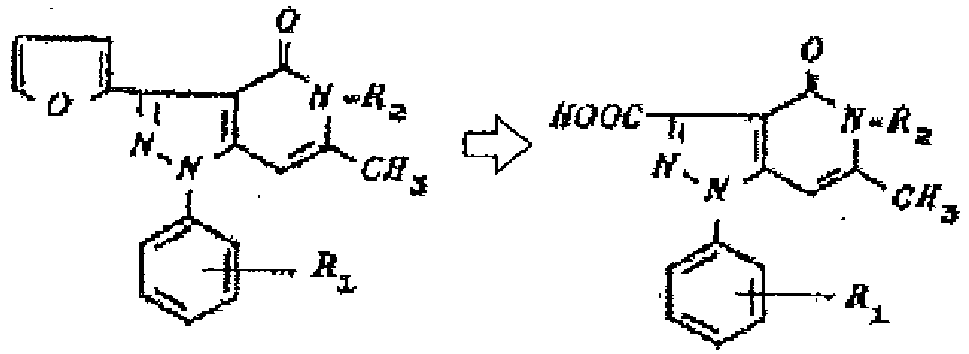
- R1 is H, halogen or the like; and
- R2 is H, alkyl or phenyl,
- (5) A compound represented by the following formula:

- R1, R2, R3 and R4 are each independently C1-8 alkyl, C1-8 hetero alkyl or the like;
- R5 and R6 are each independently C1-8 alkyl, C1-8 hetero alkyl or the like;
- R1, R2, R3, R4, R5 and R6 optionally form a 5-10-membered ring; Ring A is an optionally substituted 5-membered aromatic heterocycle or the like;
- Ring N is an optionally substituted 6-membered aromatic heterocycle or the like;
- Ar is an optionally substituted 5-10-membered aryl or an optionally substituted 5-10-membered heteroaryl;
- m and n are each independently 1-6; and
- p is 0-1,
- (6) A compound represented by the following formula:

- W is CH or N;
- Ring B is an optionally substituted 5-6-membered aromatic heterocycle;
- R1 is an optionally substituted aryl or the like; and
- Ring A is an optionally substituted 5-membered nitrogen-containing aromatic heterocycle,
- (7) A compound represented by the following formula:

R2 and R3 are each independently H or C1-6 alkyl, (Patent Document 7). - (8) A compound represented by the following formula:

- (9) A compound represented by the following formula:

- (10) A compound represented by the following formula:

- (11) The following compounds are disclosed in Chemical Abstract.
- 1) Registry Number: 30081-66-4

- 2) Registry Number: 30081-67-5

- 3) Registry Number: 143035-29-4

- 4) Registry Number: 143035-23-8

- 5) Registry Number: 13945-10-3

- 6) Registry Number: 143035-24-9

- 7) Registry Number: 143035-25-0

- 8) Registry Number: 143035-26-1

- 9) Registry Number: 143035-27-2

- 10) Registry Number: 143035-30-7

- 11) Registry Number: 143035-31-8

- 12) Registry Number: 143035-32-9

- 13) Registry Number: 143035-33-0

- 14) Registry Number: 143035-34-1

- 15) Registry Number: 143035-28-3

- 16) Registry Number: 143035-35-2

- 17) Registry Number: 143035-36-3

- 18) Registry Number: 30081-66-4

- 19) Registry Number: 30081-67-5
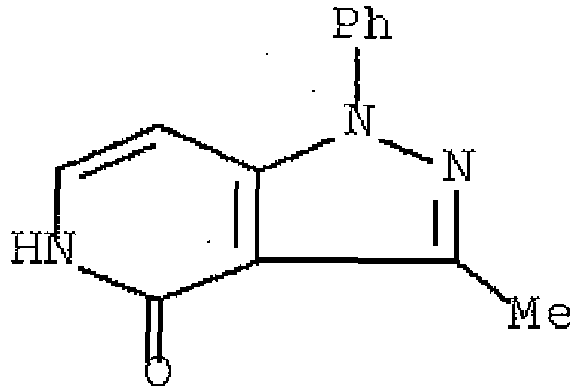
- 20) Registry Number: 32460-25-6

- 21) Registry Number: 30081-66-4
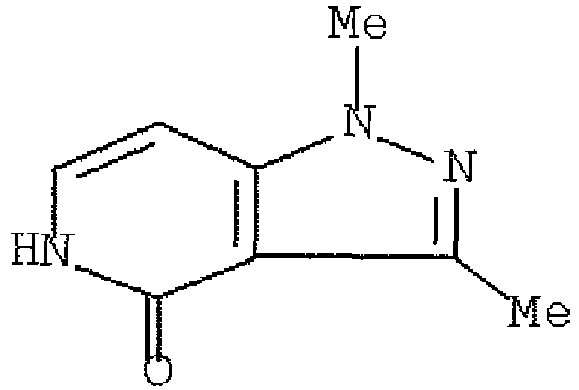
- 22) Registry Number: 30081-67-5

- 23) Registry Number: 13945-10-3

- 24) Registry Number: 13945-11-4

- 25) Registry Number: 13945-12-5

- 26) Registry Number: 13945-13-6

- 27) Registry Number: 14033-34-2

- 28) Registry Number: 14633-09-1

- 29) Registry Number: 958795-03-4
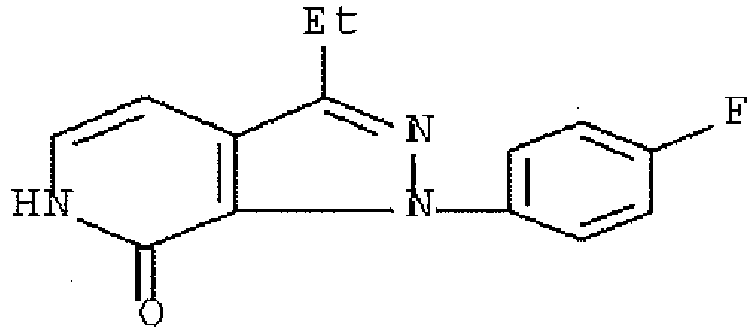
- 1) Registry Number: 30081-66-4
-
- [Patent Document 1]
WO 2008/070507 - [Patent Document 2]
WO 2003/101968 - [Patent Document 3]
JP-A-H4-139185 - [Patent Document 4]
JP-A-S52-078895 - [Patent Document 5]
WO 2007/115231 - [Patent Document 6]
WO 2005/028475 - [Patent Document 7]
US 3663559 -
- [Non-Patent Document 1] Bioorganic & Medicinal Chemistry (2011), 19(11), 3569-3578
- [Non-Patent Document 2] Tetrahedron (2010), 66(15), 2843-2854
- Non-Patent Document 3] Journal of Heterocyclic Chemistry (2004), 41(5), 761-766
- An object of the present invention is to provide a compound having a superior JAK inhibitory action, which is useful as an agent for the prophylaxis or treatment of autoimmune disease (rheumatoid arthritis, psoriasis, inflammatory bowel disease, Sjogren's syndrome, Behcet's disease, multiple sclerosis, systemic lupus erythematosus, etc.), cancer (leukemia, uterine leiomyosarcoma, prostate cancer, multiple myeloma, cachexia, myelofibrosis, etc.) and the like.
- The present inventors have conducted intensive studies in an attempt to solve the above-mentioned problem and found that a compound represented by the following formula (I) has a superior JAK inhibitory action, which resulted in the completion of the present invention.
- Accordingly, the present invention provides the following.
- [1] A compound represented by the formula (I):

- Ring A moiety is a nitrogen-containing aromatic heterocycle
wherein- Q is a carbon atom or a nitrogen atom, and
- X2 and X3 are each independently a carbon atom or a nitrogen atom, and any one of them is a nitrogen atom;
- R1 is a hydrogen atom, a halogen atom, a cyano group, an acyl group, an optionally substituted C1-6 alkyl group, an optionally substituted C3-6 cycloalkyl group or an optionally substituted hydroxy group;
- R2 is a substituted C1-2 alkyl group, an optionally substituted C3-6 alkyl group, an acyl group, an optionally substituted hydroxy group, an optionally substituted amino group, an optionally substituted carbocyclic group or an optionally substituted heterocyclic group; and
- R3 is a substituted C1-2 alkyl group, an optionally substituted C3-6 alkyl group, an acyl group, an optionally substituted hydroxy group, an optionally substituted amino group, an optionally substituted carbocyclic group or an optionally substituted heterocyclic group,
- provided that 3-(3-fluorophenyl)-1-trityl-1,5-dihydro-4H-pyrazolo[4,3-c]pyridin-4-one is excluded,
- Ring A moiety is a nitrogen-containing aromatic heterocycle
- [2] The compound or salt of the above-mentioned [1], wherein
R1 is- (1) a hydrogen atom,
- (2) a halogen atom,
- (3) a cyano group,
- (4) a carboxy group,
- (5) a C1-6 alkyl-carbonyl group,
- (6) a C1-6 alkoxy-carbonyl group,
- (7) a carbamoyl group optionally mono- or di-substituted by C1-6 alkyl group(s),
- (8) a C1-6 alkyl group optionally substituted by 1 to 3 hydroxy groups, or
- (9) a C3-6 cycloalkyl group;
- (1) a C1-2 alkyl group substituted by 1 to 3 substituents selected from
- (a) a C6-14 aryl group optionally substituted by 1 to 3 C1-6 alkoxy groups, and
- (b) a 3- to 8-membered monocyclic non-aromatic heterocyclic group optionally substituted by 1 to 3 C1-6 alkyl groups,
- (2) a C3-6 alkyl group optionally substituted by 1 to 3 substituents selected from
- (a) a hydroxy group, and
- (b) a C1-6 alkoxy group,
- (3) a C3-10 cycloalkyl group optionally substituted by 1 to 3 substituents selected from
- (a) a hydroxy group,
- (b) a C1-6 alkyl group,
- (c) an oxo group,
- (d) a C1-6 alkylenedioxy group,
- (e) a C6-14 aryl group,
- (f) a halogen atom, and
- (g) an amino group,
- (4) a C6-14 aryl group optionally substituted by 1 to 3 substituents selected from
- (a) a halogen atom,
- (b) a C1-6 alkyl group optionally substituted by 1 to 3 halogen atoms,
- (c) a cyano group,
- (d) a carbamoyl group,
- (e) an amino group, and
- (f) a C1-6 alkoxy group,
- (5) a 3- to 8-membered monocyclic non-aromatic heterocyclic group, or
- (6) a 5- to 7-membered monocyclic aromatic heterocyclic group; and
- (1) a C1-2 alkyl group substituted by 1 to 3 substituents selected from a C6-14 aryl group optionally substituted by 1 to 3 sulfamoyl groups,
- (2) a C3-10 cycloalkyl group,
- (3) a C3-10 cycloalkenyl group,
- (4) a C6-14 aryl group optionally substituted by 1 to 3 substituents selected from
- (a) a halogen atom,
- (b) a nitro group,
- (c) a cyano group,
- (d) a carbamoyl group optionally mono- or di-substituted by C1-6 alkyl group(s) optionally substituted by 1 to 3 substituents selected from
- (i) a C1-6 alkoxy group,
- (ii) a hydroxy group, and
- (iii) an amino group optionally mono- or di-substituted by C1-6 alkyl group(s),
- (e) a sulfamoyl group optionally mono- or di-substituted by C1-6 alkyl group(s),
- (f) a C1-6 alkyl group optionally substituted by 1 to 3 substituents selected from
- (i) a halogen atom,
- (ii) a cyano group,
- (iii) a hydroxy group,
- (iv) a carbamoyl group optionally mono- or di-substituted by substituent(s) selected from a C1-6 alkyl group and a C3-10 cycloalkyl group,
- (v) an amino group optionally mono- or di-substituted by C1-6 alkyl group (s), and
- (vi) a 3- to 8-membered monocyclic non-aromatic heterocyclic group optionally substituted by 1 to 3 substituents selected from an oxo group and a halogen atom,
- (g) a C1-6 alkoxy group optionally substituted by 1 to 3 substituents selected from
- (i) a halogen atom,
- (ii) a cyano group,
- (iii) a hydroxy group, and
- (iv) a carbamoyl group optionally mono- or di-substituted by substituent(s) selected from a C1-6 alkyl group optionally substituted by 1 to 3 C1-6 alkoxy groups,
- (h) a C1-6 alkoxy-carbonyl group,
- (i) an amino group optionally mono- or di-substituted by substituent(s) selected from
- (i) a C1-6 alkyl-carbonyl group, and
- (ii) a C1-6 alkyl group optionally substituted by 1 to 3 C1-6 alkoxy groups,
- (j) a 3- to 8-membered monocyclic non-aromatic heterocyclic group optionally substituted by 1 to 3 substituents selected from
- (i) an oxo group,
- (ii) a C1-6 alkyl group,
- (iii) a C1-6 alkyl-carbonyl group optionally substituted by 1 to 3 substituents selected from a hydroxy group and a C1-6 alkoxy group,
- (iv) a carbamoyl group optionally mono- or di-substituted by C1-6 alkyl group(s),
- (v) a C1-6 alkylsulfonyl group, and
- (vi) a halogen atom, and
- (k) a C1-6 alkylenedioxy group,
- (5) a 5- to 7-membered monocyclic aromatic heterocyclic group optionally substituted by 1 to 3 substituents selected from
- (a) a carboxy group,
- (b) a cyano group,
- (c) a C1-6 alkoxy-carbonyl group,
- (d) a carbamoyl group optionally mono- or di-substituted by substituent(s) selected from
- (i) a C1-6 alkyl group optionally substituted by 1 to 3 substituents selected from a hydroxy group and a cyano group,
- (ii) a C3-10 cycloalkyl group optionally substituted by 1 to 3 cyano groups,
- (iii) a 5- to 7-membered monocyclic aromatic heterocyclic group optionally substituted by 1 to 3 C1-6 alkyl groups, and
- (iv) a 3- to 8-membered monocyclic non-aromatic heterocyclic group,
- (e) a 3- to 8-membered monocyclic non-aromatic heterocyclic group optionally substituted by 1 to 3 oxo groups,
- (f) a C1-6 alkyl group optionally substituted by 1 to 3 substituents selected from
- (i) a cyano group,
- (ii) a carbamoyl group, and
- (iii) a 3- to 8-membered monocyclic non-aromatic heterocyclic group optionally substituted by 1 to 3 oxo groups,
- (g) a C3-10 cycloalkyl group,
- (h) a 3- to 8-membered monocyclic non-aromatic heterocyclylcarbonyl group, and
- (i) an amino group,
- (6) a 8- to 12-membered fused aromatic heterocyclic group optionally substituted by 1 to 3 C1-6 alkyl groups,
- (7) a 3- to 8-membered monocyclic non-aromatic heterocyclic group optionally substituted by 1 to 3 substituents selected from
- (a) an oxo group, and
- (b) a C1-6 alkyl group,
- (8) a 8- to 12-membered fused non-aromatic heterocyclic group optionally substituted by 1 to 3 oxo groups, or
- (9) an amino group optionally mono- or di-substituted by substituent(s) selected from
- (a) a C6-14 aryl group optionally substituted by 1 to 3 substituents selected from
- (i) a carbamoyl group, and
- (ii) a sulfamoyl group,
- (b) a C1-6 alkyl group optionally substituted by 1 to 3 substituents selected from a C6-14 aryl group optionally substituted by 1 to 3 C1-6 alkoxy groups, and
- (c) a C6-14 aryl-carbonyl group.
- (a) a C6-14 aryl group optionally substituted by 1 to 3 substituents selected from
- [3] The compound or salt of the above-mentioned [1], which is 4-(1-cyclopentyl-4-oxo-4,5-dihydro-1H-pyrrolo[3,2-c]pyridin-3-yl)thiophene-2-carboxamide.
- [4] The compound or salt of the above-mentioned [1], which is 2-(4-(1-(2,6-difluorophenyl)-4-oxo-4,5-dihydro-1H-pyrazolo[4,3-c]pyridin-3-yl)phenyl)acetamide.
- [5] The compound or salt of the above-mentioned [1], which is 3-((1-cyclopentyl-4-oxo-4,5-dihydro-1H-pyrazolo[4,3-c]pyridin-3-yl)amino)benzenesulfonamide.
- [6] A medicament comprising the compound or salt of the above-mentioned [1].
- [7] The medicament of the above-mentioned [6], which is a janus kinase inhibitor.
- [8] The medicament of the above-mentioned [6], which is an agent for the prophylaxis or treatment of autoimmune disease.
- [9] The compound or salt of the above-mentioned [1] for use in the prophylaxis or treatment of autoimmune diseases.
- [10] A method of inhibiting janus kinase in a mammal, which comprises administering an effective amount of the compound or salt of the above-mentioned [1] to the mammal.
- [11] A method for the prophylaxis or treatment of autoimmune diseases, which comprises administering an effective amount of the compound or salt of the above-mentioned [1] to the mammal.
- [12] Use of the compound or salt of the above-mentioned [1] for the production of an agent for the prophylaxis or treatment of autoimmune diseases.
- [13] The medicament of the above-mentioned [8], wherein the autoimmune disease is rheumatoid arthritis (rheumatoid arthritis), psoriasis (psoriasis), inflammatory bowel disease (inflammatory bowel disease), Sjogren's syndrome (Sjogren's syndrome), Behcet's disease (Behcet's syndrome), multiple sclerosis (multiple sclerosis) or systemic lupus erythematosus (systemic lupus erythematosus).
- [14] The compound or salt of the above-mentioned [9], wherein autoimmune disease is rheumatoid arthritis, psoriasis, inflammatory bowel disease, Sjogren's syndrome, Behcet's disease, multiple sclerosis or systemic lupus erythematosus.
- [15] The method of the above-mentioned [11], wherein autoimmune disease is rheumatoid arthritis, psoriasis, inflammatory bowel disease, Sjogren's syndrome, Behcet's disease, multiple sclerosis or systemic lupus erythematosus.
- [16] The use of the above-mentioned [12], wherein autoimmune disease is rheumatoid arthritis, psoriasis, inflammatory bowel disease, Sjogren's syndrome, Behcet's disease, multiple sclerosis or systemic lupus erythematosus.
- [17] A compound represented by the formula (I'):

- Ring A, Q, X2, X3 and R1 are as defined above;
- R2' and R3' are each independently a halogen atom, a substituted C1-2 alkyl group, an optionally substituted C3-6 alkyl group, an acyl group, an optionally substituted hydroxy group, an optionally substituted amino group, an optionally substituted carbocyclic group or an optionally substituted heterocyclic group,
- Compound (I) has a superior JAK inhibitory action, and is useful as an agent for the treatment of autoimmune disease (rheumatoid arthritis, psoriasis, inflammatory bowel disease (Crohn's disease, ulcerative colitis, etc.), Sjogren's syndrome, Behcet's disease, multiple sclerosis, systemic lupus erythematosus, etc.), cancer (leukemia, uterine leiomyosarcoma, prostate cancer, multiple myeloma, cachexia, myelofibrosis, etc.) and the like.
- In the present specification, the "halogen atom" means a fluorine atom, a chlorine atom, a bromine atom or an iodine atom.
- In the present specification, the "C1-2 alkyl group" means, for example, methyl or ethyl.
- In the present specification, the "C3-6 alkyl group" means, for example, propyl, isopropyl, butyl, 2-methylpropyl, 1-methylpropyl, tert-butyl, pentyl, isopentyl, neo-pentyl, 1-ethylpropyl, hexyl, isohexyl, 1,1-dimethylbutyl, 2,2-dimethylbutyl, 3,3-dimethylbutyl, 2-ethylbutyl or the like.
- In the present specification, the "C1-6 alkyl (group means, for example, methyl, ethyl, propyl, isopropyl, butyl, 2-methylpropyl, 1-methylpropyl, tert-butyl, pentyl, isopentyl, neo-pentyl, 1-ethylpropyl, hexyl, isohexyl, 1,1-dimethylbutyl, 2,2-dimethylbutyl, 3,3-dimethylbutyl, 2-ethylbutyl or the like.
- In the present specification, the "C1-10 alkyl (group)" means, for example, methyl, ethyl, propyl, isopropyl, butyl, 2-methylpropyl, 1-methylpropyl, tert-butyl, pentyl, isopentyl, neo-pentyl, 1-ethylpropyl, hexyl, isohexyl, 1,1-dimethylbutyl, 2,2-dimethylbutyl, 3,3-dimethylbutyl, 2-ethylbutyl, heptyl, octyl, nonyl, decyl or the like. Among them, a C1-6 alkyl group is preferable.
- In the present specification, the "C2-6 alkenyl (group)" means, for example, vinyl, 1-propenyl, 2-propenyl, 2-methyl-1-propenyl, 1-butenyl, 2-butenyl, 3-butenyl, 3-methyl-2-butenyl, 1-pentenyl, 2-pentenyl, 3-pentenyl, 4-pentenyl, 4-methyl-3-pentenyl, 1-hexenyl, 3-hexenyl, 5-hexenyl or the like.
- In the present specification, the "C2-10 alkenyl (group)" means, for example, vinyl, 1-propenyl, 2-propenyl, 2-methyl-1-propenyl, 1-butenyl, 2-butenyl, 3-butenyl, 3-methyl-2-butenyl, 1-pentenyl, 2-pentenyl, 3-pentenyl, 4-pentenyl, 4-methyl-3-pentenyl, 1-hexenyl, 3-hexenyl, 5-hexenyl, 1-heptenyl, 1-octenyl or the like. Among them, a C2-6 alkenyl group is preferable.
- In the present specification, the "C2-6 alkynyl (group)" means, for example, ethynyl, 1-propynyl, 2-propynyl, 1-butynyl, 2-butynyl, 3-butynyl, 1-pentynyl, 2-pentynyl, 3-pentynyl, 4-pentynyl, 1,1-dimethylprop-2-yn-1-yl, 1-hexynyl, 2-hexynyl, 3-hexynyl, 4-hexynyl, 5-hexynyl or the like.
- In the present specification, the "C2-10 alkynyl (group)" means, for example, ethynyl, 1-propynyl, 2-propynyl, 1-butynyl, 2-butynyl, 3-butynyl, 1-pentynyl, 2-pentynyl, 3-pentynyl, 4-pentynyl, 1,1-dimethylprop-2-yn-1-yl, 1-hexynyl, 2-hexynyl, 3-hexynyl, 4-hexynyl, 5-hexynyl, 1-heptynyl, 1-octynyl or the like. Among them, a C2-6 alkynyl group is preferable.
- In the present specification, the "C1-6 alkoxy (group)" means, for example, methoxy, ethoxy, propoxy, isopropoxy, butoxy, isobutoxy, sec-butoxy, tert-butoxy, pentyloxy, isopentyloxy, hexyloxy or the like.
- In the present specification, the "C2-6 alkenyloxy (group)" means, for example, vinyloxy, 1-propenyloxy, 2-propenyloxy, 2-methyl-1-propenyloxy, 1-butenyloxy, 2-butenyloxy, 3-butenyloxy, 3-methyl-2-butenyloxy, 1-pentenyloxy, 2-pentenyloxy, 3-pentenyloxy, 4-pentenyloxy, 4-methyl-3-pentenyloxy, 1-hexenyl, 3-hexenyloxy, 5-hexenyloxy or the like.
- In the present specification, the "C2-6 alkynyloxy (group)" means, for example, ethynyloxy, 1-propynyloxy, 2-propynyloxy, 1-butynyloxy, 2-butynyloxy, 3-butynyloxy, 1-pentynyloxy, 2-pentynyloxy, 3-pentynyloxy, 4-pentynyloxy, 1,1-dimethylprop-2-yn-1-yloxy, 1-hexynyloxy, 2-hexynyloxy, 3-hexynyloxy, 4-hexynyloxy, 5-hexynyloxy or the like.
- In the present specification, the "C1-6 alkylenedioxy (group)" means, for example, methylenedioxy, ethylenedioxy or the like.
- In the present specification, the "C1-6 alkoxy-carbonyl (group)" means, for example, methoxycarbonyl, ethoxycarbonyl, propoxycarbonyl, isopropoxycarbonyl, butoxycarbonyl, isobutoxycarbonyl, tert-butoxycarbonyl or the like.
- In the present specification, the "C1-6 alkyl-carbonyl (group)" means, for example, acetyl, propanoyl, butanoyl, 2-methylpropanoyl or the like.
- In the present specification, the "C3-6 cycloalkyl (group)" means, for example, cyclopropyl, cyclobutyl, cyclopentyl and cyclohexyl or the like.
- In the present specification, the "C3-10 cycloalkyl (group)" means, for example, cyclopropyl, cyclobutyl, cyclopentyl, cyclohexyl, cycloheptyl, cyclooctyl, cyclononyl, cyclodecyl or the like. Among them, a C3-6 cycloalkyl group is preferable.
- In the present specification, the "C3-8 cycloalkyl (group)" means, for example, cyclopropyl, cyclobutyl, cyclopentyl, cyclohexyl, cycloheptyl, cyclooctyl or the like. Among them, a C3-6 cycloalkyl group is preferable.
- In the present specification, the "C3-8 cycloalkenyl (group)" means, for example, cyclopropenyl (e.g., 2-cyclopropen-1-yl), cyclobutenyl (e.g., 2-cyclobuten-1-yl), cyclopentenyl (e.g., 1-cyclopenten-1-yl, 2-cyclopenten-1-yl, 3-cyclopenten-1-yl), cyclohexenyl (e.g., 1-cyclohexen-1-yl, 2-cyclohexen-1-yl, 3-cyclohexen-1-yl) or the like.
- In the present specification, the "C3-10 cycloalkenyl (group)" means, for example, cyclopropenyl (e.g., 2-cyclopropen-1-yl), cyclobutenyl (e.g., 2-cyclobuten-1-yl), cyclopentenyl (e.g., 2-cyclopenten-1-yl, 3-cyclopenten-1-yl), cyclohexenyl (e.g., 1-cyclohexen-1-yl, 2-cyclohexen-1-yl, 3-cyclohexen-1-yl), cycloheptenyl (e.g., 1-cyclopenten-1-yl, 2-cyclohepten-1-yl, 2-cyclohepten-1-yl), cyclooctenyl (e.g., 1-cyclohepten-1-yl, 2-cyclohepten-1-yl, .3-cyclohepten-1-yl), cyclononenyl (e.g., 1-cyclononen-1-yl, 2-cyclononen-1-yl, 3-cyclononen-1-yl) or the like. Among them, a C3-8 cycloalkenyl group is preferable.
- In the present specification, the "C4-6 cycloalkadienyl (group)" means, for example, 1,3-cyclobutadien-1-yl, 1,3-cyclopentadien-1-yl, 1,4-cyclopentadien-1-yl, 2,4-cyclopentadien-1-yl, 1,3-cyclohexadien-1-yl, 1,4-cyclohexadion-1-yl, 1,5-cyclohexadien-1-yl, 2,4-cyclohexadien-1-yl, 2,5-cyclohexadien-1-yl or the like.
- In the present specification, the "C4-10 cycloalkadienyl (group)" means, for example, 1,3-cyclobutadien-1-yl, 1,3-cyclopentadien-1-yl, 1,4-cyclopentadien-1-yl, 2,4-cyclopentadien-1-yl, 1,3-cyclohexadien-1-yl, 1,4-cyclohexadien-1-yl, 1,5-cyclohexadien-1-yl, 2,4-cyclohexadien-1-yl, 2,5-cyclohexadien-1-yl, 1,3-cyclooctadien-1-yl, 1,4-cyclooctadien-1-yl, 1,5-cyclooctadien-1-yl, 1,6-cyclooctadien-1-yl, 1,7-cyclooctadien-1-yl, 2,4-cyclooctadien-1-yl, 2,5-cyclooctadien-1-yl, 2,6-cyclooctadien-1-yl, 2,7-cyclooctadien-1-yl, 3,5-cyclooctadien-1-yl, 3,6-cyclooctadien-1-yl or the like. Among them, a C4-6 cycloalkadienyl group is preferable.
- The above-mentioned C3-10 cycloalkyl group, C3-10 cycloalkenyl group and C4-10 cycloalkadienyl group are each optionally fused with a benzene ring to form a fused ring group, and examples of the fused ring group include indanyl, dihydronaphthyl, tetrahydronaphthyl, fluorenyl and the like.
- The above-mentioned C3-10 cycloalkyl group, C3-10 cycloalkenyl group and C9-10 cycloalkadienyl group may be a C7-10 bridged hydrocarbon group. Examples of the C7-10 bridged hydrocarbon group include bicyclo[2.2.1]heptyl(norbornyl), bicyclo[2.2.2]octyl, bicyclo[3.2.1]octyl, bicyclo[3.2.2]nonyl, bicyclo[3.3.1]nonyl, bicyclo[4.2.1]nonyl, bicyclo[4.3.1]decyl, adamantyl and the like.
- In addition, the above-mentioned C3-10 cycloalkyl group, C3-10 cycloalkenyl group and C4-10 cycloalkadienyl group may each form a spiro ring group with a C3-10 cycloalkane, a C3-10 cycloalkene or a C4-10 cycloalkadiene. Examples of the C3-10 cycloalkane, C3-10 cycloalkene and C4-10 cycloalkadiene include rings corresponding to the above-mentioned C3-10 cycloalkyl group, C3-10 cycloalkenyl group and C4-10 cycloalkadienyl group. Examples of the spiro ring group include spiro[4.5]decan-8-yl and the like.
- In the present specification, the "C3-6 cycloalkyloxy (group)" means, for example, cyclopropyloxy, cyclobutyloxy, cyclopentyloxy, cyclohexyloxy or the like.
- In the present specification, the "C3-8 cycloalkyloxy (group)" means, for example, cyclopropyloxy, cyclobutyloxy, cyclopentyloxy, cyclohexyloxy, cycloheptyloxy, cyclooctyloxy or the like. Among them, a C3-6 cycloalkyloxy group is preferable.
- In the present specification, the "C3-8 cycloalkenyloxy (group)" means, for example, cyclopropenyloxy (e.g., 2-cyclopropen-1-yloxy), cyclobutenyloxy (e.g., 2-cyclobuten-1-yloxy), cyclopentenyloxy (e.g., 2-cyclopenten-1-yloxy, 3-cyclopenten-1-yloxy), cyclohexenyloxy (e.g., 2-cyclohexen-1-yloxy, 3-cyclohexen-1-yloxy) or the like.
- In the present specification, the "C6-14 aryl (group)" means, for example, phenyl, 1-naphthyl, 2-naphthyl or the like.
- In the present specification, the "C6-14 aryloxy (group)" means, for example, phenoxy, 1-naphthyloxy, 2-naphthyloxy or the like.
- In the present specification, the "C7-14 aralkyl (group)" means, for example, benzyl, phenethyl or the like.
- In the present specification, the "C7-14 aralkyloxy (group)" means, for example, benzyloxy, phenethyloxy or the like.
- In the present specification, the "C8-13 arylalkenyl (group)" means, for example, styryl or the like.
- In the present specification, the "heterocyclic group" means an aromatic heterocyclic group or a non-aromatic heterocyclic group.
- In the present specification, the "aromatic heterocyclic group" means a monocyclic aromatic heterocyclic group or a fused aromatic heterocyclic group.
- In the present specification, examples of the "monocyclic aromatic heterocyclic group" include a 5- to 7-membered (preferably 5- or 6-membered) monocyclic aromatic heterocyclic group containing, as a ring-constituting atom besides carbon atoms, 1 to 4 hetero atoms selected from an oxygen atom, a sulfur atom (optionally oxidized) and a nitrogen atom (optionally oxidized), for example, furyl (e.g., 2-furyl, 3-furyl), thienyl (e.g., 2-thienyl, 3-thienyl), pyridyl (e.g., 2-pyridyl, 3-pyridyl, 4-pyridyl), pyrimidinyl (e.g., 2-pyrimidinyl, 4-pyrimidinyl, 5-pyrimidinyl), pyridazinyl (e.g., 3-pyridazinyl, 4-pyridazinyl), pyrazinyl (e.g., 2-pyrazinyl), pyrrolyl (e.g., 1-pyrrolyl, 2-pyrrolyl, 3-pyrrolyl), imidazolyl (e.g., 1-imidazolyl, 2-imidazolyl, 4-imidazolyl, 5-imidazolyl), pyrazolyl (e.g., 1-pyrazolyl, 3-pyrazolyl, 4-pyrazolyl), thiazolyl (e.g., 2-thiazolyl, 4-thiazolyl, 5-thiazolyl), isothiazolyl (e.g., 3-isothiazolyl, 4-isothiazolyl, 5-isothiazolyl), oxazolyl (e.g., 2-oxazolyl, 4-oxazolyl, 5-oxazolyl), isoxazolyl (e.g., 3-isoxazolyl, 4-isoxazolyl, 5-isoxazolyl), oxadiazolyl (e.g., 1,2,4-oxadiazol-5-yl, 1,3,4-oxadiazol-2-yl), thiadiazolyl (e.g., 1,3,4-thiadiazol-2-yl), triazolyl (e.g., 1,2,4-triazol-1-yl, 1,2,4-triazol-3-yl, 1,2,3-triazol-1-yl, 1,2,3-triazol-2-yl, 1,2,3-triazol-4-yl), tetrazolyl (e.g., tetrazol-1-yl, tetrazol-5-yl), triazinyl (e.g., 1,2,4-triazin-1-yl, 1,2,4-triazin-3-yl) and the like.
- In the present specification, examples of the "fused aromatic heterocyclic group" include an 8- to 12-membered fused aromatic heterocyclic group, specifically, a group derived from a fused ring wherein a ring corresponding to the above-mentioned 5- to 7-membered monocyclic aromatic heterocyclic group is fused with a C6-14 aromatic hydrocarbon; and a group derived from a fused ring wherein rings corresponding to the above-mentioned 5- to 7-membered monocyclic aromatic heterocyclic groups are fused, for example, quinolyl (e.g., 2-quinolyl, 3-quinolyl, 4-quinolyl, 6-quinolyl), isoquinolyl (e.g., 3-isoquinolyl), quinazolyl (e.g., 2-quinazolyl, 4-quinazolyl), quinoxalyl (e.g., 2-quinoxalyl, 6-quinoxalyl), benzofuranyl (e.g., 2-benzofuranyl, 3-benzofuranyl), benzothienyl (e.g., 2-benzothienyl, 3-benzothienyl), benzoxazolyl (e.g., 2-benzoxazolyl), benzisoxazolyl (e.g., 7-benzisoxazolyl), benzothiazolyl (e.g., 2-benzothiazolyl), benzimidazolyl (e.g., benzimidazol-1-yl, benzimidazol-2-yl, benzimidazol-5-yl), benzotriazolyl (e.g., 1H-1,2,3-benzotriazol-5-yl), indolyl (e.g., indol-1-yl, indol-2-yl, indol-3-yl, indol-5-yl), indazolyl (e.g., 1H-indazol-3-yl), pyrrolopyrazinyl (e.g., 1H-pyrrolo[2,3-b]pyrazin-2-yl, 1H-pyrrolo[2,3-b]pyrazin-6-yl), imidazopyridyl (e.g., 1H-imidazo[4,5-b]pyridin-2-yl, 1H-imidazo[4,5-c]pyridin-2-yl, 2H-imidazo[1,2-a]pyridin-3-yl), thienopyridyl (e.g., thieno[2,3-b]pyridin-3-yl), imidazopyrazinyl (e.g., 1H-imidazo[4,5-b]pyrazin-2-yl), pyrazolopyridyl (e.g., 1H-pyrazolo[4,3-c]pyridin-3-yl), pyrazolothienyl (e.g., 2H-pyrazolo[3,4-b]thiophen-2-yl), pyrazolotriazinyl (e.g., pyrazolo[5,1-c][1,2,4]triazin-3-yl) and the like.
- In the present specification, the "non-aromatic heterocyclic group" means a monocyclic non-aromatic heterocyclic group or a non-aromatic heterocyclic group.
- In the present specification, examples of the "monocyclic non-aromatic heterocyclic group" include a 3- to 8-membered (preferably 5- or 6-membered) monocyclic non-aromatic heterocyclic group containing, as a ring-constituting atom besides carbon atoms, 1 to 4 hetero atoms selected from an oxygen atom, a sulfur atom (optionally oxidized) and a nitrogen atom (optionally oxidized), for example, azetidinyl (e.g., 1-azetidinyl, 2-azetidinyl), pyrrolidinyl (e.g., 1-pyrrolidinyl, 2-pyrrolidinyl), piperidyl (e.g., piperidino, 2-piperidyl, 3-piperidyl, 4-piperidyl), morpholinyl (e.g., morpholino), thiomorpholinyl (e.g., thiomorpholino), piperazinyl (e.g., 1-piperazinyl, 2-piperazinyl, 3-piperazinyl), oxazolidinyl (e.g., oxazolidin-2-yl), thiazolidinyl (e.g., thiazolidin-2-yl), dihydrothiopyranyl (e.g., dihydrothiopyran-3-yl, dihydrothiopyran-4-yl), imidazolidinyl (e.g., imidazolidin-2-yl, imidazolidin-3-yl), oxazolinyl (e.g., oxazolin-2-yl), thiazolinyl (e.g., thiazolin-2-yl), imidazolinyl (e.g., imidazolin-2-yl, imidazolin-3-yl), dioxolyl (e.g., 1,3-dioxol-4-yl), dioxolanyl (e.g., 1,3-dioxolan-4-yl), dihydrooxadiazolyl (e.g., 4,5-dihydro-1,2,4-oxadiazol-3-yl), pyranyl (e.g., 2-pyranyl, 4-pyranyl), tetrahydropyranyl (e.g., 2-tetrahydropyranyl, 3-tetrahydropyranyl, 4-tetrahydropyranyl), thiopyranyl (e.g., 4-thiopyranyl), tetrahydrothiopyranyl (e.g., 2-tetrahydrothiopyranyl, 3-tetrahydrothiopyranyl, 4-tetrahydrothiopyranyl), 1-oxidetetrahydrothiopyranyl (e.g., 1-oxidetetrahydrothiopyran-4-yl), 1,1-dioxidotetrahydrothiopyranyl (e.g., 1,1-dioxidotetrahydrothiopyran-4-yl), tetrahydrofuryl (e.g., tetrahydrofuran-3-yl, tetrahydrofuran-2-yl), oxetanyl (e.g., oxetan-2-yl, oxetan-3-yl), pyrazolidinyl (e.g., pyrazolidin-1-yl, pyrazolidin-3-yl), pyrazolinyl (e.g., pyrazolin-1-yl), tetrahydropyrimidinyl (e.g., tetrahydropyrimidin-1-yl), dihydrotriazolyl (e.g., 2,3-dihydro-1H-1,2,3-triazol-1-yl), tetrahydrotriazolyl (e.g., 2,3,4,5-tetrahydro-1H-1,2,3-triazol-1-yl), azepanyl (e.g., 1-azepanyl, 2-azepanyl, 3-azepanyl, 4-azepanyl), dihydropyridyl (e.g., dihydropyridin-1-yl, dihydropyridin-2-yl, dihydropyridin-3-yl, dihydropyridin-4-yl), tetrahydropyridyl (e.g., 1,2,3,4-tetrahydropyridin-1-yl, 1,2,3,4-tetrahydropyridin-2-yl, 1,2,3,4-tetrahydropyridin-3-yl, 1,2,3,4-tetrahydropyridin-4-yl), benzoxadiazolyl (e.g., 2,1,3-benzoxadiazol-5-yl) and the like.
- In the present specification, examples of the "fused non-aromatic heterocyclic group" include an 8- to 12-membered fused non-aromatic heterocyclic group, specifically, a group derived from a fused ring wherein a ring corresponding to the above-mentioned 3- to 8-membered monocyclic non-aromatic heterocyclic group is fused with a C6-14 aromatic hydrocarbon; a group derived from a fused ring wherein rings corresponding to the above-mentioned 3- to 8-membered monocyclic non-aromatic heterocyclic groups are fused; a group derived from a fused ring wherein a ring corresponding to the above-mentioned 3- to 8-membered monocyclic non-aromatic heterocyclic group is fused with a ring corresponding to the above-mentioned 5- to 7-membered monocyclic aromatic heterocyclic group; and a group wherein the above-mentioned group is partially saturated, for example, dihydroindolyl (e.g., 2,3-dihydro-1H-indol-1-yl), dihydroisoindolyl (e.g., 1,3-dihydro-2H-isoindol-2-yl), dihydrobenzofuranyl (e.g., 2,3-dihydro-1-benzofuran-5-yl), tetrahydrobenzofuranyl (e.g., 4,5,6,7-tetrahydro-1-benzofuran-3-yl), dihydrobenzodioxinyl (e.g., 2,3-dihydro-1,4-benzodioxin-2-yl), dihydrobenzodioxepinyl (e.g., 3,4-dihydro-2H-1,5-benzodioxepin-2-yl), chromenyl (e.g., 4H-chromen-2-yl, 2H-chromen-3-yl), dihydrochromenyl (e.g., 3,4-dihydro-2H-chromen-2-yl), dihydroquinolinyl (e.g., 1,2-dihydroquinolin-4-yl), tetrahydroquinolinyl (e.g., 1,2,3,4-tetrahydroquinolin-4-yl), dihydroisoquinolinyl (e.g., 1,2-dihydroisoquinolin-4-yl), tetrahydroisoquinolinyl (e.g., 1,2,3,4-tetrahydroisoquinolin-4-yl), dihydrophthalazinyl (e.g., 1,4-dihydrophthalazin-4-yl) and the like.
- In the present specification, examples of the "C6-14 aromatic hydrocarbon" include benzene and naphthalene.
- In the present specification, examples of the "carbocyclic group" include a C6-14 aryl group, a C3-10 cycloalkyl group, a C3-10 cycloalkenyl group and a C4-10 cycloalkadienyl group.
- Each symbol of the formula (I) is explained below.
- In the formula (I), R1 is a hydrogen atom, a halogen atom, a cyano group, an acyl group, an optionally substituted C1-6 alkyl group, an optionally substituted C3-6 cycloalkyl group or an optionally substituted hydroxy group.
- The "C1-6 alkyl group" of the "optionally substituted C1-6 alkyl group" for R1 optionally has 1 to 5 (preferably 1 to 3) substituents at substitutable position(s). Examples of the substituent include substituents selected from the following Substituent Group A. When the number of the substituents is plural, the respective substituents may be the same or different.
-
- (1) a halogen atom;
- (2) a cyano group;
- (3) a nitro group;
- (4) a hydroxy group;
- (5) a C3-8 cycloalkyl group optionally substituted by 1 to 3 substituents selected from
- (a) a halogen atom,
- (b) a cyano group,
- (c) a C1-6 alkyl group optionally substituted by 1 to 3 halogen atoms, and
- (d) a C1-6 alkoxy group optionally substituted by 1 to 3 halogen atoms;
- (6) a C6-14 aryl group optionally substituted by 1 to 3 substituents selected from
- (a) a halogen atom,
- (b) a cyano group,
- (c) a C1-6 alkyl group optionally substituted by 1 to 3 halogen atoms,
- (d) a C1-6 alkoxy group optionally substituted by 1 to 3 halogen atoms, and
- (e) a carbamoyl group;
- (7) a C1-6 alkoxy group optionally substituted by 1 to 3 substituents selected from
- (a) a halogen atom,
- (b) a cyano group,
- (c) a C3-8 cycloalkyl group optionally having 1 to 3 halogen atoms,
- (d) a C3-8 cycloalkenyl group optionally having 1 to 3 halogen atoms,
- (e) a C6-14 aryl group optionally having 1 to 3 halogen atoms,
- (f) a 5- or 6-membered monocyclic aromatic heterocyclic group, and
- (g) a silyl group optionally having 1 to 3 C1-6 alkyl groups;
- (8) a C2-6 alkenyloxy group (e.g., vinyloxy, propenyloxy, butenyloxy, pentenyloxy, hexenyloxy) optionally having 1 to 3 halogen atoms;
- (9) a C2-6 alkynyloxy group (e.g., ethynyloxy, propynyloxy, butynyloxy, pentynyloxy, hexynyloxy) optionally having 1 to 3 halogen atoms;
- (10) a C3-8 cycloalkyloxy group (e.g., cyclopropyloxy, cyclobutyloxy, cyclopentyloxy, cyclohexyloxy) optionally having 1 to 3 halogen atoms;
- (11) a C3-8 cycloalkenyloxy group (e.g., cyclopropenyloxy, cyclobutenyloxy, cyclopentenyloxy, cyclohexenyloxy) optionally having 1 to 3 halogen atoms;
- (12) a C6-14 aryloxy group optionally having 1 to 3 halogen atoms;
- (13) a C7-14 aralkyloxy group optionally substituted by 1 to 3 substituents selected from
- (a) a halogen atom, and
- (b) a C1-6 alkoxy group;
- (14) a carbamoyl group optionally mono- or di-substituted by substituent(s) selected from
- (a) a C1-6 alkyl group,
- (b) a C3-8 cycloalkyl group,
- (c) a C6-14 aryl group,
- (d) a C1-6 alkoxy group,
- (e) a 5- or 6-membered monocyclic aromatic heterocyclic group,
- (f) a 8- to 12-membered fused aromatic heterocyclic group,
- (g) a 3- to 8-membered monocyclic non-aromatic heterocyclic group, and
- (h) a 8- to 12-membered fused non-aromatic heterocyclic group;
- (15) a sulfamoyl group optionally mono- or di-substituted by substituent(s) selected from
- (a) a C1-6 alkyl group,
- (b) a C3-8 cycloalkyl group,
- (c) a C6-14 aryl group,
- (d) a C1-6 alkoxy group,
- (e) a 5- or 6-membered monocyclic aromatic heterocyclic group,
- (f) a 8- to 12-membered fused aromatic heterocyclic group,
- (g) a 3- to 8-membered monocyclic non-aromatic heterocyclic group, and
- (h) a 8- to 12-membered fused non-aromatic heterocyclic group;
- (16) formyl;
- (17) a C1-6 alkyl-carbonyl group;
- (18) a C2-6 alkenyl-carbonyl group (e.g., acryloyl, butenoyl, pentenoyl, hexenoyl, heptenoyl);
- (19) a C2-6 alkynyl-carbonyl group (e.g., propioloyl, propynylcarbonyl, butynylcarbonyl, pentynylcarbonyl, hexynylcarbonyl);
- (20) a C3-8 cycloalkyl-carbonyl group (e.g., cyclopropylcarbonyl, cyclobutylcarbonyl, cyclopentylcarbonyl, cyclohexylcarbonyl);
- (21) a C3-8 cycloalkenyl-carbonyl group (e.g., cyclopropenylcarbonyl, cyclobutenylcarbonyl, cyclopentenylcarbonyl, cyclohexenylcarbonyl);
- (22) a C6-14 aryl-carbonyl group (e.g., benzoyl, 1-naphthylcarbonyl, 2-naphthylcarbonyl);
- (23) a C3-8 cycloalkyl-C1-6 alkyl-carbonyl group (e.g., cyclopropylacetyl, 3-cyclopropylpropionyl, cyclobutylacetyl, cyclopentylacetyl, cyclohexyl acetyl, cyclohexyl propionyl);
- (24) a C3-8 cycloalkenyl-C1-6 alkyl-carbonyl group (e.g., cyclopentenylacetyl, cyclohexenylacetyl, 3-cyclohexenylpropionyl, 3-cyclohexenylpropionyl);
- (25) a C7-14 aralkyl-carbonyl group (e.g., phenylacetyl, 3-phenylpropionyl);
- (26) a 5- or 6-membered monocyclic aromatic heterocyclylcarbonyl group (e.g., furylcarbonyl, thienylcarbonyl, pyrrolylcarbonyl, oxazolylcarbonyl, isoxazolylcarbonyl, thiazolylcarbonyl, isothiazolylcarbonyl, imidazolylcarbonyl, pyridylcarbonyl, pyrazolylcarbonyl);
- (27) a 8- to 12-membered fused aromatic heterocyclylcarbonyl group (e.g., benzofuranylcarbonyl, isobenzofuranylcarbonyl, benzothienylcarbonyl, isobenzothienylcarbonyl, indolylcarbonyl, isoindolylcarbonyl, indazolylcarbonyl, benzimidazolylcarbonyl, benzoxazolylcarbonyl);
- (28) a 3- to 8-membered monocyclic non-aromatic heterocyclylcarbonyl group (e.g., oxiranylcarbonyl, azetidinylcarbonyl, oxetanylcarbonyl, thietanylcarbonyl, pyrrolidinylcarbonyl, tetrahydrofurylcarbonyl, thiolanylcarbonyl, piperidylcarbonyl);
- (29) a 8- to 12-membered fused non-aromatic heterocyclylcarbonyl group (e.g., dihydrobenzofuranyl);
- (30) an amino group optionally mono- or di-substituted by substituent(s) selected from
- (a) a C1-6 alkyl group optionally having 1 to 3 halogen atoms,
- (b) a C1-6 alkyl-carbonyl group optionally having 1 to 3 halogen atoms,
- (c) a C3-8 cycloalkyl-carbonyl group,
- (d) a C6-14 aryl-carbonyl group optionally having 1 to 3 halogen atoms,
- (e) a 5- or 6-membered monocyclic aromatic heterocyclylcarbonyl group,
- (f) a 8- to 12-membered fused aromatic heterocyclylcarbonyl group,
- (g) a 3- to 8-membered monocyclic non-aromatic heterocyclylcarbonyl group, and
- (h) a 8- to 12-membered fused non-aromatic heterocyclylcarbonyl group;
- (31) a sulfanyl group;
- (32) a C1-6 alkylsulfanyl group (e.g., methylsulfanyl, ethylsulfanyl);
- (33) a C2-6 alkenylsulfanyl group (e.g., vinylsulfanyl, propenylsulfanyl);
- (34) a C2-6 alkynylsulfanyl group (e.g., ethynylsulfanyl, propynylsulfanyl);
- (35) a C3-8 cycloalkylsulfanyl group (e.g., cyclopropylsulfanyl, cyclobutylsulfanyl);
- (36) a C3-6 cycloalkenylsulfanyl group (e.g., cyclopropenylsulfanyl, cyclobutenylsulfanyl);
- (37) a C6-14 arylsulfanyl group (e.g., phenylsulfanyl);
- (38) a C3-8 cycloalkyl-C1-6 alkylsulfanyl group (e.g., cyclopropylmethylsulfanyl);
- (39) a C3-8 cycloalkenyl-C1-6 alkylsulfanyl group (e.g., cyclopentenylmethylsulfanyl);
- (40) a C1-6 alkylsulfinyl group (e.g., methylsulfinyl, ethylsulfinyl);
- (41) a C2-6 alkenylsulfinyl group (e.g., vinylsulfinyl, propenylsulfinyl);
- (42) a C2-6 alkynylsulfinyl group (e.g., ethynylsulfinyl, propynylsulfinyl);
- (43) a C3-8 cycloalkylsulfinyl group (e.g., cyclopropylsulfinyl, cyclobutylsulfinyl);
- (44) a C3-8 cycloalkenylsulfinyl group (e.g., cyclopropenylsulfinyl, cyclobutenylsulfinyl);
- (45) a C6-14 arylsulfinyl group (e.g., phenylsulfinyl);
- (46) a C3-8 cycloalkyl-C1-6 alkylsulfinyl group (e.g., cyclopropylmethylsulfinyl);
- (47) a C3-8 cycloalkenyl-C1-6 alkylsulfinyl group (e.g., cyclopentenylmethylsulfinyl);
- (48) a C1-6 alkylsulfonyl group (e.g., methylsulfonyl, ethylsulfonyl);
- (49) a C2-6 alkenylsulfonyl group (e.g., vinylsulfonyl, propenylsulfonyl);
- (50) a C2-6 alkynylsulfonyl group (e.g., ethynylsulfonyl, propynylsulfonyl);
- (51) a C3-8 cycloalkylsulfonyl group (e.g., cyclopropylsulfonyl, cyclobutylsulfonyl);
- (52) a C3-8 cycloalkenylsulfonyl group (e.g., cyclopropenylsulfonyl, cyclobutenylsulfonyl);
- (53) a C6-14 arylsulfonyl group (e.g., phenylsulfonyl);
- (54) a C3-8 cycloalkyl-C1-6 alkylsulfonyl group (e.g., cyclopropylmethylsulfonyl);
- (55) a C3-8 cycloalkenyl-C1-6 alkylsulfonyl group (e.g., cyclopentenylmethylsulfonyl);
- (56) a C6-14 aryl-C1-6 alkylsulfonyl group (e.g., benzylsulfonyl);
- (57) a 5- or 6-membered monocyclic aromatic heterocyclylsulfonyl group (e.g., furylsulfonyl, thienylsulfonyl, pyridylsulfonyl);
- (58) a 8- to 12-membered fused aromatic heterocyclylsulfonyl group (e.g., benzofuranylsulfonyl, isobenzofuranylsulfonyl);
- (59) a 3- to 8-membered monocyclic non-aromatic heterocyclylsulfonyl group (e.g., oxiranylsulfonyl, azetidinylsulfonyl);
- (60) a 8- to 12-membered fused non-aromatic heterocyclylsulfonyl group (e.g., dihydrobenzofuranylsulfonyl);
- (61) a 5- or 6-membered monocyclic aromatic heterocyclic group (e.g., furyl, thienyl, pyrrolyl, oxazolyl, isoxazolyl, thiazolyl, isothiazolyl, imidazolyl, pyridyl, pyrazolyl) optionally substituted by 1 to 3 substituents selected from
- (a) a halogen atom,
- (b) a C1-6 alkyl group optionally substituted by 1 to 3 halogen atoms, and
- (c) a C1-6 alkoxy group optionally substituted by 1 to 3 halogen atoms;
- (62) a 8- to 12-membered fused aromatic heterocyclic group (e.g., benzofuranyl, isobenzofuranyl, benzothienyl, isobenzothienyl, indolyl, isoindolyl, indazolyl, benzimidazolyl, benzoxazolyl) optionally substituted by 1 to 3 substituents selected from
- (a) a halogen atom,
- (b) a C1-6 alkyl group optionally substituted by 1 to 3 halogen atoms, and
- (c) a C1-6 alkoxy group optionally substituted by 1 to 3 halogen atoms;
- (63) a 3- to 8-membered monocyclic non-aromatic heterocyclic group (e.g., oxiranyl, azetidinyl, oxetanyl, thietanyl, pyrrolidinyl, tetrahydrofuryl, thiolanyl, piperidyl, piperazinyl, dihydrooxadiazolyl, thiazolinyl, dioxolanyl, morpholinyl) optionally substituted by 1 to 3 substituents selected from
- (a) a halogen atom,
- (b) a C1-6 alkyl group optionally substituted by 1 to 3 halogen atoms,
- (c) a C1-6 alkoxy group optionally substituted by 1 to 3 halogen atoms, and
- (d) an oxo group;
- (64) a 8- to 12-membered fused non-aromatic heterocyclic group (e.g., dihydrobenzofuranyl) optionally substituted by 1 to 3 substituents selected from
- (a) a halogen atom,
- (b) a C1-6 alkyl group optionally substituted by 1 to 3 halogen atoms,
- (c) a C1-6 alkoxy group optionally substituted by 1 to 3 halogen atoms, and
- (d) an oxo group;
- (65) a 5- or 6-membered monocyclic aromatic heterocyclyloxy group (e.g., furyloxy, thienyloxy, pyrrolyloxy, oxazolyloxy, isoxazolyloxy, thiazolyloxy, isothiazolyloxy, imidazolyloxy, pyridyloxy, pyrazolyloxy);
- (66) a 8- to 12-membered fused aromatic heterocyclyloxy group (e.g., benzofuranyloxy, isobenzofuranyloxy, benzothienyloxy, isobenzothienyloxy, indolyloxy, isoindolyloxy, indazolyloxy, benzimidazolyloxy, benzoxazolyloxy);
- (67) a 3- to 8-membered monocyclic non-aromatic heterocyclyloxy group (e.g., oxiranyloxy, azetidinyloxy, oxetanyloxy, thietanyloxy, pyrrolidinyloxy, tetrahydrofuryloxy, thiolanyloxy, piperidyloxy);
- (68) a 8- to 12-membered fused non-aromatic heterocyclyloxy group (e.g., dihydrobenzofuranyloxy);
- (69) a carboxy group;
- (70) a C1-6 alkoxy-carbonyl group;
- (71) a C2-6 alkenyloxy-carbonyl group (e.g., vinyloxycarbonyl, propenyloxycarbonyl, butenyloxycarbonyl, pentenyloxycarbonyl, hexenyloxycarbonyl);
- (72) a C2-6 alkynyloxy-carbonyl group (e.g., ethynyloxycarbonyl, propynyloxycarbonyl, butynyloxycarbonyl, pentynyloxycarbonyl, hexynyloxycarbonyl);
- (73) a C3-8 cycloalkyloxy-carbonyl group (e.g., cyclopropyloxycarbonyl, cyclobutyloxycarbonyl, cyclopentyloxycarbonyl, cyclohexyloxycarbonyl);
- (74) a C3-8 cycloalkenyloxy-carbonyl group (e.g., cyclopropenyloxycarbonyl, cyclobutenyloxycarbonyl, cyclopentenyloxycarbonyl, cyclohexenyloxycarbonyl);
- (75) a C6-14 aryloxy-carbonyl group (e.g., phenoxycarbonyl, 1-naphthyloxycarbonyl, 2-naphthyloxycarbonyl);
- (76) a C3-8 cycloalkyl-C1-6 alkoxy-carbonyl group (e.g., cyclopropylmethyloxycarbonyl, cyclopropylethyloxycarbonyl, cyclobutylmethyloxycarbonyl, cyclopentylmethyloxycarbonyl, cyclohexyl methyloxycarbonyl, cyclohexyl ethyloxycarbonyl);
- (77) a C3-8 cycloalkenyl-C1-6 alkoxy-carbonyl group (e.g., cyclopentenylmethyloxycarbonyl, cyclohexenylmethyloxycarbonyl, cyclohexenylethyloxycarbonyl, cyclohexenylpropyloxycarbonyl);
- (78) a C7-14 aralkyloxy-carbonyl group (e.g., benzyloxycarbonyl, phenethyloxycarbonyl);
- (79) a mono-C1-6 alkylthiocarbamoyl group (e.g., methylthiocarbamoyl, ethylthiocarbamoyl, propylthiocarbamoyl);
- (80) a di-C1-6 alkylthiocarbamoyl group (e.g., dimethylthiocarbamoyl, diethylthiocarbamoyl, dipropylthiocarbamoyl);
- (81) a C1-6 alkyl-carbonyloxy group (e.g., acetyloxy, propanoyloxy, butanoyloxy, 2-methylpropanoyloxy);
- (82) an imino group optionally substituted by a hydroxy group; and
- (83) a C1-6 alkylenedioxy group (e.g., methylenedioxy, ethylenedioxy).
- The "C3-6 cycloalkyl group" of the "optionally substituted C3-6 cycloalkyl group" for R1 optionally has 1 to 5 (preferably 1 to 3) substituents at substitutable position(s). Examples of the substituent include substituents selected from the following Substituent Group B. When the number of the substituents is plural, the respective substituents may be the same or different.
-
- (1) the aforementioned Substituent Group A;
- (2) a C1-6 alkyl group optionally substituted by 1 to 3 substituents selected from
- (a) a halogen atom,
- (b) a cyano group,
- (c) a hydroxy group,
- (d) a C3-8 cycloalkyl group optionally substituted by 1 to 3 substituents selected from
- (i) a halogen atom,
- (ii) a cyano group, and
- (iii) a C1-6 alkyl group optionally substituted by 1 to 3 halogen atoms;
- (e) a C6-14 aryl group optionally substituted by 1 to 3 substituents selected from
- (i) a halogen atom,
- (ii) a cyano group, and
- (iii) a C1-6 alkyl group optionally substituted by 1 to 3 halogen atoms,
- (f) a C1-6 alkoxy group optionally substituted by 1 to 3 halogen atoms,
- (g) an amino group optionally mono- or di-substituted by C1-6 alkyl,
- (h) a 5- or 6-membered monocyclic aromatic heterocyclic group,
- (i) a 8- to 12-membered fused aromatic heterocyclic group,
- (j) a 3- to 8-membered monocyclic non-aromatic heterocyclic group,
- (k) a 8- to 12-membered fused non-aromatic heterocyclic group,
- (l) a carboxy group,
- (m) a C1-6 alkoxy-carbonyl group optionally substituted by 1 to 3 halogen atoms, and
- (n) a carbamoyl group;
- (3) a C2-6 alkenyl group optionally substituted by 1 to 3 substituents selected from
- (a) a halogen atom,
- (b) a hydroxy group,
- (c) a C1-6 alkoxy group,
- (d) an amino group optionally mono- or di-substituted by C1-6 alkyl,
- (e) a carboxy group, and
- (f) a C1-6 alkoxy-carbonyl group;
- (4) a C7-14 aralkyl group optionally substituted by 1 to 3 substituents selected from
- (a) a halogen atom,
- (b) a hydroxy group,
- (c) a C1-6 alkoxy group, and
- (d) a C1-6 alkyl group optionally substituted by 1 to 3 halogen atoms; and
- (5) an oxo group.
- Examples of the "optionally substituted hydroxy group" for R1 include a hydroxy group optionally substituted by a substituent selected from a C1-10 alkyl group, a C2-10 alkenyl group, a C3-10 cycloalkyl group, a C3-10 cycloalkenyl group, a C6-14 aryl group, a C7-14 aralkyl group, a C8-13 arylalkenyl group, a C1-6 alkyl-carbonyl group, a heterocyclic group and the like, each of which is optionally substituted.
- The C1-10 alkyl group, C2-10 alkenyl group and C1-6 alkyl-carbonyl group optionally have 1 to 5 (preferably 1 to 3) substituents at substitutable position(s). Examples of the substituent include substituents selected from the above-mentioned Substituent Group A. When the number of the substituents is plural, the respective substituents may be the same or different.
- The C3-10 cycloalkyl group, C3-10 cycloalkenyl group, C6-14 aryl group, C7-14 aralkyl group, C8-13 arylalkenyl group and heterocyclic group optionally have 1 to 5 (preferably 1 to 3) substituents at substitutable position(s). Examples of the substituent include substituents selected from the above-mentioned Substituent Group B. When the number of the substituents is plural, the respective substituents may be the same or different.
- Examples of the "acyl group" for R1 include a group represented by the formula: -CORA, -CO-ORA, -SO3RA, -S(O)2RA,-SORA, -CO-NRA' RB', -CS-NRA'RB' or -S(O)2NRA'RB' wherein RA is a hydrogen atom, an optionally substituted hydrocarbon group or an optionally substituted heterocyclic group, and RA' and RB' are the same or different and each is a hydrogen atom, an optionally substituted hydrocarbon group or an optionally substituted heterocyclic group, or RA' and RB' in combination optionally form, together with the adjacent nitrogen atom, an optionally substituted nitrogen-containing heterocycle, and the like.
- Examples of the "hydrocarbon group" of the "optionally substituted hydrocarbon group" for RA, RA' or RB' include a C1-10 alkyl group, a C2-10 alkenyl group, a C2-10 alkynyl group, a C3-10 cycloalkyl group, a C3-10 cycloalkenyl group, a C4-10 cycloalkadienyl group, a C6-14 aryl group, a C7-14 aralkyl group, a C8-13 arylalkenyl group and the like.
- The C1-10 alkyl group, C2-10 alkenyl group and C2-10 alkynyl group, which are exemplified as the above-mentioned "hydrocarbon group", optionally have 1 to 5 (preferably 1 to 3) substituents at substitutable position(s). Examples of the substituent include substituents selected from the above-mentioned Substituent Group A. When the number of the substituents is plural, the respective substituents may be the same or different.
- The C3-10 cycloalkyl group, C3-10 cycloalkenyl group, C4-10 cycloalkadienyl group, C6-14 aryl group, C7-14 aralkyl group and C8-13 arylalkenyl group, which are exemplified as the above-mentioned "hydrocarbon group", optionally have 1 to 5 (preferably 1 to 3) substituents at substitutable position(s). Examples of the substituent include substituents selected from the above-mentioned Substituent Group B. When the number of the substituents is plural, the respective substituents may be the same or different.
- The "heterocyclic group" of the "optionally substituted heterocyclic group" for RA, RA' or RB' optionally has 1 to 5 (preferably 1 to 3) substituents at substitutable position(s). Examples of the substituent include substituents selected from the above-mentioned Substituent Group B. When the number of the substituents is plural, the respective substituents may be the same or different.
- Examples of the "nitrogen-containing heterocycle" of the "optionally substituted nitrogen-containing heterocycle" formed by RA' and RB' together with the adjacent nitrogen atom include a 5- to 7-membered nitrogen-containing heterocycle containing, as a ring-constituting atom besides carbon atoms, at least one nitrogen atom and optionally further containing one or two hetero atoms selected from an oxygen atom, a sulfur atom and a nitrogen atom. Preferable examples of the nitrogen-containing heterocycle include pyrrolidine, imidazolidine, pyrazolidine, piperidine, piperazine, morpholine, thiomorpholine and the like.
- The nitrogen-containing heterocycle optionally has 1 to 5 (preferably 1 to 3) substituents at substitutable position(s). Examples of the substituent include substituents selected from the above-mentioned Substituent Group B. When the number of the substituents is plural, the respective substituents may be the same or different.
- Preferable examples of the "acyl group" include
- (1) a formyl group;
- (2) a carboxy group;
- (3) a C1-6 alkyl-carbonyl group (e.g., acetyl) optionally substituted by 1 to 3 halogen atoms;
- (4) a C1-6 alkoxy-carbonyl group (e.g., methoxycarbonyl, ethoxycarbonyl, propoxycarbonyl, tert-butoxycarbonyl) optionally substituted by 1 to 3 halogen atoms;
- (5) a C3-10 cycloalkyl-carbonyl group (e.g., cyclopropylcarbonyl, cyclopentylcarbonyl, cyclohexylcarbonyl);
- (6) a C6-14 aryl-carbonyl group (e.g., benzoyl, 1-naphthoyl, 2-naphthoyl) optionally substituted by 1 to 3 halogen atoms;
- (7) a carbamoyl group optionally mono- or di-substituted by substituent(s) selected from
- (a) a C1-6 alkyl group optionally substituted by 1 to 3 substituents selected from a halogen atom, a C1-6 alkoxy group, a C1-6 alkoxy-carbonyl group and a carboxy group, and
- (b) an amino group optionally mono- or di-substituted by C1-6 alkoxy-carbonyl group(s);
- (8) a C1-6 alkylsulfonyl group (e.g., methylsulfonyl, ethylsulfonyl, isopropylsulfonyl) optionally substituted by 1 to 3 halogen atoms;
- (9) a C6-14 arylsulfonyl group (e.g., benzenesulfonyl);
- (10) a sulfamoyl group;
- (11) a thiocarbamoyl group;
- (12) an aromatic heterocyclylcarbonyl group (e.g., furylcarbonyl, thienylcarbonyl) optionally substituted by 1 to 3 substituents selected from a C1-6 alkyl group optionally substituted by 1 to 3 halogen atoms;
- (13) a non-aromatic heterocyclylcarbonyl group (e.g., tetrahydrofurylcarbonyl, pyrrolidinocarbonyl) optionally substituted by 1 to 3 substituents selected from a C1-6 alkyl group optionally substituted by 1 to 3 halogen atoms;
- R1 is preferably a hydrogen atom, a halogen atom, a cyano group, an acyl group (preferably a carboxy group, a C1-6 alkyl-carbonyl group, a C1-6 alkoxy-carbonyl group, a carbamoyl group optionally mono- or di-substituted by C1-6 alkyl group(s)), or an optionally substituted C1-6 alkyl group.
- R1 is more preferably
- (1) a hydrogen atom,
- (2) a halogen atom (e.g., a chlorine atom, a bromine atom),
- (3) a cyano group,
- (4) a carboxy group,
- (5) a C1-6 alkyl-carbonyl group (e.g., acetyl),
- (6) a C1-6 alkoxy-carbonyl group (e.g., methoxycarbonyl),
- (7) a carbamoyl group optionally mono- or di-substituted by C1-6 alkyl group(s) (e.g., methyl), or
- (8) a C1-6 alkyl group (e.g., methyl) optionally substituted by 1 to 3 hydroxy groups.
- In another embodiment, R1 is preferably a hydrogen atom, a halogen atom, a cyano group, an acyl group (preferably a carboxy group, a C1-6 alkyl-carbonyl group, a C1-6 alkoxy-carbonyl group, a carbamoyl group optionally mono- or di-substituted by C1-6 alkyl group(s)), an optionally substituted C1-6 alkyl group or an optionally substituted C3-6 cycloalkyl group.
- R1 is more preferably
- (1) a hydrogen atom,
- (2) a halogen atom (e.g., a chlorine atom, a bromine atom),
- (3) a cyano group,
- (4) a carboxy group,
- (5) a C1-6 alkyl-carbonyl group (e.g., acetyl),
- (6) a C1-6 alkoxy-carbonyl group (e.g., methoxycarbonyl),
- (7) a carbamoyl group optionally mono- or di-substituted by C1-6 alkyl group(s) (e.g., methyl),
- (8) a C1-6 alkyl group (e.g., methyl) optionally substituted by 1 to 3 hydroxy groups, or
- (9) a C3-6 cycloalkyl group (e.g., cyclopropyl).
- In the formula (I), R2 is a substituted C1-2 alkyl group, an optionally substituted C3-6 alkyl group, an acyl group, an optionally substituted hydroxy group, an optionally substituted amino group, an optionally substituted carbocyclic group or an optionally substituted heterocyclic group.
- The "C1-2 alkyl group" of the "substituted C1-2 alkyl group" for R2 has 1 to 5 (preferably 1 to 3) substituents at substitutable position(s). Examples of the substituent include substituents selected from the above-mentioned Substituent Group A. When the number of the substituents is plural, the respective substituents may be the same or different.
- The "C3-6 alkyl group" of the "optionally substituted C3-6 alkyl group" for R2 optionally has 1 to 5 (preferably 1 to 3) substituents at substitutable position(s). Examples of the substituent include substituents selected from the above-mentioned Substituent Group A. When the number of the substituents is plural, the respective substituents may be the same or different.
- Examples of the "acyl group" for R2 include those similar to the "acyl group" for R1.
- Examples of the "optionally substituted hydroxy group" for R2 include those similar to the "optionally substituted hydroxy group" for R1.
- Examples of the "optionally substituted amino group" for R2 include an amino group optionally mono- or di-substituted by substituent (s) selected from a C1-10 alkyl group, a C2-10 alkenyl group, a C3-10 cycloalkyl group, a C3-10 cycloalkenyl group, a C6-14 aryl group, a C7-14 aralkyl group, a C8-13 arylalkenyl group and a heterocyclic group, each of which is optionally substituted; an acyl group and the like.
- The C1-10 alkyl group and C2-10 alkenyl group optionally have 1 to 5 (preferably 1 to 3) substituents at substitutable position(s). Examples of the substituent include substituents selected from the above-mentioned Substituent Group A. When the number of the substituents is plural, the respective substituents may be the same or different.
- The C3-10 cycloalkyl group, C3-10 cycloalkenyl group, C6-14 aryl group, C7-14 aralkyl group, C8-13 arylalkenyl group and heterocyclic group optionally have 1 to 5 (preferably 1 to 3) substituents at substitutable position(s). Examples of the substituent include substituents selected from the above-mentioned Substituent Group B. When the number of the substituents is plural, the respective substituents may be the same or different.
- Examples of the "acyl group" exemplified as a substituent for the "optionally substituted amino group" include those similar to the "acyl group" for R1.
- The "carbocyclic group" of the "optionally substituted carbocyclic group" for R2 optionally has 1 to 5 (preferably 1 to 3) substituents at substitutable position(s). Examples of the substituent include substituents selected from the above-mentioned Substituent Group B. When the number of the substituents is plural, the respective substituents may be the same or different.
- The "heterocyclic group" of the "optionally substituted heterocyclic group" for R2 optionally has 1 to 5 (preferably 1 to 3) substituents at substitutable position(s). Examples of the substituent include substituents selected from the above-mentioned Substituent Group B. When the number of the substituents is plural, the respective substituents may be the same or different.
- R2 is preferably a substituted C1-2 alkyl group, an optionally substituted C3-6 alkyl group, an optionally substituted carbocyclic group (preferably a C3-10 cycloalkyl group, a C6-14 aryl group) or an optionally substituted heterocyclic group (preferably a 3- to 8-membered (preferably 5- or 6-membered) monocyclic non-aromatic heterocyclic group).
- R2 is more preferably
- (1) a C1-2 alkyl group (e.g., methyl) substituted by 1 to 3 substituents selected from
- (a) a C6-14 aryl group (e.g., phenyl) optionally substituted by 1 to 3 C1-6 alkoxy groups (e.g., methoxy), and
- (b) a 3- to 8-membered monocyclic non-aromatic heterocyclic group (e.g., dioxolanyl, oxetänyl, tetrahydrofuryl) optionally substituted by 1 to 3 C1-6 alkyl groups (e.g., methyl),
- (2) a C3-6 alkyl group (e.g., propyl, tert-butyl, 1-methylpropyl, 1-ethylpropyl) optionally substituted by 1 to 3 substituents selected from
- (a) a hydroxy group, and
- (b) a C1-6 alkoxy group (e.g., methoxy),
- (3) a C3-10 cycloalkyl group (e.g., cyclopentyl, cyclohexyl) optionally substituted by 1 to 3 substituents selected from
- (a) a hydroxy group,
- (b) a C1-6 alkyl group (e.g., methyl),
- (c) an oxo group,
- (d) a C1-6 alkylenedioxy group (e.g., ethylenedioxy), and
- (e) a C6-14 aryl group (e.g., phenyl),
- (4) a C6-14 aryl group (e.g., phenyl) optionally substituted by 1 to 3 substituents selected from
- (a) a halogen atom (e.g., a fluorine atom), and
- (b) a C1-6 alkyl group (e.g., methyl), or
- (5) a 3- to 8-membered (preferably 5- or 6-membered) monocyclic non-aromatic heterocyclic group (e.g., tetrahydropyranyl, tetrahydrofuryl).
- In another embodiment, R2 is preferably a substituted C1-2 alkyl group, an optionally substituted C3-6 alkyl group, an optionally substituted carbocyclic group (preferably a C3-10 cycloalkyl group, a C6-14 aryl group) or an optionally substituted heterocyclic group (preferably a 3- to 8-membered (preferably 5- or 6-membered) monocyclic non-aromatic heterocyclic group, a 5- to 7-membered (preferably 5- or 6-membered) monocyclic aromatic heterocyclic group).
- R2 is more preferably
- (1) a C1-2 alkyl group (e.g., methyl) substituted by 1 to 3 substituents selected from
- (a) a C6-14 aryl group (e.g., phenyl) optionally substituted by 1 to 3 C1-6 alkoxy groups (e.g., methoxy), and
- (b) a 3- to 8-membered monocyclic non-aromatic heterocyclic group (e.g., dioxolanyl, oxetanyl, tetrahydrofuryl) optionally substituted by 1 to 3 C1-6 alkyl groups (e.g., methyl),
- (2) a C3-6 alkyl group (e.g., propyl, tert-butyl, 1-methylpropyl, 1-ethylpropyl) optionally substituted by 1 to 3 substituents selected from
- (a) a hydroxy group, and
- (b) a C1-6 alkoxy group (e.g., methoxy),
- (3) a C3-10 cycloalkyl group (e.g., cyclopentyl, cyclohexyl) optionally substituted by 1 to 3 substituents selected from
- (a) a hydroxy group,
- (b) a C1-6 alkyl group (e.g., methyl, ethyl),
- (c) an oxo group,
- (d) a C1-6 alkylenedioxy group (e.g., ethylenedioxy),
- (e) a C6-14 aryl group (e.g., phenyl),
- (f) a halogen atom (e.g., a fluorine atom), and
- (g) an amino group,
- (4) a C6-14 aryl group (e.g., phenyl) optionally substituted by 1 to 3 substituents selected from
- (a) a halogen atom (e.g., a fluorine atom, a chlorine atom),
- (b) a C1-6 alkyl group (e.g., methyl) optionally substituted by 1 to 3 halogen atoms (e.g., a fluorine atom),
- (c) a cyano group,
- (d) a carbamoyl group,
- (e) an amino group, and
- (f) a C1-6 alkoxy group (e.g., methoxy),
- (5) a 3- to 8-membered (preferably 5- or 6-membered) monocyclic non-aromatic heterocyclic group (e.g., tetrahydropyranyl, tetrahydrofuryl), or
- (6) a 5- to 7-membered (preferably 5- or 6-membered) monocyclic aromatic heterocyclic group (e.g., pyridyl).
- In the formula (I'), R2' is a halogen atom, a substituted C1-2 alkyl group, an optionally substituted C3-6 alkyl group, an acyl group, an optionally substituted hydroxy group, an optionally substituted amino group, an optionally substituted carbocyclic group or an optionally substituted heterocyclic group.
- Examples of the "substituted C1-2 alkyl group" for R2' include those similar to the "substituted C1-2 alkyl group" for R2.
- Examples of "optionally substituted C3-6 alkyl group" for R2' include those similar to the "optionally substituted C3-6 alkyl group" for R2.
- Examples of "acyl group" for R2' include those similar to the "acyl group" for R1.
- Examples of "optionally substituted hydroxy group" for R2' include those similar to the "optionally substituted hydroxy group" for R1.
- Examples of "optionally substituted amino group" for R2' include those similar to the "optionally substituted amino group" for R2.
- Examples of "optionally substituted carbocyclic group" for R2' include those similar to the "optionally substituted carbocyclic group" for R2.
- Examples of "optionally substituted heterocyclic group" for R2' include those similar to the "optionally substituted heterocyclic group" for R2.
- R2' is preferably a substituted C1-2 alkyl group, an optionally substituted C3-6 alkyl group, an optionally substituted carbocyclic group (preferably a C3-10 cycloalkyl group, a C6-14 aryl group) or an optionally substituted heterocyclic group (preferably a 3- to 8-membered (preferably 5- or 6-membered) monocyclic non-aromatic heterocyclic group).
- R2' is more preferably
- (1) a C1-2 alkyl group (e.g., methyl) substituted by 1 to 3 substituents selected from
- (a) a C6-14 aryl group (e.g., phenyl) optionally substituted by 1 to 3 C1-6 alkoxy groups (e.g., methoxy), and
- (b) a 3- to 8-membered monocyclic non-aromatic heterocyclic group (e.g., dioxolanyl, oxetanyl, tetrahydrofuryl) optionally substituted by 1 to 3 C1-6 alkyl groups (e.g., methyl),
- (2) a C3-6 alkyl group (e.g., propyl, tert-butyl, 1-methylpropyl, 1-ethylpropyl) optionally substituted by 1 to 3 substituents selected from
- (a) a hydroxy group, and
- (b) a C1-6 alkoxy group (e.g., methoxy),
- (3) a C3-10 cycloalkyl group (e.g., cyclopentyl, cyclohexyl) optionally substituted by 1 to 3 substituents selected from
- (a) a hydroxy group,
- (b) a C1-6 alkyl group (e.g., methyl),
- (c) an oxo group,
- (d) a C1-6 alkylenedioxy group (e.g., ethylenedioxy), and
- (e) a C6-14 aryl group (e.g., phenyl),
- (4) a C6-14 aryl group (e.g., phenyl) optionally substituted by 1 to 3 substituents selected from
- (a) a halogen atom (e.g., a fluorine atom), and
- (b) a C1-6 alkyl group (e.g., methyl), or
- (5) a 3- to 8-membered (preferably 5- or 6-membered) monocyclic non-aromatic heterocyclic group (e.g., tetrahydropyranyl, tetrahydrofuryl).
- In another embodiment, R2' is preferably a substituted C1-2 alkyl group, an optionally substituted C3-6 alkyl group, an optionally substituted carbocyclic group (preferably a C3-10 cycloalkyl group, a C6-14 aryl group) or an optionally substituted heterocyclic group (preferably a 3- to 8-membered (preferably 5- or 6-membered) monocyclic non-aromatic heterocyclic group, a 5- to 7-membered (preferably 5- or 6-membered) monocyclic aromatic heterocyclic group).
- R2' is more preferably
- (1) a C1-2 alkyl group (e.g., methyl) substituted by 1 to 3 substituents selected from
- (a) a C6-14 aryl group (e.g., phenyl) optionally substituted by 1 to 3 C1-6 alkoxy groups (e.g., methoxy), and
- (b) a 3- to 8-membered monocyclic non-aromatic heterocyclic group (e.g., dioxolanyl, oxetanyl, tetrahydrofuryl) optionally substituted by 1 to 3 C1-6 alkyl groups (e.g., methyl),
- (2) a C3-6 alkyl group (e.g., propyl, tert-butyl, 1-methylpropyl, 1-ethylpropyl) optionally substituted by 1 to 3 substituents selected from
- (a) a hydroxy group, and
- (b) a C1-6 alkoxy group (e.g., methoxy),
- (3) a C3-10 cycloalkyl group (e.g., cyclopentyl, cyclohexyl) optionally substituted by 1 to 3 substituents selected from
- (a) a hydroxy group,
- (b) a C1-6 alkyl group (e.g., methyl, ethyl),
- (c) an oxo group,
- (d) a C1-6 alkylenedioxy group (e.g., ethylenedioxy),
- (e) a C6-14 aryl group (e.g., phenyl),
- (f) a halogen atom (e.g., a fluorine atom), and
- (g) an amino group,
- (4) a C6-14 aryl group (e.g., phenyl) optionally substituted by 1 to 3 substituents selected from
- (a) a halogen atom (e.g., a fluorine atom, a chlorine atom),
- (b) a C1-6 alkyl group (e.g., methyl) optionally substituted by 1 to 3 halogen atoms (e.g., a fluorine atom),
- (c) a cyano group,
- (d) a carbamoyl group,
- (e) an amino group, and
- (f) a C1-6 alkoxy group (e.g., methoxy),
- (5) a 3- to 8-membered (preferably 5- or 6-membered) monocyclic non-aromatic heterocyclic group (e.g., tetrahydropyranyl, tetrahydrofuryl), or
- (6) a 5- to 7-membered (preferably 5- or 6-membered) monocyclic aromatic heterocyclic group (e.g., pyridyl).
- In the formula (I), R3 is a substituted C1-2 alkyl group, an optionally substituted C3-6 alkyl group, an acyl group, an optionally substituted hydroxy group, an optionally substituted amino group, an optionally substituted carbocyclic group or an optionally substituted heterocyclic group.
- The "C1-2 alkyl group" of the "substituted C1-2 alkyl group" for R3 has 1 to 5 (preferably 1 to 3) substituents at substitutable position(s). Examples of the substituent include substituents selected from the above-mentioned Substituent Group A. When the number of the substituents is plural, the respective substituents may be the same or different.
- The "C3-6 alkyl group" of the "optionally substituted C3-6 alkyl group" for R3 optionally has 1 to 5 (preferably 1 to 3) substituents at substitutable position(s). Examples of the substituent include substituents selected from the above-mentioned Substituent Group A. When the number of the substituents is plural, the respective substituents may be the same or different.
- Examples of the "acyl group" for R3 include those similar to the "acyl group" for R1.
- Examples of the "optionally substituted hydroxy group" for R3 include those similar to the "optionally substituted hydroxy group" for R1.
- Examples of the "optionally substituted amino group" for R3 include those similar to the "optionally substituted amino group" for R2.
- The "carbocyclic group" of the "optionally substituted carbocyclic group" for R3 optionally has 1 to 5 (preferably 1 to 3) substituents at substitutable position(s). Examples of the substituent include substituents selected from the above-mentioned Substituent Group B. When the number of the substituents is plural, the respective substituents may be the same or different.
- The "heterocyclic group" of the "optionally substituted heterocyclic group" for R3 optionally has 1 to 5 (preferably 1 to 3) substituents at substitutable position(s). Examples of the substituent include substituents selected from the above-mentioned Substituent Group B. When the number of the substituents is plural, the respective substituents may be the same or different.
- R3 is preferably a substituted C1-2 alkyl group, an optionally substituted carbocyclic group (preferably a C3-10 cycloalkenyl group, a C6-14 aryl group), an optionally substituted heterocyclic group (preferably a 5- to 7-membered (preferably 5- or 6-membered) monocyclic aromatic heterocyclic group, a 8- to 12-membered fused aromatic heterocyclic group, a 3- to 8-membered (preferably 5- or 6-membered) monocyclic non-aromatic heterocyclic group, a 8- to 12-membered fused non-aromatic heterocyclic group) or an optionally substituted amino group.
- R3 is more preferably
- (1) a C1-2 alkyl group (e.g., methyl) substituted by 1 to 3 substituents selected from a C6-14 aryl group (e.g., phenyl) optionally substituted by 1 to 3 sulfamoyl groups,
- (2) a C3-10 cycloalkenyl group (e.g., cyclohexenyl),
- (3) a C6-14 aryl group (e.g., phenyl) optionally substituted by 1 to 3 substituents selected from
- (a) a halogen atom (e.g., a fluorine atom),
- (b) a nitro group,
- (c) a cyano group,
- (d) a carbamoyl group optionally substituted by 1 to 3 C1-6 alkyl groups (e.g., methyl),
- (e) a sulfamoyl group,
- (f) a C1-6 alkyl group (e.g., methyl, isopropyl) optionally substituted by 1 to 3 substituents selected from
- (i) a halogen atom (e.g., a fluorine atom),
- (ii) a cyano group, and
- (iii) a carbamoyl group optionally mono- or di-substituted by substituent(s) selected from a C1-6 alkyl group (e.g., methyl) and a C3-10 cycloalkyl group (e.g., cyclopropyl),
- (g) a C1-6 alkoxy group (e.g., methoxy, ethoxy) optionally substituted by 1 to 3 substituents selected from a halogen atom (e.g., a fluorine atom), a cyano group, a hydroxy group and a carbamoyl group,
- (h) an amino group optionally mono- or di-substituted by C1-6 alkyl-carbonyl group(s) (e.g., acetyl),
- (i) a 3- to 8-membered (preferably 5- or 6-membered) monocyclic non-aromatic heterocyclic group (e.g., morpholinyl), and
- (j) a C1-6 alkylenedioxy group (e.g., methylenedioxy),
- (4) a 5- to 7-membered (preferably 5- or 6-membered) monocyclic aromatic heterocyclic group (e.g., thienyl, pyridyl, pyrazolyl) optionally substituted by 1 to 3 substituents selected from
- (a) a carboxy group,
- (b) a cyano group,
- (c) a C1-6 alkoxy-carbonyl group (e.g., methoxycarbonyl),
- (d) a carbamoyl group optionally mono- or di-substituted by substituent(s) selected from
- (i) a C1-6 alkyl group (e.g., methyl, ethyl, tert-butyl) optionally substituted by 1 to 3 hydroxy groups
- (ii) a C3-10 cycloalkyl group (e.g., cyclopropyl) optionally substituted by 1 to 3 cyano groups, and
- (iii) a 5- to 7-membered (preferably 5- or 6-membered) monocyclic aromatic heterocyclic group (e.g., pyrazolyl) optionally substituted by 1 to 3 C1-6 alkyl groups (e.g., methyl),
- (e) a 3- to 8-membered (preferably 5- or 6-membered) monocyclic non-aromatic heterocyclic group (e.g., dihydrooxadiazolyl, morpholinyl) optionally substituted by 1 to 3 oxo groups,
- (f) a C1-6 alkyl group (e.g., methyl, 2-methylpropyl) optionally substituted by 1 to 3 substituents selected from a cyano group and a carbamoyl group, and
- (g) a C3-10 cycloalkyl group (e.g., cyclopropyl, cyclopentyl),
- (5) a 8- to 12-membered fused aromatic heterocyclic group (e.g., benzoxadiazolyl),
- (6) a 3- to 8-membered (preferably 5- or 6-membered) monocyclic non-aromatic heterocyclic group (e.g., dihydropyranyl),
- (7) a 8- to 12-membered fused non-aromatic heterocyclic group (e.g., indolinyl) optionally substituted by 1 to 3 oxo groups, or
- (8) an amino group optionally mono- or di-substituted by C6-14 aryl group(s) (e.g., phenyl) optionally substituted by 1 to 3 carbamoyl groups.
- In another embodiment, R3 is preferably a substituted C1-2 alkyl group, an optionally substituted carbocyclic group (preferably a C3-10 cycloalkyl group, a C3-10 cycloalkenyl group, a C6-14 aryl group), an optionally substituted heterocyclic group (preferably a 5- to 7-membered (preferably 5- or 6-membered) monocyclic aromatic heterocyclic group, a 8- to 12-membered fused aromatic heterocyclic group, a 3- to 8-membered (preferably 5- or 6-membered) monocyclic non-aromatic heterocyclic group, a 8- to 12-membered fused non-aromatic heterocyclic group) or an optionally substituted amino group.
- R3 is more preferably
- (1) a C1-2 alkyl group (e.g., methyl) substituted by 1 to 3 substituents selected from a C6-14 aryl group (e.g., phenyl) optionally substituted by 1 to 3 sulfamoyl groups,
- (2) a C3-10 cycloalkyl group (e.g., cyclopropyl),
- (3) a C3-10 cycloalkenyl group (e.g., cyclohexenyl),
- (4) a C6-14 aryl group (e.g., phenyl) optionally substituted by 1 to 3 substituents selected from
- (a) a halogen atom (e.g., a fluorine atom, a chlorine atom),
- (b) a nitro group,
- (c) a cyano group,
- (d) a carbamoyl group optionally mono- or di-substituted by C1-6 alkyl group(s) (e.g., methyl, ethyl) optionally substituted by 1 to 3 substituents selected from
- (i) a C1-6 alkoxy group (e.g., methoxy),
- (ii) a hydroxy group, and
- (iii) an amino group optionally mono- or di-substituted by C1-6 alkyl group (s) (e.g., methyl),
- (e) a sulfamoyl group optionally mono- or di-substituted by C1-6 alkyl group(s) (e.g., methyl),
- (f) a C1-6 alkyl group (e.g., methyl, isopropyl) optionally substituted by 1 to 3 substituents selected from
- (i) a halogen atom (e.g., a fluorine atom),
- (ii) a cyano group,
- (iii) a hydroxy group,
- (iv) a carbamoyl group optionally mono- or di-substituted by substituent(s) selected from a C1-6 alkyl group (e.g., methyl) and a C3-10 cycloal kyl group (e.g., cyclopropyl),
- (v) an amino group optionally mono- or di-substituted by C1-6 alkyl group(s) (e.g., methyl), and
- (vi) a 3- to 8-membered (preferably 5- or 6-membered) monocyclic non-aromatic heterocyclic group (e.g., oxazolidinyl, morpholinyl, pyrrolidinyl) optionally substituted by 1 to 3 substituents selected from an oxo group and a halogen atom (e.g., a fluorine atom),
- (g) a C1-6 alkoxy group (e.g., methoxy, ethoxy) optionally substituted by 1 to 3 substituents selected from
- (i) a halogen atom (e.g., a fluorine atom),
- (ii) a cyano group,
- (iii) a hydroxy group, and
- (iv) a carbamoyl group optionally mono- or di-substituted by substituent(s) selected from a C1-6 alkyl group (e.g., methyl, ethyl) optionally substituted by 1 to 3 C1-6 alkoxy groups (e.g., methoxy),
- (h) a C1-6 alkoxy-carbonyl group (e.g., ethoxycarbonyl),
- (i) an amino group optionally mono- or di-substituted by substituent(s) selected from
- (i) a C1-6 alkyl-carbonyl group (e.g., acetyl), and
- (ii) a C1-6 alkyl group (e.g., methyl, ethyl) optionally substituted by 1 to 3 C1-6 alkoxy groups (e.g., methoxy),
- (j) a 3- to 8-membered (preferably 5- or 6-membered) monocyclic non-aromatic heterocyclic group (e.g., morpholinyl, pyrrolidinyl, tetrahydrooxazepinyl, thiomorpholinyl, 1,1-dioxidothiomorpholinyl, dihydropyranyl, tetrahydropyranyl, imidazolidinyl, piperazinyl, piperidyl) optionally substituted by 1 to 3 substituents selected from
- (i) an oxo group,
- (ii) a C1-6 alkyl group (e.g., methyl),
- (iii) a C1-6 alkyl-carbonyl group (e.g., acetyl) optionally substituted by 1 to 3 substituents selected from a hydroxy group and a C1-6 alkoxy group (e.g., methoxy),
- (iv) a carbamoyl group optionally mono- or di-substituted by C1-6 alkyl group(s) (e.g., methyl),
- (v) a C1-6 alkylsulfonyl group (e.g., methylsulfonyl),
and - (vi) a halogen atom (e.g., a fluorine atom), and
- (k) a C1-6 alkylenedioxy group (e.g., methylenedioxy),
- (5) a 5- to 7-membered (preferably 5- or 6-membered) monocyclic aromatic heterocyclic group (e.g., thienyl, pyridyl, pyrazolyl, pyrimidinyl) optionally substituted by 1 to 3 substituents selected from
- (a) a carboxy group,
- (b) a cyano group,
- (c) a C1-6 alkoxy-carbonyl group (e.g., methoxycarbonyl, ethoxycarbonyl),
- (d) a carbamoyl group optionally mono- or di-substituted by substituent(s) selected from
- (i) a C1-6 alkyl group (e.g., methyl, ethyl, tert-butyl) optionally substituted by 1 to 3 substituents selected from a hydroxy group and a cyano group,
- (ii) a C3-10 cycloalkyl group (e.g., cyclopropyl) optionally substituted by 1 to 3 cyano groups,
- (iii) a 5- to 7-membered (preferably 5- or 6-membered) monocyclic aromatic heterocyclic group (e.g., pyrazolyl) optionally substituted by 1 to 3 C1-6 alkyl groups (e.g., methyl), and
- (iv) a 3- to 8-membered (preferably 5- or 6-membered) monocyclic non-aromatic heterocyclic group (e.g., morpholinyl),
- (e) a 3- to 8-membered (preferably 5- or 6-membered) monocyclic non-aromatic heterocyclic group (e.g., dihydrooxadiazolyl, morpholinyl, tetrahydropyranyl) optionally substituted by 1 to 3 oxo groups,
- (f) a C1-6 alkyl group (e.g., methyl, 2-methylpropyl) optionally substituted by 1 to 3 substituents selected from
- (i) a cyano group,
- (ii) a carbamoyl group, and
- (iii) a 3- to 8-membered (preferably 5- or 6-membered) monocyclic non-aromatic heterocyclic group (e.g., morpholinyl, pyrrolidinyl) optionally substituted by 1 to 3 oxo groups,
- (g) a C3-10 cycloalkyl group (e.g., cyclopropyl, cyclopentyl),
- (h) a 3- to 8-membered (preferably 5- or 6-membered) monocyclic non-aromatic heterocyclylcarbonyl group (e.g., morpholinylcarbonyl), and
- (i) an amino group,
- (6) a 8- to 12-membered fused aromatic heterocyclic group (e.g., benzoxadiazolyl, benzimidazolyl) optionally substituted by 1 to 3 C1-6 alkyl groups (e.g., methyl),
- (7) a 3- to 8-membered (preferably 5- or 6-membered) monocyclic non-aromatic heterocyclic group (e.g., dihydropyranyl, dihydropyridyl) optionally substituted by 1 to 3 substituents selected from
- (a) an oxo group, and
- (b) a C1-6 alkyl group (e.g., methyl),
- (8) a 8- to 12-membered fused non-aromatic heterocyclic group (e.g., indolinyl) optionally substituted by 1 to 3 oxo groups, or
- (9) an amino group optionally mono- or di-substituted by substituent(s) selected from
- (a) a C6-14 aryl group (e.g., phenyl) optionally substituted by 1 to 3 substituents selected from
- (i) a carbamoyl group, and
- (ii) a sulfamoyl group,
- (b) a C1-6 alkyl group (e.g., methyl) optionally substituted by 1 to 3 substituents selected from a C6-14 aryl group (e.g., phenyl) optionally substituted by 1 to 3 C1-6 alkoxy groups (e.g., methoxy), and
- (c) a C6-14 aryl-carbonyl group (e.g., benzoyl).
- (a) a C6-14 aryl group (e.g., phenyl) optionally substituted by 1 to 3 substituents selected from
- In the formula (I'), R3' is a halogen atom, a substituted C1-2 alkyl group, an optionally substituted C3-6 alkyl group, an acyl group, an optionally substituted hydroxy group, an optionally substituted amino group, an optionally substituted carbocyclic group or an optionally substituted heterocyclic group.
- Examples of the "substituted C1-2 alkyl group" for R3' include those similar to the "substituted C1-2 alkyl group" for R2.
- Examples of the "optionally substituted C3-6 alkyl group" for R3' include those similar to the "optionally substituted C3-6 alkyl group" for R2.
- Examples of the "acyl group" for R3' include those similar to the "acyl group" for R1.
- Examples of the "optionally substituted hydroxy group" for R3' include those similar to the "optionally substituted hydroxy group" for R1.
- Examples of the "optionally substituted amino group" for R3' include those similar to the "optionally substituted amino group" for R2.
- Examples of the "optionally substituted carbocyclic group" for R3' include those similar to the "optionally substituted carbocyclic group" for R2.
- Examples of the "optionally substituted heterocyclic group" for R3' include those similar to the "optionally substituted heterocyclic group" for R2.
- R3' is preferably a halogen atom, a substituted C1-2 alkyl group, an optionally substituted carbocyclic group (preferably a C3-10 cycloalkenyl group, a C6-14 aryl group), an optionally substituted heterocyclic group (preferably a 5- to 7-membered (preferably 5- or 6-membered) monocyclic aromatic heterocyclic group, a 8- to 12-membered fused aromatic heterocyclic group, a 3- to 8-membered (preferably 5- or 6-membered) monocyclic non-aromatic heterocyclic group, a 8- to 12-membered fused non-aromatic heterocyclic group) or an optionally substituted amino group.
- R3' is more preferably
- (1) a halogen atom (e.g., a bromine atom),
- (2) a C1-2 alkyl group (e.g., methyl) substituted by 1 to 3 substituents selected from a C6-14 aryl group (e.g., phenyl) optionally substituted by 1 to 3 sulfamoyl groups,
- (3) a C3-10 cycloalkenyl group (e.g., cyclohexenyl),
- (4) a C6-14 aryl group (e.g., phenyl) optionally substituted by 1 to 3 substituents selected from
- (a) a halogen atom (e.g., a fluorine atom),
- (b) a nitro group,
- (c) a cyano group,
- (d) a carbamoyl group optionally substituted by 1 to 3 C1-6 alkyl groups (e.g., methyl),
- (e) a sulfamoyl group,
- (f) a C1-6 alkyl group (e.g., methyl, isopropyl) optionally substituted by 1 to 3 substituents selected from
- (i) a halogen atom (e.g., a fluorine atom),
- (ii) a cyano group, and
- (iii) a carbamoyl group optionally mono- or di-substituted by substituent(s) selected from a C1-6 alkyl group (e.g., methyl) and a C3-10 cycloalkyl group (e.g., cyclopropyl),
- (g) a C1-6 alkoxy group (e.g., methoxy, ethoxy) optionally substituted by 1 to 3 substituents selected from a halogen atom (e.g., a fluorine atom), a cyano group, a hydroxy group and a carbamoyl group,
- (h) an amino group optionally mono- or di-substituted by C1-6 alkyl-carbonyl group(s) (e.g., acetyl),
- (i) a 3- to 8-membered (preferably 5- or 6-membered) monocyclic non-aromatic heterocyclic group (e.g., morpholinyl), and
- (j) a C1-6 alkylenedioxy group (e.g., methylenedioxy),
- (5) a 5- to 7-membered (preferably 5- or 6-membered) monocyclic aromatic heterocyclic group (e.g., thienyl, pyridyl, pyrazolyl) optionally substituted by 1 to 3 substituents selected from
- (a) a carboxy group,
- (b) a cyano group,
- (c) a C1-6 alkoxy-carbonyl group (e.g., methoxycarbonyl),
- (d) a carbamoyl group optionally mono- or di-substituted by substituent(s) selected from
- (i) a C1-6 alkyl group (e.g., methyl, ethyl, tert-butyl) optionally substituted by 1 to 3 hydroxy groups
- (ii) a C3-10 cycloalkyl group (e.g., cyclopropyl) optionally substituted by 1 to 3 cyano groups, and
- (iii) a 5- to 7-membered (preferably 5- or 6-membered) monocyclic aromatic heterocyclic group (e.g., pyrazolyl) optionally substituted by 1 to 3 C1-6 alkyl groups (e.g., methyl),
- (e) a 3- to 8-membered (preferably 5- or 6-membered) monocyclic non-aromatic heterocyclic group (e.g., dihydrooxadiazolyl, morpholinyl) optionally substituted by 1 to 3 oxo groups,
- (f) a C1-6 alkyl group (e.g., methyl, 2-methylpropyl) optionally substituted by 1 to 3 substituents selected from a cyano group and a carbamoyl group, and
- (g) a C3-10 cycloalkyl group (e.g., cyclopropyl, cyclopentyl),
- (6) a 8- to 12-membered fused aromatic heterocyclic group (e.g., benzoxadiazolyl),
- (7) a 3- to 8-membered (preferably 5- or 6-membered) monocyclic non-aromatic heterocyclic group (e.g., dihydropyranyl),
- (8) a 8- to 12-membered fused non-aromatic heterocyclic group (e.g., indolinyl) optionally substituted by 1 to 3 oxo groups, or
- (9) an amino group optionally mono- or di-substituted by C6-14 aryl group(s) (e.g., phenyl) optionally substituted by 1 to 3 carbamoyl groups.
- In another embodiment, R3' is preferably a halogen atom, a substituted C1-2 alkyl group, an optionally substituted carbocyclic group (preferably a C3-10 cycloalkyl group, a C3-10 cycloalkenyl group, a C6-14 aryl group), an optionally substituted heterocyclic group (preferably a 5- to 7-membered (preferably 5- or 6-membered) monocyclic aromatic heterocyclic group, a 8- to 12-membered fused aromatic heterocyclic group, a 3- to 8-membered (preferably 5- or 6-membered) monocyclic non-aromatic heterocyclic group, a 8- to 12-membered fused non-aromatic heterocyclic group) or an optionally substituted amino group.
- R3' is more preferably
- (1) a halogen atom (e.g., a bromine atom),
- (2) a C1-2 alkyl group (e.g., methyl) substituted by 1 to 3 substituents selected from a C6-14 aryl group (e.g., phenyl) optionally substituted by 1 to 3 sulfamoyl groups,
- (3) a C3-10 cycloalkyl group (e.g., cyclopropyl),
- (4) a C3-10 cycloalkenyl group (e.g., cyclohexenyl),
- (5) a C6-14 aryl group (e.g., phenyl) optionally substituted by 1 to 3 substituents selected from
- (a) a halogen atom (e.g., a fluorine atom, a chlorine atom),
- (b) a nitro group,
- (c) a cyano group,
- (d) a carbamoyl group optionally mono- or di-substituted by C1-6 alkyl group(s) (e.g., methyl, ethyl) optionally substituted by 1 to 3 substituents selected from
- (i) a C1-6 alkoxy group (e.g., methoxy),
- (ii) a hydroxy group, and
- (iii) an amino group optionally mono- or di-substituted by C1-6 alkyl group (s) (e.g., methyl),
- (e) a sulfamoyl group optionally mono- or di-substituted by C1-6 alkyl group (s) (e.g., methyl),
- (f) a C1-6 alkyl group (e.g., methyl, isopropyl) optionally substituted by 1 to 3 substituents selected from
- (i) a halogen atom (e.g., a fluorine atom),
- (ii) a cyano group,
- (iii) a hydroxy group,
- (iv) a carbamoyl group optionally mono- or di-substituted by substituent(s) selected from a C1-6 alkyl group (e.g., methyl) and a C3-10 cycloalkyl group (e.g., cyclopropyl),
- (v) an amino group optionally mono- or di-substituted by C1-6 alkyl group(s) (e.g., methyl), and
- (vi) a 3- to 8-membered (preferably 5- or 6-membered) monocyclic non-aromatic heterocyclic group (e.g., oxazolidinyl, morpholinyl, pyrrolidinyl) optionally substituted by 1 to 3 substituents selected from an oxo group and a halogen atom (e.g., a fluorine atom),
- (g) a C1-6 alkoxy group (e.g., methoxy, ethoxy) optionally substituted by 1 to 3 substituents selected from
- (i) a halogen atom (e.g., a fluorine atom),
- (ii) a cyano group,
- (iii) a hydroxy group, and
- (iv) a carbamoyl group optionally mono- or di-substituted by substituent(s) selected from a C1-6 alkyl group (e.g., methyl, ethyl) optionally substituted by 1 to 3 C1-6 alkoxy groups (e.g., methoxy),
- (h) a C1-6 alkoxy-carbonyl group (e.g., ethoxycarbonyl),
- (i) an amino group optionally mono- or di-substituted by substituent(s) selected from
- (i) a C1-6 alkyl-carbonyl group (e.g., acetyl), and
- (ii) a C1-6 alkyl group (e.g., methyl, ethyl) optionally substituted by 1 to 3 C1-6 alkoxy groups (e.g., methoxy),
- (j) a 3- to 8-membered (preferably 5- or 6-membered) monocyclic non-aromatic heterocyclic group (e.g., morpholinyl, pyrrolidinyl, tetrahydrooxazepinyl, thiomorpholinyl, 1,1-dioxidothiomorpholinyl, dihydropyranyl, tetrahydropyranyl, imidazolidinyl, piperazinyl, piperidyl) optionally substituted by 1 to 3 substituents selected from
- (i) an oxo group,
- (ii) a C1-6 alkyl group (e.g., methyl),
- (iii) a C1-6 alkyl-carbonyl group (e.g., acetyl) optionally substituted by 1 to 3 substituents selected from a hydroxy group and a C1-6 alkoxy group (e.g., methoxy),
- (iv) a carbamoyl group optionally mono- or di-substituted by C1-6 alkyl group(s) (e.g., methyl),
- (v) a C1-6 alkylsulfonyl group (e.g., methylsulfonyl), and
- (vi) a halogen atom (e.g., a fluorine atom), and
- (k) a C1-6 alkylenedioxy group (e.g., methylenedioxy),
- (6) a 5- to 7-membered (preferably 5- or 6-membered) monocyclic aromatic heterocyclic group (e.g., thienyl, pyridyl, pyrazolyl, pyrimidinyl) optionally substituted by 1 to 3 substituents selected from
- (a) a carboxy group,
- (b) a cyano group,
- (c) a C1-6 alkoxy-carbonyl group (e.g., methoxycarbonyl, ethoxycarbonyl),
- (d) a carbamoyl group optionally mono- or di-substituted by substituent(s) selected from
- (i) a C1-6 alkyl group (e.g., methyl, ethyl, tert-butyl) optionally substituted by 1 to 3 substituents selected from a hydroxy group and a cyano group,
- (ii) a C3-10 cycloalkyl group (e.g., cyclopropyl) optionally substituted by 1 to 3 cyano groups,
- (iii) a 5- to 7-membered (preferably 5- or 6-membered) monocyclic aromatic heterocyclic group (e.g., pyrazolyl) optionally substituted by 1 to 3 C1-6 alkyl groups (e.g., methyl), and
- (iv) a 3- to 8-membered (preferably 5- or 6-membered) monocyclic non-aromatic heterocyclic group (e.g., morpholinyl),
- (e) a 3- to 8-membered (preferably 5- or 6-membered) monocyclic non-aromatic heterocyclic group (e.g., dihydrooxadiazolyl, morpholinyl, tetrahydropyranyl) optionally substituted by 1 to 3 oxo groups,
- (f) a C1-6 alkyl group (e.g., methyl, 2-methylpropyl) optionally substituted by 1 to 3 substituents selected from
- (i) a cyano group,
- (ii) a carbamoyl group, and
- (iii) a 3- to 8-membered (preferably 5- or 6-membered) monocyclic non-aromatic heterocyclic group (e.g., morpholinyl, pyrrolidinyl) optionally substituted by 1 to 3 oxo groups,
- (g) a C3-10 cycloalkyl group (e.g., cyclopropyl, cyclopentyl),
- (h) a 3- to 8-membered (preferably 5- or 6-membered) monocyclic non-aromatic heterocyclylcarbonyl group (e.g., morpholinylcarbonyl), and
- (i) an amino group,
- (7) a 8- to 12-membered fused aromatic heterocyclic group (e.g., benzoxadiazolyl, benzimidazolyl) optionally substituted by 1 to 3 C1-6 alkyl groups (e.g., methyl),
- (8) a 3- to 8-membered (preferably 5- or 6-membered) monocyclic non-aromatic heterocyclic group (e.g., dihydropyranyl, dihydropyridyl) optionally substituted by 1 to 3 substituents selected from
- (a) an oxo group, and
- (b) a C1-6 alkyl group (e.g., methyl),
- (9) a 8- to 12-membered fused non-aromatic heterocyclic group (e.g., indolinyl) optionally substituted by 1 to 3 oxo groups, or
- (10) an amino group optionally mono- or di-substituted by substituent(s) selected from
- (a) a C6-14 aryl group (e.g., phenyl) optionally substituted by 1 to 3 substituents selected from
- (i) a carbamoyl group, and
- (ii) a sulfamoyl group,
- (b) a C1-6 alkyl group (e.g., methyl) optionally substituted by 1 to 3 substituents selected from a C6-14 aryl group (e.g., phenyl) optionally substituted by 1 to 3 C1-6 alkoxy groups (e.g., methoxy), and
- (c) a C6-14 aryl-carbonyl group (e.g., benzoyl).
- (a) a C6-14 aryl group (e.g., phenyl) optionally substituted by 1 to 3 substituents selected from
- Ring A moiety is a nitrogen-containing aromatic heterocycle wherein Q is a carbon atom or a nitrogen atom, X2 and X3 are each independently a carbon atom or a nitrogen atom, and any one of them is a nitrogen atom.
- Examples of the "nitrogen-containing aromatic heterocycle" for Ring A include pyrrole, imidazole, pyrazole and triazole (e.g., 1,2,3-triazole).
- Preferably, one of X2 and X3 is a carbon atom (CH), and the other is a nitrogen atom.
- Ring A moiety is preferably pyrrole or pyrazole.
- Ring A moiety is more preferably pyrrole wherein Q is a carbon atom (CH), and one of X2 and X3 is a carbon atom, and the other is a nitrogen atom, or pyrazole wherein Q is a nitrogen atom, and one of X2 and X3 is a carbon atom, and the other is a nitrogen atom.
- Preferable examples of compound (I) include the following compounds:
- Compound (I) wherein
Ring A moiety is a nitrogen-containing aromatic heterocycle,
wherein
Q is a carbon atom (CH) or a nitrogen atom, and
X2 and X3 are each independently a carbon atom or a nitrogen atom, and any one of them is a nitrogen atom;
R1 is a hydrogen atom, a halogen atom, a cyano group, an acyl group (preferably a carboxy group, a C1-6 alkyl-carbonyl group, a C1-6 alkoxy-carbonyl group, a carbamoyl group optionally mono-or di-substituted by C1-6 alkyl group(s)) or an optionally substituted C1-6 alkyl group;
R2 is a substituted C1-2 alkyl group, an optionally substituted C3-6 alkyl group, an optionally substituted carbocyclic group (preferably a C3-10 cycloalkyl group, a C6-14 aryl group) or an optionally substituted heterocyclic group (preferably a 3- to 8-membered (preferably 5- or 6-membered) monocyclic non-aromatic heterocyclic group); and
R3 is a substituted C1-2 alkyl group, an optionally substituted carbocyclic group (preferably a C3-10 cycloalkenyl group, a C6-14 aryl group), an optionally substituted heterocyclic group (preferably a 5- to 7-membered (preferably 5- or 6-membered) monocyclic aromatic heterocyclic group, a 8- to 12-membered fused aromatic heterocyclic group, a 3- to 8-membered (preferably 5- or 6-membered) monocyclic non-aromatic heterocyclic group, a 8- to 12-membered fused non-aromatic heterocyclic group) or an optionally substituted amino group. - Compound (I) wherein
Ring A moiety is a nitrogen-containing aromatic heterocycle,
wherein
Q is a carbon atom (CH) or a nitrogen atom, and
X2 and X3 are each independently a carbon atom or a nitrogen atom, and any one of them is a nitrogen atom;
R1 is a hydrogen atom, a halogen atom, a cyano group, an acyl group (preferably a carboxy group, a C1-6 alkyl-carbonyl group, a C1-6 alkoxy-carbonyl group, a carbamoyl group optionally mono-or di-substituted by C1-6 alkyl group(s)), an optionally substituted C1-6 alkyl group or an optionally substituted C3-6 cycloalkyl group;
R2 is a substituted C1-2 alkyl group, an optionally substituted C3-6 alkyl group, an optionally substituted carbocyclic group (preferably a C3-10 cycloalkyl group, a C6-14 aryl group) or an optionally substituted heterocyclic group (preferably a 3- to 8-membered (preferably 5- or 6-membered) monocyclic non-aromatic heterocyclic group, a 5- to 7-membered (preferably 5-or 6-membered) monocyclic aromatic heterocyclic group); and R3 is a substituted C1-2 alkyl group, an optionally substituted carbocyclic group (preferably a C3-10 cycloalkyl group, a C3-10 cycloalkenyl group, a C6-14 aryl group), an optionally substituted heterocyclic group (preferably a 5- to 7-membered (preferably 5- or 6-membered) monocyclic aromatic heterocyclic group, a 8- to 12-membered fused aromatic heterocyclic group, a 3- to 8-membered (preferably 5- or 6-membered) monocyclic non-aromatic heterocyclic group, a 8- to 12-membered fused non-aromatic heterocyclic group) or an optionally substituted amino group. - Compound (I) wherein
Ring A moiety is pyrrole wherein Q is a carbon atom (CH), and one of X2 and X3 is a carbon atom, and the other is a nitrogen atom, or pyrazole wherein Q is a nitrogen atom, and one of X2 and X3 is a carbon atom, and the other is a nitrogen atom);
R1 is - (1) a hydrogen atom,
- (2) a halogen atom (e.g., a chlorine atom, a bromine atom),
- (3) a cyano group,
- (4) a carboxy group,
- (5) a C1-6 alkyl-carbonyl group (e.g., acetyl),
- (6) a C1-6 alkoxy-carbonyl group (e.g., methoxycarbonyl),
- (7) a carbamoyl group optionally mono- or di-substituted by C1-6 alkyl group(s) (e.g., methyl), or
- (8) a C1-6 alkyl group (e.g., methyl) optionally substituted by 1 to 3 hydroxy groups;
- (1) a C1-2 alkyl group (e.g., methyl) substituted by 1 to 3 substituents selected from
- (a) a C6-14 aryl group (e.g., phenyl) optionally substituted by 1 to 3 C1-6 alkoxy groups (e.g., methoxy), and
- (b) a 3- to 8-membered monocyclic non-aromatic heterocyclic group (e.g., dioxolanyl, oxetanyl, tetrahydrofuryl) optionally substituted by 1 to 3 C1-6 alkyl groups (e.g., methyl),
- (2) a C3-6 alkyl group (e.g., propyl, tert-butyl, 1-methylpropyl, 1-ethylpropyl) optionally substituted by 1 to 3 substituents selected from
- (a) a hydroxy group, and
- (b) a C1-6 alkoxy group (e.g., methoxy),
- (3) a C3-10 cycloalkyl group (e.g., cyclopentyl, cyclohexyl) optionally substituted by 1 to 3 substituents selected from
- (a) a hydroxy group,
- (b) a C1-6 alkyl group (e.g., methyl),
- (c) an oxo group,
- (d) a C1-6 alkylenedioxy group (e.g., ethylenedioxy), and
- (e) a C6-14 aryl group (e.g., phenyl),
- (4) a C6-14 aryl group (e.g., phenyl) optionally substituted by 1 to 3 substituents selected from
- (a) a halogen atom (e.g., a fluorine atom), and
- (b) a C1-6 alkyl group (e.g., methyl), or
- (5) a 3- to 8-membered (preferably 5- or 6-membered) monocyclic non-aromatic heterocyclic group (e.g., tetrahydropyranyl, tetrahydrofuryl); and
- (1) a C1-2 alkyl group (e.g., methyl) substituted by 1 to 3 substituents selected from a C6-14 aryl group (e.g., phenyl) optionally substituted by 1 to 3 sulfamoyl groups,
- (2) a C3-10 cycloalkenyl group (e.g., cyclohexenyl),
- (3) a C6-14 aryl group (e.g., phenyl) optionally substituted by 1 to 3 substituents selected from
- (a) a halogen atom (e.g., a fluorine atom),
- (b) a nitro group,
- (c) a cyano group,
- (d) a carbamoyl group optionally substituted by 1 to 3 C1-6 alkyl groups (e.g., methyl),
- (e) a sulfamoyl group,
- (f) a C1-6 alkyl group (e.g., methyl, isopropyl) optionally substituted by 1 to 3 substituents selected from
- (i) a halogen atom (e.g., a fluorine atom),
- (ii) a cyano group, and
- (iii) a carbamoyl group optionally mono- or di-substituted by substituent(s) selected from a C1-6 alkyl group (e.g., methyl) and a C3-10 cycloalkyl group (e.g., cyclopropyl),
- (g) a C1-6 alkoxy group (e.g., methoxy, ethoxy) optionally substituted by 1 to 3 substituents selected from a halogen atom (e.g., a fluorine atom), a cyano group, a hydroxy group and a carbamoyl group,
- (h) an amino group optionally mono- or di-substituted by C1-6 alkyl-carbonyl group(s) (e.g., acetyl),
- (i) a 3- to 8-membered (preferably 5- or 6-membered) monocyclic non-aromatic heterocyclic group (e.g., morpholinyl), and
- (j) a C1-6 alkylenedioxy group (e.g., methylenedioxy),
- (4) a 5- to 7-membered (preferably 5- or 6-membered) monocyclic aromatic heterocyclic group (e.g., thienyl, pyridyl, pyrazolyl) optionally substituted by 1 to 3 substituents selected from
- (a) a carboxy group,
- (b) a cyano group,
- (c) a C1-6 alkoxy-carbonyl group (e.g., methoxycarbonyl),
- (d) a carbamoyl group optionally mono- or di-substituted by substituent(s) selected from
- (i) a C1-6 alkyl group (e.g., methyl, ethyl, tert-butyl) optionally substituted by 1 to 3 hydroxy groups
- (ii) a C3-10 cycloalkyl group (e.g., cyclopropyl) optionally substituted by 1 to 3 cyano groups, and
- (iii) a 5- to 7-membered (preferably 5- or 6-membered) monocyclic aromatic heterocyclic group (e.g., pyrazolyl) optionally substituted by 1 to 3 C1-6 alkyl groups (e.g., methyl),
- (e) a 3- to 8-membered (preferably 5- or 6-membered) monocyclic non-aromatic heterocyclic group (e.g., dihydrooxadiazolyl, morpholinyl) optionally substituted by 1 to 3 oxo groups,
- (f) a C1-6 alkyl group (e.g., methyl, 2-methylpropyl) optionally substituted by 1 to 3 substituents selected from a cyano group and a carbamoyl group, and
- (g) a C3-10 cycloalkyl group (e.g., cyclopropyl, cyclopentyl),
- (5) a 8- to 12-membered fused aromatic heterocyclic group (e.g., benzoxadiazolyl),
- (6) a 3- to 8-membered (preferably 5- or 6-membered) monocyclic non-aromatic heterocyclic group (e.g., dihydropyranyl),
- (7) a 8- to 12-membered fused non-aromatic heterocyclic group (e.g., indolinyl) optionally substituted by 1 to 3 oxo groups, or
- (8) an amino group optionally mono- or di-substituted by C6-14 aryl group(s) (e.g., phenyl) optionally substituted by 1 to 3 carbamoyl groups.
- Compound (I) wherein
Ring A moiety is pyrrole wherein Q is a carbon atom (CH), and one of X2 and X3 is a carbon atom, and the other is a nitrogen atom, or pyrazole wherein Q is a nitrogen atom, and one of X2 and X3 is a carbon atom, and the other is a nitrogen atom);
R1 is - (1) a hydrogen atom,
- (2) a halogen atom (e.g., a chlorine atom, a bromine atom),
- (3) a cyano group,
- (4) a carboxy group,
- (5) a C1-6 alkyl-carbonyl group (e.g., acetyl),
- (6) a C1-6 alkoxy-carbonyl group (e.g., methoxycarbonyl),
- (7) a carbamoyl group optionally mono- or di-substituted by C1-6 alkyl group(s) (e.g., methyl),
- (8) a C1-6 alkyl group (e.g., methyl) optionally substituted by 1 to 3 hydroxy groups, or
- (9) a C3-6 cycloalkyl group (e.g., cyclopropyl);
- (1) a C1-2 alkyl group (e.g., methyl) substituted by 1 to 3 substituents selected from
- (a) a C6-14 aryl group (e.g., phenyl) optionally substituted by 1 to 3 C1-6 alkoxy groups (e.g., methoxy), and
- (b) a 3- to 8-membered monocyclic non-aromatic heterocyclic group (e.g., dioxolanyl, oxetanyl, tetrahydrofuryl) optionally substituted by 1 to 3 C1-6 alkyl groups (e.g., methyl),
- (2) a C3-6 alkyl group (e.g., propyl, tert-butyl, 1-methylpropyl, 1-ethylpropyl) optionally substituted by 1 to 3 substituents selected from
- (a) a hydroxy group, and
- (b) a C1-6 alkoxy group (e.g., methoxy),
- (3) a C3-10 cycloalkyl group (e.g., cyclopentyl, cyclohexyl) optionally substituted by 1 to 3 substituents selected from
- (a) a hydroxy group,
- (b) a C1-6 alkyl group (e.g., methyl, ethyl),
- (c) an oxo group,
- (d) a C1-6 alkylenedioxy group (e.g., ethylenedioxy),
- (e) a C6-14 aryl group (e.g., phenyl),
- (f) a halogen atom (e.g., a fluorine atom), and
- (g) an amino group,
- (4) a C6-14 aryl group (e.g., phenyl) optionally substituted by 1 to 3 substituents selected from
- (a) a halogen atom (e.g., a fluorine atom, a chlorine atom),
- (b) a C1-6 alkyl group (e.g., methyl) optionally substituted by 1 to 3 halogen atoms (e.g., a fluorine atom),
- (c) a cyano group,
- (d) a carbamoyl group,
- (e) an amino group, and
- (f) a C1-6 alkoxy group (e.g., methoxy),
- (5) a 3- to 8-membered (preferably 5- or 6-membered) monocyclic non-aromatic heterocyclic group (e.g., tetrahydropyranyl, tetrahydrofuryl), or
- (6) a 5- to 7-membered (preferably 5- or 6-membered) monocyclic aromatic heterocyclic group (e.g., pyridyl); and
- (1) a C1-2 alkyl group (e.g., methyl) substituted by 1 to 3 substituents selected from a C6-14 aryl group (e.g., phenyl) optionally substituted by 1 to 3 sulfamoyl groups,
- (2) a C3-10 cycloalkyl group (e.g., cyclopropyl),
- (3) a C3-10 cycloalkenyl group (e.g., cyclohexenyl),
- (4) a C6-14 aryl group (e.g., phenyl) optionally substituted by 1 to 3 substituents selected from
- (a) a halogen atom (e.g., a fluorine atom, a chlorine atom),
- (b) a nitro group,
- (c) a cyano group,
- (d) a carbamoyl group optionally mono- or di-substituted by C1-6 alkyl group(s) (e.g., methyl, ethyl) optionally substituted by 1 to 3 substituents selected from
- (i) a C1-6 alkoxy group (e.g., methoxy),
- (ii) a hydroxy group, and
- (iii) an amino group optionally mono- or di-substituted by C1-6 alkyl group(s) (e.g., methyl),
- (e) a sulfamoyl group optionally mono- or di-substituted by C1-6 alkyl group (s) (e.g., methyl),
- (f) a C1-6 alkyl group (e.g., methyl, isopropyl) optionally substituted by 1 to 3 substituents selected from
- (i) a halogen atom (e.g., a fluorine atom),
- (ii) a cyano group,
- (iii) a hydroxy group,
- (iv) a carbamoyl group optionally mono- or di-substituted by substituent(s) selected from a C1-6 alkyl group (e.g., methyl) and a C3-10 cycloalkyl group (e.g., cyclopropyl),
- (v) an amino group optionally mono- or di-substituted by C1-6 alkyl group (s) (e.g., methyl), and
- (vi) a 3- to 8-membered (preferably 5- or 6-membered) monocyclic non-aromatic heterocyclic group (e.g., oxazolidinyl, morpholinyl, pyrrolidinyl) optionally substituted by 1 to 3 substituents selected from an oxo group and a halogen atom (e.g., a fluorine atom),
- (g) a C1-6 alkoxy group (e.g., methoxy, ethoxy) optionally substituted by 1 to 3 substituents selected from
- (i) a halogen atom (e.g., a fluorine atom),
- (ii) a cyano group,
- (iii) a hydroxy group, and
- (iv) a carbamoyl group optionally mono- or di-substituted by substituent(s) selected from a C1-6 alkyl group (e.g., methyl, ethyl) optionally substituted by 1 to 3 C1-6 alkoxy groups (e.g., methoxy),
- (h) a C1-6 alkoxy-carbonyl group (e.g., ethoxycarbonyl),
- (i) an amino group optionally mono- or di-substituted by substituent(s) selected from
- (i) a C1-6 alkyl-carbonyl group (e.g., acetyl), and
- (ii) a C1-6 alkyl group (e.g., methyl, ethyl) optionally substituted by 1 to 3 C1-6 alkoxy groups (e.g., methoxy),
- (j) a 3- to 8-membered (preferably 5- or 6-membered) monocyclic non-aromatic heterocyclic group (e.g., morpholinyl, pyrrolidinyl, tetrahydrooxazepinyl, thiomorpholinyl, 1,1-dioxidothiomorpholinyl, dihydropyranyl, tetrahydropyranyl, imidazolidinyl, piperazinyl, piperidyl) optionally substituted by 1 to 3 substituents selected from
- (i) an oxo group,
- (ii) a C1-6 alkyl group (e.g., methyl),
- (iii) a C1-6 alkyl-carbonyl group (e.g., acetyl) optionally substituted by 1 to 3 substituents selected from a hydroxy group and a C1-6 alkoxy group (e. g. , methoxy),
- (iv) a carbamoyl group optionally mono- or di-substituted by C1-6 alkyl group (s) (e.g., methyl),
- (v) a C1-6 alkylsulfonyl group (e.g., methylsulfonyl), and
- (vi) a halogen atom (e.g., a fluorine atom), and
- (k) a C1-6 alkylenedioxy group (e.g., methylenedioxy),
- (5) a 5- to 7-membered (preferably 5- or 6-membered) monocyclic aromatic heterocyclic group (e.g., thienyl, pyridyl, pyrazolyl, pyrimidinyl) optionally substituted by 1 to 3 substituents selected from
- (a) a carboxy group,
- (b) a cyano group,
- (c) a C1-6 alkoxy-carbonyl group (e.g., methoxycarbonyl, ethoxycarbonyl),
- (d) a carbamoyl group optionally mono- or di-substituted by substituent(s) selected from
- (i) a C1-6 alkyl group (e.g., methyl, ethyl, tert-butyl) optionally substituted by 1 to 3 substituents selected from a hydroxy group and a cyano group,
- (ii) a C3-10 cycloalkyl group (e.g., cyclopropyl) optionally substituted by 1 to 3 cyano groups,
- (iii) a 5- to 7-membered (preferably 5- or 6-membered) monocyclic aromatic heterocyclic group (e.g., pyrazolyl) optionally substituted by 1 to 3 C1-6 alkyl groups (e.g., methyl), and
- (iv) a 3- to 8-membered (preferably 5- or 6-membered) monocyclic non-aromatic heterocyclic group (e.g., morpholinyl),
- (e) a 3- to 8-membered (preferably 5- or 6-membered) monocyclic non-aromatic heterocyclic group (e.g., dihydrooxadiazolyl, morpholinyl, tetrahydropyranyl) optionally substituted by 1 to 3 oxo groups,
- (f) a C1-6 alkyl group (e.g., methyl, 2-methylpropyl) optionally substituted by 1 to 3 substituents selected from
- (i) a cyano group,
- (ii) a carbamoyl group, and
- (iii) a 3- to 8-membered (preferably 5- or 6-membered) monocyclic non-aromatic heterocyclic group (e.g., morpholinyl, pyrrolidinyl) optionally substituted by 1 to 3 oxo groups,
- (g) a C3-10 cycloalkyl group (e.g., cyclopropyl, cyclopentyl),
- (h) a 3- to 8-membered (preferably 5- or 6-membered) monocyclic non-aromatic heterocyclylcarbonyl group (e.g., morpholinylcarbonyl), and
- (i) an amino group,
- (6) a 8- to 12-membered fused aromatic heterocyclic group (e.g., benzoxadiazolyl, benzimidazolyl) optionally substituted by 1 to 3 C1-6 alkyl groups (e.g., methyl),
- (7) a 3- to 8-membered (preferably 5- or 6-membered) monocyclic non-aromatic heterocyclic group (e.g., dihydropyranyl, dihydropyridyl) optionally substituted by 1 to 3 substituents selected from
- (a) an oxo group, and
- (b) a C1-6 alkyl group (e.g., methyl),
- (8) a 8- to 12-membered fused non-aromatic heterocyclic group (e.g., indolinyl) optionally substituted by 1 to 3 oxo groups, or
- (9) an amino group optionally mono- or di-substituted by substituent(s) selected from
- (a) a C6-14 aryl group (e.g., phenyl) optionally substituted by 1 to 3 substituents selected from
- (i) a carbamoyl group, and
- (ii) a sulfamoyl group,
- (b) a C1-6 alkyl group (e.g., methyl) optionally substituted by 1 to 3 substituents selected from a C6-14 aryl group (e.g., phenyl) optionally substituted by 1 to 3 C1-6 alkoxy groups (e.g., methoxy), and
- (c) a C6-14 aryl-carbonyl group (e.g., benzoyl).
- (a) a C6-14 aryl group (e.g., phenyl) optionally substituted by 1 to 3 substituents selected from
- 4-(1-cyclopentyl-4-oxo-4,5-dihydro-1H-pyrrolo[3,2-c]pyridin-3-yl)thiophene-2-carboxamide or a salt thereof;
2-(4-(1-(2,6-difluorophenyl)-4-oxo-4,5-dihydro-1H-pyrazolo[4,3-c]pyridin-3-yl)phenyl)acetamide or a salt thereof; or
3-((1-cyclopentyl-4-oxo-4,5-dihydro-1H-pyrazolo[4,3-c]pyridin-3-yl)amino)benzenesulfonamide or a salt thereof. - When compound (I) is in a form of a salt, examples thereof include metal salts, an ammonium salt, salts with organic base, salts with inorganic acid, salts with organic acid, salts with basic or acidic amino acid, and the like. Preferable examples of the metal salt include alkali metal salts such as sodium salt, potassium salt and the like; alkaline earth metal salts such as calcium salt, magnesium salt, barium salt and the like; an aluminum salt, and the like. Preferable examples of the salt with organic base include salts with trimethylamine, triethylamine, pyridine, picoline, 2,6-lutidine, ethanolamine, diethanolamine, triethanolamine, cyclohexylamine, dicyclohexylamine, N,N'-dibenzylethylenediamine and the like. Preferable examples of the salt with inorganic acid include salts with hydrochloric acid, hydrobromic acid, nitric acid, sulfuric acid, phosphoric acid and the like. Preferable examples of the salt with organic acid include salts with formic acid, acetic acid, trifluoroacetic acid, phthalic acid, fumaric acid, oxalic acid, tartaric acid, maleic acid, citric acid, succinic acid, malic acid, methanesulfonic acid, benzenesulfonic acid, p-toluenesulfonic acid and the like. Preferable examples of the salt with basic amino acid include salts with arginine, lysine, ornithine and the like. Preferable examples of the salt with acidic amino acid include salts with aspartic acid, glutamic acid and the like.
- Among them, a pharmaceutically acceptable salt is preferable. For example, when a compound has an acidic functional group, examples thereof include inorganic salts such as alkali metal salts (e.g., sodium salt, potassium salt etc.), alkaline earth metal salts (e.g., calcium salt, magnesium salt etc.) and the like, ammonium salt etc., and when a compound has a basic functional group, examples thereof include salts with inorganic acid such as hydrochloric acid, hydrobromic acid, nitric acid, sulfuric acid, phosphoric acid and the like, and salts with organic acid such as acetic acid, phthalic acid, fumaric acid, oxalic acid, tartaric acid, maleic acid, citric acid, succinic acid, methanesulfonic acid, benzenesulfonic acid, p-toluenesulfonic acid and the like.
- The production method of compound (I) is explained in the followings by referring to typical production methods, which are not to be construed as limitative. Compound (I) can also be produced according to the method shown in the following Schemes 1 to 15 or method analogous thereto, the methods described in Examples, or the like.
- Unless otherwise specified, the symbols in Schemes 1 to 15 are as defined above.
- The compounds in Schemes 1 to 15 may be in the form of a salt, and examples thereof include those similar to the salts of compound (I) and the like. The salt may be a commercially available product, or can also be produced according to the method shown in the following Schemes 1 to 15 or method analogous thereto, or the methods described in Examples.
- Unless otherwise specified, the solvent in each reaction is not particularly limited as long as the reaction proceeds, and the reaction can be carried out in a solvent inert to the reaction or without solvent. These solvents are used alone or in a combination of two or more at a suitable ratio. Examples of the solvent include the following ones. Specifically, the solvents described in Examples can be used.
- Examples of the solvent include the followings. alcohols: methanol, ethanol, 1-propanol, 2-propanol, tert-butyl alcohol, 2-methoxyethanol, 2,2,2-trifluoroethanol and the like; ethers: diethyl ether, diisopropyl ether, diphenyl ether, tert-butyl methyl ether, tetrahydrofuran, 1,4-dioxane, 1,2-dimethoxyethane and the like; aromatic hydrocarbons: benzene, chlorobenzene, toluene, xylene and the like; saturated hydrocarbons: cyclohexane, hexane, heptane and the like; amides: N,N-dimethylformamide, N,N-dimethylacetamide, N-methylpyrrolidone, hexamethylphosphoric triamide and the like; halogenated hydrocarbons: dichloromethane, chloroform, carbon tetrachloride, 1,2-dichloroethane and the like; nitriles: acetonitrile, propionitrile and the like; sulfoxides: dimethyl sulfoxide and the like; aromatic organic bases: pyridine, lutidine and the like; anhydrides: acetic anhydride and the like; organic acids: formic acid, acetic acid, propionic acid, trifluoroacetic acid, methanesulfonic acid and the like; inorganic acids: hydrochloric acid, sulfuric acid and the like; esters: methyl acetate, ethyl acetate, isopropyl acetate, butyl acetate and the like; ketones: acetone, methyl ethyl ketone and the like; water.
- Unless otherwise specified, the reaction time in each reaction is generally 1 min - 200 hr.
- Unless otherwise specified, the reaction temperature in each reaction is -100 to 300°C. Specifically, the reaction can be carried out at the reaction temperature in described in Examples. In addition, the reaction can also be carried out under microwave irradiation in order to promote the reaction.
- The reagent and reactant to be used in each reaction may be a commercially available product, or can also be produced according to a method known per se or a method analogous thereto, or the method described in Examples. Examples thereof include the following ones. Specifically, the reagent and reactant described in Examples can be used.
- Examples of the base or acid scavenger include the followings.
inorganic bases: lithium hydroxide, sodium hydroxide, potassium hydroxide, calcium hydroxide, magnesium hydroxide, barium hydroxide and the like; basic salts: sodium carbonate, potassium carbonate, lithium carbonate, cesium carbonate, calcium carbonate, sodium hydrogencarbonate, potassium hydrogencarbonate, lithium hydrogencarbonate, calcium hydrogencarbonate, sodium phosphate, potassium phosphate, sodium acetate, potassium acetate, cesium acetate and the like; organic bases: triethylamine, diisopropylethylamine, tributylamine, cyclohexyldimethylamine, pyridine, picoline, lutidine, collidine, 4-dimethylaminopyridine, N,N-dimethylaniline, piperidine, N-methylpiperidine, N-methylpyrrolidine, N-methylmorpholine, 1,5-diazabicyclo[4.3.0]-5-nonene, 1,4-diazabicyclo[2.2.2]octane, 1,8-diazabicyclo[5.4.0]-7-undecene, tetramethylethylene diamine, imidazole and the like; metal alkoxides: sodium methoxide, sodium ethoxide, potassium tert-butoxide and the like; alkali metal hydrides: sodium hydride, potassium hydride and the like; metal amides: sodium amide, lithium diisopropylamide, lithiumhexamethyldisilazide and the like; organic lithium reagents: methyllithium, n-butyllithium, sec-butyllithium, tert-butyllithium and the like. - Unless otherwise specified, the equivalent of the reagent and reactant to be used in each reaction is 0.001 mol equivalent - 100 mol equivalent relative to the substrate in each reaction.
- The product in each reaction can be used directly as the reaction mixture or as a crude product for the next reaction, or can be isolated from a reaction mixture according to a method known per se, and easily purified by a separation means such as recrystallization, distillation, column chromatography and the like.
- When the raw material compound mentioned below has amino, carboxy, hydroxy or a heterocyclic group, these groups may be protected by a protecting group generally used in peptide chemistry and the like. By removing the protecting group as necessary after the reaction, the objective compound can be obtained. The introduction and removal of the protecting group can be carried out according to a method known per se, for example, the method described in "Protective Groups in Organic Synthesis, 4th Ed", Wiley-Interscience, Inc. (2006) (Theodora W. Greene, Peter G. M. Wuts), the method described in Examples and the like.
- Compound (1-2) can be produced according to the method shown in the following Scheme 1.

- The "C1-6 alkyl group" of the "optionally substituted C1-6 alkyl group" for Ra optionally has 1 to 5 (preferably 1 to 3) substituents at substitutable position(s). Examples of the substituent include substituents selected from the above-mentioned Substituent Group A. When the number of the substituents is plural, the respective substituents may be the same or different.
- Preferable examples of the "optionally substituted C1-6 alkyl group" for Ra include a methyl group, an ethyl group, a (2-(trimethylsilyl)ethoxy)methyl group, a methoxymethyl group, an ethoxymethyl group, a benzyloxymethyl group, a benzyl group, a 4-methoxybenzyl group, a 2,4-methoxybenzyl group, a tert-butyl group, a trityl group and the like.
- Compound (l-1) can be produced according to the method shown in Scheme 2, 6 or 11, or a method known per se or a method analogous thereto.
- Compound (1-2) can be produced by removing the protecting group Ra of compound (1-1). The removal of the protecting group Ra can be carried out according to a method known per se, for example, the method described in "Protective Groups in Organic Synthesis, 4th Ed", Wiley-Interscience, Inc. (2006) (Theodora W. Greene, Peter G. M. Wuts) and the like.


- Preferable examples of the halogen atom for X include chlorine, bromine, iodine and the like.
- Compound (2-1) and (2-2) can be produced according to the method shown in Scheme 3, 4, 5, 7, 12, 13 or 14 or a method known per se, or a method analogous thereto.
- Compound (2-2) can be obtained by halogenating compound (2-1) with the corresponding halogenating agent. This reaction is carried out in the presence of a base if desired.
- Examples of the halogenating agent include N-bromosuccinimide, N-chlorosuccinimide, N-iodosuccinimide, bromine and the like.
- Examples of the base include inorganic bases, basic salts, organic bases and the like.
- This reaction is advantageously carried out in a solvent inert to the reaction. The solvent is not particularly limited as long as the reaction proceeds. Preferable examples thereof include ethers, aromatic hydrocarbons, saturated hydrocarbons, amides, halogenated hydrocarbons, nitriles, sulfoxides, aromatic organic bases, esters, mixed solvent thereof and the like.
- Compound (1-1) can be obtained by reacting compound (2-2) with an organic metal reagent (e.g., a boronic acid, a zinc cyanide etc.) corresponding to R1 or an amine corresponding to R1, in the presence of an organic metal catalyst and a base if desired. When a metal catalyst unstable to oxygen is used, the reaction is preferably carried out under an inert gas atmosphere (e.g., argon gas, nitrogen gas etc.).
- Examples of the organic metal catalyst include palladium catalysts (e.g., palladium(II) acetate, palladium(II) chloride, tetrakis(triphenylphosphine)palladium(0), dichlorobis(triphenylphosphine)palladium(II), dichlorobis(triethylphosphine)palladium(II), tris(dibenzylideneacetone)dipalladium(0), (1,1'-bis(diphenylphosphino)ferrocene)dichloropalladium(II), etc.), and nickel catalysts (e.g., nickel(II) chloride, (1,1'-bis(diphenylphosphino)ferrocene)dichloronickel(II), etc.). In addition, a metal oxide (e.g., copper oxide, silver oxide, etc.) can also be used as a co-catalyst.
- The organic metal catalyst can be used together with a phosphine ligand if desired. Examples of the phosphine ligand include triphenylphosphine, 2,2'-bis(diphenylphosphino)-1,1'-binaphthyl, 2,2'-bis(di-p-tolylphosphino)-1,1'-binaphthyl, 4,5-bis(diphenylphosphino)-9,9-dimethylxanthene, tri-tert-butylphosphine, 2-dicyclohexyl phosphino-2',4',6'-triisopropylbiphenyl, 2-dicyclohexyl phosphino-2',6'-dimethoxybiphenyl, 2-dicyclohexyl phosphino-2',6'-diisopropoxybiphenyl and the like. In addition, a salt such as tri-tert-butylphosphine tetrafluoroborate can also be used.
- Examples of the base include inorganic bases, basic salts, organic bases and the like.
- This reaction is advantageously carried out in a solvent inert to the reaction. The solvent is not particularly limited as long as the reaction proceeds. Preferable examples thereof include alcohols, ethers, aromatic hydrocarbons, saturated hydrocarbons, amides, halogenated hydrocarbons, nitriles, sulfoxides, aromatic organic bases, esters, ketones, water, mixed solvent thereof and the like.


- Compound (3-1) may be a commercially available product, or can also be produced according to a method known per se or a method analogous thereto.
- Compound (3-2) can be obtained by reacting compound (3-1) with an aldehyde corresponding to R2 in the presence of a base.
- Examples of the base include metal amides, organic lithium reagents and the like.
- This reaction is advantageously carried out in a solvent inert to the reaction. The solvent is not particularly limited as long as the reaction proceeds. Preferable examples thereof include ethers, aromatic hydrocarbons, saturated hydrocarbons, amides, halogenated hydrocarbons, nitriles, sulfoxides, aromatic organic bases, esters, mixed solvent thereof and the like.
- Compound (3-3) can be obtained by reacting compound (3-2) with an oxidizing agent.
- Examples of the oxidizing agent include Jones reagent (chromium(VI) oxide-sulfuric acid-acetone), pyridinium chlorochromate, pyridinium dichromate, pyridinium fluorochromate, Kiliani reagent (dichromate-sulfuric acid), chromic acid-acetic acid-water, chromium(VI) oxide-pyridine complex, hypervalent iodine compounds (Dess-Martin reagent, etc.), Swern reagents (DMSO-oxalyl chloride, DMSO-trifluoroacetic anhydride) and the like.
- This reaction is advantageously carried out in a solvent inert to the reaction. The solvent is not particularly limited as long as the reaction proceeds. Preferable examples thereof include aromatic hydrocarbons, saturated hydrocarbons, amides, halogenated hydrocarbons, nitriles, sulfoxides, aromatic organic bases, esters, organic acids, water, mixed solvent thereof and the like.
- Compound (3-4) can be obtained by reacting compound (3-3) with hydrazine or hydrazine hydrate.
- This reaction is advantageously carried out in a solvent inert to the reaction. The solvent is not particularly limited as long as the reaction proceeds. Preferable examples thereof include alcohols, ethers, aromatic hydrocarbons, saturated hydrocarbons, amides, halogenated hydrocarbons, nitriles, sulfoxides, aromatic organic bases, water, mixed solvent thereof and the like.
- Compound (3-5) can be obtained by reacting compound (3-4) with an organic metal reagent (e.g., a boronic acid etc.) or a halide, both of which correspond to R2, in the presence of an organic metal reagent or a copper halide and a base, if desired.
- Examples of the organic metal reagent include copper(II) acetate and the like.
- Examples of the copper halide include copper(I) iodide, copper(I) bromide and the like.
- Examples of the base include basic salts, organic bases and the like.
- This reaction is advantageously carried out in a solvent inert to the reaction. The solvent is not particularly limited as long as the reaction proceeds. Preferable examples thereof include ethers, aromatic hydrocarbons, saturated hydrocarbons, amides, halogenated hydrocarbons, nitriles, sulfoxides, aromatic organic bases, esters, mixed solvent thereof and the like.
- Compound (3-6) can be obtained by subjecting compound (3-5) to a hydrogenaration reaction in the presence of a metal catalyst. The reaction can also be carried out in the presence of a base if desired. The reaction is preferably carried out under 1-100 atm of hydrogen gas atmosphere if desired.
- Examples of the metal catalyst include palladium on carbon, palladium-barium sulfate, palladium-alumina, rhodium on carbon, ruthenium carbon, ruthenium-silica, ruthenium-alumina, Raney nickel, Raney cobalt, platinum oxide and the like.
- Examples of the base include inorganic bases, basic salts, organic bases and the like.
- This reaction is advantageously carried out in a solvent inert to the reaction. The solvent is not particularly limited as long as the reaction proceeds. Preferable examples thereof include alcohols, ethers, aromatic hydrocarbons, saturated hydrocarbons, amides, halogenated hydrocarbons, nitriles, sulfoxides, aromatic organic bases, organic acids, esters, water, mixed solvent thereof and the like.

- Examples of the amino-protecting group for Rb include a formyl group, and a C1-6 alkyl group (e.g., methyl, ethyl, propyl, isopropyl, butyl, tert-butyl, etc.), a C1-6 alkyl-carbonyl group (e.g., acetyl, propionyl, etc.), a phenylcarbonyl group, a C1-6 alkoxy-carbonyl group (e.g., methoxycarbonyl, ethoxycarbonyl, tert-butoxycarbonyl, etc.), a C1-6 alkoxy-C1-6 alkyl group (e.g., methoxymethyl, ethoxymethyl, etc.), a phenyloxy-C1-6 alkyl group (e.g., benzyloxymethyl, etc.), a phenyloxycarbonyl group, a C7-10 aralkyl group (e.g., benzyl, etc.), a C7-10 aralkyloxy-carbonyl group (e.g., benzyloxycarbonyl, etc.), a trityl group, a phthaloyl group, and a silyl group, each of which is optionally substituted, and the like. Examples of the substituent include a halogen atom (e.g., fluorine, chlorine, bromine, iodine, etc.), a C1-6 alkyl group (e.g., methyl, ethyl, propyl, isopropyl, tert-butyl, butyl, tert-butyl, etc.), a C1-6 alkoxy group (e.g., methoxy, ethoxy, etc.), a C1-6 alkyl-carbonyl group (e.g., acetyl, propionyl, valeryl, etc.), a nitro group, a 9-fluorenylmethyl group, a trimethylsilyl group, a phenyl group and the like. The number of the substituent is, for example, 1 to 3.
- Preferable examples of the amino-protecting group for Rb include a formyl group, a tert-butylcarbonyl group, a tert-butoxycarbonyl group (Boc group), a benzyloxycarbonyl group (Z group), a 9-fluorenylmethyloxycarbonyl group (Fmoc group), a (2-(trimethylsilyl)ethoxy)methyl group, a methoxymethyl group, an ethoxymethyl group, a benzyloxymethyl group, a benzyl group, a 4-methoxybenzyl group, a 2,4-methoxybenzyl group, a trityl group, a trimethylsilyl group, a triethylsilyl group, a tert-butyldimethylsilyl group and the like.
- Compound (4-1) may be a commercially available product, or can also be produced according to a method known per se or a method analogous thereto.
- Compound (4-2) can be obtained by reacting compound (4-1) with a base in the presence of an organic base if desired, and then reacting the resulting compound with a halide corresponding to R2-CH2-.
- Examples of the base include metal amides, organic lithium reagents and the like.
- This reaction is advantageously carried out in a solvent inert to the reaction. The solvent is not particularly limited as long as the reaction proceeds. Preferable examples thereof include ethers, aromatic hydrocarbons, saturated hydrocarbons, amides, halogenated hydrocarbons, sulfoxides, aromatic organic bases, mixed solvent thereof and the like.
- Compound (4-3) can be produced by removing the protecting group Rb of compound (4-2). The removal of the protecting group Rb can be carried out according to a method known per se, for example, the method described in "Protective Groups in Organic Synthesis, 4th Ed", Wiley-Interscience, Inc. (2006) (Theodora W. Greene, Peter G. M. Wuts) and the like.
- Compound (4-4) can be obtained by reacting compound (4-3) with sodium nitrite or a nitrite in the presence of an acid.
- Examples of the acid include sulfuric acid, hydrochloric acid, nitric acid, organic acids and the like.
- This reaction is advantageously carried out in a solvent inert to the reaction. The solvent is not particularly limited as long as the reaction proceeds. Preferable examples thereof include alcohols, ethers, aromatic hydrocarbons, saturated hydrocarbons, amides, halogenated hydrocarbons, nitriles, sulfoxides, aromatic organic bases, organic acids, water, mixed solvent thereof and the like.
- Compound (3-6) can be obtained using compound (4-4) in the same manner as in Step d of Scheme 3.

- Preferable examples of the halogen atom for Xa or Xb include chlorine, bromine, iodine and the like.
- The "sulfonyl group" of the "optionally substituted sulfonyl group" for Rc optionally has 1 to 5 (preferably 1 to 3) substituents at substitutable position(s). Examples of the substituent include substituents selected from the above-mentioned Substituent Group A. When the number of the substituents is plural, the respective substituents may be the same or different.
- Preferable examples of the optionally substituted sulfonyl group for Rc include a trifluoromethanesulfonyl group, a benzenesulfonyl group, a 4-methylbenzenesulfonyl group, a 4-fluorobenzenesulfonyl group and the like.
- Compound (5-1) may be a commercially available product, or can also be produced according to a method known per se or a method analogous thereto.
- Compound (5-2) can be obtained by reacting compound (5-1) with a metal alkoxide corresponding to Ra.
- This reaction is advantageously carried out in a solvent inert to the reaction. The solvent is not particularly limited as long as the reaction proceeds. Preferable examples thereof include alcohols, ethers, aromatic hydrocarbons, saturated hydrocarbons, amides, halogenated hydrocarbons, nitriles, sulfoxides, aromatic organic bases, mixed solvent thereof and the like.
- Compound (5-3) can be obtained by reacting compound (5-2) with a hydrazine compound corresponding to R3 in the presence of a dehydration condensing agent. The reaction can also be carried out using a base if desired. The hydrazine compound may be a commercially available product, or can also be produced according to a method known per se or a method analogous thereto.
- Examples of the dehydration condensing agent include N,N'-di-substituted carbodiimides (e.g., N,N'-dicyclohexyl carbodiimide, 1-ethyl-3-(3-dimethylaminopropyl)carbodiimide (WSC) hydrochloride etc.), azolides (e.g., N,N'-carbonyldiimidazole etc.), phosphorylcyanides (e.g., diethylphosphorylcyanide etc.), 2-halogeno pyridinium salts (e.g., 2-chloromethylpyridinium iodide, 2-fluoro-1-methylpyridinium iodide etc.), 1-hydroxybenzotriazole (HOBt), 2-(7-azabenzotriazol-1-yl)-1,1,3,3-hexafluorophosphate (HATU), 0-(7-azabenzotriazol-1-yl)-N,N,N',N'-tetramethyluronium tetrafluoroborate (TATU), N-ethoxycarbonyl-2-ethoxy-1,2-dihydroquinoline, phosphorus oxychloride, alkoxy acethylenes and the like.
- Examples of the base include basic salts, organic bases and the like.
- This reaction is advantageously carried out in a solvent inert to the reaction. The solvent is not particularly limited as long as the reaction proceeds. Preferable examples thereof include ethers, aromatic hydrocarbons, saturated hydrocarbons, amides, halogenated hydrocarbons, nitriles, sulfoxides, aromatic organic bases, mixed solvent thereof and the like.
- Compound (5-3) can also be obtained by reacting a reactive derivative of compound (5-2) with a hydrazine compound corresponding to R3.
- Examples of the reactive derivative include acid halides (e.g., acid chlorides, acid bromides etc.), acid amides (e.g., acid amides with pyrazole, imidazole, benzotriazole etc.), mixed anhydrides (e.g., anhydrides with acetic acid, propionic acid, butyric acid etc.), acid azides, activated esters (e.g., diethoxyphosphorate ester, diphenoxyphosphorate ester, p-nitrophenyl ester, 2,4-dinitrophenyl ester, cyanomethyl ester, pentachlorophenyl ester, ester with N-hydroxysuccinimide, ester with N-hydroxyphthalimide, ester with 1-hydroxybenzotriazole, ester with 6-chloro-1-hydroxybenzotriazole, ester with 1-hydroxy-1H-2-pyridone, etc.), activated thio esters (e.g., 2-pyridylthio ester, 2-benzothiazolylthio ester etc.) and the like.
- This reaction is advantageously carried out in a solvent inert to the reaction. The solvent is not particularly limited as long as the reaction proceeds. Preferable examples thereof include ethers, aromatic hydrocarbons, saturated hydrocarbons, amides, halogenated hydrocarbons, nitriles, sulfoxides, aromatic organic bases, mixed solvent thereof and the like.
- Compound (5-4) can be obtained by reacting compound (5-3) in the presence of copper or a copper halide and a base. The reaction can also be carried out using a ligand if desired.
- Examples of the copper halides include copper(I) iodide, copper(I) bromide and the like.
- Examples of the base include basic salts, organic bases and the like.
- Examples of the ligand include L-proline, D-proline, trans-1,2-cyclohexyl diamine, phenanthroline and the like.
- This reaction is advantageously carried out in a solvent inert to the reaction. The solvent is not particularly limited as long as the reaction proceeds. Preferable examples thereof include ethers, aromatic hydrocarbons, saturated hydrocarbons, amides, halogenated hydrocarbons, nitriles, sulfoxides, aromatic organic bases, esters, mixed solvent thereof and the like.
- Compound (5-5) can be obtained by reacting compound (5-4) with a sulfonic anhydride or a sulfonyl halide compound, both of which correspond to Rc, in the presence of a base if desired.
- Examples of the base include basic salts, organic bases, alkali metal hydrides and the like.
- This reaction is advantageously carried out in a solvent inert to the reaction. The solvent is not particularly limited as long as the reaction proceeds. Preferable examples thereof include ethers, aromatic hydrocarbons, saturated hydrocarbons, amides, halogenated hydrocarbons, nitriles, sulfoxides, aromatic organic bases, mixed solvent thereof and the like.
- Compound (5-6) can be obtained by reacting compound (5-5) with an organic metal reagent (e.g., boronic acid etc.) corresponding to R2 in the presence of an organic metal catalyst and a base. When a metal catalyst unstable to oxygen is used, the reaction is preferably carried out under an inert gas atmosphere (e.g., argon gas, nitrogen gas etc.).
- Examples of the organic metal catalyst include palladium catalysts (e.g., palladium(II) acetate, palladium(II) chloride, tetrakis(triphenylphosphine)palladium(0), dichlorobis(triphenylphosphine)palladium(II), dichlorobis(triethylphosphine)palladium(II), tris(dibenzylideneacetone)dipalladium(0), (1,1'-bis(diphenylphosphino)ferrocene)dichloropalladium(II), etc.), and nickel catalysts (e.g., nickel(II) chloride, (1,1'-bis(diphenylphosphino)ferrocene)dichloronickel(II), etc.). In addition, a metal oxide (e.g., copper oxide, silver oxide, etc.) can also be used as a co-catalyst.
- The organic metal catalyst can be used together with a phosphine ligand if desired. Examples of the phosphine ligand include triphenylphosphine, 2,2'-bis(diphenylphosphino)-1,1'-binaphthyl, 2,2'-bis(di-p-tolylphosphino)-1,1'-binaphthyl, 4,5-bis(diphenylphosphino)-9,9-dimethylxanthene, tri-tert-butylphosphine, 2-dicyclohexyl phosphino-2',4',6'-triisopropylbiphenyl, 2-dicyclohexyl phosphino-2',6'-dimethoxybiphenyl, 2-dicyclohexyl phosphino-2',6'-diisopropoxybiphenyl and the like. In addition, a salt such as tri-tert-butylphosphine tetrafluoroborate can also be used.
- Examples of the base include inorganic bases, basic salts, organic bases and the like.
- This reaction is advantageously carried out in a solvent inert to the reaction. The solvent is not particularly limited as long as the reaction proceeds. Preferable examples thereof include alcohols, ethers, aromatic hydrocarbons, saturated hydrocarbons, amides, halogenated hydrocarbons, nitriles, sulfoxides, aromatic organic bases, esters, ketones, water, mixed solvent thereof and the like.

- Examples of the amino-protecting group for Rd include a formyl group, and a C1-6 alkyl group (e.g., methyl, ethyl, propyl, isopropyl, butyl, tert-butyl, etc.), a C1-6 alkyl-carbonyl group (e.g., acetyl, propionyl, etc.), a phenylcarbonyl group, a C1-6 alkoxy-carbonyl group (e.g., methoxycarbonyl, ethoxycarbonyl, tert-butoxycarbonyl, etc.), a C1-6 alkoxy-C1-6 alkyl group (e.g., methoxymethyl, ethoxymethyl, etc.), a phenyloxy-C1-6 alkyl group (e.g., benzyloxymethyl, etc.), a phenyloxycarbonyl group, a C7-10 aralkyl group (e.g., benzyl, etc.), a C7-10 aralkyloxy-carbonyl group (e.g., benzyloxycarbonyl, etc.), a trityl group, a phthaloyl group and a silyl group, each of which is optionally substituted, and the like. Examples of the substituent include a halogen atom (e.g., fluorine, chlorine, bromine, iodine, etc.), a C1-6 alkyl group (e.g., methyl, ethyl, propyl, isopropyl, tert-butyl, butyl, tert-butyl, etc.), a C1-6 alkoxy group (e.g., methoxy, ethoxy, etc.), a C1-6 alkyl-carbonyl group (e.g., acetyl, propionyl, valeryl, etc.), a nitro group, a 9-fluorenylmethyl group, a trimethylsilyl group, a phenyl group and the like. The number of the substituent is, for example, 1 to 3.
- Preferable examples of the amino-protecting group for Rd include a tert-butoxycarbonyl group (Boc group), a benzyloxycarbonyl group (Z group), a 9-fluorenylmethyloxycarbonyl group (Fmoc group), a (2-(trimethylsilyl)ethoxy)methyl group, a methoxymethyl group, an ethoxymethyl group, a benzyloxymethyl group, a benzyl group, a 4-methoxybenzyl group, a 2,4-methoxybenzyl group, a tert-butyl group, a trityl group, a trimethylsilyl group, a triethylsilyl group, a tert-butyldimethylsilyl group and the like.
- Compound (6-1) and (6-3) may be a commercially available product, or can also be produced according to a method known per se or a method analogous thereto.
- Compound (6-2) can be obtained by reacting compound (6-1) with dimethylformamide dimethyl acetal.
- This reaction is advantageously carried out in a solvent inert to the reaction. The solvent is not particularly limited as long as the reaction proceeds. Preferable examples thereof include alcohols, ethers, aromatic hydrocarbons, saturated hydrocarbons, amides, halogenated hydrocarbons, nitriles, sulfoxides, aromatic organic bases, esters, ketones, water, mixed solvent thereof and the like.
- Compound (6-3) can be obtained by reacting compound (6-2) in the presence of a metal, in an acidic solution.
- Examples of the metal include zinc and iron.
- Examples of the acidic solution include formic acid, acetic acid, propionic acid, trifluoroacetic acid, methanesulfonic acid and the like.
- This reaction can also be carried out in a solvent inert to the reaction. The solvent is not particularly limited as long as the reaction proceeds. Preferable examples thereof include alcohols, ethers, aromatic hydrocarbons, saturated hydrocarbons, amides, halogenated hydrocarbons, nitriles, sulfoxides, aromatic organic bases, organic acids, esters, ketones, water, mixed solvent thereof and the like.
- Compound (6-4) can be produced by introducing the protecting group Rd into compound (6-3). The introduction of the protecting group Rd can be carried out according to a method known per se, for example, the method described in "Protective Groups in Organic Synthesis, 4th Ed", Wiley-Interscience, Inc. (2006) (Theodora W. Greene, Peter G. M. Wuts) and the like.
- Compound (6-5) can be obtained using compound (6-4) in the same manner as in Step b of Scheme 2.
- Compound (6-6) can be obtained using compound (6-5) in the same manner as in Step a of Scheme 2.
- Compound (6-7) can be obtained using compound (6-6) in the same manner as in Step e of Scheme 5.
- Compound (6-8) can be produced by removing the protecting group Rd of compound (6-7). The removal of the protecting group Rd can be carried out according to a method known per se, for example, the method described in "Protective Groups in Organic Synthesis, 4th Ed", Wiley-Interscience, Inc. (2006) (Theodora W. Greene, Peter G. M. Wuts) and the like.
- Compound (6-9) can be obtained using compound (6-8) in the same manner as in Step d of Scheme 3.

- Compound (7-1) may be a commercially available product, or can also be produced according to a method known per se or a method analogous thereto.
- Compound (7-2) can be obtained by reacting compound (7-1) with a halide corresponding to R2 in the presence of a base. Alternatively, Compound (7-2) can be obtained by the method employing Mitsunobu reaction (described in Tetrahedron Letters, pages 769-770, 1980, and the like) or a method analogous thereto.
- Examples of the base include inorganic bases, basic salts, organic bases, metal alkoxides, alkali metal hydrides, metal amides, organic lithium reagents and the like.
- This reaction is advantageously carried out in a solvent inert to the reaction. The solvent is not particularly limited as long as the reaction proceeds. Preferable examples thereof include alcohols, ethers, aromatic hydrocarbons, saturated hydrocarbons, amides, halogenated hydrocarbons, nitriles, sulfoxides, aromatic organic bases, esters, ketones, mixed solvent thereof and the like.
- Compound (7-3) can be obtained by reacting compound (7-2) with an activated methylene compound, in the presence of a base. The reaction can be carried out by subjecting compound (7-2) to an acid or alkali hydrolysis reaction if desired. The hydrolysis reaction can be carried out according to a method known per se, for example, the method described in "Protective Groups in Organic Synthesis, 4th Ed", Wiley-Interscience, Inc. (2006) (Theodora W. Greene, Peter G. M. Wuts) and the like.
- Examples of the base include inorganic bases, basic salts, organic bases, metal alkoxides, alkali metal hydrides, metal amides, organic lithium reagents and the like.
- Examples of the activated methylene compound include malonic acid, dimethyl malonate, diethyl malonate, ethyl 2-(diethoxyphosphoryl)acetate and the like.
- This reaction is advantageously carried out in a solvent inert to the reaction. The solvent is not particularly limited as long as the reaction proceeds. Preferable examples thereof include alcohols, ethers, aromatic hydrocarbons, saturated hydrocarbons, amides, halogenated hydrocarbons, nitriles, sulfoxides, aromatic organic bases, esters, ketones, mixed solvent thereof and the like.
- Compound (7-4) can be obtained by reacting compound (7-3) with an electrophile in the presence of a base, and then reacting the resulting compound with an azide compound, and then heating the resulting compound in the presence of a base, at 150-250°C.
- Examples of the base include inorganic bases, basic salts, organic bases, metal alkoxides, alkali metal hydrides, metal amides, organic lithium reagents and the like.
- Examples of the electrophile include ethyl chloroformate and the like.
- Examples of the azide compound include sodium azide, diphenylphosphorylazide and the like.
- This reaction is advantageously carried out in a solvent inert to the reaction. The solvent is not particularly limited as long as the reaction proceeds. Preferable examples thereof include alcohols, ethers, aromatic hydrocarbons, saturated hydrocarbons, amides, halogenated hydrocarbons, nitriles, sulfoxides, aromatic organic bases, esters, ketones, mixed solvent thereof and the like.
- Compound (7-5) can be obtained using compound (7-4) in the same manner as in Step a of Scheme 2. Alternatively, compound (7-5) can be obtained according to the method shown in Scheme 8 or 10.
- Compound (7-6) can be produced by introducing the protecting group Ra into compound (7-5). The introduction of the protecting group Ra can be carried out according to a method known per se, for example, the method described in "Protective Groups in Organic Synthesis, 4th Ed", Wiley-Interscience, Inc. (2006) (Theodora W. Greene, Peter G. M. Wuts) and the like. Alternatively, compound (7-6) can be obtained according to the method shown in Scheme 9.
- Compound (7-7) can be obtained using compound (7-6) in the same manner as in Step e of Scheme 5.

- Compound (8-1) may be a commercially available product, or can also be produced according to a method known per se or a method analogous thereto.
- Compound (8-2) can be produced by introducing the protecting group Rd into compound (8-1). The introduction of the protecting group Rd can be carried out according to a method known per se, for example, the method described in "Protective Groups in Organic Synthesis, 4th Ed", Wiley-Interscience, Inc. (2006) (Theodora W. Greene, Peter G. M. Wuts) and the like.
- Compound (8-3) can be obtained using compound (8-2) in the same manner as in Step a of Scheme 2.
- Compound (8-4) can be obtained using compound (8-3) in the same manner as in Step b of Scheme 7.
- Compound (8-5) can be obtained using compound (8-4) in the same manner as in Step c of Scheme 7.
- Compound (8-6) can be produced by removing the protecting group of compound (8-5). The removal of the protecting group can be carried out according to a method known per se, for example, the method described in "Protective Groups in Organic Synthesis, 4th Ed", Wiley-Interscience, Inc. (2006) (Theodora W. Greene, Peter G. M. Wuts) and the like.
- Compound (7-5) can be obtained using compound (8-6) in the same manner as in Step a of Scheme 7.


- Compound (8-6) and (9-1) may be a commercially available product, or can also be produced according to a method known per se or a method analogous thereto.
- Compound (9-1) can be produced by introducing the protecting group Ra into compound (8-6). The introduction of the protecting group Ra can be carried out according to a method known per se, for example, the method described in "Protective Groups in Organic Synthesis, 4th Ed", Wiley-Interscience, Inc. (2006) (Theodora W. Greene, Peter G. M. Wuts) and the like.
- Compound (7-6) can be obtained using compound (9-1) in the same manner as in Step a of Scheme 7.

- The "C1-6 alkyl group" of the "optionally substituted C1-6 alkyl group" for Re optionally has 1 to 5 (preferably 1 to 3) substituents at substitutable position(s). Examples of the substituent include substituents selected from the above-mentioned Substituent Group A. When the number of the substituents is plural, the respective substituents may be the same or different.
- Preferable examples of the "optionally substituted C1-6 alkyl group" for Re include a methyl group, an ethyl group, a benzyl group, a trityl group and the like.
- Compound (10-1) can be obtained by reacting compound (8-3) with an activated methylene compound in the presence of a base.
- Examples of the base include inorganic bases, basic salts, organic bases, metal alkoxides, alkali metal hydrides, metal amides, organic lithium reagents and the like.
- Examples of the activated methylene compound include dimethyl malonate, diethyl malonate, ethyl 2-(diethoxyphosphoryl)acetate and the like.
- This reaction is advantageously carried out in a solvent inert to the reaction. The solvent is not particularly limited as long as the reaction proceeds. Preferable examples thereof include alcohols, ethers, aromatic hydrocarbons, saturated hydrocarbons, amides, halogenated hydrocarbons, nitriles, sulfoxides, aromatic organic bases, esters, ketones, mixed solvent thereof and the like.
- Compound (10-2) can be produced by removing the protecting group Rd of compound (10-1). The removal of the protecting group Rd can be carried out according to a method known per se, for example, the method described in "Protective Groups in Organic Synthesis, 4th Ed", Wiley-Interscience, Inc. (2006) (Theodora W. Greene, Peter G. M. Wuts) and the like.
- Compound (10-3) can be obtained using compound (10-2) in the same manner as in Step a of Scheme 7.
- Compound (10-4) can be obtained by subjecting compound (10-3) to an acid or alkali hydrolysis reaction. The hydrolysis reaction can be carried out according to a method known per se, for example, the method described in "Protective Groups in Organic Synthesis, 4th Ed", Wiley-Interscience, Inc. (2006) (Theodora W. Greene, Peter G. M. Wuts) and the like.
- Compound (7-5) can be obtained using compound (10-4) in the same manner as in Step c of Scheme 7.

- Compound (11-1), (11-2) and (11-3) may be a commercially available product, or can also be produced according to a method known per se or a method analogous thereto.
- Compound (11-4) can be obtained by reacting compounds (11-1), (11-2) and (11-3).
- This reaction is advantageously carried out in a solvent inert to the reaction. The solvent is not particularly limited as long as the reaction proceeds. Preferable examples thereof include alcohols, ethers, aromatic hydrocarbons, saturated hydrocarbons, amides, halogenated hydrocarbons, nitriles, sulfoxides, aromatic organic bases, esters, ketones, water, mixed solvent thereof and the like.
- Compound (11-5) can be produced by introducing the protecting group Re into compound (11-4). The introduction of the protecting group Re can be carried out according to a method known per se, for example, the method described in "Protective Groups in Organic Synthesis, 4th Ed", Wiley-Interscience, Inc. (2006) (Theodora W. Greene, Peter G. M. Wuts) and the like.
- Compound (11-6) can be obtained by reacting compound (11-5) with methyl formate, dimethylformamide or the like in the presence of a base.
- Examples of the base include inorganic bases, basic salts, organic bases, metal alkoxides, alkali metal hydrides, metal amides, organic lithium reagents and the like.
- This reaction is advantageously carried out in a solvent inert to the reaction. The solvent is not particularly limited as long as the reaction proceeds. Preferable examples thereof include alcohols, ethers, aromatic hydrocarbons, saturated hydrocarbons, amides, halogenated hydrocarbons, nitriles, sulfoxides, aromatic organic bases, esters, ketones, water, mixed solvent thereof and the like.
- Compound (11-7) can be obtained by reacting compound (11-6) with ammonia or an ammonium salts (e.g., ammonium acetate, ammonium formate etc.).
- This reaction is advantageously carried out in a solvent inert to the reaction. The solvent is not particularly limited as long as the reaction proceeds. Preferable examples thereof include alcohols, ethers, aromatic hydrocarbons, saturated hydrocarbons, amides, halogenated hydrocarbons, nitriles, sulfoxides, aromatic organic bases, esters, ketones, water, mixed solvent thereof and the like.
- Compound (11-8) can be obtained by reacting compound (11-7) in the presence of a base.
- Examples of the base include inorganic bases, basic salts, organic bases, metal alkoxides, alkali metal hydrides, metal amides, organic lithium reagents and the like.
- This reaction is advantageously carried out in a solvent inert to the reaction. The solvent is not particularly limited as long as the reaction proceeds. Preferable examples thereof include alcohols, ethers, aromatic hydrocarbons, saturated hydrocarbons, amides, halogenated hydrocarbons, nitriles, sulfoxides, aromatic organic bases, esters, ketones, water, mixed solvent thereof and the like.
- Compound (11-9) can be produced by introducing the protecting group Ra into compound (11-8). The introduction of the protecting group Ra can be carried out according to a method known per se, for example, the method described in "Protective Groups in Organic Synthesis, 4th Ed", Wiley-Interscience, Inc. (2006) (Theodora W. Greene, Peter G. M. Wuts) and the like. Alternatively, compound (11-9) can be obtained by reacting compound (11-8) with oxy phosphorus chloride, and then reacting the resulting compound with a metal alkoxide (e.g., sodium methoxide, etc.) corresponding to Ra.
- This reaction is advantageously carried out in a solvent inert to the reaction. The solvent is not particularly limited as long as the reaction proceeds. Preferable examples thereof include alcohols, ethers, aromatic hydrocarbons, saturated hydrocarbons, amides, halogenated hydrocarbons, nitriles, sulfoxides, aromatic organic bases, esters, ketones, water, mixed solvent thereof and the like.
- Compound (11-10) can be obtained using compound (11-9) in the same manner as in Step a of Scheme 2.
- Compound (11-11) can be obtained using compound (11-10) in the same manner as in Step e of Scheme 5.

- Compound (12-1) and (12-2) may be a commercially available product, or can also be produced according to the method shown in Scheme 15 or a method known per se, or a method analogous thereto.
- Compound (12-2) can be obtained using compound (12-1) in the same manner as in Step a of Scheme 2.
- Compound (12-3) can be obtained using compound (12-2) in the same manner as in Step e of Scheme 5.

- Compound (13-1) can be obtained using compound (12-1) in the same manner as in Step e of Scheme 5.

- Examples of the amino-protecting group for Rf include a formyl group, and a C1-6 alkyl-carbonyl group (e.g., acetyl, propionyl, etc.), a phenylcarbonyl group, a C1-6 alkoxy-carbonyl group (e.g., methoxycarbonyl, ethoxycarbonyl, etc.), a phenyloxycarbonyl, a C7-10 aralkyloxy-carbonyl group (e.g., benzyloxycarbonyl, etc.), a trityl group and a phthaloyl group, each of which is optionally substituted, and the like. Examples of the substituent include a halogen atom (e.g., fluorine, chlorine, bromine, iodine, etc.), a C1-6 alkyl-carbonyl group (e.g., acetyl, propionyl, valeryl, etc.), a nitro group and the like. The number of the substituent is, for example, 1 to 3.
- Preferable examples of the amino-protecting group for Rf include a (2-(trimethylsilyl)ethoxy)methyl group, a methoxymethyl group, an ethoxymethyl group, a benzyloxymethyl group, a benzyl group, a 4-methoxybenzyl group, a 2,4-methoxybenzyl group, a tert-butyl group, a trityl group, a trimethylsilyl group, a triethylsilyl group, a tertbutyldimethylsilyl group and the like.
- Compound (14-1) can be produced according to the method shown in Scheme 13 or 15, or a method known per se or a method analogous thereto.
- Compound (14-2) can be produced by removing the protecting group Rf of compound (14-1). The removal of the protecting group Rf can be carried out according to a method known per se, for example, the method described in "Protective Groups in Organic Synthesis, 4th Ed", Wiley-Interscience, Inc. (2006) (Theodora W. Greene, Peter G. M. Wuts) and the like.
- Compound (13-1) can be obtained using compound (14-2) in the same manner as in Step a of Scheme 7.

- Compound (15-1) and (15-2) may be a commercially available product, or can also be produced according to a method known per se or a method analogous thereto.
- Compound (15-2) can be obtained by reacting compound (15-1) with a metal alkoxide corresponding to Re.
- This reaction is advantageously carried out in a solvent inert to the reaction. The solvent is not particularly limited as long as the reaction proceeds. Preferable examples thereof include alcohols, ethers, aromatic hydrocarbons, saturated hydrocarbons, amides, halogenated hydrocarbons, nitriles, sulfoxides, aromatic organic bases, esters, ketones, mixed solvent thereof and the like.
- Compound (15-3) can be obtained by subjecting compound (15-2) to an acid or alkali hydrolysis. The hydrolysis reaction can be carried out according to a method known per se, for example, the method described in "Protective Groups in Organic Synthesis, 4th Ed", Wiley-Interscience, Inc. (2006) (Theodora W. Greene, Peter G. M. Wuts) and the like.
- Compound (15-4) can be obtained using compound (15-3) in the same manner as in Step b of Scheme 5.
- Compound (15-5) can be obtained using compound (15-4) in the same manner as in Step c of Scheme 5.
- Compound (15-6) can be obtained using compound (15-5) in the same manner as in Step d of Scheme 5.
- The raw material compound and/or synthetic intermediate of compound (I) may be in the form of a salt. The salt is not particularly limited as long as the reaction is achieved, and examples thereof include those similar to the salts of compound (I) and the like.
- The configurational isomer (E,Z form) of compound (I) can be isolated and purified by a conventional separation means such as extraction, recrystallization, distillation, chromatography and the like to give the pure compound, once the isomerization arises. In addition, the corresponding pure isomer can be obtained by promoting the isomerization of double bond by heating, an acid catalyst, a transition metal complex, a metal catalyst, a radical catalyst, light irradiation, a strong base catalyst and the like, according to the method described in Shin Jikken Kagaku Kouza, vol.14, pages 251 to 253 (the Chemical Society of Japan ed.), Jikken Kagaku Kouza, 4th Edition, vol.19, pages 273 to 274 (the Chemical Society of Japan ed.) or a method analogous thereto.
- Compound (I) contains a stereoisomer depending on the kind of the substituent, and the single isomer and mixture thereof are also encompassed in the present invention.
- In any case, compound (I) can be synthesized by deprotection reaction, acylation reaction, alkylation reaction, hydrogenation reaction, oxidation reaction, reduction reaction, reaction of carbon chain extension, substituent exchange reaction alone or two or more thereof in combination, if desired.
- In the above-mentioned reaction, when the objective compound is obtained as a free form, it can be converted to a salt according to a method known per se. When the objective compound is obtained is a salt, it can be converted to the free form or the other salt according to a method known per se. The thus-obtained compound (I) can be isolated and purified from a reaction mixture according to a method known per se, for example, phase transfer, concentration, solvent extraction, fractional distillation, crystallization, recrystallization, column chromatography and the like.
- In above-mentioned each reaction, when the compound has a functional group such as an amino group, a hydroxy group, a carboxy group and the like, the compound can be subjected to a reaction after introduction of a protecting group generally used in peptide chemistry and the like. By removing the protecting group as necessary after the reaction, the objective compound can be obtained.
- Examples of the protecting group include a formyl group, and a C1-6 alkyl-carbonyl group (e.g., acetyl, propionyl, etc.), a phenylcarbonyl group, a C1-6 alkoxy-carbonyl group (e.g., methoxycarbonyl, ethoxycarbonyl, etc.), a phenyloxycarbonyl group, a C7-10 aralkyloxy-carbonyl group (e.g., benzyloxycarbonyl, etc.), a trityl group and a phthaloyl group, each of which is optionally substituted, and the like. Examples of the substituent include a halogen atom (e.g., fluorine, chlorine, bromine, iodine, etc.), a C1-6 alkyl-carbonyl group (e.g., acetyl, propionyl, valeryl, etc.), a nitro group and the like. The number of the substituent is, for example, 1 to 3.
- The protecting groups can be removed according to a method known per se, for example, by employing a method treating acid, base, ultraviolet radiation, hydrazine, phenylhydrazine, sodium N-methyldithiocarbamate, tetrabutylammonium fluoride, palladium acetate and the like, a reduction method, and the like.
- The thus-obtained compound (I), other reaction intermediate and a raw material compound thereof can be isolated and purified from a reaction mixture according to a method known per se, for example, means such as extraction, concentration, neutralization, filtration, distillation, recrystallization, column chromatography, thin layer chromatography, preparative high-performance liquid chromatography (preparative HPLC), medium-pressure preparative liquid chromatography (medium-pressure preparative LC) and the like.
- The salt of compound (I) can be produced according to a method known per se, for example, by adding an inorganic acid or an organic acid in the case that compound (I) is a basic compound, or by adding an organic base or an inorganic base in the case that compound (I) is an acidic compound.
- When compound (I) contains a configurational isomer, a diastereomer, a conformer and the like, each isomer can be isolated by the above-mentioned separation and purification means if desired. When compound (I) is racemic, it can be resolved into S-form and R-form by a conventional optical resolution.
- Compound (I) may be used as a prodrug. The prodrug of compound (I) means a compound which is converted to compound (I) with a reaction due to an enzyme, gastric acid and the like under the physiological condition in the living body,
that is, a compound which is converted to compound (I) by enzymatic oxidation, reduction, hydrolysis and the like; a compound which is converted to compound (I) by hydrolysis and the like due to gastric acid, and the like. - Examples of the prodrug for compound (I) include
- (1) a compound obtained by subjecting an amino group in compound (I) to acylation, alkylation or phosphorylation (e.g., a compound obtained by subjecting an amino group in compound (I) to eicosanoylation, alanylation, pentylaminocarbonylation, (5-methyl-2-oxo-1,3-dioxolen-4-yl)methoxycarbonylation, tetrahydrofurylation, pyrrolidylmethylation, pivaloyloxymethylation, tert-butylation, ethoxycarbonylation, tert-butoxycarbonylation, acetylation or cyclopropylcarbonylation, and the like);
- (2) a compound obtained by subjecting a hydroxy group in compound (I) to acylation, alkylation, phosphorylation or boration (e.g., a compound obtained by subjecting a hydroxy group in compound (I) to acetylation, palmitoylation, propanoylation, pivaloylation, succinylation, fumarylation, alanylation or dimethylaminomethylcarbonylation, and the like) ;
- (3) a compound obtained by subjecting a carboxyl group in compound (I) to esterification or amidation (e.g., a compound obtained by subjecting a carboxyl group in compound (I) to ethyl esterification, phenyl esterification, carboxymethyl esterification, dimethylaminomethyl esterification, pivaloyloxymethyl esterification, ethoxycarbonyloxyethyl esterification, phthalidyl esterification, (5-methyl-2-oxo-1,3-dioxolen-4-yl)methyl esterification,
- The prodrug of compound (I) may also be one which is converted to compound (I) under physiological conditions as described in "IYAKUHIN no KAIHATSU (Development of Pharmaceuticals)", Vol. 7, Design of Molecules, p. 163-198, Published by HIROKAWA SHOTEN (1990).
- In the present specification, compound (I) and a prodrug thereof are sometimes collectively abbreviated as "the compound of the present invention".
- When compound (I) contains an isomer such as an optical isomer, a stereoisomer, a regioisomer, a rotamer and the like, any isomer and a mixture thereof are also encompassed in compound (I). For example, when compound (I) contains an optical isomer, an optical isomer resolved from racemic compound is also encompassed in compound (I). These isomers can be obtained as a single product according to a synthetic method known per se, a separation means known per se (concentration, solvent extraction, column chromatography, recrystallization, etc.).
- The compound (I) may be a crystal. Single crystal form and mixed crystal form are also encompassed in compound (I). The crystal can be produced by according to a crystallization method known per se.
- Compound (I) may be a hydrate, a non-hydrate, a solvate or a non-solvate.
- Compound (I) also encompasses a compound labeled with an isotope (e.g., 3H, 14C, 35S, 125I etc.) and the like.
- Compound (I) also encompasses a deuterium conversion form wherein 1H is converted to 2H(D).
- Compound (I) also encompasses a tautomer thereof.
- Compound (I) may be a pharmaceutically acceptable cocrystal or a salt thereof. The cocrystal or a salt thereof means a crystalline substance constituted with two or more special solids at room temperature, each having different physical properties (e.g., structure, melting point, melting heat, hygroscopicity, solubility and stability etc.). The cocrystal or a salt thereof can be produced according to a cocrystallization a method known per se.
- Compound (I) may also be used as a PET tracer.
- Since the compound of the present invention has a superior JAK (JAK1, JAK2, JAK3, Tyk2) inhibitory action, it is also useful as safe medicaments based on such action.
- Since the compound of the present invention also has an IFN-αinhibitory action, an IFN-βinhibitory action, an IFN-γ inhibitory action, an IL-2 inhibitory action, an IL-4 inhibitory action, an IL-7 inhibitory action, an IL-15 inhibitory action, an IL-21 inhibitory action, an IL-6 inhibitory action, an OSM inhibitory action, an IL-10 inhibitory action, an IL-19 inhibitory action, an IL-20 inhibitory action, an IL-22 inhibitory action, an IL-28 inhibitory action, an IL-29 inhibitory action, an IL-12 inhibitory action, and/or an IL-23 inhibitory action, it is also useful as safe medicaments based on such action.
- For example, the medicament of the present invention containing the compound of the present invention can be used for a mammal (e.g., mouse, rat, hamster, rabbit, cat, dog, bovine, sheep, monkey, human etc.) as a prophylactic or therapeutic agent for JAK associated diseases, more specifically, the diseases described in (1) - (4) below.
- (1) inflammatory diseases (e.g., acute pancreatitis, chronic pancreatitis, asthma, adult respiratory distress syndrome, chronic obstructive pulmonary disease (COPD), inflammatory bone disease, inflammatory pulmonary disease, inflammatory bowel disease, celiac disease, hepatitis, systemic inflammatory response syndrome (SIRS), postoperative or posttraumatic inflammation, pneumonia, nephritis, meningitis, cystitis, pharyngolaryngitis, gastric mucosal injury, meningitis, spondylitis, arthritis, dermatitis, chronic pneumonia, bronchitis, pulmonary infarction, silicosis, pulmonary sarcoidosis etc.),
- (2) autoimmune diseases (e.g., rheumatoid arthritis, psoriasis, inflammatory bowel disease (e.g., Crohn's disease, ulcerative colitis etc.), Sjogren's syndrome, Behcet's disease, multiple sclerosis, systemic lupus erythematosus, Castleman's disease, ankylopoietic spondylarthritis, polymyositis, dermatomyositis (DM), polyarteritis nodosa (PN), mixed connective tissue disease (MCTD), scleroderma, profundus lupus erythematosus, chronic thyroiditis, Graves' disease, autoimmune gastritis, type I and type II diabetes, autoimmune hemolytic anemia, autoimmune neutropenia, thrombocytopenia, atopic dermatitis, chronic active hepatitis, myasthenia gravis, graft versus host disease, Addison's disease, abnormal immunoresponse, arthritis, dermatitis, radiodermatitis etc.),
- (3) osteoarticular degenerative disease (e.g., rheumatoid arthritis, osteoporosis, osteoarthritis etc.),
- (4) neoplastic diseases [e.g., malignant tumor, angiogenesis glaucoma, infantile hemangioma, multiple myeloma, chronic sarcoma, multiple myeloma, metastasis melanoma, Kaposi's sacroma, vascular proliferation, cachexia, metastasis of the breast cancer, cancer (e.g., colorectal cancer (e.g., familial colorectal cancer, hereditary nonpolyposis colorectal cancer, gastrointestinal stromal tumor etc.), lung cancer (e.g., non-small cell lung cancer, small cell lung cancer, malignant mesothelioma etc.), mesothelioma, pancreatic cancer (e.g., pancreatic duct cancer etc.), gastric cancer (e.g., papillary adenocarcinoma, mucinous adenocarcinoma, adenosquamous carcinoma, etc.), breast cancer (e.g., invasive ductal carcinoma, ductal carcinoma in situ, inflammatory breast cancer etc.), ovarian cancer (e.g., ovarian epithelial carcinoma, extragonadal germ cell tumor, ovarian germ cell tumor, ovarian low malignant potential tumor etc.), prostate cancer (e.g., hormone-dependent prostate cancer, non-hormone dependent prostate cancer etc.), liver cancer (e.g., primary liver cancer, extrahepatic bile duct cancer etc.), thyroid cancer (e.g., medullary thyroid carcinoma etc.), kidney cancer (e.g., renal cell carcinoma, transitional cell carcinoma in kidney and urinary duct etc.), uterine cancer, brain tumor (e.g., pineal astrocytoma, pilocytic astrocytoma, diffuse astrocytoma, anaplastic astrocytoma etc.), melanoma, sarcoma, urinary bladder cancer, hematologic cancer and the like including multiple myeloma, hypophyseal adenoma, glioma, acoustic neurinoma, retinoblastoma, pharyngeal cancer, laryngeal cancer, cancer of the tongue, thymoma, esophagus cancer, duodenal cancer, colorectal cancer, rectal cancer, hepatoma, pancreatic endocrine tumor, bile duct cancer, gallbladder cancer, penile cancer, urinary duct cancer, testis tumor, vulvar cancer, cervix cancer, endometrial cancer, uterus sarcoma, cholionic disease, vaginal cancer, skin cancer, fungoid mycosis, basal cell tumor, soft tissue sarcoma, malignant lymphoma, Hodgkin's disease, myelodysplastic syndrome, adult T cell leukemia, chronic bone marrow proliferative disease, pancreatic endocrine tumor fibrous histiocytoma, leiomyosarcoma, rhabdomyosarcoma, cancer of unknown primary), leukemia (e.g., acute leukemia (e.g., acute lymphocytic leukemia, acute myelogenous leukemia etc.), chronic leukemia (e.g., chronic lymphocytic leukemia, chronic myelogenous leukemia etc.), myelodysplastic syndrome etc.), uterus sarcoma (e.g., mixed mesodermal tumor, uterine leiomyosarcoma, endometrial stromal tumor etc.), myelofibrosis and the like].
- The medicament of the present invention can be preferably used as an agent for the prophylaxis or treatment of autoimmune disease, inflammatory disease, osteoarticular degenerative disease or neoplastic disease, particularly preferably rheumatoid arthritis, psoriasis, inflammatory bowel disease (preferably Crohn's disease or ulcerative colitis), Sjogren's syndrome, Behcet's disease, multiple sclerosis, systemic lupus erythematosus, Castleman's disease, leukemia, uterine leiomyosarcoma, prostate cancer, multiple myeloma, cachexia, or myelofibrosi.
- Here, the above-mentioned "prophylaxis" of a disease means, for example, administration of a medicament containing the compound of the present invention to patients who are expected to have a high risk of the onset due to some factor relating to the disease but have not developed the disease or patients who have developed the disease but do not have a subjective symptom, or administration of a medicament containing the compound of the present invention to patients who are feared to show recurrence of the disease after treatment of the disease.
- The medicament of the present invention shows superior pharmacokinetics (e.g., a half-life of the drug in plasma), low toxicity (e.g., HERG inhibition, CYP inhibition, CYP induction), decreased side effect (e.g., adrenocortical hypofunction, gastrointestinal tract ulcer, induction/aggravation of diabetes, osteoporosis, cardiovascular/hematopoietic compromise), and decreased drug interaction. The compound of the present invention can be directly used as a medicament, or as the medicament of the present invention by producing a pharmaceutical composition by mixing with a pharmaceutically acceptable carrier by a means known per se and generally used in a production method of pharmaceutical preparations. The medicament of the present invention can be orally or parenterally administered safely to mammals (e.g., humans, monkeys, cows, horses, pigs, mice, rats, hamsters, rabbits, cats, dogs, sheep and goats).
- A medicament containing the compound of the present invention can be safely administered solely or by mixing with a pharmacologically acceptable carrier according to a method known per se (e.g., the method described in the Japanese Pharmacopoeia etc.) as the production method of a pharmaceutical preparation, and in the form of, for example, tablet (including sugar-coated tablet, film-coated tablet, sublingual tablet, orally disintegrating tablet, buccal etc.), pill, powder, granule, capsule (including soft capsule, microcapsule), troche, syrup, liquid, emulsion, suspension, release control preparation (e.g., immediate-release preparation, sustained-release preparation, sustained-release microcapsule), aerosol, film (e.g., orally disintegrating film, oral mucosa-adhesive film), injection (e.g., subcutaneous injection, intravenous injection, intramuscular injection, intraperitoneal injection), drip infusion, transdermal absorption type preparation, cream, ointment, lotion, adhesive preparation, suppository (e.g., rectal suppository, vaginal suppository), pellet, nasal preparation, pulmonary preparation (inhalant), eye drop and the like, orally or parenterally (e.g., intravenous, intramuscular, subcutaneous, intraorgan, intranasal, intradermal, instillation, intracerebral, intrarectal, intravaginal, intraperitoneal and intratumor administrations, administration to the vicinity of tumor and direct administration to the lesion).
- The content of the compound of the present invention in the medicament of the present invention is about 0.01 to 100% by weight of the entire medicament. The dose varies depending on administration subject, administration route, disease and the like. For example, for oral administration to patients (body weight about 60 kg) with rheumatoid arthritis, psoriasis, inflammatory bowel disease, Sjogren's syndrome, Behcet's disease, multiple sclerosis, systemic lupus erythematosus, Castleman's disease, leukemia, uterine leiomyosarcoma, prostate cancer, multiple myeloma, cachexia, myelofibrosis or the like, about 0.01 mg/kg body weight - about 500 mg/kg body weight, preferably about 0.1 mg/kg body weight - about 50 mg/kg body weight, more preferably about 1 mg/kg body weight - about 30 mg/kg body weight of an active ingredient (compound (I)) can be administered once to several portions per day.
- The pharmaceutically acceptable carrier, which may be used for the production of the medicament of the present invention, may be exemplified by various organic or inorganic carrier materials that are conventionally used as preparation materials, for example, excipient, lubricant, bin ding agent and disintegrant for solid preparations; or solvent, solubilizing agent, suspending agent, isotonic agent, buffering agent, soothing agent and the like for liquid preparations. Furthermore, when necessary, ordinary additives such as preservative, antioxidant, colorant, sweetening agent, adsorbing agent, wetting agent and the like can be also used as appropriate in an appropriate amount.
- Examples of the excipient include lactose, white sugar, D-mannitol, starch, corn starch, crystalline cellulose, light anhydrous silicic acid and the like.
- Examples of the lubricant include magnesium stearate, calcium stearate, talc, colloidal silica and the like.
- Examples of the binding agent include crystalline cellulose, white sugar, D-mannitol, dextrin, hydroxypropylcellulose, hydroxypropylmethylcellulose, polyvinylpyrrolidone, starch, sucrose, gelatin, methylcellulose, carboxymethylcellulose sodium and the like.
- Examples of the disintegrant include starch, carboxymethylcellulose, carboxymethylcellulose calcium, carboxymethylstarch sodium, L-hydroxypropylcellulose and the like.
- Examples of the solvent include water for injection, alcohol, propylene glycol, Macrogol, sesame oil, corn oil, olive oil and the like.
- Examples of the solubilizing agent include polyethylene glycol, propylene glycol, D-mannitol, benzyl benzoate, ethanol, trisaminomethane, cholesterol, triethanolamine, sodium carbonate, sodium citrate and the like.
- Examples of the suspending agent include surfactants such as stearyl triethanolamine, sodium lauryl sulfate, laurylaminopropionic acid, lecithin, benzalkonium chloride, benzetonium chloride, glycerin monostearate and the like; hydrophilic polymers such as polyvinyl alcohol, polyvinylpyrrolidone, carboxymethylcellulose sodium, methylcellulose, hydroxymethylcellulose, hydroxyethylcellulose, hydroxypropylcellulose and the like; and the like.
- Examples of the isotonic agent include glucose, D-sorbitol, sodium chloride, glycerin, D-mannitol and the like.
- Examples of the buffering agent include buffer solutions such as phosphates, acetates, carbonates, citrates and the like.
- Examples of the soothing agent include benzyl alcohol and the like.
- Examples of the preservative include parahydroxybenzoates, chlorobutanol, benzyl alcohol, phenylethyl alcohol, dehydroacetic acid, sorbic acid and the like.
- Examples of the antioxidant include sulfites, ascorbic acid, α-tocopherol and the like.
- For the prophylaxis or treatment of various diseases, the compound of the present invention can also be used together with other medicaments. In the following, a medicament to be used when the compound of the present invention is used together with other drug is referred to as "the combination agent of the present invention".
- For example, the compound of the present invention is used as a JAK family inhibitor, an IFN-α inhibitor, an IFN-β inhibitor, an IFN-γ inhibitor, an IL-2 inhibitor, an IL-4 inhibitor, an IL-7 inhibitor, an IL-15 inhibitor, an IL-21 inhibitor, an IL-6 inhibitor, an OSM inhibitor, an IL-10 inhibitor, an IL-19 inhibitor, an IL-20 inhibitor, an IL-22 inhibitor, an IL-28 inhibitor, an IL-29 inhibitor, an IL-12 inhibitor, and/or an IL-23 inhibitor, it can be used in combination with the following drugs.
- (1) non-steroidal anti-inflammatory drug (NSAIDs)
- (i) Classical NSAIDs
alcofenac, aceclofenac, sulindac, tolmetin, etodolac, fenoprofen, thiaprofenic acid, meclofenamic acid, meloxicam, tenoxicam, lornoxicam, nabumeton, acetaminophen, phenacetin, ethenzamide, sulpyrine, antipyrine, migrenin, aspirin, mefenamic acid, flufenamic acid, diclofenac sodium, loxoprofen sodium, phenylbutazone, indomethacin, ibuprofen, ketoprofen, naproxen, oxaprozin, flurbiprofen, fenbufen, pranoprofen, floctafenine, piroxicam, epirizole, tiaramide hydrochloride, zaltoprofen, gabexate mesylate, camostat mesylate, ulinastatin, colchicine, probenecid, sulfinpyrazone, benzbromarone, allopurinol, sodium aurothiomalate, hyaluronate sodium, sodium salicylate, morphine hydrochloride, salicylic acid, atropine, scopolamine, morphine, pethidine, levorphanol, oxymorphone or a salt thereof and the like. - (ii) cyclooxygenase inhibitor (COX-1 selective inhibitor COX-2 selective inhibitor etc.)
salicylic acid derivatives (e.g., celecoxib, aspirin), etoricoxib, valdecoxib, diclofenac, indomethacin, loxoprofen and the like. - (iii) nitric oxide-releasing NSAIDs.
- (iv) JAK inhibitor
tofacitinib, ruxolitinib and the like.
- (i) Classical NSAIDs
- (2) disease-modifying anti-rheumatic drugs (DMARDs)
- (i) Gold preparation
auranofin and the like. - (ii) penicillamine
D-penicillamine. - (iii) aminosalicylic acid preparation
sulfasalazine, mesalamine, olsalazine, balsalazide. - (iv) antimalarial drug
chloroquine and the like. - (v) pyrimidine synthesis inhibitor
leflunomide and the like. - (vi) prograf
- (i) Gold preparation
- (3) anti-cytokine drug
- (I) protein drug
- (i) TNF inhibitor
etanercept, infliximab, adalimumab, certolizumab pegol, golimumab, PASSTNF-α, soluble TNF-α receptor TNF-α binding protein, anti-TNF-α antibody and the like. - (ii) interleukin-1 inhibitor
anakinra (interleukin-1 receptor antagonist), soluble interleukin-1 receptor and the like. - (iii) interleukin-6 inhibitor
tocilizumab (anti-interleukin-6 receptor antibody), anti-interleukin-6 antibody and the like. - (iv) interleukin-10 drug
interleukin-10 and the like. - (v) interleukin-12/23 inhibitor
ustekinumab, briakinumab (anti-interleukin-12/23 antibody) and the like.
- (i) TNF inhibitor
- (II) non-protein drug
- (i) MAPK inhibitor
BMS-582949 and the like. - (ii) gene modulator
inhibitor of molecule involved in signal transduction, such as NF-κ, NF-κB, IKK-1, IKK-2, AP-1 and the like, and the like. - (iii) cytokine production inhibitor
iguratimod, tetomilast and the like. - (iv) TNF-α converting enzyme inhibitor
- (v) interleukin-1β converting enzyme inhibitor
VX-765 and the like. - (vi) interleukin-6 antagonist
HMPL-004 and the like. - (vii) interleukin-8 inhibitor
IL-8 antagonist, CXCR1 & CXCR2 antagonist, reparixin and the like. - (viii) chemokine antagonist
CCR9 antagonist (CCX-282, CCX-025), MCP-1 antagonist and the like. - (ix) interleukin-2 receptor antagonist
denileukin, diftitox and the like. - (x) therapeutic vaccines
TNF-α vaccine and the like. - (xi) gene therapy drug
gene therapy drugs aiming at promoting the expression of gene having an anti-inflammatory action such as interleukin-4, interleukin-10, soluble interleukin-1 receptor soluble TNF-α receptor and the like. - (xii) antisense compound
ISIS 104838 and the like.
- (i) MAPK inhibitor
- (I) protein drug
- (4) integrin inhibitor
natalizumab, vedolizumab; AJM300, TRK-170, E-6007 and the like. - (5) immunomodulator (immunosuppressant)
methotrexate, cyclophosphamide, MX-68, atiprimod dihydrochloride, BMS-188667, CKD-461, rimexolone, cyclosporine, tacrolimus, gusperimus, azathiopurine, antilymphocyte serum, freeze-dried sulfonated normal immunoglobulin, erythropoietin, colony stimulating factor interleukin, interferon and the like. - (6) steroid
dexamethasone, hexestrol, methimazole, betamethasone, triamcinolone, triamcinolone acetonide, fluocinonide, fluocinolone acetonide, predonisolone, methylpredonisolone, cortisone acetate, hydrocortisone, fluorometholone, beclomethasone dipropionate, estriol and the like. - (7) angiotensin converting enzyme inhibitor
enalapril, captopril, ramipril, lisinopril, cilazapril, perindopxil and the like. - (8) angiotensin II receptor antagonist
candesartan, cilexetil (TCV-116), valsartan, irbesartan, olmesartan, eprosartan and the like. - (9) diuretic drug
hydrochlorothiazide, spironolactone, furosemide, indapamide, bendrofluazide, cyclopenthiazide and the like. - (10) cardiotonic drug
digoxin, dobutamine and the like. - (11) β receptor antagonist
carvedilol, metoprolol, atenolol and the like. - (12) Ca sensitizer
MCC-135 and the like. - (13) Ca channel antagonist
nifedipine, diltiazem, verapamil and the like. - (14) anti-platelet drug, anticoagulator
heparin, aspirin, warfarin and the like. - (15) HMG-CoA reductase inhibitor
atorvastatin, simvastatin and the like. - (16) contraceptive
- (i) sex hormone or derivatives thereof
gestagen or a derivative thereof (progesterone, 17α-hydroxy progesterone, medroxyprogesterone, medroxyprogesterone acetate, norethisterone, norethisterone enanthate, norethindrone, norethindrone acetate, norethynodrel, levonorgestrel, norgestrel, ethynodiol diacetate, desogestrel, norgestimate, gestodene, progestin, etonogestrel, drospirenone, dienogest, trimegestone, nestorone, chlormadinone acetate, mifepristone, nomegestrol acetate, Org-30659, TX-525, EMM-310525) or a combination agent of a gestagen or a derivative thereof and an estrogen or a derivative thereof (estradiol, estradiol benzoate, estradiol cypionate, estradiol dipropionate, estradiol enanthate, estradiol hexahydrobenzoate, estradiol phenylpropionate, estradiol undecanoate, estradiol valerate, estrone, ethinylestradiol, mestranol) and the like. - (ii) antiestrogen
ormeloxifene, mifepristone, Org-33628 and the like. - (iii) spermatocide
ushercell and the like.
- (i) sex hormone or derivatives thereof
- (17) others
- (i) T cell inhibitors
- (ii) inosine monophosphate dehydrogenase (IMPDH) inhibitor mycophenolate mofetil and the like.
- (iii) adhesion molecule inhibitor
ISIS-2302, selectin inhibitor ELAM-1, VCAM-1, ICAM-1 and the like. - (iv) thalidomide
- (v) cathepsin inhibitor
- (vi) matrix metalloprotease (MMPs) inhibitor
V-85546 and the like. - (vii) glucose-6-phosphate dehydrogenase inhibitor
- (viii) Dihydroorotate dehydrogenase (DHODH) inhibitor
- (ix) phosphodiesterase IV(PDE IV) inhibitor
roflumilast, CG-1088 and the like. - (x) phospholipase A2 inhibitor
- (xi) iNOS inhibitor
VAS-203 and the like. - (xii) microtubule stimulating drug
paclitaxel and the like. - (xiii) microtuble inhibitor
reumacon and the like. - (xiv) MHC class II antagonist
- (xv) prostacyclin agonist
iloprost and the like. - (xvi) CD4 antagonist
zanolimumab and the like. - (xvii) CD23 antagonist
- (xviii) LTB4 receptor antagonist
DW-1305 and the like. - (xix) 5-lipoxygenase inhibitor
zileuton and the like. - (xx) cholinesterase inhibitor
galanthamine and the like. - (xxi) tyrosine kinase inhibitor
Tyk2 inhibitor (WO2010142752 ) and the like. - (xxii) cathepsin B inhibitor
- (xxiii) adenosine deaminase inhibitor
pentostatin and the like. - (xxiv) osteogenesis stimulator
- (xxv) dipeptidylpeptidase inhibitor
- (xxvi) collagen agonist
- (xxvii) capsaicin cream
- (xxviii) hyaluronic acid derivative
synvisc (hylan G-F 20), orthovisc and the like. - (xxix) glucosamine sulfate
- (xxx) amiprilose
- (xxxi) CD-20 inhibitor
rituximab, ibritumomab, tositumomab, ofatumumab and the like. - (xxxii) BAFF inhibitor
belimumab, tabalumab, atacicept, A-623 and the like. - (xxxiii) CD52 inhibitor
alemtuzumab and the like. - (xxxiv) IL-17 inhibitor
secukinumab (AIN-457), LY-2439821, AMG827 and the like
- Other concomitant drugs besides the above-mentioned include for example, antibacterial agent, antifungal agent, antiprotozoal agent, antibiotic, antitussive and expectorant drug, sedative, anesthetic, antiulcer drug, antiarrhythmic agent, hypotensive diuretic drug, anticoagulant, tranquilizer, antipsychotic, antitumor drug, hypolipidemic drug, muscle relaxant, antiepileptic drug, antidepressant, antiallergic drug, cardiac stimulants, therapeutic drug for arrhythmia, vasodilator, vasoconstrictor, hypotensive diuretic, therapeutic drug for diabetes, antinarcotic, vitamin, vitamin derivative, antiasthmatic, therapeutic agent for pollakisuria/anischuria, antipruritic drug, therapeutic agent for atopic dermatitis, therapeutic agent for allergic rhinitis, hypertensor, endotoxin-antagonist or -antibody, signal transduction inhibitor, inhibitor of inflammatory mediator activity, antibody to inhibit inflammatory mediator activity, inhibitor of anti-inflammatory mediator activity, antibody to inhibit anti-inflammatory mediator activity and the like. Specific examples thereof include the following.
- (1) Antibacterial agent
- (i) sulfa drug
sulfamethizole, sulfisoxazole, sulfamonomethoxine, sulfamethizole, salazosulfapyridine, silver sulfadiazine and the like. - (ii) quinolone antibacterial agent
nalidixic acid, pipemidic acid trihydrate, enoxacin, norfloxacin, ofloxacin, tosufloxacin tosylate, ciprofloxacin hydrochloride, lomefloxacin hydrochloride, sparfloxacin, fleroxacin and the like. - (iii) antiphthisic
isoniazid, ethambutol (ethambutol hydrochloride), p-aminosalicylic acid (calcium p-aminosalicylate), pyrazinamide, ethionamide, protionamide, rifampicin, streptomycin sulfate, kanamycin sulfate, cycloserine and the like. - (iv) antiacidfast bacterium drug
diaphenylsulfone, rifampicin and the like. - (v) antiviral drug
idoxuridine, acyclovir, vidarabine, gancyclovir and the like. - (vi) anti-HIV agent
zidovudine, didanosine, zalcitabine, indinavir sulfate ethanolate, ritonavir and the like. - (vii) antispirochetele
- (viii) antibiotic
tetracycline hydrochloride, ampicillin, piperacillin, gentamicin, dibekacin, kanendomycin, lividomycin, tobramycin, amikacin, fradiomycin, sisomicin, tetracycline, oxytetracycline, rolitetracycline, doxycycline, ampicillin, piperacillin, ticarcillin, cephalothin, cephapirin, cephaloridine, cefaclor cephalexin, cefroxadine, cefadroxil, cefamandole, cefotoam, cefuroxime, cefotiam, cefotiam hexetil, cefuroxime axetil, cefdinir, cefditoren pivoxil, ceftazidime, cefpiramide, cefsulodin, cefmenoxime, cefpodoxime proxetil, cefpirome, cefozopran, cefepime, cefsulodin, cefmenoxime, cefmetazole, cefminox, cefoxitin, cefbuperazone, latamoxef, flomoxef, cefazolin, cefotaxime, cefoperazone, ceftizoxime, moxalactam, thienamycin, sulfazecin, aztreonam or a salt a salt thereof, griseofulvin, lankacidin-group [Journal of Antibiotics (J. Antibiotics), 38, 877-885(1985)], azole compound [2-[(1R,2R)-2-(2,4-difluorophenyl)-2-hydroxy-1-methyl-3-(1H-1,2,4-triazol-1-yl)propyl]-4-[4-(2,2,3,3-tetrafluoropropoxy)phenyl]-3(2H,4H)-1,2,4-triazolone, fluconazole, itraconazole and the like] and the like.
- (i) sulfa drug
- (2) antifungal agent
- (i) polyethylene antibiotic (e.g., amphotericin B, nystatin, trichomycin)
- (ii) griseofulvin, pyrrolnitrin and the like
- (iii) cytosine metabolism antagonist (e.g., flucytosine)
- (iv) imidazole derivative (e.g., econazole, clotrimazole, miconazole nitrate, bifonazole, croconazole)
- (v) triazole derivative (e.g., fluconazole, itraconazole)
- (vi) thiocarbamic acid derivative (e.g., trinaphthol) and the like.
- (3) antiprotozoal agent
metronidazole, tinidazole, diethylcarbamazine citrate, quinine hydrochloride, quinine sulfate and the like. - (4) antitussive and expectorant drug
ephedrine hydrochloride, noscapine hydrochloride, codeine phosphate, dihydrocodeine phosphate, isoproterenol hydrochloride, ephedrine hydrochloride, methylephedrine hydrochloride, noscapine hydrochloride, alloclamide, chlophedianol, picoperidamine, cloperastine, protokylol, isoproterenol, salbutamol, terputaline, oxypetebanol, morphine hydrochloride, dextropethorfan hydrobromide, oxycodone hydrochloride, dimorphan phosphate, tipepidine hibenzate, pentoxyverine citrate, clofedanol hydrochloride, benzonatate, guaifenesin, bromhexine hydrochloride, ambroxol hydrochloride, acetylcysteine, ethyl cysteine hydrochloride, carbocysteine and the like. - (5) sedative
chlorpromazine hydrochloride, atropine sulfate, phenobarbital, barbital, amobarbital, pentobarbital, thiopental sodium, thiamylal sodium, nitrazepam, estazolam, flurazepam, haloxazolam, triazolam, flunitrazepam, bromovalerylurea, chloral hydrate, triclofos sodium and the like. - (6) anesthetic
- (6-1) local anesthetic
cocaine hydrochloride, procaine hydrochloride, lidocaine, dibucaine hydrochloride, tetracaine hydrochloride, mepivacaine hydrochloride, bupivacaine hydrochloride, oxybuprocaine hydrochloride, ethyl aminobenzoate, oxethazaine and the like. - (6-2) general anesthetic
- (i) inhalation anesthetic (e.g., ether, halothane, nitrous oxide, isoflurane, enflurane),
- (ii) intravenous anesthetic (e.g., ketamine hydrochloride, droperidol, thiopental sodium, thiamylal sodium, pentobarbital) and the like.
- (6-1) local anesthetic
- (7) antiulcer drug
histidine hydrochloride, lansoprazole, metoclopramide, pirenzepine, cimetidine, ranitidine, famotidine, urogastrine, oxethazaine, proglumide, omeprazole, sucralfate, sulpiride, cetraxate, gefarnate, aldioxa, teprenone, prostaglandin and the like. - (8) antiarrhythmic agent
- (i) sodium channel blocker (e.g., quinidine, procainamide, disopyramide, ajmaline, lidocaine, mexiletine, phenytoin),
- (ii) β-blocker (e.g., propranolol, alprenolol, bufetolol hydrochloride, oxprenolol, atenolol, acebutolol, metoprolol, bisoprolol, pindolol, carteolol, arotinolol hydrochloride),
- (iii) potassium channel blocker (e.g., amiodarone),
- (iv) calcium channel blocker (e.g., verapamil, diltiazem) and the like.
- (9) hypotensive diuretic drug
hexamethonium bromide, clonidine hydrochloride, hydrochlorothiazide, trichlormethiazide, furosemide, ethacrynic acid, bumetanide, mefruside, azosemide, spironolactone, potassium canrenoate, triamterene, amiloride, acetazolamide, D-mannitol, isosorbide, aminophylline and the like. - (10) anticoagulant
heparin sodium, sodium citrate, activated protein C, tissue factor pathway inhibitor antithrombin III, dalteparin sodium, warfarin potassium, argatroban, gabexate, sodium citrate, ozagrel sodium, ethyl icosapentate, beraprost sodium, alprostadil, ticlopidine hydrochloride, pentoxifylline, dipyridamole, tisokinase, urokinase, streptokinase and the like. - (11) tranquilizer
diazepam, lorazepam, oxazepam, chlordiazepoxide, medazepam, oxazolam, cloxazolam, clotiazepam, bromazepam, etizolam, fludiazepam, hydroxyzine and the like. - (12) antipsychotic
chlorpromazine hydrochloride, prochlorperazine, trifluoperazine, thioridazine hydrochloride, perphenazine maleate, fluphenazine enanthate, prochlorperazine maleate, levomepromazine maleate, promethazine hydrochloride, haloperidol, bromperidol, spiperone, reserpine, clocapramine hydrochloride, sulpiride, zotepine and the like. - (13) antitumor drug
6-O-(N-chloroacetylcarbamoyl)fumagillol bleomycin, methotrexate, actinomycin D, mitomycin C, daunorubicin, adriamycin, neocarzinostatin, cytosine arabinoside, fluorouracil, tetrahydrofuryl-5-fluorouracil, picibanil, lentinan, levamisole, bestatin, azimexon, glycyrrhizin, doxorubicin hydrochloride, aclarubicin hydrochloride, bleomycin hydrochloride, peplomycin sulfate, vincristine sulfate, vinblastine sulfate, irinotecan hydrochloride, cyclophosphamide, melphalan, zusulfan, thiotepa, procarbazine hydrochloride, cisplatin, azathioprine, mercaptopurine, tegafur, carmofur, cytarabine, methyltestosterone, testosterone propionate, testosterone enanthate, mepitiostane, fosfestrol, chlormadinone acetate, leuprorelin acetate, buserelin acetate and the like. - (14) hypolipidemic drug
clofibrate, ethyl 2-chloro-3-[4-(2-methyl-2-phenylpropoxy)phenyl]propionate [Chem. Pharm. Bull, 38, 2792-2796 (1990)], pravastatin, simvastatin, probucol, bezafibrate, clinofibrate, nicomol, cholestyramine, dextran sulfate sodium and the like. - (15) muscle relaxant
pridinol, tubocurarine, pancuronium, tolperisone hydrochloride, chlorphenesin carbamate, baclofen, chlormezanone, mephenesin, chlorzoxazone, eperisone, tizanidine and the like. - (16) antiepileptic drug
phenytoin, ethosuximide, acetazolamide, chlordiazepoxide, tripethadione, carbamazepine, phenobarbital, primidone, sulthiame, sodium valproate, clonazepam, diazepam, nitrazepam and the like. - (17) antidepressant
imipramine, clomipramine, noxiptiline, phenelzine, amitriptyline hydrochloride, nortriptyline hydrochloride, amoxapine, mianserin hydrochloride, maprotiline hydrochloride, sulpiride, fluvoxamine maleate, trazodone hydrochloride and the like. - (18) antiallergic drug
diphenhydramine, chlorpheniramine, tripelennamine, metodilamine, clemizole, diphenylpyraline, methoxyphenamine, sodium cromoglicate, tranilast, repirinast, amlexanox, ibudilast, ketotifen, terfenadine, mequitazine, azelastine hydrochloride, epinastine, ozagrel hydrochloride, pranlukast hydrate, seratrodast and the like. - (19) cardiac stimulants
trans-π-oxocamphor, terephyllol, aminophylline, etilefrine, dopamine, dobutamine, denopamine, aminophylline, vesinarine, amrinone, pimobendan, ubidecarenone, digitoxin, digoxin, methyldigoxin, lanatoside C, G-strophanthin and the like. - (20) vasodilator
oxyfedrine, diltiazem, tolazoline, hexobendine, bamethan, clonidine, methyldopa, guanabenz and the like. - (21) vasoconstrictor
dopamine, dobutamine denopamine and the like. - (22) hypotensive diuretic
hexamethonium bromide, pentolinium, mecamylamine, ecarazine, clonidine, diltiazem, nifedipine and the like. - (23) therapeutic drug for diabetes
tolbutamide, chlorpropamide, acetohexamide, glibenclamide, tolazamide, acarbose, epalrestat, troglitazone, glucagon, glymidine, glipuzide, phenformin, buformin, metformin and the like. - (24) antinarcotic
levallorphan, nalorphine, naloxone or a salt thereof and the like. - (25) liposoluble vitamins
- (i) vitamin A: vitamin A1, vitamin A2 and retinol palmitate
- (ii) vitamin D: vitamin D1, D2, D3, D4and D5
- (iii) vitamin E: α-tocopherol, β-tocopherol, γ-tocopherol, δ-tocopherol, dl-α-tocopherol nicotinate
- (iv) vitamin K: vitamin K1, K2, K3and K4
- (v) folic acid (vitamin M) and the like.
- (26) vitamin derivative
various derivatives of vitamins, for example, vitamin D3 derivatives such as 5,6-trans-cholecalciferol, 2,5-hydroxycholecalciferol, 1-α-hydroxycholecalciferol and the like, vitamin D2 derivatives such as 5,6-trans-ergocalciferol and the like, and the like. - (27) antiasthmatic
isoprenaline hydrochloride, salbutamol sulfate, procaterol hydrochloride, terbutaline sulfate, trimetoquinol hydrochloride, tulobuterol hydrochloride, orciprenaline sulfate, fenoterol hydrobromide, ephedrine hydrochloride, ipratropium bromide, oxitropium bromide, flutropium bromide, theophylline, aminophylline, sodium cromoglicate, tranilast, repirinast, amlexanox, ibudilast, ketotifen, terfenadine, mequitazine, azelastine, epinastine, ozagrel hydrochloride, pranlkast hydrate, seratrodast, dexamethasone, prednisolone, hydrocortisone, hydrocortisone sodium succinate, beclometasone dipropionate and the like. - (28) therapeutic agent for pollakisuria/anischuria
flavoxate hydrochloride and the like. - (29) therapeutic agent for atopic dermatitis
sodium cromoglicate and the like. - (30) therapeutic agent for allergic rhinitis
sodium cromoglicate, chlorpheniramine maleate, alimemazine tartrate, clemastine fumarate, homochlorcyclizine hydrochloride, fexofenadine, mequitazine and the like. - (31) hypertensor
dopamine, dobutamine, denopamine, digitoxin, digoxin, methyldigoxin, lanatoside C, G-strophanthin and the like. - (32) others
hydroxycam, diacerein, megestrol acetate, nicergoline, prostaglandins and the like. - For combined use, the administration time of the compound of the present invention and the concomitant drug is not restricted, and the compound of the present invention or the concomitant drug can be administered to an administration subject simultaneously, or may be administered at different times. The dosage of the concomitant drug may be determined according to the dose clinically used, and can be appropriately selected depending on an administration subject, administration route, disease, combination and the like.
- The administration form of the combined use is not particularly limited, and the compound of the present invention and a concomitant drug only need to be combined on administration. Examples of such administration mode include the following:
- (1) administration of a single preparation obtained by simultaneously processing the compound of the present invention and the concomitant drug, (2) simultaneous administration of two kinds of preparations of the compound of the present invention and the concomitant drug, which have been separately produced, by the same administration route, (3) administration of two kinds of preparations of the compound of the present invention and the concomitant drug, which have been separately produced, by the same administration route in a staggered manner, (4) simultaneous administration of two kinds of preparations of the compound of the present invention and the concomitant drug, which have been separately produced, by different administration routes, (5) administration of two kinds of preparations of the compound of the present invention and the concomitant drug, which have been separately produced, by different administration routes in a staggered manner (e.g., administration in the order of the compound of the present invention and the concomitant drug, or in the reverse order) and the like.
- The mixing ratio of the compound of the present invention and a concomitant drug in the combination agent of the present invention can be appropriately selected based on the subject of administration, administration route, disease and the like.
- For example, while the content of the compound of the present invention in the combination agent of the present invention varies depending on the preparation form, it is generally about 0.01 - 100 wt%, preferably about 0.1 - 50 wt%, more preferably about 0.5 - 20 wt%, of the whole preparation.
- The content of the concomitant drug in the combination agent of the present invention varies depending on the preparation form, and generally about 0.01 to 100% by weight, preferably about 0.1 to 50% by weight, further preferably about 0.5 to 20% by weight, of the entire preparation.
- While the content of the additive such as a carrier and the like in the combination agent of the present invention varies depending on the form of a preparation, it is generally about 1 to 99.99% by weight, preferably about 10 to 90% by weight, based on the preparation.
- When the compound of the present invention and the concomitant drug are separately prepared, the same content may be adopted.
- The dose of the combination agent varies depending on the kind of the compound of the present invention, administration route, symptom, age of patients and the like. For example, for oral administration to patients (body weight about 60 kg) with rheumatoid arthritis, psoriasis, inflammatory bowel disease, Sjogren's syndrome, Behcet's disease, multiple sclerosis, systemic lupus erythematosus, leukemia, uterine leiomyosarcoma, prostate cancer, multiple myeloma, cachexia, myelofibrosis and the like, about 0.1 mg/kg body weight - about 50 mg/kg body weight, preferably about 1 mg/kg body weight - 30 mg/kg body weight, of compound (I) can be administered once to several portions per day.
- The dose of the pharmaceutical composition of the present invention as a sustained-release preparation varies depending on the kind and content of compound (I), dosage form, period of sustained drug release, subject animal of administration (e.g., mammals such as mouse, rat, hamster, guinea pig, rabbit, cat, dog, bovine, horse, swine, sheep, monkey, human etc.), and administration object. For example, for application by parenteral administration,' about 0.1 to about 100 mg of compound (I) needs to be released from the administered preparation per 1 week.
- Any amount of the concomitant drug can be adopted as long as the side effects do not cause a problem. The daily dosage in terms of the concomitant drug varies depending on the severity, age, sex, body weight, sensitivity difference of the subject, administration period, interval, and nature, pharmacology, kind of the pharmaceutical preparation, kind of effective ingredient, and the like, and not particularly restricted, and the amount of a drug is, in the case of oral administration for example, generally about 0.001 to 2000 mg, preferably about 0.01 to 500 mg, further preferably about 0.1 to 100 mg, per 1 kg of a mammal and this is generally administered once to 4-times, divided in a day.
- When the combination agent of the present invention is administered, the compound of the present invention and the concomitant drug can be administered simultaneously, or may be administered in a staggered manner. When administered at a time interval, the interval varies depending on the effective ingredient, dosage form and administration method, and, for example, when the concomitant drug is administered first, a method in which the compound of the present invention is administered within time range of from 1 minute to 3 days, preferably from 10 minutes to 1 day, more preferably from 15 minutes to 1 hour, after administration of the concomitant drug is an example. When the compound of the present invention is administered first, a method in which the concomitant drug is administered within time range of from 1 minute to 1 day, preferably from 10 minutes to 6 hours, more preferably from 15 minutes to 1 hour after administration of the compound of the present invention is an example.
- The present invention is explained in detail in the following by referring to Reference example, Examples, Experimental Examples and Formulation Examples, which are not to be construed as limitative, and the invention may be changed within the scope of the present invention.
- In the following Examples, the "room temperature" generally means about 10°C to about 35°C. The ratios indicated for mixed solvents are volume mixing ratios, unless otherwise specified. % means wt%, unless otherwise specified.
- In silica gel column chromatography, "basic" means use of aminopropylsilane-bound silica gel. The ratios of elution solvents are volume mixing ratios, unless otherwise specified.
- In Reference example and Examples, the following abbreviations are used.
DMF: N,N-dimethylformamide
DMA: N,N-dimethylacetamide
THF: tetrahydrofuran
EDCI: 1-ethyl-3-(3-dimethylaminopropyl)carbodiimide
DMSO: dimethyl sulfoxide
HOBt: 1-hydroxybenzotriazole
DIEA: N,N-diisopropylethylamine
DME: 1,2-dimethoxyethane
TMEDA: N,N,N',N'-tetramethylethylene diamine
NBS: N-bromosuccinimide
N: normal concentration
M: mol concentration - 1H NMR (protone nuclear magnetic resonance spectrum) was measured by Fourier-transform type NMR. For the analysis, ACD/SpecManager (trade name) and the like were used. Peaks with very mild protons such as a hydroxy group, an amino group and the like are not described.
- In the measurement of 1H NMR, the following abbreviations are used.
- s: singlet, d: doublet, dd: double doublet, dt: double triplet, t: triplet, q: quartet, m: multiplet, brs: broad singlet, quin: quintet, J: coupling constant, Hz: Hertz.
- MS (mass spectrum) was measured by LC/MS (liquid chromatography mass spectrometer). As ionization method, ESI (Electro Spray Ionization) method or APCI (Atomospheric Pressure Chemical Ionization) method was used. The data indicates theoretical value and measured value (found).
-
- To a solution of 1H-pyrrole-2-carbaldehyde (12.0 g) in DMSO (252 mL) was added sodium hydride (55% dispersion in mineral oil, 8.26 g) at 0°C, and the mixture was stirred for 30 min. To the reaction mixture was added bromocyclopentane (22.6 g) at 0°C, and the mixture was stirred overnight at room temperature. The reaction mixture was diluted with ethyl acetate (500 mL), and washed with water and saturated brine. The organic layer was dried over anhydrous magnesium sulfate, filtered, and concentrated under reduced pressure. The obtained residue was purified by silica gel column chromatography (hexane/ethyl acetate) to give the title compound (9.34 g).
1H NMR (400 MHz, CDCl3) δ 1.70-1.84 (6H, m), 2.15-2.34 (2H, m), 5.45-5.52 (1H, m), 6.23 (1H, dd, J = 4.2, 2.6 Hz), 6.92 (1H, dd, J = 4.2, 1.8 Hz), 7.12-7.13 (1H, m), 9.54 (1H, d, J = 0.8 Hz). - A solution of 1-cyclopentyl-1H-pyrrole-2-carbaldehyde (10.4 g), malonic acid (20.0 g) and piperidine (1.71 mL) in pyridine (64.0 mL) was refluxed overnight. The obtained reaction mixture was allowed to be cooled to room temperature, and then slowly poured into ice and 6N hydrochloric acid (300 mL). The mixture was extracted with dichloromethane, and the organic layer was dried over anhydrous magnesium sulfate, filtered, and concentrated under reduced pressure. The obtained residue was purified by silica gel column chromatography (hexane/ethyl acetate) to give the title compound (6.74 g).
1H NMR (400 MHz, CDCl3) δ 1.71-1.88 (6H, m), 2.14-2.20 (2H, m), 4.64-4.71 (1H, m), 6.17 (1H, d, J = 15.6 Hz), 6.22 (1H, t, J = 3.4 Hz), 6.73-6.75 (1H, m), 6.93-6.94 (1H, m), 7.78 (1H, d, J = 15.2 Hz).
* CO2H peak was not observed. - To a solution of (2E)-3-(1-cyclopentyl-1H-pyrrol-2-yl)acrylic acid (6.74 g) and triethylamine (10.5 mL) in acetone (313 mL) was added dropwise a solution of ethyl chloroformate (8.63 mL) in acetone (193 mL) over 1 hr or more at 0°C. The mixture was stirred at 0°C for 4 hr, and to the reaction mixture was added dropwise an aqueous solution (51.6 mL) of sodium azide (4.27 g) over 30 min or more. The reaction mixture was stirred at 0°C for 2 hr, and poured into ice water (800 mL). The mixture was extracted with dichloromethane (400 mL, threetimes), and the organic layers were combined, and dried over anhydrous magnesium sulfate. The magnesium sulfate was filtered, and the filtrate was concentrated under reduced pressure to give an acyl azide compound.
- To a solution of the acyl azide compound in dichloromethane (74.6 mL) was added dropwise a mixture of diphenyl ether (51.6 mL) and tributylamine (9.21 mL), and the reaction mixture was heated at 205°C for 2 hr. The reaction mixture was allowed to be cooled to room temperature, and hexane was added thereto. The white precipitate was collected by filtration, and purified by silica gel column chromatography (hexane/ethyl acetate to ethyl acetate/methanol) to give the title compound (3.40 g).
1H NMR (400 MHz, CDCl3) δ 1.73-1.96 (6H, m), 2.18-2.25 (2H, m), 4.61-4.68 (1H, m), 6.47 (1H, d, J = 7.2 Hz), 6.83 (1H, d, J = 3.2 Hz), 7.00 (1H, d, J = 3.2 Hz), 7.14-7.17 (1H, m), 11.75 (1H, brs). - To a solution of 1-cyclopentyl-1,5-dihydro-4H-pyrrolo[3,2-c]pyridin-4-one (3.40 g) in DMF (42.0 mL) was added trimethylsilyl N-(trimethylsilyl)ethanimidate (7.52 g) at room temperature, and the mixture was stirred at 40°C for 3 hr. The reaction mixture was allowed to be cooled to room temperature, and NBS (3.59 g) was added thereto at room temperature. The reaction mixture was stirred overnight at room temperature, water was added thereto, and the mixture was stirred at room temperature for 2 hr. The white precipitate was collected by filtration, and dried under reduced pressure to give the title compound (3.28 g).
1H NMR (400 MHz, CDCl3) δ 1.76-1.92 (6H, m), 2.16-2.21 (2H, m), 4.57-4.64 (1H, m), 6.40 (1H, d, J = 7.6 Hz), 6.97 (1H, s), 7.12-7.15 (1H, m), 11.21 (1H, brs). -
- E-1) To a solution of 3-bromo-1-cyclopentyl-1,5-dihydro-4H-pyrrolo[3,2-c]pyridin-4-one (3.28 g) in DMF (233 mL) was added DIEA (2.65 mL) at room temperature, and (2-(chloromethoxy)ethyl)(trimethyl)silane (4.14 mL) was slowly added thereto. The reaction mixture was stirred overnight at room temperature, diluted with ethyl acetate, and washed with water and saturated brine. The organic layer was dried over anhydrous magnesium sulfate, filtered, and concentrated under reduced pressure. The obtained residue was purified by silica gel column chromatography (hexane/ethyl acetate) to give an oil (2.40 g).
1H NMR (400 MHz, CDCl3) δ -0.01 (9H, s), 0.91-0.95 (2H, m), 1.74-1.92 (6H, m), 2.15-2.22 (2H, m), 3.62-3.66 (2H, m), 4.55-4.61 (1H, m), 5.41 (2H, s), 6.37 (1H, d, J = 7.6 Hz), 6.94 (1H, s), 7.16 (1H, d, J = 7.2 Hz). - E-2) To a mixture of the obtained oil (474 mg) in DME (15.3 mL)/water (7.68 mL) were added 4,4,5,5-tetramethyl-2-phenyl-1,3,2-dioxaborolane (940 mg), tetrakis(triphenylphosphine)palladium(0) (133 mg) and potassium carbonate (637 mg). The reaction mixture was stirred under microwave irradiation at 100°C for 10 min. The reaction mixture was diluted with water, and the mixture was extracted with ethyl acetate (10 mL, threetimes). The organic layers were combined, washed with saturated brine, dried over anhydrous magnesium sulfate, filtered, and concentrated under reduced pressure. The obtained residue was purified by silica gel column chromatography (hexane/ethyl acetate) to give a solid (384 mg).
1H NMR (400 MHz, CDCl3) δ -0.02 (9H, s), 0.91-0.95 (2H, m), 1.77-1.97 (6H, m), 2.17-2.27 (2H, m), 3.61-3.65 (2H, m), 4.62-4.69 (1H, m), 5.44 (2H, s), 6.44 (1H, d, J = 7.2 Hz), 7.02 (1H, s), 7.21 (1H, d, J = 7.6 Hz), 7.23-7.27 (1H, m), 7.36-7.40 (2H, m), 7.72-7.75 (2H, m). - E-3) To a solution of the obtained solid (384 mg) in trifluoroacetic acid (9.89 mL) was added triethylsilane (0.450 mL) at 0°C, and the mixture was stirred at room temperature for 1 hr. The reaction mixture was concentrated under reduced pressure, and the residue was dissolved in acetonitrile (7.00 mL). To the solution was added 28% aqueous ammonia solution (0.7 mL) at 0°C, and the mixture was stirred at room temperature for 2 hr. The white precipitate was collected by filtration, and dried under reduced pressure to give the title compound (135 mg).
1H NMR (400 MHz, DMSO-d6) δ 1.68-1.73 (2H, m), 1.83-1.92 (4H, m), 2.10-2.17 (2H, m), 4.75-4.82 (1H, m), 6.59 (1H, d, J = 7.2 Hz), 7.05 (1H, t, J = 6.4 Hz), 7.18 (1H, t, J = 7.4 Hz), 7.31 (2H, t, J = 7.6 Hz), 7.43 (1H, s), 7.84-7.86 (2H, m), 10.79 (1H, d, J = 4.0 Hz). - To a mixture of the oil (500 mg) obtained in Step E-1 of Example 1 in DME (16.2 mL)/water (8.10 mL) were added 4-(4,4,5,5-tetramethyl-1,3,2-dioxaborolan-2-yl)benzenesulfonamide (1.37 g), tetrakis(triphenylphosphine)palladium(0) (140 mg) and potassium carbonate (672 mg). The reaction mixture was stirred under microwave irradiation at 100°C for 10 min. The reaction mixture was diluted with water, and the mixture was extracted with ethyl acetate (10 mL, threetimes). The organic layers were combined, washed with saturated brine, dried over anhydrous magnesium sulfate, filtered, and concentrated under reduced pressure. The obtained residue was purified by silica gel column chromatography (hexane/ethyl acetate) to give a powder (387 mg) .
1H NMR (400 MHz, DMSO-d6) δ -0.03 (9H, s), 0.84-0.91 (2H, m), 1.65-1.91 (6H, m), 2.12-2.18 (2H, m), 3.57 (2H, t, J = 8.0 Hz), 4.79-4.86 (1H, H), 5.33 (2H, s), 6.74 (1H, d, J = 7.6 Hz), 7.31 (2H, brs), 7.44 (1H, d, J = 7.2 Hz), 7.62 (1H, s), 7.73-7.75 (2H, m), 7.98-8.00 (2H, m). - To a solution of the obtained powder (337 mg) in trifluoroacetic acid (7.27 mL) was added triethylsilane (0.331 mL) at 0°C, and the mixture was stirred at room temperature for 1 hr. The reaction mixture was concentrated under reduced pressure, and the residue was dissolved in acetonitrile (5.00 mL). 28% Aqueous ammonia solution (0.5 mL) was added thereto at 0°C, and the mixture was stirred at room temperature for 2 hr. The white precipitate was collected by filtration, and dried under reduced pressure to give the title compound (192 mg).
1H NMR (400 MHz, DMSO-d6) δ 1.69-1.72 (2H, m), 1.84-1.93 (4H, m), 2.11-2.18 (2H, m), 4.77-4.84 (1H, m), 6.63 (1H, d, J = 6.8 Hz), 7.01 (1H, t, J = 6.4 Hz), 7.30 (2H, brs), 7.62 (1H, s), 7.73-7.75 (2H, m), 8.06-8.09 (2H, m), 10.89 (1H, d, J = 6.0 Hz). - To a solution of the oil (100 mg) obtained in Step E-1 of Example 1 in DMF (2 mL)/water (0.30 mL) were added methyl 4-(4,4,5,5-tetramethyl-1,3,2-dioxaborolan-2-yl)thiophene-2-carboxylate (98.0 mg), tetrakis(triphenylphosphine)palladium(0) (28.0 mg) and potassium carbonate (34.0 mg). The reaction mixture was stirred under microwave irradiation at 130°C for 1 hr. The reaction mixture was diluted with water, and the mixture was extracted with ethyl acetate. The organic layer was washed with saturated brine, dried over anhydrous magnesium sulfate, filtered, and concentrated under reduced pressure. The obtained residue was purified by silica gel column chromatography (hexane/ethyl acetate) to give a powder (88.5 mg).
MS (ESI+): [M+H]+ 473.1.
MS (ESI+), found: 473.3. - The obtained powder (8.9 mg) and triethylsilane (0.00902 mL) were dissolved in trifluoroacetic acid (1 mL) at 0°C, and the solution was stirred at room temperature for 2 hr. The reaction mixture was concentrated under reduced pressure, and the residue was extracted with ethyl acetate and saturated aqueous sodium hydrogencarbonate solution. The organic layer was washed with saturated brine, dried over anhydrous magnesium sulfate, filtered, and concentrated under reduced pressure. The obtained residue was crystallized from ethyl acetate to give the title compound (5.5 mg).
1H NMR (300 MHz, BMSO-d6) δ 1.61-1.75 (2H, m), 1.79-1.94 (4H, m), 2.06-2.19 (2H, m), 3.84 (3H, s), 4.68-4.88 (1H, m), 6.59 (1H, d, J = 7.2 Hz), 7.06 (1H, t, J = 6.6 Hz), 7.82 (1H, s), 8.46 (1H, s), 8.87 (1H, s), 10.86 (1 H, d, J = 5.3 Hz).
MS (ESI+): [M+H]+ 343.1.
MS (ESI+), found: 343.2. -
- To a solution of methyl 4-(1-cyclopentyl-4-oxo-4,5-dihydro-1H-pyrrolo[3,2-c]pyridin-3-yl)thiophene-2-carboxylate (27.0 mg) obtained in Example 3 in a mixed solvent of methanol (2 mL)/THF (2 mL)/water (2 mL) was added 8N aqueous sodium hydroxide solution (0.025 mL) at 0°C. The reaction mixture was stirred at 90°C for 1 hr. The reaction mixture was diluted with water, and the mixture was extracted with ethyl acetate. The organic layer was washed with 0.1N hydrochloric acid, water and saturated brine, dried over anhydrous magnesium sulfate, filtered, and concentrated under reduced pressure to give the title compound (26.0 mg).
1H NMR (300 MHz, DMSO-d6) δ 1.60-1.76 (2H, m), 1.79-1.96 (4H, m), 2.04-2.21 (2H, m), 4.69-4.85 (1H, m), 6.59 (1H, d, J = 6.8 Hz), 6.99-7.12 (1H, m), 7.77 (1H, s), 8.32 (1H, s), 8.77 (1H, d, J = 1.1 Hz), 10.85 (1H, d, J = 5.7 Hz), 12.98 (1H, brs). - To a solution of 4-(1-cyclopentyl-4-oxo-4,5-dihydro-1H-pyrrolo[3,2-c]pyridin-3-yl)thiophene-2-carboxylic acid (62.5 mg) in DMA (2 mL) were added EDCI hydrochloride (43.8 mg) and HOBt ammonium salt (34.7 mg) at room temperature, and the mixture was stirred overnight at room temperature. The reaction mixture was diluted with water, the mixture was extracted with ethyl acetate, and the organic layer was washed with saturated brine, dried over anhydrous magnesium sulfate, filtered, and concentrated under reduced pressure. The obtained residue was purified by silica gel column chromatography (basic silica gel, ethyl acetate to ethyl acetate/methanol) to give the title compound (55.9 mg).
1H NMR (300 MHz, DMSO-d6) δ 1.66-1.92 (6H, m), 2.08-2.23 (2H, m), 4.80 (1H, quin, J = 6.9 Hz), 6.59 (1H, d, J = 6.8 Hz), 7.06 (1H, dd, J = 7.0, 6.2 Hz), 7.34 (1H, brs), 7.48 (1H, s), 7.78 (1H, brs), 8.19 (1H, d, J = 1.5 Hz), 8.66 (1H, d, J = 1.5 Hz), 10.84 (1H, d, J = 5.7 Hz).
MS (ESI+): [M+H]+ 328.1.
MS (ESI+), found: 328.1. - To a solution of the oil (30.0 mg) obtained in Step E-1 of Example 1 in DMF (2 mL)/water (0.30 mL) were added 3-thienylboronic acid (98.0 mg), tetrakis(triphenylphosphine)palladium(0) (8.43 mg) and potassium carbonate (10.1 mg). The reaction mixture was stirred under microwave irradiation at 130°C for 30 min. The reaction mixture was diluted with water, and the mixture was extracted with ethyl acetate. The organic layer was washed with saturated brine, dried over anhydrous magnesium sulfate, filtered, and concentrated under reduced pressure. The obtained residue was purified by silica gel column chromatography (hexane/ethyl acetate) to give a powder (23.4 mg).
1H NMR (300 MHz, DMSO-d6) δ -0.04 (9H, s), 0.81-0.92 (2H, m), 1.64-1.75 (2H, m), 1.80-1.93 (4H, m), 2.06-2.19 (2H, m), 3.53-3.62 (2H, m), 4.78 (1H, quin, J = 7.3 Hz), 5.33 (2H, s), 6.68 (1H, d, J = 7.6 Hz), 7.38 (1H, d, J = 7.6 Hz), 7.45 (1H, dd, J = 4.9, 3.0 Hz), 7.61 (1H, s), 7.63-7.69 (1H, m), 8.38 (1H, dd, J = 3.0, 1.1 Hz). - The obtained powder (21.0 mg) and triethylsilane (0.024 mL) were dissolved in trifluoroacetic acid (2 mL) at 0°C, and the solution was stirred at room temperature for 2 hr. The reaction mixture was concentrated under reduced pressure, and the residue was extracted with ethyl acetate and saturated aqueous sodium hydrogencarbonate solution. The organic layer was washed with saturated brine, dried over anhydrous magnesium sulfate, filtered, and concentrated under reduced pressure. The obtained residue was purified by silica gel column chromatography (basic silica gel, ethyl acetate to ethyl acetate/methanol) to give the title compound (13.0 mg). 1H NMR (300 MHz, DMSO-d6) δ 1.61-1.76 (2H, m), 1.79-1.95 (4H, m), 2.05-2.20 (2H, m), 4.76 (1H, quin, J = 7.3 Hz), 6.57 (1H, d, J = 7.2 Hz), 7.00-7.09 (1H, m), 7.44 (1H, dd, J = 4.9, 3.0 Hz), 7.60 (1H, s), 7.68 (1H, dd, J = 5.3, 1.1 Hz), 8.50 (1H, dd, J= 3.0, 1.1 Hz), 10.78 (1H, d, J = 4.9Hz).
-
- To a solution of diisopropylamine (21.5 mL) in THF (300 mL) was added 1.6M n-butyllithium hexane solution (97 mL) under argon atmosphere at -20°C, and the mixture was stirred under argon atmosphere at 0°C for 30 min. To the reaction mixture was added a solution of 2-fluoropyridine (15.0 g) in THF (20 mL) at -78°C, and the mixture was stirred under argon atmosphere at -78C for 3 hr. To the reaction mixture was added a solution of iodine (39.2 g) in THF (80 mL) at -78°C, and the mixture was stirred under argon atmosphere at -78°C for 30 min. To the reaction mixture was added water, and then saturated aqueous sodium thiosulfate solution and saturated aqueous sodium hydrogencarbonate solution were added thereto, and the mixture was extracted with ethyl acetate. The organic layer was washed with saturated brine, dried over anhydrous sodium sulfate, and concentrated under reduced pressure. The residue was purified by silica gel column chromatography (ethyl acetate/hexane) to give the title compound (26.5 g).
1H NMR (300 MHz, CDCl3) δ 6.92-7.01 (1H, m), 8.11-8.23 (2H, m). - To a solution of diisopropylamine (10.4 mL) in THF (150 mL) was added 1.6M n-butyllithium hexane solution (46 mL) under argon atmosphere at -10°C, and the mixture was stirred under argon atmosphere at -10°C for 30 min. To the reaction mixture was slowly added a solution of 2-fluoro-3-iodopyridine (15 g) in THF (100 mL) at -78°C, and the mixture was stirred under argon atmosphere at -78°C to -60°C for 3 hr. To the reaction mixture was slowly added methyl chloroformate (7.21 g) at -78°C, and the mixture was stirred under argon atmosphere at -78°C for 30 min. To the reaction mixture was slowly added a solution of sodium methoxide (3.90 g) in methanol (45 mL) at -78°C, and the mixture was allowed to be warmed to room temperature, and stirred at room temperature for 1 hr. To the reaction mixture was added water, and the mixture was extracted with ethyl acetate. The organic layer was washed with saturated brine, dried over anhydrous sodium sulfate, and concentrated under reduced pressure. The residue was purified by silica gel column chromatography (ethyl acetate/hexane) to give the title compound (10 g).
1H NMR (300 MHz, DMSO-d6) δ 3.86 (3H, s), 3.87 (3H, s), 7.53 (1H, d, J = 5.3 Hz), 7.95 (1H, d, J = 5.3 Hz). - To a solution of methyl 4-iodo-2-methoxynicotinate (10 g) in methanol (136 mL) was added lN aqueous sodium hydroxide solution (136 mL) under ice-cooling, and the mixture was stirred overnight at room temperature. The reaction mixture was concentrated under reduced pressure to evaporate the methanol, and the remaining aqueous solution was washed twice with diethyl ether. The obtained aqueous layer was acidified with lN hydrochloric acid (about 30 mL), and the mixture was extracted twice with ethyl acetate. The combined organic layers were washed with saturated brine, dried over anhydrous magnesium sulfate, and concentrated under reduced pressure to give the title compound (7.7 g).
1H NMR (300 MHz, DMSO-d6) δ 3.85 (3H, s), 7.49 (1H, d, J = 5.3 Hz), 7.89 (1H, d, J = 5.7 Hz), 13.59 (1H, brs). - A solution of 4-iodo-2-methoxynicotinic acid (558 mg), cyclohexyl hydrazine hydrochloride (362 mg), EDCI hydrochloride (575 mg), HOBt (405 mg) and triethylamine (304 mg) in DMF (10 mL) was stirred overnight at room temperature. To the reaction mixture was added water, and the mixture was extracted with ethyl acetate. The organic layer was dried over anhydrous sodium sulfate, and concentrated under reduced pressure. The residue was purified by silica gel column chromatography (ethyl acetate/hexane) to give the title compound (515 mg).
1H NMR (300 MHz, CDCl3) δ 1.10-1.40 (5H, m), 1.57-1.69 (1H, m), 1.72-1.85 (2H, m), 1.91-2.02 (2H, m), 2.96-3.09 (1H, m), 3.93 (3H, s), 4.89 (1H, brs), 7.23 (1H, brs), 7.36 (1H, d, J = 5.7 Hz), 7.80 (1H, d, J = 5.3 Hz). - A solution of N'-cyclohexyl-4-iodo-2-methoxynicotinohydrazide (220 mg), L-proline (13.5 mg), potassium carbonate (162 mg) and copper(I) iodide (11.2 mg) in DMSO (6 mL) was stirred overnight under nitrogen atmosphere at room temperature. To the reaction mixture was added water under ice-cooling, and the mixture was extracted with ethyl acetate. The organic layer was removed, to the obtained aqueous layer was added 1N hydrochloric acid (1.5 mL) under ice-cooling, and the mixture was extracted with ethyl acetate. The organic layer was washed with saturated brine, dried over anhydrous sodium sulfate, and concentrated under reduced pressure. The residue was purified by silica gel column chromatography (ethyl acetate/hexane) to give the title compound (100 mg).
1H NMR (300 MHz, CDCl3) δ 1.21-1.55 (3H, m), 1.76 (1H, d, J = 11.3 Hz), 1.90-2.01 (6H, m), 4.02-4.19 (1H, m), 4.11 (3H, s), 6.79 (1H, d, J = 6.4 Hz), 7.85 (1H, d, J = 6.4 Hz), 10.06 (1H, brs). - To a solution of 1-cyclohexyl-4-methoxy-1,2-dihydro-3H-pyrazolo[4,3-c]pyridin-3-one (78 mg) and pyridine (150 mg) in acetonitrile (10 mL) was added trifluoromethanesulfonic anhydride (356 mg), and the mixture was stirred at 0°C for 30 min, and concentrated under reduced pressure. The residue was purified by silica gel column chromatography (ethyl acetate/hexane) to give the title compound (60 mg).
1H NMR (300 MHz, CDCl3) δ 1.18-1.55 (3H, m), 1.75 (1H, d, J = 11.3 Hz), 1.82-2.07 (6H, m), 4.10 (3H, s), 4.18-4.31 (1H, m), 6.91 (1H, d, J = 6.0 Hz), 7.93 (1H, d, J = 6.4 Hz). - A solution of 1-cyclohexyl-4-methoxy-1H-pyrazolo[4,3-c]pyridin-3-yl trifluoromethanesulfonate (60 mg), 4-(4,4,5,5-tetramethyl-1,3,2-dioxaborolan-2-yl)benzenesulfonamide (67 mg), tetrakis(triphenylphosphine)palladium(0) (18 mg) and 2M aqueous sodium carbonate solution (0.40 mL) in DME (10 mL) was stirred under nitrogen atmosphere at 100°C for 3 hr. To the reaction mixture was added water, and the mixture was extracted with ethyl acetate. The organic layer was dried over anhydrous sodium sulfate, and concentrated under reduced pressure. The residue was purified by silica gel column chromatography (ethyl acetate/hexane) to give the title compound (60 mg).
1H NMR (300 MHz, CDCl3) δ 1.26-1.60 (3H, m), 1.69-1.85 (1H, m), 1.90-2.18 (6H, m), 4.06 (3H, s), 4.29-4.44 (1H, m), 5.08 (2H; brs), 7.00 (1H, d, J = 6.0 Hz), 7.94 (1H, d, J = 6.0 Hz), 7.97-8.03 (2H, m), 8.13-8.20 (2H, m). - To a solution of 4-(1-cyclohexyl-4-methoxy-1H-pyrazolo[4,3-c]pyridin-3-yl)benzenesulfonamide (53 mg) in acetonitrile (10 mL) were added sodium iodide (41 mg) and chloro(trimethyl)silane (119 mg), and the mixture was stirred at 60°C for 20 min. To the reaction mixture was added water, and the mixture was extracted with ethyl acetate. The organic layer was washed with saturated brine, dried over anhydrous sodium sulfate, and concentrated under reduced pressure. The residue was purified by silica gel column chromatography (methanol/ethyl acetate) to give the title compound (30 mg).
1H NMR (300 MHz, DMSO-d6) δ 1.19-1.36 (1H, m), 1.40-1.59 (2H, m), 1.65-1.77 (1H, m), 1.79-2.01 (6H, m), 4.45-4.58 (1H, m), 6.75 (1H, d, J = 7.2 Hz), 7.22-7.29 (1H, m), 7.39 (2H, brs), 7.86 (2H, d, J = 8.7 Hz), 8.49 (2H, d, J = 8.3 Hz), 11.14 (1H, d, J = 5.7 Hz).
MS (ESI+): [M+H]+ 373.1.
MS (ESI+), found: 373.3. -
- To a solution of 1H-pyrrole-2-carbaldehyde (14.27 g) in DMF (143 mL) was added sodium hydride (60% dispersion in mineral oil, 6.6 g) at 0°C, and the mixture was stirred under argon atmosphere at 0°C for 2 hr. To the reaction mixture was added a solution of (2-(chloromethoxy)ethyl)(trimethyl)silane (27.5 g) in DMF (20 mL), and the mixture was stirred at room temperature for 18 hr. The reaction mixture was added to water, and the mixture was extracted with ethyl acetate. The organic layer was washed with water and saturated brine, dried over anhydrous magnesium sulfate, and concentrated under reduced pressure. The residue was purified by silica gel column chromatography (ethyl acetate/hexane) to give the title compound (30 g).
1H NMR (300 MHz, CDCl3) δ -0.03-0.02 (9H, m), 0.88-0.98 (2H, m), 3.52-3.62 (2H, m), 5.75 (2H, s), 6.34 (1H, dd, J = 4.2, 2.6 Hz), 7.02 (1H, dd, J = 4.0, 1.7 Hz), 7.18 (1H, dt, J = 2.5, 1.4 Hz), 9.63 (1H, d, J = 0.8 Hz). - To a solution of 1-((2-(trimethylsilyl)ethoxy)methyl)-1H-pyrrole-2-carbaldehyde (4.51 g) in THF (79 mL) was added NBS (4.27 g) at -20°C, and the mixture was stirred at 0°C for 6 hr. To the reaction mixture was added hexane (240 mL), the precipitate was removed by filtration, and the filtrate was concentrated under reduced pressure. The residue was purified by silica gel column chromatography (ethyl acetate/hexane) to give the title compound (5.2 g).
1H NMR (300 MHz, CDCl3) δ 0.00 (9H, s), 0.89-0.96 (2H, m), 3.53-3.60 (2H, m), 5.69 (2H, s), 6.97 (1H, d, J = 1.9 Hz), 7.15 (1H, s), 9.55 (1H, d, J = 0.8 Hz). - To a solution of ethyl 3-(diethoxyphosphino)-3-oxopropanoate (3.7 g) in DMF (30 mL) was added sodium hydride (60% dispersion in mineral oil, 0.66 g) at 0°C, and the mixture was stirred under argon atmosphere at 0°C for 1 hr. To the reaction mixture was added a solution of 4-bromo-1-((2-(trimethylsilyl)ethoxy)methyl)-1H-pyrrole-2-carbaldehyd (4.56 g) in DMF (7 mL) at 0°C, and the mixture was stirred at room temperature for 7 hr. The reaction mixture was added to water, and the mixture was extracted with ethyl acetate. The organic layer was washed with water and saturated brine, dried over anhydrous sodium sulfate, and concentrated under reduced pressure.
- To a solution of the residue in THF (45 mL) were added 1N aqueous sodium hydroxide solution (45 mL) and methanol (70 mL) at room temperature, and the mixture was stirred at room temperature for 15 hr. The reaction mixture was concentrated under reduced pressure to evaporate the methanol and THF, and the remaining aqueous solution was washed with a mixed solvent of diethyl ether/hexane (1:1, 120 mL). The obtained aqueous layer was acidified with 1N hydrochloric acid (45 mL), and the mixture was extracted with ethyl acetate. The organic layer was washed with saturated brine, dried over anhydrous magnesium sulfate, and concentrated under reduced pressure to give the title compound (4.8 g).
1H NMR (300 MHz, CDCl3) δ 0.00 (9H, s), 0.88-0.97 (2H, m), 3.46-3.55 (2H, m), 5.28 (2H, s), 6.21 (1H, d, J = 15.9 Hz), 6.74 (1H, d, J = 1.5 Hz), 6.91 (1H, d, J = 1.5 Hz), 7.70 (1H, d, J = 15.9 Hz). - To a solution of (2E)-3-(4-bromo-1-((2-(trimethylsilyl)ethoxy)methyl)-1H-pyrrol-2-yl)acrylic acid (4.5 g) in DMF (40 mL) was added a solution of triethylamine (2.0 mL) and diphenylphosphoryl azide (3.75 g) in DMF (5 mL) at 0°C, and the mixture was stirred at room temperature for 4 hr. The reaction mixture was added to water, and the mixture was extracted with ethyl acetate. The organic layer was washed with water and saturated brine, dried over anhydrous magnesium sulfate, and concentrated under reduced pressure. The residue was purified by silica gel column chromatography (ethyl acetate/hexane) to give the title compound (4.56 g).
1H NMR (300 MHz, CDCl3) δ -0.03-0.01 (9H, m), 0.87-0.95 (2H, m), 3.45-3.54 (2H, m), 5.27 (2H, s), 6.18 (1H, d, J = 15.5 Hz), 6.75 (1H, d, J = 1.5 Hz), 6.92 (1H, d, J = 1.5 Hz), 7.67 (1H, d, J = 15.5 Hz). - A solution of (2E)-3-(4-bromo-1-((2-(trimethylsilyl)ethoxy)methyl)-1H-pyrrol-2-yl)acryloyl azide (3.39 g) and tributylamine (1.86 g) in diphenyl ether (33.9 mL) was stirred under nitrogen atmosphere at 90-105°C for 15 min, and then at 155-160°C for 2 hr. The reaction mixture was allowed to be cooled to room temperature, and the residue was purified by silica gel column chromatography (ethyl acetate/hexane) to give the title compound (2.01 g).
1H NMR (300 MHz, DMSO-d6) δ -0.07 (9H, s), 0.77-0.85 (2H, m), 3.41-3.49 (2H, m), 5.40 (2H, s), 6.56 (1H, d, J = 7.2 Hz), 7.08 (1H, dd, J = 7.0, 5.9 Hz), 7.39 (1H, s), 10.98 (1H, d, J = 4.5 Hz). - To a suspension of 3-bromo-1-((2-(trimethylsilyl)ethoxy)methyl)-1,5-dihydro-4H-pyrrolo[3,2-c]pyridin-4-one (2.0 g) and triethylsilane (1.27 g) was added trifluoroacetic acid (17.31 mL) at room temperature, and the mixture was stirred under nitrogen atmosphere at room temperature for 1 hr. The reaction mixture was concentrated under reduced pressure, to the residue were added acetonitrile (11 mL) and aqueous ammonia solution (25%, 11 mL), and the mixture was stirred at room temperature for 2 hr. The precipitate was collected by filtration, and washed with acetonitrile and ethyl acetate to give the title compound (1.06 g).
1H NMR (300 MHz, DMSO-d6) δ 6.34 (1H, d, J = 7.2 Hz), 6.97 (1H, d, J = 7.2 Hz), 7.19 (1H, s), 10.77 (1H, brs), 11.59 (1H, brs). - To a solution of 3-bromo-1,5-dihydro-4H-pyrrolo[3,2-c]pyridin-4-one (1.00 g) in DMF (30 mL) was added sodium hydride (60% dispersion in mineral oil, 0.207 g), and the mixture was stirred at room temperature for 1 hr. To the reaction mixture was added 3-bromopentane (0.851 g), and the mixture was stirred overnight at room temperature. The reaction mixture was extracted with water and ethyl acetate, and the organic layer was washed with saturated brine, dried over anhydrous magnesium sulfate, filtered, and concentrated under reduced pressure. The obtained residue was purified by silica gel column chromatography (hexane/ethyl acetate to ethyl acetate) to give the title compound (90.5 mg).
1H NMR (300 MHz, DMSO-d6) δ 0.65 (6H, t, J = 7.4 Hz), 1.67-1.85 (4H, m), 4.03-4.20 (1H, m), 6.57 (1H, d, J= 7.2 Hz), 7.00 (1H, dd, J= 7.2, 5.7 Hz), 7.35 (1H, s), 10.83 (1H, d, J = 4.5 Hz). -
- H-1) To a solution of 3-bromo-1-(pentan-3-yl)-1,5-dihydro-4H-pyrrolo[3,2-c]pyridin-4-one (88.0 mg) in DMF (3 mL) was added sodium hydride (60% dispersion in mineral oil, 15.0 mg), and the mixture was stirred at room temperature for 2 hr. To the reaction mixture was added (2-(chloromethoxy)ethyl)(trimethyl)silane (0.066 mL), and the mixture was stirred overnight at room temperature. The reaction mixture was extracted with water and ethyl acetate, and the organic layer was washed with saturated brine, dried over anhydrous magnesium sulfate, filtered, and concentrated under reduced pressure. The obtained residue was purified by silica gel column chromatography (hexane/ethyl acetate) to give an oil (73.2 mg).
1H NMR (300 MHz, DMSO-d6) δ -0.05 (9H, s), 0.65 (6H, t, J = 7.4 Hz), 0.81-0.88 (2H, m), 1.68-1.85 (4H, m), 3.52-3.61 (2H, m), 4.06-4.19 (1H, m), 5.26 (2H, s), 6.68 (1H, d, J = 7.6 Hz), 7.34 (1H, d, J = 7.6 Hz), 7.39 (1H, s).
MS (ESI+): [M+H]+ 415.1.
MS (ESI+), found: 415.2. - H-2) To a solution of the obtained oil (70.0 mg) in DMF (2 mL)/water (0.20 mL) were added methyl 4-(4,4,5,5-tetramethyl-1,3,2-dioxaborolan-2-yl)thiophene-2-carboxylate (68.0 mg), tetrakis(triphenylphosphine)palladium(0) (20.1 mg) and potassium carbonate (23.3 mg). The reaction mixture was stirred under microwave irradiation at 130°C for 1 hr. The reaction mixture was diluted with water, and the mixture was extracted with ethyl acetate. The organic layer was washed with saturated brine, dried over anhydrous magnesium sulfate, filtered, and concentrated under reduced pressure. The obtained residue was purified by silica gel column chromatography (hexane/ethyl acetate) to give a powder (47.1 mg).
1H NMR (300 MHz, DMSO-d6) δ -0.05 (9H, s), 0.68 (6H, t, J = 7.4 Hz), 0.86 (2H, t, J = 8.0 Hz), 1.84 (4H, quin, J= 7.3 Hz), 3.59 (2H, t, J = 7.8 Hz), 3.84 (3H, s), 4.17 (1H, quin, J= 7.1 Hz), 5.34 (2H, s), 6.72 (1H, d, J = 7.6 Hz), 7.38 (1H, d, J= 7.2 Hz), 7.84 (1H, s), 8.42 (1H, d, J = 1.5 Hz), 8.77 (1H, d, J= 1.1 Hz).
MS (ESI+): [M+H]+ 475.1.
MS (ESI+), found: 475.2. - H-3) The obtained powder (45.0 mg) and triethylsilane (0.045 mL) were dissolved in trifluoroacetic acid (2 mL) at 0°C, and the solution was stirred at room temperature for 1 hr. The reaction mixture was concentrated under reduced pressure, and the residue was extracted with ethyl acetate and saturated aqueous sodium hydrogencarbonate solution. The organic layer was washed with saturated brine, dried over anhydrous magnesium sulfate, filtered, and concentrated under reduced pressure. The obtained residue was purified by silica gel column chromatography (basic silica gel, ethyl acetate to ethyl acetate/methanol) to give the title compound (28.9 mg). 1H NMR (300 MHz, DMSO-d6) δ 0.68 (6H, t, J = 7.4 Hz), 1.84 (4H, quin, J = 7.3 Hz), 3.84 (3H, s), 4.15 (1H, quin, J = 7.1 Hz), 6.60 (1H, d, J = 7.2 Hz), 7.04 (1H, t, J = 6.4 Hz), 7.84 (1H, s), 8.43 (1H, d, J = 1.5 Hz), 8.93 (1H, d, J = 1.5 Hz), 10.84 (1H, d, J = 5.7 Hz).
MS (ESI+): [M+H]+ 345.1.
MS (ESI+), found: 345.1. - To a solution of methyl 4-(4-oxo-1-(pentan-3-yl)-4,5-dihydro-1H-pyrrolo[3,2-c]pyridin-3-yl)thiophene-2-carboxylate (23.5 mg) obtained in Example 7 in a mixed solvent of methanol (1 mL)/THF (1 mL)/water (1 mL) was added 8N aqueous sodium hydroxide solution (0.021 mL) at 0°C. The reaction mixture was stirred at 90°C for 1 hr. The reaction mixture was diluted with water, and the mixture was extracted with ethyl acetate. The organic layer was washed with 0.1N hydrochloric acid, water and saturated brine, dried over anhydrous magnesium sulfate, filtered, and concentrated under reduced pressure to give the title compound (23.0 mg).
MS (ESI+): [M+H]+ 331.1.
MS (ESI+), found: 331.1. - To a solution of 4-(4-oxo-1-(pentan-3-yl)-4,5-dihydro-1H-pyrrolo[3,2-c]pyridin-3-yl)thiophene-2-carboxylic acid (23.0 mg) in DMA (2 mL) were added EDCI hydrochloride (16.0 mg) and HOBt ammonium salt (13.1 mg) at room temperature, and the mixture was stirred overnight at room temperature. The reaction mixture was diluted with water, the mixture was extracted with ethyl acetate, and the organic layer was washed with saturated brine, dried over anhydrous magnesium sulfate, filtered, and concentrated under reduced pressure. The obtained residue was purified by silica gel column chromatography (basic silica gel, ethyl acetate to ethyl acetate/methanol) to give the title compound (20.6 mg).
1H NMR (300 MHz, DMSO-d6) δ 0.70 (6H, t, J = 7.2 Hz), 1.70-1.93 (4H, m), 4.09-4.24 (1H, m), 6.60 (1H, d, J = 7.2 Hz), 6.99-7.09 (1H, m), 7.34 (1H, brs), 7.47 (1H, s), 7.79 (1H, brs), 8.17 (1H, d, J= 1.1 Hz), 8.68 (1H, d, J = 1.1 Hz), 10.83 (1H, d, J = 5.7 Hz).
MS (ESI+): [M+H]+ 330.1.
MS (ESI+), found: 330.2. - To a solution of 4-(4-oxo-1-(pentan-3-yl)-4,5-dihydro-1H-pyrrolo[3,2-c]pyridin-3-yl)thiophene-2-carboxamide (13.0 mg) obtained in Example 8 in DMA (2 mL) was slowly added dropwise trifluoroacetic anhydride (8.36 µL) under nitrogen atmosphere at 0°C, and the mixture was allowed to be warmed to room temperature, and stirred overnight at room temperature. The reaction mixture was diluted with water, and the mixture was extracted threetimes with ethyl acetate. The combined organic layers were washed with saturated brine, dried over anhydrous magnesium sulfate, filtered, and concentrated under reduced pressure. The obtained residue was purified by silica gel column chromatography (basic silica gel, ethyl acetate) to give the title compound (9.2 mg).
1H NMR (300 MHz, DMSO-d6) δ 0.69 (6H, t, J = 7.4 Hz), 1.71-1.93 (4H, m), 4.08-4.24 (1H, m), 6.62 (1H, d, J = 6.8 Hz), 7.06 (1H, dd, J = 7.2, 6.0 Hz), 7.80 (1H, s), 8.55 (1H, d, J = 1.5 Hz), 8.98 (1H, d, J = 1.5 Hz), 10.91 (1H, d, J = 5.3 Hz).
MS (ESI+): [M+H]+ 312.1.
MS (ESI+), found: 312.0. -
- To a solution of tert-butyl (2-methoxypyridin-3-yl)carbamate (25.1 g) and N,N,N',N'-tetramethylethane-1,2-diamine (40.6 mL) in diethyl ether (374 mL) was added 1.6M n-butyllithium hexane solution (168 mL) at -78°C, and the mixture was stirred under argon atmosphere at 0°C for 1 hr. To the reaction mixture was added benzyl bromide (24.9 g) at -78°C, and the mixture was stirred under argon atmosphere at room temperature for 4 hr. To the reaction mixture was added saturated aqueous sodium hydrogencarbonate solution at room temperature, and the mixture was extracted with ethyl acetate. The organic layer was washed with saturated brine, dried over anhydrous magnesium sulfate, and concentrated under reduced pressure. The residue was purified by silica gel column chromatography (basic silica gel, ethyl acetate/hexane), and crystallized from ethyl acetate and hexane to give the title compound (25.4 g).
1H NMR (300 MHz, CDCl3) δ 1.50 (9H, s), 3.96 (3H, s), 4.00 (2H, s), 5.99 (1H, brs), 6.60 (1H, d, J = 5.3 Hz), 7.12-7.33 (5H, m), 7.88 (1H, d, J = 5.3 Hz). - To a solution of tert-butyl (4-benzyl-2-methoxypyridin-3-yl)carbamate (25.4 g) in ethyl acetate (202 mL) was added 4N hydrogen chloride/ethyl acetate solution (202 mL) at room temperature, and the mixture was stirred overnight at room temperature, and then at 50°C for 1 hr. To the reaction mixture was added diisopropyl ether at room temperature, and the obtained precipitate was collected by filtration, and washed with diisopropyl ether. Saturated aqueous sodium hydrogencarbonate solution was added thereto, and the mixture was extracted with ethyl acetate. The organic layer was dried over anhydrous magnesium sulfate, and concentrated under reduced pressure. The residue was purified by silica gel column chromatography (basic silica gel, ethyl acetate/hexane) to give the title compound (8.8 g).
1H NMR (300 MHz, CDCl3) δ 3.66 (2H, brs), 3.88 (2H, s), 3.98 (3H, s), 6.62 (1H, d, J = 5.3 Hz), 7.14-7.35 (5H, m), 7.56 (1H, d, J = 5.3 Hz). - To a solution of 4-benzyl-2-methoxypyridin-3-amine (8.8 g) in acetic acid (310 mL) was added an aqueous solution prepared by dissolving sodium nitrite (2.83 g) in water (15.5 mL) at 0°C, and the mixture was stirred at 0°C for 10 min, and then overnight at room temperature. The reaction mixture was concentrated under reduced pressure, to the residue was added saturated aqueous sodium hydrogencarbonate solution, and the mixture was extracted with ethyl acetate. The organic layer was washed with saturated brine, dried over anhydrous magnesium sulfate, and concentrated under reduced pressure. The residue was crystallized from ethanol and hexane to give the title compound (5.2 g).
1H NMR (300 MHz, CDCl3) δ 4.10 (3H, s), 7.38-7.46 (1H, m), 7.49-7.57 (2H, m), 7.62 (1H, d, J = 6.1 Hz), 7.80 (1H, d, J = 6.1 Hz), 8.00 (2H, d, J = 7.2 Hz), 14.02 (1H, brs). - A solution of 7-methoxy-3-phenyl-1H-pyrazolo[3,4-c]pyridine (113 mg), iodobenzene (1.02 g), L-proline (23.0 mg), potassium carbonate (346 mg) and copper(I) iodide (19.1 mg) in DMSO (10 mL) was stirred under nitrogen atmosphere at 180°C for 1 hr. The reaction mixture was purified by silica gel column chromatography (ethyl acetate/hexane) to give the title compound (75 mg).
1H NMR (300 MHz, CDCl3) δ 4.01 (3H, s), 7.37-7.57 (7H, m), 7.63-7.68 (2H, m), 7.90 (1H, d, J = 5.7 Hz), 7.96-8.02 (2H, m). - To a solution of 7-methoxy-1,3-diphenyl-1H-pyrazolo[3,4-c]pyridine (75 mg) in acetonitrile (10 mL) were added sodium iodide (75 mg) and chloro(trimethyl)silane (216 mg), and the mixture was stirred at 60°C for 1 hr. The reaction mixture was concentrated under reduced pressure, and the residue was purified by silica gel column chromatography (ethyl acetate/hexane), and crystallized from ethyl acetate and hexane to give the title compound (45 mg).
1H NMR (300 MHz, DMSO-d6) δ 6.88 (1H, d, J = 7.2 Hz), 7.09-7.20 (1H, m), 7.38-7.61 (6H, m), 7.65-7.74 (2H, m), 7.87-7.95 (2H, m), 11.57 (1H, brs). -
- A solution of 7-methoxy-3-phenyl-1H-pyrazolo[3,4-c]pyridine (225 mg) obtained in Step C of Example 10, 3-iodothiophene (1.05 g), L-proline (46.1 mg), potassium carbonate (691 mg) and copper(I) iodide (38.1 mg) in DMSO (10 mL) was stirred under nitrogen atmosphere at 180°C for 1 hr. The reaction mixture was purified by silica gel column chromatography (ethyl acetate/hexane) to give the title compound (28.5 mg).
1H NMR (300 MHz, CDCl3) δ 4.07 (3H, s), 7.34-7.58 (7H, m), 7.89 (1H, d, J = 5.7 Hz), 7.95-8.00 (2H, m). - To a solution of 7-methoxy-3-phenyl-1-(3-thienyl)-1H-pyrazolo[3,4-c]pyridine (28.5 mg) in acetonitrile (10 mL) were added sodium iodide (27.8 mg) and chloro(trimethyl)silane (81 mg), and the mixture was stirred at 60°C for 1 hr. The reaction mixture was concentrated under reduced pressure, and the residue was purified by silica gel column chromatography (ethyl acetate/hexane), and crystallized from ethyl acetate and hexane to give the title compound (24.5 mg).
1H NMR (300 MHz, DMSO-d6) δ 6.86 (1H, d, J = 6.8 Hz), 7.10-7.17 (1H, m), 7.43-7.50 (1H, m), 7.51-7.60 (3H, m), 7.61-7.66 (1H, m), 7.88-7.93 (2H, m), 7.97 (1H, dd, J = 3.2, 1.3 Hz), 11.60 (1H, brs). -
- A solution of 4-iodo-2-methoxynicotinic acid (1.95 g) obtained in Step C of Example 6, cyclopentylhydrazine hydrochloride (1.05 g), EDCI hydrochloride (0.58 g), HOBt (2.01 g) and triethylamine (1.06 g) in DMF (30 mL) was stirred at room temperature for 3 days. To the reaction mixture was added water, and the mixture was extracted with ethyl acetate. The organic layer was dried over anhydrous sodium sulfate, and concentrated under reduced pressure. The residue was purified by silica gel column chromatography (ethyl acetate/hexane) to give the title compound (697 mg).
1H NMR (300 MHz, CDCl3) δ 1.49-1.65 (4H, m), 1.69-1.90 (4H, m), 3.66-3.76 (1H, m), 3.93 (3H, s), 4.85 (1H, brs), 7.36 (1H, d, J = 5.7 Hz), 7.80 (1H, d, J = 5.7 Hz). - A solution of N'-cyclopentyl-4-iodo-2-methoxynicotinohydrazide (695 mg), L-proline (44.3 mg), potassium carbonate (532 mg) and copper(I) iodide (36.6 mg) in DMSO (18 mL) was stirred under nitrogen atmosphere at room temperature for 5 hr. To the reaction mixture was added water under ice-cooling, and the mixture was extracted with ethyl acetate. The organic layer was removed, to the obtained aqueous layer was added 1N hydrochloric acid (7 mL) under ice-cooling, and the mixture was extracted with ethyl acetate. The organic layer was washed with saturated brine, dried over anhydrous sodium sulfate, and concentrated under reduced pressure. The residue was purified by silica gel column chromatography (ethyl acetate/hexane) to give the title compound (174 mg).
1H NMR (300 MHz, CDCl3) δ 1.62-1.82 (2H, m), 1.88-2.23 (6H, m), 4.11 (3H, s), 4.71 (1H, quin, J = 7.7 Hz), 6.78 (1H, d, J = 6.4 Hz), 7.86 (1H, d, J = 6.4 Hz), 10.47 (1H, brs). - To a solution of 1-cyclopentyl-4-methoxy-1,2-dihydro-3H-pyrazolo[4,3-c]pyridin-3-one (160 mg) and pyridine (326 mg) in acetonitrile (20 mL) was added trifluoromethanesulfonic anhydride (774 mg), the mixture was stirred at 0°C for 2 hr, and the reaction mixture was concentrated under reduced pressure. The residue was purified by silica gel column chromatography (ethyl acetate/hexane) to give the title compound (140 mg).
1H NMR (300 MHz, CDCl3) δ 1.65-1.81 (2H, m), 1.86-2.02 (2H, m), 2.02-2.23 (4H, m), 4.11 (3H, s), 4.84 (1H, quin, J = 6.9 Hz), 6.91 (1H, d, J = 6.4 Hz), 7.94 (1H, d, J = 6.4 Hz). - A solution of 1-cyclopentyl-4-methoxy-1H-pyrazolo[4,3-c]pyridin-3-yl trifluoromethanesulfonate (138 mg), methyl 4-(4,4,5,5-tetramethyl-1,3,2-dioxaborolan-2-yl)thiophene-2-carboxylate (152 mg), tetrakis(triphenylphosphine)palladium(0) (44 mg) and 2M aqueous sodium carbonate solution (0.94 mL) in DME (10 mL) was stirred under nitrogen atmosphere at 100°C for 2 hr stirred. To the reaction mixture was added water, and the mixture was extracted with ethyl acetate. The organic layer was dried over anhydrous sodium sulfate, and concentrated under reduced pressure. The residue was purified by silica gel column chromatography (ethyl acetate/hexane) to give the title compound (132 mg).
1H NMR (300 MHz, CDCl3) δ 1.68-1.84 (2H, m), 1.92-2.30 (6H, m), 3.93 (3H, s), 4.14 (3H, s), 4.90 (1H, quin, J = 7.2 Hz), 6.96 (1H, d, J = 6.4 Hz), 7.91 (1H, d, J = 6.0 Hz), 8.36 (1H, d, J = 1.5 Hz), 8.49 (1H, d, J = 1.5 Hz). - To a solution of methyl 4-(1-cyclopentyl-4-methoxy-1H-pyrazolo[4,3-c]pyridin-3-yl)thiophene-2-carboxylate (122 mg) in acetonitrile (20 mL) were added sodium iodide (102 mg) and chloro(trimethyl)silane (297 mg), and the mixture was stirred at 60°C for 20 min. To the reaction mixture was added water, and the mixture was concentrated under reduced pressure to evaporate the acetonitrile. The precipitate in the remaining aqueous solution was collected by filtration to give the title compound (107 mg).
1H NMR (300 MHz, DMSO-d6) δ 1.63-1.77 (2H, m), 1.82-2.21 (6H, m), 3.86 (3H, s), 4.98-5.09 (1H, m), 6.68 (1H, d, J = 6.4 Hz), 7.24 (1H, dd, J = 7.2, 6.0 Hz), 8.49 (1H, d, J = 1.5 Hz), 9.11 (1H, d, J = 1.5 Hz), 11.15 (1H, d, J = 5.7 Hz).
MS (ESI+): [M+H]+ 344.1.
MS (ESI+), found: 344.0. -
- To a solution of methyl 4-(1-cyclopentyl-4-oxo-4,5-dihydro-1H-pyrazolo[4,3-c]pyridin-3-yl)thiophene-2-carboxylate (97 mg) obtained in Step E of Example 12 in a mixed solvent of THF (10 mL)/methanol (10 mL) was added 1N aqueous sodium hydroxide solution (2 mL) under ice-cooling, and the mixture was stirred at room temperature for 96 hr. To the reaction mixture was added 1N hydrochloric acid (2 mL) under ice-cooling, and the mixture was stirred, and extracted twice with ethyl acetate. The combined organic layers were washed with saturated brine, dried over anhydrous sodium sulfate, and concentrated under reduced pressure to give the title compound (83 mg).
1H NMR (300 MHz, DMSO-d6) δ 1.60-1.78 (2H, m), 1.82-2.21 (6H, m), 5.03 (1H, quin, J = 7.1 Hz), 6.67 (1H, d, J = 7.2 Hz), 7.24 (1H, dd, J = 7.2, 6.0 Hz), 8.40 (1H, d, J = 1.5 Hz), 9.05 (1H, d, J = 1.5 Hz), 11.14 (1H, d, J = 6.4 Hz), 13.19 (1H, brs). - A solution of 4-(1-cyclopentyl-4-oxo-4,5-dihydro-1H-pyrazolo[4,3-c]pyridin-3-yl)thiophene-2-carboxylic acid (89 mg), HOBt ammonium salt (49 mg), EDCI hydrochloride (62 mg) and triethylamine (33 mg) in DMF (10 mL) was stirred at room temperature for 24 hr. To the reaction mixture was added water, and the mixture was extracted with ethyl acetate. The organic layer was washed with saturated brine, dried over anhydrous sodium sulfate, and concentrated under reduced pressure. The residue was crystallized from ethyl acetate to give the title compound (48 mg).
1H NMR (300 MHz, DMSO-d6) δ 1.64-1.75 (2H, m), 1.84-2.20 (6H, m), 5.03 (1H, quin, J = 7.0 Hz), 6.67 (1H, d, J = 7.6 Hz), 7.23 (1H, dd, J = 6.8, 6.0 Hz), 7.41 (1H, brs), 8.16 (1H, brs), 8.33 (1H, d, J = 1.1 Hz), 9.13 (1H, d, J = 1.1 Hz), 11.12 (1H, d, J = 5.7 Hz).
MS (ESI+): [M+H]+ 329.1.
MS (ESI+), found: 328.9. - To a solution of 4-(1-cyclopentyl-4-oxo-4,5-dihydro-1H-pyrazolo[4,3-c]pyridin-3-yl)thiophene-2-carboxamide (25 mg) obtained in Example 13 in DMA (5 mL) was added trifluoroacetic anhydride (240 mg) under ice-cooling, and the mixture was stirred under nitrogen atmosphere at room temperature for 1 hr. To the reaction mixture was added water, the precipitate was collected by filtration, and the obtained solid was crystallized from ethyl acetate and hexane to give the title compound (16.7 mg).
1H NMR (300 MHz, DMSO-d6) δ 1.61-1.77 (2H, m), 1.82-2.21 (6H, m), 4.97-5.12 (1H, m), 6.70 (1H, d, J = 7.2 Hz), 7.22-7.28 (1H, m), 8.62 (1H, d, J = 1.1 Hz), 9.15 (1H, d, J = 1.1 Hz), 11.20 (1H, d, J = 5.7 Hz).
MS (ESI+): [M+H]+ 311.1.
MS (ESI+), found: 310.9. -
- A solution of tetrahydro-4H-pyran-4-one (2.50 g) and tert-butyl hydrazinecarboxylate (3.47 g) in methanol (10 mL) was stirred at room temperature for 1 hr, and concentrated under reduced pressure. The residue was dissolved in THF (25 mL), acetic acid (4.3 mL) and sodium borohydride (0.525 g) were added thereto, and the mixture was stirred at 0°C for 1 hr. To the reaction mixture was added 8N aqueous sodium hydroxide solution, and the mixture was extracted with ethyl acetate. The organic layer was washed successively with saturated aqueous sodium hydrogencarbonate solution and saturated brine, dried over anhydrous sodium sulfate, and concentrated under reduced pressure. The residue was purified by silica gel column chromatography (ethyl acetate/hexane) to give the title compound (2.34 g).
1H NMR (300 MHz, CDCl3) δ 1.35-1.54 (11H, m), 1.77 (2H, dd, J = 12.1 Hz, 2.3 Hz), 2.98-3.15 (1H, m), 3.40 (2H, td, J = 11.3 Hz, 2.3 Hz), 3.96 (3H, dt, J = 11.5 Hz, 3.7 Hz), 6.03 (1H, brs). - tert-Butyl 2-(tetrahydro-2H-pyran-4-yl)hydrazinecarboxylate (1.82 g) was dissolved in 4N hydrogen chloride-ethyl acetate solution (85 mL) under ice-cooling, and the solution was stirred overnight at room temperature. The reaction mixture was concentrated under reduced pressure to give the title compound (1.52 g).
1H NMR (300 MHz, CDCl3) δ 1.36-1.57 (2H, m), 1.89 (2H, dd, J = 12.5 Hz, 2.3 Hz), 3.12 (1H, tt, J = 11.0 Hz, 4.1 Hz), 3.28 (2H, td, J = 11.6 Hz, 2.1 Hz), 3.89 (2H, dt, J = 9.9 Hz, 2.0 Hz), 7.73 (3H, brs). - A solution of 4-iodo-2-methoxynicotinic acid (1.75 g) obtained in Step C of Example 6, tetrahydro-2H-pyran-4-ylhydrazine dihydrochloride (0.957 g), DIEA (2.2 mL), EDCI hydrochloride (1.44 g) and HOBt (1.02 g) in DMF (100 mL) was stirred overnight at room temperature. To the reaction mixture was added water, and the mixture was extracted with ethyl acetate. The organic layer was washed successively with water and saturated brine, dried over anhydrous sodium sulfate, and concentrated under reduced pressure. The residue was purified by silica gel column chromatography (ethyl acetate/hexane/methanol), and the obtained solid was washed with ethyl acetate/diisopropyl ether to give the title compound (1.55 g).
1H NMR (300 MHz, DMSO-d6) δ 1.24-1.47 (2H, m), 1.82 (2H, dd, J = 12.7 Hz, 2.8 Hz), 2.99-3.17 (1H, m), 3.23-3.39 (2H, m), 3.72-3.95 (5H, m), 5.09 (1H, dd, J = 6.6 Hz, 4.0 Hz), 7.46 (1H, d, J = 5.7 Hz), 7.85 (1H, d, J = 5.7 Hz), 9.76 (1H, d, J = 6.4 Hz).
MS (ESI+): [M+H]+ 378.0.
MS (ESI+), found: 378.0. - A solution of 4-iodo-2-methoxy-N'-(tetrahydro-2H-pyran-4-yl)nicotinohydrazide (500 mg), L-proline (30.5 mg), potassium carbonate (366 mg) and copper(I) iodide (25.2 mg) in DMSO (25 mL) was stirred overnight at room temperature under nitrogen atmosphere. To the reaction mixture was added saturated aqueous ammonium chloride solution, and the mixture was extracted with ethyl acetate. The organic layer was washed successively with water and saturated brine, dried over anhydrous sodium sulfate, and concentrated under reduced pressure. The residue was purified by silica gel column chromatography (ethyl acetate/hexane) to give the title compound (223 mg).
1H NMR (300 MHz, DMSO-d6) δ 1.77 (2H, dd, J = 12.3 Hz, 2.5 Hz), 1.91-2.11 (2H, m), 3.50 (2H, td, J = 11.9 Hz, 1.9 Hz), 3.84-4.06 (5H, m), 4.52-4.70 (1H, m), 7.12 (1H, d, J = 6.4 Hz), 7.77 (1H, d, J = 6.0 Hz), 10.94 (1H, brs).
MS (ESI+): [M+H]+ 250.1.
MS (ESI+), found: 250.0. - To a solution of 4-methoxy-1-(tetrahydro-2H-pyran-4-yl)-1,2-dihydro-3H-pyrazolo[4,3-c]pyridin-3-one (200 mg) and pyridine (0.260 mL) in acetonitrile (25 mL) was added trifluoromethanesulfonic anhydride (0.271 mL), and the mixture was stirred at 0°C for 1 hr. To the reaction mixture was added saturated aqueous ammonium chloride solution, and the mixture was extracted with ethyl acetate. The organic layer was washed successively with 0.1N hydrochloric acid, water, saturated aqueous sodium hydrogencarbonate solution and saturated brine, dried over anhydrous sodium sulfate, and concentrated under reduced pressure. The residue was purified by silica gel column chromatography (ethyl acetate/hexane) to give the title compound (288 mg).
1H NMR (300 MHz, DMSO-d6) 5 1.85-2.08 (4H, m), 3.53 (2H, td, J = 11.6 Hz, 2.8 Hz), 3.87-4.15 (5H, m), 4.85-5.04 (1H, m), 7.50 (1H, d, J = 6.4 Hz), 8.04 (1H, d, J = 6.4 Hz).
MS (ESI+): [M+H]+ 382.1.
MS (ESI+), found: 382.1. - A solution of 4-methoxy-1-(tetrahydro-2H-pyran-4-yl)-1H-pyrazolo[4,3-c]pyridin-3-yl trifluoromethanesulfonate (150 mg), 4-(4,4,5,5-tetramethyl-1,3,2-dioxaborolan-2-yl)benzenesulfonamide (167 mg), tetrakis(triphenylphosphine)palladium(0) (45.5 mg) and 2M aqueous sodium carbonate solution (1.0 mL) in DME (15 mL) was heated overnight with reflux under nitrogen atmosphere. To the reaction mixture was added water, and the mixture was extracted with ethyl acetate. The organic layer was washed successively with water and saturated brine, dried over anhydrous sodium sulfate, and concentrated under reduced pressure. The residue was purified by silica gel column chromatography (ethyl acetate/hexane), and the obtained solid was washed with ethyl acetate/diisopropyl ether to give the title compound (119 m).
1H NMR (300 MHz, DMSO-d6) δ 1.95 (2H, dd, J = 12.3 Hz, 2.5 Hz), 2.19 (2H, qd, J = 12.1 Hz, 4.5 Hz), 3.47-3.69 (2H, m), 3.90-4.15 (5H, m), 4.86-5.06 (1H, m), 7.42 (2H, s), 7.46 (1H, d, J = 6.0 Hz), 7.88-7.96 (2H, m), 7.99 (1H, d, J = 6.4 Hz), 8.07-8.17 (2H, m).
MS (ESI+): [M+H]+ 389.1.
MS (ESI+), found: 389.1. - To a solution of 4-(4-methoxy-1-(tetrahydro-2H-pyran-4-yl)-1H-pyrazolo[4,3-c]pyridin-3-yl)benzenesulfonamide (106 mg) in acetonitrile (10 mL) were added sodium iodide (82.0 mg) and chloro(trimethyl)silane (0.276 mL), and the mixture was stirred at 60°C for 30 min. To the reaction mixture was added water, and the mixture was extracted with ethyl acetate. The organic layer was washed with saturated brine, dried over anhydrous sodium sulfate, and concentrated under reduced pressure. The residue was purified by silica gel column chromatography (ethyl acetate/hexane), and the obtained solid was washed with ethyl acetate/diisopropyl ether to give the title compound (99.0 mg).
1H NMR (300 MHz, DMSO-d6) δ 1.81-1.97 (2H, m), 2.17 (2H, qd, J = 12.0 Hz, 4.3 Hz), 3.56 (2H, t, J = 11.1 Hz), 3.92-4.14 (2H, m), 4.73-4.92 (1H, m), 6.78 (1H, d, J = 7.2 Hz), 7.19-7.51 (3H, m), 7.87 (2H, d, J = 8.7 Hz), 8.50 (2H, d, J = 8.3 Hz), 11.16 (1H, brs).
MS (ESI+): [M+H]+ 375.1.
MS (ESI+), found: 375.1. -
- To a solution of 3-iodo-4-methoxy-1H-pyrrolo[3,2-c]pyridine (0.150 g) in DMF (10 mL) was added sodium hydride (60% dispersion in mineral oil, 55.0 mg), and the mixture was stirred at room temperature for 1 hr. Tetrahydro-2H-pyran-4-yl 4-methylbenzenesulfonate (0.351 g) was added thereto, and the mixture was stirred overnight at room temperature. The reaction mixture was extracted with water and ethyl acetate, and the organic layer was washed with saturated brine, dried over anhydrous magnesium sulfate, filtered, and concentrated under reduced pressure. The obtained residue was purified by silica gel column chromatography (hexane/ethyl acetate) to give the title compound (120 mg).
MS (ESI+): [M+H]+ 359.0.
MS (ESI+), found: 359.0. - To a solution of 3-iodo-4-methoxy-1-(tetrahydro-2H-pyran-4-yl)-1H-pyrrolo[3,2-c]pyridine (50.0 mg) in DMF (2 mL)/water (0.20 mL) were added 4-(4,4,5,5-tetramethyl-1,3,2-dioxaborolan-2-yl)benzenesulfonamide (59.0 mg), tetrakis(triphenylphosphine)palladium(0) (16.0 mg) and potassium carbonate (39.2 mg). The reaction mixture was stirred under microwave irradiation at 130°C for 1 hr. The reaction mixture was diluted with water, and the mixture was extracted with ethyl acetate. The organic layer was washed with saturated brine, dried over anhydrous magnesium sulfate, filtered, and concentrated under reduced pressure. The obtained residue was purified by silica gel column chromatography (hexane/ethyl acetate) to give the title compound (22.9 mg).
1H NMR (300 MHz, DMSO-d6) δ 1.87-1.98 (2H, m), 2.09 (2H, qd, J = 12.1, 4.5 Hz), 3.58 (2H, t, J = 11.0 Hz), 3.89-3.97 (3H, m), 3.98-4.05 (2H, m), 4.62-4.77 (1H, m), 7.32 (2H, s), 7.36 (1H, d, J = 6.1 Hz), 7.79-7.86 (6H, m).
MS (ESI+): [M+H]+ 388.1.
MS (ESI+), found: 388.1. - To a solution of 4-(4-methoxy-1-(tetrahydro-2H-pyran-4-yl)-1H-pyrrolo[3,2-c]pyridin-3-yl)benzenesulfonamide (28.0 mg) in acetonitrile (3 mL) were added sodium iodide (28.2 mg) and chloro(trimethyl)silane (0.096 mL), and the mixture was stirred overnight at 50°C. To the reaction mixture was added saturated aqueous sodium hydrogencarbonate solution, and the mixture was extracted with ethyl acetate. The organic layer was washed with saturated brine, dried over anhydrous sodium sulfate, and concentrated under reduced pressure. The residue was purified by silica gel column chromatography (basic silica gel, ethyl acetate to ethyl acetate/methanol), and the obtained solid was washed with ethyl acetate/diisopropyl ether to give the title compound (19.2 mg).
1H NMR (300 MHz, DMSO-d6) δ 1.83-1.94 (2H, m), 2.00-2.15 (2H, m), 3.55 (2H, t, J = 11.0 Hz), 3.95-4.06 (2H, m), 4.57 (1H, tt, J = 11.5, 4.4 Hz), 6.70 (1H, d, J = 7.2 Hz), 7.07-7.17 (1H, m), 7.27 (2H, s), 7.68-7.79 (3H, m), 8.08 (2H, d, J = 8.3 Hz), 10.89 (1H, d, J = 5.7 Hz).
MS (ESI+): [M+H]+ 374.1.
MS (ESI+), found: 374.1. -
- To a solution of 1-methoxybutan-2-ol (1.10 mL) in pyridine (5 mL) was added dropwise a solution of 4-methylbenzenesulfonyl chloride (2.75 g) in pyridine (15 mL) over 30 min or more at 0°C. The reaction mixture was stirred overnight at room temperature, and poured into ice-water. The reaction mixture was stirred at 0°C for 1 hr, and the precipitate was collected by filtration, and washed with cold water. The obtained solid was purified by silica gel column chromatography (hexane/ethyl acetate) to give the title compound (2.23 g).
1H NMR (300 MHz, DMSO-d6) δ 0.74 (3H, t, J = 7.4 Hz), 1.45-1.66 (2H, m), 2.42 (3H, s), 3.12 (3H, s), 3.33-3.40 (2H, m), 4.46-4.60 (1H, m), 7.46 (2H, d, J = 7.9 Hz), 7.74-7.84 (2H, m). A-2) 3-iodo-4-methoxy-1-(1-methoxybutan-2-yl)-1H-pyrrolo[3,2-c]pyridine - To a solution of 3-iodo-4-methoxy-1H-pyrrolo[3,2-c]pyridine (0.500 g) in DMF (15 mL) was added sodium hydride (60% dispersion in mineral oil, 18.3 mg), and the mixture was stirred at room temperature for 1 hr, 1-methoxybutan-2-yl 4-methylbenzenesulfonate (1.18 g) was added thereto, and the mixture was stirred overnight at room temperature. The reaction mixture was extracted with water and ethyl acetate, and the organic layer was washed with saturated brine, dried over anhydrous magnesium sulfate, filtered, and concentrated under reduced pressure. The obtained residue was purified by silica gel column chromatography (hexane/ethyl acetate) to give the title compound (589 mg).
MS (ESI+): [M+H]+ 361.0.
MS (ESI+), found: 361.0. - To a solution of 3-iodo-4-methoxy-1-(1-methoxybutan-2-yl)-1H-pyrrolo[3,2-c]pyridine (70.8 mg) in DMF (2 mL)/water (0.20 mL) were added 4-(4,4,5,5-tetramethyl-1,3,2-dioxaborolan-2-yl)benzenesulfonamide (60.0 mg), tetrakis(triphenylphosphine)palladium(0) (19.2 mg) and potassium carbonate (46.0 mg). The reaction mixture was stirred under microwave irradiation at 130°C for 1 hr. The reaction mixture was diluted with water, and the mixture was extracted with ethyl acetate. The organic layer was washed with saturated brine, dried over anhydrous magnesium sulfate, filtered, and concentrated under reduced pressure. The obtained residue was purified by silica gel column chromatography (hexane/ethyl acetate) to give the title compound (24.2 mg).
MS (ESI+): [M+H]+ 390.1.
MS (ESI+), found: 390.1. - To a solution of 4-(4-methoxy-1-(1-methoxybutan-2-yl)-1H-pyrrolo[3,2-c]pyridin-3-yl)benzenesulfonamide (21.0 mg) in acetonitrile (2 mL) were added sodium iodide (20.2 mg) and chloro(trimethyl)silane (0.068 mL), and the mixture was stirred overnight at 50°C. To the reaction mixture was added saturated aqueous sodium hydrogencarbonate solution, and the mixture was extracted with ethyl acetate. The organic layer was washed with saturated brine, dried over anhydrous sodium sulfate, and concentrated under reduced pressure. The residue was purified by silica gel column chromatography (basic silica gel, ethyl acetate to ethyl acetate/methanol) to give the title compound (10.9 mg).
1H NMR (300 MHz, DMSO-d6) δ 0.73 (3H, t, J = 7.2 Hz), 1.74-1.91 (2H, m), 3.21 (3H, s), 3.57-3.69 (1H, m), 3.70-3.82 (1H, m), 4.50 (1H, brs), 6.64 (1H, d, J = 6.8 Hz), 7.02-7.12 (1H, m), 7.28 (2H, s), 7.65 (1H, s), 7.75 (2H, d, J = 8.3 Hz), 8.07 (2H, d, J = 8.7 Hz), 10.85 (1H, d, J = 5.7 Hz).
MS (ESI+): [M+H]+ 376.1.
MS (ESI+), found: 376.1. -
- To a solution of 3-iodo-4-methoxy-1H-pyrrolo[3,2-c]pyridine (0.100 g) in DMF (5 mL) was added sodium hydride (60% dispersion in mineral oil, 36.1 mg), and the mixture was stirred at room temperature for 1 hr. Tetrahydrofuran-3-yl 4-methylbenzenesulfonate (221 mg) was added thereto, and the mixture was stirred overnight at room temperature. The reaction mixture was extracted with water and ethyl acetate, and the organic layer was washed with saturated brine, dried over anhydrous magnesium sulfate, filtered, and concentrated under reduced pressure. The obtained residue was purified by silica gel column chromatography (hexane/ethyl acetate) to give the title compound (115 mg).
MS (ESI+): [M+H]+ 345.0.
MS (ESI+), found: 344.9. - To a solution of 3-iodo-4-methoxy-1-(tetrahydrofuran-3-yl)-1H-pyrrolo[3,2-c]pyridine (60.0 mg) in DMF (2 mL)/water (0.20 mL) were added 4-(4,4,5,5-tetramethyl-1,3,2-dioxaborolan-2-yl)benzenesulfonamide (74.0 mg), tetrakis(triphenylphosphine)palladium(0) (20.1 mg) and potassium carbonate (48.2 mg). The reaction mixture was stirred under microwave irradiation at 130°C for 1 hr. The reaction mixture was diluted with water, and the mixture was extracted with ethyl acetate. The organic layer was washed with saturated brine, dried over anhydrous magnesium sulfate, filtered, and concentrated under reduced pressure. The obtained residue was purified by silica gel column chromatography (hexane/ethyl acetate) to give the title compound (19.6 mg).
1H NMR (300 MHz, DMSO-d6) δ 2.19 (1H, dd, J = 9.8, 5.3 Hz), 2.55 (1H, d, J = 6.1 Hz), 3.84 (1H, td, J = 8.5, 6.4 Hz), 3.92 (3H, s), 3.96-4.01 (2H, m), 4.07-4.18 (1H, m), 5.29 (1H, dd, J = 8.3, 4.5 Hz), 7.29-7.36 (3H, m), 7.64 (1H, s), 7.76-7.83 (4H, m), 7.86 (1H, d, J = 5.7 Hz). - To a solution of 4-(4-methoxy-1-(tetrahydrofuran-3-yl)-1H-pyrrolo[3,2-c]pyridin-3-yl)benzenesulfonamide (17.1 mg) in acetonitrile (2 mL) were added sodium iodide (17.1 mg) and chloro(trimethyl)silane (0.058 mL), and the mixture was stirred overnight at 50°C. To the reaction mixture was added saturated aqueous sodium hydrogencarbonate solution, and the mixture was extracted with ethyl acetate. The organic layer was washed with saturated brine, dried over anhydrous sodium sulfate, and concentrated under reduced pressure. The residue was purified by silica gel column chromatography (basic silica gel, ethyl acetate to ethyl acetate/methanol) to give the title compound (11.1 mg).
1H NMR (300 MHz, DMSO-d6) δ 1.11-1.27 (1H, m), 2.08-2.25 (1H, m), 3.76-3.87 (1H, m), 3.96 (2H, d, J = 5.3 Hz), 4.05-4.17 (1H, m), 5.18 (1H, dq, J = 8.3, 4.4 Hz), 6.66 (1H, d, J = 7.2 Hz), 7.08-7.18 (1H, m), 7.28 (2H, s), 7.52 (1H, s), 7.74 (2H, d, J = 8.3 Hz), 8.05 (2H, d, J = 8.7 Hz), 10.93 (1H, d, J = 5.3 Hz).
MS (ESI+): [M+H]+ 360.1.
MS (ESI+), found: 360.1. -
- To a solution of 7-methoxy-3-phenyl-1H-pyrazolo[3,4-c]pyridine (193 mg) obtained in Step C of Example 10 in THF (30 mL) was added sodium hydride (60% dispersion in mineral oil, 70 mg) at room temperature, and the mixture was stirred at room temperature for 10 min. 4-(Bromomethyl)benzenesulfonamide (220 mg) was added thereto at room temperature, and the mixture was stirred at room temperature for 3 days, and then overnight at 60°C. Sodium hydride (60% dispersion in mineral oil, 70 mg) and 4-(bromomethyl)benzenesulfonamide (220 mg) were added thereto, and the mixture was stirred at 60°C for 10 hr. To the reaction mixture was added water, and the mixture was extracted with ethyl acetate. The organic layer was dried over anhydrous sodium sulfate, and concentrated under reduced pressure. The residue was purified by silica gel column chromatography (ethyl acetate/hexane) to give the title compound (173 mg).
1H NMR (300 MHz, DMSO-d6) δ 4.07 (3H, s), 5.94 (2H, s), 7.31 (2H, brs), 7.39-7.48 (3H, m), 7.50-7.58 (2H, m), 7.65 (1H, d, J = 5.7 Hz), 7.74-7.80 (2H, m), 7.84 (1H, s), 7.97 (2H, dd, J = 8.5, 1.3 Hz). - To a solution of 4-((7-methoxy-3-phenyl-1H-pyrazolo[3,4-c]pyridin-1-yl)methyl)benzenesulfonamide (155 mg) in acetonitrile (30 mL) were added sodium iodide (118 mg) and chloro(trimethyl)silane (342 mg), and the mixture was stirred at 60°C for 1 hr. The reaction mixture was concentrated under reduced pressure, and the residue was purified by silica gel column chromatography (methanol/ethyl acetate). To the obtained residue was added water, and the mixture was extracted with ethyl acetate. The organic layer was washed with water and saturated brine, dried over anhydrous sodium sulfate, and concentrated under reduced pressure. The residue was crystallized from ethyl acetate and hexane to give the title compound (147 mg).
1H NMR (300 MHz, DMSO-d6) δ 6.02 (2H, s), 6.83 (1H, d, J = 7.2 Hz), 7.05 (1H, d, J = 7.2 Hz), 7.31 (2H, brs), 7.35-7.55 (5H, m), 7.78 (2H, d, J = 8.3 Hz), 7.80-7.88 (2H, m), 11.55 (1H, brs). -
- To a solution of 3-iodo-4-methoxy-1-(1-methoxybutan-2-yl)-1H-pyrrolo[3,2-c]pyridine (50.0 mg) obtained in Step A-2 of Example 17 in DMF (2 mL)/water (0.20 mL) were added (4-(cyanomethyl)phenyl)boronic acid (33.8 mg), tetrakis(triphenylphosphine)palladium(0) (15.9 mg) and potassium carbonate (38.3 mg). The reaction mixture was stirred under microwave irradiation at 130°C for 30 min. The reaction mixture was diluted with water, and the mixture was extracted with ethyl acetate. The organic layer was washed with saturated brine, dried over anhydrous magnesium sulfate, filtered, and concentrated under reduced pressure. The obtained residue was purified by silica gel column chromatography (hexane/ethyl acetate) to give the title compound (20.2 mg).
1H NMR (300 MHz, DMSO-d6) δ 0.67-0.77 (3H, m), 1.87 (2H, quin, J = 7.2 Hz), 3.20 (3H, s), 3.61-3.71 (1H, m), 3.72-3.83 (1H, m), 3.90 (3H, s), 4.06 (2H, s), 4.52-4.69 (1H, m), 7.26 (1H, d, J= 6.1 Hz), 7.35 (2H, d, J= 8.0 Hz), 7.58-7.68 (3H, m), 7.78 (1H, d, J = 6.1 Hz).
MS (ESI+): [M+H]+ + 350.2.
MS (ESI+), found: 350.1. - To a solution of (4-(4-methoxy-1-(1-methoxybutan-2-yl)-1H-pyrrolo[3,2-c]pyridin-3-yl)phenyl)acetonitrile (18.0 mg) in acetonitrile (2 mL) were added sodium iodide (19.3 mg) and chloro(trimethyl)silane (0.065 mL), and the mixture was stirred overnight at 50°C. To the reaction mixture was added saturated aqueous sodium hydrogencarbonate solution, and the mixture was extracted with ethyl acetate. The organic layer was washed with saturated brine, dried over anhydrous sodium sulfate, and concentrated under reduced pressure. The residue was purified by silica gel column chromatography (basic silica gel, ethyl acetate to ethyl acetate/methanol) to give the title compound (11.6 mg).
1H NMR (300 MHz, DMSO-d6) δ 0.73 (3H, t, J = 7.4 Hz), 1.73-1.91 (2H, m), 3.21 (3H, s), 3.56-3.67 (1H, m), 3.67-3.80 (1H, m), 4.02 (2H, s), 4.40-4.55 (1H, m), 6.60 (1H, d, J = 7.2 Hz), 6.98-7.09 (1H, m), 7.29 (2H, d, J= 8.3 Hz), 7.49 (1H, s), 7.89 (2H, d, J = 8.3 Hz), 10.77 (1H, d, J = 5.7 Hz).
MS (ESI+): [M+H]+ 336.2.
MS (ESI+), found: 336.1. -
- A solution of 4-methoxy-1-(tetrahydro-2H-pyran-4-yl)-1H-pyrazolo[4,3-c]pyridin-3-yl trifluoromethanesulfonate (250 mg) obtained in Step A of Example 15, methyl 4-(4,4,5,5-tetramethyl-1,3,2-dioxaborolan-2-yl)thiophene-2-carboxylate (264 mg), tetrakis(triphenylphosphine)palladium(0) (76.0 mg) and 2M aqueous sodium carbonate solution (1.60 mL) in DME (15 mL) was heated overnight with reflux under nitrogen atmosphere. To the reaction mixture was added water, and the mixture was extracted with ethyl acetate. The organic layer was washed successively with water and saturated brine, dried over anhydrous sodium sulfate, and concentrated under reduced pressure. The residue was purified by silica gel column chromatography (ethyl acetate/hexane) to give the title compound (167 mg).
1H NMR (300 MHz, DMSO-d6) δ 1.92 (2H, dd, J = 12.7 Hz, 2.5 Hz), 2.18 (2H, qd, J = 12.1 Hz, 4.5 Hz), 3.50-3.66 (2H, m), 3.88 (3H, s), 3.96-4.15 (5H, m), 4.82-5.01 (1H, m), 7.43 (1H, d, J = 6.4 Hz), 7.96 (1H, d, J = 6.4 Hz), 8.35 (1H, d, J = 1.5 Hz), 8.57 (1H, d, J = 1.5 Hz).
MS (ESI+): [M+H]+ 374.1.
MS (ESI+), found: 374.1. - To a solution of methyl 4-(4-methoxy-1-(tetrahydro-2H-pyran-4-yl)-1H-pyrazolo[4,3-c]pyridin-3-yl)thiophene-2-carboxylate (146 mg) in acetonitrile (10 mL) were added sodium iodide (117 mg) and chloro(trimethyl)silane (0.396 mL), and the mixture was stirred at 60°C for 30 min. To the reaction mixture was added water, and the mixture was extracted with ethyl acetate. The organic layer was washed with saturated brine, dried over anhydrous sodium sulfate, and concentrated under reduced pressure. The residue was purified by silica gel column chromatography (ethyl acetate/hexane), and the obtained solid was washed with ethyl acetate/diisopropyl ether to give the title compound (131 mg).
1H NMR (300 MHz, DMSO-d6) δ 1.88 (2H, dd, J = 12.5 Hz, 2.3 Hz), 2.15 (2H, qd, J = 12.1 Hz, 4.5 Hz), 3.44-3.64 (2H, m), 3.86 (3H, s), 4.01 (2H, dd, J = 11.0 Hz, 3.8 Hz), 4.79 (1H, tt, J = 11.3 Hz, 4.2 Hz), 6.75 (1H, d, J= 6.8 Hz), 7.27 (1H, dd, J = 7.4 Hz, 5.9 Hz), 8.53 (1H, d, J = 1.1 Hz), 9.11 (1H, d, J = 1.5 Hz), 11.16 (1H, d, J = 5.7 Hz).
MS (ESI+): [M+H]+ 360.1.
MS (ESI+), found: 360.1. -
- To a solution of 3-iodo-4-methoxy-1-(tetrahydrofuran-3-yl)-1H-pyrrolo[3,2-c]pyridine (50.0 mg) obtained in Step A of Example 22 in DMF (2 mL)/water (0.20 mL) were added (4-(cyanomethyl)phenyl)boronic acid (35.1 mg), tetrakis(triphenylphosphine)palladium(0) (16.8 mg) and potassium carbonate (40.2 mg). The reaction mixture was stirred under microwave irradiation at 130°C for 30 min. The reaction mixture was diluted with water, and the mixture was extracted with ethyl acetate. The organic layer was washed with saturated brine, dried over anhydrous magnesium sulfate, filtered, and concentrated under reduced pressure. The obtained residue was purified by silica gel column chromatography (hexane/ethyl acetate) to give the title compound (16.8 mg).
MS (ESI+): [M+H]+ 334.2.
MS (ESI+), found: 334.1. - To a solution of (4-(4-methoxy-1-(tetrahydrofuran-3-yl)-1H-pyrrolo[3,2-c]pyridin-3-yl)phenyl)acetonitrile (14.0 mg) in acetonitrile (2 mL) were added sodium iodide (15.7 mg) and chloro(trimethyl)silane (0.053 mL), and the mixture was stirred overnight at 50°C. To the reaction mixture was added saturated aqueous sodium hydrogencarbonate solution, and the mixture was extracted with ethyl acetate. The organic layer was washed with saturated brine, dried over anhydrous sodium sulfate, and concentrated under reduced pressure. The residue was purified by silica gel column chromatography (basic silica gel, ethyl acetate to ethyl acetate/methanol) to give the title compound (7.2 mg).
1H NMR (300 MHz, DMSO-d6) δ 2.07-2.22 (1H, m), 2.41-2.47 (1H, m), 3.81 (1H, td, J = 8.5, 6.4 Hz), 3.92-3.97 (2H, m), 4.02 (2H, s), 4.05-4.15 (1H, m), 5.08-5.23 (1H, m), 6.64 (1H, d, J = 6.8 Hz), 7.04-7.14 (1H, m), 7.29 (2H, d, J = 8.3 Hz), 7.38 (1H, s), 7.86 (2H, d, J = 8.3 Hz), 10.85 (1H, d, J = 5.7 Hz).
MS (ESI+): [M+H]+ 320.1.
MS (ESI+), found: 320.1. - To a solution of methyl 4-(4-oxo-1-(tetrahydro-2H-pyran-4-yl)-4,5-dihydro-1H-pyrazolo[4,3-c]pyridin-3-yl)thiophene-2-carboxylate (125 mg) obtained in Example 21 in methanol (20 mL) was added 1N aqueous sodium hydroxide solution (5 mL) under ice-cooling, and the mixture was stirred at 50°C for 6 hr. The reaction mixture was concentrated under reduced pressure to evaporate the methanol, and the residue was partitioned between ethyl acetate and 1N hydrochloric acid (6 mL). The organic layer was washed with saturated brine, dried over anhydrous sodium sulfate, and concentrated under reduced pressure to give the title compound (119 mg).
1H NMR (300 MHz, DMSO-d6) δ 1.77-1.97 (2H, m), 2.15 (2H, dd, J = 11.9 Hz, 4.0 Hz), 3.55 (2H, t, J = 11.0 Hz), 4.01 (2H, dd, J = 10.8 Hz, 3.6 Hz), 4.67-4.90 (1H, m), 6.75 (1H, d, J = 6.8 Hz), 7.26 (1H, dd, J = 7.2 Hz, 6.0 Hz), 8.44 (1H, d, J = 1.5 Hz), 9.06 (1H, d, J = 1.5 Hz), 11.17 (1H, d, J = 5.7 Hz), 13.09 (1H, brs).
MS (ESI+): [M+H]+ 346.1.
MS (ESI+), found: 346.0. -
- To a solution of 3-iodo-4-methoxy-1-(1-methoxybutan-2-yl)-1H-pyrrolo[3,2-c]pyridine (200 mg) obtained in Step A-2 of Example 17 in DMF (4 mL)/water (0.40 mL) were added 4-(4,4,5,5-tetramethyl-1,3,2-dioxaborolan-2-yl)benzonitrile (191 mg), tetrakis(triphenylphosphine)palladium(0) (64.2 mg) and potassium carbonate (154 mg). The reaction mixture was stirred under microwave irradiation at 130°C for 30 min. The reaction mixture was diluted with water, and the mixture was extracted with ethyl acetate. The organic layer was washed with saturated brine, dried over anhydrous magnesium sulfate, filtered, and concentrated under reduced pressure. The obtained residue was purified by silica gel column chromatography (hexane/ethyl acetate) to give the title compound (40.0 mg).
1H NMR (300 MHz, DMSO-d6) δ 0.72 (3H, t, J = 7.4 Hz), 1.88 (2H, quin, J = 7.3 Hz), 3.20 (3H, s), 3.61-3.70 (1H, m), 3.74-3.84 (1H, m), 3.93 (3H, s), 4.58-4.70 (1H, m), 7.30 (1H, d, J = 6.1 Hz), 7.79-7.87 (6H, m).
MS (ESI+): [M+H]+ 336.2.
MS (ESI+), found: 336.1. - To a solution of 4-(4-methoxy-1-(1-methoxybutan-2-yl)-1H-pyrrolo[3,2-c]pyridin-3-yl)benzonitrile (38.0 mg) in acetonitrile (3 mL) were added sodium iodide (42.5 mg) and chloro(trimethyl)silane (0.144 mL), and the mixture was stirred overnight at 50°C. To the reaction mixture was added saturated aqueous sodium hydrogencarbonate solution, and the mixture was extracted with ethyl acetate. The organic layer was washed with saturated brine, dried over anhydrous sodium sulfate, and concentrated under reduced pressure. The residue was purified by silica gel column chromatography (basic silica gel, ethyl acetate to ethyl acetate/methanol) to give the title compound (26.2 mg).
1H NMR (300 MHz, DMSO-d6) δ 0.73 (3H, t, J = 7.2 Hz), 1.76-1.90 (2H, m), 3.21 (3H, s), 3.58-3.67 (1H, m), 3.69-3.80 (1H, m), 4.44-4.58 (1H, m), 6.64 (1H, d, J = 7.2 Hz), 7.04-7.13 (1H, m), 7.71-7.80 (3H, m), 8.15-8.23 (2H, m), 10.92 (1H, d, J = 5.3 Hz).
MS (ESI+): [M+H]+ 322.2.
MS (ESI+), found: 322.1. -
- To a solution of 3-iodo-4-methoxy-1-(tetrahydro-2H-pyran-4-yl)-1H-pyrrolo[3,2-c]pyridine (20.0 mg) obtained in Step A of Example 16 in DMF (2 mL)/water (0.20 mL) were added (4-(cyanomethyl)phenyl)boronic acid (13.5 mg), tetrakis(triphenylphosphine)palladium(0) (6.45 mg) and potassium carbonate (15.4 mg). The reaction mixture was stirred under microwave irradiation at 130°C for 1 hr. The reaction mixture was diluted with water, and the mixture was extracted with ethyl acetate. The organic layer was washed with saturated brine, dried over anhydrous magnesium sulfate, filtered, and concentrated under reduced pressure. The obtained residue was purified by silica gel column chromatography (hexane/ethyl acetate =4/1 to 2/1) to give the title compound (12.0 mg) as a white solid.
1H NMR (300 MHz, DMSO-d6) δ 1.89-1.94 (2H, m), 2.01-2.15 (2H, m), 3.54-3.61 (2H, m), 3.90 (3H, s), 3.99-4.03 (2H, m), 4.05 (2H, s), 4.60-4.75 (1H, m), 7.30-7.37 (2H, m), 7.61-7.68 (4H, m), 7.81 (1H, d, J = 6.1 Hz). - To a solution of (4-(4-methoxy-1-(tetrahydro-2H-pyran-4-yl)-1H-pyrrolo[3,2-c]pyridin-3-yl)phenyl)acetonitrile (10.2 mg) in acetonitrile (1 mL) were added sodium iodide (10.8 mg) and chloro(trimethyl)silane (0.037 mL), and the mixture was stirred overnight at 50°C. To the reaction mixture was added saturated aqueous sodium hydrogencarbonate solution, and the mixture was extracted with ethyl acetate. The organic layer was washed with saturated brine, dried over anhydrous sodium sulfate, and concentrated under reduced pressure. The residue was purified by silica gel column chromatography (basic silica gel, ethyl acetate to ethyl acetate/methanol) to give the title compound (5.7 mg).
1H NMR (300 MHz, DMSO-d6) δ 1.82-1.93 (2H, m), 1.96-2.14 (2H, m), 3.55 (2H, t, J = 11.0 Hz), 3.93-4.07 (4H, m), 4.47-4.62 (1H, m), 6.67 (1H, d, J = 7.2 Hz), 7.03-7.13 (1H, m), 7.28 (2H, d, J = 8.3 Hz), 7.55 (1H, s), 7.89 (2H, d, J = 8.3 Hz), 10.81 (1H, d, J = 5.7 Hz).
MS (ESI+): [M+H]+ 334.2.
MS (ESI+), found: 334.1. - To a solution of 4-(1-(1-methoxybutan-2-yl)-4-oxo-4,5-dihydro-1H-pyrrolo[3,2-c]pyridin-3-yl)benzonitrile (20.0 mg) obtained in Example 24 in DMSO (0.5 mL) was added potassium carbonate (10.3 mg) at 0°C, 30% aqueous hydrogen peroxide (0.019 mL) was added thereto, and the mixture was stirred overnight at room temperature. The reaction mixture was diluted with water, and the mixture was extracted with ethyl acetate. The organic layer was washed with saturated brine, dried over anhydrous sodium sulfate, and concentrated under reduced pressure. The residue was purified by silica gel column chromatography (basic silica gel, ethyl acetate to ethyl acetate/methanol) to give the title compound (18.1 mg).
1H NMR (300 MHz, DMSO-d6) δ 0.73 (3H, t, J = 7.2 Hz), 1.76-1.93 (2H, m), 3.21 (3H, s), 3.59-3.68 (1H, m), 3.70-3.80 (1H, m), 4.43-4.57 (1H, m), 6.62 (1H, d, J = 7.2 Hz), 7.01-7.10 (1H, m), 7.26 (1H, brs), 7.61 (1H, s), 7.83 (2H, d, J = 8.7 Hz), 7.92 (1H, brs), 7.99 (2H, d, J = 8.3 Hz), 10.82 (1H, d, J = 5.7 Hz).
MS (ESI+): [M+H]+ 340.2.
MS (ESI+), found: 340.1. - A solution of 4-(4-oxo-1-(tetrahydro-2H-pyran-4-yl)-4,5-dihydro-1H-pyrazolo[4,3-c]pyridin-3-yl)thiophene-2-carboxylic acid (105 mg) obtained in Example 23, HOBt ammonium salt (139 mg) and EDCI hydrochloride (175 mg) in DMF (15 mL) was stirred overnight at room temperature. To the reaction mixture was added water, and the mixture was extracted with ethyl acetate. The organic layer was washed successively with water and saturated brine, dried over anhydrous sodium sulfate, and concentrated under reduced pressure. The residue was purified by silica gel column chromatography (ethyl acetate/hexane/methanol) to give the title compound (91 mg).
1H NMR (300 MHz, DMSO-d6) δ 1.88 (2H, dd, J = 12.5 Hz, 2.6 Hz), 2.18 (2H, qd, J = 12.1 Hz, 4.5 Hz), 3.55 (2H, t, J = 11.0 Hz), 3.93-4.11 (2H, m), 4.78 (1H, tt, J = 11.2 Hz, 4.2 Hz), 6.73 (1H, d, J = 6.4 Hz), 7.26 (1H, dd, J = 7.2 Hz, 6.0 Hz), 7.39 (1H, brs), 8.14 (1H, brs), 8.37 (1H, d, J = 1.1 Hz), 9.15 (1H, d, J = 1.1 Hz), 11.13 (1H, d, J = 5.7 Hz).
MS (ESI+): [M-NH2]+ 328.1.
MS (ESI+), found: 328.0. -
- A solution of tert-butyl dihydro-2H-pyran-3(4H)-one (4.00 g) and hydrazinecarboxylate (5.54 g) in methanol (20 mL) was stirred at room temperature for 1 hr, and the mixture was concentrated under reduced pressure. The residue was dissolved in THF (50 mL), acetic acid (6.86 mL) and sodium borohydride (0.840 g) were added thereto, and the mixture was stirred at 0°C for 1 hr. To the reaction mixture was added 8N aqueous sodium hydroxide solution, and the mixture was extracted with ethyl acetate. The organic layer was washed successively with saturated aqueous sodium hydrogencarbonate solution and saturated brine, dried over anhydrous sodium sulfate, and concentrated under reduced pressure. The residue was purified by silica gel column chromatography (ethyl acetate/hexane) to give the title compound (4.18 g).
1H NMR (300 MHz, DMSO-d6) δ 1.13-1.31 (1H, m), 1.32-1.51 (10H, m), 1.55-1.69 (1H, m), 1.70-1.84 (1H, m), 2.66-2.81 (1H, m), 3.01 (1H, dd, J = 11.0 Hz, 8.7 Hz), 3.24 (1H, td, J = 10.7 Hz, 2.8 Hz), 3.59-3.78 (2H, m), 4.28 (1H, dd, J = 4.3 Hz, 3.6 Hz), 8.18 (1H, brs). - tert-Butyl 2-(tetrahydro-2H-pyran-3-yl)hydrazinecarboxylate (3.65 g) was dissolved in 4N hydrogen chloride-ethyl acetate solution (85 mL) under ice-cooling, and the solution was stirred overnight at room temperature. The reaction mixture was concentrated under reduced pressure to give the title compound (2.40 g).
1H NMR (300 MHz, DMSO-d6) δ 1.32-1.63 (2H, m), 1.63-1.80 (1H, m), 1.85-2.04 (1H, m), 2.98 (1H, tt, J = 7.9 Hz, 3.8 Hz), 3.25-3.48 (2H, m), 3.64 (1H, dt, J = 11.1 Hz, 4.4 Hz), 3.78-3.97 (1H, m), 7.20 (3H, brs). - A solution of 4-iodo-2-methoxynicotinic acid (3.0 g) obtained in Step C of Example 6, tetrahydro-2H-pyran-3-ylhydrazine dihydrochloride (2.44 g), DIEA (5.63 mL), EDCI hydrochloride (2.47 g) and HOBt (1.74 g) in DMF (50 mL) was stirred overnight at room temperature. To the reaction mixture was added water, and the mixture was extracted with ethyl acetate. The organic layer was washed successively with water and saturated brine, dried over anhydrous sodium sulfate, and concentrated under reduced pressure. The residue was purified by silica gel column chromatography (ethyl acetate/hexane) to give the title compound (2.36 g).
1H NMR (300 MHz, DMSO-d6) δ 1.37-1.58 (2H, m), 1.61-1.78 (1H, m), 1.84-2.03 (1H, m), 2.94-3.08 (1H, m), 3.18-3.41 (2H, m), 3.61-3.72 (1H, m), 3.83 (3H, s), 3.86-3.96 (1H, m), 7.48 (1H, d, J = 5.3 Hz), 7.87 (1H, d, J = 5.7 Hz), 10.08 (1H, brs).
MS (ESI+): [M+H]+ 377.9.
MS (ESI+), found: 378.0. - A solution of 4-iodo-2-methoxy-N'-(tetrahydro-2H-pyran-3-yl)nicotinohydrazide (484 mg), L-proline (29.5 mg), potassium carbonate (355 mg) and copper(I) iodide (24.4 mg) in DMSO (25 mL) was stirred under nitrogen atmosphere at room temperature for 3 hr. The reaction mixture was purified by silica gel column chromatography (ethyl acetate/hexane) to give the title compound (100 mg).
1H NMR (300 MHz, DMSO-d6) δ 1.76 (2H, d, J = 3.4 Hz), 1.94-2.15 (2H, m), 3.23-3.42 (1H, m), 3.50-3.64 (1H, m), 3.79-4.00 (5H, m), 4.36-4.57 (1H, m), 7.15 (1H, d, J = 6.4 Hz), 7.77 (1H, d, J = 6.0 Hz), 10.95 (1H, brs).
MS (ESI+): [M+H]+ 250.1.
MS (ESI+), found: 250.1. - To a solution of 4-methoxy-1-(tetrahydro-2H-pyran-3-yl)-1,2-dihydro-3H-pyrazolo[4,3-c]pyridin-3-one (187 mg) and pyridine (0.243 mL) in acetonitrile (25 mL) was added trifluoromethanesulfonic anhydride (0.203 mL), and the mixture was stirred at 0°C for 1 hr. To the reaction mixture was added saturated aqueous ammonium chloride solution, and the mixture was extracted with ethyl acetate. The organic layer was washed successively with 0.1N hydrochloric acid, water, saturated aqueous sodium hydrogencarbonate solution and saturated brine, dried over anhydrous sodium sulfate, and concentrated under reduced pressure. The residue was purified by silica gel column chromatography (ethyl acetate/hexane) to give the title compound (268 mg).
1H NMR (300 MHz, DMSO-d6) δ 1.66-1.88 (2H, m), 1.96-2.22 (2H, m), 3.42 (1H, td, J = 10.8 Hz, 3.8 Hz), 3.57 (1H, t, J = 10.4 Hz), 3.82-3.92 (1H, m), 3.93-4.02 (1H, m), 4.03 (3H, s), 4.80 (1H, tt, J = 10.0 Hz, 4.7 Hz), 7.53 (1H, d, J = 6.4 Hz), 8.04 (1H, d, J = 6.0 Hz).
MS (ESI+): [M+H]+ 382.1.
MS (ESI+), found: 382.1. - A solution of 4-methoxy-1-(tetrahydro-2H-pyran-3-yl)-1H-pyrazolo[4,3-c]pyridin-3-yl trifluoromethanesulfonate (254 mg), 4-(4,4,5,5-tetramethyl-1,3,2-dioxaborolan-2-yl)benzenesulfonamide (207 mg), tetrakis(triphenylphosphine)palladium(0) (77.0 mg) and 2M aqueous sodium carbonate solution (1.0 mL) in DME (15 mL) was heated overnight with reflux under nitrogen atmosphere. To the reaction mixture was added water, and the mixture was extracted with ethyl acetate. The organic layer was washed successively with water and saturated brine, dried over anhydrous sodium sulfate, and concentrated under reduced pressure. The residue was purified by silica gel column chromatography (ethyl acetate/hexane), and the obtained solid was washed with ethyl acetate/diisopropyl ether to give the title compound (181 mg).
1H NMR (300 MHz, DMSO-d6) δ 1.68-1.94 (2H, m), 2.07-2.37 (2H, m), 3.38-3.55 (1H, m), 3.65-3.81 (1H, m), 3.85-4.11 (5H, m), 4.73-4.89 (1H, m), 7.42 (2H, s), 7.49 (1H, d, J = 6.4 Hz), 7.88-7.96 (2H, m), 7.98 (1H, d, J = 6.0 Hz), 8.04-8.15 (2H, m).
MS (ESI+): [M+H]+ 389.1.
MS (ESI+), found: 389.2. - To a solution of 4-(4-methoxy-1-(tetrahydro-2H-pyran-3-yl)-1H-pyrazolo[4,3-c]pyridin-3-yl)benzenesulfonamide (160 mg) in acetonitrile (15 mL) were added sodium iodide (124 mg) and chloro(trimethyl)silane (0.418 mL), and the mixture was stirred at 60°C for 30 min. To the reaction mixture was added water, and the mixture was extracted with ethyl acetate. The organic layer was washed with saturated brine, dried over anhydrous sodium sulfate, and concentrated under reduced pressure. The residue was purified by silica gel column chromatography (ethyl acetate/hexane), and the obtained solid was washed with ethyl acetate/diisopropyl ether to give the title compound (153 mg).
1H NMR (300 MHz, DMSO-d6) δ 1.72-1.91 (2H, m), 2.05-2.31 (2H, m), 3.36-3.52 (1H, m), 3.65-3.79 (1H, m), 3.91 (1H, d, J = 11.3 Hz), 3.95-4.06 (1H, m), 4.59-4.77 (1H, m), 6.79 (1H, d, J = 7.6 Hz), 7.28 (1H, dd, J = 7.0 Hz, 5.9 Hz), 7.39 (2H, s), 7.78-7.93 (2H, m), 8.37-8.59 (2H, m), 11.17 (1H, d, J = 5.3 Hz).
MS (ESI+): [M+H]+ 375.1.
MS (ESI+), found: 375.1. -
- To a solution of cyclopentanamine (175 g) in water (150 mL) was added 3-oxopentanedioic acid (30 g) at 20°C or lower, 2-chloroacetaldehyde (40% aqueous solution, 43 mL) was added dropwise thereto at 10°C or lower, and the mixture was stirred at room temperature for 14 hr. 6N Hydrochloric acid (150 mL) was added thereto at 0°C, and the black precipitate was removed by filtration. To the filtrate was added 6N hydrochloric acid (50 mL) at 0°C, and the precipitate was collected by filtration to give the title compound (40 g).
1H NMR (300 MHz, DMSO-d6) δ 1.62-1.83 (6H, m), 2.04 (2H, dd, J = 7.7, 4.3 Hz), 4.09 (2H, s), 4.36-4.51 (1H, m), 6.39 (1H, d, J = 3.4 Hz), 6.77-6.86 (1H, m), 11.22-12.53 (2H, m).
MS (ESI+): [M+H]+ 238.2.
MS (ESI+), found: 238.1. - To a solution of 2-(carboxymethyl)-1-cyclopentyl-1H-pyrrole-3-carboxylic acid (20 g) in methanol (400 mL) was added conc. sulfuric acid (8.99 mL), and the mixture was stirred at 70°C for 24 hr. To the reaction mixture was added saturated aqueous sodium bicarbonate solution, and the mixture was extracted with ethyl acetate. The organic layer was washed with saturated brine, dried over anhydrous sodium sulfate, and concentrated under reduced pressure. The residue was purified by silica gel column chromatography (ethyl acetate/hexane) to give the title compound (10.7 g).
1H NMR (300 MHz, CDCl3) δ 1.64-1.90 (6H, m), 2.06-2.20 (2H, m), 3.65-3.83 (6H, m), 4.19 (2H, s), 4.41 (1H, t, J = 7.2 Hz), 6.58 (1H, d, J = 3.0 Hz), 6.67 (1H, d, J = 3.0 Hz).
MS (ESI+): [M+H]+ 265.3.
MS (ESI+), found: 266.2. - To a solution of methyl 1-cyclopentyl-2-(2-methoxy-2-oxoethyl)-1H-pyrrole-3-carboxylate (20 g) in THF (300 mL) was added sodium hydride (60% dispersion in mineral oil, 12.06 g) at 0°C, and methyl formate was added dropwise thereto at 0°C. The reaction mixture was stirred at room temperature for 5 hr. To the reaction mixture was added methanol at 10°C, and 6N hydrochloric acid was added thereto at 0°C. To the reaction mixture was added water, and the mixture was extracted with ethyl acetate. The organic layer was washed with saturated brine, dried over anhydrous sodium sulfate, and concentrated under reduced pressure. To a solution (240 mL) of the residue (22.15 g) in methanol was added ammonium acetate (27.7 g) at room temperature, and the mixture was stirred at 0°C for 2 hr, and then at room temperature for 14 hr. The precipitate was collected by filtration to give the title compound (18.26 g). 1H NMR (300 MHz, CDCl3) δ 1.67-1.84 (6H, m), 1.97-2.09 (2H, m), 3.65 (3H, s), 3.73 (3H, s), 4.31 (1H, t, J = 7.6 Hz), 4.49 (2H, d, J = 10.6 Hz), 6.69 (1H, d, J = 3.0 Hz), 6.78 (1H, d, J = 3.0 Hz), 7.82 (1H, t, J = 11.1 Hz).
MS (ESI+): [M+H]+293.3.
MS (ESI+), found: 293.2. - To a solution of methyl 2-(1-amino--3-methoxy-3-oxoprop-1-en-2-yl)-1-cyclopentyl-1H-pyrrole-3-carboxylate (20.45 g) in DMF (205 mL) was added sodium tert-butoxide (6.72 g), and the mixture was stirred at 160°C for 1 hr. The reaction mixture was allowed to be cooled to room temperature, water was added thereto, and the mixture was extracted with ethyl acetate. The organic layer was washed with saturated brine, dried over anhydrous sodium sulfate, and concentrated under reduced pressure. The residue was washed with ethyl acetate and hexane to give the title compound (7.83 g).
1H NMR (300 MHz, CDCl3) δ 1.72-1.89 (6H, m), 2.14-2.28 (2H, m), 3.89 (3H, s), 5.33-5.47 (1H, m), 6.90 (1H, d, J = 3.4 Hz), 7.10 (1H, d, J = 3.4 Hz), 7.92 (1H, s), 11.68 (1H, brs).
MS (ESI+): [M+H]+ 261.2.
MS (ESI+), found: 261.2. -
- E-1) To a solution of methyl 1-cyclopentyl-4-oxo-4,5-dihydro-1H-pyrrolo[3,2-c]pyridine-7-carboxylate (1.3 g) in DMF (15 mL) was added sodium hydride (60% dispersion in mineral oil, 0.28 g) at 0°C, and the mixture was stirred for 20 min. To the reaction mixture was added (2-(chloromethoxy)ethyl)(trimethyl)silane (1.32 mL) at 0°C, and the mixture was stirred at room temperature for 14 hr. To the reaction mixture was added water, and the mixture was extracted with ethyl acetate. The organic layer was washed with saturated brine, dried over anhydrous sodium sulfate, and concentrated under reduced pressure. The residue was purified by silica gel column chromatography (ethyl acetate/hexane) to give an oil (0.95 g).
1H NMR (300 MHz, CDCl3) δ -0.02-0.03 (9H, m), 0.91-0.99 (2H, m), 1.70-1.89 (6H, m), 2.14-2.25 (2H, m), 3.56-3.72 (2H, m), 3.91 (3H, s), 5.32-5.37 (1H, m), 5.46 (2H, s), 6.89 (1H, d, J = 3.4 Hz), 7.06 (1H, d, J = 3.4 Hz), 7.95 (1H, s).
MS (ESI+): [M+H]+ 391.5.
MS (ESI+), found: 391.1. - E-2) To a solution of the obtained oil (0.95 g) in DMF (10 mL) was added dropwise a solution of NBS (0.45 g) in DMF (5 mL) at 0°C, and the mixture was stirred for 2 hr. To the reaction mixture was added water, and the mixture was extracted with ethyl acetate. The organic layer was washed with saturated brine, dried over anhydrous sodium sulfate, and concentrated under reduced pressure. The residue was purified by silica ge1 column chromatography (ethyl acetate/hexane) to give a powder (0.99 g).
1H NMR (300 MHz, CDCl3) δ -0.04-0.03 (9H, m), 0.85-1.00 (2H, m), 1.62-1.91 (5H, m), 1.97-2.36 (3H, m), 3.58-3.73 (2H, m), 3.84-3.94 (3H, m), 5.14-5.32 (1H, m), 5.35-5.47 (2H, m), 6.90-7.09 (1H, m), 7.85-8.10 (1H, m).
MS (ESI+): [M]+469.4.
MS (ESI+), found: 469.1. - E-3) A mixture of the obtained powder (60 mg), (4-carbamoyl phenyl)boronic acid (63 mg), (1,1'-bis(diphenylphosphino)ferrocene)dichloropalladium(II) (10 mg), 2M aqueous sodium carbonate solution (0.128 mL) and DME (1 mL) was stirred under microwave irradiation at 120°C 15 min. To the reaction mixture was added water, and the mixture was extracted with ethyl acetate. The organic layer was washed with saturated brine, dried over anhydrous sodium sulfate, and concentrated under reduced pressure. The residue was purified by silica gel column chromatography (ethyl acetate/hexane) to give a powder (40 mg).
1H NMR (300 MHz, CDCl3) δ -0.01-0.02 (9H, m), 0.91-1.00 (2H, m), 1.73-1.93 (6H, m), 2.19-2.33 (2H, m), 3.60-3.70 (2H, m), 3.93 (3H, s), 5.29-5.31 (1H, m), 5.42-5.48 (2H, m), 7.15 (1H, s), 7.71-7.76 (2H, m), 7.80-7.86 (2H, m), 8.00 (1H, s).
MS (ESI+): [M+H]+ 510.6.
MS (ESI+), found: 510.2. - E-4) To the obtained powder (40 mg) in THF (0.3 mL) was added 1M tetra-n-butylammonium fluoride THF solution (0.314 mL), and the mixture was stirred at 70°C for 14 hr. To the reaction mixture was added water, and the mixture was extracted with ethyl acetate. The organic layer was washed with saturated brine, dried over anhydrous sodium sulfate, and concentrated under reduced pressure. The residue was purified by silica gel column chromatography (ethyl acetate/hexane). To a solution of the obtained residue in methanol (1 mL) was added ethylene diamine (0.026 mL), and the mixture was stirred at 50°C for 5 hr. To the reaction mixture was added water, and the mixture was extracted with ethyl acetate. The organic layer was washed with saturated brine, dried over anhydrous sodium sulfate, and concentrated under reduced pressure to give the title compound (1 mg).
1H NMR (300 MHz, CDCl3) δ 1.84-1.92 (6H, m), 2.24 (2H, brs), 3.90 (3H, s), 5.28 (1H, brs), 5.76 (2H, brs), 7.17 (1H, s), 7.80 (5H, d, J = 7.9 Hz), 10.41 (1H, brs).
MS (ESI+): [M+H]+ 380.4.
MS (ESI+), found: 380.2. -
- A solution of 4-iodo-2-methoxynicotinic acid (1.5 g) obtained in Step C of Example 6, phenylhydrazine hydrochloride (0.933 g), DIEA (3.0 mL), EDCI hydrochloride (1.24 g) and HOBt (0.872 g) in DMF (100 mL) was stirred overnight at room temperature. To the reaction mixture was added water, and the mixture was extracted with ethyl acetate. The organic layer was washed successively with water and saturated brine, dried over anhydrous sodium sulfate, and concentrated under reduced pressure. The residue was purified by silica gel column chromatography (ethyl acetate/hexane) to give the title compound (1.06 g).
1H NMR (300 MHz, DMSO-d6) δ 3.91 (3H, s), 6.72 (1H, s), 6.89-7.03 (2H, m), 7.07-7.25 (2H, m), 7.52 (1H, d, J = 5.3 Hz), 7.90 (1H, d, J = 5.7 Hz), 8.00 (1H, d, J = 1.5 Hz), 10.12 (1H, d, J = 1.9 Hz).
MS (ESI+): [M+H]+ 370.0.
MS (ESI+), found: 370.0. - A solution of 4-iodo-2-methoxy-N'-phenylnicotinohydrazide (640 mg), L-proline (39.9 mg), potassium carbonate (479 mg) and copper(I) iodide (33.0 mg) in DMSO (25 mL) was stirred overnight at 60°C under nitrogen atmosphere. The reaction mixture was purified by silica gel column chromatography (ethyl acetate/hexane) to give the title compound (266 mg).
1H NMR (300 MHz, DMSO-d6) δ 3.99 (3H, s), 7.28 (1H, d, J = 6.4 Hz), 7.30-7.39 (1H, m), 7.48-7.60 (2H, m), 7.62-7.73 (2H, m), 7.93 (1H, d, J = 6.4 Hz), 11.48 (1H, brs).
MS (ESI+): [M+H]+ 242.1.
MS (ESI+), found: 242.1. - To a solution of 4-methoxy-1-phenyl-1,2-dihydro-3H-pyrazolo[4,3-c]pyridin-3-one (405 mg) and pyridine (0.544 mL) in acetonitrile (50 mL) was added trifluoromethanesulfonic anhydride (0.568 mL), and the mixture was stirred at 0°C for 1 hr. To the reaction mixture was added saturated aqueous ammonium chloride solution, and the mixture was extracted with ethyl acetate. The organic layer was washed with saturated brine, dried over anhydrous sodium sulfate, and concentrated under reduced pressure. The residue was purified by silica gel column chromatography (ethyl acetate/hexane) to give the title compound (406 mg).
1H NMR (300 MHz, DMSO-d6) δ 4.10 (3H, s), 7.46 (1H, d, J = 6.4 Hz), 7.49-7.58 (1H, m), 7.59-7.69 (2H, m), 7.70-7.79 (2H, m), 8.14 (1H, d, J = 6.0 Hz).
MS (ESI+): [M+H]+374.0.
MS (ESI+), found: 374.0. - A solution of 4-methoxy-1-phenyl-1H-pyrazolo[4,3-c]pyridin-3-yl trifluoromethanesulfonate (100 mg), 4-(4,4,5,5-tetramethyl-1,3,2-dioxaborolan-2-yl)benzenesulfonamide (83 mg), tetrakis(triphenylphosphine)palladium(0) (31.0 mg) and 2M aqueous sodium carbonate solution (1.0 mL) in DME (10 mL) was heated overnight with reflux under nitrogen atmosphere. To the reaction mixture was added water, and the mixture was extracted with ethyl acetate. The organic layer was washed successively with water and saturated brine, dried over anhydrous sodium sulfate, and concentrated under reduced pressure. The residue was purified by silica gel column chromatography (ethyl acetate/hexane) to give the title compound (101 mg).
1H NMR (300 MHz, DMSO-d6) δ 4.05 (3H, s), 7.37-7.57 (4H, m), 7.59-7.72 (2H, m), 7.77-7.88 (2H, m), 7.91-8.02 (2H, m), 8.09 (1H, d, J = 6.4 Hz), 8.14-8.26 (2H, m).
MS (ESI+): [M+H]+ 381.1.
MS (ESI+), found: 381.1. - To a solution of 4-(4-methoxy-1-phenyl-1H-pyrazolo[4,3-c]pyridin-3-yl)benzenesulfonamide (82.0 mg) in acetonitrile (10 mL) were added sodium iodide (64.6 mg) and chloro(trimethyl)silane (0.218 mL), and the mixture was stirred at 60°C for 30 min. To the reaction mixture was added water, and the mixture was extracted with ethyl acetate. The organic layer was washed with saturated brine, dried over anhydrous sodium sulfate, and concentrated under reduced pressure. The residue was purified by silica gel column chromatography (ethyl acetate/hexane/methanol), and the obtained solid was washed with ethyl acetate to give the title compound (79.0 mg).
1H NMR (300 MHz, DMSO-d6) δ 6.63 (1H, d, J = 7.2 Hz), 7.28-7.47 (3H, m), 7.48-7.57 (1H, m), 7.58-7.70 (2H, m), 7.71-7.82 (2H, m), 7.85-8.00 (2H, m), 8.43-8.61 (2H, m), 11.39 (1H, brs).
MS (ESI+): [M+H]+ 367.1.
MS (ESI+), found: 367.1. -
- To a solution of cyclohexane-1,4-diol (cis/trans mixture, 5.00 g) in DMF (40 mL) were added triethylamine (6.60 mL) and tert-butyl(chloro)dimethylsilane (7.79 g) at 0°C, and the mixture was stirred at room temperature for 1 hr. The reaction mixture was extracted with ethyl acetate and water, and the obtained organic layer was washed with water and saturated brine, dried over anhydrous magnesium sulfate, filtered, and concentrated under reduced pressure. The obtained residue was purified by silica gel column chromatography (hexane/ethyl acetate) to give the title cis form (2.55 g) and trans form 1.53 g).
cis-4-((tert-butyl(dimethyl)silyl)oxy)cyclohexanol
1H NMR (300 MHz, DMSO-d6) δ 0.03 (6H, d, J = 6.0 Hz), 0.83-0.90 (9H, m), 1.35-1.63 (8H, m), 3.47 (1H, tq, J = 7.4, 3.4 Hz), 3.75 (1H, tt, J = 5.8, 2.9 Hz), 4.37 (1H, d, J = 3.8 Hz). trans-4-((tert-butyl(dimethyl)silyl)oxy)cyclohexanol 1H NMR (300 MHz, DMSO-d6) δ 0.00-0.04 (6H, m), 0.80-0.89 (9H, m), 1.09-1.32 (4H, m), 1.74 (4H, d, J = 8.7 Hz), 3.35-3.49 (1H, m), 3.53-3.66 (1H, m), 4.45 (1H, d, J = 4.2 Hz). - The title compound (736 mg) was obtained using cis-4-((tert-butyl(dimethyl)silyl)oxy)cyclohexanol (527 mg) obtained in Step A-1 of Example 31 in the same manner as in Step A-1 of Example 17.
1H NMR (300 MHz, DMSO-d6) δ 0.01 (6H, s), 0.79-0.89 (9H, m), 1.40-1.59 (6H, m), 1.61-1.78 (2H, m), 2.42 (3H, s), 3.67-3.79 (1H, m), 4.45-4.57 (1H, m), 7.47 (2H, d, J = 7.9 Hz), 7.75-7.84 (2H, m). - To a solution of 3-iodo-4-methoxy-1H-pyrrolo[3,2-c]pyridine (0.100 g) in DMF (5 mL) was added sodium hydride (60% dispersion in mineral oil, 36.5 mg), and the mixture was stirred at room temperature for 1 hr. cis-4-((tert-Butyl(dimethyl)silyl)oxy)cyclohexyl 4-methylbenzenesulfonate (351 mg) was added thereto, and the mixture was stirred overnight at room temperature. The reaction mixture was extracted with water and ethyl acetate, and the organic layer was washed with saturated brine, dried over anhydrous magnesium sulfate, filtered, and concentrated under reduced pressure. The obtained residue was purified by silica gel column chromatography (hexane/ethyl acetate) to give the title compound (31.1 mg).
1H NMR (300 MHz, DMSO-d6) δ 0.07 (6H, s), 0.88 (9H, s), 1.53-1.57 (2H, m), 1.84-1.92 (6H, m), 3.71-3.76 (1H, m), 3.94 (3H, s), 4.33-4.42 (1H, m), 7.27 (1H, d, J = 6.1 Hz), 7.58 (1H, s), 7.75 (1H, d, J = 6.1 Hz). - To a solution of 1-(trans-4-((tert-butyl(dimethyl)silyl)oxy)cyclohexyl)-3-iodo-4-methoxy-1H-pyrrolo[3,2-c]pyridine (30.0 mg) in DMF (2 mL)/water (0.20 mL) were added 4-(4,4,5,5-tetramethyl-1,3,2-dioxaborolan-2-yl)benzenesulfonamide (25.8 mg), tetrakis(triphenylphosphine)palladium(0) (7.13 mg) and potassium carbonate (17.2 mg). The reaction mixture was stirred under microwave irradiation at 130°C for 1 hr. The reaction mixture was diluted with water, and the mixture was extracted with ethyl acetate. The organic layer was washed with saturated brine, dried over anhydrous magnesium sulfate, filtered, and concentrated under reduced pressure. The obtained residue was purified by silica gel column chromatography (hexane/ethyl acetate) to give the title compound (13.1 mg).
1H NMR (300 MHz, DMSO-d6) δ 0.09 (6H, s), 0.92 (9H, s), 1.72-1.84 (6H, m), 2.08-2.27 (2H, m), 3.92 (3H, s), 4.09-4.13 (1H, m), 4.43 (1H, t, J = 11.5 Hz), 7.29 (1H, d, J = 6.1 Hz), 7.32 (2H, s), 7.59 (1H, s), 7.78-7.82 (5H, m). - To a solution of 4-(1-(trans-4-((tert-butyl(dimethyl)silyl)oxy)cyclohexyl)-4-methoxy-1H-pyrrolo[3,2-c]pyridin-3-yl)benzenesulfonamide (10.0 mg) in acetonitrile (1 mL) were added sodium iodide (7.3 mg) and chloro(trimethyl)silane (0.025 mL), and the mixture was stirred overnight at 50°C. To the reaction mixture was added saturated aqueous sodium hydrogencarbonate solution, and the mixture was extracted with ethyl acetate. The organic layer was washed with saturated brine, dried over anhydrous sodium sulfate, and concentrated under reduced pressure. The residue was purified by silica gel column chromatography (basic silica gel, ethyl acetate to ethyl acetate/methanol) to give the title compound (5.8 mg).
1H NMR (300 MHz, DMSO-d6) δ 1.36-1.56 (2H, m), 1.81-2.01 (6H, m), 3.46-3.65 (1H, m), 4.19-4.35 (1H, m), 4.70 (1H, d, J = 4.5 Hz), 6.66 (1H, d, J = 7.2 Hz), 7.02-7.13 (1H, m), 7.27 (2H, s), 7.65 (1H, s), 7.73 (2H, d, J = 8.3 Hz), 8.07 (2H, d, J = 8.7 Hz), 10.86 (1H, d, J = 6.1 Hz).
MS (ESI+): [M+H]+ 388.1.
MS (ESI+), found: 388.2. -
- The title compound (408 mg) was obtained using trans-4-((tert-butyl(dimethyl)silyl)oxy)cyclohexanol (325 mg) obtained in Step A-1 of Example 31 in the same manner as in Step A-1 of Example 17.
1H NMR (300 MHz, DMSO-d6) δ 0.01 (6H, brs), 0.78-0.86 (9H, m), 1.22-1.37 (2H, m), 1.40-1.55 (2H, m), 1.62-1.83 (4H, m), 2.42 (3H, s), 3.67-3.80 (1H, m), 4.47-4.61 (1H, m), 7.46 (2H, d, J = 7.9 Hz), 7.74-7.83 (2H, m). - To a solution of 3-iodo-4-methoxy-1H-pyrrolo[3,2-c]pyridine (0.100 g) in DMF (5 mL) was added sodium hydride (60% dispersion in mineral oil, 36.5 mg), and the mixture was stirred at room temperature for 1 hr. trans-4-((tert-Butyl(dimethyl)silyl)oxy)cyclohexyl 4-methylbenzenesulfonate (351 mg) was added thereto, and the mixture was stirred overnight at room temperature. The reaction mixture was extracted with water and ethyl acetate, and the organic layer was washed with saturated brine, dried over anhydrous magnesium sulfate, filtered, and concentrated under reduced pressure. The obtained residue was purified by silica gel column chromatography (hexane/ethyl acetate) to give the title compound (100 mg).
1H NMR (300 MHz, DMSO-d6) δ 0.08 (6H, s), 0.93 (9H, s), 1.67-1.73 (6H, m), 2.00-2.18 (2H, m), 3.94 (3H, s), 4.05-4.09 (1H, m), 4.33-4.42 (1H, m), 7.25 (1H, d, J = 6.1 Hz), 7.45 (1H, s), 7.74 (1H, d, J = 6.1 Hz). - To a solution of 1-(cis-4-((tert-butyl(dimethyl)silyl)oxy)cyclohexyl)-3-iodo-4-methoxy-1H-pyrrolo[3,2-c]pyridine (100 mg) in DMF (2 mL)/water (0.20 mL) were added 4-(4,4,5,5-tetramethyl-1,3,2-dioxaborolan-2-yl)benzenesulfonamide (70.6 mg), tetrakis(triphenylphosphine)palladium(0) (23.8 mg) and potassium carbonate (56.8 mg). The reaction mixture was stirred under microwave irradiation at 130°C for 1 hr. The reaction mixture was diluted with water, and the mixture was extracted with ethyl acetate. The organic layer was washed with saturated brine, dried over anhydrous magnesium sulfate, filtered, and concentrated under reduced pressure. The obtained residue was purified by silica gel column chromatography (hexane/ethyl acetate) to give the title compound (22.7 mg).
1H NMR (300 MHz, DMSO-d6) δ 0.09 (6H, s), 0.92 (9H, s), 1.76-1.82 (6H, m), 2.08-2.27 (2H, m), 3.92 (3H, s), 4.09-4.12 (1H, m), 4.39-4.47 (1H, m), 7.29 (1H, d, J = 6.1 Hz), 7.32 (2H, s), 7.59 (1H, s), 7.79-7.83 (5H, m). - To a solution of 4-(1-(cis-4-((tert-butyl(dimethyl)silyl)oxy)cyclohexyl)-4-methoxy-1H-pyrrolo[3,2-c]pyridin-3-yl)benzenesulfonamide (20.0 mg) in acetonitrile (2 mL) were added sodium iodide (14.5 mg) and chloro(trimethyl)silane (0.049 mL), and the mixture was stirred overnight at 50°C. To the reaction mixture was added saturated aqueous sodium hydrogencarbonate solution, and the mixture was extracted with ethyl acetate. The organic layer was washed with saturated brine, dried over anhydrous sodium sulfate, and concentrated under reduced pressure. The residue was purified by silica gel column chromatography (basic silica gel, ethyl acetate to ethyl acetate/methanol) to give the title compound (12.3 mg).
1H NMR (300 MHz, DMSO-d6) 5 1.60-1.89 (6H, m), 2.07-2.28 (2H, m), 3.90-3.93 (1H, m), 4.21-4.37 (1H, m), 4.53 (1H, d, J = 3.4 Hz), 6.64 (1H, d, J = 7.2 Hz), 7.04-7.15 (1H, m), 7.27 (2H, s), 7.61 (1H, s), 7.73 (2H, d, J = 8.7 Hz), 8.10 (2H, d, J = 8.3 Hz), 10.86 (1H, d, J = 5.7 Hz). -
- To a solution of 4-bromothiophene-2-carboxylic acid (15 g), HOBt ammonium salt (16.5 g) and triethylamine (20.08 mL) in acetonitrile (250 mL) was added EDCI hydrochloride (16.87 g), and the mixture was stirred overnight. The reaction mixture was washed with saturated aqueous sodium bicarbonate solution and saturated brine, dried over anhydrous sodium sulfate, and concentrated under reduced pressure. The residue was purified by silica gel column chromatography (ethyl acetate/hexane) to give the title compound (8.0 g).
1H NMR (300 MHz, CDCl3) δ 5.87 (2H, brs), 7.43 (2H, q, J = 1.4 Hz). - To a solution of 4-bromothiophene-2-carboxamide (2 g) in DME (20 mL) were added (1,1'-bis(diphenylphosphino)ferrocene)dichloropalladium(II) (0.793 g), potassium acetate (2.86 g) and 4,4,4',4',5,5,5',5'-octamethyl-2,2-bi-1,3,2-dioxaborolane (4.93 g), and the mixture was stirred overnight at 90°C under argon atmosphere. To the reaction mixture was added water, and the mixture was extracted with ethyl acetate. The organic layer was washed with saturated brine, dried over anhydrous sodium sulfate, and concentrated under reduced pressure. The residue was purified by silica gel column chromatography (ethyl acetate/hexane) to give the title compound (1.2 g).
1H NMR (300 MHz, CDCl3) δ 1.23-1.41 (12H, m), 5.82 (2H, brs), 7.75 (1H, d, J = 0.8 Hz), 8.04 (1H, s). - To a solution of methyl 1-cyclopentyl-4-oxo-4,5-dihydro-1H-pyrrolo[3,2-c]pyridine-7-carboxylate (1.83 g) obtained in Step D of Example 29 in acetonitrile (20 mL) was added phosphoryl chloride (4 mL), and the mixture was stirred at 80°C for 4 hr. To the reaction mixture was added 8N aqueous sodium hydroxide solution at 0°C, and the mixture was extracted with ethyl acetate. The organic layer was washed with saturated brine, dried over anhydrous sodium sulfate, and concentrated under reduced pressure. The residue was purified by silica gel column chromatography (ethyl acetate/hexane) to give the title compound (1.37 g).
1H NMR (300 MHz, CDCl3) δ 1.72-1.89 (6H, m), 2.14-2.27 (2H, m), 3.99 (3H, s), 5.20-5.37 (1H, m), 6.76 (1H, d, J = 3.4 Hz), 7.34 (1H, d, J = 3.4 Hz), 8.47 (1H, s).
MS (ESI+) : [M+H]+ 279.7.
MS (ESI+), found: 279.1. - To a solution of methyl 4-chloro-1-cyclopentyl-4,5-dihydro-1H-pyrrolo[3,2-c]pyridine-7-carboxylate (1.37 g) in methanol (5 mL) was added sodium methoxide (28% methanol solution, 5 mL), and the mixture was stirred at 70°C for 3 hr. The reaction mixture was concentrated under reduced pressure, to the residue was added water, and the mixture was extracted with ethyl acetate. The organic layer was washed with saturated brine, dried over anhydrous sodium sulfate, and concentrated under reduced pressure to give the title compound (879 mg).
1H NMR (300 MHz, CDCl3) δ 1.71-1.88 (6H, m), 2.11-2.25 (2H, m), 3.94 (3H, s), 4.06-4.15 (3H, m), 5.29-5.47 (1H, m), 6.68 (1H, d, J = 3.4 Hz), 7.18 (1H, d, J = 3.4 Hz), 8.29-8.46 (1H, m).
MS (ESI+): [M+H]+ 275.3.
MS (ESI+), found: 275.2. - The title compound (878 mg) was obtained using methyl 1-cyclopentyl-4-methoxy-4,5-dihydro-1H-pyrrolo[3,2-c]pyridine-7-carboxylate (879 mg) in the same manner as in Step E-2 of Example 29.
1H NMR (300 MHz, CDCl3) δ 1.71-1.86 (6H, m), 2.13-2.25 (2H, m), 3.94 (3H, s), 4.12 (3H, s), 5.20-5.41 (1H, m), 7.17 (1H, s), 8.28-8.39 (1H, m).
MS (ESI+) : [M]+353.2.
MS (ESI+), found: 353.0. - To a solution of methyl 3-bromo-1-cyclopentyl-4-methoxy-4,5-dihydro-1H-pyrrolo[3,2-c]pyridine-7-carboxylate (874 mg) in methanol (8 mL) was added 1N aqueous sodium hydroxide solution (8 mL), and the mixture was stirred at room temperature for 3 hr. To the reaction mixture was added 1N hydrochloric acid at 0°C, and the precipitate was collected by filtration, and dried to give the title compound (894 mg).
1H NMR (300 MHz, CDCl3) δ 1.68-1.86 (6H, m), 2.18-2.24 (2H, m), 4.11-4.20 (3H, m), 5.45 (1H, t, J = 6.2 Hz), 7.19 (1H, s), 8.56 (1H, s).
MS (ESI+): [M]+339.1.
MS (ESI+), found: 339.1. - To a solution of 3-bromo-1-cyclopentyl-4-methoxy-4,5-dihydro-1H-pyrrolo[3,2-c]pyridine-7-carboxylic acid (894 mg), HOBt ammonium salt (1155 mg) and triethylamine (1.41 mL) in acetonitrile (8 mL) was added EDCI hydrochloride (1179 mg), and the mixture was stirred overnight. The reaction mixture was washed with saturated aqueous sodium bicarbonate solution and saturated brine, dried over anhydrous sodium sulfate, and concentrated under reduced pressure to give the title compound (654 mg).
1H NMR (300 MHz, CDCl3) δ 1.71-1.91 (6H, m), 2.10-2.26 (2H, m), 4.10 (3H, s), 5.13-5.30 (1H, m), 5.75 (1H, brs), 6.01 (1H, brs), 7.17 (1H, s), 8.03 (1H, s).
MS (ESI+): [M]+338.2.
MS (ESI+), found: 338.0. - To a solution of 3-bromo-1-cyclopentyl-4-methoxy-4,5-dihydro-1H-pyrrolo[3,2-c]pyridine-7-carboxamide (654 mg) in THF (8 mL) was added Burgess reagent (1152 mg at 0°C), and the mixture was stirred at 0°C for 2 hr. To the reaction mixture was added water, and the mixture was extracted with ethyl acetate. The organic layer was washed with saturated brine, dried over anhydrous sodium sulfate, and concentrated under reduced pressure. The residue was purified by silica gel column chromatography (ethyl acetate/hexane) to give the title compound (522 mg).
1H NMR (300 MHz, CDCl3) δ 1.81-1.93 (6H, m), 2.25-2.37 (2H, m), 4.13 (3H, s), 5.40 (1H, dd, J = 8.3, 4.5 Hz), 7.17 (1H, s), 8.22 (1H, s).
MS (ESI+) : [M]+320.1.
MS (ESI+), found: 320.0. - A mixture of 3-bromo-1-cyclopentyl-4-methoxy-4,5-dihydro-1H-pyrrolo[3,2-c]pyridine-7-carbonitrile (400 mg), 4-(4,4,5,5-tetramethyl-1,3,2-dioxaborolan-2-yl)thiophene-2-carboxamide (553 mg) obtained in Step B of Example 33, (1,1'-bis(diphenylphosphino)ferrocene)dichloropalladium(II) (102 mg), 2M aqueous sodium carbonate solution (1.24 mL) and DME (3.5 mL) was stirred under microwave irradiation at 120°C for 1 hr 30 min. To the reaction mixture was added water, and the mixture was extracted with ethyl acetate. The organic layer was washed with saturated brine, dried over anhydrous sodium sulfate, and concentrated under reduced pressure. The residue was purified by silica gel column chromatography (ethyl acetate/hexane) to give the title compound (310 mg).
1H NMR (300 MHz, DMSO-d6) δ 1.69-1.80 (2H, m), 1.83-2.04 (4H, m), 2.24 (2H, dd, J = 13.0, 5.5 Hz), 4.04 (3H, s), 5.34 (1H, quin, J = 6.7 Hz), 7.41 (1H, brs), 7.79 (1H, s), 7.85-7.93 (2H, m), 8.02-8.09 (1H, m), 8.39 (1H, s).
MS (ESI+): [M+H]+ 367.4.
MS (ESI+), found: 367.0. - To a solution of 4-(7-cyano-1-cyclopentyl-4-methoxy-1H-pyrrolo[3,2-c]pyridin-3-yl)thiophene-2-carboxamide (310 mg) in acetonitrile (40 mL) were added sodium iodide (254 mg) and chloro(trimethyl)silane (536 mL), and the mixture was stirred at 80°C for 30 min. To the reaction mixture was added water, and the mixture was extracted with ethyl acetate. The organic layer was washed with saturated brine, dried over anhydrous sodium sulfate, and concentrated under reduced pressure. The residue was purified by silica gel column chromatography (methanol/ethyl acetate) to give the title compound (143 mg).
1H NMR (300 MHz, DMSO-d6) δ 1.66-1.80 (2H, m), 1.82-2.05 (4H, m), 2.15-2.31 (2H, m), 5.19-5.33 (1H, m), 7.37 (1H, brs), 7.59 (1H, s), 7.81 (1H, brs), 8.01 (1H, s), 8.16 (1H, d, J = 1.5 Hz), 8.42 (1H, d, J = 1.5 Hz), 11.89 (1H, brs).
MS (ESI+): [M+H]+ 353.4.
MS (ESI+), found: 353.2. - The title compound was obtained using the powder obtained in Step E-2 of Example 29 and 4-(4,4,5,5-tetramethyl-1,3,2-dioxaborolan-2-yl)thiophene-2-carboxamide obtained in Step B of Example 33, in the same manner as in Step E-3 of Example 29 and Step H-3 of Example 7.
MS (ESI+): [M+H]+ 386.4.
MS (ESI+), found: 386.0. -
- To a solution of 4-iodo-2-methoxynicotinic acid (1.00 g) obtained in Step C of Example 6 in DMA (10 mL) were added (2,6-difluorophenyl)hydrazine hydrochloride (647 mg), EDCI hydrochloride (824 mg) and HOBt (581 mg) at 0°C, and the mixture was stirred overnight at room temperature. To the reaction mixture was added water, and the mixture was extracted with ethyl acetate. The organic layer was dried over anhydrous sodium sulfate, filtered, and concentrated under reduced pressure. The residue was purified by silica gel column chromatography (basic silica gel, hexane/ethyl acetate) to give the title compound (1.32 g).
1H NMR (300 MHz, DMSO-d6) δ 3.82 (3H, s), 6.88-7.06 (3H, m), 7.41-7.49 (2H, m), 7.86 (1H, d, J = 5.3 Hz), 10.42 (1H, d, J = 2.3 Hz). - To a solution of N'-(2,6-difluorophenyl)-4-iodo-2-methoxynicotinohydrazide (1.32 g) in DMSO (20 mL) were added L-proline (75.0 mg) and potassium carbonate (901 mg) at room temperature. Copper(I) iodide (62.1 mg) was added thereto under nitrogen atmosphere at 60°C, and the mixture was stirred overnight at 60°C. The reaction mixture was purified by silica gel column chromatography (hexane/ethyl acetate) to give the title compound (278 mg).
1H NMR (300 MHz, DMSO-d6) δ 4.00 (3H, s), 6.76 (1H, d, J = 6.1 Hz), 7.35-7.48 (2H, m), 7.58-7.73 (1H, m), 7.91 (1H, d, J= 6.1 Hz), 11.55 (1H, brs). - To a solution of 1-(2,6-difluorophenyl)-4-methoxy-1,2-dihydro-3H-pyrazolo[4,3-c]pyridin-3-one (276 mg) and pyridine (0.321 mL) in acetonitrile (25 mL) was added trifluoromethanesulfonic anhydride (0.336 mL), and the mixture was stirred at 0°C for 1 hr. To the reaction mixture was added saturated aqueous ammonium chloride solution, and the mixture was extracted with ethyl acetate. The organic layer was washed with saturated brine, dried over anhydrous sodium sulfate, filtered, and concentrated under reduced pressure. The residue was purified by silica gel column chromatography (hexane/ethyl acetate) to give the title compound (408 mg).
MS (ESI+): [M+H]+ 410.0.
MS (ESI+), found: 409.9. - To a solution of 1-(2,6-difluorophenyl)-4-methoxy-1H-pyrazolo[4,3-c]pyridin-3-yl trifluoromethanesulfonate (80 mg) in DMF (2 mL)/water (0.20 mL) were added 4-(4,4,5,5-tetramethyl-1,3,2-dioxaborolan-2-yl)benzenesulfonamide (83.0 mg), tetrakis(triphenylphosphine)palladium(0) (22.6 mg) and potassium carbonate (54.0 mg). The reaction mixture was stirred under microwave irradiation at 130°C for 30 min. The reaction mixture was diluted with water, and the mixture was extracted with ethyl acetate. The organic layer was washed with saturated brine, dried over anhydrous magnesium sulfate, filtered, and concentrated under reduced pressure. The obtained residue was purified by silica gel column chromatography (hexane/ethyl acetate) to give the title compound (46.2 mg).
1H NMR (300 MHz, DMSO-d6) δ 4.06 (3H, s), 6.85-6.90 (1H, m), 7.09 (1H, s), 7.48 (2H, d, J = 3.8 Hz), 7.51-7.55 (1H, m), 7.61-7.66 (1H, m), 7.94-8.00 (2H, m), 8.10 (1H, d, J = 6.1 Hz), 8.14-8.19 (2H, m). - To a solution of 4-(1-(2,6-difluorophenyl)-4-methoxy-1H-pyrazolo[4,3-c]pyridin-3-yl)benzenesulfonamide (46.0 mg) in acetonitrile (4 mL) were added sodium iodide (41.4 mg) and chloro(trimethyl)silane (0.140 mL), and the mixture was stirred at 50°C for 30 min. To the reaction mixture was added saturated aqueous sodium hydrogencarbonate solution, and the mixture was extracted with ethyl acetate. The organic layer was washed with saturated brine, dried over anhydrous sodium sulfate, and concentrated under reduced pressure. The residue was purified by silica gel column chromatography (basic silica gel, ethyl acetate to ethyl acetate/methanol) to give the title compound (28.5 mg).
1H NMR (300 MHz, DMSO-d6) δ 6.31 (1H, d, J = 7.2 Hz), 7.38 (2H, d, J = 7.2Hz), 7.50 (3H, t, J = 8.3 Hz), 7.78 (1H, tt, J = 8.7, 6.4 Hz), 7.87-7.96 (2H, m), 8.44-8.55 (2H, m), 11.45 (1H, brs).
MS (ESI+): [M+H]+ 403.1.
MS (ESI+), found: 403.1. -
- To a solution of 1-(2,6-difluorophenyl)-4-methoxy-1H-pyrazolo[4,3-c]pyridin-3-yl trifluoromethanesulfonate (100 mg) obtained in Step C of Example 35 in DMF (4 mL)/water (0.40 mL) were added methyl 4-(4,4,5,5-tetramethyl-1,3,2-dioxaborolan-2-yl)thiophene-2-carboxylate (98.3 mg), tetrakis(triphenylphosphine)palladium(0) (28.2 mg) and potassium carbonate (67.5 mg). The reaction mixture was stirred under microwave irradiation at 130°C for 30 min. The reaction mixture was diluted with water, and the mixture was extracted with ethyl acetate. The organic layer was washed with saturated brine, dried over anhydrous magnesium sulfate, filtered, and concentrated under reduced pressure. The obtained residue was purified by silica gel column chromatography (hexane/ethyl acetate) to give the title compound (44.9 mg).
1H NMR (300 MHz, DMSO-d6) δ 3.87 (3H, s), 4.13 (3H, s), 7.04 (1H, d, J = 6.1 Hz), 7.46-7.55 (2H, m), 7.77 (1H, tt, J= 8.7, 6.4 Hz), 8.07 (1H, d, J = 6.1 Hz), 8.35 (1H, d, J = 1.5 Hz), 8.70 (1H, d, J = 1.5 Hz).
MS (ESI+): [M+H]+ 402.1.
MS (ESI+), found: 402.1. - To a solution of methyl 4-(1-(2,6-difluorophenyl)-4-methoxy-1H-pyrazolo[4,3-c]pyridin-3-yl)thiophene-2-carboxylate (42.5 mg) in acetonitrile (4 mL) were added sodium iodide (39.7 mg) and chloro(trimethyl)silane (0.134 mL), and the mixture was stirred at 50°C for 30 min. To the reaction mixture was added saturated aqueous sodium hydrogencarbonate solution, and the mixture was extracted with ethyl acetate. The organic layer was washed with saturated brine, dried over anhydrous sodium sulfate, and concentrated under reduced pressure. The residue was purified by silica gel column chromatography (basic silica gel, hexane/ethyl acetate to ethyl acetate) to give the title compound (37.2 mg).
1H NMR (300 MHz, DMSO-d6) δ 3.86 (3H, s), 6.29 (1H, d, J = 7.2 Hz), 7.37 (1H, d, J = 7.2 Hz), 7.43-7.55 (2H, m), 7.77 (1H, tt, J = 8.6, 6.3 Hz), 8.54 (1H, d, J = 1.5 Hz), 9.18 (1H, d, J = 1.1 Hz), 11.52 (1H, brs).
MS (ESI+): [M+H]+ 388.1.
MS (ESI+), found: 388.1. - To a mixture of methyl 4-(1-(2,6-difluorophenyl)-4-oxo-4,5-dihydro-1H-pyrazolo[4,3-c]pyridin-3-yl)thiophene-2-carboxylate (32.0 mg) obtained in Example 36 in methanol (2 mL)/THF (2 mL)/water (2 mL) was added 8 M aqueous sodium hydroxide solution (0.026 mL) at 0°C. The reaction mixture was stirred at 90°C for 2 hr. The reaction mixture was diluted with water, and the mixture was extracted with ethyl acetate. The organic layer was washed with 0.1 N hydrochloric acid, water and saturated brine, dried over anhydrous magnesium sulfate, filtered, and concentrated under reduced pressure to give the title compound (31.1 mg).
MS (ESI+): [M+H]+ 374.0.
MS (ESI+), found: 374.1. - To a solution of 4-(1-(2,6-difluorophenyl)-4-oxo-4,5-dihydro-1H-pyrazolo[4,3-c]pyridin-3-yl)thiophene-2-carboxylic acid (30.0 mg) obtained in Example 37 in DMA (2 mL) were added EDCI hydrochloride (18.5 mg) and HOBt ammonium salt (14.7 mg) at room temperature, and the mixture was stirred overnight at room temperature. The reaction mixture was diluted with water, the mixture was extracted with ethyl acetate, and the organic layer was washed with saturated brine, dried over anhydrous magnesium sulfate, filtered, and concentrated under reduced pressure. The obtained residue was purified by silica gel column chromatography (basic silica gel, hexane/ethyl acetate to ethyl acetate) to give the title compound (21.2 mg).
1H NMR (300 MHz, DMSO-d6) δ 6.28 (1H, d, J = 7.2 Hz), 7.36 (1H, d, J = 7.2 Hz), 7.42 (1H, brs), 7.49 (2H, t, J = 8.5 Hz), 7.77 (1H, tt, J = 8.5, 6.4 Hz), 8.11 (1H, brs), 8.39 (1H, d, J= 1.1 Hz), 9.30 (1H, d, J = 1.1 Hz), 11.51 (1H, brs).
MS (ESI+): [M+H]+ 373.1.
MS (ESI+), found: 373.1. -
- To a solution of 1-(2,6-difluorophenyl)-4-methoxy-1H-pyrazolo[4,3-c]pyridin-3-yl trifluoromethanesulfonate (150 mg) obtained in Step C of Example 35 in DMF (4 mL)/water (0.40 mL) were added (4-(cyanomethyl)phenyl)boronic acid (156 mg), tetrakis(triphenylphosphine)palladium(0) (42.4 mg) and potassium carbonate (101 mg). The reaction mixture was stirred under microwave irradiation at 130°C for 1 hr. The reaction mixture was diluted with water, and the mixture was extracted with ethyl acetate. The organic layer was washed with saturated brine, dried over anhydrous magnesium sulfate, filtered, and concentrated under reduced pressure. The obtained residue was purified by silica gel column chromatography (hexane/ethyl acetate) to give the title compound (107 mg).
1H NMR (300 MHz, DMSO-d6) δ 4.04 (3H, s), 4.15 (2H, s), 7.04 (1H, d, J = 5.7 Hz), 7.49-7.54 (3H, m), 7.69-7.83 (2H, m), 8.00 (2H, d, J = 8.0 Hz), 8.07 (1H, d, J = 6.1 Hz).
MS (ESI+) : [M+H]+ 377.1.
MS (ESI+), found: 377.1. - To a solution of (4-(1-(2,6-difluorophenyl)-4-methoxy-1H-pyrazolo[4,3-c]pyridin-3-yl)phenyl)acetonitrile (140 mg) in acetonitrile (6 mL) were added sodium iodide (139 mg) and chloro(trimethyl)silane (0.475 mL), and the mixture was stirred at 50°C for 1 hr. To the reaction mixture was added saturated aqueous sodium hydrogencarbonate solution, and the mixture was extracted with ethyl acetate. The organic layer was washed with saturated brine, dried over anhydrous sodium sulfate, and concentrated under reduced pressure. The residue was purified by silica gel column chromatography (basic silica gel, hexane/ethyl acetate to ethyl acetate) to give the title compound (80.2 mg).
1H NMR (300 MHz, DMSO-d6) δ 4.12 (2H, s), 6.27 (1H, d, J = 6.8 Hz), 7.30-7.38 (1H, m), 7.41-7.56 (4H, m), 7.69-7.85 (1H, m), 8.33 (2H, d, J = 8.3 Hz), 11.43 (1H, d, J = 5.3 Hz).
MS (ESI+): [M+H]+ 363.1.
MS (ESI+), found: 363.1. - To a solution of methyl 3-(5-carbamoyl-3-thienyl)-1-cyclopentyl-4-oxo-4,5-dihydro-1H-pyrrolo[3,2-c]pyridine-7-carboxylate (30 mg) obtained in Example 34 in a mixed solvent of THF (0.5 mL) and methanol (0.5 mL) was added lithium borohydride (4.4 mg), and the mixture was stirred overnight at room temperature. To the reaction mixture was added water, and the mixture was extracted with ethyl acetate. The organic layer was washed with saturated brine, dried over anhydrous sodium sulfate, and concentrated under reduced pressure. The residue was purified by silica gel column chromatography (ethyl acetate/hexane) to give the title compound (8 mg).
MS (ESI+): [M+H]+ 358.4.
MS (ESI+), found: 358.1. - To a solution (1.0 mL) of 1-cyclopentyl-4-methoxy-1H-pyrazolo[4,3-c]pyridin-3-yl trifluoromethanesulfonate (29.2 mg) obtained in Step C of Example 12, 2-(cyclohex-1-en-1-yl)-4,4,5,5-tetramethyl-1,3,2-dioxaborolane (16.7 mg) and tetrakistriphenylphosphine palladium (18.5 mg) in DME was added 2N sodium carbonate (120 µl), and the mixture was reacted at 100°C for 6 hr. To the reaction mixture were added ethyl acetate (4 mL), THF (1 mL) and water (1 mL), the mixture was stirred for 5 min, and the organic layer was separated, and concentrated by air-blowing. The residue was purified by preparative high-performance liquid chromatography (C18, mobile phase: acetonitrile /10mM aqueous ammonium bicarbonate solution) to give 3-(cyclohex-1-en-1-yl)-1-cyclopentyl-4-methoxy-1H-pyrazolo[4,3-c]pyridine. A solution (1.0 mL) of chloro(trimethyl)silane (10.2 µl) and sodium iodide (12.0 mg) in acetonitrile was added to 3-(cyclohex-1-en-1-yl)-1-cyclopentyl-4-methoxy-1H-pyrazolo[4,3-c]pyridine, and the mixture was reacted at 60°C for 1 hr. To the reaction mixture were added ethyl acetate (4 mL), THF (1 mL) and water (1 mL), the mixture was stirred for 5 min, and the organic layer was separated, and concentrated by air-blowing. The residue was purified by preparative high-performance liquid chromatography (C18, mobile phase: acetonitrile /10mM aqueous ammonium bicarbonate solution) to give the title compound (13.0 mg).
MS (ESI/APCI+): [M+H]+ 284.2.
MS (ESI/APCI+), found: 284.3. - The following compounds 42-59 were synthesized using the corresponding boronic acid or boronate ester, in the same manner as in Example 41. The compounds are shown in Table 1.
Table 1-1 Ex. Structure Compound Name MS: M+ MS (ESI+), found: M+H 42 
1-cyclopentyl-3-(3,6-dihydro-2H-pyran-4-yl)-1,5-dihydro-4H-pyrazolo[4,3-c]pyridin-4-one 285.3 286.3 43 
1-cyclopentyl-3-phenyl-1,5-dihydro-4H-pyrazolo[4,3-c]pyridin-4-one 279.3 280.3 44 
1-cyclopentyl-3-(pyridin-4-yl)-1,5-dihydro-4H-pyrazolo[4,3-c]pyridin-4-one 280.3 281.2 45 
1-cyclopentyl-3-(4-(trifluoromethoxy)phenyl)-1,5-dihydro-4H-pyrazolo[4,3-c]pyridin-4-one 363.3 364.3 46 
1-cyclopentyl-3-(4-methoxyphenyl)-1,5-dihydro-4H-pyrazolo[4,3-c]pyridin-4-one 309.4 310.2 47 
1-cyclopentyl-3-(3-methoxyphenyl)-1,5-dihydro-4Hypyrazolo[4,3-c]pyridin-4-one 309.4 310.3 Table 1-2 Ex. Structure Compound Name MS: M+ MS (ESI+), found: M+H 48 
1-cyclopentyl-3-(2-methoxyphenyl)-1,5-dihydro-4H-pyrazolo[4,3-c]pyridin-4-one 309.4 310.3 49 
3-(1,3-benzodioxol-5-yl)-1-cyclopentyl-1,5-dihydro-4H-pyrazolo[4,3-c]pyridin-4-one 323.3 324.3 50 
1-cyclopentyl-3-(4-methylphenyl)-1,5-dihydro-4H-pyrazolo[4,3-c]pyridin-4-one 293.4 294.3 51 
1-cyclopentyl-3-(4-(trifluoromethyl)phenyl)-1,5-dihydro-4H-pyrazolo[4,3-c]pyridin-4-one 347.3 348.2 52 
1-cyclopentyl-3-(3-(trifluoromethyl)phenyl)-1,5-dihydro-4H-pyrazolo[4,3-c]pyridin-4-one 347.3 348.3 53 
1-cyclopentyl-3-(2-(trifluoromethyl)phenyl)-1,5-dihydro-4H-pyrazolo[4,3-c]pyridin-4-one 347.3 348.2 Table 1-3 Ex. Structure Compound Name MS: M+ MS (ESI+), found: M+H 54 
1-cyclopentyl-3-(4-fluorophenyl)-1,5-dihydro-4H-pyrazolo[4,3-c]pyridin-4-one 297.3 298.2 55 
1-cyclopentyl-3-(3-fluorophenyl)-1,5-dihydro-4H-pyrazolo[4,3-c]pyridin-4-one 297.3 298.3 56 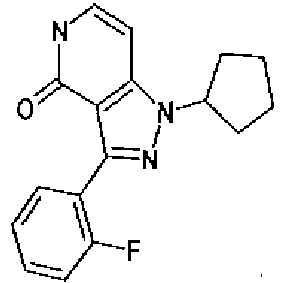
1-cyclopentyl-3-(2-fluorophenyl)-1,5-dihydro-4H-pyrazolo[4,3-c]pyridin-4-one 297.3 298.2 57 
1-cyclopentyl-3-(4-nitrophenyl)-1,5-dihydro-4H-pyrazolo[4,3-c]pyridin-4-one 324.3 325.3 58 
1-cyclopentyl-3-(2-oxo-2,3-dihydro-1H-indol-5-yl)-1,5-dihydro-4H-pyrazolo[4;3-c]pyridin-4-one 334.4 335.3 59 
3-(2,1,3-benzoxadiazol-5-yl)-1-cyclopentyl-1,5-dihydro-4H-pyrazolo[4,3-c]pyridin-4-one 321.3 322.2 - To a solution of the powder obtained in Step E-2 of Example 29 (100 mg) in THF (1 mL) was added methylmagnesium bromide (0.176 mL, 3M THF solution) at room temperature, and the mixture was stirred at 60°C for 2 hr. To the reaction mixture was added saturated aqueous ammonium chloride solution, and the mixture was extracted with ethyl acetate. The organic layer was washed with saturated brine, dried over anhydrous sodium sulfate, and concentrated under reduced pressure. The residue was purified by silica gel column chromatography (ethyl acetate/hexane) to give a powder (40 mg).
1H NMR (300 MHz, CDCl3) δ -0.01-0.00 (9H, m), 0.91-1.01 (2H, m), 1.65-1.84 (6H, m), 2.04-2.19 (2H, m), 2.56 (3H, s), 3.62-3.70 (2H, m), 5.03 (1H, t, J = 7.0 Hz), 5.44 (2H, s), 7.05 (1H, s), 7.81 (1H, s). - The title compound was obtained using the obtained powder and 4-(4,4,5,5-tetramethyl-1,3,2-dioxaborolan-2-yl)thiophene-2-carboxamide obtained in Step B of Example 33, in the same manner as in Step E-3 and Step E-4 of Example 29.
MS (ESI+): [M+H]+ 370.4.
MS (ESI+), found: 370.1. - The title compound was obtained using methyl 3-(5-carbamoyl-3-thienyl)-1-cyclopentyl-4-oxo-4,5-dihydro-1H-pyrrolo[3,2-c]pyridine-7-carboxylate obtained in Example 34, in the same manner as in Step F of Example 33.
MS (ESI+): [M+H]+ 372.4.
MS (ESI+), found: 372.1. - The title compound was obtained using 3-(5-carbamoyl-3-thienyl)-1-cyclopentyl-4-oxo-4,5-dihydro-1H-pyrrolo[3,2-c]pyridine-7-carboxylic acid obtained in Example 61, in the same manner as in Step G of Example 33.
MS (ESI+): [M+H]+ 371.4.
MS (ESI+), found: 371.2. - The title compound was obtained using 3-(5-carbamoyl-3-thienyl)-1-cyclopentyl-4-oxo-4,5-dihydro-1H-pyrrolo[3,2-c]pyridine-7-carboxylic acid obtained in Example 61 and methylamine hydrochloride, in the same manner as in Step G of Example 33.
MS (ESI+): [M+H]+ 399.4.
MS (ESI+), found: 399.1. - The title compound was obtained using 3-(5-carbamoyl-3-thienyl)-1-cyclopentyl-4-oxo-4,5-dihydro-1H-pyrrolo[3,2-c]pyridine-7-carboxylic acid obtained in Example 61 and dimethylamine hydrochloride, in the same manner as in Step G of Example 33.
MS (ESI+): [M+H]+ 427.5.
MS (ESI+), found: 427.1. -
- To a solution of DIEA (0.827 mL) in THF (90 mL) was added 1.6 M n-butyllithium hexane solution (3.64 mL) at -78°C, and the mixture was stirred under argon atmosphere at -78°C for 30 min. To the reaction mixture was added a solution of 5-bromo-3-fluoro-2-methoxypyridine (1.00 g) in THF (30 mL) at -78°C, and the mixture was stirred under argon atmosphere at -78°C for 1 hr. To the reaction mixture was added cyclopentanecarbaldehyde (0.572 g) at -78°C, and the mixture was stirred under argon atmosphere at -78°C for 1 hr. To the reaction mixture was added saturated aqueous ammonium chloride solution at -78°C, and the mixture was extracted with ethyl acetate. The organic layer was washed with saturated brine, dried over anhydrous magnesium sulfate, and concentrated under reduced pressure. The residue was purified by silica gel column chromatography (ethyl acetate/hexane) to give the title compound (430 mg).
MS (ESI+): [M+H]+ 304.0.
MS (ESI+), found: 304.0. - To a solution of (5-bromo-3-fluoro-2-methoxypyridin-4-yl)(cyclopentyl)methanol (430 mg) in acetonitrile (10 mL) was added Dess-Martin reagent (720 mg) at room temperature, and the mixture was stirred for 3 hr, and the reaction mixture was concentrated under reduced pressure. The residue was purified by silica gel column chromatography (basic silica gel, ethyl acetate/hexane) to give the title compound (440 mg).
MS (ESI+): [M+H]+ 301.0.
MS (ESI+), found: 304.0. - To a solution of (5-bromo-3-fluoro-2-methoxypyridin-4-yl)(cyclopentyl)methanone (440 mg) in methanol (10 mL) was added hydrazine monohydrate (2.06 mL) at room temperature, the mixture was stirred for 3 hr, and the reaction mixture was concentrated under reduced pressure. The residue was purified by silica gel column chromatography (basic silica gel, ethyl acetate/hexane) to give the title compound (100 mg).
1H NMR (300MHz, DMSO-d6) δ 1.59-1.96 (6H, m), 1.97-2.18 (2H, m), 3.82 (1H, quin, J = 7.8 Hz), 4.03 (3H, s), 7.76 (1H, s), 13.77 (1H, brs). - A suspension of 4-bromo-3-cyclopentyl-7-methoxy-1H-pyrazolo[3,4-c]pyridine (100 mg), methyl 4-(4,4,5,5-tetramethyl-1,3,2-dioxaborolan-2-yl)thiophene-2-carboxylate (181 mg), copper(II) acetate (73.6 mg) and pyridine (37.4 mg) in DMF (10 mL) was stirred at room temperature for 4 days. To the reaction mixture was added water, and the mixture was extracted with ethyl acetate. The organic layer was washed with water, dried over anhydrous sodium sulfate, and concentrated under reduced pressure. The residue was purified by silica gel column chromatography (ethyl acetate/hexane) to give the title compound (65 mg).
MS (ESI+): [M+H]+ 436.0.
MS (ESI+), found: 438.0. - A suspension of methyl 4-(4-bromo-3-cyclopentyl-7-methoxy-1H-pyrazolo[3,4-c]pyridin-1-yl)thiophene-2-carboxylate (65 mg), tetrakis(triphenylphosphine)palladium(0) (34.4 mg) and zinc cyanide (26.2 mg) in DMA (3 mL) was stirred under microwave irradiation at 120°C for 30 min. To the reaction mixture were added ethyl acetate and water, and the mixture was filtered through Celite. The filtrate was purified by silica gel column chromatography (ethyl acetate/hexane) to give the title compound (40 mg).
1H NMR (300MHz, DMSO-d6) δ 1.60-1.87 (4H, m), 1.87-2.05 (2H, m), 2.05-2.24 (2H, m), 3.71 (1H, quin, J = 7.8 Hz), 3.88 (3H, s), 4.03 (3H, s), 8.05 (1H, d, J = 1.5 Hz), 8.18 (1H, d, J = 1.5 Hz), 8.46 (1H, s). - To a solution of methyl 4-(4-cyano-3-cyclopentyl-7-methoxy-1H-pyrazolo[3,4-c]pyridin-1-yl)thiophene-2-carboxylate (40 mg) in acetonitrile (5 mL) were added sodium iodide (31.4 mg) and chloro(trimethyl)silane (0.066 mL), and the mixture was stirred at 60°C for 30 min. To the reaction mixture was added water, and the mixture was extracted with ethyl acetate. The organic layer was washed with saturated aqueous sodium hydrogencarbonate solution and saturated brine, dried over anhydrous sodium sulfate, and concentrated under reduced pressure to give the title compound (20 mg).
1H NMR (300MHz, DMSO-d6) δ 1.57-1.98 (6H, m), 2.04-2.18 (2H, m), 3.61 (1H, quin, J = 7.8 Hz), 3.86 (3H, s), 8.03 (1H, s), 8.10 (1H, d, J = 1.9 Hz), 8.21 (1H, d, J = 1.9 Hz), 12.39 (1H, brs). - To a solution of methyl 4-(4-cyano-3-cyclopentyl-7-oxo-6,7-dihydro-1H-pyrazolo[3,4-c]pyridin-1-yl)thiophene-2-carboxylate (18 mg) in a mixed solvent of THF (1 mL), methanol (1 mL) and water (1 mL) was added 1N aqueous sodium hydroxide solution (0.195 mL), and the mixture was stirred at room temperature for 15 hr. To the reaction mixture was added 1N hydrochloric acid (0.195 mL), and the reaction mixture was concentrated under reduced pressure. To the residue was added water, and the resulting solid was washed with water and hexane to give the title compound (17 mg).
1H NMR (300MHz, DMSO-d6) δ 1.60-2.01 (6H, m), 2.02-2.19 (2H, m), 3.61 (1H, quin, J = 7.8 Hz), 7.96 (1H, s), 8.03 (1H, brs), 8.10 (1H, d, J = 1.1 Hz), 12.38 (1H, brs), 13.43 (1H, brs).
MS (ESI+): [M+H]+ 355.1.
MS (ESI+), found: 355.1. - A solution of 4-(4-cyano-3-cyclopentyl-7-oxo-6,7-dihydro-1H-pyrazolo[3,4-c]pyridin-1-yl)thiophene-2-carboxylic acid (14 mg) obtained in Example 65, EDCI (7.36 mg) and HOBt ammonium salt (18 mg) in DMA (3 mL) was stirred at room temperature for 60 hr. To the reaction mixture was added water, and the mixture was extracted with ethyl acetate. The organic layer was washed with saturated aqueous sodium hydrogencarbonate solution and saturated brine, dried over anhydrous sodium sulfate, and concentrated under reduced pressure. The residue was purified by silica gel column chromatography (ethyl acetate/hexane), and crystallized from ethyl acetate/hexane to give the title compound (6.4 mg).
1H NMR (300MHz, DMSO-d6) δ 1.62-2.01 (6H, m), 2.04-2.19 (2H, m), 3.61 (1H, quin, J = 7.9 Hz), 7.52 (1H, brs), 8.00-8.03 (2H, m), 8.06 (1H, s), 8.12 (1H, brs), 12.34 (1H, brs).
MS (ESI+): [M+H]+ 354.1.
MS (ESI+), found: 354.1. -
- The title compound was obtained using 4-bromo-3-cyclopentyl-7-methoxy-1H-pyrazolo[3,4-c]pyridine obtained in Step C of Example 65 and 4-(4,4,5,5-tetramethyl-1,3,2-dioxaborolan-2-yl)thiophene-2-carboxamide obtained in Step B of Example 33, in the same manner as in Step D of Example 65.
1H NMR (300MHz, DMSO-d6) δ 1.60-1.85 (4H, m), 1.85-1.98 (2H, m), 2.05-2.23 (2H, m), 3.93 (3H, s), 7.54 (1H, brs), 7.93 (1H, d, J = 1.1 Hz), 7.95 (1H, s), 8.03 (1H, d, J = 1.5 Hz), 8.10 (1H, brs). - The title compound was obtained using 4-(4-bromo-3-cyclopentyl-7-methoxy-1H-pyrazolo[3,4-c]pyridin yl)thiophene-2-carboxamide, in the same manner as in Step F of Example 65.
1H NMR (300MHz, DMSO-d6) δ 1.58-1.98 (6H, m), 2.01-2.20 (2H, m), 3.84 (1H, quin, J = 7.9 Hz), 7.27 (1H, s), 7.50 (1H, brs), 8.00 (1H, d, J = 1.5 Hz), 8.04 (1H, d, J = 1.5 Hz), 8.10 (1H, brs), 11.74 (1H, brs).
MS (ESI+) : [M+H]+ 407.0.
MS (ESI+), found: 408.7. - The title compound was obtained using 5-bromo-3-fluoro-2-methoxypyridine and 2-methylbenzaldehyde, in the same manner as in Step A to Step F of Example 65.
1H NMR (300MHz, DMSO-d6) δ 2.23 (3H, s), 3.87 (3H, s), 7.25-7.47 (4H, m), 8.05 (1H, s), 8.19 (1H, d, J = 1.5 Hz), 8.31 (1H, d, J = 1.5 Hz), 12.48 (1H, brs).
MS (ESI+): [M+H]+ 391.1.
MS (ESI+), found: 391.1. - The title,compound was obtained using methyl 4-(4-cyano-3-(2-methylphenyl)-7-oxo-6,7-dihydro-1H-pyrazolo[3,4-c]pyridin-1-yl)thiophene-2-carboxylate obtained in Example 68, in the same manner as in Step G of Example 65.
1H NMR (300MHz, DMSO-d6) δ 2.23 (3H, s), 7.24-7.51 (4H, m), 8.06 (2H, d, J = 15.5 Hz), 8.24 (1H, s), 12.47 (1H, brs), 13.41 (1H, brs).
MS (ESI+) : [M+H]+ 377.1.
MS (ESI+), found: 377.1. - The title compound was obtained using 4-(4-cyano-3-(2-methylphenyl)-7-oxo-6,7-dihydro-1H-pyrazolo[3,4-c]pyridin-1-yl)thiophene-2-carboxylic acid obtained in Example 69, in the same manner as in Example 66.
1H NMR (300MHz, DMSO-d6) δ 2.23 (3H, s), 7.25-7.47 (4H, m), 7.54 (1H, brs), 8.04 (1H, s), 8.12 (1H, brs-), 8.18 (2H, d, J = 4.5 Hz), 12.48 (1H, brs).
MS (ESI+): [M+H]+ 376.1.
MS (ESI+), found: 376.1. -
- A mixture of ethyl (2E)-3-(4-bromo-1-((2-(trimethylsilyl)ethoxy)methyl)-1H-pyrrol-2-yl)acrylate (200 mg) obtained in Step C of Example 7 and tetra-n-butylammonium fluoride (698 mg) in DME (2 mL) was stirred at 85°C for 2.5 hr. The reaction mixture was diluted with ethyl acetate, and the mixture was washed with water and saturated brine, dried over anhydrous sodium sulfate, and concentrated under reduced pressure. The residue was purified by silica gel column chromatography (ethyl acetate/hexane) to give the title compound (102 mg).
1H NMR (300 MHz, CDCl3) δ 1.32 (3H, t, J = 7.2 Hz), 4.24 (2H, q, J = 7.2 Hz), 6.02 (1H, d, J = 15.9 Hz), 6.54 (1H, dd, J = 2.8, 1.7 Hz), 6.89 (1H, dd, J = 2.8, 1.7 Hz), 7.44 (1H, d, J = 15.9 Hz), 8. 63 (1H, brs). - A solution of ethyl (2E)-3-(4-bromo-1H-pyrrol-2-yl)acrylate (1.3 g), trans-2-methylcyclopentanol (0.64 g) and 2-(tributylphosphoranylidene)acetonitrile (1.928 g) in toluene (12.6 mL) was stirred with heating under reflux for 22 hr under argon atmosphere. The reaction mixture was purified by silica gel column chromatography (ethyl acetate/hexane) to give the title compound (608 mg).
1H NMR (300 MHz, CDCl3) δ 0.56 (3H, d, J = 6.8 Hz), 1.32 (3H, t, J = 7.2 Hz), 1.36-1.50 (1H, m), 1.61-1.78 (1H, m), 1.85-2.11 (3H, m), 2.15-2.34 (2H, m), 4.24 (2H, q, J = 7.2 Hz), 4.63 (1H, q, J = 7.2 Hz), 6.15 (1H, d, J = 15.5 Hz), 6.64 (1H, d, J = 1.5 Hz), 6.78 (1H, d, J = 1.5 Hz), 7.57 (1H, d, J = 15.5 Hz). - To a solution of ethyl (2E)-3-(4-bromo-1-(cis-2-methylcyclopentyl)-1H-pyrrol-2-yl)acrylate (800 mg) in THF (7.36 mL) were added 1N aqueous sodium hydroxide solution (7.36 mL) and methanol (10 mL) at room temperature, and the mixture was stirred at room temperature for 18 hr. The reaction mixture was concentrated under reduced pressure to evaporate the methanol and THF, and the remaining aqueous solution was washed with diethyl ether (100 mL). The obtained aqueous layer was acidified with 1N hydrochloric acid (7.36 mL), and the mixture was extracted with ethyl acetate. The organic layer was washed with saturated brine, dried over anhydrous magnesium sulfate, and concentrated under reduced pressure to give the title compound (711 mg).
1H NMR (300 MHz, CDCl3) δ 0.56 (3H, d, J = 7.2 Hz), 1.36-1.50 (1H, m), 1.62-1.78 (1H, m), 1.85-2.12 (3H, m), 2.16-2.36 (2H, m), 4.63 (1H, q, J = 7.2 Hz), 6.15 (1H, d, J = 15.5 Hz), 6.70 (1H, d, J = 1.5 Hz), 6.81 (1H, d, J = 1.9 Hz), 7.65 (1H, d, J = 15.5 Hz). - To a solution of (2E)-3-(4-bromo-1-(cis-2-methylcyclopentyl)-1H-pyrrol-2-yl)acrylic acid (700 mg) in DMF (7 mL) was added a solution of triethylamine (0.36 mL) and diphenylphosphoryl azide (0.678 g) in DMF (1 mL) at room temperature, and the mixture was stirred at room temperature for 4 hr. The reaction mixture was added to water, and the mixture was extracted with ethyl acetate. The organic layer was washed with water and saturated brine, dried over anhydrous magnesium sulfate, and concentrated under reduced pressure. The residue was purified by silica gel column chromatography (ethyl acetate/hexane) to give the title compound (685 mg).
1H NMR (300 MHz, CDCl3) δ 0.56 (3H, d, J = 6.8 Hz), 1.35-1.50 (1H, m), 1.65-1.79 (1H, m), 1.87-2.12 (3H, m), 2.17-2.34 (2H, m), 4.63 (1H, q, J = 7.2 Hz), 6.11 (1H, d, J = 15.5 Hz), 6.72 (1H, d, J = 1.5 Hz), 6.84 (1H, d, J = 1.5 Hz), 7.64 (1H, d, J = 15.5 Hz). - A solution of (2E)-3-(4-bromo-1-(cis-2-methylcyclopentyl)-1H-pyrrol-2-yl)acryloyl azide (221 mg) and tributylamine (139 mg) in diphenyl ether (2.2 mL) was stirred under nitrogen atmosphere at 90-105°C for 15 min, and then at 155-160°C for 2 hr. The reaction mixture was allowed to be cooled to room temperature, and the residue was purified by silica gel column chromatography (ethyl acetate/hexane) to give the title compound (93 mg).
1H NMR (300 MHz, CDCl3) δ 0.59 (3H, d, J = 6.8 Hz), 1.48 (1H, dq, J = 13.1, 9.0 Hz), 1.68-1.84 (1H, m), 1.90-2.03 (2H, m), 2.05-2.17 (1H, m), 2.23-2.39 (2H, m), 4.55-4.64 (1H, m), 6.38 (1H, d, J = 7.2 Hz), 6.90 (1H, s), 7.11 (1H, d, J = 7.2 Hz), 10.90 (1H, brs). -
- F-1) To a solution of 3-bromo-1-(cis-2-methylcyclopentyl)-1,5-dihydro-4H-pyrrolo[3,2-c]pyridin-4-one (120 mg) in THF (2.4 mL) was added sodium hydride (60% dispersion in mineral oil, 17.9 mg), and the mixture was stirred under argon atmosphere at 0°C for 1 hr. To the reaction mixture was added a solution of (2-(chloromethoxy)ethyl)(trimethyl)silane (74.6 mg) in THF (0.5 mL) at 0°C, and the mixture was stirred at room temperature for 18 hr. The reaction mixture was added to water, and the mixture was extracted with ethyl acetate. The organic layer was washed with saturated brine, dried over anhydrous sodium sulfate, and concentrated under reduced pressure. The residue was purified by silica gel column chromatography (ethyl acetate/hexane) to give an oil (124 mg).
1H NMR (300 MHz, CDCl3) δ -0.05--0.01 (9H, m), 0.59 (3H, d, J = 6.8 Hz), 0.89-0.97 (2H, m), 1.40-1.55 (1H, m), 1.68-1.84 (1H, m), 1.88-2.02 (2H, m), 2.04-2.16 (1H, m), 2.23-2.38 (2H, m), 3.61-3.70 (2H, m), 4.52-4.62 (1H, m), 5.40 (2H, q, J = 10.1 Hz), 6.35 (1H, d, J = 7.6 Hz), 6.87 (1H, s), 7.15 (1H, d, J = 7.6 Hz). - F-2) A mixture of the obtained oil (53 mg), 4-(4,4,5,5-tetramethyl-1,3,2-dioxaborolan-2-yl)benzenesulfonamide (52.9 mg), tetrakis(triphenylphosphine)palladium(0) (21.6 mg) and potassium carbonate (17.3 mg) in DMF (2 mL)/water (0.2 mL) was stirred under microwave irradiation at 130°C for 1 hr. The reaction mixture was diluted with ethyl acetate, and the mixture was washed with water and saturated brine, dried over anhydrous sodium sulfate, and concentrated under reduced pressure. The residue was purified by silica gel column chromatography (ethyl acetate/hexane) to give an oil (45 mg). 1H NMR (300 MHz, CDCl3) δ -0.05--0.01 (9H, m), 0.64 (3H, d, J = 7.2 Hz), 0.89-0.98 (2H, m), 1.46-1.57 (1H, m), 1.79 (1H, dt, J = 13.2, 8.7 Hz), 1.93-2.09 (2H, m), 2.12-2.27 (1H, m), 2.27-2.46 (2H, m), 3.60-3.70 (2H, m), 4.66 (1H, q, J = 7.1 Hz), 4.86 (2H, s), 5.37-5.50 (2H, m), 6.46 (1H, d, J = 7.6 Hz), 7.03 (1H, s), 7.24 (1H, d, J = 7.6 Hz), 7.90 (4H, s). F-3) To a suspension of the obtained oil (45 mg) and triethylsilane (20 mg) was added trifluoroacetic acid (0.27 mL) at room temperature, and the mixture was stirred at room temperature for 1 hr under nitrogen atmosphere. The reaction mixture was concentrated under reduced pressure, to the residue were added acetonitrile (0.5 mL) and aqueous ammonia solution (25%, 0.5 mL), and the mixture was stirred at room temperature for 2 hr. The precipitate was collected by filtration, and washed with acetonitrile and ethyl acetate to give the title compound (24 mg).
1H NMR (300 MHz, DMSO-d6) δ 0.50 (3H, d, J = 6.8 Hz), 1.38-1.53 (1H, m), 1.66 (1H, dt, J = 12.7, 8.5 Hz), 1.83-2.04 (2H, m), 2.18-2.28 (2H, m), 2.34 (1H, dt, J = 14.7, 7.4 Hz), 4.83 (1H, q, J = 7.4 Hz), 6.63 (1H, d, J = 7.2 Hz), 7.05-7.12 (1H, m), 7.26 (2H, brs), 7.50 (1H, s), 7.70-7.77 (2H, m), 8.06-8.13 (2H, m), 10.86 (1H, d, J = 5.3 Hz).
MS (ESI+): [M+H]+ 372.1.
MS (ESI+), found: 372.1. - To a solution of (4-(1-(2,6-difluorophenyl)-4-oxo-4,5-dihydro-1H-pyrazolo[4,3-c]pyridin-3-yl)phenyl)acetonitrile (80.0 mg) obtained in Example 39 in DMSO (0.8 mL) was added potassium carbonate (36.6 mg), and then 30% aqueous hydrogen peroxide (0.068 mL) was added thereto. The reaction mixture was stirred overnight at room temperature. To the reaction mixture was added water, and the white precipitate was collected by filtration, washed with water, and dried in vacuum to give the title compound (7.5 mg).
1H NMR (300 MHz, DMSO-d6) δ 3.44 (2H, s), 6.25 (1H, d, J = 7.2 Hz), 6.91 (1H, brs), 7.35 (3H, d, J = 8.3 Hz), 7.43-7.59 (3H, m), 7.67-7.86 (1H, m), 8.22 (2H, d, J = 7.9 Hz), 11.40 (1H, brs).
MS (ESI+): [M+H]+ 381.1.
MS (ESI+), found: 381.1. -
- A-1) A powder was obtained using the powder obtained in Step E-2 of Example 29 and 4-(4,4,5,5-tetramethyl-1,3,2-dioxaborolan-2-yl)thiophene-2-carboxamide obtained in Step B of Example 33, in the same manner as in Step E-3 of Example 29.
MS (ESI+): [M+H]+ 516.7.
MS (ESI+), found: 516.1. - A-2) The title compound was obtained using the obtained powder, in the same manner as in Step H of Example 33 and Step H-3 of Example 7.
MS (ESI+): [M+H]+ 368.4.
MS (ESI+), found: 368.2. - To a solution of methyl 3-(5-cyano-3-thienyl)-1-cyclopentyl-4-oxo-4,5-dihydro-1H-pyrrolo[3,2-c]pyridine-7-carboxylate (111 mg) obtained in Example 73 in DMSO (2 mL) were added sodium hydrogencarbonate (127 mg) and hydroxylamine hydrochloride (84 mg) at room temperature, and the mixture was stirred at 90°C for 30 min. To the reaction mixture was added water, and the mixture was extracted with ethyl acetate. The organic layer was washed with saturated brine, dried over anhydrous sodium sulfate, and concentrated under reduced pressure. To a solution of the residue in THF (2 mL) were added 1,1'-carbonyldiimidazole (73.5 mg) and 1,8-diazabicyclo[5.4.0]undec-7-ene (0.068 mL) at room temperature, and the mixture was stirred overnight. To the reaction mixture was added water, and the mixture was extracted with ethyl acetate. The organic layer was washed with saturated brine, dried over anhydrous sodium sulfate, and concentrated under reduced pressure. The residue was purified by silica gel column chromatography (ethyl acetate/hexane) to give the title compound (90 mg).
MS (ESI+): [M+H]+ 427.4.
MS (ESI+), found: 427.1. -
- To a 28% methanol solution (5 g) of sodium methoxide was added 2-bromo-3-iodoisonicotinic acid (880 mg), and the mixture was stirred at 80°C for 2 hr. To the reaction mixture was added 1N hydrochloric acid under ice-cooling, and the mixture was extracted with ethyl acetate. The organic layer was washed with saturated brine, dried over anhydrous sodium sulfate, and concentrated under reduced pressure to give the title compound (780 mg).
MS (ESI+): [M+H]+ 279.9.
MS (ESI+), found: 279.7. - A solution of 3-iodo-2-methoxyisonicotinic acid (748 mg), 4-hydrazinobenzenesulfonamide hydrochloride (1.20 g), EDCI hydrochloride (2.57 g), HOBt (1.23 g) and triethylamine (1.36 g) in DMF (30 mL) was stirred overnight at room temperature. To the reaction mixture was added water, and the mixture was extracted with ethyl acetate. The organic layer was washed with saturated brine, dried over anhydrous magnesium sulfate, and concentrated under reduced pressure. The residue was purified by silica gel column chromatography (ethyl acetate/hexane) to give the title compound (600 mg).
MS (ESI+) : [M+H]+ 449.0.
MS (ESI+), found: 448.9. - A solution of 3-iodo-2-methoxy-N-(4-sulfamoylphenyl)pyridine-4-carbohydrazone acid (100 mg), L-proline (5.1 mg), potassium carbonate (92 mg) and copper(I) iodide (4.3 mg) in DMSO (5 mL) was stirred at 100°C for 2 hr. To the reaction mixture was added 1N hydrochloric acid under ice-cooling, and the mixture was extracted with ethyl acetate. The organic layer was washed with saturated aqueous sodium thiosulfate solution and saturated brine, dried over anhydrous magnesium sulfate, and concentrated under reduced pressure to give the title compound (80 mg).
1H NMR (300 MHz, DMSO-d6) δ 3.96 (3H, s), 7.34 (1H, d, J = 5.7 Hz), 7.42 (2H, s), 7.73 (2H, d, J = 9.1 Hz), 7.83 (1H, d, J = 5.7 Hz), 7.90 (2H, d, J = 8.7 Hz), 11.60 (1H, s). - To a solution of 4-(3-hydroxy-7-methoxy-1H-pyrazolo[3,4-c]pyridin-1-yl)benzenesulfonamide (70.5 mg) in pyridine (5 mL) was added trifluoromethanesulfonic anhydride (186 mg) under ice-cooling, and the mixture was stirred under nitrogen atmosphere at room temperature for 3 hr. To the reaction mixture was added saturated aqueous sodium hydrogencarbonate solution under ice-cooling, and the mixture was extracted with ethyl acetate. The organic layer was washed with water and saturated brine, dried over anhydrous magnesium sulfate, and concentrated under reduced pressure. The residue was purified by silica gel column chromatography (ethyl acetate) to give the title compound (59 mg).
1H NMR (300 MHz, DMSO-d6) δ 3.97 (3H, s), 7.47 (1H, d, J = 5.7 Hz), 7.54 (2H, s), 7.86-8.03 (4H, m), 8.05 (1H, d, J = 5.7 Hz). - A solution of 7-methoxy-1-(4-sulfamoylphenyl)-1H-pyrazolo[3,4-c]pyridin-3-yl trifluoromethanesulfonate (59 mg), 2-(cyclopent-1-en-1-yl)-4,4,5,5-tetramethyl-1,3,2-dioxaborolane (25.3 mg), tetrakis(triphenylphosphine)palladium(0) (7.5 mg) and 2M aqueous sodium carbonate solution (0.33 mL) in DME (5 mL) was stirred under argon atmosphere at 100°C for 3 hr. To the reaction mixture was added water, and the mixture was extracted with ethyl acetate. The organic layer was washed with water and saturated brine, dried over anhydrous sodium sulfate, and concentrated under reduced pressure. The residue was purified by silica gel column chromatography (ethyl acetate/hexane) to give the title compound (22 mg).
MS (ESI+): [M+H]+ 371.1.
MS (ESI+), found: 371.0. - To a solution of 4-(3-(cyclopent-1-en-1-yl)-7-methoxy-1H-pyrazolo[3,4-c]pyridin-1-yl)benzenesulfonamide (22 mg) in methanol (10 mL) was added 10% palladium/carbon (6.32 mg) containing water, and the mixture was stirred overnight under hydrogen atmosphere at room temperature. The reaction mixture was filtered, and the filtrate was concentrated under reduced pressure to give the title compound (30 mg).
MS (ESI+): [M+H]+ 373.1.
MS (ESI+), found: 373.0. - To a solution of 4-(3-cyclopentyl-7-methoxy-1H-pyrazolo[3,4-c]pyridin-1-yl)benzenesulfonamide (22.4 mg) in acetonitrile (10 mL) were added sodium iodide (18.0 mg) and chloro(trimethyl)silane (52.1 mg), and the mixture was stirred at 80°C for 5 hr. To the reaction mixture was added water at room temperature, and the mixture was extracted with ethyl acetate. The organic layer was washed with water and saturated brine, dried over anhydrous magnesium sulfate, and concentrated under reduced pressure. The residue was purified by silica gel column chromatography (ethyl acetate/hexane) to give the title compound (20 mg).
1H NMR (300 MHz, DMSO-d6) δ 1.64-1.92 (6H, m), 2.00-2.24 (2H, m), 3.36-3.45 (1H, m), 6.65 (1H, d, J = 6.8 Hz), 7.08 (1H, d, J = 6.8 Hz), 7.44 (2H, brs), 7.78-7.93 (4H, m), 11.52 (1H, brs).
MS (ESI+): [M+H]+ 359.1.
MS (ESI+), found: 358.9. - The title compound was obtained using 3-bromo-1-cyclopentyl-4-methoxy-4,5-dihydro-1H-pyrrolo[3,2-c]pyridine-7-carbonitrile obtained in Step H of Example 33 and methyl 4-(4,4,5,5-tetramethyl-1,3,2-dioxaborolan-2-yl)thiophene-2-carboxylate, in the same manner as in Step I of Example 33.
MS (ESI+): [M+H]+ 382.4.
MS (ESI+), found: 382.1. - The title compound was obtained using methyl 4-(7-cyano-1-cyclopentyl-4-methoxy-1H-pyrrolo[3,2-c]pyridin-3-yl)thiophene-2-carboxylate, in the same manner as in Step J of Example 33.
MS (ESI+): [M+H]+ 368.4.
MS (ESI+), found: 368.2. - The title compound was obtained using methyl 4-(7-cyano-1-cyclopentyl-4-oxo-4,5-dihydro-1H-pyrrolo[3,2-c]pyridin-3-yl)thiophene-2-carboxylate obtained in Example 76, in the same manner as in Step F of Example 33.
MS (ESI+): [M+H]+ 354.4.
MS (ESI+), found: 354.1. - The title compound was obtained using methyl 4-(4-bromo-7-methoxy-3-(2-methylphenyl)-1H-pyrazolo[3,4-c]pyridin-1-yl)thiophene-2-carboxylate obtained in Step D of Example 68, in the same manner as in Step F of Example 65.
1H NMR (300MHz, DMSO-d6) δ 2.14 (3H, s), 3.86 (3H, s), 7.23-7.45 (5H, m), 8.19 (1H, d, J = 1.9 Hz), 8.31 (1H, d, J = 1.9 Hz), 11.88 (1H, brs).
MS (ESI+): [M+H]+ 444.0.
MS (ESI+), found: 446.1. - The title compound was obtained using methyl 4-(4-bromo-3-(2-methylphenyl)-7-oxo-6,7-dihydro-1H-pyrazolo[3,4-c]pyridin-1-yl)thiophene-2-carboxylate obtained in Example 78, in the same manner as in Step G of Example 65. 1H NMR (300MHz, DMSO-d6) δ 2.14 (3H, s), 7.15-7.51 (5H, m), 8.05 (1H, d, J = 0.8 Hz), 8.20 (1H, d, J = 1.1 Hz), 11.86 (1H, d, J = 5.7 Hz), 13.41 (1H, brs).
MS (ESI+): [M+H]+ 430.0.
MS (ESI+), found: 432.2. - The title compound was obtained using 4-(4-bromo-3-(2-methylphenyl)-7-oxo-6,7-dihydro-1H-pyrazolo[3,4-c]pyridin-1-yl)thiophene-2-carboxylic acid obtained in Example 79, in the same manner as in Example 66.
1H NMR (300MHz, DMSO-d6) δ 2.14 (3H, s), 7.23-7.45 (5H, m), 7.51 (1H, brs), 8.05-8.17 (2H, m), 8.18 (1H, s), 11.88 (1H, brs).
MS (ESI+): [M+H]+ 429.0.
MS (ESI+), found: 428.9. - The title compound was obtained using 3-bromo-1-cyclopentyl-4-methoxy-4,5-dihydro-1H-pyrrolo[3,2-c]pyridine-7-carbonitrile obtained in Step H of Example 33 and (4-(ethoxycarbonyl)phenyl)boronic acid, in the same manner as in Step E-3 of Example 29, Step F of Example 33, Step G of Example 33 and Step J of Example 33.
MS (ESI+) : [M+H]+347.3.
MS (ESI+), found: 347.2. -
- A solution of 4-iodo-2-methoxynicotinic acid (1.6 g 1.5 g) obtained in Step C of Example 6, tetrahydrofuran-3-ylhydrazine dihydrochloride (1.00 g), DIEA (3.0 mL), EDCI hydrochloride (1.32 g) and HOBt (0.930 g) in DMF (75 mL) was stirred overnight at room temperature. To the reaction mixture was added water, and the mixture was extracted with ethyl acetate. The organic layer was washed successively with water and saturated brine, dried over anhydrous sodium sulfate, and concentrated under reduced pressure. The residue was purified by silica gel column chromatography (ethyl acetate/hexane) to give the title compound (1.06 g).
1H NMR (300 MHz, DMSO-d6) δ 1.79-1.98 (2H, m), 3.56-3.92 (8H, m), 5.22 (1H, dd, J = 6.4 Hz, 3.8 Hz), 7.46 (1H, d, J = 5.7 Hz), 7.86 (1H, d, J = 5.7 Hz), 9.83 (1H, d, J = 6.0 Hz).
MS (ESI+): [M+H]+ 364.0.
MS (ESI+), found: 364.0. - A solution of 4-iodo-2-methoxy-N'-(tetrahydrofuran-3-yl)nicotinohydrazide (1.26 g), L-proline (0.080 g), potassium carbonate (0.957 g) and copper(I) iodide (0.066 g) in DMSO (25 mL) was stirred under nitrogen atmosphere at room temperature for 3 hr. The reaction mixture was purified by silica gel column chromatography (ethyl acetate/hexane) to give the title compound (0.263 g).
1H NMR (300 MHz, DMSO-d6) δ 2.07-2.23 (1H, m), 2.33 (1H, dq, J = 12.7 Hz, 7.6 Hz), 3.75-3.88 (2H, m), 3.93 (3H, s), 3.96-4.07 (2H, m), 5.17-5.30 (1H, m), 7.11 (1H, d, J = 6.4 Hz), 7.79 (1H, d, J = 6.0 Hz), 11.04 (1H, brs).
MS (ESI+): [M+H]+236.1.
MS (ESI+), found: 236.1. - To a solution of 4-methoxy-1-(tetrahydrofuran-3-yl)-1,2-dihydro-3H-pyrazolo[4,3-c]pyridin-3-one (250 mg) and pyridine (0.344 mL) in acetonitrile (25 mL) was added trifluoromethanesulfonic anhydride (0.360 mL), and the mixture was stirred at 0°C for 1 hr. To the reaction mixture was added saturated aqueous ammonium chloride solution, and the mixture was extracted with ethyl acetate. The organic layer was washed with saturated brine, dried over anhydrous sodium sulfate, and concentrated under reduced pressure. The residue was purified by silica gel column chromatography (ethyl acetate/hexane) to give the title compound (259 mg).
1H NMR (300 MHz, DMSO-d6) δ 2.15-2.30 (1H, m), 2.37-2.48 (1H, m), 3.81-3.92 (2H, m), 3.96-4.13 (5H, m), 5.42-5.58 (1H, m), 7.45 (1H, d, J = 6.0 Hz), 8.05 (1H, d, J = 6.4 Hz).
MS (ESI+) : [M+H]+ 368.1.
MS (ESI+), found: 367.9. - A solution of 4-methoxy-1-(tetrahydrofuran-3-yl)-1H-pyrazolo[4,3-c]pyridin-3-yl trifluoromethanesulfonate (225 mg), 4-(4,4,5,5-tetramethyl-1,3,2-dioxaborolan-2-yl)benzenesulfonamide (260 mg), tetrakis(triphenylphosphine)palladium(0) (70.8 mg) and 2M aqueous sodium carbonate solution (1.53 mL) in DME (15 mL) was heated overnight with reflux under nitrogen atmosphere. To the reaction mixture was added water, and the mixture was extracted with ethyl acetate. The organic layer was washed successively with water and saturated brine, dried over anhydrous sodium sulfate, and concentrated under reduced pressure. The residue was purified by silica gel column chromatography (ethyl acetate/hexane), and the obtained solid was washed with ethyl acetate/diisopropyl ether to give the title compound (176 mg).
1H NMR (300 MHz, DMSO-d6) 5 2.31-2.57 (2H, m), 3.90 (1H, td, J = 8.0 Hz, 5.9 Hz), 3.95-4.06 (4H, m), 4.07-4.19 (2H, m), 5.48-5.60 (1H, m), 7.32-7.49 (3H, m), 7.88-7.97 (2H, m), 8.00 (1H, d, J = 6.0 Hz), 8.07-8.17 (2H, m).
MS (ESI+): [M+H]+ 375.1.
MS (ESI+), found: 375.2. - To a solution of 4-(4-methoxy-1-(tetrahydrofuran-3-yl)-1H-pyrazolo[4,3-c]pyridin-3-yl)benzenesulfonamide (167 mg) in acetonitrile (15 mL) were added sodium iodide (134 mg) and chloro(trimethyl)silane (0.452 mL), and the mixture was stirred at 60°C for 30 min. To the reaction mixture was added water, and the mixture was extracted with ethyl acetate. The organic layer was washed with saturated brine, dried over anhydrous sodium sulfate, and concentrated under reduced pressure. The residue was purified by silica gel column chromatography (ethyl acetate/hexane/methanol), and the obtained solid was washed with ethyl acetate to give the title compound (142 mg).
1H NMR (300 MHz, DMSO-d6) 5 2.29-2.49 (2H, m), 3.83-4.00 (2H, m), 4.01-4.18 (2H, m), 5.34-5.50 (1H, m), 6.74 (1H, d, J = 6.4 Hz), 7.30 (1H, dd, J = 7.2 Hz, 6.0 Hz), 7.40 (2H, s), 7.80-7.96 (2H, m), 8.38-8.60 (2H, m), 11.20 (1H, d, J = 6.0 Hz).
MS (ESI+): [M+H]+ 361.1.
MS (ESI+), found: 361.1. - Racemic 4-(4-oxo-1-(tetrahydrofuran-3-yl)-4,5-dihydro-1H-pyrazolo[4,3-c]pyridin-3-yl)benzenesulfonamide (135 mg) obtained in Example 82 was resolved by HPLC (column: CHIRALCEL OD (trade name), 50 mmID×500 mmL, manufactured by Daicel Chemical Industries, mobile phase: methanol 100%) to give the title compound (54.3 mg) having a shorter retention time.
MS (ESI+): [M+H]+ 361.1.
MS (ESI+), found: 360.9. - Racemic 4-(4-oxo-1-(tetrahydrofuran-3-yl)-4,5-dihydro-1H-pyrazolo[4,3-c]pyridin-3-yl)benzenesulfonamide (135 mg) obtained in Example 82 was resolved by HPLC (column: CHIRALCEL OD (trade name), 50 mmID×500 mmL, manufactured by Daicel Chemical Industries, mobile phase: methanol 100%) to give the title compound (45.7 mg) having a longer retention time.
MS (ESI+): [M+H]+ 361.1.
MS (ESI+), found: 360.9. - A mixture of the oil (122 mg) obtained in Step F-1 of Example 71, 4-(4,4,5,5-tetramethyl-1,3,2-dioxaborolan-2-y1)thiophene-2-carboxamide obtained in Step B of Example 33 (109 mg), (1,1'-bis(diphenylphosphino)ferrocene)dichloropalladium(II) (21 mg) and 2 M aqueous sodium carbonate solution (0.287 mL) in DME (2 mL) was stirred under microwave irradiation at 120°C for 1 hr. The reaction mixture was added to water, and the mixture was extracted with ethyl acetate. The organic layer was washed with saturated brine, dried over anhydrous magnesium sulfate, and concentrated under reduced pressure. The residue was purified by silica gel column chromatography (ethyl acetate/hexane) to give a powder (85 mg).
1H NMR (300 MHz, CDCl3) δ -0.02 (9H, s), 0.61 (3H, d, J = 6.8 Hz), 0.91-0.98 (2H, m), 1.44-1.55 (1H, m), 1.70-1.87 (1H, m), 1.93-2.10 (2H, m), 2.18 (1H, dt, J = 14.4, 7.7 Hz), 2.27-2.42 (2H, m), 3.62-3.69 (2H, m), 4.63 (1H, q, J = 6.9 Hz), 5.37-5.48 (2H, m), 5.76 (2H, brs), 6.42 (1H, d, J = 7.6 Hz), 7.10 (1H, s), 7.20 (1H, d, J = 7.6 Hz), 8.06 (1H, d, J = 1.5 Hz), 8.28 (1H, d, J = 1.5 Hz). - To a suspension of the obtained powder (84 mg) and triethylsilane (38.8 mg) was added trifluoroacetic acid (0.53 mL) at room temperature, and the mixture was stirred under nitrogen atmosphere at room temperature for 1 hr. The reaction mixture was concentrated under reduced pressure, to the residue were added acetonitrile (1.3 mL) and 25% aqueous ammonia solution (1.3 mL), and the mixture was stirred at room temperature for 2 hr. The reaction mixture was added to water, and the mixture was extracted with ethyl acetate. The organic layer was washed with saturated brine, dried over anhydrous sodium sulfate, and concentrated under reduced pressure. The residue was purified by silica gel column chromatography (methanol/ethyl acetate) to give the title compound (48 mg).
1H NMR (300 MHz, DMSO-d6) δ 0.50 (3H, d, J = 6.8 Hz), 1.45 (1H, dq, J = 12.4, 8.6 Hz), 1.62-1.79 (1H, m), 1.86-2.07 (2H, m), 2.08-2.40 (3H, m), 4.81 (1H, q, J = 7.2 Hz), 6.60 (1H, d, J = 6.8 Hz), 7.05 (1H, dd, J = 7.2, 6.0 Hz), 7.36 (1H, brs), 7.37 (1H, s), 7.79 (1H, brs), 8.19 (1H, d, J = 1.5 Hz), 8.71 (1H, d, J = 1.5 Hz), 10.85 (1H, d, J = 6.0 Hz).
MS (ESI+): [M+H]+ 342.1.
MS (ESI+), found: 341.9. -
- A solution of 4-iodo-2-methoxynicotinic acid (3.00 g) obtained in Step C of Example 6, tert-butylhydrazine hydrochloride (1.61 g), DIEA (5.63 mL), EDCI hydrochloride (2.47 g) and HOBt (1.74 g) in DMF (100 mL) was stirred overnight at room temperature. To the reaction mixture was added water, and the mixture was extracted with ethyl acetate. The organic layer was washed with saturated brine, dried over anhydrous sodium sulfate, and concentrated under reduced pressure. The residue was purified by silica gel column chromatography (ethyl acetate/hexane) to give the title compound (3.23 g).
1H NMR (300 MHz, DMSO-d6) δ 1.10 (9H, s), 3.83 (3H, s), 4.78 (1H, d, J = 7.9 Hz), 7.47 (1H, d, J = 5.7 Hz), 7.85 (1H, d, J = 5.3 Hz), 9.65 (1H, d, J = 7.9 Hz).
MS (ESI+): [M+H]+350.0.
MS (ESI+), found: 350.0. - A solution of N'-tert-butyl-4-iodo-2-methoxynicotinohydrazide (1.00 g), L-proline (0.066 g), potassium carbonate (0.792 g) and copper(I) iodide (0.055 g) in DMSO (30 mL) was stirred under nitrogen atmosphere at room temperature for 6 hr. The reaction mixture was purified by silica gel column chromatography (ethyl acetate/hexane) to give the title compound (341 mg).
1H NMR (300 MHz, DMSO-d6) δ 1.60 (9H, s), 3.92 (3H, s), 7.17 (1H, d, J = 6.4 Hz), 7.71 (1H, d, J = 6.4 Hz), 10.73 (1H, brs). MS (ESI+): [M+H]+ 222.1.
MS (ESI+), found: 222.1. - To a solution of 1-tert-butyl-4-methoxy-1,2-dihydro-3H-pyrazolo[4,3-c]pyridin-3-one (337 mg) and pyridine (0.493 mL) in acetonitrile (30 mL) was added trifluoromethanesulfonic anhydride (0.203 mL), and the mixture was stirred at 0°C for 1 hr. To the reaction mixture was added saturated aqueous ammonium chloride solution, and the mixture was extracted with ethyl acetate. The organic layer was washed with saturated brine, dried over anhydrous sodium sulfate, and concentrated under reduced pressure. The residue was purified by silica gel column chromatography (ethyl acetate/hexane) to give the title compound (525 mg).
1H NMR (300 MHz, DMSO-d6) δ 1. 68 (9H, s), 4.03 (3H, s), 7.54 (1H, d, J = 6.4 Hz), 7.98 (1H, d, J = 6.4 Hz).
MS (ESI+): [M+H]+ 354.1.
MS (ESI+), found: 354.0. - A solution of 1-tert-butyl-4-methoxy-1H-pyrazolo[4,3-c]pyridin-3-yl trifluoromethanesulfonate (521 mg), 4-(4,4,5,5-tetramethyl-1,3,2-dioxaborolan-2-yl)benzenesulfonamide (501 mg), tetrakis(triphenylphosphine)palladium(0) (170 mg) and 2M aqueous sodium carbonate solution (3.69 mL) in DME (40 mL) was heated overnight with reflux under nitrogen atmosphere. To the reaction mixture was added water, and the mixture was extracted with ethyl acetate. The organic layer was washed successively with water and saturated brine, dried over anhydrous sodium sulfate, and concentrated under reduced pressure. The residue was purified by silica gel column chromatography (ethyl acetate/hexane), and the obtained solid was washed with ethyl acetate/diisopropyl ether to give the title compound (433 mg).
1H NMR (300 MHz, DMSO-d6) δ 1.75 (9H, s), 3.99 (3H, s), 7.42 (2H, s), 7.53 (1H, d, J = 6.1 Hz), 7.86-8.00 (3H, m), 8.06 (2H, d, J = 8.7 Hz).
MS (ESI+): [M+H]+ 361.1.
MS (ESI+), found: 361.1. - To a solution of 4-(1-tert-butyl-4-methoxy-1H-pyrazolo[4,3-c]pyridin-3-yl)benzenesulfonamide (80.0 mg) in acetonitrile (10 mL) were added sodium iodide (66.5 mg) and chloro(trimethyl)silane (0.225 mL), and the mixture was stirred at 60°C for 30 min. To the reaction mixture was added water, and the mixture was extracted with ethyl acetate. The organic layer was washed with saturated brine, dried over anhydrous sodium sulfate, and concentrated under reduced pressure. The residue was purified by silica gel column chromatography (ethyl acetate/hexane/methanol) to give the title compound (73.7 mg).
1H NMR (300 MHz, DMSO-d6) δ 1.71 (9H, s), 6.84 (1H, d, J = 7.6 Hz), 7.20 (1H, d, J = 7.6 Hz), 7.86 (2H, d, J = 8.3 Hz), 8.42 (2H, d, J = 8.3 Hz).
MS (ESI+): [M+H]+ 367.1.
MS (ESI+), found: 346.9. - Racemic 4-(4-oxo-1-(tetrahydro-2H-pyran-3-yl)-4,5-dihydro-1H-pyrazolo[4,3-c]pyridin-3-yl)benzenesulfonamide (125 mg) obtained in Example 28 was resolved by HPLC (column: CHIRALCEL OD (trade name), 50 mmID×500 mmL, manufactured by Daicel Chemical Industries, mobile phase: hexane/ethanol= 500/500) to give the title compound (58.9 mg) having a shorter retention time.
MS (ESI+): [M+H]+ 375.1.
MS (ESI+), found: 374.9. - Racemic 4-(4-oxo-1-(tetrahydro-2H-pyran-3-yl)-4,5-dihydro-1H-pyrazolo[4,3-c]pyridin-3-yl)benzenesulfonamide (125 mg) obtained in Example 28 was resolved by HPLC (column: CHIRALCEL OD (trade name), 50 mmIDx500 mmL, was resolved by Daicel Chemical Industries, mobile phase: hexane/ethanol= 500/500) to give the title compound (54.0 mg) having a longer retention time.
MS (ESI+): [M+H]+ 375.1.
MS (ESI+), found: 375.0. - The title compound was obtained using 3-bromo-1-cyclopentyl-4-methoxy-4,5-dihydro-1H-pyrrolo[3,2-c]pyridine-7-carbonitrile obtained in Step H of Example 33 and (3-carbamoyl phenyl)boronic acid, in the same manner as in Step I of Example 33 and Step J of Example 33.
MS (ESI+): [M+H]+ 347.4.
MS (ESI+), found: 347.3. -
- To a solution of 3-iodo-4-methoxy-1H-pyrrolo[3,2-c]pyridine in DMF (5 mL) was added sodium hydride (60% dispersion in mineral oil, 73.0 mg), and the mixture was stirred at room temperature for 1 hr, (2,2-Dimethyl-1,3-dioxolan-4-yl)methyl 4-methylbenzenesulfonate (523 mg) was added thereto, and the mixture was stirred overnight at room temperature. The reaction mixture was extracted with water and ethyl acetate, and the organic layer was washed with saturated brine, dried over anhydrous magnesium sulfate, filtered, and concentrated under reduced pressure. The obtained residue was purified by silica gel column chromatography (hexane/ethyl acetate) to give the title compound (122 mg).
1H NMR (300 MHz, DMSO-d6) δ 1.24 (6H, d, J = 11.7 Hz), 3.62 (1H, dd, J = 8.7, 5.7 Hz), 3.95 (3H, s), 3.99-4.07 (1H, m), 4.16-4.27 (1H, m), 4.30-4.42 (2H, m), 7.24 (1H, d, J = 6.0 Hz), 7.47 (1H, s), 7.76 (1H, d, J = 6.0 Hz).
MS (ESI+): [M+H]+ 389.0
MS (ESI+), found: 389.1. - To a solution of 1-((2,2-dimethyl-1,3-dioxolan-4-yl)methyl)-3-iodo-4-methoxy-1H-pyrrolo[3,2-c]pyridine (120 mg) in DMF (3 mL)/water (0.30 mL) were added 4-(4,4,5,5-tetramethyl-1,3,2-dioxaborolan-2-yl)benzenesulfonamide (131 mg), tetrakis(triphenylphosphine)palladium(0) (35.7 mg) and potassium carbonate (85.4 mg). The reaction mixture was stirred under microwave irradiation at 130°C for 1 hr. The reaction mixture was diluted with water, and the mixture was extracted with ethyl acetate. The organic layer was washed with saturated brine, dried over anhydrous magnesium sulfate, filtered, and concentrated under reduced pressure. The obtained residue was purified by silica gel column chromatography (hexane/ethyl acetate) to give the title compound (32.0 mg).
MS (ESI+): [M+H]+ 418.1.
MS (ESI+), found: 418.2. - To a solution of 4-(1-((2,2-dimethyl-1,3-dioxolan-4-yl)methyl)-4-methoxy-1H-pyrrolo[3,2-c]pyridin-3-yl)benzenesulfonamide (32.0 mg) in acetonitrile (3 mL) were added sodium iodide (28.7 mg) and chloro(trimethyl)silane (0.097 mL), and the mixture was stirred overnight at 50°C. To the reaction mixture was added saturated aqueous sodium hydrogencarbonate solution, and the mixture was extracted with ethyl acetate. The organic layer was washed with saturated brine, dried over anhydrous sodium sulfate, and concentrated under reduced pressure. The residue was purified by silica gel column chromatography (basic silica gel, ethyl acetate to ethyl acetate/methanol) to give the title compound (Example 90)(4.5 mg) and the title compound (Example 91) (5.7 mg).
- 1H NMR (300 MHz, DMSO-d6) δ 1.15 (3H, s), 1.46 (3H, s), 3.17 (1H, d, J = 4.5 Hz), 3.59 (2H, dd, J = 9.1, 4.2 Hz), 4.12-4.26 (2H, m), 4.95 (1H, brs), 6.47 (1H, d, J = 7.2 Hz), 7.01 (1H, t, J = 6.4 Hz), 7.35-7.46 (4H, m), 7.78 (2H, d, J = 7.9 Hz), 10.71 (1H, d, J = 5.3 Hz).
MS (ESI+): [M+H]+ 404.1.
MS (ESI+), found: 403.8. - 1H NMR (300 MHz, DMSO-d6) δ 3.37-3.47 (2H, m), 3.77 (1H, brs), 3.90-4.06 (1H, m), 4.23 (1H, dd, J = 14.2, 3.6 Hz), 4.84 (1H, brs), 5.07 (1H, d, J = 4.9 Hz), 6.54 (1H, d, J = 7.2 Hz), 7.02-7.16 (1H, m), 7.27 (2H, s), 7.47 (1H, s), 7.75 (2H, d, J = 8.7 Hz), 8.04 (2H, d, J = 8.7 Hz), 10.85 (1H, d, J = 5.7 Hz). MS (ESI+): [M+H]+ 364.1.
MS (ESI+), found: 363.8. -
- A solution of 1-cyclopentyl-4-methoxy-1H-pyrazolo[4,3-c]pyridin-3-yl trifluoromethanesulfonate (150 mg) obtained in Step C of Example 12, 4-(4,4,5,5-tetramethyl-1,3,2-dioxaborolan-2-yl)benzenesulfonamide (145 mg), tetrakis(triphenylphosphine)palladium(0) (47.4 mg) and 2M aqueous sodium carbonate solution (1.03 mL) in DME (10 mL) was heated overnight with reflux under nitrogen atmosphere. To the reaction mixture was added water, and the mixture was extracted with ethyl acetate. The organic layer was washed successively with water and saturated brine, dried over anhydrous sodium sulfate, and concentrated under reduced pressure. The residue was purified by silica gel column chromatography (ethyl acetate/hexane) to give the title compound (147 mg).
1H NMR (300 MHz, DMSO-d6) δ 1.62-1.80 (2H, m), 1.82-2.25 (6H, m), 4.00 (3H, s), 5.20 (1H, quin, J = 7.1 Hz), 7.35-7.46 (3H, m), 7.88-7.95 (2H, m), 7.97 (1H, d, J = 6.0 Hz), 8.06-8.14 (2H, m).
MS (ESI+): [M+H]+ 373.1.
MS (ESI+), found: 372.9. - To a solution of 4-(1-cyclopentyl-4-methoxy-1H-pyrazolo[4,3-c]pyridin-3-yl)benzenesulfonamide (61.2 mg) in acetonitrile (10 mL) were added sodium iodide (49.3 mg) and chloro(trimethyl)silane (0.166 mL), and the mixture was stirred at 60°C for 30 min. To the reaction mixture was added water, and the mixture was extracted with ethyl acetate. The organic layer was washed with saturated brine, dried over anhydrous sodium sulfate, and concentrated under reduced pressure. The residue was purified by silica gel column chromatography (ethyl acetate/hexane), and the obtained solid was washed with ethyl acetate to give the title compound (53.4 mg).
1H NMR (300 MHz, DMSO-d6) δ 1.60-1.79 (2H, m), 1.81-2.23 (6H, m), 5.07 (1H, quin, J = 7.1 Hz), 6.71 (1H, d, J = 7.2 Hz), 7.31 (3H, m), 7.86 (2H, d, J = 8.7 Hz), 8.49 (2H, d, J = 8.3 Hz), 11.16 (1H, brs).
MS (ESI+): [M+H]+ 359.1.
MS (ESI+), found: 359.0. -
- A mixture of (4-bromo-2-thienyl)acetonitrile (1.70 g) synthesized according to the method described in
WO 2006/138264 , 4,4,4',4',5,5,5',5'-octamethyl-2,2'-bi-1,3,2-dioxaborolane (2.56 g), (1,1'-bis(diphenylphosphino)ferrocene)dichloropalladium(II) (308 mg), potassium acetate (1.65 g) and DMF (10 mL) was stirred at 80°C for 3 hr. To the reaction mixture was added water, and the mixture was extracted with ethyl acetate. The organic layer was washed with water and saturated brine, dried over anhydrous magnesium sulfate, and concentrated under reduced pressure. The residue was purified by silica gel column chromatography (ethyl acetate/hexane) to give the title compound (2.01 g).
1H NMR (300 MHz, CDCl3) δ 1.33 (12H, s), 3.91 (2H, d, J = 1.1 Hz), 7.32-7.34 (1H, m), 7.77-7.87 (1H, m). - A mixture of 3-bromo-1-cyc1opentyl-4-methoxy-4,5-dihydro-1H-pyrrolo[3,2-c]pyridine-7-carbonitrile (250 mg) obtained in Step H of Example 33, (4-(4,4,5,5-tetramethyl-1,3,2-dioxaborolan-2-yl)-2-thienyl)acetonitrile (292 mg), tetrakis(triphenylphosphine)palladium(0) (90 mg), 2M aqueous sodium carbonate solution (0.781 mL) and DME (3.0 mL) was stirred overnight at 80°C. To the reaction mixture was added water, and the mixture was extracted with ethyl acetate. The organic layer was washed with water and saturated brine, dried over anhydrous magnesium sulfate, and concentrated under reduced pressure. The residue was purified by silica gel column chromatography (ethyl acetate/hexane) to give the title compound (220 mg).
MS (ESI+): [M+H]+ 363.1.
MS (ESI+), found: 363.2. - To a solution of 3-(5-(cyanomethyl)-3-thienyl)-1-cyclopentyl-4-methoxy-1H-pyrrolo[3,2-c]pyridine-7-carbonitrile (220 mg) in acetonitrile (5 mL) were added sodium iodide (182 mg) and chloro(trimethyl)silane (0.388 mL), and the mixture was stirred at 50°C for 3 hr. The reaction mixture was allowed to be cooled to room temperature, and filtered, and the obtained solid was washed with acetonitrile and water, and dried under reduced pressure to give the title compound (146 mg).
1H NMR (300 MHz, DMSO-d6) δ 1.58-2.04 (6H, m), 2.17 (2H, d, J = 6.0 Hz), 4.27 (2H, s), 5.24 (1H,s), 7.49-7.77 (2H, m), 8.00 (1H, s), 8.24 (1H, d, J = 1.5 Hz), 11.74-11.98 (1H, m). MS (ESI+) ; [M+H]+ 349.1.
MS (ESI+), found: 349.2. -
- To a solution of 4-iodo-2-methoxynicotinic acid (3.00 g) obtained in Step C of Example 6 in DMF (100 mL) were added DIEA (1.88 mL), (4-methoxybenzyl)hydrazine hydrochloride (2.06 g), EDCI hydrochloride (2.03 g) and HOBt (1.45 g) at 0°C, and the mixture was stirred overnight at room temperature. To the reaction mixture was added water, and the mixture was extracted with ethyl acetate. The organic layer was dried over anhydrous sodium sulfate, filtered, and concentrated under reduced pressure. The residue was washed with ethyl acetate/diisopropyl ether to give the title compound (1.52 g).
1H NMR (300 MHz, DMSO-d6) δ 3.74 (3H, s), 3.81 (3H, s), 3.92 (2H, d, J = 4.9 Hz), 5.35 (1H, d, J = 6.0 Hz), 6.89 (2H, d, J = 8.7 Hz), 7.31 (2H, d, J = 8.7 Hz), 7.44 (1H, d, J = 5.3 Hz), 7.84 (1H, d, J = 5.3 Hz), 9.78 (1H, d, J = 6.4 Hz). MS (ESI+) : [M+H]+ 413.0.
MS (ESI+), found: 413.7. - To a solution of 4-iodo-2-methoxy-N'-(4-methoxybenzyl)nicotinohydrazide (1.50 g) in DMSO (15 mL) were added L-proline (84.0 mg) and potassium carbonate (1.00 g) at room temperature. Then copper(I) iodide (69.0 mg) was added thereto under nitrogen atmosphere at 60°C, and the mixture was stirred overnight at 60°C. The reaction mixture was purified by silica gel column chromatography (hexane/ethyl acetate) to give the title compound (393 mg).
1H NMR (300 MHz, DMSO-d6) δ 3.70 (3H, s), 3.92 (3H, s), 5.24 (2H, s), 6.82-6.90 (2H, m), 7.11-7.19 (3H, m), 7.78 (1H, d, J = 6.4 Hz), 10.73-11.22 (1H, m).
MS (ESI+): [M+H]+ 286.1.
MS (ESI+), found: 286.2. - To a solution of 4-methoxy-1-(4-methoxybenzyl)-1,2-dihydro-3H-pyrazolo[4,3-c]pyridin-3-one (393 mg) and pyridine (0.444 mL) in acetonitrile (25 mL) was added trifluoromethanesulfonic anhydride (0.465 mL), and the mixture was stirred at 0°C for 1 hr. To the reaction mixture was added saturated aqueous ammonium chloride solution, and the mixture was extracted with ethyl acetate. The organic layer was washed with saturated brine, dried over anhydrous sodium sulfate, filtered, and concentrated under reduced pressure. The residue was purified by silica gel column chromatography (hexane/ethyl acetate) to give the title compound (472 mg).
1H NMR (300 MHz, DMSO-d6) δ 3.71 (3H, s), 4.03 (3H, s), 5.55 (2H, s), 6.89 (2H, d, J= 8.7 Hz), 7.23 (2H, d, J= 9.1 Hz), 7.48 (1H, d, J= 6.0 Hz), 8.03 (1H, d, J= 6.0 Hz).
MS (ESI+): [M+H]+ 417.1.
MS (ESI+), found: 417.7. - To a solution of 4-methoxy-1-(4-methoxybenzyl)-1H-pyrazolo[4,3-c]pyridin-3-yl trifluoromethanesulfonate (100 mg) in DMF (4 mL)/water (0.30 mL) were added 4-(4,4,5,5-tetramethyl-1,3,2-dioxaborolan-2-yl)benzenesulfonamide (102 mg), tetrakis(triphenylphosphine)palladium(0) (27.7 mg) and potassium carbonate (66.2 mg). The reaction mixture was stirred under microwave irradiation at 130°C for 30 min. The reaction mixture was diluted with water, and the mixture was extracted with ethyl acetate. The organic layer was washed with saturated brine, dried over anhydrous magnesium sulfate, filtered, and concentrated under reduced pressure. The obtained residue was purified by silica gel column chromatography (hexane/ethyl acetate) to give the title compound (45.0 mg).
1H NMR (300 MHz, DMSO-d6) δ 3.70 (3H, s), 4.00 (3H, s), 5.63 (2H, s), 6.89 (2H, d, J= 8.7 Hz), 7.28 (2H, d, J= 8.7 Hz), 7.43 (2H, s), 7.45 (1H, s), 7.94 (2H, s), 7.98 (1H, d, J = 6.0 Hz), 8.11 (2H, d, J = 8.3 Hz).
MS (ESI+): [M+H]+ 425.1.
MS (ESI+), found: 425.3. - To a solution of 4-(4-methoxy-1-(4-methoxybenzyl)-1H-pyrazolo[4,3-c]pyridin-3-yl)benzenesulfonamide (42.0 mg) in acetonitrile (3 mL) were added sodium iodide (37.1 mg) and chloro(trimethyl)silane (0.126 mL), and the mixture was stirred at 50°C for 1 hr. To the reaction mixture was added saturated aqueous sodium hydrogencarbonate solution, and the mixture was extracted with ethyl acetate. The organic layer was washed with saturated brine, dried over anhydrous sodium sulfate, and concentrated under reduced pressure. The residue was purified by silica gel column chromatography (basic silica gel, ethyl acetate to ethyl acetate/methanol) to give the title compound (33.1 mg).
1H NMR (300 MHz, DMSO-d6) δ 3.71 (3H, s), 5.53 (2H, s), 6.75 (1H, d, J = 7.2 Hz), 6.83-6.95 (2H, m), 7.21-7.32 (3H, m), 7.39 (2H, brs), 7.81-7.95 (2H, m), 8.43-8.55 (2H, m), 11.18 (1H, brs).
MS (ESI+): [M+H]+ 411.1.
MS (ESI+), found: 411.3. -
- To a solution of (4-(4,4,5,5-tetramethyl-1,3,2-dioxaborolan-2-yl)phenyl)acetic acid (500 mg) and HOBt ammonium salt (435 mg) in DMF (5 mL) was added EDCI hydrochloride (539 mg), and the mixture was stirred at room temperature for 3 hr. To the reaction mixture was added water, and the mixture was extracted with ethyl acetate. The organic layer was washed with saturated aqueous sodium hydrogencarbonate solution and saturated brine, dried over anhydrous magnesium sulfate, and concentrated under reduced pressure to give the title compound (420 mg).
MS (ESI+): [M+H]+ 262.1.
MS (ESI+), found: 262.3. - The title compound (130 mg) was obtained using 2-(4-(4,4,5,5-tetramethyl-1,3,2-dioxaborolan-2-yl)phenyl)acetamide (428 mg) and 3-bromo-1-cyclopentyl-4-methoxy-4,5-dihydro-1H-pyrrolo[3,2-c]pyridine-7-carbonitrile (350 mg) obtained in Step H of Example 33, in the same manner as in Step I of Example 33.
MS (ESI+): [M+H]+ 375.2.
MS (ESI+), found: 375.3. - The title compound (104 mg) was obtained using 2-(4-(7-cyano-1-cyclopentyl-4-methoxy-1H-pyrrolo[3,2-c]pyridin-3-yl)phenyl)acetamide (126 mg), in the same manner as in Step J of Example 33.
MS (ESI+): [M+H]+ 361.2.
MS (ESI+), found: 361.2. - To a solution of 2-(4-(7-cyano-1-cyclopentyl-4-oxo-4,5-dihydro-1H-pyrrolo[3,2-c]pyridin-3-yl)phenyl)acetamide (50 mg) obtained in Example 95 and pyridine (34 µL) in THF (3 mL) was added trifluoroacetic anhydride (59 µL), and the mixture was stirred overnight at 60°C. To the reaction mixture was added water. The mixture was filtered, and the obtained solid was washed with water, and dried under reduced pressure to give the title compound (44 mg).
MS (ESI+): [M+H]+ 343.2.
MS (ESI+), found: 343.2. - To a solution of 3-(5-(cyanomethyl)-3-thienyl)-1-cyclopentyl-4-oxo-4,5-dihydro-1H-pyrrolo[3,2-c]pyridine-7-carbonitrile (80 mg) obtained in Example 93 and 2M aqueous potassium carbonate solution (0.574 mL) in DMSO (3 mL) was added 30% hydrogen peroxide aqueous solution (0.235 mL) at 0°C, and the mixture was stirred at room temperature for 5 hr. To the reaction mixture was added water, and the mixture was extracted with ethyl acetate. The organic layer was washed with water and saturated brine, dried over anhydrous magnesium sulfate, and concentrated under reduced pressure to give the title compound (13 mg).
1H NMR (300 MHz, DMSO-d6) δ 1.56-1.77 (2H, m), 1.79-2.05 (4H, m), 2.09-2.26 (2H, m), 3.53-3.62 (2H, m), 5.14-5.33 (1H, m), 6.91-7.04 (1H, m),7.32-7.44 (1H, m), 7.44-7.56 (1H, m), 7.60-7,70 (1H, m), 7.92-8.04 (1H, m), 8.11-8.20 (1H, m), 11.70-11.93 (1H, m).
MS (ESI+): [M+H]+ 367.1.
MS (ESI+), found: 367.2. -
- The title compound was obtained using 3-bromo-1-cyclopentyl-4-methoxy-4,5-dihydro-1H-pyrrolo[3,2-c]pyridine-7-carbonitrile obtained in Step H of Example 33 and tert-butyl 4-(4,4,5,5-tetramethyl-1,3,2-dioxaborolan-2-yl)-1H-pyrazole-1-carboxylate, in the same manner as in Step I of Example 33.
MS (ESI+): [M+H]+ 308.4.
MS (ESI+), found: 308.2. - To a solution of 1-cyclopentyl-4-methoxy-3-(1H-pyrazol-4-yl)-1H-pyrrolo[3,2-c]pyridine-7-carbonitrile (55.3 mg) in THF (2 mL) was added sodium hydride (dispersion in mineral oil, 14.4 mg) at 0°C, and the mixture was stirred for 1 hr. To the reaction mixture was added 2-bromoacetamide (29.8 mg) at 0°C, and the reaction mixture was stirred overnight. The reaction mixture was poured into water, and the mixture was extracted twice with ethyl acetate and THF. The combined organic layers was washed with saturated brine, and dried over anhydrous magnesium sulfate, and the solvent was evaporated under reduced pressure. The residue was purified by silica gel column chromatography (ethyl acetate/hexane/methanol) to give the title compound (27.5 mg).
MS (ESI+) : [M+H]+ 365.4.
MS (ESI+), found: 365.3. - The title compound was obtained using 2-(4-(7-cyano-1-cyclopentyl-4-methoxy-1H-pyrrolo[3,2-c]pyridin-3-yl)-1H-pyrazol-1-yl)acetamide, in the same manner as in Step J of Example 33.
MS (ESI+): [M+H]+ 351.4.
MS (ESI+), found: 351.2. -
- To a solution of 1-cyclopentyl-4-methoxy-3-(1H-pyrazol-4-yl)-1H-pyrrolo[3,2-c]pyridine-7-carbonitrile (152.2 mg) obtained in Step A of Example 98 in THF (2 mL) was added sodium hydride (dispersion in mineral oil, 39.6 mg) at 0°C, and the mixture was stirred for 1 hr. To the reaction mixture was added 2-bromoacetonitrile (38 µL) at 0°C, and the mixture was allowed to be warmed to room temperature, and stirred overnight. The reaction mixture was added to water, and the mixture was extracted twice with sodium acetate. The organic layers were combined, washed with saturated brine, and dried over magnesium sulfate, and the solvent was evaporated under reduced pressure. The residue was purified by silica gel column chromatography (ethyl acetate/hexane) to give the title compound (13.7 mg).
1H NMR (300 MHz, DMSO-d6) δ 1.65-2.06 (6H, m), 2.14-2.30 (2H, m), 4.08 (3H, s), 5.24-5.39 (1H, m), 5.54 (2H, s), 7.86 (1H, s), 7.98 (1H, d, J = 0.8 Hz), 8.17 (1H, s), 8.36 (1H, s). MS (ESI+): [M+H]+ 347.4.
MS (ESI+), found: 347.2. - 3-(1-(Cyanomethyl)-1H-pyrazol-4-yl)-1-cyclopentyl-4-methoxy-1H-pyrrolo[3,2-c]pyridine-7-carbonitrile (13.7 mg), sodium iodide (11.9 mg) and chloro(trimethyl)silane (25 µL) were stirred at 50°C for 1 hr. The precipitated crystals were collected by filtration, and washed with ethyl acetate to give the title compound (3.3 mg).
1H NMR (300 MHz, DMSO-d6) δ 1.61-2.04 (6H, m), 2.10-2.29 (2H, m), 5.13-5.30 (1H, m), 5.52 (2H, s), 7.69 (1H, s), 7.96 (1H, s), 8.11 (1H, s), 8.54 (1H, s), 11.75-11.89 (1H, m).
MS (ESI+): [M+H]+ 333.4.
MS (ESI+), found: 333.2. -
- 4-(1-tert-Butyl-4-methoxy-1H-pyrazolo[4,3-c]pyridin-3-yl)benzenesulfonamide (878 mg) obtained in Step D of Example 86 was dissolved in a mixed solvent of trifluoroacetic acid (50 mL)/water (5 mL), and the solution was heated with reflux for 24 hr. The reaction mixture was allowed to be cooled to room temperature, and concentrated under reduced pressure. The residue was extracted with ethyl acetate and saturated aqueous sodium hydrogencarbonate solution, and the organic layer was washed with saturated brine, dried over anhydrous magnesium sulfate, filtered, and concentrated under reduced pressure. The obtained residue was purified by silica gel column chromatography (hexane/ethyl acetate) to give the title compound (561 mg).
1H NMR (300 MHz, DMSO-d6) δ 4.01 (3H, s), 7.20 (1H, d, J = 6.0 Hz), 7.42 (2H, s), 7.87-8.02 (3H, m), 8.05-8.20 (2H, m), 13.75 (1H, s).
MS (ESI+): [M+H]+ 305.1.
MS (ESI+), found: 305.2. - To a solution of 4-(4-methoxy-1H-pyrazolo[4,3-c]pyridin-3-yl)benzenesulfonamide (60.0 mg) in acetonitrile (3 mL) were added sodium iodide (73.8 mg) and chloro(trimethyl)silane (0.250 mL), and the mixture was stirred at 50°C for 1 hr. To the reaction mixture was added saturated aqueous sodium hydrogencarbonate solution, and the mixture was extracted with ethyl acetate. The organic layer was washed with saturated brine, dried over anhydrous sodium sulfate, and concentrated under reduced pressure. The residue was purified by silica gel column chromatography (basic silica gel, ethyl acetate to ethyl acetate/methanol) to give the title compound (46.7 mg).
1H NMR (300 MHz, DMSO-d6) δ 6.48 (1H, d, J = 7.2 Hz), 7.21 (1H, d, J = 3.8 Hz), 7.38 (2H, brs), 7.87 (2H, d, J = 8.3 Hz), 8.55 (2H, s), 11.05 (1H, brs), 12.88-14.31 (1H, m).
MS (ESI+): [M+H]+ 291.1.
MS (ESI+), found: 291.2. - To a solution of 4-(4-oxo-4,5-dihydro-1H-pyrazolo[4,3-c]pyridin-3-yl)benzenesulfonamide (34.5 mg) in DMF (2 mL) was added sodium hydride (60% dispersion in mineral oil, 7.13 mg), and the mixture was stirred at room temperature for 1 hr. To the reaction mixture was added (3-methyloxetan-3-yl)methyl 4-methylbenzenesulfonate (45.7 mg), and the mixture was stirred overnight at room temperature. The reaction mixture was extracted with water and ethyl acetate, and the organic layer was washed with saturated brine, dried over anhydrous magnesium sulfate, filtered, and concentrated under reduced pressure. The obtained residue was purified by silica gel column chromatography (basic silica gel, ethyl acetate/methanol) to give the title compound (14.2 mg).
1H NMR (300 MHz, DMSO-d6) δ 1.18 (3H, s), 4.28 (2H, d, J = 5.7 Hz), 4.57 (2H, s), 4.70 (2H, d, J = 6.0 Hz), 6.73 (1H, d, J = 7.2 Hz), 7.30 (1H, d, J = 7.2 Hz), 7.34-7.64 (2H, m), 7.83-7.92 (2H, m), 8.43-8.53 (2H, m), 10.80-11.63 (1H, br.s).
MS (ESI+): [M+H]+ 375.1.
MS (ESI+), found: 374.9. -
- To a solution of 4-(1-cyclopentyl-4-methoxy-1H-pyrazolo[4,3-c]pyridin-3-yl)benzenesulfonamide (72.4 mg) obtained in Step A of Example 92 in DMF (5 mL) was added NBS (38.1 mg) at 0°C, and the mixture was stirred overnight at room temperature. To the reaction mixture was added saturated aqueous sodium thiosulfate solution, and the mixture was extracted with ethyl acetate. The organic layer was washed successively with water and saturated brine, dried over anhydrous sodium sulfate, and concentrated under reduced pressure. The residue was purified by silica gel column chromatography (ethyl acetate/hexane) to give the title compound (67.8 mg).
1H NMR (300 MHz, DMSO-d6) 5 1.72 (2H, dd, J = 7.0 Hz, 4.7 Hz), 1.81-1.97 (2H, m), 2.07-2.28 (4H, m), 3.97 (3H, s), 5.91 (1H, quin, J = 6.8 Hz), 7.43 (2H, s), 7.89-7.96 (2H, m), 7.97-8.05 (2H, m), 8.13 (1H, s).
MS (ESI+): [M+H]+ 451.0.
MS (ESI+), found: 452.5. - To a solution of 4-(7-bromo-1-cyclopentyl-4-methoxy-1H-pyrazolo[4,3-c]pyridin-3-yl)benzenesulfonamide (60.0 mg) in acetonitrile (10 mL) were added sodium iodide (40.0 mg) and chloro(trimethyl)silane (0.135 mL), and the mixture was stirred at 60°C for 30 min. To the reaction mixture was added water, and the mixture was extracted with ethyl acetate. The organic layer was washed with saturated brine, dried over anhydrous sodium sulfate, and concentrated under reduced pressure. The residue was purified by silica gel column chromatography (ethyl acetate/hexane) to give the title compound (35.2 mg).
1H NMR (300 MHz, DMSO-d6) δ 1.60-1.81 (2H, m), 1.82-2.01 (2H, m), 2.15 (4H, q, J = 5.9 Hz), 5.82 (1H, quin, J = 6.9 Hz), 7.43 (2H, brs), 7.54 (1H, s), 7.87 (2H, d, J = 8.7 Hz), 8.31 (2H, d, J = 8.3 Hz).
MS (ESI+): [M+H]+ 437.0.
MS (ESI+), found: 436.7. -
- To a solution of 4-bromo-7-methoxy-1H-pyrrolo[2,3-c]pyridine (2.27 g) obtained according to the method described in Journal of Organic Chemistry, 2002, vol.67, #7, p.2345-2347 or Journal of Medicinal Chemistry, 2009, vol.52, #23, p.7778-7787 in THF (50 mL) was added sodium hydride (dispersion in mineral oil, 0.48 g) at 0°C, and the mixture was stirred at 0°C for 30 min. (2-(Chloromethoxy)ethyl)(trimethyl)silane (2.12 mL) was added thereto, and the mixture was stirred at 0°C for 2 hr. To the reaction mixture was added saturated aqueous ammonium chloride solution at 0°C, and the mixture was extracted with ethyl acetate. The organic layer was washed with saturated brine, dried over anhydrous magnesium sulfate, and concentrated under reduced pressure. The residue was purified by silica gel column chromatography (ethyl acetate/hexane) to give the title compound (3.27 g).
MS (ESI+): [M+H]+ 357.1.
MS (ESI+), found: 357.0, 358.9. - To a solution of 4-bromo-7-methoxy-1-((2-(trimethylsilyl)ethoxy)methyl)-1H-pyrrolo[2,3-c]pyridine (1.80 g) in DMA (20.15 mL) were added tetrakis(triphenylphosphine)palladium(0) (0.58 g) and zinc cyanide (0.88 g) at room temperature, and the mixture was stirred at 100°C for 1 hr. The reaction mixture was concentrated under reduced pressure, and the obtained residue was purified by silica gel column chromatography (ethyl acetate/hexane) to give the title compound (1.51 g).
MS (ESI+): [M+H]+ 304.1.
MS (ESI+), found: 304.0. - To a solution of 7-methoxy-1-((2-(trimethylsilyl)ethoxy)methyl)-1H-pyrrolo[2,3-c]pyridine-4-carbonitrile (1.34 g) in ethyl acetate (20.15 mL) was added NBS (1.97 g) at room temperature, and the mixture was stirred at 60°C for 2 hr. The reaction mixture was concentrated under reduced pressure, and the obtained residue was purified by silica gel column chromatography (ethyl acetate/hexane) to give the title compound (1.30 g).
1H NMR (400 MHz, CDCl3) δ -0.05 (9H, s), 0.84-0.94 (2H, m), 3.47-3.56 (2H, m), 4.16 (3H, s), 5.71 (2H, s), 7.41 (1H, s), 8.21 (1H, s). - To a solution of 3-bromo-7-methoxy-1-((2-(trimethylsilyl)ethoxy)methyl)-1H-pyrrolo[2,3-c]pyridine-4-carbonitrile (1.30 g) in toluene (17 mL) were added 2-dicyclohexyl phosphino-2',4',6'-triisopropylbiphenyl (0.486 g), tris(dibenzylideneacetone)dipalladium(0) (0.311 g), (2-methylphenyl)boronic acid (0.693 g) and 2M aqueous sodium carbonate solution (5.10 mL) at room temperature, and the mixture was stirred at 90°C for 3 hr. The reaction mixture was concentrated under reduced pressure, and the obtained residue was purified by silica gel column chromatography (ethyl acetate/hexane). The obtained fraction was treated with activated carbon, and concentrated under reduced pressure to give the title compound (1.20 g).
MS (ESI+): [M+H]+ 394.2.
MS (ESI+), found: 394.1. - To a solution of 7-methoxy-3-(2-methylphenyl)-1-((2-(trimethylsilyl)ethoxy)methyl)-1H-pyrrolo[2,3-c]pyridine-4-carbonitrile (1.20 g) in trifluoroacetic acid (15.25 mL) was added triethylsilane (1.46 mL) at room temperature, and the mixture was stirred at room temperature for 3 hr. The reaction mixture was concentrated under reduced pressure, and the obtained residue was purified by silica gel column chromatography (basic silica gel, ethyl acetate/hexane), and crystallized from ethyl acetate and hexane to give the title compound (1.20 g).
MS (ESI+) : [M+H]+ 264.1.
MS (ESI+), found: 264.0. - A mixture of 7-methoxy-3-(2-methylphenyl)-1H-pyrrolo[2,3-c]pyridine-4-carbonitrile (50 mg), 4-bromothiophene-2-carboxamide (47 mg), copper(I) iodide (3.6 mg), potassium carbonate (31.5 mg) and N-methylpyrrolidone (2 mL) was stirred under microwave irradiation at 200°C for 1 hr. To the reaction mixture was added water, and the mixture was extracted with ethyl acetate. The organic layer was washed with water and saturated brine, dried over anhydrous magnesium sulfate, and concentrated under reduced pressure. The residue was purified by silica gel column chromatography (ethyl acetate/hexane, methanol/ethyl acetate). The obtained fraction was purified by HPLC (C18, mobile phase: water/acetonitrile (containing 5mM ammonium carbonate)), to the obtained fraction was added saturated aqueous sodium hydrogencarbonate solution, and the mixture was extracted with ethyl acetate. The organic layer was dried over anhydrous magnesium sulfate, and concentrated under reduced pressure to give the title compound (2.5 mg).
MS (ESI+): [M+H]+ 375.1.
MS (ESI+), found: 375.2. -
- The title compound (67 mg) was obtained using 3-bromo-1-cyclopentyl-4-methoxy-4,5-dihydro-1H-pyrrolo[3,2-c]pyridine-7-carbonitrile (80 mg) obtained in Step H of Example 33 and phenylboronic acid (45.7 mg), in the same manner as in Step I of Example 33.
MS (ESI+): [M+H]+ 318.2.
MS (ESI+), found: 318.2. - The title compound (39 mg) was obtained using 1-cyclopentyl-4-methoxy-3-phenyl-1H-pyrrolo[3,2-c]pyridine-7-carbonitrile (65 mg), in the same manner as in Step J of Example 33.
MS (ESI+): [M+H]+ 304.1.
MS (ESI+), found: 304.2. -
- To a solution of (4-(1-(2,6-difluorophenyl)-4-methoxy-1H-pyrazolo[4,3-c]pyridin-3-yl)phenyl)acetonitrile (148.1 mg) obtained in Step A of Example 39 in DMF (5 mL) was added NBS (77 mg) at 0°C, and the mixture was allowed to be warmed to room temperature, and stirred overnight. The reaction mixture was poured into water, and the mixture was extracted twice with ethyl acetate. The organic layers were combined, washed with saturated brine, and dried over sodium sulfate, and the solvent was evaporated under reduced pressure. The residue was purified by silica gel column chromatography (ethyl acetate/hexane) to give the title compound (161 mg).
MS (ESI+): [M+H]+ 456.3.
MS (ESI+), found: 456.2. - The title compound was obtained using (4-(7-bromo-1-(2,6-difluorophenyl)-4-methoxy-1H-pyrazolo[4,3-c]pyridin-3-yl)phenyl)acetonitrile, in the same manner as in Step J of Example 33.
MS (ESI+) : [M+H]+442.2.
MS (ESI+), found: 442.2. -
- The title compound (287 mg) was obtained using oxetan-3-ylmethanol (500 mg), in the same manner as in Step A-1 of Example 17.
1H NMR (300 MHz, DMSO-d6) δ 2.43 (3H, s), 3.18-3.28 (1H, m), 4.16-4.26 (4H, m), 4.56 (2H, dd, J = 7.9, 6.4 Hz), 7.50 (2H, d, J = 7.9 Hz), 7.78-7.84 (2H, m). - To a solution of 4-(4-oxo-4,5-dihydro-1H-pyrazolo[4,3-c]pyridin-3-yl)benzenesulfonamide (52.0 mg) obtained in Step B of Example 100 in DMF (3 mL) was added sodium hydride (60% dispersion in mineral oil, 8.60 mg), and the mixture was stirred at room temperature for 1 hr. To the reaction mixture was added oxetan-3-ylmethyl 4-methylbenzenesulfonate (52.1 mg), and the mixture was stirred overnight at room temperature. The reaction mixture was extracted with water and ethyl acetate, and the organic layer was washed with saturated brine, dried over anhydrous magnesium sulfate, filtered, and concentrated under reduced pressure. The obtained residue was purified by silica gel column chromatography (basic silica gel, ethyl acetate/methanol) to give the title compound (10.0 mg).
1H NMR (300 MHz, DMSO-d6) δ 3.44-3.59 (1H, m), 4.49 (2H, t, J = 6.2 Hz), 4.61-4.72 (4H, m), 6.75 (1H, d, J= 7.2 Hz), 7.30 (1H, d, J= 7.2 Hz), 7.39 (2H, brs), 7.87 (2H, d, J = 8.7 Hz), 8.48 (2H, d, J = 8.7 Hz), 11.19 (1H, brs).
MS (ESI+) : [M+H]+361.1.
MS (ESI+), found: 360.9. - The title compound was obtained using 3-bromo-1-cyclopentyl-4-methoxy-4,5-dihydro-1H-pyrrolo[3,2-c]pyridine-7-carbonitrile obtained in Step H of Example 33 and 3-thienylboronic acid, in the same manner as in Step I of Example 33 and Step J of Example 33.
MS (ESI+): [M+H]+ 310.4.
MS (ESI+), found: 310.2. -
- The title compound was obtained using 4-bromothiophene-2-carboxylic acid and dimethylamine hydrochloride, in the same manner as in Step A of Example 33 and Step B of Example 33.
MS (ESI+): [M]+281.1.
MS (ESI+), found: 281.8. - The title compound was obtained using N,N-dimethyl-4-(4,4,5,5-tetramethyl-1,3,2-dioxaborolan-2-yl)thiophene-2-carboxamide and 3-bromo-1-cyclopentyl-4-methoxy-4,5-dihydro-1H-pyrrolo[3,2-c]pyridine-7-carbonitrile obtained in Step H of Example 33, in the same manner as in Step I of Example 33 and Step J of Example 33.
MS (ESI+): [M]+380.4.
MS (ESI+), found: 380.8. -
- The title compound was obtained using 4-bromothiophene-2-carboxylic acid and methylamine hydrochloride, in the same manner as in Step A of Example 33 and Step B of Example 33.
MS (ESI+): [M]+267.1.
MS (ESI+), found: 267.8. - The title compound was obtained using N-methyl-4-(4,4,5,5-tetramethyl-1,3,2-dioxaborolan-2-yl)thiophene-2-carboxamide and 3-bromo-1-cyclopentyl-4-methoxy-4,5-dihydro-1H-pyrrolo[3,2-c]pyridine-7-carbonitrile obtained in Step H of Example 33, in the same manner as in Step I of Example 33 and Step J of Example 33.
MS (ESI+): [M]+366.7.
MS (ESI+), found: 366.4. -
- The title compound (320 mg) was obtained using 3-bromo-1-cyclopentyl-4-methoxy-4,5-dihydro-1H-pyrrolo[3,2-c]pyridine-7-carbonitrile (300 mg) obtained in Step H of Example 33 and (3-(4,4,5,5-tetramethyl-1,3,2-dioxaborolan-2-yl)phenyl)acetonitrile, in the same manner as in Step I of Example 33.
MS (ESI+): [M+H]+ 357.2.
MS (ESI+), found: 357.2. - The title compound (180 mg) was obtained using 3-(3-(cyanomethyl)phenyl)-1-cyclopentyl-4-methoxy-1H-pyrrolo[3,2-c]pyridine-7-carbonitrile (320 mg), in the same manner as in Step J of Example 33.
MS (ESI+): [M+H]+ 343.2.
MS (ESI+), found: 343.2. - The title compound (4.0 mg) was obtained using 3-(3-(cyanomethyl)phenyl)-1-cyclopentyl-4-oxo-4,5-dihydro-1H-pyrrolo[3,2-c]pyridine-7-carbonitrile (80 mg) obtained in Example 109, in the same manner as in Example 97.
MS (ESI+): [M+H]+ 361.2.
MS (ESI+), found: 361.3. - The title compound was obtained using 1-cyclopentyl-4-methoxy-3-(1H-pyrazol-4-yl)-1H-pyrrolo[3,2-c]pyridine-7-carbonitrile obtained in Step A of Example 98, in the same manner as in Step J of Example 33.
MS (ESI+): [M+H]+ 294.3.
MS (ESI+), found: 294.2. - To a solution of (4-(7-bromo-1-(2,6-difluorophenyl)-4-oxo-4,5-dihydro-1H-pyrazolo[4,3-c]pyridin-3-yl)phenyl)acetonitrile (126.2 mg) obtained in Example 104 and potassium carbonate (47.4 mg) in DMSO (2 mL) was added 30% aqueous hydrogen peroxide (131 µL) at room temperature, and the mixture was stirred overnight. The reaction mixture was poured into water, and the precipitated crystals were collected by filtration, and washed with water. The obtained crystals were purified by HPLC (C18, mobile phase: water/acetonitrile (containing 0.1% TFA)) to give the title compound (92 mg).
1H NMR (300 MHz, DMSO-d6) δ 3.43 (2H, s), 6.91 (1H, brs), 7.34 (2H, d, J = 7.9 Hz), 7.40-7.55 (3H, m), 7.65 (1H, s), 7.72-7.87 (1H, m), 8.09 (2H, d, J = 8.3 Hz), 11.79 (1H, brs)
MS (ESI+): [M+H]+ 460.2.
MS (ESI+), found: 460.2. -
- To a solution of 4-methoxy-1-(4-methoxybenzyl)-1H-pyrazolo[9,3-c]pyridin-3-yl trifluoromethanesulfonate (157 mg) obtained in Step C of Example 94 in DME (4 mL) were added methyl 4-(4,4,5,5-tetramethyl-1,3,2-dioxaborolan-2-yl)thiophene-2-carboxylate (121 mg) and 2M aqueous sodium carbonate solution (0.940 mL), and then tetrakis(triphonylphosphino)palladium(0) (42.8 mg) was added thereto under nitrogen atmosphere. The reaction mixture was stirred overnight under nitrogen atmosphere at 100°C. To the reaction mixture was added water, and the mixture was extracted with ethyl acetate. The organic layer was washed with saturated brine, dried over anhydrous magnesium sulfate, filtered, and concentrated under reduced pressure. The obtained residue was purified by silica gel column chromatography (hexane/ethyl acetate) to give the title compound (77.9 mg).
1H NMR (300 MHz, DMSO-d6) δ 3.70 (3H, s), 3.87 (3H, s), 4.06 (3H, s), 5.59 (2H, s), 6.88 (2H, d, J = 8.7 Hz), 7.26 (2H, d, J = 8.7 Hz), 7.41 (1H, d, J = 6.4 Hz), 7.95 (1H, d, J = 6.0 Hz), 8.33 (1H, d, J = 1.5 Hz), 8.58 (1H, d, J = 1.5 Hz).
MS (ESI+): [M+H]+ 410.1.
MS (ESI+), found: 409.8. - To a solution of methyl 4-(4-methoxy-1-(4-methoxybenzyl)-1H-pyrazolo[4,3-c]pyridin-3-yl)thiophene-2-carboxylate (75.0 mg) in acetonitrile (5 mL) were added sodium iodide (68.6 mg) and chloro(trimethyl)silane (0.232 mL), and the mixture was stirred at 50°C for 1 hr. To the reaction mixture was added saturated aqueous sodium hydrogencarbonate solution, and the mixture was extracted with ethyl acetate. The organic layer was washed with saturated brine, dried over anhydrous sodium sulfate, and concentrated under reduced pressure. The residue was purified by silica ge1 column chromatography (basic silica gel, ethyl acetate to ethyl acetate/methanol) to give the title compound (49.7 mg).
1H NMR (300 MHz, DMSO-d6) δ 3.71 (3H, s), 3.86 (3H, s), 5.49 (2H, s), 6.73 (1H, d, J= 6.8 Hz), 6.85-6.95 (2H, m), 7.19-7.32 (3H, m), 8.51 (1H, d, J = 1.1 Hz), 9.10 (1H, d, J = 1.5 Hz), 11.20 (1H, d, J = 5.7 Hz) .
MS (ESI+): [M+H]+ 396.1.
MS (ESI+), found: 396.2. -
- A mixture of methyl 4-(1-(4-methoxybenzyl)-4-oxo-4,5-dihydro-1H-pyrazolo[4,3-c]pyridin-3-yl)thiophene-2-carboxylate (46.5 mg) obtained in Example 113 in a mixed solvent of methanol (2 mL)/THF (2 mL)/water (2 mL) was added 8 M aqueous sodium hydroxide solution (0.037 mL) at 0°C. The reaction mixture was stirred at 90°C for 2 hr. The reaction mixture was diluted with water, and the mixture was extracted with ethyl acetate. The organic layer was washed with 0.1 N hydrochloric acid, water and saturated brine, dried over anhydrous magnesium sulfate, filtered, and concentrated under reduced pressure to give the title compound (40.8 mg).
MS (ESI+): [M+H]+ 382.1.
MS (ESI+), found: 382.2. - To a solution of 4-(1-(4-methoxybenzyl)-4-oxo-4,5-dihydro-1H-pyrazolo[4,3-c]pyridin-3-yl)thiophene-2-carboxylic acid (38.8 mg) in DMA (3 mL) were added EDCI hydrochloride (23.4 mg) and HOBt ammonium salt (18.6 mg) at room temperature, and the mixture was stirred overnight at room temperature. The reaction mixture was diluted with water, and the mixture was extracted with ethyl acetate. The organic layer was washed with saturated brine, dried over anhydrous magnesium sulfate, filtered, and concentrated under reduced pressure. The obtained residue was purified by silica gel column chromatography (basic silica gel, ethyl acetate/methanol) to give the title compound (31.4 mg).
1H NMR (300 MHz, DMSO-d6) δ 3.71 (3H, s), 5.49 (2H, s), 6.70 (1H, d, J = 7.2 Hz), 6.83-6.95 (2H, m), 7.16-7.30 (3H, m), 7.40 (1H, brs), 8.14 (1H, brs), 8.34 (1H, d, J = 1.1 Hz), 9.18 (1H, d, J = 1.1 Hz), 11.18 (1H, brs).
MS (ESI+): [M+H]+ 381.1.
MS (ESI+), found: 381.2. - To a solution of 4-(4-oxo-4,5-dihydro-1H-pyrazolo[4,3-c]pyridin-3-yl)benzenesulfonamide (28.7 mg) obtained in Step B of Example 100 in DMF (2 mL) was added sodium hydride (60% dispersion in mineral oil, 4.35 mg), and the mixture was stirred at room temperature for 1 hr. To the reaction mixture was added tetrahydrofuran-3-ylmethyl 4-methylbenzenesulfonate (27.8 mg), and the mixture was stirred overnight at room temperature. The reaction mixture was extracted with water and ethyl acetate, and the organic layer was washed with saturated brine, dried over anhydrous magnesium sulfate, filtered, and concentrated under reduced pressure. The obtained residue was purified by silica gel column chromatography (basic silica gel, ethyl acetate/methanol) to give the title compound (11.8 mg).
1H NMR (300 MHz, DMSO-d6) 5 1.60-1.75 (1H, m), 1.86-2.03 (1H, m), 2.74-2.86 (1H, m), 3.52 (1H, dd, J = 8.7, 5.7 Hz), 3.59-3.74 (2H, m), 3.81 (1H, td, J = 8.1, 5.7 Hz), 4.28-4.42 (2H, m), 6.73 (1H, d, J = 7.6 Hz), 7.29 (1H, d, J = 7.2 Hz), 7.40 (2H, brs), 7.81-7.91 (2H, m), 8.43-8.56 (2H, m), 11.18 (1H, brs).
MS (ESI+): [M+H]+ 375.1.
MS (ESI+), found: 375.2. - To a solution of (4-(1-(2,6-difluorophenyl)-4-methoxy-1H-pyrazolo[4,3-c]pyridin-3-yl)phenyl)acetonitrile (322.3 mg) obtained in Step A of Example 39 in DMF (10 mL) was added N-chlorosuccinimide (252 mg) at 0°C, and the mixture was allowed to be warmed to room temperature, and stirred for 1 day, and then at 100°C for 1 day, and cooled to room temperature. The reaction mixture was added to water, and the mixture was extracted twice with ethyl acetate. The organic layers were combined, washed with saturated brine, and dried over sodium sulfate, and the solvent was evaporated under reduced pressure. The residue was purified by silica gel column chromatography (basic silica gel, ethyl acetate/hexane/methanol) to give the title compound (156 mg).
MS (ESI+): [M+H]+ 397.8.
MS (ESI+), found: 397.1. -
- A mixture of 4-(4-bromo-3-cyclopentyl-7-methoxy-1H-pyrazolo[3,4-c]pyridin-1-yl)thiophene-2-carboxamide (60 mg) obtained in Step A of Example 67 and 10% palladium/carbon (50% wet, 15 mg) in a mixed solvent of ethanol (10 mL) and DMF (3 mL) was stirred under hydrogen atmosphere at room temperature for 15 hr. The reaction mixture was filtered, and the filtrate was concentrated under reduced pressure to give the title compound (60 mg).
MS (ESI+): [M+H]+ 343.1.
MS (ESI+), found: 342.9. - To a solution of 4-(3-cyclopentyl-7-methoxy-1H-pyrazolo[3,4-c]pyridin-1-yl)thiophene-2-carboxamide (60 mg) in acetonitrile (5 mL) were added sodium iodide (52.5 mg) and chloro(trimethyl)silane (0.111 mL), and the mixture was stirred at room temperature for 30 min. To the reaction mixture was added water, and the mixture was extracted with ethyl acetate. The organic layer was washed with saturated aqueous sodium hydrogencarbonate solution and saturated brine, dried over anhydrous sodium sulfate, and concentrated under reduced pressure. The residue was purified by HPLC (L-Column 2 ODS, mobile phase: water/acetonitrile (containing 0.1% trifluoroacetic acid)), to the obtained fraction was added saturated aqueous sodium hydrogencarbonate solution, and the mixture was extracted with ethyl acetate and THF. The organic layer was dried over anhydrous sodium sulfate, and concentrated under reduced pressure. The suspension of the residue in ethanol was stirred at 100°C for 2 hr, allowed to be cooled to room temperature, and the solid was washed with ethanol to give the title compound (35 mg).
1H NMR (300MHz, DMSO-d6) δ 1.58-1.95 (6H, m), 1.98-2.21 (2H, m), 3.34-3.49 (1H, m), 6.62 (1H, d, J = 6.8 Hz), 7.04 (1H, d, J = 6.8 Hz), 7.50 (1H, brs), 7.85-8.36 (3H, m), 11.49 (1H, brs).
MS (ESI+): [M+H]+ 329.1.
MS (ESI+), found: 328.9. -
- The title compound (368 mg) was obtained using 3-bromo-7-methoxy-1-((2-(trimethylsilyl)ethoxy)methyl)-1H-pyrrolo[2,3-c]pyridine-4-carbonitrile (600 mg) obtained in Step C of Example 102 and 2-(cyclopent-1-en-1-yl)-4,4,5,5-tetramethyl-1,3,2-dioxaborolane, in the same manner as in Step D of Example 102.
MS (ESI+): [M+H]+ 370.2.
MS (ESI+), found: 370.2. - To a solution of 3-(cyclopent-1-en-1-yl)-7-methoxy-1-((2-(trimethylsilyl)ethoxy)methyl)-1H-pyrrolo[2,3-c]pyridine-4-carbonitrile (690 mg) in methanol (5 mL) was added 10% palladium/carbon (100 mg). The reaction mixture was stirred overnight under hydrogen atmosphere (1 atm) at 50°C, and the insoluble substance was removed by filtration through Celite. The filtrate was concentrated under reduced pressure, and the obtained residue was purified by silica gel column chromatography (ethyl acetate/hexane) to give the title compound (519 mg).
MS (ESI+): [M+H]+ 372.2.
MS (ESI+), found: 372.0. - The title compound (320 mg) was obtained using 3-cyclopentyl-7-methoxy-1-((2-(trimethylsilyl)ethoxy)methyl)-1H-pyrrolo[2,3-c]pyridine-4-carbonitrile (515 mg), in the same manner as in Step E of Example 102.
MS (ESI+): [M+H]+ 242.1.
MS (ESI+), found: 242.2. - The title compound (8.0 mg) was obtained using 3-cyclopentyl-7-methoxy-1H-pyrrolo[2,3-c]pyridine-4-carbonitrile (100 mg), in the same manner as in Step F of Example 102. 1H NMR (300 MHz, DMSO-d6) δ 1.50-1.83 (6H, m), 2.00-2.18 (2H, m), 3.36-3.50 (1H, m), 7.53 (2H, s), 7.82 (1H, d, J = 1.5 Hz), 7.86 (1H, d, J = 1.5 Hz), 7.90 (1H, s), 7.94-8.02 (1H, m), 11.85-12.02 (1H, m).
-
- To a solution of 4-(4-methoxy-1H-pyrazolo[4,3-c]pyridin-3-yl)benzenesulfonamide (50.0 mg) obtained in Step A of Example 100 in DMF (2 mL) was added sodium hydride (60% dispersion in mineral oil, 7.89 mg), and the mixture was stirred at room temperature for 1 hr. To the reaction mixture was added 4-((tert-butyl(dimethyl)silyl)oxy)cyclohexyl 4-methylbenzenesulfonate (76.0 mg), and the mixture was stirred overnight at room temperature. The reaction mixture was extracted with water and ethyl acetate, and the organic layer was washed with saturated brine, dried over anhydrous magnesium sulfate, filtered, and concentrated under reduced pressure. The obtained residue was purified by silica gel column chromatography (hexane/ethyl acetate) to give the title compound (52.8 mg).
1H NMR (300 MHz, DMSO-d6) δ 0.03-0.12 (6H, m), 0.77-0.88 (1H, m), 0.89-0.98 (9H, m), 1.66-1.83 (6H, m), 2.25-2.45 (2H, m), 4.00 (3H, s), 4.65-4.73 (1H, m), 7.39 (1H, d, J = 6.0 Hz), 7.43 (2H, brs), 7.88-8.00 (3H, m), 8.09 (2H, d, J = 8.3 Hz).
MS (ESI+): [M+H]+ 517.1.
MS (ESI+), found: 517.4. - To a solution of 4-(1-(4-((tert-butyl(dimethyl)silyl)oxy)cyclohexyl)-4-methoxy-1H-pyrazolo[4,3-c]pyridin-3-yl)benzenesulfonamide (50.0 mg) in acetonitrile (3 mL) were added sodium iodide (36.0 mg) and chloro(trimethyl)silane (0.123 mL), and the mixture was stirred at 50°C for 1 hr. To the reaction mixture was added saturated aqueous sodium hydrogencarbonate solution, and the mixture was extracted with ethyl acetate. The organic layer was washed with saturated brine, dried over anhydrous sodium sulfate, and concentrated under reduced pressure. The residue was purified by silica gel column chromatography (basic silica gel, ethyl acetate to ethyl acetate/methanol) to give the title compound (28.1 mg).
1H NMR (300 MHz, DMSO-d6) δ 1.68 (4H, d, J = 12.1 Hz), 1.75-1.90 (2H, m), 2.26-2.41 (2H, m), 3.91 (1H, brs), 4.45-4.59 (2H, m), 6.72 (1H, d, J = 7.2 Hz), 7.26 (1H, d, J = 7.2 Hz), 7.40 (2H, brs), 7.83-7.91 (2H, m), 8.46-8.54 (2H, m), 11.13 (1H, brs).
MS (ESI+): [M+H]+ 389.1.
MS (ESI+), found: 389.3. -
- The title compound (270 mg) was obtained using 3-bromo-1-cyclopentyl-4-methoxy-4,5-dihydro-1H-pyrrolo[3,2-c]pyridine-7-carbonitrile (800 mg) obtained in Step H of Example 33 and 4-(4,4,5,5-tetramethyl-1,3,2-dioxaborolan-2-yl)phenol, in the same manner as in Step I of Example 33.
MS (ESI+): [M+H]+ 334.2.
MS (ESI+), found: 334.2. - To a solution of 1-cyclopentyl-3-(4-hydroxyphenyl)-4-methoxy-1H-pyrrolo[3,2-c]pyridine-7-carbonitrile (120 mg) and sodium hydride (dispersion in mineral oil, 22 mg) in DMF (3.0 mL) was added 2-bromoacetamide (120 mg) at 0°C, and the mixture was stirred at room temperature for 1 hr. To the reaction mixture was added water, and the mixture was extracted with ethyl acetate. The organic layer was washed with water and saturated brine, dried over anhydrous magnesium sulfate, and concentrated under reduced pressure. The residue was purified by silica gel column chromatography (ethyl acetate/hexane) to give the title compound (37 mg).
MS (ESI+): [M+H]+ 391.2.
MS (ESI+), found: 391.3. - The title compound (12 mg) was obtained using 2-(4-(7-cyano-1-cyclopentyl-4-methoxy-1H-pyrrolo[3,2-c]pyridin-3-yl)phenoxy)acetamide (32 mg), in the same manner as in Step J of Example 33.
MS (ESI+): [M+H]+ 377.2.
MS (ESI+), found: 377.3. -
- The title compound (135 mg) was obtained using 1-cyclopentyl-3-(4-hydroxyphenyl)-4-methoxy-1H-pyrrolo[3,2-c]pyridine-7-carbonitrile (150 mg) obtained in Step A of Example 120 and 2-bromoacetonitrile, in the same manner as in Step B of Example 120.
MS (ESI+): [M+H]+ 373.2.
MS (ESI+), found: 373.3. - The title compound (34 mg) was obtained using 3-(4-(cyanomethoxy)phenyl)-1-cyclopentyl-4-methoxy-1H-pyrrolo[3,2-c]pyridine-7-carbonitrile (130 mg), in the same manner as in Step J of Example 33.
MS (ESI+): [M+H]+ 359.1.
MS (ESI+), found: 359.2. - The title compound was obtained using methyl 4-(7-cyano-1-cyclopentyl-4-methoxy-1H-pyrrolo[3,2-c]pyridin-3-yl)thiophene-2-carboxylate obtained in Step A of Example 76 and ethylamine, in the same manner as in Step F of Example 33, Step G of Example 33 and Step J of Example 33.
MS (ESI+) : [M]+380.4.
MS (ESI+), found: 380.8. - The title compound was obtained using methyl 4-(7-cyano-1-cyclopentyl-4-mothoxy-1H-pyrrolo[3,2-c]pyridin-3-yl)thiophene-2-carboxylate obtained in Step A of Example 76 and tert-butylamine, in the same manner as in Step F of Example 33, Step G of Example 33 and Step J of Example 33.
MS (ESI+) : [M]+408.5.
MS (ESI+), found: 408.7. - To a solution of (4-(7-chloro-1-(2,6-difluorophenyl)-4-oxo-4,5-dihydro-1H-pyrazolo[4,3-c]pyridin-3-yl)phenyl)acetonitrile (134.5 mg) obtained in Example 116 and potassium carbonate (94 mg) in DMSO (2 mL) was added 30% aqueous hydrogen peroxide (139 µL) at room temperature. The reaction mixture was stirred overnight, and poured into water. The precipitated crystals were collected by filtration, and purified by HPLC (C18, mobile phase: water/acetonitrile (containing 0.1% TFA)), to the obtained fraction was added saturated aqueous sodium hydrogencarbonate solution, and the mixture was extracted with ethyl acetate, dried over anhydrous magnesium sulfate, concentrated under reduced pressure, and purified to give the title compound (105 mg).
1H NMR (300 MHz, DMSO-d6) δ 3.44 (2H, s), 6.91 (1H, brs), 7.35 (2H, d, J = 8.3 Hz), 7.40-7.55 (3H, m), 7.62 (1H, s), 7.71-7.85 (1H, m), 8.10 (2H, d, J = 8.3 Hz), 11.79 (1H, brs).
MS (ESI+): [M+H]+ 415.8.
MS (ESI+), found: 415.2. -
- The title compound was obtained using 3-bromo-1-cyclopentyl-4-methoxy-4,5-dihydro-1H-pyrrolo[3,2-c]pyridine-7-carbonitrile obtained in Step H of Example 33 and 1-(tetrahydro-2H-pyran-2-yl)-5-(4,4,5,5-tetramethyl-1,3,2-dioxaborolan-2-yl)-1H-pyrazole, in the same manner as in Step I of Example 33.
MS (ESI+): [M+H]+ 392.5.
MS (ESI+), found: 392.3. - A solution of 1-cyclopentyl-4-oxo-3-(1-(tetrahydro-2H-pyran-2-yl)-1H-pyrazol-5-yl)-4,5-dihydro-1H-pyrrolo[3,2-c]pyridine-7-carbonitrile and 4N hydrogen chloride/ethyl acetate solution (1.31 mL) in ethanol (2 mL) was stirred overnight at 50°C, and the solvent was evaporated under reduced pressure. The residue was crystallized from ethanol and diisopropyl ether to give the title compound (136 mg).
MS (ESI+): [M+H-HCl]+ 294.3.
MS (ESI+), found: 294.2. - To a solution of 4-(1-(4-((tert-butyl(dimethyl)silyl)oxy)cyclohexyl)-4-methoxy-1H-pyrazolo[4,3-c]pyridin-3-yl)benzenesulfonamide (42.8 mg) obtained in Step A of Example 119 in acetonitrile (3 mL) were added sodium iodide (31.0 mg) and chloro(trimethyl)silane (0.105 mL), and the mixture was stirred at 50°C for 1 hr. To the reaction mixture was added saturated aqueous sodium hydrogencarbonate solution, and the mixture was extracted with ethyl acetate. The organic layer was washed with saturated brine, dried over anhydrous sodium sulfate, and concentrated under reduced pressure. The residue was purified by silica gel column chromatography (basic silica gel, ethyl acetate to ethyl acetate/methanol) to give the title compound (24.6 mg). 1H NMR (300 MHz, DMSO-d6) δ 1.68 (4H, d, J = 11.3 Hz), 1.77-1.91 (2H, m), 2.25-2.44 (2H, m), 3.91 (1H, brs), 4.46-4.61 (2H, m), 6.72 (1H, d, J = 7.2 Hz), 7.26 (1H, d, J = 5.7 Hz), 7.39 (2H, s), 7.87 (2H, d, J = 8.3 Hz), 8.45-8.56 (2H, m), 11.14 (1H, brs).
MS (ESI+): [M]+389.1.
MS (ESI+), found: 389.2. -
- A solution of 1-cyclopentyl-4-methoxy-1H-pyrazolo[4,3-c]pyridin-3-yl trifluoromethanesulfonate (160 mg) obtained in Step C of Example 12, (4-(4,4,5,5-tetramethyl-1,3,2-dioxaborolan-2-yl)phenyl)acetonitrile (160 mg), tetrakis(triphenylphosphine)palladium(0) (50.6 mg) and 2M aqueous sodium carbonate solution (1.10 mL,) in DME (10 mL) was heated overnight with reflux under nitrogen atmosphere. To the reaction mixture was added water, and the mixture was extracted with ethyl acetate. The organic layer was washed successively with water and saturated brine, dried over anhydrous sodium sulfate, and concentrated under reduced pressure. The residue was purified by silica gel column chromatography (ethyl acetate/hexane) to give the title compound (91.0 mg).
1H NMR (300 MHz, DMSO-d6) δ 1.62-1.80 (2H, m), 1.82-2.23 (6H, m), 3.98 (3H, s), 4.12 (2H, s), 5.18 (1H, quin, J = 7.1 Hz), 7.37 (1H, d, J = 6.0 Hz), 7.45 (2H, d, J = 8.7 Hz), 7.88-8.00 (3H, m).
MS (ESI+): [M+H]+ 333.2.
MS (ESI+), found: 332.9. - To a solution of (4-(1-cyclopentyl-4-methoxy-1H-pyrazolo[4,3-c]pyridin-3-yl)phenyl)acetonitrile (81.6 mg) in acetonitrile (10 mL) were added sodium iodide (73.6 mg) and chloro(trimethyl)silane (0.249 mL), and the mixture was stirred at 60°C for 30 min. To the reaction mixture was added water, and the mixture was extracted with ethyl acetate. The organic layer was washed with saturated brine, dried over anhydrous sodium sulfate, and concentrated under reduced pressure. The residue was purified by silica gel column chromatography (ethyl acetate/hexane), and the obtained solid was washed with ethyl acetate/diisopropyl ether to give the title compound (73.4 mg).
1H NMR (300 MHz, DMSO-d6) δ 1.58-1.80 (2H, m), 1.81-2.22 (6H, m), 4.08 (2H, s), 5.04 (1H, quin, J = 7.1 Hz), 6.67 (1H, d, J = 7.2 Hz), 7.16-7.30 (1H, m), 7.40 (2H, d, J = 7.9 Hz), 8.32 (2H, d, J = 8.3 Hz), 11.07 (1H, brs).
MS (ESI+): [M+H]+ 319.2.
MS (ESI+), found: 318.9. -
- A solution of 1-cyclopentyl-4-methoxy-1H-pyrazolo[4,3-c]pyridin-3-yl trifluoromethanesulfonate (160 mg) obtained in Step C of Example 12, (3-(4,4,5,5-tetramethyl-1,3,2-dioxaborolan-2-yl)phenyl)acetonitrile (160 mg), tetrakis(triphenylphosphine)palladium(0) (50.6 mg) and 2M aqueous sodium carbonate solution (1.10 mL) in DME (10 mL) was heated overnight with reflux under nitrogen atmosphere. To the reaction mixture was added water, and the mixture was extracted with ethyl acetate. The organic layer was washed successively with water and saturated brine, dried over anhydrous sodium sulfate, and concentrated under reduced pressure. The residue was purified by silica gel column chromatography (ethyl acetate/hexane) to give the title compound (127 mg).
1H NMR (300 MHz, DMSO-d6) δ 1.62-1.80 (2H, m), 1.83-2.25 (6H, m), 4.00 (3H, s), 4.15 (2H, s), 5.18 (1H, quin, J = 7.2 Hz), 7.31-7.43 (2H, m), 7.45-7.54 (1H, m), 7.88 (1H, d, J = 7.9 Hz), 7.92-8.00 (2H, m).
MS (ESI+): [M+H]+ 333.2.
MS (ESI+), found: 332.9. - To a solution of (3-(1-cyclopentyl-4-methoxy-1H-pyrazolo[4,3-c]pyridin-3-yl)phenyl)acetonitrile (120 mg) in acetonitrile (10 mL) were added sodium iodide (108 mg) and chloro(trimethyl)silane (0.366 mL), and the mixture was stirred at 60°C for 30 min. To the reaction mixture was added water, and the mixture was extracted with ethyl acetate. The organic layer was washed with saturated brine, dried over anhydrous sodium sulfate, and concentrated under reduced pressure. The residue was purified by silica gel column chromatography (ethyl acetate/hexane), and the obtained solid was washed with ethyl acetate to give the title compound (105 mg).
1H NMR (300 MHz, DMSO-d6) δ 1.61-1.79 (2H, m), 1.82-2.22 (6H, m), 4.11 (2H, s), 5.05 (1H, quin, J = 7.1 Hz), 6.68 (1H, d, J = 7.2 Hz), 7.24 (1H, d, J = 7.2 Hz), 7.30-7.39 (1H, m), 7.40-7.52 (1H, m), 8.22 (1H, s), 8.35 (1H, d, J = 7.9 Hz), 11.07 (1H, brs).
MS (ESI+): [M+H]+ 319.2.
MS (ESI+), found: 318.9. -
- To a solution of 1-tert-butyl-4-methoxy-1H-pyrazolo[4,3-c]pyridin-3-yl trifluoromethanesulfonate (1.60 g) obtained in Step C of Example 86 in DME (100 mL) were added methyl 4-(4,4,5,5-tetramethyl-1,3,2-dioxaborolan-2-yl)thiophene-2-carboxylate (1.46 g) and 2M aqueous sodium carbonate solution (11.3 mL), and then tetrakis(triphenylphosphine)palladium(0) (523 mg) was added thereto under nitrogen atmosphere. The reaction mixture was stirred overnight under nitrogen atmosphere at 100°C. To the reaction mixture was added water, and the mixture was extracted with ethyl acetate. The organic layer was washed with saturated brine, dried over anhydrous magnesium sulfate, filtered, and concentrated under reduced pressure. The obtained residue was purified by silica gel column chromatography (hexane/ethyl acetate) to give the title compound (1.88 g).
1H NMR (300MHz, DMSO-d6) δ 1.74 (9H, s), 3.87 (3H, s), 4.06 (3H, s), 7.50 (1H, d, J = 6.4 Hz), 7.90 (1H, d, J = 6.0 Hz), 8.31 (1H, d, J = 1.5 Hz), 8.52 (1H, d, J = 1.5 Hz). - To a mixture of methyl 4-(1-tert-butyl-4-methoxy-1H-pyrazolo[4,3-c]pyridin-3-yl)thiophene-2-carboxylate (1.88 g) in a mixed solvent of methanol (30 mL)/THF (30 mL)/water (25 mL) was added 1N aqueous sodium hydroxide solution (5.44 mL) at room temperature, and the mixture was stirred overnight at room temperature. To the reaction mixture was added 1N hydrochloric acid, and the mixture was concentrated under reduced pressure. The residue was washed with water, and dried in vacuum to give the title compound (1.50 g).
1H NMR (300MHz, DMSO-d6) δ 1.73 (9H, s), 4.05 (3H, s), 7.49 (1H, d, J = 6.4 Hz), 7.90 (1H, d, J = 6.4 Hz), 8.24 (1H, d, J = 1.1 Hz), 8.45 (1H, d, J = 1.1 Hz), 13.23 (1H, brs). - To a solution of 4-(1-tert-butyl-4-methoxy-1H-pyrazolo[4,3-c]pyridin-3-yl)thiophene-2-carboxylic acid (1.50 g) in DMF (200 mL) were added EDCI hydrochloride (4.34 mg) and HOBt ammonium salt (3.44 g) at room temperature, and the mixture was stirred at room temperature for 5 hr. To the reaction mixture was added water at 0°C, and the white precipitate was collected by filtration. The obtained white solid was washed with water and saturated aqueous sodium hydrogencarbonate solution, and dried in vacuum to give the title compound (1.46 g).
1H NMR (300MHz, DMSO-d6) δ 1.74 (9H, s), 4.05 (3H, s), 7.44 (1H, brs), 7.48 (1H, d, J = 6.4 Hz), 7.89 (1H, d, J = 6.4 Hz), 8.15 (1H, brs), 8.31 (2H, dd, J = 8.3, 1.5 Hz). - To a solution of 4-(1-tert-butyl-4-methoxy-1H-pyrazolo[4,3-c]pyridin-3-yl)thiophene-2-carboxamide (500 mg) in acetonitrile (30 mL) were added sodium iodide (567 mg) and chloro(trimethyl)silane (1.92 mL), and the mixture was stirred at 50°C for 1 hr. To the reaction mixture was added saturated aqueous sodium hydrogencarbonate solution, and the mixture was extracted with ethyl acetate. The organic layer was washed with saturated brine, dried over anhydrous sodium sulfate, and concentrated under reduced pressure. The residue was purified by silica gel column chromatography (basic silica gel, ethyl acetate/methanol) to give the title compound (475 mg).
1H NMR (300 MHz, DMSO-d6) δ 1.70 (9H, s), 6.80 (1H, d, J = 7.6 Hz), 7.17 (1H, dd, J = 7.4, 5.9 Hz), 7.40 (1H, brs), 8.13 (1H, brs), 8.34 (1H, d, J = 1.1 Hz), 9.06 (1H, d, J = 1.1 Hz), 11.16 (1H, d, J = 5.3 Hz).
MS (ESI+) : [M]+317.1.
MS (ESI+), found: 317.2. -
- The title compound was obtained using 3-bromo-1-cyclopentyl-4-methoxy-4,5-dihydro-1H-pyrrolo[3,2-c]pyridine-7-carbonitrile (32 mg) obtained in Step H of Example 33 and (3-acetamidophenyl)boronic acid, in the same manner as in Step I of Example 33.
- The title compound (40.2 mg) was obtained using N-(3-(7-cyano-1-cyclopentyl-4-methoxy-1H-pyrrolo[3,2-c]pyridin-3-yl)phenyl)acetamide, in the same manner as in Step J of Example 33.
MS (ESI+): [M+H]+ 361.2.
MS (ESI+), found: 362.0. -
- The title compound was obtained using 3-bromo-1-cyclopentyl-4-methoxy-4,5-dihydro-1H-pyrrolo[3,2-c]pyridine-7-carbonitrile (32 mg) obtained in Step H of Example 33 and 1-methyl-4-(4,4,5,5-tetramethyl-1,3,2-dioxaborolan-2-yl)-1H-pyrazole, in the same manner as in Step I of Example 33.
- The title compound (6.5 mg) was obtained using 1-cyclopentyl-4-methoxy-3-(1-methyl-1H-pyrazol-4-yl)-1H-pyrrolo[3,2-c]pyridine-7-carbonitrile, in the same manner as in Step J of Example 33.
MS (ESI+): [M+H]+ 308.1.
MS (ESI+), found: 307.9. -
- The title compound was obtained using 3-bromo-1-cyclopentyl-4-methoxy-4,5-dihydro-1H-pyrrolo[3,2-c]pyridine-7-carbonitrile (32 mg) obtained in Step H of Example 33 and (2-pyridine)cyclic triolborate lithium salt, in the same manner as in Step I of Example 33.
- The title compound (9.2 mg) was obtained using 1-cyclopentyl-4-methoxy-3-(pyridin-2-yl)-1H-pyrrolo[3,2-c]pyridine-7-carbonitrile, in the same manner as in Step J of Example 33.
MS (ESI+): [M+H]+ 305.1.
MS (ESI+), found: 304.9. -
- The title compound was obtained using 3-bromo-1-cyclopentyl-4-methoxy-4,5-dihydro-1H-pyrrolo[3,2-c]pyridine-7-carbonitrile (32 mg) obtained in Step H of Example 33 and pyridin-3-ylboronic acid, in the same manner as in Step I of Example 33.
- The title compound (28.9 mg) was obtained using 1-cyclopentyl-4-methoxy-3-(pyridin-3-yl)-1H-pyrrolo[3,2-c]pyridine-7-carbonitrile, in the same manner as in Step J of Example 33.
MS (ESI+): [M+H]+ 305.1.
MS (ESI+), found: 304.9. -
- The title compound was obtained using 3-bromo-1-cyclopentyl-4-methoxy-4,5-dihydro-1H-pyrrolo[3,2-c]pyridine-7-carbonitrile (32 mg) obtained in Step H of Example 33 and 6-methyl-2-(2-thienyl)-1,3,6,2-dioxazaborocine-4,8-dione, in the same manner as in Step I of Example 33.
- The title compound (40.1 mg) was obtained using 1-cyclopentyl-4-methoxy-3-(2-thienyl)-1H-pyrrolo[3,2-c]pyridine-7-carbonitrile, in the same manner as in Step J of Example 33.
MS (ESI+): [M+H]+ 310.1.
MS (ESI+), found: 310.9. -
- The title compound was obtained using 3-bromo-1-cyclopentyl-4-methoxy-4,5-dihydro-1H-pyrrolo[3,2-c]pyridine-7-carbonitrile (32 mg) obtained in Step H of Example 33 and 1-isobutyl-4-(4,4,5,5-tetramethyl-1,3,2-dioxaborolan-2-yl)-1H-pyrazole, in the same manner as in Step I of Example 33.
- The title compound (38.1 mg) was obtained using 1-cyclopentyl-3-(1-isobutyl-1H-pyrazol-4-yl)-4-methoxy-1H-pyrrolo[3,2-c]pyridine-7-carbonitrile, in the same manner as in Step J of Example 33.
MS (ESI+): [M+H]+ 350.2.
MS (ESI+), found: 350.0. -
- The title compound was obtained using 3-bromo-1-cyclopentyl-4-methoxy-4,5-dihydro-1H-pyrrolo[3,2-c]pyridine-7-carbonitrile (32 mg) obtained in Step H of Example 33 and 1-methyl-3-(4,4,5,5-tetramethyl-1,3,2-dioxaborolan-2-yl)-1H-pyrazole, in the same manner as in Step I of Example 33.
- The title compound (2.3 mg) was obtained using 1-cyclopentyl-4-methoxy-3-(1-methyl-1H-pyrazol-3-yl)-1H-pyrrolo[3,2-c]pyridine-7-carbonitrile, in the same manner as in Step J of Example 33.
MS (ESI+): [M+H]+ 308.1.
MS (ESI+), found: 307.9. -
- The title compound was obtained using 3-bromo-1-cyclopentyl-4-methoxy-4,5-dihydro-1H-pyrrolo[3,2-c]pyridine-7-carbonitrile (32 mg) obtained in Step H of Example 33 and 1-cyclopentyl-4-(4,4,5,5-tetramethyl-1,3,2-dioxaborolan-2-yl)-1H-pyrazole, in the same manner as in Step I of Example 33.
- The title compound (20.8 mg) was obtained using 1-cyclopentyl-3-(1-cyclopentyl-1H-pyrazol-4-yl)-4-methoxy-1H-pyrrolo[3,2-c]pyridine-7-carbonitrile, in the same manner as in Step J of Example 33.
MS (ESI+): [M+H]+ 362.2.
MS (ESI+), found: 362.0. -
- The title compound was obtained using 3-bromo-1-cyclopentyl-4-methoxy-4,5-dihydro-1H-pyrrolo[3,2-c]pyridine-7-carbonitrile (32 mg) obtained in Step H of Example 33 and 1-cyclopropyl-4-(4,4,5,5-tetramethyl-1,3,2-dioxaborolan-2-yl)-1H-pyrazole, in the same manner as in Step I of Example 33.
- The title compound (20.4 mg) was obtained using 1-cyclopentyl-3-(1-cyclopropyl-1H-pyrazol-4-yl)-4-methoxy-1H-pyrrolo[3,2-c]pyridine-7-carbonitrile, in the same manner as in Step J of Example 33.
MS (ESI+): [M+H]+ 334.2.
MS (ESI+), found: 333.9. -
- The title compound was obtained using 3-bromo-1-cyclopentyl-4-methoxy-4,5-dihydro-1H-pyrrolo[3,2-c]pyridine-7-carbonitrile (32 mg) obtained in Step H of Example 33 and (4-(2-cyanopropan-2-yl)phenyl)boronic acid, in the same manner as in Step I of Example 33.
- The title compound (42.4 mg) was obtained using 3-(4-(2-cyanopropan-2-yl)phenyl)-1-cyclopentyl-4-methoxy-1H-pyrrolo[3,2-c]pyridine-7-carbonitrile, in the same manner as in Step J of Example 33.
MS (ESI+): [M+H]+ 371.2.
MS (ESI+), found: 371.0. -
- The title compound was obtained using 3-bromo-1-cyclopentyl-4-methoxy-4,5-dihydro-1H-pyrrolo[3,2-c]pyridine-7-carbonitrile (32 mg) obtained in Step H of Example 33 and 4-(3-(4,4,5,5-tetramethyl-1,3,2-dioxaborolan-2-yl)phenyl)morpholine, in the same manner as in Step I of Example 33.
- The title compound (26.5 mg) was obtained using 1-cyclopentyl-4-methoxy-3-(3-(morpholin-4-yl)phenyl)-1H-pyrrolo[3,2-c]pyridine-7-carbonitrile, in the same manner as in Step J of Example 33.
MS (ESI+): [M+H]+ 389.2.
MS (ESI+), found: 390.1. -
- 4-(1-tert-Butyl-4-oxo-4,5-dihydro-1H-pyrazolo[4,3-c]pyridin-3-yl)thiophene-2-carboxamide (475 mg) obtained in Example 129 was dissolved in a mixed solvent of trifluoroacetic acid (60 mL)/water (6 mL), and the mixture was heated with reflux at 24 hr. The reaction mixture was allowed to be cooled to room temperature, and concentrated under reduced pressure. The residue was extracted with ethyl acetate and saturated aqueous sodium hydrogencarbonate solution, and the organic layer was washed with saturated brine, dried over anhydrous magnesium sulfate, filtered, and concentrated under reduced pressure. The obtained residue was crystallized from DMF-ethyl acetate, and dried in vacuum to give the title compound (240 mg).
1H NMR (300 MHz, DMSO-d6) δ 6.45 (1H, d, J = 6.4 Hz), 7.13-7.27 (1H, m), 7.41 (1H, brs), 8.11 (1H, brs), 8.40 (1H, d, J = 1.1 Hz), 9.16 (1H, d, J = 0.8 Hz), 11.07 (1H, d, J = 5.7 Hz), 13.36 (1H, s).
MS (ESI+): [M]+261.1.
MS (ESI+), found: 261.2. - To a solution of 4-(4-oxo-4,5-dihydro-1H-pyrazolo[4,3-c]pyridin-3-yl)thiophene-2-carboxamide (60.0 mg) in DMF (3 mL) was added sodium hydride (60% dispersion in mineral oil, 23.0 mg), and the mixture was stirred at room temperature for 1 hr. To the reaction mixture was added (3-methyloxetan-3-yl)methyl 4-methylbenzenesulfonate (148 mg), and the mixture was stirred overnight at room temperature. The reaction mixture was extracted with water and ethyl acetate, and the organic layer was washed with saturated brine, dried over anhydrous magnesium sulfate, filtered, and concentrated under reduced pressure. The obtained residue was purified by silica gel column chromatography (basic silica gel, ethyl acetate/methanol) to give the title compound (2.3 mg).
MS (ESI+): [M]+345.1.
MS (ESI+), found: 345.2. -
- A solution of 1-cyclopentyl-4-methoxy-1H-pyrazolo[4,3-c]pyridin-3-yl trifluoromethanesulfonate (120 mg) obtained in Step C of Example 12, 4-(4,4,5,5-tetramethyl-1,3,2-dioxaborolan-2-yl)benzamide (122 mg), tetrakis(triphenylphosphine)palladium(0) (38.0 mg) and 2M aqueous sodium carbonate solution (0.821 mL) in DME (10 mL) was heated overnight with reflux under nitrogen atmosphere. To the reaction mixture was added water, and the mixture was extracted with ethyl acetate. The organic layer was washed successively with water and saturated brine, dried over anhydrous sodium sulfate, and concentrated under reduced pressure. The residue was purified by silica gel column chromatography (ethyl acetate/hexane) to give the title compound (100 mg).
1H NMR (300 MHz, DMSO-d6) δ 1.60-1.81 (2H, m), 1.83-2.26 (6H, m), 4.00 (3H, s), 5.19 (1H, quin, J = 7.1 Hz), 7.31-7.48 (2H, m), 7.84-8.15 (6H, m).
MS (ESI+): [M+H]+ 337.2.
MS (ESI+), found: 336.9. - To a solution of 4-(1-cyclopentyl-4-methoxy-1H-pyrazolo[4,3-c]pyridin-3-yl)benzamide (83.4 mg) in acetonitrile (10 mL) were added sodium iodide (74.3 mg) and chloro(trimethyl)silane (0.251 mL), and the mixture was stirred at 60°C for 30 min. To the reaction mixture was added water, and the mixture was extracted with ethyl acetate. The organic layer was washed with saturated brine, dried over anhydrous sodium sulfate, and concentrated under reduced pressure. The residue was purified by silica gel column chromatography (ethyl acetate/methanol), and the obtained solid was washed with ethyl acetate to give the title compound (75.0 mg).
1H NMR (300 MHz, DMSO-d6) δ 1.57-1.80 (2H, m), 1.83-2.23 (6H, m), 5.06 (1H, quin, J = 7.1 Hz), 6.69 (1H, d, J = 7.2 Hz), 7.25 (1H, d, J = 5.7 Hz), 7.38 (1H, brs), 7.92 (2H, d, J = 8.7 Hz), 8.01 (1H, br s), 8.40 (2H, d, J = 8.7 Hz), 11.11 (1H, brs).
MS (ESI+): [M+H]+ 323.2.
MS (ESI+), found: 322.9. -
- A solution of 1-cyclopentyl-4-methoxy-1H-pyrazolo[4,3-c]pyridin-3-yl trifluoromethanesulfonate (120 mg) obtained in Step C of Example 12, (3-carbamoyl phenyl)boronic acid (81.0 mg), tetrakis(triphenylphosphine)palladium(0) (38.0 mg) and 2M aqueous sodium carbonate solution (0.821 mL) in DME (10 mL) was heated overnight with reflux under nitrogen atmosphere. To the reaction mixture was added water, and the mixture was extracted with ethyl acetate. The organic layer was washed successively with water and saturated brine, dried over anhydrous sodium sulfate, and concentrated under reduced pressure. The residue was purified by silica gel column chromatography (ethyl acetate/hexane) to give the title compound (103 mg).
1H NMR (300 MHz, DMSO-d6) δ 1.60-1.80 (2H, m), 1.81-2.25 (6H, m), 3.97 (3H, s), 5.19 (1H, quin, J = 7.3 Hz), 7.27-7.47 (2H, m), 7.55 (1H, t, J = 7.9 Hz), 7.82-7.99 (2H, m), 8.00-8.12 (2H, m), 8.43 (1H, t, J = 1.7 Hz).
MS (ESI+): [M+H]+ 337.2.
MS (ESI+), found: 336.9. - To a solution of 3-(1-cyclopentyl-4-methoxy-1H-pyrazolo[4,3-c]pyridin-3-yl)benzamide (61.2 mg) in acetonitrile (10 mL) were added sodium iodide (54.5 mg) and chloro(trimethyl)silane (0.184 mL), and the mixture was stirred at 60°C for 30 min. To the reaction mixture was added water, and the mixture was extracted with ethyl acetate. The organic layer was washed with saturated brine, dried over anhydrous sodium sulfate, and concentrated under reduced pressure. The residue was purified by silica gel column chromatography (methanol/ethyl acetate), and the obtained solid was washed with ethyl acetate to give the title compound (50.6 mg).
1H NMR (300 MHz, DMSO-d6) δ 1.56-1.80 (2H, m), 1.82-2.24 (6H, m), 5.06 (1H, quin, J = 7.2 Hz), 6.69 (1H, d, J = 7.2 Hz), 7.12-7.30 (1H, m), 7.39 (1H, brs), 7.50 (1H, t, J = 7.7 Hz), 7.84 (1H, d, J = 7.9 Hz), 7.97 (1H, brs), 8.50 (1H, d, J = 7.9 Hz), 8.54-8.69 (1H, m), 11.07 (1H, d, J = 4.5 Hz).
MS (ESI+): [M+H]+ 323.2.
MS (ESI+), found: 323.7. - The title compound was obtained using methyl 4-(1-(2,6-difluorophenyl)-4-methoxy-1H-pyrazolo[4,3-c]pyridin-3-yl)thiophene-2-carboxylate obtained in Step A of Example 36, in the same manner as in Step E of Example 33, Step F of Example 33, Step G of Example 33 and Step J of Example 33.
1H NMR (300 MHz, DMSO-d6) δ 7.46 (3H, t, J = 8.3 Hz), 7.64-7.87 (2H, m), 8.10 (1H, brs), 8.37 (1H, d, J = 1.1 Hz), 9.28 (1H, d, J = 0.8 Hz), 11.90 (1H, brs). - The title compound was obtained using methyl 4-(1-(2,6-difluorophenyl)-4-methoxy-1H-pyrazolo[4,3-c]pyridin-3-yl)thiophene-2-carboxylate obtained in Step A of Example 36 and methylamine hydrochloride, in the same manner as in Step E of Example 33, Step F of Example 33 and Step G of Example 33, Step J of Example 33.
MS (ESI+): [M+H]+ 466.2.
MS (ESI+), found: 466.6. -
- The title compound (180 mg) was obtained using 1-(2,6-difluorophenyl)-4-methoxy-1H-pyrazolo[4,3-c]pyridin-3-yl trifluoromethanesulfonate (200 mg) obtained in Step C of Example 35 and (3-(4,4,5,5-tetramethyl-1,3,2-dioxaborolan-2-yl)phenyl)acetonitrile, in the same manner as in Step A of Example 39.
MS (ESI+): [M+H]+ 377.1.
MS (ESI+), found: 377.2. - The title compound (160 mg) was obtained using (3-(1-(2,6-difluorophenyl)-4-methoxy-1H-pyrazolo[4,3-c]pyridin-3-yl)phenyl)acetonitrile (175 mg), in the same manner as in Step A of Example 104.
MS (ESI+): [M+H]+ 455.2.
MS (ESI+), found: 455.2 - The title compound (134 mg) was obtained using (3-(7-bromo-1-(2,6-difluorophenyl)-4-methoxy-1H-pyrazolo[4,3-c]pyridin-3-yl)phenyl)acetonitrile (160 mg), in the same manner as in Step J of Example 33.
MS (ESI+): [M+H]+ 441.1.
MS (ESI+), found: 441.2. - The title compound (9.0 mg) was obtained using (3-(7-bromo-1-(2,6-difluorophenyl)-4-oxo-4,5-dihydro-1H-pyrazolo[4,3-c]pyridin-3-yl)phenyl)acetonitrile (47 mg) obtained in Example 146, in the same manner as in Example 97.
MS (ESI+): [M+H]+ 459.0.
MS (ESI+), found: 459.2. -
- 4-(1-tert-Butyl-4-methoxy-1H-pyrazolo[4,3-c]pyridin-3-yl)thiophene-2-carboxamide (150 mg) obtained in Step C of Example 129 was dissolved in a mixed solvent of trifluoroacetic acid (20 mL)/water (2 mL), and the mixture was heated with reflux for 24 hr. The reaction mixture was allowed to be cooled to room temperature, and concentrated under reduced pressure. The residue was extracted with ethyl acetate and saturated aqueous sodium hydrogencarbonate solution, and the organic layer was washed with saturated brine, dried over anhydrous magnesium sulfate, filtered, and concentrated under reduced pressure. The residue was purified by silica gel column chromatography (hexane/ethyl acetate to ethyl acetate) to give the title compound (68.1 mg).
1H NMR (300 MHz, DMSO-d6) δ 4.07 (3H, s), 7.15 (1H, d, J = 6.0 Hz), 7.45 (1H, brs), 7.91 (1H, d, J = 6.0 Hz), 8.13 (1H, brs), 8.40 (2H, dd, J= 17.2, 1.3 Hz), 13.56 (1H, brs).
MS (ESI+): [M]+275.1.
MS (ESI+), found: 275.2. - To a solution of 4-(4-methoxy-1H-pyrazolo[4,3-c]pyridin-3-yl)thiophene-2-carboxamide (65.0 mg) in DMF (3 mL) was added sodium hydride (60% dispersion in mineral oil, 19.0 mg), and the mixture was stirred at room temperature for 1 hr. To the reaction mixture was added 1,4-dioxaspiro[4.5]dec-8-yl 4-methylbenzenesulfonate (148 mg), and the mixture was stirred overnight at room temperature. The reaction mixture was extracted with water and ethyl acetate, and the organic layer was washed with saturated brine, dried over anhydrous magnesium sulfate, filtered, and concentrated under reduced pressure. The obtained residue was purified by silica gel column chromatography (hexane/ethyl acetate) to give the title compound (53.9 mg).
1H NMR (300 MHz, DMSO-d6) δ 1.72-1.98 (6H, m), 2.24 (2H, qd, J = 12.1, 5.3 Hz), 3.83-4.00 (4H, m), 4.02-4.09 (3H, m), 4.76 (1H, tt, J = 11.5, 3.8 Hz), 7.37 (1H, d, J = 6.0 Hz), 7.44 (1H, brs), 7.94 (1H, d, J = 6.0 Hz), 8.22 (1H, brs), 8.30 (1H, d, J= 1.5 Hz), 8.40 (1H, d, J= 1.5 Hz).
MS (ESI+): [M]+415.1.
MS (ESI+), found: 415.3. - To a solution of 4-(1-(1,4-dioxaspiro[4.5]dec-8-yl)-4-methoxy-1H-pyrazolo[4,3-c]pyridin-3-yl)thiophene-2-carboxamide (20.0 mg) in acetonitrile (5 mL) were added sodium iodide (18.1 mg) and chloro(trimethyl)silane (0.027 mL), and the mixture was stirred at 50°C for 1 hr. To the reaction mixture was added saturated aqueous sodium hydrogencarbonate solution, and the mixture was extracted with ethyl acetate. The organic layer was washed with saturated brine, dried over anhydrous sodium sulfate, and concentrated under reduced pressure. The residue was purified by silica gel column chromatography (basic silica gel, ethyl acetate/methanol) to give the title compound (3.4 mg).
MS (ESI+): [M]+401.1.
MS (ESI+), found: 400.8. - To a solution of 4-(4-oxo-4,5-dihydro-1H-pyrazolo[4,3-c]pyridin-3-yl)thiophene-2-carboxamide (80.0 mg) obtained in Step A of Example 141 in DMF (3 mL) was added sodium hydride (60% dispersion in mineral oil, 24.6 mg), and the mixture was stirred at room temperature for 1 hr. To the reaction mixture was added 3-bromopentane (93.0 mg), and the mixture was stirred overnight at room temperature. The reaction mixture was extracted with water and ethyl acetate, and the organic layer was washed with saturated brine, dried over anhydrous magnesium sulfate, filtered, and concentrated under reduced pressure. The obtained residue was purified by silica gel column chromatography (basic silica gel, ethyl acetate/methanol) to give the title compound (51.8 mg).
1H NMR (300 MHz, DMSO-d6) δ 0.68 (6H, t, J = 7.4 Hz), 1.76-2.06 (4H, m), 4.35 (1H, tt, J = 9.3, 4.3 Hz), 6.69 (1H, d, J = 7.6 Hz), 7.22 (1H, t, J = 6.6 Hz), 7.40 (1H, brs), 8.15 (1H, brs), 8.33 (1H, d, J = 1.1Hz), 9.16 (1H, s), 11.11 (1H, d, J = 5.3 Hz).
MS (ESI+): [M]+331.1.
MS (ESI+), found: 331.2. - To a solution of 4-(4-oxo-4,5-dihydro-1H-pyrazolo[4,3-c]pyridin-3-yl)thiophene-2-carboxamide (50.0 mg) obtained in Step A of Example 141 in DMF (2 mL) was added sodium hydride (60% dispersion in mineral oil, 15.4 mg), and the mixture was stirred at room temperature for 1 hr. To the reaction mixture was added 1-methoxybutan-2-yl 4-methylbenzenesulfonate (99.0 mg) obtained in Step A-1 of Example 17, and the mixture was stirred overnight at room temperature. The reaction mixture was extracted with water and ethyl acetate, and the organic layer was washed with saturated brine, dried over anhydrous magnesium sulfate, filtered, and concentrated under reduced pressure. The obtained residue was purified by silica gel column chromatography (basic silica gel, ethyl acetate/methanol) to give the title compound (21.8 mg).
1H NMR (300 MHz, DMSO-d6) 5 0.70 (3H, t, J = 7.4 Hz), 1.76-1.97 (2 H, m), 3.18 (3H, s), 3.62-3.73 (1H, m), 3.75-3.88 (1H, m), 4.67 (1H, tt, J = 9.3, 4.7 Hz), 6.69 (1H, d, J = 7.2 Hz), 7.22 (1H, dd, J = 7.0, 5.9 Hz), 7.40 (1H, brs), 8.15 (1H, brs), 8.31-8.36 (1H, m), 9.15 (1H, d, J = 1.1 Hz), 11.12 (1H, d, J = 5.7 Hz).
MS (ESI+): [M]+347.1.
MS (ESI+), found: 347.2. - The title compound was obtained using 1-(2,6-difluorophenyl)-4-methoxy-1H-pyrazolo[4,3-c]pyridin-3-yl trifluoromethanesulfonate obtained in Step C of Example 35, in the same manner as in Step I of Example 33 and Step J of Example 33.
MS (ESI+): [M+H]+ 314.3.
MS (ESI+), found: 314.1. -
- To a solution (10 mL) of 1-(2,6-difluorophenyl)-4-methoxy-1H-pyrazolo[4,3-c]pyridin-3-yl trifluoromethanesulfonate (500 mg) obtained in Step C of Example 35 in DMF was added N-chlorosuccinimide (215 mg) at room temperature. The reaction mixture was heated at 50°C for 21 hr, and the mixture was allowed to be cooled to room temperature. To the reaction mixture was added water under ice-cooling, and the mixture was extracted with ethyl acetate. The organic layer was washed with saturated brine, dried over anhydrous magnesium sulfate, and concentrated under reduced pressure. The residue was purified by silica gel column chromatography (ethyl acetate/methanol) to give the title compound (259 mg).
MS (ESI+): [M+H]+ 444.0.
MS (ESI+), found: 444.1. - A mixture of 7-chloro-1-(2,6-difluorophenyl)-4-methoxy-1H-pyrazolo[4,3-c]pyridin-3-yl trifluoromethanesulfonate (100 mg), (4-(4,4,5,5-tetramethyl-1,3,2-dioxaborolan-2-yl)-2-thienyl)acetonitrile (84.0 mg) obtained in Step A of Example 93, tetrakis(triphenylphosphine)palladium(0) (13.0 mg) and 2M aqueous sodium carbonate solution (0.200 mL) in DMF (2 mL) was stirred under microwave irradiation at 130°C for 1.5 hr. The reaction mixture was added to water, and the mixture was extracted with ethyl acetate. The organic layer was washed with saturated brine, dried over anhydrous magnesium sulfate, and concentrated under reduced pressure. The residue was purified by silica gel column chromatography (ethyl acetate/hexane) to give the title compound (70.2 mg).
MS (ESI+): [M+H]+ 417.0.
MS (ESI+), found: 417.2. - To a mixture of (4-(7-chloro-1-(2,6-difluorophenyl)-4-methoxy-1H-pyrazolo[4,3-c]pyridin-3-yl)-2-thienyl)acetonitrile (70.2 mg) and sodium iodide (50.5 mg) in acetonitrile (3 mL) was added chloro(trimethyl)silane (0.108 mL) at room temperature, and the mixture was stirred at 50°C for 1 hr. To the reaction mixture was added saturated aqueous sodium hydrogencarbonate solution, and the mixture was extracted with ethyl acetate. The organic layer was washed with saturated brine, dried over anhydrous magnesium sulfate, and concentrated under reduced pressure. The residue was purified by silica gel column chromatography (basic silica gel, methanol/ethyl acetate) to give the title compound (38.1 mg).
MS (ESI+): [M+H]+403.0.
MS (ESI+), found: 403.1. -
- The title compound (243 mg) was obtained using 1-(2,6-difluorophenyl)-4-methoxy-1H-pyrazolo[4,3-c]pyridin-3-yl trifluoromethanesulfonate (700 mg) obtained in Step C of Example 35 and methyl (4-(4,4,5,5-tetramethyl-1,3,2-dioxaborolan-2-yl)phenyl)acetate, in the same manner as in Step A of Example 39.
MS (ESI+): [M+H]+ 411.1.
MS (ESI+), found: 410.2. - The title compound (272 mg) was obtained using methyl (4-(1-(2,6-difluorophenyl)-4-methoxy-1H-pyrazolo[4,3-c]pyridin-3-yl)phenyl)acetate (240 mg), in the same manner as in Step A of Example 104.
MS (ESI+): [M+H]+ 488.0.
MS (ESI+), found: 488.2. - To a mixture to methyl (4-(7-bromo-1-(2,6-difluorophenyl)-4-methoxy-1H-pyrazolo[4,3-c]pyridin-3-yl)phenyl)acetate (270 mg) in a mixed solvent of DME (1.0 mL), THF (1.0 mL) and water (0.5 mL) was added 8N aqueous sodium hydroxide solution (0.346 mL), and the mixture was stirred at 60°C for 4 hr. To the reaction mixture was added water, and the mixture was extracted with ethyl acetate. The aqueous layer was neutralized with 1N hydrochloric acid at 0°C, and the mixture was extracted with ethyl acetate. The organic layer was washed with water and saturated brine, dried over anhydrous magnesium sulfate, and concentrated under reduced pressure to give the title compound (235 mg).
MS (ESI+): [M+H]+ 474.0.
MS (ESI+), found: 474.2. - To a solution of (4-(7-bromo-1-(2,6-difluorophenyl)-4-methoxy-1H-pyrazolo[4,3-c]pyridin-3-yl)phenyl)acetic acid (60 mg), methylamine hydrochloride (12.8 mg), HOBt (25 mg) and triethylamine(26 µL) in DMF (3 mL) was added EDCI hydrochloride (36 mg), and the mixture was stirred overnight at room temperature. To the reaction mixture was added water, and the mixture was extracted with ethyl acetate. The organic layer was washed with water and saturated brine, dried over anhydrous magnesium sulfate, and concentrated under reduced pressure. The residue was purified by silica gel column chromatography (ethyl acetate/hexane) to give the title compound (57 mg) .
MS (ESI+): [M+H]+ 487.1.
MS (ESI+), found: 487.3. - The title compound (24 mg) was obtained using 2-(4-(7-bromo-1-(2,6-difluorophenyl)-4-methoxy-1H-pyrazolo[4,3-c]pyridin-3-yl)phenyl)-N-methylacetamide (55 mg), in the same manner as in Step J of Example 33.
MS (ESI+): [M+H]+ 473.0.
MS (ESI+), found: 473.1. -
- The title compound (62 mg) was obtained using Step C of Example 153 obtained in (4-(7-bromo-1-(2,6-difluorophenyl)-4-methoxy-1H-pyrazolo[4,3-c]pyridin-3-yl)phenyl)acetic acid (60 mg) and cyclopropylamine, in the same manner as in Step D of Example 153.
MS (ESI+): [M+H]+ 513.1.
MS (ESI+), found: 513.3. - The title compound (40 mg) was obtained using 2-(4-(7-bromo-1-(2,6-difluorophenyl)-4-methoxy-1H-pyrazolo[4,3-c]pyridin-3-yl)phenyl)-N-cyclopropylacetamide (60 mg), in the same manner as in Step J of Example 33.
MS (ESI+): [M+H]+ 499.1.
MS (ESI+), found: 499.3. -
- To a solution of methyl 4-(1-cyclopentyl-4-methoxy-1H-pyrazolo[4,3-c]pyridin-3-yl)thiophene-2-carboxylate (250 mg) obtained in Step D of Example 12 in methanol (20 mL) was added 1N aqueous sodium hydroxide solution (4 mL) under ice-cooling, and the mixture was stirred at 50°C for 4 hr. The reaction mixture was concentrated under reduced pressure to evaporate the methanol, and the mixture was partitioned between ethyl acetate and 1N hydrochloric acid (8 mL). The organic layer was washed with saturated brine, dried over anhydrous sodium sulfate, and concentrated under reduced pressure to give the title compound (238 mg).
1H NMR (300 MHz, DMSO-d6) δ 1.60-1.80 (2H, m), 1.82-2.25 (6H, m), 4.06 (3H, s), 5.16 (1H, quin, J = 7.0 Hz), 7.36 (1H, d, J = 6.0 Hz), 7.94 (1H, d, J = 6.0 Hz), 8.26 (1H, d, J = 1.5 Hz), 8.49 (1H, d, J = 1.5 Hz), 13.23 (1H, brs).
MS (ESI+): [M+H]+ 344.1.
MS (ESI+), found: 343.9. - A solution of 4-(1-cyclopentyl-4-methoxy-1H-pyrazolo[4,3-c]pyridin-3-yl)thiophene-2-carboxylic acid (75.0 mg), methylamine hydrochloride (22.1 mg), DIEA (0.153 mL), EDCI hydrochloride (62.8 mg) and HOBt (44.3 mg) in DMF (10 mL) was stirred overnight at room temperature. To the reaction mixture was added water, and the mixture was extracted with ethyl acetate. The organic layer was washed successively with water and saturated brine, dried over anhydrous sodium sulfate, and concentrated under reduced pressure. The residue was purified by silica gel column chromatography (ethyl acetate/hexane) to give the title compound (76.0 mg).
1H NMR (300 MHz, DMSO-d6) δ 1.60-1.82 (2H, m), 1.83-2.24 (6H, m), 2.79 (3H, d, J = 4.5 Hz), 4.06 (3H, s), 5.16 (1H, quin, J = 7.1 Hz), 7.35 (1H, d, J = 6.4 Hz), 7.93 (1H, d, J = 6.0 Hz), 8.27 (1H, d, J = 1.1 Hz), 8.40 (1H, d, J = 1.1 Hz), 8.64 (1H, d, J = 4.5 Hz).
MS (ESI+): [M+H]+ 357.1.
MS (ESI+), found: 356.8. - To a solution of 4-(1-cyclopentyl-4-methoxy-1H-pyrazolo[4,3-c]pyridin-3-yl)-N-methylthiophene-2-carboxamide (67.4 mg) in acetonitrile (10 mL) were added sodium iodide (56.7 mg) and chloro(trimethyl)silane (0.192 mL), and the mixture was stirred at 60°C for 30 min. To the reaction mixture was added water, and the mixture was extracted with ethyl acetate. The organic layer was washed with saturated brine, dried over anhydrous sodium sulfate, and concentrated under reduced pressure. The residue was purified by silica gel column chromatography (ethyl acetate/hexane), and the obtained solid was washed with ethyl acetate/diisopropyl ether to give the title compound (57.4 mg).
1H NMR (300 MHz, DMSO-d6) δ 1.58-1.80 (2H, m), 1.83-2.24 (6H, m), 2.78 (3H, d, J = 4.2 Hz), 5.03 (1H, quin, J = 7.1 Hz), 6.67 (1H, d, J = 7.2 Hz), 7.12-7.35 (1H, m), 8.29 (1H, s), 8.62 (1H, d, J = 4.5 Hz), 9.13 (1H, s), 11.12 (1H, brs).
MS (ESI+): [M+H]+ 343.1.
MS (ESI+), found: 342.9. -
- A solution of 4-(1-cyclopentyl-4-methoxy-1H-pyrazolo[4,3-c]pyridin-3-yl)thiophene-2-carboxylic acid (75.0 mg) obtained in Step A of Example 155, cyclopropylamine (0.023 mL), EDCI hydrochloride (62.8 mg) and HOBt (44.3 mg) in DMF (10 mL) was stirred overnight at room temperature. To the reaction mixture was added water, and the mixture was extracted with ethyl acetate. The organic layer was washed successively with water and saturated brine, dried over anhydrous sodium sulfate, and concentrated under reduced pressure. The residue was purified by silica gel column chromatography (ethyl acetate/hexane) to give the title compound (78.0 mg).
1H NMR (300 MHz, DMSO-d6) δ 0.54-0.65 (2H, m), 0.65-0.77 (2H, m), 1.61-1.81 (2H, m), 1.83-2.25 (6H, m), 2.83 (1H, tq, J = 7.3 Hz, 3.8 Hz), 4.06 (3H, s), 5.15 (1H, quin, J = 7.3 Hz), 7.35 (1H, d, J = 6.0 Hz), 7.93 (1H, d, J = 6.0 Hz), 8.26 (1H, d, J = 1.1 Hz), 8.41 (1H, d, J = 1.5 Hz), 8.69 (1H, d, J = 3.8 Hz).
MS (ESI+): [M+H]+ 383.2.
MS (ESI+), found: 382.9. - To a solution of 4-(1-cyclopentyl-4-methoxy-1H-pyrazolo[4,3-c]pyridin-3-yl)-N-cyclopropylthiophene-2-carboxamide (68.4 mg) in acetonitrile (10 mL) were added sodium iodide (53.6 mg) and chloro(trimethyl)silane (0.181 mL), and the mixture was stirred at 60°C for 30 min. To the reaction mixture was added water, and the mixture was extracted with ethyl acetate. The organic layer was washed with saturated brine, dried over anhydrous sodium sulfate, and concentrated under reduced pressure. The residue was purified by silica gel column chromatography (ethyl acetate/hexane), and the obtained solid was washed with ethyl acetate/diisopropyl ether to give the title compound (56.8 mg).
1H NMR (300 MHz, DMSO-d6) δ 0.53-0.79 (4H, m), 1.56-1.80 (2H, m), 1.82-2.23 (6H, m), 2.82 (1H, tq, J = 7.3 Hz, 3.9 Hz), 5.02 (1H, quin, J = 7.4 Hz), 6.67 (1H, d, J = 7.2 Hz), 7.08-7.35 (1H, m), 8.28 (1H, s), 8.68 (1H, d, J = 3.8 Hz), 9.16 (1H, s), 11.12 (1H, d, J = 5.7 Hz).
MS (ESI+): [M+H]+ 369.1.
MS (ESI+), found: 368.9. -
- A solution of 4-(1-cyclopentyl-4-methoxy-1H-pyrazolo[4,3-c]pyridin-3-yl)thiophene-2-carboxylic acid (90.0 mg) obtained in Step A of Example 155, 2-aminoethanol (0.024 mL), EDCI hydrochloride (75.0 mg) and HOBt (53.1 mg) in DMF (10 mL) was stirred overnight at room temperature. To the reaction mixture was added water, and the mixture was extracted with ethyl acetate. The organic layer was washed successively with water and saturated brine, dried over anhydrous sodium sulfate, and concentrated under reduced pressure. The residue was purified by silica gel column chromatography (ethyl acetate/hexane) to give the title compound (67.3 mg).
1H NMR (300 MHz, DMSO-d6) δ 1.60-1.82 (2H, m), 1.85-2.26 (6H, m), 3.32 (2H, brs), 3.53 (2H, brs), 4.06 (3H, s), 4.77 (1H, brs), 5.16 (1H, quin, J = 7.4 Hz), 7.35 (1H, d, J = 6.4 Hz), 7.93 (1H, d, J = 6.0 Hz), 8.32 (1H, s), 8.41 (1H, s), 8.70 (1H, t, J = 4.9 Hz).
MS (ESI+): [M+H]+ 387.1.
MS (ESI+), found: 386.9. - To a solution of 4-(1-cyclopentyl-4-methoxy-1H-pyrazolo[4,3-c]pyridin-3-yl)-N-(2-hydroxyethyl)thiophene-2-carboxamide (62.6 mg) in acetonitrile (10 mL) were added sodium iodide (48.6 mg) and chloro(trimethyl)silane (0.164 mL), and the mixture was stirred at 60°C for 30 min. To the reaction mixture was added water, and the mixture was extracted with ethyl acetate. The organic layer was washed with saturated brine, dried over anhydrous sodium sulfate, and concentrated under reduced pressure. The residue was purified by silica gel column chromatography (ethyl acetate/hexane/methanol), and the obtained solid was washed with ethyl acetate/diisopropyl ether to give the title compound (49.0 mg).
1H NMR (300 MHz, DMSO-d6) δ 1.60-1.80 (2H, m), 1.82-2.23 (6H, m), 3.23-3.39 (2H, m), 3.52 (2H, q, J = 5.8 Hz), 4.76 (1H, t, J = 5.5 Hz), 5.03 (1H, quin, J = 7.2 Hz), 6.67 (1H, d, J = 7.2 Hz), 7.16-7.31 (1H, m), 8.34 (1H, d, J = 1.5 Hz), 8.68 (1H, t, J = 5.7 Hz), 9.16 (1H, d, J = 1.1 Hz), 11.12 (1H, d, J = 4.2 Hz).
MS (ESI+): [M+H]+ 373.1.
MS (ESI+), found: 372.8. - To a solution of (3-(1-cyclopentyl-4-oxo-4,5-dihydro-1H-pyrazolo[4,3-c]pyridin-3-yl)phenyl)acetonitrile (58.3 mg) obtained in Example 128 in DMSO (5 mL) were added potassium carbonate (30.4 mg) and 30% aqueous hydrogen peroxide (0.056 mL), and the mixture was stirred for 3 days. To the reaction mixture was added water, and the mixture was extracted with ethyl acetate. The organic layer was washed successively with water and saturated brine, dried over anhydrous sodium sulfate, and concentrated under reduced pressure. The residue was purified by silica gel column chromatography (methanol/ethyl acetate), and the obtained solid was washed with ethyl acetate/diisopropyl ether to give the title compound (43.2 mg).
1H NMR (300 MHz, DMSO-d6) δ 1.56-1.79 (2H, m), 1.81-2.23 (6H, m), 3.43 (2H, s), 5.04 (1H, quin, J = 7.2 Hz), 6.67 (1H, d, J = 7.2 Hz), 6.90 (1H, brs), 7.16-7.30 (2H, m), 7.30-7.40 (1H, m), 7.48 (1H, brs), 8.03 (1H, s), 8.21 (1H, d, J = 7.6 Hz), 11.01 (1H, d, J = 5.7 Hz).
MS (ESI+): [M+H]+ 337.2.
MS (ESI+), found: 336.9. -
- A solution of 1-cyclopentyl-4-methoxy-1H-pyrazolo[4,3-c]pyridin-3-yl trifluoromethanesulfonate (80.0 mg) obtained in Step C of Example 12, 3-(4,4,5,5-tetramethyl-1,3,2-dioxaborolan-2-yl)benzenesulfonamide (93.0 mg), tetrakis(triphenylphosphine)palladium(0) (25.3 mg) and 2M aqueous sodium carbonate solution (0.550 mL) in DME (10 mL) was heated overnight with reflux under nitrogen atmosphere. To the reaction mixture was added water, and the mixture was extracted with ethyl acetate. The organic layer was washed successively with water and saturated brine, dried over anhydrous sodium sulfate, and concentrated under reduced pressure. The residue was purified by silica gel column chromatography (ethyl acetate/hexane) to give the title compound (35.7 mg).
1H NMR (300 MHz, DMSO-d6) δ 1.60-1.82 (2H, m), 1.83-2.30 (6H, m), 4.00 (3H, s), 5.21 (1H, quin, J = 7.1 Hz), 7.31-7.53 (3H, m), 7.62-7.75 (1H, m), 7.86 (1H, d, J = 7.6 Hz), 7.97 (1H, d, J = 6.0 Hz), 8.15 (1H, d, J = 7.6 Hz), 8.46 (1H, s).
MS (ESI+): [M+H]+ 373.1.
MS (ESI+), found: 372.8. - To a solution of 3-(1-cyclopentyl-4-methoxy-1H-pyrazolo[4,3-c]pyridin-3-yl)benzenesulfonamide (28.5 mg) in acetonitrile (5 mL) were added sodium iodide (22.9 mg) and chloro(trimethyl)silane (0.078 mL), and the mixture was stirred at 60°C for 30 min. To the reaction mixture was added water, and the mixture was extracted with ethyl acetate. The organic layer was washed with saturated brine, dried over anhydrous sodium sulfate, and concentrated under reduced pressure. The residue was purified by silica gel column chromatography (ethyl acetate/hexane), and the obtained solid was washed with ethyl acetate/diisopropyl ether to give the title compound (21.2 mg).
1H NMR (300 MHz, DMSO-d6) δ 1.57-1.80 (2H, m), 1.81-2.24 (6H, m), 5.07 (1H, quin, J = 7.2 Hz), 6.71 (1H, d, J = 7.2 Hz), 7.18-7.31 (1H, m), 7.41 (2H, s), 7.56-7.70 (1H, m), 7.81 (1H, d, J = 7.6 Hz), 8.62 (1H, s), 8.71 (1H, d, J = 7.9 Hz), 11.13 (1H, brs).
MS (ESI+): [M+H]+ 359.1.
MS (ESI+), found: 358.8. - To a mixture of (4-(7-chloro-1-(2,6-difluorophenyl)-4-oxo-4,5-dihydro-1H-pyrazolo[4,3-c]pyridin-3-yl)-2-thienyl)acetonitrile (69.4 mg) obtained in Example 152 and 2M aqueous potassium carbonate solution (0.431 mL) in DMSO (3 mL) was added 30% aqueous hydrogen peroxide (0.176 mL) under ice-cooling, and the reaction mixture was stirred at room temperature for 5 hr. The reaction mixture was allowed to be cooled to room temperature, water was added thereto under ice-cooling, and the mixture was extracted with ethyl acetate. The organic layer was washed with saturated brine, dried over anhydrous magnesium sulfate, and concentrated under reduced pressure. The obtained solid was washed with ethyl acetate and diisopropyl ether to give the title compound (55.8 mg).
MS (ESI+): [M+H]+ 421.0.
MS (ESI+), found: 421.2. - The title compound (26.4 mg) was obtained using 7-chloro-1-(2,6-difluorophenyl)-4-methoxy-1H-pyrazolo[4,3-c]pyridin-3-yl trifluoromethanesulfonate obtained in Step A of Example 152 and 4-(4-(4,4,5,5-tetramethyl-1,3,2-dioxaborolan-2-yl)phenyl)morpholine, in the same manner as in Step B of Example 152 and Step C of Example 152.
MS (ESI+): [M+H]+ 443.1.
MS (ESI+), found: 443.2. - The title compound was obtained using 7-chloro-1-(2,6-difluorophenyl)-4-methoxy-1H-pyrazolo[4,3-c]pyridin-3-yl trifluoromethanesulfonate obtained in Step A of Example 152, methyl 4-(4,4,5,5-tetramethyl-1,3,2-dioxaborolan-2-yl)thiophene-2-carboxylate and methylamine hydrochloride, in the same manner as in Step I of Example 33, Step F of Example 33, Step J of Example 33 and Step G of Example 33.
MS (ESI+) : [M]+ 420.8.
MS (ESI+), found: 420.6. - The title compound was obtained using 7-chloro-1-(2,6-difluorophenyl)-4-methoxy-1H-pyrazolo[4,3-c]pyridin-3-yl trifluoromethanesulfonate obtained in Step A of Example 152, methyl 4-(4,4,5,5-tetramethyl-1,3,2-dioxaborolan-2-yl)thiophene-2-carboxylate and 1-aminocyclopropanecarbonitrile hydrochloride, in the same manner as in Step I of Example 33, Step F of Example 33, Step J of Example 33 and Step G of Example 33.
MS (ESI+) : [M]+471.8.
MS (ESI+), found: 471.7. - The title compound (116 mg) was obtained using 7-chloro-1-(2,6-difluorophenyl)-4-methoxy-1H-pyrazolo[4,3-c]pyridin-3-yl trifluoromethanesulfonate obtained in Step A of Example 152 and 4-(5-(4,4,5,5-tetramethyl-1,3,2-dioxaborolan-2-yl)pyridin-2-yl)morpholine, in the same manner as in Step B of Example 152 and Step C of Example 152.
MS (ESI+): [M+H]+ 444.1.
MS (ESI+), found: 444.2. -
- To a solution of methyl 4-(1-cyclopentyl-4-methoxy-1H-pyrazolo[4,3-c]pyridin-3-yl)thiophene-2-carboxylate (103 mg) obtained in Step D of Example 12 in DMF (5 mL) was added NBS (56.4 mg) at 0°C, and the mixture was stirred overnight at room temperature. To the reaction mixture was added saturated aqueous sodium thiosulfate solution, and the mixture was extracted with ethyl acetate. The organic layer was washed successively with water and saturated brine, dried over anhydrous sodium sulfate, and concentrated under reduced pressure. The residue was purified by silica gel column chromatography (ethyl acetate/hexane) to give the title compound (117 mg).
1H NMR (300 MHz, DMSO-d6) δ 1.61-1.80 (2H, m), 1.81-2.01 (2H, m), 2.14 (4H, d, J = 3.8 Hz), 3.79-3.93 (3H, m), 3.98-4.10 (3H, m), 5.87 (1H, quin, J = 6.8 Hz), 8.06-8.13 (1H, m), 8.22-8.30 (1H, m), 8.47-8.55 (1H, m).
MS (ESI+): [M+H]+ 436.0.
MS (ESI+), found: 436.3. - To a solution of methyl 4-(7-bromo-1-cyclopentyl-4-methoxy-1H-pyrazolo[4,3-c]pyridin-3-yl)thiophene-2-carboxylate (111 mg) in methanol (10 mL) was added 1N aqueous sodium hydroxide solution (2 mL) under ice-cooling, and the mixture was stirred at 50°C for 4 hr. The reaction mixture was concentrated under reduced pressure to evaporate the methanol, and the mixture was partitioned between ethyl acetate and 1N hydrochloric acid (5 mL). The organic layer was washed with saturated brine, dried over anhydrous sodium sulfate, and concentrated under reduced pressure to give the title compound (107 mg).
1H NMR (300 MHz, DMSO-d6) δ 1.63-1.79 (2H, m), 1.81-2.00 (1H, m), 2.02-2.29 (5H, m), 4.04 (3H, s), 5.87 (1H, quin, J = 6.8 Hz), 8.09 (1H, s), 8.19 (1H, d, J = 1.5 Hz), 8.44 (1H, d, J = 1.5 Hz), 13.29 (1H, brs).
MS (ESI+): [M+H]+ 422.0.
MS (ESI+), found: 423.6. - A solution of 4-(7-bromo-1-cyclopentyl-4-methoxy-1H-pyrazolo[4,3-c]pyridin-3-yl)thiophene-2-carboxylic acid (100 mg), HOBt ammonium salt (227 mg) and EDCI hydrochloride (180 mg) in DMF (15 mL) was stirred overnight at room temperature. To the reaction mixture was added water, and the mixture was extracted with ethyl acetate. The organic layer was washed successively with water and saturated brine, dried over anhydrous sodium sulfate, and concentrated under reduced pressure. The residue was purified by silica gel column chromatography (ethyl acetate/hexane/methanol) to give the title compound (88 mg).
1H NMR (300 MHz, DMSO-d6) δ 1.64-1.80 (2H, m), 1.83-2.01 (2H, m), 2.06-2.24 (4H, m), 4.04 (3H, s), 5.87 (1H, quin, J = 7.0 Hz), 7.46 (1H, brs), 8.09 (1H, s), 8.18 (1H, brs), 8.27 (1H, d, J = 1.1 Hz), 8.34 (1H, d, J = 1.5 Hz).
MS (ESI+) : [M-NH2]+ 321.0.
MS (ESI+), found: 422.6. - A suspension of 4-(7-bromo-1-cyclopentyl-4-methoxy-1H-pyrazolo[4,3-c]pyridin-3-yl)thiophene-2-carboxamide (100 mg), zinc cyanide (41.8 mg) and tetrakis(triphenylphosphine)palladium(0) (54.9 mg) in DMA was stirred under microwave irradiation at 120°C for 30 min. The reaction mixture was purified by silica gel column chromatography (ethyl acetate/hexane) to give the title compound (61.7 mg).
1H NMR (300 MHz, DMSO-d6) 5 1.60-1.83 (2H, m), 1.85-2.05 (2H, m), 2.08-2.31 (4H, m), 4.15 (3H, s), 5.45 (1H, quin, J = 6.7 Hz), 7.36-7.71 (1H, m), 8.20 (1H, brs), 8.29 (1H, d, J = 1.1 Hz), 8.38 (1H, d, J = 1.5 Hz), 8.59 (1H, s).
MS (ESI+): [M+H]+ 368.1.
MS (ESI+), found: 367.8. - To a solution of 4-(7-cyano-1-cyclopentyl-4-methoxy-1H-pyrazolo[4,3-c]pyridin-3-yl)thiophene-2-carboxamide (53.3 mg) in acetonitrile (10 mL) were added sodium iodide (43.5 mg) and chloro(trimethyl)silane (0.147 mL), and the mixture was stirred at 60°C for 30 min. The reaction mixture was concentrated under reduced pressure, and the residue was washed successively with water and ethyl acetate to give the title compound (50.3 mg).
1H NMR (300 MHz, DMSO-d6) δ 1.59-1.81 (2H, m), 1.84-2.04 (2H, m), 2.05-2.32 (4H, m), 5.36 (1H, quin, J = 6.7 Hz), 7.44 (1H, brs), 8.19 (1H, brs), 8.25 (1H, d, J = 6.4 Hz), 8.32 (1H, d, J = 1.5 Hz), 8.96 (1H, d, J = 1.1 Hz), 12.19 (1H, d, J = 6.8 Hz). - The title compound was obtained using 7-chloro-1-(2,6-difluorophenyl)-4-methoxy-1H-pyrazolo[4,3-c]pyridin-3-yl trifluoromethanesulfonate obtained in Step A of Example 152, methyl 4-(4,4,5,5-tetramethyl-1,3,2-dioxaborolan-2-yl)thiophene-2-carboxylate and 1-methyl-1H-pyrazol-4-amine, in the same manner as in Step I of Example 33, Step F of Example 33, Step J of Example 33 and Step G of Example 33.
MS (ESI+): [M]+486.8.
MS (ESI+), found: 486.7. -
- The title compound (96 mg) was obtained using 7-chloro-1-(2,6-difluorophenyl)-4-methoxy-1H-pyrazolo[4,3-c]pyridin-3-yl trifluoromethanesulfonate obtained in Step A of Example 152 and (4-(4,4,5,5-tetramethyl-1,3,2-dioxaborolan-2-yl)phenoxy)acetonitrile, in the same manner as in Step B of Example 152.
MS (ESI+): [M+H]+ 427.1.
MS (ESI+), found: 427.2. - The title compound (32 mg) was obtained using (4-(7-chloro-1-(2,6-difluorophenyl)-4-methoxy-1H-pyrazolo[4,3-c]pyridin-3-yl)phenoxy)acetonitrile (96 mg), in the same manner as in Step C of Example 152.
MS (ESI+) : [M+H]+ 413.1.
MS (ESI+), found: 413.2. -
- To a solution of 3-(4,4,5,5-tetramethyl-1,3,2-dioxaborolan-2-yl)phenol (2.0 g), triethylamine (1.90 mL) and N,N-dimethylaminopyridine (56 mg) in THF (10 mL) was added benzoyl chloride (1.16 mL) at 0°C, and the mixture was stirred at room temperature for 2 hr. To the reaction mixture was added water, and the mixture was extracted with ethyl acetate. The organic layer was washed with water and saturated brine, dried over anhydrous magnesium sulfate, and concentrated under reduced pressure. The residue was purified by silica gel column chromatography (ethyl acetate/hexane) to give the title compound (2.74 g).
1H NMR (300 MHz, CDCl3) δ 1.34 (12H, s), 7.28-7.35 (1H, m), 7.40-7.47 (1H, m), 7.51 (2H, s), 7.59-7.67 (2H, m), 7.68-7.76 (1H, m), 8.21 (2H, s). - The title compound (222 mg) was obtained using 7-chloro-1-(2,6-difluorophenyl)-4-methoxy-1H-pyrazolo[4,3-c]pyridin-3-yl trifluoromethanesulfonate obtained in Step A of Example 152 (450 mg) and 3-(4,4,5,5-tetramethyl-1,3,2-dioxaborolan-2-yl)phenyl benzoate, in the same manner as in Step B of Example 152.
MS (ESI+) : [M+H]+ 388.1.
MS (ESI+), found: 388.2. - A solution of 3-(7-chloro-1-(2,6-difluorophenyl)-4-methoxy-1H-pyrazolo[4,3-c]pyridin-3-yl)phenol (30 mg), potassium carbonate (7 mg) and 2-bromoethanol (21 µL) in DMF (3 mL) was stirred at 70°C for 5 hr. The mixture was allowed to be cooled to room temperature, potassium carbonate (107 mg) and 2-bromoethanol (55 µL) were added thereto, and the mixture was stirred overnight at 7°C. To the reaction mixture was added water, and the mixture was extracted with ethyl acetate. The organic layer was washed with water and saturated brine, dried over anhydrous magnesium sulfate, and concentrated under reduced pressure. The residue was purified by silica gel column chromatography (ethyl acetate/hexane) to give the title compound (15 mg).
MS (ESI+): [M+H]+ 432.1.
MS (ESI+), found: 432.2. - The title compound (6 mg) was obtained using (3-(7-chloro-1-(2,6-difluorophenyl)-4-methoxy-1H-pyrazolo[4,3-c]pyridin-3-yl)phenoxy)ethanol (15 mg), in the same manner as in Step C of Example 152.
MS (ESI+) : [M+H]+ 418.1.
MS (ESI+), found: 418.2. - The title compound (13 mg) was obtained using (4-(7-chloro-1-(2,6-difluorophenyl)-4-oxo-4,5-dihydro-1H-pyrazolo[4,3-c]pyridin-3-yl)phenoxy)acetonitrile (28 mg) obtained in Example 167, in the same manner as in Example 97.
MS (ESI+): [M+H]+ 431.1.
MS (ESI+), found: 431.2. - Example 170
- To a solution of 4-(1-(1,4-dioxaspiro[4.5]dec-8-yl)-4-methoxy-1H-pyrazolo[4,3-c]pyridin-3-yl)thiophene-2-carboxamide (20.0 mg) obtained in Step B of Example 148 in a mixed solvent of THF (5 mL) and water (0.50 mL) was added 6N hydrochloric acid (0.032 mL), and the mixture was stirred at 60°C overnight. The reaction mixture was extracted with ethyl acetate, and the organic layer was washed with saturated aqueous sodium hydrogencarbonate solution and saturated brine, dried over anhydrous magnesium sulfate, filtered, and concentrated under reduced pressure. The obtained residue was purified by silica gel column chromatography (ethyl acetate/methanol) to give the title compound (16.1 mg).
1H NMR (300 MHz, DMSO-d6) δ 2.15-2.48 (6H, m), 2.61-2.76 (2H, m), 5.02-5.16 (1H, m), 6.77 (1H, d, J = 6.8 Hz), 7.29 (1H, dd, J = 7.2, 6.0 Hz), 7.41 (1H, brs), 8.12 (1H, brs), 8.34 (1H, d, J = 1.5 Hz), 9.15 (1H, d, J = 1.1 Hz), 11.18 (1H, d, J = 6.0 Hz).
MS (ESI+): [M]+357.1.
MS (ESI+), found: 357.1. - To a solution of 4-(4-oxo-1-(4-oxocyclohexyl)-4,5-dihydro-1H-pyrazolo[4,3-c]pyridin-3-yl)thiophene-2-carboxamide (40.0 mg) obtained in Example 170 in methanol (5 mL) was added sodium borohydride (8.49 mg) at 0°C, and the mixture was stirred overnight under nitrogen atmosphere at room temperature. To the reaction mixture was added saturated aqueous ammonium chloride, and the mixture was extracted with ethyl acetate. The organic layer was washed with saturated brine, dried over anhydrous magnesium sulfate, filtered, and concentrated under reduced pressure. The obtained residue was purified by silica gel column chromatography (basic silica gel, ethyl acetate/methanol) to give the title compound (cis/trans mixture, 30.9 mg).
1H NMR (300 MHz, DMSO-d6) δ 1.77-2.11 (8H, m), 2.24-2.41 (1H, m), 3.47-3.61 (1H, m), 4.71 (1H, d, J = 4.5 Hz), 6.72 (1H, d, J = 7.6 Hz), 7.23 (1H, d, J = 5.3 Hz), 7.40 (1H, brs), 8.14 (1H, brs), 8.30-8.35 (1H, m), 9.12 (1H, d, J = 1.1 Hz), 11.12 (1H, brs).
MS (ESI+): [M]+359.1.
MS (ESI+), found: 359.1. - To a solution of 4-(4-oxo-1-(4-oxocyclohexyl)-4,5-dihydro-1H-pyrazolo[4,3-c]pyridin-3-yl)thiophene-2-carboxamide (30.0 mg) obtained in Example 170 in THF (10 mL) was added dropwise 1.6 M phenyllithium butyl ether solution (0.210 mL) at -78°C, and the mixture was stirred overnight at room temperature. To the reaction mixture was added dropwise 1N hydrochloric acid at 0°C, and the mixture was extracted with ethyl acetate. The organic layer was washed with saturated aqueous sodium hydrogencarbonate solution and saturated brine, dried over anhydrous magnesium sulfate, filtered, and concentrated under reduced pressure. The obtained residue was purified by silica gel column chromatography (ethyl acetate/methanol) to give the title compound (cis/trans mixture, 11.2 mg).
1H NMR (300 MHz, DMSO-d6) δ 1.72-1.86 (5H, m), 2.00-2.16 (2H, m), 4.66 (1H, tt, J = 11.8, 3.3 Hz), 5.00 (1H, s), 6.72 (1H, d, J = 7.6 Hz), 7.18-7.45 (6H, m), 7.53-7.59 (2H, m), 8.24 (1H, br. s.), 8.35 (1H, d, J = 1.5 Hz), 9.17 (1H, d, J = 1.1 Hz), 11.14 (1H, d, J = 4.9 Hz).
MS (ESI+): [M]+435.5.
MS (ESI+), found: 435.3. -
- To a solution of 4-(4-methoxy-1H-pyrazolo[4,3-c]pyridin-3-yl)benzenesulfonamide (500 mg) obtained in Step A of Example 100 in DMF (8 mL) was added sodium hydride (60% dispersion in mineral oil, 131 mg), and the mixture was stirred at room temperature for 1 hr. To the reaction mixture was added 1,4-dioxaspiro[4.5]dec-8-yl 4-methylbenzenesulfonate (1.03 g), and the mixture was stirred overnight at 60°C. The reaction mixture was extracted with ethyl acetate and water. The organic layer was washed with saturated brine, dried over anhydrous magnesium sulfate, filtered, and concentrated under reduced pressure. The obtained residue was purified by silica gel column chromatography (ethyl acetate/methanol) to give the title compound (283 mg).
1H NMR (300 MHz, DMSO-d6) δ 1.69-1.96 (6H, m), 2.12-2.36 (2H, m), 3.89-3.96 (4H, m), 3.97-4.04 (3H, m), 4.75-4.91 (1H, m), 7.42 (3H, d, J = 6.4 Hz), 7.89-8.02 (3H, m), 8.11 (2H, d, J= 8.3 Hz).
MS (ESI+): [M]+445.2.
MS (ESI+), found: 445.1. - To a solution of 4-(1-(1,4-dioxaspiro[4.5]dec-8-yl)-4-methoxy-1H-pyrazolo[4,3-c]pyridin-3-yl)benzenesulfonamide (280 mg) in a mixed solvent of THF (15 mL) and water (1.5 mL) was added 1N hydrochloric acid (0.420 mL) at 0°C, and the mixture was stirred overnight at room temperature. To the reaction mixture was added 1N aqueous sodium hydroxide solution at 0°C, and the mixture was extracted with ethyl acetate. The organic layer was washed with saturated aqueous sodium hydrogencarbonate solution and saturated brine, dried over anhydrous magnesium sulfate, filtered, and concentrated under reduced pressure. The obtained residue was purified by silica gel column chromatography (hexane/ethyl acetate) to give the title compound (219 mg).
1H NMR (300 MHz, DMSO-d6) δ 2.23-2.47 (6H, m), 2.60-2.72 (2H, m), 5.05-5.22 (1H, m), 6.81 (1H, d, J = 7.6 Hz), 7.33 (1H, d, J = 7.6 Hz), 7.41 (2H, brs), 7.86 (2H, d, J = 8.7 Hz), 8.49 (2H, d, J = 8.7 Hz), 11.18 (1H, brs).
MS (ESI+): [M]+387.1.
MS (ESI+), found: 387.2. - To a solution of 4-(4-oxo-1-(4-oxocyclohexyl)-4,5-dihydro-1H-pyrazolo[4,3-c]pyridin-3-yl)benzenesulfonamide (30.0 mg) obtained in Example 173 in THF was added 1.6M phenyllithium butyl ether solution (0.194 mL) at -78°C, and the mixture was stirred overnight at room temperature under nitrogen atmosphere. To the reaction mixture was added 1N hydrochloric acid at 0°C, and the mixture was extracted with ethyl acetate. The organic layer was washed with saturated aqueous sodium hydrogencarbonate solution and saturated brine, dried over anhydrous magnesium sulfate, filtered, and concentrated under reduced pressure. The obtained residue was purified by silica gel column chromatography (ethyl acetate/methanol) to give the title compound (15.1 mg).
1H NMR (300 MHz, DMSO-d6) δ 1.81 (4H, d, J = 11.3 Hz), 2.08 (2H, t, J = 11.7 Hz), 4.65-4.82 (1H, m), 5.03 (1H, s), 6.76 (1H, d, J = 7.2 Hz), 7.15-7.44 (8H, m), 7.56 (2H, d, J= 7.2 Hz), 7.88 (2H, d, J= 8.7 Hz), 8.46-8.57 (2H, m), 11.17 (1H, brs).
MS (ESI+): [M]+465.2.
MS (ESI+), found: 465.3. - The title compound was obtained using 1-(2,6-difluorophenyl)-4-methoxy-1H-pyrazolo[4,3-c]pyridin-3-yl trifluoromethanesulfonate obtained in Step C of Example 35, in the same manner as in Step I of Example 33, Step B of Example 98, Step A of Example 104 and Step J of Example 33.
MS (ESI+): [M+H]+ 450.2.
MS (ESI+), found: 450.1. - The title compound was obtained using 1-(2,6-difluorophenyl)-4-methoxy-1H-pyrazolo[4,3-c]pyridin-3-yl trifluoromethanesulfonate obtained in Step C of Example 35, in the same manner as in Step I of Example 33, Step A of Example 104 and Step J of Example 33.
MS (ESI+): [M+H]+ 393.2.
MS (ESI+), found:393.0. - The title compound was obtained using 7-chloro-1-(2,6-difluorophenyl)-4-methoxy-1H-pyrazolo[4,3-c]pyridin-3-yl trifluoromethanesulfonate obtained in Step A of Example 152, in the same manner as in Step I of Example 33.
1H NMR (300 MHz, DMSO-d6) 5 4.13 (3H, s), 7.34-7.53 (2H, m), 7.78 (1H, tt, J = 8.6, 6.5 Hz), 7.97-8.22 (2H, m), 8.25-8.53 (1H, m), 13.21 (1H, brs). - The title compound was obtained using 7-chloro-1-(2,6-difluorophenyl)-4-methoxy-3-(1H-pyrazol-4-yl)-1H-pyrazolo[4,3-c]pyridine, in the same manner as in Step J of Example 33.
MS (ESI+): [M+H]+ 348.7.
MS (ESI+), found: 348.1. -
- To a solution of 3-bromo-1-cyclopentyl-4-methoxy-4,5-dihydro-1H-pyrrolo[3,2-c]pyridine-7-carbonitrile (1.5 g) obtained in Step H of Example 33, methyl 3-aminobenzoate (0.85 g), 4,5'-bis(diphenylphosphino)-9,9'-dimethylxanthene (0.54 g) and tris(dibenzylideneacetone)dipalladium(0) (0.43 g) in toluene (10 mL) was added sodium tert-butoxide (0.90 g), and the mixture was stirred at 110°C for 4 hr. To the reaction mixture was added water, and the mixture was extracted with ethyl acetate. The organic layer was washed with water and saturated brine, dried over anhydrous magnesium sulfate, and concentrated under reduced pressure. The residue was purified by silica gel column chromatography (ethyl acetate/hexane) to give the title compound (190 mg).
MS (ESI+): [M+H]+ 391.4.
MS (ESI+), found: 391.3. - To a mixture of methyl 3-((7-cyano-1-cyclopentyl-4-methoxy-1H-pyrrolo[3,2-c]pyridin-3-yl)amino)benzoate (90 mg) in a mixed solvent of methanol (1 mL) and THF (1 mL) was added 8N aqueous sodium hydroxide solution (0.288 mL), and the mixture was stirred at 80°C for 4 hr. To the reaction mixture was added water, and the mixture was extracted with ethyl acetate. The aqueous layer was neutralized with 1N hydrochloric acid at 0°C, and the mixture was extracted with ethyl acetate. The organic layer was washed with water and saturated brine, dried over anhydrous magnesium sulfate, and concentrated under reduced pressure to give the title compound (80 mg).
MS (ESI+) : [M+H]+ 377.4.
MS (ESI+), found: 377.2. - To a solution of 3-((7-cyano-1-cyclopentyl-4-methoxy-1H-pyrrolo[3,2-c]pyridin-3-yl)amino)benzoic acid (80 mg) and HOBt ammonium salt (52 mg) in DMF (2 mL) was added EDCI hydrochloride (65 mg), and the mixture was stirred overnight at room temperature. To the reaction mixture was added water, and the mixture was extracted with ethyl acetate. The organic layer was washed with water and saturated brine, dried over anhydrous magnesium sulfate, and concentrated under reduced pressure. The residue was purified by silica gel column chromatography (ethyl acetate/hexane) to give the title compound (65 mg).
MS (ESI+): [M+H]+ 376.4.
MS (ESI+), found: 376.3. - The title compound (5 mg) was obtained using 3-((7-cyano-1-cyclopentyl-4-methoxy-1H-pyrrolo[3,2-c]pyridin-3-yl)amino)benzamide (34 mg), in the same manner as in Step J of Example 33.
MS (ESI+): [M+H]+ 362.4.
MS (ESI+), found: 362.3. -
- A mixture of 1-(2,6-difluorophenyl)-4-methoxy-1H-pyrazolo[4,3-c]pyridin-3-yl trifluoromethanesulfonate (250 mg) obtained in Step C of Example 35, 4-(4-(4,4,5,5-tetramethyl-1,3,2-dioxaborolan-2-yl)phenyl)morpholine (265 mg), tetrakis(triphenylphosphine)palladium(0) (35.3 mg) and 2M aqueous potassium carbonate solution (169 mg) in DMF (2 mL) was stirred under microwave irradiation at 130°C for 1.5 hr. The reaction mixture was added to water, and the filtrate was extracted with ethyl acetate. The organic layer was washed with saturated brine, dried over anhydrous magnesium sulfate, and concentrated under reduced pressure. The residue was purified by silica gel column chromatography (ethyl acetate/hexane) to give the title compound (240 mg).
1H NMR (300 MHz, CDCl3) δ 3.23-3.30 (4H, m), 3.84-3.93 (4H, m), 4.11 (3H, s), 6.75 (1H, dt, J = 6.0, 1.3 Hz), 7.01 (2H, d, J = 8.7 Hz), 7.09-7.18 (2H, m), 7.48 (1H, tt, J = 8.5, 6.0 Hz), 7.94-8.03 (3H, m).
MS (ESI+): [M+H]+ 423.2.
MS (ESI+), found: 423.3 - To a mixture of 1-(2,6-difluorophenyl)-4-methoxy-3-(4-(morpholin-4-yl)phenyl)-1H-pyrazolo[4,3-c]pyridine (50.0 mg) and sodium iodide (35.5 mg) in acetonitrile (3 mL) was added chloro(trimethyl)silane (0.0760 mL) at room temperature, and the mixture was stirred at 50°C for 16 hr. To the reaction mixture was added saturated aqueous sodium hydrogencarbonate solution, and the mixture was extracted with ethyl acetate. The organic layer was washed with saturated brine, dried over anhydrous magnesium sulfate, and concentrated under reduced pressure. The residue was purified by silica gel column chromatography (basic silica gel, methanol/ethyl acetate) to give the title compound (36.5 mg).
1H NMR (300 MHz, DMSO-d6) δ 3.14-3.24 (4H, m), 3.70-3.82 (4H, m), 6.21 (1H, d, J = 7.2 Hz), 7.01 (2H, d, J = 9.1 Hz), 7.25-7.35 (1H, m), 7.42-7.54 (2H, m), 7.74 (1H, tt, J = 8.6, 6.3 Hz), 8.24 (2H, d, J = 9.1 Hz), 11.34 (1H, d, J = 3.4 Hz).
MS (ESI+): [M+H]+ 409.1.
MS (ESI+), found: 409.3 -
- To a solution of 1-(2,6-difluorophenyl)-4-methoxy-1H-pyrazolo[4,3-c]pyridin-3-yl trifluoromethanesulfonate (3.20 g) obtained in Step C of Example 35 in DMF (20 mL)/water (2.0 mL) were added methyl 4-(4,4,5,5-tetramethyl-1,3,2-dioxaborolan-2-yl)benzoate (2.87 g), (1,1'-bis(diphenylphosphino)ferrocene)dichloropalladium(II) (319 mg) and potassium carbonate (2.16 g). The reaction mixture was stirred overnight at 90°C. The reaction mixture was diluted with water, and the mixture was extracted with ethyl acetate. The organic layer was washed with saturated brine, dried over anhydrous magnesium sulfate, filtered, and concentrated under reduced pressure. The obtained residue was purified by silica gel column chromatography (hexane/ethyl acetate) to give the title compound (2.75 g).
1H NMR (300 MHz, CDCl3) δ 3.96 (3H, s), 4.11 (3H, s), 6.72-6.84 (1H, m), 7.11-7.22 (2H, m), 7.51 (1H, s), 8.04 (1H, d, J = 6.0 Hz), 8.15 (4H, s).
MS (ESI+): [M+H]+ 396.1.
MS (ESI+), found: 396.2. - To a solution of methyl 4-(1-(2,6-difluorophenyl)-4-methoxy-1H-pyrazolo[4,3-c]pyridin-3-yl)benzoate (2.70 g) in a mixed solvent of methanol (20 mL) THF (20 mL) and water (10 mL) was added 8N aqueous sodium hydroxide solution (4.27 mL), and the mixture was stirred at 50°C for 4 hr. To the reaction mixture was added water, and the mixture was extracted with ethyl acetate. The aqueous layer was neutralized with 1N hydrochloric acid at 0°C, and the mixture was extracted with ethyl acetate. The organic layer was washed with water and saturated brine, dried over anhydrous magnesium sulfate, and concentrated under reduced pressure to give the title compound (2.59 g).
1H NMR (300 MHz, CDCl3) δ 4.13 (3H, s), 6.80 (1H, d, J = 6.0 Hz), 7.07-7.23 (2H, m), 7.42-7.62 (1H, m), 8.06 (1H, d, J = 6.0 Hz), 8.14-8.30 (4H, m).
MS (ESI+): [M+H]+ 382.1.
MS (ESI+), found: 382.2. - To a solution of 4-(1-(2,6-difluorophenyl)-4-methoxy-1H-pyrazolo[4,3-c]pyridin-3-yl)benzoic acid (2.59 g), methylamine hydrochloride (688 mg), HOBt monohydrate (1.56 g) and triethylamine (1.89 mL) in DMF (20 mL) was added EDCI hydrochloride (1.95 g) at 0°C, and the mixture was stirred overnight at room temperature. To the reaction mixture was added water, and the white precipitate was filtered, washed with water and hexane, and dried in vacuum to give the title compound (2.68 g).
1H NMR (300 MHz, CDCl3) δ 3.06 (3H, d, J = 4.9 Hz), 4.11 (3H, s), 6.15-6.28 (1H, m), 6.74-6.83 (1H, m), 7.11-7.22 (2H, m), 7.51 (1H, s), 7.84-7.90 (2H, m), 8.03 (1H, d, J = 6.0 Hz), 8.09-8.17 (1H, m).
MS (ESI+): [M+H]+ 395.1.
MS (ESI+), found: 395.3. - To a solution of 4-(1-(2,6-difluorophenyl)-4-methoxy-1H-pyrazolo[4,3-c]pyridin-3-yl)-N-methylbenzamide (2.68 g) in acetonitrile (50 mL) were added sodium iodide (2.04 g) and chloro(trimethyl)silane (4.34 mL) was added, and the mixture was stirred at 60°C for 3 hr. To the reaction mixture was added saturated aqueous sodium hydrogencarbonate solution, and the mixture was extracted with ethyl acetate. The organic layer was washed with saturated brine, dried over anhydrous sodium sulfate, and concentrated under reduced pressure. The residue was purified by silica gel column chromatography (basic silica gel, hexane/ethyl acetate to ethyl acetate/methanol). 1.60 g of the obtained title compound (2.15 g) was dissolved in 2-propanol (240 mL) at 80°C. To the solution was added heptane (160 mL) over 15 min, the mixture was stirred for 15 min, and allowed overnight to be cooled. The white precipitate was collected by filtration, washed with a mixed solvent of 2-propanol-heptane (3:4), and dried in vacuum to give the title compound (1.49 g).
1H NMR (300 MHz, DMSO-d6) δ 2.82 (3H, d, J = 4.5 Hz), 6.29 (1H, d, J = 7.2 Hz), 7.37 (1H, d, J = 7.2 Hz), 7.50 (2H, t, J = 8.3 Hz), 7.68-7.84 (1H, m), 7.92 (2H, d, J = 8.7 Hz), 8.41 (2H, d, J = 8.7 Hz), 8.48-8.58 (1H, m), 11.48 (1H, s).
MS (ESI+): [M+H]+ 381.1.
MS (ESI+), found: 381.3. - The structure formulas and compound names of the compounds obtained in Examples 1 to 180 are shown in Table 2.
Table 2-1 Ex. Structural Formula Compound Name 1 
1-cyclopentyl-3-phenyl-1,5-dihydro-4H-pyrrolo[3,2-c]pyridin-4-one 2 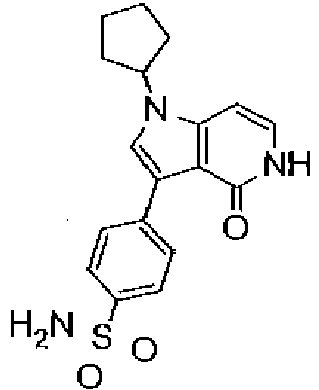
4-(1-cyclopentyl-4-oxo-4,5-dihydro-1H-pyrrolo[3,2-c]pyridin-3-yl)benzenesulfonamide 3 
methyl 4-(1-cyclopentyl-4-oxo-4,5-dihydro-1H-pyrrolo[3,2-c]pyridin-3-yl)thiophene-2-carboxylate 4 
4-(1-cyclopentyl-4-oxo-4,5-dihydro-1H-pyrrolo[3,2-c]pyridin-3-yl)thiophene-2-carboxamide 5 
1-cyclopentyj-3-(3-thienyl)-1,5-dihydro-4H-pyrrolo[3,2-c]pyridin-4-one Table 2-2 Ex. Structural Formula Compound Name 6 
4-(1-cyclohexyl-4-oxo-4,5-dihydro-1H-pyrazolo[4,3-c]pyridin-3-yl)benzenesulfonamide 7 
methyl 4-(4-oxo-1-(pentan-3-yl)-4,5-dihydro-1H-pyrrolo[3,2-c]pyridin-3-yl)thiophene-2-carboxylate 8 
4-(4-oxo-1-(pentan-3-yl)-4,5-dihydro-1H-pyrrolo[3,2-c]pyridin-3-yl)thiophene-2-carboxamide 9 
4-(4-oxo-1-(pentan-3-yl)-4,5-dihydro-1H-pyrrolo[3,2-c]pyridin-3-yl)thiophene-2-carbonitrile 10 
1,3-diphenyl-1,6-dihydro-7H-pyrazolo[3,4-c]pyridin-7-one Table 2-3 Ex. Structural Formula Compound Name 11 
3-phenyl-1-(3-thienyl)-1,6-dihydro-1H-pyrazolo[3,4-c]pyridin-7-one 12 
methyl 4-(1-cyclopentyl-4-oxo-4,5-dihydro-1H-pyrazolo[4,3-c]pyridin-3-yl)thiophene-2-carboxylate 13 
4-(1-cyclopentyl-4-oxo-4,5-dihydro-1H-pyrazolo[4,3-c]pyridin-3-yl)thiophene-2-carboxamide 14 
4-(1-cyclopentyl-4-oxo-4,5-dihydro-1H-pyrazolo[4,3-c]pyridin-3-yl)thiophene-2-carbonitrile 15 
4-(4-oxo-1-(tetrahydro-2H-pyran-4-yl)-4,5-dihydro-1H-pyrazolo[4,3-c]pyridin-3-yl)benzenesulfonamide Table 2-4 Ex. Structural Formula Compound Name 16 
4-(4-oxo-1-(tetrahydro-2H-pyran-4-yl)-4,5-dihydro-1H-pyrrolo[3,2-c]pyridin-3-yl)benzenesulfonamide 17 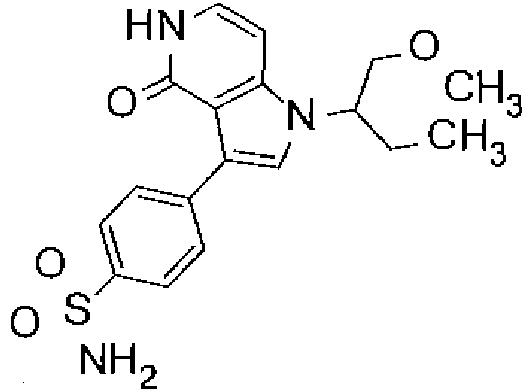
4-(1-(1-methoxybutan-2-yl)-4-oxo-4,5-dihydro-1H-pyrrolo[3,2-c]pyridin-3-yl)benzenesulfonamide 18 
4-(4-oxo-1-(tetrahydrofuran-3-yl)-4,5-dihydro-1H-pyrrolo[3,2-c]pyridin-3-yl)benzenesulfonamide 19 
4-((7-oxo-3-phenyl-6,7-dihydro-1H-pyrazolo[3,4-c]pyridin-1-yl)methyl)benzenesulfonami de 20 
(4-(1-(1-methoxybutan-2-yl)-4-oxo-4,5-dihydro-1H-pyrrolo[3,2-c]pyridin-3-yl)phenyl)acetonitrile Table 2-5 Ex. Structural Formula Compound Name 21 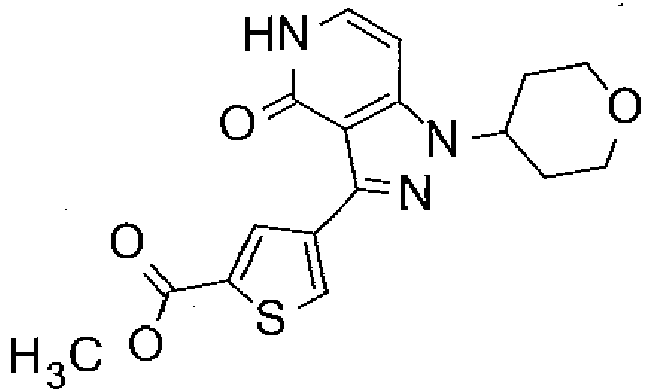
methyl 4-(4-oxo-1-(tetrahydro-2H-pyran-4-yl)-4,5-dihydro-1H-pyrazolo[4,3-c]pyridin-3-yl)thiophene-2-carboxylate 22 
(4-(4-oxo-1-(tetrahydrofuran-3-yl)-4,5-dihydro-1H-pyrrolo[3,2-c]pyridin-3-yl)phenyl)acetonitrile 23 
4-(4-oxo-1-(tetrahydro-2H-pyran-4-yl)-4,5-dihydro-1H-pyrazolo[4,3-c]pyridin-3-yl)thiophene-2-carboxylic acid 24 
4-(1-(1-methoxybutan-2-yl)-4-oxo-4,5-dihydro-1H-pyrrolo[3,2-c]pyridin-3-yl)benzonitrile 25 
(4-(4-oxo-1-(tetrahydro-2H-pyran-4-yl)-4,5-dihydro-1H-pyrrolo[3,2-c]pyridin-3-yl)phenyl)acetonitrile Table 2-6 Ex. Structural Formula Compound Name 26 
4-(1-(1-methoxybutan-2-yl)-4-oxo-4,5-dihydro-1H-pyrrolo[3,2-c]pyridin-3-yl)benzamide 27 
4-(4-oxo-1-(tetrahydro-2H-pyran-4-yl)-4,5-dihydro-1H-pyrazolo[4,3-c]pyridin-3-yl)thiophene-2-carboxamide 28 
4-(4-oxo-1-(tetrahydro-2H-pyran-3-yl)-4,5-dihydro-1H-pyrazolo[4,3-c]pyridin-3-yl)benzenesulfonamide 29 
methyl 3-(4-carbamoylphenyl)-1-cyclopentyl-4-oxo-4,5-dihydro-1H-pyrrolo[3,2-c]pyridine-7-carboxylate 30 
4-(4-oxo-1-phenyl-4,5-dihydro-1H-pyrazolo[4,3-c]pyridin-3-yl)benzenesulfonamide Table 2-7 Ex. Structural Formula Compound Name 31 
4-(1-(trans-4-hydroxycyclohexyl)-4-oxo-4,5-dihydro-1H-pyrrolo[3,2-c]pyridin-3-yl)benzenesulfonamide 32 
4-(1-(cis-4-hydroxycyclohexyl)-4-oxo-4,5-dihydro-1H-pyrrolo[3,2-c]pyridin-3-yl)benzenesulfonamide 33 
4-(7-cyano-1-cyclopentyl-4-oxo-4,5-dihydro-1H-pyrrolo[3,2-c]pyridin-3-yl)thiophene-2-carboxamide 34 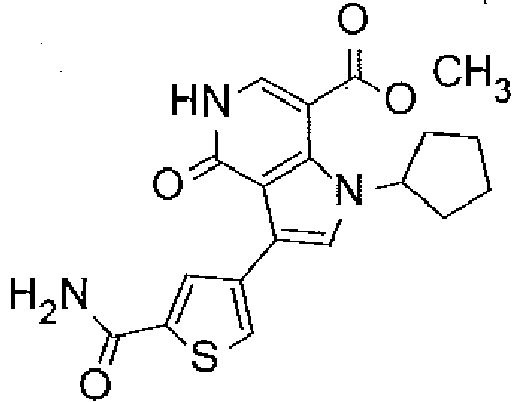
methyl 3-(5-carbamoyl-3-thienyl)-1-cyclopentyl-4-oxo-4,5-dihydro-1H-pyrrolo[3,2-c]pyridine-7-carboxylate 35 
4-(1-(2,6-difluorophenyl)-4-oxo-4,5-dihydro-1H-pyrazolo[4,3-c]pyridin-3-yl)benzenesulfonamide Table 2-8 Ex. Structural Formula Compound Name 36 
methyl 4-(1-(2,6-difluorophenyl)-4-oxo-4,5-dihydro-1H-pyrazolo[4,3-c]pyridin-3-yl)thiophene-2-carboxylate 37 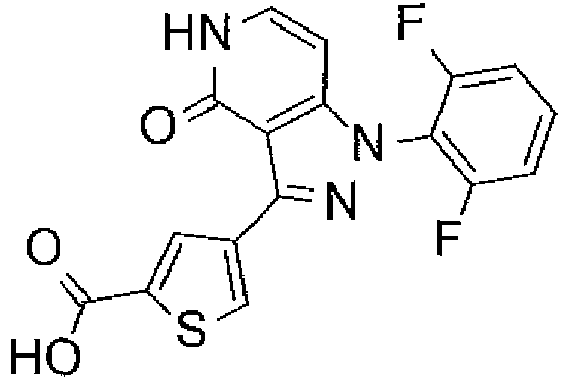
4-(1-(2,6-difluorophenyl)-4-oxo-4,5-dihydro-1H-pyrazolo[4,3-c]pyridin-3-yl)thiophene-2-carboxylic acid 38 
4-(1-(2,6-difluorophenyl)-4-oxo-4,5-dihydro-1H-pyrazolo[4,3-c]pyridin-3-yl)thiophene-2-carboxamide 39 
(4-(1-(2,6-difluorophenyl)-4-oxo-4,5-dihydro-1H-pyrazolo[4,3-c]pyridin-3-yl)phenyl)acetonitrile 40 
4-(1-cyclopentyl-7-(hydroxymethyl)-4-oxo-4,5-dihydro-1H-pyrrolo[3,2-c]pyridin-3-yl)thiophene-2-carboxamide Table 2-9 Ex. Structural Formula Compound Name 41 
3-(cyclohex-1-en-1-yl)-1-cyclopentyl-1,5-dihydro-4H-pyrazolo[4,3-c]pyridin-4-one 42 
1-cyclopentyl-3-(3,6-dihydro-2H-pyran-4-yl)-1,5-dihydro-4H-pyrazolo[4,3-c]pyridin-4-one 43 
1-cyclopentyl-3-phenyl-1,5-dihydro-4H-pyrazolo[4,3-c]pyridin-4-one 44 
1-cyclopentyl-3-(pyridin-4-yl)-1,5-dihydro-4H-pyrazolo[4,3-c]pyridin-4-one 45 
1-cyclopentyl-3-(4-(trifluoromethoxy)phenyl)-1,5-dihydro-4H-pyrazolo[4,3-c]pyridin-4-one Table 2-10 Ex. Structural Formula Compound Name 46 
1-cyclopentyl-3-(4-methoxyphenyl)-1,5-dihydro-4H-pyrazolo[4,3-c]pyridin-4-one 47 
1-cyclopentyl-3-(3-methoxyphenyl)-1,5-dihydro-4H-pyrazolo[4,3-c]pyridin-4-one 48 
1-cyclopentyl-3-(2-methoxyphenyl)-1,5-dihydro-4H-pyrazolo[4,3-c]pyridin-4-one 49 
3-(1,3-benzodioxol-5-yl)-1-cyclopentyl-1,5-dihydro-4H-pyrazolo[4,3-c]pyridin-4-one 50 
1-cyclopentyl-3-(4-methylphenyl)-1,5-dihydro-4H-pyrazolo[4,3-c]pyridin-4-one Table 2-11 Ex. Structural Formula Compound Name 51 
1-cyclopentyl-3-(4-(trifluoromethyl)phenyl)-1,5-dihydro-4H-pyrazolo[4,3-c]pyridin-4-one 52 
1-cyclopentyl-3-(3-(trifluoromethyl)phenyl)-1,5-dihydro-4H-pyrazolo[4,3-c]pyridin-4-one 53 
1-cyclopentyl-3-(2-(trifluoromethyl)phenyl)-1,5-dihydro-4H-pyrazolo[4,3-c]pyridin-4-one 54 
1-cyclopentyl-3-(4-fluorophenyl)-1,5-dihydro-4H-pyrazolo[4,3-c]pyridin-4-one 55 
1-cyclopentyl-3-(3-fluorophenyl)-1,5-dihydro-4H-pyrazolo[4,3-c]pyridin-4-one Table 2-12 Ex. Structural Formula Compound Name 56 
1-cyclopentyl-3-(2-fluorophenyl)-1,5-dihydro-4H-pyrazolo[4,3-c]pyridin-4-one 57 
1-cyclopentyl-3-(4-nitrophenyl)-1,5-dihydro-4H-pyrazolo[4,3-c]pyridin-4-one 58 
1-cyclopentyl-3-(2-oxo-2,3-dihydro-1H-indol-5-yl)-1,5-dihydro-4H-pyrazolo[4,3-c]pyridin-4-one 59 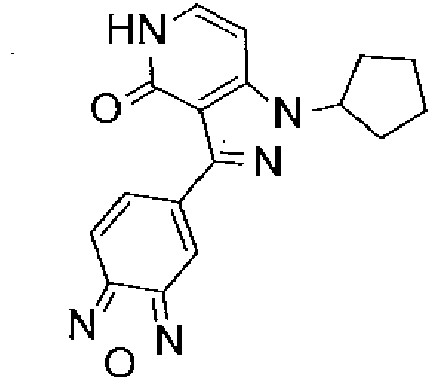
3-(2,1,3-benzoxadiazol-5-yl)-1-cyclopentyl-1,5-dihydro-4H-pyrazolo[4,3-c]pyridin-4-one 60 
4-(7-acetyl-1-cyclopentyl-4-oxo-4,5-dihydro-1H-pyrrolo[3,2-c]pyridin-3-yl)thiophene-2-carboxamide Table 2-13 Ex. Structural Formula Compound Name 61 
3-(5-carbamoyl-3-thienyl)-1-cyclopentyl-4-oxo-4,5-dihydro-1H-pyrrolo[3,2-c]pyridine-7-carboxylic acid 62 
3-(5-carbamoyl-3-thienyl)-1-cyclopentyl-4-oxo-4,5-dihydro-1H-pyrrolo[3,2-c]pyridine-7-carboxamide 63 
1-cyclopentyl-N-methyl-3-(5-(methylcarbamoyl)-3-thienyl)-4-oxo-4,5-dihydro-1H-pyrrolo[3,2-c]pyridine-7-carboxamide 64 
1-cyclopentyl-3-(5-(dimethylcarbamoyl)-3-thienyl)-N,N-dimethyl-4-oxo-4,5-dihydro-1H-pyrrolo[3,2-c]pyridine-7-carboxamide 65 
4-(4-cyano-3-cyclopentyl-7-oxo-6,7-dihydro-1H-pyrazolo[3,4-c]pyridin-1-yl)thiophene-2-carboxylic acid Table 2-14 Ex. Structural Formula Compound Name 66 
4-(4-cyano-3-cyclopentyl-7-oxo-6,7-dihydro-1H-pyrazolo[3,4-c]pyridin-1-yl)thiophene-2-carboxamide 67 
4-(4-bromo-3-cyclopentyl-7-oxo-6,7-dihydro-1H-pyrazolo[3,4-c]pyridin-1-yl)thiophene-2-carboxamide 68 
methyl 4-(4-cyano-3-(2-methylphenyl)-7-oxo-6,7-dihydro-1H-pyrazolo[3,4-c]pyridin-1-yl)thiophene-2-carboxylate 69 
4-(4-cyano-3-(2-methylphenyl)-7-oxo-6,7-dihydro-1H-pyrazolo[3,4-c]pyridin-1-yl)thiophene-2-carboxylic acid 70 
4-(4-cyano-3-(2-methylphenyl)-7-oxo-6,7-dihydro-1H-pyrazolo[3,4-c]pyridin-1-yl)thiophene-2-carboxamide Table 2-15 Ex. Structural Formula Compound Name 71 
4-(1-(cis-2-methylcyclopentyl)-4-oxo-4,5-dihydro-1H-pyrrolo[3,2-c]pyridin-3-yl)benzenesulfonamide 72 
2-(4-(1-(2,6-difluorophenyl)-4-oxo-4,5-dihydro-1H-pyrazolo[4,3-c]pyridin-3-yl)phenyl)acetamide 73 
methyl 3-(5-cyano-3-thienyl)-1-cyclopentyl-4-oxo-4,5-dihydro-1H-pyrrolo[3,2-c]pyridine-7-carboxylate 74 
methyl 1-cyclopentyl-4-oxo-3-(5-(5-oxo-4,5-dihydro-1,2,4-oxadiazol-3-yl)-3-thienyl)-4,5-dihydro-1H-pyrrolo[3,2-c]pyridine-7-carboxylate 75 
4-(3-cyclopentyl-7-oxo-6,7-dihydro-1H-pyrazolo[3,4-c]pyridin-1-yl)benzenesulfonamide Table 2-16 Ex. Structural Formula Compound Name 76 
methyl 4-(7-cyano-1-cyclopentyl-4-oxo-4,5-dihydro-1H-pyrrolo[3,2-c]pyridin-3-yl)thiophene-2-carboxylate 77 
4-(7-cyano-1-cyclopentyl-4-oxo-4,5-dihydro-1H-pyrrolo[3,2-c]pyridin-3-yl)thiophene-2-carboxylic acid 78 
methyl 4-(4-bromo-3-(2-methylphenyl)-7-oxo-6,7-dihydro-1H-pyrazolo[3,4-c]pyridin-1-yl)thiophene-2-carboxylate 79 
4-(4-bromo-3-(2-methylphenyl)-7-oxo-6,7-dihydro-1H-pyrazolo[3,4-c]pyridin-1-yl)thiophene-2-carboxylic acid 80 
4-(4-bromo-3-(2-methylphenyl)-7-oxo-6,7-dihydro-1H-pyrazolo[3,4-c]pyridin-1-yl)thiophene-2-carboxamide Table 2-17 Ex. Structural Formula Compound Name 81 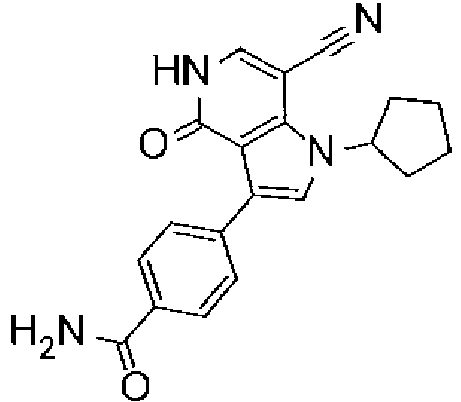
4-(7-cyano-1-cyclopentyl-4-oxo-4,5-dihydro-1H-pyrrolo[3,2-c]pyridin-3-yl)benzamide 82 
4-(4-oxo-1-(tetrahydrofuran-3-yl)-4,5-dihydro-1H-pyrazolo[4,3-c]pyridin-3-yl)benzenesulfonamide 83 
4-(4-oxo-1-(tetrahydrofuran-3-yl)-4,5-dihydro-1H-pyrazolo[4,3-c]pyridin-3-yl)benzenesulfonamide 84 
4-(4-oxo-1-(tetrahydrofuran-3-yl)-4,5-dihydro-1H-pyrazolo[4,3-c]pyridin-3-yl)benzenesulfonamide 85 
4-(1-(cis-2-methylcyclopentyl)-4-oxo-4,5-dihydro-1H-pyrrolo[3,2-c]pyridin-3-yl)thiophene-2-carboxamide Table 2-18 Ex. Structural Formula Compound Name 86 
4-(1-tert-butyl-4-oxo-4,5-dihydro-1H-pyrazolo[4,3-c]pyridin-3-yl)benzenesulfonamide 87 
4-(4-oxo-1-(tetrahydro-2H-pyran-3-yl)-4,5-dihydro-1H-pyrazolo[4,3-c]pyridin-3-yl)benzenesulfonamide 88 
4-(4-oxo-1-(tetrahydro-2H-pyran-3-yl)-4,5-dihydro-1H-pyrazolo[4,3-c]pyridin-3-yl)benzenesulfonamide 89 
3-(7-cyano-1-cyclopentyl-4-oxo-4,5-dihydro-1H-pyrrolo[3,2-c]pyridin-3-yl)benzamide 90 
4-(1-((2,2-dimethyl-1,3-dioxolan-4-yl)methyl)-4-oxo-4,5-dihydro-1H-pyrrolo[3,2-c]pyridin-3-yl)benzenesulfonamide Table 2-19 Ex. Structural Formula Compound Name 91 
4-(1-(2,3-dihyd roxypropyl)-4-oxo-4,5-dihydro-1H-pyrrolo[3,2-c]pyridin-3-yl)benzenesulfonamide 92 
4-(1-cyclopentyl-4-oxo-4,5-dihydro-1H-pyrazolo[4,3-c]pyridin-3-yl)benzenesulfonamide 93 
3-(5-(cyanomethyl)-3-thienyl)-1-cyclopentyl-4-oxo-4,5-dihydro-1H-pyrrolo[3,2-c]pyridine-7-carbonitrile 94 
4-(1-(4-methoxybenzyl)-4-oxo-4,5-dihydro-1H-pyrazolo[4,3-c]pyridin-3-yl)benzenesulfonamide 95 
2-(4-(7-cyano-1-cyclopentyl-4-oxo-4,5-dihydro-1H-pyrrolo[3,2-c]pyridin-3-yl)phenyl)acetamide Table 2-20 Ex. Structural Formula Compound Name 96 
3-(4-(cyanomethyl)phenyl)-1-cyclopentyl-4-oxo-4,5-dihydro-1H-pyrrolo[3,2-c]pyridine-7-carbonitrile 97 
2-(4-(7-cyano-1-cyclopentyl-4-oxo-4,5-dihydro-1H-pyrrolo[3,2-c]pyridin-3-yl)-2-thienyl)acetamide 98 
2-(4-(7-cyano-1-cyclopentyl-4-oxo-4,5-dihydro-1H-pyrrolo[3,2-c]pyridin-3-yl)-1H-pyrazol-1-yl)acetamide 99 
3-(1-(cyanomethyl)-1H-pyrazol-4-yl)-1-cyclopentyl-4-oxo-4,5-dihydro-1H-pyrrolo[3,2-c]pyridine-7-carbonitrile 100 
4-(1-((3-methyloxetan-3-yl)methyl)-4-oxo-4,5-dihydro-1H-pyrazolo[4,3-c]pyridin-3-yl)benzenesulfonamide Table 2-21 Ex. Structural Formula Compound Name 101 
4-(7-bromo-1-cyclopentyl-4-oxo-4,5-dihydro-1H-pyrazolo[4,3-c]pyridin-3-yl)benzenesulfonamide 102 
4-(4-cyano-3-(2-methylphenyl)-7-oxo-6,7-dihydro-1H-pyrrolo[2,3-c]pyridin-1-yl)thiophene-2-carboxamide 103 
1-cyclopentyl-4-oxo-3-phenyl-4,5-dihydro-1H-pyrrolo[3,2-c]pyridine-7-carbonitrile 104 
(4-(7-bromo-1-(2,6-difluorophenyl)-4-oxo-4,5-dihydro-1H-pyrazolo[4,3-c]pyridin-3-yl)phenyl)acetonitrile 105 
4-(1-(oxetan-3-ylmethyl)-4-oxo-4,5-dihydro-1H-pyrazolo[4,3-c]pyridin-3-yl)benzenesulfonamide Table 2-22 Ex. Structural Formula Compound Name 106 
1-cyclopentyl-4-oxo-3-(3-thienyl)-4,5-dihydro-1H-pyrrolo[3,2-c]pyridine-7-carbonitrile 107 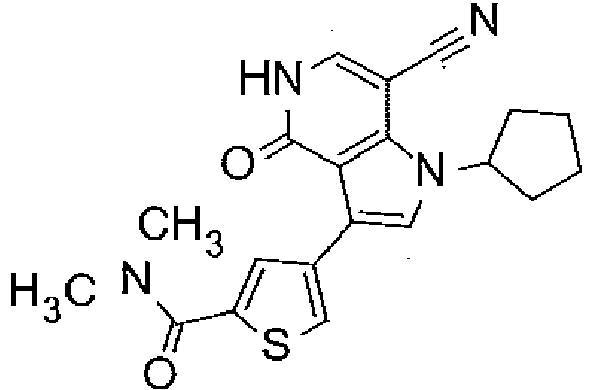
4-(7-cyano-1-cyclopentyl-4-oxo-4,5-dihydro-1H-pyrrolo[3,2-c]pyridin-3-yl)-N,N-dimethylthiophene-2-carboxamide 108 
4-(7-cyano-1-cyclopentyl-4-oxo-4,5-dihydro-1H-pyrrolo[3,2-c]pyridin-3-yl)-N-methylthiophene-2-carboxamide 109 
3-(3-(cyanomethyl)phenyl)-1-cyclopentyl-4-oxo-4,5-dihydro-1H-pyrrolo[3,2-c]pyridine-7-carbonitrile 110 
2-(3-(7-cyano-1-cyclopentyl-4-oxo-4,5-dihydro-1H-pyrrolo[3,2-c]pyridin-3-yl)phenyl)acetamide Table 2-23 Ex. Structural Formula Compound Name 111 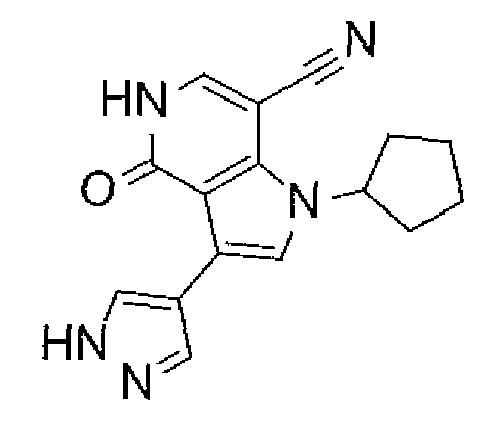
1-cyclopentyl-4-oxo-3-(1H-pyrazol-4-yl)-4,5-dihydro-1H-pyrrolo[3,2-c]pyridine-7-carbonitrile 112 
2-(4-(7-bromo-1-(2,6-difluorophenyl)-4-oxo-4,5-dihydro-1H-pyrazolo[4,3-c]pyridin-3-yl)phenyl)acetamide 113 
methyl 4-(1-(4-methoxybenzyl)-4-oxo-4,5-dihydro-1H-pyrazolo[4,3-c]pyridin-3-yl)thiophene-2-carboxylate 114 
4-(1-(4-methoxybenzyl)-4-oxo-4,5-dihydro-1H-pyrazolo[4,3-c]pyridin-3-yl)thiophene-2-carboxamide 115 
4-(4-oxo-1-(tetrahydrofuran-3-ylmethyl)-4,5-dihydro-1H-pyrazolo[4,3-c]pyridin-3-yl)benzenesulfonamide Table 2-24 Ex. Structural Formula Compound Name 116 
(4-(7-chloro-1-(2,6-difluorophenyl)-4-oxo-4,5-dihydro-1H-pyrazolo[4,3-c]pyridin-3-yl)phenyl)acetonitrile 117 
4-(3-cyclopentyl-7-oxo-6,7-dihydro-1H-pyrazolo[3,4-c]pyridin-1-yl)thiophene-2-carboxamide 118 
4-(4-cyano-3-cyclopentyl-7-oxo-6,7-dihydro-1H-pyrrolo[2,3-c]pyridin-1-yl)thiophene-2-carboxamide 119 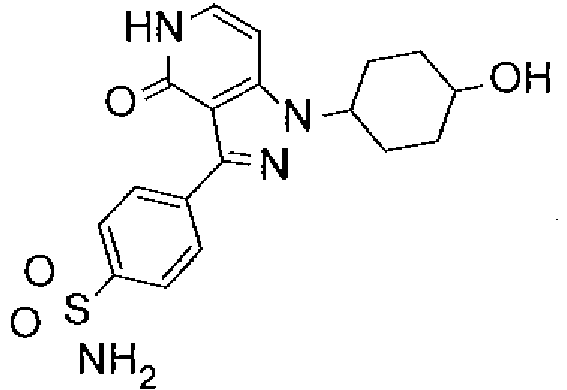
4-(1-(4-hydroxycyclohexyl)-4-oxo-4,5-dihydro-1H-pyrazolo[4,3-c]pyridin-3-yl)benzenesulfonamide 120 
2-(4-(7-cyano-1-cyclopentyl-4-oxo-4,5-dihydro-1H-pyrrolo[3,2-c]pyridin-3-yl)phenoxy)acetamide Table 2-25 Ex. Structural Formula Compound Name 121 
3-(4-(cyanomethoxy)phenyl)-1-cyclopentyl-4-oxo-4,5-dihydro-1H-pyrrolo[3,2-c]pyridine-7-carbonitrile 122 
4-(7-cyano-1-cyclopentyl-4-oxo-4,5-dihydro-1H-pyrrolo[3,2-c]pyridin-3-yl)-N-ethylthiophene-2-carboxamide 123 
N-tert-butyl-4-(7-cyano-1-cyclopentyl-4-oxo-4,5-dihydro-1H-pyrrolo[3,2-c]pyridin-3-yl)thiophene-2-carboxamide 124 
2-(4-(7-chloro-1-(2,6-difluorophenyl)-4-oxo-4,5-dihydro-1H-pyrazolo[4,3-c]pyridin-3-yl)phenyl)acetamide 125 
1-cyclopentyl-4-oxo-3-(1H-pyrazol-5-yl)-4,5-dihydro-1H-pyrrolo[3,2-c]pyridine-7-carbonitrile hydrochloride Table 2-26 Ex. Structural Formula Compound Name 126 
4-(1-(4-hydroxycyclohexyl)-4-oxo-4,5-dihydro-1H-pyrazolo[4,3-c]pyridin-3-yl)benzenesulfonamide 127 
(4-(1-cyclopentyl-4-oxo-4,5-dihydro-1H-pyrazolo[4,3-c]pyridin-3-yl)phenyl)acetonitrile 128 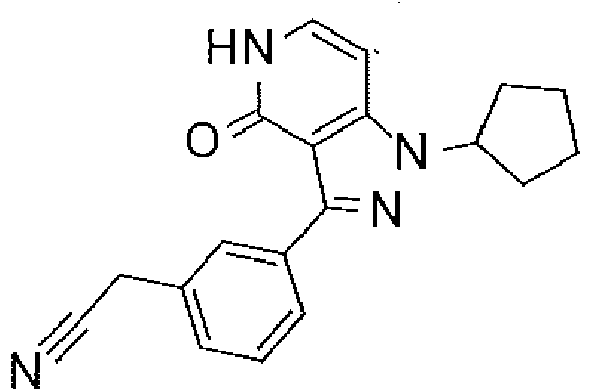
(3-(1-cyclopentyl-4-oxo-4,5-dihydro-1H-pyrazolo[4,3-c]pyridin-3-yl)phenyl)acetonitrile 129 
4-(1-tert-butyl-4-oxo-4,5-dihydro-1H-pyrazolo[4,3-c]pyridin-3-yl)thiophene-2-carboxamide 130 
N-(3-(7-cyano-1-cyclopentyl-4-oxo-4,5-dihydro-1H-pyrrolo[3,2-c]pyridin-3-yl)phenyl)acetamide Table 2-27 Ex. Structural Formula Compound Name 131 
1-cyclopentyl-3-(1-methyl-1H-pyrazol-4-yl)-4-oxo-4,5-dihydro-1H-pyrrolo[3,2-c]pyridine-7-carbonitrile 132 
1-cyclopentyl-4-oxo-3-(pyridin-2-yl)-4,5-dihydro-1H-pyrrolo[3,2-c]pyridine-7-carbonitrile 133 
1-cyclopentyl-4-oxo-3-(pyridin-3-yl)-4,5-dihydro-1H-pyrrolo[3,2-c]pyridine-7-carbonitrile 134 
1-cyclopentyl-4-oxo-3-(2-thienyl)-4,5-dihydro-1H-pyrrolo[3,2-c]pyridine-7-carbonitrile 135 
1-cyclopentyl-3-(1-isobutyl-1H-pyrazol-4-yl)-4-oxo-4,5-dihydro-1H-pyrrolo[3,2-c]pyridine-7-carbonitrile Table 2-28 Ex. Structural Formula Compound Name 136 
1-cyclopentyl-3-(1-methyl-1H-pyrazol-3-yl)-4-oxo-4,5-dihydro-1H-pyrrolo[3,2-c]pyridine-7-carbonitrile 137 
1-cyclopentyl-3-(1-cyclopentyl-1H-pyrazol-4-yl)-4-oxo-4,5-dihydro-1H-pyrrolo[3,2-c]pyridine-7-carbonitrile 138 
1-cyclopentyl-3-(1-cyclopropyl-1H-pyrazol-4-yl)-4-oxo-4,5-dihydro-1H-pyrrolo[3,2-c]pyridine-7-carbonitrile 139 
3-(4-(2-cyanopropan-2-yl)phenyl)-1-cyclopentyl-4-oxo-4,5-dihydro-1H-pyrrolo[3,2-c]pyridine-7-carbonitrile 140 
1-cyclopentyl-3-(3-(morpholin-4-yl)phenyl)-4-oxo-4,5-dihydro-1H-pyrrolo[3,2-c]pyridine-7-carbonitrile Table 2-29 Ex. Structural Formula Compound Name 141 
4-(1-((3-methyloxetan-3-yl)methyl)-4-oxo-4,5-dihydro-1H-pyrazolo[4,3-c]pyridin-3-yl)thiophene-2-carboxamide 142 
4-(1-cyclopentyl)-oxo-4,5-dihydro-1H-pyrazolo[4,3-c]pyridin-3-yl)benzamide 143 
3-(1-cyclopentyl-4-oxo-4,5-dihydro-1H-pyrazolo[4,3-c]pyridin-3-yl)benzamide 144 
4-(7-bromo-1-(2,6-difluorophenyl)-4-oxo-4,5-dihydro-1H-pyrazolo[4,3-c]pyridin-3-yl)thiophene-2-carboxamide 145 
4-(7-bromo-1-(2,6-difluorophenyl)-4-oxo-4,5-dihydro-1H-pyrazolo[4,3-c]pyridin-3-yl)-N-methylthiophene-2-carboxamide Table 2-30 Ex. Structural Formula Compound Name 146 
(3-(7-bromo-1-(2,6-difluorophenyl)-4-oxo-4,5-dihydro-1H-pyrazolo[4,3-c]pyridin-3-yl)phenyl)acetonitrile 147 
2-(3-(7-bromo-1-(2,6-difluorophenyl)-4-oxo-4,5-dihydro-1H-pyrazolo[4,3-c]pyridin-3-yl)phenyl)acetamide 148 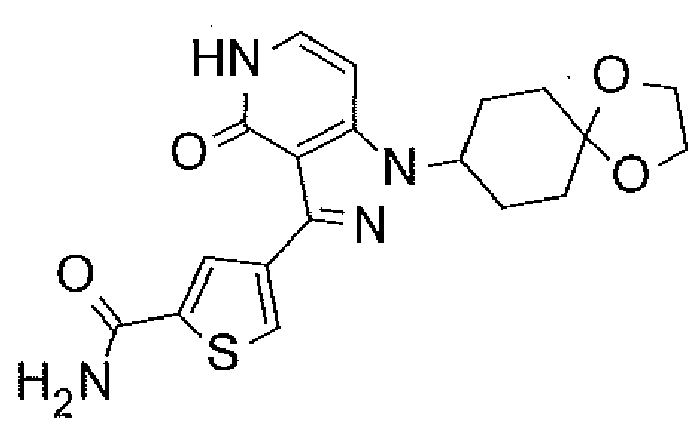
4-(1-(1,4-dioxaspiro[4.5]dec-8-yl)-4-oxo-4,5-dihydro-1H-pyrazolo[4,3-c]pyridin-3-yl)thiophene-2-carboxamide 149 
4-(4-oxo-1-(pentan-3-yl)-4,5-dihydro-1H-pyrazolo[4,3-c]pyridin-3-yl)thiophene-2-carboxamide 150 
4-(1-(1-methoxybutan-2-yl)-4-oxo-4,5-dihydro-1H-pyrazolo[4,3-c]pyridin-3-yl)thiophene-2-carboxamide Table 2-31 Ex. Structural Formula Compound Name 151 
1-(2,6-difluorophenyl)-3-(1H-pyrazol-4-yl)-1,5-dihydro-4H-pyrazolo[4,3-c]pyridin-4-one 152 
(4-(7-chloro-1-(2,6-difluorophenyl)-4-oxo-4,5-dihydro-1H-pyrazolo[4,3-c]pyridin-3-yl)-2-thienyl)acetonitrile 153 
2-(4-(7-bromo-1-(2,6-difluorophenyl)-4-oxo-4,5-dihydro-1H-pyrazolo[4,3-c]pyridin-3-yl)phenyl)-N-methylacetamide 154 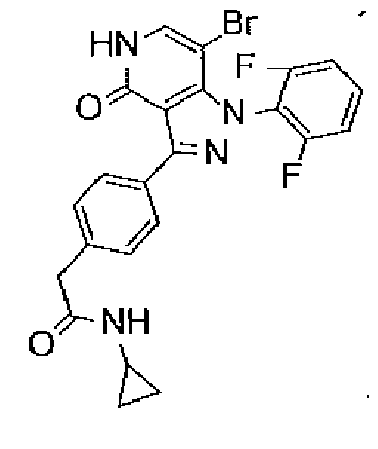
2-(4-(7-bromo-1-(2,6-difluorophenyl)-4-oxo-4,5-dihydro-1H-pyrazolo[4,3-c]pyridin-3-yl)phenyl)-N-cyclopropylacetamide 155 
4-(1-cyclopentyl-4-oxo-4,5-dihydro-1H-pyrazolo[4,3-c]pyridin-3-yl)-N-methylthiophene-2-carboxamide Table 2-32 Ex. Structural Formula Compound Name 156 
4-(1-cyclopentyl-4-oxo-4,5-dihydro-1H-pyrazolo[4,3-c]pyridin-3-yl)-N-cyclopropylthiophene-2-carboxamide 157 
4-(1-cyclopentyl-4-oxo-4,5-dihydro-1H-pyrazolo[4,3-c]pyridin-3-yl)-N-(2-hydroxyethyl)thiophene-2-carboxamide 158 
2-(3-(1-cyclopentyl-4-oxo-4,5-dihydro-1H-pyrazolo[4,3-c]pyridin-3-yl)phenyl)acetamide 159 
3-(1-cyclopentyl-4-oxo-4,5-dihydro-1H-pyrazolo[4,3-c]pyridin-3-yl)benzenesulfonamide 160 
2-(4-(7-chloro-1 -(2,6-difluorophenyl)-4-oxo-4,5-dihydro-1H-pyrazolo[4,3-c]pyridin-3-yl)-2-thienyl)acetamide Table 2-33 Ex. Structural Formula Compound Name 161 
7-chloro-1-(2,6-difluorophenyl)-3-(4-(morpholin-4-yl)phenyl)-1,5-dihydro-4H-pyrazolo[4,3-c]pyridin-4-one 162 
4-(7-chloro-1-(2,6-difluorophenyl)-4-oxo-4,5-dihydro-1H-pyrazolo[4,3-c]pyridin-3-yl)-N-methylthiophene-2-carboxamide 163 
4-(7-chloro-1-(2,6-difluorophenyl)-4-oxo-4,5-dihydro-1H-pyrazolo[4,3-c]pyridin-3-yl)-N-(1-cyanocyclopropyl)thiophene-2-carboxamide 164 
7-chloro-1-(2,6-difluorophenyl)-3-(6-(morpholin-4-yl)pyridin-3-yl)-1,5-dihydro-4H-pyrazolo[4,3-c]pyridin-4-one 165 
4-(7-cyano-1-cyclopentyl-4-oxo-4,5-dihydro-1H-pyrazolo[4,3-c]pyridin-3-yl)thiophene-2-carboxamide Table 2-34 Ex. Structural Formula Compound Name 166 
4-(7-chloro-1-(2,6-difluorophenyl)-4-oxo-4,5-dihydro-1H-pyrazolo[4,3-c]pyridin-3-yl)-N-(1-methyl-1H-pyrazol-4-yl)thiophene-2-carboxamide 167 
(4-(7-chloro-1-(2,6-difluorophenyl)-4-oxo-4,5-dihydro-1H-pyrazolo[4,3-c]pyridin-3-yl)phenoxy)acetonitrile 168 
7-chloro-1-(2,6-difluorophenyl)-3-(3-(2-hydroxyethoxy)phenyl)-1,5-dihydro-4H-pyrazolo[4,3-c]pyridin-4-one 169 
2-(4-(7-chloro-1-(2,6-difluorophenyl)-4-oxo-4,5-dihydro-1H-pyrazolo[4,3-c]pyridin-3-yl)phenoxy)acetamide 170 
4-(4-oxo-1-(4-oxocyclohexyl)-4,5-dihydro-1H-pyrazolo[4,3-c]pyridin-3-yl)thiophene-2-carboxamide Table 2-35 Ex. Structural Formula Compound Name 171 
4-(1-(4-hydroxycyclohexyl)-4-oxo-4,5-dihydro-1H-pyrazolo[4,3-c]pyridin-3-yl)thiophene-2-carboxamide 172 
4-(1-(4-hydroxy-4-phenylcyclohexyl)-4-oxo-4,5-dihydro-1H-pyrazolo[4,3-c]pyridin-3-yl)thiophene-2-carboxamide 173 
4-(4-oxo-1-(4-oxocyclohexyl)-4,5-dihydro-1H-pyrazolo[4,3-c]pyridin-3-yl)benzenesulfonamide 174 
4-(1-(4-hydroxy-4-phenylcyclohexyl)-4-oxo-4,5-dihydro-1H-pyrazolo[4,3-c]pyridin-3-yl)benzenesulfonamide 175 
2-(4-(7-bromo-1-(2,6-difluorophenyl)-4-oxo-4,5-dihydro-1H-pyrazolo[4,3-c]pyridin-3-yl)-1H-pyrazol-1-yl)acetamide Table 2-36 Ex. Structural Formula Compound Name 176 
7-bromo-1-(2,6-difluorophenyl)-3-(1H-pyrazol-4-yl)-1,5-dihydro-4H-pyrazolo[4,3-c]pyridin-4-one 177 
7-chloro-1-(2,6-difluorophenyl)-3-(1H-pyrazol-4-yl)-1,5-dihydro-4H-pyrazolo[4,3-c]pyridin-4-one 178 
3-((7-cyano-1 -cyclopentyl-4-oxo-4,5-dihydro-1H-pyrrolo[3,2-c]pyridin-3-yl)amino)benzamide 179 
1-(2,6-difluorophenyl)-3-(4-(morpholin-4-yl)phenyl)-1,5-dihydro-4H-pyrazolo[4,3-c]pyridin-4-one 180 
4-(1-(2,6-difluorophenyl)-4-oxo-4,5-dihydro-1H-pyrazolo[4,3-c]pyridin-3-yl)-N-methylbenzamide - To a solution of 1-(2,6-difluorophenyl)-3-(4-(morpholin-4-yl)phenyl)-1,5-dihydro-4H-pyrazolo[4,3-c]pyridin-4-one (500 mg) obtained in Example 179 in ethanol (4 mL) was added 4M hydrogen chloride ethyl acetate (0.612 mL), and the mixture was stirred at room temperature for 30 min. The reaction mixture was concentrated, and the residue was crystallized from DMSO and ethyl acetate to give the title compound (433 mg).
MS (ESI+): [M+H]+ 409.4.
MS (ESI+), found: 409.3. - The title compound was obtained using (4-(1-cyclopentyl-4-oxo-4,5-dihydro-1H-pyrazolo[4,3-c]pyridin-3-yl)phenyl)acetonitrile obtained in Example 127, in the same manner as in Example 158.
MS (ESI+): [M+H]+ 337.2.
MS (ESI+), found: 336.9. - To a solution of 4-(4-oxo-1-(4-oxocyclohexyl)-4,5-dihydro-1H-pyrazolo[4,3-c]pyridin-3-yl)thiophene-2-carboxamide (40.0 mg) obtained in Example 170 in THF was added sodium borohydride (8.49 mg) at 0°C, and the mixture was stirred overnight at room temperature under nitrogen atmosphere. To the reaction solution was added 1N hydrochloric acid at 0°C, and the mixture was extracted with ethyl acetate. The organic layer was washed with saturated aqueous sodium hydrogencarbonate solution and saturated brine, dried over anhydrous magnesium sulfate, filtered, and concentrated under reduced pressure. The obtained residue was purified by silica gel column chromatography (ethyl acetate/methanol) to give a cis/trans mixture (30.9 mg) of the title compound. The obtained cis/trans mixture was purified by HPLC (column: L-column2 ODS (trade name) 20 mmID×150 mmL, 5 µm, manufactured by Daicel Chemical Industries, mobile phase: water/acetonitrile (containing 10 mM ammonium carbonate)) to give the title compound having a shorter retention time.
MS (ESI+) : [M+H]+ 359.1.
MS (ESI+), found: 359.3. - The cis/trans mixture (30.9 mg) obtained in Example 183 was purified by HPLC (column: L-column2 ODS (trade name) 20 mmID×150 mmL, 5 µm, manufactured by Daicel Chemical Industries, mobile phase: water/acetonitrile (containing 10 mM ammonium carbonate)) to give the title compound having a longer retention time.
MS (ESI+): [M+H]+ 359.1.
MS (ESI+), found: 359.3. - To a mixture of (4-(bromomethyl)phenyl)boronic acid (500 mg) and potassium carbonate (643 mg) in acetonitrile (10 mL) was added morpholine (0.304 mL), and the mixture was stirred at room temperature for 60 hr. To the reaction mixture was added water, and the mixture was extracted with ethyl acetate. The organic layer was washed with saturated brine, dried over anhydrous magnesium sulfate, and concentrated under reduced pressure. The obtained solid was washed with diisopropyl ether and ethyl acetate to give the title compound (449 mg).
MS(ESI+): [M+H]+ 222.1.
MS(ESI+), found: 222.2. - The title compound (64.0 mg) was obtained using 7-chloro-1-(2,6-difluorophenyl)-4-methoxy-1H-pyrazolo[4,3-c]pyridin-3-yl trifluoromethanesulfonate obtained in Step A of Example 152 (200 mg) and (4-(morpholino methyl)phenyl)boronic acid (149 mg), in the same manner as in Step B of Example 152 and Step C of Example 152.
MS(ESI+): [M+H]+ 457.1.
MS(ESI+), found: 457.3. - To a solution of oxazolidin-2-one (243 mg) in anhydrous DMF (10 mL) was added sodium hydride (60% dispersion in mineral oil, 140 mg) in small portions under ice-cooling. The reaction mixture was stirred at room temperature for 2 hr, to the reaction mixture was added (4-(bromomethyl)phenyl)boronic acid (500 mg), and the mixture was stirred for 60 hr. To the reaction mixture was added ice water, and the aqueous layer was neutralized with 1N hydrochloric acid under ice-cooling, and the mixture was extracted with ethyl acetate. The organic layer was washed with saturated brine, dried over anhydrous magnesium sulfate, and concentrated under reduced pressure. The residue was washed with diisopropyl ether and ethyl acetate to give the title compound (273 mg).
MS(ESI+): [M+H]+ 222.1.
MS(ESI+), found: 222.1. - The title compound (151 mg) was obtained using 7-chloro-1-(2,6-difluorophenyl)-4-methoxy-1H-pyrazolo[4,3-c]pyridin-3-yl trifluoromethanesulfonate obtained in Step A of Example 152 (200 mg) and (4-((2-oxo-1,3-oxazolidin-3-yl)methyl)phenyl)boronic acid (149 mg), in the same manner as in Step B of Example 152 and Step C of Example 152.
MS(ESI+): [M+H]+ 457.1.
MS(ESI+), found: 457.2. - The title compound was obtained using 7-chloro-1-(2,6-difluorophenyl)-4-methoxy-1H-pyrazolo[4,3-c]pyridin-3-yl trifluoromethanesulfonate obtained in Step A of Example 152 and (4-(2-cyanopropan-2-yl)phenyl)boronic acid, in the same manner as in Step D of Example 35 and Step C of Example 93.
MS (ESI+): [M+H]+ 425.1.
MS (ESI+), found: 425.3. - The title compound was obtained using 2-(4-(7-chloro-1-(2,6-difluorophenyl)-4-oxo-4,5-dihydro-1H-pyrazolo[4,3-c]pyridin-3-yl)phenyl)-2-methylpropanenitrile obtained in Example 187, in the same manner as in Example 72.
MS (ESI+): [M+H]+ 443.1.
MS (ESI+), found: 443.1. - The title compound was obtained using 7-chloro-1-(2,6-difluorophenyl)-4-methoxy-1H-pyrazolo[4,3-c]pyridin-3-yl trifluoromethanesulfonate obtained in Step A of Example 152, in the same manner as in Step A of Example 131 and Step J of Example 33.
MS (ESI+): [M+H]+ 361.7.
MS (ESI+), found: 361.1. - The title compound was obtained using 7-chloro-1-(2,6-difluorophenyl)-4-methoxy-1H-pyrazolo[4,3-c]pyridin-3-yl trifluoromethanesulfonate obtained in Step A of Example 152, in the same manner as in Step A to Step C of Example 98.
MS (ESI+): [M+H]+ 405.8.
MS (ESI+), found: 405.2. - The title compound was obtained using 7-chloro-1-(2,6-difluorophenyl)-4-methoxy-1H-pyrazolo[4,3-c]pyridin-3-yl trifluoromethanesulfonate obtained in Step A of Example 152, methyl 4-(4,4,5,5-tetramethyl-1,3,2-dioxaborolan-2-yl)thiophene-2-carboxylate and aminoacetonitrile, in the same manner as in Step I of Example 33, Step F of Example 33, Step J of Example 33 and Step G of Example 33.
MS (ESI+): [M+H]+ 445.8.
MS (ESI+), found: 445.7. - The title compound was obtained using 7-chloro-1-(2,6-difluorophenyl)-4-methoxy-1H-pyrazolo[4,3-c]pyridin-3-yl trifluoromethanesulfonate obtained in Step A of Example 152, methyl 4-(4,4,5,5-tetramethyl-1,3,2-dioxaborolan-2-yl)thiophene-2-carboxylate and morpholine, in the same manner as in Step I of Example 33, Step F of Example 33, Step J of Example 33 and Step G of Example 33.
MS (ESI+): [M+H]+ 476.8.
MS (ESI+), found: 476.7. - The title compound was obtained using 7-chloro-1-(2,6-difluorophenyl)-4-methoxy-1H-pyrazolo[4,3-c]pyridin-3-yl trifluoromethanesulfonate obtained in Step A of Example 152, methyl 4-(4,4,5,5-tetramethyl-1,3,2-dioxaborolan-2-yl)thiophene-2-carboxylate and morpholin-4-amine, in the same manner as in Step I of Example 33, Step F of Example 33, Step J of Example 33 and Step G of Example 33.
MS (ESI+): [M+H]+ 492.9.
MS (ESI+), found: 493.1. - The title compound (118 mg) was obtained using 7-chloro-1-(2,6-difluorophenyl)-4-methoxy-1H-pyrazolo[4,3-c]pyridin-3-yl trifluoromethanesulfonate obtained in Step A of Example 152 (200 mg) and (4-(methoxycarbonyl)phenyl)boronic acid (122 mg), in the same manner as in Step B of Example 152.
MS (ESI+) : [M+H]+ 430.1.
MS(ESI+), found: 430.2. - To a mixture of methyl 4-(7-chloro-1-(2,6-difluorophenyl)-4-methoxy-1H-pyrazolo[4.3-c]pyridin-3-yl)benzoate (118 mg) in a mixed solvent of methanol (2 mL) and THF (1 mL) was added 1N aqueous sodium hydroxide solution (1 mL) at room temperature, and the mixture was stirred at room temperature for 4 hr. The reaction mixture was neutralized with 1N hydrochloric acid under ice-cooling, and the mixture was concentrated under reduced pressure. The obtained solid was washed with water to give the title compound (78.0 mg).
MS(ESI+): [M+H]+ 416.1.
MS(ESI+), found: 416.2. - To a solution of 4-(7-chloro-1-(2,6-difluorophenyl)-4-methoxy-1H-pyrazolo[4,3-c]pyridin-3-yl)benzoic acid (78.3 mg) in anhydrous DMF (3 mL) were added methylammonium chloride (25.4 mg), EDCI hydrochloride (72.2 mg), HOBt (57.7 mg) and triethylamine (0.052 mL) at room temperature, and the mixture was stirred at room temperature for 96 hr. The reaction mixture was diluted with water, and the mixture was extracted with ethyl acetate. The organic layer was washed with saturated brine, dried over anhydrous magnesium sulfate, and concentrated under reduced pressure. The residue was purified by silica gel column chromatography (ethyl acetate/hexane) to give the title compound (72.0 mg).
MS(ESI+): [M+H]+ 429.1.
MS(ESI+), found: 429.2. - The title compound (47 mg) was obtained using 4-(7-chloro-1-(2,6-difluorophenyl)-4-methoxy-1H-pyrazolo[4,3-c]pyridin-3-yl)-N-methylbenzamide (72 mg), in the same manner as in Step C of Example 152.
MS(ESI+): [M+H]+ 415.1.
MS(ESI+), found: 415.2. - The title compound was obtained using 7-chloro-1-(2,6-difluorophenyl)-4-methoxy-1H-pyrazolo[4,3-c]pyridin-3-yl trifluoromethanesulfonate obtained in Step A of Example 152 and 1-(4-(4,4,5,5-tetramethyl-1,3,2-dioxaborolan-2-yl)phenyl)pyrrolidin-2-one, in the same manner as in Step A of Example 39 and Step B.
MS (ESI+): [M+H]+ 441.8.
MS (ESI+), found: 441.3. - To a solution of 4-(4-oxo-1-(4-oxocyclohexyl)-4,5-dihydro-1H-pyrazolo[4,3-c]pyridin-3-yl)benzenesulfonamide (50.0 mg) obtained in Example 173 in THF (15 ml) was added 1.0M methyllithium-ethyl ether solution (0.518 mL) at 0°C, and the mixture was stirred overnight at room temperature under nitrogen atmosphere. To the reaction solution was added 1N hydrochloric acid at 0°C, and the mixture was extracted with ethyl acetate. The organic layer was washed with saturated aqueous sodium hydrogencarbonate solution and saturated brine, dried over anhydrous magnesium sulfate, filtered, and concentrated under reduced pressure. The obtained residue was purified by silica gel column chromatography (ethyl acetate/methanol) to give the racemic form of the title compound. The obtained racemic form was resolved by HPLC (column: L-column2 ODS (trade name) 20 mmID×150 mmL, 5 µm, manufactured by Daicel Chemical Industries, mobile phase: water/acetonitrile (containing 10 mM ammonium carbonate)) to give the title compound (6.30 mg) having a shorter retention time.
MS (ESI+): [M+H]+ 403.1.
MS (ESI+), found: 403.3. - The racemic form obtained in Example 196 was resolved by HPLC (column: L-column2 ODS (trade name) 20 mmID×150 mmL, 5 µm, manufactured by Daicel Chemical Industries, mobile phase: water/acetonitrile (containing 10 mM ammonium carbonate)) to give the title compound (10.0 mg) having a longer retention time.
MS (ESI+): [M+H]+ 403.1.
MS (ESI+), found: 403.3. - The racemic form of the title compound was obtained using 4-(4-oxo-1-(4-oxocyclohexyl)-4,5-dihydro-1H-pyrazolo[4,3-c]pyridin-3-yl)thiophene-2-carboxamide obtained in Example 170, in the same manner as in Example 196. The obtained racemic form was resolved by HPLC (column: L-column2 ODS (trade name) 20 mmID×150 mmL, 5 µm, manufactured by Daicel Chemical Industries, mobile phase: water/acetonitrile (containing 10 mM ammonium carbonate)) to give the title compound having a shorter retention time.
MS (ESI+): [M+H]+ 373.1.
MS (ESI+), found: 373.3. - The racemic form of the title compound obtained in Example 198 was resolved by HPLC (column: L-column2 ODS (trade name) 20 mmID×150 mmL, 5 µm, manufactured by Daicel Chemical Industries, mobile phase: water/acetonitrile (containing 10 mM ammonium carbonate)) to give the title compound having a longer retention time.
MS (ESI+): [M+H]+ 373.1.
MS (ESI+), found: 373.3. - The title compound was obtained using 7-chloro-1-(2,6-difluorophenyl)-4-methoxy-1H-pyrazolo[4,3-c]pyridin-3-yl trifluoromethanesulfonate obtained in Step A of Example 152 and 2-(morpholin-4-yl)-5-(4,4,5,5-tetramethyl-1,3,2-dioxaborolan-2-yl)benzonitrile, in the same manner as in Step I of Example 33 and Step J of Example 33.
MS (ESI+): [M+H]+ 468.8.
MS (ESI+), found: 468.3. - To a solution of 4-(1-cyclopentyl-4-oxo-4,5-dihydro-1H-pyrazolo[4,3-c]pyridin-3-yl)benzamide (32.0 mg) obtained in Example 142 in THF (10 ml) were added pyridine (0.032 mL) and trifluoroacetic anhydride (0.028 mL) at 0°C, and the mixture was stirred overnight at room temperature. Pyridine (0.032 mL) and trifluoroacetic anhydride (0.028 mL) were added thereto, and the mixture was stirred at room temperature for 2 hr. To the reaction mixture was added saturated aqueous ammonium chloride solution, and the mixture was extracted with ethyl acetate. The organic layer was washed with saturated brine, dried over anhydrous sodium sulfate, and concentrated under reduced pressure. The residue was purified by silica gel column chromatography (methanol/ethyl acetate) to give a mixture containing the title compound and the raw material (4-(1-cyclopentyl-4-oxo-4,5-dihydro-1H-pyrazolo[4,3-c]pyridin-3-yl)benzamide. To a solution of the obtained 4-(1-cyclopentyl-4-oxo-4,5-dihydro-1H-pyrazolo[4,3-c]pyridin-3-yl)benzamide in THF were added triethylamine (0.055 mL) and trifluoroacetic anhydride (0.028 mL) at 0°C, and the mixture was stirred overnight at room temperature. To the reaction mixture was added saturated aqueous ammonium chloride solution, and the mixture was extracted with ethyl acetate. The organic layer was washed with saturated brine, dried over anhydrous sodium sulfate, and concentrated under reduced pressure. The obtained residue was combined with the mixture containing the title compound, and purified by silica gel column chromatography (ethyl acetate/hexane) to give the title compound (6.10 mg).
MS (ESI): [M+H]+ 305.1.
MS (ESI+), found: 304.9. - The title compound (3.0 mg) was obtained using 3-(1-cyclopentyl-4-oxo-4,5-dihydro-1H-pyrazolo[4,3-c]pyridin-3-yl)benzamide obtained in Example 143, in the same manner as in Example 201.
MS (ESI+): [M+H]+ 305.1.
MS (ESI+), found: 304.9. - The title compound was obtained using 7-chloro-1-(2,6-difluorophenyl)-4-methoxy-1H-pyrazolo[4,3-c]pyridin-3-yl trifluoromethanesulfonate obtained in Step A of Example 152 and 4-((4-(4,4,5,5-tetramethyl-1,3,2-dioxaborolan-2-yl)-2-thienyl)methyl)morpholine, in the same manner as in Step I of Example 33 and Step J of Example 33.
MS (ESI+): [M+H]+ 463.9.
MS (ESI+), found: 463.2. - The title compound was obtained using 1-cyclopentyl-4-methoxy-1H-pyrazolo[4,3-c]pyridin-3-yl trifluoromethanesulfonate obtained in Step C of Example 12 and tert-butyl 4-(4,4,5,5-tetramethyl-1,3,2-dioxaborolan-2-yl)-1H-pyrazole-1-carboxylate, in the same manner as in Step D of Example 12 and Step E of Example 12.
MS (ESI+): [M+H]+ 270.1.
MS (ESI+), found: 270.2. - The title compound was obtained using 7-chloro-1-(2,6-difluorophenyl)-4-methoxy-1H-pyrazolo[4,3-c]pyridin-3-yl trifluoromethanesulfonate, in the same manner as in Step A of Example 98.
MS (ESI+): [M+H]+ 362.7.
MS (ESI+), found: 362.2. - To a solution of 7-chloro-1-(2,6-difluorophenyl)-4-methoxy-3-(1H-pyrazol-4-yl)-1H-pyrazolo[4,3-c]pyridine in tetrahydrofuran (3 mL) were added tetrahydro-2H-pyran-4-ol (0.160 ml), triphenylphosphine (527 mg) and di-tert-butyl (E)-diazene-1,2-dicarboxylate (2.505 ml) at room temperature, and the mixture was stirred overnight at room temperature. To the reaction mixture was added water, and the mixture was extracted with ethyl acetate. The organic layer was washed with saturated brine, dried over anhydrous sodium sulfate, and concentrated under reduced pressure. The residue was purified by silica gel column chromatography (ethyl acetate/hexane) to give the title compound (140 mg).
MS (ESI+): [M+H]+ 446.8.
MS (ESI+), found: 446.3. - The title compound was obtained using 7-chloro-1-(2,6-difluorophenyl)-4-methoxy-3-(1-(tetrahydro-2H-pyran-4-yl)-1H-pyrazol-4-yl)-1H-pyrazolo[4,3-c]pyridine, in the same manner as in Step J of Example 33.
MS (ESI+): [M+H]+ 432.8.
MS (ESI+), found: 432.2. - The title compound was obtained using 7-chloro-1-(2,6-difluorophenyl)-4-methoxy-1H-pyrazolo[4,3-c]pyridin-3-yl trifluoromethanesulfonate obtained in Step A of Example 152 and 4-(2-fluoro-4-(4,4,5,5-tetramethyl-1,3,2-dioxaborolan-2-yl)phenyl)morpholine, in the same manner as in Step I of Example 33 and Step J of Example 33.
MS (ESI+): [M+H]+ 461.8.
MS (ESI+), found: 461.3. - The title compound was obtained using 7-chloro-1-(2,6-difluorophenyl)-4-methoxy-1H-pyrazolo[4,3-c]pyridin-3-yl trifluoromethanesulfonate obtained in Step A of Example 152 and 4-(4-(4,4,5,5-tetramethyl-1,3,2-dioxaborolan-2-yl)phenyl)-1,4-oxazepane, in the same manner as in Step I of Example 33 and Step J of Example 33.
MS (ESI+): [M+H]+ 457.8.
MS (ESI+), found: 457.3. - The title compound was obtained using 7-chloro-1-(2,6-difluorophenyl)-4-methoxy-1H-pyrazolo[4,3-c]pyridin-3-yl trifluoromethanesulfonate obtained in Step A of Example 152 and 2-cyclopropyl-4,4,5,5-tetramethyl-1,3,2-dioxaborolane, in the same manner as in Step D of Example 35 and Step J of Example 33.
MS (ESI+): [M+H]+ 322.1.
MS (ESI+), found: 322.1. - To a solution of 4-(4-oxo-1-(4-oxocyclohexyl)-4,5-dihydro-1H-pyrazolo[4,3-c]pyridin-3-yl)benzenesulfonamide (50.0 mg) obtained in Example 173 in THF (20 ml) was added 1.0M bromo(ethyl)magnesium-THF solution (0.518 mL) at 0°C, and the mixture was stirred overnight at room temperature under nitrogen atmosphere. To the reaction solution was added 1N hydrochloric acid at 0°C, and the mixture was extracted with ethyl acetate. The organic layer was washed with saturated aqueous sodium hydrogencarbonate solution and saturated brine, dried over anhydrous magnesium sulfate, filtered, and concentrated under reduced pressure. The obtained residue was purified by silica gel column chromatography (ethyl acetate/methanol) to give the racemic form of the title compound. The obtained racemic form was resolved by HPLC (column: L-column2 ODS (trade name) 20 mmID×150 mmL, 5 µm, manufactured by Daicel Chemical Industries, mobile phase: water/acetonitrile (containing 10 mM ammonium carbonate)) to give the title compound (5.3 mg) having a shorter retention time.
MS (ESI+): [M+H]+ 417.2.
MS (ESI+), found: 417.4. - The racemic form of the title compound obtained in Example 209 was resolved by HPLC (column: L-column2 ODS (trade name) 20 mmID×150 mmL, 5 µm, manufactured by Daicel Chemical Industries, mobile phase: water/acetonitrile (containing 10 mM ammonium carbonate)) to give the title compound (5.1 mg) having a longer retention time.
MS (ESI+): [M+H]+ 417.2.
MS (ESI+), found: 417.4. - The title compound was obtained using 4-iodo-2-methoxynicotinic acid and (2-methylphenyl)hydrazine hydrochloride obtained in Step C of Example 6, in the same manner as in Step A to Step E of Example 30.
MS (ESI+): [M+H]+ 381.1.
MS (ESI+), found: 381.2. - The title compound was obtained using 4-iodo-2-methoxynicotinic acid obtained in Step C of Example 6 and ((2-(trifluoromethyl)phenyl)hydrazine hydrochloride, in the same manner as in Step A to Step E of Example 30.
MS (ESI+): [M+H]+ 435.1.
MS (ESI+), found: 435.2. - The title compound was obtained using 4-iodo-2-methoxynicotinic acid obtained in Step C of Example 6 and (2-fluorophenyl)hydrazine hydrochloride, in the same manner as in Step A to Step E of Example 30.
MS (ESI+): [M+H]+ 385.1.
MS (ESI+), found: 385.2. - The title compound was obtained using 4-iodo-2-methoxynicotinic acid obtained in Step C of Example 6 and (2-chlorophenyl)hydrazine, in the same manner as in Step A to Step E of Example 30.
MS (ESI+): [M+H]+ 401.0.
MS (ESI+), found: 401.2. - To a solution of 4-bromo-2-fluorobenzoic acid (3.0 g) in ethanol (20 mL) was added thionyl chloride (2.0 mL) at 0°C, and the mixture was stirred overnight at 70°C. To the reaction mixture was added saturated aqueous sodium hydrogencarbonate solution, the mixture was concentrated under reduced pressure, and the residue was extracted with ethyl acetate. The organic layer was washed successively with water and saturated brine, dried over anhydrous magnesium sulfate, and concentrated under reduced pressure to give the title compound (3.30 g).
1H NMR (300 MHz, CDCl3) δ 1.39 (3H, t, J = 7.2 Hz), 4. 39 (2H, q, J = 7.2 Hz), 7.30-7.40 (2H, m), 7.82 (1H, dd, J = 8.7, 7.9 Hz). - To a solution of ethyl 4-bromo-2-fluorobenzoate (2.0 g), 4,4,4',4',5,5,5',5'-octamethyl-2,2-bi-1,3,2-dioxaborolane (2.47 g) and potassium acetate (1.59 g) in DMF (10 mL) was added 1,1'-bis(diphenylphosphino)ferrocene)dichloropalladium(II) (296 mg), and the mixture was stirred overnight at 80°C. The reaction mixture was filtered to remove the insoluble substance. To the filtrate was added water, and the mixture was extracted with ethyl acetate. The organic layer was washed successively with saturated aqueous sodium hydrogencarbonate solution and saturated brine, dried over anhydrous magnesium sulfate, and concentrated under reduced pressure. The residue was purified by silica gel column chromatography (ethyl acetate/hexane) to give the title compound (2.1 g).
1H NMR (300 MHz, CDCl3) δ 1.35 (12H, s), 1.40 (3H, t, J = 7.0 Hz), 4.40 (2H, d, J = 7.2 Hz), 7.51-7.62 (2H, m), 7.83-7.99 (1H, m). - The title compound was obtained using 7-chloro-1-(2,6-difluorophenyl)-4-methoxy-1H-pyrazolo[4,3-c]pyridin-3-yl trifluoromethanesulfonate obtained in Step A of Example 152 and ethyl 2-fluoro-4-(4,4,5,5-tetramethyl-1,3,2-dioxaborolan-2-yl)benzoate, in the same manner as in Step A of Example 180 and Step B of Example 180.
MS (ESI+): [M+H]+ 434.0.
MS (ESI+), found: 434.2. - The title compound was obtained using 4-(7-chloro-1-(2,6-difluorophenyl)-4-methoxy-1H-pyrazolo[4,3-c]pyridin-3-yl)-2-fluorobenzoic acid, in the same manner as in Step C of Example 129 and Step C of Example 93.
MS (ESI+): [M+H]+ 419.0.
MS (ESI+), found: 419.2. - The title compound was obtained using 4-(7-chloro-1-(2,6-difluorophenyl)-4-methoxy-1H-pyrazolo[4,3-c]pyridin-3-yl)-2-fluorobenzoic acid obtained in Step C of Example 215 and methylamine hydrochloride, in the same manner as in Step C of Example 180 and Step C of Example 93.
MS (ESI+): [M+H]+ 433.1.
MS (ESI+), found: 433.2. - To a solution of 4-(4,4,5,5-tetramethyl-1,3,2-dioxaborolan-2-yl)phenol (1.5 g) and ethyl bromoacetate (0.91 mL) in DMF (10 mL) was added potassium carbonate (1.41 g), and the mixture was stirred at 80°C for 5 hr. The reaction mixture was added water, and the mixture was extracted with ethyl acetate. The organic layer was washed successively with saturated aqueous sodium hydrogencarbonate solution and saturated brine, dried over anhydrous magnesium sulfate, and concentrated under reduced pressure. The residue was purified by silica gel column chromatography (ethyl acetate/hexane) to give the title compound (1.77 g).
1H NMR (300 MHz, CDCl3) δ 1.29 (3H, t, J = 7.2 Hz), 1.33 (12H, s), 4.26 (2H, d, J = 7.2 Hz), 4.64 (2H, s), 6.90 (2H, d, J = 8.7 Hz), 7.75 (2H, d, J = 8.7 Hz). - To a solution of 7-chloro-1-(2,6-difluorophenyl)-4-methoxy-1H-pyrazolo[4,3-c]pyridin-3-yl trifluoromethanesulfonate obtained in Step A of Example 152 (250 mg) in DMF (3 mL)/water (0.3 mL) were added ethyl (4-(4,4,5,5-tetramethyl-1,3,2-dioxaborolan-2-yl)phenoxy)acetate (241 mg), (1,1'-bis(diphenylphosphino)ferrocene)dichloropalladium(II) (23 mg) and cesium carbonate (367 mg). The reaction mixture was stirred overnight at 90°C. The reaction mixture was diluted with water, and the aqueous layer was washed with ethyl acetate, and neutralized 1M hydrochloric acid at 0°C, and the mixture was extracted with ethyl acetate. The organic layer was washed with saturated brine, dried over anhydrous magnesium sulfate, filtered, and concentrated under reduced pressure. The obtained residue was purified by silica gel column chromatography (ethyl acetate/hexane) to give the title compound (166 mg).
MS (ESI+): [M+H]+ 446.1.
MS (ESI+), found: 446.2. - The title compound was obtained using (4-(7-chloro-1-(2,6-difluorophenyl)-4-methoxy-1H-pyrazolo[4,3-c]pyridin-3-yl)phenoxy)acetic acid and 2-methoxyethanamine, in the same manner as in Step C of Example 180 and Step J of Example 33.
MS (ESI+): [M+H]+ 489.1.
MS (ESI+), found: 489.3. - The title compound (240 mg) was obtained using 1-(2,6-difluorophenyl)-4-methoxy-1H-pyrazolo[4,3-c]pyridin-3-yl trifluoromethanesulfonate (250 mg) obtained in Step C of Example 35 and 4-(4-(4,4,5,5-tetramethyl-1,3,2-dioxaborolan-2-yl)phenyl)morpholine (265 mg), in the same manner as in Step B of Example 152.
MS(ESI+): [M+H]+ 423.2.
MS(ESI+), found: 423.3. - The title compound (143 mg) was obtained using 4-(4-(1-(2,6-difluorophenyl)-4-methoxy-1H-pyrazolo[4,3-c]pyridin-3-yl)phenyl)morpholine (190 mg), in the same manner as in Step A of Example 104.
MS(ESI+): [M+H]+ 501.1.
MS(ESI+), found: 501.3. - The title compound (38 mg) was obtained using 4-(4-(7-bromo-1-(2,6-difluorophenyl)-4-methoxy-1H-pyrazolo[4,3-c]pyridin-3-yl)phenyl)morpholine (50 mg), in the same manner as in Step C of Example 152.
MS(ESI+): [M+H]+ 487.1.
MS(ESI+), found: 487.3. - To a solution (10 mL) of pyrrolidine-2,5-dione (500 mg) in DMF was added sodium hydride (60% dispersion in mineral oil, 252 mg) at 0°C, and the mixture was stirred for 1 hr. (4-(Bromomethyl)phenyl)boronic acid (903 mg) was added thereto, and the mixture was stirred overnight at room temperature. The reaction mixture was extracted with water and ethyl acetate, and the organic layer was washed with saturated brine, dried over anhydrous magnesium sulfate, and crystallized from ethyl acetate and diisopropyl ether to give the title compound (520 mg).
- The title compound was obtained using 7-chloro-1-(2,6-difluorophenyl)-4-methoxy-1H-pyrazolo[4,3-c]pyridin-3-yl trifluoromethanesulfonate obtained in Step A of Example 152 and (4-((2,5-dioxopyrrolidin-1-yl)methyl)phenyl)boronic acid obtained in Step A of Example 219, in the same manner as in Step A of Example 39 and Step B of Example 39.
MS (ESI+): [M+H]+ 469.8.
MS (ESI+), found: 469.3. - The title compound was obtained using 1-((4-bromothiophen-2-yl)methyl)pyrrolidin-2-one, in the same manner as in Step B of Example 33.
MS (ESI+): [M+H]+ 308.2.
MS (ESI+), found: 308.2. - The title compound was obtained using 7-chloro-1-(2,6-difluorophenyl)-4-methoxy-1H-pyrazolo[4,3-c]pyridin-3-yl trifluoromethanesulfonate obtained in Step A of Example 152 and 1-((4-(4,4,5,5-tetramethyl-1,3,2-dioxaboran-2-yl)thiophen-2-yl)methyl)pyrrolidin-2-one, in the same manner as in Step E-3 of Example 29 and Step J of Example 33.
MS (ESI+): [M+H]+ 461.9.
MS (ESI+), found: 461.2. - The title compound was obtained using (4-(7-chloro-1-(2,6-difluorophenyl)-4-methoxy-1H-pyrazolo[4,3-c]pyridin-3-yl)phenoxy)acetic acid obtained in Step B of Example 217, in the same manner as in Step C of Example 180 and Step C of Example 93.
MS (ESI+): [M+H]+ 445.1.
MS (ESI+), found: 445.3. - To a solution of 7-chloro-1-(2,6-difluorophenyl)-4-methoxy-3-(1H-pyrazol-4-yl)-1H-pyrazolo[4,3-c]pyridine (40 mg) obtained in Step A of Example 177 in THF (3 mL) was added isocyanatoethane (0.018 mL), and the mixture was stirred overnight at room temperature. To the reaction mixture was added water, and the mixture was extracted with ethyl acetate. The organic layer was washed successively with water and saturated brine, dried over anhydrous magnesium sulfate, and concentrated under reduced pressure to give the title compound (45 mg).
MS (ESI+): [M+H]+ 433.1.
MS (ESI+), found: 433.3. - The title compound was obtained using 4-(7-chloro-1-(2,6-difluorophenyl)-4-methoxy-1H-pyrazolo[4,3-c]pyridin-3-yl)-N-ethyl-1H-pyrazole-1-carboxamide, in the same manner as in Step C of Example 93.
MS (ESI+): [M+H]+ 419.1.
MS (ESI+), found: 419.3. - To a solution of 4-(1-cyclopentyl-4-methoxy-1H-pyrazolo[4,3-c]pyridin-3-yl)benzenesulfonamide (50.0 mg) obtained in Step A of Example 92 in DMF (3 ml) was added sodium hydride (60% dispersion in mineral oil, 5.91 mg), and the mixture was stirred at room temperature for 1 hr. To the reaction mixture was added iodomethane (0.0126 ml), and the mixture was stirred overnight at room temperature. The reaction mixture was extracted with water and ethyl acetate, and the organic layer was washed with saturated brine, dried over anhydrous magnesium sulfate, filtered, and concentrated under reduced pressure. The obtained residue was purified by silica gel column chromatography (ethyl acetate/hexane) to give the title compound (10.9 mg).
MS (ESI+): [M+H]+ 387.2.
MS (ESI+), found: 387.3. - The title compound was obtained using 4-(1-cyclopentyl-4-methoxy-1H-pyrazolo[4,3-c]pyridin-3-yl)-N-methylbenzenesulfonamide, in the same manner as in Step B of Example 92.
MS (ESI+): [M+H]+ 373.1.
MS (ESI+), found: 373.3. - The title compound was obtained using 1-(4-bromobenzyl)pyrrolidin-2-one, in the same manner as in Step A of Example 220 and Step B of Example 220.
MS (ESI+): [M+H]+ 455.9.
MS (ESI+), found: 455.3. - To a solution of 4-(4,4,5,5-tetramethyl-1,3,2-dioxaborolan-2-yl)aniline (1.05 g) and triethylamine (1.34 mL) in THF (20 mL) was added 1-chloro-2-isocyanatoethane (0.409 mL) at 0°C, and the mixture was stirred overnight at room temperature. To the reaction mixture was added water, and the mixture was extracted with ethyl acetate. The organic layer was washed with saturated brine, dried over anhydrous magnesium sulfate, and concentrated under reduced pressure to give a powder. A mixture of the obtained powder and potassium tert-butoxide (1.08 g) in THF (20 mL) was stirred overnight at room temperature. To the reaction mixture was added water, and the mixture was extracted with ethyl acetate. The organic layer was washed with saturated brine, dried over anhydrous magnesium sulfate, and concentrated under reduced pressure. The obtained residue was crystallized from ethyl acetate and diisopropyl ether to give the title compound (0.98 g).
MS (ESI+): [M+H]+ 289.2.
MS (ESI+), found: 289.2. - To a solution of 1-(4-(4,4,5,5-tetramethyl-1,3,2-dioxaborolan-2-yl)phenyl)imidazolidin-2-one (0.98 g) and dimethylaminopyridine (0.062 g) in acetonitrile (15 mL) was added di-tert-butyl dicarbonate (0.854 g) at 0°C, and the mixture was stirred overnight at room temperature. The reaction mixture was extracted with water and ethyl acetate, and the organic layer was washed with saturated brine, and dried over anhydrous magnesium sulfate, and the solvent was evaporated under reduced pressure. The residue was purified by silica gel column chromatography (ethyl acetate/hexane) to give the title compound (0.95 g).
1H NMR(300 MHz, DMSO-d6) δ 1.29 (12H, s), 1.47 (9H, s), 3.77-3.85 (4H, m), 7.56-7.71 (4H, m).
MS (ESI+): [M+H]+ 389.3
MS (ESI+), found: not observed. - The title compound was obtained using tert-butyl 2-oxo-3-(4-(4,4,5,5-tetramethyl-1,3,2-dioxaborolan-2-yl)phenyl)imidazolidine-1-carboxylate, in the same manner as in Step B of Example 220.
MS (ESI+): [M+H]+ 442.8.
MS (ESI+), found: 442.3. - The title compound was obtained using 7-chloro-1-(2,6-difluorophenyl)-4-methoxy-1H-pyrazolo[4,3-c]pyridin-3-yl trifluoromethanesulfonate obtained in Step A of Example 152 and (1-methyl-1H-benzimidazol-5-yl)boronic acid, in the same manner as in Step I of Example 33, Step J of Example 33.
MS (ESI+): [M+H]+ 412.7.
MS (ESI+), found: 412.2. - The title compound was obtained using 7-chloro-1-(2,6-difluorophenyl)-4-methoxy-1H-pyrazolo[4,3-c]pyridin-3-yl trifluoromethanesulfonate obtained in Step A of Example 152 and (2-oxo-2,3-dihydro-1H-indol-6-yl)boronic acid, in the same manner as in Step I of Example 33 and Step J of Example 33.
MS (ESI+): [M+H]+ 413.7.
MS (ESI+), found: 413.2. - The title compound was obtained using 1-(2,6-difluorophenyl)-4-methoxy-1H-pyrazolo[4,3-c]pyridin-3-yl trifluoromethanesulfonate obtained in Step C of Example 35 and tert-butyl 4-(4,4,5,5-tetramethyl-1,3,2-dioxaborolan-2-yl)-1H-pyrazole-1-carboxylate, in the same manner as in Step I of Example 33 and Step A of Example 104.
MS (ESI+): [M+H]+ 407.1.
MS (ESI+), found: 407.1. - The title compound was obtained using 7-bromo-1-(2,6-difluorophenyl)-4-methoxy-3-(1H-pyrazol-4-yl)-1H-pyrazolo[4,3-c]pyridine, in the same manner as in Step E-1 of Example 29.
MS (ESI+): [M+H]+ 537.4.
MS (ESI+): found: 537.3. - The title compound was obtained using 7-bromo-1-(2,6-difluorophenyl)-4-methoxy-3-(1-((2-(trimethylsilyl)ethoxy)methyl)-1H-pyrazol-4-yl)-1H-pyrazolo[4,3-c]pyridine, in the same manner as in Step E of Example 65.
MS (ESI+): [M+H]+ 483.2.
MS (ESI+), found: 483.4. - The title compound was obtained using 1-(2,6-difluorophenyl)-4-methoxy-3-(1-((2-(trimethylsilyl)ethoxy)methyl)-1H-pyrazol-4-yl)-1H-pyrazolo[4,3-c]pyridine-7-carbonitrile, in the same manner as in Step E-4 of Example 29 and Step J of Example 33.
MS (ESI+): [M+H]+ 339.2.
MS (ESI+), found: 339.2. - To a solution of 4-(4-(7-bromo-1-(2,6-difluorophenyl)-4-methoxy-1H-pyrazolo[4,3-c]pyridin-3-yl)phenyl)morpholine (93 mg) obtained in Step B of Example 218 in DMA (3 mL) were added tetrakis(triphenylphosphine)palladium(0) (43 mg) and zinc cyanide (33 mg) at room temperature, and the mixture was stirred under microwave irradiation at 120°C for 30 min. The reaction mixture was purified by silica gel column chromatography (ethyl acetate/hexane) to give the title compound (77 mg).
MS(ESI+): [M+H]+ 448.2.
MS(ESI+), found: 448.3. - The title compound (43 mg) was obtained using 1-(2,6-difluorophenyl)-4-methoxy-3-(4-(morpholin-4-yl)phenyl)-1H-pyrazolo[4,3-c]pyridine-7-carbonitrile (77 mg), in the same manner as in Step C of Example 152.
MS(ESI+): [M+H]+ 434.1.
MS(ESI+), found: 434.3. - The title compound was obtained using 4-(1-(2,6-difluorophenyl)-4-methoxy-1H-pyrazolo[4,3-c]pyridin-3-yl)benzoic acid obtained in Step B of Example 180, in the same manner as in Step C of Example 129 and Step J of Example 33.
MS (ESI+): [M+H]+ 367.1.
MS (ESI+), found: 367.2. - The title compound was obtained using 7-chloro-1-(2,6-difluorophenyl)-4-methoxy-1H-pyrazolo[4,3-c]pyridin-3-yl trifluoromethanesulfonate obtained in Step A of Example 152 and methyl 4-(4,4,5,5-tetramethyl-1,3,2-dioxaborolan-2-yl)benzoate, in the same manner as in Step A of Example 180 and Step B of Example 180.
MS (ESI+): [M+H]+ 416.1.
MS (ESI+), found: 416.2. - The title compound was obtained using 4-(7-chloro-1-(2,6-difluorophenyl)-4-methoxy-1H-pyrazolo[4,3-c]pyridin-3-yl)benzoic acid and 2-methoxyethanamine, in the same manner as in Step C of Example 180 and Step J of Example 33.
MS (ESI+): [M+H]+ 459.1.
MS (ESI+), found: 459.3. - To a solution of 4-(7-chloro-1-(2,6-difluorophenyl)-4-methoxy-1H-pyrazolo[4,3-c]pyridin-3-yl)benzoic acid (100 mg) obtained in Step A of Example 231, 2-aminoethanol (0.022 mL) and triethylamine (0.050 mL) in DMF (3 mL) was added 2-(7-azabenzotriazol-1-yl)-1,1,3,3-hexafluorophosphate (137 mg), and the mixture was stirred overnight at room temperature. To the reaction mixture was added water, and the mixture was extracted with ethyl acetate. The organic layer was washed successively with water and saturated brine, dried over anhydrous magnesium sulfate, and concentrated under reduced pressure to give the title compound (105 mg).
MS (ESI+): [M+H]+ 459.1.
MS (ESI+), found: 459.3. - The title compound was obtained using 4-(7-chloro-1-(2,6-difluorophenyl)-4-methoxy-1H-pyrazolo[4,3-c]pyridin-3-yl)-N-(2-hydroxyethyl)benzamide, in the same manner as in Step J of Example 33.
MS (ESI+): [M+H]+ 445.1.
MS (ESI+), found: 445.3. - To a solution of 7-chloro-1-(2,6-difluorophenyl)-3-(4-(morpholin-4-yl)phenyl)-1,5-dihydro-4H-pyrazolo[4,3-c]pyridin-4-one (100 mg) obtained in Example 161 in ethanol (10 mL) was added 6M hydrochloric acid (0.102 mL) at room temperature, and the reaction mixture was concentrated. The residue was crystallized from ethanol to give the title compound (82 mg).
MS (ESI+): [M+H]+ 443.8.
MS (ESI+), found: 443.3. - The title compound was obtained using 1-(2,6-difluorophenyl)-4-methoxy-1H-pyrazolo[4,3-c]pyridin-3-yl trifluoromethanesulfonate obtained in Step C of Example 35 and 4-(4-(4,4,5,5-tetramethyl-1,3,2-dioxaborolan-2-yl)-2-thienyl)morpholine, in the same manner as in Step I of Example 33 and Step J of Example 33.
MS (ESI+): [M+H]+ 415.4.
MS (ESI+), found: 415.3. - The title compound was obtained using 1-(2,6-difluorophenyl)-4-methoxy-1H-pyrazolo[4,3-c]pyridin-3-yl trifluoromethanesulfonate obtained in Step C of Example 35 and 4-(4-(4,4,5,5-tetramethyl-1,3,2-dioxaborolan-2-yl)phenyl)morpholine, in the same manner as in Step I of Example 33 and Step A of Example 104.
MS (ESI+): [M+H]+ 502.3.
MS (ESI+), found: 502.3. - The title compound was obtained using 7-bromo-1-(2,6-difluorophenyl)-4-methoxy-3-(4-(morpholin-4-yl)phenyl)-1H-pyrazolo[4,3-c]pyridine and methylboronic acid, in the same manner as in Step I of Example 33 and Step J of Example 33.
MS (ESI+): [M+H]+ 423.4.
MS (ESI+), found: 423.3. - A mixture of 1,4-dibromobenzene (1.0 g), thiomorpholine (0.44 g), tris(dibenzylideneacetone)dipalladium(0) (0.097 g), 2,2'-bis(diphenylphosphino)-1,1'-binaphthyl (0.20 g) and sodium tert-butoxide (0.49 g) in toluene (10 mL) was stirred at 80°C for 16 hr. To the reaction mixture was added water, and the mixture was extracted with ethyl acetate. The organic layer was washed with saturated brine, dried over anhydrous magnesium sulfate, and concentrated under reduced pressure. The residue was purified by silica gel column chromatography (ethyl acetate/hexane) to give the title compound (0.82 g).
MS(ESI+): [M+H]+ 258.0.
MS(ESI+), found: 258.1. - To a mixture of 4-(4-bromophenyl)thiomorpholine (0.40 g), 4,4,5,5-tetramethyl-1,3,2-dioxaborolane (0.40 g) and triethylamine (0.65 mL) in 1,4-dioxane (15 mL) was added dichlorobis(triphenylphosphine)palladium(II) (0.054 g) under argon atmosphere. The reaction mixture was stirred at 100°C for 16 hr. To the reaction mixture was added water, and the mixture was extracted with ethyl acetate. The organic layer was washed with saturated brine, dried over anhydrous magnesium sulfate, and concentrated under reduced pressure. The residue was purified by silica gel column chromatography (ethyl acetate/hexane) to give the title compound (0.40 g).
MS(ESI+): [M+H]+ 306.2.
MS(ESI+), found: 306.3. - The title compound (53 mg) was obtained using 7-chloro-1-(2,6-difluorophenyl)-4-methoxy-1H-pyrazolo[4,3-c]pyridin-3-yl trifluoromethanesulfonate obtained in Step A of Example 152 (250 mg) and 4-(4-(4,4,5,5-tetramethyl-1,3,2-dioxaborolan-2-yl)phenyl)thiomorpholine (258 mg), in the same manner as in Step B of Example 152 and Step C of Example 152.
MS(ESI+): [M+H]+ 459.1.
MS(ESI+), found: 459.3. - The title compound was obtained using 4-(1-(2,6-difluorophenyl)-4-methoxy-1H-pyrazolo[4,3-c]pyridin-3-yl)benzoic acid obtained in Step B of Example 180, in the same manner as in Step A of Example 232 and Step J of Example 33.
MS (ESI+): [M+H]+ 411.1.
MS (ESI+), found: 411.3. - The title compound was obtained using 1-(2,6-difluorophenyl)-4-methoxy-1H-pyrazolo[4,3-c]pyridin-3-yl trifluoromethanesulfonate obtained in Step C of Example 35 and (1-methyl-6-oxo-1,6-dihydropyridin-3-yl)boronic acid, in the same manner as in Step A of Example 180 and Step J of Example 33.
MS (ESI+): [M+H]+ 355.1.
MS (ESI+), found: 355.2. - The title compound was obtained using 1-(4-(4,4,5,5-tetramethyl-1,3,2-dioxaborolan-2-yl)phenyl)imidazolidin-2-one obtained in Step A-1 of Example 225 and methyl iodide, in the same manner as in Step B of Example 98.
MS (ESI+): [M+H]+ 303.2.
MS (ESI+), found: 303.2. - The title compound was obtained using 1-methyl-3-(4-(4,4,5,5-tetramethyl-1,3,2-dioxaborolan-2-yl)phenyl)imidazolidin-2-one obtained in Step A of Example 239, in the same manner as in Step B of Example 220.
MS (ESI+): [M+H]+ 456.8.
MS (ESI+), found: 456.3. - The title compound was obtained using 1-(2,6-difluorophenyl)-4-methoxy-1H-pyrazolo[4,3-c]pyridin-3-yl trifluoromethanesulfonate obtained in Step C of Example 35 and 1-methyl-3-(4-(4,4,5,5-tetramethyl-1,3,2-dioxaborolan-2-yl)phenyl)imidazolidin-2-one obtained in Step A of Example 239, in the same manner as in Step B of Example 220.
MS (ESI+): [M+H]+ 422.4.
MS (ESI+), found: 422.4. - The title compound (118 mg) was obtained using 7-chloro-1-(2,6-difluorophenyl)-4-methoxy-1H-pyrazolo[4,3-c]pyridin-3-yl trifluoromethanesulfonate obtained in Step A of Example 152 (427 mg) and 2-methoxy-N-methylethanamine (0.455 mL), in the same manner as in Step A of Example 236, Step B of Example 236, Step B of Example 152 and Step C of Example 152.
MS(ESI+): [M+H]+ 445.1.
MS(ESI+), found: 445.3. - To a mixture of 7-chloro-1-(2,6-difluorophenyl)-3-(4-(thiomorpholin-4-yl)phenyl)-1,5-dihydro-4H-pyrazolo[4,3-c]pyridin-4-one (30 mg) obtained in Example 236 in a mixed solvent of methanol (3 mL) and water (0.15 mL) was added Oxone (registered trademark) (80 mg) at room temperature. The reaction mixture was stirred at 80°C for 16 hr. To the reaction mixture was added water, and the mixture was extracted with THF. The organic layer was washed with saturated brine, dried over anhydrous magnesium sulfate, and concentrated under reduced pressure. The residue was purified by silica gel column chromatography (NH, ethyl acetate/hexane) to give the title compound (5.7 mg).
MS(ESI+): [M+H]+ 491.1.
MS(ESI+), found: 491.3. - The title compound was obtained using 4-iodo-2-methoxynicotinic acid and tert-butylhydrazine hydrochloride obtained in Step C of Example 6 and 4-(4-(4,4,5,5-tetramethyl-1,3,2-dioxaborolan-2-yl)phenyl)morpholine, in the same manner as in Step A to Step C of Example 35, Step I of Example 33 and Step J of Example 33.
MS (ESI+): [M+H]+ 353.4.
MS (ESI+), found: 353.3. - The title compound was obtained using 4-iodo-2-methoxynicotinic acid obtained in Step C of Example 6, tert-butylhydrazine hydrochloride and 4-(4-(4,4,5,5-tetramethyl-1,3,2-dioxaborolan-2-yl)phenyl)morpholine, in the same manner as in Step A to Step C of Example 35 and Step I of Example 33.
MS (ESI+): [M+H]+ 367.4.
MS (ESI+), found: 367.3. - To a solution of 1-tert-butyl-4-methoxy-3-(4-(morpholin-4-yl)phenyl)-1H-pyrazolo[4,3-c]pyridine (2.2 g) in trifluoroacetic acid (50 mL) was added water (5 mL), and the mixture was stirred overnight at 130°C. The reaction mixture was concentrated under reduced pressure. To the obtained residue was added saturated aqueous sodium bicarbonate solution, and the mixture was extracted with ethyl acetate. The organic layer was washed with saturated brine, dried over anhydrous magnesium sulfate, and concentrated under reduced pressure. The residue was purified by silica gel column chromatography (ethyl acetate/hexane) to give the title compound (0.332 g).
MS (ESI+): [M+H]+ 311.3.
MS (ESI+), found: 311.2. - To a solution of 4-methoxy-3-(4-(morpholin-4-yl)phenyl)-1H-pyrazolo[4,3-c]pyridine (250 mg), 1,4,7,10,13-pentaoxacyclopentadecane (266 mg) and 3,4,5-trifluorobenzonitrile (152 mg) in DMF (5 ml) was added sodium hydride (60%, 48.03 mg) at 0°C, and the mixture was stirred at 0°C for 1 hr. To the reaction mixture was added saturated aqueous sodium bicarbonate solution, and the mixture was extracted with ethyl acetate. The organic layer was washed with saturated brine, dried over anhydrous magnesium sulfate, and concentrated under reduced pressure. The residue was purified by silica gel column chromatography (ethyl acetate/hexane) to give the title compound (250 mg).
MS (ESI+): [M+H]+ 448.4.
MS (ESI+), found: 448.4. - The title compound was obtained using 3,5-difluoro-4-(4-methoxy-3-(4-(morpholin-4-yl)phenyl)-1H-pyrazolo[4,3-c]pyridin-1-yl)benzonitrile, in the same manner as in Step J of Example 33.
MS (ESI+): [M+H]+ 434.4.
MS (ESI+), found: 434.3. - A solution of 1,4-dibromobenzene (1.0 g), (3S)-3-methylmorpholinep-toluenesulfate (1.16 g), tris(dibenzylideneacetone)dipalladium(0) (97 mg), 2,2'-bis(diphenylphosphino)-1,1'-binaphthyl (198 mg) and sodium tert-butoxide (1.0 g) in toluene (20 mL) was stirred at 80°C for 16 hr. To the reaction mixture was added water, and the insoluble substance was removed by filtration through Celite. The filtrate was extracted with ethyl acetate. The organic layer was washed successively with water and saturated brine, dried over anhydrous magnesium sulfate, and concentrated under reduced pressure. The residue was purified by silica gel column chromatography (ethyl acetate/hexane) to give the title compound (635 mg).
MS (ESI+): [M+H]+ 256.0, 258.0.
MS (ESI+), found: 256.1, 258.1. - To a solution of (3S)-4-(4-bromophenyl)-3-methylmorpholine (630 mg), 4,4,5,5-tetramethyl-1,3,2-dioxaborolane (630 mg) and triethylamine (1.03 mL) in 1,4-dioxane (10 mL) was added dichlorobis(triphenylphosphine)palladium(II) (86 mg), and the mixture was stirred overnight at 100°C. To the reaction mixture was added water, and the mixture was extracted with ethyl acetate. The organic layer was washed successively with water and saturated brine, dried over anhydrous magnesium sulfate, and concentrated under reduced pressure. The residue was purified by silica gel column chromatography (ethyl acetate/hexane) to give the title compound (470 mg).
MS (ESI+): [M+H]+ 304.2.
MS (ESI+), found: 304.3. - The title compound was obtained using 1-(2,6-difluorophenyl)-4-methoxy-1H-pyrazolo[4,3-c]pyridin-3-yl trifluoromethanesulfonate obtained in Step C of Example 35 and (3S)-3-methyl-4-(4-(4,4,5,5-tetramethyl-1,3,2-dioxaborolan-2-yl)phenyl)morpholine, in the same manner as in Step I of Example 33 and Step J of Example 33.
1H NMR (300 MHz, DMSO-d6) δ 1.05 (3H, d, J = 6.4 Hz), 2.95-3.12 (1H, m), 3.27-3.32 (1H, m), 3.49-3.64 (1H, m), 3.72 (2H, d, J = 2.3 Hz), 3.88-4.07 (2H, m), 6.22 (1H, s), 6.95 (2H, d, J = 9.1 Hz), 7.21-7.35 (1H, m), 7.40-7.56 (2H, m), 7.67-7.88 (1H, m), 8.24 (2H, d, J = 9.1 Hz), 11.23-11.42 (1H, m). - The title compound was obtained using (3R)-3-methylmorpholinep-toluenesulfate, in the same manner as in Step A to Step C of Example 245.
MS (ESI+) : [M+H]+ 423.2.
MS (ESI+), found: 423.3. - The title compound was obtained using 4-(4-methoxy-1H-pyrazolo[4,3-c]pyridin-3-yl)thiophene-2-carboxamide obtained in Step A of Example 148 and 2-iodopyridine, in the same manner as in Step B of Example 148 and Step C of Example 148.
MS (ESI+): [M+H]+ 338.1.
MS (ESI+), found: 338.2. - To a solution of 1-tert-butyl-4-methoxy-1H-pyrazolo[4,3-c]pyridin-3-yl trifluoromethanesulfonate (200 mg) obtained in Step C of Example 86 in toluene (20 ml) were added 3-aminobenzenesulfonamide (146 mg), tris(dibenzylideneacetone)dipalladium (51.8 mg), (9,9-dimethyl-9H-xanthene-4,5-diyl)bis(diphenylphosphine)(92.6 mg) and cesium carbonate (369 mg), and the mixture was heated overnight with reflux under nitrogen atmosphere. The reaction mixture was extracted with water and ethyl acetate, and the organic layer was washed with saturated brine, dried over anhydrous sodium sulfate, filtered, and concentrated under reduced pressure. The obtained residue was purified by silica gel column chromatography (ethyl acetate/hexane) to give the title compound (29.6 mg).
MS (ESI+): [M+H]+ 376.1.
MS (ESI+), found: 376.2. - The title compound was obtained using 3-((1-tert-butyl-4-methoxy-1H-pyrazolo[4,3-c]pyridin-3-yl)amino)benzenesulfonamide, in the same manner as in Step E of Example 86.
MS (ESI+): [M+H]+ 362.1.
MS (ESI+), found: 362.3. - The title compound was obtained using 1-tert-butyl-4-methoxy-1H-pyrazolo[4,3-c]pyridin-3-yl trifluoromethanesulfonate obtained in Step C of Example 86, in the same manner as in Step A of Example 248 and Step E of Example 86.
MS (ESI+): [M+H]+ 327.2.
MS (ESI+), found: 327.3. - The title compound was obtained using 1-tert-butyl-4-methoxy-1H-pyrazolo[4,3-c]pyridin-3-yl trifluoromethanesulfonate obtained in Step C of Example 86, in the same manner as in Step A of Example 248 and Step E of Example 86.
MS (ESI+) : [M+H]+ 283.2.
MS (ESI+), found: 283.2. - To a solution of 3,5-difluoro-4-(3-(4-(morpholin-4-yl)phenyl)-4-oxo-4,5-dihydro-1H-pyrazolo[4,3-c]pyridin-1-yl)benzonitrile (120 mg) obtained in Step D of Example 244 in a mixed solvent of DMSO (3 mL) and water (0.25 mL) were added potassium carbonate (45.9 mg) and aqueous hydrogen peroxide (concentration 30w/v%, 0.085 mL), and the mixture was stirred overnight at room temperature. The precipitate was collected by filtration, and washed with DMSO and water to give the title compound (64 mg).
MS (ESI+): [M+H]+ 452.4.
MS (ESI+), found: 452.4. - The title compound was obtained using methyl (3-bromophenyl)acetate, in the same manner as in Step B of Example 215.
MS (ESI+): [M+H]+ 277.1.
MS (ESI+), found: 277.3. - To a solution of 1-(2,6-difluorophenyl)-4-methoxy-1H-pyrazolo[4,3-c]pyridin-3-yl trifluoromethanesulfonate (600 mg) obtained in Step C of Example 35 in a mixed solvent of DMF (5 mL)/water (0.5 mL) were added methyl (3-(4,4,5,5-tetramethyl-1,3,2-dioxaborolan-2-yl)phenyl)acetate (567 mg), (1,1'-bis(diphenylphosphino)ferrocene)dichloropalladium(II) (60 mg) and potassium carbonate (405 mg). The reaction mixture was stirred overnight at 90°C. The reaction mixture was diluted with water, and the aqueous layer was washed with ethyl acetate. The aqueous layer was neutralized with 1M hydrochloric acid at 0°C, and the mixture was extracted with ethyl acetate. The organic layer was washed with saturated brine, dried over anhydrous magnesium sulfate, filtered, and concentrated under reduced pressure. The obtained residue was purified by silica gel column chromatography (ethyl acetate/hexane) to give the title compound (205 mg).
MS (ESI+): [M+H]+397.1.
MS (ESI+), found: 397.2. - The title compound was obtained using (3-(1-(2,6-difluorophenyl)-4-methoxy-1H-pyrazolo[4,3-c]pyridin-3-yl)phenyl)acetic acid, in the same manner as in Step C of Example 129 and Step C of Example 93.
MS (ESI+): [M+H]+ 381.1.
MS (ESI+), found: 381.3. - The title compound was obtained using (3-(1-(2,6-difluorophenyl)-4-methoxy-1H-pyrazolo[4,3-c]pyridin-3-yl)phenyl)acetic acid obtained in Step B of Example 252, in the same manner as in Step C of Example 180 and Step J of Example 33.
MS (ESI+) : [M+H]+396.1.
MS (ESI+), found: 396.3. - The title compound was obtained using 7-chloro-1-(2,6-difluorophenyl)-4-methoxy-1H-pyrazolo[4,3-c]pyridin-3-yl trifluoromethanesulfonate obtained in Step A of Example 152 and (3-carbamoyl phenyl)boronic acid, in the same manner as in Step B of Example 220.
MS (ESI+): [M+H]+ 401.8.
MS (ESI+), found: 401.2. - The title compound was obtained using 1-(2,6-difluorophenyl)-4-methoxy-1H-pyrazolo[4,3-c]pyridin-3-yl trifluoromethanesulfonate obtained in Step C of Example 35 and (3-carbamoyl phenyl)boronic acid, in the same manner as in Step B of Example 220.
MS (ESI+): [M+H]+ 367.3.
MS (ESI+), found: 367.2. - The title compound was obtained using 1-(2,6-difluorophenyl)-4-methoxy-1H-pyrazolo[4,3-c]pyridin-3-yl trifluoromethanesulfonate obtained in Step C of Example 35 and 4-(4-(4,4,5,5-tetramethyl-1,3,2-dioxaborolan-2-yl)phenyl)-3,6-dihydro-2H-pyran, in the same manner as in Step I of Example 33 and Step J of Example 33.
MS (ESI+): [M+H]+ 406.4.
MS (ESI+), found: 406.3. - The title compound was obtained using 1-(2,6-difluorophenyl)-4-methoxy-1H-pyrazolo[4,3-c]pyridin-3-yl trifluoromethanesulfonate obtained in Step C of Example 35 and 4-(4-(4,4,5,5-tetramethyl-1,3,2-dioxaborolan-2-yl)phenyl)tetrahydro-2H-pyran, in the same manner as in Step I of Example 33 and Step J of Example 33.
MS (ESI+): [M+H]+ 408.4.
MS (ESI+), found: 408.3. - The title compound was obtained using 1-(2,6-difluorophenyl)-4-methoxy-1H-pyrazolo[4,3-c]pyridin-3-yl trifluoromethanesulfonate obtained in Step C of Example 35 and (3-(4,4,5,5-tetramethyl-1,3,2-dioxaborolan-2-yl)phenyl)methanol, in the same manner as in Step A of Example 180.
MS (ESI+): [M+H]+ 368.1.
MS (ESI+), found: 368.2. - To a solution of (3-(1-(2,6-difluorophenyl)-4-methoxy-1H-pyrazolo[4,3-c]pyridin-3-yl)phenyl)methanol (400 mg) and triethylamine (0.228 mL) in THF (3 mL) was added methanesulfonyl chloride (0.126 mL) at 0°C, and the mixture was stirred overnight at room temperature. To the reaction mixture was added saturated aqueous sodium hydrogencarbonate solution, and the mixture was extracted with ethyl acetate. The organic layer was washed successively with water and saturated brine, dried over anhydrous magnesium sulfate, and concentrated under reduced pressure. The residue was purified by silica gel column chromatography (ethyl acetate/hexane) to give 3-(1-(2,6-difluorophenyl)-4-methoxy-1H-pyrazolo[4,3-c]pyridin-3-yl)benzyl methanesulfonate (386 mg) and 3-(3-(chloromethyl)phenyl)-1-(2,6-difluorophenyl)-4-methoxy-1H-pyrazolo[4,3-c]pyridine (48 mg).
3-(1-(2,6-difluorophenyl)-4-methoxy-1H-pyrazolo[4,3-c]pyridin-3-yl)benzyl methanesulfonate
MS (ESI+): [M+H]+ 446.1.
MS (ESI+), found: 446.3.
3-(3-(chloromethyl)phenyl)-1-(2,6-difluorophenyl)-4-methoxy-1H-pyrazolo[4,3-c]pyridine
MS (ESI+): [M+H]+ 386.1.
MS (ESI+), found: 386.2. - To a solution of 3-(1-(2,6-difluorophenyl)-4-methoxy-1H-pyrazolo[4,3-c]pyridin-3-yl)benzyl methanesulfonate (75 mg), dimethylamine hydrochloride (79 mg) and sodium iodide (29 mg) in DMF (1 mL) was added triethylamine (0.135 mL), and the mixture was stirred at 90°C for 2 hr. To the reaction mixture was added saturated aqueous sodium hydrogencarbonate solution, and the mixture was extracted with ethyl acetate. The organic layer was washed successively with water and saturated brine, dried over anhydrous magnesium sulfate, and concentrated under reduced pressure. The residue was purified by silica gel column chromatography (basic silica gel, ethyl acetate/hexane) to give the title compound (62 mg).
MS (ESI+): [M+H]+ 395.2.
MS (ESI+), found: 395.3. - The title compound was obtained using 1-(3-(1-(2,6-difluorophenyl)-4-methoxy-1H-pyrazolo[4,3-c]pyridin-3-yl)phenyl)-N,N-dimethylmethanamine, in the same manner as in Step J of Example 33.
MS (ESI+): [M+H]+ 381.1.
MS (ESI+), found: 381.3. - The title compound was obtained using ethyl 5-bromopyridine-2-carboxylate, in the same manner as in Step B of Example 215.
MS (ESI+): [M+H]+ 278.2.
MS (ESI+), found: 278.2. - The title compound was obtained using 1-(2,6-difluorophenyl)-4-methoxy-1H-pyrazolo[4,3-c]pyridin-3-yl trifluoromethanesulfonate obtained in Step C of Example 35 and ethyl 5-(4,4,5,5-tetramethyl-1,3,2-dioxaborolan-2-yl)pyridine-2-carboxylate, in the same manner as in Step A of Example 180 and Step J of Example 33.
MS (ESI+): [M+H]+ 397.1.
MS (ESI+), found: 397.2. - The title compound was obtained using methyl 4-(1-(2,6-difluorophenyl)-4-methoxy-1H-pyrazolo[4,3-c]pyridin-3-yl)benzoate obtained in Step A of Example 180, in the same manner as in Step J of Example 33.
MS (ESI+): [M+H]+ 382.1.
MS (ESI+), found: 382.2. - The title compound was obtained using 3-(3-(chloromethyl)phenyl)-1-(2,6-difluorophenyl)-4-methoxy-1H-pyrazolo[4,3-c]pyridine obtained in Step B of Example 258 and 3,3-difluoropyrrolidine hydrochloride, in the same manner as in Step C of Example 258 and Step J of Example 33.
MS (ESI+): [M+H]+ 443.1.
MS (ESI+), found: 443.3. - The racemic form of the title compound was obtained using 4-(4-methoxy-1H-pyrazolo[4,3-c]pyridin-3-yl)thiophene-2-carboxamide obtained in Step A of Example 148 and 1-methoxybutan-2-yl 4-methylbenzenesulfonate, in the same manner as in Step B of Example 148 and Step C of Example 148. The obtained racemic form was resolved by HPLC (column: L-column2 ODS (trade name) 20 mmID×150 mmL, 5 µm, manufactured by Daicel Chemical Industries, mobile phase: water/acetonitrile (containing 10 mM ammonium carbonate)) to give the title compound having a shorter retention time.
MS (ESI+): [M+H]+ 347.1.
MS (ESI+), found: 347.2. - The racemic form obtained in Example 262 was resolved by HPLC (column: L-column2 ODS (trade name) 20 mmID×150 mmL, 5 µm, manufactured by Daicel Chemical Industries, mobile phase: water/acetonitrile (containing 10 mM ammonium carbonate)) to give the title compound having a longer retention time.
MS (ESI+): [M+H]+ 347.1.
MS (ESI+), found: 347.2. - To a solution of 1-tert-butyl-3-((4-methoxybenzyl)amino)-1,5-dihydro-4H-pyrazolo[4,3-c]pyridin-4-one (250 mg) obtained in Example 249 in TFA (5 ml) was added triethylsilane (0.306 ml), and the mixture was stirred overnight at room temperature. The reaction mixture was concentrated under reduced pressure, and the obtained residue was purified by silica gel column chromatography (ethyl acetate/methanol) to give the title compound (155 mg).
MS (ESI+): [M+H]+ 207.1.
MS (ESI+), found: 207.2. - To a solution of 3-amino-1-tert-butyl-1,5-dihydro-4H-pyrazolo[4,3-c]pyridin-4-one (20.0 mg) obtained in Example 264 and pyridine (0.016 ml) in THF (3 ml) was added benzoyl chloride (0.023 ml), and the mixture was stirred overnight at room temperature. The reaction mixture was extracted with water and ethyl acetate, and the organic layer was washed with saturated brine, dried over anhydrous sodium sulfate, filtered, and concentrated under reduced pressure. The obtained residue was purified by silica gel column chromatography (ethyl acetate/methanol) to give the title compound (28.8 mg).
MS (ESI+): [M+H]+ 311.2.
MS (ESI+), found: 311.2. - The title compound was obtained using 4-methoxy-3-(4-(morpholin-4-yl)phenyl)-1H-pyrazolo[4,3-c]pyridine obtained in Step B of Example 244 and 4,4-difluorocyclohexyl 4-methylbenzenesulfonate, in the same manner as in Step C of Example 244 and Step J of Example 33.
MS (ESI+): [M+H]+ 414.4.
MS (ESI+), found: 415.4. - The title compound was obtained using methyl 3-bromo-4-fluorobenzoate, in the same manner as in Step A of Example 220, Step D of Example 35 and Steps F, G and J of Example 33.
MS (ESI+): [M+H]+ 385.3.
MS (ESI+), found: 385.2. - The title compound was obtained using methyl 3-bromo-5-fluorobenzoate, in the same manner as in Step A of Example 220, Step D of Example 35, Step F of Example 33, Step G of Example 33 and Step J of Example 33.
MS (ESI+): [M+H]+ 385.3.
MS (ESI+), found: 385.2. - The title compound was obtained using methyl 3-bromo-4-fluorobenzoate, in the same manner as in Step A of Example 220, Step E-3 of Example 29, Step F of Example 33, Step G of Example 33 and Step J of Example 33.
MS (ESI+): [M+H]+ 419.8.
MS (ESI+), found: 419.2. - The title compound was obtained using methyl 3-bromo-5-fluorobenzoate, in the same manner as in Step A of Example 220, Step E-3 of Example 29, Step F of Example 33, Step G of Example 33 and Step J of Example 33.
MS (ESI+): [M+H]+ 419.8.
MS (ESI+), found: 419.2. - The title compound was obtained using methyl 3-bromo-4-fluorobenzoate and methylamine hydrochloride, in the same manner as in Step A of Example 220, Step E-3 of Example 29, Step F of Example 33, Step G of Example 33 and Step J of Example 33.
MS (ESI+): [M+H]+ 433.8.
MS (ESI+), found: 433.2. - The title compound was obtained using methyl 3-bromo-4-fluorobenzoate and methylamine hydrochloride, in the same manner as in Step A of Example 220, Step D of Example 35, Step F of Example 33, Step G of Example 33 and Step J of Example 33.
MS (ESI+): [M+H]+ 399.3.
MS (ESI+), found: 399.2. - The title compound was obtained using methyl 3-bromo-5-fluorobenzoate and methylamine hydrochloride, in the same manner as in Step A of Example 220, Step E-3 of Example 29, Step F of Example 33, Step G of Example 33 and Step J of Example 33.
MS (ESI+): [M+H]+ 433.8.
MS (ESI+), found: 433.2. - The title compound was obtained using methyl 3-bromo-5-fluorobenzoate and methylamine hydrochloride, in the same manner as in Step A of Example 220, Step D of Example 35, Step F of Example 33, Step G of Example 33 and Step J of Example 33.
MS (ESI+): [M+H]+ 399.3.
MS (ESI+), found: 399.2. - The title compound was obtained using 1-(4-bromobenzyl)pyrrolidin-2-one, in the same manner as in Step A of Example 220, Step D of Example 35 and Step J of Example 33.
MS (ESI+): [M+H]+ 421.4.
MS (ESI+), found: 421.3. - The title compound was obtained using tert-butyl 2-oxo-3-(4-(4,4,5,5-tetramethyl-1,3,2-dioxaborolan-2-yl)phenyl)imidazolidine-1-carboxylate obtained in Step A of Example 225, in the same manner as in Step D of Example 35 and Step J of Example 33.
MS (ESI+): [M+H]+ 408.4.
MS (ESI+), found: 408.3. - The title compound was obtained using N-(4-(4,4,5,5-tetramethyl-1,3,2-dioxaborolan-2-yl)phenyl)acetamide, in the same manner as in Step D of Example 35 and Step J of Example 33.
MS (ESI+): [M+H]+ 381.3.
MS (ESI+), found: 381.2. - The title compound was obtained using (3-(1-(2,6-difluorophenyl)-4-methoxy-1H-pyrazolo[4,3-c]pyridin-3-yl)phenyl)methanol obtained in Step A of Example 258, in the same manner as in Step J of Example 33.
MS (ESI+): [M+H]+ 354.1.
MS (ESI+), found: 354.2. - The title compound was obtained using 1-(2,6-difluorophenyl)-4-methoxy-1H-pyrazolo[4,3-c]pyridin-3-yl trifluoromethanesulfonate obtained in Step C of Example 35 and 1-(4-(4-(4,4,5,5-tetramethyl-1,3,2-dioxaborolan-2-yl)phenyl)piperazin-1-yl)ethanone, in the same manner as in Step A of Example 180 and Step J of Example 33.
MS (ESI+): [M+H]+ 450.2.
MS (ESI+), found: 450.4. - The title compound was obtained using 4-(7-bromo-1-cyclopentyl-4-methoxy-1H-pyrazolo[4,3-c]pyridin-3-yl)thiophene-2-carboxamide obtained in Step C of Example 165, in the same manner as in Step E of Example 165 (3.0 mg).
1H NMR (300 MHz, DMSO-d6) δ 1.66 (2H, d, J = 15.5 Hz), 1.84-2.03 (2H, m), 2.06-2.24 (4H, m), 5.78 (1H, quin, J = 7.0 Hz), 7.42 (1H, brs), 7.52 (1H, s), 8.17 (1H, brs), 8.32 (1H, d, J = 1.1 Hz), 9.06 (1H, d, J= 1.1 Hz). - A suspension of 4-(7-bromo-1-cyclopentyl-4-methoxy-1H-pyrazolo[4,3-c]pyridin-3-yl)thiophene-2-carboxamide (52.8 mg) obtained in Step C of Example 165, methylboronic acid (22.5 mg), 2M aqueous sodium carbonate solution (0.313 mL) and tetrakis(triphenylphosphine)palladium(0) (29.0 mg) in DMA was stirred under microwave irradiation at 130°C for 1 hr. The reaction mixture was purified by silica gel column chromatography (ethyl acetate/hexane) to give a residue (34.0 mg) containing 4-(1-cyclopentyl-4-methoxy-7-methyl-1H-pyrazolo[4,3-c]pyridin-3-yl)thiophene-2-carboxamide.
- To a solution of the obtained residue (31.2 mg) in acetonitrile (10 mL) were added sodium iodide (26.2 mg) and chloro(trimethyl)silane (0.089 mL), and the mixture was stirred at 60°C for 30 min. The reaction mixture was concentrated under reduced pressure, and the residue was washed successively with water and ethyl acetate, dried over anhydrous sodium sulfate, and concentrated under reduced pressure. The residue was purified by silica gel column chromatography (ethyl acetate/hexane), and the residue was purified by HPLC (column: L-column2 ODS (trade name) 20 mmID×150 mmL, 5 µm, manufactured by Daicel Chemical Industries, mobile phase: water/acetonitrile (containing 10 mM ammonium carbonate)) to give the title compound (3.5 mg).
MS (ESI+): [M+H]+ 343.1.
MS (ESI+), found: 343.2. - The title compound (11.0 mg) was obtained using 4-(7-bromo-1-cyclopentyl-4-methoxy-1H-pyrazolo[4,3-c]pyridin-3-yl)thiophene-2-carboxamide (46.5 mg) obtained in Step C of Example 165 and cyclopropylboronic acid (28.4 mg), in the same manner as in Example 281.
MS (ESI+): [M+H]+ 369.1.
MS (ESI+), found: 369.2. - To a solution of 1-cyclopentyl-4-methoxy-1H-pyrazolo[4,3-c]pyridin-3-yl trifluoromethanesulfonate (100 mg) obtained in Step C of Example 12 in toluene (3 ml) were added aniline (0.075 mL), tris(dibenzylideneacetone)dipalladium (25.1 mg), 2-dicyclohexyl phosphino-2',4',6'-triisopropylbiphenyl (26.1 mg) and sodium tert-butoxide (132 mg), and the mixture was stirred under microwave irradiation at 100°C for 1 hr. The reaction mixture was partitioned between water and ethyl acetate, and the organic layer was washed successively with water and saturated brine, dried over anhydrous sodium sulfate, and concentrated under reduced pressure. The obtained residue was purified by silica gel column chromatography (ethyl acetate/hexane), and then HPLC (column: L-column2 ODS (trade name) 20 mmID×150 mmL, 5 µm, manufactured by Daicel Chemical Industries, mobile phase: water/acetonitrile (containing 10 mM ammonium carbonate)) to give the title compound (9.6 mg).
MS (ESI+): [M+H]+ 309.2.
MS (ESI+), found: 309.2. - The title compound (6.5 mg) was obtained using 1-cyclopentyl-4-methoxy-N-phenyl-1H-pyrazolo[4,3-c]pyridin-3-amine (7.1 mg), in the same manner as in Step B of Example 92.
MS (ESI+): [M+H]+ 295.2.
MS (ESI+), found: 295.2. - To a solution of 1-cyclopentyl-4-methoxy-1H-pyrazolo[4,3-c]pyridin-3-yl trifluoromethanesulfonate (150 mg) obtained in Step C of Example 12 in toluene were added 3-aminobenzenesulfonamide (106 mg), tris(dibenzylideneacetone)dipalladium (37.6 mg), (9,9-dimethyl-9H-xanthene-9,5-diyl)bis(diphenylphosphine)(47.5 mg) and cesium carbonate (401 mg), and the mixture was heated overnight with reflux under nitrogen atmosphere. The reaction mixture was extracted with water and ethyl acetate, and the organic layer was washed with saturated brine, dried over anhydrous sodium sulfate, filtered, and concentrated under reduced pressure. The obtained residue was purified by silica gel column chromatography (ethyl acetate/hexane) to give the title compound (52.6 mg).
1H NMR (300 MHz, DMSO-d6) δ1.54-1.80 (2H, m), 1.83-2.20 (6H, m), 4.03 (3H, s), 4.93-5.11 (1H, m), 7.17 (1H, d, J = 6.0 Hz), 7.25 (2H, s), 7.31 (1H, d, J = 8.3 Hz), 7.45 (1H, t, J= 7.9 Hz), 7.75-7.93 (2H, m), 8.20-8.38 (2H, m).
MS (ESI+): [M+H]+ 388.1.
MS (ESI+), found: 388.3. - To a solution of 3-((1-cyclopentyl-4-methoxy-1H-pyrazolo[4,3-c]pyridin-3-yl)amino)benzenesulfonamide (14.4 mg) in acetonitrile (5 mL) were added sodium iodide (11.1 mg) and chloro(trimethyl)silane (0.038 mL), and the mixture was stirred at 60°C for 1 hr. To the reaction mixture was added water, and the mixture was extracted with ethyl acetate. The organic layer was washed with saturated brine, dried over anhydrous sodium sulfate, and concentrated under reduced pressure. The residue was purified by silica gel column chromatography (ethyl acetate/hexane), and the obtained solid was washed with ethyl acetate/diisopropyl ether to give the title compound (10.4 mg).
1H NMR (300 MHz, DMSO-d6) δ 1.53-1.81 (2H, m), 1.83-2.16 (6H, m), 4.82-5.00 (1H, m), 6.55 (1H, d, J= 7.2 Hz), 7.17 (1H, dd, J = 7.2, 6.0 Hz), 7.25 (2H, s), 7.31 (1H, d, J= 8.3 Hz), 7.44 (1H, t, J = 7.9 Hz), 7.77 (1H, dd, J = 7.9, 1.5 Hz), 8.22-8.40 (2H, m), 11.02 (1H, d, J= 5.7 Hz).
MS (ESI+): [M+H]+ 374.1.
MS (ESI+), found: 374.2. -
- The title compound (14.6 mg) was obtained using 3-((1-cyclopentyl-4-methoxy-1H-pyrazolo[4,3-c]pyridin-3-yl)amino)benzenesulfonamide (28.3 mg) obtained in Step A of Example 284, in the same manner as in Step A of Example 165.
MS (ESI+): [M+H]+ 466.1.
MS (ESI+), found: 466.2. - The title compound (7.3 mg) was obtained using 3-((7-bromo-1-cyclopentyl-4-methoxy-1H-pyrazolo[4,3-c]pyridin-3-yl)amino)benzenesulfonamide (12.0 mg), in the same manner as in Step B of Example 92.
MS (ESI+): [M+H]+ 452.0.
MS (ESI+), found: 452.2. - The title compound (282 mg) was obtained using 4-(1-cyclopentyl-4-methoxy-1H-pyrazolo[4,3-c]pyridin-3-yl)thiophene-2-carboxylic acid (328 mg) obtained in Step A of Example 155, in the same manner as in Example 27.
MS (ESI+): [M+H]+ 343.1.
MS (ESI+), found: 343.2. - 4-(1-Cyclopentyl-4-methoxy-1H-pyrazolo[4,3-c]pyridin-3-yl)thiophene-2-carboxamide (51.0 mg) was added to a solution of sodium hydride (60% dispersion in mineral oil, 30.0 mg) in DMF (10 m1), and the mixture was stirred at room temperature for 30 min. To the reaction mixture was added iodomethane (0.023 mL), and the mixture was stirred overnight at room temperature. To the reaction mixture was added saturated aqueous ammonium chloride solution, and the mixture was extracted with ethyl acetate. The organic layer was washed successively with water and saturated brine, dried over anhydrous sodium sulfate, and concentrated under reduced pressure. The residue was purified by silica gel column chromatography (ethyl acetate/hexane) to give the title compound (55.0 mg).
MS (ESI+): [M+H]+ 371.2.
MS (ESI+), found: 371.2. - The title compound (36.0 mg) was obtained using 4-(1-cyclopentyl-4-methoxy-1H-pyrazolo[4,3-c]pyridin-3-yl)-N,N-dimethylthiophene-2-carboxamide (49.1 mg), in the same manner as in Step B of Example 92.
MS (ESI+): [M+H]+ 357.1.
MS (ESI+), found: 357.2. - To a solution of 1-(2,6-difluorophenyl)-3-(3-((3,3-difluoropyrrolidin-1-yl)methyl)phenyl)-1,5-dihydro-4H-pyrazolo[4,3-c]pyridin-4-one (41 mg) obtained in Example 261 in ethyl acetate (2 mL) was added 4M hydrogen chloride ethyl acetate (0.024 mL), and the mixture was stirred at room temperature for 5 min. The precipitate was collected by filtration, and washed with ethyl acetate and hexane to give the title compound (34 mg).
MS (ESI+): [M+H]+ 443.1.
MS (ESI+), found: 443.3. - To a solution of 3-(1-(2,6-difluorophenyl)-4-methoxy-1H-pyrazolo[4,3-c]pyridin-3-yl)benzyl methanesulfonate (100 mg) obtained in Step B of Example 258 and pyrrolidine (0.028 mL) in DMF (3 mL) was added triethylamine (0.047 mL) at room temperature, and the mixture was stirred at 60°C for 4 hr. To the reaction mixture was added saturated aqueous sodium hydrogencarbonate solution, and the mixture was extracted with ethyl acetate. The organic layer was washed successively with water and saturated brine, dried over anhydrous magnesium sulfate, and concentrated under reduced pressure. The residue was purified by silica gel column chromatography (basic silica gel, ethyl acetate/hexane) to give the title compound (70 mg).
MS (ESI+): [M+H]+ 420.3.
MS (ESI+), found: 421.4. - The title compound was obtained using 1-(2,6-difluorophenyl)-4-methoxy-3-(3-(pyrrolidin-1-ylmethyl)phenyl)-1H-pyrazolo[4,3-c]pyridine, in the same manner as in Step J of Example 33.
MS (ESI+): [M+H]+ 407.2.
MS (ESI+), found: 407.3. - The title compound was obtained using 4-(1-(2,6-difluorophenyl)-4-methoxy-1H-pyrazolo[4,3-c]pyridin-3-yl)benzoic acid obtained in Step B of Example 180 and 1,1-dimethylhydrazine, in the same manner as in Step C of Example 180 and Step J of Example 33.
MS (ESI+): [M+H]+ 410.1.
MS (ESI+), found: 410.2. - The title compound was obtained using 4-(4-methoxy-1H-pyrazolo[4,3-c]pyridin-3-yl)benzenesulfonamide obtained in Step A of Example 100, in the same manner as in Step A of Example 119 and Step B of Example 119.
MS (ESI+): [M+H]+ 409.1.
MS (ESI+), found: 409.3. - The title compound was obtained using methyl 2-(4-fluoro-3-(4,4,5,5-tetramethyl-1,3,2-dioxaborolan-2-yl)phenyl)acetate, in the same manner as in Step D of Example 35, Step F of Example 33, Step G of Example 33 and Step J of Example 33.
MS (ESI+): [M+H]+ 399.3.
MS (ESI+), found: 399.2. - The title compound was obtained using 1-(4-(4,4,5,5-tetramethyl-1,3,2-dioxaborolan-2-yl)phenyl)pyrrolidin-2-one, in the same manner as in Step D of Example 35 and Step J of Example 33.
MS (ESI+): [M+H]+ 407.4.
MS (ESI+), found: 407.3. - The title compound was obtained using methyl 2-(4-fluoro-3-(4,4,5,5-tetramethyl-1,3,2-dioxaborolan-2-yl)phenyl)acetate and methylamine hydrochloride, in the same manner as in Step D of Example 35, Step F of Example 33, Step G of Example 33 and Step J of Example 33.
MS (ESI+): [M+H]+ 413.4.
MS (ESI+), found: 413.3. - The title compound was obtained using methyl 3-fluoro-4-(4,4,5,5-tetramethyl-1,3,2-dioxaborolan-2-yl)benzoate and methylamine hydrochloride, in the same manner as in Step D of Example 35, Step F of Example 33, Step G of Example 33 and Step J of Example 33.
MS (ESI+): [M+H]+ 399.3.
MS (ESI+), found: 399.2. - The title compound was obtained using methyl 3-chloro-4-(4,4,5,5-tetramethyl-1,3,2-dioxaborolan-2-yl)benzoate and methylamine hydrochloride, in the same manner as in Step D of Example 35, Step F of Example 33, Step G of Example 33 and Step J of Example 33.
MS (ESI+): [M+H]+ 415.8.
MS (ESI+), found: 415.2. - To a solution of 4-(1-cyclopentyl-4-methoxy-1H-pyrazolo[4,3-c]pyridin-3-yl)thiophene-2-carboxamide (30.3 mg) obtained in Step A of Example 286 in DMF (2 mL) was added N-chlorosuccinimide (13.0 mg) at 0°C, and the mixture was stirred overnight at 80°C. To the reaction mixture was added N-chlorosuccinimide (6.0 mg), and the mixture was stirred at 80°C for 3 hr. To the reaction mixture was added N-chlorosuccinimide (6.0 mg), and the mixture was stirred at 80°C for 3 hr. To the reaction mixture was added water, and the mixture was extracted with ethyl acetate. The organic layer was washed successively with water and saturated brine, dried over anhydrous sodium sulfate, and concentrated under reduced pressure. The residue was purified by silica gel column chromatography (ethyl acetate/hexane), and then HPLC (column: L-column2 ODS (trade name) 20 mmID×150 mmL, 5 µm, manufactured by Daicel Chemical Industries, mobile phase: water/acetonitrile (containing 10 mM ammonium carbonate)) to give the title compound (19.5 mg).
MS (ESI+): [M+H]+ 377.1.
MS (ESI+), found: 377.2. - The title compound (5.0 mg) was obtained using 4-(7-chloro-1-cyclopentyl-4-methoxy-1H-pyrazolo[4,3-c]pyridin-3-yl)thiophene-2-carboxamide (29.5 mg), in the same manner as in Step B of Example 92.
MS (ESI+): [M+H]+ 363.1.
MS (ESI+), found: 363.2. - To a solution of 1-cyclopentyl-4-methoxy-1H-pyrazolo[4,3-c]pyridin-3-yl trifluoromethanesulfonate (150 mg) obtained in Step C of Example 12 in toluene (20 ml) were added 4-aminobenzenesulfonamide (212 mg), tris(dibenzylideneacetone)dipalladium (37.6 mg), (9,9-dimethyl-9H-xanthene-4,5-diyl)bis(diphenylphosphine)(47.5 mg) and cesium carbonate (669 mg), and the mixture was heated overnight with reflux under nitrogen atmosphere. The reaction mixture was partitioned between water and ethyl acetate, and the organic layer was washed successively with hydrochloric acid, water, saturated aqueous sodium hydrogencarbonate solution and saturated brine, dried over anhydrous sodium sulfate, and concentrated under reduced pressure. The obtained residue was purified by silica gel column chromatography (ethyl acetate/hexane) to give a residue (105 mg) containing 4-((1-cyclopentyl-4-methoxy-1H-pyrazolo[4,3-c]pyridin-3-yl)amino)benzenesulfonamide. To a solution of the obtained residue (102 mg) in acetonitrile (10 mL) were added sodium iodide (64.8 mg) and chloro(trimethyl)silane (0.219 mL), and the mixture was stirred at 60°C for 30 min. The reaction mixture was concentrated under reduced pressure, and the residue was washed successively with water and ethyl acetate, dried over anhydrous sodium sulfate, and concentrated under reduced pressure. The residue was purified by silica gel column chromatography (ethyl acetate/hexane), and the obtained solid was washed with ethyl acetate/diisopropyl ether to give the title compound (68.1 mg).
1H NMR (300 MHz, DMSO-d6) δ 1.56-1.79 (2H, m), 1.82-2.17 (6H, m), 4.82-5.02 (1H, m), 6.56 (1H, d, J = 7.2 Hz), 7.12 (2H, s), 7.18 (1H, dd, J = 7.2, 6.0 Hz), 7.62-7.74 (2H, m), 7.74-7.84 (2H, m), 8.44 (1H, s), 11.04 (1H, d, J = 5.7 Hz).
MS (ESI+): [M+H]+ 374.1.
MS (ESI+), found: 374.2. - The two kinds of the title compounds were each obtained using 4-(4-oxo-4,5-dihydro-1H-pyrazolo[4,3-c]pyridin-3-yl)thiophene-2-carboxamide obtained in Step A of Example 148 and 4-(tert-butoxycarbonylamino)cyclohexyl trans-4-methylbenzenesulfonate, in the same manner as in Step B of Example 148.
cis
MS (ESI+): [M+H]+ 472.2.
MS (ESI+), found: 472.5.
trans
MS (ESI+): [M+H]+ 472.2.
MS (ESI+), found: 472.5. - To a solution of tert-butyl (cis-4-(3-(5-carbamoyl-3-thienyl)-4-methoxy-1H-pyrazolo[4,3-c]pyridin-1-yl)cyclohexyl)carbamate (33.0 mg) in a mixed solvent of acetonitrile (2 ml) and THF (1 ml) were added sodium iodide (26.2 mg) and chloro(trimethyl)silane (0.089 ml), and the mixture was stirred at 50°C for 1 hr. Trifluoroacetic acid (2 mL) was added thereto, and the mixture was stirred at 50°C for additional 2 hr. The reaction mixture was concentrated under reduced pressure, and the obtained residue was purified by silica gel column chromatography (basic silica gel, ethyl acetate/methanol) to give the title compound (155 mg).
MS (ESI+): [M+H]+ 358.1.
MS (ESI+), found: 358.3. - The title compound was obtained using tert-butyl (trans-4-(3-(5-carbamoyl-3-thienyl)-4-methoxy-1H-pyrazolo[4,3-c]pyridin-1-yl)cyclohexyl)carbamate obtained in Step A of Example 298, in the same manner as in Step B of Example 298.
MS (ESI+): [M+H]+ 358.1.
MS (ESI+), found: 358.3. - The title compound was obtained using 1-(2,6-difluoxophenyl)-4-methoxy-1H-pyrazolo[4,3-c]pyridin-3-yl trifluoromethanesulfonate obtained in Step C of Example 35 and 5-(4,4,5,5-tetramethyl-1,3,2-dioxaborolan-2-yl)pyrimidin-2-amine, in the same manner as in Step A of Example 180 and Step J of Example 33.
MS (ESI+): [M+H]+ 341.1.
MS (ESI+), found: 341.2. - To a solution of magnesium (1.77 g) and iodine (0.81 g) in THF (60 mL) was added a solution of 1,4-dibromobenzene (8.94 mL) in THF (5 mL), and the mixture was stirred at room temperature for 30 min. The reaction mixture was cooled to 0°C, a solution of 1-benzylpiperidin-4-one (13.2 mL) in THF (5 mL) was slowly added dropwise thereto, and the reaction mixture was stirred at room temperature for 2 hr. To the reaction mixture was added water, and the mixture was extracted with ethyl acetate. The organic layer was washed successively with water and saturated brine, dried over anhydrous magnesium sulfate, and concentrated under reduced pressure. The residue was purified by silica gel column chromatography (ethyl acetate/hexane) to give the title compound (9.19 g).
MS (ESI+): [M+H]+ 346.1, 348.1.
MS (ESI+), found: 346.2, 348.2. - To a solution of 1-benzyl-4-(4-bromophenyl)piperidin-4-ol (3.0 g) in toluene (20 mL) was added p-toluenesulfonic acid monohydrate (1.98 g) at room temperature. The reaction mixture was stirred at 130°C for 2 hr. To the reaction mixture was added saturated aqueous sodium hydrogencarbonate solution at 0°C, and the mixture was extracted with ethyl acetate-THF. The organic layer was washed successively with water and saturated brine, dried over anhydrous magnesium sulfate, and concentrated under reduced pressure to give the title compound (2.80 g).
1H NMR (300 MHz, CDCl3) δ 2.45-2.57 (2H, m), 2.66-2.75 (2H, m), 3.15 (2H, q, J = 2.8 Hz), 3.63 (2H, s), 6.06 (1H, tt, J = 3.5, 1.6 Hz), 7.10-7.24 (2H, m), 7.25-7.48 (7H, m). - The title compound was obtained using 1-benzyl-4-(4-bromophenyl)-1,2,3,6-tetrahydropyridine, in the same manner as in Step B of Example 215.
MS (ESI+): [M+H]+ 376.2.
MS (ESI+), found: 375.3. - The title compound was obtained using 1-(2,6-difluorophenyl)-4-methoxy-1H-pyrazolo[4,3-c]pyridin-3-yl trifluoromethanesulfonate obtained in Step C of Example 35 and 1-benzyl-4-(4-(4,4,5,5-tetramethyl-1,3,2-dioxaborolan-2-yl)phenyl)-1,2,3,6-tetrahydropyridine, in the same manner as in Step A of Example 180.
MS (ESI+): [M+H]+ 509.2.
MS (ESI+), found: 509.4. - To a solution of 3-(4-(1-benzyl-1,2,3,6-tetrahydropyridin-4-yl)phenyl)-1-(2,6-difluorophenyl)-4-methoxy-1H-pyrazolo[4,3-c]pyridine (670 mg) in methanol (10 mL) was added 10% palladium carbon (80 mg), and the mixture was stirred overnight at 50°C under hydrogen atmosphere. The reaction mixture was filtered, and the filtrate was concentrated to give the title compound (540 mg).
MS (ESI+): [M+H]+ 421.2.
MS (ESI+), found: 421.3. - To a solution of 1-(2,6-difluorophenyl)-4-methoxy-3-(4-(piperidin-4-yl)phenyl)-1H-pyrazolo[4,3-c]pyridine (120 mg), triethylamine (0.080 mL) and N,N-dimethylaminopyridine (1.7 mg) in THF (4 mL) was added acetyl chloride (0.080 mL). The reaction mixture was stirred at room temperature for 1 hr. To the reaction mixture was added saturated aqueous sodium hydrogencarbonate solution at 0°C, and the mixture was extracted with ethyl acetate. The organic layer was washed successively with water and saturated brine, dried over anhydrous magnesium sulfate, and concentrated under reduced pressure. The residue was purified by silica gel column chromatography (ethyl acetate/hexane) to give the title compound (117 mg).
MS (ESI+): [M+H]+ 463.2.
MS (ESI+), found: 463.4. - To a solution of 1-(4-(4-(1-(2,6-difluorophenyl)-4-methoxy-1H-pyrazolo[4,3-c]pyridin-3-yl)phenyl)piperidin-1-yl)ethanone (112 mg) in acetonitrile (3 mL) were added sodium iodide (73 mg) and chloro(trimethyl)silane (0.155 mL), and the mixture was stirred at 60°C for 3 hr. To the reaction mixture was added saturated aqueous sodium hydrogencarbonate solution, and the mixture was extracted with ethyl acetate. The organic layer was washed with saturated brine, dried over anhydrous sodium sulfate, and concentrated under reduced pressure. The residue was purified by silica gel column chromatography (silica gel, hexane/ethyl acetate to ethyl acetate/methanol). The obtained fraction was purified by HPLC (L-Column 2 ODS, mobile phase: water/acetonitrile (containing 10 mM ammonium carbonate)) to give the title compound (51 mg).
MS (ESI+): [M+H]+ 449.2.
MS (ESI+), found: 449.4. - To a solution of 3-iodo-4-methoxy-1H-pyrrolo[3,2-c]pyridine (200 mg) in DMF (6 ml) were added 15-crown-5 (0.159 ml) and sodium hydride (60% dispersion in mineral oil, 32.1 mg), and the mixture was stirred at room temperature for 1 hr. To the reaction mixture was added 1,2,3-trifluoro-5-nitrobenzene (0.101 ml), and the mixture was stirred overnight at room temperature under nitrogen atmosphere. The reaction mixture was extracted with water and ethyl acetate, and the organic layer was washed with saturated brine, dried over anhydrous sodium sulfate, filtered, and concentrated under reduced pressure. The obtained residue was purified by silica gel column chromatography (ethyl acetate/hexane) to give the title compound (258 mg).
MS (ESI+): [M+H]+ 432.0.
MS (ESI+), found: 432.1. - The title compound was obtained using 1-(2,6-difluoro-4-nitrophenyl)-3-iodo-4-methoxy-1H-pyrrolo[3,2-c]pyridine, in the same manner as in Step A of Example 113.
MS (ESI+): [M+H]+ 446.1.
MS (ESI+), found: 446.3. - The title compound was obtained using methyl 4-(1-(2,6-difluoro-4-nitrophenyl)-4-methoxy-1H-pyrrolo[3,2-c]pyridin-3-yl)thiophene-2-carboxylate, in the same manner as in Step B of Example 113.
MS (ESI+): [M+H]+ 432.1.
MS (ESI+), found: 432.2. - The title compound was obtained using methyl 4-(1-(2,6-difluoro-4-nitrophenyl)-4-oxo-4,5-dihydro-1H-pyrrolo[3,2-c]pyridin-3-yl)thiophene-2-carboxylate, in the same manner as in Step A of Example 114.
MS (ESI+): [M+H]+ 430.1.
MS (ESI+), found: 430.2. - The title compound was obtained using 4-(1-(2-fluoro-6-methoxy-4-nitrophenyl)-4-oxo-4,5-dihydro-1H-pyrrolo[3,2-c]pyridin-3-yl)thiophene-2-carboxylic acid, in the same manner as in Step B of Example 114.
MS (ESI+): [M+H]+ 429.1.
MS (ESI+), found: 429.2. - To a solution of 4-(1-(2-fluoro-6-methoxy-4-nitrophenyl)-4-oxo-4,5-dihydro-1H-pyrrolo[3,2-c]pyridin-3-yl)thiophene-2-carboxamide (45.0 mg) and calcium chloride (11.7 mg) in a mixed solvent of ethanol (5 ml) and water (1 ml) was added reduced iron (29.3 mg), and the mixture was stirred at 100°C for 2 hr. The insoluble substance was removed by the filtration, and washed with water and ethyl acetate. The filtrate was extracted with ethyl acetate, and the organic layer was washed with saturated brine, dried over anhydrous sodium sulfate, filtered, and concentrated under reduced pressure. The obtained residue was purified by silica gel column chromatography (ethyl acetate/hexane) to give the title compound (30.0 mg).
MS (ESI+): [M+H]+ 399.1.
MS (ESI+), found: 399.2. - The title compound was obtained using 4-(4-methoxy-1H-pyrazolo[4,3-c]pyridin-3-yl)benzenesulfonamide obtained in Step A of Example 100 and 3,4,5-trifluoronitrobenzene, in the same manner as in Step A of Example 119.
MS (ESI+): [M+H]+ 462.1.
MS (ESI+), found: 462.3. - The title compound was obtained using 4-(1-(2,6-difluoro-4-nitrophenyl)-4-methoxy-1H-pyrazolo[4,3-c]pyridin-3-yl)benzenesulfonamide, in the same manner as in Step F of Example 302.
MS (ESI+): [M+H]+ 432.1.
MS (ESI+), found: 432.3. - The title compound was obtained using 4-(1-(4-amino-2,6-difluorophenyl)-4-methoxy-1H-pyrazolo[4,3-c]pyridin-3-yl)benzenesulfonamide, in the same manner as in Step B of Example 119.
MS (ESI+): [M+H]+ 418.1.
MS (ESI+), found: 418.2. - To a mixture of morpholin-3-one (100 mg), 1-bromo-4-iodobenzene (282 mg), cesium carbonate (326 mg) and N1,N2-dimethylethane-1,2-diamine (9 mg) in DMF (2 mL) was added copper(I) iodide (10 mg) at room temperature under nitrogen atmosphere. The reaction mixture was stirred under microwave irradiation at 100°C for 30 min. The reaction mixture was added to water, and the mixture was extracted with ethyl acetate. The organic layer was washed with saturated brine, dried over anhydrous sodium sulfate, and concentrated under reduced pressure. The residue was purified by silica gel column chromatography (ethyl acetate/petroleum ether) to give the title compound (210 mg).
MS (ESI+): [M+H]+ 256.0.
MS (ESI+), found: 256.0. - To a mixture of 4-(4-bromophenyl)morpholin-3-one, bis(pinacolato)diboron (120 mg) and potassium acetate (120 mg) in DMSO (1 mL) was added dichlorobis(triphenylphosphine)palladium(II) (14 mg) under nitrogen atmosphere. The reaction mixture was stirred under microwave irradiation at 105°C for 30 min. The insoluble substance was removed by the filtration, and the filtrate was added to water, and the mixture was extracted with ethyl acetate. The organic layer was washed with saturated brine, dried over anhydrous sodium sulfate, and concentrated under reduced pressure. The residue was purified by silica gel column chromatography (ethyl acetate/petroleum ether) to give the title compound (145 mg).
MS (ESI+): [M+H]+ 304.2.
MS (ESI+), found: 304.2. - To a mixture of 1-(2,6-difluorophenyl)-4-methoxy-1H-pyrazolo[4,3-c]pyridin-3-yl trifluoromethanesulfonate (150 mg) obtained in Step C of Example 35, 4-(4-(4,4,5,5-tetramethyl-1,3,2-dioxaborolan-2-yl)phenyl)morpholin-3-one (145 mg) and sodium carbonate (78 mg) in DME/water (1.5 mL/0.070 mL) was added dichloro(1,1'-bis(diphenylphosphino)ferrocene)palladium(II) (21 mg) under nitrogen atmosphere. The reaction mixture was stirred under microwave irradiation at 120°C for 1 hr. The insoluble substance was removed by the filtration, the filtrate was added to water, and the mixture was extracted with ethyl acetate. The organic layer was washed with saturated brine, dried over anhydrous sodium sulfate, and concentrated under reduced pressure. The residue was purified by thin layer silica gel chromatography (ethyl acetate/petroleum ether) to give the title compound (143 mg).
MS (ESI+): [M+H]+ 437.1.
MS (ESI+), found: 437.1. - The title compound (105 mg) was obtained using 4-(4-(1-(2,6-difluorophenyl)-4-methoxy-1H-pyrazolo[4,3-c]pyridin-3-yl)phenyl)morpholin-3-one (228 mg) and 2-methoxy-N-methylethanamine (0.455 mL), in the same manner as in Step C of Example 152.
MS (ESI+): [M+H]+ 423.1.
MS(ESI+), found: 423.1. - To a solution of 2,4-dichloropyridine (10 g) in THF (100 mL) was added dropwise lithium diisopropylamide solution (2M, 37 mL) at -78°C. The reaction mixture was stirred at -78°C for 1 hr. To the reaction mixture was added dropwise 1-formylpiperidine (7.7 g) at -78°C. The reaction mixture was stirred at -78°C for 2 hr. The reaction mixture was added to 10% aqueous acetic acid solution, and the mixture was extracted with ethyl acetate. The organic layer was washed with saturated aqueous sodium hydrogencarbonate solution and saturated brine, dried over anhydrous sodium sulfate, and concentrated under reduced pressure. The residue was purified by silica gel column chromatography (ethyl acetate/petroleum ether) to give the title compound (7.0 g).
1H NMR (400 MHz, DMSO-d6) δ 7.78 (1H, d, J = 5.6 Hz), 8.56 (1H, d, J = 5.6 Hz), 10.32 (1H, s). - To a solution of 2,4-dichloropyridine-3-carbaldehyde (7.0 g) in DME (70 mL) was added hydrazine monohydrate (8.0 g) at room temperature. The reaction mixture was stirred overnight at 75°C, and concentrated under reduced pressure. The residue was purified by silica gel column chromatography (ethyl acetate/petroleum ether) to give the title compound (4.0 g).
1H NMR (400 MHz, DMSO-d6) δ 7.60 (1H, d, J = 6.0 Hz), 8.14 (1H, d, J = 6.0 Hz), 8.33 (1H, s), 13.89 (1H, brs). - To a mixture of 4-chloro-1H-pyrazolo[4,3-c]pyridine (4.0 g) and potassium hydroxide (4.4 g) in DME (50 mL) was added iodine (13.3 g) at room temperature. The reaction mixture was stirred at 75°C for 4 hr. The reaction mixture was added to aqueous sodium thiosulfate solution, and the mixture was left stand overnight, and the resulting solid was collected by filtration to give the title compound (6.3 g).
MS(ESI+): [M+H]+ 279.9.
MS(ESI+), found: 280.1. - To a mixture of 4-chloro-3-iodo-1H-pyrazolo[4,3-c]pyridine (6.3 g) and potassium hydroxide (2.5 g) in DMF (60 mL) was added benzyl bromide (4.6 g) at room temperature. The reaction mixture was stirred at room temperature for 4 hr. The reaction mixture was neutralized with saturated aqueous sodium hydrogencarbonate solution under ice-cooling, and the mixture was extracted with ethyl acetate. The organic layer was washed with water and saturated brine, dried over anhydrous sodium sulfate, and concentrated under reduced pressure. The residue was purified by silica gel column chromatography (ethyl acetate/petroleum ether) to give the title compound (5.0 g).
1H NMR (400 MHz, DMSO-d6) δ 5.72 (2H, s), 7.25-7.27 (2H, m), 7.30-7.37 (3H, m), 7.96 (1H, d, J = 6.0 Hz), 8.21 (1H, d, J = 6.0 Hz). - To a mixture of 1-benzyl-4-chloro-3-iodo-1H-pyrazolo[4,3-c]pyridine (3.7 g) in methanol (40 mL) was added sodium methoxide methanol solution (1.5 M, 27 mL) at room temperature, and the reaction mixture was refluxed overnight. The reaction mixture was added to water at room temperature, and the mixture was extracted with ethyl acetate. The organic layer was washed with water and saturated brine, dried over anhydrous sodium sulfate, and concentrated under reduced pressure. The obtained residue was washed with petroleum ether to give the title compound (3.6 g).
MS (ESI+): [M+H]+ 366.0.
MS (ESI+), found: 366.0. - To a mixture of 1-benzyl-3-iodo-4-methoxy-1H-pyrazolo[4,3-c]pyridine (0.75 g), 4-(4-(4,4,5,5-tetramethyl-1,3,2-dioxaborolan-2-yl)phenyl)morpholine (0.60 g) and sodium carbonate (0.44 g) in DME/water (6 mL/3 mL) was added dichloro(1,1'-bis(diphenylphosphino)ferrocene)palladium(II) (73 mg) under nitrogen atmosphere. The reaction mixture was stirred overnight at 85°C. To the reaction mixture was added water, and the mixture was extracted with ethyl acetate. The organic layer was washed with water and saturated brine, dried over anhydrous sodium sulfate, and concentrated under reduced pressure. The residue was purified by silica gel chromatography (ethyl acetate/petroleum ether) to give the title compound (0.72 g).
MS(ESI+): [M+H]+ 401.2.
MS(ESI+), found: 401.2. - To a solution of 1-benzyl-4-methoxy-3-(4-(morpholin-4-yl)phenyl)-1H-pyrazolo[4,3-c]pyridine (0.68 g) in DMSO/THF (10 mL/2.5 mL) was added potassium tert-butoxide (1.90 g) under ice-cooling. The reaction mixture was stirred at room temperature for 5 hr. The reaction mixture was added to saturated aqueous ammonium chloride solution, and the mixture was extracted with ethyl acetate. The organic layer was washed with saturated brine, dried over anhydrous sodium sulfate, and concentrated under reduced pressure. The residue was purified by silica gel chromatography (ethyl acetate/petroleum ether) to give the title compound (0.37 g).
MS (ESI+): [M+H]+ 311.1.
MS(ESI+), found: 311.2. - A solution of 4-methoxy-3-(4-(morpholin-4-yl)phenyl)-1H-pyrazolo[4,3-c]pyridine (355 mg), 2,3-difluorobenzonitrile (180 mg) and potassium carbonate in DMF (5 mL) was stirred at 100°C for 2.5 hr. The reaction mixture was added to water, and the mixture was extracted with ethyl acetate. The organic layer was washed with saturated brine, dried over anhydrous sodium sulfate, and concentrated under reduced pressure. The resulting solid was washed with petroleum ether to give the title compound (380 mg).
MS(ESI+): [M+H]+ 430.2.
MS(ESI+), found: 430.2. - The title compound (120 mg) was obtained using 3-fluoro-2-(4-methoxy-3-(4-(morpholin-4-yl)phenyl)-1H-pyrazolo[4,3-c]pyridin-1-yl)benzonitrile (360 mg), in the same manner as in Step C of Example 152.
MS(ESI+): [M+H]+ 416.1.
MS(ESI+), found: 416.2. - The title compound (55 mg) was obtained using 1-benzyl-3-iodo-4-methoxy-1H-pyrazolo[4,3-c]pyridine (0.75 g) obtained in Step E of Example 305 and 4-(5-(4,4,5,5-tetramethyl-1,3,2-dioxaborolan-2-yl)pyridin-2-yl)morpholine (0.60 g), in the same manner as in Step F of Example 305, Step G of Example 305, Step H of Example 305 and Step C of Example 152.
MS (ESI+) : [M+H]+ 417.1.
MS(ESI+), found: 417.2. - The title compound (0.20 g) was obtained using 1-benzyl-3-iodo-4-methoxy-1H-pyrazolo[4,3-c]pyridine (0.91 g) obtained in Step E of Example 305 and N-methyl-4-(4,4,5,5-tetramethyl-1,3,2-dioxaborolan-2-yl)benzamide (0.65 g), in the same manner as in Step F of Example 305, Step G of Example 305, Step H of Example 305 and Step C of Example 152.
MS (ESI+): [M+H]+ 388.1.
MS(ESI+), found: 388.2. - The title compound (102 mg) was obtained using 4-iodo-2-methoxynicotinic acid (860 mg), (2,4,6-trifluorophenyl)hydrazine (500 mg) and 4-(4-(4,4,5,5-tetramethyl-1,3,2-dioxaborolan-2-yl)phenyl)morpholine (265 mg), in the same manner as in Example 35.
MS (ESI+): [M+H]+ 427.1.
MS(ESI+), found: 427.2. - The title compound (240 mg) was obtained using 1-(2,6-difluorophenyl)-4-methoxy-1H-pyrazolo[4,3-c]pyridin-3-yl trifluoromethanesulfonate (250 mg) obtained in Step C of Example 35 and 4-(5-(4,4,5,5-tetramethyl-1,3,2-dioxaborolan-2-yl)pyridin-2-yl)morpholine (213 mg), in the same manner as in Example 179.
MS (ESI+) : [M+H]+ 410.1.
MS(ESI+), found: 410.2. - A mixture of methyl piperidine-4-carboxylate (2.70 g), 1-fluoro-4-nitrobenzene (6.00 g) and triethylamine (6.80 g) in acetonitrile (60 mL) was refluxed overnight, and concentrated under reduced pressure. To the residue was added ethyl acetate, and the mixture was washed with water, dried over anhydrous sodium sulfate, and concentrated under reduced pressure. The residue was purified by silica gel chromatography (ethyl acetate/petroleum ether) to give the title compound (3.80 g).
MS(ESI+): [M+H]+ 265.1.
MS (ESI+), found: 265.2. - To a mixture of methyl 1-(4-nitrophenyl)piperidine-4-carboxylate (3.80 g) and iron powder (3.20 g) in methanol/water (40 mL/10 mL) was added conc. hydrochloric acid (2 mL) at room temperature. The reaction mixture was stirred at 65°C for 3 hr. The reaction mixture was adjusted to pH=9 with saturated sodium carbonate, and the insoluble substance was removed by the filtration. The filtrate was concentrated under reduced pressure, and the residue was extracted with ethyl acetate. The organic layer was washed with saturated brine, dried over anhydrous sodium sulfate, and concentrated under reduced pressure to give the title compound (3.20 g).
MS (ESI+): [M+H]+ 235.1.
MS(ESI+), found: 235.3. - To a solution of methyl 1-(4-aminophenyl)piperidine-4-carboxylate (1.50 g) in acetonitrile (15 mL) were successively added tetraethylammonium bromide (1.05 g), isoamyl nitrite (1.05 g) and copper(I) bromide (0.09 g) at room temperature. The reaction mixture was stirred at room temperature for 40 min, and then at 60°C for 2 hr. The reaction mixture was added to water, and the mixture was extracted with diethyl ether. The organic layer was dried over anhydrous sodium sulfate, and concentrated under reduced pressure. The residue was purified by silica gel chromatography (ethyl acetate/petroleum ether) to give the title compound (0.95 g).
MS (ESI+): [M+H]+ 298.0.
MS (ESI+), found: 298.1. - To methyl 1-(4-bromophenyl)piperidine-4-carboxylate (950 mg) was added methylamine methanol solution (25%, 20 mL) at room temperature. The reaction mixture was stirred overnight at room temperature, and concentrated under reduced pressure. To a solution of the residue in acetonitrile (15 mL) were successively added tetraethylammonium bromide (1.05 g), isoamyl nitrite (1.05 g) and copper(I) bromide (0.09 g) at room temperature. The reaction mixture was stirred at room temperature for 40 min, and then at 60°C for 2 hr. The reaction mixture was added to water, and the mixture was extracted with diethyl ether. The organic layer was dried over anhydrous sodium sulfate, and concentrated under reduced pressure. The residue was purified by silica gel chromatography (ethyl acetate/petroleum ether) to give the title compound (800 mg).
MS (ESI+): [M+H]+ 297.1.
MS (ESI+), found: 297.1. - To a mixture of N-methyl-1-(4-bromophenyl)piperidine-4-carboxamide (680 mg), bis(pinacolato)diboron (700 mg) and potassium acetate (676 mg) in 1,4-dioxane (15 mL) was added dichlorobis(triphenylphosphine)palladium(II) (68 mg) under nitrogen atmosphere. The reaction mixture was stirred at 90°C overnight. The insoluble substance was removed by the filtration, and the filtrate was concentrated under reduced pressure. The residue was purified by silica gel column chromatography (ethyl acetate/petroleum ether) to give the title compound (400 mg).
MS(ESI+): [M+H]+ 345.2.
MS(ESI+), found: 345.3. - The title compound (104 mg) was obtained using N-methyl-1-(4-(4,4,5,5-tetramethyl-1,3,2-dioxaborolan-2-yl)phenyl)piperidine-4-carboxamide (222 mg) and 1-(2,6-difluorophenyl)-4-methoxy-1H-pyrazolo[4,3-c]pyridin-3-yl trifluoromethanesulfonate (220 mg) obtained in Step C of Example 35, in the same manner as in Example 179.
MS (ESI+): [M+H]+ 464.2.
MS(ESI+), found: 464.3. - A mixture of 4-bromoaniline (10.9 g) and bis(2-chloroethyl)amine hydrochloride (11.3 g) in ethane-1,2-diol (80 mL) was stirred overnight at 150°C. To the reaction mixture were added triethylamine (25.7 g) and di-tert-butyl dicarbonate (19.3 g) under ice-cooling, and the mixture was stirred at room temperature for 2 hr. The reaction mixture was added to water, and the mixture was extracted with ethyl acetate. The organic layer was washed with saturated brine, dried over anhydrous sodium sulfate, and concentrated under reduced pressure. The residue was purified by silica gel chromatography (ethyl acetate/petroleum ether) to give the title compound (7.10 g).
MS (ESI+) : [M+H]+ 341.1.
MS(ESI+), found: 341.0. - The title compound (2.24 g) was obtained using tert-butyl 4-(4-bromophenyl)piperazine-1-carboxylate (2.00 g), in the same manner as in Step E of Example 310.
MS (ESI+) : [M+H]+ 389.3.
MS(ESI+), found: 389.3. - The title compound (240 mg) was obtained using tert-butyl 4-(4-(4,4,5,5-tetramethyl-1,3,2-dioxaborolan-2-yl)phenyl)piperazine-1-carboxylate (213 mg) and 1-(2,6-difluorophenyl)-4-methoxy-1H-pyrazolo[4,3-c]pyridin-3-yl trifluoromethanesulfonate (205 mg) obtained in Step C of Example 35, in the same manner as in Step A of Example 179.
MS (ESI+) : [M+H]+ 522.2.
MS (ESI+), found: 522.3. - To a solution of tert-butyl 4-(4-(1-(2,6-difluorophenyl)-4-methoxy-1H-pyrazolo[4,3-c]pyridin-3-yl)phenyl)piperazine-1-carboxylate (920 mg) in dichloromethane (10 mL) was added trifluoroacetic acid (4 mL) under ice-cooling, and the mixture was stirred at room temperature for 5 hr, and concentrated under reduced pressure. The residue was diluted with dichloromethane, and the mixture was adjusted to pH=9 with saturated aqueous sodium carbonate solution, and extracted with dichloromethane. The organic layer was dried over anhydrous sodium sulfate, and concentrated under reduced pressure to give the title compound (744 mg).
MS(ESI+): [M+H]+ 422.2.
MS(ESI+), found: 422.2. - To a solution of 1-(2,6-difluorophenyl)-4-methoxy-3-(4-(piperazin-1-yl)phenyl)-1H-pyrazolo[4,3-c]pyridine (260 mg) and triethylamine (112 mg) in dichloromethane (5 mL) was added methanesulfonyl chloride (99.0 mg) under ice-cooling. The reaction mixture was stirred at room temperature for 2 hr, and diluted with dichloromethane. The organic layer was washed with water, dried over anhydrous sodium sulfate, and concentrated under reduced pressure to give the title compound (240 mg).
MS(ESI+): [M+H]+ 500.2.
MS(ESI+), found: 500.1. - The title compound (155 mg) was obtained using 1-(2,6-difluorophenyl)-4-methoxy-3-(4-(4-(methylsulfonyl)piperazin-1-yl)phenyl)-1H-pyrazolo[4,3-c]pyridine (230 mg), in the same manner as in Step C of Example 152.
MS (ESI+): [M+H]+ 486.1.
MS (ESI+), found: 486.3. - To a solution of 1-(2,6-difluorophenyl)-4-methoxy-3-(4-(piperazin-1-yl)phenyl)-1H-pyrazolo[4,3-c]pyridine (220 mg) obtained in Step D of Example 311, 2-hydroxyacetic acid (42 mg) and triethylamine (158 mg) in anhydrous THF (5 mL) was added O-(7-azabenzotriazol-1-yl)-N,N,N',N'-tetramethyluronium hexafluorophosphate (297 mg) under ice-cooling, and the mixture was stirred at room temperature for 2 hr. The reaction mixture was added to water, and the mixture was extracted with ethyl acetate. The organic layer was dried over anhydrous sodium sulfate, and the residue was purified by thin layer silica gel chromatography (ethyl acetate) to give the title compound (220 mg).
MS (ESI+): [M+H]+ 480.2.
MS(ESI+), found: 480.0. - The title compound (72 mg) was obtained using 1-(4-(4-(1-(2,6-difluorophenyl)-4-methoxy-1H-pyrazolo[4,3-c]pyridin-3-yl)phenyl)piperazin-1-yl)-2-hydroxyethanone (220 mg), in the same manner as in Step C of Example 152.
MS(ESI+): [M+H]+ 466.2.
MS(ESI+), found: 466.2. - The title compound (155 mg) was obtained using 1-(2,6-difluorophenyl)-4-methoxy-3-(4-(piperazin-1-yl)phenyl)-1H-pyrazolo[4,3-c]pyridine (260 mg) obtained in Step D of Example 311 and 2-methoxyacetic acid (67.0 mg), in the same manner as in Step A of Example 312 and Step C of Example 152.
MS (ESI+) : [M+H]+ 480.2.
MS(ESI+), found: 480.3. - A solution of tert-butyl hydrazinecarboxylate (4.1 g) and 2,2-dimethylcyclopentanone (3.5 g) in methanol (50 mL) was stirred at 70°C for 4 hr. The reaction mixture was concentrated under reduced pressure, and the residue was washed with diethyl ether to give the title compound (5.4 g).
1H NMR (400 MHz, CDCl3) δ 1.17 (6H, s), 1.50 (9H, s), 1.61-1.64 (2H, t, J = 6.8 Hz), 1.80-1.87 (2H, m), 2.24-2.27 (2H, t, J = 7.2 Hz), 7.12 (1H, brs). - To a solution of tert-butyl 2-(2,2-dimethylcyclopentylidene)hydrazinecarboxylate (4.6 g) and acetic acid (9.4 g) in THF (80 mL) was added sodium cyanoborohydride (5.1 g) at room temperature. The reaction mixture was stirred at 85°C for 10 hr, aqueous sodium hypochlorite solution was added thereto, and the mixture was extracted with ethyl acetate. The organic layer was washed with saturated brine, dried over anhydrous sodium sulfate, and concentrated under reduced pressure. The residue was purified by silica gel chromatography (ethyl acetate/petroleum ether) to give the title compound (2.4 g).
1H NMR (400 MHz, CDCl3) 5 0.94 (3H, s), 1.01 (3H, s), 1.36-1.56 (13H, m), 1.58-1.66 (1H, m), 1.87-1.92 (1H, m), 2.94-3.02 (1H, m), 3.96 (1H, brs), 6.16 (1H, brs). - A mixture of tert-butyl 2-(2,2-dimethylcyclopentyl)hydrazinecarboxylate (2.4 g) and hydrogen chloride in saturated methanol solution (30 mL) was stirred overnight at room temperature. The reaction mixture was concentrated under reduced pressure, and the obtained solid was washed with diethyl ether to give the title compound (2.0 g).
1H NMR (400 MHz, DMSO-d6) δ 0.94 (3H, s), 1.06 (3H, s), 1.41-1.54 (3H, m), 1.62-1.72 (2H, m), 2.01-2.04 (1H, m), 2.96-3.00 (1H, m), 7.31 (6H, brs). - To a mixture of 4-iodo-2-methoxy-3-pyridinecarboxylic acid (2.8 g) and triethylamine (4.5 g) in DMA (40 mL) was added O-(7-azabenzotriazol-1-yl)-N,N,N',N'-tetramethyluronium hexafluorophosphate (5.7 g) under ice-cooling. The reaction mixture was stirred at room temperature for 30 min, and (2,2-dimethylcyclopentyl)hydrazine trihydrochloride (2.8 g) was added thereto under ice-cooling. The reaction mixture was stirred at room temperature for 1 hr, and added to water, and the mixture was extracted with ethyl acetate. The organic layer was dried over anhydrous sodium sulfate, and concentrated under reduced pressure. The residue was purified by silica gel chromatography (ethyl acetate/petroleum ether) to give the title compound (3.0 g).
MS (ESI+): [M+H]+ 390.1.
MS (ESI+), found: 390.0. - The title compound (290 mg) was obtained using N'-(2,2-dimethylcyclopentyl)-4-iodo-2-methoxynicotinohydrazide (3.00 g), in the same manner as in Step B of Example 35, Step C of Example 35, Step A of Example 179 and Step B of Example 179.
MS (ESI+): [M+H]+ 392.2.
MS (ESI+), found: 393.3. - To a solution of 4-(4,4,5,5-tetramethyl-1,3,2-dioxaborolan-2-yl)-1H-pyrazole (770 mg) in DMF (10 mL) was added sodium hydride (60%, 114 mg) under ice-cooling. The reaction mixture was stirred at room temperature for 1 hr. To the reaction mixture was added dropwise (2-(chloromethoxy)ethyl)(trimethyl)silane (990 mg) at room temperature, and the mixture was stirred for 15 hr. The reaction mixture was diluted with ethyl acetate, and the mixture was washed with 5% aqueous lithium chloride solution, dried over anhydrous sodium sulfate, and concentrated under reduced pressure to give the title compound (0.90 g).
MS(ESI+): [M+H]+ 325.2.
MS(ESI+), found: 325.2. - To a solution of 4-chloro-3-iodo-1H-pyrazolo[4,3-c]pyridine (1.0 g) obtained in Step C of Example 305 in DMF (10 mL) was added sodium hydride (60%, 130 mg) under ice-cooling, and the mixture was stirred at room temperature for 1 hr. To the reaction mixture was added trityl chloride (1.1 g) at room temperature, and the mixture was stirred for 15 hr. To the reaction mixture was added water, and the resulting solid was collected by filtration, and dried to give the title compound (1.7 g).
MS (ESI+): [M+H]+ 522.0.
MS(ESI+), found: 522.0. - To a solution of 4-chloro-3-iodo-1-trityl-1H-pyrazolo[4,3-c]pyridine (1.7 g) in THF (20 mL) was added sodium methoxide methanol solution (1.5 M, 2.7 mL) at room temperature, and the mixture was stirred at 50°C for 2 hr. To the reaction mixture was added water, and the mixture was extracted with ethyl acetate. The organic layer was washed with saturated brine, dried over anhydrous sodium sulfate, and concentrated under reduced pressure to give the title compound (1.6 g).
MS (ESI+): [M+H]+ 518.1.
MS(ESI+), found: 518.0. - To a solution of 3-iodo-4-methoxy-1-trityl-1H-pyrazolo[4,3-c]pyridine (1.6 g) in dichloromethane (15 mL) was added trifluoroacetic acid (5 mL) at room temperature, and the mixture was stirred for 5 hr. To the reaction mixture was added aqueous sodium carbonate solution. The organic layer was separated, and concentrated under reduced pressure. A mixture of the obtained residue (0.80 g), 2,3-difluorobenzonitrile (0.50 g) and potassium carbonate (0.60 g) in DMF (3 mL) was stirred at 100°C for 5 hr. To the reaction mixture was added water, and the mixture was extracted with ethyl acetate. The organic layer was washed with saturated brine, dried over anhydrous sodium sulfate, and concentrated under reduced pressure. The residue was purified by silica gel chromatography (ethyl acetate/petroleum ether) to give the title compound (0.80 g).
MS (ESI+): [M+H]+395.0.
MS(ESI+), found: 395.0. - The title compound (0.40 g) was obtained using 3-fluoro-2-(3-iodo-4-methoxy-1H-pyrazolo[4,3-c]pyridin-1-yl)benzonitrile (0.63 g) and 4-(4,4,5,5-tetramethyl-1,3,2-dioxaborolan-2-yl)-1-((2-(trimethylsilyl)ethoxy)methyl)-1H-pyrazole (0.62 g), in the same manner as in Step B of Example 152.
MS (ESI+): [M+H]+ 465.2.
MS(ESI+), found: 465.2. - To a solution of 3-fluoro-2-(4-methoxy-3-(1-((2-(trimethylsilyl)ethoxy)methyl)-1H-pyrazol-4-yl)-1H-pyrazolo[4,3-c]pyridin-1-yl)benzonitrile (400 mg) in dichloromethane (4 mL) was added trifluoroacetic acid (1 mL), and the mixture was stirred at room temperature for 5 hr. To the reaction mixture was added aqueous sodium carbonate solution. The organic layer was separated, and concentrated under reduced pressure. The residue was purified by silica gel chromatography (ethyl acetate/petroleum ether) to give the title compound (115 mg).
MS (ESI+) : [M+H]+ 335.1.
MS (ESI+), found: 335.1. - The title compound (59.0 mg) was obtained using 3-fluoro-2-(4-methoxy-3-(1H-pyrazol-4-yl)-1H-pyrazolo[4,3-c]pyridin-1-yl)benzonitrile (110 mg), in the same manner as in Step C of Example 152.
MS(ESI+): [M+H]+ 321.1.
MS (ESI+), found: 321.1. - To a solution of 1H-benzotriazole (2.38 g) in methanol (20 mL) were added ethyl N-benzyl-β-alaninate (4.14 g) and aqueous formaldehyde solution (37%, 2 mL) at room temperature. The reaction mixture was stirred overnight at room temperature, and concentrated under reduced pressure. The residue was purified by silica gel chromatography (ethyl acetate/petroleum ether) to give ethyl N-(1H-benzotriazol-1-ylmethyl)-N-benzyl-β-alaninate (5.60 g). To a mixture of zinc powder (1.74 g) in anhydrous THF (16 mL) was added chlorotrimethylsilane (1.58 g) under nitrogen atmosphere, and the mixture was stirred at room temperature for 10 min. To the reaction mixture was added ethyl bromodifluoroacetate (2.97 g) at room temperature, and then a solution of ethyl N-(1H-benzotriazol-1-ylmethyl)-N-benzyl-β-alaninate (4.50 g) in THF (8 mL) was added thereto at room temperature. The reaction mixture was stirred at room temperature for 18 hr, and added to water. The insoluble substance was removed by the filtration, and the filtrate was extracted with ethyl acetate. The organic layer was dried over anhydrous sodium sulfate, and concentrated under reduced pressure. The residue was purified by silica gel chromatography (ethyl acetate/petroleum ether) to give the title compound (3.23 g).
MS(ESI+): [M+H]+ 344.2.
MS (ESI+), found: 344.2. - To a solution of ethyl N-benzyl-N-(3-ethoxy-2,2-difluoro-3-oxopropyl)-β-alaninate (25.0 g) in anhydrous THF (200 mL) was added dropwise lithium diisopropylamide (2M, 72.8 mL) at - 78°C. The reaction mixture was stirred at room temperature for 2 hr, and added to saturated aqueous ammonium chloride solution, and the mixture was extracted with ethyl acetate. The organic layer was dried over anhydrous sodium sulfate, and concentrated under reduced pressure to give the title compound (27.4 g).
MS (ESI+): [M+H]+ 298.1.
MS (ESI+), found: 298.1. - A mixture of ethyl 1-benzyl-5,5-difluoro-4-hydroxy-1,2,5,6-tetrahydropyridine-3-carboxylate (5.0 g) and conc. hydrochloric acid (40 mL) in 1,4-dioxane (15 mL) was stirred at 80°C for 3 hr. The reaction mixture was concentrated under reduced pressure, and diluted with ethyl acetate, and the mixture was adjusted to pH=9 with saturated aqueous sodium carbonate solution. The aqueous layer was extracted with ethyl acetate, and the organic layer was dried over anhydrous sodium' sulfate, and concentrated under reduced pressure. The residue was washed with dichloromethane to give the title compound (1.40 g).
MS (ESI+): [M+H]+ 244.1.
MS (ESI+), found: 244.1. - To a mixture of ethyl 1-benzyl-5,5-difluoro-4-hydroxy-1,2,5,6-tetrahydropyridine-3-carboxylate (2.43 g) and 1,8-diazabicyclo[5.4.0]undec-7-ene (7.61 g) in anhydrous 1,4-dioxane (30 mL) was added 1,1,1-trifluoro-N-phenyl-N-((trifluoromethyl)sulfonyl)methanesulfonamide (10.7 g) at room temperature. The reaction mixture was stirred at 80°C overnight, and added to water, and the mixture was extracted with ethyl acetate. The organic layer was dried over anhydrous sodium sulfate, and concentrated under reduced pressure. The residue was purified by silica gel chromatography (ethyl acetate/petroleum ether) to give the title compound (1.86 g).
MS(ESI+): [M+H]+ 358.1.
MS(ESI+), found: 358.1. - To a mixture of 1-benzyl-3,3-difluoro-1,2,3,6-tetrahydropyridin-4-yl trifluoromethanesulfonate (1.13 g), 4-hydroxyphenylboronic acid (0.43 g) and sodium carbonate (1.01 g) in DMF (10 mL) was added dichloro(1,1'-bis(diphenylphosphino)ferrocene)palladium(II) (73 mg) under nitrogen atmosphere. The reaction mixture was stirred at 90°C for 3 hr. The reaction mixture was added to water, and the mixture was adjusted to pH=5 with acetic acid, and extracted with ethyl acetate. The organic layer was washed with saturated aqueous sodium hydrogencarbonate solution, dried over anhydrous sodium sulfate, and concentrated under reduced pressure. The residue was purified by silica gel chromatography (ethyl acetate/petroleum ether) to give the title compound (725 mg).
MS (ESI+): [M+H]+ 302.1.
MS(ESI+), found: 302.2. - A mixture of 4-(1-benzyl-3,3-difluoro-1,2,3,6-tetrahydropyridin-4-yl)phenol (740 mg), di-tert-butyl dicarbonate (985 mg) and 10% palladium on carbon (360 mg) in methanol (15 mL) was stirred under hydrogen atmosphere at room temperature for 3 hr. The insoluble substance was removed by the filtration, and the filtrate was concentrated under reduced pressure. The resulting solid was washed with hexane to give the title compound (590 mg).
1H NMR (400 MHz, DMSO-d6) δ 1.42 (9H, s), 1.74-1.77 (1H, m), 1.87-1.99 (1H, m), 2.88-2.97 (1H, m), 3.12-3.29 (2H, m), 4.06-4.20 (2H, m), 6.71 (2H, d, J = 8.4 Hz), 7.07 (2H, d, J = 8.0 Hz), 9.35 (1H, s). - To a mixture of tert-butyl 3,3-difluoro-4-(4-hydroxyphenyl)piperidine-1-carboxylate (540 mg) and DIEA (890 mg) in dichloromethane (10 mL) was added trifluoromethanesulfonic anhydride (973 mg) under ice-cooling. The reaction mixture was stirred for 2 hr under ice-cooling, and diluted with dichloromethane. The organic layer was washed with water, dried over anhydrous sodium sulfate, and concentrated under reduced pressure. The residue was purified by silica gel chromatography (ethyl acetate/petroleum ether) to give the title compound (486 mg).
1H NMR (400 MHz, DMSO-d6) δ 1.49 (9H, s), 1.86-1.90 (1H, d, J = 13.6 Hz), 2.10-2.21 (1H, m), 2.85 (1H, brs), 3.02-3.13 (2H, m), 4.34-4.40 (2H, m), 7.26 (2H, d, J = 8.4 Hz), 7.39 (2H, d, J = 8.8 Hz). - To a mixture of tert-butyl 3,3-difluoro-4-(4-(((trifluoromethyl)sulfonyl)oxy)phenyl)piperidine-1-carboxylate (272 mg), bis(pinacolato)diboron (186 mg) and potassium acetate (179 mg) in 1,4-dioxane (5 mL) was added dichloro(1,1'-bis(diphenylphosphino)ferrocene)palladium(II) (45 mg) under nitrogen atmosphere. The reaction mixture was stirred at 90°C for 3 hr. The insoluble substance was removed by the filtration, and the filtrate was concentrated under reduced pressure. The residue was purified by thin layer silica gel chromatography (ethyl acetate/petroleum ether) to give the title compound (155 mg).
MS(ESI+): [M-C4H9+H]+ 368.2.
MS(ESI+), found: 368.3. - The title compound (186 mg) was obtained using 7-chloro-1-(2,6-difluorophenyl)-4-methoxy-1H-pyrazolo[4,3-c]pyridin-3-yl trifluoromethanesulfonate obtained in Step A of Example 152 (125 mg) and tert-butyl 3,3-difluoro-4-(4-(4,4,5,5-tetramethyl-1,3,2-dioxaborolan-2-yl)phenyl)piperidine-1-carboxylate (122 mg), in the same manner as in Step B of Example 152 and Step D of Example 311.
MS (ESI+): [M+H]+ 457.2.
MS(ESI+), found: 457.2. - To a mixture of 1-(2,6-difluorophenyl)-3-(4-(3,3-difluoropiperidin-4-yl)phenyl)-4-methoxy-1H-pyrazolo[4,3-c]pyridine (186 mg) and triethylamine (91.0 mg) in dichloromethane (4 mL) was added acetic anhydride (67.0 mg) under ice-cooling. The reaction mixture was stirred at room temperature for 2 hr, and diluted with dichloromethane. The organic layer was washed with water, dried over anhydrous sodium sulfate, and concentrated under reduced pressure to give the title compound (200 mg).
MS (ESI+): [M+H]+ 499.2.
MS(ESI+), found: 499.2. - The title compound (108 mg) was obtained using 1-(4-(4-(1-(2,6-difluorophenyl)-4-methoxy-1H-pyrazolo[4,3-c]pyridin-3-yl)phenyl)-3,3-difluoropiperidin-1-yl)ethanone (196 mg), in the same manner as in Step C of Example 152.
MS (ESI+): [M+H]+ 485.2.
MS(ESI+), found: 485.1. - To a solution of 4-methoxy-3-(4-(morpholin-4-yl)phenyl)-1H-pyrazolo[4,3-c]pyridine (500 mg) obtained in Step G of Example 305 in anhydrous DMF (5 mL) was added sodium hydride (60% dispersion in mineral oil, 72.0 mg), and the mixture was stirred for 30 min. To the reaction mixture was added 7-oxabicyclo[4.1.0]heptane (1.60 g) at room temperature, and the mixture was stirred at 80°C for 5 hr. The reaction mixture was added to ice-water, and the mixture was extracted with ethyl acetate. The organic layer was washed with saturated brine, dried over anhydrous sodium sulfate, and concentrated under reduced pressure. The residue was purified by silica gel chromatography (ethyl acetate/petroleum ether) to give the title compound (400 mg).
MS(ESI+): [M+H]+ 409.2.
MS(ESI+), found: 409.3. - To a solution of oxalyl chloride (910 mg) in dichloromethane (3 mL) was added DMSO (670 mg) under nitrogen atmosphere at -78°C. The reaction mixture was stirred for 30 min, and a solution of 2-(4-methoxy-3-(4-(morpholin-4-yl)phenyl)-1H-pyrazolo[4,3-c]pyridin-1-yl)cyclohexanol (350 mg) in dichloromethane (2 mL) was added thereto. The reaction mixture was stirred at -78°C for 1 hr, and triethylamine (1.2 g) was added thereto. The reaction mixture was stirred at - 78°C for 1.5 hr, and added to ice-water, and the mixture was extracted with ethyl acetate. The organic layer was washed with saturated aqueous sodium carbonate solution, dried over anhydrous sodium sulfate, and concentrated under reduced pressure. The residue was purified by silica gel chromatography (ethyl acetate/petroleum ether) to give the title compound (190 mg).
MS(ESI+): [M+H]+ 407.2.
MS (ESI+), found: 407.2. - To a solution of 2-(4-methoxy-3-(4-(morpholin-4-yl)phenyl)-1H-pyrazolo[4,3-c]pyridin-1-yl)cyclohexanone (170 mg) in anhydrous dichloromethane (2 mL) was added N,N-diethylaminosulfur trifluoride (200 mg) under ice-cooling. The reaction mixture was stirred at room temperature for 5 hr, and added to ice-water, and the mixture was extracted with dichloromethane. The organic layer was washed with saturated brine, dried over anhydrous sodium sulfate, and concentrated under reduced pressure. The residue was purified by thin layer silica gel chromatography (ethyl acetate/petroleum ether) to give the title compound (30.0 mg).
MS (ESI+): [M+H]+ 429.2.
MS(ESI+), found: 429.2. - The title compound (14.5 mg) was obtained using 1-(2,2-difluorocyclohexyl)-4-methoxy-3-(4-(morpholin-4-yl)phenyl)-1H-pyrazolo[4,3-c]pyridine (30.0 mg), in the same manner as in Step C of Example 152.
MS(ESI+): [M+H]+ 415.2.
MS(ESI+), found: 415.2. - The structure formulas and compound names of the compounds obtained in Examples 181 to 317 are shown in Table 3.
Table 3-1 Ex. Structural Formula Compound Name 181 
1-(2,6-difluorophenyl)-3-(4-(morpholin-4-yl)phenyl)-1,5-dihydro-4H-pyrazolo[4,3-c]pyridin-4-one hydrochloride 182 
2-(4-(1-cyclopentyl-4-oxo-4,5-dihydro-1H-pyrazolo[4,3-c]pyridin-3-yl)phenyl)acetamide 183 
4-(1-(trans-4-hydroxycyclohexyl)-4-oxo-4,5-dihydro-1H-pyrazolo[4,3-c]pyridin-3-yl)thiophene-2-carboxamide 184 
4-(1-(cis-4-hydroxycyclohexyl)-4-oxo-4,5-dihydro-1H-pyrazolo[4,3-c]pyridin-3-yl)thiophene-2-carboxamide 185 
7-chloro-1-(2,6-difluorophenyl)-3-(4-(morpholin-4-ylmethyl)phenyl)-1,5-dihydro-4H-pyrazolo[4,3-c]pyridin-4-one Table 3-2 Ex. Structural Formula Compound Name 186 
7-chloro-1-(2,6-difluorophenyl)-3-(4-((2-oxo-1,3-oxazolidin-3-yl)methyl)phenyl)-1,5-dihydro-4H-pyrazolo[4,3-c]pyridin-4-one 187 
2-(4-(7-chloro-1-(2,6-difluorophenyl)-4-oxo-4,5-dihydro-1H-pyrazolo[4,3-c]pyridin-3-yl)phenyl)-2-methylpropanenitrile 188 
2-(4-(7-chloro-1-(2,6-difluorophenyl)-4-oxo-4,5-dihydro-1H-pyrazolo[4,3-c]pyridin-3-yl)phenyl)-2-methylpropanamide 189 
7-chloro-1-(2,6-difluorophenyl)-3-(1-methyl-1H-pyrazol-4-yl)-1,6-dihydro-4H-pyrazolo[4,3-c]pyridin-4-one 190 
2-(4-(7-chloro-1-(2,6-difluorophenyl)-4-oxo-4,5-dihydro-1H-pyrazolo[4,3-c]pyridin-3-yl)-1H-pyrazol-1-yl)acetamide Table 3-3 Ex. Structural Formula Compound Name 191 
4-(7-chloro-1-(2,6-difluorophenyl)-4-oxo-4,5-dihydro-1H-pyrazolo[4,3-c]pyridin-3-yl)-N-(cyanomethyl)thiophene-2-carboxamide 192 
7-chloro-1-(2,6-difluorophenyl)-3-(5-(morpholin-4-ylcarbonyl)-3-thienyl)-1,5-dihydro-4H-pyrazolo[4,3-c]pyridin-4-one 193 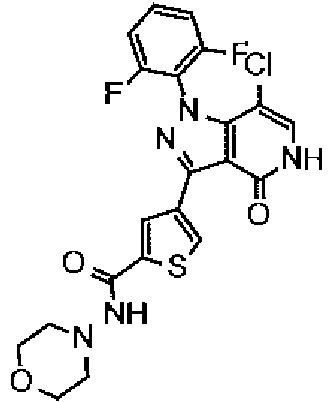
4-(7-chloro-1-(2,6-difluorophenyl)-4-oxo-4,5-dihydro-1H-pyrazolo[4,3-c]pyridin-3-yl)-N-(morpholin-4-yl)thiophene-2-carboxamide 194 
4-(7-chloro-1-(2,6-difluorophenyl)-4-oxo-4,5-dihydro-1H-pyrazolo[4,3-c]pyridin-3-yl)-N-methylbenzamide 195 
7-chloro-1-(2,6-difluorophenyl)-3-(4-(2-oxopyrrolidin-1-yl)phenyl)-1,5-dihydro-4H-pyrazolo[4,3-c]pyridin-4-one Table 3-4 Ex. Structural Formula Compound Name 196 
4-(1-(4-hydroxy-4-methylcyclohexyl)-4-oxo-4,5-dihydro-1H-pyrazolo[4,3-c]pyridin-3-yl)benzenesulfonamide 197 
4-(1-(4-hydroxy-4-methylcyclohexyl)-4-oxo-4,5-dihydro-1H-pyrazolo[4,3-c]pyridin-3-yl)benzenesulfonamide 198 
4-(1-(4-hydroxy-4-methylcyclohexyl)-4-oxo-4,5-dihydro-1H-pyrazolo[4,3-c]pyridin-3-yl)thiophene-2-carboxamide 199 
4-(1-(4-hydroxy-4-methylcyclohexyl)-4-oxo-4,5-dihydro-1H-pyrazolo[4,3-c]pyridin-3-yl)thiophene-2-carboxamide 200 
5-(7-chloro-1-(2,6-difluorophenyl)-4-oxo-4,5-dihydro-1H-pyrazolo[4,3-c]pyridin-3-yl)-2-(morpholin-4-yl)benzonitrile Table 3-5 Ex. Structural Formula Compound Name 201 
4-(1-cyclopentyl-4-oxo-4,5-dihydro-1H-pyrazolo[4,3-c]pyridin-3-yl)benzonitrile 202 
3-(1-cyclopentyl-4-oxo-4,5-dihydro-1H-pyrazolo[4,3-c]pyridin-3-yl)benzonitrile 203 
7-chloro-1-(2,6-difluorophenyl)-3-(5-(morpholin-4-ylmethyl)-3-thienyl)-1,5-dihydro-4H-pyrazolo[4,3-c]pyridin-4-one 204 
1-cyclopentyl-3-(1H-pyrazol-4-yl)-1,5-dihydro-4H-pyrazolo[4,3-c]pyridin-4-one 205 
7-chloro-1-(2,6-difluorophenyl)-3-(1-(tetrahydro-2H-pyran-4-yl)-1H-pyrazol-4-yl)-1,5-dihydro-4H-pyrazolo[4,3-c]pyridin-4-one Table 3-6 Ex. Structural Formula Compound Name 206 
7-chloro-1 -(2,6-difluorophenyl)-3-(3-fluoro-4-(morpholin-4-yl)phenyl)-1,5-dihydro-4H-pyrazolo[4,3-c]pyridin-4-one 207 
7-chloro-1-(2,6-difluorophenyl)-3-(4-(1,4-oxazepan-4-yl)phenyl)-1,5-dihydro-4H-pyrazolo[4,3-c]pyridin-4-one 208 
7-chloro-3-cyclopropyl-1-(2,6-difluorophenyl)-1,5-dihydro-4H-pyrazolo[4,3-c]pyridin-4-one 209 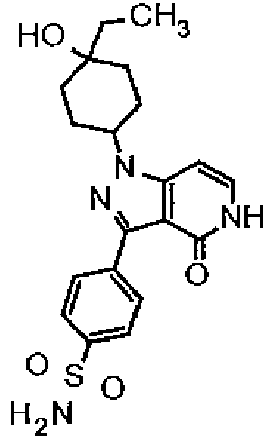
4-(1-(4-ethyl-4-hydroxycyclohexyl)-4-oxo-4,5-dihydro-1H-pyrazolo[4,3-c]pyridin-3-yl)benzenesulfonamide 210 
4-(1-(4-ethyl-4-hydroxycyclohexyl)-4-oxo-4,5-dihydro-1H-pyrazolo[4,3-c]pyridin-3-yl)benzenesulfonamide Table 3-7 Ex. Structural Formula Compound Name 211 
4-(1-(2-methylphenyl)-4-oxo-4,5-dihydro-1H-pyrazolo[4,3-c]pyridin-3-yl)benzenesulfonamide 212 
4-(4-oxo-1-(2-(trifluoromethyl)phenyl)-4,5-dihydro-1H-pyrazolo[4,3-c]pyridin-3-yl)benzenesulfonamide 213 
4-(1-(2-fluorophenyl)-4-oxo-4,5-dihydro-1H-pyrazolo[4,3-c]pyridin-3-yl)benzenesulfonamide 214 
4-(1-(2-chlorophenyl)-4-oxo-4,5-dihydro-1H-pyrazolo[4,3-c]pyridin-3-yl)benzenesulfonamide 215 
4-(7-chloro-1-(2,6-difluorophenyl)-4-oxo-4,5-dihydro-1H-pyrazolo[4,3-c]pyridin-3-yl)-2-fluorobenzamide Table 3-8 Ex. Structural Formula Compound Name 216 
4-(7-chloro-1-(2,6-difiuorophenyl)-4-oxo-4,5-dihydro-1H-pyrazolo[4,3-c]pyridin-3-yl)-2-fluoro-N-methylbenzamide 217 
2-(4-(7-chloro-1-(2,6-difluorophenyl)-4-oxo-4,5-dihydro-1H-pyrazolo[4,3-c]pyridin-3-yl)phenoxy)-N-(2-methoxyethyl)acetamide 218 
7-promo-1-(2,6-difluorophenyl)-3-(4-(morpholin-4-yl)phenyl)-1,5-dihydro-4H-pyrazolo[4,3-c]pyridin-4-one 219 
1-(4-(7-chloro-1-(2,6-d ifluorophenyl)-4-oxo-4,5-dihydro-1H-pyrazolo[4,3-c]pyridin-3-yl)benzyl)pyrrolidine-2,5-dione 220 
7-chloro-1-(2,6-difluorophenyl)-3-(5-((2-oxopyrrolidin-1-yl)methyl)-3-thienyl)-1,5-dihydro-4H-pyrazolo[4,3-c]pyridin-4-one Table 3-9 Ex. Structural Formula Compound Name 221 
2-(4-(7-chloro-1-(2,6-difluorophenyl)-4-oxo-4,5-dihydro-1H-pyrazolo[4,3-c]pyridin-3-yl)phenoxy)-N-methylacetamide 222 
4-(7-chloro-1-(2,6-difluorophenyl)-4-oxo-4,5 dihydro-1H-pyrazolo[4,3-c]pyridin-3-yl)-N-ethyl-1H-pyrazole-1-carboxamide 223 
4-(1-cyclopentyl-4-oxo-4,5-dihydro-1H-pyrazolo[4,3-c]pyridin-3-yl)-N-methylbenzenesulfonamide 224 
7-chloro-1-(2,6-difluorophenyl)-3-(4-((2-oxopyrrolidin-1-yl)methyl)phenyl)-1,5-dihydro-4H-pyrazolo[4,3-c]pyridin-4-one 225 
7-chloro-1-(2,6-difluorophenyl)-3-(4-(2-oxoimidazolidin-1-yl)phenyl)-1,5-dihydro-4H-pyrazolo[4,3-c]pyridin-4-one Table 3-10 Ex: Structural Formula Compound Name 226 
7-chloro-1-(2,6-difluorophenyl)-3-(1-methyl-1H-benzimidazol-5-yl)-1,5-dihydro-4H-pyrazolo[4,3-c]pyridin-4-one 227 
7-chloro-1-(2,6-difluorophenyl)-3-(2-oxo-2,3-dihydro-1H-indol-6-yl)-1,5-dihydro-4H-pyrazolo[4,3-c]pyridin-4-one 228 
1-(2,6-difluorophenyl)-4-oxo-3-(1H-pyrazol-4-yl)-4,5-dihydro-1H-pyrazolo[4,3-c]pyridine-7-carbonitrile 229 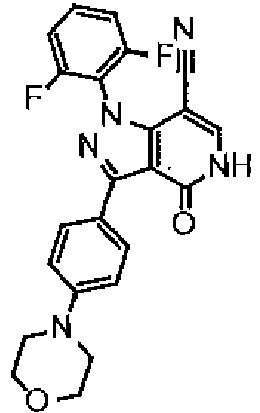
1-(2,6-difluorophenyl)-3-(4-(morpholin-4-yl)phenyl)-4-oxo-4,5-dihydro-1H-pyrazolo[4,3-c]pyridine-7-carbonitrile 230 
4-(1-(2,6-difluorophenyl)-4-oxo-4,5-dihydro-1H-pyrazolo[4,3-c]pyridin-3-yl)benzamide Table 3-11 Ex. Structural Formula Compound Name 231 
4-(7-chloro-1-(2,6-difluorophenyl)-4-oxo-4,5-dihydro-1H-pyrazolo[4,3-c]pyridin-3-yl)-N-(2-methoxyethyl)benzamide 232 
4-(7-chloro-1-(2,6-difluorophenyl)-4-oxo-4,5-dihydro-1H-pyrazolo[4,3-c]pyridin-3-yl)-N-(2-hydroxyethyl)benzamide 233 
7-chloro-1-(2,6-difluorophenyl)-3-(4-(morpholin-4-yl)phenyl)-1,5-dihydro-4H-pyrazolo[4,3-c]pyridin-4-one hydrochloride 234 
1-(2,6-difluorophenyl)-3-(5-(morpholin-4-yl)-3-thienyl)-1,5-dihydro-4H-pyrazolo[4,3-c]pyridin-4-one 235 
1-(2,6-difluorophenyl)-7-methyl-3-(4-(morpholin-4-yl)phenyl)-1,5-dihydro-4H-pyrazolo[4,3-c]pyridin-4-one Table 3-12 Ex. Structural Formula Compound Name 236 
7-chloro-1-(2,6-difluorophenyl)-3-(4-(thiomorpholin-4-yl)phenyl)-1,5-dihydro-4H-pyrazolo[4,3-c]pyridin-4-one 237 
4-(1-(2,6-difluorophenyl)-4-oxo-4,5-dihydro-1H-pyrazolo[4,3-c]pyridin-3-yl)-N-(2-hydroxyethyl)benzamide 238 
1-(2,6-difluorophenyl)-3-(1-methyl-6-oxo-1,6-dihydropyridin-3-yl)-1,5-dihydro-4H-pyrazolo[4,3-c]pyridin-4-one 239 
7-chloro-1-(2,6-difluorophenyl)-3-(4-(3-methyl-2-oxoimidazolidin-1-yl)phenyl)-1,5-dihydro-4H-pyrazolo[4,3-c]pyridin-4-one 240 
1-(2,6-difluorophenyl)-3-(4-(3-methyl-2-oxoimidazolidin-1-yl)phenyl)-1,5-dihydro-4H-pyrazolo[4,3-c]pyridin-4-one Table 3-13 Ex. Structural Formula Compound Name 241 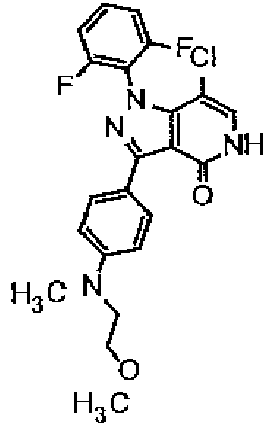
7-chloro-1-(2,6-difluorophenyl)-3-(4-((2-methoxyethyl)(methyl)amino)p henyl)-1,5-dihydro-4H-pyrazolo[4,3-c]pyridin-4-one 242 
7-chloro-1-(2,6-difluorophenyl)-3-(4-(1,1-dioxidothiomorpholin-4-yl)phenyl)-1,5-dihydro-4H-pyrazolo[4,3-c]pyridin-4-one 243 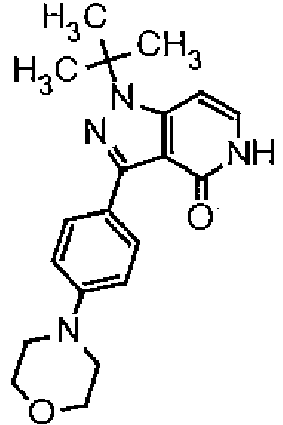
1-tert-butyl-3-(4-(morpholin-4-yl)phenyl)-1,5-dihydro-4H-pyrazolo[4,3-c]pyridin-4-one 244 
3,5-difluoro-4-(3-(4-(morpholin-4-yl)phenyl)-4-oxo-4,5-dihydro-1H-pyrazolo[4,3-c]pyridin-1-yl)benzonitrile 245 
1-(2,6-difluorophenyl)-3-(4-((3S)-3-methylmorpholin-4-yl)phenyl)-1,5-dihydro-4H-pyrazolo[4,3-c]pyridin-4-one Table 3-14 Ex. Structural Formula Compound Name 246 
1-(2,6-difluorophenyl)-3-(4-((3R)-3-methylmorpholin-4-yl)phenyl)-1,5-dihydro-4H-pyrazolo[4,3-c]pyridin-4-one 247 
4-(4-oxo-1-(pyridin-2-yl)-4,5-dihydro-1H-pyrazolo[4,3-c]pyridin-3-yl)thiophene-2-carboxamide 248 
3-((1-tert-butyl-4-oxo-4,5-dihydro-1H-pyrazolo[4,3-c]pyridin-3-yl)amino)benzenesulfonamide 249 
1-tert-butyl-3-((4-methoxybenzyl)amino)-1,5-dihydro-4H-pyrazolo[4,3-c]pyridin-4-one 250 
3-anilino-1-tert-butyl-1,5-dihydro-4H-pyrazolo(4,3-c]pyridin-4-one Table 3-15 Ex. Structural Formula Compound Name 251 
3,5-difluoro-4-(3-(4-(morpholin-4-yl)phenyl)-4-oxo-4,5-dihydro-1H-pyrazolo[4,3-c]pyridin-1-yl)benzamide 252 
2-(3-(1-(2,6-difluorophenyl)-4-oxo-4,5-dihydro-1H-pyrazolo[4,3-c]pyridin-3-yl)phenyl)acetamide 253 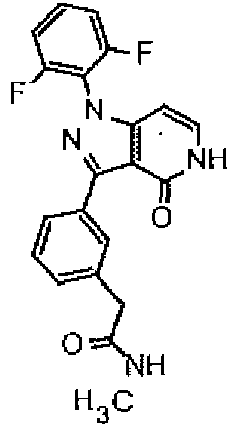
2-(3-(1-(2,6-difluorophenyl)-4-oxo-4,5-dihydro-1H-pyrazolo[4,3-c]pyridin-3-yl)phenyl)-N-methylacetamide 254 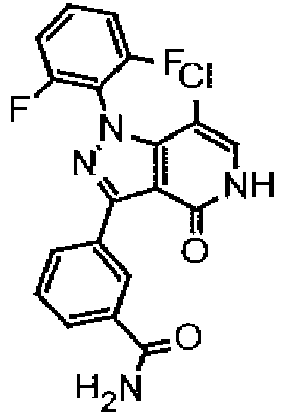
3-(7-chloro-1-(2,6-difluorophenyl)-4-oxo-4,5-dihydro-1H-pyrazolo[4,3-c]pyridin-3-yl)benzamide 255 
3-(1-(2,6-difluorophenyl)-4-oxo-4,5-dihydro-1H-pyrazolo[4,3-c]pyridin-3-yl)benzamide Table 3-16 Ex. Structural Formula Compound Name 256 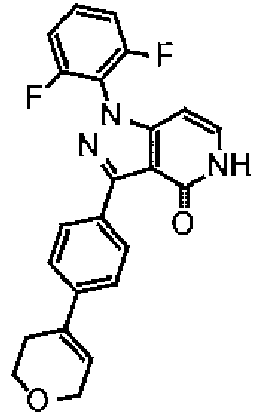
1-(2,6-dif luorophenyl)-3-(4-(3,6-dihydro-2H-pyran-4-yl)phenyl)-1,5-dihydro-4H-pyrazolo[4,3-c]pyridin-4-one 257 
1-(2,6-difluorophenyl)-3-(4-(tetrahydro-2H-pyran-4-yl)phenyl)-1,5-dihydro-4H-pyrazolo[4,3-c]pyridin-4-one 258 
1-(2,6-difluorophenyl)-3-(3-((dimethylamino)methyl)phenyl )-1,5-dihydro-4H-pyrazolo[4,3-c]pyridin-4-one 259 
ethyl 5-(1-(2,6-difluorophenyl)-4-oxo-4,5-dihydro-1H-pyrazolo[4,3-c]pyridin-3-yl)pyridine-2-carboxylate 260 
methyl 4-(1-(2,6-difluorophenyl)-4-oxo-4,5-dihydro-1H-pyrazolo[4,3-c]pyridin-3-yl)benzoate Table 3-17 Ex. Structural Formula Compound Name 261 
1-(2,6-difluorophenyl)-3-(3-((3,3-difluoropyrrolidin-1-yl)methyl)phenyl)-1,5-dihydro-4H-pyrazolo[4,3-c]pyridin-4-one 262 
4-(1-((2S)-1-methoxybutan-2-yl)-4-oxo-4,5-dihydro-1H-pyrazolo[4,3-c]pyridin-3-yl)thiophene-2-carboxamide 263 
4-(1-((2R)-1-methoxybutan-2-yl)-4-oxo-4,5-dihydro-1H-pyrazolo[4,3-c]pyridin-3-yl)thiophene-2-carboxamide 264 
3-amino-1-tert-butyl-1,5-dihydro-4H-pyrazolo[4,3-c]pyridin-4-one 265 
N-(1-tert-butyl-4-oxo-4,5-dihydro-1H-pyrazolo[4,3-c]pyridin-3-yl)benzamide Table 3-18 Ex. Structural Formula Compound Name 266 
1-(4,4-difluorocyclohexyl)-3-(4-(morpholin-4-yl)phenyl)-1,5-d ihydro-4H-pyrazolo[4,3-c]pyridin-4-one 267 
3-(1-(2,6-difluorophenyl)-4-oxo-4,5-dihydro-1H-pyrazolo[4,3-c]pyridin-3-yl)-4-fluorobenzamide 268 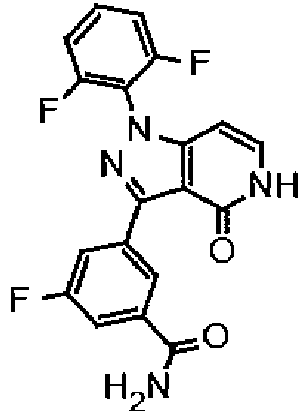
3-(1-(2,6-difluorophenyl)-4-oxo-4,5-dihydro-1H-pyrazolo[4,3-c]pyridin-3-yl)-5-fluorobenzamide 269 
3-(7-chloro-1-(2,6-difluorophenyl)-4-oxo-4,5-dihydro-1H-pyrazolo[4,3-c]pyridin-3-yl)-4-fluorobenzamide 270 
3-(7-chloro-1-(2,6-difluorophenyl)-4-oxo-4,5-dihydro-1H-pyrazolo[4,3-c]pyridin-3-yl)-5-fluorobenzamide Table 3-19 Ex. Structural Formula Compound Name 271 
3-(7-chloro-1-(2,6-difluorophenyl)-4-oxo-4,5-dihydro-1H-pyrazolo[4,3-c]pyridin-3-yl)-4-fluoro-N-methylbenzamide 272 
3-(1-(2,6-difluorophenyl)-4-oxo-4,5-dihydro-1H-pyrazolo[4,3-c]pyridin-3-yl)-4-fluoro-N-methylbenzamide 273 
3-(7-chloro-1-(2,6-difluorophenyl)-4-oxo-4,5-dihydro-1H-pyrazolo[4,3-c]pyridin-3-yl)-5-fluoro-N-methylbenzamide 274 
3-(1-(2,6-difluorophenyl)-4-oxo-4,5-dihydro-1H-pyrazolo[4,3-c]pyridin-3-yl)-5-fluoro-N-methylbenzamide 275 
1-(2,6-difluorophenyl)-3-(4-((2-oxopyrrolidin-1-yl)methyl)phenyl)-1,5-dihydro-4 H-pyrazolo[4,3-clpyrid in-4-one Table 3-20 Ex. Structural Formula Compound Name 276 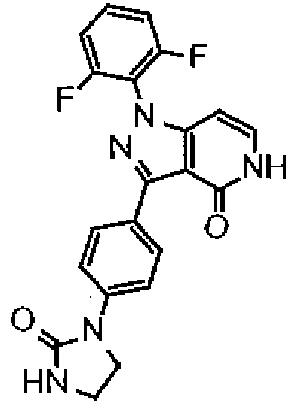
1-(2,6-difluorophenyl)-3-(4-(2-oxoimidazolidin-1-yl)phenyl)-1,5-dihydro-4H-pyrazolo[4,3-c]pyridin-4-one 277 
N-(4-(1-(2,6-difluorophenyl)-4-oxo-4,5-dihydro-1H-pyrazolo[4,3-c]pyridin-3-yl)phenyl)acetamide 278 
1-(2,6-dif luorophenyl)-3-(3-(hydroxymethyl)phenyl)-1,5-dihydro-4H-pyrazolo[4,3-c]pyridin-4-one 279 
3-(4-(4-acetylpiperazin-1-yl)phenyl)-1-(2,6-difluorophenyl)-1,5-dihydro-4H-pyrazolo[4,3-c]pyridin-4-one 280 
4-(7-bromo-1-cyclopentyl-4-oxo-4,5-dihydro-1H-pyrazolo[4,3-c]pyridin-3-yl)thiophene-2-carboxamide Table 3-21 Ex. Structural Formula Compound Name 281 
4-(1-cyclopentyl-7-methyl-4-oxo-4,5-dihydro-1H-pyrazolo[4,3-c]pyridin-3-yl)thiophene-2-carboxamide 282 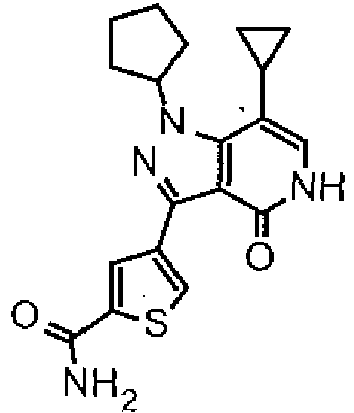
4-(1-cyclopentyl-7-cyclopropyl-4-oxo-4,5-dihydro-1H-pyrazolo[4,3-c]pyridin-3-yl)thiophene-2-carboxamide 283 
3-anilino-1-cyclopentyl-1,5-dihydro-4H-pyrazolo[4,3-c]pyridin-4-one 284 
3-((1-cyclopentyl-4-oxo-4,5-dihydro-1H-pyrazolo[4,3-c]pyridin-3-yl)amino)benzenesulfonamide 285 
3-((7-bromo-1-cyclopentyl-4-oxo-4,5-dihydro-1H-pyrazolo[4,3-c]pyridin-3-yl)amino)benzenesulfonamide Table 3-22 Ex. Structural Formula Compound Name 286 
4-(1-cyclopentyl-4-oxo-4,5-dihydro-1H-pyrazolo[4,3-c]pyridin-3-yl)-N,N-dimethylthiophene-2-carboxamide 287 
1-(2,6-difluorophenyl)-3-(3-((3,3-difluoropyrrolidin-1-yl)methyl)phenyl)-1,5-dihydro-4H-pyrazolo[4,3-c]pyridin-4-one hydrochloride 288 
1-(2,6-difiluorophenyl)-3-(3-(pyrrolidin-1-ylmethyl)phenyl)-1,5-dihydro-4H-pyrazolo[4,3-c]pyridin-4-one 289 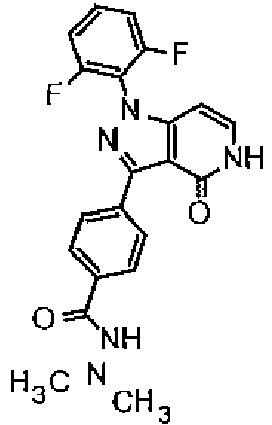
4-(1-(2,6-difluorophenyl)-4-oxo-4,5-dihydro-1H-pyrazolo[4,3-c]pyridin-3-yl)-N', N'-dimethylbenzhydrazide 290 
4-(1-(4,4-difluorocyclohexyl)-4-oxo-4,5-dihydro-1H-pyrazolo[4,3-c]pyridin-3-yl)benzenesulfonamide Table 3-23 Ex. Structural Formula Compound Name 291 
2-(3-(1-(2,6-difluorophenyl)-4-oxo-4,5-dihydro-1H-pyrazolo[4,3-c]pyridin-3-yl)-4-f luorop henyl)acetamide 292 
1-(2,6-difluorophenyl)-3-(4-(2-oxopyrrolidin-1-yl)phenyl)-1,5-d ihydro-4H-pyrazolo[4,3-c]pyridin-4-one 293 
2-(3-(1-(2,6-difluorophenyl)-4-oxo-4,5-dihydro-1H-pyrazolo [4,3-c]pyrid in-3-yl)-4-fluorophenyl)-N-methylacetamide 294 
4-(1-(2,6-difluorophenyl)-4-oxo-4,5-dihydro-1H-pyrazolo[4,3-c]pyridin-3-yl)-3-fluoro-N-methylbenzamide 295 
3-chloro-4-(1-(2,6-difluorophenyl)-4-oxo-4,5-dihydro-1H-pyrazolo[4,3-c]pyridin-3-yl)-N-methylbenzamide Table 3-24 Ex. Structural Formula Compound Name 296 
4-(7-chloro-1-cyclopentyl-4-oxo-4,5-dihydro-1H-pyrazolo[4,3-c]pyridin-3-yl)thiophene-2-carboxamide 297 
4-((1-cyclopentyl-4-oxo-4,5-dihydro-1H-pyrazolo[4,3-c]pyridin-3-yl)amino)benzenesulfonamide 298 
4-(1-(cis-4-aminocyclohexyl)-4-oxo-4,5-dihydro-1H-pyrazolo[4,3-c]pyridin-3-yl)thiophene-2-carboxamide 299 
4-(1-(trans-4-aminocyclohexyl)-4-oxo-4,5-dihydro-1H-pyrazolo[4,3-c]pyridin-3-yl)thiophene-2-carboxamide 300 
3-(2-aminopyrimidin-5-yl)-1-(2,6-difluorophenyl)-1,5-d ihydro-4H-pyrazolo[4,3-c]pyridin-4-one Table 3-25 Ex. Structural Formula Compound Name 301 
3-(4-(1-acetylpiperidin-4-yl)phenyl)-1-(2,6-difluorophenyl)-1,5-dihydro-4 H-pyrazolo[4,3-c]pyridin-4-one 302 
4-(1-(4-amino-2-fluoro-6-methoxyphenyl)-4-oxo-4,5-dihydro-1H-pyrrolo[3,2-c]pyridin-3-yl)thiophene-2-carboxamide 303 
4-(1-(4-amino-2,6-d ifluorophenyl)-4-oxo-4,5-dihydro-1H-pyrazolo[4,3-c]pyridin-3-yl)benzenesulfonamide 304 
1-(2,6-difluorophenyl)-3-(4-(3-oxomorpholin-4-yl)phenyl)-1,5-dihydro-4H-pyrazolo[4,3-c]pyridin-4-one 305 
3-fluoro-2-(3-(4-(morpholin-4-yl)phenyl)-4-oxo-4,5-dihydro-1H-pyrazolo[4,3-c]pyridin-1-yl)benzonitrile Table 3-26 Ex. Structural Formula Compound Name 306 
3-fluoro-2-(3-(6-(morpholin-4-yl)pyridin-3-yl)-4-oxo-4,5-dihydro-1H-pyrazolo[4,3-c]pyridin-1-yl)benzonitrile 307 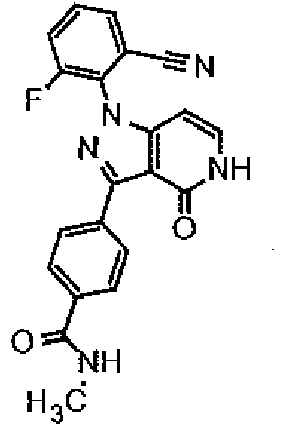
4-(1-(2-cyano-6-fluorophenyl)-4-oxo-4,5-dihydro-1H-pyrazolo[4,3-c]pyridin-3-yl)-N-methylbenzamide 308 
3-(4-(morpholin-4-yl)phenyl)-1-(2,4,6-trifluorophenyl)-1,5-dihydro-4H-pyrazolo[4,3-c]pyridin-4-one 309 
1-(2,6-difluorophenyl)-3-(6-(morpholin-4-yl)pyridin-3-yl)-1,5-dihydro-4H-pyrazolo[4,3-c]pyridin-4-one 310 
1-(4-(1-(2,6-difluorophenyl)-4-oxo-4,5-dihydro-1H-pyrazolo[4,3-c]pyridin-3-yl)phenyl)-N-methylpiperidine-4-carboxamide Table 3-27 Ex. Structural Formula Compound Name 311 
1-(2,6-difluorophenyl)-3-(4-(4-(methylsulfonyl)piperazin-1-yl)phenyl)-1,5-dihydro-4H-pyrazolo[4,3-c]pyridin-4-one 312 
1-(2,6-difluorophenyl)-3-(4-(4-glycoloylpiperazin-1-yl)phenyl)-1,5-dihydro-4H-pyrazolo[4,3-c]pyridin-4-one 313 
1-(2,6-difluorophenyl)-3-(4-(4-(methoxyacetyl)piperazin-1-yl)phenyl)-1,5-dihydro-4H-pyrazolo[4,3-c]pyridin-4-one 314 
1-(2,2-dimethylcyclopentyl)-3-(4-(morpholin-4-yl)phenyl)-1,5-d ihydro-4H-pyrazolo[4,3-c]pyridin-4-one 315 
3-fluoro-2-(4-oxo-3-(1H-pyrazol-4-yl)-4,5-dihydro-1H-pyrazolo[4,3-c]pyridin-1-yl)benzonitrile Table 3-28 Ex. Structural Formula Compound Name 316 
3-(4-(1-acetyl-3,3-difluoropiperidin-4-yl)phenyl)-1-(2,6-difluorophenyl)-1,5-dihydro-4H-pyrazolo[4,3-c]pyridin-4-one 317 
1-(2,2-difluorocyclohexyl)-3-(4-(morpholin-4-yl)phenyl)-1,5-d ihyd ro-4H-pyrazolo[4,3-c]pyridin-4-one Formulation Example 1 (production of capsule) 1) compound of Example 1 30 mg 2) fine powder cellulose 10 mg 3) lactose 19 mg 4) magnesium stearate 1 mg Total 60 mg 1), 2), 3) and 4) are mixed and filled in a gelatin capsule. Formulation Example 2 (production of tablet) 1) compound of Example 1 30 g 2) lactose 50 g 3) cornstarch 15 g 4) calcium carboxymethylcellulose 44 g 5) magnesium stearate 1 g 1000 tablets total 140 g - The total amounts of 1), 2) and 3) and 4) (30 g) are kneaded with water, and the mixture is vacuum dried, and sieved. The sieved powder is mixed with 4) (14 g) and 5) (1 g), and the mixture is punched by a tableting machine, whereby 1000 tablets containing 30 mg of the compound of Example 1 per tablet are obtained.
- JAK1 enzyme inhibitory activity of test compounds was measured by LANCE method (PerkinElmer). First, a test compound diluted with assay buffer (50 mM HEPES (pH = 7.5), 10 mM MgCl2, 1 mM EGTA, 2 mM DTT, 0.01% Tween20, 0.01% BSA) was added to 384-well plate at 2µL each. Then, a JAK1 (Invitrogen) solution and a fluorescence-labeled peptide substrate (ULight-JAK1, PerkinElmer) solution diluted with assay buffer at 187.5 ng/mL and 300 nM, respectively were added at 2 µL each. Then, enzyme reaction was started by adding 2 µL each of ATP solution prepared with assay buffer at 150 µM. After the reaction at room temperature for 1 hr, Detection Buffer (PerkinElmer) prepared to be 20 mM EDTA, 4 nM europium-labeled anti-phosphotyrosine antibody (PerkinElmer) was added at 6 µL each. After standing at room temperature for 1 hr, fluorescence intensity (excitation wavelength 340 nm, fluorescence wavelength 665 nm, delay time 100 microsecond) was measured by a plate reader, Envision (PerkinElmer). The inhibitory activity of each compound was calculated as relative value where fluorescence intensity of a well without enzyme is considered as 100% inhibition. The results are shown in Table 4.
- Tyk2 enzyme inhibitory activity of test compounds was measured by LANCE method (PerkinElmer). First, a test compound diluted with assay buffer (50 mM HEPES (pH = 7.5), 10 mM MgCl2, 1 mM EGTA, 2 mM DTT, 0.01% Tween20, 0.01% BSA) was added to 384-well plate at 2µL each. Then, a Tyk2 (Invitrogen) solution and a fluorescence-labeled peptide substrate (ULight-JAK1, PerkinElmer) solution diluted with assay buffer at 375 ng/mL and 300 nM, respectively were added at 2 µL each. Then, enzyme reaction was started by adding 2 µL each of ATP solution prepared with assay buffer at 30 µM. After the reaction at room temperature for 1 hr, Detection Buffer (PerkinElmer) prepared to be 20 mM EDTA, 4 nM europium-labeled anti-phosphotyrosine antibody (PerkinElmer) was added at 6 µL each. After standing at room temperature for 1 hr, fluorescence intensity (excitation wavelength 340 nm, fluorescence wavelength 665 nm, delay time 100 microsecond) was measured by a plate reader, Envision (PerkinElmer). The inhibitory activity of each compound was calculated as relative value where fluorescence intensity of a well without enzyme is considered as 100% inhibition. The results are shown in Table 4.
Table 4-1 Inhibitory rate (%) Ex.No. JAK1 10 µM Tyk2 10 µM 10 38 19 44 27 41 38 49 53 10 28 90 38 22 Table 4-2 Inhibitory rate (%) Ex.No. JAK1 1 µM Tyk2 1 µM 1 40 51 2 99 97 3 97 96 4 99 99 5 97 96 6 98 99 7 95 90 8 98 98 Table 4-3 Inhibitory rate (%) Ex.No. JAK1 1 µM Tyk2 1 µM 9 97 93 11 55 66 12 98 98 13 99 99 14 99 98 15 99 97 16 93 88 17 87 69 18 93 80 20 59 35 21 97 95 22 77 53 23 98 98 24 35 33 25 77 71 26 20 41 27 98 98 28 99 97 29 14 83 30 94 92 31 95 90 32 98 95 33 99 99 34 92 99 35 99 97 36 97 98 37 99 99 38 100 99 39 99 98 40 78 78 42 53 51 43 87 91 44 94 91 45 90 74 46 91 95 47 62 71 Table 4-4 Inhibitory rate (%) Ex.No. JAK1 1 µM Tyk2 1 µM 48 3 7 49 85 89 50 92 92 51 90 84 52 43 46 54 91 91 55 78 85 56 13 31 57 88 81 58 86 91 59 66 56 60 50 89 61 8 41 62 69 81 63 59 51 65 27 76 66 66 92 67 65 91 68 4 67 69 28 92 70 41 88 71 99 97 72 97 99 73 45 83 74 44 85 75 93 84 76 92 99 77 96 99 78 23 75 79 44 93 80 82 97 81 62 97 82 95 78 83 97 89 84 84 58 85 99 100 Table 4-5 Inhibitory rate (%) Ex.No. JAK1 1 µM Tyk2 1 µM 86 94 85 87 99 96 88 96 91 89 64 94 91 19 2 92 100 99 93 98 99 94 80 78 95 86 98 96 94 99 97 97 99 98 78 97 99 97 99 100 96 77 101 80 91 102 67 94 103 48 91 104 94 99 105 88 66 106 91 98 107 96 98 108 99 100 109 61 94 110 46 91 111 96 99 112 89 98 115 87 66 116 89 99 117 99 98 118 94 99 119 100 99 120 88 98 121 87 97 122 99 100 123 99 99 124 89 98 Table 4-6 Inhibitory rate (%) Ex.No. JAK1 1 µM Tyk2 1 µM 125 80 96 126 99 98 127 99 97 128 93 93 129 98 97 130 76 96 131 97 99 132 27 74 133 47 90 134 78 97 135 56 97 136 59 93 137 77 98 138 94 99 139 96 98 140 17 91 141 99 92 142 96 97 143 93 92 144 99 99 145 99 100 146 69 98 147 74 99 148 99 98 149 100 99 150 99 98 151 98 98 152 97 99 153 89 100 154 90 99 155 100 99 156 100 100 157 100 99 158 91 91 159 91 87 160 98 98 Table 4-7 Inhibitory rate (%) Ex. No. JAK1 1 µM Tyk2 1 µM 161 79 99 162 99 99 163 98 100 164 66 99 165 96 98 166 98 100 167 53 97 168 46 97 169 79 99 170 99 98 171 100 100 172 99 97 173 99 96 174 99 98 176 86 100 176 95 100 177 91 100 178 93 99 179 94 100 180 92 101 Table 4-8 Inhibitory rate (%) Ex.No. JAK1 10 µM Tyk2 10 µM 208 28 83 249 30 25 264 44 12 265 21 24 267 17 31 269 24 29 271 -1 26 272 12 25 293 0 22 295 24 80 298 81 58 Table 4-9 Inhibitory rate (%) JAK1 1 µM Tyk2 1 µM 182 98 98 183 100 100 184 100 99 185 72 99 186 82 99 187 83 98 188 84 100 189 92 100 190 81 99 191 98 100 192 94 99 193 99 100 194 67 100 195 79 100 196 100 100 197 99 98 198 100 100 199 99 100 200 22 98 201 96 97 202 80 87 203 81 100 204 98 98 205 34 97 206 45 100 207 73 100 209 99 99 210 99 97 211 99 98 212 99 96 213 98 99 214 99 99 215 22 94 216 27 97 217 74 99 218 85 99 219 82 98 220 98 100 Table 4-10 Inhibitory rate (%) JAK1 1 µM Tyk2 1 µM 221 80 99 222 69 98 223 99 97 224 78 99 225 58 99 226 40 98 227 54 97 228 85 99 229 81 98 230 92 99 231 51 99 232 60 100 233 79 99 234 99 99 235 92 99 236 65 99 237 87 99 238 72 91 239 46 99 240 88 99 241 53 98 242 27 97 243 52 76 244 89 97 245 96 100 246 94 99 247 86 88 248 96 70 250 93 69 251 96 99 252 91 98 253 87 98 254 65 98 255 93 98 256 92 98 257 96 98 258 43 88 259 59 81 Table 4-11 Inhibitory rate (%) JAK1 1 µM Tyk2 1 µM 260 77 94 261 41 94 262 97 92 263 97 90 266 85 91 268 4 33 270 0 69 273 1 71 274 34 77 275 96 98 276 91 99 277 95 99 278 92 98 279 96 99 280 94 97 281 96 96 282 76 85 283 98 93 284 99 96 285 70 82 286 98 97 288 55 94 289 92 99 290 98 95 292 97 99 294 35 92 296 90 96 297 98 99 299 99 99 300 68 83 301 97 99 302 97 95 303 99 100 304 97 99 305 93 99 306 90 98 307 92 99 308 91 98 Table 4-12 Inhibitory rate (%) JAK1 1 µM Tyk2 1 µM 309 93 99 310 93 100 311 95 99 312 94 99 313 95 100 314 95 99 315 97 98 316 99 99 317 96 99 - The compound of the present invention has a superior JAK inhibitory action, and is useful as an agent for the treatment of autoimmune disease (rheumatoid arthritis, psoriasis, inflammatory bowel disease, Sjogren's syndrome, Behcet's disease, multiple sclerosis, systemic lupus erythematosus, etc.), cancer (leukemia, uterine leiomyosarcoma, prostate cancer, multiple myeloma, cachexia, myelofibrosis, etc.) and the like.
- This application is based on patent application No.
2012-126462
and the like. These compounds can be produced from compound (I) according to a method known per se.
Claims (12)
- A compound represented by the formula (I):
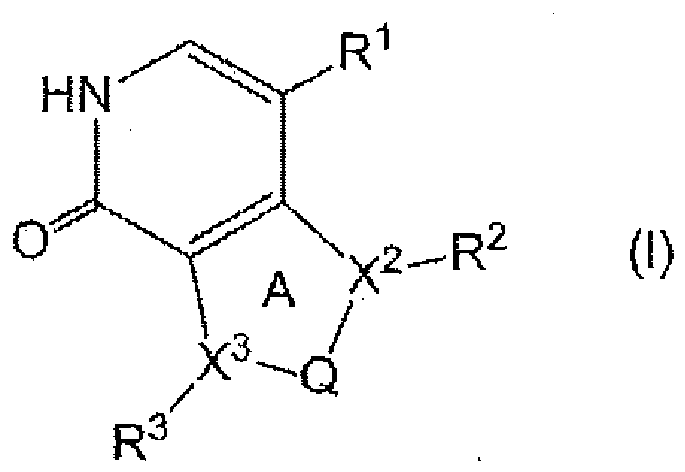 Ring A moiety is a nitrogen-containing aromatic heterocycle
whereinQ is a carbon atom or a nitrogen atom, andX2 and X3 are each independently a carbon atom or a nitrogen atom, and any one of them is a nitrogen atom;R1 is a hydrogen atom, a halogen atom, a cyano group, an acyl group, an optionally substituted C1-6 alkyl group, an optionally substituted C3-6 cycloalkyl group or an optionally substituted hydroxy group;R2 is a substituted C1-2 alkyl group, an optionally substituted C3-6 alkyl group, an acyl group, an optionally substituted hydroxy group, an optionally substituted amino group, an optionally substituted carbocyclic group or an optionally substituted heterocyclic group; andR3 is a substituted C1-2 alkyl group, an optionally substituted C3-6 alkyl group, an acyl group, an optionally substituted hydroxy group, an optionally substituted amino group, an optionally substituted carbocyclic group or an optionally substituted heterocyclic group,provided that 3-(3-fluorophenyl)-1-trityl-1,5-dihydro-4H-pyrazolo[4,3-c]pyridin-4-one is excluded,
or a salt thereof. - The compound or salt of claim 1, wherein
R1 is(1) a hydrogen atom,(2) a halogen atom,(3) a cyano group,(4) a carboxy group,(5) a C1-6 alkyl-carbonyl group,(6) a C1-6 alkoxy-carbonyl group,(7) a carbamoyl group optionally mono- or di-substituted by C1-6 alkyl group(s),(8) a C1-6 alkyl group optionally substituted by 1 to 3 hydroxy groups, or(9) a C3-6 cycloalkyl group;R2 is(1) a C1-2 alkyl group substituted by 1 to 3 substituents selected from(a) a C6-14 aryl group optionally substituted by 1 to 3 C1-6 alkoxy groups, and(b) a 3- to 8-membered monocyclic non-aromatic heterocyclic group optionally substituted by 1 to 3 C1-6 alkyl groups,(2) a C3-6 alkyl group optionally substituted by 1 to 3 substituents selected from(a) a hydroxy group, and(b) a C1-6 alkoxy group,(3) a C3-10 cycloalkyl group optionally substituted by 1 to 3 substituents selected from(a) a hydroxy group,(b) a C1-6 alkyl group,(c) an oxo group,(d) a C1-6 alkylenedioxy group,(e) a C6-14 aryl group,(f) a halogen atom, and(g) an amino group,(4) a C6-14 aryl group optionally substituted by 1 to 3 substituents selected from(a) a halogen atom,(b) a C1-6 alkyl group optionally substituted by 1 to 3 halogen atoms,(c) a cyano group,(d) a carbamoyl group,(e) an amino group, and(f) a C1-6 alkoxy group,(5) a 3- to 8-membered monocyclic non-aromatic heterocyclic group, or(6) a 5- to 7-membered monocyclic aromatic heterocyclic group; andR3 is(1) a C1-2 alkyl group substituted by 1 to 3 substituents selected from a C6-14 aryl group optionally substituted by 1 to 3 sulfamoyl groups,(2) a C3-10 cycloalkyl group,(3) a C3-10 cycloalkenyl group,(4) a C6-14 aryl group optionally substituted by 1 to 3 substituents selected from(a) a halogen atom,(b) a nitro group,(c) a cyano group,(d) a carbamoyl group optionally mono- or di-substituted by C1-6 alkyl group(s) optionally substituted by 1 to 3 substituents selected from(i) a C1-6 alkoxy group,(ii) a hydroxy group, and(iii) an amino group optionally mono- or di-substituted by C1-6 alkyl group(s),(e) a sulfamoyl group optionally mono- or di-substituted by C1-6 alkyl group(s),(f) a C1-6 alkyl group optionally substituted by 1 to 3 substituents selected from(i) a halogen atom,(ii) a cyano group,(iii) a hydroxy group,(iv) a carbamoyl group optionally mono- or di-substituted by substituent(s) selected from a C1-6 alkyl group and a C3-10 cycloalkyl group,(v) an amino group optionally mono- or di-substituted by C1-6 alkyl group(s), and(vi) a 3- to 8-membered monocyclic non-aromatic heterocyclic group optionally substituted by 1 to 3 substituents selected from an oxo group and a halogen atom,(g) a C1-6 alkoxy group optionally substituted by 1 to 3 substituents selected from(i) a halogen atom,(ii) a cyano group,(iii) a hydroxy group, and(iv) a carbamoyl group optionally mono- or di-substituted by substituent(s) selected from a C1-6 alkyl group optionally substituted by 1 to 3 C1-6 alkoxy groups,(h) a C1-6 alkoxy-carbonyl group,(i) an amino group optionally mono- or di-substituted by substituent(s) selected from(i) a C1-6 alkyl-carbonyl group, and(ii) a C1-6 alkyl group optionally substituted by 1 to 3 C1-6 alkoxy groups,(j) a 3- to 8-membered monocyclic non-aromatic heterocyclic group optionally substituted by 1 to 3 substituents selected from(i) an oxo group,(ii) a C1-6 alkyl group,(iii) a C1-6 alkyl-carbonyl group optionally substituted by 1 to 3 substituents selected from a hydroxy group and a C1-6 alkoxy group,(iv) a carbamoyl group optionally mono- or di-substituted by C1-6 alkyl group(s),(v) a C1-6 alkylsulfonyl group, and(vi) a halogen atom, and(k) a C1-6 alkylenedioxy group,(5) a 5- to 7-membered monocyclic aromatic heterocyclic group optionally substituted by 1 to 3 substituents selected from(a) a carboxy group,(b) a cyano group,(c) a C1-6 alkoxy-carbonyl group,(d) a carbamoyl group optionally mono- or di-substituted by substituent(s) selected from(i) a C1-6 alkyl group optionally substituted by 1 to 3 substituents selected from a hydroxy group and a cyano group,(ii) a C3-10 cycloalkyl group optionally substituted by 1 to 3 cyano groups,(iii) a 5- to 7-membered monocyclic aromatic heterocyclic group optionally substituted by 1 to 3 C1-6 alkyl groups, and(iv) a 3- to 8-membered monocyclic non-aromatic heterocyclic group,(e) a 3- to 8-membered monocyclic non-aromatic heterocyclic group optionally substituted by 1 to 3 oxo groups,(f) a C1-6 alkyl group optionally substituted by 1 to 3 substituents selected from(i) a cyano group,(ii) a carbamoyl group, and(iii) a 3- to 8-membered monocyclic non-aromatic heterocyclic group optionally substituted by 1 to 3 oxo groups,(g) a C3-10 cycloalkyl group,(h) a 3- to 8-membered monocyclic non-aromatic heterocyclylcarbonyl group, and(i) an amino group,(6) a 8- to 12-membered fused aromatic heterocyclic group optionally substituted by 1 to 3 C1-6 alkyl groups,(7) a 3- to 8-membered monocyclic non-aromatic heterocyclic group optionally substituted by 1 to 3 substituents selected from(a) an oxo group, and(b) a C1-6 alkyl group,(8) a 8- to 12-membered fused non-aromatic heterocyclic group optionally substituted by 1 to 3 oxo groups, or(9) an amino group optionally mono- or di-substituted by substituent(s) selected from(a) a C6-14 aryl group optionally substituted by 1 to 3 substituents selected from(i) a carbamoyl group, and(ii) a sulfamoyl group,(b) a C1-6 alkyl group optionally substituted by 1 to 3 substituents selected from a C6-14 aryl group optionally substituted by 1 to 3 C1-6 alkoxy groups, and(c) a C6-14 aryl-carbonyl group. - The compound or salt of claim 1, which is 4-(1-cyclopentyl-4-oxo-4,5-dihydro-1H-pyrrolo[3,2-c]pyridin-3-yl)thiophene-2-carboxamide.
- The compound or salt of claim 1, which is 2-(4-(1-(2,6-difluorophenyl)-4-oxo-4,5-dihydro-1H-pyrazolo[4,3-c]pyridin-3-yl)phenyl)acetamide.
- The compound or salt of claim 1, which is 3-((1-cyclopentyl-4-oxo-4,5-dihydro-1H-pyrazolo[4,3-c]pyridin-3-yl)amino)benzenesulfonamide.
- A medicament comprising the compound or salt of claim 1.
- The medicament of claim 6, which is a janus kinase inhibitor.
- The medicament of claim 6, which is an agent for the prophylaxis or treatment of autoimmune disease.
- The compound or salt of claim 1 for use in the prophylaxis or treatment of autoimmune diseases.
- A method of inhibiting janus kinase in a mammal, which comprises administering an effective amount of the compound or salt of claim 1 to the mammal.
- A method for the prophylaxis or treatment of autoimmune diseases, which comprises administering an effective amount of the compound or salt of claim 1 to the mammal.
- Use of the compound or salt of claim 1 for the production of an agent for the prophylaxis or treatment of autoimmune diseases.
Applications Claiming Priority (2)
| Application Number | Priority Date | Filing Date | Title |
|---|---|---|---|
| JP2012126462 | 2012-06-01 | ||
| PCT/JP2013/065183 WO2013180265A1 (en) | 2012-06-01 | 2013-05-31 | Heterocyclic compound |
Publications (2)
| Publication Number | Publication Date |
|---|---|
| EP2857400A1 true EP2857400A1 (en) | 2015-04-08 |
| EP2857400A4 EP2857400A4 (en) | 2015-12-09 |
Family
ID=49673448
Family Applications (1)
| Application Number | Title | Priority Date | Filing Date |
|---|---|---|---|
| EP13797604.9A Withdrawn EP2857400A4 (en) | 2012-06-01 | 2013-05-31 | HETEROCYCLIC COMPOUND |
Country Status (8)
| Country | Link |
|---|---|
| US (2) | US9371320B2 (en) |
| EP (1) | EP2857400A4 (en) |
| JP (1) | JPWO2013180265A1 (en) |
| CN (1) | CN104507940B (en) |
| BR (1) | BR112014029705A2 (en) |
| CA (1) | CA2874987A1 (en) |
| EA (1) | EA201492250A1 (en) |
| WO (1) | WO2013180265A1 (en) |
Cited By (5)
| Publication number | Priority date | Publication date | Assignee | Title |
|---|---|---|---|---|
| EP2976339A4 (en) * | 2013-03-19 | 2016-08-31 | Merck Sharp & Dohme | GEPENALLY SUBSTITUTED CYANOETHYLPYRAZOLOPYRIDONES AS INHIBITORS OF JANUS KINASE |
| EP2976338A4 (en) * | 2013-03-19 | 2016-08-31 | Merck Sharp & Dohme | N- (2-CYANO-HETEROCYCLYL) PYRAZOLO-PYRIDONES AS INHIBITORS OF JANUS KINASE |
| EP2976340A4 (en) * | 2013-03-19 | 2016-08-31 | Merck Sharp & Dohme | CYCLOALKYLNITRILE PYRAZOLOPYRIDONES AS INHIBITORS OF JANUS KINASE |
| EP2976341A4 (en) * | 2013-03-19 | 2016-10-12 | Merck Sharp & Dohme | CYANOETHYLPYRAZOLO PYRIDONES ACYCLIC AS INHIBITORS OF JANUS KINASE |
| WO2024146923A1 (en) | 2023-01-04 | 2024-07-11 | Ab Science | Tubulin polymerization inhibitors |
Families Citing this family (13)
| Publication number | Priority date | Publication date | Assignee | Title |
|---|---|---|---|---|
| CN105189508B (en) * | 2013-03-19 | 2018-11-23 | 默沙东公司 | Naphthenic base nitrile Pyrazolopyridine ketone as JANUS kinase inhibitor |
| ES2661012T3 (en) * | 2013-03-28 | 2018-03-27 | Takeda Pharmaceutical Company Limited | Heterocyclic compound |
| WO2019073253A1 (en) | 2017-10-13 | 2019-04-18 | Imperial Innovations Limited | Map4k4 inhibitors |
| KR102094802B1 (en) * | 2017-10-24 | 2020-03-31 | 고려대학교 산학협력단 | Method for diagnosing Behcet's disease by using urine metabolomics |
| GB201819839D0 (en) | 2018-12-05 | 2019-01-23 | Imperial Innovations Ltd | MAP4K4 inhibitors |
| CN110343103A (en) * | 2019-07-04 | 2019-10-18 | 深圳市格物致欣化学技术有限公司 | Pyrazolo-pyridines and preparation method thereof |
| JP2022549506A (en) | 2019-09-27 | 2022-11-25 | ディスク・メディシン・インコーポレイテッド | Methods for treating myelofibrosis and related conditions |
| KR20230012539A (en) | 2020-05-13 | 2023-01-26 | 디스크 메디슨, 인크. | Anti-hemojuvelin (HJV) antibodies to treat myelofibrosis |
| JP2024507253A (en) | 2021-02-19 | 2024-02-16 | スドー バイオサイエンシーズ リミテッド | TYK2 inhibitors and their uses |
| JP2024508794A (en) | 2021-02-19 | 2024-02-28 | スドー バイオサイエンシーズ リミテッド | TYK2 inhibitors and their uses |
| CA3207819A1 (en) | 2021-02-19 | 2022-08-25 | Anjali Pandey | Tyk2 inhibitors and uses thereof |
| CN113671064B (en) * | 2021-07-15 | 2022-05-17 | 中国海洋大学 | A kind of detection method for quantitatively analyzing the blood concentration of ammoniacaloxin in plasma |
| CN118126036A (en) * | 2022-12-01 | 2024-06-04 | 复旦大学 | 7-Azaindole compounds and preparation methods and applications thereof |
Family Cites Families (17)
| Publication number | Priority date | Publication date | Assignee | Title |
|---|---|---|---|---|
| US3663559A (en) | 1969-12-03 | 1972-05-16 | Union Carbide Corp | Preparation of oxo-furo-pyridines from furylvinyl isocyanates |
| JPS5814437B2 (en) | 1975-12-25 | 1983-03-18 | タイホウヤクヒンコウギヨウ カブシキガイシヤ | Pyrazolopyridine -3- |
| JPS5814438B2 (en) * | 1975-12-27 | 1983-03-18 | タイホウヤクヒンコウギヨウ カブシキガイシヤ | Pyrazolopyridine |
| JP2759227B2 (en) | 1990-09-28 | 1998-05-28 | 大鵬薬品工業株式会社 | Pyrazolopyridine derivative |
| MXPA01012442A (en) | 1999-06-03 | 2004-09-10 | Abbott Gmbh & Co Kg | Benzothiazinone and benzoxazinone compounds. |
| KR20050004214A (en) | 2002-05-31 | 2005-01-12 | 에자이 가부시키가이샤 | Pyrazole compound and medicinal composition containing the same |
| UY28103A1 (en) * | 2002-12-03 | 2004-06-30 | Boehringer Ingelheim Pharma | NEW IMIDAZO-PIRIDINONAS REPLACED, ITS PREPARATION AND ITS EMPLOYMENT AS MEDICATIONS |
| TWI339206B (en) | 2003-09-04 | 2011-03-21 | Vertex Pharma | Compositions useful as inhibitors of protein kinases |
| EP1781653A1 (en) * | 2004-07-05 | 2007-05-09 | Astex Therapeutics Limited | 3,4-disubstituted pyrazoles as cyclin dependent kinases (cdk) or aurora kinase or glycogen synthase 3 (gsk-3) inhibitors |
| CN101228163A (en) | 2005-06-14 | 2008-07-23 | 先灵公司 | Aspartyl protease inhibitors |
| US7807704B2 (en) | 2006-03-30 | 2010-10-05 | Chemocentryx, Inc. | Bicyclic, nitrogen-containing compounds modulating CXCR4 and/or CCXCKR2 |
| JPWO2008047831A1 (en) * | 2006-10-17 | 2010-02-25 | 協和発酵キリン株式会社 | JAK inhibitor |
| MX2009005264A (en) | 2006-12-06 | 2009-05-28 | Boehringer Ingelheim Int | Glucocorticoid mimetics, methods of making them, pharmaceutical compositions, and uses thereof. |
| TW201103904A (en) | 2009-06-11 | 2011-02-01 | Hoffmann La Roche | Janus kinase inhibitor compounds and methods |
| US20130303533A1 (en) | 2010-09-01 | 2013-11-14 | Ambit Biosciences Corporation | Azolopyridine and azolopyrimidine compounds and methods of use thereof |
| JPWO2013125543A1 (en) | 2012-02-20 | 2015-07-30 | 武田薬品工業株式会社 | Heterocyclic compounds |
| WO2014146246A1 (en) * | 2013-03-19 | 2014-09-25 | Merck Sharp & Dohme Corp. | Cycloalkyl nitrile pyrazolo pyridones as janus kinase inhibitors |
-
2013
- 2013-05-31 JP JP2014518750A patent/JPWO2013180265A1/en not_active Withdrawn
- 2013-05-31 BR BR112014029705A patent/BR112014029705A2/en not_active IP Right Cessation
- 2013-05-31 WO PCT/JP2013/065183 patent/WO2013180265A1/en not_active Ceased
- 2013-05-31 EA EA201492250A patent/EA201492250A1/en unknown
- 2013-05-31 CA CA2874987A patent/CA2874987A1/en not_active Abandoned
- 2013-05-31 US US14/404,126 patent/US9371320B2/en not_active Expired - Fee Related
- 2013-05-31 EP EP13797604.9A patent/EP2857400A4/en not_active Withdrawn
- 2013-05-31 CN CN201380040684.1A patent/CN104507940B/en not_active Expired - Fee Related
-
2016
- 2016-05-06 US US15/148,276 patent/US20160251352A1/en not_active Abandoned
Cited By (9)
| Publication number | Priority date | Publication date | Assignee | Title |
|---|---|---|---|---|
| EP2976339A4 (en) * | 2013-03-19 | 2016-08-31 | Merck Sharp & Dohme | GEPENALLY SUBSTITUTED CYANOETHYLPYRAZOLOPYRIDONES AS INHIBITORS OF JANUS KINASE |
| EP2976338A4 (en) * | 2013-03-19 | 2016-08-31 | Merck Sharp & Dohme | N- (2-CYANO-HETEROCYCLYL) PYRAZOLO-PYRIDONES AS INHIBITORS OF JANUS KINASE |
| EP2976340A4 (en) * | 2013-03-19 | 2016-08-31 | Merck Sharp & Dohme | CYCLOALKYLNITRILE PYRAZOLOPYRIDONES AS INHIBITORS OF JANUS KINASE |
| EP2976341A4 (en) * | 2013-03-19 | 2016-10-12 | Merck Sharp & Dohme | CYANOETHYLPYRAZOLO PYRIDONES ACYCLIC AS INHIBITORS OF JANUS KINASE |
| US9725445B2 (en) | 2013-03-19 | 2017-08-08 | Merck Sharp & Dohme Corp. | Cycloalkyl nitrile pyrazolo pyridones as Janus kinase inhibitors |
| US9957265B2 (en) | 2013-03-19 | 2018-05-01 | Merck Sharp & Dohme Corp. | N-(2-cyano heterocyclyl) pyrazolo pyridones as janus kinase inhibitors |
| US9957264B2 (en) | 2013-03-19 | 2018-05-01 | Merck Sharp & Dohme Corp. | Geminally substituted cyanoethylpyrazolo pyridones as Janus kinase inhibitors |
| US10059705B2 (en) | 2013-03-19 | 2018-08-28 | Merck Sharp & Dohme Corp. | Acyclic cyanoethylpyrazolo pyridones as janus kinase inhibitors |
| WO2024146923A1 (en) | 2023-01-04 | 2024-07-11 | Ab Science | Tubulin polymerization inhibitors |
Also Published As
| Publication number | Publication date |
|---|---|
| EP2857400A4 (en) | 2015-12-09 |
| JPWO2013180265A1 (en) | 2016-01-21 |
| US20150141406A1 (en) | 2015-05-21 |
| CN104507940B (en) | 2017-01-25 |
| BR112014029705A2 (en) | 2017-06-27 |
| CA2874987A1 (en) | 2013-12-05 |
| WO2013180265A1 (en) | 2013-12-05 |
| US20160251352A1 (en) | 2016-09-01 |
| CN104507940A (en) | 2015-04-08 |
| US9371320B2 (en) | 2016-06-21 |
| EA201492250A1 (en) | 2015-08-31 |
Similar Documents
| Publication | Publication Date | Title |
|---|---|---|
| US9371320B2 (en) | Heterocyclic compound | |
| US9187453B2 (en) | Heterocyclic compound | |
| US9085578B2 (en) | Heterocyclic compound | |
| EP2980089B1 (en) | Heterocyclic compound | |
| US9643967B2 (en) | Pyrrolo[3,2-c]pyridine derivatives as TLR inhibitors | |
| EP2738170B1 (en) | Heterocyclic compound | |
| EP3066094B1 (en) | Pyrazole for the treatment autoimmune disorders | |
| EP3325475B1 (en) | Oxadiazole derivatives useful as hdac inhibitors | |
| EP3029031A1 (en) | Heterocyclic compound | |
| EP2889291A1 (en) | Heterocyclic compound | |
| EP3018123A1 (en) | Amide compound | |
| EP1832588A1 (en) | Condensed imidazole compound and use thereof | |
| EP3018126A1 (en) | Heterocyclic compound | |
| EP2975031A1 (en) | Heterocyclic compound | |
| WO2019069844A1 (en) | Heterocyclic compound | |
| WO2012123522A1 (en) | 6,5-heterocyclic propargylic alcohol compounds and uses therefor |
Legal Events
| Date | Code | Title | Description |
|---|---|---|---|
| PUAI | Public reference made under article 153(3) epc to a published international application that has entered the european phase |
Free format text: ORIGINAL CODE: 0009012 |
|
| 17P | Request for examination filed |
Effective date: 20141128 |
|
| AK | Designated contracting states |
Kind code of ref document: A1 Designated state(s): AL AT BE BG CH CY CZ DE DK EE ES FI FR GB GR HR HU IE IS IT LI LT LU LV MC MK MT NL NO PL PT RO RS SE SI SK SM TR |
|
| AX | Request for extension of the european patent |
Extension state: BA ME |
|
| DAX | Request for extension of the european patent (deleted) | ||
| RA4 | Supplementary search report drawn up and despatched (corrected) |
Effective date: 20151105 |
|
| RIC1 | Information provided on ipc code assigned before grant |
Ipc: A61P 29/00 20060101ALI20151030BHEP Ipc: A61P 25/00 20060101ALI20151030BHEP Ipc: A61P 17/06 20060101ALI20151030BHEP Ipc: A61K 31/444 20060101ALI20151030BHEP Ipc: A61P 1/04 20060101ALI20151030BHEP Ipc: C07D 471/04 20060101AFI20151030BHEP Ipc: A61K 31/437 20060101ALI20151030BHEP Ipc: A61K 31/5377 20060101ALI20151030BHEP Ipc: A61P 43/00 20060101ALI20151030BHEP Ipc: A61P 19/02 20060101ALI20151030BHEP Ipc: A61P 37/00 20060101ALI20151030BHEP |
|
| 17Q | First examination report despatched |
Effective date: 20170328 |
|
| STAA | Information on the status of an ep patent application or granted ep patent |
Free format text: STATUS: THE APPLICATION IS DEEMED TO BE WITHDRAWN |
|
| 18D | Application deemed to be withdrawn |
Effective date: 20170608 |