EP2854813B1 - Pyrazolotriazolyl nucleoside analogues and oligonucleotides comprising them - Google Patents
Pyrazolotriazolyl nucleoside analogues and oligonucleotides comprising them Download PDFInfo
- Publication number
- EP2854813B1 EP2854813B1 EP13798069.4A EP13798069A EP2854813B1 EP 2854813 B1 EP2854813 B1 EP 2854813B1 EP 13798069 A EP13798069 A EP 13798069A EP 2854813 B1 EP2854813 B1 EP 2854813B1
- Authority
- EP
- European Patent Office
- Prior art keywords
- alkyl
- alkylene
- independently
- halogen
- oligonucleotide
- Prior art date
- Legal status (The legal status is an assumption and is not a legal conclusion. Google has not performed a legal analysis and makes no representation as to the accuracy of the status listed.)
- Not-in-force
Links
- 108091034117 Oligonucleotide Proteins 0.000 title claims description 132
- -1 Pyrazolotriazolyl Chemical group 0.000 title claims description 126
- 229940127073 nucleoside analogue Drugs 0.000 title claims description 106
- JLCPHMBAVCMARE-UHFFFAOYSA-N [3-[[3-[[3-[[3-[[3-[[3-[[3-[[3-[[3-[[3-[[3-[[5-(2-amino-6-oxo-1H-purin-9-yl)-3-[[3-[[3-[[3-[[3-[[3-[[5-(2-amino-6-oxo-1H-purin-9-yl)-3-[[5-(2-amino-6-oxo-1H-purin-9-yl)-3-hydroxyoxolan-2-yl]methoxy-hydroxyphosphoryl]oxyoxolan-2-yl]methoxy-hydroxyphosphoryl]oxy-5-(5-methyl-2,4-dioxopyrimidin-1-yl)oxolan-2-yl]methoxy-hydroxyphosphoryl]oxy-5-(6-aminopurin-9-yl)oxolan-2-yl]methoxy-hydroxyphosphoryl]oxy-5-(6-aminopurin-9-yl)oxolan-2-yl]methoxy-hydroxyphosphoryl]oxy-5-(6-aminopurin-9-yl)oxolan-2-yl]methoxy-hydroxyphosphoryl]oxy-5-(6-aminopurin-9-yl)oxolan-2-yl]methoxy-hydroxyphosphoryl]oxyoxolan-2-yl]methoxy-hydroxyphosphoryl]oxy-5-(5-methyl-2,4-dioxopyrimidin-1-yl)oxolan-2-yl]methoxy-hydroxyphosphoryl]oxy-5-(4-amino-2-oxopyrimidin-1-yl)oxolan-2-yl]methoxy-hydroxyphosphoryl]oxy-5-(5-methyl-2,4-dioxopyrimidin-1-yl)oxolan-2-yl]methoxy-hydroxyphosphoryl]oxy-5-(5-methyl-2,4-dioxopyrimidin-1-yl)oxolan-2-yl]methoxy-hydroxyphosphoryl]oxy-5-(6-aminopurin-9-yl)oxolan-2-yl]methoxy-hydroxyphosphoryl]oxy-5-(6-aminopurin-9-yl)oxolan-2-yl]methoxy-hydroxyphosphoryl]oxy-5-(4-amino-2-oxopyrimidin-1-yl)oxolan-2-yl]methoxy-hydroxyphosphoryl]oxy-5-(4-amino-2-oxopyrimidin-1-yl)oxolan-2-yl]methoxy-hydroxyphosphoryl]oxy-5-(4-amino-2-oxopyrimidin-1-yl)oxolan-2-yl]methoxy-hydroxyphosphoryl]oxy-5-(6-aminopurin-9-yl)oxolan-2-yl]methoxy-hydroxyphosphoryl]oxy-5-(4-amino-2-oxopyrimidin-1-yl)oxolan-2-yl]methyl [5-(6-aminopurin-9-yl)-2-(hydroxymethyl)oxolan-3-yl] hydrogen phosphate Polymers Cc1cn(C2CC(OP(O)(=O)OCC3OC(CC3OP(O)(=O)OCC3OC(CC3O)n3cnc4c3nc(N)[nH]c4=O)n3cnc4c3nc(N)[nH]c4=O)C(COP(O)(=O)OC3CC(OC3COP(O)(=O)OC3CC(OC3COP(O)(=O)OC3CC(OC3COP(O)(=O)OC3CC(OC3COP(O)(=O)OC3CC(OC3COP(O)(=O)OC3CC(OC3COP(O)(=O)OC3CC(OC3COP(O)(=O)OC3CC(OC3COP(O)(=O)OC3CC(OC3COP(O)(=O)OC3CC(OC3COP(O)(=O)OC3CC(OC3COP(O)(=O)OC3CC(OC3COP(O)(=O)OC3CC(OC3COP(O)(=O)OC3CC(OC3COP(O)(=O)OC3CC(OC3COP(O)(=O)OC3CC(OC3COP(O)(=O)OC3CC(OC3CO)n3cnc4c(N)ncnc34)n3ccc(N)nc3=O)n3cnc4c(N)ncnc34)n3ccc(N)nc3=O)n3ccc(N)nc3=O)n3ccc(N)nc3=O)n3cnc4c(N)ncnc34)n3cnc4c(N)ncnc34)n3cc(C)c(=O)[nH]c3=O)n3cc(C)c(=O)[nH]c3=O)n3ccc(N)nc3=O)n3cc(C)c(=O)[nH]c3=O)n3cnc4c3nc(N)[nH]c4=O)n3cnc4c(N)ncnc34)n3cnc4c(N)ncnc34)n3cnc4c(N)ncnc34)n3cnc4c(N)ncnc34)O2)c(=O)[nH]c1=O JLCPHMBAVCMARE-UHFFFAOYSA-N 0.000 title description 43
- 150000001875 compounds Chemical class 0.000 claims description 82
- 229910052736 halogen Inorganic materials 0.000 claims description 66
- 150000002367 halogens Chemical class 0.000 claims description 66
- 125000000956 methoxy group Chemical group [H]C([H])([H])O* 0.000 claims description 57
- 125000006526 (C1-C2) alkyl group Chemical group 0.000 claims description 55
- 125000004178 (C1-C4) alkyl group Chemical group 0.000 claims description 55
- 125000004209 (C1-C8) alkyl group Chemical group 0.000 claims description 48
- 108020004414 DNA Proteins 0.000 claims description 48
- UYTPUPDQBNUYGX-UHFFFAOYSA-N guanine Chemical compound O=C1NC(N)=NC2=C1N=CN2 UYTPUPDQBNUYGX-UHFFFAOYSA-N 0.000 claims description 36
- 125000002887 hydroxy group Chemical group [H]O* 0.000 claims description 35
- 229930024421 Adenine Natural products 0.000 claims description 33
- 229960000643 adenine Drugs 0.000 claims description 33
- 125000001183 hydrocarbyl group Chemical group 0.000 claims description 32
- 125000003236 benzoyl group Chemical group [H]C1=C([H])C([H])=C(C([H])=C1[H])C(*)=O 0.000 claims description 31
- 125000006242 amine protecting group Chemical group 0.000 claims description 30
- 229910052799 carbon Inorganic materials 0.000 claims description 29
- 150000001721 carbon Chemical group 0.000 claims description 25
- 125000002816 methylsulfanyl group Chemical group [H]C([H])([H])S[*] 0.000 claims description 24
- 150000003254 radicals Chemical class 0.000 claims description 22
- 150000004712 monophosphates Chemical group 0.000 claims description 19
- 125000003729 nucleotide group Chemical group 0.000 claims description 19
- 229910019142 PO4 Inorganic materials 0.000 claims description 17
- 229910052757 nitrogen Inorganic materials 0.000 claims description 17
- 239000010452 phosphate Substances 0.000 claims description 17
- SXADIBFZNXBEGI-UHFFFAOYSA-N phosphoramidous acid Chemical group NP(O)O SXADIBFZNXBEGI-UHFFFAOYSA-N 0.000 claims description 16
- 102000053602 DNA Human genes 0.000 claims description 14
- GFFGJBXGBJISGV-UHFFFAOYSA-N Adenine Chemical compound NC1=NC=NC2=C1N=CN2 GFFGJBXGBJISGV-UHFFFAOYSA-N 0.000 claims description 13
- 125000004433 nitrogen atom Chemical group N* 0.000 claims description 13
- 125000001072 heteroaryl group Chemical group 0.000 claims description 11
- IJGRMHOSHXDMSA-UHFFFAOYSA-N Atomic nitrogen Chemical group N#N IJGRMHOSHXDMSA-UHFFFAOYSA-N 0.000 claims description 8
- 125000001797 benzyl group Chemical group [H]C1=C([H])C([H])=C(C([H])=C1[H])C([H])([H])* 0.000 claims description 8
- 125000000623 heterocyclic group Chemical group 0.000 claims description 7
- 125000002467 phosphate group Chemical group [H]OP(=O)(O[H])O[*] 0.000 claims description 7
- 125000002777 acetyl group Chemical group [H]C([H])([H])C(*)=O 0.000 claims description 6
- 239000003937 drug carrier Substances 0.000 claims description 6
- 229910052760 oxygen Inorganic materials 0.000 claims description 6
- 239000008194 pharmaceutical composition Substances 0.000 claims description 6
- 125000001981 tert-butyldimethylsilyl group Chemical group [H]C([H])([H])[Si]([H])(C([H])([H])[H])[*]C(C([H])([H])[H])(C([H])([H])[H])C([H])([H])[H] 0.000 claims description 6
- 125000000025 triisopropylsilyl group Chemical group C(C)(C)[Si](C(C)C)(C(C)C)* 0.000 claims description 6
- 125000005842 heteroatom Chemical group 0.000 claims description 5
- 229920006395 saturated elastomer Polymers 0.000 claims description 5
- 229910052717 sulfur Chemical group 0.000 claims description 5
- NINIDFKCEFEMDL-UHFFFAOYSA-N Sulfur Chemical group [S] NINIDFKCEFEMDL-UHFFFAOYSA-N 0.000 claims description 4
- 125000000217 alkyl group Chemical group 0.000 claims description 4
- QVGXLLKOCUKJST-UHFFFAOYSA-N atomic oxygen Chemical group [O] QVGXLLKOCUKJST-UHFFFAOYSA-N 0.000 claims description 4
- 239000001301 oxygen Substances 0.000 claims description 4
- 239000011593 sulfur Chemical group 0.000 claims description 4
- 125000002774 3,4-dimethoxybenzyl group Chemical group [H]C1=C([H])C(=C([H])C(OC([H])([H])[H])=C1OC([H])([H])[H])C([H])([H])* 0.000 claims description 3
- 125000004172 4-methoxyphenyl group Chemical group [H]C1=C([H])C(OC([H])([H])[H])=C([H])C([H])=C1* 0.000 claims description 3
- DCERHCFNWRGHLK-UHFFFAOYSA-N C[Si](C)C Chemical compound C[Si](C)C DCERHCFNWRGHLK-UHFFFAOYSA-N 0.000 claims description 3
- KXDHJXZQYSOELW-UHFFFAOYSA-N Carbamic acid Chemical group NC(O)=O KXDHJXZQYSOELW-UHFFFAOYSA-N 0.000 claims description 3
- 125000001584 benzyloxycarbonyl group Chemical group C(=O)(OCC1=CC=CC=C1)* 0.000 claims description 3
- 125000001160 methoxycarbonyl group Chemical group [H]C([H])([H])OC(*)=O 0.000 claims description 3
- GPKUICFDWYEPTK-UHFFFAOYSA-N methoxycyclohexatriene Chemical compound COC1=CC=C=C[CH]1 GPKUICFDWYEPTK-UHFFFAOYSA-N 0.000 claims description 3
- ILMRJRBKQSSXGY-UHFFFAOYSA-N tert-butyl(dimethyl)silicon Chemical compound C[Si](C)C(C)(C)C ILMRJRBKQSSXGY-UHFFFAOYSA-N 0.000 claims description 3
- 125000005931 tert-butyloxycarbonyl group Chemical group [H]C([H])([H])C(OC(*)=O)(C([H])([H])[H])C([H])([H])[H] 0.000 claims description 3
- 125000002088 tosyl group Chemical group [H]C1=C([H])C(=C([H])C([H])=C1C([H])([H])[H])S(*)(=O)=O 0.000 claims description 3
- 125000000026 trimethylsilyl group Chemical group [H]C([H])([H])[Si]([*])(C([H])([H])[H])C([H])([H])[H] 0.000 claims description 3
- OKKJLVBELUTLKV-UHFFFAOYSA-N Methanol Chemical compound OC OKKJLVBELUTLKV-UHFFFAOYSA-N 0.000 description 48
- 239000002777 nucleoside Substances 0.000 description 33
- VYPSYNLAJGMNEJ-UHFFFAOYSA-N Silicium dioxide Chemical compound O=[Si]=O VYPSYNLAJGMNEJ-UHFFFAOYSA-N 0.000 description 25
- OIRDTQYFTABQOQ-KQYNXXCUSA-N adenosine Chemical compound C1=NC=2C(N)=NC=NC=2N1[C@@H]1O[C@H](CO)[C@@H](O)[C@H]1O OIRDTQYFTABQOQ-KQYNXXCUSA-N 0.000 description 24
- 239000000243 solution Substances 0.000 description 22
- YXFVVABEGXRONW-UHFFFAOYSA-N Toluene Chemical compound CC1=CC=CC=C1 YXFVVABEGXRONW-UHFFFAOYSA-N 0.000 description 21
- 239000003480 eluent Substances 0.000 description 21
- 239000012043 crude product Substances 0.000 description 19
- 125000000548 ribosyl group Chemical group C1([C@H](O)[C@H](O)[C@H](O1)CO)* 0.000 description 19
- JUJWROOIHBZHMG-UHFFFAOYSA-N Pyridine Chemical compound C1=CC=NC=C1 JUJWROOIHBZHMG-UHFFFAOYSA-N 0.000 description 18
- 108091032973 (ribonucleotides)n+m Proteins 0.000 description 17
- 239000002904 solvent Substances 0.000 description 17
- WEVYAHXRMPXWCK-UHFFFAOYSA-N Acetonitrile Chemical compound CC#N WEVYAHXRMPXWCK-UHFFFAOYSA-N 0.000 description 15
- 238000000034 method Methods 0.000 description 15
- NYHBQMYGNKIUIF-UUOKFMHZSA-N Guanosine Chemical class C1=NC=2C(=O)NC(N)=NC=2N1[C@@H]1O[C@H](CO)[C@@H](O)[C@H]1O NYHBQMYGNKIUIF-UUOKFMHZSA-N 0.000 description 14
- 210000004027 cell Anatomy 0.000 description 14
- 239000000203 mixture Substances 0.000 description 14
- 238000003786 synthesis reaction Methods 0.000 description 14
- XLYOFNOQVPJJNP-UHFFFAOYSA-N water Substances O XLYOFNOQVPJJNP-UHFFFAOYSA-N 0.000 description 14
- 108010043121 Green Fluorescent Proteins Proteins 0.000 description 13
- 102000004144 Green Fluorescent Proteins Human genes 0.000 description 13
- 230000015572 biosynthetic process Effects 0.000 description 13
- 150000003833 nucleoside derivatives Chemical class 0.000 description 13
- ZMANZCXQSJIPKH-UHFFFAOYSA-N Triethylamine Chemical compound CCN(CC)CC ZMANZCXQSJIPKH-UHFFFAOYSA-N 0.000 description 12
- 239000002773 nucleotide Substances 0.000 description 12
- 238000002360 preparation method Methods 0.000 description 12
- JUXWUYWPUDKPSD-UHFFFAOYSA-N pyrazolo[1,5-a][1,3,5]triazine Chemical class N1=CN=CN2N=CC=C21 JUXWUYWPUDKPSD-UHFFFAOYSA-N 0.000 description 12
- 230000002829 reductive effect Effects 0.000 description 12
- 239000000377 silicon dioxide Substances 0.000 description 12
- DKVBOUDTNWVDEP-NJCHZNEYSA-N teicoplanin aglycone Chemical compound N([C@H](C(N[C@@H](C1=CC(O)=CC(O)=C1C=1C(O)=CC=C2C=1)C(O)=O)=O)[C@H](O)C1=CC=C(C(=C1)Cl)OC=1C=C3C=C(C=1O)OC1=CC=C(C=C1Cl)C[C@H](C(=O)N1)NC([C@H](N)C=4C=C(O5)C(O)=CC=4)=O)C(=O)[C@@H]2NC(=O)[C@@H]3NC(=O)[C@@H]1C1=CC5=CC(O)=C1 DKVBOUDTNWVDEP-NJCHZNEYSA-N 0.000 description 12
- UGJBHEZMOKVTIM-UHFFFAOYSA-N N-formylglycine Chemical compound OC(=O)CNC=O UGJBHEZMOKVTIM-UHFFFAOYSA-N 0.000 description 11
- PYMYPHUHKUWMLA-LMVFSUKVSA-N Ribose Natural products OC[C@@H](O)[C@@H](O)[C@@H](O)C=O PYMYPHUHKUWMLA-LMVFSUKVSA-N 0.000 description 11
- 125000004432 carbon atom Chemical group C* 0.000 description 11
- 239000013612 plasmid Substances 0.000 description 11
- DOBVUNYQLACHMP-XUTVFYLZSA-N (2s,3r,4s,5r)-2-(4-aminopyrazolo[1,5-a][1,3,5]triazin-8-yl)-5-(hydroxymethyl)oxolane-3,4-diol Chemical group C1=NN2C(N)=NC=NC2=C1[C@@H]1O[C@H](CO)[C@@H](O)[C@H]1O DOBVUNYQLACHMP-XUTVFYLZSA-N 0.000 description 10
- HEDRZPFGACZZDS-UHFFFAOYSA-N Chloroform Chemical compound ClC(Cl)Cl HEDRZPFGACZZDS-UHFFFAOYSA-N 0.000 description 10
- 239000007787 solid Substances 0.000 description 10
- HMFHBZSHGGEWLO-UHFFFAOYSA-N alpha-D-Furanose-Ribose Natural products OCC1OC(O)C(O)C1O HMFHBZSHGGEWLO-UHFFFAOYSA-N 0.000 description 9
- 238000004587 chromatography analysis Methods 0.000 description 9
- 230000014509 gene expression Effects 0.000 description 9
- RAXXELZNTBOGNW-UHFFFAOYSA-N imidazole Natural products C1=CNC=N1 RAXXELZNTBOGNW-UHFFFAOYSA-N 0.000 description 9
- 125000006239 protecting group Chemical group 0.000 description 9
- UMJSCPRVCHMLSP-UHFFFAOYSA-N pyridine Natural products COC1=CC=CN=C1 UMJSCPRVCHMLSP-UHFFFAOYSA-N 0.000 description 9
- 238000001644 13C nuclear magnetic resonance spectroscopy Methods 0.000 description 8
- 239000002126 C01EB10 - Adenosine Substances 0.000 description 8
- 238000005481 NMR spectroscopy Methods 0.000 description 8
- 229960005305 adenosine Drugs 0.000 description 8
- 239000005090 green fluorescent protein Substances 0.000 description 8
- 238000009396 hybridization Methods 0.000 description 8
- 125000001449 isopropyl group Chemical group [H]C([H])([H])C([H])(*)C([H])([H])[H] 0.000 description 8
- 239000011541 reaction mixture Substances 0.000 description 8
- 238000005160 1H NMR spectroscopy Methods 0.000 description 7
- HMFHBZSHGGEWLO-SOOFDHNKSA-N D-ribofuranose Chemical compound OC[C@H]1OC(O)[C@H](O)[C@@H]1O HMFHBZSHGGEWLO-SOOFDHNKSA-N 0.000 description 7
- 238000005859 coupling reaction Methods 0.000 description 7
- 239000005549 deoxyribonucleoside Substances 0.000 description 7
- RXQZLSRIOOYKLF-UHFFFAOYSA-N 5H-pyrazolo[4,3-d]triazine Chemical compound N1=NN=C2C=NNC2=C1 RXQZLSRIOOYKLF-UHFFFAOYSA-N 0.000 description 6
- XKRFYHLGVUSROY-UHFFFAOYSA-N Argon Chemical compound [Ar] XKRFYHLGVUSROY-UHFFFAOYSA-N 0.000 description 6
- 125000005915 C6-C14 aryl group Chemical group 0.000 description 6
- IQFYYKKMVGJFEH-XLPZGREQSA-N Thymidine Chemical compound O=C1NC(=O)C(C)=CN1[C@@H]1O[C@H](CO)[C@@H](O)C1 IQFYYKKMVGJFEH-XLPZGREQSA-N 0.000 description 6
- 230000002378 acidificating effect Effects 0.000 description 6
- VLKZOEOYAKHREP-UHFFFAOYSA-N n-Hexane Chemical compound CCCCCC VLKZOEOYAKHREP-UHFFFAOYSA-N 0.000 description 6
- 125000002652 ribonucleotide group Chemical group 0.000 description 6
- 239000000126 substance Substances 0.000 description 6
- RWQNBRDOKXIBIV-UHFFFAOYSA-N thymine Chemical compound CC1=CNC(=O)NC1=O RWQNBRDOKXIBIV-UHFFFAOYSA-N 0.000 description 6
- 125000001731 2-cyanoethyl group Chemical group [H]C([H])(*)C([H])([H])C#N 0.000 description 5
- 108091028664 Ribonucleotide Proteins 0.000 description 5
- 230000000692 anti-sense effect Effects 0.000 description 5
- 238000006243 chemical reaction Methods 0.000 description 5
- 239000003153 chemical reaction reagent Substances 0.000 description 5
- 239000003814 drug Substances 0.000 description 5
- 230000000694 effects Effects 0.000 description 5
- 125000001495 ethyl group Chemical group [H]C([H])([H])C([H])([H])* 0.000 description 5
- 238000001704 evaporation Methods 0.000 description 5
- 230000008020 evaporation Effects 0.000 description 5
- 238000002844 melting Methods 0.000 description 5
- 230000008018 melting Effects 0.000 description 5
- 125000002496 methyl group Chemical group [H]C([H])([H])* 0.000 description 5
- 230000004048 modification Effects 0.000 description 5
- 238000012986 modification Methods 0.000 description 5
- 238000002515 oligonucleotide synthesis Methods 0.000 description 5
- 239000002336 ribonucleotide Substances 0.000 description 5
- FPGGTKZVZWFYPV-UHFFFAOYSA-M tetrabutylammonium fluoride Chemical compound [F-].CCCC[N+](CCCC)(CCCC)CCCC FPGGTKZVZWFYPV-UHFFFAOYSA-M 0.000 description 5
- 101710169336 5'-deoxyadenosine deaminase Proteins 0.000 description 4
- KDCGOANMDULRCW-UHFFFAOYSA-N 7H-purine Chemical compound N1=CNC2=NC=NC2=C1 KDCGOANMDULRCW-UHFFFAOYSA-N 0.000 description 4
- 102000055025 Adenosine deaminases Human genes 0.000 description 4
- QGZKDVFQNNGYKY-UHFFFAOYSA-N Ammonia Chemical compound N QGZKDVFQNNGYKY-UHFFFAOYSA-N 0.000 description 4
- 0 COC(C(C*)OC1c2c3ncnc(*)[n]3nc2)C1O*=* Chemical compound COC(C(C*)OC1c2c3ncnc(*)[n]3nc2)C1O*=* 0.000 description 4
- OKTJSMMVPCPJKN-UHFFFAOYSA-N Carbon Chemical compound [C] OKTJSMMVPCPJKN-UHFFFAOYSA-N 0.000 description 4
- 101710163270 Nuclease Proteins 0.000 description 4
- OFBQJSOFQDEBGM-UHFFFAOYSA-N Pentane Chemical compound CCCCC OFBQJSOFQDEBGM-UHFFFAOYSA-N 0.000 description 4
- FAPWRFPIFSIZLT-UHFFFAOYSA-M Sodium chloride Chemical compound [Na+].[Cl-] FAPWRFPIFSIZLT-UHFFFAOYSA-M 0.000 description 4
- HEDRZPFGACZZDS-MICDWDOJSA-N Trichloro(2H)methane Chemical compound [2H]C(Cl)(Cl)Cl HEDRZPFGACZZDS-MICDWDOJSA-N 0.000 description 4
- 239000002253 acid Substances 0.000 description 4
- 150000001412 amines Chemical class 0.000 description 4
- 125000003277 amino group Chemical group 0.000 description 4
- 239000000074 antisense oligonucleotide Substances 0.000 description 4
- 238000012230 antisense oligonucleotides Methods 0.000 description 4
- OPTASPLRGRRNAP-UHFFFAOYSA-N cytosine Chemical compound NC=1C=CNC(=O)N=1 OPTASPLRGRRNAP-UHFFFAOYSA-N 0.000 description 4
- 238000010511 deprotection reaction Methods 0.000 description 4
- 125000001153 fluoro group Chemical group F* 0.000 description 4
- 238000003197 gene knockdown Methods 0.000 description 4
- 239000003446 ligand Substances 0.000 description 4
- 108020004999 messenger RNA Proteins 0.000 description 4
- 125000002950 monocyclic group Chemical group 0.000 description 4
- 125000003835 nucleoside group Chemical group 0.000 description 4
- 239000012074 organic phase Substances 0.000 description 4
- NBIIXXVUZAFLBC-UHFFFAOYSA-K phosphate Chemical group [O-]P([O-])([O-])=O NBIIXXVUZAFLBC-UHFFFAOYSA-K 0.000 description 4
- 150000008300 phosphoramidites Chemical class 0.000 description 4
- 239000000047 product Substances 0.000 description 4
- 239000002212 purine nucleoside Substances 0.000 description 4
- ASJSAQIRZKANQN-CRCLSJGQSA-N 2-deoxy-D-ribose Chemical group OC[C@@H](O)[C@@H](O)CC=O ASJSAQIRZKANQN-CRCLSJGQSA-N 0.000 description 3
- QTBSBXVTEAMEQO-UHFFFAOYSA-N Acetic acid Chemical compound CC(O)=O QTBSBXVTEAMEQO-UHFFFAOYSA-N 0.000 description 3
- CSCPPACGZOOCGX-UHFFFAOYSA-N Acetone Chemical compound CC(C)=O CSCPPACGZOOCGX-UHFFFAOYSA-N 0.000 description 3
- VHUUQVKOLVNVRT-UHFFFAOYSA-N Ammonium hydroxide Chemical compound [NH4+].[OH-] VHUUQVKOLVNVRT-UHFFFAOYSA-N 0.000 description 3
- DWRXFEITVBNRMK-UHFFFAOYSA-N Beta-D-1-Arabinofuranosylthymine Natural products O=C1NC(=O)C(C)=CN1C1C(O)C(O)C(CO)O1 DWRXFEITVBNRMK-UHFFFAOYSA-N 0.000 description 3
- 239000004215 Carbon black (E152) Substances 0.000 description 3
- 230000006820 DNA synthesis Effects 0.000 description 3
- IAZDPXIOMUYVGZ-UHFFFAOYSA-N Dimethylsulphoxide Chemical compound CS(C)=O IAZDPXIOMUYVGZ-UHFFFAOYSA-N 0.000 description 3
- JIRPGCYGILVYLZ-UHFFFAOYSA-N IC=1N=NNC=2C1N=NC2 Chemical compound IC=1N=NNC=2C1N=NC2 JIRPGCYGILVYLZ-UHFFFAOYSA-N 0.000 description 3
- 239000012097 Lipofectamine 2000 Substances 0.000 description 3
- PEYVWBGHBCDXRT-UHFFFAOYSA-N N1=NNC2=CN=NC2=C1 Chemical class N1=NNC2=CN=NC2=C1 PEYVWBGHBCDXRT-UHFFFAOYSA-N 0.000 description 3
- 125000002947 alkylene group Chemical group 0.000 description 3
- 238000013459 approach Methods 0.000 description 3
- 229910052786 argon Inorganic materials 0.000 description 3
- PASDCCFISLVPSO-UHFFFAOYSA-N benzoyl chloride Chemical compound ClC(=O)C1=CC=CC=C1 PASDCCFISLVPSO-UHFFFAOYSA-N 0.000 description 3
- IQFYYKKMVGJFEH-UHFFFAOYSA-N beta-L-thymidine Natural products O=C1NC(=O)C(C)=CN1C1OC(CO)C(O)C1 IQFYYKKMVGJFEH-UHFFFAOYSA-N 0.000 description 3
- 125000002619 bicyclic group Chemical group 0.000 description 3
- 230000004071 biological effect Effects 0.000 description 3
- 239000012267 brine Substances 0.000 description 3
- 125000001309 chloro group Chemical group Cl* 0.000 description 3
- 230000008878 coupling Effects 0.000 description 3
- 238000010168 coupling process Methods 0.000 description 3
- 238000005516 engineering process Methods 0.000 description 3
- 230000006870 function Effects 0.000 description 3
- 229930195733 hydrocarbon Natural products 0.000 description 3
- 238000010348 incorporation Methods 0.000 description 3
- 238000011534 incubation Methods 0.000 description 3
- 229910052740 iodine Inorganic materials 0.000 description 3
- 150000007523 nucleic acids Chemical class 0.000 description 3
- 230000008569 process Effects 0.000 description 3
- HPALAKNZSZLMCH-UHFFFAOYSA-M sodium;chloride;hydrate Chemical compound O.[Na+].[Cl-] HPALAKNZSZLMCH-UHFFFAOYSA-M 0.000 description 3
- 229940104230 thymidine Drugs 0.000 description 3
- 229940113082 thymine Drugs 0.000 description 3
- 230000003612 virological effect Effects 0.000 description 3
- UKSZBOKPHAQOMP-SVLSSHOZSA-N (1e,4e)-1,5-diphenylpenta-1,4-dien-3-one;palladium Chemical compound [Pd].C=1C=CC=CC=1\C=C\C(=O)\C=C\C1=CC=CC=C1.C=1C=CC=CC=1\C=C\C(=O)\C=C\C1=CC=CC=C1 UKSZBOKPHAQOMP-SVLSSHOZSA-N 0.000 description 2
- YPIBKPYMFSUDOU-HGIWHZBTSA-N (2s,3r,4r,5r)-2-(4-aminopyrazolo[1,5-a][1,3,5]triazin-8-yl)-5-(hydroxymethyl)-3-methyloxolane-3,4-diol Chemical compound C[C@@]1(O)[C@H](O)[C@@H](CO)O[C@H]1C1=C2N=CN=C(N)N2N=C1 YPIBKPYMFSUDOU-HGIWHZBTSA-N 0.000 description 2
- 125000006717 (C3-C10) cycloalkenyl group Chemical group 0.000 description 2
- 125000006376 (C3-C10) cycloalkyl group Chemical group 0.000 description 2
- UNILWMWFPHPYOR-KXEYIPSPSA-M 1-[6-[2-[3-[3-[3-[2-[2-[3-[[2-[2-[[(2r)-1-[[2-[[(2r)-1-[3-[2-[2-[3-[[2-(2-amino-2-oxoethoxy)acetyl]amino]propoxy]ethoxy]ethoxy]propylamino]-3-hydroxy-1-oxopropan-2-yl]amino]-2-oxoethyl]amino]-3-[(2r)-2,3-di(hexadecanoyloxy)propyl]sulfanyl-1-oxopropan-2-yl Chemical compound O=C1C(SCCC(=O)NCCCOCCOCCOCCCNC(=O)COCC(=O)N[C@@H](CSC[C@@H](COC(=O)CCCCCCCCCCCCCCC)OC(=O)CCCCCCCCCCCCCCC)C(=O)NCC(=O)N[C@H](CO)C(=O)NCCCOCCOCCOCCCNC(=O)COCC(N)=O)CC(=O)N1CCNC(=O)CCCCCN\1C2=CC=C(S([O-])(=O)=O)C=C2CC/1=C/C=C/C=C/C1=[N+](CC)C2=CC=C(S([O-])(=O)=O)C=C2C1 UNILWMWFPHPYOR-KXEYIPSPSA-M 0.000 description 2
- JBWYRBLDOOOJEU-UHFFFAOYSA-N 1-[chloro-(4-methoxyphenyl)-phenylmethyl]-4-methoxybenzene Chemical compound C1=CC(OC)=CC=C1C(Cl)(C=1C=CC(OC)=CC=1)C1=CC=CC=C1 JBWYRBLDOOOJEU-UHFFFAOYSA-N 0.000 description 2
- FWMNVWWHGCHHJJ-SKKKGAJSSA-N 4-amino-1-[(2r)-6-amino-2-[[(2r)-2-[[(2r)-2-[[(2r)-2-amino-3-phenylpropanoyl]amino]-3-phenylpropanoyl]amino]-4-methylpentanoyl]amino]hexanoyl]piperidine-4-carboxylic acid Chemical compound C([C@H](C(=O)N[C@H](CC(C)C)C(=O)N[C@H](CCCCN)C(=O)N1CCC(N)(CC1)C(O)=O)NC(=O)[C@H](N)CC=1C=CC=CC=1)C1=CC=CC=C1 FWMNVWWHGCHHJJ-SKKKGAJSSA-N 0.000 description 2
- LRFVTYWOQMYALW-UHFFFAOYSA-N 9H-xanthine Chemical compound O=C1NC(=O)NC2=C1NC=N2 LRFVTYWOQMYALW-UHFFFAOYSA-N 0.000 description 2
- 108020000948 Antisense Oligonucleotides Proteins 0.000 description 2
- 125000004648 C2-C8 alkenyl group Chemical group 0.000 description 2
- 125000004649 C2-C8 alkynyl group Chemical group 0.000 description 2
- MIKUYHXYGGJMLM-GIMIYPNGSA-N Crotonoside Natural products C1=NC2=C(N)NC(=O)N=C2N1[C@H]1O[C@@H](CO)[C@H](O)[C@@H]1O MIKUYHXYGGJMLM-GIMIYPNGSA-N 0.000 description 2
- NYHBQMYGNKIUIF-UHFFFAOYSA-N D-guanosine Natural products C1=2NC(N)=NC(=O)C=2N=CN1C1OC(CO)C(O)C1O NYHBQMYGNKIUIF-UHFFFAOYSA-N 0.000 description 2
- KCXVZYZYPLLWCC-UHFFFAOYSA-N EDTA Chemical compound OC(=O)CN(CC(O)=O)CCN(CC(O)=O)CC(O)=O KCXVZYZYPLLWCC-UHFFFAOYSA-N 0.000 description 2
- KBHMEHLJSZMEMI-UHFFFAOYSA-N Formycin A Natural products N1N=C2C(N)=NC=NC2=C1C1OC(CO)C(O)C1O KBHMEHLJSZMEMI-UHFFFAOYSA-N 0.000 description 2
- OAKJQQAXSVQMHS-UHFFFAOYSA-N Hydrazine Chemical compound NN OAKJQQAXSVQMHS-UHFFFAOYSA-N 0.000 description 2
- AFBPFSWMIHJQDM-UHFFFAOYSA-N N-methylaniline Chemical compound CNC1=CC=CC=C1 AFBPFSWMIHJQDM-UHFFFAOYSA-N 0.000 description 2
- 108091028043 Nucleic acid sequence Proteins 0.000 description 2
- 108091093037 Peptide nucleic acid Proteins 0.000 description 2
- 229920002873 Polyethylenimine Polymers 0.000 description 2
- 230000006819 RNA synthesis Effects 0.000 description 2
- 108020004459 Small interfering RNA Proteins 0.000 description 2
- UIIMBOGNXHQVGW-UHFFFAOYSA-M Sodium bicarbonate Chemical compound [Na+].OC([O-])=O UIIMBOGNXHQVGW-UHFFFAOYSA-M 0.000 description 2
- RYYWUUFWQRZTIU-UHFFFAOYSA-N Thiophosphoric acid Chemical class OP(O)(S)=O RYYWUUFWQRZTIU-UHFFFAOYSA-N 0.000 description 2
- ISAKRJDGNUQOIC-UHFFFAOYSA-N Uracil Chemical compound O=C1C=CNC(=O)N1 ISAKRJDGNUQOIC-UHFFFAOYSA-N 0.000 description 2
- 150000003838 adenosines Chemical class 0.000 description 2
- 229910021529 ammonia Inorganic materials 0.000 description 2
- 239000000908 ammonium hydroxide Substances 0.000 description 2
- 125000003118 aryl group Chemical group 0.000 description 2
- 125000001246 bromo group Chemical group Br* 0.000 description 2
- 239000000872 buffer Substances 0.000 description 2
- 125000002837 carbocyclic group Chemical group 0.000 description 2
- 150000001720 carbohydrates Chemical group 0.000 description 2
- 229920006317 cationic polymer Polymers 0.000 description 2
- 230000004700 cellular uptake Effects 0.000 description 2
- 238000001142 circular dichroism spectrum Methods 0.000 description 2
- 230000000295 complement effect Effects 0.000 description 2
- 229940104302 cytosine Drugs 0.000 description 2
- 229940124447 delivery agent Drugs 0.000 description 2
- 238000004925 denaturation Methods 0.000 description 2
- 230000036425 denaturation Effects 0.000 description 2
- 239000005547 deoxyribonucleotide Substances 0.000 description 2
- 125000002637 deoxyribonucleotide group Chemical group 0.000 description 2
- 238000001514 detection method Methods 0.000 description 2
- 238000011161 development Methods 0.000 description 2
- ZUOUZKKEUPVFJK-UHFFFAOYSA-N diphenyl Chemical compound C1=CC=CC=C1C1=CC=CC=C1 ZUOUZKKEUPVFJK-UHFFFAOYSA-N 0.000 description 2
- 208000037265 diseases, disorders, signs and symptoms Diseases 0.000 description 2
- 229940079593 drug Drugs 0.000 description 2
- 238000005538 encapsulation Methods 0.000 description 2
- 239000002158 endotoxin Substances 0.000 description 2
- 239000013604 expression vector Substances 0.000 description 2
- 229940029575 guanosine Drugs 0.000 description 2
- 230000007062 hydrolysis Effects 0.000 description 2
- 238000006460 hydrolysis reaction Methods 0.000 description 2
- FDGQSTZJBFJUBT-UHFFFAOYSA-N hypoxanthine Chemical compound O=C1NC=NC2=C1NC=N2 FDGQSTZJBFJUBT-UHFFFAOYSA-N 0.000 description 2
- 239000003112 inhibitor Substances 0.000 description 2
- 230000005764 inhibitory process Effects 0.000 description 2
- 229920006008 lipopolysaccharide Polymers 0.000 description 2
- 239000000178 monomer Substances 0.000 description 2
- PSHKMPUSSFXUIA-UHFFFAOYSA-N n,n-dimethylpyridin-2-amine Chemical compound CN(C)C1=CC=CC=N1 PSHKMPUSSFXUIA-UHFFFAOYSA-N 0.000 description 2
- 102000039446 nucleic acids Human genes 0.000 description 2
- 108020004707 nucleic acids Proteins 0.000 description 2
- 239000003921 oil Substances 0.000 description 2
- 238000010647 peptide synthesis reaction Methods 0.000 description 2
- XHXFXVLFKHQFAL-UHFFFAOYSA-N phosphoryl trichloride Chemical compound ClP(Cl)(Cl)=O XHXFXVLFKHQFAL-UHFFFAOYSA-N 0.000 description 2
- 230000004962 physiological condition Effects 0.000 description 2
- 239000013641 positive control Substances 0.000 description 2
- 125000002924 primary amino group Chemical group [H]N([H])* 0.000 description 2
- 108090000623 proteins and genes Proteins 0.000 description 2
- 230000009467 reduction Effects 0.000 description 2
- 239000002342 ribonucleoside Substances 0.000 description 2
- 239000011734 sodium Substances 0.000 description 2
- 239000011780 sodium chloride Substances 0.000 description 2
- 229910000104 sodium hydride Inorganic materials 0.000 description 2
- KSAVQLQVUXSOCR-UHFFFAOYSA-M sodium lauroyl sarcosinate Chemical compound [Na+].CCCCCCCCCCCC(=O)N(C)CC([O-])=O KSAVQLQVUXSOCR-UHFFFAOYSA-M 0.000 description 2
- 239000001488 sodium phosphate Substances 0.000 description 2
- 229910000162 sodium phosphate Inorganic materials 0.000 description 2
- 239000007921 spray Substances 0.000 description 2
- 238000006467 substitution reaction Methods 0.000 description 2
- 239000000758 substrate Substances 0.000 description 2
- BCNZYOJHNLTNEZ-UHFFFAOYSA-N tert-butyldimethylsilyl chloride Chemical compound CC(C)(C)[Si](C)(C)Cl BCNZYOJHNLTNEZ-UHFFFAOYSA-N 0.000 description 2
- BPLUKJNHPBNVQL-UHFFFAOYSA-N triphenylarsine Chemical compound C1=CC=CC=C1[As](C=1C=CC=CC=1)C1=CC=CC=C1 BPLUKJNHPBNVQL-UHFFFAOYSA-N 0.000 description 2
- 125000002264 triphosphate group Chemical group [H]OP(=O)(O[H])OP(=O)(O[H])OP(=O)(O[H])O* 0.000 description 2
- RYFMWSXOAZQYPI-UHFFFAOYSA-K trisodium phosphate Chemical compound [Na+].[Na+].[Na+].[O-]P([O-])([O-])=O RYFMWSXOAZQYPI-UHFFFAOYSA-K 0.000 description 2
- 238000005406 washing Methods 0.000 description 2
- GHYOCDFICYLMRF-UTIIJYGPSA-N (2S,3R)-N-[(2S)-3-(cyclopenten-1-yl)-1-[(2R)-2-methyloxiran-2-yl]-1-oxopropan-2-yl]-3-hydroxy-3-(4-methoxyphenyl)-2-[[(2S)-2-[(2-morpholin-4-ylacetyl)amino]propanoyl]amino]propanamide Chemical compound C1(=CCCC1)C[C@@H](C(=O)[C@@]1(OC1)C)NC([C@H]([C@@H](C1=CC=C(C=C1)OC)O)NC([C@H](C)NC(CN1CCOCC1)=O)=O)=O GHYOCDFICYLMRF-UTIIJYGPSA-N 0.000 description 1
- QTODKUKYWZRGBN-FSRIWSFDSA-N (2S,3S,4R,5R)-2-(4-aminopyrazolo[1,5-a][1,3,5]triazin-8-yl)-3,4-dibenzyl-5-(phenylmethoxymethyl)oxolane-3,4-diol Chemical compound NC1=NC=NC=2N1N=CC2[C@H]2[C@](O)([C@](O)([C@H](O2)COCC2=CC=CC=C2)CC2=CC=CC=C2)CC2=CC=CC=C2 QTODKUKYWZRGBN-FSRIWSFDSA-N 0.000 description 1
- MAETVBWODFXWPO-GEEWNISJSA-N (2S,3S,4R,5R)-2-(5-amino-1H-pyrazol-4-yl)-3,4-dibenzyl-5-(phenylmethoxymethyl)oxolane-3,4-diol Chemical compound C(C1=CC=CC=C1)[C@@]1([C@@H](O[C@@H]([C@]1(O)CC1=CC=CC=C1)COCC1=CC=CC=C1)C=1C(=NNC1)N)O MAETVBWODFXWPO-GEEWNISJSA-N 0.000 description 1
- IQOZRJOXWFJLMN-BGZDPUMWSA-N (2r,3s,4r,5s)-2-(hydroxymethyl)-5-(4-methylsulfanylpyrazolo[1,5-a][1,3,5]triazin-8-yl)oxolane-3,4-diol Chemical compound C1=NN2C(SC)=NC=NC2=C1[C@@H]1O[C@H](CO)[C@@H](O)[C@H]1O IQOZRJOXWFJLMN-BGZDPUMWSA-N 0.000 description 1
- RVAVZJQDOLKUSA-NGFQHRJXSA-N (4-aminophenyl)-[8-[(2S,3R,4S,5R)-3,4-dihydroxy-5-(hydroxymethyl)oxolan-2-yl]pyrazolo[1,5-a][1,3,5]triazin-2-yl]methanone Chemical compound Nc1ccc(cc1)C(=O)c1ncn2ncc([C@@H]3O[C@H](CO)[C@@H](O)[C@H]3O)c2n1 RVAVZJQDOLKUSA-NGFQHRJXSA-N 0.000 description 1
- 125000000008 (C1-C10) alkyl group Chemical group 0.000 description 1
- 125000006650 (C2-C4) alkynyl group Chemical group 0.000 description 1
- 102000040650 (ribonucleotides)n+m Human genes 0.000 description 1
- 125000004529 1,2,3-triazinyl group Chemical group N1=NN=C(C=C1)* 0.000 description 1
- 125000003363 1,3,5-triazinyl group Chemical group N1=C(N=CN=C1)* 0.000 description 1
- LOSXTWDYAWERDB-UHFFFAOYSA-N 1-[chloro(diphenyl)methyl]-2,3-dimethoxybenzene Chemical compound COC1=CC=CC(C(Cl)(C=2C=CC=CC=2)C=2C=CC=CC=2)=C1OC LOSXTWDYAWERDB-UHFFFAOYSA-N 0.000 description 1
- RHGUVXGNJQGWFO-UHFFFAOYSA-N 1h-pyrazole;triazine Chemical compound C=1C=NNC=1.C1=CN=NN=C1 RHGUVXGNJQGWFO-UHFFFAOYSA-N 0.000 description 1
- YKBGVTZYEHREMT-KVQBGUIXSA-N 2'-deoxyguanosine Chemical compound C1=NC=2C(=O)NC(N)=NC=2N1[C@H]1C[C@H](O)[C@@H](CO)O1 YKBGVTZYEHREMT-KVQBGUIXSA-N 0.000 description 1
- WYDKPTZGVLTYPG-UHFFFAOYSA-N 2,8-diamino-3,7-dihydropurin-6-one Chemical compound N1C(N)=NC(=O)C2=C1N=C(N)N2 WYDKPTZGVLTYPG-UHFFFAOYSA-N 0.000 description 1
- KWMBADTWRIGGGG-UHFFFAOYSA-N 2-diethoxyphosphorylacetonitrile Chemical compound CCOP(=O)(CC#N)OCC KWMBADTWRIGGGG-UHFFFAOYSA-N 0.000 description 1
- 125000003903 2-propenyl group Chemical group [H]C([*])([H])C([H])=C([H])[H] 0.000 description 1
- YCWVUOFESLTPPC-UHFFFAOYSA-N 3-[di(propan-2-yl)amino]phosphanyloxypropanenitrile Chemical compound CC(C)N(C(C)C)POCCC#N YCWVUOFESLTPPC-UHFFFAOYSA-N 0.000 description 1
- 238000004679 31P NMR spectroscopy Methods 0.000 description 1
- OVONXEQGWXGFJD-UHFFFAOYSA-N 4-sulfanylidene-1h-pyrimidin-2-one Chemical compound SC=1C=CNC(=O)N=1 OVONXEQGWXGFJD-UHFFFAOYSA-N 0.000 description 1
- OOXNYFKPOPJIOT-UHFFFAOYSA-N 5-(3-bromophenyl)-7-(6-morpholin-4-ylpyridin-3-yl)pyrido[2,3-d]pyrimidin-4-amine;dihydrochloride Chemical compound Cl.Cl.C=12C(N)=NC=NC2=NC(C=2C=NC(=CC=2)N2CCOCC2)=CC=1C1=CC=CC(Br)=C1 OOXNYFKPOPJIOT-UHFFFAOYSA-N 0.000 description 1
- LMNPKIOZMGYQIU-UHFFFAOYSA-N 5-(trifluoromethyl)-1h-pyrimidine-2,4-dione Chemical compound FC(F)(F)C1=CNC(=O)NC1=O LMNPKIOZMGYQIU-UHFFFAOYSA-N 0.000 description 1
- SVXNJCYYMRMXNM-UHFFFAOYSA-N 5-amino-2h-1,2,4-triazin-3-one Chemical compound NC=1C=NNC(=O)N=1 SVXNJCYYMRMXNM-UHFFFAOYSA-N 0.000 description 1
- 108091027075 5S-rRNA precursor Proteins 0.000 description 1
- CLGFIVUFZRGQRP-UHFFFAOYSA-N 7,8-dihydro-8-oxoguanine Chemical compound O=C1NC(N)=NC2=C1NC(=O)N2 CLGFIVUFZRGQRP-UHFFFAOYSA-N 0.000 description 1
- PFUVOLUPRFCPMN-UHFFFAOYSA-N 7h-purine-6,8-diamine Chemical compound C1=NC(N)=C2NC(N)=NC2=N1 PFUVOLUPRFCPMN-UHFFFAOYSA-N 0.000 description 1
- KKVWJXKCPKMMRQ-HGIWHZBTSA-N 8-[(2S,3R,4R,5R)-3,4-dihydroxy-5-(hydroxymethyl)-3-methyloxolan-2-yl]-3H-pyrazolo[1,5-a][1,3,5]triazin-4-one Chemical compound C[C@@]1(O)[C@H](O)[C@@H](CO)O[C@H]1C1=C(N=CNC2=O)N2N=C1 KKVWJXKCPKMMRQ-HGIWHZBTSA-N 0.000 description 1
- RGKBRPAAQSHTED-UHFFFAOYSA-N 8-oxoadenine Chemical compound NC1=NC=NC2=C1NC(=O)N2 RGKBRPAAQSHTED-UHFFFAOYSA-N 0.000 description 1
- MSSXOMSJDRHRMC-UHFFFAOYSA-N 9H-purine-2,6-diamine Chemical compound NC1=NC(N)=C2NC=NC2=N1 MSSXOMSJDRHRMC-UHFFFAOYSA-N 0.000 description 1
- NLHHRLWOUZZQLW-UHFFFAOYSA-N Acrylonitrile Chemical compound C=CC#N NLHHRLWOUZZQLW-UHFFFAOYSA-N 0.000 description 1
- 102100032534 Adenosine kinase Human genes 0.000 description 1
- 108010076278 Adenosine kinase Proteins 0.000 description 1
- 108020004491 Antisense DNA Proteins 0.000 description 1
- 108020005544 Antisense RNA Proteins 0.000 description 1
- 108091023037 Aptamer Proteins 0.000 description 1
- 229910015844 BCl3 Inorganic materials 0.000 description 1
- BVKZGUZCCUSVTD-UHFFFAOYSA-M Bicarbonate Chemical compound OC([O-])=O BVKZGUZCCUSVTD-UHFFFAOYSA-M 0.000 description 1
- 125000004399 C1-C4 alkenyl group Chemical group 0.000 description 1
- 125000000882 C2-C6 alkenyl group Chemical group 0.000 description 1
- QCMYYKRYFNMIEC-UHFFFAOYSA-N COP(O)=O Chemical class COP(O)=O QCMYYKRYFNMIEC-UHFFFAOYSA-N 0.000 description 1
- 108090000994 Catalytic RNA Proteins 0.000 description 1
- 102000053642 Catalytic RNA Human genes 0.000 description 1
- 229920001661 Chitosan Polymers 0.000 description 1
- 108020004638 Circular DNA Proteins 0.000 description 1
- 108091027757 Deoxyribozyme Proteins 0.000 description 1
- 102100031780 Endonuclease Human genes 0.000 description 1
- 108010042407 Endonucleases Proteins 0.000 description 1
- 102000004190 Enzymes Human genes 0.000 description 1
- 108090000790 Enzymes Proteins 0.000 description 1
- 241000710781 Flaviviridae Species 0.000 description 1
- 208000004576 Flaviviridae Infections Diseases 0.000 description 1
- KRHYYFGTRYWZRS-UHFFFAOYSA-M Fluoride anion Chemical compound [F-] KRHYYFGTRYWZRS-UHFFFAOYSA-M 0.000 description 1
- 229930191892 Formycin Natural products 0.000 description 1
- 238000007341 Heck reaction Methods 0.000 description 1
- UFHFLCQGNIYNRP-UHFFFAOYSA-N Hydrogen Chemical compound [H][H] UFHFLCQGNIYNRP-UHFFFAOYSA-N 0.000 description 1
- UGQMRVRMYYASKQ-UHFFFAOYSA-N Hypoxanthine nucleoside Natural products OC1C(O)C(CO)OC1N1C(NC=NC2=O)=C2N=C1 UGQMRVRMYYASKQ-UHFFFAOYSA-N 0.000 description 1
- UGQMRVRMYYASKQ-KQYNXXCUSA-N Inosine Chemical compound O[C@@H]1[C@H](O)[C@@H](CO)O[C@H]1N1C2=NC=NC(O)=C2N=C1 UGQMRVRMYYASKQ-KQYNXXCUSA-N 0.000 description 1
- 229930010555 Inosine Natural products 0.000 description 1
- 102100034343 Integrase Human genes 0.000 description 1
- 101710203526 Integrase Proteins 0.000 description 1
- 229930194542 Keto Natural products 0.000 description 1
- 241001233242 Lontra Species 0.000 description 1
- 101000909851 Mycobacterium tuberculosis (strain ATCC 25618 / H37Rv) cAMP/cGMP dual specificity phosphodiesterase Rv0805 Proteins 0.000 description 1
- LQZMLBORDGWNPD-UHFFFAOYSA-N N-iodosuccinimide Chemical compound IN1C(=O)CCC1=O LQZMLBORDGWNPD-UHFFFAOYSA-N 0.000 description 1
- OPFJDXRVMFKJJO-ZHHKINOHSA-N N-{[3-(2-benzamido-4-methyl-1,3-thiazol-5-yl)-pyrazol-5-yl]carbonyl}-G-dR-G-dD-dD-dD-NH2 Chemical compound S1C(C=2NN=C(C=2)C(=O)NCC(=O)N[C@H](CCCN=C(N)N)C(=O)NCC(=O)N[C@H](CC(O)=O)C(=O)N[C@H](CC(O)=O)C(=O)N[C@H](CC(O)=O)C(N)=O)=C(C)N=C1NC(=O)C1=CC=CC=C1 OPFJDXRVMFKJJO-ZHHKINOHSA-N 0.000 description 1
- 229910004679 ONO2 Inorganic materials 0.000 description 1
- 241000712464 Orthomyxoviridae Species 0.000 description 1
- 208000009620 Orthomyxoviridae Infections Diseases 0.000 description 1
- 241000283973 Oryctolagus cuniculus Species 0.000 description 1
- 208000002606 Paramyxoviridae Infections Diseases 0.000 description 1
- KEAYESYHFKHZAL-UHFFFAOYSA-N Sodium Chemical compound [Na] KEAYESYHFKHZAL-UHFFFAOYSA-N 0.000 description 1
- 102000004338 Transferrin Human genes 0.000 description 1
- 108090000901 Transferrin Proteins 0.000 description 1
- 108060008682 Tumor Necrosis Factor Proteins 0.000 description 1
- 102000000852 Tumor Necrosis Factor-alpha Human genes 0.000 description 1
- 102100023038 WD and tetratricopeptide repeats protein 1 Human genes 0.000 description 1
- FPKBIYKAYFGTKG-UHFFFAOYSA-N [5-(2-amino-6-oxo-1H-purin-9-yl)-2-[[[2-[[[2-[[[2-[[[2-[[[2-[[[2-[[[2-[[[2-[[[2-[[[2-[[[5-(2-amino-6-oxo-1H-purin-9-yl)-2-[[[5-(2-amino-6-oxo-1H-purin-9-yl)-2-[[[2-[[[2-[[[5-(2-amino-6-oxo-1H-purin-9-yl)-2-(hydroxymethyl)oxolan-3-yl]oxy-hydroxyphosphoryl]oxymethyl]-5-(4-amino-2-oxopyrimidin-1-yl)oxolan-3-yl]oxy-hydroxyphosphoryl]oxymethyl]-5-(6-aminopurin-9-yl)oxolan-3-yl]oxy-hydroxyphosphoryl]oxymethyl]oxolan-3-yl]oxy-hydroxyphosphoryl]oxymethyl]oxolan-3-yl]oxy-hydroxyphosphoryl]oxymethyl]-5-(4-amino-2-oxopyrimidin-1-yl)oxolan-3-yl]oxy-hydroxyphosphoryl]oxymethyl]-5-(6-aminopurin-9-yl)oxolan-3-yl]oxy-hydroxyphosphoryl]oxymethyl]-5-(6-aminopurin-9-yl)oxolan-3-yl]oxy-hydroxyphosphoryl]oxymethyl]-5-(6-aminopurin-9-yl)oxolan-3-yl]oxy-hydroxyphosphoryl]oxymethyl]-5-(4-amino-2-oxopyrimidin-1-yl)oxolan-3-yl]oxy-hydroxyphosphoryl]oxymethyl]-5-(4-amino-2-oxopyrimidin-1-yl)oxolan-3-yl]oxy-hydroxyphosphoryl]oxymethyl]-5-(6-aminopurin-9-yl)oxolan-3-yl]oxy-hydroxyphosphoryl]oxymethyl]-5-(5-methyl-2,4-dioxopyrimidin-1-yl)oxolan-3-yl]oxy-hydroxyphosphoryl]oxymethyl]-5-(5-methyl-2,4-dioxopyrimidin-1-yl)oxolan-3-yl]oxy-hydroxyphosphoryl]oxymethyl]-5-(5-methyl-2,4-dioxopyrimidin-1-yl)oxolan-3-yl]oxy-hydroxyphosphoryl]oxymethyl]oxolan-3-yl] [3-[[3-[[3-[[5-(2-amino-6-oxo-1H-purin-9-yl)-3-hydroxyoxolan-2-yl]methoxy-hydroxyphosphoryl]oxy-5-(5-methyl-2,4-dioxopyrimidin-1-yl)oxolan-2-yl]methoxy-hydroxyphosphoryl]oxy-5-(6-aminopurin-9-yl)oxolan-2-yl]methoxy-hydroxyphosphoryl]oxy-5-(6-aminopurin-9-yl)oxolan-2-yl]methyl hydrogen phosphate Chemical compound Cc1cn(C2CC(OP(O)(=O)OCC3OC(CC3O)n3cnc4c3nc(N)[nH]c4=O)C(COP(O)(=O)OC3CC(OC3COP(O)(=O)OC3CC(OC3COP(O)(=O)OC3CC(OC3COP(O)(=O)OC3CC(OC3COP(O)(=O)OC3CC(OC3COP(O)(=O)OC3CC(OC3COP(O)(=O)OC3CC(OC3COP(O)(=O)OC3CC(OC3COP(O)(=O)OC3CC(OC3COP(O)(=O)OC3CC(OC3COP(O)(=O)OC3CC(OC3COP(O)(=O)OC3CC(OC3COP(O)(=O)OC3CC(OC3COP(O)(=O)OC3CC(OC3COP(O)(=O)OC3CC(OC3COP(O)(=O)OC3CC(OC3COP(O)(=O)OC3CC(OC3COP(O)(=O)OC3CC(OC3CO)n3cnc4c3nc(N)[nH]c4=O)n3ccc(N)nc3=O)n3cnc4c(N)ncnc34)n3cnc4c3nc(N)[nH]c4=O)n3cnc4c3nc(N)[nH]c4=O)n3ccc(N)nc3=O)n3cnc4c(N)ncnc34)n3cnc4c(N)ncnc34)n3cnc4c(N)ncnc34)n3ccc(N)nc3=O)n3ccc(N)nc3=O)n3cnc4c(N)ncnc34)n3cc(C)c(=O)[nH]c3=O)n3cc(C)c(=O)[nH]c3=O)n3cc(C)c(=O)[nH]c3=O)n3cnc4c3nc(N)[nH]c4=O)n3cnc4c(N)ncnc34)n3cnc4c(N)ncnc34)O2)c(=O)[nH]c1=O FPKBIYKAYFGTKG-UHFFFAOYSA-N 0.000 description 1
- 230000002159 abnormal effect Effects 0.000 description 1
- 238000004847 absorption spectroscopy Methods 0.000 description 1
- 238000005903 acid hydrolysis reaction Methods 0.000 description 1
- 230000003213 activating effect Effects 0.000 description 1
- 230000004913 activation Effects 0.000 description 1
- 125000002015 acyclic group Chemical group 0.000 description 1
- 125000005073 adamantyl group Chemical group C12(CC3CC(CC(C1)C3)C2)* 0.000 description 1
- 125000006241 alcohol protecting group Chemical group 0.000 description 1
- 125000003545 alkoxy group Chemical group 0.000 description 1
- 125000002877 alkyl aryl group Chemical group 0.000 description 1
- 125000005122 aminoalkylamino group Chemical group 0.000 description 1
- 239000005557 antagonist Substances 0.000 description 1
- 230000036436 anti-hiv Effects 0.000 description 1
- 239000003816 antisense DNA Substances 0.000 description 1
- 239000007864 aqueous solution Substances 0.000 description 1
- PYMYPHUHKUWMLA-UHFFFAOYSA-N arabinose Natural products OCC(O)C(O)C(O)C=O PYMYPHUHKUWMLA-UHFFFAOYSA-N 0.000 description 1
- 125000003710 aryl alkyl group Chemical group 0.000 description 1
- 150000005840 aryl radicals Chemical class 0.000 description 1
- 238000003556 assay Methods 0.000 description 1
- CBHOOMGKXCMKIR-UHFFFAOYSA-N azane;methanol Chemical compound N.OC CBHOOMGKXCMKIR-UHFFFAOYSA-N 0.000 description 1
- 230000001580 bacterial effect Effects 0.000 description 1
- 230000008901 benefit Effects 0.000 description 1
- 125000003785 benzimidazolyl group Chemical group N1=C(NC2=C1C=CC=C2)* 0.000 description 1
- 125000004618 benzofuryl group Chemical group O1C(=CC2=C1C=CC=C2)* 0.000 description 1
- 125000001164 benzothiazolyl group Chemical group S1C(=NC2=C1C=CC=C2)* 0.000 description 1
- 125000004196 benzothienyl group Chemical group S1C(=CC2=C1C=CC=C2)* 0.000 description 1
- 125000004541 benzoxazolyl group Chemical group O1C(=NC2=C1C=CC=C2)* 0.000 description 1
- AGEZXYOZHKGVCM-UHFFFAOYSA-N benzyl bromide Chemical compound BrCC1=CC=CC=C1 AGEZXYOZHKGVCM-UHFFFAOYSA-N 0.000 description 1
- SRBFZHDQGSBBOR-UHFFFAOYSA-N beta-D-Pyranose-Lyxose Natural products OC1COC(O)C(O)C1O SRBFZHDQGSBBOR-UHFFFAOYSA-N 0.000 description 1
- 229920002988 biodegradable polymer Polymers 0.000 description 1
- 239000004621 biodegradable polymer Substances 0.000 description 1
- 239000004305 biphenyl Substances 0.000 description 1
- 235000010290 biphenyl Nutrition 0.000 description 1
- 229910052794 bromium Inorganic materials 0.000 description 1
- 150000007942 carboxylates Chemical class 0.000 description 1
- 230000015556 catabolic process Effects 0.000 description 1
- 239000003054 catalyst Substances 0.000 description 1
- 230000003197 catalytic effect Effects 0.000 description 1
- 125000002091 cationic group Chemical group 0.000 description 1
- 230000004663 cell proliferation Effects 0.000 description 1
- 230000008859 change Effects 0.000 description 1
- OGEBRHQLRGFBNV-RZDIXWSQSA-N chembl2036808 Chemical compound C12=NC(NCCCC)=NC=C2C(C=2C=CC(F)=CC=2)=NN1C[C@H]1CC[C@H](N)CC1 OGEBRHQLRGFBNV-RZDIXWSQSA-N 0.000 description 1
- 229910052801 chlorine Inorganic materials 0.000 description 1
- 238000003776 cleavage reaction Methods 0.000 description 1
- 239000003184 complementary RNA Substances 0.000 description 1
- 229940125904 compound 1 Drugs 0.000 description 1
- 229940125773 compound 10 Drugs 0.000 description 1
- 229940125797 compound 12 Drugs 0.000 description 1
- 229940125782 compound 2 Drugs 0.000 description 1
- 229940126086 compound 21 Drugs 0.000 description 1
- 238000005094 computer simulation Methods 0.000 description 1
- 238000001816 cooling Methods 0.000 description 1
- 238000006880 cross-coupling reaction Methods 0.000 description 1
- 125000001651 cyanato group Chemical group [*]OC#N 0.000 description 1
- 125000004122 cyclic group Chemical group 0.000 description 1
- 125000001047 cyclobutenyl group Chemical group C1(=CCC1)* 0.000 description 1
- 125000001995 cyclobutyl group Chemical group [H]C1([H])C([H])([H])C([H])(*)C1([H])[H] 0.000 description 1
- 125000001162 cycloheptenyl group Chemical group C1(=CCCCCC1)* 0.000 description 1
- 125000000582 cycloheptyl group Chemical group [H]C1([H])C([H])([H])C([H])([H])C([H])([H])C([H])(*)C([H])([H])C1([H])[H] 0.000 description 1
- 125000000596 cyclohexenyl group Chemical group C1(=CCCCC1)* 0.000 description 1
- 125000000113 cyclohexyl group Chemical group [H]C1([H])C([H])([H])C([H])([H])C([H])(*)C([H])([H])C1([H])[H] 0.000 description 1
- 125000000522 cyclooctenyl group Chemical group C1(=CCCCCCC1)* 0.000 description 1
- 125000000640 cyclooctyl group Chemical group [H]C1([H])C([H])([H])C([H])([H])C([H])([H])C([H])(*)C([H])([H])C([H])([H])C1([H])[H] 0.000 description 1
- 125000002433 cyclopentenyl group Chemical group C1(=CCCC1)* 0.000 description 1
- 125000001511 cyclopentyl group Chemical group [H]C1([H])C([H])([H])C([H])([H])C([H])(*)C1([H])[H] 0.000 description 1
- 125000000298 cyclopropenyl group Chemical group [H]C1=C([H])C1([H])* 0.000 description 1
- 125000001559 cyclopropyl group Chemical group [H]C1([H])C([H])([H])C1([H])* 0.000 description 1
- 238000006731 degradation reaction Methods 0.000 description 1
- 239000000412 dendrimer Substances 0.000 description 1
- 229920000736 dendritic polymer Polymers 0.000 description 1
- 238000005828 desilylation reaction Methods 0.000 description 1
- 125000002147 dimethylamino group Chemical group [H]C([H])([H])N(*)C([H])([H])[H] 0.000 description 1
- XPPKVPWEQAFLFU-UHFFFAOYSA-N diphosphoric acid Chemical group OP(O)(=O)OP(O)(O)=O XPPKVPWEQAFLFU-UHFFFAOYSA-N 0.000 description 1
- 201000010099 disease Diseases 0.000 description 1
- 208000035475 disorder Diseases 0.000 description 1
- 238000006073 displacement reaction Methods 0.000 description 1
- 238000003379 elimination reaction Methods 0.000 description 1
- 125000001301 ethoxy group Chemical group [H]C([H])([H])C([H])([H])O* 0.000 description 1
- 238000002474 experimental method Methods 0.000 description 1
- 238000001914 filtration Methods 0.000 description 1
- 238000001943 fluorescence-activated cell sorting Methods 0.000 description 1
- 229910052731 fluorine Inorganic materials 0.000 description 1
- 238000009472 formulation Methods 0.000 description 1
- VEPYXRRTOARCQD-IGPDFVGCSA-N formycin Chemical compound N1=N[C]2C(N)=NC=NC2=C1[C@@H]1O[C@@H](CO)[C@H](O)[C@H]1O VEPYXRRTOARCQD-IGPDFVGCSA-N 0.000 description 1
- KBHMEHLJSZMEMI-KSYZLYKTSA-N formycin A Chemical compound N=1NC=2C(N)=NC=NC=2C=1[C@@H]1O[C@H](CO)[C@@H](O)[C@H]1O KBHMEHLJSZMEMI-KSYZLYKTSA-N 0.000 description 1
- 125000002541 furyl group Chemical group 0.000 description 1
- 230000002068 genetic effect Effects 0.000 description 1
- 238000010353 genetic engineering Methods 0.000 description 1
- 229930182470 glycoside Natural products 0.000 description 1
- 208000010710 hepatitis C virus infection Diseases 0.000 description 1
- 125000000592 heterocycloalkyl group Chemical group 0.000 description 1
- 239000001257 hydrogen Substances 0.000 description 1
- 229910052739 hydrogen Inorganic materials 0.000 description 1
- 125000004435 hydrogen atom Chemical group [H]* 0.000 description 1
- 125000005946 imidazo[1,2-a]pyridyl group Chemical group 0.000 description 1
- 125000002883 imidazolyl group Chemical group 0.000 description 1
- 210000000987 immune system Anatomy 0.000 description 1
- 230000003308 immunostimulating effect Effects 0.000 description 1
- 125000001041 indolyl group Chemical group 0.000 description 1
- 230000002401 inhibitory effect Effects 0.000 description 1
- 229960003786 inosine Drugs 0.000 description 1
- 125000002346 iodo group Chemical group I* 0.000 description 1
- 150000002500 ions Chemical class 0.000 description 1
- 125000000959 isobutyl group Chemical group [H]C([H])([H])C([H])(C([H])([H])[H])C([H])([H])* 0.000 description 1
- 125000002183 isoquinolinyl group Chemical group C1(=NC=CC2=CC=CC=C12)* 0.000 description 1
- 125000001786 isothiazolyl group Chemical group 0.000 description 1
- 125000000842 isoxazolyl group Chemical group 0.000 description 1
- ZLVXBBHTMQJRSX-VMGNSXQWSA-N jdtic Chemical compound C1([C@]2(C)CCN(C[C@@H]2C)C[C@H](C(C)C)NC(=O)[C@@H]2NCC3=CC(O)=CC=C3C2)=CC=CC(O)=C1 ZLVXBBHTMQJRSX-VMGNSXQWSA-N 0.000 description 1
- 125000000468 ketone group Chemical group 0.000 description 1
- 208000032839 leukemia Diseases 0.000 description 1
- 230000000670 limiting effect Effects 0.000 description 1
- 150000002632 lipids Chemical class 0.000 description 1
- 239000002479 lipoplex Substances 0.000 description 1
- 210000004185 liver Anatomy 0.000 description 1
- 229920002521 macromolecule Polymers 0.000 description 1
- HEBKCHPVOIAQTA-UHFFFAOYSA-N meso ribitol Natural products OCC(O)C(O)C(O)CO HEBKCHPVOIAQTA-UHFFFAOYSA-N 0.000 description 1
- 230000003278 mimic effect Effects 0.000 description 1
- 239000002480 mineral oil Substances 0.000 description 1
- 235000010446 mineral oil Nutrition 0.000 description 1
- 238000002156 mixing Methods 0.000 description 1
- 210000005087 mononuclear cell Anatomy 0.000 description 1
- 238000007040 multi-step synthesis reaction Methods 0.000 description 1
- HXRAMSFGUAOAJR-UHFFFAOYSA-N n,n,n',n'-tetramethyl-1-[(2-methylpropan-2-yl)oxy]methanediamine Chemical compound CN(C)C(N(C)C)OC(C)(C)C HXRAMSFGUAOAJR-UHFFFAOYSA-N 0.000 description 1
- 125000004108 n-butyl group Chemical group [H]C([H])([H])C([H])([H])C([H])([H])C([H])([H])* 0.000 description 1
- 125000003136 n-heptyl group Chemical group [H]C([H])([H])C([H])([H])C([H])([H])C([H])([H])C([H])([H])C([H])([H])C([H])([H])* 0.000 description 1
- 125000001280 n-hexyl group Chemical group C(CCCCC)* 0.000 description 1
- 125000000740 n-pentyl group Chemical group [H]C([H])([H])C([H])([H])C([H])([H])C([H])([H])C([H])([H])* 0.000 description 1
- 125000004123 n-propyl group Chemical group [H]C([H])([H])C([H])([H])C([H])([H])* 0.000 description 1
- 125000001624 naphthyl group Chemical group 0.000 description 1
- 239000013642 negative control Substances 0.000 description 1
- 125000001971 neopentyl group Chemical group [H]C([*])([H])C(C([H])([H])[H])(C([H])([H])[H])C([H])([H])[H] 0.000 description 1
- 230000007935 neutral effect Effects 0.000 description 1
- 125000001893 nitrooxy group Chemical group [O-][N+](=O)O* 0.000 description 1
- 231100000956 nontoxicity Toxicity 0.000 description 1
- 238000012585 nuclear overhauser effect spectroscopy experiment Methods 0.000 description 1
- 230000000269 nucleophilic effect Effects 0.000 description 1
- 125000001181 organosilyl group Chemical group [SiH3]* 0.000 description 1
- 125000002971 oxazolyl group Chemical group 0.000 description 1
- 239000012071 phase Substances 0.000 description 1
- 125000005561 phenanthryl group Chemical group 0.000 description 1
- 125000001997 phenyl group Chemical group [H]C1=C([H])C([H])=C(*)C([H])=C1[H] 0.000 description 1
- 239000002587 phosphodiesterase IV inhibitor Substances 0.000 description 1
- 229920000729 poly(L-lysine) polymer Polymers 0.000 description 1
- 125000003367 polycyclic group Polymers 0.000 description 1
- 229920000642 polymer Polymers 0.000 description 1
- 102000004196 processed proteins & peptides Human genes 0.000 description 1
- 108090000765 processed proteins & peptides Proteins 0.000 description 1
- 125000002568 propynyl group Chemical group [*]C#CC([H])([H])[H] 0.000 description 1
- 235000018102 proteins Nutrition 0.000 description 1
- 102000004169 proteins and genes Human genes 0.000 description 1
- 150000003212 purines Chemical class 0.000 description 1
- 125000003373 pyrazinyl group Chemical group 0.000 description 1
- 125000003226 pyrazolyl group Chemical group 0.000 description 1
- 125000004076 pyridyl group Chemical group 0.000 description 1
- 239000002718 pyrimidine nucleoside Substances 0.000 description 1
- 125000000714 pyrimidinyl group Chemical group 0.000 description 1
- 125000000168 pyrrolyl group Chemical group 0.000 description 1
- 125000002943 quinolinyl group Chemical group N1=C(C=CC2=CC=CC=C12)* 0.000 description 1
- 238000010992 reflux Methods 0.000 description 1
- 238000011160 research Methods 0.000 description 1
- HEBKCHPVOIAQTA-ZXFHETKHSA-N ribitol Chemical compound OC[C@H](O)[C@H](O)[C@H](O)CO HEBKCHPVOIAQTA-ZXFHETKHSA-N 0.000 description 1
- 108091092562 ribozyme Proteins 0.000 description 1
- 238000006798 ring closing metathesis reaction Methods 0.000 description 1
- 230000007017 scission Effects 0.000 description 1
- 125000002914 sec-butyl group Chemical group [H]C([H])([H])C([H])([H])C([H])(*)C([H])([H])[H] 0.000 description 1
- 238000000926 separation method Methods 0.000 description 1
- 239000000741 silica gel Substances 0.000 description 1
- 229910002027 silica gel Inorganic materials 0.000 description 1
- 229910000030 sodium bicarbonate Inorganic materials 0.000 description 1
- 239000012312 sodium hydride Substances 0.000 description 1
- 239000012321 sodium triacetoxyborohydride Substances 0.000 description 1
- 238000010532 solid phase synthesis reaction Methods 0.000 description 1
- 238000001228 spectrum Methods 0.000 description 1
- 208000010110 spontaneous platelet aggregation Diseases 0.000 description 1
- 239000007858 starting material Substances 0.000 description 1
- 230000000707 stereoselective effect Effects 0.000 description 1
- 238000003756 stirring Methods 0.000 description 1
- 238000010189 synthetic method Methods 0.000 description 1
- 229920001059 synthetic polymer Polymers 0.000 description 1
- 230000008685 targeting Effects 0.000 description 1
- 125000000999 tert-butyl group Chemical group [H]C([H])([H])C(*)(C([H])([H])[H])C([H])([H])[H] 0.000 description 1
- 230000001225 therapeutic effect Effects 0.000 description 1
- 125000004305 thiazinyl group Chemical group S1NC(=CC=C1)* 0.000 description 1
- 125000000335 thiazolyl group Chemical group 0.000 description 1
- 125000001544 thienyl group Chemical group 0.000 description 1
- RYYWUUFWQRZTIU-UHFFFAOYSA-K thiophosphate Chemical compound [O-]P([O-])([O-])=S RYYWUUFWQRZTIU-UHFFFAOYSA-K 0.000 description 1
- 125000003944 tolyl group Chemical group 0.000 description 1
- 238000001890 transfection Methods 0.000 description 1
- 239000012581 transferrin Substances 0.000 description 1
- 238000013519 translation Methods 0.000 description 1
- FAQYAMRNWDIXMY-UHFFFAOYSA-N trichloroborane Chemical compound ClB(Cl)Cl FAQYAMRNWDIXMY-UHFFFAOYSA-N 0.000 description 1
- 125000000876 trifluoromethoxy group Chemical group FC(F)(F)O* 0.000 description 1
- 229940035893 uracil Drugs 0.000 description 1
- 239000013598 vector Substances 0.000 description 1
- 125000000391 vinyl group Chemical group [H]C([*])=C([H])[H] 0.000 description 1
- 229940075420 xanthine Drugs 0.000 description 1
- 125000005023 xylyl group Chemical group 0.000 description 1
Images


Classifications
-
- C—CHEMISTRY; METALLURGY
- C07—ORGANIC CHEMISTRY
- C07H—SUGARS; DERIVATIVES THEREOF; NUCLEOSIDES; NUCLEOTIDES; NUCLEIC ACIDS
- C07H7/00—Compounds containing non-saccharide radicals linked to saccharide radicals by a carbon-to-carbon bond
- C07H7/06—Heterocyclic radicals
-
- C—CHEMISTRY; METALLURGY
- C07—ORGANIC CHEMISTRY
- C07D—HETEROCYCLIC COMPOUNDS
- C07D487/00—Heterocyclic compounds containing nitrogen atoms as the only ring hetero atoms in the condensed system, not provided for by groups C07D451/00 - C07D477/00
- C07D487/02—Heterocyclic compounds containing nitrogen atoms as the only ring hetero atoms in the condensed system, not provided for by groups C07D451/00 - C07D477/00 in which the condensed system contains two hetero rings
- C07D487/04—Ortho-condensed systems
-
- C—CHEMISTRY; METALLURGY
- C12—BIOCHEMISTRY; BEER; SPIRITS; WINE; VINEGAR; MICROBIOLOGY; ENZYMOLOGY; MUTATION OR GENETIC ENGINEERING
- C12N—MICROORGANISMS OR ENZYMES; COMPOSITIONS THEREOF; PROPAGATING, PRESERVING, OR MAINTAINING MICROORGANISMS; MUTATION OR GENETIC ENGINEERING; CULTURE MEDIA
- C12N15/00—Mutation or genetic engineering; DNA or RNA concerning genetic engineering, vectors, e.g. plasmids, or their isolation, preparation or purification; Use of hosts therefor
- C12N15/09—Recombinant DNA-technology
- C12N15/11—DNA or RNA fragments; Modified forms thereof; Non-coding nucleic acids having a biological activity
- C12N15/113—Non-coding nucleic acids modulating the expression of genes, e.g. antisense oligonucleotides; Antisense DNA or RNA; Triplex- forming oligonucleotides; Catalytic nucleic acids, e.g. ribozymes; Nucleic acids used in co-suppression or gene silencing
-
- C—CHEMISTRY; METALLURGY
- C12—BIOCHEMISTRY; BEER; SPIRITS; WINE; VINEGAR; MICROBIOLOGY; ENZYMOLOGY; MUTATION OR GENETIC ENGINEERING
- C12N—MICROORGANISMS OR ENZYMES; COMPOSITIONS THEREOF; PROPAGATING, PRESERVING, OR MAINTAINING MICROORGANISMS; MUTATION OR GENETIC ENGINEERING; CULTURE MEDIA
- C12N2310/00—Structure or type of the nucleic acid
- C12N2310/30—Chemical structure
- C12N2310/33—Chemical structure of the base
- C12N2310/333—Modified A
-
- C—CHEMISTRY; METALLURGY
- C12—BIOCHEMISTRY; BEER; SPIRITS; WINE; VINEGAR; MICROBIOLOGY; ENZYMOLOGY; MUTATION OR GENETIC ENGINEERING
- C12N—MICROORGANISMS OR ENZYMES; COMPOSITIONS THEREOF; PROPAGATING, PRESERVING, OR MAINTAINING MICROORGANISMS; MUTATION OR GENETIC ENGINEERING; CULTURE MEDIA
- C12N2310/00—Structure or type of the nucleic acid
- C12N2310/30—Chemical structure
- C12N2310/33—Chemical structure of the base
- C12N2310/336—Modified G
-
- C—CHEMISTRY; METALLURGY
- C12—BIOCHEMISTRY; BEER; SPIRITS; WINE; VINEGAR; MICROBIOLOGY; ENZYMOLOGY; MUTATION OR GENETIC ENGINEERING
- C12N—MICROORGANISMS OR ENZYMES; COMPOSITIONS THEREOF; PROPAGATING, PRESERVING, OR MAINTAINING MICROORGANISMS; MUTATION OR GENETIC ENGINEERING; CULTURE MEDIA
- C12N2310/00—Structure or type of the nucleic acid
- C12N2310/30—Chemical structure
- C12N2310/35—Nature of the modification
- C12N2310/352—Nature of the modification linked to the nucleic acid via a carbon atom
Definitions
- the present invention relates to pyrazolotriazolyl nucleoside analogues, oligonucleotide comprising them, and uses thereof.
- Nucleoside analogues became increasingly important in various genetic studies and in genetic engineering. These compounds can be inserted into oligonucleotide sequences thereby proving the structure and functions of different parts of such nucleic acids, and have also the potential of being used as complex vectors that may eventually include target-drugs.
- the target-nucleosides thus engineered bind the nucleic acid sequence containing a mutated sequence associated with a particular disease or disorder, and the drug efficiency is thus dramatically increased while side effects are similarly reduced.
- nucleoside analogues have been reported, and among those having similar structures and H-bonding capabilities, the C-nucleosides attracted attention due to the increased stability of the glycoside bond towards enzymes and in acidic conditions.
- C-nucleosides with bicyclic, heterocyclic purine-mimics moieties have been recently reviewed (Wellington and Benner, 2006; Stambasky et al., 2009).
- Particular such C-nucleosides are pyrazolo[1,5a]-1,3,5-triazine derivatives, which are structurally related to purines and have similar biophysical and chemical properties.
- a particular C-nucleoside discussed in the scientific literature is 4-amino-8-( ⁇ -D-ribofuranosyl)pyrazolo[1,5- a ]-1,3,5-triazine.
- Tam et al. (1976) show the syntheses of 4-amino-8-( ⁇ -D-ribofuranosyl)pyrazolo[1,5- a ]-1,3,5-triazine and 4-oxo-3 H -8-( ⁇ -D-ribofuranosyl)pyrazolo-[1,5- a ]-1,3,5-triazine, identified therein as compounds 10 and 16, respectively, and disclose that compound 10 has a moderate inhibitory activity against various mouse leukemia cells, and it is more active than formycin in all systems tested.
- Tam et al. (1979) describe the synthesis of certain C-7 ribosylated pyrazolo[1,5-a]-1,3,5-triazine C-nucleosides starting from the aforesaid 4-amino-8-( ⁇ -D-ribofuranosyl)pyrazolo[1,5- a ]-1,3,5-triazine; however, do not show any biological activity of the compounds prepared. Miller et al.
- Liang et al (1997) describe a process for the synthesis of, inter alia, 4-amino-8-( ⁇ -L-ribofuranosyl)pyrazolo[1,5- a ]-1,3,5-triazine, and disclose that no significant anti-HBV and anti-HIV activities were observed for this compound.
- WO 2002/032920 discloses compositions and methods for treatment of a Flaviviridae, Orthomyxoviridae or Paramyxoviridae infection, or conditions related to abnormal cellular proliferation, using certain nucleoside analogues including pyrazol-triazine based nucleosides, in particular, 4-amino-8-( ⁇ -D-ribofuranosyl)pyrazolo[1,5- a ]-1,3,5-triazine. Zarubin et al.
- ADA mammalian adenosine deaminase
- certain isomeric aza-deaza analogues of adenosine and their N1-protonated forms including the compound 4-amino-8-( ⁇ -D-ribofuranosyl)pyrazolo[1,5- a ]-1,3,5-triazine, identified therein as z 5 c 9 Ado, and its 1-N protonated form, identified therein as 1H + -z 5 c 9 Ado.
- (2003) describe computer modeling studies to find relationships between the molecular structure of certain isosteric analogues of adenosine, including their N1-protonated forms (except for that of 1-deaza analogues), and substrate properties for the mammalian ADA.
- This reference refers, inter alia, to D-ribitol, 1-C-(4-aminopyrazolo[1,5-a]-1,3,5-triazin-8-yl)-1,4-anhydro-,(1S), which is a chiral isomer of the aforementioned 4-amino-8-( ⁇ -D-ribofuranosyl)pyrazolo[1,5- a ]-1,3,5-triazine.
- WO 2007/002191 discloses a method for the preparation of 9-deazapurine derivatives, including (2S,3R,4S,5R)-2-(4-aminopyrazolo[1,5-a][1,3,5]triazin-8-yl)-5-(hydroxymethyl)-tetrahydrofuran-3,4-diol and (2S,3R,4R,5R)-2-(4-aminopyrazolo[1,5-a][1,3,5]triazin-8-yl)-5-(hydroxyl methyl)-3-methyl-tetrahydrofuran-3,4-diol, identified therein as compounds 9-3 and 9-3', respectively; however, does not show any biological activity of these compounds.
- WO 2003/093290 discloses nucleosides derivatives in which each one of the carbon atoms at positions 2' and 3' of the ribose moiety is substituted with a hydroxyl group, but at least one of said carbon atoms is further substituted with a group different than hydrogen.
- nucleosides examples include, inter alia, 8-(2'-C-methyl- ⁇ -D-ribofuranosyl)-pyrazolo[1,5-a][1,3,5]triazin-4-ylamine, 8-(2'-C-methyl- ⁇ -D-ribofuranosyl)-3H-pyrazolo[1,5-a]-[1,3,5]triazin-4-one, and 2-amino-8-(2'-C-methyl- ⁇ -D-ribofuranosyl)-3H-pyrazolo-[1,5a][1,3,5]triazin-4-one, identified therein as compounds 98-100, respectively. According to this publication, these compounds are useful in treatment of hepatitis C virus infections.
- Raboisson et al. (2008) disclose cyclic nucleotide phosphodiesterase type 4 inhibitors, in particular, pyrazolo[1,5-a]-1,3,5-triazine ring systems as adenine bioisosteres, including pyrazolo[1,5-a]-1,3,5-triazine compounds substituted at position 8, and that some of those compounds strongly inhibit lipopolysaccharide (LPS)-induced TNF ⁇ , release from human mononuclear cells from healthy subjects.
- LPS lipopolysaccharide
- WO 93/16094 discloses structural analogues of the six N-nucleosides commonly found in RNA and DNA, which are said to be inherently fluorescent under physiological conditions, including pyrazolo-triazine based nucleoside analogues; however, exemplifies formycin-A based derivatives only, i.e., pyrazolo-pyrimidine nucleoside analogues.
- such analogues may be incorporated into DNA and/or RNA oligonucleotides to produce fluorescent oligonucleotides having prescribed sequences, which may be used for detection assays.
- C-nucleosides can be synthesized using different strategies such as building up of an aglycon on a carbohydrate residue or vice versa; modifying existing C-nucleosides; and direct coupling of a suitable preformed heterocyclic aglycon with the carbohydrate unit (Stambasky et al., 2009).
- the latter is of great interest since it consists of a direct C-C attachment of the preformed base analogue to the deoxyribose unit in a highly stereo and regioselective manner using the Heck cross-coupling reaction initially reported by Daves (Arai and Daves, 1978; Daves, 1990).
- US Patent No. 5,652,099 discloses structural analogs of the six non-fluorescent N-nucleosides commonly found in RNA and DNA, which are inherently fluorescent under physiological conditions.
- pyrazolotriazolyl-based nucleoside analogues such as 8-[3'-(2-cyanoethyl)-(N,N-diisopropyl)]-phosphoramidite-(2'-deoxy-5'-dimethoxytrityl- ⁇ -D-ribofuranozyl)-4-(N-benzoylamino)-pyrazolo[1,5a]-1,3,5-triazine, can be incorporated into oligonucleotides, substituting natural purine nucleosides and imparting acid stability and nuclease stability to the oligonucleotide.
- oligonucleotides comprising one or more such nucleoside analogues are capable of hybridizing with oligonucleotides having complementary sequences thereto in which no such analogues are incorporated.
- the present invention thus relates to a nucleoside analogue of the general formula I: wherein
- nucleoside analogue of claim 10 wherein
- the nucleoside analogue is an adenine PT nucleotide analogue
- R 1 and R 4 each independently is H, halogen, (C 1 -C 2 )alkyl, -O-(C 1 -C 2 )alkyl, -S-(C 1 -C 2 )alkyl, -CO-H, -CO-(C 1 -C 2 )alkyl, or -NR 8 R 9 , wherein R 8 and R 9 are each independently H, (C 1 -C 2 )alkyl or an amine protecting group; R 2 is absent; R 3 is - NR 10 R 10' , wherein R 10 and R 10' are each independently H or an amine protecting group; R 5 is halogen, -O - , or -OR 11 and R 6 is -O - , or -OR 11 ; R 7 is -OR 11 , or a phosphate moiety; and each R 11 is independently (
- the nucleoside analogue is an guanine PT nucleotide analogue, and wherein R 1 is -NR 8 R 9 , wherein R 8 and R 9 are each independently H or an amine protecting group;
- R 2 is H;
- R 3 is O;
- R 4 is H, halogen, (C 1 -C 2 )alkyl, -O-(C 1 -C 2 )alkyl, -S-(C 1 -C 2 )alkyl, -CO-H, -CO-(C 1 -C 2 )alkyl, or -NR 8 R 9 , wherein R 8 and R 9 are each independently H, (C 1 -C 2 )alkyl or an amine protecting group;
- R 5 is halogen, -O - , or -OR 11 ;
- R 6 is -O - , or -OR 11 ;
- R 7 is -OR 11 , or a phosphate moiety;
- R 1 is -NHR 9 ;
- R 2 is H;
- R 3 is O;
- R 4 is H;
- R 5 is -OR 11 , wherein R 11 is -P(O-cyanoethyl)N( i -propyl) 2 ;
- R 6 is -O(CH 2 ) 2 -OCH 3 ;
- R 7 is -ODMT;
- R 9 is H or benzoyl (herein identified compounds 92 and 93, respectively).
- the present invention provides an oligonucleotide comprising one or more nucleoside analogues each independently of the general formula II: wherein
- the oligonucleotide of the invention is a DNA oligonucleotide comprising one or more nucleoside analogues each independently of the general formula II, wherein R 5 is halogen; R 6 is -O - , or -OR 11 ; and R 11 is (C 1 -C 8 )alkyl, (C 1 -C 8 )alkylene-OR 12 , (C 1 -C 8 )alkylene-SR 12 , or (C 1 -C 8 )alkylene-NR 12 R 13 , wherein R 12 and R 13 each independently is H or (C 1 -C 8 )alkyl.
- each one of said one or more nucleoside analogues in each one of said one or more nucleoside analogues:
- the oligonucleotide comprises one or more adenine PT nucleotide analogues each independently of the general formula II, wherein R 1 and R 4 each independently is H, halogen, (C 1 -C 2 )alkyl, -O-(C 1 -C 2 )alkyl, -S-(C 1 -C 2 )alkyl, -CO-H, -CO-(C 1 -C 2 )alkyl, or -NR 8 R 9 , wherein R 8 and R 9 are each independently H or (C 1 -C 2 )alkyl; R 2 is absent; R 3 is -NH 2 ; R 5 is halogen, -O - , or -OR 11 ; R 6 is -O - , or -OR 11 ; R 7 is - OR 11 , a monophosphate moiety, or a phosphate linking moiety; and R 11 each independently is (C 1 -C 4 )al
- the oligonucleotide comprises one or more guanine PT nucleotide analogues each independently of the general formula II, wherein R 1 is -NH 2 ; R 2 is H; R 3 is O; R 4 is H, halogen, (C 1 -C 2 )alkyl, -O-(C 1 -C 2 )alkyl, -S-(C 1 -C 2 )alkyl, -CO-H, - CO-(C 1 -C 2 )alkyl, or -NR 8 R 9 , wherein R 8 and R 9 are each independently H or (C 1 -C 2 )alkyl; R 5 is halogen, -O - , or -OR 11 ; R 6 is -O - , or -OR 11 ; R 7 is -OR 11 , a monophosphate moiety, or a phosphate linking moiety; and R 11 each independently is (C 1 -C 4 )al
- the oligonucleotide of the invention is an RNA oligonucleotide comprising one or more nucleoside analogues each independently of the general formula II, wherein R 5 is -O - , or -OR 11 ; R 6 is -O - , or -OR 11 ; and R 11 each independently is (C 1 -C 8 )alkyl, (C 1 -C 8 )alkylene-OR 12 , (C 1 -C 8 )alkylene-SR 12 , or (C 1 -C 8 )alkylene-NR 12 R 13 , wherein R 12 and R 13 each independently is H or (C 1 -C 8 )alkyl.
- PT nucleotide analogues In some embodiments about 5. 10, 20, 30, 40, 50, 60 ,70, 80, 90 or 100% of the bases in a sequence may be replaced by PT nucleotide analogues.
- the present invention provides a double-stranded DNA molecule, wherein at least one strand is a DNA oligonucleotide as defined above.
- the invention provides a double-stranded DNA molecule, wherein either one strand is a DNA oligonucleotide as defined above, or both strands are DNA oligonucleotides each independently as defined above.
- the present invention provides a pharmaceutical composition
- a pharmaceutical composition comprising a nucleoside analogue of the general formula I as defined above, and a pharmaceutically acceptable carrier.
- the present invention provides a pharmaceutical composition
- a pharmaceutical composition comprising a DNA oligonucleotide as defined above; or an RNA oligonucleotide as defined above; or a double-stranded DNA molecule as defined above, and a pharmaceutically acceptable carrier.
- the present invention relates, in one aspect, to pyrazolotriazolyl-based nucleoside analogues of the general formula I as defined above, but excluding the compounds wherein the radicals linked to the carbon atoms at positions 2' and 3' of the ribose moiety, i.e., R 5 and R 6 , each independently is -OH or -O - , and the compounds wherein the radical linked to the carbon atom at position 2' of the ribose moiety, i.e., R 5 , is H and the radical linked to the carbon atom at position 2 of the base, i.e., R 1 , is hydrocarbyl.
- the pyrazolotriazolyl-based nucleoside analogues of the invention may alternatively be defined as compounds of the general formula I as defined above, provided that at least one of the radicals linked to the carbon atoms at positions 2' and 3' of the ribose moiety, i.e., R 5 and R 6 , is -OR 11 , wherein R 11 is not H.
- halogen includes fluoro, chloro, bromo, and iodo, and is preferably fluoro or chloro.
- hydrocarbyl in any of the definitions of the different radicals R 1 , R 3 and R 4 refers to a radical containing only carbon and hydrogen atoms that may be saturated or unsaturated, linear or branched, cyclic or acyclic, or aromatic, and includes (C 1 -C 8 )alkyl, (C 2 -C 8 )alkenyl, (C 2 -C 8 )alkynyl, (C 3 -C 10 )cycloalkyl, (C 3 -C 10 )cycloalkenyl, (C 6 -C 14 )aryl, (C 1 -C 8 )alkyl(C 6 -C 14 )aryl, and (C 6 -C 14 )aryl(C 1 -C 8 )alkyl.
- (C 1 -C 8 )alkyl typically means a straight or branched hydrocarbon radical having 1-8 carbon atoms and includes, e.g., methyl, ethyl, n-propyl, isopropyl, n-butyl, sec-butyl, isobutyl, tert-butyl, n-pentyl, 2,2-dimethylpropyl, n-hexyl, n-heptyl, n-octyl, and the like.
- Preferred are (C 1 -C 4 )alkyl groups, most preferably methyl and ethyl.
- (C 2 -C 8 )alkenyl and “(C 2 -C 8 )alkynyl” typically mean straight and branched hydrocarbon radicals having 2-8 carbon atoms and 1 double or triple bond, respectively, and include ethenyl, 3-buten-1-yl, 2-ethenylbutyl, 3-octen-1-yl, and the like, and propynyl, 2-butyn-1-yl, 3-pentyn-1-yl, and the like.
- (C 2 -C 6 )alkenyl and (C 2 -C 6 )alkynyl radicals are preferred, more preferably (C 2 -C 4 )alkenyl and (C 2 -C 4 )alkynyl.
- (C 1 -C 8 )alkylene typically means a divalent straight or branched hydrocarbon radical having 1-8 carbon atoms and includes, e.g., methylene, ethylene, propylene, butylene, 2-methylpropylene, pentylene, 2-methylbutylene, hexylene, 2-methylpentylene, 3-methylpentylene, 2,3-dimethylbutylene, heptylene, octylene, and the like.
- Preferred are (C 1 -C 4 )alkylene, more preferably (C 1 -C 2 )alkylene.
- (C 3 -C 10 )cycloalkyl as used herein means a mono- or bicyclic saturated hydrocarbyl group having 3-10 carbon atoms such as cyclopropyl, cyclobutyl, cyclopentyl, cyclohexyl, cycloheptyl, cyclooctyl, adamantyl, bicyclo[3.2.1]octyl, bicyclo[2.2.1]heptyl, and the like, that may be substituted, e.g., by one or more C 1 -C 8 alkyl groups.
- (C 3 -C 10 )cycloalkenyl as used herein means a mono- or bicyclic hydrocarbyl group having 3-10 carbon atoms and 1 double bond such as cyclopropenyl, cyclobutenyl, cyclopentenyl, cyclohexenyl, cycloheptenyl, cyclooctenyl, 1,2,3,3a,4,5-hexahydropentalenyl, 1,2,3,3a,4,6a-hexahydropentalenyl, 2,3,3a,4,5,6-hexahydro-1H-indenyl, 2,3,3a,4,5,7a-hexahydro-1H-indenyl, 2,3,3a,4,7,7a-hexahydro-1H-indenyl, 3a,4,5,6,7,7a-hexahydro-1H-indenyl, 1,2,3,4,4a,5,6,8a-octahydronaphthalenyl,
- (C 6 -C 14 )aryl denotes an aromatic carbocyclic group having 6-14 carbon atoms consisting of a single ring or multiple rings either condensed or linked by a covalent bond such as, but not limited to, phenyl, naphthyl, phenanthryl, and biphenyl.
- the aryl radical may optionally be substituted by one or more groups each independently selected from halogen, e.g., F, Cl, Br or I, (C 1 -C 8 )alkyl, -O-(C 1 -C 8 )alkyl, -COO(C 1 -C 8 )alkyl, -CN, or NO 2 .
- (C 6 -C 14 )aryl(C 1 -C 8 )alkyl denotes an arylalkyl radical such as benzyl, phenetyl, and the like
- (C 1 -C 8 )alkyl(C 6 -C 14 )aryl denotes an alkylaryl radical such as methylphenyl, ethylphenyl, xylyl, and the like.
- heteroaryl refers to a radical derived from a mono- or poly-cyclic heteroaromatic ring containing one to three, preferably 1-2, heteroatoms selected from N, O or S.
- heteroaryl is a monocyclic ring, it is preferably a radical of a 5-6-membered ring such as, but not limited to, pyrrolyl, furyl, thienyl, thiazinyl, pyrazolyl, pyrazinyl, imidazolyl, oxazolyl, isoxazolyl, thiazolyl, isothiazolyl, pyridyl, pyrimidinyl, 1,2,3-triazinyl, 1,3,4-triazinyl, and 1,3,5-triazinyl.
- Polycyclic heteroaryl radicals are preferably composed of two rings such as, but not limited to, benzofuryl, isobenzofuryl, benzothienyl, indolyl, quinolinyl, isoquinolinyl, imidazo[1,2- a ]pyridyl, benzimidazolyl, benzthiazolyl, benzoxazolyl, pyrido[1,2-a]pyrimidinyl and 1,3-benzodioxinyl.
- the heteroaryl may be substituted. It is to be understood that when a polycyclic heteroaryl is substituted, the substitution may be in any of the carbocyclic and/or heterocyclic rings.
- the nucleoside analogue of the present invention is a compound of the general formula I as defined above, wherein R 1 and R 4 each independently is H, halogen, -CN, -SCN, -NO 2 , -O-hydrocarbyl, -S-hydrocarbyl, -CO-H, - CO-hydrocarbyl, -NR 8 R 9 , heteroaryl, or hydrocarbyl; R 8 and R 9 are each independently H, hydrocarbyl, or an amine protecting group; and said hydrocarbyl each independently is (C 1 -C 8 )alkyl, preferably (C 1 -C 4 )alkyl, more preferably methyl or ethyl.
- R 1 and R 4 each independently is H, halogen, -O-hydrocarbyl, -S-hydrocarbyl, -CO-H, -CO-hydrocarbyl, -NR 8 R 9 , or hydrocarbyl;
- R 8 and R 9 are each independently H, hydrocarbyl, or an amine protecting group; and said hydrocarbyl each independently is (C 1 -C 4 )alkyl, preferably methyl or ethyl.
- the nucleoside analogue of the present invention is a compound of the general formula I as defined above, wherein R 3 is O or -NR 10 R 10' , wherein R 10 and R 10' are each independently H, hydrocarbyl, -CO-hydrocarbyl, or an amine protecting group; and said hydrocarbyl is (C 1 -C 8 )alkyl, preferably (C 1 -C 4 )alkyl, most preferably methyl or ethyl.
- the nucleoside analogue of the present invention is a compound of the general formula I as defined above, wherein R 5 is halogen, -O - , or -OR 11 ;
- R 11 is (C 1 -C 4 )alkyl, preferably (C 1 -C 2 )alkyl, (C 1 -C 4 )alkylene-OR 12 , preferably (C 1 -C 2 )alkylene-OR 12 , (C 1 -C 4 )alkylene-SR 12 , preferably (C 1 -C 2 )alkylene-SR 12 , (C 1 -C 4 )alkylene-NR 12 R 13 , preferably (C 1 -C 2 )alkylene-NR 12 R 13 , a hydroxyl protecting group, or a phosphoramidite moiety of the formula -P(OR 14 )NR 15 R 16 ;
- R 12 and R 13 each independently is H or (C 1 -C 4 )alkyl,
- R 5 is H, halogen, -O - , or -OR 11 ; and R 11 is H, (C 1 -C 2 )alkyl, (C 1 -C 2 )alkylene-OH, (C 1 -C 2 )alkylene-OCH 3 , (C 1 -C 2 )alkylene-SH, (C 1 -C 2 )alkylene-SCH 3 , (C 1 -C 2 ) alkylene-NH 2 , a hydroxyl protecting group, or a phosphoramidite moiety of the formula -P(OR 14 )NR 15 R 16 , wherein R 14 is cyanoethyl, and R 15 and R 16 are isopropyl (-P(O-cyanoethyl)N( i -propyl) 2 ), i.e., a moiety of 3-((diisopropylamino)phosphineoxy) propanenitrile.
- the nucleoside analogue of the present invention is a compound of the general formula I as defined above, wherein R 6 is -O - , or -OR 11 ;
- R 11 is (C 1 -C 4 )alkyl, preferably (C 1 -C 2 )alkyl, (C 1 -C 4 )alkylene-OR 12 , preferably (C 1 -C 2 )alkylene-OR 12 , (C 1 -C 4 )alkylene-SR 12 , preferably (C 1 -C 2 )alkylene-SR 12 , (C 1 -C 4 )alkylene-NR 12 R 13 , preferably (C 1 -C 2 )alkylene-NR 12 R 13 , a hydroxyl protecting group, or a phosphoramidite moiety of the formula -P(OR 14 )NR 15 R 16 ;
- R 12 and R 13 each independently is H or (C 1 -C 4 )alkyl, preferably (C 1
- R 6 is -O - , or -OR 11 ; and R 11 is H, (C 1 -C 2 )alkyl, (C 1 -C 2 )alkylene-OH, (C 1 -C 2 )alkylene-OCH 3 , (C 1 -C 2 )alkylene-SH, (C 1 -C 2 )alkylene-SCH 3 , (C 1 -C 2 )alkylene-NH 2 , or a phosphoramidite moiety of the formula -P(OR 14 )NR 15 R 16 , wherein R 14 is cyanoethyl, and R 15 and R 16 are isopropyl (-P(O-cyanoethyl)N( i -propyl) 2 ).
- the nucleoside analogue of the present invention is a compound of the general formula I as defined above, wherein R 1 and R 4 each independently is H, halogen, (C 1 -C 4 )alkyl, -O-(C 1 -C 4 )alkyl, -S-(C 1 -C 4 )alkyl, -CO-H, -CO-(C 1 -C 4 )alkyl, or -NR 8 R 9 , wherein R 8 and R 9 are each independently H, (C 1 -C 4 )alkyl, or an amine protecting group; R 3 is O or -NR 10 R 10' , wherein R 10 and R 10' are each independently H, (C 1 -C 4 )alkyl, -CO-(C 1 -C 4 )alkyl, or an amine protecting group; R 5 is halogen, -O - , or - OR 11 ; R 6 is -O - , or -
- R 1 and R 4 each independently is H, halogen, (C 1 -C 2 )alkyl, -O-(C 1 -C 2 )alkyl, -S-(C 1 -C 2 )alkyl, -CO-H, -CO-(C 1 -C 2 )alkyl, or -NR 8 R 9 , wherein R 8 and R 9 are each independently H, (C 1 -C 2 )alkyl, or an amine protecting group; and R 3 is O or -NR 10 R 10' , wherein R 10 and R 10' are each independently H, (C 1 -C 2 )alkyl, -CO-(C 1 -C 2 )alkyl, or an amine protecting group.
- the pyrazolotriazolyl-based nucleoside analogues of the general formula I can be used in oligonucleotide synthesis, substituting natural purine nucleosides.
- a deoxyribonucleoside analogue "A" of the general formula I i.e., such a nucleoside analogue wherein the radical linked to the carbon atom at position 2' of the ribose moiety (R 5 ) is H or halogen, can be attached to another nucleoside "B", e.g., a natural or modified nucleoside or deoxynucleoside, or another nucleoside analogue of the general formula I, via a phosphodiester bond linking position 3' of deoxyribonucleoside analogue "A" and position 5' of nucleoside "B".
- a ribonucleoside analogue "A" of the general formula I i.e., such a nucleoside analogue wherein the radicals linked to the carbon atoms at position 2' and 3' of the ribose moiety (R 5 and R 6 ) each independently is - O - or -OR 11
- R 5 and R 6 each independently is - O - or -OR 11
- another nucleoside "B” e.g., a natural or modified nucleoside or deoxynucleoside, or another nucleoside analogue of the general formula I, via a phosphodiester bond linking either position 2' or position 3' of ribonucleoside analogue "A" and position 5' of nucleoside "B”.
- Both ribonucleoside and deoxyribonucleoside analogues of the general formula I capable of forming a phosphodiester bond linking position 3' to position 5' of another nucleoside are those in which the radical linked to the carbon aton at position 3' of the ribose moiety, i.e., R 6 , is -OR 11 , wherein R 11 is a phosphoramidite moiety as defined above.
- ribonucleoside analogues of the general formula I capable of forming a phosphodiester bond linking position 2' to position 5' of another nucleoside are those in which the radical linked to the carbon aton at position 2' of the ribose moiety, i.e., R 5 , is - OR 11 , wherein R 11 is a phosphoramidite moiety as defined above.
- the nucleoside analogue of the present invention is a ribonucleoside analogue of the general formula I as defined above, wherein R 5 is -O - , or - OR 11 , wherein R 11 is (C 1 -C 8 )alkyl, (C 1 -C 8 )alkylene-OR 12 , (C 1 -C 8 )alkylene-SR 12 , (C 1 -C 8 )alkylene-NR 12 R 13 , or a hydroxyl protecting group; and R 6 is -OR 11 , wherein R 11 is a phosphoramidite moiety of the formula -P(OR 14 )NR 15 R 16 .
- the nucleoside analogue of the present invention is a ribonucleoside analogue of the general formula I as defined above, wherein R 5 is -OR 11 , wherein R 11 is a phosphoramidite moiety of the formula -P(OR 14 )NR 15 R 16 ; and R 6 is -O - or -OR 11 , wherein R 11 is (C 1 -C 8 )alkyl, (C 1 -C 8 )alkylene-OR 12 , (C 1 -C 8 )alkylene-SR 12 , (C 1 -C 8 )alkylene-NR 12 R 13 , or a hydroxyl protecting group.
- amine protecting group refers to a chemical moiety that can readily be attached to an amine group (and forming a protected amine) when desired to protect said amine from undesired chemical reactions and then at a later point be removed from said protected amine to reveal the original amine.
- amine protecting groups can be found in references such as Green and Wuts (1991, Protective Groups in Organic Synthesis, Wiley, New York, 2nd Editi on) and Bodansky (1993, Principles of Peptide Synthesis, Springer, Berl in).
- amine protecting groups include, without being limited to, acetyl, benzoyl, carbobenzyloxy, p -methoxybenzyl carbonyl, methoxycarbonyl, tert -butyloxycarbonyl, 9-fluorenylmethyloxycarbonyl (FMOC), benzyl, a carbamate group, p -methoxybenzyl, 3,4-dimethoxybenzyl (DMPM), p -methoxyphenyl (PMP), monomethoxytrityl (MMT), dimethoxytrityl (DMT), and tosyl.
- DMPM 3,4-dimethoxybenzyl
- PMP p -methoxyphenyl
- MMT monomethoxytrityl
- DMT dimethoxytrityl
- hydroxyl protecting group also termed “alcohol protecting group” refers to a chemical moiety that can readily be attached to an hydroxyl group (and forming a protected hydroxy) when desired to protect said hydroxyl from undesired chemical reactions and then at a later point be removed from said protected hydroxyl to reveal the original hydroxyl group.
- hydroxy protecting groups are well known in the art and can be found in references such as Green and Wuts (1991, Protective Groups in Organic Synthesis, Wiley, New York, 2nd Editi on) and Bodansky (1993, Principles of Peptide Synthesis, Springer, Berl in).
- Non-limiting examples of hydroxyl protecting groups include DMT, tert -butyldimethylsilyl (TBDMS), tri- iso -propylsilyloxymethyl (TOM), trimethylsilyl (TMS), triisopropylsilyl (TIPS), acetyl, benzyl, and benzoyl.
- phosphate moiety refers to a monophosphate moiety of the general formula -[O-P(O)(R')-O] 2- , a diphosphate moiety of the general formula -[O-P(O)(R')-O-P(O)(R')-O] 3- , or a triphosphate moiety of the general formula -[O-P(O)(R')-O-P(O)(R')-O-P(O)(R')-O] 4- , wherein R' each independently is O - , S - , BH 3 - , or N - , preferably to such mono-, di- and tri-phosphate moieties wherein (i) R' each is O - ; or (ii) one of the R's, preferably the R' linked to the phosphate atom at position ⁇ , is S - or BH 3 - , and the other R's are O - , as
- phosphate linking moiety refers to a moiety of the general formula -[O-P(O)(R')] - -, wherein R' is O - , S - , BH 3 - , or N - , preferably O - , S - , or BH 3 - , more preferably O - , as well as to a protonated form thereof.
- the nucleoside analogue of the present invention is a compound of the general formula I, wherein R 2 is absent; R 3 is -NR 10 R 10' ; R 1 , R 4 , R 5 , R 6 , R 7 R 10 and R 10' are as defined in any one of the embodiments described above; and the dotted line represents a double bond between the carbon atom at position 4 and the nitrogen atom at position 3, i.e., an adenine PT nucleotide analogue of the general formula Ia.
- the nucleoside analogue of the invention is a compound of the general formula I, wherein R 1 is -NR 8 R 9 ; R 2 is H; R 3 is O; R 4 to R 9 are as defined in any one of the embodiments described above; and the dotted line represents a double bond between the carbon atom at position 4 and R 3 , i.e., a guanine PT nucleotide analogue of the general formula Ib (see Table 1 ).
- Adenine PT nucleotide analogue refers to a nucleotide in which the adenine base has been replaced with a pyrazolotriazine (PT) base which is bound to the ribose or to the deoxyribose, as described herein, and is meant to encompass adenosine (in which the ribose sugar may be unmodified at the 2' position, i.e. 2'OH or modified at the 2' position, e.g. 2'OCH 3 , 2'MOE and the like) or deoxyadenosine (in which the 2' position of the ribose sugar may be unmodified, i.e. 2'H or modified, e.g. 2'F and the like) pyrazolotriazine nucleotide analogues, respectively.
- adenosine in which the ribose sugar may be unmodified at the 2' position, i.e. 2'OH or modified
- Guanine PT nucleotide analogue refers to a nucleotide in which the guanine base has been replaced with a pyrazolotriazine (PT) base which is bound to the ribose or to the deoxyribose, as described herein, and is meant to encompass guanosine (in which the ribose sugar may be unmodified at the 2'position, i.e. 2'OH or modified at the 2' position, e.g. 2'OCH 3 , 2'MOE and the like) and deoxyguanosine (in which the 2' position of the ribose sugar may be unmodified, i.e. 2'H or modified, e.g. 2'F and the like) pyrazolotriazine nucleotide analogues, respectively.
- Table 1 Adenine and Guanine PT nucleotide analogues of formulas Ia and Ib, respectively Ia Ib
- the nucleoside analogue of the present invention is an adenine PT nucleotide analogue of the general formula Ia, i.e., a compound of the general formula I as defined above, wherein R 1 and R 4 each independently is H, halogen, (C 1 -C 2 )alkyl, -O-(C 1 -C 2 )alkyl, -S-(C 1 -C 2 )alkyl, -CO-H, -CO-(C 1 -C 2 )alkyl, or -NR 8 R 9 , wherein R 8 and R 9 are each independently H, (C 1 -C 2 )alkyl, or an amine protecting group; R 2 is absent; R 3 is -NR 10 R 10' , wherein R 10 and R 10' are each independently H or an amine protecting group; R 5 is halogen, -O - , or -OR 11 ; R 6 is -O - , or
- Preferred such adenine PT nucleotide analogues are those wherein R 5 is halogen, -O - , or -OR 11 ; R 6 is -O - , or -OR 11 ; R 7 is -OR 11 , or a monophosphate moiety; and R 11 each independently is (C 1 -C 2 )alkyl, (C 1 -C 2 )alkylene-OH, (C 1 -C 2 )alkylene-OCH 3 , (C 1 -C 2 )alkylene-SH, (C 1 -C 2 )alkylene-SCH 3 , (C 1 -C 2 )alkylene-NH 2 , a hydroxyl protecting group, or -P(O-cyanoethyl)N( i -propyl) 2 .
- adenine PT nucleotide analogues are those wherein R 1 and R 4 are H; R 3 is -NR 10 R 10' , wherein R 10 and R 10' are each independently H or an amine protecting group; R 5 is halogen, -O - , or -OR 11 ; R 6 is -O - , or -OR 11 ; R 7 is -OR 11 , or a monophosphate moiety; and R 11 each independently is (C 1 -C 2 )alkyl, (C 1 -C 2 )alkylene-OH, (C 1 -C 2 )alkylene-OCH 3 , a hydroxyl protecting group, or -P(O-cyanoethyl)N( i -propyl) 2 .
- Table 2 The full chemical structures of specific such adenine PT nucleotide analogues described in the specification are depicted in Table 2 hereinafter.
- the adenine PT nucleotide analogue of the invention is a compound of the general formula I, wherein (i) R 1 and R 4 are H; R 2 is absent; R 3 is - NR 10 R 10' ; R 5 is -OCH 3 ; R 6 is -OR 11 , wherein R 11 is -P(O-cyanoethyl)N( i -propyl) 2 ; R 7 is - ODMT; and R 10 and R 10' are each independently H or benzoyl (compounds 36 and 37, respectively); (ii) R 1 and R 4 are H; R 2 is absent; R 3 is -NR 10 R 10' ; R 5 is -OR 11 , wherein R 11 is -P(O-cyanoethyl)N( i -propyl) 2 ; R 6 is -OCH 3 ; R 7 is -ODMT; and R 10 and R 10' are each independently or benzoyl (compounds
- Compounds 16b, 17b, 32b, 33b, 44b and 45b correspond to compounds 16, 17, 32, 33, 44 and 45, respectively, except for that R 7 is -[O-PO 2 (BH 3 )] 2- rather than -[O-PO 3 ] 2- .
- the nucleoside analogue of the present invention is a guanine PT nucleotide analogue of the general formula Ib , i.e., a compound of the general formula I as defined above, wherein R 1 is -NR 8 R 9 , wherein R 8 and R 9 are each independently H or an amine protecting group; R 2 is H; R 3 is O; R 4 is H, halogen, (C 1 -C 2 )alkyl, -O-(C 1 -C 2 )alkyl, -S-(C 1 -C 2 )alkyl, -CO-H, -CO-(C 1 -C 2 )alkyl, or -NR 8 R 9 , wherein R 8 and R 9 are each independently H, (C 1 -C 2 )alkyl, or an amine protecting group; R 5 is halogen, -O - , or -OR 11 ; R 6 is -O - , or
- the guanine PT nucleotide analogues are those wherein R 5 is halogen, -O - , or -OR 11 ; R 6 is -O - , or -OR 11 ; R 7 is -OR 11 , or a monophosphate moiety; and R 11 each independently is (C 1 -C 2 )alkyl, (C 1 -C 2 )alkylene-OH, (C 1 -C 2 )alkylene-OCH 3 , (C 1 -C 2 )alkylene-SH, (C 1 -C 2 )alkylene-SCH 3 , (C 1 -C 2 )alkylene-NH 2 , a hydroxyl protecting group, or -P(O-cyanoethyl) N( i -propyl) 2 .
- the guanine PT nucleotide analogues are those wherein R 1 is -NR 8 R 9 , wherein R 8 and R 9 are H; R 2 is H; R 3 is O; R 4 is H; R 5 is halogen, -O - , or -OR 11 ; R 6 is -O - , or -OR 11 ; R 7 is -OR 11 , or a monophosphate moiety; and R 11 each independently is (C 1 -C 2 )alkyl, (C 1 -C 2 )alkylene-OH, (C 1 -C 2 )alkylene-OCH 3 , a hydroxyl protecting group, or -P(O-cyanoethyl)N( i -propyl) 2 .
- Table 3 The full chemical structures of such guanine PT nucleotide analogues described in the specification are depicted in Table 3 hereinafter.
- the guanine PT nucleotide analogue of the invention is a compound of the general formula I, wherein (i) R 1 is -NHR 9 ; R 2 is H; R 3 is O; R 4 is H; R 5 is -OCH 3 ; R 6 is -OR 11 , wherein R 11 is -P(O-cyanoethyl)N( i -propyl) 2 ; R 7 is -ODMT; and R 9 is H or benzoyl (compounds 76 and 77, respectively); (ii) R 1 is -NHR 9 ; R 2 is H; R 3 is O; R 4 is H; R 5 is -OR 11 , wherein R 11 is -P(O-cyanoethyl)N( i -propyl) 2 ; R 6 is -OCH 3 ; R 7 is - ODMT; and R 9 is H or benzoyl (compounds 80 and 81, respectively); (iii) R 1
- Compounds 56b, 57b, 72b, 73b, 84b and 85b correspond to compounds 56, 57, 72, 73, 84 and 85, respectively, except for that R 7 is -[O-PO 2 (BH 3 )] 2- rather than -[O-PO 3 ] 2- .
- nucleoside analogues of the present invention may be synthesized according to any suitable technology or procedure known in the art, e.g., as described in the Examples section hereinafter.
- nucleoside analogues of the present invention can be incorporated into oligonucleotides, substituting natural purine nucleosides and imparting acid and nuclease stability to the oligonucleotide.
- oligonucleotides comprising one or more such nucleoside analogues are capable, in terms of stability and specificity, of hybridizing with oligonucleotides having complementary sequences thereto in which no such analogues are incorporated.
- the present invention provides an oligonucleotide as defined above, comprising at least one, i.e., one or more, nucleoside analogues each independently of the general formula I.
- the key step in DNA synthesis is the specific and sequential formation of internucleotide phosphate linkages. Since a deoxyribonucleoside monomer contains two hydroxyl groups (3' and 5' or alternatively 2' and 5'), one must be chemically protected while the other is specifically phosphorylated or phosphitylated, and then coupled to the next deoxyribonucleoside unit. Meanwhile, other reactive moieties, e.g., exo-cyclic amino groups, must also be protected.
- the phosphotriester methods of DNA synthesis in solution require coupling of one appropriately protected monomer unit containing a 3'- or 2'-phosphate with another containing a 5'-hydroxyl group and separation of products and unreacted starting materials on a column of silica gel.
- Synthesis of oligonucleotides by the solid-phase method brings advantages of speed, micro-scale operation, labor reduction and ease of mechanization.
- the method involves attachment of a 3' (or alternatively 2') or 5'-O-protected ribonucleoside or deoxyribonucleoside to a solid support and chain assembly by alternating terminal 3' (or alternatively 2') or 5'-deprotection reactions (type 1) and coupling reactions (type 2).
- excess reagent is added to drive the reaction to completion and unreacted components are removed merely by washing of the support with an appropriate solvent. Cycles of synthesis are continued until the required length is obtained and then the oligonucleotide is cleaved from the support, protecting groups are removed, and the deprotected oligonucleotide is purified.
- RNA synthesis using a 2'-O- tertbutyldimethylsilyl protecting group has reached the level of 99% coupling yields (Sproat, 2005).
- New methods have also been developed in the field of RNA synthesis.
- One of these methods uses an inverse protection scheme (acid labile group in the 2'-O- position and fluoride labile group in the 5' O-position) (Hartsel et al., 2005). Using this method, the oligonucleotide remains in its 2'-O- protected form until final deprotection is carried out before use.
- oligonucleotides in antisense technology are phosphorothioates, to protect the antisense from nucleases including cleavage by RNase H.
- the present invention provides an oligonucleotide as defined above, wherein R 1 and R 4 in each one of said one or more nucleoside analogues each independently is H, halogen, -CN, -SCN, -NO 2 , -O-hydrocarbyl, -S-hydrocarbyl, - CO-H, -CO-hydrocarbyl, -NR 8 R 9 , heteroaryl, or hydrocarbyl, wherein R 8 and R 9 are each independently H or hydrocarbyl; and said hydrocarbyl each independently is (C 1 -C 8 )alkyl, preferably (C 1 -C 4 )alkyl, more preferably (C 1 -C 2 )alkyl.
- R 1 and R 4 in each one of said one or more nucleoside analogues each independently is H, halogen, -O-hydrocarbyl, -S-hydrocarbyl, -CO-H, -CO-hydrocarbyl, -NR 8 R 9 , heteroaryl, or hydrocarbyl, wherein R 8 and R 9 are each independently H or hydrocarbyl; and said hydrocarbyl each independently is (C 1 -C 4 )alkyl, preferably (C 1 -C 2 )alkyl.
- the present invention provides an oligonucleotide as defined above, wherein R 3 in each one of said one or more nucleoside analogues independently is O or -NR 10 R 10' , wherein R 10 and R 10' are each independently H, hydrocarbyl, or -CO-hydrocarbyl; and said hydrocarbyl is (C 1 -C 8 )alkyl, preferably (C 1 -C 4 )alkyl, more preferably (C 1 -C 2 )alkyl.
- the present invention provides an oligonucleotide as defined above, wherein R 5 in each one of said one or more nucleoside analogues is halogen, -O - , or -OR 11 , wherein R 11 is (C 1 -C 4 )alkyl, preferably (C 1 -C 2 )alkyl, (C 1 -C 4 )alkylene-OR 12 , preferably (C 1 -C 2 )alkylene-OR 12 , (C 1 -C 4 )alkylene-SR 12 , preferably (C 1 -C 2 )alkylene-SR 12 , or (C 1 -C 4 )alkylene-NR 12 R 13 , preferably (C 1 -C 2 )alkylene-NR 12 R 13 ; and R 12 and R 13 each independently is H or (C 1 -C 4 )alkyl, preferably (C 1 -C 2 )alkyl.
- R 5 in each one of said one or more nucleoside analogues is halogen, - O - , or -OR 11 , wherein R 11 is (C 1 -C 2 )alkyl, (C 1 -C 2 )alkylene-OH, (C 1 -C 2 )alkylene-OCH 3 , (C 1 -C 2 )alkylene-SH, (C 1 -C 2 )alkylene-SCH 3 , or (C 1 -C 2 )alkylene-NH 2 .
- the present invention provides an oligonucleotide as defined above, wherein R 6 in each one of said one or more nucleoside analogues is -O - , or -OR 11 , wherein R 11 is (C 1 -C 4 )alkyl, preferably (C 1 -C 2 )alkyl, (C 1 -C 4 )alkylene-OR 12 , preferably (C 1 -C 2 )alkylene-OR 12 , (C 1 -C 4 )alkylene-SR 12 , preferably (C 1 -C 2 )alkylene-SR 12 , or (C 1 -C 4 )alkylene-NR 12 R 13 , preferably (C 1 -C 2 )alkylene-NR 12 R 13 ; and R 12 and R 13 each independently is H or (C 1 -C 4 )alkyl, preferably (C 1 -C 2 )alkyl.
- R 6 in each one of said one or more nucleoside analogues is -O - , or -OR 11 , wherein R 11 is (C 1 -C 2 )alkyl, (C 1 -C 2 )alkylene-OH, (C 1 -C 2 )alkylene-OCH 3 , (C 1 -C 2 )alkylene-SH, (C 1 -C 2 )alkylene-SCH 3 , or (C 1 -C 2 )alkylene-NH 2 .
- the present invention provides an oligonucleotide as defined above, wherein in each one of said one or more nucleoside analogues: (i) R 1 and R 4 each independently is H, halogen, (C 1 -C 4 )alkyl, -O-(C 1 -C 4 )alkyl, -S-(C 1 -C 4 )alkyl, -CO-H, -CO-(C 1 -C 4 )alkyl, or -NR 8 R 9 , wherein R 8 and R 9 are each independently H or (C 1 -C 4 )alkyl; (ii) R 3 independently is O or -NR 10 R 10' , wherein R 10 and R 10' are each independently H, (C 1 -C 4 )alkyl, or -CO-(C 1 -C 4 )alkyl; (iii) R 5 independently is halogen, -O - , or -OR 11 ; (iv
- the invention provides such an oligonucleotide, wherein in each one of said one or more nucleoside analogues: (i) R 1 and R 4 each independently is H, halogen, (C 1 -C 2 )alkyl, -O-(C 1 -C 2 )alkyl, -S-(C 1 -C 2 )alkyl, -CO-H, -CO-(C 1 -C 2 )alkyl, or -NR 8 R 9 , wherein R 8 and R 9 are each independently H or (C 1 -C 2 )alkyl; and (ii) R 3 independently is O or -NR 10 R 10' , wherein R 10 and R 10' are each independently H, (C 1 -C 2 )alkyl, or -CO-(C 1 -C 2 )alkyl.
- the oligonucleotide of the present invention comprises at least one, e.g., 1, 2, 3, 4, 5, 6, 7, 8, 9, 10, 11, 12, 13, 14, 15 or more, nucleoside analogues each independently of the general formula II, wherein R 2 is absent; and R 3 is -NR 10 R 10' as defined above, i.e., at least one adenine PT nucleotide analogue.
- the oligonucleotide of the invention comprises at least one, e.g., 1, 2, 3, 4, 5, 6, 7, 8, 9, 10, 11, 12, 13, 14, 15 or more, nucleoside analogues each independently of the general formula II, wherein R 1 is -NR 8 R 9 as defined above; R 2 is H; and R 3 is O, i.e., at least one guanine PT nucleotide analogue.
- the oligonucleotide of the invention comprises at least one adenine PT nucleotide analogue as defined above and at least one guanine PT nucleotide analogue as defined above.
- Oligonucleotide synthesis is commonly performed from the 3' terminus to the 5' terminus (3'->5') or from the 5' terminus to the 3' terminus (5'->3').
- the nucleoside analogues of the general formula I more particularly, ribonucleoside analogues wherein the radical linked to the carbon atom at the 2' position of the ribose moiety, i.e., R 5 , is -O - or -OR 11 , can be incorporated into the oligonucleotide synthesized involving 2'->5' or 5'->2' attachment as well.
- each one of said one or more nucleoside analogues comprised within the oligonucleotide of the present invention whether it is an adenine PT nucleotide analogue substituting a natural adenosine or a guanine PT nucleotide analogue substituting a natural guanosine, may be located within the sequence of said oligonucleotide as well as at the 3'-/2'- or 5'-terminus of said oligonucleotide.
- the radical linked to the carbon atom at position 3' or 2', respectively, of the ribose moiety in said nucleoside analogue may also be -OR 11 , wherein R 11 is (C 1 -C 8 )alkyl, (C 1 -C 8 )alkylene-OR 12 , (C 1 -C 8 )alkylene-SR 12 , or (C 1 -C 8 )alkylene-NR 12 R 13 , wherein R 12 and R 13 each independently is H or (C 1 -C 8 )alkyl.
- the group linked to the carbon atom at position 5' of the ribose moiety of said nucleoside analogue may also be -OR 11 , or a monophosphate moiety as defined above, wherein R 11 is (C 1 -C 8 )alkyl, (C 1 -C 8 )alkylene-OR 12 , (C 1 -C 8 )alkylene-SR 12 , or (C 1 -C 8 )alkylene-NR 12 R 13 , wherein R 12 and R 13 each independently is H or (C 1 -C 8 )alkyl.
- the present invention provides an oligonucleotide as defined above, wherein (i) in each one of said one or more nucleoside analogues R 5 is - OR 11 , and R 6 is -O - ; (ii) in each one of said one or more nucleoside analogues R 5 is -O - , and R 6 is -OR 11 ; or (iii) in at least one of said one or more nucleoside analogues R 5 is - OR 11 , and R 6 is -O - ; and in at least one of said one or more nucleoside analogues R 5 is -O - , and R 6 is -OR 11 .
- the oligonucleotide of the present invention comprises one or more adenine PT nucleotide analogues each independently of the general formula II, wherein R 1 and R 4 each independently is H, halogen, (C 1 -C 2 )alkyl, -O-(C 1 -C 2 )alkyl, -S-(C 1 -C 2 )alkyl, -CO-H, -CO-(C 1 -C 2 )alkyl, or -NR 8 R 9 , wherein R 8 and R 9 are each independently H or (C 1 -C 2 )alkyl; R 2 is absent; R 3 is -NH 2 ; R 5 is halogen, -O - , or - OR 11 ; R 6 is -O - , or -OR 11 ; R 7 is -OR 11 , a monophosphate moiety, or a phosphate linking moiety; and R 11 each independently is (C 1 -C 2 )
- said oligonucleotide comprises one or more adenine PT nucleotide analogues each independently of the general formula II, wherein R 5 is halogen, -O - , or - OR 11 ; R 6 is -O - or -OR 11 ; R 7 is -OR 11 , a monophosphate moiety, or a phosphate linking moiety; and R 11 each independently is (C 1 -C 2 )alkyl, (C 1 -C 2 )alkylene-OH, (C 1 -C 2 )alkylene-OCH 3 , (C 1 -C 2 )alkylene-SH, (C 1 -C 2 )alkylene-SCH 3 , or (C 1 -C 2 )alkylene-NH 2 .
- adenine bases in a sequence may be replaced by adenine PT nucleotide analogues.
- adenine PT nucleotide analogues that may be incorporated within an oligonucleotide according to the present invention include, e.g., compounds of the general formula II, wherein R 1 and R 4 are H; R 2 is absent; R 3 is -NH 2 ; R 5 is -O - , -OH, or - OCH 3 ; R 6 is -O - or -OH; and R 7 is -OH, -[O-PO 3 ] 2- , -[O-PO 2 S] 2- , -[O-PO 2 (BH 3 )] 2- , -[O-PO 2 ] - -, -[O-POS] - -, or -[O-PO(BH 3 )] - -.
- the oligonucleotide of the present invention comprises one or more guanine PT nucleotide analogues each independently of the general formula II, wherein R 1 is -NH 2 ; R 2 is H; R 3 is O; R 4 is H, halogen, (C 1 -C 2 )alkyl, - O-(C 1 -C 2 )alkyl, -S-(C 1 -C 2 )alkyl, -CO-H, -CO-(C 1 -C 2 )alkyl, or -NR 8 R 9 , wherein R 8 and R 9 are each independently H or (C 1 -C 2 )alkyl, preferably H; R 5 is halogen, -O - , or -OR 11 ; R 6 is -O - , or -OR 11 ; R 7 is -OR 11 , a monophosphate moiety, or a phosphate linking moiety; and R 11 each independently is
- said oligonucleotide comprises one or more guanine PT nucleotide analogues each independently of the general formula II, wherein R 5 is halogen, -O - , or -OR 11 ; R 6 is -O - , or -OR 11 ; R 7 is -OR 11 , a monophosphate moiety, or a phosphate linking moiety; and R 11 each independently is (C 1 -C 2 )alkyl, (C 1 -C 2 )alkylene-OH, (C 1 -C 2 )alkylene-OCH 3 , (C 1 -C 2 )alkylene-SH, (C 1 -C 2 )alkylene-SCH 3 , or (C 1 -C 2 )alkylene-NH 2 .
- guanine bases in a sequence may be replaced by guanine PT nucleotide analogues.
- guanine PT nucleotide analogues that may be incorporated within an oligonucleotide according to the present invention include, e.g., compounds of the general formula II, wherein R 1 is -NH 2 ; R 2 is H; R 3 is O; R 4 is H; R 5 is -O - , -OH, or - OCH 3 ; R 6 is -O - , or -OH; and R 7 is -OH, -[O-PO 3 ] 2- , -[O-PO 2 S] 2- , -[O-PO 2 (BH 3 )] 2 -, -[O-PO 2 ] - -, -[O-POS] - -, or -[O-PO(BH 3 )] - -.
- the invention provides an oligonucleotide as defined above, comprising one or more nucleoside analogues, more particularly deoxyribonucleoside analogues, each independently of the general formula II, wherein R 5 is halogen; R 6 is -O - or -OR 11 ; and R 11 is (C 1 -C 8 )alkyl, (C 1 -C 8 )alkylene-OR 12 , (C 1 -C 8 )alkylene-SR 12 , or (C 1 -C 8 )alkylene-NR 12 R 13 , wherein R 12 and R 13 each independently is H or (C 1 -C 8 )alkyl, i.e., a DNA oligonucleotide.
- the present invention provides an oligonucleotide as defined above, comprising one or more nucleoside analogues, more particularly ribonucleoside analogues, each independently of the general formula II, wherein R 5 is -O - , -OR 11 ; R 6 is -O - or -OR 11 ; and R 11 each independently is (C 1 -C 8 )alkyl, (C 1 -C 8 )alkylene-OR 12 , (C 1 -C 8 )alkylene-SR 12 , or (C 1 -C 8 )alkylene-NR 12 R 13 , wherein R 12 and R 13 each independently is H or (C 1 -C 8 )alkyl, i.e., an RNA oligonucleotide.
- each one of said one or more ribonucleoside analogues can independently be incorporated into said RNA oligonucleotide via phosphodiester bonds involving either 2'->5' or 3'->5' attachment.
- the invention provides such an RNA oligonucleotide, wherein (i) in each one of said one or more nucleoside analogues R 5 is -OR 11 , and R 6 is -O - ; (ii) in each one of said one or more nucleoside analogues R 5 is -O - , and R 6 is -OR 11 ; or (iii) in at least one of said one or more nucleoside analogues R 5 is -OR 11 , and R 6 is -O - ; and in at least one of said one or more nucleoside analogues R 5 is -O - , and R 6 is -OR 11 .
- the oligonucleotides of the present invention is either a DNA oligonucleotide as defined above or an RNA oligonuycleotide as defined above, comprising two or more nucleotides.
- Such oligonucleotides may comprise, e.g., a sequence of 2-10, 2-20, 2-30, 2-40, 2-50, 2-60, 2-70, 2-80, 2-90 or 2-100 nucleotides, or in some embodiments are oligonucleotides comprising a sequence of up to 50 nucleotides, e.g., a sequence of from 10, 15, 20 or 25 to 50 nucleotides.
- nucleotide refers to nucleoside analogues of the general formula I as defined above, as well as to other deoxyribonucleotides or ribonucleotides that may be natural or synthetic and modified or unmodified.
- Naturally occurring bases include adenine, guanine, cytosine, thymine and uracil.
- Modified bases of nucleotides include, without being limited to, inosine, xanthine, hypoxanthine, 2- aminoadenine, 6-methyl, 2-propyl and other alkyl adenines, 5-halouracil, 5-halocytosine, 6-azacytosine and 6-az thymine, pseudouracil, deoxypseudouracil, 4-thiouracil, ribo-2-thiouridine, ribo-4-thiouridine, 8-haloadenine, 8-aminoadenine, 8-thioladenine, 8-thiolalkyl adenines, 8-hydroxyl adenine and other 8-substituted adenines, 8-haloguanines, 8-aminoguanine, 8-thiolguanine, 8-thioalkylguanines 8-hydroxylguanine and other substituted guanines, other aza and deaza adenines, other aza and deaza guanines,
- nucleotide analogues that may be incorporated within an oligonucleotide of the present invention include, without being limited to, phosphorothioates, phosphoramidites, methyl phosphonates, chiral-methyl phosphonates, 2'-O-methyl ribonucleotides (2'-OMe sugar modified), and peptide-nucleic acids (PNAs). Modifications include changes to the ribose moiety, the base moiety and or the linkages between ribonucleotides in the oligoribonucleotide.
- ribonucleotide encompasses natural and synthetic, unmodified and modified ribonucleotides and ribonucleotide analogues which are synthetic, naturally occurring, and non-naturally occurring, wherein modifications include changes to the ribose moiety, to the base moiety and/or to the linkages between ribonucleotides in the oligonucleotide.
- a ribose modification includes a modification on the 2' moiety of the ribose moiety and encompasses amino, fluoro, alkoxy, e.g., methoxy and ethoxy, alkyl, amino, fluoro, chloro, bromo, CN, CF, imidazole, carboxylate, thioate, unsubstituted and substituted (C 1 -C 10 )alkyl, alkaryl or aralkyl, OCF 3 , OCN, O-, S-, or N-alkyl; O-, S-, or N-alkenyl; SOCH 3 ; SO 2 CH 3 ; ONO 2 ; NO 2 , N 3 ; heterocycloalkyl; heterocycloalkaryl; aminoalkylamino; polyalkylamino or substituted silyl, as, among others, described in European patents EP 0586520 B1 or EP 0618925 B1 .
- the present invention provides a double-stranded DNA molecule, wherein at least one strand is a DNA oligonucleotide as defined above.
- the invention provides a double-stranded DNA molecule, wherein one of the two strands is a DNA oligonucleotide as defined above; and in another particular aspect, the invention provides a double-stranded DNA molecule, wherein both strands are a DNA oligonucleotide as defined above.
- each one of the nucleotides comprised within each one of the strands of the double-stranded DNA is a deoxyribonucleotide.
- Other double-stranded nucleic acid molecules based on the oligonucleotides of the present invention, including siRNA molecules, are disclosed in US Provisional Application No. 61/653,432 entitled: "Therapeutic oligonucleotides comprising nucleotide analogues", filed on the same date and to be assigned to the assignee of the present application and to QBI Enterprises Ltd., Israel.
- the nucleoside analogues of the general formula II can be incorporated into oligonucleotides as defined above to generate chemically modified ssDNA, dsDNA, ssRNA or their analogues, opening the development of DNA or RNA-based strategies such as: catalytic ribozyme or DNAzyme that can be synthesized with the capacity to bind and cleave mRNA or viral genomic RNA.
- Antisense RNA or DNA can also be prepared to target RNA including mRNA or viral genomic RNA, and sterically block translation or induce mRNA degradation by the non-specific endonuclease RNAse H.
- the nucleoside analogues of the general formula II can also be introduced into ssDNA or ssRNA-aptamers to specifically bind a variety of selected targets with high affinity.
- the nucleoside analogues of the general formula I can further be utilized in the preparation of immunostimulatory CpG oligonucleotides to activate the immune system by detection of bacterial products.
- the oligonucleotides of the present invention can particularly be useful in the Antisense Therapeutics Approach; indeed, when purine bases (A and G) of a particular sequence are partially or fully replaced by pyrazolotriazoyl-based nucleoside analogues (dA PT and dG PT , also termed herein pA and pG, respectively), an improved stability of these oligomers in acidic conditions, especially into the endosomal compartments, should result in a significant inhibition or activation of gene expression into the targeted cells.
- Oligonucleotides which include a combination of, e.g., modified linkages and the nucleoside analogues disclosed herein should exhibit a dramatic increase in the half-life of the resulting antisense oligonucleotide into the cells, leading to a more efficient gene modulation.
- the oligonucleotides of the present invention are powerful tools in antisense technology because: (i) substitution of natural purine nucleosides with pA or pG into these oligonucleotides doesn't destabilize the duplex formed with the RNA targets including mRNA targets; (ii) they are capable of activating RNAse H; (iii) they are fully specific to their targets will result in non toxicity effects, making them highly interested for antisense therapeutics applications; and (iv) they improve cellular uptake. Typical methods used for encapsulating antisense oligonucleotides in lipid vesicles result in very low encapsulation efficiencies at neutral pH, due to the polyanionic structures of the macromolecules. Antisense-oligonucleotides according to the present invention will allow encapsulation in more acidic conditions, and therefore will help to increase the process efficiency, resulting in improved pharmacokinetics of the formulation.
- the present invention provides a pharmaceutical composition
- a pharmaceutical composition comprising a nucleoside analogue of the general formula I as defined above, and a pharmaceutically acceptable carrier.
- the present invention provides a pharmaceutical composition
- a pharmaceutical composition comprising a DNA oligonucleotide as defined above; or an RNA oligonucleotide as defined above; or a double-stranded DNA molecule as defined above, and a pharmaceutically acceptable carrier.
- a multitude of delivery agents can be included like the electrical and mechanical strategies, viral or nonviral delivery system, polymeric delivery system - like lipoplex or cationic polymer, polyethyleneimine (PEI) - a branched polymer with high cationic potential, poly(L-lysine) - a biodegradable cationic polymer, chitosan - a natural biodegradable polymer, dendrimers - polycationic synthetic polymer, and liposomal delivery systems.
- PKI polyethyleneimine
- poly(L-lysine) - a biodegradable cationic polymer chitosan - a natural biodegradable polymer
- dendrimers - polycationic synthetic polymer dendrimers - polycationic synthetic polymer
- liposomal delivery systems can be associated with targeting ligands to enhance the cellular uptake of oligonucleotide-based therapeutics.
- Also disclosed herein is an expression vector comprising a double-stranded DNA molecule as defined above.
- Also disclosed herein is a method for reducing gene expression in a cell comprising transfecting said cell with an oligonucleotide as defined above, or with an expression vector as defined above.
- the C-nucleoside analogue 21 containing a pyrazolo[1,5a]-1,3,5-triazine ring as adenine mimic was synthesized using a multi-step procedure.
- the iodo-pyrazolo[1,5a]-1,3,5-triazine derivative 2 was initially used as nucleic base in further coupling reactions.
- N-methyl,N-phenylamino protective groups have been reported moderately suitable only for nucleophilic addition-elimination displacement in the position 4 of C-nucleoside analogues (Raboisson et al., 2002). Therefore, the conversion to the amino group during deprotection step by ammonia treatment, upon oligonucleotide synthesis, was not compatible with the incorporation of more than one dA-like nucleoside.
- the deprotection of the 3' and 5' hydroxyl groups in 13 required first the reprotection of the 4-amino function using benzoyl chloride in pyridine and then desilylation using tetrabutyl ammonium fluoride to give the new nucleoside 14 in 73% yield.
- Selective primary 5'-hydroxyl group protection of 14 was achieved by treatment with 4,4'-dimethoxytrityl chloride and then treatment with 2-cyanoethyl-N,N-diisopropylchlorophosphite introduced the corresponding cyanatophosphite ester in the 3' position to give the new phosphoramidite nucleoside 21 in 31 % yield.
- Benzoyl chloride (10.32 mmol, 5 eq., 1.2 ml) was added drop wise to solution of the ribofuranozyl-amino-pyrazolotriazine compound 13 (2.06 mmol, 1 eq., 0.99 g) in pyridine (11 ml) cooled at 0°C. The mixture was then stirred at RT for about 2 hr and was cooled again at 0°C. Water (10 ml) and then ammonium hydroxide (15 ml) were added drop wise and the solution was stirred at RT for 50 min. The solvent was evaporated. Water was added and the crude residue was extracted with DCM (2x50 ml). The layers were separated, the combined organic phase was dried, DCM evaporated and the crude product was purified by chromatography (eluent: PE/EA 90/10) to give upon evaporation a white solid. Yield: 0.92 g, 80%.
- the tritylated-nucleoside 14A, (0.26 mmol, 1 eq., 0.144 g) and DCI 0.25 M, (0.17 mmol, 0.67 eq., 0.68 ml) were dissolved under argon in dry, freshly distilled DCM (2 ml).
- the PCl-reagent (0.31 mmol, 1.2 eq., 0.009 ml) was then added drop wise and the mixture was stirred at RT for 1 hr. Crushed ice was added for hydrolysis and the mixture was rapidly extracted with DCM (2x15 ml), the combined organic phase washed with cold brine, dried and DCM evaporated.
- the crude product was purified by chromatography (eluent: pentane/EA/Et 3 N 60/39/1) to give a white solid. Yield: 0.133 g, 60 %.
- Step 1a D-Ribose (1 gr) and 1M HCl, were agitated together in Methanol (100 ml), at 25°C for 6-10 hours. Toluene (5 L) and DMF (5 L) are added and the mixture is evaporated under reduced pressure. Crude product is purified by CC (silica, DCM/MeOH as eluent).
- Step 1b Sodium Hydride (8 gr, 60% in mineral oil) is added to dry DMF (1.5 L) and the mixture is cooled. Then, the solution of product 101a in DMF is added keeping the temperature at about 5°C. Benzyl bromide (300 gr) is added keeping the temperature at about 5°C. The reaction mixture is warmed and maintained at this temperature. Then the solution is washed with DCM/water. The organic phase is evaporated under reduced pressure, to give crude compound 101b. Crude product is purified by CC (silica, DCM/MeOH as eluent).
- Step 2 Product 101bis dissolved in about 0.5 L acetone. Then, about 0.1 L of water and 0.3 L of HCl 32% are added and the solution is warmed for about 6 hours. Working up is performed with Toluene/water. Solvent is evaporated, to give crude compound 102. Crude product is purified by CC (silica, DCM/MeOH as eluent).
- Step 3 Compound 102: 2',3',5'- O -tribenzyl- ⁇ -D-ribofuranose, is dissolved in 70 mL of THF, NaH 60% in oil (17 gr) is added. Diethyl cyanomethylphosphonate (75 gr) is added slowly. Working up is performed using Toluene and water. Solvent is evaporated to give crude compound 103. Crude product is purified by CC (silica, EtAc/Hex as eluent).
- Step 4 Compound 103: 2',3',5'- O -tribenzyl-b-D-ribofuranosylacetonitrile (1.15 gr) is dissolved in THF (15 mL). tert-Butoxybis(dimethylamino)methane (1.5 gr) is added; the solution is warmed and stirred overnight. Working up is performed with Hexane and water.Solventis evaporated, to give crude compound 104. Crude product is purified by CC (silica, EtAc/Hex as eluent).
- Step 5 Compound 104: 3-Dimethylamino-2-(2',3',5'- O -tribenzyl-b-D-ribofuranosyl)acrylonitrile (795 mg) is dissolved in 2 mL Pyridine. Hydrazine (242 mg) is added; and reaction mixture is warmed for about 16 hours. Working up is performed with Toluene/waterto give compound 105.
- Step 6 Compound 105: 4-(2',3',5'- O -tribenzyl- ⁇ -D-ribofuranosyl)-3-aminopyrazole (870 mg) is dissolved in Toluene (10 mL). Methanimidic acid, N-cyanoethyl ester (850 mg) is added. The reaction mixture is warmed and stirred for about 6 hours. Working up is performed using toluene and bicarbonate aqueous solution. Toluene is evaporated, to give crude compound 106. Crude product is purified by CC (silica, EtAc/Hex as eluent).
- Step 7 Compound 106: 4-amino-8-(2',3',5'- O -tribenzyl- ⁇ -D-ribofuranosyl) pyrazolo[1,5-a]-1,3,5-triazine (3 gr) is dissolved in DCM (50 ml) and cooled with stirring. Then, a solution of BCl 3 (5 ml) is added, and the solution is stirred for 1 hour. MeOH (2.5 ml) is added slowly. Solvent is evaporated under reduced pressure. Crude product is dissolved with MeOH (25 ml) and neutralized with solid NaHCO 3 . Filtration, washing with MeOH and evaporation under reduced pressure to dryness give crude Compound 107.
- Step 8 Compound 107: 4-amino-8-( ⁇ -D-ribofuranosyl)pyrazolo[1,5-a]-1,3,5-triazine (0.5 gr) is dissolved in pyridine (12 ml) and imidazole (0.64 gr) is added. TBDMSiCl (1.4 gr) is added and the reaction mixture is stirred for 48 h. Solvent is evaporated under reduced pressure. The crude product is extracted with DCM and water. Solvent is evaporate under reduced pressure to give crude Compound 107a. Crude productis purified by CC (silica, EtAc/PetEther as eluent).
- Step 9 Compound 107b (1.51 gr) is dissolved in THF (33 ml), TBAF (1 M in THF, 9ml) is added and the reaction mixture is stirred for 18 h. Solvent is evaporated under reduced pressure. Working up is performed using EtAc/water, and solvent is evaporated to drynessto give crude Compound 108. Crude product is purified by CC (silica, DCM/MeOH as eluent).
- Step 10 Compound 108: 4-aminobenzoyl-8-( ⁇ -D-ribofuranosyl)pyrazolo [1,5-a]-1,3,5-triazine (0.89 gr) is dissolved in dry pyridine (10 ml), a solution of DMT-Cl (0.9 gr) and the reaction mixture is stirred for 3-6 h. Solvent is evaporated under reduced pressure. Working up is performed with Hexane and water, evaporated to obtain crude product 109.
- Step 11 Compound 109: 4-aminobenzoyl-8-(5'- O -4,4'-dimethoxytrityl- ⁇ -D-ribofuranosyl)pyrazolo[1,5-a]-1,3,5-triazine (0.67 gr) is dissolved in pyridine (12 ml), TBDMSiCl (0.25 gr) is added, the reaction mixture is stirred for 6-8 h. Solvents are evaporated, working up is performed with DCM/water. Evaporation under reduced pressure to dryness gives crude Compound 110. Crude product is purified by CC (silica, DCM/MeOH/TEA as eluent).
- Step 12 Compound 110: 4-aminobenzoyl-8-(2'- O - tert -butyldimethylsilyl-5'- O- 4,4'-dimethoxytrityl- ⁇ -D-ribofuranosyl)pyrazolo[1,5-a]-1,3,5-triazine (0.144 gr) and DCI 0.25 M, (0.68 ml) are dissolved under argon in dry, freshly distilled DCM (2 ml). PCl-reagent (0.009 ml) is then added drop wise and the mixture is stirred at RT for 1 hr.
- 18-mer oligonucleotides comprising either one or two adenine PT nucleotide analogue 21 (deoxy adenosine pyrazolotriazine derivative; dA PT ) incorporations ( SEQ ID NOs. 1 and 2, respectively) were synthesized in order to study the base-pairing ability of the new dA PT adenine PT nucleotide analogue with thymidine.
- the oligonucleotide of SEQ ID No: 3 comprising a sole dA PT and no other purine was further synthesized in order to study its stability in acidic medium (see Table 4 ).
- CD spectra of the DNA duplexes obtained from the hybridization of the oligonucleotides of SEQ ID NOs: 4+1 and 4+2, containing one or two dA PT , respectively, were compared to that of the parent unmodified duplex obtained by hybridization of the oligonucleotides of SEQ ID NOs: 4+5.
- the results showed similar spectra for all three duplexes indicating that each modified one still forms a B-form duplex ( Fig. 3 ).
- oligonucleotides containing a single incorporation of either dA PT SEQ ID NO: 3 or the natural dA (SEQ ID NO: 6) were synthesized.
- the study described herein demonstrates the ability of an oligonucleotide comprising one or more pyrazolotriazolyl-based nucleoside analogues and designed to induce knock-down of the green fluorescent protein (GFP) expression, to be taken up as part of a tested plasmid by HELA cells expressing the GFP protein; to be transcribed by said cells; and consequently inhibit expression of GFP protein by the cells.
- GFP green fluorescent protein
- results presenting the percent GFP expression of said cells, indicating inhibition of GFP expression by said oligonucleotide transcript following incubation of the cells with a plasmid comprising said oligonucleotide are compared with those obtained following incubation of such cells with a plasmid containing a scrambled sequence, as a negative control; and with a corresponding plasmid comprising a standard oligonucleotide with no pyrazolotriazolyl-based nucleoside analogues, as a positive control.
- a plasmid DNA comprising an oligonucleotide designed to induce knock-down of GFP protein expression, wherein said oligonucleotide comprises one or more pyrazolotriazolyl-based nucleoside analogues;
- a plasmid DNA comprising a standard non-modified oligonucleotide designed to induce knock-down of GFP protein expression (said oligonucleotide does not comprise pyrazolotriazolyl-based nucleoside analogues), as a positive control; and
- a plasmid DNA comprising a scrambled oligonucleotide that cannot induce knock down of GFP protein expression, as a negatie control.
- One ⁇ g plasmid DNA is diluted in 100 ⁇ l OPTI-MEM® and mixed gently.
- different solutions containing 2, 4, 6, 8 or 10 ⁇ l of Lipofectamine 2000® in 100 ⁇ l OPTI-MEM® are prepared, mixed gently and incubated for 5 min at room temperature.
- the DNA plasmid and a Lipofectamine 2000® reagent prepared are combined and mixed gently, and are then incubated at room temperature. These mixes are then added to HELA cells in a an appropriate medium and incubated for 24 hrs, following which the green fluorescent protein (GFP) fluorescence intensity is analyzed by FACS, looking for percent of GFP-positive cells. After incubation of the tested plasmid, we expect observing a decrease in GFP-positive cells.
- GFP green fluorescent protein
Landscapes
- Chemical & Material Sciences (AREA)
- Organic Chemistry (AREA)
- Health & Medical Sciences (AREA)
- Life Sciences & Earth Sciences (AREA)
- Engineering & Computer Science (AREA)
- Genetics & Genomics (AREA)
- Molecular Biology (AREA)
- Biotechnology (AREA)
- Biomedical Technology (AREA)
- Biochemistry (AREA)
- General Health & Medical Sciences (AREA)
- General Engineering & Computer Science (AREA)
- Bioinformatics & Cheminformatics (AREA)
- Wood Science & Technology (AREA)
- Zoology (AREA)
- Physics & Mathematics (AREA)
- Biophysics (AREA)
- Plant Pathology (AREA)
- Microbiology (AREA)
- Pharmaceuticals Containing Other Organic And Inorganic Compounds (AREA)
- Saccharide Compounds (AREA)
Description
- The present invention relates to pyrazolotriazolyl nucleoside analogues, oligonucleotide comprising them, and uses thereof.
- Nucleoside analogues became increasingly important in various genetic studies and in genetic engineering. These compounds can be inserted into oligonucleotide sequences thereby proving the structure and functions of different parts of such nucleic acids, and have also the potential of being used as complex vectors that may eventually include target-drugs. The target-nucleosides thus engineered bind the nucleic acid sequence containing a mutated sequence associated with a particular disease or disorder, and the drug efficiency is thus dramatically increased while side effects are similarly reduced.
- Various classes of nucleoside analogues have been reported, and among those having similar structures and H-bonding capabilities, the C-nucleosides attracted attention due to the increased stability of the glycoside bond towards enzymes and in acidic conditions.
- A broad range of C-nucleosides with bicyclic, heterocyclic purine-mimics moieties have been recently reviewed (Wellington and Benner, 2006; Stambasky et al., 2009). Particular such C-nucleosides are pyrazolo[1,5a]-1,3,5-triazine derivatives, which are structurally related to purines and have similar biophysical and chemical properties.
- A particular C-nucleoside discussed in the scientific literature is 4-amino-8-(β-D-ribofuranosyl)pyrazolo[1,5-a]-1,3,5-triazine. Tam et al. (1976) show the syntheses of 4-amino-8-(β-D-ribofuranosyl)pyrazolo[1,5-a]-1,3,5-triazine and 4-oxo-3H-8-(β-D-ribofuranosyl)pyrazolo-[1,5-a]-1,3,5-triazine, identified therein as
compounds 10 and 16, respectively, and disclose thatcompound 10 has a moderate inhibitory activity against various mouse leukemia cells, and it is more active than formycin in all systems tested. Tam et al. (1979) describe the synthesis of certain C-7 ribosylated pyrazolo[1,5-a]-1,3,5-triazine C-nucleosides starting from the aforesaid 4-amino-8-(β-D-ribofuranosyl)pyrazolo[1,5-a]-1,3,5-triazine; however, do not show any biological activity of the compounds prepared. Miller et al. (1979) disclose kinetic constants for substrates and inhibitors of highly purified rabbit liver adenosine kinase for dozens of nucleosides and nucleoside analogues including 4-amino-8-(β-D-ribofuranosyl)pyrazolo[1,5-a]-1,3,5-triazine, identified therein as compound 94. Otter and Klein (1996) describe NMR study of various purine-like C-nucleosides including the pyrazolotriazolyl nucleoside analogues 4-amino-8-(β-D-ribofuranosyl)pyrazolo[1,5-a]-1,3,5-triazine and 4-methylthio-8-(β-D-ribofuranosyl)pyrazolo[1,5-a]-1,3,5-triazine, identified therein ascompounds WO 2002/032920 discloses compositions and methods for treatment of a Flaviviridae, Orthomyxoviridae or Paramyxoviridae infection, or conditions related to abnormal cellular proliferation, using certain nucleoside analogues including pyrazol-triazine based nucleosides, in particular, 4-amino-8-(β-D-ribofuranosyl)pyrazolo[1,5-a]-1,3,5-triazine. Zarubin et al. (2002) disclose a theoretical study of antagonists and inhibitors of mammalian adenosine deaminase (ADA), in particular, certain isomeric aza-deaza analogues of adenosine and their N1-protonated forms, including the compound 4-amino-8-(β-D-ribofuranosyl)pyrazolo[1,5-a]-1,3,5-triazine, identified therein as z5c9Ado, and its 1-N protonated form, identified therein as 1H+-z5c9Ado. Zarubin et al. (2003) describe computer modeling studies to find relationships between the molecular structure of certain isosteric analogues of adenosine, including their N1-protonated forms (except for that of 1-deaza analogues), and substrate properties for the mammalian ADA. This reference refers, inter alia, to D-ribitol, 1-C-(4-aminopyrazolo[1,5-a]-1,3,5-triazin-8-yl)-1,4-anhydro-,(1S), which is a chiral isomer of the aforementioned 4-amino-8-(β-D-ribofuranosyl)pyrazolo[1,5-a]-1,3,5-triazine. Il'icheva et al. (2005) disclose conformational models of the active site of ADA and its complexes in the basic state with adenosine and various isosteric analogues of the aza, deaza, and azadeaza series, including the aforementioned z5c9Ado.WO 2007/002191 discloses a method for the preparation of 9-deazapurine derivatives, including (2S,3R,4S,5R)-2-(4-aminopyrazolo[1,5-a][1,3,5]triazin-8-yl)-5-(hydroxymethyl)-tetrahydrofuran-3,4-diol and (2S,3R,4R,5R)-2-(4-aminopyrazolo[1,5-a][1,3,5]triazin-8-yl)-5-(hydroxyl methyl)-3-methyl-tetrahydrofuran-3,4-diol, identified therein as compounds 9-3 and 9-3', respectively; however, does not show any biological activity of these compounds. -
WO 2003/093290 discloses nucleosides derivatives in which each one of the carbon atoms at positions 2' and 3' of the ribose moiety is substituted with a hydroxyl group, but at least one of said carbon atoms is further substituted with a group different than hydrogen. Examples of such nucleosides include, inter alia, 8-(2'-C-methyl-β-D-ribofuranosyl)-pyrazolo[1,5-a][1,3,5]triazin-4-ylamine, 8-(2'-C-methyl-β-D-ribofuranosyl)-3H-pyrazolo[1,5-a]-[1,3,5]triazin-4-one, and 2-amino-8-(2'-C-methyl-β-D-ribofuranosyl)-3H-pyrazolo-[1,5a][1,3,5]triazin-4-one, identified therein as compounds 98-100, respectively. According to this publication, these compounds are useful in treatment of hepatitis C virus infections. - The syntheses of several deoxyadenosine C-nucleoside analogues having a pyrazolotriazine heterocycle as a base have also been reported. Raboisson et al. (2002) disclose large-scale preparation of 2'-deoxy-C-nucleosides of pyrazolo[1,5-a]-1,3,5-triazines, such as 8-(2'-deoxy-β-D-ribofuranosyl)-2-methyl-4-(N-methyl amino)pyrazolo[1,5-a]-1,3,5-triazine-3',5'-bisphosphate; 8-(2'-deoxy-β-D-ribo furanosyl)-2-methyl-4-(N-methyl-N-phenylamino)-pyrazolo[1,5-a]-1,3,5-triazine-3',5'-bisphosphate; and 8-(2'-deoxy-β-D-ribofuranosyl)-2-methyl-4-(N-methyl amino)pyrazolo [1,5-a]-1,3,5-triazine, identified therein as
compounds compound 2 strongly inhibits ADP-induced human platelet aggregation and shape change. Raboisson et al. (2008) disclose cyclicnucleotide phosphodiesterase type 4 inhibitors, in particular, pyrazolo[1,5-a]-1,3,5-triazine ring systems as adenine bioisosteres, including pyrazolo[1,5-a]-1,3,5-triazine compounds substituted atposition 8, and that some of those compounds strongly inhibit lipopolysaccharide (LPS)-induced TNFα, release from human mononuclear cells from healthy subjects. Mathieu et al. (2006) show stereoselective synthesis of 3'-substituted 2'-deoxy C-nucleoside pyrazolo[1,5-a]-1,3,5-triazines and their 5'-phosphate nucleotides including 8-(2'-deoxy-β-D-ribofuranosyl)-2-methyl-4-(N-methylamino)pyrazolo[1,5-a]-1,3,5-triazine-3',5'-bisphosphate, identified therein ascompound 1, and certain analogues thereof. -
WO 93/16094 - C-nucleosides can be synthesized using different strategies such as building up of an aglycon on a carbohydrate residue or vice versa; modifying existing C-nucleosides; and direct coupling of a suitable preformed heterocyclic aglycon with the carbohydrate unit (Stambasky et al., 2009). The latter is of great interest since it consists of a direct C-C attachment of the preformed base analogue to the deoxyribose unit in a highly stereo and regioselective manner using the Heck cross-coupling reaction initially reported by Daves (Arai and Daves, 1978; Daves, 1990). Thus, when an iodopyrazolotriazine aglycon is reacted with a protected glycal using the Heck reaction, the new C-glycosidic bond is formed selectively at the anomeric carbon, despite the presence of a rich-electron double-bond. The initial attack occurs from the less hindered face of the glycal ring, and this regioselective effect may be enhanced when a bulky protective group is present in the 3-position, in combination with a bulky Pd-catalyst ligand (Zhang et al., 1995). A few examples of unexpected exclusive β-anomer formation using a fully unprotected glycal have also been described (Raboisson et al., 2002; Zhang et al., 1995).
-
US Patent No. 5,652,099 discloses structural analogs of the six non-fluorescent N-nucleosides commonly found in RNA and DNA, which are inherently fluorescent under physiological conditions. - It has been found, in accordance with the present invention, that certain pyrazolotriazolyl-based nucleoside analogues such as 8-[3'-(2-cyanoethyl)-(N,N-diisopropyl)]-phosphoramidite-(2'-deoxy-5'-dimethoxytrityl-β-D-ribofuranozyl)-4-(N-benzoylamino)-pyrazolo[1,5a]-1,3,5-triazine, can be incorporated into oligonucleotides, substituting natural purine nucleosides and imparting acid stability and nuclease stability to the oligonucleotide. Furthermore, oligonucleotides comprising one or more such nucleoside analogues are capable of hybridizing with oligonucleotides having complementary sequences thereto in which no such analogues are incorporated.
- In one aspect, the present invention thus relates to a nucleoside analogue of the general formula I:

- R1 and R4 each independently is selected from H, halogen, -CN, -SCN, -NO2, -O-hydrocarbyl, -S-hydrocarbyl, -CO-H, -CO-hydrocarbyl, -NR8R9, heteroaryl, or hydrocarbyl optionally substituted by one or more groups each independently is halogen, - CN, -SCN, or -NO2, wherein R8 and R9 are each independently H, hydrocarbyl or an amine protecting group; or R8 and R9 together with the nitrogen atom to which they are attached form a saturated or unsaturated heterocyclic ring optionally containing 1-2 further heteroatoms selected from oxygen, nitrogen or sulfur;
- R2 is H or absent;
- R3 is O or -NR10R10', wherein R10 and R10' are each independently H, hydrocarbyl, -CO-hydrocarbyl, or an amine protecting group;
- R5 is halogen, -O-, or -OR11;
- R6 is -O-, or -OR11;
- R7 is -OR11, or a phosphate moiety;
- R11 each independently is (C1-C8)alkyl, (C1-C8)alkylene-OR12, (C1-C8)alkylene-SR12, (C1-C8)alkylene-NR12R13, a hydroxyl protecting group, or a phosphoramidite moiety of the formula -P(OR14)NR15R16, wherein R14 is H or cyano-(C1-C8)alkyl, preferably cyanoethyl, and R15 and R16 each independently is H or (C1-C8)alkyl, preferably isopropyl;
- R12 and R13 each independently is H or (C1-C8)alkyl; and
- the dotted line represents a potential double bond between the carbon atom at
position 4 and either the nitrogen atom atposition 3 or the radical R3, provided that, when R2 is H, there is a double bond between the carbon atom atposition 4 and R3, and when R2 is absent, there is a double bond between the carbon atom atposition 4 and the nitrogen atom atposition 3, - but excluding the analogues wherein R5 and R6 each independently is -O-,
- wherein the amine protecting group is acetyl, benzoyl, carbobenzyloxy, p-methoxybenzyl carbonyl, methoxycarbonyl, tert-butyloxycarbonyl, 9-fluorenylmethyloxycarbonyl (FMOC), benzyl, a carbamate group, p-methoxybenzyl, 3,4-dimethoxybenzyl (DMPM), p-methoxyphenyl (PMP), monomethoxytrityl (MMT), dimethoxytrityl (DMT) or tosyl; and
- wherein the hydroxyl protecting group is DMT, tert-butyldimethylsilyl (TBDMS), tri-iso-propylsilyloxymethyl (TOM), trimethylsilyl (TMS), triisopropylsilyl (TIPS), acetyl, benzyl or benzoyl.
- In an embodiment, The nucleoside analogue of
claim 10, wherein - (i) R5 is -O-, or -OR11, wherein R11 is (C1-C8)alkyl, (C1-C8)alkylene-OR12, (C1-C8)alkylene-SR12, (C1-C8)alkylene-NR12R13, or a hydroxyl protecting group; and R6 is -OR11, wherein R11 is a phosphoramidite moiety of the formula - P(OR14)NR15R16; or
- (ii) R5 is -OR11, wherein R11 is a phosphoramidite moiety of the formula - P(OR14)NR15R16; and R6 is -O- or -OR11, wherein R11 is (C1-C8)alkyl, (C1-C8)alkylene-OR12, (C1-C8)alkylene-SR12, (C1-C8)alkylene-NR12R13, or a hydroxyl protecting group.
- In another embodiment, the nucleoside analogue is an adenine PT nucleotide analogue, and wherein R1 and R4 each independently is H, halogen, (C1-C2)alkyl, -O-(C1-C2)alkyl, -S-(C1-C2)alkyl, -CO-H, -CO-(C1-C2)alkyl, or -NR8R9, wherein R8 and R9 are each independently H, (C1-C2)alkyl or an amine protecting group; R2 is absent; R3 is - NR10R10', wherein R10 and R10' are each independently H or an amine protecting group; R5 is halogen, -O-, or -OR11 and R6 is -O-, or -OR11; R7 is -OR11, or a phosphate moiety; and each R11 is independently (C1-C4)alkyl, (C1-C4)alkylene-OH, (C1-C4)alkylene-OCH3, (C1-C4)alkylene-SH, (C1-C4)alkylene-SCH3, (C1-C4)alkylene-NH2, a hydroxyl protecting group, or -P(O-cyanoethyl)N(i-propyl)2.
- In another embodiment, of the adenine PT nucleotide analogue:
- (i) R1 and R4 are H; R2 is absent; R3 is -NR10R10'; R5 is -OCH3; R6 is -OR11, wherein R11 is -P(O-cyanoethyl)N(i-propyl)2; R7 is -ODMT; and R10 and R10' are each independently H or benzoyl (herein identified compounds 36 and 37, respectively);
- (ii) R1 and R4 are H; R2 is absent; R3 is -NR10R10'; R5 is -OR11, wherein R11 is -P(O-cyanoethyl)N(i-propyl)2; R6 is -OCH3; R7 is -ODMT; and R10 and R10' are each independently H or benzoyl (herein identified
compounds 40 and 41, respectively); - (iii) R1 and R4 are H; R2 is absent; R3 is -NR10R10'; R5 is -O(CH2)2-OCH3; R6 is - OR11, wherein R11 is -P(O-cyanoethyl)N(i-propyl)2; R7 is -ODMT; and R10 and R10' are each independently H or benzoyl (herein identified compounds 48 and 49, respectively);
- (iv) R1 and R4 are H; R2 is absent; R3 is -NR10R10'; R5 is -OR11, wherein R11 is -P(O-cyanoethyl)N(i-propyl)2; R6 is -O(CH2)2-OCH3; R7 is -ODMT; and R10 and R10' are each independently H or benzoyl (herein identified compounds 52 and 53, respectively).
- In another embodiment, the nucleoside analogue is an guanine PT nucleotide analogue, and wherein R1 is -NR8R9, wherein R8 and R9 are each independently H or an amine protecting group; R2 is H; R3 is O; R4 is H, halogen, (C1-C2)alkyl, -O-(C1-C2)alkyl, -S-(C1-C2)alkyl, -CO-H, -CO-(C1-C2)alkyl, or -NR8R9, wherein R8 and R9 are each independently H, (C1-C2)alkyl or an amine protecting group; R5 is halogen, -O-, or -OR11; R6 is -O-, or -OR11; R7 is -OR11, or a phosphate moiety; and R11 each independently is (C1-C4)alkyl, (C1-C4)alkylene-OH, (C1-C4)alkylene-OCH3, (C1-C4)alkylene-SH, (C1-C4)alkylene-SCH3, (C1-C4)alkylene-NH2, a hydroxyl protecting group, or -P(O-cyanoethyl)N(i-propyl)2.
- The guanine PT nucleotide analogue of
claim 14, wherein: - (i) R1 is -NHR9; R2 is H; R3 is O; R4 is H; R5 is -OCH3; R6 is -OR11, wherein R11 is - P(O-cyanoethyl)N(i-propyl)2; R7 is -ODMT; and R9 is H or benzoyl (herein identified compounds 76 and 77, respectively);
- (ii) R1 is -NHR9; R2 is H; R3 is O; R4 is H; R5 is -OR11, wherein R11 is -P(O-cyanoethyl)N(i-propyl)2; R6 is -OCH3; R7 is -ODMT; and R9 is H or benzoyl (herein identified
compounds 80 and 81, respectively); - (iii) R1 is -NHR9; R2 is H; R3 is O; R4 is H; R5 is -O(CH2)2-OCH3; R6 is -OR11, wherein R11 is -P(O-cyanoethyl)N(i-propyl)2; R7 is -ODMT; and R9 is H or benzoyl (herein identified compounds 88 and 89, respectively);
- R1 is -NHR9; R2 is H; R3 is O; R4 is H; R5 is -OR11, wherein R11 is -P(O-cyanoethyl)N(i-propyl)2; R6 is -O(CH2)2-OCH3; R7 is -ODMT; and R9 is H or benzoyl (herein identified compounds 92 and 93, respectively).
- In another aspect, the present invention provides an oligonucleotide comprising one or more nucleoside analogues each independently of the general formula II:

- R1 and R4 each independently is selected from H, halogen, -CN, -SCN, -NO2, -O-hydrocarbyl, -S-hydrocarbyl, -CO-H, -CO-hydrocarbyl, -NR8R9, heteroaryl, or hydrocarbyl optionally substituted by one or more groups each independently is halogen, - CN, -SCN, or -NO2, wherein R8 and R9 are each independently H, hydrocarbyl or an amine protecting group; or R8 and R9 together with the nitrogen atom to which they are attached form a saturated or unsaturated heterocyclic ring optionally containing 1-2 further heteroatoms selected from oxygen, nitrogen or sulfur;
- R2 is H or absent;
- R3 is O or -NR10R10', wherein R10 and R10' are each independently H, hydrocarbyl, or -CO-hydrocarbyl;
- R5 is halogen, -O-, or -OR11;
- R6 is -O-, or -OR11;
- R7 is -OR11, a monophosphate moiety, or a phosphate linking moiety;
- R11 each independently is (C1-C8)alkyl, (C1-C8)alkylene-OR12, (C1-C8)alkylene-SR12, or (C1-C8)alkylene-NR12R13, wherein R12 and R13 each independently is H or (C1-C8)alkyl; and
- the dotted line represents a potential double bond between the carbon atom at
position 4 and either the nitrogen atom atposition 3 or the radical R3, provided that, when R2 is H, there is a double bond between the carbon atom atposition 4 and R3, and when R2 is absent, there is a double bond between the carbon atom atposition 4 and the nitrogen atom atposition 3. - In one particular aspect, the oligonucleotide of the invention is a DNA oligonucleotide comprising one or more nucleoside analogues each independently of the general formula II, wherein R5 is halogen; R6 is -O-, or -OR11; and R11 is (C1-C8)alkyl, (C1-C8)alkylene-OR12, (C1-C8)alkylene-SR12, or (C1-C8)alkylene-NR12R13, wherein R12 and R13 each independently is H or (C1-C8)alkyl.
- In an embodiment, in each one of said one or more nucleoside analogues:
- (i) R1 and R4 each independently is H, halogen, (C1-C4)alkyl, -O-(C1-C4)alkyl, -S-(C1-C4)alkyl, -CO-H, -CO-(C1-C4)alkyl, or -NR8R9, wherein R8 and R9 are each independently H or (C1-C4)alkyl;
- (ii) R3 independently is O or -NR10R10', wherein R10 and R10' are each independently H, (C1-C4)alkyl, or -CO-(C1-C4)alkyl;
- (iii) R5 independently is halogen, -O-, or -OR11;
- (iv) R6 independently is -O-, or -OR11; and
- (v) R11 each independently is (C1-C2)alkyl, (C1-C2)alkylene-OH, (C1-C2)alkylene-OCH3, (C1-C2)alkylene-SH, (C1-C2)alkylene-SCH3, or (C1-C2)alkylene-NH2.
- In an embodiment:
- (i) in each one of said one or more nucleoside analogues R5 is -OR11, and R6 is -O-;
- (ii) in each one of said one or more nucleoside analogues R5 is -O-, and R6 is -OR11; or
- (iii) in at least one of said one or more nucleoside analogues R5 is -OR11, and R6 is -O-; and in at least one of said one or more nucleoside analogues R5 is -O-, and R6 is -OR11.
- In an embodiment, the oligonucleotide comprises one or more adenine PT nucleotide analogues each independently of the general formula II, wherein R1 and R4 each independently is H, halogen, (C1-C2)alkyl, -O-(C1-C2)alkyl, -S-(C1-C2)alkyl, -CO-H, -CO-(C1-C2)alkyl, or -NR8R9, wherein R8 and R9 are each independently H or (C1-C2)alkyl; R2 is absent; R3 is -NH2; R5 is halogen, -O-, or -OR11; R6 is -O-, or -OR11; R7 is - OR11, a monophosphate moiety, or a phosphate linking moiety; and R11 each independently is (C1-C4)alkyl, (C1-C4)alkylene-OH, (C1-C4)alkylene-OCH3, (C1-C4)alkylene-SH, (C1-C4)alkylene-SCH3, or (C1-C4)alkylene-NH2.
- In an embodiment, the oligonucleotide comprises one or more guanine PT nucleotide analogues each independently of the general formula II, wherein R1 is -NH2; R2 is H; R3 is O; R4 is H, halogen, (C1-C2)alkyl, -O-(C1-C2)alkyl, -S-(C1-C2)alkyl, -CO-H, - CO-(C1-C2)alkyl, or -NR8R9, wherein R8 and R9 are each independently H or (C1-C2)alkyl; R5 is halogen, -O-, or -OR11; R6 is -O-, or -OR11; R7 is -OR11, a monophosphate moiety, or a phosphate linking moiety; and R11 each independently is (C1-C4)alkyl, (C1-C4)alkylene-OH, (C1-C4)alkylene-OCH3, (C1-C4)alkylene-SH, (C1-C4)alkylene-SCH3, or (C1-C4)alkylene-NH2.
- In another particular aspect, the oligonucleotide of the invention is an RNA oligonucleotide comprising one or more nucleoside analogues each independently of the general formula II, wherein R5 is -O-, or -OR11; R6 is -O-, or -OR11; and R11 each independently is (C1-C8)alkyl, (C1-C8)alkylene-OR12, (C1-C8)alkylene-SR12, or (C1-C8)alkylene-NR12R13, wherein R12 and R13 each independently is H or (C1-C8)alkyl.
- In some embodiments about 5. 10, 20, 30, 40, 50, 60 ,70, 80, 90 or 100% of the bases in a sequence may be replaced by PT nucleotide analogues.
- In a further aspect, the present invention provides a double-stranded DNA molecule, wherein at least one strand is a DNA oligonucleotide as defined above. In particular such aspects, the invention provides a double-stranded DNA molecule, wherein either one strand is a DNA oligonucleotide as defined above, or both strands are DNA oligonucleotides each independently as defined above.
- In still another aspect, the present invention provides a pharmaceutical composition comprising a nucleoside analogue of the general formula I as defined above, and a pharmaceutically acceptable carrier.
- In yet another aspect, the present invention provides a pharmaceutical composition comprising a DNA oligonucleotide as defined above; or an RNA oligonucleotide as defined above; or a double-stranded DNA molecule as defined above, and a pharmaceutically acceptable carrier.
-
-
Fig. 1 shows thermal denaturation curves for the duplexes obtained by hybridization of the oligonucleotides of SEQ ID NO: 4 (X=T) + SEQ ID NO: 5, SEQ ID NO: 4 (X=T) + SEQ ID NO: 1 and SEQ ID NO: 4 (X=T) + SEQ ID NO: 2. Oligonucleotide concentrations were 1 µM (each strand) in a 10 mM sodium phosphate,pH 7, buffer containing 150 mM NaCl and 1 mM EDTA. Temperature was increased from 10°C to 80°C over 140 min. Melting curves were recorded at λ = 260 nm. -
Fig. 2 shows melting temperatures for the fully matched duplexes obtained by hybridization of the oligonucleotides of SEQ ID NO: 4 (X=T) + SEQ ID NO: 5 and SEQ ID NO: 4 (X=T) + SEQ ID NO: 1; and the corresponding mismatched duplexes obtained by hybridization of the oligonucleotides of SEQ ID NO: 4 (X=A, C or G) + SEQ ID NO: 5 and SEQ ID NO: 4 (X=A, C or G) + SEQ ID NO: 1. Same conditions as forFig. 1 . -
Fig. 3 shows CD spectra of the perfectly matched unmodified duplex obtained by hybridization of the oligonucleotides of SEQ ID NO: 4 (X=T) + SEQ ID NO: 5 and the modified duplexes obtained by hybridization of the oligonucleotides of SEQ ID NO: 4 (X=T) + SEQ ID NO: 1 and SEQ ID NO: 4 (X=T) + SEQ ID NO: 2 [4 µM solutions (each strand) in a 10 mM sodium phosphate,pH 7, buffer containing 150 mM NaCl and 1 mM EDTA] were recorded at 10°C between λ = 220 and 300 nm. -
Fig. 4 shows the influence of the protective group on the 4-amino function of the nucleic base analogue on the formation of the C-C glycosidic bond. -
Fig. 5 shows synthesis of the deoxy adenine (dA) pyrazolotriazine nucleotide analogue phosphoramidite. - The present invention relates, in one aspect, to pyrazolotriazolyl-based nucleoside analogues of the general formula I as defined above, but excluding the compounds wherein the radicals linked to the carbon atoms at positions 2' and 3' of the ribose moiety, i.e., R5 and R6, each independently is -OH or -O-, and the compounds wherein the radical linked to the carbon atom at position 2' of the ribose moiety, i.e., R5, is H and the radical linked to the carbon atom at
position 2 of the base, i.e., R1, is hydrocarbyl. The pyrazolotriazolyl-based nucleoside analogues of the invention may alternatively be defined as compounds of the general formula I as defined above, provided that at least one of the radicals linked to the carbon atoms at positions 2' and 3' of the ribose moiety, i.e., R5 and R6, is -OR11, wherein R11 is not H. - As used herein, the term "halogen" includes fluoro, chloro, bromo, and iodo, and is preferably fluoro or chloro.
- The term "hydrocarbyl" in any of the definitions of the different radicals R1, R3 and R4 refers to a radical containing only carbon and hydrogen atoms that may be saturated or unsaturated, linear or branched, cyclic or acyclic, or aromatic, and includes (C1-C8)alkyl, (C2-C8)alkenyl, (C2-C8)alkynyl, (C3-C10)cycloalkyl, (C3-C10)cycloalkenyl, (C6-C14)aryl, (C1-C8)alkyl(C6-C14)aryl, and (C6-C14)aryl(C1-C8)alkyl.
- The term "(C1-C8)alkyl" typically means a straight or branched hydrocarbon radical having 1-8 carbon atoms and includes, e.g., methyl, ethyl, n-propyl, isopropyl, n-butyl, sec-butyl, isobutyl, tert-butyl, n-pentyl, 2,2-dimethylpropyl, n-hexyl, n-heptyl, n-octyl, and the like. Preferred are (C1-C4)alkyl groups, most preferably methyl and ethyl. The terms "(C2-C8)alkenyl" and "(C2-C8)alkynyl" typically mean straight and branched hydrocarbon radicals having 2-8 carbon atoms and 1 double or triple bond, respectively, and include ethenyl, 3-buten-1-yl, 2-ethenylbutyl, 3-octen-1-yl, and the like, and propynyl, 2-butyn-1-yl, 3-pentyn-1-yl, and the like. (C2-C6)alkenyl and (C2-C6)alkynyl radicals are preferred, more preferably (C2-C4)alkenyl and (C2-C4)alkynyl.
- The term "(C1-C8)alkylene" typically means a divalent straight or branched hydrocarbon radical having 1-8 carbon atoms and includes, e.g., methylene, ethylene, propylene, butylene, 2-methylpropylene, pentylene, 2-methylbutylene, hexylene, 2-methylpentylene, 3-methylpentylene, 2,3-dimethylbutylene, heptylene, octylene, and the like. Preferred are (C1-C4)alkylene, more preferably (C1-C2)alkylene.
- The term "(C3-C10)cycloalkyl" as used herein means a mono- or bicyclic saturated hydrocarbyl group having 3-10 carbon atoms such as cyclopropyl, cyclobutyl, cyclopentyl, cyclohexyl, cycloheptyl, cyclooctyl, adamantyl, bicyclo[3.2.1]octyl, bicyclo[2.2.1]heptyl, and the like, that may be substituted, e.g., by one or more C1-C8 alkyl groups.
- The term "(C3-C10)cycloalkenyl" as used herein means a mono- or bicyclic hydrocarbyl group having 3-10 carbon atoms and 1 double bond such as cyclopropenyl, cyclobutenyl, cyclopentenyl, cyclohexenyl, cycloheptenyl, cyclooctenyl, 1,2,3,3a,4,5-hexahydropentalenyl, 1,2,3,3a,4,6a-hexahydropentalenyl, 2,3,3a,4,5,6-hexahydro-1H-indenyl, 2,3,3a,4,5,7a-hexahydro-1H-indenyl, 2,3,3a,4,7,7a-hexahydro-1H-indenyl, 3a,4,5,6,7,7a-hexahydro-1H-indenyl, 1,2,3,4,4a,5,6,8a-octahydronaphthalenyl, 1,2,3,4,4a,5,8,8a-octahydronaphthalenyl, and the like, that may be substituted, e.g., by one or more C1-C8 alkyl groups.
- The term "(C6-C14)aryl" denotes an aromatic carbocyclic group having 6-14 carbon atoms consisting of a single ring or multiple rings either condensed or linked by a covalent bond such as, but not limited to, phenyl, naphthyl, phenanthryl, and biphenyl. The aryl radical may optionally be substituted by one or more groups each independently selected from halogen, e.g., F, Cl, Br or I, (C1-C8)alkyl, -O-(C1-C8)alkyl, -COO(C1-C8)alkyl, -CN, or NO2.
- The term "(C6-C14)aryl(C1-C8)alkyl" denotes an arylalkyl radical such as benzyl, phenetyl, and the like, and the term "(C1-C8)alkyl(C6-C14)aryl" denotes an alkylaryl radical such as methylphenyl, ethylphenyl, xylyl, and the like.
- The term "heteroaryl" refers to a radical derived from a mono- or poly-cyclic heteroaromatic ring containing one to three, preferably 1-2, heteroatoms selected from N, O or S. When the heteroaryl is a monocyclic ring, it is preferably a radical of a 5-6-membered ring such as, but not limited to, pyrrolyl, furyl, thienyl, thiazinyl, pyrazolyl, pyrazinyl, imidazolyl, oxazolyl, isoxazolyl, thiazolyl, isothiazolyl, pyridyl, pyrimidinyl, 1,2,3-triazinyl, 1,3,4-triazinyl, and 1,3,5-triazinyl. Polycyclic heteroaryl radicals are preferably composed of two rings such as, but not limited to, benzofuryl, isobenzofuryl, benzothienyl, indolyl, quinolinyl, isoquinolinyl, imidazo[1,2-a]pyridyl, benzimidazolyl, benzthiazolyl, benzoxazolyl, pyrido[1,2-a]pyrimidinyl and 1,3-benzodioxinyl. The heteroaryl may be substituted. It is to be understood that when a polycyclic heteroaryl is substituted, the substitution may be in any of the carbocyclic and/or heterocyclic rings.
- In certain embodiments, the nucleoside analogue of the present invention is a compound of the general formula I as defined above, wherein R1 and R4 each independently is H, halogen, -CN, -SCN, -NO2, -O-hydrocarbyl, -S-hydrocarbyl, -CO-H, - CO-hydrocarbyl, -NR8R9, heteroaryl, or hydrocarbyl; R8 and R9 are each independently H, hydrocarbyl, or an amine protecting group; and said hydrocarbyl each independently is (C1-C8)alkyl, preferably (C1-C4)alkyl, more preferably methyl or ethyl. In particular such embodiments, R1 and R4 each independently is H, halogen, -O-hydrocarbyl, -S-hydrocarbyl, -CO-H, -CO-hydrocarbyl, -NR8R9, or hydrocarbyl; R8 and R9 are each independently H, hydrocarbyl, or an amine protecting group; and said hydrocarbyl each independently is (C1-C4)alkyl, preferably methyl or ethyl.
- In certain embodiments, the nucleoside analogue of the present invention is a compound of the general formula I as defined above, wherein R3 is O or -NR10R10', wherein R10 and R10' are each independently H, hydrocarbyl, -CO-hydrocarbyl, or an amine protecting group; and said hydrocarbyl is (C1-C8)alkyl, preferably (C1-C4)alkyl, most preferably methyl or ethyl.
- In certain embodiments, the nucleoside analogue of the present invention is a compound of the general formula I as defined above, wherein R5 is halogen, -O-, or -OR11; R11 is (C1-C4)alkyl, preferably (C1-C2)alkyl, (C1-C4)alkylene-OR12, preferably (C1-C2)alkylene-OR12, (C1-C4)alkylene-SR12, preferably (C1-C2)alkylene-SR12, (C1-C4)alkylene-NR12R13, preferably (C1-C2)alkylene-NR12R13, a hydroxyl protecting group, or a phosphoramidite moiety of the formula -P(OR14)NR15R16; R12 and R13 each independently is H or (C1-C4)alkyl, preferably (C1-C2)alkyl; R14 is H or cyano-(Ci-C8)alkyl, preferably cyanoethyl; and R15 and R16 each independently is H or (C1-C8)alkyl, preferably isopropyl. In particular such embodiments, R5 is H, halogen, -O-, or -OR11; and R11 is H, (C1-C2)alkyl, (C1-C2)alkylene-OH, (C1-C2)alkylene-OCH3, (C1-C2)alkylene-SH, (C1-C2)alkylene-SCH3, (C1-C2) alkylene-NH2, a hydroxyl protecting group, or a phosphoramidite moiety of the formula -P(OR14)NR15R16, wherein R14 is cyanoethyl, and R15 and R16 are isopropyl (-P(O-cyanoethyl)N(i-propyl)2), i.e., a moiety of 3-((diisopropylamino)phosphineoxy) propanenitrile.
- In certain embodiments, the nucleoside analogue of the present invention is a compound of the general formula I as defined above, wherein R6 is -O-, or -OR11; R11 is (C1-C4)alkyl, preferably (C1-C2)alkyl, (C1-C4)alkylene-OR12, preferably (C1-C2)alkylene-OR12, (C1-C4)alkylene-SR12, preferably (C1-C2)alkylene-SR12, (C1-C4)alkylene-NR12R13, preferably (C1-C2)alkylene-NR12R13, a hydroxyl protecting group, or a phosphoramidite moiety of the formula -P(OR14)NR15R16; R12 and R13 each independently is H or (C1-C4)alkyl, preferably (C1-C2)alkyl; R14 is H or cyano-(C1-C8)alkyl, preferably cyanoethyl; and R15 and R16 each independently is H or (C1-C8)alkyl, preferably isopropyl. In particular such embodiments, R6 is -O-, or -OR11; and R11 is H, (C1-C2)alkyl, (C1-C2)alkylene-OH, (C1-C2)alkylene-OCH3, (C1-C2)alkylene-SH, (C1-C2)alkylene-SCH3, (C1-C2)alkylene-NH2, or a phosphoramidite moiety of the formula -P(OR14)NR15R16, wherein R14 is cyanoethyl, and R15 and R16 are isopropyl (-P(O-cyanoethyl)N(i-propyl)2).
- In particular embodiments, the nucleoside analogue of the present invention is a compound of the general formula I as defined above, wherein R1 and R4 each independently is H, halogen, (C1-C4)alkyl, -O-(C1-C4)alkyl, -S-(C1-C4)alkyl, -CO-H, -CO-(C1-C4)alkyl, or -NR8R9, wherein R8 and R9 are each independently H, (C1-C4)alkyl, or an amine protecting group; R3 is O or -NR10R10', wherein R10 and R10' are each independently H, (C1-C4)alkyl, -CO-(C1-C4)alkyl, or an amine protecting group; R5 is halogen, -O-, or - OR11; R6 is -O-, or -OR11; and R11 each independently is (C1-C2)alkyl, (C1-C2)alkylene-OH, (C1-C2)alkylene-OCH3, (C1-C2)alkylene-SH, (C1-C2)alkylene-SCH3, (C1-C2)alkylene-NH2, a hydroxyl protecting group, or -P(O-cyanoethyl)N(i-propyl)2. In more particular embodiments, R1 and R4 each independently is H, halogen, (C1-C2)alkyl, -O-(C1-C2)alkyl, -S-(C1-C2)alkyl, -CO-H, -CO-(C1-C2)alkyl, or -NR8R9, wherein R8 and R9 are each independently H, (C1-C2)alkyl, or an amine protecting group; and R3 is O or -NR10R10', wherein R10 and R10' are each independently H, (C1-C2)alkyl, -CO-(C1-C2)alkyl, or an amine protecting group.
- As stated above, the pyrazolotriazolyl-based nucleoside analogues of the general formula I can be used in oligonucleotide synthesis, substituting natural purine nucleosides. A deoxyribonucleoside analogue "A" of the general formula I, i.e., such a nucleoside analogue wherein the radical linked to the carbon atom at position 2' of the ribose moiety (R5) is H or halogen, can be attached to another nucleoside "B", e.g., a natural or modified nucleoside or deoxynucleoside, or another nucleoside analogue of the general formula I, via a phosphodiester bond linking position 3' of deoxyribonucleoside analogue "A" and position 5' of nucleoside "B". On the other hand, a ribonucleoside analogue "A" of the general formula I, i.e., such a nucleoside analogue wherein the radicals linked to the carbon atoms at position 2' and 3' of the ribose moiety (R5 and R6) each independently is - O- or -OR11, can be attached to another nucleoside "B", e.g., a natural or modified nucleoside or deoxynucleoside, or another nucleoside analogue of the general formula I, via a phosphodiester bond linking either position 2' or position 3' of ribonucleoside analogue "A" and position 5' of nucleoside "B".
- Both ribonucleoside and deoxyribonucleoside analogues of the general formula I capable of forming a phosphodiester bond linking position 3' to position 5' of another nucleoside are those in which the radical linked to the carbon aton at position 3' of the ribose moiety, i.e., R6, is -OR11, wherein R11 is a phosphoramidite moiety as defined above. Similarly, ribonucleoside analogues of the general formula I capable of forming a phosphodiester bond linking position 2' to position 5' of another nucleoside are those in which the radical linked to the carbon aton at position 2' of the ribose moiety, i.e., R5, is - OR11, wherein R11 is a phosphoramidite moiety as defined above.
- In certain embodiments, the nucleoside analogue of the present invention is a ribonucleoside analogue of the general formula I as defined above, wherein R5 is -O-, or - OR11, wherein R11 is (C1-C8)alkyl, (C1-C8)alkylene-OR12, (C1-C8)alkylene-SR12, (C1-C8)alkylene-NR12R13, or a hydroxyl protecting group; and R6 is -OR11, wherein R11 is a phosphoramidite moiety of the formula -P(OR14)NR15R16. In other embodiments, the nucleoside analogue of the present invention is a ribonucleoside analogue of the general formula I as defined above, wherein R5 is -OR11, wherein R11 is a phosphoramidite moiety of the formula -P(OR14)NR15R16; and R6 is -O- or -OR11, wherein R11 is (C1-C8)alkyl, (C1-C8)alkylene-OR12, (C1-C8)alkylene-SR12, (C1-C8)alkylene-NR12R13, or a hydroxyl protecting group.
- The term "amine protecting group" as used herein refers to a chemical moiety that can readily be attached to an amine group (and forming a protected amine) when desired to protect said amine from undesired chemical reactions and then at a later point be removed from said protected amine to reveal the original amine. Examples of amine protecting groups can be found in references such as Green and Wuts (1991, Protective Groups in Organic Synthesis, Wiley, New York, 2nd Edition) and Bodansky (1993, Principles of Peptide Synthesis, Springer, Berlin). Examples of amine protecting groups include, without being limited to, acetyl, benzoyl, carbobenzyloxy, p-methoxybenzyl carbonyl, methoxycarbonyl, tert-butyloxycarbonyl, 9-fluorenylmethyloxycarbonyl (FMOC), benzyl, a carbamate group, p-methoxybenzyl, 3,4-dimethoxybenzyl (DMPM), p-methoxyphenyl (PMP), monomethoxytrityl (MMT), dimethoxytrityl (DMT), and tosyl.
- The term "hydroxyl protecting group", also termed "alcohol protecting group", refers to a chemical moiety that can readily be attached to an hydroxyl group (and forming a protected hydroxy) when desired to protect said hydroxyl from undesired chemical reactions and then at a later point be removed from said protected hydroxyl to reveal the original hydroxyl group. Examples of hydroxy protecting groups are well known in the art and can be found in references such as Green and Wuts (1991, Protective Groups in Organic Synthesis, Wiley, New York, 2nd Edition) and Bodansky (1993, Principles of Peptide Synthesis, Springer, Berlin). Non-limiting examples of hydroxyl protecting groups include DMT, tert-butyldimethylsilyl (TBDMS), tri-iso-propylsilyloxymethyl (TOM), trimethylsilyl (TMS), triisopropylsilyl (TIPS), acetyl, benzyl, and benzoyl.
- The term "phosphate moiety" as used herein refers to a monophosphate moiety of the general formula -[O-P(O)(R')-O]2-, a diphosphate moiety of the general formula -[O-P(O)(R')-O-P(O)(R')-O]3-, or a triphosphate moiety of the general formula -[O-P(O)(R')-O-P(O)(R')-O-P(O)(R')-O]4-, wherein R' each independently is O-, S-, BH3 -, or N-, preferably to such mono-, di- and tri-phosphate moieties wherein (i) R' each is O-; or (ii) one of the R's, preferably the R' linked to the phosphate atom at position α, is S- or BH3 -, and the other R's are O-, as well as to any protonated form thereof. Preferred are monophosphate moieties as defined above, such as -[O-PO3]2-, -[O-PO2S]2, and -[O-PO2(BH3)]2-, more preferably -[O-PO3]2-.
- The term "phosphate linking moiety" as used herein refers to a moiety of the general formula -[O-P(O)(R')]--, wherein R' is O-, S-, BH3 -, or N-, preferably O-, S-, or BH3 -, more preferably O-, as well as to a protonated form thereof.
- In certain particular embodiments, the nucleoside analogue of the present invention is a compound of the general formula I, wherein R2 is absent; R3 is -NR10R10'; R1, R4, R5, R6, R7 R10 and R10' are as defined in any one of the embodiments described above; and the dotted line represents a double bond between the carbon atom at
position 4 and the nitrogen atom atposition 3, i.e., an adenine PT nucleotide analogue of the general formula Ia. In other particular embodiments, the nucleoside analogue of the invention is a compound of the general formula I, wherein R1 is -NR8R9; R2 is H; R3 is O; R4 to R9 are as defined in any one of the embodiments described above; and the dotted line represents a double bond between the carbon atom atposition 4 and R3, i.e., a guanine PT nucleotide analogue of the general formula Ib (see Table 1). - "Adenine PT nucleotide analogue" refers to a nucleotide in which the adenine base has been replaced with a pyrazolotriazine (PT) base which is bound to the ribose or to the deoxyribose, as described herein, and is meant to encompass adenosine (in which the ribose sugar may be unmodified at the 2' position, i.e. 2'OH or modified at the 2' position, e.g. 2'OCH3, 2'MOE and the like) or deoxyadenosine (in which the 2' position of the ribose sugar may be unmodified, i.e. 2'H or modified, e.g. 2'F and the like) pyrazolotriazine nucleotide analogues, respectively.
- "Guanine PT nucleotide analogue" refers to a nucleotide in which the guanine base has been replaced with a pyrazolotriazine (PT) base which is bound to the ribose or to the deoxyribose, as described herein, and is meant to encompass guanosine (in which the ribose sugar may be unmodified at the 2'position, i.e. 2'OH or modified at the 2' position, e.g. 2'OCH3, 2'MOE and the like) and deoxyguanosine (in which the 2' position of the ribose sugar may be unmodified, i.e. 2'H or modified, e.g. 2'F and the like) pyrazolotriazine nucleotide analogues, respectively.
Table 1: Adenine and Guanine PT nucleotide analogues of formulas Ia and Ib, respectively Ia Ib 

- In certain more particular embodiments, the nucleoside analogue of the present invention is an adenine PT nucleotide analogue of the general formula Ia, i.e., a compound of the general formula I as defined above, wherein R1 and R4 each independently is H, halogen, (C1-C2)alkyl, -O-(C1-C2)alkyl, -S-(C1-C2)alkyl, -CO-H, -CO-(C1-C2)alkyl, or -NR8R9, wherein R8 and R9 are each independently H, (C1-C2)alkyl, or an amine protecting group; R2 is absent; R3 is -NR10R10', wherein R10 and R10' are each independently H or an amine protecting group; R5 is halogen, -O-, or -OR11; R6 is -O-, or - OR11; R7 is -OR11, or a phosphate, preferably monophosphate, moiety; and R11 each independently is (C1-C4)alkyl, (C1-C4)alkylene-OH, (C1-C4)alkylene-OCH3, (C1-C4)alkylene-SH, (C1-C4)alkylene-SCH3, (C1-C4)alkylene-NH2, a hydroxyl protecting group, or -P(O-cyanoethyl)N(i-propyl)2. Preferred such adenine PT nucleotide analogues are those wherein R5 is halogen, -O-, or -OR11; R6 is -O-, or -OR11; R7 is -OR11, or a monophosphate moiety; and R11 each independently is (C1-C2)alkyl, (C1-C2)alkylene-OH, (C1-C2)alkylene-OCH3, (C1-C2)alkylene-SH, (C1-C2)alkylene-SCH3, (C1-C2)alkylene-NH2, a hydroxyl protecting group, or -P(O-cyanoethyl)N(i-propyl)2. More preferred such adenine PT nucleotide analogues are those wherein R1 and R4 are H; R3 is -NR10R10', wherein R10 and R10' are each independently H or an amine protecting group; R5 is halogen, -O-, or -OR11; R6 is -O-, or -OR11; R7 is -OR11, or a monophosphate moiety; and R11 each independently is (C1-C2)alkyl, (C1-C2)alkylene-OH, (C1-C2)alkylene-OCH3, a hydroxyl protecting group, or -P(O-cyanoethyl)N(i-propyl)2. The full chemical structures of specific such adenine PT nucleotide analogues described in the specification are depicted in Table 2 hereinafter.
- In specific embodiments, the adenine PT nucleotide analogue of the invention is a compound of the general formula I, wherein (i) R1 and R4 are H; R2 is absent; R3 is - NR10R10'; R5 is -OCH3; R6 is -OR11, wherein R11 is -P(O-cyanoethyl)N(i-propyl)2; R7 is - ODMT; and R10 and R10' are each independently H or benzoyl (compounds 36 and 37, respectively); (ii) R1 and R4 are H; R2 is absent; R3 is -NR10R10'; R5 is -OR11, wherein R11 is -P(O-cyanoethyl)N(i-propyl)2; R6 is -OCH3; R7 is -ODMT; and R10 and R10' are each independently or benzoyl (compounds 40 and 41, respectively); (iii) R1 and R4 are H; R2 is absent; R3 is -NR10R10'; R5 is -O(CH2)2-OCH3; R6 is -OR11, wherein R11 is -P(O-cyanoethyl)N(i-propyl)2; R7 is -ODMT; and R10 and R10' are each independently H or benzoyl (herein identified compounds 48 and 49, respectively); or (iv) R1 and R4 are H; R2 is absent; R3 is -NR10R10'; R5 is -OR11, wherein R11 is -P(O-cyanoethyl)N(i-propyl)2; R6 is -O(CH2)2-OCH3; R7 is -ODMT; and R10 and R10' are each independently H or benzoyl (herein identified compounds 52 and 53, respectively);
Table 2: specific adenine PT nucleotide analogues of the general formula I 14/15 16/17 

18/19 20/21 

22/23 24/25 

26/27 28/29 

30/31 32/33 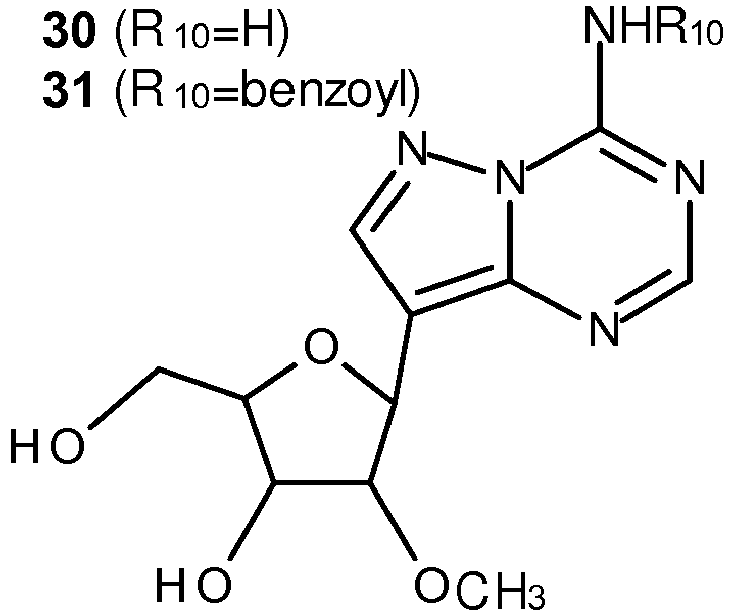

34/35 36/37 

38/39 40/41 

42/43 44/45 

46/47 48/49 

50/51 52/53 

* The phosphoramidite moiety represents -P(O-cyanoethyl)N(i-propyl)2.
** The Arabic numbers identifying those adenine PT nucleotide analogues in which the radical linked to the carbon atom at position 2' or 3' of the ribose, i.e., R5 or R6, respectively, is -OH, represent the corresponding analogues wherein R5 or R6, respectively, is -O- as well.
*** Compounds 16a, 17a, 32a, 33a, 44a and 45a correspond to compounds 16, 17, 32, 33, 44 and 45, respectively, except for that R7 is -[O-PO2S]2- rather than -[O-PO3]2-. Compounds 16b, 17b, 32b, 33b, 44b and 45b correspond to compounds 16, 17, 32, 33, 44 and 45, respectively, except for that R7 is -[O-PO2(BH3)]2- rather than -[O-PO3]2-. - In other more particular embodiments, the nucleoside analogue of the present invention is a guanine PT nucleotide analogue of the general formula Ib, i.e., a compound of the general formula I as defined above, wherein R1 is -NR8R9, wherein R8 and R9 are each independently H or an amine protecting group; R2 is H; R3 is O; R4 is H, halogen, (C1-C2)alkyl, -O-(C1-C2)alkyl, -S-(C1-C2)alkyl, -CO-H, -CO-(C1-C2)alkyl, or -NR8R9, wherein R8 and R9 are each independently H, (C1-C2)alkyl, or an amine protecting group; R5 is halogen, -O-, or -OR11; R6 is -O-, or -OR11; R7 is -OR11, or a phosphate, preferably monophosphate, moiety; and R11 each independently is (C1-C4)alkyl, (C1-C4)alkylene-OH, (C1-C4)alkylene-OCH3, (C1-C4)alkylene-SH, (C1-C4)alkylene-SCH3, (C1-C4)alkylene-NH2, a hydroxyl protecting group, or -P(O-cyanoethyl) N(i-propyl)2. In some embodiments the guanine PT nucleotide analogues are those wherein R5 is halogen, -O-, or -OR11; R6 is -O-, or -OR11; R7 is -OR11, or a monophosphate moiety; and R11 each independently is (C1-C2)alkyl, (C1-C2)alkylene-OH, (C1-C2)alkylene-OCH3, (C1-C2)alkylene-SH, (C1-C2)alkylene-SCH3, (C1-C2)alkylene-NH2, a hydroxyl protecting group, or -P(O-cyanoethyl) N(i-propyl)2. In some other embodiments, the guanine PT nucleotide analogues are those wherein R1 is -NR8R9, wherein R8 and R9 are H; R2 is H; R3 is O; R4 is H; R5 is halogen, -O-, or -OR11; R6 is -O-, or -OR11; R7 is -OR11, or a monophosphate moiety; and R11 each independently is (C1-C2)alkyl, (C1-C2)alkylene-OH, (C1-C2)alkylene-OCH3, a hydroxyl protecting group, or -P(O-cyanoethyl)N(i-propyl)2. The full chemical structures of such guanine PT nucleotide analogues described in the specification are depicted in Table 3 hereinafter.
- In specific embodiments, the guanine PT nucleotide analogue of the invention is a compound of the general formula I, wherein (i) R1 is -NHR9; R2 is H; R3 is O; R4 is H; R5 is -OCH3; R6 is -OR11, wherein R11 is -P(O-cyanoethyl)N(i-propyl)2; R7 is -ODMT; and R9 is H or benzoyl (compounds 76 and 77, respectively); (ii) R1 is -NHR9; R2 is H; R3 is O; R4 is H; R5 is -OR11, wherein R11 is -P(O-cyanoethyl)N(i-propyl)2; R6 is -OCH3; R7 is - ODMT; and R9 is H or benzoyl (compounds 80 and 81, respectively); (iii) R1 is -NHR9; R2 is H; R3 is O; R4 is H; R5 is -O(CH2)2-OCH3; R6 is -OR11, wherein R11 is -P(O-cyanoethyl)N(i-propyl)2; R7 is -ODMT; and R9 is H or benzoyl (herein identified compounds 88 and 89, respectively); or (iv) R1 is -NHR9; R2 is H; R3 is O; R4 is H; R5 is - OR11, wherein R11 is -P(O-cyanoethyl)N(i-propyl)2; R6 is -O(CH2)2-OCH3; R7 is -ODMT; and R9 is H or benzoyl (herein identified compounds 92 and 93, respectively).
Table 3: Specific guanine PT nucleotide analogues of the general formula I 54/55 56/57 

58/59 60/61 

62/63 64/65 

66/67 68/69 

70/71 72/73 

74/75 76/77 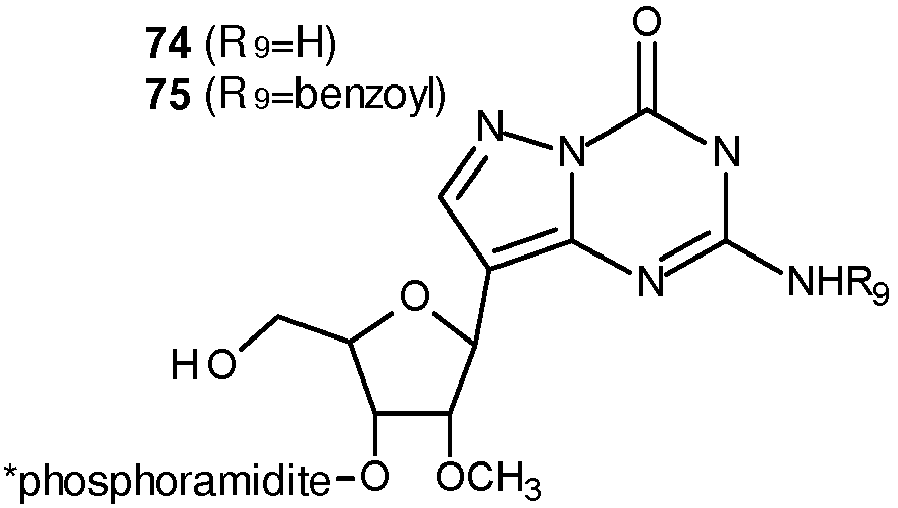

78/79 80/81 

82/83 84/85 

86/87 88/89 

90/91 92/93 

* The phosphoramidite moiety represents -P(O-cyanoethyl)N(i-propyl)2.
** The Arabic numbers identifying those guanine PT nucleotide analogues in which the radical linked to the carbon atom at position 2' or 3' of the ribose, i.e., R5 or R6, respectively, is -OH, represent the corresponding analogues wherein R5 or R6, respectively, is -O- as well.
*** Compounds 56a, 57a, 72a, 73a, 84a and 85a correspond to compounds 56, 57, 72, 73, 84 and 85, respectively, except for that R7 is -[O-PO2S]2- rather than -[O-PO3]2-. Compounds 56b, 57b, 72b, 73b, 84b and 85b correspond to compounds 56, 57, 72, 73, 84 and 85, respectively, except for that R7 is -[O-PO2(BH3)]2- rather than -[O-PO3]2-. - The various nucleoside analogues of the present invention may be synthesized according to any suitable technology or procedure known in the art, e.g., as described in the Examples section hereinafter.
- As shown in the Examples section with respect to the adenine PT nucleotide analogue herein identified as
compound 21, the nucleoside analogues of the present invention can be incorporated into oligonucleotides, substituting natural purine nucleosides and imparting acid and nuclease stability to the oligonucleotide. Furthermore, oligonucleotides comprising one or more such nucleoside analogues are capable, in terms of stability and specificity, of hybridizing with oligonucleotides having complementary sequences thereto in which no such analogues are incorporated. - In another aspect, the present invention provides an oligonucleotide as defined above, comprising at least one, i.e., one or more, nucleoside analogues each independently of the general formula I.
- The key step in DNA synthesis is the specific and sequential formation of internucleotide phosphate linkages. Since a deoxyribonucleoside monomer contains two hydroxyl groups (3' and 5' or alternatively 2' and 5'), one must be chemically protected while the other is specifically phosphorylated or phosphitylated, and then coupled to the next deoxyribonucleoside unit. Meanwhile, other reactive moieties, e.g., exo-cyclic amino groups, must also be protected.
- The phosphotriester methods of DNA synthesis in solution require coupling of one appropriately protected monomer unit containing a 3'- or 2'-phosphate with another containing a 5'-hydroxyl group and separation of products and unreacted starting materials on a column of silica gel.
- Synthesis of oligonucleotides by the solid-phase method brings advantages of speed, micro-scale operation, labor reduction and ease of mechanization. In essence, the method involves attachment of a 3' (or alternatively 2') or 5'-O-protected ribonucleoside or deoxyribonucleoside to a solid support and chain assembly by alternating terminal 3' (or alternatively 2') or 5'-deprotection reactions (type 1) and coupling reactions (type 2). In both cases, excess reagent is added to drive the reaction to completion and unreacted components are removed merely by washing of the support with an appropriate solvent. Cycles of synthesis are continued until the required length is obtained and then the oligonucleotide is cleaved from the support, protecting groups are removed, and the deprotected oligonucleotide is purified.
- High-throughput DNA synthesis is normally done by the phosphoramidite four-step process. Now, a novel two-step cycle (Dellinger et al., 2005), enables a higher purity DNA to be obtained in a less costly way.
- New discoveries, such as siRNA, have driven the scientific community to develop synthetic methods for RNA as efficiently as DNA. Thanks to the development of new reagents, the classical RNA synthesis using a 2'-O- tertbutyldimethylsilyl protecting group has reached the level of 99% coupling yields (Sproat, 2005). New methods have also been developed in the field of RNA synthesis. One of these methods uses an inverse protection scheme (acid labile group in the 2'-O- position and fluoride labile group in the 5' O-position) (Hartsel et al., 2005). Using this method, the oligonucleotide remains in its 2'-O- protected form until final deprotection is carried out before use.
- The most widely used oligonucleotides in antisense technology are phosphorothioates, to protect the antisense from nucleases including cleavage by RNase H.
- Although the phosphoramidite approach has become the method of choice for oligonucleotide synthesis, the H-phosphonate alternative remains a useful alternative, especially for solution-phase synthesis and when only a small excess of building block are used (Stawinski and Stromberg, 2005). The original phosphotriester approach to oligonucleotide synthesis has no longer routine application, but is still very useful, e.g., for the ring closure of circular oligonucleotides. The synthesis of circular oligonucleotides is described by Pedroso et al., (2005), who points to the many potential applications of circular DNA.
- In certain embodiments, the present invention provides an oligonucleotide as defined above, wherein R1 and R4 in each one of said one or more nucleoside analogues each independently is H, halogen, -CN, -SCN, -NO2, -O-hydrocarbyl, -S-hydrocarbyl, - CO-H, -CO-hydrocarbyl, -NR8R9, heteroaryl, or hydrocarbyl, wherein R8 and R9 are each independently H or hydrocarbyl; and said hydrocarbyl each independently is (C1-C8)alkyl, preferably (C1-C4)alkyl, more preferably (C1-C2)alkyl. In particular such embodiments, R1 and R4 in each one of said one or more nucleoside analogues each independently is H, halogen, -O-hydrocarbyl, -S-hydrocarbyl, -CO-H, -CO-hydrocarbyl, -NR8R9, heteroaryl, or hydrocarbyl, wherein R8 and R9 are each independently H or hydrocarbyl; and said hydrocarbyl each independently is (C1-C4)alkyl, preferably (C1-C2)alkyl.
- In certain embodiments, the present invention provides an oligonucleotide as defined above, wherein R3 in each one of said one or more nucleoside analogues independently is O or -NR10R10', wherein R10 and R10' are each independently H, hydrocarbyl, or -CO-hydrocarbyl; and said hydrocarbyl is (C1-C8)alkyl, preferably (C1-C4)alkyl, more preferably (C1-C2)alkyl.
- In certain embodiments, the present invention provides an oligonucleotide as defined above, wherein R5 in each one of said one or more nucleoside analogues is halogen, -O-, or -OR11, wherein R11 is (C1-C4)alkyl, preferably (C1-C2)alkyl, (C1-C4)alkylene-OR12, preferably (C1-C2)alkylene-OR12, (C1-C4)alkylene-SR12, preferably (C1-C2)alkylene-SR12, or (C1-C4)alkylene-NR12R13, preferably (C1-C2)alkylene-NR12R13; and R12 and R13 each independently is H or (C1-C4)alkyl, preferably (C1-C2)alkyl. In particular such embodiments, R5 in each one of said one or more nucleoside analogues is halogen, - O-, or -OR11, wherein R11 is (C1-C2)alkyl, (C1-C2)alkylene-OH, (C1-C2)alkylene-OCH3, (C1-C2)alkylene-SH, (C1-C2)alkylene-SCH3, or (C1-C2)alkylene-NH2.
- In certain embodiments, the present invention provides an oligonucleotide as defined above, wherein R6 in each one of said one or more nucleoside analogues is -O-, or -OR11, wherein R11 is (C1-C4)alkyl, preferably (C1-C2)alkyl, (C1-C4)alkylene-OR12, preferably (C1-C2)alkylene-OR12, (C1-C4)alkylene-SR12, preferably (C1-C2)alkylene-SR12, or (C1-C4)alkylene-NR12R13, preferably (C1-C2)alkylene-NR12R13; and R12 and R13 each independently is H or (C1-C4)alkyl, preferably (C1-C2)alkyl. In particular such embodiments, R6 in each one of said one or more nucleoside analogues is -O-, or -OR11, wherein R11 is (C1-C2)alkyl, (C1-C2)alkylene-OH, (C1-C2)alkylene-OCH3, (C1-C2)alkylene-SH, (C1-C2)alkylene-SCH3, or (C1-C2)alkylene-NH2.
- In particular embodiments, the present invention provides an oligonucleotide as defined above, wherein in each one of said one or more nucleoside analogues: (i) R1 and R4 each independently is H, halogen, (C1-C4)alkyl, -O-(C1-C4)alkyl, -S-(C1-C4)alkyl, -CO-H, -CO-(C1-C4)alkyl, or -NR8R9, wherein R8 and R9 are each independently H or (C1-C4)alkyl; (ii) R3 independently is O or -NR10R10', wherein R10 and R10' are each independently H, (C1-C4)alkyl, or -CO-(C1-C4)alkyl; (iii) R5 independently is halogen, -O-, or -OR11; (iv) R6 independently is -O- or -OR11; and (v) R11 each independently is (C1-C2)alkyl, (C1-C2)alkylene-OH, (C1-C2)alkylene-OCH3, (C1-C2)alkylene-SH, (C1-C2)alkylene-SCH3, or (C1-C2)alkylene-NH2. In more particular embodiments, the invention provides such an oligonucleotide, wherein in each one of said one or more nucleoside analogues: (i) R1 and R4 each independently is H, halogen, (C1-C2)alkyl, -O-(C1-C2)alkyl, -S-(C1-C2)alkyl, -CO-H, -CO-(C1-C2)alkyl, or -NR8R9, wherein R8 and R9 are each independently H or (C1-C2)alkyl; and (ii) R3 independently is O or -NR10R10', wherein R10 and R10' are each independently H, (C1-C2)alkyl, or -CO-(C1-C2)alkyl.
- In certain embodiments, the oligonucleotide of the present invention comprises at least one, e.g., 1, 2, 3, 4, 5, 6, 7, 8, 9, 10, 11, 12, 13, 14, 15 or more, nucleoside analogues each independently of the general formula II, wherein R2 is absent; and R3 is -NR10R10' as defined above, i.e., at least one adenine PT nucleotide analogue. In other embodiments, the oligonucleotide of the invention comprises at least one, e.g., 1, 2, 3, 4, 5, 6, 7, 8, 9, 10, 11, 12, 13, 14, 15 or more, nucleoside analogues each independently of the general formula II, wherein R1 is -NR8R9 as defined above; R2 is H; and R3 is O, i.e., at least one guanine PT nucleotide analogue. In further embodiments, the oligonucleotide of the invention comprises at least one adenine PT nucleotide analogue as defined above and at least one guanine PT nucleotide analogue as defined above.
- Oligonucleotide synthesis is commonly performed from the 3' terminus to the 5' terminus (3'->5') or from the 5' terminus to the 3' terminus (5'->3'). Nevertheless, as stated above, the nucleoside analogues of the general formula I, more particularly, ribonucleoside analogues wherein the radical linked to the carbon atom at the 2' position of the ribose moiety, i.e., R5, is -O- or -OR11, can be incorporated into the oligonucleotide synthesized involving 2'->5' or 5'->2' attachment as well. It should thus be understood that each one of said one or more nucleoside analogues comprised within the oligonucleotide of the present invention, whether it is an adenine PT nucleotide analogue substituting a natural adenosine or a guanine PT nucleotide analogue substituting a natural guanosine, may be located within the sequence of said oligonucleotide as well as at the 3'-/2'- or 5'-terminus of said oligonucleotide. Consequently, in any one of said one or more nucleoside analogues incorporated within the oligonucleotide sequence, either the radical linked to the carbon atom at position 3' of the ribose moiety, i.e., R6, or the radical linked to the carbon atom at position 2' of the ribose moiety, i.e., R5, is -O-; and the group linked to the carbon atom at position 5' of the ribose moiety, i.e., R7, is a phosphate linking moiety as defined above, in some embodiments, -[O-PO2]--, -[O-POS]--, or -[O-PO(BH3)]--, more preferably -[O-PO2]--. Contrary to that, in case a nucleoside analogue is located at the 3' terminus of said oligonucleotide (when synthesized 3'->5' or 5'->3') or at the 2' terminus of said oligonucleotide (when synthesized 2'->5' or 5'->2'), the radical linked to the carbon atom at position 3' or 2', respectively, of the ribose moiety in said nucleoside analogue may also be -OR11, wherein R11 is (C1-C8)alkyl, (C1-C8)alkylene-OR12, (C1-C8)alkylene-SR12, or (C1-C8)alkylene-NR12R13, wherein R12 and R13 each independently is H or (C1-C8)alkyl. Similarly, in case a nucleoside analogue is located at the 5' terminus of said oligonucleotide, the group linked to the carbon atom at position 5' of the ribose moiety of said nucleoside analogue may also be -OR11, or a monophosphate moiety as defined above, wherein R11 is (C1-C8)alkyl, (C1-C8)alkylene-OR12, (C1-C8)alkylene-SR12, or (C1-C8)alkylene-NR12R13, wherein R12 and R13 each independently is H or (C1-C8)alkyl.
- In certain embodiments, the present invention provides an oligonucleotide as defined above, wherein (i) in each one of said one or more nucleoside analogues R5 is - OR11, and R6 is -O-; (ii) in each one of said one or more nucleoside analogues R5 is -O-, and R6 is -OR11; or (iii) in at least one of said one or more nucleoside analogues R5 is - OR11, and R6 is -O-; and in at least one of said one or more nucleoside analogues R5 is -O-, and R6 is -OR11.
- In certain particular embodiments, the oligonucleotide of the present invention comprises one or more adenine PT nucleotide analogues each independently of the general formula II, wherein R1 and R4 each independently is H, halogen, (C1-C2)alkyl, -O-(C1-C2)alkyl, -S-(C1-C2)alkyl, -CO-H, -CO-(C1-C2)alkyl, or -NR8R9, wherein R8 and R9 are each independently H or (C1-C2)alkyl; R2 is absent; R3 is -NH2; R5 is halogen, -O-, or - OR11; R6 is -O-, or -OR11; R7 is -OR11, a monophosphate moiety, or a phosphate linking moiety; and R11 each independently is (C1-C4)alkyl, (C1-C4)alkylene-OH, (C1-C4)alkylene-OCH3, (C1-C4)alkylene-SH, (C1-C4)alkylene-SCH3, or (C1-C4)alkylene-NH2. In some embodiments, said oligonucleotide comprises one or more adenine PT nucleotide analogues each independently of the general formula II, wherein R5 is halogen, -O-, or - OR11; R6 is -O- or -OR11; R7 is -OR11, a monophosphate moiety, or a phosphate linking moiety; and R11 each independently is (C1-C2)alkyl, (C1-C2)alkylene-OH, (C1-C2)alkylene-OCH3, (C1-C2)alkylene-SH, (C1-C2)alkylene-SCH3, or (C1-C2)alkylene-NH2.
- In some embodiments about 5. 10, 20, 30, 40, 50, 60, 70, 80, 90 or 100% of the adenine bases in a sequence may be replaced by adenine PT nucleotide analogues.
- Particular such adenine PT nucleotide analogues that may be incorporated within an oligonucleotide according to the present invention include, e.g., compounds of the general formula II, wherein R1 and R4 are H; R2 is absent; R3 is -NH2; R5 is -O-, -OH, or - OCH3; R6 is -O- or -OH; and R7 is -OH, -[O-PO3]2-, -[O-PO2S]2-, -[O-PO2(BH3)]2-, -[O-PO2]--, -[O-POS]--, or -[O-PO(BH3)]--.
- In other particular embodiments, the oligonucleotide of the present invention comprises one or more guanine PT nucleotide analogues each independently of the general formula II, wherein R1 is -NH2; R2 is H; R3 is O; R4 is H, halogen, (C1-C2)alkyl, - O-(C1-C2)alkyl, -S-(C1-C2)alkyl, -CO-H, -CO-(C1-C2)alkyl, or -NR8R9, wherein R8 and R9 are each independently H or (C1-C2)alkyl, preferably H; R5 is halogen, -O-, or -OR11; R6 is -O-, or -OR11; R7 is -OR11, a monophosphate moiety, or a phosphate linking moiety; and R11 each independently is (C1-C4)alkyl, (C1-C4)alkylene-OH, (C1-C4)alkylene-OCH3, (C1-C4)alkylene-SH, (C1-C4)alkylene-SCH3, or (C1-C4)alkylene-NH2. In some embodiments, said oligonucleotide comprises one or more guanine PT nucleotide analogues each independently of the general formula II, wherein R5 is halogen, -O-, or -OR11; R6 is -O-, or -OR11; R7 is -OR11, a monophosphate moiety, or a phosphate linking moiety; and R11 each independently is (C1-C2)alkyl, (C1-C2)alkylene-OH, (C1-C2)alkylene-OCH3, (C1-C2)alkylene-SH, (C1-C2)alkylene-SCH3, or (C1-C2)alkylene-NH2.
- In some embodiments about 5. 10, 20, 30, 40, 50, 60, 70, 80, 90 or 100% of the guanine bases in a sequence may be replaced by guanine PT nucleotide analogues.
- Particular such guanine PT nucleotide analogues that may be incorporated within an oligonucleotide according to the present invention include, e.g., compounds of the general formula II, wherein R1 is -NH2; R2 is H; R3 is O; R4 is H; R5 is -O-, -OH, or - OCH3; R6 is -O-, or -OH; and R7 is -OH, -[O-PO3]2-, -[O-PO2S]2-, -[O-PO2(BH3)]2-, -[O-PO2]--, -[O-POS]--, or -[O-PO(BH3)]--.
- In one particular aspect, the invention provides an oligonucleotide as defined above, comprising one or more nucleoside analogues, more particularly deoxyribonucleoside analogues, each independently of the general formula II, wherein R5 is halogen; R6 is -O- or -OR11; and R11 is (C1-C8)alkyl, (C1-C8)alkylene-OR12, (C1-C8)alkylene-SR12, or (C1-C8)alkylene-NR12R13, wherein R12 and R13 each independently is H or (C1-C8)alkyl, i.e., a DNA oligonucleotide.
- In another particular aspect, the present invention provides an oligonucleotide as defined above, comprising one or more nucleoside analogues, more particularly ribonucleoside analogues, each independently of the general formula II, wherein R5 is -O-, -OR11; R6 is -O- or -OR11; and R11 each independently is (C1-C8)alkyl, (C1-C8)alkylene-OR12, (C1-C8)alkylene-SR12, or (C1-C8)alkylene-NR12R13, wherein R12 and R13 each independently is H or (C1-C8)alkyl, i.e., an RNA oligonucleotide. According to the present invention, each one of said one or more ribonucleoside analogues can independently be incorporated into said RNA oligonucleotide via phosphodiester bonds involving either 2'->5' or 3'->5' attachment. In other words, in more particular such aspects, the invention provides such an RNA oligonucleotide, wherein (i) in each one of said one or more nucleoside analogues R5 is -OR11, and R6 is -O-; (ii) in each one of said one or more nucleoside analogues R5 is -O-, and R6 is -OR11; or (iii) in at least one of said one or more nucleoside analogues R5 is -OR11, and R6 is -O-; and in at least one of said one or more nucleoside analogues R5 is -O-, and R6 is -OR11.
- The oligonucleotides of the present invention is either a DNA oligonucleotide as defined above or an RNA oligonuycleotide as defined above, comprising two or more nucleotides. Such oligonucleotides may comprise, e.g., a sequence of 2-10, 2-20, 2-30, 2-40, 2-50, 2-60, 2-70, 2-80, 2-90 or 2-100 nucleotides, or in some embodiments are oligonucleotides comprising a sequence of up to 50 nucleotides, e.g., a sequence of from 10, 15, 20 or 25 to 50 nucleotides.
- The term nucleotide as used herein refers to nucleoside analogues of the general formula I as defined above, as well as to other deoxyribonucleotides or ribonucleotides that may be natural or synthetic and modified or unmodified. Naturally occurring bases include adenine, guanine, cytosine, thymine and uracil. Modified bases of nucleotides include, without being limited to, inosine, xanthine, hypoxanthine, 2- aminoadenine, 6-methyl, 2-propyl and other alkyl adenines, 5-halouracil, 5-halocytosine, 6-azacytosine and 6-az thymine, pseudouracil, deoxypseudouracil, 4-thiouracil, ribo-2-thiouridine, ribo-4-thiouridine, 8-haloadenine, 8-aminoadenine, 8-thioladenine, 8-thiolalkyl adenines, 8-hydroxyl adenine and other 8-substituted adenines, 8-haloguanines, 8-aminoguanine, 8-thiolguanine, 8-thioalkylguanines 8-hydroxylguanine and other substituted guanines, other aza and deaza adenines, other aza and deaza guanines, 5-methylribouridine, 5-trifluoromethyl uracil, 5-methylribocytosine, and 5-trifluorocytosine.
- Examples of nucleotide analogues that may be incorporated within an oligonucleotide of the present invention include, without being limited to, phosphorothioates, phosphoramidites, methyl phosphonates, chiral-methyl phosphonates, 2'-O-methyl ribonucleotides (2'-OMe sugar modified), and peptide-nucleic acids (PNAs). Modifications include changes to the ribose moiety, the base moiety and or the linkages between ribonucleotides in the oligoribonucleotide. As used herein, the term "ribonucleotide" encompasses natural and synthetic, unmodified and modified ribonucleotides and ribonucleotide analogues which are synthetic, naturally occurring, and non-naturally occurring, wherein modifications include changes to the ribose moiety, to the base moiety and/or to the linkages between ribonucleotides in the oligonucleotide.
- A ribose modification includes a modification on the 2' moiety of the ribose moiety and encompasses amino, fluoro, alkoxy, e.g., methoxy and ethoxy, alkyl, amino, fluoro, chloro, bromo, CN, CF, imidazole, carboxylate, thioate, unsubstituted and substituted (C1-C10)alkyl, alkaryl or aralkyl, OCF3, OCN, O-, S-, or N-alkyl; O-, S-, or N-alkenyl; SOCH3; SO2CH3; ONO2; NO2, N3; heterocycloalkyl; heterocycloalkaryl; aminoalkylamino; polyalkylamino or substituted silyl, as, among others, described in European patents
EP 0586520 B1 orEP 0618925 B1 . - In a further aspect, the present invention provides a double-stranded DNA molecule, wherein at least one strand is a DNA oligonucleotide as defined above. In one particular aspect, the invention provides a double-stranded DNA molecule, wherein one of the two strands is a DNA oligonucleotide as defined above; and in another particular aspect, the invention provides a double-stranded DNA molecule, wherein both strands are a DNA oligonucleotide as defined above.
- According to the present invention, each one of the nucleotides comprised within each one of the strands of the double-stranded DNA, i.e., both nucleotides derived from nucleoside analogues of the general formula I as well as all other nucleotides, is a deoxyribonucleotide. Other double-stranded nucleic acid molecules based on the oligonucleotides of the present invention, including siRNA molecules, are disclosed in
US Provisional Application No. 61/653,432 - The nucleoside analogues of the general formula II can be incorporated into oligonucleotides as defined above to generate chemically modified ssDNA, dsDNA, ssRNA or their analogues, opening the development of DNA or RNA-based strategies such as: catalytic ribozyme or DNAzyme that can be synthesized with the capacity to bind and cleave mRNA or viral genomic RNA. Antisense RNA or DNA can also be prepared to target RNA including mRNA or viral genomic RNA, and sterically block translation or induce mRNA degradation by the non-specific endonuclease RNAse H. The nucleoside analogues of the general formula II can also be introduced into ssDNA or ssRNA-aptamers to specifically bind a variety of selected targets with high affinity. The nucleoside analogues of the general formula I can further be utilized in the preparation of immunostimulatory CpG oligonucleotides to activate the immune system by detection of bacterial products.
- The oligonucleotides of the present invention can particularly be useful in the Antisense Therapeutics Approach; indeed, when purine bases (A and G) of a particular sequence are partially or fully replaced by pyrazolotriazoyl-based nucleoside analogues (dAPT and dGPT, also termed herein pA and pG, respectively), an improved stability of these oligomers in acidic conditions, especially into the endosomal compartments, should result in a significant inhibition or activation of gene expression into the targeted cells. This effect will be reinforced when additional 5', 3' and/or internal modifications such as phosphorothioate linkages can be added to the oligomers, protecting the antisense oligonucleotide against nucleases and acidic effects. Oligonucleotides which include a combination of, e.g., modified linkages and the nucleoside analogues disclosed herein should exhibit a dramatic increase in the half-life of the resulting antisense oligonucleotide into the cells, leading to a more efficient gene modulation.
- The oligonucleotides of the present invention are powerful tools in antisense technology because: (i) substitution of natural purine nucleosides with pA or pG into these oligonucleotides doesn't destabilize the duplex formed with the RNA targets including mRNA targets; (ii) they are capable of activating RNAse H; (iii) they are fully specific to their targets will result in non toxicity effects, making them highly interested for antisense therapeutics applications; and (iv) they improve cellular uptake. Typical methods used for encapsulating antisense oligonucleotides in lipid vesicles result in very low encapsulation efficiencies at neutral pH, due to the polyanionic structures of the macromolecules. Antisense-oligonucleotides according to the present invention will allow encapsulation in more acidic conditions, and therefore will help to increase the process efficiency, resulting in improved pharmacokinetics of the formulation.
- In still another aspect, the present invention provides a pharmaceutical composition comprising a nucleoside analogue of the general formula I as defined above, and a pharmaceutically acceptable carrier.
- In yet another aspect, the present invention provides a pharmaceutical composition comprising a DNA oligonucleotide as defined above; or an RNA oligonucleotide as defined above; or a double-stranded DNA molecule as defined above, and a pharmaceutically acceptable carrier.
- A multitude of delivery agents can be included like the electrical and mechanical strategies, viral or nonviral delivery system, polymeric delivery system - like lipoplex or cationic polymer, polyethyleneimine (PEI) - a branched polymer with high cationic potential, poly(L-lysine) - a biodegradable cationic polymer, chitosan - a natural biodegradable polymer, dendrimers - polycationic synthetic polymer, and liposomal delivery systems. These delivery agents can be associated with targeting ligands to enhance the cellular uptake of oligonucleotide-based therapeutics. In these particular aspects, peptides ligands, transferrin - a larger protein ligand, antibodies and aptamers can be used.
- Also disclosed herein is an expression vector comprising a double-stranded DNA molecule as defined above.
- Also disclosed herein is a method for reducing gene expression in a cell comprising transfecting said cell with an oligonucleotide as defined above, or with an expression vector as defined above.
- The invention will now be illustrated by the following non-limiting Examples.
- The C-
nucleoside analogue 21 containing a pyrazolo[1,5a]-1,3,5-triazine ring as adenine mimic was synthesized using a multi-step procedure. - As depicted in
Figure 4 , based on the results described by Daves (Arai and Daves, 1978; Daves, 1990), and a further research including that recently reported by Raboisson et al. (2002) describing the use of N-methyl,N-phenylamino as protective groups for the amino substituent inposition 4 of an iodo-aglycon, the first target of this multi-step synthesis was the preparation of 8-iodo-3H-pyrazolo[1,5a]-1,3,5-triazine-4-N-methyl-phenyl amine 2 from the previously reported 3H-pyrazolo[1,5a]-1,3,5-triazine-4-one, 1 (Chu et al., 1980). This was achieved by a known three-step synthetic path, in which 1 was reacted with phosphorus oxychloride in the presence of dimethylaminopyridine (DMAP), followed by reaction with N-methylaniline (Raboisson et al., 2002) and then treatment with N-iodosuccinimide (NIS) to give theiodopyrazolotriazine 2 in about 73% overall yield. - The Heck coupling reaction (Daves, 1990) between the
aglycon 2 and the unprotected glycal 3 (easily obtained from thymidine as described by Larsen et al., 1994) was used for the first time ever to successfully give theketo compound 4 in 34% yield, using bis-(dibenzylidene acetone) palladium0, triphenyl arsine and triethylamine in acetonitrile around reflux. - The iodo-pyrazolo[1,5a]-1,3,5-
triazine derivative 2 was initially used as nucleic base in further coupling reactions. But N-methyl,N-phenylamino protective groups have been reported moderately suitable only for nucleophilic addition-elimination displacement in theposition 4 of C-nucleoside analogues (Raboisson et al., 2002). Therefore, the conversion to the amino group during deprotection step by ammonia treatment, upon oligonucleotide synthesis, was not compatible with the incorporation of more than one dA-like nucleoside. Many attempts to achieve suitable coupling reactions with iodo-pyrazolo[1,5a]-1,3,5-triazine derivative 2 using either the 4-unprotected nucleic base analogue or different other protection groups such as benzoyl and bis-benzoyl (Schaller et al., 1963), or allyl and bis-allyl (Hayakawa et al., 1990), even with a bis-protected glycal proved to be unpractical. - These results led the idea to keep the existing protection of the amino group at the nucleoside level and to use the keto-
derivative 4 instead of thenucleic base 2, as depicted inFigure 5 . In particular, the 3'-carbonyl group reduction of 4, performed using sodium-triacetoxy borohydride in acetonitrile, gave thenew nucleoside 12 in 89% yield. Tert-butyldimethylsilyl chloride was then used to protect the 3' and 5'-hydroxyl groups of the glycal ring in 12, while the free 4-amino group was obtained by treatment with methanolic-ammonia to give thenew compound 13 in a 55% yield. The deprotection of the 3' and 5' hydroxyl groups in 13 required first the reprotection of the 4-amino function using benzoyl chloride in pyridine and then desilylation using tetrabutyl ammonium fluoride to give thenew nucleoside 14 in 73% yield. Selective primary 5'-hydroxyl group protection of 14 was achieved by treatment with 4,4'-dimethoxytrityl chloride and then treatment with 2-cyanoethyl-N,N-diisopropylchlorophosphite introduced the corresponding cyanatophosphite ester in the 3' position to give thenew phosphoramidite nucleoside 21 in 31 % yield. - A solution of bis(dibenzylideneacetone)palladium0 (1.94 mmol, 0.06 eq., 1.12 g) and triphenyl arsine (3.88 mmol, 0.12 eq., 1,19 g) in acetonitrile (200 ml) was stirred at roon temperature (RT) for 1 hr and was then added to a solution of iodo-pyrazolotriazine, 2 (30.96 mmol, 1 eq., 10.87 g) prepared as previously described (Chu et al., 1980), crude glycal, 3 (61.92 mmol, 2 eq., 1,12 g), and triethylamine (33.15 mmol, 1.2 eq., 5.18 ml) in acetonitrile (300 ml). The mixture was stirred at 82°C for 16 hr, cooled and worked up to a brown residue which is purified by chromatography (eluent: PE/
EA 50/50) to give a brown solid. Yield: 1.7 g, 16%. - Molecular formula: C17H17N5O3; MW=339.36 g/mol; M.P.: 157-158°C; [α]D20 = +1.46 (c=1, chloroform). The structure was fully confirmed by 1H and 13C-NMR; IR and MS (CI): m/z = 340 [MH+].
- Sodium tri(acetoxy)borohydride (19.92 mmol, 4 eq., 4.22 g) was added in aliquots to solution of the keto derivative 4 (4.98 mmol, 1 eq., 1.69 g) in acetonitrile (60 ml) at RT, and was then stirred at RT for 5 hr. The mixture was hydrolysed and the solvent was then evaporated. The residue was purified by chromatography (eluent: DCM/MeOH 95/5) to give a white solid. Yield: 1.16 g, 68%.
- Molecular formula: C17H19N5O3; MW=341.37 g/mol; M.P.: 196-198°C (dec.); [α]D20 = +4.2 (c=1, DMF). The structure was fully confirmed by 1H and 13C-NMR; IR and MS (CI): m/z = 364 [M + Na]+.
- Tert-butyldimethylsilyl chloride (21.27 mmol, 6 eq., 3.2 g) was added to solution of the unprotected ribofuranozyl-pyrazolotriazine compound 12 (3.54 mmol, 1 eq., 1.21 g) and imidazole (42.53 mmol, 12 eq., 2.89 g) in DMF (25 ml) at RT, and was then stirred at RT for 60 hr. The solvent is evaporated and the crude product is purified by chromatography (eluent: PE/EA 98/2) to give a yellow oil. Yield: 1.43 g, 71%.
- Molecular formula: C29H47N5O3 Si2; MW=569.9 g/mol; M.P.: 94-95°C; [α]D20 = -18.0 (c=1, chloroform). The structure was fully confirmed by 1H and 13C-NMR; IR and MS (CI): m/z = 571 [MH]+.
- A solution of ammonia in methanol, 7N, (28 mmol, 11.2 eq., 4 ml) was added to solution of the protected ribofuranozyl-pyrazolotriazine compound 12A (2.5 mmol, 1 eq., 1.43 g) in methanol (50 ml) contained in a sealable tube. The charged tube was sealed and the mixture is stirred at 100°C for 19 hr. The solvent was evaporated upon cooling and the crude product was purified by chromatography (eluent: PE/EA 90/10) to give upon evaporation a white solid. Yield: 0.92 g, 77%.
- Molecular formula: C22H41N5O3 Si2; MW=479.78 g/mol; M.P.: 126-128°C; [α]D20 = -1.5 (c=1, chloroform). The structure was fully confirmed by 1H and 13C-NMR; IR and MS (CI): m/z = 480 [MH]+.
- Benzoyl chloride (10.32 mmol, 5 eq., 1.2 ml) was added drop wise to solution of the ribofuranozyl-amino-pyrazolotriazine compound 13 (2.06 mmol, 1 eq., 0.99 g) in pyridine (11 ml) cooled at 0°C. The mixture was then stirred at RT for about 2 hr and was cooled again at 0°C. Water (10 ml) and then ammonium hydroxide (15 ml) were added drop wise and the solution was stirred at RT for 50 min. The solvent was evaporated. Water was added and the crude residue was extracted with DCM (2x50 ml). The layers were separated, the combined organic phase was dried, DCM evaporated and the crude product was purified by chromatography (eluent: PE/EA 90/10) to give upon evaporation a white solid. Yield: 0.92 g, 80%.
- Molecular formula: C29H45N5O4 Si2; MW=583.89 g/mol; M.P.: 70-72°C; [α]D20 = -10.8 (c=1, chloroform). The structure was fully confirmed by 1H and 13C-NMR (The Noesy experiment confirmed the β-configuration); IR and MS (CI): m/z = 584 [MH]+.
- A solution of tetrabutyl ammonium fluoride 1M, (1.3 mmol, 3 eq., 1.3 ml) in THF was added to solution of the protected nucleoside compound 13A (1.45 mmol, 1 eq., 0.261 g) in THF (3 ml) at RT and was then stirred at RT for 6 hr. The solvent was evaporated and the crude product was purified by chromatography (eluent: DCM/MeOH 95/5) to give a white solid. Yield: 0.127 g, 80%.
- Molecular formula: C17H17N5O4; MW=355.36 g/mol; M.P.: 144-145°C; The structure was fully confirmed by 1H and 13C-NMR; IR and MS (Ions spray): m/z = 356 [M+H]; 378 [M + Na].
- The free-nucleoside 7(14) (1.66 mmol, 1 eq., 0.591 g) was dissolved under argon in dry pyridine (10 ml) and cooled to 0°C. A solution of dimethoxytrityl chloride (1.83 mmol, 1.1 eq., 0.62 g) in dry pyridine (10 ml) was then drop wise added over 1 hr to the cooled solution above. The mixture was then stirred at RT for 18 hr. The solvent was evaporated, water was added to the residue and mixture extracted with DCM (2x15 ml), washed with brine, dried and DCM evaporated. The crude product was purified by chromatography (eluent: DCM/MeOH 98/2) to give a white solid. Yield: 0.655 g, 60%.
- Molecular formula: C38H35N5O6; MW=657.73 g/mol; M.P.: 118-120°C; [α]D20= - 10.1 (c=1, chloroform). The structure was fully confirmed by 1H and 13C-NMR.
- The tritylated-nucleoside 14A, (0.26 mmol, 1 eq., 0.144 g) and DCI 0.25 M, (0.17 mmol, 0.67 eq., 0.68 ml) were dissolved under argon in dry, freshly distilled DCM (2 ml). The PCl-reagent (0.31 mmol, 1.2 eq., 0.009 ml) was then added drop wise and the mixture was stirred at RT for 1 hr. Crushed ice was added for hydrolysis and the mixture was rapidly extracted with DCM (2x15 ml), the combined organic phase washed with cold brine, dried and DCM evaporated. The crude product was purified by chromatography (eluent: pentane/EA/Et3N 60/39/1) to give a white solid. Yield: 0.133 g, 60 %.
- Molecular formula: C47H52N7O7P; MW=857.95 g/mol. The structure was fully confirmed by 1H; 13C-NMR and 31P-NMR; IR and MS (turbo spray): m/z = 856.4 [M-H].
-

- Step 1a: D-Ribose (1 gr) and 1M HCl, were agitated together in Methanol (100 ml), at 25°C for 6-10 hours. Toluene (5 L) and DMF (5 L) are added and the mixture is evaporated under reduced pressure. Crude product is purified by CC (silica, DCM/MeOH as eluent).
- Step 1b: Sodium Hydride (8 gr, 60% in mineral oil) is added to dry DMF (1.5 L) and the mixture is cooled. Then, the solution of product 101a in DMF is added keeping the temperature at about 5°C. Benzyl bromide (300 gr) is added keeping the temperature at about 5°C. The reaction mixture is warmed and maintained at this temperature. Then the solution is washed with DCM/water. The organic phase is evaporated under reduced pressure, to give crude compound 101b. Crude product is purified by CC (silica, DCM/MeOH as eluent).
- Step 2: Product 101bis dissolved in about 0.5 L acetone. Then, about 0.1 L of water and 0.3 L of HCl 32% are added and the solution is warmed for about 6 hours. Working up is performed with Toluene/water. Solvent is evaporated, to give crude compound 102. Crude product is purified by CC (silica, DCM/MeOH as eluent).
- Step 3: Compound 102: 2',3',5'-O-tribenzyl-β-D-ribofuranose, is dissolved in 70 mL of THF, NaH 60% in oil (17 gr) is added. Diethyl cyanomethylphosphonate (75 gr) is added slowly. Working up is performed using Toluene and water. Solvent is evaporated to give crude compound 103. Crude product is purified by CC (silica, EtAc/Hex as eluent).
- Step 4: Compound 103: 2',3',5'-O-tribenzyl-b-D-ribofuranosylacetonitrile (1.15 gr) is dissolved in THF (15 mL). tert-Butoxybis(dimethylamino)methane (1.5 gr) is added; the solution is warmed and stirred overnight. Working up is performed with Hexane and water.Solventis evaporated, to give crude compound 104. Crude product is purified by CC (silica, EtAc/Hex as eluent).
NMR 1H (CDCl3, 250 MHz): 3.04 (s, 6H, N(CH3)2), 3.45-3.59 (ddd, 2H, H-5, J = 4.9 Hz, 10.3 Hz, 18.8 Hz), 3.90-4.00 (m, 2H, H-2 and H-3), 4.14-4.18 (m, 1H, H-4), 4.31 (d, 1H, H-1, J = 7.0 Hz), 4.53-4.61 (m, 6H, CH2Ph), 6.47 (s, 1H, CH=), 7.26-7.33 (m, 15H, 3xPh). - Step 5: Compound 104: 3-Dimethylamino-2-(2',3',5'-O-tribenzyl-b-D-ribofuranosyl)acrylonitrile (795 mg) is dissolved in 2 mL Pyridine. Hydrazine (242 mg) is added; and reaction mixture is warmed for about 16 hours. Working up is performed with Toluene/waterto give compound 105.
- Step 6: Compound 105: 4-(2',3',5'-O-tribenzyl-β-D-ribofuranosyl)-3-aminopyrazole (870 mg) is dissolved in Toluene (10 mL). Methanimidic acid, N-cyanoethyl ester (850 mg) is added. The reaction mixture is warmed and stirred for about 6 hours. Working up is performed using toluene and bicarbonate aqueous solution. Toluene is evaporated, to give crude compound 106. Crude product is purified by CC (silica, EtAc/Hex as eluent).
NMR 1H (CDCl3, 400 MHz) : 3.63 (dd, 1H, H-5'a, J5'a-5'b = 10.6Hz, J5'a-4' = 4.3 Hz), 3.71 (dd, 1H, H-5'b, J5,a-5'b = 10.6Hz, J5'b-4' = 4.0 Hz), 4.14 (t, 1H, H-3', J = 5.1 Hz and 5.2 Hz), 4.34-4.39 (m, 2H, H-2' and H-4'), 4.51-4.66 (m, 6H, 3xCH2Ph), 5.35 (d, 1H, H-1', J1'-2' = 5.8 Hz), 7.20-7.32 (m, 15H, 3xPh), 7.97 (s, 1H, CH), 8.10 (s, 1H, CH). - Step 7: Compound 106: 4-amino-8-(2',3',5'-O-tribenzyl-β-D-ribofuranosyl) pyrazolo[1,5-a]-1,3,5-triazine (3 gr) is dissolved in DCM (50 ml) and cooled with stirring. Then, a solution of BCl3 (5 ml) is added, and the solution is stirred for 1 hour. MeOH (2.5 ml) is added slowly. Solvent is evaporated under reduced pressure. Crude product is dissolved with MeOH (25 ml) and neutralized with solid NaHCO3. Filtration, washing with MeOH and evaporation under reduced pressure to dryness give crude Compound 107. Crude product is purified by CC (silica, EtAc/Hex as eluent).
NMR 1 H (MeOH, 250 MHz) : 3.68 (dd, 1H, H-5'a, J 5'a-5'b = 12.2 Hz, J 5'a-4' = 3.5 Hz), 3.82 (dd, 1H, H-5'b, J 5'a-5'b = 12.2 Hz, J 5'b-4' = 3.0 Hz), 4.01-4.04 (m, 1H, H-3'), 4.16-4.21 (m, 1H, H-4'), 4.33 (dd, 1H, H-2', J 2'-1' = 7.4 Hz, J 2'-3' = 5.2 Hz), 4.98 (d, 1H, H-1', J 1'-2' = 7.4 Hz), 8.05 (s, 1H, CH), 8.12 (s, 1H, CH). - Step 8: Compound 107: 4-amino-8-(β-D-ribofuranosyl)pyrazolo[1,5-a]-1,3,5-triazine (0.5 gr) is dissolved in pyridine (12 ml) and imidazole (0.64 gr) is added. TBDMSiCl (1.4 gr) is added and the reaction mixture is stirred for 48 h. Solvent is evaporated under reduced pressure. The crude product is extracted with DCM and water. Solvent is evaporate under reduced pressure to give crude Compound 107a. Crude productis purified by CC (silica, EtAc/PetEther as eluent).
Pure compound 107a (0.49 gr) is dissolved in Pyridine (8 ml), Benzoyl chloride (0.64 gr) is added and the reaction mixture is stirred for 18 h. Water and NH4OH are added, and solvent is evaporated under reduced pressure. The residue is extracted with DCM and water. Evaporation under reduced pressure to dryness to give crude Compound 107b. Crude productis purified by CC (silica, EtAc/PetEther as eluent). - Step 9: Compound 107b (1.51 gr) is dissolved in THF (33 ml), TBAF (1 M in THF, 9ml) is added and the reaction mixture is stirred for 18 h. Solvent is evaporated under reduced pressure. Working up is performed using EtAc/water, and solvent is evaporated to drynessto give crude Compound 108. Crude product is purified by CC (silica, DCM/MeOH as eluent).
NMR 1 H (DMSO, 250 MHz) : 3.48 (dd, 1H, H-5'a, J 5'a-5'b = 11.3 Hz, J 5'a-4' = 4.5 Hz), 3.58 (dd, 1H, H-5'b, J 5'a-5'b = 11.3 Hz, J 5'a-4' = 3.9 Hz), 3.77-3.82 (m, 1H, H-4'), 3.95-4.01 (m, 1H, H-3'), 4.11-4.16 (m, 1H, H-2'), 4.85-4.90 (m, 3H, 3xOH), 4.96 (d, 1H, H-1', J 1'-2' = 6.1 Hz), 7.52-7.68 (m, 3H, CH arom), 8.13 (d, 2H, CH arom), 8.22 (s, 1H, CH), 8.29 (s, 1H, CH). - Step 10: Compound 108: 4-aminobenzoyl-8-(β-D-ribofuranosyl)pyrazolo [1,5-a]-1,3,5-triazine (0.89 gr) is dissolved in dry pyridine (10 ml), a solution of DMT-Cl (0.9 gr) and the reaction mixture is stirred for 3-6 h. Solvent is evaporated under reduced pressure. Working up is performed with Hexane and water, evaporated to obtain crude product 109.
- NMR 1 H (CDCl 3 , 400 MHz) :3.21 (dd, 1H, H5'a, J 5'a-5'b = 10.1 Hz, J 5'a-4' = 3.8 Hz), 3.38 (dd, 1H, H5'b, J 5'a-5'b = 10.1 Hz, J 5'b-4' = 3.8 Hz), 3.77 (s, 6H, OCH3), 4.27-4.30 (m, 1H, H-4'), 3.37 (dd, 1H, H-3', J 3'-2' = 5.4 Hz, J 3'-4' = 2.3 Hz), 4.52 (dd, 1H, H-2', J 2'-1' = 7.9 Hz, J 2'-3' = 5.5 Hz), 5.15 (d, 1H, H-1', J 1'-2' = 7.9 Hz), 6.78 (dd, 4H, CH DMT), 7.18-7.30 (m, 6H, CH arom), 7.38-7.40 (m, 2H, CH arom), 7.59 (t, 2H, CH arom), 7.67-7.69 (m, 2H, CH arom), 8.09 (sl, 2H, CH arom), 8.29 (s, 1H, CH arom), 8.51 (sl, 1H, CH arom), 10.02 (sl, 1H, NH).
- Step 11: Compound 109: 4-aminobenzoyl-8-(5'-O-4,4'-dimethoxytrityl-β-D-ribofuranosyl)pyrazolo[1,5-a]-1,3,5-triazine (0.67 gr) is dissolved in pyridine (12 ml), TBDMSiCl (0.25 gr) is added, the reaction mixture is stirred for 6-8 h. Solvents are evaporated, working up is performed with DCM/water. Evaporation under reduced pressure to dryness gives crude Compound 110. Crude product is purified by CC (silica, DCM/MeOH/TEA as eluent).
NMR 1 H (CDCl 3 , 400 MHz) : -0.20 (s, 3H, SiCH3), -0.08 (s, 3H, SiCH3), 0.77 (s, 9H, SitBu), 2.70 (d, 1H, OH, J OH-3' = 3.6 Hz), 3.19 (dd, 1H, H5'a, J 5'a-5'b = 10.4 Hz, J 5'a-4' = 3.7 Hz), 3.42 (dd, 1H, H5'b, J 5'a-5'b = 10.4 Hz, J 5'b-4' = 2.8 Hz), 3.71 (s, 6H, OCH3), 4.11-4.15 (m, 2H, H-4', H-3'), 4.61-4.64 (m, 1H, H-2'), 5.10 (d, 1H, H-1', J 1'-2' = 6.6 Hz), 6.74 (d, 4H, CH DMT), 7.12-7.63 (m, 12H, CH arom), 8.00 (sl, 2H, CH arom), 8.18 (s, 1H, CH arom), 8.44 (sl, 1H, CH arom), 9.91 (sl, 1H, NH). - Step 12: Compound 110: 4-aminobenzoyl-8-(2'-O-tert-butyldimethylsilyl-5'-O-4,4'-dimethoxytrityl-β-D-ribofuranosyl)pyrazolo[1,5-a]-1,3,5-triazine (0.144 gr) and DCI 0.25 M, (0.68 ml) are dissolved under argon in dry, freshly distilled DCM (2 ml). PCl-reagent (0.009 ml) is then added drop wise and the mixture is stirred at RT for 1 hr. Crushed ice is added for hydrolysis and the mixture is extracted with DCM (2x15 ml), the combined organic phase washed with cold brine, dried and DCM evaporated. The crude product is purified by chromatography (eluent: pentane/EA/Et3N 60/39/1) to give a white solid. Yield: 0.133 gr.
NMR 1 H (CDCl 3 , 400 MHz) : -0.19-0.17 (d, 3H, SiCH3), -0.01-0.00 (d, 3H, SiCH3), 0.77 (d, 9H, SitBu), 1.13-1.18 (CH3 iPr), 2.24 (t, 1H, CH2CN), 2.65 (t, 1H, CH2CN), 3.14-3.20 (m, 2H, H-5'), 3.46-3.60 (m, 4H, CH2, CH(iPr)), 3.78 (s, 6H, OCH3), 4.26-4.35 (m, 2H, H-3', H-4'), 4.68-4.71 (m, 1H, H-2'), 5.16-5.21 (m, 1H, H-1'), 6.80-6.83 (m, 4H, CH arom), 7.20-7.69 (m, 12H, CH arom), 8.11 (d, 2H, CH arom), 8.26 (d, 1H, CH arom), 8.40 (d, 1H, CH arom). - 18-mer oligonucleotides comprising either one or two adenine PT nucleotide analogue 21 (deoxy adenosine pyrazolotriazine derivative; dAPT) incorporations (SEQ ID NOs. 1 and 2, respectively) were synthesized in order to study the base-pairing ability of the new dAPT adenine PT nucleotide analogue with thymidine. The oligonucleotide of SEQ ID No: 3 comprising a sole dAPT and no other purine was further synthesized in order to study its stability in acidic medium (see Table 4).
Table 4: Sequences of the modified (SEQ ID Nos: 1-3) and unmodified (SEQ ID Nos: 4-6) oligonucleotides used in this study SEQ ID NO: Sequence* 1 5'd-(TAC CGC GTG CAAPT CCC TCT) 3' 2 5'd-(TAPT C CGC GTG CAAPT CCC TCT) 3' 3 5'd-(TTC CTC TTT CTAPT CCC TCT) 3' 4 5'd-(ACA AGA GGG XTG CAC GCG GTA GGA-3' 5 5'd-(TAC CGC GTG CAA CCC TCT) 3' 6 5'd-(TTC CTC TTT CTA CCC TCT) 3' * X=A, C, G or T (in the sequence listings the X=n)
** APT represents adeninePT nucleotide analogue 21 - Binding studies. The influence of dA replacement (one or two) by the pyrazolo[1,5-a]-1,3,5-triazine derivative (dAPT) on duplex stability was investigated by thermal denaturation studies, followed by absorption spectroscopy, using DNA duplexes obtained by mixing the modified oligonucleotides of SEQ ID NOs. 1 and 2 with the 24-mer single-stranded target DNA sequence of SEQ ID NO: 4 (X=T). The natural deoxyadenosine was also incorporated in the same positions (SEQ ID NO: 5) for comparison (duplex obtained by hybridization of the oligonucleotides of SEQ ID NOs: 4+5). Melting studies indicated that dAPT forms a base-pair with thymidine that contributes to duplex stability about as well as the natural A-T base pair (with melting temperature [Tm]=69.6°C, 69.3°C and 69°C, respectively;
Fig. 1 ). - The oligonucleotide of SEQ ID NO: 1 was hybridized with the target sequence of SEQ ID NO: 4 comprising cytosine (X=C), guanine (X=G) or thymine (X=T) in the position opposite to the modified nucleoside. Melting studies indicated that dAPT discrimination against mismatches is at the same level as seen with deoxyadenosine, as shown in
Fig. 2 . - CD spectra of the DNA duplexes obtained from the hybridization of the oligonucleotides of SEQ ID NOs: 4+1 and 4+2, containing one or two dAPT, respectively, were compared to that of the parent unmodified duplex obtained by hybridization of the oligonucleotides of SEQ ID NOs: 4+5. The results showed similar spectra for all three duplexes indicating that each modified one still forms a B-form duplex (
Fig. 3 ). - In order to study the stability of the glycosidic bond of the dAPT described above in acidic conditions, compared with that of dA, two oligonucleotides containing a single incorporation of either dAPT (SEQ ID NO: 3) or the natural dA (SEQ ID NO: 6) were synthesized. Treatment of both oligonucleotides with 80% acetic acid at 65°C for 45 hr followed by concentrated ammonium hydroxide indicated that the unmodified oligonucleotide of SEQ ID NO: 6 was fully fragmented while the oligonucleotide of SEQ ID NO: 3 containing the dAPT was not degraded.
- The study described herein demonstrates the ability of an oligonucleotide comprising one or more pyrazolotriazolyl-based nucleoside analogues and designed to induce knock-down of the green fluorescent protein (GFP) expression, to be taken up as part of a tested plasmid by HELA cells expressing the GFP protein; to be transcribed by said cells; and consequently inhibit expression of GFP protein by the cells. The results presenting the percent GFP expression of said cells, indicating inhibition of GFP expression by said oligonucleotide transcript following incubation of the cells with a plasmid comprising said oligonucleotide, are compared with those obtained following incubation of such cells with a plasmid containing a scrambled sequence, as a negative control; and with a corresponding plasmid comprising a standard oligonucleotide with no pyrazolotriazolyl-based nucleoside analogues, as a positive control.
- In view of the above, three sets of experiments are conducted using (i) a plasmid DNA comprising an oligonucleotide designed to induce knock-down of GFP protein expression, wherein said oligonucleotide comprises one or more pyrazolotriazolyl-based nucleoside analogues; (ii) a plasmid DNA comprising a standard non-modified oligonucleotide designed to induce knock-down of GFP protein expression (said oligonucleotide does not comprise pyrazolotriazolyl-based nucleoside analogues), as a positive control; and (iii) a plasmid DNA comprising a scrambled oligonucleotide that cannot induce knock down of GFP protein expression, as a negatie control.
- One µg plasmid DNA is diluted in 100 µl OPTI-MEM® and mixed gently. In addition, different solutions containing 2, 4, 6, 8 or 10 µl of Lipofectamine 2000® in 100 µl OPTI-MEM® are prepared, mixed gently and incubated for 5 min at room temperature.
- The DNA plasmid and a Lipofectamine 2000® reagent prepared are combined and mixed gently, and are then incubated at room temperature. These mixes are then added to HELA cells in a an appropriate medium and incubated for 24 hrs, following which the green fluorescent protein (GFP) fluorescence intensity is analyzed by FACS, looking for percent of GFP-positive cells. After incubation of the tested plasmid, we expect observing a decrease in GFP-positive cells.
-
- Arai, I., Daves, G.D., J. Am. Chem. Soc., 1978, 100, 287
- Cheng, J.C.Y., Hacksell, U., Daves, G.D.Jr., J. Org. Chem., 1986, 51, 3093-3098
- Chu, C.K., Watanabe, K.A., Fox, J.J., J. Heterocyclic Chem., 1980, 17, 1435-1439
- Daves, G.D., Acc. Chem. Res., 1990, 23, 201-206
- Dellinger, D.J., Betley, J.R., Wyrzykiewicz, T.K., Caruthers, M.H., Synthesis of DNA using a new two-step cycle, Methods Mol Biol., 2005, 288, 1-16
- Hartsel, S.A., Kitchen, D.E., Scaringe S.A., Marshall W.S., RNA oligonucleotide synthesis via 5'-silyl-2'-orthoester chemistry, Methods Mol Biol., 2005, 288, 33-50
- Hayakawa, Y., Wakabayashi, S., Kato, H., Noyori, R., J. Am. Chem. Soc., 1990, 112, 1691-1696
- Il'icheva et al., Russian Journal of Bioorganic Chemistry, 2005, 31, 439-452
- Larsen, E., Jorgensen, P.T., Sofan, M.A., Pedersen, E.B., Synthesis, 1994, 1037-1038
- Liang, C., Ma, T., Cooperwood, J.S., Du, j., Chu, C., Carbohydrate Research, 1997, 303, 33-88
- Mathieu, R., Schmitt, M., Bourguignon, J.J., Tetrahedron Lett., 2006, 47, 5099-5103
- Miller, R.L., Adamczyk, D.L., Miller, W.H., Koszalka, G.W., Rideout, J.L., Beacham, L.M., Chao, E.Y., Haggerty, J.J., Krenitsky, T.A., Elion, G.B., The Journal of Biological Chemistry, 1979, 254, 2346-2352
- Otter, B.A., Klein, R.S., Nucleosides & Nucleotides, 1996, 15(1-3), 793-807
- Pedroso, E., Escaja, N., Frieden, M., Grandas, A., Solid-phase synthesis of circular oligonucleotides, Methods Mol Biol., 2005, 288, 106-126
- Raboisson, P., Baurand, A., Cazenave, J.P., Gachet, C., Schultz, D., Spiess, B., Bourguignon, J-J., J. Org. Chem., 2002, 67, 8063-8071
- Raboisson, P., Schultz, D., Muller, C., Reimund, J.M., Pinna, G., Mathieu, R, Bernard, P., Do, Q.T., DesJarlais, R.L., Justiano, H., Lugnier, C., Bourguignon, J.J., Eur. J. Med. Chem., 2008, 43, 816-829
- Schaller, H., Weimann, G., Lerch, B., Khorana, H.G., J. Am. Chem. Soc., 1963, 85, 3821-3827
- Sproat, B.S., RNA synthesis using 2'-O-(tert-butyldimethylsilyl) protection, Methods Mol Biol., 2005, 288, 17-32
- Stambasky, J., Hocek, M., Kocovsky, P., Chem. Rev., 2009, 109, 6729-6764
- Stawinski, J., Stromberg, R., Di- and oligonucleotide synthesis using H-phosphonate chemistry, Methods Mol Biol., 2005, 288, 81-100
- Tam, S.Y.K., Hwang, J.S., De Las Heras, F.G., Klein, R.S., Fox, J.J., Journal of Heterocyclic Chemistry, 1976, 13, 1305-1308
- Tam, S.Y.K., Klein, R.S., Wempen, I., Fox, J.J., J. Org. Chem., 1979, 44, 4547-4553
- Wellington, K.W., Benner, S.A., Nucleosides, Nucleotides and Nucleic Acids, 2006, 25, 1309-1333
- Zarubin, Y.P., Il'icheva, I.A., Purygin, P.P., Florent'ev, V.L., Russian Journal of Bioorganic Chemistry, 2002, 28, 404-411
- Zarubin et al., Vestnic Samarskogo Gosudarstvennogo Universiteta, Estestvennonauchnaya Serya, 2003, (Spec.), 152-173
- Zhang, H.C., Brakta, M., Daves, G.D., Nucleosides & Nucleotides, 1995, 14, 105-116
-
- <110> Bio-Lab Ltd.
- <120> PYRAZOLOTRIAZOLYL NUCLEOSIDE ANALOGUES AND OLIGONUCLEOTIDES COMPRISING THEM
- <130> P-77128-PC
- <160> 6
- <170> PatentIn version 3.5
- <210> 1
<211> 18
<212> DNA
<213> Artificial Sequence - <220>
<223> oligonucleotides - <220>
<221> misc_feature
<222> (12)..(12)
<223> n=adenosine analogue - <400> 1
taccgcgtgc anccctct 18 - <210> 2
<211> 18
<212> DNA
<213> Artificial Sequence - <220>
<223> oligonucleotides - <220>
<221> misc_feature
<222> (2)..(2)
<223> n=adenosine analogue - <220>
<221> misc_feature
<222> (12)..(12)
<223> n=adenosine analogue - <400> 2
tnccgcgtgc anccctct 18 - <210> 3
<211> 18
<212> DNA
<213> Artificial Sequence - <220>
<223> Oligonucleotide - <220>
<221> misc_feature
<222> (12)..(12)
<223> n=adenosine analogue - <400> 3
ttcctctttc tnccctct 18 - <210> 4
<211> 24
<212> DNA
<213> Artificial Sequence - <220>
<223> Oligonucleotide - <220>
<221> misc_feature
<222> (10)..(10)
<223> n= A, C, G or T - <400> 4
acaagagggn tgcacgcggt agga 24 - <210> 5
<211> 18
<212> DNA
<213> Artificial Sequence - <220>
<223> Oligonucleotides - <400> 5
taccgcgtgc aaccctct 18 - <210> 6
<211> 18
<212> DNA
<213> Artificial Sequence - <220>
<223> Oligonucleotides - <400> 6
ttcctctttc taccctct 18
Claims (16)
- An oligonucleotide comprising one or more nucleoside analogues each independently of the general formula II:
 whereinR1 and R4 each independently is selected from H, halogen, -CN, -SCN, -NO2, -O-hydrocarbyl, -S-hydrocarbyl, -CO-H, -CO-hydrocarbyl, -NR8R9, heteroaryl, or hydrocarbyl optionally substituted by one or more groups each independently is halogen, -CN, -SCN, or -NO2, wherein R8 and R9 are each independently H or hydrocarbyl; or R8 and R9 together with the nitrogen atom to which they are attached form a saturated or unsaturated heterocyclic ring optionally containing 1-2 further heteroatoms selected from oxygen, nitrogen or sulfur;R2 is H or absent;R3 is O or -NR10R10', wherein wherein R10 and R10' are each independently H, hydrocarbyl, or -CO-hydrocarbyl;R5 is halogen, -O-, or -OR11;R6 is -O-, or -OR11;R7 is -OR11, a monophosphate moiety, or a phosphate linking moiety;R11 each independently is (C1-C8)alkyl, (C1-C8)alkylene-OR12, (C1-C8)alkylene-SR12, or (C1-C8)alkylene-NR12R13, wherein R12 and R13 each independently is H or (C1-C8)alkyl; andthe dotted line represents a potential double bond between the carbon atom at position 4 and either the nitrogen atom at position 3 or the radical R3, provided that, when R2 is H, there is a double bond between the carbon atom at position 4 and R3, and when R2 is absent, there is a double bond between the carbon atom at position 4 and the nitrogen atom at position 3.
 - The oligonucleotide of claim 1, wherein in each one of said one or more nucleoside analogues:(i) R1 and R4 each independently is H, halogen, (C1-C4)alkyl, -O-(C1-C4)alkyl, - S-(C1-C4)alkyl, -CO-H, -CO-(C1-C4)alkyl, or -NR8R9, wherein R8 and R9 are each independently H or (C1-C4)alkyl;(ii) R3 independently is O or -NR10R10', wherein R10 and R10' are each independently H, (C1-C4)alkyl, or -CO-(C1-C4)alkyl;(iii) R5 independently is halogen, -O-, or -OR11;(iv) R6 independently is -O-, or -OR11; and(v) R11 each independently is (C1-C2)alkyl, (C1-C2)alkylene-OH, (C1-C2)alkylene-OCH3, (C1-C2)alkylene-SH, (C1-C2)alkylene-SCH3, or (C1-C2)alkylene-NH2.
- The oligonucleotide of claim 1, wherein:(i) in each one of said one or more nucleoside analogues R5 is -OR11, and R6 is - O-;(ii) in each one of said one or more nucleoside analogues R5 is -O-, and R6 is - OR11; or(iii) in at least one of said one or more nucleoside analogues R5 is -OR11, and R6 is -O-; and in at least one of said one or more nucleoside analogues R5 is -O-, and R6 is -OR11.
- The oligonucleotide of any one of claims 1 to 3, comprising one or more adenine PT nucleotide analogues each independently of the general formula II, wherein R1 and R4 each independently is H, halogen, (C1-C2)alkyl, -O-(C1-C2)alkyl, -S-(C1-C2)alkyl, -CO-H, - CO-(C1-C2)alkyl, or -NR8R9, wherein R8 and R9 are each independently H or (C1-C2)alkyl; R2 is absent; R3 is -NH2; R5 is halogen, -O-, or -OR11; R6 is -O-, or -OR11; R7 is -OR11, a monophosphate moiety, or a phosphate linking moiety; and R11 each independently is (C1-C4)alkyl, (C1-C4)alkylene-OH, (C1-C4)alkylene-OCH3, (C1-C4)alkylene-SH, (C1-C4)alkylene-SCH3, or (C1-C4)alkylene-NH2.
- The oligonucleotide of any one of claims 1 to 4, comprising one or more guanine PT nucleotide analogues each independently of the general formula II, wherein R1 is -NH2; R2 is H; R3 is O; R4 is H, halogen, (C1-C2)alkyl, -O-(C1-C2)alkyl, -S-(C1-C2)alkyl, -CO-H, - CO-(C1-C2)alkyl, or -NR8R9, wherein R8 and R9 are each independently H or (C1-C2)alkyl; R5 is halogen, -O-, or -OR11; R6 is -O-, or -OR11; R7 is -OR11, a monophosphate moiety, or a phosphate linking moiety; and R11 each independently is (C1-C4)alkyl, (C1-C4)alkylene-OH, (C1-C4)alkylene-OCH3, (C1-C4)alkylene-SH, (C1-C4)alkylene-SCH3, or (C1-C4)alkylene-NH2.
- An oligonucleotide according to any one of claims 1 to 5, wherein the oligonucleotide is a DNA oligonucleotide comprising one or more nucleoside analogues each independently of the general formula II, wherein R5 is halogen; R6 is -O-, or -OR11; and R11 is (C1-C8)alkyl, (C1-C8)alkylene-OR12, (C1-C8)alkylene-SR12, or (C1-C8)alkylene-NR12R13, wherein R12 and R13 each independently is H or (C1-C8)alkyl.
- An oligonucleotide according to any one of claims 1 to 5, wherein the oligonucleotide is an RNA oligonucleotide comprising one or more nucleoside analogues each independently of the general formula II, wherein R5 is -O-, or -OR11; R6 is -O-, or - OR11; and R11 each independently is (C1-C8)alkyl, (C1-C8)alkylene-OR12, (C1-C8)alkylene-SR12, or (C1-C8)alkylene-NR12R13, wherein R12 and R13 each independently is H or (C1-C8)alkyl.
- A double-stranded DNA molecule, wherein at least one strand is a DNA oligonucleotide according to claim 6.
- A pharmaceutical composition comprising a DNA oligonucleotide according to claim 6; or an RNA oligonucleotide according to claim 7; or a double-stranded DNA molecule according to claim 8, and a pharmaceutically acceptable carrier.
- A nucleoside analogue of the general formula I:
 whereinR1 and R4 each independently is selected from H, halogen, -CN, -SCN, -NO2, -O-hydrocarbyl, -S-hydrocarbyl, -CO-H, -CO-hydrocarbyl, -NR8R9, heteroaryl, or hydrocarbyl optionally substituted by one or more groups each independently is halogen, -CN, -SCN, or -NO2, wherein R8 and R9 are each independently H, hydrocarbyl or an amine protecting group; or R8 and R9 together with the nitrogen atom to which they are attached form a saturated or unsaturated heterocyclic ring optionally containing 1-2 further heteroatoms selected from oxygen, nitrogen or sulfur;R2 is H or absent;R3 is O or -NR10R10', wherein R10 and R10' are each independently H, hydrocarbyl, - CO-hydrocarbyl, or an amine protecting group;whereinR5 is halogen, -O-, or -OR11;R6 is -O-, or -OR11;R7 is -OR11, or a phosphate moiety;wherein each R11 is independently (C1-C8)alkyl, (C1-C8)alkylene-OR12, (C1-C8)alkylene-SR12, (C1-C8)alkylene-NR12R13, a hydroxyl protecting group, or a phosphoramidite moiety of the formula -P(OR14)NR15R16, wherein R14 is H or cyano-(Ci-C8)alkyl, and R15 and R16 each independently is H or (C1-C8)alkyl;R12 and R13 each independently is H or (C1-C8)alkyl; andthe dotted line represents a potential double bond between the carbon atom at position 4 and either the nitrogen atom at position 3 or the radical R3, provided that, when R2 is H, there is a double bond between the carbon atom at position 4 and R3, and when R2 is absent, there is a double bond between the carbon atom at position 4 and the nitrogen atom at position 3,but excluding the analogues wherein R5 and R6 each independently is -O-,wherein the amine protecting group is acetyl, benzoyl, carbobenzyloxy, p-methoxybenzyl carbonyl, methoxycarbonyl, tert-butyloxycarbonyl, 9-fluorenylmethyloxycarbonyl (FMOC), benzyl, a carbamate group, p-methoxybenzyl, 3,4-dimethoxybenzyl (DMPM), p-methoxyphenyl (PMP), monomethoxytrityl (MMT), dimethoxytrityl (DMT) or tosyl; and
wherein the hydroxyl protecting group is DMT, tert-butyldimethylsilyl (TBDMS), tri-iso-propylsilyloxymethyl (TOM), trimethylsilyl (TMS), triisopropylsilyl (TIPS), acetyl, benzyl or benzoyl. - The nucleoside analogue of claim 10, wherein(i) R5 is -O-, or -OR11, wherein R11 is (C1-C8)alkyl, (C1-C8)alkylene-OR12, (C1-C8)alkylene-SR12, (C1-C8)alkylene-NR12R13, or a hydroxyl protecting group; and R6 is -OR11, wherein R11 is a phosphoramidite moiety of the formula - P(OR14)NR15R16; or(ii) R5 is -OR11, wherein R11 is a phosphoramidite moiety of the formula - P(OR14)NR15R16; and R6 is -O- or -OR11, wherein R11 is (C1-C8)alkyl, (C1-C8)alkylene-OR12, (C1-C8)alkylene-SR12, (C1-C8)alkylene-NR12R13, or a hydroxyl protecting group.
- The nucleoside analogue according to claim 10, wherein the nucleoside analogue is an adenine PT nucleotide analogue, and wherein R1 and R4 each independently is H, halogen, (C1-C2)alkyl, -O-(C1-C2)alkyl, -S-(C1-C2)alkyl, -CO-H, -CO-(C1-C2)alkyl, or - NR8R9, wherein R8 and R9 are each independently H, (C1-C2)alkyl or an amine protecting group; R2 is absent; R3 is -NR10R10', wherein R10 and R10' are each independently H or an amine protecting group; R5 is halogen, -O-, or -OR11 and R6 is -O-, or -OR11; R7 is -OR11, or a phosphate moiety; and each R11 is independently (C1-C4)alkyl, (C1-C4)alkylene-OH, (C1-C4)alkylene-OCH3, (C1-C4)alkylene-SH, (C1-C4)alkylene-SCH3, (C1-C4)alkylene-NH2, a hydroxyl protecting group, or -P(O-cyanoethyl)N(i-propyl)2.
- The adenine PT nucleotide analogue of claim 12, wherein:(i) R1 and R4 are H; R2 is absent; R3 is -NR10R10'; R5 is -OCH3; R6 is -OR11, wherein R11 is -P(O-cyanoethyl)N(i-propyl)2; R7 is -ODMT; and R10 and R10' are each independently H or benzoyl (herein identified compounds 36 and 37, respectively);(ii) R1 and R4 are H; R2 is absent; R3 is -NR10R10'; R5 is -OR11, wherein R11 is - P(O-cyanoethyl)N(i-propyl)2; R6 is -OCH3; R7 is -ODMT; and R10 and R10' are each independently H or benzoyl (herein identified compounds 40 and 41, respectively);(iii) R1 and R4 are H; R2 is absent; R3 is -NR10R10'; R5 is -O(CH2)2-OCH3; R6 is -OR11, wherein R11 is -P(O-cyanoethyl)N(i-propyl)2; R7 is -ODMT; and R10 and R10' are each independently H or benzoyl (herein identified compounds 48 and 49, respectively);(iv) R1 and R4 are H; R2 is absent; R3 is -NR10R10'; R5 is -OR11, wherein R11 is -P(O-cyanoethyl)N(i-propyl)2; R6 is -O(CH2)2-OCH3; R7 is -ODMT; and R10 and R10' are each independently H or benzoyl (herein identified compounds 52 and 53, respectively).
- The nucleoside analogue according to any one of claims 10-11, wherein the nucleoside analogue is an guanine PT nucleotide analogue, and wherein R1 is -NR8R9, wherein R8 and R9 are each independently H or an amine protecting group; R2 is H; R3 is O; R4 is H, halogen, (C1-C2)alkyl, -O-(C1-C2)alkyl, -S-(C1-C2)alkyl, -CO-H, -CO-(Ci-C2)alkyl, or -NR8R9, wherein R8 and R9 are each independently H, (C1-C2)alkyl or an amine protecting group; R5 is halogen, -O-, or -OR11; R6 is -O-, or -OR11; R7 is -OR11, or a phosphate moiety; and R11 each independently is (C1-C4)alkyl, (C1-C4)alkylene-OH, (C1-C4)alkylene-OCH3, (C1-C4)alkylene-SH, (C1-C4)alkylene-SCH3, (C1-C4)alkylene-NH2, a hydroxyl protecting group, or -P(O-cyanoethyl)N(i-propyl)2.
- The guanine PT nucleotide analogue of claim 14, wherein:(i) R1 is -NHR9; R2 is H; R3 is O; R4 is H; R5 is -OCH3; R6 is -OR11, wherein R11 is -P(O-cyanoethyl)N(i-propyl)2; R7 is -ODMT; and R9 is H or benzoyl (herein identified compounds 76 and 77, respectively);(ii) R1 is -NHR9; R2 is H; R3 is O; R4 is H; R5 is -OR11, wherein R11 is -P(O-cyanoethyl)N(i-propyl)2; R6 is -OCH3; R7 is -ODMT; and R9 is H or benzoyl (herein identified compounds 80 and 81, respectively);(iii) R1 is -NHR9; R2 is H; R3 is O; R4 is H; R5 is -O(CH2)2-OCH3; R6 is - OR11, wherein R11 is -P(O-cyanoethyl)N(i-propyl)2; R7 is -ODMT; and R9 is H or benzoyl (herein identified compounds 88 and 89, respectively);(iv) R1 is -NHR9; R2 is H; R3 is O; R4 is H; R5 is -OR11, wherein R11 is -P(O-cyanoethyl)N(i-propyl)2; R6 is -O(CH2)2-OCH3; R7 is -ODMT; and R9 is H or benzoyl (herein identified compounds 92 and 93, respectively).
- A pharmaceutical composition comprising a nucleoside analogue according to claim 10, and a pharmaceutically acceptable carrier.
Applications Claiming Priority (2)
| Application Number | Priority Date | Filing Date | Title |
|---|---|---|---|
| US201261653528P | 2012-05-31 | 2012-05-31 | |
| PCT/IL2013/050461 WO2013179289A1 (en) | 2012-05-31 | 2013-05-30 | Pyrazolotriazolyl nucleoside analogues and oligonucleotides comprising them |
Publications (3)
| Publication Number | Publication Date |
|---|---|
| EP2854813A1 EP2854813A1 (en) | 2015-04-08 |
| EP2854813A4 EP2854813A4 (en) | 2016-01-27 |
| EP2854813B1 true EP2854813B1 (en) | 2018-07-25 |
Family
ID=49672580
Family Applications (1)
| Application Number | Title | Priority Date | Filing Date |
|---|---|---|---|
| EP13798069.4A Not-in-force EP2854813B1 (en) | 2012-05-31 | 2013-05-30 | Pyrazolotriazolyl nucleoside analogues and oligonucleotides comprising them |
Country Status (3)
| Country | Link |
|---|---|
| US (2) | US9994604B2 (en) |
| EP (1) | EP2854813B1 (en) |
| WO (1) | WO2013179289A1 (en) |
Families Citing this family (3)
| Publication number | Priority date | Publication date | Assignee | Title |
|---|---|---|---|---|
| US9994604B2 (en) * | 2012-05-31 | 2018-06-12 | Bio-Lab Ltd. | Pyrazolotriazolyl nucleoside analogues and oligonucleotides comprising them |
| US11492367B2 (en) | 2017-01-27 | 2022-11-08 | Janssen Biotech, Inc. | Cyclic dinucleotides as sting agonists |
| EP4196131A1 (en) * | 2020-08-14 | 2023-06-21 | Merck Sharp & Dohme LLC | Synthesis of fluorinated nucleotides |
Family Cites Families (15)
| Publication number | Priority date | Publication date | Assignee | Title |
|---|---|---|---|---|
| US5378825A (en) | 1990-07-27 | 1995-01-03 | Isis Pharmaceuticals, Inc. | Backbone modified oligonucleotide analogs |
| WO1993009127A1 (en) | 1991-11-07 | 1993-05-13 | Gilead Sciences, Inc. | Enhanced triple-helix formation directed by oligonucleotides composed of 2'-deoxy-7-deazaxanthosine and 2'-deoxy-7-deazaguanosine and related analogs |
| KR940703846A (en) | 1991-12-24 | 1994-12-12 | 비. 린네 파샬 | GAPED 2 'MODIFED OLIGONUCLEOTIDES |
| US5652099A (en) | 1992-02-12 | 1997-07-29 | Conrad; Michael J. | Probes comprising fluorescent nucleosides and uses thereof |
| ATE244259T1 (en) * | 1992-02-12 | 2003-07-15 | Chromagen Inc | USES OF FLUORESCENT N-NUCLEOsides and their analogues |
| JP2004533406A (en) | 2000-10-18 | 2004-11-04 | フアーマセツト・リミテツド | Modified nucleosides for treating viral infections and abnormal cell proliferation |
| KR20050006221A (en) * | 2002-05-06 | 2005-01-15 | 제네랩스 테크놀로지스, 인코포레이티드 | Nucleoside derivatives for treating hepatitis c virus infection |
| FR2842809A1 (en) * | 2002-07-26 | 2004-01-30 | Greenpharma Sas | NOVEL SUBSTITUTED PYRAZOLO [1,5-a] -1,3,5-TRIAZINES AND THEIR ANALOGUES, PHARMACEUTICAL COMPOSITIONS CONTAINING THE SAME, USE AS A MEDICAMENT AND METHODS FOR THEIR PREPARATION |
| US20050074799A1 (en) * | 2003-08-15 | 2005-04-07 | Affymetrix, Inc. | Use of guanine analogs in high-complexity genotyping |
| EP1893625A4 (en) | 2005-06-22 | 2012-12-26 | Biocryst Pharm Inc | Methods for the preparation of 9-deazapurine derivatives |
| US20120077814A1 (en) * | 2010-09-10 | 2012-03-29 | Zhong Wang | Sulfonamide, sulfamate, and sulfamothioate derivatives |
| EP2855679B1 (en) * | 2012-05-31 | 2018-07-18 | QBI Enterprises Ltd. | Therapeutic oligonucleotides comprising pyrazolotriazine nucleotide analogues |
| US9994604B2 (en) * | 2012-05-31 | 2018-06-12 | Bio-Lab Ltd. | Pyrazolotriazolyl nucleoside analogues and oligonucleotides comprising them |
| US20160152979A1 (en) * | 2012-09-12 | 2016-06-02 | Qbi Enterprises Ltd. | Novel compounds |
| EP2909210A4 (en) * | 2012-10-17 | 2016-04-06 | Merck Sharp & Dohme | 2'-DISUBSTITUTED SUBSTITUTED NUCLEOSIDE DERIVATIVES AND METHODS OF USE FOR THE TREATMENT OF VIRAL DISEASES |
-
2013
- 2013-05-30 US US14/403,580 patent/US9994604B2/en not_active Expired - Fee Related
- 2013-05-30 EP EP13798069.4A patent/EP2854813B1/en not_active Not-in-force
- 2013-05-30 WO PCT/IL2013/050461 patent/WO2013179289A1/en not_active Ceased
-
2018
- 2018-05-17 US US15/981,915 patent/US20180251485A1/en not_active Abandoned
Non-Patent Citations (1)
| Title |
|---|
| None * |
Also Published As
| Publication number | Publication date |
|---|---|
| US20180251485A1 (en) | 2018-09-06 |
| EP2854813A4 (en) | 2016-01-27 |
| US9994604B2 (en) | 2018-06-12 |
| WO2013179289A1 (en) | 2013-12-05 |
| WO2013179289A8 (en) | 2014-01-16 |
| EP2854813A1 (en) | 2015-04-08 |
| US20150141490A1 (en) | 2015-05-21 |
Similar Documents
| Publication | Publication Date | Title |
|---|---|---|
| CN106795197B (en) | Modified oligonucleotide and preparation method thereof | |
| JP3050595B2 (en) | Oligonucleotide analogues | |
| CN103068834B (en) | Phosphoramidites for reverse RNA synthesis | |
| TWI593701B (en) | 5-position modified pyrimidines and their use | |
| AU2014219019B2 (en) | Short interfering nucleic acid (siNA) molecules containing a 2' internucleoside linkage | |
| US9035041B2 (en) | Process for triphosphate oligonucleotide synthesis | |
| AU2017368283B2 (en) | Novel bicyclic nucleosides and oligomers prepared therefrom | |
| JP2002543214A (en) | L-ribo-LNA analog | |
| RU2740501C2 (en) | Modified oligonucleotides which activate rnase h | |
| JPH08508493A (en) | 7-Deazapurine modified oligonucleotide | |
| EP3802827A1 (en) | Modified rna agents with reduced off-target effect | |
| JP2018109015A (en) | Tricyclic nucleosides and oligomeric compounds prepared therefrom | |
| US20180251485A1 (en) | Pyrazolotriazolyl nucleoside analogues and oligonucleotides comprising them | |
| WO2025047679A1 (en) | Stable target editing guide rna having phosphate moiety modification introduced thereinto | |
| Rejman et al. | Synthesis and hybridization of oligonucleotides modified at AMP sites with adenine pyrrolidine phosphonate nucleotides | |
| WO2022081046A1 (en) | Chemical compound comprising a triazine group and method for producing same | |
| WO1995031470A2 (en) | Antisense inhibitors of gene expression | |
| CA3130431A1 (en) | Phosphonoacetate gapmer oligonucleotides | |
| RU2799452C2 (en) | Chemical compound with a triazine group and a method of its preparation | |
| RU2824141C2 (en) | Novel bicyclic nucleosides and oligomers derived therefrom | |
| TW202523360A (en) | Mrna cap analog and use thereof | |
| AU2024228869A1 (en) | Double stranded oligonucleotide compositions for rna interference and methods relating thereto | |
| HK40092714A (en) | Novel synthesis of phosphorodithioate oligonucleotides | |
| CA3129646A1 (en) | Novel phosphoramidites | |
| KR20250099265A (en) | Method for synthesizing targeting ligand-conjugated nucleotide phosphoramidites |
Legal Events
| Date | Code | Title | Description |
|---|---|---|---|
| PUAI | Public reference made under article 153(3) epc to a published international application that has entered the european phase |
Free format text: ORIGINAL CODE: 0009012 |
|
| 17P | Request for examination filed |
Effective date: 20141230 |
|
| AK | Designated contracting states |
Kind code of ref document: A1 Designated state(s): AL AT BE BG CH CY CZ DE DK EE ES FI FR GB GR HR HU IE IS IT LI LT LU LV MC MK MT NL NO PL PT RO RS SE SI SK SM TR |
|
| AX | Request for extension of the european patent |
Extension state: BA ME |
|
| DAX | Request for extension of the european patent (deleted) | ||
| RA4 | Supplementary search report drawn up and despatched (corrected) |
Effective date: 20160104 |
|
| RIC1 | Information provided on ipc code assigned before grant |
Ipc: A61K 31/53 20060101AFI20151218BHEP Ipc: C07D 487/04 20060101ALI20151218BHEP |
|
| STAA | Information on the status of an ep patent application or granted ep patent |
Free format text: STATUS: EXAMINATION IS IN PROGRESS |
|
| 17Q | First examination report despatched |
Effective date: 20161221 |
|
| GRAP | Despatch of communication of intention to grant a patent |
Free format text: ORIGINAL CODE: EPIDOSNIGR1 |
|
| STAA | Information on the status of an ep patent application or granted ep patent |
Free format text: STATUS: GRANT OF PATENT IS INTENDED |
|
| INTG | Intention to grant announced |
Effective date: 20180220 |
|
| GRAS | Grant fee paid |
Free format text: ORIGINAL CODE: EPIDOSNIGR3 |
|
| GRAA | (expected) grant |
Free format text: ORIGINAL CODE: 0009210 |
|
| STAA | Information on the status of an ep patent application or granted ep patent |
Free format text: STATUS: THE PATENT HAS BEEN GRANTED |
|
| AK | Designated contracting states |
Kind code of ref document: B1 Designated state(s): AL AT BE BG CH CY CZ DE DK EE ES FI FR GB GR HR HU IE IS IT LI LT LU LV MC MK MT NL NO PL PT RO RS SE SI SK SM TR |
|
| REG | Reference to a national code |
Ref country code: GB Ref legal event code: FG4D |
|
| REG | Reference to a national code |
Ref country code: CH Ref legal event code: EP |
|
| REG | Reference to a national code |
Ref country code: AT Ref legal event code: REF Ref document number: 1021018 Country of ref document: AT Kind code of ref document: T Effective date: 20180815 |
|
| REG | Reference to a national code |
Ref country code: IE Ref legal event code: FG4D |
|
| REG | Reference to a national code |
Ref country code: DE Ref legal event code: R096 Ref document number: 602013040902 Country of ref document: DE |
|
| REG | Reference to a national code |
Ref country code: NL Ref legal event code: MP Effective date: 20180725 |
|
| REG | Reference to a national code |
Ref country code: LT Ref legal event code: MG4D |
|
| PG25 | Lapsed in a contracting state [announced via postgrant information from national office to epo] |
Ref country code: NL Free format text: LAPSE BECAUSE OF FAILURE TO SUBMIT A TRANSLATION OF THE DESCRIPTION OR TO PAY THE FEE WITHIN THE PRESCRIBED TIME-LIMIT Effective date: 20180725 |
|
| REG | Reference to a national code |
Ref country code: AT Ref legal event code: MK05 Ref document number: 1021018 Country of ref document: AT Kind code of ref document: T Effective date: 20180725 |
|
| PG25 | Lapsed in a contracting state [announced via postgrant information from national office to epo] |
Ref country code: FI Free format text: LAPSE BECAUSE OF FAILURE TO SUBMIT A TRANSLATION OF THE DESCRIPTION OR TO PAY THE FEE WITHIN THE PRESCRIBED TIME-LIMIT Effective date: 20180725 Ref country code: IS Free format text: LAPSE BECAUSE OF FAILURE TO SUBMIT A TRANSLATION OF THE DESCRIPTION OR TO PAY THE FEE WITHIN THE PRESCRIBED TIME-LIMIT Effective date: 20181125 Ref country code: SE Free format text: LAPSE BECAUSE OF FAILURE TO SUBMIT A TRANSLATION OF THE DESCRIPTION OR TO PAY THE FEE WITHIN THE PRESCRIBED TIME-LIMIT Effective date: 20180725 Ref country code: AT Free format text: LAPSE BECAUSE OF FAILURE TO SUBMIT A TRANSLATION OF THE DESCRIPTION OR TO PAY THE FEE WITHIN THE PRESCRIBED TIME-LIMIT Effective date: 20180725 Ref country code: NO Free format text: LAPSE BECAUSE OF FAILURE TO SUBMIT A TRANSLATION OF THE DESCRIPTION OR TO PAY THE FEE WITHIN THE PRESCRIBED TIME-LIMIT Effective date: 20181025 Ref country code: BG Free format text: LAPSE BECAUSE OF FAILURE TO SUBMIT A TRANSLATION OF THE DESCRIPTION OR TO PAY THE FEE WITHIN THE PRESCRIBED TIME-LIMIT Effective date: 20181025 Ref country code: RS Free format text: LAPSE BECAUSE OF FAILURE TO SUBMIT A TRANSLATION OF THE DESCRIPTION OR TO PAY THE FEE WITHIN THE PRESCRIBED TIME-LIMIT Effective date: 20180725 Ref country code: GR Free format text: LAPSE BECAUSE OF FAILURE TO SUBMIT A TRANSLATION OF THE DESCRIPTION OR TO PAY THE FEE WITHIN THE PRESCRIBED TIME-LIMIT Effective date: 20181026 Ref country code: LT Free format text: LAPSE BECAUSE OF FAILURE TO SUBMIT A TRANSLATION OF THE DESCRIPTION OR TO PAY THE FEE WITHIN THE PRESCRIBED TIME-LIMIT Effective date: 20180725 Ref country code: PL Free format text: LAPSE BECAUSE OF FAILURE TO SUBMIT A TRANSLATION OF THE DESCRIPTION OR TO PAY THE FEE WITHIN THE PRESCRIBED TIME-LIMIT Effective date: 20180725 |
|
| PG25 | Lapsed in a contracting state [announced via postgrant information from national office to epo] |
Ref country code: AL Free format text: LAPSE BECAUSE OF FAILURE TO SUBMIT A TRANSLATION OF THE DESCRIPTION OR TO PAY THE FEE WITHIN THE PRESCRIBED TIME-LIMIT Effective date: 20180725 Ref country code: LV Free format text: LAPSE BECAUSE OF FAILURE TO SUBMIT A TRANSLATION OF THE DESCRIPTION OR TO PAY THE FEE WITHIN THE PRESCRIBED TIME-LIMIT Effective date: 20180725 Ref country code: HR Free format text: LAPSE BECAUSE OF FAILURE TO SUBMIT A TRANSLATION OF THE DESCRIPTION OR TO PAY THE FEE WITHIN THE PRESCRIBED TIME-LIMIT Effective date: 20180725 |
|
| REG | Reference to a national code |
Ref country code: DE Ref legal event code: R097 Ref document number: 602013040902 Country of ref document: DE |
|
| PG25 | Lapsed in a contracting state [announced via postgrant information from national office to epo] |
Ref country code: ES Free format text: LAPSE BECAUSE OF FAILURE TO SUBMIT A TRANSLATION OF THE DESCRIPTION OR TO PAY THE FEE WITHIN THE PRESCRIBED TIME-LIMIT Effective date: 20180725 Ref country code: IT Free format text: LAPSE BECAUSE OF FAILURE TO SUBMIT A TRANSLATION OF THE DESCRIPTION OR TO PAY THE FEE WITHIN THE PRESCRIBED TIME-LIMIT Effective date: 20180725 Ref country code: CZ Free format text: LAPSE BECAUSE OF FAILURE TO SUBMIT A TRANSLATION OF THE DESCRIPTION OR TO PAY THE FEE WITHIN THE PRESCRIBED TIME-LIMIT Effective date: 20180725 Ref country code: EE Free format text: LAPSE BECAUSE OF FAILURE TO SUBMIT A TRANSLATION OF THE DESCRIPTION OR TO PAY THE FEE WITHIN THE PRESCRIBED TIME-LIMIT Effective date: 20180725 Ref country code: RO Free format text: LAPSE BECAUSE OF FAILURE TO SUBMIT A TRANSLATION OF THE DESCRIPTION OR TO PAY THE FEE WITHIN THE PRESCRIBED TIME-LIMIT Effective date: 20180725 |
|
| PG25 | Lapsed in a contracting state [announced via postgrant information from national office to epo] |
Ref country code: SM Free format text: LAPSE BECAUSE OF FAILURE TO SUBMIT A TRANSLATION OF THE DESCRIPTION OR TO PAY THE FEE WITHIN THE PRESCRIBED TIME-LIMIT Effective date: 20180725 Ref country code: DK Free format text: LAPSE BECAUSE OF FAILURE TO SUBMIT A TRANSLATION OF THE DESCRIPTION OR TO PAY THE FEE WITHIN THE PRESCRIBED TIME-LIMIT Effective date: 20180725 Ref country code: SK Free format text: LAPSE BECAUSE OF FAILURE TO SUBMIT A TRANSLATION OF THE DESCRIPTION OR TO PAY THE FEE WITHIN THE PRESCRIBED TIME-LIMIT Effective date: 20180725 |
|
| PLBE | No opposition filed within time limit |
Free format text: ORIGINAL CODE: 0009261 |
|
| STAA | Information on the status of an ep patent application or granted ep patent |
Free format text: STATUS: NO OPPOSITION FILED WITHIN TIME LIMIT |
|
| 26N | No opposition filed |
Effective date: 20190426 |
|
| PG25 | Lapsed in a contracting state [announced via postgrant information from national office to epo] |
Ref country code: SI Free format text: LAPSE BECAUSE OF FAILURE TO SUBMIT A TRANSLATION OF THE DESCRIPTION OR TO PAY THE FEE WITHIN THE PRESCRIBED TIME-LIMIT Effective date: 20180725 |
|
| REG | Reference to a national code |
Ref country code: DE Ref legal event code: R119 Ref document number: 602013040902 Country of ref document: DE |
|
| REG | Reference to a national code |
Ref country code: CH Ref legal event code: PL |
|
| GBPC | Gb: european patent ceased through non-payment of renewal fee |
Effective date: 20190530 |
|
| PG25 | Lapsed in a contracting state [announced via postgrant information from national office to epo] |
Ref country code: MC Free format text: LAPSE BECAUSE OF FAILURE TO SUBMIT A TRANSLATION OF THE DESCRIPTION OR TO PAY THE FEE WITHIN THE PRESCRIBED TIME-LIMIT Effective date: 20180725 Ref country code: CH Free format text: LAPSE BECAUSE OF NON-PAYMENT OF DUE FEES Effective date: 20190531 Ref country code: LI Free format text: LAPSE BECAUSE OF NON-PAYMENT OF DUE FEES Effective date: 20190531 |
|
| REG | Reference to a national code |
Ref country code: BE Ref legal event code: MM Effective date: 20190531 |
|
| PG25 | Lapsed in a contracting state [announced via postgrant information from national office to epo] |
Ref country code: LU Free format text: LAPSE BECAUSE OF NON-PAYMENT OF DUE FEES Effective date: 20190530 |
|
| PG25 | Lapsed in a contracting state [announced via postgrant information from national office to epo] |
Ref country code: TR Free format text: LAPSE BECAUSE OF FAILURE TO SUBMIT A TRANSLATION OF THE DESCRIPTION OR TO PAY THE FEE WITHIN THE PRESCRIBED TIME-LIMIT Effective date: 20180725 |
|
| PG25 | Lapsed in a contracting state [announced via postgrant information from national office to epo] |
Ref country code: IE Free format text: LAPSE BECAUSE OF NON-PAYMENT OF DUE FEES Effective date: 20190530 Ref country code: GB Free format text: LAPSE BECAUSE OF NON-PAYMENT OF DUE FEES Effective date: 20190530 Ref country code: DE Free format text: LAPSE BECAUSE OF NON-PAYMENT OF DUE FEES Effective date: 20191203 |
|
| PG25 | Lapsed in a contracting state [announced via postgrant information from national office to epo] |
Ref country code: BE Free format text: LAPSE BECAUSE OF NON-PAYMENT OF DUE FEES Effective date: 20190531 |
|
| PG25 | Lapsed in a contracting state [announced via postgrant information from national office to epo] |
Ref country code: FR Free format text: LAPSE BECAUSE OF NON-PAYMENT OF DUE FEES Effective date: 20190531 Ref country code: PT Free format text: LAPSE BECAUSE OF FAILURE TO SUBMIT A TRANSLATION OF THE DESCRIPTION OR TO PAY THE FEE WITHIN THE PRESCRIBED TIME-LIMIT Effective date: 20181125 |
|
| PG25 | Lapsed in a contracting state [announced via postgrant information from national office to epo] |
Ref country code: CY Free format text: LAPSE BECAUSE OF FAILURE TO SUBMIT A TRANSLATION OF THE DESCRIPTION OR TO PAY THE FEE WITHIN THE PRESCRIBED TIME-LIMIT Effective date: 20180725 |
|
| PG25 | Lapsed in a contracting state [announced via postgrant information from national office to epo] |
Ref country code: HU Free format text: LAPSE BECAUSE OF FAILURE TO SUBMIT A TRANSLATION OF THE DESCRIPTION OR TO PAY THE FEE WITHIN THE PRESCRIBED TIME-LIMIT; INVALID AB INITIO Effective date: 20130530 Ref country code: MT Free format text: LAPSE BECAUSE OF FAILURE TO SUBMIT A TRANSLATION OF THE DESCRIPTION OR TO PAY THE FEE WITHIN THE PRESCRIBED TIME-LIMIT Effective date: 20180725 |
|
| PG25 | Lapsed in a contracting state [announced via postgrant information from national office to epo] |
Ref country code: MK Free format text: LAPSE BECAUSE OF FAILURE TO SUBMIT A TRANSLATION OF THE DESCRIPTION OR TO PAY THE FEE WITHIN THE PRESCRIBED TIME-LIMIT Effective date: 20180725 |