EP2853532A1 - 1,2,4-oxadiazole derivatives as allosteric modulators of metabotropic glutamate receptors belonging to group III - Google Patents
1,2,4-oxadiazole derivatives as allosteric modulators of metabotropic glutamate receptors belonging to group III Download PDFInfo
- Publication number
- EP2853532A1 EP2853532A1 EP13460066.7A EP13460066A EP2853532A1 EP 2853532 A1 EP2853532 A1 EP 2853532A1 EP 13460066 A EP13460066 A EP 13460066A EP 2853532 A1 EP2853532 A1 EP 2853532A1
- Authority
- EP
- European Patent Office
- Prior art keywords
- oxadiazol
- nmr
- mhz
- scheme
- phenyl
- Prior art date
- Legal status (The legal status is an assumption and is not a legal conclusion. Google has not performed a legal analysis and makes no representation as to the accuracy of the status listed.)
- Granted
Links
- 108010010914 Metabotropic glutamate receptors Proteins 0.000 title claims abstract description 34
- 102000016193 Metabotropic glutamate receptors Human genes 0.000 title claims abstract description 34
- 150000005071 1,2,4-oxadiazoles Chemical class 0.000 title claims abstract description 10
- 230000003281 allosteric effect Effects 0.000 title description 31
- 239000003814 drug Substances 0.000 claims abstract description 24
- 208000037265 diseases, disorders, signs and symptoms Diseases 0.000 claims abstract description 21
- 208000035475 disorder Diseases 0.000 claims abstract description 17
- 229940079593 drug Drugs 0.000 claims abstract description 14
- 150000003839 salts Chemical class 0.000 claims abstract description 14
- 208000019901 Anxiety disease Diseases 0.000 claims abstract description 11
- 102100038354 Metabotropic glutamate receptor 4 Human genes 0.000 claims abstract description 11
- 101001032851 Homo sapiens Metabotropic glutamate receptor 4 Proteins 0.000 claims abstract description 10
- 238000004519 manufacturing process Methods 0.000 claims abstract description 10
- 208000018737 Parkinson disease Diseases 0.000 claims abstract description 9
- 230000036506 anxiety Effects 0.000 claims abstract description 9
- 208000002193 Pain Diseases 0.000 claims abstract description 6
- 201000000980 schizophrenia Diseases 0.000 claims abstract description 6
- 229910052739 hydrogen Inorganic materials 0.000 claims description 22
- 239000001257 hydrogen Substances 0.000 claims description 22
- 125000004169 (C1-C6) alkyl group Chemical group 0.000 claims description 19
- 125000001072 heteroaryl group Chemical group 0.000 claims description 19
- 125000000171 (C1-C6) haloalkyl group Chemical group 0.000 claims description 16
- 125000000882 C2-C6 alkenyl group Chemical group 0.000 claims description 16
- 125000003601 C2-C6 alkynyl group Chemical group 0.000 claims description 16
- 125000003118 aryl group Chemical group 0.000 claims description 16
- 125000002947 alkylene group Chemical group 0.000 claims description 15
- UFHFLCQGNIYNRP-UHFFFAOYSA-N Hydrogen Chemical compound [H][H] UFHFLCQGNIYNRP-UHFFFAOYSA-N 0.000 claims description 14
- 125000000592 heterocycloalkyl group Chemical group 0.000 claims description 14
- 125000006376 (C3-C10) cycloalkyl group Chemical group 0.000 claims description 13
- 125000001316 cycloalkyl alkyl group Chemical group 0.000 claims description 12
- 125000003710 aryl alkyl group Chemical group 0.000 claims description 11
- 125000004446 heteroarylalkyl group Chemical group 0.000 claims description 11
- 125000001997 phenyl group Chemical group [H]C1=C([H])C([H])=C(*)C([H])=C1[H] 0.000 claims description 11
- 239000012453 solvate Substances 0.000 claims description 9
- 150000002431 hydrogen Chemical class 0.000 claims description 8
- 229940126027 positive allosteric modulator Drugs 0.000 claims description 8
- 125000001424 substituent group Chemical group 0.000 claims description 8
- BBVIDBNAYOIXOE-UHFFFAOYSA-N 1,2,4-oxadiazole Chemical group C=1N=CON=1 BBVIDBNAYOIXOE-UHFFFAOYSA-N 0.000 claims description 7
- 229910052736 halogen Inorganic materials 0.000 claims description 7
- 125000005842 heteroatom Chemical group 0.000 claims description 7
- 150000004677 hydrates Chemical class 0.000 claims description 7
- 125000006272 (C3-C7) cycloalkyl group Chemical group 0.000 claims description 6
- 150000002367 halogens Chemical class 0.000 claims description 6
- 125000000449 nitro group Chemical group [O-][N+](*)=O 0.000 claims description 6
- 229910052717 sulfur Inorganic materials 0.000 claims description 6
- 239000003446 ligand Substances 0.000 claims description 5
- 229910052760 oxygen Inorganic materials 0.000 claims description 5
- 125000006570 (C5-C6) heteroaryl group Chemical group 0.000 claims description 4
- 125000004093 cyano group Chemical group *C#N 0.000 claims description 4
- KIWSYRHAAPLJFJ-DNZSEPECSA-N n-[(e,2z)-4-ethyl-2-hydroxyimino-5-nitrohex-3-enyl]pyridine-3-carboxamide Chemical compound [O-][N+](=O)C(C)C(/CC)=C/C(=N/O)/CNC(=O)C1=CC=CN=C1 KIWSYRHAAPLJFJ-DNZSEPECSA-N 0.000 claims description 4
- 150000001875 compounds Chemical class 0.000 abstract description 118
- 108010038422 metabotropic glutamate receptor 4 Proteins 0.000 abstract description 2
- VLKZOEOYAKHREP-UHFFFAOYSA-N n-Hexane Chemical compound CCCCCC VLKZOEOYAKHREP-UHFFFAOYSA-N 0.000 description 285
- HEDRZPFGACZZDS-MICDWDOJSA-N Trichloro(2H)methane Chemical compound [2H]C(Cl)(Cl)Cl HEDRZPFGACZZDS-MICDWDOJSA-N 0.000 description 224
- 238000000034 method Methods 0.000 description 204
- OKKJLVBELUTLKV-UHFFFAOYSA-N Methanol Chemical compound OC OKKJLVBELUTLKV-UHFFFAOYSA-N 0.000 description 135
- HEDRZPFGACZZDS-UHFFFAOYSA-N chloroform Substances ClC(Cl)Cl HEDRZPFGACZZDS-UHFFFAOYSA-N 0.000 description 127
- 239000007787 solid Substances 0.000 description 122
- IAZDPXIOMUYVGZ-WFGJKAKNSA-N Dimethyl sulfoxide Chemical compound [2H]C([2H])([2H])S(=O)C([2H])([2H])[2H] IAZDPXIOMUYVGZ-WFGJKAKNSA-N 0.000 description 111
- 239000000047 product Substances 0.000 description 108
- 238000004895 liquid chromatography mass spectrometry Methods 0.000 description 98
- 238000002803 maceration Methods 0.000 description 97
- 238000005160 1H NMR spectroscopy Methods 0.000 description 93
- 238000001644 13C nuclear magnetic resonance spectroscopy Methods 0.000 description 88
- KFZMGEQAYNKOFK-UHFFFAOYSA-N Isopropanol Chemical compound CC(C)O KFZMGEQAYNKOFK-UHFFFAOYSA-N 0.000 description 85
- 239000012043 crude product Substances 0.000 description 63
- 238000004440 column chromatography Methods 0.000 description 54
- IAZDPXIOMUYVGZ-UHFFFAOYSA-N Dimethylsulphoxide Chemical compound CS(C)=O IAZDPXIOMUYVGZ-UHFFFAOYSA-N 0.000 description 51
- VYPSYNLAJGMNEJ-UHFFFAOYSA-N Silicium dioxide Chemical compound O=[Si]=O VYPSYNLAJGMNEJ-UHFFFAOYSA-N 0.000 description 48
- 239000000741 silica gel Substances 0.000 description 48
- 229910002027 silica gel Inorganic materials 0.000 description 48
- ZMANZCXQSJIPKH-UHFFFAOYSA-N Triethylamine Chemical compound CCN(CC)CC ZMANZCXQSJIPKH-UHFFFAOYSA-N 0.000 description 42
- WHUUTDBJXJRKMK-VKHMYHEASA-N L-glutamic acid Chemical compound OC(=O)[C@@H](N)CCC(O)=O WHUUTDBJXJRKMK-VKHMYHEASA-N 0.000 description 41
- LFQSCWFLJHTTHZ-UHFFFAOYSA-N Ethanol Chemical compound CCO LFQSCWFLJHTTHZ-UHFFFAOYSA-N 0.000 description 40
- -1 mGluR4 Proteins 0.000 description 39
- XLYOFNOQVPJJNP-UHFFFAOYSA-N water Substances O XLYOFNOQVPJJNP-UHFFFAOYSA-N 0.000 description 39
- WEVYAHXRMPXWCK-UHFFFAOYSA-N Acetonitrile Chemical compound CC#N WEVYAHXRMPXWCK-UHFFFAOYSA-N 0.000 description 38
- YXFVVABEGXRONW-UHFFFAOYSA-N Toluene Chemical compound CC1=CC=CC=C1 YXFVVABEGXRONW-UHFFFAOYSA-N 0.000 description 36
- 229930195712 glutamate Natural products 0.000 description 35
- 239000011541 reaction mixture Substances 0.000 description 33
- 102000005962 receptors Human genes 0.000 description 30
- 108020003175 receptors Proteins 0.000 description 30
- BWHMMNNQKKPAPP-UHFFFAOYSA-L potassium carbonate Chemical compound [K+].[K+].[O-]C([O-])=O BWHMMNNQKKPAPP-UHFFFAOYSA-L 0.000 description 28
- 230000000694 effects Effects 0.000 description 27
- HEMHJVSKTPXQMS-UHFFFAOYSA-M Sodium hydroxide Chemical compound [OH-].[Na+] HEMHJVSKTPXQMS-UHFFFAOYSA-M 0.000 description 25
- QTBSBXVTEAMEQO-UHFFFAOYSA-N Acetic acid Chemical compound CC(O)=O QTBSBXVTEAMEQO-UHFFFAOYSA-N 0.000 description 21
- XEKOWRVHYACXOJ-UHFFFAOYSA-N Ethyl acetate Chemical compound CCOC(C)=O XEKOWRVHYACXOJ-UHFFFAOYSA-N 0.000 description 20
- 239000000556 agonist Substances 0.000 description 19
- 210000004027 cell Anatomy 0.000 description 18
- 239000000243 solution Substances 0.000 description 18
- 239000002904 solvent Substances 0.000 description 18
- VEXZGXHMUGYJMC-UHFFFAOYSA-N Hydrochloric acid Chemical compound Cl VEXZGXHMUGYJMC-UHFFFAOYSA-N 0.000 description 17
- WYURNTSHIVDZCO-UHFFFAOYSA-N Tetrahydrofuran Chemical compound C1CCOC1 WYURNTSHIVDZCO-UHFFFAOYSA-N 0.000 description 16
- 238000006243 chemical reaction Methods 0.000 description 15
- 239000000203 mixture Substances 0.000 description 15
- WTDHULULXKLSOZ-UHFFFAOYSA-N Hydroxylamine hydrochloride Chemical compound Cl.ON WTDHULULXKLSOZ-UHFFFAOYSA-N 0.000 description 14
- 229910000027 potassium carbonate Inorganic materials 0.000 description 14
- VIPHVHVAGBKHGR-UHFFFAOYSA-N hydron;pyridine-2-carbonyl chloride;chloride Chemical compound Cl.ClC(=O)C1=CC=CC=N1 VIPHVHVAGBKHGR-UHFFFAOYSA-N 0.000 description 13
- GUPGUFMJVVCPCZ-UHFFFAOYSA-N 4-(3-phenyl-1,2,4-oxadiazol-5-yl)aniline Chemical compound C1=CC(N)=CC=C1C1=NC(C=2C=CC=CC=2)=NO1 GUPGUFMJVVCPCZ-UHFFFAOYSA-N 0.000 description 12
- 239000002253 acid Substances 0.000 description 12
- NOLPMOAIGVSJBQ-UHFFFAOYSA-N COc1cc(N)ccc1-c1noc(n1)-c1ccccc1Cl Chemical compound COc1cc(N)ccc1-c1noc(n1)-c1ccccc1Cl NOLPMOAIGVSJBQ-UHFFFAOYSA-N 0.000 description 11
- 238000010992 reflux Methods 0.000 description 11
- NGNBDVOYPDDBFK-UHFFFAOYSA-N 2-[2,4-di(pentan-2-yl)phenoxy]acetyl chloride Chemical compound CCCC(C)C1=CC=C(OCC(Cl)=O)C(C(C)CCC)=C1 NGNBDVOYPDDBFK-UHFFFAOYSA-N 0.000 description 10
- YMWUJEATGCHHMB-UHFFFAOYSA-N Dichloromethane Chemical compound ClCCl YMWUJEATGCHHMB-UHFFFAOYSA-N 0.000 description 10
- JUJWROOIHBZHMG-UHFFFAOYSA-N Pyridine Chemical compound C1=CC=NC=C1 JUJWROOIHBZHMG-UHFFFAOYSA-N 0.000 description 10
- 239000012467 final product Substances 0.000 description 10
- IXCSERBJSXMMFS-UHFFFAOYSA-N hydrogen chloride Substances Cl.Cl IXCSERBJSXMMFS-UHFFFAOYSA-N 0.000 description 10
- BDAGIHXWWSANSR-UHFFFAOYSA-N methanoic acid Natural products OC=O BDAGIHXWWSANSR-UHFFFAOYSA-N 0.000 description 10
- TWNQGVIAIRXVLR-UHFFFAOYSA-N oxo(oxoalumanyloxy)alumane Chemical compound O=[Al]O[Al]=O TWNQGVIAIRXVLR-UHFFFAOYSA-N 0.000 description 10
- 239000008194 pharmaceutical composition Substances 0.000 description 10
- 238000003756 stirring Methods 0.000 description 10
- CSCPPACGZOOCGX-UHFFFAOYSA-N Acetone Chemical compound CC(C)=O CSCPPACGZOOCGX-UHFFFAOYSA-N 0.000 description 9
- UHOVQNZJYSORNB-UHFFFAOYSA-N Benzene Chemical compound C1=CC=CC=C1 UHOVQNZJYSORNB-UHFFFAOYSA-N 0.000 description 9
- 238000000746 purification Methods 0.000 description 9
- 230000004044 response Effects 0.000 description 9
- MYMGOAMRRDPVJW-UHFFFAOYSA-N 4-[5-(4-methoxyphenyl)-1,2,4-oxadiazol-3-yl]aniline Chemical compound C1=CC(OC)=CC=C1C1=NC(C=2C=CC(N)=CC=2)=NO1 MYMGOAMRRDPVJW-UHFFFAOYSA-N 0.000 description 8
- PAYRUJLWNCNPSJ-UHFFFAOYSA-N Aniline Chemical compound NC1=CC=CC=C1 PAYRUJLWNCNPSJ-UHFFFAOYSA-N 0.000 description 8
- FAPWRFPIFSIZLT-UHFFFAOYSA-M Sodium chloride Chemical compound [Na+].[Cl-] FAPWRFPIFSIZLT-UHFFFAOYSA-M 0.000 description 8
- 238000003556 assay Methods 0.000 description 8
- 230000015572 biosynthetic process Effects 0.000 description 8
- 150000001805 chlorine compounds Chemical class 0.000 description 8
- XEEYBQQBJWHFJM-UHFFFAOYSA-N Iron Chemical compound [Fe] XEEYBQQBJWHFJM-UHFFFAOYSA-N 0.000 description 7
- 210000004556 brain Anatomy 0.000 description 7
- OPQARKPSCNTWTJ-UHFFFAOYSA-L copper(ii) acetate Chemical compound [Cu+2].CC([O-])=O.CC([O-])=O OPQARKPSCNTWTJ-UHFFFAOYSA-L 0.000 description 7
- 238000000605 extraction Methods 0.000 description 7
- 0 C*(*)C1(C)CCCCC1 Chemical compound C*(*)C1(C)CCCCC1 0.000 description 6
- AVXURJPOCDRRFD-UHFFFAOYSA-N Hydroxylamine Chemical compound ON AVXURJPOCDRRFD-UHFFFAOYSA-N 0.000 description 6
- 102000006541 Ionotropic Glutamate Receptors Human genes 0.000 description 6
- 108010008812 Ionotropic Glutamate Receptors Proteins 0.000 description 6
- JGFZNNIVVJXRND-UHFFFAOYSA-N N,N-Diisopropylethylamine (DIPEA) Chemical compound CCN(C(C)C)C(C)C JGFZNNIVVJXRND-UHFFFAOYSA-N 0.000 description 6
- 229910017912 NH2OH Inorganic materials 0.000 description 6
- CDBYLPFSWZWCQE-UHFFFAOYSA-L Sodium Carbonate Chemical compound [Na+].[Na+].[O-]C([O-])=O CDBYLPFSWZWCQE-UHFFFAOYSA-L 0.000 description 6
- 239000004480 active ingredient Substances 0.000 description 6
- PASDCCFISLVPSO-UHFFFAOYSA-N benzoyl chloride Chemical compound ClC(=O)C1=CC=CC=C1 PASDCCFISLVPSO-UHFFFAOYSA-N 0.000 description 6
- 210000003169 central nervous system Anatomy 0.000 description 6
- 238000005859 coupling reaction Methods 0.000 description 6
- 239000013078 crystal Substances 0.000 description 6
- 230000003389 potentiating effect Effects 0.000 description 6
- 238000004809 thin layer chromatography Methods 0.000 description 6
- OSWFIVFLDKOXQC-UHFFFAOYSA-N 4-(3-methoxyphenyl)aniline Chemical compound COC1=CC=CC(C=2C=CC(N)=CC=2)=C1 OSWFIVFLDKOXQC-UHFFFAOYSA-N 0.000 description 5
- HQHKEUOUVRKITN-UHFFFAOYSA-N 4-(3-pyridin-2-yl-1,2,4-oxadiazol-5-yl)aniline Chemical compound C1=CC(N)=CC=C1C1=NC(C=2N=CC=CC=2)=NO1 HQHKEUOUVRKITN-UHFFFAOYSA-N 0.000 description 5
- NLNQGBJFOKQUTC-UHFFFAOYSA-N 4-[5-(2-chlorophenyl)-1,2,4-oxadiazol-3-yl]aniline Chemical compound C1=CC(N)=CC=C1C1=NOC(C=2C(=CC=CC=2)Cl)=N1 NLNQGBJFOKQUTC-UHFFFAOYSA-N 0.000 description 5
- QDULITXXNYZSMC-UHFFFAOYSA-N 4-[5-(4-fluorophenyl)-1,2,4-oxadiazol-3-yl]aniline Chemical compound C1=CC(N)=CC=C1C1=NOC(C=2C=CC(F)=CC=2)=N1 QDULITXXNYZSMC-UHFFFAOYSA-N 0.000 description 5
- HOPRXTMVYNXOQL-UHFFFAOYSA-N COc1cc(N)ccc1-c1noc(n1)-c1ccccc1F Chemical compound COc1cc(N)ccc1-c1noc(n1)-c1ccccc1F HOPRXTMVYNXOQL-UHFFFAOYSA-N 0.000 description 5
- 239000006144 Dulbecco’s modified Eagle's medium Substances 0.000 description 5
- WHUUTDBJXJRKMK-UHFFFAOYSA-N Glutamic acid Natural products OC(=O)C(N)CCC(O)=O WHUUTDBJXJRKMK-UHFFFAOYSA-N 0.000 description 5
- 241000124008 Mammalia Species 0.000 description 5
- RRWHNWLDIDYHDI-UHFFFAOYSA-N N'-hydroxy-2-methoxy-4-nitrobenzenecarboximidamide Chemical compound COc1cc(ccc1C(N)=NO)[N+]([O-])=O RRWHNWLDIDYHDI-UHFFFAOYSA-N 0.000 description 5
- KISWLYVSPKKXGP-UHFFFAOYSA-N N-[3-chloro-4-(N'-hydroxycarbamimidoyl)phenyl]pyridine-2-carboxamide Chemical compound NC(=NO)c1ccc(NC(=O)c2ccccn2)cc1Cl KISWLYVSPKKXGP-UHFFFAOYSA-N 0.000 description 5
- IASTZBKLPCLKPR-UHFFFAOYSA-N N-[3-fluoro-4-(N'-hydroxycarbamimidoyl)phenyl]pyridine-2-carboxamide Chemical compound NC(=NO)c1ccc(NC(=O)c2ccccn2)cc1F IASTZBKLPCLKPR-UHFFFAOYSA-N 0.000 description 5
- 208000012902 Nervous system disease Diseases 0.000 description 5
- 208000025966 Neurological disease Diseases 0.000 description 5
- 239000004098 Tetracycline Substances 0.000 description 5
- 230000004913 activation Effects 0.000 description 5
- MXOQNVMDKHLYCZ-UHFFFAOYSA-N benzamidoxime Chemical class ON=C(N)C1=CC=CC=C1 MXOQNVMDKHLYCZ-UHFFFAOYSA-N 0.000 description 5
- 235000019253 formic acid Nutrition 0.000 description 5
- 230000006870 function Effects 0.000 description 5
- 239000010410 layer Substances 0.000 description 5
- OKKJLVBELUTLKV-VMNATFBRSA-N methanol-d1 Chemical compound [2H]OC OKKJLVBELUTLKV-VMNATFBRSA-N 0.000 description 5
- 208000020016 psychiatric disease Diseases 0.000 description 5
- UMJSCPRVCHMLSP-UHFFFAOYSA-N pyridine Natural products COC1=CC=CN=C1 UMJSCPRVCHMLSP-UHFFFAOYSA-N 0.000 description 5
- 239000003826 tablet Substances 0.000 description 5
- 229960002180 tetracycline Drugs 0.000 description 5
- 229930101283 tetracycline Natural products 0.000 description 5
- 235000019364 tetracycline Nutrition 0.000 description 5
- 150000003522 tetracyclines Chemical class 0.000 description 5
- ONIKNECPXCLUHT-UHFFFAOYSA-N 2-chlorobenzoyl chloride Chemical compound ClC(=O)C1=CC=CC=C1Cl ONIKNECPXCLUHT-UHFFFAOYSA-N 0.000 description 4
- MHISQVYQNJBNHC-UHFFFAOYSA-N 3-chloro-4-[5-(2-chlorophenyl)-1,2,4-oxadiazol-3-yl]aniline Chemical compound Nc1ccc(-c2noc(n2)-c2ccccc2Cl)c(Cl)c1 MHISQVYQNJBNHC-UHFFFAOYSA-N 0.000 description 4
- DIEMCUFYSOEIDU-UHFFFAOYSA-N 6-fluoropyridine-2-carboxylic acid Chemical compound OC(=O)C1=CC=CC(F)=N1 DIEMCUFYSOEIDU-UHFFFAOYSA-N 0.000 description 4
- XKRFYHLGVUSROY-UHFFFAOYSA-N Argon Chemical compound [Ar] XKRFYHLGVUSROY-UHFFFAOYSA-N 0.000 description 4
- OKTJSMMVPCPJKN-UHFFFAOYSA-N Carbon Chemical group [C] OKTJSMMVPCPJKN-UHFFFAOYSA-N 0.000 description 4
- IVOMOUWHDPKRLL-KQYNXXCUSA-N Cyclic adenosine monophosphate Chemical compound C([C@H]1O2)OP(O)(=O)O[C@H]1[C@@H](O)[C@@H]2N1C(N=CN=C2N)=C2N=C1 IVOMOUWHDPKRLL-KQYNXXCUSA-N 0.000 description 4
- OHCQJHSOBUTRHG-KGGHGJDLSA-N FORSKOLIN Chemical compound O=C([C@@]12O)C[C@](C)(C=C)O[C@]1(C)[C@@H](OC(=O)C)[C@@H](O)[C@@H]1[C@]2(C)[C@@H](O)CCC1(C)C OHCQJHSOBUTRHG-KGGHGJDLSA-N 0.000 description 4
- OAKJQQAXSVQMHS-UHFFFAOYSA-N Hydrazine Chemical compound NN OAKJQQAXSVQMHS-UHFFFAOYSA-N 0.000 description 4
- ZDXPYRJPNDTMRX-VKHMYHEASA-N L-glutamine Chemical compound OC(=O)[C@@H](N)CCC(N)=O ZDXPYRJPNDTMRX-VKHMYHEASA-N 0.000 description 4
- 102100038294 Metabotropic glutamate receptor 7 Human genes 0.000 description 4
- 102100037636 Metabotropic glutamate receptor 8 Human genes 0.000 description 4
- IVOMOUWHDPKRLL-UHFFFAOYSA-N UNPD107823 Natural products O1C2COP(O)(=O)OC2C(O)C1N1C(N=CN=C2N)=C2N=C1 IVOMOUWHDPKRLL-UHFFFAOYSA-N 0.000 description 4
- 125000000217 alkyl group Chemical group 0.000 description 4
- 238000004458 analytical method Methods 0.000 description 4
- 150000001448 anilines Chemical class 0.000 description 4
- 239000005557 antagonist Substances 0.000 description 4
- 125000005620 boronic acid group Chemical class 0.000 description 4
- 239000002775 capsule Substances 0.000 description 4
- 229910052799 carbon Inorganic materials 0.000 description 4
- 239000003153 chemical reaction reagent Substances 0.000 description 4
- 229940095074 cyclic amp Drugs 0.000 description 4
- 201000010099 disease Diseases 0.000 description 4
- 239000002552 dosage form Substances 0.000 description 4
- 239000003937 drug carrier Substances 0.000 description 4
- 230000004064 dysfunction Effects 0.000 description 4
- 238000001704 evaporation Methods 0.000 description 4
- 230000008020 evaporation Effects 0.000 description 4
- 108010038449 metabotropic glutamate receptor 7 Proteins 0.000 description 4
- 108010038448 metabotropic glutamate receptor 8 Proteins 0.000 description 4
- LDOMTUYRQDNAGW-UHFFFAOYSA-N n'-hydroxy-2-methyl-4-nitrobenzenecarboximidamide Chemical compound CC1=CC([N+]([O-])=O)=CC=C1C(=N)NO LDOMTUYRQDNAGW-UHFFFAOYSA-N 0.000 description 4
- SRNSBDNIAKCXGI-UHFFFAOYSA-N n'-hydroxy-4-nitrobenzenecarboximidamide Chemical compound ON=C(N)C1=CC=C([N+]([O-])=O)C=C1 SRNSBDNIAKCXGI-UHFFFAOYSA-N 0.000 description 4
- 229940126662 negative allosteric modulator Drugs 0.000 description 4
- 230000000926 neurological effect Effects 0.000 description 4
- 230000036515 potency Effects 0.000 description 4
- 238000002360 preparation method Methods 0.000 description 4
- 230000002265 prevention Effects 0.000 description 4
- 230000009467 reduction Effects 0.000 description 4
- 239000000523 sample Substances 0.000 description 4
- 239000011780 sodium chloride Substances 0.000 description 4
- NSFQGSYKNYKJCB-UHFFFAOYSA-N 2-chloro-n'-hydroxy-4-nitrobenzenecarboximidamide Chemical compound ON=C(N)C1=CC=C([N+]([O-])=O)C=C1Cl NSFQGSYKNYKJCB-UHFFFAOYSA-N 0.000 description 3
- JSSJWBBDKKRUDK-UHFFFAOYSA-N 3-chloro-4-(5-phenyl-1,2,4-oxadiazol-3-yl)aniline Chemical compound Nc1ccc(-c2noc(n2)-c2ccccc2)c(Cl)c1 JSSJWBBDKKRUDK-UHFFFAOYSA-N 0.000 description 3
- ZONZMWUHWQWSRR-UHFFFAOYSA-N 4-[(2-chlorophenyl)sulfamoyl]-N'-hydroxybenzenecarboximidamide Chemical compound NC(=NO)c1ccc(cc1)S(=O)(=O)Nc1ccccc1Cl ZONZMWUHWQWSRR-UHFFFAOYSA-N 0.000 description 3
- DBMFYTQPPBBKHI-UHFFFAOYSA-N 4-cyanobenzenesulfonyl chloride Chemical class ClS(=O)(=O)C1=CC=C(C#N)C=C1 DBMFYTQPPBBKHI-UHFFFAOYSA-N 0.000 description 3
- TURXXCXHOXEHPB-UHFFFAOYSA-N 4-nitro-n-[4-(3-phenyl-1,2,4-oxadiazol-5-yl)phenyl]benzamide Chemical compound C1=CC([N+](=O)[O-])=CC=C1C(=O)NC1=CC=C(C=2ON=C(N=2)C=2C=CC=CC=2)C=C1 TURXXCXHOXEHPB-UHFFFAOYSA-N 0.000 description 3
- SKDHHIUENRGTHK-UHFFFAOYSA-N 4-nitrobenzoyl chloride Chemical class [O-][N+](=O)C1=CC=C(C(Cl)=O)C=C1 SKDHHIUENRGTHK-UHFFFAOYSA-N 0.000 description 3
- ZLKMOIHCHCMSFW-UHFFFAOYSA-N 6-chloropyridine-2-carboxylic acid Chemical compound OC(=O)C1=CC=CC(Cl)=N1 ZLKMOIHCHCMSFW-UHFFFAOYSA-N 0.000 description 3
- RYQRFWMKYYHWSL-UHFFFAOYSA-N COC=1C=C(C=CC=1C1=NOC(=N1)C1=CC=CC=C1)NC(=O)C1=NC=CC=C1 Chemical compound COC=1C=C(C=CC=1C1=NOC(=N1)C1=CC=CC=C1)NC(=O)C1=NC=CC=C1 RYQRFWMKYYHWSL-UHFFFAOYSA-N 0.000 description 3
- DISKCRBLUXBUTJ-UHFFFAOYSA-N COc1cc(N)ccc1-c1noc(n1)-c1ccc(F)cc1Cl Chemical compound COc1cc(N)ccc1-c1noc(n1)-c1ccc(F)cc1Cl DISKCRBLUXBUTJ-UHFFFAOYSA-N 0.000 description 3
- PVEWPQILGPAICT-UHFFFAOYSA-N COc1cc(N)ccc1-c1noc(n1)-c1ccccc1 Chemical compound COc1cc(N)ccc1-c1noc(n1)-c1ccccc1 PVEWPQILGPAICT-UHFFFAOYSA-N 0.000 description 3
- XTVHEJNIJGRKTA-UHFFFAOYSA-N COc1cc(ccc1-c1noc(n1)-c1ccccc1F)[N+]([O-])=O Chemical compound COc1cc(ccc1-c1noc(n1)-c1ccccc1F)[N+]([O-])=O XTVHEJNIJGRKTA-UHFFFAOYSA-N 0.000 description 3
- BVKZGUZCCUSVTD-UHFFFAOYSA-L Carbonate Chemical compound [O-]C([O-])=O BVKZGUZCCUSVTD-UHFFFAOYSA-L 0.000 description 3
- REYTXIVVXHSEHV-UHFFFAOYSA-N Cc1cc(N)ccc1-c1noc(n1)-c1ccccc1 Chemical compound Cc1cc(N)ccc1-c1noc(n1)-c1ccccc1 REYTXIVVXHSEHV-UHFFFAOYSA-N 0.000 description 3
- KMTPUAUGLLFCGR-UHFFFAOYSA-N Cc1cc(N)ccc1-c1noc(n1)-c1ccccc1Cl Chemical compound Cc1cc(N)ccc1-c1noc(n1)-c1ccccc1Cl KMTPUAUGLLFCGR-UHFFFAOYSA-N 0.000 description 3
- KDFVERFIYGRUAM-UHFFFAOYSA-N ClC1=NC=CC=C1C(=O)NC1=CC=C(C=C1)C1=NOC(=N1)C1=CC=C(C=C1)F Chemical compound ClC1=NC=CC=C1C(=O)NC1=CC=C(C=C1)C1=NOC(=N1)C1=CC=C(C=C1)F KDFVERFIYGRUAM-UHFFFAOYSA-N 0.000 description 3
- 102000003688 G-Protein-Coupled Receptors Human genes 0.000 description 3
- 108090000045 G-Protein-Coupled Receptors Proteins 0.000 description 3
- 102100036834 Metabotropic glutamate receptor 1 Human genes 0.000 description 3
- UEWGNNQBZPJKEE-UHFFFAOYSA-N N'-hydroxy-4-nitro-2-(trifluoromethyl)benzenecarboximidamide Chemical compound NC(=NO)c1ccc(cc1C(F)(F)F)[N+]([O-])=O UEWGNNQBZPJKEE-UHFFFAOYSA-N 0.000 description 3
- 238000005481 NMR spectroscopy Methods 0.000 description 3
- ICFLTJPKDVYRBI-UHFFFAOYSA-N Nc1ccc(-c2noc(n2)-c2ccccc2)c(c1)C(F)(F)F Chemical compound Nc1ccc(-c2noc(n2)-c2ccccc2)c(c1)C(F)(F)F ICFLTJPKDVYRBI-UHFFFAOYSA-N 0.000 description 3
- XHVNAPLEMOKCKU-UHFFFAOYSA-N Nc1ccc(-c2noc(n2)-c2ccccc2Cl)c(c1)C(F)(F)F Chemical compound Nc1ccc(-c2noc(n2)-c2ccccc2Cl)c(c1)C(F)(F)F XHVNAPLEMOKCKU-UHFFFAOYSA-N 0.000 description 3
- UIIMBOGNXHQVGW-DEQYMQKBSA-M Sodium bicarbonate-14C Chemical compound [Na+].O[14C]([O-])=O UIIMBOGNXHQVGW-DEQYMQKBSA-M 0.000 description 3
- 229910021626 Tin(II) chloride Inorganic materials 0.000 description 3
- 150000001408 amides Chemical class 0.000 description 3
- 230000000949 anxiolytic effect Effects 0.000 description 3
- FJDQFPXHSGXQBY-UHFFFAOYSA-L caesium carbonate Chemical compound [Cs+].[Cs+].[O-]C([O-])=O FJDQFPXHSGXQBY-UHFFFAOYSA-L 0.000 description 3
- 229910000024 caesium carbonate Inorganic materials 0.000 description 3
- 125000004432 carbon atom Chemical group C* 0.000 description 3
- 238000004587 chromatography analysis Methods 0.000 description 3
- 238000011161 development Methods 0.000 description 3
- 238000002474 experimental method Methods 0.000 description 3
- 239000000706 filtrate Substances 0.000 description 3
- 238000011534 incubation Methods 0.000 description 3
- 239000007924 injection Substances 0.000 description 3
- 238000002347 injection Methods 0.000 description 3
- 239000012139 lysis buffer Substances 0.000 description 3
- 108010014719 metabotropic glutamate receptor type 1 Proteins 0.000 description 3
- 230000007935 neutral effect Effects 0.000 description 3
- 230000001242 postsynaptic effect Effects 0.000 description 3
- 239000000843 powder Substances 0.000 description 3
- 230000003518 presynaptic effect Effects 0.000 description 3
- 229910000029 sodium carbonate Inorganic materials 0.000 description 3
- 239000000725 suspension Substances 0.000 description 3
- 238000003786 synthesis reaction Methods 0.000 description 3
- AXZWODMDQAVCJE-UHFFFAOYSA-L tin(II) chloride (anhydrous) Chemical compound [Cl-].[Cl-].[Sn+2] AXZWODMDQAVCJE-UHFFFAOYSA-L 0.000 description 3
- HPGGPRDJHPYFRM-UHFFFAOYSA-J tin(iv) chloride Chemical compound Cl[Sn](Cl)(Cl)Cl HPGGPRDJHPYFRM-UHFFFAOYSA-J 0.000 description 3
- 238000004704 ultra performance liquid chromatography Methods 0.000 description 3
- 238000001262 western blot Methods 0.000 description 3
- FPXPIEZPAXSELW-REIIWYCASA-N (1aR,7E,7aR)-7-hydroxyimino-N-phenyl-1,7a-dihydrocyclopropa[b]chromene-1a-carboxamide Chemical compound O=C([C@@]12C[C@@H]1\C(C1=CC=CC=C1O2)=N/O)NC1=CC=CC=C1 FPXPIEZPAXSELW-REIIWYCASA-N 0.000 description 2
- VSMUYYFJVFSVCA-NWDGAFQWSA-N (1r,2s)-2-[(3,5-dichlorophenyl)carbamoyl]cyclohexane-1-carboxylic acid Chemical compound OC(=O)[C@@H]1CCCC[C@@H]1C(=O)NC1=CC(Cl)=CC(Cl)=C1 VSMUYYFJVFSVCA-NWDGAFQWSA-N 0.000 description 2
- FERIKTBTNCSGJS-OBLUMXEWSA-N (1r,2s)-4-aminocyclopentane-1,2,4-tricarboxylic acid Chemical compound OC(=O)C1(N)C[C@H](C(O)=O)[C@H](C(O)=O)C1 FERIKTBTNCSGJS-OBLUMXEWSA-N 0.000 description 2
- DDOQBQRIEWHWBT-VKHMYHEASA-N (2S)-2-amino-4-phosphonobutanoic acid Chemical compound OC(=O)[C@@H](N)CCP(O)(O)=O DDOQBQRIEWHWBT-VKHMYHEASA-N 0.000 description 2
- SDEAGACSNFSZCU-UHFFFAOYSA-N (3-chlorophenyl)boronic acid Chemical compound OB(O)C1=CC=CC(Cl)=C1 SDEAGACSNFSZCU-UHFFFAOYSA-N 0.000 description 2
- VOAAEKKFGLPLLU-UHFFFAOYSA-N (4-methoxyphenyl)boronic acid Chemical compound COC1=CC=C(B(O)O)C=C1 VOAAEKKFGLPLLU-UHFFFAOYSA-N 0.000 description 2
- FPXPIEZPAXSELW-CYVLTUHYSA-N (7e)-7-hydroxyimino-n-phenyl-1,7a-dihydrocyclopropa[b]chromene-1a-carboxamide Chemical compound O1C2=CC=CC=C2C(=N/O)/C2CC21C(=O)NC1=CC=CC=C1 FPXPIEZPAXSELW-CYVLTUHYSA-N 0.000 description 2
- 125000006273 (C1-C3) alkyl group Chemical group 0.000 description 2
- WJLKGZPFGUBCPD-UHFFFAOYSA-N 1h-[1,2]oxazolo[4,3-b]pyridin-3-one Chemical class C1=CN=C2C(=O)ONC2=C1 WJLKGZPFGUBCPD-UHFFFAOYSA-N 0.000 description 2
- IGODGTDUQSMDQU-UHFFFAOYSA-N 2-amino-2-cyclopropyl-2-(4-phosphonophenyl)acetic acid Chemical compound C=1C=C(P(O)(O)=O)C=CC=1C(N)(C(O)=O)C1CC1 IGODGTDUQSMDQU-UHFFFAOYSA-N 0.000 description 2
- POIAZJJVWRVLBO-UHFFFAOYSA-N 2-chloro-4-fluorobenzoyl chloride Chemical compound FC1=CC=C(C(Cl)=O)C(Cl)=C1 POIAZJJVWRVLBO-UHFFFAOYSA-N 0.000 description 2
- RZNHSEZOLFEFGB-UHFFFAOYSA-N 2-methoxybenzoyl chloride Chemical compound COC1=CC=CC=C1C(Cl)=O RZNHSEZOLFEFGB-UHFFFAOYSA-N 0.000 description 2
- URPWVWBWGNDJTQ-UHFFFAOYSA-N 3-chloro-n-[4-(3-phenyl-1,2,4-oxadiazol-5-yl)phenyl]benzamide Chemical compound ClC1=CC=CC(C(=O)NC=2C=CC(=CC=2)C=2ON=C(N=2)C=2C=CC=CC=2)=C1 URPWVWBWGNDJTQ-UHFFFAOYSA-N 0.000 description 2
- SHNCMNSRMQFHTD-UHFFFAOYSA-N 4-[(2,4-difluorophenyl)sulfamoyl]-N'-hydroxybenzenecarboximidamide Chemical compound NC(=NO)c1ccc(cc1)S(=O)(=O)Nc1ccc(F)cc1F SHNCMNSRMQFHTD-UHFFFAOYSA-N 0.000 description 2
- RJEJTPLRMWQMPV-UHFFFAOYSA-N 4-cyano-n-(2,4-difluorophenyl)benzenesulfonamide Chemical compound FC1=CC(F)=CC=C1NS(=O)(=O)C1=CC=C(C#N)C=C1 RJEJTPLRMWQMPV-UHFFFAOYSA-N 0.000 description 2
- CZKLEJHVLCMVQR-UHFFFAOYSA-N 4-fluorobenzoyl chloride Chemical compound FC1=CC=C(C(Cl)=O)C=C1 CZKLEJHVLCMVQR-UHFFFAOYSA-N 0.000 description 2
- WRTWPWUOVSSEIK-UHFFFAOYSA-N 4-methoxy-n-[4-(3-phenyl-1,2,4-oxadiazol-5-yl)phenyl]benzamide Chemical compound C1=CC(OC)=CC=C1C(=O)NC1=CC=C(C=2ON=C(N=2)C=2C=CC=CC=2)C=C1 WRTWPWUOVSSEIK-UHFFFAOYSA-N 0.000 description 2
- VAJPOGWNCSNRAY-UHFFFAOYSA-N 5-(2-chlorophenyl)-3-(4-nitrophenyl)-1,2,4-oxadiazole Chemical compound C1=CC([N+](=O)[O-])=CC=C1C1=NOC(C=2C(=CC=CC=2)Cl)=N1 VAJPOGWNCSNRAY-UHFFFAOYSA-N 0.000 description 2
- JEYGGQFIDFVSGN-UHFFFAOYSA-N 5-(4-fluorophenyl)-3-(4-nitrophenyl)-1,2,4-oxadiazole Chemical compound C1=CC([N+](=O)[O-])=CC=C1C1=NOC(C=2C=CC(F)=CC=2)=N1 JEYGGQFIDFVSGN-UHFFFAOYSA-N 0.000 description 2
- PLKFGSCBMXDPIL-UHFFFAOYSA-N 5-(4-methoxyphenyl)-3-(4-nitrophenyl)-1,2,4-oxadiazole Chemical compound C1=CC(OC)=CC=C1C1=NC(C=2C=CC(=CC=2)[N+]([O-])=O)=NO1 PLKFGSCBMXDPIL-UHFFFAOYSA-N 0.000 description 2
- IEMAOPQWFVCFNA-UHFFFAOYSA-N 5-(4-nitrophenyl)-3-phenyl-1,2,4-oxadiazole Chemical compound C1=CC([N+](=O)[O-])=CC=C1C1=NC(C=2C=CC=CC=2)=NO1 IEMAOPQWFVCFNA-UHFFFAOYSA-N 0.000 description 2
- SMYVRZONZJIZTN-UHFFFAOYSA-N 5-(4-nitrophenyl)-3-pyridin-2-yl-1,2,4-oxadiazole Chemical compound C1=CC([N+](=O)[O-])=CC=C1C1=NC(C=2N=CC=CC=2)=NO1 SMYVRZONZJIZTN-UHFFFAOYSA-N 0.000 description 2
- 206010001541 Akinesia Diseases 0.000 description 2
- IJGRMHOSHXDMSA-UHFFFAOYSA-N Atomic nitrogen Chemical compound N#N IJGRMHOSHXDMSA-UHFFFAOYSA-N 0.000 description 2
- 206010006100 Bradykinesia Diseases 0.000 description 2
- NFQZXZKOWFZFPR-UHFFFAOYSA-N CC1=CC(=NO1)C(=O)NC1=CC=C(C=C1)C1=NC(=NO1)C1=CC=CC=C1 Chemical compound CC1=CC(=NO1)C(=O)NC1=CC=C(C=C1)C1=NC(=NO1)C1=CC=CC=C1 NFQZXZKOWFZFPR-UHFFFAOYSA-N 0.000 description 2
- OLFFQGALLBHEGE-UHFFFAOYSA-N CC1=CN(CO1)C(Cl)=O Chemical compound CC1=CN(CO1)C(Cl)=O OLFFQGALLBHEGE-UHFFFAOYSA-N 0.000 description 2
- XAUAWAFIBMSPLF-UHFFFAOYSA-N CN(C1=CC=C(C=C1)NC1=CC=C(C=C1)C1=NC(=NO1)C1=CC=CC=C1)C Chemical compound CN(C1=CC=C(C=C1)NC1=CC=C(C=C1)C1=NC(=NO1)C1=CC=CC=C1)C XAUAWAFIBMSPLF-UHFFFAOYSA-N 0.000 description 2
- YLBDANRSGBBYNP-UHFFFAOYSA-N CN1C(=CC=C1)C(=O)NC1=CC=C(C=C1)C1=NC(=NO1)C1=CC=CC=C1 Chemical compound CN1C(=CC=C1)C(=O)NC1=CC=C(C=C1)C1=NC(=NO1)C1=CC=CC=C1 YLBDANRSGBBYNP-UHFFFAOYSA-N 0.000 description 2
- DOSIWQUMYMGNET-UHFFFAOYSA-N COC1=C(C=CC=C1)C1=NC(=NO1)C1=C(C=C(C=C1)NC(=O)C1=NC=CC=C1)F Chemical compound COC1=C(C=CC=C1)C1=NC(=NO1)C1=C(C=C(C=C1)NC(=O)C1=NC=CC=C1)F DOSIWQUMYMGNET-UHFFFAOYSA-N 0.000 description 2
- LOEIEQLSLKVZJH-UHFFFAOYSA-N COC1=CC=C(C=C1)C1=NC(=NO1)C1=CC=C(C=C1)NC(=O)C=1C=NC=CC=1 Chemical compound COC1=CC=C(C=C1)C1=NC(=NO1)C1=CC=C(C=C1)NC(=O)C=1C=NC=CC=1 LOEIEQLSLKVZJH-UHFFFAOYSA-N 0.000 description 2
- USSUKPQSQBELRB-UHFFFAOYSA-N COC1=CC=C(C=C1)C1=NC(=NO1)C1=CC=C(C=C1)NC(=O)C=1SC=CC=1 Chemical compound COC1=CC=C(C=C1)C1=NC(=NO1)C1=CC=C(C=C1)NC(=O)C=1SC=CC=1 USSUKPQSQBELRB-UHFFFAOYSA-N 0.000 description 2
- LWYTWGRSKGHOHO-UHFFFAOYSA-N COC1=CC=C(C=C1)NC1=CC=C(C=C1)C1=NC(=NO1)C1=CC=CC=C1 Chemical compound COC1=CC=C(C=C1)NC1=CC=C(C=C1)C1=NC(=NO1)C1=CC=CC=C1 LWYTWGRSKGHOHO-UHFFFAOYSA-N 0.000 description 2
- XSGQRNFIFPAYMT-UHFFFAOYSA-N COC=1C=C(C=CC=1)NC1=CC=C(C=C1)C1=NOC(=N1)C1=CC=C(C=C1)OC Chemical compound COC=1C=C(C=CC=1)NC1=CC=C(C=C1)C1=NOC(=N1)C1=CC=C(C=C1)OC XSGQRNFIFPAYMT-UHFFFAOYSA-N 0.000 description 2
- OWNBDHFESPSJIV-UHFFFAOYSA-N COc1cc(ccc1-c1noc(n1)-c1ccccc1)[N+]([O-])=O Chemical compound COc1cc(ccc1-c1noc(n1)-c1ccccc1)[N+]([O-])=O OWNBDHFESPSJIV-UHFFFAOYSA-N 0.000 description 2
- JWKLLORFUGJDCM-UHFFFAOYSA-N COc1cc(ccc1-c1noc(n1)-c1ccccc1Cl)[N+]([O-])=O Chemical compound COc1cc(ccc1-c1noc(n1)-c1ccccc1Cl)[N+]([O-])=O JWKLLORFUGJDCM-UHFFFAOYSA-N 0.000 description 2
- LOHXRCMJJMSDMJ-UHFFFAOYSA-N CSC1=NC=CC=C1C(=O)NC1=CC=C(C=C1)C1=NC(=NO1)C1=NC=CC=C1 Chemical compound CSC1=NC=CC=C1C(=O)NC1=CC=C(C=C1)C1=NC(=NO1)C1=NC=CC=C1 LOHXRCMJJMSDMJ-UHFFFAOYSA-N 0.000 description 2
- WEXBCWMRWNYGAZ-UHFFFAOYSA-N Cc1cc(NC(=O)c2ccccn2)ccc1-c1noc(n1)-c1ccccc1 Chemical compound Cc1cc(NC(=O)c2ccccn2)ccc1-c1noc(n1)-c1ccccc1 WEXBCWMRWNYGAZ-UHFFFAOYSA-N 0.000 description 2
- CQIMCGLRJPCGAP-UHFFFAOYSA-N Cc1cc(ccc1-c1noc(n1)-c1ccccc1)[N+]([O-])=O Chemical compound Cc1cc(ccc1-c1noc(n1)-c1ccccc1)[N+]([O-])=O CQIMCGLRJPCGAP-UHFFFAOYSA-N 0.000 description 2
- CPEOUWMFFRAUOI-UHFFFAOYSA-N Cc1cc(ccc1-c1noc(n1)-c1ccccc1Cl)[N+]([O-])=O Chemical compound Cc1cc(ccc1-c1noc(n1)-c1ccccc1Cl)[N+]([O-])=O CPEOUWMFFRAUOI-UHFFFAOYSA-N 0.000 description 2
- CZHSGMPOOYARMB-UHFFFAOYSA-N ClC1=C(C(=O)NC2=CC=C(C=C2)C2=NC(=NO2)C2=NC=CC=C2)C=CC=C1 Chemical compound ClC1=C(C(=O)NC2=CC=C(C=C2)C2=NC(=NO2)C2=NC=CC=C2)C=CC=C1 CZHSGMPOOYARMB-UHFFFAOYSA-N 0.000 description 2
- DVPXUQBBMDNUCE-UHFFFAOYSA-N ClC1=C(C=CC(=C1)F)C1=NC(=NO1)C1=C(C=C(C=C1)NC(=O)C1=NC=CC=C1)F Chemical compound ClC1=C(C=CC(=C1)F)C1=NC(=NO1)C1=C(C=C(C=C1)NC(=O)C1=NC=CC=C1)F DVPXUQBBMDNUCE-UHFFFAOYSA-N 0.000 description 2
- CTVGPXITGBCORV-UHFFFAOYSA-N ClC1=C(C=CC(=C1)F)C1=NC(=NO1)C1=C(C=C(C=C1)NC(=O)C1=NC=CC=C1)OC Chemical compound ClC1=C(C=CC(=C1)F)C1=NC(=NO1)C1=C(C=C(C=C1)NC(=O)C1=NC=CC=C1)OC CTVGPXITGBCORV-UHFFFAOYSA-N 0.000 description 2
- NCJWKLBABDNWDL-UHFFFAOYSA-N ClC1=C(C=CC=C1)C1=NC(=NO1)C1=C(C=C(C=C1)NC(=O)C1=NC(=CC(=C1)F)F)OC Chemical compound ClC1=C(C=CC=C1)C1=NC(=NO1)C1=C(C=C(C=C1)NC(=O)C1=NC(=CC(=C1)F)F)OC NCJWKLBABDNWDL-UHFFFAOYSA-N 0.000 description 2
- GNTDFPXFWSVKLP-UHFFFAOYSA-N ClC1=C(C=CC=C1)C1=NC(=NO1)C1=C(C=C(C=C1)NC(=O)C1=NC(=CC=C1)F)OC Chemical compound ClC1=C(C=CC=C1)C1=NC(=NO1)C1=C(C=C(C=C1)NC(=O)C1=NC(=CC=C1)F)OC GNTDFPXFWSVKLP-UHFFFAOYSA-N 0.000 description 2
- RNDMJFKGWGEUBH-UHFFFAOYSA-N ClC1=C(C=CC=C1)C1=NC(=NO1)C1=C(C=C(C=C1)NC(=O)C1=NC=CC=C1)C Chemical compound ClC1=C(C=CC=C1)C1=NC(=NO1)C1=C(C=C(C=C1)NC(=O)C1=NC=CC=C1)C RNDMJFKGWGEUBH-UHFFFAOYSA-N 0.000 description 2
- JQMBOYRSJGOMNC-UHFFFAOYSA-N ClC1=C(C=CC=C1)C1=NC(=NO1)C1=C(C=C(C=C1)NC(=O)C1=NC=CC=C1)C(F)(F)F Chemical compound ClC1=C(C=CC=C1)C1=NC(=NO1)C1=C(C=C(C=C1)NC(=O)C1=NC=CC=C1)C(F)(F)F JQMBOYRSJGOMNC-UHFFFAOYSA-N 0.000 description 2
- ZCXMKEYLGJXBNI-UHFFFAOYSA-N ClC1=C(C=CC=C1)C1=NC(=NO1)C1=C(C=C(C=C1)NC(=O)C1=NC=CC=C1)F Chemical compound ClC1=C(C=CC=C1)C1=NC(=NO1)C1=C(C=C(C=C1)NC(=O)C1=NC=CC=C1)F ZCXMKEYLGJXBNI-UHFFFAOYSA-N 0.000 description 2
- KLHLVFBGZXLAIA-UHFFFAOYSA-N ClC1=C(C=CC=C1)C1=NC(=NO1)C1=C(C=C(C=C1)NC(=O)C1=NC=CC=C1F)OC Chemical compound ClC1=C(C=CC=C1)C1=NC(=NO1)C1=C(C=C(C=C1)NC(=O)C1=NC=CC=C1F)OC KLHLVFBGZXLAIA-UHFFFAOYSA-N 0.000 description 2
- KEBFMGBRZWZLMK-UHFFFAOYSA-N ClC1=C(C=CC=C1)C1=NC(=NO1)C1=C(C=C(C=C1)NC(=O)C1=NC=NC=C1)OC Chemical compound ClC1=C(C=CC=C1)C1=NC(=NO1)C1=C(C=C(C=C1)NC(=O)C1=NC=NC=C1)OC KEBFMGBRZWZLMK-UHFFFAOYSA-N 0.000 description 2
- HMKLABCTECEJOB-UHFFFAOYSA-N ClC1=C(C=CC=C1)C1=NC(=NO1)C1=C(C=C(C=C1)NC(=O)C=1SC=CC=1)OC Chemical compound ClC1=C(C=CC=C1)C1=NC(=NO1)C1=C(C=C(C=C1)NC(=O)C=1SC=CC=1)OC HMKLABCTECEJOB-UHFFFAOYSA-N 0.000 description 2
- KELAFURGSDTQAV-UHFFFAOYSA-N ClC1=C(C=CC=C1)C1=NC(=NO1)C1=CC=C(C=C1)NC(=O)C1=NC(=CC=C1)F Chemical compound ClC1=C(C=CC=C1)C1=NC(=NO1)C1=CC=C(C=C1)NC(=O)C1=NC(=CC=C1)F KELAFURGSDTQAV-UHFFFAOYSA-N 0.000 description 2
- YDXJKHIBLKNINY-UHFFFAOYSA-N ClC1=C(C=CC=C1)C1=NC(=NO1)C1=CC=C(C=C1)NC(=O)C1=NC=CC=C1 Chemical compound ClC1=C(C=CC=C1)C1=NC(=NO1)C1=CC=C(C=C1)NC(=O)C1=NC=CC=C1 YDXJKHIBLKNINY-UHFFFAOYSA-N 0.000 description 2
- RHWWYGWFDROQCT-UHFFFAOYSA-N ClC1=C(C=CC=C1)NS(=O)(=O)C1=CC=C(C=C1)C1=NOC(=N1)C1=CC=CC=C1 Chemical compound ClC1=C(C=CC=C1)NS(=O)(=O)C1=CC=C(C=C1)C1=NOC(=N1)C1=CC=CC=C1 RHWWYGWFDROQCT-UHFFFAOYSA-N 0.000 description 2
- HHEZEPFQPKUZCM-UHFFFAOYSA-N ClC1=C(C=CC=C1)NS(=O)(=O)C1=CC=C(C=C1)C1=NOC(=N1)C1=NC=CC=C1 Chemical compound ClC1=C(C=CC=C1)NS(=O)(=O)C1=CC=C(C=C1)C1=NOC(=N1)C1=NC=CC=C1 HHEZEPFQPKUZCM-UHFFFAOYSA-N 0.000 description 2
- XYTNFLYEKRJWKF-UHFFFAOYSA-N ClC1=CC=CC(=N1)C(=O)NC1=CC(=C(C=C1)C1=NOC(=N1)C1=C(C=CC=C1)Cl)Cl Chemical compound ClC1=CC=CC(=N1)C(=O)NC1=CC(=C(C=C1)C1=NOC(=N1)C1=C(C=CC=C1)Cl)Cl XYTNFLYEKRJWKF-UHFFFAOYSA-N 0.000 description 2
- NGHCADDBTMWTDK-UHFFFAOYSA-N ClC1=CC=CC(=N1)C(=O)NC1=CC(=C(C=C1)C1=NOC(=N1)C1=C(C=CC=C1)Cl)OC Chemical compound ClC1=CC=CC(=N1)C(=O)NC1=CC(=C(C=C1)C1=NOC(=N1)C1=C(C=CC=C1)Cl)OC NGHCADDBTMWTDK-UHFFFAOYSA-N 0.000 description 2
- QPNYSRQCZBSUQV-UHFFFAOYSA-N ClC1=CC=CC(=N1)C(=O)NC1=CC=C(C=C1)C1=NOC(=N1)C1=C(C=CC=C1)Cl Chemical compound ClC1=CC=CC(=N1)C(=O)NC1=CC=C(C=C1)C1=NOC(=N1)C1=C(C=CC=C1)Cl QPNYSRQCZBSUQV-UHFFFAOYSA-N 0.000 description 2
- HPWDNJSAAOERGV-UHFFFAOYSA-N ClC=1C(=NC(=CC=1)Cl)C(=O)NC1=CC(=C(C=C1)C1=NOC(=N1)C1=C(C=CC=C1)F)OC Chemical compound ClC=1C(=NC(=CC=1)Cl)C(=O)NC1=CC(=C(C=C1)C1=NOC(=N1)C1=C(C=CC=C1)F)OC HPWDNJSAAOERGV-UHFFFAOYSA-N 0.000 description 2
- MYIVFBFDJRQGFZ-UHFFFAOYSA-N ClC=1C(=NC(=CC=1)OC)C(=O)NC1=CC(=C(C=C1)C1=NOC(=N1)C1=C(C=CC=C1)Cl)OC Chemical compound ClC=1C(=NC(=CC=1)OC)C(=O)NC1=CC(=C(C=C1)C1=NOC(=N1)C1=C(C=CC=C1)Cl)OC MYIVFBFDJRQGFZ-UHFFFAOYSA-N 0.000 description 2
- YEHTWTDVMFZLGE-UHFFFAOYSA-N ClC=1C=C(C(=NC=1)C(=O)NC1=CC(=C(C=C1)C1=NOC(=N1)C1=C(C=CC=C1)Cl)OC)F Chemical compound ClC=1C=C(C(=NC=1)C(=O)NC1=CC(=C(C=C1)C1=NOC(=N1)C1=C(C=CC=C1)Cl)OC)F YEHTWTDVMFZLGE-UHFFFAOYSA-N 0.000 description 2
- KPGCQLGGZFAGRN-UHFFFAOYSA-N ClC=1C=C(C=CC=1)NC1=CC=C(C=C1)C1=NC(=NO1)C1=CC=CC=C1 Chemical compound ClC=1C=C(C=CC=1)NC1=CC=C(C=C1)C1=NC(=NO1)C1=CC=CC=C1 KPGCQLGGZFAGRN-UHFFFAOYSA-N 0.000 description 2
- LRBCLZGPANUASZ-UHFFFAOYSA-N ClC=1C=C(C=CC=1)NC1=CC=C(C=C1)C1=NOC(=N1)C1=CC=C(C=C1)OC Chemical compound ClC=1C=C(C=CC=1)NC1=CC=C(C=C1)C1=NOC(=N1)C1=CC=C(C=C1)OC LRBCLZGPANUASZ-UHFFFAOYSA-N 0.000 description 2
- SNIJAXFHKYZXJB-UHFFFAOYSA-N ClC=1C=C(C=CC=1C1=NOC(=N1)C1=C(C=C(C=C1)F)Cl)NC(=O)C1=NC=CC=C1 Chemical compound ClC=1C=C(C=CC=1C1=NOC(=N1)C1=C(C=C(C=C1)F)Cl)NC(=O)C1=NC=CC=C1 SNIJAXFHKYZXJB-UHFFFAOYSA-N 0.000 description 2
- USXMILVKQPLFEP-UHFFFAOYSA-N ClC=1C=C(C=CC=1C1=NOC(=N1)C1=C(C=CC=C1)Cl)NC(=O)C1=NC(=CC=C1)F Chemical compound ClC=1C=C(C=CC=1C1=NOC(=N1)C1=C(C=CC=C1)Cl)NC(=O)C1=NC(=CC=C1)F USXMILVKQPLFEP-UHFFFAOYSA-N 0.000 description 2
- LIMXURRVKLLHMM-UHFFFAOYSA-N ClC=1C=C(C=CC=1C1=NOC(=N1)C1=C(C=CC=C1)Cl)NC(=O)C1=NC=CC=C1 Chemical compound ClC=1C=C(C=CC=1C1=NOC(=N1)C1=C(C=CC=C1)Cl)NC(=O)C1=NC=CC=C1 LIMXURRVKLLHMM-UHFFFAOYSA-N 0.000 description 2
- KCESBKHADCOEQP-UHFFFAOYSA-N ClC=1C=C(C=CC=1C1=NOC(=N1)C1=C(C=CC=C1)OC)NC(=O)C1=NC=CC=C1 Chemical compound ClC=1C=C(C=CC=1C1=NOC(=N1)C1=C(C=CC=C1)OC)NC(=O)C1=NC=CC=C1 KCESBKHADCOEQP-UHFFFAOYSA-N 0.000 description 2
- YHBFLQKSPOOWNJ-UHFFFAOYSA-N ClC=1C=C(C=CC=1C1=NOC(=N1)C1=CC=CC=C1)NC(=O)C1=NC=CC=C1 Chemical compound ClC=1C=C(C=CC=1C1=NOC(=N1)C1=CC=CC=C1)NC(=O)C1=NC=CC=C1 YHBFLQKSPOOWNJ-UHFFFAOYSA-N 0.000 description 2
- SUZLHDUTVMZSEV-UHFFFAOYSA-N Deoxycoleonol Natural products C12C(=O)CC(C)(C=C)OC2(C)C(OC(=O)C)C(O)C2C1(C)C(O)CCC2(C)C SUZLHDUTVMZSEV-UHFFFAOYSA-N 0.000 description 2
- 208000012661 Dyskinesia Diseases 0.000 description 2
- GIMLWXHNEAQRPL-UHFFFAOYSA-N FC1=C(C(=O)NC2=CC=C(C=C2)C2=NC(=NO2)C2=NC=CC=C2)C=CC=C1 Chemical compound FC1=C(C(=O)NC2=CC=C(C=C2)C2=NC(=NO2)C2=NC=CC=C2)C=CC=C1 GIMLWXHNEAQRPL-UHFFFAOYSA-N 0.000 description 2
- GPZXADCHFXNLDH-UHFFFAOYSA-N FC1=C(C=CC=C1)C1=NC(=NO1)C1=C(C=C(C=C1)NC(=O)C1=NC=CC=C1)OC Chemical compound FC1=C(C=CC=C1)C1=NC(=NO1)C1=C(C=C(C=C1)NC(=O)C1=NC=CC=C1)OC GPZXADCHFXNLDH-UHFFFAOYSA-N 0.000 description 2
- DKAGRPJWOOMZHT-UHFFFAOYSA-N FC1=CC=C(C(=O)NC2=CC=C(C=C2)C2=NOC(=N2)C2=CC=C(C=C2)OC)C=C1 Chemical compound FC1=CC=C(C(=O)NC2=CC=C(C=C2)C2=NOC(=N2)C2=CC=C(C=C2)OC)C=C1 DKAGRPJWOOMZHT-UHFFFAOYSA-N 0.000 description 2
- DYFWFJHHNHBVMS-UHFFFAOYSA-N FC1=CC=C(C=C1)C1=NC(=NO1)C1=CC=C(C=C1)NC(=O)C1=CC=NO1 Chemical compound FC1=CC=C(C=C1)C1=NC(=NO1)C1=CC=C(C=C1)NC(=O)C1=CC=NO1 DYFWFJHHNHBVMS-UHFFFAOYSA-N 0.000 description 2
- PIRGJUONMQISIK-UHFFFAOYSA-N FC1=CC=CC(=N1)C(=O)NC1=CC(=C(C=C1)C1=NOC(=N1)C1=C(C=CC=C1)F)OC Chemical compound FC1=CC=CC(=N1)C(=O)NC1=CC(=C(C=C1)C1=NOC(=N1)C1=C(C=CC=C1)F)OC PIRGJUONMQISIK-UHFFFAOYSA-N 0.000 description 2
- PGGNJHNPNFUQKR-UHFFFAOYSA-N FC=1C=C(C=CC=1C1=NOC(=N1)C1=CC=CC=C1)NC(=O)C1=NC=CC=C1 Chemical compound FC=1C=C(C=CC=1C1=NOC(=N1)C1=CC=CC=C1)NC(=O)C1=NC=CC=C1 PGGNJHNPNFUQKR-UHFFFAOYSA-N 0.000 description 2
- ZGHQALNWNXESIJ-UHFFFAOYSA-N Fc1cc(NC(=O)c2ccccn2)ccc1C#N Chemical compound Fc1cc(NC(=O)c2ccccn2)ccc1C#N ZGHQALNWNXESIJ-UHFFFAOYSA-N 0.000 description 2
- ZTZISENLLXDBEJ-UHFFFAOYSA-N Fc1ccc(NS(=O)(=O)c2ccc(cc2)-c2noc(n2)-c2ccccn2)c(F)c1 Chemical compound Fc1ccc(NS(=O)(=O)c2ccc(cc2)-c2noc(n2)-c2ccccn2)c(F)c1 ZTZISENLLXDBEJ-UHFFFAOYSA-N 0.000 description 2
- 108091006027 G proteins Proteins 0.000 description 2
- 102000030782 GTP binding Human genes 0.000 description 2
- 108091000058 GTP-Binding Proteins 0.000 description 2
- 208000006083 Hypokinesia Diseases 0.000 description 2
- 229930182816 L-glutamine Natural products 0.000 description 2
- CSNNHWWHGAXBCP-UHFFFAOYSA-L Magnesium sulfate Chemical compound [Mg+2].[O-][S+2]([O-])([O-])[O-] CSNNHWWHGAXBCP-UHFFFAOYSA-L 0.000 description 2
- RQJARNXOLXYLGD-UHFFFAOYSA-N N1=C(C=CC=C1)C1=NOC(=N1)C1=CC=C(C=C1)NC(C1=CC=CC=C1)=O Chemical compound N1=C(C=CC=C1)C1=NOC(=N1)C1=CC=C(C=C1)NC(C1=CC=CC=C1)=O RQJARNXOLXYLGD-UHFFFAOYSA-N 0.000 description 2
- JVEAXALRVZZJNK-UHFFFAOYSA-N NC1=CC=C(C(=O)NC2=CC=C(C=C2)C2=NC(=NO2)C2=CC=CC=C2)C=C1 Chemical compound NC1=CC=C(C(=O)NC2=CC=C(C=C2)C2=NC(=NO2)C2=CC=CC=C2)C=C1 JVEAXALRVZZJNK-UHFFFAOYSA-N 0.000 description 2
- 229910017849 NH2—NH2 Inorganic materials 0.000 description 2
- KDLHZDBZIXYQEI-UHFFFAOYSA-N Palladium Chemical compound [Pd] KDLHZDBZIXYQEI-UHFFFAOYSA-N 0.000 description 2
- 102100039087 Peptidyl-alpha-hydroxyglycine alpha-amidating lyase Human genes 0.000 description 2
- 102000003923 Protein Kinase C Human genes 0.000 description 2
- 108090000315 Protein Kinase C Proteins 0.000 description 2
- TUEIAHUNSMVBLO-UHFFFAOYSA-N [O-][N+](=O)c1ccc(-c2noc(n2)-c2ccccc2)c(Cl)c1 Chemical compound [O-][N+](=O)c1ccc(-c2noc(n2)-c2ccccc2)c(Cl)c1 TUEIAHUNSMVBLO-UHFFFAOYSA-N 0.000 description 2
- BCNYJUGRKQNSCW-UHFFFAOYSA-N [O-][N+](=O)c1ccc(-c2noc(n2)-c2ccccc2)c(c1)C(F)(F)F Chemical compound [O-][N+](=O)c1ccc(-c2noc(n2)-c2ccccc2)c(c1)C(F)(F)F BCNYJUGRKQNSCW-UHFFFAOYSA-N 0.000 description 2
- ZZPKTLBSHQATPC-UHFFFAOYSA-N [O-][N+](=O)c1ccc(-c2noc(n2)-c2ccccc2Cl)c(Cl)c1 Chemical compound [O-][N+](=O)c1ccc(-c2noc(n2)-c2ccccc2Cl)c(Cl)c1 ZZPKTLBSHQATPC-UHFFFAOYSA-N 0.000 description 2
- XJRIBXVXHBQKGF-UHFFFAOYSA-N [O-][N+](=O)c1ccc(-c2noc(n2)-c2ccccc2Cl)c(c1)C(F)(F)F Chemical compound [O-][N+](=O)c1ccc(-c2noc(n2)-c2ccccc2Cl)c(c1)C(F)(F)F XJRIBXVXHBQKGF-UHFFFAOYSA-N 0.000 description 2
- 230000002378 acidificating effect Effects 0.000 description 2
- 150000007513 acids Chemical class 0.000 description 2
- 102000030621 adenylate cyclase Human genes 0.000 description 2
- 108060000200 adenylate cyclase Proteins 0.000 description 2
- VREFGVBLTWBCJP-UHFFFAOYSA-N alprazolam Chemical compound C12=CC(Cl)=CC=C2N2C(C)=NN=C2CN=C1C1=CC=CC=C1 VREFGVBLTWBCJP-UHFFFAOYSA-N 0.000 description 2
- 239000004411 aluminium Substances 0.000 description 2
- 229910052782 aluminium Inorganic materials 0.000 description 2
- XAGFODPZIPBFFR-UHFFFAOYSA-N aluminium Chemical compound [Al] XAGFODPZIPBFFR-UHFFFAOYSA-N 0.000 description 2
- 150000001412 amines Chemical class 0.000 description 2
- 235000001014 amino acid Nutrition 0.000 description 2
- 150000001413 amino acids Chemical class 0.000 description 2
- 238000010171 animal model Methods 0.000 description 2
- MXMOTZIXVICDSD-UHFFFAOYSA-N anisoyl chloride Chemical compound COC1=CC=C(C(Cl)=O)C=C1 MXMOTZIXVICDSD-UHFFFAOYSA-N 0.000 description 2
- 229910052786 argon Inorganic materials 0.000 description 2
- 150000004982 aromatic amines Chemical class 0.000 description 2
- 210000001130 astrocyte Anatomy 0.000 description 2
- 125000002619 bicyclic group Chemical group 0.000 description 2
- 238000004166 bioassay Methods 0.000 description 2
- 230000033228 biological regulation Effects 0.000 description 2
- 230000005540 biological transmission Effects 0.000 description 2
- 230000037396 body weight Effects 0.000 description 2
- 238000009835 boiling Methods 0.000 description 2
- ZADPBFCGQRWHPN-UHFFFAOYSA-N boronic acid Chemical compound OBO ZADPBFCGQRWHPN-UHFFFAOYSA-N 0.000 description 2
- 239000000872 buffer Substances 0.000 description 2
- 239000011203 carbon fibre reinforced carbon Substances 0.000 description 2
- 150000001735 carboxylic acids Chemical class 0.000 description 2
- 239000003054 catalyst Substances 0.000 description 2
- 230000003197 catalytic effect Effects 0.000 description 2
- 238000004113 cell culture Methods 0.000 description 2
- XKXCGXSHUNVFCT-UHFFFAOYSA-N chembl3263490 Chemical compound ON=C(N)C1=CC=CC=N1 XKXCGXSHUNVFCT-UHFFFAOYSA-N 0.000 description 2
- 239000003638 chemical reducing agent Substances 0.000 description 2
- OHCQJHSOBUTRHG-UHFFFAOYSA-N colforsin Natural products OC12C(=O)CC(C)(C=C)OC1(C)C(OC(=O)C)C(O)C1C2(C)C(O)CCC1(C)C OHCQJHSOBUTRHG-UHFFFAOYSA-N 0.000 description 2
- 230000001276 controlling effect Effects 0.000 description 2
- 150000001982 diacylglycerols Chemical class 0.000 description 2
- IJKVHSBPTUYDLN-UHFFFAOYSA-N dihydroxy(oxo)silane Chemical compound O[Si](O)=O IJKVHSBPTUYDLN-UHFFFAOYSA-N 0.000 description 2
- 239000003085 diluting agent Substances 0.000 description 2
- 238000000132 electrospray ionisation Methods 0.000 description 2
- 239000006274 endogenous ligand Substances 0.000 description 2
- 206010015037 epilepsy Diseases 0.000 description 2
- 230000002964 excitative effect Effects 0.000 description 2
- 125000001153 fluoro group Chemical group F* 0.000 description 2
- 230000005714 functional activity Effects 0.000 description 2
- 229960003692 gamma aminobutyric acid Drugs 0.000 description 2
- BTCSSZJGUNDROE-UHFFFAOYSA-N gamma-aminobutyric acid Chemical compound NCCCC(O)=O BTCSSZJGUNDROE-UHFFFAOYSA-N 0.000 description 2
- ZDXPYRJPNDTMRX-UHFFFAOYSA-N glutamine Natural products OC(=O)C(N)CCC(N)=O ZDXPYRJPNDTMRX-UHFFFAOYSA-N 0.000 description 2
- 125000005843 halogen group Chemical group 0.000 description 2
- 238000013537 high throughput screening Methods 0.000 description 2
- 238000002868 homogeneous time resolved fluorescence Methods 0.000 description 2
- MSYBLBLAMDYKKZ-UHFFFAOYSA-N hydron;pyridine-3-carbonyl chloride;chloride Chemical compound Cl.ClC(=O)C1=CC=CN=C1 MSYBLBLAMDYKKZ-UHFFFAOYSA-N 0.000 description 2
- 238000000338 in vitro Methods 0.000 description 2
- 229910052742 iron Inorganic materials 0.000 description 2
- 239000007788 liquid Substances 0.000 description 2
- 239000002609 medium Substances 0.000 description 2
- 239000012528 membrane Substances 0.000 description 2
- 102000006239 metabotropic receptors Human genes 0.000 description 2
- 108020004083 metabotropic receptors Proteins 0.000 description 2
- 125000002950 monocyclic group Chemical group 0.000 description 2
- DIJOMCRXWMDVIT-UHFFFAOYSA-N n-(2-chlorophenyl)-4-cyanobenzenesulfonamide Chemical compound ClC1=CC=CC=C1NS(=O)(=O)C1=CC=C(C#N)C=C1 DIJOMCRXWMDVIT-UHFFFAOYSA-N 0.000 description 2
- XMOCTHXXLSLWGS-UHFFFAOYSA-N n-(3-chloro-4-cyanophenyl)pyridine-2-carboxamide Chemical compound C1=C(C#N)C(Cl)=CC(NC(=O)C=2N=CC=CC=2)=C1 XMOCTHXXLSLWGS-UHFFFAOYSA-N 0.000 description 2
- CJDTVJMRHGBVJM-UHFFFAOYSA-N n-[4-(3-phenyl-1,2,4-oxadiazol-5-yl)phenyl]benzamide Chemical compound C=1C=CC=CC=1C(=O)NC(C=C1)=CC=C1C(ON=1)=NC=1C1=CC=CC=C1 CJDTVJMRHGBVJM-UHFFFAOYSA-N 0.000 description 2
- GEPLKRVXFHPSOX-UHFFFAOYSA-N n-[4-(3-phenyl-1,2,4-oxadiazol-5-yl)phenyl]pyridine-3-carboxamide Chemical compound C=1C=CN=CC=1C(=O)NC(C=C1)=CC=C1C(ON=1)=NC=1C1=CC=CC=C1 GEPLKRVXFHPSOX-UHFFFAOYSA-N 0.000 description 2
- OYKHIJNUEOLWJK-UHFFFAOYSA-N n-[4-[5-(2-chlorophenyl)-1,2,4-oxadiazol-3-yl]-3-methoxyphenyl]pyridine-2-carboxamide Chemical compound C=1C=C(C=2N=C(ON=2)C=2C(=CC=CC=2)Cl)C(OC)=CC=1NC(=O)C1=CC=CC=N1 OYKHIJNUEOLWJK-UHFFFAOYSA-N 0.000 description 2
- 230000003227 neuromodulating effect Effects 0.000 description 2
- 210000002569 neuron Anatomy 0.000 description 2
- 239000002858 neurotransmitter agent Substances 0.000 description 2
- 125000002560 nitrile group Chemical group 0.000 description 2
- 231100000252 nontoxic Toxicity 0.000 description 2
- 230000003000 nontoxic effect Effects 0.000 description 2
- 239000003921 oil Substances 0.000 description 2
- 239000012044 organic layer Substances 0.000 description 2
- 230000000144 pharmacologic effect Effects 0.000 description 2
- 239000006187 pill Substances 0.000 description 2
- 208000028173 post-traumatic stress disease Diseases 0.000 description 2
- 210000005215 presynaptic neuron Anatomy 0.000 description 2
- 230000008569 process Effects 0.000 description 2
- 235000018102 proteins Nutrition 0.000 description 2
- 102000004169 proteins and genes Human genes 0.000 description 2
- 108090000623 proteins and genes Proteins 0.000 description 2
- 125000003226 pyrazolyl group Chemical group 0.000 description 2
- MVILWLLYYQVYNH-UHFFFAOYSA-N pyridine-2-carboxamide Chemical compound NC(=O)C1=CC=CC=N1.NC(=O)C1=CC=CC=N1 MVILWLLYYQVYNH-UHFFFAOYSA-N 0.000 description 2
- RVQZKNOMKUSGCI-UHFFFAOYSA-N pyridine-4-carbonyl chloride Chemical compound ClC(=O)C1=CC=NC=C1 RVQZKNOMKUSGCI-UHFFFAOYSA-N 0.000 description 2
- 230000002829 reductive effect Effects 0.000 description 2
- 238000011160 research Methods 0.000 description 2
- 238000010561 standard procedure Methods 0.000 description 2
- 239000007858 starting material Substances 0.000 description 2
- 239000000126 substance Substances 0.000 description 2
- 229940124530 sulfonamide Drugs 0.000 description 2
- 150000003456 sulfonamides Chemical class 0.000 description 2
- 239000000829 suppository Substances 0.000 description 2
- 230000005062 synaptic transmission Effects 0.000 description 2
- 238000012360 testing method Methods 0.000 description 2
- YLQBMQCUIZJEEH-UHFFFAOYSA-N tetrahydrofuran Natural products C=1C=COC=1 YLQBMQCUIZJEEH-UHFFFAOYSA-N 0.000 description 2
- 230000001225 therapeutic effect Effects 0.000 description 2
- 238000001890 transfection Methods 0.000 description 2
- 125000002023 trifluoromethyl group Chemical group FC(F)(F)* 0.000 description 2
- 238000001946 ultra-performance liquid chromatography-mass spectrometry Methods 0.000 description 2
- 239000003643 water by type Substances 0.000 description 2
- HONKEGXLWUDTCF-YFKPBYRVSA-N (2s)-2-amino-2-methyl-4-phosphonobutanoic acid Chemical compound OC(=O)[C@](N)(C)CCP(O)(O)=O HONKEGXLWUDTCF-YFKPBYRVSA-N 0.000 description 1
- PEXVMHLARUAHNC-KAJCPDDVSA-N (2s)-2-amino-4-[hydroxy-[hydroxy-(4-hydroxy-3-methoxy-5-nitrophenyl)methyl]phosphoryl]butanoic acid Chemical compound COC1=CC(C(O)P(O)(=O)CC[C@H](N)C(O)=O)=CC([N+]([O-])=O)=C1O PEXVMHLARUAHNC-KAJCPDDVSA-N 0.000 description 1
- NLLGFYPSWCMUIV-UHFFFAOYSA-N (3-methoxyphenyl)boronic acid Chemical compound COC1=CC=CC(B(O)O)=C1 NLLGFYPSWCMUIV-UHFFFAOYSA-N 0.000 description 1
- UKZVUHVNTYDSOP-UHFFFAOYSA-N (3-propan-2-yloxyphenyl)boronic acid Chemical compound CC(C)OC1=CC=CC(B(O)O)=C1 UKZVUHVNTYDSOP-UHFFFAOYSA-N 0.000 description 1
- 125000003161 (C1-C6) alkylene group Chemical group 0.000 description 1
- MGRVRXRGTBOSHW-UHFFFAOYSA-N (aminomethyl)phosphonic acid Chemical compound NCP(O)(O)=O MGRVRXRGTBOSHW-UHFFFAOYSA-N 0.000 description 1
- UGUHFDPGDQDVGX-UHFFFAOYSA-N 1,2,3-thiadiazole Chemical group C1=CSN=N1 UGUHFDPGDQDVGX-UHFFFAOYSA-N 0.000 description 1
- NASLINFISOTVJJ-UHFFFAOYSA-N 1,2-oxazole-5-carbonyl chloride Chemical compound ClC(=O)C1=CC=NO1 NASLINFISOTVJJ-UHFFFAOYSA-N 0.000 description 1
- IJVLVRYLIMQVDD-UHFFFAOYSA-N 1,3-thiazole-2-carboxylic acid Chemical compound OC(=O)C1=NC=CS1 IJVLVRYLIMQVDD-UHFFFAOYSA-N 0.000 description 1
- VXNZUUAINFGPBY-UHFFFAOYSA-N 1-Butene Chemical group CCC=C VXNZUUAINFGPBY-UHFFFAOYSA-N 0.000 description 1
- 125000004973 1-butenyl group Chemical group C(=CCC)* 0.000 description 1
- JOYDZQJINHJNPM-UHFFFAOYSA-N 1-methylpyrrole-2-carbonyl chloride Chemical compound CN1C=CC=C1C(Cl)=O JOYDZQJINHJNPM-UHFFFAOYSA-N 0.000 description 1
- 125000004343 1-phenylethyl group Chemical group [H]C1=C([H])C([H])=C(C([H])=C1[H])C([H])(*)C([H])([H])[H] 0.000 description 1
- 125000006017 1-propenyl group Chemical group 0.000 description 1
- YBYIRNPNPLQARY-UHFFFAOYSA-N 1H-indene Natural products C1=CC=C2CC=CC2=C1 YBYIRNPNPLQARY-UHFFFAOYSA-N 0.000 description 1
- XRGHQBXKSHAQRB-UHFFFAOYSA-N 1h-benzimidazole-2-sulfonamide Chemical class C1=CC=C2NC(S(=O)(=O)N)=NC2=C1 XRGHQBXKSHAQRB-UHFFFAOYSA-N 0.000 description 1
- ODZYMSKQIROSOC-UHFFFAOYSA-N 1h-imidazole-4,5-dione Chemical group O=C1NC=NC1=O ODZYMSKQIROSOC-UHFFFAOYSA-N 0.000 description 1
- RYMYQAMZUWJAEO-UHFFFAOYSA-N 1h-indole-2-sulfonamide Chemical class C1=CC=C2NC(S(=O)(=O)N)=CC2=C1 RYMYQAMZUWJAEO-UHFFFAOYSA-N 0.000 description 1
- DDZGQYREBDXECY-UHFFFAOYSA-N 1h-pyrazolo[3,4-b]pyrazine Chemical compound C1=CN=C2C=NNC2=N1 DDZGQYREBDXECY-UHFFFAOYSA-N 0.000 description 1
- AMFYRKOUWBAGHV-UHFFFAOYSA-N 1h-pyrazolo[4,3-b]pyridine Chemical compound C1=CN=C2C=NNC2=C1 AMFYRKOUWBAGHV-UHFFFAOYSA-N 0.000 description 1
- PDRSZUAQTFBWPF-UHFFFAOYSA-N 1h-pyrazolo[4,3-d][1,3]thiazole Chemical class C1=NNC2=C1N=CS2 PDRSZUAQTFBWPF-UHFFFAOYSA-N 0.000 description 1
- CEPCPXLLFXPZGW-UHFFFAOYSA-N 2,4-difluoroaniline Chemical compound NC1=CC=C(F)C=C1F CEPCPXLLFXPZGW-UHFFFAOYSA-N 0.000 description 1
- JKMHFZQWWAIEOD-UHFFFAOYSA-N 2-[4-(2-hydroxyethyl)piperazin-1-yl]ethanesulfonic acid Chemical compound OCC[NH+]1CCN(CCS([O-])(=O)=O)CC1 JKMHFZQWWAIEOD-UHFFFAOYSA-N 0.000 description 1
- QKNYBSVHEMOAJP-UHFFFAOYSA-N 2-amino-2-(hydroxymethyl)propane-1,3-diol;hydron;chloride Chemical compound Cl.OCC(N)(CO)CO QKNYBSVHEMOAJP-UHFFFAOYSA-N 0.000 description 1
- GFGSZUNNBQXGMK-UHFFFAOYSA-N 2-chloro-4-nitrobenzamide Chemical compound NC(=O)C1=CC=C([N+]([O-])=O)C=C1Cl GFGSZUNNBQXGMK-UHFFFAOYSA-N 0.000 description 1
- ZIGQFRQZYVQQDR-UHFFFAOYSA-N 2-chloro-4-nitrobenzonitrile Chemical compound [O-][N+](=O)C1=CC=C(C#N)C(Cl)=C1 ZIGQFRQZYVQQDR-UHFFFAOYSA-N 0.000 description 1
- AKCRQHGQIJBRMN-UHFFFAOYSA-N 2-chloroaniline Chemical compound NC1=CC=CC=C1Cl AKCRQHGQIJBRMN-UHFFFAOYSA-N 0.000 description 1
- RXTRRIFWCJEMEL-UHFFFAOYSA-N 2-chloropyridine-3-carbonyl chloride Chemical compound ClC(=O)C1=CC=CN=C1Cl RXTRRIFWCJEMEL-UHFFFAOYSA-N 0.000 description 1
- FFNVQNRYTPFDDP-UHFFFAOYSA-N 2-cyanopyridine Chemical compound N#CC1=CC=CC=N1 FFNVQNRYTPFDDP-UHFFFAOYSA-N 0.000 description 1
- RAAGZOYMEQDCTD-UHFFFAOYSA-N 2-fluorobenzoyl chloride Chemical compound FC1=CC=CC=C1C(Cl)=O RAAGZOYMEQDCTD-UHFFFAOYSA-N 0.000 description 1
- MLIKCKXLGYEGAO-UHFFFAOYSA-N 2-methoxy-4-nitrobenzonitrile Chemical compound COC1=CC([N+]([O-])=O)=CC=C1C#N MLIKCKXLGYEGAO-UHFFFAOYSA-N 0.000 description 1
- RNTFKDBRMXYEPR-UHFFFAOYSA-N 2-methyl-4-nitrobenzonitrile Chemical compound CC1=CC([N+]([O-])=O)=CC=C1C#N RNTFKDBRMXYEPR-UHFFFAOYSA-N 0.000 description 1
- NEWKHUASLBMWRE-UHFFFAOYSA-N 2-methyl-6-(phenylethynyl)pyridine Chemical compound CC1=CC=CC(C#CC=2C=CC=CC=2)=N1 NEWKHUASLBMWRE-UHFFFAOYSA-N 0.000 description 1
- OCEMBWMMHUSVMT-UHFFFAOYSA-N 2-methylsulfanylpyridine-3-carbonyl chloride Chemical compound CSC1=NC=CC=C1C(Cl)=O OCEMBWMMHUSVMT-UHFFFAOYSA-N 0.000 description 1
- KPGXRSRHYNQIFN-UHFFFAOYSA-N 2-oxoglutaric acid Chemical compound OC(=O)CCC(=O)C(O)=O KPGXRSRHYNQIFN-UHFFFAOYSA-N 0.000 description 1
- 125000000094 2-phenylethyl group Chemical group [H]C1=C([H])C([H])=C(C([H])=C1[H])C([H])([H])C([H])([H])* 0.000 description 1
- 125000003903 2-propenyl group Chemical group [H]C([*])([H])C([H])=C([H])[H] 0.000 description 1
- 125000006479 2-pyridyl methyl group Chemical group [H]C1=C([H])C([H])=C([H])C(=N1)C([H])([H])* 0.000 description 1
- QKLXAJQKMIWFRC-UHFFFAOYSA-N 3,5-difluoropyridine-2-carboxylic acid Chemical compound OC(=O)C1=NC=C(F)C=C1F QKLXAJQKMIWFRC-UHFFFAOYSA-N 0.000 description 1
- DYKPANQCIFHPMI-UHFFFAOYSA-N 3,6-dichloropyridine-2-carbonyl chloride Chemical compound ClC(=O)C1=NC(Cl)=CC=C1Cl DYKPANQCIFHPMI-UHFFFAOYSA-N 0.000 description 1
- 125000004975 3-butenyl group Chemical group C(CC=C)* 0.000 description 1
- LHRGRVZEHBNLKH-UHFFFAOYSA-N 3-chloro-6-methoxypyridine-2-carbonyl chloride Chemical compound COC1=CC=C(Cl)C(C(Cl)=O)=N1 LHRGRVZEHBNLKH-UHFFFAOYSA-N 0.000 description 1
- WHIHIKVIWVIIER-UHFFFAOYSA-N 3-chlorobenzoyl chloride Chemical compound ClC(=O)C1=CC=CC(Cl)=C1 WHIHIKVIWVIIER-UHFFFAOYSA-N 0.000 description 1
- IRERRSXDWUCFIY-UHFFFAOYSA-N 3-fluoropyridine-2-carboxylic acid Chemical compound OC(=O)C1=NC=CC=C1F IRERRSXDWUCFIY-UHFFFAOYSA-N 0.000 description 1
- 125000006201 3-phenylpropyl group Chemical group [H]C1=C([H])C([H])=C(C([H])=C1[H])C([H])([H])C([H])([H])C([H])([H])* 0.000 description 1
- ZFBKYGFPUCUYIF-UHFFFAOYSA-N 4-amino-2-chlorobenzonitrile Chemical compound NC1=CC=C(C#N)C(Cl)=C1 ZFBKYGFPUCUYIF-UHFFFAOYSA-N 0.000 description 1
- FDUGOYTWYJZNNP-UHFFFAOYSA-N 4-amino-2-fluorobenzonitrile Chemical compound NC1=CC=C(C#N)C(F)=C1 FDUGOYTWYJZNNP-UHFFFAOYSA-N 0.000 description 1
- NKJIFDNZPGLLSH-UHFFFAOYSA-N 4-nitrobenzonitrile Chemical compound [O-][N+](=O)C1=CC=C(C#N)C=C1 NKJIFDNZPGLLSH-UHFFFAOYSA-N 0.000 description 1
- ISWYPIVHUPCJGU-UHFFFAOYSA-N 5-chloro-3-fluoropyridine-2-carboxylic acid Chemical compound OC(=O)C1=NC=C(Cl)C=C1F ISWYPIVHUPCJGU-UHFFFAOYSA-N 0.000 description 1
- VHHWHDFVZGPKRT-UHFFFAOYSA-N 5h-pyrazolo[3,4-d][1,3]thiazole Chemical class N1=NC2=NCSC2=C1 VHHWHDFVZGPKRT-UHFFFAOYSA-N 0.000 description 1
- RDHOEMPRFDWIHL-UHFFFAOYSA-N 5h-thieno[3,2-c]pyrazole Chemical compound N1=NC2=CCSC2=C1 RDHOEMPRFDWIHL-UHFFFAOYSA-N 0.000 description 1
- XVMSFILGAMDHEY-UHFFFAOYSA-N 6-(4-aminophenyl)sulfonylpyridin-3-amine Chemical compound C1=CC(N)=CC=C1S(=O)(=O)C1=CC=C(N)C=N1 XVMSFILGAMDHEY-UHFFFAOYSA-N 0.000 description 1
- YRQCDCNQANSUPB-UHFFFAOYSA-N AMN082 dihydrochloride Chemical compound Cl.Cl.C=1C=CC=CC=1C(C=1C=CC=CC=1)NCCNC(C=1C=CC=CC=1)C1=CC=CC=C1 YRQCDCNQANSUPB-UHFFFAOYSA-N 0.000 description 1
- 239000005995 Aluminium silicate Substances 0.000 description 1
- 208000024827 Alzheimer disease Diseases 0.000 description 1
- QGZKDVFQNNGYKY-UHFFFAOYSA-O Ammonium Chemical compound [NH4+] QGZKDVFQNNGYKY-UHFFFAOYSA-O 0.000 description 1
- 208000020925 Bipolar disease Diseases 0.000 description 1
- 108091003079 Bovine Serum Albumin Proteins 0.000 description 1
- COVZYZSDYWQREU-UHFFFAOYSA-N Busulfan Chemical compound CS(=O)(=O)OCCCCOS(C)(=O)=O COVZYZSDYWQREU-UHFFFAOYSA-N 0.000 description 1
- SZVYGOZTNWIBRG-UHFFFAOYSA-N C(C1=CC=CC=C1)=NNC1N=C2C=CC=CC2=CN1C Chemical compound C(C1=CC=CC=C1)=NNC1N=C2C=CC=CC2=CN1C SZVYGOZTNWIBRG-UHFFFAOYSA-N 0.000 description 1
- 125000000041 C6-C10 aryl group Chemical group 0.000 description 1
- GYLSBMDQRYNDED-GLZCOWIKSA-N CC/C(/c1nc(-c(cc2)c(C)cc2NC(c2ncccc2)=O)n[o]1)=C\C=C/CC=C Chemical compound CC/C(/c1nc(-c(cc2)c(C)cc2NC(c2ncccc2)=O)n[o]1)=C\C=C/CC=C GYLSBMDQRYNDED-GLZCOWIKSA-N 0.000 description 1
- FPNQOJDSOKVEBS-UHFFFAOYSA-N COC1=CC=C(C=C1)C1=NC(=NO1)C1=CC=C(C=C1)NC(=O)C1=CC=NC=C1 Chemical compound COC1=CC=C(C=C1)C1=NC(=NO1)C1=CC=C(C=C1)NC(=O)C1=CC=NC=C1 FPNQOJDSOKVEBS-UHFFFAOYSA-N 0.000 description 1
- GOUANZHGMAUXHO-UHFFFAOYSA-N COC1=CC=C(C=C1)C1=NC(=NO1)C1=CC=C(NC2=CC=C(C=C2)C(F)(F)F)C=C1 Chemical compound COC1=CC=C(C=C1)C1=NC(=NO1)C1=CC=C(NC2=CC=C(C=C2)C(F)(F)F)C=C1 GOUANZHGMAUXHO-UHFFFAOYSA-N 0.000 description 1
- XHVVRFXKYVFRJU-UHFFFAOYSA-N COC1=CC=C(C=C1)NC1=CC=C(C=C1)C1=NOC(=N1)C1=CC=C(C=C1)OC Chemical compound COC1=CC=C(C=C1)NC1=CC=C(C=C1)C1=NOC(=N1)C1=CC=C(C=C1)OC XHVVRFXKYVFRJU-UHFFFAOYSA-N 0.000 description 1
- VJMTWRGGQKDBSC-UHFFFAOYSA-N COc(cc(cc1)N)c1-c1n[O](C)c(-c(cccc2)c2F)n1 Chemical compound COc(cc(cc1)N)c1-c1n[O](C)c(-c(cccc2)c2F)n1 VJMTWRGGQKDBSC-UHFFFAOYSA-N 0.000 description 1
- KHMNCQMITREWJU-UHFFFAOYSA-N COc1cc(ccc1-c1noc(n1)-c1ccc(F)cc1Cl)[N+]([O-])=O Chemical compound COc1cc(ccc1-c1noc(n1)-c1ccc(F)cc1Cl)[N+]([O-])=O KHMNCQMITREWJU-UHFFFAOYSA-N 0.000 description 1
- UXVMQQNJUSDDNG-UHFFFAOYSA-L Calcium chloride Chemical compound [Cl-].[Cl-].[Ca+2] UXVMQQNJUSDDNG-UHFFFAOYSA-L 0.000 description 1
- IRFSYPHNBHILLF-UHFFFAOYSA-N Cc(cccc1)c1-c1nc(-c(ccc(NC(c2ccccn2)=O)c2)c2OC)n[o]1 Chemical compound Cc(cccc1)c1-c1nc(-c(ccc(NC(c2ccccn2)=O)c2)c2OC)n[o]1 IRFSYPHNBHILLF-UHFFFAOYSA-N 0.000 description 1
- XBRLGYCXQUSCFV-UHFFFAOYSA-N ClC1=C(C=CC=C1)C1=NC(=NO1)C1=CC=C(C=C1)NC(=O)C1=NOC(=C1)C Chemical compound ClC1=C(C=CC=C1)C1=NC(=NO1)C1=CC=C(C=C1)NC(=O)C1=NOC(=C1)C XBRLGYCXQUSCFV-UHFFFAOYSA-N 0.000 description 1
- LVZWSLJZHVFIQJ-UHFFFAOYSA-N Cyclopropane Chemical compound C1CC1 LVZWSLJZHVFIQJ-UHFFFAOYSA-N 0.000 description 1
- VVNCNSJFMMFHPL-VKHMYHEASA-N D-penicillamine Chemical group CC(C)(S)[C@@H](N)C(O)=O VVNCNSJFMMFHPL-VKHMYHEASA-N 0.000 description 1
- 206010012289 Dementia Diseases 0.000 description 1
- RTZKZFJDLAIYFH-UHFFFAOYSA-N Diethyl ether Chemical compound CCOCC RTZKZFJDLAIYFH-UHFFFAOYSA-N 0.000 description 1
- 241000208713 Dionaea Species 0.000 description 1
- 208000014094 Dystonic disease Diseases 0.000 description 1
- KCXVZYZYPLLWCC-UHFFFAOYSA-N EDTA Chemical compound OC(=O)CN(CC(O)=O)CCN(CC(O)=O)CC(O)=O KCXVZYZYPLLWCC-UHFFFAOYSA-N 0.000 description 1
- SWYANYZXFBWUJB-UHFFFAOYSA-N FC1=CC=C(C=C1)C1=NC(=NO1)C1=CC=C(NC2=CC(=CC=C2)OC(C)C)C=C1 Chemical compound FC1=CC=C(C=C1)C1=NC(=NO1)C1=CC=C(NC2=CC(=CC=C2)OC(C)C)C=C1 SWYANYZXFBWUJB-UHFFFAOYSA-N 0.000 description 1
- 102000034354 Gi proteins Human genes 0.000 description 1
- 108091006101 Gi proteins Proteins 0.000 description 1
- WQZGKKKJIJFFOK-GASJEMHNSA-N Glucose Natural products OC[C@H]1OC(O)[C@H](O)[C@@H](O)[C@@H]1O WQZGKKKJIJFFOK-GASJEMHNSA-N 0.000 description 1
- 108091006151 Glutamate transporters Proteins 0.000 description 1
- 102000034575 Glutamate transporters Human genes 0.000 description 1
- 102000009127 Glutaminase Human genes 0.000 description 1
- 108010073324 Glutaminase Proteins 0.000 description 1
- 101150025480 Grm4 gene Proteins 0.000 description 1
- 239000007995 HEPES buffer Substances 0.000 description 1
- SQUHHTBVTRBESD-UHFFFAOYSA-N Hexa-Ac-myo-Inositol Natural products CC(=O)OC1C(OC(C)=O)C(OC(C)=O)C(OC(C)=O)C(OC(C)=O)C1OC(C)=O SQUHHTBVTRBESD-UHFFFAOYSA-N 0.000 description 1
- 241000282412 Homo Species 0.000 description 1
- 101001027295 Homo sapiens Metabotropic glutamate receptor 8 Proteins 0.000 description 1
- 101000616438 Homo sapiens Microtubule-associated protein 4 Proteins 0.000 description 1
- 208000023105 Huntington disease Diseases 0.000 description 1
- GRRNUXAQVGOGFE-UHFFFAOYSA-N Hygromycin-B Natural products OC1C(NC)CC(N)C(O)C1OC1C2OC3(C(C(O)C(O)C(C(N)CO)O3)O)OC2C(O)C(CO)O1 GRRNUXAQVGOGFE-UHFFFAOYSA-N 0.000 description 1
- 206010020843 Hyperthermia Diseases 0.000 description 1
- 208000015592 Involuntary movements Diseases 0.000 description 1
- VQTUBCCKSQIDNK-UHFFFAOYSA-N Isobutene Chemical group CC(C)=C VQTUBCCKSQIDNK-UHFFFAOYSA-N 0.000 description 1
- 229930195714 L-glutamate Natural products 0.000 description 1
- 206010026749 Mania Diseases 0.000 description 1
- 108010065028 Metabotropic Glutamate 5 Receptor Proteins 0.000 description 1
- 102100036837 Metabotropic glutamate receptor 2 Human genes 0.000 description 1
- 102100038352 Metabotropic glutamate receptor 3 Human genes 0.000 description 1
- 102100038357 Metabotropic glutamate receptor 5 Human genes 0.000 description 1
- 102100038300 Metabotropic glutamate receptor 6 Human genes 0.000 description 1
- 102100021794 Microtubule-associated protein 4 Human genes 0.000 description 1
- 208000019022 Mood disease Diseases 0.000 description 1
- NBPOQPKXJHOJAR-UHFFFAOYSA-N N-(4-carbamoyl-3-chlorophenyl)pyridine-2-carboxamide Chemical compound NC(=O)c1ccc(NC(=O)c2ccccn2)cc1Cl NBPOQPKXJHOJAR-UHFFFAOYSA-N 0.000 description 1
- HOKKHZGPKSLGJE-GSVOUGTGSA-N N-Methyl-D-aspartic acid Chemical compound CN[C@@H](C(O)=O)CC(O)=O HOKKHZGPKSLGJE-GSVOUGTGSA-N 0.000 description 1
- 239000000020 Nitrocellulose Substances 0.000 description 1
- 108091028043 Nucleic acid sequence Proteins 0.000 description 1
- IFCQKFAXTPZCIJ-UHFFFAOYSA-N O=C(C1=NCCC=C1)Nc1ccc(-c2n[o]c(-c3ccccc3)n2)c(Cl)c1 Chemical compound O=C(C1=NCCC=C1)Nc1ccc(-c2n[o]c(-c3ccccc3)n2)c(Cl)c1 IFCQKFAXTPZCIJ-UHFFFAOYSA-N 0.000 description 1
- HLMYDCOCTKUHJE-UHFFFAOYSA-N OC(c1cccc(Cl)c1)Nc(cc1)ccc1-c1nc(-c2ccccc2)n[o]1 Chemical compound OC(c1cccc(Cl)c1)Nc(cc1)ccc1-c1nc(-c2ccccc2)n[o]1 HLMYDCOCTKUHJE-UHFFFAOYSA-N 0.000 description 1
- 206010062519 Poor quality sleep Diseases 0.000 description 1
- 229940124158 Protease/peptidase inhibitor Drugs 0.000 description 1
- 239000012162 RNA isolation reagent Substances 0.000 description 1
- 238000010240 RT-PCR analysis Methods 0.000 description 1
- NPXOKRUENSOPAO-UHFFFAOYSA-N Raney nickel Chemical compound [Al].[Ni] NPXOKRUENSOPAO-UHFFFAOYSA-N 0.000 description 1
- 208000020114 Schizophrenia and other psychotic disease Diseases 0.000 description 1
- UIIMBOGNXHQVGW-UHFFFAOYSA-M Sodium bicarbonate Chemical class [Na+].OC([O-])=O UIIMBOGNXHQVGW-UHFFFAOYSA-M 0.000 description 1
- 229920002472 Starch Polymers 0.000 description 1
- NINIDFKCEFEMDL-UHFFFAOYSA-N Sulfur Chemical compound [S] NINIDFKCEFEMDL-UHFFFAOYSA-N 0.000 description 1
- FZWLAAWBMGSTSO-UHFFFAOYSA-N Thiazole Chemical compound C1=CSC=N1 FZWLAAWBMGSTSO-UHFFFAOYSA-N 0.000 description 1
- 229920004890 Triton X-100 Polymers 0.000 description 1
- 239000013504 Triton X-100 Substances 0.000 description 1
- 102000014384 Type C Phospholipases Human genes 0.000 description 1
- 108010079194 Type C Phospholipases Proteins 0.000 description 1
- 235000010724 Wisteria floribunda Nutrition 0.000 description 1
- 108010084455 Zeocin Proteins 0.000 description 1
- RIIPFHVHLXPMHQ-UHFFFAOYSA-N [4-(dimethylamino)phenyl]boronic acid Chemical compound CN(C)C1=CC=C(B(O)O)C=C1 RIIPFHVHLXPMHQ-UHFFFAOYSA-N 0.000 description 1
- 125000005073 adamantyl group Chemical group C12(CC3CC(CC(C1)C3)C2)* 0.000 description 1
- 239000000443 aerosol Substances 0.000 description 1
- 239000011543 agarose gel Substances 0.000 description 1
- 150000001298 alcohols Chemical class 0.000 description 1
- 125000003342 alkenyl group Chemical group 0.000 description 1
- 125000000304 alkynyl group Chemical group 0.000 description 1
- IYABWNGZIDDRAK-UHFFFAOYSA-N allene Chemical group C=C=C IYABWNGZIDDRAK-UHFFFAOYSA-N 0.000 description 1
- HSFWRNGVRCDJHI-UHFFFAOYSA-N alpha-acetylene Natural products C#C HSFWRNGVRCDJHI-UHFFFAOYSA-N 0.000 description 1
- 235000012211 aluminium silicate Nutrition 0.000 description 1
- 125000003368 amide group Chemical group 0.000 description 1
- 230000003042 antagnostic effect Effects 0.000 description 1
- 230000008503 anti depressant like effect Effects 0.000 description 1
- 239000000935 antidepressant agent Substances 0.000 description 1
- 229940005513 antidepressants Drugs 0.000 description 1
- 238000013459 approach Methods 0.000 description 1
- 210000004227 basal ganglia Anatomy 0.000 description 1
- 230000003542 behavioural effect Effects 0.000 description 1
- 230000008901 benefit Effects 0.000 description 1
- 125000004618 benzofuryl group Chemical group O1C(=CC2=C1C=CC=C2)* 0.000 description 1
- WPYMKLBDIGXBTP-UHFFFAOYSA-N benzoic acid group Chemical group C(C1=CC=CC=C1)(=O)O WPYMKLBDIGXBTP-UHFFFAOYSA-N 0.000 description 1
- 125000005872 benzooxazolyl group Chemical group 0.000 description 1
- 125000001164 benzothiazolyl group Chemical group S1C(=NC2=C1C=CC=C2)* 0.000 description 1
- 125000004196 benzothienyl group Chemical group S1C(=CC2=C1C=CC=C2)* 0.000 description 1
- 125000003354 benzotriazolyl group Chemical group N1N=NC2=C1C=CC=C2* 0.000 description 1
- 125000001797 benzyl group Chemical group [H]C1=C([H])C([H])=C(C([H])=C1[H])C([H])([H])* 0.000 description 1
- 239000011230 binding agent Substances 0.000 description 1
- 150000001607 bioavailable molecules Chemical class 0.000 description 1
- 230000004071 biological effect Effects 0.000 description 1
- 230000008499 blood brain barrier function Effects 0.000 description 1
- 210000001218 blood-brain barrier Anatomy 0.000 description 1
- 125000001246 bromo group Chemical group Br* 0.000 description 1
- 125000000480 butynyl group Chemical group [*]C#CC([H])([H])C([H])([H])[H] 0.000 description 1
- 239000006227 byproduct Substances 0.000 description 1
- 239000001110 calcium chloride Substances 0.000 description 1
- 229910001628 calcium chloride Inorganic materials 0.000 description 1
- 125000002837 carbocyclic group Chemical group 0.000 description 1
- 150000001721 carbon Chemical group 0.000 description 1
- 238000001460 carbon-13 nuclear magnetic resonance spectrum Methods 0.000 description 1
- 125000003178 carboxy group Chemical group [H]OC(*)=O 0.000 description 1
- 150000001732 carboxylic acid derivatives Chemical class 0.000 description 1
- 230000009084 cardiovascular function Effects 0.000 description 1
- 239000000969 carrier Substances 0.000 description 1
- 239000013592 cell lysate Substances 0.000 description 1
- 208000015114 central nervous system disease Diseases 0.000 description 1
- 238000005119 centrifugation Methods 0.000 description 1
- 210000003198 cerebellar cortex Anatomy 0.000 description 1
- 230000002490 cerebral effect Effects 0.000 description 1
- 238000012512 characterization method Methods 0.000 description 1
- OGEBRHQLRGFBNV-RZDIXWSQSA-N chembl2036808 Chemical compound C12=NC(NCCCC)=NC=C2C(C=2C=CC(F)=CC=2)=NN1C[C@H]1CC[C@H](N)CC1 OGEBRHQLRGFBNV-RZDIXWSQSA-N 0.000 description 1
- 238000007385 chemical modification Methods 0.000 description 1
- 239000003795 chemical substances by application Substances 0.000 description 1
- 125000001309 chloro group Chemical group Cl* 0.000 description 1
- 238000002967 competitive immunoassay Methods 0.000 description 1
- 239000002299 complementary DNA Substances 0.000 description 1
- 230000008878 coupling Effects 0.000 description 1
- 239000007822 coupling agent Substances 0.000 description 1
- 238000010168 coupling process Methods 0.000 description 1
- 238000002425 crystallisation Methods 0.000 description 1
- 230000008025 crystallization Effects 0.000 description 1
- WZHCOOQXZCIUNC-UHFFFAOYSA-N cyclandelate Chemical compound C1C(C)(C)CC(C)CC1OC(=O)C(O)C1=CC=CC=C1 WZHCOOQXZCIUNC-UHFFFAOYSA-N 0.000 description 1
- 229940126513 cyclase activator Drugs 0.000 description 1
- 125000000753 cycloalkyl group Chemical group 0.000 description 1
- 125000001995 cyclobutyl group Chemical group [H]C1([H])C([H])([H])C([H])(*)C1([H])[H] 0.000 description 1
- 125000000582 cycloheptyl group Chemical group [H]C1([H])C([H])([H])C([H])([H])C([H])([H])C([H])(*)C([H])([H])C1([H])[H] 0.000 description 1
- 125000000113 cyclohexyl group Chemical group [H]C1([H])C([H])([H])C([H])([H])C([H])(*)C([H])([H])C1([H])[H] 0.000 description 1
- 125000000640 cyclooctyl group Chemical group [H]C1([H])C([H])([H])C([H])([H])C([H])([H])C([H])(*)C([H])([H])C([H])([H])C1([H])[H] 0.000 description 1
- 125000001511 cyclopentyl group Chemical group [H]C1([H])C([H])([H])C([H])([H])C([H])(*)C1([H])[H] 0.000 description 1
- 125000001559 cyclopropyl group Chemical group [H]C1([H])C([H])([H])C1([H])* 0.000 description 1
- DEZRYPDIMOWBDS-UHFFFAOYSA-N dcm dichloromethane Chemical compound ClCCl.ClCCl DEZRYPDIMOWBDS-UHFFFAOYSA-N 0.000 description 1
- IJVMOGKBEVRBPP-ZETCQYMHSA-N dcpg Chemical compound OC(=O)[C@@H](N)C1=CC=C(C(O)=O)C(C(O)=O)=C1 IJVMOGKBEVRBPP-ZETCQYMHSA-N 0.000 description 1
- 230000001419 dependent effect Effects 0.000 description 1
- 238000001514 detection method Methods 0.000 description 1
- 235000005911 diet Nutrition 0.000 description 1
- 230000037213 diet Effects 0.000 description 1
- 125000006001 difluoroethyl group Chemical group 0.000 description 1
- 125000001028 difluoromethyl group Chemical group [H]C(F)(F)* 0.000 description 1
- 230000008034 disappearance Effects 0.000 description 1
- 231100000673 dose–response relationship Toxicity 0.000 description 1
- 208000010118 dystonia Diseases 0.000 description 1
- 230000006397 emotional response Effects 0.000 description 1
- 239000000839 emulsion Substances 0.000 description 1
- 230000002708 enhancing effect Effects 0.000 description 1
- 150000002148 esters Chemical class 0.000 description 1
- OCLXJTCGWSSVOE-UHFFFAOYSA-N ethanol etoh Chemical compound CCO.CCO OCLXJTCGWSSVOE-UHFFFAOYSA-N 0.000 description 1
- FXCTZFMSAHZQTR-PFJVYOFESA-N ethyl (1as,7e,7as)-7-hydroxyimino-1,7a-dihydrocyclopropa[b]chromene-1a-carboxylate Chemical compound O\N=C/1C2=CC=CC=C2O[C@]2(C(=O)OCC)[C@H]\1C2 FXCTZFMSAHZQTR-PFJVYOFESA-N 0.000 description 1
- MHYCRLGKOZWVEF-UHFFFAOYSA-N ethyl acetate;hydrate Chemical compound O.CCOC(C)=O MHYCRLGKOZWVEF-UHFFFAOYSA-N 0.000 description 1
- 125000001495 ethyl group Chemical group [H]C([H])([H])C([H])([H])* 0.000 description 1
- 125000002534 ethynyl group Chemical group [H]C#C* 0.000 description 1
- 230000005284 excitation Effects 0.000 description 1
- 239000003889 eye drop Substances 0.000 description 1
- 229940012356 eye drops Drugs 0.000 description 1
- 239000012091 fetal bovine serum Substances 0.000 description 1
- 238000001914 filtration Methods 0.000 description 1
- 238000003818 flash chromatography Methods 0.000 description 1
- 239000007850 fluorescent dye Substances 0.000 description 1
- 125000003784 fluoroethyl group Chemical group [H]C([H])(F)C([H])([H])* 0.000 description 1
- 125000004216 fluoromethyl group Chemical group [H]C([H])(F)* 0.000 description 1
- 239000012634 fragment Substances 0.000 description 1
- 125000003838 furazanyl group Chemical group 0.000 description 1
- 125000002541 furyl group Chemical group 0.000 description 1
- 239000000499 gel Substances 0.000 description 1
- 239000008103 glucose Substances 0.000 description 1
- 235000013922 glutamic acid Nutrition 0.000 description 1
- 239000004220 glutamic acid Substances 0.000 description 1
- 102000005396 glutamine synthetase Human genes 0.000 description 1
- 108020002326 glutamine synthetase Proteins 0.000 description 1
- 150000002334 glycols Chemical class 0.000 description 1
- 230000012010 growth Effects 0.000 description 1
- 125000001188 haloalkyl group Chemical group 0.000 description 1
- 230000036541 health Effects 0.000 description 1
- 125000004051 hexyl group Chemical group [H]C([H])([H])C([H])([H])C([H])([H])C([H])([H])C([H])([H])C([H])([H])* 0.000 description 1
- 210000001320 hippocampus Anatomy 0.000 description 1
- IKDUDTNKRLTJSI-UHFFFAOYSA-N hydrazine hydrate Chemical compound O.NN IKDUDTNKRLTJSI-UHFFFAOYSA-N 0.000 description 1
- 150000002430 hydrocarbons Chemical group 0.000 description 1
- 230000007062 hydrolysis Effects 0.000 description 1
- 238000006460 hydrolysis reaction Methods 0.000 description 1
- 125000002887 hydroxy group Chemical group [H]O* 0.000 description 1
- GRRNUXAQVGOGFE-NZSRVPFOSA-N hygromycin B Chemical compound O[C@@H]1[C@@H](NC)C[C@@H](N)[C@H](O)[C@H]1O[C@H]1[C@H]2O[C@@]3([C@@H]([C@@H](O)[C@@H](O)[C@@H](C(N)CO)O3)O)O[C@H]2[C@@H](O)[C@@H](CO)O1 GRRNUXAQVGOGFE-NZSRVPFOSA-N 0.000 description 1
- 229940097277 hygromycin b Drugs 0.000 description 1
- 230000036031 hyperthermia Effects 0.000 description 1
- 125000002883 imidazolyl group Chemical group 0.000 description 1
- 125000004857 imidazopyridinyl group Chemical group N1C(=NC2=C1C=CC=N2)* 0.000 description 1
- 125000003392 indanyl group Chemical group C1(CCC2=CC=CC=C12)* 0.000 description 1
- 125000003454 indenyl group Chemical group C1(C=CC2=CC=CC=C12)* 0.000 description 1
- 125000001041 indolyl group Chemical group 0.000 description 1
- 230000006698 induction Effects 0.000 description 1
- 230000001939 inductive effect Effects 0.000 description 1
- 230000002401 inhibitory effect Effects 0.000 description 1
- 150000007529 inorganic bases Chemical class 0.000 description 1
- CDAISMWEOUEBRE-GPIVLXJGSA-N inositol Chemical compound O[C@H]1[C@H](O)[C@@H](O)[C@H](O)[C@H](O)[C@@H]1O CDAISMWEOUEBRE-GPIVLXJGSA-N 0.000 description 1
- 229960000367 inositol Drugs 0.000 description 1
- 230000003834 intracellular effect Effects 0.000 description 1
- 230000031146 intracellular signal transduction Effects 0.000 description 1
- 230000004068 intracellular signaling Effects 0.000 description 1
- 238000007918 intramuscular administration Methods 0.000 description 1
- 238000007912 intraperitoneal administration Methods 0.000 description 1
- 238000001990 intravenous administration Methods 0.000 description 1
- 125000002346 iodo group Chemical group I* 0.000 description 1
- 125000000959 isobutyl group Chemical group [H]C([H])([H])C([H])(C([H])([H])[H])C([H])([H])* 0.000 description 1
- 125000000904 isoindolyl group Chemical group C=1(NC=C2C=CC=CC12)* 0.000 description 1
- 125000000555 isopropenyl group Chemical group [H]\C([H])=C(\*)C([H])([H])[H] 0.000 description 1
- 125000001449 isopropyl group Chemical group [H]C([H])([H])C([H])(*)C([H])([H])[H] 0.000 description 1
- 125000001786 isothiazolyl group Chemical group 0.000 description 1
- NLYAJNPCOHFWQQ-UHFFFAOYSA-N kaolin Chemical compound O.O.O=[Al]O[Si](=O)O[Si](=O)O[Al]=O NLYAJNPCOHFWQQ-UHFFFAOYSA-N 0.000 description 1
- 238000012417 linear regression Methods 0.000 description 1
- 239000006210 lotion Substances 0.000 description 1
- 239000000314 lubricant Substances 0.000 description 1
- 229910052943 magnesium sulfate Inorganic materials 0.000 description 1
- 230000014759 maintenance of location Effects 0.000 description 1
- 238000004949 mass spectrometry Methods 0.000 description 1
- 238000001819 mass spectrum Methods 0.000 description 1
- 238000005259 measurement Methods 0.000 description 1
- 230000007246 mechanism Effects 0.000 description 1
- BCVXHSPFUWZLGQ-UHFFFAOYSA-N mecn acetonitrile Chemical compound CC#N.CC#N BCVXHSPFUWZLGQ-UHFFFAOYSA-N 0.000 description 1
- COTNUBDHGSIOTA-UHFFFAOYSA-N meoh methanol Chemical compound OC.OC COTNUBDHGSIOTA-UHFFFAOYSA-N 0.000 description 1
- 108010038421 metabotropic glutamate receptor 2 Proteins 0.000 description 1
- 108010038445 metabotropic glutamate receptor 3 Proteins 0.000 description 1
- 108010038450 metabotropic glutamate receptor 6 Proteins 0.000 description 1
- 125000002496 methyl group Chemical group [H]C([H])([H])* 0.000 description 1
- 150000007522 mineralic acids Chemical class 0.000 description 1
- 238000000302 molecular modelling Methods 0.000 description 1
- 238000010172 mouse model Methods 0.000 description 1
- 230000017311 musculoskeletal movement, spinal reflex action Effects 0.000 description 1
- YZCHLQBGUAKHSV-UHFFFAOYSA-N n-[4-(3-phenyl-1,2,4-oxadiazol-5-yl)phenyl]pyridine-4-carboxamide Chemical compound C=1C=NC=CC=1C(=O)NC(C=C1)=CC=C1C(ON=1)=NC=1C1=CC=CC=C1 YZCHLQBGUAKHSV-UHFFFAOYSA-N 0.000 description 1
- 125000004108 n-butyl group Chemical group [H]C([H])([H])C([H])([H])C([H])([H])C([H])([H])* 0.000 description 1
- WOOWBQQQJXZGIE-UHFFFAOYSA-N n-ethyl-n-propan-2-ylpropan-2-amine Chemical compound CCN(C(C)C)C(C)C.CCN(C(C)C)C(C)C WOOWBQQQJXZGIE-UHFFFAOYSA-N 0.000 description 1
- 125000004123 n-propyl group Chemical group [H]C([H])([H])C([H])([H])C([H])([H])* 0.000 description 1
- 208000004296 neuralgia Diseases 0.000 description 1
- 230000004770 neurodegeneration Effects 0.000 description 1
- 208000021722 neuropathic pain Diseases 0.000 description 1
- 230000003957 neurotransmitter release Effects 0.000 description 1
- 229920001220 nitrocellulos Polymers 0.000 description 1
- 229910052757 nitrogen Inorganic materials 0.000 description 1
- AKRYBBWYDSDZHG-UHFFFAOYSA-N nitrosobis(2-oxopropyl)amine Chemical compound CC(=O)CN(N=O)CC(C)=O AKRYBBWYDSDZHG-UHFFFAOYSA-N 0.000 description 1
- 230000036963 noncompetitive effect Effects 0.000 description 1
- 125000002868 norbornyl group Chemical group C12(CCC(CC1)C2)* 0.000 description 1
- 239000002773 nucleotide Substances 0.000 description 1
- 125000003729 nucleotide group Chemical group 0.000 description 1
- 239000002674 ointment Substances 0.000 description 1
- 239000006186 oral dosage form Substances 0.000 description 1
- 150000007524 organic acids Chemical class 0.000 description 1
- 150000007530 organic bases Chemical class 0.000 description 1
- 125000001715 oxadiazolyl group Chemical group 0.000 description 1
- 125000002971 oxazolyl group Chemical group 0.000 description 1
- 230000036961 partial effect Effects 0.000 description 1
- 230000008506 pathogenesis Effects 0.000 description 1
- 230000037361 pathway Effects 0.000 description 1
- 230000000149 penetrating effect Effects 0.000 description 1
- 230000035515 penetration Effects 0.000 description 1
- 125000001147 pentyl group Chemical group C(CCCC)* 0.000 description 1
- 125000005981 pentynyl group Chemical group 0.000 description 1
- 239000000137 peptide hydrolase inhibitor Substances 0.000 description 1
- 239000008177 pharmaceutical agent Substances 0.000 description 1
- CWCMIVBLVUHDHK-ZSNHEYEWSA-N phleomycin D1 Chemical compound N([C@H](C(=O)N[C@H](C)[C@@H](O)[C@H](C)C(=O)N[C@@H]([C@H](O)C)C(=O)NCCC=1SC[C@@H](N=1)C=1SC=C(N=1)C(=O)NCCCCNC(N)=N)[C@@H](O[C@H]1[C@H]([C@@H](O)[C@H](O)[C@H](CO)O1)O[C@@H]1[C@H]([C@@H](OC(N)=O)[C@H](O)[C@@H](CO)O1)O)C=1N=CNC=1)C(=O)C1=NC([C@H](CC(N)=O)NC[C@H](N)C(N)=O)=NC(N)=C1C CWCMIVBLVUHDHK-ZSNHEYEWSA-N 0.000 description 1
- 125000002265 phtalazinyl group Chemical group 0.000 description 1
- 230000035790 physiological processes and functions Effects 0.000 description 1
- 238000003752 polymerase chain reaction Methods 0.000 description 1
- 210000000063 presynaptic terminal Anatomy 0.000 description 1
- XJMOSONTPMZWPB-UHFFFAOYSA-M propidium iodide Chemical compound [I-].[I-].C12=CC(N)=CC=C2C2=CC=C(N)C=C2[N+](CCC[N+](C)(CC)CC)=C1C1=CC=CC=C1 XJMOSONTPMZWPB-UHFFFAOYSA-M 0.000 description 1
- 125000004805 propylene group Chemical group [H]C([H])([H])C([H])([*:1])C([H])([H])[*:2] 0.000 description 1
- 125000002568 propynyl group Chemical group [*]C#CC([H])([H])[H] 0.000 description 1
- 238000000425 proton nuclear magnetic resonance spectrum Methods 0.000 description 1
- 125000001042 pteridinyl group Chemical group N1=C(N=CC2=NC=CN=C12)* 0.000 description 1
- 125000000561 purinyl group Chemical group N1=C(N=C2N=CNC2=C1)* 0.000 description 1
- 125000003373 pyrazinyl group Chemical group 0.000 description 1
- 125000002098 pyridazinyl group Chemical group 0.000 description 1
- 125000005494 pyridonyl group Chemical group 0.000 description 1
- 125000004076 pyridyl group Chemical group 0.000 description 1
- YPOXGDJGKBXRFP-UHFFFAOYSA-N pyrimidine-4-carboxylic acid Chemical compound OC(=O)C1=CC=NC=N1 YPOXGDJGKBXRFP-UHFFFAOYSA-N 0.000 description 1
- 125000000714 pyrimidinyl group Chemical group 0.000 description 1
- 125000000168 pyrrolyl group Chemical group 0.000 description 1
- 125000002294 quinazolinyl group Chemical group N1=C(N=CC2=CC=CC=C12)* 0.000 description 1
- 125000005493 quinolyl group Chemical group 0.000 description 1
- 125000001567 quinoxalinyl group Chemical group N1=C(C=NC2=CC=CC=C12)* 0.000 description 1
- 239000000700 radioactive tracer Substances 0.000 description 1
- 239000000018 receptor agonist Substances 0.000 description 1
- 229940044601 receptor agonist Drugs 0.000 description 1
- 230000001105 regulatory effect Effects 0.000 description 1
- 230000027425 release of sequestered calcium ion into cytosol Effects 0.000 description 1
- 230000029058 respiratory gaseous exchange Effects 0.000 description 1
- 238000010839 reverse transcription Methods 0.000 description 1
- 238000012216 screening Methods 0.000 description 1
- CDAISMWEOUEBRE-UHFFFAOYSA-N scyllo-inosotol Natural products OC1C(O)C(O)C(O)C(O)C1O CDAISMWEOUEBRE-UHFFFAOYSA-N 0.000 description 1
- 125000002914 sec-butyl group Chemical group [H]C([H])([H])C([H])([H])C([H])(*)C([H])([H])[H] 0.000 description 1
- 210000004739 secretory vesicle Anatomy 0.000 description 1
- 230000001953 sensory effect Effects 0.000 description 1
- 230000021317 sensory perception Effects 0.000 description 1
- 230000008786 sensory perception of smell Effects 0.000 description 1
- SISOFUCTXZKSOQ-ZHACJKMWSA-N sib-1893 Chemical compound CC1=CC=CC(\C=C\C=2C=CC=CC=2)=N1 SISOFUCTXZKSOQ-ZHACJKMWSA-N 0.000 description 1
- 230000011664 signaling Effects 0.000 description 1
- AJPJDKMHJJGVTQ-UHFFFAOYSA-M sodium dihydrogen phosphate Chemical compound [Na+].OP(O)([O-])=O AJPJDKMHJJGVTQ-UHFFFAOYSA-M 0.000 description 1
- 238000002415 sodium dodecyl sulfate polyacrylamide gel electrophoresis Methods 0.000 description 1
- 229910000162 sodium phosphate Inorganic materials 0.000 description 1
- 230000003595 spectral effect Effects 0.000 description 1
- 238000001228 spectrum Methods 0.000 description 1
- 235000019698 starch Nutrition 0.000 description 1
- 238000007920 subcutaneous administration Methods 0.000 description 1
- 239000000758 substrate Substances 0.000 description 1
- 235000000346 sugar Nutrition 0.000 description 1
- 150000008163 sugars Chemical class 0.000 description 1
- 125000000472 sulfonyl group Chemical group *S(*)(=O)=O 0.000 description 1
- 239000011593 sulfur Substances 0.000 description 1
- 239000006228 supernatant Substances 0.000 description 1
- 239000013589 supplement Substances 0.000 description 1
- 210000000225 synapse Anatomy 0.000 description 1
- 230000000946 synaptic effect Effects 0.000 description 1
- 230000003956 synaptic plasticity Effects 0.000 description 1
- 239000006188 syrup Substances 0.000 description 1
- 235000020357 syrup Nutrition 0.000 description 1
- 230000002123 temporal effect Effects 0.000 description 1
- 125000000999 tert-butyl group Chemical group [H]C([H])([H])C(*)(C([H])([H])[H])C([H])([H])[H] 0.000 description 1
- WHRNULOCNSKMGB-UHFFFAOYSA-N tetrahydrofuran thf Chemical compound C1CCOC1.C1CCOC1 WHRNULOCNSKMGB-UHFFFAOYSA-N 0.000 description 1
- 210000001103 thalamus Anatomy 0.000 description 1
- 229940124597 therapeutic agent Drugs 0.000 description 1
- 230000004797 therapeutic response Effects 0.000 description 1
- 150000004867 thiadiazoles Chemical class 0.000 description 1
- 125000001113 thiadiazolyl group Chemical group 0.000 description 1
- 125000000335 thiazolyl group Chemical group 0.000 description 1
- 125000001544 thienyl group Chemical group 0.000 description 1
- QIQITDHWZYEEPA-UHFFFAOYSA-N thiophene-2-carbonyl chloride Chemical compound ClC(=O)C1=CC=CS1 QIQITDHWZYEEPA-UHFFFAOYSA-N 0.000 description 1
- 239000012096 transfection reagent Substances 0.000 description 1
- 125000004306 triazinyl group Chemical group 0.000 description 1
- 125000001425 triazolyl group Chemical group 0.000 description 1
- 230000004102 tricarboxylic acid cycle Effects 0.000 description 1
- 238000000825 ultraviolet detection Methods 0.000 description 1
- 125000000391 vinyl group Chemical group [H]C([*])=C([H])[H] 0.000 description 1
- 230000021542 voluntary musculoskeletal movement Effects 0.000 description 1
- 235000012431 wafers Nutrition 0.000 description 1
Classifications
-
- C—CHEMISTRY; METALLURGY
- C07—ORGANIC CHEMISTRY
- C07D—HETEROCYCLIC COMPOUNDS
- C07D271/00—Heterocyclic compounds containing five-membered rings having two nitrogen atoms and one oxygen atom as the only ring hetero atoms
- C07D271/02—Heterocyclic compounds containing five-membered rings having two nitrogen atoms and one oxygen atom as the only ring hetero atoms not condensed with other rings
- C07D271/06—1,2,4-Oxadiazoles; Hydrogenated 1,2,4-oxadiazoles
-
- A—HUMAN NECESSITIES
- A61—MEDICAL OR VETERINARY SCIENCE; HYGIENE
- A61P—SPECIFIC THERAPEUTIC ACTIVITY OF CHEMICAL COMPOUNDS OR MEDICINAL PREPARATIONS
- A61P25/00—Drugs for disorders of the nervous system
-
- A—HUMAN NECESSITIES
- A61—MEDICAL OR VETERINARY SCIENCE; HYGIENE
- A61P—SPECIFIC THERAPEUTIC ACTIVITY OF CHEMICAL COMPOUNDS OR MEDICINAL PREPARATIONS
- A61P29/00—Non-central analgesic, antipyretic or antiinflammatory agents, e.g. antirheumatic agents; Non-steroidal antiinflammatory drugs [NSAID]
-
- C—CHEMISTRY; METALLURGY
- C07—ORGANIC CHEMISTRY
- C07D—HETEROCYCLIC COMPOUNDS
- C07D413/00—Heterocyclic compounds containing two or more hetero rings, at least one ring having nitrogen and oxygen atoms as the only ring hetero atoms
- C07D413/02—Heterocyclic compounds containing two or more hetero rings, at least one ring having nitrogen and oxygen atoms as the only ring hetero atoms containing two hetero rings
- C07D413/12—Heterocyclic compounds containing two or more hetero rings, at least one ring having nitrogen and oxygen atoms as the only ring hetero atoms containing two hetero rings linked by a chain containing hetero atoms as chain links
Definitions
- the present invention relates to the novel 1,2,4-oxadiazole derivatives of general Formula I, wherein A, B, M, X, Y, R 1 , R 2 and R 3 are further defined.
- revealed compounds are modulators of III group of metabotropic glutamate receptors especially subtype 4 (mGluR4) 3, and it's use, optionally in the form of pharmaceutically approved salts, for the manufacture of either alone, or in combination with already existing drugs for the central nervous disorders treatment such as Parkinson's disease, anxiety, schizophrenia, pain as well as other disorders modulated by mGlu4 receptors.
- mGluR4 subtype 4
- L-glutamate (referred to herein simply as glutamate) is the main excitatory neurotransmitter in the mammalian central nervous system (CNS) and acts in three different cell compartments - the pre- and postsynaptic neurons and glia-that together characterize the "tripartite glutamate synapse" [ Machado-Vieira et al., (2009) Neuroscientist, 15:525-539 ]. Together with GABA, the major inhibitory transmitter, they ensure the appropriate functioning of the brain [ Slawinska et al., (2013) Neuropharmacology, 66: 225-235 ].
- Glutamate is produced from ⁇ -ketoglutarate, an intermediate in the Krebs cycle, and is packaged into secretory vesicles in the presynaptic neuron by glutamate transporters. After release in an activity-dependent process, glutamate is taken by astrocytes and converted to glutamine by the enzyme glutamine synthetase. Glutamine released by astrocytes is transported back to presynaptic neurons, oxidized back into glutamate by the enzyme glutaminase, and repackaged [ Machado-Vieira et al., (2012) Pharmacol. Biochem. Behav. 100:678-687 ].
- Glutamate mediates synaptic neurotransmission trough the activation of two classes of receptors, the multi-subunit ion channel ionotropic glutamate receptors (iGluRs) and the G-protein coupled (GPCRs) metabotropic glutamate receptors (mGluRs) [ O'Connor et al., (2013) Pharmacol. Biochem. Behav., 103:561-567 ].
- the first class, the ionotropic glutamate receptors is responsible for fast excitatory transmission.
- Three subtypes of ionotropic glutamate receptors are named after their respective selective ligands/agonists: AMPA, NMDA and kainite receptors [ Machado-Vieira et al., (2012) Pharmacol. Biochem. Behav., 100:678-687 ].
- the second class the metabotropic glutamate receptors, mediate a slower, more modulatory response to glutamate signaling, based on their location (pre- or post-synaptic).
- the mGluRs consist of an extracellular N-terminal domain, seven-strand transmembrane spanning (7TM) region, and an intracellular C-terminus. These receptors belong to family C GPCRs, which presence of a large (-560 amino acid) endogenous ligand-binding site ("Venus Fly Trap"; VFT) in the N-terminal domain.
- the agonist binding domain are located within the 7TM domain or within the extracellular loops that connect the strands to this region [ Niswender and Conn, (2010) Ann. Rev. Pharmacol. Toxicol., 50:295-322 ].
- Glutamate activates the mGluRs trough binding to the VFT domain of the receptor, termed the orthosteric binding domain. This activation induces a conformational changes of the receptor which results in the activation of the G-protein and intracellular signaling pathways.
- the seven transmembrane domain of the metabotropic glutamate receptors is the binding site for the majority of characterized allosteric modulators of mGluRs that positively and negatively affect glutamate activity.
- Positive allosteric modulators PAMs
- Allosteric agonists bind to a site other than the orthosteric site and directly activate the receptor.
- Negative allosteric modulators NAMs antagonize the activity of agonists in a noncompetitive fashion by binding to a site other than the agonist, in this case glutamate, binding site [ Niswender and Conn, (2010) Ann. Rev. Pharmacol. Toxicol., 50:295-322 ].
- binding domain overlap in a complex manner such that slight changes in the chemical structure can result in a "molecular switch" from NAM to PAM activity [ Wood et al., (2011) Biochemistry, 50: 2403-2410 ]. Moreover, activation of the allosteric site may result in changes to the orthosteric site [ Gregory et al., (2011) Neuropharmacology, 60:66-81 ].
- the mGluRs family consists of eight members. Based on DNA sequence homology, pharmacology and nature of intracellular signalling cascades activated, the mGluRs have been divided into three groups:
- Glutamate plays an important role in many physiological functions, such as learning and memory as well as sensory perception, development of synaptic plasticity, motor control, respiration and regulation of cardiovascular function. Seven of the eight mGluRs subtypes are expressed within the central nervous system therefore they are attractive targets for a variety of psychiatric and neurological disorders [ Gregory et al., (2013) Prog. Mol. Biol. Transl. Sci., 115: 61-121 ].
- mGluR4 was found to be involved in pathogenesis of numerous disorders including anxiety [ Stachowicz et al., (2006) Pharmacol. Rep., 58:820-826 ; Lavreysen and Dautzenberg, (2008) Curr. Med. Chem., 15: 671-684 ], depression ( Cryan et al., (2003) Eur. J. Neurosci., 17:2409-2417 ; Kogo et al., (2004) Eur. J. Neurosci., 19:2727-2740 ; Klak et al., (2007) Amino Acids.
- mGlu4 receptors belongs to the group III mGluR subfamily and are expressed in most brain regions, particularly in the cerebellar cortex [ Makoff et al., (1996) Mol. Brain Res. 37: 239-248 ], basal ganglia [ Bradley et al., (1999) J. Comp. Neurol. 407:33-46 ] , sensory relay of the thalamus and hippocampus [ Corti et al., (2002) Neuroscience, 110:403-420 ].
- Orthosteric agonists of mGluR4 are not selective and also activate the other mGluRs or ionotropic glutamate receptors.
- the prototypical highly selective agonist of group III mGluRs - L-AP4 has submicromolar to low micromolar potencies at mGluRs 4, 6 and 8 but submillimolar to millimolar potency at mGluR7 [ Schoepp et al., (1999) Neuropharmacology, 38:1431-1476 ].
- Many related compounds have provided additional group III mGluR agonists, but most have the similar selectivity profile as L-AP4 [ Schoepp et al., (1999) Neuropharmacology, 38:1431-1476 ].
- the first brain penetrating group III orthosteric agonist was ACPT-I [ Acher et al., (1997) J. Med. Chem., 40:3119-3129 ].
- This compound exert both antidepressant and anxiolytic-like effect in preclinical studies [ Tatarczy ⁇ ska et al., (2002) Pol. J. Pharmacol., 707-710 ; Patucha et al., (2004) Neuropharmacology, 46:151-159 ].
- ACPT-I is not subtype-selective, as it activate all members of group III receptors. Similar effect has a novel compound LSP1-2111, which activates group III mGlu receptors with some preference towards mGluR4 receptor [ Beurrier et al., (2009) FASEB J., 23:804-814 ].
- a new avenue for developing selective compounds acting at mGluRs is to identify molecules that act trough allosteric mechanisms, modulating the receptor by interacting with sites topographically distinct from the orthosteric binding site. Allosteric modulation of these class of receptors represents a novel approach to facilitate development of mGlu subtype-selective probes and therapeutics. In particular for central nervous system therapeutics, allosteric modulators have the potential to maintain the spatial and temporal aspects of endogenous neurotransmission.
- mGluR7 is primarily located on presynaptic terminals where it is thought to regulate neurotransmitter release [ Ohishi et al., (1995) Neurosci. Lett. 202:85 ; Kinoshita et al (1998) J. Comp. Neurol. 393:332 ].
- Mitsukawa reported the identification of AMN082 with selective mGluR7 agonist activity, and found that the compound is orally active and penetrates the blood-brain barrier [ Mitsukawa et al. (2005) Proc. Natl. Acad. Sci. U.S.A. 102:18712 ].
- AZ12216052 was found to potentiate the activity of glutamate at the human mGluR8 receptor expressed in GHEK cells.
- Authors showed that pharmacological modulation of mGluR8 has anxiolytic properties when given systemically in mouse models of anxiety.
- the specificity of AZ12216052 remains undefined. It was not effective on mGluR4 and initial screening with all other mGluRs was also negative [ Duvoisin et al. (2010) Behav. Brain Res. 212:168 ].
- the first mGluR4 positive allosteric modulators were SIB-1893, MPEP ( Mathiesen et al. (2003) Brit. J. Pharmacol. 138:1026-1030 ) and (-)PHCCC (N-phenyl-7-(hydroxyimino)cyclopropan[b]chromen- 1a- carboxamide).
- (-)-PHCCC was derived from the mGluR1 negative allosteric modulator (-)CPCCOEt [ Maj et al. (2003) Neuropharmacology 45:895-906 ].
- (-)PHCCC has no direct agonist activity at mGluR4 but increases potency to glutamate at mGluR4.
- the present invention relates to compounds useful as allosteric modulators of mGluR4 activity in mammal, including humans, methods of their preparation and they are useful for treating, preventing, controlling or reducing a variety neurological and psychiatric disorders such as: anxiety disorders, posttraumatic stress disorders, addictive disorders, Parkinson's disease and other disorders involving akinesia or bradykinesia, schizophrenia and other disorders associated with glutamate dysfunction.
- the invention is directed to 1,2,4-oxadiazole derivatives as positive allosteric modulator ligands of metabotropic glutamate receptors of III group, especially subtype 4 (mGluR4) presented with general formula 1 or pharmaceutically acceptable salts, hydrates or solvates thereof.
- mGluR4 subtype 4
- n - is an integer ranging from 1 to 3.
- the invention is directed to 1,2,4-oxadiazole derivatives as positive allosteric modulator ligands of metabotropic glutamate receptors of III group, especially subtype 4 (mGluR4) presented with general formula 1 or pharmaceutically acceptable salts, hydrates or solvates thereof.
- mGluR4 subtype 4
- the invention is directed also to use 1,2,4-oxadiazole derivatives presented with general formula 1, optionally in the form of pharmaceutically approved salts, for the manufacture of either alone, or in combination with already existing drugs, for the central nervous disorders treatment such as Parkinson's disease, anxiety, schizophrenia, pain as well as other disorders modulated by mGlu4 receptors.
- halo or halogen includes fluoro, chloro, bromo and iodo.
- alkyl means linear or branched carbon chain having single carbon-carbon bonds.
- (C 1 -C 6 )alkyl means linear or branched chain having from one to six carbon atoms and includes methyl, ethyl, n -propyl, isopropyl, n -butyl, isobutyl, sec -butyl, tert- butyl, pentyl, hexyl or the like.
- alkenyl refers to group such as ethenyl, 1-propenyl, allyl, isopropenyl, 1-butenyl, 3-butenyl, 4-pentenyl or the like.
- alkynyl includes groups such as ethynyl, propynyl, butynyl, pentynyl or the like.
- haloalkyl refers to defined alkyl group substituted with one or more halogens and may include but is not limited to groups such as fluoromethyl, difluoromethyl, trifluoromethyl, fluoroethyl, difluoroethyl.
- alkylene means linear or branched difunctional carbon chain having single carbon-carbon bonds.
- (C 1 -C 6 )alkylene means linear or branched difunctional chain having one to six carbon atoms and includes methylene, ethylene, n -propylene, isopropylene, n -butylene, isobutylene, sec -butylene, tert- butylene, pentylene, hexylene or the like.
- cycloalkyl refers to carbocycle containing no heteroatoms, including mono-, bi- or tricyclic saturated carbocyclic ring as well as fused rings containing one ring that is partially or fully unsaturated.
- Examples of (C 3 -C 10 )cycloalkyl include cyclopropyl, cyclobutyl, cyclopentyl, cyclohexyl, cycloheptyl, cyclooctyl, norbornyl, adamantyl, decahydronaphtyl, indanyl, 1,2,3,4-tetrahydronaphtyl or the like.
- aryl means an optionally substituted mono- or bicyclic hydrocarbon ring containing from six to ten carbon atoms with at least one unsaturated aromatic ring and includes groups such as phenyl, 1-naphtyl, 2-naphtyl, 1,2,3,4-tetrahydronaphtyl, indyl, indenyl and the like.
- arylalkyl means the substituent that is attached via the alkyl moiety and refers to (C 1 -C 3 )alkyl connected to (C 6 -C 10 )aryl including groups such as benzyl, 1-phenylethyl, 2-phenylethyl, 1-phenylpropyl, 2-phenylpropyl, 3-phenylpropyl, 1-naphtylmethyl, 2-naphtylmethyl and the like.
- heteroaryl refers to optionally substituted five to twelve membered mono- or bicyclic unsaturated aromatic ring having at least one heteroatom selected independently from N, O or S.
- heteroaryl include groups such as furyl, benzofuryl, thienyl, benzothiophenyl, pyrrolyl, imidazolyl, benzoimidazolyl, triazolyl, tertrazolyl, triazinyl, thiazolyl, benzothiazolyl, isothiazolyl, thiadiazolyl, oxadiazolyl, oxazolyl, benzooxazolyl, isooxazolyl, pyrazolyl, oxazolonyl, thiazolonyl, indolyl, isoindolyl, pyridyl, pyrazinyl, pyrimidinyl, pyridazinyl, pyridonyl, quinolyl
- heteroarylalkyl means the substituent that is attached via the alkyl moiety and refers to (C 1 -C 3 )alkyl connected to (C 5 -C 10 )heteroaryl including groups such as for example 2-furylmethyl, 3-furylmethyl, 2-thienylmethyl, 3-thienylmethyl, 1-imidazolylmethyl, 2-imidazolylmethyl, 2-thienylmethyl, 3-thienylmethyl, 1-imidazolylmethyl, 2-imidazolylmethyl, 3-imidazolylmethyl, 2-oxazolylmethyl, 3-oxazolylmethyl, 2-thiazolylmethyl, 2-pyridylmethyl, 3-pyridydlmethyl, 4-pyridynylmethyl, 1-quinolylmethyl or the like.
- optionally substituted means that described groups may be further substituted with one or more substituents like (C 1 -C 6 )alkyl, -O-(C 1 -C 6 )alkyl, halogen, trifluoromethyl, hydroxyl, mercaptyl, cyano, nitro, amino, amido, carboxyl, ester, sulfonyl, sulfonamide, aryl and heteroaryl.
- substituent may be bonded to a ring carbon atom or on a ring heteroatom ( i.e . nitrogen, sulfur).
- salts means salts prepared from pharmaceutically acceptable non-toxic base and acids including organic or inorganic base and acids.
- salts may be prepared from non-toxic organic or inorganic acids such as acetic, benzoic, methanesulfonic, benzenesulfonic, p-toulenesulfonic, citric, fumaric, glutamic, gluconic, glutamic, lactic, maleic, malic, mandelic, succinic, tartaric, hydrobromic, hydrochloric, phosphoric, sulfuric or the like.
- solvates refers to a complex formed by the solute which is any compound of Formula I and a solvent. Solvates can have variable stechiometry. Preferably solvates relates to hydrates with water as a solvent that do not interfere with the biological activity of the solute.
- Obtained compounds were isolated from the reaction mixtures and purified according to standard procedures and techniques known to a person skilled in the art such as extraction, chromatography and crystallization.
- the compounds of the invention can be prepared according to Scheme I, starting from substituted p-nitrobenzylonitriles which in reaction with hydroxylamine hydrochloride in the presence of base such as sodium hydroxide or triethylamine are converted to corresponding benzamide oximes.
- the next step was a coupling reaction with acid chlorides in the presence of carbonate (for example: sodium bicarbonate, sodium carbonate, potassium carbonate, cesium carbonate) resulting in the formation of 1,2,4-oxadiazole ring.
- carbonate for example: sodium bicarbonate, sodium carbonate, potassium carbonate, cesium carbonate
- This reaction can be carried out in the boiling solvent, preferably toluene, benzene, acetonitrile, for several hours (5 - 15h) under normal pressure or in the pressure vessel at 150-170°C using microwave irradiation in much shorter period of time (10 - 15 minutes).
- the nitro group is reduced with application of one of the reducing agents (for example: iron in the presence of acetic acid, tin chloride in the presence of hydrochloric acid, hydrogen in the presence of catalytic amount of palladium on charcoal).
- the reducing agents for example: iron in the presence of acetic acid, tin chloride in the presence of hydrochloric acid, hydrogen in the presence of catalytic amount of palladium on charcoal.
- anilines were substituted with various acid chlorides or carboxylic acids to give final amides or with boronic acids to obtain biaryl amines.
- Reaction with acid chlorides can be proceeded in pyridine at room temperature or in a solvent (for example: dichloromethane, tetrahydrofuran) in the presence of other organic or inorganic amine (for example: triethylamine).
- a solvent for example: dichloromethane, tetrahydrofuran
- other organic or inorganic amine for example: triethylamine
- anilines can be reacted with various carboxylic acids with appropriate coupling agent (for example: BOP in the presence of triethylamine).
- Biarylamines can be synthesized in coupling reaction of arylamines with various boronic acids in presence of catalyst such as copper diacetate.
- Step 4-2 carboxylic acid, BOP, TEA, DCM, rt, 1-3 days;
- Step 4-3 boronic acid, DIPEA, Cu(OAc) 2 , MeCN, rt, 1-3 days.
- compounds of the Formula 1 may be prepared according to the synthetic route presented in Scheme II from substituted p-aminobenzonitriles.
- first step formation of amide was carried out in reaction of starting p-aminobenzonitriles with acid chlorides in the presence of base (for example: triethylamine).
- base for example: triethylamine
- the next step was to convert a nitrile group into amide oxime in reaction with hydroxylamine hydrochloride in the presence of base (for example: aqueous sodium hydroxide solution).
- base for example: aqueous sodium hydroxide solution
- Step 1 acid chloride, TEA, THF, rt, overnight;
- Step 2 NH 2 OH•HCl, NaOH aq , EtOH, reflux, 1-5h;
- Step 3 acid chloride, toluene, K 2 CO 3 , rt, 1 h than reflux 5-15 h.
- compounds of the Formula 1 may be prepared according to the synthetic route presented in Scheme 3 starting from p-cyanobenzenesulfonyl chlorides.
- first step formation of sulfonamide was carried out in reaction of starting compound with various anilines in the presence of base as a solvent (for example: pyridine).
- base for example: aqueous sodium hydroxide solution.
- Benzamide oximes were coupled with various acid chlorides in the presence of carbonate (for example: sodium bicarbonate, sodium carbonate, potassium carbonate, cesium carbonate) resulting the formation of 1,2,4-oxadizaole ring in the final product.
- Coupling reaction could be performed in solvent (for example: toluene, benzene, acetonitrile) in reflux under normal pressure for several hours (5 - 15 hours) or in the pressure vessel in higher temperatures (150-170°C) using microwave irradiation in much shorter period of time (10 - 15 minutes).
- Step 1 aniline, py, rt, overnight;
- Step 2 NH 2 OH•HCl, NaOH aq , EtOH, reflux, 1-5h;
- the compounds of the invention can be prepared according to Scheme 4 starting from substituted benzylonitriles which in reaction with hydroxylamine hydrochloride in the presence of base (for example: sodium hydroxide, triethylamine) are converted to corresponding benzamide oximes.
- base for example: sodium hydroxide, triethylamine
- the following step was a coupling reaction with substituted p-nitrobenzoyl chlorides in the presence of carbonate (for example: sodium bicarbonate, sodium carbonate, potassium carbonate, cesium carbonate) resulting formation of 1,2,4-oxadiazole ring.
- Reaction can be carried in boiling solvent such as toluene, benzene, acetonitrile under normal pressure for several hours (5-15h) or in the pressure vessel in higher temperatures (150-170°C) using microwave irradiation in much shorter period of time (10 - 15 minutes).
- nitro group can be reduced with application of one of the reducing agents (for example: iron in the presence of acetic acid, tin chloride in the presence of hydrochloric acid, hydrogen in the presence of catalytic amount of palladium on charcoal).
- anilines were substituted with various acid chlorides to give amides or with boronic acids to obtain biaryl amines.
- Reaction with acid chlorides can be proceeded in pyridine in room temperature or in a solvent (for example: dichloromethane, tetrahydrofuran) in the presence of other organic or inorganic amine (for example: triethylamine).
- a solvent for example: dichloromethane, tetrahydrofuran
- other organic or inorganic amine for example: triethylamine
- Biarylamines can be synthesized in coupling reaction of arylamines with various boronic acids in the presence of catalyst such as copper diacetate.
- Step 1 NH 2 OH•HCl, NaOHaq, EtOH, reflux, 1-5h;
- Step 2 acid chloride, toluene, K 2 CO 3 , MW 170°C, 10 min;
- Step 4-1 acid chloride, py, rt, overnight;
- Step 4-2 boronic acid, DIPEA, Cu(OAc) 2 , MeCN, rt, 1-3 days.
- UPLC/MS analysis was performed on Waters TQD spectrometer combined with UPLC Acquity H-Class with PDA eLambda detector.
- Waters Aquity UPLC BEH C18 1,7 ⁇ m 2,1x100 mm chromatographic column was used with temperature of 40°C, flow rate of 0.300 ml/min and injection volume was 1.0 ⁇ L. All mass spectra were recorded under electrospray ionization in positive mode (ESI+) and chromatograms were recorded with UV detection in range 190-300 nm.
- Precipitated solid was filtered and identified as byproduct 2-chloro-4-nitrobenzamide (1.80 g, 47%). Filtrate was extracted with AcOEt water layer was alkalized with NH 3 aq. Precipitated solid was filtered and purified by maceration from i-PrOH/hexane (1:3) resulting with 0.65 g of product as a white solid (16%).
- Crude product was purified by column chromatography over silica gel using CHCl 3 /MeOH (99:1) followed by maceration from i-PrOH/hexane (1:2) to yield product as a white solid (0.28g, 56.0%).
- N'-hydroxy-2-methyl-4-nitrobenzene-1-carboximidamide (Scheme I, Step 1 a): Compound was prepared according to procedure described in Example 1 using 2-methyl-4-nitrobenzonitrile. Reaction gave mixture of two products: 2-metylo-4-nitrobenzamide isolated after extraction of acidic water layer with AcOEt and N'-hydroxy-2-methyl-4-nitrobenzene-1-carboximidamide isolated after extraction of alkalized water layer with AcOEt. Product was purified by maceration from i-PrOH/hexane (1:2) (0.68 g, 16.2%).
- N-(3-chlorophenyl)-4-[5-(4-methoxyphenyl)-1,2,4-oxadiazol-3-yl]aniline (Scheme I, Step 4-3): 4-[5-(4-methoxyphenyl)-1,2,4-oxadiazol-3-yl]aniline (0.20 g, 0.75 mmol, 1.0 eq) was dissolved in 10 ml of DCM and 3-chlorobenzeneboronic acid (0.35 g, 2.52 mmol, 3.0 eq), DIPEA (0.39 g, 0.53 ml, 3.00 mmol, 4.0 eq) and Cu(OAc) 2 (0.07 g, 0.40 mmol, 0.5 eq) was added to reaction mixture.
- Crude product was purified by column chromatography over silica gel using CHCl 3 /MeOH (99:1) and over aluminum oxide using CHCl 3 /hexane (3:1) followed by maceration from i-PrOH/hexane (1:2) to yield product as a white solid (0.13 g, 33.3%).
- Crude product was purified by column chromatography over aluminum oxide using gradient CHCl 3 /hexane (1:1) to CHCl 3 /hexane (3:1) followed by maceration from i-PrOH/hexane (1:2) to yield product as a white solid (0.37g, 97.4%).
- TEA 0.112 g, 0.154 ml, 1.10 mmol, 2.0 eq
- rt 4-[5-(2-chlorophenyl)-1,2,4-oxadiazol-3-yl]aniline (0.15 g, 0.55 mmol, 1.0 eq) (Example 22, Step 3b) in 5 ml of MeCN was added to reaction mixture. Stirring was continued until TLC showed disappearance of starting aniline. Precipitated solid was filtered directly from reaction mixture and washed with acetonitrile to yield pure product as a white solid (0.19 g, 87.2%).
- Crude product was purified by column chromatography over silica gel using CHCl 3 /hexane (3:1) followed by maceration from i-PrOH/hexane (1:2) to yield product as a white solid (0.10 g, 79.4%).
- Crude product was purified by column chromatography over silica gel using gradient from CHCl 3 /hexane (2:1) to CHCl 3 /MeOH (99:1) followed by maceration from i-PrOH/hexane (1:2) to yield product as a white solid (0.113 g, 56.5%).
- Crude product was purified by column chromatography over silica gel using CHCl 3 /hexane (2:1) followed by maceration from i-PrOH/hexane (1:2) to yield product as a white solid (0.18 g, 90.0%).
- N-(3-chloro-4-cyanophenyl)pyridine-2-carboxamide (Scheme II, Step 1): 4-amino-2-chlorobenzonitrile (5.00 g, 32.77 mmol, 1.00 eq) was dissolved in 100 ml of THF. TEA (9.92 g, 13.68 ml, 98.31 mmol, 3.0 eq) was added dropwise followed by addition of picolinoyl chloride, hydrochloride (7.00 g, 39.32 mmol, 1.2 eq). Reaction mixture was stirred in RT overnight. Solvent was evaporated, 60 ml of water was added and resulted mixture was extracted with CHCl 3 . After evaporation of solvent crude product was purified by column chromatography over silica gel using CHCl 3 /MeOH (49:1) to give 3.27 g of product as a pale yellow solid (38.7%).
- N- ⁇ 3-chloro-4-[5-(2-chlorophenyl)-1,2,4-oxadiazol-3-yl]phenyl ⁇ pyridine-2-carboxamide (Scheme II, Step 3): N-[3-chloro-4-(N'-hydroxycarbamimidoyl)phenyl]pyridine-2-carboxamide (0.15 g, 0.516 mmol, 1.0eq) was suspended in 10 ml of toluene and 2-chlorobenzoyl chloride (0.12 g, 0.087 ml, 0.67 mmol, 1.3 eq) was added dropwise followed by addition of K 2 CO 3 (0.092 g, 0.67 mmol, 1.3 eq).
- N- ⁇ 3-chloro-4-[5-(2-chloro-4-fluorophenyl)-1,2,4-oxadiazol-3-yl]phenyl ⁇ pyridine-2-carboxamide (Scheme II, Step 3): Prepared from N-[3-chloro-4-(N'-hydroxycarbamimidoyl)phenyl]pyridine-2-carboxamide (Example 31, Step 2) and 2-chloro-4-fluorobenzoyl chloride according to procedure described in Example 31. Crude product was purified by column chromatography over silica gel using CHCl 3 followed by maceration from i-PrOH/hexane (1:2) to yield product as a white solid (0.15 g, 68.2%).
- Crude product was purified by column chromatography over silica gel using gradient from CHCl 3 /hexane (1:1) to CHCl 3 /MeOH (99:1) and then over aluminum oxide using AcOEt/hexane (1:2) followed by maceration from i-PrOH/hexane/CHCl 3 (1:1:1) to yield product as a white solid (0.13 g, 41.9%).
- N-(4-cyano-3-fluorophenyl)pyridine-2-carboxamide (Scheme II, Step 1): Prepared according to procedure described in Example 31 from 4-amino-2-fluorobenzonitrile. Crude product was purified by column chromatography over silica gel using CHCl 3 /MeOH (49:1) to give 3.91 g of product as a pale yellow solid (88.3%).
- N-[3-fluoro-4-(5-phenyl-1,2,4-oxadiazol-3-yl)phenyl]pyridine-2-carboxamide (Scheme II, Step 3): Prepared from N- ⁇ 3-fluoro-4-[N'-hydroxycarbamimidoyl]phenyl ⁇ pyridine-2-carboxamide and benzoyl chloride according to procedure described in Example 31. Crude product was purified by column chromatography over silica gel using CHCl 3 /MeOH (49:1) followed by maceration from i-PrOH/hexane (1:2) to yield product as a white solid (0.16 g, 80.4%).
- TEA (0.10 g, 0.14 ml, 1.00 mmol, 2.0 eq) was added dropwise followed by addition of 4-[5-(2-chlorophenyl)-1,2,4-oxadiazol-3-yl]-3-methoxyaniline (Example 4, Step 3b) (0.15 g, 0.50 mmol, 1.0 eq) in 5 ml of MeCN. Reaction mixture was stirred in rt for 24 hours and another portion of BOP (0.22 g, 0.50 mmol, 1.0 eq) and acid (0.08 g, 0.55 mmol, 1.1 eq) was added (LCMS control). Stirring was continued for additional 12h.
- Crude product was purified by column chromatography over silica gel using gradient from AcOEt/hexane (1:2) to AcOEt/hexane (2:1) followed by maceration from i-PrOH/hexane (1:2) to yield product as a white solid (0.16 g, 70.2%).
- Precipitated solid was filtered from reaction mixture and purified by column chromatography over silica gel using CHCl 3 /hexane (4:1) followed by maceration from i-PrOH/hexane (1:2) to yield pure product as a white solid (0.140 g, 70.0%).
- N-(2-chlorophenyl)-4-cyanobenzene-1-sulfonamide (Scheme III, Step 1): To a solution of 2-chloroaniline (1.90 g, 14.88 mmol, 1.2 eq) in pyridine (30 ml) 4-cyanobenzene-1-sulfonyl chloride (2.50 g, 12.40 mmol, 1.0 eq) was added in one portion. After stirring in RT overnight reaxtion mixture was poured into 100 ml of water. Precipitated solid was filtered off, dried and purified by maceration in i-PrOH/hexane (1:2) to yield product as a white solid (2.43 g, 66.9%).
- Crude product was purified by column chromatography over silica gel using CHCl 3 /MeOH (99:1) and then over aluminum oxide using CHCl 3 /hexane (3:1) followed by maceration from i-PrOH/hexane (1:3) to yield product as a white solid (0.15 g, 47.4%).
- Crude product was purified by column chromatography over silica gel using CHCl 3 /MeOH (99:1) followed by maceration from i-PrOH/hexane (1:2) to yield product as a white solid (0.13 g, 52.0%).
- Precipitated solid was filtered, dissolved in 50 ml of acetone and again filtered. 25 ml of water was then added and pH was adjusted to 9 with NH 3 aq. Solution was concentrated and precipitated solid was filtered, washed with water and dried. Crude product was purified by maceration from i-PrOH to yield product as a white solid (0.34 g, 73.9%).
- N'-hydroxypyridine-2-carboximidamide (Scheme IV, Step 1): Prepared from pyridine-2-carbonitrile according to procedure described in Example 1. Pure product was precipitated as white crystals from reaction mixture after alkalization and was filtered off and dried (4.09 g, 62.2%).
- N-(3-chlorophenyl)-4-(3-phenyl-1,2,4-oxadiazol-5-yl)aniline (Scheme IV, Step 4-2): Compound prepared according to procedure described in Example 11 from 4-(3-phenyl-1,2,4-oxadiazol-5-yl)aniline (Example 56, Step 3) and 3-chlorobenzeneboronic acid. Crude product was purified by column chromatography over silica gel using AcOEt/hexane (2:3) followed by maceration from MeOH to yield product as a pale yellow crystals (0.20g, 69.0%).
- N-(4-methoxyphenyl)-4-(3-phenyl-1,2,4-oxadiazol-5-yl)aniline (Scheme IV, Step 4-2): Compound prepared according to procedure described in Example 11 from 4-(3-phenyl-1,2,4-oxadiazol-5-yl)aniline (Example 56, Step 3) and 4-methoxybenzeneboronic acid. Crude product was purified by column chromatography over silica gel using AcOEt/hexane (2:3) followed by maceration from MeOH/Et 2 O (1:1) to yield product as a dark yellow solid (0.18 g, 62.1%).
- the invention relates to a pharmaceutical compositions comprising a pharmaceutically acceptable carrier or diluent and, as active ingredient, a therapeutically effective amount of a compound according to the invention, presented with general Formula 1 or pharmaceutically acceptable salts, hydrates or solvates thereof.
- compositions there may be cited all compositions usually employed for systemically administering drugs.
- compositions of this invention administered to the subject will depend on the type and severity of the disease or condition and on the characteristics of the subject, such as general health, age, sex, body weight, diet and tolerance to drugs. The skilled artisan will be able to determine appropriate dosages depending on these and other factors. Effective dosages for commonly used CNS drugs are well known to the skilled person.
- the total daily dose usually ranges from about 0.05-2000 mg.
- compositions which provide from about 0.01 to 1000 mg of the active ingredient per unit dose.
- the compositions may be administered by any suitable route.
- parenterally in the form of solutions for injection topically in the form of ointments, or lotions, ocularly in the form of eye-drops, rectally in the form of suppositories, intranasally or transcutaneously in the form of delivery system like patches.
- compositions of this invention an effective amount of the particular compound, optionally pharmaceutically acceptable salts, hydrates or solvates thereof, as the active ingredient is combined in intimate admixture with a pharmaceutically acceptable carrier, which carrier may take a wide variety of forms depending on the form of preparation desired for administration.
- a pharmaceutically acceptable carrier which carrier may take a wide variety of forms depending on the form of preparation desired for administration.
- These pharmaceutical compositions are desirable in unitary dosage form suitable, particularly, for administration orally, rectally, percutaneously, by parenteral injection or by inhalation.
- any of the usual pharmaceutical media may be employed such as, for example, Water, glycols, oils, alcohols and the like in the case of oral liquid preparations such as, for example, suspensions, syrups, elixirs, emulsions and solutions; or solid carriers such as, for example, starches, sugars, kaolin, diluents, lubricants, binders, disintegrating agents and the like in the case of powders, pills, capsules and tablets. Because of their ease in administration, tablets and capsules represent the most advantageous oral dosage unit forms in Which case solid pharmaceutical carriers are obviously employed.
- Unit dosage form refers to physically discrete units suitable as unitary dosages, each unit containing a predetermined quantity of active ingredient calculated to produce the desired therapeutic effect in association With the required pharmaceutical carrier.
- unit dosage forms are tablets (including scored or coated tablets), capsules, pills, powder packets, wafers, suppositories, injectable solutions or suspensions and the like, and segregated multiples thereof.
- the quantity of active ingredient in a unit dose of composition is an effective amount and may be varied according to the particular treatment involved. It may be appreciated that it may be necessary to make routine variations to the dosage depending on the age and condition of the patient.
- the dosage will also depend on the route of administration which may be by a variety of routes including oral, aerosol, rectal, transdermal, subcutaneous, intravenous, intramuscular, intraperitoneal and intranasal.
- the invention also relates to a pharmaceutical composition
- a pharmaceutical composition comprising the compounds according to the invention and one or more other drugs in the treatment, prevention, control, amelioration, or reduction of risk of diseases or conditions for which compounds of Formula 1 or the other drugs may have utility as well as to the use of such a composition for the manufacture of a medicament.
- the compounds provided in this invention are positive allosteric modulators of III group of metabotropic receptors, in particular they are positive allosteric modulators of mGluR4.
- mGluR4 is expressed predominantly on the presynaptic membrane in the central nervous system where it is functions as an auto- and heteroreceptor to regulate the release of both GABA and glutamate. Furthermore, mGluR4 is also located in some postsynaptic locations. mGluR4 expressed in most areas of the brain, particularly in neurons responsible for the following functions: learning and memory; motor learning; regulation of voluntary movement and other functions; emotional responses; vision and olfaction; sleep and wakefulness; cerebellar functions and other.
- the compounds of the present invention do not appear to bind to the glutamate recognition site, the orthosteric ligand site, but instead to an allosteric site within the seven transmembrane region of the receptor.
- the compounds of this invention increase the mGluR4 response.
- the compounds provided in this invention are expected to have their effect at mGluR4 by virtue of their ability to increase the response of such receptors to glutamate or mGluR4 agonists, enhancing the response of the receptor.
- the present invention relates to a compound for use as a medicine, as well as to the use of a compound according to the invention or a pharmaceutical composition according to the invention for the manufacture of a medicament for treating or preventing a condition in a mammal, including a human, the treatment or prevention of which is affected or facilitated by the neuromodulatory effect of mGluR4 allosteric modulators, in particular positive mGluR4 allosteric modulators.
- the present invention relates to the use of a compound according to the invention or a pharmaceutical composition according to the invention for the manufacture of a medicament for treating, or preventing, ameliorating, controlling or reducing the risk of various neurological and psychiatric disorders associated with glutamate dysfunction in a mammal, including a human, the treatment or prevention of which is affected or facilitated by the neuromodulatory effect of mGluR4 positive allosteric modulators.
- the invention is said to relate to the use of a compound or composition according to the invention for the manufacture of a medicament for e.g. the treatment of a mammal, it is understood that such use is to be interpreted in mal, comprising administering to a mammal in need of such e.g. a treatment, an effective amount of a compound or composition according to the invention.
- An appropriate dosage level for the use of the mGluR4 positive allosteric modulators of the present invention as therapeutic agents will generally be about 0.01 to 500 mg per kg body weight of patient per day which can be administered in single or multiple doses.
- the dosage level will be about 0.1 to about 250 mg/kg/day and more preferably about 0.5 to about 100 mg/kg/day.
- the compositions are preferably provided in the form of tablets containing 1.0 to 1000 mg of the active ingredient.
- the compounds may be administered on a regimen of 1 to 3 times per day, preferably once or twice daily. This dosage regimen may be adjusted to provide the optimal therapeutic response.
- Exemplary diseases modulated by mGluR4, for which the compounds of the invention may useful are central nervous system disorders, such as, for example: Parkinson's disease, parkinonism and other disorders involving akinesia or bradykinesia; dystonia; Huntington's disease and other disorders involving involuntary movements and dyskinesias; schizophrenia and other psychotic disorders; pain; anxiety disorders; mood disorders (including depression, mania, bipolar disorders); addictive disorders; epilepsy; posttraumatic stress disorders; Alzheimer's disease; dementia and other form of neurodegeneration.
- central nervous system disorders such as, for example: Parkinson's disease, parkinonism and other disorders involving akinesia or bradykinesia; dystonia; Huntington's disease and other disorders involving involuntary movements and dyskinesias; schizophrenia and other psychotic disorders; pain; anxiety disorders; mood disorders (including depression, mania, bipolar disorders); addictive disorders; epilepsy; posttraumatic stress disorders; Alzheimer's disease; dementia and other form of neurode
- positive allosteric modulators of mGluR4, including compounds of Formula 1 enhance the response of mGluR4 to agonists
- the present invention extends to the treatment of neurological and psychiatric disorders associated with glutamate dysfunction by administering an effective amount of a positive allosteric modulator of mGluR4, including compounds of Formula 1, in combination with an mGluR4 agonist.
- the compounds of the present invention may be utilized in combination with one or more other drugs in the treatment, prevention, control, amelioration, or reduction of risk of diseases or conditions for which compounds of Formula 1 or the other drugs may have utility, where the combination of the drugs together are safer or more effective than either drug alone.
- the compounds provided in the present invention are allosteric modulators of III group of metabotropic glutamate receptors, especially subtype 4. As such, these compounds do not appear to bind to the orthosteric glutamate recognition site, and do not active the III group of mGluRs by themselves. Instead, the response to an endogenous ligand glutamate or other mGlu4 receptor agonists is increased when compounds of Formula 1 are present. Compounds of Formula 1 are expected to have their effect at III group of mGluRs, particularly subtype 4, by virtue of their ability to enhance the function of the receptor.
- the compounds of the present invention are positive allosteric modulator of III group of metabotropic glutamate receptors, especially subtype 4. Their activity was examined on recombinant human mGlu4a receptor by detecting level of cyclic AMP in the presence of forskolin, adenylyl cyclase activator.
- the positive allosteric modulators provided in the present invention are expected to increase the functional activity and/or maximal efficacy of glutamate or other orthosteric agonists at mGluR4 receptor.
- Plazmid construct The cDNA fragment encoding human metabotropic receptor 4, variant 1 (accession number: NM_000841, NCBI Nucleotide Database) was cloned into the BamHI/NotI sites of pcDNA5/FRT/TO vector, under the control of a tetracycline regulated promoter (Invitrogen, Poland).
- HEK293 cell line containing an inducible expression system (Flp-In T-Rex 293 cell line, Invitrogen, Poland) was maintained in Dulbecco's modified Eagle's medium supplemented with 10% fetal bovine serum, 2mM L-Glutamine (supplemented DMEM, LONZA, Tru), blastycidin and zeocin.
- T-Rex 293 cells were transfected with mixture of pTet- h mGluR4 and pOG44 (Invitrogen, Poland) plazmids and GeneJuice transfection reagent (Merck Millipore, Poland) according to the manufacturer's instructions.
- Cells were grown in supplemented DMEM with hygromycin B (75 ⁇ g/ml) allowed selection of cells with stably integrated one copy of pTet- h mGluR4 plazmid. Expression of mGluR4 is induced by Tetracycline treatment.
- RT-PCR analysis of mGlu4 receptor expression Stable transfected cells were grown to 60% confluency with supplemented DMEM. Then 0,75 ⁇ g/ml tetracycline was added and after 24h of GRM4 gene induction, cells were washed twice with PBS and collected in RNA isolation reagent (Trizol, Invitrogen, Poland). Then reverse transcription (1 h, 37°C) and polymerase chain reaction (95°C 30s, 58°C 30s, 72°C 45s) was performed (3000 Thermocycler, Biometra, Poland). Results were visualized on 1% agarose gel propidium iodide stained.
- Cyclic AMP measurement was measured quantitatively by cAMP dynamic 2 (Cisbio Biossays, France) according to manufacture instructions.
- cAMP dynamic 2 assay (Cisbio Biossays, France) is method based on homogenous time-resolved fluorescence.
- cAMP dynamic 2 is a competitive immunoassay between native cAMP produced by cells and the cyclic AMP labeled with, a fluorescence dye. The tracer binding is visualized by antibody anti - cAMP labeled with Eu 3+ cryptate. The specific signal is inversely proportional to the concentration of cAMP in the sample.
- Incubation of cells with all compounds was performed in 96 well plates. Each well were supplement with HHB containing 130 mM NaCl, 5,4 mM KCI, 1,8 mM CaCl 2 , 0,8 mM MgSO 4 , 0,9 mM NaH 2 PO 4 , 25 mM glucose and 20 mM HEPES, pH 7.4 with or without glutamate and with or without tested compound and forskolin (10 uM final concentration) in total volume of 50 ul. Assay was started by adding 50 ul of HHB buffer with cells to each well. Assay was performed in 37°C.
- the Table 3 below represents the mean EC 50 and % Glu Max obtained from at least three independent experiments of selected compounds performed in duplicates.
- the "% Glu Max” is defined as a percent of activity mGluR4 receptor in the presence of tested compound and glutamate in concentration of the glutamic acid, which maximally activate mGluR4 receptor (100%).
- Table 3 Activity data for selected exemplary compounds Table 3 Activity Example EC 50 [ ⁇ M] % Glu Max EC 50 ⁇ 0.3 ⁇ M 104.7 - 118.0 27, 28, 30, 49, 39 0.3 mM ⁇ EC 50 ⁇ 1 ⁇ M 104.6 - 134.9 31, 50, 6, 26, 38, 40 1 mM ⁇ EC 50 ⁇ 3 ⁇ M 99.2 - 118.6 17, 19, 22, 54, 42, 32, 44, 33, 41,29,46,48,47,34
- Table 3 demonstrate activity of the compounds described in the present invention.
- Compounds listed in the Table 3 are positive allosteric modulators of mGluR4 in the aforementioned assay generally with an EC 50 for potentiation of less than about 3 ⁇ M.
- the disclosed compounds have activity in potentiating human recombinant mGluR4 receptor with EC 50 for potentiation of less than about 300 nM.
- the activity of human recombinant mGluR4 receptor to a concentration of glutamate is increased in the presence of compounds provided in the present invention and listed in Table 3. These compounds increase the functional activity and/or maximal efficacy of glutamate to stimulate receptor mGluR4 activity.
- the positive allosteric modulators provided in the present invention are expected to increase the effectiveness of glutamate, or mGluR4 agonists.
- these compounds are expected to be useful for treatment of various neurological and psychiatric disorders associated with glutamate transmission dysfunction described to be treated herein and others that can be treated by such positive allosteric modulators.
- the compounds of the present invention can be administered either alone, or in combination with other pharmaceutical agents effective in the treatment of conditions mentioned above.
Landscapes
- Chemical & Material Sciences (AREA)
- Organic Chemistry (AREA)
- Health & Medical Sciences (AREA)
- Life Sciences & Earth Sciences (AREA)
- Public Health (AREA)
- General Chemical & Material Sciences (AREA)
- Medicinal Chemistry (AREA)
- Nuclear Medicine, Radiotherapy & Molecular Imaging (AREA)
- Chemical Kinetics & Catalysis (AREA)
- Pharmacology & Pharmacy (AREA)
- Veterinary Medicine (AREA)
- Animal Behavior & Ethology (AREA)
- General Health & Medical Sciences (AREA)
- Rheumatology (AREA)
- Pain & Pain Management (AREA)
- Engineering & Computer Science (AREA)
- Bioinformatics & Cheminformatics (AREA)
- Biomedical Technology (AREA)
- Neurology (AREA)
- Neurosurgery (AREA)
- Pharmaceuticals Containing Other Organic And Inorganic Compounds (AREA)
Abstract

Description
- The present invention relates to the novel 1,2,4-oxadiazole derivatives of general Formula I, wherein A, B, M, X, Y, R1, R2 and R3 are further defined. In accordance to the invention revealed compounds are modulators of III group of metabotropic glutamate receptors especially subtype 4 (mGluR4) 3, and it's use, optionally in the form of pharmaceutically approved salts, for the manufacture of either alone, or in combination with already existing drugs for the central nervous disorders treatment such as Parkinson's disease, anxiety, schizophrenia, pain as well as other disorders modulated by mGlu4 receptors.

- L-glutamate (referred to herein simply as glutamate) is the main excitatory neurotransmitter in the mammalian central nervous system (CNS) and acts in three different cell compartments - the pre- and postsynaptic neurons and glia-that together characterize the "tripartite glutamate synapse" [Machado-Vieira et al., (2009) Neuroscientist, 15:525-539]. Together with GABA, the major inhibitory transmitter, they ensure the appropriate functioning of the brain [Slawinska et al., (2013) Neuropharmacology, 66: 225-235]. Glutamate is produced from α-ketoglutarate, an intermediate in the Krebs cycle, and is packaged into secretory vesicles in the presynaptic neuron by glutamate transporters. After release in an activity-dependent process, glutamate is taken by astrocytes and converted to glutamine by the enzyme glutamine synthetase. Glutamine released by astrocytes is transported back to presynaptic neurons, oxidized back into glutamate by the enzyme glutaminase, and repackaged [Machado-Vieira et al., (2012) Pharmacol. Biochem. Behav. 100:678-687].
- Glutamate mediates synaptic neurotransmission trough the activation of two classes of receptors, the multi-subunit ion channel ionotropic glutamate receptors (iGluRs) and the G-protein coupled (GPCRs) metabotropic glutamate receptors (mGluRs) [O'Connor et al., (2013) Pharmacol. Biochem. Behav., 103:561-567]. The first class, the ionotropic glutamate receptors, is responsible for fast excitatory transmission. Three subtypes of ionotropic glutamate receptors are named after their respective selective ligands/agonists: AMPA, NMDA and kainite receptors [Machado-Vieira et al., (2012) Pharmacol. Biochem. Behav., 100:678-687].
- The second class, the metabotropic glutamate receptors, mediate a slower, more modulatory response to glutamate signaling, based on their location (pre- or post-synaptic). The mGluRs consist of an extracellular N-terminal domain, seven-strand transmembrane spanning (7TM) region, and an intracellular C-terminus. These receptors belong to family C GPCRs, which presence of a large (-560 amino acid) endogenous ligand-binding site ("Venus Fly Trap"; VFT) in the N-terminal domain. In contrast to the family C, in the family A and B GPCRs the agonist binding domain are located within the 7TM domain or within the extracellular loops that connect the strands to this region [Niswender and Conn, (2010) Ann. Rev. Pharmacol. Toxicol., 50:295-322].
- Glutamate activates the mGluRs trough binding to the VFT domain of the receptor, termed the orthosteric binding domain. This activation induces a conformational changes of the receptor which results in the activation of the G-protein and intracellular signaling pathways.
- The seven transmembrane domain of the metabotropic glutamate receptors is the binding site for the majority of characterized allosteric modulators of mGluRs that positively and negatively affect glutamate activity. Positive allosteric modulators (PAMs) do not activate the receptor directly in most systems but potentiate the response of the receptor to orthosteric agonists. Allosteric agonists bind to a site other than the orthosteric site and directly activate the receptor. Negative allosteric modulators (NAMs) antagonize the activity of agonists in a noncompetitive fashion by binding to a site other than the agonist, in this case glutamate, binding site [Niswender and Conn, (2010) Ann. Rev. Pharmacol. Toxicol., 50:295-322].
- The binding domain overlap in a complex manner such that slight changes in the chemical structure can result in a "molecular switch" from NAM to PAM activity [Wood et al., (2011) Biochemistry, 50: 2403-2410]. Moreover, activation of the allosteric site may result in changes to the orthosteric site [Gregory et al., (2011) Neuropharmacology, 60:66-81].
- The mGluRs family consists of eight members. Based on DNA sequence homology, pharmacology and nature of intracellular signalling cascades activated, the mGluRs have been divided into three groups:
- group I (mGluR1 and mGluR5), group II (mGluR2 and mGluR3) and group III (mGluR4, mGluR6, mGluR7 and mGluR8) [Pilc et al., (2013) Biol. Psychiatry Feb 28. doi:pii: S0006-3223(13)00092-9]. Group I mGlu receptors preferentially couple to Gq/G11 proteins and activate phospholipase C, resulting in the hydrolysis of phosphotinositides and generation of inositol 1,4,5-triposphate (IP3) and diacyl-glycerol (DAG). This pathway leads to calcium mobilization and activation of protein kinase C (PKC). These receptors are primarily located post-synaptically and are functionally and physically linked to ionotropic glutamate receptors [Pilc et al., (2013) Biol. Psychiatry Feb 28. doi:pii: S0006-3223(13)00092-9].
- Group II and III mGlu receptors are coupled mostly to Gi/o proteins and inhibit adenylyl cyclase. These receptors are predominantly presynaptically localized and are linked to neurotransmitters release, such as glutamate.
- Glutamate plays an important role in many physiological functions, such as learning and memory as well as sensory perception, development of synaptic plasticity, motor control, respiration and regulation of cardiovascular function. Seven of the eight mGluRs subtypes are expressed within the central nervous system therefore they are attractive targets for a variety of psychiatric and neurological disorders [Gregory et al., (2013) Prog. Mol. Biol. Transl. Sci., 115: 61-121].
- Among eight subtypes of metabotropic glutamate receptors, mGluR4 was found to be involved in pathogenesis of numerous disorders including anxiety [Stachowicz et al., (2006) Pharmacol. Rep., 58:820-826; Lavreysen and Dautzenberg, (2008) Curr. Med. Chem., 15: 671-684], depression (Cryan et al., (2003) Eur. J. Neurosci., 17:2409-2417; Kogo et al., (2004) Eur. J. Neurosci., 19:2727-2740; Klak et al., (2007) Amino Acids. 32:169-172], neuropathic pain [Lavreysen and Dautzenberg, (2008) Curr. Med. Chem., 15: 671-684], Parkinson's disease [Lavreysen and Dautzenberg, (2008) Curr. Med. Chem., 15: 671-684; Hopkins et al., (2009) Future Med. Chem., 1:501-513] and several types of epilepsies [Snead et al., (2000), J. Neurosci., 20:6218-6224; Chen et al., (2005), Neurosci. Lett., 375:192-197; Marino et al., (2005) Curr. Top. Med. Chem., 9:885-895].
- mGlu4 receptors belongs to the group III mGluR subfamily and are expressed in most brain regions, particularly in the cerebellar cortex [Makoff et al., (1996) Mol. Brain Res. 37: 239-248], basal ganglia [Bradley et al., (1999) J. Comp. Neurol. 407:33-46] , sensory relay of the thalamus and hippocampus [Corti et al., (2002) Neuroscience, 110:403-420].
- Orthosteric agonists of mGluR4 are not selective and also activate the other mGluRs or ionotropic glutamate receptors. The prototypical highly selective agonist of group III mGluRs - L-AP4 has submicromolar to low micromolar potencies at mGluRs 4, 6 and 8 but submillimolar to millimolar potency at mGluR7 [Schoepp et al., (1999) Neuropharmacology, 38:1431-1476]. Many related compounds have provided additional group III mGluR agonists, but most have the similar selectivity profile as L-AP4 [Schoepp et al., (1999) Neuropharmacology, 38:1431-1476]. Recently have been synthesized a novel agonist (S)-3,4-DCPG with 100-fold selectivity for mGluR8 over mGluR4 [Thomas et al., (2001) Neuropharmacology, 40: 311-318; Zhai et al., (2002) Neuropharmacology, 43:223-230]. However several L-AP4 analogs (i.e. Z-cyclopentyl AP4) have been shown to have some selectivity for mGluR4 compared with other group III mGluRs [Kroona et al., (1991) J. Med. Chem., 34:1692-1699; Johansen et al., (1995) Mol. Pharmacol., 48:140-149; Ayala et al., (2008) Neuropharmacology, 54:804-814]. Besides the several available orthosteric antagonists have shown high selectivity for group III mGluRs (i.e. CPPG, MAP4) [Schoepp et al., (1999) Neuropharmacology, 38:1431-1476], but exhibit low potencies for antagonizing group III mGluRs, and in some cases have no effect even at high concentrations [Niswender et al., (2008) Mol. Pharmacol., 73:1213-1224]. The most potent group III antagonist is LY341495, followed CPPG [Niswender et al., (2008) Mol. Pharmacol., 73:1213-1224].
- The first brain penetrating group III orthosteric agonist was ACPT-I [Acher et al., (1997) J. Med. Chem., 40:3119-3129]. This compound exert both antidepressant and anxiolytic-like effect in preclinical studies [Tatarczyńska et al., (2002) Pol. J. Pharmacol., 707-710; Patucha et al., (2004) Neuropharmacology, 46:151-159]. However, ACPT-I is not subtype-selective, as it activate all members of group III receptors. Similar effect has a novel compound LSP1-2111, which activates group III mGlu receptors with some preference towards mGluR4 receptor [Beurrier et al., (2009) FASEB J., 23:804-814].
- A new avenue for developing selective compounds acting at mGluRs (including group III mGluRs) is to identify molecules that act trough allosteric mechanisms, modulating the receptor by interacting with sites topographically distinct from the orthosteric binding site. Allosteric modulation of these class of receptors represents a novel approach to facilitate development of mGlu subtype-selective probes and therapeutics. In particular for central nervous system therapeutics, allosteric modulators have the potential to maintain the spatial and temporal aspects of endogenous neurotransmission. The past 15 years have seen the discovery of numerous subtype-selective allosteric modulators for the majority of the mGluR family members, including positive, negative, and neutral allosteric modulators, with a number of mGluR allosteric modulators now in clinical trials.
- mGluR7 is primarily located on presynaptic terminals where it is thought to regulate neurotransmitter release [Ohishi et al., (1995) Neurosci. Lett. 202:85; Kinoshita et al (1998) J. Comp. Neurol. 393:332]. Mitsukawa reported the identification of AMN082 with selective mGluR7 agonist activity, and found that the compound is orally active and penetrates the blood-brain barrier [Mitsukawa et al. (2005) Proc. Natl. Acad. Sci. U.S.A. 102:18712].
- Few years later the discovery of novel allosteric mGluR7 antagonists and the comprehensive in vitro pharmacological characterization of isoxazolopyridone derivatives as selective against mGluR1, mGluR2, mGluR3, mGluR4, mGluR5, mGluR6, and mGluR8 at 1000 nM were reported [Nakamura et al. (2007) J. Pharmacol. Exp. Ther. 323:147]. Recently, Nakamura group described SAR studies on isoxazolopyridone series with development of novel solid support synthesis of this scaffold. Subsequent chemical modification led to the identification of several potent derivatives with improved physicochemical properties [Nakamura et al. (2010) Bioorg. Med. Chem. Lett. 20:726].
- Only one molecule was described as positive allosteric modulator of mGluR8 so far. The compound, AZ12216052 was found to potentiate the activity of glutamate at the human mGluR8 receptor expressed in GHEK cells. Authors showed that pharmacological modulation of mGluR8 has anxiolytic properties when given systemically in mouse models of anxiety. The specificity of AZ12216052 remains undefined. It was not effective on mGluR4 and initial screening with all other mGluRs was also negative [Duvoisin et al. (2010) Behav. Brain Res. 212:168].
- The first mGluR4 positive allosteric modulators were SIB-1893, MPEP (Mathiesen et al. (2003) Brit. J. Pharmacol. 138:1026-1030) and (-)PHCCC (N-phenyl-7-(hydroxyimino)cyclopropan[b]chromen- 1a-carboxamide). (-)-PHCCC was derived from the mGluR1 negative allosteric modulator (-)CPCCOEt [Maj et al. (2003) Neuropharmacology 45:895-906]. (-)PHCCC has no direct agonist activity at mGluR4 but increases potency to glutamate at mGluR4. Furthermore this compound is a partial antagonist (30%) of mGluR1 [Niswender et al. (2008) Bioorg. Med. Chem. Lett., 18:5626-5630]. (-)-PHCCC has been shown to be efficacious in animal models of Parkinson's desease [Marino et al. (2003) Proc. Nat. Acad. Sci. USA, 100:13668-13673, Marino et al. (2005) Curr. Topics Med. Chem. 5:885-895, Valenti et al. (2005) J. Pharmacol. Exp. Ther., 313;1296-1304, Battaglia et al. (2006) J. Neurosci. 26:7222-7229] as well as in animal model of anxiety [Stachowicz et al. (2004) Eur. J. Pharmacol. 498:153-156]
- More recently a functional high-throughput screening (HTS) initiated at Vanderbilt University led to identification of a number of hits with mGluR4 activity [Niswander et al. (2008) Mol. Pharmacol. 74:1345-1358 , Niswander et al. (2009) Curr. Topics Med. Chem. 9:949-963]. This discovery was a starting point for a research program in which extensive SAR studies were performed revealing a numerous group of new mGluR4 allosteric modulators of different structure based on: cis-2-(3,5-dichlorophenylcarbamoyl) cyclohexanecarboxylic acid (VU0155041) [Niswender et al. (2009) Bioorg. Med. Chem. Lett. 19:4967-4970], simple biheteroarylamides [Engers et al. (2009) J. Med. Chem. 52:4115-4118], benzylidene hydrazinyl-3-methylquinazoline and bis-2,3-dihydroquinazolin-4(1H)-one scaffold [Williams et al. (2009) Bioorg. Med. Chem. Lett. 19:949-963], substituted 1,1,3,3-tetraoxidobenzod]-1,3-dithia-2-azoles [international patent publication
WO2010/088406A1 ], N-(4-acetamido)-phenylpicolinamides series [Niswender et al. (2011) J. Med. Chem. 54:1106-1110], substituted benzoimidazolesulfonamides and indolesulfonamides [international patent publicationWO2011/011722A1 ], substituted heteroaryl or arylsulfonyl-1H-pyrazol-4-yl heteroarylamides [international patent publicationWO2011/050305A1 ], dioxoimidazole core substituted with phenylheteroarylamides [WO02011/029104A1 WO2011/00607A1 - Independently Addex research group has discovered and developed a novel series of mGluR4 PAMs and demonstrated its efficacy in different models of anxiety and Parkinson's disease. International patent publications
WO2009/010454A2 andWO2009/010455A2 revealed series of O-aryl substituted heteroaryloamide derivatives and heteroaryl substituted tiazoles and thiadiazoles as positive allosteric mGluR4 modulators. Further SAR studies led to enhancement of mGluR4 PAM activity by introducing pyrazole moiety into thiazole or thiadiazole scaffold [patent publications:US2010/0144756A1 ,WO2010/079238A1 ,WO2010/079239A1 ,WO2011/010222A1 ,WO2012/009001 A2 ]. - A series of tricyclic thiazolopyrazole derivatives was identified in Lundbeck Research as mGluR4 PAMs through medicinal chemistry designed aided by molecular modeling. The detailed SAR of this series was explored resulting discovering few potent and orally bioavailable compounds with excellent brain penetration and good physiochemical properties [Doller et al. (2011), J. Med. Chem. 54:5070-5081].
- Despite recent advances in mGluR4 PAMs identification, there is still necessity for seeking new molecules that can efficiently modulate mGluR4 activity with acceptable bioavailability. The present inventors have discovered a novel series of compounds bearing 1,2,4-oxadiazole moiety which showed activity on mGluR4 receptor in in vitro tests. Also activity in behavioral models was demonstrated in hyperthermia test on mouse where anxiolytic effect was observed.
- The present invention relates to compounds useful as allosteric modulators of mGluR4 activity in mammal, including humans, methods of their preparation and they are useful for treating, preventing, controlling or reducing a variety neurological and psychiatric disorders such as: anxiety disorders, posttraumatic stress disorders, addictive disorders, Parkinson's disease and other disorders involving akinesia or bradykinesia, schizophrenia and other disorders associated with glutamate dysfunction.
- The invention is directed to 1,2,4-oxadiazole derivatives as positive allosteric modulator ligands of metabotropic glutamate receptors of III group, especially subtype 4 (mGluR4) presented with general formula 1 or pharmaceutically acceptable salts, hydrates or solvates thereof.
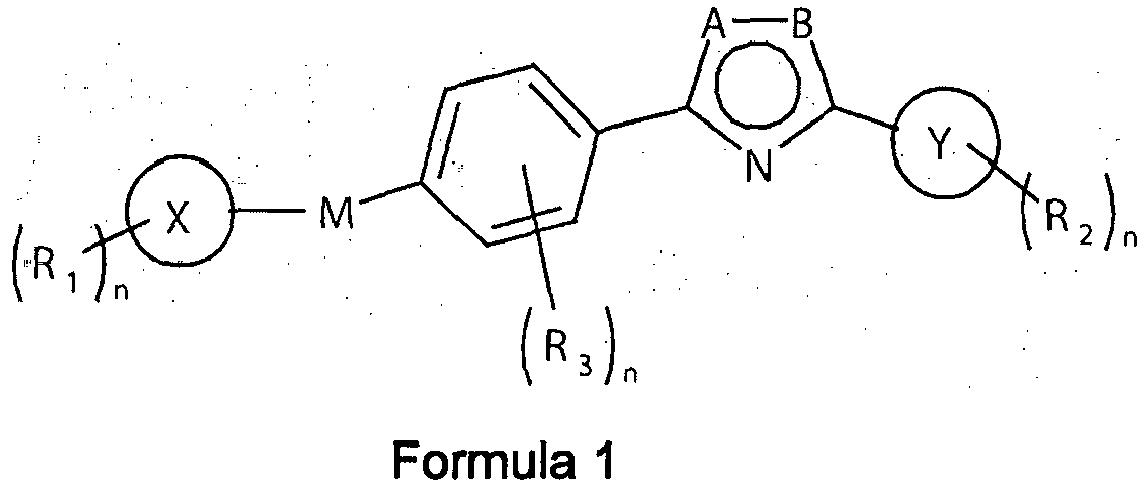
- A, B are each independently selected from N and O, representing 5-membered 1,2,4-oxadiazole ring;
- X, Y is independently selected from substituted or unsubstituted (C3-C7)cycloalkyl, (C3-C7)heterocycloalkyl, aryl or heteroaryl, preferably X, Y represents independently substituted or unsubstituted phenyl or 5 or 6-membered heteroaryl ring containing one to three heteroatoms selected independently from N, O or S;
- R1, R2, R3 represents independently hydrogen, halogen, -NO2, -CN, -OH, -SH, -NH2 or an optionally substituted (C1-C6)alkyl, (C3-C7)cycloalkyl, (C2-C6)alkenyl, (C2-C6)alkynyl, (C1-C6)haloalkyl, aryl, arylalkyl, heteroaryl, heteroarylalkyl, -OR4, -OC(=O)R4, -OC(=S)R4, -C(=O)R4, -C(=S)R4, -C(=O)OR4, -C(=O)NR4R5, -C(=NR4)R5, -C(=NOR4)R5, -NR4R5, -NR4C(=O)R5, -NR4S(=O)2R5, -SR4, -S(=O)R5, -S(=O)2R4, wherein
- [0032] R4,R5 represents independently hydrogen, (C1-C6)alkyl, (C3-C10)cycloalkyl, (C3-C10)cycloalkylalkyl, (C2-C6)alkenyl, (C2-C6)alkynyl, (C1-C6)haloalkyl, (C3-C7)heterocycloalkyl, aryl, arylalkyl, heteroaryl, heteroarylalkyl;
- M represents: a single bond, (C1-C3)alkylene, -O-, -O(C1-C3)alkylene, (C1-C3)alkylene-O-, -S-, -S- (C1-C3)alkylene, (C1-C3)alkylene-S-, -NR6-, -NR6- (C1-C3)alkylene, (C1-C3)alkylene-NR6-, -C(=O)-, -C(=O)-(C1-C3)alkylene, (C1-C3)alkylene-C(=O)-,-C(=S)-,-C(=S)-(C1-C3)alkylene, (C1-C3)alkylene-C(=S)-,-C(=NR6)-, -C(=NR6)-(C1-C3)alkylene, (C1-C3)alkylene-C(=NR6)-, -COO-, -OCO-, -NR6C(=O)-, -C(=O)NR6-, -S(=O)2NR6-, -NR6S(=O)2-, preferably M means -NR6-, or -C(=O)NR6- or -S(=O)2NR6-, wherein R6 represents independently hydrogen, (C1-C6)alkyl, (C3-C10)cycloalkyl, (C3-C10)cycloalkylalkyl, (C2-C6)alkenyl, (C2-C6)alkynyl, (C1-C6)haloalkyl, (C3-C10)heterocycloalkyl, aryl, arylalkyl, heteroaryl, heteroarylalkyl;
- and if R3 in formula 1 is a substituent different than hydrogen, M can also represents:
- -OR7, -SR7, -NR7R8, -C(=O)NR7R8, -S(=O)2NR7R8, -COOR7, -OCOR7, -C(=O)R7, -C(=S)R7, -C(=NR6)R7, especially M means -NR7R8, wherein R7 and R8 represents independently hydrogen, (C1-C6)alkyl, (C3-C10)cycloalkyl, (C3-C10)cycloalkylalkyl, (C2-C6)alkenyl, (C2-C6)alkynyl, (C1-C6)haloalkyl, (C3-C7)heterocycloalkyl, aryl, arylalkyl, heteroaryl, heteroarylalkyl;
- n - is an integer ranging from 1 to 3
- In the 1,2,4-oxadiazole derivatives presented with general Formula 1, according to the invention, preferably:
- A, B are each independently selected from N and O, representing 5-membered
1,2,4-oxadiazole ring; - X, Y represents independently substituted or unsubstituted phenyl or 5 or 6-membered heteroaryl ring containing one to three heteroatoms selected independently from N, O or S;
- R1, R2, R3 represents independently hydrogen, halogen, -NO2, -CN, -OH, -SH, -NH2 or an optionally substituted (C1-C6)alkyl, (C3-C7)cycloalkyl, (C2-C6)alkenyl, (C2-C6)alkynyl, (C1-C6)haloalkyl, -OR4, -OC(=O)R4, -OC(=S)R4, -C(=O)R4, -C(=S)R4, -C(=O)OR4, -C(=O)NR4R5,-C(=NR4)R5, -C(=NOR4)R5, -NR4R5, -NR4C(=O)R5, -NR4S(=O)2R5, -SR4, -S(=O)R5, -S(=O)2R4, wherein R4,R5 represents independently hydrogen, (C1-C6)alkyl, (C3-C10)cycloalkyl, (C3-C10)cycloalkylalkyl, (C2-C6)alkenyl, (C2-C6)alkynyl, (C1-C6)haloalkyl, (C3-C7)heterocycloalkyl.
- M represents: -NR6-, or -C(=O)NR6- or -S(=O)2NR6-, wherein R6 represents independently hydrogen, (C1-C6)alkyl, (C3-C10)cycloalkyl, (C3-C10)cycloalkylalkyl, (C2-C6)alkenyl, (C2-C6)alkynyl, (C1-C6)haloalkyl, (C3-C10)heterocycloalkyl, aryl, arylalkyl, heteroaryl, heteroarylalkyl; and if R3 in formula 1 is a substituent different than hydrogen, M can also represents - NR7R8, wherein R7 and R8 represents independently hydrogen, (C1-C6)alkyl, (C3-C10)cycloalkyl, (C3-C10)cycloalkylalkyl, (C2-C6)alkenyl, (C2-C6)alkynyl, (C1-C6)haloalkyl, (C3-C7)heterocycloalkyl.
- n - is an integer ranging from 1 to 3.
- The invention is directed to 1,2,4-oxadiazole derivatives as positive allosteric modulator ligands of metabotropic glutamate receptors of III group, especially subtype 4 (mGluR4) presented with general formula 1 or pharmaceutically acceptable salts, hydrates or solvates thereof.
- The invention is directed also to use 1,2,4-oxadiazole derivatives presented with general formula 1, optionally in the form of pharmaceutically approved salts, for the manufacture of either alone, or in combination with already existing drugs, for the central nervous disorders treatment such as Parkinson's disease, anxiety, schizophrenia, pain as well as other disorders modulated by mGlu4 receptors.
- Below are listed definitions of terms that were used in the detail description and claims to describe presented invention.
- As used herein the term "halo" or "halogen" includes fluoro, chloro, bromo and iodo.
- The term "alkyl" means linear or branched carbon chain having single carbon-carbon bonds. Thus (C1-C6)alkyl means linear or branched chain having from one to six carbon atoms and includes methyl, ethyl, n-propyl, isopropyl, n-butyl, isobutyl, sec-butyl, tert-butyl, pentyl, hexyl or the like.
- Likewise the term "alkenyl" refers to group such as ethenyl, 1-propenyl, allyl, isopropenyl, 1-butenyl, 3-butenyl, 4-pentenyl or the like.
- Similarly "alkynyl" includes groups such as ethynyl, propynyl, butynyl, pentynyl or the like.
- The term "haloalkyl" refers to defined alkyl group substituted with one or more halogens and may include but is not limited to groups such as fluoromethyl, difluoromethyl, trifluoromethyl, fluoroethyl, difluoroethyl.
- The term "alkylene" means linear or branched difunctional carbon chain having single carbon-carbon bonds. Thus (C1-C6)alkylene means linear or branched difunctional chain having one to six carbon atoms and includes methylene, ethylene, n-propylene, isopropylene, n-butylene, isobutylene, sec-butylene, tert-butylene, pentylene, hexylene or the like.
- The term "cycloalkyl" refers to carbocycle containing no heteroatoms, including mono-, bi- or tricyclic saturated carbocyclic ring as well as fused rings containing one ring that is partially or fully unsaturated. Examples of (C3-C10)cycloalkyl include cyclopropyl, cyclobutyl, cyclopentyl, cyclohexyl, cycloheptyl, cyclooctyl, norbornyl, adamantyl, decahydronaphtyl, indanyl, 1,2,3,4-tetrahydronaphtyl or the like.
- The term "aryl" means an optionally substituted mono- or bicyclic hydrocarbon ring containing from six to ten carbon atoms with at least one unsaturated aromatic ring and includes groups such as phenyl, 1-naphtyl, 2-naphtyl, 1,2,3,4-tetrahydronaphtyl, indyl, indenyl and the like.
- The term "arylalkyl" means the substituent that is attached via the alkyl moiety and refers to (C1-C3)alkyl connected to (C6-C10)aryl including groups such as benzyl, 1-phenylethyl, 2-phenylethyl, 1-phenylpropyl, 2-phenylpropyl, 3-phenylpropyl, 1-naphtylmethyl, 2-naphtylmethyl and the like.
- The term "heteroaryl" refers to optionally substituted five to twelve membered mono- or bicyclic unsaturated aromatic ring having at least one heteroatom selected independently from N, O or S. Examples of heteroaryl include groups such as furyl, benzofuryl, thienyl, benzothiophenyl, pyrrolyl, imidazolyl, benzoimidazolyl, triazolyl, tertrazolyl, triazinyl, thiazolyl, benzothiazolyl, isothiazolyl, thiadiazolyl, oxadiazolyl, oxazolyl, benzooxazolyl, isooxazolyl, pyrazolyl, oxazolonyl, thiazolonyl, indolyl, isoindolyl, pyridyl, pyrazinyl, pyrimidinyl, pyridazinyl, pyridonyl, quinolyl, phtalazinyl, purinyl, haphthyridinyl, quinoxalinyl, quinazolyl, imidazopyridinyl, oxazolopyridinyl, thiazolopyridinyl, imidazolpyridazinyl, oxazolopyridazinyl, thiazolopyridazinyl, cynnolyl, pteridinyl, furazanyl, benzotriazolyl, pyrazolopyridinyl or the like.
- The term "heteroarylalkyl" means the substituent that is attached via the alkyl moiety and refers to (C1-C3)alkyl connected to (C5-C10)heteroaryl including groups such as for example 2-furylmethyl, 3-furylmethyl, 2-thienylmethyl, 3-thienylmethyl, 1-imidazolylmethyl, 2-imidazolylmethyl, 2-thienylmethyl, 3-thienylmethyl, 1-imidazolylmethyl, 2-imidazolylmethyl, 3-imidazolylmethyl, 2-oxazolylmethyl, 3-oxazolylmethyl, 2-thiazolylmethyl, 2-pyridylmethyl, 3-pyridydlmethyl, 4-pyridynylmethyl, 1-quinolylmethyl or the like.
- The term "optionally substituted" means that described groups may be further substituted with one or more substituents like (C1-C6)alkyl, -O-(C1-C6)alkyl, halogen, trifluoromethyl, hydroxyl, mercaptyl, cyano, nitro, amino, amido, carboxyl, ester, sulfonyl, sulfonamide, aryl and heteroaryl. When term "optionally substituted" refers to heteroaryl group, substituent may be bonded to a ring carbon atom or on a ring heteroatom (i.e. nitrogen, sulfur).
- The term "pharmaceutically acceptable salts" means salts prepared from pharmaceutically acceptable non-toxic base and acids including organic or inorganic base and acids. When the compound of the present invention is basic, salts may be prepared from non-toxic organic or inorganic acids such as acetic, benzoic, methanesulfonic, benzenesulfonic, p-toulenesulfonic, citric, fumaric, glutamic, gluconic, glutamic, lactic, maleic, malic, mandelic, succinic, tartaric, hydrobromic, hydrochloric, phosphoric, sulfuric or the like.
- The term "solvates" refers to a complex formed by the solute which is any compound of Formula I and a solvent. Solvates can have variable stechiometry. Preferably solvates relates to hydrates with water as a solvent that do not interfere with the biological activity of the solute.
- The compounds of general Formula 1 described in the present invention can be synthesized by methods known in the art of organic synthesis according to the processes presented in Schemes I-IV.
- Obtained compounds were isolated from the reaction mixtures and purified according to standard procedures and techniques known to a person skilled in the art such as extraction, chromatography and crystallization.
- In one embodiment of the invention the compounds of the invention can be prepared according to Scheme I, starting from substituted p-nitrobenzylonitriles which in reaction with hydroxylamine hydrochloride in the presence of base such as sodium hydroxide or triethylamine are converted to corresponding benzamide oximes. The next step was a coupling reaction with acid chlorides in the presence of carbonate (for example: sodium bicarbonate, sodium carbonate, potassium carbonate, cesium carbonate) resulting in the formation of 1,2,4-oxadiazole ring. This reaction can be carried out in the boiling solvent, preferably toluene, benzene, acetonitrile, for several hours (5 - 15h) under normal pressure or in the pressure vessel at 150-170°C using microwave irradiation in much shorter period of time (10 - 15 minutes). Subsequently in the third step, the nitro group is reduced with application of one of the reducing agents (for example: iron in the presence of acetic acid, tin chloride in the presence of hydrochloric acid, hydrogen in the presence of catalytic amount of palladium on charcoal). In the last step obtained anilines were substituted with various acid chlorides or carboxylic acids to give final amides or with boronic acids to obtain biaryl amines. Reaction with acid chlorides can be proceeded in pyridine at room temperature or in a solvent (for example: dichloromethane, tetrahydrofuran) in the presence of other organic or inorganic amine (for example: triethylamine). In other way anilines can be reacted with various carboxylic acids with appropriate coupling agent (for example: BOP in the presence of triethylamine). Biarylamines can be synthesized in coupling reaction of arylamines with various boronic acids in presence of catalyst such as copper diacetate.

-
- (a) NH2OH•HCl, NaOHaq, EtOH, reflux, 1-5h,
- (b) NH2OH•HCl, TEA, EtOH, rt, 20 min, reflux, 1-5h;
-
- (a) acid chloride, toluene, K2CO3, MW 170°C, 10 min,
- (b) acid chloride, toluene, K2CO3, rt, 1h than reflux 5-15h;
-
- (a) Fe, CH3COOH, EtOH, water, 60°C, 1-2h
- (b) SnCl2, 5N HCl, EtOH, reflux, 2h;
-
- (a) acid chloride, py, rt, overnight,
- (b) acid chloride, TEA, THF, rt, overnight,
- In one embodiment of the invention compounds of the Formula 1 may be prepared according to the synthetic route presented in Scheme II from substituted p-aminobenzonitriles. In the first step formation of amide was carried out in reaction of starting p-aminobenzonitriles with acid chlorides in the presence of base (for example: triethylamine). The next step was to convert a nitrile group into amide oxime in reaction with hydroxylamine hydrochloride in the presence of base (for example: aqueous sodium hydroxide solution). Prepared benzamide oximes were coupled with various acid chlorides resulting the formation of 1,2,4-oxadizaole ring in the final product.

- In one embodiment of the invention compounds of the Formula 1 may be prepared according to the synthetic route presented in Scheme 3 starting from p-cyanobenzenesulfonyl chlorides. In the first step formation of sulfonamide was carried out in reaction of starting compound with various anilines in the presence of base as a solvent (for example: pyridine). The next step was to convert a nitrile group into amide oxime in reaction with hydroxylamine hydrochloride in the presence of base (for example: aqueous sodium hydroxide solution). Prepared benzamide oximes were coupled with various acid chlorides in the presence of carbonate (for example: sodium bicarbonate, sodium carbonate, potassium carbonate, cesium carbonate) resulting the formation of 1,2,4-oxadizaole ring in the final product. Coupling reaction could be performed in solvent (for example: toluene, benzene, acetonitrile) in reflux under normal pressure for several hours (5 - 15 hours) or in the pressure vessel in higher temperatures (150-170°C) using microwave irradiation in much shorter period of time (10 - 15 minutes).

-
- (a) acid chloride, toluene, K2CO3, MW 170°C, 10 min,
- (b) acid chloride, toluene, K2CO3, rt, 1h than reflux 6h.
- In one embodiment of the invention the compounds of the invention can be prepared according to Scheme 4 starting from substituted benzylonitriles which in reaction with hydroxylamine hydrochloride in the presence of base (for example: sodium hydroxide, triethylamine) are converted to corresponding benzamide oximes. The following step was a coupling reaction with substituted p-nitrobenzoyl chlorides in the presence of carbonate (for example: sodium bicarbonate, sodium carbonate, potassium carbonate, cesium carbonate) resulting formation of 1,2,4-oxadiazole ring. Reaction can be carried in boiling solvent such as toluene, benzene, acetonitrile under normal pressure for several hours (5-15h) or in the pressure vessel in higher temperatures (150-170°C) using microwave irradiation in much shorter period of time (10 - 15 minutes). In the third step nitro group can be reduced with application of one of the reducing agents (for example: iron in the presence of acetic acid, tin chloride in the presence of hydrochloric acid, hydrogen in the presence of catalytic amount of palladium on charcoal). Finally in the last step obtained anilines were substituted with various acid chlorides to give amides or with boronic acids to obtain biaryl amines. Reaction with acid chlorides can be proceeded in pyridine in room temperature or in a solvent (for example: dichloromethane, tetrahydrofuran) in the presence of other organic or inorganic amine (for example: triethylamine). Biarylamines can be synthesized in coupling reaction of arylamines with various boronic acids in the presence of catalyst such as copper diacetate.

-
- 1. Fe, CH3COOH, EtOH, water, 60°C, 1-2h;
- 2. Raney Ni, NH2-NH2 aq, MeOH/THF, 60°C, 30 min;
- All abbreviations that were used in this section and in the experimental part are listed in the Table 1 below.
-
Table 1 AcOEt ethyl acetate anh anhydrous BOP 1H-benzotriazol-1-yloxytris(dimethylamino) phosphonium hexafluorophosphate CDCl3 d-chloroform CHCl3 chloroform CH3COOH acetic acid Cu(OAc)2 copper diacetate d dublet DCM dichloromethane DIPEA diisopropylethylamine DMSO-d6 d6 -dimethylsulfoxide eq equivalent ESI+ positive electrospray ionisation EtOH ethanol HCl hydrochloric acid NH2-NH2 hydrazine i-PrOH isopropanol m multiplet MeCN acetonitrile MeOH methanol MW microwave irradiation NaCl sodium chloride NaOHaq aqueous sodium hydroxide NH3aq aqueous ammonium NH2OH•HCl hydroxylamine hydrochloride NMR nuclear magnetic resonance K2CO3 potassium carbonate py pyridine rt room temperature RT retention time s singlet s br. singlet broad SnCl2 tin chloride t tryplet TEA triethylamine THF tetrahydrofurane TLC thin layer chromatography UPLC/MS ultra performance liquid chromatography / mass spectroscopy - Table 2. Exemplary compounds
Table 2 Example Structure Synthetic procedures LC/MS (M+H) (Method) 1 
Scheme I
Steps 1a, 2b, 3b271.7 (B) 2 
Scheme I
Steps 1a, 2b, 3b306.3 (A) 3 
Scheme I
Steps 1a, 2b, 3b267.7 (A) 4 
Scheme I
Steps 1a, 2b, 3b301.5 (A) 5 
Scheme I
Steps 1a, 2b, 3b285.4 (A) 6 
Scheme I
Steps 1a, 2b, 3b319.4 (A) 7 
Scheme I
Steps 1b, 2b, 3b306.6 (B) 8 
Scheme I
Steps 1b, 2b, 3b339.3 (A) 9 
Scheme I
Steps 1a, 2b, 3b252.5 (B) 10 
Scheme I
Steps 1a, 2b, 3b285.4 (A) 11 
Scheme I
Steps 1a, 2a, 3a, 4-3378.1 (B) 12 
Scheme I
Steps 1a, 2a, 3a, 4-3374.2 (B) 13 
Scheme I Steps 1a, 2a, 3a, 4-3 374.2 (B) 14 
Scheme I Steps 1a, 2a, 3a, 4-3 400.0 (B) 15 
Scheme I Steps 1a, 2a, 3a, 4-3 390.1 (B) 16 
Scheme I Steps 1a, 2a, 3a, 4-1 a 373.4 (B) 17 
Scheme I
Steps 1a, 2a, 3a, 4-1a372.8 (B) 18 
Scheme I
Steps 1a, 2a, 3a, 4-1a390.1 (B) 19 
Scheme I
Steps 1a, 2a, 3a, 4-1a378.1 (B) 20 
Scheme I
Steps 1a, 2a, 3a, 4-1a351.1 (B) 21 
Scheme I
Steps 1a, 2a, 3a, 4-1a395.0 (B) 22 
Scheme I
Steps 1a, 2a, 3b, 4-1a377.1 (A) 23 
Scheme I
Steps 1a, 2a, 3b, 4-2394.8 (A) 24 
Scheme I
Steps 1a, 2a, 3b, 4-2410.7 (A) 25 
Scheme I
Steps 1a, 2a, 3b, 4-1a381.1 (A) 26 
Scheme I
Steps 1a, 2b, 3b, 4-1a374.4 (A) 27 
Scheme I
Steps 1a, 2b, 3b, 4-1a406.3 (A) 28 
Scheme I
Steps 1a, 2b, 3b, 4-1a390.3 (A) 29 
Scheme I
Steps 1a, 2b, 3b, 4-1a424.2 (A) 30 
Scheme I
Steps 1a, 2b, 3b, 4-1b376.4 (A) 31 
Scheme II
Steps 1, 2, 3410.8 (A) 32 
Scheme II
Steps 1, 2, 3428.7 (A) 33 
Scheme II
Steps 1, 2, 3406.5 (A) 34 
Scheme II
Steps 1, 2, 3361.3 (A) 35 
Scheme II
Steps 1, 2, 3395.0 (B) 36 
Scheme II
Steps 1, 2, 3413.1 (B) 37 
Scheme II
Steps 1, 2, 3390.8 (B) 38 
Scheme I
Steps 1b, 2b, 3b, 4-1b411.6 (B) 39 
Scheme I
Steps 1b, 2b, 3b, 4-1b445.0 (B) 40 
Scheme I
Steps 1a, 2b, 3b, 4-1b357.0 (B) 41 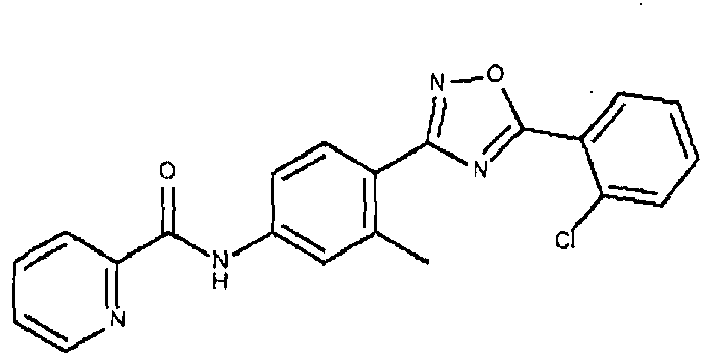
Scheme I
Steps 1a, 2b, 3b, 4-1a390.5 (A) 42 
Scheme I
Steps 1a, 2b, 3b, 4-2424.6 (A) 43 
Scheme I
Steps 1a, 2b, 3b, 4-2458.7 (A) 44 
Scheme I
Steps 1a, 2b, 3b, 4-2440.8 (A) 45 
Scheme I
Steps 1a, 2b, 3b, 4-1a470.4 (A) 46 
Scheme I
Steps 1a, 2b, 3b, 4-2442.4 (A) 47 
Scheme I
Steps 1a, 2b, 3b, 4-2424.5 (A) 48 
Scheme I
Steps 1a, 2b, 3b, 4-2408.1 (B) 49 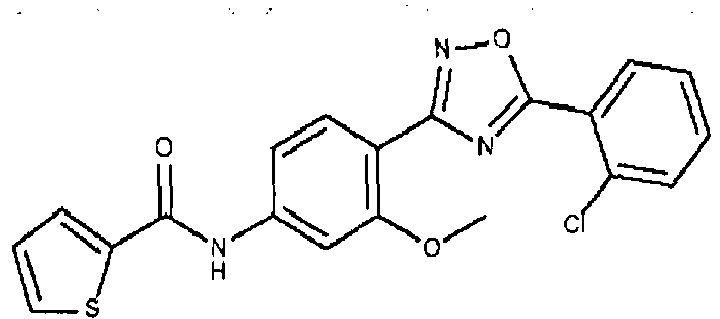
Scheme I
Steps 1a, 2b, 3b, 4-2413.0 (A) 50 
Scheme I
Steps 1a, 2b, 3b, 4-2408.5 (A) 51 
Scheme I
Steps 1a, 2b, 3b, 4-1a458.7 (A) 52 
Scheme I
Steps 1a, 2b, 3b, 4-2428.6 (A) 53 
Scheme I
Steps 1a, 2b, 3b, 4-2445.0 (A) 54 
Scheme III
Steps 1, 2, 3a411.3 (A) 55 
Scheme III
Steps 1, 2, 3a412.3 (A) 56 
Scheme III
Steps 1, 2, 3b414.2 (B) 57 
Scheme IV
Steps 1, 2, 3a, 4-1342.1 (B) 58 
Scheme IV
Steps 1, 2, 3a, 4-1375.9 (B) 59 
Scheme IV
Steps 1, 2, 3a, 4-1372.7 (B) 60 
Scheme IV
Steps 1, 2, 3a, 4-1387.1 (B) 61 
Scheme IV
Steps 1, 2, 3a, 4-1 than reduction as in step 3a357.1 (B) 62 
Scheme IV
Steps 1, 2, 3a, 4-1342.9 (B) 63 
Scheme IV
Steps 1, 2, 3a, 4-1343.4 (B) 64 
Scheme IV
Steps 1, 2, 3a, 4-1345.0 (B) 65 
Scheme IV
Steps 1, 2, 3a, 4-1347.0 (B) 66 
Scheme IV
Steps 1, 2, 3b, 4-1343.2 (B) 67 
Scheme IV
Steps 1, 2, 3b, 4-1376.8 (B) 68 
Scheme IV
Steps 1, 2, 3b, 4-1360.8 (B) 69 
Scheme IV
Steps 1, 2, 3b, 4-1389.8 (B) 70 
Scheme IV
Steps 1, 2, 3a, 4-2348.1 (B) 71 
Scheme IV
Steps 1, 2, 3a, 4-1344.1 (B) 72 
Scheme IV
Steps 1, 2, 3a, 4-1357.2 (B) - All starting materials were purchased from commercial suppliers and were used without purification.
- Reaction progress was monitored by TLC on Merck Silica Gel 60 F254 on aluminium plates or Merck Aluminum oxide 60 F254, neutral on aluminium plates and visualized with UV light (254 nm).
- Column chromatography was performed on Merck Silica Gel 60 (0.063-0.200 mm; 70-230 mesh ASTM) for column chromatography or on Merck Aluminum oxide 90 active neutral (0.063-0.200 mm; 70-230 mesh ASTM).
- 1H NMR spectra were measured at 300 MHz and 13C NMR spectra at 75 MHz on a Varian Mercury-VX (300 MHz) spectrophotometer in CDCl3 or d6-DMSO solutions with TMS as an internal standard. The spectral data of new compounds refer to their free bases. Chemical shifts were expressed in δ (ppm). For compounds containing fluorine atoms couplings from C-F were observed on 13C carbon spectra. In cases where it was possible multiplets in 13C NMR were identified and denoted in experimental part.
- UPLC/MS analysis was performed on Waters TQD spectrometer combined with UPLC Acquity H-Class with PDA eLambda detector. Waters Aquity UPLC BEH C18 1,7 µm 2,1x100 mm chromatographic column was used with temperature of 40°C, flow rate of 0.300 ml/min and injection volume was 1.0 µL. All mass spectra were recorded under electrospray ionization in positive mode (ESI+) and chromatograms were recorded with UV detection in range 190-300 nm.
- Method A: The gradient conditions used are: 100% phase A (80% water + 20% acetonitrile + 0.1 % formic acid) to 100% phase B (acetonitrile + 0.1 % formic acid) at 3.5 minutes, equilibrated to initial conditions until 4.0 minutes and kept for additional 2.0 minutes. Total time of analysis - 6.0 minutes.
- Method B: The gradient conditions used are: 80% phase A (water + 0.1 % formic acid) and 20% phase B (acetonitrile + 0.1 % formic acid) to 100% phase B (acetonitrile + 0.1 % formic acid) at 3.0 minutes, kept till 3.5 minutes, then equilibrated to initial conditions until 4.0 minutes and kept for additional 2.0 minutes. Total time of analysis - 6.0 minutes.
- The compounds in the Table 2 have been obtained according to methods presented in Schemes 1-4 in previous section. Column "synthetic procedure" shows synthetic procedure which was applied.
-

- 2-chloro-N'-hydroxy-4-nitrobenzene-1-carboximidamide (Scheme I, Step 1a): 2-chloro-4-nitrobenzonitrile (3.50 g, 19.20 mmol, 1 eq) was dissolved in 80 ml of ethanol and hydroxylamine hydrochloride (2.67 g, 38.4 mmol, 2 eq) was added followed by solution of NaOH (1.54 g, 38.4 mmol, 2 eq) in 20 ml of water. Reaction mixture was refluxed for 6 h (TLC control) and ethanol was evaporated in vacuo. 100 ml of water was added and reaction mixture was acidified with 1 N HCl. Precipitated solid was filtered and identified as byproduct 2-chloro-4-nitrobenzamide (1.80 g, 47%). Filtrate was extracted with AcOEt water layer was alkalized with NH3aq. Precipitated solid was filtered and purified by maceration from i-PrOH/hexane (1:3) resulting with 0.65 g of product as a white solid (16%).
- LCMS (method A) RT=0.86 min, MS (m/z ESI+) 215.8.
- 1H NMR (300 MHz, CDCl3): 9.75 (s, 1H), 8.29 (d, 1 H), 8.17 (dd, 2H), 7.67 (dd, 1 H), 6.02 (s br., 2H).
- 13C NMR (300 MHz, CDCl3): 149.8, 148.4, 140.2, 133.8, 132.7, 124.9, 122.4.
- 3-(2-chloro-4-nitrophenyl)-5-phenyl-1,2,4-oxadiazole (Scheme I, Step 2b): 2-chloro-N'-hydroxy-4-nitrobenzene-1-carboximidamide (0.50 g, 2.32 mmol, 1 eq) was suspended in 20 ml of toluene and benzoyl chloride (0.35 ml, 0.42 g, 3.02 mmol, 1.3 eq) was added followed by K2CO3 anh (0.42 g, 3.02 mmol, 1.3 eq). After 30 min of stirring in rt reaction mixture was refluxed for 25 h. reaction mixture was poured into 50 ml of water and was extracted with CHCl3. After maceration in i-PrOH/hexane (1:2) pure product was filtered as a pale yellow solid (0.60 g, 85.7%).
- LCMS (method B) RT=3.77 min, MS (m/z ESI+) 302.4.
- 1H NMR (300 MHz, DMSO-d6): 8.44 (d, 1 H), 8.31-8.21 (m, 4H), 7.68-7.55 (m, 3H).
- 13C NMR (300 MHz, DMSO-d6): 175.9, 166.4, 149.1, 134.9, 133.3, 132.7, 132.1, 129.3, 128.3, 126.1, 123.6, 121.7.
- 3-chloro-4-(5-phenyl-1,2,4-oxadiazol-3-yl)aniline (Scheme I, Step 3b): To a solution of 3-(2-chloro-4-nitrophenyl)-5-phenyl-1,2,4-oxadiazole (0.56g, 1.86 mmol, 1 eq) in 30 ml of ethanol solution of SnCl2 (1.42 g, 7.44 mmol, 4 eq) in 2.3 ml of 5N HCl was added dropwise. Reaction mixture was refluxed for 5 h and solvent was removed in vacuo. 50 ml of water was added and reaction mixture was alkalized with 2M NaOH to pH=9 followed by extraction with AcOEt. Crude product was purified by column chromatography over silica gel using CHCl3/MeOH (99:1) followed by maceration from i-PrOH/hexane (1:2) to yield product as a white solid (0.28g, 56.0%).
- LC (method B) RT=3.26 min, MS (m/z ESI+) 271.7.
- 1H NMR (300 MHz, CDCl3): 8.20 (m, 2H), 7.88 (d, 1 H), 7.60-7.51 (m, 3H), 6.81 (d, 1 H), 6.65 (dd, 1 H), 4.03 (s br., 2H).
- 13C NMR (300 MHz, CDCl3): 174.6, 167.8, 149.4, 134.4, 132.9, 132.6, 129.0, 128.1, 124.3, 116.3, 115.5, 113.1.
-

- 3-(2-chloro-4-nitrophenyl)-5-(2-chlorophenyl)-1,2,4-oxadiazole (Scheme I, Step 2b): Prepared according to procedure described in Example 1 using 2-chloro-N'-hydroxy-4-nitrobenzene-1-carboximidamide (Example 1, Step 1 a). Product was purified by maceration from i-PrOH/hexane (1:2) (0.60 g, 85.7%).
- LCMS (method A) RT=3.87 min, MS (m/z ESI+) 336.7.
- 1H NMR (300 MHz, CDCl3): 8.45 (d, 1H), 8.33-8.24 (m, 2H), 8.18 (dd, 1 H), 7.64-7.57 (m, 2H), 7.47 (dt, 1 H).
- 13C NMR (300 MHz, CDCl3): 174.4, 166.2, 149.2, 134.9, 134.1, 133.6, 132.8, 132.0, 131.8, 131.7, 127.2, 126.1, 122.9, 121.7.
- 3-chloro-4-[5-(2-chlorophenyl)-1,2,4-oxadiazol-3-yl]aniline (Scheme I, Step 3b): Compound prepared according to procedure described in Example 1 from 3-(2-chloro-4-nitrophenyl)-5-(2-chlorophenyl)-1,2,4-oxadiazole. Product was purified by maceration from i-PrOH/hexane (1:2) (0.38 g, 69.6%).
- LC (method A) RT=3.32 min, MS (m/z ESI+) 306.3.
- 1H NMR (300 MHz, CDCl3): 8.13 (dd, 1 H), 7.90 (d, 1 H), 7.58 (dd, 1 H), 7.50 (dt, 1 H), 7.44 (dt, 1 H), 6.81 (d, 1 H), 6.65 (dd, 1 H), 4.03 (s br. 2H).
- 13C NMR (300 MHz, CDCl3): 173.1, 167.5, 149.5, 134.5, 133.9, 133.0, 132.9, 131.9, 131.4, 127.0, 123.7, 116.3, 115.3, 113.1.
-

- N'-hydroxy-2-methoxy-4-nitrobenzene-1-carboximidamide (Scheme I, Step 1 a): Compound was prepared according to procedure described in Example 1 using 2-methoxy-4-nitrobenzonitrile. Precipitated product was purified by maceration from i-PrOH/hexane (1:2) (3.71 g, 62.6%).
- LC (method A) RT=0.57 min, MS (m/z ESI+) 212.0
- 1H NMR (300 MHz, CDCl3 + MeOD): 7.72 (d, 1 H), 7.69 (m, 1 H), 7.64 (d, 1 H), 3.88 (s, 3H), 3.82 (s br. 2H).
- 13C NMR (300 MHz, CDCl3 + MeOD): 157.4, 150.8, 149.1, 130.2, 127.1, 115.6, 106.3, 56.1.
- 3-(2-methoxy-4-nitrophenyl)-5-phenyl-1,2,4-oxadiazole (Scheme I, Step 2b): Prepared from N'-hydroxy-2-methoxy-4-nitrobenzene-1-carboximidamide according to procedure described in Example 1. Product was purified by maceration from i-PrOH/hexane (1:2) resulting yellow solid (1.71 g, 86.8%).
- LCMS (method A) RT=3.49 min, MS (m/z ESI+) 297.5.
- 1H NMR (300 MHz, CDCl3): 8.23-8.16 (m, 3H), 8.01-7.97 (m, 2H), 7.72 (m, 1 H), 7.66 (m, 2H), 4.05 (s, 3H).
- 13C NMR (300 MHz, CDCl3): 175.0, 166.0, 158.7, 150.5, 133.9, 132.4, 130.0, 128.4, 123.6, 121.6, 115.9, 107.6, 57.2.
- 3-methoxy-4-(5-phenyl-1,2,4-oxadiazol-3-yl)aniline (Scheme I, Step 3b): Compound prepared according to procedure described in Example 1 using 3-(2-methoxy-4-nitrophenyl)-5-phenyl-1,2,4-oxadiazole. Purification of final product was performed by maceration from i-PrOH/hexane (1:2) to yield product as a white solid (1.22g, 79.7%).
- LC (method A) RT=2.77 min, MS (m/z ESI+) 267.7
- 1H NMR (300 MHz, CDCl3): 8.20 (m, 2H), 7.97 (d, 1H), 7.55-7.52 (m, 3H), 6.38 (dd, 1 H), 6.32 (d, 1 H), 4.02 (s br. 2H), 3.94 (s, 3H).
- 13C NMR (300 MHz, CDCl3): 173.9, 167.4, 159.7, 150.5, 132.7, 132.3, 128.9, 128.1, 124.6, 107.1, 106.0, 98.0, 55.8.
-

- 5-(2-chlorophenyl)-3-(2-methoxy-4-nitrophenyl)-1,2,4-oxadiazole (Scheme I, Step 2b): Prepared from N'-hydroxy-2-methoxy-4-nitrobenzene-1-carboximidamide (Example 3, Step 1a) according to procedure described in Example 1. Product was purified by maceration from i-PrOH/hexane (1:2) resulting yellow solid (1.90 g, 88.0%).
- LCMS (method A) RT=3.57 min, MS (m/z ESI+) 331.8.
- 1H NMR (300 MHz, DMSO): 8.20 (m, 1 H), 8.15 (d, 1 H), 8.00-7.97 (m, 2H), 7.77-7.68 (m, 2H), 7.60 (dt, 1H), 4.04 (s, 3H).
- 13C NMR (300 MHz, DMSO): 173.4, 165.8, 158.7, 150.6, 134.8, 132.9, 132.7, 132.5, 131.9, 128.5, 122.9, 121.3, 116.0, 107.8, 57.3.
- 4-[5-(2-chlorophenyl)-1,2,4-oxadiazol-3-yl]-3-methoxyaniline (Scheme I, Step 3b): Compound prepared according to procedure described in Example 1 using 5-(2-chlorophenyl)-3-(2-methoxy-4-nitrophenyl)-1,2,4-oxadiazole. Purification of final product was performed by maceration from i-PrOH/hexane (1:2) to yield product as a white solid (1.33 g, 81.6%).
- LCMS (method A) RT=2.91 min, MS (m/z ESI+) 301.5
- 1H NMR (300 MHz, DMSO): 8.10 (dd, 1H), 7.75-7.66 (m, 3H), 7.59 (dt, 1 H), 6.35 (d, 1 H), 6.30 (dd, 1 H), 5.84 (s br. 2H), 3.81 (s, 3H).
- 13C NMR (300 MHz, DMSO): 171.5, 166.6, 159.3, 153.3, 133.7, 132.1, 131.9, 131.8, 131.1, 127.8, 123.2, 106.0, 101.7, 96.6, 55.2.
-

- 5-(2-fluorophenyl)-3-(2-methoxy-4-nitrophenyl)-1,2,4-oxadiazole (Scheme I, Step 2b): Prepared from N'-hydroxy-2-methoxy-4-nitrobenzene-1-carboximidamide (Example 3, Step 1a) according to procedure described in Example 1. Product was purified by maceration from i-PrOH/hexane (1:2) resulting pale yellow solid (1.81 g, 87.9%).
- LCMS (method A) RT=3.43 min, MS (m/z ESI+) 315.4.
- 1H NMR (300 MHz, DMSO): 8.19 (m, 2H), 7.99-7.96 (m, 2H), 7.79 (m, 1 H), 7.55-7.45 (m, 2H), 4.04 (s, 3H).
- 13C NMR (300 MHz, DMSO): 172.2 (d), 165.8, 162.2, 158.8 (d), 150.7, 136.2 (d), 132.5, 131.3, 125.9 (d), 121.6, 117.7 (d), 115.9, 112.1 (d), 107.8, 57.3.
- 4-[5-(2-fluorophenyl)-1,2,4-oxadiazol-3-yl]-3-methoxyaniline (Scheme I, Step 3b): Compound prepared according to procedure described in Example 1 using 5-(2-fluorophenyl)-3-(2-methoxy-4-nitrophenyl)-1,2,4-oxadiazole. Purification of final product was performed by maceration from i-PrOH/hexane (1:2) to yield product as a white solid (1.36 g, 88.3%).
- LC (method A) RT=2.71 min, MS (m/z ESI+) 285.4.
- 1H NMR (300 MHz, DMSO): 8.16 (dt, 1 H), 7.74 (m, 1 H), 7.70 (d, 1 H), 7.54-7.43 (m, 2H), 6.35 (d, 1 H), 6.30 (dd, 1 H), 5.83 (s br. 2H), 3.81 (s, 3H).
- 13C NMR (300 MHz, DMSO): 169.9 (d), 166.6, 161.5, 159.3, 158.1, 153.3, 135.0 (d), 131.8, 130.7, 125.3 (d), 117.1 (d), 112.1 (d), 106.0, 101.7, 96.6, 55.2.
-

- 5-(2-fluorophenyl)-3-(2-methoxy-4-nitrophenyl)-1,2,4-oxadiazole (Scheme I, Step 2b): Prepared from N'-hydroxy-2-methoxy-4-nitrobenzene-1-carboximidamide (Example 3, Step 1a) according to procedure described in Example 1. Product was purified by maceration from i-PrOH/hexane (1:2) resulting pale yellow solid (2.10 g, 90.9%).
- LCMS (method A) RT=3.66 min, MS (m/z ESI+) 349.6.
- 1H NMR (300 MHz, DMSO): 8.27-8.18 (m, 2H), 7.99 (dd, 1 H), 7.97 (s, 1 H), 7.80 (dd, 1 H), 7.51 (ddd, 1 H), 4.05 (s, 3H).
- 13C NMR (300 MHz, DMSO): 173.0, 166.3, 165.7, 162.9, 158.7, 150.6, 134.8 (d), 134.6 (d), 132.5, 121.2, 119.8 (d), 119.4 (d), 116.2 (d), 116.0, 107.8, 57.3.
- 4-[5-(2-chloro-4-fluorophenyl)-1,2,4-oxadiazol-3-yl]-3-methoxyaniline (Method 1, Step 3b): Compound prepared according to procedure described in Example 1 using 5-(2-chloro-4-fluorophenyl)-3-(2-methoxy-4-nitrophenyl)-1,2,4-oxadiazole. Purification of final product was performed by maceration from i-PrOH/hexane (1:2) to yield product as a white solid (1.88 g, 97.9%).
- LCMS (method A) RT=3.05 min, MS (m/z ESI+) 319.4.
- 1H NMR (300 MHz, DMSO-d6): 8.16 (dd, 1 H), 7.73 (dd, 1 H), 7.69 (d, 1 H), 7.46 (m, 1 H), 6.63 (d, 1 H), 6.28 (dd, 1 H), 5.82 (s br. 2H), 3.79 (s, 3H).
- 13C NMR (300 MHz, DMSO-d6): 171.3, 167.1, 164.2 (d), 159.8, 153.8, 134.4 (d), 134.3 (d), 132.3, 120.5 (d), 119.2 (d), 116.0 (d), 106.5, 102.2, 97.1, 55.7.
-

- N'-hydroxy-4-nitro-2-(trifluoromethyl)benzene-1-carboximidamide (Scheme I, Step 1 b):
- 2-trifluoromethylo-4-nitrobenzonitrile (3.50 g, 16.19 mmol, 1 eq) was dissolved in 80 ml of ethanol and hydroxylamine hydrochloride (5.63 g, 69.5 mmol, 5 eq) was added followed by triethylamine (4.17g, 5.74 ml, 97.14 mmol, 6eq). Reaction mixture was refluxed for 3 h (TLC control) and ethanol was evaporated in vacuo. 100 ml of water was added and reaction mixture was extracted with AcOEt. After evaporation of solvent crude product was purified by column chromatography over silica gel using gradient form CHCl3 to CHCl3/MeOH (49:1) followed by maceration from i-PrOH/hexane (1:2)resulting with 1.72 g of white solid (42.7%).
- LCMS (method A) RT=1.42 min, MS (m/z ESI+) 249.6.
- 3-[4-nitro-2-(trifluoromethyl)phenyl]-5-phenyl-1,2,4-oxadiazole (Scheme I, Step 2b): Prepared from N'-hydroxy-4-nitro-2-(trifluoromethyl)benzene-1-carboximidamide according to procedure described in Example 1. Product was purified by maceration from i-PrOH/hexane (1:2) resulting pale yellow solid (0.73 g, 67.6%).
- LCMS (method B) RT = 3.76 min, MS (m/z ESI+) 336.6.
- 4-(5-phenyl-1,2,4-oxadiazol-3-yl)-3-(trifluoromethyl)aniline (Scheme I, Step 3b): Compound prepared according to procedure described in Example 1 using 3-[4-nitro-2-(trifluoromethyl)phenyl]-5-phenyl-1,2,4-oxadiazole. Purification of final product was performed by maceration from i-PrOH/hexane (1:2) to yield product as a white solid (0.45 g, 67.4%).
- LCMS (method B) RT=3.31 min, MS (m/z ESI+) 306.6.
- 1H NMR (300 MHz, CDCl3): 8.20 (m, 2H), 7.70 (d, 1H), 7.61-7.54 (m, 3H), 7.09 (d, 1 H), 6.88 (dd, 1 H), 4.13 (s br. 2H).
-

- 5-(2-chlorophenyl)-3-[4-nitro-2-(trifluoromethyl)phenyl]-1,2,4-oxadiazole (Scheme I, Step 2b): Prepared from N'-hydroxy-4-nitro-2-(trifluoromethyl)benzene-1-carboximidamide (Example 7, Step 1 b) according to procedure described in Example 1. Product was purified by column chromatography over silica gel using CHCl3/hexane (2:1) followed by maceration from i-PrOH/hexane (1:2) to yield product as a white solid maceration from i-PrOH/hexane (1:2) resulting pale yellow solid (0.98 g, 40.2%).
- LCMS (method A) RT=3.81 min, MS (m/z ESI+) 369.4.
- 1H NMR (300 MHz, DMSO-d6): 8.71 (dd, 1 H), 8.66 (d, 1 H), 8.30 (d, 1 H), 8.19 (m, 1H), 7.80-7.71 (m, 2H).
- 4-[5-(2-chlorophenyl)-1,2,4-oxadiazol-3-yl]-3-(trifluoromethyl)aniline (Scheme I, Step 3b): Compound prepared according to procedure described in Example 1 using 5-(2-chlorophenyl)-3-[4-nitro-2-(trifluoromethyl)phenyl]-1,2,4-oxadiazole. Purification of final product was performed by maceration from i-PrOH/hexane (1:2) to yield product as a white solid (0.61 g, 75.3%).
- LCMS (method A) RT=3.42 min, MS (m/z ESI+) 339.3.
- 1H NMR (300 MHz, CDCl3): 8.14 (m, 1H), 7.72 (d, 1H), 7.57 (m, 1 H), 7.52 (dt, 1H), 7.48 (dt, 1H), 7.08 (d, 1 H), 6.87 (dd, 1 H), 4.14 (s br. 2H).
-

- N'-hydroxy-2-methyl-4-nitrobenzene-1-carboximidamide (Scheme I, Step 1 a): Compound was prepared according to procedure described in Example 1 using 2-methyl-4-nitrobenzonitrile. Reaction gave mixture of two products: 2-metylo-4-nitrobenzamide isolated after extraction of acidic water layer with AcOEt and N'-hydroxy-2-methyl-4-nitrobenzene-1-carboximidamide isolated after extraction of alkalized water layer with AcOEt. Product was purified by maceration from i-PrOH/hexane (1:2) (0.68 g, 16.2%).
- LCMS (method B) RT=0.59 min, MS (m/z ESI+) 196.5.
- 1H NMR (300 MHz, DMSO-d6): 9.64 (s, 1 H), 8.10 (d, 1 H), 8.05 (dd, 1 H), 7.53 (d, 1 H), 5.93 (s br. 2H), 2.45 (s, 3H).
- 13C NMR (300 MHz, DMSO-d6): 150.8, 147.1, 140.6, 138.7, 130.2, 124.6, 120.4, 19.8.
- 3-(2-methyl-4-nitrophenyl)-5-phenyl-1,2,4-oxadiazole (Scheme I, Step 2b): Prepared from N'-hydroxy-2-methyl-4-nitro-benzene-1-carboximidamide according to procedure described in Example 1. Product was purified by column chromatography over silica gel using CHCl3 followed by maceration from i-PrOH/hexane (1:2) to yield product as a white solid (0.60 g, 52.2%).
- LCMS (method B) RT=3.95 min, MS (m/z ESI+) 282.7.
- 3-methyl-4-(5-phenyl-1,2,4-oxadiazol-3-yl)aniline (Scheme I, Step 3b): Compound prepared according to procedure described in Example 1 using 3-(2-methyl-4-nitrophenyl)-5-phenyl-1,2,4-oxadiazole. Purification of final product was performed by maceration from i-PrOH/hexane (1:2) to yield product as a white solid (0.35 g, 66.0%).
- LCMS (method B) RT=3.25 min, MS (m/z ESI+) 252.6.
- 1H NMR (300 MHz, CDCl3): 8.20 (m, 2H), 7.96 (dd, 1H), 7.59-7.51 (m, 3H), 6.62 (m, 2H), 3.89 (s br. 2H), 2.62 (s, 3H).
- 13C NMR (300 MHz, CDCl3): 174.0, 169.5, 148.5, 140.0, 132.4, 131.8, 129.0, 128.1, 124.6, 117.2, 116.2, 112.2, 22.6.
-

- 5-(2-chlorophenyl)-3-(2-methyl-4-nitrophenyl)-1,2,4-oxadiazole (Scheme I, Step 2b): Prepared from N'-hydroxy-2-methyl-4-nitro-benzene-1-carboximidamide (Example 9, Step 1 a) according to procedure described in Example 1. Product was purified by maceration from i-PrOH/hexane (1:2) to yield product as a white solid (0.83 g, 79.8%).
- LCMS (method A) RT = 3.28 min, MS (m/z ESI+) 315.7.
- 1H NMR (300 MHz, DMSO-d6): 8.29-8.22 (m, 3H), 8.18 (dd, 1H), 7.77-7.68 (m, 2H), 7.63-7.58 (m, 1 H), 2.72 (s, 3H).
- 13C NMR (300 MHz, DMSO-d6): 173.9, 167.9, 149.0, 140.6, 134.9, 132.9, 132.7, 131.9, 131.8, 131.7, 128.5, 126.4, 122.8, 121.7, 22.0.
- 4-[5-(2-chlorophenyl)-1,2,4-oxadiazol-3-yl]-3-methylaniline (Scheme I, Step 3b): Compound prepared according to procedure described in Example 1 using 5-(2-chlorophenyl)-3-(2-methyl-4-nitrophenyl)-1,2,4-oxadiazole. Purification of final product was performed by maceration from i-PrOH/hexane (1:2) to yield product as a white solid (0.55 g, 76.4%).
- LCMS (method A) RT=3.37 min, MS (m/z ESI+) 285.4.
- 1H NMR (300 MHz, CDCl3): 8.14 (dd, 1 H), 7.98 (m, 1 H), 7.56 (m, 1 H), 7.49 (dt, 1 H), 7.45 (dt, 1 H), 6.61 (m, 2H), 3.89 (s br. 2H), 2.63 (s, 3H).
- 13C NMR (300 MHz, CDCl3): 172.6, 169.2, 148.6, 140.1, 133.8, 132.8, 131.9, 131.8, 131.4, 127.0, 124.0, 117.2, 116.0, 112.3, 22.6.
-

- N'-hydroxy-4-nitrobenzene-1-carboximidamide (Scheme I. Step 1a): Compound was prepared according to procedure described in Example 1 using 4-nitrobenzonitrile. After alkalization precipitated solid was filtered and purified by maceration from i-PrOH/hexane (1:3) resulting product as a white solid (9.23 g, 75.5 %).
- LCMS (method A) RT=0.65 min, MS (m/z ESI+) 182.2.
- 5-(4-methoxyphenyl)-3-(4-nitrophenyl)-1,2,4-oxadiazole (Scheme I, Step 2a): N'-hydroxy-4-nitrobenzene-1-carboximidamide (4.00 g, 22.10 mmol, 1.0 eq), 4-methoxybenzoyl chloride (4.52 g, 3.59 ml, 26.52 mmol, 1.2 eq), K2CO3 anh. (3.96 g, 28.73 mmol, 1.3 eq) in 40 ml of toluene was heated in MW oven for 10 minutes in 170°C. 20 ml of water was added to reaction mixture and crude product was extracted to CHCl3. Maceration from EtOH/water (1:1) gave 3.74 g of pure product as a pale yellow solid (57.0%).
- 1H NMR (300 MHz, DMSO-d6): 8.38 (d, 2H), 8.30 (d, 2H), 8.12 (d, 2H), 7.18 (d, 2H), 3.89 (s, 3H).
- 13C NMR (300 MHz, DMSO): 176.5, 167.4, 164.0, 149.8, 132.7, 130.5, 128.9, 124.7, 116.0, 115.6, 56.2.
- 4-[5-(4-methoxyphenyl)-1,2,4-oxadiazol-3-yl]aniline (Scheme 1, Step 3a): 5-(4-methoxyphenyl)-3-(4-nitrophenyl)-1,2,4-oxadiazole (3.20 g, 10.77 mmol, 1.0 eq) was suspended in 15 ml of ethanol and Fe powder (3.20 g) was added in one portion followed by dropwise addition of 90% solution of CH3COOH. Reaction mixture was refluxed for 1 h and reaction mixture was poured into cold water. Precipitated solid was filtered, dissolved in acetone and refluxed with active carbon for 30 minutes. After filtration and evaporation of solvent water was added and solution was alkalized with NH3aq. Precipitated solid was filtered and dried resulting with pure product as a white solid (1.88 g, 65.3%).
- LCMS (method B) RT= 3.07 min, MS (m/z ESI+) 268.4.
- 1H NMR (300 MHz, CDCl3): 8.14 (d, 2H), 7.96 (d, 2H), 7.02 (d, 2H), 6.75 (d, 2H), 3.95 (s br. 2H), 3.89 (s, 3H).
- 13C NMR (300 MHz, CDCl3): 175.0, 168.7, 163.0, 149.0, 130.0, 129.0, 117.1, 117.0, 114.7, 114.4, 55.5.
- N-(3-chlorophenyl)-4-[5-(4-methoxyphenyl)-1,2,4-oxadiazol-3-yl]aniline (Scheme I, Step 4-3): 4-[5-(4-methoxyphenyl)-1,2,4-oxadiazol-3-yl]aniline (0.20 g, 0.75 mmol, 1.0 eq) was dissolved in 10 ml of DCM and 3-chlorobenzeneboronic acid (0.35 g, 2.52 mmol, 3.0 eq), DIPEA (0.39 g, 0.53 ml, 3.00 mmol, 4.0 eq) and Cu(OAc)2 (0.07 g, 0.40 mmol, 0.5 eq) was added to reaction mixture. After stirring for 24h in rt mixture was evaporated and crude product was purified by column chromatography over silica gel using CHCl3/MeOH (49:1) followed by maceration from MeOH to yield product as a white solid (0.25g, 88.3%).
- LC (method B) RT= 4.16 min, MS (m/z ESI+) 378.1.
- 1H NMR (300 MHz, CDCl3): 8.15 (d, 2H), 8.06 (d, 2H), 7.25 (t, 1 H), 7.15 (m, 3H), 7.05-6.98 (m, 4H), 5.99 (s br. 1 H), 3.85 (s, 3H).
- 13C NMR (300 MHz, CDCl3): 175.3, 168.4, 163.1, 145.0, 135.1, 130.0, 129.0, 121.9, 119.7, 118.5, 117.0, 116.8, 114.4, 55.5.
-

- N-(3-methoxyphenyl)-4-[5-(4-methoxyphenyl)-1,2,4-oxadiazol-3-yl]aniline (Scheme I, Step 4-3): Compound was prepared from 4-[5-(4-methoxyphenyl)-1,2,4-oxadiazol-3-yl]aniline (Example 11, Step 3a) and 3-methoxybenzeneboronic acid according to procedure described in Example 11. Crude product was purified by column chromatography over silica gel using CHCl3/MeOH (99:1) followed by maceration from i-PrOH/hexane (1:2) to yield product as a white solid (0.27g, 96.4%).
- LCMS (method B) RT= 3.89 min, MS (m/z ESI+) 374.2.
- 1H NMR (300 MHz, CDCl3): 8.16 (d, 2H), 8.14 (d, 2H), 7.23 (t, 1H), 7.15 (d, 2H), 7.13 (d, 2H), 6.73 (m, 1 H), 6.57 (dd, 1 H), 5.99 (s br. 1 H), 3.90 (s, 3H), 3.80 (s, 3H).
- 13C NMR (300 MHz, CDCl3): 175.2, 168.5, 163.0, 160.7, 145.8, 142.9, 130.2, 130.0, 128.9, 118.8, 117.0, 116.4, 114.4, 111.8, 107.6, 105.0, 55.5, 55.3.
-

- N-(4-methoxyphenyl)-4-[5-(4-methoxyphenyl)-1,2,4-oxadiazol-3-yl]aniline (Scheme I, Step 4-3): Compound was prepared from 4-[5-(4-methoxyphenyl)-1,2,4-oxadiazol-3-yl]aniline (Example 11, Step 3a) and 4-methoxybenzeneboronic acid according to procedure described in Example 11. Crude product was purified by column chromatography over silica gel using CHCl3/MeOH (99:1) followed by maceration from i-PrOH/hexane (1:2) to yield product as a white solid (0.21g, 75.0%).
- LCMS (method B) RT= 3.84 min, MS (m/z ESI+) 374.2.
- 1H NMR (300 MHz, CDCl3): 8.15 (d, 2H), 7.98 (d, 2H), 7.14 (d, 2H), 7.03 (d, 2H), 6.91 (m, 4H), 5.78 (s br. 1 H), 3.89 (s, 3H), 3.82 (s, 3H).
- 13C NMR (300 MHz, CDCl3): 175.0, 168.7, 163.0, 156.1, 148.0, 134.1, 130.0, 128.9, 123.7, 117.4, 117.1, 114.7, 114.4, 114.4, 55.5, 55.5.
-

- 5-(4-fluorophenyl)-3-(4-nitrophenyl)-1,2,4-oxadiazole (Scheme I, Step 2a): Compound was prepared according to procedure described in Example 11 from N'-hydroxy-4-nitrobenzene-1-carboximidamide (Example 11, Step 1a) and 4-fluorobenzoyl chloride. Product was extracted to CHCl3 and purified by maceration from i-PrOH resulting 4.32 g of pale yellow solid (83.1 %).
- 1H NMR (300 MHz, DMSO): 8.41 (m, 2H), 8.39-8.22 (m, 4H), 7.49 (m, 2H).
- 13C NMR (300 MHz, DMSO): 175.7, 167.5, 165.6 (d), 149.8, 132.4, 131.4 (d), 129.0, 124.8, 120.3 (d), 117.3 (d).
- 4-[5-(4-fluorophenyl)-1,2,4-oxadiazol-3-yl]aniline (Scheme I. Step 3a): Compound was synthesized according to procedure described in Example 11 from 5-(4-fluorophenyl)-3-(4-nitrophenyl)-1,2,4-oxadiazole. Precipitated solid was purified by maceration from i-PrOH to yield product as a white solid (2.22 g, 62.0%).
- LCMS (method B) RT= 3.13 min, MS (m/z ESI+) 255.7.
- 1H NMR (300 MHz, CDCl3): 8.21 (m, 2H), 7.96 (dd, 2H), 7.24 (t, 2H), 6.76 (d, 2H), 3.98 (s br. 2H).
- 13C NMR (300 MHz, CDCl3): 174.2, 168.9, 165.3 (d), 149.2, 130.5 (d), 129.0, 120.9, 116.6, 116.4 (d), 114.7.
- 4-[5-(4-methoxyphenyl)-1,2,4-oxadiazol-3-yl]-N-[4-trifluoromethyl)phenyl]aniline (Scheme I, Step 4-3): Prepared from 4-[5-(4-fluorophenyl)-1,2,4-oxadiazol-3-yl]aniline and 4-trifluoromethylobenzeneboronic acid according to procedure described in Example 11. Crude product was purified by column chromatography over silica gel using CHCl3/MeOH (99:1) and over aluminum oxide using CHCl3/hexane (3:1) followed by maceration from i-PrOH/hexane (1:2) to yield product as a white solid (0.13 g, 33.3%).
- LCMS (method B) RT= 4.20 min, MS (m/z ESI+) 400.0.
- 1H NMR (300 MHz, CDCl3): 8.23 (dd, 2H), 8.09 (d, 2H), 7.54 (d, 2H), 7.27-7.16 (m, 6H), 6.18 (s br. 1H).
-

- 4-[5-(4-fluorophenyl)-1,2,4-oxadiazol-3-yl]-N-[3-propan-2-yloxy)phenyl]aniline (Scheme I, Step 4-3): Prepared from 4-[5-(4-fluorophenyl)-1,2,4-oxadiazol-3-yl]aniline (Example 14, Step 3a) and 3-isopropyloxybenzeneboronic acid according to procedure described in Example 11. Crude product was purified by column chromatography over aluminum oxide using gradient CHCl3/hexane (1:1) to CHCl3/hexane (3:1) followed by maceration from i-PrOH/hexane (1:2) to yield product as a white solid (0.37g, 97.4%).
- LCMS (method A) RT= 4.21 min, MS (m/z ESI+) 390.1.
- 1H NMR (300 MHz, CDCl3): 8.23 (dd, 2H), 8.04 (d, 2H), 7.24 (m, 3H), 7.14 (d, 2H), 6.72 (m, 2H), 6.58 (m, 1 H), 5,97 (s br. 1 H), 4.53 (m, 1 H), 1.35 (d, 6H).
- 13C NMR (300 MHz, CDCl3): 174.3, 168.7, 165.4 (d), 159.0, 146.1, 142.7, 130.6 (d), 130.2, 128.9, 120.9 (d), 118.3, 116.6, 116.3 (d), 111.8, 109.7, 107.1, 69.9, 22.1.
-

- N-{4-[5-(4-methoxyphenyl)-1,2,4-oxadiazol-3-yl]pheny}pyridine-4-carboxamide (Scheme I, Step 4-1 a): 4-[5-(4-methoxyphenyl)-1,2,4-oxadiazol-3-yl]aniline (Example 11, Step 3a) (0.20 g, 0.75 mmol, 1.0 eq) was dissolved in 3 ml of pyridine. Isonicotinoyl chloride, hydrochloride (0.17 g, 0.98 mmol, 1.3 eq) was added in one portion. After stirring overnight in rt reaction mixture was poured into 50 ml of water. Precipitated solid was filtered, washed with water and dried. Crude product was purified by maceration in MeOH to yield product as a white solid (0.26 g, 92.9%).
- LCMS (method B) RT = 3.03 min, MS (m/z ESI+) 373.4.
- 1H NMR (300 MHz, DMSO-d6): 10.76 (s br. 1H), 8.79 (m, 2H), 8.09 (m, 4H), 8.00 (m, 2H), 7,87 (m, 1 H), 7.17 (m, 2H), 3,86 (s, 3H).
- 13C NMR (300 MHz, DMSO-d6): 175.6, 168.2, 164.8, 163.5, 150.8, 142.1, 141.9, 130.4, 128.3, 122.1, 122.1, 120.9, 116.2, 115.4, 56.1.
-

- N-{4-[5-(4-methoxyphenyl)-1,2,4-oxadiazol-3-yl]phenyl}pyridine-3-carboxamide (Scheme I, Step 4-1 a): Prepared from 4-[5-(4-methoxyphenyl)-1,2,4-oxadiazol-3-yl]aniline (Example 11, Step 3a) and nicotinoyl chloride, hydrochloride according to procedure described in Example 16. Crude product was purified by maceration from MeOH to yield product as a white solid (0.25 g, 89.3%).
- LCMS (method B) RT = 3.06 min, MS (m/z ESI+) 372.8.
- 1H NMR (300 MHz, DMSO-d6): 10.70 (s br. 1 H), 9.12 (m, 1 H), 8.76 (m, 1 H), 8.31 (m, 1 H), 8.11-7.97 (m, 6H), 7,57 (m, 1 H), 7.16 (m, 2H), 3,85 (s, 3H).
- 13C NMR (300 MHz, DMSO-d6): 175.5, 168.2, 164.8, 163.5, 152.7, 149.2, 142.2, 136.0, 130.8, 130.3, 128.2, 124.0, 121.9, 120.8, 116.2, 115.4, 56.1.
-

- 4-fluoro-N-{4-[5-(4-methoxyphenyl)-1,2,4-oxadiazol-3-yl]phenyl}benzamide (Scheme I, Step 4-1 a): Prepared from 4-[5-(4-methoxyphenyl)-1,2,4-oxadiazol-3-yl]aniline (Example 11, Step 3a) and 4-fluorobenzoyl chloride according to procedure described in Example 16. Crude product was purified by column chromatography over silica gel using CHCl3/MeOH (49:1) followed by maceration from MeOH to yield product as a white solid (0.16 g, 73.4%).
- LCMS (method B) RT = 3.64 min, MS (m/z ESI+) 390.1.
- 1H NMR (300 MHz, DMSO-d6): 10.53 (s br. 1H), 8.12-7.97 (m, 8H), 7.37 (m, 2H), 7.16 (d, 2H), 3.86 (s, 3H).
- 13C NMR (300 MHz, DMSO-d6): 175.5, 168.2, 165.2, 164.5 (d), 163.5, 142.5, 131.5 (d), 131.0 (d), 130.3, 128.2, 121.7, 120.8, 116.2, 115.8 (d), 115.4, 56.1.
-

- N-{4-[5-(4-methoxyphenyl)-1,2,4-oxadiazol-3-yl]phenyl}thiophene-2-carboxamide (Scheme I, Step 4-1 a): Prepared from 4-[5-(4-methoxyphenyl)-1,2,4-oxadiazol-3-yl]aniline (Example 11, Step 3a) and 2-thiophenecarbonyl chloride according to procedure described in Example 16. Crude product was purified by column chromatography over silica gel using CHCl3/MeOH (49:1) followed by maceration from MeOH to yield product as a white solid (0.17 g, 81.0%).
- LCMS (method B) RT = 3.55 min, MS (m/z ESI+) 378.1.
- 1H NMR (300 MHz, DMSO-d6): 10.48 (s br. 1 H), 8.13-8.04 (m, 5H), 7.95 (m, 2H), 7.88 (m, 1 H), 7.24 (m, 1 H), 7.18 (m, 2H), 3.86 (s, 3H).
- 13C NMR (300 MHz, DMSO-d6): 175.5, 168.2, 163.5, 160.6, 142.1, 140.1, 132.8, 130.4, 130.0, 128.6, 128.2, 121.7, 120.8, 116.2, 115.4, 56.1.
-

- N-{4-[5-(4-fluorophenyl)-1,2,4-oxadiazol-3-yl]phenyl}-1,2-oxazole-5-carboxamide (Scheme I, Step 4-1 a): Prepared from 4-[5-(4-fluorophenyl)-1,2,4-oxadiazol-3-yl]aniline (Example 14, Step 3a) and isoxazole-5-carbonyl chloride according to procedure described in Example 16. Crude product was purified by maceration from i-PrOH to yield product as a white solid (0.19 g, 70.4%).
- LCMS (method B) RT = 3.34 min, MS (m/z ESI+) 351.1.
- 1H NMR (300 MHz, DMSO): 10.99 (s br. 1H), 8.83 (m, 1H), 8.21 (m, 2H), 8.08-7.97 (m, 4H), 7.48 (t, 2H), 7.29 (d, 1 H).
- 13C NMR (300 MHz, DMSO): 174.9, 168.3, 165.3 (d), 162.7, 154.7, 152.4, 141.3, 131.2, 128.3, 122.3, 121.2, 120.6, 117.3, 107.6.
-

- 2-chloro-N-{4-[5-(4-fluorophenyl)-1,2,4-oxadiazol-3-yl]phenyl}pyridine-3-carboxamide (Scheme I, Step 4-1a): Prepared from 4-[5-(4-fluorophenyl)-1,2,4-oxadiazol-3-yl]aniline (Example 14, Step 3a) and 2-chloropyridine-3-carbonyl chloride according to procedure described in Example 16. Crude product was purified by column chromatography over silica gel using CHCl3/MeOH (99:1) followed by maceration from i-PrOH to yield product as a white solid (0.22 g, 71.0%).
- LCMS (method B) RT = 3.39 min, MS (m/z ESI+) 395.0.
- 1H NMR (300 MHz, CDCl3): 8.54 (m, 1 H), 8.40 (s br. 1 H), 8.26-8.18 (m, 5H), 7.81 (m, 2H), 7.42 (m, 1 H), 7.25 (m, 2H).
- 13C NMR (300 MHz, CDCl3): 174.8, 168.3, 167.2 (d), 162.6, 151.6, 140.3, 139.8, 131.0, 130.7 (d), 128.6, 123.1, 122.1 (d), 120.1, 116.5 (d).
-

- 5-(2-chlorophenyl)-3-(4-nitrophenyl)-1,2,4-oxadiazole (Scheme I, Step 2a): Compound was prepared according to procedure described in Example 11 from N'-hydroxy-4-nitrobenzene-1-carboximidamide (Example 11, Step 1 a) and 2-chlorobenzoyl chloride. Crude product was purified by maceration in i-PrOH/hexane (1:3) to give 2.48 g of pure product as a pale yellow solid (74.5%).
- LCMS (method B) RT = 3.84 min, MS (m/z ESI+) 301.9.
- 4-[5-(2-chlorophenyl)-1,2,4-oxadiazol-3-yl]aniline (Scheme I, Step 3b): Prepared from 5-(2-chlorophenyl)-3-(4-nitrophenyl)-1,2,4-oxadiazole according to procedure described in Example 1. Crude product was purified by column chromatography over silica gel using CHCl3/MeOH (99:1) followed by maceration from i-PrOH/hexane (1:3) to yield product as a white solid (0.98 g, 54.1 %).
- LCMS (method B) RT = 3.21 min, MS (m/z ESI+) 272.3.
- 1H NMR (300 MHz, CDCl3): 8.12 (dd, 1H), 7.98 (m, 2H), 7.57 (dd, 1H), 7.49 (dt, 1 H), 7.41 (dt, 1 H), 6.75 (m, 2H), 3.98 (s br. 2H).
- 13C NMR (300 MHz, CDCl3): 173.7, 168.6, 149.3, 133.8, 132.9, 131.9, 131.4, 129.0, 127.1, 123.9, 116.5, 114.7.
- N-{4-[5-(2-chlorophenyl)-1,2,4-oxadiazol-3-yl]phenyl}pyridine-2-carboxamide (Scheme I, Step 4-1 a): Prepared from 4-[5-(2-chlorophenyl)-1,2,4-oxadiazol-3-yl]aniline and picolinoyl chloride, hydrochloride according to procedure described in Example 16. Crude product was purified by column chromatography over silica gel using CHCl3/MeOH (99:1) followed by maceration from i-PrOH/hexane (1:2) to yield product as a white solid (0.19 g, 91.8%).
- LCMS (method A) RT = 3.82 min, MS (m/z ESI+) 377.1.
- 1H NMR (300 MHz, CDCl3): 10.22 (s br. 1 H), 8.64 (m, 1 H), 8.32 (m, 1 H), 8.23 (m, 2H), 8.15 (m, 1 H), 7.97-7.93 (m, 4H), 7.58-7.44 (m, 4H).
- 13C NMR (300 MHz, CDCl3): 174.2, 168.2, 162.1, 149.4, 148.0, 140.4, 137.8, 133.9, 131.4, 128.6, 127.1, 126.7, 123.7, 122.5, 122.4, 119.6.
-

- N-{4-[5-(2-chlorophenyl)-1,2,4-oxadiazol-3-yl]phenyl}-6-fluoropyridine-2-carboxamide (Scheme I, Step 4-2): BOP (0.39 g, 0.88 mmol, 1.6 eq) and 6-fluoropyridine-2-carboxylic acid (0.12 g, 0.83 mmol, 1.5 eq) was dissolved under argon in 10 ml of dry MeCN. TEA (0.112 g, 0.154 ml, 1.10 mmol, 2.0 eq) was added dropwise and after 30 minutes of stirring in rt 4-[5-(2-chlorophenyl)-1,2,4-oxadiazol-3-yl]aniline (0.15 g, 0.55 mmol, 1.0 eq) (Example 22, Step 3b) in 5 ml of MeCN was added to reaction mixture. Stirring was continued until TLC showed disappearance of starting aniline. Precipitated solid was filtered directly from reaction mixture and washed with acetonitrile to yield pure product as a white solid (0.19 g, 87.2%).
- LCMS (method A) RT=3.86 min, MS (m/z ESI+) 394.8.
- 1H NMR (300 MHz, CDCl3): 9.72 (s, 1 H), 8.18 (m, 3H), 8.15 (dd, 1 H), 8.03 (dd, 1 H), 7.93 (d, 2H), 7.57 (dd, 1H), 7.51 (dt, 1 H), 7.42 (dt, 1 H), 7.16 (dd, 1 H).
- 13C NMR (300 MHz, CDCl3): 174.2, 168.2, 161.9 (d), 160.7, 148.1 (d), 142.9 (d), 140.0, 133.9, 133.1, 131.9, 131.4, 128.6, 127.1, 123.7, 122.8, 120.2 (d), 119.8, 113.2 (d).
-
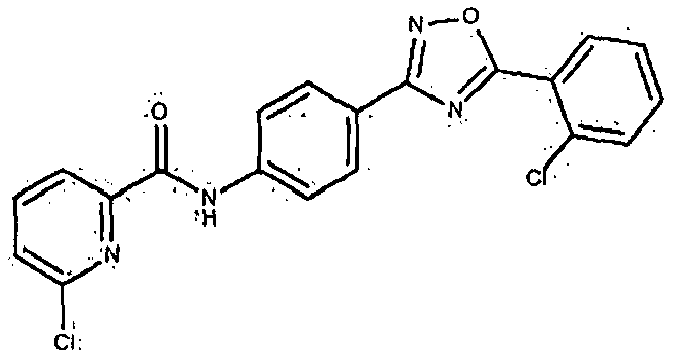
- 6-chloro-N-{4-[5-(2-chlorophenyl)-1,2,4-oxadiazol-3-yl]phenyl}pyridine-2-carboxamide (Scheme I, Step 4-2): Prepared from 4-[5-(2-chlorophenyl)-1,2,4-oxadiazol-3-yl]aniline (Example 22, Step 3b) and 6-chloropyridine-2-carboxylic acid according to procedure described in Example 23. Precipitated solid was filtered directly from reaction mixture and washed with acetonitrile to yield pure product as a white solid (0.16 g, 70.5%).
- LCMS (method A) RT = 3.99 min, MS (m/z ESI+) 410.7.
- 1H NMR (300 MHz, CDCl3): 9.85 (s, 1 H), 8.25 (d, 1 H), 8.21 (m, 2H), 8.15 (dd, 1 H), 7.96-7.87 (m, 3H), 7.60-7.42 (m, 4H).
- 13C NMR (300 MHz, CDCl3): 174.2, 168.2, 160.7, 150.1, 150.0, 140.4, 140.0, 133.9, 133.1, 131.9, 131.4, 128.6, 127.5, 127.1, 123.7, 122.8, 121.3, 119.9.
-

- N-{4-[5-(2-chlorophenyl)-1,2,4-oxadiazol-3-yl]phenyl}-5-methyl-1,2-oxadiazole-3-carboxamide (Scheme I, Step 4-1 a): Prepared from 4-[5-(2-chlorophenyl)-1,2,4-oxadiazol-3-yl]aniline (Example 22, Step 3b) and 5-methyloxazole-3-carbonyl chloride according to procedure described in Example 16.
- Crude product was purified by column chromatography over silica gel using CHCl3/hexane (3:1) followed by maceration from i-PrOH/hexane (1:2) to yield product as a white solid (0.10 g, 79.4%).
- LCMS (method A) RT=3.61 min, MS (m/z ESI+) 381.1.
- 1H NMR (300 MHz, CDCl3): 8.67 (s br. 1 H), 8.20 (m, 2H), 8.15 (dd, 1 H), 7.82 (m, 2H), 7.61-7.42 (m, 3H), 6.55 (d, 1 H).
- 13C NMR (300 MHz, CDCl3): 174.3, 171.9, 168.1, 158.8, 156.9, 139.7, 133.9, 133.1, 131.9, 131.4, 128.6, 127.1, 123.6, 123.0, 119.8, 101.5, 12.4.
-

- N-[3-methoxy-4-(5-phenyl-1,2,4-oxadiazol-3-yl)phenyl]pyridine-2-carboxamide (Scheme I, Step 4-1 a): Prepared from 3-methoxy-4-(5-phenyl-1,2,4-oxadiazol-3-yl)aniline (Example 3, Step 3b) and picolinoyl chloride, hydrochloride. Crude product was purified by column chromatography over silica gel using CHCl3/hexane (2:1) followed by maceration from i-PrOH/hexane (1:2) to yield product as a white solid (0.15 g, 71.4%).
- LC (method A) RT=3.43 min, MS (m/z ESI+) 374.4.
- 1H NMR (300 MHz, CDCl3): 10.23 (s br. 1H), 8.64 (m, 1H), 8.31 (dt, 1H), 8.24-8.16 (m, 3H), 7.97-7.91 (m, 2H), 7.60-7.49 (m, 4H), 7.27 (dd, 1 H), 4.09 (s, 3H).
- 13C NMR (300 MHz, CDCl3): 174.3, 167.1, 162.3, 159.1, 149.4, 148.0, 141.5, 137.9, 132.5, 131.9, 129.0, 128.2, 126.8, 124.4, 122.4, 111.6, 111.4, 102.9, 56.1.
-

- N-{4-[5-(2-chlorophenyl)-1,2,4-oxadiazol-3-yl]-3-methoxyphenyl}pyridine-2-carboxamide (Scheme I, Step 4-1 a): Prepared from 4-[5-(2-chlorophenyl)-1,2,4-oxadiazol-3-yl]-3-methoxyaniline (Example 4, Step 3b) and picolinoyl chloride, hydrochloride. Crude product was purified by column chromatography over silica gel using gradient from CHCl3/hexane (2:1) to CHCl3/MeOH (99:1) followed by maceration from i-PrOH/hexane (1:2) to yield product as a white solid (0.113 g, 56.5%).
- LCMS (method A) RT=3.52 min, MS (m/z ESI+) 406.3.
- 1H NMR (300 MHz, CDCl3): 10.23 (s br. 1 H), 8.63 (m, 1 H), 8.30 (m, 1H), 8.17 (d, 1 H), 8.13 (dd, 1 H), 7.98 (dd, 1 H), 7.93 (dt, 1 H), 7.59-7.42 (m, 4H), 7.26 (dd, 1 H).
- 13C NMR (300 MHz, CDCl3): 172.9, 166.8, 162.3, 159.1, 149.4, 148.0, 141.6, 137.8, 133.9, 132.9, 132.0, 131.9, 131.4, 127.0, 126.8, 123.8, 122.4, 111.4, 102.9, 56.2.
-

- N-{4-[5-(2-fluorophenyl)-1,2,4-oxadiazol-3-yl]-3-methoxyphenyl}pyridine-2-carboxamide (Scheme I, Step 4-1 a): Prepared from 4-[5-(2-fluorophenyl)-1,2,4-oxadiazol-3-yl]-3-methoxyaniline (Example 5, Step 3b) and picolinoyl chloride, hydrochloride. Crude product was purified by column chromatography over aluminum oxide using AcOEt/hexane (2:1) followed by maceration from MeOH to yield product as a white solid (0.128 g, 62.4%).
- LCMS (method A) RT = 3.33 min, MS (m/z ESI+) 390.3.
- 1H NMR (300 MHz, CDCl3): 10.23 (s br. 1 H), 8.63 (m, 1H), 8.30 (m, 1 H), 8.23-8.15 (m, 2H), 7.98 (d, 1 H), 7.93 (dt, 1 H), 7.55 (m, 1H), 7.51 (m, 2H), 7.35-7.24 (m, 3H), 4.08 (s, 3H).
- 13C NMR (300 MHz, CDCl3): 171.3 (d), 166.9, 162.3, 160.8 (d), 159.1, 149.3, 148.0, 141.6, 137.9, 134.4 (d), 131.9, 130.9 (d), 126.8, 124.6 (d), 122.4, 117.1 (d), 113.0 (d), 111.4, 111.4, 102.9, 56.1.
-

- N-{4-[5-(2-chloro-4-fluorophenyl)-1,2,4-oxadiazol-3-yl]-3-methoxyphenyl}pyridine-2-carboxamide (Scheme I, Step 4-1 a): Prepared from 4-[5-(2-chloro-4-fluorophenyl)-1,2,4-oxadiazol-3-yl]-3-methoxyaniline (Example 6, Step 3b) and picolinoyl chloride, hydrochloride. Crude product was purified by column chromatography over silica gel using CHCl3/hexane (2:1) followed by maceration from i-PrOH/hexane (1:2) to yield product as a white solid (0.18 g, 90.0%).
- LCMS (method A) RT=3.65 min, MS (m/z ESI+) 424.2.
- 1H NMR (300 MHz, CDCl3): 10.23 (s br. 1 H), 8.64 (m, 1 H), 8.30 (m, 1 H), 8.18 (m, 2H), 7.98 (d, 1 H), 7.94 (dt, 1 H), 7.51 (m, 1 H), 7.32 (dd, 1 H), 7.26 (dd, 1 H), 7.16 (m, 1 H), 4.09 (s, 3H).
- 13C NMR (300 MHz, CDCl3): 172.1, 166.8, 164.3 (d), 162.3, 159.1, 149.3, 148.0, 141.7, 137.9, 135.5 (d), 133.7 (d), 132.0, 126.8, 122.4, 120.2 (d), 118.9 (d), 114.8 (d), 111.4, 111.3, 102.9, 56.2.
-
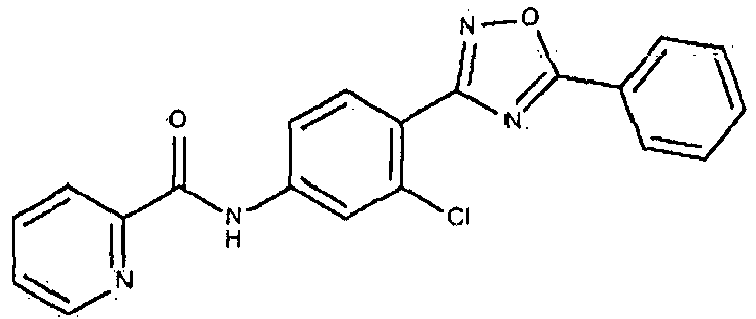
- N-[3-chloro-4-(5-phenyl-1,2,4-oxadiazol-3-yl)phenyl]pyridine-2-carboxamide (Scheme I, Step 4-1b): 3-chloro-4-(5-phenyl-1,2,4-oxadiazol-3-yl)aniline (0.12 g, 0.442 mmol, 1.0 eq) (Example 1, Step 3b) was dissolved in 5 ml of THF and TEA (0.174 g, 0.24 ml, 1.77 mmol, 4.0 eq) was added dropwise. Picolinoyl chloride, hydrochloride (0.12 g, 0.66 mmol, 1.5 eq) was added in few portions over 5 minutes. After stirring overnight in rt solvent was removed in vacuo. Water was then added to residual oil and after stirring precipitated solid was filtered, dried and purified by column chromatography over silica gel using CHCl3/MeOH (99:1) followed by maceration from i-PrOH/hexane (1:2) to yield product as a white solid (0.12 g, 72.3%).
- LCMS (method A) RT=3.80 min, MS (m/z ESI+) 376.4.
- 1H NMR (300 MHz, CDCl3): 10.21 (s br. 1 H), 8.62 (m, 1 H), 8.30 (dd, 1 H), 8.22 (m, 2H), 8.12-8.08 (m, 2H), 7.90 (m, 1 H), 7.84 (m, 1 H), 7.61-7.49 (m, 4H).
- 13C NMR (300 MHz, CDCl3): 175.0, 167.4, 162.2, 149.1, 148.1, 140.6, 137.8, 134.2, 132.8, 132.4, 129.1, 128.2, 126.9, 124.1, 122.6, 121.6, 121.3, 117.6.
-

- N-(3-chloro-4-cyanophenyl)pyridine-2-carboxamide (Scheme II, Step 1): 4-amino-2-chlorobenzonitrile (5.00 g, 32.77 mmol, 1.00 eq) was dissolved in 100 ml of THF. TEA (9.92 g, 13.68 ml, 98.31 mmol, 3.0 eq) was added dropwise followed by addition of picolinoyl chloride, hydrochloride (7.00 g, 39.32 mmol, 1.2 eq). Reaction mixture was stirred in RT overnight. Solvent was evaporated, 60 ml of water was added and resulted mixture was extracted with CHCl3. After evaporation of solvent crude product was purified by column chromatography over silica gel using CHCl3/MeOH (49:1) to give 3.27 g of product as a pale yellow solid (38.7%).
- LCMS (method A) RT = 3.04 min, MS (m/z ESI+) 257.9.
- N-[3-chloro-4-(N'-hydroxycarbamimidoyl]phenyl]pyridine-2-carboxamide (Scheme II, Step 2):
- Prepared from N-(3-chloro-4-cyanophenyl)pyridine-2-carboxamide according to procedure described in Example 1. Reaction gave mixture of two products: N-(4-carbamoyl-3-chlorophenyl)pyridine-2-carboxamide (1.90 g, 52%) isolated after extraction of acidic water layer with AcOEt and N-{3-chloro-4-[(Z)-N'-hydroxycarbamimidoyl]phenyl}pyridine-2-carboxamide isolated after extraction of alkalized water layer with AcOEt. Finally crude product was purified by maceration from i-PrOH/hexane (1:2) (0.51 g, 13.9%).
- LCMS (method A) RT = 0.48-0.83 min, MS (m/z ESI+) 290.4.
- 1H NMR (300 MHz, CDCl3+MeOD): 8.53 (m, 1H), 8.15 (m, 1H), 7.95 (d, 1 H), 7.85 (dt, 1 H), 7.53 (dd, 1 H), 7.45 (m, 1 H), 7.37 (d, 1 H), 3.70 (s br. 3H).
- 13C NMR (300 MHz, CDCl3): 162.5, 151.8, 148.9, 148.1, 139.5, 137.9, 133.3, 131.4, 127.5, 126.9, 122.5, 120.6, 117.7.
- N-{3-chloro-4-[5-(2-chlorophenyl)-1,2,4-oxadiazol-3-yl]phenyl}pyridine-2-carboxamide (Scheme II, Step 3): N-[3-chloro-4-(N'-hydroxycarbamimidoyl)phenyl]pyridine-2-carboxamide (0.15 g, 0.516 mmol, 1.0eq) was suspended in 10 ml of toluene and 2-chlorobenzoyl chloride (0.12 g, 0.087 ml, 0.67 mmol, 1.3 eq) was added dropwise followed by addition of K2CO3 (0.092 g, 0.67 mmol, 1.3 eq). After stirring for 30 minutes in rt reaction mixture was refluxed over 4h. 50 ml of water was then poured into reaction flask and solution was extracted with chloroform. Organic layers were dried and solvent was removed in vacuo. Crude product was purified by column chromatography over silica gel using CHCl3 followed by maceration from i-PrOH/hexane (1:2) to yield product as a white solid (0.18 g, 85.7%).
- LCMS (method A) RT = 3.89 min, MS (m/z ESI+) 410.8.
- 1H NMR (300 MHz, CDCl3): 10.22 (s br, 1H), 8.63 (m, 1H), 8.30 (m, 1H), 8.18-8.10 (m, 3H), 7.94 (dt, 1 H), 7.82 (dd, 1 H), 7.61-7.44 (m, 4H).
- 13C NMR (300 MHz, CDCl3): 173.6, 167.2, 162.2, 149.1, 148.1, 140.6, 137.8, 134.3, 133.9, 133.2, 132.5, 132.0, 131.5, 127.1, 126.9, 123.5, 122.6, 121.3, 117.6.
-

- N-{3-chloro-4-[5-(2-chloro-4-fluorophenyl)-1,2,4-oxadiazol-3-yl]phenyl}pyridine-2-carboxamide (Scheme II, Step 3): Prepared from N-[3-chloro-4-(N'-hydroxycarbamimidoyl)phenyl]pyridine-2-carboxamide (Example 31, Step 2) and 2-chloro-4-fluorobenzoyl chloride according to procedure described in Example 31. Crude product was purified by column chromatography over silica gel using CHCl3 followed by maceration from i-PrOH/hexane (1:2) to yield product as a white solid (0.15 g, 68.2%).
- LCMS (method A) RT=3.96 min, MS (m/z ESI+) 428.7.
- 1H NMR (300 MHz, CDCl3): 10.23 (s br. 1 H), 8.63 (m, 1 H), 8.30 (d, 1 H), 8.19 (dd, 1 H), 8.12 (d, 1 H), 8.10 (d, 1 H), 7.94 (dt, 1H), 7.82 (dd, 1 H), 7.53 (m, 1 H), 7.34 (dd, 1 H), 7.17 (m, 1 H).
- 13C NMR (300 MHz, CDCl3): 172.8, 167.2, 164.5 (d), 162.7, 162.3, 149.0, 148.1, 140.7, 137.8, 135.6 (d), 134.3, 133.7 (d), 132.5, 126.9, 122.6, 121.2 (d), 119.9 (d), 119.2, 118.9, 117.6, 114.9 (d).
-

- N-{3-chloro-4-[5-(2-methoxyphenyl)-1,2,4-oxadiazol-3-yl]phenyl}pyridine-2-carboxamide (Scheme II, Step 3): Prepared from N-[3-chloro-4-(N'-hydroxycarbamimidoyl)phenyl]pyridine-2-carboxamide (Example 31, Step 2) and 2-methoxybenzoyl chloride according to procedure described in Example 31. Crude product was purified by column chromatography over silica gel using gradient from CHCl3/hexane (1:1) to CHCl3/MeOH (99:1) and then over aluminum oxide using AcOEt/hexane (1:2) followed by maceration from i-PrOH/hexane/CHCl3 (1:1:1) to yield product as a white solid (0.13 g, 41.9%).
- LCMS (method A) RT=3.63 min, MS (m/z ESI+) 406.5.
- 1H NMR (300 MHz, CDCl3): 10.20 (s br. 1 H), 8.62 (m, 1 H), 8.16-8.08 (m, 3H), 7.92 (dt, 1 H), 7.81 (dd, 1 H), 7.59-7.49 (m, 2H), 7.10 (m, 2H), 4.00 (s, 3H).
- 13C NMR (300 MHz, CDCl3): 174.4, 166.8, 162.2, 158.6, 149.1, 148.1, 140.4, 137.8, 134.2, 134.1, 132.4, 131.7, 126.9, 122.6, 121.8, 121.2, 120.8, 117.6, 113.3, 112.1, 56.1.
-

- N-(4-cyano-3-fluorophenyl)pyridine-2-carboxamide (Scheme II, Step 1): Prepared according to procedure described in Example 31 from 4-amino-2-fluorobenzonitrile. Crude product was purified by column chromatography over silica gel using CHCl3/MeOH (49:1) to give 3.91 g of product as a pale yellow solid (88.3%).
- LCMS (method A) RT = 2.84 min, MS (m/z ESI+) 241.7.
- 1H NMR (300 MHz, CDCl3): 10.33 (s br. 1 H), 8.63 (m, 1 H), 8.28 (d, 1 H), 8.01-7.92 (m, 2H), 7.62-7.52 (m, 2H), 7.48 (dd, 1 H).
- 13C NMR (300 MHz, CDCl3): 163.9 (d), 162.4, 148.5, 148.2, 143.6 (d), 138.0, 133.9 (d), 127.3, 122.7, 115.2 (d), 114.3, 107.0 (d), 96.0 (d).
- N-{3-fluoro-4-[N'-hydroxycarbamimidoyl]phenyl}pyridine-2-carboxamide (Scheme II, Step 2): Compound synthesized according to procedure described in Example 1 from N-(4-cyano-3-fluorophenyl)pyridine-2-carboxamide. Isolated product was purified by maceration in i-PrOH/hexane (1:2) resulting 1.12 g of white solid (52.6%).
- LCMS (method A) RT = 0.71 min, MS (m/z ESI+) 275.0.
- 1H NMR (300MHz, CDCl3 + DMSO-d6): 10.37 (s br. 1 H), 9.57 (s br. 1 H), 8.59 (m, 1H), 8.15(m,1H), 7.92-7.81(m,2H), 7.59-7.39(m,3H), 5.29(s br.2H).
- 13C NMR (300MHz, CDCl3 + DMSO-d6): 161.9, 159.5, 148.7, 148.1(d), 147.6, 139.6(d), 137.3, 129.1(d), 126.3, 121.9, 115.8(d),114.7(d), 106.8(d).
- N-[3-fluoro-4-(5-phenyl-1,2,4-oxadiazol-3-yl)phenyl]pyridine-2-carboxamide (Scheme II, Step 3): Prepared from N-{3-fluoro-4-[N'-hydroxycarbamimidoyl]phenyl}pyridine-2-carboxamide and benzoyl chloride according to procedure described in Example 31. Crude product was purified by column chromatography over silica gel using CHCl3/MeOH (49:1) followed by maceration from i-PrOH/hexane (1:2) to yield product as a white solid (0.16 g, 80.4%).
- LCMS (method A) RT=3.65 min, MS (m/z ESI+) 360.7.
- 1H NMR (300 MHz, CDCl3): 10.25 (s br. 1 H), 8.63 (m, 1 H), 8.30 (m, 1 H), 8.24-8.15 (m, 3H), 8.02-7.90 (m, 2H), 7.61-7.49 (m, 5H).
- 13C NMR (300 MHz, CDCl3): 175.0, 165.5 (d), 162.2, 161.2 (d), 149.1, 148.1, 141.6 (d), 137.8, 132.8, 131.2 (d), 129.1, 128.2, 126.9, 124.1, 122.6, 115.0(d), 110.6 (d), 107.6 (d).
-

- N-{4-[5-(2-chlorophenyl)-1,2,4-oxadiazol-3-yl]-3-fluorophenyl}pyridine-2-carboxamide (Scheme II, Step 3): Prepared from N-{3-fluoro-4-[N'-hydroxycarbamimidoyl]phenyl}pyridine-2-carboxamide (Example 34, Step 2) and 2-chlorobenzoyl chloride according to procedure described in Example 31. Crude product was purified by column chromatography over silica gel using CHCl3/MeOH (49:1) followed by maceration from i-PrOH/hexane (1:2) to yield product as a white solid (0.17 g, 78.7%).
- LCMS (method B) RT = 3.77 min, MS (m/z ESI+) 395.0.
- 1H NMR (300 MHz, CDCl3): 10.98 (s br. 1 H), 8.75 (m, 1 H), 8.19-8.04 (m, 5H), 7.98 (dd, 1 H), 7.75-7.66 (m, 3H), 7.63-7.58 (m, 1 H).
- 13C NMR (300 MHz, CDCl3): 173.8, 165.2 (d), 163.7, 160.5 (d), 149.9, 148.9, 143.4 (d), 138.6, 134.6, 132.9, 132.6, 131.8, 131.2 (d), 128.4, 127.7, 123.2, 123.1, 116.8 (d), 109.5 (d), 108.3 (d).
-

- N-{4-[5-(2-chloro-4-fluorophenyl)-1,2,4-oxadiazol-3-yl]-3-fluorophenyl}pyridine-2-carboxamide (Scheme II, Step 3): Prepared from N-{3-fluoro-4-[N'-hydroxycarbamimidoyl]phenyl}pyridine-2-carboxamide (Example 34, Step 2) and 2-chloro-4-fluorobenzoyl chloride according to procedure described in Example 31. Crude product was purified by column chromatography over silica gel using CHCl3/MeOH (99:1) followed by maceration from i-PrOH/hexane (1:2) to yield product as a white solid (0.18 g, 79.6%).
- LCMS (method B) RT = 3.84 min, MS (m/z ESI+) 413.1.
- 1H NMR (300 MHz, CDCl3): 10.80 (s br. 1 H), 8.70 (m, 1 H), 8.20 (m, 2H), 8.12-7.97 (m, 3H), 7.85 (dd, 1 H), 7.60 (m, 1 H), 7.50 (dd, 1 H), 7.34 (dt, 1 H).
- 13C NMR (300 MHz, CDCl3): 176.2, 172.9, 166.2, 165.2, 163.2, 162.8, 162.4, 159.0, 149.7, 148.5, 143.1 (d), 138.1, 135.0 (d), 131.0 (d), 127.2, 122.9, 120.0 (d), 119.1 (d), 116.3 (d), 115.5 (d), 109.6 (d), 108.0 (d).
-

- N-{4-[5-(2-methoxyphenyl)-1,2,4-oxadiazol-3-yl]-3-fluorophenyl}pyridine-2-carboxamide (Scheme II, Step 3): Prepared from N-{3-fluoro-4-[N'-hydroxycarbamimidoyl]phenyl}pyridine-2-carboxamide (Example 34, Step 2) and 2-methoxybenzoyl chloride according to procedure described in Example 31. Crude product was purified by column chromatography over silica gel using CHCl3/MeOH (99:1) followed by maceration from i-PrOH/hexane (1:2) to yield product as a white solid (0.16 g, 74.8%).
- LCMS (method B) RT = 3.49 min, MS (m/z ESI+) 390.8.
- 1H NMR (300 MHz, CDCl3): 10.25 (s br. 1 H), 8.63 (m, 1 H), 8.30 (m, 1H), 8.14 (m, 1 H), 8.01-7.93 (m, 2H), 7.59-7.51 (m, 3H), 7.13-7.07 (m, 2H), 4.00 (s, 3H).
- 13C NMR (300 MHz, CDCl3): 174.5, 164.9 (d), 162.2, 161.2 (d), 158.6, 149.1, 141.4, 137.9, 134.1, 131.7, 131.2 (d), 126.9, 122.6, 120.8, 115.0 (d), 113.3, 112.1, 110.9 (d), 107.6 (d), 56.1.
-

- N-[4-(5-phenyl-1,2,4-oxadiazol-3-yl)-3-trifluoromethyl)phenyl]pyridine-2-carboxamide (Scheme I, Step 4-1b): Prepared from 4-(5-phenyl-1,2,4-oxadiazol-3-yl)-3-(trifluoromethyl)aniline (Example 7, Step 3b) and picolinoyl chloride, hydrochloride according to procedure described in Example 30. Crude product was purified by column chromatography over silica gel using CHCl3 followed by maceration from i-PrOH/hexane (1:2) to yield product as a white solid (0.417 g, 86.2%).
- LCMS (method B) RT = 3.80 min, MS (m/z ESI+) 411.6.
- 1H NMR (300 MHz, CDCl3): 10.34 (s br. 1H), 8.65 (m, 1H), 8.33-8.27 (m, 2H), 8.23-8.19 (m, 3H), 7.98-7.92 (m, 2H), 7.65-7.52 (m, 4H).
-

- N-{4-[5-(2-chlorophenyl)-1,2,4-oxadiazol-3-yl]-3-(trifluoromethyl)phenyl}pyridine-2-carboxamide (Scheme I, Step 4-1b): Prepared from 4-[5-(2-chlorophenyl)-1,2,4-oxadiazol-3-yl]-3-(trifluoromethyl)aniline (Example 8, Step 3b) and picolinoyl chloride, hydrochloride according to procedure described in Example 30. Crude product was purified by column chromatography over silica gel using CHCl3 followed by maceration from i-PrOH/hexane (1:2) to yield product as a white solid (0.15 g, 95.5%).
- LCMS (method A) RT = 3.85 min, MS (m/z ESI+) 445.0.
- 1H NMR (300 MHz, CDCl3):10.35 (s br. 1 H), 8.65 (m, 1 H), 8.30 (m, 1 H), 8.22-8.15 (m, 2H), 7.99-7.92 (m, 2H), 7.61-7.42 (m, 4H).
-

- N-[3-methyl-4-(5-phenyl-1,2,4-oxadiazol-3-yl)phenyl]pyridine-2 carboxamide (Scheme I, Step 4-1b): Prepared from 3-methyl-4-(5-phenyl-1,2,4-oxadiazol-3-yl)aniline (Example 9, Step 3b) and picolinoyl chloride, hydrochloride according to procedure described in Example 30. Crude product was purified by column chromatography over silica gel using CHCl3/MeOH (99:1) followed by maceration from i-PrOH/hexane (1:2) to yield product as a white solid (0.21 g, 75.0%).
- LCMS (method B) RT = 3.89 min, MS (m/z ESI+) 357.0.
- 1H NMR (300 MHz, CDCl3): 10.77 (s br. 1H), 8.15 (m, 3H), 8.09-7.98 (m, 4H), 7.70-7.64 (m, 4H), 2.61 (s, 3H).
- 13C NMR (300 MHz, CDCl3): 174.6, 169.0, 163.2, 150.0, 148.9, 141.0, 138.8, 138.6, 133.7, 130.9, 130.0, 128.3, 127.6, 123.9, 122.9, 121.2, 118.1, 22.6.
-

- N-{4-[5-(2-chlorophenyl)-1,2,4-oxadiazol-3-yl]-3-methylphenyl}pyridine-2-carboxamide (Scheme I, Step 4-1 a): Prepared from 4-[5-(2-chlorophenyl)-1,2,4-oxadiazol-3-yl]-3-methylaniline (Example 10, Step 3b) and picolinoyl chloride, hydrochloride according to procedure described in Example 16. Crude product was purified by column chromatography over silica gel using CHCl3/MeOH (99:1) followed by maceration from i-PrOH/hexane (1:2) to yield product as a white solid (0.41 g, 93.6%).
- LCMS (method A) RT=3.94 min, MS (m/z ESI+) 390.5.
- 1H NMR (300 MHz, CDCl3): 10.15 (s br. 1 H), 8.63 (m, 1 H), 8.31 (d, 1 H), 8.17 (m, 2H), 7.93 (dt, 1 H), 7.78 (m, 2H), 7.60-7.41 (m, 4H), 2.75 (s, 3H).
- 13C NMR (300 MHz, CDCl3): 173.1 168.9, 162.1, 149.5, 148.0, 139.8, 139.7, 137.8, 133.9, 133.0, 131.9, 131.4, 131.3, 127.1, 126.6, 123.7, 122.5, 121.9, 121.8, 116.9, 22.6.
-

- N-{4-[5-(2-chlorophenyl)-1,2,4-oxadiazol-3-yl]-3-methoxyphenyl}-6-fluoropyridine-2-carboxamide (Scheme I, Step 4-2): BOP (0.22 g, 0.50 mmol, 1.0 eq) and 6-fluoropyridine-2-carboxylic acid (0.08 g, 0.55 mmol, 1.1 eq) was dissolved under argon in 10 ml of dry MeCN. TEA (0.10 g, 0.14 ml, 1.00 mmol, 2.0 eq) was added dropwise followed by addition of 4-[5-(2-chlorophenyl)-1,2,4-oxadiazol-3-yl]-3-methoxyaniline (Example 4, Step 3b) (0.15 g, 0.50 mmol, 1.0 eq) in 5 ml of MeCN. Reaction mixture was stirred in rt for 24 hours and another portion of BOP (0.22 g, 0.50 mmol, 1.0 eq) and acid (0.08 g, 0.55 mmol, 1.1 eq) was added (LCMS control). Stirring was continued for additional 12h. Reaction mixture was then quenched with 50 ml of water and extracted with chloroform. Organic layer was washed with saturated sodium bicarbonate and dried. Removal of solvent gave crude product which was purified by column chromatography over aluminum oxide using gradient from AcOEt/hexane (1:2) to AcOEt/hexane (2:1) followed by maceration from i-PrOH/hexane (1:2) to yield product as a white solid (0.10 g, 47.6%).
- LCMS (method A) RT = 3.60 min, MS (m/z ESI+) 424.6.
- 1H NMR (300 MHz, CDCl3): 10.56 (s br. 1 H), 8.25 (m, 1 H), 8.12 (m, 2H), 7.94 (d, 1 H), 7.87 (d, 1 H), 7.78-7.66 (m, 3H), 7.62 (m, 1 H), 7.48 (m, 1 H), 3.93 (s, 3H).
- 13C NMR (300 MHz, CDCl3): 173.0, 170.6, 166.7, 162.2, 162.1 (d), 158.7, 148.9 (d), 144.4 (d), 142.8, 134.4, 132.8, 132.5, 131.6 (d), 128.3, 123.5, 121.2 (d), 113.8 (d), 112.8, 111.2, 105.1.
-

- 5-chloro-N-{4-[5-(2-chlorophenyl)-1,2,4-oxadiazol-3-yl]-3-methoxyphenyl}-3-fluoropyridine-2-carboxamide (Scheme I, Step 4-2): Compound prepared according to procedure described in Example 42 from 4-[5-(2-chlorophenyl)-1,2,4-oxadiazol-3-yl]-3-methoxyaniline (Example 4, Step 3b) and 5-chloro-3-fluoropyridine -2-carboxylic acid. Crude product was purified by column chromatography over silica gel using gradient from AcOEt/hexane (1:2) to AcOEt/hexane (2:1) followed by maceration from i-PrOH/hexane (1:2) to yield product as a white solid (0.16 g, 70.2%).
- LCMS (method A) RT = 3.65 min, MS (m/z ESI+) 258.7.
- 1H NMR (300 MHz, DMSO-d6): 10.87 (s br. 1 H), 8.66 (m, 1 H), 8.33 (dd, 1 H), 8.13 (dd, 1 H), 7.96 (d, 1 H), 7.81 (d, 1 H), 7.76-7.57 (m, 4H), 3.90 (s, 3H).
- 13C NMR (300 MHz, DMSO-d6): 172.9, 166.6, 161.1 (d), 158.6, 158.0 (d), 143.9 (d), 142.9, 138.1 (d), 134.7 (d), 132.8, 132.5, 131.8, 131.7, 128.4, 127.0 (d), 123.3, 112.2, 110.8 (d), 104.1, 56.3.
-

- 6-chloro-N-{4-[5-(2-chlorophenyl)-1,2,4-oxadiazol-3-yl]-3-methoxyphenyl}-pyridine-2-carboxamide (Scheme I, Step 4-2): Compound prepared according to procedure described in Example 42 from 4-[5-(2-chlorophenyl)-1,2,4-oxadiazol-3-yl]-3-methoxyaniline (Example 4, Step 3b) and 6-chloropyridine-2-carboxylic acid. Solid that was precipitated from reaction mixture was filtered and washed with MeCN. Filtrate was concentrated and rest of the product was isolated by column chromatography over silica gel using CHCl3/MeOH (1:1). Product after chromatography was combined with precipitated solid and further purified by maceration from i-PrOH/hexane/CHCl3 (1:2:0.5) to yield pure product as a white solid (0.094 g, 42.9%).
- LCMS (method A) RT=3.76 min, MS (m/z ESI+) 440.8.
- 1H NMR (300 MHz, CDCl3): 9.86 (s br. 1H), 8.25-8.12 (m, 3H), 7.91 (m, 2H), 7.60-7.41 (m, 4H), 7.30 (dd, 1H), 4.09 (s, 3H).
- 13C NMR (300 MHz, CDCl3): 172.9, 166.8, 160.8, 159.1, 150.1, 150.0, 141.2, 140.4, 133.9, 133.0, 132.0, 131.9, 131.4, 127.6, 127.0, 123.8, 121.2, 11.8, 111.6, 103.1, 56.2.
-

- 3-chloro-N-{4-[5-(2-chlorophenyl)-1,2,4-oxadiazol-3-yl]-3-methoxyphenyl}-6-methoxypyridine-2-carboxamide (Scheme I, Step 4-1a): Compound prepared according to procedure described in Example 1 from 4-[5-(2-chlorophenyl)-1,2,4-oxadiazol-3-yl]-3-methoxyaniline (Example 4, Step 3b) and 3-chloro-6-methoxypyridine-2-carbonyl chloride. Crude product was purified by column chromatography over silica gel using CHCl3 followed by maceration from i-PrOH/hexane (1:2) to yield product as a white solid (0.24 g, 100.0%).
- LCMS (method A) RT = 3.74 min, MS (m/z ESI+) 470.4.
- 1H NMR (300 MHz, CDCl3): 9.89 (s br. 1H), 8.15-8.07 (m, 3H), 7.72 (d, 1 H), 7.56 (dd, 1 H), 7.50 (dt, 1 H), 7.43 (dt, 1 H), 7.00 (dd, 1 H), 6.92 (d, 1 H), 4.09 (s, 3H), 4.05 (s, 3H).
- 13C NMR (300 MHz, CDCl3): 172.9, 166.8, 160.9, 160.7, 159.2, 143.6, 141.5, 141.1, 133.8, 132.9, 131.9, 131.7, 131.3, 127.0, 125.1, 123.7, 116.0, 111.4, 111.2, 102.8, 56.2, 54.0.
-

- N-{4-[5-(2-chlorophenyl)-1,2,4-oxadiazol-3-yl]-3-methoxyphenyl}-4,6-difluoropyridine-2-carboxamide (Scheme I, Step 4-2): Compound was prepared according to procedure described in Example 42 from 4-[5-(2-chlorophenyl)-1,2,4-oxadiazol-3-yl]-3-methoxyaniline (Example 4, Step 3b) and 3,5-difluoropyridine-2-carboxylic acid. Product was isolated from reaction mixture by column chromatography over silica gel using CHCl3 and further purified by maceration from i-PrOH/hexane (1:2) to yield pure product as a white solid (0.220 g, 100.0%).
- LCMS (method A) RT = 3.53 min, MS (m/z ESI+) 442.4.
- 1H NMR (300 MHz, CDCl3): 9.82 (s br. 1 H), 8.37 (d, 1 H), 8.16 (d, 1 H), 8.13 (dd, 1 H), 8.01 (d, 1 H), 7.58 (dd, 1 H), 7.48 (dt, 1 H), 7.46-7.38 (m, 2H), 7.15 (dd, 1 H), 4.08 (s, 3H).
- 13C NMR (300 MHz, CDCl3): 172.9, 166.8, 162.5 (q), 159.2, 159.1, 158.7 (q), 141.3, 133.9, 133.7 (t), 133.0, 132.7 (q), 131.9 (2C), 131.4, 127.0, 123.7, 114.4 (q), 111.6, 111.2, 102.9, 56.2.
-

- N-{4-[5-(2-chlorophenyl)-1,2,4-oxadiazol-3-yl]-3-methoxyphenyl}-3-fluoropyridine-2-carboxamide (Scheme I, Step 4-2): Compound was prepared according to procedure described in Example 42 from 4-[5-(2-chlorophenyl)-1,2,4-oxadiazol-3-yl]-3-methoxyaniline (Example 4, Step 3b) and 3-fluoropyridine-2-carboxylic acid. Precipitated solid was filtered from reaction mixture and washed with MeCN followed by maceration from i-PrOH/hexane (1:2) to yield pure product as a white solid (0.210 g, 100.0%).
- LCMS (method A) RT=3.40 min, MS (m/z ESI+) 424.5.
- 1H NMR (300 MHz, CDCl3): 10.07 (s br. 1 H), 8.45 (m, 1H), 8.16 (d, 1H), 8.13 (dd, 1 H), 8.04 (d, 1H), 7.66-7.39 (m, 5H), 7.16 (dd, 1 H), 4.07 (s, 3H).
- 13C NMR (300 MHz, CDCl3): 172.9, 166.8, 161.0 (d), 159.1, 159.0 (d), 143.7 (d), 141.4, 136.8 (d), 133.9, 133.0, 131.9, 131.8, 131.4, 128.8 (d), 127.0, 126.8, 123.8, 111.4, 111.3, 102.9, 56.2.
-

- N-{4-[5-(2-chlorophenyl)-1,2,4-oxadiazol-3-yl]-3-methoxyphenyl}pyrimidine-4-carboxamide (Scheme I, Step 4-2): Compound was synthesized according to procedure described in Example 42 from 4-[5-(2-chlorophenyl)-1,2,4-oxadiazol-3-yl]-3-methoxyaniline (Example 4, Step 3b) and pyrimidine-4-carboxylic acid. Precipitated solid was filtered from reaction mixture and purified by column chromatography over silica gel using CHCl3/hexane (4:1) followed by maceration from i-PrOH/hexane (1:2) to yield pure product as a white solid (0.140 g, 70.0%).
- LCMS (method B) RT = 3.23 min, MS (m/z ESI+) 408.1.
- 1H NMR (300 MHz, DMSO-d6): 11.07 (s, 1 H), 9.44 (s br. 1 H), 9.15 (d, 1 H), 8.14 (m, 2H), 7.96 (m, 2H), 7.82-7.67 (m, 3H), 7.60 (m, 1 H), 3.91 (s, 3H).
- 13C NMR (300 MHz, DMSO-d6): 172.9, 166.6, 162.3, 160.5, 158.6, 158.3, 156.8, 142.6, 134.5, 132.8, 132.6, 131.8 (2C), 128.4, 123.3, 119.5, 112.7, 111.1, 104.8, 56.3.
-

- N-{4-[5-(2-chlorophenyl)-1,2,4-oxadiazol-3-yl]-3-methoxyphenyl}thiophene-2-carboxamide (Scheme I, Step 4-2): Compound was synthesized according to procedure described in Example 42 from 4-[5-(2-chlorophenyl)-1,2,4-oxadiazol-3-yl]-3-methoxyaniline (Example 4, Step 3b) and 1,3-thiazole-2-carboxylic acid. Crude product isolated from reaction mixture was purified by column chromatography over silica gel using CHCl3/hexane (4:1) and further purified by maceration from i-PrOH/hexane (1:2) to yield pure product as a white solid (0.190 g, 92.7%).
- LCMS (method A) RT = 3.49 min, MS (m/z ESI+) 413.0.
- 1H NMR (300 MHz, CDCl3): 9.28 (s br. 1H), 8.17 (d, 1H), 8.13 (dd, 1H), 7.93 (d, 1 H), 7.87 (d, 1 H), 7.67 (d, 1 H), 7.58 (dd, 1 H), 7.50 (dt, 1 H), 7.43 (dt, 1 H), 7.20 (dd, 1 H), 4.06 (s, 3H).
- 13C NMR (300 MHz, CDCl3): 172.9, 166.7, 163.4, 159.1, 157.4, 143.6, 140.9, 133.9, 133.0, 132.1, 131.9, 131.4, 127.0, 125.8, 123.7, 111.9, 111.4, 103.0, 56.2.
-

- 6-fluoro-N-{4-[5-(2-fluorophenyl)-1,2,4-oxadiazol-3-yl]-3-methoxyphenyl}pyridine-2-carboxamide (Scheme I, Step 4-2): Compound was synthesized according to procedure described in Example 42 from 4-[5-(2-fluorophenyl)-1,2,4-oxadiazol-3-yl]-3-methoxyaniline (Example 5, Step 3b) and 6-fluoro-pyridine-2-carboxylic acid. Precipitated solid was filtered from reaction mixture and washed with MeCN. Filtrate was concentrated and rest of the product was isolated by column chromatography over silica gel using AcOEt/hexane (1:1). Product after chromatography was combined with precipitated solid and further purified by maceration from i-PrOH/hexane (1:2) to yield pure product as a white solid (0.168 g, 78.1%).
- LCMS (method A) RT = 3.43 min, MS (m/z ESI+) 408.5.
- 1H NMR (300 MHz, CDCl3): 9.73 (s br. 1 H), 8.20 (m, 1 H), 8.15 (d, 1 H), 8.03 (q, 1 H), 7.89 (d, 1 H), 7.57 (m, 1 H), 7.35-7.26 (m, 3H), 7.17 (m, 1 H), 4.07 (s, 3H).
- 13C NMR (300 MHz, CDCl3): 171.4, 165.2 (d), 161.6 (d), 160.3, 159.0, 148.0 (d), 143.0 (d), 141.1, 134.4 (d), 132.0, 130.9, 124.6 (d), 120.1 (d), 117.1 (d), 113.5, 113.1, 112.9 (d), 111.8, 111.5, 103.4, 56.2.
-

- 3,6-dichloro-N-{4-[5-(2-fluorophenyl)-1,2,4-oxadiazol-3-yl]-3-methoxyphenyl}pyridine-2-carboxamide (Scheme I, Step 4-1 a): Compound prepared according to procedure described in Example 1 from 4-[5-(2-fluorophenyl)-1,2,4-oxadiazol-3-yl]-3-methoxyaniline (Example 5, Step 3b) and 3,6-dichloropyridine-2-carbonyl chloride. Crude product was purified by column chromatography over silica gel using CHCl3 followed by maceration from i-PrOH/hexane (1:2) to yield product as a white solid (0.18 g, 75.0%).
- LCMS (method A) RT = 3.52 min, MS (m/z ESI+) 458.7.
- 1H NMR (300 MHz, CDCl3): 9.80 (s br. 1 H), 8.20 (m, 1 H), 8.14 (d, 1 H), 7.93 (d, 1 H), 7.84 (d, 1 H), 7.59 (m, 1 H), 7.45 (d, 1 H), 7.35-7.23 (m, 2H), 7.21 (dd, 1H), 4.07 (s, 3H).
- 13C NMR (300 MHz, CDCl3): 171.4, 166.8, 162.4, 160.7 (d), 159.6, 159.1, 147.6, 144.9, 143.6, 141.1, 134.4 (d), 131.9, 131.6, 130.9 (d), 128.0, 124.6 (d), 117.0 (d), 112.9 (d), 111.9, 111.6, 103.1, 56.3.
-

- N-{3-chloro-4-[5-(2-chlorophenyl)-1,2,4-oxadiazol-3-yl]phenyl}-6-fluoropyridine-2-carboxamide (Scheme I, Step 4-2): Compound was synthesized according to procedure described in Example 42 from 3-chloro-4-[5-(2-chlorophenyl)-1,2,4-oxadiazol-3-yl]aniline (Example 2, Step 3b) and 6-fluoro-pyridine-2-carboxylic acid. Precipitated solid was filtered from reaction mixture, washed with MeCN, dried and purified by maceration from i-PrOH/hexane (1:2) to yield product as a white solid (0.120 g, 85.7%).
- LCMS (method A) RT = 3.91 min, MS (m/z ESI+) 428.6.
- 1H NMR (300 MHz, DMSO-d6): 10.93 (s br. 1 H), 8.35 (d, 1 H), 8.25 (q, 1 H), 8.19 (dd, 1 H), 8.14-8.04 (m, 3H), 7.79-7.70 (m, 2H), 7.65 (dt, 1 H), 7.53 (dd, 1 H).
- 13C NMR (300 MHz, DMSO-d6): 173.7, 167.0, 162.6, 162.1 (d), 148.4 (d), 144.5 (d), 142.2, 134.8, 132.8 (d), 132.6, 132.5, 131.8, 128.5, 122.9, 122.3, 121.5 (d), 120.6, 119.6, 114.0.
-

- 6-chloro-N-{3-chloro-4-[5-(2-chlorophenyl)-1,2,4-oxadiazol-3-yl]phenyl}pyridine-2-carboxamide (Scheme I, Step 4-2): Compound was synthesized according to procedure described in Example 42 from 3-chloro-4-[5-(2-chlorophenyl)-1,2,4-oxadiazol-3-yl]aniline (Example 2, Step 3b) and 6-chloro-pyridine-2-carboxylic acid. Precipitated solid was filtered from reaction mixture, washed with MeCN, dried and purified by maceration from i-PrOH/hexane (1:2) to yield product as a white solid (0.113 g, 77.9%).
- LCMS (method A) RT = 4.07 min, MS (m/z ESI+) 445.0.
- 1H NMR (300 MHz, CDCl3): 9.86 (s br. 1 H), 8.24 (d, 1 H), 8.18-8.14 (m, 3H), 7.91 (t, 1 H), 7.81 (dd, 1 H), 7.59-7.45 (m, 4H).
- 13C NMR (300 MHz, CDCl3): 173.7, 167.1, 160.8, 150.2, 149.6, 140.5, 140.2, 134.3, 133.9, 133.2, 132.5, 132.0, 131.5, 127.8, 127.1, 123.4, 121.7, 121.6, 121.4, 117.9.
-

- N-(2-chlorophenyl)-4-cyanobenzene-1-sulfonamide (Scheme III, Step 1): To a solution of 2-chloroaniline (1.90 g, 14.88 mmol, 1.2 eq) in pyridine (30 ml) 4-cyanobenzene-1-sulfonyl chloride (2.50 g, 12.40 mmol, 1.0 eq) was added in one portion. After stirring in RT overnight reaxtion mixture was poured into 100 ml of water. Precipitated solid was filtered off, dried and purified by maceration in i-PrOH/hexane (1:2) to yield product as a white solid (2.43 g, 66.9%).
- LCMS (method A) RT = 2.91 min, MS (m/z ESI+) 292.0.
- 4-[(2-chlorophenyl)sulfamoyl]-N'-hydroxybenzene-1-carboximidamide (Scheme III, Step 2): Compound was prepared from N-(2-chlorophenyl)-4-cyanobenzene-1-sulfonamide according to procedure described in Example 1. After extraction and evaporation of solvent 20 ml of CHCl3 was added and precipitated white crystals were filtered off and used directly in next steps (2.33 g, 86.3%).
- LCMS (method A) RT = 1.76 min, MS (m/z ESI+) 325.9.
- 1H NMR (300 MHz, DMSO-d6): 10.04 (s, 1 H), 9.94 (s, 1 H), 7.81 (d, 2H), 7.68 (d, 2H), 7.39 (dd, 1 H), 7.27-7.18 (m, 3H), 5.95 (s br. 2H).
- 13C NMR (300 MHz, DMSO-d6): 150.1, 140.7, 137.8, 133.9, 130.4, 129.6, 128.2, 128.1, 127.9, 127.0, 126.3.
- N-(2-chlorophenyl)-4-(5-phenyl-1,2,4-oxadiazol-3-yl)benzene-1-sulfonamide (Scheme III, Step 3a): Compound synthesized according to procedure described in Example 11 from 4-[(2-chlorophenyl)sulfamoyl]-N'-hydroxybenzene-1-carboximidamide and benzoyl chloride. Crude product was purified by column chromatography over aluminum oxide using CHCl3/hexane (3:1) followed by maceration from i-PrOH/hexane (1:3) to yield product as a white solid (0.16 g, 50.6%).
- LCMS (method A) RT = 3.71 min, MS (m/z ESI+) 411.3.
- 1H NMR (300 MHz, CDCl3): 8.25-8.18 (m, 4H), 7.88 (m, 2H), 7.71 (dd, 1 H), 7.67-7.54 (m, 3H), 7.26 (m, 2H), 7.30-7.23 (m, 1H), 7.10-7.03 (s br. 1 H).
- 13C NMR (300 MHz, CDCl3): 176.3, 167.6, 141.0, 133.1, 132.9, 131.6, 129.5, 129.2, 128.2, 128.1, 128.0, 127.8, 126.5, 125.7, 123.8, 123.2.
-

- N-(2-chlorophenyl)-4-[5-(pyridin-2-yl)-1,2,4-oxadiazol-3-yl]benzene-1-sulfonamide (Scheme III, Step 3a): Compound was prepared according to procedure described in Example 11 from 4-[(2-chlorophenyl)sulfamoyl]-N'-hydroxybenzene-1-carboximidamide (Example 54, Step 2) and picolinoyl chloride, hydrochloride. Crude product was purified by column chromatography over silica gel using CHCl3/MeOH (99:1) and then over aluminum oxide using CHCl3/hexane (3:1) followed by maceration from i-PrOH/hexane (1:3) to yield product as a white solid (0.15 g, 47.4%).
- LCMS (method A) RT=3.15 min, MS (m/z ESI+) 412.3.
- 1H NMR (300 MHz, DMSO-d6): 10.26 (s, 1 H), 8.86 (m, 1 H), 8.33 (m, 1 H), 8.28 (d, 2H), 8.14 (dt, 1 H), 7.93 (d, 2H), 7.75 (ddd, 1 H), 7.41 (dd, 1 H), 7.33-7.24 (m, 3H).
- 13C NMR (300 MHz, DMSO-d6): 174.7, 167.3, 150.6, 142.9, 142.5, 138.1, 133.0, 129.9, 129.8, 129.6, 128.1, 128.0, 127.9, 127.8, 127.6, 127.5, 124.5.
-

- 4-cyano-N-(2,4-difluorophenyl)benzene-1-sulfonamide (Scheme III, Step1): Prepared according to procedure described in Example 54 from 4-cyanobenzene-1-sulfonyl chloride and 2,4-difluoroaniline. Reaction mixture was poured into water and precipitated solid was filtered off and dried resulting pale yellow solid (1.46 g, 80.2%).
- LCMS (method A) RT = 2.97 min, MS (m/z ESI+) 294.7.
- 4-[(2,4-difluorophenyl)sulfamoyl]-N'-hydroxybenzene-1-carboximidamide (Scheme III, Step 2): Compound was synthesized from 4-cyano-N-(2,4-difluorophenyl)benzene-1-sulfonamide according to procedure described in Example 1. Crude product was purified by maceration from i-PrOH (0.40 g, 25%).
- LCMS (method A) RT = 1.61 min, MS (m/z ESI+) 327.9.
- 1H NMR (300 MHz, DMSO-d6): 10.13 (s, 1 H), 9.93 (s, 1 H), 7.81 (d, 2H), 7.64 (d, 2H), 7.21 (m, 2H), 7.2 (m, 1 H), 5.92 (d, 2H).
- 13C NMR (300 MHz, DMSO-d6): 160.6 (q), 156.9 (q), 150.0 (q), 140.1, 137.9, 137.8, 129.3 (q), 126.9, 126.3, 121.0 (q), 112.2 (q), 105.1 (q).
- N-(2,4-difluorophenyl)-4-[5-(pyridin-2-yl)-1,2,4-oxadiazol-3-yl]benzene-1-sulfonamide (Scheme III, Step 3b): Compound was prepared from 4-[(2,4-difluorophenyl)sulfamoyl]-N'-hydroxybenzene-1-carboximidamide and picolinoyl chloride, hydrochloride according to procedure described in Example 1. Crude product was purified by column chromatography over silica gel using CHCl3/MeOH (99:1) followed by maceration from i-PrOH/hexane (1:2) to yield product as a white solid (0.13 g, 52.0%).
- LCMS (method A) RT = 3.05 min, MS (m/z ESI+) 414.2.
- 1H NMR (300 MHz, CHCl3 + MeOD): 8.76 (m, 1H), 8.24 (m, 1H), 8.20 (d, 2H), 7.93 (dt, 1 H), 7.78 (d, 2H), 7.52 (ddd, 1 H), 7.42 (dt, 1 H), 6.77 (m, 1 H), 6.63 (ddd, 1 H).
- 13C NMR (300 MHz, CHCl3 + MeOD): 174.7, 167.9, 160.6 (q), 155.8 (q), 150.6, 142.9, 141.7, 137.7, 130.7, 128.1, 127.7 (q), 127.5, 127.1, 124.4, 111.6 (q), 104.1 (q).
-

- 5-(4-nitrophenyl)-3-phenyl-1,2,4-oxadiazole (Scheme IV, Step 2): Prepared from N'-hydroxybenzene-1-carboximidamide and 4-nitrobenzoyl chloride according to procedure described in Example 11. Product was purified by maceration from MeOH to give white crystals (7.88 g, 80.3%).
- 4-(3-phenyl-1,2,4-oxadiazol-5-yl)aniline (Scheme IV, Step 3): 5-(4-nitrophenyl)-3-phenyl-1,2,4-oxadiazole (3.00 g, 11.24 mmol, 1.0 eq) was dissolved in 75 ml of 90% aqueous CH3COOH and 15 ml of EtOH. 3.00 g of iron powder was added in one portion and reaction mixture was heated to reflux for 1.0 h. Solution was poured into cold water and precipitated solid was filtered, dissolved in 50 ml of acetone and again filtered. 25 ml of water was then added and pH was adjusted to 9 with NH3aq. Solution was concentrated and precipitated solid was filtered off and further purified by flash column chromatography over silica gel using CHCl3 followed by maceration from i-PrOH to give pure product as a white crystals (1.72 g, 64.7%).
- LCMS (method B) RT = 3.15 min, MS (m/z ESI+) 237.9.
- N-[4-(3-phenyl-1,2,4-oxadiazol-5-yl)phenyl]benzamide (Scheme IV, Step 4-1): Compound synthesized according to procedure described in Example 16 from 4-(3-phenyl-1,2,4-oxadiazol-5-yl)aniline and benzoyl chloride. Crude product was purified by maceration from MeOH/water (2:1) to yield product as a white solid (0.27 g, 93.8%).
- LCMS (method B) RT = 3.71 min, MS (m/z ESI+) 342.1.
- 1H NMR (300 MHz, DMSO-d6): 10.68 (s br. 1H), 8.19 (m, 2H), 8.11 (m, 4H), 7.98 (d, 2H), 7.63-7.54 (m, 6H).
- 13C NMR (300 MHz, DMSO-d6): 174.7, 167.7, 165.6, 143.3, 134.0, 131.5, 131.1, 128.8, 128.4, 128.0, 127.4, 126.6, 125.8, 119.8, 117.5.
-
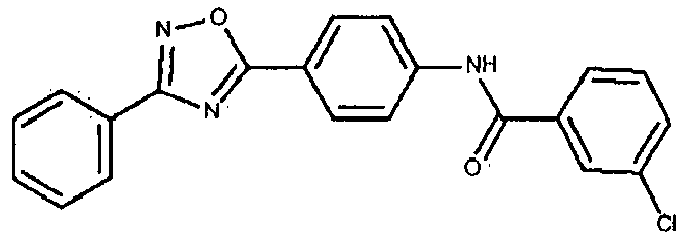
- 3-chloro-N-[4-(3-phenyl-1,2,4-oxadiazol-5-yl)phenyl]benzamide (Scheme IV, Step 4-1): Compound synthesized according to procedure described in Example 16 from 4-(3-phenyl-1,2,4-oxadiazol-5-yl)aniline (Example 56, Step 3) and 3-chlorobenzoyl chloride. Crude product was purified by maceration from MeOH/water (2:1) to yield product as a white solid (0.29 g, 91.5%).
- LCMS (method B) RT = 3.98 min, MS (m/z ESI+) 375.9.
- 1H NMR (300 MHz, DMSO-d6): 10.74 (s br. 1H), 8.19 (m, 2H), 8.11-8.03 (m, 5H), 7.95 (m, 1 H), 7.69 (m, 1 H), 7.59 (m, 4H).
- 13C NMR (300 MHz, DMSO-d6): 175.1, 168.1, 164.5, 143.4, 136.4, 133.2, 131.7, 131.5, 130.4, 129.2, 128.8, 127.5, 127.0, 126.6, 126.2, 120.3, 118.2.
-

- 4-methoxy-N-[4-(3-phenyl-1,2,4-oxadiazol-5-yl)phenyl]benzamide (Scheme IV, Step 4-1): Compound synthesized according to procedure described in Example 16 from 4-(3-phenyl-1,2,4-oxadiazol-5-yl)aniline (Example 56, Step 3) and 4-methoxybenzoyl chloride. Crude product was purified by maceration from MeOH to yield product as a white solid (0.30 g, 96.7%).
- LCMS (method B) RT = 3.71 min, MS (m/z ESI+) 372.7.
- 1H NMR (300 MHz, DMSO-d6): 10.46 (s br. 1 H), 8.13 (d, 2H), 8.04 (m, 4H), 7.96 (d, 2H), 7.57 (m, 3H), 7.04 (d, 2H).
- 13C NMR (300 MHz, DMSO-d6): 175.1, 168.1, 165.3, 162.1, 143.9, 131.5, 129.8, 129.2, 128.8, 127.0, 126.3, 126.2, 120.1, 117.7, 113.6, 55.4.
-

- 4-nitro-N-[4-(3-phenyl-1,2,4-oxadiazol-5-yl)phenyl]benzamide (Scheme IV, Step 4-1): Compound synthesized according to procedure described in Example 16 from 4-(3-phenyl-1,2,4-oxadiazol-5-yl)aniline (Example 56, Step 3) and 4-nitrobenzoyl chloride. Crude product was purified by maceration from MeOH/water (3:1) to yield product as a white solid (0.63 g, 96.9%).
- LCMS (method B) RT = 3.75 min, MS (m/z ESI+) 387.1.
- 1H NMR (300 MHz, DMSO-d6): 10.93 (s br. 1H), 8.38 (m, 2H), 8.21 (m, 4H), 8.07 (m, 4H), 7.60 (m, 3H).
- 13C NMR (300 MHz, DMSO-d6): 175.0, 168.1, 164.3, 149.2, 143.1, 139.9, 131.5, 129.3, 129.2, 128.8, 127.0, 126.2, 123.5, 120.4, 118.4.
-

- 4-amino-N-[4-(3-phenyl-1,2,4-oxadiazol-5-yl)phenyl]benzamide (Scheme IV, reduction as in Step 2): To solution of 4-nitro-N-[4-(3-phenyl-1,2,4-oxadiazol-5-yl)phenyl]benzamide (Example 60, Step 4-1) (0.50 g, 1.30 mmol, 1.0 eq) in 15 ml of 90% aqueous CH3COOH with 5 ml of EtOH and 0.50 g of iron powder was added in one portion. Reaction mixture was heated to 50°C for 2 hours and poured into 100 ml of water. Precipitated solid was filtered, dissolved in 50 ml of acetone and again filtered. 25 ml of water was then added and pH was adjusted to 9 with NH3aq. Solution was concentrated and precipitated solid was filtered, washed with water and dried. Crude product was purified by maceration from i-PrOH to yield product as a white solid (0.34 g, 73.9%).
- LCMS (method B) RT = 3.34 min, MS (m/z ESI+) 357.1.
- 1H NMR (300 MHz, DMSO-d6): 10.19 (s br. 1 H), 8.17-8.06 (m, 6H), 7.77 (d, 2H), 7.61 (m, 3H), 6.61 (d, 2H), 5.87 (s br. 2H).
- 13C NMR (300 MHz, DMSO-d6): 175.2, 168.1, 165.6, 152.5, 144.4, 131.5, 129.6, 129.2, 128.7, 127.0, 126.2, 120.3, 119.8, 117.1, 112.5.
-

- N-[4-(3-phenyl-1,2,4-oxadiazol-5-yl)phenyl]pyridine-3-carboxamide (Scheme IV, Step 4-1): Compound was prepared according to procedure described in Example 16 from 4-(3-phenyl-1,2,4-oxadiazol-5-yl)aniline (Example 56, Step 3) and nicotinoyl chloride, hydrochloride. Crude product was purified by maceration from i-PrOH/water (3:1) to yield product as a white solid (0.26 g, 90.0%).
- LCMS (method B) RT = 3.17 min, MS (m/z ESI+) 342.9.
- 1H NMR (300 MHz, DMSO-d6): 10.84 (s br. 1 H), 9.14 (d, 1 H), 8.79 (dd, 1 H), 8.33 (dt, 1 H), 8.20 (d, 2H), 8.09 (m, 4H), 7.59 (m, 4H).
- 13C NMR (300 MHz, DMSO-d6): 175.0, 168.1, 164.6, 152.3, 148.7, 143.3, 135.6, 131.5, 130.1, 129.2, 128.9, 127.0, 126.2, 123.5, 120.3, 118.3.
-

- N-[4-(3-phenyl-1,2,4-oxadiazol-5-yl)phenyl]pyridine-7-carboxamide (Scheme IV, Step 4-1): Compound was prepared according to procedure described in Example 16 from 4-(3-phenyl-1,2,4-oxadiazol-5-yl)aniline (Example 56, Step 3) and isonicotinoyl chloride, hydrochloride. Crude product was purified by maceration from MeOH/water (2:1) to yield product as a white solid (0.26 g, 89.7%).
- LCMS (method B) RT = 3.15 min, MS (m/z ESI+) 343.4.
- 1H NMR (300 MHz, DMSO-d6): 10.89 (s br. 1H), 8.82 (m, 2H), 8.20 (m, 2H), 8.08 (m, 4H), 7.88 (m, 2H), 7.60 (m, 3H).
- 13C NMR (300 MHz, DMSO-d6): 175.0, 168.1, 164.5, 150.3, 143.0, 141.4, 131.6, 129.2, 128.9, 127.0, 126.2, 121.6, 120.4, 118.5.
-

- 1-methyl-N-[4-(3-phenyl-1,2,4-oxadiazol-5-yl)phenyl]-1H-pyrrole-2-carboxamide (Scheme IV, Step 4-1): Compound was prepared according to procedure described in Example 16 from 4-(3-phenyl-1,2,4-oxadiazol-5-yl)aniline (Example 56, Step 3) and 1-methylpyrrole-2-carbonyl chloride. Crude product was purified by by column chromatography over silica gel using CHCl3/MeOH (49:1) followed by maceration from i-PrOH/water (3:1) to yield product as a white solid (0.22 g, 75.9%).
- LCMS (method B) RT = 3.72 min, MS (m/z ESI+) 345.0.
- 1H NMR (300 MHz, DMSO-d6): 10.16 (s br. 1H), 8.16-8.02 (m, 6H), 7.60 (m, 3H), 7.13 (dd, 1 H), 7.07 (dd, 1 H), 6.13 (dd, 1 H), 3.90 (s, 3H).
- 13C NMR (300 MHz, DMSO-d6): 175.2, 168.1, 159.9, 144.1, 131.5, 129.6, 129.2, 128.7, 127.0, 126.2, 124.8, 119.8, 117.2, 114.6, 107.0, 36.4.
-

- 5-methyl-N-[4-(3-phenyl-1,2,4-oxadiazol-5-yl)phenyl]-1,2-oxazole-3-carboxamide (Scheme IV, Step 4-1): Compound was prepared according to procedure described in Example 16 from 4-(3-phenyl-1,2,4-oxadiazol-5-yl)aniline (Example 56, Step 3) and 5-methyloxazole-3-carbonyl chloride. Crude product was purified by maceration from i-PrOH/water (3:1) to yield product as a white solid (0.29 g, 99.3%).
- LCMS (method B) RT = 3.68 min, MS (m/z ESI+) 347.0.
- 1H NMR (300 MHz, DMSO-d6): 11.03 (s br. 1 H), 8.14 (d, 2H), 8.06 (m, 4H), 7.56 (m, 3H), 6.66 (s, 1H), 2.47 (s, 3H).
- 13C NMR (300 MHz, DMSO-d6): 175.0, 171.6, 168.1, 158.9, 157.8, 142.5, 131.5, 129.2, 128.8, 127.0, 126.2, 120.5, 118.7, 101.7, 11.8.
-

- N'-hydroxypyridine-2-carboximidamide (Scheme IV, Step 1): Prepared from pyridine-2-carbonitrile according to procedure described in Example 1. Pure product was precipitated as white crystals from reaction mixture after alkalization and was filtered off and dried (4.09 g, 62.2%).
- LCMS (method B) RT = 0.47, MS (m/z ESI+) 138.2.
- 2-[5-(4-nitrophenyl)-1,2,4-oxadiazol-3-yl]pyridine (Scheme IV, Step 2): Compound was prepared according to procedure described in Example 11 from N'-hydroxypyridine-2-carboximidamide and benzoyl chloride. Crude product was purified by maceration from i-PrOH/hexane (1:2) to give yellow crystals (2.94 g, 75.4%).
- LCMS (method A) RT = 2.86 min, MS (m/z ESI+) 269.0.
- 4-[3-(pyridin-2-yl)-1,2,4-oxadiazol-5-yl]aniline (Scheme IV, Step 3b): 2-[5-(4-nitrophenyl)-1,2,4-oxadiazol-3-yl]pyridine (2.90 g, 10.81 mmol, 1.0 eq) was dissolved in 60 ml of MeOH and 30 ml of THF. Solution was heated to 50°C and 2 ml of hydrazin hydrate followed by portion of freshly prepared Ranney Ni was added. Reaction was stirred for 20 minutes and solvents were evaporated. Crude product was purified by column chromatography over silica gel using CHCl3/MeOH (49:1) to give pale yellow solid (0.98 g, 38.8%)
- LCMS (method A) RT = 2.30 min, MS (m/z ESI+) 238.8.
- 1H NMR (300 MHz, DMSO-d6): 8.77 (m, 1 H), 8.12 (m, 1 H), 8.04 (dd, 1 H), 7.85 (m, 2H), 7.60 (m, 1 H), 6.71 (m, 2H), 6.23 (s br. 2H).
- 13C NMR (300 MHz, DMSO-d6): 176.7, 168.3, 154.2, 150.6, 146.7, 138.0, 130.2, 126.3, 123.7, 113.9, 109.8.
- N-{4-[3-(pyridin-2-yl)-1,2,4-oxadiazol-5-yl]phenyl}benzamide (Scheme IV, Step 4-1): Compound was prepared according to procedure described in Example 16 from 4-[3-(pyridin-2-yl)-1,2,4-oxadiazol-5-yl]aniline and benzoyl chloride. Crude product was purified by maceration from i-PrOH/hexane (1:2) to yield product as a white solid (0.19 g, 88.4%).
- LCMS (method B) RT = 2.96 min, MS (m/z ESI+) 343.2.
- 1H NMR (300 MHz, CDCl3): 8.81 (d, 1H), 8.26 (d, 2H), 8.21 (d, 2H), 7.87 (m, 5H), 7.57-7.44 (m, 4H).
- 13C NMR (300 MHz, CDCl3): 176.0, 168.7, 165.9, 150.4, 146.4, 142.3, 137.1, 134.4, 132.3, 129.6, 128.9, 127.1, 125.5, 123.3, 119.9, 119.6.
-

- 2-chloro-N-{4-[3-(pyridin-2-yl)-1,2,4-oxadiazol-5-yl]phenyl}benzamide (Scheme IV, Step 4-1): Compound was prepared according to procedure described in Example 16 from 4-[3-(pyridin-2-yl)-1,2,4-oxadiazol-5-yl]aniline (Example 66, Step 3) and 2-chlorobenzoyl chloride. Crude product was purified by column chromatography over silica gel using CHCl3/MeOH (49:1) followed by maceration from i-PrOH/hexane (1:2) to yield product as a white solid (0.20 g, 87.0%).
- LCMS (method B) RT = 3.03 min, MS (m/z ESI+) 376.8.
- 1H NMR (300 MHz, CDCl3): 8.85 (m, 1 H), 8.28 (d, 2H), 8.22 (d, 1 H), 8.20 (s br. 1 H), 7.89 (m, 3H), 7.80 (m, 1 H), 7.48-7.40 (m, 4H).
-

- 2-fluoro-N-{4-[3-(pyridin-2-yl)-1,2,4-oxadiazol-5-yl]phenyl}benzamide (Scheme IV, Step 4-1): Compound was prepared according to procedure described in Example 16 from 4-[3-(pyridin-2-yl)-1,2,4-oxadiazol-5-yl]aniline (Example 66, Step 3) and 2-fluorobenzoyl chloride. Crude product was purified by column chromatography over silica gel using CHCl3/MeOH (49:1) followed by maceration from i-PrOH/hexane (1:2) to yield product as a white solid (0.22 g, 96.9%).
- LCMS (method B) RT = 2.99 min, MS (m/z ESI+) 360.8.
- 1H NMR (300 MHz, CDCl3): 8.84 (m, 1 H), 8.70 (d, 1 H), 8.28 (m, 2H), 8.20 (m, 2H), 7.90 (m, 3H), 7.55 (m, 1 H), 7.44 (m, 1 H), 7.34 (dt, 1 H), 7.20 (m, 1 H).
- 13C NMR (300 MHz, CDCl3): 176.0, 168.7, 161.7 (d), 160.1 (d), 150.4, 146.5, 141.9, 137.0, 134.3 (d), 132.3 (d), 129.6, 125.5, 125.3 (d), 123.2, 120.7 (d), 120.3, 119.9, 116.3 (d).
-
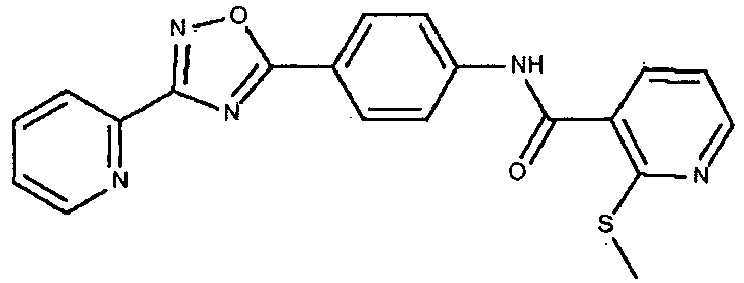
- 2-(methylsulfanyl)-N-{4-[3-(pyridin-2-yl)-1,2,4-oxadiazol-5-yl]phenyl}pyridine-3-carboxamide (Scheme IV, Step 4-1): Compound was prepared according to procedure described in Example 16 from 4-[3-(pyridin-2-yl)-1,2,4-oxadiazol-5-yl]aniline (Example 66, Step 3) and 2-(methylthio)nicotinoyl chloride. Crude product was purified by maceration from i-PrOH/hexane (1:2) to yield product as a white solid (0.21 g, 85.7%).
- LCMS (method B) RT = 2.91 min, MS (m/z ESI+) 389.8.
- 1H NMR (300 MHz, CDCl3): 8.80 (m, 1 H), 8.71 (s br. 1 H), 8.52 (dd, 2H), 8.25 (m, 2H), 8.20 (m, 1 H), 7.94 (dd, 1 H), 7.87 (m, 3H), 7.44 (m, 1 H), 7.07 (dd, 1 H), 2.61 (s, 3H).
- 13C NMR (300 MHz, CDCl3): 175.9, 168.7, 164.8, 157.3, 151.1, 150.3, 146.4, 141.8, 137.1, 136.7, 129.6, 129.1, 125.5, 123.3, 120.0, 119.9, 118.9, 13.8.
-

- N-(3-chlorophenyl)-4-(3-phenyl-1,2,4-oxadiazol-5-yl)aniline (Scheme IV, Step 4-2): Compound prepared according to procedure described in Example 11 from 4-(3-phenyl-1,2,4-oxadiazol-5-yl)aniline (Example 56, Step 3) and 3-chlorobenzeneboronic acid. Crude product was purified by column chromatography over silica gel using AcOEt/hexane (2:3) followed by maceration from MeOH to yield product as a pale yellow crystals (0.20g, 69.0%).
- LCMS (method B) RT = 4.27 min, MS (m/z ESI+) 348.1.
- 1 H NMR (300 MHz, DMSO-d6): 9.11 (s br. 1 H), 8.09-8.03 (m, 4H), 7.60 (m, 3H), 7.35 (t, 1 H), 7.23 (m, 4H), 7.03 (m, 1H).
- 13C NMR (300 MHz, DMSO-d6): 175.3, 167.9, 147.5, 142.8, 133.7, 131.4, 130.9, 129.7, 129.1, 127.0, 126.4, 121.3, 118.2, 117.2, 115.5, 113.7.
-

- N-(4-methoxyphenyl)-4-(3-phenyl-1,2,4-oxadiazol-5-yl)aniline (Scheme IV, Step 4-2): Compound prepared according to procedure described in Example 11 from 4-(3-phenyl-1,2,4-oxadiazol-5-yl)aniline (Example 56, Step 3) and 4-methoxybenzeneboronic acid. Crude product was purified by column chromatography over silica gel using AcOEt/hexane (2:3) followed by maceration from MeOH/Et2O (1:1) to yield product as a dark yellow solid (0.18 g, 62.1%).
- LCMS (method B) RT = 3.98 min, MS (m/z ESI+) 344.1.
- 1H NMR (300 MHz, DMSO): 8.72 (s br. 1H), 8.06 (m, 2H), 7.94 (d, 2H), 7.57 (m, 3H), 7.16 (m, 2H), 7.00 (d, 2H), 6.95 (m, 2H), 3.75 (s, 3H).
- 13C NMR (300 MHz, DMSO): 175.6, 167.8, 155.4, 150.1, 133.4, 131.3, 129.7, 129.1, 126.9, 126.5, 123.1, 114.6, 113.3, 111.5, 55.2.
-

- 1-N,1-N-dimethyl-4-N-[4-(3-phenyl-1,2,4-oxadiazol-5-yl)phenyl]benzene-1,4-diamine (Scheme IV, Step 4-2): Compound prepared according to procedure described in Example 11 from 4-(3-phenyl-1,2,4-oxadiazol-5-yl)aniline (Example 56, Step 3) and 4-dimethylaminobenzeneboronic acid. Crude product was purified by column chromatography over aluminum oxide using AcOEt/hexane (1:1) to yield 0.04 g (13.3%) of white solid.
- LCMS (method B) RT = 3.08 min, MS (m/z ESI+) 357.2.
- 1H NMR (300 MHz, CDCl3): 8.15 (m, 2H), 8.00 (d, 2H), 7.50 (m, 3H), 7.14 (d, 2H), 6.87 (d, 2H), 6.77 (d, 2H), 5.86 (s br. 1 H), 2.97 (s, 6H).
- 13C NMR (300 MHz, CDCl3): 176.0, 168.6, 150.5, 148.4, 130.9, 129.9, 129.2, 128.7, 127.5, 127.4, 125.3, 113.4 (2C), 40.9.
- In one aspect, the invention relates to a pharmaceutical compositions comprising a pharmaceutically acceptable carrier or diluent and, as active ingredient, a therapeutically effective amount of a compound according to the invention, presented with general Formula 1 or pharmaceutically acceptable salts, hydrates or solvates thereof.
- The compounds of Formula 1 according to the invention, the pharmaceutically acceptable salts, hydrates or solvates thereof, or combination thereof may be formulated into various pharmaceutical forms for administration purposes. As appropriate compositions there may be cited all compositions usually employed for systemically administering drugs.
- The amount of pharmaceutical compositions of this invention, administered to the subject will depend on the type and severity of the disease or condition and on the characteristics of the subject, such as general health, age, sex, body weight, diet and tolerance to drugs. The skilled artisan will be able to determine appropriate dosages depending on these and other factors. Effective dosages for commonly used CNS drugs are well known to the skilled person. The total daily dose usually ranges from about
0.05-2000 mg. - The present invention relates to pharmaceutical compositions which provide from about 0.01 to 1000 mg of the active ingredient per unit dose. The compositions may be administered by any suitable route. For example orally in the form of capsules and the like, parenterally in the form of solutions for injection, topically in the form of ointments, or lotions, ocularly in the form of eye-drops, rectally in the form of suppositories, intranasally or transcutaneously in the form of delivery system like patches.
- To prepare the pharmaceutical compositions of this invention, an effective amount of the particular compound, optionally pharmaceutically acceptable salts, hydrates or solvates thereof, as the active ingredient is combined in intimate admixture with a pharmaceutically acceptable carrier, which carrier may take a wide variety of forms depending on the form of preparation desired for administration. These pharmaceutical compositions are desirable in unitary dosage form suitable, particularly, for administration orally, rectally, percutaneously, by parenteral injection or by inhalation. For example, in preparing the compositions in oral dosage form, any of the usual pharmaceutical media may be employed such as, for example, Water, glycols, oils, alcohols and the like in the case of oral liquid preparations such as, for example, suspensions, syrups, elixirs, emulsions and solutions; or solid carriers such as, for example, starches, sugars, kaolin, diluents, lubricants, binders, disintegrating agents and the like in the case of powders, pills, capsules and tablets. Because of their ease in administration, tablets and capsules represent the most advantageous oral dosage unit forms in Which case solid pharmaceutical carriers are obviously employed.
- It is especially advantageous to formulate the aforementioned pharmaceutical compositions in unit dosage form for ease of administration and uniformity of dosage. Unit dosage form as used herein refers to physically discrete units suitable as unitary dosages, each unit containing a predetermined quantity of active ingredient calculated to produce the desired therapeutic effect in association With the required pharmaceutical carrier. Examples of such unit dosage forms are tablets (including scored or coated tablets), capsules, pills, powder packets, wafers, suppositories, injectable solutions or suspensions and the like, and segregated multiples thereof. The quantity of active ingredient in a unit dose of composition is an effective amount and may be varied according to the particular treatment involved. It may be appreciated that it may be necessary to make routine variations to the dosage depending on the age and condition of the patient. The dosage will also depend on the route of administration which may be by a variety of routes including oral, aerosol, rectal, transdermal, subcutaneous, intravenous, intramuscular, intraperitoneal and intranasal.
- As already mentioned, the invention also relates to a pharmaceutical composition comprising the compounds according to the invention and one or more other drugs in the treatment, prevention, control, amelioration, or reduction of risk of diseases or conditions for which compounds of Formula 1 or the other drugs may have utility as well as to the use of such a composition for the manufacture of a medicament.
- The compounds provided in this invention are positive allosteric modulators of III group of metabotropic receptors, in particular they are positive allosteric modulators of mGluR4. mGluR4 is expressed predominantly on the presynaptic membrane in the central nervous system where it is functions as an auto- and heteroreceptor to regulate the release of both GABA and glutamate. Furthermore, mGluR4 is also located in some postsynaptic locations. mGluR4 expressed in most areas of the brain, particularly in neurons responsible for the following functions: learning and memory; motor learning; regulation of voluntary movement and other functions; emotional responses; vision and olfaction; sleep and wakefulness; cerebellar functions and other.
- The compounds of the present invention do not appear to bind to the glutamate recognition site, the orthosteric ligand site, but instead to an allosteric site within the seven transmembrane region of the receptor. In the presence of glutamate or an agonist of mGluR4, the compounds of this invention increase the mGluR4 response. The compounds provided in this invention are expected to have their effect at mGluR4 by virtue of their ability to increase the response of such receptors to glutamate or mGluR4 agonists, enhancing the response of the receptor. Hence, the present invention relates to a compound for use as a medicine, as well as to the use of a compound according to the invention or a pharmaceutical composition according to the invention for the manufacture of a medicament for treating or preventing a condition in a mammal, including a human, the treatment or prevention of which is affected or facilitated by the neuromodulatory effect of mGluR4 allosteric modulators, in particular positive mGluR4 allosteric modulators.
- Also, the present invention relates to the use of a compound according to the invention or a pharmaceutical composition according to the invention for the manufacture of a medicament for treating, or preventing, ameliorating, controlling or reducing the risk of various neurological and psychiatric disorders associated with glutamate dysfunction in a mammal, including a human, the treatment or prevention of which is affected or facilitated by the neuromodulatory effect of mGluR4 positive allosteric modulators.
- Where the invention is said to relate to the use of a compound or composition according to the invention for the manufacture of a medicament for e.g. the treatment of
a mammal, it is understood that such use is to be interpreted in mal, comprising administering to a mammal in need of such e.g. a treatment, an effective amount of
a compound or composition according to the invention. - An appropriate dosage level for the use of the mGluR4 positive allosteric modulators of the present invention as therapeutic agents will generally be about 0.01 to 500 mg per kg body weight of patient per day which can be administered in single or multiple doses. Preferably, the dosage level will be about 0.1 to about 250 mg/kg/day and more preferably about 0.5 to about 100 mg/kg/day. For oral administration, the compositions are preferably provided in the form of tablets containing 1.0 to 1000 mg of the active ingredient. The compounds may be administered on a regimen of 1 to 3 times per day, preferably once or twice daily. This dosage regimen may be adjusted to provide the optimal therapeutic response.
- Exemplary diseases modulated by mGluR4, for which the compounds of the invention may useful, are central nervous system disorders, such as, for example: Parkinson's disease, parkinonism and other disorders involving akinesia or bradykinesia; dystonia; Huntington's disease and other disorders involving involuntary movements and dyskinesias; schizophrenia and other psychotic disorders; pain; anxiety disorders; mood disorders (including depression, mania, bipolar disorders); addictive disorders; epilepsy; posttraumatic stress disorders; Alzheimer's disease; dementia and other form of neurodegeneration.
- Because such positive allosteric modulators of mGluR4, including compounds of Formula 1, enhance the response of mGluR4 to glutamate, it is an advantage that the present methods utilize endogenous glutamate.
- Because positive allosteric modulators of mGluR4, including compounds of Formula 1, enhance the response of mGluR4 to agonists, it is understood that the present invention extends to the treatment of neurological and psychiatric disorders associated with glutamate dysfunction by administering an effective amount of a positive allosteric modulator of mGluR4, including compounds of Formula 1, in combination with an mGluR4 agonist.
- The compounds of the present invention may be utilized in combination with one or more other drugs in the treatment, prevention, control, amelioration, or reduction of risk of diseases or conditions for which compounds of Formula 1 or the other drugs may have utility, where the combination of the drugs together are safer or more effective than either drug alone.
- The compounds provided in the present invention are allosteric modulators of III group of metabotropic glutamate receptors, especially subtype 4. As such, these compounds do not appear to bind to the orthosteric glutamate recognition site, and do not active the III group of mGluRs by themselves. Instead, the response to an endogenous ligand glutamate or other mGlu4 receptor agonists is increased when compounds of Formula 1 are present. Compounds of Formula 1 are expected to have their effect at III group of mGluRs, particularly subtype 4, by virtue of their ability to enhance the function of the receptor.
- The compounds of the present invention are positive allosteric modulator of III group of metabotropic glutamate receptors, especially subtype 4. Their activity was examined on recombinant human mGlu4a receptor by detecting level of cyclic AMP in the presence of forskolin, adenylyl cyclase activator. The positive allosteric modulators provided in the present invention are expected to increase the functional activity and/or maximal efficacy of glutamate or other orthosteric agonists at mGluR4 receptor.
- Plazmid construct. The cDNA fragment encoding human metabotropic receptor 4, variant 1 (accession number: NM_000841, NCBI Nucleotide Database) was cloned into the BamHI/NotI sites of pcDNA5/FRT/TO vector, under the control of a tetracycline regulated promoter (Invitrogen, Poland).
- Cell culture and transfection. HEK293 cell line containing an inducible expression system (Flp-In T-Rex 293 cell line, Invitrogen, Poland) was maintained in Dulbecco's modified Eagle's medium supplemented with 10% fetal bovine serum, 2mM L-Glutamine (supplemented DMEM, LONZA, Poland), blastycidin and zeocin. T-Rex 293 cells were transfected with mixture of pTet-hmGluR4 and pOG44 (Invitrogen, Poland) plazmids and GeneJuice transfection reagent (Merck Millipore, Poland) according to the manufacturer's instructions. Cells were grown in supplemented DMEM with hygromycin B (75µg/ml) allowed selection of cells with stably integrated one copy of pTet-hmGluR4 plazmid. Expression of mGluR4 is induced by Tetracycline treatment.
- RT-PCR analysis of mGlu4 receptor expression. Stable transfected cells were grown to 60% confluency with supplemented DMEM. Then 0,75µg/ml tetracycline was added and after 24h of GRM4 gene induction, cells were washed twice with PBS and collected in RNA isolation reagent (Trizol, Invitrogen, Poland). Then reverse transcription (1 h, 37°C) and polymerase chain reaction (95°C 30s, 58°C 30s, 72°C 45s) was performed (3000 Thermocycler, Biometra, Poland). Results were visualized on 1% agarose gel propidium iodide stained.
- Western Blot analysis of mGlu4 receptor expression. After 48 h of growth in medium with tetracycline, cells stable transfected with pTet-hmGluR4 plazmid were washed twice with PBS and solubilized in lysis buffer containing 20mM
Tris-HCl, 100mM NaCl, 1mM EDTA, 0,5% Triton X-100, and protease inhibitor cocktail (Thermo Scientific, Poland) for 20 min on ice. After centrifugation at 20.000 x g for 15 min at 4°C, supernatants were mixed with 2 x Leammli buffer. 10µg of proteins from cell lysates were separated on 8% SDS-PAGE gels and transferred to nitrocellulose membranes according to standard Western Blot procedure. The blots were incubated with primary antibodies for 2h in RT (ab53088, AbCam, Poland) and secondary HRP conjugated antibodies for 1 h in RT (12-348, Promega, Poland). Detection was performed using Pierce ECL western blotting substrate (Thermo Scientific, Poland) and analysis system (Fuji Film LAS-4000, Poland). - Cell preparation before assay. Stable transfected cells were grown to 60% confluency with supplemented DMEM. Two days before experiment mGluR4 expression was induced by adding tetracycline in concentration 0,75µg/ml. 40h before experiment cells were incubated in a L-Glutamine free medium.
- Cyclic AMP measurement. cAMP was measured quantitatively by cAMP dynamic 2 (Cisbio Biossays, France) according to manufacture instructions. cAMP dynamic 2 assay (Cisbio Biossays, France) is method based on homogenous time-resolved fluorescence. cAMP dynamic 2 is a competitive immunoassay between native cAMP produced by cells and the cyclic AMP labeled with, a fluorescence dye. The tracer binding is visualized by antibody anti - cAMP labeled with Eu3+ cryptate. The specific signal is inversely proportional to the concentration of cAMP in the sample.
- Incubation of cells with all compounds was performed in 96 well plates. Each well were supplement with HHB containing 130 mM NaCl, 5,4 mM KCI, 1,8 mM CaCl2, 0,8 mM MgSO4, 0,9 mM NaH2PO4, 25 mM glucose and 20 mM HEPES, pH 7.4 with or without glutamate and with or without tested compound and forskolin (10 uM final concentration) in total volume of 50 ul. Assay was started by adding 50 ul of HHB buffer with cells to each well. Assay was performed in 37°C. After 5 min of incubation 10 ul of suspension containing 2000 cells were transferred to white 384 well plates (784080, Greiner bio-one) containing of 5 ul of cAMP-d2 conjugate in lysis buffer (cAMP dynamic 2, Cisbio Bioassays, France) in each well. Than was added 5 ul of cryptate conjugate in lysis buffer (cAMP dynamic 2, Cisbio Bioassays, France). After 1 h incubation in room temperature the fluorescence intensity of the assay plate were measured at 314 nm excitation, and 620 nm and 665 nm emission in Infinite M1000 (Tecan) microplate reader. Data were expressed as the ratio of 665 nm/620 nm. All liquid handling operations were performed using EVO 2000 system (Tecan, Switzerland).
- Potentiation of the glutamate response of mGluR4 receptor by the invented compounds was observed as a decrease of EC50 value for the glutamate in the presence of these molecules in the compare of EC50 value in the absence of compounds. A decrease in the EC50 for glutamate in the presence of tested compound was an indicator of degree of mGluR4 positive allosteric modulation at a given concentration of the sample compound. It also indicated (present as a % Glu Max) whether the sample compounds also affect the maximum activity of mGluR4 receptor.
- The concentration response curves of representative compounds of the present invention were generated using the non-linear regression analysis program, GraphPad Prism version 5.03 (GraphPad Software, Inc., San Diego, USA). The curves were fitted to a four-parametric logistic equation: (Y=Bottom + (Top-Bottom)/(1+10^((LogEC50-X)*Hill Slope) allowing the determination of EC50 values.
- The Table 3 below represents the mean EC50 and % Glu Max obtained from at least three independent experiments of selected compounds performed in duplicates.
- The "% Glu Max" is defined as a percent of activity mGluR4 receptor in the presence of tested compound and glutamate in concentration of the glutamic acid, which maximally activate mGluR4 receptor (100%).
- Table 3: Activity data for selected exemplary compounds
Table 3 Activity Example EC50 [µM] % Glu Max EC50 < 0.3 µM 104.7 - 118.0 27, 28, 30, 49, 39 0.3 mM < EC50 <1 µM 104.6 - 134.9 31, 50, 6, 26, 38, 40 1 mM < EC50 < 3 µM 99.2 - 118.6 17, 19, 22, 54, 42, 32, 44, 33, 41,29,46,48,47,34 - The results shown in Table 3 demonstrate activity of the compounds described in the present invention. Compounds listed in the Table 3 are positive allosteric modulators of mGluR4 in the aforementioned assay generally with an EC50 for potentiation of less than about 3 µM. The disclosed compounds have activity in potentiating human recombinant mGluR4 receptor with EC50 for potentiation of less than about 300 nM. The activity of human recombinant mGluR4 receptor to a concentration of glutamate is increased in the presence of compounds provided in the present invention and listed in Table 3. These compounds increase the functional activity and/or maximal efficacy of glutamate to stimulate receptor mGluR4 activity.
- Thus, the positive allosteric modulators provided in the present invention are expected to increase the effectiveness of glutamate, or mGluR4 agonists.
- Therefore, these compounds are expected to be useful for treatment of various neurological and psychiatric disorders associated with glutamate transmission dysfunction described to be treated herein and others that can be treated by such positive allosteric modulators.
- The compounds of the present invention can be administered either alone, or in combination with other pharmaceutical agents effective in the treatment of conditions mentioned above.
Claims (4)

Priority Applications (1)
| Application Number | Priority Date | Filing Date | Title |
|---|---|---|---|
| EP13460066.7A EP2853532B1 (en) | 2013-09-28 | 2013-09-28 | 1,2,4-oxadiazole derivatives as allosteric modulators of metabotropic glutamate receptors belonging to group III |
Applications Claiming Priority (1)
| Application Number | Priority Date | Filing Date | Title |
|---|---|---|---|
| EP13460066.7A EP2853532B1 (en) | 2013-09-28 | 2013-09-28 | 1,2,4-oxadiazole derivatives as allosteric modulators of metabotropic glutamate receptors belonging to group III |
Publications (2)
| Publication Number | Publication Date |
|---|---|
| EP2853532A1 true EP2853532A1 (en) | 2015-04-01 |
| EP2853532B1 EP2853532B1 (en) | 2020-12-09 |
Family
ID=49382381
Family Applications (1)
| Application Number | Title | Priority Date | Filing Date |
|---|---|---|---|
| EP13460066.7A Not-in-force EP2853532B1 (en) | 2013-09-28 | 2013-09-28 | 1,2,4-oxadiazole derivatives as allosteric modulators of metabotropic glutamate receptors belonging to group III |
Country Status (1)
| Country | Link |
|---|---|
| EP (1) | EP2853532B1 (en) |
Cited By (8)
| Publication number | Priority date | Publication date | Assignee | Title |
|---|---|---|---|---|
| RU2578957C1 (en) * | 2015-04-20 | 2016-03-27 | Федеральное государственное бюджетное научное учреждение "Научно-исследовательский институт психического здоровья" | Laboratory method for diagnosis of leading negative symptoms in patients with schizophrenia |
| WO2019006157A1 (en) * | 2017-06-28 | 2019-01-03 | Vanderbilt University | QUINOLINE PYRIDINE COMPOUNDS AS MGLUR4 ALLOSTERIC POTENTIALIZERS, COMPOSITIONS, AND METHODS FOR TREATING NEUROLOGICAL DYSFUNCTIONS |
| CN111138376A (en) * | 2019-12-24 | 2020-05-12 | 中山大学 | 3, 5-disubstituted phenyl-1, 2, 4-oxadiazole derivative and preparation method and application thereof |
| KR20210000460A (en) * | 2019-06-25 | 2021-01-05 | 연세대학교 산학협력단 | Novel oxadiazole compound and composition for preventing or treating diabetes comprising the same |
| EP3638235A4 (en) * | 2017-06-14 | 2021-06-09 | Trevena, Inc. | COMPOUNDS TO MODULATE S1P1 ACTIVITY AND THEIR PROCEDURES FOR USE |
| CN113651805A (en) * | 2021-07-19 | 2021-11-16 | 安徽医科大学 | A 1,2,4-oxadiazole-pyridine compound and its application in the treatment of Alzheimer's disease |
| CN113754646A (en) * | 2021-07-19 | 2021-12-07 | 安徽医科大学 | (4-(1,2,4-oxadiazol-5-yl)phenyl)carboxamide derivatives and their application in anti-arthritis drugs |
| US11884655B2 (en) | 2019-11-19 | 2024-01-30 | Trevena, Inc. | Compounds and methods of preparing compounds S1P1 modulators |
Citations (19)
| Publication number | Priority date | Publication date | Assignee | Title |
|---|---|---|---|---|
| EP0504574A1 (en) * | 1991-03-22 | 1992-09-23 | Wakamoto Pharmaceutical Co., Ltd. | 1,2,4-Oxadiazole derivatives having monoamine oxidase B enzyme-inhibitory activity and method for preparing same |
| US6034106A (en) * | 1996-06-07 | 2000-03-07 | Merck & Co., Inc. | Oxadiazole benzenesulfonamides as selective β3 Agonist for the treatment of Diabetes and Obesity |
| WO2001012627A1 (en) * | 1999-08-19 | 2001-02-22 | Nps Pharmaceuticals, Inc. | Heteropolycyclic compounds and their use as metabotropic glutamate receptor antagonists |
| WO2002068417A2 (en) * | 2001-02-21 | 2002-09-06 | Nps Pharmaceuticals, Inc. | Heteropolycyclic compounds and their use as metabotropic glutamate receptor antagonists |
| WO2004054973A2 (en) * | 2002-12-18 | 2004-07-01 | Novo Nordisk A/S | Piperidine and pyrrolidine derivatives as antagonists of histamine h3 receptor |
| WO2008076356A1 (en) * | 2006-12-15 | 2008-06-26 | Abbott Laboratories | Novel oxadiazole compounds |
| WO2009010454A2 (en) | 2007-07-13 | 2009-01-22 | Addex Pharma S.A. | Amido derivatives and their use as positive allosteric modulators of metabotropic glutamate receptors |
| WO2009010455A2 (en) | 2007-07-13 | 2009-01-22 | Addex Pharma S.A. | Pyrazole derivatives as modulators of metabotropic glutamate receptors |
| US20090298894A1 (en) * | 2008-04-21 | 2009-12-03 | Asahi Kasei Pharma Corporation | Amino acid compounds |
| WO2010079239A1 (en) | 2009-01-12 | 2010-07-15 | Addex Pharma S.A. | Novel thiazoles derivatives and their use as positive allosteric modulators of metabotropic glutamate receptors |
| WO2010079238A1 (en) | 2009-01-12 | 2010-07-15 | Addex Pharma S.A. | Heterotricyclic compounds as positive allosteric modulators of metabotropic glutamate receptors |
| WO2010088406A1 (en) | 2009-01-28 | 2010-08-05 | Vanderbilt University | Substituted 1,1,3,3-tetraoxidobenzo[d][1,3,2]dithiazoles as mglur4 allosteric potentiators, compositions, and methods of treating neurological dysfunction |
| US20100249085A1 (en) * | 2007-05-18 | 2010-09-30 | Bayer Schering Pharma Aktiengesellschaft | Heteroaryl substituted pyrazole derivatives useful for treating hyper-proliferative disorders and diseases associated with angiogenesis |
| WO2011000607A1 (en) | 2009-07-02 | 2011-01-06 | Robert Bosch Gmbh | Radar sensor for motor vehicles |
| WO2011011722A1 (en) | 2009-07-23 | 2011-01-27 | Vanderbilt University | Substituted benzoimidazolesulfonamides and substituted indolesulfonamides as mglur4 potentiators |
| WO2011010222A1 (en) | 2009-07-24 | 2011-01-27 | Addex Pharma S.A. | Novel pyrazole derivatives and their use as positive allosteric modulators of metabotropic glutamate receptors |
| WO2011029104A1 (en) | 2009-09-04 | 2011-03-10 | Vanderbilt University | Mglur4 allosteric potentiators, compositions, and methods of treating neurological dysfunction |
| WO2011050305A1 (en) | 2009-10-22 | 2011-04-28 | Vanderbilt University | Mglur4 allosteric potentiators, compositions, and methods of treating neurological dysfunction |
| WO2012009001A2 (en) | 2010-07-14 | 2012-01-19 | Addex Pharma S.A. | Novel tetrahydropyrazolo[3,4-b]azepine derivatives and their use as allosteric modulators of metabotropic glutamate receptors |
Family Cites Families (9)
| Publication number | Priority date | Publication date | Assignee | Title |
|---|---|---|---|---|
| DE4425794A1 (en) * | 1994-07-21 | 1996-01-25 | Basf Ag | Nitro dyes |
| CA2465978C (en) * | 2001-09-14 | 2015-04-07 | Soon Hyung Woo | Inhibitors of histone deacetylase |
| US20050075375A1 (en) * | 2003-05-14 | 2005-04-07 | Anadys Pharmaceuticals, Inc. | Heterocyclic compounds for treating hepatitis C virus |
| DE102006009928A1 (en) * | 2006-03-03 | 2007-09-06 | Aicuris Gmbh & Co. Kg | Substituted arylsulfonamides |
| WO2009041972A1 (en) * | 2007-09-27 | 2009-04-02 | University Of Notre Dame Du Lac | Antibacterial compounds and methods of using same |
| CN101970420B (en) * | 2007-10-04 | 2014-09-24 | 默克雪兰诺有限公司 | Oxadiazole Derivatives |
| PT2291080E (en) * | 2008-05-14 | 2015-10-30 | Scripps Research Inst | Novel modulators of sphingosine phosphate receptors |
| AU2009253046A1 (en) * | 2008-05-30 | 2009-12-03 | Foster Wheeler Energia Oy | Method of and system for generating power by oxyfuel combustion |
| JP2011195467A (en) * | 2010-03-17 | 2011-10-06 | Japan Health Science Foundation | Coupling factor expression promoter and bone metabolism improving agent, and prophylactic or therapeutic agent of disease caused by abnormality of bone metabolism |
-
2013
- 2013-09-28 EP EP13460066.7A patent/EP2853532B1/en not_active Not-in-force
Patent Citations (20)
| Publication number | Priority date | Publication date | Assignee | Title |
|---|---|---|---|---|
| EP0504574A1 (en) * | 1991-03-22 | 1992-09-23 | Wakamoto Pharmaceutical Co., Ltd. | 1,2,4-Oxadiazole derivatives having monoamine oxidase B enzyme-inhibitory activity and method for preparing same |
| US6034106A (en) * | 1996-06-07 | 2000-03-07 | Merck & Co., Inc. | Oxadiazole benzenesulfonamides as selective β3 Agonist for the treatment of Diabetes and Obesity |
| WO2001012627A1 (en) * | 1999-08-19 | 2001-02-22 | Nps Pharmaceuticals, Inc. | Heteropolycyclic compounds and their use as metabotropic glutamate receptor antagonists |
| WO2002068417A2 (en) * | 2001-02-21 | 2002-09-06 | Nps Pharmaceuticals, Inc. | Heteropolycyclic compounds and their use as metabotropic glutamate receptor antagonists |
| WO2004054973A2 (en) * | 2002-12-18 | 2004-07-01 | Novo Nordisk A/S | Piperidine and pyrrolidine derivatives as antagonists of histamine h3 receptor |
| WO2008076356A1 (en) * | 2006-12-15 | 2008-06-26 | Abbott Laboratories | Novel oxadiazole compounds |
| US20100249085A1 (en) * | 2007-05-18 | 2010-09-30 | Bayer Schering Pharma Aktiengesellschaft | Heteroaryl substituted pyrazole derivatives useful for treating hyper-proliferative disorders and diseases associated with angiogenesis |
| WO2009010454A2 (en) | 2007-07-13 | 2009-01-22 | Addex Pharma S.A. | Amido derivatives and their use as positive allosteric modulators of metabotropic glutamate receptors |
| WO2009010455A2 (en) | 2007-07-13 | 2009-01-22 | Addex Pharma S.A. | Pyrazole derivatives as modulators of metabotropic glutamate receptors |
| US20100144756A1 (en) | 2007-07-13 | 2010-06-10 | Bolea Christelle | Novel heteroaromatic derivatives and their use as positive allosteric modulators of metabotropic glutamate receptors |
| US20090298894A1 (en) * | 2008-04-21 | 2009-12-03 | Asahi Kasei Pharma Corporation | Amino acid compounds |
| WO2010079239A1 (en) | 2009-01-12 | 2010-07-15 | Addex Pharma S.A. | Novel thiazoles derivatives and their use as positive allosteric modulators of metabotropic glutamate receptors |
| WO2010079238A1 (en) | 2009-01-12 | 2010-07-15 | Addex Pharma S.A. | Heterotricyclic compounds as positive allosteric modulators of metabotropic glutamate receptors |
| WO2010088406A1 (en) | 2009-01-28 | 2010-08-05 | Vanderbilt University | Substituted 1,1,3,3-tetraoxidobenzo[d][1,3,2]dithiazoles as mglur4 allosteric potentiators, compositions, and methods of treating neurological dysfunction |
| WO2011000607A1 (en) | 2009-07-02 | 2011-01-06 | Robert Bosch Gmbh | Radar sensor for motor vehicles |
| WO2011011722A1 (en) | 2009-07-23 | 2011-01-27 | Vanderbilt University | Substituted benzoimidazolesulfonamides and substituted indolesulfonamides as mglur4 potentiators |
| WO2011010222A1 (en) | 2009-07-24 | 2011-01-27 | Addex Pharma S.A. | Novel pyrazole derivatives and their use as positive allosteric modulators of metabotropic glutamate receptors |
| WO2011029104A1 (en) | 2009-09-04 | 2011-03-10 | Vanderbilt University | Mglur4 allosteric potentiators, compositions, and methods of treating neurological dysfunction |
| WO2011050305A1 (en) | 2009-10-22 | 2011-04-28 | Vanderbilt University | Mglur4 allosteric potentiators, compositions, and methods of treating neurological dysfunction |
| WO2012009001A2 (en) | 2010-07-14 | 2012-01-19 | Addex Pharma S.A. | Novel tetrahydropyrazolo[3,4-b]azepine derivatives and their use as allosteric modulators of metabotropic glutamate receptors |
Non-Patent Citations (56)
| Title |
|---|
| ACHER ET AL., J. MED. CHEM., vol. 40, 1997, pages 3119 - 3129 |
| AYALA ET AL., NEUROPHARMACOLOGY, vol. 54, 2008, pages 804 - 814 |
| BATTAGLIA ET AL., J. NEUROSCI., vol. 26, 2006, pages 7222 - 7229 |
| BEURRIER ET AL., FASEB J., vol. 23, 2009, pages 804 - 814 |
| BRADLEY ET AL., J. COMP. NEUROL., vol. 407, 1999, pages 33 - 46 |
| CHEN ET AL., NEUROSCI. LETT., vol. 375, 2005, pages 192 - 197 |
| CORTI ET AL., NEUROSCIENCE, vol. 110, 2002, pages 403 - 420 |
| CRYAN ET AL., EUR. J. NEUROSCI., vol. 17, 2003, pages 2409 - 2417 |
| DALIP KUMAR ET AL: "Design and Synthesis of 3,5-Disubstituted-1,2,4-Oxadiazoles as Potent Inhibitors of Phosphodiesterase4B2", CHEMICAL BIOLOGY & DRUG DESIGN, vol. 79, no. 5, 9 May 2012 (2012-05-09), pages 810 - 818, XP055110314, ISSN: 1747-0277, DOI: 10.1111/j.1747-0285.2011.01304.x * |
| DOLLER ET AL., J. MED. CHEM., vol. 54, 2011, pages 5070 - 5081 |
| DUVOISIN ET AL., BEHAV. BRAIN RES., vol. 212, 2010, pages 168 |
| ENGERS ET AL., J. MED. CHEM., vol. 52, 2009, pages 4115 - 4118 |
| GREGORY ET AL., NEUROPHARMACOLOGY, vol. 60, 2011, pages 66 - 81 |
| GREGORY ET AL., PROG. MOL. BIOL. TRANSL. SCI., vol. 115, 2013, pages 61 - 121 |
| HOPKINS ET AL., FUTURE MED. CHEM., vol. 1, 2009, pages 501 - 513 |
| JOHANSEN ET AL., MOL. PHARMACOL., vol. 48, 1995, pages 140 - 149 |
| KINOSHITA ET AL., J. COMP. NEUROL., vol. 393, 1998, pages 332 |
| KLAK ET AL., AMINO ACIDS., vol. 32, 2007, pages 169 - 172 |
| KOGO ET AL., EUR. J. NEUROSCI., vol. 19, 2004, pages 2727 - 2740 |
| KROONA ET AL., J. MED. CHEM., vol. 34, 1991, pages 1692 - 1699 |
| LAVREYSEN; DAUTZENBERG, CURR. MED. CHEM., vol. 15, 2008, pages 671 - 684 |
| MACHADO-VIEIRA ET AL., NEUROSCIENTIST, vol. 15, 2009, pages 525 - 539 |
| MACHADO-VIEIRA ET AL., PHARMACOL. BIOCHEM. BEHAV., vol. 100, 2012, pages 678 - 687 |
| MAJ ET AL., NEUROPHARMACOLOGY, vol. 45, 2003, pages 895 - 906 |
| MAKOFF ET AL., MOL. BRAIN RES., vol. 37, 1996, pages 239 - 248 |
| MARINO ET AL., CURR, TOPICS MED. CHEM., vol. 5, 2005, pages 885 - 895 |
| MARINO ET AL., CURR. TOP. MED. CHEM., vol. 9, 2005, pages 885 - 895 |
| MARINO ET AL., PROC. NAT. ACAD. SCI. USA, vol. 100, 2003, pages 13668 - 13673 |
| MATHIESEN ET AL., BRIT. J. PHARMACOL., vol. 138, 2003, pages 1026 - 1030 |
| MITSUKAWA ET AL., PROC. NATL. ACAD. SCI. U.S.A., vol. 102, 2005, pages 18712 |
| MOLONEY ET AL: "Synthesis and cannabinoid activity of 1-substituted-indole-3-oxadiazole derivatives: Novel agonists for the CB1 receptor", EUROPEAN JOURNAL OF MEDICINAL CHEMISTRY, EDITIONS SCIENTIFIQUE ELSEVIER, PARIS, FR, vol. 43, no. 3, 1 March 2008 (2008-03-01), pages 513 - 539, XP022511502, ISSN: 0223-5234, DOI: 10.1016/J.APCATA.2007.12.019 * |
| NAKAMURA ET AL., BIOORG. MED. CHEM. LETT., vol. 20, 2010, pages 726 |
| NAKAMURA ET AL., J. PHARMACOL. EXP. THER., vol. 323, 2007, pages 147 |
| NISWANDER ET AL., CURR. TOPICS MED. CHEM., vol. 9, 2009, pages 949 - 963 |
| NISWANDER ET AL., MOL. PHARMACOL., vol. 74, 2008, pages 1345 - 1358 |
| NISWENDER ET AL., BIOORG. MED. CHEM. LETT., vol. 18, 2008, pages 5626 - 5630 |
| NISWENDER ET AL., BIOORG. MED. CHEM. LETT., vol. 19, 2009, pages 4967 - 4970 |
| NISWENDER ET AL., J. MED. CHEM., vol. 54, 2011, pages 1106 - 1110 |
| NISWENDER ET AL., MOL. PHARMACOL., vol. 73, 2008, pages 1213 - 1224 |
| NISWENDER; CONN, ANN. REV. PHARMACOL. TOXICOL., vol. 50, 2010, pages 295 - 322 |
| O'CONNOR ET AL., PHARMACOL. BIOCHEM. BEHAV., vol. 103, 2013, pages 561 - 567 |
| OHISHI ET AL., NEUROSCI. LETT., vol. 202, 1995, pages 85 |
| PA?UCHA ET AL., NEUROPHARMACOLOGY, vol. 46, 2004, pages 151 - 159 |
| PILC ET AL., BIOL. PSYCHIATRY, 28 February 2013 (2013-02-28) |
| SCHOEPP ET AL., NEUROPHARMACOLOGY, vol. 38, 1999, pages 1431 - 1476 |
| SLAWINSKA ET AL., NEUROPHARMACOLOGY, vol. 66, 2013, pages 225 - 235 |
| SNEAD ET AL., J. NEUROSCI., vol. 20, 2000, pages 6218 - 6224 |
| STACHOWICZ ET AL., EUR. J. PHARMACOL., vol. 498, 2004, pages 153 - 156 |
| STACHOWICZ ET AL., PHARMACOL. REP., vol. 58, 2006, pages 820 - 826 |
| TATARCZY?SKA ET AL., POL. J. PHARMACOL., 2002, pages 707 - 710 |
| THOMAS ET AL., NEUROPHARMACOLOGY, vol. 40, 2001, pages 311 - 318 |
| TSUYOSHI NAKAMURA ET AL: "Discovery of CS-2100, a potent, orally active and S1P-sparing S1Pagonist", BIOORGANIC & MEDICINAL CHEMISTRY LETTERS, PERGAMON, AMSTERDAM, NL, vol. 22, no. 4, 3 December 2011 (2011-12-03), pages 1788 - 1792, XP028398245, ISSN: 0960-894X, [retrieved on 20120102], DOI: 10.1016/J.BMCL.2011.12.019 * |
| VALENTI ET AL., J. PHARMACOL. EXP. THER., vol. 313, 2005, pages 1296 - 1304 |
| WILLIAMS ET AL., BIOORG. MED. CHEM.. LETT., vol. 19, 2009, pages 949 - 963 |
| WOOD ET AL., BIOCHEMISTRY, vol. 50, 2011, pages 2403 - 2410 |
| ZHAI ET AL., NEUROPHARMACOLOGY, vol. 43, 2002, pages 223 - 230 |
Cited By (16)
| Publication number | Priority date | Publication date | Assignee | Title |
|---|---|---|---|---|
| RU2578957C1 (en) * | 2015-04-20 | 2016-03-27 | Федеральное государственное бюджетное научное учреждение "Научно-исследовательский институт психического здоровья" | Laboratory method for diagnosis of leading negative symptoms in patients with schizophrenia |
| IL271149B1 (en) * | 2017-06-14 | 2024-01-01 | Trevena Inc | Compounds for modulating S1P1 activity and methods of using them |
| IL271149B2 (en) * | 2017-06-14 | 2024-05-01 | Trevena Inc | Compounds for modulating S1P1 activity and methods of using them |
| EP3638235A4 (en) * | 2017-06-14 | 2021-06-09 | Trevena, Inc. | COMPOUNDS TO MODULATE S1P1 ACTIVITY AND THEIR PROCEDURES FOR USE |
| US11912693B2 (en) | 2017-06-14 | 2024-02-27 | Trevena, Inc. | Compounds for modulating S1P1 activity and methods of using the same |
| AU2018282747B2 (en) * | 2017-06-14 | 2024-01-18 | Trevena, Inc. | Compounds for modulating S1P1 activity and methods of using the same |
| WO2019006157A1 (en) * | 2017-06-28 | 2019-01-03 | Vanderbilt University | QUINOLINE PYRIDINE COMPOUNDS AS MGLUR4 ALLOSTERIC POTENTIALIZERS, COMPOSITIONS, AND METHODS FOR TREATING NEUROLOGICAL DYSFUNCTIONS |
| US11319304B2 (en) | 2017-06-28 | 2022-05-03 | Vanderbilt University | Pyridine quinoline compounds as MGLUR4 allosteric potentiators, compositions, and methods of treating neurological dysfunction |
| KR20210000460A (en) * | 2019-06-25 | 2021-01-05 | 연세대학교 산학협력단 | Novel oxadiazole compound and composition for preventing or treating diabetes comprising the same |
| US11884655B2 (en) | 2019-11-19 | 2024-01-30 | Trevena, Inc. | Compounds and methods of preparing compounds S1P1 modulators |
| US12686675B2 (en) | 2019-11-19 | 2026-07-21 | Trevena, Inc. | Compounds and methods of preparing compounds S1P1 modulators |
| CN111138376A (en) * | 2019-12-24 | 2020-05-12 | 中山大学 | 3, 5-disubstituted phenyl-1, 2, 4-oxadiazole derivative and preparation method and application thereof |
| CN113651805B (en) * | 2021-07-19 | 2023-07-25 | 安徽医科大学 | 1,2, 4-oxadiazole-pyridine compound and application thereof in treating Alzheimer's disease |
| CN113754646B (en) * | 2021-07-19 | 2023-07-25 | 安徽医科大学 | (4-(1,2,4-oxadiazol-5-yl)phenyl)carboxamide derivatives and their application in anti-arthritic drugs |
| CN113754646A (en) * | 2021-07-19 | 2021-12-07 | 安徽医科大学 | (4-(1,2,4-oxadiazol-5-yl)phenyl)carboxamide derivatives and their application in anti-arthritis drugs |
| CN113651805A (en) * | 2021-07-19 | 2021-11-16 | 安徽医科大学 | A 1,2,4-oxadiazole-pyridine compound and its application in the treatment of Alzheimer's disease |
Also Published As
| Publication number | Publication date |
|---|---|
| EP2853532B1 (en) | 2020-12-09 |
Similar Documents
| Publication | Publication Date | Title |
|---|---|---|
| EP2853532B1 (en) | 1,2,4-oxadiazole derivatives as allosteric modulators of metabotropic glutamate receptors belonging to group III | |
| CN104540828B (en) | As the substituted pyrazoloquinazolone and pyrrolo- quinazolinone of the allosteric modulators of II group metabotropic glutamate receptors | |
| US8637510B2 (en) | Morpholinothiazoles as alpha 7 positive allosteric modulators | |
| RU2479577C2 (en) | Heterocyclic compounds as positive modulators of metabotropic glutamate receptor 2 (mglu2 receptor) | |
| RU2680401C2 (en) | Sulfonamides as modulators of sodium channels | |
| RU2683788C2 (en) | Amides of quinoline and quinazoline, useful as a sodium channel modulators | |
| JP5860960B2 (en) | Substituted quinolines and their use as pharmaceuticals | |
| JP5031745B2 (en) | Metaindole glutamate receptor potentiating isoindolone | |
| JP6552061B2 (en) | Negative allosteric modulators (NAMS) of metabotropic glutamate receptors and their use | |
| EP2044065A2 (en) | Compounds and compositions as hedgehog pathway modulators | |
| CN104220069B (en) | TRPM8 antagonist | |
| EP2460787A1 (en) | Amide compounds and their use as PGE2 antagonists. | |
| JP2006503081A (en) | Chemical compound | |
| RS57070B1 (en) | Sphingosine 1 phosphate receptor modulators and methods of chiral synthesis | |
| JP2007503388A (en) | Substituted naphthyridine derivatives as inhibitors of macrophage migration inhibitory factor and their use in the treatment of human diseases | |
| JP2011502148A (en) | P2X3 receptor antagonist for the treatment of pain | |
| WO2019101086A1 (en) | Halo-allylamine ssao/vap-1 inhibitor and use thereof | |
| EP3519403B1 (en) | Compounds and their use as pde4 activators | |
| JP2021528454A (en) | Compound | |
| EP2456769B1 (en) | Novel pyrazole derivatives and their use as positive allosteric modulators of metabotropic glutamate receptors | |
| CN109071543A (en) | Inhibit the pyridine derivate of RAF kinases and vascular endothelial growth factor receptor, preparation method contains its medical composition and its use | |
| JP5989253B2 (en) | Ethinyl derivatives as modulators of mGluR5 receptor activity | |
| EP3402780A1 (en) | Mast-cell modulators and uses thereof | |
| TW201245187A (en) | Pyrazole derivatives | |
| US8604033B2 (en) | Preparation of 4-amino-thiazoles and 3-amino-1,2,4-thiadiazoles and their use as allosteric modulators of metabotropic glutamate receptors |
Legal Events
| Date | Code | Title | Description |
|---|---|---|---|
| PUAI | Public reference made under article 153(3) epc to a published international application that has entered the european phase |
Free format text: ORIGINAL CODE: 0009012 |
|
| 17P | Request for examination filed |
Effective date: 20130928 |
|
| AK | Designated contracting states |
Kind code of ref document: A1 Designated state(s): AL AT BE BG CH CY CZ DE DK EE ES FI FR GB GR HR HU IE IS IT LI LT LU LV MC MK MT NL NO PL PT RO RS SE SI SK SM TR |
|
| AX | Request for extension of the european patent |
Extension state: BA ME |
|
| R17P | Request for examination filed (corrected) |
Effective date: 20151001 |
|
| RBV | Designated contracting states (corrected) |
Designated state(s): AL AT BE BG CH CY CZ DE DK EE ES FI FR GB GR HR HU IE IS IT LI LT LU LV MC MK MT NL NO PL PT RO RS SE SI SK SM TR |
|
| 17Q | First examination report despatched |
Effective date: 20160302 |
|
| STAA | Information on the status of an ep patent application or granted ep patent |
Free format text: STATUS: EXAMINATION IS IN PROGRESS |
|
| GRAP | Despatch of communication of intention to grant a patent |
Free format text: ORIGINAL CODE: EPIDOSNIGR1 |
|
| STAA | Information on the status of an ep patent application or granted ep patent |
Free format text: STATUS: GRANT OF PATENT IS INTENDED |
|
| INTG | Intention to grant announced |
Effective date: 20200630 |
|
| GRAS | Grant fee paid |
Free format text: ORIGINAL CODE: EPIDOSNIGR3 |
|
| GRAA | (expected) grant |
Free format text: ORIGINAL CODE: 0009210 |
|
| STAA | Information on the status of an ep patent application or granted ep patent |
Free format text: STATUS: THE PATENT HAS BEEN GRANTED |
|
| AK | Designated contracting states |
Kind code of ref document: B1 Designated state(s): AL AT BE BG CH CY CZ DE DK EE ES FI FR GB GR HR HU IE IS IT LI LT LU LV MC MK MT NL NO PL PT RO RS SE SI SK SM TR |
|
| REG | Reference to a national code |
Ref country code: GB Ref legal event code: FG4D |
|
| REG | Reference to a national code |
Ref country code: AT Ref legal event code: REF Ref document number: 1343323 Country of ref document: AT Kind code of ref document: T Effective date: 20201215 Ref country code: CH Ref legal event code: EP |
|
| REG | Reference to a national code |
Ref country code: DE Ref legal event code: R096 Ref document number: 602013074597 Country of ref document: DE |
|
| REG | Reference to a national code |
Ref country code: IE Ref legal event code: FG4D |
|
| PG25 | Lapsed in a contracting state [announced via postgrant information from national office to epo] |
Ref country code: FI Free format text: LAPSE BECAUSE OF FAILURE TO SUBMIT A TRANSLATION OF THE DESCRIPTION OR TO PAY THE FEE WITHIN THE PRESCRIBED TIME-LIMIT Effective date: 20201209 Ref country code: RS Free format text: LAPSE BECAUSE OF FAILURE TO SUBMIT A TRANSLATION OF THE DESCRIPTION OR TO PAY THE FEE WITHIN THE PRESCRIBED TIME-LIMIT Effective date: 20201209 Ref country code: NO Free format text: LAPSE BECAUSE OF FAILURE TO SUBMIT A TRANSLATION OF THE DESCRIPTION OR TO PAY THE FEE WITHIN THE PRESCRIBED TIME-LIMIT Effective date: 20210309 Ref country code: GR Free format text: LAPSE BECAUSE OF FAILURE TO SUBMIT A TRANSLATION OF THE DESCRIPTION OR TO PAY THE FEE WITHIN THE PRESCRIBED TIME-LIMIT Effective date: 20210310 |
|
| REG | Reference to a national code |
Ref country code: AT Ref legal event code: MK05 Ref document number: 1343323 Country of ref document: AT Kind code of ref document: T Effective date: 20201209 |
|
| PG25 | Lapsed in a contracting state [announced via postgrant information from national office to epo] |
Ref country code: LV Free format text: LAPSE BECAUSE OF FAILURE TO SUBMIT A TRANSLATION OF THE DESCRIPTION OR TO PAY THE FEE WITHIN THE PRESCRIBED TIME-LIMIT Effective date: 20201209 Ref country code: SE Free format text: LAPSE BECAUSE OF FAILURE TO SUBMIT A TRANSLATION OF THE DESCRIPTION OR TO PAY THE FEE WITHIN THE PRESCRIBED TIME-LIMIT Effective date: 20201209 Ref country code: BG Free format text: LAPSE BECAUSE OF FAILURE TO SUBMIT A TRANSLATION OF THE DESCRIPTION OR TO PAY THE FEE WITHIN THE PRESCRIBED TIME-LIMIT Effective date: 20210309 |
|
| REG | Reference to a national code |
Ref country code: NL Ref legal event code: MP Effective date: 20201209 |
|
| PG25 | Lapsed in a contracting state [announced via postgrant information from national office to epo] |
Ref country code: NL Free format text: LAPSE BECAUSE OF FAILURE TO SUBMIT A TRANSLATION OF THE DESCRIPTION OR TO PAY THE FEE WITHIN THE PRESCRIBED TIME-LIMIT Effective date: 20201209 Ref country code: HR Free format text: LAPSE BECAUSE OF FAILURE TO SUBMIT A TRANSLATION OF THE DESCRIPTION OR TO PAY THE FEE WITHIN THE PRESCRIBED TIME-LIMIT Effective date: 20201209 |
|
| REG | Reference to a national code |
Ref country code: LT Ref legal event code: MG9D |
|
| PG25 | Lapsed in a contracting state [announced via postgrant information from national office to epo] |
Ref country code: SM Free format text: LAPSE BECAUSE OF FAILURE TO SUBMIT A TRANSLATION OF THE DESCRIPTION OR TO PAY THE FEE WITHIN THE PRESCRIBED TIME-LIMIT Effective date: 20201209 Ref country code: EE Free format text: LAPSE BECAUSE OF FAILURE TO SUBMIT A TRANSLATION OF THE DESCRIPTION OR TO PAY THE FEE WITHIN THE PRESCRIBED TIME-LIMIT Effective date: 20201209 Ref country code: CZ Free format text: LAPSE BECAUSE OF FAILURE TO SUBMIT A TRANSLATION OF THE DESCRIPTION OR TO PAY THE FEE WITHIN THE PRESCRIBED TIME-LIMIT Effective date: 20201209 Ref country code: LT Free format text: LAPSE BECAUSE OF FAILURE TO SUBMIT A TRANSLATION OF THE DESCRIPTION OR TO PAY THE FEE WITHIN THE PRESCRIBED TIME-LIMIT Effective date: 20201209 Ref country code: SK Free format text: LAPSE BECAUSE OF FAILURE TO SUBMIT A TRANSLATION OF THE DESCRIPTION OR TO PAY THE FEE WITHIN THE PRESCRIBED TIME-LIMIT Effective date: 20201209 Ref country code: RO Free format text: LAPSE BECAUSE OF FAILURE TO SUBMIT A TRANSLATION OF THE DESCRIPTION OR TO PAY THE FEE WITHIN THE PRESCRIBED TIME-LIMIT Effective date: 20201209 Ref country code: PT Free format text: LAPSE BECAUSE OF FAILURE TO SUBMIT A TRANSLATION OF THE DESCRIPTION OR TO PAY THE FEE WITHIN THE PRESCRIBED TIME-LIMIT Effective date: 20210409 |
|
| PG25 | Lapsed in a contracting state [announced via postgrant information from national office to epo] |
Ref country code: PL Free format text: LAPSE BECAUSE OF FAILURE TO SUBMIT A TRANSLATION OF THE DESCRIPTION OR TO PAY THE FEE WITHIN THE PRESCRIBED TIME-LIMIT Effective date: 20201209 Ref country code: AT Free format text: LAPSE BECAUSE OF FAILURE TO SUBMIT A TRANSLATION OF THE DESCRIPTION OR TO PAY THE FEE WITHIN THE PRESCRIBED TIME-LIMIT Effective date: 20201209 |
|
| REG | Reference to a national code |
Ref country code: DE Ref legal event code: R097 Ref document number: 602013074597 Country of ref document: DE |
|
| PG25 | Lapsed in a contracting state [announced via postgrant information from national office to epo] |
Ref country code: IS Free format text: LAPSE BECAUSE OF FAILURE TO SUBMIT A TRANSLATION OF THE DESCRIPTION OR TO PAY THE FEE WITHIN THE PRESCRIBED TIME-LIMIT Effective date: 20210409 |
|
| PLBE | No opposition filed within time limit |
Free format text: ORIGINAL CODE: 0009261 |
|
| STAA | Information on the status of an ep patent application or granted ep patent |
Free format text: STATUS: NO OPPOSITION FILED WITHIN TIME LIMIT |
|
| PG25 | Lapsed in a contracting state [announced via postgrant information from national office to epo] |
Ref country code: IT Free format text: LAPSE BECAUSE OF FAILURE TO SUBMIT A TRANSLATION OF THE DESCRIPTION OR TO PAY THE FEE WITHIN THE PRESCRIBED TIME-LIMIT Effective date: 20201209 Ref country code: AL Free format text: LAPSE BECAUSE OF FAILURE TO SUBMIT A TRANSLATION OF THE DESCRIPTION OR TO PAY THE FEE WITHIN THE PRESCRIBED TIME-LIMIT Effective date: 20201209 |
|
| 26N | No opposition filed |
Effective date: 20210910 |
|
| PG25 | Lapsed in a contracting state [announced via postgrant information from national office to epo] |
Ref country code: ES Free format text: LAPSE BECAUSE OF FAILURE TO SUBMIT A TRANSLATION OF THE DESCRIPTION OR TO PAY THE FEE WITHIN THE PRESCRIBED TIME-LIMIT Effective date: 20201209 Ref country code: DK Free format text: LAPSE BECAUSE OF FAILURE TO SUBMIT A TRANSLATION OF THE DESCRIPTION OR TO PAY THE FEE WITHIN THE PRESCRIBED TIME-LIMIT Effective date: 20201209 Ref country code: SI Free format text: LAPSE BECAUSE OF FAILURE TO SUBMIT A TRANSLATION OF THE DESCRIPTION OR TO PAY THE FEE WITHIN THE PRESCRIBED TIME-LIMIT Effective date: 20201209 |
|
| REG | Reference to a national code |
Ref country code: DE Ref legal event code: R119 Ref document number: 602013074597 Country of ref document: DE |
|
| REG | Reference to a national code |
Ref country code: CH Ref legal event code: PL |
|
| REG | Reference to a national code |
Ref country code: BE Ref legal event code: MM Effective date: 20210930 |
|
| GBPC | Gb: european patent ceased through non-payment of renewal fee |
Effective date: 20210928 |
|
| PG25 | Lapsed in a contracting state [announced via postgrant information from national office to epo] |
Ref country code: IS Free format text: LAPSE BECAUSE OF FAILURE TO SUBMIT A TRANSLATION OF THE DESCRIPTION OR TO PAY THE FEE WITHIN THE PRESCRIBED TIME-LIMIT Effective date: 20210409 Ref country code: MC Free format text: LAPSE BECAUSE OF FAILURE TO SUBMIT A TRANSLATION OF THE DESCRIPTION OR TO PAY THE FEE WITHIN THE PRESCRIBED TIME-LIMIT Effective date: 20201209 |
|
| PG25 | Lapsed in a contracting state [announced via postgrant information from national office to epo] |
Ref country code: LU Free format text: LAPSE BECAUSE OF NON-PAYMENT OF DUE FEES Effective date: 20210928 Ref country code: IE Free format text: LAPSE BECAUSE OF NON-PAYMENT OF DUE FEES Effective date: 20210928 Ref country code: GB Free format text: LAPSE BECAUSE OF NON-PAYMENT OF DUE FEES Effective date: 20210928 Ref country code: FR Free format text: LAPSE BECAUSE OF NON-PAYMENT OF DUE FEES Effective date: 20210930 Ref country code: DE Free format text: LAPSE BECAUSE OF NON-PAYMENT OF DUE FEES Effective date: 20220401 Ref country code: BE Free format text: LAPSE BECAUSE OF NON-PAYMENT OF DUE FEES Effective date: 20210930 |
|
| PG25 | Lapsed in a contracting state [announced via postgrant information from national office to epo] |
Ref country code: LI Free format text: LAPSE BECAUSE OF NON-PAYMENT OF DUE FEES Effective date: 20210930 Ref country code: CH Free format text: LAPSE BECAUSE OF NON-PAYMENT OF DUE FEES Effective date: 20210930 |
|
| PG25 | Lapsed in a contracting state [announced via postgrant information from national office to epo] |
Ref country code: HU Free format text: LAPSE BECAUSE OF FAILURE TO SUBMIT A TRANSLATION OF THE DESCRIPTION OR TO PAY THE FEE WITHIN THE PRESCRIBED TIME-LIMIT; INVALID AB INITIO Effective date: 20130928 |
|
| PG25 | Lapsed in a contracting state [announced via postgrant information from national office to epo] |
Ref country code: CY Free format text: LAPSE BECAUSE OF FAILURE TO SUBMIT A TRANSLATION OF THE DESCRIPTION OR TO PAY THE FEE WITHIN THE PRESCRIBED TIME-LIMIT Effective date: 20201209 |
|
| PG25 | Lapsed in a contracting state [announced via postgrant information from national office to epo] |
Ref country code: MK Free format text: LAPSE BECAUSE OF FAILURE TO SUBMIT A TRANSLATION OF THE DESCRIPTION OR TO PAY THE FEE WITHIN THE PRESCRIBED TIME-LIMIT Effective date: 20201209 |
|
| PG25 | Lapsed in a contracting state [announced via postgrant information from national office to epo] |
Ref country code: TR Free format text: LAPSE BECAUSE OF FAILURE TO SUBMIT A TRANSLATION OF THE DESCRIPTION OR TO PAY THE FEE WITHIN THE PRESCRIBED TIME-LIMIT Effective date: 20201209 |
|
| PG25 | Lapsed in a contracting state [announced via postgrant information from national office to epo] |
Ref country code: MT Free format text: LAPSE BECAUSE OF FAILURE TO SUBMIT A TRANSLATION OF THE DESCRIPTION OR TO PAY THE FEE WITHIN THE PRESCRIBED TIME-LIMIT Effective date: 20201209 |