EP2852196A1 - Temporary identifiers and expiration values for discoverable user equipments (UEs) - Google Patents
Temporary identifiers and expiration values for discoverable user equipments (UEs) Download PDFInfo
- Publication number
- EP2852196A1 EP2852196A1 EP14184424.1A EP14184424A EP2852196A1 EP 2852196 A1 EP2852196 A1 EP 2852196A1 EP 14184424 A EP14184424 A EP 14184424A EP 2852196 A1 EP2852196 A1 EP 2852196A1
- Authority
- EP
- European Patent Office
- Prior art keywords
- discoverable
- identifier
- temporary identifier
- expiration value
- new
- Prior art date
- Legal status (The legal status is an assumption and is not a legal conclusion. Google has not performed a legal analysis and makes no representation as to the accuracy of the status listed.)
- Granted
Links
Images





Classifications
-
- H—ELECTRICITY
- H04—ELECTRIC COMMUNICATION TECHNIQUE
- H04W—WIRELESS COMMUNICATION NETWORKS
- H04W4/00—Services specially adapted for wireless communication networks; Facilities therefor
- H04W4/70—Services for machine-to-machine communication [M2M] or machine type communication [MTC]
-
- H—ELECTRICITY
- H04—ELECTRIC COMMUNICATION TECHNIQUE
- H04W—WIRELESS COMMUNICATION NETWORKS
- H04W12/00—Security arrangements; Authentication; Protecting privacy or anonymity
- H04W12/06—Authentication
-
- H—ELECTRICITY
- H04—ELECTRIC COMMUNICATION TECHNIQUE
- H04W—WIRELESS COMMUNICATION NETWORKS
- H04W4/00—Services specially adapted for wireless communication networks; Facilities therefor
- H04W4/80—Services using short range communication, e.g. near-field communication [NFC], radio-frequency identification [RFID] or low energy communication
-
- H—ELECTRICITY
- H04—ELECTRIC COMMUNICATION TECHNIQUE
- H04W—WIRELESS COMMUNICATION NETWORKS
- H04W8/00—Network data management
- H04W8/005—Discovery of network devices, e.g. terminals
-
- H—ELECTRICITY
- H04—ELECTRIC COMMUNICATION TECHNIQUE
- H04W—WIRELESS COMMUNICATION NETWORKS
- H04W4/00—Services specially adapted for wireless communication networks; Facilities therefor
- H04W4/06—Selective distribution of broadcast services, e.g. multimedia broadcast multicast service [MBMS]; Services to user groups; One-way selective calling services
-
- H—ELECTRICITY
- H04—ELECTRIC COMMUNICATION TECHNIQUE
- H04W—WIRELESS COMMUNICATION NETWORKS
- H04W4/00—Services specially adapted for wireless communication networks; Facilities therefor
- H04W4/20—Services signaling; Auxiliary data signalling, i.e. transmitting data via a non-traffic channel
- H04W4/21—Services signaling; Auxiliary data signalling, i.e. transmitting data via a non-traffic channel for social networking applications
-
- H—ELECTRICITY
- H04—ELECTRIC COMMUNICATION TECHNIQUE
- H04W—WIRELESS COMMUNICATION NETWORKS
- H04W8/00—Network data management
- H04W8/02—Processing of mobility data, e.g. registration information at HLR [Home Location Register] or VLR [Visitor Location Register]; Transfer of mobility data, e.g. between HLR, VLR or external networks
- H04W8/06—Registration at serving network Location Register, VLR or user mobility server
Definitions
- Proximity A UE is in proximity of another UE when given proximity criteria are fulfilled. Proximity criteria can be different for discovery and communication.
- ProSe Discovery a process that identifies that a UE is in proximity of another, using E-UTRA (Evolved Universal Terrestrial Radio Access).
- E-UTRA Evolved Universal Terrestrial Radio Access
- ProSe Communication a communication between two UEs in proximity by means of a communication path established between the UEs.
- the communication path could for example be established directly between the UEs or routed via one or more local eNB(s).
- ProSe-enabled UE a UE that supports ProSe Discovery and/or ProSe Communication. Throughout this document, a UE refers to a ProSe-enabled UE.
- ProSe-enabled Network a network that supports ProSe Discovery and/or ProSe Communication. Throughout this document, a network refers to a ProSe-enabled network.
- Open ProSe Discovery is ProSe Discovery without explicit permission from the UE being discovered.
- ProSe Discovery is ProSe Discovery that only takes place with explicit permission from the UE being discovered.
- ProSe Group Communication a one-to-many ProSe Communication, between two or more UEs in proximity, by means of a common communication path established between the UEs.
- ProSe Broadcast Communication a one-to-all ProSe Communication, between all authorized UEs in proximity, by means of a common communication path established between the UEs.
- ProSe-enabled Application is an application that is authorized to utilize ProSe services.
- ProSe Server is an element of a ProSe-enabled Network that offers ProSe services.
- a discoverable UE which is a ProSe-enabled UE that supports ProSe Discovery, may announce its identity via a ProSe Broadcast Communication to all UEs within transmission range.
- This document proposes that the discoverable UE announce its identity using a temporary identifier from which it is not possible to derive a true identity of the discoverable UE.
- An assignment of the temporary identifier to the discoverable UE is valid as long as an expiration value assigned to the assignment has not yet expired.
- the assignment of the expiration value ensures the temporary nature of the temporary identifier.
- the expiration value may be implemented as an expiration time. Alternatively, the expiration value may be implemented as an expiration counter that counts, for example, in units of subframes or in units of frames.
- the temporary identifier While the assignment is valid, the temporary identifier uniquely identifies the discoverable UE to which it has been assigned, and the temporary identifier can be used for ProSe Discovery of that discoverable UE and for ProSe Communication with that discoverable UE.
- the assignment is no longer valid once the expiration value has expired. Once the assignment is no longer valid, the temporary identifier cannot be used for ProSe Discovery of that discoverable UE and cannot be used for ProSe Communication with that discoverable UE.
- Any UE or network node or application server that stores the details of a valid assignment (a long-term identifier of the discoverable UE, a temporary identifier, and an indication of the expiration value) will cease to store those details, or will mark the assignment as no longer valid, once the expiration value has expired. Thus no additional signaling overhead is required to notify parties of lack of validity of an assignment.
- a temporary identifier that was assigned to a first UE and the expiration value of which has expired may subsequently be assigned to a second UE with a new expiration value.
- the set of temporary identifiers is a renewable resource, with the temporary identifiers shared (at different times) among different UEs.
- the use of temporary identifiers is therefore more scalable than the use of permanent identifiers, because the temporary identifiers can be reused, and the UEs do not always need to make use of temporary identifiers.
- the use of temporary identifiers protects the privacy of the person using the UE. It is not recommended for the UE to broadcast any of its network identifiers (e.g. IMSI), as doing so will enable eavesdroppers to identify and track use of the UE over the radio interface. It is also not recommended for the UE to broadcast any of its application-layer identifiers (e.g. a network access identifier such as username@domain), as doing so will expose the application-layer identifier to malicious misuse.
- network identifiers e.g. IMSI
- application-layer identifiers e.g. a network access identifier such as username@domain
- the use of temporary identifiers offers some protection from tracking.
- One reason for the protection is that the same temporary identifier may be assigned for a first period of time to a first UE and then, after that assignment is no longer valid, assigned for a second period of time to a second UE that is different from the first UE.
- an eavesdropper tracking the temporary identifier during the first period of time will likely never again observe use of that temporary identifier after the first period of time, and therefore the tracking will fail after the assignment of the temporary identifier to the first UE is no longer valid.
- Another reason for the protection is that different temporary identifiers are assigned to the same UE for different periods of time, so an eavesdropper may not be able to detect that two transmissions - one with a first temporary identifier and the other with a second temporary identifier-originate from or are destined for the same UE.
- Network node for example, a ProSe server, or an Evolved Node B (eNB), or a Mobility Management Entity (MME), may control the assignment of temporary identifiers to discoverable UEs and the validity of the assignments through the use of expiration values.
- Network-facilitated discovery is described in the document with respect to FIG. 2 through FIG. 8 .
- controlling the assignment of temporary identifiers to discoverable UEs and controlling the validity of the assignments through the use of expiration values may be performed by another UE without participation of a network.
- the UE controlling the assignment of temporary identifiers and the validity of the assignments may be a UE of higher class in a hierarchy of UEs than the discoverable UEs. This alternative may be used when the discoverable UE and the UE of higher class are out-of-range of a ProSe-enabled Network. This alternative may also be used even though the discoverable UE is within range of a ProSe-enabled Network. This alternative is particularly suitable for Public Safety ProSe-enabled UEs. This alternative is described in this document with respect to FIG. 9 through FIG. 11 .
- FIG. 2 is an illustration of an example network architecture.
- UEs 202, 204, 206 and 208 are served by an eNB 210.
- a UE 212 is served by an eNB 220.
- the eNB210 and the eNB 220 are both coupled to external networks 224 via an Evolved Packet Core (EPC) 226.
- EPC Evolved Packet Core
- the UE 202 and the UE 204 while both served by the same eNB, are in close proximity to each other and therefore may be able to establish a direct communication link 203 therebetween.
- the UE 206 and the UE 212 are served by different eNBs in the illustrated example, they are in close proximity to each other and therefore may be able to establish a direct communication link 209 therebetween.
- the UE 208 and the UE 212 may have a communication link through the UE 206, where the communication link comprises a direct communication link 207 established between the UE 208 and the UE 206, and the direct communication link 209.
- the direct communication links 203, 207 and 209 employ direct UE-to-UE signaling with E-UTRA technology.
- FIG. 3 is an example signaling diagram involving a discoverable UE 302, a network node 304, and a discovering UE 306.
- the network node 304 is part of a ProSe-enabled Network, for example, a ProSe server, or an evolved Node B (eNB), or a Mobility Management Entity (MME).
- the signaling diagram may optionally involve an application server 308.
- the application server 308 may be operated by the operator of the ProSe-enabled Network or by a third-party service provider.
- the discoverable UE 302 has installed thereon only one ProSe-enabled application, which discovers and connects with the application server 308, and the discovering UE 306 also has installed thereon that same ProSe-enabled application (other ProSe-enabled applications may also be installed on the discovering UE 306).
- the ProSe-enabled application may be a social networking application.
- the discoverable UE 302 and the discovering UE 306 have a "friend" relationship in the context of the ProSe-enabled application.
- the discoverable UE 302 may send a request 310 for a temporary identifier to the network node 304.
- the request 310 may include a long-term identifier of the discoverable UE 302, for example, the application-layer identifier of the discoverable UE 302 that is used in connection with the ProSe-enabled application and the application server 308.
- the application-layer identifier may be a network access identifier such as username@domain.
- a person named Alice may use the discoverable UE 302 and may identify herself as alice@example.com to the ProSe-enabled application and thus to the application server 308.
- a person named Bob may use the discovering UE 306 and may include alice@example.com in his friend list at the ProSe-enabled application and thus at the application server 308.
- the temporary identifier T-ID assigned to the discoverable UE 302 by the network node 304 is a temporary substitute (to be used in ProSe Discovery and/or in ProSe Communication) for the application-layer identifier of the discoverable UE 302 that is used in connection with the ProSe-enabled application and the application server 308.
- the network node 304 may conduct an assignment and association process 312, in which the network node 304 assigns a temporary identifier T-ID to the discoverable UE 302 in an assignment, assigns an expiration value to the assignment, and associates the temporary identifier T-ID and the expiration value to the application-layer identifier.
- the network node 304 may maintain a database of valid assignments, and may add the association of the temporary identifier T-ID and the expiration value to the long-term identifier to the database. Once the expiration value has expired, the network node 304 may remove the association from the database of valid assignments.
- the network node 304 may maintain a pool of unassigned temporary identifiers, which includes both temporary identifiers that have never been assigned to any discoverable UE and temporary identifiers that were previously assigned to a discoverable UE but that previous assignment is no longer valid. (In other words, once the expiration value assigned to an assignment has expired, the temporary identifier of that assignment is returned to the pool of unassigned temporary identifiers.) In this case, the network node 304 may assign the temporary identifier T-ID from the pool of unassigned temporary identifiers. Alternatively, the network node 304 may determine the temporary identifier T-ID from the application-layer identifier, using an algorithm.
- the network node 304 may provide the temporary identifier T-ID and an indication of the expiration value to the discoverable UE 302 in a reply 314 to the request 310.
- the temporary identifier T-ID and the indication of the expiration value are illustrated as being provided in a single reply 314, as an alternative, the network node 304 may provide the temporary identifier T-ID to the discoverable UE 302 in a single reply and may provide the indication of the expiration value to the discoverable UE 302 in a separate reply.
- the network node 304 may conduct an authentication procedure 316 with the application server 308, in which the network node 304 provides the application server 308 with the application-layer identifier.
- the authentication procedure 316 may involve additional steps which are beyond the scope of this document.
- the network node 304 assigns the temporary identifier T-ID to the discoverable UE 302, assigns the expiration value, and associates the temporary identifier T-ID and the expiration value to the application-layer identifier responsive to success of the authentication procedure 316. If the authentication procedure 316 fails, then the network node 304 does not assign the temporary identifier T-ID to the discoverable UE 302.
- the discovering UE 306 may send an inquiry 320 to the network node 304, where the inquiry 320 includes the application-layer identifier of the discoverable UE 302. Responsive to receiving the inquiry 320, the network node 304 may, at 322, look up the application-layer identifier in its database of valid assignments to retrieve its associated temporary identifier T-ID and its associated expiration value, and - optionally after checking with the application server 308 that the discovering UE 306 is permitted to contact the discoverable UE 302 - may provide the temporary identifier T-ID and an indication of the expiration value to the discovering UE 306 in a reply 324 to the inquiry 320.
- the network node 304 may provide the temporary identifier T-ID to the discovering UE 306 in a single reply and may provide the indication of the expiration value to the discovering UE 306 in a separate reply.
- the discovering UE 306 may, at 326, associate internally the temporary identifier T-ID and the expiration value to the application-layer identifier of the discoverable UE 302. The expiration value provided to the discovering UE 306 expires at the same time as the expiration value provided to the discoverable UE 302.
- the inquiry 320 may be received by the network node 304 prior to, concurrent with, or after receipt of the request 310 by the network node 304.
- the reply 324 (or two replies, one with the temporary identifier T-ID and the other with the indication of the expiration value) cannot be sent by the network node 304 until after completion of the assignment and association process at 312.
- the discoverable UE 302, used by Alice, may send a broadcast 330 of the temporary identifier T-ID, prior to expiry of the expiration value, in order to announce its identity. If the discovering UE 306, used by Bob, is within range of the discoverable UE 302, the discovering UE 306 may, responsive to receiving the broadcast 330, look up at 332 the application-layer identifier of the discoverable UE 302 that is internally associated to the broadcasted temporary identifier T-ID. Responsive to identifying the application-layer identifier, the discovering UE 306 may attempt to initiate communication 334 with the discoverable UE 302. For example, Bob may attempt to contact Alice through use of the ProSe-enabled applications at the discovering UE 306 and at the discoverable UE 302.
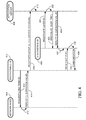
- FIG. 4 is an example signaling diagram involving a discoverable UE 402, a network node 404, a discovering UE 406, and an application server 408.
- the network node 404 is part of a ProSe-enabled Network, for example, a ProSe server, or an eNB, or a MME.
- the application server 408 may be operated by the operator of the ProSe-enabled Network or by a third-party service provider.
- the discoverable UE 402 has installed thereon two or more ProSe-enabled applications, including a particular ProSe-enabled application which discovers and connects with the application server 408, and the discovering UE 406 also has installed thereon the particular ProSe-enabled application that discovers and connects with the application server 408 (other ProSe-enabled applications may also be installed on the discovering UE 406).
- the particular ProSe-enabled application may be a social networking application.
- the discoverable UE 402 and the discovering UE 406 have a "friend" relationship in the context of the particular ProSe-enabled application.
- a person named Carol may use the discoverable UE 402 and may identify herself as carol@example2.com to the particular ProSe-enabled application and thus to the application server 408.
- a person named Dave may use the discovering UE 406 and may include carol@example2.com in his friend list at the particular ProSe-enabled application and thus at the application server 408.
- Carol may identify herself as carolc@gmail.com to another ProSe-enabled application and to its application server (not shown).
- the discoverable UE 402 may send a request 410 for a temporary identifier to the network node 404.
- the request 410 may include a long-term identifier of the discoverable UE 402, for example, a network identifier of the discoverable UE 402, such as an International Mobile Subscriber Identity (IMSI), or a permanent UE identifier of the discoverable UE 402, such as a BlackBerry® personal identification number (PIN).
- IMSI International Mobile Subscriber Identity
- PIN BlackBerry® personal identification number
- the temporary identifier T-ID assigned to the discoverable UE 402 by the network node 404 is a temporary substitute (to be used in ProSe Discovery and/or in ProSe Communication) for all application-layer identifiers of the discoverable UE 402 that are used in connection with any ProSe-enabled application.
- the temporary identifier T-ID is associated internally at the discoverable UE 402 both with the application-layer identifier carol@example2.com and with the application-layer identifier carolc@gmail.com.
- the network node 404 may conduct an assignment and association process 412, in which the network node 404 assigns a temporary identifier T-ID to the discoverable UE 402 in an assignment, assigns an expiration value to the assignment, and associates the temporary identifier T-ID and the expiration value to the long-term identifier.
- the network node 404 may maintain a database of valid assignments, and may add the association of the temporary identifier T-ID and the expiration value to the long-term identifier to the database. Once the expiration value has expired, the network node 404 may remove the association from the database of valid assignments.
- the network node 404 may maintain a pool of unassigned temporary identifiers, which includes both temporary identifiers that have never been assigned to any discoverable UE and temporary identifiers that were previously assigned to a discoverable UE but that previous assignment is no longer valid. (In other words, once the expiration value assigned to an assignment has expired, the temporary identifier of that assignment is returned to the pool of unassigned temporary identifiers.) In this case, the network node 404 may assign the temporary identifier T-ID from the pool of unassigned temporary identifiers. Alternatively, the network node 404 may determine the temporary identifier T-ID from the long-term identifier, using an algorithm.
- the network node 404 may verify the authenticity of the long-term identifier received in the request 410. The details of this verification are beyond the scope of this document.
- the network node 404 may provide the temporary identifier T-ID and an indication of the expiration value to the discoverable UE 402 in a reply 414 to the request 410. Although the temporary identifier T-ID and the indication of the expiration value are illustrated as being provided in a single reply 414, as an alternative, the network node 404 may provide the temporary identifier T-ID to the discoverable UE 402 in a single reply and may provide the indication of the expiration value to the discoverable UE 402 in a separate reply.
- the discoverable UE 402 may provide the temporary identifier T-ID and an indication of the expiration value to the application server 408 in a notification 416.
- the notification 416 includes an application-layer identifier used by the discoverable UE 402 in the context of the particular ProSe-enabled application.
- the discoverable UE 402 may provide the temporary identifier T-ID and the application-layer identifier to the application server 408 in a single notification and may provide the indication of the expiration value and the application-layer identifier to the application server 408 in a separate notification.
- the application server 408 may, at 418, internally associate the temporary identifier T-ID and the expiration value to the application-layer identifier.
- the expiration value provided to the application server 408 expires at the same time as the expiration value provided to the discoverable UE 402.
- the discoverable UE 402 may provide the temporary identifier T-ID and an indication of the expiration value, in notifications to other application servers (not shown) corresponding to the other ProSe-enabled applications installed on the discoverable UE 402. Each such notification includes the corresponding application-layer identifier of the discoverable UE 402 that is used in the context of the ProSe-enabled application. Those other application servers may internally associate the temporary T-ID and the expiration value to the appropriate application-layer identifier. The expiration value provided to the other application servers expires at the same time as the expiration value provided to the discoverable UE 402.
- All application servers including the application server 408, that have received the temporary identifier T-ID and an indication of the expiration value in notifications from the discoverable UE 402, may maintain a database of valid assignments.
- the discovering UE 406 may send an inquiry 420 to the application server 408, where the inquiry includes the application-layer identifier of the discoverable UE 402 used in the context of the particular ProSe-enabled application. Responsive to receiving the inquiry 420, the application server 408 may, at 422, look up the application-layer identifier and its associated temporary identifier T-ID and its associated expiration value in its database of valid assignments, and - optionally after checking that the discovering UE 406 is permitted to contact the discoverable UE 402 - may provide the temporary identifier T-ID and an indication of the expiration value to the discovering UE 406 in a reply 424 to the inquiry 420.
- the application server 408 may provide the temporary identifier T-ID to the discovering UE 406 in a single reply and may provide the indication of the expiration value to the discovering UE 406 in a separate reply.
- the discovering UE 406 may, at 426, associate internally the application-layer identifier of the discoverable UE 402 to the temporary identifier T-ID and to the expiration value.
- the expiration value provided to the discovering UE 406 expires at the same time as the expiration value provided to the discoverable UE 402.
- the inquiry 420 may be received by the application server 408 prior to, concurrent with, or after receipt of the notification 416 by the network node 404.
- the reply 424 (or two replies, one with the temporary identifier T-ID and the other with the indication of the expiration value) cannot be sent by the application server 408 until after the notification 416 is received and the internal association at 418 is completed.
- the discoverable UE 402 may send a broadcast 430 of the temporary identifier T-ID, prior to expiry of the expiration value. If the discovering UE 406 is within range of the discoverable UE 402, the discovering UE 406 may, responsive to receiving the broadcast 430, look up at 432 the application-layer identifier of the discoverable UE 402 that is internally associated to the broadcasted temporary identifier T-ID. Responsive to identifying the long-term identifier, the discovering UE 406 may attempt to initiate communication 434 with the discoverable UE 402. For example, Dave may attempt to contact Carol through use of the particular ProSe-enabled applications at the discovering UE 406 and at the discoverable UE 402.
- any of the following signalling messages may be used by the network node 304 to send the reply 314 and/or to send the reply 324, or by the network node 404 to send the reply 414 and/or to send the reply 424:
- FIG. 5 is an example signaling diagram for assigning a new temporary identifier and a new expiration value to the discoverable UE 302 of FIG. 3 .
- the network node 304 evaluates a re-issue condition. If the re-issue condition is satisfied, the network node 304 may conduct another assignment and association process 512, in which the network node 304 assigns a new temporary identifier to the discoverable UE 302 in a new assignment, assigns a new expiration value to the new assignment, and associates the new temporary identifier and the new expiration value to the application-layer identifier.
- the network node 304 may provide the new temporary identifier and an indication of the new expiration value to the discoverable UE 302 in a re-issue 514. Although the new temporary identifier and the indication of the new expiration value are illustrated as being provided in a single re-issue 514, as an alternative, the network node 304 may provide the new temporary identifier to the discoverable UE 302 in a single reply and may provide the indication of the new expiration value to the discoverable UE 302 in a separate reply.
- the re-issue condition may be expiry of a wake-up timer at the network node 304.
- the wake-up timer may be set to expire slightly earlier than the expiry of the previously assigned expiration value.
- expiry of the wake-up timer triggers the network node 304 to conduct the assignment and association process 512 and to send the re-issue 514 to the discoverable UE 302.
- the re-issue condition may be reception by the network node 304 of a re-issue request 510 from the discoverable UE 302.
- the discoverable UE 302 may send the re-issue request 510 prior to or after expiry of the previously assigned expiration value.
- the discoverable UE 302 may set a wake-up timer to expire slightly earlier than the expiry of the previously assigned expiration value, and expiry of the wake-up timer triggers the discoverable UE 302 to send the re-issue request 510 to the network node 304.
- the re-issue condition may be reception of the re-issue request 510 and expiry of the wake-up timer.
- the discovering UE 306 may send an inquiry 520 to the network node 304, where the inquiry 520 includes the application-layer identifier of the discoverable UE 302. If the inquiry 520 is received while more than one assignment of temporary identifier to the discoverable UE 302 is valid, the network node 304, when looking up the application-layer identifier in its database of valid assignments at 522, will retrieve two or more associated temporary identifiers and a corresponding two or more associated expiration values. The network node 304 may provide to the discovering UE 306 all retrieved temporary identifiers and an indication of all retrieved expiration values in a reply 524 to the inquiry 520. The discovering UE 306 may, at 526, internally associate all received temporary identifiers and all received expiration values to the application-layer identifier of the discoverable UE 302.
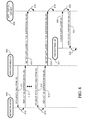
- FIG. 6 is an example signaling diagram for assigning a new temporary identifier and a new expiration value to the discoverable UE 402 of FIG. 4 .
- the network node 404 evaluates a re-issue condition. If the re-issue condition is satisfied, the network node 404 may conduct another assignment and association process 612, in which the network node 404 assigns a new temporary identifier to the discoverable UE 402 in a new assignment, assigns a new expiration value to the new assignment, and associates the new temporary identifier and the new expiration value to the application-layer identifier.
- the network node 404 may provide the new temporary identifier and an indication of the new expiration value to the discoverable UE 402 in a re-issue 614. Although the new temporary identifier and the indication of the new expiration value are illustrated as being provided in a single re-issue 614, as an alternative, the network node 404 may provide the new temporary identifier to the discoverable UE 402 in a single reply and may provide the indication of the new expiration value to the discoverable UE 402 in a separate reply.
- the discoverable UE 402 may provide the new temporary identifier and an indication of the new expiration value to the application server 408 in a notification 616.
- the notification 616 includes an application-layer identifier used by the discoverable UE 402 in the context of the particular ProSe-enabled application.
- the discoverable UE 402 may provide the new temporary identifier and the application-layer identifier to the application server 408 in a single notification and may provide the indication of the new expiration value and the application-layer identifier to the application server 408 in a separate notification.
- the application server 408 may, at 618, internally associate the new temporary identifier and the new expiration value to the application-layer identifier.
- the new expiration value provided to the application server 408 expires at the same time as the new expiration value provided to the discoverable UE 402.
- the re-issue condition may be expiry of a wake-up timer at the network node 404.
- the wake-up timer may be set to expire slightly earlier than the expiry of the previously assigned expiration value.
- expiry of the wake-up timer triggers the network node to conduct the assignment and association process 612 and to send the re-issue 614 to the discoverable UE 402.
- the re-issue condition may be reception by the network node 404 of a re-issue request 610 from the discoverable UE 402.
- the discoverable UE 402 may send the re-issue request 610 prior to or after expiry of the previously assigned expiration value.
- the discoverable UE 402 may set a wake-up timer to expire slightly earlier than the expiry of the previously assigned expiration value, and expiry of the wake-up timer triggers the discoverable UE 402 to send the re-issue request 610 to the network node 404.
- the re-issue condition may be reception of the re-issue request 610 and expiry of the wake-up timer.
- the discovering UE 406 may send an inquiry 620 to the application server 408, where the inquiry 620 includes the application-layer identifier of the discoverable UE 402. If the inquiry 620 is received while more than one assignment of temporary identifier to the discoverable UE 402 is valid, the application server 408, when looking up the application-layer identifier in its database of valid assignments at 622 will retrieve two or more associated temporary identifiers and a corresponding two or more associated expiration values. The application server 408 may provide to the discovering UE 406 all retrieved temporary identifiers and an indication of all retrieved expiration values in a reply 624 to the inquiry 620. The discovering UE 406 may, at 626, internally associate all received temporary identifiers and all received expiration values to the application-layer identifier of the discoverable UE 402.
- FIG. 7 is an example signaling diagram for renewing a temporary identifier assigned to the discoverable UE 302 of FIG. 3 .
- the network node 304 evaluates a renewal condition. If the renewal condition is satisfied, the network node 304 may conduct a modified assignment and association process 712, in which the network node 304 extends the expiration value assigned to the assignment, and updates the association of the temporary identifier and the extended expiration value to the application-layer identifier.
- the network node 304 may provide an indication of the extended expiration value to the discoverable UE 302 in a renewal 714.
- the renewal condition may be expiry of a wake-up timer at the network node 304.
- the wake-up timer may be set to expire slightly earlier than the expiry of the previously assigned expiration value.
- expiry of the wake-up timer triggers the network node 304 to conduct the modified assignment and association process 712 and to send the renewal 714 to the discoverable UE 302.
- the renewal condition may be reception by the network node 304 of a renewal request 710 from the discoverable UE 302.
- the discoverable UE 302 may send the renewal request 710 prior to or after expiry of the previously assigned expiration value.
- the renewal condition may be reception of the renewal request 710 and expiry of the wake-up timer.
- the discovering UE 306 may send an inquiry 720 to the network node 304, where the inquiry 720 includes the application-layer identifier of the discoverable UE 302. If the inquiry 720 is received after the extended expiration time has been assigned, the network node 304, when looking up the application-layer identifier in its database of valid assignments at 722 will retrieve the associated temporary identifier and the associated extended expiration value. The network node 304 may provide to the discovering UE 306 the retrieved temporary identifier and an indication of the retrieved extended expiration value in a reply 724 to the inquiry 520. The discovering UE 306 may, at 726, internally associate the temporary identifier and the extended expiration value to the application-layer identifier of the discoverable UE 302.
- FIG. 8 is an example signaling diagram for renewing a temporary identifier assigned to the discoverable UE 402 of FIG. 4 .
- the network node 404 evaluates a renewal condition. If the renewal condition is satisfied, the network node 404 may conduct a modified assignment and association process 812, in which the network node 404 extends the expiration value assigned to the assignment, and updates the association of the temporary identifier and the extended expiration value to the application-layer identifier.
- the network node 404 may provide an indication of the extended expiration value to the discoverable UE 402 in a renewal 814.
- the discoverable UE 402 may provide an indication of the extended expiration value to the application server 408 in a notification 816.
- the notification 816 includes an application-layer identifier used by the discoverable UE 402 in the context of the particular ProSe-enabled application.
- the application server 408 may, at 818, update its internal association of the temporary identifier and the extended expiration value to the application-layer identifier.
- the extended expiration value provided to the application server 408 expires at the same time as the extended expiration value provided to the discoverable UE 402.
- the renewal condition may be expiry of a wake-up timer at the network node 404.
- the wake-up timer may be set to expire slightly earlier than the expiry of the previously assigned expiration value.
- expiry of the wake-up timer triggers the network node to conduct the modified assignment and association process 812 and to send the renewal 814 to the discoverable UE 402.
- the renewal condition may be reception by the network node 404 of a renewal request 810 from the discoverable UE 402.
- the discoverable UE 402 may send the renewal request 810 prior to or after expiry of the previously assigned expiration value.
- the renewal condition may be reception of the renewal request 810 and expiry of the wake-up timer.
- the discovering UE 406 may send an inquiry 820 to the application server 408, where the inquiry 820 includes the application-layer identifier of the discoverable UE 402. If the inquiry 820 is received after the application server 408 has been notified of the extended expiration time, the application server 408, when looking up the application-layer identifier in its database of valid assignments at 822 will retrieve the associated temporary identifier and the associated extended expiration value.
- the application server 408 may provide to the discovering UE 406 the retrieved temporary identifier and an indication of the retrieved extended expiration value in a reply 824 to the inquiry 820.
- the discovering UE 406 may, at 826, internally associate the temporary identifier and the extended expiration value to the application-layer identifier of the discoverable UE 402.
- the network node 304 when the network node 304 receives the inquiry 320 from the discovering UE 306, the network node 304 does not have any valid assignment of a temporary identifier to the application-layer identifier included in the inquiry 320, and therefore the look up performed at 322 will not find any temporary identifier and expiration value associated to the application-layer identifier in the database of valid assignments. There may be different reasons for the lack of a valid assignment.
- the network node 304 responsive to receiving the inquiry 320, may respond with a message 323 that includes a cause value indicative of the reason for not responding with a reply including a temporary identifier and an expiration value.
- Table 1 Cause Value Meaning 0 No ProSe services 1 Discoverable UE has not requested temporary identifier 2 Discoverable UE has requested temporary identifier, but does not have valid assignment
- the network node 304 may not allow ProSe services with the discoverable UE 302, and therefore may indicate a cause value of 0. Responsive to receiving the message 323 with the cause value 0, the discovering UE 306 may drop ProSe services. In another example, the network node 304 may allow ProSe services with the discoverable UE 302, but the discoverable UE 302 may not yet have requested a temporary identifier from the network node 304, and therefore may indicate a cause value of 1.
- the network node 304 may allow ProSe services with the discoverable UE 302 and the discoverable UE 302 may have previously requested a temporary identifier from the network node 304, but no valid assignment currently exists, and therefore the network node 304 may indicate a cause value of 2. Responsive to receiving the message 323 with the cause value 1 or with the cause value 2, the discovering UE 306 may wait for ProSe services.
- the network node 304 may maintain records of inquiries for which messages with cause values have been sent. Once the discoverable UE 302 has requested a temporary identifier and the network node 304 has assigned a temporary identifier T-ID to the discoverable UE 302 and has assigned an expiration value to the assignment and has associated the application-layer identifier of the discoverable UE 302 to the temporary identifier T-ID and to the expiration value, the network node 304 may provide the temporary identifier T-ID and an indication of the expiration value to the discovering UE 306 in the reply 324 (or in two replies, one with the temporary identifier T-ID and the other with the expiration value), without waiting for a further inquiry from the discovering UE 306.
- the message 323 may include, instead of a cause value, an indication of a suspension time.
- a suspension time indicates a minimum period of time that must elapse until the discoverable UE 302 is allowed ProSe services.
- the suspension time may be provided in seconds, or alternatively, in units of subframes or frames. Table 2 Suspension Time Meaning 0000 No ProSe services 0001 - 1111 Discoverable UE has not requested temporary identifier
- the discovering UE 306 may drop ProSe services, because the suspension time '0000' indicates that the network cannot allow ProSe services with the discoverable UE 302.
- the discovering UE 306 may wait, in anticipation of receiving the temporary identifier T-ID and the expiration value in the reply 324 (or in two replies, one with the temporary identifier T-ID and the other with the expiration value) once the non-zero suspension time has elapsed.
- the message 323 may include both a cause value and an indication of a suspension time.
- the network node 304 may indicate any specific suspension time to the discovering UE 306 with the cause value.
- the discovering UE 306 may receive the reply 324 (or two replies) with the temporary identifier T-ID and the expiration value from the network node 304 after 1 second has elapsed.
- the application server 408 when the application server 408 receives the inquiry 420 from the discovering UE 406, the application server 408 does not have any valid assignment of a temporary identifier to the application-layer identifier included in the inquiry 420, and therefore the look up performed at 422 will not find any temporary identifier and expiration value associated to the application-layer identifier in the database of valid assignments. There may be different reasons for the lack of a valid assignment.
- the application server 408, responsive to receiving the inquiry 420 may respond with a message 423 that includes a cause value indicative of the reason for not responding with a reply including a temporary identifier and an expiration value.
- Example cause values 0, 1, 2 and their meanings are provided above in Table 1.
- the application server 408 may not allow ProSe services with the discoverable UE 402, and therefore may indicate a cause value of 0. Responsive to receiving the message 423 with the cause value 0, the discovering UE 406 may drop ProSe services. In another example, the application server 408 may allow ProSe services with the discoverable UE 402, but the discoverable UE 402 may not yet have notified the application server 408 of any temporary identifier, and therefore may indicate a cause value of 1. In yet another example, the application server 408 may allow ProSe services with the discoverable UE 402 and the discoverable UE 402 may have previously notified the application server 408 of a temporary identifier, but no valid assignment currently exists, and therefore the application server 408 may indicate a cause value of 2. Responsive to receiving the message 423 with the cause value 1 or with the cause value 2, the discovering UE 406 may wait for ProSe services.
- the application server 408 may maintain records of inquiries for which messages with cause values have been sent. Once the discoverable UE 402 has notified the application server 408 of a newly assigned temporary identifier T-ID and of the expiration value assigned to the assignment, the application server 408 may provide the temporary identifier T-ID and an indication of the expiration value to the discovering UE 406 in the reply 424 (or in two replies, one with the temporary identifier T-ID and the other with the expiration value), without waiting for a further inquiry from the discovering UE 406.
- the message 423 may include, instead of a cause value, an indication of a suspension time.
- a suspension time indicates a minimum period of time that must elapse until the discoverable UE 402 is allowed ProSe services.
- the suspension time may be provided in seconds, or alternatively, in units of subframes or frames. Example suspension times and their meanings are provided above in Table 2.
- the discovering UE 406 may drop ProSe services, because the suspension time '0000' indicates that the application server 408 cannot allow ProSe services with the discoverable UE 402.
- the discovering UE 406 may wait, in anticipation of receiving the temporary identifier T-ID and the expiration value in the reply 424 (or in two replies, one with the temporary identifier T-ID and the other with the expiration value) once the non-zero suspension time has elapsed.
- the message 423 may include both a cause value and an indication of a suspension time.
- the application server 408 may indicate any specific suspension time to the discovering UE 406 with the cause value.
- the discovering UE 406 may receive the reply 424 (or two replies) with the temporary identifier T-ID and the expiration value from the application server 408 after 1 second has elapsed.
- any of the following signalling messages may be used by the network node 304 to send the message 323, or by the application server 408 to send the message 423:
- FIG. 9 is an illustration of an example UE hierarchy. Solely for the purpose of illustration, there are three classes in this example hierarchy, however the number of classes may be two or may be greater than three.
- UEs 9-1, UEs 9-2, UEs 9-3, and UEs 9-4 are of the lowest class, for example, used by firefighters at four different fire stations.
- UE 91, UE 92, UE 93 and UE 94 are of the middle class, for example, used by the respective heads of the four fire stations, all of which report to a regional headquarters of the fire department.
- a UE 900 is of the highest class, for example, used by the head of the regional headquarters.
- each UE in the hierarchy (except for UEs of the lowest class) is authorized to issue temporary identifiers to UEs of a lower class in the hierarchy.
- This document also proposes that a UE may issue a temporary identifier to itself when there is no higher-class authorized issuer available.
- each authorized issuer maintains its own pool of temporary identifiers, which is different from the pool of the other authorized issuers.
- Each temporary identifier in the pool for a particular authorized issuer may contain an indication of the class of that particular authorized issuer. With this approach, a temporary identifier reveals which authorized issuer the UE belongs to. This may raise a privacy concern.
- an authorized issuer contacts the higher authorized issuer (most likely the highest authorized issuer, which is the server) and refreshes the temporary identifier pool by returning all the temporary identifiers to the higher authorized issuer and getting new temporary identifiers from the higher authorized issuer. This may be done when none of the temporary identifiers is issued to any UE.
- the higher authorized issuer may refrain from allocating/issuing a temporary identifier to any lower authorized issuer or UE while the temporary identifier is allocated to a lower authorized issuer in order to prevent a potential temporary identifier collision. By doing this, an authorized issuer maintains a completely random pool of temporary identifiers, which guarantees the privacy of the UE for which a temporary identifier is issued.
- the UE 900 is authorized to issue temporary identifiers for all members of the hierarchy, including the UEs belonging to the heads of the fire stations.
- the UE 91 is authorized to issue temporary identifiers for the UEs 9-1 belonging to all firefighters at the first fire station.
- the UE 92 is authorized to issue temporary identifiers for the UEs 9-2 belonging to the firefighters at the second fire station.
- the UE 93 is authorized to issue temporary identifiers for the UEs 9-3 belonging to the firefighters at the third fire station.
- the UE 94 is authorized to issue temporary identifiers for the UEs 9-4 belonging to the firefighters at the fourth fire station.
- the UE 91, the UE 92, the UE 93 and the UE 94 are authorized to issue temporary identifiers to themselves.
- FIG. 10 is an example signaling diagram involving a discoverable lower-class UE 1002, a higher-class UE 1004, and a discovering UE 1006 (of any class).
- the lower-class UE 1002, the higher-class UE 1004 and the UE 1006 all belong to the same hierarchy. It is assumed in this example that the lower-class UE 1002 does not have a valid temporary identifier T-ID.
- the lower-class UE 1002 may send a request 1010 for a temporary identifier to the higher-class UE 1004.
- the request 1010 may include a long-term identifier of the lower-class UE 1002, for example, a permanent identifier of the lower-class UE 1002.
- the request 1010 may include credential information of the lower-class UE 1002 so that the higher-class UE 1004 can authenticate the lower-class UE 1002.
- the temporary identifier T-ID assigned to the lower-class UE 1002 by the higher-class UE 1004 is a temporary substitute (to be used in ProSe Discovery and/or in ProSe Communication) for the long-term identifier of the lower-class UE 1002.
- a temporary substitute to be used in ProSe Discovery and/or in ProSe Communication
- the higher-class UE 1004 may conduct an assignment and association process 1012, in which the higher-class UE 1004 assigns a temporary identifier T-ID to the lower-class UE 1002 in an assignment, assigns an expiration value to the assignment, and associates the temporary identifier T-ID and the expiration value to the long-term identifier.
- the higher-class UE 1004 may maintain a database of valid assignments, and may add the association of the temporary identifier T-ID and the expiration value to the long-term identifier to the database. Once the expiration value has expired, the higher-class UE 1004 may remove the association from the database of valid assignments.
- the higher-class UE 1004 may maintain a pool of unassigned temporary identifiers, which includes both temporary identifiers that have never been assigned to any discoverable UE and temporary identifiers that were previously assigned to a lower-class UE (or to itself) but that previous assignment is no longer valid. (In other words, once the expiration value assigned to an assignment has expired, the temporary identifier of that assignment is returned to the pool of unassigned temporary identifiers.) In this case, the higher-class UE 1004 may assign the temporary identifier T-ID from the pool of unassigned temporary identifiers. Alternatively, the higher-class UE 1004 may determine the temporary identifier T-ID from the long-term identifier, using an algorithm.
- the higher-class UE 1004 may provide the temporary identifier T-ID and an indication of the expiration value to the lower-class UE 1002 in a reply 1014 to the request 1010. Although the temporary identifier T-ID and the indication of the expiration value are illustrated as being provided in a single reply 1014, as an alternative, the higher-class UE 1004 may provide the temporary identifier T-ID to the lower-class UE 1002 in a single reply and may provide the indication of the expiration value to the lower-class UE 1002 in a separate reply.
- the discovering UE 1006 may send an inquiry 1020 to the higher-class UE 1004, where the inquiry 1020 includes the long-term identifier of the lower-class UE 1002. Responsive to receiving the inquiry 1020, the higher-class UE 1004 may, at 1022, look up the long-term identifier in its database of valid assignments to retrieve its associated temporary identifier T-ID and its associated expiration value, and - optionally after checking that the discovering UE 1006 is permitted to contact the lower-class UE 1002 - may provide the temporary identifier T-ID and an indication of the expiration value to the discovering UE 1006 in a reply 1024 to the inquiry 1020.
- the higher-class UE 1004 may provide the temporary identifier T-ID to the discovering UE 1006 in a single reply and may provide the indication of the expiration value to the discovering UE 1006 in a separate reply.
- the discovering UE 1006 may, at 1026, associate internally the temporary identifier T-ID and the expiration value to the long-term identifier of the lower-class UE 1002.
- the expiration value provided to the discovering UE 1006 expires at the same time as the expiration value provided to the lower-class UE 1002.
- the inquiry 1020 may be received by the higher-class UE 1004 prior to, concurrent with, or after receipt of the request 1010 by the higher-class UE 1004.
- the reply 1024 (or two replies, one with the temporary identifier T-ID and the other with the indication of the expiration value) cannot be sent by the higher-class UE 1004 until after completion of the assignment and association process at 1012.
- the lower-class UE 1002 may send a broadcast 1030 of the temporary identifier T-ID, prior to expiry of the expiration value, in order to announce its identity. If the discovering UE 1006 is within range of the lower-class UE 1002, the discovering UE 1006 may, responsive to receiving the broadcast 1030, look up at 1032 the long-term identifier of the lower-class UE 1002 that is internally associated to the broadcasted temporary identifier T-ID. Responsive to identifying the long-term identifier, the discovering UE 1006 may attempt to initiate communication 1034 with the lower-class UE 1002.
- a UE reports its previous temporary identifier and the assigned expiration value to the highest class authorized issuer among the available authorized issuers whenever the UE determines that a new highest class authorized issuer becomes available.
- the new highest class authorized issuer could have higher-class than the previous authorized issuer or have lower-class than the previous authorized issuer. For example, if a UE x moves from in-coverage, where the authorized issuer is the network node (who has the highest class among all the authorized issuers), to out-of-coverage, where the head of the fire station is the highest available authorized issuer, the UE x reports the network-assigned temporary identifier and the corresponding assigned expiration value along with the long-term identifier of the UE xto the head of the fire station.
- the report from the UE x includes the identity of the issuer who issued the previous temporary identifier, and optionally, the report from the UE x includes credential information of the UE x.
- the head of the fire station may perform one of the following acts:
- the head of the fire station If the head of the fire station is aware of any available higher authorized issuer, for example, the head of the regional headquarters, the head of the regional fire station forwards the report message from the UE x to the head of the regional headquarters. Even if the head of the fire station is aware of an available higher authorized issuer, the head of the fire station may perform (b) or (c) based on policy or configuration.
- the head of the fire station may store the received temporary identifier, expiration value, and long-term identifier. In this case, the head of the fire station may respond to the UE x with acknowledgement. The UE x may record the head of the fire station as the current authorized issuer. The head of the fire station may provide this information to any of the "friends" of the UE x whenever the friend requests the temporary identifier of the UE x.
- the head of the fire station may assign, from its available pool, a new temporary identifier to the UE x in a new assignment and may assign a new expiration value to the new assignment.
- the head of the fire station may store the new temporary identifier, the new expiration value, and the long-term identifier.
- the head of the fire station may respond to the UE x with a message including new temporary identifier, an indication of the new expiration value.
- the UE x Responsive to receiving the new temporary identifier, an indication of the new expiration value from a new issuer (in this case, the head of the fire station), the UE x may abandon the previously assigned temporary identifier and use the new temporary identifier from that point in time. The UE x records the head of the fire station as the current authorized issuer. The head of the fire station may provide the new temporary identifier and an indication of the new expiration value to any of the "friends" of the UE x whenever the friend requests the temporary identifier of the UE x .
- a new issuer in this case, the head of the fire station
- the UE x may report its currently assigned temporary identifier, the associated expiration time and its long-term identifier to the new highest class authorized issuer. Responsive to receiving the report message, the new highest authorized issuer may perform one of the acts (a), (b), (c) described above. The new highest authorized issuer may determine the class of the previous issuer based on the temporary identifier in the case that the temporary identifier contains the class information of its issuer. Alternatively, the UE x may provide the class or even identity of the previous issuer explicitly in the report message.
- the authorized issuer A may provide a record for the temporary identifier that the authorized issuer A issued, an indication of the expiration value and associated long-term identifier to the available higher-class authorized issuer. This may be done right after the authorized issuer A performs a temporary identifier assignment to a lower-class UE x if the higher-class authorized issuer is available.
- the class of the authorized issuer A is lower than that of the authorized issuer B. All the UEs to whom the authorized issuer A is eligible to issue a temporary identifier are denoted by a group G.
- a group G All the UEs to whom the authorized issuer A is eligible to issue a temporary identifier are denoted by a group G.
- two authorized issuers A and B exchange the stored records of temporary identifiers, indications of the expiration value and associated long-term identifiers of the UEs in the group G. This can be achieved via friend's temporary identifier inquiries.
- the authorized issuer A inquires to the authorized issuer B the temporary identifiers of the UEs in group G whose temporary identifier is unknown to the authorized issuer A.
- the authorized issuer B inquires to the authorized issuer A the temporary identifiers of the UEs in group G whose temporary identifier is unknown to the authorized issuer B.
- the UE y may use a group identifier instead of a list of individual friends. This may be useful when the UE y is not fully aware of all members of the group, but is authorized and required to communicate with group members. For example, suppose a firefighter from a first fire station A is on a rescue operation. Firefighters from a number of fire stations may be on duty for the rescue operation. Even if the firefighter from the first fire station A does not know all the firefighters from other fire stations, he/she is required to communicate with the other firefighters.
- the firefighter may use "Firefighters from fire station B" or "Firefighters on duty” as the group identifier of the firefighters for the rescue operation.
- the available group identifiers for the operation such as “Firefighters from fire station B” or “Firefighters on duty", are provided by the authorized issuer.
- Authorized issuers may communicate with each other for this purpose. For example, the head of fire station A and the head of fire station B may exchange the list of their members participating in a rescue operation if no higher authorized issuer is present at the rescue operation.
- that information may be provided via a secure out-of-band channel, for example, by manual entry at the UE, or using encrypted Near Field Communication (NFC) techniques.
- NFC Near Field Communication
- FIG. 11 illustrates how a group may be created on-the-fly when the UEs are out of network coverage.
- the head of fire station A and the head of fire station B are present at a mission field and they agreed to form a new group on-the-fly.
- the head of fire station A After performing mutual discovery process which includes mutual authentication, the head of fire station A sends a message proposing a new group with a proposed group identifier to the head of fire station B.
- the message may also contain the temporary identifier associated with the group and an indication of the expiration value.
- the head of fire station A receives a message from the head of fire station B.
- the message includes the indication of proposal acceptance along with the list of participating fire fighters from the fire station B.
- the list may contain a long-term identifier, a temporary identifier, an indication of the expiration value, and optional credential information of the participating firefighters from fire station B. These may be received over a number of messages.
- the head of fire station A After receiving message(s) from the head of fire station B, the head of fire station A sends a message to the head of fire station B including the long-term identifier, the temporary identifier, an indication of the expiration value, and optional credential information of the participating firefighters from fire station A.
- the message may include the list of participating firefighters from any other fire stations if the head of fire station A already knows the list. These can be sent over a number of messages.
- both heads of fire stations A and B can announce the new group to their own firefighters including the group name, the temporary identifier associated with the group, and an indication of the expiration value associated with the temporary identifier in a secure way.
- the details of this message belong to the application protocol and are beyond the scope of this document.
Landscapes
- Engineering & Computer Science (AREA)
- Computer Networks & Wireless Communication (AREA)
- Signal Processing (AREA)
- Computer Security & Cryptography (AREA)
- Databases & Information Systems (AREA)
- Mobile Radio Communication Systems (AREA)
Abstract
Description
- Device-to-Device Proximity Services (ProSe) are attracting increasing interest among the 3rd Generation Partnership Project (3GPP) community.
-
-
FIG. 1 is an entity relationship diagram; -
FIG. 2 is an example network architecture illustration; -
FIG. 3 is an example signaling diagram for facilitating discovery of a discoverable user equipment (UE) having only a single ProSe-enabled application installed thereon; -
FIG. 4 is another example signaling diagram for facilitating discovery of a discoverable UE having installed thereon two or more ProSe-enabled applications; -
FIG. 5 is an example signaling diagram for assigning a new temporary identifier and a new expiration value to the discoverable UE ofFIG. 3 ; -
FIG. 6 is an example signaling diagram for assigning a new temporary identifier and a new expiration value to the discoverable UE ofFIG. 4 ; -
FIG. 7 is an example signaling diagram for renewing a temporary identifier assigned to the discoverable UE ofFIG. 3 ; -
FIG. 8 is an example signaling diagram for renewing a temporary identifier assigned to the discoverable UE ofFIG. 4 ; -
FIG. 9 is an illustration of an example UE hierarchy; -
FIG. 10 is an example signaling diagram for facilitating discovery of a lower class UE; and -
FIG. 11 is an example illustration of how a group can be created on-the-fly when out of network coverage. - Accordingly there is provided a method as detailed in claim 1. Advantageous features are provided in the dependent claims. A network entity and machine readable storage medium are also provided.
- The following terms are defined in 3GPP TR 22.803, "Feasibility Study for Proximity Services (ProSe)".
- Proximity: A UE is in proximity of another UE when given proximity criteria are fulfilled. Proximity criteria can be different for discovery and communication.
- ProSe Discovery: a process that identifies that a UE is in proximity of another, using E-UTRA (Evolved Universal Terrestrial Radio Access).
- ProSe Communication: a communication between two UEs in proximity by means of a communication path established between the UEs. The communication path could for example be established directly between the UEs or routed via one or more local eNB(s).
- ProSe-enabled UE: a UE that supports ProSe Discovery and/or ProSe Communication. Throughout this document, a UE refers to a ProSe-enabled UE.
- ProSe-enabled Network: a network that supports ProSe Discovery and/or ProSe Communication. Throughout this document, a network refers to a ProSe-enabled network.
- Open ProSe Discovery: is ProSe Discovery without explicit permission from the UE being discovered.
- Restricted ProSe Discovery: is ProSe Discovery that only takes place with explicit permission from the UE being discovered.
- ProSe Group Communication: a one-to-many ProSe Communication, between two or more UEs in proximity, by means of a common communication path established between the UEs.
- ProSe Broadcast Communication: a one-to-all ProSe Communication, between all authorized UEs in proximity, by means of a common communication path established between the UEs.
- Additionally, the following terms are defined for this document.
- ProSe-enabled Application: is an application that is authorized to utilize ProSe services.
- ProSe Server: is an element of a ProSe-enabled Network that offers ProSe services.
- A discoverable UE, which is a ProSe-enabled UE that supports ProSe Discovery, may announce its identity via a ProSe Broadcast Communication to all UEs within transmission range.
- This document proposes that the discoverable UE announce its identity using a temporary identifier from which it is not possible to derive a true identity of the discoverable UE. An assignment of the temporary identifier to the discoverable UE is valid as long as an expiration value assigned to the assignment has not yet expired. These concepts are illustrated in an entity relationship diagram in
FIG. 1 . - The assignment of the expiration value ensures the temporary nature of the temporary identifier. The expiration value may be implemented as an expiration time. Alternatively, the expiration value may be implemented as an expiration counter that counts, for example, in units of subframes or in units of frames. While the assignment is valid, the temporary identifier uniquely identifies the discoverable UE to which it has been assigned, and the temporary identifier can be used for ProSe Discovery of that discoverable UE and for ProSe Communication with that discoverable UE. The assignment is no longer valid once the expiration value has expired. Once the assignment is no longer valid, the temporary identifier cannot be used for ProSe Discovery of that discoverable UE and cannot be used for ProSe Communication with that discoverable UE.
- Any UE or network node or application server that stores the details of a valid assignment (a long-term identifier of the discoverable UE, a temporary identifier, and an indication of the expiration value) will cease to store those details, or will mark the assignment as no longer valid, once the expiration value has expired. Thus no additional signaling overhead is required to notify parties of lack of validity of an assignment.
- A temporary identifier that was assigned to a first UE and the expiration value of which has expired may subsequently be assigned to a second UE with a new expiration value. Thus the set of temporary identifiers is a renewable resource, with the temporary identifiers shared (at different times) among different UEs. The use of temporary identifiers is therefore more scalable than the use of permanent identifiers, because the temporary identifiers can be reused, and the UEs do not always need to make use of temporary identifiers.
- The use of temporary identifiers protects the privacy of the person using the UE. It is not recommended for the UE to broadcast any of its network identifiers (e.g. IMSI), as doing so will enable eavesdroppers to identify and track use of the UE over the radio interface. It is also not recommended for the UE to broadcast any of its application-layer identifiers (e.g. a network access identifier such as username@domain), as doing so will expose the application-layer identifier to malicious misuse.
- The use of temporary identifiers offers some protection from tracking. One reason for the protection is that the same temporary identifier may be assigned for a first period of time to a first UE and then, after that assignment is no longer valid, assigned for a second period of time to a second UE that is different from the first UE. Thus an eavesdropper tracking the temporary identifier during the first period of time will likely never again observe use of that temporary identifier after the first period of time, and therefore the tracking will fail after the assignment of the temporary identifier to the first UE is no longer valid. Another reason for the protection is that different temporary identifiers are assigned to the same UE for different periods of time, so an eavesdropper may not be able to detect that two transmissions - one with a first temporary identifier and the other with a second temporary identifier-originate from or are destined for the same UE.
- An element of a ProSe-enabled Network ("network node"), for example, a ProSe server, or an Evolved Node B (eNB), or a Mobility Management Entity (MME), may control the assignment of temporary identifiers to discoverable UEs and the validity of the assignments through the use of expiration values. Network-facilitated discovery is described in the document with respect to
FIG. 2 through FIG. 8 . - Alternatively, controlling the assignment of temporary identifiers to discoverable UEs and controlling the validity of the assignments through the use of expiration values may be performed by another UE without participation of a network. In this alternative, the UE controlling the assignment of temporary identifiers and the validity of the assignments may be a UE of higher class in a hierarchy of UEs than the discoverable UEs. This alternative may be used when the discoverable UE and the UE of higher class are out-of-range of a ProSe-enabled Network. This alternative may also be used even though the discoverable UE is within range of a ProSe-enabled Network. This alternative is particularly suitable for Public Safety ProSe-enabled UEs. This alternative is described in this document with respect to
FIG. 9 through FIG. 11 . -
FIG. 2 is an illustration of an example network architecture.UEs eNB 210. AUE 212 is served by aneNB 220. The eNB210 and theeNB 220 are both coupled toexternal networks 224 via an Evolved Packet Core (EPC) 226. In the illustrated example, theUE 202 and theUE 204, while both served by the same eNB, are in close proximity to each other and therefore may be able to establish adirect communication link 203 therebetween. Though theUE 206 and theUE 212 are served by different eNBs in the illustrated example, they are in close proximity to each other and therefore may be able to establish adirect communication link 209 therebetween. When theUE 208 is not in close proximity to theUE 212, theUE 208 and theUE 212 may have a communication link through theUE 206, where the communication link comprises adirect communication link 207 established between theUE 208 and theUE 206, and thedirect communication link 209. Thedirect communication links -
FIG. 3 is an example signaling diagram involving adiscoverable UE 302, anetwork node 304, and a discoveringUE 306. Thenetwork node 304 is part of a ProSe-enabled Network, for example, a ProSe server, or an evolved Node B (eNB), or a Mobility Management Entity (MME). The signaling diagram may optionally involve anapplication server 308. Theapplication server 308 may be operated by the operator of the ProSe-enabled Network or by a third-party service provider. For this example signaling diagram, thediscoverable UE 302 has installed thereon only one ProSe-enabled application, which discovers and connects with theapplication server 308, and the discoveringUE 306 also has installed thereon that same ProSe-enabled application (other ProSe-enabled applications may also be installed on the discovering UE 306). For example, the ProSe-enabled application may be a social networking application. Thediscoverable UE 302 and the discoveringUE 306 have a "friend" relationship in the context of the ProSe-enabled application. - The
discoverable UE 302 may send arequest 310 for a temporary identifier to thenetwork node 304. Therequest 310 may include a long-term identifier of thediscoverable UE 302, for example, the application-layer identifier of thediscoverable UE 302 that is used in connection with the ProSe-enabled application and theapplication server 308. The application-layer identifier may be a network access identifier such as username@domain. - For example, a person named Alice may use the
discoverable UE 302 and may identify herself as alice@example.com to the ProSe-enabled application and thus to theapplication server 308. A person named Bob may use the discoveringUE 306 and may include alice@example.com in his friend list at the ProSe-enabled application and thus at theapplication server 308. - For this example signaling diagram, the temporary identifier T-ID assigned to the
discoverable UE 302 by thenetwork node 304 is a temporary substitute (to be used in ProSe Discovery and/or in ProSe Communication) for the application-layer identifier of thediscoverable UE 302 that is used in connection with the ProSe-enabled application and theapplication server 308. There is a one-to-one relationship between the temporary identifier T-ID and the application-layer identifier. - Responsive to receiving the
request 310, thenetwork node 304 may conduct an assignment andassociation process 312, in which thenetwork node 304 assigns a temporary identifier T-ID to thediscoverable UE 302 in an assignment, assigns an expiration value to the assignment, and associates the temporary identifier T-ID and the expiration value to the application-layer identifier. Thenetwork node 304 may maintain a database of valid assignments, and may add the association of the temporary identifier T-ID and the expiration value to the long-term identifier to the database. Once the expiration value has expired, thenetwork node 304 may remove the association from the database of valid assignments. - The
network node 304 may maintain a pool of unassigned temporary identifiers, which includes both temporary identifiers that have never been assigned to any discoverable UE and temporary identifiers that were previously assigned to a discoverable UE but that previous assignment is no longer valid. (In other words, once the expiration value assigned to an assignment has expired, the temporary identifier of that assignment is returned to the pool of unassigned temporary identifiers.) In this case, thenetwork node 304 may assign the temporary identifier T-ID from the pool of unassigned temporary identifiers. Alternatively, thenetwork node 304 may determine the temporary identifier T-ID from the application-layer identifier, using an algorithm. - The
network node 304 may provide the temporary identifier T-ID and an indication of the expiration value to thediscoverable UE 302 in areply 314 to therequest 310. Although the temporary identifier T-ID and the indication of the expiration value are illustrated as being provided in asingle reply 314, as an alternative, thenetwork node 304 may provide the temporary identifier T-ID to thediscoverable UE 302 in a single reply and may provide the indication of the expiration value to thediscoverable UE 302 in a separate reply. - Optionally, responsive to receiving the request, the
network node 304 may conduct anauthentication procedure 316 with theapplication server 308, in which thenetwork node 304 provides theapplication server 308 with the application-layer identifier. Theauthentication procedure 316 may involve additional steps which are beyond the scope of this document. In this option, thenetwork node 304 assigns the temporary identifier T-ID to thediscoverable UE 302, assigns the expiration value, and associates the temporary identifier T-ID and the expiration value to the application-layer identifier responsive to success of theauthentication procedure 316. If theauthentication procedure 316 fails, then thenetwork node 304 does not assign the temporary identifier T-ID to thediscoverable UE 302. - The discovering
UE 306 may send aninquiry 320 to thenetwork node 304, where theinquiry 320 includes the application-layer identifier of thediscoverable UE 302. Responsive to receiving theinquiry 320, thenetwork node 304 may, at 322, look up the application-layer identifier in its database of valid assignments to retrieve its associated temporary identifier T-ID and its associated expiration value, and - optionally after checking with theapplication server 308 that the discoveringUE 306 is permitted to contact the discoverable UE 302 - may provide the temporary identifier T-ID and an indication of the expiration value to the discoveringUE 306 in areply 324 to theinquiry 320. Although the temporary identifier T-ID and the indication of the expiration value are illustrated as being provided in asingle reply 324, as an alternative, thenetwork node 304 may provide the temporary identifier T-ID to the discoveringUE 306 in a single reply and may provide the indication of the expiration value to the discoveringUE 306 in a separate reply. The discoveringUE 306 may, at 326, associate internally the temporary identifier T-ID and the expiration value to the application-layer identifier of thediscoverable UE 302. The expiration value provided to the discoveringUE 306 expires at the same time as the expiration value provided to thediscoverable UE 302. Theinquiry 320 may be received by thenetwork node 304 prior to, concurrent with, or after receipt of therequest 310 by thenetwork node 304. However, the reply 324 (or two replies, one with the temporary identifier T-ID and the other with the indication of the expiration value) cannot be sent by thenetwork node 304 until after completion of the assignment and association process at 312. - The
discoverable UE 302, used by Alice, may send abroadcast 330 of the temporary identifier T-ID, prior to expiry of the expiration value, in order to announce its identity. If the discoveringUE 306, used by Bob, is within range of thediscoverable UE 302, the discoveringUE 306 may, responsive to receiving thebroadcast 330, look up at 332 the application-layer identifier of thediscoverable UE 302 that is internally associated to the broadcasted temporary identifier T-ID. Responsive to identifying the application-layer identifier, the discoveringUE 306 may attempt to initiatecommunication 334 with thediscoverable UE 302. For example, Bob may attempt to contact Alice through use of the ProSe-enabled applications at the discoveringUE 306 and at thediscoverable UE 302. -
FIG. 4 is an example signaling diagram involving adiscoverable UE 402, anetwork node 404, a discoveringUE 406, and anapplication server 408. Thenetwork node 404 is part of a ProSe-enabled Network, for example, a ProSe server, or an eNB, or a MME. Theapplication server 408 may be operated by the operator of the ProSe-enabled Network or by a third-party service provider. For this example signaling diagram, thediscoverable UE 402 has installed thereon two or more ProSe-enabled applications, including a particular ProSe-enabled application which discovers and connects with theapplication server 408, and the discoveringUE 406 also has installed thereon the particular ProSe-enabled application that discovers and connects with the application server 408 (other ProSe-enabled applications may also be installed on the discovering UE 406). For example, the particular ProSe-enabled application may be a social networking application. Thediscoverable UE 402 and the discoveringUE 406 have a "friend" relationship in the context of the particular ProSe-enabled application. - For example, a person named Carol may use the
discoverable UE 402 and may identify herself as carol@example2.com to the particular ProSe-enabled application and thus to theapplication server 408. A person named Dave may use the discoveringUE 406 and may include carol@example2.com in his friend list at the particular ProSe-enabled application and thus at theapplication server 408. Carol may identify herself as carolc@gmail.com to another ProSe-enabled application and to its application server (not shown). - The
discoverable UE 402 may send arequest 410 for a temporary identifier to thenetwork node 404. Therequest 410 may include a long-term identifier of thediscoverable UE 402, for example, a network identifier of thediscoverable UE 402, such as an International Mobile Subscriber Identity (IMSI), or a permanent UE identifier of thediscoverable UE 402, such as a BlackBerry® personal identification number (PIN). - For this example signaling diagram, the temporary identifier T-ID assigned to the
discoverable UE 402 by thenetwork node 404 is a temporary substitute (to be used in ProSe Discovery and/or in ProSe Communication) for all application-layer identifiers of thediscoverable UE 402 that are used in connection with any ProSe-enabled application. There is a one-to-many relationship between the temporary identifier T-ID and the application-layer identifiers. For example, the temporary identifier T-ID is associated internally at thediscoverable UE 402 both with the application-layer identifier carol@example2.com and with the application-layer identifier carolc@gmail.com. - Responsive to receiving the
request 410, thenetwork node 404 may conduct an assignment andassociation process 412, in which thenetwork node 404 assigns a temporary identifier T-ID to thediscoverable UE 402 in an assignment, assigns an expiration value to the assignment, and associates the temporary identifier T-ID and the expiration value to the long-term identifier. Thenetwork node 404 may maintain a database of valid assignments, and may add the association of the temporary identifier T-ID and the expiration value to the long-term identifier to the database. Once the expiration value has expired, thenetwork node 404 may remove the association from the database of valid assignments. - The
network node 404 may maintain a pool of unassigned temporary identifiers, which includes both temporary identifiers that have never been assigned to any discoverable UE and temporary identifiers that were previously assigned to a discoverable UE but that previous assignment is no longer valid. (In other words, once the expiration value assigned to an assignment has expired, the temporary identifier of that assignment is returned to the pool of unassigned temporary identifiers.) In this case, thenetwork node 404 may assign the temporary identifier T-ID from the pool of unassigned temporary identifiers. Alternatively, thenetwork node 404 may determine the temporary identifier T-ID from the long-term identifier, using an algorithm. - Prior to conducting the assignment and
association process 412, thenetwork node 404 may verify the authenticity of the long-term identifier received in therequest 410. The details of this verification are beyond the scope of this document. - The
network node 404 may provide the temporary identifier T-ID and an indication of the expiration value to thediscoverable UE 402 in areply 414 to therequest 410. Although the temporary identifier T-ID and the indication of the expiration value are illustrated as being provided in asingle reply 414, as an alternative, thenetwork node 404 may provide the temporary identifier T-ID to thediscoverable UE 402 in a single reply and may provide the indication of the expiration value to thediscoverable UE 402 in a separate reply. - Responsive to receiving the temporary identifier T-ID and the indication of the expiration value, the
discoverable UE 402 may provide the temporary identifier T-ID and an indication of the expiration value to theapplication server 408 in anotification 416. Thenotification 416 includes an application-layer identifier used by thediscoverable UE 402 in the context of the particular ProSe-enabled application. Although the temporary identifier T-ID and the indication of the expiration value are illustrated as being provided in asingle notification 416, as an alternative, thediscoverable UE 402 may provide the temporary identifier T-ID and the application-layer identifier to theapplication server 408 in a single notification and may provide the indication of the expiration value and the application-layer identifier to theapplication server 408 in a separate notification. Theapplication server 408 may, at 418, internally associate the temporary identifier T-ID and the expiration value to the application-layer identifier. The expiration value provided to theapplication server 408 expires at the same time as the expiration value provided to thediscoverable UE 402. - Although not illustrated, the
discoverable UE 402 may provide the temporary identifier T-ID and an indication of the expiration value, in notifications to other application servers (not shown) corresponding to the other ProSe-enabled applications installed on thediscoverable UE 402. Each such notification includes the corresponding application-layer identifier of thediscoverable UE 402 that is used in the context of the ProSe-enabled application. Those other application servers may internally associate the temporary T-ID and the expiration value to the appropriate application-layer identifier. The expiration value provided to the other application servers expires at the same time as the expiration value provided to thediscoverable UE 402. - All application servers, including the
application server 408, that have received the temporary identifier T-ID and an indication of the expiration value in notifications from thediscoverable UE 402, may maintain a database of valid assignments. - The discovering
UE 406 may send aninquiry 420 to theapplication server 408, where the inquiry includes the application-layer identifier of thediscoverable UE 402 used in the context of the particular ProSe-enabled application. Responsive to receiving theinquiry 420, theapplication server 408 may, at 422, look up the application-layer identifier and its associated temporary identifier T-ID and its associated expiration value in its database of valid assignments, and - optionally after checking that the discoveringUE 406 is permitted to contact the discoverable UE 402 - may provide the temporary identifier T-ID and an indication of the expiration value to the discoveringUE 406 in areply 424 to theinquiry 420. Although the temporary identifier T-ID and the indication of the expiration value are illustrated as being provided in asingle reply 424, as an alternative, theapplication server 408 may provide the temporary identifier T-ID to the discoveringUE 406 in a single reply and may provide the indication of the expiration value to the discoveringUE 406 in a separate reply. The discoveringUE 406 may, at 426, associate internally the application-layer identifier of thediscoverable UE 402 to the temporary identifier T-ID and to the expiration value. The expiration value provided to the discoveringUE 406 expires at the same time as the expiration value provided to thediscoverable UE 402. Theinquiry 420 may be received by theapplication server 408 prior to, concurrent with, or after receipt of thenotification 416 by thenetwork node 404. However, the reply 424 (or two replies, one with the temporary identifier T-ID and the other with the indication of the expiration value) cannot be sent by theapplication server 408 until after thenotification 416 is received and the internal association at 418 is completed. - The
discoverable UE 402 may send abroadcast 430 of the temporary identifier T-ID, prior to expiry of the expiration value. If the discoveringUE 406 is within range of thediscoverable UE 402, the discoveringUE 406 may, responsive to receiving thebroadcast 430, look up at 432 the application-layer identifier of thediscoverable UE 402 that is internally associated to the broadcasted temporary identifier T-ID. Responsive to identifying the long-term identifier, the discoveringUE 406 may attempt to initiatecommunication 434 with thediscoverable UE 402. For example, Dave may attempt to contact Carol through use of the particular ProSe-enabled applications at the discoveringUE 406 and at thediscoverable UE 402. - Any of the following signalling messages may be used by the
network node 304 to send thereply 314 and/or to send thereply 324, or by thenetwork node 404 to send thereply 414 and/or to send the reply 424: - an existing downlink (DL) Radio Resource Control (RRC) message with a new information element for the indication of the expiration value;
- a new DL RRC message with an indication of the expiration value;
- an existing Media Access Control (MAC) control element (CE) with an indication of the expiration value in reserved fields of the MAC CE;
- a new MAC CE with an indication of the expiration value;
- an existing System Information Block (SIB) with new information for an indication of the expiration value;
- a new SIB with an indication of the expiration value;
- a new Non-Access-Stratum (NAS) message over the control plane;
- a new ProSe specific control message over the user plane.
-
FIG. 5 is an example signaling diagram for assigning a new temporary identifier and a new expiration value to thediscoverable UE 302 ofFIG. 3 . Sometime after thenetwork node 304 has provided the temporary identifier T-ID and the indication of the expiration value to thediscoverable UE 302 in thereply 314, thenetwork node 304 evaluates a re-issue condition. If the re-issue condition is satisfied, thenetwork node 304 may conduct another assignment andassociation process 512, in which thenetwork node 304 assigns a new temporary identifier to thediscoverable UE 302 in a new assignment, assigns a new expiration value to the new assignment, and associates the new temporary identifier and the new expiration value to the application-layer identifier. Thenetwork node 304 may provide the new temporary identifier and an indication of the new expiration value to thediscoverable UE 302 in are-issue 514. Although the new temporary identifier and the indication of the new expiration value are illustrated as being provided in asingle re-issue 514, as an alternative, thenetwork node 304 may provide the new temporary identifier to thediscoverable UE 302 in a single reply and may provide the indication of the new expiration value to thediscoverable UE 302 in a separate reply. - In one example, the re-issue condition may be expiry of a wake-up timer at the
network node 304. The wake-up timer may be set to expire slightly earlier than the expiry of the previously assigned expiration value. Thus expiry of the wake-up timer triggers thenetwork node 304 to conduct the assignment andassociation process 512 and to send there-issue 514 to thediscoverable UE 302. - In another example, the re-issue condition may be reception by the
network node 304 of are-issue request 510 from thediscoverable UE 302. Thediscoverable UE 302 may send there-issue request 510 prior to or after expiry of the previously assigned expiration value. For example, thediscoverable UE 302 may set a wake-up timer to expire slightly earlier than the expiry of the previously assigned expiration value, and expiry of the wake-up timer triggers thediscoverable UE 302 to send there-issue request 510 to thenetwork node 304. - In a further example, the re-issue condition may be reception of the
re-issue request 510 and expiry of the wake-up timer. - The discovering
UE 306 may send aninquiry 520 to thenetwork node 304, where theinquiry 520 includes the application-layer identifier of thediscoverable UE 302. If theinquiry 520 is received while more than one assignment of temporary identifier to thediscoverable UE 302 is valid, thenetwork node 304, when looking up the application-layer identifier in its database of valid assignments at 522, will retrieve two or more associated temporary identifiers and a corresponding two or more associated expiration values. Thenetwork node 304 may provide to the discoveringUE 306 all retrieved temporary identifiers and an indication of all retrieved expiration values in areply 524 to theinquiry 520. The discoveringUE 306 may, at 526, internally associate all received temporary identifiers and all received expiration values to the application-layer identifier of thediscoverable UE 302. -
FIG. 6 is an example signaling diagram for assigning a new temporary identifier and a new expiration value to thediscoverable UE 402 ofFIG. 4 . Sometime after thenetwork node 404 has provided the temporary identifier T-ID and the indication of the expiration value to thediscoverable UE 402 in thereply 414, thenetwork node 404 evaluates a re-issue condition. If the re-issue condition is satisfied, thenetwork node 404 may conduct another assignment andassociation process 612, in which thenetwork node 404 assigns a new temporary identifier to thediscoverable UE 402 in a new assignment, assigns a new expiration value to the new assignment, and associates the new temporary identifier and the new expiration value to the application-layer identifier. Thenetwork node 404 may provide the new temporary identifier and an indication of the new expiration value to thediscoverable UE 402 in are-issue 614. Although the new temporary identifier and the indication of the new expiration value are illustrated as being provided in asingle re-issue 614, as an alternative, thenetwork node 404 may provide the new temporary identifier to thediscoverable UE 402 in a single reply and may provide the indication of the new expiration value to thediscoverable UE 402 in a separate reply. - Responsive to receiving the new temporary identifier and the indication of the new expiration value, the
discoverable UE 402 may provide the new temporary identifier and an indication of the new expiration value to theapplication server 408 in anotification 616. Thenotification 616 includes an application-layer identifier used by thediscoverable UE 402 in the context of the particular ProSe-enabled application. Although the new temporary identifier and the indication of the new expiration value are illustrated as being provided in asingle notification 616, as an alternative, thediscoverable UE 402 may provide the new temporary identifier and the application-layer identifier to theapplication server 408 in a single notification and may provide the indication of the new expiration value and the application-layer identifier to theapplication server 408 in a separate notification. Theapplication server 408 may, at 618, internally associate the new temporary identifier and the new expiration value to the application-layer identifier. The new expiration value provided to theapplication server 408 expires at the same time as the new expiration value provided to thediscoverable UE 402. - In one example, the re-issue condition may be expiry of a wake-up timer at the
network node 404. The wake-up timer may be set to expire slightly earlier than the expiry of the previously assigned expiration value. Thus expiry of the wake-up timer triggers the network node to conduct the assignment andassociation process 612 and to send there-issue 614 to thediscoverable UE 402. - In another example, the re-issue condition may be reception by the
network node 404 of are-issue request 610 from thediscoverable UE 402. Thediscoverable UE 402 may send there-issue request 610 prior to or after expiry of the previously assigned expiration value. For example, thediscoverable UE 402 may set a wake-up timer to expire slightly earlier than the expiry of the previously assigned expiration value, and expiry of the wake-up timer triggers thediscoverable UE 402 to send there-issue request 610 to thenetwork node 404. - In a further example, the re-issue condition may be reception of the
re-issue request 610 and expiry of the wake-up timer. - The discovering
UE 406 may send aninquiry 620 to theapplication server 408, where theinquiry 620 includes the application-layer identifier of thediscoverable UE 402. If theinquiry 620 is received while more than one assignment of temporary identifier to thediscoverable UE 402 is valid, theapplication server 408, when looking up the application-layer identifier in its database of valid assignments at 622 will retrieve two or more associated temporary identifiers and a corresponding two or more associated expiration values. Theapplication server 408 may provide to the discoveringUE 406 all retrieved temporary identifiers and an indication of all retrieved expiration values in areply 624 to theinquiry 620. The discoveringUE 406 may, at 626, internally associate all received temporary identifiers and all received expiration values to the application-layer identifier of thediscoverable UE 402. -
FIG. 7 is an example signaling diagram for renewing a temporary identifier assigned to thediscoverable UE 302 ofFIG. 3 . Sometime after thenetwork node 304 has provided the temporary identifier T-ID and the indication of the expiration value to thediscoverable UE 302 in thereply 314, thenetwork node 304 evaluates a renewal condition. If the renewal condition is satisfied, thenetwork node 304 may conduct a modified assignment andassociation process 712, in which thenetwork node 304 extends the expiration value assigned to the assignment, and updates the association of the temporary identifier and the extended expiration value to the application-layer identifier. Thenetwork node 304 may provide an indication of the extended expiration value to thediscoverable UE 302 in arenewal 714. - In one example, the renewal condition may be expiry of a wake-up timer at the
network node 304. The wake-up timer may be set to expire slightly earlier than the expiry of the previously assigned expiration value. Thus expiry of the wake-up timer triggers thenetwork node 304 to conduct the modified assignment andassociation process 712 and to send therenewal 714 to thediscoverable UE 302. - In another example, the renewal condition may be reception by the
network node 304 of arenewal request 710 from thediscoverable UE 302. Thediscoverable UE 302 may send therenewal request 710 prior to or after expiry of the previously assigned expiration value. - In a further example, the renewal condition may be reception of the
renewal request 710 and expiry of the wake-up timer. - The discovering
UE 306 may send aninquiry 720 to thenetwork node 304, where theinquiry 720 includes the application-layer identifier of thediscoverable UE 302. If theinquiry 720 is received after the extended expiration time has been assigned, thenetwork node 304, when looking up the application-layer identifier in its database of valid assignments at 722 will retrieve the associated temporary identifier and the associated extended expiration value. Thenetwork node 304 may provide to the discoveringUE 306 the retrieved temporary identifier and an indication of the retrieved extended expiration value in areply 724 to theinquiry 520. The discoveringUE 306 may, at 726, internally associate the temporary identifier and the extended expiration value to the application-layer identifier of thediscoverable UE 302. -
FIG. 8 is an example signaling diagram for renewing a temporary identifier assigned to thediscoverable UE 402 ofFIG. 4 . Sometime after thenetwork node 404 has provided the temporary identifier T-ID and the indication of the expiration value to thediscoverable UE 402 in thereply 414, thenetwork node 404 evaluates a renewal condition. If the renewal condition is satisfied, thenetwork node 404 may conduct a modified assignment andassociation process 812, in which thenetwork node 404 extends the expiration value assigned to the assignment, and updates the association of the temporary identifier and the extended expiration value to the application-layer identifier. Thenetwork node 404 may provide an indication of the extended expiration value to thediscoverable UE 402 in arenewal 814. - Responsive to receiving the indication of the extended expiration value, the
discoverable UE 402 may provide an indication of the extended expiration value to theapplication server 408 in anotification 816. Thenotification 816 includes an application-layer identifier used by thediscoverable UE 402 in the context of the particular ProSe-enabled application. Theapplication server 408 may, at 818, update its internal association of the temporary identifier and the extended expiration value to the application-layer identifier. The extended expiration value provided to theapplication server 408 expires at the same time as the extended expiration value provided to thediscoverable UE 402. - In one example, the renewal condition may be expiry of a wake-up timer at the
network node 404. The wake-up timer may be set to expire slightly earlier than the expiry of the previously assigned expiration value. Thus expiry of the wake-up timer triggers the network node to conduct the modified assignment andassociation process 812 and to send therenewal 814 to thediscoverable UE 402. - In another example, the renewal condition may be reception by the
network node 404 of arenewal request 810 from thediscoverable UE 402. Thediscoverable UE 402 may send therenewal request 810 prior to or after expiry of the previously assigned expiration value. - In a further example, the renewal condition may be reception of the
renewal request 810 and expiry of the wake-up timer. - The discovering
UE 406 may send aninquiry 820 to theapplication server 408, where theinquiry 820 includes the application-layer identifier of thediscoverable UE 402. If theinquiry 820 is received after theapplication server 408 has been notified of the extended expiration time, theapplication server 408, when looking up the application-layer identifier in its database of valid assignments at 822 will retrieve the associated temporary identifier and the associated extended expiration value. Theapplication server 408 may provide to the discoveringUE 406 the retrieved temporary identifier and an indication of the retrieved extended expiration value in areply 824 to theinquiry 820. The discoveringUE 406 may, at 826, internally associate the temporary identifier and the extended expiration value to the application-layer identifier of thediscoverable UE 402. - Returning now to
FIG. 3 , it is possible that when thenetwork node 304 receives theinquiry 320 from the discoveringUE 306, thenetwork node 304 does not have any valid assignment of a temporary identifier to the application-layer identifier included in theinquiry 320, and therefore the look up performed at 322 will not find any temporary identifier and expiration value associated to the application-layer identifier in the database of valid assignments. There may be different reasons for the lack of a valid assignment. Thenetwork node 304, responsive to receiving theinquiry 320, may respond with amessage 323 that includes a cause value indicative of the reason for not responding with a reply including a temporary identifier and an expiration value.Table 1 Cause Value Meaning 0 No ProSe services 1 Discoverable UE has not requested temporary identifier 2 Discoverable UE has requested temporary identifier, but does not have valid assignment - For example, the
network node 304 may not allow ProSe services with thediscoverable UE 302, and therefore may indicate a cause value of 0. Responsive to receiving themessage 323 with the cause value 0, the discoveringUE 306 may drop ProSe services. In another example, thenetwork node 304 may allow ProSe services with thediscoverable UE 302, but thediscoverable UE 302 may not yet have requested a temporary identifier from thenetwork node 304, and therefore may indicate a cause value of 1. In yet another example, thenetwork node 304 may allow ProSe services with thediscoverable UE 302 and thediscoverable UE 302 may have previously requested a temporary identifier from thenetwork node 304, but no valid assignment currently exists, and therefore thenetwork node 304 may indicate a cause value of 2. Responsive to receiving themessage 323 with the cause value 1 or with the cause value 2, the discoveringUE 306 may wait for ProSe services. - The
network node 304 may maintain records of inquiries for which messages with cause values have been sent. Once thediscoverable UE 302 has requested a temporary identifier and thenetwork node 304 has assigned a temporary identifier T-ID to thediscoverable UE 302 and has assigned an expiration value to the assignment and has associated the application-layer identifier of thediscoverable UE 302 to the temporary identifier T-ID and to the expiration value, thenetwork node 304 may provide the temporary identifier T-ID and an indication of the expiration value to the discoveringUE 306 in the reply 324 (or in two replies, one with the temporary identifier T-ID and the other with the expiration value), without waiting for a further inquiry from the discoveringUE 306. - The
message 323 may include, instead of a cause value, an indication of a suspension time. A suspension time indicates a minimum period of time that must elapse until thediscoverable UE 302 is allowed ProSe services. The suspension time may be provided in seconds, or alternatively, in units of subframes or frames.Table 2 Suspension Time Meaning 0000 No ProSe services 0001 - 1111 Discoverable UE has not requested temporary identifier - For example, responsive to receiving the
message 323 with the suspension time '0000', the discoveringUE 306 may drop ProSe services, because the suspension time '0000' indicates that the network cannot allow ProSe services with thediscoverable UE 302. In another example, responsive to receiving themessage 323 with a suspension time that is not '0000', the discoveringUE 306 may wait, in anticipation of receiving the temporary identifier T-ID and the expiration value in the reply 324 (or in two replies, one with the temporary identifier T-ID and the other with the expiration value) once the non-zero suspension time has elapsed. - The
message 323 may include both a cause value and an indication of a suspension time. For example, for cause value 1 or 2, thenetwork node 304 may indicate any specific suspension time to the discoveringUE 306 with the cause value. For example, if the cause value is 1 and the suspension time is '0001' (e.g. 1 second), the discoveringUE 306 may receive the reply 324 (or two replies) with the temporary identifier T-ID and the expiration value from thenetwork node 304 after 1 second has elapsed. - Returning now to
FIG. 4 , it is possible that when theapplication server 408 receives theinquiry 420 from the discoveringUE 406, theapplication server 408 does not have any valid assignment of a temporary identifier to the application-layer identifier included in theinquiry 420, and therefore the look up performed at 422 will not find any temporary identifier and expiration value associated to the application-layer identifier in the database of valid assignments. There may be different reasons for the lack of a valid assignment. Theapplication server 408, responsive to receiving theinquiry 420, may respond with amessage 423 that includes a cause value indicative of the reason for not responding with a reply including a temporary identifier and an expiration value. Example cause values 0, 1, 2 and their meanings are provided above in Table 1. - For example, the
application server 408 may not allow ProSe services with thediscoverable UE 402, and therefore may indicate a cause value of 0. Responsive to receiving themessage 423 with the cause value 0, the discoveringUE 406 may drop ProSe services. In another example, theapplication server 408 may allow ProSe services with thediscoverable UE 402, but thediscoverable UE 402 may not yet have notified theapplication server 408 of any temporary identifier, and therefore may indicate a cause value of 1. In yet another example, theapplication server 408 may allow ProSe services with thediscoverable UE 402 and thediscoverable UE 402 may have previously notified theapplication server 408 of a temporary identifier, but no valid assignment currently exists, and therefore theapplication server 408 may indicate a cause value of 2. Responsive to receiving themessage 423 with the cause value 1 or with the cause value 2, the discoveringUE 406 may wait for ProSe services. - The
application server 408 may maintain records of inquiries for which messages with cause values have been sent. Once thediscoverable UE 402 has notified theapplication server 408 of a newly assigned temporary identifier T-ID and of the expiration value assigned to the assignment, theapplication server 408 may provide the temporary identifier T-ID and an indication of the expiration value to the discoveringUE 406 in the reply 424 (or in two replies, one with the temporary identifier T-ID and the other with the expiration value), without waiting for a further inquiry from the discoveringUE 406. - The
message 423 may include, instead of a cause value, an indication of a suspension time. A suspension time indicates a minimum period of time that must elapse until thediscoverable UE 402 is allowed ProSe services. The suspension time may be provided in seconds, or alternatively, in units of subframes or frames. Example suspension times and their meanings are provided above in Table 2. - For example, responsive to receiving the
message 423 with the suspension time '0000', the discoveringUE 406 may drop ProSe services, because the suspension time '0000' indicates that theapplication server 408 cannot allow ProSe services with thediscoverable UE 402. In another example, responsive to receiving themessage 423 with a suspension time that is not '0000', the discoveringUE 406 may wait, in anticipation of receiving the temporary identifier T-ID and the expiration value in the reply 424 (or in two replies, one with the temporary identifier T-ID and the other with the expiration value) once the non-zero suspension time has elapsed. - The
message 423 may include both a cause value and an indication of a suspension time. For example, for cause value 1 or 2, theapplication server 408 may indicate any specific suspension time to the discoveringUE 406 with the cause value. For example, if the cause value is 1 and the suspension time is '0001' (e.g. 1 second), the discoveringUE 406 may receive the reply 424 (or two replies) with the temporary identifier T-ID and the expiration value from theapplication server 408 after 1 second has elapsed. - Any of the following signalling messages may be used by the
network node 304 to send themessage 323, or by theapplication server 408 to send the message 423: - an existing downlink (DL) Radio Resource Control (RRC) message with a new information element for the cause value and/or the indication of the suspension time;
- a new DL RRC message with the cause value and/or the indication of the suspension time;
- an existing Media Access Control (MAC) control element (CE) with the cause value and/or the indication of the suspension time in reserved fields of the MAC CE;
- a new MAC CE with the cause value and/or the indication of the suspension time;
- an existing System Information Block (SIB) with new information for the cause value and/or the indication of the suspension time;
- a new SIB with the cause value and/or the indication of the suspension time;
- a new Non-Access-Stratum (NAS) message over the control plane;
- a new ProSe specific control message over the user plane
-
FIG. 9 is an illustration of an example UE hierarchy. Solely for the purpose of illustration, there are three classes in this example hierarchy, however the number of classes may be two or may be greater than three. In this example hierarchy, UEs 9-1, UEs 9-2, UEs 9-3, and UEs 9-4 are of the lowest class, for example, used by firefighters at four different fire stations. In this example hierarchy,UE 91,UE 92,UE 93 andUE 94 are of the middle class, for example, used by the respective heads of the four fire stations, all of which report to a regional headquarters of the fire department. In this example hierarchy, aUE 900 is of the highest class, for example, used by the head of the regional headquarters. - This document proposes that each UE in the hierarchy (except for UEs of the lowest class) is authorized to issue temporary identifiers to UEs of a lower class in the hierarchy. This document also proposes that a UE may issue a temporary identifier to itself when there is no higher-class authorized issuer available. In order to avoid potential collision between the temporary identifiers assigned by different authorized issuers, each authorized issuer maintains its own pool of temporary identifiers, which is different from the pool of the other authorized issuers. Each temporary identifier in the pool for a particular authorized issuer may contain an indication of the class of that particular authorized issuer. With this approach, a temporary identifier reveals which authorized issuer the UE belongs to. This may raise a privacy concern. Alternatively, an authorized issuer contacts the higher authorized issuer (most likely the highest authorized issuer, which is the server) and refreshes the temporary identifier pool by returning all the temporary identifiers to the higher authorized issuer and getting new temporary identifiers from the higher authorized issuer. This may be done when none of the temporary identifiers is issued to any UE. The higher authorized issuer may refrain from allocating/issuing a temporary identifier to any lower authorized issuer or UE while the temporary identifier is allocated to a lower authorized issuer in order to prevent a potential temporary identifier collision. By doing this, an authorized issuer maintains a completely random pool of temporary identifiers, which guarantees the privacy of the UE for which a temporary identifier is issued.
- For example, the
UE 900 is authorized to issue temporary identifiers for all members of the hierarchy, including the UEs belonging to the heads of the fire stations. TheUE 91 is authorized to issue temporary identifiers for the UEs 9-1 belonging to all firefighters at the first fire station. TheUE 92 is authorized to issue temporary identifiers for the UEs 9-2 belonging to the firefighters at the second fire station. TheUE 93 is authorized to issue temporary identifiers for the UEs 9-3 belonging to the firefighters at the third fire station. TheUE 94 is authorized to issue temporary identifiers for the UEs 9-4 belonging to the firefighters at the fourth fire station. In the absence of theUE 900, theUE 91, theUE 92, theUE 93 and theUE 94 are authorized to issue temporary identifiers to themselves. -
FIG. 10 is an example signaling diagram involving a discoverable lower-class UE 1002, a higher-class UE 1004, and a discovering UE 1006 (of any class). The lower-class UE 1002, the higher-class UE 1004 and theUE 1006 all belong to the same hierarchy. It is assumed in this example that the lower-class UE 1002 does not have a valid temporary identifier T-ID. - The lower-
class UE 1002 may send arequest 1010 for a temporary identifier to the higher-class UE 1004. Therequest 1010 may include a long-term identifier of the lower-class UE 1002, for example, a permanent identifier of the lower-class UE 1002. Optionally, therequest 1010 may include credential information of the lower-class UE 1002 so that the higher-class UE 1004 can authenticate the lower-class UE 1002. - For this example signaling diagram, the temporary identifier T-ID assigned to the lower-
class UE 1002 by the higher-class UE 1004 is a temporary substitute (to be used in ProSe Discovery and/or in ProSe Communication) for the long-term identifier of the lower-class UE 1002. There is a one-to-one relationship between the temporary identifier T-ID and the long-term identifier. - Responsive to receiving the
request 1010, the higher-class UE 1004 may conduct an assignment andassociation process 1012, in which the higher-class UE 1004 assigns a temporary identifier T-ID to the lower-class UE 1002 in an assignment, assigns an expiration value to the assignment, and associates the temporary identifier T-ID and the expiration value to the long-term identifier. The higher-class UE 1004 may maintain a database of valid assignments, and may add the association of the temporary identifier T-ID and the expiration value to the long-term identifier to the database. Once the expiration value has expired, the higher-class UE 1004 may remove the association from the database of valid assignments. - The higher-
class UE 1004 may maintain a pool of unassigned temporary identifiers, which includes both temporary identifiers that have never been assigned to any discoverable UE and temporary identifiers that were previously assigned to a lower-class UE (or to itself) but that previous assignment is no longer valid. (In other words, once the expiration value assigned to an assignment has expired, the temporary identifier of that assignment is returned to the pool of unassigned temporary identifiers.) In this case, the higher-class UE 1004 may assign the temporary identifier T-ID from the pool of unassigned temporary identifiers. Alternatively, the higher-class UE 1004 may determine the temporary identifier T-ID from the long-term identifier, using an algorithm. - The higher-
class UE 1004 may provide the temporary identifier T-ID and an indication of the expiration value to the lower-class UE 1002 in areply 1014 to therequest 1010. Although the temporary identifier T-ID and the indication of the expiration value are illustrated as being provided in asingle reply 1014, as an alternative, the higher-class UE 1004 may provide the temporary identifier T-ID to the lower-class UE 1002 in a single reply and may provide the indication of the expiration value to the lower-class UE 1002 in a separate reply. - The discovering
UE 1006 may send aninquiry 1020 to the higher-class UE 1004, where theinquiry 1020 includes the long-term identifier of the lower-class UE 1002. Responsive to receiving theinquiry 1020, the higher-class UE 1004 may, at 1022, look up the long-term identifier in its database of valid assignments to retrieve its associated temporary identifier T-ID and its associated expiration value, and - optionally after checking that the discoveringUE 1006 is permitted to contact the lower-class UE 1002 - may provide the temporary identifier T-ID and an indication of the expiration value to the discoveringUE 1006 in areply 1024 to theinquiry 1020. Although the temporary identifier T-ID and the indication of the expiration value are illustrated as being provided in asingle reply 1024, as an alternative, the higher-class UE 1004 may provide the temporary identifier T-ID to the discoveringUE 1006 in a single reply and may provide the indication of the expiration value to the discoveringUE 1006 in a separate reply. The discoveringUE 1006 may, at 1026, associate internally the temporary identifier T-ID and the expiration value to the long-term identifier of the lower-class UE 1002. The expiration value provided to the discoveringUE 1006 expires at the same time as the expiration value provided to the lower-class UE 1002. Theinquiry 1020 may be received by the higher-class UE 1004 prior to, concurrent with, or after receipt of therequest 1010 by the higher-class UE 1004. However, the reply 1024 (or two replies, one with the temporary identifier T-ID and the other with the indication of the expiration value) cannot be sent by the higher-class UE 1004 until after completion of the assignment and association process at 1012. - The lower-
class UE 1002 may send abroadcast 1030 of the temporary identifier T-ID, prior to expiry of the expiration value, in order to announce its identity. If the discoveringUE 1006 is within range of the lower-class UE 1002, the discoveringUE 1006 may, responsive to receiving thebroadcast 1030, look up at 1032 the long-term identifier of the lower-class UE 1002 that is internally associated to the broadcasted temporary identifier T-ID. Responsive to identifying the long-term identifier, the discoveringUE 1006 may attempt to initiatecommunication 1034 with the lower-class UE 1002. - A UE reports its previous temporary identifier and the assigned expiration value to the highest class authorized issuer among the available authorized issuers whenever the UE determines that a new highest class authorized issuer becomes available. The new highest class authorized issuer could have higher-class than the previous authorized issuer or have lower-class than the previous authorized issuer. For example, if a UE x moves from in-coverage, where the authorized issuer is the network node (who has the highest class among all the authorized issuers), to out-of-coverage, where the head of the fire station is the highest available authorized issuer, the UE x reports the network-assigned temporary identifier and the corresponding assigned expiration value along with the long-term identifier of the UE xto the head of the fire station. Optionally, the report from the UE x includes the identity of the issuer who issued the previous temporary identifier, and optionally, the report from the UE x includes credential information of the UE x. Responsive to receiving the assigned temporary identifier, the corresponding assigned expiration value, and the long-term identifier, the head of the fire station may perform one of the following acts:
- (a) If the head of the fire station is aware of any available higher authorized issuer, for example, the head of the regional headquarters, the head of the regional fire station forwards the report message from the UE x to the head of the regional headquarters. Even if the head of the fire station is aware of an available higher authorized issuer, the head of the fire station may perform (b) or (c) based on policy or configuration.
- (b) If the assignment of the received temporary identifier is determined to be valid (e.g., because its expiration value has not yet expired and the previous issuer is trustworthy), the head of the fire station may store the received temporary identifier, expiration value, and long-term identifier. In this case, the head of the fire station may respond to the UE x with acknowledgement. The UE x may record the head of the fire station as the current authorized issuer. The head of the fire station may provide this information to any of the "friends" of the UE x whenever the friend requests the temporary identifier of the UE x.
- (c) If the assignment of the received temporary identifier is no longer valid (e.g., because the previous issuer is not trustworthy), the head of the fire station may assign, from its available pool, a new temporary identifier to the UE x in a new assignment and may assign a new expiration value to the new assignment. The head of the fire station may store the new temporary identifier, the new expiration value, and the long-term identifier. The head of the fire station may respond to the UE x with a message including new temporary identifier, an indication of the new expiration value. Responsive to receiving the new temporary identifier, an indication of the new expiration value from a new issuer (in this case, the head of the fire station), the UE x may abandon the previously assigned temporary identifier and use the new temporary identifier from that point in time. The UE x records the head of the fire station as the current authorized issuer. The head of the fire station may provide the new temporary identifier and an indication of the new expiration value to any of the "friends" of the UE x whenever the friend requests the temporary identifier of the UE x.
- If the UE x discovers any higher class authorized issuer for the UE x than the current authorized issuer, the UE x may report its currently assigned temporary identifier, the associated expiration time and its long-term identifier to the new highest class authorized issuer. Responsive to receiving the report message, the new highest authorized issuer may perform one of the acts (a), (b), (c) described above. The new highest authorized issuer may determine the class of the previous issuer based on the temporary identifier in the case that the temporary identifier contains the class information of its issuer. Alternatively, the UE x may provide the class or even identity of the previous issuer explicitly in the report message.
- When an authorized issuer A is aware of any of the available higher-class authorized issuers in the hierarchy, the authorized issuer A may provide a record for the temporary identifier that the authorized issuer A issued, an indication of the expiration value and associated long-term identifier to the available higher-class authorized issuer. This may be done right after the authorized issuer A performs a temporary identifier assignment to a lower-class UE x if the higher-class authorized issuer is available.
- Suppose two authorized issuers A and B belong to the same hierarchy. The class of the authorized issuer A is lower than that of the authorized issuer B. All the UEs to whom the authorized issuer A is eligible to issue a temporary identifier are denoted by a group G. When two authorized issuers A and B become available to each other after being unavailable for a while, two authorized issuers A and B exchange the stored records of temporary identifiers, indications of the expiration value and associated long-term identifiers of the UEs in the group G. This can be achieved via friend's temporary identifier inquiries. The authorized issuer A inquires to the authorized issuer B the temporary identifiers of the UEs in group G whose temporary identifier is unknown to the authorized issuer A. The authorized issuer B inquires to the authorized issuer A the temporary identifiers of the UEs in group G whose temporary identifier is unknown to the authorized issuer B.
- When a UE y retrieves temporary identifiers for its friends, the UE y may use a group identifier instead of a list of individual friends. This may be useful when the UE y is not fully aware of all members of the group, but is authorized and required to communicate with group members. For example, suppose a firefighter from a first fire station A is on a rescue operation. Firefighters from a number of fire stations may be on duty for the rescue operation. Even if the firefighter from the first fire station A does not know all the firefighters from other fire stations, he/she is required to communicate with the other firefighters. In this case, the firefighter may use "Firefighters from fire station B" or "Firefighters on duty" as the group identifier of the firefighters for the rescue operation. The available group identifiers for the operation, such as "Firefighters from fire station B" or "Firefighters on duty", are provided by the authorized issuer. Authorized issuers may communicate with each other for this purpose. For example, the head of fire station A and the head of fire station B may exchange the list of their members participating in a rescue operation if no higher authorized issuer is present at the rescue operation. In case the head of fire station A and the head of fire station B do not know each other's temporary identifiers, that information may be provided via a secure out-of-band channel, for example, by manual entry at the UE, or using encrypted Near Field Communication (NFC) techniques.
-
FIG. 11 illustrates how a group may be created on-the-fly when the UEs are out of network coverage. In the example presented inFIG. 11 , the head of fire station A and the head of fire station B are present at a mission field and they agreed to form a new group on-the-fly. After performing mutual discovery process which includes mutual authentication, the head of fire station A sends a message proposing a new group with a proposed group identifier to the head of fire station B. The message may also contain the temporary identifier associated with the group and an indication of the expiration value. The head of fire station A receives a message from the head of fire station B. The message includes the indication of proposal acceptance along with the list of participating fire fighters from the fire station B. The list may contain a long-term identifier, a temporary identifier, an indication of the expiration value, and optional credential information of the participating firefighters from fire station B. These may be received over a number of messages. After receiving message(s) from the head of fire station B, the head of fire station A sends a message to the head of fire station B including the long-term identifier, the temporary identifier, an indication of the expiration value, and optional credential information of the participating firefighters from fire station A. The message may include the list of participating firefighters from any other fire stations if the head of fire station A already knows the list. These can be sent over a number of messages. After forming the new group, both heads of fire stations A and B can announce the new group to their own firefighters including the group name, the temporary identifier associated with the group, and an indication of the expiration value associated with the temporary identifier in a secure way. The details of this message belong to the application protocol and are beyond the scope of this document.
Claims (13)
- A method for facilitating discovery of a discoverable user equipment (UE), the method comprising:receiving a request for a temporary identifier, the request including a long-term identifier of the discoverable UE; andresponsive to receiving the request:assigning a temporary identifier to the discoverable UE in an assignment;assigning an expiration value to the assignment;associating the temporary identifier and the expiration value to the long-term identifier; andproviding the temporary identifier and an indication of the expiration value to the discoverable UE.
- The method as claimed in claim 1, wherein the long-term identifier is an application-layer identifier of the discoverable UE or an International Mobile Subscriber Identity of the discoverable UE or a permanent UE identifier of the discoverable UE.
- The method as claimed in claim 1 or 2, performed by a network node.
- The method as claimed in claim 1 or 2, performed by a user equipment (UE) of higher class in a hierarchy of UEs than the discoverable UE.
- The method as claimed in any preceding claim, further comprising:responsive to receiving the request, providing an application server with the long-term identifier in an authentication procedure,wherein assigning the temporary identifier to the discoverable UE, assigning the expiration value to the assignment, associating the temporary identifier and the expiration value to the long-term identifier, and providing the temporary identifier and the indication of the expiration value to the discoverable UE occur responsive to success of the authentication procedure.
- The method as claimed in any preceding claim, further comprising:receiving from a discovering UE an inquiry that includes the long-term identifier; andresponsive to receiving the inquiry, providing the temporary identifier and an indication of the expiration value to the discovering UE.
- The method as claimed in any preceding claim, the method further comprising:evaluating a renewal condition;extending the expiration value; andproviding to the discoverable UE an indication of the extended expiration value.
- The method as claimed in claim 7, wherein the renewal condition includes one or more of expiry of a wake-up timer or reception of a renewal request from the discoverable UE.
- The method as claimed in any preceding claim, the method further comprising:evaluating a re-issue condition;assigning a new temporary identifier to the discoverable UE in a new assignment;assigning a new expiration value to the new assignment;associating the new temporary identifier and the new expiration value to the long-term identifier; andproviding the new temporary identifier and an indication of the new expiration value to the discoverable UE.
- The method as claimed in claim 9, wherein the re-issue condition includes one or more of expiry of a wake-up timer or reception of a re-issue request from the discoverable UE.
- The method as claimed in claim 9, the method further comprising:receiving from a discovering UE an inquiry that includes the long-term identifier; andresponsive to receiving the inquiry, providing the temporary identifier and an indication of the expiration value to the discovering UE, and providing the new temporary identifier and an indication of the new expiration value to the discovering UE.
- A network entity comprising:one or more processors configured to carry out the method steps of any preceding claim.
- A non-transitory tangible machine readable storage medium comprising machine readable instructions that, when executed, cause a machine to, at least, carry out the method steps of any one of claims 1 to 11.
Applications Claiming Priority (1)
| Application Number | Priority Date | Filing Date | Title |
|---|---|---|---|
| US14/028,067 US9591430B2 (en) | 2013-09-16 | 2013-09-16 | Temporary identifiers and expiration values for discoverable user equipments (UEs) |
Publications (2)
| Publication Number | Publication Date |
|---|---|
| EP2852196A1 true EP2852196A1 (en) | 2015-03-25 |
| EP2852196B1 EP2852196B1 (en) | 2017-07-05 |
Family
ID=51542178
Family Applications (1)
| Application Number | Title | Priority Date | Filing Date |
|---|---|---|---|
| EP14184424.1A Active EP2852196B1 (en) | 2013-09-16 | 2014-09-11 | Temporary identifiers and expiration values for discoverable user equipments (UEs) |
Country Status (2)
| Country | Link |
|---|---|
| US (1) | US9591430B2 (en) |
| EP (1) | EP2852196B1 (en) |
Families Citing this family (14)
| Publication number | Priority date | Publication date | Assignee | Title |
|---|---|---|---|---|
| CN105684484A (en) * | 2013-10-28 | 2016-06-15 | 日本电气株式会社 | Security management based on location changes for proximity-based services |
| US9554264B2 (en) * | 2014-01-31 | 2017-01-24 | Futurewei Technologies, Inc. | System and method for signaling network assigned radio resources for proximity discovery |
| GB2523328A (en) * | 2014-02-19 | 2015-08-26 | Nec Corp | Communication system |
| CN106031203B (en) * | 2014-03-18 | 2020-02-18 | 夏普株式会社 | Terminal device, device with ProSe function, and communication control method |
| SG11201707942RA (en) * | 2015-04-13 | 2017-10-30 | ERICSSON TELEFON AB L M (publ) | Code encryption |
| EP3282765B1 (en) | 2015-04-30 | 2020-12-02 | Huawei Technologies Co., Ltd. | Path selection method, device and system |
| WO2017003405A1 (en) * | 2015-06-30 | 2017-01-05 | Intel Corporation | Proxy coordinated wireless communication operation for vehicular environments |
| WO2017024442A1 (en) * | 2015-08-07 | 2017-02-16 | 华为技术有限公司 | Data transmission and network access method and related device and system |
| WO2019000405A1 (en) * | 2017-06-30 | 2019-01-03 | 华为技术有限公司 | Authentication method, terminal, and network apparatus |
| US12058678B2 (en) | 2018-11-01 | 2024-08-06 | Lg Electronics Inc. | Method and apparatus for resource allocation in wireless communication system |
| CN116868626A (en) * | 2020-08-05 | 2023-10-10 | 紫藤科技有限公司 | Radio access methods, user equipment and base stations |
| CN116458138A (en) * | 2020-11-30 | 2023-07-18 | 株式会社Ntt都科摩 | Network node and communication method |
| US11792614B2 (en) * | 2021-04-01 | 2023-10-17 | Qualcomm Incorporated | Adaptive sensor activation and configuration for positioning |
| US20240193001A1 (en) * | 2022-12-08 | 2024-06-13 | Saankhya Labs Private Limited | System for managing hardware containerization framework |
Citations (2)
| Publication number | Priority date | Publication date | Assignee | Title |
|---|---|---|---|---|
| EP1703760A2 (en) * | 2005-03-14 | 2006-09-20 | Newstep Networks, Inc | Method and system for providing a temporary subscriber identity to a roaming mobile communications device |
| EP2161963A1 (en) * | 2007-07-27 | 2010-03-10 | Huawei Technologies Co., Ltd. | Method and device for identifying user device and method for transmitting and allocating temporary identity |
Family Cites Families (19)
| Publication number | Priority date | Publication date | Assignee | Title |
|---|---|---|---|---|
| US7245602B2 (en) * | 2000-11-22 | 2007-07-17 | Telefonaktiebolaget Lm Ericsson (Publ) | System and method for anonymous Bluetooth devices |
| KR100878764B1 (en) * | 2002-07-06 | 2009-01-14 | 삼성전자주식회사 | Wireless LAN System for User Anonymity Guarantee and User Anonymity Guarantee Method |
| US20060059346A1 (en) | 2004-09-14 | 2006-03-16 | Andrew Sherman | Authentication with expiring binding digital certificates |
| US7653352B2 (en) * | 2005-12-22 | 2010-01-26 | Motorola, Inc. | Method and apparatus for self-assigning addresses |
| US7710950B2 (en) | 2006-02-06 | 2010-05-04 | Research In Motion Limited | System and methods for originating a SIP call via a circuit-switched network from a user equipment device |
| US7668159B2 (en) | 2007-04-25 | 2010-02-23 | Research In Motion Limited | Methods and apparatus for obtaining variable call parameters suitable for use in originating a SIP call via a circuit-switched network from a user equipment device |
| US8548467B2 (en) * | 2008-09-12 | 2013-10-01 | Qualcomm Incorporated | Ticket-based configuration parameters validation |
| US9320067B2 (en) * | 2008-11-24 | 2016-04-19 | Qualcomm Incorporated | Configuration of user equipment for peer-to-peer communication |
| WO2011116815A1 (en) * | 2010-03-23 | 2011-09-29 | Nokia Siemens Networks Oy | Resource allocation for direct terminal-to-terminal communication in a cellular system |
| US9031590B2 (en) * | 2010-04-19 | 2015-05-12 | Lg Electronics Inc. | Method for cooperative data transmission among terminals, and method for clustering cooperative terminals for same |
| US8843740B2 (en) | 2011-12-02 | 2014-09-23 | Blackberry Limited | Derived certificate based on changing identity |
| EP2605178B1 (en) | 2011-12-02 | 2018-10-17 | BlackBerry Limited | Method and device for secure notification of identity |
| KR101941609B1 (en) * | 2011-12-16 | 2019-01-25 | 삼성전자주식회사 | Device and method for providing specific service |
| KR20130093953A (en) * | 2012-02-15 | 2013-08-23 | 삼성전자주식회사 | Method and apparatus for supporting device to device communications |
| US9883388B2 (en) * | 2012-12-12 | 2018-01-30 | Intel Corporation | Ephemeral identity for device and service discovery |
| CN104854916B (en) * | 2013-01-17 | 2019-01-15 | 英特尔Ip公司 | Device-to-device discovery is carried out using direct radio signal |
| US9313607B2 (en) * | 2013-01-18 | 2016-04-12 | Telefonaktiebolaget L M Ericsson (Publ) | Network-assisted UE detection in direct mode UE-to-UE communication |
| US9131331B2 (en) * | 2013-03-08 | 2015-09-08 | Intel Corporation | Device discovery with privacy support |
| US9622064B2 (en) * | 2013-03-14 | 2017-04-11 | Fujitsu Limited | Power control of neighbor discovery signals |
-
2013
- 2013-09-16 US US14/028,067 patent/US9591430B2/en active Active
-
2014
- 2014-09-11 EP EP14184424.1A patent/EP2852196B1/en active Active
Patent Citations (2)
| Publication number | Priority date | Publication date | Assignee | Title |
|---|---|---|---|---|
| EP1703760A2 (en) * | 2005-03-14 | 2006-09-20 | Newstep Networks, Inc | Method and system for providing a temporary subscriber identity to a roaming mobile communications device |
| EP2161963A1 (en) * | 2007-07-27 | 2010-03-10 | Huawei Technologies Co., Ltd. | Method and device for identifying user device and method for transmitting and allocating temporary identity |
Non-Patent Citations (4)
| Title |
|---|
| "3rd Generation Partnership Project; Technical Specification Group Services and System Aspects; Study on architecture enhancements to support Proximity Services (ProSe) (Release 12)", 3GPP STANDARD; 3GPP TR 23.703, 3RD GENERATION PARTNERSHIP PROJECT (3GPP), MOBILE COMPETENCE CENTRE ; 650, ROUTE DES LUCIOLES ; F-06921 SOPHIA-ANTIPOLIS CEDEX ; FRANCE, vol. SA WG2, no. V0.5.0, 27 July 2013 (2013-07-27), pages 1 - 176, XP050712256 * |
| ALCATEL-LUCENT: "Prose identifiers used for solutions 6.1.6 and 6.1.7 and 6.2.2 of TR 23.703", vol. SA WG2, no. Valencia, Spain; 20130715 - 20130719, 9 July 2013 (2013-07-09), XP050725950, Retrieved from the Internet <URL:http://www.3gpp.org/ftp/tsg_sa/WG2_Arch/TSGS2_98_Valencia/Docs/> [retrieved on 20130709] * |
| BLACKBERRY LIMITED: "Proposing random and temporary ProSe Identity", vol. SA WG2, no. Xiamen, P.R. China; 20130923 - 20130927, 18 September 2013 (2013-09-18), XP050726754, Retrieved from the Internet <URL:http://www.3gpp.org/ftp/tsg_sa/WG2_Arch/TSGS2_99_Xiamen/Docs/> [retrieved on 20130918] * |
| INTERDIGITAL COMMUNICATIONS ET AL: "Assignment of ProSe identifiers and procedure to register & authorize for ProSe services", vol. SA WG2, no. Valencia, Spain; 20130715 - 20130719, 9 July 2013 (2013-07-09), XP050726085, Retrieved from the Internet <URL:http://www.3gpp.org/ftp/tsg_sa/WG2_Arch/TSGS2_98_Valencia/Docs/> [retrieved on 20130709] * |
Also Published As
| Publication number | Publication date |
|---|---|
| EP2852196B1 (en) | 2017-07-05 |
| US9591430B2 (en) | 2017-03-07 |
| US20150079906A1 (en) | 2015-03-19 |
Similar Documents
| Publication | Publication Date | Title |
|---|---|---|
| EP2852196B1 (en) | Temporary identifiers and expiration values for discoverable user equipments (UEs) | |
| US11627515B2 (en) | Method for supporting lawful interception of remote ProSe UE in network | |
| US11317344B2 (en) | Network slice-available area information acquisition method | |
| US10405364B2 (en) | Method and apparatus for transmitting information for D2D operation in wireless communication system | |
| EP3058693B1 (en) | Selection and use of a security agent for device-to-device (d2d) wireless communications | |
| CN103856927B (en) | The method of proximity relations, equipment and communication system between a kind of determination user equipment | |
| US9936482B2 (en) | Method and apparatus for delaying autonomous resource fallback for D2D operation in wireless communication system | |
| EP4391619A2 (en) | Device and method for restricted direct discovery | |
| EP2983442B1 (en) | Method and device for implementing proximity communication service | |
| KR20180029226A (en) | Terminal and its communication method | |
| US20150244720A1 (en) | Security management method and apparatus for group communication in mobile communication system | |
| US9872137B2 (en) | Method and apparatus for providing location information in a wireless access system supporting a mission critical push to talk service | |
| KR102240364B1 (en) | A method and apparatus for paging between device and device to perform a device to device communication | |
| KR20160132756A (en) | Method for supporting ue access control | |
| US20200336902A1 (en) | Authorization of applications for direct discovery | |
| US20150146577A1 (en) | Method and apparatus of providing a proximity-based service | |
| WO2015119427A1 (en) | Method and apparatus for notifying out-of-coverage for d2d operation in wireless communication system | |
| WO2015119429A1 (en) | Method and apparatus for delaying resynchronization for d2d operation in wireless communication system | |
| WO2017133467A1 (en) | Method for implementing internet of vehicles service and localized network architecture | |
| CN104349497B (en) | Close to discovery method and apparatus between UE | |
| CN105472611B (en) | Wireless terminal access authentication method and system in a kind of WLAN | |
| CN104581704B (en) | A kind of method and network entity for realizing secure communication between equipment for machine type communication | |
| EP3284235A1 (en) | Code encryption | |
| WO2014196983A1 (en) | Communication establishment using identifiers for d2d environment | |
| CN108029153A (en) | For enabling between PLMN close to the method and system of service |
Legal Events
| Date | Code | Title | Description |
|---|---|---|---|
| PUAI | Public reference made under article 153(3) epc to a published international application that has entered the european phase |
Free format text: ORIGINAL CODE: 0009012 |
|
| 17P | Request for examination filed |
Effective date: 20140911 |
|
| AK | Designated contracting states |
Kind code of ref document: A1 Designated state(s): AL AT BE BG CH CY CZ DE DK EE ES FI FR GB GR HR HU IE IS IT LI LT LU LV MC MK MT NL NO PL PT RO RS SE SI SK SM TR |
|
| AX | Request for extension of the european patent |
Extension state: BA ME |
|
| GRAP | Despatch of communication of intention to grant a patent |
Free format text: ORIGINAL CODE: EPIDOSNIGR1 |
|
| INTG | Intention to grant announced |
Effective date: 20161220 |
|
| RIN1 | Information on inventor provided before grant (corrected) |
Inventor name: KIM, JOON BEOM Inventor name: KOO, CHANGHOI Inventor name: CHOI, NOUN |
|
| GRAS | Grant fee paid |
Free format text: ORIGINAL CODE: EPIDOSNIGR3 |
|
| GRAA | (expected) grant |
Free format text: ORIGINAL CODE: 0009210 |
|
| AK | Designated contracting states |
Kind code of ref document: B1 Designated state(s): AL AT BE BG CH CY CZ DE DK EE ES FI FR GB GR HR HU IE IS IT LI LT LU LV MC MK MT NL NO PL PT RO RS SE SI SK SM TR |
|
| REG | Reference to a national code |
Ref country code: GB Ref legal event code: FG4D |
|
| REG | Reference to a national code |
Ref country code: CH Ref legal event code: EP |
|
| REG | Reference to a national code |
Ref country code: AT Ref legal event code: REF Ref document number: 907380 Country of ref document: AT Kind code of ref document: T Effective date: 20170715 |
|
| REG | Reference to a national code |
Ref country code: IE Ref legal event code: FG4D |
|
| REG | Reference to a national code |
Ref country code: DE Ref legal event code: R096 Ref document number: 602014011434 Country of ref document: DE |
|
| REG | Reference to a national code |
Ref country code: FR Ref legal event code: PLFP Year of fee payment: 4 |
|
| REG | Reference to a national code |
Ref country code: NL Ref legal event code: MP Effective date: 20170705 |
|
| REG | Reference to a national code |
Ref country code: AT Ref legal event code: MK05 Ref document number: 907380 Country of ref document: AT Kind code of ref document: T Effective date: 20170705 |
|
| REG | Reference to a national code |
Ref country code: LT Ref legal event code: MG4D |
|
| PG25 | Lapsed in a contracting state [announced via postgrant information from national office to epo] |
Ref country code: AT Free format text: LAPSE BECAUSE OF FAILURE TO SUBMIT A TRANSLATION OF THE DESCRIPTION OR TO PAY THE FEE WITHIN THE PRESCRIBED TIME-LIMIT Effective date: 20170705 Ref country code: HR Free format text: LAPSE BECAUSE OF FAILURE TO SUBMIT A TRANSLATION OF THE DESCRIPTION OR TO PAY THE FEE WITHIN THE PRESCRIBED TIME-LIMIT Effective date: 20170705 Ref country code: LT Free format text: LAPSE BECAUSE OF FAILURE TO SUBMIT A TRANSLATION OF THE DESCRIPTION OR TO PAY THE FEE WITHIN THE PRESCRIBED TIME-LIMIT Effective date: 20170705 Ref country code: SE Free format text: LAPSE BECAUSE OF FAILURE TO SUBMIT A TRANSLATION OF THE DESCRIPTION OR TO PAY THE FEE WITHIN THE PRESCRIBED TIME-LIMIT Effective date: 20170705 Ref country code: NL Free format text: LAPSE BECAUSE OF FAILURE TO SUBMIT A TRANSLATION OF THE DESCRIPTION OR TO PAY THE FEE WITHIN THE PRESCRIBED TIME-LIMIT Effective date: 20170705 Ref country code: FI Free format text: LAPSE BECAUSE OF FAILURE TO SUBMIT A TRANSLATION OF THE DESCRIPTION OR TO PAY THE FEE WITHIN THE PRESCRIBED TIME-LIMIT Effective date: 20170705 Ref country code: NO Free format text: LAPSE BECAUSE OF FAILURE TO SUBMIT A TRANSLATION OF THE DESCRIPTION OR TO PAY THE FEE WITHIN THE PRESCRIBED TIME-LIMIT Effective date: 20171005 |
|
| PG25 | Lapsed in a contracting state [announced via postgrant information from national office to epo] |
Ref country code: GR Free format text: LAPSE BECAUSE OF FAILURE TO SUBMIT A TRANSLATION OF THE DESCRIPTION OR TO PAY THE FEE WITHIN THE PRESCRIBED TIME-LIMIT Effective date: 20171006 Ref country code: RS Free format text: LAPSE BECAUSE OF FAILURE TO SUBMIT A TRANSLATION OF THE DESCRIPTION OR TO PAY THE FEE WITHIN THE PRESCRIBED TIME-LIMIT Effective date: 20170705 Ref country code: BG Free format text: LAPSE BECAUSE OF FAILURE TO SUBMIT A TRANSLATION OF THE DESCRIPTION OR TO PAY THE FEE WITHIN THE PRESCRIBED TIME-LIMIT Effective date: 20171005 Ref country code: PL Free format text: LAPSE BECAUSE OF FAILURE TO SUBMIT A TRANSLATION OF THE DESCRIPTION OR TO PAY THE FEE WITHIN THE PRESCRIBED TIME-LIMIT Effective date: 20170705 Ref country code: ES Free format text: LAPSE BECAUSE OF FAILURE TO SUBMIT A TRANSLATION OF THE DESCRIPTION OR TO PAY THE FEE WITHIN THE PRESCRIBED TIME-LIMIT Effective date: 20170705 Ref country code: IS Free format text: LAPSE BECAUSE OF FAILURE TO SUBMIT A TRANSLATION OF THE DESCRIPTION OR TO PAY THE FEE WITHIN THE PRESCRIBED TIME-LIMIT Effective date: 20171105 Ref country code: LV Free format text: LAPSE BECAUSE OF FAILURE TO SUBMIT A TRANSLATION OF THE DESCRIPTION OR TO PAY THE FEE WITHIN THE PRESCRIBED TIME-LIMIT Effective date: 20170705 |
|
| REG | Reference to a national code |
Ref country code: DE Ref legal event code: R097 Ref document number: 602014011434 Country of ref document: DE |
|
| PG25 | Lapsed in a contracting state [announced via postgrant information from national office to epo] |
Ref country code: RO Free format text: LAPSE BECAUSE OF FAILURE TO SUBMIT A TRANSLATION OF THE DESCRIPTION OR TO PAY THE FEE WITHIN THE PRESCRIBED TIME-LIMIT Effective date: 20170705 Ref country code: CZ Free format text: LAPSE BECAUSE OF FAILURE TO SUBMIT A TRANSLATION OF THE DESCRIPTION OR TO PAY THE FEE WITHIN THE PRESCRIBED TIME-LIMIT Effective date: 20170705 Ref country code: DK Free format text: LAPSE BECAUSE OF FAILURE TO SUBMIT A TRANSLATION OF THE DESCRIPTION OR TO PAY THE FEE WITHIN THE PRESCRIBED TIME-LIMIT Effective date: 20170705 |
|
| REG | Reference to a national code |
Ref country code: CH Ref legal event code: PL |
|
| PLBE | No opposition filed within time limit |
Free format text: ORIGINAL CODE: 0009261 |
|
| STAA | Information on the status of an ep patent application or granted ep patent |
Free format text: STATUS: NO OPPOSITION FILED WITHIN TIME LIMIT |
|
| PG25 | Lapsed in a contracting state [announced via postgrant information from national office to epo] |
Ref country code: IT Free format text: LAPSE BECAUSE OF FAILURE TO SUBMIT A TRANSLATION OF THE DESCRIPTION OR TO PAY THE FEE WITHIN THE PRESCRIBED TIME-LIMIT Effective date: 20170705 Ref country code: MC Free format text: LAPSE BECAUSE OF FAILURE TO SUBMIT A TRANSLATION OF THE DESCRIPTION OR TO PAY THE FEE WITHIN THE PRESCRIBED TIME-LIMIT Effective date: 20170705 Ref country code: SK Free format text: LAPSE BECAUSE OF FAILURE TO SUBMIT A TRANSLATION OF THE DESCRIPTION OR TO PAY THE FEE WITHIN THE PRESCRIBED TIME-LIMIT Effective date: 20170705 Ref country code: SM Free format text: LAPSE BECAUSE OF FAILURE TO SUBMIT A TRANSLATION OF THE DESCRIPTION OR TO PAY THE FEE WITHIN THE PRESCRIBED TIME-LIMIT Effective date: 20170705 Ref country code: EE Free format text: LAPSE BECAUSE OF FAILURE TO SUBMIT A TRANSLATION OF THE DESCRIPTION OR TO PAY THE FEE WITHIN THE PRESCRIBED TIME-LIMIT Effective date: 20170705 |
|
| 26N | No opposition filed |
Effective date: 20180406 |
|
| REG | Reference to a national code |
Ref country code: IE Ref legal event code: MM4A |
|
| REG | Reference to a national code |
Ref country code: BE Ref legal event code: MM Effective date: 20170930 |
|
| PG25 | Lapsed in a contracting state [announced via postgrant information from national office to epo] |
Ref country code: LU Free format text: LAPSE BECAUSE OF NON-PAYMENT OF DUE FEES Effective date: 20170911 |
|
| PG25 | Lapsed in a contracting state [announced via postgrant information from national office to epo] |
Ref country code: CH Free format text: LAPSE BECAUSE OF NON-PAYMENT OF DUE FEES Effective date: 20170930 Ref country code: IE Free format text: LAPSE BECAUSE OF NON-PAYMENT OF DUE FEES Effective date: 20170911 Ref country code: LI Free format text: LAPSE BECAUSE OF NON-PAYMENT OF DUE FEES Effective date: 20170930 |
|
| PG25 | Lapsed in a contracting state [announced via postgrant information from national office to epo] |
Ref country code: BE Free format text: LAPSE BECAUSE OF NON-PAYMENT OF DUE FEES Effective date: 20170930 Ref country code: SI Free format text: LAPSE BECAUSE OF FAILURE TO SUBMIT A TRANSLATION OF THE DESCRIPTION OR TO PAY THE FEE WITHIN THE PRESCRIBED TIME-LIMIT Effective date: 20170705 |
|
| REG | Reference to a national code |
Ref country code: FR Ref legal event code: PLFP Year of fee payment: 5 |
|
| PG25 | Lapsed in a contracting state [announced via postgrant information from national office to epo] |
Ref country code: MT Free format text: LAPSE BECAUSE OF NON-PAYMENT OF DUE FEES Effective date: 20170911 |
|
| PG25 | Lapsed in a contracting state [announced via postgrant information from national office to epo] |
Ref country code: HU Free format text: LAPSE BECAUSE OF FAILURE TO SUBMIT A TRANSLATION OF THE DESCRIPTION OR TO PAY THE FEE WITHIN THE PRESCRIBED TIME-LIMIT; INVALID AB INITIO Effective date: 20140911 |
|
| PG25 | Lapsed in a contracting state [announced via postgrant information from national office to epo] |
Ref country code: CY Free format text: LAPSE BECAUSE OF FAILURE TO SUBMIT A TRANSLATION OF THE DESCRIPTION OR TO PAY THE FEE WITHIN THE PRESCRIBED TIME-LIMIT Effective date: 20170705 |
|
| PG25 | Lapsed in a contracting state [announced via postgrant information from national office to epo] |
Ref country code: MK Free format text: LAPSE BECAUSE OF FAILURE TO SUBMIT A TRANSLATION OF THE DESCRIPTION OR TO PAY THE FEE WITHIN THE PRESCRIBED TIME-LIMIT Effective date: 20170705 |
|
| PG25 | Lapsed in a contracting state [announced via postgrant information from national office to epo] |
Ref country code: TR Free format text: LAPSE BECAUSE OF FAILURE TO SUBMIT A TRANSLATION OF THE DESCRIPTION OR TO PAY THE FEE WITHIN THE PRESCRIBED TIME-LIMIT Effective date: 20170705 |
|
| PG25 | Lapsed in a contracting state [announced via postgrant information from national office to epo] |
Ref country code: PT Free format text: LAPSE BECAUSE OF FAILURE TO SUBMIT A TRANSLATION OF THE DESCRIPTION OR TO PAY THE FEE WITHIN THE PRESCRIBED TIME-LIMIT Effective date: 20170705 |
|
| PG25 | Lapsed in a contracting state [announced via postgrant information from national office to epo] |
Ref country code: AL Free format text: LAPSE BECAUSE OF FAILURE TO SUBMIT A TRANSLATION OF THE DESCRIPTION OR TO PAY THE FEE WITHIN THE PRESCRIBED TIME-LIMIT Effective date: 20170705 |
|
| REG | Reference to a national code |
Ref country code: DE Ref legal event code: R082 Ref document number: 602014011434 Country of ref document: DE Ref country code: DE Ref legal event code: R081 Ref document number: 602014011434 Country of ref document: DE Owner name: MALIKIE INNOVATIONS LTD., IE Free format text: FORMER OWNER: BLACKBERRY LIMITED, WATERLOO, ONTARIO, CA |
|
| REG | Reference to a national code |
Ref country code: GB Ref legal event code: 732E Free format text: REGISTERED BETWEEN 20240620 AND 20240627 |
|
| PGFP | Annual fee paid to national office [announced via postgrant information from national office to epo] |
Ref country code: DE Payment date: 20250926 Year of fee payment: 12 |
|
| PGFP | Annual fee paid to national office [announced via postgrant information from national office to epo] |
Ref country code: GB Payment date: 20250923 Year of fee payment: 12 |
|
| PGFP | Annual fee paid to national office [announced via postgrant information from national office to epo] |
Ref country code: FR Payment date: 20250925 Year of fee payment: 12 |