EP2849167A1 - Method for controlling aircraft arrivals at a waypoint - Google Patents
Method for controlling aircraft arrivals at a waypoint Download PDFInfo
- Publication number
- EP2849167A1 EP2849167A1 EP13382355.9A EP13382355A EP2849167A1 EP 2849167 A1 EP2849167 A1 EP 2849167A1 EP 13382355 A EP13382355 A EP 13382355A EP 2849167 A1 EP2849167 A1 EP 2849167A1
- Authority
- EP
- European Patent Office
- Prior art keywords
- waypoint
- aircraft
- parameter set
- merging
- tie
- Prior art date
- Legal status (The legal status is an assumption and is not a legal conclusion. Google has not performed a legal analysis and makes no representation as to the accuracy of the status listed.)
- Granted
Links
Images

Classifications
-
- G—PHYSICS
- G08—SIGNALLING
- G08G—TRAFFIC CONTROL SYSTEMS
- G08G5/00—Traffic control systems for aircraft
- G08G5/30—Flight plan management
- G08G5/34—Flight plan management for flight plan modification
-
- G—PHYSICS
- G08—SIGNALLING
- G08G—TRAFFIC CONTROL SYSTEMS
- G08G5/00—Traffic control systems for aircraft
- G08G5/20—Arrangements for acquiring, generating, sharing or displaying traffic information
- G08G5/26—Transmission of traffic-related information between aircraft and ground stations
-
- G—PHYSICS
- G08—SIGNALLING
- G08G—TRAFFIC CONTROL SYSTEMS
- G08G5/00—Traffic control systems for aircraft
- G08G5/50—Navigation or guidance aids
- G08G5/56—Navigation or guidance aids for two or more aircraft
-
- G—PHYSICS
- G08—SIGNALLING
- G08G—TRAFFIC CONTROL SYSTEMS
- G08G5/00—Traffic control systems for aircraft
- G08G5/70—Arrangements for monitoring traffic-related situations or conditions
- G08G5/72—Arrangements for monitoring traffic-related situations or conditions for monitoring traffic
- G08G5/727—Arrangements for monitoring traffic-related situations or conditions for monitoring traffic from a ground station
-
- Y—GENERAL TAGGING OF NEW TECHNOLOGICAL DEVELOPMENTS; GENERAL TAGGING OF CROSS-SECTIONAL TECHNOLOGIES SPANNING OVER SEVERAL SECTIONS OF THE IPC; TECHNICAL SUBJECTS COVERED BY FORMER USPC CROSS-REFERENCE ART COLLECTIONS [XRACs] AND DIGESTS
- Y02—TECHNOLOGIES OR APPLICATIONS FOR MITIGATION OR ADAPTATION AGAINST CLIMATE CHANGE
- Y02T—CLIMATE CHANGE MITIGATION TECHNOLOGIES RELATED TO TRANSPORTATION
- Y02T50/00—Aeronautics or air transport
- Y02T50/80—Energy efficient operational measures, e.g. ground operations or mission management
Definitions
- This invention relates to a method for controlling aircraft arrivals at a waypoint.
- CDA Continuous Descent Arrival
- the arrivals problem can be considered as a series of pairs of aircraft that converge to the same merging waypoint.
- the air traffic controller has to ensure that the aircraft stay separated at the merging waypoint.
- solving an arrivals problem is equivalent to solving each one of these pair wise conflicts.
- the aircraft may stay separated without the need of ATC intervention, but in general ATC should take action to ensure separation.
- a pair wise conflict can be solved by ATC using one of the following two basic techniques, both of which aim at causing a time delay on one of the flights in order to build sufficient spacing between the aircraft at the merging waypoint:
- the Eurocontrol Point Merge (PM) procedure (see http://www.eurocontrol.int/eec/public/standard_page/proj_Point_Merge.html) follows the Radar Vectoring/path stretching concept. It forces some aircraft to hold altitude and extend their flight path to solve the conflicts. The de-confliction success rate is very high. However, the longer path and the altitude holding requirements of the PM procedure result in significant extra fuel use.
- the Optimized Profile Descent (OPD) procedure by contrast (see Craig Johnson, Justin Ferrante, and Jeffrey Shepley, "Human-in-the-loop (HITL) Simulation and Analysis of Optimized Profile Descent (OPD) Operations at Atlanta" 9th AIAA Aviation Technology, Integration, and Operations Conference (ATIO), 2009 AIAA 2009-7066 ) emphasizes speed control to avoid conflicts while keeping the aircraft on the nominal lateral path.
- the OPD procedure thus helps aircraft more easily to complete CDAs, so as to perform more efficient descents.
- the drawback of the OPD procedure is that speed control often does not provide sufficient latitude to solve all of the pairwise conflicts.
- the present invention provides for an improved method for controlling the arrival of aircraft at a waypoint.
- a method for controlling aircraft arrivals at a waypoint is defined in claim 1.
- a computer program therefor is set out in claim 12.
- the present invention provides a method for combining the cleanliness of the OPD procedures that lead to good rates of CDA success, with the capability of PM procedures completely to eliminate conflicts.
- a first waypoint ('tie waypoint') is defined at, for example, about 30 Nautical Miles (NM) from the merging waypoint.
- NM Nautical Miles
- aircraft speeds may be adjusted to permit aircraft to descend continuously, following an OPD concept.
- Closer to the merging waypoint (i.e. downstream of the tie waypoint) for example about 10 NM before the merging waypoint, the PM procedure is applied to eliminate the remaining potential conflicts.
- the procedure wherein one part of the parameter set (the OPD parameters, say) is held fixed whilst the other part (the PM parameters, say) is optimised, and then vice versa, can be repeated iteratively until one or both of the OPD and PM parameters satisfies a convergence criterion (for example, the OPD and/or PM parameters, or at least one/some of them, change by less than a predetermined amount/percentage from iteration to iteration).
- a convergence criterion for example, the OPD and/or PM parameters, or at least one/some of them, change by less than a predetermined amount/percentage from iteration to iteration.
- the proposed method produces a new concept that optimises aircraft descent strategy for efficiency without tolerating any conflicts.
- tie waypoints and PM arcs are described and claimed in terms of separations from the merging waypoint. However it will be understood that this is merely for convenience; provided that the separation between the PM arcs and the merge waypoint is less than the separation between the tie waypoint and the merge waypoint, it is a matter of convention and convenience as to how (and against what fixed locus) the locations of the PM arcs and tie waypoint are defined.
- the PM procedure has the objective of spacing descending aircraft into a merging waypoint. Arriving aircraft are enabled to descend continuously without tactical intervention from Air Traffic Control (ATC). About ten NM prior to reaching the merging waypoint, a procedure is applied to eliminate all possible conflicts at the merging waypoint. In other embodiments, the PM procedure can be implemented at any suitable distance prior to reaching the merging waypoint.
- ATC Air Traffic Control
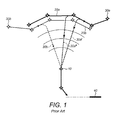
- Figure 1 shows a schematic of flight paths for aircraft arriving towards a merging waypoint 10, in accordance with the prior art PM procedure.
- the procedure itself consists of defining two lateral trajectories 20a, 20b, of approximately circular shape and at constant distance to the merging waypoint 10 (approximately 10 NM), see Figure 1 .
- These trajectories 20a, 20b are defined by Precision Area Navigation (P-RNAV) waypoints.
- P-RNAV Precision Area Navigation
- the trajectories 20a, 20b are also constrained in speed and altitude, so that two aircraft flying in each of the trajectories are well separated by altitude, and well controlled by speed. Every aircraft that arrives following a left flight path 30b, will level-off, maintain altitude and speed, and follow the arc 20b (which in Figure 1 appears slightly closer to the merge waypoint 10) by default.
- Aircraft arriving from the right along flight path 30a likewise level off, maintain altitude and speed, and follow along the arc 20a (in Figure 1 , shown slightly further away from the merge waypoint 10).
- ATC Operator a.k.a. air traffic controller (not shown in Figure 1 ). If there is no aircraft between the arcs 20a, 20b and the merging waypoint 10, or preceding aircraft are sufficiently far beyond the arc trajectories 20a, 20b, the operator will send a DIRECT command to the aircraft. This immediately causes the aircraft to leave the trajectory, and descend toward the merging waypoint 10. Such a situation is illustrated by the left hand flight path 30b of Figure 1 .
- the ATCO will not allow the aircraft to leave the trajectory.
- This is illustrated by the right hand flight path 30a of Figure 1 ; as may be seen, in cases where there is congestion at the merging waypoint 10, the aircraft is delayed from departing from the trajectory 20a so that, instead of following the shorter flight path 30a' to the merging waypoint, the aircraft instead continues along the trajectory arc 20a until subsequently receiving the DIRECT command that causes it to go directly to the merge waypoint 10 via flight path 30a".
- the total length of flight path 30a" is longer than that of flight path 30a', so that the aircraft has a delayed arrival time at the merging waypoint 10 in the former case relative to the latter.
- Aircraft arriving at the merging waypoint 10 thus have a minimum separation. Further ATCO interventions between the merging waypoint 10 and the runway 40 at an airport proximal the merging waypoint 10, are thus avoided.
- One of the advantages of the PM concept is that it allows for fully automatic navigation of the aircraft. Ideally a single final clearance communication is received from the ATCO.
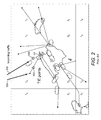
- FIG. 2 shows a schematic of flight paths into Palma de Majorca airport. Two particular flight paths 50a, 50b are shown, which each follow an OPD procedure.
- the flight paths 50a, 50b each include a tie waypoint 60a, 60b respectively, at a distance of, for example, about 30NM from a merging waypoint 10.
- the tie waypoints 60a, 60b can be located at any suitable distance from the merging waypoint 10.
- the tie waypoints 60a, 60b are established so as to permit Continuous Descent Arrivals free of conflict at the merging waypoint 10.
- the ATCO watches every aircraft that passes over the tie waypoints 60a, 60b. Depending on the distance between two aircraft, when one of them passes a tie point 60a, 60b, the ATCO may request a deceleration to the trailing aircraft. The deceleration is based on a pre-computed look-up table. Additionally, to make the procedure effective, aircraft must follow altitude windows established in the procedure (hence the name of Optimized Profile Descent).
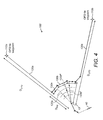
- FIG. 4 a schematic diagram of flight paths for aircraft following a combined early OPD and late PM procedure 100 is shown.
- Descending aircraft arrive at tie waypoints 110a, 110b and are monitored there.
- Each tie waypoint 110a, 110b lies at a distance D OPD upstream of a merging waypoint 10'.
- the distance D OPD for each tie waypoint 110a, 110b can be the same or different distances, as suitable.
- a look-up table is then generated to help the air traffic control officer (ATCO) that is supervising and controlling these arrivals.
- the table is displayed prominently to the ATCO, and consists of a list of successively slower speeds for shorter distances between aircraft reaching the tie waypoint 110a, 110b.
- the look-up table is calculated based on simulations of a sequence of real flights of the specific airspace configuration, real weather conditions and realistic aircraft guidance and performance.
- the fundamental parameter that affects the table values is the target capacity at the merging waypoint 10'. Also, other procedural constraints such as vertical constraints (i.e. altitude) and speed constraints at the merging waypoint 10' will strongly affect the resulting tables.
- Commands are sent to the aircraft as they arrive at a respective tie waypoint 110a, 110b.
- the commanded decelerations allow the aircraft to remain on a continuous descent path (albeit with airspeed intervened).
- the probability of conflict between aircraft at the merging waypoint 10' is highly reduced; as noted in connection with Figure 3 , using the OPD procedure alone allows, according to example simulations, a reduction from 180 potential conflicts (no OPD), down to 50 interventions (OPD with tie waypoints at 31 nautical miles upstream of the merging waypoint).
- a Point Merge (PM) procedure is then added in. Specifically, at about 10NM from the merging waypoint 10', a set of Point Merge arc trajectories 130a, 130b similar to the arc trajectories 20a, 20b of Figure 1 is defined. In other embodiments, the Point Merge procedure is added at any suitable distance from the merging waypoint 10'.
- a first aircraft may arrive from tie waypoint 110a to the first arc trajectory 130a, travel a short distance along that arc trajectory 130a, and then upon receipt of a DIRECT command, proceeds along flight path 120a to the merge waypoint 10' and from there onto the runway 40.
- a second aircraft may arrive from tie waypoint 110b, by contrast, at the arc trajectory 130b. If the aircraft were immediately to divert from that arcuate path towards the merging waypoint 10' along flight path 120b', however, then this would result in a potential conflict with the aircraft arriving along flight path 120a, at the merging waypoint 10'. Thus, the aircraft arriving along flight path 120b instead continues further around the arc trajectory 130b until a COMMAND instruction is received, at which point the aircraft proceeds directly to the merging waypoint 10' along flight path 120b". It will be seen that flight path 120b" is longer than flight path 120b' so that the aircraft arrives at the merging waypoint 10' later in the former case than in the latter.
- each aircraft only receives a single, final COMMAND instruction (indicating clearance to go directly to the merging waypoint 10') from the ATCO.
- the first stage in the procedure is to calculate a set of first parameters for the OPD procedure.
- the first parameters are in the form of a look up table of commanded speeds for different aircraft separations at the merging waypoint 10'.
- the calculations also involve determining a distance D OPD from one or more tie waypoints 110a, 110b to a merging waypoint.
- the calculation of the first parameter set is based on three fundamental inputs (although typically other secondary inputs will be included as well):
- Target of spacing at the merging waypoint 10' this is a first input constraint at box 210 in Figure 5 .
- Airspace configuration (a real (or realistic) sequence of traffic is employed);
- Target spacing of aircraft at the merging waypoint 10' is an important parameter in the design of OPD. The larger the spacing that is imposed, the greater the decelerations that must be imposed upon aircraft in order to achieve the necessary spacing.
- a set of fast- time traffic simulations is run with realistic aircraft flight plans, performance, and navigation.
- the OPD parameters are determined based upon speed constraint prior to the tie waypoint 110a; 110b: the OPD concept requires that all flights reach the tie waypoints at the same indicated airspeed, which can be accomplished, for instance, by acceleration and/or deceleration by one or more aircrafts.
- the result is a set of speed tables and an optimised D OPD .
- the speed tables indicate to the air traffic controller how much a "trailing" aircraft must decelerate as a function of the distance of a "leading" aircraft to its own tie waypoint.
- approximate speed tables are calculated for several values of D OPD using worst-case-scenario weather data.
- One simulation per value of D OPD is run.
- the optimal value is the one that leads to a minimum of conflicts. Once this is done, the speed table is refined using simulation results.
- the altitude windows that define the optimized profile are determined statistically from the trajectories of all aircraft.
- the PM parameters are preferably based upon two fundamental inputs, but can be based upon any number of suitable inputs (among other secondary inputs):
- the OPD procedure itself builds in a final, relatively brief speed correction as each aircraft approaches the arc trajectories 130a, 130b. That final part of the flight from the tie waypoint 110a, 110b to the arc trajectories 130a, 130b can be relatively short because the distance required to decelerate to the fixed speed mandated at the arc trajectories 130a, 130b can be relatively short (in comparison with the total distance from the tie waypoint to the arc trajectories.
- the total separation between the tie waypoint 110a, 110b and the arc trajectories 130a, 130b might be 15-25NM, depending upon the specific parameters/design.
- the "block deceleration" distance over which aircraft decelerate, so as to arrive at the fixed speed (say, 210 knots) at the arc trajectories, may be around 5NM.
- aircraft speeds optimized for the OPD procedure can be maintained for the majority of the period from the tie waypoint 110a, 110b to the arc trajectories 130a, 130b.
- the first step is to repeat the set of simulations, as described above in respect of the OPD parameter calculation (box 230), to recalculate the optimal OPD parameters, but now also including the influence of the PM parameters (which force the aircraft deconflicting at the merging waypoint 10') on the OPD parameters.
- the parameters of the PM procedure are kept frozen. Note that the altitude and speed constraints from the PM procedure will significantly alter the parameters of the OPD procedure, particularly the position of tie waypoints 110a, 110b, along with the speed tables. It is expected that D OPD will increase to leave room for the PM arcs trajectories 130a, 130b. However, it is expected that the required decelerations will be smaller thanks to the ability of the PM interventions to space aircraft before the merging waypoint.
- the optimization objective is to reduce fuel consumption as much as possible while maintaining zero conflicts.
- the second step in the process to combine the OPD and PM methods is carried out. This is shown in box 280 in Figure 5 .
- a second set of simulations is run to recalculate the optimal parameters of the PM procedure as described above (in respect of box 250), but this time keeping frozen the new (recalculated) values of the OPD procedure (i.e. holding constant the values calculated as a result of box 270).
- OPD and PM parameters influence of the OPD parameters on the total parameter set (OPD and PM parameters) notably reduces the potential conflicts prior to the introduction of the PM procedures (starting at distance D PM from the merging waypoint 10'). Therefore, a reduced distance D PM is expected to eliminate all conflicts.
- the optimization objective is to reduce fuel consumption as much as possible while achieving zero conflicts for these simulations as well, and, to limit the distance D PM since, in general, the shorter that distance D PM , the less the overall impact on efficiency (since the influence on the total parameter set by the PM parameters is minimized).
- the distances can be measured relative to their merging waypoint 10', as illustrated in Figure 4 , the distances can instead be calculated from another point or points, such as the tie points 110a, 110b.
- the term "waypoint” is not necessarily restricted to a point in space defined upstream of a terminus (airport runway). The term “waypoint” is intended to include the terminus itself. Since the merging waypoint is a defined (though not necessarily fixed) distance from the terminus, any calculations in accordance with embodiments of the present invention, relative to a merging waypoint, can be readily, linearly transposed relative to other fixed locations such as a terminus or runway in any even.
Landscapes
- Engineering & Computer Science (AREA)
- Aviation & Aerospace Engineering (AREA)
- Physics & Mathematics (AREA)
- General Physics & Mathematics (AREA)
- Traffic Control Systems (AREA)
Abstract
Description
- This invention relates to a method for controlling aircraft arrivals at a waypoint.
- The preferred arrival path for an aircraft towards a merging waypoint - that is to say, a waypoint proximal a landing site/airfield at which inbound aircraft are expected to merge - is a Continuous Descent Arrival (CDA). In the CDA, the descent is performed at near idle thrust values with little or no tactical intervention from Air Traffic Control (ATC). CDAs are well known for their associated fuel, emissions and noise savings.
- The drawback of CDA, as will be well known to those skilled in the art, is that it is very difficult systematically to keep the flights separated in mid to high traffic density conditions, because of the inherent uncertainties associated with these operations.
- The arrivals problem can be considered as a series of pairs of aircraft that converge to the same merging waypoint. The air traffic controller has to ensure that the aircraft stay separated at the merging waypoint. In other words, solving an arrivals problem is equivalent to solving each one of these pair wise conflicts. Depending on the aircraft positions and speeds, the aircraft may stay separated without the need of ATC intervention, but in general ATC should take action to ensure separation. A pair wise conflict can be solved by ATC using one of the following two basic techniques, both of which aim at causing a time delay on one of the flights in order to build sufficient spacing between the aircraft at the merging waypoint:
- Radar vectoring/path stretching: Prior to reaching the merging waypoint, one of the aircraft is given a new lateral path longer than the nominal path, thus introducing a delay.
- Speed control: Prior to reaching the merging waypoint, one of the aircraft is slowed down causing also a delay.
- The Eurocontrol Point Merge (PM) procedure (see http://www.eurocontrol.int/eec/public/standard_page/proj_Point_Merge.html) follows the Radar Vectoring/path stretching concept. It forces some aircraft to hold altitude and extend their flight path to solve the conflicts. The de-confliction success rate is very high. However, the longer path and the altitude holding requirements of the PM procedure result in significant extra fuel use.
- The Optimized Profile Descent (OPD) procedure by contrast (see Craig Johnson, Justin Ferrante, and Jeffrey Shepley, "Human-in-the-loop (HITL) Simulation and Analysis of Optimized Profile Descent (OPD) Operations at Atlanta" 9th AIAA Aviation Technology, Integration, and Operations Conference (ATIO), 2009 AIAA 2009-7066) emphasizes speed control to avoid conflicts while keeping the aircraft on the nominal lateral path. The OPD procedure thus helps aircraft more easily to complete CDAs, so as to perform more efficient descents. The drawback of the OPD procedure, however, is that speed control often does not provide sufficient latitude to solve all of the pairwise conflicts.
- Against this background, the present invention provides for an improved method for controlling the arrival of aircraft at a waypoint.
- According to the present invention, a method for controlling aircraft arrivals at a waypoint is defined in claim 1. A computer program therefor is set out in claim 12.
- The present invention provides a method for combining the cleanliness of the OPD procedures that lead to good rates of CDA success, with the capability of PM procedures completely to eliminate conflicts. A first waypoint ('tie waypoint') is defined at, for example, about 30 Nautical Miles (NM) from the merging waypoint. At the tie waypoint, aircraft speeds may be adjusted to permit aircraft to descend continuously, following an OPD concept. Closer to the merging waypoint (i.e. downstream of the tie waypoint) - for example about 10 NM before the merging waypoint, the PM procedure is applied to eliminate the remaining potential conflicts.
- The combination of early OPD and late PM becomes a unique and differentiated concept that cannot be understood as a simple addition of OPD and PM. Particular synergistic effects are derived when the parameters of one part of the arrival control algorithm (the "PM" type parameters or the "OPD" type parameters) are used to alter and improve the parameters of the other part of the arrival control algorithm. This is because the interaction of the two procedures modifies and improves the quality of each other. For example, initial OPD and PM parameters can each be determined empirically. Then the initial OPD parameters can be recalculated holding the initial PM parameters fixed. Subsequently the initial PM parameters can be recalculated with the recalculated OPD parameters held fixed. Because each part of the arrival algorithm interacts with the other, the OPD and PM parameters tend to converge. Thus, the procedure wherein one part of the parameter set (the OPD parameters, say) is held fixed whilst the other part (the PM parameters, say) is optimised, and then vice versa, can be repeated iteratively until one or both of the OPD and PM parameters satisfies a convergence criterion (for example, the OPD and/or PM parameters, or at least one/some of them, change by less than a predetermined amount/percentage from iteration to iteration).
- Thus, the proposed method produces a new concept that optimises aircraft descent strategy for efficiency without tolerating any conflicts.
- In the following description, and in the claims, the terms "first" and "second" are employed. It is explicitly to be understood that these terms do not signify any particular order to the calculations. In particular, although it is preferable to determine the initial OPD parameters before the initial PM parameters, and then iteratively converge both parameter sets in turn starting with the OPD parameters, it is perfectly feasible to do the calculations the other way round, starting with the PM parameters.
- Moreover, tie waypoints and PM arcs are described and claimed in terms of separations from the merging waypoint. However it will be understood that this is merely for convenience; provided that the separation between the PM arcs and the merge waypoint is less than the separation between the tie waypoint and the merge waypoint, it is a matter of convention and convenience as to how (and against what fixed locus) the locations of the PM arcs and tie waypoint are defined.
- The invention may be put into practice in a number of ways, one of which will now be described with reference to the drawings in which:
-
Figure 1 shows a schematic of flight paths for aircraft arriving towards a merging waypoint, in accordance with the Eurocontrol Point Merge procedure; -
Figure 2 shows a schematic of flight paths for aircraft arriving towards a merging waypoint, in accordance with the Optimised Profile Descent (OPD) procedure; -
Figure 3 shows a bar chart indicating the total number of conflicts for aircraft arriving at a merging waypoint from various tie waypoints, in accordance with the OPD procedure ofFigure 2 ; -
Figure 4 shows a schematic of a set of flight paths for aircraft, in accordance with a method for controlling aircraft arrivals at a merging waypoint, in accordance with an embodiment of the present invention; and -
Figure 5 shows a flowchart illustrating the steps in the generation of parameters for the aircraft arrival control procedure ofFigure 4 . - Before describing a method that illustrates a preferred embodiment of the present invention, a more detailed explanation of the Eurocontrol Point Merge (PM) and Optimized Profile Descent procedures that form the combined procedure are first provided.
- The PM procedure has the objective of spacing descending aircraft into a merging waypoint. Arriving aircraft are enabled to descend continuously without tactical intervention from Air Traffic Control (ATC). About ten NM prior to reaching the merging waypoint, a procedure is applied to eliminate all possible conflicts at the merging waypoint. In other embodiments, the PM procedure can be implemented at any suitable distance prior to reaching the merging waypoint.
-
Figure 1 shows a schematic of flight paths for aircraft arriving towards a mergingwaypoint 10, in accordance with the prior art PM procedure. The procedure itself consists of defining twolateral trajectories Figure 1 . Thesetrajectories trajectories left flight path 30b, will level-off, maintain altitude and speed, and follow thearc 20b (which inFigure 1 appears slightly closer to the merge waypoint 10) by default. - Aircraft arriving from the right along
flight path 30a likewise level off, maintain altitude and speed, and follow along thearc 20a (inFigure 1 , shown slightly further away from the merge waypoint 10). - The operation is monitored by an ATC Operator (ATCO) a.k.a. air traffic controller (not shown in
Figure 1 ). If there is no aircraft between thearcs merging waypoint 10, or preceding aircraft are sufficiently far beyond thearc trajectories waypoint 10. Such a situation is illustrated by the lefthand flight path 30b ofFigure 1 . - On the other hand, if the spacing with any preceding aircraft is below a given target threshold, the ATCO will not allow the aircraft to leave the trajectory. This is illustrated by the right
hand flight path 30a ofFigure 1 ; as may be seen, in cases where there is congestion at the mergingwaypoint 10, the aircraft is delayed from departing from thetrajectory 20a so that, instead of following theshorter flight path 30a' to the merging waypoint, the aircraft instead continues along thetrajectory arc 20a until subsequently receiving the DIRECT command that causes it to go directly to themerge waypoint 10 viaflight path 30a". The total length offlight path 30a" is longer than that offlight path 30a', so that the aircraft has a delayed arrival time at the mergingwaypoint 10 in the former case relative to the latter. - Aircraft arriving at the merging
waypoint 10 thus have a minimum separation. Further ATCO interventions between the mergingwaypoint 10 and therunway 40 at an airport proximal the mergingwaypoint 10, are thus avoided. - One of the advantages of the PM concept is that it allows for fully automatic navigation of the aircraft. Ideally a single final clearance communication is received from the ATCO.
- The advantages of the PM procedure are thus:
- If it is well done, it virtually resolves all potential conflicts at the merging waypoint
- It is automatic, and loaded in the aircraft flight management systems, since it consists of two P-RNAV arrivals.
- However the main disadvantages are:
- Flights are forced to level-off and maintain altitude for several miles.
- The
arc trajectories - As a consequence of the previous two issues, fuel consumption increases significantly (as does total flight time).
- The Optimized Profile Descent (OPD) procedure is now explained in further detail with reference to
Figure 2 . -
Figure 2 shows a schematic of flight paths into Palma de Majorca airport. Twoparticular flight paths flight paths tie waypoint waypoint 10. In other embodiments, thetie waypoints waypoint 10. Thetie waypoints waypoint 10. - In the OPD procedure illustrated in
Figure 2 , the ATCO watches every aircraft that passes over thetie waypoints tie point - Thus in the OPD procedure, standard arrivals are preserved, so that aircraft fly toward a merging
waypoint 10 using fairlystraight trajectories 50, 50b, that is, flight paths are as short as conditions permit. - Simulations of arrivals into Palma de Majorca airport using the prior art OPD procedure were carried out using a variety of different tie waypoint to merging waypoint separations. The results are shown in
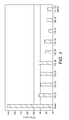
Figure 3 in the form of a bar chart. The vertical axis represents the total number of expected conflicts and the horizontal axis represents a range of different tie waypoint to merging waypoint separations. The left hand bar represents the total number of conflicts in the case of no intervention. - As may be seen in
Figure 3 , not all the conflicts can be resolved. Conflicts reduced from 180 without OPD (left hand bar) to fewer than 100 once the OPD procedure was applied. However, even at the apparent optimal tie waypoint to merging waypoint separation of 31 NM, still around 50 of the 180 flights are predicted to conflict at the merging waypoint, when using the OPD procedure. These remaining 50 conflicts then have to be resolved by ATCO tactical intervention. This way of solving remaining conflicts is expensive for flights, and also for controllers in terms of workload. - In summary, although the OPD procedure resolves most of the conflicts and permits very clean descents, it is not perfect; a number of conflicts will have to be resolved via tactical ground control interventions.
- Having explained the principles of the prior art PM and OPD procedures, a method of controlling aircraft arrivals at a merging waypoint which embodies the present invention will now be described, with reference to
Figures 4 and5 . Referring first toFigure 4 , a schematic diagram of flight paths for aircraft following a combined early OPD andlate PM procedure 100 is shown. - Descending aircraft (not shown) arrive at
tie waypoints tie waypoint tie waypoint - A look-up table is then generated to help the air traffic control officer (ATCO) that is supervising and controlling these arrivals. The table is displayed prominently to the ATCO, and consists of a list of successively slower speeds for shorter distances between aircraft reaching the
tie waypoint - Commands are sent to the aircraft as they arrive at a
respective tie waypoint 110a, 110b.The commanded decelerations allow the aircraft to remain on a continuous descent path (albeit with airspeed intervened). At the same time, the probability of conflict between aircraft at the merging waypoint 10' is highly reduced; as noted in connection withFigure 3 , using the OPD procedure alone allows, according to example simulations, a reduction from 180 potential conflicts (no OPD), down to 50 interventions (OPD with tie waypoints at 31 nautical miles upstream of the merging waypoint). - Following the calculation of an initial set of OPD parameters, so as to permit speed interventions during a first, relatively early part of the flight path from the
tie waypoint Merge arc trajectories arc trajectories Figure 1 is defined. In other embodiments, the Point Merge procedure is added at any suitable distance from the merging waypoint 10'. - As seen in
Figure 4 , upon arrival at thearc trajectories - For example, a first aircraft may arrive from
tie waypoint 110a to thefirst arc trajectory 130a, travel a short distance along thatarc trajectory 130a, and then upon receipt of a DIRECT command, proceeds alongflight path 120a to the merge waypoint 10' and from there onto therunway 40. - A second aircraft may arrive from
tie waypoint 110b, by contrast, at thearc trajectory 130b. If the aircraft were immediately to divert from that arcuate path towards the merging waypoint 10' alongflight path 120b', however, then this would result in a potential conflict with the aircraft arriving alongflight path 120a, at the merging waypoint 10'. Thus, the aircraft arriving alongflight path 120b instead continues further around thearc trajectory 130b until a COMMAND instruction is received, at which point the aircraft proceeds directly to the merging waypoint 10' alongflight path 120b". It will be seen thatflight path 120b" is longer thanflight path 120b' so that the aircraft arrives at the merging waypoint 10' later in the former case than in the latter. - Thus, it is ensured that all conflicts are resolved without high-workload, expensive tactical interventions. Ideally, each aircraft only receives a single, final COMMAND instruction (indicating clearance to go directly to the merging waypoint 10') from the ATCO.
- The combination of the OPD and the PM procedures is, paradoxically, a "divide and conquer" strategy. By first using OPD speed interventions systematically, most of the CDA are free from tactical disruptions. Then by subsequent systematic use of a PM procedure, the spacing at the merging waypoint 10' becomes essentially a "conflict-free" process.
- The process for calculating the parameters for the method of an embodiment of the present invention will now be described with reference to the flowchart of
Figure 5 . - The first stage in the procedure is to calculate a set of first parameters for the OPD procedure. The first parameters are in the form of a look up table of commanded speeds for different aircraft separations at the merging waypoint 10'. The calculations also involve determining a distance DOPD from one or
more tie waypoints - The calculation of the first parameter set is based on three fundamental inputs (although typically other secondary inputs will be included as well):
- Target of spacing at the merging waypoint 10': this is a first input constraint at
box 210 inFigure 5 . - Local climatology data. For instance, several days of weather data (aloft winds and temperatures mainly); and
- Airspace configuration (a real (or realistic) sequence of traffic is employed);
- The latter two constraints are input at
box 220 inFigure 5 . - Target spacing of aircraft at the merging waypoint 10' is an important parameter in the design of OPD. The larger the spacing that is imposed, the greater the decelerations that must be imposed upon aircraft in order to achieve the necessary spacing.
- It is desirable to optimise the distance DOPD. Too short a distance between the
tie waypoint 110a; 110b and the merging waypoint 10' leads to poor OPD performance, since there is little room for the decelerations to elongate the spacing between aircraft. On the other hand, too long a distance between thetie waypoint 110a; 110b and the merging waypoint 10' also compromises OPD performance, since uncertainties in weather and/or aircraft performance degrade the efficiency of early speed interventions. - At
box 230, using the inputs fromboxes box 230, the OPD parameters are determined based upon speed constraint prior to thetie waypoint 110a; 110b: the OPD concept requires that all flights reach the tie waypoints at the same indicated airspeed, which can be accomplished, for instance, by acceleration and/or deceleration by one or more aircrafts. - This value is fixed, and is not changed throughout the simulations.
- The result is a set of speed tables and an optimised DOPD. The speed tables indicate to the air traffic controller how much a "trailing" aircraft must decelerate as a function of the distance of a "leading" aircraft to its own tie waypoint. Initially, approximate speed tables are calculated for several values of DOPD using worst-case-scenario weather data. One simulation per value of DOPD is run. The optimal value is the one that leads to a minimum of conflicts. Once this is done, the speed table is refined using simulation results.
- Finally at
box 230, the altitude windows that define the optimized profile are determined statistically from the trajectories of all aircraft. - Once the OPD parameters have been calculated, a second set of parameters for the PM procedure are next calculated at
step 250. The PM parameters are preferably based upon two fundamental inputs, but can be based upon any number of suitable inputs (among other secondary inputs): - (A) Target of spacing at the merging waypoint 10': this is an important parameter for the design of the PM procedure. The greater the spacing that is imposed, the greater the radius of
arc trajectories step 210 ofFigure 5 . - (B) Airspace configuration (as with the OPD procedure); a real (or realistic) sequence of traffic is employed. See
box 240 inFigure 5 . - Using the weather data as well, a set of fast- time traffic simulations is run with realistic aircraft flight plans, performance, and navigation in
box 250. The PM parameters which are determined atbox 250 are - (i) speed constraint prior to the
arc trajectories tie waypoint arc trajectories - In order that both the speeds at the
tie waypoints arc trajectories arc trajectories tie waypoint arc trajectories arc trajectories tie waypoint arc trajectories - The "block deceleration" distance over which aircraft decelerate, so as to arrive at the fixed speed (say, 210 knots) at the arc trajectories, may be around 5NM. Thus aircraft speeds optimized for the OPD procedure can be maintained for the majority of the period from the
tie waypoint arc trajectories - It is anticipated that the relatively short period of deceleration to the fixed speed at the arc trajectories should be included in the overall OPD section calculations. In practice this typically results in the
tie waypoint - (ii) DPM : This is the characteristic distance from the
arc trajectories - (iii) Altitude constraint HPM at the
arc trajectories arc trajectories arc trajectories 130a is placed at a slightly different distance from the merging waypoint 10', to another of thearc trajectories 130b. Also, thearc trajectories - Once the preliminary OPD and PM parameters have been independently determined at
boxes box 260. - The first step is to repeat the set of simulations, as described above in respect of the OPD parameter calculation (box 230), to recalculate the optimal OPD parameters, but now also including the influence of the PM parameters (which force the aircraft deconflicting at the merging waypoint 10') on the OPD parameters. For this recalculation, indicated at
box 270 inFigure 5 , the parameters of the PM procedure are kept frozen. Note that the altitude and speed constraints from the PM procedure will significantly alter the parameters of the OPD procedure, particularly the position oftie waypoints trajectories - Once the initial OPD parameters have been recalculated at
box 270, the second step in the process to combine the OPD and PM methods is carried out. This is shown inbox 280 inFigure 5 . Here, a second set of simulations is run to recalculate the optimal parameters of the PM procedure as described above (in respect of box 250), but this time keeping frozen the new (recalculated) values of the OPD procedure (i.e. holding constant the values calculated as a result of box 270). - It is observed that the influence of the OPD parameters on the total parameter set (OPD and PM parameters) notably reduces the potential conflicts prior to the introduction of the PM procedures (starting at distance DPM from the merging waypoint 10'). Therefore, a reduced distance DPM is expected to eliminate all conflicts. The optimization objective is to reduce fuel consumption as much as possible while achieving zero conflicts for these simulations as well, and, to limit the distance DPM since, in general, the shorter that distance DPM, the less the overall impact on efficiency (since the influence on the total parameter set by the PM parameters is minimized).
- Because the OPD and PM procedures are complementary, repeating the two steps illustrated in
boxes boxes box 290 ofFigure 5 . - Although a preferred embodiment of the invention has been described by way of illustration, it is to be understood that this is in no way limiting and that various modifications will be apparent to the skilled person. For example, whilst in the procedure explained above in connection with
Figures 4 and5 , the OPD parameters are calculated before the PM parameters, and then the OPD parameters are subsequently recalculated whilst holding the PM parameters constant before the PM parameters are themselves recalculated, it is quite possible to reverse the order of the calculations, and still arrive at a converged matrix of first and second parameter sets along with converged distances DOPD and DPM. Similarly, although the distances can be measured relative to their merging waypoint 10', as illustrated inFigure 4 , the distances can instead be calculated from another point or points, such as thetie points
Claims (16)
- A method of controlling aircraft arrivals at a merging waypoint, comprising the steps of:(a) defining a tie waypoint which is at a first distance DOPD from the merging waypoint;(b) generating a first parameter set of flight instructions for aircraft arriving at the tie waypoint, the first parameter set including an aircraft speed instruction for a target separation between a first aircraft arriving at a target waypoint downstream of the tie waypoint and a second aircraft arriving at the target waypoint;(c) defining a diversionary flight path which is at a distance DPM from the merging waypoint, wherein DPM < DOPD; and(d) generating a second parameter set of flight instructions for aircraft arriving at the diversionary flight path, the second parameter set instructing the first aircraft to follow at least a part of the diversionary flight path before flying to the merging waypoint, whereby the total flight path of the first aircraft is increased, when it is determined that the expected arrival of the first and second aircraft at the target waypoint will have a separation that is shorter than a threshold separation.
- The method of claim 1, further comprising the steps carrying out at least one further iteration of steps (b) and (d) so as to generate, respectively, modified first and second parameter sets of flight instructions so as to optimize aircraft fuel consumption.
- The method of claim 2, wherein the first and second parameter sets iteratively converge, the method comprising repeating the iteration of steps (b) and (d) until the first and second parameter sets of flight instructions each meet a convergence criterion.
- The method of claim 1, claim 2 or claim 3, further comprising, after the step (d) of generating a second parameter set:(e) recalculating the tie waypoint and the first parameter set so as to optimize aircraft fuel consumption whilst maintaining a separation at the target waypoint which exceeds the threshold separation.
- The method of claim 4 further comprising, after the step (e) of recalculating the tie waypoint and the first parameter set, the step of:(f) recalculating the diversionary flight path and the second parameter set so as to optimize the aircraft fuel consumption whilst maintaining a separation at the target waypoint which exceeds the threshold separation.
- The method of claim 5, further comprising:iteratively repeating steps (e) and (f) until recalculation of the tie waypoint/first parameter set and/or recalculation of the diversionary flight path/second parameter set converge so as to meet a convergence criterion.
- The method of claim 4, claim 5 or claim 6, wherein the diversionary flight path and the second parameter set are fixed whilst the tie waypoint distance DOPD and the first parameter set are recalculated.
- The method of claim 5, claim 6 or claim 7, wherein the recalculated tie waypoint and the recalculated first parameter set are fixed whilst the diversionary flight path and the second parameter set are in turn recalculated.
- The method of any preceding claim, wherein the step (b) of generating a first parameter set of flight instructions comprises generating a look-up table including a plurality of different commanded aircraft speeds for a plurality of different spacings between the first and second aircraft.
- The method of claim 9, wherein the look up table contents are generated upon the basis of target aircraft capacity at the merging waypoint.
- The method of claim 10, wherein the look up table contents are further generated upon the basis of simulations of a plurality of flights each constrained by one or more of the following variables: airspace configuration; real weather conditions; altitude constraints; speed constraints; aircraft guidance; aircraft performance.
- The method of any preceding claim, wherein the step (d) of generating a second parameter set of flight instructions comprises generating instructions on the basis of target aircraft capacity at the merging waypoint.
- The method of claim 12, wherein the instructions are further generated on the basis of simulations of a plurality of flights, each constrained by one or more of the following variables:(a) defining a tie waypoint at a first distance DOPD from the merging waypoint;(b) generating a first parameter set of flight instructions for aircraft arriving at the tie waypoint, the first parameter set including an aircraft speed instruction for a target separation between a first aircraft arriving at the a target waypoint, and a second aircraft arriving at the target waypoint;(c) defining a diversionary flight path at a distance DPM from the merging waypoint, wherein DPM < DOPD; and(d) generating a second parameter set of flight instructions for aircraft arriving at the diversionary flight path, the second parameter set instructing the first aircraft to follow at least a part of the diversionary flight path before flying to the merging waypoint, whereby the total flight path length of the first aircraft is increased, when it is determined that the expected arrival of the first and second aircraft at the target waypoint will have a separation that is shorter than a threshold separation.
- The method of any preceding claim, wherein the target waypoint is the merging waypoint.
- A computer programme which, when executed, carries out the method steps of any of the preceding claims.
- A computer programme product embodying or carrying the computer programme of claim 15.
Priority Applications (2)
| Application Number | Priority Date | Filing Date | Title |
|---|---|---|---|
| EP13382355.9A EP2849167B1 (en) | 2013-09-13 | 2013-09-13 | Method for controlling aircraft arrivals at a waypoint |
| US14/482,842 US9355566B2 (en) | 2013-09-13 | 2014-09-10 | Systems and methods for controlling aircraft arrivals at a waypoint |
Applications Claiming Priority (1)
| Application Number | Priority Date | Filing Date | Title |
|---|---|---|---|
| EP13382355.9A EP2849167B1 (en) | 2013-09-13 | 2013-09-13 | Method for controlling aircraft arrivals at a waypoint |
Publications (2)
| Publication Number | Publication Date |
|---|---|
| EP2849167A1 true EP2849167A1 (en) | 2015-03-18 |
| EP2849167B1 EP2849167B1 (en) | 2016-04-27 |
Family
ID=49263279
Family Applications (1)
| Application Number | Title | Priority Date | Filing Date |
|---|---|---|---|
| EP13382355.9A Not-in-force EP2849167B1 (en) | 2013-09-13 | 2013-09-13 | Method for controlling aircraft arrivals at a waypoint |
Country Status (2)
| Country | Link |
|---|---|
| US (1) | US9355566B2 (en) |
| EP (1) | EP2849167B1 (en) |
Cited By (7)
| Publication number | Priority date | Publication date | Assignee | Title |
|---|---|---|---|---|
| CN106485954A (en) * | 2016-10-14 | 2017-03-08 | 中国民航大学 | Approach path dynamic optimization method in busy termination environment based on Point Merge air route structure |
| CN107016880A (en) * | 2017-04-10 | 2017-08-04 | 南京航空航天大学 | A kind of continuously declining into nearly oil consumption optimization method based on simulated annealing |
| EP3364395A1 (en) * | 2017-02-17 | 2018-08-22 | General Electric Company | Methods and systems for probabilistic spacing advisory tool (psat) |
| CN109830127A (en) * | 2018-12-26 | 2019-05-31 | 南京航空航天大学 | It is marched into the arena 4D path planning method based on an aircraft for fusion program |
| EP4006877A1 (en) * | 2020-11-25 | 2022-06-01 | The Boeing Company | Aircraft arrival management systems and methods |
| KR102828563B1 (en) * | 2024-04-15 | 2025-07-02 | 국방과학연구소 | Apparatus and method of planning route for formation of multiple unmanned vehicles |
| US12592157B2 (en) | 2020-11-25 | 2026-03-31 | The Boeing Company | Airspace management systems and methods |
Families Citing this family (8)
| Publication number | Priority date | Publication date | Assignee | Title |
|---|---|---|---|---|
| US11270596B2 (en) * | 2018-10-11 | 2022-03-08 | Xwing, Inc. | Autonomous path planning |
| US11238744B2 (en) | 2019-06-27 | 2022-02-01 | Ge Aviation Systems Llc | Method and system for controlling interval management of an aircraft |
| US12387607B2 (en) | 2020-12-10 | 2025-08-12 | Joby Aero, Inc. | Unmanned aircraft control using ground control station |
| EP4050584B1 (en) | 2021-02-25 | 2025-06-11 | Frequentis Orthogon GmbH | Method for optimizing an arrival stream of at least two aircraft, corresponding device and computer program |
| US12462697B2 (en) | 2023-01-17 | 2025-11-04 | Joby Aero, Inc. | Traffic pattern control of UAVS and automated downwind extensions |
| EP4531021B1 (en) * | 2023-09-26 | 2026-06-03 | Honeywell International Inc. | Methods and systems for providing conditional estimated arrival times |
| US12609036B2 (en) | 2023-09-26 | 2026-04-21 | Honeywell International Inc. | Methods and systems for providing conditional estimated arrival times |
| CN119026817B (en) * | 2024-10-28 | 2025-02-07 | 北京航空航天大学杭州创新研究院 | Method and device for landing scheduling of vertical take-off and landing field aircraft, storage medium and electronic equipment |
Family Cites Families (23)
| Publication number | Priority date | Publication date | Assignee | Title |
|---|---|---|---|---|
| FR2861871B1 (en) * | 2003-11-04 | 2006-02-03 | Thales Sa | METHOD FOR MONITORING THE FLOW OF THE FLIGHT PLAN OF A COOPERATIVE AIRCRAFT |
| US7611098B2 (en) * | 2005-01-19 | 2009-11-03 | Airbus France | Flight management process for an aircraft |
| US20060200279A1 (en) * | 2005-03-03 | 2006-09-07 | Ainsworth Robert J | Method of determining a comparison of an aircraft's performance capabilities with performance requirements |
| EP1897079A1 (en) * | 2005-06-13 | 2008-03-12 | Aviation Communication & Surveillance Systems, LLC | Spacing control system and method for aircraft |
| US7412324B1 (en) * | 2005-09-28 | 2008-08-12 | Rockwell Collins, Inc. | Flight management system with precision merging |
| FR2907953B1 (en) * | 2006-10-26 | 2008-12-19 | Airbus France Sa | SYSTEM FOR GUIDING AN AIRCRAFT. |
| DE602006012860D1 (en) * | 2006-12-22 | 2010-04-22 | Saab Ab | Device on a missile and method for collision avoidance |
| US7912593B2 (en) * | 2007-04-02 | 2011-03-22 | Aviation Communication & Surveillance Systems, Llc | Merging and spacing speed target calculation |
| US8380424B2 (en) * | 2007-09-28 | 2013-02-19 | The Boeing Company | Vehicle-based automatic traffic conflict and collision avoidance |
| FR2938939B1 (en) * | 2008-11-25 | 2015-10-02 | Thales Sa | METHOD FOR AIDING THE FLIGHT MANAGEMENT OF AN AIRCRAFT FOR HOLDING A TIME CONSTRAINTS |
| US8140252B2 (en) * | 2008-12-09 | 2012-03-20 | Honeywell International Inc. | System and method for displaying protected airspace associated with a projected trajectory of aircraft in a confidence display |
| FR2942566B1 (en) * | 2009-02-24 | 2016-01-22 | Thales Sa | METHOD FOR MANAGING THE FLIGHT OF AN AIRCRAFT |
| EP2282247B1 (en) * | 2009-05-05 | 2019-07-10 | The Boeing Company | Four-dimensional guidance of an aircraft |
| FR2946161B1 (en) * | 2009-05-29 | 2016-08-26 | Thales Sa | METHOD FOR THE CONTINUOUS AND ADAPTIVE PREPARATION OF A SPEED SET FOR HOLDING AN RTA BY AN AIRCRAFT |
| US8494766B2 (en) * | 2011-01-07 | 2013-07-23 | Ge Aviation Systems, Llc | Flight management system with integrated tactical commands for use with an aircraft and method of operating same |
| EP2668609A4 (en) * | 2011-01-25 | 2014-10-08 | Nextgen Aerosciences Llc | METHOD AND APPARATUS FOR DYNAMIC MANAGEMENT OF AIRCRAFT TRAJECTORIES |
| FR2973502B1 (en) * | 2011-03-29 | 2014-01-10 | Airbus Operations Sas | METHOD AND DEVICE FOR VERIFYING THE HOLD OF SUCCESSIVE TIME CONSTRAINTS BY AN AIRCRAFT. |
| FR2983619B1 (en) * | 2011-12-05 | 2013-11-22 | Thales Sa | METHOD, DEVICE AND SYSTEM FOR GUARANTEEING TEMPORAL SPACING BETWEEN AN AIRCRAFT AND AT LEAST ONE TARGET TRAFFIC |
| US8788189B2 (en) * | 2012-08-31 | 2014-07-22 | Honeywell International Inc. | Aircraft control system and method for reaching a waypoint at a required time of arrival |
| FR2995415B1 (en) * | 2012-09-11 | 2015-12-11 | Airbus Operations Sas | METHOD AND SYSTEM FOR AUTOMATICALLY MANAGING THE SPACING OF AT LEAST ONE REFERENCE AIRCRAFT BEHIND AT LEAST ONE TARGET AIRCRAFT. |
| US10013236B2 (en) * | 2013-03-06 | 2018-07-03 | The Boeing Company | Real-time adaptive speed scheduler |
| FR3006049B1 (en) * | 2013-05-24 | 2016-01-01 | Thales Sa | METHOD AND SYSTEM FOR SELECTING AN APPROACH TRACK |
| US9026275B1 (en) * | 2013-07-24 | 2015-05-05 | Shih-Yih Young | In-flight generation of RTA-compliant optimal profile descent paths |
-
2013
- 2013-09-13 EP EP13382355.9A patent/EP2849167B1/en not_active Not-in-force
-
2014
- 2014-09-10 US US14/482,842 patent/US9355566B2/en not_active Expired - Fee Related
Non-Patent Citations (2)
| Title |
|---|
| "Point Merge Integration of Arrival Flows Enabling Extensive RNAV Application and Continuous Descent - Operational Services and Environment Definition", 19 July 2010 (2010-07-19), Brétigny-sur-Orge (FR), pages 1 - 124, XP055109978, Retrieved from the Internet <URL:https://www.eurocontrol.int/sites/default/files/content/documents/sesar/point-merge-osed-v2.0-2010.pdf> [retrieved on 20140326] * |
| CRAIG JOHNSON ET AL: "Human-In-The-Loop (HITL) Simulation and Analysis of Optimized Profile Descent (OPD) Operations at Atlanta", 9TH AIAA AVIATION TECHNOLOGY, INTEGRATION, AND OPERATIONS CONFERENCE (ATIO), 21 September 2009 (2009-09-21), Reston, Virigina, XP055109983, ISBN: 978-1-60-086977-8, DOI: 10.2514/6.2009-7066 * |
Cited By (10)
| Publication number | Priority date | Publication date | Assignee | Title |
|---|---|---|---|---|
| CN106485954A (en) * | 2016-10-14 | 2017-03-08 | 中国民航大学 | Approach path dynamic optimization method in busy termination environment based on Point Merge air route structure |
| CN106485954B (en) * | 2016-10-14 | 2019-02-01 | 中国民航大学 | Approach path dynamic optimization method in busy termination environment based on the air route Point Merge structure |
| EP3364395A1 (en) * | 2017-02-17 | 2018-08-22 | General Electric Company | Methods and systems for probabilistic spacing advisory tool (psat) |
| CN107016880A (en) * | 2017-04-10 | 2017-08-04 | 南京航空航天大学 | A kind of continuously declining into nearly oil consumption optimization method based on simulated annealing |
| CN109830127A (en) * | 2018-12-26 | 2019-05-31 | 南京航空航天大学 | It is marched into the arena 4D path planning method based on an aircraft for fusion program |
| CN109830127B (en) * | 2018-12-26 | 2020-10-20 | 南京航空航天大学 | Aircraft approach 4D track planning method based on point fusion program |
| EP4006877A1 (en) * | 2020-11-25 | 2022-06-01 | The Boeing Company | Aircraft arrival management systems and methods |
| US12236794B2 (en) | 2020-11-25 | 2025-02-25 | The Boeing Company | Aircraft arrival management systems and methods |
| US12592157B2 (en) | 2020-11-25 | 2026-03-31 | The Boeing Company | Airspace management systems and methods |
| KR102828563B1 (en) * | 2024-04-15 | 2025-07-02 | 국방과학연구소 | Apparatus and method of planning route for formation of multiple unmanned vehicles |
Also Published As
| Publication number | Publication date |
|---|---|
| US20150081198A1 (en) | 2015-03-19 |
| US9355566B2 (en) | 2016-05-31 |
| EP2849167B1 (en) | 2016-04-27 |
Similar Documents
| Publication | Publication Date | Title |
|---|---|---|
| EP2849167B1 (en) | Method for controlling aircraft arrivals at a waypoint | |
| EP3660815B1 (en) | System and method for optimizing a cruise vertical profile subject to a time-of-arrival constraint | |
| US10013236B2 (en) | Real-time adaptive speed scheduler | |
| AU2009203115B2 (en) | A method and system of controlling air traffic | |
| EP2631732B1 (en) | Method for flying an aircraft along a flight path | |
| US10380901B2 (en) | Method for automatically rejoining a reference vertical profile of an aircraft | |
| KR20160118658A (en) | Aircraft trajectory predicting method and system by real-time track data monitoring | |
| CN107085978A (en) | A kind of control aid decision instruction generation method based on required arrival time | |
| CN112614384A (en) | Approach multi-constraint ordering calculation method based on multi-target dynamic allocation runway | |
| US12236794B2 (en) | Aircraft arrival management systems and methods | |
| CN115047901A (en) | Method for optimizing the arrival flow of an aircraft, corresponding device and computer program | |
| US20240371273A1 (en) | Identifying and removing vehicle conflict in vehicle network | |
| Ren et al. | Achieving low approach noise without sacrificing capacity | |
| Dalmau et al. | Comparison of various guidance strategies to achieve time constraints in optimal descents | |
| Dalmau et al. | Combining the assignment of pre-defined routes and RTAs to sequence and merge arrival traffic | |
| McDonald et al. | Concept of operations for air traffic management by managing uncertainty through multiple metering points | |
| CN109979245A (en) | Flight flow control method and apparatus | |
| US20250316179A1 (en) | Vehicle Traffic Control with Voice to Text | |
| Spirkovska | Vertiport dynamic density | |
| Alam et al. | Multi-aircraft dynamic continuous descent approach methodology for low-noise and emission guidance | |
| Iwata et al. | Air traffic control method for more fuel efficient arrivals in terminal airspace | |
| Fujita et al. | From Visual to Digital: Coordination Scheduling and Its Effect on Safety and Efficiency in UAM Corridors | |
| HK40073386A (en) | Method for optimizing arrival stream of aircraft, corresponding device, and computer program | |
| Tian et al. | Multi-objective optimization of high altitude sector operation based on environmental protection | |
| Variny et al. | Cascading Delay Mitigation With Quadratic Bézier Curve Trajectory Planning |
Legal Events
| Date | Code | Title | Description |
|---|---|---|---|
| PUAI | Public reference made under article 153(3) epc to a published international application that has entered the european phase |
Free format text: ORIGINAL CODE: 0009012 |
|
| 17P | Request for examination filed |
Effective date: 20130913 |
|
| AK | Designated contracting states |
Kind code of ref document: A1 Designated state(s): AL AT BE BG CH CY CZ DE DK EE ES FI FR GB GR HR HU IE IS IT LI LT LU LV MC MK MT NL NO PL PT RO RS SE SI SK SM TR |
|
| AX | Request for extension of the european patent |
Extension state: BA ME |
|
| GRAP | Despatch of communication of intention to grant a patent |
Free format text: ORIGINAL CODE: EPIDOSNIGR1 |
|
| RIC1 | Information provided on ipc code assigned before grant |
Ipc: G08G 5/00 20060101AFI20150930BHEP |
|
| INTG | Intention to grant announced |
Effective date: 20151023 |
|
| GRAS | Grant fee paid |
Free format text: ORIGINAL CODE: EPIDOSNIGR3 |
|
| GRAA | (expected) grant |
Free format text: ORIGINAL CODE: 0009210 |
|
| AK | Designated contracting states |
Kind code of ref document: B1 Designated state(s): AL AT BE BG CH CY CZ DE DK EE ES FI FR GB GR HR HU IE IS IT LI LT LU LV MC MK MT NL NO PL PT RO RS SE SI SK SM TR |
|
| REG | Reference to a national code |
Ref country code: GB Ref legal event code: FG4D |
|
| REG | Reference to a national code |
Ref country code: CH Ref legal event code: EP |
|
| REG | Reference to a national code |
Ref country code: AT Ref legal event code: REF Ref document number: 795561 Country of ref document: AT Kind code of ref document: T Effective date: 20160515 |
|
| REG | Reference to a national code |
Ref country code: IE Ref legal event code: FG4D |
|
| REG | Reference to a national code |
Ref country code: DE Ref legal event code: R096 Ref document number: 602013006981 Country of ref document: DE |
|
| REG | Reference to a national code |
Ref country code: LT Ref legal event code: MG4D |
|
| REG | Reference to a national code |
Ref country code: NL Ref legal event code: MP Effective date: 20160427 |
|
| REG | Reference to a national code |
Ref country code: AT Ref legal event code: MK05 Ref document number: 795561 Country of ref document: AT Kind code of ref document: T Effective date: 20160427 |
|
| REG | Reference to a national code |
Ref country code: FR Ref legal event code: PLFP Year of fee payment: 4 |
|
| PG25 | Lapsed in a contracting state [announced via postgrant information from national office to epo] |
Ref country code: NL Free format text: LAPSE BECAUSE OF FAILURE TO SUBMIT A TRANSLATION OF THE DESCRIPTION OR TO PAY THE FEE WITHIN THE PRESCRIBED TIME-LIMIT Effective date: 20160427 |
|
| PG25 | Lapsed in a contracting state [announced via postgrant information from national office to epo] |
Ref country code: PL Free format text: LAPSE BECAUSE OF FAILURE TO SUBMIT A TRANSLATION OF THE DESCRIPTION OR TO PAY THE FEE WITHIN THE PRESCRIBED TIME-LIMIT Effective date: 20160427 Ref country code: FI Free format text: LAPSE BECAUSE OF FAILURE TO SUBMIT A TRANSLATION OF THE DESCRIPTION OR TO PAY THE FEE WITHIN THE PRESCRIBED TIME-LIMIT Effective date: 20160427 Ref country code: NO Free format text: LAPSE BECAUSE OF FAILURE TO SUBMIT A TRANSLATION OF THE DESCRIPTION OR TO PAY THE FEE WITHIN THE PRESCRIBED TIME-LIMIT Effective date: 20160727 Ref country code: LT Free format text: LAPSE BECAUSE OF FAILURE TO SUBMIT A TRANSLATION OF THE DESCRIPTION OR TO PAY THE FEE WITHIN THE PRESCRIBED TIME-LIMIT Effective date: 20160427 |
|
| PG25 | Lapsed in a contracting state [announced via postgrant information from national office to epo] |
Ref country code: LV Free format text: LAPSE BECAUSE OF FAILURE TO SUBMIT A TRANSLATION OF THE DESCRIPTION OR TO PAY THE FEE WITHIN THE PRESCRIBED TIME-LIMIT Effective date: 20160427 Ref country code: GR Free format text: LAPSE BECAUSE OF FAILURE TO SUBMIT A TRANSLATION OF THE DESCRIPTION OR TO PAY THE FEE WITHIN THE PRESCRIBED TIME-LIMIT Effective date: 20160728 Ref country code: AT Free format text: LAPSE BECAUSE OF FAILURE TO SUBMIT A TRANSLATION OF THE DESCRIPTION OR TO PAY THE FEE WITHIN THE PRESCRIBED TIME-LIMIT Effective date: 20160427 Ref country code: ES Free format text: LAPSE BECAUSE OF FAILURE TO SUBMIT A TRANSLATION OF THE DESCRIPTION OR TO PAY THE FEE WITHIN THE PRESCRIBED TIME-LIMIT Effective date: 20160427 Ref country code: RS Free format text: LAPSE BECAUSE OF FAILURE TO SUBMIT A TRANSLATION OF THE DESCRIPTION OR TO PAY THE FEE WITHIN THE PRESCRIBED TIME-LIMIT Effective date: 20160427 Ref country code: PT Free format text: LAPSE BECAUSE OF FAILURE TO SUBMIT A TRANSLATION OF THE DESCRIPTION OR TO PAY THE FEE WITHIN THE PRESCRIBED TIME-LIMIT Effective date: 20160829 Ref country code: SE Free format text: LAPSE BECAUSE OF FAILURE TO SUBMIT A TRANSLATION OF THE DESCRIPTION OR TO PAY THE FEE WITHIN THE PRESCRIBED TIME-LIMIT Effective date: 20160427 Ref country code: HR Free format text: LAPSE BECAUSE OF FAILURE TO SUBMIT A TRANSLATION OF THE DESCRIPTION OR TO PAY THE FEE WITHIN THE PRESCRIBED TIME-LIMIT Effective date: 20160427 |
|
| PG25 | Lapsed in a contracting state [announced via postgrant information from national office to epo] |
Ref country code: BE Free format text: LAPSE BECAUSE OF FAILURE TO SUBMIT A TRANSLATION OF THE DESCRIPTION OR TO PAY THE FEE WITHIN THE PRESCRIBED TIME-LIMIT Effective date: 20160427 Ref country code: IT Free format text: LAPSE BECAUSE OF FAILURE TO SUBMIT A TRANSLATION OF THE DESCRIPTION OR TO PAY THE FEE WITHIN THE PRESCRIBED TIME-LIMIT Effective date: 20160427 |
|
| REG | Reference to a national code |
Ref country code: DE Ref legal event code: R097 Ref document number: 602013006981 Country of ref document: DE |
|
| PG25 | Lapsed in a contracting state [announced via postgrant information from national office to epo] |
Ref country code: SK Free format text: LAPSE BECAUSE OF FAILURE TO SUBMIT A TRANSLATION OF THE DESCRIPTION OR TO PAY THE FEE WITHIN THE PRESCRIBED TIME-LIMIT Effective date: 20160427 Ref country code: RO Free format text: LAPSE BECAUSE OF FAILURE TO SUBMIT A TRANSLATION OF THE DESCRIPTION OR TO PAY THE FEE WITHIN THE PRESCRIBED TIME-LIMIT Effective date: 20160427 Ref country code: EE Free format text: LAPSE BECAUSE OF FAILURE TO SUBMIT A TRANSLATION OF THE DESCRIPTION OR TO PAY THE FEE WITHIN THE PRESCRIBED TIME-LIMIT Effective date: 20160427 Ref country code: CZ Free format text: LAPSE BECAUSE OF FAILURE TO SUBMIT A TRANSLATION OF THE DESCRIPTION OR TO PAY THE FEE WITHIN THE PRESCRIBED TIME-LIMIT Effective date: 20160427 Ref country code: DK Free format text: LAPSE BECAUSE OF FAILURE TO SUBMIT A TRANSLATION OF THE DESCRIPTION OR TO PAY THE FEE WITHIN THE PRESCRIBED TIME-LIMIT Effective date: 20160427 |
|
| PG25 | Lapsed in a contracting state [announced via postgrant information from national office to epo] |
Ref country code: SM Free format text: LAPSE BECAUSE OF FAILURE TO SUBMIT A TRANSLATION OF THE DESCRIPTION OR TO PAY THE FEE WITHIN THE PRESCRIBED TIME-LIMIT Effective date: 20160427 |
|
| PLBE | No opposition filed within time limit |
Free format text: ORIGINAL CODE: 0009261 |
|
| STAA | Information on the status of an ep patent application or granted ep patent |
Free format text: STATUS: NO OPPOSITION FILED WITHIN TIME LIMIT |
|
| 26N | No opposition filed |
Effective date: 20170130 |
|
| PG25 | Lapsed in a contracting state [announced via postgrant information from national office to epo] |
Ref country code: MC Free format text: LAPSE BECAUSE OF FAILURE TO SUBMIT A TRANSLATION OF THE DESCRIPTION OR TO PAY THE FEE WITHIN THE PRESCRIBED TIME-LIMIT Effective date: 20160427 |
|
| REG | Reference to a national code |
Ref country code: CH Ref legal event code: PL |
|
| PG25 | Lapsed in a contracting state [announced via postgrant information from national office to epo] |
Ref country code: SI Free format text: LAPSE BECAUSE OF FAILURE TO SUBMIT A TRANSLATION OF THE DESCRIPTION OR TO PAY THE FEE WITHIN THE PRESCRIBED TIME-LIMIT Effective date: 20160427 |
|
| REG | Reference to a national code |
Ref country code: IE Ref legal event code: MM4A |
|
| PG25 | Lapsed in a contracting state [announced via postgrant information from national office to epo] |
Ref country code: IE Free format text: LAPSE BECAUSE OF NON-PAYMENT OF DUE FEES Effective date: 20160913 Ref country code: LI Free format text: LAPSE BECAUSE OF NON-PAYMENT OF DUE FEES Effective date: 20160930 Ref country code: CH Free format text: LAPSE BECAUSE OF NON-PAYMENT OF DUE FEES Effective date: 20160930 |
|
| PG25 | Lapsed in a contracting state [announced via postgrant information from national office to epo] |
Ref country code: LU Free format text: LAPSE BECAUSE OF NON-PAYMENT OF DUE FEES Effective date: 20160913 |
|
| REG | Reference to a national code |
Ref country code: FR Ref legal event code: PLFP Year of fee payment: 5 |
|
| PG25 | Lapsed in a contracting state [announced via postgrant information from national office to epo] |
Ref country code: HU Free format text: LAPSE BECAUSE OF FAILURE TO SUBMIT A TRANSLATION OF THE DESCRIPTION OR TO PAY THE FEE WITHIN THE PRESCRIBED TIME-LIMIT; INVALID AB INITIO Effective date: 20130913 |
|
| PG25 | Lapsed in a contracting state [announced via postgrant information from national office to epo] |
Ref country code: CY Free format text: LAPSE BECAUSE OF FAILURE TO SUBMIT A TRANSLATION OF THE DESCRIPTION OR TO PAY THE FEE WITHIN THE PRESCRIBED TIME-LIMIT Effective date: 20160427 Ref country code: MK Free format text: LAPSE BECAUSE OF FAILURE TO SUBMIT A TRANSLATION OF THE DESCRIPTION OR TO PAY THE FEE WITHIN THE PRESCRIBED TIME-LIMIT Effective date: 20160427 Ref country code: MT Free format text: LAPSE BECAUSE OF NON-PAYMENT OF DUE FEES Effective date: 20160930 Ref country code: IS Free format text: LAPSE BECAUSE OF FAILURE TO SUBMIT A TRANSLATION OF THE DESCRIPTION OR TO PAY THE FEE WITHIN THE PRESCRIBED TIME-LIMIT Effective date: 20160427 |
|
| PG25 | Lapsed in a contracting state [announced via postgrant information from national office to epo] |
Ref country code: BG Free format text: LAPSE BECAUSE OF FAILURE TO SUBMIT A TRANSLATION OF THE DESCRIPTION OR TO PAY THE FEE WITHIN THE PRESCRIBED TIME-LIMIT Effective date: 20160427 |
|
| REG | Reference to a national code |
Ref country code: FR Ref legal event code: PLFP Year of fee payment: 6 |
|
| PG25 | Lapsed in a contracting state [announced via postgrant information from national office to epo] |
Ref country code: AL Free format text: LAPSE BECAUSE OF FAILURE TO SUBMIT A TRANSLATION OF THE DESCRIPTION OR TO PAY THE FEE WITHIN THE PRESCRIBED TIME-LIMIT Effective date: 20160427 Ref country code: TR Free format text: LAPSE BECAUSE OF FAILURE TO SUBMIT A TRANSLATION OF THE DESCRIPTION OR TO PAY THE FEE WITHIN THE PRESCRIBED TIME-LIMIT Effective date: 20160427 |
|
| PGFP | Annual fee paid to national office [announced via postgrant information from national office to epo] |
Ref country code: GB Payment date: 20220927 Year of fee payment: 10 Ref country code: DE Payment date: 20220928 Year of fee payment: 10 |
|
| PGFP | Annual fee paid to national office [announced via postgrant information from national office to epo] |
Ref country code: FR Payment date: 20220926 Year of fee payment: 10 |
|
| P01 | Opt-out of the competence of the unified patent court (upc) registered |
Effective date: 20230516 |
|
| REG | Reference to a national code |
Ref country code: DE Ref legal event code: R119 Ref document number: 602013006981 Country of ref document: DE |
|
| GBPC | Gb: european patent ceased through non-payment of renewal fee |
Effective date: 20230913 |
|
| PG25 | Lapsed in a contracting state [announced via postgrant information from national office to epo] |
Ref country code: GB Free format text: LAPSE BECAUSE OF NON-PAYMENT OF DUE FEES Effective date: 20230913 |
|
| PG25 | Lapsed in a contracting state [announced via postgrant information from national office to epo] |
Ref country code: GB Free format text: LAPSE BECAUSE OF NON-PAYMENT OF DUE FEES Effective date: 20230913 Ref country code: FR Free format text: LAPSE BECAUSE OF NON-PAYMENT OF DUE FEES Effective date: 20230930 Ref country code: DE Free format text: LAPSE BECAUSE OF NON-PAYMENT OF DUE FEES Effective date: 20240403 |