EP2848926B1 - System and method for analysis in modulated thermogravimetry - Google Patents
System and method for analysis in modulated thermogravimetry Download PDFInfo
- Publication number
- EP2848926B1 EP2848926B1 EP14003002.4A EP14003002A EP2848926B1 EP 2848926 B1 EP2848926 B1 EP 2848926B1 EP 14003002 A EP14003002 A EP 14003002A EP 2848926 B1 EP2848926 B1 EP 2848926B1
- Authority
- EP
- European Patent Office
- Prior art keywords
- dtg
- temperature
- amplitude
- derivative
- signal
- Prior art date
- Legal status (The legal status is an assumption and is not a legal conclusion. Google has not performed a legal analysis and makes no representation as to the accuracy of the status listed.)
- Active
Links
Images





Classifications
-
- G—PHYSICS
- G01—MEASURING; TESTING
- G01N—INVESTIGATING OR ANALYSING MATERIALS BY DETERMINING THEIR CHEMICAL OR PHYSICAL PROPERTIES
- G01N25/00—Investigating or analyzing materials by the use of thermal means
- G01N25/20—Investigating or analyzing materials by the use of thermal means by investigating the development of heat, i.e. calorimetry, e.g. by measuring specific heat, by measuring thermal conductivity
- G01N25/48—Investigating or analyzing materials by the use of thermal means by investigating the development of heat, i.e. calorimetry, e.g. by measuring specific heat, by measuring thermal conductivity on solution, sorption, or a chemical reaction not involving combustion or catalytic oxidation
Definitions
- the present invention relates to modulated thermogravimetry, and in particular to a system (e.g. an apparatus) and a method for determining a kinetic parameter of a sample by means of modulated thermogravimetry.
- modulated thermogravimetry also known as modulated-temperature thermogravimetry
- modulated-temperature thermogravimetry was introduced by R.L. Blaine and B.K. Hahn, Obtaining Kinetic Parameters by modulated Thermogravimetry, Journal of Thermal Analysis, Vol. 54 (1998) 695-704 . It is used now widely as the standard method of modulated thermogravimetric analysis. It is described e.g. in Roger L. Blaine, US Patent 6,336,741 (2002 ).
- thermogravimetric measurements must be done under modulated temperature conditions, where the temperature is the sum of an underlying linear heating and temperature oscillations.
- the amplitude of the temperature oscillations is usually from 5K to 10K, what is much higher than for modulated DSC (cf. e.g. M. Reading, B. K. Hahn and B. S. Crow, US Patent 5,224,775 (1993 )), where the typical temperature amplitude is about 0.5K.
- Period is usually from 60 to 300s
- underlying heating rate is usually from 1 to 20K/min.
- the so-called DTG signal calculated as the first derivative from the thermogravimetric signal (weight change signal), has oscillations for modulated measurements. Then it is possible to draw two additional curves: A top curve DTG top through the peak points of modulated signal DTG, and a bottom curve DTG bottom through the valleys having correspondent values of reaction rates d ⁇ 2 /dt and d ⁇ 1 /dt. If A is the temperature amplitude and T 0 is the underlying linear temperature, then
- T 1 T 0 +A
- T 2 T 0 -A
- ⁇ 1 ⁇ 2
- f( ⁇ 1 ) f( ⁇ 2 )
- ln( d ⁇ 1 / d ⁇ 2 ) refers to the logarithm of the ratio of minimum and maximum reaction rates. More specifically, it is the amplitude of the logarithm of the first derivative of the thermogravimetric signal indicative of the weight of the sample under investigation at the particular temperature, T.
- a system for determining a kinetic parameter of a sample according to the preamble of claim 1 and a corresponding method for determining a kinetic parameter of a sample according to the preamble of claim 8 is known from the above mentioned publication R.L. Blaine and B.K. Hahn, Obtaining Kinetic Parameters by modulated Thermogravimetry, Journal of Thermal Analysis, Vol. 54 (1998) 695-704 , and also from the publications EP 0 559 362 A1 and EP 0 930 500 A1 .
- the measured data contain noise, then it is very hard to define correct the position of the top curve DTG top and bottom curve DTG bottom .
- both positions depend on the noise amplitude.
- the smoothing of the noise for the signal of unknown shape may distort the shape and reduce the oscillation amplitude of the measured DTG signal. Therefore the smoothing may lead to the evaluation error.
- the positions of the top curve and bottom curve for this method can not be determined from the Fourier analysis of only main frequency, because the shape of reaction rate signal can be far from sinus.
- the main idea of the present invention is to avoid the calculation of logarithm for determining the kinetic parameter, because the logarithmic calculation produces a high error for slow reaction rates with values about zero.
- calculation of the logarithmic term in Eq. 6, ln( d ⁇ 1 / d ⁇ 2 ) is avoided according to the invention because such logarithmic terms introduce into the solution for Ea the aforementioned drawbacks. Therefore, the invention relates to apparatus and methods for calculating a kinetic parameter such as Ea from a modulated thermogravimetry experiment where a sample is subjected to a modulated temperature program, wherein determination avoids calculating the logarithm of a non-exponential function derived from the first derivative of the thermogravimetric signal.
- logarithm and “non-exponential function” as used herein do not necessarily imply any particular basis, even though the base "e” is referred to above.
- logarithm includes logarithms of any basis, including the natural logarithm where its base is “e,” as well as logarithms of other bases such as 10, e.g. log 10 (x).
- non-exponential function means a function that is not an exponential, regardless whether the base of the function is the base of the natural logarithm, "e,” as in e (x) , or some other base such as 10, as in 10 (x) .
- determination of a kinetic parameter avoids calculation of logarithms derived from the thermogravimetric signal, whatever their base, because such terms introduce noise and other undesirable attributes into the calculated parameter.
- a system for determining a kinetic parameter of a sample includes:
- this system can determine the kinetic parameter without using a logarithm of a non-exponential function derived from the first derivative of the thermogravimetric signal.
- a method for determining a kinetic parameter of a sample includes the steps of:
- this method can determine the kinetic parameter withoug using a logarithm of a non-exponential function derived from the first derivative of the thermogravimetric signal.
- the temperature program is also characterized by an underlying heating rate.
- a first portion of the temperature program is characterized by an underlying heating rate and a second portion of the temperature program is characterized by quasi-isothermal operation.
- the heating of the sample is modified in accordance with the rate of weight change.
- the kinetic parameter is the activation energy (Ea).
- thermogravimetric apparatus measures the weight change of a sample (TG signal and/or DTG signal) as the function of the time and/or temperature. It usually contains a measurement cell for the sample, an oven for the heating of this cell, a thermal balance for the registration of the sample weight change, a device to control the sample temperature, and a device for the measurement and registration of the sample temperature.
- Conventional means for measuring and tracking the both weight and the temperature of the sample as a function of time can be used.
- a conventional balance or other known or suitable sensor can be used to measure the sample weight.
- Other Conventional contact or non-contact temperature-measurement methodologies for measuring temperature can be used.
- Temperature program is given by the operator of the instrument and has a typical temperature range from -200°C to 1000°C and typical heating rates from 1 to 20K/min. Temperature program can contain several segments with linear or non-linear heating and cooling or isothermal conditions.
- the present invention concerns the analysis method for determination of a kinetic parameter as the activation energy for the situation, where the temperature program has an oscillating part.
- the sample can change its weight because of different reasons: decomposition, evaporation, changing of magnetic properties etc.
- the weight change is registered by the thermal balance and the measured sample temperature is collected as the measured time-dependent signals (TG and/or DTG signal).
- TG and/or DTG signal measured time-dependent signals
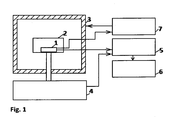
- Fig. 1 shows a main structure of an example of a system for conducting a modulated thermogravimetry with determination of the activation energy Ea.
- a sample 1 is placed into a measuring cell 2.
- the cell 2 is heated by a furnace 3, controlled by a temperature controller 7, which uses the measured sample temperature.
- the change of the weight is measured by a thermal balance 4.
- the data of the temperature signal and weight signal are gathered by an electronic device 5 and passed to a personal computer 6.
- the computer 6 conducts the determination of the activation energy of the sample 1 according to the method of the invention, as more detailled described below.
- the basis of the "direct analysis” method is to make a direct Fourier analysis of the DTG signal. Then it will be possible to find the activation energy Ea not from the hard-defined top and bottom envelope curves DTG top and DTG bottom , but directly from the well-defined amplitude A DTG of the main frequency in the DTG signal, which is independent or only slightly dependent on noise.
- T T 0 +A sin( ⁇ t) into the above main equation (1), where To is the underlying linear temperature, A is the temperature amplitude, w is the temperature modulation frequency. For example, for a temperature amplitude of 5K and a temperature of 500K the ratio A/To is 1%, which can be considered as a "small parameter".
- the 3 th term in series is 1E-6 and in most cases is under the instrument error in the thermogravimetric (TG) signal, which has the lowest value typically about 1E-5, corresponding to 0.1 ⁇ g for 10 mg mass change.
- the amplitude for the each frequency can be well-defined from experiment, even when noise is present.
- the non-oscillating part of the reaction rate can be calculated as the average over the modulation period.
- the average reaction rate here is exactly equal to the reaction rate from equation (1) for the measurement without modulation.
- thermogravimetry we write amplitude A DTG of DTG signal as the function of the absolute value from average DTG 0 :
- a DTG DTG 0 ⁇ Ea R ⁇ T 0 2 ⁇ A
- DTG 0 is the average of DTG over period for the underlying temperature To and
- a DTG is the amplitude of DTG signal.
- Ea A norm ⁇ R ⁇ T 0 2
- This formula can be advantageously applied for the situations where the shape of the modulated thermogravimetric signal is very close to the sinus.
- the means for determining at least one kinetic parameter can be implemented as a computing means for conducting the calculation according to formula (17).
- formula (17) above does not involve or require calculation of the logarithm of any non-exponential function as discussed above.
- Non-linear response non-oscillating part
- the formula (18) shows that the average reaction rate for the modulated measurement is faster than the reaction rate without modulations. Average reaction rate increases non-linearly with the temperature amplitude, and the reaction finishes much earlier. The reason of such behaviour is the non-linearity of the reaction rate response on the temperature changes. For example, increasing of the temperature by 10K is empirically leads to an increase of reaction rate by two to four times, and the average reaction rate for periodically changing temperature signal will be higher than for non-periodic one. The decreasing of reaction temperature by 10K leads to the decreasing of reaction rate by the same factor.
- the ratio of these two expressions is equal to S 2 /2.
- the applying of temperature modulation increases the average reaction by the factor 1 + A 2 da / dt 0
- thermogravimetry In the terms of thermogravimetry this factor writes as 1 + A 2 ⁇ DTG DTG 0 , where A 2 DTG is the amplitude of the second harmonic for DTG signal.
- Aa A norm ⁇ R ⁇ T 0 2 ⁇ 1 + Ea 2 - 6 ⁇ Ea ⁇ R ⁇ T 0 - 6 ⁇ R 2 ⁇ T 0 2 ⁇ A 2 8 ⁇ R 2 ⁇ T 0 4 + Ea 2 - 6 ⁇ Ea ⁇ R ⁇ T 0 + 6 ⁇ R 2 ⁇ T 0 2 ⁇ A 2
- the activation energy can also be determined on basis of above formula (25).
- This formula can be advantageously applied for the situations where the shape of the modulated thermogravimetric signal is remarkably deviating from the ideal sinus shape.
- the means for determining at least one kinetic parameter can be implemented as a computing means for conducting the calculation according to formula (25).
- formulat (25) notably does not involve or require calculation of the logarithm of any non-exponential function as discussed above.
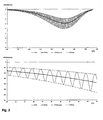
- the first simulation set contains no noise, the simulated modulated curves together with the average, top and bottom curves are shown in the figures 2 and 3 for the whole temperature range and for the temperature range between 85 and 95°C.
- Figures 2 and 3 show simulated DTG signals in %/min for the first-order reaction with a pre-exponential factor 1e10 s -1 , activation energy 100 kJ/mol and temperature amplitudes 5 and 20K, without noise. Curves are simulated periodic signal, average, top curve, bottom curve.
- the lower portions each show the data from the respective upper portion for a temperature range of particular interest, in the shown example from 85 to 95°C.
- the data for the temperature amplitudes 5K have the shape, visually close to the sinus. We can neglect the non-linear part of the amplitude and therefore assume that here the response is linear. But for the high temperature amplitude 20K the signal is definitely not sinus-shaped. For this amplitude the lower part of the signal for each period is very sharp, and the upper part is more wide and round. The average red curve is not in the middle between the top curve and bottom curve. Therefore the data with temperature amplitude 20K may not be considered as sinus-shaped. For the amplitude of 20K the top curve is very close to zero. It means that for the real experiment containing noise, the logarithm of it can produce the high error in results.
- the second simulated data set used in the verification test contains the noise of TG measurement.
- the second data set contains the simulations of the modulated reaction rate for the temperature amplitudes 5K and 20K, each with noise.
- the random conversion noise for the second set has amplitude of 2e-5. For the mass change of 5mg this noise corresponds to the 0.1 ⁇ g, which is about the real noise of thermogravimetric instruments.
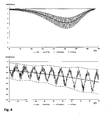
- Figures 4 and 5 show these simulated data for temperature amplitudes of 5K and 20K, with present noise amplitude of 2E-5, for the whole range (upper portion in the figures) and short range (lower portion in the figures).
- the top curve DTG top is sometimes above zero just because of the noise, and therefore the known standard method with use of the logarithm of ratio of reaction rates does not work here.
- Figure 7 shows activation energies Ea calculated by the standard method (E std ) and the new linear method (E) for the simulated curves with temperature amplitude 5K without noise, and with noise 2E-5.
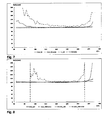
- Figure 6 shows a simulation of conversion: ⁇ 0 no oscillations (calculated by formula (1)); ⁇ 0_5K and ⁇ 0_20K - average for modulated signal calculated by formula (1) for temperature amplitudes 5K and 20K; ⁇ new - direct calculation of non-oscillation part of modulated signal, according to formula (18).
- Figure 8 shows the results of second iteration for the noise 2E-5 and amplitude 20K.
- 100 kJ/mol was used again as the value for the activation energy Ea, and therefore this value is expected also as the result after analysis.
- the noise plays big role for the standard calculation and produces correct results only for the short time range in the middle of reaction. But at the begin and at the end of reaction the calculated values of activation energy Ea are very far from the expected value of 100 kJ/mol. In contrast, the inventive method produces results for Ea of the same accuracy always for the wider range.
- the results of the current inventive method have always the better agreement with the value 100 kJ/mol, which was used for data simulation.
- the noise has a big influence on the results especially close the begin and the end of the measurement range, because the DTG signal is close to zero, and small noise causes the big changes in the logarithm value and therefore in the results of Ea.
- the noise has almost no influence on the results calculated by current method.
- the main advantage of this method is present for the amplitude 20K and high noise, where the top curve DTG top of DTG signal is positive (See e.g. Figure 5 .) and the ratio DTG top /DTG bottom is negative. This is for the temperatures before 95°C and after 147°C.
- the measurement was done on the measurement device NETZSCH STA449F3 having the modulated DSC functionality. Temperature amplitude 5K, underlying heating rate 1K/min, period 200s. The measured results for TG and DTG signal for the second step of decomposition of CaOx monohydrate are shown in the Figure 9 .
- Figure 10 shows evaluated thermogravimetric data.
- the activation energy Ea from the current method is 210 kJ/mol, from the standard method 450 kJ/mol. This is more than twice higher.
- the current method has lower and more horizontal curve portions for the activation energy Ea.
- the invention proposes a novel analysis method for modulated thermogravimetry measurement results.
- the method is mathematically based on the direct Fourier analysis and can calculate the activation energy signal for the modulated thermogravimetric measurement.
- the method produces correct results also for noisy measurements where standard calculation method fails.
Landscapes
- Chemical & Material Sciences (AREA)
- General Health & Medical Sciences (AREA)
- Physics & Mathematics (AREA)
- Health & Medical Sciences (AREA)
- Life Sciences & Earth Sciences (AREA)
- Analytical Chemistry (AREA)
- Biochemistry (AREA)
- General Physics & Mathematics (AREA)
- Immunology (AREA)
- Pathology (AREA)
- Chemical Kinetics & Catalysis (AREA)
- Combustion & Propulsion (AREA)
- Engineering & Computer Science (AREA)
- Investigating Or Analyzing Materials Using Thermal Means (AREA)
Description
- The present invention relates to modulated thermogravimetry, and in particular to a system (e.g. an apparatus) and a method for determining a kinetic parameter of a sample by means of modulated thermogravimetry.
- Analysis method of modulated thermogravimetry, also known as modulated-temperature thermogravimetry, was introduced by R.L. Blaine and B.K. Hahn, Obtaining Kinetic Parameters by modulated Thermogravimetry, Journal of Thermal Analysis, Vol. 54 (1998) 695-704. It is used now widely as the standard method of modulated thermogravimetric analysis. It is described e.g. in
Roger L. Blaine, US Patent 6,336,741 (2002 ). - Firstly, we will shortly put here the main idea of this standard method. The thermogravimetric measurements must be done under modulated temperature conditions, where the temperature is the sum of an underlying linear heating and temperature oscillations. The amplitude of the temperature oscillations is usually from 5K to 10K, what is much higher than for modulated DSC (cf. e.g.
M. Reading, B. K. Hahn and B. S. Crow, US Patent 5,224,775 (1993 )), where the typical temperature amplitude is about 0.5K. Period is usually from 60 to 300s, underlying heating rate is usually from 1 to 20K/min. - The main kinetic equation is

wherein α is the degree of conversion, t is the time, Z is the pre-exponential factor, Ea is the activation energy, R is the gas constant, and T is the (absolute) temperature. - A list of these and other notations used in this description can be found at the end of the description.
- If equation (1) is written twice for the same chemical process but for different conversion values α1 and α2 and correspondent temperatures T1 and T2 then the following equations for each reaction rate can be written:


- Then the equations are divided by each other and the logarithm is taken:

- From this expression the activation energy can be found:

- The so-called DTG signal, calculated as the first derivative from the thermogravimetric signal (weight change signal), has oscillations for modulated measurements. Then it is possible to draw two additional curves: A top curve DTGtop through the peak points of modulated signal DTG, and a bottom curve DTGbottom through the valleys having correspondent values of reaction rates dα2/dt and dα1/dt. If A is the temperature amplitude and T0 is the underlying linear temperature, then
- T1= T0+A, T2= T0-A, α1=α2, f(α1)=f(α2), and final expression for activation energy is:

where the term ln(dα1/dα2) refers to the logarithm of the ratio of minimum and maximum reaction rates. More specifically, it is the amplitude of the logarithm of the first derivative of the thermogravimetric signal indicative of the weight of the sample under investigation at the particular temperature, T. Usually the published curves of activation energy, calculated by this standard method, have minimum point at the highest reaction rate and very high values of activation energy at the beginning and at the end of the reaction (cf. R.L. Blaine and B.K. Hahn, Obtaining Kinetic Parameters by modulated Thermogravimetry, Journal of Thermal Analysis, Vol. 54 (1998) 695-704; and Kun Cheng, William T. Winter, Arthur J. Stipanovic, A modulated-TGA approach to the kinetics of lignocellulosic biomass pyrolysis/combustion, Polymer Degradation and Stability Volume 97, Issue 9, September 2012, Pages 1606-1615). Sometimes these values exceed 1000 kJ/mol for polymers (cf. R.L. Blaine and B.K. Hahn, Obtaining Kinetic Parameters by modulated Thermogravimetry, Journal of Thermal Analysis, Vol. 54 (1998) 695-704), and therefore can not be considered as the activation energy in chemical sense, but rather as the numerical problems at the slow reaction rate. We can see from the above formula (6), that for very slow reaction rate where dα1 is about zero, the calculation of logarithm produces very high uncertainty because the logarithm function changes very fast near zero. Therefore any measurement noise for the almost-zero-signal produces very high error in the activation energy. - A system for determining a kinetic parameter of a sample according to the preamble of
claim 1 and a corresponding method for determining a kinetic parameter of a sample according to the preamble ofclaim 8 is known from the above mentioned publication R.L. Blaine and B.K. Hahn, Obtaining Kinetic Parameters by modulated Thermogravimetry, Journal of Thermal Analysis, Vol. 54 (1998) 695-704, and also from thepublications EP 0 559 362 A1 andEP 0 930 500 A1 - Problems in prior art algorithm:
- 1. The method needs reaction rates a, which are not too close to zero, otherwise the logarithm of ratio, can not be found, because at zero the logarithm function goes to negative infinity.
- 2. The method needs the top curve DTGtop and bottom curve DTGbottom having the same sign to have positive ratio for logarithm calculation. In reality it is not always the case.
- 3. The positions of the top curve and bottom curve depend of the noise, and therefore noise has big influence on the results.
- If the measured data contain noise, then it is very hard to define correct the position of the top curve DTGtop and bottom curve DTGbottom. For the unsmoothed data both positions depend on the noise amplitude. But the smoothing of the noise for the signal of unknown shape may distort the shape and reduce the oscillation amplitude of the measured DTG signal. Therefore the smoothing may lead to the evaluation error. Additionally the positions of the top curve and bottom curve for this method can not be determined from the Fourier analysis of only main frequency, because the shape of reaction rate signal can be far from sinus.
- It is an object of the present invention, to provide an alternative way to conduct a modulated thermogravimetry, and in particular to determine at least one kinetic parameter, in particular the activation energy, where the above listed problems are not present.
- According to the invention, this object is solved by a system according to
claim 1 and a method according toclaim 8, respectively. The dependent claims are directed to advantageous embodiments and further developments of the invention. - The main idea of the present invention is to avoid the calculation of logarithm for determining the kinetic parameter, because the logarithmic calculation produces a high error for slow reaction rates with values about zero. In particular, calculation of the logarithmic term in Eq. 6, ln(dα1/dα2), is avoided according to the invention because such logarithmic terms introduce into the solution for Ea the aforementioned drawbacks. Therefore, the invention relates to apparatus and methods for calculating a kinetic parameter such as Ea from a modulated thermogravimetry experiment where a sample is subjected to a modulated temperature program, wherein determination avoids calculating the logarithm of a non-exponential function derived from the first derivative of the thermogravimetric signal. Note that In(e(f(x))) simply returns f(x) thus removing the logarithm from the calculation, which is why it is necessary to say that the foregoing method avoids calculating the logarithm of a non-exponential function as described here. It is to be understood that the terms "logarithm" and "non-exponential function" as used herein do not necessarily imply any particular basis, even though the base "e" is referred to above. For example, the term "logarithm" includes logarithms of any basis, including the natural logarithm where its base is "e," as well as logarithms of other bases such as 10, e.g. log10(x). Separately, the term "non-exponential function" means a function that is not an exponential, regardless whether the base of the function is the base of the natural logarithm, "e," as in e(x), or some other base such as 10, as in 10(x). The point is that according to the disclosed methods, determination of a kinetic parameter avoids calculation of logarithms derived from the thermogravimetric signal, whatever their base, because such terms introduce noise and other undesirable attributes into the calculated parameter.
- According to a first aspect of the present invention, a system for determining a kinetic parameter of a sample includes:
- an oven having a heater for heating the sample according to a modulated temperature program that has a temperature amplitude and a modulation period;
- means for detecting a thermogravimetric signal corresponding to a weight of the sample;
- means for determining a first derivative and amplitude of the first derivative of the thermogravimetric signal as the sample changes weight as a result of being heated according to the temperature program; and
- means for determining at least one kinetic parameter using the temperature, the temperature amplitude, the first derivative of the thermogravimetric signal and the amplitude of the first derivative of the thermogravimetric signal, characterized in that for the determination of the at least one kinetic parameter, the amplitude of the first derivative of said thermogravimetric signal ist found by making a Fourier analysis of the first derivative of said thermogravimetric signal at the modulation frequency.
- Thus, this system can determine the kinetic parameter without using a logarithm of a non-exponential function derived from the first derivative of the thermogravimetric signal.
- According to another aspect of the invention, a method for determining a kinetic parameter of a sample includes the steps of:
- heating the sample according to a modulated temperature program having a temperature amplitude and a modulation period;
- detecting a thermogravimetric signal corresponding to a weight fo the sample;
- determining a first derivative of the thermogravimetric signal, as well as an amplitude of the the first derivative of the thermogravimetric signal, as the sample changes weight in response to being heated according to the temperature program; and
- determining at least one kinetic parameter using the temperature, the temperature amplitude, rate first derivative of the thermogravimetric signal and the amplitude of the first derivative of the thermogravimetric signal, characterized in that for the determination of the at least one kinetic parameter, the amplitude of the first derivative of said thermogravimetric signal ist found by making a Fourier analysis of the first derivative of said thermogravimetric signal at the modulation frequency.
- Thus, this method can determine the kinetic parameter withoug using a logarithm of a non-exponential function derived from the first derivative of the thermogravimetric signal.
- According to a preferred embodiment of the invention, the temperature program is also characterized by an underlying heating rate.
- According to an embodiment, a first portion of the temperature program is characterized by an underlying heating rate and a second portion of the temperature program is characterized by quasi-isothermal operation.
- According to an embodiment, the heating of the sample is modified in accordance with the rate of weight change.
- Preferably, the kinetic parameter, or one of the kinetic parameters to be determined, is the activation energy (Ea).
-
- Fig. 1
- shows an example of an apparatus for thermogravimetric measurement, incorporating also analysis means for determining the activation energy.
- Fig. 2-5
- show a simulated DTG signals for different temperature amplitudes and different noise for the total and for the initial temperature ranges as the function of the underlying temperature.
- Fig. 6
- shows a simulation of conversion, i.e. a degree of conversion as the function of the underlying temperature.
- Fig. 7
- shows activation energies calculated by the known standard method (Estd) and a new linear method (E) according to an embodiment of the invention, for the simulated curves with
temperature amplitude 5K without noise, and with noise 2E-5. - Fig. 8
- shows activation energies calculated by the known standard method (Estd) and a new non-linear method (Enonlin) according to an embodiment of the invention, for the simulated curves with temperature amplitude 20K without noise, and with noise 2E-5.
- Fig. 9
- shows measured thermogravimetric data, i.e. a thermogravimetric signal (TG signal) and its first derivative (DTG signal).
- Fig. 10
- shows a result of the determination of the acticvation energyevaluated from the data of
Fig. 9 , according to the known standard method (Estd), and according to an embodiment of the invention (E). - In general, a thermogravimetric apparatus measures the weight change of a sample (TG signal and/or DTG signal) as the function of the time and/or temperature. It usually contains a measurement cell for the sample, an oven for the heating of this cell, a thermal balance for the registration of the sample weight change, a device to control the sample temperature, and a device for the measurement and registration of the sample temperature. Conventional means for measuring and tracking the both weight and the temperature of the sample as a function of time can be used. For example, a conventional balance or other known or suitable sensor can be used to measure the sample weight. Other Conventional contact or non-contact temperature-measurement methodologies for measuring temperature can be used.
- Usually the temperature program is given by the operator of the instrument and has a typical temperature range from -200°C to 1000°C and typical heating rates from 1 to 20K/min. Temperature program can contain several segments with linear or non-linear heating and cooling or isothermal conditions.
- The present invention concerns the analysis method for determination of a kinetic parameter as the activation energy for the situation, where the temperature program has an oscillating part. During the measurement the sample can change its weight because of different reasons: decomposition, evaporation, changing of magnetic properties etc. The weight change is registered by the thermal balance and the measured sample temperature is collected as the measured time-dependent signals (TG and/or DTG signal). These measured data can be passed directly to a computer for the presentation and analysis, or they can be stored in order to analyse them later by means of a dedicated analysing device of the system.
-
Fig. 1 shows a main structure of an example of a system for conducting a modulated thermogravimetry with determination of the activation energy Ea. - A
sample 1 is placed into a measuringcell 2. Thecell 2 is heated by afurnace 3, controlled by atemperature controller 7, which uses the measured sample temperature. The change of the weight is measured by athermal balance 4. The data of the temperature signal and weight signal are gathered by anelectronic device 5 and passed to apersonal computer 6. - In this example, the
computer 6 conducts the determination of the activation energy of thesample 1 according to the method of the invention, as more detailled described below. - The basis of the "direct analysis" method is to make a direct Fourier analysis of the DTG signal. Then it will be possible to find the activation energy Ea not from the hard-defined top and bottom envelope curves DTGtop and DTGbottom, but directly from the well-defined amplitude ADTG of the main frequency in the DTG signal, which is independent or only slightly dependent on noise.
- Let us substitute modulated temperature T=T0+A sin(ωt) into the above main equation (1), where To is the underlying linear temperature, A is the temperature amplitude, w is the temperature modulation frequency. For example, for a temperature amplitude of 5K and a temperature of 500K the ratio A/To is 1%, which can be considered as a "small parameter". The 3th term in series is 1E-6 and in most cases is under the instrument error in the thermogravimetric (TG) signal, which has the lowest value typically about 1E-5, corresponding to 0.1 µg for 10 mg mass change.
- Thus, the usual accuracy of TG measurement allows to create the series only up to the 3rd degree:


- We apply the Fourier analysis for formula (3) and get the Fourier series:

- The amplitude for the each frequency can be well-defined from experiment, even when noise is present. There are two different solutions: A simple case for linear response and an advanced solution for the non-linear response.
- For a small temperature amplitude A the response in the DTG signal is linear, and the shape of the DTG signal is very close to sinus. The corresponding equation contains only term S1, all next terms are non-linear regarding temperature amplitude A. Resulting equation is very simple:

- The non-oscillating part of the reaction rate can be calculated as the average over the modulation period. The average reaction rate here is exactly equal to the reaction rate from equation (1) for the measurement without modulation. The expression for non-oscillating part is described as

- It can be calculated at each point as the average over period. Amplitude of the reaction rate signal then can be written as the expression

- In the terms of thermogravimetry we write amplitude ADTG of DTG signal as the function of the absolute value from average DTG0:

- From formula (15) we can conclude in linear approximation: In the modulated thermogravimetric measurement the amplitude of DTG signal is proportional to the temperature amplitude A, average DTG0 value, and the current activation energy Ea of the process. We can introduce a normalized amplitude Anorm, calculated directly from the well-defined amplitude ADTG of the main frequency for DTG:

- With this substitution, the activation energy Ea can be expressed as:

- Thus, according to the present invention, the activation energy Ea can be determined on basis of above formula (17), i.e.: Ea = (R T0 2 ADTG) / (A |DTG0|). This formula can be advantageously applied for the situations where the shape of the modulated thermogravimetric signal is very close to the sinus. In the inventive system, the means for determining at least one kinetic parameter can be implemented as a computing means for conducting the calculation according to formula (17). Notably, formula (17) above does not involve or require calculation of the logarithm of any non-exponential function as discussed above.
- The average over the period for modulated reaction rate is described by the non-oscillating part from formula (11):

- The formula (18) shows that the average reaction rate for the modulated measurement is faster than the reaction rate without modulations. Average reaction rate increases non-linearly with the temperature amplitude, and the reaction finishes much earlier. The reason of such behaviour is the non-linearity of the reaction rate response on the temperature changes. For example, increasing of the temperature by 10K is empirically leads to an increase of reaction rate by two to four times, and the average reaction rate for periodically changing temperature signal will be higher than for non-periodic one. The decreasing of reaction temperature by 10K leads to the decreasing of reaction rate by the same factor. According to expression (18) we can conclude that the applying of the temperature modulation with the amplitude To increases the average reaction rate by the
factor 
- From the formula (11) we find the amplitude of the second harmonic of reaction rate:

and the non- oscillating reaction rate:
- The ratio of these two expressions is equal to S2/2. In another words, the applying of temperature modulation increases the average reaction by the
factor 
- In the terms of thermogravimetry this factor writes as

- From the equation (11) we can write the amplitude of reaction rate A dα/dt for the first harmonic

- The non-linear part shows that the amplitude of the first harmonic increases non-linearly with the temperature amplitude. Let us divide equation (22) by (18).

- From (8) the activation energy is found:

- It seen here that the for sinus-shaped DTG signal only linear part is important. The linear part of this formula is in agreement with (17). We put Ea from (24) iteratively into non-linear part of (24) and get the result with the accuracy of A2:

- Thus, according to the present invention, the activation energy can also be determined on basis of above formula (25). This formula can be advantageously applied for the situations where the shape of the modulated thermogravimetric signal is remarkably deviating from the ideal sinus shape. In the inventive system, the means for determining at least one kinetic parameter can be implemented as a computing means for conducting the calculation according to formula (25). Again, formulat (25) notably does not involve or require calculation of the logarithm of any non-exponential function as discussed above.
- For a verification test comparing the known and the inventive analysis methods, several simulated data sets are used. All simulations are done by direct integration of formula (1) for the first-order reaction with pre-exponential factor 1E10 s-1,
activation energy 100 kJ/mol, underlying heating rate 1 K/min,initial temperature 80°C,Period 60 seconds andtemperature amplitudes 5 and 20K. In the simulation we used 50 data points per period. - The first simulation set contains no noise, the simulated modulated curves together with the average, top and bottom curves are shown in the
figures 2 and3 for the whole temperature range and for the temperature range between 85 and 95°C. -
Figures 2 and3 show simulated DTG signals in %/min for the first-order reaction with a pre-exponential factor 1e10 s-1,activation energy 100 kJ/mol andtemperature amplitudes 5 and 20K, without noise. Curves are simulated periodic signal, average, top curve, bottom curve. - In
Figures 2 and3 , the lower portions each show the data from the respective upper portion for a temperature range of particular interest, in the shown example from 85 to 95°C. - The data for the
temperature amplitudes 5K have the shape, visually close to the sinus. We can neglect the non-linear part of the amplitude and therefore assume that here the response is linear. But for the high temperature amplitude 20K the signal is definitely not sinus-shaped. For this amplitude the lower part of the signal for each period is very sharp, and the upper part is more wide and round. The average red curve is not in the middle between the top curve and bottom curve. Therefore the data with temperature amplitude 20K may not be considered as sinus-shaped. For the amplitude of 20K the top curve is very close to zero. It means that for the real experiment containing noise, the logarithm of it can produce the high error in results. - The second simulated data set used in the verification test contains the noise of TG measurement. Mathematically we add to each calculated conversion value from the first data set the random value (from 0 to 1), multiplied by the amplitude of conversion noise The second data set contains the simulations of the modulated reaction rate for the
temperature amplitudes 5K and 20K, each with noise. The random conversion noise for the second set has amplitude of 2e-5. For the mass change of 5mg this noise corresponds to the 0.1µg, which is about the real noise of thermogravimetric instruments. -
Figures 4 and5 show these simulated data for temperature amplitudes of 5K and 20K, with present noise amplitude of 2E-5, for the whole range (upper portion in the figures) and short range (lower portion in the figures).The top curve DTGtop is sometimes above zero just because of the noise, and therefore the known standard method with use of the logarithm of ratio of reaction rates does not work here. - We will apply the standard calculation of above formula (6) and the new analysis using formula (17) and formula (24) according to the invention to these data sets. If the formula (6) works well, then we expect that the resulting curves of activation energy Ea will be the constant of 100 kJ/mol for the whole reaction range. If the noise has some influence on the results, then we will see it in the deviation of the calculated activation energy from the
original value 100 kJ/mol. - Let us calculate activation energy Ea by the new method according to the formula (17) and compare with the standard calculations according to the formula(6). Formula (17) works only for the sinus-shaped signals, therefore can be applied for data with the temperature amplitude up to 5K (see e.g.
Figure 3 ). - Results of calculation for 5K for the standard method (Estd, calculated with formula (2)) and new linear method (E, calculated with formula (5)) are shown in the
Figure 7 . -
Figure 7 shows activation energies Ea calculated by the standard method (Estd) and the new linear method (E) for the simulated curves withtemperature amplitude 5K without noise, and with noise 2E-5. - For both amplitudes and both methods, we have everywhere good agreement between the activation energy for the data without noise and the
activation energy value 100 kJ/mol, used for the calculation. The influence of the noise on the error in activation energy for the new linear method is everywhere much lower, than for the standard method. For theamplitude 5K with noise the error of the new method is at least 4-5 times less than for the standard method. For noise 2e-5 the resulting curve according to the current method of formula (17) has range from 100 to 150°C with correct value of Ea (from 100 to 105 kJ/mol), whereas the standard calculation method produces incorrect results higher than 105 kJ/mol almost everywhere. - For verification of formula (18), we take modulated signal for temperature amplitudes 10K and 20K, and calculate average for it. The resulting curves are shown in the
Figure 6 with name α0. Additionally we calculate only non-oscillation part direct according to the formula (18) for both temperature amplitudes, and show resulting curves inFigure 6 with the names αnew. - Thus,
Figure 6 shows a simulation of conversion: α0 no oscillations (calculated by formula (1)); α0_5K and α0_20K - average for modulated signal calculated by formula (1) fortemperature amplitudes 5K and 20K; αnew - direct calculation of non-oscillation part of modulated signal, according to formula (18). - We have the perfect agreement between α0 and αnew for both temperature amplitudes. The curve α0 shows the conversion for the reaction without modulation in order to see the difference between this curve and conversion curve for modulated reactions.
-
Figure 8 shows the results of second iteration for the noise 2E-5 and amplitude 20K. For the simulation, 100 kJ/mol was used again as the value for the activation energy Ea, and therefore this value is expected also as the result after analysis. - Thus,
Figure 8 shows activation energies Ea calculated by the known standard method (Estd) and the current inventive non-linear method (Enonlin) for the previously simulated DTG curves with temperature amplitude A = 20K without noise, and with noise 2E-5. - For the data without noise both methods produce correct results for each of the two temperature amplitudes used in the verification test. Only for the temperature amplitude 20K there is the light problem for the calculation of the activation energy Ea, especially at the end of the reaction, where the top curve DTGtop is very close to zero.
- For the both amplitudes the noise plays big role for the standard calculation and produces correct results only for the short time range in the middle of reaction. But at the begin and at the end of reaction the calculated values of activation energy Ea are very far from the expected value of 100 kJ/mol. In contrast, the inventive method produces results for Ea of the same accuracy always for the wider range.
- In the standard method the errors are independent on the temperature amplitude A. In the inventive method, however, the errors reduces with the temperature amplitude A. For the high noise we have the best results calculated by the inventive method for temperature amplitude of A = 20K.
- The results of the current inventive method have always the better agreement with the
value 100 kJ/mol, which was used for data simulation. For the very high temperature amplitude of 20K the noise has a big influence on the results especially close the begin and the end of the measurement range, because the DTG signal is close to zero, and small noise causes the big changes in the logarithm value and therefore in the results of Ea. The noise has almost no influence on the results calculated by current method. - The main advantage of this method is present for the amplitude 20K and high noise, where the top curve DTGtop of DTG signal is positive (See e.g.
Figure 5 .) and the ratio DTGtop/DTGbottom is negative. This is for the temperatures before 95°C and after 147°C. - The known standard method using formula (2) with the logarithm calculation of this ratio can not be applied here, because the logarithm of the negative values is not defined. But the current method is advantageously able to calculate activation energy Ea also for these ranges, and the resulting value of Ea almost for the whole reaction range (in the shown example ranging from 80 to 150°C) is very close to constant and has values from 100 kJ/mol to 110 kJ/mol.
-
- 1. Method calculates correct activation energy Ea also for noisy modulated DTG curves.
- 2. The influence of the noise on the results in current method is much lower than in the known standard method.
- 3. Current method can calculate activation energy also for the situations, where top and bottom curves DTGtop and DTGbottom have opposite signs and thus the standard method fails.
- 4. The amplitude ADTG for the main frequency, used for calculation, can be well-defined from experiment by discrete Fourier analysis even when noise is present.
- The measurement was done on the measurement device NETZSCH STA449F3 having the modulated DSC functionality.
Temperature amplitude 5K, underlying heating rate 1K/min, period 200s. The measured results for TG and DTG signal for the second step of decomposition of CaOx monohydrate are shown in theFigure 9 . -
Figure 9 shows this measured thermogravimetric data. - The calculations for evaluating the measurement result of
Figure 9 are done manually by the known standard and the current inventive method using formula (14). -
Figure 10 shows evaluated thermogravimetric data. At T=473°C the activation energy Ea from the current method is 210 kJ/mol, from thestandard method 450 kJ/mol. This is more than twice higher. Furthermore, the current method has lower and more horizontal curve portions for the activation energy Ea. The common point is at T=455°C with activation energy 202 kJ/mol. This corresponds to the literature values. - Further features and advantages of the system and method according to the invention
- 1. In linear approximation the amplitude ADTG of the derivative of modulated TG signal is proportional to its non-oscillation part DTG0, to the temperature amplitude A, and to the current activation energy Ea of the process.
- 2. The average reaction rate for the modulated measurement is faster than the reaction rate without modulations, the modulation increases the average reaction by the factor (1+A2DTG/|DTG0|), depending on the amplitude of the second harmonic of DTG signal.
- 3. The method is proposed, where the activation energy Ea can be found directly from the main amplitude ADTG or Anorm, respectively, of the modulated DTG signal.
- 4. Proposed method can calculate activation energy Ea in particular for noisy measurement result curves, with better accuracy than the standard method.
- 5. Proposed method can calculate activation energy Ea in particular for situations, where top and bottom curves DTGtop and DTGbottom have opposite signs and the standard method fails.
- In summary, the invention proposes a novel analysis method for modulated thermogravimetry measurement results. The method is mathematically based on the direct Fourier analysis and can calculate the activation energy signal for the modulated thermogravimetric measurement. The method produces correct results also for noisy measurements where standard calculation method fails.
-
- A
- temperature amplitude
- A2
- Amplitude of the second harmonic for reaction rate
- ADTG
- Amplitude of DTG; amplitude of the rate of weight change
- A2DTG
- Amplitude of the second harmonic for DTG
- Anorm
- normalized amplitude of DTG
- DTG
- first derivative from thermogravimetric signal; rate of weight change
- DTG0
- averaged DTG
- |DTG0|
- absolute value of DTG0
- DTGtop
- top curve through the maximum points of modulated signal
- DTGbottom
- bottom curve through the valleys of modulated signal
- Ea
- activation energy
- T
- absolute temperature, K
- T0
- absolute underlying temperature, K
- Ti
- absolute temperature of the state i, K
- R
- gas constant
- t
- time
- f(α)
- Function of reaction type
- S1,S2,S3
- series coefficients
- Z
- Pre-exponential factor
- α
- Degree of conversion
- αi
- Degree of conversion of the state i
- αnew
- non-oscillating part of reaction rate for modulated signal calculated by Eq.18
- ω
- Modulation frequency
- Subindex
- 0
- non-oscillation part of the signal
Claims (14)
- A system for determining a kinetic parameter of a sample (1), comprising:an oven (3) having a heater for heating the sample (1) according to a modulated temperature program, said modulated temperature program having a temperature amplitude (A) and a modulation period;means (4) for detecting a thermogravimetric signal corresponding to a weight of said sample (1);means (5) for determining a first derivative (DTG) and amplitude (ADTG) of the first derivative (DTG) of said thermogravimetric signal as said sample (1) changes weight as a result of being heated according to said temperature program; andmeans (6) for determining at least one kinetic parameter (Ea) using the temperature (T0), the temperature amplitude (A), the first derivative (DTG) of said thermogravimetric signal and the amplitude (ADTG) of the first derivative (DTG) of said thermogravimetric signal,characterized in that for the determination of the at least one kinetic parameter (Ea), the amplitude (ADTG) of the first derivative (DTG) of said thermogravimetric signal is found by making a Fourier analysis of the first derivative (DTG) of said thermogravimetric signal at the modulation frequency (w).
- The system recited in claim 1, wherein the temperature program also has an underlying heating rate.
- The system recited in claim 1, wherein a first portion of the temperature program has an underlying heating rate and a second portion of the temperature program exhibits quasi-isothermal operation.
- The system recited in claim 1, further comprising means for modifying the heating of the sample (1) in accordance with the first derivative (DTG) of said thermogravimetric signal.
- The system recited in claim 1, wherein the kinetic parameter (Ea) is the activation energy.
- The system recited in claim 5, wherein the activation energy is determined by the following formula:

whereinEa is the activation energy,R is the gas constant,T0 is the absolute underlying temperature,ADTG is the amplitude (ADTG) of the first derivative (DTG) of the thermogravimetric signal,A is the temperature amplitude (A) of the modulated temperature program, andDTG0 is an average of the first derivative (DTG) of the thermogravimetric signal over the modulation period. - The system recited in claim 5, wherein the activation energy is determined by the following formula:

whereinEa is the activation energy,R is the gas constant,T0 is the absolute underlying temperature,A is the temperature amplitude (A) of the modulated temperature program, and
whereinADTG is the amplitude of the first derivative (DTG) of the thermogravimetric signal,DTG0 is an average of the first derivative (DTG) of the thermogravimetric signal over the modulation period. - A method for determining a kinetic parameter (Ea) of a sample (1), comprising the steps of:heating the sample (1) according to a modulated temperature program, said modulated temperature program having a temperature amplitude (A) and a modulation period;detecting a thermogravimetric signal corresponding to a weight of said sample (1);determining a first derivative of said thermogravimetric signal, as well as an amplitude of said first derivative (DTG) of said thermogravimetric signal, as said sample (1) changes weight in response to being heated according to said temperature program; anddetermining at least one kinetic parameter (Ea) using the temperature (T0), the temperature amplitude (A), the first derivative (DTG) of said thermogravimetric signal and the amplitude (ADTG) of the first derivative (DTG) of said thermogravimetric signal,characterized in that for the determination of the at least one kinetic parameter (Ea), the amplitude (ADTG) of the first derivative (DTG) of said thermogravimetric signal is found by making a Fourier analysis of the first derivative (DTG) of said thermogravimetric signal at the modulation frequency (w).
- The method recited in claim 8, wherein the temperature program also has an underlying heating rate.
- The method recited in claim 8, wherein a first portion of the temperature program has an underlying heating rate and a second portion of the temperature program exhibits quasi-isothermal operation.
- The method recited in claim 8, further comprising the step of modifying the heating of the sample (1) in accordance with the first derivative (DTG) of said thermogravimetric signal.
- The method recited in claim 8, wherein the kinetic parameter (Ea) is the activation energy.
- The method recited in claim 12, wherein the activation energy is determined by the following formula:

whereinEa is the activation energy,R is the gas constant,T0 is the absolute underlying temperature,ADTG is the amplitude (ADTG) of the first derivative of the thermogravimetric signal,A is the temperature amplitude (A) of the modulated temperature program, andDTG0 is an average of the first derivative (DTG) of the thermogravimetric signal over the modulation period. - The method recited in claim 12, wherein the activation energy is determined by the following formula:

whereinEa is the activation energy,R is the gas constant,T0 is the absolute underlying temperature,A is the temperature amplitude (A) of the modulated temperature program, and
whereinADTG is the amplitude (ADTG) of the first derivative (DTG) of the thermogravimetric signal, andDTG0 is an average of the first derivative (DTG) of the thermogravimetric signal over the modulation period.
Applications Claiming Priority (1)
| Application Number | Priority Date | Filing Date | Title |
|---|---|---|---|
| US14/026,741 US9389194B2 (en) | 2013-09-13 | 2013-09-13 | System and method for analysis in modulated thermogravimetry |
Publications (2)
| Publication Number | Publication Date |
|---|---|
| EP2848926A1 EP2848926A1 (en) | 2015-03-18 |
| EP2848926B1 true EP2848926B1 (en) | 2015-12-23 |
Family
ID=51453559
Family Applications (1)
| Application Number | Title | Priority Date | Filing Date |
|---|---|---|---|
| EP14003002.4A Active EP2848926B1 (en) | 2013-09-13 | 2014-08-30 | System and method for analysis in modulated thermogravimetry |
Country Status (4)
| Country | Link |
|---|---|
| US (1) | US9389194B2 (en) |
| EP (1) | EP2848926B1 (en) |
| JP (1) | JP5953348B2 (en) |
| CN (1) | CN104458478B (en) |
Families Citing this family (5)
| Publication number | Priority date | Publication date | Assignee | Title |
|---|---|---|---|---|
| EP3317638B1 (en) * | 2015-07-02 | 2019-09-18 | Knauf Gips KG | Apparatus for simultaneously and continuously determining a change in length and a change in weight of heated samples and method therefore |
| CN111044405B (en) * | 2020-01-02 | 2022-06-28 | 西安建筑科技大学 | A Correction Method for Drift Error of Thermogravimetric Curve |
| CN114609176B (en) * | 2020-12-04 | 2024-09-27 | 中国科学院工程热物理研究所 | Detection and analysis method of critical characteristic temperature of reaction based on thermodynamic characteristics |
| CN113447389B (en) * | 2021-06-18 | 2024-04-05 | 营口理工学院 | Method for determining activation energy of carbon steel solidification process by nonlinear equal conversion rate method |
| CN116297013B (en) * | 2023-05-19 | 2023-09-26 | 卡松科技股份有限公司 | A method and system for monitoring hydraulic oil viscosity fluctuations |
Family Cites Families (21)
| Publication number | Priority date | Publication date | Assignee | Title |
|---|---|---|---|---|
| JPS6153556A (en) * | 1984-08-22 | 1986-03-17 | Mitsubishi Electric Corp | Thermogravimetric analyzer |
| SU1377698A1 (en) * | 1985-03-30 | 1988-02-28 | Азербайджанский политехнический институт им.Ч.Ильдрыма | Thermogravimetric moisture meter |
| US4914297A (en) * | 1987-12-23 | 1990-04-03 | Nicolet Instrument Corporation | Infrared spectrometer interface for thermogravimetric analysis |
| JP2760104B2 (en) * | 1989-11-30 | 1998-05-28 | 株式会社島津製作所 | Thermogravimetric analysis of solid samples |
| US5224775C2 (en) * | 1992-03-02 | 2002-04-23 | Ta Instr Inc | Method and apparatus for modulated differential analysis |
| JP2909950B2 (en) * | 1993-09-24 | 1999-06-23 | セイコーインスツルメンツ株式会社 | Thermal analyzer |
| US6113261A (en) | 1997-06-27 | 2000-09-05 | Ta Instruments, Inc. | Method and apparatus of modulated-temperature thermogravimetry |
| JP3370581B2 (en) * | 1997-11-28 | 2003-01-27 | セイコーインスツルメンツ株式会社 | High-speed thermal analyzer |
| JP3370592B2 (en) | 1998-01-19 | 2003-01-27 | セイコーインスツルメンツ株式会社 | Differential thermal analyzer |
| US6007240A (en) * | 1998-04-14 | 1999-12-28 | Ta Instruments, Inc. | Method and apparatus for modulated-temperature thermomechanical analysis |
| EP1132733B1 (en) * | 2000-02-03 | 2005-12-14 | Mettler-Toledo GmbH | Modulation method and apparatus for thermally analyzing a material |
| US6497509B2 (en) * | 2000-06-08 | 2002-12-24 | Perkinelmer Instruments Llc | Method for measuring absolute value of thermal conductivity |
| US20030007542A1 (en) * | 2001-06-22 | 2003-01-09 | Thermo Cahn Corporation | Thermogravimetric analyzer |
| JP3798673B2 (en) * | 2001-10-23 | 2006-07-19 | エスアイアイ・ナノテクノロジー株式会社 | Thermogravimetry equipment |
| US7223603B2 (en) * | 2002-05-10 | 2007-05-29 | University Of Wyoming Research Corporation | Continuous on-line process control of residua distillation |
| FR2850460B1 (en) * | 2003-01-23 | 2005-12-30 | Toulouse Inst Nat Polytech | DEVICE AND METHOD FOR THERMOGRAVIMETRY TESTING |
| US20050025212A1 (en) * | 2003-08-01 | 2005-02-03 | Carter Malika Dothresa | Standards for the calibration of a vacuum thermogravimetric analyzer for determination of vapor pressures of compounds |
| US7416328B2 (en) * | 2004-12-28 | 2008-08-26 | Waters Investments Limited | System and method for a thermogravimetric analyzer having improved dynamic weight baseline |
| WO2006072261A1 (en) * | 2005-01-04 | 2006-07-13 | Mettler-Toledo Ag | Method and device for analyzing substances |
| DE102007058390B4 (en) * | 2007-12-03 | 2009-10-01 | Sartorius Ag | Device for thermogravimetric material moisture determination |
| RU2469299C1 (en) * | 2011-09-02 | 2012-12-10 | Открытое акционерное общество "Корпорация "Росхимзащита" (ОАО "Корпорация "Росхимзащита") | Method of determining desorption activation energy |
-
2013
- 2013-09-13 US US14/026,741 patent/US9389194B2/en active Active
-
2014
- 2014-08-30 EP EP14003002.4A patent/EP2848926B1/en active Active
- 2014-09-08 JP JP2014182402A patent/JP5953348B2/en active Active
- 2014-09-15 CN CN201410469694.3A patent/CN104458478B/en active Active
Also Published As
| Publication number | Publication date |
|---|---|
| US9389194B2 (en) | 2016-07-12 |
| CN104458478B (en) | 2017-03-22 |
| US20150078415A1 (en) | 2015-03-19 |
| EP2848926A1 (en) | 2015-03-18 |
| JP2015055628A (en) | 2015-03-23 |
| CN104458478A (en) | 2015-03-25 |
| JP5953348B2 (en) | 2016-07-20 |
Similar Documents
| Publication | Publication Date | Title |
|---|---|---|
| Brown | Introduction to thermal analysis: techniques and applications | |
| Motra et al. | Assessment of strain measurement techniques to characterise mechanical properties of structural steel | |
| EP2848926A1 (en) | System and method for analysis in modulated thermogravimetry | |
| CN105092405A (en) | Temperature modulated thermogravimetric analysis | |
| CN106680137B (en) | A method of evaluation cigarette measurement of water ratio uncertainty | |
| RU2623827C1 (en) | Method of explosive transformation parameter determination | |
| Baral et al. | Theoretical and experimental analysis of indentation relaxation test | |
| WO2022241866A1 (en) | Method for measuring dynamic specific heat capacity of adiabatic reaction on basis of compensation power modulation | |
| Lee et al. | An innovative way to measure fatigue crack growth without COD gauge | |
| Moukhina | Direct analysis in modulated thermogravimetry | |
| US20060256836A1 (en) | Method and device for a thermoanalytical material analysis | |
| Ehrensberger et al. | A time‐based potential step analysis of electrochemical impedance incorporating a constant phase element: A study of commercially pure titanium in phosphate buffered saline | |
| da Silva et al. | Evaluation and validation of detailed and simplified models of the uncertainty of unified pHabsH2O measurements in aqueous solutions | |
| Cao et al. | Uncertainty Model of Viscosity Properties in Polymer Adhesives Based on Interval Process | |
| CN108896511A (en) | A kind of intelligent method for repairing the deformation of spectroanalysis instrument spectrogram | |
| RU2627552C1 (en) | Thermo-analytical method of determination of activation energy of polymer material thermodestruction | |
| Rentería-Baltiérrez et al. | Distribution of retardation times in polymer films: insights from a dielectric fractional model | |
| Bartels et al. | Robust SHM Systems Using Bayesian Model Updating | |
| Sbirrazzuoli et al. | Electronic solution to the problem of a kinetic standard for DSC measurements | |
| CN120445916B (en) | Performance detection method, device, system, terminal equipment and storage medium for non-Newtonian fluid | |
| CN120295102B (en) | A food baking processing control system and method | |
| RU2842905C1 (en) | Metal samples mechanical characteristics prediction method by yield strength and empirical hardness values correlation link | |
| KR100440306B1 (en) | tester of dent stiffness for car body panel | |
| Farkhadov et al. | Neural network model and software for an information system to intelligently analyze gas quality | |
| Baudendistel et al. | Data acquisition uncertainty |
Legal Events
| Date | Code | Title | Description |
|---|---|---|---|
| PUAI | Public reference made under article 153(3) epc to a published international application that has entered the european phase |
Free format text: ORIGINAL CODE: 0009012 |
|
| 17P | Request for examination filed |
Effective date: 20140830 |
|
| AK | Designated contracting states |
Kind code of ref document: A1 Designated state(s): AL AT BE BG CH CY CZ DE DK EE ES FI FR GB GR HR HU IE IS IT LI LT LU LV MC MK MT NL NO PL PT RO RS SE SI SK SM TR |
|
| AX | Request for extension of the european patent |
Extension state: BA ME |
|
| R17P | Request for examination filed (corrected) |
Effective date: 20150421 |
|
| RBV | Designated contracting states (corrected) |
Designated state(s): AL AT BE BG CH CY CZ DE DK EE ES FI FR GB GR HR HU IE IS IT LI LT LU LV MC MK MT NL NO PL PT RO RS SE SI SK SM TR |
|
| 17Q | First examination report despatched |
Effective date: 20150727 |
|
| GRAP | Despatch of communication of intention to grant a patent |
Free format text: ORIGINAL CODE: EPIDOSNIGR1 |
|
| INTG | Intention to grant announced |
Effective date: 20150917 |
|
| GRAS | Grant fee paid |
Free format text: ORIGINAL CODE: EPIDOSNIGR3 |
|
| GRAA | (expected) grant |
Free format text: ORIGINAL CODE: 0009210 |
|
| AK | Designated contracting states |
Kind code of ref document: B1 Designated state(s): AL AT BE BG CH CY CZ DE DK EE ES FI FR GB GR HR HU IE IS IT LI LT LU LV MC MK MT NL NO PL PT RO RS SE SI SK SM TR |
|
| REG | Reference to a national code |
Ref country code: GB Ref legal event code: FG4D |
|
| REG | Reference to a national code |
Ref country code: CH Ref legal event code: EP |
|
| REG | Reference to a national code |
Ref country code: IE Ref legal event code: FG4D |
|
| REG | Reference to a national code |
Ref country code: AT Ref legal event code: REF Ref document number: 766763 Country of ref document: AT Kind code of ref document: T Effective date: 20160115 |
|
| REG | Reference to a national code |
Ref country code: DE Ref legal event code: R096 Ref document number: 602014000570 Country of ref document: DE |
|
| REG | Reference to a national code |
Ref country code: CH Ref legal event code: NV Representative=s name: PATENTANWAELTE SCHAAD, BALASS, MENZL AND PARTN, CH |
|
| REG | Reference to a national code |
Ref country code: NL Ref legal event code: FP |
|
| REG | Reference to a national code |
Ref country code: LT Ref legal event code: MG4D |
|
| PG25 | Lapsed in a contracting state [announced via postgrant information from national office to epo] |
Ref country code: NO Free format text: LAPSE BECAUSE OF FAILURE TO SUBMIT A TRANSLATION OF THE DESCRIPTION OR TO PAY THE FEE WITHIN THE PRESCRIBED TIME-LIMIT Effective date: 20160323 Ref country code: HR Free format text: LAPSE BECAUSE OF FAILURE TO SUBMIT A TRANSLATION OF THE DESCRIPTION OR TO PAY THE FEE WITHIN THE PRESCRIBED TIME-LIMIT Effective date: 20151223 Ref country code: LT Free format text: LAPSE BECAUSE OF FAILURE TO SUBMIT A TRANSLATION OF THE DESCRIPTION OR TO PAY THE FEE WITHIN THE PRESCRIBED TIME-LIMIT Effective date: 20151223 |
|
| REG | Reference to a national code |
Ref country code: AT Ref legal event code: MK05 Ref document number: 766763 Country of ref document: AT Kind code of ref document: T Effective date: 20151223 |
|
| PG25 | Lapsed in a contracting state [announced via postgrant information from national office to epo] |
Ref country code: RS Free format text: LAPSE BECAUSE OF FAILURE TO SUBMIT A TRANSLATION OF THE DESCRIPTION OR TO PAY THE FEE WITHIN THE PRESCRIBED TIME-LIMIT Effective date: 20151223 Ref country code: SE Free format text: LAPSE BECAUSE OF FAILURE TO SUBMIT A TRANSLATION OF THE DESCRIPTION OR TO PAY THE FEE WITHIN THE PRESCRIBED TIME-LIMIT Effective date: 20151223 Ref country code: LV Free format text: LAPSE BECAUSE OF FAILURE TO SUBMIT A TRANSLATION OF THE DESCRIPTION OR TO PAY THE FEE WITHIN THE PRESCRIBED TIME-LIMIT Effective date: 20151223 Ref country code: FI Free format text: LAPSE BECAUSE OF FAILURE TO SUBMIT A TRANSLATION OF THE DESCRIPTION OR TO PAY THE FEE WITHIN THE PRESCRIBED TIME-LIMIT Effective date: 20151223 Ref country code: GR Free format text: LAPSE BECAUSE OF FAILURE TO SUBMIT A TRANSLATION OF THE DESCRIPTION OR TO PAY THE FEE WITHIN THE PRESCRIBED TIME-LIMIT Effective date: 20160324 |
|
| PG25 | Lapsed in a contracting state [announced via postgrant information from national office to epo] |
Ref country code: CZ Free format text: LAPSE BECAUSE OF FAILURE TO SUBMIT A TRANSLATION OF THE DESCRIPTION OR TO PAY THE FEE WITHIN THE PRESCRIBED TIME-LIMIT Effective date: 20151223 Ref country code: ES Free format text: LAPSE BECAUSE OF FAILURE TO SUBMIT A TRANSLATION OF THE DESCRIPTION OR TO PAY THE FEE WITHIN THE PRESCRIBED TIME-LIMIT Effective date: 20151223 |
|
| REG | Reference to a national code |
Ref country code: FR Ref legal event code: PLFP Year of fee payment: 3 |
|
| PG25 | Lapsed in a contracting state [announced via postgrant information from national office to epo] |
Ref country code: SK Free format text: LAPSE BECAUSE OF FAILURE TO SUBMIT A TRANSLATION OF THE DESCRIPTION OR TO PAY THE FEE WITHIN THE PRESCRIBED TIME-LIMIT Effective date: 20151223 Ref country code: SM Free format text: LAPSE BECAUSE OF FAILURE TO SUBMIT A TRANSLATION OF THE DESCRIPTION OR TO PAY THE FEE WITHIN THE PRESCRIBED TIME-LIMIT Effective date: 20151223 Ref country code: IS Free format text: LAPSE BECAUSE OF FAILURE TO SUBMIT A TRANSLATION OF THE DESCRIPTION OR TO PAY THE FEE WITHIN THE PRESCRIBED TIME-LIMIT Effective date: 20160423 Ref country code: PT Free format text: LAPSE BECAUSE OF FAILURE TO SUBMIT A TRANSLATION OF THE DESCRIPTION OR TO PAY THE FEE WITHIN THE PRESCRIBED TIME-LIMIT Effective date: 20160426 Ref country code: RO Free format text: LAPSE BECAUSE OF FAILURE TO SUBMIT A TRANSLATION OF THE DESCRIPTION OR TO PAY THE FEE WITHIN THE PRESCRIBED TIME-LIMIT Effective date: 20151223 Ref country code: AT Free format text: LAPSE BECAUSE OF FAILURE TO SUBMIT A TRANSLATION OF THE DESCRIPTION OR TO PAY THE FEE WITHIN THE PRESCRIBED TIME-LIMIT Effective date: 20151223 Ref country code: EE Free format text: LAPSE BECAUSE OF FAILURE TO SUBMIT A TRANSLATION OF THE DESCRIPTION OR TO PAY THE FEE WITHIN THE PRESCRIBED TIME-LIMIT Effective date: 20151223 Ref country code: PL Free format text: LAPSE BECAUSE OF FAILURE TO SUBMIT A TRANSLATION OF THE DESCRIPTION OR TO PAY THE FEE WITHIN THE PRESCRIBED TIME-LIMIT Effective date: 20151223 |
|
| REG | Reference to a national code |
Ref country code: DE Ref legal event code: R097 Ref document number: 602014000570 Country of ref document: DE |
|
| PLBE | No opposition filed within time limit |
Free format text: ORIGINAL CODE: 0009261 |
|
| STAA | Information on the status of an ep patent application or granted ep patent |
Free format text: STATUS: NO OPPOSITION FILED WITHIN TIME LIMIT |
|
| PG25 | Lapsed in a contracting state [announced via postgrant information from national office to epo] |
Ref country code: DK Free format text: LAPSE BECAUSE OF FAILURE TO SUBMIT A TRANSLATION OF THE DESCRIPTION OR TO PAY THE FEE WITHIN THE PRESCRIBED TIME-LIMIT Effective date: 20151223 |
|
| 26N | No opposition filed |
Effective date: 20160926 |
|
| PG25 | Lapsed in a contracting state [announced via postgrant information from national office to epo] |
Ref country code: BE Free format text: LAPSE BECAUSE OF FAILURE TO SUBMIT A TRANSLATION OF THE DESCRIPTION OR TO PAY THE FEE WITHIN THE PRESCRIBED TIME-LIMIT Effective date: 20151223 |
|
| PG25 | Lapsed in a contracting state [announced via postgrant information from national office to epo] |
Ref country code: SI Free format text: LAPSE BECAUSE OF FAILURE TO SUBMIT A TRANSLATION OF THE DESCRIPTION OR TO PAY THE FEE WITHIN THE PRESCRIBED TIME-LIMIT Effective date: 20151223 |
|
| PG25 | Lapsed in a contracting state [announced via postgrant information from national office to epo] |
Ref country code: MC Free format text: LAPSE BECAUSE OF FAILURE TO SUBMIT A TRANSLATION OF THE DESCRIPTION OR TO PAY THE FEE WITHIN THE PRESCRIBED TIME-LIMIT Effective date: 20151223 |
|
| REG | Reference to a national code |
Ref country code: IE Ref legal event code: MM4A |
|
| PG25 | Lapsed in a contracting state [announced via postgrant information from national office to epo] |
Ref country code: IE Free format text: LAPSE BECAUSE OF NON-PAYMENT OF DUE FEES Effective date: 20160830 |
|
| REG | Reference to a national code |
Ref country code: FR Ref legal event code: PLFP Year of fee payment: 4 |
|
| PG25 | Lapsed in a contracting state [announced via postgrant information from national office to epo] |
Ref country code: LU Free format text: LAPSE BECAUSE OF NON-PAYMENT OF DUE FEES Effective date: 20160830 |
|
| PG25 | Lapsed in a contracting state [announced via postgrant information from national office to epo] |
Ref country code: HU Free format text: LAPSE BECAUSE OF FAILURE TO SUBMIT A TRANSLATION OF THE DESCRIPTION OR TO PAY THE FEE WITHIN THE PRESCRIBED TIME-LIMIT; INVALID AB INITIO Effective date: 20140830 |
|
| PG25 | Lapsed in a contracting state [announced via postgrant information from national office to epo] |
Ref country code: MK Free format text: LAPSE BECAUSE OF FAILURE TO SUBMIT A TRANSLATION OF THE DESCRIPTION OR TO PAY THE FEE WITHIN THE PRESCRIBED TIME-LIMIT Effective date: 20151223 Ref country code: CY Free format text: LAPSE BECAUSE OF FAILURE TO SUBMIT A TRANSLATION OF THE DESCRIPTION OR TO PAY THE FEE WITHIN THE PRESCRIBED TIME-LIMIT Effective date: 20151223 Ref country code: MT Free format text: LAPSE BECAUSE OF NON-PAYMENT OF DUE FEES Effective date: 20160831 |
|
| PG25 | Lapsed in a contracting state [announced via postgrant information from national office to epo] |
Ref country code: BG Free format text: LAPSE BECAUSE OF FAILURE TO SUBMIT A TRANSLATION OF THE DESCRIPTION OR TO PAY THE FEE WITHIN THE PRESCRIBED TIME-LIMIT Effective date: 20151223 |
|
| REG | Reference to a national code |
Ref country code: FR Ref legal event code: PLFP Year of fee payment: 5 |
|
| PG25 | Lapsed in a contracting state [announced via postgrant information from national office to epo] |
Ref country code: AL Free format text: LAPSE BECAUSE OF FAILURE TO SUBMIT A TRANSLATION OF THE DESCRIPTION OR TO PAY THE FEE WITHIN THE PRESCRIBED TIME-LIMIT Effective date: 20151223 Ref country code: TR Free format text: LAPSE BECAUSE OF FAILURE TO SUBMIT A TRANSLATION OF THE DESCRIPTION OR TO PAY THE FEE WITHIN THE PRESCRIBED TIME-LIMIT Effective date: 20151223 |
|
| PGFP | Annual fee paid to national office [announced via postgrant information from national office to epo] |
Ref country code: NL Payment date: 20240823 Year of fee payment: 11 |
|
| PGFP | Annual fee paid to national office [announced via postgrant information from national office to epo] |
Ref country code: GB Payment date: 20240822 Year of fee payment: 11 |
|
| PGFP | Annual fee paid to national office [announced via postgrant information from national office to epo] |
Ref country code: IT Payment date: 20240828 Year of fee payment: 11 |
|
| PGFP | Annual fee paid to national office [announced via postgrant information from national office to epo] |
Ref country code: DE Payment date: 20250828 Year of fee payment: 12 |
|
| PGFP | Annual fee paid to national office [announced via postgrant information from national office to epo] |
Ref country code: FR Payment date: 20250826 Year of fee payment: 12 |
|
| PGFP | Annual fee paid to national office [announced via postgrant information from national office to epo] |
Ref country code: CH Payment date: 20250901 Year of fee payment: 12 |
|
| REG | Reference to a national code |
Ref country code: NL Ref legal event code: MM Effective date: 20250901 |
|
| GBPC | Gb: european patent ceased through non-payment of renewal fee |
Effective date: 20250830 |