EP2848782A1 - Natural gas engine aftertreatment system - Google Patents
Natural gas engine aftertreatment system Download PDFInfo
- Publication number
- EP2848782A1 EP2848782A1 EP20140184950 EP14184950A EP2848782A1 EP 2848782 A1 EP2848782 A1 EP 2848782A1 EP 20140184950 EP20140184950 EP 20140184950 EP 14184950 A EP14184950 A EP 14184950A EP 2848782 A1 EP2848782 A1 EP 2848782A1
- Authority
- EP
- European Patent Office
- Prior art keywords
- temperature
- oxidation catalyst
- engine
- vehicle
- back pressure
- Prior art date
- Legal status (The legal status is an assumption and is not a legal conclusion. Google has not performed a legal analysis and makes no representation as to the accuracy of the status listed.)
- Withdrawn
Links
Images


Classifications
-
- F—MECHANICAL ENGINEERING; LIGHTING; HEATING; WEAPONS; BLASTING
- F01—MACHINES OR ENGINES IN GENERAL; ENGINE PLANTS IN GENERAL; STEAM ENGINES
- F01N—GAS-FLOW SILENCERS OR EXHAUST APPARATUS FOR MACHINES OR ENGINES IN GENERAL; GAS-FLOW SILENCERS OR EXHAUST APPARATUS FOR INTERNAL-COMBUSTION ENGINES
- F01N3/00—Exhaust or silencing apparatus having means for purifying, rendering innocuous, or otherwise treating exhaust
- F01N3/08—Exhaust or silencing apparatus having means for purifying, rendering innocuous, or otherwise treating exhaust for rendering innocuous
- F01N3/10—Exhaust or silencing apparatus having means for purifying, rendering innocuous, or otherwise treating exhaust for rendering innocuous by thermal or catalytic conversion of noxious components of exhaust
- F01N3/103—Oxidation catalysts for HC and CO only
-
- B—PERFORMING OPERATIONS; TRANSPORTING
- B01—PHYSICAL OR CHEMICAL PROCESSES OR APPARATUS IN GENERAL
- B01D—SEPARATION
- B01D53/00—Separation of gases or vapours; Recovering vapours of volatile solvents from gases; Chemical or biological purification of waste gases, e.g. engine exhaust gases, smoke, fumes, flue gases, aerosols
- B01D53/34—Chemical or biological purification of waste gases
- B01D53/92—Chemical or biological purification of waste gases of engine exhaust gases
- B01D53/94—Chemical or biological purification of waste gases of engine exhaust gases by catalytic processes
- B01D53/9481—Catalyst preceded by an adsorption device without catalytic function for temporary storage of contaminants, e.g. during cold start
- B01D53/9486—Catalyst preceded by an adsorption device without catalytic function for temporary storage of contaminants, e.g. during cold start for storing hydrocarbons
-
- F—MECHANICAL ENGINEERING; LIGHTING; HEATING; WEAPONS; BLASTING
- F01—MACHINES OR ENGINES IN GENERAL; ENGINE PLANTS IN GENERAL; STEAM ENGINES
- F01N—GAS-FLOW SILENCERS OR EXHAUST APPARATUS FOR MACHINES OR ENGINES IN GENERAL; GAS-FLOW SILENCERS OR EXHAUST APPARATUS FOR INTERNAL-COMBUSTION ENGINES
- F01N3/00—Exhaust or silencing apparatus having means for purifying, rendering innocuous, or otherwise treating exhaust
- F01N3/08—Exhaust or silencing apparatus having means for purifying, rendering innocuous, or otherwise treating exhaust for rendering innocuous
- F01N3/0807—Exhaust or silencing apparatus having means for purifying, rendering innocuous, or otherwise treating exhaust for rendering innocuous by using absorbents or adsorbents
- F01N3/0814—Exhaust or silencing apparatus having means for purifying, rendering innocuous, or otherwise treating exhaust for rendering innocuous by using absorbents or adsorbents combined with catalytic converters, e.g. NOx absorption/storage reduction catalysts
-
- F—MECHANICAL ENGINEERING; LIGHTING; HEATING; WEAPONS; BLASTING
- F01—MACHINES OR ENGINES IN GENERAL; ENGINE PLANTS IN GENERAL; STEAM ENGINES
- F01N—GAS-FLOW SILENCERS OR EXHAUST APPARATUS FOR MACHINES OR ENGINES IN GENERAL; GAS-FLOW SILENCERS OR EXHAUST APPARATUS FOR INTERNAL-COMBUSTION ENGINES
- F01N3/00—Exhaust or silencing apparatus having means for purifying, rendering innocuous, or otherwise treating exhaust
- F01N3/08—Exhaust or silencing apparatus having means for purifying, rendering innocuous, or otherwise treating exhaust for rendering innocuous
- F01N3/0807—Exhaust or silencing apparatus having means for purifying, rendering innocuous, or otherwise treating exhaust for rendering innocuous by using absorbents or adsorbents
- F01N3/0828—Exhaust or silencing apparatus having means for purifying, rendering innocuous, or otherwise treating exhaust for rendering innocuous by using absorbents or adsorbents characterised by the absorbed or adsorbed substances
- F01N3/0835—Hydrocarbons
-
- F—MECHANICAL ENGINEERING; LIGHTING; HEATING; WEAPONS; BLASTING
- F01—MACHINES OR ENGINES IN GENERAL; ENGINE PLANTS IN GENERAL; STEAM ENGINES
- F01N—GAS-FLOW SILENCERS OR EXHAUST APPARATUS FOR MACHINES OR ENGINES IN GENERAL; GAS-FLOW SILENCERS OR EXHAUST APPARATUS FOR INTERNAL-COMBUSTION ENGINES
- F01N3/00—Exhaust or silencing apparatus having means for purifying, rendering innocuous, or otherwise treating exhaust
- F01N3/08—Exhaust or silencing apparatus having means for purifying, rendering innocuous, or otherwise treating exhaust for rendering innocuous
- F01N3/10—Exhaust or silencing apparatus having means for purifying, rendering innocuous, or otherwise treating exhaust for rendering innocuous by thermal or catalytic conversion of noxious components of exhaust
- F01N3/18—Exhaust or silencing apparatus having means for purifying, rendering innocuous, or otherwise treating exhaust for rendering innocuous by thermal or catalytic conversion of noxious components of exhaust characterised by methods of operation; Control
- F01N3/20—Exhaust or silencing apparatus having means for purifying, rendering innocuous, or otherwise treating exhaust for rendering innocuous by thermal or catalytic conversion of noxious components of exhaust characterised by methods of operation; Control specially adapted for catalytic conversion
- F01N3/2006—Periodically heating or cooling catalytic reactors, e.g. at cold starting or overheating
-
- F—MECHANICAL ENGINEERING; LIGHTING; HEATING; WEAPONS; BLASTING
- F01—MACHINES OR ENGINES IN GENERAL; ENGINE PLANTS IN GENERAL; STEAM ENGINES
- F01N—GAS-FLOW SILENCERS OR EXHAUST APPARATUS FOR MACHINES OR ENGINES IN GENERAL; GAS-FLOW SILENCERS OR EXHAUST APPARATUS FOR INTERNAL-COMBUSTION ENGINES
- F01N9/00—Electrical control of exhaust gas treating apparatus
-
- F—MECHANICAL ENGINEERING; LIGHTING; HEATING; WEAPONS; BLASTING
- F01—MACHINES OR ENGINES IN GENERAL; ENGINE PLANTS IN GENERAL; STEAM ENGINES
- F01N—GAS-FLOW SILENCERS OR EXHAUST APPARATUS FOR MACHINES OR ENGINES IN GENERAL; GAS-FLOW SILENCERS OR EXHAUST APPARATUS FOR INTERNAL-COMBUSTION ENGINES
- F01N2240/00—Combination or association of two or more different exhaust treating devices, or of at least one such device with an auxiliary device, not covered by indexing codes F01N2230/00 or F01N2250/00, one of the devices being
- F01N2240/36—Combination or association of two or more different exhaust treating devices, or of at least one such device with an auxiliary device, not covered by indexing codes F01N2230/00 or F01N2250/00, one of the devices being an exhaust flap
-
- F—MECHANICAL ENGINEERING; LIGHTING; HEATING; WEAPONS; BLASTING
- F01—MACHINES OR ENGINES IN GENERAL; ENGINE PLANTS IN GENERAL; STEAM ENGINES
- F01N—GAS-FLOW SILENCERS OR EXHAUST APPARATUS FOR MACHINES OR ENGINES IN GENERAL; GAS-FLOW SILENCERS OR EXHAUST APPARATUS FOR INTERNAL-COMBUSTION ENGINES
- F01N2250/00—Combinations of different methods of purification
- F01N2250/12—Combinations of different methods of purification absorption or adsorption, and catalytic conversion
-
- F—MECHANICAL ENGINEERING; LIGHTING; HEATING; WEAPONS; BLASTING
- F01—MACHINES OR ENGINES IN GENERAL; ENGINE PLANTS IN GENERAL; STEAM ENGINES
- F01N—GAS-FLOW SILENCERS OR EXHAUST APPARATUS FOR MACHINES OR ENGINES IN GENERAL; GAS-FLOW SILENCERS OR EXHAUST APPARATUS FOR INTERNAL-COMBUSTION ENGINES
- F01N2260/00—Exhaust treating devices having provisions not otherwise provided for
- F01N2260/14—Exhaust treating devices having provisions not otherwise provided for for modifying or adapting flow area or back-pressure
-
- F—MECHANICAL ENGINEERING; LIGHTING; HEATING; WEAPONS; BLASTING
- F01—MACHINES OR ENGINES IN GENERAL; ENGINE PLANTS IN GENERAL; STEAM ENGINES
- F01N—GAS-FLOW SILENCERS OR EXHAUST APPARATUS FOR MACHINES OR ENGINES IN GENERAL; GAS-FLOW SILENCERS OR EXHAUST APPARATUS FOR INTERNAL-COMBUSTION ENGINES
- F01N2340/00—Dimensional characteristics of the exhaust system, e.g. length, diameter or volume of the exhaust apparatus; Spatial arrangements of exhaust apparatuses
- F01N2340/06—Arrangement of the exhaust apparatus relative to the turbine of a turbocharger
-
- F—MECHANICAL ENGINEERING; LIGHTING; HEATING; WEAPONS; BLASTING
- F01—MACHINES OR ENGINES IN GENERAL; ENGINE PLANTS IN GENERAL; STEAM ENGINES
- F01N—GAS-FLOW SILENCERS OR EXHAUST APPARATUS FOR MACHINES OR ENGINES IN GENERAL; GAS-FLOW SILENCERS OR EXHAUST APPARATUS FOR INTERNAL-COMBUSTION ENGINES
- F01N2370/00—Selection of materials for exhaust purification
- F01N2370/02—Selection of materials for exhaust purification used in catalytic reactors
- F01N2370/04—Zeolitic material
-
- F—MECHANICAL ENGINEERING; LIGHTING; HEATING; WEAPONS; BLASTING
- F01—MACHINES OR ENGINES IN GENERAL; ENGINE PLANTS IN GENERAL; STEAM ENGINES
- F01N—GAS-FLOW SILENCERS OR EXHAUST APPARATUS FOR MACHINES OR ENGINES IN GENERAL; GAS-FLOW SILENCERS OR EXHAUST APPARATUS FOR INTERNAL-COMBUSTION ENGINES
- F01N2570/00—Exhaust treating apparatus eliminating, absorbing or adsorbing specific elements or compounds
- F01N2570/12—Hydrocarbons
-
- F—MECHANICAL ENGINEERING; LIGHTING; HEATING; WEAPONS; BLASTING
- F01—MACHINES OR ENGINES IN GENERAL; ENGINE PLANTS IN GENERAL; STEAM ENGINES
- F01N—GAS-FLOW SILENCERS OR EXHAUST APPARATUS FOR MACHINES OR ENGINES IN GENERAL; GAS-FLOW SILENCERS OR EXHAUST APPARATUS FOR INTERNAL-COMBUSTION ENGINES
- F01N2900/00—Details of electrical control or of the monitoring of the exhaust gas treating apparatus
- F01N2900/06—Parameters used for exhaust control or diagnosing
- F01N2900/14—Parameters used for exhaust control or diagnosing said parameters being related to the exhaust gas
- F01N2900/1404—Exhaust gas temperature
-
- F—MECHANICAL ENGINEERING; LIGHTING; HEATING; WEAPONS; BLASTING
- F01—MACHINES OR ENGINES IN GENERAL; ENGINE PLANTS IN GENERAL; STEAM ENGINES
- F01N—GAS-FLOW SILENCERS OR EXHAUST APPARATUS FOR MACHINES OR ENGINES IN GENERAL; GAS-FLOW SILENCERS OR EXHAUST APPARATUS FOR INTERNAL-COMBUSTION ENGINES
- F01N2900/00—Details of electrical control or of the monitoring of the exhaust gas treating apparatus
- F01N2900/06—Parameters used for exhaust control or diagnosing
- F01N2900/14—Parameters used for exhaust control or diagnosing said parameters being related to the exhaust gas
- F01N2900/1406—Exhaust gas pressure
-
- F—MECHANICAL ENGINEERING; LIGHTING; HEATING; WEAPONS; BLASTING
- F01—MACHINES OR ENGINES IN GENERAL; ENGINE PLANTS IN GENERAL; STEAM ENGINES
- F01N—GAS-FLOW SILENCERS OR EXHAUST APPARATUS FOR MACHINES OR ENGINES IN GENERAL; GAS-FLOW SILENCERS OR EXHAUST APPARATUS FOR INTERNAL-COMBUSTION ENGINES
- F01N3/00—Exhaust or silencing apparatus having means for purifying, rendering innocuous, or otherwise treating exhaust
- F01N3/02—Exhaust or silencing apparatus having means for purifying, rendering innocuous, or otherwise treating exhaust for cooling, or for removing solid constituents of, exhaust
- F01N3/021—Exhaust or silencing apparatus having means for purifying, rendering innocuous, or otherwise treating exhaust for cooling, or for removing solid constituents of, exhaust by means of filters
- F01N3/033—Exhaust or silencing apparatus having means for purifying, rendering innocuous, or otherwise treating exhaust for cooling, or for removing solid constituents of, exhaust by means of filters in combination with other devices
- F01N3/035—Exhaust or silencing apparatus having means for purifying, rendering innocuous, or otherwise treating exhaust for cooling, or for removing solid constituents of, exhaust by means of filters in combination with other devices with catalytic reactors
-
- F—MECHANICAL ENGINEERING; LIGHTING; HEATING; WEAPONS; BLASTING
- F01—MACHINES OR ENGINES IN GENERAL; ENGINE PLANTS IN GENERAL; STEAM ENGINES
- F01N—GAS-FLOW SILENCERS OR EXHAUST APPARATUS FOR MACHINES OR ENGINES IN GENERAL; GAS-FLOW SILENCERS OR EXHAUST APPARATUS FOR INTERNAL-COMBUSTION ENGINES
- F01N3/00—Exhaust or silencing apparatus having means for purifying, rendering innocuous, or otherwise treating exhaust
- F01N3/08—Exhaust or silencing apparatus having means for purifying, rendering innocuous, or otherwise treating exhaust for rendering innocuous
- F01N3/10—Exhaust or silencing apparatus having means for purifying, rendering innocuous, or otherwise treating exhaust for rendering innocuous by thermal or catalytic conversion of noxious components of exhaust
- F01N3/101—Three-way catalysts
-
- F—MECHANICAL ENGINEERING; LIGHTING; HEATING; WEAPONS; BLASTING
- F01—MACHINES OR ENGINES IN GENERAL; ENGINE PLANTS IN GENERAL; STEAM ENGINES
- F01N—GAS-FLOW SILENCERS OR EXHAUST APPARATUS FOR MACHINES OR ENGINES IN GENERAL; GAS-FLOW SILENCERS OR EXHAUST APPARATUS FOR INTERNAL-COMBUSTION ENGINES
- F01N3/00—Exhaust or silencing apparatus having means for purifying, rendering innocuous, or otherwise treating exhaust
- F01N3/08—Exhaust or silencing apparatus having means for purifying, rendering innocuous, or otherwise treating exhaust for rendering innocuous
- F01N3/10—Exhaust or silencing apparatus having means for purifying, rendering innocuous, or otherwise treating exhaust for rendering innocuous by thermal or catalytic conversion of noxious components of exhaust
- F01N3/105—General auxiliary catalysts, e.g. upstream or downstream of the main catalyst
- F01N3/106—Auxiliary oxidation catalysts
-
- F—MECHANICAL ENGINEERING; LIGHTING; HEATING; WEAPONS; BLASTING
- F02—COMBUSTION ENGINES; HOT-GAS OR COMBUSTION-PRODUCT ENGINE PLANTS
- F02M—SUPPLYING COMBUSTION ENGINES IN GENERAL WITH COMBUSTIBLE MIXTURES OR CONSTITUENTS THEREOF
- F02M26/00—Engine-pertinent apparatus for adding exhaust gases to combustion-air, main fuel or fuel-air mixture, e.g. by exhaust gas recirculation [EGR] systems
- F02M26/02—EGR systems specially adapted for supercharged engines
- F02M26/04—EGR systems specially adapted for supercharged engines with a single turbocharger
- F02M26/05—High pressure loops, i.e. wherein recirculated exhaust gas is taken out from the exhaust system upstream of the turbine and reintroduced into the intake system downstream of the compressor
-
- F—MECHANICAL ENGINEERING; LIGHTING; HEATING; WEAPONS; BLASTING
- F02—COMBUSTION ENGINES; HOT-GAS OR COMBUSTION-PRODUCT ENGINE PLANTS
- F02M—SUPPLYING COMBUSTION ENGINES IN GENERAL WITH COMBUSTIBLE MIXTURES OR CONSTITUENTS THEREOF
- F02M26/00—Engine-pertinent apparatus for adding exhaust gases to combustion-air, main fuel or fuel-air mixture, e.g. by exhaust gas recirculation [EGR] systems
- F02M26/13—Arrangement or layout of EGR passages, e.g. in relation to specific engine parts or for incorporation of accessories
- F02M26/22—Arrangement or layout of EGR passages, e.g. in relation to specific engine parts or for incorporation of accessories with coolers in the recirculation passage
- F02M26/23—Layout, e.g. schematics
-
- Y—GENERAL TAGGING OF NEW TECHNOLOGICAL DEVELOPMENTS; GENERAL TAGGING OF CROSS-SECTIONAL TECHNOLOGIES SPANNING OVER SEVERAL SECTIONS OF THE IPC; TECHNICAL SUBJECTS COVERED BY FORMER USPC CROSS-REFERENCE ART COLLECTIONS [XRACs] AND DIGESTS
- Y02—TECHNOLOGIES OR APPLICATIONS FOR MITIGATION OR ADAPTATION AGAINST CLIMATE CHANGE
- Y02A—TECHNOLOGIES FOR ADAPTATION TO CLIMATE CHANGE
- Y02A50/00—TECHNOLOGIES FOR ADAPTATION TO CLIMATE CHANGE in human health protection, e.g. against extreme weather
- Y02A50/20—Air quality improvement or preservation, e.g. vehicle emission control or emission reduction by using catalytic converters
-
- Y—GENERAL TAGGING OF NEW TECHNOLOGICAL DEVELOPMENTS; GENERAL TAGGING OF CROSS-SECTIONAL TECHNOLOGIES SPANNING OVER SEVERAL SECTIONS OF THE IPC; TECHNICAL SUBJECTS COVERED BY FORMER USPC CROSS-REFERENCE ART COLLECTIONS [XRACs] AND DIGESTS
- Y02—TECHNOLOGIES OR APPLICATIONS FOR MITIGATION OR ADAPTATION AGAINST CLIMATE CHANGE
- Y02T—CLIMATE CHANGE MITIGATION TECHNOLOGIES RELATED TO TRANSPORTATION
- Y02T10/00—Road transport of goods or passengers
- Y02T10/10—Internal combustion engine [ICE] based vehicles
- Y02T10/12—Improving ICE efficiencies
-
- Y—GENERAL TAGGING OF NEW TECHNOLOGICAL DEVELOPMENTS; GENERAL TAGGING OF CROSS-SECTIONAL TECHNOLOGIES SPANNING OVER SEVERAL SECTIONS OF THE IPC; TECHNICAL SUBJECTS COVERED BY FORMER USPC CROSS-REFERENCE ART COLLECTIONS [XRACs] AND DIGESTS
- Y02—TECHNOLOGIES OR APPLICATIONS FOR MITIGATION OR ADAPTATION AGAINST CLIMATE CHANGE
- Y02T—CLIMATE CHANGE MITIGATION TECHNOLOGIES RELATED TO TRANSPORTATION
- Y02T10/00—Road transport of goods or passengers
- Y02T10/10—Internal combustion engine [ICE] based vehicles
- Y02T10/40—Engine management systems
Definitions
- on-highway engines are to be in compliance with new greenhouse gas regulations including, possibly for the first time, methane hydrocarbon emissions.
- Natural gas engines in particular, emit high amounts of methane (CH 4 ), which contribute to greenhouse gas emissions.
- CH 4 methane
- methane Some consider methane to have a global warming potential that is 25 times greater than carbon dioxide (CO 2 ).
- methane combustion/oxidation occurs at high temperatures (e.g., greater than approximately 350-450°C).
- PGM platinum group metals
- metal oxides containing catalysts are not active at low temperatures.
- Some embodiments relate to systems and methods of methane reduction in aftertreatment systems and, in particular, in aftertreatment systems in natural gas engines.
- Some embodiments provide that oxidation catalysts are introduced upstream of a turbocharger and downstream of an exhaust outtake of an engine block to provide high exhaust temperatures for use in oxidizing methane.
- methane is adsorbed at low temperatures using a catalytic substrate. At high temperatures, the adsorbed methane undergoes catalytic combustion.
- the catalyst can include, for example, non-PGM metal oxides dispersed on a zeolite substrate.
- the zeolite substrate can provide low temperature storage and oxides for combustion.
- Some embodiments provide that substrate material and catalyst combinations are contemplated that adsorb methane emissions at low temperatures and then releases oxidized methane at high temperatures that result in lowering methane hydrocarbon emission.
- Some embodiments provide an aftertreatment system for use in a vehicle that includes an oxidation catalyst disposed in an exhaust path between an engine block and a turbocharger.
- the oxidation catalyst is configured to store methane during a first temperature of a first portion of an operating engine cycle and to oxidize the stored methane during a second temperature of a second portion of the operating engine cycle in which the first temperature is less than the second temperature.
- Some embodiments provide a method of reducing methane emissions in a vehicle.
- An oxidation catalyst is provided in an exhaust path between an engine block and a turbocharger. Methane is stored during a first temperature. The stored methane is oxidized during a second temperature that is greater than the first temperature.
- a back pressure valve is provided to increase pressure in the exhaust path or to increase engine load. The temperature is increased from the first temperature to the second temperature by increasing, via the back pressure valve, the pressure or the engine load.
- Some embodiments provide for exhaust temperature management (e.g., at light load) by providing engine speed and higher back pressure to increase the engine load which, in turn, increases exhaust temperature.
- exhaust temperature management e.g., at light load
- Some embodiments relate to systems and methods of methane reduction in aftertreatment systems and, in particular, in aftertreatment systems in natural gas engines.
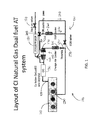
- FIG. 1 a layout of an embodiment of a compression-ignition (CI) natural gas engine aftertreatment system 100 is shown.
- the aftertreatment system 100 can be used, for example, with dual fuel engines (e.g., natural gas and diesel engines).
- a cylinder block 110 has an exhaust outtake 120 that is coupled to an oxidation catalyst (OC) 130.
- the OC 130 is then coupled to a turbocharger system 140 and to an exhaust gas recirculation (EGR) system 150.
- EGR exhaust gas recirculation
- the OC 130 can be include, for example, a zeolite substrate that is Cu laden with, for example, one or more of the following: CuCe(La)O 2 and CuZr(Y)O 2 .
- the zeolite substrate can include, for example, one or more of the following: CuCe(La), Ce(La)O 2 , CeO 2 , CuZr(Y), Zr(Y)O 2 and ZrO 2 .
- the turbocharger system 140 can include, for example, a turbine 160 coupled to a compressor 170.
- the turbine is coupled to a device that includes of one or more of the following: a diesel oxidation catalyst, a diesel particulate filter, and a selective catalytic reduction.
- the device illustrated in FIG. 1 as DOC/DPF/SCR 180 is then coupled to a back pressure valve 190.
- the compressor 170 is coupled to an air supply 190.
- the compressor 170 is also coupled to a charge air cooler 210 and a throttle 220.
- the throttle 220 is coupled to an intake 230 of the engine block 110.
- the EGR system 150 can include, for example, an EGR cooler bypass path 240 and an EGR cooler path 250.
- the EGR cooler path 250 can include, for example, an EGR cooler 260. Both paths 240 and 250 are coupled to an EGR valve 270 which, in turn, is coupled to the intake 230 of the engine block 110.
- the engine block 110 outputs exhaust (e.g., exhaust gas or exhaust gas stream) from the exhaust outtake 120.
- exhaust e.g., exhaust gas or exhaust gas stream
- the exhaust gas coming out of a cylinder of the engine block 110 is in direct contact with the methane storage and oxidation catalyst of the OC 130.
- the temperature of the exhaust gas is substantially higher than the temperature of the exhaust gas after passing through the turbine 160 of the turbocharger system 140. It is, in part, the substantially higher temperature of the exhaust gas that provides for methane hydrocarbon oxidation.
- the temperature at the OC 130 can be cycled due, in part, to engine operating cycles of the engine block 110 and/or due, in part, to control of the back pressure valve 190.
- the back pressure valve 190 can raise the temperature of the exhaust.
- the back pressure valve 190 is configured such that when the back pressure valve 190 is closed, the pressure at the OC 130 increases, and that when the back pressure valve 190 is opened, the pressure at the OC 130 decreases.
- Methane (CH 4 ) gas in the exhaust is adsorbed at the OC 130 at low temperatures. The adsorbed methane undergoes catalytic combustion at high temperatures. At high temperatures, the OC 130 provides oxides that are used to oxidize the adsorbed methane.
- the temperature at the OC 130 can be high.
- the OC 130 can use the higher exhaust temperature for methane oxidation since the high temperature enhances the methane reduction.
- the back pressure valve 190 in the exhaust path can be closed to raise engine load and to increase exhaust temperatures include, for example, the temperature at the OC 130.
- FIGS. 3A-B show how the methane conversion (e.g., methane reduction or methane oxidation) increases with temperature for various materials and compositions of materials including, for example, CuCe(La), Ce(La)O 2 , CeO 2 , CuZr(Y), Zr(Y)O 2 and ZrO 2 . See, e.g., Kundakovic et al., Appl. Cat., 171 (1978) 13-29 .
- FIGS. 3A-B illustrate CuO that is dispersed in La-doped CeO 2 and Y-doped ZrO 2 .
- the CeO 2 is active for methane oxidation.
- the catalysts are active in the range of approximately 300-550°C.
- copper clusters dispersed on the support are highly active.
- the exhaust exits the OC 130 and enters the turbine 160 of the turbocharger system and the EGR system 150.
- the exhaust powers the turbine 160 which, in turn, powers the compressor 170 via, for example, a rotor shaft.
- the exhaust passes to the DOC/DPF/SCR 180.
- the air supply 200 supplies air to the compressor 170 which, in turn, compresses the air. Due to the compression, the temperature of the air increases.
- the charge air cooler 210 e.g., an intercooler
- the throttle 220 throttles the air before passing the air to the intake 230 of the engine block 110.
- the exhaust can either bypass the EGR cooler 250 or pass through the EGR cooler 250.
- the EGR cooler 250 cools the exhaust to reduce combustion temperatures in the engine block 110. Lower temperatures can reduce the amounts of greenhouse gases (e.g., NOx) produced by the engine block 110.
- the exhaust passes from the EGR system 150 into the intake 230 of the engine block 110.
- the EGR bypass valve 245 is opened at light load to raise the intake manifold temperature which, in turn, raises in-cylinder combustion temperature and exhaust temperatures to enable oxidation of methane hydrocarbons. Further, the use of EGR system 150 at light load will employ less throttling of the engine to maintain the appropriate air fuel mixture. The reduction in throttling loss improves fuel consumption according to some embodiments.
- the DOC/DPF/SCR 180 further reduces greenhouse gases (e.g., NOx).
- a DOC portion of the DOC/DPF/SCR 180 uses oxygen in the exhaust to convert carbon monoxide (CO) to carbon dioxide (CO 2 ), and to convert hydrocarbons (HCs) to water (H 2 O) and carbon dioxide.
- a DPF portion of the DOC/DPF/SCR trap soot (e.g., particulates).
- the DOC/DPF/SCR 180 is a combined DOC/DPF/SCR. In other embodiments, the DOC/DPF/SCR 180 is a combined DOC/DPF.
- the DOC/DPF/SCR 180 is the SCR.
- the SCR can be used, for example, to convert NOx to nitrogen (N 2 ) and water.
- the back pressure valve 190 can be closed or opened as desired to increase or decrease pressure in the exhaust system.
- a closed back pressure valve 190 will increase the pressure and thus the temperature at the OC 130.
- FIG. 2 a layout of an embodiment of a spark-ignition (SI) natural gas stoichiometric engine aftertreatment system 280 is shown.
- SI spark-ignition
- FIG. 2 illustrates a three-way catalyst (TWC) 290 instead of the DOC/DPF/SCR 180.
- the TWC 290 is used with the natural gas stoichiometric engine aftertreatment system 280 to provide one or more catalysts on a substrate to oxidize carbon monoxide and unburned hydrocarbons, and to reduce NOx to produce carbon dioxide, nitrogen and water.
- the other components in FIG. 2 they also appear in FIG. 1 and function as previously described.
- Some embodiments provide systems and methods of methane oxidation, combustion or reduction in aftertreatment systems and, in particular, in aftertreatment systems in natural gas or dual fuel engines.
- Some embodiments provide that oxidation catalysts are introduced upstream of a turbocharger and downstream of an exhaust outtake of an engine block to provide high exhaust temperatures for use in oxidizing methane.
- methane is adsorbed at low temperatures using a catalytic substrate. At high temperatures, the adsorbed methane undergoes catalytic combustion.
- the catalyst can include, for example, non-PGM metal oxides dispersed on a zeolite substrate.
- the zeolite substrate can provide low temperature storage and oxides for combustion.
- Some embodiments provide that substrate material and catalyst combinations are contemplated that adsorb methane emissions at low temperatures and then releases oxidized methane at high temperatures that result in lowering methane hydrocarbon emission.
- Some embodiments provide for exhaust temperature management (e.g., at light load) by providing engine speed and higher back pressure to increase the engine load which, in turn, increases exhaust temperature.
- exhaust temperature management e.g., at light load
- Some embodiments contemplate that there is a trade-off between sizing and performance in reducing methane emissions to maintain reasonable engine compartment packaging.
- Some embodiments contemplate that controls are provided that address desoot and de-SOx to maintain catalyst performance.
- oxidation catalyst that controls methane emissions is applicable for SI and diesel-pilot-ignition-type (DPI-type) natural gas engines.
- NMHC non-methane hydrocarbon
- NMHCs include, for example, ethylene (C 2 H 4 ), ethane (C 2 H 6 ), propane (C 3 H 8 ), etc.
- Some embodiments contemplate using PGM-based and/or non-PGM-based catalysts.
- Some embodiments contemplate matching the oxidation catalyst with post-turbo DOC+EGNR aftertreatment for natural gas engines with lean (e.g., non-stoichiometric) combustion.
- Some embodiments provide the oxidation catalyst between the turbocharger and the engine block for use with vehicles such as, for example, light duty trucks, medium duty trucks, heavy duty trucks, cars, motor bikes, motorcycles, boats, buses, vans, minivans, trucks, sports utility vehicles (SUVs), natural gas vehicles, hybrid fuel vehicles, dual fuel vehicles, multiple fuel vehicles, etc.
- vehicles such as, for example, light duty trucks, medium duty trucks, heavy duty trucks, cars, motor bikes, motorcycles, boats, buses, vans, minivans, trucks, sports utility vehicles (SUVs), natural gas vehicles, hybrid fuel vehicles, dual fuel vehicles, multiple fuel vehicles, etc.
- Some embodiment use elements, components and/or perform operations that are used in one or more of the above-disclosed embodiments.
- an element or component in one embodiment can be combined with an element or component in another embodiment to provide yet another embodiment.
- some embodiments contemplate different levels of integration between the various elements or components.
Landscapes
- Engineering & Computer Science (AREA)
- Chemical & Material Sciences (AREA)
- Combustion & Propulsion (AREA)
- Mechanical Engineering (AREA)
- General Engineering & Computer Science (AREA)
- Chemical Kinetics & Catalysis (AREA)
- Health & Medical Sciences (AREA)
- Toxicology (AREA)
- Materials Engineering (AREA)
- Biomedical Technology (AREA)
- Environmental & Geological Engineering (AREA)
- Analytical Chemistry (AREA)
- General Chemical & Material Sciences (AREA)
- Oil, Petroleum & Natural Gas (AREA)
- Exhaust Gas After Treatment (AREA)
Abstract
Systems and methods for reducing methane in an aftertreatment system of a vehicle are described. An oxidation catalyst is disposed in an exhaust path between an engine block and a turbocharger. The oxidation catalyst stores methane in the exhaust gas from the engine block during low temperatures and oxidizes the stored methane during high temperatures. The temperatures at the oxidation catalyst are controlled, in part, by operating engine cycles and/or a back pressure valve that can adjust pressure in the exhaust path and/or increase engine load.
Description
- Starting in 2014, on-highway engines are to be in compliance with new greenhouse gas regulations including, possibly for the first time, methane hydrocarbon emissions. Natural gas engines, in particular, emit high amounts of methane (CH4), which contribute to greenhouse gas emissions. Some consider methane to have a global warming potential that is 25 times greater than carbon dioxide (CO2).
- One of the challenges of methane emission control is that, for example, methane combustion/oxidation occurs at high temperatures (e.g., greater than approximately 350-450°C).
- In addition, platinum group metals (PGM) and metal oxides containing catalysts are not active at low temperatures.
- Some embodiments relate to systems and methods of methane reduction in aftertreatment systems and, in particular, in aftertreatment systems in natural gas engines.
- Some embodiments provide that oxidation catalysts are introduced upstream of a turbocharger and downstream of an exhaust outtake of an engine block to provide high exhaust temperatures for use in oxidizing methane.
- Some embodiments provide that methane is adsorbed at low temperatures using a catalytic substrate. At high temperatures, the adsorbed methane undergoes catalytic combustion. The catalyst can include, for example, non-PGM metal oxides dispersed on a zeolite substrate. The zeolite substrate can provide low temperature storage and oxides for combustion.
- Some embodiments provide that substrate material and catalyst combinations are contemplated that adsorb methane emissions at low temperatures and then releases oxidized methane at high temperatures that result in lowering methane hydrocarbon emission.
- Some embodiments provide an aftertreatment system for use in a vehicle that includes an oxidation catalyst disposed in an exhaust path between an engine block and a turbocharger. The oxidation catalyst is configured to store methane during a first temperature of a first portion of an operating engine cycle and to oxidize the stored methane during a second temperature of a second portion of the operating engine cycle in which the first temperature is less than the second temperature.
- Some embodiments provide a method of reducing methane emissions in a vehicle. An oxidation catalyst is provided in an exhaust path between an engine block and a turbocharger. Methane is stored during a first temperature. The stored methane is oxidized during a second temperature that is greater than the first temperature. A back pressure valve is provided to increase pressure in the exhaust path or to increase engine load. The temperature is increased from the first temperature to the second temperature by increasing, via the back pressure valve, the pressure or the engine load.
- Some embodiments provide for exhaust temperature management (e.g., at light load) by providing engine speed and higher back pressure to increase the engine load which, in turn, increases exhaust temperature.
-
-
FIG. 1 is an embodiment of a natural gas engine aftertreatment system. -
FIG. 2 is another embodiment of the natural gas engine aftertreatment system. -
FIG. 3A is a chart illustrating methane conversions for different materials over temperature. -
FIG. 3B is another chart illustrating methane conversions for yet other materials over temperature. - Some embodiments relate to systems and methods of methane reduction in aftertreatment systems and, in particular, in aftertreatment systems in natural gas engines.
- Referring to
FIG. 1 , a layout of an embodiment of a compression-ignition (CI) natural gasengine aftertreatment system 100 is shown. Theaftertreatment system 100 can be used, for example, with dual fuel engines (e.g., natural gas and diesel engines). As illustrated, acylinder block 110 has anexhaust outtake 120 that is coupled to an oxidation catalyst (OC) 130. TheOC 130 is then coupled to aturbocharger system 140 and to an exhaust gas recirculation (EGR)system 150. - In some embodiments, the
OC 130 can be include, for example, a zeolite substrate that is Cu laden with, for example, one or more of the following: CuCe(La)O2 and CuZr(Y)O2. In some embodiments, the zeolite substrate can include, for example, one or more of the following: CuCe(La), Ce(La)O2, CeO2, CuZr(Y), Zr(Y)O2 and ZrO2. Some embodiments contemplate designing zones of coating and size for methane storage and oxidation. - The
turbocharger system 140 can include, for example, a turbine 160 coupled to a compressor 170. The turbine is coupled to a device that includes of one or more of the following: a diesel oxidation catalyst, a diesel particulate filter, and a selective catalytic reduction. The device illustrated inFIG. 1 as DOC/DPF/SCR 180 is then coupled to aback pressure valve 190. The compressor 170 is coupled to anair supply 190. The compressor 170 is also coupled to a charge air cooler 210 and athrottle 220. Thethrottle 220 is coupled to anintake 230 of theengine block 110. - The
EGR system 150 can include, for example, an EGRcooler bypass path 240 and an EGR cooler path 250. The EGR cooler path 250 can include, for example, an EGR cooler 260. Bothpaths 240 and 250 are coupled to anEGR valve 270 which, in turn, is coupled to theintake 230 of theengine block 110. - In operation, the
engine block 110 outputs exhaust (e.g., exhaust gas or exhaust gas stream) from theexhaust outtake 120. In some embodiments, the exhaust gas coming out of a cylinder of theengine block 110 is in direct contact with the methane storage and oxidation catalyst of theOC 130. The temperature of the exhaust gas is substantially higher than the temperature of the exhaust gas after passing through the turbine 160 of theturbocharger system 140. It is, in part, the substantially higher temperature of the exhaust gas that provides for methane hydrocarbon oxidation. - The temperature at the
OC 130 can be cycled due, in part, to engine operating cycles of theengine block 110 and/or due, in part, to control of theback pressure valve 190. In light load, theback pressure valve 190 can raise the temperature of the exhaust. In some embodiments, theback pressure valve 190 is configured such that when theback pressure valve 190 is closed, the pressure at theOC 130 increases, and that when theback pressure valve 190 is opened, the pressure at theOC 130 decreases. Methane (CH4) gas in the exhaust is adsorbed at theOC 130 at low temperatures. The adsorbed methane undergoes catalytic combustion at high temperatures. At high temperatures, theOC 130 provides oxides that are used to oxidize the adsorbed methane. - Since the OC 130 is disposed between the
turbocharger system 140 and theengine block 110, the temperature at theOC 130 can be high. By placing the oxidation catalyst upstream of theturbocharger system 140, theOC 130 can use the higher exhaust temperature for methane oxidation since the high temperature enhances the methane reduction. In addition, theback pressure valve 190 in the exhaust path can be closed to raise engine load and to increase exhaust temperatures include, for example, the temperature at theOC 130. -
FIGS. 3A-B show how the methane conversion (e.g., methane reduction or methane oxidation) increases with temperature for various materials and compositions of materials including, for example, CuCe(La), Ce(La)O2, CeO2, CuZr(Y), Zr(Y)O2 and ZrO2. See, e.g., Kundakovic et al., Appl. Cat., 171 (1978) 13-29.FIGS. 3A-B illustrate CuO that is dispersed in La-doped CeO2 and Y-doped ZrO2. In Cu/Ce(La)O2 and/or CuO/Zr(Y)O2, the CeO2 is active for methane oxidation. The catalysts are active in the range of approximately 300-550°C. The amount of CuO and the amount of dispersant placed a role in methane conversion. In addition, copper clusters dispersed on the support are highly active. - Continuing with the explanation of the operation and referring to
FIG. 1 , the exhaust (e.g., exhaust gas) exits theOC 130 and enters the turbine 160 of the turbocharger system and theEGR system 150. With respect to the exhaust path through theturbocharger system 140, the exhaust powers the turbine 160 which, in turn, powers the compressor 170 via, for example, a rotor shaft. Once the exhaust powers the turbine 160, the exhaust passes to the DOC/DPF/SCR 180. Theair supply 200 supplies air to the compressor 170 which, in turn, compresses the air. Due to the compression, the temperature of the air increases. The charge air cooler 210 (e.g., an intercooler) cools the compressed air. Thethrottle 220 throttles the air before passing the air to theintake 230 of theengine block 110. - With respect to the exhaust path through the
EGR system 150, the exhaust can either bypass the EGR cooler 250 or pass through the EGR cooler 250. In some embodiments, the EGR cooler 250 cools the exhaust to reduce combustion temperatures in theengine block 110. Lower temperatures can reduce the amounts of greenhouse gases (e.g., NOx) produced by theengine block 110. Dependent upon whether the EGR valve is opened or closed, the exhaust passes from theEGR system 150 into theintake 230 of theengine block 110. - In some embodiments, the
EGR bypass valve 245 is opened at light load to raise the intake manifold temperature which, in turn, raises in-cylinder combustion temperature and exhaust temperatures to enable oxidation of methane hydrocarbons. Further, the use ofEGR system 150 at light load will employ less throttling of the engine to maintain the appropriate air fuel mixture. The reduction in throttling loss improves fuel consumption according to some embodiments. - In the back end of the
aftertreatment system 100, the DOC/DPF/SCR 180 further reduces greenhouse gases (e.g., NOx). In some embodiments, a DOC portion of the DOC/DPF/SCR 180 uses oxygen in the exhaust to convert carbon monoxide (CO) to carbon dioxide (CO2), and to convert hydrocarbons (HCs) to water (H2O) and carbon dioxide. In addition, a DPF portion of the DOC/DPF/SCR trap soot (e.g., particulates). In some embodiments, the DOC/DPF/SCR 180 is a combined DOC/DPF/SCR. In other embodiments, the DOC/DPF/SCR 180 is a combined DOC/DPF. Some embodiments contemplate using one or more of the DOC, DPF, and SCR in the DOC/DPF/SCR 180. In some embodiments, the DOC/DPF/SCR 180 is the SCR. In embodiments that include the SCR, the SCR can be used, for example, to convert NOx to nitrogen (N2) and water. - The
back pressure valve 190, as mentioned above, can be closed or opened as desired to increase or decrease pressure in the exhaust system. For example, a closedback pressure valve 190 will increase the pressure and thus the temperature at theOC 130. - Referring to
FIG. 2 , a layout of an embodiment of a spark-ignition (SI) natural gas stoichiometricengine aftertreatment system 280 is shown. Besides illustrating an SI stoichiometricengine aftertreatment system 280 instead of a CI dual fuel engine aftertreatment system 100 (as illustrated inFIG. 1 ), one of the differences is thatFIG. 2 illustrates a three-way catalyst (TWC) 290 instead of the DOC/DPF/SCR 180. In some embodiments, theTWC 290 is used with the natural gas stoichiometricengine aftertreatment system 280 to provide one or more catalysts on a substrate to oxidize carbon monoxide and unburned hydrocarbons, and to reduce NOx to produce carbon dioxide, nitrogen and water. With respect to the other components inFIG. 2 , they also appear inFIG. 1 and function as previously described. - Some embodiments provide systems and methods of methane oxidation, combustion or reduction in aftertreatment systems and, in particular, in aftertreatment systems in natural gas or dual fuel engines.
- Some embodiments provide that oxidation catalysts are introduced upstream of a turbocharger and downstream of an exhaust outtake of an engine block to provide high exhaust temperatures for use in oxidizing methane.
- Some embodiments provide that methane is adsorbed at low temperatures using a catalytic substrate. At high temperatures, the adsorbed methane undergoes catalytic combustion. The catalyst can include, for example, non-PGM metal oxides dispersed on a zeolite substrate. The zeolite substrate can provide low temperature storage and oxides for combustion.
- Some embodiments provide that substrate material and catalyst combinations are contemplated that adsorb methane emissions at low temperatures and then releases oxidized methane at high temperatures that result in lowering methane hydrocarbon emission.
- Some embodiments provide for exhaust temperature management (e.g., at light load) by providing engine speed and higher back pressure to increase the engine load which, in turn, increases exhaust temperature.
- Some embodiments contemplate that there is a trade-off between sizing and performance in reducing methane emissions to maintain reasonable engine compartment packaging.
- Some embodiments contemplate that controls are provided that address desoot and de-SOx to maintain catalyst performance.
- Some embodiments contemplate that the oxidation catalyst that controls methane emissions is applicable for SI and diesel-pilot-ignition-type (DPI-type) natural gas engines.
- Some embodiments contemplate that the oxidation catalyst is applicable for reducing non-methane hydrocarbon (NMHC) emissions. Examples of NMHCs include, for example, ethylene (C2H4), ethane (C2H6), propane (C3H8), etc.
- Some embodiments contemplate using PGM-based and/or non-PGM-based catalysts.
- Some embodiments contemplate matching the oxidation catalyst with post-turbo DOC+EGNR aftertreatment for natural gas engines with lean (e.g., non-stoichiometric) combustion.
- Some embodiments provide the oxidation catalyst between the turbocharger and the engine block for use with vehicles such as, for example, light duty trucks, medium duty trucks, heavy duty trucks, cars, motor bikes, motorcycles, boats, buses, vans, minivans, trucks, sports utility vehicles (SUVs), natural gas vehicles, hybrid fuel vehicles, dual fuel vehicles, multiple fuel vehicles, etc.
- Some embodiment use elements, components and/or perform operations that are used in one or more of the above-disclosed embodiments. Thus, for example, an element or component in one embodiment can be combined with an element or component in another embodiment to provide yet another embodiment. In addition, some embodiments contemplate different levels of integration between the various elements or components.
Claims (15)
- An aftertreatment system for use in a vehicle, comprising:an oxidation catalyst disposed in an exhaust path between an engine block and a turbocharger,wherein the oxidation catalyst is configured to store methane during a first temperature of a first portion of an operating engine cycle and to oxidize the stored methane during a second temperature of a second portion of the operating engine cycle, andwherein the first temperature is less than the second temperature.
- The system of claim 1, wherein the engine block comprises a cylinder, and wherein the cylinder provides exhaust gas directly to the oxidation catalyst.
- The system of claim 1, comprising a back pressure valve downstream of the turbocharger in the exhaust path.
- The system of claim 3, wherein the back pressure valve is configured to increase pressure on the oxidation catalyst to increase the temperature of the oxidation catalyst.
- The system of claim 3, wherein the back pressure valve is configured, in a light load, to increase an engine load to increase the temperature of the oxidation catalyst.
- The system of claim 3, wherein the back pressure valve is downstream of a diesel particulate filter in the exhaust path.
- The system of claim 3, wherein the back pressure valve is downstream of a combined diesel oxidation catalyst and diesel particulate filter in the exhaust path.
- The system of claim 3, wherein the back pressure valve is downstream of a three way catalyst in the exhaust path.
- The system of claim 1, wherein the vehicle is a compression-ignition natural gas engine vehicle.
- The system of claim 1, wherein the vehicle is a natural gas dual fuel engine vehicle.
- The system of claim 1, wherein the vehicle is a spark-ignition natural gas engine vehicle.
- The system of claim 1, wherein the vehicle is a spark-ignition natural gas stoichiometric engine vehicle.
- The system of claim 1, wherein oxidation catalyst comprises a zeolite substrate with Cu and at least one of Ce(La)O2 and/or Cu laden Zr(Y)O2.
- The system of claim 1, wherein the oxidation catalyst includes non-platinum group metal oxides.
- A method of reducing methane emissions in a vehicle, comprising:providing an oxidation catalyst in an exhaust path between an engine block and a turbocharger;storing methane during a first temperature;oxidizing the stored methane during a second temperature that is greater than the first temperature;providing a back pressure valve to increase pressure in the exhaust path or to increase engine load; andincreasing the temperature from the first temperature to the second temperature by increasing, via the back pressure valve, the pressure or the engine load.
Applications Claiming Priority (1)
| Application Number | Priority Date | Filing Date | Title |
|---|---|---|---|
| US14/027,364 US20150078975A1 (en) | 2013-09-16 | 2013-09-16 | Natural gas engine aftertreatment system |
Publications (1)
| Publication Number | Publication Date |
|---|---|
| EP2848782A1 true EP2848782A1 (en) | 2015-03-18 |
Family
ID=51584952
Family Applications (1)
| Application Number | Title | Priority Date | Filing Date |
|---|---|---|---|
| EP20140184950 Withdrawn EP2848782A1 (en) | 2013-09-16 | 2014-09-16 | Natural gas engine aftertreatment system |
Country Status (3)
| Country | Link |
|---|---|
| US (1) | US20150078975A1 (en) |
| EP (1) | EP2848782A1 (en) |
| CN (1) | CN104564263A (en) |
Families Citing this family (10)
| Publication number | Priority date | Publication date | Assignee | Title |
|---|---|---|---|---|
| US9149768B1 (en) * | 2014-03-27 | 2015-10-06 | General Electric Company | Emission control in rich burn natural gas engines |
| AT516320B1 (en) * | 2014-10-06 | 2016-07-15 | Ge Jenbacher Gmbh & Co Og | Method for operating an auto-ignition internal combustion engine |
| US20160097305A1 (en) * | 2014-10-06 | 2016-04-07 | Cummins, Inc. | Oxidation catalyst for waste heat recovery performance improvement |
| US10022667B2 (en) * | 2016-07-29 | 2018-07-17 | Cummins Inc. | Systems and methods for increasing nitrogen dioxide fraction in exhaust gas at low temperature |
| CN107218161A (en) * | 2017-07-27 | 2017-09-29 | 奇瑞汽车股份有限公司 | A kind of gas recirculation system of petrol engine |
| CN107654276A (en) * | 2017-11-10 | 2018-02-02 | 哈尔滨工程大学 | The processing system of ship double fuel or natural gas engine escape methane |
| JP6858696B2 (en) * | 2017-12-20 | 2021-04-14 | 株式会社クボタ | engine |
| US11261830B2 (en) | 2019-08-05 | 2022-03-01 | Caterpillar Inc. | Stoichiometric engine system utilizing three-way catalyst upstream of turbine |
| EP4204668A4 (en) * | 2020-09-24 | 2024-11-06 | Miratech Group, LLC | Apparatus, system, and method for oxidizing methane in a lean-burn engine exhaust |
| JP7530862B2 (en) * | 2021-05-13 | 2024-08-08 | 日立造船株式会社 | Exhaust treatment device, engine system and exhaust treatment method |
Citations (4)
| Publication number | Priority date | Publication date | Assignee | Title |
|---|---|---|---|---|
| US5293741A (en) * | 1992-01-31 | 1994-03-15 | Mazda Motor Corporation | Warming-up system for warming up an engine for an automotive vehicle |
| WO2009106849A1 (en) * | 2008-02-28 | 2009-09-03 | Johnson Matthey Public Limited Company | Improvements in emission control |
| WO2010135553A1 (en) * | 2009-05-20 | 2010-11-25 | Catalytic Solutions, Inc. | Catalysts for lean burn engines |
| EP2581571A1 (en) * | 2010-06-11 | 2013-04-17 | Isuzu Motors, Ltd. | Exhaust gas purification system |
Family Cites Families (4)
| Publication number | Priority date | Publication date | Assignee | Title |
|---|---|---|---|---|
| US8650860B2 (en) * | 2007-05-31 | 2014-02-18 | Caterpillar Inc. | Catalyst temperature control system for a hybrid engine |
| AU2009259856B2 (en) * | 2008-06-20 | 2015-12-24 | NiQuan Energy LLC | Systems and processes for processing hydrogen and carbon monoxide |
| US8887495B2 (en) * | 2009-07-14 | 2014-11-18 | GM Global Technology Operations LLC | Ash filter, exhaust gas treatment system incorporating the same and method of using the same |
| US8668877B2 (en) * | 2010-11-24 | 2014-03-11 | Basf Corporation | Diesel oxidation catalyst articles and methods of making and using |
-
2013
- 2013-09-16 US US14/027,364 patent/US20150078975A1/en not_active Abandoned
-
2014
- 2014-09-15 CN CN201410616651.3A patent/CN104564263A/en active Pending
- 2014-09-16 EP EP20140184950 patent/EP2848782A1/en not_active Withdrawn
Patent Citations (4)
| Publication number | Priority date | Publication date | Assignee | Title |
|---|---|---|---|---|
| US5293741A (en) * | 1992-01-31 | 1994-03-15 | Mazda Motor Corporation | Warming-up system for warming up an engine for an automotive vehicle |
| WO2009106849A1 (en) * | 2008-02-28 | 2009-09-03 | Johnson Matthey Public Limited Company | Improvements in emission control |
| WO2010135553A1 (en) * | 2009-05-20 | 2010-11-25 | Catalytic Solutions, Inc. | Catalysts for lean burn engines |
| EP2581571A1 (en) * | 2010-06-11 | 2013-04-17 | Isuzu Motors, Ltd. | Exhaust gas purification system |
Non-Patent Citations (1)
| Title |
|---|
| KUNDAKOVIC ET AL., APPL. CAT., vol. 171, 1978, pages 13 - 29 |
Also Published As
| Publication number | Publication date |
|---|---|
| CN104564263A (en) | 2015-04-29 |
| US20150078975A1 (en) | 2015-03-19 |
Similar Documents
| Publication | Publication Date | Title |
|---|---|---|
| EP2848782A1 (en) | Natural gas engine aftertreatment system | |
| Johnson | Vehicular emissions in review | |
| US10458300B2 (en) | Engine exhaust catalyst heating system | |
| US8943807B2 (en) | Method and apparatus for cold starting an internal combustion engine | |
| EP2646663B1 (en) | Lean burn active ignition engine with aftertreatment system and method | |
| US8978368B2 (en) | Exhaust-gas aftertreatment system and method for exhaust-gas aftertreatment | |
| US12221913B2 (en) | Methods and systems for removing deposits in an aftertreatment system to minimize visible smoke emissions | |
| Neely et al. | Diesel cold-start emission control research for 2015-2025 LEV III emissions | |
| US10774724B2 (en) | Dual stage internal combustion engine aftertreatment system using exhaust gas intercooling and charger driven air ejector | |
| GB2478638A (en) | Exhaust system comprising NOx storage catalyst and CSF | |
| US10774720B2 (en) | NOx reduction without urea using a dual stage catalyst system with intercooling in vehicle gasoline engines | |
| CN107100702B (en) | Method and device for aftertreatment of exhaust gases of internal combustion engines | |
| EP2738363A1 (en) | Exhaust purification device of internal combustion engine | |
| EP1664497B1 (en) | Piston-type internal combustion engine | |
| EP3579950A1 (en) | Nox reduction without urea using a dual stage catalyst system with intercooling in vehicle gasoline engines | |
| US20120090295A1 (en) | Exhaust system for an internal combustion engine | |
| Joshi | Progress and outlook on gasoline vehicle aftertreatment systems | |
| US8966885B2 (en) | Device, method, and system for emissions control | |
| US20140086803A1 (en) | Nox reduction | |
| CN100432384C (en) | piston internal combustion engine | |
| SE527213C2 (en) | Method of controlling a piston-type internal combustion engine for the purpose of simultaneously regenerating a particle filter and a NOx aftertreatment device | |
| Johnson | Update on diesel exhaust emission control technology and regulations |
Legal Events
| Date | Code | Title | Description |
|---|---|---|---|
| PUAI | Public reference made under article 153(3) epc to a published international application that has entered the european phase |
Free format text: ORIGINAL CODE: 0009012 |
|
| 17P | Request for examination filed |
Effective date: 20140916 |
|
| AK | Designated contracting states |
Kind code of ref document: A1 Designated state(s): AL AT BE BG CH CY CZ DE DK EE ES FI FR GB GR HR HU IE IS IT LI LT LU LV MC MK MT NL NO PL PT RO RS SE SI SK SM TR |
|
| AX | Request for extension of the european patent |
Extension state: BA ME |
|
| STAA | Information on the status of an ep patent application or granted ep patent |
Free format text: STATUS: THE APPLICATION IS DEEMED TO BE WITHDRAWN |
|
| 18D | Application deemed to be withdrawn |
Effective date: 20150919 |