EP2846587A1 - Communication system with radio interworking capability and related user equipment - Google Patents
Communication system with radio interworking capability and related user equipment Download PDFInfo
- Publication number
- EP2846587A1 EP2846587A1 EP14179483.4A EP14179483A EP2846587A1 EP 2846587 A1 EP2846587 A1 EP 2846587A1 EP 14179483 A EP14179483 A EP 14179483A EP 2846587 A1 EP2846587 A1 EP 2846587A1
- Authority
- EP
- European Patent Office
- Prior art keywords
- rule
- target
- andsf
- access network
- ran
- Prior art date
- Legal status (The legal status is an assumption and is not a legal conclusion. Google has not performed a legal analysis and makes no representation as to the accuracy of the status listed.)
- Granted
Links
Images


Classifications
-
- H—ELECTRICITY
- H04—ELECTRIC COMMUNICATION TECHNIQUE
- H04M—TELEPHONIC COMMUNICATION
- H04M1/00—Substation equipment, e.g. for use by subscribers
- H04M1/24—Arrangements for testing
-
- H—ELECTRICITY
- H04—ELECTRIC COMMUNICATION TECHNIQUE
- H04W—WIRELESS COMMUNICATION NETWORKS
- H04W48/00—Access restriction; Network selection; Access point selection
- H04W48/08—Access restriction or access information delivery, e.g. discovery data delivery
-
- H—ELECTRICITY
- H04—ELECTRIC COMMUNICATION TECHNIQUE
- H04W—WIRELESS COMMUNICATION NETWORKS
- H04W24/00—Supervisory, monitoring or testing arrangements
- H04W24/04—Arrangements for maintaining operational condition
Definitions
- the present invention relates to a communication system and related user equipment according to the pre-characterizing clauses of claims 1 and 6.
- a base station of a mobile communication network is only capable of communicating with a certain number of user equipments within a certain wireless transmission range. Therefore, many technologies have been developed to increase the amount of user equipments that can be served in a certain area, to balance the load in the mobile communication network, to improve the communication quality, etc.
- the traditional mobile communication network may adopt a radio interworking mechanism to provide both the 3GPP radio access resources and the wireless local area network (abbreviated as WLAN) radio access resources at the same time so as to improve the system performance.
- WLAN wireless local area network
- WLAN interworking mechanisms such as ANDSF (Access Network Discovery and Selection Function) have defined an access network selection method for instructing the user equipment to select an available WLAN according to predetermined intersystem mobility information.
- ANDSF Access Network Discovery and Selection Function
- Different access network selection method in the RAN (Radio Access Network) level is being currently developed in order to further improve the WLAN/3GPP interworking performance.
- ANDSF based access network selection method and different RAN based access network selection method may be applied to the user equipment at the same time in the future.
- the user equipment may not able to fulfill the intersystem mobility policy configured by the mobile communication network operator.
- the present invention aims at providing a communication system where the user equipment selects a target access network fulfilling all validity conditions of a target ANDSF rule and all validity conditions of the RAN rule to offload traffic.
- the claimed communication system includes a user equipment that determines whether a target access network selected out of a prioritized list of a target ANDSF rule fulfills all validity conditions of the RAN rule.
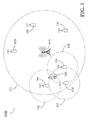
- FIG. 1 shows a simplified schematic diagram of a communication system 100 according to one embodiment of the present disclosure.
- the communication system 100 comprises a user equipment 102, a communication station 110, and multiple access points (e.g., access points 120-170 as shown in FIG. 1 ).
- the communication station 110 has a wireless transmission range 112.
- the access point 120 belongs to a first access network 122
- the access point 130 belongs to a second access network 132
- the access point 140 belongs to a third access network 142.
- the access network 122, 132, and 142 are neighboring access networks.
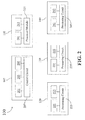
- FIG. 2 shows a simplified functional block diagram of some member devices in the communication system 100 of FIG. 1 according to one embodiment of the present disclosure.
- the user equipment 102 comprises a first communication circuit 201, a second communication circuit 203, a memory device 205, and a control circuit 207.
- the communication station 110 comprises a transceiving circuit 211, a storage device 213, and a processor module 215.
- Each of the access points 120-170 comprises a transmission circuit, an AP memory, and a processing circuit.
- the access point 120 comprises a transmission circuit 221, an AP memory 223, and a processing circuit 225;
- the access point 130 comprises a transmission circuit 231, an AP memory 233, and a processing circuit 235;
- the access point 140 comprises a transmission circuit 241, an AP memory 243, and a processing circuit 245; and so forth.
- the transceiving circuit 211 is configured to operably transmit signal by utilizing a first radio access technology (abbreviated as RAT).
- the storage device 213 is configured to operably store an ANDSF (Access Network Discovery and Selection Function) rule set and a RAN (Radio Access Network) rule.
- the processor module 215 is coupled with the transceiving circuit 211 and the storage device 213.
- the processor module 215 is configured to operably control the transceiving circuit 211 to transmit the ANDSF rule set and the RAN rule to user equipments within the wireless transmission range 112.
- the communication station 110 provides ISMP (Inter-System Mobility Policy), ISRP (Inter-System Routing Policy), and access network discovery information to the user equipments within the wireless transmission range 112 through the ANDSF rule set.
- the first communication circuit 201 is configured to operably receive the ANDSF rule set and the RAN rule transmitted from the transceiving circuit 211 by utilizing the first RAT.
- the second communication circuit 203 is configured to operably communicate with other devices (e.g., one or more access points) by utilizing a second RAT different from the first RAT.
- the memory device 205 is configured to operably store the ANDSF rule set and the RAN rule received by the first communication circuit 201.
- the control circuit 207 is coupled with the first communication circuit 201, the second communication circuit 203, and the memory device 205.
- the control circuit 207 is configured to operably select a target ANDSF rule out of the ANDSF rule set; determine whether the user equipment fulfills all validity conditions of the target ANDSF rule; select a target access network out of a prioritized network list defined by the target ANDSF rule if all validity conditions of the target ANDSF rule are fulfilled; control the second communication circuit to scan the target access network so as to determine whether the target access network is present or not; determine whether the target access network fulfills all validity conditions of the RAN rule if the target access network is present; and control the second communication circuit to steer traffic specified in the target ANDSF rule or traffic specified in the RAN rule to the target access point of the target access network if the target access network fulfills all validity conditions of the RAN rule.
- the transmission circuit is configured to operably communicate with the user equipment 102 by utilizing the second RAT.
- the AP memory is configured to operably store computer programs and information required for controlling the operations of the access point.
- the processing circuit is coupled with the transmission circuit and the AP memory.
- the term "RAN rule” as used throughout the description and the claims refers to any appropriate RAN based access network selection guiding information utilized for instructing the user equipment 102 to select available access network for traffic steering.
- the RAN rule may comprise one or more RAN validity conditions and a traffic specification, and the RAN validity condition may be related to the traffic load of the access network, the signal quality of the access network, and/or other RAN level performance.
- the term "ANDSF rule set” as used throughout the description and the claims refers to any appropriate information containing one or more ANDSF rules.
- ANDSF rule as used throughout the description and the claims refers to any appropriate ANDSF based access network selection guiding information utilized for instructing the user equipment 102 to select available access network for traffic steering.
- each ANDSF rule comprises one or more ANDSF validity conditions and a prioritized network list
- each ANDSF validity condition may be related to the location of the user equipment, the time of a day, the roaming status, and/or other ANDSF level conditions.
- the ANDSF validity conditions are typically different from the RAN validity conditions.
- each ANDSF rule may further comprise a traffic specification.
- the traffic specification specified in the ANDSF rule may be the same with or may be different from the traffic specification specified in the RAN rule.
- each of the transceiving circuit 211 and the first communication circuit 201 may comprise one or more antennas, one or more modulators/demodulators, one or more analog signal processing circuits, and/or one or more digital processing circuits for communicating with other devices by utilizing the first RAT.
- Each of the second communication circuit 203 and the transmission circuit of each of the access points 120-170 may comprise one or more antennas, one or more modulators/demodulators, one or more analog signal processing circuits, and/or one or more digital processing circuits for communicating with other devices by utilizing the second RAT.
- Each of the storage device 213, the memory device 205, and the AP memory of each of the access points 120-170 may be realized with one or more volatile/non-volatile memory circuits, such as registers, hard drives, or flash memory devices.
- Each of the processor module 215, the control circuit 207, and the processing circuit of each of the access points 120-170 may be realized with one or more microprocessors, one or more network processors, one or more digital signal processing circuits, and/or other suitable processing circuits.
- the user equipment 102 is capable of communicating with the communication station 110 adopting the first RAT while communicating with an available access point adopting the second RAT.
- the first RAT may refer to one or more wireless wide area network (abbreviated as WWAN) technologies, wireless metropolitan area network (abbreviated as WMAN) technologies, or other suitable wire communication technologies with a wider communication range, such as WiMAX, GSM, UMTS, HSPA, LTE, LTE-Advanced and other 3GPP RATs.
- the second RAT may refer to one or more WLANs technologies, or other suitable wire communication technologies with a shorter communication range (compared with the first RAT), such as IEEE 802.11 series RATs.
- the communication station 110 may be realized with a 3GPP base station (abbreviated as BS), such as a Node B or an Evolved Node B (abbreviated as eNodeB or eNB).
- BS 3GPP base station
- eNodeB Evolved Node B
- each of the access points 120-170 may be realized with an IEEE 802.11 wireless access point.
- the communication station 110 and an access point may be co-located in substantially the same location.
- Each of the communication station 110 and the access points 120-170 may be coupled with one another through an appropriate network (not shown in FIG. 1 ).
- the aforementioned network may be realized with one or more wired networks and/or wireless networks, and may comprise one or more backhaul networks, one or more core networks, one or more gateways, one or more servers and/or other network equipments (not shown in FIG. 1 ).
- FIGS. 3-4 collectively show a simplified flowchart of an access network selection method conducted by the user equipment 102 according to one embodiment of the present disclosure.
- the processor module 215 of the communication station 110 may control the transceiving circuit 211 to transmit an ANDSF rule set and a RAN rule to the user equipment 102.
- the RAN rule comprises one or more RAN validity conditions and a traffic specification
- the ANDSF rule set comprises one or more ANDSF rules
- each ANDSF rule comprises one or more ANDSF validity conditions and a prioritized network list.
- the processor module 215 may control the transceiving circuit 211 to transmit the ANDSF rule set and the RAN rule to the user equipment 102 by sending one or more dedicated messages to the user equipment 102 or by broadcasting.
- the processor module 215 may control the transceiving circuit 211 to transmit the ANDSF rule set and the RAN rule to the user equipment 102 at different time points.
- the first communication circuit 201 of the user equipment 102 receives the ANDSF rule set and the RAN rule transmitted from the transceiving circuit 211.
- the control circuit 207 of the user equipment 102 stores the ANDSF rule set and the RAN rule received by the first communication circuit 201 into the memory device 205.
- control circuit 207 selects a target ANDSF rule out of the received ANDSF rule set.
- control circuit 207 may select an ANDSF rule with top priority out of the received ANDSF rule set to be a target ANDSF rule.
- control circuit 207 determines whether the user equipment 102 fulfills all validity conditions of the target ANDSF rule. If the user equipment 102 fulfills all validity conditions of the target ANDSF rule, the control circuit 207 proceeds to operation 308. If the user equipment 102 does not fulfill all validity conditions of the target ANDSF rule, the control circuit 207 proceeds to operation 310.
- control circuit 207 selects a target access network out of a prioritized network list defined by the target ANDSF rule. For example, the control circuit 207 may select an access network with top priority out crf the prioritized network list defined by the target ANDSF rule to be the target access network.
- control circuit 207 selects a new target ANDSF rule out of the ANDSF rule set. For example, the control circuit 207 may select an ANDSF rule with next higher priority out of the ANDSF rule set to be a new target ANDSF rule.
- the first access network 122 to which the access point 120 belongs is the target access network selected by the control circuit 207 in the operation 308. Then, the user equipment 102 proceeds to operation 402 of FIG. 4 .
- control circuit 207 controls the second communication circuit 203 to search for the selected target access network.
- control circuit 207 may control the second communication circuit 203 to scan the frequency in which the target access network deployed so as to determine whether the target access network is present or not. If the target access network is present (i.e., the user equipment 102 is located within the wireless transmission range of the target access network), the control circuit 207 proceeds to operation 404.
- control circuit 207 determines whether the current target access network fulfills all validity conditions of the received RAN rule. If the current target access network fulfills all validity conditions of the received RAN rule, the control circuit 207 proceeds to operation 406.
- the control circuit 207 compares a priority level of the current target ANDSF rule with a priority level of the RAN rule so as to determine which traffic to be steered to the access point 120 of the target access network 122.
- the priority level of the ANDSF rules and the RAN rule are configured by the operator of the communication system 100.
- the control circuit 207 proceeds to operation 408.
- the priority level of the target ANDSF rule is less than the priority level of the RAN rule, the control circuit 207 proceeds to operation 410.
- control circuit 207 controls the second communication circuit 203 to steer traffic specified in the target ANDSF rule to the access point 120 of the target access network 122.
- control circuit 207 controls the second communication circuit 203 to steer traffic specified in the RAN rule to the access point 120 of the target access network 122.
- control circuit 207 may select one of the target ANDSF rule and the RAN rule as a default rule according to a predetermined configuration, and control the second communication circuit 203 to steer traffic specified in the default rule to the access point 120 of the target access network 122.
- control circuit 207 determines whether the prioritized network list contains other access network or not. In this situation, the control circuit 207 proceeds to operation 412 if the prioritized network list contains other access network, and proceeds to the operation 310 of FIG. 3 if there is no other access networks contained in the prioritized network list.
- control circuit 207 determines whether the prioritized network list contains other access network or not. In this situation, the control circuit 207 proceeds to the operation 412 if the prioritized network list contains other access network, and proceeds to the operation 310 of FIG. 3 if there is no other access networks contained in the prioritized network list.
- control circuit 207 selects a new target access network out of the prioritized network list defined by the current target ANDSF rule. For example, the control circuit 207 may select an access network with next higher priority out of the prioritized network list defined by the current target ANDSF rule to be the new target access network.
- the user equipment 102 only needs to determine whether the current target access network fulfills all validity conditions of the RAN rule in the operation 404, and needs not to scan for other available access networks, and needs not to respectively determine whether each of other available access network fulfills all validity conditions of the RAN rule. Therefore, the user equipment 102 is enabled to rapidly identify an available access point for traffic steering without spending unnecessary battery power to scan for other access networks. In this way, the power consumption of the user equipment 102 can be significantly reduced, thereby improving the power saving performance of the user equipment 102 and extending the standby time of the user equipment 102.
- the access selection method illustrated in FIGS. 3-4 is merely an example rather than a restriction to the practical operation of the user equipment 102.
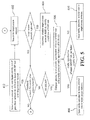
- FIG. 5 shows a simplified partial flowchart of an access network selection method according to another embodiment of the present disclosure.
- the flowchart illustrated in FIG. 5 is similar to the flowchart of FIG. 4 .
- the difference between two embodiments is in that the operation 406 in FIG. 4 is replaced by operation 506 in FIG. 5 .
- control circuit 207 determines that the current target access network fulfills all validity conditions of the received RAN rule in the operation 404, the control circuit 207 proceeds to the operation 506.
- the control circuit 207 compares a priority level of a traffic specification of the target ANDSF rule with a priority level of the traffic specification of the RAN rule so as to determine which traffic to be steered to the access point 120 of the target access network 122.
- the priority level of the traffic specification of the ANDSF rules and the traffic specification of the RAN rule are configured by the operator of the communication system 100.
- the control circuit 207 proceeds to the operation 408.
- the control circuit 207 proceeds to the operation 410.
- the control circuit 207 may select one of the traffic specification of the target ANDSF rule and the traffic specification of the RAN rule as a default traffic specification according to a predetermined configuration, and control the second communication circuit 203 to steer traffic specified in the default traffic specification to the access point 120 of the target access network 122.
- the user equipment 102 only needs to determine whether the current target access network fulfills all validity conditions of the RAN rule in the operation 404, and needs not to scan for other available access networks, and needs not to respectively determine whether each of other available access network fulfills all validity conditions of the RAN rule. Therefore, the user equipment 102 is enabled to rapidly identify an available access point for traffic steering without spending unnecessary battery power to scan for other access networks. In this way, the power consumption of the user equipment 102 can be significantly reduced, thereby improving the power saving performance of the user equipment 102 and extending the standby time of the user equipment 102.
- the control circuit 207 is enabled to integrate the different access network selection methods defined in different levels. As a result, it is ensured that the finally-selected access network fulfills both the ANDSF rule and the RAN rule, and also fulfills the intersystem mobility policies configured by the mobile communication network operator.
- the invention can be summarized as a communication system and a related user equipment.
- the user equipment includes a first communication circuit configured to operably receive ANDSF rule set and RAN rule transmitted from a communication station; a second communication circuit; and a control circuit configured to operably: select a target ANDSF rule out of the ANDSF rule set; determine whether the user equipment fulfills all validity conditions of the target ANDSF rule; select a target access network out of a prioritized network list defined by the target ANDSF rule if all validity conditions of the target ANDSF rule are fulfilled; determine whether the target access network fulfills all validity conditions of the RAN rule if the target access network is present; and control the second communication circuit to steer traffic specified in the target ANDSF rule or traffic specified in the RAN rule to a target access point of the target access network.
- a communication system comprising:
Landscapes
- Engineering & Computer Science (AREA)
- Signal Processing (AREA)
- Computer Networks & Wireless Communication (AREA)
- Computer Security & Cryptography (AREA)
- Mobile Radio Communication Systems (AREA)
Abstract
Description
- The present invention relates to a communication system and related user equipment according to the pre-characterizing clauses of claims 1 and 6.
- A base station of a mobile communication network is only capable of communicating with a certain number of user equipments within a certain wireless transmission range. Therefore, many technologies have been developed to increase the amount of user equipments that can be served in a certain area, to balance the load in the mobile communication network, to improve the communication quality, etc. For example, the traditional mobile communication network may adopt a radio interworking mechanism to provide both the 3GPP radio access resources and the wireless local area network (abbreviated as WLAN) radio access resources at the same time so as to improve the system performance.
- Traditional core network based WLAN interworking mechanisms, such as ANDSF (Access Network Discovery and Selection Function), have defined an access network selection method for instructing the user equipment to select an available WLAN according to predetermined intersystem mobility information. Different access network selection method in the RAN (Radio Access Network) level is being currently developed in order to further improve the WLAN/3GPP interworking performance.
- Accordingly, ANDSF based access network selection method and different RAN based access network selection method may be applied to the user equipment at the same time in the future. Without proper integration of the access network selection methods defined in different levels, the user equipment may not able to fulfill the intersystem mobility policy configured by the mobile communication network operator.
- This in mind, the present invention aims at providing a communication system where the user equipment selects a target access network fulfilling all validity conditions of a target ANDSF rule and all validity conditions of the RAN rule to offload traffic.
- This is achieved by a communication system according to claim 1. The dependent claims pertain to corresponding further development and improvements.
- As will be seen more clearly from the detailed description following below, the claimed communication system includes a user equipment that determines whether a target access network selected out of a prioritized list of a target ANDSF rule fulfills all validity conditions of the RAN rule.
- In the following, the invention is further illustrated by way of example, taking reference to the accompanying drawings. Thereof
-
FIG. 1 shows a simplified schematic diagram of a communication system according to one embodiment of the present disclosure, -
FIG. 2 shows a simplified functional block diagram of some member devices in the communication system ofFIG. 1 according to one embodiment of the present disclosure, -
FIGS. 3-4 collectively show a simplified flowchart of an access network selection method according to one embodiment of the present disclosure, and -
FIG. 5 shows a simplified partial flowchart of an access network selection method according to another embodiment of the present disclosure. - Reference is made in detail to embodiments of the invention, which are illustrated in the accompanying drawings. The same reference numbers may be used throughout the drawings to refer to the same or like parts, components, or operations.
-
FIG. 1 shows a simplified schematic diagram of acommunication system 100 according to one embodiment of the present disclosure. In this embodiment, thecommunication system 100 comprises auser equipment 102, acommunication station 110, and multiple access points (e.g., access points 120-170 as shown inFIG. 1 ). As shown inFIG. 1 , thecommunication station 110 has awireless transmission range 112. Theaccess point 120 belongs to afirst access network 122, theaccess point 130 belongs to asecond access network 132, and theaccess point 140 belongs to athird access network 142. In this embodiment, theaccess network -
FIG. 2 shows a simplified functional block diagram of some member devices in thecommunication system 100 ofFIG. 1 according to one embodiment of the present disclosure. As shown inFIG. 2 , theuser equipment 102 comprises afirst communication circuit 201, asecond communication circuit 203, amemory device 205, and acontrol circuit 207. Thecommunication station 110 comprises atransceiving circuit 211, astorage device 213, and aprocessor module 215. Each of the access points 120-170 comprises a transmission circuit, an AP memory, and a processing circuit. For example, theaccess point 120 comprises atransmission circuit 221, anAP memory 223, and aprocessing circuit 225; theaccess point 130 comprises atransmission circuit 231, anAP memory 233, and aprocessing circuit 235; theaccess point 140 comprises atransmission circuit 241, anAP memory 243, and aprocessing circuit 245; and so forth. - In the
communication station 110, thetransceiving circuit 211 is configured to operably transmit signal by utilizing a first radio access technology (abbreviated as RAT). Thestorage device 213 is configured to operably store an ANDSF (Access Network Discovery and Selection Function) rule set and a RAN (Radio Access Network) rule. Theprocessor module 215 is coupled with thetransceiving circuit 211 and thestorage device 213. Theprocessor module 215 is configured to operably control the transceivingcircuit 211 to transmit the ANDSF rule set and the RAN rule to user equipments within thewireless transmission range 112. In operations, thecommunication station 110 provides ISMP (Inter-System Mobility Policy), ISRP (Inter-System Routing Policy), and access network discovery information to the user equipments within thewireless transmission range 112 through the ANDSF rule set. - In the
user equipment 102, thefirst communication circuit 201 is configured to operably receive the ANDSF rule set and the RAN rule transmitted from the transceivingcircuit 211 by utilizing the first RAT. Thesecond communication circuit 203 is configured to operably communicate with other devices (e.g., one or more access points) by utilizing a second RAT different from the first RAT. Thememory device 205 is configured to operably store the ANDSF rule set and the RAN rule received by thefirst communication circuit 201. Thecontrol circuit 207 is coupled with thefirst communication circuit 201, thesecond communication circuit 203, and thememory device 205. Thecontrol circuit 207 is configured to operably select a target ANDSF rule out of the ANDSF rule set; determine whether the user equipment fulfills all validity conditions of the target ANDSF rule; select a target access network out of a prioritized network list defined by the target ANDSF rule if all validity conditions of the target ANDSF rule are fulfilled; control the second communication circuit to scan the target access network so as to determine whether the target access network is present or not; determine whether the target access network fulfills all validity conditions of the RAN rule if the target access network is present; and control the second communication circuit to steer traffic specified in the target ANDSF rule or traffic specified in the RAN rule to the target access point of the target access network if the target access network fulfills all validity conditions of the RAN rule. - In each of the access points 120-170, the transmission circuit is configured to operably communicate with the
user equipment 102 by utilizing the second RAT. In some embodiments, the AP memory is configured to operably store computer programs and information required for controlling the operations of the access point. The processing circuit is coupled with the transmission circuit and the AP memory. - The term "RAN rule" as used throughout the description and the claims refers to any appropriate RAN based access network selection guiding information utilized for instructing the
user equipment 102 to select available access network for traffic steering. In practice, the RAN rule may comprise one or more RAN validity conditions and a traffic specification, and the RAN validity condition may be related to the traffic load of the access network, the signal quality of the access network, and/or other RAN level performance. The term "ANDSF rule set" as used throughout the description and the claims refers to any appropriate information containing one or more ANDSF rules. The term "ANDSF rule" as used throughout the description and the claims refers to any appropriate ANDSF based access network selection guiding information utilized for instructing theuser equipment 102 to select available access network for traffic steering. In practice, each ANDSF rule comprises one or more ANDSF validity conditions and a prioritized network list, and each ANDSF validity condition may be related to the location of the user equipment, the time of a day, the roaming status, and/or other ANDSF level conditions. The ANDSF validity conditions are typically different from the RAN validity conditions. - In some applications, each ANDSF rule may further comprise a traffic specification. In practice, the traffic specification specified in the ANDSF rule may be the same with or may be different from the traffic specification specified in the RAN rule.
- In practice, each of the
transceiving circuit 211 and thefirst communication circuit 201 may comprise one or more antennas, one or more modulators/demodulators, one or more analog signal processing circuits, and/or one or more digital processing circuits for communicating with other devices by utilizing the first RAT. Each of thesecond communication circuit 203 and the transmission circuit of each of the access points 120-170 may comprise one or more antennas, one or more modulators/demodulators, one or more analog signal processing circuits, and/or one or more digital processing circuits for communicating with other devices by utilizing the second RAT. - Each of the
storage device 213, thememory device 205, and the AP memory of each of the access points 120-170 may be realized with one or more volatile/non-volatile memory circuits, such as registers, hard drives, or flash memory devices. - Each of the
processor module 215, thecontrol circuit 207, and the processing circuit of each of the access points 120-170 may be realized with one or more microprocessors, one or more network processors, one or more digital signal processing circuits, and/or other suitable processing circuits. - For the purposes of conciseness and clear explanation, some components and connections of the
communication system 100 are not shown inFIG. 1 . - As can be appreciated from the foregoing descriptions, the
user equipment 102 is capable of communicating with thecommunication station 110 adopting the first RAT while communicating with an available access point adopting the second RAT. In practice, the first RAT may refer to one or more wireless wide area network (abbreviated as WWAN) technologies, wireless metropolitan area network (abbreviated as WMAN) technologies, or other suitable wire communication technologies with a wider communication range, such as WiMAX, GSM, UMTS, HSPA, LTE, LTE-Advanced and other 3GPP RATs. The second RAT may refer to one or more WLANs technologies, or other suitable wire communication technologies with a shorter communication range (compared with the first RAT), such as IEEE 802.11 series RATs. - For the illustrative purpose, it is assumed hereinafter that the first RAT is referred to at least one of the 3GPP RATs and the second RAT is referred to at least one of the IEEE 802.11 series RATs. Thus, the
communication station 110 may be realized with a 3GPP base station (abbreviated as BS), such as a Node B or an Evolved Node B (abbreviated as eNodeB or eNB). In addition, each of the access points 120-170 may be realized with an IEEE 802.11 wireless access point. In practice, thecommunication station 110 and an access point may be co-located in substantially the same location. - Each of the
communication station 110 and the access points 120-170 may be coupled with one another through an appropriate network (not shown inFIG. 1 ). The aforementioned network may be realized with one or more wired networks and/or wireless networks, and may comprise one or more backhaul networks, one or more core networks, one or more gateways, one or more servers and/or other network equipments (not shown inFIG. 1 ). - The operations of the
communication system 100 will be further described in the following by reference toFIG. 3 andFIG. 4 . -
FIGS. 3-4 collectively show a simplified flowchart of an access network selection method conducted by theuser equipment 102 according to one embodiment of the present disclosure. - When the
user equipment 102 is located within thewireless transmission range 112 of thecommunication station 110, theprocessor module 215 of thecommunication station 110 may control thetransceiving circuit 211 to transmit an ANDSF rule set and a RAN rule to theuser equipment 102. As described previously, the RAN rule comprises one or more RAN validity conditions and a traffic specification, the ANDSF rule set comprises one or more ANDSF rules, and each ANDSF rule comprises one or more ANDSF validity conditions and a prioritized network list. In operations, theprocessor module 215 may control thetransceiving circuit 211 to transmit the ANDSF rule set and the RAN rule to theuser equipment 102 by sending one or more dedicated messages to theuser equipment 102 or by broadcasting. - In addition, the
processor module 215 may control thetransceiving circuit 211 to transmit the ANDSF rule set and the RAN rule to theuser equipment 102 at different time points. - In
operation 302, thefirst communication circuit 201 of theuser equipment 102 receives the ANDSF rule set and the RAN rule transmitted from thetransceiving circuit 211. In addition, thecontrol circuit 207 of theuser equipment 102 stores the ANDSF rule set and the RAN rule received by thefirst communication circuit 201 into thememory device 205. - In
operation 304, thecontrol circuit 207 selects a target ANDSF rule out of the received ANDSF rule set. For example, thecontrol circuit 207 may select an ANDSF rule with top priority out of the received ANDSF rule set to be a target ANDSF rule. - In
operation 306, thecontrol circuit 207 determines whether theuser equipment 102 fulfills all validity conditions of the target ANDSF rule. If theuser equipment 102 fulfills all validity conditions of the target ANDSF rule, thecontrol circuit 207 proceeds tooperation 308. If theuser equipment 102 does not fulfill all validity conditions of the target ANDSF rule, thecontrol circuit 207 proceeds tooperation 310. - In
operation 308, thecontrol circuit 207 selects a target access network out of a prioritized network list defined by the target ANDSF rule. For example, thecontrol circuit 207 may select an access network with top priority out crf the prioritized network list defined by the target ANDSF rule to be the target access network. - In
operation 310, thecontrol circuit 207 selects a new target ANDSF rule out of the ANDSF rule set. For example, thecontrol circuit 207 may select an ANDSF rule with next higher priority out of the ANDSF rule set to be a new target ANDSF rule. - For the illustrative purpose, it is assumed hereinafter that the
first access network 122 to which theaccess point 120 belongs is the target access network selected by thecontrol circuit 207 in theoperation 308. Then, theuser equipment 102 proceeds tooperation 402 ofFIG. 4 . - In
operation 402, thecontrol circuit 207 controls thesecond communication circuit 203 to search for the selected target access network. In operations, thecontrol circuit 207 may control thesecond communication circuit 203 to scan the frequency in which the target access network deployed so as to determine whether the target access network is present or not. If the target access network is present (i.e., theuser equipment 102 is located within the wireless transmission range of the target access network), thecontrol circuit 207 proceeds tooperation 404. - In
operation 404, thecontrol circuit 207 determines whether the current target access network fulfills all validity conditions of the received RAN rule. If the current target access network fulfills all validity conditions of the received RAN rule, thecontrol circuit 207 proceeds tooperation 406. - In
operation 406, thecontrol circuit 207 compares a priority level of the current target ANDSF rule with a priority level of the RAN rule so as to determine which traffic to be steered to theaccess point 120 of thetarget access network 122. In operations, the priority level of the ANDSF rules and the RAN rule are configured by the operator of thecommunication system 100. In this embodiment, if the priority level of the target ANDSF rule is higher than the priority level of the RAN rule, thecontrol circuit 207 proceeds tooperation 408. On the contrary, if the priority level of the target ANDSF rule is less than the priority level of the RAN rule, thecontrol circuit 207 proceeds tooperation 410. - In
operation 408, thecontrol circuit 207 controls thesecond communication circuit 203 to steer traffic specified in the target ANDSF rule to theaccess point 120 of thetarget access network 122. - In
operation 410, thecontrol circuit 207 controls thesecond communication circuit 203 to steer traffic specified in the RAN rule to theaccess point 120 of thetarget access network 122. - In practice, if the priority level of the target ANDSF rule is equal to the priority level of the RAN rule, the
control circuit 207 may select one of the target ANDSF rule and the RAN rule as a default rule according to a predetermined configuration, and control thesecond communication circuit 203 to steer traffic specified in the default rule to theaccess point 120 of thetarget access network 122. - If the
control circuit 207 determines that the target access network is not present in theoperation 402, thecontrol circuit 207 determines whether the prioritized network list contains other access network or not. In this situation, thecontrol circuit 207 proceeds tooperation 412 if the prioritized network list contains other access network, and proceeds to theoperation 310 ofFIG. 3 if there is no other access networks contained in the prioritized network list. - In addition, if the
control circuit 207 determines that the current target access network does not fulfill all validity conditions of the received RAN rule, thecontrol circuit 207 determines whether the prioritized network list contains other access network or not. In this situation, thecontrol circuit 207 proceeds to theoperation 412 if the prioritized network list contains other access network, and proceeds to theoperation 310 ofFIG. 3 if there is no other access networks contained in the prioritized network list. - In
operation 412, thecontrol circuit 207 selects a new target access network out of the prioritized network list defined by the current target ANDSF rule. For example, thecontrol circuit 207 may select an access network with next higher priority out of the prioritized network list defined by the current target ANDSF rule to be the new target access network. - As can be appreciated from the forgoing descriptions, the
user equipment 102 only needs to determine whether the current target access network fulfills all validity conditions of the RAN rule in theoperation 404, and needs not to scan for other available access networks, and needs not to respectively determine whether each of other available access network fulfills all validity conditions of the RAN rule. Therefore, theuser equipment 102 is enabled to rapidly identify an available access point for traffic steering without spending unnecessary battery power to scan for other access networks. In this way, the power consumption of theuser equipment 102 can be significantly reduced, thereby improving the power saving performance of theuser equipment 102 and extending the standby time of theuser equipment 102. - The access selection method illustrated in
FIGS. 3-4 is merely an example rather than a restriction to the practical operation of theuser equipment 102. - For example,
FIG. 5 shows a simplified partial flowchart of an access network selection method according to another embodiment of the present disclosure. The flowchart illustrated inFIG. 5 is similar to the flowchart ofFIG. 4 . The difference between two embodiments is in that theoperation 406 inFIG. 4 is replaced byoperation 506 inFIG. 5 . - In the embodiment of
FIG. 5 , if thecontrol circuit 207 determines that the current target access network fulfills all validity conditions of the received RAN rule in theoperation 404, thecontrol circuit 207 proceeds to theoperation 506. - In
operation 506, thecontrol circuit 207 compares a priority level of a traffic specification of the target ANDSF rule with a priority level of the traffic specification of the RAN rule so as to determine which traffic to be steered to theaccess point 120 of thetarget access network 122. In operations, the priority level of the traffic specification of the ANDSF rules and the traffic specification of the RAN rule are configured by the operator of thecommunication system 100. In this embodiment, if the priority level of the traffic specification of the target ANDSF rule is higher than the priority level of the traffic specification of the RAN rule, thecontrol circuit 207 proceeds to theoperation 408. On the contrary, if the priority level of the traffic specification of the target ANDSF rule is less than the priority level of the traffic specification of the RAN rule, thecontrol circuit 207 proceeds to theoperation 410. - In practice, if the priority level of the traffic specification of the target ANDSF rule is equal to the priority level of the traffic specification of the RAN rule, the
control circuit 207 may select one of the traffic specification of the target ANDSF rule and the traffic specification of the RAN rule as a default traffic specification according to a predetermined configuration, and control thesecond communication circuit 203 to steer traffic specified in the default traffic specification to theaccess point 120 of thetarget access network 122. - The aforementioned descriptions regarding the other operations in
FIG. 4 are also applicable to the corresponding operations inFIG. 5 . - Similar to the previous embodiment, the
user equipment 102 only needs to determine whether the current target access network fulfills all validity conditions of the RAN rule in theoperation 404, and needs not to scan for other available access networks, and needs not to respectively determine whether each of other available access network fulfills all validity conditions of the RAN rule. Therefore, theuser equipment 102 is enabled to rapidly identify an available access point for traffic steering without spending unnecessary battery power to scan for other access networks. In this way, the power consumption of theuser equipment 102 can be significantly reduced, thereby improving the power saving performance of theuser equipment 102 and extending the standby time of theuser equipment 102. - As can be appreciated from the forgoing descriptions, by further verifying whether the current target access network fulfills all validity conditions of the RAN rule in the
operation 404, thecontrol circuit 207 is enabled to integrate the different access network selection methods defined in different levels. As a result, it is ensured that the finally-selected access network fulfills both the ANDSF rule and the RAN rule, and also fulfills the intersystem mobility policies configured by the mobile communication network operator. - Certain terms are used throughout the description and the claims to refer to particular components. One skilled in the art appreciates that a component may be referred to as different names. This disclosure does not intend to distinguish between components that differ in name but not in function. In the description and in the claims, the term "comprise" is used in an openended fashion, and thus should be interpreted to mean "include, but not limited to." The phrases "be coupled with," "couples with," and "coupling with" are intended to compass any indirect or direct connection. Accordingly, if this disclosure mentioned that a first device is coupled with a second device, it means that the first device may be directly or indirectly connected to the second device through electrical connections, wireless communications, optical communications, or other signal connections with/without other intermediate devices or connection means.
- The term "and/or" may comprise any and all combinations of one or more of the associated listed items. In addition, the singular forms "a," "an," and "the" herein are intended to comprise the plural forms as well, unless the context clearly indicates otherwise.
- The invention can be summarized as a communication system and a related user equipment. The user equipment includes a first communication circuit configured to operably receive ANDSF rule set and RAN rule transmitted from a communication station; a second communication circuit; and a control circuit configured to operably: select a target ANDSF rule out of the ANDSF rule set; determine whether the user equipment fulfills all validity conditions of the target ANDSF rule; select a target access network out of a prioritized network list defined by the target ANDSF rule if all validity conditions of the target ANDSF rule are fulfilled; determine whether the target access network fulfills all validity conditions of the RAN rule if the target access network is present; and control the second communication circuit to steer traffic specified in the target ANDSF rule or traffic specified in the RAN rule to a target access point of the target access network.
- For completeness, various aspects of the invention are set out in the following numbered clauses:
- 1. A communication system, comprising:
- a communication station, comprising:
- a transceiving circuit;
- a storage device configured to operably store an ANDSF (Access Network Discovery and Selection Function) rule set and a RAN (Radio Access Network) rule, wherein the RAN rule comprises one or more RAN validity conditions and a traffic specification, the ANDSF rule set comprises one or more ANDSF rules and each ANDSF rule comprises one or more ANDSF validity conditions and a prioritized network list; and
- a processor module, coupled with the transceiving circuit and the storage device, configured to operably control the transceiving circuit to transmit the ANDSF rule set and the RAN rule;
- multiple access points comprising a target access point; and
- a user equipment, comprising:
- a first communication circuit configured to operably receive the ANDSF rule set and the RAN rule transmitted from the transceiving circuit;
- a second communication circuit configured to operably communicate with the multiple access points;
- a memory device configured to operably store the ANDSF rule set and the RAN rule received by the first communication circuit; and
- a control circuit, coupled with the first communication circuit, the second communication circuit, and the memory device, configured to operably:
- select a target ANDSF rule out of the ANDSF rule set;
- determine whether the user equipment fulfills all validity conditions of the target ANDSF rule;
- select a target access network out of a prioritized network list defined by the target ANDSF rule if all validity conditions of the target ANDSF rule are fulfilled;
- control the second communication circuit to scan the target access network so as to determine whether the target access network is present or not;
- determine whether the target access network fulfills all validity conditions of the RAN rule if the target access network is present; and
- control the second communication circuit to steer traffic specified in the target ANDSF rule or traffic specified in the RAN rule to the target access point of the target access network if the target access network fulfills all validity conditions of the RAN rule.
- 2. The communication system of clause 1, wherein the control circuit is further configured to operably compare a priority level of the target ANDSF rule with a priority level of the RAN rule so as to determine which traffic to be steered to the target access point.
- 3. The communication system of clause 2, wherein if the priority level of the target ANDSF rule is higher than the priority level of the RAN rule, the control circuit controls the second communication circuit to steer traffic specified in the target ANDSF rule to the target access point of the target access network.
- 4. The communication system of clause 1, wherein the control circuit is further configured to operably compare a priority level of a traffic specification of the target ANDSF rule with a priority level of the traffic specification of the RAN rule so as to determine which traffic to be steered to the target access point.
- 5. The communication system of clause 4, wherein if the priority level of the traffic specification of the target ANDSF rule is higher than the priority level of the traffic specification of the RAN rule, the control circuit controls the second communication circuit to steer traffic specified in the target ANDSF rule to the target access point of the target access network.
- 6. A user equipment of a communication system, wherein the communication system comprises a communication station and multiple access points, and the multiple access points comprise a target access point, the user equipment comprising:
- a first communication circuit configured to operably receive a ANDSF rule set and a RAN rule transmitted from the communication station, wherein the RAN rule comprises one or more RAN validity conditions and a traffic specification, the ANDSF rule set comprises one or more ANDSF rules and each ANDSF rule comprises one or more ANDSF validity conditions and a prioritized network list;
- a second communication circuit configured to operably communicate with the multiple access points;
- a memory device configured to operably store the ANDSF rule set and the RAN rule received by the first communication circuit; and
- a control circuit, coupled with the first communication circuit, the second communication circuit, and the memory device, configured to operably:
- select a target ANDSF rule out of the ANDSF rule set;
- determine whether the user equipment fulfills all validity conditions of the target ANDSF rule;
- select a target access network out of a prioritized network list defined by the target ANDSF rule if all validity conditions of the target ANDSF rule are fulfilled;
- control the second communication circuit to scan the target access network so as to determine whether the target access network is present or not;
- determine whether the target access network fulfills all validity conditions of the RAN rule if the target access network is present; and
- control the second communication circuit to steer traffic specified in the target ANDSF rule or traffic specified in the RAN rule to the target access point of the target access network if the target access network fulfills all validity conditions of the RAN rule.
- 7. The user equipment of clause 6, wherein the control circuit is further configured to operably compare a priority level of the target ANDSF rule with a priority level of the RAN rule so as to determine which traffic to be steered to the target access point.
- 8. The user equipment of clause 7, wherein if the priority level of the target ANDSF rule is higher than the priority level of the RAN rule, the control circuit controls the second communication circuit to steer traffic specified in the target ANDSF rule to the target access point of the target access network.
- 9. The user equipment of clause 6, wherein the control circuit is further configured to operably compare a priority level of a traffic specification of the target ANDSF rule with a priority level of the traffic specification of the RAN rule so as to determine which traffic to be steered to the target access point.
- 10. The user equipment of
clause 9, wherein if the priority level of the traffic specification of the target ANDSF rule is higher than the priority level of the traffic specification of the RAN rule, the control circuit controls the second communication circuit to steer traffic specified in the target ANDSF rule to the target access point of the target access network. - All combinations and sub-combinations of the above-described features also belong to the invention.
Claims (10)
- A communication system (100), characterized by comprising:a communication station (110), comprising:a transceiving circuit (211);a storage device (213) configured to operably store an ANDSF (Access Network Discovery and Selection Function) rule set and a RAN (Radio Access Network) rule, wherein the RAN rule comprises one or more RAN validity conditions and a traffic specification, the ANDSF rule set comprises one or more ANDSF rules and each ANDSF rule comprises one or more ANDSF validity conditions and a prioritized network list; anda processor module (215), coupled with the transceiving circuit (211) and the storage device (213), configured to operably control the transceiving circuit (211) to transmit the ANDSF rule set and the RAN rule;multiple access points (120-170) comprising a target access point (120); anda user equipment (102), comprising:a first communication circuit (201) configured to operably receive the ANDSF rule set and the RAN rule transmitted from the transceiving circuit (211);a second communication circuit (203) configured to operably communicate with the multiple access points (120-170);a memory device (205) configured to operably store the ANDSF rule set and the RAN rule received by the first communication circuit (201); anda control circuit (207), coupled with the first communication circuit (201), the second communication circuit (203), and the memory device (205), configured to operably:select a target ANDSF rule out of the ANDSF rule set;determine whether the user equipment (102) fulfills all validity conditions of the target ANDSF rule;select a target access network (122) out of a prioritized network list defined by the target ANDSF rule if all validity conditions of the target ANDSF rule are fulfilled;control the second communication circuit (203) to scan the target access network (122) so as to determine whether the target access network (122) is present or not;determine whether the target access network (122) fulfills all validity conditions of the RAN rule if the target access network (122) is present; andcontrol the second communication circuit (203) to steer traffic specified in the target ANDSF rule or traffic specified in the RAN rule to the target access point (120) of the target access network (122) if the target access network (122) fulfills all validity conditions of the RAN rule.
- The communication system (100) of claim 1, characterized in that the control circuit (207) is further configured to operably compare a priority level of the target ANDSF rule with a priority level of the RAN rule so as to determine which traffic to be steered to the target access point (120).
- The communication system (100) of claim 2, characterized in that if the priority level of the target ANDSF rule is higher than the priority level of the RAN rule, the control circuit (207) controls the second communication circuit (203) to steer traffic specified in the target ANDSF rule to the target access point (120) of the target access network (122).
- The communication system (100) of claim 1, characterized in that the control circuit (207) is further configured to operably compare a priority level of a traffic specification of the target ANDSF rule with a priority level of the traffic specification of the RAN rule so as to determine which traffic to be steered to the target access point (120).
- The communication system (100) of claim 4, wherein if the priority level of the traffic specification of the target ANDSF rule is higher than the priority level of the traffic specification of the RAN rule, the control circuit (207) controls the second communication circuit (203) to steer traffic specified in the target ANDSF rule to the target access point (120) of the target access network (122).
- A user equipment (102) of a communication system (100), wherein the communication system (100) comprises a communication station (110) and multiple access points (120-170), and the multiple access points (120-170) comprise a target access point (120), characterized by:the user equipment (102) comprising:a first communication circuit (201) configured to operably receive a ANDSF rule set and a RAN rule transmitted from the communication station (110), wherein the RAN rule comprises one or more RAN validity conditions and a traffic specification, the ANDSF rule set comprises one or more ANDSF rules and each ANDSF rule comprises one or more ANDSF validity conditions and a prioritized network list;a second communication circuit (203) configured to operably communicate with the multiple access points (120-170);a memory device (205) configured to operably store the ANDSF rule set and the RAN rule received by the first communication circuit (201); anda control circuit (207), coupled with the first communication circuit (201), the second communication circuit (203), and the memory device (205), configured to operably:select a target ANDSF rule out of the ANDSF rule set;determine whether the user equipment (102) fulfills all validity conditions of the target ANDSF rule;select a target access network (122) out of a prioritized network list defined by the target ANDSF rule if all validity conditions of the target ANDSF rule are fulfilled;control the second communication circuit (203) to scan the target access network (122) so as to determine whether the target access network (122) is present or not;determine whether the target access network (122) fulfills all validity conditions of the RAN rule if the target access network (122) is present; andcontrol the second communication circuit (203) to steer traffic specified in the target ANDSF rule or traffic specified in the RAN rule to the target access point (120) of the target access network (122) if the target access network (122) fulfills all validity conditions of the RAN rule.
- The user equipment (102) of claim 6, characterized in that the control circuit (207) is further configured to operably compare a priority level of the target ANDSF rule with a priority level of the RAN rule so as to determine which traffic to be steered to the target access point (120).
- The user equipment (102) of claim 7, characterized in that if the priority level of the target ANDSF rule is higher than the priority level of the RAN rule, the control circuit (207) controls the second communication circuit (203) to steer traffic specified in the target ANDSF rule to the target access point (120) of the target access network (122).
- The user equipment (102) of claim 6, characterized in that the control circuit (207) is further configured to operably compare a priority level of a traffic specification of the target ANDSF rule with a priority level of the traffic specification of the RAN rule so as to determine which traffic to be steered to the target access point (120).
- The user equipment (102) of claim 9, characterized in that if the priority level of the traffic specification of the target ANDSF rule is higher than the priority level of the traffic specification of the RAN rule, the control circuit (207) controls the second communication circuit (203) to steer traffic specified in the target ANDSF rule to the target access point (120) of the target access network (122).
Applications Claiming Priority (2)
| Application Number | Priority Date | Filing Date | Title |
|---|---|---|---|
| US201361863388P | 2013-08-07 | 2013-08-07 | |
| US201361886858P | 2013-10-04 | 2013-10-04 |
Publications (2)
| Publication Number | Publication Date |
|---|---|
| EP2846587A1 true EP2846587A1 (en) | 2015-03-11 |
| EP2846587B1 EP2846587B1 (en) | 2018-04-25 |
Family
ID=51298556
Family Applications (1)
| Application Number | Title | Priority Date | Filing Date |
|---|---|---|---|
| EP14179483.4A Active EP2846587B1 (en) | 2013-08-07 | 2014-08-01 | Communication system with radio interworking capability and related user equipment |
Country Status (4)
| Country | Link |
|---|---|
| US (1) | US9961176B2 (en) |
| EP (1) | EP2846587B1 (en) |
| CN (1) | CN104349424B (en) |
| TW (1) | TWI539859B (en) |
Families Citing this family (2)
| Publication number | Priority date | Publication date | Assignee | Title |
|---|---|---|---|---|
| CN107566208A (en) * | 2017-08-08 | 2018-01-09 | 西安电子科技大学 | The inspection method of civil aviaton's communication system network state |
| EP3797542B1 (en) * | 2018-05-22 | 2025-10-01 | Nokia Solutions and Networks Oy | Method, apparatus and computer readable media for enforcing a rule related to traffic routing |
Citations (2)
| Publication number | Priority date | Publication date | Assignee | Title |
|---|---|---|---|---|
| US20110110300A1 (en) * | 2008-04-18 | 2011-05-12 | Joachim Sachs | Access Network Selection in Multi-Access Network Environment |
| WO2012142437A1 (en) * | 2011-04-13 | 2012-10-18 | Interdigital Patent Holdings, Inc | Methods, systems and apparatus for managing and/or enforcing policies for managing internet protocol ("ip") traffic among multiple accesses of a network |
Family Cites Families (5)
| Publication number | Priority date | Publication date | Assignee | Title |
|---|---|---|---|---|
| EP2445266B1 (en) * | 2010-10-25 | 2016-03-16 | Alcatel Lucent | Control of access network/access technology selection for the routing of IP traffic by a user equipment, and QoS support, in a multi-access communication system |
| CN103209449B (en) * | 2012-01-17 | 2016-06-29 | 上海贝尔股份有限公司 | A kind of by the method and apparatus that ANDSF is user's switching and network access |
| US9203563B2 (en) * | 2012-07-02 | 2015-12-01 | Intel Corporation | Devices and methods for radio communication network guided traffic offload |
| US8817707B2 (en) * | 2012-07-20 | 2014-08-26 | Intel Corporation | Mechanisms for roaming between 3GPP operators and WLAN service providers |
| CN103209440B (en) * | 2013-02-18 | 2016-03-02 | 华为终端有限公司 | Network insertion processing method and subscriber equipment |
-
2014
- 2014-08-01 EP EP14179483.4A patent/EP2846587B1/en active Active
- 2014-08-01 CN CN201410376794.1A patent/CN104349424B/en active Active
- 2014-08-01 US US14/449,488 patent/US9961176B2/en active Active
- 2014-08-01 TW TW103126454A patent/TWI539859B/en active
Patent Citations (2)
| Publication number | Priority date | Publication date | Assignee | Title |
|---|---|---|---|---|
| US20110110300A1 (en) * | 2008-04-18 | 2011-05-12 | Joachim Sachs | Access Network Selection in Multi-Access Network Environment |
| WO2012142437A1 (en) * | 2011-04-13 | 2012-10-18 | Interdigital Patent Holdings, Inc | Methods, systems and apparatus for managing and/or enforcing policies for managing internet protocol ("ip") traffic among multiple accesses of a network |
Non-Patent Citations (5)
| Title |
|---|
| "3rd Generation Partnership Project; Technical Specification Group Radio Access Network; Study on WLAN/3GPP Radio Interworking (Release 12)", 3GPP STANDARD; 3GPP TR 37.834, 3RD GENERATION PARTNERSHIP PROJECT (3GPP), MOBILE COMPETENCE CENTRE; 650, ROUTE DES LUCIOLES; F-06921 SOPHIA-ANTIPOLIS CEDEX; FRANCE, vol. RAN WG2, no. V0.3.0, 24 June 2013 (2013-06-24), pages 1 - 14, XP050692777 * |
| "3rd Generation Partnership Project; Technical Specification Group Services and System Aspects; Architecture enhancements for non-3GPP accesses (Release 12)", 23 July 2013 (2013-07-23), XP050725530, Retrieved from the Internet <URL:http://www.3gpp.org/ftp/tsg_sa/WG2_Arch/Latest_SA2_Specs/Rel-12/> [retrieved on 20130723] * |
| BLACKBERRY UK LIMITED: "Breakdown of work to support WLAN interworking", vol. RAN WG2, no. Prague, Czech Republic; 20140210 - 20140214, 1 February 2014 (2014-02-01), XP050754410, Retrieved from the Internet <URL:http://www.3gpp.org/ftp/tsg_ran/WG2_RL2/TSGR2_85/Docs/> [retrieved on 20140201] * |
| BROADCOM CORPORATION: "On CN baseline for WLAN/3GPP Radio Interworking solutions", vol. RAN WG2, no. Chicago, USA; 20130415 - 20130419, 6 April 2013 (2013-04-06), XP050699406, Retrieved from the Internet <URL:http://www.3gpp.org/ftp/tsg_ran/WG2_RL2/TSGR2_81bis/Docs/> [retrieved on 20130406] * |
| HUAWEI: "Auto Selection Activation", 3GPP DRAFT; C1-091770, 3RD GENERATION PARTNERSHIP PROJECT (3GPP), MOBILE COMPETENCE CENTRE; 650, ROUTE DES LUCIOLES; F-06921 SOPHIA-ANTIPOLIS CEDEX; FRANCE, no. Sophia Antipolis (France); 20090427, 27 April 2009 (2009-04-27), XP050337373 * |
Also Published As
| Publication number | Publication date |
|---|---|
| US20150045015A1 (en) | 2015-02-12 |
| EP2846587B1 (en) | 2018-04-25 |
| CN104349424B (en) | 2018-01-19 |
| TW201507528A (en) | 2015-02-16 |
| CN104349424A (en) | 2015-02-11 |
| US9961176B2 (en) | 2018-05-01 |
| TWI539859B (en) | 2016-06-21 |
Similar Documents
| Publication | Publication Date | Title |
|---|---|---|
| US9860835B2 (en) | Method for cell selection in multi-rat environment | |
| US9743268B2 (en) | Control of WLAN selection policies in roaming scenarios | |
| US9307467B2 (en) | Network reselection for a wireless communication device | |
| US12335893B2 (en) | Registration method, terminal device and network device | |
| US12010611B2 (en) | Enhanced network slicing for public land mobile network selection while roaming | |
| EP2946610B1 (en) | Terminal, network node and methods therein for enabling access to a radio communications network | |
| EP3879882B1 (en) | Method and apparatus for offloading traffic from cellular to wlan using assistance information | |
| US9408119B2 (en) | Wireless access system, base station, and communication terminal | |
| CN111989984A (en) | Strategy determination method and device, and terminal | |
| KR20200081455A (en) | Cell selection method, terminal device and network device | |
| EP3354076A1 (en) | Terminal and method for inter rat access selection in a communications network | |
| KR20210031939A (en) | How to prioritize synchronization sources, devices and computer storage media | |
| US20160057678A1 (en) | Methods and an apparatus for applying radio-access network-selection and traffic-routing policies in a communication device | |
| EP3031247B1 (en) | Terminal and method for inter rat access selection in a communications network | |
| KR20210042944A (en) | Wireless communication method and terminal device | |
| US20150009876A1 (en) | Communication system with radio interworking capability and related communication station and user equipment | |
| US9961176B2 (en) | Communication system with radio interworking capability and related user equipment | |
| KR101830015B1 (en) | Load balancing of data flows | |
| WO2014111747A2 (en) | Method of discovering and selecting an access network for a user equipment in a heterogeneous network | |
| US20140286192A1 (en) | Communication station and communication device for interworking between different radio technologies with assistance information | |
| CN113574935A (en) | Network selection method and user equipment | |
| WO2024238265A1 (en) | Storing n26 interworking and other contextual information in a user equipment (ue) |
Legal Events
| Date | Code | Title | Description |
|---|---|---|---|
| 17P | Request for examination filed |
Effective date: 20140801 |
|
| AK | Designated contracting states |
Kind code of ref document: A1 Designated state(s): AL AT BE BG CH CY CZ DE DK EE ES FI FR GB GR HR HU IE IS IT LI LT LU LV MC MK MT NL NO PL PT RO RS SE SI SK SM TR |
|
| AX | Request for extension of the european patent |
Extension state: BA ME |
|
| PUAI | Public reference made under article 153(3) epc to a published international application that has entered the european phase |
Free format text: ORIGINAL CODE: 0009012 |
|
| R17P | Request for examination filed (corrected) |
Effective date: 20150910 |
|
| RBV | Designated contracting states (corrected) |
Designated state(s): AL AT BE BG CH CY CZ DE DK EE ES FI FR GB GR HR HU IE IS IT LI LT LU LV MC MK MT NL NO PL PT RO RS SE SI SK SM TR |
|
| 17Q | First examination report despatched |
Effective date: 20170825 |
|
| GRAP | Despatch of communication of intention to grant a patent |
Free format text: ORIGINAL CODE: EPIDOSNIGR1 |
|
| RIC1 | Information provided on ipc code assigned before grant |
Ipc: H04W 48/08 20090101AFI20171026BHEP Ipc: H04W 24/04 20090101ALI20171026BHEP |
|
| INTG | Intention to grant announced |
Effective date: 20171122 |
|
| GRAA | (expected) grant |
Free format text: ORIGINAL CODE: 0009210 |
|
| GRAS | Grant fee paid |
Free format text: ORIGINAL CODE: EPIDOSNIGR3 |
|
| AK | Designated contracting states |
Kind code of ref document: B1 Designated state(s): AL AT BE BG CH CY CZ DE DK EE ES FI FR GB GR HR HU IE IS IT LI LT LU LV MC MK MT NL NO PL PT RO RS SE SI SK SM TR |
|
| REG | Reference to a national code |
Ref country code: GB Ref legal event code: FG4D |
|
| REG | Reference to a national code |
Ref country code: CH Ref legal event code: EP |
|
| REG | Reference to a national code |
Ref country code: AT Ref legal event code: REF Ref document number: 994161 Country of ref document: AT Kind code of ref document: T Effective date: 20180515 |
|
| REG | Reference to a national code |
Ref country code: IE Ref legal event code: FG4D |
|
| REG | Reference to a national code |
Ref country code: DE Ref legal event code: R096 Ref document number: 602014024326 Country of ref document: DE |
|
| REG | Reference to a national code |
Ref country code: FR Ref legal event code: PLFP Year of fee payment: 5 |
|
| REG | Reference to a national code |
Ref country code: NL Ref legal event code: MP Effective date: 20180425 |
|
| REG | Reference to a national code |
Ref country code: LT Ref legal event code: MG4D |
|
| PG25 | Lapsed in a contracting state [announced via postgrant information from national office to epo] |
Ref country code: NL Free format text: LAPSE BECAUSE OF FAILURE TO SUBMIT A TRANSLATION OF THE DESCRIPTION OR TO PAY THE FEE WITHIN THE PRESCRIBED TIME-LIMIT Effective date: 20180425 |
|
| PG25 | Lapsed in a contracting state [announced via postgrant information from national office to epo] |
Ref country code: LT Free format text: LAPSE BECAUSE OF FAILURE TO SUBMIT A TRANSLATION OF THE DESCRIPTION OR TO PAY THE FEE WITHIN THE PRESCRIBED TIME-LIMIT Effective date: 20180425 Ref country code: PL Free format text: LAPSE BECAUSE OF FAILURE TO SUBMIT A TRANSLATION OF THE DESCRIPTION OR TO PAY THE FEE WITHIN THE PRESCRIBED TIME-LIMIT Effective date: 20180425 Ref country code: ES Free format text: LAPSE BECAUSE OF FAILURE TO SUBMIT A TRANSLATION OF THE DESCRIPTION OR TO PAY THE FEE WITHIN THE PRESCRIBED TIME-LIMIT Effective date: 20180425 Ref country code: NO Free format text: LAPSE BECAUSE OF FAILURE TO SUBMIT A TRANSLATION OF THE DESCRIPTION OR TO PAY THE FEE WITHIN THE PRESCRIBED TIME-LIMIT Effective date: 20180725 Ref country code: FI Free format text: LAPSE BECAUSE OF FAILURE TO SUBMIT A TRANSLATION OF THE DESCRIPTION OR TO PAY THE FEE WITHIN THE PRESCRIBED TIME-LIMIT Effective date: 20180425 Ref country code: BG Free format text: LAPSE BECAUSE OF FAILURE TO SUBMIT A TRANSLATION OF THE DESCRIPTION OR TO PAY THE FEE WITHIN THE PRESCRIBED TIME-LIMIT Effective date: 20180725 Ref country code: SE Free format text: LAPSE BECAUSE OF FAILURE TO SUBMIT A TRANSLATION OF THE DESCRIPTION OR TO PAY THE FEE WITHIN THE PRESCRIBED TIME-LIMIT Effective date: 20180425 |
|
| PG25 | Lapsed in a contracting state [announced via postgrant information from national office to epo] |
Ref country code: LV Free format text: LAPSE BECAUSE OF FAILURE TO SUBMIT A TRANSLATION OF THE DESCRIPTION OR TO PAY THE FEE WITHIN THE PRESCRIBED TIME-LIMIT Effective date: 20180425 Ref country code: RS Free format text: LAPSE BECAUSE OF FAILURE TO SUBMIT A TRANSLATION OF THE DESCRIPTION OR TO PAY THE FEE WITHIN THE PRESCRIBED TIME-LIMIT Effective date: 20180425 Ref country code: GR Free format text: LAPSE BECAUSE OF FAILURE TO SUBMIT A TRANSLATION OF THE DESCRIPTION OR TO PAY THE FEE WITHIN THE PRESCRIBED TIME-LIMIT Effective date: 20180726 Ref country code: HR Free format text: LAPSE BECAUSE OF FAILURE TO SUBMIT A TRANSLATION OF THE DESCRIPTION OR TO PAY THE FEE WITHIN THE PRESCRIBED TIME-LIMIT Effective date: 20180425 |
|
| REG | Reference to a national code |
Ref country code: AT Ref legal event code: MK05 Ref document number: 994161 Country of ref document: AT Kind code of ref document: T Effective date: 20180425 |
|
| PG25 | Lapsed in a contracting state [announced via postgrant information from national office to epo] |
Ref country code: PT Free format text: LAPSE BECAUSE OF FAILURE TO SUBMIT A TRANSLATION OF THE DESCRIPTION OR TO PAY THE FEE WITHIN THE PRESCRIBED TIME-LIMIT Effective date: 20180827 |
|
| REG | Reference to a national code |
Ref country code: DE Ref legal event code: R097 Ref document number: 602014024326 Country of ref document: DE |
|
| PG25 | Lapsed in a contracting state [announced via postgrant information from national office to epo] |
Ref country code: SK Free format text: LAPSE BECAUSE OF FAILURE TO SUBMIT A TRANSLATION OF THE DESCRIPTION OR TO PAY THE FEE WITHIN THE PRESCRIBED TIME-LIMIT Effective date: 20180425 Ref country code: RO Free format text: LAPSE BECAUSE OF FAILURE TO SUBMIT A TRANSLATION OF THE DESCRIPTION OR TO PAY THE FEE WITHIN THE PRESCRIBED TIME-LIMIT Effective date: 20180425 Ref country code: CZ Free format text: LAPSE BECAUSE OF FAILURE TO SUBMIT A TRANSLATION OF THE DESCRIPTION OR TO PAY THE FEE WITHIN THE PRESCRIBED TIME-LIMIT Effective date: 20180425 Ref country code: DK Free format text: LAPSE BECAUSE OF FAILURE TO SUBMIT A TRANSLATION OF THE DESCRIPTION OR TO PAY THE FEE WITHIN THE PRESCRIBED TIME-LIMIT Effective date: 20180425 Ref country code: AT Free format text: LAPSE BECAUSE OF FAILURE TO SUBMIT A TRANSLATION OF THE DESCRIPTION OR TO PAY THE FEE WITHIN THE PRESCRIBED TIME-LIMIT Effective date: 20180425 Ref country code: EE Free format text: LAPSE BECAUSE OF FAILURE TO SUBMIT A TRANSLATION OF THE DESCRIPTION OR TO PAY THE FEE WITHIN THE PRESCRIBED TIME-LIMIT Effective date: 20180425 |
|
| PG25 | Lapsed in a contracting state [announced via postgrant information from national office to epo] |
Ref country code: SM Free format text: LAPSE BECAUSE OF FAILURE TO SUBMIT A TRANSLATION OF THE DESCRIPTION OR TO PAY THE FEE WITHIN THE PRESCRIBED TIME-LIMIT Effective date: 20180425 Ref country code: IT Free format text: LAPSE BECAUSE OF FAILURE TO SUBMIT A TRANSLATION OF THE DESCRIPTION OR TO PAY THE FEE WITHIN THE PRESCRIBED TIME-LIMIT Effective date: 20180425 |
|
| PLBE | No opposition filed within time limit |
Free format text: ORIGINAL CODE: 0009261 |
|
| STAA | Information on the status of an ep patent application or granted ep patent |
Free format text: STATUS: NO OPPOSITION FILED WITHIN TIME LIMIT |
|
| PG25 | Lapsed in a contracting state [announced via postgrant information from national office to epo] |
Ref country code: MC Free format text: LAPSE BECAUSE OF FAILURE TO SUBMIT A TRANSLATION OF THE DESCRIPTION OR TO PAY THE FEE WITHIN THE PRESCRIBED TIME-LIMIT Effective date: 20180425 |
|
| REG | Reference to a national code |
Ref country code: CH Ref legal event code: PL |
|
| 26N | No opposition filed |
Effective date: 20190128 |
|
| PG25 | Lapsed in a contracting state [announced via postgrant information from national office to epo] |
Ref country code: LI Free format text: LAPSE BECAUSE OF NON-PAYMENT OF DUE FEES Effective date: 20180831 Ref country code: CH Free format text: LAPSE BECAUSE OF NON-PAYMENT OF DUE FEES Effective date: 20180831 Ref country code: LU Free format text: LAPSE BECAUSE OF NON-PAYMENT OF DUE FEES Effective date: 20180801 |
|
| REG | Reference to a national code |
Ref country code: BE Ref legal event code: MM Effective date: 20180831 |
|
| REG | Reference to a national code |
Ref country code: IE Ref legal event code: MM4A |
|
| PG25 | Lapsed in a contracting state [announced via postgrant information from national office to epo] |
Ref country code: SI Free format text: LAPSE BECAUSE OF FAILURE TO SUBMIT A TRANSLATION OF THE DESCRIPTION OR TO PAY THE FEE WITHIN THE PRESCRIBED TIME-LIMIT Effective date: 20180425 |
|
| PG25 | Lapsed in a contracting state [announced via postgrant information from national office to epo] |
Ref country code: IE Free format text: LAPSE BECAUSE OF NON-PAYMENT OF DUE FEES Effective date: 20180801 |
|
| PG25 | Lapsed in a contracting state [announced via postgrant information from national office to epo] |
Ref country code: BE Free format text: LAPSE BECAUSE OF NON-PAYMENT OF DUE FEES Effective date: 20180831 |
|
| PG25 | Lapsed in a contracting state [announced via postgrant information from national office to epo] |
Ref country code: AL Free format text: LAPSE BECAUSE OF FAILURE TO SUBMIT A TRANSLATION OF THE DESCRIPTION OR TO PAY THE FEE WITHIN THE PRESCRIBED TIME-LIMIT Effective date: 20180425 |
|
| PG25 | Lapsed in a contracting state [announced via postgrant information from national office to epo] |
Ref country code: MT Free format text: LAPSE BECAUSE OF NON-PAYMENT OF DUE FEES Effective date: 20180801 |
|
| PG25 | Lapsed in a contracting state [announced via postgrant information from national office to epo] |
Ref country code: TR Free format text: LAPSE BECAUSE OF FAILURE TO SUBMIT A TRANSLATION OF THE DESCRIPTION OR TO PAY THE FEE WITHIN THE PRESCRIBED TIME-LIMIT Effective date: 20180425 |
|
| PG25 | Lapsed in a contracting state [announced via postgrant information from national office to epo] |
Ref country code: HU Free format text: LAPSE BECAUSE OF FAILURE TO SUBMIT A TRANSLATION OF THE DESCRIPTION OR TO PAY THE FEE WITHIN THE PRESCRIBED TIME-LIMIT; INVALID AB INITIO Effective date: 20140801 |
|
| PG25 | Lapsed in a contracting state [announced via postgrant information from national office to epo] |
Ref country code: CY Free format text: LAPSE BECAUSE OF FAILURE TO SUBMIT A TRANSLATION OF THE DESCRIPTION OR TO PAY THE FEE WITHIN THE PRESCRIBED TIME-LIMIT Effective date: 20180425 Ref country code: MK Free format text: LAPSE BECAUSE OF NON-PAYMENT OF DUE FEES Effective date: 20180425 |
|
| PG25 | Lapsed in a contracting state [announced via postgrant information from national office to epo] |
Ref country code: IS Free format text: LAPSE BECAUSE OF FAILURE TO SUBMIT A TRANSLATION OF THE DESCRIPTION OR TO PAY THE FEE WITHIN THE PRESCRIBED TIME-LIMIT Effective date: 20180825 |
|
| PGFP | Annual fee paid to national office [announced via postgrant information from national office to epo] |
Ref country code: DE Payment date: 20250702 Year of fee payment: 12 |
|
| PGFP | Annual fee paid to national office [announced via postgrant information from national office to epo] |
Ref country code: GB Payment date: 20250703 Year of fee payment: 12 |
|
| PGFP | Annual fee paid to national office [announced via postgrant information from national office to epo] |
Ref country code: FR Payment date: 20250703 Year of fee payment: 12 |