EP2846098A2 - Cooking appliance comprising a sensor to detect the size of the item to be cooked - Google Patents
Cooking appliance comprising a sensor to detect the size of the item to be cooked Download PDFInfo
- Publication number
- EP2846098A2 EP2846098A2 EP14182358.3A EP14182358A EP2846098A2 EP 2846098 A2 EP2846098 A2 EP 2846098A2 EP 14182358 A EP14182358 A EP 14182358A EP 2846098 A2 EP2846098 A2 EP 2846098A2
- Authority
- EP
- European Patent Office
- Prior art keywords
- item
- size
- cooking
- time
- sensor
- Prior art date
- Legal status (The legal status is an assumption and is not a legal conclusion. Google has not performed a legal analysis and makes no representation as to the accuracy of the status listed.)
- Withdrawn
Links
- 238000010411 cooking Methods 0.000 title claims abstract description 118
- 238000000034 method Methods 0.000 claims abstract description 21
- 238000010438 heat treatment Methods 0.000 claims abstract description 5
- 230000008859 change Effects 0.000 claims description 21
- 238000012986 modification Methods 0.000 description 5
- 230000004048 modification Effects 0.000 description 5
- 230000000704 physical effect Effects 0.000 description 5
- 230000008569 process Effects 0.000 description 5
- 238000009835 boiling Methods 0.000 description 4
- 239000007788 liquid Substances 0.000 description 3
- 239000003086 colorant Substances 0.000 description 2
- 239000000463 material Substances 0.000 description 2
- 230000001133 acceleration Effects 0.000 description 1
- 230000000712 assembly Effects 0.000 description 1
- 238000000429 assembly Methods 0.000 description 1
- 238000010276 construction Methods 0.000 description 1
- 238000013461 design Methods 0.000 description 1
- 238000010586 diagram Methods 0.000 description 1
- 230000006870 function Effects 0.000 description 1
- 238000004519 manufacturing process Methods 0.000 description 1
- 238000005259 measurement Methods 0.000 description 1
- 230000007246 mechanism Effects 0.000 description 1
- 238000012552 review Methods 0.000 description 1
- 238000006467 substitution reaction Methods 0.000 description 1
Images


Classifications
-
- F—MECHANICAL ENGINEERING; LIGHTING; HEATING; WEAPONS; BLASTING
- F24—HEATING; RANGES; VENTILATING
- F24C—DOMESTIC STOVES OR RANGES ; DETAILS OF DOMESTIC STOVES OR RANGES, OF GENERAL APPLICATION
- F24C7/00—Stoves or ranges heated by electric energy
- F24C7/08—Arrangement or mounting of control or safety devices
- F24C7/082—Arrangement or mounting of control or safety devices on ranges, e.g. control panels, illumination
- F24C7/085—Arrangement or mounting of control or safety devices on ranges, e.g. control panels, illumination on baking ovens
-
- A—HUMAN NECESSITIES
- A23—FOODS OR FOODSTUFFS; TREATMENT THEREOF, NOT COVERED BY OTHER CLASSES
- A23L—FOODS, FOODSTUFFS OR NON-ALCOHOLIC BEVERAGES, NOT OTHERWISE PROVIDED FOR; PREPARATION OR TREATMENT THEREOF
- A23L5/00—Preparation or treatment of foods or foodstuffs, in general; Food or foodstuffs obtained thereby; Materials therefor
- A23L5/10—General methods of cooking foods, e.g. by roasting or frying
-
- F—MECHANICAL ENGINEERING; LIGHTING; HEATING; WEAPONS; BLASTING
- F24—HEATING; RANGES; VENTILATING
- F24C—DOMESTIC STOVES OR RANGES ; DETAILS OF DOMESTIC STOVES OR RANGES, OF GENERAL APPLICATION
- F24C7/00—Stoves or ranges heated by electric energy
- F24C7/08—Arrangement or mounting of control or safety devices
- F24C7/087—Arrangement or mounting of control or safety devices of electric circuits regulating heat
Definitions
- the present concept relates to a method of heating an item to prevent boiling over or overcooking of the item, and to a cooking appliance which uses such a heating method.
- a first aspect of the present concept includes a cooking appliance having a cavity for placement of an item to be cooked.
- a sensor detects the size of the item at multiple times during a cooking cycle and transmits the size to a controller.
- the controller adjusts the cooking cycle based on the size of the item.
- a method of heating an item in a cavity of a cooking appliance includes the steps of detecting the size of the item at a first time during a cooking cycle and detecting the size of the item at a second time during the cooking cycle. The method further includes controlling the cooking cycle at least partially based on the size of the item at the second time during the cooking cycle.
- Yet another aspect of the present concept includes a method of cooking an item in a cooking appliance including the steps of measuring a physical property of the item at multiple times during a cooking cycle and calculating the rate of change of the physical property of the item.
- the cooking cycle is controlled based on the rate of change of the physical property during the cooking cycle.
- the cooking appliance and methods described in this disclosure aid the user in preventing boil-over of the item in a cooking appliance, by sensing physical properties of the item and controlling the cooking cycle based on these physical properties, rather than relying only on a time setting.
- the terms "upper,” “lower,” “right,” “left,” “rear,” “front,” “vertical,” “horizontal,” and derivatives thereof shall relate to the device as oriented in FIG. 1 .
- the device may assume various alternative orientations and step sequences, except where expressly specified to the contrary.
- the specific devices and processes illustrated in the attached drawings, and described in the following specification are simply exemplary embodiments of the inventive concepts defined in the appended claims. Hence, specific dimensions and other physical characteristics relating to the embodiments disclosed herein are not to be considered as limiting, unless the claims expressly state otherwise.
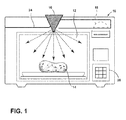
- FIG. 1 One embodiment of a cooking appliance 10 according to the present disclosure is shown in FIG. 1 .
- the cooking appliance 10 has a cavity 12 for placement of an item 14 to be cooked.
- a sensor 16 is positioned to detect physical characteristics of the item 14 while it is in the cavity 12 and during the cooking cycle.
- the sensor 16 is operably connected with a controller 18.
- the sensor 16 detects physical characteristics of the item 14 in the cavity 12 at multiple times during a cooking cycle and transmits the information about the physical characteristics to the controller 18.
- the controller 18 adjusts the cooking cycle based on the physical characteristics of the item 14, as sensed by the sensor 16.
- the cooking appliance 10 further includes a user input mechanism 20, where the user can input information regarding the cooking cycle, such as the maximum cooking time, the cooking temperature or power level, the type of the food item, any combination of these elements, or other information regarding the cooking cycle.
- the sensor 16 detects the level of the item 14 in the cavity 12 at a first time ( FIG. 2 ) and a second time ( FIG. 3 ). As the item 14 is heated, it expands. The sensor 16 detects the increase in height of the item 14 (which is a liquid in the embodiment depicted in FIGS. 2-3 ), and transmits the information regarding the height of the item 14 to the controller 18.
- the controller 18 uses information provided by the sensor 16 to control the cooking cycle. As shown in FIG. 4 , to evaluate the cooking cycle in a cooking appliance 10 as depicted in FIGS. 2-3 , the sensor 16 detects the height (H T1 ) of the item 14 at a first time (T 1 ). If the height (H T1 ) of the item 14 at the first time (T 1 ) is greater than a predetermined maximum height (H max ), the controller 18 directs the cooking appliance 10 to stop the cooking cycle.
- the controller 18 would instruct the cooking appliance 10 to modify the cooking cycle in a different manner, such as by reducing the cooking power.
- the sensor 16 detects the height (H T2 ) of the item 14 at a second time (T 2 ). If the height (H T2 ) of the item 14 at the second time (T 2 ) is greater than a predetermined maximum height (H max ), the controller 18 directs the cooking appliance 10 to stop (or modify) the cooking cycle.
- the controller 18 calculates the change in height ( ⁇ H) of the item 14 between the first time (T 1 ) and the second time (T 2 ). The controller 18 then determines whether the change in height ( ⁇ H) exceeds the predetermined maximum change in height ( ⁇ H max ) per the time interval from the first time (T 1 ) to the second time (T 2 ). If the change in height ( ⁇ H) exceeds the predetermined maximum change in height ( ⁇ H max ), then the controller 18 directs the cooking appliance 10 to stop (or modify) the cooking cycle.
- the controller 18 determines whether the cooking cycle has reached a predetermined maximum time (T max ) set by the user.
- T max a predetermined maximum time
- the maximum height (H max ) of the item 14 is programmed into the controller 18, including without limitation a maximum height (H max ) which is set as a function of the height of the cavity 12. In other embodiments, the maximum height (H max ) is selected or entered by the user.
- the cooking cycle is stopped. If the predetermined maximum time (T max ) has not been reached, the controller 18 continues to evaluate additional readings of the sensor 16 until at least one of the criteria for ending the cooking cycle has been met.
- the predetermined maximum height (H max ) of the item 14 is determined and programmed into the controller 18 based on the height of the cavity 12. In alternative embodiments, the maximum height (H max ) of the item 14 is selected or entered by the user. Additionally, in certain embodiments the predetermined maximum change in height ( ⁇ H max ) of the item 14 is calculated with reference to a standard programmed into the controller 18. As an alternative to calculating and basing the criteria on the change in height ( ⁇ H) per the time interval of T 1 to T 2 , embodiments according to the present disclosure may also measure or calculate the velocity or acceleration of the change in height, and include preset criteria for ending the cooking cycle based on these criteria.
- the physical characteristic measured by the sensor 16 is the size of the item 14 in the cavity 12.
- the physical characteristic measured by the sensor 16 includes the height of the item 14 or its level within a container 22, which may be used as a variable to determine or approximate the size of the item 14.
- Exemplary sensors 16 suitable to measure the size, height, or level of the item include, without limitation, an IR sensor, a thermal sensor, and a proximity sensor.
- the sensor 16 is wireless, and is disposed within the cavity 12. As shown in the embodiments depicted in FIGS. 1-3 , the sensor 16 is disposed along a top wall 24 of the cavity 12.
- a plurality of sensors 16 may be used to detect the physical characteristic of the item 14.
- the plurality of sensors 16 may be disposed in a single location or spaced throughout the cavity 12.
- Such sensors 16 may be used as an "add-on" feature to existing cooking appliances 10 or may be incorporated in the cooking appliance 10 during its manufacture.
- the senor 16 continuously detects the physical characteristic during the cooking cycle. In alternative embodiments, the sensor 16 may have a delay before beginning to detect the physical characteristic. In still other embodiments, the sensor 16 may detect the physical characteristic periodically (e.g., at defined time intervals).
- the controller 18 adjusts the cooking cycle based on the physical characteristic that is sensed. As described above, in the embodiment depicted in FIG. 4 , the controller 18 stops the cooking cycle based on the physical characteristic. In another embodiment, the controller 18 reduces the power of the cooking cycle based on the physical characteristic. Reducing the power of the cooking appliance 10 is potentially sufficient to prevent boiling over of an item 14 in the cavity 14 of the cooking appliance 10. Certain embodiments could also combine these features by, for example, reducing the power of the cooking appliance 10 if a first threshold value for the size or the rate of change of size of the item 14 is met and then stopping the cooking appliance 10 if a second threshold value for the size or the rate of change of size of the item 14 is met.
- the controller 18 controls the cooking cycle based at least partially on the size of the item 14 at the second time T 2 , such as when the size at the second time T 2 exceeds a predetermined maximum size.
- the predetermined maximum size would be specified regardless of the type of item 14 being cooked and the initial size (or previously-detected size) of the item 14.
- the predetermined maximum size may be calculated for each cooking cycle based on an initial or earlier measurement of the size of the item 14. For example, the cooking appliance 10 may be directed by the controller 18 to stop a cooking cycle if the item 14 reaches 200% of its size at the beginning of the cooking cycle.
- the cooking appliance 10 may be directed by the controller 18 to stop a cooking cycle if the size of the item is within a specific distance from the top wall 24 of the cavity 12 of the cooking appliance 10.
- the cooking appliance 10 may stop the cycle upon the first of either of these criteria being met. Based on the user input entered into the cooking appliance 10 (which may include, for example, the identity of the item 14), the cooking appliance 10 may also use different criteria to calculate the predetermined maximum size.
- the controller 18 controls the cooking cycle based at least partially on the rate of change in the size of the item 14 from the first time T 1 to the second time T 2 .
- the controller 18 would be basing the control of the cooking cycle on both the size of the item 14 at the first time and the size of the item 14 at the second time, as well as the elapsed time between the first time and the second time.
- Controlling a cooking appliance 10 in the manner described herein provides an additional variable that can be used to control the cooking cycle in a cooking appliance 10. In current cooking appliances, the cooking power and cooking time are generally set, and then the cooking appliance is started.
- the user In order to avoid having the item boil over, the user must either closely observe the item during cooking or set the cycle time at a low value, and add on time if the item is not sufficiently cooked.
- the cooking appliance 10 By detecting the size of the item and stopping the cooking cycle if the size exceeds a maximum value or if the size grows too quickly, the cooking appliance 10 according to the present disclosure is able to provide additional protection to prevent the item 14 from boiling over.
- elements shown as integrally formed may be constructed of multiple parts or elements shown as multiple parts may be integrally formed, the operation of the interfaces may be reversed or otherwise varied, the length or width of the structures and/or members or connector or other elements of the system may be varied, the nature or number of adjustment positions provided between the elements may be varied.
- the elements and/or assemblies of the system may be constructed from any of a wide variety of materials that provide sufficient strength or durability, in any of a wide variety of colors, textures, and combinations. Accordingly, all such modifications are intended to be included within the scope of the present innovations. Other substitutions, modifications, changes, and omissions may be made in the design, operating conditions, and arrangement of the desired and other exemplary embodiments without departing from the spirit of the present innovations.
Landscapes
- Engineering & Computer Science (AREA)
- Chemical & Material Sciences (AREA)
- Combustion & Propulsion (AREA)
- Mechanical Engineering (AREA)
- General Engineering & Computer Science (AREA)
- Food Science & Technology (AREA)
- Health & Medical Sciences (AREA)
- Nutrition Science (AREA)
- Life Sciences & Earth Sciences (AREA)
- Polymers & Plastics (AREA)
- Cookers (AREA)
Abstract
Description
- The present concept relates to a method of heating an item to prevent boiling over or overcooking of the item, and to a cooking appliance which uses such a heating method.
- A first aspect of the present concept includes a cooking appliance having a cavity for placement of an item to be cooked. A sensor detects the size of the item at multiple times during a cooking cycle and transmits the size to a controller. The controller adjusts the cooking cycle based on the size of the item.
- In another aspect of the present concept, a method of heating an item in a cavity of a cooking appliance includes the steps of detecting the size of the item at a first time during a cooking cycle and detecting the size of the item at a second time during the cooking cycle. The method further includes controlling the cooking cycle at least partially based on the size of the item at the second time during the cooking cycle.
- Yet another aspect of the present concept includes a method of cooking an item in a cooking appliance including the steps of measuring a physical property of the item at multiple times during a cooking cycle and calculating the rate of change of the physical property of the item. The cooking cycle is controlled based on the rate of change of the physical property during the cooking cycle.
- The cooking appliance and methods described in this disclosure aid the user in preventing boil-over of the item in a cooking appliance, by sensing physical properties of the item and controlling the cooking cycle based on these physical properties, rather than relying only on a time setting.
- These and other features, advantages, and objects of the present device will be further understood and appreciated by those skilled in the art upon studying the following specification, claims, and appended drawings.
-
-
FIG. 1 is a front elevation view of a cooking appliance according to the present invention; -
FIG. 2 is a front elevation view of a container of liquid in a cavity of the cooking appliance at the beginning of a cooking cycle; -
FIG. 3 is a front elevation view of the container of liquid in the cavity of the cooking appliance at the end of the cooking cycle; and -
FIG. 4 is a flow diagram of a method of operating the cooking appliance according to the present invention. - For purposes of description herein the terms "upper," "lower," "right," "left," "rear," "front," "vertical," "horizontal," and derivatives thereof shall relate to the device as oriented in
FIG. 1 . However, it is to be understood that the device may assume various alternative orientations and step sequences, except where expressly specified to the contrary. It is also to be understood that the specific devices and processes illustrated in the attached drawings, and described in the following specification are simply exemplary embodiments of the inventive concepts defined in the appended claims. Hence, specific dimensions and other physical characteristics relating to the embodiments disclosed herein are not to be considered as limiting, unless the claims expressly state otherwise. - One embodiment of a
cooking appliance 10 according to the present disclosure is shown inFIG. 1 . Thecooking appliance 10 has acavity 12 for placement of anitem 14 to be cooked. Asensor 16 is positioned to detect physical characteristics of theitem 14 while it is in thecavity 12 and during the cooking cycle. Thesensor 16 is operably connected with acontroller 18. Thesensor 16 detects physical characteristics of theitem 14 in thecavity 12 at multiple times during a cooking cycle and transmits the information about the physical characteristics to thecontroller 18. Thecontroller 18 adjusts the cooking cycle based on the physical characteristics of theitem 14, as sensed by thesensor 16. Thecooking appliance 10 further includes auser input mechanism 20, where the user can input information regarding the cooking cycle, such as the maximum cooking time, the cooking temperature or power level, the type of the food item, any combination of these elements, or other information regarding the cooking cycle. - As illustrated in the embodiment depicted in
FIGS. 2-3 , thesensor 16 detects the level of theitem 14 in thecavity 12 at a first time (FIG. 2 ) and a second time (FIG. 3 ). As theitem 14 is heated, it expands. Thesensor 16 detects the increase in height of the item 14 (which is a liquid in the embodiment depicted inFIGS. 2-3 ), and transmits the information regarding the height of theitem 14 to thecontroller 18. - As shown in
FIG. 4 , thecontroller 18 uses information provided by thesensor 16 to control the cooking cycle. As shown inFIG. 4 , to evaluate the cooking cycle in acooking appliance 10 as depicted inFIGS. 2-3 , thesensor 16 detects the height (HT1) of theitem 14 at a first time (T1). If the height (HT1) of theitem 14 at the first time (T1) is greater than a predetermined maximum height (Hmax), thecontroller 18 directs thecooking appliance 10 to stop the cooking cycle. (In alternate embodiments, thecontroller 18 would instruct thecooking appliance 10 to modify the cooking cycle in a different manner, such as by reducing the cooking power.) If the height (HT1) of theitem 14 at the first time (T1) is not greater than the predetermined maximum height (Hmax), thesensor 16 detects the height (HT2) of theitem 14 at a second time (T2). If the height (HT2) of theitem 14 at the second time (T2) is greater than a predetermined maximum height (Hmax), thecontroller 18 directs thecooking appliance 10 to stop (or modify) the cooking cycle. If the height (HT2) of theitem 14 at the second time (T2) is not greater than the predetermined maximum height (Hmax), thecontroller 18 calculates the change in height (ΔH) of theitem 14 between the first time (T1) and the second time (T2). Thecontroller 18 then determines whether the change in height (ΔH) exceeds the predetermined maximum change in height (ΔHmax) per the time interval from the first time (T1) to the second time (T2). If the change in height (ΔH) exceeds the predetermined maximum change in height (ΔHmax), then thecontroller 18 directs thecooking appliance 10 to stop (or modify) the cooking cycle. If the change in height (ΔH) does not exceed the predetermined maximum change in height (ΔHmax), thecontroller 18 determines whether the cooking cycle has reached a predetermined maximum time (Tmax) set by the user. In certain embodiments, the maximum height (Hmax) of theitem 14 is programmed into thecontroller 18, including without limitation a maximum height (Hmax) which is set as a function of the height of thecavity 12. In other embodiments, the maximum height (Hmax) is selected or entered by the user. - If the predetermined maximum time (Tmax) has been reached, the cooking cycle is stopped. If the predetermined maximum time (Tmax) has not been reached, the
controller 18 continues to evaluate additional readings of thesensor 16 until at least one of the criteria for ending the cooking cycle has been met. - In some embodiments, the predetermined maximum height (Hmax) of the
item 14 is determined and programmed into thecontroller 18 based on the height of thecavity 12. In alternative embodiments, the maximum height (Hmax) of theitem 14 is selected or entered by the user. Additionally, in certain embodiments the predetermined maximum change in height (ΔHmax) of theitem 14 is calculated with reference to a standard programmed into thecontroller 18. As an alternative to calculating and basing the criteria on the change in height (ΔH) per the time interval of T1 to T2, embodiments according to the present disclosure may also measure or calculate the velocity or acceleration of the change in height, and include preset criteria for ending the cooking cycle based on these criteria. - In one embodiment, as shown in
FIG. 1 , the physical characteristic measured by thesensor 16 is the size of theitem 14 in thecavity 12. In other embodiments, e.g., as shown inFIGS. 2-3 , the physical characteristic measured by thesensor 16 includes the height of theitem 14 or its level within acontainer 22, which may be used as a variable to determine or approximate the size of theitem 14.Exemplary sensors 16 suitable to measure the size, height, or level of the item include, without limitation, an IR sensor, a thermal sensor, and a proximity sensor. In certain embodiments thesensor 16 is wireless, and is disposed within thecavity 12. As shown in the embodiments depicted inFIGS. 1-3 , thesensor 16 is disposed along atop wall 24 of thecavity 12. In some embodiments, a plurality ofsensors 16 may be used to detect the physical characteristic of theitem 14. The plurality ofsensors 16 may be disposed in a single location or spaced throughout thecavity 12.Such sensors 16 may be used as an "add-on" feature to existingcooking appliances 10 or may be incorporated in thecooking appliance 10 during its manufacture. - In some embodiments, the
sensor 16 continuously detects the physical characteristic during the cooking cycle. In alternative embodiments, thesensor 16 may have a delay before beginning to detect the physical characteristic. In still other embodiments, thesensor 16 may detect the physical characteristic periodically (e.g., at defined time intervals). - In order to prevent boiling over or overcooking of the
item 14, thecontroller 18 adjusts the cooking cycle based on the physical characteristic that is sensed. As described above, in the embodiment depicted inFIG. 4 , thecontroller 18 stops the cooking cycle based on the physical characteristic. In another embodiment, thecontroller 18 reduces the power of the cooking cycle based on the physical characteristic. Reducing the power of thecooking appliance 10 is potentially sufficient to prevent boiling over of anitem 14 in thecavity 14 of thecooking appliance 10. Certain embodiments could also combine these features by, for example, reducing the power of thecooking appliance 10 if a first threshold value for the size or the rate of change of size of theitem 14 is met and then stopping thecooking appliance 10 if a second threshold value for the size or the rate of change of size of theitem 14 is met. - In the embodiments described herein, the
controller 18 controls the cooking cycle based at least partially on the size of theitem 14 at the second time T2, such as when the size at the second time T2 exceeds a predetermined maximum size. In certain embodiments, the predetermined maximum size would be specified regardless of the type ofitem 14 being cooked and the initial size (or previously-detected size) of theitem 14. In other embodiments, the predetermined maximum size may be calculated for each cooking cycle based on an initial or earlier measurement of the size of theitem 14. For example, thecooking appliance 10 may be directed by thecontroller 18 to stop a cooking cycle if theitem 14 reaches 200% of its size at the beginning of the cooking cycle. Alternatively, thecooking appliance 10 may be directed by thecontroller 18 to stop a cooking cycle if the size of the item is within a specific distance from thetop wall 24 of thecavity 12 of thecooking appliance 10. In yet another embodiment, thecooking appliance 10 may stop the cycle upon the first of either of these criteria being met. Based on the user input entered into the cooking appliance 10 (which may include, for example, the identity of the item 14), thecooking appliance 10 may also use different criteria to calculate the predetermined maximum size. - In alternate embodiments, the
controller 18 controls the cooking cycle based at least partially on the rate of change in the size of theitem 14 from the first time T1 to the second time T2. In such embodiments, thecontroller 18 would be basing the control of the cooking cycle on both the size of theitem 14 at the first time and the size of theitem 14 at the second time, as well as the elapsed time between the first time and the second time. Controlling acooking appliance 10 in the manner described herein provides an additional variable that can be used to control the cooking cycle in acooking appliance 10. In current cooking appliances, the cooking power and cooking time are generally set, and then the cooking appliance is started. In order to avoid having the item boil over, the user must either closely observe the item during cooking or set the cycle time at a low value, and add on time if the item is not sufficiently cooked. By detecting the size of the item and stopping the cooking cycle if the size exceeds a maximum value or if the size grows too quickly, thecooking appliance 10 according to the present disclosure is able to provide additional protection to prevent theitem 14 from boiling over. - It is also important to note that the construction and arrangement of the elements of the device as shown in the exemplary embodiments is illustrative only. Although only a few embodiments of the present innovations have been described in detail in this disclosure, those skilled in the art who review this disclosure will readily appreciate that many modifications are possible (e.g., variations in sizes, dimensions, structures, shapes and proportions of the various elements, values of parameters, mounting arrangements, use of materials, colors, orientations, etc.) without materially departing from the novel teachings and advantages of the subject matter recited. For example, elements shown as integrally formed may be constructed of multiple parts or elements shown as multiple parts may be integrally formed, the operation of the interfaces may be reversed or otherwise varied, the length or width of the structures and/or members or connector or other elements of the system may be varied, the nature or number of adjustment positions provided between the elements may be varied. It should be noted that the elements and/or assemblies of the system may be constructed from any of a wide variety of materials that provide sufficient strength or durability, in any of a wide variety of colors, textures, and combinations. Accordingly, all such modifications are intended to be included within the scope of the present innovations. Other substitutions, modifications, changes, and omissions may be made in the design, operating conditions, and arrangement of the desired and other exemplary embodiments without departing from the spirit of the present innovations.
- It will be understood that any described processes or steps within described processes may be combined with other disclosed processes or steps to form structures within the scope of the present device. The exemplary structures and processes disclosed herein are for illustrative purposes and are not to be construed as limiting.
- It is also to be understood that variations and modifications can be made on the aforementioned structures and methods without departing from the concepts of the present device, and further it is to be understood that such concepts are intended to be covered by the following claims unless these claims by their language expressly state otherwise.
- The above description is considered that of the illustrated embodiments only. Modifications of the device will occur to those skilled in the art and to those who make or use the device. Therefore, it is understood that the embodiments shown in the drawings and described above is merely for illustrative purposes and not intended to limit the scope of the device, which is defined by the following claims as interpreted according to the principles of patent law, including the Doctrine of Equivalents.
Claims (14)
- A cooking appliance (10), comprising:a cavity (12) for placement of an item (14) to be cooked;a controller (18) configured to adjust a cooking cycle of said appliance (10) anda sensor (16) operably connected with said controller (18), characterized in that the sensor (16) is configured to detect the size of the item (14) at multiple times during a cooking cycle and to transmit the information about the size to the controller (18), wherein the controller (18) is configured to adjust the cooking cycle based on the size of the item (14) as detected by the sensor (16).
- The cooking appliance (10) of claim 1, wherein the controller (18) is configured to stop the cooking cycle when the item (14) reaches a predetermined maximum size.
- The cooking appliance (10) of claim 1, wherein the controller (18) is configured to stop the cooking cycle when the item (14) reaches a predetermined maximum rate of change (ΔHmax) in size.
- The cooking appliance (10) o according to any of the preceding claims wherein the adjustment to the cooking cycle is a change in cooking power.
- The cooking appliance (10) according to any of the preceding claims, wherein the sensor (16) is configured to continuously measures the size of the item (14) during the cooking cycle.
- The cooking appliance (10) according to any of the preceding claims, wherein the sensor (16) is chosen from the group consisting of an IR sensor (16), a thermal sensor (16), and a proximity sensor (16).
- The cooking appliance (10 according to any of the preceding claims, wherein the sensor (16) is disposed along a top wall (24) of the cavity (12).
- The cooking appliance (10) of claim 7, wherein the sensor (16) is configured to measure a height (HT1) of the item (14) in order to determine the size of the item (14) at the first time (T1) and the size of the item (14) at the second time (T2).
- A method of heating an item (14) in a cavity (12) of a cooking appliance (10), comprising the steps of:detecting a size of the item (14) at a first time (T1) during a cooking cycle;detecting the size of the item (14) at a second time (T2) during the cooking cycle; andcontrolling the cooking cycle at least partially based on the size of the item (14) at the second time (T2) during the cooking cycle.
- The method of claim 9, wherein the size of the item (14) is detected with a sensor (16), wherein the sensor (16) is chosen from the group consisting of an IR sensor (16), a thermal sensor (16), and a proximity sensor (16).
- The method according to claim 9 or 10, wherein the step of detecting the size of the item (14) includes sensing the height (HT1) of the item (14) within the cavity (12).
- The method according to any of the claims from 9 to 11, wherein the step of controlling the cooking cycle includes stopping the cooking cycle if the size of the item (14) reaches a predetermined maximum size (Hmax), and wherein the predetermined maximum size (Hmax) is calculated based upon the size of the item (14) at the first time (T1) during the cooking cycle.
- The method according to any of the claims from 9 to 11, further comprising the step of:comparing the size of the item (14) at the first time (T1) to the size of the item (14) at the second time (T2); andcontrolling the cooking cycle at least partially based on the size of the item (14) at the first time (T1) and the size of the item (14) at the second time (T2), wherein the step of controlling the cooking cycle includes calculating the rate of change in size (ΔH) of the item (14) from the first time (T1) to the second time (T2), and controlling the cooking cycle based on the rate of change in size (ΔH) of the item (14) from the first time (T1) to the second time (T2).
- The method of claim 13, wherein the step of controlling the cooking cycle includes stopping the cooking cycle when the rate of change in size (ΔH) of said item (14) reaches a predetermined maximum rate of change (ΔHmax).
Applications Claiming Priority (1)
| Application Number | Priority Date | Filing Date | Title |
|---|---|---|---|
| US14/021,095 US9668602B2 (en) | 2013-09-09 | 2013-09-09 | Cooking appliance |
Publications (2)
| Publication Number | Publication Date |
|---|---|
| EP2846098A2 true EP2846098A2 (en) | 2015-03-11 |
| EP2846098A3 EP2846098A3 (en) | 2015-03-25 |
Family
ID=51398549
Family Applications (1)
| Application Number | Title | Priority Date | Filing Date |
|---|---|---|---|
| EP14182358.3A Withdrawn EP2846098A3 (en) | 2013-09-09 | 2014-08-26 | Cooking appliance comprising a sensor to detect the size of the item to be cooked |
Country Status (2)
| Country | Link |
|---|---|
| US (1) | US9668602B2 (en) |
| EP (1) | EP2846098A3 (en) |
Family Cites Families (23)
| Publication number | Priority date | Publication date | Assignee | Title |
|---|---|---|---|---|
| US2965015A (en) * | 1958-08-04 | 1960-12-20 | William F Tydings | Automatic cooking apparatus |
| US4363957A (en) | 1979-01-09 | 1982-12-14 | Hitachi Heating Appliances Co., Ltd. | Heating apparatus with char detecting and heating controller |
| US4433232A (en) | 1981-05-29 | 1984-02-21 | Hitachi Heating Appliances Co., Ltd. | Heating apparatus |
| AU591353B2 (en) * | 1986-10-22 | 1989-11-30 | Matsushita Electric Industrial Co., Ltd. | Automatic heating appliance with ultrasonic sensor |
| EP0275097B1 (en) * | 1987-01-16 | 1993-08-04 | Matsushita Electric Industrial Co., Ltd. | Heat cooking apparatus |
| JPH01222113A (en) | 1988-02-29 | 1989-09-05 | Toshiba Corp | Cooker |
| KR0129239B1 (en) | 1994-06-11 | 1998-04-09 | 구자홍 | Cooking device of microwave-oven |
| US5771779A (en) | 1995-10-16 | 1998-06-30 | Six Corners Development, Inc. | Automated corn popping apparatus |
| US5938962A (en) * | 1996-03-11 | 1999-08-17 | Amana Company, L.P. | Apparatus for detecting a characteristic of a product undergoing heating |
| US6028521A (en) | 1997-12-16 | 2000-02-22 | Issachar; David | Liquid level sensor |
| US6301521B1 (en) | 1998-12-14 | 2001-10-09 | General Electric Company | Method and apparatus for boil phase determination |
| SE514526C2 (en) | 1999-06-24 | 2001-03-05 | Whirlpool Co | Method for controlling a cooking process in a microwave oven and microwave oven for this |
| JP2002013743A (en) | 2000-04-28 | 2002-01-18 | Sanyo Electric Co Ltd | Electronic oven |
| US6433693B1 (en) | 2000-07-31 | 2002-08-13 | General Electric Company | Apparatus and method for boil phase detection based on acoustic signal features |
| JP2003090541A (en) | 2001-09-20 | 2003-03-28 | Sharp Corp | Cooker |
| US20100231506A1 (en) | 2004-09-07 | 2010-09-16 | Timothy Pryor | Control of appliances, kitchen and home |
| WO2007054917A2 (en) | 2005-11-14 | 2007-05-18 | Arcelik Anonim Sirketi | An oven |
| EP2528414B1 (en) | 2006-02-21 | 2016-05-11 | Goji Limited | Electromagnetic heating |
| EP2027417B1 (en) * | 2006-06-09 | 2014-04-30 | Arçelik Anonim Sirketi | An oven |
| FR2929823B1 (en) | 2008-04-14 | 2013-03-01 | Seb Sa | SAFETY DEVICE FOR APPARATUS FOR PREPARING AND COOKING BREAD |
| US20090321428A1 (en) | 2008-06-30 | 2009-12-31 | Hyde Roderick A | Microwave oven |
| US20100101317A1 (en) | 2008-10-23 | 2010-04-29 | Whirlpool Corporation | Lid based amount sensor |
| KR101044155B1 (en) | 2009-06-15 | 2011-06-24 | 엘지전자 주식회사 | Cooking apparatus and control method |
-
2013
- 2013-09-09 US US14/021,095 patent/US9668602B2/en active Active
-
2014
- 2014-08-26 EP EP14182358.3A patent/EP2846098A3/en not_active Withdrawn
Non-Patent Citations (1)
| Title |
|---|
| None |
Also Published As
| Publication number | Publication date |
|---|---|
| EP2846098A3 (en) | 2015-03-25 |
| US9668602B2 (en) | 2017-06-06 |
| US20150072054A1 (en) | 2015-03-12 |
Similar Documents
| Publication | Publication Date | Title |
|---|---|---|
| US10292521B2 (en) | Method of regulating temperature for sous vide cooking and apparatus therefor | |
| CN106843312B (en) | Temperature control method and device | |
| CN102637053B (en) | The temperature control method of cookware | |
| CN109316039B (en) | Control method of electric cooking equipment and electric cooking equipment | |
| EP3225143B1 (en) | Hanger-type cooking information providing device | |
| US9867234B2 (en) | Induction cooking device for temperature-controlled cooking | |
| US9631984B2 (en) | Methods for determining the angle of insertion of a core temperature sensor | |
| ES2693501T3 (en) | Cooking field with a plurality of heating elements | |
| CN108518712B (en) | Range hood, control method and system thereof, and fire detection method and device | |
| US10440778B2 (en) | Temperature controlling device for an appliance heating element | |
| CN108278651B (en) | Range hood, control method and system thereof, and fire detection method and device | |
| EP3126565B1 (en) | Apparatus including a steam generator and method of controlling the same | |
| CN104823518A (en) | Method and control unit for controlling cooking process on induction cooking hob | |
| US20170299195A1 (en) | Cooktop Fire Prevention Module with Remote Control Cooking Features | |
| CN106308459B (en) | Empty pot determination methods and device for electric cooker | |
| CN102613874A (en) | Dry burning prevention control method for cooker and cooker applying dry burning prevention control method | |
| CN111380088B (en) | Induction cooker and method and device for identifying cooking pot on induction cooker | |
| CN104534680A (en) | Method for judging boiling point of water in boiler | |
| RU2015131001A (en) | METHOD AND DEVICE FOR DETERMINING TEMPERATURE INSIDE THE FOOD PRODUCT | |
| CN100370378C (en) | How to control the electric kettle | |
| CN104406206A (en) | Automatic control device of gas stove | |
| US9668602B2 (en) | Cooking appliance | |
| RU2017114102A (en) | MICROWAVE AND METHOD AND DEVICE FOR MANAGING DEFROSTING FOR MICROWAVE | |
| CN106308479B (en) | Rice cooker and method of using the rice cooker to keep warm | |
| KR20130122265A (en) | Apparatus and method for prevent overheating of cooking vessel by thermal conductivity |
Legal Events
| Date | Code | Title | Description |
|---|---|---|---|
| PUAL | Search report despatched |
Free format text: ORIGINAL CODE: 0009013 |
|
| 17P | Request for examination filed |
Effective date: 20140826 |
|
| AK | Designated contracting states |
Kind code of ref document: A2 Designated state(s): AL AT BE BG CH CY CZ DE DK EE ES FI FR GB GR HR HU IE IS IT LI LT LU LV MC MK MT NL NO PL PT RO RS SE SI SK SM TR |
|
| AX | Request for extension of the european patent |
Extension state: BA ME |
|
| PUAI | Public reference made under article 153(3) epc to a published international application that has entered the european phase |
Free format text: ORIGINAL CODE: 0009012 |
|
| AK | Designated contracting states |
Kind code of ref document: A3 Designated state(s): AL AT BE BG CH CY CZ DE DK EE ES FI FR GB GR HR HU IE IS IT LI LT LU LV MC MK MT NL NO PL PT RO RS SE SI SK SM TR |
|
| AX | Request for extension of the european patent |
Extension state: BA ME |
|
| RIC1 | Information provided on ipc code assigned before grant |
Ipc: F24C 7/08 20060101AFI20150217BHEP |
|
| STAA | Information on the status of an ep patent application or granted ep patent |
Free format text: STATUS: THE APPLICATION IS DEEMED TO BE WITHDRAWN |
|
| 18D | Application deemed to be withdrawn |
Effective date: 20150926 |