EP2845857A1 - Use of cyclohexa-2,5-dien-1-yl-silanes as precursors for gaseous hydrosilanes - Google Patents
Use of cyclohexa-2,5-dien-1-yl-silanes as precursors for gaseous hydrosilanes Download PDFInfo
- Publication number
- EP2845857A1 EP2845857A1 EP13183727.0A EP13183727A EP2845857A1 EP 2845857 A1 EP2845857 A1 EP 2845857A1 EP 13183727 A EP13183727 A EP 13183727A EP 2845857 A1 EP2845857 A1 EP 2845857A1
- Authority
- EP
- European Patent Office
- Prior art keywords
- general formula
- cyclohexa
- alkyl
- dien
- alkenes
- Prior art date
- Legal status (The legal status is an assumption and is not a legal conclusion. Google has not performed a legal analysis and makes no representation as to the accuracy of the status listed.)
- Withdrawn
Links
- VIBQXBROKGFRRQ-UHFFFAOYSA-N cyclohexa-2,5-dien-1-ylsilane Chemical class [SiH3]C1C=CCC=C1 VIBQXBROKGFRRQ-UHFFFAOYSA-N 0.000 title claims abstract description 19
- 239000002243 precursor Substances 0.000 title claims description 6
- 150000001336 alkenes Chemical class 0.000 claims abstract description 31
- 239000002904 solvent Substances 0.000 claims abstract description 18
- 239000002841 Lewis acid Substances 0.000 claims abstract description 10
- 150000007517 lewis acids Chemical class 0.000 claims abstract description 10
- 150000004945 aromatic hydrocarbons Chemical class 0.000 claims abstract description 9
- 230000015572 biosynthetic process Effects 0.000 claims abstract description 8
- 239000003795 chemical substances by application Substances 0.000 claims abstract description 5
- 125000002496 methyl group Chemical group [H]C([H])([H])* 0.000 claims description 33
- 238000006243 chemical reaction Methods 0.000 claims description 21
- 125000006273 (C1-C3) alkyl group Chemical group 0.000 claims description 13
- 125000003118 aryl group Chemical group 0.000 claims description 12
- 125000001495 ethyl group Chemical group [H]C([H])([H])C([H])([H])* 0.000 claims description 11
- 125000006274 (C1-C3)alkoxy group Chemical group 0.000 claims description 9
- 125000000956 methoxy group Chemical group [H]C([H])([H])O* 0.000 claims description 8
- 125000001301 ethoxy group Chemical group [H]C([H])([H])C([H])([H])O* 0.000 claims description 7
- -1 R7 represents H Chemical group 0.000 claims description 6
- 125000001997 phenyl group Chemical group [H]C1=C([H])C([H])=C(*)C([H])=C1[H] 0.000 claims description 6
- 229910052736 halogen Inorganic materials 0.000 claims description 3
- 150000002367 halogens Chemical class 0.000 claims description 3
- 125000001449 isopropyl group Chemical group [H]C([H])([H])C([H])(*)C([H])([H])[H] 0.000 claims description 3
- JFNLZVQOOSMTJK-KNVOCYPGSA-N norbornene Chemical compound C1[C@@H]2CC[C@H]1C=C2 JFNLZVQOOSMTJK-KNVOCYPGSA-N 0.000 claims description 3
- 150000004756 silanes Chemical class 0.000 claims description 3
- 125000000008 (C1-C10) alkyl group Chemical group 0.000 claims description 2
- 125000003837 (C1-C20) alkyl group Chemical group 0.000 claims description 2
- 125000000753 cycloalkyl group Chemical group 0.000 claims description 2
- 150000001728 carbonyl compounds Chemical class 0.000 claims 1
- 239000003054 catalyst Substances 0.000 abstract description 9
- UHOVQNZJYSORNB-MZWXYZOWSA-N benzene-d6 Chemical compound [2H]C1=C([2H])C([2H])=C([2H])C([2H])=C1[2H] UHOVQNZJYSORNB-MZWXYZOWSA-N 0.000 description 100
- OFBQJSOFQDEBGM-UHFFFAOYSA-N Pentane Chemical compound CCCCC OFBQJSOFQDEBGM-UHFFFAOYSA-N 0.000 description 30
- 238000005160 1H NMR spectroscopy Methods 0.000 description 25
- 238000001644 13C nuclear magnetic resonance spectroscopy Methods 0.000 description 24
- VYPSYNLAJGMNEJ-UHFFFAOYSA-N Silicium dioxide Chemical compound O=[Si]=O VYPSYNLAJGMNEJ-UHFFFAOYSA-N 0.000 description 22
- 239000012230 colorless oil Substances 0.000 description 22
- 238000004896 high resolution mass spectrometry Methods 0.000 description 22
- HPQAFWGDGJFSQQ-UHFFFAOYSA-N cyclohexa-2,5-dien-1-yl(trimethyl)silane Chemical compound C[Si](C)(C)C1C=CCC=C1 HPQAFWGDGJFSQQ-UHFFFAOYSA-N 0.000 description 17
- 238000003818 flash chromatography Methods 0.000 description 13
- 238000006459 hydrosilylation reaction Methods 0.000 description 13
- 239000000243 solution Substances 0.000 description 13
- YMWUJEATGCHHMB-UHFFFAOYSA-N Dichloromethane Chemical compound ClCCl YMWUJEATGCHHMB-UHFFFAOYSA-N 0.000 description 12
- YXFVVABEGXRONW-UHFFFAOYSA-N Toluene Chemical compound CC1=CC=CC=C1 YXFVVABEGXRONW-UHFFFAOYSA-N 0.000 description 12
- CTMHWPIWNRWQEG-UHFFFAOYSA-N 1-methylcyclohexene Chemical compound CC1=CCCCC1 CTMHWPIWNRWQEG-UHFFFAOYSA-N 0.000 description 10
- 239000003480 eluent Substances 0.000 description 10
- UHOVQNZJYSORNB-UHFFFAOYSA-N Benzene Chemical compound C1=CC=CC=C1 UHOVQNZJYSORNB-UHFFFAOYSA-N 0.000 description 9
- 238000000034 method Methods 0.000 description 9
- 239000013058 crude material Substances 0.000 description 8
- 239000000203 mixture Substances 0.000 description 8
- 238000000023 Kugelrohr distillation Methods 0.000 description 7
- UVJHQYIOXKWHFD-UHFFFAOYSA-N cyclohexa-1,4-diene Chemical compound C1C=CCC=C1 UVJHQYIOXKWHFD-UHFFFAOYSA-N 0.000 description 7
- 238000000746 purification Methods 0.000 description 7
- 229910001868 water Inorganic materials 0.000 description 7
- PPBRXRYQALVLMV-UHFFFAOYSA-N Styrene Chemical compound C=CC1=CC=CC=C1 PPBRXRYQALVLMV-UHFFFAOYSA-N 0.000 description 6
- 229910052681 coesite Inorganic materials 0.000 description 6
- 150000001875 compounds Chemical class 0.000 description 6
- 229910052906 cristobalite Inorganic materials 0.000 description 6
- 238000001030 gas--liquid chromatography Methods 0.000 description 6
- 239000000377 silicon dioxide Substances 0.000 description 6
- 229910052682 stishovite Inorganic materials 0.000 description 6
- 229910052905 tridymite Inorganic materials 0.000 description 6
- WYURNTSHIVDZCO-UHFFFAOYSA-N Tetrahydrofuran Chemical compound C1CCOC1 WYURNTSHIVDZCO-UHFFFAOYSA-N 0.000 description 5
- JKVRFKKTXWPEBH-UHFFFAOYSA-N cyclohexa-2,5-dien-1-yl(dimethyl)silane Chemical compound C[SiH](C)C1C=CCC=C1 JKVRFKKTXWPEBH-UHFFFAOYSA-N 0.000 description 5
- 239000002808 molecular sieve Substances 0.000 description 5
- URGAHOPLAPQHLN-UHFFFAOYSA-N sodium aluminosilicate Chemical compound [Na+].[Al+3].[O-][Si]([O-])=O.[O-][Si]([O-])=O URGAHOPLAPQHLN-UHFFFAOYSA-N 0.000 description 5
- 238000003756 stirring Methods 0.000 description 5
- OBAJXDYVZBHCGT-UHFFFAOYSA-N tris(pentafluorophenyl)borane Chemical compound FC1=C(F)C(F)=C(F)C(F)=C1B(C=1C(=C(F)C(F)=C(F)C=1F)F)C1=C(F)C(F)=C(F)C(F)=C1F OBAJXDYVZBHCGT-UHFFFAOYSA-N 0.000 description 5
- ZMYIIHDQURVDRB-UHFFFAOYSA-N 1-phenylethenylbenzene Chemical group C=1C=CC=CC=1C(=C)C1=CC=CC=C1 ZMYIIHDQURVDRB-UHFFFAOYSA-N 0.000 description 4
- KZMGYPLQYOPHEL-UHFFFAOYSA-N Boron trifluoride etherate Chemical compound FB(F)F.CCOCC KZMGYPLQYOPHEL-UHFFFAOYSA-N 0.000 description 4
- ZMANZCXQSJIPKH-UHFFFAOYSA-N Triethylamine Chemical compound CCN(CC)CC ZMANZCXQSJIPKH-UHFFFAOYSA-N 0.000 description 4
- 239000003153 chemical reaction reagent Substances 0.000 description 4
- 239000000741 silica gel Substances 0.000 description 4
- 229910002027 silica gel Inorganic materials 0.000 description 4
- 239000003039 volatile agent Substances 0.000 description 4
- XDTMQSROBMDMFD-UHFFFAOYSA-N Cyclohexane Chemical compound C1CCCCC1 XDTMQSROBMDMFD-UHFFFAOYSA-N 0.000 description 3
- XEKOWRVHYACXOJ-UHFFFAOYSA-N Ethyl acetate Chemical compound CCOC(C)=O XEKOWRVHYACXOJ-UHFFFAOYSA-N 0.000 description 3
- 238000005516 engineering process Methods 0.000 description 3
- 239000007789 gas Substances 0.000 description 3
- 239000011541 reaction mixture Substances 0.000 description 3
- 238000003786 synthesis reaction Methods 0.000 description 3
- 125000004178 (C1-C4) alkyl group Chemical group 0.000 description 2
- WSLDOOZREJYCGB-UHFFFAOYSA-N 1,2-Dichloroethane Chemical compound ClCCCl WSLDOOZREJYCGB-UHFFFAOYSA-N 0.000 description 2
- KWKAKUADMBZCLK-UHFFFAOYSA-N 1-octene Chemical compound CCCCCCC=C KWKAKUADMBZCLK-UHFFFAOYSA-N 0.000 description 2
- YBYIRNPNPLQARY-UHFFFAOYSA-N 1H-indene Chemical compound C1=CC=C2CC=CC2=C1 YBYIRNPNPLQARY-UHFFFAOYSA-N 0.000 description 2
- YSAXEHWHSLANOM-UHFFFAOYSA-N 2-methyl-1h-indene Chemical compound C1=CC=C2CC(C)=CC2=C1 YSAXEHWHSLANOM-UHFFFAOYSA-N 0.000 description 2
- XKRFYHLGVUSROY-UHFFFAOYSA-N Argon Chemical compound [Ar] XKRFYHLGVUSROY-UHFFFAOYSA-N 0.000 description 2
- IJGRMHOSHXDMSA-UHFFFAOYSA-N Atomic nitrogen Chemical compound N#N IJGRMHOSHXDMSA-UHFFFAOYSA-N 0.000 description 2
- WKBOTKDWSSQWDR-UHFFFAOYSA-N Bromine atom Chemical compound [Br] WKBOTKDWSSQWDR-UHFFFAOYSA-N 0.000 description 2
- RVRNZTBTGZWIFW-UHFFFAOYSA-N CC1Cc2ccccc2C1[Si](C)(C)C Chemical compound CC1Cc2ccccc2C1[Si](C)(C)C RVRNZTBTGZWIFW-UHFFFAOYSA-N 0.000 description 2
- ZAMOUSCENKQFHK-UHFFFAOYSA-N Chlorine atom Chemical compound [Cl] ZAMOUSCENKQFHK-UHFFFAOYSA-N 0.000 description 2
- HEDRZPFGACZZDS-UHFFFAOYSA-N Chloroform Chemical compound ClC(Cl)Cl HEDRZPFGACZZDS-UHFFFAOYSA-N 0.000 description 2
- BZLVMXJERCGZMT-UHFFFAOYSA-N Methyl tert-butyl ether Chemical compound COC(C)(C)C BZLVMXJERCGZMT-UHFFFAOYSA-N 0.000 description 2
- 238000005481 NMR spectroscopy Methods 0.000 description 2
- CTQNGGLPUBDAKN-UHFFFAOYSA-N O-Xylene Chemical compound CC1=CC=CC=C1C CTQNGGLPUBDAKN-UHFFFAOYSA-N 0.000 description 2
- VSCWAEJMTAWNJL-UHFFFAOYSA-K aluminium trichloride Chemical compound Cl[Al](Cl)Cl VSCWAEJMTAWNJL-UHFFFAOYSA-K 0.000 description 2
- 238000006664 bond formation reaction Methods 0.000 description 2
- GDTBXPJZTBHREO-UHFFFAOYSA-N bromine Substances BrBr GDTBXPJZTBHREO-UHFFFAOYSA-N 0.000 description 2
- 229910052794 bromium Inorganic materials 0.000 description 2
- 238000012512 characterization method Methods 0.000 description 2
- 239000007795 chemical reaction product Substances 0.000 description 2
- 239000000460 chlorine Substances 0.000 description 2
- 229910052801 chlorine Inorganic materials 0.000 description 2
- DCFKHNIGBAHNSS-UHFFFAOYSA-N chloro(triethyl)silane Chemical compound CC[Si](Cl)(CC)CC DCFKHNIGBAHNSS-UHFFFAOYSA-N 0.000 description 2
- KQIADDMXRMTWHZ-UHFFFAOYSA-N chloro-tri(propan-2-yl)silane Chemical compound CC(C)[Si](Cl)(C(C)C)C(C)C KQIADDMXRMTWHZ-UHFFFAOYSA-N 0.000 description 2
- IJOOHPMOJXWVHK-UHFFFAOYSA-N chlorotrimethylsilane Chemical compound C[Si](C)(C)Cl IJOOHPMOJXWVHK-UHFFFAOYSA-N 0.000 description 2
- 230000008878 coupling Effects 0.000 description 2
- 238000010168 coupling process Methods 0.000 description 2
- 238000005859 coupling reaction Methods 0.000 description 2
- RWGFKTVRMDUZSP-UHFFFAOYSA-N cumene Chemical compound CC(C)C1=CC=CC=C1 RWGFKTVRMDUZSP-UHFFFAOYSA-N 0.000 description 2
- DTPLNKORMGBHIA-UHFFFAOYSA-N cyclohexa-2,5-dien-1-yl(triethyl)silane Chemical compound CC[Si](CC)(CC)C1C=CCC=C1 DTPLNKORMGBHIA-UHFFFAOYSA-N 0.000 description 2
- VFPSAHXYXISLSO-UHFFFAOYSA-N cyclohexa-2,5-dien-1-yl-dimethyl-phenylsilane Chemical compound C=1C=CC=CC=1[Si](C)(C)C1C=CCC=C1 VFPSAHXYXISLSO-UHFFFAOYSA-N 0.000 description 2
- HGCIXCUEYOPUTN-UHFFFAOYSA-N cyclohexene Chemical compound C1CCC=CC1 HGCIXCUEYOPUTN-UHFFFAOYSA-N 0.000 description 2
- YMWUJEATGCHHMB-DICFDUPASA-N dichloromethane-d2 Chemical compound [2H]C([2H])(Cl)Cl YMWUJEATGCHHMB-DICFDUPASA-N 0.000 description 2
- RTZKZFJDLAIYFH-UHFFFAOYSA-N ether Substances CCOCC RTZKZFJDLAIYFH-UHFFFAOYSA-N 0.000 description 2
- VLKZOEOYAKHREP-UHFFFAOYSA-N n-Hexane Chemical class CCCCCC VLKZOEOYAKHREP-UHFFFAOYSA-N 0.000 description 2
- 239000000126 substance Substances 0.000 description 2
- 125000000999 tert-butyl group Chemical group [H]C([H])([H])C(*)(C([H])([H])[H])C([H])([H])[H] 0.000 description 2
- 238000004809 thin layer chromatography Methods 0.000 description 2
- 229910052723 transition metal Inorganic materials 0.000 description 2
- 150000003624 transition metals Chemical class 0.000 description 2
- ZDHXKXAHOVTTAH-UHFFFAOYSA-N trichlorosilane Chemical compound Cl[SiH](Cl)Cl ZDHXKXAHOVTTAH-UHFFFAOYSA-N 0.000 description 2
- 239000008096 xylene Substances 0.000 description 2
- OIQQLBCDBGTZGH-UHFFFAOYSA-N (4-bromo-2,3-dihydro-1H-inden-2-yl)-trimethylsilane Chemical compound C[Si](C)(C)C1Cc2cccc(Br)c2C1 OIQQLBCDBGTZGH-UHFFFAOYSA-N 0.000 description 1
- KEIFWROAQVVDBN-UHFFFAOYSA-N 1,2-dihydronaphthalene Chemical compound C1=CC=C2C=CCCC2=C1 KEIFWROAQVVDBN-UHFFFAOYSA-N 0.000 description 1
- 125000001637 1-naphthyl group Chemical group [H]C1=C([H])C([H])=C2C(*)=C([H])C([H])=C([H])C2=C1[H] 0.000 description 1
- FJVWTSXPGJBZNE-UHFFFAOYSA-N 2,2-diphenylethyl(dimethyl)silane Chemical compound C[SiH](CC(C1=CC=CC=C1)C1=CC=CC=C1)C FJVWTSXPGJBZNE-UHFFFAOYSA-N 0.000 description 1
- GYUPOANKRBRPED-UHFFFAOYSA-N 2,2-diphenylethyl(triethyl)silane Chemical compound CC[Si](CC)(CC)CC(c1ccccc1)c1ccccc1 GYUPOANKRBRPED-UHFFFAOYSA-N 0.000 description 1
- LVZKJGMXMRYEMW-UHFFFAOYSA-N 2,2-diphenylethyl(trimethyl)silane Chemical compound C[Si](C)(C)CC(c1ccccc1)c1ccccc1 LVZKJGMXMRYEMW-UHFFFAOYSA-N 0.000 description 1
- UOEWCMSBTMFCBR-UHFFFAOYSA-N 2,2-diphenylethyl-dimethyl-phenylsilane Chemical compound C[Si](C)(CC(c1ccccc1)c1ccccc1)c1ccccc1 UOEWCMSBTMFCBR-UHFFFAOYSA-N 0.000 description 1
- XLKDUTNEOVIXEY-UHFFFAOYSA-N 2,3-dihydro-1h-inden-2-yl(trimethyl)silane Chemical compound C1=CC=C2CC([Si](C)(C)C)CC2=C1 XLKDUTNEOVIXEY-UHFFFAOYSA-N 0.000 description 1
- YLZQHQUVNZVGOK-UHFFFAOYSA-N 2-methylnon-1-ene Chemical compound CCCCCCCC(C)=C YLZQHQUVNZVGOK-UHFFFAOYSA-N 0.000 description 1
- 125000001622 2-naphthyl group Chemical group [H]C1=C([H])C([H])=C2C([H])=C(*)C([H])=C([H])C2=C1[H] 0.000 description 1
- UQRONKZLYKUEMO-UHFFFAOYSA-N 4-methyl-1-(2,4,6-trimethylphenyl)pent-4-en-2-one Chemical group CC(=C)CC(=O)Cc1c(C)cc(C)cc1C UQRONKZLYKUEMO-UHFFFAOYSA-N 0.000 description 1
- JTRQKQGKIYROIO-UHFFFAOYSA-N 7-bromo-1h-indene Chemical compound BrC1=CC=CC2=C1CC=C2 JTRQKQGKIYROIO-UHFFFAOYSA-N 0.000 description 1
- OSDWBNJEKMUWAV-UHFFFAOYSA-N Allyl chloride Chemical compound ClCC=C OSDWBNJEKMUWAV-UHFFFAOYSA-N 0.000 description 1
- NLXLAEXVIDQMFP-UHFFFAOYSA-N Ammonia chloride Chemical compound [NH4+].[Cl-] NLXLAEXVIDQMFP-UHFFFAOYSA-N 0.000 description 1
- 229910015900 BF3 Inorganic materials 0.000 description 1
- XZYWUJGSQNDATQ-UHFFFAOYSA-N CCCCCCCC(C)C[Si](C)(C)C Chemical compound CCCCCCCC(C)C[Si](C)(C)C XZYWUJGSQNDATQ-UHFFFAOYSA-N 0.000 description 1
- UGAMBMDKFFPOFE-UHFFFAOYSA-N C[Si](C)(C)C1CCc2ccccc2C1 Chemical compound C[Si](C)(C)C1CCc2ccccc2C1 UGAMBMDKFFPOFE-UHFFFAOYSA-N 0.000 description 1
- 239000005046 Chlorosilane Substances 0.000 description 1
- 229910020308 Cl3SiH Inorganic materials 0.000 description 1
- 238000005033 Fourier transform infrared spectroscopy Methods 0.000 description 1
- UFHFLCQGNIYNRP-UHFFFAOYSA-N Hydrogen Chemical compound [H][H] UFHFLCQGNIYNRP-UHFFFAOYSA-N 0.000 description 1
- KWYHDKDOAIKMQN-UHFFFAOYSA-N N,N,N',N'-tetramethylethylenediamine Chemical compound CN(C)CCN(C)C KWYHDKDOAIKMQN-UHFFFAOYSA-N 0.000 description 1
- 238000004639 Schlenk technique Methods 0.000 description 1
- 229910018557 Si O Inorganic materials 0.000 description 1
- BLRPTPMANUNPDV-UHFFFAOYSA-N Silane Chemical compound [SiH4] BLRPTPMANUNPDV-UHFFFAOYSA-N 0.000 description 1
- XUIMIQQOPSSXEZ-UHFFFAOYSA-N Silicon Chemical compound [Si] XUIMIQQOPSSXEZ-UHFFFAOYSA-N 0.000 description 1
- 150000001298 alcohols Chemical class 0.000 description 1
- 125000000217 alkyl group Chemical group 0.000 description 1
- XYLMUPLGERFSHI-UHFFFAOYSA-N alpha-Methylstyrene Chemical compound CC(=C)C1=CC=CC=C1 XYLMUPLGERFSHI-UHFFFAOYSA-N 0.000 description 1
- 238000004458 analytical method Methods 0.000 description 1
- 229910052786 argon Inorganic materials 0.000 description 1
- 150000001555 benzenes Chemical class 0.000 description 1
- 239000012267 brine Substances 0.000 description 1
- 239000006227 byproduct Substances 0.000 description 1
- 238000001460 carbon-13 nuclear magnetic resonance spectrum Methods 0.000 description 1
- 125000002915 carbonyl group Chemical group [*:2]C([*:1])=O 0.000 description 1
- 239000012159 carrier gas Substances 0.000 description 1
- 230000003197 catalytic effect Effects 0.000 description 1
- QABCGOSYZHCPGN-UHFFFAOYSA-N chloro(dimethyl)silicon Chemical compound C[Si](C)Cl QABCGOSYZHCPGN-UHFFFAOYSA-N 0.000 description 1
- KWYZNESIGBQHJK-UHFFFAOYSA-N chloro-dimethyl-phenylsilane Chemical compound C[Si](C)(Cl)C1=CC=CC=C1 KWYZNESIGBQHJK-UHFFFAOYSA-N 0.000 description 1
- KOPOQZFJUQMUML-UHFFFAOYSA-N chlorosilane Chemical compound Cl[SiH3] KOPOQZFJUQMUML-UHFFFAOYSA-N 0.000 description 1
- 238000004587 chromatography analysis Methods 0.000 description 1
- ZXIJMRYMVAMXQP-UHFFFAOYSA-N cycloheptene Chemical compound C1CCC=CCC1 ZXIJMRYMVAMXQP-UHFFFAOYSA-N 0.000 description 1
- IELNLHOSGOOGDG-UHFFFAOYSA-N cycloheptyl(trimethyl)silane Chemical compound C[Si](C)(C)C1CCCCCC1 IELNLHOSGOOGDG-UHFFFAOYSA-N 0.000 description 1
- YJLNNUVBZSVXLD-UHFFFAOYSA-N cyclohexa-2,5-dien-1-yl-tri(propan-2-yl)silane Chemical compound CC(C)[Si](C(C)C)(C(C)C)C1C=CCC=C1 YJLNNUVBZSVXLD-UHFFFAOYSA-N 0.000 description 1
- 125000000113 cyclohexyl group Chemical group [H]C1([H])C([H])([H])C([H])([H])C([H])(*)C([H])([H])C1([H])[H] 0.000 description 1
- OOHJXNKKHVHEFP-UHFFFAOYSA-N cyclohexyl(trimethyl)silane Chemical compound C[Si](C)(C)C1CCCCC1 OOHJXNKKHVHEFP-UHFFFAOYSA-N 0.000 description 1
- YAXMXUKHFJRQQZ-UHFFFAOYSA-N cyclohexylmethyl(trimethyl)silane Chemical compound C[Si](C)(C)CC1CCCCC1 YAXMXUKHFJRQQZ-UHFFFAOYSA-N 0.000 description 1
- IJKVHSBPTUYDLN-UHFFFAOYSA-N dihydroxy(oxo)silane Chemical compound O[Si](O)=O IJKVHSBPTUYDLN-UHFFFAOYSA-N 0.000 description 1
- OIKHZBFJHONJJB-UHFFFAOYSA-N dimethyl(phenyl)silicon Chemical compound C[Si](C)C1=CC=CC=C1 OIKHZBFJHONJJB-UHFFFAOYSA-N 0.000 description 1
- VDCSGNNYCFPWFK-UHFFFAOYSA-N diphenylsilane Chemical compound C=1C=CC=CC=1[SiH2]C1=CC=CC=C1 VDCSGNNYCFPWFK-UHFFFAOYSA-N 0.000 description 1
- 238000001035 drying Methods 0.000 description 1
- 239000002360 explosive Substances 0.000 description 1
- 238000000605 extraction Methods 0.000 description 1
- 238000007701 flash-distillation Methods 0.000 description 1
- 239000011521 glass Substances 0.000 description 1
- 238000010438 heat treatment Methods 0.000 description 1
- 239000001257 hydrogen Substances 0.000 description 1
- 229910052739 hydrogen Inorganic materials 0.000 description 1
- 238000002347 injection Methods 0.000 description 1
- 239000007924 injection Substances 0.000 description 1
- 230000010354 integration Effects 0.000 description 1
- PNDPGZBMCMUPRI-UHFFFAOYSA-N iodine Chemical compound II PNDPGZBMCMUPRI-UHFFFAOYSA-N 0.000 description 1
- DPDXVBIWZBJGSX-XUTVFYLZSA-N isoboonein Chemical compound C1C(=O)OC[C@@H]2[C@@H](C)[C@@H](O)C[C@@H]21 DPDXVBIWZBJGSX-XUTVFYLZSA-N 0.000 description 1
- 125000003253 isopropoxy group Chemical group [H]C([H])([H])C([H])(O*)C([H])([H])[H] 0.000 description 1
- 239000010410 layer Substances 0.000 description 1
- 239000007788 liquid Substances 0.000 description 1
- 238000004895 liquid chromatography mass spectrometry Methods 0.000 description 1
- WGOPGODQLGJZGL-UHFFFAOYSA-N lithium;butane Chemical compound [Li+].CC[CH-]C WGOPGODQLGJZGL-UHFFFAOYSA-N 0.000 description 1
- YULMNMJFAZWLLN-UHFFFAOYSA-N methylenecyclohexane Chemical compound C=C1CCCCC1 YULMNMJFAZWLLN-UHFFFAOYSA-N 0.000 description 1
- WPHGSKGZRAQSGP-UHFFFAOYSA-N methylenecyclohexane Natural products C1CCCC2CC21 WPHGSKGZRAQSGP-UHFFFAOYSA-N 0.000 description 1
- 238000012544 monitoring process Methods 0.000 description 1
- 125000004123 n-propyl group Chemical group [H]C([H])([H])C([H])([H])C([H])([H])* 0.000 description 1
- 229910052757 nitrogen Inorganic materials 0.000 description 1
- 239000012299 nitrogen atmosphere Substances 0.000 description 1
- 239000012044 organic layer Substances 0.000 description 1
- 238000002360 preparation method Methods 0.000 description 1
- 239000000047 product Substances 0.000 description 1
- 238000000425 proton nuclear magnetic resonance spectrum Methods 0.000 description 1
- 239000013557 residual solvent Substances 0.000 description 1
- 229920006395 saturated elastomer Polymers 0.000 description 1
- 229910000077 silane Inorganic materials 0.000 description 1
- 229910052710 silicon Inorganic materials 0.000 description 1
- 239000010703 silicon Substances 0.000 description 1
- LIVNPJMFVYWSIS-UHFFFAOYSA-N silicon monoxide Inorganic materials [Si-]#[O+] LIVNPJMFVYWSIS-UHFFFAOYSA-N 0.000 description 1
- 238000006884 silylation reaction Methods 0.000 description 1
- 239000002002 slurry Substances 0.000 description 1
- HPALAKNZSZLMCH-UHFFFAOYSA-M sodium;chloride;hydrate Chemical compound O.[Na+].[Cl-] HPALAKNZSZLMCH-UHFFFAOYSA-M 0.000 description 1
- 239000007787 solid Substances 0.000 description 1
- 238000001228 spectrum Methods 0.000 description 1
- 239000007858 starting material Substances 0.000 description 1
- 230000003068 static effect Effects 0.000 description 1
- CZDYPVPMEAXLPK-UHFFFAOYSA-N tetramethylsilane Chemical compound C[Si](C)(C)C CZDYPVPMEAXLPK-UHFFFAOYSA-N 0.000 description 1
- 125000003944 tolyl group Chemical group 0.000 description 1
- 239000005052 trichlorosilane Substances 0.000 description 1
- IGKZJQSYTNNPIQ-UHFFFAOYSA-N trimethyl(2-phenylethyl)silane Chemical compound C[Si](C)(C)CCC1=CC=CC=C1 IGKZJQSYTNNPIQ-UHFFFAOYSA-N 0.000 description 1
- HFGXGMYEFLWTDI-UHFFFAOYSA-N trimethyl(2-phenylpropyl)silane Chemical compound C[Si](C)(C)CC(C)C1=CC=CC=C1 HFGXGMYEFLWTDI-UHFFFAOYSA-N 0.000 description 1
- OYOGCAUNFUJOMO-UHFFFAOYSA-N trimethyl(octyl)silane Chemical compound CCCCCCCC[Si](C)(C)C OYOGCAUNFUJOMO-UHFFFAOYSA-N 0.000 description 1
- KXFSUVJPEQYUGN-UHFFFAOYSA-N trimethyl(phenyl)silane Chemical compound C[Si](C)(C)C1=CC=CC=C1 KXFSUVJPEQYUGN-UHFFFAOYSA-N 0.000 description 1
- GNBYOPLEPRGJRR-UHFFFAOYSA-N trimethyl-(2-methyl-1,3-dihydroinden-2-yl)silane Chemical compound CC1(Cc2ccccc2C1)[Si](C)(C)C GNBYOPLEPRGJRR-UHFFFAOYSA-N 0.000 description 1
- 239000005051 trimethylchlorosilane Substances 0.000 description 1
- 125000000026 trimethylsilyl group Chemical group [H]C([H])([H])[Si]([*])(C([H])([H])[H])C([H])([H])[H] 0.000 description 1
- XLYOFNOQVPJJNP-UHFFFAOYSA-N water Substances O XLYOFNOQVPJJNP-UHFFFAOYSA-N 0.000 description 1
- 238000010626 work up procedure Methods 0.000 description 1
- 125000005023 xylyl group Chemical group 0.000 description 1
Classifications
-
- C—CHEMISTRY; METALLURGY
- C07—ORGANIC CHEMISTRY
- C07F—ACYCLIC, CARBOCYCLIC OR HETEROCYCLIC COMPOUNDS CONTAINING ELEMENTS OTHER THAN CARBON, HYDROGEN, HALOGEN, OXYGEN, NITROGEN, SULFUR, SELENIUM OR TELLURIUM
- C07F5/00—Compounds containing elements of Groups 3 or 13 of the Periodic Table
Definitions
- the alkenes which are hydrosilylated are alkenes of general formula IIIa wherein R 6 represents H, C 4 -C 20 -alkyl, C 4 -C 20 -cydoalkyl or aryl, preferably C 4 -C 8 -alkyl or phenyl, R 7 represents H, C 1 -C 10 -alkyl, C 4 -C 10 -cycloalkyl or aryl, preferably C 1 -C 4 -alkyl or phenyl, or R 6 and R 7 form together a cycloalkane ring, preferably a cyclohexane ring, and R 8 represents H, methyl, ethyl, -CH 2 Hal or phenyl.
- Cyclohexa-2,5-dien-1-yldimethylsilane Prepared according to GP1 from an exc e ss of cyclohexa-1,4-diene (2.60 mL, 27.5 mmol, 1.1 equiv) and dimethylchlorosilane (2.78 mL, 25.0 mmol, 1.0 equiv): Purified by flash column chromatography over silica gel using n- pentane as eluent. Colorless oil, 1.89 g, 55% yield.
Landscapes
- Chemical & Material Sciences (AREA)
- Organic Chemistry (AREA)
Abstract
The invention relates to the use of cyclohexa-2,5-dien-1-yl-silanes of general formula I
for generation of hydrosilanes in solution using a strong Lewis acid. This way, e.g., alkenes can be hydrosilylated in good yields using the cyclohexa-2,5-dien-1-yl-silanes of general formula I as transfer hydrosilylating agents in the presence of a strong Lewis acid as catalyst with concomitant formation of an arene solvent.
Description
- The invention relates to the use of cyclohexa-2,5-dien-1-yl-silanes of general formula I to generate hydrosilanes in solution using a strong Lewis acid. This way e.g. alkenes can be hydrosilylated in good yields using the cyclohexa-2,5-dien-1-yl-silanes of general formula I as transfer hydrosilylating agents in the presence of a strong Lewis acid as catalyst with concomitant formation of an arene solvent.
- Alkene hydrosilylation is one of the prevalent methods for carbon-silicon bond formation in academic as well as in industrial settings. Usually catalyzed by precious late transition metal complexes, substantial progress is currently being made in the design of catalysts based on more abundant transition metals. Various triorganosilanes (R3SiH) but also flammable trichlorosilane (Cl3SiH) and harmful trialkoxysilanes [(RO)3SiH with R = Me or Et] are commonly employed in these catalyses. Conversely, Me3SiH and Me2SiH2 are rarely applied as handling of these highly flammable and potentially explosive gases is inconvenient from a safety point of view.
- Practical methods avoiding these issues would, therefore, be relevant to several areas of silicon chemistry and are the object of the present invention.
- The inventors of the present invention have solved this problem by using cyclohexa-2,5-dien-1-yl-silanes of general formula I

R1 and R2 represent independently from each other C1-C3-alkyl or C1-C3-alkoxy,
R3 represent independently from R1 and R2 H, C1-C3-alkyl, C1-C3-alkoxy or aryl and
R4 and R5 represent independently from each other H, C1-C3-alkyl or R1R22R3Si with
R1 to R3 as defined above,
for generation of hydrosilanes of general formula la in solution
R1R2R3SiH (Ia),
with R1 to R3 as above,
using a Lewis acid of general formulae II or IIa
B(C6FmHn)3 (II)
wherein m+n=5, m = 0 to 5 and n = 0 to 5,
BF3·O(R)2 (IIa)
wherein R is methyl or ethyl,
under concomitant formation of an arene solvent. - The inventors have found that cyclohexa-2,5-dien-1-yl-silanes of general formula I serve as viable hydrosilane precursors. It revealed that Lewis acids, particularly the Lewis acids of formulae II and IIa, a few of them being commercially available, were able to catalyze the release of hydrosilanes of formula la from cyclohexa-2,5-dien-1-yl-silanes of formula I.
- This new technique was used for hydrosilylation of alkenes which was promoted by the same catalysts of formula II and IIa. It was found that the alkenes of general formula III
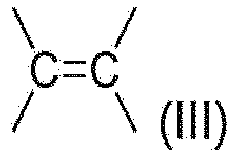
R1R2R3SiH (Ia),
wherein R1 to R3 have the above meaning,
to silanes of general formula IV
- Therefore, the net reaction corresponds to an unprecedented ionic transfer hydrosilylation of alkenes using cyclohexa-2,5-dien-1-yl-silanes of general formula I catalyzed by the Lewis acids of formula II or IIa under concomitant formation of an arene solvent. The byproducts of this reaction, arene solvent and unreacted hydrosilane of formula la, can be easily removed from the reaction mixture. Accordingly, the hydrosilylation of alkenes is also an object of the present invention.
- According to the present invention C1-C3-alkyl means methyl, ethyl, n-propyl or i-propyl and C1-C3-alkoxy means methoxy, ethoxy, 1-propoxy or 2-propoxy. Aryl means phenyl, tolyl, xylyl, mesityl, naphth-1-yl and naphth-2-yl. Arene solvents according to the invention are benzene, alkyl or triorganosilyl benzenes, preferably toluene, xylene cumene or trimethylsilyl benzene.
- In an embodiment of the invention, cyclohexa-2,5-dien-1-yl-silanes of general formula I are used wherein R1, R2 and R3 are equal to each other representing methyl, ethyl, i-propyl, methoxy or ethoxy. In a preferred embodiment of the invention, R1, R2 and R3 are methyl, ethyl, methoxy or ethoxy. It is especially preferred that R1, R2 and R3 are methyl, methoxy or ethoxy.
- In another embodiment of the invention at least one of R4 and R5 in formula I is methyl or trimethylsilyl.
- In yet another embodiment of the invention cyclohexa-2,5-dien-1-yl-silanes of general formula I are used wherein R1 and R2 are equal to each other representing methyl, ethyl, methoxy or ethoxy, preferably methyl and methoxy, and R3 represents H or aryl, preferably phenyl.
- Following compounds of formula I are particularly preferred:

- According to the invention, in one embodiment the catalyst of formula II is tris(pentafluorophenyl)borane B(C6F5)3, but also boron trifluoride diethyletherate or dimethyletherate of formula IIa can be used, preferably boron trifluoride diethyletherate. It is also possible to use AlCl3 as catalyst.
- The release of hydrosilanes from formula I and the hydrosilylation of alkenes are conducted in a solvent at ambient temperature. According to the present invention, ambient temperature means 15 to 30°C. As solvent it is preferred to use an arene solvent, preferably benzene, toluene, xylene, or a halogenated solvent, preferably CH2Cl2, 1,2-dichlorethane or chloroform. Transfer hydrosilylation of alkenes occurred in high yields from 80 to 95 % in CH2Cl2 with cyclohexa-2,5-dien-1-yl-trimethylsilane of formula I as precursor. It is remarkable that only little excess of this precursor is necessary for high yield, because this precursor is gaseous at room temperature.
- According to the present invention the alkenes which are hydrosilylated are alkenes of general formula IIIa

R6 represents H, C4-C20-alkyl, C4-C20-cydoalkyl or aryl, preferably C4-C8-alkyl or phenyl,
R7 represents H, C1-C10-alkyl, C4-C10-cycloalkyl or aryl, preferably C1-C4-alkyl or phenyl,
or R6 and R7 form together a cycloalkane ring, preferably a cyclohexane ring,
and
R8 represents H, methyl, ethyl, -CH2Hal or phenyl. - According to the present invention Hal means halogen being chlorine, bromine or iodine, preferably chlorine or bromine.
- Some alkenes of formula IIIa which are hydrosilylated with cyclohexa-2,5-dien-1-yl-trimethylsilane of formula I and their end products are given in Table 1:


R7 = H 
R7 = Me R7 = Ph 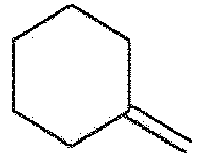


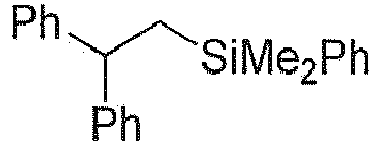
- Particularly preferred alkenes for hydrosilylation with the new technique of the present invention are alkenes of general formula IIIa with R8 representing -CH2Hal and R6 and R7 representing hydrogen. Hydrosilylation of these alkenes, especially allylchloride, with a cyclohexa-2,5-dien-1-yl-trimethylsilane of formula I wherein R1, R2 and R3 are equal to each other and represent methoxy or ethoxy results in commercially interesting trialkoxysilanes.
- Further alkenes which can be hydrosilylated with the new technique of the invention are alkenes of general formula IIIb

- a) in case that both rings A and B are present,
n is 1 or 2,
R9 represents H,C1-C20-alkyl or C4-C20-cycloalkyl, preferably C1-C4-alkyl,
R10 represents H or halogen;
and - b) in case that ring B is not present,
in the cyclic alkene of ring A n is 1-4, preferably 2 or 3, and R9 represents H or methyl. - Additionally, a further alkene which is hydrosilylated according to the invention is norbornene (IIIc).
- Some preferred alkenes of formulae IIIb and IIIc which are hydrosilylated with transfer hydrosilylating agents of formula I and their end products are given in Table 2:

R10 = H 
R10 = Br 


n = 1 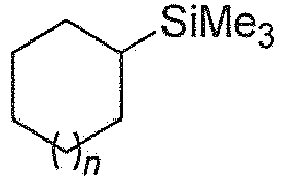
n = 2 


- The cyclohexa-2,5-dien-1-yi-silanes of general formula I are not only useful as transfer hydrosilylating agents for alkenes but can also be used for Si-O bond formation in carbonyl reduction and dehydrogenative coupling with alcohols as well as hydrodehalogenation.
- The following examples are offered to illustrate the present invention. They are not intended to be limiting in any respect.
- All reactions were performed in flame-dried glassware using an MBraun glove box (O2 < 0.5 ppm, H2O < 0.5 ppm) or conventional Schlenk techniques under a static pressure of argon (glove box) or nitrogen. Liquids and solutions were transferred with syringes. CH2Cl2, benzene, n-pentane, and THF were purified and dried using a MBraun solvent system. 1,2-Dichloroethane was distilled over CaH2, degassed, and stored in glove box over 4 Å molecular sieves. Toluene was distilled over Na, degassed, and stored in glove box over 4 Å molecular sieves. C6D6 (purchased from Eurisotop) was dried over 4 Å molecular sieves. [D8]Toluene and CD2Cl2 (purchased from Eurisotop) were distilled from the appropriate drying reagent, degassed and stored in glove box over 4 Å molecular sieves. Technical grade solvents for extraction and chromatography (cyclohexane, n-pentane, ethyl acetate, and tert-butyl methyl ether) were distilled prior to use. All commercially available alkenes were distilled, degassed, and stored in glove box over 4 Å molecular sieves. Analytical thinlayer chromatography (TLC) was performed on silica gel SIL G-25 glass plates from Macherey-Nagel. Flash column chromatography was performed on silica gel 60 (40-63 µm, 230-400 mesh, ASTM) by Merck using the indicated solvents. 1H and 13C NMR spectra were recorded in C6D6 on Bruker AV 400 and Bruker AV 500 instruments. Chemical shifts are reported in parts per million (ppm) downfield from tetramethylsilane and are referenced to the residual solvent resonance as the internal standard (C6H6: δ = 7.16 ppm for 1H NMR and C6D6: δ = 128.06 ppm for 13C NMR). Data are reported as follows: chemical shift, multiplicity (br s = broad singlet, s = singlet, d = doublet, t = triplet, q = quartet, m = multiplet), coupling constant (Hz), and integration. Infrared (IR) spectra were recorded on an Agilent Technologies Cary 630 FT-IR spectrophotometer equipped with an ATR unit and are reported in wavenumbers (cm-1). Gas liquid chromatography-mass spectrometry (GLC-MS) was performed on an Agilent Technologies GC-System 5975C with an Agilent Technologies Mass Selective Detector (EI) and a HP-5MS column. Gas liquid chromatography (GLC) was performed on a Shimadzu GC-17A gas chromatograph equipped with a SE-54 capillary column (30 m × 0.32 mm, 0.25 µm film thickness) by CS-Chromatographie Service using the following programs: 35-min: N2 carrier gas, column flow 1.7 mL/min, injection temperature 280°C, detector temperature 300°C; temperature program: start temperature 40°C, heating rate 10°C/min, final temperature 280°C for 10 min. High resolution mass spectrometry (HRMS) analysis was performed by the analytical facility at the Institut für Chemie, Technische Universität Berlin.
-

- A flame-dried 100-mL Schlenk flask is charged with dry THF (0.7M) and cyclohexa-1,4-diene. The resulting solution is then cooled to -78°C. In a separate flame-dried 25-mL round-bottom flask equipped with a magnetic stir bar is introduced sec-BuLi (1.30M in hexanes, 1.0 equiv), followed by dropwise addition of TMEDA (1.0 equiv). The resulting dark-red slurry is subsequently added dropwise to the cooled THF solution of cyclohexa-1,4-diene, and the resulting mixture is then warmed to -45°C and maintained at this temperature for 3 h; the solution turns yellow within that time. The corresponding chlorosilane (1.0 equiv) in THF (2.5M) is finally added dropwise at -4.5°C, and the resulting mixture is slowly warmed to room temperature. Saturated aqueous NH4Cl (20 mL) are added, and the aqueous layer is extracted with tert-butyl methyl ether (2 × 20 mL). The combined organic layers are washed with brine (20 mL) and water (20 mL). After removal of all volatiles, the crude material is purified by either flash column chromatography or distillation.
-

- Cyclohexa-2,5-dien-1-yltrimethylsilane. Prepared according to GP1 from cyclohexa-1,4-diene (0.94 mL, 10.0 mmol, 1.0 equiv) and trimethylchlorosilane (1.27 mL, 10.0 mmol, 1.0 equiv). Purified by Kugelrohr distillation (30 mbar, 90°C). Colorless oil, 1.15 g, 76% yield. IR (ATR): /cm-1 = 3026, 2956, 2893, 2823, 1668, 1623, 1434, 1333, 1294, 1246, 1099, 1051, 980, 937, 893, 833, 784, 749, 714, 690. 1H NMR (500 MHz, C6D6) δ = 5.68-5.65 (m, 2H), 5.55-5.52 (m, 2H), 2.78-2.55 (m, 2H), 2.18-2.11 (m, 1H), 0.01 (s, 9H). 13C NMR (126 MHz, C6D6) δ = 126.5 (2C), 121.8 (2C), 31.8, 26.9, -3.5 (3C). GLC-MS (EI) for (C9H16Si): m/z 152.1 [M]+. HRMS (EI) exact mass for [M]+: calcd m/z 152.10158, found 152.10186.

- Cyclohexa-2,5-dien-1-yldimethylsilane. Prepared according to GP1 from an excess of cyclohexa-1,4-diene (2.60 mL, 27.5 mmol, 1.1 equiv) and dimethylchlorosilane (2.78 mL, 25.0 mmol, 1.0 equiv): Purified by flash column chromatography over silica gel using n-pentane as eluent. Colorless oil, 1.89 g, 55% yield. IR (ATR): /cm-1 = 3026, 2960, 2890, 2855, 2823, 2112, 1624, 1432, 1294, 1248, 1102, 1053, 937, 874, 835, 793, 741, 688, 660. 1H NMR (500 MHz, C6D6) δ = 5.68-5.61 (m, 2H), 5.56-5.49 (m, 2H), 4.09-3.99 (m, 1 H), 2.67-2.56 (m, 2H), 2.31-2.21 (m, 1H), 0.03 (d, J = 3.6, 6H). 13C NMR (126 MHz, C6D6) δ = 126.0 (2C), 122.3 (2C), 29.6, 26.8, -6.4 (2C). GLC-MS (EI) for (C8H14Si): m/z 138.1 [M]+. HRMS (EI) exact mass for [M]+: calcd m/z 138.08593, found 138.08605.

- Cyclohexa-2,5-dien-1-yltriethylsilane. Prepared according to GP1 from cyclohexa-1,4-diene (0.94 mL, 10.0 mmol, 1.0 equiv) and triethylchlorosilane (1.68 mL, 10.0 mmol, 1.0 equiv). Purified by Kugelrohr distillation (30 mbar, 150°C). Colorless oil, 1.89 g, 97% yield. IR (ATR): /cm-1 = 3026, 2952, 2910, 2876, 2821, 1624, 1458, 1416, 1378, 1334, 1294, 1239, 1100, 1053, 1008, 973, 938, 893, 777, 699, 664. 1H NMR (500 MHz, C6D6) δ = 5.70-5.66 (m, 2H), 5.54-5.51 (m, 2H), 2.78-2.59 (m, 2H), 2.43-2.33 (m, 1H), 0.96 (t, J = 8.0, 9H), 0.58 (q, J = 8.0, 6H). 13C NMR (126 MHz, C6D6) δ = 126.8 (2C), 121.6 (2C), 28.7, 26.8, 7.8 (3C), 2.7 (3C). GLC-MS (EI) for (C12H22Si): m/z 194.1 [M]+, 115.1 [M-C6H7]+. HRMS (EI) exact mass for [M]+: calcd m/z 194.14853, found 194.14836.

- Cyclohexa-2,5-dien-1-yltriisopropylsilane. Prepared according to GP1 from cyclohexa-1,4-diene (0.94 mL, 10.0 mmol, 1.0 equiv) and triisopropylchlorosilane (2.16 mL, 10.0 mmol, 1.0 equiv). Purified by flash column chromatography over silica gel using cyclohexane as eluent. White solid, 1.56 g, 66% yield. IR (ATR): /cm-1 = 3021, 2942, 2887, 2864, 2823, 1459, 1431, 1382, 1335, 1293, 1254, 1110, 1072, 1015, 943, 885, 763, 669. 1H NMR (500 MHz, C6D6) δ = 5.82-5.71 (m, 2H), 5.56-5.46 (m, 2H), 2.79-2.68 (m, 2H), 2.66-2.59 (m, 1H), 1.22-1.05 (m, 21H). 13C NMR (126 MHz, C6D6) δ = 127.5 (2C), 121.6 (2C), 27.0, 26.6, 19.2 (6C), 11.7 (3C). GLC-MS (EI) for (C15H28Si): m/z 236.2 [M]+. HRMS (EI) exact mass for [M]+: calcd m/z 236.19548, found 236.19557.

- Cyclohexa-2,5-dien-1-yldimethyl(phenyl)silane. Prepared according to GP1 from cyclohexa-1,4-diene (1.13 mL, 12.0 mmol, 1.0 equiv) and dimethylphenylchlorosilane (1.99 mL, 12.0 mmol, 1.0 equiv). Purified by flash column chromatography over silica gel using cyclohexane as eluent. Colorless oil, 1.77g, 69% yield. IR (ATR): /cm-1 = 3025, 2958, 2890, 2851, 2820, 1427, 1294, 1246, 1111, 1051, 935, 892, 832, 809, 795, 759, 726, 696. 1H NMR (500 MHz, C6D6) δ = 7.50-7.45 (m, 2H), 7.24-7.19 (m, 3H), 5.73-5.61 (m, 2H), 5.55-5.45 (m, 2H), 2.68-2.57 (m, 1H), 2.56-2.39 (m, 2H), 0.26 (s, 6H). 13C NMR (126 MHz, C6D6) δ = 137.7, 134.3 (2C), 129.4 (2C), 128.3, 126.2 (2C), 122.3 (2C), 31.3, 26.8, -5.2 (2C). GLC-MS (EI) for (C14H18Si): m/z 214.2 [M]+, 199.1 [M-CH3]+, 137.1 [M-C6H5]+. HRMS (EI) exact mass for [M]+: calcd m/z 214.11723, found 214.11621.
-

- In glove box, a 1.3-mL GLC vial is charged with B(C6F5)3 (5.0 mol%) and a magnetic stir bar. Into a separate vial are weighed the alkene (1.0 equiv) and the cyclohexa-2,5-dien-1-ylsilane (1.3 equiv). Both reagents are dissolved in CH2Cl2 (1.0M) and the resulting solution is added to the catalyst. The vial is then capped, and the solution is stirred in the glove box. The reaction is monitored by GLC and typically requires 15 to 24 h stirring at room temperature. The mixture is finally diluted with n-pentane (0.3 mL), filtered over a small Celite®/SiO2 column (1 cm Celite® covered with 0.5 cm SiO2, eluting with n-pentane), and all volatiles are removed under reduced pressure. If necessary, the crude target compound is purified by either flash column chromatography or Kugelrohr distillation.
-

- cis-Trimethyl(2-methylcyclohexyl)silane. Prepared according to GP2 from 1-methylcyclohexene (48.1 mg, 0.50 mmol, 1.0 equiv) and cyclohexa-2,5-dien-1-yltrimethylsilane (99.0 mg, 0.65 mmol, 1.3 equiv). Reaction was stopped after 24 h. Purified by flash column chromatography using n-pentane as eluent. cis configuration was assigned by analogy with the B(C6F5)3-catalyzed hydrosilylation of 1-methylcyclohexene with dimethylphenylsilane and consistent NMR data. Colorless oil, 74 mg, 87% yield. IR (ATR): /cm-1 = 2955, 2919, 2850, 2812, 1444, 1405, 1378, 1247, 1200, 1156, 1106, 1059, 1018, 954, 871, 828, 744, 687. 1H NMR (500 MHz, C6D6) δ = 1.99-1.93 (m, 1 H), 1.68 (ddd, J = 11.4, 5.7, 2.4, 1H), 1.60-1.32 (m, 6H), 1.27-1.15 (m, 1 H), 0.93 (d, J = 7.2, 3H), 0.86-0.69 (m, 1 H), 0.01 (s, 9H). 13C NMR (126 MHz, C6D6) δ = 35.4, 30.8, 30.0, 28.6, 22.5, 21.7, 16.5, -1.9 (3C). GLC-MS (EI) for (C10H22Si): m/z 170.1 [M]+, 155.1 [M-CH3]+. HRMS (EI) exact mass for [M]+: calcd m/z 170.14853, found 170.14856.

- Trimethyl(octyl)silane. Prepared according to GP2 from oct-1-ene (22.4 mg, 0.20 mmol, 1.0 equiv) and cyclohexa-2,5-dien-1-yltrimethylsilane (39.6 mg, 0.26 mmol, 1.3 equiv). Conversion was complete after 15 h. Crude material did not require purification. Colorless oil, 31 mg, 84% yield. IR (ATR): /cm-1 = 2956, 2922, 2855, 1459, 1412, 1295, 1248, 1175, 1110, 1001, 833, 755, 723, 690. 1H NMR (500 MHz, C6D6) δ = 1.44-1.18 (m, 12H), 1.02-0.86 (m, 3H), 0.59-0.47 (m, 2H), 0.03 (s, 9H). 13C NMR (126 MHz, C6D6) δ = 34.1, 32.4, 29.8, 29.8, 24.4, 23.1, 17.0, 14.4, -1.5 (3C). GLC-MS (EI) for (C22H24Si): m/z 171.1 [M-CH3]+. HRMS (EI) exact mass for [M]+: calcd m/z 186.17983, found 186.18008.

- Trimethyl(phenethyl)silane. Prepared according to GP2 from styrene (20.8 mg, 0.20 mmol, 1.0 equiv) and cyclohexa-2,5-dien-1-yltrimethylsilane (39.6 mg, 0.26 mmol, 1.3 equiv). Conversion was complete after 17 h. Crude material did not require purification. Colorless oil, 28 mg, 78% yield. IR (ATR): /cm-1 = 3028, 2954, 2900, 1603, 1496, 1454, 1412, 1302, 1248, 1174, 1124, 1030, 998, 902, 857, 830, 747, 693. 1H NMR (400 MHz, C6D6) δ = 7.24-7.17 (m, 2H), 7.14-7.07 (m, 3H), 2.61-2.50 (m, 2H), 0.85-0.70 (m, 2H), -0.03 (s, 9H). 13C NMR (101 MHz, C6D6) δ = 145.3, 128.6 (2C), 128.2 (2C), 125.9, 30.5, 18.8, -1.7 (3C). GLC-MS (EI) for (C11H18Si): m/z 178.1 [M]+, 163.1 [M-CH3]+. HRMS (EI) exact mass for [M]+: calcd m/z 178.11723, found 178.11747.

- Trimethyl(2-phenylpropyl)silane. Prepared according to GP2 from α-methylstyrene (23.6 mg, 0.20 mmol, 1.0 equiv) and cyclohexa-2,5-dien-1-yltrimethylsilane (39.6 mg, 0.26 mmol, 1.3 equiv). Conversion was complete after 17 h. Crude material did not require purification. Colorless oil, 28 mg, 85% yield. IR (ATR): /cm-1 = 3028, 2955, 2898, 1603, 1493, 1451, 1411, 1372, 1300, 1247, 1186, 1147, 1083, 1028, 913, 834, 761, 697. 1H NMR (400 MHz, C6D6) δ = 7.22-7.13 (m, 2H), 7.12-7.03 (m, 3H), 2.78 (dp, J = 8.6, 6.8, 1 H), 1.23 (d, J = 6.9, 3H), 0.92 (dd, J = 14.6, 8.6, 1 H), 0.78 (dd, J = 14.7, 6.6, 1 H), -0.11 (s, 9H). 13C NMR (101 MHz, C6D6) δ = 149.7, 128.7 (2C), 127.1 (2C), 126.2, 36.9, 27.1, 27.0, -0.9 (3C). GLC-MS (EI) for (C12H2OSi): m/z 192.1 [M]+, 177.1 [M-CH3]+, 105.1 [M-C4H11Si]+. HRMS (EI) exact mass for [M]+: calcd m/z 192.13288, found 192.13333.

- (2,2-Diphenylethyl)trimethylsilane. Prepared according to GP2 from 1,1-diphenylethylene (36.1 mg, 0.20 mmol, 1.0 equiv) and cyclohexa-2,5-dien-1-yltrimethylsilane (39.6 mg, 0.26 mmol, 1.3 equiv). Conversion was complete after 22 h. Crude material did not require purification. Colorless oil, 48 mg, 94% yield. IR (ATR): /cm-1 = 3062, 3027, 2952, 2896, 1598, 1492, 1450, 1413, 1247, 1173, 1131, 1072, 1031, 1015, 849, 828, 780, 748, 694. 1H NMR (500 MHz, C6D6) δ = 7.19 (d, J = 7.2, 4H), 7.12 (t, J = 7.8, 4H), 7.01 (t, J = 7.3, 2H), 4.02 (t, J = 8.1, 1 H), 1.30 (d, J = 8.1, 2H), -0.16 (s, 9H). 13C NMR (126 MHz, C6D6) δ = 147.5 (2C), 128.6 (4C), 128.0 (2C), 126.3 (4C), 47.8, 24.3, -1.1 (3C). GLC-MS (EI) for (C17H22Si): mlz 254.2 [M]+, 239.1 [M-CH3]+. HRMS (EI) exact mass for [M]+: calcd m/z 254.14853, found 254.14933.

- (Cyclohexylmethyl)trimethylsilane. Prepared according to GP2 from methylenecyclohexane (19.2 mg, 0.20 mmol, 1.0 equiv) and cyclohexa-2,5-dien-1-yltrimethylsilane (39.6 mg, 0.26 mmol, 1.3 equiv). Reaction was stopped after 24 h. Crude material did not require purification. Colorless oil, 29 mg, 85% yield. IR (ATR): /cm-1 = 2921, 2853, 1448, 1413, 1247, 1152, 1033, 969, 889, 858, 832, 772, 755, 689. 1H NMR (400 MHz, C6D6) δ = 1.80-1.54 (m, 5H), 1.45-1.33 (m, 1 H), 1.33-1.05 (m, 3H), 1.03-0.82 (m, 2H), 0.49 (d, J = 6.9, 2H), 0.04 (s, 9H). 13C NMR (126 MHz, C6D6) δ = 37.2 (2C), 34.8, 27.0 (2C), 26.7, 26.0, -0.4 (3C). GLC-MS (EI) for (C10H22Si): m/z 170.2 [M]+, 155.1 [M-CH3]+. HRMS (EI) exact mass for [M]+: calcd m/z 170.14853, found 170.14842.

- Trimethyl(2-methylnonyl)silane. Prepared according to GP2 from 2-methylnon-1-ene (28.1 mg, 0.20 mmol, 1.0 equiv) and cyclohexa-2,5-dien-1-yltrimethylsilane (39.6 mg, 0.26 mmol, 1.3 equiv). Conversion was complete after 17 h. Crude material did not require purification. Colorless oil, 35 mg, 81% yield. IR (ATR): /cm-1 = 2955, 2925, 2855, 1459, 1414, 1376, 1295, 1248, 1216, 1108, 1030, 833, 784, 759, 689. 1H NMR (500 MHz, C6D6) δ = 1.69-1.55 (m, 1 H), 1.38-1.15 (m, 12H), 0.97 (d, J = 6.6, 3H), 0.94-0.89 (m, 3H), 0.67 (dd, J = 14.6, 5.1, 1 H), 0.42 (dd, J = 14.7, 8.5, 1 H), 0.06 (s, 9H). 13C NMR (126 MHz, C6D6) δ = 41.1, 32.4, 30.4, 30.0, 29.9, 27.7, 25.5, 23.3, 23.2, 14.4, -0.4 (3C). GLC-MS (EI) for (C13H30Si): m/z 199.2 [M-CH3], 115.1 [M-C7H15]+. HRMS (EI) exact mass for [M]+: calcd m/z 214.21113, found 214.21203.

- (2,3-Dihydro-1H-inden-2-yl)trimethylsilane. Prepared according to GP2 from indene (23.2 mg, 0.20 mmol, 1.0 equiv) and cyclohexa-2,5-dien-1-yltrimethylsilane (39.6 mg, 0.26 mmol, 1.3 equiv). Conversion was complete after 15 h. Purified by flash column chromatography using n-pentane as eluent. Colorless oil, 25 mg, 69% yield. IR (ATR): /cm-1 = 3023, 2953, 2895, 2839, 1482, 1459, 1444, 1404, 1318, 1247, 1144, 1025, 990, 931, 908, 830, 747, 689. 1H NMR (400 MHz, C6D6) δ = 7.22-7.08 (m, 4H), 2.81 (dd, J = 15.2, 9.0, 2H), 2.64 (dd, J = 15.2, 10.3, 2H), 1.37 (p, J = 10.3, 1H), -0.05 (s, 9H). 13C NMR (101 MHz, C6D6) δ = 145.0 (2C), 126.4 (2C), 124.5 (2C), 34.9 (2C), 26.3, -3.0 (3C). GLC-MS (EI) for (C12H18Si): m/z 190.1 [M]+, 175.1 [M-CH3]+. HRMS (EI) exact mass for [M]+: calcd m/z 190.11723, found 190.11719.

- (4-Bromo-2,3-dihydro-1H-inden-2-yl)trimethylsilane. Prepared according to GP2 from 7-bromo-1H-indene (39.0 mg, 0.20 mmol, 1.0 equiv) and cyclohexa-2,5-dien-1-yltrimethylsilane (39.6 mg, 0.26 mmol, 1.3 equiv). Conversion was complete after 17 h. Purified by Kugelrohr distillation (10 mbar, 150°C). Colorless oil, 35 mg, 65% yield. IR (ATR): /cm-1 = 2952, 2894, 2837, 1567, 1447, 1319, 1248, 1162, 1137, 1117, 1057, 987, 914, 831, 763, 689. 1H NMR (500 MHz, C6D6) δ = 7.25 (d, J = 7.9, 1 H), 6.88 (d, J = 7.3, 1 H), 6.74 (t, J = 7.6, 1 H), 3.03 (dd, J = 16.3, 9.1, 1 H), 2.73 (dt, J = 16.1, 9.9, 2H), 2.59 (dd, J = 15.9, 10.7, 1 H), 1.26 (p, J = 9.8, 1 H), -0.11 (s, 9H). 13C NMR (126 MHz, C6D6) δ = 147.1, 145.5, 129.6, 128.3, 123.2, 120.3, 36.6, 36.1, 25.2, -3.1 (3C). GLC-MS (EI) for (C12H17BrSi): m/z 270.0 [M]+, 255.0 [M-CH3]+. HRMS (EI) exact mass for [M]+: calcd m/z 268.02774, found 268.02740.

- Trimethyl(1,2,3,4-tetrahydronaphthalen-2-yl)silane. Prepared according to GP2 from 1,2-dihydronaphthalene (26.0 mg, 0.20 mmol, 1.0 equiv) and cyclohexa-2,5-dien-1-yltrimethyl-silane (39.6 mg, 0.26 mmol, 1.3 equiv). Reaction was stopped after 24 h. Purified by flash column chromatography using n-pentane as eluent. Colorless oil, 27 mg, 66% yield. IR (ATR): /cm-1 = 3018, 2953, 2912, 2834, 1581, 1494, 1450, 1433, 1350, 1291, 1247, 1158, 1109, 1078, 1041, 945, 922, 889, 829, 740, 687. 1H NMR (400 MHz, C6D6) δ = 7.12-7.06 (m, 2H), 7.06-7.00 (m, 2H), 2.71-2.41 (m, 4H), 1.81-1.66 (m, 1 H), 1.28 (tdd, J = 12.9, 10.8, 6.3, 1H), 0.75 (tdd, J = 12.5, 5.0, 2.6, 1H), -0.05 (s, 9H). 13C NMR (101 MHz, C6D6) δ = 137.8, 137.3, 129.6, 129.2, 125.8, 125.8, 30.6 (2C), 24.4, 22.3, -3.6 (3C). GLC-MS (EI) for (C13H20Si): m/z 204.1 [M]+, 189.1 [M-CH3]+. HRMS (EI) exact mass for [M]4: calcd m/z 204.13288, found 204.13337.

- Cyclohexyltrimethylsilane. Prepared according to GP2 from cyclohexene (16.4 mg, 0.20 mmol, 1.0 equiv) and cyclohexa-2,5-dien-1-yltrimethylsilane (39.6 mg, 0.26 mmol, 1.3 equiv). Reaction was stopped after 19 h. Crude material did not require purification. Colorless oil, 19 mg, 61% yield. IR (ATR): /cm-1 = 2954, 2919, 2846, 1446, 1293, 1247, 1100, 1039, 997, 889, 858, 826, 745, 687. 1H NMR (500 MHz, C6D6) δ = 1.83-1.49 (m, 5H), 1.31-0.93 (m, 5H), 0.49 (tt, J = 12.8, 3.1, 1H), -0.04 (s, 9H). 13C NMR (126 MHz, C6D6) δ = 28.5 (2C), 27.7 (2C), 27.4, 26.4, -3.5 (3C). GLC-MS (EI) for (C9H20Si): m/z 156.1 [M]+, 141.1 [M-CH3]+. HRMS (EI) exact mass for [M]+: calcd m/z 156.13288, found 156.13357.

- Cycloheptyltrimethylsilane. Prepared according to GP2 from cycloheptene (48.1 mg, 0.50 mmol, 1.0 equiv) and cyclohexa-2,5-dien-1-yltrimethyfsilane (99.0 mg, 0.65 mmol, 1.3 equiv). Reaction was stopped after 18 h. Purified by Kugelrohr distillation (1 atm N2, 125°C). Colorless oil, 61 mg, 71% yield. IR (ATR): /cm-1 = 2916, 2850, 1449, 1363, 1289, 1247, 1096, 1041, 1016, 897, 829, 741, 686. 1H NMR (500 MHz, C6D6) δ = 1.80-1.67 (m, 4H), 1.65-1.56 (m, 2H), 1.54-1.36 (m, 4H), 1.26-1.13 (m, 2H), 0.56 (tt, J = 11.0, 3.3, 1H), -0.01 (s, 9H). 13C NMR (126 MHz, C6D6) δ = 30.4 (2C), 29.2 (2C), 28.8 (2C), 27.0, -3.2 (3C). GLC-MS (EI) for (C10H22Si): m/z 170.2 [M]+, 155.1 [M-CH3]+. HRMS (EI) exact mass for [M]+: calcd m/z 170.14853, found 170.14848.

- exo-Bicyclo[2.2.1]heptan-2-yltrimethylsilane. Prepared according to GP2 from norbornene (47.1 mg, 0.50 mmol, 1.0 equiv) and cyclohexa-2,5-dien-1-yltrimethylsilane (1, 99.0 mg, 0.65 mmol, 1.3 equiv). Conversion was complete after 22 h. Purified by flash column chromatography using n-pentane as eluent. Exo configuration was assigned according to literature data. Colorless oil, 58 mg, 69% yield. IR (ATR): /cm-1 = 2949, 2867, 1453, 1402, 1292, 1246, 1112, 1028, 998, 970, 908, 826, 743, 686. 1H NMR (500 MHz, C6D6) δ = 2.21 (br s, 1 H), 2.13 (br s, 1 H), 1.52 (dq, J = 6.1, 1.8, 2H), 1.39-1.29 (m, 2H), 1.24-1.14 (m, 3H), 1.08 (dt, J = 9.3, 1.8, 1 H), 0.44 (ddd, J = 9.4, 7.6, 1.6, 1 H), -0.02 (s, 9H). 13C NMR (126 MHz, C6D6) δ = 38.2, 38.2, 37.3, 34.6, 32.8, 29.6, 29.3, -2.5 (3C). GLC-MS (EI) for (C10H20Si): m/z 168.1 [M]+, 153.1 [M-CH3]+. HRMS (EI) exact mass for [M]+: calcd m/z 168.13288, found 168.13246.

- Trimethyl(2-methyl-2,3-dihydro-1H-inden-2-yl)silane. Prepared according to GP2 from 2-methyl-1H-indene (26.0 mg, 0.20 mmol, 1.0 equiv) and cyclohexa-2,5-dien-1-yltrimethylsilane (39.6 mg, 0.26 mmol, 1.3 equiv). Conversion was complete after 22 h. Purified by flash column chromatography using n-pentane as eluent and obtained in mixture with minor amounts of the other regiosiomer trimethyl(2-methyl-2,3-dihydro-1H-inden-1-yl)silane. Colorless oil, 32 mg, 73% yield, 5% yield of the regioisomer. IR (ATR): /cm-1 = 3021, 2953, 2896, 2838, 1586, 1482, 1456, 1402, 1371, 1318, 1248, 1081, 1024, 936, 873, 830, 790, 739, 686. 1H NMR (500 MHz, C6D6) δ = 7.15-7.10 (m, 4H), 2.90 (d, J = 15.5, 2H), 2.40 (d, J = 15.4, 2H), 0.96 (s, 3H), -0.07 (s, 9H). 13C NMR (126 MHz, C6D6) δ = 143.5 (2C), 126.6 (2C), 125.1 (2C), 43.0 (2C), 28.1, 23.5, -3.9 (3C). GLC-MS (EI) for (C13H20Si): m/z 204.1 [M]+, 189.1 [M-CH3]+. HRMS (EI) exact mass for [M]+: calcd m/z 204.13288, found 204.13320.
- Trimethyl(2-methyl-2,3-dihydro-1H-inden-1-yl)silane. Obtained as the minor component of a mixture, only partial data could have been collected. 1H NMR (500 MHz, C6D6) δ = 2.75 (dd, J = 14.4, 7.4, 1 H), 2.68 (dq, J = 9.2, 7.2, 1 H), 2.48 (ddd, J = 14.6, 9.2, 1.3, 1 H), 2.32 (d, J = 7.7, 1 H), 1.08 (d, J = 6.9, 3H), 0.04 (s, 9H), aromatic signals under those of the major isomer.

- (2,2-Diphenylethyl)triethylsilane. Prepared according to GP2 from 1,1-diphenylethylene (36.1 mg, 0.20 mmol, 1.0 equiv) and cyclohexa-2,5-dien-1-yltriethylsilane (50.5 mg, 0.26 mmol, 1.3 equiv). After 42 h, GC monitoring showed no further conversion of the starting material and after work-up the desired product was obtained in mixture with 1,1-diphenylethylene. It could be removed by Kugelrohr distillation (25 mbar, 175°C). Colorless oil, 38 mg, 64% yield. IR (ATR): /cm-1 = 3026, 2951, 2908, 2874, 1598, 1492, 1451, 1415, 1377, 1341, 1237, 1172, 1132, 1072, 1007, 964, 912, 854, 827, 776, 737, 695. 1H NMR (400 MHz, C6D6) δ = 7.28-7.20 (m, 4H), 7.14-7.09 (m, 4H), 7.07-6.98 (m, 2H), 4.07 (t, J = 7.9, 1 H), 1.38 (d, J = 7.9, 2H), 0.87 (t, J = 7.9, 8H), 0.37 (q, J = 8.0, 6H). 13C NMR (101 MHz, C6D6) δ = 147.7 (2C), 128.7 (4C), 127.9 (4C), 126.3 (2C), 47.6, 19.4, 7.7 (3C), 3.9 (3C). GLC-MS (EI) for (C20H28Si): m/z 267.1 [M-C2H5]+.

- (2,2-Diphenylethyl)dimethyl(phenyl)silane. Prepared according to GP2 from 1,1-diphenylethylene (36.1 mg, 0.20 mmol, 1.0 equiv) and cyclohexa-2,5-dien-1-yldimethyl-(phenyl)silane (55.7 mg, 0.26 mmol, 1.3 equiv), complete conversion after 24 h. Purified by flash column chromatography using n-pentane/tert-butyl methyl ether 99:1 as eluent. Colorless oil, 59 mg, 94% yield. IR (ATR): /cm-1 = 3064, 3025, 2954, 2900, 1598, 1492, 1450, 1427, 1248, 1172, 1111, 1071, 1030, 913, 863, 834, 809, 781, 728, 694. 1H NMR (400 MHz, C6D6) δ = 7.42-7.36 (m, 2H), 7.25-7.20 (m, 3H), 7.14-7.05 (m, 8H), 7.03-6.97 (m, 2H), 4.02 (t, J = 8.0, 1 H), 1.55 (d, J = 8.0, 2H), 0.01 (s, 6H). 13C NMR (101 MHz, C6D6) δ = 147.3 (2C), 139.4, 134.0 (2C), 129.2, 128.6 (4C), 128.2 (2C), 128.0 (4C), 126.3 (2C), 47.6, 23.7, -2.5 (2C). GLC-MS (EI) for (C22H24Si): m/z 301.1 [M-CH3]+.
-

- Dimethyldiphenethylsilane. In glove box, a 1.3-mL GLC vial was charged with B(C6F5)3 (5.1 mg, 5.0 µmol, 5.0 mol%) and a magnetic stir bar. Into a separate vial were weighed styrene (20.6 mg, 0.20 mmol, 1.0 equiv) and cyclohexa-2,5-dien-1-yldimethylsilane (13.8 mg, 0.10 mmol, 0.50 equiv). Both reagents were dissolved in CH2Cl2 (0.2 mL), and the resulting solution was added to the catalyst. The vial was then capped and the solution stirred in the glove box. After 15 h, two drops of Et3N were added to the reaction mixture, and the vial was stirred for 5 min. The mixture was finally diluted with n-pentane (0.3 mL), filtered over a small Celite®/SiO2 column (1 cm Celite® covered with 0.5 cm SiO2, eluting with n-pentane), and after removal of all volatiles the crude title compound was purified by flash column chromatography using n-pen-tane/tert-butyl methyl ether 98:2 as eluent. Colorless oil, 21 mg, 78% yield. IR (ATR): /cm-1 = 3063, 3026, 2952, 2919, 1603, 1495, 1453, 1412, 1312, 1249, 1173, 1124, 1066, 1030, 997, 898, 831, 796, 768, 747, 722, 695. 1H NMR (400 MHz, C6D6) 6 = 7.24-7.18 (m, 4H), 7.14-7.07 (m, 6H), 2.58-2.48 (m, 4H), 0.85-0.70 (m, 4H), -0.06 (s, 6H). 13C NMR (101 MHz, C6D6) δ = 145.3 (2C), 128.7 (4C), 128.2 (4C), 126.0 (2C), 30.4 (2C), 17.4 (2C), -3.4 (2C). GLC-MS (EI) for (C18H24Si): m/z 253.2 [M-CH3]+, 163.1 [M-C8H9]+.
-

- cis-Dimethyl(2-methylcyclohexyl)silane. In glove box, a 1.3-mL GLC vial was charged with B(C6F5)3 (12.8 mg, 25.0 µmol, 5.0 mol%) and a magnetic stir bar. Into a separate vial were weighed 1-methylcyclohexene (48.1 mg, 0.50 mmol, 1.0 equiv) and cyclohexa-2,5-dien1-yldimethylsilane (72.6 mg, 0.525 mmol, 1.05 equiv). Both reagents were dissolved in CH2Cl2 (0.2 mL), and the resulting solution was added to the catalyst. The vial was then capped, and the solution stirred in the glove box. After 15 h, four drops of Et3N were added to the reaction mixture, and the vial was stirred for 5 min. The mixture was finally diluted with n-pentane (0.3 mL), filtered over a small Celite®/SiO2 column (1 cm Celite® covered with 0.5 cm SiO2, eluting with n-pentane), and after removal of all volatiles the crude title compound was purified by Kugelrohr distillation under a N2 atmosphere (120°C). cis configuration was assigned by analogy with the B(C6F5)3-catalyzed hydrosilylation of 1-methylcyclohexene with diphenylsilane and consistent NMR data. Colorless oil, 38 mg, 49% yield. IR (ATR): /cm-1 = 2958, 2921, 2851, 2108, 1444, 1390, 1249, 1166, 1103, 1080, 955, 877, 833, 784, 759, 699. 1H NMR (500 MHz, C6D6) δ = 4.07 (h, J = 3.7, 1 H), 1.94-1.87 (m, 1 H), 1.64-1.34 (m, 7H), 1.29-1.21 (m, 1 H), 0.98 (d, J = 7.3, 3H), 0.85 (dq, J = 10.2, 3.9, 1 H), 0.05 (t, J = 3.8, 6H). 13C NMR (126 MHz, C6D6) δ = 34.6, 31.2, 29.6, 27.7, 24.3, 22.7, 17.3, -4.4, -4.9. GLC-MS (EI) for (C9H20Si): mlz 156.1 [M]+, 141.1 [M-CH3]+. HRMS (EI) exact mass for [M]+: calcd mlz 156.13288, found 156.13363.
Claims (13)
- Use of cyclohexa-2,5-dien-1-yl-silanes of general formula (I)

R1 and R2 represent independently from each other C1-C3-alkyl or C1-C3-alkoxy,
R3 represent independently from R1 and R2 H, C1-C3-alkyl, C1-C3-alkoxy or aryl and
R4 and R5 represent independently from each other H, C1-C3-alkyl or R1R2R3Si with R1 to R3 as defined above,
for generation of hydrosilanes of general formula la in solution
R1R2R3SiH (Ia),
with R1 to R3 as above,
using a Lewis acid of general formulae II or IIa
B(C6FmHn)3 (II)
wherein m+n=5, m = 0 to 5 and n = 0 to 5,
BF3·O(R)2 (IIa)
wherein R is methyl or ethyl,
with concomitant formation of an arene solvent. - Use according to claim 1, wherein in the presence of alkenes of general formula III

R1R2R3SiH (Ia),
with R1 to R3 as above,
to form silanes of general formula IV
- Use according to claim 1 or 2, wherein R1, R2 and R3 in formula I are equal to each other representing methyl, ethyl, i-propyl, methoxy or ethoxy.
- Use according to any one of claims 1 to 3, wherein R1 and R2 in formula I are equal to each other representing methyl, ethyl, methoxy or ethoxy, and R3 represents H or aryl.
- Use according to any one of claims 1 to 4, wherein m in general formula II is 5 and n is 0.
- Use according to any one of claims 1 to 5, wherein the reaction is conducted in a solvent at ambient temperature.
- Use according to claim 6, wherein the solvent is an arene solvent or a halogenated solvent.
- Use according to anyone of claims 2 to 7, wherein the alkenes which are hydrosilylated are alkenes of general formula IIIa

R6 represents H, C4-C20-alkyl, C4-C20-cycloalkyl or aryl,
R7 represents H, C1-C10-alkyl, C4-C10-cycloalkyl or aryl,
or R6 and R7 form together a cycloalkane ring,
and
R8 represents H, methyl, ethyl, -CH2Hal or phenyl. - Use according to claim 8, wherein R6 and R1 represent H and R8 represents a -CH2Hal group, preferably -CH2Cl.
- Use according to anyone of claims 2 to 7, wherein the alkenes which are hydrosilylated are alkenes of general formula III b
 a) in case that both rings A and B are present,
n is 1 or 2,
R9 represents H, C1-C20-alkyl or C4-C20-cycloalkyl,
R10 represents H or halogen;
andb) in case that ring B is not present,
in the cyclic alkene of ring A n is 1-4 and R9 represents H or methyl. - Use according to anyone of claims 2 to 7, wherein the alkene which is hydrosilylated is norbornene (III c).
- Use of cyclohexa-2,5-dien-1-yl-silanes of general formula (I)

R1 and R2 represent independently from each other C1-C3-alkyl or C1-C3-alkoxy,
R3 represent independently from R1 and R2 H, C1-C3-alkyl, C1-C3-alkoxy or aryl and
R4 and R5 represent independently from each other H, C1-C3-alkyl or R1R22R3Si with R1 to R3 as defined above,
as precursors for hydrosilanes of general formula la
R1R2R3SiH (Ia),
wherein R1 to R3 have the above meaning,
wherein a Lewis acid is used to release the hydrosilanes of general formula (Ia) from the cyclohexa-2,5-dien-1-yl-silanes of general formula (I). - Use of cyclohexa-2,5-dien-1-yl-silanes of general formula (I)

R1 and R2 represent independently from each other C1-C3-alkyl or C1-C3-alkoxy,
R3 represent independently from R1 and R2 H, C1-C3-alkyl, C1-C3-alkoxy or aryl and
R4 and R5 represent independently from each other H, C1-C3-alkyl or R1R2R3Si with R1 to R3 as defined above,
as transfer hydrosilylating agents for alkenes and carbonyl compounds.
Priority Applications (8)
| Application Number | Priority Date | Filing Date | Title |
|---|---|---|---|
| EP13183727.0A EP2845857A1 (en) | 2013-09-10 | 2013-09-10 | Use of cyclohexa-2,5-dien-1-yl-silanes as precursors for gaseous hydrosilanes |
| JP2016539538A JP6382318B2 (en) | 2013-09-10 | 2014-09-04 | Use of cyclohexa-2,5-dien-1-yl-silane as precursor for gaseous hydrosilanes |
| EP14776829.5A EP3044227B1 (en) | 2013-09-10 | 2014-09-04 | Use of cyclohexa-2,5-dien-1-yl-silanes as precursors for gaseous hydrosilanes |
| CA2922885A CA2922885C (en) | 2013-09-10 | 2014-09-04 | Use of cyclohexa-2,5-dien-1-yl-silanes as precursors for gaseous hydrosilanes |
| US15/021,222 US9518070B2 (en) | 2013-09-10 | 2014-09-04 | Use of cyclohexa-2,5-dien-1-yl-silanes as precursors for gaseous hydrosilanes |
| NO14776829A NO3044227T3 (en) | 2013-09-10 | 2014-09-04 | |
| PCT/EP2014/068798 WO2015036309A1 (en) | 2013-09-10 | 2014-09-04 | Use of cyclohexa-2,5-dien-1-yl-silanes as precursors for gaseous hydrosilanes |
| ES14776829.5T ES2656701T3 (en) | 2013-09-10 | 2014-09-04 | Use of cyclohexa-2,5-dien-1-yl-silanes as precursors for gaseous hydrosilanes |
Applications Claiming Priority (1)
| Application Number | Priority Date | Filing Date | Title |
|---|---|---|---|
| EP13183727.0A EP2845857A1 (en) | 2013-09-10 | 2013-09-10 | Use of cyclohexa-2,5-dien-1-yl-silanes as precursors for gaseous hydrosilanes |
Publications (1)
| Publication Number | Publication Date |
|---|---|
| EP2845857A1 true EP2845857A1 (en) | 2015-03-11 |
Family
ID=49117775
Family Applications (1)
| Application Number | Title | Priority Date | Filing Date |
|---|---|---|---|
| EP13183727.0A Withdrawn EP2845857A1 (en) | 2013-09-10 | 2013-09-10 | Use of cyclohexa-2,5-dien-1-yl-silanes as precursors for gaseous hydrosilanes |
Country Status (1)
| Country | Link |
|---|---|
| EP (1) | EP2845857A1 (en) |
Cited By (1)
| Publication number | Priority date | Publication date | Assignee | Title |
|---|---|---|---|---|
| JP2022067267A (en) * | 2020-10-20 | 2022-05-06 | 国立研究開発法人産業技術総合研究所 | Method for producing organic silicon compound having dimethyl silyl group |
Citations (2)
| Publication number | Priority date | Publication date | Assignee | Title |
|---|---|---|---|---|
| DE10326577A1 (en) * | 2003-06-12 | 2004-05-27 | Consortium für elektrochemische Industrie GmbH | New 1,4-cyclohexadiene functionalized organosilicon compounds are useful as intermediates for further syntheses |
| US20070142632A1 (en) * | 2005-12-02 | 2007-06-21 | Isis Innovation Limited | Fluorination process |
-
2013
- 2013-09-10 EP EP13183727.0A patent/EP2845857A1/en not_active Withdrawn
Patent Citations (2)
| Publication number | Priority date | Publication date | Assignee | Title |
|---|---|---|---|---|
| DE10326577A1 (en) * | 2003-06-12 | 2004-05-27 | Consortium für elektrochemische Industrie GmbH | New 1,4-cyclohexadiene functionalized organosilicon compounds are useful as intermediates for further syntheses |
| US20070142632A1 (en) * | 2005-12-02 | 2007-06-21 | Isis Innovation Limited | Fluorination process |
Non-Patent Citations (7)
| Title |
|---|
| ANTOINE SIMONNEAU ET AL: "3-Silylated Cyclohexa-1,4-dienes as Precursors for Gaseous Hydrosilanes: The B(C 6 F 5 ) 3 -Catalyzed Transfer Hydrosilylation of Alkenes", ANGEWANDTE CHEMIE INTERNATIONAL EDITION, vol. 52, no. 45, 17 September 2013 (2013-09-17), pages 11905 - 11907, XP055089282, ISSN: 1433-7851, DOI: 10.1002/anie.201305584 * |
| COLIN EABORN ET AL: "Reduction of Aryltrimethylsilanes as a Synthetic Method. Part 1. Electrochemical Reduction", JOURNAL OF THE CHEMICAL SOCIETY, PERKIN TRANSACTIONS 1, 1 January 1974 (1974-01-01), pages 2055 - 2061, XP055089530, Retrieved from the Internet <URL:http://pubs.rsc.org/en/content/articlepdf/1974/p1/p19740002055> [retrieved on 20131121], DOI: 10.1039/p19740002055 * |
| ISHIKAWA ET AL.: "Photochemically generated silicon carbon double-bonded intermediates : III. The reaction of p-tolylpentamethyldisilane with methanol and methanol-d1", JOURNAL OF ORGANOMETALLIC CHEMISTRY, vol. 118, no. 2, 5 October 1976 (1976-10-05), pages 155 - 160, XP002716703 * |
| RÉMY ANGELAUD ET AL: "Desymmetrization of Cyclohexadienylsilanes. Regio-, Diastereo-, and Enantioselective Access to Sugar Mimics", THE JOURNAL OF ORGANIC CHEMISTRY, vol. 64, no. 26, 1 December 1999 (1999-12-01), pages 9613 - 9624, XP055089095, ISSN: 0022-3263, DOI: 10.1021/jo991225z * |
| SEBASTIAN RENDLER ET AL: "Schlüssiger Nachweis eines S N 2-Si-Mechanismus in der B(C6F5)3 - katalysierten Hydrosilylierung von Carbonylverbindungen: Einsichten in die verwandte Hydrierung", ANGEWANDTE CHEMIE (INTERNATIONAL ED. IN ENGLISH), vol. 120, no. 32, 28 July 2008 (2008-07-28), pages 6086 - 6089, XP055089418, ISSN: 0044-8249, DOI: 10.1002/ange.200801675 * |
| STEPHAN AMREIN ET AL: "Radical Transfer Hydrosilylation/Cyclization Using Silylated Cyclohexadienes", ORGANIC LETTERS, vol. 3, no. 15, 1 July 2001 (2001-07-01), pages 2357 - 2360, XP055089270, ISSN: 1523-7060, DOI: 10.1021/ol016160c * |
| YANNICK LANDAIS ET AL: "Desymmetrization of Cyclohexa-1,4-dienes ؊ A Straightforward Route to Cyclic and Acyclic Polyhydroxylated Systems", EUR. J. ORG. CHEM., 1 January 2002 (2002-01-01), pages 4038 - 4052, XP055089093, Retrieved from the Internet <URL:http://onlinelibrary.wiley.com/store/10.1002/1099-0690(200212)2002:23<4037:AID-EJOC4037>3.0.CO;2-3/asset/4037_ftp.pdf?v=1&t=ho744gq2&s=b9bc486275dc55bd3ea95d68bb34876cecb586c9> [retrieved on 20131119] * |
Cited By (1)
| Publication number | Priority date | Publication date | Assignee | Title |
|---|---|---|---|---|
| JP2022067267A (en) * | 2020-10-20 | 2022-05-06 | 国立研究開発法人産業技術総合研究所 | Method for producing organic silicon compound having dimethyl silyl group |
Similar Documents
| Publication | Publication Date | Title |
|---|---|---|
| KR102201058B1 (en) | Organoaminosilanes and methods for making same | |
| Chen et al. | Rapid, regioconvergent, solvent-free alkene hydrosilylation with a cobalt catalyst | |
| TW201330930A (en) | Non-precious metal-based hydrosilylation catalysts exhibiting improved selectivity | |
| EP3044227B1 (en) | Use of cyclohexa-2,5-dien-1-yl-silanes as precursors for gaseous hydrosilanes | |
| JP6467673B2 (en) | Method for producing carbodiimide compound | |
| JP5999596B2 (en) | Method for producing carbodiimide compound | |
| JP5115729B2 (en) | Organosilicon compound containing acetoacetate group protected with trialkylsilyl group and process for producing the same | |
| CN108002966B (en) | A kind of method for synthesizing 1,2-diarylethane compounds | |
| JP3140568B2 (en) | Hydrogenation of cyanoorganosilane | |
| CN107406476B (en) | Mononuclear iron complexes and organic synthesis reactions using them | |
| JP5141897B2 (en) | Method for producing chlorosilyl group-containing ethylnorbornene compound | |
| Kadikova et al. | The efficient method for the preparation of alkenylsilanes from organoaluminums | |
| JP2011518822A (en) | Novel 1,4-disilacyclohexane derivative and process for producing the same | |
| EP4380943A1 (en) | Method for the silylation of a c-h bond with a silylated diazene | |
| JP5290386B2 (en) | Process for the production of alkoxy-substituted 1,2-bis-silyl-ethane | |
| Hosoi et al. | Palladium-catalyzed cross-coupling reaction using alkenyldimethyl (2-thienyl) silanes | |
| CN109867701B (en) | A kind of pyridyl bridged bistriazine metal complex and its preparation and application | |
| JP6665437B2 (en) | Method for producing tertiary alkyl silane and tertiary alkyl alkoxy silane | |
| CN111203276A (en) | Application of chiral bidentate phosphite ligand, hydrosilation catalyst and application thereof, and preparation method of chiral silane | |
| CN119039340B (en) | Preparation method of diethylaminotrialkoxysilane | |
| JP5886876B2 (en) | Novel (triorganosilyl) alkynes and derivatives thereof, and novel catalytic methods for obtaining novel and conventional substituted (triorganosilyl) alkynes and derivatives thereof | |
| JP2004175784A (en) | Method for producing norbornene derivative having organic silyl group | |
| JPH0314590A (en) | Unsaturated group-containing organosilicon compound and its production | |
| JP2010235595A (en) | Process for producing alkylated indoles | |
| JP2020196693A (en) | Organosilane compounds having bulky substituent and method of preparation thereof |
Legal Events
| Date | Code | Title | Description |
|---|---|---|---|
| 17P | Request for examination filed |
Effective date: 20130910 |
|
| AK | Designated contracting states |
Kind code of ref document: A1 Designated state(s): AL AT BE BG CH CY CZ DE DK EE ES FI FR GB GR HR HU IE IS IT LI LT LU LV MC MK MT NL NO PL PT RO RS SE SI SK SM TR |
|
| AX | Request for extension of the european patent |
Extension state: BA ME |
|
| PUAI | Public reference made under article 153(3) epc to a published international application that has entered the european phase |
Free format text: ORIGINAL CODE: 0009012 |
|
| STAA | Information on the status of an ep patent application or granted ep patent |
Free format text: STATUS: THE APPLICATION IS DEEMED TO BE WITHDRAWN |
|
| 18D | Application deemed to be withdrawn |
Effective date: 20150912 |