EP2844663B1 - Tetragalnac containing conjugates and methods for delivery of oligonucleotides - Google Patents
Tetragalnac containing conjugates and methods for delivery of oligonucleotides Download PDFInfo
- Publication number
- EP2844663B1 EP2844663B1 EP13784779.4A EP13784779A EP2844663B1 EP 2844663 B1 EP2844663 B1 EP 2844663B1 EP 13784779 A EP13784779 A EP 13784779A EP 2844663 B1 EP2844663 B1 EP 2844663B1
- Authority
- EP
- European Patent Office
- Prior art keywords
- multivalent
- acetyl
- galactose
- ligand
- sirna
- Prior art date
- Legal status (The legal status is an assumption and is not a legal conclusion. Google has not performed a legal analysis and makes no representation as to the accuracy of the status listed.)
- Active
Links
- 0 CCC(C[N+]/C=C(\CN(C/C(/N=N)=C\NC/C(/C)=*/CCC(C)(CC)OC(CC1O)OC(CO)C1O)C(CCCN(C/C(/N)=C\NCC(C)(C)*CC(C)(C)OC(CC1O)OC(CO)C1O)CC1=CN(CCC(C)(C)**(C)OC(CC2O)OC(CO)C2O)NN1)C(*(C)I)=O)/N)*CC(C)(CC)OC(CC1O)OC(CO)C1O Chemical compound CCC(C[N+]/C=C(\CN(C/C(/N=N)=C\NC/C(/C)=*/CCC(C)(CC)OC(CC1O)OC(CO)C1O)C(CCCN(C/C(/N)=C\NCC(C)(C)*CC(C)(C)OC(CC1O)OC(CO)C1O)CC1=CN(CCC(C)(C)**(C)OC(CC2O)OC(CO)C2O)NN1)C(*(C)I)=O)/N)*CC(C)(CC)OC(CC1O)OC(CO)C1O 0.000 description 9
- YRDGKYOBSWCVCU-UHFFFAOYSA-N C(C1)C2C1C[IH]C2 Chemical compound C(C1)C2C1C[IH]C2 YRDGKYOBSWCVCU-UHFFFAOYSA-N 0.000 description 1
- AZDLGVSHQOVCHJ-YFKPBYRVSA-N C[C@@H](C1)CNC1=C Chemical compound C[C@@H](C1)CNC1=C AZDLGVSHQOVCHJ-YFKPBYRVSA-N 0.000 description 1
- DYKVLPACJSENMA-PWQPVHBWSA-N C[O]([C@H](CC1)C2OC1(CC=C)OCCCC(O)=O)=C2O Chemical compound C[O]([C@H](CC1)C2OC1(CC=C)OCCCC(O)=O)=C2O DYKVLPACJSENMA-PWQPVHBWSA-N 0.000 description 1
- JWDFQMWEFLOOED-UHFFFAOYSA-N O=C(CCSSc1ncccc1)ON(C(CC1)=O)C1=O Chemical compound O=C(CCSSc1ncccc1)ON(C(CC1)=O)C1=O JWDFQMWEFLOOED-UHFFFAOYSA-N 0.000 description 1
- PMMURAAUARKVCB-YMFWUOAHSA-N OC[C@H]([C@@H](C(C1)O)O)O[C@H]1O Chemical compound OC[C@H]([C@@H](C(C1)O)O)O[C@H]1O PMMURAAUARKVCB-YMFWUOAHSA-N 0.000 description 1
- QFHKFGOUFKUPNX-HSUXUTPPSA-N OC[C@H]([C@@H]1O)OCC[C@H]1O Chemical compound OC[C@H]([C@@H]1O)OCC[C@H]1O QFHKFGOUFKUPNX-HSUXUTPPSA-N 0.000 description 1
Classifications
-
- C—CHEMISTRY; METALLURGY
- C12—BIOCHEMISTRY; BEER; SPIRITS; WINE; VINEGAR; MICROBIOLOGY; ENZYMOLOGY; MUTATION OR GENETIC ENGINEERING
- C12N—MICROORGANISMS OR ENZYMES; COMPOSITIONS THEREOF; PROPAGATING, PRESERVING, OR MAINTAINING MICROORGANISMS; MUTATION OR GENETIC ENGINEERING; CULTURE MEDIA
- C12N15/00—Mutation or genetic engineering; DNA or RNA concerning genetic engineering, vectors, e.g. plasmids, or their isolation, preparation or purification; Use of hosts therefor
- C12N15/09—Recombinant DNA-technology
- C12N15/11—DNA or RNA fragments; Modified forms thereof; Non-coding nucleic acids having a biological activity
- C12N15/113—Non-coding nucleic acids modulating the expression of genes, e.g. antisense oligonucleotides; Antisense DNA or RNA; Triplex- forming oligonucleotides; Catalytic nucleic acids, e.g. ribozymes; Nucleic acids used in co-suppression or gene silencing
-
- A—HUMAN NECESSITIES
- A61—MEDICAL OR VETERINARY SCIENCE; HYGIENE
- A61K—PREPARATIONS FOR MEDICAL, DENTAL OR TOILETRY PURPOSES
- A61K47/00—Medicinal preparations characterised by the non-active ingredients used, e.g. carriers or inert additives; Targeting or modifying agents chemically bound to the active ingredient
- A61K47/50—Medicinal preparations characterised by the non-active ingredients used, e.g. carriers or inert additives; Targeting or modifying agents chemically bound to the active ingredient the non-active ingredient being chemically bound to the active ingredient, e.g. polymer-drug conjugates
- A61K47/51—Medicinal preparations characterised by the non-active ingredients used, e.g. carriers or inert additives; Targeting or modifying agents chemically bound to the active ingredient the non-active ingredient being chemically bound to the active ingredient, e.g. polymer-drug conjugates the non-active ingredient being a modifying agent
- A61K47/54—Medicinal preparations characterised by the non-active ingredients used, e.g. carriers or inert additives; Targeting or modifying agents chemically bound to the active ingredient the non-active ingredient being chemically bound to the active ingredient, e.g. polymer-drug conjugates the non-active ingredient being a modifying agent the modifying agent being an organic compound
- A61K47/549—Sugars, nucleosides, nucleotides or nucleic acids
-
- A—HUMAN NECESSITIES
- A61—MEDICAL OR VETERINARY SCIENCE; HYGIENE
- A61P—SPECIFIC THERAPEUTIC ACTIVITY OF CHEMICAL COMPOUNDS OR MEDICINAL PREPARATIONS
- A61P37/00—Drugs for immunological or allergic disorders
- A61P37/02—Immunomodulators
- A61P37/06—Immunosuppressants, e.g. drugs for graft rejection
-
- C—CHEMISTRY; METALLURGY
- C07—ORGANIC CHEMISTRY
- C07H—SUGARS; DERIVATIVES THEREOF; NUCLEOSIDES; NUCLEOTIDES; NUCLEIC ACIDS
- C07H15/00—Compounds containing hydrocarbon or substituted hydrocarbon radicals directly attached to hetero atoms of saccharide radicals
- C07H15/26—Acyclic or carbocyclic radicals, substituted by hetero rings
-
- C—CHEMISTRY; METALLURGY
- C12—BIOCHEMISTRY; BEER; SPIRITS; WINE; VINEGAR; MICROBIOLOGY; ENZYMOLOGY; MUTATION OR GENETIC ENGINEERING
- C12N—MICROORGANISMS OR ENZYMES; COMPOSITIONS THEREOF; PROPAGATING, PRESERVING, OR MAINTAINING MICROORGANISMS; MUTATION OR GENETIC ENGINEERING; CULTURE MEDIA
- C12N2310/00—Structure or type of the nucleic acid
- C12N2310/10—Type of nucleic acid
- C12N2310/11—Antisense
-
- C—CHEMISTRY; METALLURGY
- C12—BIOCHEMISTRY; BEER; SPIRITS; WINE; VINEGAR; MICROBIOLOGY; ENZYMOLOGY; MUTATION OR GENETIC ENGINEERING
- C12N—MICROORGANISMS OR ENZYMES; COMPOSITIONS THEREOF; PROPAGATING, PRESERVING, OR MAINTAINING MICROORGANISMS; MUTATION OR GENETIC ENGINEERING; CULTURE MEDIA
- C12N2310/00—Structure or type of the nucleic acid
- C12N2310/10—Type of nucleic acid
- C12N2310/14—Type of nucleic acid interfering nucleic acids [NA]
-
- C—CHEMISTRY; METALLURGY
- C12—BIOCHEMISTRY; BEER; SPIRITS; WINE; VINEGAR; MICROBIOLOGY; ENZYMOLOGY; MUTATION OR GENETIC ENGINEERING
- C12N—MICROORGANISMS OR ENZYMES; COMPOSITIONS THEREOF; PROPAGATING, PRESERVING, OR MAINTAINING MICROORGANISMS; MUTATION OR GENETIC ENGINEERING; CULTURE MEDIA
- C12N2310/00—Structure or type of the nucleic acid
- C12N2310/30—Chemical structure
- C12N2310/35—Nature of the modification
- C12N2310/351—Conjugate
Definitions
- the present invention relates to modular compositions comprising a single- or double-stranded oligonucleotide, one or more specific tetraGalNAc ligands, optionally one or more specific linkers, and optionally one or more targeting ligands, solubilizing agents, pharmacokinetics enhancing agents, lipids and/or masking agents, as well as pharmaceutical compositions comprising the same.
- lipid nanoparticle (LNP) encapsulation typically employs a targeting ligand or a lipid or a solubilizing group or an endosomolytic peptide or a cell penetrating peptide and/or a combination of two or all four attached to an oligonucleotide.
- Linkers may be present in the conjugate as well as other functionalities.
- WO 2010/039546 A2 describes specific chemical modifications of monomers and oligonucleotides with cycloaddition, processes for conjugating ligands to respective oligonucleotides, and methods of treating various disorders and diseases using the same.
- the present invention relates to the following items:
- Single chemical conjugates comprising tetraGalNAc ligands disclosed herein have surprising properties of improved delivery efficiency, cell uptake and/or endosomal escape.
- single chemical conjugates comprising a single stranded or double stranded oligonucleotide; and one or more tetraGalNAc ligands of Formula (I), which may be the same or different: wherein X is -O-, -S-, -CR 1 R 2 - or -NR 1 -, wherein R 1 and R 2 are each independently selected from the group consisting of hydrogen and C1-C6alkyl; n is 1, 2, 3, or 4; and the bond with " " indicates the point of attachment.
- Other functionalities, such as targeting ligands, solubilizing agents, pharmacokinetics enhancing agents, lipids, and/or masking agents are optionally present.
- R 1 and R 2 are each independently selected from the group consisting of hydrogen, methyl and ethyl. In another embodiment, R 1 and R 2 are each hydrogen.
- the tetraGalNAc ligand has Formula (II) wherein X, R 1 , R 2 and n are as defined above. In another embodiment, the tetraGalNAc ligand has Formula (III) wherein X, R 1 , R 2 and n are as defined above:
- the oligonucleotide is a short interfering RNA (siRNA).
- siRNA is a single stranded siRNA.
- siRNA is a double stranded siRNA.
- the use of the tetraGalNAc disclosed herein may provide effective delivery of the oligonuleotide or siRNA by directing the modular composition to a particular cell.
- the targeting ligand may specifically or non-specifically bind with a molecule on the surface of a target cell and facilitate uptake of the ligand-siRNA conjugate.
- a linker may be present between each tetraGalNAc and the oligonucleotide.
- the linkers are attached to the oligonucleotide at different 2'-positions of the ribose rings and/or the terminal 3' and/or 5'-positions of the oligonucleotide.
- a modular composition comprises 1) a single stranded or double stranded oligonucleotide; 2) one or more tetraGalNAc ligands of Formula (I), which may be the same or different, wherein X is -O-, -S-, -CH 2 - or -NH-; n is 1, 2, 3, or 4; and the bond with " " indicates the point of attachment; optionally, 3) one or more linkers, which may be the same or different; and optionally, 4) one or more targeting ligands, solubilizing agents, pharmacokinetics enhancing agents, lipids, and/or masking agents.
- Formula (I) which may be the same or different, wherein X is -O-, -S-, -CH 2 - or -NH-; n is 1, 2, 3, or 4; and the bond with " " indicates the point of attachment; optionally, 3) one or more linkers, which may be the same or different; and optionally, 4) one or
- a modular composition comprises 1) a single stranded or double stranded oligonucleotide; 2) 1-8 tetraGalNAc ligands of Formula (I), (II) or (III), which may be the same or different, wherein X is -O-, -S-, -CH 2 - or -NH-; n is 1, 2, 3, or 4; 3) 1-16 linkers, which may be the same or different; and optionally, 4) 1-8 targeting ligands, solubilizing agents, pharmacokinetics enhancing agents, lipids, and/or masking agents.
- Formula (I), (II) or (III) which may be the same or different, wherein X is -O-, -S-, -CH 2 - or -NH-; n is 1, 2, 3, or 4; 3) 1-16 linkers, which may be the same or different; and optionally, 4) 1-8 targeting ligands, solubilizing agents, pharmacokinetics
- a modular composition comprises 1) a single stranded or double stranded siRNA; 2) 1-8 tetraGalNAc ligands of Formula (I), (II) or (III), which may be the same or different, wherein X is -O-, -S-, -CH 2 - or -NH-; n is 1, 2, 3, or 4; 3) 1-16 linkers, which may be the same or different; and optionally, 4) 1-8 targeting ligands, solubilizing agents, pharmacokinetics enhancing agents, lipids, and/or masking agents.
- Formula (I), (II) or (III) which may be the same or different, wherein X is -O-, -S-, -CH 2 - or -NH-; n is 1, 2, 3, or 4; 3) 1-16 linkers, which may be the same or different; and optionally, 4) 1-8 targeting ligands, solubilizing agents, pharmacokinetics enhancing agents, lipid
- the tetraGalNAc ligands are attached to the oligonucleotide or siRNA at different 2'-positions of the ribose rings and/or at different terminal 3' and/or 5'-positions of the oligonucleotide or siRNA.
- the tetraGalNAc ligands are attached to the oligonucleotide or siRNA optionally via linkers.
- the linkers are present.
- the tetraGalNAc ligands are attached to the oligonucleotide or siRNA at different 2'-positions of the ribose rings and/or at different terminal 3' and/or 5'-positions of the oligonucleotide or siRNA; and the tetraGalNAc ligands are attached to the oligonucleotide or siRNA via linkers.
- the tetraGalNAc ligands are attached to the oligonucleotide or siRNA via linkers and the linkers are attached to the oligonucleotide or siRNA at different 2'-positions of the ribose rings.
- the tetraGalNAc ligands are attached to the oligonucleotide or siRNA via linkers and the linkers are attached to the oligonucleotide or siRNA at different terminal 3' and/or 5'-positions of the oligonucleotide.
- X is -O-, -S-, or -CH 2 -. In another embodiment, X is -O- or -CH 2 -. In another embodiment, n is 1, 2 or 3. In another embodiment, X is -O- and n is 1 or 2. In another embodiment, X is -CH 2 - and n is 1 or 2. In another embodiment, X is -O- and n is 1. In yet another embodiment, X is -CH 2 - and n is 1.
- the oligonucleotide or siRNA is single stranded. In another embodiment, the oligonucleotide or siRNA is double stranded.
- the composition comprises 1-6 tetraGalNAc ligands. In another embodiment, the composition comprises 1-4 tetraGalNAc ligands. In another embodiment, the composition comprises 1-2 tetraGalNAc ligands. In yet another embodiment, the composition comprises 1 tetraGalNAc ligand.
- the oligonucleotide or siRNA is double stranded and the tetraGalNAc ligands are attached to the guide strand at different 2'-positions of the ribose rings.
- the oligonucleotide or siRNA is double stranded the tetraGalNAc ligands are attached to the guide strand at different terminal 3' and/or 5'-positions.
- the oligonucleotide or siRNA is double stranded and the tetraGalNAc ligands are attached to the passenger strand at different 2'-positions of the ribose rings.
- the oligonucleotide or siRNA is double stranded and the tetraGalNAc ligands are attached to the passenger strand at different terminal 3' and/or 5'-positions.
- the oligonucleotide or siRNA is double stranded and the tetraGalNAc ligands are attached to both the guide strand and the passenger strand at different 2'-positions of the ribose rings and/or different terminal 3' and/or 5'-positions.
- the oligonucleotide or siRNA is double stranded and the tetraGalNAc ligands are attached to the same strand.
- the oligonucleotide or siRNA is double stranded and the tetraGalNAc ligands are attached to different strands.
- the oligonucleotide or siRNA is double stranded and the optional targeting ligands, solubilizing agents, pharmacokinetics enhancing agents, lipids, and/or masking agents are attached to the same or different strands.
- the oligonucleotide or siRNA is double stranded and the optional targeting ligands, solubilizing agents, pharmacokinetics enhancing agents, lipids, and/or masking agents are attached to the same or different strands via linkers.
- each linker is independently selected Table 1. In another embodiment, each linker is independently selected Table 2.
- a modular composition comprises 1) a single stranded or double stranded siRNA; 2) 1-8 tetraGalNAc ligands of Formula (I), (II) or (III), which may be the same or different; wherein X is -O-, -S-, -CH 2 - or -NH-; and n is 1, 2, 3, or 4; 3) 1-16 linkers, which may be the same or different; and optionally, 4) 1-8 targeting ligands, solubilizing agents, pharmacokinetics enhancing agents, lipids, and/or masking agents; wherein the tetraGalNAc ligands are attached to the siRNA at different 2'-positions of the ribose rings and/or at different terminal 3' and/or 5'-positions of the siRNA; and wherein the tetraGalNAc ligands are attached to the siRNA optionally via linkers.
- the linkers are present.
- X is -O-, -S-, or -CH 2 -, and n is 1, 2 or 3.
- X is -O- or -CH 2 -, and n is 1 or 2.
- a modular composition comprises 1) a double stranded siRNA; 2) 1-6 tetraGalNAc ligands of Formula (I), which may be the same or different; wherein X is -O-, -S-, or -CH 2 -; and n is 1, 2 or 3; 3) 1-18 linkers, which may be the same or different; and optionally, 4) 1-6 targeting ligands, solubilizing agents, pharmacokinetics enhancing agents, lipids, and/or masking agents; wherein the tetraGalNAc ligands are attached to the siRNA at different 2'-positions of the ribose rings and/or at different terminal 3' and/or 5'-positions of the siRNA; and wherein the tetraGalNAc ligands are attached to the siRNA optionally via linkers.
- the linkers are present.
- X is -O-, -S-, or -CH 2 - and n is 1 or 2.
- the linkers are independently selected from Table 1.
- the linkers are independently selected from Table 2.
- a modular composition comprises 1) a double stranded siRNA; 2) 1-4 tetraGalNAc ligands of Formula (I), which may be the same or different; wherein X is -O-, -S-, or -CH 2 -; and n is 1 or 2; 3) 1-8 linkers, which may be the same or different; and optionally, 4) 1-4 targeting ligands, solubilizing agents, pharmacokinetics enhancing agents, lipids, and/or masking agents; wherein the tetraGalNAc ligands are attached to the siRNA at different 2'-positions of the ribose rings and/or at different terminal 3' and/or 5'-positions of the siRNA; and wherein the tetraGalNAc ligands are attached to the siRNA via linkers.
- X is -O- or -CH 2 - and n is 1 or 2.
- the linkers are independently selected from Table 1.
- a modular composition comprises 1) a double stranded siRNA; 2) 1-4 tetraGalNAc ligands of Formula (IV), (V) or (VI): 3) 1-8 linkers independently selected from Table 1, which may be the same or different; and optionally, 4) 1-4 targeting ligands, solubilizing agents, pharmacokinetics enhancing agents, lipids, and/or masking agents; wherein the tetraGalNAc ligands are attached to the siRNA at different 2'-positions of the ribose rings and/or at different terminal 3' and/or 5'-positions of the siRNA; and wherein the tetraGalNAc ligands are attached to the siRNA via linkers.
- a modular composition comprises 1) a double stranded siRNA; 2) 1-4 tetraGalNAc ligands of Formula (V); 3) 1-8 linkers independently selected from Table 2, which may be the same or different; and optionally, 4) 1-4 targeting ligands, solubilizing agents, pharmacokinetics enhancing agents, lipids, and/or masking agents; wherein the tetraGalNAc ligands are attached to the siRNA at different 2'-positions of the ribose rings and/or at different terminal 3' and/or 5'-positions of the siRNA; and wherein the tetraGalNAc ligands are attached to the siRNA via linkers.
- the tetraGalNAc ligands are attached to the siRNA via linkers; and wherein the tetraGalNAc ligands are attached to the same strand.
- the tetraGalNAc ligands are attached to the siRNA via linkers; and wherein the tetraGalNAc ligands are attached to different strands.
- the modular composition may have the formula: G-L- [O 1 ][O 2 ][O 3 ] whil[O n ] -X.
- Non-limiting examples of modular compositions comprising double stranded oligonucleotides with terminal conjugations are:
- Non-limiting examples of modular compositions comprising double stranded oligonucleotides with internal conjugations are:
- linkers Any number of linkers, and therefore any number of tetraGalNAc ligands, can be attached to the oligonucleotide.
- a preferred range of numbers of linkers is from 1-16.
- a more preferred range of numbers of linkers is from 1-8, or more specfically, 1-4.
- a preferred range of numbers of tetraGalNAc ligands is from 1-8.
- a more preferred range of numbers of peptides is from 1-8, or more specifically, 1-4.
- the two strands contain n and n' nucleotides respectively.
- the numbers n and n' can be equal or different.
- the numbers are integers ranging from 8 to 50.
- the numbers are integers ranging from 12-28. More preferably, the numbers are integers ranging from 19-21.
- each nucleotide [O n ] or [O n' ], that contains a linker (L-G and/or L-X) has generic structures shown in the following cartoon:
- D oxygen (O).
- the two nucleotides [O n-1 ] and [O n ] or [O n'-1 ] and [O n' ] are connected via phosphodiester or thio-phosphodiester bonds.
- the "G-L" and the lipid, targeting ligand, and/or solubilizing group may be located on the same strand or on different strands.
- the "G-L" and the lipid, targeting ligand, and/or solubilizing group are on the same strand.
- the "G-L" and the lipid, targeting ligand, and/or solubilizing group are on the passenger strand.
- the "G-L" and the lipid, targeting ligand, and/or solubilizing group are on the guide strand.
- the "G-L" and the lipid, targeting ligand, and/or solubilizing group are located on different strands.
- the "G-L" is on the passenger strand while the lipid, targeting ligand, and/or solubilizing group is on the guide strand.
- the "G-L" and the lipid, targeting ligand, and/or solubilizing group are on different strands but on the same terminal end of the double-stranded oligonucleotide.
- the "G-L" and the lipid, targeting ligand, and/or solubilizing group are on different strands and on the opposite terminal ends of the double-stranded oligonucleotide.
- an additional "G-L" of identical or different nature can be used in place of the lipid, targeting ligand, and/or solubilizing group noted in the above embodiments.
- the "G-L" can be located on multiple terminal ends of either the passenger or guide strand and the the lipid, targeting ligand, and/or solubilizing group can be located on the remaining terminal ends of the passenger and guide strands. In some embodiments, one "G-L” and two or more lipids, targeting ligands, and/or solubilizing groups are present in the oligonucleotide.
- two or more "G-L" and two or more lipids, targeting ligands and/or solubilizing groups are present in the oligonucleotide.
- oligonucleotide when the oligonucleotide is a double-stranded oligonucleotide and multiple "G-L" components and/or lipids, targeting ligands, and/or solubilizing groups are present, such multiple "G-L” components and/or lipids, targeting ligands, and/or solubilizing groups may all be present in one strand or both strands of the double stranded oligonucleotide.
- G-L When multiple "G-L” components and/or lipids, targeting ligands, and/or solubilizing groups are present, they may all be the same or different.
- the "G-L" are on internal nucleotides only (i.e. excluding the 3'- and 5'-terminal ends of the oligonucleotide).
- a method of delivering an oligonucleotide or siRNA to a cell includes (a) providing or obtaining a modular composition disclosed herein; (b) contacting a cell with the modular composition; and (c) allowing the cell to internalize the modular composition.
- the method can be performed in vitro, ex vivo or in vivo, e.g., to treat a subject identified as being in need of an oligonucleotide or siRNA.
- a subject in need of said oligonucleotide is a subject, e.g., a human, in need of having the expression of a gene or genes, e.g., a gene related to a disorder, downregulated or silenced.
- described herein is a method for inhibiting the expression of one or more genes.
- the method comprising contacting one or more cells with an effective amount of an oligonucleotide described herein, wherein the effective amount is an amount that suppresses the expression of the one or more genes.
- the method can be performed in vitro, ex vivo or in vivo.
- the methods and compositions described herein can be used with any oligonucleotides or siRNAs known in the art.
- the methods and compositions described herein can be used for the treatment of any disease or disorder known in the art, and for the treatment of any subject, e.g., any animal, any mammal, such as any human.
- any subject e.g., any animal, any mammal, such as any human.
- the methods and compositions described herein may be used for the treatment of any disease that would benefit from downregulating or silencing a gene or genes.
- compositions described herein may be used with any dosage and/or formulation described herein, or any dosage or formulation known in the art.
- routes of administration described herein a person skilled in the art will also appreciate that other routes of administration may be used to administer the modular composition described herein.
- oligonucleotide is a double stranded or single stranded, unmodified or modified RNA or DNA
- modified RNAs include those which have greater resistance to nuclease degradation than do unmodified RNAs. Further examples include those which have a 2' sugar modification, a base modification, a modification in a single strand overhang, for example a 3' single strand overhang, or, particularly if single stranded, a 5' modification which includes one or more phosphate groups or one or more analogs of a phosphate group. Examples and a further discription of oligonucleotides can be found in WO2009/126933 .
- an oligonucleotide is an antisense, miRNA, peptide nucleic acid (PNA), poly-morpholino (PMO) or siRNA.
- the preferred oligonucleotide is an siRNA.
- Another preferred oligonuleotide is the passenger strand of an siRNA.
- Another preferred oligonucleotide is the guide strand of an siRNA.
- siRNA directs the sequence-specific silencing of mRNA through a process known as RNA interference (RNAi).
- RNAi RNA interference
- the process occurs in a wide variety of organisms, including mammals and other vertebrates. Methods for preparing and administering siRNA and their use for specifically inactivating gene function are known.
- siRNA includes modified and unmodified siRNA. Examples and a further discription of siRNA can be found in WO2009/126933 .
- siRNA can be formulated according to any exemplary method known in the art. Examples and a further discription of siRNA formulation and administration can be found in WO2009/126933 .
- short interfering nucleic acid refers to any nucleic acid molecule capable of inhibiting or down regulating gene expression or viral replication by mediating RNA interference ("RNAi") or gene silencing in a sequence-specific manner. These terms can refer to both individual nucleic acid molecules, a plurality of such nucleic acid molecules, or pools of such nucleic acid molecules.
- RNAi RNA interference
- the siNA can be a double-stranded nucleic acid molecule comprising self-complementary sense and antisense strands, wherein the antisense strand comprises a nucleotide sequence that is complementary to a nucleotide sequence in a target nucleic acid molecule or a portion thereof and the sense strand comprises a nucleotide sequence corresponding to the target nucleic acid sequence or a portion thereof.
- the siNA can be a polynucleotide with a duplex, asymmetric duplex, hairpin or asymmetric hairpin secondary structure, having self-complementary sense and antisense regions, wherein the antisense region comprises a nucleotide sequence that is complementary to a nucleotide sequence in a separate target nucleic acid molecule or a portion thereof and the sense region comprises a nucleotide sequence corresponding to the target nucleic acid sequence or a portion thereof.
- the siNA can be a circular single-stranded polynucleotide having two or more loop structures and a stem comprising self-complementary sense and antisense regions, wherein the antisense region comprises nucleotide sequence that is complementary to a nucleotide sequence in a target nucleic acid molecule or a portion thereof and the sense region comprises a nucleotide sequence corresponding to the target nucleic acid sequence or a portion thereof, and wherein the circular polynucleotide can be processed either in vivo or in vitro to generate an active siNA molecule capable of mediating RNAi.
- the siNA can also comprise a single-stranded polynucleotide having a nucleotide sequence complementary to nucleotide sequence in a target nucleic acid molecule or a portion thereof (for example, where such siNA molecule does not require the presence within the siNA molecule of a nucleotide sequence corresponding to the target nucleic acid sequence or a portion thereof), wherein the single-stranded polynucleotide can further comprise a terminal phosphate group, such as a 5'-phosphate (see for example, Martinez et a/., 2002, Cell, 110, 563-574 and Schwarz et al., 2002, Molecular Cell, 10, 537-568 ), or 5',3'-diphosphate.
- a terminal phosphate group such as a 5'-phosphate (see for example, Martinez et a/., 2002, Cell, 110, 563-574 and Schwarz et al., 2002, Molecular Cell, 10, 537-568 ), or 5'
- linker may be cleavable or non-cleavable, depending on the application.
- a cleavable linker may be used to release the oligonucleotide after transport from the endosome to the cytoplasm.
- Linker groups may be combined or branched to provide more complex architectures. Suitable linkers include those as described in WO2009/126933 .
- linkers described herein are shown in Table 1:
- linkers are available from various suppliers such as Pierce or Quanta Biodesign including combinations of said linkers.
- commercial linkers attached via phosphate bonds can be used independently as linkers or in combination with said linker.
- the linkers may also be combined to produce more complex branched architectures accomodating from 1 to 8 tetraGalNAc ligands as illustrated in one such example below:
- the modular compositions described herein may comprise a targeting ligand.
- this targeting ligand may direct the modular composition to a particular cell.
- the targeting ligand may specifically or non-specifically bind with a molecule on the surface of a target cell.
- the targeting moiety can be a molecule with a specific affinity for a target cell.
- Targeting moieties can include antibodies directed against a protein found on the surface of a target cell, or the ligand or a receptor-binding portion of a ligand for a molecule found on the surface of a target cell. Examples and a further discription of targeting ligands can be found in WO2009/126933 .
- the targeting ligands are selected from the group consisting of an antibody, a ligand-binding portion of a receptor, a ligand for a receptor, an aptamer, D-galactose, N-acetyl-D-galactose (GalNAc), multivalent N-acetyl-D-galactose, D-mannose, cholesterol, a fatty acid, a lipoprotein, folate, thyrotropin, melanotropin, surfactant protein A, mucin, carbohydrate, multivalent lactose, multivalent galactose, N-acetyl-galactosamine, N-acetyl-glucosamine, multivalent mannose, multivalent fructose, glycosylated polyaminoacids, transferin, bisphosphonate, polyglutamate, polyaspartate, a lipophilic moiety that enhances plasma protein binding, a steroid, bile acid, vitamin B12, bio
- the preferred targeting ligands are selected from the group consisting of D-galactose, N-acetyl-D-galactose (GalNAc), GalNAc2, and GalNAc3, cholesterol, and folate.
- Lipophilic moieties such as cholesterol or fatty acids, when attached to highly hydrophilic molecules such as nucleic acids can substantially enhance plasma protein binding and consequently circulation half life.
- lipophilic groups can increase cellular uptake.
- lipids can bind to certain plasma proteins, such as lipoproteins, which have consequently been shown to increase uptake in specific tissues expressing the corresponding lipoprotein receptors (e.g., LDL-receptor or the scavenger receptor SR-B1).
- Lipophilic conjugates can also be considered as a targeted delivery approach and their intracellular trafficking could potentially be further improved by the combination with endosomolytic agents.
- Exemplary lipophilic moieties that enhance plasma protein binding include, but are not limited to, sterols, cholesterol, fatty acids, cholic acid, lithocholic acid, dialkylglycerides, diacylglyceride, phospholipids, sphingolipids, adamantane acetic acid, 1-pyrene butyric acid, dihydrotestosterone, 1,3-Bis-O(hexadecyl)glycerol, geranyloxyhexyl group, hexadecylglycerol, borneol, menthol, 1,3-propanediol, heptadecyl group, palmitic acid, myristic acid, O3-(oleoyl)lithocholic acid, O3-(oleoyl)cholenic acid, dimethoxytrityl, phenoxazine, aspirin, naproxen, ibuprofen, vitamin E and biotin etc. Examples
- the preferred lipid is cholesterol.
- the modular composition may comprise one or more other moieties/ligands that may enhance aqueous solubility, circulation half life and/or cellular uptake.
- moieties/ligands that may enhance aqueous solubility, circulation half life and/or cellular uptake.
- These can include naturally occurring substances, such as a protein (e.g., human serum albumin (HSA), low-density lipoprotein (LDL), high-density lipoprotein (HDL), or globulin); or a carbohydrate (e.g,, a dextran, pullulan, chitin, chitosan, inulin, cyclodextrin or hyaluronic acid).
- HSA human serum albumin
- LDL low-density lipoprotein
- HDL high-density lipoprotein
- globulin e.g, a carbohydrate
- moieties may also be a recombinant or synthetic molecule, such as a synthetic poly
- Examples include polylysine (PLL), poly L-aspartic acid, poly L-glutamic acid, styrene-maleic acid anhydride copolymer, poly(L-lactide-co-glycolied) copolymer, divinyl ether-maleic anhydride copolymer, N-(2-hydroxypropyl)methacrylamide copolymer (HMPA), polyethylene glycol (PEG, e.g., PEG-0.5K, PEG-2K, PEG-5K, PEG-10K, PEG-12K, PEG-15K, PEG-20K, PEG-40K), methyl-PEG (mPEG), [mPEG]2, polyvinyl alcohol (PVA), polyurethane, poly(2 ethylacryllic acid), N-isopropylacrylamide polymers, or polyphosphazine.
- PLL polylysine
- PEG poly L-aspartic acid
- poly L-glutamic acid styrene
- the preferred solubilizing group is PEG 0.5K to 30K.
- described herein is a method of treating a subject at risk for or afflicted with a disease that may benefit from the administration of the modular composition described herein.
- the method comprises administering the modular composition described herein to a subject in need thereof, thereby treating the subject.
- the oligonucleotide that is administered will depend on the disease being treated. See WO2009/126933 for additional details regarding methods of treatments for specific indications.
- siRNAs described herein were designed to target the ubiquitously expressesd gene SSB (Sjogren syndrome antigen B; NM_009278.4).
- Linker groups may be connected to the oligonucleotide or siRNA strand(s) at a linkage attachment point (LAP) and may include any carbon-containing moiety, in some embodiments having at least one oxygen atom, at least one phosphorous atom, and/or at least one nitrogen atom.
- the phosphorous atom forms part of a terminal phosphate, or phosphorothioate, group on the linker group, which may serve as a connection point for the oligonucleotide strand.
- the nitrogen atom forms part of a terminal ether, ester, amino or amido (NHC(O)-) group on the linker group, which may serve as a connection point for the linkers of interest, endosomolytic unit, cell penetrating peptide, solubilizing group, lipid, targeting group, or additional linkers of interest.
- These terminal linker groups include, but are not limited to, a C 6 hexyl, C 5 secondary-hydroxy, C 3 thiol or C 6 thiol moiety.
- An example from the RNA sequences described below is C6 hexyl: [(CH 2 ) 6 NH 2 ].
- the resulting solution was stirred for 16 h at room temperature, quenched with acetic acid (0.75 mL, 4.0 equiv), treated with MP-TMT resin (Part No: 801472, from Biotage) (9 g), aged at room temperature for 16h, filtered, and concentrated the filtrate to a foam solid.
- the solid was then dissolved in CH 2 Cl 2 (140 mL), and washed with AcOH / NaCl solution (140 mL).
- the AcOH / NaCl solution was prepared with 1 mL AcOH and 100 mL 20% NaCl solution.
- the bottom organic layer was concentrated, and purified on a SiO 2 column (220 g), eluting with CH 2 Cl 2 / MeOH.
- Lys-alkyne Compound 1 130 mg, 0.436 mmol
- GalNAc Azide 6 999 mg, 2.178 mmol
- Copper (I) bromide-dimethyl sulfide complex 17.91 mg, 0.087 mmol
- the reaction color changed to blue/green, indicating Cu 2+
- fresh sodium ascorbate 37 mg in 0.2 mL of water was added to reaction mixture and allowed to react overnight.
- the reaction was concentrated and purified by RP HPLC 5-60 MeCN(0.5% TFA)/Water(0.5% TFA) over 20 min.
- Scheme 3 shows a general scheme that can be used to prepare tetraGalNAc-siRNA conjugates.
- Conjugates 10-1, 10-2, 10-3, 10a-1, 17a-1, 17b-1, 17c-1 can be obtained.
- the coupling procedure can be performed on a preformed siRNA duplex or on a single strand followed by annealing.
- the mixture was diluted with water (1.5 mL) and purified on a XBridge Prep Phenyl column (5 uM, 19 x 250 mm) using a gradient of 0 - 30% CH 3 CN/ water containing 100 mM TEAA. The fractions were concentrated via dialysis and lyophilized to yield Compound 18.
- the concentrated mixture was purified on a XBridge Prep Phenyl column (5 uM, 19 x 250 mm) using a gradient of 0 - 50% CH 3 CN/ water containing 100 mM TEAA. The fractions were concentrated via dialysis and lyophilized to yield Compound 26.
- cystamine dihydrochloride 30 (14.9 mg, 0.066 mmol)
- EDC 12.7 mg, 0.066 mmol
- HOAT 10.2 mg, 0.066 mmol
- DIPEA 57.7 ⁇ l, 0.330 mmol
- Conjugate 19-1 The procedure detailed for Conjugate 19-1 was used to duplex Conjugate 35 and the appropriate passenger strand to prepare Conjugates 36 and 37, respectively.
- Step 1 Passenger-RNA and Linker, Example with Proline to Illustrate Protocol
- TetraGalNAc Compound 10 To a solution of TetraGalNAc Compound 10 (53.2 mg, 0.033 ⁇ mol) in 532 ⁇ L DMSO were added DIPEA (42.6 ⁇ l, 0.244 ⁇ mol) followed by HATU (12.36 mg, 0.033 ⁇ mol). The mixture, slightly yellow, was stirred at RT for 30 min. The mixture was then added to a solution of the linker-oligonucleotide passenger strand in 500 ⁇ L of DMSO, and the mixture continued to stir at room temperature for two hours. LC/MS showed desired product. The reaction mixture was subjected to centrifugal dialysis using 3kDa cut-off membrane. The process was repeated three times with water (14 mL each time).
- the resulting solution was purified by Gilson PLC 2020 using XBRIDGE PHENYL, 10 - 27% CH 3 CN with 200 ⁇ M TEAA for 35 minutes. Collection solution was concentrated via centrifugal dialysis using 3kDa cut-off membrane. The resulting concentrated solution was treated with 1.0N NaCl and centrifugal dialysis. The process was repeated five times with water (14 mL each time). The resulting concentrated solution ( ⁇ 1.5 mL) was frozen and lyophilized overnight to yield product as a white fluffy solid. LC/MS confirms product [9002.5].
- SPDP Acid (2.2 mg, 10.3 ⁇ mol) was dissolved DMSO 100 ⁇ L and N,N-diisopropylethylamine (14.0 ⁇ l, 0.08 mmol), HATU (19.6 mg, 0.051 mmol) were added sequentially.
- RNA 15 mg, 2.06 ⁇ mol
- DMSO:Water (9:1) was added and the resulting reaction mixture was stirred for 1 h, reaction was quenched by addition of 3 mL water and dialyzed down to 500 ⁇ L, diluted by formamide to 3 mL and purified by SAX (Buffer A: 60% TFE in water, 20 mM TEA, Buffer B: 60% TFE in water, 20 mM TEA, 1 M CsCl, gradient A/B from 100/0 to 35/65 over 15 min). The collected fractions were combined and dialyzed against water and lyophilized to afford Compound 46 as a white solid. Calculated mass: [M-H] - : C 234 H 300 F 8 N 72 O 150 P 23 S 3 , 7480.1; observed: 7483.0.
- the reaction mixture was purified by SAX (Buffer A: 60% TFE in water, 20 mM TEA, Buffer B: 60% TFE in water, 20 mM TEA, 1 M CsCl, gradient A/B from 100/0 to 35/65 over 15 min).
- the collected fractions were combined and dialyzed against water and lyophilized to afford Conjugate 47 as a white solid.
- Calculated mass: [M-H] - C 297 H 410 F 8 N 90 O 179 P 23 S 3 , 9063.9; observed: 9066.2.
- Conjugate 47 (10.9 mg, 1.20 ⁇ mol) and guide strand (7.81 mg, 1.14 ⁇ mol) were mixed in RNAse free water 1mL for 2 h. The reaction mixture was lyophilized to afford duplex Conjugate 48 in quantitative yield.
- RNA Compound 49 33.3mg of siRNA passenger strand was weighed into a 4mL vial then 1mL 100mM NaHCO3 was added to dissolve. Added 0.86uL of propionic anhydride and let stir at RT. After aging ⁇ 2h, spin dialyzed 3x against water. Filtered through frit and the solution was dried via lyophilization to afford 30.8mg RNA Compound 49.
- Step 1 Charge 2.8mg azide, 25.7mg siRNA, 25ml N2 sparged DMSO and 4ml water to 40mL vial. Sparge with N 2 . Charge 2.98mL of Cu/ligand solution (N 2 sparged, 20/100umol in 10ml DMSO). Agitate at RT under sparged N 2 .
- Step 2 Charge Compound 10 and 1ml DMSO. Charge 6uL of DIPEA and agitate for 2min. Charge 6mg HBTU and agitate for 2min. Charge siRNA mixture from Step 1. The reaction was not complete so repeated with half of previous reagent charge. Evaporated the reaction mixture, dialyzed and HPLC purified (X-Bridge Phenyl, TEAA/ ACN gradient). Evaporated, dialyze and lyophilized to afford Conjugate 50.
- HEK293 cells stably transfected with luciferase vector that contains target sites for siRNA in 3'UTR of renilla luciferase were generated. These cells were seeded on 96-well tissue culture plates (Corning: # 3903) at a density of 7.5e3 cells per well in DMEM 10% serum media. Cellular plates were then incubated at 37°C / 5% CO2 for 24hr. After incubation, plates were treated with test compounds co-transfected with transfection reagent Lipofectamine 2000 (invitrogen: # 11668-019) in Opti-MEM (Gibco: #31985) in accordance to manufacturers protocol. The treatment concentrations ranged from 10nM to 0.03pM.
- Treated plates were then incubated for 24hr at 37°C / 5% CO2. Following treatment incubation, cells were lysed and processed in accordance to Dual-GloTM Luciferase Assay (Promega: E2920) and read on a TECAN safire2 plate reader.
- Dual-GloTM Luciferase Assay Promega: E2920
- HepG2 cells (ATCC: HB-8065) were seeded on collagen coated plates (BioCoat: 356649) at a density of 7.5e3 cells per well in DMEM 10% serum media. Cellular plates were then incubated at 37°C / 5% CO2 for 24hr. After incubation, plates were treated with test compounds co-transfected with transfection reagent Lipofectamine 2000 (invitrogen: 11668-019) in Opti-MEM (Gibco: 31985) in accordance to invitrogen protocol. The treatment concentrations ranged from 10nM to 0.03pM. Treated plates were then incubated for 24hr at 37°C / 5% CO2.
- CD1 female mice were dosed by subcutaneous injection in 200 ul volume. Animals were observed for behavioral or physiological changes. Animals were sacrificed 72hrs post dose by CO2 asphyxiation followed by ex-sanguination via cardiac puncture. The liver samples were as 3mm punches from the medial lobe and put into RNAlater tubes for isolation of total RNA. The mRNA knockdown analysis was conducted by Taqman analysis using standard procedures.
Landscapes
- Health & Medical Sciences (AREA)
- Chemical & Material Sciences (AREA)
- Life Sciences & Earth Sciences (AREA)
- Engineering & Computer Science (AREA)
- Organic Chemistry (AREA)
- Genetics & Genomics (AREA)
- Molecular Biology (AREA)
- Bioinformatics & Cheminformatics (AREA)
- General Health & Medical Sciences (AREA)
- Biochemistry (AREA)
- Biotechnology (AREA)
- Biomedical Technology (AREA)
- Veterinary Medicine (AREA)
- Animal Behavior & Ethology (AREA)
- Pharmacology & Pharmacy (AREA)
- Public Health (AREA)
- Medicinal Chemistry (AREA)
- Immunology (AREA)
- General Engineering & Computer Science (AREA)
- Wood Science & Technology (AREA)
- Zoology (AREA)
- Epidemiology (AREA)
- Physics & Mathematics (AREA)
- Biophysics (AREA)
- Plant Pathology (AREA)
- Microbiology (AREA)
- Transplantation (AREA)
- General Chemical & Material Sciences (AREA)
- Nuclear Medicine, Radiotherapy & Molecular Imaging (AREA)
- Chemical Kinetics & Catalysis (AREA)
- Pharmaceuticals Containing Other Organic And Inorganic Compounds (AREA)
- Medicines That Contain Protein Lipid Enzymes And Other Medicines (AREA)
- Medicinal Preparation (AREA)
- Saccharide Compounds (AREA)
Description
- The present invention relates to modular compositions comprising a single- or double-stranded oligonucleotide, one or more specific tetraGalNAc ligands, optionally one or more specific linkers, and optionally one or more targeting ligands, solubilizing agents, pharmacokinetics enhancing agents, lipids and/or masking agents, as well as pharmaceutical compositions comprising the same.
- Scientific efforts focused on the delivery of oligonucleotides systemically for therapeutic purposes are ongoing. Three highlighted approaches to oligonucleotide delivery include 1) lipid nanoparticle (LNP) encapsulation, 2) polymer conjugation and 3) single chemical conjugation. Single chemical conjugation typically employs a targeting ligand or a lipid or a solubilizing group or an endosomolytic peptide or a cell penetrating peptide and/or a combination of two or all four attached to an oligonucleotide. Linkers may be present in the conjugate as well as other functionalities. Single chemical conjugates are known and attachment of the oligonucleotide occurs either at the 5'- or 3'-end of the oligonucleotide, at both ends, or internally. See
WO2005/041859 ,WO2008/036825 , andWO2009/126933 . In this context,WO 2010/039546 A2 describes specific chemical modifications of monomers and oligonucleotides with cycloaddition, processes for conjugating ligands to respective oligonucleotides, and methods of treating various disorders and diseases using the same. - Considerable amount of literature evidence supports the hypothesis that the major hurdles for oligonucleotide delivery are cell uptake and endosomal escape. There remains a need for additional single chemical conjugates that can provide effective delivery efficiency, cell uptake and/or endosomal escape.
- The present invention relates to the following items:
- 1. A modular composition comprising
- 1) a single stranded or double stranded oligonucleotide;
- 2) one or more tetraGalNAc ligands of Formula (I), (II) or (III), which may be the same or different:

 " indicates the point of attachment;
- optionally, 3) one or more linkers, which may be the same or different;
- optionally, 4) one or more targeting ligands, solubilizing agents, pharmacokinetics enhancing agents, lipids, and/or masking agents, wherein the trageting ligands are selected from the group consisting of an antibody, a ligand-binding portion of a receptor, a ligand for a receptor, an aptamer, D-galactose, N-acetyl-D-galactose (GalNAc), multivalent N-acetyl-D-galactose, D-mannose, cholesterol, a fatty acid, a lipoprotein, folate, thyrotropin, melanotropin, surfactant protein A, mucin, carbohydrate, multivalent lactose, multivalent galactose, N-acetyl-galactosamine, N-acetyl-glucosamine, multivalent mannose, multivalent fructose, glycosylated polyaminoacids, transferin, bisphosphonate, polyglutamate, polyaspartate, a lipophilic moiety that enhances plasma protein binding, a steroid, bile acid, vitamin B12, biotin, an RGD peptide, an RGD peptide mimic, ibuprofen, naproxen, aspirin, and folate;
wherein the tetraGalNAc ligands are attached to the oligonucleotide at different 2'-positions of the ribose rings and/or at different terminal 3' and/or 5'-positions of the oligonucleotide; and the tetraGalNAc ligands are attached to the oligonucleotide optionally via linkers;
wherein the linkers are attached to the oligonucleotide at different 2'-positions of the ribose rings and/or at different terminal 3' and/or 5'-positions of the oligonucleotide; and
wherein each linker is independently selected from

- 2. The modular composition of item 1 comprising:
- 1) a single stranded or double stranded oligonucleotide;
- 2) 1-8 tetraGalNAc ligands of Formula (II), which may be the same or different, wherein X is -O-, -S-, -CH2- or -NH-; and n is 1, 2, 3, or 4;
- 3) 1-16 linkers, which may be the same or different; and
- optionally, 4) 1-8 targeting ligands, solubilizing agents, pharmacokinetics enhancing agents, lipids, and/or masking agents, wherein the trageting ligands are selected from the group consisting of an antibody, a ligand-binding portion of a receptor, a ligand for a receptor, an aptamer, D-galactose, N-acetyl-D-galactose (GalNAc), multivalent N-acetyl-D-galactose, D-mannose, cholesterol, a fatty acid, a lipoprotein, folate, thyrotropin, melanotropin, surfactant protein A, mucin, carbohydrate, multivalent lactose, multivalent galactose, N-acetyl-galactosamine, N-acetyl-glucosamine, multivalent mannose, multivalent fructose, glycosylated polyaminoacids, transferin, bisphosphonate, polyglutamate, polyaspartate, a lipophilic moiety that enhances plasma protein binding, a steroid, bile acid, vitamin B12, biotin, an RGD peptide, an RGD peptide mimic, ibuprofen, naproxen, aspirin, and folate.
- 3. The modular composition of item 1 comprising:
- 1) a single stranded or double stranded siRNA;
- 2) 1-8 tetraGalNAc ligands of Formula (I), (II) or (III), which may be the same or different, wherein X is -O-, -S-, -CR1R2- or -NR1-, wherein R1 and R2 are each independently selected from the group consisting of hydrogen and C1-C6alkyl; and n is 1, 2, 3, or 4;
- 3) 1-16 linkers, which may be the same or different; and
- optionally, 4) 1-8 targeting ligands, solubilizing agents, pharmacokinetics enhancing agents, lipids, and/or masking agents, wherein the trageting ligands are selected from the group consisting of an antibody, a ligand-binding portion of a receptor, a ligand for a receptor, an aptamer, D-galactose, N-acetyl-D-galactose (GalNAc), multivalent N-acetyl-D-galactose, D-mannose, cholesterol, a fatty acid, a lipoprotein, folate, thyrotropin, melanotropin, surfactant protein A, mucin, carbohydrate, multivalent lactose, multivalent galactose, N-acetyl-galactosamine, N-acetyl-glucosamine, multivalent mannose, multivalent fructose, glycosylated polyaminoacids, transferin, bisphosphonate, polyglutamate, polyaspartate, a lipophilic moiety that enhances plasma protein binding, a steroid, bile acid, vitamin B12, biotin, an RGD peptide, an RGD peptide mimic, ibuprofen, naproxen, aspirin, and folate.
- 4. The modular composition of item 3, wherein X of Formula (II) is -O-, -S- or -CH2-; and n is 1, 2 or 3.
- 5. The modular composition of item 3,
wherein the siRNA is double stranded; and
wherein the tetraGalNAc ligands are attached to the guide strand or the passenger strand of the siRNA at different 2'-positions of the ribose rings of the siRNA, or at different terminal 3' and/or 5'-positions, or wherein the tetraGalNAc ligands are attached to both the guide strand and the passenger strand of the siRNA at different 2'-positions of the ribose rings and/or different terminal 3' and/or 5'-positions. - 6. The modular composition of item 3, wherein the composition comprises 2-8 tetraGalNAc ligands of Formula (II), which may be the same or different; and the tetraGalNAc ligands are attached to the same strand of the siRNA or to different strands of the siRNA.
- 7. The modular composition of item 3, wherein the tetraGalNAc ligands are attached to the same or different strands of the siRNA via linkers.
- 8. The modular composition of item 3,
wherein the siRNA is double stranded; and
wherein the optional targeting ligands, solubilizing agents, pharmacokinetics enhancing agents, lipids, and/or masking agents are attached to the same strand or different strands of the siRNA via linkers. - 9. The modular composition of item 1 comprising
- 1) a double stranded siRNA;
- 2) 1-8 tetraGalNAc ligands of Formula (IV), (V) or (VI):


- 3) 1-16 linkers, which may be the same or different, independently selected from

- optionally, 4) 1-8 targeting ligands, solubilizing agents, pharmacokinetics enhancing agents, lipids, and/or masking agents, wherein the trageting ligands are selected from the group consisting of an antibody, a ligand-binding portion of a receptor, a ligand for a receptor, an aptamer, D-galactose, N-acetyl-D-galactose (GalNAc), multivalent N-acetyl-D-galactose, D-mannose, cholesterol, a fatty acid, a lipoprotein, folate, thyrotropin, melanotropin, surfactant protein A, mucin, carbohydrate, multivalent lactose, multivalent galactose, N-acetyl-galactosamine, N-acetyl-glucosamine, multivalent mannose, multivalent fructose, glycosylated polyaminoacids, transferin, bisphosphonate, polyglutamate, polyaspartate, a lipophilic moiety that enhances plasma protein binding, a steroid, bile acid, vitamin B12, biotin, an RGD peptide, an RGD peptide mimic, ibuprofen, naproxen, aspirin, and folate.
- 10. The modular composition of item 9 comprising:
- 1) a double stranded siRNA;
- 2) 1-3 tetraGalNAc ligands of Formula (V);
- 3) 1-6 linkers, which may be the same or different, independently selected from

- optionally, 4) 1-3 targeting ligands, solubilizing agents, pharmacokinetics enhancing agents, lipids, and/or masking agents, wherein the trageting ligands are selected from the group consisting of an antibody, a ligand-binding portion of a receptor, a ligand for a receptor, an aptamer, D-galactose, N-acetyl-D-galactose (GalNAc), multivalent N-acetyl-D-galactose, D-mannose, cholesterol, a fatty acid, a lipoprotein, folate, thyrotropin, melanotropin, surfactant protein A, mucin, carbohydrate, multivalent lactose, multivalent galactose, N-acetyl-galactosamine, N-acetyl-glucosamine, multivalent mannose, multivalent fructose, glycosylated polyaminoacids, transferin, bisphosphonate, polyglutamate, polyaspartate, a lipophilic moiety that enhances plasma protein binding, a steroid, bile acid, vitamin B12, biotin, an RGD peptide, an RGD peptide mimic, ibuprofen, naproxen, aspirin, and folate;
wherein the tetraGalNAc ligands are attached to the siRNA at different 2'-positions of the ribose rings and/or at different terminal 3' and/or 5'-positions of the siRNA; and wherein the tetraGalNAc ligands are attached to the siRNA optionally via linkers.
- 11. The modular composition of item 10 comprising 2-3 tetraGalNAc ligands, wherein the tetraGalNAc ligands are attached to the same strand or different strands of the siRNA via linkers.
- 12. The modular composition of item 10 comprising:
- 1) a double stranded siRNA;
- 2) 1-2 tetraGalNAc ligands of Formula (V);
- 3) 1-4 linkers, which may be the same or different, independently selected from

- optionally, 4) 1-2 targeting ligands, solubilizing agents, pharmacokinetics enhancing agents, lipids, and/or masking agents, wherein the trageting ligands are selected from the group consisting of an antibody, a ligand-binding portion of a receptor, a ligand for a receptor, an aptamer, D-galactose, N-acetyl-D-galactose (GalNAc), multivalent N-acetyl-D-galactose, D-mannose, cholesterol, a fatty acid, a lipoprotein, folate, thyrotropin, melanotropin, surfactant protein A, mucin, carbohydrate, multivalent lactose, multivalent galactose, N-acetyl-galactosamine, N-acetyl-glucosamine, multivalent mannose, multivalent fructose, glycosylated polyaminoacids, transferin, bisphosphonate, polyglutamate, polyaspartate, a lipophilic moiety that enhances plasma protein binding, a steroid, bile acid, vitamin B12, biotin, an RGD peptide, an RGD peptide mimic, ibuprofen, naproxen, aspirin, and folate;
wherein the tetraGalNAc ligands are attached to the siRNA at different 2'-positions of the ribose rings and/or at different terminal 3' and/or 5'-positions of the siRNA; and
wherein the tetraGalNAc ligands are attached to the siRNA via linkers.
- 13. A pharmaceutical composition comprising the modular composition of item 1 and a pharmaceutically acceptable excipient.
- Single chemical conjugates comprising tetraGalNAc ligands disclosed herein have surprising properties of improved delivery efficiency, cell uptake and/or endosomal escape.
- Disclosed herein are single chemical conjugates comprising a single stranded or double stranded oligonucleotide; and one or more tetraGalNAc ligands of Formula (I), which may be the same or different:
 " indicates the point of attachment. Other functionalities, such as targeting ligands, solubilizing agents, pharmacokinetics enhancing agents, lipids, and/or masking agents are optionally present. In one embodiment, R1 and R2 are each independently selected from the group consisting of hydrogen, methyl and ethyl. In another embodiment, R1 and R2 are each hydrogen.
 - In one embodiment, the tetraGalNAc ligand has Formula (II) wherein X, R1, R2 and n are as defined above. In another embodiment, the tetraGalNAc ligand has Formula (III) wherein X, R1, R2 and n are as defined above:

- In one embodiment, the oligonucleotide is a short interfering RNA (siRNA). In another embodiment, the siRNA is a single stranded siRNA. In another embodiment, the siRNA is a double stranded siRNA.
- The use of the tetraGalNAc disclosed herein may provide effective delivery of the oligonuleotide or siRNA by directing the modular composition to a particular cell. For example, the targeting ligand may specifically or non-specifically bind with a molecule on the surface of a target cell and facilitate uptake of the ligand-siRNA conjugate.
- A linker may be present between each tetraGalNAc and the oligonucleotide. The linkers are attached to the oligonucleotide at different 2'-positions of the ribose rings and/or the terminal 3' and/or 5'-positions of the oligonucleotide.
- In one embodiment, a modular composition comprises 1) a single stranded or double stranded oligonucleotide; 2) one or more tetraGalNAc ligands of Formula (I), which may be the same or different, wherein X is -O-, -S-, -CH2- or -NH-; n is 1, 2, 3, or 4; and the bond with "" indicates the point of attachment; optionally, 3) one or more linkers, which may be the same or different; and optionally, 4) one or more targeting ligands, solubilizing agents, pharmacokinetics enhancing agents, lipids, and/or masking agents.
- In another embodiment, a modular composition comprises 1) a single stranded or double stranded oligonucleotide; 2) 1-8 tetraGalNAc ligands of Formula (I), (II) or (III), which may be the same or different, wherein X is -O-, -S-, -CH2- or -NH-; n is 1, 2, 3, or 4; 3) 1-16 linkers, which may be the same or different; and optionally, 4) 1-8 targeting ligands, solubilizing agents, pharmacokinetics enhancing agents, lipids, and/or masking agents.
- In another embodiment, a modular composition comprises 1) a single stranded or double stranded siRNA; 2) 1-8 tetraGalNAc ligands of Formula (I), (II) or (III), which may be the same or different, wherein X is -O-, -S-, -CH2- or -NH-; n is 1, 2, 3, or 4; 3) 1-16 linkers, which may be the same or different; and optionally, 4) 1-8 targeting ligands, solubilizing agents, pharmacokinetics enhancing agents, lipids, and/or masking agents.
- In one subset of the above embodiments, the tetraGalNAc ligands are attached to the oligonucleotide or siRNA at different 2'-positions of the ribose rings and/or at different terminal 3' and/or 5'-positions of the oligonucleotide or siRNA.
- In another subset of the above embodiments, the tetraGalNAc ligands are attached to the oligonucleotide or siRNA optionally via linkers. In one embodiment, the linkers are present.
- In another subset of the above embodiments, the tetraGalNAc ligands are attached to the oligonucleotide or siRNA at different 2'-positions of the ribose rings and/or at different terminal 3' and/or 5'-positions of the oligonucleotide or siRNA; and the tetraGalNAc ligands are attached to the oligonucleotide or siRNA via linkers.
- In another subset of the above embodiments, the tetraGalNAc ligands are attached to the oligonucleotide or siRNA via linkers and the linkers are attached to the oligonucleotide or siRNA at different 2'-positions of the ribose rings.
- In another subset of the above embodiments, the tetraGalNAc ligands are attached to the oligonucleotide or siRNA via linkers and the linkers are attached to the oligonucleotide or siRNA at different terminal 3' and/or 5'-positions of the oligonucleotide.
- In another subset of the above embodiments, X is -O-, -S-, or -CH2-. In another embodiment, X is -O- or -CH2-. In another embodiment, n is 1, 2 or 3. In another embodiment, X is -O- and n is 1 or 2. In another embodiment, X is -CH2- and n is 1 or 2. In another embodiment, X is -O- and n is 1. In yet another embodiment, X is -CH2- and n is 1.
- In another subset of the above embodiments, the oligonucleotide or siRNA is single stranded. In another embodiment, the oligonucleotide or siRNA is double stranded.
- In another subset of the above embodiments, the composition comprises 1-6 tetraGalNAc ligands. In another embodiment, the composition comprises 1-4 tetraGalNAc ligands. In another embodiment, the composition comprises 1-2 tetraGalNAc ligands. In yet another embodiment, the composition comprises 1 tetraGalNAc ligand.
- In another subset of the above embodiments, the oligonucleotide or siRNA is double stranded and the tetraGalNAc ligands are attached to the guide strand at different 2'-positions of the ribose rings.
- In another subset of the above embodiments, the oligonucleotide or siRNA is double stranded the tetraGalNAc ligands are attached to the guide strand at different terminal 3' and/or 5'-positions.
- In another subset of the above embodiments, the oligonucleotide or siRNA is double stranded and the tetraGalNAc ligands are attached to the passenger strand at different 2'-positions of the ribose rings.
- In another subset of the above embodiments, the oligonucleotide or siRNA is double stranded and the tetraGalNAc ligands are attached to the passenger strand at different terminal 3' and/or 5'-positions.
- In another subset of the above embodiments, the oligonucleotide or siRNA is double stranded and the tetraGalNAc ligands are attached to both the guide strand and the passenger strand at different 2'-positions of the ribose rings and/or different terminal 3' and/or 5'-positions.
- In another subset of the above embodiments, the oligonucleotide or siRNA is double stranded and the tetraGalNAc ligands are attached to the same strand.
- In another subset of the above embodiments, the oligonucleotide or siRNA is double stranded and the tetraGalNAc ligands are attached to different strands.
- In another subset of the above embodiments, the oligonucleotide or siRNA is double stranded and the optional targeting ligands, solubilizing agents, pharmacokinetics enhancing agents, lipids, and/or masking agents are attached to the same or different strands.
- In another subset of the above embodiments, the oligonucleotide or siRNA is double stranded and the optional targeting ligands, solubilizing agents, pharmacokinetics enhancing agents, lipids, and/or masking agents are attached to the same or different strands via linkers. In one embodiment, each linker is independently selected Table 1. In another embodiment, each linker is independently selected Table 2.
- In one embodiment, a modular composition comprises 1) a single stranded or double stranded siRNA; 2) 1-8 tetraGalNAc ligands of Formula (I), (II) or (III), which may be the same or different; wherein X is -O-, -S-, -CH2- or -NH-; and n is 1, 2, 3, or 4; 3) 1-16 linkers, which may be the same or different; and optionally, 4) 1-8 targeting ligands, solubilizing agents, pharmacokinetics enhancing agents, lipids, and/or masking agents; wherein the tetraGalNAc ligands are attached to the siRNA at different 2'-positions of the ribose rings and/or at different terminal 3' and/or 5'-positions of the siRNA; and wherein the tetraGalNAc ligands are attached to the siRNA optionally via linkers. In one embodiment, the linkers are present. In another embodiment, X is -O-, -S-, or -CH2-, and n is 1, 2 or 3. In another embodiment, X is -O- or -CH2-, and n is 1 or 2.
- In another embodiment, a modular composition comprises 1) a double stranded siRNA; 2) 1-6 tetraGalNAc ligands of Formula (I), which may be the same or different; wherein X is -O-, -S-, or -CH2-; and n is 1, 2 or 3; 3) 1-18 linkers, which may be the same or different; and optionally, 4) 1-6 targeting ligands, solubilizing agents, pharmacokinetics enhancing agents, lipids, and/or masking agents; wherein the tetraGalNAc ligands are attached to the siRNA at different 2'-positions of the ribose rings and/or at different terminal 3' and/or 5'-positions of the siRNA; and wherein the tetraGalNAc ligands are attached to the siRNA optionally via linkers. In one embodiment, the linkers are present. In another embodiment, X is -O-, -S-, or -CH2- and n is 1 or 2. In another embodiment, the linkers are independently selected from Table 1. In another embodiment, the linkers are independently selected from Table 2.
- In another embodiment, a modular composition comprises 1) a double stranded siRNA; 2) 1-4 tetraGalNAc ligands of Formula (I), which may be the same or different; wherein X is -O-, -S-, or -CH2-; and n is 1 or 2; 3) 1-8 linkers, which may be the same or different; and optionally, 4) 1-4 targeting ligands, solubilizing agents, pharmacokinetics enhancing agents, lipids, and/or masking agents; wherein the tetraGalNAc ligands are attached to the siRNA at different 2'-positions of the ribose rings and/or at different terminal 3' and/or 5'-positions of the siRNA; and wherein the tetraGalNAc ligands are attached to the siRNA via linkers. In one embodiment, X is -O- or -CH2- and n is 1 or 2. In another embodiment, the linkers are independently selected from Table 1. In another embodiment, the linkers are independently selected from Table 2.
- In another embodiment, a modular composition comprises 1) a double stranded siRNA; 2) 1-4 tetraGalNAc ligands of Formula (IV), (V) or (VI):


- In another embodiment, a modular composition comprises 1) a double stranded siRNA; 2) 1-4 tetraGalNAc ligands of Formula (V); 3) 1-8 linkers independently selected from Table 2, which may be the same or different; and optionally, 4) 1-4 targeting ligands, solubilizing agents, pharmacokinetics enhancing agents, lipids, and/or masking agents; wherein the tetraGalNAc ligands are attached to the siRNA at different 2'-positions of the ribose rings and/or at different terminal 3' and/or 5'-positions of the siRNA; and wherein the tetraGalNAc ligands are attached to the siRNA via linkers.
- In one subset of the above embodiments, the tetraGalNAc ligands are attached to the siRNA via linkers; and wherein the tetraGalNAc ligands are attached to the same strand.
- In another subset of the above embodiments, the tetraGalNAc ligands are attached to the siRNA via linkers; and wherein the tetraGalNAc ligands are attached to different strands.
- To illustrate the present disclosure via cartoon, described herein is a modular composition, comprising an oligonucleotide ([O1][O2][O3]......[On]), one or more linkers (L), one or more tetraGalNAc ligands (G), and one or more optional lipid(s) (X), targeting ligand(s) (X), and/or solubilizing group(s) (X).
- In an embodiment, the modular composition may have the formula:
G-L- [O1][O2][O3]......[On].
- In another embodiment, the modular composition may have the formula:
G-L- [O1][O2][O3]......[On] -X.
- Non-limiting examples of modular compositions comprising double stranded oligonucleotides with terminal conjugations are:


- Non-limiting examples of modular compositions comprising double stranded oligonucleotides with internal conjugations are:

- These examples are used as illustration only. One skilled in the art will recognize that a variety of permutations for placing the desired components on the passenger and guide strands exist.
- Any number of linkers, and therefore any number of tetraGalNAc ligands, can be attached to the oligonucleotide. A preferred range of numbers of linkers is from 1-16. A more preferred range of numbers of linkers is from 1-8, or more specfically, 1-4. A preferred range of numbers of tetraGalNAc ligands is from 1-8. A more preferred range of numbers of peptides is from 1-8, or more specifically, 1-4.
- The two strands contain n and n' nucleotides respectively. The numbers n and n' can be equal or different. The numbers are integers ranging from 8 to 50. Preferably, the numbers are integers ranging from 12-28. More preferably, the numbers are integers ranging from 19-21.
- As an example, each nucleotide [On] or [On'], that contains a linker (L-G and/or L-X) has generic structures shown in the following cartoon:

- For each nucleotide, 1) E = oxygen (O) or sulfur (S); 2) Base = A, U, G or C, which can be modified or unmodified; 3) D is the connection point between ribose ring and linker L, D = oxygen (O), sulfur (S, S(O) or S(O)2), nitrogen (N-R, wherein R = H, alkyl, L-P or L-X), carbon (CH-R, wherein R = H, alkyl, L-P, or L-X), or phosphorus (P(O)R or P(O)(OR), wherein R = alkyl, L-G, or L-X). Preferably, D = oxygen (O).
- The two nucleotides [On-1] and [On] or [On'-1] and [On'] are connected via phosphodiester or thio-phosphodiester bonds.
- When the oligonucleotide is a double-stranded oligonucleotide, the "G-L" and the lipid, targeting ligand, and/or solubilizing group may be located on the same strand or on different strands.
- In some embodiments, the "G-L" and the lipid, targeting ligand, and/or solubilizing group are on the same strand.
- In some embodiments, the "G-L" and the lipid, targeting ligand, and/or solubilizing group are on the passenger strand.
- In some embodiments, the "G-L" and the lipid, targeting ligand, and/or solubilizing group are on the guide strand.
- In some embodiments, the "G-L" and the lipid, targeting ligand, and/or solubilizing group are located on different strands.
- In some embodiments, the "G-L" is on the passenger strand while the lipid, targeting ligand, and/or solubilizing group is on the guide strand.
- In some embodiments, the "G-L" and the lipid, targeting ligand, and/or solubilizing group are on different strands but on the same terminal end of the double-stranded oligonucleotide.
- In some embodiments, the "G-L" and the lipid, targeting ligand, and/or solubilizing group are on different strands and on the opposite terminal ends of the double-stranded oligonucleotide.
- In some embodiments, an additional "G-L" of identical or different nature can be used in place of the lipid, targeting ligand, and/or solubilizing group noted in the above embodiments.
- In some embodiments, the "G-L" can be located on multiple terminal ends of either the passenger or guide strand and the the lipid, targeting ligand, and/or solubilizing group can be located on the remaining terminal ends of the passenger and guide strands. In some embodiments, one "G-L" and two or more lipids, targeting ligands, and/or solubilizing groups are present in the oligonucleotide.
- In some embodiments, two or more "G-L" and two or more lipids, targeting ligands and/or solubilizing groups are present in the oligonucleotide.
- In some embodiments, when the oligonucleotide is a double-stranded oligonucleotide and multiple "G-L" components and/or lipids, targeting ligands, and/or solubilizing groups are present, such multiple "G-L" components and/or lipids, targeting ligands, and/or solubilizing groups may all be present in one strand or both strands of the double stranded oligonucleotide.
- When multiple "G-L" components and/or lipids, targeting ligands, and/or solubilizing groups are present, they may all be the same or different.
- In some embodiments, the "G-L" are on internal nucleotides only (i.e. excluding the 3'- and 5'-terminal ends of the oligonucleotide).
- In another aspect, described herein is a method of delivering an oligonucleotide or siRNA to a cell. The method includes (a) providing or obtaining a modular composition disclosed herein; (b) contacting a cell with the modular composition; and (c) allowing the cell to internalize the modular composition.
- The method can be performed in vitro, ex vivo or in vivo, e.g., to treat a subject identified as being in need of an oligonucleotide or siRNA. A subject in need of said oligonucleotide is a subject, e.g., a human, in need of having the expression of a gene or genes, e.g., a gene related to a disorder, downregulated or silenced.
- In one aspect, described herein is a method for inhibiting the expression of one or more genes. The method comprising contacting one or more cells with an effective amount of an oligonucleotide described herein, wherein the effective amount is an amount that suppresses the expression of the one or more genes. The method can be performed in vitro, ex vivo or in vivo.
- The methods and compositions described herein, e.g., the modular composition described herein, can be used with any oligonucleotides or siRNAs known in the art. In addition, the methods and compositions described herein can be used for the treatment of any disease or disorder known in the art, and for the treatment of any subject, e.g., any animal, any mammal, such as any human. One of ordinary skill in the art will also recognize that the methods and compositions described herein may be used for the treatment of any disease that would benefit from downregulating or silencing a gene or genes.
- The methods and compositions described herein, e.g., the modular composition described herein, may be used with any dosage and/or formulation described herein, or any dosage or formulation known in the art. In addition to the routes of administration described
herein, a person skilled in the art will also appreciate that other routes of administration may be used to administer the modular composition described herein. - An "oligonucleotide" as used herein, is a double stranded or single stranded, unmodified or modified RNA or DNA Examples of modified RNAs include those which have greater resistance to nuclease degradation than do unmodified RNAs. Further examples include those which have a 2' sugar modification, a base modification, a modification in a single strand overhang, for example a 3' single strand overhang, or, particularly if single stranded, a 5' modification which includes one or more phosphate groups or one or more analogs of a phosphate group. Examples and a further discription of oligonucleotides can be found in
WO2009/126933 . - In an embodiment, an oligonucleotide is an antisense, miRNA, peptide nucleic acid (PNA), poly-morpholino (PMO) or siRNA. The preferred oligonucleotide is an siRNA. Another preferred oligonuleotide is the passenger strand of an siRNA. Another preferred oligonucleotide is the guide strand of an siRNA.
- siRNA directs the sequence-specific silencing of mRNA through a process known as RNA interference (RNAi). The process occurs in a wide variety of organisms, including mammals and other vertebrates. Methods for preparing and administering siRNA and their use for specifically inactivating gene function are known. siRNA includes modified and unmodified siRNA. Examples and a further discription of siRNA can be found in
WO2009/126933 . - A number of exemplary routes of delivery are known that can be used to administer siRNA to a subject. In addition, the siRNA can be formulated according to any exemplary method known in the art. Examples and a further discription of siRNA formulation and administration can be found in
WO2009/126933 . - The phrases "short interfering nucleic acid", "siNA", "short interfering RNA", "siRNA", "short interfering nucleic acid molecule", "oligonucleotide", "short interfering oligonucleotide molecule", or "chemically modified short interfering nucleic acid molecule" refer to any nucleic acid molecule capable of inhibiting or down regulating gene expression or viral replication by mediating RNA interference ("RNAi") or gene silencing in a sequence-specific manner. These terms can refer to both individual nucleic acid molecules, a plurality of such nucleic acid molecules, or pools of such nucleic acid molecules. The siNA can be a double-stranded nucleic acid molecule comprising self-complementary sense and antisense strands, wherein the antisense strand comprises a nucleotide sequence that is complementary to a nucleotide sequence in a target nucleic acid molecule or a portion thereof and the sense strand comprises a nucleotide sequence corresponding to the target nucleic acid sequence or a portion thereof. The siNA can be a polynucleotide with a duplex, asymmetric duplex, hairpin or asymmetric hairpin secondary structure, having self-complementary sense and antisense regions, wherein the antisense region comprises a nucleotide sequence that is complementary to a nucleotide sequence in a separate target nucleic acid molecule or a portion thereof and the sense region comprises a nucleotide sequence corresponding to the target nucleic acid sequence or a portion thereof. The siNA can be a circular single-stranded polynucleotide having two or more loop structures and a stem comprising self-complementary sense and antisense regions, wherein the antisense region comprises nucleotide sequence that is complementary to a nucleotide sequence in a target nucleic acid molecule or a portion thereof and the sense region comprises a nucleotide sequence corresponding to the target nucleic acid sequence or a portion thereof, and wherein the circular polynucleotide can be processed either in vivo or in vitro to generate an active siNA molecule capable of mediating RNAi. The siNA can also comprise a single-stranded polynucleotide having a nucleotide sequence complementary to nucleotide sequence in a target nucleic acid molecule or a portion thereof (for example, where such siNA molecule does not require the presence within the siNA molecule of a nucleotide sequence corresponding to the target nucleic acid sequence or a portion thereof), wherein the single-stranded polynucleotide can further comprise a terminal phosphate group, such as a 5'-phosphate (see for example, Martinez et a/., 2002, Cell, 110, 563-574 and Schwarz et al., 2002, Molecular Cell, 10, 537-568), or 5',3'-diphosphate.
- The covalent linkages between the tetraGalNAc and the oligonucleotide or siRNA of the modular composition may be mediated by a linker. This linker may be cleavable or non-cleavable, depending on the application. In certain embodiments, a cleavable linker may be used to release the oligonucleotide after transport from the endosome to the cytoplasm. The intended nature of the conjugation or coupling interaction, or the desired biological effect, will determine the choice of linker group. Linker groups may be combined or branched to provide more complex architectures. Suitable linkers include those as described in
WO2009/126933 . - In one embodiment, the linkers described herein are shown in Table 1:

- In another embodiment, the preferred linkers are shown in Table 2:

- Commercial linkers are available from various suppliers such as Pierce or Quanta Biodesign including combinations of said linkers. In addition, commercial linkers attached via phosphate bonds can be used independently as linkers or in combination with said linker. The linkers may also be combined to produce more complex branched architectures accomodating from 1 to 8 tetraGalNAc ligands as illustrated in one such example below:

- The modular compositions described herein may comprise a targeting ligand. In some embodiments, this targeting ligand may direct the modular composition to a particular cell. For example, the targeting ligand may specifically or non-specifically bind with a molecule on the surface of a target cell. The targeting moiety can be a molecule with a specific affinity for a target cell. Targeting moieties can include antibodies directed against a protein found on the surface of a target cell, or the ligand or a receptor-binding portion of a ligand for a molecule found on the surface of a target cell. Examples and a further discription of targeting ligands can be found in
WO2009/126933 . - The targeting ligands are selected from the group consisting of an antibody, a ligand-binding portion of a receptor, a ligand for a receptor, an aptamer, D-galactose, N-acetyl-D-galactose (GalNAc), multivalent N-acetyl-D-galactose, D-mannose, cholesterol, a fatty acid, a lipoprotein, folate, thyrotropin, melanotropin, surfactant protein A, mucin, carbohydrate, multivalent lactose, multivalent galactose, N-acetyl-galactosamine, N-acetyl-glucosamine, multivalent mannose, multivalent fructose, glycosylated polyaminoacids, transferin, bisphosphonate, polyglutamate, polyaspartate, a lipophilic moiety that enhances plasma protein binding, a steroid, bile acid, vitamin B12, biotin, an RGD peptide, an RGD peptide mimic, ibuprofen, naproxen, aspirin, and folate.
- The preferred targeting ligands are selected from the group consisting of D-galactose, N-acetyl-D-galactose (GalNAc), GalNAc2, and GalNAc3, cholesterol, and folate.
- Lipophilic moieties, such as cholesterol or fatty acids, when attached to highly hydrophilic molecules such as nucleic acids can substantially enhance plasma protein binding and consequently circulation half life. In addition, lipophilic groups can increase cellular uptake. For example, lipids can bind to certain plasma proteins, such as lipoproteins, which have consequently been shown to increase uptake in specific tissues expressing the corresponding lipoprotein receptors (e.g., LDL-receptor or the scavenger receptor SR-B1). Lipophilic conjugates can also be considered as a targeted delivery approach and their intracellular trafficking could potentially be further improved by the combination with endosomolytic agents.
- Exemplary lipophilic moieties that enhance plasma protein binding include, but are not limited to, sterols, cholesterol, fatty acids, cholic acid, lithocholic acid, dialkylglycerides, diacylglyceride, phospholipids, sphingolipids, adamantane acetic acid, 1-pyrene butyric acid, dihydrotestosterone, 1,3-Bis-O(hexadecyl)glycerol, geranyloxyhexyl group, hexadecylglycerol, borneol, menthol, 1,3-propanediol, heptadecyl group, palmitic acid, myristic acid, O3-(oleoyl)lithocholic acid, O3-(oleoyl)cholenic acid, dimethoxytrityl, phenoxazine, aspirin, naproxen, ibuprofen, vitamin E and biotin etc. Examples and a further discription of lipids can be found in
WO2009/126933 . - The preferred lipid is cholesterol.
- The modular composition may comprise one or more other moieties/ligands that may enhance aqueous solubility, circulation half life and/or cellular uptake. These can include naturally occurring substances, such as a protein (e.g., human serum albumin (HSA), low-density lipoprotein (LDL), high-density lipoprotein (HDL), or globulin); or a carbohydrate (e.g,, a dextran, pullulan, chitin, chitosan, inulin, cyclodextrin or hyaluronic acid). These moieties may also be a recombinant or synthetic molecule, such as a synthetic polymer or synthetic polyamino acids. Examples include polylysine (PLL), poly L-aspartic acid, poly L-glutamic acid, styrene-maleic acid anhydride copolymer, poly(L-lactide-co-glycolied) copolymer, divinyl ether-maleic anhydride copolymer, N-(2-hydroxypropyl)methacrylamide copolymer (HMPA), polyethylene glycol (PEG, e.g., PEG-0.5K, PEG-2K, PEG-5K, PEG-10K, PEG-12K, PEG-15K, PEG-20K, PEG-40K), methyl-PEG (mPEG), [mPEG]2, polyvinyl alcohol (PVA), polyurethane, poly(2 ethylacryllic acid), N-isopropylacrylamide polymers, or polyphosphazine. Examples and a further discription of solubilizing agents can be found in
WO2009/126933 . - The preferred solubilizing group is PEG 0.5K to 30K.
- In one aspect, described herein is a method of treating a subject at risk for or afflicted with a disease that may benefit from the administration of the modular composition described herein. The method comprises administering the modular composition described herein to a subject in need thereof, thereby treating the subject. The oligonucleotide that is administered will depend on the disease being treated. See
WO2009/126933 for additional details regarding methods of treatments for specific indications. - There are numerous methods for preparing conjugates of oligonucleotide compounds. The techniques should be familiar to those skilled in the art. A useful reference for such reactions is Bioconjugate Techniques, Hermanson, G. T., Academic Press, San Diego, CA, 1996. Other references include
WO2005/041859 ;WO2008/036825 andWO2009/126933 . - The invention is further illustrated by the following examples, which should not be construed as further limiting. The siRNAs described herein were designed to target the ubiquitously expressesd gene SSB (Sjogren syndrome antigen B; NM_009278.4).
- Linker groups may be connected to the oligonucleotide or siRNA strand(s) at a linkage attachment point (LAP) and may include any carbon-containing moiety, in some embodiments having at least one oxygen atom, at least one phosphorous atom, and/or at least one nitrogen atom. In some embodiments, the phosphorous atom forms part of a terminal phosphate, or phosphorothioate, group on the linker group, which may serve as a connection point for the oligonucleotide strand. In certain embodiments, the nitrogen atom forms part of a terminal ether, ester, amino or amido (NHC(O)-) group on the linker group, which may serve as a connection point for the linkers of interest, endosomolytic unit, cell penetrating peptide, solubilizing group, lipid, targeting group, or additional linkers of interest. These terminal linker groups include, but are not limited to, a C6 hexyl, C5 secondary-hydroxy, C3 thiol or C6 thiol moiety. An example from the RNA sequences described below is C6 hexyl:
[(CH2)6NH2].
- Preparations of tetraGalNAc ligands and tetraGalNAc-siRNA conjugates are described below in the Examples and synthetic schemes. Specific siRNA sequences used for the compounds and/or conjugates described below are shown in Table 3.
Entry Gene Target Strand Sequence Duplex Code SEQ ID NO: 1 ApoB Passenger 
51 1 ApoB Guide 
2 2 ApoB Passenger 
52 3 ApoB Guide 
4 3 ApoB Passenger 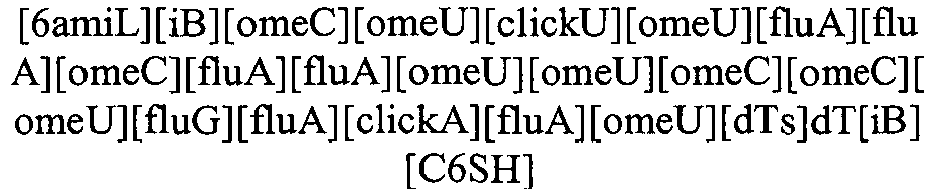
53 5 ApoB Guide 
6 4 ApoB Passenger 
54 7 ApoB Guide 
8 5 ApoB Passenger 
55 9 ApoB Guide 
10 6 SSB Passenger 
56 11 SSB Guide 
12 7 CTNNB1 Passenger 
57 13 CTNNB1 Guide 
14 8 CTNNB1 Passenger 
58 15 CTNNB1 Guide 
16 As used herein, ome = 2' methoxy; flu = 2' fluoro; click = 2' propagyl; iB = inverted abasic; "s" subscript = phosphorothioate; and r = 2' ribo; 6amil = n-hexylamino; C3SH = n-propylthiol ; and C6SH = n-hexylthiol. - Using the method as described later, the in vivo and in vitro data are presented in Table 4.
Table 4. In vitro and In Vivo Activity Entry Compound Starting siRNA sequence code Dose (mpk) Route of Administration In vivo % KD (72 h) IC50 w/LF2K in HEK-Luc [pM] ASGR binding IC50 nM 1 10a-1 51 5, 15 SC 33.6; 69.5 15.44 36.7 2 10b-1 54 SC 5.15; IV 15 42, 49, 13 19.64 18.1 3 10-2 56 5, 50 SC 40, 56 (24 h) 23.4 4 10-3 57 1, 2.5, 5 SC 20, 45, 60 52 (HepG2) 5 17a-1 51 5 SC; 15 IV 11, 5 20.16 49.1 6 17b-1 54 5 SC: 15 IV 12,22 43.96 33.3 7 19-1 52 5; 15 SC 32; 68 24.04 3.6 8 29 53 15 SC; 15 IV 43, 0 17.83 22 9 36 58 1, 2.5, 5 SC 16, 43, 56 10 37 58 1, 2.5, 5 SC 16, 32, 40 11 38 51 5 SC, 15 IV 36, 33 71 17 12 39 51 5 SC, 15 IV 19, 31 46.8 44 13 40 51 5, 15 SC 33, 62 76.8 77 14 41 51 5, 15 SC 28, 74 98.6 134 15 42 51 5, 15 SC 19, 73 309.7 135 16 43 51 5, 15 SC 8, 73 64.8 45 17 44 51 5, 15 SC 31, 73 67.1 66 18 45 51 5 SC, 15 IV 20, 4 73.4 11 19 48a-1 51 5, 15 SC 10.24: 59.93 23.43 20 48b-1 53 5.15 SC 19.87; 42.08 57.96 21 51 55 5; 15 40; 45 1838.47 94.8 Note that the siRNA depictions below are for illustrative purposes. Specific sequence information can be found in Table 3. - The following Scheme 1 was used to prepare TetraGalNAc Compounds 9 and 10.

- Into a 2000-mL 3-necked round-bottom flask purged and maintained with an inert atmosphere of nitrogen was placed a solution of (2S)-2,6-diaminohexanoic acid (50 g, 342.03 mmol, 1.00 equiv) in acetonitrile (1000 mL) and heated to 50°C. To this was added potassium hydroxide (22.6 g, 0.4025 mol, 1.00 equiv, 85%). The resulting solution was stirred for 30 min. Then 3-bromoprop-1-yne (29.5 mL, 1.00 equiv) was added. The resulting solution was stirred for 1 hour at 50°C. additional potassium hydroxide (22.6 g, 0.4025 mol, 1.00 equiv) was added to the solution and stirred for 30 min at 50°C. To this was added 3-bromoprop-1-yne (29.5 mL, 1.00 equiv). The resulting solution was stirred for 1 hour. To this was added potassium hydroxide (22.6 g, 0.4025 mol, 1.00 equiv) again. The resulting solution was stirred for 30 min at 50°C, followed by addition of more 3-bromoprop-1-yne (29.5 mL, 1.00 equiv). The resulting solution was stirred for 1 hour. To this was added potassium hydroxide (22.6 g, 0.4025 mol, 1.00 equiv). The resulting solution was stirred for 30 min. To this was added 3-bromoprop-1-yne (29.5 mL, 1.00 equiv). The resulting solution was stirred for 3 hours. The reaction mixture was cooled to 25°C with a water/ice bath. The solid was filtered out. The filtrate was adjusted to pH 4 with HCl (6M). The solid was filtered out. The filtrate was concentrated under vacuum. The residue was applied onto a silica gel column and eluted with dichloromethane/methanol (100:1-25:1). This resulted in (2S)-2, 6-bis[bis (prop-2-yn-1-yl)amino]hexanoic acid (Compound 1) as a light yellow oil.
MS(ES, m/z): 297.2, [M-H]-1HNMR(CDCl3, 500MHz, ppm): 3.62 (d, J = 2.0 Hz, 4H), 3.52-3.49 (m, 1H), 3.50 (d, J= 2.4 Hz, 4H), 2.62 (t, J= 7.1 Hz, 2H), 2.30 (t, J= 2.4 Hz, 2H), 2.27 (t, J = 2.4 Hz, 2H),1.88-1.79 (m, 2H), 1.60-1.53 (m, 2H), 1.52-1.43 (m, 2H). - Into a 2000-mL 3-necked round-bottom flask purged and maintained with an inert atmosphere of nitrogen was placed a solution of 2-(2-hydroxyethoxy)ethan-1-ol (Compound 2, 42.4 g, 399.55 mmol, 1.00 equiv) in dichloromethane (1000 mL) and triethylamine (27.9 g, 275.72 mmol, 0.25 equiv). To the above was added p-toluenesulfonyl chloride (19.1 g, 100.18 mmol, 0.50 equiv). After stirred for 1 h at 25°C, the resulting mixture was washed with 1x500 mL of aq. potassium hydrosulfate (1M) and 1x500 mL of aq. sodium bicarbonate (5%) respectively. The organic layer was dried over anhydrous sodium sulfate and concentrated under vacuum. The residue was applied onto a silica gel column and eluted with dichloromethane/methanol (100:1). This resulted in 2-(2-hydroxyethoxy)ethyl 4-methylbenzenesulfonate (Compound 3) as a colorless oil.
- Into a 500-mL round-bottom flask purged and maintained with an inert atmosphere of nitrogen was placed a solution of 2-(2-[[(4-2-(2-hydroxyethoxy)ethyl 4-methylbenzenesulfonate (Compound 3, 50 g, 192.08 mmol, 1.00 equiv) in N,N-dimethylformamide (250 mL). This was followed by the addition of sodium azide (18.79 g, 289.03 mmol, 1.50 equiv) at 25°C. The resulting solution was stirred for 5 h at 100°C in an oil bath. The reaction mixture was cooled and filtered. The filtrate was concentrated under vacuum. The residual solution was diluted with 1000 mL of dichloromethane and washed with 1x500 mL of water. The organic layer was dried over anhydrous sodium sulfate and concentrated under vacuum. The residue was applied onto a silica gel column and eluted with dichloromethane/methanol (80:1). This resulted in 2-(2-azidoethoxy)ethan-1-ol (Compound 4) as a colorless oil.
1HNMR (CDCl3, 400 MHz, ppm): 3.42-3.45(t, J = 4.8Hz, 2H), 3.63-3.65(t, J = 4.8Hz, 2H), 3.71-3.74(t, J = 4.8Hz, 2H), 3.71-3.79(m, 2H). - Into a 2000-mL 3-necked round-bottom flask purged and maintained with an inert atmosphere of nitrogen was placed a solution of (3R,4R,5R,6R)-3-amino-6-(hydroxymethyl)tetrahydro-2H-pyran-2,4,5-triol hydrochloride (Compound 5, 120 g, 556.50 mmol, 1.00 equiv) in pyridine (1200 mL). This was followed by the addition of acetic anhydride (341.6 g, 3.35 mol, 6.00 equiv) dropwise with stirring at 0°C. The resulting solution was stirred overnight at 25°C. The reaction was then quenched by the addition of 8000 mL of water/ice. The solid was collected by filtration. This resulted in (3R,4R,5R,6R)-3-acetamido-6-(acetoxymethyl)tetrahydro-2H-pyran-2,4,5-triyl triacetate (Compound 6) as a white solid.
- Into a 2000-mL round-bottom flask purged and maintained with an inert atmosphere of nitrogen was placed a solution of (3R,4R,5R,6R)-3-acetamido-6-(acetoxymethyl)tetrahydro-2H-pyran-2,4,5-triyl triacetate (Compound 6, 30 g, 77.05 mmol, 1.00 equiv) in dichloromethane (1500 mL), then added iron (III) chloride (30 g, 184.95 mmol, 2.40 equiv). The resulting mixture was stirred for 2 h at 25°C. The reaction was then quenched by the addition of 1000 mL of water/ice. The organic layer was washed with 1x1000 mL of sodium aq. bicarbonate and 1x1000 mL of water, dried over anhydrous sodium sulfate and concentrated under vacuum. This resulted in (3aR,5R,6R,7R,7aR)-5-(acetoxymethyl)-2-methyl-5,6,7,7a-tetrahydro-3aH-pyrano[3,2-d]oxazole-6,7-diyl diacetate (Compound 7) as yellow oil.
1HNMR(CDCl3, 300MHz. ppm): 2.03(s, 9H), 2.12(s, 3H), 3.97-4.27(m, 4H), 4.90-4.93(m, J = 3.3Hz, 1H), 5.45-5.47(t, J = 3.0Hz, 1H), 5.98-6.00(d, J = 6.6Hz, 1H). - Into a 500-mL round-bottom flask purged and maintained with an inert atmosphere of nitrogen was placed a solution of (3aR,5R,6R,7R,7aR)-5-(acetoxymethyl)-2-methyl-5,6,7,7a-tetrahydro-3aH-pyrano[3,2-d]oxazole-6,7-diyl diacetate (Compound 7, 40 g, 121.47 mmol, 1.00 equiv) in 1,2-dichloroethane (200 mL), 2-(2-azidoethoxy)ethan-1-ol (Compound 4, 23.89 g, 182.18 mmol, 1.50 equiv). To the above several 4A zeolite was added. The resulting mixture was stirred for 1 h at 25°C. Then trimethylsilyl trifluoromethanesulfonate (10.8 mL, 0.50 equiv) was added. After stirred overnight at 25°C, the reaction mixture was diluted with 500 mL of dichloromethane and washed with 1x500 mL of water, 1x500 mL of aq. sodium bicarbonate and 1x500 mL of water. The organic layer was dried over anhydrous sodium sulfate and concentrated under vacuum. The residue was applied onto a silica gel column and eluted with dichloromethane/methanol (100:1). This resulted in (2R,3R,4R,5R,6R)-5-acetamido-2-(acetoxymethyl)-6-[2-(2-azidoethoxy)ethoxy]tetrahydro-2H-pyran-3,4-diyl diacetate (Compound 8) as a colorless oil. MS(m/z): 461.1, [M+H]+
1HNMR(CDCl3, 500MHz, ppm) 5.78 (d, J = 8.90 Hz, 1H), 5.36 (d, J = 2.9 Hz, 1H), 5.22 (dd, J = 11.2, 3.6 Hz, 1H), 4.77 (d, J = 8.3 Hz, 1H), 4.19-4.12 (m, 2H), 4.11-4.05 (m, 1H), 3.98-3.92 (m, 2H), 3.82-3.78 (m, 1H), 3.71-3.63 (m, 4H), 3.49-3.38 (m, 2H), 2.16 (s, 3H), 2.05 (s, 3H), 2.01 (s, 3H), 1.97 (s, 3H). - Into a 250-mL round bottom flask purged and maintained with an inert atmosphere of nitrogen was charged (2S)-2,6-bis[bis(prop-2-yn-1-yl)amino]hexanoic acid (Compound 1, 1.0 g, 1.0 equiv), (2R,3R,4R,5R,6R)-5-acetamido-2-(acetoxymethyl)-6-[2-(2-azidoethoxy)ethoxy]tetrahydro-2H-pyran-3,4-diyl diacetate (Compound 8, 9.26 g, 6.0 equiv), anhydrous THF 50 mL, CuBrSMe2 (0.138 g, 0.20 equiv), and anhydrous DBU (1.5 ml, 3.0 equiv) in respective order. The resulting solution was stirred for 16 h at room temperature, quenched with acetic acid (0.75 mL, 4.0 equiv), treated with MP-TMT resin (Part No: 801472, from Biotage) (9 g), aged at room temperature for 16h, filtered, and concentrated the filtrate to a foam solid. The solid was then dissolved in CH2Cl2 (140 mL), and washed with AcOH / NaCl solution (140 mL). The AcOH / NaCl solution was prepared with 1 mL AcOH and 100 mL 20% NaCl solution. The bottom organic layer was concentrated, and purified on a SiO2 column (220 g), eluting with CH2Cl2 / MeOH. This resulted in (S)-2,6-bis(bis((1-(2-(2-(((2R,3R,4R,5R,6R)-3-acetamido-4,5-diacetoxy-6-(acetoxymethyl)tetrahydro-2H-pyran-2-yl)oxy)ethoxy)ethyl)-1H-1,2,3-triazol-4-yl)methyl)amino)hexanoic acid (Compound 9) as a white solid.
MS(m/z): 2139.5, [M+H]+ - Into a 250-mL round-bottom flask purged and maintained with an inert atmosphere of nitrogen was charged (S)-2,6-bis(bis((1-(2-(2-(((2R,3R,4R,5R,6R)-3-acetamido-4,5-diacetoxy-6-(acetoxymethyl)tetrahydro-2H-pyran-2-yl)oxy)ethoxy)ethyl)-1H-1,2,3-triazol-4-yl)methyl)amino)hexanoic acid (Compound 9, 6.9 g, 1.0 equiv), Na2CO3 (6.83 g, 20 eq), water (56 mL), and MeOH (32mL) in respective order. The reaction was aged at room temperature for 16h, concentrated to residue, redissolved in water (50mL), and purified on Combiflash C18 gold reverse column (415 g), eluting with water / MeCN. After concentration under vacuum, the product was dissolved in minimum amount of water, and lyophilized to obtain (S)-2,6-bis(bis((1-(2-(2-(((2R,3R,4R,5R,6R)-3-acetamido-4,5-dihydroxy-6-(hydroxymethyl)tetrahydro-2H-pyran-2-yl)oxy)ethoxy)ethyl)-1H-1 ,2,3-triazol-4-yl)methyl)amino)hexanoic acid (Compound 10) as a white solid.
MS(m/z): 1657 [M+Na]+
1HNMR(D2O, 500 MHz, ppm): 8.05 (s, 2H), 7.91 (s, 2H), 4.62 (t, J = 5.0 Hz, 4H), 4.57 (t, J = 5.0 Hz, 4H), 4.45-4.41 (d, J = 8.6 Hz, 4H), 3.99-3.82 (m, 28H), 3.80-3.61 (m, 28H), 3.14 (t, J = 7.1 Hz, 1H), 2.52 (broad s, 2H), 1.99 (s, 6H), 1.98 (s, 6H), 1.73 (m, 2H), 1.60 (m, 2H), 1.29 (m, 2H). - The following Scheme 2 was used to prepare TetraGalNAc Compounds 17a, 17b and 17c.

- To a solution of 5-chloro-1-pentanol (3.0 g, 24.47 mmol) Compound 11 in DMF (20 mL) was added sodium azide (1.909 g, 29.4 mmol) Compound 12. After being stirred at 60 °C for overnight, the reaction mixture was concentrated in vacu. The residue was purified by silica gel chromatography (EtOAc/Hexane 1:3), to give product Compound 13 as clear liquid. 1H NMR (500 MHz, CDCl3) δ 3.62 (m, 2H), 3.25 (t, J = 6.9 Hz, 2H), 1.63-1.53 (m, 4H), 1.45-1.40 (m, 2H).
- Compound 13 (0.796 g, 6.16 mmol) and D-galactosamine pentaacetate (2.00 g, 5.14 mmol) Compound 14 were suspended in 20 mL DCM, followed by addition of trifluoromethanesulfonic acid (0.154 g, 1.027 mmol). The resulting mixture was brought to reflux for overnight. LC-MS indicated completed conversion of SM, the reaction mixture was diluted with EtOAc and washed with sodium bicarbonate and dried over sodium sulfate. Solvent was removed and the residue was purified by ISCO DCM/MeOH from 100/0 to 90/10 over 30 min to afford Compound 15 as a white solid. 1H NMR (500 MHz, CDCl3) δ: 1.97 (6 H, s), 2.02 (6 H, s), 2.06 (6 H, s), 2.15 (6 H, s), 3.28 (6 H, t, J = 6.89 Hz), 3.50 (3 H, dt, J = 9.63, 6.66 Hz), 3.68 (1 H, q, J = 5.98 Hz), 3.94-3.92 (7 H, m), 4.16-4.15 (5 H, m), 4.73 (2 H, d, J = 8.34 Hz), 5.31 (2 H, dd, J = 11.16, 3.48 Hz), 5.40-5.38 (5 H, m). Calculated mass: [M+H]+: C19H31N4O9, 459.2; observed: 459.4.
- Lys-alkyne Compound 1 (130 mg, 0.436 mmol) and GalNAc Azide 6 (999 mg, 2.178 mmol) were dissolved in THF (5 mL, degassed). Copper (I) bromide-dimethyl sulfide complex (17.91 mg, 0.087 mmol) was added in one portion to the reaction mixture and the THF solution was stirred for overnight at 40 °C. The reaction color changed to blue/green, indicating Cu2+, fresh sodium ascorbate 37 mg in 0.2 mL of water was added to reaction mixture and allowed to react overnight. The reaction was concentrated and purified by RP HPLC 5-60 MeCN(0.5% TFA)/Water(0.5% TFA) over 20 min. The collected fractions were combined and lyophilized to afford Compound 8 as a white solid. Calculated mass: [M+3H]3+: C94H145N18O38, 2134.0, m/z =711.3; observed: 711.9.
- To protected TetraGalNAc Compound 8 (300 mg, 0.141 mmol) in DCM/MeOH=1/1 5 mL at 0 °C was added Sodium Methoxide (91 mg, 1.688 mmol). The reaction was stirred for 1 h and quenched by addition of 2 mL of water. Volatile solvent was removed, and the reaction mixture was purified by P4 bio gel with water and the collect fractions were combined and lyophilized to afford Compound 9 as a white solid. Calculated mass: [M+3H]3+: C70H121N18O26, 1629.9, m/z =543.3; observed: 543.8; [M+2H]2+: C70H120N18O26, 1628.9, m/z =814.5; observed: 814.9.
- Syntheses of Compounds 17b and 17c which have the following structures were accomplished in a manner similar to that used for Compound 17a using the appropriate azide source.

- Scheme 3 below shows a general scheme that can be used to prepare tetraGalNAc-siRNA conjugates.

- Using the general scheme 3, Conjugates 10-1, 10-2, 10-3, 10a-1, 17a-1, 17b-1, 17c-1 can be obtained. The coupling procedure can be performed on a preformed siRNA duplex or on a single strand followed by annealing. Alternatively, one can utilize the protocol outlined in Bioconjug Chem. 2011, 22, pp. 1723-8.
- To a solution of tetraGalNAc acetate (Compound 9, 58.7 mg, 0.027 mmol) in acetonitrile (1.5 ml) was added DIPEA (2.2 mg, 0.055 mmol) and HATU (10.44 mg, 0.027 mmol). The mixture was stirred at room temperature for 30 min, transferred into a solution of siRNA (51) (0.014 mmol) in water (1.5 ml) and acetonitrile (1.5 ml) via a syringe pump over 20 min, and stirred for 30 min before it was concentrated under vacuum down to 1.5 mL. Sodium carbonate (218 mg, 2.059 mmol) was then added, followed by MeOH (0.50 ml). The resulted solution was stirred at room temperature for 16h, concentrated, purified via dialysis, and lyophilized to yield tetraGalNAc-siRNA Conjugate 10-1.
- To a solution of tetraGalNAc acid Compound 10 (41.2 mg, 0.025 mmol) in DMSO (200 uL) was added HATU (9.6mg, 0.025 mmol) and DIPEA (17.6 uL, 0.126 mmol). The mixture was stirred at room temperature for 15 min, transferred into a solution of diamino-siRNA (18.8 mg, 2.52 umol) in water (40 uL) and DMSO (360 uL) and stirred for 30 min. The mixture was diluted with water (1.5 mL) and purified on a XBridge Prep Phenyl column (5 uM, 19 x 250 mm) using a gradient of 0 - 30% CH3CN/ water containing 100 mM TEAA. The fractions were concentrated via dialysis and lyophilized to yield Compound 18.
- Scheme 4 below was used to prepare TetraGalNAc-siRNA Conjugate 19-1.

- A solution of 3'5' bis tetraGalNAc-siRNA conjugate 18 (13.7 mg, 1.29 umol) in water (200 uL) was added to a solution of Guide siRNA (9.3 mg, 1.35 umol) dissolved in water (100 uL) and heated at 90 C for 1 minute. The resulting solution was cooled and lyophilized to yield duplex 19-1.
- The following Scheme 5 was used to prepare tetraGalNAc ligand Compound 24.

- To a solution of N-BOC-1,3-diaminopropane (Compound 20, 115 mg, 0.660 mmol) in 1:1 CH2Cl2 /CH3CN (1 mL) at 0 °C was added a solution of 3-maleimidopropionic acid N-hydroxysuccinimide ester (Compound 21, 185 mg, 0.695 mmol) dissolved in acetonitrile (4 mL) and CH2Cl2 (1 mL). The mixture was stirred for 1 h and concentrated in vacuo. The residue was purified by silica gel chromatography (0 - 5% MeOH/ CH2Cl2 to give product Compound 22. Calculated mass: [M+H]+: C15H24N3O5, 326.2; observed: 326.3.
- To a solution of maleimide Compound 22 (56 mg, 0.172 mmol) in CH2Cl2 (1 ml) was added a solution of 4M HCl (1 ml, 4.00 mmol) in dioxane. The mixture was stirred for 1 h and concentrated in vacuo. The residue was azeotroped with CH2Cl2 (2x) and dried under vacuum to give product Compound 23. Calculated mass: [M+H]+: C10H16N3O3, 226.1; observed: 226.3.
- To a solution of tetraGalNAc acid Compound 10 (100 mg, 0.061 mmol) in DMF (500 uL) was added HATU (34.9 mg, 0.092 mmol), Et3N (42.6 uL, 0.306 mmol) and N-(3-aminopropyl)-3-(2,5-dioxo-2,5-dihydro-1H-pyrrol-1-yl)propanamide hydrochloride (16.0 mg, 0.061 mmol). The mixture was stirred at room temperature for 1.5 h, acidified with TFA and purified by reverse phase 0 - 50% CH3CN/ water containing 0.1% TFA. The fractions were lyophilized to yield Compound 24. Calculated mass: [M+2H]2+: C76H125N21O32, 1843.8, m/z =921.9; observed: 922.7.
- Scheme 6 below was used to prepare Compound 26.

- To a degassed solution of 2'-3,17 propargyl siRNA (RNA 25, 33 mg, 4.49 umol) and PEG9 SPDP azide (26 mg, 36 umol, prepared from commercial PEG-azide and pyridyl disulfide reagents) in 3:1 DMA/ water (1 mL) was added a degassed solution of Copper (I) Bromide-Dimethylsulfide Complex (1.8 mg, 9.0 umol). The mixture was stirred for 72 h at room temperature, diluted with water (2 mL), filtered using a 0.45 uM syringe filter and concentrated by dialysis. The concentrated mixture was purified on a XBridge Prep Phenyl column (5 uM, 19 x 250 mm) using a gradient of 0 - 50% CH3CN/ water containing 100 mM TEAA. The fractions were concentrated via dialysis and lyophilized to yield Compound 26.
- Scheme 7 below was used to prepare Compounds 27 and 28.

- To a solution of 2'-3,17 click PEG9 SPDP Conjugate 26 (13.2 mg, 1.50 µmol) in water (1 mL) was added a solution of TCEP hydrochloride (9.15 mg, 32.2 umol) dissolved in water (0.5 mL). The mixture was stirred at RT for 30 min then purified on a XBridge Prep Phenyl column (5 uM, 19 x 250 mm) using a gradient of 5 - 40% CH3CN/ water containing 100 mM TEAA. The fractions were concentrated via dialysis and lyophilized to yield Compound 27.
- To a solution of 2'-3,17-click PEG9SH 27 (3 mg, 0.35 µmol) in pH 6.0 acetate buffer (100 uL) was added a solution of tetra GalNAc maleimide (5.1 mg, 2.77 µmol) dissolved in pH 6.0 acetate buffer (100 uL). The mixture was stirred at room temperature for 30 min then purified on a XBridge Prep Phenyl column (5 uM, 19 x 250 mm) using a gradient of 5 - 40% CH3CN/ water containing 100 mM TEAA. The fractions were concentrated via dialysis and lyophilized to yield Compound 28.
- The procedure detailed for Conjugate 19 was used to duplex 28 to make Conjugate 29.
- Scheme 8 below was used to prepare Compound 31.

- To a solution of tetraGalNAc acid Compound 10 (54 mg, 0.033 mmol) in N,N-dimethylacetamide (500 µl), was added cystamine dihydrochloride 30 (14.9 mg, 0.066 mmol), EDC (12.7 mg, 0.066 mmol), HOAT (10.2 mg, 0.066 mmol) and DIPEA (57.7 µl, 0.330 mmol). The mixture was stirred at room temperature for 18 h, then added a solution of DTT (50.9 mg, 0.330 mmol) in N,N-dimethylacetamide (100 µl) The mixture was stirred at room temperature for 0.5 h, acidified with TFA and purified by reverse phase 0 - 30% CH3CN/ water containing 0.1% TFA. The fractions were lyophilized to yield Compound 31. Calculated mass: [M+2H]2+: C68H115N19O29S, 1695.8, m/z =847.9; observed: 848.0.
- Scheme 9 below was used to prepare Conjugates 35-37.

- To a degassed solution of 2'-click 15 GS Compound 32 (130 mg, 0.019 mmol) and (9H-fluoren-9-yl)methyl (2-azidoethyl)carbamate (29.1 mg, 0.095 mmol) in 3:1 DMA/ water (2 mL) was added a solution of Copper (I) bromide-dimethylsulfide Complex (9.72 mg, 0.042 mmol) dissolved in degassed DMSO (0.32 mL). The mixture was stirred at 45 °C for 2 h, cooled to room temperature, and added pH 8 EDTA (0.5 M, 2 mL) to quench reaction. Stirred for 15 min and purified on a XBridge Prep Phenyl column (5 uM, 30 x 150 mm) using a gradient of 0 - 45% CH3CN/ water containing 100 mM TEAA. The fractions were concentrated via dialysis. To the combined material in water (3 mL) was added a solution of piperidine (936 µL, 1.891 mmol). The mixture was stored at 4 °C for 18 h, diluted with water (10 mL) and filtered off solids through syringe filter. Added pH 8 EDTA (0.5 M, 2 mL), concentrated via dialysis and lyophilized to yield Compound 33.
- To a solution of 2'-15 click C2 NH2 GS Compound 33 (43.6 mg, 6.26 µmol) in 200 mM NaHCO3 soln (2000 µl) and formamide (1000 uL) was added a solution of N-Succinimidyl-3-[2-pyridyldithio]propionate (17.9 mg, 0.057 mmol) dissolved in DMSO (298 uL). The mixture was stirred at 10 °C for 15 min, diluted with water (10 mL) and Formamide (1 mL), and concentrated by dialysis. Added 2M TEAA (200 uL) and purified on a XBridge Prep Phenyl column (5 uM, 19 x 250 mm) using a gradient of 5 - 40% CH3CN/ water containing 100 mM TEAA. The fractions were concentrated via dialysis and lyophilized to yield Compound 34.
- To a solution of 2'-15 click C2 NH2 NHS SPDP GS Compound 34 (13 mg, 1.82 µmol) in 1:1 formamide/water (200 µl) was added a solution of tetraGalNAc SH (4.62 mg, 2.72 µmol) in formamide (200 uL). The mixture was stirred at room temperature for 3.5 h, added 2M TEAA (50 uL) and purified on a XBridge Prep Phenyl column (5 uM, 19 x 250 mm) using a gradient of 2 - 35% CH3CN/ water containing 100 mM TEAA. The fractions were concentrated via dialysis and lyophilized. The resulting solid was purified on a Proteomix SAX-NP10 column (22.1 x 50 mm) using a gradient of 2 - 30% (Solvent A: 60:40 TFE/water with 40 mM Et3N, Solvent B: 60:40 TFE/water with 40 mM Et3N, 1M Guanidine HCl). The fractions were concentrated via dialysis and lyophilized to yield Conjugate 35.
- The procedure detailed for Conjugate 19-1 was used to duplex Conjugate 35 and the appropriate passenger strand to prepare Conjugates 36 and 37, respectively.
- Schemes 10 and 11 below were used to prepare Conjugates 38-44.


- To a solution of FMOC-PRO-OH (11.11 mg, 0.033 µmol) in 120 µL DMSO were added DIPEA (43.2 µl, 0.247 µmol) followed by HATU (10.96 mg, 0.029 µmol). The mixture, slightly yellow, was stirred at room temperature for 30 min. The mixture was then added to a solution of the oligonucleotide passenger strand TEAA salt (60 mg, 8.24 µmol) in 500 µL of (10% H2O/DMSO), and the mixture continued to stir at room temperature for one hour. The reaction mixture showed desired product via LC-MS. To the reaction mixture was added diethylamine (43.0 µl, 0.412 µmol) and the mixture was stirred for one hour, confirmed desired product via LC-MS. The reaction mixture was purified by centrifugal dialysis using 3kDa cut-off membrane. The process was repeated three times with water (14 mL each time). The resulting solution was concentrated, frozen, and lyophilized overnight to yield product as a white fluffy solid. LC/MS confirms product [7384.9]
- To a solution of TetraGalNAc Compound 10 (53.2 mg, 0.033 µmol) in 532 µL DMSO were added DIPEA (42.6 µl, 0.244 µmol) followed by HATU (12.36 mg, 0.033 µmol). The mixture, slightly yellow, was stirred at RT for 30 min. The mixture was then added to a solution of the linker-oligonucleotide passenger strand in 500 µL of DMSO, and the mixture continued to stir at room temperature for two hours. LC/MS showed desired product. The reaction mixture was subjected to centrifugal dialysis using 3kDa cut-off membrane. The process was repeated three times with water (14 mL each time). The resulting solution was purified by Gilson PLC 2020 using XBRIDGE PHENYL, 10 - 27% CH3CN with 200µM TEAA for 35 minutes. Collection solution was concentrated via centrifugal dialysis using 3kDa cut-off membrane. The resulting concentrated solution was treated with 1.0N NaCl and centrifugal dialysis. The process was repeated five times with water (14 mL each time). The resulting concentrated solution (∼1.5 mL) was frozen and lyophilized overnight to yield product as a white fluffy solid. LC/MS confirms product [9002.5].
- To a TetraGalNAc-linker-RNA (18.5 mg, 2.055 µmol) in 1.5 mL of water was duplexed with ApoB guide strand (14.12 mg, 2.055 µmol) in 1.5 mL of water. The mixture was heated at 90°C for 5 min with stir bar. The duplex was cooled and stir bar removed. The solution was lyophilized over two days to yield desired duplex Conjugate 38 as a white fluffy solid. LC/MS confirms product [16048].
- ALL the remaining conjugates were prepared using the same general procedure.
- Schemes 12 below was used to prepare Compounds and/or Conjugates 46-48.

- SPDP Acid (2.2 mg, 10.3 µmol) was dissolved DMSO 100 µL and N,N-diisopropylethylamine (14.0 µl, 0.08 mmol), HATU (19.6 mg, 0.051 mmol) were added sequentially. RNA (15 mg, 2.06 µmol) in 200 µL of DMSO:Water (9:1) was added and the resulting reaction mixture was stirred for 1 h, reaction was quenched by addition of 3 mL water and dialyzed down to 500 µL, diluted by formamide to 3 mL and purified by SAX (Buffer A: 60% TFE in water, 20 mM TEA, Buffer B: 60% TFE in water, 20 mM TEA, 1 M CsCl, gradient A/B from 100/0 to 35/65 over 15 min). The collected fractions were combined and dialyzed against water and lyophilized to afford Compound 46 as a white solid. Calculated mass: [M-H]-: C234H300F8N72O150P23S3, 7480.1; observed: 7483.0.
- RNA Compound 46 (22 mg, 2.9 µmol) and tetraGalNAc Thiol Compound 31 (10.0 mg, 5.9 µmol) were dissolved in formamide:pH=6.8 Tris buffer (3:1) 400 µL and stirred for 1 h. The reaction mixture was purified by SAX (Buffer A: 60% TFE in water, 20 mM TEA, Buffer B: 60% TFE in water, 20 mM TEA, 1 M CsCl, gradient A/B from 100/0 to 35/65 over 15 min). The collected fractions were combined and dialyzed against water and lyophilized to afford Conjugate 47 as a white solid. Calculated mass: [M-H]-: C297H410F8N90O179P23S3, 9063.9; observed: 9066.2.
- Conjugate 47 (10.9 mg, 1.20 µmol) and guide strand (7.81 mg, 1.14 µmol) were mixed in RNAse free water 1mL for 2 h. The reaction mixture was lyophilized to afford duplex Conjugate 48 in quantitative yield.
- Schemes 13 below was used to prepare Compounds and/or Conjugates 49-51.

- 33.3mg of siRNA passenger strand was weighed into a 4mL vial then 1mL 100mM NaHCO3 was added to dissolve. Added 0.86uL of propionic anhydride and let stir at RT. After aging ∼2h, spin dialyzed 3x against water. Filtered through frit and the solution was dried via lyophilization to afford 30.8mg RNA Compound 49.
- Step 1. Charge 2.8mg azide, 25.7mg siRNA, 25ml N2 sparged DMSO and 4ml water to 40mL vial. Sparge with N2. Charge 2.98mL of Cu/ligand solution (N2 sparged, 20/100umol in 10ml DMSO). Agitate at RT under sparged N2.
- Step 2. Charge Compound 10 and 1ml DMSO. Charge 6uL of DIPEA and agitate for 2min. Charge 6mg HBTU and agitate for 2min. Charge siRNA mixture from Step 1. The reaction was not complete so repeated with half of previous reagent charge. Evaporated the reaction mixture, dialyzed and HPLC purified (X-Bridge Phenyl, TEAA/ ACN gradient). Evaporated, dialyze and lyophilized to afford Conjugate 50.
- Dissolve GS (Conjugate 50) 10.65mg in 1ml water and dissolve PS (Conjugate 49) 10.20mg in 1.17ml water. Added 8.7mg of Conjugate 49 to all of Conjugate 50 to form a 1:1 duplex. Heat to 90°C for 1min, cool to RT over 15min. The solution was filtered and dried via lyophilizaiton to afford Conjugate 51 as a white solid.
- HEK293 cells stably transfected with luciferase vector that contains target sites for siRNA in 3'UTR of renilla luciferase were generated. These cells were seeded on 96-well tissue culture plates (Corning: # 3903) at a density of 7.5e3 cells per well in DMEM 10% serum media. Cellular plates were then incubated at 37°C / 5% CO2 for 24hr. After incubation, plates were treated with test compounds co-transfected with transfection reagent Lipofectamine 2000 (invitrogen: # 11668-019) in Opti-MEM (Gibco: #31985) in accordance to manufacturers protocol. The treatment concentrations ranged from 10nM to 0.03pM. Treated plates were then incubated for 24hr at 37°C / 5% CO2. Following treatment incubation, cells were lysed and processed in accordance to Dual-GloTM Luciferase Assay (Promega: E2920) and read on a TECAN safire2 plate reader.
- HepG2 cells (ATCC: HB-8065) were seeded on collagen coated plates (BioCoat: 356649) at a density of 7.5e3 cells per well in DMEM 10% serum media. Cellular plates were then incubated at 37°C / 5% CO2 for 24hr. After incubation, plates were treated with test compounds co-transfected with transfection reagent Lipofectamine 2000 (invitrogen: 11668-019) in Opti-MEM (Gibco: 31985) in accordance to invitrogen protocol. The treatment concentrations ranged from 10nM to 0.03pM. Treated plates were then incubated for 24hr at 37°C / 5% CO2. Following treatment incubation, cells were lysed with PLA Buffer (AB: 4448542) in accordance to supplied protocol. Resulting cell lysate was reverse transcribed to cDNA using High Capacity cDNA Kit (AB: 4368813) and run through qPCR using Life Technology 7900.
- CD1 female mice were dosed by subcutaneous injection in 200 ul volume. Animals were observed for behavioral or physiological changes. Animals were sacrificed 72hrs post dose by CO2 asphyxiation followed by ex-sanguination via cardiac puncture. The liver samples were as 3mm punches from the medial lobe and put into RNAlater tubes for isolation of total RNA. The mRNA knockdown analysis was conducted by Taqman analysis using standard procedures.
- A summary of in vitro and in vivo data of selected Compounds/Conjugates is shown in Table 4 presented earlier.
Claims (13)
- A modular composition comprising1) a single stranded or double stranded oligonucleotide;2) one or more tetraGalNAc ligands of Formula (I), (II) or (III), which may be the same or different:

 " indicates the point of attachment;
 optionally, 3) one or more linkers, which may be the same or different;optionally, 4) one or more targeting ligands, solubilizing agents, pharmacokinetics enhancing agents, lipids, and/or masking agents, wherein the trageting ligands are selected from the group consisting of an antibody, a ligand-binding portion of a receptor, a ligand for a receptor, an aptamer, D-galactose, N-acetyl-D-galactose (GalNAc), multivalent N-acetyl-D-galactose, D-mannose, cholesterol, a fatty acid, a lipoprotein, folate, thyrotropin, melanotropin, surfactant protein A, mucin, carbohydrate, multivalent lactose, multivalent galactose, N-acetyl-galactosamine, N-acetyl-glucosamine, multivalent mannose, multivalent fructose, glycosylated polyaminoacids, transferin, bisphosphonate, polyglutamate, polyaspartate, a lipophilic moiety that enhances plasma protein binding, a steroid, bile acid, vitamin B12, biotin, an RGD peptide, an RGD peptide mimic, ibuprofen, naproxen, aspirin, and folate;
wherein the tetraGalNAc ligands are attached to the oligonucleotide at different 2'=positions of the ribose rings and/or at different terminal 3' and/or 5'-positions of the oligonucleotide; and the tetraGalNAc ligands are attached to the oligonucleotide optionally via linkers;
wherein the linkers are attached to the oligonucleotide at different 2'-positions of the ribose rings and/or at different terminal 3' and/or 5'-positions of the oligonucleotide; and
wherein each linker is independently selected from

- The modular composition of claim 1 comprising:1) a single stranded or double stranded oligonucleotide;2) 1-8 tetraGalNAc ligands of Formula (II), which may be the same or different, wherein X is -O-, -S-, -CH2- or -NH-; and n is 1, 2, 3, or 4;3) 1-16 linkers, which may be the same or different; andoptionally, 4) 1-8 targeting ligands, solubilizing agents, pharmacokinetics enhancing agents, lipids, and/or masking agents, wherein the trageting ligands are selected from the group consisting of an antibody, a ligand-binding portion of a receptor, a ligand for a receptor, an aptamer, D-galactose, N-acetyl-D-galactose (GalNAc), multivalent N-acetyl-D-galactose, D-mannose, cholesterol, a fatty acid, a lipoprotein, folate, thyrotropin, melanotropin, surfactant protein A, mucin, carbohydrate, multivalent lactose, multivalent galactose, N-acetyl-galactosamine, N-acetyl-glucosamine, multivalent mannose, multivalent fructose, glycosylated polyaminoacids, transferin, bisphosphonate, polyglutamate, polyaspartate, a lipophilic moiety that enhances plasma protein binding, a steroid, bile acid, vitamin B12, biotin, an RGD peptide, an RGD peptide mimic, ibuprofen, naproxen, aspirin, and folate.
- The modular composition of claim 1 comprising:1) a single stranded or double stranded siRNA;2) 1-8 tetraGalNAc ligands of Formula (I), (II) or (III), which may be the same or different, wherein X is -O-, -S-, -CR1R2- or -NR1-, wherein R1 and R2 are each independently selected from the group consisting of hydrogen and C1-C6alkyl; and n is 1, 2, 3, or 4;3) 1-16 linkers, which may be the same or different; andoptionally, 4) 1-8 targeting ligands, solubilizing agents, pharmacokinetics enhancing agents, lipids, and/or masking agents, wherein the trageting ligands are selected from the group consisting of an antibody, a ligand-binding portion of a receptor, a ligand for a receptor, an aptamer, D-galactose, N-acetyl-D-galactose (GalNAc), multivalent N-acetyl-D-galactose, D-mannose, cholesterol, a fatty acid, a lipoprotein, folate, thyrotropin, melanotropin, surfactant protein A, mucin, carbohydrate, multivalent lactose, multivalent galactose, N-acetyl-galactosamine, N-acetyl-glucosamine, multivalent mannose, multivalent fructose, glycosylated polyaminoacids, transferin, bisphosphonate, polyglutamate, polyaspartate, a lipophilic moiety that enhances plasma protein binding, a steroid, bile acid, vitamin B12, biotin, an RGD peptide, an RGD peptide mimic, ibuprofen, naproxen, aspirin, and folate.
- The modular composition of claim 3, wherein X of Formula (II) is -O-, -S- or -CH2-; and n is 1, 2 or 3.
- The modular composition of claim 3,
wherein the siRNA is double stranded; and
wherein the tetraGalNAc ligands are attached to the guide strand or the passenger strand of the siRNA at different 2'-positions of the ribose rings of the siRNA, or at different terminal 3' and/or 5'-positions, or wherein the tetraGalNAc ligands are attached to both the guide strand and the passenger strand of the siRNA at different 2'-positions of the ribose rings and/or different terminal 3' and/or 5'-positions. - The modular composition of claim 3, wherein the composition comprises 2-8 tetraGalNAc ligands of Formula (II), which may be the same or different; and the tetraGalNAc ligands are attached to the same strand of the siRNA or to different strands of the siRNA.
- The modular composition of claim 3, wherein the tetraGalNAc ligands are attached to the same or different strands of the siRNA via linkers.
- The modular composition of claim 3,
wherein the siRNA is double stranded; and
wherein the optional targeting ligands, solubilizing agents, pharmacokinetics enhancing agents, lipids, and/or masking agents are attached to the same strand or different strands of the siRNA via linkers. - The modular composition of claim 1 comprising1) a double stranded siRNA;2) 1-8 tetraGalNAc ligands of Formula (IV), (V) or (VI):

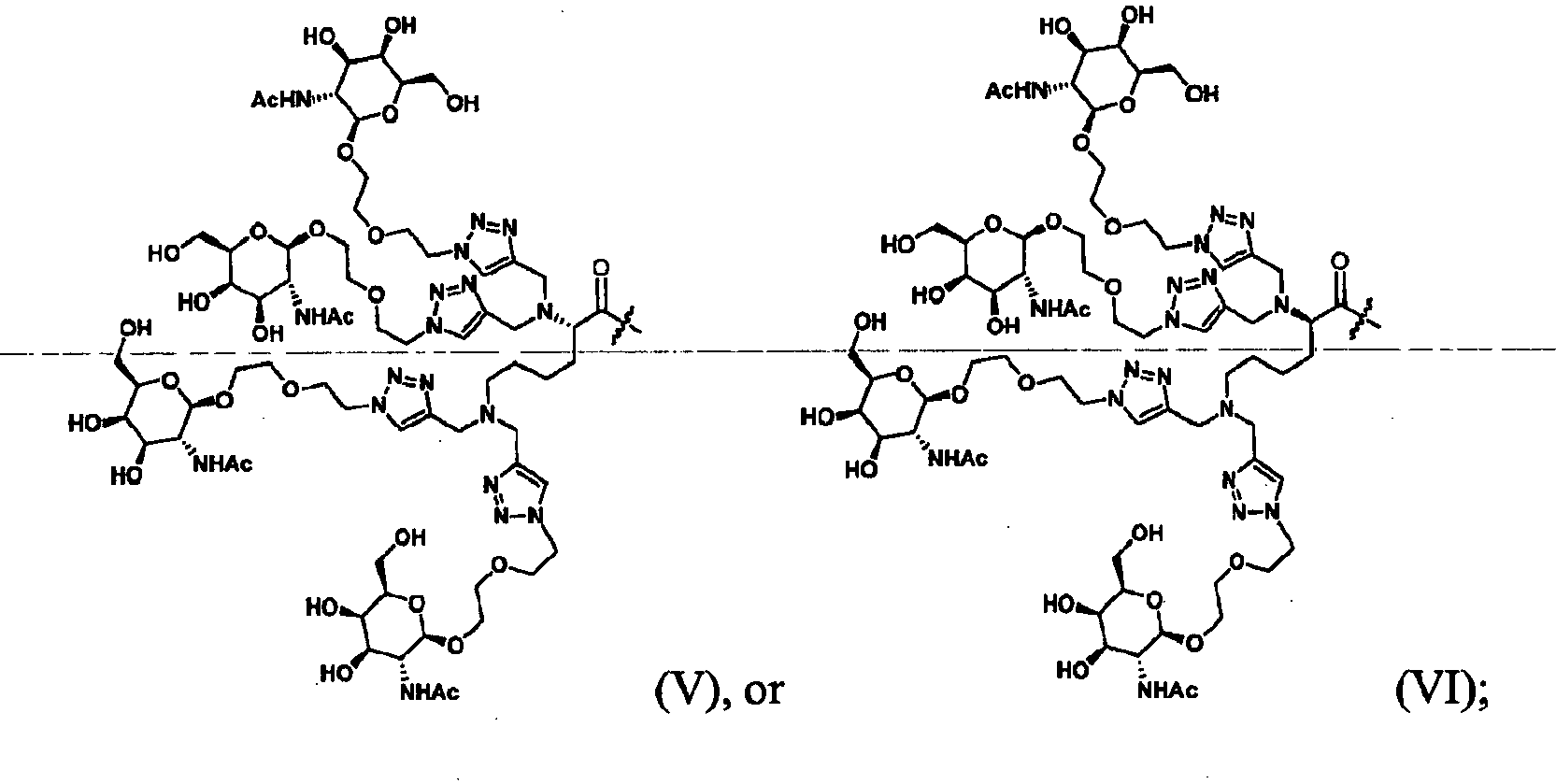 3) 1-16 linkers, which may be the same or different, independently selected from
 optionally, 4) 1-8 targeting ligands, solubilizing agents, pharmacokinetics enhancing agents, lipids, and/or masking agents, wherein the trageting ligands are selected from the group consisting of an antibody, a ligand-binding portion of a receptor, a ligand for a receptor, an aptamer, D-galactose, N-acetyl-D-galactose (GalNAc), multivalent N-acetyl-D-galactose, D-mannose, cholesterol, a fatty acid, a lipoprotein, folate, thyrotropin, melanotropin, surfactant protein A, mucin, carbohydrate, multivalent lactose, multivalent galactose, N-acetyl-galactosamine, N-acetyl-glucosamine, multivalent mannose, multivalent fructose, glycosylated polyaminoacids, transferin, bisphosphonate, polyglutamate, polyaspartate, a lipophilic moiety that enhances plasma protein binding, a steroid, bile acid, vitamin B12, biotin, an RGD peptide, an RGD peptide mimic, ibuprofen, naproxen, aspirin, and folate.
 - The modular composition of claim 9 comprising:1) a double stranded siRNA;2) 1-3 tetraGalNAc ligands of Formula (V);3) 1-6 linkers, which may be the same or different, independently selected from
 optionally, 4) 1-3 targeting ligands, solubilizing agents, pharmacokinetics enhancing agents, lipids, and/or masking agents, wherein the trageting ligands are selected from the group consisting of an antibody, a ligand-binding portion of a receptor, a ligand for a receptor, an aptamer, D-galactose, N-acetyl-D-galactose (GalNAc), multivalent N-acetyl-D-galactose, D-mannose, cholesterol, a fatty acid, a lipoprotein, folate, thyrotropin, melanotropin, surfactant protein A, mucin, carbohydrate, multivalent lactose, multivalent galactose, N-acetyl-galactosamine, N-acetyl-glucosamine, multivalent mannose, multivalent fructose, glycosylated polyaminoacids, transferin, bisphosphonate, polyglutamate, polyaspartate, a lipophilic moiety that enhances plasma protein binding, a steroid, bile acid, vitamin B12, biotin, an RGD peptide, an RGD peptide mimic, ibuprofen, naproxen, aspirin, and folate;
wherein the tetraGalNAc ligands are attached to the siRNA at different 2'-positions of the ribose rings and/or at different terminal 3' and/or 5'-positions of the siRNA; and wherein the tetraGalNAc ligands are attached to the siRNA optionally via linkers. - The modular composition of claim 10 comprising 2-3 tetraGalNAc ligands, wherein the tetraGalNAc ligands are attached to the same strand or different strands of the siRNA via linkers.
- The modular composition of claim 10 comprising:1) a double stranded siRNA;2) 1-2 tetraGalNAc ligands of Formula (V);3) 1-4 linkers, which may be the same or different, independently selected from
 optionally, 4) 1-2 targeting ligands, solubilizing agents, pharmacokinetics enhancing agents, lipids, and/or masking agents, wherein the trageting ligands are selected from the group consisting of an antibody, a ligand-binding portion of a receptor, a ligand for a receptor, an aptamer, D-galactose, N-acetyl-D-galactose (GalNAc), multivalent N-acetyl-D-galactose, D-mannose, cholesterol, a fatty acid, a lipoprotein, folate, thyrotropin, melanotropin, surfactant protein A, mucin, carbohydrate, multivalent lactose, multivalent galactose, N-acetyl-galactosamine, N-acetyl-glucosamine, multivalent mannose, multivalent fructose, glycosylated polyaminoacids, transferin, bisphosphonate, polyglutamate, polyaspartate, a lipophilic moiety that enhances plasma protein binding, a steroid, bile acid, vitamin B12, biotin, an RGD peptide, an RGD peptide mimic, ibuprofen, naproxen, aspirin, and folate;
wherein the tetraGalNAc ligands are attached to the siRNA at different 2'-positions of the ribose rings and/or at different terminal 3' and/or 5'-positions of the siRNA; and
wherein the tetraGalNAc ligands are attached to the siRNA via linkers. - A pharmaceutical composition comprising the modular composition of claim 1 and a pharmaceutically acceptable excipient.
Applications Claiming Priority (2)
| Application Number | Priority Date | Filing Date | Title |
|---|---|---|---|
| US201261641761P | 2012-05-02 | 2012-05-02 | |
| PCT/US2013/039025 WO2013166121A1 (en) | 2012-05-02 | 2013-05-01 | Novel tetragalnac containing conjugates and methods for delivery of oligonucleotides |
Publications (3)
| Publication Number | Publication Date |
|---|---|
| EP2844663A1 EP2844663A1 (en) | 2015-03-11 |
| EP2844663A4 EP2844663A4 (en) | 2015-09-30 |
| EP2844663B1 true EP2844663B1 (en) | 2020-03-25 |
Family
ID=49514844
Family Applications (1)
| Application Number | Title | Priority Date | Filing Date |
|---|---|---|---|
| EP13784779.4A Active EP2844663B1 (en) | 2012-05-02 | 2013-05-01 | Tetragalnac containing conjugates and methods for delivery of oligonucleotides |
Country Status (9)
| Country | Link |
|---|---|
| US (2) | US9540639B2 (en) |
| EP (1) | EP2844663B1 (en) |
| JP (2) | JP6239592B2 (en) |
| AR (1) | AR090906A1 (en) |
| AU (1) | AU2013256400B2 (en) |
| CA (1) | CA2872100A1 (en) |
| HK (1) | HK1208227A1 (en) |
| TW (2) | TW201808342A (en) |
| WO (1) | WO2013166121A1 (en) |
Families Citing this family (59)
| Publication number | Priority date | Publication date | Assignee | Title |
|---|---|---|---|---|
| EP3640332A1 (en) | 2011-08-29 | 2020-04-22 | Ionis Pharmaceuticals, Inc. | Oligomer-conjugate complexes and their use |
| AR090905A1 (en) | 2012-05-02 | 2014-12-17 | Merck Sharp & Dohme | CONJUGATES CONTAINING TETRAGALNAC AND PEPTIDES AND PROCEDURES FOR THE ADMINISTRATION OF OLIGONUCLEOTIDES, PHARMACEUTICAL COMPOSITION |
| CA2921162A1 (en) | 2013-05-01 | 2014-11-06 | Ionis Pharmaceuticals, Inc. | Conjugated antisense compounds and their use |
| EP4039278A1 (en) * | 2013-07-11 | 2022-08-10 | Alnylam Pharmaceuticals, Inc. | Oligonucleotide-ligand conjugates and process for their preparation |
| KR102365486B1 (en) | 2013-08-28 | 2022-02-18 | 아이오니스 파마수티컬즈, 인코포레이티드 | Modulation of prekallikrein (pkk) expression |
| EP3610884B1 (en) * | 2013-11-06 | 2021-08-18 | Merck Sharp & Dohme Corp. | Peptide containing conjugates for dual molecular delivery of oligonucleotides |
| WO2015069586A2 (en) * | 2013-11-06 | 2015-05-14 | Merck Sharp & Dohme Corp. | Dual molecular delivery of oligonucleotides and peptide containing conjugates |
| JP6466637B2 (en) * | 2013-11-28 | 2019-02-06 | ソマール株式会社 | Sugar chain-containing polymer and sugar chain-containing polymer complex |
| WO2015168172A1 (en) | 2014-04-28 | 2015-11-05 | Isis Pharmaceuticals, Inc. | Linkage modified oligomeric compounds |
| AU2015252841B2 (en) | 2014-05-01 | 2020-03-19 | Ionis Pharmaceuticals, Inc. | Compositions and methods for modulating growth hormone receptor expression |
| US10280423B2 (en) | 2014-05-01 | 2019-05-07 | Ionis Pharmaceuticals, Inc. | Compositions and methods for modulating complement factor B expression |
| MX382230B (en) | 2014-05-01 | 2025-03-13 | Ionis Pharmaceuticals Inc | COMPOSITIONS AND METHODS FOR MODULATING THE EXPRESSION OF ANGIOPOETIN TYPE 3 LIKE. |
| JP6665111B2 (en) | 2014-05-01 | 2020-03-13 | アイオーニス ファーマシューティカルズ, インコーポレーテッドIonis Pharmaceuticals,Inc. | Compositions and methods for modulating PKK expression |
| US10570169B2 (en) | 2014-05-22 | 2020-02-25 | Ionis Pharmaceuticals, Inc. | Conjugated antisense compounds and their use |
| WO2016040748A1 (en) | 2014-09-12 | 2016-03-17 | Ionis Pharmaceuticals, Inc. | Compositions and methods for detection of smn protein in a subject and treatment of a subject |
| JP6688292B2 (en) | 2014-10-10 | 2020-04-28 | ダイセルナ ファーマシューティカルズ, インコーポレイテッドDicerna Pharmaceuticals, Inc. | Therapeutic inhibition of lactate dehydrogenase and its drugs |
| PE20180800A1 (en) | 2015-07-10 | 2018-05-09 | Ionis Pharmaceuticals Inc | DIACIGLYCEROL ACILTRANSFERASE 2 (DGAT2) MODULATORS |
| HK1255699A1 (en) | 2015-09-24 | 2019-08-23 | Ionis Pharmaceuticals, Inc. | Modulators of kras expression |
| SI4119569T1 (en) | 2015-11-06 | 2024-10-30 | Ionis Pharmaceuticals, Inc. | CONJUGATED ANTI-SENSORY COMPOUNDS FOR THERAPEUTIC USE |
| EP3370708A4 (en) | 2015-11-06 | 2019-06-26 | Ionis Pharmaceuticals, Inc. | MODULATION OF APOLIPOPROTEIN EXPRESSION (A) |
| JP6853193B2 (en) | 2016-01-29 | 2021-03-31 | 協和キリン株式会社 | Nucleic acid complex |
| US10246709B2 (en) | 2016-03-07 | 2019-04-02 | Arrowhead Pharmaceuticals, Inc. | Targeting ligands for therapeutic compounds |
| AU2017296195A1 (en) | 2016-07-11 | 2019-01-24 | Translate Bio Ma, Inc. | Nucleic acid conjugates and uses thereof |
| ES2935658T3 (en) | 2016-07-15 | 2023-03-09 | Ionis Pharmaceuticals Inc | Compounds and methods for the modulation of SMN2 |
| JP6989521B2 (en) * | 2016-09-02 | 2022-01-05 | アローヘッド ファーマシューティカルズ インコーポレイテッド | Targeting ligand |
| KR20190065341A (en) | 2016-10-06 | 2019-06-11 | 아이오니스 파마수티컬즈, 인코포레이티드 | Method of joining oligomeric compounds |
| JOP20190215A1 (en) | 2017-03-24 | 2019-09-19 | Ionis Pharmaceuticals Inc | Modulators of pcsk9 expression |
| IL273875B2 (en) | 2017-10-13 | 2025-07-01 | Dicerna Pharmaceuticals Inc | Methods and compounds for inhibiting expression of ldha |
| US12178855B2 (en) | 2018-01-10 | 2024-12-31 | Translate Bio Ma, Inc. | Compositions and methods for facilitating delivery of synthetic nucleic acids to cells |
| US20200392510A1 (en) | 2018-01-15 | 2020-12-17 | Ionis Pharmaceuticals, Inc. | Modulators of dnm2 expression |
| CA3090901A1 (en) | 2018-02-12 | 2019-08-15 | Ionis Pharmaceuticals, Inc. | Modified compounds and uses thereof |
| US20210155926A1 (en) * | 2018-04-05 | 2021-05-27 | Silence Therapeutics Gmbh | siRNAs WITH AT LEAST TWO LIGANDS AT DIFFERENT ENDS |
| EP3790970A1 (en) | 2018-05-07 | 2021-03-17 | Alnylam Pharmaceuticals Inc. | Extrahepatic delivery |
| JP7438135B2 (en) | 2018-05-09 | 2024-02-26 | アイオーニス ファーマシューティカルズ, インコーポレーテッド | Compounds and methods for reducing expression of FXI |
| EP3823725A4 (en) | 2018-07-17 | 2023-05-10 | Aronora, Inc. | METHODS OF SAFELY REDUCING THROMBOPOIETIN |
| EP3833397A4 (en) | 2018-08-08 | 2023-06-14 | Arcturus Therapeutics, Inc. | COMPOSITIONS AND AGENTS AGAINST NON-ALCOHOLIC STEATOHEPATITIS |
| TWI869213B (en) | 2018-09-19 | 2025-01-01 | 美商Ionis製藥公司 | Modulators of pnpla3 expression |
| US20220273691A1 (en) | 2018-12-21 | 2022-09-01 | Ionis Pharmaceuticals, Inc. | Modulators of hsd17b13 expression |
| CA3126947A1 (en) | 2019-01-22 | 2020-07-30 | Korro Bio, Inc. | Rna-editing oligonucleotides and uses thereof |
| JP2022519184A (en) | 2019-01-22 | 2022-03-22 | コロ バイオ, インコーポレイテッド | RNA editing oligonucleotides and their use |
| CA3127243A1 (en) | 2019-01-22 | 2020-07-30 | Korro Bio, Inc. | Rna-editing oligonucleotides and uses thereof |
| JP7757277B2 (en) | 2019-10-14 | 2025-10-21 | アストラゼネカ・アクチエボラーグ | Modulators of PNPLA3 Expression |
| PH12022552258A1 (en) | 2020-02-28 | 2023-11-20 | Ionis Pharmaceuticals Inc | Compounds and methods for modulating smn2 |
| US12534435B2 (en) | 2020-03-27 | 2026-01-27 | Generation Bio Co. | Lipids and nanoparticle compositions thereof |
| CA3176196A1 (en) | 2020-04-21 | 2021-10-28 | Flagship Pioneering, Inc. | Bifunctional molecules and methods of using thereof |
| CN111748005B (en) * | 2020-06-24 | 2022-02-11 | 河北大学 | GalNAc modified methylene blue derivative, preparation method and application thereof, liver-targeting fluorescent probe and HClO detection method |
| CN116546989A (en) * | 2020-10-09 | 2023-08-04 | 阿达尔克斯制药有限公司 | N-acetylgalactosamine (GalNAc) derived compounds and oligonucleotides |
| JP7820374B2 (en) | 2020-11-18 | 2026-02-25 | アイオーニス ファーマシューティカルズ, インコーポレーテッド | Compounds and methods for modulating angiotensinogen expression |
| BR112023012377A2 (en) | 2020-12-23 | 2023-10-24 | Flagship Pioneering Innovations Vi Llc | MODIFIED TRAIN COMPOSITIONS AND USES THEREOF |
| CA3222589A1 (en) | 2021-06-14 | 2022-12-22 | Matthew G. Stanton | Cationic lipids and compositions thereof |
| CA3233755A1 (en) | 2021-10-01 | 2023-04-06 | Adarx Pharmaceuticals, Inc. | Prekallikrein-modulating compositions and methods of use thereof |
| WO2023171587A1 (en) * | 2022-03-08 | 2023-09-14 | 大原薬品工業株式会社 | MODIFIED siRNA FOR SELECTIVELY INHIBITING EXPRESSION OF MUTANT FUS |
| WO2023250112A1 (en) | 2022-06-22 | 2023-12-28 | Flagship Pioneering Innovations Vi, Llc | Compositions of modified trems and uses thereof |
| US20260055426A1 (en) | 2022-08-19 | 2026-02-26 | Generation Bio Co. | CLEAVABLE CLOSED-ENDED DNA (ceDNA) AND METHODS OF USE THEREOF |
| EP4663627A1 (en) * | 2023-02-06 | 2025-12-17 | NOF Corporation | Amine hydrochloride having maleimide group, and method for producing same |
| CN121285630A (en) | 2023-04-20 | 2026-01-06 | 阿达尔克斯制药有限公司 | MAPT modulating compositions and methods of use thereof |
| KR20260021635A (en) | 2023-05-12 | 2026-02-13 | 아다르엑스 파마슈티컬스, 인크. | NMDA ligand conjugated compounds and uses thereof |
| IL324720A (en) | 2023-05-26 | 2026-01-01 | Adarx Pharmaceuticals Inc | Sod1-modulating compositions and methods of use thereof |
| CN121712891A (en) | 2023-06-20 | 2026-03-20 | 阿达尔克斯制药有限公司 | LRRK2 modulating compositions and methods of use thereof |
Family Cites Families (11)
| Publication number | Priority date | Publication date | Assignee | Title |
|---|---|---|---|---|
| WO2005041859A2 (en) | 2003-04-30 | 2005-05-12 | Sirna Therapeutics, Inc. | Conjugates and compositions for cellular delivery. |
| EP1737969B2 (en) * | 2004-04-15 | 2018-09-12 | GlycoFi, Inc. | Production of galactosylated glycoproteins in lower eukaryotes |
| US7951926B2 (en) * | 2006-04-28 | 2011-05-31 | Centre National De La Recherche Scientifique (Cnrs) | Method for the synthesis of oligonucleotide derivatives |
| US8809514B2 (en) | 2006-09-22 | 2014-08-19 | Ge Healthcare Dharmacon, Inc. | Tripartite oligonucleotide complexes and methods for gene silencing by RNA interference |
| CN102006890A (en) * | 2007-12-04 | 2011-04-06 | 阿尔尼拉姆医药品有限公司 | Targeting lipids |
| EP3604533A1 (en) | 2008-04-11 | 2020-02-05 | Arbutus Biopharma Corporation | Site-specific delivery of nucleic acids by combining targeting ligands with endosomolytic components |
| EP2342616A2 (en) * | 2008-09-23 | 2011-07-13 | Alnylam Pharmaceuticals Inc. | Chemical modifications of monomers and oligonucleotides with cycloaddition |
| US8247827B2 (en) | 2008-09-30 | 2012-08-21 | Bridgelux, Inc. | LED phosphor deposition |
| EP3023495B1 (en) * | 2010-02-24 | 2019-05-08 | Arrowhead Pharmaceuticals, Inc. | Compositions for targeted delivery of sirna |
| CN102892420A (en) * | 2010-04-09 | 2013-01-23 | 默沙东公司 | Novel single chemical entities and methods for delivery of oligonucleotides |
| AR090905A1 (en) * | 2012-05-02 | 2014-12-17 | Merck Sharp & Dohme | CONJUGATES CONTAINING TETRAGALNAC AND PEPTIDES AND PROCEDURES FOR THE ADMINISTRATION OF OLIGONUCLEOTIDES, PHARMACEUTICAL COMPOSITION |
-
2013
- 2013-04-30 TW TW106117248A patent/TW201808342A/en unknown
- 2013-04-30 AR ARP130101481A patent/AR090906A1/en unknown
- 2013-04-30 TW TW102115516A patent/TWI595885B/en active
- 2013-05-01 HK HK15108687.4A patent/HK1208227A1/en unknown
- 2013-05-01 EP EP13784779.4A patent/EP2844663B1/en active Active
- 2013-05-01 CA CA2872100A patent/CA2872100A1/en not_active Abandoned
- 2013-05-01 WO PCT/US2013/039025 patent/WO2013166121A1/en not_active Ceased
- 2013-05-01 JP JP2015510418A patent/JP6239592B2/en active Active
- 2013-05-01 US US14/398,317 patent/US9540639B2/en active Active
- 2013-05-01 AU AU2013256400A patent/AU2013256400B2/en active Active
-
2016
- 2016-11-29 US US15/363,490 patent/US10214742B2/en active Active
-
2017
- 2017-11-01 JP JP2017211436A patent/JP2018048186A/en active Pending
Non-Patent Citations (1)
| Title |
|---|
| None * |
Also Published As
| Publication number | Publication date |
|---|---|
| US10214742B2 (en) | 2019-02-26 |
| AU2013256400B2 (en) | 2017-09-21 |
| JP2015520742A (en) | 2015-07-23 |
| CA2872100A1 (en) | 2013-11-07 |
| EP2844663A1 (en) | 2015-03-11 |
| AR090906A1 (en) | 2014-12-17 |
| HK1208227A1 (en) | 2016-02-26 |
| TW201350131A (en) | 2013-12-16 |
| EP2844663A4 (en) | 2015-09-30 |
| AU2013256400A1 (en) | 2014-11-06 |
| JP2018048186A (en) | 2018-03-29 |
| TW201808342A (en) | 2018-03-16 |
| US20170233731A1 (en) | 2017-08-17 |
| JP6239592B2 (en) | 2017-11-29 |
| US20150203843A1 (en) | 2015-07-23 |
| WO2013166121A1 (en) | 2013-11-07 |
| TWI595885B (en) | 2017-08-21 |
| US9540639B2 (en) | 2017-01-10 |
Similar Documents
| Publication | Publication Date | Title |
|---|---|---|
| AU2013256400B2 (en) | Novel tetragalnac containing conjugates and methods for delivery of oligonucleotides | |
| US12304925B2 (en) | Tetragalnac and peptide containing conjugates and methods for delivery of oligonucleotides | |
| US11918600B2 (en) | Nucleic acid, pharmaceutical composition and conjugate containing nucleic acid, and use thereof | |
| AU2018377716B2 (en) | Nucleic acid, composition and conjugate comprising the same, and preparation method and use thereof | |
| CN114885604B (en) | Peptide docking vector for targeted delivery of nucleic acids | |
| KR20260042246A (en) | Multicargo-containing complex and its uses | |
| TW202604540A (en) | Multivalent cargo-carrying complexes and uses thereof | |
| WO2026002138A1 (en) | Specifically modified double-stranded oligonucleotide and composition thereof |
Legal Events
| Date | Code | Title | Description |
|---|---|---|---|
| PUAI | Public reference made under article 153(3) epc to a published international application that has entered the european phase |
Free format text: ORIGINAL CODE: 0009012 |
|
| 17P | Request for examination filed |
Effective date: 20141023 |
|
| AK | Designated contracting states |
Kind code of ref document: A1 Designated state(s): AL AT BE BG CH CY CZ DE DK EE ES FI FR GB GR HR HU IE IS IT LI LT LU LV MC MK MT NL NO PL PT RO RS SE SI SK SM TR |
|
| AX | Request for extension of the european patent |
Extension state: BA ME |
|
| RA4 | Supplementary search report drawn up and despatched (corrected) |
Effective date: 20150831 |
|
| RIC1 | Information provided on ipc code assigned before grant |
Ipc: C07H 15/26 20060101AFI20150825BHEP Ipc: A61K 47/48 20060101ALI20150825BHEP Ipc: C12N 15/113 20100101ALI20150825BHEP |
|
| REG | Reference to a national code |
Ref country code: HK Ref legal event code: DE Ref document number: 1208227 Country of ref document: HK |
|
| 17Q | First examination report despatched |
Effective date: 20160906 |
|
| STAA | Information on the status of an ep patent application or granted ep patent |
Free format text: STATUS: EXAMINATION IS IN PROGRESS |
|
| REG | Reference to a national code |
Ref country code: DE Ref legal event code: R079 Ref document number: 602013067203 Country of ref document: DE Free format text: PREVIOUS MAIN CLASS: C07H0019056000 Ipc: C07H0015260000 |
|
| RIC1 | Information provided on ipc code assigned before grant |
Ipc: A61K 47/54 20170101ALI20180528BHEP Ipc: C07H 15/26 20060101AFI20180528BHEP Ipc: C12N 15/113 20100101ALI20180528BHEP |
|
| GRAP | Despatch of communication of intention to grant a patent |
Free format text: ORIGINAL CODE: EPIDOSNIGR1 |
|
| STAA | Information on the status of an ep patent application or granted ep patent |
Free format text: STATUS: GRANT OF PATENT IS INTENDED |
|
| INTG | Intention to grant announced |
Effective date: 20191004 |
|
| GRAS | Grant fee paid |
Free format text: ORIGINAL CODE: EPIDOSNIGR3 |
|
| GRAA | (expected) grant |
Free format text: ORIGINAL CODE: 0009210 |
|
| STAA | Information on the status of an ep patent application or granted ep patent |
Free format text: STATUS: THE PATENT HAS BEEN GRANTED |
|
| AK | Designated contracting states |
Kind code of ref document: B1 Designated state(s): AL AT BE BG CH CY CZ DE DK EE ES FI FR GB GR HR HU IE IS IT LI LT LU LV MC MK MT NL NO PL PT RO RS SE SI SK SM TR |
|
| AX | Request for extension of the european patent |
Extension state: BA ME |
|
| REG | Reference to a national code |
Ref country code: GB Ref legal event code: FG4D |
|
| REG | Reference to a national code |
Ref country code: AT Ref legal event code: REF Ref document number: 1248426 Country of ref document: AT Kind code of ref document: T Effective date: 20200415 Ref country code: IE Ref legal event code: FG4D |
|
| REG | Reference to a national code |
Ref country code: DE Ref legal event code: R096 Ref document number: 602013067203 Country of ref document: DE |
|
| PG25 | Lapsed in a contracting state [announced via postgrant information from national office to epo] |
Ref country code: RS Free format text: LAPSE BECAUSE OF FAILURE TO SUBMIT A TRANSLATION OF THE DESCRIPTION OR TO PAY THE FEE WITHIN THE PRESCRIBED TIME-LIMIT Effective date: 20200325 Ref country code: NO Free format text: LAPSE BECAUSE OF FAILURE TO SUBMIT A TRANSLATION OF THE DESCRIPTION OR TO PAY THE FEE WITHIN THE PRESCRIBED TIME-LIMIT Effective date: 20200625 Ref country code: FI Free format text: LAPSE BECAUSE OF FAILURE TO SUBMIT A TRANSLATION OF THE DESCRIPTION OR TO PAY THE FEE WITHIN THE PRESCRIBED TIME-LIMIT Effective date: 20200325 |
|
| PG25 | Lapsed in a contracting state [announced via postgrant information from national office to epo] |
Ref country code: SE Free format text: LAPSE BECAUSE OF FAILURE TO SUBMIT A TRANSLATION OF THE DESCRIPTION OR TO PAY THE FEE WITHIN THE PRESCRIBED TIME-LIMIT Effective date: 20200325 Ref country code: LV Free format text: LAPSE BECAUSE OF FAILURE TO SUBMIT A TRANSLATION OF THE DESCRIPTION OR TO PAY THE FEE WITHIN THE PRESCRIBED TIME-LIMIT Effective date: 20200325 Ref country code: GR Free format text: LAPSE BECAUSE OF FAILURE TO SUBMIT A TRANSLATION OF THE DESCRIPTION OR TO PAY THE FEE WITHIN THE PRESCRIBED TIME-LIMIT Effective date: 20200626 Ref country code: HR Free format text: LAPSE BECAUSE OF FAILURE TO SUBMIT A TRANSLATION OF THE DESCRIPTION OR TO PAY THE FEE WITHIN THE PRESCRIBED TIME-LIMIT Effective date: 20200325 Ref country code: BG Free format text: LAPSE BECAUSE OF FAILURE TO SUBMIT A TRANSLATION OF THE DESCRIPTION OR TO PAY THE FEE WITHIN THE PRESCRIBED TIME-LIMIT Effective date: 20200625 |
|
| REG | Reference to a national code |
Ref country code: NL Ref legal event code: MP Effective date: 20200325 |
|
| REG | Reference to a national code |
Ref country code: LT Ref legal event code: MG4D |
|
| PG25 | Lapsed in a contracting state [announced via postgrant information from national office to epo] |
Ref country code: NL Free format text: LAPSE BECAUSE OF FAILURE TO SUBMIT A TRANSLATION OF THE DESCRIPTION OR TO PAY THE FEE WITHIN THE PRESCRIBED TIME-LIMIT Effective date: 20200325 |
|
| PG25 | Lapsed in a contracting state [announced via postgrant information from national office to epo] |
Ref country code: RO Free format text: LAPSE BECAUSE OF FAILURE TO SUBMIT A TRANSLATION OF THE DESCRIPTION OR TO PAY THE FEE WITHIN THE PRESCRIBED TIME-LIMIT Effective date: 20200325 Ref country code: IS Free format text: LAPSE BECAUSE OF FAILURE TO SUBMIT A TRANSLATION OF THE DESCRIPTION OR TO PAY THE FEE WITHIN THE PRESCRIBED TIME-LIMIT Effective date: 20200725 Ref country code: SK Free format text: LAPSE BECAUSE OF FAILURE TO SUBMIT A TRANSLATION OF THE DESCRIPTION OR TO PAY THE FEE WITHIN THE PRESCRIBED TIME-LIMIT Effective date: 20200325 Ref country code: LT Free format text: LAPSE BECAUSE OF FAILURE TO SUBMIT A TRANSLATION OF THE DESCRIPTION OR TO PAY THE FEE WITHIN THE PRESCRIBED TIME-LIMIT Effective date: 20200325 Ref country code: CZ Free format text: LAPSE BECAUSE OF FAILURE TO SUBMIT A TRANSLATION OF THE DESCRIPTION OR TO PAY THE FEE WITHIN THE PRESCRIBED TIME-LIMIT Effective date: 20200325 Ref country code: PT Free format text: LAPSE BECAUSE OF FAILURE TO SUBMIT A TRANSLATION OF THE DESCRIPTION OR TO PAY THE FEE WITHIN THE PRESCRIBED TIME-LIMIT Effective date: 20200818 Ref country code: EE Free format text: LAPSE BECAUSE OF FAILURE TO SUBMIT A TRANSLATION OF THE DESCRIPTION OR TO PAY THE FEE WITHIN THE PRESCRIBED TIME-LIMIT Effective date: 20200325 Ref country code: SM Free format text: LAPSE BECAUSE OF FAILURE TO SUBMIT A TRANSLATION OF THE DESCRIPTION OR TO PAY THE FEE WITHIN THE PRESCRIBED TIME-LIMIT Effective date: 20200325 |
|
| REG | Reference to a national code |
Ref country code: AT Ref legal event code: MK05 Ref document number: 1248426 Country of ref document: AT Kind code of ref document: T Effective date: 20200325 |
|
| REG | Reference to a national code |
Ref country code: DE Ref legal event code: R097 Ref document number: 602013067203 Country of ref document: DE |
|
| PG25 | Lapsed in a contracting state [announced via postgrant information from national office to epo] |
Ref country code: AT Free format text: LAPSE BECAUSE OF FAILURE TO SUBMIT A TRANSLATION OF THE DESCRIPTION OR TO PAY THE FEE WITHIN THE PRESCRIBED TIME-LIMIT Effective date: 20200325 Ref country code: MC Free format text: LAPSE BECAUSE OF FAILURE TO SUBMIT A TRANSLATION OF THE DESCRIPTION OR TO PAY THE FEE WITHIN THE PRESCRIBED TIME-LIMIT Effective date: 20200325 Ref country code: ES Free format text: LAPSE BECAUSE OF FAILURE TO SUBMIT A TRANSLATION OF THE DESCRIPTION OR TO PAY THE FEE WITHIN THE PRESCRIBED TIME-LIMIT Effective date: 20200325 Ref country code: IT Free format text: LAPSE BECAUSE OF FAILURE TO SUBMIT A TRANSLATION OF THE DESCRIPTION OR TO PAY THE FEE WITHIN THE PRESCRIBED TIME-LIMIT Effective date: 20200325 Ref country code: DK Free format text: LAPSE BECAUSE OF FAILURE TO SUBMIT A TRANSLATION OF THE DESCRIPTION OR TO PAY THE FEE WITHIN THE PRESCRIBED TIME-LIMIT Effective date: 20200325 |
|
| PLBE | No opposition filed within time limit |
Free format text: ORIGINAL CODE: 0009261 |
|
| STAA | Information on the status of an ep patent application or granted ep patent |
Free format text: STATUS: NO OPPOSITION FILED WITHIN TIME LIMIT |
|
| PG25 | Lapsed in a contracting state [announced via postgrant information from national office to epo] |
Ref country code: PL Free format text: LAPSE BECAUSE OF FAILURE TO SUBMIT A TRANSLATION OF THE DESCRIPTION OR TO PAY THE FEE WITHIN THE PRESCRIBED TIME-LIMIT Effective date: 20200325 |
|
| 26N | No opposition filed |
Effective date: 20210112 |
|
| REG | Reference to a national code |
Ref country code: BE Ref legal event code: MM Effective date: 20200531 |
|
| PG25 | Lapsed in a contracting state [announced via postgrant information from national office to epo] |
Ref country code: LU Free format text: LAPSE BECAUSE OF NON-PAYMENT OF DUE FEES Effective date: 20200501 |
|
| PG25 | Lapsed in a contracting state [announced via postgrant information from national office to epo] |
Ref country code: BE Free format text: LAPSE BECAUSE OF NON-PAYMENT OF DUE FEES Effective date: 20200531 Ref country code: SI Free format text: LAPSE BECAUSE OF FAILURE TO SUBMIT A TRANSLATION OF THE DESCRIPTION OR TO PAY THE FEE WITHIN THE PRESCRIBED TIME-LIMIT Effective date: 20200325 |
|
| REG | Reference to a national code |
Ref country code: HK Ref legal event code: WD Ref document number: 1208227 Country of ref document: HK |
|
| PG25 | Lapsed in a contracting state [announced via postgrant information from national office to epo] |
Ref country code: TR Free format text: LAPSE BECAUSE OF FAILURE TO SUBMIT A TRANSLATION OF THE DESCRIPTION OR TO PAY THE FEE WITHIN THE PRESCRIBED TIME-LIMIT Effective date: 20200325 Ref country code: MT Free format text: LAPSE BECAUSE OF FAILURE TO SUBMIT A TRANSLATION OF THE DESCRIPTION OR TO PAY THE FEE WITHIN THE PRESCRIBED TIME-LIMIT Effective date: 20200325 Ref country code: CY Free format text: LAPSE BECAUSE OF FAILURE TO SUBMIT A TRANSLATION OF THE DESCRIPTION OR TO PAY THE FEE WITHIN THE PRESCRIBED TIME-LIMIT Effective date: 20200325 |
|
| PG25 | Lapsed in a contracting state [announced via postgrant information from national office to epo] |
Ref country code: MK Free format text: LAPSE BECAUSE OF FAILURE TO SUBMIT A TRANSLATION OF THE DESCRIPTION OR TO PAY THE FEE WITHIN THE PRESCRIBED TIME-LIMIT Effective date: 20200325 Ref country code: AL Free format text: LAPSE BECAUSE OF FAILURE TO SUBMIT A TRANSLATION OF THE DESCRIPTION OR TO PAY THE FEE WITHIN THE PRESCRIBED TIME-LIMIT Effective date: 20200325 |
|
| P01 | Opt-out of the competence of the unified patent court (upc) registered |
Effective date: 20230523 |
|
| PGFP | Annual fee paid to national office [announced via postgrant information from national office to epo] |
Ref country code: DE Payment date: 20250528 Year of fee payment: 13 |
|
| PGFP | Annual fee paid to national office [announced via postgrant information from national office to epo] |
Ref country code: GB Payment date: 20250520 Year of fee payment: 13 |
|
| PGFP | Annual fee paid to national office [announced via postgrant information from national office to epo] |
Ref country code: FR Payment date: 20250526 Year of fee payment: 13 |
|
| PGFP | Annual fee paid to national office [announced via postgrant information from national office to epo] |
Ref country code: CH Payment date: 20250601 Year of fee payment: 13 |
|
| PGFP | Annual fee paid to national office [announced via postgrant information from national office to epo] |
Ref country code: IE Payment date: 20250520 Year of fee payment: 13 |