EP2843922A1 - Communication system, telephone directory server, wireless communication terminal, and communication method - Google Patents
Communication system, telephone directory server, wireless communication terminal, and communication method Download PDFInfo
- Publication number
- EP2843922A1 EP2843922A1 EP20130782078 EP13782078A EP2843922A1 EP 2843922 A1 EP2843922 A1 EP 2843922A1 EP 20130782078 EP20130782078 EP 20130782078 EP 13782078 A EP13782078 A EP 13782078A EP 2843922 A1 EP2843922 A1 EP 2843922A1
- Authority
- EP
- European Patent Office
- Prior art keywords
- terminal
- phonebook
- phonebook data
- communication
- radio communication
- Prior art date
- Legal status (The legal status is an assumption and is not a legal conclusion. Google has not performed a legal analysis and makes no representation as to the accuracy of the status listed.)
- Withdrawn
Links
Images

Classifications
-
- H—ELECTRICITY
- H04—ELECTRIC COMMUNICATION TECHNIQUE
- H04W—WIRELESS COMMUNICATION NETWORKS
- H04W76/00—Connection management
- H04W76/10—Connection setup
- H04W76/14—Direct-mode setup
-
- G—PHYSICS
- G06—COMPUTING OR CALCULATING; COUNTING
- G06F—ELECTRIC DIGITAL DATA PROCESSING
- G06F16/00—Information retrieval; Database structures therefor; File system structures therefor
-
- H—ELECTRICITY
- H04—ELECTRIC COMMUNICATION TECHNIQUE
- H04M—TELEPHONIC COMMUNICATION
- H04M1/00—Substation equipment, e.g. for use by subscribers
- H04M1/72—Mobile telephones; Cordless telephones, i.e. devices for establishing wireless links to base stations without route selection
- H04M1/724—User interfaces specially adapted for cordless or mobile telephones
- H04M1/72403—User interfaces specially adapted for cordless or mobile telephones with means for local support of applications that increase the functionality
- H04M1/72409—User interfaces specially adapted for cordless or mobile telephones with means for local support of applications that increase the functionality by interfacing with external accessories
- H04M1/72412—User interfaces specially adapted for cordless or mobile telephones with means for local support of applications that increase the functionality by interfacing with external accessories using two-way short-range wireless interfaces
-
- H—ELECTRICITY
- H04—ELECTRIC COMMUNICATION TECHNIQUE
- H04M—TELEPHONIC COMMUNICATION
- H04M3/00—Automatic or semi-automatic exchanges
- H04M3/42—Systems providing special services or facilities to subscribers
-
- H—ELECTRICITY
- H04—ELECTRIC COMMUNICATION TECHNIQUE
- H04W—WIRELESS COMMUNICATION NETWORKS
- H04W4/00—Services specially adapted for wireless communication networks; Facilities therefor
- H04W4/02—Services making use of location information
- H04W4/023—Services making use of location information using mutual or relative location information between multiple location based services [LBS] targets or of distance thresholds
-
- H—ELECTRICITY
- H04—ELECTRIC COMMUNICATION TECHNIQUE
- H04W—WIRELESS COMMUNICATION NETWORKS
- H04W4/00—Services specially adapted for wireless communication networks; Facilities therefor
- H04W4/02—Services making use of location information
- H04W4/029—Location-based management or tracking services
-
- H—ELECTRICITY
- H04—ELECTRIC COMMUNICATION TECHNIQUE
- H04W—WIRELESS COMMUNICATION NETWORKS
- H04W8/00—Network data management
- H04W8/005—Discovery of network devices, e.g. terminals
-
- H—ELECTRICITY
- H04—ELECTRIC COMMUNICATION TECHNIQUE
- H04L—TRANSMISSION OF DIGITAL INFORMATION, e.g. TELEGRAPHIC COMMUNICATION
- H04L61/00—Network arrangements, protocols or services for addressing or naming
- H04L61/45—Network directories; Name-to-address mapping
- H04L61/4594—Address books, i.e. directories containing contact information about correspondents
-
- H—ELECTRICITY
- H04—ELECTRIC COMMUNICATION TECHNIQUE
- H04M—TELEPHONIC COMMUNICATION
- H04M1/00—Substation equipment, e.g. for use by subscribers
- H04M1/26—Devices for calling a subscriber
- H04M1/27—Devices whereby a plurality of signals may be stored simultaneously
- H04M1/274—Devices whereby a plurality of signals may be stored simultaneously with provision for storing more than one subscriber number at a time, e.g. using toothed disc
- H04M1/2745—Devices whereby a plurality of signals may be stored simultaneously with provision for storing more than one subscriber number at a time, e.g. using toothed disc using static electronic memories, e.g. chips
- H04M1/27453—Directories allowing storage of additional subscriber data, e.g. metadata
-
- H—ELECTRICITY
- H04—ELECTRIC COMMUNICATION TECHNIQUE
- H04W—WIRELESS COMMUNICATION NETWORKS
- H04W4/00—Services specially adapted for wireless communication networks; Facilities therefor
- H04W4/02—Services making use of location information
-
- H—ELECTRICITY
- H04—ELECTRIC COMMUNICATION TECHNIQUE
- H04W—WIRELESS COMMUNICATION NETWORKS
- H04W64/00—Locating users or terminals or network equipment for network management purposes, e.g. mobility management
Definitions
- the present invention relates to a communication system, a phonebook server, a radio communication terminal, and a communication method allowing radio communication terminals to execute direct communication with each other without involving a radio access network.
- Bluetooth (registered trademark) and ad-hoc mode of a wireless LAN are known as so-called Device-to-Device (D2D) communication that is a radio communication method in which multiple radio communication terminals (sometimes referred to simply as terminals hereinbelow) perform radio communication with each other directly without involving a radio base station or an access point.
- D2D Device-to-Device
- Such a radio method achieves short-range radio communication by using relatively-low radio transmission power. For this reason, it is difficult to use this radio communication method when the inter-terminal distance is long.
- the radio transmission capacity is limited compared to a radio access network (e.g., UTRA (3G), E-UTRA (LTE), or GERAN (2G)) managed by a telecommunications carrier.
- a radio access network e.g., UTRA (3G), E-UTRA (LTE), or GERAN (2G)
- Non-patent document 1 a radio access network provided by a telecommunications carrier.
- the terminals uses a frequency band which the telecommunications carrier is licensed to use by supervisory authorities, and therefore are enabled to output higher radio transmission power and achieve long-distance, large-capacity D2D communication without using resources on the network side such as a radio base station.
- a characteristic is considered particularly effective when the network side such as the radio base station is threatened by an earthquake or the like.
- the terminals can perform the D2D communication without being equipped with a module for another type of radio communication (e.g., Bluetooth (registered trademark)), which offers advantages such as cost and size reductions for the terminals.
- a module for another type of radio communication e.g., Bluetooth (registered trademark)
- Non-patent document 1 "Key drivers for LTE success: Services Evolution," September 2011, 3GPP, Internet URL: http://www.3gpp.org/ftp/Information/presentations/presentat iona_2011/2011_09_LTE_Asia/2011_LTE-Asia_3GPP_Service_evolu tion.pdf
- performing D2D communication by using the radio access network described above has the following problem. Specifically, when a communication application installed in the terminal tries to execute D2D communication, the communication application cannot find out if D2D communication can be executed with a communication counterpart terminal or not. For this reason, the terminal cannot effectively initiate D2D communication.
- the present invention has been made in view of such circumstances and has an objective of providing a communication system, a phonebook server, a radio communication terminal, and a communication method capable of causing a communication application to speedily find out whether device-to-device direct communication (D2D communication) is possible or not in a case where the D2D communication is to be performed by using a radio access network such as LTE.
- D2D communication device-to-device direct communication
- a first feature of the present invention is summarized as a communication system including: a radio communication terminal having a communication application installed therein and being capable of executing direct communication with another radio communication terminal without involving a radio access network; and a phonebook server configured to manage first phonebook data containing an identifier of the other radio communication terminal and being associated with the radio communication terminal.
- the phonebook server includes a phonebook data acquisition unit configured to acquire the first phonebook data, a terminal location acquisition unit configured to acquire a location of the other communication terminal contained in the first phonebook data acquired by the phonebook data acquisition unit, a phonebook data generation unit configured to generate second phonebook data containing an identifier of a candidate terminal capable of direct communication, based on the location of the other radio communication terminal acquired by the terminal location acquisition unit, and a transmission unit configured to send the radio communication terminal the second phonebook data generated by the phonebook data generation unit.
- the radio communication terminal includes a phonebook data reception unit configured to receive the second phonebook data from the phonebook server, and a direct communication execution unit configured to execute direct communication with a counterpart terminal indicated in a communication request from the communication application, when the counterpart terminal is contained in the second phonebook data as the candidate terminal.
- a second feature of the present invention is summarized as a phonebook server which manages first phonebook data associated with a radio communication terminal having a communication application installed therein and being capable of executing direct communication with another radio communication terminal without involving a radio access network
- the phonebook server including: a phonebook data acquisition unit configured to acquire the first phonebook data containing an identifier of the other radio communication terminal; a terminal location acquisition unit configured to acquire a location of the other communication terminal contained in the first phonebook data acquired by the phonebook data acquisition unit; a phonebook data generation unit configured to generate second phonebook data containing an identifier of a candidate terminal capable of direct communication, based on the location of the other radio communication terminal acquired by the terminal location acquisition unit; and a transmission unit configured to send the radio communication terminal the second phonebook data generated by the phonebook data generation unit.
- a third feature of the present invention is summarized as a radio communication terminal having a communication application installed therein and being capable of executing direct communication with another radio communication terminal without involving a radio access network
- the radio communication terminal including: a phonebook data reception unit configured to receive the second phonebook data from the phonebook server, the second phonebook data containing an identifier of a candidate terminal capable of direct communication with the radio communication terminal; and a direct communication execution unit configured to execute direct communication with a counterpart terminal indicated in a communication request from the communication application, when the counterpart terminal is contained in the second phonebook data as the candidate terminal.
- a fourth feature of the present invention is summarized as a communication method performed by a radio communication terminal having a communication application installed therein and being capable of executing direct communication with another radio communication terminal without involving a radio access network, and a phonebook server configured to manage first phonebook data containing an identifier of the other radio communication terminal and being associated with the radio communication terminal, the method including the steps of: the phonebook server acquiring the first phonebook data; the phonebook server acquiring a location of the other communication terminal contained in the first phonebook data acquired; generating second phonebook data containing an identifier of a candidate terminal capable of direct communication, based on the acquired location of the other radio communication terminal; sending the radio communication terminal the second phonebook data generated by the phonebook data generation unit; the radio communication terminal receiving the second phonebook data from the phonebook server; and executing direct communication with a counterpart terminal indicated in a communication request from the communication application, when the counterpart terminal is contained in the second phonebook data as the candidate terminal.
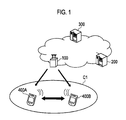
- Fig. 1 is an overall schematic configuration diagram of a radio communication system 10 according to this embodiment.
- the radio communication system 10 includes a radio base station 100, a communication control apparatus 200, a phonebook server 300, and multiple radio communication terminals 400A, 400B (terminals 400A, 400B hereinbelow).
- the radio base station 100 performs operation conforming to a radio access technology (RAT) standardized by 3GPP, e.g., Long Term Evolution (LTE).
- RAT radio access technology
- LTE Long Term Evolution
- the radio base station 100 controls direct communication between the terminals 400A and 400B. More specifically, the radio base station 100 controls the direct communication by causing the radio base station 100 to transmit broadcast information indicating whether or not to permit communication between the terminal 400A and the terminal 400B without involving the radio base station 100, i.e., without involving a radio access network.
- the broadcast information for controlling direct communication between the terminal 400A and the terminal 400B may be broadcasted separately from multiple radio base stations, e.g., the radio base station 100 and another radio base station (not shown).
- direct communication between the terminal 400A and the terminal 400B may be permitted based on the broadcast information from the radio access network side.
- direct communication may be permitted based on the broadcast information from the other radio base station even in an area not covered by the radio base station 100.
- the communication control apparatus 200 manages information on where the terminals 400A, 400B camp on and controls communication executed between the terminal 400A and the terminal 400B.
- the communication control apparatus 200 also receives an inquiry about current locations of the terminals 400A, 400B sent from the phonebook server 300 and returns the current locations of the terminals 400A, 400B.
- the communication control apparatus 200 may be, for example, a mobility control apparatus (MME), a policy control apparatus (PCRF), a subscriber management server (HSS), or the like.
- the phonebook server 300 manages phonebook data associated with the terminal 400A and phonebook data associated with the terminal 400B.
- the phonebook server 300 can perform synchronization with phonebook data stored in the terminal 400A, 400B periodically (once a month) for example.
- the terminal 400A and the terminal 400B are each a User Equipment (UE) having a communication application installed therein and being configured to execute radio communication conforming to a radio access technology such as LTE.
- the terminal 400A (400B) can perform communication with the terminal 400B (400A) via the radio base station 100, and can perform direct communication with the terminal 400B (400A) without involving the radio base station 100.
- the terminal 400A, 400B determines whether direct communication is executable or not based on the broadcast information broadcasted from the radio base station 100, and executes direct communication at a predetermined timing or any timing. Note that, for this determination, information notified of by the communication control apparatus 200 (e.g., a direct-communication permission notification) may be added as an element of determination.
- a functional block configuration of the radio communication system 10 is described. Specifically, functional block configurations of the phonebook server 300 and the terminal 400A are described.
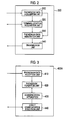
- Fig. 2 is a functional block configuration diagram of the phonebook server 300.
- Fig. 3 is a functional block configuration diagram of the terminal 400A.
- the phonebook server 300 includes a phonebook data acquisition unit 310, a terminal location acquisition unit 320, a phonebook data generation unit 330, and a transmission unit 340.
- the phonebook data acquisition unit 310 acquires phonebook data (first phonebook data) retained by the terminal 400A (the terminal 400B). Specifically, via the radio base station 100, the phonebook data acquisition unit 310 acquires the phonebook data containing an identifier of each of other radio communication terminals (telephone number, URI (email address, SIP URI), an IMEI (terminal identification number), an IMSI (subscriber identification number), an S-TMSI (temporary subscriber identification number) and the like.
- identifier of each of other radio communication terminals telephone number, URI (email address, SIP URI), an IMEI (terminal identification number), an IMSI (subscriber identification number), an S-TMSI (temporary subscriber identification number) and the like.
- the terminal location acquisition unit 320 acquires the location of the other communication terminal (specifically the terminal 400B) contained in the phonebook data acquired by the phonebook data acquisition unit 310. Specifically, the terminal location acquisition unit 320 acquires the current location of the other communication terminal from the communication control apparatus 200 by inquiring at the communication control apparatus 200 periodically. The terminal location acquisition unit 320 can determine whether the other communication terminal is located in the periphery of the terminal 400A or not based on a unit such as a cell, a sector, a tracking area, or a network and based on a range in which radio signals by direct communication reach.
- the phonebook data generation unit 330 generates phonebook data (secondphonebook data) containing an identifier of a candidate terminal capable of direct communication, based on the location of the other radio communication terminal acquired by the terminal location acquisition unit 320. Specifically, the phonebook data generation unit 330 determines that the other radio communication terminal is a candidate terminal capable of direct communication, when the location of the other radio communication terminal acquired by the terminal location acquisition unit 320 is within a range of a predetermined distance from the location of the terminal 400A. The phonebook data generation unit 330 generates phonebook data constituted by the identifier of the radio communication terminal determined as being a candidate terminal.
- the transmission unit 340 sends the terminal 400A the phonebook data generated by the phonebook data generation unit 330.
- the transmission of the phonebook data may be triggered by communication control such as communication execution or location registration of the terminal 400A.
- the terminal 400A includes a phonebook data reception unit 410, a phonebook formation unit 420, a communication application 430, and a direct communication execution unit 440.
- the terminal 400B also has a similar functional block configuration to that of the terminal 400A.
- the phonebook data reception unit 410 receives the phonebook data (second phonebook data) generated by the phonebook server 300. Specifically, the phonebook data reception unit 410 receives the phonebook data via the radio base station 100 or other network (such as a wireless LAN).
- the phonebook formation unit 420 Based on the phonebook data received by the phonebook data reception unit 410, the phonebook formation unit 420 forms a phonebook in which a candidate terminal capable of direct communication with the terminal 400A is identifiable. Specifically, the phonebook formation unit 420 adds information to the phonebook data (first phonebook data) retained by the terminal 400A, the information indicating that the terminal 400A can execute direct communication with a candidate terminal.
- the communication application 430 is a communication application installed in the terminal 400A.
- the communication application 430 is an application which can be provided both through direct communication and via the radio access network, and is, for example, an application for making voice calls, sending instant messages (IMs), or the like. Further, the communication application 430 may be an application operated only through direct communication.
- the direct communication execution unit 440 executes direct communication with the counterpart terminal.
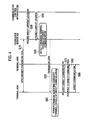
- Fig. 4 shows a communication sequence in which the terminal 400A executes direct communication with the terminal 400B by using phonebook data.
- the phonebook server 300 and the terminal 400A perform synchronization of phonebook data retained by the terminal 400A (S10).
- the phonebook server 300 inquires at the communication control apparatus 200 about the location of a cell or the like where the other terminal (the terminal 400B) contained in the synchronized phonebook data camps (current location) (S20). Based on the inquiry, the communication control apparatus 200 detects the current location of the terminal 400B, and responds to the phonebook server 300 with the detected current location of the terminal 400B (S30).
- the phonebook server 300 Based on a result of the response from the communication control apparatus 200, the phonebook server 300 detects a candidate terminal capable of direct communication with the terminal 400A (S40). The phonebook server 300 determines whether direct communication is possible or not based on, as described above, a distance between the terminal 400A and the terminal 400B or the like. The phonebook server 300 sends the terminal 400A phonebook data containing the identifier of the candidate terminal (S50).
- the terminal 400A Based on the phonebook data received from the phonebook server 300, the terminal 400A forms a phonebook in which the candidate terminal capable of direct communication is identifiable (S60). Specifically, the terminal 400A adds information to the phonebook data (first phonebook data) retained by the terminal 400A, the information indicating that the terminal 400A can execute direct communication with the candidate terminal.
- the terminal 400A determines, based on the phonebook data, that the terminal 400B is a candidate terminal and is capable of direct communication, and thus requests direct communication with the terminal 400B (S70).
- the terminal 400B responds to the request for direct communication from the terminal 400A (S80), and thus direct communication between the terminal 400A and the terminal 400B starts (S90).
- the phonebook server 300 generates phonebook data (second phonebook data) containing the identifier of a candidate terminal capable of direct communication, based on the location of the radio communication terminal (current location). Further, when a counterpart terminal indicated in a communication request from the communication application 430 is contained in the phonebook data as a candidate terminal, the terminal 400A (the terminal 400B) executes direct communication with the counterpart terminal.
- the communication application 430 can speedily find out whether device-to-device direct communication (D2D communication) is possible or not in a case where the D2D communication is to be executed by using a radio access network such as LTE.
- D2D communication device-to-device direct communication
- the user of the terminal 400A can find a radio communication terminal capable of D2D communication speedily and easily.
- terminals capable of direct communication are extracted as candidate terminals in advance, the terminal 400A can avoid unnecessary terminal-finding processing. Hence, time required to start direct communication and related processing load can be reduced.
- the location of the terminal 400A is acquired through identification of a cell, a sector, a tracking area, or a network as the location.
- the location in the present invention may be acquired using GPS (Global positioning system) information sent from the terminal or beacon information on a wireless LAN base station received by the terminal (including location information on the wireless LAN base station obtained based on beacon information).
- GPS Global positioning system
- Such information on location may be sent to the communication control apparatus 200 and stored, maybe sent to a location information management server (not shown) and stored, or may be sent to the phonebook server 300 and stored in the phonebook server 300.
- any mode can be employed as long as the phonebook server 300 can use such information on location when detecting a candidate terminal capable of direct communication.
- the phonebook server 300 may acquire such information at any timing or periodically when the terminal transmits it at the same time as synchronization of the phonebook data or upon receipt of the GPS information or the beacon information on the wireless LAN base station, or may acquire such information when the terminal transmits it in response to an inquiry from the phonebook server 300, the communication control apparatus 200, or the position information management server.
- the phonebook server 300 may cooperate with the HSS, the MME, or the like, so that the HSS or the MME updates the location information on each terminal in the phonebook data, triggered by communication control such as communication execution or position registration of the terminal.
- the notification frequency may follow a predetermined rule (e.g., leaving 10 or more minutes between notifications) for load reduction.
- information indicating whether a terminal subscribes to direct communication service or not may be added as an element of determination on whether direct communication is possible or not.
- phonebook data (first phonebook data) retained by the terminal 400A is inputted
- phonebook data (second phonebook data) is generated, the phonebook data containing the identifier of a candidate terminal capable of direct communication and having location information on the terminal reflected therein.
- Fig. 5 is a functional block configuration diagram of the phonebook server 300 according to a modification of the present invention.
- the phonebook server 300 includes a phonebook data retention unit 311 in place of the phonebook data acquisition unit 310.
- the phonebook data retention unit 311 retains phonebook data associated with the terminal 400A.
- the terminal location acquisition unit 320, the phonebook data generation unit 330, and the transmission unit 340 have the same functions as those described in the above embodiment.
- Fig. 6 is a functional block configuration diagram of the terminal 400A according to a modification of the present invention.
- the terminal 400A in a case where the phonebook data is retained by the phonebook server 300, the terminal 400A includes the phonebook data reception unit 410, the communication application 430, and the direct communication execution unit 440, and the terminal 400A executes direct communication with another terminal by referring to phonebook data received by the phonebook data reception unit 410 from the phonebook server 300.
- the phonebook server 300 may provide the phonebook data to the terminal 400A in response to every communication request from the communication application 430, or the terminal 400A may download the phonebook data periodically from the phonebook server 300.
- a first feature of the present invention is summarized as a communication system including: a terminal 400A (a radio communication terminal) having a communication application 430 installed therein and being capable of executing direct communication with a terminal 400B (another radio communication terminal) without involving a radio access network; and a phonebook server 3 0 0 configured to manage first phonebook data containing an identifier of the other radio communication terminal and being associated with the radio communication terminal.
- a terminal 400A a radio communication terminal
- a communication application 430 installed therein and being capable of executing direct communication with a terminal 400B (another radio communication terminal) without involving a radio access network
- a phonebook server 3 0 0 configured to manage first phonebook data containing an identifier of the other radio communication terminal and being associated with the radio communication terminal.
- the phonebook server includes a phonebook data acquisition unit 310 configured to acquire the first phonebook data, a terminal location acquisition unit 320 configured to acquire a location of the other communication terminal contained in the first phonebook data acquired by the phonebook data acquisition unit, a phonebook data generation unit 330 configured to generate second phonebook data containing an identifier of a candidate terminal capable of direct communication, based on the location of the other radio communication terminal acquired by the terminal location acquisition unit, and a transmission unit 340 configured to send the radio communication terminal the second phonebook data generated by the phonebook data generation unit.
- a phonebook data acquisition unit 310 configured to acquire the first phonebook data
- a terminal location acquisition unit 320 configured to acquire a location of the other communication terminal contained in the first phonebook data acquired by the phonebook data acquisition unit
- a phonebook data generation unit 330 configured to generate second phonebook data containing an identifier of a candidate terminal capable of direct communication, based on the location of the other radio communication terminal acquired by the terminal location acquisition unit
- a transmission unit 340 configured to
- the radio communication terminal includes a phonebook data reception unit 410 configured to receive the second phonebook data from the phonebook server, and a direct communication execution unit 440 configured to execute direct communication with a counterpart terminal indicated in a communication request from the communication application, when the counterpart terminal is contained in the second phonebook data as the candidate terminal.
- a second feature of the present invention is summarized as a phonebook server which manages first phonebook data associated with a radio communication terminal having a communication application installed therein and being capable of executing direct communication with another radio communication terminal without involving a radio access network
- the phonebook server including: a phonebook data acquisition unit configured to acquire the first phonebook data containing an identifier of the other radio communication terminal; a terminal location acquisition unit configured to acquire a location of the other communication terminal contained in the first phonebook data acquired by the phonebook data acquisition unit; a phonebook data generation unit configured to generate second phonebook data containing an identifier of a candidate terminal capable of direct communication, based on the location of the other radio communication terminal acquired by the terminal location acquisition unit; and a transmission unit configured to send the radio communication terminal the second phonebook data generated by the phonebook data generation unit.
- a third feature of the present invention is summarized as a radio communication terminal having a communication application installed therein and being capable of executing direct communication with another radio communication terminal without involving a radio access network
- the radio communication terminal including: a phonebook data reception unit configured to receive the second phonebook data from the phonebook server, the second phonebook data containing an identifier of a candidate terminal capable of direct communication with the radio communication terminal; and a direct communication execution unit configured to execute direct communication with a counterpart terminal indicated in a communication request from the communication application, when the counterpart terminal is contained in the second phonebook data as the candidate terminal.
- the radio communication terminal may include a phonebook formation unit 420 configured to use the second phonebook data to form a phonebook in which the candidate terminal capable of direct communication is identifiable.
- a fourth feature of the present invention is summarized as a communication method performed by a radio communication terminal having a communication application installed therein and being capable of executing direct communication with another radio communication terminal without involving a radio access network, and a phonebook server configured to manage first phonebook data containing an identifier of the other radio communication terminal and being associated with the radio communication terminal, the method including the steps of: the phonebook server acquiring the first phonebook data; the phonebook server acquiring a location of the other communication terminal contained in the first phonebook data acquired; generating second phonebook data containing an identifier of a candidate terminal capable of direct communication, based on the acquired location of the other radio communication terminal; sending the radio communication terminal the second phonebook data generated by the phonebook data generation unit; the radio communication terminal receiving the second phonebook data from the phonebook server; and executing direct communication with a counterpart terminal indicated in a communication request from the communication application, when the counterpart terminal is contained in the second phonebook data as the candidate terminal.
- a communication system a phonebook server, a radio communication terminal, and a communication method capable of causing a communication application to speedily find out whether D2D communication is possible or not in a case where the D2D communication is to be executed by using a radio access network.
Landscapes
- Engineering & Computer Science (AREA)
- Signal Processing (AREA)
- Computer Networks & Wireless Communication (AREA)
- Databases & Information Systems (AREA)
- Theoretical Computer Science (AREA)
- General Engineering & Computer Science (AREA)
- Physics & Mathematics (AREA)
- General Physics & Mathematics (AREA)
- Data Mining & Analysis (AREA)
- Human Computer Interaction (AREA)
- Mobile Radio Communication Systems (AREA)
- Telephonic Communication Services (AREA)
- Telephone Function (AREA)
Abstract
Description
- The present invention relates to a communication system, a phonebook server, a radio communication terminal, and a communication method allowing radio communication terminals to execute direct communication with each other without involving a radio access network.
- Conventionally, Bluetooth (registered trademark) and ad-hoc mode of a wireless LAN are known as so-called Device-to-Device (D2D) communication that is a radio communication method in which multiple radio communication terminals (sometimes referred to simply as terminals hereinbelow) perform radio communication with each other directly without involving a radio base station or an access point. Such a radio method achieves short-range radio communication by using relatively-low radio transmission power. For this reason, it is difficult to use this radio communication method when the inter-terminal distance is long. In addition, in such a radio communication method, the radio transmission capacity is limited compared to a radio access network (e.g., UTRA (3G), E-UTRA (LTE), or GERAN (2G)) managed by a telecommunications carrier.
- Against this background, it is being discussed to achieve the D2D communication by using a radio access network provided by a telecommunications carrier (e.g., Non-patent document 1).
- In the case of using a radio access technology employed in such a radio access network, the terminals uses a frequency band which the telecommunications carrier is licensed to use by supervisory authorities, and therefore are enabled to output higher radio transmission power and achieve long-distance, large-capacity D2D communication without using resources on the network side such as a radio base station. Such a characteristic is considered particularly effective when the network side such as the radio base station is devastated by an earthquake or the like. In addition, when the D2D communication is achieved using the frequency band used in a radio access network managed by a telecommunications carrier, the terminals can perform the D2D communication without being equipped with a module for another type of radio communication (e.g., Bluetooth (registered trademark)), which offers advantages such as cost and size reductions for the terminals.
- Non-patent document 1: "Key drivers for LTE success: Services Evolution," September 2011, 3GPP, Internet URL: http://www.3gpp.org/ftp/Information/presentations/presentat iona_2011/2011_09_LTE_Asia/2011_LTE-Asia_3GPP_Service_evolu tion.pdf
- However, performing D2D communication by using the radio access network described above has the following problem. Specifically, when a communication application installed in the terminal tries to execute D2D communication, the communication application cannot find out if D2D communication can be executed with a communication counterpart terminal or not. For this reason, the terminal cannot effectively initiate D2D communication.
- Thus, the present invention has been made in view of such circumstances and has an objective of providing a communication system, a phonebook server, a radio communication terminal, and a communication method capable of causing a communication application to speedily find out whether device-to-device direct communication (D2D communication) is possible or not in a case where the D2D communication is to be performed by using a radio access network such as LTE.
- A first feature of the present invention is summarized as a communication system including: a radio communication terminal having a communication application installed therein and being capable of executing direct communication with another radio communication terminal without involving a radio access network; and a phonebook server configured to manage first phonebook data containing an identifier of the other radio communication terminal and being associated with the radio communication terminal. Here, the phonebook server includes a phonebook data acquisition unit configured to acquire the first phonebook data, a terminal location acquisition unit configured to acquire a location of the other communication terminal contained in the first phonebook data acquired by the phonebook data acquisition unit, a phonebook data generation unit configured to generate second phonebook data containing an identifier of a candidate terminal capable of direct communication, based on the location of the other radio communication terminal acquired by the terminal location acquisition unit, and a transmission unit configured to send the radio communication terminal the second phonebook data generated by the phonebook data generation unit. And, the radio communication terminal includes a phonebook data reception unit configured to receive the second phonebook data from the phonebook server, and a direct communication execution unit configured to execute direct communication with a counterpart terminal indicated in a communication request from the communication application, when the counterpart terminal is contained in the second phonebook data as the candidate terminal.
- A second feature of the present invention is summarized as a phonebook server which manages first phonebook data associated with a radio communication terminal having a communication application installed therein and being capable of executing direct communication with another radio communication terminal without involving a radio access network, the phonebook server including: a phonebook data acquisition unit configured to acquire the first phonebook data containing an identifier of the other radio communication terminal; a terminal location acquisition unit configured to acquire a location of the other communication terminal contained in the first phonebook data acquired by the phonebook data acquisition unit; a phonebook data generation unit configured to generate second phonebook data containing an identifier of a candidate terminal capable of direct communication, based on the location of the other radio communication terminal acquired by the terminal location acquisition unit; and a transmission unit configured to send the radio communication terminal the second phonebook data generated by the phonebook data generation unit.
- A third feature of the present invention is summarized as a radio communication terminal having a communication application installed therein and being capable of executing direct communication with another radio communication terminal without involving a radio access network, the radio communication terminal including: a phonebook data reception unit configured to receive the second phonebook data from the phonebook server, the second phonebook data containing an identifier of a candidate terminal capable of direct communication with the radio communication terminal; and a direct communication execution unit configured to execute direct communication with a counterpart terminal indicated in a communication request from the communication application, when the counterpart terminal is contained in the second phonebook data as the candidate terminal.
- A fourth feature of the present invention is summarized as a communication method performed by a radio communication terminal having a communication application installed therein and being capable of executing direct communication with another radio communication terminal without involving a radio access network, and a phonebook server configured to manage first phonebook data containing an identifier of the other radio communication terminal and being associated with the radio communication terminal, the method including the steps of: the phonebook server acquiring the first phonebook data; the phonebook server acquiring a location of the other communication terminal contained in the first phonebook data acquired; generating second phonebook data containing an identifier of a candidate terminal capable of direct communication, based on the acquired location of the other radio communication terminal; sending the radio communication terminal the second phonebook data generated by the phonebook data generation unit; the radio communication terminal receiving the second phonebook data from the phonebook server; and executing direct communication with a counterpart terminal indicated in a communication request from the communication application, when the counterpart terminal is contained in the second phonebook data as the candidate terminal.
-
- [
Fig. 1] Fig. 1 is an overall schematic configuration diagram of aradio communication system 10 according to an embodiment of the present invention. - [
Fig. 2] Fig. 2 is a functional block configuration diagram of aphonebook server 300 according to the embodiment of the present invention. - [
Fig. 3] Fig. 3 is a functional block configuration diagram of aterminal 400A according to the embodiment of the present invention. - [
Fig. 4] Fig. 4 is a communication sequence in which theterminal 400A executes direct communication with aterminal 400B by using phonebook data, according to the embodiment of the present invention. - [
Fig. 5] Fig. 5 is a functional block configuration diagram of thephonebook server 300 according to a modification of the present invention. - [
Fig. 6] Fig. 6 is a functional block configuration diagram of theterminal 400A according to the modification of the present invention. - Next, an embodiment of the present invention will be described. Note that, in the following description of the drawings, same or similar reference signs denote same or similar elements and portions. In addition, it should be noted that the drawings are schematic and ratios of dimensions and the like are different from actual ones.
- Therefore, specific dimensions and the like should be determined in consideration of the following description. Moreover, the drawings also include portions having different dimensional relationships and ratios from each other.
-
Fig. 1 is an overall schematic configuration diagram of aradio communication system 10 according to this embodiment. As shown inFig. 1 , theradio communication system 10 includes aradio base station 100, acommunication control apparatus 200, aphonebook server 300, and multipleradio communication terminals terminals - The
radio base station 100 performs operation conforming to a radio access technology (RAT) standardized by 3GPP, e.g., Long Term Evolution (LTE). In this embodiment, theradio base station 100 controls direct communication between theterminals radio base station 100 controls the direct communication by causing theradio base station 100 to transmit broadcast information indicating whether or not to permit communication between theterminal 400A and theterminal 400B without involving theradio base station 100, i.e., without involving a radio access network. Note that the broadcast information for controlling direct communication between theterminal 400A and theterminal 400B may be broadcasted separately from multiple radio base stations, e.g., theradio base station 100 and another radio base station (not shown). - In this way, in the
radio communication system 10, direct communication between theterminal 400A and theterminal 400B may be permitted based on the broadcast information from the radio access network side. In addition, when it is based on broadcast information from another radio base station (not shown), for example, direct communication may be permitted based on the broadcast information from the other radio base station even in an area not covered by theradio base station 100. - The
communication control apparatus 200 manages information on where theterminals terminal 400A and theterminal 400B. Thecommunication control apparatus 200 also receives an inquiry about current locations of theterminals phonebook server 300 and returns the current locations of theterminals communication control apparatus 200 may be, for example, a mobility control apparatus (MME), a policy control apparatus (PCRF), a subscriber management server (HSS), or the like. - The
phonebook server 300 manages phonebook data associated with theterminal 400A and phonebook data associated with theterminal 400B. Thephonebook server 300 can perform synchronization with phonebook data stored in theterminal - The
terminal 400A and theterminal 400B are each a User Equipment (UE) having a communication application installed therein and being configured to execute radio communication conforming to a radio access technology such as LTE. Theterminal 400A (400B) can perform communication with theterminal 400B (400A) via theradio base station 100, and can perform direct communication with theterminal 400B (400A) without involving theradio base station 100. Specifically, theterminal radio base station 100, and executes direct communication at a predetermined timing or any timing. Note that, for this determination, information notified of by the communication control apparatus 200 (e.g., a direct-communication permission notification) may be added as an element of determination. - Next, a functional block configuration of the
radio communication system 10 is described. Specifically, functional block configurations of thephonebook server 300 and theterminal 400A are described.Fig. 2 is a functional block configuration diagram of thephonebook server 300.Fig. 3 is a functional block configuration diagram of theterminal 400A. - As shown in
Fig. 2 , thephonebook server 300 includes a phonebookdata acquisition unit 310, a terminallocation acquisition unit 320, a phonebookdata generation unit 330, and atransmission unit 340. - The phonebook
data acquisition unit 310 acquires phonebook data (first phonebook data) retained by theterminal 400A (theterminal 400B). Specifically, via theradio base station 100, the phonebookdata acquisition unit 310 acquires the phonebook data containing an identifier of each of other radio communication terminals (telephone number, URI (email address, SIP URI), an IMEI (terminal identification number), an IMSI (subscriber identification number), an S-TMSI (temporary subscriber identification number) and the like. - The terminal
location acquisition unit 320 acquires the location of the other communication terminal (specifically theterminal 400B) contained in the phonebook data acquired by the phonebookdata acquisition unit 310. Specifically, the terminallocation acquisition unit 320 acquires the current location of the other communication terminal from thecommunication control apparatus 200 by inquiring at thecommunication control apparatus 200 periodically. The terminallocation acquisition unit 320 can determine whether the other communication terminal is located in the periphery of the terminal 400A or not based on a unit such as a cell, a sector, a tracking area, or a network and based on a range in which radio signals by direct communication reach. - The phonebook
data generation unit 330 generates phonebook data (secondphonebook data) containing an identifier of a candidate terminal capable of direct communication, based on the location of the other radio communication terminal acquired by the terminallocation acquisition unit 320. Specifically, the phonebookdata generation unit 330 determines that the other radio communication terminal is a candidate terminal capable of direct communication, when the location of the other radio communication terminal acquired by the terminallocation acquisition unit 320 is within a range of a predetermined distance from the location of the terminal 400A. The phonebookdata generation unit 330 generates phonebook data constituted by the identifier of the radio communication terminal determined as being a candidate terminal. - The
transmission unit 340 sends the terminal 400A the phonebook data generated by the phonebookdata generation unit 330. The transmission of the phonebook data may be triggered by communication control such as communication execution or location registration of the terminal 400A. - As shown in
Fig. 3 , theterminal 400A includes a phonebookdata reception unit 410, aphonebook formation unit 420, acommunication application 430, and a directcommunication execution unit 440. Note that the terminal 400B also has a similar functional block configuration to that of the terminal 400A. - The phonebook
data reception unit 410 receives the phonebook data (second phonebook data) generated by thephonebook server 300. Specifically, the phonebookdata reception unit 410 receives the phonebook data via theradio base station 100 or other network (such as a wireless LAN). - Based on the phonebook data received by the phonebook
data reception unit 410, thephonebook formation unit 420 forms a phonebook in which a candidate terminal capable of direct communication with the terminal 400A is identifiable. Specifically, thephonebook formation unit 420 adds information to the phonebook data (first phonebook data) retained by the terminal 400A, the information indicating that the terminal 400A can execute direct communication with a candidate terminal. - The
communication application 430 is a communication application installed in the terminal 400A. For example, thecommunication application 430 is an application which can be provided both through direct communication and via the radio access network, and is, for example, an application for making voice calls, sending instant messages (IMs), or the like. Further, thecommunication application 430 may be an application operated only through direct communication. - When a counterpart terminal (e.g., the terminal 400B) indicated in a communication request from the
communication application 430 is contained as a candidate terminal in the phonebook data received by the phonebookdata reception unit 410, the directcommunication execution unit 440 executes direct communication with the counterpart terminal. - Next, operation of the above-described
radio communication system 10 is described. Specifically, a description is given of operation of the terminal 400A executing direct communication with the terminal 400B based on phonebook data generated by thephonebook server 300. -
Fig. 4 shows a communication sequence in which theterminal 400A executes direct communication with the terminal 400B by using phonebook data. As shown inFig. 4 , thephonebook server 300 and theterminal 400A perform synchronization of phonebook data retained by theterminal 400A (S10). - The
phonebook server 300 inquires at thecommunication control apparatus 200 about the location of a cell or the like where the other terminal (the terminal 400B) contained in the synchronized phonebook data camps (current location) (S20). Based on the inquiry, thecommunication control apparatus 200 detects the current location of the terminal 400B, and responds to thephonebook server 300 with the detected current location of the terminal 400B (S30). - Based on a result of the response from the
communication control apparatus 200, thephonebook server 300 detects a candidate terminal capable of direct communication with the terminal 400A (S40). Thephonebook server 300 determines whether direct communication is possible or not based on, as described above, a distance between the terminal 400A and the terminal 400B or the like. Thephonebook server 300 sends the terminal 400A phonebook data containing the identifier of the candidate terminal (S50). - Based on the phonebook data received from the
phonebook server 300, the terminal 400A forms a phonebook in which the candidate terminal capable of direct communication is identifiable (S60). Specifically, theterminal 400A adds information to the phonebook data (first phonebook data) retained by the terminal 400A, the information indicating that the terminal 400A can execute direct communication with the candidate terminal. - The terminal 400A determines, based on the phonebook data, that the terminal 400B is a candidate terminal and is capable of direct communication, and thus requests direct communication with the terminal 400B (S70). The terminal 400B responds to the request for direct communication from the
terminal 400A (S80), and thus direct communication between the terminal 400A and the terminal 400B starts (S90). - According to the
radio communication system 10, thephonebook server 300 generates phonebook data (second phonebook data) containing the identifier of a candidate terminal capable of direct communication, based on the location of the radio communication terminal (current location). Further, when a counterpart terminal indicated in a communication request from thecommunication application 430 is contained in the phonebook data as a candidate terminal, theterminal 400A (the terminal 400B) executes direct communication with the counterpart terminal. Thus, thecommunication application 430 can speedily find out whether device-to-device direct communication (D2D communication) is possible or not in a case where the D2D communication is to be executed by using a radio access network such as LTE. - In other words, the user of the terminal 400A can find a radio communication terminal capable of D2D communication speedily and easily. In addition, since terminals capable of direct communication are extracted as candidate terminals in advance, the
terminal 400A can avoid unnecessary terminal-finding processing. Hence, time required to start direct communication and related processing load can be reduced. - As described above, the details of the present invention have been disclosed by using the embodiment of the present invention. However, it should not be understood that the description and drawings which constitute part of this disclosure limit the present invention. From this disclosure, various alternative embodiments, examples, and operation techniques will be easily found by those skilled in the art.
- For example, in the above embodiment of the present invention, the location of the terminal 400A (400B) is acquired through identification of a cell, a sector, a tracking area, or a network as the location. Besides these, the location in the present invention may be acquired using GPS (Global positioning system) information sent from the terminal or beacon information on a wireless LAN base station received by the terminal (including location information on the wireless LAN base station obtained based on beacon information). Such information on location may be sent to the
communication control apparatus 200 and stored, maybe sent to a location information management server (not shown) and stored, or may be sent to thephonebook server 300 and stored in thephonebook server 300. - In other words, any mode can be employed as long as the
phonebook server 300 can use such information on location when detecting a candidate terminal capable of direct communication. Thephonebook server 300 may acquire such information at any timing or periodically when the terminal transmits it at the same time as synchronization of the phonebook data or upon receipt of the GPS information or the beacon information on the wireless LAN base station, or may acquire such information when the terminal transmits it in response to an inquiry from thephonebook server 300, thecommunication control apparatus 200, or the position information management server. - Further, the
phonebook server 300 may cooperate with the HSS, the MME, or the like, so that the HSS or the MME updates the location information on each terminal in the phonebook data, triggered by communication control such as communication execution or position registration of the terminal. In this case, the notification frequency may follow a predetermined rule (e.g., leaving 10 or more minutes between notifications) for load reduction. In addition, information indicating whether a terminal subscribes to direct communication service or not may be added as an element of determination on whether direct communication is possible or not. In a case of employing such a method, when phonebook data (first phonebook data) retained by the terminal 400A is inputted, phonebook data (second phonebook data) is generated, the phonebook data containing the identifier of a candidate terminal capable of direct communication and having location information on the terminal reflected therein. - For example, although the terminal 400A retains phonebook data in the example described in the above embodiment of the present invention, the phonebook data may be retained by the
phonebook server 300.Fig. 5 is a functional block configuration diagram of thephonebook server 300 according to a modification of the present invention. - As shown in
Fig. 5 , thephonebook server 300 includes a phonebookdata retention unit 311 in place of the phonebookdata acquisition unit 310. The phonebookdata retention unit 311 retains phonebook data associated with the terminal 400A. The terminallocation acquisition unit 320, the phonebookdata generation unit 330, and thetransmission unit 340 have the same functions as those described in the above embodiment. -
Fig. 6 is a functional block configuration diagram of the terminal 400A according to a modification of the present invention. As shown inFig. 6 , in a case where the phonebook data is retained by thephonebook server 300, theterminal 400A includes the phonebookdata reception unit 410, thecommunication application 430, and the directcommunication execution unit 440, and the terminal 400A executes direct communication with another terminal by referring to phonebook data received by the phonebookdata reception unit 410 from thephonebook server 300. Note that thephonebook server 300 may provide the phonebook data to the terminal 400A in response to every communication request from thecommunication application 430, or the terminal 400A may download the phonebook data periodically from thephonebook server 300. - As described above, the present invention naturally includes various embodiments which are not described herein. Accordingly, the technical scope of the present invention should be determined only by the matters to define the invention in the scope of claims regarded as appropriate based on the description.
- The features of the present invention may also be expressed as follows. A first feature of the present invention is summarized as a communication system including: a terminal 400A (a radio communication terminal) having a
communication application 430 installed therein and being capable of executing direct communication with a terminal 400B (another radio communication terminal) without involving a radio access network; and a phonebook server 3 0 0 configured to manage first phonebook data containing an identifier of the other radio communication terminal and being associated with the radio communication terminal. Here, the phonebook server includes a phonebookdata acquisition unit 310 configured to acquire the first phonebook data, a terminallocation acquisition unit 320 configured to acquire a location of the other communication terminal contained in the first phonebook data acquired by the phonebook data acquisition unit, a phonebookdata generation unit 330 configured to generate second phonebook data containing an identifier of a candidate terminal capable of direct communication, based on the location of the other radio communication terminal acquired by the terminal location acquisition unit, and atransmission unit 340 configured to send the radio communication terminal the second phonebook data generated by the phonebook data generation unit. And, the radio communication terminal includes a phonebookdata reception unit 410 configured to receive the second phonebook data from the phonebook server, and a directcommunication execution unit 440 configured to execute direct communication with a counterpart terminal indicated in a communication request from the communication application, when the counterpart terminal is contained in the second phonebook data as the candidate terminal. - A second feature of the present invention is summarized as a phonebook server which manages first phonebook data associated with a radio communication terminal having a communication application installed therein and being capable of executing direct communication with another radio communication terminal without involving a radio access network, the phonebook server including: a phonebook data acquisition unit configured to acquire the first phonebook data containing an identifier of the other radio communication terminal; a terminal location acquisition unit configured to acquire a location of the other communication terminal contained in the first phonebook data acquired by the phonebook data acquisition unit; a phonebook data generation unit configured to generate second phonebook data containing an identifier of a candidate terminal capable of direct communication, based on the location of the other radio communication terminal acquired by the terminal location acquisition unit; and a transmission unit configured to send the radio communication terminal the second phonebook data generated by the phonebook data generation unit.
- A third feature of the present invention is summarized as a radio communication terminal having a communication application installed therein and being capable of executing direct communication with another radio communication terminal without involving a radio access network, the radio communication terminal including: a phonebook data reception unit configured to receive the second phonebook data from the phonebook server, the second phonebook data containing an identifier of a candidate terminal capable of direct communication with the radio communication terminal; and a direct communication execution unit configured to execute direct communication with a counterpart terminal indicated in a communication request from the communication application, when the counterpart terminal is contained in the second phonebook data as the candidate terminal.
- In the third feature of the present invention, the radio communication terminal may include a
phonebook formation unit 420 configured to use the second phonebook data to form a phonebook in which the candidate terminal capable of direct communication is identifiable. - A fourth feature of the present invention is summarized as a communication method performed by a radio communication terminal having a communication application installed therein and being capable of executing direct communication with another radio communication terminal without involving a radio access network, and a phonebook server configured to manage first phonebook data containing an identifier of the other radio communication terminal and being associated with the radio communication terminal, the method including the steps of: the phonebook server acquiring the first phonebook data; the phonebook server acquiring a location of the other communication terminal contained in the first phonebook data acquired; generating second phonebook data containing an identifier of a candidate terminal capable of direct communication, based on the acquired location of the other radio communication terminal; sending the radio communication terminal the second phonebook data generated by the phonebook data generation unit; the radio communication terminal receiving the second phonebook data from the phonebook server; and executing direct communication with a counterpart terminal indicated in a communication request from the communication application, when the counterpart terminal is contained in the second phonebook data as the candidate terminal.
- Note that the entire content of Japanese Patent Application No.
2012-100277 (filed on April 25, 2012 - According to the aspects of the present invention, what can be provided are a communication system, a phonebook server, a radio communication terminal, and a communication method capable of causing a communication application to speedily find out whether D2D communication is possible or not in a case where the D2D communication is to be executed by using a radio access network.
-
- 10
- radio communication system
- 100
- radio base station
- 200
- communication control apparatus
- 300
- phonebook server
- 310
- phonebook data acquisition unit
- 311
- phonebook data retention unit
- 320
- terminal location acquisition unit
- 330
- phonebook data generation unit
- 340
- transmission unit
- 400A, 400B
- terminal
- 410
- phonebook data reception unit
- 420
- phonebook formation unit
- 430
- communication application
- 440
- direct communication execution unit
Claims (5)
- A communication system comprising:a radio communication terminal having a communication application installed therein and being capable of executing direct communication with another radio communication terminal without involving a radio access network; anda phonebook server configured to manage first phonebook data containing an identifier of the other radio communication terminal and being associated with the radio communication terminal, whereinthe phonebook server includes
a phonebook data acquisition unit configured to acquire the first phonebook data,
a terminal location acquisition unit configured to acquire a location of the other communication terminal contained in the first phonebook data acquired by the phonebook data acquisition unit,
a phonebook data generation unit configured to generate second phonebook data containing an identifier of a candidate terminal capable of direct communication, based on the location of the other radio communication terminal acquired by the terminal location acquisition unit, and
a transmission unit configured to send the radio communication terminal the second phonebook data generated by the phonebook data generation unit, andthe radio communication terminal includes
a phonebook data reception unit configured to receive the second phonebook data from the phonebook server, and
a direct communication execution unit configured to execute direct communication with a counterpart terminal indicated in a communication request from the communication application, when the counterpart terminal is contained in the second phonebook data as the candidate terminal. - A phonebook server which manages first phonebook data associated with a radio communication terminal having a communication application installed therein and being capable of executing direct communication with another radio communication terminal without involving a radio access network, the phonebook server comprising:a phonebook data acquisition unit configured to acquire the first phonebook data containing an identifier of the other radio communication terminal;a terminal location acquisition unit configured to acquire a location of the other communication terminal contained in the first phonebook data acquired by the phonebook data acquisition unit;a phonebook data generation unit configured to generate second phonebook data containing an identifier of a candidate terminal capable of direct communication, based on the location of the other radio communication terminal acquired by the terminal location acquisition unit; anda transmission unit configured to send the radio communication terminal the second phonebook data generated by the phonebook data generation unit.
- A radio communication terminal having a communication application installed therein and being capable of executing direct communication with another radio communication terminal without involving a radio access network, the radio communication terminal comprising:a phonebook data reception unit configured to receive the second phonebook data from the phonebook server, the second phonebook data containing an identifier of a candidate terminal capable of direct communication with the radio communication terminal; anda direct communication execution unit configured to execute direct communication with a counterpart terminal indicated in a communication request from the communication application, when the counterpart terminal is contained in the second phonebook data as the candidate terminal.
- The radio communication terminal according to claim 3, further comprising
a phonebook formation unit configured to use the second phonebook data to form a phonebook in which the candidate terminal capable of direct communication is identifiable. - A communication method performed by
a radio communication terminal having a communication application installed therein and being capable of executing direct communication with another radio communication terminal without involving a radio access network, and
a phonebook server configured to manage first phonebook data containing an identifier of the other radio communication terminal and being associated with the radio communication terminal, the method comprising the steps of:the phonebook server acquiring the first phonebook data;the phonebook server acquiring a location of the other communication terminal contained in the first phonebook data acquired;generating second phonebook data containing an identifier of a candidate terminal capable of direct communication, based on the acquired location of the other radio communication terminal;sending the radio communication terminal the second phonebook data generated by the phonebook server;the radio communication terminal receiving the second phonebook data from the phonebook server; andexecuting direct communication with a counterpart terminal indicated in a communication request from the communication application, when the counterpart terminal is contained in the second phonebook data as the candidate terminal.
Applications Claiming Priority (2)
| Application Number | Priority Date | Filing Date | Title |
|---|---|---|---|
| JP2012100277A JP6062653B2 (en) | 2012-04-25 | 2012-04-25 | Communication system, telephone directory server, wireless communication terminal, and communication method |
| PCT/JP2013/061513 WO2013161673A1 (en) | 2012-04-25 | 2013-04-18 | Communication system, telephone directory server, wireless communication terminal, and communication method |
Publications (2)
| Publication Number | Publication Date |
|---|---|
| EP2843922A1 true EP2843922A1 (en) | 2015-03-04 |
| EP2843922A4 EP2843922A4 (en) | 2015-12-16 |
Family
ID=49482994
Family Applications (1)
| Application Number | Title | Priority Date | Filing Date |
|---|---|---|---|
| EP13782078.3A Withdrawn EP2843922A4 (en) | 2012-04-25 | 2013-04-18 | COMMUNICATION SYSTEM, TELEPHONE DIRECTORY SERVER, WIRELESS COMMUNICATION TERMINAL, AND COMMUNICATION METHOD |
Country Status (4)
| Country | Link |
|---|---|
| US (1) | US9351327B2 (en) |
| EP (1) | EP2843922A4 (en) |
| JP (1) | JP6062653B2 (en) |
| WO (1) | WO2013161673A1 (en) |
Families Citing this family (2)
| Publication number | Priority date | Publication date | Assignee | Title |
|---|---|---|---|---|
| JPWO2015005158A1 (en) * | 2013-07-09 | 2017-03-02 | シャープ株式会社 | COMMUNICATION CONTROL METHOD, TERMINAL DEVICE, AND BASE STATION DEVICE |
| GB2573010B (en) * | 2018-04-20 | 2021-06-16 | Motor Record Ltd | Peer to peer communication system |
Family Cites Families (11)
| Publication number | Priority date | Publication date | Assignee | Title |
|---|---|---|---|---|
| JPH10234078A (en) | 1997-02-18 | 1998-09-02 | Casio Comput Co Ltd | Portable terminal device, communication system and data transfer method |
| JP2002073630A (en) * | 2000-08-29 | 2002-03-12 | Casio Comput Co Ltd | Terminal search device, position information processing system, and storage medium |
| ATE268082T1 (en) * | 2002-01-30 | 2004-06-15 | Cit Alcatel | METHOD FOR ESTABLISHING A CONNECTION BETWEEN TERMINAL DEVICES INCLUDING A WIRELESS COMMUNICATIONS INTERFACE FOR SHORT RANGE |
| JP2005012627A (en) * | 2003-06-20 | 2005-01-13 | Mitsubishi Electric Corp | Mobile communication terminal, mobile communication system, and mail communication control method |
| JP2005223722A (en) * | 2004-02-06 | 2005-08-18 | Matsushita Electric Ind Co Ltd | Mobile terminal and in-vehicle terminal |
| FI118501B (en) | 2004-12-21 | 2007-11-30 | Teliasonera Ab | Improvement in communication service consumption |
| JP2006211471A (en) * | 2005-01-31 | 2006-08-10 | Sharp Corp | Wireless communication system, communication terminal |
| JP5168991B2 (en) | 2007-04-12 | 2013-03-27 | Necカシオモバイルコミュニケーションズ株式会社 | Portable terminal device and program |
| JP2009147791A (en) | 2007-12-17 | 2009-07-02 | Hitachi Kokusai Electric Inc | Extension telephone book data providing method in extension telephone system |
| US8913511B2 (en) * | 2010-04-01 | 2014-12-16 | Qualcomm Incorporated | Interference management to support peer-to-peer communication in a wide area network |
| KR20130005401A (en) * | 2011-07-06 | 2013-01-16 | 삼성전자주식회사 | Apparatus and method for providing advertisement service in mobile communication system |
-
2012
- 2012-04-25 JP JP2012100277A patent/JP6062653B2/en active Active
-
2013
- 2013-04-18 EP EP13782078.3A patent/EP2843922A4/en not_active Withdrawn
- 2013-04-18 US US14/395,078 patent/US9351327B2/en active Active
- 2013-04-18 WO PCT/JP2013/061513 patent/WO2013161673A1/en not_active Ceased
Also Published As
| Publication number | Publication date |
|---|---|
| JP6062653B2 (en) | 2017-01-18 |
| US20150079976A1 (en) | 2015-03-19 |
| WO2013161673A1 (en) | 2013-10-31 |
| US9351327B2 (en) | 2016-05-24 |
| EP2843922A4 (en) | 2015-12-16 |
| JP2013229748A (en) | 2013-11-07 |
Similar Documents
| Publication | Publication Date | Title |
|---|---|---|
| JP7750303B2 (en) | Method for UDM (Unified Data Management Function), Method for AMF (Access and Mobility Management Function), UDM and AMF | |
| CN102356650B (en) | Cellular radio and method of operation | |
| WO2023120045A1 (en) | Method of communication apparatus, method of user equipment (ue), communication apparatus, ue, method for first communication apparatus, method for communication terminal and method for first communication apparatus | |
| US20220124162A1 (en) | Method and apparatus for service discovery | |
| US20130203373A1 (en) | Emergency messaging between citizens and authorities | |
| US10027821B2 (en) | Billing system, billing apparatus, and billing method | |
| US9295091B2 (en) | Radio communication system, communication control apparatus, and communication control method | |
| EP2148521A1 (en) | Method for acquiring and transmitting user location information and network device thereof | |
| EP3085124B1 (en) | Mobile-terminated emergency call | |
| KR20180104060A (en) | Determine Access Point Names for Mission-Critical Services | |
| EP2840865A1 (en) | Wireless communication system, communication control device, wireless communication terminals, and communication control method | |
| US9451528B2 (en) | Radio communication terminal, communication control apparatus, and communication control method | |
| TW202002698A (en) | Method of location reporting relations | |
| US8948736B2 (en) | Method of managing at least one wireless communications interface of a terminal, and a terminal | |
| US9351327B2 (en) | Communication system, phonebook server, radio communication terminal, and communication method | |
| US20130223369A1 (en) | Method, public land mobile network and user equipment | |
| US20250029474A1 (en) | 911 location accuracy testing | |
| EP2843911A1 (en) | Wireless communication terminal, and communication method | |
| US20200195576A1 (en) | Technique for Providing Content Via a Mobile Communications Network | |
| EP3297304A1 (en) | Mobile communication system, communication control device, mobile management entity, and mobile communication method | |
| US9538453B1 (en) | Determining a serving system for a mobile station in an area served by multiple serving systems |
Legal Events
| Date | Code | Title | Description |
|---|---|---|---|
| PUAI | Public reference made under article 153(3) epc to a published international application that has entered the european phase |
Free format text: ORIGINAL CODE: 0009012 |
|
| 17P | Request for examination filed |
Effective date: 20141029 |
|
| AK | Designated contracting states |
Kind code of ref document: A1 Designated state(s): AL AT BE BG CH CY CZ DE DK EE ES FI FR GB GR HR HU IE IS IT LI LT LU LV MC MK MT NL NO PL PT RO RS SE SI SK SM TR |
|
| AX | Request for extension of the european patent |
Extension state: BA ME |
|
| DAX | Request for extension of the european patent (deleted) | ||
| RA4 | Supplementary search report drawn up and despatched (corrected) |
Effective date: 20151117 |
|
| RIC1 | Information provided on ipc code assigned before grant |
Ipc: H04W 4/04 20090101ALI20151111BHEP Ipc: H04M 1/274 20060101ALI20151111BHEP Ipc: H04M 3/42 20060101AFI20151111BHEP |
|
| 17Q | First examination report despatched |
Effective date: 20161222 |
|
| STAA | Information on the status of an ep patent application or granted ep patent |
Free format text: STATUS: THE APPLICATION IS DEEMED TO BE WITHDRAWN |
|
| 18D | Application deemed to be withdrawn |
Effective date: 20180824 |