EP2842951A1 - Formation of chromanes and chromenes by using silver(I) or gold(I) salts or complexes - Google Patents
Formation of chromanes and chromenes by using silver(I) or gold(I) salts or complexes Download PDFInfo
- Publication number
- EP2842951A1 EP2842951A1 EP13182427.8A EP13182427A EP2842951A1 EP 2842951 A1 EP2842951 A1 EP 2842951A1 EP 13182427 A EP13182427 A EP 13182427A EP 2842951 A1 EP2842951 A1 EP 2842951A1
- Authority
- EP
- European Patent Office
- Prior art keywords
- formula
- group
- acid
- silver
- complex
- Prior art date
- Legal status (The legal status is an assumption and is not a legal conclusion. Google has not performed a legal analysis and makes no representation as to the accuracy of the status listed.)
- Withdrawn
Links
- ZBKIUFWVEIBQRT-UHFFFAOYSA-N gold(1+) Chemical class [Au+] ZBKIUFWVEIBQRT-UHFFFAOYSA-N 0.000 title claims abstract description 34
- FOIXSVOLVBLSDH-UHFFFAOYSA-N Silver ion Chemical compound [Ag+] FOIXSVOLVBLSDH-UHFFFAOYSA-N 0.000 title claims abstract description 33
- 150000008371 chromenes Chemical class 0.000 title abstract description 9
- 150000001843 chromanes Chemical class 0.000 title abstract description 7
- 230000015572 biosynthetic process Effects 0.000 title description 32
- 150000001450 anions Chemical class 0.000 claims abstract description 47
- 238000000034 method Methods 0.000 claims abstract description 46
- -1 aryl alkynes Chemical class 0.000 claims abstract description 43
- 239000002253 acid Substances 0.000 claims abstract description 36
- 238000005984 hydrogenation reaction Methods 0.000 claims abstract description 19
- 238000003430 hydroarylation reaction Methods 0.000 claims abstract description 17
- 150000003839 salts Chemical class 0.000 claims abstract description 12
- 229910052751 metal Inorganic materials 0.000 claims abstract description 11
- 239000002184 metal Substances 0.000 claims abstract description 11
- 150000001875 compounds Chemical class 0.000 claims description 71
- 125000002496 methyl group Chemical group [H]C([H])([H])* 0.000 claims description 34
- 229910052739 hydrogen Inorganic materials 0.000 claims description 19
- 239000001257 hydrogen Substances 0.000 claims description 18
- ISWSIDIOOBJBQZ-UHFFFAOYSA-N phenol group Chemical group C1(=CC=CC=C1)O ISWSIDIOOBJBQZ-UHFFFAOYSA-N 0.000 claims description 18
- 125000005843 halogen group Chemical group 0.000 claims description 17
- 239000000203 mixture Substances 0.000 claims description 17
- DTQVDTLACAAQTR-UHFFFAOYSA-N Trifluoroacetic acid Chemical compound OC(=O)C(F)(F)F DTQVDTLACAAQTR-UHFFFAOYSA-N 0.000 claims description 14
- UFHFLCQGNIYNRP-UHFFFAOYSA-N Hydrogen Chemical compound [H][H] UFHFLCQGNIYNRP-UHFFFAOYSA-N 0.000 claims description 13
- 150000001298 alcohols Chemical class 0.000 claims description 11
- 150000002170 ethers Chemical class 0.000 claims description 11
- 150000003460 sulfonic acids Chemical class 0.000 claims description 10
- ITMCEJHCFYSIIV-UHFFFAOYSA-N triflic acid Chemical compound OS(=O)(=O)C(F)(F)F ITMCEJHCFYSIIV-UHFFFAOYSA-N 0.000 claims description 10
- 125000004209 (C1-C8) alkyl group Chemical group 0.000 claims description 9
- 125000001997 phenyl group Chemical group [H]C1=C([H])C([H])=C(*)C([H])=C1[H] 0.000 claims description 9
- QRUBYZBWAOOHSV-UHFFFAOYSA-M silver trifluoromethanesulfonate Chemical compound [Ag+].[O-]S(=O)(=O)C(F)(F)F QRUBYZBWAOOHSV-UHFFFAOYSA-M 0.000 claims description 9
- 125000001424 substituent group Chemical group 0.000 claims description 9
- 150000003871 sulfonates Chemical class 0.000 claims description 9
- QAOWNCQODCNURD-UHFFFAOYSA-N Sulfuric acid Chemical compound OS(O)(=O)=O QAOWNCQODCNURD-UHFFFAOYSA-N 0.000 claims description 8
- 239000011203 carbon fibre reinforced carbon Substances 0.000 claims description 8
- 125000004435 hydrogen atom Chemical group [H]* 0.000 claims description 8
- 229920006395 saturated elastomer Polymers 0.000 claims description 8
- 229910001914 chlorine tetroxide Inorganic materials 0.000 claims description 7
- VLTRZXGMWDSKGL-UHFFFAOYSA-M perchlorate Chemical compound [O-]Cl(=O)(=O)=O VLTRZXGMWDSKGL-UHFFFAOYSA-M 0.000 claims description 7
- VLTRZXGMWDSKGL-UHFFFAOYSA-N perchloric acid Chemical compound OCl(=O)(=O)=O VLTRZXGMWDSKGL-UHFFFAOYSA-N 0.000 claims description 7
- 239000010931 gold Substances 0.000 claims description 6
- 229910004039 HBF4 Inorganic materials 0.000 claims description 5
- 239000003054 catalyst Substances 0.000 claims description 5
- 125000001309 chloro group Chemical group Cl* 0.000 claims description 4
- ITMCEJHCFYSIIV-UHFFFAOYSA-M triflate Chemical compound [O-]S(=O)(=O)C(F)(F)F ITMCEJHCFYSIIV-UHFFFAOYSA-M 0.000 claims description 4
- KAKQVSNHTBLJCH-UHFFFAOYSA-N trifluoromethanesulfonimidic acid Chemical compound NS(=O)(=O)C(F)(F)F KAKQVSNHTBLJCH-UHFFFAOYSA-N 0.000 claims description 4
- QZHPTGXQGDFGEN-UHFFFAOYSA-N chromene Chemical compound C1=CC=C2C=C[CH]OC2=C1 QZHPTGXQGDFGEN-UHFFFAOYSA-N 0.000 abstract description 5
- VZWXIQHBIQLMPN-UHFFFAOYSA-N chromane Chemical compound C1=CC=C2CCCOC2=C1 VZWXIQHBIQLMPN-UHFFFAOYSA-N 0.000 abstract 1
- YXFVVABEGXRONW-UHFFFAOYSA-N Toluene Natural products CC1=CC=CC=C1 YXFVVABEGXRONW-UHFFFAOYSA-N 0.000 description 50
- RTZKZFJDLAIYFH-UHFFFAOYSA-N ether Substances CCOCC RTZKZFJDLAIYFH-UHFFFAOYSA-N 0.000 description 41
- 238000003786 synthesis reaction Methods 0.000 description 27
- YMWUJEATGCHHMB-UHFFFAOYSA-N Dichloromethane Chemical compound ClCCl YMWUJEATGCHHMB-UHFFFAOYSA-N 0.000 description 24
- HEDRZPFGACZZDS-MICDWDOJSA-N Trichloro(2H)methane Chemical compound [2H]C(Cl)(Cl)Cl HEDRZPFGACZZDS-MICDWDOJSA-N 0.000 description 24
- 150000002148 esters Chemical class 0.000 description 17
- 238000006243 chemical reaction Methods 0.000 description 16
- WEVYAHXRMPXWCK-UHFFFAOYSA-N Acetonitrile Chemical compound CC#N WEVYAHXRMPXWCK-UHFFFAOYSA-N 0.000 description 15
- GVJHHUAWPYXKBD-UHFFFAOYSA-N (±)-α-Tocopherol Chemical compound OC1=C(C)C(C)=C2OC(CCCC(C)CCCC(C)CCCC(C)C)(C)CCC2=C1C GVJHHUAWPYXKBD-UHFFFAOYSA-N 0.000 description 12
- VLKZOEOYAKHREP-UHFFFAOYSA-N n-Hexane Chemical compound CCCCCC VLKZOEOYAKHREP-UHFFFAOYSA-N 0.000 description 12
- 230000000707 stereoselective effect Effects 0.000 description 11
- IPBVNPXQWQGGJP-UHFFFAOYSA-N acetic acid phenyl ester Natural products CC(=O)OC1=CC=CC=C1 IPBVNPXQWQGGJP-UHFFFAOYSA-N 0.000 description 10
- 229940049953 phenylacetate Drugs 0.000 description 10
- WLJVXDMOQOGPHL-UHFFFAOYSA-N phenylacetic acid Chemical compound OC(=O)CC1=CC=CC=C1 WLJVXDMOQOGPHL-UHFFFAOYSA-N 0.000 description 10
- 230000008569 process Effects 0.000 description 10
- IVBXEDNUCHXDMO-UHFFFAOYSA-N CC(=O)Oc1c(C)cc(OC(C)(C)C#C)c(C)c1C Chemical compound CC(=O)Oc1c(C)cc(OC(C)(C)C#C)c(C)c1C IVBXEDNUCHXDMO-UHFFFAOYSA-N 0.000 description 9
- 239000002904 solvent Substances 0.000 description 9
- GQHTUMJGOHRCHB-UHFFFAOYSA-N 2,3,4,6,7,8,9,10-octahydropyrimido[1,2-a]azepine Chemical compound C1CCCCN2CCCN=C21 GQHTUMJGOHRCHB-UHFFFAOYSA-N 0.000 description 8
- OKTJSMMVPCPJKN-UHFFFAOYSA-N Carbon Chemical compound [C] OKTJSMMVPCPJKN-UHFFFAOYSA-N 0.000 description 8
- 229910052799 carbon Inorganic materials 0.000 description 8
- 229960004132 diethyl ether Drugs 0.000 description 8
- 239000000047 product Substances 0.000 description 8
- 229940052303 ethers for general anesthesia Drugs 0.000 description 7
- 239000000243 solution Substances 0.000 description 7
- 239000011732 tocopherol Substances 0.000 description 7
- 238000001644 13C nuclear magnetic resonance spectroscopy Methods 0.000 description 6
- 238000005160 1H NMR spectroscopy Methods 0.000 description 6
- LFQSCWFLJHTTHZ-UHFFFAOYSA-N Ethanol Chemical compound CCO LFQSCWFLJHTTHZ-UHFFFAOYSA-N 0.000 description 6
- XEKOWRVHYACXOJ-UHFFFAOYSA-N Ethyl acetate Chemical compound CCOC(C)=O XEKOWRVHYACXOJ-UHFFFAOYSA-N 0.000 description 6
- IMNFDUFMRHMDMM-UHFFFAOYSA-N N-Heptane Chemical compound CCCCCCC IMNFDUFMRHMDMM-UHFFFAOYSA-N 0.000 description 6
- 229930003427 Vitamin E Natural products 0.000 description 6
- 238000012512 characterization method Methods 0.000 description 6
- 238000002474 experimental method Methods 0.000 description 6
- WIGCFUFOHFEKBI-UHFFFAOYSA-N gamma-tocopherol Natural products CC(C)CCCC(C)CCCC(C)CCCC1CCC2C(C)C(O)C(C)C(C)C2O1 WIGCFUFOHFEKBI-UHFFFAOYSA-N 0.000 description 6
- 239000003223 protective agent Substances 0.000 description 6
- 239000011541 reaction mixture Substances 0.000 description 6
- 235000019165 vitamin E Nutrition 0.000 description 6
- 239000011709 vitamin E Substances 0.000 description 6
- 229940046009 vitamin E Drugs 0.000 description 6
- BVKZGUZCCUSVTD-UHFFFAOYSA-L Carbonate Chemical compound [O-]C([O-])=O BVKZGUZCCUSVTD-UHFFFAOYSA-L 0.000 description 5
- 238000004817 gas chromatography Methods 0.000 description 5
- XXRBDLYERBVHMW-UHFFFAOYSA-N methyl 3,7,11-trimethyldodec-1-yn-3-yl carbonate Chemical compound COC(=O)OC(C)(CCCC(C)CCCC(C)C)C#C XXRBDLYERBVHMW-UHFFFAOYSA-N 0.000 description 5
- 238000000926 separation method Methods 0.000 description 5
- 229930003799 tocopherol Natural products 0.000 description 5
- 235000019149 tocopherols Nutrition 0.000 description 5
- QUEDXNHFTDJVIY-UHFFFAOYSA-N γ-tocopherol Chemical class OC1=C(C)C(C)=C2OC(CCCC(C)CCCC(C)CCCC(C)C)(C)CCC2=C1 QUEDXNHFTDJVIY-UHFFFAOYSA-N 0.000 description 5
- POVXWBPWJVGIRY-PDNQPUDYSA-N CC(C)CCCC(C)CCCC(C)CCC[C@@]1(C)Oc2c(C)c(C)c(OC(C)=O)c(C)c2C=C1 Chemical compound CC(C)CCCC(C)CCCC(C)CCC[C@@]1(C)Oc2c(C)c(C)c(OC(C)=O)c(C)c2C=C1 POVXWBPWJVGIRY-PDNQPUDYSA-N 0.000 description 4
- ZAKOWWREFLAJOT-CEFNRUSXSA-N D-alpha-tocopherylacetate Chemical compound CC(=O)OC1=C(C)C(C)=C2O[C@@](CCC[C@H](C)CCC[C@H](C)CCCC(C)C)(C)CCC2=C1C ZAKOWWREFLAJOT-CEFNRUSXSA-N 0.000 description 4
- 125000000217 alkyl group Chemical group 0.000 description 4
- 239000012267 brine Substances 0.000 description 4
- 239000012043 crude product Substances 0.000 description 4
- 238000001514 detection method Methods 0.000 description 4
- 239000003480 eluent Substances 0.000 description 4
- 150000007524 organic acids Chemical class 0.000 description 4
- 239000012074 organic phase Substances 0.000 description 4
- HPALAKNZSZLMCH-UHFFFAOYSA-M sodium;chloride;hydrate Chemical compound O.[Na+].[Cl-] HPALAKNZSZLMCH-UHFFFAOYSA-M 0.000 description 4
- 238000003756 stirring Methods 0.000 description 4
- 239000011731 tocotrienol Substances 0.000 description 4
- OFOBLEOULBTSOW-UHFFFAOYSA-N Malonic acid Chemical compound OC(=O)CC(O)=O OFOBLEOULBTSOW-UHFFFAOYSA-N 0.000 description 3
- 238000005481 NMR spectroscopy Methods 0.000 description 3
- 239000007832 Na2SO4 Substances 0.000 description 3
- PMZURENOXWZQFD-UHFFFAOYSA-L Sodium Sulfate Chemical compound [Na+].[Na+].[O-]S([O-])(=O)=O PMZURENOXWZQFD-UHFFFAOYSA-L 0.000 description 3
- POVXWBPWJVGIRY-CEFNRUSXSA-N [(2r)-2,5,7,8-tetramethyl-2-[(4r,8r)-4,8,12-trimethyltridecyl]chromen-6-yl] acetate Chemical compound CC1=C(OC(C)=O)C(C)=C2C=C[C@](CCC[C@H](C)CCC[C@H](C)CCCC(C)C)(C)OC2=C1C POVXWBPWJVGIRY-CEFNRUSXSA-N 0.000 description 3
- POVXWBPWJVGIRY-UHFFFAOYSA-N [2,5,7,8-tetramethyl-2-(4,8,12-trimethyltridecyl)chromen-6-yl] acetate Chemical compound CC1=C(OC(C)=O)C(C)=C2C=CC(CCCC(C)CCCC(C)CCCC(C)C)(C)OC2=C1C POVXWBPWJVGIRY-UHFFFAOYSA-N 0.000 description 3
- 150000001241 acetals Chemical class 0.000 description 3
- 125000002777 acetyl group Chemical group [H]C([H])([H])C(*)=O 0.000 description 3
- 125000002252 acyl group Chemical group 0.000 description 3
- 150000001345 alkine derivatives Chemical class 0.000 description 3
- 125000003118 aryl group Chemical group 0.000 description 3
- 125000003236 benzoyl group Chemical group [H]C1=C([H])C([H])=C(C([H])=C1[H])C(*)=O 0.000 description 3
- 125000001797 benzyl group Chemical group [H]C1=C([H])C([H])=C(C([H])=C1[H])C([H])([H])* 0.000 description 3
- 239000006227 byproduct Substances 0.000 description 3
- 238000004587 chromatography analysis Methods 0.000 description 3
- 238000004440 column chromatography Methods 0.000 description 3
- ORTQZVOHEJQUHG-UHFFFAOYSA-L copper(II) chloride Chemical compound Cl[Cu]Cl ORTQZVOHEJQUHG-UHFFFAOYSA-L 0.000 description 3
- ZAKOWWREFLAJOT-UHFFFAOYSA-N d-alpha-Tocopheryl acetate Natural products CC(=O)OC1=C(C)C(C)=C2OC(CCCC(C)CCCC(C)CCCC(C)C)(C)CCC2=C1C ZAKOWWREFLAJOT-UHFFFAOYSA-N 0.000 description 3
- 238000004519 manufacturing process Methods 0.000 description 3
- WQXSWJFFBKZPPJ-UHFFFAOYSA-N methyl 2-methylbut-3-yn-2-yl carbonate Chemical compound COC(=O)OC(C)(C)C#C WQXSWJFFBKZPPJ-UHFFFAOYSA-N 0.000 description 3
- 150000007522 mineralic acids Chemical class 0.000 description 3
- SYSQUGFVNFXIIT-UHFFFAOYSA-N n-[4-(1,3-benzoxazol-2-yl)phenyl]-4-nitrobenzenesulfonamide Chemical class C1=CC([N+](=O)[O-])=CC=C1S(=O)(=O)NC1=CC=C(C=2OC3=CC=CC=C3N=2)C=C1 SYSQUGFVNFXIIT-UHFFFAOYSA-N 0.000 description 3
- 150000007519 polyprotic acids Chemical class 0.000 description 3
- 238000002360 preparation method Methods 0.000 description 3
- 238000000746 purification Methods 0.000 description 3
- 229910052938 sodium sulfate Inorganic materials 0.000 description 3
- 239000000126 substance Substances 0.000 description 3
- 238000006467 substitution reaction Methods 0.000 description 3
- 229940068778 tocotrienols Drugs 0.000 description 3
- XLYOFNOQVPJJNP-UHFFFAOYSA-N water Substances O XLYOFNOQVPJJNP-UHFFFAOYSA-N 0.000 description 3
- GVJHHUAWPYXKBD-IEOSBIPESA-N α-tocopherol Chemical compound OC1=C(C)C(C)=C2O[C@@](CCC[C@H](C)CCC[C@H](C)CCCC(C)C)(C)CCC2=C1C GVJHHUAWPYXKBD-IEOSBIPESA-N 0.000 description 3
- KWGRBVOPPLSCSI-WPRPVWTQSA-N (-)-ephedrine Chemical compound CN[C@@H](C)[C@H](O)C1=CC=CC=C1 KWGRBVOPPLSCSI-WPRPVWTQSA-N 0.000 description 2
- MULUCORRSAVKOA-AQNXPRMDSA-N (3r,7r,11r)-3,7,11,15-tetramethylhexadec-1-yn-3-ol Chemical compound CC(C)CCC[C@@H](C)CCC[C@@H](C)CCC[C@@](C)(O)C#C MULUCORRSAVKOA-AQNXPRMDSA-N 0.000 description 2
- GJJVAFUKOBZPCB-ZGRPYONQSA-N (r)-3,4-dihydro-2-methyl-2-(4,8,12-trimethyl-3,7,11-tridecatrienyl)-2h-1-benzopyran-6-ol Chemical class OC1=CC=C2OC(CC/C=C(C)/CC/C=C(C)/CCC=C(C)C)(C)CCC2=C1 GJJVAFUKOBZPCB-ZGRPYONQSA-N 0.000 description 2
- ZXMGHDIOOHOAAE-UHFFFAOYSA-N 1,1,1-trifluoro-n-(trifluoromethylsulfonyl)methanesulfonamide Chemical compound FC(F)(F)S(=O)(=O)NS(=O)(=O)C(F)(F)F ZXMGHDIOOHOAAE-UHFFFAOYSA-N 0.000 description 2
- HUHXLHLWASNVDB-UHFFFAOYSA-N 2-(oxan-2-yloxy)oxane Chemical compound O1CCCCC1OC1OCCCC1 HUHXLHLWASNVDB-UHFFFAOYSA-N 0.000 description 2
- MULUCORRSAVKOA-UHFFFAOYSA-N 3,7,11,15-tetramethylhexadec-1-yn-3-ol Chemical compound CC(C)CCCC(C)CCCC(C)CCCC(C)(O)C#C MULUCORRSAVKOA-UHFFFAOYSA-N 0.000 description 2
- POVXWBPWJVGIRY-OTABCKCHSA-N CC(C)CCCC(C)CCCC(C)CCC[C@]1(C)Oc2c(C)c(C)c(OC(C)=O)c(C)c2C=C1 Chemical compound CC(C)CCCC(C)CCCC(C)CCC[C@]1(C)Oc2c(C)c(C)c(OC(C)=O)c(C)c2C=C1 POVXWBPWJVGIRY-OTABCKCHSA-N 0.000 description 2
- 0 CC(C)CCC[C@@](C)CCC[C@@](C)CCCC(*)(CCc1c2*)Oc1c(C)c(*)c2O Chemical compound CC(C)CCC[C@@](C)CCC[C@@](C)CCCC(*)(CCc1c2*)Oc1c(C)c(*)c2O 0.000 description 2
- 229910021592 Copper(II) chloride Inorganic materials 0.000 description 2
- VZCYOOQTPOCHFL-OWOJBTEDSA-N Fumaric acid Chemical compound OC(=O)\C=C\C(O)=O VZCYOOQTPOCHFL-OWOJBTEDSA-N 0.000 description 2
- 230000005526 G1 to G0 transition Effects 0.000 description 2
- CSNNHWWHGAXBCP-UHFFFAOYSA-L Magnesium sulfate Chemical compound [Mg+2].[O-][S+2]([O-])([O-])[O-] CSNNHWWHGAXBCP-UHFFFAOYSA-L 0.000 description 2
- MZRVEZGGRBJDDB-UHFFFAOYSA-N N-Butyllithium Chemical compound [Li]CCCC MZRVEZGGRBJDDB-UHFFFAOYSA-N 0.000 description 2
- NBIIXXVUZAFLBC-UHFFFAOYSA-N Phosphoric acid Chemical compound OP(O)(O)=O NBIIXXVUZAFLBC-UHFFFAOYSA-N 0.000 description 2
- VYPSYNLAJGMNEJ-UHFFFAOYSA-N Silicium dioxide Chemical compound O=[Si]=O VYPSYNLAJGMNEJ-UHFFFAOYSA-N 0.000 description 2
- DHKHKXVYLBGOIT-UHFFFAOYSA-N acetaldehyde Diethyl Acetal Natural products CCOC(C)OCC DHKHKXVYLBGOIT-UHFFFAOYSA-N 0.000 description 2
- WNLRTRBMVRJNCN-UHFFFAOYSA-N adipic acid Chemical compound OC(=O)CCCCC(O)=O WNLRTRBMVRJNCN-UHFFFAOYSA-N 0.000 description 2
- 238000004458 analytical method Methods 0.000 description 2
- 239000007864 aqueous solution Substances 0.000 description 2
- 238000009835 boiling Methods 0.000 description 2
- 125000004432 carbon atom Chemical group C* 0.000 description 2
- 238000004296 chiral HPLC Methods 0.000 description 2
- 125000003016 chromanyl group Chemical group O1C(CCC2=CC=CC=C12)* 0.000 description 2
- ARUVKPQLZAKDPS-UHFFFAOYSA-L copper(II) sulfate Chemical compound [Cu+2].[O-][S+2]([O-])([O-])[O-] ARUVKPQLZAKDPS-UHFFFAOYSA-L 0.000 description 2
- 229910000366 copper(II) sulfate Inorganic materials 0.000 description 2
- 238000006471 dimerization reaction Methods 0.000 description 2
- IPZJQDSFZGZEOY-UHFFFAOYSA-N dimethylmethylene Chemical compound C[C]C IPZJQDSFZGZEOY-UHFFFAOYSA-N 0.000 description 2
- 238000004821 distillation Methods 0.000 description 2
- 125000001033 ether group Chemical group 0.000 description 2
- 235000019439 ethyl acetate Nutrition 0.000 description 2
- 238000004128 high performance liquid chromatography Methods 0.000 description 2
- 150000002503 iridium Chemical class 0.000 description 2
- 239000003446 ligand Substances 0.000 description 2
- 238000006138 lithiation reaction Methods 0.000 description 2
- NSPJNIDYTSSIIY-UHFFFAOYSA-N methoxy(methoxymethoxy)methane Chemical compound COCOCOC NSPJNIDYTSSIIY-UHFFFAOYSA-N 0.000 description 2
- FLJGCEWUYSDKHA-UHFFFAOYSA-N methyl 4-(2-methylphenyl)-2,4-dioxobutanoate Chemical compound COC(=O)C(=O)CC(=O)C1=CC=CC=C1C FLJGCEWUYSDKHA-UHFFFAOYSA-N 0.000 description 2
- XMJHPCRAQCTCFT-UHFFFAOYSA-N methyl chloroformate Chemical compound COC(Cl)=O XMJHPCRAQCTCFT-UHFFFAOYSA-N 0.000 description 2
- 150000002762 monocarboxylic acid derivatives Chemical class 0.000 description 2
- 235000016709 nutrition Nutrition 0.000 description 2
- 239000012044 organic layer Substances 0.000 description 2
- 230000003647 oxidation Effects 0.000 description 2
- 238000007254 oxidation reaction Methods 0.000 description 2
- 239000001301 oxygen Substances 0.000 description 2
- 229910052760 oxygen Inorganic materials 0.000 description 2
- 239000012071 phase Substances 0.000 description 2
- BOTWFXYSPFMFNR-PYDDKJGSSA-N phytol Chemical compound CC(C)CCC[C@@H](C)CCC[C@@H](C)CCC\C(C)=C\CO BOTWFXYSPFMFNR-PYDDKJGSSA-N 0.000 description 2
- 229910001494 silver tetrafluoroborate Inorganic materials 0.000 description 2
- 229930003802 tocotrienol Natural products 0.000 description 2
- 235000019148 tocotrienols Nutrition 0.000 description 2
- VZCYOOQTPOCHFL-UHFFFAOYSA-N trans-butenedioic acid Natural products OC(=O)C=CC(O)=O VZCYOOQTPOCHFL-UHFFFAOYSA-N 0.000 description 2
- 125000004044 trifluoroacetyl group Chemical group FC(C(=O)*)(F)F 0.000 description 2
- FAXQGZNOPFLVGO-UHFFFAOYSA-N (2,2,5,7,8-pentamethylchromen-6-yl) acetate Chemical compound O1C(C)(C)C=CC2=C(C)C(OC(=O)C)=C(C)C(C)=C21 FAXQGZNOPFLVGO-UHFFFAOYSA-N 0.000 description 1
- DFUSDJMZWQVQSF-XLGIIRLISA-N (2r)-2-methyl-2-[(4r,8r)-4,8,12-trimethyltridecyl]-3,4-dihydrochromen-6-ol Chemical compound OC1=CC=C2O[C@@](CCC[C@H](C)CCC[C@H](C)CCCC(C)C)(C)CCC2=C1 DFUSDJMZWQVQSF-XLGIIRLISA-N 0.000 description 1
- 125000000008 (C1-C10) alkyl group Chemical group 0.000 description 1
- 125000006273 (C1-C3) alkyl group Chemical group 0.000 description 1
- 125000002861 (C1-C4) alkanoyl group Chemical group 0.000 description 1
- GPAAEZIXSQCCES-UHFFFAOYSA-N 1-methoxy-2-(2-methoxyethoxymethoxymethoxy)ethane Chemical compound COCCOCOCOCCOC GPAAEZIXSQCCES-UHFFFAOYSA-N 0.000 description 1
- RTBFRGCFXZNCOE-UHFFFAOYSA-N 1-methylsulfonylpiperidin-4-one Chemical compound CS(=O)(=O)N1CCC(=O)CC1 RTBFRGCFXZNCOE-UHFFFAOYSA-N 0.000 description 1
- JQZGUQIEPRIDMR-UHFFFAOYSA-N 3-methylbut-1-yn-1-ol Chemical compound CC(C)C#CO JQZGUQIEPRIDMR-UHFFFAOYSA-N 0.000 description 1
- 241001120493 Arene Species 0.000 description 1
- XDTMQSROBMDMFD-UHFFFAOYSA-N Cyclohexane Chemical compound C1CCCCC1 XDTMQSROBMDMFD-UHFFFAOYSA-N 0.000 description 1
- WHXSMMKQMYFTQS-UHFFFAOYSA-N Lithium Chemical compound [Li] WHXSMMKQMYFTQS-UHFFFAOYSA-N 0.000 description 1
- 241001465754 Metazoa Species 0.000 description 1
- GRYLNZFGIOXLOG-UHFFFAOYSA-N Nitric acid Chemical compound O[N+]([O-])=O GRYLNZFGIOXLOG-UHFFFAOYSA-N 0.000 description 1
- 229910019142 PO4 Inorganic materials 0.000 description 1
- KDYFGRWQOYBRFD-UHFFFAOYSA-N Succinic acid Natural products OC(=O)CCC(O)=O KDYFGRWQOYBRFD-UHFFFAOYSA-N 0.000 description 1
- LSNNMFCWUKXFEE-UHFFFAOYSA-N Sulfurous acid Chemical compound OS(O)=O LSNNMFCWUKXFEE-UHFFFAOYSA-N 0.000 description 1
- 150000001242 acetic acid derivatives Chemical class 0.000 description 1
- 150000001266 acyl halides Chemical class 0.000 description 1
- 238000007259 addition reaction Methods 0.000 description 1
- 239000001361 adipic acid Substances 0.000 description 1
- 235000011037 adipic acid Nutrition 0.000 description 1
- 150000001336 alkenes Chemical class 0.000 description 1
- 229940087168 alpha tocopherol Drugs 0.000 description 1
- 229910000147 aluminium phosphate Inorganic materials 0.000 description 1
- 150000008064 anhydrides Chemical class 0.000 description 1
- JFCQEDHGNNZCLN-UHFFFAOYSA-N anhydrous glutaric acid Natural products OC(=O)CCCC(O)=O JFCQEDHGNNZCLN-UHFFFAOYSA-N 0.000 description 1
- 239000008346 aqueous phase Substances 0.000 description 1
- 150000004945 aromatic hydrocarbons Chemical class 0.000 description 1
- 125000003710 aryl alkyl group Chemical group 0.000 description 1
- 238000009876 asymmetric hydrogenation reaction Methods 0.000 description 1
- QVGXLLKOCUKJST-UHFFFAOYSA-N atomic oxygen Chemical compound [O] QVGXLLKOCUKJST-UHFFFAOYSA-N 0.000 description 1
- 230000004071 biological effect Effects 0.000 description 1
- KDYFGRWQOYBRFD-NUQCWPJISA-N butanedioic acid Chemical compound O[14C](=O)CC[14C](O)=O KDYFGRWQOYBRFD-NUQCWPJISA-N 0.000 description 1
- 238000001311 chemical methods and process Methods 0.000 description 1
- 239000003795 chemical substances by application Substances 0.000 description 1
- 239000003426 co-catalyst Substances 0.000 description 1
- 229910052681 coesite Inorganic materials 0.000 description 1
- 229910052906 cristobalite Inorganic materials 0.000 description 1
- 125000000753 cycloalkyl group Chemical group 0.000 description 1
- KWGRBVOPPLSCSI-UHFFFAOYSA-N d-ephedrine Natural products CNC(C)C(O)C1=CC=CC=C1 KWGRBVOPPLSCSI-UHFFFAOYSA-N 0.000 description 1
- 230000001419 dependent effect Effects 0.000 description 1
- GGSUCNLOZRCGPQ-UHFFFAOYSA-N diethylaniline Chemical compound CCN(CC)C1=CC=CC=C1 GGSUCNLOZRCGPQ-UHFFFAOYSA-N 0.000 description 1
- HQWPLXHWEZZGKY-UHFFFAOYSA-N diethylzinc Chemical compound CC[Zn]CC HQWPLXHWEZZGKY-UHFFFAOYSA-N 0.000 description 1
- 239000000539 dimer Substances 0.000 description 1
- XPPKVPWEQAFLFU-UHFFFAOYSA-N diphosphoric acid Chemical compound OP(O)(=O)OP(O)(O)=O XPPKVPWEQAFLFU-UHFFFAOYSA-N 0.000 description 1
- 239000000839 emulsion Substances 0.000 description 1
- 229960002179 ephedrine Drugs 0.000 description 1
- 238000010931 ester hydrolysis Methods 0.000 description 1
- 230000032050 esterification Effects 0.000 description 1
- 238000005886 esterification reaction Methods 0.000 description 1
- 230000001747 exhibiting effect Effects 0.000 description 1
- 239000001530 fumaric acid Substances 0.000 description 1
- 125000000524 functional group Chemical group 0.000 description 1
- 239000007789 gas Substances 0.000 description 1
- 150000008282 halocarbons Chemical class 0.000 description 1
- 239000001307 helium Substances 0.000 description 1
- 229910052734 helium Inorganic materials 0.000 description 1
- SWQJXJOGLNCZEY-UHFFFAOYSA-N helium atom Chemical compound [He] SWQJXJOGLNCZEY-UHFFFAOYSA-N 0.000 description 1
- BHEPBYXIRTUNPN-UHFFFAOYSA-N hydridophosphorus(.) (triplet) Chemical compound [PH] BHEPBYXIRTUNPN-UHFFFAOYSA-N 0.000 description 1
- 229930195733 hydrocarbon Natural products 0.000 description 1
- 150000002430 hydrocarbons Chemical class 0.000 description 1
- 239000000543 intermediate Substances 0.000 description 1
- 239000010410 layer Substances 0.000 description 1
- 239000007791 liquid phase Substances 0.000 description 1
- 229910052744 lithium Inorganic materials 0.000 description 1
- ARNWQMJQALNBBV-UHFFFAOYSA-N lithium carbide Chemical class [Li+].[Li+].[C-]#[C-] ARNWQMJQALNBBV-UHFFFAOYSA-N 0.000 description 1
- 229910052943 magnesium sulfate Inorganic materials 0.000 description 1
- 230000014759 maintenance of location Effects 0.000 description 1
- VZCYOOQTPOCHFL-UPHRSURJSA-N maleic acid Chemical compound OC(=O)\C=C/C(O)=O VZCYOOQTPOCHFL-UPHRSURJSA-N 0.000 description 1
- 239000011976 maleic acid Substances 0.000 description 1
- 125000000956 methoxy group Chemical group [H]C([H])([H])O* 0.000 description 1
- 229910017604 nitric acid Inorganic materials 0.000 description 1
- LYGJENNIWJXYER-UHFFFAOYSA-N nitromethane Chemical compound C[N+]([O-])=O LYGJENNIWJXYER-UHFFFAOYSA-N 0.000 description 1
- 125000004430 oxygen atom Chemical group O* 0.000 description 1
- 229910052763 palladium Inorganic materials 0.000 description 1
- 230000037361 pathway Effects 0.000 description 1
- 150000004965 peroxy acids Chemical class 0.000 description 1
- 150000002989 phenols Chemical class 0.000 description 1
- 235000021317 phosphate Nutrition 0.000 description 1
- 150000003013 phosphoric acid derivatives Chemical class 0.000 description 1
- 229910052697 platinum Inorganic materials 0.000 description 1
- 239000002244 precipitate Substances 0.000 description 1
- 239000002243 precursor Substances 0.000 description 1
- 238000002953 preparative HPLC Methods 0.000 description 1
- 125000001501 propionyl group Chemical group O=C([*])C([H])([H])C([H])([H])[H] 0.000 description 1
- 125000006239 protecting group Chemical group 0.000 description 1
- 229940005657 pyrophosphoric acid Drugs 0.000 description 1
- 238000010966 qNMR Methods 0.000 description 1
- 230000009257 reactivity Effects 0.000 description 1
- 229910052702 rhenium Inorganic materials 0.000 description 1
- 238000006798 ring closing metathesis reaction Methods 0.000 description 1
- 125000002914 sec-butyl group Chemical group [H]C([H])([H])C([H])([H])C([H])(*)C([H])([H])[H] 0.000 description 1
- 239000000377 silicon dioxide Substances 0.000 description 1
- 229910001544 silver hexafluoroantimonate(V) Inorganic materials 0.000 description 1
- 238000010561 standard procedure Methods 0.000 description 1
- 239000007858 starting material Substances 0.000 description 1
- 229910052682 stishovite Inorganic materials 0.000 description 1
- 210000002784 stomach Anatomy 0.000 description 1
- 239000001117 sulphuric acid Substances 0.000 description 1
- 235000011149 sulphuric acid Nutrition 0.000 description 1
- 239000000725 suspension Substances 0.000 description 1
- ISIJQEHRDSCQIU-UHFFFAOYSA-N tert-butyl 2,7-diazaspiro[4.5]decane-7-carboxylate Chemical compound C1N(C(=O)OC(C)(C)C)CCCC11CNCC1 ISIJQEHRDSCQIU-UHFFFAOYSA-N 0.000 description 1
- 238000007725 thermal activation Methods 0.000 description 1
- 229960000984 tocofersolan Drugs 0.000 description 1
- 150000003612 tocotrienol derivatives Chemical class 0.000 description 1
- 125000003944 tolyl group Chemical group 0.000 description 1
- 230000009466 transformation Effects 0.000 description 1
- 229910052723 transition metal Inorganic materials 0.000 description 1
- 150000003624 transition metals Chemical class 0.000 description 1
- 229910052905 tridymite Inorganic materials 0.000 description 1
- 125000002827 triflate group Chemical class FC(S(=O)(=O)O*)(F)F 0.000 description 1
- 150000008648 triflates Chemical class 0.000 description 1
- 239000002076 α-tocopherol Substances 0.000 description 1
- 235000004835 α-tocopherol Nutrition 0.000 description 1
Classifications
-
- C—CHEMISTRY; METALLURGY
- C07—ORGANIC CHEMISTRY
- C07D—HETEROCYCLIC COMPOUNDS
- C07D311/00—Heterocyclic compounds containing six-membered rings having one oxygen atom as the only hetero atom, condensed with other rings
- C07D311/02—Heterocyclic compounds containing six-membered rings having one oxygen atom as the only hetero atom, condensed with other rings ortho- or peri-condensed with carbocyclic rings or ring systems
- C07D311/04—Benzo[b]pyrans, not hydrogenated in the carbocyclic ring
- C07D311/58—Benzo[b]pyrans, not hydrogenated in the carbocyclic ring other than with oxygen or sulphur atoms in position 2 or 4
- C07D311/70—Benzo[b]pyrans, not hydrogenated in the carbocyclic ring other than with oxygen or sulphur atoms in position 2 or 4 with two hydrocarbon radicals attached in position 2 and elements other than carbon and hydrogen in position 6
-
- C—CHEMISTRY; METALLURGY
- C07—ORGANIC CHEMISTRY
- C07D—HETEROCYCLIC COMPOUNDS
- C07D311/00—Heterocyclic compounds containing six-membered rings having one oxygen atom as the only hetero atom, condensed with other rings
- C07D311/02—Heterocyclic compounds containing six-membered rings having one oxygen atom as the only hetero atom, condensed with other rings ortho- or peri-condensed with carbocyclic rings or ring systems
- C07D311/04—Benzo[b]pyrans, not hydrogenated in the carbocyclic ring
- C07D311/58—Benzo[b]pyrans, not hydrogenated in the carbocyclic ring other than with oxygen or sulphur atoms in position 2 or 4
- C07D311/70—Benzo[b]pyrans, not hydrogenated in the carbocyclic ring other than with oxygen or sulphur atoms in position 2 or 4 with two hydrocarbon radicals attached in position 2 and elements other than carbon and hydrogen in position 6
- C07D311/72—3,4-Dihydro derivatives having in position 2 at least one methyl radical and in position 6 one oxygen atom, e.g. tocopherols
Definitions
- the present invention relates to the field of the synthesis of chromanes and chromenes, particularly, of (3,4)-dehydrotocopherols, (3,4)-dehydrotocotrienols, tocopherols and tocotrienols.
- vitamin E An important class of chromane compounds are vitamin E and its esters. Often vitamin E is commercialized in the form of its esters because the latter show an enhanced stability, particularly against humidity, air and oxidating agents.
- a synthetic pathway for chromanes is via their corresponding chromenes.
- the hydroarylation of aryl propargyl ethers leads to chromenes. In most cases this reaction is conducted thermally, often in the high boiling solvent diethyl aniline.
- Hydroarylations of aryl propargyl ethers can be carried out upon thermal activation (150-200 °C).
- thermally activated hydroarylations is the need for high temperatures, as thermally unstable compounds cannot be used for this transformation.
- Transition metals such as Re, Pd, and Pt have been used to catalyse the hydroarylation of alkynes.
- Nevado C. et al. disclose in Chem. Eur. J. 2005, 11, 3155-3164 an intramolecular hydroarylation of alkynes using gold(I) complexes. It further discloses that this reaction leads to significant amounts of by-products having either a 5-membered ring or a different substitution pattern or different position of the double bond. Furthermore, it mentions that the use of Ag(I) leads to unexpected dimerization of the desired chromene.
- the problem to be solved by the present invention is to offer a method for the synthesis of chiral chromenes or chromanes, i.e. of compounds of formula (I) or (IV) in a stereospecific manner in view of the 2 position in the chromene or chromane ring.
- the process shows high yields and high selectivity in the desired product.
- this method is ideally suited for the chemical synthesis of chiral chromenes or chromanes, respectively, leading to or found in vitamin E.
- the present invention relates to a method of preparing compound of formula (I) comprising the steps
- vitamin E is used in the present document as a generic descriptor for all tocol and tocotrienol derivatives exhibiting qualitatively the biological activity of ⁇ -tocopherol (IUPAC-IUB Recommendation 1981, Eur. J. Biochem. 123, 473-475 (1982 )).
- a "C x-y -alkyl” group is an alkyl group comprising x to y carbon atoms, i.e., for example, a C 1-3 -alkyl group is an alkyl group comprising 1 to 3 carbon atoms.
- the alkyl group can be linear or branched. For example -CH(CH 3 )-CH 2 -CH 3 is considered as a C 4 -alkyl group.
- hydrogen means in the present document H and not H 2 .
- molecular hydrogen means H 2 .
- any single dotted line represents the bond by which a substituent is bound to the rest of a molecule.
- the chirality of an individual chiral carbon centre is indicated by the label R or S according to the rules defined by R. S. Cahn, C. K. Ingold and V. Prelog. This R/S-concept and rules for the determination of the absolute configuration in stereochemistry is known to the person skilled in the art.
- Substance names starting with "poly” such as polycarboxylic acid as used in the present document refer to substances formally containing two or more of the corresponding functional groups per molecule.
- process of preparation is a synonym for "method of preparation” and can be used interchangeable to each other.
- propargylic aryl ethers as used in this document is an ether of the following formula in which Ar represents an aromatic ring which might have further substituted and R and R' each represent an hydrogen atom or any alkyl group which might be saturated or unsaturated. Therefore, a propargylic aryl ether in the sense of the invention has a key feature that the oxygen ether atom is directly linked to an aromatic system. In the case where R is different from R' the carbon centre between the ether oxygen and the carbon-carbon triple bond is chiral, the configuration of which is characterized by having the S- or the R-configuration. To a propargylic aryl ether of this type is referred when the term "chiral propargylic aryl ether" is used in this document.
- step a) of the method (or process) of preparing the compound of formula (I) compound of formula (II) is provided.
- R 6 represents either H or a C 1-25 -alkyl group, particularly a methyl group. In a preferred embodiment R 6 represents a methyl group.
- R 5 is different from R 6 the compound of formula (II) is chiral. In a preferred embodiment R 5 is of formula (III).
- R 6 represents a methyl group and R 5 is of formula (III)
- m and p stand independently from each other for a value of 0 to 5 provided that the sum of m and p is 1 to 5.
- the substructures in formula (III) represented by s1 and s2 can be in any sequence.
- the dotted line represents the bond by which the substituent of formula (III) is bound to the rest of the compound of formula (II-B) or formula (I).
- # represents a chiral centre, obviously except in case where said centre is linked to two methyl groups.
- group R 5 is of formula (III-x).
- m stands for 3 and p for 0.
- R 5 is preferably of formula (III-A), particularly (III-ARR), or (III-B).
- R 2 represents either hydrogen or a methyl group or a group OR 2' where R 2' represents hydrogen or a phenol protection group.
- R 2 represents a group OR 2' where R 2' represents hydrogen or a phenol protection group.
- R 2 stands for OH.
- a phenol protecting group R 2' is linked to the oxygen atom which is directly linked to the aromatic ring.
- the phenol protection group forms with the rest of the molecule a chemical functionality which is particularly selected from the group consisting of ester, ether or acetal.
- the protection group can be easily removed by standard methods known to the person skilled in the art.
- the substituent R 2' is particularly a linear or branched C 1-10 -alkyl or cycloalkyl or aralkyl group.
- the substituent R 2' is a benzyl group or a substituted benzyl group, particularly preferred a benzyl group.
- the ester is an ester of an organic or inorganic acid.
- the organic acid can be a monocarboxylic acid or a polycarboxylic acid, i.e. an acid having two or more COOH-groups.
- Polycarboxylic acid are preferably malonic acid, succinic acid, glutaric acid, adipic acid, maleic acid or fumaric acid.
- the organic acid is a monocarboxylic acid.
- the substituent R 2' is preferably an acyl group.
- the acyl group is particularly a C 1-7 -acyl, preferably acetyl, trifluoroacetyl, propionyl or benzoyl group, or a substituted benzoyl group.
- the ester is an ester of an inorganic acid
- the inorganic acid is preferably nitric acid or a polyprotic acid, i.e. an acid able to donate more than one proton per acid molecule, particularly selected from the group consisting of phosphoric acid, pyrophosphoric acid, phosphorous acid, sulphuric acid and sulphurous acid.
- the acetals formed so are preferably methoxymethyl ether (MOM-ether), ⁇ -methoxyethoxymethyl ether (MEM-ether) or tetrahydropyranyl ether (THP-ether).
- MOM-ether methoxymethyl ether
- MEM-ether ⁇ -methoxyethoxymethyl ether
- THP-ether tetrahydropyranyl ether
- the protecting agents leading to the corresponding phenol protection groups are known to the person skilled in the art, as well as the chemical process and conditions for this reaction. If, for example, the phenol protection group forms with the rest of the molecule an ester, the suitable protecting agent is for example an acid, an anhydride or an acyl halide.
- esters of inorganic polyprotic acids are phosphates.
- the protection group R 2' is a benzoyl group or a C 1-4 -acyl group, particularly acetyl group or trifluoroacetyl.
- the molecules in which R 2' represents an acyl group, particularly an acetyl group, can be easily prepared from the corresponding unprotected molecule by esterification, respectively the phenolic compound can be obtained from the corresponding ester by ester hydrolysis.
- the phenol protecting group is preferably selected such that it is cleaved inside the human or animal body, particularly in the stomach.
- step of reacting with the protecting agent can occur at different stages of manufacture of compound of formula (I) or of formula (II), i.e. the reaction with the protecting agent can occur for example before or after preparation of compound (I) or compound (II).
- chiral quaternary aryl propargyl ethers are available by synthesis as described in literature, for example using lithium acetylides catalysed by lithium binaphtholate or diethyl zinc in the presence of ephedrine-based ligands optionally followed by suitable purification methods
- step (b)) of the method of preparing the compound of formula (I) at least one silver(I) or gold(I) salt or complex and at least one acid (A) which is selected from the group consisting of BX 3 , the adducts of BX 3 with alcohols or ethers, HBX 4 , H[PX 6 ], H[SbF 6 ], HClO 4 , H 2 SO 4 , trifluoroacetic acid, sulfonic acids and sulfonimides of formula (HAN-1) is added to the compound of formula (II) being provided in step a) to form a mixture.
- A which is selected from the group consisting of BX 3 , the adducts of BX 3 with alcohols or ethers, HBX 4 , H[PX 6 ], H[SbF 6 ], HClO 4 , H 2 SO 4 , trifluoroacetic acid, sulfonic acids and sulfonimides of formula (HAN
- Y 1 represents a phenyl or a C 1-8 -alkylgroup which preferably is substituted by at least one halogen atom.
- Y 1 represents a CF 3 group.
- a preferable sulfonimides of formula (HAN-1) is bis(trifluoromethane)sulfonimide, which is also known as triflimidic acid.
- Preferred sulfonic acids are halogenated sulfonic acids, particularly trifluoromethanesulfonic acid, which is also known as triflic acid.
- the acid (A) is BX 3 , particularly BF 3 , respectively the adducts thereof with alcohols or ethers, particularly BF 3 -dialkylether adducts.
- the acid (A) in step b) is an acid which is selected from the group consisting of BF 3 , HBF 4 , triflic acid and triflimidic acid.
- step b) the silver (I) or gold(I) salt or complex is a chloro complex of Au(I) and the acid (A) is BF 3 , respectively the adducts thereof with alcohols or ethers, particularly BF 3 -dialkylether adducts.
- the molar ratio of silver(I) or gold(I) salt or complex to compound of formula (II) is preferably between 4 and 0.01 mol-%, particularly between 2 and 0.3 mol-%.
- the molar ratio of acid (A) to silver(I) or gold(I) salt or complex is preferably between 300 and 100 mol-%, particularly between to 150 and 100 mol-%.
- AN anion
- Y 1 represents a CF 3 group.
- the anions of formula sulfonimides of formula (AN-1) is the anion of of bis(trifluoromethane)sulfonimide, which is also known as triflimidic acid.
- Preferred sulfonates are halogenated anions of sulfonic acids, particularly of trifluoromethanesulfonic acid, which is also known as triflic acid. Therefore, the preferred sulfonates are trifluoromethanesulfonates, which are also known as triflates.
- the anion (AN) in step b) is an anion which is selected from the group consisting of [BX 4 ] - , triflate, and anions of formula (AN-1).
- step b) the silver(I) or gold(I) salt or complex having an anion (AN) is silver(I) triflate or silver(I) tetrafluoroborate.
- the molar ratio of silver(I) or gold(I) metal salt or complex having an anion (AN) to compound of formula (II) is preferably between 4 and 0.01 mol-%, particularly between 2 and 0.3 mol-%.
- At least one silver(I) or gold(I) salt or complex and at least one acid (A) and at least one silver(I) or gold(I) metal salt or complex having an anion (AN) is added to the compound of formula (II) being provided in step a) to form a mixture.
- the acid (A) and the anion (AN) are as disclosed above.
- step b) a combination of Ag(I) triflate or Ag(I) tetrafluoroborate and a chloro complex of Au(I) is used.
- step c) of the method of preparing the compound of formula (I)
- mixture of step b) is submitted to a temperature in the range between -15°C and 40°C, preferably between 15°C and 30°C.
- the intramolecular addition of formula (II) compound of formula (I) is yielded.
- the addition reaction is made in a solvent.
- the solvent is selected from the group consisting of hydrocarbons, halogenated hydrocarbons. More preferably the solvent is toluene or dichloromethane. The solvent is preferably added before or during or after step b).
- the present method leads in a high yield to the compound of formula (I). It has been observed that the configuration at the chiral centre of formula (II) is maintained during the intramolecular reaction. Hence, it is possible to have prepared compounds of formula (I) in a high excess of a specific configuration at the chiral centre indicated by *. Particularly, it is possible to have prepared compounds of formula (I) in a ratio of the R-configuration to the S-configuration at the chiral carbon centre indicated by * of more than 90:10, preferably more than 95:5, particularly more than 98:2.
- the present invention relates to a compound of formula (II-A).
- the sum of m and p is 1 to 5.
- the compounds of formula (II) are compounds of formula (II-A-1), (II-A-1RR) and (II-A-2).
- the compounds of formula (I) are compounds of formula (I-A-1), (I-A-1RR) and (I-A-2).
- the compounds of formula (I) are compounds of formula (I-A-1RRR) and (I-A-2R).
- the present invention relates to a composition
- a composition comprising
- Compound of formula (I), particularly formula (I-A), preferably compound of formula (I-A-1), (I-A-1RR) or (I-A-2), are important intermediates for the synthesis of compounds of formula (IV).
- the present invention relates to a method of preparing compound of formula (IV) comprising the steps a) and b) and c) as described above for the method of preparing compound of formula (I); followed by step d) d) hydrogenation of compound of formula (I) in the presence of a hydrogenation catalyst
- R 5' is R 5 or the corresponding completely saturated C 1-25 -alkyl group which results from hydrogenation of a group R 5 which has at least one carbon-carbon double bond R.
- Preferred as compounds of formula (IV) are compounds of formula (IV-A) or (IV-ARR) or (IV-B)
- compounds of formula (IV) More preferred as compounds of formula (IV) are compounds of formula (IV-A-RRR) or (IV-B-R)
- step d) The hydrogenation in step d) is made by molecular hydrogen in the presence of hydrogenation catalyst.
- R 5 represents in formula (I) a C 1-25 -alkyl group comprising at least one carbon-carbon double bond
- said side chain can be also hydrogenated. Therefore, in this case the R 5' represents in formula (IV) the corresponding hydrogenated R 5 group from formula (I).
- R 5 represents a C 1-25 -alkyl group comprising at least one carbon-carbon double bond depending on the hydrogenation
- the side chain can be hydrogenated in a stereospecific or non-stereo-specific way.
- a non-stereo-specific way formation of racemic chiral centres is formed, i.e. mixtures having R and S configuration.
- the hydrogenation is stereospecific only a specific configuration, i.e. R or S is formed at the side chain.
- Asymmetric hydrogenations such as those using chiral iridium complexes as well as the method of asymmetrical hydrogenation of alkenes using chiral iridium complexes, preferably the one which is disclosed in WO 2006/066863 A1 or WO 2012/171969 A1 , the entire content of which is hereby incorporated by reference, are stereospecific hydrogenations.
- R 5 represents an unsaturated C 1-25 -alkyl group hydrogenation in step d) is preferably a stereo-specific hydrogenation is preferred.
- R 5 represents a saturated C 1-25 -alkyl group hydrogenation in step d) is preferably a non-stereo-specific hydrogenation.
- the present method leads in a high yield to the formation of formula (IV). It has been observed that the configuration is maintained during the reactions involved in the method. Hence, it is possible to have prepared compounds of formula (IV) in a high excess of a specific configuration at the chiral centre indicated by *. Particularly, it is possible to have prepared compounds of formula (IV) in a ratio of one configuration to the opposite configuration at the chiral carbon centre indicated by * of more than 90:10, preferably more than 95:5, particularly more than 98:2.
- the present invention relates to an use of a silver(I) or gold(I) salt or complex combined with at an acid (A) which is selected from the group consisting acid (A) selected from the group consisting of BX 3 , the adducts of BX 3 with alcohols or ethers, HBX 4 , H[PX 6 ], H[SbF 6 ], HClO 4 , H 2 SO 4 , trifluoroacetic acid, sulfonic acids and sulfonimides of formula (HAN-1); wherein X represents a halogen atom; and Y 1 represents a phenyl or a C 1-8 -alkyl group which preferably is substituted by at least one halogen atom; for the intramolecular hydroarylation of chiral propargylic aryl ethers.
- A which is selected from the group consisting acid (A) selected from the group consisting of BX 3 , the adducts of BX 3 with alcohols or ether
- Preferred chiral propargylic aryl ethers are compounds of formula (II).
- the present invention relates to an use of a silver(I) or gold(I) salt or complex having an anion (AN) which is selected from the group consisting of [BX 4 ] - ,[PX 6 ] - , [SbF 6 ] - , [ClO 4 ] - , CF 3 COO - , sulfonates, tetra(3,5-bis(trifluoromethyl)phenyl)borate (BAr F - ), tetraphenylborate, and anions of formula (AN-1); wherein X represents a halogen atom; and Y 1 represents a phenyl or a C 1-8 -alkyl group which preferably is substituted by at least one halogen atom; for the intramolecular hydroarylation of chiral propargylic aryl ethers.
- AN anion
- Preferred chiral propargylic aryl ethers are compounds of formula (II).
- the present invention is further illustrated by the following experiments.
- the GC analyses have been performed on an Agilent HP-6850 series system using an FID-detector and helium gas as carrier. The separation is achieved on an HP-1 Methylsiloxane (30m x 0.32mm, 0.25 ⁇ m) column with the following temperature program 50°C (0 min) -> 10°/min -> 300°C (5 min). The samples were dissolved in ethyl acetate (5 mg in 1 mL) and 1 ⁇ L was injected with a split ratio of 50:1.
- the diastereomeric (2R)- and (2S)-chromenes were monitored using a Chiralpak® OP(+) column, using 0.05% ethanol in hexane as eluent. Detection by DAD at 220 nm.
- the diastereomeric (3'R)- and (3'S)-aryl propargylic ethers were monitored using a Chiralpak® IA-3(+) column, using 0.05% ethanol in hexane as eluent. Detection by DAD at 220 nm. Chiralcel® OD-H columns were used for the analytical separation of dehydroisophytol and the corresponding carbonate (0.1% EtOH in hexane, detection: RI-detector, 1 mL/min).
- reaction mixture was diluted with 80 mL dichloromethane and quenched with 80 mL water.
- the aqueous layer was extracted with diethylether.
- the combined organic phases were washed with brine.
- the organic layer was dried over Na 2 SO 4 , filtered and concentrated at 20 °C bath temperature and 27 mbar for 1 h. 4.75 g of crude product, methyl (2-methylbut-3-yn-2-yl) carbonate, were obtained as a yellow oil with a purity of 59%.
- Boiling point 64 °C at 10 mbar.
- Example catalyst [mol-%]* Acid [mol-%]* Solvent Conversion 4 [wt%] 3 Yield 5 [wt%] 3 Ref.1 Ph 3 PAuCl 0.3 CH 2 Cl 2 0 0 Ref.2 Ph 3 PAuCl 0.1 toluene 0 0 Ref.3 HBF 4 0.1 toluene 5 0 Ref.4 TfOH 1 0.1 toluene 0 0 Ref.5 TfOH 1 0.1 CH 2 Cl 2 0 0 Comp.1 Ph 3 PAuCl 0.1 BF 3 •OEt 2 0.5 CH 2 Cl 2 100 >99 Comp.2 Ph 3 PAuCl 0.6 BF 3 •OEt 2 0.5 toluene 100 >99 Comp.3 Ph 3 PAuCl 0.1 HBF 4 0.1 CH 2 Cl 2 100 83 Comp.4 Ph 3 PAuCl 0.1 HBF 4 0.1 toluene 100 87 Comp.5 AgBF 4 1.2 toluene 33 26 Comp.6 AgBF 4
- the first fraction (FR1) consists primarily of 2,3,6-trimethyl-4-(((3R,7SR,11SR)-3,7,11,15-tetramethylhexadec-1-yn-3-yl)oxy)phenyl acetate (" 3R , 7SR,11SR ").
- the second fraction (FR2) consists primarily of 2,3,6-trimethyl-4-(((3S,7SR,11SR)-3,7,11,15-tetramethylhexadec-1-yn-3-yl)oxy)phenyl acetate (“ 3S,7SR,11SR ").
- Fraction 1 respectively fraction 2, as separated above, was added in example 12, resp. example 13, to toluene to yield a 0.16 M solution in the propargylic aryl ether. Then 3 mol % of Ph 3 PAuCl and 3 mol-% of BF 3 •OEt 2 have been added and stirred at 25°C during 20 hours.
Landscapes
- Chemical & Material Sciences (AREA)
- Organic Chemistry (AREA)
- Organic Low-Molecular-Weight Compounds And Preparation Thereof (AREA)
Abstract
The present invention relates to the method of preparing chiral chromanes and chromenes in high yields by intramolecular hydroarylation of chiral aryl alkynes catalysed by either a silver(I) or gold(I) salt or complex in combination of a specific acid or by a silver(I) or gold(I) metal salt or complex having specific anion. By the hydroarylation a chromene is formed which has a chiral centre in the 2 position. The corresponding chromane is obtained by hydrogenation of the chromenes.
Description
- The present invention relates to the field of the synthesis of chromanes and chromenes, particularly, of (3,4)-dehydrotocopherols, (3,4)-dehydrotocotrienols, tocopherols and tocotrienols.
- An important class of chromane compounds are vitamin E and its esters. Often vitamin E is commercialized in the form of its esters because the latter show an enhanced stability, particularly against humidity, air and oxidating agents.
- On the one hand the typical technical synthesis of vitamin E leads to mixtures of isomers. On the other hand higher bioactivity (biopotency) has been shown to occur in general by tocopherols and tocotrienols having the R-configuration at the chiral centre situated next to the ether atom in the ring of the molecule (indicated by * in the formulas used later on in the present document) (i.e. 2R-configuration), as compared to the corresponding isomers having S-configuration. Particularly active are the isomers of tocopherols having the natural configuration at all chiral centres, for example (R,R,R)-tocopherols, as has been disclosed for example by H. Weiser et al. in J. Nutr. 1996, 126(10), 2539-49. This leads to a strong desire for an efficient process for separating the isomers. Hence, the isomer separation not only of vitamin E, but also of their esters, particularly their acetates, as well as of their precursors is of prime interest.
- Separation of all the isomers of tocopherols by chromatographic methods is extremely difficult and costly.
- To overcome these inherent problems, it has been tried to offer stereospecific synthesis allowing the preferential formation of the desired isomers only. However, these methods are very expensive, complex and/or exotic as compared to the traditional industrial synthesis leading to isomer mixtures.
- Therefore, there exists a large interest in providing stereospecific synthesis routes leading to the desired isomer.
- Particular difficult is to achieve specifically the desired chirality at the chiral carbon centre in the 2-position of the chromane ring by chemical synthesis.
- A synthetic pathway for chromanes is via their corresponding chromenes. The hydroarylation of aryl propargyl ethers leads to chromenes. In most cases this reaction is conducted thermally, often in the high boiling solvent diethyl aniline.
- Hydroarylations of aryl propargyl ethers can be carried out upon thermal activation (150-200 °C). The disadvantage of thermally activated hydroarylations is the need for high temperatures, as thermally unstable compounds cannot be used for this transformation.
- Transition metals such as Re, Pd, and Pt have been used to catalyse the hydroarylation of alkynes.
- It has been found that also Ag(I) and Au(I) catalyse the hydroarylation. Reetz M.T. et al. in Eur. J. Org. Chem. 2003, 3485-3496 disclose that Au(I) catalyses the intermolecular reaction of alkynes with arenes which can be activated by addition of Ag(I).
- Nevado C. et al. disclose in Chem. Eur. J. 2005, 11, 3155-3164 an intramolecular hydroarylation of alkynes using gold(I) complexes. It further discloses that this reaction leads to significant amounts of by-products having either a 5-membered ring or a different substitution pattern or different position of the double bond. Furthermore, it mentions that the use of Ag(I) leads to unexpected dimerization of the desired chromene.
- However, none of the documents deals with the formation of chiral chromene entities of the desired structure by using hydroarylation at low temperatures and with high yield.
- Therefore, the problem to be solved by the present invention is to offer a method for the synthesis of chiral chromenes or chromanes, i.e. of compounds of formula (I) or (IV) in a stereospecific manner in view of the 2 position in the chromene or chromane ring.
- Surprisingly, it has been found that a process for the manufacturing according to claim 1 or claim 12 is able to solve this problem.
- It has been shown that this process can be carried out at very low temperature, i.e. below 40°C, and that the configuration at the chiral centre is not influenced or altered by the reaction steps.
- The process shows high yields and high selectivity in the desired product.
- It further has been observed that no by-product, such as the formation of products having 5-rings, or by alternate ring closure leading to different substitution pattern at the chromene, or by dimerization of chromenes, have been found.
- Therefore, this method is ideally suited for the chemical synthesis of chiral chromenes or chromanes, respectively, leading to or found in vitamin E.
- Further aspects of the invention are subject of further independent claims. Particularly preferred embodiments are subject of dependent claims.
- In a first aspect the present invention relates to a method of preparing compound of formula (I) comprising the steps

- a) providing compound of formula (II)

- b) adding
at least one silver(I) or gold(I) salt or complex and
at least one acid (A) which is selected from the group consisting of BX3, the adducts of BX3 with alcohols or ethers, HBX4, H[PX6], H[SbF6], HClO4, H2SO4, trifluoroacetic acid, sulfonic acids and sulfonimides of formula (HAN-1);
at least one silver(I) or gold(I) metal salt or complex having an anion (AN) which is selected from the group consisting of [BX4]-, [PX6]-, [SbF6]-, [ClO4]-, CF3COO-, sulfonates, tetra(3,5-bis(trifluoromethyl)phenyl)borate (BArF-), tetraphenylborate, and anions of formula (AN-1);
and Y1 represents a phenyl or a C1-8-alkyl group which preferably is substituted by at least one halogen atom to compound of formula (II) forming a mixture; - c) submitting said mixture to a temperature in the range between -15°C and 40°C, preferably between 15°C and 40°C;
wherein R1 and R3 are independently from each other hydrogen or methyl groups;
R2 represents either hydrogen or a methyl group or a group OR2' where R2' represents hydrogen or a phenol protection group;
R5 represents either a completely saturated C1-25-alkyl group or a C1-25-alkyl group comprising at least one carbon-carbon double bond;
R6 represents either H or a C1-25-alkyl group, particularly a methyl group; with the proviso that R5 is different from R6;
and wherein each * represents a chiral centre and this chiral centre has the same configuration in formula (I) and formula (II). - The term "independently from each other" in this document means, in the context of substituents, moieties, or groups, that identically designated substituents, moieties, or groups can occur simultaneously with a different meaning in the same molecule.
- The term "vitamin E" is used in the present document as a generic descriptor for all tocol and tocotrienol derivatives exhibiting qualitatively the biological activity of α-tocopherol (IUPAC-IUB Recommendation 1981, Eur. J. Biochem. 123, 473-475 (1982)).
- A "Cx-y-alkyl" group is an alkyl group comprising x to y carbon atoms, i.e., for example, a C1-3-alkyl group is an alkyl group comprising 1 to 3 carbon atoms. The alkyl group can be linear or branched. For example -CH(CH3)-CH2-CH3 is considered as a C4-alkyl group.
- The term "hydrogen" means in the present document H and not H2. The term "molecular hydrogen" means H2.
- The signs * and # in formulae of molecules represent in this document a chiral centre in said molecule.
- In the present document any single dotted line represents the bond by which a substituent is bound to the rest of a molecule.
- The chirality of an individual chiral carbon centre is indicated by the label R or S according to the rules defined by R. S. Cahn, C. K. Ingold and V. Prelog. This R/S-concept and rules for the determination of the absolute configuration in stereochemistry is known to the person skilled in the art.
- Substance names starting with "poly" such as polycarboxylic acid as used in the present document refer to substances formally containing two or more of the corresponding functional groups per molecule.
- In case identical labels for symbols or groups are present in several formulae, in the present document, the definition of said group or symbol made in the context of one specific formula applies also to other formulae which comprises said same label.
- The expression "process of preparation" is a synonym for "method of preparation" and can be used interchangeable to each other.
- The anion tetra(3,5-bis(trifluoromethyl)phenyl)borate is abbreviated in the present document as "BArF-" being known to the person skilled in the art also by the abbreviation "[BArF 4] -".
- The term "propargylic aryl ethers" as used in this document is an ether of the following formula

- In the first step (step a)) of the method (or process) of preparing the compound of formula (I), compound of formula (II) is provided.

As R5 is different from R6 the compound of formula (II) is chiral.
In a preferred embodiment R5 is of formula (III). - In a more preferred embodiment R6 represents a methyl group and R5 is of formula (III)

- In formula (III) m and p stand independently from each other for a value of 0 to 5 provided that the sum of m and p is 1 to 5. Furthermore, the substructures in formula (III) represented by s1 and s2 can be in any sequence. The dotted line represents the bond by which the substituent of formula (III) is bound to the rest of the compound of formula (II-B) or formula (I). Furthermore, # represents a chiral centre, obviously except in case where said centre is linked to two methyl groups.
- It is preferred that group R5 is of formula (III-x).

- As mentioned above the substructures in formula (III) represented by s1 and s2 can be in any sequence. It is, therefore, obvious that in case that the terminal group is having the substructure s2, this terminal substructure has no chiral centre.
- In one preferred embodiment m stands for 3 and p for 0.
- In another preferred embodiment p stands for 3 and m for 0. Therefore, R5 is preferably of formula (III-A), particularly (III-ARR), or (III-B).


- Preferred are the following combinations of R1 and R3:
R1 = R3 = CH3
or
R1 = CH3, R3 = H
or
R1 = H, R3 = CH3
or
R1 = R3 = H
- Most preferred is R1 = R3 = CH3.
- R2 represents either hydrogen or a methyl group or a group OR2' where R2' represents hydrogen or a phenol protection group.
- In one preferred embodiment R2 represents a group OR2' where R2' represents hydrogen or a phenol protection group.
- In other words, in one of the most preferred embodiments R2 stands for OH.
- In another most preferred embodiment, a phenol protecting group R2' is linked to the oxygen atom which is directly linked to the aromatic ring.
- A phenol protection group is a group which protects the phenolic group (R2=OH in formula (I) or (II)) and can be deprotected easily, i.e. by state-of-the-art methods, to the phenolic group again.
- The phenol protection group forms with the rest of the molecule a chemical functionality which is particularly selected from the group consisting of ester, ether or acetal. The protection group can be easily removed by standard methods known to the person skilled in the art.
- In case where the phenol protection group forms with the rest of the molecule an ether, the substituent R2' is particularly a linear or branched C1-10-alkyl or cycloalkyl or aralkyl group. Preferably the substituent R2' is a benzyl group or a substituted benzyl group, particularly preferred a benzyl group.
- In case where the phenol protection group forms with the rest of the molecule an ester, the ester is an ester of an organic or inorganic acid.
- If the ester is an ester of an organic acid, the organic acid can be a monocarboxylic acid or a polycarboxylic acid, i.e. an acid having two or more COOH-groups. Polycarboxylic acid are preferably malonic acid, succinic acid, glutaric acid, adipic acid, maleic acid or fumaric acid.
- Preferably the organic acid is a monocarboxylic acid.
- Hence, the substituent R2' is preferably an acyl group. The acyl group is particularly a C1-7-acyl, preferably acetyl, trifluoroacetyl, propionyl or benzoyl group, or a substituted benzoyl group.
- If the ester is an ester of an inorganic acid, the inorganic acid is preferably nitric acid or a polyprotic acid, i.e. an acid able to donate more than one proton per acid molecule, particularly selected from the group consisting of phosphoric acid, pyrophosphoric acid, phosphorous acid, sulphuric acid and sulphurous acid.
- In case where the phenol protection group forms with the rest of the molecule an acetal, the substituent R2' is preferably

- Hence, the acetals formed so are preferably methoxymethyl ether (MOM-ether), β-methoxyethoxymethyl ether (MEM-ether) or tetrahydropyranyl ether (THP-ether). The protection group can easily be removed by acid.
- The protecting group is introduced by reaction of the corresponding molecule having an R2' being H (corresponding to R2=OH) with a protecting agent.
- The protecting agents leading to the corresponding phenol protection groups are known to the person skilled in the art, as well as the chemical process and conditions for this reaction. If, for example, the phenol protection group forms with the rest of the molecule an ester, the suitable protecting agent is for example an acid, an anhydride or an acyl halide.
- In the case that an ester is formed by the above reaction with the protecting agent, and that said ester is an ester of an organic polycarboxylic acid or an inorganic polyprotic acid, not necessarily all acid groups are esterified to qualify as protected in the sense of this document. Preferable esters of inorganic polyprotic acids are phosphates.
- It is preferred that the protection group R2' is a benzoyl group or a C1-4-acyl group, particularly acetyl group or trifluoroacetyl. The molecules in which R2' represents an acyl group, particularly an acetyl group, can be easily prepared from the corresponding unprotected molecule by esterification, respectively the phenolic compound can be obtained from the corresponding ester by ester hydrolysis.
- The phenol protecting group is preferably selected such that it is cleaved inside the human or animal body, particularly in the stomach.
- It is important to realize that the step of reacting with the protecting agent can occur at different stages of manufacture of compound of formula (I) or of formula (II), i.e. the reaction with the protecting agent can occur for example before or after preparation of compound (I) or compound (II).
- Compound of formula (II) can be synthesized according to methods known by the person skilled in the art. For example, compounds of formula (II) can be obtained by the following reaction scheme:

- The required chiral quaternary aryl propargyl ethers are available by synthesis as described in literature, for example using lithium acetylides catalysed by lithium binaphtholate or diethyl zinc in the presence of ephedrine-based ligands optionally followed by suitable purification methods
- In one embodiment in the second step (b)) of the method of preparing the compound of formula (I) at least one silver(I) or gold(I) salt or complex and at least one acid (A) which is selected from the group consisting of BX3, the adducts of BX3 with alcohols or ethers, HBX4, H[PX6], H[SbF6], HClO4, H2SO4, trifluoroacetic acid, sulfonic acids and sulfonimides of formula (HAN-1) is added to the compound of formula (II) being provided in step a) to form a mixture.

- Y1 represents a phenyl or a C1-8-alkylgroup which preferably is substituted by at least one halogen atom.
- Preferably Y1 represents a CF3 group. So a preferable sulfonimides of formula (HAN-1) is bis(trifluoromethane)sulfonimide, which is also known as triflimidic acid.
- Preferred sulfonic acids are halogenated sulfonic acids, particularly trifluoromethanesulfonic acid, which is also known as triflic acid.
- In one of the preferred embodiments the acid (A) is BX3, particularly BF3, respectively the adducts thereof with alcohols or ethers, particularly BF3-dialkylether adducts.
- In a more preferred embodiment the acid (A) in step b) is an acid which is selected from the group consisting of BF3, HBF4, triflic acid and triflimidic acid.
- It is preferred that in step b) the silver (I) or gold(I) salt or complex is a chloro complex of Au(I) and the acid (A) is BF3, respectively the adducts thereof with alcohols or ethers, particularly BF3-dialkylether adducts.
- The molar ratio of silver(I) or gold(I) salt or complex to compound of formula (II) is preferably between 4 and 0.01 mol-%, particularly between 2 and 0.3 mol-%.
- The molar ratio of acid (A) to silver(I) or gold(I) salt or complex is preferably between 300 and 100 mol-%, particularly between to 150 and 100 mol-%.
- In a second embodiment in the second step (b)) of the method of preparing the compound of formula (I) at least one silver(I) or gold(I) metal salt or complex having an anion (AN) which is selected from the group consisting of [BX4]-, [PX6]-, [SbF6]-, [ClO4]-, CF3COO-, sulfonates, tetra(3,5-bis(trifluoromethyl)-phenyl)borate (BArF-), tetraphenylborate, and anions of formula (AN-1); is added to the compound of formula (II) being provided in step a) to form a mixture.

- Preferably Y1 represents a CF3 group. So preferably the anions of formula sulfonimides of formula (AN-1) is the anion of of bis(trifluoromethane)sulfonimide, which is also known as triflimidic acid.
- Preferred sulfonates are halogenated anions of sulfonic acids, particularly of trifluoromethanesulfonic acid, which is also known as triflic acid. Therefore, the preferred sulfonates are trifluoromethanesulfonates, which are also known as triflates.
- In a more preferred embodiment the anion (AN) in step b) is an anion which is selected from the group consisting of [BX4]-, triflate, and anions of formula (AN-1).
- It is preferred that in step b) the silver(I) or gold(I) salt or complex having an anion (AN) is silver(I) triflate or silver(I) tetrafluoroborate.
- The molar ratio of silver(I) or gold(I) metal salt or complex having an anion (AN) to compound of formula (II) is preferably between 4 and 0.01 mol-%, particularly between 2 and 0.3 mol-%.
- In a third embodiment in the second step (b)) at least one silver(I) or gold(I) salt or complex and at least one acid (A) and at least one silver(I) or gold(I) metal salt or complex having an anion (AN) is added to the compound of formula (II) being provided in step a) to form a mixture. The acid (A) and the anion (AN) are as disclosed above.
- It is preferred that in step b) a combination of Ag(I) triflate or Ag(I) tetrafluoroborate and a chloro complex of Au(I) is used.
- In case that in step b) a silver(I) or gold(I) complex is used it is preferred that said complex has at least one phosphorous containing ligand, particularly selected from the group consisting of


- In the third step (step c)) of the method of preparing the compound of formula (I), mixture of step b) is submitted to a temperature in the range between -15°C and 40°C, preferably between 15°C and 30°C.
- By this process the intramolecular addition of formula (II) compound of formula (I) is yielded. It is preferred that the addition reaction is made in a solvent. Preferably the solvent is selected from the group consisting of hydrocarbons, halogenated hydrocarbons. More preferably the solvent is toluene or dichloromethane. The solvent is preferably added before or during or after step b).
- The present method leads in a high yield to the compound of formula (I). It has been observed that the configuration at the chiral centre of formula (II) is maintained during the intramolecular reaction. Hence, it is possible to have prepared compounds of formula (I) in a high excess of a specific configuration at the chiral centre indicated by *. Particularly, it is possible to have prepared compounds of formula (I) in a ratio of the R-configuration to the S-configuration at the chiral carbon centre indicated by * of more than 90:10, preferably more than 95:5, particularly more than 98:2. Starting from the other isomer of formula (II), accordingly, it is possible to have prepared compounds of formula (I) in a ratio of the R-configuration to the S-configuration at the chiral carbon centre indicated by * of more than 10:90, preferably more than 5:95, particularly more than 2:98.
- Therefore, in a further aspect the present invention relates to a compound of formula (II-A).
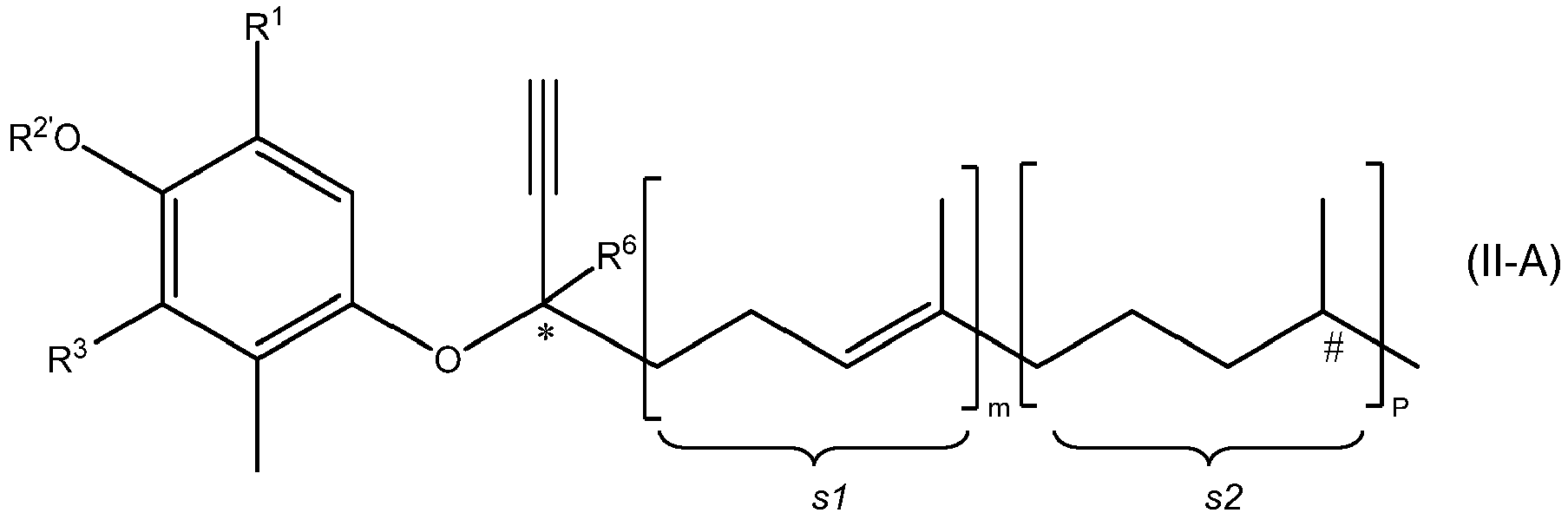
- The groups R1, R3, R2' and *, m, p, s1 and s2 as well the preferred embodiments thereof have already discussed in details before for compound of formula (II) in which R5 is of formula (III). This compound is a preferred embodiment of the present invention and is particularly useful for the process of the mentioned method.
- Particularly, the sum of m and p is 1 to 5.
- Particularly, preferred are the compounds of formula (II) are compounds of formula (II-A-1), (II-A-1RR) and (II-A-2).


- Hence, the preferred compound of formula (I) being formed by the above discussed method is of formula (I-A)

- Particularly, preferred are the compounds of formula (I) are compounds of formula (I-A-1), (I-A-1RR) and (I-A-2).


- Most preferred are the compounds of formula (I) are compounds of formula (I-A-1RRR) and (I-A-2R).


- In formulae (II-A), (II-A-1), (I-A) and (I-A-1) # represents a chiral centre, obviously except in case where said centre is linked to two methyl groups. The configuration at said chiral centre in formula (II-A) or (II-A-1) is the same as in formula (I-A) or (I-A-1)
(R,R,R)-dehydroisophythol (= ((3R,7R,11R)-3,7,11,15-tetramethylhexa-dec-1-yn-3-ol)) (formula (VI) is the starting material for the synthesis of formation of compound of formula (I-A-1RRR).
- This compound is accessible from natural (E,R,R)-phytol being epoxidized by Sharpless oxidation, converted to the corresponding epoxychloride, followed by multiple lithiation as disclosed in Takano, S.; Sugihara, T.; Ogasawara, K. Synlett 1990, 451-452, the entire disclose of which is incorporated herein by reference
- In a further aspect the present invention relates to a composition comprising
- at least one compound of formula (II)

- and
either
at least one silver(I) or gold(I) salt or complex
and
at least one acid (A) which is selected from the group consisting acid (A) which is selected from the group consisting of BX3, the adducts of BX3 with alcohols or ethers, HBX4, H[PX6], H[SbF6], HClO4, H2SO4, trifluoroacetic acid, sulfonic acids and sulfonimides of formula (HAN-1);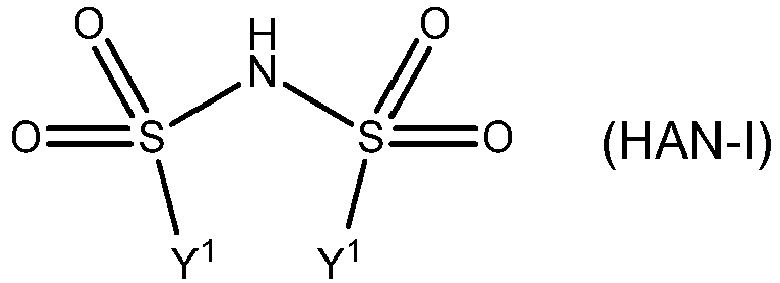
at least one silver(I) or gold(I) metal salt or complex having an anion (AN) which is selected from the group consisting of [BX4]-,
[PX6]-, [SbF6]-, [ClO4]-, CF3COO-, sulfonates, tetra(3,5-bis(trifluoro-methyl)phenyl)borate (BArF -), tetraphenylborate, and anions of formula (AN-1);
and Y1 represents a phenyl or a C1-8-alkyl group which preferably is substituted by at least one halogen atom;
wherein R1 and R3 are independently from each other hydrogen or methyl groups;
R2 represents either hydrogen or a methyl group or a group OR2' where R2' represents hydrogen or a phenol protection group;
R5 represents either a completely saturated C1-25-alkyl group or a C1-25-alkyl group comprising at least one carbon-carbon double bond;
R6 represents either H or a C1-25-alkyl group, particularly a methyl group with the proviso that R5 is different from R6;
and wherein each * represents a chiral centre in the case where R5 is different from R6. - Details of compound of formula (II), of silver(I) or gold(I) salt or complex, acid (A) and silver(I) or gold(I) metal salt or complex having an anion (AN) as well embodiments have already discussed above for the method of preparing compound of formula (I).
- Compound of formula (I), particularly formula (I-A), preferably compound of formula (I-A-1), (I-A-1RR) or (I-A-2), are important intermediates for the synthesis of compounds of formula (IV).
- Therefore, in a further aspect the present invention relates to a method of preparing compound of formula (IV) comprising the steps a) and b) and c) as described above for the method of preparing compound of formula (I);
followed by step d)
d) hydrogenation of compound of formula (I) in the presence of a hydrogenation catalyst
- The groups R1, R2, R3 and R6 as well the preferred embodiments thereof have already discussed in details before for compound of formula (I) or (II). R5' is R5 or the corresponding completely saturated C1-25-alkyl group which results from hydrogenation of a group R5 which has at least one carbon-carbon double bond R.
- The chiral centre indicated by * of formula (IV) has the same configuration as in formula (I).
- Preferred as compounds of formula (IV) are compounds of formula (IV-A) or (IV-ARR) or (IV-B)


- More preferred as compounds of formula (IV) are compounds of formula (IV-A-RRR) or (IV-B-R)


- The group R2' has been already discussed before in detail for formula (I) or (II).
- The hydrogenation in step d) is made by molecular hydrogen in the presence of hydrogenation catalyst.
- In case R5 represents in formula (I) a C1-25-alkyl group comprising at least one carbon-carbon double bond, said side chain can be also hydrogenated. Therefore, in this case the R5' represents in formula (IV) the corresponding hydrogenated R5 group from formula (I).
- In case R5 represents a C1-25-alkyl group comprising at least one carbon-carbon double bond depending on the hydrogenation the side chain can be hydrogenated in a stereospecific or non-stereo-specific way. In a non-stereo-specific way formation of racemic chiral centres is formed, i.e. mixtures having R and S configuration. In case the hydrogenation is stereospecific only a specific configuration, i.e. R or S is formed at the side chain.
- Traditional hydrogenations such as disclosed in Kabbe and Heitzer, Synthesis 1978, 12,888-889 are non-stereo-specific hydrogenations. Asymmetric hydrogenations such as those using chiral iridium complexes as well as the method of asymmetrical hydrogenation of alkenes using chiral iridium complexes, preferably the one which is disclosed in
WO 2006/066863 A1 orWO 2012/171969 A1 , the entire content of which is hereby incorporated by reference, are stereospecific hydrogenations. - In case R5 represents an unsaturated C1-25-alkyl group hydrogenation in step d) is preferably a stereo-specific hydrogenation is preferred.
- In case R5 represents a saturated C1-25-alkyl group hydrogenation in step d) is preferably a non-stereo-specific hydrogenation.
- The present method leads in a high yield to the formation of formula (IV). It has been observed that the configuration is maintained during the reactions involved in the method. Hence, it is possible to have prepared compounds of formula (IV) in a high excess of a specific configuration at the chiral centre indicated by *. Particularly, it is possible to have prepared compounds of formula (IV) in a ratio of one configuration to the opposite configuration at the chiral carbon centre indicated by * of more than 90:10, preferably more than 95:5, particularly more than 98:2. Particularly it is possible to use this method for the production of tocopherols having the R-configuration at all chiral centres ((R,R,R)-tocopherols, R-tocotrienol), particularly (2R, 4'R, 8'R)-α-tocopherol or (2R, 4'R, 8'R)-α-tocopheryl acetate, or of (2R)-tocotrienols.
- In a further aspect the present invention relates to an use of a silver(I) or gold(I) salt or complex combined with at an acid (A) which is selected from the group consisting acid (A) selected from the group consisting of BX3, the adducts of BX3 with alcohols or ethers, HBX4, H[PX6], H[SbF6], HClO4, H2SO4, trifluoroacetic acid, sulfonic acids and sulfonimides of formula (HAN-1);

and Y1 represents a phenyl or a C1-8-alkyl group which preferably is
substituted by at least one halogen atom; for the intramolecular hydroarylation of chiral propargylic aryl ethers. - Details for this use have been already discussed in detail for the method of preparing compound of formula (I). Preferred chiral propargylic aryl ethers are compounds of formula (II).
- In a still further aspect the present invention relates to an use of a silver(I) or gold(I) salt or complex having an anion (AN) which is selected from the group consisting of [BX4]-,[PX6]-, [SbF6]-, [ClO4]-, CF3COO-, sulfonates, tetra(3,5-bis(trifluoromethyl)phenyl)borate (BArF -), tetraphenylborate, and anions of formula (AN-1);

and Y1 represents a phenyl or a C1-8-alkyl group which preferably is substituted by at least one halogen atom;
for the intramolecular hydroarylation of chiral propargylic aryl ethers. - Details for this use have been already discussed in detail for the method of preparing compound of formula (I). Preferred chiral propargylic aryl ethers are compounds of formula (II).
- In in the present invention no by-products having 5-membered rings or a different substitution pattern in view R1, R2 and R3 or a different position of the double bond or dimers have been observed, particularly also not in the presence of Ag(I) salts or complexes.
- The present invention is further illustrated by the following experiments.
- The GC analyses have been performed on an Agilent HP-6850 series system using an FID-detector and helium gas as carrier. The separation is achieved on an HP-1 Methylsiloxane (30m x 0.32mm, 0.25 µm) column with the following temperature program 50°C (0 min) -> 10°/min -> 300°C (5 min). The samples were dissolved in ethyl acetate (5 mg in 1 mL) and 1 µL was injected with a split ratio of 50:1.
- The hydroarylation was monitored by HPLC on an Agilent 1200 series system using a YMC ProC18 column (150 x 4.6 mm), eluent acetonitrile : H2O (7:3). Detection by DAD (=Diode Array Detector) at 210 nm & 230 nm.
- The diastereomeric (2R)- and (2S)-chromenes were monitored using a Chiralpak® OP(+) column, using 0.05% ethanol in hexane as eluent. Detection by DAD at 220 nm. The diastereomeric (3'R)- and (3'S)-aryl propargylic ethers were monitored using a Chiralpak® IA-3(+) column, using 0.05% ethanol in hexane as eluent. Detection by DAD at 220 nm. Chiralcel® OD-H columns were used for the analytical separation of dehydroisophytol and the corresponding carbonate (0.1% EtOH in hexane, detection: RI-detector, 1 mL/min).
- In a first series of experiments the reactivity and conditions for the intramolecular hydroarylation have been studied on a basis of an achiral model molecule 2,3,6-trimethyl-4-((2-methylbut-3-yn-2-yl)oxy)phenyl acetate.
- 5.0 g methylbutynol (MBI, 8, 59 mmol) were dissolved in 63 mL THF. Then 23.8 mL nBuLi (59 mmol, 2.5 M solution in hexane, 1 equiv) were added via syringe within 10 min keeping the inner temperature at about 0°C, resulting in a clear solution. Stirring was continued for 45 min at 0 °C. 4.7 mL methyl chloroformate (59 mmol, 1 equiv.) were added slowly via syringe keeping the inner temperature at about 0°C. After stirring at 0 °C the reaction mixture was then allowed to warm to 23 °C and stirred for 20 h. A white precipitate formed. The reaction mixture was diluted with 80 mL dichloromethane and quenched with 80 mL water. The aqueous layer was extracted with diethylether. The combined organic phases were washed with brine. The organic layer was dried over Na2SO4, filtered and concentrated at 20 °C bath temperature and 27 mbar for 1 h. 4.75 g of crude product, methyl (2-methylbut-3-yn-2-yl) carbonate, were obtained as a yellow oil with a purity of 59%. Purification was archived by distillation using bulb-to-bulb distillation at 64 °C and 10 mbar, furnishing 4.28 g (40% yield, purity 71 %) of methyl (2-methylbut-3-yn-2-yl) carbonate as a yellow oil.
- Boiling point: 64 °C at 10 mbar.
- 1H NMR (CDCl3, 300 MHz) δ 1.72 (s, 6H, 2 x CH3), 2.57 (s, 1H, alkyne-H), 3.78 (3H, OCH3) ppm.
- 13C NMR (CDCl3, 300 MHz) δ 28.8 (2C), 54.4, 72.8, 73.8, 84.1, 153.5 ppm.
- 37.3g 4-hydroxy-2,3,6-trimethylphenyl acetate (DSM Nutritional Products, purity 99.9% GC, 192 mmol) were dissolved in 300 mL acetonitrile at -8°C. 28.6mg CuCl2 (0.168 mmol, 0.1 mol%) were added, resulting in a yellow solution. 29.2g 1,8-Diazabicyclo[5.4.0]undec-7-ene (DBU) (192 mmol 1.1 equiv.) were added dropwise and the reaction mixture turned dark. Stirring was continued for 15 min at 0 °C. 24.4g methyl (2-methylbut-3-yn-2-yl) (172 mmol, 1 equiv.) as prepared above in 100 mL acetonitrile were added at 0 °C; the resulting mixture was stirred for 10 h at 0 °C. The reaction mixture was diluted with 1000 mL water and 1000 mL diethylether. The phases were separated and extracted with diethylether. The organic phase is washed with 40 mL of an aqueous solution of CuSO4 (10 wt%) followed by 60 mL brine. The combined organic phases were dried over Na2SO4, filtered and concentrated in vacuo (20 mbar at 45°C bath temperature). The crude product, 2,3,6-trimethyl-4-((2-methylbut-3-yn-2-yl)oxy)phenyl acetate, was obtained as yellow oil (37 g, purity 53%, quant. NMR). Purification by column chromatography (cyclohexane:EtOAc = 85:15) furnished 30.41 g (68% yield, purity of 99%) of 2,3,6-trimethyl-4-((2-methylbut-3-yn-2-yl)oxy)phenyl acetate as yellow oil.
- 1H NMR (CDCl3, 300 MHz) δ 1.63 (s, 6H, C(CH3)2), 2.03 (s, 3H); 2.10 (s, 3H); 2.12 (s,3H), 2.32 (s, 3H); 2.52 (s, 1 H, alkyne-H), 7.20 (s br, 1 H, aryl-H) ppm.
- 13C NMR (CDCl3, 300 MHz) δ 13.24, 13.31, 16.6, 20.6, 29.7 (2C), 72.6, 73.3, 86.7, 119.7, 126.8, 128.2, 129.5, 143.3, 151.2, 169.2 ppm.
- 2,3,6-trimethyl-4-((2-methylbut-3-yn-2-yl)oxy)phenyl acetate was added to the solvent indicated in table 1 to yield a 0.16 M solution in the propargylic aryl ether. Then the amount of silver (I) or gold(I) salt or complex and acid or at least one silver (I) or gold(I) metal salt or complex having an anion as indicated in table 1 are added in the amount indicated in table 1 and stirred at 25°C during 16 hours.
- 1H NMR (CDCl3, 300 MHz) δ 1.40 (s, 6H, C(CH3)2), 2.02 (s, 3H, Ar-CH3), 2.05 (s, 3H, Ar-CH3), 2.10 (s, 3H, Ar-CH3), 2.32 (s, 3H, CH3CO2), 6.47 (d, J = 10.0 Hz, 1H, =CH), 5.63 (d, J = 10.0 Hz, 1H, =CH) ppm.
- 13C NMR (CDCl3, 300 MHz) 811.61, 11.64, 13.2, 20.6, 27.7, 46.0, 68.4, 75.0, 117.9, 119.6, 122.9, 129.0, 130.3, 141.4, 148.4, 169.5 ppm.
Table 1. Results of hydroarylations of 2,3,6-trimethyl-4-((2-methylbut-3-yn-2-yl)oxy)phenyl acetate. Example catalyst [mol-%]* Acid [mol-%]* Solvent Conversion4 [wt%]3 Yield5 [wt%]3 Ref.1 Ph3PAuCl 0.3 CH2Cl2 0 0 Ref.2 Ph3PAuCl 0.1 toluene 0 0 Ref.3 HBF4 0.1 toluene 5 0 Ref.4 TfOH1 0.1 toluene 0 0 Ref.5 TfOH1 0.1 CH2Cl2 0 0 Comp.1 Ph3PAuCl 0.1 BF3•OEt2 0.5 CH2Cl2 100 >99 Comp.2 Ph3PAuCl 0.6 BF3•OEt2 0.5 toluene 100 >99 Comp.3 Ph3PAuCl 0.1 HBF4 0.1 CH2Cl2 100 83 Comp.4 Ph3PAuCl 0.1 HBF4 0.1 toluene 100 87 Comp.5 AgBF4 1.2 toluene 33 26 Comp.6 AgBF4 1.8 toluene 97 99 Comp.7 AgOTf2 1.8 CH2Cl2 100 99 Comp.8 AgOTf2 0.6 toluene 89 88 *relative to 2,3,6-trimethyl-4-((2-methylbut-3-yn-2-yl)oxy)phenyl acetate
1 TfOH = triflic acid
2 AgOTf = silver triflate
3 wt% = % by weight
4 conversion has been determined by quantitative LC and is indicated relative to 2,3,6-trimethyl-4-((2-methylbut-3-yn-2-yl)oxy)phenyl acetate.
5 yield has been determined by quantitative LC and is indicated relative to 2,3,6-trimethyl-4-((2-methylbut-3-yn-2-yl)oxy)phenyl acetate. - In a second series of experiments the learning of the first experimental series has been applied to chiral compounds.
- 5.35 g all-racemic dehydroisophytol (14.0 mmol) was dissolved in 60 mL THF. Then 8.7 mL nBuLi (2.5M; 21.8 mmol; 1.2 equiv.) were added via syringe within 15 min keeping the temperature at about 0°C. A yellowish solution formed. After complete addition, stirring was continued at -2 °C for 90 min. 2.13 mL methyl chloroformate (27.2 mmol, 1.5 equiv.) was added via syringe. The mixture was allowed to slowly warm to 23 °C overnight. A white suspension formed in a yellow liquid phase. The mixture was quenched with 100 mL HCl (1 N) and with diethylether. The combined organic layers are washed with brine, dried over MgSO4 and concentrated in vacuo (12 mbar at 35°C) over 1 h. 5.53 g of crude product, methyl (3,7,11-trimethyldodec-1-yn-3-yl) carbonate, was obtained as a yellow oil with a purity of 69% (determined by NMR). The crude product was purified over column chromatography (heptane/AcOEt, 9/1, Rf=0.4) and methyl (3,7,11-trimethyldodec-1-yn-3-yl) carbonate has been isolated.
- 1H NMR (CDCl3, 300 MHz) δ 0.83 (s, 3H); 0.86 (s, 6 H); 0.88 (s, 3H) 1.07-1.40 (m, 17H); 1.50-1.57 (m, 2H); 1.71 (s, 3H); 1.86 (m, 2H); 2.58 (s, 1 H); 3.77 (s,3H) ppm. 13C NMR (CDCl3, 300 MHz) δ 19.55; 19.69; 21.58; 22.65; 22.74; 24.47; 24.81;24.83; 26.28; 28.00; 32.65; 32.68; 32.79; 32.81; 36.81; 36.90; 37.30; 37.37; 37.41 ;39.39; 41.63; 54.34; 73.73; 83.34; 153.58 ppm.
- 1.50 g 4-hydroxy-2,3,6-trimethylphenyl acetate (DSM Nutritional Products, purity 99.9% GC, 7.7 mmol) are dissolved in 60 mL acetonitrile and cooled to 0°C. Then 41 mg copper(II) chloride (0.31 mmol, 0.039 equiv.) are added and 1.59 mL 1,8-Diazabicyclo[5.4.0]undec-7-ene (DBU) (10.6 mmol, 1.4 equiv.) are added dropwise. The reaction mixture turned dark. Stirred was continued for 15 minutes at 1°C. Then 2.96 g methyl (3,7,11-trimethyldodec-1-yn-3-yl) carbonate as prepared above (7.7 mmol, 1 equiv) dissolved in 8 mL acetonitrile were added at 1°C and then stirred for 3.5 hours at 0°C. The reaction was followed by TLC. After 3.5 h no carbonate was detected anymore. The reaction mixture is evaporated at 16 mbar and 35°C bath temperature. Then 40 mL water and 50 mL diethylether have been added leading to a slight emulsion. The phases are separated and the aqueous phase is extracted with diethylether. The organic phase is then washed with 160 mL CuSO4 10% aqueous solution and 40 mL brine and then dried over Na2SO4 and concentrated at 40°C und 10 mbar. 4.4 g of a brown oil are obtained containing the product in 30% purity (quant. NMR). The aryl propargylether was purified by column chromatography (SiO2) using heptane and diethylether as eluents (heptane to diethylether = 97:3). The product 2,3,6-trimethyl-4-((3,7,11,15-tetramethylhexadec-1-yn-3-yl)oxy)phenyl acetate was obtained in 19% yield.
- 1H NMR (CDCl3, 300 MHz) 80.84-0.89 (m, 12H), 1.02-1.45 (m, 16H), 1.54 (s, 3H,Cq(CH3)), 1.57-1.95 (m, 5H), 2.03 (s, 3H, Ar-CH3), 2.10 (s, 3H, Ar-CH3), 2.11 (s, 3H, Ar-CH3), 2.32 (s, 3H, CH3CO2), 2.53 (s, 1 H, alkyne-H), 7.20 (s, 1 H, Ar-H) ppm.
- 13C NMR (CDCl3, 300 MHz) δ 13.2, 16.6, 19.6, 19.7, 19.8, 20.6, 21.9, 22.7, 22.8, 24.5, 24.8, 26.8, 28.0, 32.7, 32.8, 37.1, 37.2, 37.3, 37.4, 37.5, 39.4, 43.3, 68.4, 74.5, 85.9, 119.4, 126.6, 128.0, 129.4, 143.1, 151.2, 169.2 ppm.
- 2,3,6-trimethyl-4-((3,7,11,15-tetramethylhexadec-1-yn-3-yl)oxy)phenyl acetate was added to the solvent indicated in table 2 to yield a 0.16 M solution in the propargylic aryl ether. Then the amount of silver(I) or gold(I) salt or complex and acid or at least one silver(I) or gold(I) metal salt or complex having an anion as indicated in table 2 are added in the amount indicated in table 2 and stirred at 25°C during the time indicated in table 2.
- 1H NMR (CDCl3, 300 MHz) δ 0.86 (s, 3 H), 0.89 (s, 6 H) 0.91 (s, 3 H) 1.24 - 1.61 (m, 24 H) 2.05 (s, 3 H) 2.08 (s, 3 H) 2.13 (s, 3 H) 2.35 (s, 3 H) 5.62 (d, J=10.17 Hz, 1 H) 6.52 (d, J=10.17 Hz, 1 H) ppm.
- 13C NMR (CDCl3, 300 MHz) δ 11.6 (2C), 13.2, 19.7, 19.8, 20.6, 21.5, 22.4, 22.7, 22.8, 24.5, 24.9, 25.9, 28.0, 32.7, 32.8, 37.3, 37.4, 39.4, 41.1, 77.4, 117.7, 119.8, 122.4, 122.7, 129.0, 129.7, 141.3, 148.5, 169.5 ppm.
Table 2. Results of hydroarylations of 2,3,6-trimethyl-4-((3,7,11,15-tetramethylhexadec-1-yn-3-yl)oxy)phenyl acetate. Example catalyst [mol-%]* Co-catalyst [mol-%]* Solvent Time [h] Conversion4 [wt%]3 Yield5 [wt%]3 Ref.6 Ph3PAuCl 3 toluene 16 0 0 1 Ph3PAuCl 10 BF3•OEt2 10 toluene 16 100 81 2 Ph3PAuCl 3 BF3•OEt2 0.5 toluene 10 85 72 3 Ph3PAuCl 3 BF3•OEt2 3 toluene 16 100 81 4 AgOTf2 10 toluene 16 61 40 5 Et3PAuCl 3 BF3•OEt2 3 toluene 16 68 59 6 Et3PAuCl 3 BF3•OEt2 3 nitro-methane 2.5 92 74 7 Et3PAuCl 3 BF3•OEt2 3 toluene 17 68 59 8 Ph3PAuNTf2 1 CH2Cl2 1.3 97 94 9 Ph3PAuNTf2 0.2 CH2Cl2 2 99 85 10 JohnPhosAuSbF6I 1 CH2Cl2 3.5 98 89 11 [(iPr2)Ph2]ImAuCl 1 AgSbF6 1 CH2Cl2 24 43 28 * relative to 2,3,6-trimethyl-4-((3,7,11,15-tetramethylhexadec-1-yn-3-yl)oxy)phenyl acetate
2 AgOTf = silver triflate 3 wt% = % by weight
4 conversion has been determined by quantitative LC and is indicated relative to 2,3,6-trimethyl-4-((3,7,11,15-tetramethylhexadec-1-yn-3-yl)oxy)phenyl acetate.
5 Yield has been determined by quantitative NMR and is indicated relative to 2,3,6-trimethyl-4-((3,7,11,15-tetramethylhexadec-1-yn-3-yl)oxy)phenyl acetate. - In a third series of experiments the process was applied to chiral compounds in isomerically pure form
- The synthesis of ((3R,7R, 11R)-3,7,11,15-tetramethylhexadec-1-yn-3-yl) carbonate was identical to the synthesis of methyl (3,7,11-trimethyldodec-1-yn-3-yl) carbonate as described above in experimental series 2 except that RRR-dehydroisophytol ((3R,7R,11R)-3,7,11,15-tetramethylhexadec-1-yn-3-ol), which has been synthesized from natural (E,R,R)-phytol being epoxidized by Sharpless oxidation, converted to the corresponding epoxychloride, followed by multiple lithiation as disclosed by Takano S. et al in Synlett 1990(8), 451-452.
- The synthesis of (R)-2,5,7,8-tetramethyl-2-((4R,8R)-4,8,12-trimethyltridecyl)-2H-chromen-6-yl acetate is identical to the synthesis of 2,5,7,8-tetramethyl-2-(4,8,12-trimethyltridecyl)-2H-chromen-6-yl acetate as described above in experimental series 2 except that ((3R,7R,11R)-3,7,11,15-tetramethylhexadec-1-yn-3-yl) carbonate was used as starting product.
- In a forth series of experiments the process was applied to chiral compounds in isomerically pure form.
- 2,3,6-trimethyl-4-((3,7,11,15-tetramethylhexadec-1-yn-3-yl)oxy)phenyl acetate as prepared above in experimental series 2 is an all-rac mixture.
- It has been separated by preparative HPLC using a chiral stationary phase (Chiralpak® IA-3) into two fractions. The first fraction (FR1) consists primarily of 2,3,6-trimethyl-4-(((3R,7SR,11SR)-3,7,11,15-tetramethylhexadec-1-yn-3-yl)oxy)phenyl acetate ("3R,7SR,11SR"). The second fraction (FR2) consists primarily of 2,3,6-trimethyl-4-(((3S,7SR,11SR)-3,7,11,15-tetramethylhexadec-1-yn-3-yl)oxy)phenyl acetate ("3S,7SR,11SR"). Therefore, the chromatography using a chiral stationary phase resulted in a separation of the isomers having different configuration at the chiral carbon centre next to the ether oxygen atom.
Table 3 Amounts of isomers in fraction 1 and fraction 2. Amounts in fraction 1 (FR1) [%] Amounts in fraction 2 (FR2) [%] 3S,7SR,11SR 94 20 3R,7SR,11SR 6 80 - Fraction 1, respectively fraction 2, as separated above, was added in example 12, resp. example 13, to toluene to yield a 0.16 M solution in the propargylic aryl ether. Then 3 mol % of Ph3PAuCl and 3 mol-% of BF3•OEt2 have been added and stirred at 25°C during 20 hours.
- The product has been analysed by chiral HPLC and the amounts of (R)-2,5,7,8-tetramethyl-2-((4SR,8SR)-4,8,12-trimethyltridecyl)-2H-chromen-6-yl acetate ("R,4SR,8SR") and (S)-2,5,7,8-tetramethyl-2-((4SR,8SR)-4,8,12-trimethyltridecyl)-2H-chromen-6-yl acetate ("S,4SR,8SR") have been indicated in table 4.
Table 4 Amounts of isomers starting from fraction 1 or fraction 2. 12
(using fraction 1 (FR1)
[%]13
(using fraction 2 (FR2)
[%]S,4SR,8SR 93 21 R,4SR,8SR 7 79 - The experiments from table 4 and table 3 prove that the cyclisation is done under retension of the configuration.
- 2,5,7,8-tetramethyl-2-(4,8,12-trimethyltridecyl)-2H-chromen-6-yl acetate, (R)-2,5,7,8-tetramethyl-2-((4R,8R)-4,8,12-trimethyltridecyl)-2H-chromen-6-yl acetate, (R)-2,5,7,8-tetramethyl-2-((4SR,8SR)-4,8,12-trimethyltridecyl)-2H-chromen-6-yl acetate and (S)-2,5,7,8-tetramethyl-2-((4SR,8SR)-4,8,12-trimethyltridecyl)-2H-chromen-6-yl acetate of series 2, 3 or 4, respectively, have been hydrogenated according the procedure disclosed by Kabbe and Heitzer, Synthesis 1978; 12, 888-889. The hydrogenation yielded in all cases α-tocopheryl acetate. The identity of α-tocopheryl acetate and the retention of the configuration and ratios at the chiral carbon centres at the 2-position as well as the 4' and 8' positions could be estabilished by chromatographic analysis.
Claims (14)
- Method of preparing compound of formula (I) comprising the steps
 a) providing compound of formula (II)
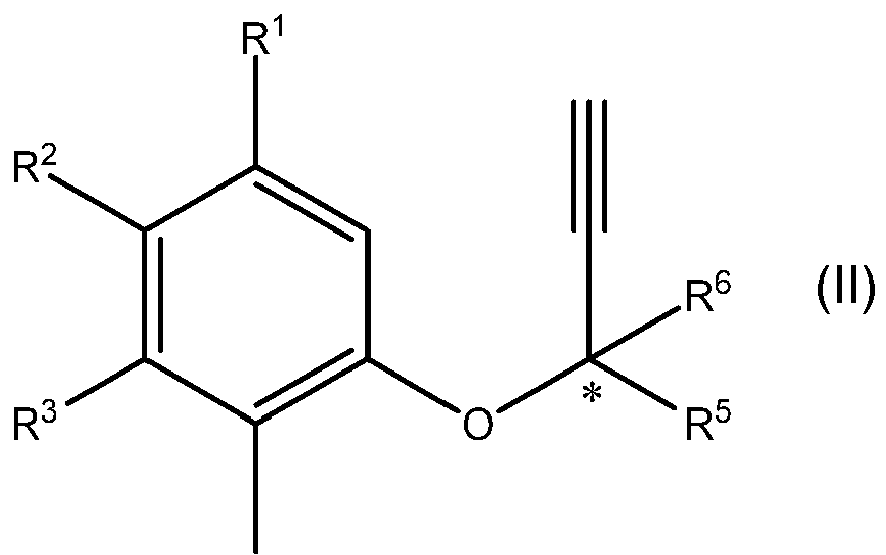 b) adding
at least one silver(I) or gold(I) salt or complex and
at least one acid (A) which is selected from the group consisting of BX3, the adducts of BX3 with alcohols or ethers, HBX4, H[PX6], H[SbF6], HClO4, H2SO4, trifluoroacetic acid, sulfonic acids and sulfonimides of formula (HAN-1);
at least one silver(I) or gold(I) metal salt or complex having an anion (AN) which is selected from the group consisting of [BX4]-, [PX6]-, [SbF6]-, [ClO4]-, CF3COO-, sulfonates, tetra(3,5-bis(trifluoromethyl)phenyl)borate (BArF -), tetraphenylborate, and anions of formula (AN-1);
and Y1 represents a phenyl or a C1-8-alkyl group which preferably is substituted by at least one halogen atom to compound of formula (II) forming a mixture;c) submitting said mixture to a temperature in the range between -15°C
and 40°C, preferably between 15°C and 40°C;
wherein R1 and R3 are independently from each other hydrogen or methyl groups;
R2 represents either hydrogen or a methyl group or a group OR2' where R2' represents hydrogen or a phenol protection group;
R5 represents either completely saturated C1-25-alkyl group or a C1-25-alkyl group comprising at least one carbon-carbon double bond;
R6 represents either H or a C1-25-alkyl group, particularly a methyl group with the proviso that R5 is different from R6;
and wherein each * represents a chiral centre and this chiral centre has the same configuration in formula (I) and formula (II). - Method according to claim 1, characterized in that R5 is of formula (III)

and where the substructures in formula (III) represented by s1 and s2 can be in any sequence;
and the dotted line represents the bond by which the substituent of formula (III) is bound to the rest of the compound of formula (II-B) or formula (I);
and wherein # represents a chiral centre, obviously except in case where said centre is linked to two methyl groups. - Method according to claim 1 or claim 2, characterized in that the acid (A) is BX3, particularly BF3, respectively the adducts thereof with alcohols or ethers, particularly BF3-dialkylether adducts.
- Method according to anyone of the preceding claims characterized in that the acid (A) in step b) is an acid which is selected from the group consisting of BF3, HBF4, triflic acid and triflimidic acid.
- Method according to anyone of the preceding claims characterized in that that the anion (AN) in step b) is an anion which is selected from the group consisting of [BX4]-, triflate, and anions of formula (AN-1).
- Method according to anyone of the preceding claims characterized in that in step b) the silver(I) or gold(I) salt or complex is a chloro complex of Au(I) and the acid (A) is BF3, respectively the adducts thereof with alcohols or ethers, particularly BF3-dialkylether adducts.
- Method according to anyone of the preceding claims characterized in that in step b) the silver(I) or gold(I) salt or complex having an anion (AN) is silver(I) triflate or silver(I) tetrafluoroborate.
- Method according to anyone of the preceding claims characterized in that in step b) a combination of Ag(I) triflate or Ag(I) tetrafluoroborate and a chloro complex of Au(I) is used.
- Compound of formula (II-A)

R2' represents hydrogen or a phenol protection group;
and wherein each * represents a chiral centre;
and wherein m and p stand independently from each other for a value of 0 to 5 provided that the sum of m and p is 0 to 5,
and where the substructures in formula (II-A) represented by s1 and s2 can be in any sequence;
and wherein # represents a chiral centre, obviously except in case where said centre is linked to two methyl groups. - Compound according to claim 9, characterized in that the sum of m and p is 1 to 5.
- Composition comprising- at least one compound of formula (II)
 - and either at least one silver (I) or gold(I) salt or complex
and
at least one acid (A) which is selected from the group consisting acid (A) which is selected from the group consisting of BX3, the adducts of BX3 with alcohols or ethers, HBX4, H[PX6], H[SbF6], HClO4, H2SO4, trifluoroacetic acid, sulfonic acids and sulfonimides of formula (HAN-1);
at least one silver(I) or gold(I) metal salt or complex having an anion (AN) which is selected from the group consisting of [BX4]-, [PX6]-, [SbF6]-, [ClO4]-, CF3COO-, sulfonates, tetra(3,5-bis(trifluoromethyl)phenyl)borate (BArF -), tetraphenylborate, and anions of formula (AN-1);
and Y1 represents a phenyl or a C1-8-alkyl group which preferably is substituted by at least one halogen atom;
wherein R1 and R3 are independently from each other hydrogen or methyl groups;
R2 represents either hydrogen or a methyl group or a group OR2' where R2' represents hydrogen or a phenol protection group;
R5 represents either a completely saturated C1-25-alkyl group or a C1-25-alkyl group comprising at least one carbon-carbon double bond;
R6 represents either H or a C1-25-alkyl group, particularly a methyl group with the proviso that R5 is different from R6;
and wherein each * represents a chiral centre in the case where R5 is different from R6. - Method of preparing compound of formula (IV) comprising the steps a) and b) and c) as described in the method according to anyone of the claims 1-8;
followed by step d)
d) hydrogenation of compound of formula (I) in the presence of a
hydrogenation catalyst
R5' is R5 or the corresponding completely saturated C1-25-alkyl group; and as the chiral centre indicated by * of formula (IV) has the same configuration as in formula (I). - Use of a silver(I) or gold(I) salt or complex combined with at an acid (A) which is selected from the group consisting acid (A) selected from the group consisting of BX3, the adducts of BX3 with alcohols or ethers, HBX4, H[PX6], H[SbF6], HClO4, H2SO4, trifluoroacetic acid, sulfonic acids and sulfonimides of formula (HAN-1);

and Y1 represents a phenyl or a C1-8-alkyl group which preferably is substituted by at least one halogen atom;
for the intramolecular hydroarylation of chiral propargylic aryl ethers. - Use of a silver(I) or gold(I) salt or complex having an anion (AN) which is selected from the group consisting of [BX4]-,[PX6]-, [SbF6]-, [ClO4]-, CF3COO-, sulfonates, tetra(3,5-bis(trifluoromethyl)phenyl)borate (BArF -), tetraphenylborate, and anions of formula (AN-1);

and Y1 represents a phenyl or a C1-8-alkyl group which preferably is substituted by at least one halogen atom;
for the intramolecular hydroarylation of chiral propargylic aryl ethers.
Priority Applications (4)
| Application Number | Priority Date | Filing Date | Title |
|---|---|---|---|
| EP13182427.8A EP2842951A1 (en) | 2013-08-30 | 2013-08-30 | Formation of chromanes and chromenes by using silver(I) or gold(I) salts or complexes |
| CN201480047289.0A CN105473567B (en) | 2013-08-30 | 2014-08-26 | Formation of chromenes and chromenes by using silver(I) or gold(I) salts or complexes |
| EP14755816.7A EP3039017B1 (en) | 2013-08-30 | 2014-08-26 | Formation of chromanes and chromenes by using silver(i) or gold(i) salts or complexes |
| PCT/EP2014/068080 WO2015028463A1 (en) | 2013-08-30 | 2014-08-26 | Formation of chromanes and chromenes by using silver(i) or gold(i) salts or complexes |
Applications Claiming Priority (1)
| Application Number | Priority Date | Filing Date | Title |
|---|---|---|---|
| EP13182427.8A EP2842951A1 (en) | 2013-08-30 | 2013-08-30 | Formation of chromanes and chromenes by using silver(I) or gold(I) salts or complexes |
Publications (1)
| Publication Number | Publication Date |
|---|---|
| EP2842951A1 true EP2842951A1 (en) | 2015-03-04 |
Family
ID=49117667
Family Applications (2)
| Application Number | Title | Priority Date | Filing Date |
|---|---|---|---|
| EP13182427.8A Withdrawn EP2842951A1 (en) | 2013-08-30 | 2013-08-30 | Formation of chromanes and chromenes by using silver(I) or gold(I) salts or complexes |
| EP14755816.7A Active EP3039017B1 (en) | 2013-08-30 | 2014-08-26 | Formation of chromanes and chromenes by using silver(i) or gold(i) salts or complexes |
Family Applications After (1)
| Application Number | Title | Priority Date | Filing Date |
|---|---|---|---|
| EP14755816.7A Active EP3039017B1 (en) | 2013-08-30 | 2014-08-26 | Formation of chromanes and chromenes by using silver(i) or gold(i) salts or complexes |
Country Status (3)
| Country | Link |
|---|---|
| EP (2) | EP2842951A1 (en) |
| CN (1) | CN105473567B (en) |
| WO (1) | WO2015028463A1 (en) |
Cited By (3)
| Publication number | Priority date | Publication date | Assignee | Title |
|---|---|---|---|---|
| US10815178B2 (en) * | 2015-12-21 | 2020-10-27 | Dsm Ip Assets B.V. | Intermolecular reaction of propargyl ethers with dimethylfuran in the presence of gold(I) complexes |
| US20210024534A1 (en) * | 2019-07-23 | 2021-01-28 | Arianegroup Sas | Gold-catalysed process for manufacturing chromenes intended for the preparation of thermosetting resins |
| US11739097B2 (en) | 2019-07-23 | 2023-08-29 | Arianegroup Sas | Process for producing chromenes by catalysis with copper salts intended for the preparation of thermosetting resins |
Citations (2)
| Publication number | Priority date | Publication date | Assignee | Title |
|---|---|---|---|---|
| WO2006066863A1 (en) | 2004-12-22 | 2006-06-29 | Dsm Ip Assets B.V. | Asymmetric hydrogenation of alkennes using chiral iridium complexes |
| WO2012171969A1 (en) | 2011-06-14 | 2012-12-20 | Dsm Ip Assets B.V. | HYDROGENATION OF KETONES HAVING AT LEAST A CARBON-CARBON DOUBLE BOND IN THE γ, δ-POSITION |
-
2013
- 2013-08-30 EP EP13182427.8A patent/EP2842951A1/en not_active Withdrawn
-
2014
- 2014-08-26 CN CN201480047289.0A patent/CN105473567B/en active Active
- 2014-08-26 EP EP14755816.7A patent/EP3039017B1/en active Active
- 2014-08-26 WO PCT/EP2014/068080 patent/WO2015028463A1/en not_active Ceased
Patent Citations (2)
| Publication number | Priority date | Publication date | Assignee | Title |
|---|---|---|---|---|
| WO2006066863A1 (en) | 2004-12-22 | 2006-06-29 | Dsm Ip Assets B.V. | Asymmetric hydrogenation of alkennes using chiral iridium complexes |
| WO2012171969A1 (en) | 2011-06-14 | 2012-12-20 | Dsm Ip Assets B.V. | HYDROGENATION OF KETONES HAVING AT LEAST A CARBON-CARBON DOUBLE BOND IN THE γ, δ-POSITION |
Non-Patent Citations (16)
| Title |
|---|
| "IUPAC-IUB Recommendation 1981", EUR. J. BIOCHEM., vol. 123, 1982, pages 473 - 475 |
| GUOTAO LI ET AL: "Au-Catalyzed Synthesis of (1 Z ,3 E )-2-Pivaloxy-1,3-Dienes from Propargylic Pivalates", JOURNAL OF THE AMERICAN CHEMICAL SOCIETY, vol. 130, no. 12, 1 March 2008 (2008-03-01), pages 3740 - 3741, XP055082986, ISSN: 0002-7863, DOI: 10.1021/ja800001h * |
| H. WEISER ET AL., J. NUTR., vol. 126, no. 10, 1996, pages 2539 - 49 |
| HUO ET AL: "Enantioselective total synthesis of hydramicromelin B", TETRAHEDRON ASYMMETRY, PERGAMON PRESS LTD, OXFORD, GB, vol. 19, no. 3, 7 February 2008 (2008-02-07), pages 343 - 347, XP022479395, ISSN: 0957-4166, DOI: 10.1016/J.TETASY.2008.01.006 * |
| IOANNIS N. LYKAKIS ET AL: "Ph3PAuNTf2 as a Superior Catalyst for the Selective Synthesis of 2H-Chromenes: Application to the Concise Synthesis of Benzopyran Natural Products", EUROPEAN JOURNAL OF ORGANIC CHEMISTRY, vol. 2011, no. 12, 10 April 2011 (2011-04-10), pages 2334 - 2338, XP055082767, ISSN: 1434-193X, DOI: 10.1002/ejoc.201001674 * |
| KABBE; HEITZER, SYNTHESIS, vol. 12, 1978, pages 888 - 889 |
| MARGARET A. BRIMBLE ET AL: "Synthesis of the Tetracyclic Core of Berkelic Acid Using Gold(I)-Catalyzed Hydroarylation and Oxidative Radical Cyclizations", ORGANIC LETTERS, vol. 14, no. 23, 7 December 2012 (2012-12-07), pages 5820 - 5823, XP055082773, ISSN: 1523-7060, DOI: 10.1021/ol302536j * |
| NEVADO C ET AL: "Intramolecular Hydroarylation of Alkynes Catalyzed by Platinum or Gold: Mechanism and endo Selectivity", CHEMISTRY - A EUROPEAN JOURNAL, WILEY - V C H VERLAG GMBH & CO. KGAA, WEINHEIM, DE, vol. 11, no. 10, 6 May 2005 (2005-05-06), pages 3155 - 3164, XP002557136, ISSN: 0947-6539, [retrieved on 20050318], DOI: 10.1002/CHEM.200401069 * |
| NEVADO C. ET AL., CHEM. EUR. J., vol. 11, 2005, pages 3155 - 3164 |
| NICOLAS MÉZAILLES ET AL: "Phosphine Gold(I) Bis-(trifluoromethanesulfonyl)imidate Complexes as New Highly Efficient and Air-Stable Catalysts for the Cycloisomerization of Enynes", ORGANIC LETTERS, vol. 7, no. 19, 1 September 2005 (2005-09-01), pages 4133 - 4136, XP055083124, ISSN: 1523-7060, DOI: 10.1021/ol0515917 * |
| PAUL A. VADOLA ET AL: "Catalytic Coupling of Arene C-H Bonds and Alkynes for the Synthesis of Coumarins: Substrate Scope and Application to the Development of Neuroimaging Agents", THE JOURNAL OF ORGANIC CHEMISTRY, vol. 77, no. 18, 21 September 2012 (2012-09-21), pages 7804 - 7814, XP055082988, ISSN: 0022-3263, DOI: 10.1021/jo3006842 * |
| R. SANKARA SUBRAMANIAN ET AL: "Mercury(II) trifluoroacetate-mediated transformation of 3-bromo-1-phenylprop-2-ynyl aryl ethers; a novel synthesis of flavanones", JOURNAL OF THE CHEMICAL SOCIETY, CHEMICAL COMMUNICATIONS, no. 21, 1 January 1990 (1990-01-01), pages 1469, XP055082726, ISSN: 0022-4936, DOI: 10.1039/c39900001469 * |
| REETZ M.T. ET AL., EUR. J. ORG. CHEM., 2003, pages 3485 - 3496 |
| TAKANO, S.; SUGIHARA, T.; OGASAWARA, K., SYNLETT, 1990, pages 451 - 452 |
| URS HENGARTNER ET AL: "Asymmetric Synthesis of [alpha]-Tocopherol", CHEMISTRY - A EUROPEAN JOURNAL, vol. 16, no. 4, 25 January 2010 (2010-01-25), pages 1306 - 1311, XP055032731, ISSN: 0947-6539, DOI: 10.1002/chem.200902754 * |
| URSULA KOCH-POMERANZ ET AL: "Die durch Silberionen katalysierte Umlagerung von Propargyl-phenylther", HELVETICA CHIMICA ACTA, vol. 56, no. 8, 1 January 1973 (1973-01-01), pages 2981 - 3004, XP055083162 * |
Cited By (4)
| Publication number | Priority date | Publication date | Assignee | Title |
|---|---|---|---|---|
| US10815178B2 (en) * | 2015-12-21 | 2020-10-27 | Dsm Ip Assets B.V. | Intermolecular reaction of propargyl ethers with dimethylfuran in the presence of gold(I) complexes |
| US20210024534A1 (en) * | 2019-07-23 | 2021-01-28 | Arianegroup Sas | Gold-catalysed process for manufacturing chromenes intended for the preparation of thermosetting resins |
| US11739097B2 (en) | 2019-07-23 | 2023-08-29 | Arianegroup Sas | Process for producing chromenes by catalysis with copper salts intended for the preparation of thermosetting resins |
| US11820780B2 (en) * | 2019-07-23 | 2023-11-21 | Arianegroup Sas | Gold-catalysed process for manufacturing chromenes intended for the preparation of thermosetting resins |
Also Published As
| Publication number | Publication date |
|---|---|
| CN105473567B (en) | 2020-07-31 |
| CN105473567A (en) | 2016-04-06 |
| EP3039017A1 (en) | 2016-07-06 |
| WO2015028463A1 (en) | 2015-03-05 |
| EP3039017B1 (en) | 2019-01-09 |
Similar Documents
| Publication | Publication Date | Title |
|---|---|---|
| US20080039638A1 (en) | Asymmetric Hydrogenation of Alkennes Using Chiral Iridium Complexes | |
| JP2011178801A (en) | Process for producing ester | |
| JP2011121968A (en) | PROCESS FOR MANUFACTURE OF CHROMAN DERIVATIVE, ESPECIALLY alpha-TOCOPHEROL AND ALKANOATE THEREOF | |
| EP2535323A1 (en) | Hydrogenation of ketones having at least a carbon-carbon double bond in the gamma-,delta-position | |
| EP3039017B1 (en) | Formation of chromanes and chromenes by using silver(i) or gold(i) salts or complexes | |
| JP2004535443A (en) | Zirconium-catalyzed hydroxylation of β-dicarbonyl | |
| EP2935176B1 (en) | (6r,10r)-6,10,14-trimetylpentadecan-2-one prepared from (r)-3,7-dimetyloct-6-enal | |
| JP7851324B2 (en) | Ring closure of benzoquinone containing an unsaturated side chain using a basic catalyst | |
| EP3016941B1 (en) | Formation of chiral 4-chromanones using chiral pyrrolidines in the presence of ureas or thioureas | |
| US11724996B2 (en) | Synthesis of intermediates for the preparation of alpha-tocopherol | |
| CN105358539B (en) | Chiral 4 benzodihydropyrones are formed using chiral pyrrolidine in the presence of acid | |
| JP6365904B2 (en) | Formation of chiral 4-chromanones using chiral pyrrolidines in the presence of phenols or thiophenols | |
| JP6365949B2 (en) | Generation of chiral 4-chromanones using chiral pyrrolidines |
Legal Events
| Date | Code | Title | Description |
|---|---|---|---|
| 17P | Request for examination filed |
Effective date: 20130830 |
|
| AK | Designated contracting states |
Kind code of ref document: A1 Designated state(s): AL AT BE BG CH CY CZ DE DK EE ES FI FR GB GR HR HU IE IS IT LI LT LU LV MC MK MT NL NO PL PT RO RS SE SI SK SM TR |
|
| AX | Request for extension of the european patent |
Extension state: BA ME |
|
| PUAI | Public reference made under article 153(3) epc to a published international application that has entered the european phase |
Free format text: ORIGINAL CODE: 0009012 |
|
| STAA | Information on the status of an ep patent application or granted ep patent |
Free format text: STATUS: THE APPLICATION IS DEEMED TO BE WITHDRAWN |
|
| 18D | Application deemed to be withdrawn |
Effective date: 20150905 |