EP2840114A1 - Acrylic Rubber Composition and Sealing Device including the same - Google Patents
Acrylic Rubber Composition and Sealing Device including the same Download PDFInfo
- Publication number
- EP2840114A1 EP2840114A1 EP14179756.3A EP14179756A EP2840114A1 EP 2840114 A1 EP2840114 A1 EP 2840114A1 EP 14179756 A EP14179756 A EP 14179756A EP 2840114 A1 EP2840114 A1 EP 2840114A1
- Authority
- EP
- European Patent Office
- Prior art keywords
- acm
- polymer
- aem
- ethyl acrylate
- monomer
- Prior art date
- Legal status (The legal status is an assumption and is not a legal conclusion. Google has not performed a legal analysis and makes no representation as to the accuracy of the status listed.)
- Withdrawn
Links
- 239000000203 mixture Substances 0.000 title claims description 47
- 229920000800 acrylic rubber Polymers 0.000 title claims description 34
- 229920000058 polyacrylate Polymers 0.000 title claims description 34
- 238000007789 sealing Methods 0.000 title claims description 31
- 239000000178 monomer Substances 0.000 claims abstract description 98
- CQEYYJKEWSMYFG-UHFFFAOYSA-N butyl acrylate Chemical compound CCCCOC(=O)C=C CQEYYJKEWSMYFG-UHFFFAOYSA-N 0.000 claims abstract description 57
- JIGUQPWFLRLWPJ-UHFFFAOYSA-N Ethyl acrylate Chemical compound CCOC(=O)C=C JIGUQPWFLRLWPJ-UHFFFAOYSA-N 0.000 claims abstract description 50
- PNJWIWWMYCMZRO-UHFFFAOYSA-N pent‐4‐en‐2‐one Natural products CC(=O)CC=C PNJWIWWMYCMZRO-UHFFFAOYSA-N 0.000 claims abstract description 50
- HFCUBKYHMMPGBY-UHFFFAOYSA-N 2-methoxyethyl prop-2-enoate Chemical compound COCCOC(=O)C=C HFCUBKYHMMPGBY-UHFFFAOYSA-N 0.000 claims abstract description 45
- 238000004132 cross linking Methods 0.000 claims abstract description 44
- 125000003178 carboxy group Chemical group [H]OC(*)=O 0.000 claims abstract description 24
- 229920006225 ethylene-methyl acrylate Polymers 0.000 claims abstract description 10
- 239000005043 ethylene-methyl acrylate Substances 0.000 claims abstract description 10
- 125000001309 chloro group Chemical group Cl* 0.000 claims abstract description 8
- 125000003700 epoxy group Chemical group 0.000 claims abstract description 8
- HGVPOWOAHALJHA-UHFFFAOYSA-N ethene;methyl prop-2-enoate Chemical compound C=C.COC(=O)C=C HGVPOWOAHALJHA-UHFFFAOYSA-N 0.000 claims abstract description 5
- 229920000642 polymer Polymers 0.000 claims description 31
- 239000003921 oil Substances 0.000 description 24
- 230000006835 compression Effects 0.000 description 20
- 238000007906 compression Methods 0.000 description 20
- 239000000126 substance Substances 0.000 description 10
- VYPSYNLAJGMNEJ-UHFFFAOYSA-N Silicium dioxide Chemical compound O=[Si]=O VYPSYNLAJGMNEJ-UHFFFAOYSA-N 0.000 description 9
- 238000000034 method Methods 0.000 description 9
- VTYYLEPIZMXCLO-UHFFFAOYSA-L Calcium carbonate Chemical compound [Ca+2].[O-]C([O-])=O VTYYLEPIZMXCLO-UHFFFAOYSA-L 0.000 description 8
- 239000000314 lubricant Substances 0.000 description 7
- 239000012779 reinforcing material Substances 0.000 description 7
- 239000007787 solid Substances 0.000 description 7
- XLOMVQKBTHCTTD-UHFFFAOYSA-N Zinc monoxide Chemical compound [Zn]=O XLOMVQKBTHCTTD-UHFFFAOYSA-N 0.000 description 6
- 230000002093 peripheral effect Effects 0.000 description 6
- TZCXTZWJZNENPQ-UHFFFAOYSA-L barium sulfate Chemical compound [Ba+2].[O-]S([O-])(=O)=O TZCXTZWJZNENPQ-UHFFFAOYSA-L 0.000 description 5
- 150000002148 esters Chemical class 0.000 description 5
- OKTJSMMVPCPJKN-UHFFFAOYSA-N Carbon Chemical compound [C] OKTJSMMVPCPJKN-UHFFFAOYSA-N 0.000 description 4
- VZCYOOQTPOCHFL-OWOJBTEDSA-N Fumaric acid Chemical compound OC(=O)\C=C\C(O)=O VZCYOOQTPOCHFL-OWOJBTEDSA-N 0.000 description 4
- GWEVSGVZZGPLCZ-UHFFFAOYSA-N Titan oxide Chemical compound O=[Ti]=O GWEVSGVZZGPLCZ-UHFFFAOYSA-N 0.000 description 4
- 229910000019 calcium carbonate Inorganic materials 0.000 description 4
- 239000000377 silicon dioxide Substances 0.000 description 4
- VZCYOOQTPOCHFL-UHFFFAOYSA-N trans-butenedioic acid Natural products OC(=O)C=CC(O)=O VZCYOOQTPOCHFL-UHFFFAOYSA-N 0.000 description 4
- 239000000378 calcium silicate Substances 0.000 description 3
- 229910052918 calcium silicate Inorganic materials 0.000 description 3
- OYACROKNLOSFPA-UHFFFAOYSA-N calcium;dioxido(oxo)silane Chemical compound [Ca+2].[O-][Si]([O-])=O OYACROKNLOSFPA-UHFFFAOYSA-N 0.000 description 3
- 238000004519 manufacturing process Methods 0.000 description 3
- 239000000463 material Substances 0.000 description 3
- 238000005096 rolling process Methods 0.000 description 3
- 239000011787 zinc oxide Substances 0.000 description 3
- JAHNSTQSQJOJLO-UHFFFAOYSA-N 2-(3-fluorophenyl)-1h-imidazole Chemical compound FC1=CC=CC(C=2NC=CN=2)=C1 JAHNSTQSQJOJLO-UHFFFAOYSA-N 0.000 description 2
- UQSXHKLRYXJYBZ-UHFFFAOYSA-N Iron oxide Chemical compound [Fe]=O UQSXHKLRYXJYBZ-UHFFFAOYSA-N 0.000 description 2
- CSNNHWWHGAXBCP-UHFFFAOYSA-L Magnesium sulfate Chemical compound [Mg+2].[O-][S+2]([O-])([O-])[O-] CSNNHWWHGAXBCP-UHFFFAOYSA-L 0.000 description 2
- BAPJBEWLBFYGME-UHFFFAOYSA-N Methyl acrylate Chemical compound COC(=O)C=C BAPJBEWLBFYGME-UHFFFAOYSA-N 0.000 description 2
- OFOBLEOULBTSOW-UHFFFAOYSA-N Propanedioic acid Natural products OC(=O)CC(O)=O OFOBLEOULBTSOW-UHFFFAOYSA-N 0.000 description 2
- 239000000654 additive Substances 0.000 description 2
- 125000000217 alkyl group Chemical group 0.000 description 2
- ADCOVFLJGNWWNZ-UHFFFAOYSA-N antimony trioxide Chemical compound O=[Sb]O[Sb]=O ADCOVFLJGNWWNZ-UHFFFAOYSA-N 0.000 description 2
- 238000012662 bulk polymerization Methods 0.000 description 2
- OSGAYBCDTDRGGQ-UHFFFAOYSA-L calcium sulfate Chemical compound [Ca+2].[O-]S([O-])(=O)=O OSGAYBCDTDRGGQ-UHFFFAOYSA-L 0.000 description 2
- 239000004927 clay Substances 0.000 description 2
- 239000003431 cross linking reagent Substances 0.000 description 2
- 238000010586 diagram Methods 0.000 description 2
- 238000007720 emulsion polymerization reaction Methods 0.000 description 2
- 229920001973 fluoroelastomer Polymers 0.000 description 2
- 238000010528 free radical solution polymerization reaction Methods 0.000 description 2
- 239000001530 fumaric acid Substances 0.000 description 2
- 239000011521 glass Substances 0.000 description 2
- 239000010687 lubricating oil Substances 0.000 description 2
- ZLNQQNXFFQJAID-UHFFFAOYSA-L magnesium carbonate Chemical compound [Mg+2].[O-]C([O-])=O ZLNQQNXFFQJAID-UHFFFAOYSA-L 0.000 description 2
- 239000001095 magnesium carbonate Substances 0.000 description 2
- 229910000021 magnesium carbonate Inorganic materials 0.000 description 2
- VZCYOOQTPOCHFL-UPHRSURJSA-N maleic acid Chemical compound OC(=O)\C=C/C(O)=O VZCYOOQTPOCHFL-UPHRSURJSA-N 0.000 description 2
- 239000011976 maleic acid Substances 0.000 description 2
- LVHBHZANLOWSRM-UHFFFAOYSA-N methylenebutanedioic acid Natural products OC(=O)CC(=C)C(O)=O LVHBHZANLOWSRM-UHFFFAOYSA-N 0.000 description 2
- 239000010445 mica Substances 0.000 description 2
- 229910052618 mica group Inorganic materials 0.000 description 2
- 238000000465 moulding Methods 0.000 description 2
- 239000000843 powder Substances 0.000 description 2
- 230000003014 reinforcing effect Effects 0.000 description 2
- 238000010557 suspension polymerization reaction Methods 0.000 description 2
- OGIDPMRJRNCKJF-UHFFFAOYSA-N titanium oxide Inorganic materials [Ti]=O OGIDPMRJRNCKJF-UHFFFAOYSA-N 0.000 description 2
- SLBOQBILGNEPEB-UHFFFAOYSA-N 1-chloroprop-2-enylbenzene Chemical compound C=CC(Cl)C1=CC=CC=C1 SLBOQBILGNEPEB-UHFFFAOYSA-N 0.000 description 1
- STMDPCBYJCIZOD-UHFFFAOYSA-N 2-(2,4-dinitroanilino)-4-methylpentanoic acid Chemical compound CC(C)CC(C(O)=O)NC1=CC=C([N+]([O-])=O)C=C1[N+]([O-])=O STMDPCBYJCIZOD-UHFFFAOYSA-N 0.000 description 1
- SMZOUWXMTYCWNB-UHFFFAOYSA-N 2-(2-methoxy-5-methylphenyl)ethanamine Chemical compound COC1=CC=C(C)C=C1CCN SMZOUWXMTYCWNB-UHFFFAOYSA-N 0.000 description 1
- LQZDDWKUQKQXGC-UHFFFAOYSA-N 2-(2-methylprop-2-enoxymethyl)oxirane Chemical compound CC(=C)COCC1CO1 LQZDDWKUQKQXGC-UHFFFAOYSA-N 0.000 description 1
- NIXOWILDQLNWCW-UHFFFAOYSA-N 2-Propenoic acid Natural products OC(=O)C=C NIXOWILDQLNWCW-UHFFFAOYSA-N 0.000 description 1
- WHBAYNMEIXUTJV-UHFFFAOYSA-N 2-chloroethyl prop-2-enoate Chemical compound ClCCOC(=O)C=C WHBAYNMEIXUTJV-UHFFFAOYSA-N 0.000 description 1
- KUDUQBURMYMBIJ-UHFFFAOYSA-N 2-prop-2-enoyloxyethyl prop-2-enoate Chemical compound C=CC(=O)OCCOC(=O)C=C KUDUQBURMYMBIJ-UHFFFAOYSA-N 0.000 description 1
- REEBWSYYNPPSKV-UHFFFAOYSA-N 3-[(4-formylphenoxy)methyl]thiophene-2-carbonitrile Chemical compound C1=CC(C=O)=CC=C1OCC1=C(C#N)SC=C1 REEBWSYYNPPSKV-UHFFFAOYSA-N 0.000 description 1
- 239000005995 Aluminium silicate Substances 0.000 description 1
- 229920000049 Carbon (fiber) Polymers 0.000 description 1
- VGGSQFUCUMXWEO-UHFFFAOYSA-N Ethene Chemical compound C=C VGGSQFUCUMXWEO-UHFFFAOYSA-N 0.000 description 1
- 239000005977 Ethylene Substances 0.000 description 1
- 239000005909 Kieselgur Substances 0.000 description 1
- CERQOIWHTDAKMF-UHFFFAOYSA-N Methacrylic acid Chemical compound CC(=C)C(O)=O CERQOIWHTDAKMF-UHFFFAOYSA-N 0.000 description 1
- 239000004113 Sepiolite Substances 0.000 description 1
- 229910052581 Si3N4 Inorganic materials 0.000 description 1
- 229910021536 Zeolite Inorganic materials 0.000 description 1
- 239000006230 acetylene black Substances 0.000 description 1
- 230000000996 additive effect Effects 0.000 description 1
- 230000002411 adverse Effects 0.000 description 1
- YIYBQIKDCADOSF-UHFFFAOYSA-N alpha-Butylen-alpha-carbonsaeure Natural products CCC=CC(O)=O YIYBQIKDCADOSF-UHFFFAOYSA-N 0.000 description 1
- WNROFYMDJYEPJX-UHFFFAOYSA-K aluminium hydroxide Chemical compound [OH-].[OH-].[OH-].[Al+3] WNROFYMDJYEPJX-UHFFFAOYSA-K 0.000 description 1
- PNEYBMLMFCGWSK-UHFFFAOYSA-N aluminium oxide Inorganic materials [O-2].[O-2].[O-2].[Al+3].[Al+3] PNEYBMLMFCGWSK-UHFFFAOYSA-N 0.000 description 1
- 235000012211 aluminium silicate Nutrition 0.000 description 1
- OJMOMXZKOWKUTA-UHFFFAOYSA-N aluminum;borate Chemical compound [Al+3].[O-]B([O-])[O-] OJMOMXZKOWKUTA-UHFFFAOYSA-N 0.000 description 1
- 229960000892 attapulgite Drugs 0.000 description 1
- JRPBQTZRNDNNOP-UHFFFAOYSA-N barium titanate Chemical compound [Ba+2].[Ba+2].[O-][Ti]([O-])([O-])[O-] JRPBQTZRNDNNOP-UHFFFAOYSA-N 0.000 description 1
- 229910002113 barium titanate Inorganic materials 0.000 description 1
- AYJRCSIUFZENHW-DEQYMQKBSA-L barium(2+);oxomethanediolate Chemical compound [Ba+2].[O-][14C]([O-])=O AYJRCSIUFZENHW-DEQYMQKBSA-L 0.000 description 1
- 239000010428 baryte Substances 0.000 description 1
- 229910052601 baryte Inorganic materials 0.000 description 1
- 239000011324 bead Substances 0.000 description 1
- 239000000440 bentonite Substances 0.000 description 1
- 229910000278 bentonite Inorganic materials 0.000 description 1
- SVPXDRXYRYOSEX-UHFFFAOYSA-N bentoquatam Chemical compound O.O=[Si]=O.O=[Al]O[Al]=O SVPXDRXYRYOSEX-UHFFFAOYSA-N 0.000 description 1
- 230000005540 biological transmission Effects 0.000 description 1
- GBAOBIBJACZTNA-UHFFFAOYSA-L calcium sulfite Chemical compound [Ca+2].[O-]S([O-])=O GBAOBIBJACZTNA-UHFFFAOYSA-L 0.000 description 1
- 235000010261 calcium sulphite Nutrition 0.000 description 1
- UGGQKDBXXFIWJD-UHFFFAOYSA-N calcium;dihydroxy(oxo)silane;hydrate Chemical compound O.[Ca].O[Si](O)=O UGGQKDBXXFIWJD-UHFFFAOYSA-N 0.000 description 1
- 239000006229 carbon black Substances 0.000 description 1
- 239000004917 carbon fiber Substances 0.000 description 1
- 238000006243 chemical reaction Methods 0.000 description 1
- 239000000084 colloidal system Substances 0.000 description 1
- LDHQCZJRKDOVOX-NSCUHMNNSA-N crotonic acid Chemical compound C\C=C\C(O)=O LDHQCZJRKDOVOX-NSCUHMNNSA-N 0.000 description 1
- 230000003247 decreasing effect Effects 0.000 description 1
- GDVKFRBCXAPAQJ-UHFFFAOYSA-A dialuminum;hexamagnesium;carbonate;hexadecahydroxide Chemical compound [OH-].[OH-].[OH-].[OH-].[OH-].[OH-].[OH-].[OH-].[OH-].[OH-].[OH-].[OH-].[OH-].[OH-].[OH-].[OH-].[Mg+2].[Mg+2].[Mg+2].[Mg+2].[Mg+2].[Mg+2].[Al+3].[Al+3].[O-]C([O-])=O GDVKFRBCXAPAQJ-UHFFFAOYSA-A 0.000 description 1
- HNPSIPDUKPIQMN-UHFFFAOYSA-N dioxosilane;oxo(oxoalumanyloxy)alumane Chemical compound O=[Si]=O.O=[Al]O[Al]=O HNPSIPDUKPIQMN-UHFFFAOYSA-N 0.000 description 1
- NJLLQSBAHIKGKF-UHFFFAOYSA-N dipotassium dioxido(oxo)titanium Chemical compound [K+].[K+].[O-][Ti]([O-])=O NJLLQSBAHIKGKF-UHFFFAOYSA-N 0.000 description 1
- YGANSGVIUGARFR-UHFFFAOYSA-N dipotassium dioxosilane oxo(oxoalumanyloxy)alumane oxygen(2-) Chemical compound [O--].[K+].[K+].O=[Si]=O.O=[Al]O[Al]=O YGANSGVIUGARFR-UHFFFAOYSA-N 0.000 description 1
- 230000000694 effects Effects 0.000 description 1
- 229920001971 elastomer Polymers 0.000 description 1
- XJELOQYISYPGDX-UHFFFAOYSA-N ethenyl 2-chloroacetate Chemical compound ClCC(=O)OC=C XJELOQYISYPGDX-UHFFFAOYSA-N 0.000 description 1
- 238000011156 evaluation Methods 0.000 description 1
- 239000010433 feldspar Substances 0.000 description 1
- 239000006232 furnace black Substances 0.000 description 1
- 239000003365 glass fiber Substances 0.000 description 1
- VOZRXNHHFUQHIL-UHFFFAOYSA-N glycidyl methacrylate Chemical compound CC(=C)C(=O)OCC1CO1 VOZRXNHHFUQHIL-UHFFFAOYSA-N 0.000 description 1
- 239000010439 graphite Substances 0.000 description 1
- 229910002804 graphite Inorganic materials 0.000 description 1
- 229910001701 hydrotalcite Inorganic materials 0.000 description 1
- 229960001545 hydrotalcite Drugs 0.000 description 1
- NLYAJNPCOHFWQQ-UHFFFAOYSA-N kaolin Chemical compound O.O.O=[Al]O[Si](=O)O[Si](=O)O[Al]=O NLYAJNPCOHFWQQ-UHFFFAOYSA-N 0.000 description 1
- 230000001050 lubricating effect Effects 0.000 description 1
- VTHJTEIRLNZDEV-UHFFFAOYSA-L magnesium dihydroxide Chemical compound [OH-].[OH-].[Mg+2] VTHJTEIRLNZDEV-UHFFFAOYSA-L 0.000 description 1
- 239000000347 magnesium hydroxide Substances 0.000 description 1
- 229910001862 magnesium hydroxide Inorganic materials 0.000 description 1
- 239000000395 magnesium oxide Substances 0.000 description 1
- CPLXHLVBOLITMK-UHFFFAOYSA-N magnesium oxide Inorganic materials [Mg]=O CPLXHLVBOLITMK-UHFFFAOYSA-N 0.000 description 1
- 229910052943 magnesium sulfate Inorganic materials 0.000 description 1
- 235000019341 magnesium sulphate Nutrition 0.000 description 1
- AXZKOIWUVFPNLO-UHFFFAOYSA-N magnesium;oxygen(2-) Chemical compound [O-2].[Mg+2] AXZKOIWUVFPNLO-UHFFFAOYSA-N 0.000 description 1
- VNWKTOKETHGBQD-UHFFFAOYSA-N methane Chemical compound C VNWKTOKETHGBQD-UHFFFAOYSA-N 0.000 description 1
- CWQXQMHSOZUFJS-UHFFFAOYSA-N molybdenum disulfide Chemical compound S=[Mo]=S CWQXQMHSOZUFJS-UHFFFAOYSA-N 0.000 description 1
- 229910052982 molybdenum disulfide Inorganic materials 0.000 description 1
- 229910052627 muscovite Inorganic materials 0.000 description 1
- RPQRDASANLAFCM-UHFFFAOYSA-N oxiran-2-ylmethyl prop-2-enoate Chemical compound C=CC(=O)OCC1CO1 RPQRDASANLAFCM-UHFFFAOYSA-N 0.000 description 1
- RVTZCBVAJQQJTK-UHFFFAOYSA-N oxygen(2-);zirconium(4+) Chemical compound [O-2].[O-2].[Zr+4] RVTZCBVAJQQJTK-UHFFFAOYSA-N 0.000 description 1
- 229910052625 palygorskite Inorganic materials 0.000 description 1
- 229910052628 phlogopite Inorganic materials 0.000 description 1
- 239000004810 polytetrafluoroethylene Substances 0.000 description 1
- 229920001343 polytetrafluoroethylene Polymers 0.000 description 1
- VMBJJCDVORDOCF-UHFFFAOYSA-N prop-2-enyl 2-chloroacetate Chemical compound ClCC(=O)OCC=C VMBJJCDVORDOCF-UHFFFAOYSA-N 0.000 description 1
- 229910052903 pyrophyllite Inorganic materials 0.000 description 1
- 229940082569 selenite Drugs 0.000 description 1
- MCAHWIHFGHIESP-UHFFFAOYSA-L selenite(2-) Chemical compound [O-][Se]([O-])=O MCAHWIHFGHIESP-UHFFFAOYSA-L 0.000 description 1
- 229910052624 sepiolite Inorganic materials 0.000 description 1
- 235000019355 sepiolite Nutrition 0.000 description 1
- HBMJWWWQQXIZIP-UHFFFAOYSA-N silicon carbide Chemical compound [Si+]#[C-] HBMJWWWQQXIZIP-UHFFFAOYSA-N 0.000 description 1
- 229910010271 silicon carbide Inorganic materials 0.000 description 1
- HQVNEWCFYHHQES-UHFFFAOYSA-N silicon nitride Chemical compound N12[Si]34N5[Si]62N3[Si]51N64 HQVNEWCFYHHQES-UHFFFAOYSA-N 0.000 description 1
- 239000004575 stone Substances 0.000 description 1
- 238000003860 storage Methods 0.000 description 1
- 239000000454 talc Substances 0.000 description 1
- 229910052623 talc Inorganic materials 0.000 description 1
- LDHQCZJRKDOVOX-UHFFFAOYSA-N trans-crotonic acid Natural products CC=CC(O)=O LDHQCZJRKDOVOX-UHFFFAOYSA-N 0.000 description 1
- YIYBQIKDCADOSF-ONEGZZNKSA-N trans-pent-2-enoic acid Chemical compound CC\C=C\C(O)=O YIYBQIKDCADOSF-ONEGZZNKSA-N 0.000 description 1
- 238000004073 vulcanization Methods 0.000 description 1
- 239000010456 wollastonite Substances 0.000 description 1
- 229910052882 wollastonite Inorganic materials 0.000 description 1
- 239000010457 zeolite Substances 0.000 description 1
- 229910001928 zirconium oxide Inorganic materials 0.000 description 1
- GFQYVLUOOAAOGM-UHFFFAOYSA-N zirconium(iv) silicate Chemical compound [Zr+4].[O-][Si]([O-])([O-])[O-] GFQYVLUOOAAOGM-UHFFFAOYSA-N 0.000 description 1
Images



Classifications
-
- C—CHEMISTRY; METALLURGY
- C08—ORGANIC MACROMOLECULAR COMPOUNDS; THEIR PREPARATION OR CHEMICAL WORKING-UP; COMPOSITIONS BASED THEREON
- C08F—MACROMOLECULAR COMPOUNDS OBTAINED BY REACTIONS ONLY INVOLVING CARBON-TO-CARBON UNSATURATED BONDS
- C08F220/00—Copolymers of compounds having one or more unsaturated aliphatic radicals, each having only one carbon-to-carbon double bond, and only one being terminated by only one carboxyl radical or a salt, anhydride ester, amide, imide or nitrile thereof
- C08F220/02—Monocarboxylic acids having less than ten carbon atoms; Derivatives thereof
- C08F220/10—Esters
- C08F220/12—Esters of monohydric alcohols or phenols
- C08F220/16—Esters of monohydric alcohols or phenols of phenols or of alcohols containing two or more carbon atoms
- C08F220/18—Esters of monohydric alcohols or phenols of phenols or of alcohols containing two or more carbon atoms with acrylic or methacrylic acids
- C08F220/1804—C4-(meth)acrylate, e.g. butyl (meth)acrylate, isobutyl (meth)acrylate or tert-butyl (meth)acrylate
-
- B—PERFORMING OPERATIONS; TRANSPORTING
- B32—LAYERED PRODUCTS
- B32B—LAYERED PRODUCTS, i.e. PRODUCTS BUILT-UP OF STRATA OF FLAT OR NON-FLAT, e.g. CELLULAR OR HONEYCOMB, FORM
- B32B25/00—Layered products comprising a layer of natural or synthetic rubber
- B32B25/04—Layered products comprising a layer of natural or synthetic rubber comprising rubber as the main or only constituent of a layer, which is next to another layer of the same or of a different material
- B32B25/042—Layered products comprising a layer of natural or synthetic rubber comprising rubber as the main or only constituent of a layer, which is next to another layer of the same or of a different material of natural rubber or synthetic rubber
-
- B—PERFORMING OPERATIONS; TRANSPORTING
- B32—LAYERED PRODUCTS
- B32B—LAYERED PRODUCTS, i.e. PRODUCTS BUILT-UP OF STRATA OF FLAT OR NON-FLAT, e.g. CELLULAR OR HONEYCOMB, FORM
- B32B25/00—Layered products comprising a layer of natural or synthetic rubber
- B32B25/14—Layered products comprising a layer of natural or synthetic rubber comprising synthetic rubber copolymers
-
- C—CHEMISTRY; METALLURGY
- C08—ORGANIC MACROMOLECULAR COMPOUNDS; THEIR PREPARATION OR CHEMICAL WORKING-UP; COMPOSITIONS BASED THEREON
- C08F—MACROMOLECULAR COMPOUNDS OBTAINED BY REACTIONS ONLY INVOLVING CARBON-TO-CARBON UNSATURATED BONDS
- C08F220/00—Copolymers of compounds having one or more unsaturated aliphatic radicals, each having only one carbon-to-carbon double bond, and only one being terminated by only one carboxyl radical or a salt, anhydride ester, amide, imide or nitrile thereof
- C08F220/02—Monocarboxylic acids having less than ten carbon atoms; Derivatives thereof
- C08F220/10—Esters
- C08F220/12—Esters of monohydric alcohols or phenols
- C08F220/16—Esters of monohydric alcohols or phenols of phenols or of alcohols containing two or more carbon atoms
- C08F220/18—Esters of monohydric alcohols or phenols of phenols or of alcohols containing two or more carbon atoms with acrylic or methacrylic acids
- C08F220/1802—C2-(meth)acrylate, e.g. ethyl (meth)acrylate
-
- C—CHEMISTRY; METALLURGY
- C08—ORGANIC MACROMOLECULAR COMPOUNDS; THEIR PREPARATION OR CHEMICAL WORKING-UP; COMPOSITIONS BASED THEREON
- C08L—COMPOSITIONS OF MACROMOLECULAR COMPOUNDS
- C08L23/00—Compositions of homopolymers or copolymers of unsaturated aliphatic hydrocarbons having only one carbon-to-carbon double bond; Compositions of derivatives of such polymers
- C08L23/02—Compositions of homopolymers or copolymers of unsaturated aliphatic hydrocarbons having only one carbon-to-carbon double bond; Compositions of derivatives of such polymers not modified by chemical after-treatment
- C08L23/04—Homopolymers or copolymers of ethene
- C08L23/08—Copolymers of ethene
- C08L23/0846—Copolymers of ethene with unsaturated hydrocarbons containing atoms other than carbon or hydrogen
- C08L23/0869—Copolymers of ethene with unsaturated hydrocarbons containing atoms other than carbon or hydrogen with unsaturated acids, e.g. [meth]acrylic acid; with unsaturated esters, e.g. [meth]acrylic acid esters
-
- C—CHEMISTRY; METALLURGY
- C08—ORGANIC MACROMOLECULAR COMPOUNDS; THEIR PREPARATION OR CHEMICAL WORKING-UP; COMPOSITIONS BASED THEREON
- C08L—COMPOSITIONS OF MACROMOLECULAR COMPOUNDS
- C08L33/00—Compositions of homopolymers or copolymers of compounds having one or more unsaturated aliphatic radicals, each having only one carbon-to-carbon double bond, and only one being terminated by only one carboxyl radical, or of salts, anhydrides, esters, amides, imides or nitriles thereof; Compositions of derivatives of such polymers
- C08L33/04—Homopolymers or copolymers of esters
- C08L33/06—Homopolymers or copolymers of esters of esters containing only carbon, hydrogen and oxygen, which oxygen atoms are present only as part of the carboxyl radical
- C08L33/08—Homopolymers or copolymers of acrylic acid esters
-
- F—MECHANICAL ENGINEERING; LIGHTING; HEATING; WEAPONS; BLASTING
- F16—ENGINEERING ELEMENTS AND UNITS; GENERAL MEASURES FOR PRODUCING AND MAINTAINING EFFECTIVE FUNCTIONING OF MACHINES OR INSTALLATIONS; THERMAL INSULATION IN GENERAL
- F16J—PISTONS; CYLINDERS; SEALINGS
- F16J15/00—Sealings
- F16J15/16—Sealings between relatively-moving surfaces
- F16J15/32—Sealings between relatively-moving surfaces with elastic sealings, e.g. O-rings
- F16J15/3204—Sealings between relatively-moving surfaces with elastic sealings, e.g. O-rings with at least one lip
-
- F—MECHANICAL ENGINEERING; LIGHTING; HEATING; WEAPONS; BLASTING
- F16—ENGINEERING ELEMENTS AND UNITS; GENERAL MEASURES FOR PRODUCING AND MAINTAINING EFFECTIVE FUNCTIONING OF MACHINES OR INSTALLATIONS; THERMAL INSULATION IN GENERAL
- F16J—PISTONS; CYLINDERS; SEALINGS
- F16J15/00—Sealings
- F16J15/16—Sealings between relatively-moving surfaces
- F16J15/32—Sealings between relatively-moving surfaces with elastic sealings, e.g. O-rings
- F16J15/3284—Sealings between relatively-moving surfaces with elastic sealings, e.g. O-rings characterised by their structure; Selection of materials
-
- B—PERFORMING OPERATIONS; TRANSPORTING
- B32—LAYERED PRODUCTS
- B32B—LAYERED PRODUCTS, i.e. PRODUCTS BUILT-UP OF STRATA OF FLAT OR NON-FLAT, e.g. CELLULAR OR HONEYCOMB, FORM
- B32B2307/00—Properties of the layers or laminate
- B32B2307/50—Properties of the layers or laminate having particular mechanical properties
- B32B2307/51—Elastic
-
- B—PERFORMING OPERATIONS; TRANSPORTING
- B32—LAYERED PRODUCTS
- B32B—LAYERED PRODUCTS, i.e. PRODUCTS BUILT-UP OF STRATA OF FLAT OR NON-FLAT, e.g. CELLULAR OR HONEYCOMB, FORM
- B32B2581/00—Seals; Sealing equipment; Gaskets
-
- C—CHEMISTRY; METALLURGY
- C08—ORGANIC MACROMOLECULAR COMPOUNDS; THEIR PREPARATION OR CHEMICAL WORKING-UP; COMPOSITIONS BASED THEREON
- C08L—COMPOSITIONS OF MACROMOLECULAR COMPOUNDS
- C08L2312/00—Crosslinking
Definitions
- the invention relates to an acrylic rubber composition and a sealing device including the acrylic rubber composition.
- JP 2010-90351 A describes a conventional acrylic rubber composition.
- the acrylic rubber composition contains an ACM polymer having a carboxyl group as a crosslinking monomer or an AEM polymer having a carboxyl group as a crosslinking monomer.
- the acrylic rubber composition contains a backbone monomer and a crosslinking monomer.
- the material properties of the acrylic rubber composition may be varied by changing the kinds and combinations of a backbone monomer and a crosslinking monomer.
- a material that satisfies all the requirements for, for example, an oil seal, such as heat resistance, oil resistance, and compression set resistance is not known. Therefore, for example, an attempt to blend a polymer such as fluororubber, which is different from acrylic rubber, with acrylic rubber has been made to impart heat resistance to the acrylic rubber.
- the acrylic rubber and a polymer such as fluororubber which is different from the acrylic rubber, are different in kind of an additive and molding conditions for a crosslinking reaction.
- a method for preparing a good product is not currently known.
- the acrylic rubber composition is likely to be strongly affected by disadvantageous properties of any one of the blended polymers.
- a method of effectively creating synergy is not currently known.
- One object of the invention is to provide an acrylic rubber composition with improved heat resistance, oil resistance and compression set resistance, and to provide a sealing device including the acrylic rubber composition.
- An aspect of the invention relates to an acrylic rubber composition
- an acrylic rubber composition including: a first polymer containing a backbone monomer formed of ethylene methyl acrylate, and a crosslinking monomer having a carboxyl group; and a second polymer containing a backbone monomer formed of at least one of ethyl acrylate, butyl acrylate, and methoxy ethyl acrylate, and a crosslinking monomer having a carboxyl group, an epoxy group, or an active chlorine group.
- the first polymer and the second polymer are integrally bonded together.
- FIG. 1 is a schematic diagram illustrating an acrylic rubber composition according to an embodiment of the invention.
- ethylene acrylate rubber (AEM) 10 which is an example of a first polymer
- acrylic rubber (ACM) 20 which is an example of a second polymer
- AEM 10 and the ACM 20 constitute a sheet 30 which is in the form of a flat plate.
- FIG. 2 illustrates the chemical structure of the AEM 10.
- the AEM 10 contains a backbone monomer 11 and a crosslinking monomer 12.
- the backbone monomer 11 is formed of ethylene methyl acrylate (EMA) containing ethylene and methyl acrylate.
- the crosslinking monomer 12 has a carboxyl group.
- FIG. 3 illustrates the chemical structure of the ACM 20.
- the ACM 20 contains a backbone monomer 21 and a crosslinking monomer 22.
- the backbone monomer 21 is formed of at least one of ethyl acrylate (EA), butyl acrylate (BA), and methoxy ethyl acrylate (MEA).
- the crosslinking monomer 22 has a carboxyl group.
- the crosslinking monomer 22 may have an epoxy group or an active chlorine group instead of the carboxyl group.
- each of the crosslinking monomers 12, 22 having a carboxyl group examples include acrylic acid, methacrylic acid, crotonic acid, 2-pentenoic acid, maleic acid, fumaric acid, itaconic acid, maleic acid monoalkyl ester, fumaric acid monoalkyl ester, and itaconic acid monoalkyl ester.
- crosslinking monomer 22 having an epoxy group examples include glycidyl acrylate, glycidyl methacrylate, allyl glycidyl ether, and methallyl glycidyl ether.
- crosslinking monomer 22 having an active chlorine group examples include 2-chloroethyl vinyl ether, 2-chloroethyl acrylate, vinylbenzyl chloride, vinyl chloroacetate, and allyl chloroacetate.
- FIG. 4 illustrates the chemical structure of the backbone monomer 21 of the ACM 20.
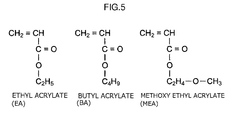
- FIG. 5 illustrates the chemical structures of ethyl acrylate (EA), butyl acrylate (BA), and methoxy ethyl acrylate (MEA) of the backbone monomer 21 of the ACM 20.
- EA ethyl acrylate
- BA butyl acrylate
- MEA methoxy ethyl acrylate
- the backbone monomer 21 contains a main chain 25, a side-chain ester structure (polar side chain) 26, and a side-chain alkyl group 27.
- the main chain 25 is related to heat resistance.
- the side-chain ester structure 26 and the side-chain alkyl group 27 are related to oil resistance, low-temperature resistance, and heat resistance.
- the backbone monomer 21 of the ACM 20 is formed of at least one of EA, BA, and MEA.
- Basic property of the ACM 20 is determined based on EA, BA, MEA, and the combination thereof.
- Table 1 indicates environment resistance, more specifically, low-temperature resistance, oil resistance, and heat resistance of backbone monomers of commonly-used AEM and ACM.
- Table 2 indicates properties, more specifically, heat resistance, compression set resistance, and processability of crosslinking monomers of commonly-used AEM and ACM.
- the oil resistance of the ACM containing BA is poor, but the oil resistance of the ACM containing MEA is excellent.
- the heat resistance and the compression set resistance of the ACM containing the carboxyl-based crosslinking monomer are excellent.
- the heat resistance of the AEM containing the carboxyl-based crosslinking monomer is excellent.
- the AEM 10 is prepared by copolymerizing the backbone monomer 11 and the crosslinking monomer 12 according to a known method such as emulsion polymerization, suspension polymerization, solution polymerization, or bulk polymerization.
- the ACM 20 is prepared by copolymerizing the backbone monomer 21 and the crosslinking monomer 22 according to a known method such as emulsion polymerization, suspension polymerization, solution polymerization, or bulk polymerization.
- the weight percent of the entirety of each of the backbone monomers 11, 21 is expressed by 100 wt%
- the weight percent of each of the crosslinking monomers 12, 22 is 1 wt% to 5 wt%.
- a reinforcing material such as carbon black or silica and a solid lubricant such as graphite, PTFE, or molybdenum disulfide are added to the AEM 10 and the ACM 20, depending on required properties.
- a single kind or two or more kinds of reinforcing material, and a single kind or two or more kinds of solid lubricant are added to the AEM 10 and the ACM 20 depending on the required properties.
- the reinforcing material is added to the AEM 10 and the ACM 20 in order mainly to improve the reinforcing property.
- the weight percent of the added reinforcing material is preferably 60 wt% to 80 wt%. This is because, it is not preferable that the weight percent of the added reinforcing material be less than 60 wt% because the reinforcing effect is low, and it is also not preferable that the weight percent of the added reinforcing material be more than 80 wt% because the flexibility of each of the AEM 10 and the ACM 20 is decreased and thus each of the AEM 10 and the ACM 20 becomes hard and brittle.
- the solid lubricant is added to the AEM 10 and the ACM 20 in order mainly to improve wear resistance.
- the weight percent of the added solid lubricant is preferably 10 wt% to 20 wt%. This is because, it is not preferable that the weight percent of the added solid lubricant be less than 10 wt% because the lubricating effect is low, and it is also not preferable that the weight percent of the added solid lubricant be more than 20 wt% because each of the AEM 10 and the ACM 20 becomes hard and brittle.
- the following materials are optionally added to the ACM 20 as needed: acetylene black, attapulgite, alumina, kaolin clay, glass fiber, glass beads, glass flake, calcium silicate (wollastonite), calcium silicate (xonotlite), calcium silicate (synthetic, amorphous), zirconium silicate, zinc oxide whisker, zeolite, sepiolite, selenite, talc, magnesium carbonate, potassium titanate, barium titanate, feldspar powder, hydrotalcite, pyrophyllite (agalmatolite clay), furnace black, bentonite, aluminum borate, mica (phlogopite), mica (muscovite), magnesium sulfate (MOS-HIGE), calcium sulfite, basic magnesium carbonate, silica stone powder, diatomaceous earth, synthetic silica (dry), synthetic silica (wet), graphite powder, antimony trioxide,
- the kind and the addition amount of each of the reinforcing material, the solid lubricant, and the like that are added to the AEM 10 and the ACM 20 may vary depending on required properties.
- the AEM 10 and the ACM 20 are separately kneaded. Specifically, each of the AEM 10 and the ACM 20 is kneaded with the use of a kneader such as Intermix, a pressure kneader, or a closed Banbury mixer, or an open roll, or the like.
- a kneader such as Intermix, a pressure kneader, or a closed Banbury mixer, or an open roll, or the like.
- FIG. 6A and FIG. 6B are views each illustrating a process of manufacturing the sheet 30.
- the AEM 10 and the ACM 20, which have been separately kneaded, are combined together, and the combined AEM 10 and ACM 20 are rolled by passing between rollers 51, 52.
- the sheet 30 in which the AEM 10 and the ACM 20 are fitted together under pressure is prepared.
- the sheet 30 is placed inside dies 53, 54 and is heated to 170°C to 180°C while being pressed such that the AEM 10 and the ACM 20 are fixed to each other.
- the AEM 10 and the ACM 20 are integrally bonded together, and the sheet 30 formed of an acrylic rubber composition is manufactured.
- Table 3 illustrates a composition and evaluation results of properties regarding each of Examples 1 to 8 that vary in the kinds and combination of the backbone monomer 21 and the crosslinking monomer 22 of the ACM 20 of the sheet 30.
- the backbone monomer 11 of the AEM 10 is formed of EMA, and the crosslinking monomer 12 has a carboxyl group.
- the weight percent of the entirety of the sheet 30 is expressed by 100 wt%
- the weight percent of each of the AEM 10 and the ACM 20 is 40 wt% to 60 wt%, and is preferably substantially 50 wt%.
- the backbone monomer 21 of the ACM 20 is EA.
- the crosslinking monomer 22 of the ACM 20 has a carboxyl group.
- the backbone monomer 21 of the ACM 20 is a mixture of EA and BA.
- the weight percent of each of EA and BA is 40 wt% to 60 wt%, and is preferably substantially 50 wt%.
- the crosslinking monomer 22 of the ACM 20 has a carboxyl group.
- the backbone monomer 21 of the ACM 20 is a mixture of EA, BA, and MEA.
- the weight percent of each of EA, BA, and MEA is 20 wt% to 40 wt%, and is preferably approximately 33 wt%.
- the crosslinking monomer 22 of the ACM 20 has a carboxyl group.
- the backbone monomer 21 of the ACM 20 is a mixture of BA and MEA.
- the weight percent of each of BA and MEA is 40 wt% to 60 wt%, and is preferably approximately 50 wt%.
- the crosslinking monomer 22 of the ACM 20 has a carboxyl group.
- the backbone monomer 21 of the ACM 20 is EA.
- the crosslinking monomer 22 of the ACM 20 has an epoxy group.
- the heat resistance of the AEM 10 and the compression set resistance of the ACM 20 are excellent, and the oil resistance of the ACM 20 is good.
- the backbone monomer 21 of the ACM 20 is a mixture of EA, BA, and MEA.
- the weight percent of each of EA, BA, and MEA is 20 wt% to 40 wt%, and is preferably about 33 wt%.
- the crosslinking monomer 22 of the ACM 20 has an epoxy group.
- the heat resistance of the AEM 10 and the compression set resistance of the ACM 20 are excellent, and the oil resistance of the ACM 20 is good.
- the backbone monomer 21 of the ACM 20 is EA.
- the crosslinking monomer 22 of the ACM 20 has an active chlorine group.
- the backbone monomer 21 of the ACM 20 is a mixture of EA, BA, and MEA.
- the weight percent of each of EA, BA, and MEA is 20 wt% to 40 wt%, and is preferably about 33 wt%.
- the crosslinking monomer 22 of the ACM 20 has an active chlorine group.
- the heat resistance of the AEM 10 and the compression set resistance of the ACM 20 are excellent, and the oil resistance of the ACM 20 is slightly poor.
- the backbone monomer 11 of the AEM 10 is formed of EMA, and the crosslinking monomer 12 of the AEM 10 has a carboxyl group.
- the backbone monomer 21 of the ACM 20 is formed of at least one of EA, BA, and MEA.
- the crosslinking monomer 22 of the ACM 20 has a carboxyl group, an epoxy group, or an active chlorine group. Therefore, the heat resistance is improved by the AEM 10, and the oil resistance and compression set resistance are improved by the ACM 20. Thus, the heat resistance, the oil resistance, and the compression set resistance of the sheet 30 as a whole are improved.
- the backbone monomer 21 of the ACM 20 is EA, a mixture of BA and EA, a mixture of BA, EA, and MEA, or a mixture of BA and MEA.
- the crosslinking monomer 22 of the ACM 20 has a carboxyl group. Thus, especially, the oil resistance of the ACM 20 is further improved.
- each of the crosslinking monomers 12, 22 of the AEM 10 and the ACM 20 has a carboxyl group. Therefore, it is possible to use the same crosslinking agent and the same crosslinking accelerator for the AEM 10 and the ACM 20. Thus, it is possible to subject the AEM 10 and the ACM 20 to primarily vulcanization under the same molding conditions. As a result, the cycle time (process time) is reduced, and adverse effects caused by a change in the crosslinking agent are reduced. Further, the storage stability of the sheet 30 is improved, and the sheet 30 may be prepared in advance.
- the weight percent of the entirety of the backbone monomer 21 of the ACM 20 when the weight percent of the entirety of the backbone monomer 21 of the ACM 20 is expressed by 100 wt%, the weight percent of each of BA and EA is 40 wt% to 60 wt% or each of BA and MEA is 40 wt% to 60 wt%.
- the influence of the disadvantageous properties of BA or EA is reduced, and synergy between BA and EA is effectively produced.
- the influence of the disadvantageous properties of BA or MEA is reduced, and synergy between BA and MEA is effectively produced.
- the weight percent of the entirety of the backbone monomer 21 of the ACM 20 when the weight percent of the entirety of the backbone monomer 21 of the ACM 20 is expressed by 100 wt%, the weight percent of each of BA, EA, and MEA is 20 wt% to 40 wt%.
- the influence of the disadvantageous properties of BA, EA, or MEA is reduced, and synergy among BA, EA, and MEA is effectively produced.
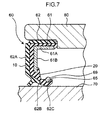
- FIG. 7 is a schematic sectional view illustrating a sealing device 60 including the sheet 30 and its surroundings.
- the sealing device 60 is disposed near one axial end-side opening between a shaft member 70, which may function as a sliding member, and a housing 80.
- the sealing device 60 seals the one axial end-side opening between the shaft member 70 and the housing 80.
- a space defined by the shaft member 70, the housing 80, and the sealing device 60 is filled with, for example, lubricating oil.
- the sealing device 60 includes an annular core member 61 and an elastic member 62.
- the core member 61 has a generally L-shaped section.
- the core member 61 has a tubular portion 61A and a radially-extending portion 61B.
- the tubular portion 61A extends generally along the axial direction.
- the tubular portion 61A is fixedly fitted to an inner peripheral face of the housing 80.
- the radially-extending portion 61B extends from one end of an inner peripheral face of the tubular portion 61A inward in the radial direction.
- the elastic member 62 has a base portion 62A and a lip portion 62B.
- the base portion 62A is fixed to the core member 61 so as to cover an outer peripheral face of the tubular portion 61A, an axially outer end face of the radially-extending portion 61B, a part of an axially inner end face of the radially-extending portion 61B, and a radially inner end face of the radially-extending portion 61 B.
- the elastic member 62 is an annular single-piece member made of the sheet 30.
- the ACM 20 of the sheet 30 is located on the sealing side, that is, the inner side in the axial direction.
- the inner side of the sheet 30 includes a protrusion 62C.
- the AEM 10 of the sheet 30 is located on the opposite side of the sheet 30 from the sealing side, that is, the outer side in the axial direction.
- the lip portion 62B has a generally tubular shape and protrudes in the axial direction from a radially inner end of the base portion 62A.
- An inner peripheral face of the lip portion 62B has an annular protrusion 62C that protrudes inward in the radial direction.
- the protrusion 62C is configured to slide on the shaft member 70.
- An outer peripheral face of the lip portion 62B has a spring fitting groove 65 formed at a portion overlapping with the protrusion 62C in the radial direction.
- a spring 69 is fitted into the spring fitting groove 65. The spring 69 presses the protrusion 62C toward the shaft member 70, thereby improving the sealing property of the sealing device 60.
- the ACM 20 of the sheet 30 is located on the sealing side, and the AEM 10 of the sheet 30 is located on the opposite side of the sheet 30 from the sealing side. Therefore, the oil resistance and compression set resistance, which are required for the sealing side where lubricating oil is sealed, are improved by the ACM 20. On the other hand, the heat resistance, which is required for the opposite side of the sheet 30 from the sealing side, is improved by the AEM 10. Thus, the heat resistance, the oil resistance, and the compression set resistance of the sealing device 60 as a whole are improved.
- the backbone monomer 21 of the ACM 20 is EA, a mixture of EA and BA, a mixture of EA, BA, and MEA, or a mixture of BA and MEA.
- the invention is not limited to this configuration.
- the backbone monomer of the ACM may be a mixture of EA and MEA.
- the weight percent of the entirety of the sheet 30 when the weight percent of the entirety of the sheet 30 is expressed by 100 wt%, the weight percent of each of the AEM 10 and the ACM 20 is 40 wt% to 60 wt%.
- the invention is not limited to this configuration.
- the weight percent of each of the AEM and the ACM may be 30 wt% to 70 wt%. In this case as well, synergy between the AEM and the ACM is effectively produced.
- the weight percent of the entirety of the backbone monomer 21 of the ACM 20 when the weight percent of each of BA and EA is 40 wt% to 60 wt% or the weight percent of each of BA and MEA is 40 wt% to 60 wt%.
- the invention is not limited to this configuration.
- the weight percent of each of BA and EA when the weight percent of the entirety of the backbone monomer of the ACM is expressed by 100 wt%, the weight percent of each of BA and EA may be 30 wt% to 70 wt% or the weight percent of each of BA and MEA may be 30 wt% to 70 wt%. In this case as well, synergy between BA and EA or synergy between BA and MEA is effectively produced.
- the weight percent of the entirety of the backbone monomer 21 of the ACM 20 when the weight percent of the entirety of the backbone monomer 21 of the ACM 20 is expressed by 100 wt%, the weight percent of each of EA, BA, and MEA is 20 wt% to 40 wt%.
- the invention is not limited to this configuration.
- the weight percent of each of BA, EA, and MEA may be 10 wt% to 50 wt%. In this case as well, synergy among BA, EA, and MEA is effectively produced.
- the sealing device 60 is disposed between the shaft member 70 and the housing 80.
- the sealing device according to the invention may be used in a member, such as a rolling bearing or a transmission, which is disposed in a usage environment of 170°C or lower and is required to have sufficient heat resistance, oil resistance, compression set resistance, and wear resistance.
- the core member 61 of the sealing device 60 is fixed to the housing 80.
- the core member may be fixed to the outer peripheral face of the shaft member.
- the sealing device may be attached to a rolling bearing and the core member may be fixed to an outer ring, an inner ring, or an intermediate ring of the rolling bearing.
- the core member 61 of the sealing device 60 has the tubular portion 61A and the radially-extending portion 61B.
- the core member need not have the tubular portion.
- the sealing device 60 includes the spring 69.
- the sealing device need not include the spring or a sealing device in another form may be provided.
- the first polymer and the second polymer are integrally bonded together. Therefore, the heat resistance, oil resistance, and compression set resistance are improved by the first polymer and the second polymer.
Landscapes
- Chemical & Material Sciences (AREA)
- Health & Medical Sciences (AREA)
- Chemical Kinetics & Catalysis (AREA)
- Medicinal Chemistry (AREA)
- Polymers & Plastics (AREA)
- Organic Chemistry (AREA)
- Engineering & Computer Science (AREA)
- General Engineering & Computer Science (AREA)
- Mechanical Engineering (AREA)
- Compositions Of Macromolecular Compounds (AREA)
- Sealing Material Composition (AREA)
- Sealing With Elastic Sealing Lips (AREA)
- Sealing Devices (AREA)
Abstract
Description
- The invention relates to an acrylic rubber composition and a sealing device including the acrylic rubber composition.
- Japanese Patent Application Publication No.
2010-90351 JP 2010-90351 A - The acrylic rubber composition contains a backbone monomer and a crosslinking monomer. The material properties of the acrylic rubber composition may be varied by changing the kinds and combinations of a backbone monomer and a crosslinking monomer. Note that, a material that satisfies all the requirements for, for example, an oil seal, such as heat resistance, oil resistance, and compression set resistance is not known. Therefore, for example, an attempt to blend a polymer such as fluororubber, which is different from acrylic rubber, with acrylic rubber has been made to impart heat resistance to the acrylic rubber.
- However, the acrylic rubber and a polymer such as fluororubber, which is different from the acrylic rubber, are different in kind of an additive and molding conditions for a crosslinking reaction. Thus, a method for preparing a good product is not currently known.
- When two or more kinds of polymers are blended to prepare an acrylic rubber composition, the acrylic rubber composition is likely to be strongly affected by disadvantageous properties of any one of the blended polymers. However, a method of effectively creating synergy is not currently known.
- One object of the invention is to provide an acrylic rubber composition with improved heat resistance, oil resistance and compression set resistance, and to provide a sealing device including the acrylic rubber composition.
- An aspect of the invention relates to an acrylic rubber composition including: a first polymer containing a backbone monomer formed of ethylene methyl acrylate, and a crosslinking monomer having a carboxyl group; and a second polymer containing a backbone monomer formed of at least one of ethyl acrylate, butyl acrylate, and methoxy ethyl acrylate, and a crosslinking monomer having a carboxyl group, an epoxy group, or an active chlorine group. The first polymer and the second polymer are integrally bonded together.
- The foregoing and further features and advantages of the invention will become apparent from the following description of example embodiments with reference to the accompanying drawings, wherein like numerals are used to represent like elements and wherein:
-
FIG. 1 is a schematic diagram illustrating an acrylic rubber composition according to an embodiment of the invention; -
FIG. 2 is a view illustrating the chemical structure of AEM of the acrylic rubber composition; -
FIG. 3 is a view illustrating the chemical structure of ACM of the acrylic rubber composition; -
FIG. 4 is a view illustrating the chemical structure of a backbone monomer of the ACM; -
FIG. 5 is a view illustrating the chemical structures of three kinds of backbone monomers of the ACM; -
FIG. 6A is a view illustrating a process of manufacturing the acrylic rubber composition; -
FIG. 6B is a view illustrating a process of manufacturing the acrylic rubber composition; and -
FIG. 7 is a schematic sectional view illustrating a sealing device including the acrylic rubber composition and its surroundings. - Hereinafter, example embodiments of the invention will be described in detail with reference to the accompanying drawings.
-
FIG. 1 is a schematic diagram illustrating an acrylic rubber composition according to an embodiment of the invention. - In the acrylic rubber composition, ethylene acrylate rubber (AEM) 10, which is an example of a first polymer, and acrylic rubber (ACM) 20, which is an example of a second polymer, are integrally bonded together. The AEM 10 and the ACM 20 constitute a
sheet 30 which is in the form of a flat plate. -
FIG. 2 illustrates the chemical structure of theAEM 10. - As illustrated in
FIG. 2 , the AEM 10 contains abackbone monomer 11 and acrosslinking monomer 12. Thebackbone monomer 11 is formed of ethylene methyl acrylate (EMA) containing ethylene and methyl acrylate. Thecrosslinking monomer 12 has a carboxyl group. -
FIG. 3 illustrates the chemical structure of the ACM 20. - As illustrated in
FIG. 3 , the ACM 20 contains abackbone monomer 21 and acrosslinking monomer 22. Thebackbone monomer 21 is formed of at least one of ethyl acrylate (EA), butyl acrylate (BA), and methoxy ethyl acrylate (MEA). Thecrosslinking monomer 22 has a carboxyl group. Thecrosslinking monomer 22 may have an epoxy group or an active chlorine group instead of the carboxyl group. - Examples of each of the
crosslinking monomers - Examples of the
crosslinking monomer 22 having an epoxy group include glycidyl acrylate, glycidyl methacrylate, allyl glycidyl ether, and methallyl glycidyl ether. - Examples of the
crosslinking monomer 22 having an active chlorine group include 2-chloroethyl vinyl ether, 2-chloroethyl acrylate, vinylbenzyl chloride, vinyl chloroacetate, and allyl chloroacetate. -
FIG. 4 illustrates the chemical structure of thebackbone monomer 21 of the ACM 20.FIG. 5 illustrates the chemical structures of ethyl acrylate (EA), butyl acrylate (BA), and methoxy ethyl acrylate (MEA) of thebackbone monomer 21 of the ACM 20. - As illustrated in
FIG. 4 , thebackbone monomer 21 contains amain chain 25, a side-chain ester structure (polar side chain) 26, and a side-chain alkyl group 27. Themain chain 25 is related to heat resistance. The side-chain ester structure 26 and the side-chain alkyl group 27 are related to oil resistance, low-temperature resistance, and heat resistance. - The
backbone monomer 21 of the ACM 20 is formed of at least one of EA, BA, and MEA. Basic property of the ACM 20 is determined based on EA, BA, MEA, and the combination thereof. - Table 1 indicates environment resistance, more specifically, low-temperature resistance, oil resistance, and heat resistance of backbone monomers of commonly-used AEM and ACM. Table 2 indicates properties, more specifically, heat resistance, compression set resistance, and processability of crosslinking monomers of commonly-used AEM and ACM.
- In Tables 1, 2, "A" indicates that the property is excellent, "B" indicates that the property is good, "C" indicates that the property is slightly poor, and "D" indicates that the property is poor.
Table 1 Polymer Kind of Backbone Monomer Environment Resistance Low-temperature resistance Oil Resistance Heat Resistance ACM Ethyl Acrylate (EA) D B B Butyl Acrylate (BA) A D C Methoxy Ethyl Acrylate (MEA) B A D AEM Ethylene Methyl Acrylate (EMA) C C A Table 2 Polymer Kind of Crosslinking Monomer Heat Resistance Compression Set Resistance Processability ACM Epoxy-Based D C B Active Chlorine-Based C D C Carboxyl-Based A A C AEM Carboxyl-Based A B C Peroxide-Crosslinked B B A - As indicated in Tables 1, 2, the properties vary greatly depending on the kinds of the backbone monomer and the crosslinking monomer.
- For example, as indicated in Table 1, the oil resistance of the ACM containing BA is poor, but the oil resistance of the ACM containing MEA is excellent.
- As indicated in Table 2, the heat resistance and the compression set resistance of the ACM containing the carboxyl-based crosslinking monomer are excellent. The heat resistance of the AEM containing the carboxyl-based crosslinking monomer is excellent.
- Next, a method of preparing the
sheet 30 will be described. - The
AEM 10 is prepared by copolymerizing thebackbone monomer 11 and thecrosslinking monomer 12 according to a known method such as emulsion polymerization, suspension polymerization, solution polymerization, or bulk polymerization. In addition, theACM 20 is prepared by copolymerizing thebackbone monomer 21 and thecrosslinking monomer 22 according to a known method such as emulsion polymerization, suspension polymerization, solution polymerization, or bulk polymerization. In this case, when the weight percent of the entirety of each of thebackbone monomers crosslinking monomers - A reinforcing material such as carbon black or silica and a solid lubricant such as graphite, PTFE, or molybdenum disulfide are added to the
AEM 10 and theACM 20, depending on required properties. In this case, a single kind or two or more kinds of reinforcing material, and a single kind or two or more kinds of solid lubricant are added to theAEM 10 and theACM 20 depending on the required properties. - The reinforcing material is added to the
AEM 10 and theACM 20 in order mainly to improve the reinforcing property. When the weight percent of the entirety of each of theAEM 10 and theACM 20 is expressed by 100 wt%, the weight percent of the added reinforcing material is preferably 60 wt% to 80 wt%. This is because, it is not preferable that the weight percent of the added reinforcing material be less than 60 wt% because the reinforcing effect is low, and it is also not preferable that the weight percent of the added reinforcing material be more than 80 wt% because the flexibility of each of theAEM 10 and theACM 20 is decreased and thus each of theAEM 10 and theACM 20 becomes hard and brittle. - The solid lubricant is added to the
AEM 10 and theACM 20 in order mainly to improve wear resistance. When the weight percent of the entirety of each of theAEM 10 and theACM 20 is expressed by 100 wt%, the weight percent of the added solid lubricant is preferably 10 wt% to 20 wt%. This is because, it is not preferable that the weight percent of the added solid lubricant be less than 10 wt% because the lubricating effect is low, and it is also not preferable that the weight percent of the added solid lubricant be more than 20 wt% because each of theAEM 10 and theACM 20 becomes hard and brittle. - In addition to the above-described additives, for example, the following materials are optionally added to the ACM 20 as needed: acetylene black, attapulgite, alumina, kaolin clay, glass fiber, glass beads, glass flake, calcium silicate (wollastonite), calcium silicate (xonotlite), calcium silicate (synthetic, amorphous), zirconium silicate, zinc oxide whisker, zeolite, sepiolite, selenite, talc, magnesium carbonate, potassium titanate, barium titanate, feldspar powder, hydrotalcite, pyrophyllite (agalmatolite clay), furnace black, bentonite, aluminum borate, mica (phlogopite), mica (muscovite), magnesium sulfate (MOS-HIGE), calcium sulfite, basic magnesium carbonate, silica stone powder, diatomaceous earth, synthetic silica (dry), synthetic silica (wet), graphite powder, antimony trioxide, zirconium oxide, titanium oxide (anatase), titanium oxide (rutile), magnesium oxide, zinc oxide (dry), zinc oxide (wet), iron oxide, aluminum hydroxide, magnesium hydroxide, silicon carbide, calcium carbonate (colloid), calcium carbonate (chalk), calcium carbonate (heavy), calcium carbonate (light), barium carbonate, carbon fiber, silicon nitride, calcium sulfate (anhydrous), barium sulfate (barite), and barium sulfate (sedimentary).
- The kind and the addition amount of each of the reinforcing material, the solid lubricant, and the like that are added to the
AEM 10 and theACM 20 may vary depending on required properties. - The
AEM 10 and theACM 20 are separately kneaded. Specifically, each of theAEM 10 and theACM 20 is kneaded with the use of a kneader such as Intermix, a pressure kneader, or a closed Banbury mixer, or an open roll, or the like. -
FIG. 6A and FIG. 6B are views each illustrating a process of manufacturing thesheet 30. - As illustrated in
FIG. 6A , theAEM 10 and theACM 20, which have been separately kneaded, are combined together, and the combinedAEM 10 andACM 20 are rolled by passing betweenrollers sheet 30 in which theAEM 10 and theACM 20 are fitted together under pressure is prepared. - Next, as illustrated in
FIG. 6B , thesheet 30 is placed inside dies 53, 54 and is heated to 170°C to 180°C while being pressed such that theAEM 10 and theACM 20 are fixed to each other. As a result, theAEM 10 and theACM 20 are integrally bonded together, and thesheet 30 formed of an acrylic rubber composition is manufactured. - Table 3 illustrates a composition and evaluation results of properties regarding each of Examples 1 to 8 that vary in the kinds and combination of the
backbone monomer 21 and thecrosslinking monomer 22 of theACM 20 of thesheet 30. - In the
sheet 30 in each of Examples 1 to 8, thebackbone monomer 11 of theAEM 10 is formed of EMA, and thecrosslinking monomer 12 has a carboxyl group. When the weight percent of the entirety of thesheet 30 is expressed by 100 wt%, the weight percent of each of theAEM 10 and theACM 20 is 40 wt% to 60 wt%, and is preferably substantially 50 wt%. - In Table 3, "A" indicates that the property is excellent, "B" indicates that the property is good, and "C" indicates that the property is slightly poor. In Table 3, "S" indicates that the substance is contained, and "-" indicates that the substance is not contained.
Table 3 Polymer Backbone Monomer Crosslinking Monomer Heat Resistance Oil Resistance Compression Set Resistance AEM ACM AEM ACM AEM ACM EMA EA BA MEA Carboxyl-Based Carboxyl-Based Epoxy-Based Active Chlorine-Based Example 1 S S - - S S - - A A A Example 2 S S S - S S - - A A A Example 3 S S S S S S - - A A A Example 4 S - S S S S - - A A A Example 5 S S - - S - S - A B A Example 6 S S S S S - S - A B A Example 7 S S - - S - - S A C A Example 8 S S S S S - - S A C A - In the
sheet 30 in Example 1, thebackbone monomer 21 of theACM 20 is EA. Thecrosslinking monomer 22 of theACM 20 has a carboxyl group. - In the
sheet 30 in Example 1, the heat resistance of theAEM 10 and the oil resistance and the compression set resistance of theACM 20 are excellent. - In the
sheet 30 in Example 2, thebackbone monomer 21 of theACM 20 is a mixture of EA and BA. When the weight percent of the entirety of thebackbone monomer 21 is expressed by 100 wt%, the weight percent of each of EA and BA is 40 wt% to 60 wt%, and is preferably substantially 50 wt%. Thecrosslinking monomer 22 of theACM 20 has a carboxyl group. - In the
sheet 30 in Example 2, the heat resistance of theAEM 10 and the oil resistance and the compression set resistance of theACM 20 are excellent. - In the
sheet 30 in Example 3, thebackbone monomer 21 of theACM 20 is a mixture of EA, BA, and MEA. When the weight percent of the entirety of thebackbone monomer 21 is expressed by 100 wt%, the weight percent of each of EA, BA, and MEA is 20 wt% to 40 wt%, and is preferably approximately 33 wt%. Thecrosslinking monomer 22 of theACM 20 has a carboxyl group. - In the
sheet 30 in Example 3, the heat resistance of theAEM 10 and the oil resistance and the compression set resistance of theACM 20 are excellent. - In the
sheet 30 in Example 4, thebackbone monomer 21 of theACM 20 is a mixture of BA and MEA. When the weight percent of the entirety of thebackbone monomer 21 is expressed by 100 wt%, the weight percent of each of BA and MEA is 40 wt% to 60 wt%, and is preferably approximately 50 wt%. Thecrosslinking monomer 22 of theACM 20 has a carboxyl group. - In the
sheet 30 in Example 4, the heat resistance of theAEM 10 and the oil resistance and the compression set resistance of theACM 20 are excellent. - In the
sheet 30 in Example 5, thebackbone monomer 21 of theACM 20 is EA. Thecrosslinking monomer 22 of theACM 20 has an epoxy group. - In the
sheet 30 in Example 5, the heat resistance of theAEM 10 and the compression set resistance of theACM 20 are excellent, and the oil resistance of theACM 20 is good. - In the
sheet 30 in Example 6, thebackbone monomer 21 of theACM 20 is a mixture of EA, BA, and MEA. When the weight percent of the entirety of thebackbone monomer 21 is expressed by 100 wt%, the weight percent of each of EA, BA, and MEA is 20 wt% to 40 wt%, and is preferably about 33 wt%. Thecrosslinking monomer 22 of theACM 20 has an epoxy group. - In the
sheet 30 in Example 6, the heat resistance of theAEM 10 and the compression set resistance of theACM 20 are excellent, and the oil resistance of theACM 20 is good. - In the
sheet 30 in Example 7, thebackbone monomer 21 of theACM 20 is EA. Thecrosslinking monomer 22 of theACM 20 has an active chlorine group. - In the
sheet 30 in Example 7, the heat resistance of theAEM 10 and the compression set resistance of theACM 20 are excellent, and the oil resistance of theACM 20 is slightly poor. - In the
sheet 30 in Example 8, thebackbone monomer 21 of theACM 20 is a mixture of EA, BA, and MEA. When the weight percent of the entirety of thebackbone monomer 21 is expressed by 100 wt%, the weight percent of each of EA, BA, and MEA is 20 wt% to 40 wt%, and is preferably about 33 wt%. Thecrosslinking monomer 22 of theACM 20 has an active chlorine group. - In the
sheet 30 in Example 8, the heat resistance of theAEM 10 and the compression set resistance of theACM 20 are excellent, and the oil resistance of theACM 20 is slightly poor. - In the
sheet 30 in the above-described embodiment, thebackbone monomer 11 of theAEM 10 is formed of EMA, and thecrosslinking monomer 12 of theAEM 10 has a carboxyl group. In addition, thebackbone monomer 21 of theACM 20 is formed of at least one of EA, BA, and MEA. Thecrosslinking monomer 22 of theACM 20 has a carboxyl group, an epoxy group, or an active chlorine group. Therefore, the heat resistance is improved by theAEM 10, and the oil resistance and compression set resistance are improved by theACM 20. Thus, the heat resistance, the oil resistance, and the compression set resistance of thesheet 30 as a whole are improved. - In the
sheet 30 in the above-described embodiment, thebackbone monomer 21 of theACM 20 is EA, a mixture of BA and EA, a mixture of BA, EA, and MEA, or a mixture of BA and MEA. In addition, thecrosslinking monomer 22 of theACM 20 has a carboxyl group. Thus, especially, the oil resistance of theACM 20 is further improved. - In the
sheet 30 in the above-described embodiment, each of thecrosslinking monomers AEM 10 and theACM 20 has a carboxyl group. Therefore, it is possible to use the same crosslinking agent and the same crosslinking accelerator for theAEM 10 and theACM 20. Thus, it is possible to subject theAEM 10 and theACM 20 to primarily vulcanization under the same molding conditions. As a result, the cycle time (process time) is reduced, and adverse effects caused by a change in the crosslinking agent are reduced. Further, the storage stability of thesheet 30 is improved, and thesheet 30 may be prepared in advance. - In the
sheet 30 in the above-described embodiment, when the weight percent of the entirety of thebackbone monomer 21 of theACM 20 is expressed by 100 wt%, the weight percent of each of BA and EA is 40 wt% to 60 wt% or each of BA and MEA is 40 wt% to 60 wt%. Thus, the influence of the disadvantageous properties of BA or EA is reduced, and synergy between BA and EA is effectively produced. In addition, the influence of the disadvantageous properties of BA or MEA is reduced, and synergy between BA and MEA is effectively produced. - In the
sheet 30 in the above-described embodiment, when the weight percent of the entirety of thebackbone monomer 21 of theACM 20 is expressed by 100 wt%, the weight percent of each of BA, EA, and MEA is 20 wt% to 40 wt%. Thus, the influence of the disadvantageous properties of BA, EA, or MEA is reduced, and synergy among BA, EA, and MEA is effectively produced. -
FIG. 7 is a schematic sectional view illustrating asealing device 60 including thesheet 30 and its surroundings. - As illustrated in
FIG. 7 , the sealingdevice 60 is disposed near one axial end-side opening between ashaft member 70, which may function as a sliding member, and ahousing 80. The sealingdevice 60 seals the one axial end-side opening between theshaft member 70 and thehousing 80. A space defined by theshaft member 70, thehousing 80, and the sealingdevice 60 is filled with, for example, lubricating oil. - The sealing
device 60 includes anannular core member 61 and anelastic member 62. - The
core member 61 has a generally L-shaped section. Thecore member 61 has atubular portion 61A and a radially-extendingportion 61B. Thetubular portion 61A extends generally along the axial direction. Thetubular portion 61A is fixedly fitted to an inner peripheral face of thehousing 80. The radially-extendingportion 61B extends from one end of an inner peripheral face of thetubular portion 61A inward in the radial direction. - The
elastic member 62 has abase portion 62A and alip portion 62B. Thebase portion 62A is fixed to thecore member 61 so as to cover an outer peripheral face of thetubular portion 61A, an axially outer end face of the radially-extendingportion 61B, a part of an axially inner end face of the radially-extendingportion 61B, and a radially inner end face of the radially-extendingportion 61 B. Theelastic member 62 is an annular single-piece member made of thesheet 30. TheACM 20 of thesheet 30 is located on the sealing side, that is, the inner side in the axial direction. The inner side of thesheet 30 includes aprotrusion 62C. On the other hand, theAEM 10 of thesheet 30 is located on the opposite side of thesheet 30 from the sealing side, that is, the outer side in the axial direction. - The
lip portion 62B has a generally tubular shape and protrudes in the axial direction from a radially inner end of thebase portion 62A. An inner peripheral face of thelip portion 62B has anannular protrusion 62C that protrudes inward in the radial direction. Theprotrusion 62C is configured to slide on theshaft member 70. An outer peripheral face of thelip portion 62B has aspring fitting groove 65 formed at a portion overlapping with theprotrusion 62C in the radial direction. Aspring 69 is fitted into thespring fitting groove 65. Thespring 69 presses theprotrusion 62C toward theshaft member 70, thereby improving the sealing property of the sealingdevice 60. - In the
sealing device 60 of the above-described embodiment, theACM 20 of thesheet 30 is located on the sealing side, and theAEM 10 of thesheet 30 is located on the opposite side of thesheet 30 from the sealing side. Therefore, the oil resistance and compression set resistance, which are required for the sealing side where lubricating oil is sealed, are improved by theACM 20. On the other hand, the heat resistance, which is required for the opposite side of thesheet 30 from the sealing side, is improved by theAEM 10. Thus, the heat resistance, the oil resistance, and the compression set resistance of the sealingdevice 60 as a whole are improved. - In the above-described embodiment, the
backbone monomer 21 of theACM 20 is EA, a mixture of EA and BA, a mixture of EA, BA, and MEA, or a mixture of BA and MEA. However, the invention is not limited to this configuration. For example, the backbone monomer of the ACM may be a mixture of EA and MEA. - In the above-described embodiment, when the weight percent of the entirety of the
sheet 30 is expressed by 100 wt%, the weight percent of each of theAEM 10 and theACM 20 is 40 wt% to 60 wt%. However, the invention is not limited to this configuration. For example, when the weight percent of the entirety of the sheet is expressed by 100 wt%, the weight percent of each of the AEM and the ACM may be 30 wt% to 70 wt%. In this case as well, synergy between the AEM and the ACM is effectively produced. - In the above-described embodiment, when the weight percent of the entirety of the
backbone monomer 21 of theACM 20 is expressed by 100 wt%, the weight percent of each of BA and EA is 40 wt% to 60 wt% or the weight percent of each of BA and MEA is 40 wt% to 60 wt%. However, the invention is not limited to this configuration. For example, when the weight percent of the entirety of the backbone monomer of the ACM is expressed by 100 wt%, the weight percent of each of BA and EA may be 30 wt% to 70 wt% or the weight percent of each of BA and MEA may be 30 wt% to 70 wt%. In this case as well, synergy between BA and EA or synergy between BA and MEA is effectively produced. - In the above-described embodiment, when the weight percent of the entirety of the
backbone monomer 21 of theACM 20 is expressed by 100 wt%, the weight percent of each of EA, BA, and MEA is 20 wt% to 40 wt%. However, the invention is not limited to this configuration. For example, when the weight percent of the entirety of the backbone monomer of the ACM is expressed by 100 wt%, the weight percent of each of BA, EA, and MEA may be 10 wt% to 50 wt%. In this case as well, synergy among BA, EA, and MEA is effectively produced. - In the above-described embodiment, the sealing
device 60 is disposed between theshaft member 70 and thehousing 80. However, the sealing device according to the invention may be used in a member, such as a rolling bearing or a transmission, which is disposed in a usage environment of 170°C or lower and is required to have sufficient heat resistance, oil resistance, compression set resistance, and wear resistance. - In addition, in the above-described embodiment, the
core member 61 of the sealingdevice 60 is fixed to thehousing 80. However, in the invention, the core member may be fixed to the outer peripheral face of the shaft member. The sealing device may be attached to a rolling bearing and the core member may be fixed to an outer ring, an inner ring, or an intermediate ring of the rolling bearing. - In addition, in the above-described embodiment, the
core member 61 of the sealingdevice 60 has thetubular portion 61A and the radially-extendingportion 61B. However, in the invention, the core member need not have the tubular portion. - In the above-described embodiment, the sealing
device 60 includes thespring 69. However, in the invention, the sealing device need not include the spring or a sealing device in another form may be provided. - In the acrylic rubber composition and the sealing device according to the invention, the first polymer and the second polymer are integrally bonded together. Therefore, the heat resistance, oil resistance, and compression set resistance are improved by the first polymer and the second polymer.
Claims (5)
- An acrylic rubber composition comprising:a first polymer containing a backbone monomer formed of ethylene methyl acrylate, and a crosslinking monomer having a carboxyl group; anda second polymer containing a backbone monomer formed of at least one of ethyl acrylate, butyl acrylate, and methoxy ethyl acrylate, and a crosslinking monomer having a carboxyl group, an epoxy group, or an active chlorine group,the first polymer and the second polymer being integrally bonded together.
- The acrylic rubber composition according to claim 1, wherein:the backbone monomer of the second polymer is ethyl acrylate, a mixture of butyl acrylate and ethyl acrylate, a mixture of butyl acrylate, ethyl acrylate, and methoxy ethyl acrylate, or a mixture of butyl acrylate and methoxy ethyl acrylate; andthe crosslinking monomer of the second polymer has the carboxyl group.
- The acrylic rubber composition according to claim 2, wherein:the backbone monomer of the second polymer is a mixture of butyl acrylate and ethyl acrylate or a mixture of butyl acrylate and methoxy ethyl acrylate; andwhen a weight percent of an entirety of the backbone monomer of the second polymer is expressed by 100 wt%, a weight percent of each of butyl acrylate and ethyl acrylate is 40 wt% to 60 wt% or a weight percent of each of butyl acrylate and methoxy ethyl acrylate is 40 wt% to 60 wt%.
- The acrylic rubber composition according to claim 2, wherein:the backbone monomer of the second polymer is a mixture of butyl acrylate, ethyl acrylate, and methoxy ethyl acrylate; andwhen a weight percent of an entirety of the backbone monomer of the second polymer is expressed by 100 wt%, a weight percent of each of butyl acrylate, ethyl acrylate, and methoxy ethyl acrylate is 20 wt% to 40 wt%.
- A sealing device comprising:a core member; andan elastic member fixedly fitted to the core member, whereinthe elastic member hasa base portion fixed to the core member anda lip portion that extends from the base portion and slides on a sliding member, andthe elastic member is formed of the acrylic rubber composition according to any one of claims 1 to 4, andthe second polymer of the acrylic rubber composition is located on a sealing side, and the first polymer is located on an opposite side of the elastic member from the sealing side.
Applications Claiming Priority (1)
| Application Number | Priority Date | Filing Date | Title |
|---|---|---|---|
| JP2013162679A JP2015030818A (en) | 2013-08-05 | 2013-08-05 | Acrylic rubber composition and sealing device including the same |
Publications (1)
| Publication Number | Publication Date |
|---|---|
| EP2840114A1 true EP2840114A1 (en) | 2015-02-25 |
Family
ID=51263288
Family Applications (1)
| Application Number | Title | Priority Date | Filing Date |
|---|---|---|---|
| EP14179756.3A Withdrawn EP2840114A1 (en) | 2013-08-05 | 2014-08-04 | Acrylic Rubber Composition and Sealing Device including the same |
Country Status (4)
| Country | Link |
|---|---|
| US (1) | US20150035236A1 (en) |
| EP (1) | EP2840114A1 (en) |
| JP (1) | JP2015030818A (en) |
| CN (1) | CN104341701A (en) |
Families Citing this family (6)
| Publication number | Priority date | Publication date | Assignee | Title |
|---|---|---|---|---|
| JP6660541B2 (en) * | 2015-08-18 | 2020-03-11 | 株式会社ジェイテクト | Seal member |
| WO2019093081A1 (en) * | 2017-11-07 | 2019-05-16 | Nok株式会社 | Gasket material |
| CN108209427A (en) * | 2018-01-19 | 2018-06-29 | 永康市研坤工贸有限公司 | A kind of hydrogen-rich cup |
| CN111836174A (en) * | 2020-06-30 | 2020-10-27 | 歌尔股份有限公司 | Composite vibrating diaphragm, preparation method of composite vibrating diaphragm and sound production device |
| EP4190861A4 (en) * | 2020-07-27 | 2024-08-14 | NOK Corporation | ACRYLIC RUBBER COMPOSITION |
| DE102022131876A1 (en) * | 2022-12-01 | 2024-06-06 | BRUSS Sealing Systems GmbH | Radial shaft seal |
Citations (2)
| Publication number | Priority date | Publication date | Assignee | Title |
|---|---|---|---|---|
| US6005052A (en) * | 1996-07-26 | 1999-12-21 | Advanced Elastomer Systems, L.P. | Staged condensation, dynamic vulcanization process for making a substantially unplasticized plastic/rubber blend |
| JP2010090351A (en) | 2008-10-11 | 2010-04-22 | Nok Corp | Acrylic rubber composition and seal parts vulcanized and molded using same |
-
2013
- 2013-08-05 JP JP2013162679A patent/JP2015030818A/en active Pending
-
2014
- 2014-07-31 US US14/448,322 patent/US20150035236A1/en not_active Abandoned
- 2014-08-01 CN CN201410377371.1A patent/CN104341701A/en active Pending
- 2014-08-04 EP EP14179756.3A patent/EP2840114A1/en not_active Withdrawn
Patent Citations (2)
| Publication number | Priority date | Publication date | Assignee | Title |
|---|---|---|---|---|
| US6005052A (en) * | 1996-07-26 | 1999-12-21 | Advanced Elastomer Systems, L.P. | Staged condensation, dynamic vulcanization process for making a substantially unplasticized plastic/rubber blend |
| JP2010090351A (en) | 2008-10-11 | 2010-04-22 | Nok Corp | Acrylic rubber composition and seal parts vulcanized and molded using same |
Also Published As
| Publication number | Publication date |
|---|---|
| CN104341701A (en) | 2015-02-11 |
| US20150035236A1 (en) | 2015-02-05 |
| JP2015030818A (en) | 2015-02-16 |
Similar Documents
| Publication | Publication Date | Title |
|---|---|---|
| EP2840099A1 (en) | Acrylic Rubber Composition and Sealing Device including the same | |
| US20150035236A1 (en) | Acrylic rubber composition and sealing device including the same | |
| EP2644678A1 (en) | Seal member having excellent wear resistance, and seal structure using same | |
| JP5882685B2 (en) | Oil and slip resistant sole | |
| US9909001B2 (en) | Rubber composition and rubber product | |
| JP5904314B2 (en) | HNBR composition and cross-linked HNBR | |
| KR20150044842A (en) | Nbr composition | |
| KR20120001722A (en) | Rubber composition | |
| CN106832626A (en) | A kind of high durable type nitrile rubber/CSM composition | |
| JP3711098B2 (en) | Rubber composition | |
| JP6660541B2 (en) | Seal member | |
| JP2018080754A (en) | Gasket around engine and manufacturing method thereof | |
| JP2016060846A (en) | Rubber composition and slide member | |
| JP2019099799A (en) | Rubber composition | |
| KR101423490B1 (en) | Rubber composite for piston seal | |
| JP4602500B2 (en) | Halogen-containing rubber composition | |
| KR102261795B1 (en) | An ACM Compound For Seal Having Improved Wear Resistance | |
| JP2017057354A (en) | Rubber composition, rubber molding, and method for producing rubber molding | |
| JP2003226864A (en) | Rubber composition for sealing material | |
| JP7627581B2 (en) | Nitrile rubber composition, crosslinked nitrile rubber member, and sealing member | |
| JPH02206639A (en) | Fluororubber composition | |
| CN109890897A (en) | Beauty appliance composition | |
| JP2007031700A (en) | Halogen-containing elastomer vulcanizing composition | |
| JP2014015577A (en) | Elastic composition and molded article using the same | |
| JPH0985966A (en) | Plunger pump for ink recovery of ink jet recorder |
Legal Events
| Date | Code | Title | Description |
|---|---|---|---|
| PUAI | Public reference made under article 153(3) epc to a published international application that has entered the european phase |
Free format text: ORIGINAL CODE: 0009012 |
|
| 17P | Request for examination filed |
Effective date: 20140804 |
|
| AK | Designated contracting states |
Kind code of ref document: A1 Designated state(s): AL AT BE BG CH CY CZ DE DK EE ES FI FR GB GR HR HU IE IS IT LI LT LU LV MC MK MT NL NO PL PT RO RS SE SI SK SM TR |
|
| AX | Request for extension of the european patent |
Extension state: BA ME |
|
| R17P | Request for examination filed (corrected) |
Effective date: 20150824 |
|
| RBV | Designated contracting states (corrected) |
Designated state(s): AL AT BE BG CH CY CZ DE DK EE ES FI FR GB GR HR HU IE IS IT LI LT LU LV MC MK MT NL NO PL PT RO RS SE SI SK SM TR |
|
| 17Q | First examination report despatched |
Effective date: 20160104 |
|
| STAA | Information on the status of an ep patent application or granted ep patent |
Free format text: STATUS: THE APPLICATION IS DEEMED TO BE WITHDRAWN |
|
| 18D | Application deemed to be withdrawn |
Effective date: 20160518 |