EP2840083A1 - Nitrogenated bicyclic aromatic heterocyclic compound - Google Patents
Nitrogenated bicyclic aromatic heterocyclic compound Download PDFInfo
- Publication number
- EP2840083A1 EP2840083A1 EP13777902.1A EP13777902A EP2840083A1 EP 2840083 A1 EP2840083 A1 EP 2840083A1 EP 13777902 A EP13777902 A EP 13777902A EP 2840083 A1 EP2840083 A1 EP 2840083A1
- Authority
- EP
- European Patent Office
- Prior art keywords
- lower alkyl
- substituted
- esi
- compound
- salt
- Prior art date
- Legal status (The legal status is an assumption and is not a legal conclusion. Google has not performed a legal analysis and makes no representation as to the accuracy of the status listed.)
- Granted
Links
- 0 C*(C)C(CN1CCC(CCOc(cc2)c(C(F)(F)F)cc2-c2c3nc[n](C)c3nc(C#N)n2)CC1)=O Chemical compound C*(C)C(CN1CCC(CCOc(cc2)c(C(F)(F)F)cc2-c2c3nc[n](C)c3nc(C#N)n2)CC1)=O 0.000 description 1
- IDQTWFBCLGKPGA-UHFFFAOYSA-N CC(C)(C)OC(N(CC1)CCC1OCCOc(nc1)c(C(F)(F)F)cc1-c1c(cc[n]2C)c2nc(Cl)n1)=O Chemical compound CC(C)(C)OC(N(CC1)CCC1OCCOc(nc1)c(C(F)(F)F)cc1-c1c(cc[n]2C)c2nc(Cl)n1)=O IDQTWFBCLGKPGA-UHFFFAOYSA-N 0.000 description 1
- CPIVFNCVYATVPT-MRXNPFEDSA-N CC(C)(C)OC(N(CC1)C[C@@H]1OCCOc(c(C(F)(F)F)c1)ncc1-c1c(cc[n]2C)c2nc(C#N)n1)=O Chemical compound CC(C)(C)OC(N(CC1)C[C@@H]1OCCOc(c(C(F)(F)F)c1)ncc1-c1c(cc[n]2C)c2nc(C#N)n1)=O CPIVFNCVYATVPT-MRXNPFEDSA-N 0.000 description 1
- UVSKDYVJTKHHFJ-UHFFFAOYSA-N CC(C)(C)OC(N1CCC(CCOc(c(C(F)(F)F)c2)ccc2-c2c(cc[n]3CCOC)c3nc(Cl)n2)CC1)=O Chemical compound CC(C)(C)OC(N1CCC(CCOc(c(C(F)(F)F)c2)ccc2-c2c(cc[n]3CCOC)c3nc(Cl)n2)CC1)=O UVSKDYVJTKHHFJ-UHFFFAOYSA-N 0.000 description 1
- YULBJACQUJSILM-UHFFFAOYSA-N CC(C)(C)OC(N1CCC(CCOc(c(C(F)(F)F)c2)ccc2-c2c3nc[n](CC4COCC4)c3nc(C#N)n2)CC1)=O Chemical compound CC(C)(C)OC(N1CCC(CCOc(c(C(F)(F)F)c2)ccc2-c2c3nc[n](CC4COCC4)c3nc(C#N)n2)CC1)=O YULBJACQUJSILM-UHFFFAOYSA-N 0.000 description 1
- CKBDTJKLKZAGFF-UHFFFAOYSA-N CC(C)(C)OC(N1CCC(CCOc(cc2)c(C(F)(F)F)cc2-c2c(cc[n]3CC4OCCC4)c3nc(Cl)n2)CC1)=O Chemical compound CC(C)(C)OC(N1CCC(CCOc(cc2)c(C(F)(F)F)cc2-c2c(cc[n]3CC4OCCC4)c3nc(Cl)n2)CC1)=O CKBDTJKLKZAGFF-UHFFFAOYSA-N 0.000 description 1
- RRAZTZHMVFIQNG-UHFFFAOYSA-N CC(C)(C)OC(N1CCC(CCOc(nc2)c(C(F)(F)F)cc2-c2c(cc[n]3C)c3nc(C#N)n2)CC1)=O Chemical compound CC(C)(C)OC(N1CCC(CCOc(nc2)c(C(F)(F)F)cc2-c2c(cc[n]3C)c3nc(C#N)n2)CC1)=O RRAZTZHMVFIQNG-UHFFFAOYSA-N 0.000 description 1
- MWODLIIWBMMDLH-UHFFFAOYSA-N CC(C)(C)OC(N1CCC(COCc(c(C(F)(F)F)c2)ccc2Br)CC1)=O Chemical compound CC(C)(C)OC(N1CCC(COCc(c(C(F)(F)F)c2)ccc2Br)CC1)=O MWODLIIWBMMDLH-UHFFFAOYSA-N 0.000 description 1
- WMLYJJHAZMLCNK-UHFFFAOYSA-N CC(C)(C)OC(N1CCC(COc(nc2)c(C(F)(F)F)cc2-c2c(cc[n]3C)c3nc(C#N)n2)CC1)=O Chemical compound CC(C)(C)OC(N1CCC(COc(nc2)c(C(F)(F)F)cc2-c2c(cc[n]3C)c3nc(C#N)n2)CC1)=O WMLYJJHAZMLCNK-UHFFFAOYSA-N 0.000 description 1
- NQFGXCSYVWGZII-UHFFFAOYSA-N CCN1CCC(CCOc(c(C(F)(F)F)c2)ccc2-c2c(cc[n]3C4COC4)c3nc(C#N)n2)CC1 Chemical compound CCN1CCC(CCOc(c(C(F)(F)F)c2)ccc2-c2c(cc[n]3C4COC4)c3nc(C#N)n2)CC1 NQFGXCSYVWGZII-UHFFFAOYSA-N 0.000 description 1
- GLJDVDSDIOUXPV-UHFFFAOYSA-N CCOc(cc1)c(C(F)(F)F)cc1-c1c2nc[n](C)c2nc(Cl)n1 Chemical compound CCOc(cc1)c(C(F)(F)F)cc1-c1c2nc[n](C)c2nc(Cl)n1 GLJDVDSDIOUXPV-UHFFFAOYSA-N 0.000 description 1
- YMEFSIBNONWJMI-UHFFFAOYSA-N CN(CC1)CCC1NC(C[n]1c2nc(C#N)nc(-c(cc3)cc(C(F)(F)F)c3OCCC3CCOCC3)c2cc1)=O Chemical compound CN(CC1)CCC1NC(C[n]1c2nc(C#N)nc(-c(cc3)cc(C(F)(F)F)c3OCCC3CCOCC3)c2cc1)=O YMEFSIBNONWJMI-UHFFFAOYSA-N 0.000 description 1
- RQMRLYCFFRSQQD-AREMUKBSSA-N C[C@@]1(C(N2CCC(CCOc(nc3)c(C(F)(F)F)cc3-c3c4nc[n](C)c4nc(C#N)n3)CC2)=O)N(C)CCC1 Chemical compound C[C@@]1(C(N2CCC(CCOc(nc3)c(C(F)(F)F)cc3-c3c4nc[n](C)c4nc(C#N)n3)CC2)=O)N(C)CCC1 RQMRLYCFFRSQQD-AREMUKBSSA-N 0.000 description 1
- WWFWRFPLTOIESC-UHFFFAOYSA-N C[n]1c2nc(C#N)nc(-c(cc3)cc(C(F)(F)F)c3OCCC3CCN(CC#N)CC3)c2nc1 Chemical compound C[n]1c2nc(C#N)nc(-c(cc3)cc(C(F)(F)F)c3OCCC3CCN(CC#N)CC3)c2nc1 WWFWRFPLTOIESC-UHFFFAOYSA-N 0.000 description 1
- QZWSWCGQPLBACH-UHFFFAOYSA-N C[n]1c2nc(C#N)nc(-c(cc3C(F)(F)F)ccc3OCCC3CCNCC3)c2nc1 Chemical compound C[n]1c2nc(C#N)nc(-c(cc3C(F)(F)F)ccc3OCCC3CCNCC3)c2nc1 QZWSWCGQPLBACH-UHFFFAOYSA-N 0.000 description 1
- BTSNUMUCJGQURC-VWLOTQADSA-N C[n]1c2nc(C#N)nc(-c(cc3C(F)(F)F)cnc3OCC(CC3)CCN3C([C@H](CCC3)N3c3ccccc3)=O)c2cc1 Chemical compound C[n]1c2nc(C#N)nc(-c(cc3C(F)(F)F)cnc3OCC(CC3)CCN3C([C@H](CCC3)N3c3ccccc3)=O)c2cc1 BTSNUMUCJGQURC-VWLOTQADSA-N 0.000 description 1
- NMEUBAUFFGPYKF-UHFFFAOYSA-N C[n]1c2nc(C#N)nc(-c(cn3)cc(C(F)(F)F)c3OCC3CCNCC3)c2cc1 Chemical compound C[n]1c2nc(C#N)nc(-c(cn3)cc(C(F)(F)F)c3OCC3CCNCC3)c2cc1 NMEUBAUFFGPYKF-UHFFFAOYSA-N 0.000 description 1
- LIQBFHMJYCCQRY-UHFFFAOYSA-N C[n]1c2nc(Cl)nc(-c(cc3)cc(C(F)(F)F)c3F)c2cc1 Chemical compound C[n]1c2nc(Cl)nc(-c(cc3)cc(C(F)(F)F)c3F)c2cc1 LIQBFHMJYCCQRY-UHFFFAOYSA-N 0.000 description 1
- CNESPYAXZDEWJM-UHFFFAOYSA-N Clc1c2nc[n](CC3COCC3)c2nc(Cl)n1 Chemical compound Clc1c2nc[n](CC3COCC3)c2nc(Cl)n1 CNESPYAXZDEWJM-UHFFFAOYSA-N 0.000 description 1
- CXNUCFHQRLDIBT-UHFFFAOYSA-N N#Cc1cc(-c2c(cc[n]3CC4COCC4)c3nc(C#N)n2)ccc1OCCC1CCNCC1 Chemical compound N#Cc1cc(-c2c(cc[n]3CC4COCC4)c3nc(C#N)n2)ccc1OCCC1CCNCC1 CXNUCFHQRLDIBT-UHFFFAOYSA-N 0.000 description 1
- CIDFRZDOCHZQFA-UHFFFAOYSA-N N#Cc1nc(-c(cc2)cc(C(F)(F)F)c2OCC2CCNCC2)c(cc[n]2CC3COCC3)c2n1 Chemical compound N#Cc1nc(-c(cc2)cc(C(F)(F)F)c2OCC2CCNCC2)c(cc[n]2CC3COCC3)c2n1 CIDFRZDOCHZQFA-UHFFFAOYSA-N 0.000 description 1
- RBUOFMSYKXJJPC-UHFFFAOYSA-N N#Cc1nc(-c(cc2)cc(C(F)(F)F)c2OCCC2CCN(CCO)CC2)c(cc[n]2CC3COCC3)c2n1 Chemical compound N#Cc1nc(-c(cc2)cc(C(F)(F)F)c2OCCC2CCN(CCO)CC2)c(cc[n]2CC3COCC3)c2n1 RBUOFMSYKXJJPC-UHFFFAOYSA-N 0.000 description 1
Classifications
-
- A—HUMAN NECESSITIES
- A61—MEDICAL OR VETERINARY SCIENCE; HYGIENE
- A61K—PREPARATIONS FOR MEDICAL, DENTAL OR TOILETRY PURPOSES
- A61K31/00—Medicinal preparations containing organic active ingredients
- A61K31/33—Heterocyclic compounds
- A61K31/395—Heterocyclic compounds having nitrogen as a ring hetero atom, e.g. guanethidine or rifamycins
- A61K31/495—Heterocyclic compounds having nitrogen as a ring hetero atom, e.g. guanethidine or rifamycins having six-membered rings with two or more nitrogen atoms as the only ring heteroatoms, e.g. piperazine or tetrazines
- A61K31/505—Pyrimidines; Hydrogenated pyrimidines, e.g. trimethoprim
- A61K31/519—Pyrimidines; Hydrogenated pyrimidines, e.g. trimethoprim ortho- or peri-condensed with heterocyclic rings
-
- C—CHEMISTRY; METALLURGY
- C07—ORGANIC CHEMISTRY
- C07D—HETEROCYCLIC COMPOUNDS
- C07D487/00—Heterocyclic compounds containing nitrogen atoms as the only ring hetero atoms in the condensed system, not provided for by groups C07D451/00 - C07D477/00
- C07D487/02—Heterocyclic compounds containing nitrogen atoms as the only ring hetero atoms in the condensed system, not provided for by groups C07D451/00 - C07D477/00 in which the condensed system contains two hetero rings
- C07D487/04—Ortho-condensed systems
-
- A—HUMAN NECESSITIES
- A61—MEDICAL OR VETERINARY SCIENCE; HYGIENE
- A61K—PREPARATIONS FOR MEDICAL, DENTAL OR TOILETRY PURPOSES
- A61K31/00—Medicinal preparations containing organic active ingredients
- A61K31/33—Heterocyclic compounds
- A61K31/395—Heterocyclic compounds having nitrogen as a ring hetero atom, e.g. guanethidine or rifamycins
- A61K31/495—Heterocyclic compounds having nitrogen as a ring hetero atom, e.g. guanethidine or rifamycins having six-membered rings with two or more nitrogen atoms as the only ring heteroatoms, e.g. piperazine or tetrazines
- A61K31/505—Pyrimidines; Hydrogenated pyrimidines, e.g. trimethoprim
- A61K31/519—Pyrimidines; Hydrogenated pyrimidines, e.g. trimethoprim ortho- or peri-condensed with heterocyclic rings
- A61K31/52—Purines, e.g. adenine
-
- A—HUMAN NECESSITIES
- A61—MEDICAL OR VETERINARY SCIENCE; HYGIENE
- A61K—PREPARATIONS FOR MEDICAL, DENTAL OR TOILETRY PURPOSES
- A61K31/00—Medicinal preparations containing organic active ingredients
- A61K31/33—Heterocyclic compounds
- A61K31/395—Heterocyclic compounds having nitrogen as a ring hetero atom, e.g. guanethidine or rifamycins
- A61K31/535—Heterocyclic compounds having nitrogen as a ring hetero atom, e.g. guanethidine or rifamycins having six-membered rings with at least one nitrogen and one oxygen as the ring hetero atoms, e.g. 1,2-oxazines
- A61K31/5375—1,4-Oxazines, e.g. morpholine
- A61K31/5377—1,4-Oxazines, e.g. morpholine not condensed and containing further heterocyclic rings, e.g. timolol
-
- A—HUMAN NECESSITIES
- A61—MEDICAL OR VETERINARY SCIENCE; HYGIENE
- A61P—SPECIFIC THERAPEUTIC ACTIVITY OF CHEMICAL COMPOUNDS OR MEDICINAL PREPARATIONS
- A61P13/00—Drugs for disorders of the urinary system
- A61P13/12—Drugs for disorders of the urinary system of the kidneys
-
- A—HUMAN NECESSITIES
- A61—MEDICAL OR VETERINARY SCIENCE; HYGIENE
- A61P—SPECIFIC THERAPEUTIC ACTIVITY OF CHEMICAL COMPOUNDS OR MEDICINAL PREPARATIONS
- A61P37/00—Drugs for immunological or allergic disorders
- A61P37/02—Immunomodulators
-
- A—HUMAN NECESSITIES
- A61—MEDICAL OR VETERINARY SCIENCE; HYGIENE
- A61P—SPECIFIC THERAPEUTIC ACTIVITY OF CHEMICAL COMPOUNDS OR MEDICINAL PREPARATIONS
- A61P37/00—Drugs for immunological or allergic disorders
- A61P37/02—Immunomodulators
- A61P37/06—Immunosuppressants, e.g. drugs for graft rejection
-
- A—HUMAN NECESSITIES
- A61—MEDICAL OR VETERINARY SCIENCE; HYGIENE
- A61P—SPECIFIC THERAPEUTIC ACTIVITY OF CHEMICAL COMPOUNDS OR MEDICINAL PREPARATIONS
- A61P37/00—Drugs for immunological or allergic disorders
- A61P37/08—Antiallergic agents
-
- A—HUMAN NECESSITIES
- A61—MEDICAL OR VETERINARY SCIENCE; HYGIENE
- A61P—SPECIFIC THERAPEUTIC ACTIVITY OF CHEMICAL COMPOUNDS OR MEDICINAL PREPARATIONS
- A61P43/00—Drugs for specific purposes, not provided for in groups A61P1/00-A61P41/00
-
- C—CHEMISTRY; METALLURGY
- C07—ORGANIC CHEMISTRY
- C07D—HETEROCYCLIC COMPOUNDS
- C07D473/00—Heterocyclic compounds containing purine ring systems
-
- C—CHEMISTRY; METALLURGY
- C07—ORGANIC CHEMISTRY
- C07D—HETEROCYCLIC COMPOUNDS
- C07D519/00—Heterocyclic compounds containing more than one system of two or more relevant hetero rings condensed among themselves or condensed with a common carbocyclic ring system not provided for in groups C07D453/00 or C07D455/00
Definitions
- the present invention relates to a pharmaceutical composition, for example, a nitrogen-containing bicyclic aromatic heterocyclic compound useful as an active ingredient of a pharmaceutical composition for preventing and/or treating autoimmune disease, allergic disease, graft rejection of an organ, bone marrow or tissue, or systemic lupus erythematosus (SLE).
- a pharmaceutical composition for example, a nitrogen-containing bicyclic aromatic heterocyclic compound useful as an active ingredient of a pharmaceutical composition for preventing and/or treating autoimmune disease, allergic disease, graft rejection of an organ, bone marrow or tissue, or systemic lupus erythematosus (SLE).
- SLE systemic lupus erythematosus
- Cathepsin S is mainly a lysosomal cysteine protease that is expressed on antigen-presenting cells such as dendritic cells, macrophages, and B-cells, and plays a role in the degradation of an invariant chain bonded when major histocompatibility gene complex class II (MHC class II) molecules are generated.
- MHC class II molecules are bonded to self-peptide or non-self peptide taken from the outside of a cell, and by presenting the non-self peptide or pathogenic self-peptide to CD4 positive T cells, secretion of various cytokines is induced.
- an inhibitor of cathepsin S can be useful as an agent for preventing and/or treating inflammation and immune disease such as rheumatoid arthritis, multiple sclerosis, SLE, psoriasis and Crohn's disease, and as an agent for preventing and/or treating graft rejection.
- R is aryl or hetero aryl which may be substituted with a halogen or the like, H, C 1-6 alkyl, or C 3-6 cycloalkyl, Y is N, CH, or the like, R 1 is Y(CH 2 ) p R 7 Y in Y(CH 2 )PR 7 is O or NR 8 , and R 7 is a 5 to 6-membered saturated heterocycle.
- a pharmaceutical composition for example, a nitrogen-containing bicyclic aromatic heterocyclic compound useful as an active ingredient of a pharmaceutical composition for preventing and/or treating autoimmune disease, allergic disease, graft rejection of an organ, bone marrow or tissue, or SLE is provided.
- the present invention relates to the compound of the formula (I) or a salt thereof, and a pharmaceutical composition containing the compound of the formula (I) or a salt thereof, and a pharmaceutically acceptable excipient.
- the present invention relates to a pharmaceutical composition for preventing and/or treating autoimmune disease as an aspect, allergic disease as another aspect, graft rejection of an organ, bone marrow or tissue as still another aspect, SLE as still another aspect, or lupus nephritis as further still another aspect, containing a compound of the formula (I) or a salt thereof.
- the pharmaceutical composition contains an agent for preventing and/or treating autoimmune disease as an aspect, allergic disease as another aspect, graft rejection of an organ, bone marrow or tissue as still another aspect, SLE as still another aspect, or lupus nephritis as further still another aspect, containing a compound of the formula (I) or a salt thereof.
- the present invention relates to use of the compound of the formula (I) or a salt thereof for the manufacture of a pharmaceutical composition for preventing and/or treating autoimmune disease, allergic disease, graft rejection of an organ, bone marrow or tissue, SLE, or lupus nephritis, the compound of the formula (I) or a salt thereof for use in preventing and/or treating autoimmune disease, allergic disease, graft rejection of an organ, bone marrow or tissue, SLE, or lupus nephritis, and a method for preventing and/or treating autoimmune disease, allergic disease, graft rejection of an organ, bone marrow or tissue, SLE, or lupus nephritis, comprising administering to a subject an effective amount of the compound of the formula (I) or a salt thereof.
- the "subject" is a human or animals in need of such prevention or treatment, and in an embodiment, the subject is a human in need of such prevention or treatment.
- the compound of the formula (I) or a salt thereof has a cathepsin S inhibitory effect, and can be used as an agent for preventing and/or treating autoimmune disease as an aspect, allergic disease as another aspect, graft rejection of an organ, bone marrow or tissue as still another aspect, SLE as still another aspect, or lupus nephritis as further still another aspect.
- lower alkyl is a linear or branched alkyl having 1 to 6 carbon atoms (hereinafter, referred to as C 1-6 ), and examples thereof include methyl, ethyl, n-propyl, isopropyl, n-butyl, isobutyl, sec-butyl, tert-butyl, n-pentyl and n-hexyl.
- the lower alkyl is C 1-4 alkyl as another aspect, is methyl, ethyl, isopropyl, isobutyl or tert-butyl as still another aspect, is methyl or ethyl as still another aspect, is methyl as still another aspect, and is ethyl as further still another aspect.
- “Lower alkylene” is a linear or branched C 1-6 alkylene, and examples thereof include methylene, ethylene, trimethylene, tetramethylene, pentamethylene, hexamethylene, propylene, methylmethylene, ethylethylene, 1,2-dimethylethylene, 2,2-dimethylethylene and 1,1,2,2-tetramethylethylene.
- the lower alkylene is C 1-4 alkylene as another aspect, is methylene, ethylene or trimethylene as still another aspect, is methylene or ethylene as still another aspect, is methylene as still another aspect, and is ethylene as further still another aspect.
- Halogen is F, Cl, Br or I.
- the halogen is F as another aspect, and is Cl as still another aspect.
- Halogeno-lower alkyl is lower alkyl substituted with one or more halogens.
- the halogeno-lower alkyl is lower alkyl substituted with 1 to 5 halogens, and as still another aspect, the halogeno-lower alkyl is trifluoromethyl.
- Cycloalkyl is a C 3-10 saturated hydrocarbon cyclic group, which may have a bridge. Examples thereof include cyclopropyl, cyclobutyl, cyclopentyl, cyclohexyl, cycloheptyl, cyclooctyl and adamantyl.
- the cycloalkyl is C 3-8 cycloalkyl as another aspect, is C 3-6 cycloalkyl as still another aspect, is cyclopropyl as still another aspect, is cyclobutyl as still another aspect, and is adamantly as further still another aspect.
- aromatic hererocyclic means a cyclic group selected from (i) 5 to 6-membered monocyclic aromatic heterocycle containing 1 to 4 hetero atoms selected from oxygen, sulfur and nitrogen, and (ii) a bicyclic or tricyclic heterocycle containing 1 to 5 hetero atoms selected from oxygen, sulfur and nitrogen, which is formed by the monocyclic aromatic heterocycle being fused with one or two rings selected from the group consisting of a monocyclic aromatic heterocycle and a benzene ring.
- Oxide or dioxide may be formed by the oxidation of sulfur or nitrogen which is a ring atom.
- pyridyl pyrrolyl, pyrazinyl, pyrimidinyl, pyridazinyl, imidazolyl, triazolyl, triazinyl, tetrazolyl, thiazolyl, pyrazolyl, isothiazolyl, oxazolyl, isoxazolyl, thiadiazolyl, oxadiazolyl, thienyl, furyl, indolyl, isoindolyl, benzimidazolyl, indazolyl, quinolyl, isoquinolinyl, quinazolinyl, quinoxalinyl, phthalazinyl, benzothiazolyl, benzisothiazolyl, benzothiadiazolyl, benzoxazolyl, benzisoxazolyl, benzofuranyl, benzothienyl, benzotriazolyl, carbazolyl, imidazopyri
- a “nonaromatic hererocyclic” group means a 3 to 15-membered monocyclic to tricyclic saturated heterocyclic group containing 1 to 4 hetero atoms selected from oxygen, sulfur and nitrogen, and as another aspect, a 4 to 10-membered monocyclic to tricyclic saturated heterocyclic group.
- Oxide or dioxide may be formed by the oxidation of sulfur or nitrogen which is a ring atom. A part of bond of a ring may be bridged.
- azetidinyl pyrrolidinyl, piperidinyl, piperazinyl, azepanyl, morpholinyl, thiomorpholinyl, tetrahydropyridinyl, tetrahydropyrimidinyl, oxetanyl, tetrahydrofuranyl, tetrahydropyranyl, dioxolanyl, dioxanyl, tetrahydrothiopyranyl, azabicyclo[3.2.1]octyl and octahydroindolizinyl.
- the nonaromatic hererocyclic group is a 4 to 10-membered monocyclic to tricyclic saturated heterocyclic group as another aspect, is a 4 to 8-membered monocyclic saturated heterocyclic group as still another aspect, is pyrrolidinyl, piperidinyl or piperazinyl as still another aspect, and is piperidinyl as further still another aspect.
- heterocycloalkyl means a heterocyclic group in which bonds between ring atoms in the above-described “nonaromatic heterocyclic” group are only single bonds, and carbon atoms constituting the ring have bonding sites.
- azetidin-3-yl pyrrolidin-2-yl, pyrrolidin-3-yl, piperidin-3-yl, piperidin-4-yl, 3-azabicyclo[3.2.1]oct-8-yl, 8-azabicyclo[3.2.1]oct-3-yl, octahydroindolizin-7-yl, oxetane-3-yl, tetrahydrofuran-2-yl, tetrahydrofuran-3-yl, tetrahydropyran-3-yl, and tetrahydropyran-4-yl.
- the heterocycloalkyl group is oxetan-3-yl, tetrahydrofuran-2-yl, tetrahydrofuran-3-yl, tetrahydropyran-3-yl, or tetrahydropyran-4-yl.
- a “nitrogen-containing heterocycloalkyl” group means a group having a nitrogen atom in the above-described "heterocycloalkyl", in which carbon atoms constituting the ring have bonding sites.
- Specific examples thereof include azetidin-3-yl, pyrrolidin-2-yl, pyrrolidin-3-yl, piperidin-3-yl, piperidin-4-yl, 3-azabicyclo[3.2.1]oct-8-yl, 8-azabicyclo[3.2.1]oct-3-yl, and octahydroindolizin-7-yl.
- the nitrogen-containing heterocycloalkyl group is pyrrolidin-3-yl, piperidin-3-yl, piperidin-4-yl or octahydroindolizin-7-yl as another aspect, is pyrrolidin-2-yl or pyrrolidin-3-yl as still another aspect, is piperidin-4-yl as still another aspect, and is octahydroindolizin-7-yl as further still another aspect.
- a “cyclic amino” group means a group having a nitrogen atom in the above-described “nonaromatic hererocycle", in which nitrogen atoms constituting the ring have bonding sites.
- Specific examples thereof include azetidin-1-yl, pyrrolidin-1-yl, piperidin-1-yl, azepan-1-yl, oxazolidin-3-yl, thiazolidin-3-yl, isoxazolidin-2-yl, isothiazolidin-2-yl, piperazin-1-yl, morpholin-4-yl, thiomorpholin-4-yl, 1,1-dioxidethiomorpholin-4-yl, indolin-1-yl, isoindolin-2-yl, and 1,2,3,4-tetrahydroquinolin-1-yl.
- the cyclic amino group is azetidin-1-yl, pyrrolidin-1-yl, piperidin-1-yl, piperazin-1-yl or morpholin-4-yl, and as still another aspect, is piperidin-1-yl.
- the D1 group is N-(2-aminoethyl)-2-aminoethyl-N-(2-aminoethyl)-2-aminoethyl-N-(2-aminoethyl)-2-aminoethyl-N-(2-aminoethyl)-2-aminoethyl-N-(2-aminoethyl)-2-aminoethyl
- Another aspect of the D1 group is
- the D2 group is N-(2-aminoethyl)-2-aminoethyl-N-(2-aminoethyl)-2-aminoethyl-N-(2-aminoethyl)-2-aminoethyl-N-(2-aminoethyl)-2-aminoethyl-N-(2-aminoethyl)-2-aminoethyl
- R 0 's are the same as or different from each other, and R 0 is H or lower alkyl, and Z 2 is a group consisting of -OH-, -O-lower alkyl, and a halogen.
- Another aspect of the D2 group is
- Another aspect of the D2 group is
- Another aspect of the D2 group is
- Another aspect of the D2 group is
- Another aspect of the D2 group is
- Another aspect of the D2 group is
- the D3 group is N-(2-aminoethyl)-2-aminoethyl-N-(2-aminoethyl)-2-aminoethyl-N-(2-aminoethyl)-2-aminoethyl-N-(2-aminoethyl)-2-aminoethyl-N-(2-aminoethyl)-2-aminoethyl
- Another aspect of the D3 group is
- a compound in this section means “a compound or a salt thereof'.
- R 51 is a lower alkyl, and each of R 52 and R 53 is H.
- Examples of a specific compound contained in the compound of the formula (I) or a salt thereof include the following compounds. 9-methyl-6- ⁇ 6-[2-(piperidin-4-yl)ethoxy]-5-(trifluoromethyl)pyridin-3-yl ⁇ -9H-purine-2-carbonitrile, 6- ⁇ 6-[2-(1-ethylpiperidin-4-yl)ethoxy]-5-(trifluoromethyl)pyridin-3-yl ⁇ -9-methyl-9H-purine-2-carbonitrile, 9-methyl-6-[6- ⁇ 2-[1-(1-methyl-L-prolyl)piperidin-4-yl]ethoxy ⁇ -5-(trifluoromethyl)pyridin-3-yl]-9H-purine-2-carbonitrile, 6- ⁇ 4-[2-(1-ethylpiperidin-4-yl)ethoxy]-3-(trifluoromethyl)phenyl ⁇ -9-(tetrahydrofuran-3-ylmethyl)-9
- Examples of another specific compound contained in the compound of the formula (I) or a salt thereof include the following compounds.
- tautomers or geometric isomers may be present depending on the types of substituents.
- the compound of the formula (I) is described as only one form of isomers, however the present invention also includes other isomers, and also includes a separated isomer or a mixture thereof.
- the compound of the formula (I) may have an asymmetric carbon atom or axial asymmetry, and an optical isomer based on this may be present.
- the present invention also includes a separated optical isomer of the compound of the formula (I) or a mixture thereof.
- the present invention also includes a pharmaceutically acceptable prodrug of the compound of the formula (I).
- the pharmaceutically acceptable prodrug is a compound having a group which can be converted into an amino group, a hydroxyl group, or a carboxyl group by solvolysis or under physiological conditions.
- groups described in Prog. Med., 1985, Vol. 5, pp. 2157-2161 , and " Pharmaceutical Research and Development, Drug Design” (Hirokawa Publishing Company), 1990, Vol. 7, pp. 163-198 are exemplified.
- a salt of the compound of the formula (I) is a pharmaceutically acceptable salt of the compound of the formula (I), and an acid addition salt or a salt with a base may be formed depending on the types of substituents.
- acid addition salts of inorganic acids such as hydrochloric acid, hydrobromic acid, hydroiodic acid, sulfuric acid, nitric acid, and phosphoric acid
- organic acids such as formic acid, acetic acid, propionic acid, oxalic acid, malonic acid, succinic acid, fumaric acid, maleic acid, lactic acid, malic acid, mandelic acid, tartaric acid, dibenzoyl tartaric acid, ditoluoyl tartaric acid, citric acid, methane sulfonic acid, ethane sulfonic acid, benzene sulfonic acid, p-toluene sulfonic acid, aspartic acid, and glutamic acid, salts of inorganic acids such as
- the present invention also includes various hydrates or solvates of the compound of the formula (I) or a salt thereof, and crystal polymorphism substances.
- the present invention also includes a compound labeled with various radioactive or non-radioactive isotopes.
- the compound of the formula (I) and a salt thereof can be prepared by applying various known synthetic methods using the characteristics based on the basic structure thereof or the types of substituents. At that time, it may be effective in a preparing technology that the functional group is substituted with a suitable protective group (group which can be easily converted into the functional group) at the stage from a starting material to an intermediate depending on the types of functional groups.
- a suitable protective group group which can be easily converted into the functional group
- the prodrug of the compound of the formula (I) can be prepared by further performing the reaction by introducing a specific group at the stage from a starting material to an intermediate in the same manner as that of the above-described protective group, or using the obtained compound of the formula (I).
- the reaction can be performed by applying methods known to those skilled in the art such as general esterification, amidation, or dehydration.
- Hal represents a halogen. The same shall apply hereinafter.
- a compound (I) of the present invention can be obtained by subjecting a compound (1a) to a cyanation reaction.
- the compound (1a) and a predetermined cyanation reagent are used in equivalent amounts, or either thereof in an excess amount, and the mixture thereof is stirred usually for 0.1 hours to 5 days under heating to reflux from room temperature, in a solvent which is inert to the reaction or in the absence of a solvent, in the presence of a predetermined catalyst.
- Examples of the solvent used in this reaction include aromatic hydrocarbons such as benzene, toluene and xylene, ethers such as diethylether, tetrahydrofuran, dioxane and dimethoxyethane, halogenated hydrocarbons such as dichloromethane, 1,2-dichloroethane and chloroform, N-methylpyrrolidone, N,N-dimethylformamide, N,N-dimethylacetamide, dimethyl sulfoxide, ethyl acetate, acetonitrile and a mixture thereof.
- Examples of the cyanation reagent include zinc cyanide.
- the predetermined catalyst examples include palladium (II) trifluoroacetate and tetrakis(triphenylphosphine)palladium (0). It is in some cases advantageous for smooth progress of the reaction to perform the reaction in the presence of phosphines such as triphenylphosphine or 2-(di-tert-butylphosphino)biphenyl.
- A represents nitrogen-containing heterocycloalkyl which may be substituted. The same shall apply hereinafter.
- a compound (I-1) of the present invention can be obtained by subjecting a compound (2a) to a Boc-elimination reaction.
- the compound (2a) and an ethyl acetate solution of hydrogen chloride are used in equivalent amounts, or either thereof in an excess amount, and the mixture thereof is stirred usually for 0.1 hours to 5 days under heating to reflux from room temperature, in a solvent which is inert to the reaction or in the absence of a solvent.
- Examples of the solvent used in this reaction include aromatic hydrocarbons such as benzene, toluene and xylene, ethers such as diethylether, tetrahydrofuran, dioxane and dimethoxyethane, halogenated hydrocarbons such as dichloromethane, 1,2-dichloroethane and chloroform, N-methylpyrrolidone, N,N-dimethylformamide, N,N-dimethylacetamide, dimethyl sulfoxide, ethyl acetate, acetonitrile and a mixture thereof.
- a dioxane solution of hydrogen chloride, trifluoroacetic acid, or the like other than the ethyl acetate solution of hydrogen chloride can be used.
- a compound (I-2) of the present invention can be obtained by subjecting a compound (3a) and a compound (3b) to an alkylation reaction.
- the leaving group include a halogen, a methanesulfonyloxy group and a p-toluenesulfonyloxy group.
- the compound (3a) and the compound (3b) are used in equivalent amounts, or either thereof in an excess amount, and the mixture thereof is stirred usually for 0.1 hours to 5 days under heating to reflux from room temperature, in a solvent which is inert to the reaction or in the absence of a solvent, in the presence of a predetermined basic reagent.
- solvent used in this reaction examples include aromatic hydrocarbons such as benzene, toluene and xylene, ethers such as diethylether, tetrahydrofuran, dioxane and dimethoxyethane, halogenated hydrocarbons such as dichloromethane, 1,2-dichloroethane and chloroform, N-methylpyrrolidone, N,N-dimethylformamide, N,N-dimethylacetamide, dimethyl sulfoxide, ethyl acetate, acetonitrile, and a mixture thereof.
- aromatic hydrocarbons such as benzene, toluene and xylene
- ethers such as diethylether, tetrahydrofuran, dioxane and dimethoxyethane
- halogenated hydrocarbons such as dichloromethane, 1,2-dichloroethane and chloroform
- N-methylpyrrolidone N,N-
- Examples of the basic reagent include organic bases such as triethylamine, N,N-diisopropyl ethylamine and N-methylmorpholine, or inorganic bases such as potassium carbonate, sodium carbonate, potassium hydroxide and sodium hydride. In addition, it is in some cases advantageous for smooth progress of the reaction to perform the reaction in the presence of potassium iodide or the like.
- a compound (I-3) of the present invention can be obtained by subjecting a compound (4a) and a compound (4b) to an ipso substitution reaction.
- the compound (4a) and the compound (4b) are used in equivalent amounts, or either thereof in an excess amount, and the mixture thereof is stirred usually for 0.1 hours to 5 days under heating to reflux from room temperature, in a solvent which is inert to the reaction or in the absence of a solvent, in the presence of a predetermined basic reagent.
- solvent used in this reaction examples include aromatic hydrocarbons such as benzene, toluene and xylene, ethers such as diethylether, tetrahydrofuran, dioxane and dimethoxyethane, halogenated hydrocarbons such as dichloromethane, 1,2-dichloroethane and chloroform, N-methylpyrrolidone, N,N-dimethylformamide, N,N-dimethylacetamide, dimethyl sulfoxide, ethyl acetate, acetonitrile, and a mixture thereof.
- aromatic hydrocarbons such as benzene, toluene and xylene
- ethers such as diethylether, tetrahydrofuran, dioxane and dimethoxyethane
- halogenated hydrocarbons such as dichloromethane, 1,2-dichloroethane and chloroform
- N-methylpyrrolidone N,N-
- Examples of the basic reagent include organic bases such as triethylamine, N,N-diisopropyl ethylamine and N-methylmorpholine, or inorganic bases such as potassium carbonate, sodium carbonate, potassium hydroxide and sodium hydride. In addition, it is in some cases advantageous for smooth progress of the reaction to heat the reaction mixture by microwave irradiation.
- organic bases such as triethylamine, N,N-diisopropyl ethylamine and N-methylmorpholine
- inorganic bases such as potassium carbonate, sodium carbonate, potassium hydroxide and sodium hydride.
- a starting compound can be prepared by using, for example, the methods below, the methods described in Preparation Examples as described later, known methods, or modified methods thereof.
- Hal's are the same as or different from each other, and Hal represents a halogen.
- Q's are the same as or different from each other, and Q represents H, lower alkyl, or lower alkylene in which two Q are combined to be one.
- the preparation method is a method of preparing a starting compound (1a) in the first preparation method.
- a starting compound (1a) can be obtained by subjecting a compound (1b) and a compound (1c) to a coupling reaction.
- the compound (1b) and the compound (1c) are used in equivalent amounts, or either thereof in an excess amount, and the mixture thereof is stirred usually for 0.1 hours to 5 days under heating to reflux from room temperature, in a solvent which is inert to the reaction, in the presence of a basic reagent and a palladium catalyst.
- This reaction is preferably performed in an inert gas atmosphere.
- Examples of the solvent used in this reaction include aromatic hydrocarbons such as benzene, toluene and xylene, ethers such as diethylether, tetrahydrofuran, dioxane and dimethoxyethane, halogenated hydrocarbons such as dichloromethane, 1,2-dichloroethane and chloroform, alcohols such as methanol, ethanol, 2-propanol and butanol, N,N-dimethylformamide, dimethyl sulfoxide, water, and a mixed solvent thereof.
- Preferred examples of the base include inorganic bases such as potassium carbonate, sodium carbonate, cesium carbonate, potassium acetate and potassium hydroxide.
- Preferred examples of the palladium catalyst include tetrakis(triphenylphosphine)palladium, dichlorobis(triphenylphosphine)palladium, and [1,1'-bis(diphenylphosphino)ferrocene]palladium chloride.
- the preparation method is a method of preparing a starting compound (2a) in the second preparation method.
- the starting compound (2a) can be obtained by subjecting a compound (2b) to a cyanation reaction.
- the compound (2b) is the compound (1a) which is nitrogen-containing heterocycloalkyl in which R 5 is protected by Boc.
- the preparation method is a method of preparing a compound (3f) in which W 1 in the starting compound (3a) in the third preparation method is -O-..
- a compound (3d) can be obtained by subjecting the compound (1b) and a compound (3c) to a coupling reaction.
- the protective group include a p-methoxybenzyl group and the like. This reaction can be performed in the same manner as in the starting material synthesis 1.
- a compound (3e) can be obtained by subjecting the compound (3d) to a cyanation reaction. This reaction can be performed in the same manner as in the first preparation method.
- the compound (3f) can be obtained by deprotecting the compound (3e).
- the preparation method is a method of preparing a starting compound (4a) in the fourth preparation method.
- the starting compound (4a) can be obtained by subjecting a compound (4c) and a compound (4d) to alkylation. This reaction can be performed in the same manner as in the third preparation method.
- the starting compound (4a) can be obtained by subjecting the compound (4c) and the compound (4d) to a Mitsunobu reaction.
- the compound (4c) and the compound (4d) are used in equivalent amounts, or either thereof in an excess amount, and the mixture thereof is stirred usually for 0.1 hours to 5 days under heating to reflux from room temperature, in a solvent which is inert to the reaction or in the absence of a solvent, in the presence of a predetermined organic phosphine, and ester or amide of azodicarboxylic acid.
- Examples of the solvent used in this reaction include aromatic hydrocarbons such as benzene, toluene and xylene, ethers such as diethylether, tetrahydrofuran, dioxane and dimethoxyethane, halogenated hydrocarbons such as dichloromethane, 1,2-dichloroethane, and chloroform, N-methylpyrrolidone, N,N-dimethylformamide, N,N-dimethylacetamide, dimethyl sulfoxide, ethyl acetate, acetonitrile, and a mixture thereof.
- Examples of the organic phosphine include triphenylphosphine and tributylphosphine.
- ester or amide of azodicarboxylic acid examples include diethyl azodicarboxylate, bis(2-methoxyethyl) azodicarboxylate and 1,1'- (azodicarbonyl)dipiperidine.
- the compound of the formula (I) is isolated and purified as a free compound, a salt thereof, a hydrate, a solvate, or a crystal polymorphism substance.
- the salt of the compound of the formula (I) can be prepared by a common salt formation reaction.
- Isolation and purification are carried out by applying usual chemical operations such as extraction, fractional crystallization, and various types of fractional chromatography.
- Various isomers can be prepared by selecting a suitable starting compound, or can be separated using a difference in physicochemical properties among the isomers.
- optical isomers are obtained by general optical resolution methods (for example, fractional crystallization leading to a diastereomeric salt with an optically active base or an acid, or chromatography using a chiral column) of a racemic mixture, and can also be prepared from a suitable optically active starting compound.
- Test Example 1 Measurement of a In vitro Human Cathepsin S Inhibitory Activity
- a human cathepsin S enzyme R&D1183-CY-010
- 20 ⁇ L of each of the solutions was added to the wells (the final DMSO concentration was 0.1%), and 25 ⁇ L of synthetic substrate VVR-AMC (3211-V manufactured by PEPTIDE INSTITUTE, INC.) was added thereto such that the final concentration becomes 40 ⁇ M, thereby starting a enzyme reaction.
- a fluorescence intensity (an excitation wavelength: 380 nm and a fluorescent wavelength: 460 nm) was measured at 37°C for 10 minutes immediately after the start of the reaction using a fluorescence spectrophotometer (SPECTRA MAX GEMINI, manufactured by Molecular Devices Corporation), and the reaction rate at the time (5 minutes or 10 minutes) when linearity was observed was determined at each concentration of the test compound.
- a reaction rate at the time of not adding an enzyme in which the test compound was not added and a reaction rate at the time of adding an enzyme in which the test compound was not added were set to 100% inhibition and 0% inhibition, respectively, then, an inhibition rate at each concentration was determined, and IC 50 values were calculated by a linear regression method. The results are shown in Table 1.
- Ex represents Example compound No.
- Data 1 represents an IC 50 value (nM) of the human cathepsin S inhibitory activity.
- Table 1 Ex Data1 Ex Data1 Ex Data1 Ex Data1 2 2.3 38 4.5 84 1.3 118 2.3 3 2.6 39 1.0 85 3.3 119 2.7 5 4.2 40 3.1 86 1.9 120 2.1 6 3.4 41 4.8 87 2.7 121 2.4 7 6.2 42 2.9 88 2.4 122 1.7 8 1.6 44 3.6 89 3.1 135 2.1 10 2.7 45 2.6 90 3.0 136 1.5 11 1.9 47 2.1 91 2.1 137 1.0 12 2.7 50 2.7 92 2.0 138 2.7 13 2.7 51 3.4 93 2.1 139 2.1 14 2.3 52 2.6 94 3.6 140 2.1 15 3.4 54 3.9 95 2.3 141 2.0 16 4.7 56 3.3 96 4.0 142 1.5 19 1.7 58 2.6 97 3.8 143 1.5 20 3.8 65 3.1 101 2.8 144 2.8 21
- spleen cells collected from C57BL/6 mice were seeded in a 96-well plate so as to be a 1 x 10 5 cells/well, then, 5-fold dilution of 10 mM DMSO solution of the test compound was serially performed with RPMI 1640 medium (including 10% fetal bovine serum (FCS), 5 x 10 -5 M 2-mercaptoethanol, 50 IU/mL penicillin and 50 ⁇ g/mL streptomycin) nine times such that the final concentration becomes 0.026 nM to 10 ⁇ M, and the resultant products were added thereto (the final DMSO concentration was 0.1%).
- FCS fetal bovine serum
- LPS (Sigma L4005) was added to the wells such that the final concentration becomes 2 ⁇ g/mL, and culture was performed at 37°C for 48 hours in 5% CO 2 . After culturing, the cells were stained at 4°C for 20 minutes with PE-labeled streptavidin (BD BIOSCIENCE 554061) and biotin-labeled YAe antibody (EBIOSCIENCE 13-5741-85) together with FITC-labeled anti-mouse B220 antibody (BD BIOSCIENCE 553088), and an expression level (fluorescence intensity of YAe-biotin/streptavidin-PE) of MHC class II to which Ea peptide in B220 positive B cells was bonded was measured using a flow cytometry system (Guava EasyCyte Plus System, manufactured by Millipore Corporation).
- the expression inhibitory effect of MHC class II molecules was evaluated in an ex vivo system.
- 10 ⁇ L of RPMI 1640 medium including 5 x 10 -5 M of 2-mercaptoethanol, 50 IU/mL of penicillin, and 50 ⁇ g/mL of streptomycin
- 10 ⁇ L of LPS adjusted with the medium such that the final concentration becomes 100 ⁇ g/mL was added to 90 ⁇ L of the peripheral blood, and culture was performed at 37°C for 15 hours in 5% CO 2 .
- FITC-labeled anti-mouse I-A/I-E antibody BD BIOSCIENCE 553623
- PE-labeled B220 antibody BD BIOSCIENCE 553090
- hemolysis and fixation were performed at 37°C for 10 minutes using a buffer (BD BIOSCIENCE Phosflow Lyse/Fix Buffer 558049).
- FACSCanto II manufactured by BD BIOSCIENCE
- an expression level of MHC class II on a B220 positive B cell surface was measured by using a fluorescence intensity of FITC (hereinafter, referred to as an indicator.
- the difference between a MFI at the time of stimulation of LPS and a MFI at the time of unstimulation of LPS was set to a ⁇ MFI
- a ⁇ MFI of a mouse in which 10 mL/kg of only vehicle was administered was set to 1
- the inhibition rate of ⁇ MFI by the test compound administration was calculated.
- the compound of Example 28 exhibited 40 ⁇ 1.4% inhibition (0.3 mg/kg, p ⁇ 0.001), the compound of Example 39 exhibited 61 ⁇ 1.2% inhibition (1 mg/kg, p ⁇ 0.001), and the compound of Example 158 exhibited 59 ⁇ 1.5% inhibition (0.3 mg/kg, p ⁇ 0.001), and thus, the increased expression of MHC class II was significantly inhibited. That is, it was confirmed that some compounds of the formula (I) inhibit the increased expression of MHC class II in peripheral blood B cells.
- mice were sensitized by intraperitoneal administration of 200 ⁇ L of an emulsion consisting of 100 ⁇ g of ovalbumin (OVA) (SIGMAA5503) and 100 ⁇ L of a complete Freund's adjuvant (CFA) (DIFCO 231131) (Day 0), and a week after that, the mice were sensitized by intraperitoneal administration of 200 ⁇ L of an emulsion consisting of 50 ⁇ g of OVA and 100 ⁇ L of an incomplete Freund's adjuvant (IFA) (DIFCO 263910) (Day 7).
- OVA ovalbumin
- CFA complete Freund's adjuvant
- OVA specific IgG antibody titer in blood plasma at Day 14 was evaluated.
- Measurement of antibody titer was carried out using a blood plasma sample which was diluted 40,000 times by an ELISA method, and the antibody titer was represented as a ratio with respect to control blood plasma.
- An antibody titer of a mouse to which the vehicle was orally administered at 10 mL/kg/day from Day 0 to Day 14 was set to 0% inhibition
- an antibody titer of a normal mouse to which the vehicle was orally administered at 10 mL/kg/day from Day 0 to Day 14 and which was not sensitized with OVA was set to 100% inhibition
- the inhibition rate at the time of the test compound administration was calculated.
- NZB/W F1 mice are used as a model of SLE that spontaneously develops a condition close to humans ( Helyer et al, Proceedings of the university otago medical school (New Zealand), 1961, Vol. 39, p.3 ; Advances in Immunology, 1985, Vol. 37, p.269-390 ; Perry et al, Journal of Biomedicine and Biotechnology, 2011 , Article ID 271694, Review Article).
- NZB/W F1 female mice were grouped on the basis of a urine protein level at the time of 20 weeks old, an anti-dsDNA antibody titer (IgG, IgM), an expression level of MHC class II in peripheral blood B cells, and a body weight. At this time, an individual having greater than 100 mg/dL of urine protein was excluded. After 20 weeks old, the test compound was orally administered once a day, urine collection and blood collection were performed every 4 weeks thereafter, and time-dependent transitions of urine protein, an anti-dsDNA antibody titer, and an expression level of MHC class II in peripheral blood B cells were evaluated. The evaluation ended at the time when urine protein-increased individual in the vehicle administration group reached the majority (at the time of 41 weeks old).
- an anti-dsDNA IgG antibody titer at the time of 41 weeks old was measured by the ELISA method.
- the average of an anti-dsDNA IgG antibody titer of the vehicle administration group 6 cases was 69,375 ⁇ 20,607 (mU/mL).
- the average of an anti-dsDNA IgG antibody titer of 10 cases was 9,263 ⁇ 1,700 (mU/mL). Therefore, it was confirmed that the compound of Example 39 included in the formula (I) inhibits an increase of an anti-dsDNA antibody titer.
- kidney tissue in the above Test 5 was prepared.
- a formalin-fixed paraffin-embedded section of kidney tissue was prepared, then, a specimen was prepared by periodic acid-methenamine-silver (PAM) staining, and the specimen was observed with a microscope.
- PAM acid-methenamine-silver
- a histopathological image was classified into Class I (normal glomerulus), Class II (mesangium lesion), Class III (focal segmental glomerulonephritis), Class IV (diffuse glomerulonephritis), and Class VI (progressive sclerosing lupus nephritis).
- the compound of the formula (I) or salts thereof can be used for preventing and/or treating autoimmune disease, allergic disease, graft rejection of an organ, bone marrow or tissue, SLE, or lupus nephritis.
- antibody-related type rejection in which B cells are involved and T cell-related type rejection in which T cells are involved can be exemplified.
- antibody-related type rejection in which B cells are involved can be exemplified.
- autoimmune disease rheumatoid arthritis, psoriasis, ulcerative colitis, Crohn's disease, systemic lupus erythematosus, Sjogren's syndrome, multiple sclerosis, and the like can be exemplified.
- allergic disease asthma, atopic dermatitis, and the like can be exemplified.
- lupus nephritis As an aspect of SLE, lupus nephritis, central nervous system lupus, and the like can be exemplified. As an aspect of the lupus nephritis, nephrotic syndrome, renal failure, and the like can be exemplified.
- a pharmaceutical composition which contains one or two or more kinds of the compound of the formula (I) or a salt thereof as an active ingredient can be prepared by methods which are commonly used using excipients commonly used in the art, that is, pharmaceutical excipients or pharmaceutical carriers.
- Administration may be any form of an oral administration by a tablet, a pill, a capsule, a granule, powder or a liquid medicine, or a parenteral administration by intraarticular, intravenous or intramuscular injections, a suppository, an eye drop, an eye ointment, a transdermal solution, an ointment, a transdermal patch, a transmucosal solution, a transmucosal patch or an inhalant.
- a tablet, powder, a granule or the like can be used as a solid composition for the oral administration.
- one or two or more kinds of active ingredients are mixed with at least one of inert excipients.
- the composition may contain an inert additive, for example, a lubricant, a disintegrant, a stabilizer or a solubilizer.
- the tablet or pill if necessary, may be coated with a film of sugar, or a stomach-soluble or enteric-soluble substance.
- a liquid composition for oral administration contains an emulsion, a solution preparation, a suspension, a syrup or an elixir which is a pharmaceutically acceptable, and contains a generally used inert diluent, for example, purified water or ethanol.
- the liquid composition may contain adjuvants such as a solubilizing agent, a wetting agent and a suspension, a sweetener, a flavor, a fragrance or a preservative.
- the injection for parenteral administration contains a sterile aqueous or non-aqueous solution preparation, a suspension or an emulsion.
- aqueous solvent for example, distilled water for injection or physiological saline are included.
- non-aqueous solvent for example, alcohols such as ethanol are included.
- Such a composition may further include an isotonic agent, a preservative, a wetting agent, an emulsifier, a dispersant, a stabilizer or a solubilizer.
- these are sterilized by a filtration through a bacteria-catching filter, mixing of a germicide, or irradiation.
- these also can be used by preparing a sterile solid composition, and before using, dissolving or suspending the composition in sterile water or a sterile solvent for injection.
- an ointment As an external preparation, an ointment, a plaster, a cream, a jelly, a poultice, a spray, a lotion, an eye drop and an eye ointment are contained.
- a generally used ointment base, lotion base, aqueous or non-aqueous liquid medicine, suspension and emulsion are contained.
- the transmucosal agent such as an inhalent and a pernasal agent can be used in a solid, liquid or semi-solid form, and can be prepared according to methods known in the related art.
- a known excipient, a pH adjuster, a preservative, a surfactant, a lubricant, a stabilizer and a thickener may be suitably added.
- a device for a suitable inhalation or insufflation it is possible to use a device for a suitable inhalation or insufflation.
- administration can be performed as a compound alone or a powder of a prescribed mixture, or as a solution or a suspension in combination with a carrier which is pharmaceutically acceptable.
- a dry powder inhaler may be an inhaler for single or multiple administrations, and it is possible to use dry powder or a powder-containing capsule.
- a suitable propellant for example, a form of a pressurized aerosol spray using a suitable gas such as chlorofluoroalkane, hydrofluoroalkane or carbon dioxide may be used.
- a suitable daily dose is about 0.001 mg/kg to 100 mg/kg of body weight, preferably 0.1 mg/kg to 30 mg/kg, and more preferably 0.1 mg/kg to 10 mg/kg, and this dose is administered once or 2 to 4 times.
- a daily dose is suitably about 0.0001 mg/kg to 10 mg/kg of body weight, and this dose is administered once or several times per day.
- the transmucosal agent about 0.001 mg/kg to 100 mg/kg of body weight is administered once or several times per day. The dose is suitably determined according to individual cases in consideration of symptoms, age and gender.
- the dose differs depending on the types of an administration route, a dosage form, an administration site, an excipient and an additive, and the pharmaceutical composition of the present invention contains one or more kinds of the compound of the formula (I) or a salt thereof in which the active ingredient is 0.01% by weight to 100% by weight, and 0.01% by weight to 50% by weight as a certain aspect.
- the compound of the formula (I) or a salt thereof can be used in combination with various therapeutic agents or preventive agents for which it is believed that the compound of the formula (I) or a salt thereof described above shows effectiveness.
- co-administration or separate administration in succession may be performed, or administration may be performed at a desired time interval.
- the co-administration formulation may be separately formulated, or may be a pharmaceutical composition including various therapeutic agents or preventive agents for which it is believed that the compound of the formula (I) or a salt thereof described above shows effectiveness and the compound of the formula (I) or a salt thereof.
- preparation methods for the compound of the formula (I) or salts thereof will be described in more detail with reference to Examples. Moreover, the present invention is not limited to compounds described in the following Examples. In addition, preparing methods for the starting compounds will be described in Preparation Examples. In addition, the preparation method for the compound of the formula (I) is not limited to only the preparation methods in specific Examples shown below, and the compound of the formula (I) can also be prepared by using a combination of the preparation methods or a method apparent to those skilled in the art.
- ESI+ m/z value in mass spectrometry (ionization method ESI, (M+H) + unless otherwise specified), ESI-: m/z value (ionization method ESI, (M-H) - unless otherwise specified), EI: m/z value in mass spectrometry (ionization method EI, (M) + unless otherwise specified), CI: m/z value in mass spectrometry (ionization method CI, (M+H) + unless otherwise specified), APCI+: m/z value in mass spectrometry (atmospheric pressure chemical ionization method APCI, (M+H) + unless otherwise specified), APCI/ESI+: m/z value (simultaneous ionization of APCI and ESI, (M+H) + unless otherwise specified), NMR1: ⁇ (ppm) at 1 H NMR in dimethyl sulfoxide-d 6 , NMR2: ⁇ (
- Na 2 CO 3 sodium carbonate
- NaHCO 3 sodium bicarbonate
- Na 2 SO 4 anhydrous sodium sulfate
- MgSO 4 anhydrous magnesium sulfate.
- HCl in a structural formula represents hydrochloride and Fum represents fumarate.
- the number before HCl represents a molar ratio.
- HCl means monohydrochloride and 2HCl means dihydrochloride.
- a compound marked with "Chiral” in a structural formula represents a compound which is an optically active substance.
- a description of "3+4" in Psyn and Syn shows that first, preparation is performed by the same method as in Example 3, and subsequently, using the product as a starting material, preparation is performed by the same method as in Example 4.
- Example 4 For example, in the following Tables, there is a description of PSyn24+11 in Syn of Ex. 102, and it shows that Example 102 is prepared by the same method as in Preparation Example 24, and subsequently, preparation is performed by the same method as in Example 11.
- TG/DTA Thermal analysis
- Zinc (29 mg), 2-(di-tert-butylphosphino)biphenyl (59 mg), zinc cyanide (63 mg), and palladium (II) trifluoroacetate (30 mg) were added to a solution of tert-butyl 4- ⁇ 2-[4-(2-chloro-7-methyl-7H-pyrrolo[2,3-d]pyrimidin-4-yl)-2-(trifluoromethyl)phenoxy]ethyl ⁇ piperidine-1-carboxylate (480 mg) in DMAc (10mL) at room temperature in an argon atmosphere, and the mixture was stirred at 110°C for 5 hours.
- Triethylamine (0.27 mL) and p-toluenesulfonyl chloride (269 mg) were added to a mixture of tert-butyl 3-(2-hydroxyethyl)-8-azabicyclo[3.2.1]octane-8-carboxylate (300 mg) and CH 2 Cl 2 (6 mL) at room temperature, and the mixture was stirred at the same temperature overnight.
- CHCl 3 and water were added to the reaction mixture, extraction thereof was performed using CHCl 3 , and the extract was washed with water. The organic layer was dried over MgSO 4 and filtered, and the filtrate was concentrated under reduced pressure.
- Tin (II) chloride dihydrate (2.0 g) was added to a solution of 2,6-dichloro-N-methyl-5-nitropyrimidine-4-amine (680 mg) in EtOH (13 mL) at room temperature. The mixture was stirred at room temperature for 3 hours, and stirred at 90°C for 2 hours. The reaction mixture was cooled to room temperature, and concentrated under reduced pressure. EtOAc and a saturated aqueous NaHCO 3 solution were added to the residue, and the insoluble material was separated by filtration using Celite. Extraction was performed on the filtrate using EtOAc, and the extract was washed with water and saturated brine. The organic layer was dried over MgSO 4 and filtered, and the filtrate was concentrated under reduced pressure.
- Tetrahydrofuran-3-ylmethanol (8 mL) and tributylphosphine (22 mL) were added to a suspension of 2,4-dichloro-7H-pyrrolo[2,3-d]pyrimidine (10 g) in CH 2 Cl 2 (150 mL) at room temperature.
- 1,1'-(azodicarbonyl)dipiperidine (22 g) was added thereto under ice-cooling, and the mixture was stirred at room temperature overnight. After Hex (300 mL) was added to the reaction mixture, the mixture was stirred, and the insoluble material was separated by filtration.
- Tris(dimethylamino)sulfonium difluorotrimethylsilicate (239 mg) was added to a mixture of 4-[4-fluoro-3-(trifluoromethyl)phenyl]-7-[(4-methylphenyl)sulfonyl]-7H-pyrrolo[2,3-d]pyrimidine-2-carbonitrile (200 mg) and DMAc (3 mL), and the mixture was stirred at 100 °C for 1 hour under microwave irradiation.
- Triethylamine (0.35 mL) was added to a suspension of 2-chloro-7-(2-methoxyethyl)-4- ⁇ 4-[2-(piperidin-4-yl)ethoxy]-3-(trifluoromethyl)phenyl ⁇ -7H-pyrrolo[2,3-d]pyrimidine monohydrochloride (440 mg) in dichloroethane (8 mL) at room temperature, and the mixture was stirred at the same temperature for 15 minutes. After the reaction mixture was ice-cooled, acetic acid (0.24 mL), sodium triacetoxyborohydride (359 mg), and acetaldehyde (0.14 mL) were added thereto, and the mixture was stirred for 1 hour under ice-cooling.
- tert-Butyl 4-(2-hydroxyethyl)piperidine-1-carboxylate (7.7 g) and 1,1'-(azodicarbonyl)dipiperidine (11.6 g) were added to a mixture of 5-bromo-3-(trifluoromethyl)pyridine-2-ol (7 g) and toluene (124 mL) at room temperature.
- Tributylphosphine (11.6 mL) was added thereto under ice-cooling, and the mixture was stirred at room temperature overnight. After diisopropylether was added to the reaction mixture, the mixture was stirred, and the insoluble material was separated by filtration.
- Lithium tetrahydroborate (730 mg) was added to a solution of ethyl (1-cyclopropylpiperidin-4-yl)acetate (2.1 g) in THF (53 mL) under ice-cooling. MeOH (2.4 mL) was added thereto, and the mixture was stirred at room temperature overnight. After water and EtOAc were added to the reaction mixture, the mixture was stirred for 30 minutes, and extraction was performed using EtOAc. The organic layer was dried over Na 2 SO 4 and filtered, and the filtrate was concentrated under reduced pressure.
- Chloroacetyl chloride (0.43 mL) was added to a mixture of a solution of 4-cyanopiperidine (500 mg) in CH 2 Cl 2 (5 mL) and an aqueous 2 M Na 2 CO 3 solution (5.7 mL) under ice-cooling, and the mixture was stirred for 30 minutes under ice-cooling. After the reaction mixture was further stirred at room temperature for 4 hours, CH 2 Cl 2 and water were added thereto, then, extraction was performed on the mixture using CH 2 Cl 2 , and the extract was washed with saturated brine. The organic layer was dried over Na 2 SO 4 and filtered, and the filtrate was concentrated under reduced pressure, whereby 1-(chloroacetyl)piperidine-4-carbonitrile (845 mg) was obtained as a light yellow oil.
- Cyanomethylenetributylphosphorane (1.1 mL) was added to a mixture of tert-butyl 4- ⁇ 2-[4-(2-chloro-7H-pyrrolo[2,3-d]pyrimidin-4-yl)-2-(trifluoromethyl)phenoxy]ethyl ⁇ piperidine-1-carboxylate (1.0 g), tetrahydro-2H-pyran-4-ol (0.36 mL), and toluene (30 mL) at room temperature in a nitrogen atmosphere, and the reaction mixture was stirred overnight while heating to reflux. The reaction mixture was cooled to room temperature, and concentrated under reduced pressure.
- Acetic acid 0.1 mL
- a 1.0 Msolution of tetrabutylammonium fluoride in THF (1mL) were added to a solution of tert-butyl 4-(2- ⁇ 4-[7-(2- ⁇ [tert-butyl(dimethyl)silyl]oxy ⁇ ethyl)-2-cyano-7H-pyrrolo [2,3-d]pyrimidin-4-yl]-2-(trifluoromethyl)phenoxy ⁇ ethyl)piperidine-1-carboxylate (390 mg) in THF (5 mL) at room temperature, and the mixture was stirred at the same temperature for 7 hours.
- the compound was obtained from a reaction of tert-butyl 4-(2- ⁇ [5-bromo-3-(trifluoromethyl)pyridin-2-yl]oxy ⁇ ethyl)piperidine-1-carboxylate and 2,6-dichloro-9-methyl-9H-purine by the same method as in Preparation Example 33.
- Zinc (498 mg), 2-di-tert-butylphosphino-2',4',6'-triisopropylbiphenyl (1.3 g), zinc cyanide (1.8 g), and palladium (II) trifluoroacetate (498 mg) were added to a solution of tert-butyl 4-(2- ⁇ [5-(2-chloro-9-methyl-9H-purin-6-yl)-3-(trifluoromethyl)pyridin-2-yl]oxy ⁇ ethyl)piperidine-1-carboxylate (8.3 g) in DMAc (125 mL) at room temperature in an argon atmosphere, and the mixture was stirred at 50°C for 3 hours.
- O-(7-azabenzotriazol-1-yl)-N,N,N',N'-tetramethyluronium hexafluorophosphate (546 mg) was added to a solution of 1-(tert-butoxycarbonyl)piperidine-4-carboxylic acid (329 mg) in DMF (10 mL) at room temperature, and the mixture was stirred at the same temperature for 15 minutes.
- Trifluoroacetic acid (2 mL) was added to a solution of tert-butyl (3R)-3-(2- ⁇ [5-(2-cyano-7-methyl-7H-pyrrolo [2,3-d]pyrimidin-4-yl)-3-(trifluoromethyl)pyridin-2-yl]oxy ⁇ ethoxy)pyrrolidine-1-carboxylate (240 mg) in CH 2 Cl 2 (4 mL)-acetonitrile (1 mL) at room temperature, and the mixture was stirred at the same temperature for 1 hour. After the reaction mixture was concentrated under reduced pressure, CH 2 Cl 2 (4 mL) and a 4 M solution of hydrogen chloride in EtOAc (0.4 mL) were added to the residue at room temperature.
- Zinc (11 mg), 2-(di-tert-butylphosphino)biphenyl (23 mg), zinc cyanide (25 mg), and palladium (II) trifluoroacetate (12 mg) were added to a solution of 2-chloro-4-[4-ethoxy-3-(trifluoromethyl)phenyl]-7-methyl-7H-pyrrolo[2,3-d]pyrimidine (125 mg) in DMAc (2.5 mL) at room temperature in an argon atmosphere, and the mixture was stirred at 110°C for 5 hours. After the reaction mixture was cooled to room temperature, EtOAc was added thereto, followed by stirring, and the insoluble material was separated by filtration using Celite.
- Trifluoroacetic acid (0.41 mL) was added to a solution of tert-butyl ⁇ 2-cyano-4-[4-ethoxy-3-(trifluoromethyl)phenyl]-7H-pyrrolo[2,3-d]pyrimidin-7-yl ⁇ acetate (160 mg) in CH 2 Cl 2 (1.6 mL) at room temperature, and the mixture was stirred at the same temperature for 5 hours.
- 1-Methylpiperazine (42 ⁇ L), N,N-diisopropylethylamine (66 ⁇ L), and (1-cyano-2-ethoxy-2-oxoethylidene aminooxy)dimethylamino-morpholino-carbenium hexafluorophosphate (187 mg) were added to a mixture of ⁇ 2-cyano-4-[4-ethoxy-3-(trifluoromethyl)phenyl]-7H-pyrrolo[2,3-d]pyrimidin-7-yl ⁇ acetic acid (100 mg) and DMF (4 mL) at room temperature, and the mixture was stirred at the same temperature for 2 hours.
- Trifluoroacetic acid (1 mL) was added to a solution of tert-butyl 4- ⁇ 2-[4-(2-cyano-8,9-dimethyl-9H-purin-6-yl)-2-(trifluoromethyl)phenoxy]ethyl ⁇ piperidine-1-carboxylate (100 mg) in CH 2 Cl 2 (2mL)-acetonitrile (0.5 mL) at room temperature, and the mixture was stirred at the same temperature for 1 hour. The reaction mixture was concentrated under reduced pressure, and CH 2 Cl 2 (2 mL) was added to the residue.
- Triethylamine (114 ⁇ L) was added to a suspension of 8,9-dimethyl-6- ⁇ 4-[2-(piperidin-4-yl)ethoxy]-3-(trifluoromethyl)phenyl ⁇ -9H-purine-2-carbonitrile monohydrochloride (128 mg) in dichloroethane (3 mL) at room temperature, and the mixture was stirred at the same temperature for 15 minutes. After the reaction mixture was ice-cooled, acetic acid (76 ⁇ L), sodium triacetoxyborohydride (113 mg), and acetaldehyde (45 ⁇ L) were added thereto, and the mixture was stirred for 1 hour under ice-cooling.
- Triethylamine (90 ⁇ L) was added to a solution of 7-methyl-4- ⁇ 6-[2-(piperidin-3-yl)ethoxy]-5-(trifluoromethyl)pyridin-3-yl ⁇ -7H-pyrrolo[2,3-d]pyrimidine-2-carbonitrile monohydrochloride (100 mg) in dichloroethane (2 mL) at room temperature, and the mixture was stirred at the same temperature for 20 minutes. After mixture was ice-cooled, acetic acid (61 ⁇ L), sodium triacetoxyborohydride (91 mg), and acetaldehyde (36 ⁇ L) were added thereto, and the mixture was stirred for 1 hour under ice-cooling.
- Trifluoroacetic acid 40 mL was added to a solution of tert-butyl 4-(2- ⁇ [5-(2-cyano-9-methyl-9H-purin-6-yl)-3-(trifluoromethyl)pyridin-2-yl]oxy ⁇ ethyl)piperidine-1-carboxylate (5.8 g) in CH 2 Cl 2 (80 mL)-acetonitrile (20 mL) at room temperature, and the mixture was stirred at the same temperature for 1 hour. The reaction mixture was concentrated under reduced pressure, and CH 2 Cl 2 (10 mL) was added to the residue.
- Triethylamine (2.7 mL) was added to a suspension of 9-methyl-6- ⁇ 6-[2-(piperidin-4-yl)ethoxy]-5-(trifluoromethyl)pyridin-3-yl ⁇ -9H-purine-2-carbonitrile monohydrochloride (3.0 g) in dichloroethane (60 mL) at room temperature, and the mixture was stirred at the same temperature for 20 minutes. After the reaction mixture was ice-cooled, acetic acid (1.8 mL), sodium triacetoxyborohydride (2.7 g) were added thereto, and a solution of acetaldehyde (1.1 mL) in dichloroethane (5 mL) was added thereto.
- Triethylamine (30 ⁇ L), 1H-benzotriazole-1-methanol (48 mg), and sodium triacetoxyborohydride (91 mg) were added to a solution of 9-methyl-6- ⁇ 6-[2-(piperidin-4-yl)ethoxy]-5-(trifluoromethyl)pyridin-3-yl ⁇ -9H-purine-2-carbonitrile monohydrochloride (100 mg) in THF (1.5 mL)-EtOH (1.5 mL), and the mixture was stirred at room temperature for 16 hours. After a saturated aqueous NaHCO 3 solution and EtOAc were added to the reaction mixture, extraction thereof was performed using EtOAc, and the extract was washed with saturated brine.
- the compound of the formula (I) or a salt thereof has a cathepsin S inhibitory effect, and can be used an agent for preventing and/or treating autoimmune disease, allergic disease, graft rejection of an organ, bone marrow or tissue, systemic lupus erythematosus, lupus nephritis or the like.
Landscapes
- Chemical & Material Sciences (AREA)
- Health & Medical Sciences (AREA)
- Organic Chemistry (AREA)
- Animal Behavior & Ethology (AREA)
- Veterinary Medicine (AREA)
- Pharmacology & Pharmacy (AREA)
- General Health & Medical Sciences (AREA)
- Public Health (AREA)
- Medicinal Chemistry (AREA)
- Life Sciences & Earth Sciences (AREA)
- Bioinformatics & Cheminformatics (AREA)
- Immunology (AREA)
- Engineering & Computer Science (AREA)
- Nuclear Medicine, Radiotherapy & Molecular Imaging (AREA)
- General Chemical & Material Sciences (AREA)
- Chemical Kinetics & Catalysis (AREA)
- Epidemiology (AREA)
- Pulmonology (AREA)
- Urology & Nephrology (AREA)
- Transplantation (AREA)
- Pharmaceuticals Containing Other Organic And Inorganic Compounds (AREA)
- Nitrogen Condensed Heterocyclic Rings (AREA)
- Nitrogen And Oxygen Or Sulfur-Condensed Heterocyclic Ring Systems (AREA)
Abstract
Description
- The present invention relates to a pharmaceutical composition, for example, a nitrogen-containing bicyclic aromatic heterocyclic compound useful as an active ingredient of a pharmaceutical composition for preventing and/or treating autoimmune disease, allergic disease, graft rejection of an organ, bone marrow or tissue, or systemic lupus erythematosus (SLE).
- Cathepsin S is mainly a lysosomal cysteine protease that is expressed on antigen-presenting cells such as dendritic cells, macrophages, and B-cells, and plays a role in the degradation of an invariant chain bonded when major histocompatibility gene complex class II (MHC class II) molecules are generated. MHC class II molecules are bonded to self-peptide or non-self peptide taken from the outside of a cell, and by presenting the non-self peptide or pathogenic self-peptide to CD4 positive T cells, secretion of various cytokines is induced. It is confirmed that by inhibiting cathepsin S or making cathepsin S deficient, loading of antigenic peptide to MHC class II molecules are inhibited, and antigen presentation to CD4 positive T cells is suppressed, and by these, an immune response with respect to a foreign antigen is decreased (Nakagawa et al, Immunity, 1999, Vol. 10, No. 2, pp. 207-217).
- In this respect, an inhibitor of cathepsin S can be useful as an agent for preventing and/or treating inflammation and immune disease such as rheumatoid arthritis, multiple sclerosis, SLE, psoriasis and Crohn's disease, and as an agent for preventing and/or treating graft rejection.
- It have been reported that the compounds represented by the following formulas (A) (Patent Documents 1 and 2), (B) (Patent Document 3), (C) (Patent Document 4), and (D) (Patent Document 5) exhibit cathepsin S inhibition, and are useful as an agent for treating inflammations such as rheumatismimmune disorders and the like.. It have been reported that the compound represented by the following formula (E) exhibits cathepsin S inhibition, and is useful as an agent for treating inflammations such as rheumatismimmune disorders and the like (Patent Document 6).

-
- [Patent Document 1] Pamphlet of International Publication No.
2009/010491 - [Patent Document 2] Pamphlet of
U.S. Patent Application Publication No. 2009/0099172 - [Patent Document 3] Pamphlet of International Publication No.
2010/081859 - [Patent Document 4] Pamphlet of International Publication No.
2011/086125 - [Patent Document 5] Pamphlet of International Publication No.
2007/080191 - [Patent Document 6] Pamphlet of International Publication No.
2004/000843 - A pharmaceutical composition, for example, a nitrogen-containing bicyclic aromatic heterocyclic compound useful as an active ingredient of a pharmaceutical composition for preventing and/or treating autoimmune disease, allergic disease, graft rejection of an organ, bone marrow or tissue, or SLE is provided.
- As a result of intensive studies on a compound having the cathepsin S inhibitory effect, the present inventors found that a nitrogen-containing bicyclic aromatic heterocyclic compound has the cathepsin S inhibitory effect, thereby completing the invention.
- That is, the present invention relates to the compound of the formula (I) or a salt thereof, and a pharmaceutical composition containing the compound of the formula (I) or a salt thereof, and a pharmaceutically acceptable excipient.
-
- [1] A compound of the formula (I) or a salt thereof:
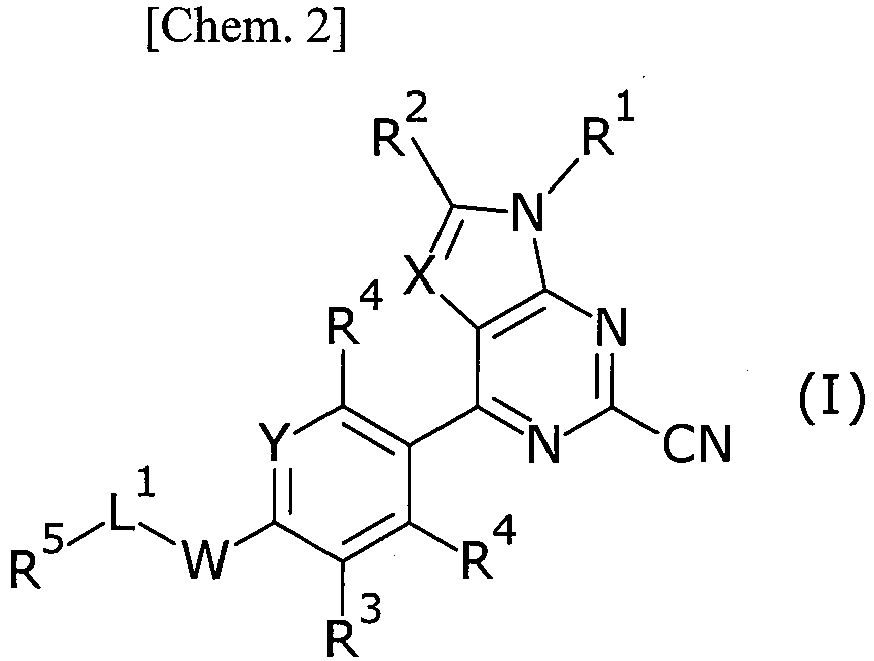
X is CH or N;
Y is CH, C-halogen, or N;
W is -O- or -S(O)n-;
L1 is a bond, -lower alkylene-, -O-lower alkylene-, -NH-lower alkylene-, or -C(O)-lower alkylene-;
R1 is i) lower alkyl which may be substituted with one or more substituents selected from the group consisting of a halogen, -OH, -O-lower alkyl, -NH2, -NH-(lower alkyl), -N(lower alkyl)2, -C(O)-NH2, -C(O)-NH-lower alkyl, -C(O)-N(lower alkyl)2, -C(O)-NH-nonaromatic heterocycle which may be substituted, -C(O)-N(lower alkyl))-nonaromatic heterocycle which may be substituted, a nonaromatic heterocycle which may be substituted, and -C(O)-nonaromatic heterocycle which may be substituted;
ii) nonaromatic heterocycle which may be substituted; or
iii) H;
R2 is lower alkyl which may be substituted with a halogen, a halogen, or H;
R3 is lower alkyl which may be substituted with a halogen, a halogen, or -CN;
R4's are the same as or different from each other and R4 is lower alkyl which may be substituted with a halogen, a halogen, -OH, -CN, or H;
R5 is lower alkyl which may be substituted with a substituent selected from the group consisting of -OH, a halogen, -NH2, -NH-(lower alkyl), and -N(lower alkyl)2, -O-(lower alkyl which may be substituted with a halogen), C3-8 cycloalkyl which may be substituted, an aromatic heterocycle which may be substituted, or a nonaromatic heterocycle which may be substituted; and
n(s) is(are) the same as or different from each other, and n is an integer of 0 to 2.) - [2] The compound or a salt thereof according to [1],
wherein X is N;
R1 is lower alkyl which may be substituted with one or more substituents selected from the group consisting of a halogen, -OH, -O-lower alkyl, and a nonaromatic heterocycle; in which the nonaromatic heterocycle may be substituted with lower alkyl;
R5 is a nonaromatic heterocycle which may be substituted with a substituent selected from a D2 group; in which the D2 group is- (1) a halogen;
- (2) cycloalkyl which may be substituted with lower alkyl;
- (3) an aromatic heterocycle which may be substituted with lower alkyl;
- (4) a nonaromatic heterocycle which may be substituted with lower alkyl;
- (5) -OH, -CN, or -NO2;
- (6) -C(O)-N(R0)2 or -C(O)-N(lower alkyl)-nonaromatic heterocycle; and
- (7) -C(O)-lower alkylene-OH;
-C(O)-(lower alkyl which may be substituted with one or more substituents selected from Z2 or nonaromatic heterocycle which may be substituted with one or more substituents selected from the group consisting of a halogen, -OH, -CN, -O-lower alkyl, cycloalkyl, and a nonaromatic heterocycle); or
-C(O)-lower alkylene-(lower alkyl which may be substituted with one or more substituents selected from Z2 or nonaromatic heterocycle which may be substituted with one or more substituents selected from the group consisting of a halogen, -OH, -CN, -O-lower alkyl, cycloalkyl, and a nonaromatic heterocycle); and - (8) lower alkyl or -O-lower alkyl which may be respectively substituted with one or more substituents selected from the group consisting of substituents according to the above-described (1) to (7);
Z2 is the group consisting of -OH-, -O-lower alkyl, and a halogen. - [3] The compound or a salt thereof according to [2],
wherein W is -O- or -S-;
L1 is -lower alkylene-, -O-lower alkylene-, -NH-lower alkylene-, or -C(O)-lower alkylene-;
R1 is lower alkyl, and the lower alkyl may be substituted with tetrahydrofuranyl;
R2 is H;
R3 is a halogeno-lower alkyl or -CN;
R4 is H; and
R5 is a nitrogen-containing heterocycloalkyl which may be substituted with a substituent selected from the D2 group. - [4] The compound or a salt thereof according to [3],
wherein W is -O-. - [5] The compound or a salt thereof according to [4],
wherein R5 is a group selected from the group consisting of azetidinyl, pyrrolidinyl, piperidinyl, and octahydroindolizinyl; in which
each of azetidinyl, pyrrolidinyl, piperidinyl, and octahydroindolizinyl may be substituted with a substituent selected from the D2 group. - [6] The compound or a salt thereof according to [5], which is represented by the formula (II):

R51 is H, lower alkyl, halogeno-lower alkyl, cycloalkyl, -lower alkylene-OH, -lower alkylene-CN, -lower alkylene-C(O)-N(R0)2, -lower alkylene-C(O)-cyclic amino, -C(O)-heterocycloalkyl, -C(O)-N(R0)2, -C(O)-lower alkylene-OH, or -lower alkylene-(aromatic heterocycle which may be substituted with lower alkyl); in which- the heterocycloalkyl may be substituted with lower alkyl, -OH, or heteocycloalkyl;
- the cyclic amino may be substituted with a halogen or -CN; and
- R52 and R53 are the same as or different from each other, and each of R52 and R53 is H or lower alkyl.)
- [7] The compound or a salt thereof according to [6],
wherein R1 is a methyl. - [8] The compound or a salt thereof according to [7],
wherein L1 is -lower alkylene-. - [9] The compound or a salt thereof according to [8],
wherein Y is N. - [10] The compound or a salt thereof according to [9],
wherein R3 is a trifluoromethyl. - [11] The compound or a salt thereof according to [10],
wherein R51 is H, lower alkyl, -lower alkylene-C(O)-N(R0)2, or -C(O)-(heterocycloalkyl which may be substituted with lower alkyl); and
each of R52 and R53 is H. - [12] The compound or a salt thereof according to [11],
wherein R51 is lower alkyl. - [13] The compound or a salt thereof according to [6], which is selected from the following group consisting of:
- 9-methyl-6- {6-[2-(piperidin-4-yl)ethoxy]-5-(trifluoromethyl)pyridin-3-yl}-9H-purine-2-carbonitrile;
- 6-{6-[2-(1-ethylpiperidin-4-yl)ethoxy]-5-(trifluoromethyl)pyridin-3-yl}-9-methyl-9H-purine-2-carbonitrile;
- 9-methyl-6-[6-{2-[1-(1-methyl-L-prolyl)piperidin-4-yl]ethoxy}-5-(trifluoromethyl)pyridin-3-yl]-9H-purine-2-carbonitrile;
- 6-{4-[2-(1-ethylpiperidin-4-yl)ethoxy]-3-(trifluoromethyl)phenyl}-9-(tetrahydrofuran-3-ylmethyl)-9H-purine-2-carbonitrile; and
- 6-{6-[2-(1-cyclobutylpiperidin-4-yl)ethoxy]-5-(trifluoromethyl)pyridin-3-yl} -9-methyl-9H-purine-2-carbonitrile.
- [14] A pharmaceutical composition, containing:
- the compound or a salt thereof according to [1]; and
- a pharmaceutically acceptable excipient.
- [15] A pharmaceutical composition for preventing or treating autoimmune disease, allergic disease, graft rejection of an organ, bone marrow or tissue, SLE, or lupus nephritis, comprising:
- the compound or a salt thereof according to [1].
- [16] Use of the compound or a salt thereof according to [1] for the manufacture of a pharmaceutical composition for preventing or treating autoimmune disease, allergic disease, graft rejection of an organ, bone marrow or tissue, SLE, or lupus nephritis.
- [17] Use of the compound or a salt thereof according to [1] for preventing or treating autoimmune disease, allergic disease, graft rejection of an organ, bone marrow or tissue, SLE, or lupus nephritis.
- [18] The compound or a salt thereof according to [1] for preventing or treating autoimmune disease, allergic disease, graft rejection of an organ, bone marrow or tissue, SLE, or lupus nephritis.
- [19] A method for preventing or treating autoimmune disease, allergic disease, graft rejection of an organ, bone marrow or tissue, SLE, or lupus nephritis, comprising:
- administering to a subject an effective amount of the compound or a salt thereof according to [1].
- In addition, the present invention relates to a pharmaceutical composition for preventing and/or treating autoimmune disease as an aspect, allergic disease as another aspect, graft rejection of an organ, bone marrow or tissue as still another aspect, SLE as still another aspect, or lupus nephritis as further still another aspect, containing a compound of the formula (I) or a salt thereof. Moreover, the pharmaceutical composition contains an agent for preventing and/or treating autoimmune disease as an aspect, allergic disease as another aspect, graft rejection of an organ, bone marrow or tissue as still another aspect, SLE as still another aspect, or lupus nephritis as further still another aspect, containing a compound of the formula (I) or a salt thereof.
- In addition, the present invention relates to use of the compound of the formula (I) or a salt thereof for the manufacture of a pharmaceutical composition for preventing and/or treating autoimmune disease, allergic disease, graft rejection of an organ, bone marrow or tissue, SLE, or lupus nephritis, the compound of the formula (I) or a salt thereof for use in preventing and/or treating autoimmune disease, allergic disease, graft rejection of an organ, bone marrow or tissue, SLE, or lupus nephritis, and a method for preventing and/or treating autoimmune disease, allergic disease, graft rejection of an organ, bone marrow or tissue, SLE, or lupus nephritis, comprising administering to a subject an effective amount of the compound of the formula (I) or a salt thereof.
- Moreover, the "subject" is a human or animals in need of such prevention or treatment, and in an embodiment, the subject is a human in need of such prevention or treatment.
- Moreover, unless otherwise described, in a case where the symbols in a chemical formula in the specification is also used in other chemical formulas, the same symbol indicates the same meaning.
- Moreover, the compound of the formula (I) or a salt thereof has a cathepsin S inhibitory effect, and can be used as an agent for preventing and/or treating autoimmune disease as an aspect, allergic disease as another aspect, graft rejection of an organ, bone marrow or tissue as still another aspect, SLE as still another aspect, or lupus nephritis as further still another aspect.
- Hereinafter, the present invention will be described in detail.
- In the present specification, "lower alkyl" is a linear or branched alkyl having 1 to 6 carbon atoms (hereinafter, referred to as C1-6), and examples thereof include methyl, ethyl, n-propyl, isopropyl, n-butyl, isobutyl, sec-butyl, tert-butyl, n-pentyl and n-hexyl. The lower alkyl is C1-4 alkyl as another aspect, is methyl, ethyl, isopropyl, isobutyl or tert-butyl as still another aspect, is methyl or ethyl as still another aspect, is methyl as still another aspect, and is ethyl as further still another aspect.
- "Lower alkylene" is a linear or branched C1-6 alkylene, and examples thereof include methylene, ethylene, trimethylene, tetramethylene, pentamethylene, hexamethylene, propylene, methylmethylene, ethylethylene, 1,2-dimethylethylene, 2,2-dimethylethylene and 1,1,2,2-tetramethylethylene. The lower alkylene is C1-4 alkylene as another aspect, is methylene, ethylene or trimethylene as still another aspect, is methylene or ethylene as still another aspect, is methylene as still another aspect, and is ethylene as further still another aspect.
- "Halogen" is F, Cl, Br or I. The halogen is F as another aspect, and is Cl as still another aspect.
- "Halogeno-lower alkyl" is lower alkyl substituted with one or more halogens. As another aspect, the halogeno-lower alkyl is lower alkyl substituted with 1 to 5 halogens, and as still another aspect, the halogeno-lower alkyl is trifluoromethyl.
- "Cycloalkyl" is a C3-10 saturated hydrocarbon cyclic group, which may have a bridge. Examples thereof include cyclopropyl, cyclobutyl, cyclopentyl, cyclohexyl, cycloheptyl, cyclooctyl and adamantyl. The cycloalkyl is C3-8 cycloalkyl as another aspect, is C3-6 cycloalkyl as still another aspect, is cyclopropyl as still another aspect, is cyclobutyl as still another aspect, and is adamantly as further still another aspect.
- An "aromatic hererocyclic" group means a cyclic group selected from (i) 5 to 6-membered monocyclic aromatic heterocycle containing 1 to 4 hetero atoms selected from oxygen, sulfur and nitrogen, and (ii) a bicyclic or tricyclic heterocycle containing 1 to 5 hetero atoms selected from oxygen, sulfur and nitrogen, which is formed by the monocyclic aromatic heterocycle being fused with one or two rings selected from the group consisting of a monocyclic aromatic heterocycle and a benzene ring. Oxide or dioxide may be formed by the oxidation of sulfur or nitrogen which is a ring atom. Specific examples thereof include pyridyl, pyrrolyl, pyrazinyl, pyrimidinyl, pyridazinyl, imidazolyl, triazolyl, triazinyl, tetrazolyl, thiazolyl, pyrazolyl, isothiazolyl, oxazolyl, isoxazolyl, thiadiazolyl, oxadiazolyl, thienyl, furyl, indolyl, isoindolyl, benzimidazolyl, indazolyl, quinolyl, isoquinolinyl, quinazolinyl, quinoxalinyl, phthalazinyl, benzothiazolyl, benzisothiazolyl, benzothiadiazolyl, benzoxazolyl, benzisoxazolyl, benzofuranyl, benzothienyl, benzotriazolyl, carbazolyl, imidazopyridyl, imidazopyrimidinyl, imidazopyridazinyl, pyrazolopyrimidinyl and 1,8-naphthyridinyl. The aromatic hererocycle group is a 5 to 6-membered monocyclic aromatic heterocyclic group as another aspect, is pyridyl as still another aspect, and is imidazolyl as further still another aspect.
- A "nonaromatic hererocyclic" group means a 3 to 15-membered monocyclic to tricyclic saturated heterocyclic group containing 1 to 4 hetero atoms selected from oxygen, sulfur and nitrogen, and as another aspect, a 4 to 10-membered monocyclic to tricyclic saturated heterocyclic group. Oxide or dioxide may be formed by the oxidation of sulfur or nitrogen which is a ring atom. A part of bond of a ring may be bridged. Specific examples thereof include azetidinyl, pyrrolidinyl, piperidinyl, piperazinyl, azepanyl, morpholinyl, thiomorpholinyl, tetrahydropyridinyl, tetrahydropyrimidinyl, oxetanyl, tetrahydrofuranyl, tetrahydropyranyl, dioxolanyl, dioxanyl, tetrahydrothiopyranyl, azabicyclo[3.2.1]octyl and octahydroindolizinyl. The nonaromatic hererocyclic group is a 4 to 10-membered monocyclic to tricyclic saturated heterocyclic group as another aspect, is a 4 to 8-membered monocyclic saturated heterocyclic group as still another aspect, is pyrrolidinyl, piperidinyl or piperazinyl as still another aspect, and is piperidinyl as further still another aspect.
- A "heterocycloalkyl" group means a heterocyclic group in which bonds between ring atoms in the above-described "nonaromatic heterocyclic" group are only single bonds, and carbon atoms constituting the ring have bonding sites. Specific examples thereof include azetidin-3-yl, pyrrolidin-2-yl, pyrrolidin-3-yl, piperidin-3-yl, piperidin-4-yl, 3-azabicyclo[3.2.1]oct-8-yl, 8-azabicyclo[3.2.1]oct-3-yl, octahydroindolizin-7-yl, oxetane-3-yl, tetrahydrofuran-2-yl, tetrahydrofuran-3-yl, tetrahydropyran-3-yl, and tetrahydropyran-4-yl. As another aspect, the heterocycloalkyl group is oxetan-3-yl, tetrahydrofuran-2-yl, tetrahydrofuran-3-yl, tetrahydropyran-3-yl, or tetrahydropyran-4-yl.
- A "nitrogen-containing heterocycloalkyl" group means a group having a nitrogen atom in the above-described "heterocycloalkyl", in which carbon atoms constituting the ring have bonding sites. Specific examples thereof include azetidin-3-yl, pyrrolidin-2-yl, pyrrolidin-3-yl, piperidin-3-yl, piperidin-4-yl, 3-azabicyclo[3.2.1]oct-8-yl, 8-azabicyclo[3.2.1]oct-3-yl, and octahydroindolizin-7-yl. The nitrogen-containing heterocycloalkyl group is pyrrolidin-3-yl, piperidin-3-yl, piperidin-4-yl or octahydroindolizin-7-yl as another aspect, is pyrrolidin-2-yl or pyrrolidin-3-yl as still another aspect, is piperidin-4-yl as still another aspect, and is octahydroindolizin-7-yl as further still another aspect.
- A "cyclic amino" group means a group having a nitrogen atom in the above-described "nonaromatic hererocycle", in which nitrogen atoms constituting the ring have bonding sites. Specific examples thereof include azetidin-1-yl, pyrrolidin-1-yl, piperidin-1-yl, azepan-1-yl, oxazolidin-3-yl, thiazolidin-3-yl, isoxazolidin-2-yl, isothiazolidin-2-yl, piperazin-1-yl, morpholin-4-yl, thiomorpholin-4-yl, 1,1-dioxidethiomorpholin-4-yl, indolin-1-yl, isoindolin-2-yl, and 1,2,3,4-tetrahydroquinolin-1-yl. As another aspect, the cyclic amino group is azetidin-1-yl, pyrrolidin-1-yl, piperidin-1-yl, piperazin-1-yl or morpholin-4-yl, and as still another aspect, is piperidin-1-yl.
- In the present specification, for example, in a case where L1 is -O-lower alkylene-, O is bonded to R5, and lower alkylene is bonded to W.
- In the present specification, "may be substituted" means that it does not have any substituent, or has 1 to 5 substituents. Moreover, in a case of having a plurality of substituents, these substituents may be the same as or different from each other.
- As acceptable substituents of "-C(O)-NH-nonaromatic heterocycle which may be substituted, -C(O)-N(lower alkyl)-nonaromatic heterocycle which may be substituted, a nonaromatic heterocycle which may be substituted, and -C(O)-nonaromatic heterocycle which may be substituted" in R1 in the formula (I), or "a nonaromatic heterocycle" in "a nonaromatic heterocycle which may be substituted", groups shown as the following D1 group can be exemplified.
- The D1 group is
- (1) a halogen,
- (2) -OH, -CN, or -NO2,
- (3) nonaromatic heterocycle, and
- (4) lower alkyl or -O-lower alkyl which may be respectively substituted with one or more substituents selected from the group consisting of substituents according to the above-described (1) to (3).
- Another aspect of the D1 group is
- (1) a halogen, and
- (2) lower alkyl.
- As acceptable substituents of "nonaromatic heterocycle which may be substituted" described in R5 in the formula (I), groups shown as the following D2 group can be exemplified.
- The D2 group is
- (1) a halogen,
- (2) cycloalkyl which may be substituted with lower alkyl,
- (3) an aromatic heterocycle which may be substituted with lower alkyl,
- (4) a nonaromatic heterocycle which may be substituted with lower alkyl,
- (5) -OH, -CN, or -NO2,
- (6) -C(O)-N(R0)2 or -C(O)-N(lower alkyl)-nonaromatic heterocycle, and
- (7) -C(O)-lower alkylene-OH,
-C(O)-(lower alkyl which may be substituted with one or more substituents selected from Z2 or nonaromatic heterocycle which may be substituted with one or more substituents selected from the group consisting of a halogen, -OH, -CN, -O-lower alkyl, cycloalkyl and a nonaromatic heterocycle), or
-C(O)-lower alkylene-(lower alkyl which may be substituted with one or more substituents selected from Z2 or nonaromatic heterocycle which may be substituted with one or more substituents selected from the group consisting of a halogen, -OH, -CN, -O-lower alkyl, cycloalkyl and a nonaromatic heterocycle), and - (8) lower alkyl or -O-lower alkyl which may be respectively substituted with one or more substituents selected from the group consisting of substituents according to the above-described (1) to (7).
- Here, R0's are the same as or different from each other, and R0 is H or lower alkyl, and Z2 is a group consisting of -OH-, -O-lower alkyl, and a halogen.
- Another aspect of the D2 group is
- (1) a halogen,
- (2) cycloalkyl which may be substituted with lower alkyl,
- (3) an aromatic heterocycle which may be substituted with lower alkyl,
- (4) a nonaromatic heterocycle which may be substituted with lower alkyl,
- (5) -OH, -CN, or -NO2,
- (6) -C(O)-NH2, -C(O)-N(lower alkyl)2, or -C(O)-N(lower alkyl)-nonaromatic heterocycle, and
- (7) -C(O)-lower alkylene-OH, -C(O)-(lower alkyl which may be substituted with one or more substituents selected from Z2 or nonaromatic heterocycle which may be substituted with one or more substituents selected from the group consisting of a halogen,-OH, -CN, -O-lower alkyl, and cycloalkyl), or -C(O)-lower alkylene-(lower alkyl which may be substituted with one or more substituents selected from Z2 or nonaromatic heterocycle which may be substituted with one or more substituents selected from the group consisting of a halogen, -OH, -CN, -O-lower alkyl, and cycloalkyl), and
- (8) lower alkyl or -O-lower alkyl which may be respectively substituted with one or more substituents selected from the group consisting of substituents according to the above-described (1) to (7).
- Another aspect of the D2 group is
- (1) a halogen,
- (2) cycloalkyl,
- (3) an aromatic heterocycle which may be substituted with lower alkyl,
- (4) nonaromatic heterocycle,
- (5) oxo,
- (6) -OH,
- (7) -CN,
- (8) -C(O)-N(lower alkyl)2,
- (9) -C(O)-lower alkylene-OH, and
- (10) -C(O)-(nonaromatic heterocycle which may be substituted with one or more substituents selected from the group consisting of lower alkyl, a halogen, -OH and -CN), and
- (11) lower alkyl which may be substituted with one or more substituents selected from the group consisting of substituents according to the above-described (1) to (10).
- Another aspect of the D2 group is
- (1) a halogen,
- (2) cycloalkyl,
- (3) an aromatic heterocycle which may be substituted with lower alkyl,
- (4) nonaromatic heterocycle,
- (5) -OH,
- (6) -CN,
- (7) -C(O)-N(lower alkyl)2,
- (8) -C(O)-lower alkylene-OH, and
- (9) -C(O)-(nonaromatic heterocycle which may be substituted with one or more substituents selected from the group consisting of lower alkyl, a halogen, -OH and -CN), and
- (10) lower alkyl which may be substituted with one or more substituents selected from the group consisting of substituents according to the above-described (1) to (9).
- Another aspect of the D2 group is
- (1) cycloalkyl,
- (2) -OH,
- (3) -C(O)-N(lower alkyl)2, and
- (4) -C(O)-(nonaromatic heterocycle which may be substituted with one or more substituents selected from the group consisting of lower alkyl, a halogen, -OH and -CN), and
- (5) lower alkyl which may be substituted with one or more substituents selected from the group consisting of substituents according to the above-described (1) to (4).
- Another aspect of the D2 group is
- (1) -OH,
- (2) -C(O)-N(lower alkyl)2, and
- (3) -C(O)-(nonaromatic heterocycle which may be substituted with one or more substituents selected from the group consisting of lower alkyl and -OH), and
- (4) lower alkyl which may be substituted with one or more substituents selected from the group consisting of substituents according to the above-described (1) to (3).
- Another aspect of the D2 group is
- (1) lower alkyl,
- (2) -lower alkylene-OH,
- (3) -lower alkylene-C(O)-N(lower alkyl)2, and
- (4) -C(O)-(nonaromatic heterocycle which may be substituted with lower alkyl).
- As acceptable substituents of "C3-8 cycloalkyl which may be substituted" or "aromatic heterocycle which may be substituted" in R5 in the formula (I), groups shown as the following D3 group can be exemplified.
- The D3 group is
- (1) a halogen,
- (2) -OH, -CN, or -NO2, and
- (3) lower alkyl or -O-lower alkyl which may be respectively substituted with one or more substituents selected from the group consisting of substituents according to the above-described (1) to (2).
- Another aspect of the D3 group is
- (1) lower alkyl, and
- (2) a halogen.
- Aspect of the present invention is shown below. "A compound" in this section means "a compound or a salt thereof'.
- (1) A compound of the formula (I), in which X is CH. As another aspect, a compound in which X is N.
- (2) A compound of the formula (I), in which Y is CH. As another aspect, a compound in which Y is N.
- (3) A compound of the formula (I), in which W is -O- or -S-. As another aspect, a compound in which W is -O-.
- (4) A compound of the formula (I), in which L1 is -lower alkylene-, -O-lower alkylene-, or -C(O)-lower alkylene.
As another aspect, a compound in which L1 is -lower alkylene- or -O-lower alkylene-.
As still another aspect, a compound in which L1 is -lower alkylene-. - (5) A compound of the formula (I), in which R1 is lower alkyl which may be substituted with a substituent selected from the group consisting of -OH, -O-lower alkyl, and a nonaromatic heterocycle, in which the nonaromatic heterocycle may be substituted with lower alkyl.
As another aspect, a compound in which R1 is lower alkyl which may be substituted with -OH or -O-lower alkyl.
As still another aspect, a compound in which R1 is lower alkyl which may be substituted with tetrahydrofuran.
As still another aspect, a compound in which R1 is lower alkyl.
As further still another aspect, a compound in which R1 is methyl. - (6) A compound of the formula (I), in which R2 is lower alkylene which may be substituted with a halogen or H.
As another aspect, a compound in which R2 is lower alkyl which may be substituted with a halogen.
As still another aspect, a compound in which R2 is H. - (7) A compound of the formula (I), in which R3 is halogeno-lower alkyl or -CN.
As another aspect, a compound in which R3 is halogeno-lower alkyl.
As still another aspect, a compound in which R3 is trifluoromethyl. - (8) A compound of the formula (I), in which R4's are the same as or different from each other, and R4 is H or a halogen. As another aspect, a compound in which all R4 are H's.
- (9) A compound of the formula (I), in which R5 is lower alkyl which may be substituted with -N(lower alkyl)2, an aromatic heterocycle which may be substituted, or a nonaromatic heterocycle which may be substituted.
As another aspect, a compound in which R5 is lower alkyl which may be substituted with -N(lower alkyl)2, or a nonaromatic heterocycle which may be substituted.
As still another aspect, a compound in which R5 is a nonaromatic heterocycle which may be substituted.
As still another aspect, a compound in which R5 is nitrogen-containing heterocycloalkyl which may be substituted.
As still another aspect, a compound in which R5 is azetidinyl which may be substituted, pyrrolidinyl which may be substituted, piperidinyl which may be substituted, or octahydroindolizinyl which may be substituted.
As still another aspect, a compound in which R5 is piperidinyl which may be substituted. - (10) A compound of the formula (I), in which R5 is

- (10-1) A compound according to (10), in which R51 is H, lower alkyl, halogeno-lower alkyl, cycloalkyl, -lower alkylene-OH, or -lower alkylene-CN.
As another aspect, a compound according to (10), in which R51 is H, -lower alkylene-C(O)-N(R0)2, or -C(O)-(heterocycloalkyl which may be substituted with lower alkyl, -OH or heterocycloalkyl).
As still another aspect, a compound according to (10), in which R51 is H, lower alkyl, -lower alkylene-C(O)-N(R0)2, or -C(O)-(heterocycloalkyl which may be substituted with lower alkyl).
As still another aspect, a compound according to (10), in which R51 is lower alkyl.
As further still another aspect, a compound according to (10), in which R51 is H. - (10-2) a compound according to (10), in which each of R52 and R53 is H.
- (10-1) A compound according to (10), in which R51 is H, lower alkyl, halogeno-lower alkyl, cycloalkyl, -lower alkylene-OH, or -lower alkylene-CN.
- (11) A compound of the formula (I), in which arbitrary two or more among aspects described in the above-described (1) to (10-2) are combined.
- Still another aspect of the present invention is shown below.
- A compound of the formula (I) or a salt thereof in which X is N, Y is N, W is -O-, L1 is - lower alkylene-, R1 is methyl, R2 is H, R3 is trifluoromethyl, all R4 are H's, R5 is

- R51 is a lower alkyl, and each of R52 and R53 is H.
- Still another aspect of the present invention is shown below.
- A compound of the formula (I) or a salt thereof in which X is CH;
R1 is lower alkyl which may be substituted with one or more substituents selected from the group consisting of a halogen, -OH, -O-lower alkyl, and a nonaromatic heterocycle; in which the nonaromatic heterocycle may be substituted with lower alkyl; and R5 is a nonaromatic heterocycle which may be substituted with a substituent selected from the D2 group. - Examples of a specific compound contained in the compound of the formula (I) or a salt thereof include the following compounds.
9-methyl-6-{6-[2-(piperidin-4-yl)ethoxy]-5-(trifluoromethyl)pyridin-3-yl}-9H-purine-2-carbonitrile,
6-{6-[2-(1-ethylpiperidin-4-yl)ethoxy]-5-(trifluoromethyl)pyridin-3-yl}-9-methyl-9H-purine-2-carbonitrile,
9-methyl-6-[6-{2-[1-(1-methyl-L-prolyl)piperidin-4-yl]ethoxy}-5-(trifluoromethyl)pyridin-3-yl]-9H-purine-2-carbonitrile,
6- {4-[2-(1-ethylpiperidin-4-yl)ethoxy]-3-(trifluoromethyl)phenyl} -9-(tetrahydrofuran-3-ylmethyl)-9H-purine-2-carbonitrile, and
6- {6-[2-(1-cyclobutylpiperidin-4-yl)ethoxy]-5-(trifluoromethyl)pyridin-3-yl} -9-methyl-9H-purine-2-carbonitrile,
and salts thereof. - Examples of another specific compound contained in the compound of the formula (I) or a salt thereof include the following compounds.
2-[4-(2-{4-[2-cyano-7-(2-hydroxyethyl)-7H-pyrrolo[2,3-d]pyrimidin-4-yl]-2-(trifluoromethyl)phenoxy}ethyl)piperidin-1-yl]-N,N-dimethylacetamide,
4-{6-[2-(1-ethylpiperidin-4-yl)ethoxy]-5-(trifluoromethyl)pyridin-3-yl}-7-methyl-7H-pyrrolo[2,3-d]pyrimidine-2-carbonitrile,
4-{4-[2-(1-ethylpiperidin-4-yl)ethoxy]-3-(trifluoromethyl)phenyl}-7-(2-hydroxyethyl)-7H-pyrrolo[2,3-d]pyrimidine-2-carbonitrile,
7-methyl-4-[6-(2-{[(3R)-1-(1-methyl-D-prolyl)pyrrolidin-3-yl]oxy}ethoxy)-5-(trifluoromethyl)pyridin-3-yl]-7H-pyrrolo[2,3-d]pyrimidine-2-carbonitrile, and 4-{6-[(1-{[1-(2-hydroxy-2-methylpropyl)piperidin-4-yl]carbonyl}piperidin-4-yl)methoxy]-5-(trifluoromethyl)pyridin-3-yl}-7-methyl-7H-pyrrolo[2,3-d]pyrimidine-2-carbonitrile, and salts thereof. - In the compound of the formula (I), tautomers or geometric isomers may be present depending on the types of substituents. In the present specification, the compound of the formula (I) is described as only one form of isomers, however the present invention also includes other isomers, and also includes a separated isomer or a mixture thereof.
- In addition, the compound of the formula (I) may have an asymmetric carbon atom or axial asymmetry, and an optical isomer based on this may be present. The present invention also includes a separated optical isomer of the compound of the formula (I) or a mixture thereof.
- Furthermore, the present invention also includes a pharmaceutically acceptable prodrug of the compound of the formula (I). The pharmaceutically acceptable prodrug is a compound having a group which can be converted into an amino group, a hydroxyl group, or a carboxyl group by solvolysis or under physiological conditions. As the group forming the prodrug, groups described in Prog. Med., 1985, Vol. 5, pp. 2157-2161, and "Pharmaceutical Research and Development, Drug Design" (Hirokawa Publishing Company), 1990, Vol. 7, pp. 163-198 are exemplified.
- In addition, a salt of the compound of the formula (I) is a pharmaceutically acceptable salt of the compound of the formula (I), and an acid addition salt or a salt with a base may be formed depending on the types of substituents. Specifically, acid addition salts of inorganic acids such as hydrochloric acid, hydrobromic acid, hydroiodic acid, sulfuric acid, nitric acid, and phosphoric acid, and organic acids such as formic acid, acetic acid, propionic acid, oxalic acid, malonic acid, succinic acid, fumaric acid, maleic acid, lactic acid, malic acid, mandelic acid, tartaric acid, dibenzoyl tartaric acid, ditoluoyl tartaric acid, citric acid, methane sulfonic acid, ethane sulfonic acid, benzene sulfonic acid, p-toluene sulfonic acid, aspartic acid, and glutamic acid, salts of inorganic bases such as sodium, potassium, magnesium, calcium, and aluminum, and organic bases such as methylamine, ethylamine, ethanolamine, lysine, and ornithine, salts of various amino acids such as acetylleucine and the like and amino acid derivatives, and ammonium salt are exemplified.
- Furthermore, the present invention also includes various hydrates or solvates of the compound of the formula (I) or a salt thereof, and crystal polymorphism substances. In addition, the present invention also includes a compound labeled with various radioactive or non-radioactive isotopes.
- The compound of the formula (I) and a salt thereof can be prepared by applying various known synthetic methods using the characteristics based on the basic structure thereof or the types of substituents. At that time, it may be effective in a preparing technology that the functional group is substituted with a suitable protective group (group which can be easily converted into the functional group) at the stage from a starting material to an intermediate depending on the types of functional groups. As such a protective group, the protective groups described in "Greene's Protective Groups in Organic Synthesis (4th edition, 2006)" written by P. G. M. Wuts and T. W. Greene can be exemplified, and these may be suitably selected and used depending on the reaction conditions. In such a method, the protective group is introduced, a reaction is performed, and the protective group is removed, if necessary. By doing this, it is possible to obtain a desired compound.
- In addition, the prodrug of the compound of the formula (I) can be prepared by further performing the reaction by introducing a specific group at the stage from a starting material to an intermediate in the same manner as that of the above-described protective group, or using the obtained compound of the formula (I). The reaction can be performed by applying methods known to those skilled in the art such as general esterification, amidation, or dehydration.
- Hereinafter, representative preparation methods of the compound of the formula (I) will be described. Each preparation method can also be performed with reference to references described in the description. Moreover, the preparation method of the present invention is not limited to examples described below.
-

- A compound (I) of the present invention can be obtained by subjecting a compound (1a) to a cyanation reaction.
- In this reaction, the compound (1a) and a predetermined cyanation reagent are used in equivalent amounts, or either thereof in an excess amount, and the mixture thereof is stirred usually for 0.1 hours to 5 days under heating to reflux from room temperature, in a solvent which is inert to the reaction or in the absence of a solvent, in the presence of a predetermined catalyst. Examples of the solvent used in this reaction, which are not particularly limited, include aromatic hydrocarbons such as benzene, toluene and xylene, ethers such as diethylether, tetrahydrofuran, dioxane and dimethoxyethane, halogenated hydrocarbons such as dichloromethane, 1,2-dichloroethane and chloroform, N-methylpyrrolidone, N,N-dimethylformamide, N,N-dimethylacetamide, dimethyl sulfoxide, ethyl acetate, acetonitrile and a mixture thereof. Examples of the cyanation reagent include zinc cyanide. Examples of the predetermined catalyst include palladium (II) trifluoroacetate and tetrakis(triphenylphosphine)palladium (0). It is in some cases advantageous for smooth progress of the reaction to perform the reaction in the presence of phosphines such as triphenylphosphine or 2-(di-tert-butylphosphino)biphenyl.
-


- A compound (I-1) of the present invention can be obtained by subjecting a compound (2a) to a Boc-elimination reaction.
- In this reaction, the compound (2a) and an ethyl acetate solution of hydrogen chloride are used in equivalent amounts, or either thereof in an excess amount, and the mixture thereof is stirred usually for 0.1 hours to 5 days under heating to reflux from room temperature, in a solvent which is inert to the reaction or in the absence of a solvent. Examples of the solvent used in this reaction, which are not particularly limited, include aromatic hydrocarbons such as benzene, toluene and xylene, ethers such as diethylether, tetrahydrofuran, dioxane and dimethoxyethane, halogenated hydrocarbons such as dichloromethane, 1,2-dichloroethane and chloroform, N-methylpyrrolidone, N,N-dimethylformamide, N,N-dimethylacetamide, dimethyl sulfoxide, ethyl acetate, acetonitrile and a mixture thereof. In this reaction, a dioxane solution of hydrogen chloride, trifluoroacetic acid, or the like other than the ethyl acetate solution of hydrogen chloride can be used.
-

- A compound (I-2) of the present invention can be obtained by subjecting a compound (3a) and a compound (3b) to an alkylation reaction. Here, examples of the leaving group include a halogen, a methanesulfonyloxy group and a p-toluenesulfonyloxy group.
- In this reaction, the compound (3a) and the compound (3b) are used in equivalent amounts, or either thereof in an excess amount, and the mixture thereof is stirred usually for 0.1 hours to 5 days under heating to reflux from room temperature, in a solvent which is inert to the reaction or in the absence of a solvent, in the presence of a predetermined basic reagent. Examples of the solvent used in this reaction, which are not particularly limited, include aromatic hydrocarbons such as benzene, toluene and xylene, ethers such as diethylether, tetrahydrofuran, dioxane and dimethoxyethane, halogenated hydrocarbons such as dichloromethane, 1,2-dichloroethane and chloroform, N-methylpyrrolidone, N,N-dimethylformamide, N,N-dimethylacetamide, dimethyl sulfoxide, ethyl acetate, acetonitrile, and a mixture thereof. Examples of the basic reagent include organic bases such as triethylamine, N,N-diisopropyl ethylamine and N-methylmorpholine, or inorganic bases such as potassium carbonate, sodium carbonate, potassium hydroxide and sodium hydride. In addition, it is in some cases advantageous for smooth progress of the reaction to perform the reaction in the presence of potassium iodide or the like.
-
- "Organic Functional Group Preparations" written by S. R. Sandler and W. Karo, 2nd edition, Vol. 1, Academic Press Inc., 1991
- "Courses in Experimental Chemistry" (5th edition) edited by The Chemical Society of Japan, Vol. 14 (2005) (Maruzen Co., Ltd.)
-

- A compound (I-3) of the present invention can be obtained by subjecting a compound (4a) and a compound (4b) to an ipso substitution reaction.
- In this reaction, the compound (4a) and the compound (4b) are used in equivalent amounts, or either thereof in an excess amount, and the mixture thereof is stirred usually for 0.1 hours to 5 days under heating to reflux from room temperature, in a solvent which is inert to the reaction or in the absence of a solvent, in the presence of a predetermined basic reagent. Examples of the solvent used in this reaction, which are not particularly limited, include aromatic hydrocarbons such as benzene, toluene and xylene, ethers such as diethylether, tetrahydrofuran, dioxane and dimethoxyethane, halogenated hydrocarbons such as dichloromethane, 1,2-dichloroethane and chloroform, N-methylpyrrolidone, N,N-dimethylformamide, N,N-dimethylacetamide, dimethyl sulfoxide, ethyl acetate, acetonitrile, and a mixture thereof. Examples of the basic reagent include organic bases such as triethylamine, N,N-diisopropyl ethylamine and N-methylmorpholine, or inorganic bases such as potassium carbonate, sodium carbonate, potassium hydroxide and sodium hydride. In addition, it is in some cases advantageous for smooth progress of the reaction to heat the reaction mixture by microwave irradiation.
- Various substituents on the groups R1 and R5 in the compound of the formula (I) can be easily converted to other functional groups using the compound of the formula (I) as a starting material by using a reaction described in Examples described below, a reaction apparent to those skilled in the art, or modified methods thereof. For example, processes that those skilled in the art can usually employed such as reduction, halogenation, deprotection, hydrolysis, amidation, amination, oxidation, ureation, reductive amination, acylation, O-alkylation, N-alkylation, reductive alkylation, and epoxidation can be performed in arbitrary combination thereof.
- In the preparation methods above, a starting compound can be prepared by using, for example, the methods below, the methods described in Preparation Examples as described later, known methods, or modified methods thereof.
-


- The preparation method is a method of preparing a starting compound (1a) in the first preparation method.
- A starting compound (1a) can be obtained by subjecting a compound (1b) and a compound (1c) to a coupling reaction.
- In this reaction, the compound (1b) and the compound (1c) are used in equivalent amounts, or either thereof in an excess amount, and the mixture thereof is stirred usually for 0.1 hours to 5 days under heating to reflux from room temperature, in a solvent which is inert to the reaction, in the presence of a basic reagent and a palladium catalyst. This reaction is preferably performed in an inert gas atmosphere. Examples of the solvent used in this reaction, which are not particularly limited, include aromatic hydrocarbons such as benzene, toluene and xylene, ethers such as diethylether, tetrahydrofuran, dioxane and dimethoxyethane, halogenated hydrocarbons such as dichloromethane, 1,2-dichloroethane and chloroform, alcohols such as methanol, ethanol, 2-propanol and butanol, N,N-dimethylformamide, dimethyl sulfoxide, water, and a mixed solvent thereof. Preferred examples of the base include inorganic bases such as potassium carbonate, sodium carbonate, cesium carbonate, potassium acetate and potassium hydroxide. Preferred examples of the palladium catalyst include tetrakis(triphenylphosphine)palladium, dichlorobis(triphenylphosphine)palladium, and [1,1'-bis(diphenylphosphino)ferrocene]palladium chloride. In addition, it is in some cases advantageous for smooth progress of the reaction to heat the reaction mixture by microwave irradiation.
-
- "Metal-Catalyzed Cross-Coupling Reactions" edited by A. d. Meijere and F. Diederich, 1st edition, VCH Publishers Inc., 1997
- "Courses in Experimental Chemistry" (5th edition) edited by The Chemical Society of Japan, Vol. 13 (2005) (Maruzen Co., Ltd.)
-

- The preparation method is a method of preparing a starting compound (2a) in the second preparation method.
- The starting compound (2a) can be obtained by subjecting a compound (2b) to a cyanation reaction.
- This reaction can be performed in the same manner as in the first preparation method. The compound (2b) is the compound (1a) which is nitrogen-containing heterocycloalkyl in which R5 is protected by Boc.
-


- The preparation method is a method of preparing a compound (3f) in which W1 in the starting compound (3a) in the third preparation method is -O-..
- A compound (3d) can be obtained by subjecting the compound (1b) and a compound (3c) to a coupling reaction. Examples of the protective group include a p-methoxybenzyl group and the like. This reaction can be performed in the same manner as in the starting material synthesis 1.
- A compound (3e) can be obtained by subjecting the compound (3d) to a cyanation reaction. This reaction can be performed in the same manner as in the first preparation method.
- The compound (3f) can be obtained by deprotecting the compound (3e).
-


- The preparation method is a method of preparing a starting compound (4a) in the fourth preparation method.
- In a case where Lvg is Lv, the starting compound (4a) can be obtained by subjecting a compound (4c) and a compound (4d) to alkylation. This reaction can be performed in the same manner as in the third preparation method.
- In a case where Lvg is -OH, the starting compound (4a) can be obtained by subjecting the compound (4c) and the compound (4d) to a Mitsunobu reaction. In this reaction, the compound (4c) and the compound (4d) are used in equivalent amounts, or either thereof in an excess amount, and the mixture thereof is stirred usually for 0.1 hours to 5 days under heating to reflux from room temperature, in a solvent which is inert to the reaction or in the absence of a solvent, in the presence of a predetermined organic phosphine, and ester or amide of azodicarboxylic acid. Examples of the solvent used in this reaction, which are not particularly limited, include aromatic hydrocarbons such as benzene, toluene and xylene, ethers such as diethylether, tetrahydrofuran, dioxane and dimethoxyethane, halogenated hydrocarbons such as dichloromethane, 1,2-dichloroethane, and chloroform, N-methylpyrrolidone, N,N-dimethylformamide, N,N-dimethylacetamide, dimethyl sulfoxide, ethyl acetate, acetonitrile, and a mixture thereof. Examples of the organic phosphine include triphenylphosphine and tributylphosphine. Examples of the ester or amide of azodicarboxylic acid include diethyl azodicarboxylate, bis(2-methoxyethyl) azodicarboxylate and 1,1'- (azodicarbonyl)dipiperidine.
- The compound of the formula (I) is isolated and purified as a free compound, a salt thereof, a hydrate, a solvate, or a crystal polymorphism substance. The salt of the compound of the formula (I) can be prepared by a common salt formation reaction.
- Isolation and purification are carried out by applying usual chemical operations such as extraction, fractional crystallization, and various types of fractional chromatography.
- Various isomers can be prepared by selecting a suitable starting compound, or can be separated using a difference in physicochemical properties among the isomers. For example, optical isomers are obtained by general optical resolution methods (for example, fractional crystallization leading to a diastereomeric salt with an optically active base or an acid, or chromatography using a chiral column) of a racemic mixture, and can also be prepared from a suitable optically active starting compound.
- The pharmacological activity of the compound of the formula (I) was confirmed by the tests shown below.
- 5 µL of a human cathepsin S enzyme (R&D1183-CY-010) was added to a 96-well plate so as to be 20 ng/well. Next, 10-fold dilution of the test compound (a 10 mM DMSO solution) was serially performed with a buffer solution for assay (a solution of 50 mM sodium methoxide, 250 mM sodium chloride and 5 mM dithiothreitol (DTT), adjusted to pH = 4.5 with 1 N hydrochloric acid) six times such that the final concentration becomes 0.1 nM to 10 µM, then, 20 µL of each of the solutions was added to the wells (the final DMSO concentration was 0.1%), and 25 µL of synthetic substrate VVR-AMC (3211-V manufactured by PEPTIDE INSTITUTE, INC.) was added thereto such that the final concentration becomes 40 µM, thereby starting a enzyme reaction. A fluorescence intensity (an excitation wavelength: 380 nm and a fluorescent wavelength: 460 nm) was measured at 37°C for 10 minutes immediately after the start of the reaction using a fluorescence spectrophotometer (SPECTRA MAX GEMINI, manufactured by Molecular Devices Corporation), and the reaction rate at the time (5 minutes or 10 minutes) when linearity was observed was determined at each concentration of the test compound. A reaction rate at the time of not adding an enzyme in which the test compound was not added and a reaction rate at the time of adding an enzyme in which the test compound was not added were set to 100% inhibition and 0% inhibition, respectively, then, an inhibition rate at each concentration was determined, and IC50 values were calculated by a linear regression method. The results are shown in Table 1. In the Table, Ex represents Example compound No., and Data 1 represents an IC50 value (nM) of the human cathepsin S inhibitory activity.
[Table 1] Ex Data1 Ex Data1 Ex Data1 Ex Data1 2 2.3 38 4.5 84 1.3 118 2.3 3 2.6 39 1.0 85 3.3 119 2.7 5 4.2 40 3.1 86 1.9 120 2.1 6 3.4 41 4.8 87 2.7 121 2.4 7 6.2 42 2.9 88 2.4 122 1.7 8 1.6 44 3.6 89 3.1 135 2.1 10 2.7 45 2.6 90 3.0 136 1.5 11 1.9 47 2.1 91 2.1 137 1.0 12 2.7 50 2.7 92 2.0 138 2.7 13 2.7 51 3.4 93 2.1 139 2.1 14 2.3 52 2.6 94 3.6 140 2.1 15 3.4 54 3.9 95 2.3 141 2.0 16 4.7 56 3.3 96 4.0 142 1.5 19 1.7 58 2.6 97 3.8 143 1.5 20 3.8 65 3.1 101 2.8 144 2.8 21 1.9 66 2.9 102 2.0 145 1.0 23 1.9 68 2.2 103 3.7 146 3.2 24 0.76 70 2.2 104 7.8 147 2.4 25 1.6 71 2.0 105 2.2 148 2.8 26 1.2 72 1.6 106 2.8 149 2.7 27 1.9 73 2.0 107 3.1 150 1.7 28 1.4 74 2.2 108 3.2 152 2.2 29 3.5 75 2.5 109 2.4 153 1.6 30 4.7 76 3.0 110 2.3 154 2.4 31 2.7 77 2.7 111 4.3 155 1.5 32 2.3 78 2.6 112 8.9 156 2.4 33 6.1 79 1.4 113 1.9 157 2.1 34 1.7 80 3.5 114 2.9 158 2.4 35 2.1 81 3.2 115 3.3 159 2.7 36 8.9 82 4.5 116 2.5 160 2.4 37 3.6 83 3.1 117 2.3 - In antigen-presenting cells, the inhibition of cathepsin S inhibits the expression of MHC class II molecules. As a result, antibody production is inhibited, and decrease in an immune response occurs. For an increased expression of MHC class II in B cells, the inhibitory effect of the compound represented by formula (I) was examined.
- First, spleen cells collected from C57BL/6 mice were seeded in a 96-well plate so as to be a 1 x 10⁵ cells/well, then, 5-fold dilution of 10 mM DMSO solution of the test compound was serially performed with RPMI 1640 medium (including 10% fetal bovine serum (FCS), 5 x 10⁻⁵ M 2-mercaptoethanol, 50 IU/mL penicillin and 50 µg/mL streptomycin) nine times such that the final concentration becomes 0.026 nM to 10 µM, and the resultant products were added thereto (the final DMSO concentration was 0.1%). At the same time, LPS (Sigma L4005) was added to the wells such that the final concentration becomes 2 µg/mL, and culture was performed at 37°C for 48 hours in 5% CO2. After culturing, the cells were stained at 4°C for 20 minutes with PE-labeled streptavidin (BD BIOSCIENCE 554061) and biotin-labeled YAe antibody (EBIOSCIENCE 13-5741-85) together with FITC-labeled anti-mouse B220 antibody (BD BIOSCIENCE 553088), and an expression level (fluorescence intensity of YAe-biotin/streptavidin-PE) of MHC class II to which Ea peptide in B220 positive B cells was bonded was measured using a flow cytometry system (Guava EasyCyte Plus System, manufactured by Millipore Corporation). A value at the time of unstimulation of LPS in which the test compound was not added and a value at the time of stimulation of LPS in which the test compound was not added were set to 100% inhibition and 0% inhibition, respectively, then, an inhibition rate at each concentration was determined, and IC50 values were calculated by a linear regression method. The results are shown in Table 2. In the Table, Ex represents Example compound No., and Data 2 represents an IC50 value (nM).
[Table 2] Ex Data2 Ex Data2 Ex Data2 2 1.2 30 0.97 77 1.5 3 1.0 39 0.61 79 2.5 6 0.69 40 0.85 88 2.3 15 2.1 41 1.1 105 0.91 19 0.7 47 2.0 106 3.2 21 1.0 52 1.8 110 0.91 23 3.0 54 0.94 116 1.8 24 0.80 58 2.0 120 1.0 26 0.61 66 2.1 122 0.87 27 1.3 70 0.76 135 0.89 28 0.81 71 1.3 141 0.65 29 0.66 72 0.73 158 0.62 - From the results of the above Test 2, it was confirmed that some compounds of the formula (I) inhibit the MHC class II increased expression in B cells.
- The expression inhibitory effect of MHC class II molecules was evaluated in an ex vivo system.
- The test compound was orally administered into C57BL/6mice, and the inhibitory effect with respect to the increased expression of MHC class II in B cells in peripheral blood after oral administration was examined. That is, 10 mL/kg of the test compound dissolved in a vehicle (30% propylene glycol solvent (propylene glycol:cured castor oil (HCO40):Tween 80 = 4:2:1) / HCl (2 equivalents with respect to the test compound) / water) was orally administered (dose: 0.1 mg/kg, 0.3 mg/kg, 1 mg/kg, or 3 mg/kg) to a C57BL/6mice, and the peripheral blood was collected after 3 hours. 10 µL of RPMI 1640 medium (including 5 x 10⁻⁵ M of 2-mercaptoethanol, 50 IU/mL of penicillin, and 50 µg/mL of streptomycin) or 10 µL of LPS adjusted with the medium such that the final concentration becomes 100 µg/mL was added to 90 µL of the peripheral blood, and culture was performed at 37°C for 15 hours in 5% CO2. After culturing, the cells were stained at 4°C for 30 minutes with FITC-labeled anti-mouse I-A/I-E antibody (BD BIOSCIENCE 553623) and PE-labeled B220 antibody (BD BIOSCIENCE 553090), and hemolysis and fixation were performed at 37°C for 10 minutes using a buffer (BD BIOSCIENCE Phosflow Lyse/Fix Buffer 558049). After washing, using a flow cytometry system (FACSCanto II, manufactured by BD BIOSCIENCE), an expression level of MHC class II on a B220 positive B cell surface was measured by using a fluorescence intensity of FITC (hereinafter, referred to as MFI) as an indicator. The difference between a MFI at the time of stimulation of LPS and a MFI at the time of unstimulation of LPS was set to a ΔMFI, a ΔMFI of a mouse in which 10 mL/kg of only vehicle was administered was set to 1, and the inhibition rate of ΔMFI by the test compound administration was calculated.
- From the results of the above Test 3, the compound of Example 28 exhibited 40 ± 1.4% inhibition (0.3 mg/kg, p<0.001), the compound of Example 39 exhibited 61 ± 1.2% inhibition (1 mg/kg, p<0.001), and the compound of Example 158 exhibited 59 ± 1.5% inhibition (0.3 mg/kg, p<0.001), and thus, the increased expression of MHC class II was significantly inhibited. That is, it was confirmed that some compounds of the formula (I) inhibit the increased expression of MHC class II in peripheral blood B cells.
- Evaluation of an antibody production inhibitory effect in vivo was performed.
- The BALB/c male mice were sensitized by intraperitoneal administration of 200 µL of an emulsion consisting of 100 µg of ovalbumin (OVA) (SIGMAA5503) and 100 µL of a complete Freund's adjuvant (CFA) (DIFCO 231131) (Day 0), and a week after that, the mice were sensitized by intraperitoneal administration of 200 µL of an emulsion consisting of 50 µg of OVA and 100 µL of an incomplete Freund's adjuvant (IFA) (DIFCO 263910) (Day 7). The test compound dissolved in a vehicle (30% propylene glycol solvent (propylene glycol:HCO40:Tween 80 = 4:2:1) / HCl (2 equivalents with respect to the test compound) / water) was orally administered (dose: 0.3 mg/kg, 1 mg/kg, or 3 mg/kg) at 10 mL/kg/day from Day 0 to Day 14, and an OVA specific IgG antibody titer in blood plasma at Day 14 was evaluated. Measurement of antibody titer was carried out using a blood plasma sample which was diluted 40,000 times by an ELISA method, and the antibody titer was represented as a ratio with respect to control blood plasma. An antibody titer of a mouse to which the vehicle was orally administered at 10 mL/kg/day from Day 0 to Day 14 was set to 0% inhibition, an antibody titer of a normal mouse to which the vehicle was orally administered at 10 mL/kg/day from Day 0 to Day 14 and which was not sensitized with OVA was set to 100% inhibition, and the inhibition rate at the time of the test compound administration was calculated.
- From the results of the above Test 4, the compound of Example 2 exhibited 61 ± 10% inhibition (1 mg/kg, p=0.02), the compound of Example 28 exhibited 83 ± 2% inhibition (1 mg/kg, p<0.001), and the compound of Example 39 exhibited 74 ± 8% inhibition (0.3 mg/kg, p<0.001), and thus, the antibody production was significantly inhibited. That is, it was confirmed that some compounds of the formula (I) inhibit the antibody production.
- NZB/W F1 mice are used as a model of SLE that spontaneously develops a condition close to humans (Helyer et al, Proceedings of the university otago medical school (New Zealand), 1961, Vol. 39, p.3; Advances in Immunology, 1985, Vol. 37, p.269-390; Perry et al, Journal of Biomedicine and Biotechnology, 2011, Article ID 271694, Review Article).
- NZB/W F1 female mice were grouped on the basis of a urine protein level at the time of 20 weeks old, an anti-dsDNA antibody titer (IgG, IgM), an expression level of MHC class II in peripheral blood B cells, and a body weight. At this time, an individual having greater than 100 mg/dL of urine protein was excluded. After 20 weeks old, the test compound was orally administered once a day, urine collection and blood collection were performed every 4 weeks thereafter, and time-dependent transitions of urine protein, an anti-dsDNA antibody titer, and an expression level of MHC class II in peripheral blood B cells were evaluated. The evaluation ended at the time when urine protein-increased individual in the vehicle administration group reached the majority (at the time of 41 weeks old).
- From the results of the above Test 5, at the time of 41 weeks old, urine protein of individuals of 6 cases among 8 cases in the vehicle administration group was 1,000 mg/dL or more. In the compound administration group (dose: 0.3 mg/kg) of Example 39, urine protein of all individuals of 10 cases was 100 mg/dL or less. Therefore, it was confirmed that the compound of Example 39 included in the formula (I) inhibits an increase of urine protein, and maintains kidney functions.
- In addition, in the above Test 5, an anti-dsDNA IgG antibody titer at the time of 41 weeks old was measured by the ELISA method. The average of an anti-dsDNA IgG antibody titer of the vehicle administration group 6 cases was 69,375 ± 20,607 (mU/mL). In the compound administration group (dose: 0.3 mg/kg) of Example 39, the average of an anti-dsDNA IgG antibody titer of 10 cases was 9,263 ± 1,700 (mU/mL). Therefore, it was confirmed that the compound of Example 39 included in the formula (I) inhibits an increase of an anti-dsDNA antibody titer.
- Furthermore, a pathology evaluation of kidney tissue in the above Test 5 was performed. A formalin-fixed paraffin-embedded section of kidney tissue was prepared, then, a specimen was prepared by periodic acid-methenamine-silver (PAM) staining, and the specimen was observed with a microscope. In accordance with histological classification of lupus nephritis by WHO, a histopathological image was classified into Class I (normal glomerulus), Class II (mesangium lesion), Class III (focal segmental glomerulonephritis), Class IV (diffuse glomerulonephritis), and Class VI (progressive sclerosing lupus nephritis).
- From the results of the above Test 5, it was confirmed that the compound of Example 39 included in the formula (I) can be used for preventing and/or treating SLE.
- From the above results, the compound of the formula (I) or salts thereof can be used for preventing and/or treating autoimmune disease, allergic disease, graft rejection of an organ, bone marrow or tissue, SLE, or lupus nephritis.
- As an aspect of the graft rejection of an organ, bone marrow or tissue, antibody-related type rejection in which B cells are involved and T cell-related type rejection in which T cells are involved can be exemplified. As another aspect, antibody-related type rejection in which B cells are involved can be exemplified. As an aspect of the autoimmune disease, rheumatoid arthritis, psoriasis, ulcerative colitis, Crohn's disease, systemic lupus erythematosus, Sjogren's syndrome, multiple sclerosis, and the like can be exemplified. As an aspect of the allergic disease, asthma, atopic dermatitis, and the like can be exemplified. As an aspect of SLE, lupus nephritis, central nervous system lupus, and the like can be exemplified. As an aspect of the lupus nephritis, nephrotic syndrome, renal failure, and the like can be exemplified.
- A pharmaceutical composition which contains one or two or more kinds of the compound of the formula (I) or a salt thereof as an active ingredient can be prepared by methods which are commonly used using excipients commonly used in the art, that is, pharmaceutical excipients or pharmaceutical carriers.
- Administration may be any form of an oral administration by a tablet, a pill, a capsule, a granule, powder or a liquid medicine, or a parenteral administration by intraarticular, intravenous or intramuscular injections, a suppository, an eye drop, an eye ointment, a transdermal solution, an ointment, a transdermal patch, a transmucosal solution, a transmucosal patch or an inhalant.
- As a solid composition for the oral administration, a tablet, powder, a granule or the like can be used. In such a solid composition, one or two or more kinds of active ingredients are mixed with at least one of inert excipients. According to commonly used methods in the related art, the composition may contain an inert additive, for example, a lubricant, a disintegrant, a stabilizer or a solubilizer. The tablet or pill, if necessary, may be coated with a film of sugar, or a stomach-soluble or enteric-soluble substance.
- A liquid composition for oral administration contains an emulsion, a solution preparation, a suspension, a syrup or an elixir which is a pharmaceutically acceptable, and contains a generally used inert diluent, for example, purified water or ethanol. In addition to the inert diluent, the liquid composition may contain adjuvants such as a solubilizing agent, a wetting agent and a suspension, a sweetener, a flavor, a fragrance or a preservative.
- The injection for parenteral administration contains a sterile aqueous or non-aqueous solution preparation, a suspension or an emulsion. As the aqueous solvent, for example, distilled water for injection or physiological saline are included. As the non-aqueous solvent, for example, alcohols such as ethanol are included. Such a composition may further include an isotonic agent, a preservative, a wetting agent, an emulsifier, a dispersant, a stabilizer or a solubilizer. For example, these are sterilized by a filtration through a bacteria-catching filter, mixing of a germicide, or irradiation. In addition, these also can be used by preparing a sterile solid composition, and before using, dissolving or suspending the composition in sterile water or a sterile solvent for injection.
- As an external preparation, an ointment, a plaster, a cream, a jelly, a poultice, a spray, a lotion, an eye drop and an eye ointment are contained. A generally used ointment base, lotion base, aqueous or non-aqueous liquid medicine, suspension and emulsion are contained.
- The transmucosal agent such as an inhalent and a pernasal agent can be used in a solid, liquid or semi-solid form, and can be prepared according to methods known in the related art. For example, a known excipient, a pH adjuster, a preservative, a surfactant, a lubricant, a stabilizer and a thickener may be suitably added. In administration, it is possible to use a device for a suitable inhalation or insufflation. For example, using a known device such as a metered dose inhaler or a nebulizer, administration can be performed as a compound alone or a powder of a prescribed mixture, or as a solution or a suspension in combination with a carrier which is pharmaceutically acceptable. A dry powder inhaler may be an inhaler for single or multiple administrations, and it is possible to use dry powder or a powder-containing capsule. Alternatively, a suitable propellant, for example, a form of a pressurized aerosol spray using a suitable gas such as chlorofluoroalkane, hydrofluoroalkane or carbon dioxide may be used.
- In a case of a normal oral administration, a suitable daily dose is about 0.001 mg/kg to 100 mg/kg of body weight, preferably 0.1 mg/kg to 30 mg/kg, and more preferably 0.1 mg/kg to 10 mg/kg, and this dose is administered once or 2 to 4 times. In a case of an intravenous administration, a daily dose is suitably about 0.0001 mg/kg to 10 mg/kg of body weight, and this dose is administered once or several times per day. In addition, as the transmucosal agent, about 0.001 mg/kg to 100 mg/kg of body weight is administered once or several times per day. The dose is suitably determined according to individual cases in consideration of symptoms, age and gender.
- The dose differs depending on the types of an administration route, a dosage form, an administration site, an excipient and an additive, and the pharmaceutical composition of the present invention contains one or more kinds of the compound of the formula (I) or a salt thereof in which the active ingredient is 0.01% by weight to 100% by weight, and 0.01% by weight to 50% by weight as a certain aspect.
- The compound of the formula (I) or a salt thereof can be used in combination with various therapeutic agents or preventive agents for which it is believed that the compound of the formula (I) or a salt thereof described above shows effectiveness. In the combined use, co-administration or separate administration in succession may be performed, or administration may be performed at a desired time interval. The co-administration formulation may be separately formulated, or may be a pharmaceutical composition including various therapeutic agents or preventive agents for which it is believed that the compound of the formula (I) or a salt thereof described above shows effectiveness and the compound of the formula (I) or a salt thereof.
- Hereinafter, preparation methods for the compound of the formula (I) or salts thereof will be described in more detail with reference to Examples. Moreover, the present invention is not limited to compounds described in the following Examples. In addition, preparing methods for the starting compounds will be described in Preparation Examples. In addition, the preparation method for the compound of the formula (I) is not limited to only the preparation methods in specific Examples shown below, and the compound of the formula (I) can also be prepared by using a combination of the preparation methods or a method apparent to those skilled in the art.
- The following abbreviations may be used in some cases in Examples, Preparation Examples, and Tables below.
- PEx: Preparation Example No, Ex: Example No, PSyn: Preparation Example No prepared by the same method, Syn: Example No prepared in the same method, Str: chemical structural formula, DAT: physicochemical data.
- ESI+: m/z value in mass spectrometry (ionization method ESI, (M+H)+ unless otherwise specified), ESI-: m/z value (ionization method ESI, (M-H)- unless otherwise specified), EI: m/z value in mass spectrometry (ionization method EI, (M)+ unless otherwise specified), CI: m/z value in mass spectrometry (ionization method CI, (M+H)+ unless otherwise specified), APCI+: m/z value in mass spectrometry (atmospheric pressure chemical ionization method APCI, (M+H)+ unless otherwise specified), APCI/ESI+: m/z value (simultaneous ionization of APCI and ESI, (M+H)+ unless otherwise specified), NMR1: δ (ppm) at 1H NMR in dimethyl sulfoxide-d6, NMR2: δ (ppm) at 1H NMR in CDCl3, s: singlet (spectrum), d: doublet (spectrum), t: triplet (spectrum), q: quartet (spectrum), m: multiplet (spectrum), br: broad line (spectrum) (example: br-s).
- Me: methyl, Et: ethyl, iPr: isopropyl, tBu: tert-butyl, Boc: tert-butoxycarbonyl, Bn: benzyl.
- Hex: n-hexane, EtOAc: ethyl acetate, DMF: N,N-dimethylformamide, DMAc: N,N-dimethylacetamide, MeOH: methanol, EtOH: ethanol, CH2Cl2: dichloromethane, CHCl3: chloroform, THF: tetrahydrofuran.
- Na2CO3: sodium carbonate, NaHCO3: sodium bicarbonate, Na2SO4: anhydrous sodium sulfate, MgSO4: anhydrous magnesium sulfate.
- M: mol/L.
- HCl in a structural formula represents hydrochloride and Fum represents fumarate. The number before HCl represents a molar ratio. For example, HCl means monohydrochloride and 2HCl means dihydrochloride.
- A compound marked with "Chiral" in a structural formula represents a compound which is an optically active substance.
- In the following Tables, there are cases where PSyn No. is described as Syn, and it shows that the Example compound is prepared by the same method as in the compound of PEx No. For example, in the following Tables, there is a description of PSyn3 in Syn of Ex. 123, and it shows that Example 123 is prepared by the same method as in Preparation Example 3.
- A description of "3+4" in Psyn and Syn shows that first, preparation is performed by the same method as in Example 3, and subsequently, using the product as a starting material, preparation is performed by the same method as in Example 4. For example, in the following Tables, there is a description of PSyn24+11 in Syn of Ex. 102, and it shows that Example 102 is prepared by the same method as in Preparation Example 24, and subsequently, preparation is performed by the same method as in Example 11.
- In the following Tables, a compound marked with "#" in Example No. represents a compound which is not included in definition of Claims.
- Thermal analysis (TG/DTA) was measured under the following conditions. DSC Q 2000 manufactured by TA Instruments, room temperature to 300°C, a temperature increase rate of 10°C/minutes, N2 (50 mL/minutes), a sample pan made of aluminum. For a description of a heat absorption peak temperature, "near" means ±2°C, and as another aspect, means ±1°C.
- 2-[4-ethoxy-3-(trifluoromethyl)phenyl]-4,4,5,5-tetramethyl-1,3,2-dioxaborolane (188 mg), Na2CO3 (217 mg), and tetrakis(triphenylphosphine)palladium (0) (29 mg) were added to a mixture of 2,4-dichloro-7-methyl-7H-pyrrolo[2,3-d]pyrimidine (100 mg), dioxane (2 mL), and water (0.3 mL) in an argon atmosphere, and the reaction mixture was stirred at 100°C for 6 hours. After the reaction mixture was cooled to room temperature, extraction thereof was performed using EtOAc, and the extract was washed with water and saturated brine. The organic layer was dried over MgSO4 and filtered, and the filtrate was concentrated under reduced pressure. The residue was purified by silica gel column chromatography (Hex:EtOAc = 9:1 to 7:3), whereby 2-chloro-4-[4-ethoxy-3-(trifluoromethyl)phenyl]-7-methyl-7H-pyrrolo[2,3-d]pyrimidine (130 mg) was obtained as a light yellow solid.
- After 60% sodium hydride (17 mg) was added to a solution of tert-butyl 4-(2-hydroxyethyl)piperidine-1-carboxylate (109 mg) in DMF (2 mL) at 0°C in a nitrogen atmosphere, the mixture was stirred at room temperature for 30 minutes. After the reaction mixture was cooled to 0°C, 4-bromo-1-fluoro-2-(methylsulfonyl)benzene (100 mg) was added thereto. The reaction mixture was stirred at 0°C for 30 minutes, and stirred at room temperature for 3 hours. After a saturated aqueous ammonium chloride solution was added to the reaction mixture, extraction thereof was performed using EtOAc, and the extract was washed with water and saturated brine. The organic layer was dried over Na2SO4 and filtered, and the filtrate was concentrated under reduced pressure. The residue was purified by silica gel column chromatography (Hex:EtOAc = 80:20 to 55:45), whereby tert-butyl 4-{2-[4-bromo-2-(methylsulfonyl)phenoxy]ethyl}piperidine-1-carboxylate (169 mg) was obtained as a colorless liquid.
- Zinc (29 mg), 2-(di-tert-butylphosphino)biphenyl (59 mg), zinc cyanide (63 mg), and palladium (II) trifluoroacetate (30 mg) were added to a solution of tert-butyl 4-{2-[4-(2-chloro-7-methyl-7H-pyrrolo[2,3-d]pyrimidin-4-yl)-2-(trifluoromethyl)phenoxy]ethyl}piperidine-1-carboxylate (480 mg) in DMAc (10mL) at room temperature in an argon atmosphere, and the mixture was stirred at 110°C for 5 hours. After the reaction mixture was cooled to room temperature, EtOAc was added thereto, followed by stirring, and the insoluble material was separated by filtration using Celite. This filtrate was washed with a saturated aqueous NaHCO3 solution, water, and saturated brine. The organic layer was dried over MgSO4 and filtered, and the filtrate was concentrated under reduced pressure. The residue was purified by silica gel column chromatography (Hex:EtOAc = 9:1 to 1:1), whereby tert-butyl 4-{2-[4-(2-cyano-7-methyl-7H-pyrrolo [2,3-d]pyrimidin-4-yl)-2-(trifluoromethyl)phenoxy]ethyl}piperidine-1-carboxylate (236 mg) was obtained as a light yellow solid.
- Potassium carbonate (25.8 g) and 1-(chloromethyl)-4-methoxybenzene (14.4 mL) were added to a mixture of 4-bromo-2-(trifluoromethyl)phenol (15 g) and N-methyl pyrrolidone (100mL) at room temperature, and the mixture was stirred at 90°C for 3 hours. After the reaction mixture was cooled to room temperature, water was added thereto, then extraction thereof was performed using EtOAc, and the extract was washed with water. The organic layer was dried over MgSO4 and filtered, and the filtrate was concentrated under reduced pressure. The residue was purified by silica gel column chromatography (Hex:EtOAc = 9:1 to 6:1), whereby 4-bromo-1-[(4-methoxybenzyl)oxy]-2-(trifluoromethyl)benzene (22 g) was obtained as a colorless oil.
- Zinc (64 mg), 2-(di-tert-butylphosphino)biphenyl (163 mg), zinc cyanide (230 mg), and palladium (II) trifluoroacetate (81 mg) were added to a DMAc (16.5 mL) solution of 2-chloro-6-{4-[(4-methoxybenzyl)oxy]-3-(trifluoromethyl)phenyl}-9-methyl-9H-purine (1.1 g) at room temperature in an argon atmosphere, and the mixture was stirred at 100°C for 3 hours. After the reaction mixture was cooled to room temperature, water was added thereto, then extraction thereof was performed using EtOAc, and the extract was washed with water. The organic layer was dried over MgSO4 and filtered, and the filtrate was concentrated under reduced pressure. The residue was purified by silica gel column chromatography (Hex:EtOAc = 1:1 to 1:4), whereby a mixture of 6-{4-[(4-methoxybenzyl)oxy]-3-(trifluoromethyl)phenyl}-9-methyl-9H-purine-2-carbonitrile and 6-[4-hydroxy-3-(trifluoromethyl)phenyl]-9-methyl-9H-purine-2-carbonitrile (502 mg) was obtained.
- A mixture of the above mixture (501 mg), trifluoroacetic acid (3.5 mL), and anisole (0.62 mL) was stirred at room temperature for 2 hours. After the reaction mixture was concentrated under reduced pressure, the residue was purified by silica gel column chromatography (Hex:EtOAc = 1:2 to 1:6), whereby 6-[4-hydroxy-3-(trifluoromethyl)phenyl]-9-methyl-9H-purine-2-carbonitrile (243 mg) was obtained as a white solid.
- tert-Butyl 4-(2-{[(4-methylphenyl)sulfonyl]oxy}ethyl)piperidine-1-carboxylate (2.65 g) and potassium carbonate (2.0 g) were added to a mixture of 4-bromo-2-(trifluoromethyl)benzenethiol (1.8 g) and DMF (20 mL) at room temperature, and the mixture was stirred at the same temperature overnight. The reaction mixture was further stirred at 80°C for 3 hours. After the reaction mixture was cooled to room temperature, water (50 mL) and EtOAc (30 mL) were added thereto, then extraction thereof was performed using EtOAc, and the extract was washed with saturated brine. The organic layer was dried over MgSO4 and filtered, and the filtrate was concentrated under reduced pressure. The residue was purified by silica gel column chromatography (Hex:EtOAc = 100:0 to 80:20), whereby tert-butyl 4-(2-{[4-bromo-2-(trifluoromethyl)phenyl]sulfanyl}ethyl)piperidine-1-carboxylate (2.83 g) was obtained as a colorless oil.
- tert-Butyl 4-(2-hydroxyethyl)piperidine-1-carboxylate (4.8 g) and triphenylphosphine (5.7 g) were added to a solution of 4-bromo-2-(trifluoromethyl)phenol (5 g) in THF (50 mL) at room temperature. Under ice-cooling, bis(2-methoxyethyl) azodicarboxylate (5.1 g) was added to the mixture at an internal temperature of 10°C or lower. The mixture was stirred at room temperature for 6 hours. After the reaction mixture was ice-cooled, water (50 mL) was added dropwise thereto, and the mixture was stirred for 1 hour. Extraction was performed on the mixture using EtOAc, and the extract was washed with water. The organic layer was dried over MgSO4 and filtered, and the filtrate was concentrated under reduced pressure. After Hex was added to the residue, the mixture was stirred, and the insoluble material was separated by filtration. The filtrate was concentrated under reduced pressure, and the residue was purified by basic silica gel column chromatography (Hex:EtOAc = 9:1 to 6:1), whereby tert-butyl 4-(2-{[4-bromo-2-(trifluoromethyl)phenoxy]ethyl}piperidine-1-carboxylate (7.46 g) was obtained as a colorless oil.
- Palladium (II) acetate (62 mg) was added to a mixture of 1-bromo-2-(methoxymethoxy)benzene (1.2 g), 2-dicyclohexylphosphino-2',6'-dimethoxybiphenyl (227 mg), and THF (24 mL) in a nitrogen atmosphere. After the mixture was ice-cooled, a 0.5 M solution of cyclobutyl zinc bromide in THF (22.1 mL) was added dropwise thereto, and the mixture was stirred at room temperature overnight. After the reaction mixture was concentrated under reduced pressure, EtOAc was added to the residue. A saturated aqueous NaHCO3 solution was added to the mixture, followed by stirring, and the insoluble material was separated by filtration using Celite. Extraction was performed on the filtrate using EtOAc, and the extract was washed with saturated brine. The organic layer was dried over Na2SO4 and filtered, and the filtrate was concentrated under reduced pressure. The residue was purified by silica gel column chromatography (Hex:EtOAc = 10:0 to 9:1), whereby 1-cyclobutyl-2-(methoxymethoxy)benzene (713 mg) was obtained as a colorless oil.
- 10% palladium on carbon (about 50% wet) (170 mg) was added to a mixture of tert-butyl 3-(2-ethoxy-2-oxoethylidene)-8-azabicyclo[3.2.1]octane-8-carboxylate (1.7 g) and EtOH (34 mL), and the mixture was stirred at room temperature for 4 hours in a hydrogen atmosphere at 3 atm. The reaction mixture was separated by filtration using Celite, and the filtrate was concentrated under reduced pressure, whereby tert-butyl 3-(2-ethoxy-2-oxoethyl)-8-azabicyclo[3.2.1]octane-8-carboxylate (1.7 g) was obtained as a colorless oil.
- 60% sodium hydride (109 mg) was added to a mixture of triethyl phosphonoacetate (1.02 g) and THF (12 mL) at 0°C in a nitrogen atmosphere, and the mixture was stirred at room temperature for 10 minutes. 3-Benzyl-3-azabicyclo[3.2.1]octan-8-one (978 mg) and DMF (5 mL) were added to the mixture, and the mixture was stirred at room temperature overnight. After water was added to the reaction mixture, extraction thereof was performed using EtOAc, and the extract was washed with saturated brine. The organic layer was dried over MgSO4 and filtered, and the filtrate was concentrated under reduced pressure. The residue was purified by silica gel column chromatography (Hex:EtOAc = 97:3 to 80:20), whereby ethyl (3-benzyl-3-azabicyclo[3.2.1]oct-8-ylidene)acetate (362 mg) was obtained as a colorless liquid.
- After a solution of tert-butyl 3-(2-ethoxy-2-oxoethyl)-8-azabicyclo[3.2.1]octane-8-carboxylate (1.7 g) in THF (10 mL) was cooled to -78°C in an argon atmosphere, a 1.02 M solution of diisobutylaluminium hydride in toluene (17.5 mL) was added dropwise thereto, then, the mixture was stirred at the same temperature for 1 hour, and further stirred at 0°C for 30 minutes. An aqueous Rochelle salt solution and EtOAc were added the reaction mixture, followed by stirring for 1 hour. After the temperature of the reaction mixture was raised to room temperature, extraction thereof was performed using EtOAc, and the extract was washed with saturated brine. The organic layer was dried over MgSO4 and filtered, and the filtrate was concentrated under reduced pressure. The residue was purified by silica gel column chromatography (Hex:EtOAc = 97:3 to 80:20), whereby tert-butyl 3-(2-hydroxyethyl)-8-azabicyclo[3.2.1]octane-8-carboxylate (0.83 g) was obtained as a colorless oil.
- After concentrated hydrochloric acid (3.1 mL) was added to a solution of 1-cyclobutyl-2-(methoxymethoxy)benzene (1.43 g) in MeOH (29 mL) at room temperature, the mixture was stirred at 60°C for 2 hours. After the reaction mixture was cooled to room temperature, a standard buffer solution of pH 6.86 was added thereto, and EtOAc was added. Extraction was performed on the mixture using EtOAc, and the extract was washed with saturated brine. The organic layer was dried over Na2SO4 and filtered, and the filtrate was concentrated under reduced pressure, whereby 2-cyclobutylphenol (1.1 g) was obtained as a colorless oil.
- Tetra-n-butylammonium tribromide (4.72 g) was added to a solution of 2-cyclobutylphenol (1.21 g) in CH2Cl2 (24.2 mL) at room temperature, and the mixture was stirred at the same temperature overnight. After the reaction mixture was pour into a saturated aqueous sodium sulfite solution, extraction was performed on the mixture using EtOAc, and the extract was washed with water and saturated brine. The organic layer was dried over Na2SO4 and filtered, and the filtrate was concentrated under reduced pressure. The residue was purified by silica gel column chromatography (Hex:EtOAc = 100:0 to 84:16), whereby 4-bromo-2-cyclobutylphenol (1.85 g) was obtained as a colorless oil.
- Di-tert-butyl dicarbonate (300 mg) and 20% palladium hydroxide on carbon (about 50% wet) were added to a mixture of ethyl (3-benzyl-3-azabicyclo[3.2.1]oct-8-ylidene)acetate (350 mg) and EtOH (10 mL) in a nitrogen atmosphere, and the mixture was stirred at room temperature for 16 hours in a hydrogen atmosphere at 4 atm. The reaction mixture was separated by filtration using Celite, and the filtrate was concentrated under reduced pressure. The residue was purified by silica gel column chromatography (Hex:EtOAc = 97:3 to 85:15), whereby tert-butyl 8-(2-ethoxy-2-oxoethyl)-3-azabicyclo[3.2.1]octane-3-carboxylate (371 mg) was obtained as a colorless liquid.
- Triethylamine (0.27 mL) and p-toluenesulfonyl chloride (269 mg) were added to a mixture of tert-butyl 3-(2-hydroxyethyl)-8-azabicyclo[3.2.1]octane-8-carboxylate (300 mg) and CH2Cl2 (6 mL) at room temperature, and the mixture was stirred at the same temperature overnight. After CHCl3 and water were added to the reaction mixture, extraction thereof was performed using CHCl3, and the extract was washed with water. The organic layer was dried over MgSO4 and filtered, and the filtrate was concentrated under reduced pressure. The residue was purified by silica gel column chromatography (Hex:EtOAc = 95:5 to 70:30), whereby tert-butyl 3-(2-{[(4-methylphenyl)sulfonyl]oxy}ethyl)-8-azabicyclo[3.2.1]octane-8-carboxylate (375 mg) was obtained as a light brown oil.
- tert-Butyl 3-(2-{[(4-methylphenyl)sulfonyl]oxy}ethyl)-8-azabicyclo[3.2.1]octane-8-carboxylate (150 mg) and potassium carbonate (100mg) were added to a solution of 4-[4-hydroxy-3-(trifluoromethyl)phenyl]-7-methyl-7H-pyrrolo[2,3-d]pyrimidine-2-carbonitrile (100 mg) in DMAc (2 mL) at room temperature, and the mixture was stirred at 80°C for 1 hour. After the reaction mixture was cooled to room temperature, extraction thereof was performed using EtOAc, and the extract was washed with water and saturated brine. The organic layer was dried over MgSO4 and filtered, and the filtrate was concentrated under reduced pressure. The residue was purified by silica gel column chromatography (Hex:EtOAc = 80:20 to 50:50), whereby tert-butyl 3-{2-[4-(2-cyano-7-methyl-7H-pyrrolo[2,3-d]pyrimidin-4-yl)-2-(trifluoromethyl)phenoxy]ethyl}-8-azabicyclo[3.2.1]octane-8-carboxylate (146 mg) was obtained as a white solid.
- A 2 M solution of methylamine and triethylamine (1.8 mL) in THF (4.6 mL) were added to a solution of 2,4,6-trichloro-5-nitropyrimidine (2 g) in THF (30 mL) under ice-cooling, and the mixture was stirred for 1 hour under ice-cooling. After water was added to the reaction mixture, extraction thereof was performed using EtOAc, and the extract was washed with water and saturated brine. The organic layer was dried over MgSO4 and filtered, and the filtrate was concentrated under reduced pressure. The residue was purified by silica gel column chromatography (Hex:EtOAc = 99:1 to 90:10), whereby 2,6-dichloro-N-methyl-5-nitropyrimidine-4-amine (680 mg) was obtained as a pale yellow solid.
- Tin (II) chloride dihydrate (2.0 g) was added to a solution of 2,6-dichloro-N-methyl-5-nitropyrimidine-4-amine (680 mg) in EtOH (13 mL) at room temperature. The mixture was stirred at room temperature for 3 hours, and stirred at 90°C for 2 hours. The reaction mixture was cooled to room temperature, and concentrated under reduced pressure. EtOAc and a saturated aqueous NaHCO3 solution were added to the residue, and the insoluble material was separated by filtration using Celite. Extraction was performed on the filtrate using EtOAc, and the extract was washed with water and saturated brine. The organic layer was dried over MgSO4 and filtered, and the filtrate was concentrated under reduced pressure. The residue was purified by silica gel column chromatography (Hex:EtOAc = 80:20 to 50:50), whereby 2,6-dichloro-N4-methylpyrimidine-4,5-diamine (482 mg) was obtained as a pale yellow solid.
- Potassium carbonate (442 mg) and methyl iodide (0.17 mL) were added to a solution of 2,6-dichloro-8-methyl-7H-purine (500 mg) in THF (5 mL) under ice-cooling, and the mixture was stirred at room temperature for 5 hours. After the reaction mixture was ice-cooled, water was added thereto, extraction thereof was performed using EtOAc, and the extract was washed with water and saturated brine. The organic layer was dried over MgSO4 and filtered, and the filtrate was concentrated under reduced pressure. The residue was purified by silica gel column chromatography (Hex:EtOAc = 9:1 to 8:2), whereby 2,6-dichloro-8,9-dimethyl-9H-purine (310 mg) was obtained as a white solid.
- Tetrahydrofuran-3-ylmethanol (8 mL) and tributylphosphine (22 mL) were added to a suspension of 2,4-dichloro-7H-pyrrolo[2,3-d]pyrimidine (10 g) in CH2Cl2 (150 mL) at room temperature. 1,1'-(azodicarbonyl)dipiperidine (22 g) was added thereto under ice-cooling, and the mixture was stirred at room temperature overnight. After Hex (300 mL) was added to the reaction mixture, the mixture was stirred, and the insoluble material was separated by filtration. The filtrate was concentrated under reduced pressure, and the residue was purified by silica gel column chromatography (Hex:EtOAc = 9:1 to 6:4), whereby 2,4-dichloro-7-(tetrahydrofuran-3-ylmethyl)-7H-pyrrolo[2,3-d]pyrimidine (5.9 g) was obtained as a dark brown oil.
- 1-(tert-Butoxycarbonyl)-4-piperidinemethanol (400 mg) was added to a mixture of 60% sodium hydride (90 mg) and DMF (11 mL) under ice-cooling in a nitrogen atmosphere, and the mixture was stirred for 10 minutes. A solution of 4-bromo-1-(bromomethyl)-2-(trifluoromethyl)benzene (550 mg) in DMF (2 mL) was added to the mixture under ice-cooling. After the reaction mixture was stirred for 30 minutes under ice-cooling, the temperature of the reaction mixture was raised to room temperature, and stirring was performed for 30 minutes. After a saturated aqueous ammonium chloride solution was added to the reaction mixture, extraction thereof was performed using an EtOAc-Hex mixed solvent (1:1), and the extract was washed with water and saturated brine. The organic layer was dried over MgSO4 and filtered, and the filtrate was concentrated under reduced pressure. The residue was purified by silica gel column chromatography (Hex:EtOAc = 99:1 to 90:10), whereby tert-butyl 4-({[4-bromo-2-(trifluoromethyl)benzyl]oxy}methyl)piperidine-1-carboxylate (598 mg) was obtained as a pale yellow oil.
- A mixture of 2,6-dichloro-N4-methylpyrimidine-4,5-diamine (400 mg) and trifluoroacetic acid (8 mL) was stirred for 8 hours while heating to reflux. Furthermore, the reaction mixture was stirred at 120°C for 1.5 hours under microwave irradiation. After the reaction mixture was concentrated under reduced pressure, phenylphosphonic dichloride (1.8 mL) was added to the residue, and the mixture was stirred 180°C for 2 hours. After the reaction mixture was cooled to room temperature, cold water (20 mL) was added thereto, then, the mixture was stirred, and the precipitate was collected by filtration. The obtained solid was purified by silica gel column chromatography (Hex:EtOAc = 100:0 to 90:10), whereby 2,6-dichloro-9-methyl-8-(trifluoromethyl)-9H-purine (435 mg) was obtained as a white solid.
- After tert-butyl 4-{2-[4-(4,4,5,5-tetramethyl-1,3,2-dioxaborolan-2-yl)-2-(trifluoromethyl)phenoxy]ethyl}piperidine-1-carboxylate (266 mg), Na2CO3 (169 mg), and tetrakis(triphenylphosphine)palladium (0) (31 mg) were added to a mixture of 2,4-dichloro-7H-pyrrolo[2,3-d]pyrimidine (100 mg), dioxane (1.6 mL), and water (0.6 mL), the mixture was stirred at 150 °C for 2 hours under microwave irradiation, and cooled to room temperature. After water and EtOAc were added to the reaction mixture, the mixture was stirred, filtered, and washed with EtOAc, whereby tert-butyl 4-{2-[4-(2-chloro-7H-pyrrolo[2,3-d]pyrimidin-4-yl)-2-(trifluoromethyl)phenoxy]ethyl}piperidine-1-carboxylate (121 mg) was obtained as a brown solid.
- A 4 M solution of hydrogen chloride in EtOAc (5 mL) was added to asuspension of tert-butyl 4-(2-{4-[2-chloro-7-(2-methoxyethyl)-7H-pyrrolo[2,3-d]pyrimidin-4-yl]-2-(trifluoromethyl)phenoxy}ethyl)piperidine-1-carboxylate (500 mg) in EtOAc (5 mL), and the mixture was stirred at the same temperature for 1 hour. The reaction mixture was concentrated under reduced pressure, whereby 2-chloro-7-(2-methoxyethyl)-4-{4-[2-(piperidin-4-yl)ethoxy]-3-(trifluoromethyl)phenyl}-7H-pyrrolo[2,3-d]pyrimidine monohydrochloride (445 mg) was obtained as a pale yellow solid.
- Tris(dimethylamino)sulfonium difluorotrimethylsilicate (239 mg) was added to a mixture of 4-[4-fluoro-3-(trifluoromethyl)phenyl]-7-[(4-methylphenyl)sulfonyl]-7H-pyrrolo[2,3-d]pyrimidine-2-carbonitrile (200 mg) and DMAc (3 mL), and the mixture was stirred at 100 °C for 1 hour under microwave irradiation. After the reaction mixture was cooled to room temperature, the reaction mixture was purified by silica gel column chromatography (Hex:EtOAc = 98:2 to 60:40), whereby 4-[4-fluoro-3-(trifluoromethyl)phenyl]-7H-pyrrolo[2,3-d]pyrimidine-2-carbonitrile (81 mg) was obtained as a pale yellow solid.
- Triethylamine (0.35 mL) was added to a suspension of 2-chloro-7-(2-methoxyethyl)-4-{4-[2-(piperidin-4-yl)ethoxy]-3-(trifluoromethyl)phenyl}-7H-pyrrolo[2,3-d]pyrimidine monohydrochloride (440 mg) in dichloroethane (8 mL) at room temperature, and the mixture was stirred at the same temperature for 15 minutes. After the reaction mixture was ice-cooled, acetic acid (0.24 mL), sodium triacetoxyborohydride (359 mg), and acetaldehyde (0.14 mL) were added thereto, and the mixture was stirred for 1 hour under ice-cooling. After a saturated aqueous NaHCO3 solution was added to the reaction mixture, extraction thereof was performed using CHCl3, and the extract was washed with water and saturated brine. The organic layer was dried over MgSO4 and filtered, and the filtrate was concentrated under reduced pressure. The residue was purified by basic silica gel column chromatography (CHCl3), whereby 2-chloro-4-{4-[2-(1-ethylpiperidin-4-yl)ethoxy]-3-(trifluoromethyl)phenyl}-7-(2-methoxyethyl)-7H-pyrrolo[2,3-d]pyrimidine (431 mg) was obtained as a colorless oil.
- Bis(pinacolato)diboron (17.2 g), potassium acetate (13.3 g), and dichlorobis(triphenylphosphine)palladium (II) (1.9 g) were added to a solution of tert-butyl 4-{2-[4-bromo-2-(trifluoromethyl)phenoxy]ethyl}piperidine-1-carboxylate (20.4 g) in dioxane (204 mL) at room temperature in an argon atmosphere, and the mixture was stirred at 100°C for 4 hours. After the reaction mixture was cooled to room temperature, extraction thereof was performed using EtOAc, and the extract was washed with water. The organic layer was dried over MgSO4 and filtered, and the filtrate was concentrated under reduced pressure. The residue was purified by silica gel column chromatography (Hex:EtOAc = 6:1 to 4:1), whereby tert-butyl 4-{2-[4-(4,4,5,5-tetramethyl-1,3,2-dioxaborolan-2-yl)-2-(trifluoromethyl)phenoxy]ethyl}piperidine-1-carboxylate (22.0 g) was obtained as a colorless oil.
- tert-Butyl 4-(2-hydroxyethyl)piperidine-1-carboxylate (7.7 g) and 1,1'-(azodicarbonyl)dipiperidine (11.6 g) were added to a mixture of 5-bromo-3-(trifluoromethyl)pyridine-2-ol (7 g) and toluene (124 mL) at room temperature. Tributylphosphine (11.6 mL) was added thereto under ice-cooling, and the mixture was stirred at room temperature overnight. After diisopropylether was added to the reaction mixture, the mixture was stirred, and the insoluble material was separated by filtration. The filtrate was concentrated under reduced pressure, and the residue was purified by silica gel column chromatography (Hex:EtOAc = 100:0 to 70:30), whereby tert-butyl 4-(2-{[5-bromo-3-(trifluoromethyl)pyridin-2-yl]oxy}ethyl)piperidine-1-carboxylate (8.93 g) was obtained as a colorless oil.
- Sodium cyanoborohydride (2.2 g) was added to a mixture of ethyl 4-piperidine acetate (2.0 g), (1-ethoxycyclopropoxy)trimethylsilane (6.1 g), acetic acid (6.7 mL), a molecular sieve 3A (2.0 g), MeOH (20 mL), and THF (20 mL) at room temperature, and the mixture was stirred at 65°C for 6 hours. The reaction mixture was cooled to room temperature, and concentrated under reduced pressure. After EtOAc was added to the residue, the mixture was stirred, and the insoluble material was separated by filtration. After water was added to the filtrate, potassium carbonate was added to alkalify the mixture. Extraction was performed on the mixture using EtOAc, and the extract was washed with a saturated aqueous NaHCO3 solution and saturated brine. The organic layer was dried over Na2SO4 and filtered, and the filtrate was concentrated under reduced pressure. The residue was purified by silica gel column chromatography (CHCl3:MeOH = 100:0 to 95:5), whereby ethyl (1-cyclopropylpiperidin-4-yl)acetate (2.1 g) was obtained as a colorless oil.
- Lithium tetrahydroborate (730 mg) was added to a solution of ethyl (1-cyclopropylpiperidin-4-yl)acetate (2.1 g) in THF (53 mL) under ice-cooling. MeOH (2.4 mL) was added thereto, and the mixture was stirred at room temperature overnight. After water and EtOAc were added to the reaction mixture, the mixture was stirred for 30 minutes, and extraction was performed using EtOAc. The organic layer was dried over Na2SO4 and filtered, and the filtrate was concentrated under reduced pressure. The residue was purified by basic silica gel column chromatography (Hex:EtOAc = 80:20 to 60:40), whereby 2-(1-cyclopropylpiperidin-4-yl)ethanol (1.3 g) was obtained as a pale yellow oil.
- Chloroacetyl chloride (0.43 mL) was added to a mixture of a solution of 4-cyanopiperidine (500 mg) in CH2Cl2 (5 mL) and an aqueous 2 M Na2CO3 solution (5.7 mL) under ice-cooling, and the mixture was stirred for 30 minutes under ice-cooling. After the reaction mixture was further stirred at room temperature for 4 hours, CH2Cl2 and water were added thereto, then, extraction was performed on the mixture using CH2Cl2, and the extract was washed with saturated brine. The organic layer was dried over Na2SO4 and filtered, and the filtrate was concentrated under reduced pressure, whereby 1-(chloroacetyl)piperidine-4-carbonitrile (845 mg) was obtained as a light yellow oil.
- Cyanomethylenetributylphosphorane (1.1 mL) was added to a mixture of tert-butyl 4-{2-[4-(2-chloro-7H-pyrrolo[2,3-d]pyrimidin-4-yl)-2-(trifluoromethyl)phenoxy]ethyl}piperidine-1-carboxylate (1.0 g), tetrahydro-2H-pyran-4-ol (0.36 mL), and toluene (30 mL) at room temperature in a nitrogen atmosphere, and the reaction mixture was stirred overnight while heating to reflux. The reaction mixture was cooled to room temperature, and concentrated under reduced pressure. The residue was purified by silica gel column chromatography (Hex:EtOAc = 67:33 to 33:67), whereby tert-butyl 4-(2-{4-[2-chloro-7-(tetrahydro-2H-pyran-4-yl)-7H-pyrrolo[2,3-d]pyrimidin-4-yl]-2-(trifluoromethyl)phenoxy}ethyl)piperidine-1-carboxylate (1.04 g) was obtained as a yellow amorphous material.
- Bis(pinacolato)diboron (4.12 g), potassium acetate (4.35 g), and dichlorobis(triphenylphosphine)palladium (II) (1.04 g) were added to a solution of 4-bromo-1-[(4-methoxybenzyl)oxy]-2-(trifluoromethyl)benzene (5.87g) in dioxane (90 mL) at room temperature in an argon atmosphere, and the mixture was stirred at 100°C for 2 hours. After the reaction mixture was cooled to room temperature, 2,6-dichloro-9-methyl-9H-purine (3 g), Na2CO3 (4.7 g), tetrakis(triphenylphosphine)palladium (0) (854 mg), and water (15 mL) were added thereto. The reaction mixture was stirred at 100°C for 4 hours. After the reaction mixture was cooled to room temperature, EtOAc was added thereto, followed by stirring, and the insoluble material was separated by filtration using Celite. Extraction was performed on the filtrate using EtOAc, and the extract was washed with water. The organic layer was dried over MgSO4 and filtered, and the filtrate was concentrated under reduced pressure. The residue was purified by silica gel column chromatography (Hex:EtOAc = 4:1 to 1:1), whereby 2-chloro-6-{4-[(4-methoxybenzyl)oxy]-3-(trifluoromethyl)phenyl}-9-methyl-9H-purine (1.1 g) was obtained as a white solid.
- Acetic acid (0.1 mL) and a 1.0 Msolution of tetrabutylammonium fluoride in THF (1mL) were added to a solution of tert-butyl 4-(2-{4-[7-(2-{[tert-butyl(dimethyl)silyl]oxy} ethyl)-2-cyano-7H-pyrrolo [2,3-d]pyrimidin-4-yl]-2-(trifluoromethyl)phenoxy}ethyl)piperidine-1-carboxylate (390 mg) in THF (5 mL) at room temperature, and the mixture was stirred at the same temperature for 7 hours. After a saturated aqueous NaHCO3 solution was added to the reaction mixture, extraction thereof was performed using EtOAc, and the extract was washed with water and saturated brine. The organic layer was dried over MgSO4 and filtered, and the filtrate was concentrated under reduced pressure. The residue was purified by silica gel column chromatography (Hex:EtOAc = 70:30 to 40:60), whereby tert-butyl 4-(2-{4-[2-cyano-7-(2-hydroxyethyl)-7H-pyrrolo [2,3-d]pyrimidin-4-yl]-2-(trifluoromethyl)phenoxy}ethyl)piperidine-1-carboxylate (323 mg) was obtained as a colorless oil.
- 2,6-Dichloro-9-methyl-9H-purine (5.6 g), Na2CO3 (11.7 g), water (16.8 mL), and tetrakis(triphenylphosphine)palladium (0) (1.6 g) were added to a solution of tert-butyl 4-(2-{[5-(4,4,5,5-tetramethyl-1,3,2-dioxaborolan-2-yl)-3-(trifluoromethyl)pyridin-2-yl]oxy}ethyl)piperidine-1-carboxylate (13.8 g) in dioxane (112 mL) at room temperature in an argon atmosphere, and the mixture was stirred at an internal temperature of 85°C for 5 hours. After the reaction mixture was cooled to room temperature, water (700 mL) was added thereto, and the mixture was stirred for 3 hours. The precipitate was collected by filtration, then, washed with water and diisopropyl ether, and dried. The obtained solid was purified by silica gel column chromatography (Hex:EtOAc:CHCl3 = 1:1:1), whereby tert-butyl 4-(2-{[5-(2-chloro-9-methyl-9H-purin-6-yl)-3-(trifluoromethyl)pyridin-2-yl]oxy}ethyl)piperidine-1-carboxylate (9.5 g) was obtained as a solid.
- As a different method, the compound was obtained from a reaction of tert-butyl 4-(2-{[5-bromo-3-(trifluoromethyl)pyridin-2-yl]oxy}ethyl)piperidine-1-carboxylate and 2,6-dichloro-9-methyl-9H-purine by the same method as in Preparation Example 33.
- Bis(pinacolato)diboron (11.5 g), potassium acetate (9.6 g), and dichlorobis(triphenylphosphine)palladium (II) (1.1 g) were added to a solution of tert-butyl 4-(2-{[5-bromo-3-(trifluoromethyl)pyridin-2-yl]oxy}ethyl)piperidine-1-carboxylate (14.7 g) in dioxane (294 mL) at room temperature in an argon atmosphere, and the mixture was stirred at 110°C for 2 hours. After the reaction mixture was cooled to room temperature, EtOAc (200 mL) was added thereto, followed by stirring. Then, the insoluble material was separated by filtration, and the filtrate was concentrated under reduced pressure. The residue was purified by silica gel column chromatography (Hex:EtOAc = 98:2 to 90:10), whereby tert-butyl 4-(2-{[5-(4,4,5,5-tetramethyl-1,3,2-dioxaborolan-2-yl)-3-(trifluoromethyl)pyridin-2-yl]oxy}ethyl)piperidine-1-carboxylate (14.0 g) was obtained as an oil.
- Zinc (498 mg), 2-di-tert-butylphosphino-2',4',6'-triisopropylbiphenyl (1.3 g), zinc cyanide (1.8 g), and palladium (II) trifluoroacetate (498 mg) were added to a solution of tert-butyl 4-(2-{[5-(2-chloro-9-methyl-9H-purin-6-yl)-3-(trifluoromethyl)pyridin-2-yl]oxy}ethyl)piperidine-1-carboxylate (8.3 g) in DMAc (125 mL) at room temperature in an argon atmosphere, and the mixture was stirred at 50°C for 3 hours. After the reaction mixture was cooled to room temperature, EtOAc (100 mL) and Celite were added thereto, and the mixture was stirred at room temperature. The insoluble material was separated by filtration, and a saturated aqueous NaHCO3 solution, saturated brine, and water was added to the filtrate. Extraction was performed on the mixture using EtOAc, and the extract was washed with water and saturated brine. The organic layer was dried over MgSO4 and filtered, and the filtrate was concentrated under reduced pressure. The residue was purified by silica gel column chromatography (Hex:EtOAc = 70:30 to 30:70), whereby tert-butyl 4-(2-{[5-(2-cyano-9-methyl-9H-purin-6-yl)-3-(trifluoromethyl)pyridin-2-yl]oxy}ethyl)piperidine-1-carboxylate (7.6 g) was obtained as a solid.
- A solution of tert-butyl (3R)-3-hydroxypyrrolidine-1-carboxylate (7.0 g) in THF (30 mL) was added to a suspension of 60% sodium hydroxide (2.3 g) in THF (40 mL) under ice-cooling. At the same temperature, a THF (30 mL) solution of ethyl bromoacetate (13 mL) was added to the mixture, and the mixture was stirred overnight. After water and EtOAc were added to the reaction mixture, extraction thereof was performed using EtOAc, and the extract was washed with saturated brine. The organic layer was dried over MgSO4 and filtered, and the filtrate was concentrated under reduced pressure. The residue was purified by silica gel column chromatography (Hex:EtOAc = 99:1 to 70:30), whereby tert-butyl (3R)-3-(2-ethoxy-2-oxoethoxy)pyrrolidine-1-carboxylate (6.6 g) was obtained as an oil.
- O-(7-azabenzotriazol-1-yl)-N,N,N',N'-tetramethyluronium hexafluorophosphate (546 mg) was added to a solution of 1-(tert-butoxycarbonyl)piperidine-4-carboxylic acid (329 mg) in DMF (10 mL) at room temperature, and the mixture was stirred at the same temperature for 15 minutes. 7-Methyl-4-[6-(piperidin-4-yl methoxy)-5-(trifluoromethyl)pyridin-3-yl]-7H-pyrrolo[2,3-d]pyrimidine-2-carbonitrile monohydrochloride (500 mg) and N,N-diisopropylethylamine (0.38 mL) were added to the reaction mixture at room temperature, and the mixture was stirred at the same temperature overnight. After EtOAc and a saturated aqueous NaHCO3 solution were added to the reaction mixture, extraction thereof was performed using EtOAc, and the extract was washed with water and saturated brine. The organic layer was dried over MgSO4 and filtered, and the filtrate was concentrated under reduced pressure. The residue was purified by silica gel column chromatography (CHCl3:MeOH = 100:0 to 96:4), whereby tert-butyl 4-{[4-({[5-(2-cyano-7-methyl-7H-pyrrolo[2,3-d]pyrimidin-4-yl)-3-(trifluoromethyl)pyridin-2-yl]oxy}methyl)piperidin-1-yl]carbonyl}piperidine-1-carboxylate (488 mg) was obtained as a solid.
- Trifluoroacetic acid (2 mL) was added to a solution of tert-butyl (3R)-3-(2-{[5-(2-cyano-7-methyl-7H-pyrrolo [2,3-d]pyrimidin-4-yl)-3-(trifluoromethyl)pyridin-2-yl]oxy}ethoxy)pyrrolidine-1-carboxylate (240 mg) in CH2Cl2 (4 mL)-acetonitrile (1 mL) at room temperature, and the mixture was stirred at the same temperature for 1 hour. After the reaction mixture was concentrated under reduced pressure, CH2Cl2 (4 mL) and a 4 M solution of hydrogen chloride in EtOAc (0.4 mL) were added to the residue at room temperature. The reaction mixture was concentrated under reduced pressure, and diisopropyl ether was added to the residue. The precipitate was collected by filtration, whereby 7-methyl-4-[6-{2-[(3R)-pyrrolidin-3-yloxy]ethoxy}-5-(trifluoromethyl)pyridin-3-yl]-7H-pyrrolo[2,3-d]pyrimidine-2-carbonitrile monohydrochloride (208 mg) was obtained as a solid.
- In the same manner as in Preparation Examples described above, compounds of Preparation Examples shown in the following tables were prepared. Structures, preparing methods, and physicochemical data of respective Preparation Example compounds are shown in Tables 3 to 24, respectively.
- Zinc (11 mg), 2-(di-tert-butylphosphino)biphenyl (23 mg), zinc cyanide (25 mg), and palladium (II) trifluoroacetate (12 mg) were added to a solution of 2-chloro-4-[4-ethoxy-3-(trifluoromethyl)phenyl]-7-methyl-7H-pyrrolo[2,3-d]pyrimidine (125 mg) in DMAc (2.5 mL) at room temperature in an argon atmosphere, and the mixture was stirred at 110°C for 5 hours. After the reaction mixture was cooled to room temperature, EtOAc was added thereto, followed by stirring, and the insoluble material was separated by filtration using Celite. Extraction was performed on the filtrate using EtOAc, and the extract was washed with a saturated aqueous NaHCO3 solution, water and saturated brine. The organic layer was dried over MgSO4 and filtered, and the filtrate was concentrated under reduced pressure. The residue was purified by silica gel column chromatography (Hex:EtOAc = 9:1 to 1:1), whereby 4-[4-ethoxy-3-(trifluoromethyl)phenyl]-7-methyl-7H-pyrrolo[2,3-d]pyrimidine-2-carbonitrile (52.9 mg) was obtained as a pale yellow solid.
- A 4 M solution of hydrogen chloride in EtOAc (2 mL) was added to a solution of tert-butyl 4-{2-[ 4-(2-cyano-7-methyl-7H-pyrrolo[2,3-d]pyrimidin-4-yl)-2-(trifluoromethyl)phenoxy]ethyl}piperidine-1-carboxylate (232 mg) in EtOAc (2 mL) at room temperature, and the mixture was stirred at the same temperature for 1 hour. The precipitate was collected by filtration, whereby 7-methyl-4-{4-[2-(piperidin-4-yl)ethoxy]-3-(trifluoromethyl)phenyl}-7H-pyrrolo[2,3-d]pyrimidine-2-carbonitrile monohydrochloride (198 mg) was obtained as a white solid.
- Potassium carbonate (133 mg), potassium iodide (160 mg), and 2-chloro-N,N-dimethylacetamide (34 µL) were added to a suspension of 7-methyl-4-{4-[2-(piperidin-4-yl)ethoxy]-3-(trifluoromethyl)phenyl}-7H-pyrrolo[2,3-d]pyrimidine-2-carbonitrile monohydrochloride (150 mg) in acetonitrile (6 mL) at room temperature, and the mixture was stirred at 60°C for 2 hours. After the reaction mixture was cooled to room temperature, water was added thereto, extraction thereof was performed using EtOAc, and the extract was washed with a saturated aqueous ammonium chloride solution, water, and saturated brine. The organic layer was dried over MgSO4 and filtered, and the filtrate was concentrated under reduced pressure. The residue was purified by basic silica gel column chromatography (Hex:EtOAc = 1:3). The obtained product was washed with diisopropyl ether, and collected by filtration, whereby 2-(4-{2-[4-(2-cyano-7-methyl-7H-pyrrolo[2,3-d]pyrimidin-4-yl)-2-(trifluoromethyl)phenoxy]ethyl}piperidin-1-yl)-N,N-dimethylacetamide (118 mg) was obtained as a white solid.
- Trifluoroacetic acid (0.41 mL) was added to a solution of tert-butyl {2-cyano-4-[4-ethoxy-3-(trifluoromethyl)phenyl]-7H-pyrrolo[2,3-d]pyrimidin-7-yl}acetate (160 mg) in CH2Cl2 (1.6 mL) at room temperature, and the mixture was stirred at the same temperature for 5 hours. After the reaction mixture was concentrated under reduced pressure, the residue was purified by silica gel column chromatography (CHCl3:MeOH = 100:0 to 80:20), whereby {2-cyano-4-[4-ethoxy-3-(trifluoromethyl)phenyl]-7H-pyrrolo[2,3-d]pyrimidin-7-yl}acetic acid (137 mg) was obtained as a white solid.
- 1-Methylpiperazine (42 µL), N,N-diisopropylethylamine (66 µL), and (1-cyano-2-ethoxy-2-oxoethylidene aminooxy)dimethylamino-morpholino-carbenium hexafluorophosphate (187 mg) were added to a mixture of {2-cyano-4-[4-ethoxy-3-(trifluoromethyl)phenyl]-7H-pyrrolo[2,3-d]pyrimidin-7-yl}acetic acid (100 mg) and DMF (4 mL) at room temperature, and the mixture was stirred at the same temperature for 2 hours. After water was added to the reaction mixture, the precipitate was collected by filtration, and washed with water. After the obtained solid was dissolved in CHCl3, the solution was concentrated under reduced pressure. The residue was purified by silica gel column chromatography (CHCl3:MeOH = 100:0 to 50:50), whereby 4-[4-ethoxy-3-(trifluoromethyl)phenyl]-7-[2-(4-methylpiperazin-1-yl)-2-oxoethyl]-7H-pyrrolo[2,3-d]pyrimidine-2-carbonitrile (82 mg) was obtained as a white solid.
- A saturated aqueous NaHCO3 and water were added to a suspension of 9-methyl-6-{4-[2-(piperidin-4-yl)ethoxy]-3-(trifluoromethyl)phenyl}-9H-purine-2-carbonitrile monohydrochloride (100 mg) in CHCl3 (20 mL), and the mixture was stirred. Extraction was performed on the mixed solution using CHCl3, and the extract was washed with water. The organic layer was dried over MgSO4 and filtered, and the filtrate was concentrated under reduced pressure. After DMF (2 mL) was added to the residue, N-methyl-D-proline (41 mg) and O-(7-azabenzotriazol-1-yl)-N,N,N',N'-tetramethyluronium hexafluorophosphate (122 mg) were added thereto, and the mixture was stirred at room temperature overnight. Extraction was performed on the reaction mixture using EtOAc, and the extract was washed with water and saturated brine. The organic layer was dried over Na2SO4 and filtered, and the filtrate was concentrated under reduced pressure. The residue was purified by basic silica gel column chromatography (Hex:CHCl3 = 50:50 to 0:100), whereby 9-methyl-6-[4-{2-[1-(1-methyl-D-prolyl)piperidin-4-yl]ethoxy}-3-(trifluoromethyl)phenyl]-9H-purine-2-carbonitrile (76 mg) was obtained as a white amorphous material.
- A saturated aqueous NaHCO3 and water were added to a suspension of 9-methyl-6-{4-[2-(piperidin-4-yl)ethoxy]-3-(trifluoromethyl)phenyl}-9H-purine-2-carbonitrile monohydrochloride (100 mg) in CHCl3 (20 mL), and the mixture was stirred. Extraction was performed on the mixed solution using CHCl3, and the organic layer was washed with water. The organic layer was dried over MgSO4 and filtered, and the filtrate was concentrated under reduced pressure. After CH2Cl2 (3 mL) was added to the residue to suspend the residue, dimethylcarbamoyl chloride (26 µL) and triethylamine (60 µL) were added thereto, and the mixture was stirred overnight at room temperature. Extraction was performed on the reaction mixture using EtOAc, and the extract was washed with water and saturated brine. The organic layer was dried over Na2SO4 and filtered, and the filtrate was concentrated under reduced pressure. The residue was purified by silica gel column chromatography (CHCl3:MeOH = 100:0 to 95:5), whereby 4-{2-[4-(2-cyano-9-methyl-9H-purin-6-yl)-2-(trifluoromethyl)phenoxy]ethyl}-N,N-dimethylpiperidine-1-carboxamide (83 mg) was obtained as a pale yellow solid.
- 1-Methylpiperazine (28 µL), N,N-diisopropylethylamine (43 µL), and O-(7-azabenzotriazol-1-yl)-N,N,N',N'-tetramethyluronium hexafluorophosphate (109 mg) were added to a solution of (2-cyano-4-{4-[2-(tetrahydro-2H-pyran-4-yl)ethoxy]-3-(trifluoromethyl)phenyl}-7H-pyrrolo[2,3-d]pyrimidin-7-yl)cetic acid (80 mg) in DMF (3.2 mL) at room temperature, and the mixture was stirred at the same temperature for 2 hours. After water was added to the reaction mixture, the precipitate was collected by filtration, and washed with water. After the obtained solid was dissolved in CHCl3, the solution was concentrated under reduced pressure. The residue was purified by silica gel column chromatography (CHCl3:MeOH = 100:0 to 50:50). After the obtained amorphous material was dissolved in CH2Cl2 (1 mL), a 4 M solution of hydrogen chloride in EtOAc (84 µL) was added thereto at room temperature. The mixture was concentrated under reduced pressure, and diisopropyl ether was added to the residue. The precipitate was washed with diisopropyl ether and collected by filtration, whereby 7-[2-(4-methylpiperazin-1-yl)-2-oxoethyl]-4-{4-[2-(tetrahydro-2H-pyran-4-yl)ethoxy]-3-(trifluoromethyl)phenyl}-7H-pyrrolo[2,3-d]pyrimidine-2-carbonitrile monohydrochloride (89 mg) was obtained as a white solid.
- 2-(1-Methylpiperidin-4-yl)ethanamine (93 mg) and N,N-diisopropylethylamine (0.22mL) were added to a mixture of 4-[4-fluoro-3-(trifluoromethyl)phenyl]-7H-pyrrolo[2,3-d]pyrimidine-2-carbonitrile (100 mg) and N-methylpyrrolidone (2 mL), and the mixture was stirred at 140°C for 1 hour under microwave irradiation. After the reaction mixture was cooled to room temperature, the reaction mixture was purified by silica gel column chromatography (CHCl3:MeOH = 98:2 to 85:15), whereby 4-[4-{[2-(1-methylpiperidin-4-yl)ethyl]amino}-3-(trifluoromethyl)phenyl]-7H-pyrrolo [2,3-d]pyrimidine-2-carbonitrile (66 mg) was obtained as a white solid.
- Trifluoroacetic acid (1 mL) was added to a solution of tert-butyl 4-{2-[4-(2-cyano-8,9-dimethyl-9H-purin-6-yl)-2-(trifluoromethyl)phenoxy]ethyl}piperidine-1-carboxylate (100 mg) in CH2Cl2 (2mL)-acetonitrile (0.5 mL) at room temperature, and the mixture was stirred at the same temperature for 1 hour. The reaction mixture was concentrated under reduced pressure, and CH2Cl2 (2 mL) was added to the residue. A 4 M solutionof hydrogen chloride in EtOAc (0.2 mL) was added to the mixture at room temperature, and the precipitate was collected by filtration, whereby 8,9-dimethyl-6-{4-[2-(piperidin-4-yl)ethoxy]-3-(trifluoromethyl)phenyl}-9H-purine-2-carbonitrile monohydrochloride (59 mg) was obtained as a white solid.
- Triethylamine (114 µL) was added to a suspension of 8,9-dimethyl-6-{4-[2-(piperidin-4-yl)ethoxy]-3-(trifluoromethyl)phenyl}-9H-purine-2-carbonitrile monohydrochloride (128 mg) in dichloroethane (3 mL) at room temperature, and the mixture was stirred at the same temperature for 15 minutes. After the reaction mixture was ice-cooled, acetic acid (76 µL), sodium triacetoxyborohydride (113 mg), and acetaldehyde (45 µL) were added thereto, and the mixture was stirred for 1 hour under ice-cooling. After a saturated aqueous NaHCO3 solution was added to the reaction mixture, extraction thereof was performed using CHCl3, and the extract was washed with water and saturated brine. The organic layer was dried over MgSO4 and filtered, and the filtrate was concentrated under reduced pressure. The residue was purified by basic silica gel column chromatography (CHCl3). The obtained product was washed with diisopropyl ether, and collected by filtration, whereby 6-{4-[2-(1-ethylpiperidin-4-yl)ethoxy]-3-(trifluoromethyl)phenyl}-8,9-dimethyl-9H-purine-2-carbonitrile (79 mg) was obtained as a pale yellow solid.
- Triethylamine (90 µL) was added to a solution of 7-methyl-4-{6-[2-(piperidin-3-yl)ethoxy]-5-(trifluoromethyl)pyridin-3-yl}-7H-pyrrolo[2,3-d]pyrimidine-2-carbonitrile monohydrochloride (100 mg) in dichloroethane (2 mL) at room temperature, and the mixture was stirred at the same temperature for 20 minutes. After mixture was ice-cooled, acetic acid (61 µL), sodium triacetoxyborohydride (91 mg), and acetaldehyde (36 µL) were added thereto, and the mixture was stirred for 1 hour under ice-cooling. After a saturated aqueous NaHCO3 solution was added to the reaction mixture, extraction thereof was performed using EtOAc, and the extract was washed with water and saturated brine. The organic layer was dried over MgSO4 and filtered, and the filtrate was concentrated under reduced pressure. The residue was purified by basic silica gel column chromatography (Hex:EtOAc = 80:20 to 40:60). The obtained product was dissolved in EtOAc (1 mL), then a 4 M solution of hydrogen chloride in EtOAc (0.3 mL) was added thereto at room temperature, and the mixture was stirred at the same temperature for 10 minutes. The precipitate was collected by filtration, whereby 4-{6-[2-(1-ethylpiperidin-3-yl)ethoxy]-5-(trifluoromethyl)pyridin-3-yl}-7-methyl-7H-pyrrolo[2,3-d]pyrimidine-2-carbonitrile monohydrochloride (92 mg) was obtained as a pale yellow solid.
- A 4 M solution of hydrogen chloride in EtOAc (0.12 mL) was added to a solution of 4-{4-[2-(1-ethylpiperidin-4-yl)ethoxy]-3-(trifluoromethyl)phenyl}-7-(2-methoxyethyl)-7H-pyrrolo[2,3-d]pyrimidine-2-carbonitrile (80 mg) in CH2Cl2 (1.5 mL) at room temperature, and the mixture was stirred at the same temperature for 0.5 hours. The reaction mixture was concentrated under reduced pressure, and diisopropyl ether was added to the residue. The precipitate was washed with diisopropyl ether, and collected by filtration, whereby 4-{4-[2-(1-ethylpiperidin-4-yl)ethoxy]-3-(trifluoromethyl)phenyl}-7-(2-methoxyethyl)-7H-pyrrolo[2,3-d]pyrimidine-2-carbonitrile monohydrochloride (50 mg) was obtained as a pale yellow solid.
- 4-[4-Hydroxy-3-(trifluoromethyl)phenyl]-7-methyl-7H-pyrrolo[2,3-d]pyrimidine-2-carbonitrile (100 mg) and potassium carbonate (87 mg) were added to a solution of 2-(1-cyclopropylpiperidin-4-yl)ethyl 4-methylbenzenesulfonate (152 mg) in DMAc (2mL) at room temperature, and the mixture was stirred at 80°C for 1 hour. After the reaction mixture was cooled to room temperature, EtOAc, water, and a saturated aqueous NaHCO3 solution were added thereto, and the mixture was stirred. Extraction was performed on the mixture using EtOAc, and the extract was washed with water and saturated brine. The organic layer was dried over Na2SO4 and filtered, and the filtrate was concentrated under reduced pressure. The residue was purified by basic silica gel column chromatography (Hex:CHCl3 = 50:50 to 0:100), whereby 4-{4-[2-(1-cyclopropylpiperidin-4-yl)ethoxy]-3-(trifluoromethyl)phenyl}-7-methyl-7H-pyrrolo[2,3-d]pyrimidine-2-carbonitrile (54 mg) was obtained as pale yellow powder.
- 1-Methyl-L-proline (33 mg), O-(7-azabenzotriazol-1-yl)-N,N,N',N'-tetramethyluronium hexafluorophosphate (85 mg), and N,N-diisopropylethylamine (64 µL) were added to a solution of 4-{4-[2-(piperidin-4-yl)ethoxy]-3-(trifluoromethyl)phenyl}-7-(tetrahydrofuran-2-yl methyl)-7H-pyrrolo[2,3-d]pyrimidine-2-carbonitrile monohydrochloride (80 mg) in DMF(1.6 mL) at room temperature, and the mixture was stirred at the same temperature overnight. After the reaction mixture was diluted with EtOAc, a saturated aqueous NaHCO3 solution and water were added thereto, then extraction thereof was performed using EtOAc, and the extract was washed with saturated brine. The organic layer was dried over Na2SO4 and filtered, and the filtrate was concentrated under reduced pressure. The residue was purified by basic silica gel column chromatography (Hex:CHCl3 = 50:50 to 0:100). The obtained product was dissolved in EtOAc (1 mL), then a 4 M solution of hydrogen chloride in EtOAc (31 µL) was added thereto at room temperature, and the mixture was stirred at the same temperature for 1 hour. The precipitate was collected by filtration, whereby 4-[4-{2-[1-(1-methyl-L-prolyl)piperidin-4-yl]ethoxy}-3-(trifluoromethyl)phenyl]-7-(tetrahydrofuran-2-ylmethyl)-7H-pyrrolo[2,3-d]pyrimidine-2-carbonitrile monohydrochloride (77mg) was obtained as a pale yellow solid.
- Potassium carbonate (62 mg), potassium iodide (25 mg), and 2-chloro-N,N-dimethylacetamide (18 µL) were added to a mixture of 4-{4-[2-(piperidin-4-yl)ethoxy]-3-(trifluoromethyl)phenyl}-7-(tetrahydrofuran-2-ylmethyl)-7H-pyrrolo[2,3-d]pyrimidine-2-carbonitrile monohydrochloride (80 mg) and acetonitrile (3.2 mL) at room temperature, and the mixture was stirred at 60°C for 2 hours. After the reaction mixture was cooled to room temperature, the reaction mixture was diluted with EtOAc. Then, a saturated aqueous NaHCO3 solution and water were added thereto, then extraction thereof was performed using EtOAc, and the extract was washed with saturated brine. The organic layer was dried over Na2SO4 and filtered, and the filtrate was concentrated under reduced pressure. The residue was purified by basic silica gel column chromatography (Hex:CHCl3 = 50:50 to 0:100). The obtained product was dissolved in EtOAc (1 mL), then a 4 M solutionof hydrogen chloride in EtOAc (37 µL) was added thereto at room temperature, and the mixture was stirred at the same temperature for 1 hour. The precipitate was collected by filtration, whereby 2-[4-(2-{4-[2-cyano-7-(tetrahydrofuran-2-yl methyl)-7H-pyrrolo[2,3-d]pyrimidin-4-yl]-2-(trifluoromethyl)phenoxy}ethyl)piperidin-1-yl]-N,N-dimethylacetamide monohydrochloride (57 mg) was obtained as a pale yellow solid.
- 2-(1-Methylpyrrolidin-3-yl)ethylamine (32 mg) and N,N-diisopropylethylamine (45 µL) were added to a solution of 4-[4-fluoro-3-(trifluoromethyl)phenyl]-7-methyl-7H-pyrrolo[2,3-d]pyrimidine-2-carbonitrile (75 mg) in DMAc (1.5 mL), then the mixture was stirred at 150°C for 6 hours under microwave irradiation, and the mixture was further stirred at 160°C for 3 hours. After the reaction mixture was cooled to room temperature, the reaction mixture was purified by basic silica gel column chromatography (Hex:EtOAc = 50:50 to 30:70). The obtained product was dissolved in EtOH (1 mL), and fumaric acid (7 mg) was added thereto. The mixture was concentrated under reduced pressure, and diisopropyl ether was added to the residue. The precipitate was washed with diisopropyl ether, and collected by filtration, whereby 7-methyl-4-[4-{[2-(1-methylpyrrolidin-3-yl)ethyl] amino}-3 -(trifluoromethyl)phenyl]-7H-pyrrolo [2,3-d]pyrimidine-2-carbonitrile monofumarate (23 mg) was obtained as an amorphous material.
- A 4 M solutionof hydrogen chloride in dioxane (1 ml) was added to a solution of tert-butyl 4-(2-{4-[7-(2-{[tert-butyl(dimethyl)silyl]oxy}ethyl)-2-cyano-7H-pyrrolo[2,3-d]pyrimidin-4-yl]-2-(trifluoromethyl)phenoxy}ethyl)piperidine-1-carboxylate (150 mg) in dioxane (1 mL) at room temperature, and the mixture was stirred at the same temperature for 1 hour. After the reaction mixture was concentrated under reduced pressure, the precipitate was washed with diisopropyl ether, and collected by filtration, whereby 7-(2-hydroxyethyl)-4-{4-[2-(piperidin-4-yl)ethoxy]-3-(trifluoromethyl)phenyl}-7H-pyrrolo[2,3-d]pyrimidine-2-carbonitrile monohydrochloride (110 mg) was obtained as a pale yellow solid.
- Trifluoroacetic acid (40 mL) was added to a solution of tert-butyl 4-(2-{[5-(2-cyano-9-methyl-9H-purin-6-yl)-3-(trifluoromethyl)pyridin-2-yl]oxy}ethyl)piperidine-1-carboxylate (5.8 g) in CH2Cl2 (80 mL)-acetonitrile (20 mL) at room temperature, and the mixture was stirred at the same temperature for 1 hour. The reaction mixture was concentrated under reduced pressure, and CH2Cl2 (10 mL) was added to the residue. A 4 M solutionof hydrogen chloride in EtOAc (10 mL) was added to the mixture at room temperature, and the resultant mixture was stirred at the same temperature for 10 minutes. EtOAc (5 mL) and disiopropyl ether (150 mL) were added to the reaction mixture at room temperature, and the resultant mixture was stirred for 30 minutes. The precipitate was collected by filtration, whereby 9-methyl-6-{6-[2-(piperidin-4-yl)ethoxy]-5-(trifluoromethyl)pyridin-3-yl}-9H-purine-2-carbonitrile monohydrochloride (5.1 g) was obtained as a solid.
- Triethylamine (2.7 mL) was added to a suspension of 9-methyl-6-{6-[2-(piperidin-4-yl)ethoxy]-5-(trifluoromethyl)pyridin-3-yl}-9H-purine-2-carbonitrile monohydrochloride (3.0 g) in dichloroethane (60 mL) at room temperature, and the mixture was stirred at the same temperature for 20 minutes. After the reaction mixture was ice-cooled, acetic acid (1.8 mL), sodium triacetoxyborohydride (2.7 g) were added thereto, and a solution of acetaldehyde (1.1 mL) in dichloroethane (5 mL) was added thereto. The mixture was stirred for 1 hour under ice-cooling. After a saturated aqueous NaHCO3 solution was added to the reaction mixture, extraction thereof was performed using CHCl3, and the extract was washed with saturated brine. The organic layer was dried over Na2SO4 and filtered, and the filtrate was concentrated under reduced pressure. The residue was suspended in EtOH (80 mL), and the suspension was dissolved by stirring for 30 minutes while heating to reflux. The mixture was cooled to room temperature, and the precipitate was collected by filtration, whereby 6-{6-[2-(1-ethylpiperidin-4-yl)ethoxy]-5-(trifluoromethyl)pyridin-3-yl}-9-methyl-9H-purine-2-carbonitrile (1.8 g) was obtained as a crystal (heat absorption peak temperature obtained by a TG/DTA analysis: near 191 °C).
- By the same method as in Example 13 except that one equivalent fumaric acid was used instead of a solution of hydrogen chloride in EtOAc, 7-ethyl-4-{4-[2-(1-ethylpiperidin-4-yl)ethoxy]-3-(trifluoromethyl)phenyl}-7H-pyrrolo[2,3-d]pyrimidine-2-carbonitrile monofumarate was obtained.
- tert-Butyl 4-(2-{4-[2-cyano-7-(oxetan-3-yl)-7H-pyrrolo[2,3-d]pyrimidin-4-yl]-2-(trifluoromethyl)phenoxy}ethyl)piperidine-1-carboxylate was reacted in the same method as in Preparation Example 24. Subsequently, by the same method as in Example 12 except that one equivalent fumaric acid was used instead of a solution of hydrogen chloride in EtOAc, 4-{4-[2-(1-ethylpiperidin-4-yl)ethoxy]-3-(trifluoromethyl)phenyl}-7-(oxetan-3-yl)-7H-pyrrolo[2,3-d]pyrimidine-2-carbonitrile monofumarate was obtained.
- tert-Butyl 4-(2-{4-[2-cyano-7-(oxetan-3-yl)-7H-pyrrolo[2,3-d]pyrimidin-4-yl]-2-(trifluoromethyl)phenoxy}ethyl)piperidine-1-carboxylate was reacted in the same method as in Preparation Example 24. Subsequently, by the same method as in Example 15 except that one equivalent fumaric acid was used instead of a solution of hydrogen chloride in EtOAc, 4-[4-{2-[1-(1-methyl-L-prolyl)piperidin-4-yl]ethoxy}-3-(trifluoromethyl)phenyl]-7-(oxetan-3-yl)-7H-pyrrolo[2,3-d]pyrimidine-2-carbonitrile monofumarate was obtained.
- A 4 M solutionof hydrogen chloride in EtOAc (4.2 mL) was added dropwise to a suspension of 6-{6-[2-(1-ethylpiperidin-4-yl)ethoxy]-5-(trifluoromethyl)pyridin-3-yl}-9-methyl-9H-purine-2-carbonitrile (3.9 g) in EtOH (58.5 mL) at room temperature, whereby a solution was obtained. After the solution was concentrated under reduced pressure, the residue was suspended in EtOH (117 mL). The suspension was stirred at 80°C to obtain a solution, and the solution was cooled to room temperature while stirring. The solution was stirred at room temperature overnight. The precipitated solid was filtered, and the solid was washed with EtOH, whereby 6-{6-[2-(1-ethylpiperidin-4-yl)ethoxy]-5-(trifluoromethyl)pyridin-3-yl}-9-methyl-9H-purine-2-carbonitrile monohydrochloride (3.2 g) was obtained as a crystal (heat absorption peak temperature obtained by a TG/DTA analysis: near 220°C).
- Isobutylene oxide (38 µL) and N,N-diisopropylethylamine (73 µL) were added to a solution of 7-methyl-4-[6-{[1-(piperidin-4-yl carbonyl)piperidin-4-yl]methoxy}-5-(trifluoromethyl)pyridin-3-yl]-7H-pyrrolo [2,3-d]pyrimidine-2-carbonitrile monohydrochloride (120 mg) in EtOH (2.4 mL)-DMF(0.5 mL) at room temperature, and the mixture was stirred at 60°C overnight. The reaction mixture was cooled to room temperature, and EtAOc and water were added thereto. Extraction was performed on the mixture using EtOAc, and the extract was washed with saturated brine. The organic layer was dried over MgSO4 and filtered, and the filtrate was concentrated under reduced pressure. The residue was purified by basic silica gel column chromatography (Hex:CHCl3 = 70:30 to 20:80), whereby 4-{6-[(1-{[1-(2-hydroxy-2-methylpropyl)piperidin-4-yl]carbonyl}piperidin-4-yl)methoxy]-5-(trifluoromethyl)pyridin-3-yl}-7-methyl-7H-pyrrolo[2,3-d]pyrimidine-2-carbonitrile (93 mg) was obtained as a solid.
- Triethylamine (30 µL), 1H-benzotriazole-1-methanol (48 mg), and sodium triacetoxyborohydride (91 mg) were added to a solution of 9-methyl-6-{6-[2-(piperidin-4-yl)ethoxy]-5-(trifluoromethyl)pyridin-3-yl}-9H-purine-2-carbonitrile monohydrochloride (100 mg) in THF (1.5 mL)-EtOH (1.5 mL), and the mixture was stirred at room temperature for 16 hours. After a saturated aqueous NaHCO3 solution and EtOAc were added to the reaction mixture, extraction thereof was performed using EtOAc, and the extract was washed with saturated brine. The organic layer was dried over MgSO4 and filtered, and the filtrate was concentrated under reduced pressure. The residue was purified by silica gel column chromatography (CHCl3:MeOH = 100:0 to 80:20), whereby 9-methyl-6-{6-[2-(1-methylpiperidin-4-yl)ethoxy]-5-(trifluoromethyl)pyridin-3-yl}-9H-purine-2-carbonitrile (57 mg) was obtained as a solid.
- By the same method as in Example 15 except that one equivalent fumaric acid was used instead of a solution of hydrogen chloride in EtOAc, 7-methyl-4-[6-(2-{[(3S)-1-(1-methyl-D-prolyl)pyrrolidin-3-yl]oxy}ethoxy)-5-(trifluoromethyl)pyridin-3-yl]-7H-pyrrolo[2,3-d]pyrimidine-2-carbonitrile monofumarate was obtained.
- By the same method as in Examples described above, compounds of Examples shown in the following tables were prepared. Structures of respective Example compounds are shown in Tables 25 to 51, and preparing methods, and physicochemical data are shown in Tables 52 to 64.
[Table 3] PEx PSyn Str DAT 1 1 
ESI+: 356, 358 2 2 
ESI+: 462, 464 3 3 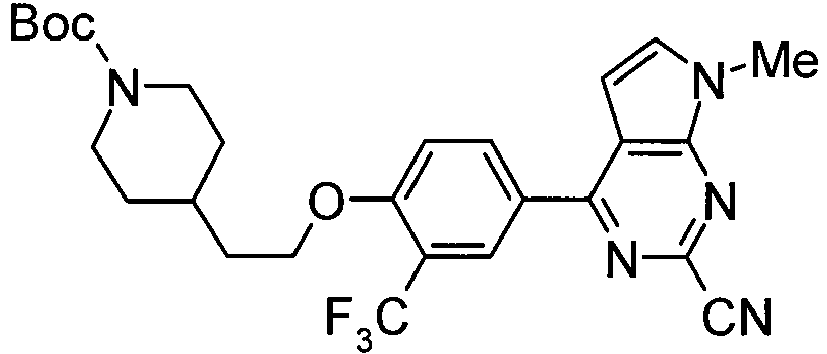
ESI+: 530 4 4 
CI+: 361, 363 5 5 
ESI+: 320 6 6 
ESI+: 490,492 [M+Na] 7 7 
ESI+: 474, 476 [M+Na] 8 8 
ESI+: 215 [M+Na] [Table 4] PEx PSyn Str DAT 9 9 
ESI+: 298 10 10 
ESI+: 286 11 11 
APCI/ESI+: 256 12 12 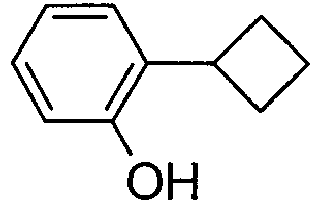
ESI+: 149 13 13 
EI: 226, 228 14 14 
ESI+: 298 15 15 
ESI+: 432 [M+Na] 16 16 
ESI+: 556 17 17 
ESI+: 223, 225, 227 18 18 
ESI+: 193, 195, 197 [Table 5] PEx PSyn Str DAT 19 19 
NMR1:2.63(3H, s),3.73(3H,s) ESI+: 217, 219, 221 20 20 
ESI+: 272, 274, 276 21 21 
ESI+: 452, 454 22 22 
ESI+: 271,273 23 23 
ESI+: 525, 527 24 24 
ESI+: 483, 485 25 25 
ESI+: 307 [Table 6] PEx PSyn Str DAT 26 26 
ESI+: 511, 513 27 27 
ESI+: 522 [M+Na] 28 28 
ESI+: 475, 477 [M+Na] 29 29 
ESI+: 212 30 30 
ESI+: 170 31 31 
ESI+: 187, 189 32 32 
ESI+: 609, 611 33 33 
ESI+: 449, 451 [Table 7] PEx Psyn Str DAT 34 34 
ESI+: 560 35 1 
ESI+: 539, 541 36 1 
ESI+: 540, 542 37 3 
ESI+: 531 38 1 
ESI+: 456, 458 39 19 
ESI+: 346, 348, 350 40 1 
ESI+: 357, 359 [Table 8] PEx PSyn Str DAT 41 1 
ESI+: 683, 685 42 3 
ESI+: 674 43 33 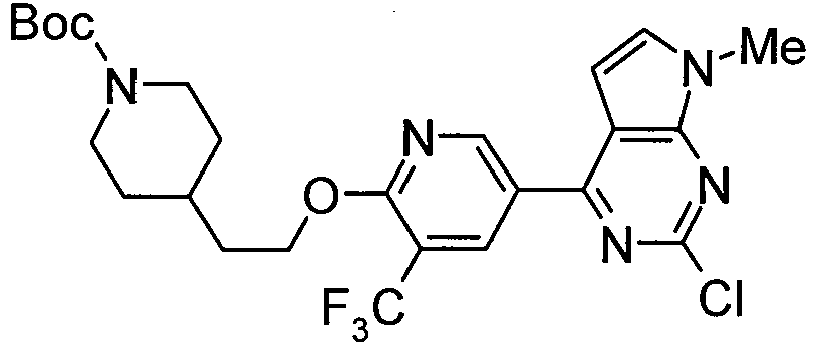
ESI+: 540, 542 44 27 
ESI+: 510 45 3 
ESI+: 531 46 33 
ESI+: 555, 557 47 4 
EI: 216, 218 [Table 9] PEx PSyn Str DAT 48 48 
ESI+: 541, 543 49 3 
ESI+: 546 50 4 
ESI+: 353, 355 51 19 
ESI+: 302, 304, 306 52 15 
APCI/ESI+: 344 [M-tBu+H] 53 16 
ESI+: 546 54 27 
ESI+: 423 [M+Na] 55 11 
ESI+: 256 [Table 10] PEx PSyn Str DAT 56 1 
ESI+: 540, 542 57 15 
ESI+: 432 [M+Na] 58 16 
ESI+: 546 59 15 
ESI+: 406 [M+Na] 60 16 
ESI+: 556 61 7 
ESI+: 460, 462 [M+Na] 62 16 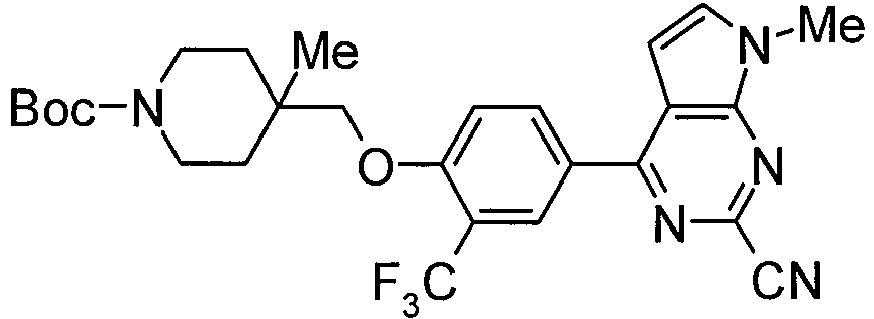
ESI+: 530 [Table 11] PEx PSyn Str DAT 63 1 
ESI+: 470, 472 64 1 
ESI+: 549, 551 65 27 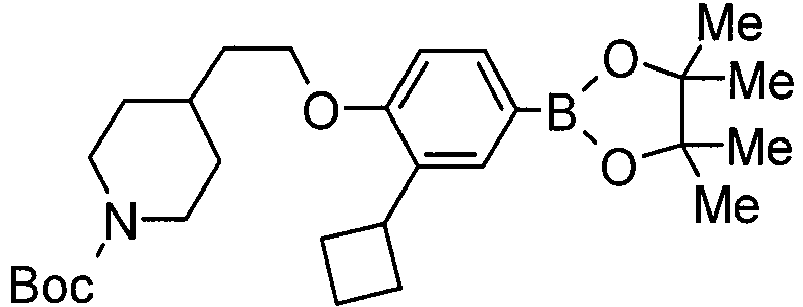
ESI+: 508 [M+Na] 66 3 
ESI+: 461 67 1 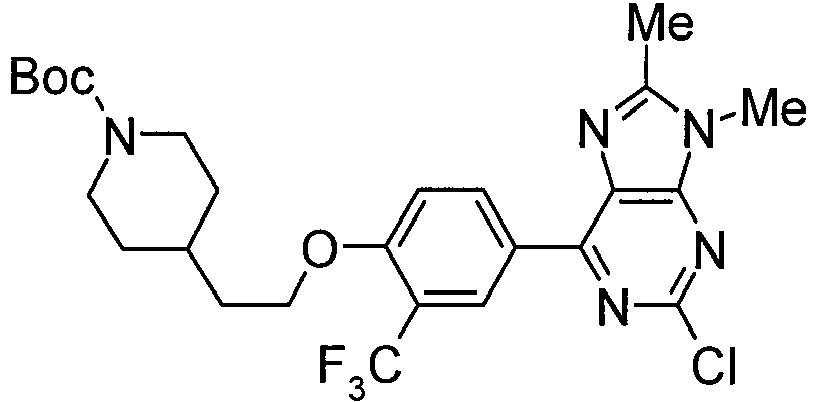
ESI+: 554, 556 68 3 
ESI+: 545 [Table 12] PEx PSyn Str DAT 69 19 
ESI+: 246, 248, 250 70 1 
ESI+: 330, 332 71 28 
ESI+: 453, 455 72 1 
ESI+: 525, 527 73 33 
ESI+: 540, 542 74 1 
ESI+: 583, 585 75 33 
ESI+: 539, 541 [Table 13] PEx PSyn Str DAT 76 3 
ESI+: 516 77 33 
ESI+: 610, 612 78 3 
ESI+: 531 79 3 
ESI+: 530 80 1 
ESI+: 609, 611 81 7 
ESI+: 492, 494 [M+Na] 82 3 
ESI+: 601 [Table 14] PEx PSyn Str DAT 83 33 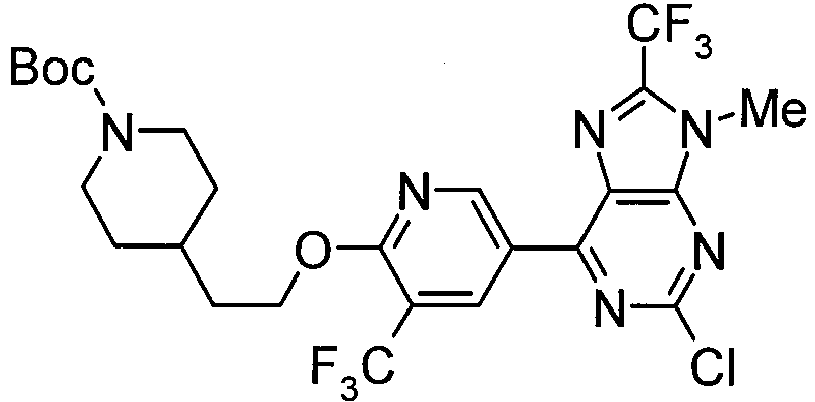
ESI+: 631, 633 [M+Na] 84 3 
ESI+: 600 85 3 
ESI+: 622 [M+Na] 86 3 
ESI+: 321 87 19 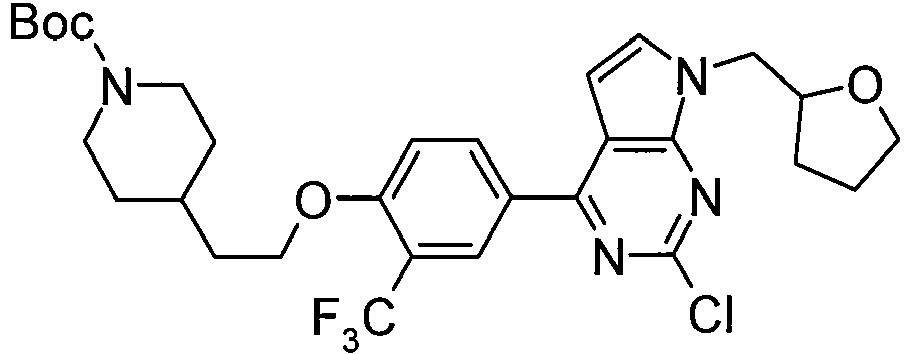
ESI+: 609, 611 88 3 
ESI+: 600 [Table 15] PEx PSyn Str DAT 89 20 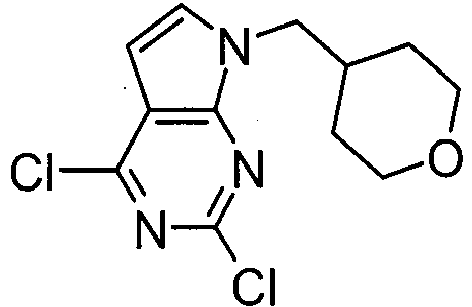
ESI+: 286, 288, 290 90 20 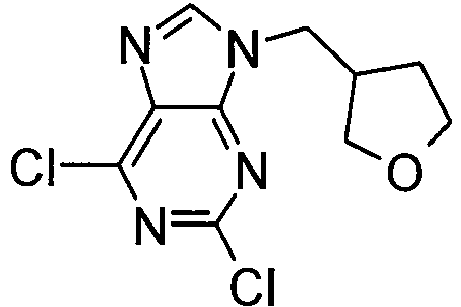
NMR1:1.57-1.67(1H,m),1.88-1.99(1H,m),2.78-2.88(1H,m),3.47-3.53(1H,m),3.59-3.68(2H,m),3.75-3.82(1H,m),4.20-4.31(2H,m),8.79(1H,s) ESI+: 273, 275, 277 91 1 
ESI+: 679, 681 92 3 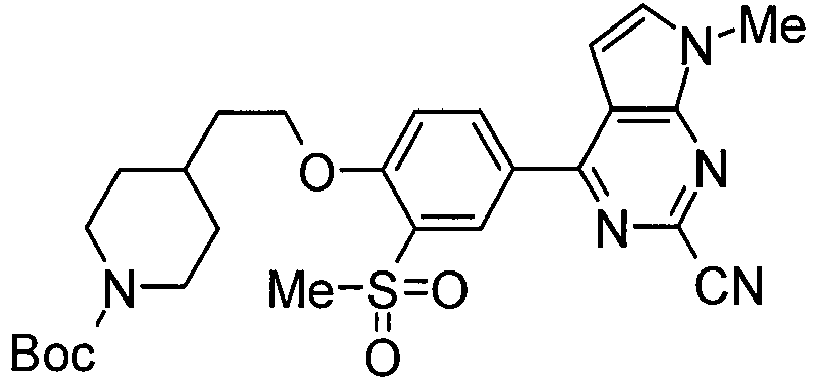
ESI+: 562 [M+Na] 93 20 
ESI+: 391 94 33 
ESI+: 448, 450 95 1 
ESI+: 610,612 [Table 16] PEx PSyn Str DAT 96 33 
ESI+: 611, 613 97 1 
ESI+: 595, 597 98 10 
ESI+: 226 99 3 
ESI+: 670 100 3 
ESI+: 586 101 3 
ESI+: 601 102 25 
ESI+: 516 [Table 17] PEx PSyn Str DAT 103 33 
ESI+: 624, 626 104 3 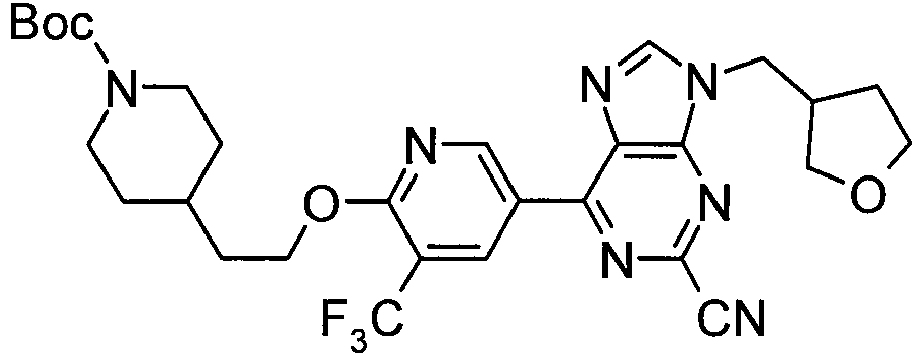
ESI+: 602 105 5 
ESI+: 319 106 9 
ESI+: 228 107 2 
ESI+: 409, 411 108 19 
ESI+: 315, 317, 319 109 30 
ESI+: 186 110 110 
ESI+: 501 [Table 18] PEx PSyn Str DAT 111 33 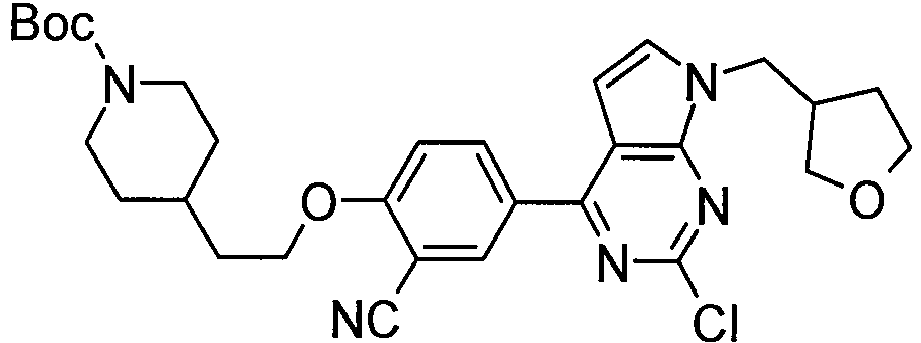
ESI+: 566 112 15 
ESI+: 370 113 3 
ESI+: 637 [M+Na] 114 32 
ESI+: 581, 583 115 16 
ESI+: 488 116 31 
ESI+: 166, 168 117 31 
ESI+: 184, 186 118 16 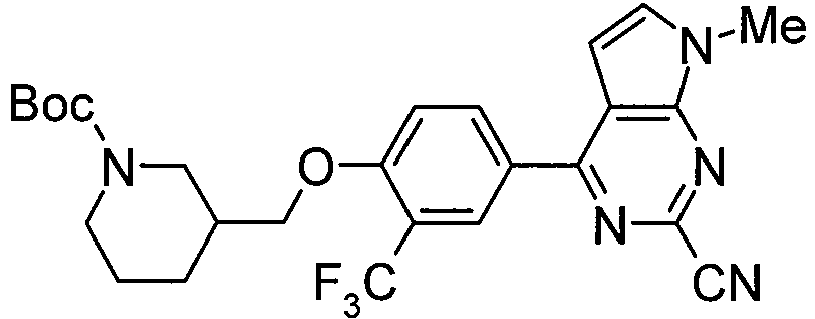
ESI+: 538 [M+Na] [Table 19] PEx PSyn Str DAT 119 16 
ESI+: 516 120 19 
ESI+: 544 121 15 
ESI+: 324 122 15 
ESI+: 340 123 33 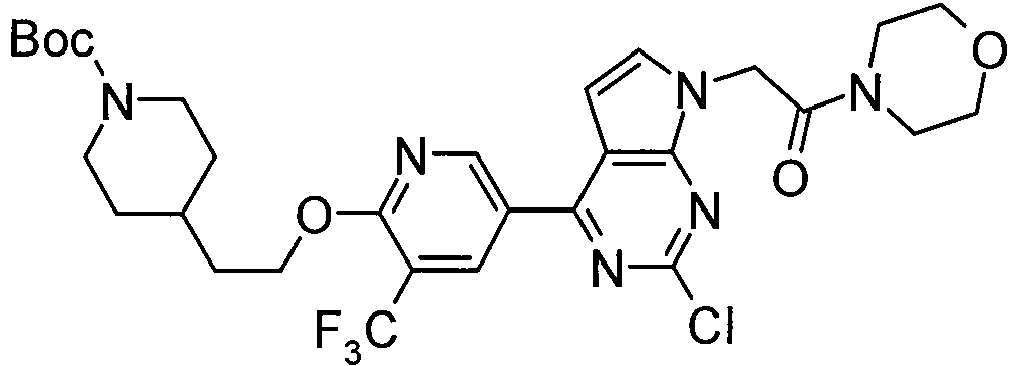
ESI+: 653, 655 124 3 
ESI+: 557 125 32 
ESI+: 595, 597 [Table 20] PEx PSyn Str DAT 126 3 
ESI+: 600 127 3 
ESI+: 644 128 3 
ESI+: 586 129 3 
ESI+: 572 130 33 
ESI+: 558, 560 131 19 
ESI+: 573 [Table 21] PEx PSyn Str DAT 132 3 
ESI+: 549 133 133 
ESI+: 554 [M+Na] 134 4 
ESI+: 460, 462 [M+Na] 135 27 
ESI+: 508 [M+Na] 136 27 
NMR2: 1.34(12H,s),1.44(3H,t,J=7.0Hz),4.14(2H,q, J=7.0Hz),6.96(1H,d,J=8.4Hz),7.90(1H,dd,J =1.3,8.4Hz),7.98-8.01(1H,m) 137 137 
ESI+: 296 [M+Na] 138 138 
ESI+: 628 139 139 
ESI+: 433 [Table 22] PEx PSyn Str DAT 140 138 
ESI+: 629 141 10 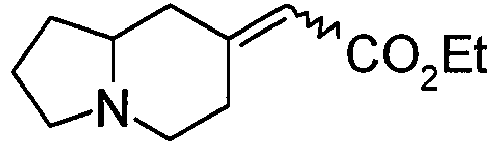
ESI+: 210 142 9 
ESI+: 212 143 11 
ESI+: 170 144 2 
ESI+: 393, 395 145 33 
ESI+: 481, 483 146 28 
ESI+: 339, 341 [M-Boc+H] 147 2 
ESI+: 409, 411 [Table 23] PEx PSyn Str DAT 148 33 
ESI+: 497, 499 149 137 
ESI+: 274 150 30 
ESI+: 232 151 2 
ESI+: 455,457 152 2 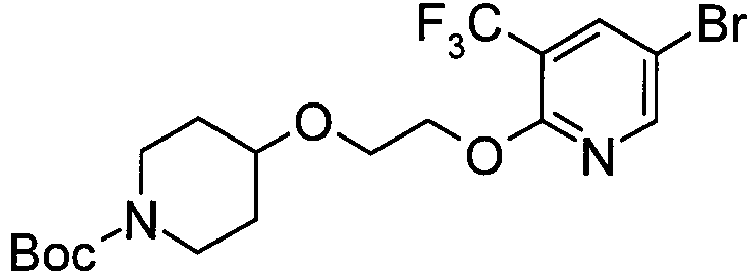
ESI+: 469,471 153 33 
ESI+: 556, 558 154 33 
ESI+: 542, 544 155 3 
ESI+: 547 [Table 24] PEx PSyn Str DAT 156 3 
ESI+: 533 157 33 
ESI+: 542, 544 158 3 
ESI+: 533 159 33 
ESI+: 526, 528 160 3 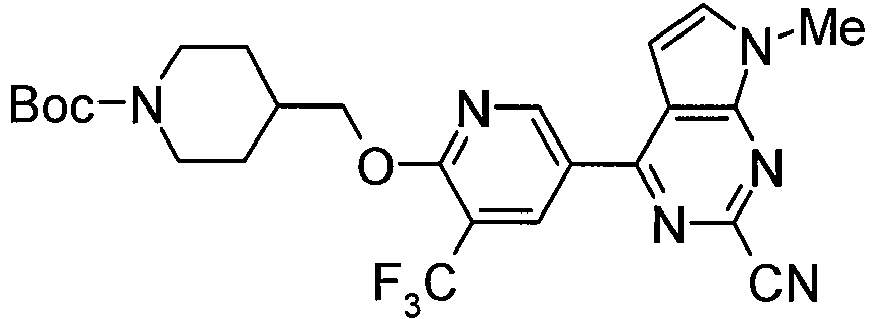
ESI+: 517 161 138 
ESI+: 614 162 30 
ESI+: 232 163 2 
ESI+: 477, 479 [M+Na] [Table 25] Ex Str 1 
2 
3 
4# 
5 
6 
[Table 26] Ex Str 7 
8 
9# 
10 
11 
12 
[Table 27] Ex Str 13 
14 
15 
16 
17# 
18 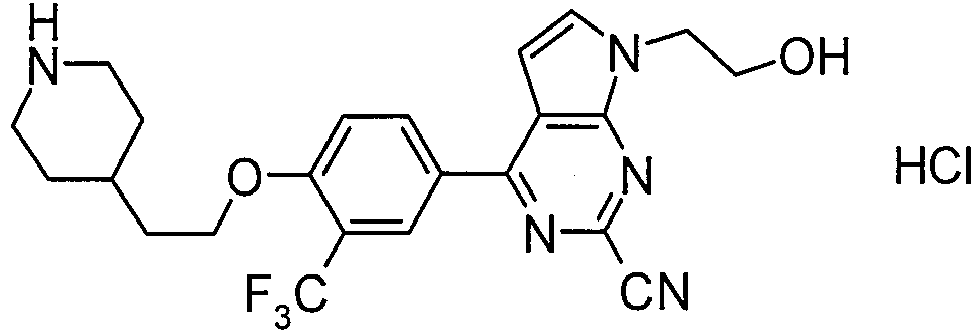
[Table 28] Ex Str 19 
20 
21 
22# 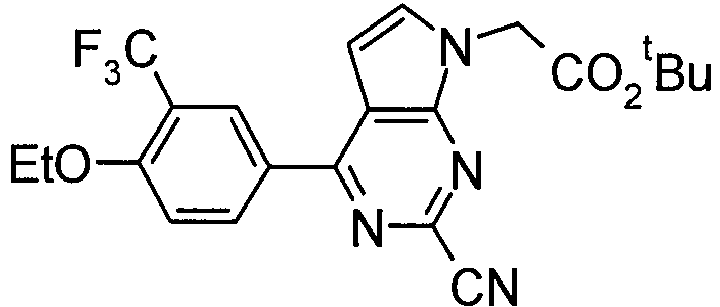
23 
24 
[Table 29] Ex Str 25 
26 
27 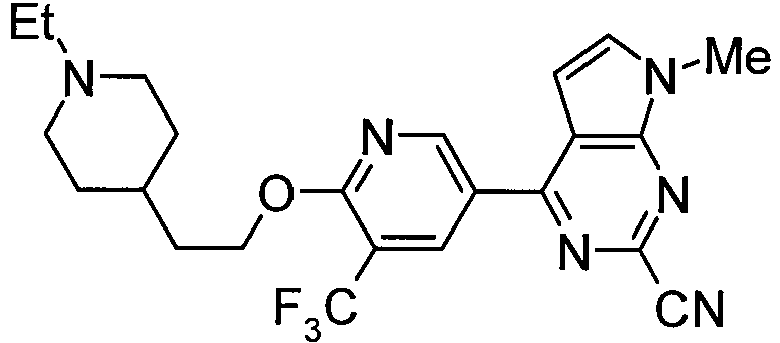
28 
29 
30 
[Table 30] Ex Str 31 
32 
33 
34 
35 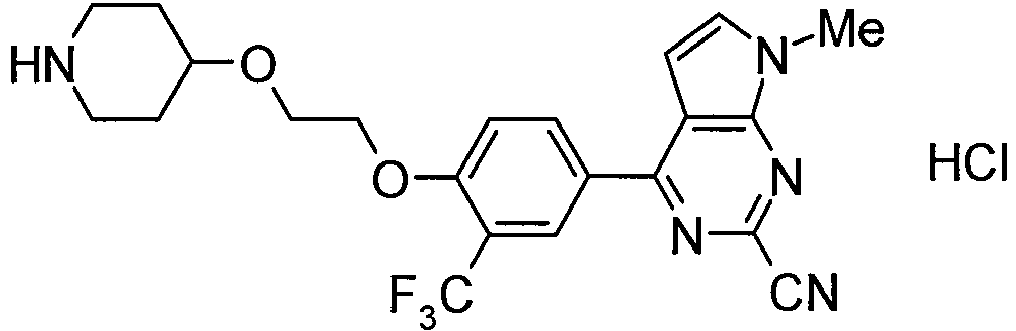
36 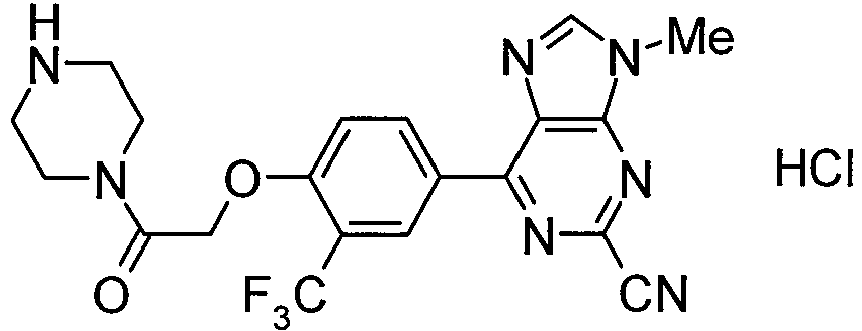
[Table 31] Ex Str 37 
38 
39 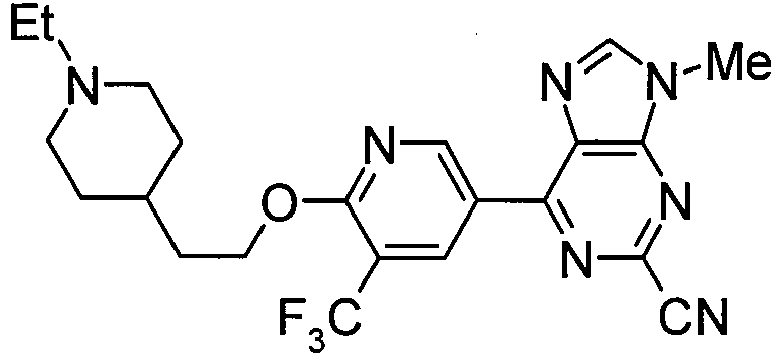
40 
41 
42 
[Table 32] Ex Str 43# 
44 
45 
46# 
47 
48# 
49# 
[Table 33] Ex Str 50 
51 
52 
53# 
54 
55# 
[Table 34] Ex Str 56 
57# 
58 
59# 
60# 
61# 
[Table 35] Ex Str 62# 
63# 
64# 
65 
66 
67# 
[Table 36] Ex Str 68 
69# 
70 
71 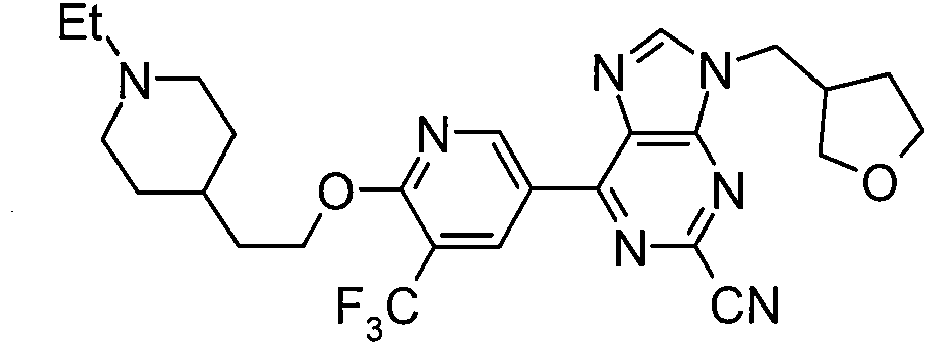
72 
73 
74 
[Table 37] Ex Str 75 
76 
77 
78 
79 
80 
[Table 38] Ex Str 81 
82 
83 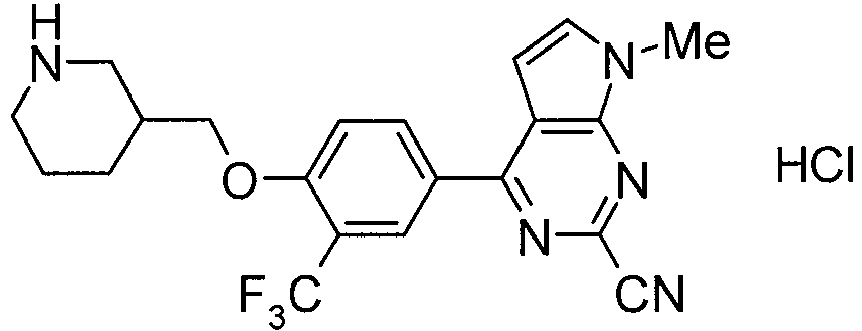
84 
85 
86 
87 
[Table 39] Ex Str 88 
89 
90 
91 
92 
93 
[Table 40] Ex Str 94 
95 
96 
97 
98# 
99# 
[Table 41] Ex Str 100# 
101 
102 
103 
104 
105 
[Table 42] Ex Str 106 
107 
108 
109 
110 
111 
[Table 43] Ex Str 112 
113 
114 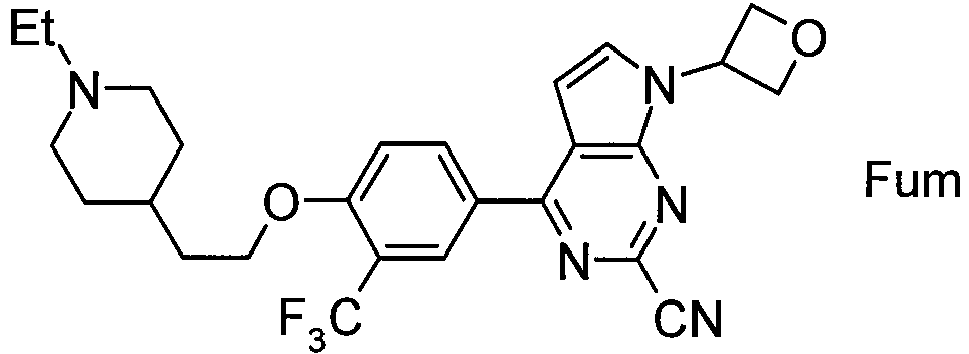
115 
116 
117 
[Table 44] Ex Str 118 
119 
120 
121 
[Table 45] Ex Str 122 
123 
124 
125 
126 
127 
[Table 46] Ex Str 128 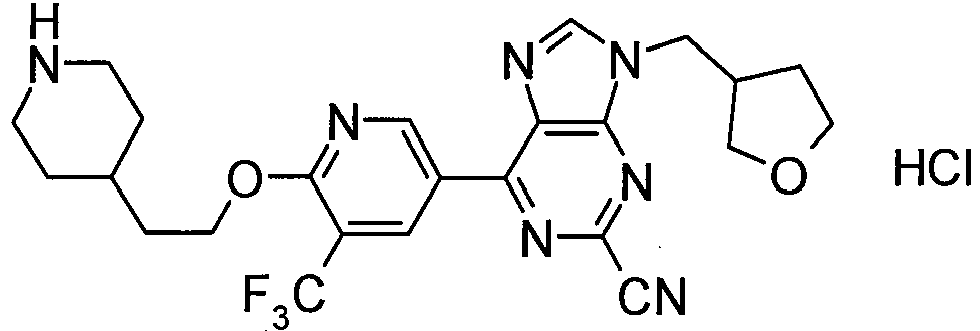
129 
130 
131 
132 
133 
[Table 47] Ex Str 134 
135 
136 
137 
138 
139 
[Table 48] Ex Str 140 
141 
142 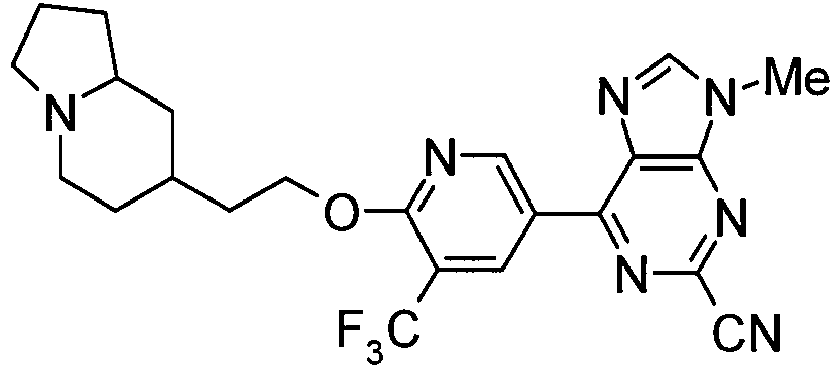
143 
144 
145 
[Table 49] Ex Str 146 
147 
148 
149 
150 
151 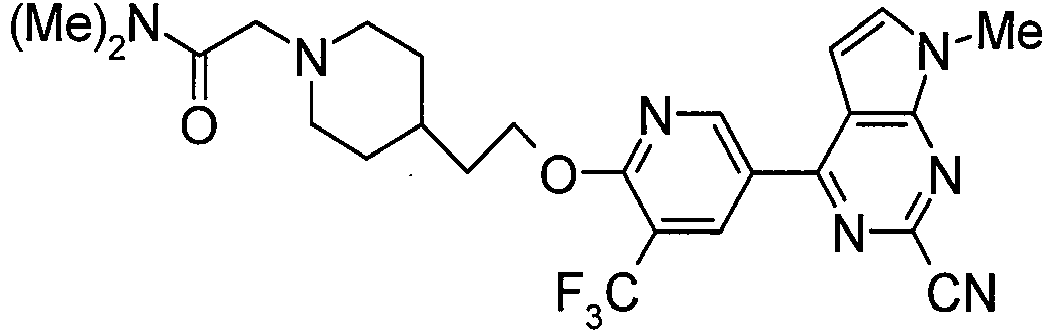
[Table 50] Ex Str 152 
153 
154 
155 
156 
157 
[Table 51] Ex Str 158 
159 
160 
[Table 52] Ex Syn DAT 1 1 NMR1:1.40(3H,t,J=7.0Hz),3.92(3H,s),4.31(2H,q,J=7.0Hz),7.11(1H,d,J=3.6 Hz),7.48(1H,d,J=8.8Hz),8.04(1H,d,J=3.6Hz),8.38(1H,d,J=2.2Hz),8.47(1H,d d,J=2.2,8.8Hz); ESI+:347 2 2 NMR1:1.33-1.49(2H,m),1.73-1.94(5H,m),2.77-2.90(2H,m),3.21-3.31(2H,m),3.93(3H,s),4.27-4.36(2H,m),7.11(1H,d,J=3.6Hz),7.50(1H,d,J=8.8Hz),8.06(1H,d,J=3.6Hz),8.3 9(1H,d,J=2.2Hz),8.48(1H,dd,J=2.2,8.8Hz),8.56(1H,br),8.80(1H,br); ESI+:430 3 3 NMR2:1.32-1.45(2H,m),1.54-1.67(1H,m),1.69-1.78(2H,m),1.79-1.87(2H,m),2.03-2.15(2H,m),2.89-2.93(2H,m),2.95(3H,s),3.09(3H,s),3.15(2H,s),3.96(3H,s),4.17-4.24(2H,m),6.90(1H,d,J=3.6Hz),7.16(1H,d,J=8.7Hz),7.47(1H,d,J=3.6Hz),8.3 6(1H,dd,J=2.2,8.7Hz),8.41(1H,d,J=2.2Hz); ESI+:515 4# 4 NMR2:1.50(3H,t,J=6.8Hz),4.22(2H,q,J=6.8Hz),5.12(2H,s),6.85-6.95(1H,m),7.07-7.15(1H,m),7.45-7.54(1H,m),8.21-8.39(2H,m); ESI+:391 5 5 NMR2:1.51(3H,t,J=6.8Hz),2.36(3H,s),2.45(2H,t,J=4.8Hz),2.55(2H,t,J=4.8H z),3.64-3.71(4H,m),4.25(2H,q,J=6.8Hz),5.18(2H,s),6.97(1H,d,J=4Hz),7.17(1H,d,J=8 .8Hz),7.59(1H,d,J=4Hz),8.35(1H,dd,J=2.4,8.8Hz),8.41(1H,d,J=2.4Hz); ESI+:473 6 6 NMR1:0.97-1.22(2H,m),1.59-1.85(8H,m),1.97-2.04(1H,m),2.10-2.24(4H,m),2.44-2.60(1H,m),2.87-3.02(2H,m),3.02-3.17(1H,m),3.92(3H,s),4.10-4.46(4H,m),7.56(1H,d,J=9.0Hz),8.91(1H,s),9.05(1H,dd,J=2.1,8.9Hz),9.16(1 H,d,J=2.1Hz); ESI+:542 7 7 NMR1:1.09-1.25(2H,m),1.60-1.81(5H,m),2.59-2.69(2H,m),2.71(6H,s),3.48-3.59(2H,m),3.92(3H,s),4.32(2H,t,J=6.2Hz),7.57(1H,d,J=9.0Hz),8.92(1H,s),9 .06(1H,dd,J=2.2,8.9Hz),9.17(1H,d,J=2.1Hz); ESI+:502 8 8 NMR1:1.20-1.31(2H,m),1.61-1.68(2H,m),1.72-1.82(3H,m),2.74-2.84(2H,m),2.94-3.71(10H,m),3.82-3.88(2H,m),4.09-4.46(3H,m),5.47(2H,br-s),7.16(1H,d,J=3.6Hz),7.52(1H,d,J=8.8Hz),7.92(1H,d,J=3.6Hz),8.39(1H,d,J =2.4Hz),8.49(1H,dd,J=2.4,8.8Hz),10.87(1H,br-s); ESI+:557 9# 9 NMR1:1.12-1.34(3H,m),1.49-1.57(2H,m),1.64-1.71(2H,m),1.77-1.85(2H,m),2.13(3H,s),2.70-2.77(2H,m),3.27-3.78(2H,m),6.15(1H,t,J=6Hz),7.00(1H,d,J=8.8Hz),7.05(1H,d,J=3.6Hz),7.93( 1H,d,J=3.6Hz),8.29-8.34(2H,m),12.81(1H,br-s); ESI+:429 10 10 NMR1:1.33-1.48(2H,m), 1.73-1.94(5H,m),2.75(3H,s),2.78-2.92(2H,m),3.22-3.37(2H,m),3.83(3H,s),4.26-4.35(2H,m),7.55(1H,d,J=8.9Hz),8.37(1H,br),8.64(1H,br),9.08(1H,dd,J=2.2,8 .9Hz),9.11(1H,d,J=2.2Hz); ESI+:445 11 11 NMR2:1.09(3H,t,J=7.2Hz),1.29-1.42(2H,m),1.55-1.68(1H,m),1.72-1.96(6H,m),2.40(2H,q,J=7.2Hz),2.75(3H,s),2.92-3.00(2H,m),3.86(3H,s),4.21(2H,t,J=6.3Hz),7.14(1H,d,J=8.8Hz),9.04(1H,dd,J =2.2,8.8Hz),9.16(1H,d,J=2.2Hz); ESI+:473 12 12 NMR1:1.13-1.27(4H,m),1.64-1.92(5H,m),1.97-2.10(1H,m),2.57-2.69(1H,m),2.70-2.83(1H,m),2.99-3.13(2H,m),3.37-3.53(2H,m),3.94(3H,s),4.53-4.71(2H,m),7.23(1H,d,J=3.6Hz),8.09(1H,d,J=3.6Hz),8.73(1H,d,J=2.2Hz),9.2 5(1H,d,J=2.2Hz),9.58(1H,br); ESI+:459 [Table 53] Ex Syn DRAT 13 13 NMR1:1.23(3H,t,J=7.3Hz),1.44-1.59(2H,m),1.70-1.84(2H,m),1.88-2.01(3H,m),2.77-2.90(2H,m),3.02-3.11(2H,m),3.25(3H,s),3.43-3.52(2H,m),3.76(2H,t,J=5.2Hz),4.29-4.36(2H,m),4.53(2H,t,J=5.2Hz),7.12(1H,d,J=3.6Hz),7.51(1H,d,J=8.8Hz),8.0 7(1H,d,J=3.6Hz),8.39(1H,d,J=3.6Hz),8.48(1H,dd,J=2.1,8.8Hz),9.68(1H,br); ESI+:502 14 14 NMR1:0.22-0.30(2H,m),0.35-0.42(2H,m),1.06-1.22(2H,m),1.44-1.60(2H,m), 1.62-1.76(4H,m),2,04-2.16(2H,m),2.87-2.96(2H,m),3.92(3H,s),4.28(2H,t,J=6.4Hz),7.11(1H,d,J=3.6Hz),7.50(1H,d,J= 8.9Hz),8.04(1H,d,J=3.6Hz),8.38(1H,d,J=2.2Hz),8.46(1H,dd,J=2.2,8.8Hz); ESI+:470 15 15 NMR1:1.06-1.34(4H,m),1.54-1.67(1H,m),1.72-2.16(5H,m),2.45-2.56(4H,m),2.65-2.83(4H,m),3.01-3.15(2H,m),3.54-3.73(3H,m),3.75-3.84(1H,m),4.20-4.66(8H,m),7.12(1H,d,J=3.6Hz),7.52(1H,d,J=8.8Hz),8.06(1H,d,J=3.7Hz),8.3 9(1H,d,J=2.2Hz),8.48(1H,dd,J=2.2,8.8Hz),9.43-9.60(1H,br); ESI+:611 16 16 NMR1:1.50-1.68(3H,m),1.71-2.05(8H,m),2.86-3.05(8H,m),3.43-3.54(2H,m),3.60-3.69(1H,m),3.75-3.83(1H,m),4.16-4.49(7H,m),7.12(1H,d,J=3.6Hz),7.51(1H,d,J=8.9Hz),8.06(1H,d,J=3.6Hz),8.3 9(1H,d,J=2.2Hz),8.49(1H,dd,J=2.1,8.7Hz),9.31-9.48(1H,br); ESI+:585 17# 17 NMR1:1.48-1.61(1H,m),1.63-1.78(2H,m),2.03-2.17(1H,m),2.23-2.37(1H,m),2.55(3H,s),2.85-3.02(2H,m),3.10-3.20(1H,m),3.27-3.38(3H,m),3.90(3H,s),6.26-6.33(1H,m),6.54(2H,s),7.01-7.06(1H,m),7.07(1H,d,J=3.6Hz),7.96(1H,d,J=3.6Hz),8.28-8.34(2H,m); ESI+:429 18 18 ESI+: 460 19 2 NMR1:1.33-1.48(2H,m),1.71-1.95(5H,m),2.76-2.91(2H,m),3.20-3.38(2H,m),3.93(3H,s),4.27-4.38(2H,m),7.56(1H,d,J=9.0Hz),8.49(1H,br),8.73(1H,br),8.92(1H,s),9.06(1H ,dd,J=2.2,9.0Hz),9.17(1H,d,J=2.2Hz); ESI+:431 20 1 NMR2:1.51(3H,t,J=7.0Hz),3.98(3H,s),4.25(2H,q,J=7.0Hz),7.16(1H,d,J=8.8 Hz),8.25(1H,s),9.06(1H,dd,J=2.2,8.8Hz),9.21(1H,d,J=2.2Hz); ESI+:348 21 3 NMR2:1.32-1.44(2H,m),1.52-1.67(1H,m),1.69-1.86(4H,m),2.04-2.14(2H,m),2.88-2.92(2H,m),2.94(3H,s),3.08(3H,s),3.15(2H,s),4.07(2H,t,J=5.0Hz),4.20(2H,t, J=6.4Hz),4.51(2H,t,J=5.0Hz),6.91(1H,d,J=3.6Hz),7.16(1H,d,J=8.8Hz),7.63( 1H,d,J=3.6Hz),8.35(1H,dd,J=2.2,8.8Hz),8.40(1H,d,J=2.2Hz); ESI+:545 22# 1 NMR2:1.50(9H,s),1.51(3H,t,J=7.0Hz),4.25(2H,q,J=7.0Hz),5.01(2H,s),6.96(1 H,d,J=3.6Hz),7.17(1H,d,J=8.4Hz),7.53(1H,d,J=3.6Hz),8.35(1H,dd,J=2.4,8.4 Hz),8.41(1H,d,J=2.4Hz); ESI+:447 23 10 NMR1:1.34-1.49(2H,m),1.59-1.69(1H,m),1.73-1.97(6H,m),2.78-2.93(3H,m),3.21-3.32(2H,m),3.49-3.55(1H,m),3.61-3.69(2H,m),3.79-3.86(1H,m),4.27-4.38(4H,m),7.14(1H,d,J=3.6Hz),7.50(1H,d,J=8.8Hz),8.16(1H,d,J=3.6Hz),8.3 8(1H,d,J=2.2Hz),8.40-8.56(2H,m),8.73(1H,br); ESI+:500 24 3 NMR1:1.16-1.30(2H,m),1.44-1.57(1H,m),1.64-1.76(4H,m),1.86-2.01(2H,m),2.31-2.42(2H,m),2.78-2.95(2H,m),3.44-3.52(2H,m),3.92(3H,s),4.24-4.39(3H,m),7.56(1H,d,J=9.0Hz),8.91(1H,s),9.05(1H,dd,J=2.2,8.9Hz),9.17(1 H,d,J=2.1Hz); ESI+:475 [Table 54] Ex Syn DAT 25 3 NMR1:1.14-1.31(2H,m),1.42-1.56(1H,m),1.64-1.79(6H,m),1.80-1.88(2H,m),1.96-2.06(2H,m),2.79-2.89(2H,m),3.04(2H,s),3.23-3.33(2H,m),3.46(2H,t,J=6.7Hz),3.92(3H,s),4.30(2H,t,J=6.5Hz),7.56(1H,d,J= 9.0Hz),8.92(1H,s),9.05(1H,dd,J=2.2,8.9Hz),9.17(1H,d,J=2.2Hz); ESI+:542 26 11 NMR1:0.98(3H,t,J=7.2Hz),1.12-1.29(2H,m),1.42-1.58(1H,m),1.64-1.88(6H,m),2.28(2H,q,J=7.2Hz),2.79-2.91(2H,m),3.92(3H,s),4.30(2H,t,J=6.4Hz),7.56(1H,d,J=9.0Hz),8.91(1H,s),9 .05(1H,dd,J=2.2,8.9Hz),9.16(1H,d,J=2.1Hz); ESI+:459 27 11 NMR1:0.99(3H,t,J=7.2Hz),1.13-1.31(3H,m),1.41-1.55(1H,m),1.63-1.96(5H,m),2.25-2.39(2H,m),2.81-2.94(2H,m),3.93(3H,s),4.59(2H,t,J=6.5Hz),7.24(1H,d,J=3.6Hz),8.07(1H,d,J =3.6Hz),8.71(1H,d,J=2.0Hz),9.23(1H,d,J=2.0Hz); ESI+:459 28 28 NMR1:1.33-1.49(2H,m),1.69-1.83(3H,m),1.84-1.93(2H,m),2.75-2.90(2H,m),3.20-3.32(2H,m),3.94(3H,s),4.61(2H,t,J=6.1Hz),8.53(1H,br),8.79(1H,br),8.97(1H, s),9.33(1H,d,J=2.2Hz),9.75(1H,d,J=2.2Hz); ESI+:432 29 6 NMR1:0.95-1.21(2H,m),1.60-1.84(8H,m),1.98-2.10(1H,m),2.15-2.24(4H,m),2.45-2.58(1H,m),2.88-3.02(2H,m),3.04-3.18(1H,m),3.92(3H,s),4.09-4.45(4H,m),7.56(1H,d,J=9.0Hz),8.91(1H,s),9.05(1H,dd,J=2.2,8.9Hz),9.16(1 H,d,J=2.1Hz); ESI+:542 30 6 NMR2:1.10-1.33(2H,m),1.66-2.15(11H,m),2.17-2.29(1H,m),2.31-2.39(3H,m),2.53-2.66(1H,m),2.88-3.09(3H,m),3.13-3.21(1H,m),3.61-3.67(1H,m),3.75-3.84(2H,m),3.95-4.02(1H,m),4.07-4.43(5H,m),4.62-4.73(1H,m),6.91(1H,d,J=3.6Hz),7.18(1H,d,J=8.7Hz),7.50(1H,d,J=3.6Hz),8.3 7(1H,dd,J=2.2,8.7Hz),8.41(1H,d,J=2.2Hz); ESI+:611 31 3 NMR1:1.20-1.32(2H,m),1.43-1.58(1H,m),1.68-1.80(4H,m),2.07-2.18(2H,m),2.74-2.83(2H,m),3.69(2H,s),3.92(3H,s),4.31(2H,t,J=6.4Hz),7.56(1H,d,J=9.0Hz),8 .91(1H,s),9.05(1H,dd,J=2.2,8.9Hz),9.17(1H,d,J=2.1Hz); ESI+:470 32 3 NMR1:1.17-1.30(2H,m),1.42-1.55(1H,m),1.66-1.77(4H,m),2.02-2.12(2H,m),2.48(3H,s),2.79-2.86(2H,m),3.71(2H,s),3.92(3H,s),4.29(2H,t,J=6.4Hz),7.55(1H,d,J=9.0Hz),8 .91(1H,s),9.04(1H,dd,J=2.2,8.9Hz),9.16(1H,d,J=2.2Hz); ESI+:527 33 6 NMR1:1.00-1.26(2H,m),1.70-1.83(5H,m),2.53-2.68(1H,m),2.85-2.98(1H,m),3.60-3.73(1H,m),3.92(3H,s),4.01-4.13(2H,m),4.26-4.39(3H,m),4.42(1H,t,J=5.4Hz),7.56(1H,d,J=9.0Hz),8.91(1H,s),9.05(1H,dd,J =2.2,8.9Hz),9.16(1H,d,J=2.2Hz); ESI+:489 34 2 NMR1:1.26-1.42(2H,m),1.57-1.81(3H,m),1.83-1.95(2H,m),2.76-2.94(2H,m),3.14-3.29(4H,m),3.94(3H,s),7.13(1H,d,J=4Hz),7.84(1H,d,J=9.0Hz),8.08(1H,d,J=4 Hz),8.35-8.48(3H,m),8.62-8.8(1H,br); ESI+:446 35 2 NMR1:1.66-1.77(2H,m),1.90-2.00(2H,m),2.91-3.03(2H,m),3.06-3.18(2H,m),3.65-3.73(1H,m),3.80-3.87(2H,m),3.93(3H,s),4.36-4.43(2H,m),7.12(1H,d,J=3.6Hz),7.52(1H,d,J=8.8Hz),8.06(1H,d,J=3.6Hz),8.4 0(1H,d,J=2.2Hz),8.49(1H,dd,J=2.2,8.8Hz),8.57(1H,br),8.66(1H,br); ESI+:446 [Table 55] Ex Syn DAT 36 2 NMR1:3.02-3.26(4H,m),3.64-3.73(4H,m),3.93(3H,s),5.27(2H,s),7.44(1H,d,J=9.0Hz),8.93(1H,s),8.99(1H,d d,J=2.2,9.0Hz),9.11(2H,br),9.18(1H,d,J=2.2Hz); ESI+:446 37 2 NMR1:1.55-1.83(4H,m),1.89-2.25(7H,m),3.88-3.98(5H,m),4.24-4.36(2H,m),7.10-7.13(1H,m),7.47-7.52(1H,m),8.04-8.07(1H,m),8.37-8.40(1H,m),8.46-8.52(1H,m),8.55-8.97(2H,m); ESI+:456 38 2 NMR1:1.63-2.04(6H,m),2.11-2.26(3H,m),2.81-2.97(2H,m),3.02-3.12(1H,m),3.13-3.24(1H,m),3.93(3H,s),4.25-4.41(2H,m),7.11(1H,d,J=3.6Hz),7.52(1H,d,J=8.8Hz),8.06(1H,d,J=3.6Hz),8.3 3-8.55(3H,m),8.92-9.03(1H,m); ESI+:456 39 39 NMR1:0.97(3H,t,J=7.2Hz),1.13-1.26(2H,m),1.38-1.53(1H,m),1.64-1.85(6H,m),2.27(2H,q,J=7.2Hz),2.79-2.88(2H,m),3.944(3H,s),4.60(2H,t,J=6.6Hz),8.96(1H,s),9.33(1H,d,J=2.2Hz),9 .76(1H,d,J=2.2Hz); ESI+:460 40 6 NMR1:0.96-1.21(2H,m),1.58-1.82(8H,m),1.97-2.08(1H,m),2.11-2.23(4H,m),2.48-2.59(1H,m),2.88-3.00(2H,m),3.03-3.16(1H,m),3.94(3H,s),4.10-4.27(1H,m),4.31-4.47(1H,m),4,57-4.65(2H,m),8.96(1H,s),9.31(1H,d,J=2.1Hz),9.74(1H,d,J=2.1Hz); ESI+:543 41 6 NMR1:0.96-1.23(2H,m),1.59-1.83(8H,m),1.97-2.08(1H,m),2.11-2.23(4H,m),2.45-2.59(1H,m),2.87-3.01(2H,m),3.02-3.15(1H,m),3.93(3H,s),4.11-4.26(1H,m),4.31-4.45(1H,m),4.60(2H,t,J=6.1Hz),7.23(1H,d,J=3.6Hz),8.07(1H,d,J=3.6Hz),8.7 1(1H,d,J=2.2Hz),9.23(1H,d,J=2.2Hz); ESI+:542 42 5 NMR1:1.40(3H,t,J=7.0Hz),1.46-1.52(2H,m),1.72-1.81(2H,m),1.91-2.26(5H,m),2.69-2.83(2H,m),3.48-3.61(1H,m),4.32(2H,q,J=7.0Hz),5.03(2H,s),7.13(1H,d,J=3.7Hz),7.50(1H,d,J =8.8Hz),8.02(1H,d,J=3.7Hz),8.34(1H,d,J=7.5Hz),8.39(1H,d,J=2.2Hz),8.48(1 H,dd,J=2.2,8.8Hz); ESI+:487 43# 1 NMR1:1.20-1.31(2H,m),1.44(9H,s),1.61-1.67(2H,m),1.72-1.82(3H,m),3.24-3.33(2H,m),3.82-3.88(2H,m),4.31(2H,t,J=6Hz),5.18(2H,s),7.16(1H,d,J=3.6Hz),7.52(1H,d,J=8 .8Hz),8.05(1H,d,J=3.6Hz),8.39(1H,d,J=2.2Hz),8.48(1H,dd,J=2.2,8.8Hz); ESI+:531 44 2 NMR1:1.16(3H,s),1.58-1.69(2H,m),1.74-1.85(2H,m),3.04-3.23(4H,m),3.93(3H,s),4.09(2H,s),7.11(1H,d,J=3.6Hz),7.52(1H,d,J=8.8Hz),8 .06(1H,d,J=3.6Hz),8.39(1H,d,J=2.2Hz),8.49(1H,dd,J=2.2,8.8Hz),8.55-8.80(2H,m); ESI+:430 45 11 NMR1:1.01(3H,t,J=7.2Hz),2.29-2.45(6H,m),3.41-3.51(4H,m),3.92(3H,s),5.20(2H,s),7.39(1H,d,J=9.0Hz),8.92(1H,s),8.99(1H,d d,J=2.1,9.0Hz),9.18(1H,d,J=2.1Hz); ESI+:474 46# 4 NMR1:1.20-1.31(2H,m),1.61-1.68(2H,m),1.71-1.82(3H,m),3.12-3.49(2H,m),3.80-3.89(2H,m),4.31(2H,t,J=6.0Hz),5.16(2H,s),7.15(1H,d,J=3.6Hz),7.52(1H,d,J =8.8Hz),8.05(1H,d,J=3.6Hz),8.38(1H,d,J=2.4Hz),8.48(1H,dd,J=2.4,8.8Hz),1 3.37(1H,br); ESI+:475 [Table 56] Ex Syn DAT 47 5 NMR1:1.20-1.31(2H,m),1.40-1.52(2H,m),1.60-1.67(2H,m),1.70-1.83(5H,m),1.89-1.98(2H,m),2.14(3H,s),2.66-2.73(2H,m),3.28(2H,dt,J=1.6,11.6Hz),3.46-3.57(1H,m),3.82-3.88(2H,m),4.31(2H,t,J=6.0Hz),5.03(2H,s),7.12(1H,d,J=3.6Hz),7.51(1H,d,J =8.8Hz),8.02(1H,d,J=3.6Hz),8.32(1H,d,J=7.6Hz),8.38(1H,d,J=2.2Hz),8.47(1 H,dd,J=2.2,8.8Hz); ESI+:571 48# 2 NMR1:1.36-1.50(2H,m),1.81-2.01(3H,m),2.80-2.94(2H,m),3.22-3.31(2H,m),3.45(2H,d,J=6.2Hz),3.95(3H,s),4.76(2H,s),7.15(1H,d,J=3.6Hz),7 .95(1H,d,J=8.1Hz),8.10(1H,d,J=3.6Hz),8.40-8.54(3H,m),8.80(1H,br); ESI+:430 49# 11 NMR1:0.98(3H,t,J=7.2Hz),1.16-1.29(2H,m),1.54-1.74(3H,m),1.78-1.88(2H,m),2.29(2H,q,J=7.2Hz),2.80-2.89(2H,m),3.41(2H,d,J=6.3Hz),3.94(3H,s),4.73(2H,s),7.17(1H,d,J=3.6Hz),7 .96(1H,d,J=8.1Hz),8.09(1H,d,J=3.6Hz),8.43(1H,d,J=1.5Hz),8.51(1H,dd,J=1. 5,8.1Hz); ESI+:458 50 2 NMR1:1.18-1.31(1H,m),1.54-2.01(6H,m),2.58-2.70(1H,m),2.70-2.83(1H,m),3.14-3.41(2H,m),3.94(3H,s),4.54-4.69(2H,m),7.23(1H,d,J=3.6Hz),8.09(1H,d,J=3.6Hz),8.60(1H,br),8.73(1H,d, J=2.2Hz),8.88(1H,br),9.24(1H,d,J=2.2Hz); ESI+:431 51 2 NMR1:1.34-1,49(2H,m),1.59-1.69(1H,m),1.71-1,97(6H,m),2.76-2.93(3H,m),3.21-3.30(2H,m),3.49-3.55(1H,m),3.60-3.69(2H,m),3.79-3.86(1H,m),4.34-4.40(2H,m),4.57-4.64(2H,m),7.26(1H,d,J=3.6Hz),8.20(1H,d,J=3.6Hz),8.57(1H,br),8.72(1 H,d, J=2.2Hz),8.80(1H,br),9.24(1H,d,J=2.2Hz); ESI+:501 52 12 NMR1:1.22(3H,t,J=7.3Hz),1.41-1.55(2H,m),1.58-1.83(3H,m),1.87-2.00(4H,m),2.77-2.93(3H,m),3.01-3.12(2H,m),3.42-3.55(3H,m),3.60-3.69(2H,m),3.78-3.86(1H,m),4.33-4.40(2H,m),4.62(2H,t,J=6.0Hz),7.26(1H,d,J=3.6Hz),8.20(1H,d,J=3.6Hz),8.7 3(1H,d,J=2.2Hz),9.25(1H,d,J=2.2Hz),9.43(1H,br); ESI+:529 53# 2 NMR1:1.32-1.49(2H,m),1.70-1.94(6H,m),1.97-2.23(3H,m),2.29-2.41(2H,m),2.78-2.94(2H,m),3.20-3.34(2H,m),3.56-3.80(1H,m),3.91(3H,s),4.13(2H,t,J=6.1Hz),7.06(1H,d,J=3.5Hz),7.15(1H,d,J =8.7Hz),7.96-8.01(2H,m),8.05(1H,dd,J=2.3,8.6Hz),8.39-8.54(1H,br),8.66-8.83(1H,br); ESI+:416 54 13 NMR1:1.24(3H,t,J=7.3Hz),1.46-1.69(3H,m),1.72-1.82(3H,m),1.88-2.01(3H,m),2.77-2.93(3H,m),3.01-3.10(2H,m),3.42-3.55(3H,m),3.57-3.68(2H,m),3.78-3.86(1H,m),4.28-4.40(4H,m),7.14(1H,d,J=3.6Hz),7.51(1H,d,J=8.8Hz),8.16(1H,d,J=3.6Hz),8.3 9(1H,d,J=2.2Hz),8.49(1H,dd,J=2.2,8.8Hz),9.79(1H,br); ESI+:528 55# 9 NMR1:1.12-1.36(3H,m),1.45-1.60(2H,m),1.63-1.72(2H,m),1.74-1.86(2H,m),2.13(3H,s),2.69-2.77(2H,m),3.23-3.38(2H,m),3.89(3H,s),6.14-6.21(1H,m),7.00(1H,d,J=8.8Hz),7.09(1H,d,J=3.6Hz),7.96(1H,d,J=3.6Hz),8.2 7-8.35(2H,m); ESI+:443 56 2 NMR1:1.3-1.45(2H,m),1.75-1.94(5H,m),2.78-2.92(2H,m),3.20-3.40(2H,m),3.90(3H,s),4.6-4.67(2H,m),7.88-8.6(2H,br),9.23(1H,d,J=2.4Hz),9.77(1H,d,J=2.4Hz); ESI+:500 57# 9 NMR1:1.53-1.67(12H,m),1.99-2.04(3H,m),2.78(2H,t,J=6.0Hz),3.20-3.26(2H,m),3.89(3H,s),6.31(1H,t,J=4.8Hz),7.00(1H,d,J=8.8Hz),7.08(1H,d,J =3.6Hz),7.96(1H,d,J=3.6Hz),8.29-8.34(3H,m); ESI+:495 [Table 57] Ex Syn DAT 58 2 NMR1:1.34-1.51(2H,m),1.55-1.67(1H,m),1.73-1.94(7H,m),1.95-2.06(1H,m),2.76-2.91(2H,m),3.22-3.36(2H,m),3.60-3.68(1H,m),3.75-3.83(1H,m),4.20-4.49(5H,m),7.11(1H,d,J=3.6Hz),7.51(1H,d,J=9.0Hz),8.06(1H,d,J=3.6Hz),8.3 8(1H,d,J=2.1Hz),8.44-8.64(2H,m),8.71-8.87(1H,br); ESI+:500 59# 9 NMR1:1.59-1.71(2H,m), 1.85-1.95(2H,m),2.03-2.12(2H,m),2.19(3H,s),2.66-2.77(2H,m),3.48-3.61 (1H,m),3.89(3H,s),5.30(1H,d,J=7.7Hz),7.06(1H,d,J=3.6Hz),7.09-7.13(1H,m),7.96(1H,d,J=3.6Hz),8.27-8.32(2H,m); ESI+:415 60# 9 NMR1:1.14-1.30(2H,m),1.56-1.70(3H,m),1.74-1.84(2H,m),2.13(3H,s),2.72-2.79(2H,m),3.16-3.25(2H,m),3.89(3H,s),6.23-6.28(1H,m),7.00-7.05(1H,m),7.07(1H,d,J=3.6Hz),7.95(1H,d,J=3.6Hz),8.25-8.31(2H,m); ESI+:429 61# 9 NMR1:1.68-1.77(4H,m),1.77-1.86(2H,m),2.44-2.52(4H,m),2.56-2.63(2H,m),3.32-3.40(2H,m),3,89(3H,s),6.95-7.02(1H,m),7.07(1H,d,J=3.6Hz),7.15-7.22(1H,m),7.95(1H,d,J=3.6Hz),8.28-8.34(2H,m); ESI+:429 62# 2 NMR1:1.30-1.48(2H,m),1.77-1.96(5H,m),2.78-2.90(2H,m),3.23-3.33(3H,m),3.36(3H,s),3.93(3H,s),4.32-4.42(2H,m),7.09(1H,d,J=3.6Hz),7.54(1H,d,J=8.9Hz),8.08(1H,d,J=3.6Hz),8.4 6-8.62(2H,m),8.67(1H,d,J=2.3Hz); ESI+:440 63# 9 NMR1:1.12(6H,s),1.63-1.75(4H,m),2.47-2.61(4H,m),3.10-3.16(2H,m),3.90(3H,s),6.02-6.11(1H,br),6.92-7.00(1H,m),7.08(1H,d,J=3.5Hz),7.97(1H,d,J=3.5Hz),8.28-8.35(2H,m); ESI+:443 64# 9 NMR1:1.55-1.73(3H,m),1.74-1.97(3H,m),2.05-2.15(1H,m),2.27(3H,s),2.92-3.00(1H,m),3.25-3.40(3H,m),3.89(3H,s),6.93-6.99(1H,m),7.07(1H,d,J=3.6Hz),7.27-7.37(1H,m),7.95(1H,d,J=3.6Hz),8.25-8.36(2H,m); ESI+:429 65 13 NMR1:1.50-2.00(8H,m),2.81-3.00(3H,m),3.08-3.16(2H,m),3.19-3.26(1H,m),3.48-3.56(3H,m),3.61-3.69(2H,m),3.73-3.86(3H,m),4.26-4.44(4H,m),5.30(1H,br),7.14(1H,d,J=3.6Hz),7.51(1H,d,J=8.8Hz),8.17(1H,d, J=3.6Hz),8.39(1H,d,J=2.1Hz),8.49(1H,dd,J=2.1,8.8Hz),9.70(1H,br); ESI+:544 66 13 NMR1:1.52-2.00(7H,m),2.81-3.06(10H,m),3.20-3.28(1H,m),3.36-3.55(3H,m),3.61-3.69(2H,m),3.78-3.86(1H,m),4.21-4.41(6H,m),7.14(1H,d,J=3.6Hz),7.51(1H,d,J=8.8Hz),8.17(1H,d,J=3.6Hz),8.3 9(1H,d,J=2.1Hz),8.49(1H,dd,J=2.1,8.8Hz),9.46(1H,br); ESI+:585 67# 9 NMR1:1.13-1.35(3H,m),1.49-1.72(5H,m),1.75-1.97(3H,m),2.13(3H,s),2.66-2.77(2H,m),2.80-2.91(1H,m),3.27-3.39(2H,m),3.47-3.53(1H,m),3.59-3.68(2H,m),3.77-3.85(1H,m),4.25-4.37(2H,m),6.15-6.20(1H,m),7.00(1H,d,J=8.8Hz),7.11(1H,d,J=3.6Hz),8.06(1H,d,J=3.6Hz),8.2 7-8.33(2H,m); ESI+:513 68 2 NMR1:1.34-1.49(2H,m), 1.73-1.93(5H,m),2.76-2.89(2H,m),3.22-3.30(2H,m),4.27-4.35(2H,m),7.08(1H,dd,J=1.6,3.6Hz),7.51(1H,d,J=8.9Hz),8.03(1H,dd,J=2.4, 3.6Hz),8.39(1H,d,J=2.1Hz),8.49(1H,dd,J=2.2,8.8Hz),8.57-8.71(1H,m),8.81-8.96(1H,br),13.03(1H,br-s); ESI+:416 69# 9 NMR1:0.92-1.08(1H,m),1.35-1.51 (1H,m),1.58-1.72(2H,m),1.72-1.83(1H,m),1.87-2.02(2H,m),2.13(3H,s),2.46-2.60(1H,m),2.61-2.72(1H,m),3.17-3.27(2H,m),3.89(3H,s),6.37-6.51(1H,m),7.00-7.05(1H,m),7.08(1H,d,J=3.6Hz),7.95(1H,d,J=3.6Hz),8.27-8.33(2H,m); ESI+:429 [Table 58] Ex Syn DAT 70 11 NMR1:0.98(3H,t,J=7.2Hz),1.13-1.29(2H,m),1.42-1.56(1H,m),1.61-1.85(7H,m),1.90-2.03(1H,m),2.28(2H,q,J=7.2Hz),2.80-2.96(3H,m),3.51-3.58(1H,m),3.59-3.72(2H,m),3.77-3.85(1H,m),4.24-4.39(4H,m),7.56(1H,d,J=9.1Hz),9.03(1H,s),9.04(1H,dd,J=2.0,9.1Hz),9.18(1 H,d,J=2.0Hz); ESI+:529 71 11 NMR1:0.97(3H,t,J=7.2Hz),1.13-1.27(2H,m),1.37-1.53(1H,m),1.60-1.85(7H,m),1.91-2.02(1H,m),2.27(2H,q,J=7.1Hz),2.76-2.97(3H,m),3.51-3.58(1H,m),3.59-3.73(2H,m),3.77-3.86(1H,m),4.29-4.44(2H,m),4.54-4.64(2H,m),9.08(1H,s),9.32(1H,d,J=2.1Hz),9.74(1H,d,J=2.1Hz); ESI+:530 72 3 NMR1:1.19-1.31(2H,m),1.46-1.56(1H,m),1.66-1.77(4H,m),1.96-2.09(2H,m),2.80(3H,s),2.81-2.88(2H,m),3.01(3H,s),3.08-3.18(2H,m),3.92(3H,s),4.27-4.31(2H,m),7.55(1H,d,J=8.8Hz),8.91(1H,s),9.04(1H,dd,J=2.0,8.8Hz),9.15(1 H,d,J=2.0Hz); ESI+:516 73 14+13 NMR1:1.33(9H,s),1.48-1.62(2H,m),1.73-1.86(3H,m),1.94-2.04(2H,m),2.80-2.93(2H,m),3.48-3.56(2H,m),3.93(3H,s),4.29-4.36(2H,m),7.12(1H,d,J=3.6Hz),7.52(1H,d,J=8.9Hz),8.04(1H,d,J=3.6Hz),8.4 0(1H,d,J=2.2Hz),8.50(1H,dd,J=2.2,8.7Hz),8.90(1H,br); ESI+:486 74 8 NMR1:1.20-1.32(2H,m),1.60-1.81(5H,m),2.72-2.90(3H,m),3.08-3.67(13H,m),3.82-3.88(2H,m),4.29-4.35(2H,m),5.3(2H,s),7.15(1H,d,J=3.6Hz),7.52(1H,d,J=9.0Hz),7.96(1H,d,J =3.6Hz),8.39(1H,d,J=2.0Hz),8.48(1H,dd,J=2.0,8.9Hz); ESI+:571 75 8 NMR1:1.00-1.40(2H,m),1.52-2.10(6H,m),2.65-2.76(1H,m),2.95-3.43(15H,m),3.54-3.66(3H,m),3.81-3.90(2H,m),4.00-4.11(1H,m),4.25-4.38(3H,m),5.30-5.50(2H,m),7.14(1H,d,J=3.6Hz),7.52(1H,d,J=8.8Hz),7.96(1H,d,J=3.6Hz),8.3 9(1H,d,J=1.6Hz),8.48(1H,dd,J=1.6,8.8Hz); ESI+:625 76 10 NMR1:1.35-1.45(5H,m), 1.74-1.93(5H,m),2.78-2.90(2H,m),3.23-3.41(2H,m),4.31(2H,t,J=6Hz),4.39(2H,q,J=7.2Hz),7.12(1H,d,J=3.6Hz),7.50( 1H,d,J=8.8Hz),8.14(1H,d,J=3.6Hz),8.38(1H,d,J=2.4Hz),8.44-8.55(2H,m),8.69-8.80(1H,br); ESI+:444 77 6 NMR1:0.81-0.89(1H,m),0.97-1.32(4H,m),1.59-1.83(7H,m),1.90-2.07(2H,m),2.12-2.23(4H,m),2.83-3.01(3H,m),3.02-3.16(1H,m),3.51-3.58(1H,m),3.59-3.73(2H,m),3.76-3.86(1H,m),4.11-4.46(6H,m),7.56(1H,d,J=9.0Hz),9.00-9.07(2H,m),9.15-9.19(1H,m); ESI+:612 78 2 NMR1:1.32-1.47(2H,m),1.74-1.85(3H,m),1.85-1.97(4H,m),2.11-2.25(2H,m),2.78-2.92(2H,m),3.22-3.38(2H,m),3.56-3.67(2H,m),3.98-4.08(2H,m),4.27-4.35(2H,m),4.97-5.08(1H,m),7.16(1H,d,J=3.7Hz),7.50(1H,d,J=8.9Hz),8.24-8.42(3H,m),8.48(1H,dd,J=2.2,8.8Hz),8.56-8.68(1H,br); ESI+:500 79 6 NMR1:0.81-1.34(5H,m),1.58-1.86(7H,m)1.90-2.09(2H,m),2.11-2.25(4H,m),2.84-3.01(3H,m),3.03-3.18(1H,m),3.51-3.59(1H,m),3.59-3.73(2H,m),3.76-3.87(1 H,m),4.10-4.26(1H,m),4.29-4.45(3H,m),4.55-4.67(2H,m),9.08(1H,s),9.32(1H,d,J=1.7Hz),9.74(1H,d,J=1.7Hz); ESI+:613 80 10 NMR1:1.21-1.50(6H,m),1.70-1.93(5H,m),2.09-2.25(1H,m),2.76-2.91 (2H,m),3.17-3.31(4H,m),3.78-3.88(2H,m),4.05-4.43(2H,m),4.56-4.65(2H,m),7.25(1H,d,J=3.6Hz),8.13(1H,d,J=3.6Hz),8.54(1H,br),8.71(1H,d, J=2.2Hz),8.76(1H,br),9.24(1H,d,J=2.2Hz); ESI+:515 [Table 59] Ex Syn DAT 81 13 NMR1:1.19-1.59(9H,m),1.66-2.00(5H,m),2.10-2.24(1H,m),2.76-2.90(2H,m),3.00-3.29(4H,m),3.40-3.51 (2H,m),3.79-3.88(2H,m),4.28(2H,d,J=7.2Hz),4.61(2H,t,J=6.0Hz),7.25(1H,d,J=3.6Hz),8.1 3(1H,d,J=3.6Hz),8.72(1H,d,J=2.2Hz),9.24(1H,d,J=2.2Hz),9.67(1H,br); ESI+:543 82 10 NMR1:3.25-3.41(1H,m),3.84-3.97(5H,m),3.99-4.12(2H,m),4.44(2H,d,J=6.2Hz),7.13(1H,d,J=3.6Hz),7.51(1H,d,J=8.9Hz),8.0 7(1H,d,J=3.6Hz),8.41(1H,d,J=2.1Hz),8.52(1H,dd,J=2.1,8.9Hz),8.77-9.11(2H,m); ESI+:388 83 10 NMR1:1.33-1.47(1H,m),1.62-1.77(1H,m),1.82-1.95(2H,m),2.25-2.39(1H,m),2.72-2.86(2H,m),3.23-3.47(2H,m),3.93(3H,s),4.11-4.20(1 H,m),4.22-4.30(1H,m),7.12(1H,d,J=3.6Hz),7.49(1H,d,J=8.8Hz),8.06(1H,d,J=3.6Hz),8.4 0(1H,d,J=2.0Hz),8.50(1H,dd,J=2.0,8.8Hz),8.57-8.86(2H,m); ESI+:416 84 10 NMR1:1.57-1.70(1H,m),1.87-2.03(2H,m),2.07-2.19(1H,m),2.34-2.47(1H,m),2.77-2.88(1H,m),3.05-3.17(1H,m),3.19-3.52(2H,m),3.93(3H,s),4.26-4.36(2H,m),7.12(1H,d,J=3.6Hz),7.51(1H,d,J=8.8Hz),8.06(1H,d,J=3.6Hz),8.4 0(1H,d,J=2.0Hz),8.50(1H,dd,J=2.0,8.8Hz),8.75-9.01(2H,m); ESI+:416 85 10 NMR1:1.38-1.52(2H,m),1.58-1.69(1H,m),1.77-1.98(6H,m),2.80-2.94(3H,m),3.22-3.32(2H,m),3.51(1H,dd,J=5.3,8.7Hz),3.60-3.68(2H,m),3.78-3.86(1H,m),4.28-4.41(4H,m),7.25(1H,d,J=3.6Hz),7.49(1H,d,J=8.8Hz),8.17(1H,d,J=3.6Hz),8.4 0-8.52(2H,m),8.52-8.90(2H,m); ESI+:457 86 10 NMR1:1.45-1.69(3H,m),1.88-2.00(3H,m),2.10-2.23(1H,m),2.81-3.00(3H,m),3.31-3.38(2H,m),3.53(1H,dd,J=5.3,8.7Hz),3.60-3.68(2H,m),3.78-3.86(1H,m),4.16(2H,d,J=6.0Hz),4.30-4.42(2H,m),7.13(1H,d,J=3.6Hz),7.51(1H,d,J=8.8Hz),8.16(1H,d,J=3.6Hz),8.3 9(1H,d,J=2.0Hz),8.46-8.51(1H,m),8.51-8.80(2H,m); ESI+:486 87 11 NMR1:0.98(3H,t,J=7.2Hz),1.16-1.30(2H,m),1.44-1.97(9H,m),2.29(2H,q,J=7.2Hz),2.78-2.93(3H,m),3.51(1H,dd,J=5.3,8.7Hz),3.60-3.69(2H,m),3.78-3.86(1H,m),4.28-4.39(4H,m),7.25(1H,d,J=3.6Hz),7.49(1H,d,J=9.3Hz),8.16(1H,d,J=3.6Hz),8.4 5-8.51(2H,m); ESI+:485 88 12 NMR1:1.23(3H,t,J=7.3Hz),1.40-1.67(3H,m),1.68-2.06(BH,m),2.76-2.92(2H,m),3.02-3.12(2H,m),3.42-3.52(2H,m),3.60-3.68(1H,m),3.75-3.83(1H,m),4.20-4.49(5H,m),7.12(1H,d,J=3.6Hz),7.51(1H,d,J=8.9Hz),8.06(1H,d,J=3.6Hz),8.3 9(1H,d,J=2.1Hz),8.49(1H,dd,J=2.1,8.7Hz),9.33-9.60(1H,br); ESI+:528 89 11 NMR1:0.87(3H,t,J=7.2Hz),2.41(2H,q,J=7.2Hz),2.80-2.92(1H,m),2.95-3.05(2H,m),3.25-3.33(2H,m),3.93(3H,s),4.34(2H,d,J=6.1Hz),7.12(1H,d,J=3.6Hz),7.50(1H,d,J =8.9Hz),8.05(1H,d,J=3.6Hz),8.39(1H,d,J=2.1Hz),8.47(1H,dd,J=2.1,8.9Hz); ESI+:416 90 11 NMR1:1.00(3H,t,J=7.2Hz),1.09-1.29(1H,m),1.43-1.57(1H,m),1.62-1.72(1H,m),1.72-1.81(1H,m),1.81-2.00(2H,m),2.00-2.12(1H,m),2.23-2.41(2H,m),2.66-2.80(1H,m),2.86-2.99(1H,m),3.92(3H,s),4.05-4.21(2H,m),7.11(1H,d,J=3.6Hz),7.47(1H,d,J=8.8Hz),8.04(1H,d,J=3.6Hz),8.3 7(1H,d,J=2.0Hz),8.46(1H,dd,J=2.0,8.8Hz); ESI+:444 [Table 60] Ex Syn DAT 91 11 NMR1:1.01(3H,t,J=7.2Hz),1.36-1.49(1H,m),1.77-2.01(3H,m),2.10-2.17(1H,m),2.21-2.45(4H,m),2.48-2.58(1H,m),2.67-2.76(1H,m),3.92(3H,s),4.21-4.29(2H,m),7.11(1H,d,J=3.6Hz),7.48(1H,d,J=8.8Hz),8.04(1H,d,J=3.6Hz),8.3 7(1H,d,J=2.0Hz),8.46(1H,dd,J=2.0,8.8Hz); ESI+:444 92 11 NMR1:0.96(3H,t,J=7.2Hz),1.37-1.49(2H,m),1.76-1.86(2H,m),1.94-2.06(2H,m),2.26(2H,q,J=7.2Hz),2.58-2.70(2H,m),3.34-3.45(1H,m),3.76-3.83(2H,m),3.92(3H,s),4.33-4.40(2H,m),7.11(1H,d,J=3.6Hz),7.51(1H,d,J=8.8Hz),8.04(1H,d,J=3.6Hz),8.3 8(1H,d,J=2.1Hz),8.46(1H,dd,J=2.1,8.8Hz); ESI+:474 93 6 NMR1:1.64-1.83(3H,m),1.91-2.07(1H,m),2.09-2.19(1H,m),2.21-2.25(3H,m),2.73-2.83(1H,m),2.91-3.00(1H,m),3.04-3.17(1H,m),3.73-3.85(1H,m),3.87-4.03(4H,m),4.09-4.18(1H,m),4.30-4.44(3H,m),7.12(1H,d,J=3.6Hz),7.51(1H,d,J=8.9Hz),8.05(1H,d,J=3.6Hz),8.2 9(1H,d,J=2.0Hz),8.49(1H,dd,J=2.0,8.9Hz); ESI+:499 94 6 NMR1:1.31-1.52(2H,m),1.58-2.26(11H,m),2.59-2.77(1H,m),2.89-3.19(3H,m),3.93(3H,s),4.00-4.31(4H,m),7.11(1H,d,J=3.5Hz),7.44-7.55(1H,m),8.05(1H,d,J=3.5Hz),8.37-8.43(1H,m),8.44-8.53(1H,m); ESI+:527 95 6 NMR1:1.48-1.79(4H,m),1.86-2.42(9H,m),2.91-3.07(2H,m),3.11-3.85(4H,m),3.93(3H,s),4.27-4.36(2H,m),7.09-7.15(1H,m),7.47-7.55(1H,m),8.02-8.07(1H,m),8.36-8.41(1H,m),8.45-8.52(1H,m); ESI+:527 96 3 NMR1:1.12-1.29(1H,m),1.42-1.57(1H,m),1.60-1.80(2H,m),1.98-2.19(3H,m),2.58-2.88(5H,m),3.01(3H,s),3.03-3.19(2H,m),3.92(3H,s),4.08-4.20(2H,m),7.11(1H,d,J=3.5Hz),7.47(1H,d,J=8.8Hz),8.04(1H,d,J=3.5Hz),8.3 7(1H,d,J=1.4Hz),8.46(1H,dd,J=1.4,8.8Hz); ESI+:501 97 12 NMR1:1.08-1.30(6H,m),1.64-1.97(4H,m),2.99-3.20(4H,m),3.31-3.48(2H,m),3.93(3H,s),3.98-4.01(1H,m),4.24-4.29(1H,m),7.11(1H,d,J=3.6Hz),7.47-7.56(1H,m),8.06(1H,d,J=3.6Hz),8.38-8.42(1H,m),8.46-8.56(1H,m),9.59-9.89(1H,m); ESI+:458 98# 9 NMR1:2.14(6H,s),2.40(2H,t,J=5.8Hz),3.48(2H,q,J=6.0Hz),3.53(2H,t,J=5.8H z),3.63(2H,t,J=6.0Hz),3.90(3H,s),5.93-5.99(1H,m),7.08(1H,d,J=3.6Hz),7.11(1H,m),7.97(1H,d,J=3.6Hz),8.28-8.34(2H,m); ESI+:433 99# 9 NMR1:1.96-2.06(2H,m),2.25(3H,s),3.26-3.37(2H,m),3.90(3H,s),3.96(2H,t,J=7.1Hz),6.25-6.35(1H,m),6.74(1H,d,J=1.2Hz),6.96-7.01(1H,m),7.05-7.10(2H,m),7.96(1H,d,J=3.5Hz),8.26-8.32(2H,m); ESI+:440 100# 9 NMR1:1.86-1.96(2H,m),2.17-2.25(2H,m),3.38-3.49(6H,m),3.90(3H,s),6.25-6.31(1H,br),7.05-7.11(2H,m),7.97(1H,d,J=3.6Hz),8.27-8.36(2H,m); ESI+:429 101 2 NMR1:1.33-1.47(2H,m), 1.74-1.94(5H,m),2.16-2.26(1H,m),2.53-2.64(1H,m),2.77-2.90(2H,m),3.22-3.32(2H,m),3.83-3.92(1H,m),3.92-4.04(2H,m),4.10-4.19(1H,m),4.26-4.36(2H,m),5.54-5.62(1H,m),7.16(1H,d,J=3.7Hz),7.51(1H,d,J=9.0Hz),8.06(1H,d,J=3.8Hz),8.3 8(1H,d,J=2.2Hz),8.40-8.52(2H,m),8.63-8.78(1H,m); ESI+:486 [Table 61] Ex Syn DAT 102 PSyn24 +11 NMR1:0.98(3H,t,J=7.2Hz),1.14-1.27(2H,m),1.45-1.55(1H,m),1.65-1.85(6H,m),2.28(2H,q,J=7.2Hz),2.81-2.88(2H,m),4.29(2H,t,J=6.8Hz),5.03(2H,s),7.12(1H,d,J=3.6Hz),7.35(1H,br-s),7.51(1H,d,J=9.2Hz),7.76(1H,br-s),8.02(1H,d,J=3.6Hz),8.38(1H,d,J=2.4Hz),8.47(1H,dd,J=2.4,9.2Hz); ESI+:501 103 103 NMR1:1.08(3H,t,J=7.2Hz),1.29-1.40(2H,m),1.44(3H,t,J=7.6Hz), 1.58-1.68(1H,m),1.72-1.84(4H,m),2.22-2.36(2H,m),2.60-2.69(2H,m),3.07-3.16(2H,m),4.30(2H,t,J=6.4Hz),4.39(2H,q,J=7.2Hz),6.54(2H,s),7.13(1H,d,J =3.6Hz),7.50(1H,d,J=8.8Hz),8.13(1H,d,J=3.6Hz),8.38(1H,d,J=2.4Hz),8.47(1 H,dd,J=2.4,8.8Hz); ESI+:472 104 6 NMR1:1.00-1.25(2H,m),1.57-1.85(9H,m),1.86-1.97(1H,m),1.98-2.10(1H,m),2.11-2.24(4H,m),2.50-2.62(1H,m),2.80-3.18(4H,m),3.51 (1H,dd,J=5.3,8.7Hz),3.60-3.69(2H,m),3.78-3.86(1H,m),4.10-4.46(6H,m),7.25(1H,d,J=3.6Hz),7.50(1H,d,J=9.3Hz),8.16(1H,d,J=3.6Hz),8.4 5-8.51(2H,m); ESI+:568 105 6 NMR1:1.11-1.40(2H,m),1.58-2.21(10H,m),2.21(3H,s),2.52-2.65(1H,m),2.80-3.21(4H,m),3.51(1H,dd,J=5.3,8.7Hz),3.60-3.69(2H,m),3.78-3.86(1H,m),4.09-4.52(6H,m),7.14(1H,d,J=3.6Hz),7.48(1H,d,J=8.9Hz),8.15(1H,d,J=3.6Hz),8.3 8(1H,d,J=2.2Hz),8.47(1H,dd,J=2.2,8.9Hz); ESI+:597 106 PSyn26 +103 NMR1:1.08(3H,t,J=7.2Hz),1.35-1.55(2H,m),1.59-1.68(1H,m),1.76-1.99(4H,m),2.20-2.35(2H,m),2.55-2.64(2H,m),2.80-2.93(1H,m),3.08-3.16(2H,m),3.51(1H,dd,J=5.3,8.7Hz),3.60-3.69(2H,m),3.78-3.86(1H,m),4.10-4.18(2H,m),4.30-4.41(2H,m),6.55(2H,s),7.13(1H,d,J=3.6Hz),7.49(1H,d,J=8.9Hz),8.15(1H,d,J =3.6Hz),8.38(1H,d,J=2.4Hz),8.47(1H,dd,J=2.4,8.9Hz); ESI+:514 107 10 NMR1:1.32-1.47(2H,m),1.71-1.94(5H,m),2.77-2.91(2H,m),3.22-3.76(10H,m),4.57-4.66(2H,m),5.41(2H,s),7.25(1H,d,J=3.6Hz),7.99(1H,d,J=3.6Hz),8.38(1H,br), 8.63(1H,br),8.74(1H,d,J=2.2Hz),9.26(1H,d,J=2.2Hz); ESI+:544 108 16 NMR1:1.46-1.67(2H,m),1.70-1.86(4H,m),1.86-2.05(4H,m),2.86-3.00(2H,m),3.08-3.17(2H,m),3.19-3.35(1H,m),3.46-3.56(2H,m),3.60-3.69(1H,m),3.71-3.83(3H,m),4.20-4.49(5H,m),5.20-5.40(1H,br),7.12(1H,d,J=3.6Hz),7.49-7.55(1H,m),8.06(1H,d,J=3.7Hz),8.39(1H,d,J=2.1Hz),8.49(1H,dd,J=2.2,8.7H z),9.31-9.54(1H,br); ESI+:544 109 13 NMR1:1.23(3H,t,J=7.3Hz),1.43-1.59(2H,m),1.66-2.01(5H,m),2.77-2.91(2H,m),3.00-3.24(2H,m),3.41-3.52(4H,m),3.57-3.77(6H,m),4.62(2H,t,J=6.0Hz),5.42(2H,s),7.25(1H,d,J=3.7Hz),8.00(1H,d,J =3.7Hz),8.74(1H,d,J=2.2Hz),9.26(1H,d,J=2.2Hz),9.65(1H,br); ESI+:572 110 13 NMR1:1.24(3H,t,J=7.3Hz),1.45-1.61(2H,m),1.66-2.01(5H,m),2.76-2.90(2H,m),3.01-3.18(2H,m),3.42-3.52(2H,m),3.74-3.85(2H,m),4.28-4.36(2H,m),4.41(2H,t,J=5.5Hz),5.00(1H,br),7.11(1H,d,J=3.7Hz),7.52(1H,d,J =8.8Hz),8.08(H,d,J=3.7Hz),8.39(1H,d,J=2.2Hz),8.49(1H,dd,J=2.2,8.8Hz),9 .83(1H,br); ESI+:488 111 11 NMR1:0.95(6H,d,J=6.6Hz),1.14-1.29(2H,m),1.42-1.56(1H,m),1.58-1.81(5H,m),1.86-1.97(1H,m),2.01-2.17(2H,m),2.59-2.933(4H,m),3.51(1H,dd,J=5.3,8.7Hz),3.60-3.69(2H,m),3.78-3.86(1H,m),4.27-4.40(4H,m),7.25(1H,d,J=3.7Hz),7.49(1H,d,J=9.3Hz),8.16(1H,d,J=3.7Hz),8.4 4-8.52(2H,m); ESI+:499 [Table 62] Ex Syn DAT 112 11 NMR1:1.14-1.29(2H,m),1.45-1.80(6H,m),1.86-1.97(1H,m),2.37-2.46(2H,m),2.80-2.92(3H,m),2.93-3.11(1H,m),3.52(1H,dd,J=5.3,8.7Hz),3.58-3.69(2H,m),3.78-3.86(1H,m),4.27-4.40(4H,m),4.50-4.55(2H,m),4.61-4.67(2H,m),7.25(1H,d,J=3.6Hz),7.49(1H,d,J=9.3Hz),8.16(1H,d,J=3.6Hz),8.4 4-8.50(2H,m); ESI+:535 113 10 NMR1:1.32-1.49(2H,m),1.68-1.94(5H,m),2.75-2.92(2H,m),3.21-3.33(2H,m),3.94(3H,s),4.30-4.43(2H,m),8.40-8.62(1H,br),8.66-8.82(1H,br),8.86-8.94(1H,m),8.95-9.02(2H,m); ESI+:449 114 114 NMR1:1.08(3H,t,J=7.2Hz),1.27-1.41(2H,m),1.56-1.68(1H,m),1.71-1.84(4H,m),2.18-2.34(2H,m),2.56-2.68(2H,m),2.80-3.90(2H,m),4.26-4.36(2H,m),4.99-5.10(4H,m),5.98-6.08(1H,m),6.54(2H,s),7.26(1H,d,J=3.8Hz),7.51(1H,d,J=9.0Hz),8.38(1H,d,J =2.2Hz),8.45-8.53(2H,m); ESI+:500 115 115 NMR1:0.99-1.29(2H,m),1.63-1.88(8H,m),2.10-2.24(1H,m),2.30-2.52(4H,m),2.52-2.64(1H,m),2.77-3.86(3H,m),3.96-4.13(1H,m),4.26-4.44(3H,m),4.99-5.10(4H,m),5.99-6.08(1H,m),6.56(2H,s),7.26(1H,d,J=3.8Hz),7.52(1H,d,J=8.9Hz),8.38(1H,d,J =2.2Hz),8.45-8.53(2H,m); ESI+:583 116 10 NMR1:1.34-1.50(2H,m),1.72-1.96(5H,m),2.78-2.91(2H,m),3.21-3.32(2H,m),3.94(3H,s),4.56-4.65(2H,m),7.23(1H,d,J=3.6Hz),8.08(1H,d,J=3.6Hz),8.48(1H,br),8.66-8.79(2H,m),9.22-9.25(1H,m); ESI+:431 117 6 NMR1:0.96-1.26(2H,m),1.49-1.66(1H,m),1.66-1.84(5H,m),2.18(3H,s),2.21-2.40(2H,m),2.44-2.62(1H,m),2.78-3.19(3H,m),3.92(3H,s),4.10-4.22(1H,m),4.25-4.49(4H,m),4.75-4.87(1H,m),7.56(1H,d,J=8.9Hz),8.91(1H,s),9.05(1H,dd,J=2.0,8.9Hz),9.17(1 H,d,J=2.0Hz); ESI+:558 118 6 NMR1:0.95-1.25(2H,m), 1.67-1,83(5H,m),1.84-1,99(2H,m),2.18-2.23(3H,m),2.23-2.35(1H,m),2.36-2.45(1H,m),2.46-2.59(2H,m),2.64-2.78(1H,m),2.90-3.01(1H,m),3.14-3.25(1H,m),3.85-3.96(4H,m),4.24-4.42(3H,m),7.56(1H,d,J=8.8Hz),8.91(1H,s),9.05(1H,dd,J=2.4,8.8Hz),9.16(1 H,d,J=2.4Hz); ESI+:542 119 6 NMR1:0.94-1.21(2H,m),1.46-1.65(4H,m),1.67-1.82(5H,m),1.82-1.95(2H,m),2.13(3H,s),2.42-2.58(2H,m),2.75(2H,d,J=11.6Hz),2.98(1H,t,J=11.6Hz),3.86-3.98(4H,m),4.27-4.35(2H,m),4.35-4.46(1H,m),7.56(1H,d,J=9.0Hz),8.92(1H,s),9.06(1H,dd,J=2.1,9.0Hz),9.17(1 H,d,J=2.1Hz); ESI+:556 120 3 NMR1:1.13-1,29(2H,m),1.43-1.62(2H,m),1.63-1,77(5H,m),1.78-2.00(4H,m),2.73-2.84(2H,m),3.00-3.22(4H,m),3.32-3.42(1H,m),3.68-3.81 (2H,m),3.92(3H,s),4.24-4.35(2H,m),7.55(1H,d,J=9.0Hz),8.91(1H,s),9.04(1H,dd,J=2.0,9.0Hz),9.16(1 H,d,J=2.0Hz); ESI+:581 121 3 NMR1:1.16-1.30(2H,m),1.42-1.56(1H,m),1.64-1.79(4H,m),1.94-2.07(2H,m),2.28-2.53(2H,m),2.75-2.87(2H,m),3.03-3.08(1H,m),3.09-3.13(1H,m),3.51(1H,t,J=7.6Hz),3.69(1H,t,J=13.2Hz),3.79(1H,t,J=7.6Hz),3.9 2(3H,s),4.02(1H,t,J=13.2Hz),4.30(2H,t,J=6.4Hz),7.55(1H,d,J=9.0Hz),8.91(1 H,s),9.05(1H,dd,J=2.1,9.0Hz),9.16(1H,d,J=2.1Hz); ESI+:578 [Table 63] Ex Syn DAT 122 3 NMR1:1.14-1.30(2H,m),1.42-1.58(1H,m),1.62-1.79(4H,m),1.86-2.26(4H,m),2.77-2.91(2H,m),3.03-3.07(1H,m),3.07-3.12(1H,m),3.24-3.91(4H,m),3.92(3H,s),4.23-4.34(2H,m),5.17-5.49(1H,m),7.56(1H,d,J=8.8Hz),8.91(1H,s),9.05(1H,dd,J=2.0,8.8Hz),9.17(1 H,d,J=2.0Hz); ESI+:560 123 PSyn3 ESI+: 502 124 PSyn26 ESI+: 528 125 3 ESI+: 585 126 3 ESI+: 544 127 PSyn24 ESI+: 501 128 PSyn24 ESI+: 502 129 PSyn26 ESI+: 543 130 PSyn26 ESI+: 472 131 PSyn26 ESI+: 572 132 PSyn24 ESI+: 460 133 PSyn26 ESI+: 488 134 134 NMR1:1.23(3H,t,J=7.3Hz),1.45-1.60(2H,m),1.65-1.84(3H,m),1.85-2.01(2H,m),2.75-2.90(2H,m),2.99-3.24(2H,m),3.40-3.50(2H,m),3.94(3H,s),4.62(2H,t,J=6.1Hz),8.97(1H,s),9.33(1H,d,J=2.0Hz),9 .70-9.96(2H,m); ESI+:460 135 135 NMR2:1.15(6H,s),1.24-1.41(2H,m),1.61-1.70(2H,m),1.80-2.03(4H,m),2.09-2.24(1H,m),2.31(2H,s),2.32-2.42(2H,m),2.44-2.54(1H,m),2.56-2.67(1H,m),2.92-3.03(2H,m),3.04-3.34(1H,m),3.93-4.06(4H,m),4.29-4.50(2H,m),4.66-4.78(1H,m),6.90(1H,d,J=3.6Hz),7.52(1H,d,J=3.6Hz),8.72(1H,d,J=2.1Hz),9.1 0(1H,d,J=2.1Hz); ESI+:600 136 136 NMR1:1.19-1.30(2H,m),1.40-1.52(1H,m),1.67-1.77(4H,m),1.84-1.99(2H,m),2.20(3H,s),2.77-2.85(2H,m),3.94(3H,s),4.60(2H,t,J=6.6Hz),8.96(1H,s),9.32(1H,d,J=2.1Hz),9 .75(1H,d,J=2.1Hz); ESI+:446 137 6 NMR1:0.96-1,20(2H,m),1.58-1,82(8H,m),1,96-2.08(1H,m),2.10-2.23(4H,m),2.43-2.59(1H,m),2.87-3.01(2H,m),3.02-3.15(1H,m),3.94(3H,s),4.10-4.26(1H,m),4.30-4.45(1H,m),4.62(2H,t,J=6.1Hz),8.96(1H,s),9.33(1H,d,J=2.1Hz),9.76(1H,d,J =2.1Hz); ESI+:543 138 10 ESI+:529 139 11 ESI+:474 140 11 NMR1:0.81-1.30(8H,m),1.53-1.84(9H,m),1.95-2.06(1H,m),2.41-2.54(1H,m),2.70-2.84(1H,m),2.87-3.00(2H,m),3.55-3.68(1H,m),3.94(3H,s),4.20-4.44(2H,m),4.62(2H,t,J=6.1Hz),8.96(1H,s),9.32(1H,d,J=2.1Hz),9.75(1H,d,J =2.1Hz); ESI+:571 141 11 NMR1:1.10-1.25(2H,m),1.37-1.50(1H,m),1.53-1.80(10H,m),1.88-1.98(2H,m),2.56-2.66(1H,m),2.70-2.80(2H,m),3.94(3H,s),4.59(2H,t,J=6.5Hz),8.96(1H,s),9.31(1H,d,J=2.1Hz),9 .74(1H,d,J=2.1Hz); ESI+:486 142 1 ESI+:472 [Table 64] Ex Syn DAT 143 143 ESI+:544 144 3 ESI+:488 145 11 ESI+:510 146 1 ESI+:488 147 10 ESI+:447 148 10 ESI+:433 149 6 ESI+:558 150 6 ESI+:544 151 3 ESI+:516 152 13 NMR1:1.53-2.00(7H,m),2.88-3.04(8H,m),3.19-3.54(2H,m),3.94(3H,s),4.20-4.31(2H,m),4.57-4.65(2H,m),7.23(1H,d,J=3.6Hz),8.09(1H,d,J=3.6Hz),8.72(1H,d,J=2.0Hz),9.2 4(1H,d,J=2.0Hz),9.44-9.55(1H,br); ESI+:516 153 10 ESI+:417 154 10 ESI+:514 155 135 ESI+:489 156 11 ESI+:556 157 6 ESI+:544 158 6 NMR2:1.71-2.29(7H,m),2.31-2.36(3H,m),2.91-3.02(1H,m),3.11-3.19(1H,m),3.51-3.78(4H,m),3.80-3.94(2H,m),3.98(3H,s),4.17-4.30(1H,m),4.62-4.733(2H,m),6.89-6.93(1H,m),7.50-7.54(1H,m),8.73(1H,s),9.09-9.14(1H,m); ESI+:544 159 10 ESI+:528 160 11 ESI+:612 - The compound of the formula (I) or a salt thereof has a cathepsin S inhibitory effect, and can be used an agent for preventing and/or treating autoimmune disease, allergic disease, graft rejection of an organ, bone marrow or tissue, systemic lupus erythematosus, lupus nephritis or the like.
Claims (19)
- A compound of the formula (I) or a salt thereof:

X is CH or N;
Y is CH, C-halogen, or N;
W is -O- or -S(O)n-;
L1 is a bond, -lower alkylene-, -O-lower alkylene-, -NH-lower alkylene-, or -C(O)-lower alkylene-;
R1 is i) lower alkyl which may be substituted with one or more substituents selected from the group consisting of a halogen, -OH, -O-lower alkyl, -NH2, -NH-(lower alkyl), -N(lower alkyl)2, -C(O)-NH2, -C(O)-NH-lower alkyl, -C(O)-N(lower alkyl)2, -C(O)-NH- nonaromatic heterocycle which may be substituted, -C(O)-N(lower alkyl))-nonaromatic heterocycle which may be substituted, a nonaromatic heterocycle which may be substituted, and -C(O)-nonaromatic heterocycle which may be substituted;
ii) nonaromatic heterocycle which may be substituted; or
iii) H;
R2 is lower alkyl which may be substituted with a halogen, a halogen, or H;
R3 is lower alkyl which may be substituted with a halogen, a halogen, or -CN;
R4's are the same as or different from each other and R4 is lower alkyl which may be substituted with a halogen, a halogen, -OH, -CN, or H;
R5 is lower alkyl which may be substituted with a substituent selected from the group consisting of -OH, a halogen, -NH2, -NH-(lower alkyl), and -N(lower alkyl)2, -O-(lower alkyl which may be substituted with a halogen), C3-8 cycloalkyl which may be substituted, an aromatic heterocycle which may be substituted, or a nonaromatic heterocycle which may be substituted; and
n(s) is(are) the same as or different from each other, and n is an integer of 0 to 2.) - The compound or a salt thereof according to claim 1,
wherein X is N;
R1 is lower alkyl which may be substituted with one or more substituents selected from the group consisting of a halogen, -OH, -O-lower alkyl, and a nonaromatic heterocycle; in which the nonaromatic heterocycle may be substituted with lower alkyl;
R5 is a nonaromatic heterocycle which may be substituted with a substituent selected from a D2 group; in which the D2 group is(1) a halogen;(2) cycloalkyl which may be substituted with lower alkyl;(3) an aromatic heterocycle which may be substituted with lower alkyl;(4) a nonaromatic heterocycle which may be substituted with lower alkyl;(5) -OH, -CN, or -NO2;(6) -C(O)-N(R0)2 or -C(O)-N(lower alkyl)-nonaromatic heterocycle; and(7) -C(O)-lower alkylene-OH;
-C(O)-(lower alkyl which may be substituted with one or more substituents selected from Z2 or nonaromatic heterocycle which may be substituted with one or more substituents selected from the group consisting of a halogen, -OH, -CN, -O-lower alkyl, cycloalkyl, and a nonaromatic heterocycle); or
-C(O)-lower alkylene-(lower alkyl which may be substituted with one or more substituents selected from Z2 or nonaromatic heterocycle which may be substituted with one or more substituents selected from the group consisting of a halogen, -OH, -CN, -O-lower alkyl, cycloalkyl, and a nonaromatic heterocycle); and(8) lower alkyl or -O-lower alkyl which may be respectively substituted with one or more substituents selected from the group consisting of substituents according to the above-described (1) to (7);R0's are the same as or different from each other, and R0 is H or lower alkyl; and
Z2 is the group consisting of -OH-, -O-lower alkyl, and a halogen. - The compound or a salt thereof according to claim 2,
wherein W is -O- or -S-;
L1 is -lower alkylene-, -O-lower alkylene-, -NH-lower alkylene-, or -C(O)-lower alkylene-;
R1 is lower alkyl, and the lower alkyl may be substituted with tetrahydrofuranyl;
R2 is H;
R3 is a halogeno-lower alkyl or -CN;
R4 is H; and
R5 is nitrogen-containing heterocycloalkyl which may be substituted with a substituent selected from the D2 group. - The compound or a salt thereof according to claim 3,
wherein W is -O-. - The compound or a salt thereof according to claim 4,
wherein R5 is a group selected from the group consisting of azetidinyl, pyrrolidinyl, piperidinyl, and octahydroindolizinyl; in which
each of azetidinyl, pyrrolidinyl, piperidinyl, and octahydroindolizinyl may be substituted with a substituent selected from the D2 group. - The compound or a salt thereof according to claim 5, which is represented by the formula (II):

R51 is H, lower alkyl, halogeno-lower alkyl, cycloalkyl, -lower alkylene-OH, -lower alkylene-CN, -lower alkylene-C(O)-N(R0)2, -lower alkylene-C(O)-cyclic amino, -C(O)-heterocycloalkyl, -C(O)-N(R0)2, -C(O)-lower alkylene-OH, or -lower alkylene-(aromatic heterocycle which may be substituted with lower alkyl); in whichthe heterocycloalkyl may be substituted with lower alkyl, -OH, or heterocycloalkyl;the cyclic amino may be substituted with a halogen or -CN; andR52 and R53 are the same as or different from each other, and each of R52 and R53 is H or lower alkyl.) - The compound or a salt thereof according to claim 6,
wherein R1 is a methyl. - The compound or a salt thereof according to claim 7,
wherein L1 is -lower alkylene-. - The compound or a salt thereof according to claim 8,
wherein Y is N. - The compound or a salt thereof according to claim 9,
wherein R3 is a trifluoromethyl. - The compound or a salt thereof according to claim 10,
wherein R51 is H, lower alkyl, -lower alkylene-C(O)-N(R0)2, or -C(O)-(heterocycloalkyl which may be substituted with lower alkyl), and
each of R52 and R53 is H. - The compound or a salt thereof according to claim 11,
wherein R51 is lower alkyl. - The compound or a salt thereof according to claim 6, which is selected from the following group consisting of:9-methyl-6-{6-[2-(piperidin-4-yl)ethoxy]-5-(trifluoromethyl)pyridin-3-yl}-9H-purine-2-carbonitrile;6-{6-[2-(1-ethylpiperidin-4-yl)ethoxy]-5-(trifluoromethyl)pyridin-3-yl}-9-methyl-9H-purine-2-carbonitrile;9-methyl-6-[6-{2-[1-(1-methyl-L-prolyl)piperidin-4-yl]ethoxy}-5-(trifluoromethyl)pyridin-3-yl]-9H-purine-2-carbonitrile;6-{4-[2-(1-ethylpiperidin-4-yl)ethoxy]-3-(trifluoromethyl)phenyl}-9-(tetrahydrofuran-3-ylmethyl)-9H-purine-2-carbonitrile; and6-{6-[2-(1-cyclobutylpiperidin-4-yl)ethoxy]-5-(trifluoromethyl)pyridin-3-yl}-9-methyl-9H-purine-2-carbonitrile.
- A pharmaceutical composition, comprising:the compound or a salt thereof according to claim 1; anda pharmaceutically acceptable excipient.
- A pharmaceutical composition for preventing or treating autoimmune disease, allergic disease, graft rejection of an organ, bone marrow or tissue, systemic lupus erythematosus, or lupus nephritis, comprising:the compound or a salt thereof according to claim 1.
- Use of the compound or a salt thereof according to claim 1 for the manufacture of a pharmaceutical composition for preventing or treating autoimmune disease, allergic disease, graft rejection of an organ, bone marrow or tissue, systemic lupus erythematosus, or lupus nephritis.
- Use of the compound or a salt thereof according to claim 1 for preventing or treating autoimmune disease, allergic disease, graft rejection of an organ, bone marrow or tissue, systemic lupus erythematosus, or lupus nephritis.
- The compound or a salt thereof according to claim 1 for preventing or treating autoimmune disease, allergic disease, graft rejection of an organ, bone marrow or tissue, systemic lupus erythematosus, or lupus nephritis.
- A method for preventing or treating autoimmune disease, allergic disease, graft rejection of an organ, bone marrow or tissue, systemic lupus erythematosus, or lupus nephritis, comprising:administering to a subject an effective amount of the compound or a salt thereof according to claim 1.
Priority Applications (1)
| Application Number | Priority Date | Filing Date | Title |
|---|---|---|---|
| PL13777902T PL2840083T3 (en) | 2012-04-17 | 2013-04-17 | Nitrogenated bicyclic aromatic heterocyclic compound |
Applications Claiming Priority (3)
| Application Number | Priority Date | Filing Date | Title |
|---|---|---|---|
| JP2012094278 | 2012-04-17 | ||
| JP2013051487 | 2013-03-14 | ||
| PCT/JP2013/061348 WO2013157562A1 (en) | 2012-04-17 | 2013-04-17 | Nitrogenated bicyclic aromatic heterocyclic compound |
Publications (3)
| Publication Number | Publication Date |
|---|---|
| EP2840083A1 true EP2840083A1 (en) | 2015-02-25 |
| EP2840083A4 EP2840083A4 (en) | 2015-10-28 |
| EP2840083B1 EP2840083B1 (en) | 2017-09-13 |
Family
ID=49383517
Family Applications (1)
| Application Number | Title | Priority Date | Filing Date |
|---|---|---|---|
| EP13777902.1A Not-in-force EP2840083B1 (en) | 2012-04-17 | 2013-04-17 | Nitrogenated bicyclic aromatic heterocyclic compound |
Country Status (12)
| Country | Link |
|---|---|
| US (2) | US9328118B2 (en) |
| EP (1) | EP2840083B1 (en) |
| JP (1) | JP6172143B2 (en) |
| KR (1) | KR20140145171A (en) |
| CN (1) | CN104284895B (en) |
| CA (1) | CA2870527A1 (en) |
| EA (1) | EA026088B1 (en) |
| ES (1) | ES2644965T3 (en) |
| MX (1) | MX355055B (en) |
| PL (1) | PL2840083T3 (en) |
| PT (1) | PT2840083T (en) |
| WO (1) | WO2013157562A1 (en) |
Cited By (5)
| Publication number | Priority date | Publication date | Assignee | Title |
|---|---|---|---|---|
| EP3823627A4 (en) * | 2018-07-17 | 2022-04-20 | Insmed Incorporated | Certain (2s)-n-[(1s)-1-cyano-2-phenylethyl]-1,4-oxazepane-2-carboxamides for treating lupus nephritis |
| US11655223B2 (en) | 2014-01-24 | 2023-05-23 | Astrazeneca Ab | Certain (2S)-N-[(1 s)-1-cyano-2-phenylethyl]-1,4-oxazepane-2-carboxamides as dipeptidyl peptidase 1 inhibitors |
| US12059424B2 (en) | 2018-03-01 | 2024-08-13 | Astrazeneca Ab | Pharmaceutical compositions comprising (2S)-N-{(1S)-1-cyano-2-[4-(3-methyl-2-oxo-2,3-dihydro-1,3-benzoxazol-5-yl)phenyl]ethyl}-1,4-oxazepane-2-carboxamide |
| US12479837B2 (en) | 2023-01-06 | 2025-11-25 | Insmed Incorporated | Reversible DPP1 inhibitors and uses thereof |
| US12679815B2 (en) | 2024-01-31 | 2026-07-14 | Insmed Incorporated | Linear dipeptidyl peptidase 1 inhibitors and uses thereof |
Families Citing this family (1)
| Publication number | Priority date | Publication date | Assignee | Title |
|---|---|---|---|---|
| WO2020181050A1 (en) | 2019-03-05 | 2020-09-10 | Sperovie Biosciences, Inc. | Compounds, compositions, and methods for the treatment of disease |
Family Cites Families (22)
| Publication number | Priority date | Publication date | Assignee | Title |
|---|---|---|---|---|
| ATE524440T1 (en) * | 1998-05-25 | 2011-09-15 | Abbott Gmbh & Co Kg | HETEROCYCLIC SUBSTITUTED AMIDES, THEIR PREPARATION AND USE |
| US7198250B2 (en) | 2000-09-18 | 2007-04-03 | Par Technologies, Llc | Piezoelectric actuator and pump using same |
| GB0100623D0 (en) * | 2001-01-10 | 2001-02-21 | Vernalis Res Ltd | Chemical compounds IV |
| GB0121033D0 (en) * | 2001-08-30 | 2001-10-24 | Novartis Ag | Organic compounds |
| SE0201980D0 (en) * | 2002-06-24 | 2002-06-24 | Astrazeneca Ab | Novel compounds |
| AR043692A1 (en) * | 2003-02-06 | 2005-08-10 | Novartis Ag | 2-CYANOPIRROLOPIRIMIDINAS AND ITS PHARMACEUTICAL USES |
| GB0304640D0 (en) * | 2003-02-28 | 2003-04-02 | Novartis Ag | Organic compounds |
| TW200614993A (en) | 2004-06-11 | 2006-05-16 | Akzo Nobel Nv | 4-phenyl-pyrimidine-2-carbonitrile derivatives |
| TW200745055A (en) * | 2005-09-23 | 2007-12-16 | Organon Nv | 4-Phenyl-6-substituted-pyrimidine-2-carbonitrile derivatives |
| DE102005045954A1 (en) | 2005-09-26 | 2007-04-19 | Gkss-Forschungszentrum Geesthacht Gmbh | Method and device for producing a welded connection between the surfaces of two flat workpieces |
| TW200734338A (en) * | 2006-01-16 | 2007-09-16 | Organon Nv | 6-Phenyl-1H-imidazo [4,5-c] pyridine-4-carbonitrile derivatives |
| US7687515B2 (en) | 2006-01-17 | 2010-03-30 | N.V. Organon | 6-phenyl-1H-imidazo[4,5-c]pyridine-4-carbonitrile derivatives |
| WO2008107368A1 (en) | 2007-03-02 | 2008-09-12 | Glaxo Group Limited | Purines as cysteine protease inhibitors |
| KR101362764B1 (en) | 2007-07-02 | 2014-02-14 | 삼성전자주식회사 | Apparatus and method for providing picture file |
| TW200911803A (en) | 2007-07-16 | 2009-03-16 | Organon Nv | 6-phenyl-1H-imidazo [4,5-c] pyridine-4-carbonitrile derivatives |
| US7932251B2 (en) * | 2007-07-16 | 2011-04-26 | N.V. Organon | 6-phenyl-1H-imidazo[4,5-c]pyridine-4-carbonitrile derivatives |
| JP5339585B2 (en) | 2008-10-01 | 2013-11-13 | アトムメディカル株式会社 | Child care equipment |
| TW201035094A (en) * | 2009-01-16 | 2010-10-01 | Organon Nv | 6-phenyl-1H-imidazo[4,5-c]pyridine-4-carbonitrile derivatives |
| US8026236B2 (en) * | 2009-01-16 | 2011-09-27 | N.V. Organon | 6-phenyl-1H-imidazo[4,5-c]pyridine-4-carbonitrile derivatives |
| US7942659B2 (en) | 2009-10-09 | 2011-05-17 | Hwa Chin Machinery Factory Co., Ltd. | Injection drive apparatus for injection molding machine |
| EP2523954B1 (en) * | 2010-01-15 | 2014-04-16 | Merck Sharp & Dohme B.V. | 1h-[1,2,3]triazolo[4,5-c]pyridine-4- carbonitrile derivatives as cathepsin s inhibitors |
| US8524710B2 (en) * | 2010-11-05 | 2013-09-03 | Hoffmann-La Roche Inc. | Pyrrolidine derivatives |
-
2013
- 2013-04-17 CA CA2870527A patent/CA2870527A1/en not_active Abandoned
- 2013-04-17 MX MX2014012634A patent/MX355055B/en active IP Right Grant
- 2013-04-17 ES ES13777902.1T patent/ES2644965T3/en active Active
- 2013-04-17 EA EA201491876A patent/EA026088B1/en not_active IP Right Cessation
- 2013-04-17 EP EP13777902.1A patent/EP2840083B1/en not_active Not-in-force
- 2013-04-17 JP JP2014511226A patent/JP6172143B2/en not_active Expired - Fee Related
- 2013-04-17 PT PT137779021T patent/PT2840083T/en unknown
- 2013-04-17 CN CN201380020404.0A patent/CN104284895B/en not_active Expired - Fee Related
- 2013-04-17 US US14/394,373 patent/US9328118B2/en not_active Expired - Fee Related
- 2013-04-17 KR KR1020147029849A patent/KR20140145171A/en not_active Withdrawn
- 2013-04-17 PL PL13777902T patent/PL2840083T3/en unknown
- 2013-04-17 WO PCT/JP2013/061348 patent/WO2013157562A1/en not_active Ceased
-
2016
- 2016-02-08 US US15/017,914 patent/US9585889B2/en not_active Expired - Fee Related
Cited By (17)
| Publication number | Priority date | Publication date | Assignee | Title |
|---|---|---|---|---|
| US11680049B2 (en) | 2014-01-24 | 2023-06-20 | Astrazeneca Ab | Certain (2S)-N-[(1S)-1-cyano-2-phenylethyl]-1,4-oxazepane-2-carboxamides as dipeptidyl peptidase 1 inhibitors |
| US11773069B2 (en) | 2014-01-24 | 2023-10-03 | Astrazeneca Ab | Certain (2s)-n-[(1s)-1-cyano-2-phenylethyl]-1,4-oxazepane-2-carboxamides as dipeptidyl peptidase 1 inhibitors |
| US11655224B2 (en) | 2014-01-24 | 2023-05-23 | Astrazeneca Ab | Certain (2S)-N-[(1S)-1-cyano-2-phenylethyl]-1,4-oxazepane-2-carboxamides as dipeptidyl peptidase 1 inhibitors |
| US11655222B2 (en) | 2014-01-24 | 2023-05-23 | Astrazeneca Ab | Certain (2S)-N-[(1S)-1-cyano-2-phenylethyl]-1,4-oxazepane-2-carboxamides as dipeptidyl peptidase 1 inhibitors |
| US11655221B2 (en) | 2014-01-24 | 2023-05-23 | Astrazeneca Ab | Certain (2S)-N-[(1S)-1-cyano-2-phenylethyl]-1,4-oxazepane-2-carboxamides as dipeptidyl peptidase 1 inhibitors |
| US11667615B2 (en) | 2014-01-24 | 2023-06-06 | Astrazeneca Ab | Certain (2S)-N-[(1S)-1-cyano-2-phenylethyl]-1,4-oxazepane-2-carboxamides as dipeptidyl peptidase 1 inhibitors |
| US11673872B2 (en) | 2014-01-24 | 2023-06-13 | Astrazeneca Ab | Certain (2S)-N-[(1S)-1-cyano-2-phenylethyl]-1,4-oxazepane-2-carboxamides as dipeptidyl peptidase 1 inhibitors |
| US11673871B2 (en) | 2014-01-24 | 2023-06-13 | Astrazeneca Ab | Certain (2S)-N-[(1S)-1-cyano-2-phenylethyl]-1,4-oxazepane-2-carboxamides as dipeptidyl peptidase 1 inhibitors |
| US11655223B2 (en) | 2014-01-24 | 2023-05-23 | Astrazeneca Ab | Certain (2S)-N-[(1 s)-1-cyano-2-phenylethyl]-1,4-oxazepane-2-carboxamides as dipeptidyl peptidase 1 inhibitors |
| US11814359B2 (en) | 2014-01-24 | 2023-11-14 | Astrazeneca Ab | Certain (2s)-n-[(1s)-1-cyano-2-phenylethyl]-1,4-oxazepane-2-carboxamides as dipeptidyl peptidase 1 inhibitors |
| US12054465B2 (en) | 2014-01-24 | 2024-08-06 | Astrazeneca Ab | Certain (2S)-N-[(1S)-1-cyano-2-phenylethyl]-1,4-oxazepane-2-carboxamides as dipeptidyl peptidase 1 inhibitors |
| US12059424B2 (en) | 2018-03-01 | 2024-08-13 | Astrazeneca Ab | Pharmaceutical compositions comprising (2S)-N-{(1S)-1-cyano-2-[4-(3-methyl-2-oxo-2,3-dihydro-1,3-benzoxazol-5-yl)phenyl]ethyl}-1,4-oxazepane-2-carboxamide |
| US12201638B2 (en) | 2018-03-01 | 2025-01-21 | Astrazeneca Ab | Pharmaceutical compositions comprising (2S)-n-{(1S)-1-cyano-2-[4-(3-methyl-2-oxo-2,3-dihydro-1,3-benzoxazol-5-yl)phenyl]ethyl}-1,4-oxazepane-2-carboxamide |
| US11998553B2 (en) | 2018-07-17 | 2024-06-04 | Insmed Incorporated | Certain (2S)-N-[(1S)-1-cyano-2-phenylethyl]-1,4-oxazepane-2-carboxamides for treating lupus nephritis |
| EP3823627A4 (en) * | 2018-07-17 | 2022-04-20 | Insmed Incorporated | Certain (2s)-n-[(1s)-1-cyano-2-phenylethyl]-1,4-oxazepane-2-carboxamides for treating lupus nephritis |
| US12479837B2 (en) | 2023-01-06 | 2025-11-25 | Insmed Incorporated | Reversible DPP1 inhibitors and uses thereof |
| US12679815B2 (en) | 2024-01-31 | 2026-07-14 | Insmed Incorporated | Linear dipeptidyl peptidase 1 inhibitors and uses thereof |
Also Published As
| Publication number | Publication date |
|---|---|
| JP6172143B2 (en) | 2017-08-02 |
| CA2870527A1 (en) | 2013-10-24 |
| JPWO2013157562A1 (en) | 2015-12-21 |
| MX2014012634A (en) | 2015-05-11 |
| EA026088B1 (en) | 2017-02-28 |
| KR20140145171A (en) | 2014-12-22 |
| US20160228442A1 (en) | 2016-08-11 |
| EP2840083A4 (en) | 2015-10-28 |
| CN104284895B (en) | 2016-08-31 |
| US20150126488A1 (en) | 2015-05-07 |
| US9585889B2 (en) | 2017-03-07 |
| US9328118B2 (en) | 2016-05-03 |
| PT2840083T (en) | 2017-11-08 |
| CN104284895A (en) | 2015-01-14 |
| PL2840083T3 (en) | 2018-01-31 |
| WO2013157562A1 (en) | 2013-10-24 |
| EA201491876A1 (en) | 2015-03-31 |
| ES2644965T3 (en) | 2017-12-01 |
| EP2840083B1 (en) | 2017-09-13 |
| MX355055B (en) | 2018-04-03 |
Similar Documents
| Publication | Publication Date | Title |
|---|---|---|
| US12195459B2 (en) | Glutarimide-containing pan-KRAS-mutant degrader compounds and uses thereof | |
| EP4609865A2 (en) | Nlrp3 inhibitors | |
| US9585889B2 (en) | Nitrogen-containing bicyclic aromatic heterocyclic compound | |
| US9073892B2 (en) | Indazolyl triazol derivatives | |
| US12172984B2 (en) | Pyrazolopyridine derivatives and uses thereof | |
| US20250026736A1 (en) | 3-(5-oxy)-1-oxoisoindolin-2-yl)piperidine-2,6-dione Derivatives and Uses thereof | |
| TW202322799A (en) | Coronavirus non-structural protein 3 degrading compounds | |
| US20240124504A1 (en) | Aromatic heterocyclic compound, and pharmaceutical composition and application thereof | |
| US7579471B2 (en) | Tropane derivatives useful in therapy | |
| EP3140295A1 (en) | Heterocyclyl-butanamide derivatives | |
| US20250276964A1 (en) | Benzisoxazole Derivatives and Uses thereof | |
| US20240101540A1 (en) | Targeted protein degradation of parp14 for use in therapy | |
| JPWO2012005343A1 (en) | Substituted pyridine compounds | |
| TWI764976B (en) | Substituted phenyldifluoromethyl prolinamide compound | |
| US20240051946A1 (en) | Targeted protein degradation of parp14 for use in therapy |
Legal Events
| Date | Code | Title | Description |
|---|---|---|---|
| PUAI | Public reference made under article 153(3) epc to a published international application that has entered the european phase |
Free format text: ORIGINAL CODE: 0009012 |
|
| 17P | Request for examination filed |
Effective date: 20141017 |
|
| AK | Designated contracting states |
Kind code of ref document: A1 Designated state(s): AL AT BE BG CH CY CZ DE DK EE ES FI FR GB GR HR HU IE IS IT LI LT LU LV MC MK MT NL NO PL PT RO RS SE SI SK SM TR |
|
| AX | Request for extension of the european patent |
Extension state: BA ME |
|
| RIN1 | Information on inventor provided before grant (corrected) |
Inventor name: NAKAJIMA, YUTAKA Inventor name: NAKANISHI, KEITA Inventor name: SHIRAI, FUMIYUKI Inventor name: KUBO, KAORI Inventor name: SATO, JUNJI Inventor name: NIGAWARA, TAKAHIRO Inventor name: TAKASUNA, YUJI Inventor name: AOYAMA, NAOHIRO Inventor name: IMADA, SUNAO Inventor name: SHIRAKAMI, SHOHEI |
|
| RIN1 | Information on inventor provided before grant (corrected) |
Inventor name: NIGAWARA, TAKAHIRO Inventor name: IMADA, SUNAO Inventor name: SHIRAKAMI, SHOHEI Inventor name: SATO, JUNJI Inventor name: NAKANISHI, KEITA Inventor name: KUBO, KAORI Inventor name: TAKASUNA, YUJI Inventor name: AOYAMA, NAOHIRO Inventor name: NAKAJIMA, YUTAKA Inventor name: SHIRAI, FUMIYUKI |
|
| DAX | Request for extension of the european patent (deleted) | ||
| RA4 | Supplementary search report drawn up and despatched (corrected) |
Effective date: 20150925 |
|
| RIC1 | Information provided on ipc code assigned before grant |
Ipc: C07D 487/04 20060101AFI20150921BHEP Ipc: A61P 43/00 20060101ALI20150921BHEP Ipc: A61P 37/06 20060101ALI20150921BHEP Ipc: A61K 31/5377 20060101ALI20150921BHEP Ipc: C07D 473/00 20060101ALI20150921BHEP Ipc: A61P 37/08 20060101ALI20150921BHEP Ipc: A61K 31/519 20060101ALI20150921BHEP |
|
| 17Q | First examination report despatched |
Effective date: 20170103 |
|
| GRAP | Despatch of communication of intention to grant a patent |
Free format text: ORIGINAL CODE: EPIDOSNIGR1 |
|
| INTG | Intention to grant announced |
Effective date: 20170327 |
|
| GRAS | Grant fee paid |
Free format text: ORIGINAL CODE: EPIDOSNIGR3 |
|
| GRAA | (expected) grant |
Free format text: ORIGINAL CODE: 0009210 |
|
| AK | Designated contracting states |
Kind code of ref document: B1 Designated state(s): AL AT BE BG CH CY CZ DE DK EE ES FI FR GB GR HR HU IE IS IT LI LT LU LV MC MK MT NL NO PL PT RO RS SE SI SK SM TR |
|
| REG | Reference to a national code |
Ref country code: GB Ref legal event code: FG4D |
|
| REG | Reference to a national code |
Ref country code: CH Ref legal event code: EP Ref country code: CH Ref legal event code: NV Representative=s name: SERVOPATENT GMBH, CH |
|
| REG | Reference to a national code |
Ref country code: IE Ref legal event code: FG4D |
|
| REG | Reference to a national code |
Ref country code: AT Ref legal event code: REF Ref document number: 928010 Country of ref document: AT Kind code of ref document: T Effective date: 20171015 |
|
| REG | Reference to a national code |
Ref country code: DE Ref legal event code: R096 Ref document number: 602013026611 Country of ref document: DE |
|
| REG | Reference to a national code |
Ref country code: PT Ref legal event code: SC4A Ref document number: 2840083 Country of ref document: PT Date of ref document: 20171108 Kind code of ref document: T Free format text: AVAILABILITY OF NATIONAL TRANSLATION Effective date: 20171024 |
|
| REG | Reference to a national code |
Ref country code: ES Ref legal event code: FG2A Ref document number: 2644965 Country of ref document: ES Kind code of ref document: T3 Effective date: 20171201 |
|
| REG | Reference to a national code |
Ref country code: SE Ref legal event code: TRGR |
|
| REG | Reference to a national code |
Ref country code: NL Ref legal event code: FP |
|
| REG | Reference to a national code |
Ref country code: LT Ref legal event code: MG4D |
|
| PG25 | Lapsed in a contracting state [announced via postgrant information from national office to epo] |
Ref country code: FI Free format text: LAPSE BECAUSE OF FAILURE TO SUBMIT A TRANSLATION OF THE DESCRIPTION OR TO PAY THE FEE WITHIN THE PRESCRIBED TIME-LIMIT Effective date: 20170913 Ref country code: HR Free format text: LAPSE BECAUSE OF FAILURE TO SUBMIT A TRANSLATION OF THE DESCRIPTION OR TO PAY THE FEE WITHIN THE PRESCRIBED TIME-LIMIT Effective date: 20170913 Ref country code: NO Free format text: LAPSE BECAUSE OF FAILURE TO SUBMIT A TRANSLATION OF THE DESCRIPTION OR TO PAY THE FEE WITHIN THE PRESCRIBED TIME-LIMIT Effective date: 20171213 Ref country code: LT Free format text: LAPSE BECAUSE OF FAILURE TO SUBMIT A TRANSLATION OF THE DESCRIPTION OR TO PAY THE FEE WITHIN THE PRESCRIBED TIME-LIMIT Effective date: 20170913 |
|
| PG25 | Lapsed in a contracting state [announced via postgrant information from national office to epo] |
Ref country code: LV Free format text: LAPSE BECAUSE OF FAILURE TO SUBMIT A TRANSLATION OF THE DESCRIPTION OR TO PAY THE FEE WITHIN THE PRESCRIBED TIME-LIMIT Effective date: 20170913 Ref country code: RS Free format text: LAPSE BECAUSE OF FAILURE TO SUBMIT A TRANSLATION OF THE DESCRIPTION OR TO PAY THE FEE WITHIN THE PRESCRIBED TIME-LIMIT Effective date: 20170913 Ref country code: BG Free format text: LAPSE BECAUSE OF FAILURE TO SUBMIT A TRANSLATION OF THE DESCRIPTION OR TO PAY THE FEE WITHIN THE PRESCRIBED TIME-LIMIT Effective date: 20171213 |
|
| REG | Reference to a national code |
Ref country code: FR Ref legal event code: PLFP Year of fee payment: 6 |
|
| REG | Reference to a national code |
Ref country code: GR Ref legal event code: EP Ref document number: 20170402760 Country of ref document: GR Effective date: 20180330 |
|
| PG25 | Lapsed in a contracting state [announced via postgrant information from national office to epo] |
Ref country code: CZ Free format text: LAPSE BECAUSE OF FAILURE TO SUBMIT A TRANSLATION OF THE DESCRIPTION OR TO PAY THE FEE WITHIN THE PRESCRIBED TIME-LIMIT Effective date: 20170913 Ref country code: RO Free format text: LAPSE BECAUSE OF FAILURE TO SUBMIT A TRANSLATION OF THE DESCRIPTION OR TO PAY THE FEE WITHIN THE PRESCRIBED TIME-LIMIT Effective date: 20170913 |
|
| PG25 | Lapsed in a contracting state [announced via postgrant information from national office to epo] |
Ref country code: IS Free format text: LAPSE BECAUSE OF FAILURE TO SUBMIT A TRANSLATION OF THE DESCRIPTION OR TO PAY THE FEE WITHIN THE PRESCRIBED TIME-LIMIT Effective date: 20180113 Ref country code: EE Free format text: LAPSE BECAUSE OF FAILURE TO SUBMIT A TRANSLATION OF THE DESCRIPTION OR TO PAY THE FEE WITHIN THE PRESCRIBED TIME-LIMIT Effective date: 20170913 Ref country code: SK Free format text: LAPSE BECAUSE OF FAILURE TO SUBMIT A TRANSLATION OF THE DESCRIPTION OR TO PAY THE FEE WITHIN THE PRESCRIBED TIME-LIMIT Effective date: 20170913 Ref country code: SM Free format text: LAPSE BECAUSE OF FAILURE TO SUBMIT A TRANSLATION OF THE DESCRIPTION OR TO PAY THE FEE WITHIN THE PRESCRIBED TIME-LIMIT Effective date: 20170913 |
|
| REG | Reference to a national code |
Ref country code: DE Ref legal event code: R097 Ref document number: 602013026611 Country of ref document: DE |
|
| PLBE | No opposition filed within time limit |
Free format text: ORIGINAL CODE: 0009261 |
|
| STAA | Information on the status of an ep patent application or granted ep patent |
Free format text: STATUS: NO OPPOSITION FILED WITHIN TIME LIMIT |
|
| PG25 | Lapsed in a contracting state [announced via postgrant information from national office to epo] |
Ref country code: DK Free format text: LAPSE BECAUSE OF FAILURE TO SUBMIT A TRANSLATION OF THE DESCRIPTION OR TO PAY THE FEE WITHIN THE PRESCRIBED TIME-LIMIT Effective date: 20170913 |
|
| 26N | No opposition filed |
Effective date: 20180614 |
|
| PG25 | Lapsed in a contracting state [announced via postgrant information from national office to epo] |
Ref country code: MC Free format text: LAPSE BECAUSE OF FAILURE TO SUBMIT A TRANSLATION OF THE DESCRIPTION OR TO PAY THE FEE WITHIN THE PRESCRIBED TIME-LIMIT Effective date: 20170913 Ref country code: SI Free format text: LAPSE BECAUSE OF FAILURE TO SUBMIT A TRANSLATION OF THE DESCRIPTION OR TO PAY THE FEE WITHIN THE PRESCRIBED TIME-LIMIT Effective date: 20170913 |
|
| PG25 | Lapsed in a contracting state [announced via postgrant information from national office to epo] |
Ref country code: LU Free format text: LAPSE BECAUSE OF NON-PAYMENT OF DUE FEES Effective date: 20180417 |
|
| PG25 | Lapsed in a contracting state [announced via postgrant information from national office to epo] |
Ref country code: MT Free format text: LAPSE BECAUSE OF NON-PAYMENT OF DUE FEES Effective date: 20180417 |
|
| REG | Reference to a national code |
Ref country code: AT Ref legal event code: UEP Ref document number: 928010 Country of ref document: AT Kind code of ref document: T Effective date: 20170913 |
|
| PG25 | Lapsed in a contracting state [announced via postgrant information from national office to epo] |
Ref country code: HU Free format text: LAPSE BECAUSE OF FAILURE TO SUBMIT A TRANSLATION OF THE DESCRIPTION OR TO PAY THE FEE WITHIN THE PRESCRIBED TIME-LIMIT; INVALID AB INITIO Effective date: 20130417 |
|
| REG | Reference to a national code |
Ref country code: CH Ref legal event code: PCAR Free format text: NEW ADDRESS: WANNERSTRASSE 9/1, 8045 ZUERICH (CH) |
|
| PG25 | Lapsed in a contracting state [announced via postgrant information from national office to epo] |
Ref country code: CY Free format text: LAPSE BECAUSE OF FAILURE TO SUBMIT A TRANSLATION OF THE DESCRIPTION OR TO PAY THE FEE WITHIN THE PRESCRIBED TIME-LIMIT Effective date: 20170913 Ref country code: MK Free format text: LAPSE BECAUSE OF NON-PAYMENT OF DUE FEES Effective date: 20170913 |
|
| PG25 | Lapsed in a contracting state [announced via postgrant information from national office to epo] |
Ref country code: AL Free format text: LAPSE BECAUSE OF FAILURE TO SUBMIT A TRANSLATION OF THE DESCRIPTION OR TO PAY THE FEE WITHIN THE PRESCRIBED TIME-LIMIT Effective date: 20170913 |
|
| PGFP | Annual fee paid to national office [announced via postgrant information from national office to epo] |
Ref country code: IE Payment date: 20220309 Year of fee payment: 10 Ref country code: GB Payment date: 20220303 Year of fee payment: 10 Ref country code: CH Payment date: 20220314 Year of fee payment: 10 |
|
| PGFP | Annual fee paid to national office [announced via postgrant information from national office to epo] |
Ref country code: SE Payment date: 20220228 Year of fee payment: 10 Ref country code: PL Payment date: 20220304 Year of fee payment: 10 Ref country code: NL Payment date: 20220314 Year of fee payment: 10 Ref country code: IT Payment date: 20220310 Year of fee payment: 10 Ref country code: GR Payment date: 20220316 Year of fee payment: 10 Ref country code: FR Payment date: 20220308 Year of fee payment: 10 Ref country code: BE Payment date: 20220321 Year of fee payment: 10 |
|
| PGFP | Annual fee paid to national office [announced via postgrant information from national office to epo] |
Ref country code: PT Payment date: 20220418 Year of fee payment: 10 Ref country code: ES Payment date: 20220504 Year of fee payment: 10 Ref country code: DE Payment date: 20220302 Year of fee payment: 10 |
|
| PGFP | Annual fee paid to national office [announced via postgrant information from national office to epo] |
Ref country code: TR Payment date: 20220414 Year of fee payment: 10 Ref country code: AT Payment date: 20220325 Year of fee payment: 10 |
|
| REG | Reference to a national code |
Ref country code: DE Ref legal event code: R119 Ref document number: 602013026611 Country of ref document: DE |
|
| REG | Reference to a national code |
Ref country code: SE Ref legal event code: EUG |
|
| REG | Reference to a national code |
Ref country code: CH Ref legal event code: PL |
|
| REG | Reference to a national code |
Ref country code: NL Ref legal event code: MM Effective date: 20230501 |
|
| REG | Reference to a national code |
Ref country code: AT Ref legal event code: MM01 Ref document number: 928010 Country of ref document: AT Kind code of ref document: T Effective date: 20230417 |
|
| GBPC | Gb: european patent ceased through non-payment of renewal fee |
Effective date: 20230417 |
|
| REG | Reference to a national code |
Ref country code: BE Ref legal event code: MM Effective date: 20230430 |
|
| PG25 | Lapsed in a contracting state [announced via postgrant information from national office to epo] |
Ref country code: GB Free format text: LAPSE BECAUSE OF NON-PAYMENT OF DUE FEES Effective date: 20230417 Ref country code: GR Free format text: LAPSE BECAUSE OF NON-PAYMENT OF DUE FEES Effective date: 20231110 |
|
| PG25 | Lapsed in a contracting state [announced via postgrant information from national office to epo] |
Ref country code: SE Free format text: LAPSE BECAUSE OF NON-PAYMENT OF DUE FEES Effective date: 20230418 Ref country code: PT Free format text: LAPSE BECAUSE OF NON-PAYMENT OF DUE FEES Effective date: 20231017 Ref country code: NL Free format text: LAPSE BECAUSE OF NON-PAYMENT OF DUE FEES Effective date: 20230501 Ref country code: LI Free format text: LAPSE BECAUSE OF NON-PAYMENT OF DUE FEES Effective date: 20230430 Ref country code: GR Free format text: LAPSE BECAUSE OF NON-PAYMENT OF DUE FEES Effective date: 20231110 Ref country code: GB Free format text: LAPSE BECAUSE OF NON-PAYMENT OF DUE FEES Effective date: 20230417 Ref country code: FR Free format text: LAPSE BECAUSE OF NON-PAYMENT OF DUE FEES Effective date: 20230430 Ref country code: DE Free format text: LAPSE BECAUSE OF NON-PAYMENT OF DUE FEES Effective date: 20231103 Ref country code: CH Free format text: LAPSE BECAUSE OF NON-PAYMENT OF DUE FEES Effective date: 20230430 Ref country code: AT Free format text: LAPSE BECAUSE OF NON-PAYMENT OF DUE FEES Effective date: 20230417 |
|
| REG | Reference to a national code |
Ref country code: IE Ref legal event code: MM4A |
|
| PG25 | Lapsed in a contracting state [announced via postgrant information from national office to epo] |
Ref country code: BE Free format text: LAPSE BECAUSE OF NON-PAYMENT OF DUE FEES Effective date: 20230430 |
|
| PG25 | Lapsed in a contracting state [announced via postgrant information from national office to epo] |
Ref country code: IE Free format text: LAPSE BECAUSE OF NON-PAYMENT OF DUE FEES Effective date: 20230417 |
|
| PG25 | Lapsed in a contracting state [announced via postgrant information from national office to epo] |
Ref country code: IT Free format text: LAPSE BECAUSE OF NON-PAYMENT OF DUE FEES Effective date: 20230417 Ref country code: IE Free format text: LAPSE BECAUSE OF NON-PAYMENT OF DUE FEES Effective date: 20230417 |
|
| REG | Reference to a national code |
Ref country code: ES Ref legal event code: FD2A Effective date: 20240603 |
|
| PG25 | Lapsed in a contracting state [announced via postgrant information from national office to epo] |
Ref country code: ES Free format text: LAPSE BECAUSE OF NON-PAYMENT OF DUE FEES Effective date: 20230418 |
|
| PG25 | Lapsed in a contracting state [announced via postgrant information from national office to epo] |
Ref country code: ES Free format text: LAPSE BECAUSE OF NON-PAYMENT OF DUE FEES Effective date: 20230418 |
|
| PG25 | Lapsed in a contracting state [announced via postgrant information from national office to epo] |
Ref country code: PL Free format text: LAPSE BECAUSE OF NON-PAYMENT OF DUE FEES Effective date: 20230417 |
|
| PG25 | Lapsed in a contracting state [announced via postgrant information from national office to epo] |
Ref country code: PL Free format text: LAPSE BECAUSE OF NON-PAYMENT OF DUE FEES Effective date: 20230417 |
|
| PG25 | Lapsed in a contracting state [announced via postgrant information from national office to epo] |
Ref country code: TR Free format text: LAPSE BECAUSE OF NON-PAYMENT OF DUE FEES Effective date: 20230417 |