EP2840077A1 - Process for the manufacture of hydrogenated nitriles - Google Patents
Process for the manufacture of hydrogenated nitriles Download PDFInfo
- Publication number
- EP2840077A1 EP2840077A1 EP13181064.0A EP13181064A EP2840077A1 EP 2840077 A1 EP2840077 A1 EP 2840077A1 EP 13181064 A EP13181064 A EP 13181064A EP 2840077 A1 EP2840077 A1 EP 2840077A1
- Authority
- EP
- European Patent Office
- Prior art keywords
- hydrogen
- amount
- range
- weight
- formula
- Prior art date
- Legal status (The legal status is an assumption and is not a legal conclusion. Google has not performed a legal analysis and makes no representation as to the accuracy of the status listed.)
- Withdrawn
Links
- 238000004519 manufacturing process Methods 0.000 title claims abstract description 6
- 238000000034 method Methods 0.000 title claims description 14
- 150000002825 nitriles Chemical class 0.000 title 1
- 239000000203 mixture Substances 0.000 claims abstract description 57
- 239000001257 hydrogen Substances 0.000 claims abstract description 53
- 229910052739 hydrogen Inorganic materials 0.000 claims abstract description 53
- 239000003205 fragrance Substances 0.000 claims abstract description 46
- 239000000796 flavoring agent Substances 0.000 claims abstract description 36
- 235000019634 flavors Nutrition 0.000 claims abstract description 36
- 125000004435 hydrogen atom Chemical group [H]* 0.000 claims abstract description 32
- 238000009472 formulation Methods 0.000 claims abstract description 30
- 239000004615 ingredient Substances 0.000 claims abstract description 20
- 125000000217 alkyl group Chemical group 0.000 claims abstract description 14
- 125000004178 (C1-C4) alkyl group Chemical group 0.000 claims abstract description 12
- 150000001875 compounds Chemical class 0.000 claims description 74
- 239000003054 catalyst Substances 0.000 claims description 38
- -1 diethylendisulfide Chemical compound 0.000 claims description 35
- 125000002496 methyl group Chemical group [H]C([H])([H])* 0.000 claims description 34
- 239000000654 additive Substances 0.000 claims description 31
- 239000002904 solvent Substances 0.000 claims description 29
- IMNFDUFMRHMDMM-UHFFFAOYSA-N N-Heptane Chemical compound CCCCCCC IMNFDUFMRHMDMM-UHFFFAOYSA-N 0.000 claims description 28
- 230000000996 additive effect Effects 0.000 claims description 19
- UFHFLCQGNIYNRP-UHFFFAOYSA-N Hydrogen Chemical compound [H][H] UFHFLCQGNIYNRP-UHFFFAOYSA-N 0.000 claims description 18
- CETBSQOFQKLHHZ-UHFFFAOYSA-N Diethyl disulfide Chemical compound CCSSCC CETBSQOFQKLHHZ-UHFFFAOYSA-N 0.000 claims description 16
- PXHVJJICTQNCMI-UHFFFAOYSA-N Nickel Chemical compound [Ni] PXHVJJICTQNCMI-UHFFFAOYSA-N 0.000 claims description 14
- 150000001338 aliphatic hydrocarbons Chemical class 0.000 claims description 12
- 125000004434 sulfur atom Chemical group 0.000 claims description 10
- YMWUJEATGCHHMB-UHFFFAOYSA-N Dichloromethane Chemical compound ClCCl YMWUJEATGCHHMB-UHFFFAOYSA-N 0.000 claims description 9
- 239000002304 perfume Substances 0.000 claims description 9
- 229910052717 sulfur Inorganic materials 0.000 claims description 9
- IJGRMHOSHXDMSA-UHFFFAOYSA-N Atomic nitrogen Chemical compound N#N IJGRMHOSHXDMSA-UHFFFAOYSA-N 0.000 claims description 8
- 229910052757 nitrogen Inorganic materials 0.000 claims description 8
- 229910000990 Ni alloy Inorganic materials 0.000 claims description 7
- 125000001495 ethyl group Chemical group [H]C([H])([H])C([H])([H])* 0.000 claims description 7
- 229910052759 nickel Inorganic materials 0.000 claims description 7
- GUUVPOWQJOLRAS-UHFFFAOYSA-N Diphenyl disulfide Chemical compound C=1C=CC=CC=1SSC1=CC=CC=C1 GUUVPOWQJOLRAS-UHFFFAOYSA-N 0.000 claims description 6
- XEEYBQQBJWHFJM-UHFFFAOYSA-N Iron Chemical compound [Fe] XEEYBQQBJWHFJM-UHFFFAOYSA-N 0.000 claims description 6
- YTPLMLYBLZKORZ-UHFFFAOYSA-N Thiophene Chemical compound C=1C=CSC=1 YTPLMLYBLZKORZ-UHFFFAOYSA-N 0.000 claims description 6
- 239000007788 liquid Substances 0.000 claims description 6
- 239000003960 organic solvent Substances 0.000 claims description 6
- 150000001298 alcohols Chemical class 0.000 claims description 5
- LJSQFQKUNVCTIA-UHFFFAOYSA-N diethyl sulfide Chemical compound CCSCC LJSQFQKUNVCTIA-UHFFFAOYSA-N 0.000 claims description 4
- 229910052751 metal Inorganic materials 0.000 claims description 4
- 239000002184 metal Substances 0.000 claims description 4
- VYZAMTAEIAYCRO-UHFFFAOYSA-N Chromium Chemical compound [Cr] VYZAMTAEIAYCRO-UHFFFAOYSA-N 0.000 claims description 3
- 150000004945 aromatic hydrocarbons Chemical class 0.000 claims description 3
- 229910052804 chromium Inorganic materials 0.000 claims description 3
- 239000011651 chromium Substances 0.000 claims description 3
- 239000002537 cosmetic Substances 0.000 claims description 3
- LTYMSROWYAPPGB-UHFFFAOYSA-N diphenyl sulfide Chemical compound C=1C=CC=CC=1SC1=CC=CC=C1 LTYMSROWYAPPGB-UHFFFAOYSA-N 0.000 claims description 3
- 150000002148 esters Chemical class 0.000 claims description 3
- 150000002170 ethers Chemical class 0.000 claims description 3
- 229910052742 iron Inorganic materials 0.000 claims description 3
- 150000002739 metals Chemical class 0.000 claims description 3
- 239000007787 solid Substances 0.000 claims description 3
- 229930192474 thiophene Natural products 0.000 claims description 3
- PDHFSBXFZGYBIP-UHFFFAOYSA-N 2-[2-(2-hydroxyethylsulfanyl)ethylsulfanyl]ethanol Chemical compound OCCSCCSCCO PDHFSBXFZGYBIP-UHFFFAOYSA-N 0.000 claims description 2
- 239000004411 aluminium Substances 0.000 claims description 2
- 229910052782 aluminium Inorganic materials 0.000 claims description 2
- XAGFODPZIPBFFR-UHFFFAOYSA-N aluminium Chemical compound [Al] XAGFODPZIPBFFR-UHFFFAOYSA-N 0.000 claims description 2
- 230000002708 enhancing effect Effects 0.000 claims description 2
- LMBFAGIMSUYTBN-MPZNNTNKSA-N teixobactin Chemical compound C([C@H](C(=O)N[C@@H]([C@@H](C)CC)C(=O)N[C@@H](CO)C(=O)N[C@H](CCC(N)=O)C(=O)N[C@H]([C@@H](C)CC)C(=O)N[C@@H]([C@@H](C)CC)C(=O)N[C@@H](CO)C(=O)N[C@H]1C(N[C@@H](C)C(=O)N[C@@H](C[C@@H]2NC(=N)NC2)C(=O)N[C@H](C(=O)O[C@H]1C)[C@@H](C)CC)=O)NC)C1=CC=CC=C1 LMBFAGIMSUYTBN-MPZNNTNKSA-N 0.000 claims 1
- 150000002894 organic compounds Chemical class 0.000 abstract 3
- 230000015572 biosynthetic process Effects 0.000 abstract 1
- 238000003786 synthesis reaction Methods 0.000 abstract 1
- 239000000047 product Substances 0.000 description 21
- 238000005984 hydrogenation reaction Methods 0.000 description 16
- 238000006243 chemical reaction Methods 0.000 description 12
- HLCSDJLATUNSSI-JXMROGBWSA-N (2e)-3,7-dimethylocta-2,6-dienenitrile Chemical class CC(C)=CCC\C(C)=C\C#N HLCSDJLATUNSSI-JXMROGBWSA-N 0.000 description 10
- 125000004433 nitrogen atom Chemical group N* 0.000 description 9
- GQHTUMJGOHRCHB-UHFFFAOYSA-N 2,3,4,6,7,8,9,10-octahydropyrimido[1,2-a]azepine Chemical group C1CCCCN2CCCN=C21 GQHTUMJGOHRCHB-UHFFFAOYSA-N 0.000 description 8
- 125000004432 carbon atom Chemical group C* 0.000 description 7
- KDLHZDBZIXYQEI-UHFFFAOYSA-N Palladium Chemical compound [Pd] KDLHZDBZIXYQEI-UHFFFAOYSA-N 0.000 description 6
- ZMANZCXQSJIPKH-UHFFFAOYSA-N Triethylamine Chemical compound CCN(CC)CC ZMANZCXQSJIPKH-UHFFFAOYSA-N 0.000 description 6
- 239000012467 final product Substances 0.000 description 6
- 239000003085 diluting agent Substances 0.000 description 5
- HLCSDJLATUNSSI-YFHOEESVSA-N (2z)-3,7-dimethylocta-2,6-dienenitrile Chemical compound CC(C)=CCC\C(C)=C/C#N HLCSDJLATUNSSI-YFHOEESVSA-N 0.000 description 4
- XKRFYHLGVUSROY-UHFFFAOYSA-N Argon Chemical compound [Ar] XKRFYHLGVUSROY-UHFFFAOYSA-N 0.000 description 4
- LFQSCWFLJHTTHZ-UHFFFAOYSA-N Ethanol Chemical compound CCO LFQSCWFLJHTTHZ-UHFFFAOYSA-N 0.000 description 4
- JUJWROOIHBZHMG-UHFFFAOYSA-N Pyridine Chemical compound C1=CC=NC=C1 JUJWROOIHBZHMG-UHFFFAOYSA-N 0.000 description 4
- SMWDFEZZVXVKRB-UHFFFAOYSA-N Quinoline Chemical compound N1=CC=CC2=CC=CC=C21 SMWDFEZZVXVKRB-UHFFFAOYSA-N 0.000 description 4
- 125000001931 aliphatic group Chemical group 0.000 description 4
- 150000002019 disulfides Chemical class 0.000 description 4
- 230000000694 effects Effects 0.000 description 4
- 238000002474 experimental method Methods 0.000 description 4
- 239000007789 gas Substances 0.000 description 4
- VLKZOEOYAKHREP-UHFFFAOYSA-N n-Hexane Chemical compound CCCCCC VLKZOEOYAKHREP-UHFFFAOYSA-N 0.000 description 4
- TVMXDCGIABBOFY-UHFFFAOYSA-N octane Chemical compound CCCCCCCC TVMXDCGIABBOFY-UHFFFAOYSA-N 0.000 description 4
- 239000011541 reaction mixture Substances 0.000 description 4
- 150000003568 thioethers Chemical class 0.000 description 4
- 239000004606 Fillers/Extenders Substances 0.000 description 3
- RWRDLPDLKQPQOW-UHFFFAOYSA-N Pyrrolidine Chemical compound C1CCNC1 RWRDLPDLKQPQOW-UHFFFAOYSA-N 0.000 description 3
- 239000002671 adjuvant Substances 0.000 description 3
- 239000003963 antioxidant agent Substances 0.000 description 3
- 239000003599 detergent Substances 0.000 description 3
- 239000000945 filler Substances 0.000 description 3
- 150000002431 hydrogen Chemical class 0.000 description 3
- 239000000049 pigment Substances 0.000 description 3
- 239000006254 rheological additive Substances 0.000 description 3
- 239000007858 starting material Substances 0.000 description 3
- 239000004094 surface-active agent Substances 0.000 description 3
- 239000002562 thickening agent Substances 0.000 description 3
- 125000004169 (C1-C6) alkyl group Chemical group 0.000 description 2
- MTDAKBBUYMYKAR-UHFFFAOYSA-N 3,7-dimethyloct-6-enenitrile Chemical compound N#CCC(C)CCC=C(C)C MTDAKBBUYMYKAR-UHFFFAOYSA-N 0.000 description 2
- HIQIXEFWDLTDED-UHFFFAOYSA-N 4-hydroxy-1-piperidin-4-ylpyrrolidin-2-one Chemical compound O=C1CC(O)CN1C1CCNCC1 HIQIXEFWDLTDED-UHFFFAOYSA-N 0.000 description 2
- 0 CC(*)CC(*)=CCCC(C)CC#N Chemical compound CC(*)CC(*)=CCCC(C)CC#N 0.000 description 2
- VTYYLEPIZMXCLO-UHFFFAOYSA-L Calcium carbonate Chemical compound [Ca+2].[O-]C([O-])=O VTYYLEPIZMXCLO-UHFFFAOYSA-L 0.000 description 2
- 229940126062 Compound A Drugs 0.000 description 2
- NLDMNSXOCDLTTB-UHFFFAOYSA-N Heterophylliin A Natural products O1C2COC(=O)C3=CC(O)=C(O)C(O)=C3C3=C(O)C(O)=C(O)C=C3C(=O)OC2C(OC(=O)C=2C=C(O)C(O)=C(O)C=2)C(O)C1OC(=O)C1=CC(O)=C(O)C(O)=C1 NLDMNSXOCDLTTB-UHFFFAOYSA-N 0.000 description 2
- OFBQJSOFQDEBGM-UHFFFAOYSA-N Pentane Chemical compound CCCCC OFBQJSOFQDEBGM-UHFFFAOYSA-N 0.000 description 2
- NQRYJNQNLNOLGT-UHFFFAOYSA-N Piperidine Chemical compound C1CCNCC1 NQRYJNQNLNOLGT-UHFFFAOYSA-N 0.000 description 2
- KAESVJOAVNADME-UHFFFAOYSA-N Pyrrole Chemical compound C=1C=CNC=1 KAESVJOAVNADME-UHFFFAOYSA-N 0.000 description 2
- DOOTYTYQINUNNV-UHFFFAOYSA-N Triethyl citrate Chemical compound CCOC(=O)CC(O)(C(=O)OCC)CC(=O)OCC DOOTYTYQINUNNV-UHFFFAOYSA-N 0.000 description 2
- 150000001409 amidines Chemical class 0.000 description 2
- 229910052786 argon Inorganic materials 0.000 description 2
- 125000003118 aryl group Chemical group 0.000 description 2
- 238000007796 conventional method Methods 0.000 description 2
- DIOQZVSQGTUSAI-UHFFFAOYSA-N decane Chemical compound CCCCCCCCCC DIOQZVSQGTUSAI-UHFFFAOYSA-N 0.000 description 2
- SZXQTJUDPRGNJN-UHFFFAOYSA-N dipropylene glycol Chemical compound OCCCOCCCO SZXQTJUDPRGNJN-UHFFFAOYSA-N 0.000 description 2
- 229940113120 dipropylene glycol Drugs 0.000 description 2
- 238000001914 filtration Methods 0.000 description 2
- 150000002357 guanidines Chemical class 0.000 description 2
- 229940074928 isopropyl myristate Drugs 0.000 description 2
- 239000012669 liquid formulation Substances 0.000 description 2
- 125000004108 n-butyl group Chemical group [H]C([H])([H])C([H])([H])C([H])([H])C([H])([H])* 0.000 description 2
- 125000004123 n-propyl group Chemical group [H]C([H])([H])C([H])([H])C([H])([H])* 0.000 description 2
- BKIMMITUMNQMOS-UHFFFAOYSA-N nonane Chemical compound CCCCCCCCC BKIMMITUMNQMOS-UHFFFAOYSA-N 0.000 description 2
- 229910052763 palladium Inorganic materials 0.000 description 2
- LVTJOONKWUXEFR-FZRMHRINSA-N protoneodioscin Natural products O(C[C@@H](CC[C@]1(O)[C@H](C)[C@@H]2[C@]3(C)[C@H]([C@H]4[C@@H]([C@]5(C)C(=CC4)C[C@@H](O[C@@H]4[C@H](O[C@H]6[C@@H](O)[C@@H](O)[C@@H](O)[C@H](C)O6)[C@@H](O)[C@H](O[C@H]6[C@@H](O)[C@@H](O)[C@@H](O)[C@H](C)O6)[C@H](CO)O4)CC5)CC3)C[C@@H]2O1)C)[C@H]1[C@H](O)[C@H](O)[C@H](O)[C@@H](CO)O1 LVTJOONKWUXEFR-FZRMHRINSA-N 0.000 description 2
- KIDHWZJUCRJVML-UHFFFAOYSA-N putrescine Chemical compound NCCCCN KIDHWZJUCRJVML-UHFFFAOYSA-N 0.000 description 2
- UMJSCPRVCHMLSP-UHFFFAOYSA-N pyridine Natural products COC1=CC=CN=C1 UMJSCPRVCHMLSP-UHFFFAOYSA-N 0.000 description 2
- SBYHFKPVCBCYGV-UHFFFAOYSA-N quinuclidine Chemical compound C1CC2CCN1CC2 SBYHFKPVCBCYGV-UHFFFAOYSA-N 0.000 description 2
- 239000002151 riboflavin Substances 0.000 description 2
- VMYFZRTXGLUXMZ-UHFFFAOYSA-N triethyl citrate Natural products CCOC(=O)C(O)(C(=O)OCC)C(=O)OCC VMYFZRTXGLUXMZ-UHFFFAOYSA-N 0.000 description 2
- 239000001069 triethyl citrate Substances 0.000 description 2
- 235000013769 triethyl citrate Nutrition 0.000 description 2
- 229910052721 tungsten Inorganic materials 0.000 description 2
- DHJVLXVXNFUSMU-NSJFVGFPSA-N (2e,6e)-3,7-dimethylnona-2,6-dienenitrile Chemical compound CC\C(C)=C\CC\C(C)=C\C#N DHJVLXVXNFUSMU-NSJFVGFPSA-N 0.000 description 1
- SYQAPDPLLLXPFI-JMQWPVDRSA-N (3e,6e)-3,7-dimethylnona-3,6-dienenitrile Chemical compound CC\C(C)=C\C\C=C(/C)CC#N SYQAPDPLLLXPFI-JMQWPVDRSA-N 0.000 description 1
- GXMYBZOAHXNPJF-UHFFFAOYSA-N 7-methyl-3-methylidenenon-6-enenitrile Chemical compound CCC(C)=CCCC(=C)CC#N GXMYBZOAHXNPJF-UHFFFAOYSA-N 0.000 description 1
- IZDWRAMQIRMQIA-UHFFFAOYSA-N 7-methyl-3-methylideneoct-6-enenitrile Chemical compound CC(C)=CCCC(=C)CC#N IZDWRAMQIRMQIA-UHFFFAOYSA-N 0.000 description 1
- ZRCWASMASZPIKZ-GQCTYLIASA-N CC/C(/C)=C/C#N Chemical compound CC/C(/C)=C/C#N ZRCWASMASZPIKZ-GQCTYLIASA-N 0.000 description 1
- LKZIPDMSUZPITO-UHFFFAOYSA-N CCC(CC#N)=C Chemical compound CCC(CC#N)=C LKZIPDMSUZPITO-UHFFFAOYSA-N 0.000 description 1
- OKTJSMMVPCPJKN-UHFFFAOYSA-N Carbon Chemical compound [C] OKTJSMMVPCPJKN-UHFFFAOYSA-N 0.000 description 1
- 102000004190 Enzymes Human genes 0.000 description 1
- 108090000790 Enzymes Proteins 0.000 description 1
- PIICEJLVQHRZGT-UHFFFAOYSA-N Ethylenediamine Chemical compound NCCN PIICEJLVQHRZGT-UHFFFAOYSA-N 0.000 description 1
- ZOKXTWBITQBERF-UHFFFAOYSA-N Molybdenum Chemical compound [Mo] ZOKXTWBITQBERF-UHFFFAOYSA-N 0.000 description 1
- 239000005700 Putrescine Substances 0.000 description 1
- 239000002250 absorbent Substances 0.000 description 1
- 230000002745 absorbent Effects 0.000 description 1
- 150000001241 acetals Chemical class 0.000 description 1
- 230000001476 alcoholic effect Effects 0.000 description 1
- 150000001299 aldehydes Chemical class 0.000 description 1
- PNEYBMLMFCGWSK-UHFFFAOYSA-N aluminium oxide Inorganic materials [O-2].[O-2].[O-2].[Al+3].[Al+3] PNEYBMLMFCGWSK-UHFFFAOYSA-N 0.000 description 1
- 239000012752 auxiliary agent Substances 0.000 description 1
- 239000007844 bleaching agent Substances 0.000 description 1
- 229910000019 calcium carbonate Inorganic materials 0.000 description 1
- 239000002775 capsule Substances 0.000 description 1
- 229910052799 carbon Inorganic materials 0.000 description 1
- 239000012876 carrier material Substances 0.000 description 1
- 238000004140 cleaning Methods 0.000 description 1
- 229910052593 corundum Inorganic materials 0.000 description 1
- 239000002781 deodorant agent Substances 0.000 description 1
- 239000004744 fabric Substances 0.000 description 1
- 239000010408 film Substances 0.000 description 1
- 239000011521 glass Substances 0.000 description 1
- 125000000623 heterocyclic group Chemical group 0.000 description 1
- 239000002638 heterogeneous catalyst Substances 0.000 description 1
- 239000012535 impurity Substances 0.000 description 1
- 238000010348 incorporation Methods 0.000 description 1
- 125000000959 isobutyl group Chemical group [H]C([H])([H])C([H])(C([H])([H])[H])C([H])([H])* 0.000 description 1
- 125000001449 isopropyl group Chemical group [H]C([H])([H])C([H])(*)C([H])([H])[H] 0.000 description 1
- 150000002576 ketones Chemical class 0.000 description 1
- 150000002596 lactones Chemical class 0.000 description 1
- 239000002502 liposome Substances 0.000 description 1
- 150000002678 macrocyclic compounds Chemical class 0.000 description 1
- 239000000463 material Substances 0.000 description 1
- 239000011159 matrix material Substances 0.000 description 1
- 239000003094 microcapsule Substances 0.000 description 1
- 229910052750 molybdenum Inorganic materials 0.000 description 1
- 239000011733 molybdenum Substances 0.000 description 1
- 125000001280 n-hexyl group Chemical group C(CCCCC)* 0.000 description 1
- 125000000740 n-pentyl group Chemical group [H]C([H])([H])C([H])([H])C([H])([H])C([H])([H])C([H])([H])* 0.000 description 1
- 239000002088 nanocapsule Substances 0.000 description 1
- 229930014626 natural product Natural products 0.000 description 1
- 239000003921 oil Substances 0.000 description 1
- 229920001542 oligosaccharide Polymers 0.000 description 1
- 239000000546 pharmaceutical excipient Substances 0.000 description 1
- 229920000642 polymer Polymers 0.000 description 1
- 239000002453 shampoo Substances 0.000 description 1
- 238000011172 small scale experimental method Methods 0.000 description 1
- 239000010935 stainless steel Substances 0.000 description 1
- 229910001220 stainless steel Inorganic materials 0.000 description 1
- 239000000126 substance Substances 0.000 description 1
- 239000000758 substrate Substances 0.000 description 1
- 125000000999 tert-butyl group Chemical group [H]C([H])([H])C(*)(C([H])([H])[H])C([H])([H])[H] 0.000 description 1
- 231100000331 toxic Toxicity 0.000 description 1
- 230000002588 toxic effect Effects 0.000 description 1
- 230000002110 toxicologic effect Effects 0.000 description 1
- 231100000027 toxicology Toxicity 0.000 description 1
- 239000000341 volatile oil Substances 0.000 description 1
- 229910001845 yogo sapphire Inorganic materials 0.000 description 1
- 239000010457 zeolite Substances 0.000 description 1
Images


Classifications
-
- C—CHEMISTRY; METALLURGY
- C07—ORGANIC CHEMISTRY
- C07C—ACYCLIC OR CARBOCYCLIC COMPOUNDS
- C07C253/00—Preparation of carboxylic acid nitriles
- C07C253/30—Preparation of carboxylic acid nitriles by reactions not involving the formation of cyano groups
-
- C—CHEMISTRY; METALLURGY
- C07—ORGANIC CHEMISTRY
- C07C—ACYCLIC OR CARBOCYCLIC COMPOUNDS
- C07C255/00—Carboxylic acid nitriles
- C07C255/01—Carboxylic acid nitriles having cyano groups bound to acyclic carbon atoms
- C07C255/06—Carboxylic acid nitriles having cyano groups bound to acyclic carbon atoms of an acyclic and unsaturated carbon skeleton
- C07C255/07—Mononitriles
Definitions
- Linear C 1-4 alkyl encompasses methyl, ethyl, n-propyl and n-butyl, whereas branched C 3-4 alkyl encompasses iso-propyl, iso-butyl and tert-butyl.
- the reduction with hydrogen (the hydrogenation) of the compound of formula (I) is carried out in an organic solvent or a mixture of organic solvents or without using any solvent.
- One embodiment of the present invention is a solvent-free hydrogenation of the compound of formula (I).
- solvent-free means without the usual amounts of such solvents. It is meant that no solvent is added to the starting materials, the compounds of formula (I).
- the compounds of formula (I) may comprise traces of a solvent, which can originate from their production. But the amount of such solvent impurities is small, less than 10 weight-% and generally less than 2 weight-%.
- the organic solvent is preferably selected from the group consisting of
- solvents are used which are liquid under normal conditions, which allows an easy handling, such as e.g. n-heptane (preferred) or dichloromethane.
- the amount of the solvent is preferably chosen in such a way so that the solvent forms by weight 20 to 98% of the total solution to be hydrogenated, more preferably wherein the amount of the solvent is chosen in such a way so that the solvent forms by weight 50 to 95% of the total solution to be hydrogenated, even more preferably wherein the amount of the solvent is chosen in such a way so that the solvent forms by weight 70 to 90% of the total solution to be hydrogenated.
- the reduction with hydrogen is carried out by using H 2 -gas. It is possible (and preferred) to use pure H 2 -gas, but it would also be possible to use a gas mixture which comprises H 2 . Therefore the present invention relates to a process as described above wherein the hydrogenation is carried out by using (pure) H 2 -gas.
- the hydrogenation is usually carried out under pressure, preferably at an absolute hydrogen pressure in the range of 1 to 20 bar, more preferably at an absolute hydrogen pressure in the range of 2 to 11 bar, even more preferably at a hydrogen pressure in the range of 4 to 9 bar, most preferably at an absolute hydrogen pressure of ca. 6 bar.
- the hydrogenation is usually carried out in a vessel, which is suitable to enduring the pressure.
- the hydrogenation is preferably carried out at a temperature in the range of 10 to 100°C, more preferably at a temperature in the range of 20 to 80°C, even more preferably at a temperature in the range of 40 to 60°C, most preferably at a temperature in the range of 45 to 55°C.
- the hydrogenation is carried out in the presence of a catalyst comprising nickel.
- the catalyst comprising nickel used in the process according to the present invention is a heterogeneous catalyst.
- Preferred catalysts are nickel-alloy type catalysts. Such catalysts are also known as "skeletal catalysts” or "sponge-metal catalysts". Such catalysts are commercially available for example under the trade name Actimet ® from BASF (i.e. Actimet M) or under the product name B 111W, BLM 112 W, B 113 W, B 113 Z from Evonik or JM A4000, JM A40A9, JM A2000 from Johnson Matthey Catalysts or Acticat ® from CatAlloy (i.e. Acticat ® 1000, Acticat ® 1100, Acticat ® 1200, Acticat ® 1600).
- the catalyst comprises an amount of nickel in the range of 75 to 95% by weight and an amount of aluminium in the range of 0 to 15% by weight, with the remainder made up by other metals such that the total weight sums to 100%.
- other metals are e.g. iron, chromium and/or molybdenum.
- the catalyst is promoted with iron or chromium or both, preferably in an amount of 0 to 10% by weight, based on the total weight of the catalyst.
- the catalyst can be reused for further hydrogenation reactions and the catalyst can also be easily recycled. Usually the catalyst can be used without further treatment. So it is possible to run the hydrogenation batch-wise or continuously.
- the amount of the catalyst is in the range of 1 to 100 weight-%, more preferably the amount of the catalyst is in the range of 10 to 80 weight-%, even more preferably the amount of the catalyst is in the range of 30 to 60 weight-%, based on the amount of the compound of formula (I).
- Suitable additives are selected from the group of additives containing a nitrogen or a sulfur atom, preferably from the group of additives containing a sulfur atom.
- the amount of the additive is in the range of 0.01 to 100 weight-%, more preferably the amount of the additive is in the range of 0.1 to 10 weight-%, even more preferably the amount of the additive is in the range of 0.2 to 2 weight-%, based on the amount of the catalyst.
- Suitable additives containing a sulfur atom are aromatic disulfides, aliphatic disulfides, aromatic sulfides, heteroaromatic sulfides, aliphatic sulfides, aromatic thiols, heteroaromatic thiols, aliphatic thiols, each containing a total number of 2-15 carbon atoms and a total number of 1 or 2 sulfur atoms, respectively.
- Preferred additives containing a sulfur atom are aliphatic symmetrical disulfides, aromatic symmetrical disulfides such as diphenyldisulfide, aliphatic symmetrical sulfides, aromatic symmetrical sulfides such as diphenylsulfide, and heteroaromatic sulfides such as thiophene.
- aliphatic symmetrical disulfides are disulfides R-S-S-R with R being straight chain C 2-6 alkyl.
- examples of aliphatic symmetrical sulfides are sulfides R-S-R with R being straight chain C 2-6 alkyl, i.e. R being ethyl, n-propyl, n-butyl, n-pentyl and n-hexyl.
- the most preferred additives containing a sulfur atom are diethyl disulfide, diphenyl disulfide, diethyl sulfide, diphenyl sulfide, diethylendisulfide, thiophene and 2,2'-(ethylenedithio)diethanol, whereby diethyldisulfide (H 3 C-CH 2 -S-S-CH 2 -CH 3 ) is especially preferred.
- Suitable additives containing a nitrogen atom are aromatic primary amines, aromatic secondary amines, aromatic tertiary amines; heteroaromatic primary amines, heteroaromatic secondary amines, heteroaromatic tertiary amines; aliphatic primary amines, aliphatic secondary amines, aliphatic tertiary amines; amidines and guanidines; each containing a total number of 3 to 10 carbon atoms and 1 to 3 nitrogen atoms.
- the additive containing a nitrogen atom is selected from the groups of C4-C10 aromatic heterocycles containing 1-2 nitrogen atoms and C4-C10 aliphatic heterocycles containing 1-2 nitrogen atoms, C6-C10 bicyclic aliphatic amidines, C2-C8 aliphatic amines and C2-C6 aliphatic diamines.
- Examples of C4-C10 aromatic heterocycles containing 1-2 nitrogen atoms are pyrrol, pyridine and quinoline.
- Examples of C4-C10 aliphatic heterocycles containing 1-2 nitrogen atoms are piperidine, pyrrolidine and quinuclidine.
- the most preferred additives containing a nitrogen atom are pyridine, quinoline, quinuclidine, 1,8-diaza-bicyclo[5.4.0]undec-7-ene, ethylene diamine, 1,4-diaminobutane and triethylamine.
- fragrances are compositions made of several aroma ingredients.
- Such other compounds which are known as aroma ingredients include all known odorant molecules selected from the extensive range of natural products and synthetic molecules currently available, such as essential oils, alcohols, aldehydes and ketones, ethers and acetals, esters and lactones, macrocycles and heterocycles, and/or mixed with one or more ingredients or excipients conventionally used in conjunction with odorants in flavor or fragrance formulations, for example, carrier materials, and other auxiliary agents commonly used in the art.
- the aroma ingredients of the present invention i.e. the compounds of formula II, are used in a flavor and fragrance formulation.
- a flavor and fragrance formulation comprises other ingredients.
- the flavor and fragrance formulation according to the present invention can be in any form. Usually it is in a solid, gel-like or liquid (or a combination thereof) form. It can also be in an encapsulated form (i.e. a liquid formulation encapsulated by a suitable matrix material).
- the present invention also relates to flavor and fragrance formulations comprising
- the amount thereof is in the range of 0.0001 - 10 weight-% (wt-%), related to the total weight of the flavor and fragrance formulation.
- wt-% weight-%
- the amount thereof is in the range of 0.01 - 5 wt-%, based on the total weight of the flavor and fragrance formulation.
- the present invention relates to liquid flavor and fragrance formulations comprising
- auxiliary compounds such as any further perfuming compounds, solvents, adjuvants, thickeners, surface active agents, pigments, extenders, rheology modifiers, dyestuffs, antioxidants, fillers and the like.
- diluent i.e. dipropyleneglycol, isopropyl myristate, triethylcitrate and alcohols (such as ethanol).
- Fine perfumery examples are Eau de perfume, Eau de Toilette, Eau de Cologne and Splash C perfume.
- Fine perfumery products are commonly based on an alcoholic solution as diluent. However fine perfumery products using an oil or wax as diluent are also included within the meaning of this invention.
- the compounds can be employed in widely varying amounts, depending upon the specific application and on the nature and quantity of other odourant ingredients.
- these values and ranges are given only by way of example, since the experienced perfumer may also achieve effects or may create novel accords with lower or higher concentrations.
- liquid flavor and fragrance formulations comprising
- the compounds as described hereinabove may be employed in a flavor and fragrance formulation simply by directly mixing at least one compound of formula (II), a mixture thereof, or a fragrance composition with the other ingredients used in the final product, or they may, in an earlier step, be entrapped with an entrapment material, for example, polymers, capsules, microcapsules and nanocapsules, liposomes, film formers, absorbents such as carbon or zeolites, cyclic oligosaccharides and mixtures thereof, or they may be chemically bonded to substrates, which are adapted to release the fragrance molecule upon application of an external stimulus such as light, enzyme, or the like, and then mixed with the other ingredients used in the final product.
- an entrapment material for example, polymers, capsules, microcapsules and nanocapsules, liposomes, film formers, absorbents such as carbon or zeolites, cyclic oligosaccharides and mixtures thereof, or they may be chemically bonded to substrates
- the compounds of the invention can be used to alter the aroma characteristics of the flavor and fragrance formulation, or by modifying the olfactory reaction contributed by another ingredient in the composition.
- the amount will vary depending on many factors including other ingredients, their relative amounts and the effect that is desired.
- consumer product means a composition for use as a consumer product to fulfill specific actions, such as cleaning, softening, and caring or the like.
- examples of such products include fine perfumery, e.g. perfume and eau de toilette; fabric care, household products and personal care products such as laundry care detergents, rinse conditioner, personal cleansing composition, detergent for dishwasher, surface cleaner; laundry products, e.g. softener, bleach, detergent; body care products, e.g. shampoo, shower gel; air care products and cosmetics, e.g. deodorant, vanishing creme.
- This list of products is given by way of illustration and is not to be regarded as being in any way limiting.
- 3,7-dimethyl-2,6-octadiene nitrile is purchased from Sigma Aldrich; purity 97%, as a mix of 2E- and 2Z-isomers with a ratio of approximately 1 : 1.
- the mixture of geranyl nitrile and neryl nitrile, the solvent, catalyst and additive (if required) are added in the amounts given in table 1 to a glass reactor.
- the reactor is sealed and is purged with argon 5 times (by pressurising to 5 bar followed by release of the pressure) and 3 times with hydrogen (pressurise to 3 bar then release).
- the reaction mixture is heated to the desired temperature, pressurised to the desired hydrogen pressure and stirred at 1000 rpm. At the end of the reaction the pressure is released and the reactor purged 3 times with argon. After filtration to remove the catalyst, the reaction mixture is analysed by GC to determine conversion and selectivity.
- the mixture of geranyl nitrile and neryl nitrile, the solvent, catalyst and additive are added in the amounts given in table 2 to a 500 ml stainless steel reactor.
- the reactor is sealed and is purged with nitrogen 3 times (by pressurising to 5 bar followed by release of the pressure) and 3 times with hydrogen (pressurise to 5 bar then release).
- the reaction mixture is heated to the desired temperature, pressurised to the desired hydrogen pressure and stirred at 1000 rpm. At the end of the reaction the pressure is released and the reactor purged once with nitrogen. After filtration to remove the catalyst, the reaction mixture is analysed by GC to determine conversion and selectivity.
Landscapes
- Chemical & Material Sciences (AREA)
- Organic Chemistry (AREA)
- Chemical Kinetics & Catalysis (AREA)
- Fats And Perfumes (AREA)
Abstract
The present invention relates to the manufacture and the use of specific organic compounds of formula (II)

wherein n is either 1 or 2, and wherein R1 is linear C1-4 alkyl or branched C3-4 alkyl, wherein R2 is hydrogen or linear C1-4 alkyl or branched C3-4 alkyl, as aroma ingredients in flavors and fragrances. Furthermore the invention relates to new specific organic compounds and their synthesis, as well as to flavor and fragrance formulations comprising at least one of the specific organic compounds.
Description
- The present invention is directed a process for the manufacture of a compound of formula (II)


wherein n is either 1 or 2, preferably wherein n = 1;
wherein R1 is linear C1-4 alkyl or branched C3-4 alkyl,
preferably wherein R1 is methyl or ethyl, and
wherein R2 is hydrogen or linear C1-4 alkyl or branched C3-4 alkyl,
preferably wherein R2 is hydrogen or methyl, and
more preferably wherein either R1 is methyl or R2 is hydrogen. - Linear C1-4 alkyl encompasses methyl, ethyl, n-propyl and n-butyl, whereas branched C3-4 alkyl encompasses iso-propyl, iso-butyl and tert-butyl.
- The reduction with hydrogen (the hydrogenation) of the compound of formula (I) is carried out in an organic solvent or a mixture of organic solvents or without using any solvent. One embodiment of the present invention is a solvent-free hydrogenation of the compound of formula (I). "Solvent-free" means without the usual amounts of such solvents. It is meant that no solvent is added to the starting materials, the compounds of formula (I).
- But it is possible that the compounds of formula (I) may comprise traces of a solvent, which can originate from their production. But the amount of such solvent impurities is small, less than 10 weight-% and generally less than 2 weight-%.
- If the hydrogenation is carried out in an organic solvent, the organic solvent is preferably selected from the group consisting of
- 0 aliphatic hydrocarbons (preferred: linear, branched or cyclic aliphatic hydrocarbons having 5 - 10 carbon atoms; more preferred: linear aliphatic hydrocarbons having 5 - 10 carbon atoms, i.e. n-pentane, n-hexane, n-heptane, n-octane, n-nonane and n-decane; even more preferred: linear aliphatic hydrocarbons having 6 - 8 carbon atoms, i.e. n-hexane, n-heptane, n-octane),
- 0 aromatic hydrocarbons (preferred: aromatic hydrocarbons having 5 - 10 carbon atoms),
- 0 chlorinated aliphatic hydrocarbons (preferred: chlorinated linear or branched aliphatic hydrocarbons; more preferred: chlorinated linear aliphatic hydrocarbons having 1 to 2 carbon atoms),
- 0 esters,
- 0 ethers and
- 0 alcohols, and any mixtures thereof;
- It is preferred that solvents are used which are liquid under normal conditions, which allows an easy handling, such as e.g. n-heptane (preferred) or dichloromethane.
- The amount of the solvent is preferably chosen in such a way so that the solvent forms by weight 20 to 98% of the total solution to be hydrogenated, more preferably wherein the amount of the solvent is chosen in such a way so that the solvent forms by weight 50 to 95% of the total solution to be hydrogenated, even more preferably wherein the amount of the solvent is chosen in such a way so that the solvent forms by weight 70 to 90% of the total solution to be hydrogenated.
- Usually the reduction with hydrogen (the hydrogenation) is carried out by using H2-gas.
It is possible (and preferred) to use pure H2-gas, but it would also be possible to use a gas mixture which comprises H2.
Therefore the present invention relates to a process as described above wherein the hydrogenation is carried out by using (pure) H2-gas. - The hydrogenation is usually carried out under pressure, preferably at an absolute hydrogen pressure in the range of 1 to 20 bar, more preferably at an absolute hydrogen pressure in the range of 2 to 11 bar, even more preferably at a hydrogen pressure in the range of 4 to 9 bar, most preferably at an absolute hydrogen pressure of ca. 6 bar.
- The hydrogenation is usually carried out in a vessel, which is suitable to enduring the pressure.
- The hydrogenation is preferably carried out at a temperature in the range of 10 to 100°C, more preferably at a temperature in the range of 20 to 80°C, even more preferably at a temperature in the range of 40 to 60°C, most preferably at a temperature in the range of 45 to 55°C.
- The hydrogenation is carried out in the presence of a catalyst comprising nickel.
The catalyst comprising nickel used in the process according to the present invention is a heterogeneous catalyst.
Preferred catalysts are nickel-alloy type catalysts. Such catalysts are also known as "skeletal catalysts" or "sponge-metal catalysts".
Such catalysts are commercially available for example under the trade name Actimet® from BASF (i.e. Actimet M) or under the product name B 111W, BLM 112 W, B 113 W, B 113 Z from Evonik or JM A4000, JM A40A9, JM A2000 from Johnson Matthey Catalysts or Acticat® from CatAlloy (i.e. Acticat®1000, Acticat®1100, Acticat®1200, Acticat®1600). - Preferably the catalyst comprises an amount of nickel in the range of 75 to 95% by weight and an amount of aluminium in the range of 0 to 15% by weight, with the remainder made up by other metals such that the total weight sums to 100%. These other metals are e.g. iron, chromium and/or molybdenum.
- In a further preferred embodiment of the present invention, the catalyst is promoted with iron or chromium or both, preferably in an amount of 0 to 10% by weight, based on the total weight of the catalyst.
- The catalyst can be reused for further hydrogenation reactions and the catalyst can also be easily recycled.
Usually the catalyst can be used without further treatment. So it is possible to run the hydrogenation batch-wise or continuously. - Preferably the amount of the catalyst is in the range of 1 to 100 weight-%, more preferably the amount of the catalyst is in the range of 10 to 80 weight-%, even more preferably the amount of the catalyst is in the range of 30 to 60 weight-%, based on the amount of the compound of formula (I).
- Suitable additives are selected from the group of additives containing a nitrogen or a sulfur atom, preferably from the group of additives containing a sulfur atom.
- Preferably the amount of the additive is in the range of 0.01 to 100 weight-%, more preferably the amount of the additive is in the range of 0.1 to 10 weight-%, even more preferably the amount of the additive is in the range of 0.2 to 2 weight-%, based on the amount of the catalyst.
- Suitable additives containing a sulfur atom are aromatic disulfides, aliphatic disulfides, aromatic sulfides, heteroaromatic sulfides, aliphatic sulfides, aromatic thiols, heteroaromatic thiols, aliphatic thiols, each containing a total number of 2-15 carbon atoms and a total number of 1 or 2 sulfur atoms, respectively.
- Preferred additives containing a sulfur atom are aliphatic symmetrical disulfides, aromatic symmetrical disulfides such as diphenyldisulfide, aliphatic symmetrical sulfides, aromatic symmetrical sulfides such as diphenylsulfide, and heteroaromatic sulfides such as thiophene.
- Examples of aliphatic symmetrical disulfides are disulfides R-S-S-R with R being straight chain C2-6 alkyl. Examples of aliphatic symmetrical sulfides are sulfides R-S-R with R being straight chain C2-6 alkyl, i.e. R being ethyl, n-propyl, n-butyl, n-pentyl and n-hexyl.
- The most preferred additives containing a sulfur atom are diethyl disulfide, diphenyl disulfide, diethyl sulfide, diphenyl sulfide, diethylendisulfide, thiophene and 2,2'-(ethylenedithio)diethanol, whereby diethyldisulfide (H3C-CH2-S-S-CH2-CH3) is especially preferred.
- Suitable additives containing a nitrogen atom are aromatic primary amines, aromatic secondary amines, aromatic tertiary amines; heteroaromatic primary amines, heteroaromatic secondary amines, heteroaromatic tertiary amines; aliphatic primary amines, aliphatic secondary amines, aliphatic tertiary amines; amidines and guanidines; each containing a total number of 3 to 10 carbon atoms and 1 to 3 nitrogen atoms.
- Examples of amidines R-C(=NR3)-NR1R2 are ones wherein R is C1-6 alkyl and R1, R2 and R3 are independently from each other hydrogen or straight chain C1-6 alkyl. Additionally the alkyl groups may be linked together to form a ring.
- Examples of guanidines R1R2N(C=NR)NR3R4 are ones wherein R-R4 are independently from each other hydrogen or straight chain C1-4 alkyl, preferably wherein R-R4 are independently from each other hydrogen, methyl or ethyl, with the proviso that at least one of R-R4 is not hydrogen; more preferably wherein all R-R4 are methyl.
- Preferably the additive containing a nitrogen atom is selected from the groups of C4-C10 aromatic heterocycles containing 1-2 nitrogen atoms and C4-C10 aliphatic heterocycles containing 1-2 nitrogen atoms, C6-C10 bicyclic aliphatic amidines, C2-C8 aliphatic amines and C2-C6 aliphatic diamines.
- Examples of C4-C10 aromatic heterocycles containing 1-2 nitrogen atoms are pyrrol, pyridine and quinoline. Examples of C4-C10 aliphatic heterocycles containing 1-2 nitrogen atoms are piperidine, pyrrolidine and quinuclidine. An example of a C6-C10 bicyclic aliphatic amidine is 1,8-diaza-bicyclo[5.4.0]undec-7-ene (= "DBU").
- The most preferred additives containing a nitrogen atom are pyridine, quinoline, quinuclidine, 1,8-diaza-bicyclo[5.4.0]undec-7-ene, ethylene diamine, 1,4-diaminobutane and triethylamine.
-
-
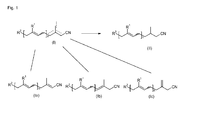
Fig. 1 illustrates the reaction of compounds of formula (I) to compounds of formula (II) according to the present invention showing the C=C double bond isomers as concrete compounds Ia, Ib and Ic; -
Fig. 2 illustrates the hydrogenation of a mixture of geranyl nitrile isomers (compound of formula I-1), i.e. of a mixture of (E/Z)-3,7-dimethyl-2,6-octadiene nitrile (compound A), 7-methyl-3-methylene-6-octene nitrile (compound B) and (E/Z)-3,7-dimethyl-3,6-octadiene nitrile (compound C) to citronellyl nitrile (compound of formula II-1); -
Fig. 3 illustrates the hydrogenation of methyl limonitrile (compound of formula I-2); i.e. a mixture of 3,7-dimethyl-2,6-nonadiene nitrile (compound A), 7-methyl-3-methylene-6-nonene nitrile (compound B) and 3,7-dimethyl-3,6-nonadiene nitrile (compound C) to (E/Z)-3,7-dimethyl-6-nonennitrile (compound of formula II-2). - Besides a mixture of geranyl nitrile isomers of formula I-1 it is also possible to hydrogenate any other mixture of geranyl nitrile ((E)-3,7-dimethyl-2,6-octadiene nitrile) and neryl nitrile ((Z)-3,7-dimethyl-2,6-octadiene nitrile) or the single compounds according to the process of the present invention to obtain citronellyl nitrile. Since geranyl nitrile is toxic there is an increasing demand of substituting geranyl nitrile by another fragrance such as a compound of formula (II), which does not have the toxicological disadvantages of geranyl nitrile.
- Since the compounds of formula (II) - with the proviso that R2 is not hydrogen if R1 = methyl and n = 1 - are novel, the present invention is also directed to them. Thus, a further embodiment of the present invention is a compound of formula (II)

wherein R1 is linear C1-4 alkyl or branched C3-4 alkyl,
preferably wherein R1 is methyl or ethyl, and
wherein R2 is hydrogen or linear C1-4 alkyl or branched C3-4 alkyl,
preferably wherein R2 is hydrogen or methyl,
with the proviso that R2 is not hydrogen if R1 = methyl and n = 1. - Furthermore, the invention also relates to the use of a compound of formula (II) with the proviso that R2 is not hydrogen if R1 = methyl and n = 1, especially of a compound of formula II-2, as aroma ingredient.
- In the flavor and fragrance industry there is always a need and demand for compounds that enhance, modify, improve or otherwise positively influence an odor note and therefore give perfumers or other persons the ability to create new fragrances for perfumes, colognes, personal care products, household products or any other products, which comprise aroma ingredients, i.e. well-defined substances with characteristic aroma. Flavors and fragrances are compositions made of several aroma ingredients.
- Surprisingly it was found that the compounds of formula (II), with the proviso that R2 is not hydrogen if R1 = methyl and n = 1, especially the compound of formula II-2, are very useful in flavor and fragrance compositions.
Therefore the present invention is related to the use of a compound of formula (II) with the proviso that R2 is not hydrogen if R1 = methyl and n = 1, especially of a compound of formula II-2, in flavor and/or fragrance applications.
The compounds of formula (II) with the proviso that R2 is not hydrogen if R1 = methyl and n = 1, especially the compound of formula II-2, may be used as such or in combination with other compounds of formula (II) or other compounds which are known as aroma ingredients. - Such other compounds which are known as aroma ingredients include all known odorant molecules selected from the extensive range of natural products and synthetic molecules currently available, such as essential oils, alcohols, aldehydes and ketones, ethers and acetals, esters and lactones, macrocycles and heterocycles, and/or mixed with one or more ingredients or excipients conventionally used in conjunction with odorants in flavor or fragrance formulations, for example, carrier materials, and other auxiliary agents commonly used in the art.
- The aroma ingredients of the present invention, i.e. the compounds of formula II, are used in a flavor and fragrance formulation.
Such a flavor and fragrance formulation comprises other ingredients.
The flavor and fragrance formulation according to the present invention can be in any form. Usually it is in a solid, gel-like or liquid (or a combination thereof) form. It can also be in an encapsulated form (i.e. a liquid formulation encapsulated by a suitable matrix material). - Therefore the present invention also relates to flavor and fragrance formulations comprising
- (i) at least one compound of formula (II) with the proviso that R2 is not hydrogen if R1 = methyl and n = 1, especially the compound of formula II-2.
- When a compound of formula (II) is used in a flavor and fragrance formulation, then the amount thereof is in the range of 0.0001 - 10 weight-% (wt-%), related to the total weight of the flavor and fragrance formulation. Preferably is an amount in the range of 0.01 - 5 wt-%, based on the total weight of the flavor and fragrance formulation.
- Therefore the present invention relates to liquid flavor and fragrance formulations comprising
- (i) 0.0001 - 10 wt-% (preferably 0.01 - 5 wt-%), related to the total weight of the flavor and fragrance formulation, of at least one compound of formula (II) with the proviso that R2 is not hydrogen if R1 = methyl and n = 1, especially of a compound of formula II-2.
- The flavor and fragrance formulations according to the present invention can comprise further ingredients (= auxiliary compounds), such as any further perfuming compounds, solvents, adjuvants, thickeners, surface active agents, pigments, extenders, rheology modifiers, dyestuffs, antioxidants, fillers and the like.
- Many flavor and fragrance formulations are in a liquid form (like a perfume, cologne, etc.). Therefore, for such liquid formulation a (diluent) solvent is present. Such common diluents are i.e. dipropyleneglycol, isopropyl myristate, triethylcitrate and alcohols (such as ethanol).
- Further examples of fine perfumery are Eau de perfume, Eau de Toilette, Eau de Cologne and Splash Cologne. Fine perfumery products are commonly based on an alcoholic solution as diluent. However fine perfumery products using an oil or wax as diluent are also included within the meaning of this invention. The compounds can be employed in widely varying amounts, depending upon the specific application and on the nature and quantity of other odourant ingredients.
- When used in a (fine) perfume, the amount of the compound of formula (II) with the proviso that R2 is not hydrogen if R1 = methyl and n = 1, especially of a compound of formula II-2, is usually between 0.01 - 10 wt-%, based on the total weight of the (fine) perfume.
However, these values and ranges are given only by way of example, since the experienced perfumer may also achieve effects or may create novel accords with lower or higher concentrations. - Furthermore the present invention relates to liquid flavor and fragrance formulations comprising
- (i) at least one compound of formula (II) with the proviso that R2 is not hydrogen if R1 = methyl and n = 1, especially the compound of formula II-2, and
- (ii) at least one diluent chosen from the group consisting of dipropyleneglycol, isopropylmyristate, triethylcitrate and alcohols (such as ethanol), and optionally
- (iii) at least one auxiliary compound selected from the group consisting of perfuming compounds, solvents, adjuvants, thickeners, surface active agents, pigments, extenders, rheology modifiers, dyestuffs, antioxidants and fillers.
- Furthermore the present invention relates to solid flavor and fragrance formulations comprising
- (i) at least one compound of formula (II) with the proviso that R2 is not hydrogen if R1 = methyl and n = 1, especially the compound of formula II-2, and
- (ii) at least one auxiliary compound selected from the group consisting of perfuming compounds, solvents, adjuvants, thickeners, surface active agents, pigments, extenders, rheology modifiers, dyestuffs, antioxidants and fillers.
- The compounds of formula (II) with the proviso that R2 is not hydrogen if R1 = methyl and n = 1, especially the compound of formula II-2, may be used in a broad range of flavor and fragrance formulations, e.g. in any field of fine and functional perfumery, such as perfumes, air care products, household products, laundry products, body care products and cosmetics.
- The compounds as described hereinabove may be employed in a flavor and fragrance formulation simply by directly mixing at least one compound of formula (II), a mixture thereof, or a fragrance composition with the other ingredients used in the final product, or they may, in an earlier step, be entrapped with an entrapment material, for example, polymers, capsules, microcapsules and nanocapsules, liposomes, film formers, absorbents such as carbon or zeolites, cyclic oligosaccharides and mixtures thereof, or they may be chemically bonded to substrates, which are adapted to release the fragrance molecule upon application of an external stimulus such as light, enzyme, or the like, and then mixed with the other ingredients used in the final product.
- Thus, the invention additionally provides a method of manufacturing a flavor and fragrance formulation, comprising the incorporation of a compound of formula (II) with the proviso that R2 is not hydrogen if R1 = methyl and n = 1, especially of the compound of formula II-2, as a fragrance ingredient, either by directly admixing the compound to the other ingredients used in the final product or by admixing a fragrance composition comprising a compound of formula (I), which may then be mixed with the other ingredients used in the final product, using conventional techniques and methods.
- Through the addition of an olfactory acceptable amount of a compound of the present invention as hereinabove described, or a mixture thereof, the odor notes of a consumer product base will be improved, enhanced or modified.
- Thus, the invention furthermore provides a method for improving, enhancing or modifying a flavor or fragrance formulation as well as a consumer product (= final product) base by means of the addition thereto of an olfactory acceptable amount of a compound of formula (II) with the proviso that R2 is not hydrogen if R1 = methyl and n = 1, especially of the compound of formula II-2, or a mixture thereof.
- In the context of the present invention the olfactory effective amount is to be understood as the amount of the at least one compound of formula (II) with the proviso that R2 is not hydrogen if R1 = methyl and n = 1, especially of the compound of formula II-2, in a flavor and fragrance formulation which will contribute to its particular olfactory characteristics, but the olfactory effect of the flavor and fragrance formulation will be the sum of the effects of each of the perfumes or fragrance ingredients. Thus the compounds of the invention can be used to alter the aroma characteristics of the flavor and fragrance formulation, or by modifying the olfactory reaction contributed by another ingredient in the composition. The amount will vary depending on many factors including other ingredients, their relative amounts and the effect that is desired.
- As used herein, "consumer product (= final product)" means a composition for use as a consumer product to fulfill specific actions, such as cleaning, softening, and caring or the like. Examples of such products include fine perfumery, e.g. perfume and eau de toilette; fabric care, household products and personal care products such as laundry care detergents, rinse conditioner, personal cleansing composition, detergent for dishwasher, surface cleaner; laundry products, e.g. softener, bleach, detergent; body care products, e.g. shampoo, shower gel; air care products and cosmetics, e.g. deodorant, vanishing creme. This list of products is given by way of illustration and is not to be regarded as being in any way limiting.
- The invention is now further illustrated in the following non-limiting examples.
- 3,7-dimethyl-2,6-octadiene nitrile is purchased from Sigma Aldrich; purity 97%, as a mix of 2E- and 2Z-isomers with a ratio of approximately 1 : 1.
- The mixture of geranyl nitrile and neryl nitrile, the solvent, catalyst and additive (if required) are added in the amounts given in table 1 to a glass reactor. The reactor is sealed and is purged with argon 5 times (by pressurising to 5 bar followed by release of the pressure) and 3 times with hydrogen (pressurise to 3 bar then release). The reaction mixture is heated to the desired temperature, pressurised to the desired hydrogen pressure and stirred at 1000 rpm. At the end of the reaction the pressure is released and the reactor purged 3 times with argon. After filtration to remove the catalyst, the reaction mixture is analysed by GC to determine conversion and selectivity.
- These experiments are performed in the same manner as example 1 with the solvent, the catalyst, the additive and the reaction conditions as given in table 1.
- This experiment is carried out in an analogous manner as example 1. Details about the solvent, the catalyst, the additive and the reaction conditions are given in table 2.
- The mixture of geranyl nitrile and neryl nitrile, the solvent, catalyst and additive are added in the amounts given in table 2 to a 500 ml stainless steel reactor. The reactor is sealed and is purged with nitrogen 3 times (by pressurising to 5 bar followed by release of the pressure) and 3 times with hydrogen (pressurise to 5 bar then release). The reaction mixture is heated to the desired temperature, pressurised to the desired hydrogen pressure and stirred at 1000 rpm. At the end of the reaction the pressure is released and the reactor purged once with nitrogen. After filtration to remove the catalyst, the reaction mixture is analysed by GC to determine conversion and selectivity.
- The results (conversion and selectivity) of the experiments 1-5 (according to the invention) and the comparison examples A-D are listed in table 1 and 2.
Table 1: Hydrogenation of a 1:1 mixture of 3,7-dimethyl-2(Z),6-octadiene nitrile and 3,7-dimethyl-2(E),6-octadiene nitrile Example 1: according to the invention; examples A-D: comparison examples; T = Temperature Example Amount of Starting Material Solvent (amount) Catalyst (amount) Additive (amount) Time (hours) T (°C) Pressure H2 (bar abso-lute) Conversion (%) Selectivity (%) 1 200 mg Heptane (2.0 g) Nickel Alloy Johnson Matthey A4000 (160 mg) Diethyldisulfide (6 mg) 25 50 6 98 91 A 270 mg Heptane (2.7 g) 5% Pd/C Evonik E 101 N/D (5 mg) Triethylamine (69 mg) 6 50 6 20 19 B 360 mg Heptane (3.4 g) 5% Pd/C Evonik E 101 N/D (5 mg) DBU (2 mg) 26 80 11 3 2 C 200 mg Dichloromethane (2.2 g) 5% Pd/CaCO3 Evonik None 22 25 6 22 8 D 1.0 g Heptane (10 g) 5% Pd/Al2O3 Evonik None 24 25 11 100 35 Table 2: Hydrogenation of a 1:1 mixture of 3,7-dimethyl-2(Z),6-octadiene nitrile and 3,7-dimethyl-2(E),6-octadiene nitrile Examples 2-5: according to the invention, T = temperature Example Starting Material Solvent (amount) Catalyst (amount) Additive (amount) Time (hours) T (°C) Pressure H2 (bar absolute) Conversion (%) Selectivity (%) 2 2.0 g Heptane (20 g) Nickel Alloy Johnson Matthey A4000 (1.0 g) Diethyldisulfide (50 mg) 65 50 6 100 91 3 20.0 g Heptane (200 g) Nickel Alloy Johnson Matthey A4000 (10 g) Diethyldisulfide (450 mg) 49 50 6 100 95 4 20.0 g Heptane (200 g) Nickel Alloy Johnson Matthey A4000 (9 g) Diethyldisulfide (360 mg) 40 50 6 94 87 5 10.0 g Heptane (200 g) Nickel Alloy Johnson Matthey A4000 (6 g) Diethyldisulfide (180 mg) 21 50 6 97 88
Claims (15)
- A process for the manufacture of a compound of formula II


wherein n is either 1 or 2, preferably wherein n is 1;
wherein R1 is linear C1-4 alkyl or branched C3-4 alkyl,
preferably wherein R1 is methyl or ethyl, and
wherein R2 is hydrogen or linear C1-4 alkyl or branched C3-4 alkyl,
preferably wherein R2 is hydrogen or methyl, and
more preferably wherein either R1 is methyl or R2 is hydrogen. - The process according to claim 1, wherein the reduction is carried out in an organic solvent, preferably selected from the group consisting of aliphatic hydrocarbons, aromatic hydrocarbons, chlorinated aliphatic hydrocarbons, esters, ethers and alcohols, and any mixtures thereof, more preferably selected from the group consisting of aliphatic hydrocarbons, chlorinated aliphatic hydrocarbons and any mixtures thereof, most preferably selected from the group consisting of n-heptane and dichloromethane; and/or wherein the amount of the solvent is chosen in such a way so that the solvent forms by weight 20 to 98% of the total solution to be hydrogenated, preferably wherein the amount of the solvent is chosen in such a way so that the solvent forms by weight 50 to 95% of the total solution to be hydrogenated, more preferably wherein the amount of the solvent is chosen in such a way so that the solvent forms by weight 70 to 90% of the total solution to be hydrogenated.
- The process according to any of the preceding claims, wherein the additive is selected from the group of additives containing a nitrogen or a sulfur atom, preferably wherein the additive is selected from the group of additives containing a sulfur atom, more preferably wherein the additive containing a sulfur atom is selected from the group consisting of diethyl disulfide, diphenyl disulfide, diethyl sulfide, diphenyl sulfide, diethylendisulfide, thiophene and 2,2'-(ethylenedithio)diethanol; and/or wherein the amount of the additive is in the range of 0.01 to 100 weight-%, preferably wherein the amount of the additive is in the range of 0.1 to 10 weight-%, more preferably wherein the amount of the additive is in the range of 0.2 to 2 weight-%, based on the amount of the catalyst.
- The process according to any of the preceding claims, wherein the reduction with hydrogen is carried out at a temperature in the range of 10 to 100°C, preferably at a temperature in the range of 20 to 80°C, more preferably at a temperature in the range of 40 to 60°C, even more preferably at a temperature in the range of 45 to 55°C; and/or at an absolute hydrogen pressure in the range of 1 to 20 bar, preferably at an absolute hydrogen pressure in the range of 2 to 11 bar, more preferably at a hydrogen pressure in the range of 4 to 9 bar, most preferably at an absolute hydrogen pressure of ca. 6 bar.
- The process according to any of the preceding claims, wherein the catalyst is of a nickel-alloy type, preferably wherein the catalyst comprises an amount of nickel in the range of 75 to 95% by weight and an amount of aluminium in the range of 0-15% by weight with the remainder made up by other metals such that the total weight sums to 100%.
- The process according to claim 5, wherein the catalyst is promoted with iron or chromium or both, preferably in an amount of 0 to 10% by weight, based on the total weight of the catalyst.
- The process according to any of the preceding claims, wherein the amount of catalyst is in the range of 1 to 100 weight-%, preferably wherein the amount of catalyst is in the range of 10 to 80 weight-%, more preferably wherein the amount of catalyst is in the range of 30 to 60 weight-%, based on the amount of the compound of formula (I).
- Use of a compound of formula (II) with the proviso that R2 is not hydrogen if R1 = methyl and n = 1 as aroma ingredient.
- Use of a compound of formula (II) with the proviso that R2 is not hydrogen if R1 = methyl and n = 1 in flavour and/or fragrance applications.
- A flavor or fragrance formulation comprising(i) at least one compound of formula (II) with the proviso that R2 is not hydrogen if R1 = methyl and n = 1.
- The flavor and fragrance formulation according to claim 10 comprising 0.0001 - 10 wt-% of at least one compound of formula (II), related to the total weight of the flavor and fragrance formulation.
- The flavor and fragrance formulation according to claim 10 and/or 11, wherein the flavor and fragrance formulation is solid, gel-like or liquid.
- The flavor and fragrance formulation according to any one or more of claims 10 - 12, wherein the flavor and fragrance formulation is a perfume, air care product, household product, laundry product, body care product or cosmetic product.
- A method of improving, enhancing or modifying a flavor or fragrance formulation by means of addition thereto an olfactory acceptable amount of at least one compound of formula (II) with the proviso that R2 is not hydrogen if R1 = methyl and n = 1.
- A compound of formula (II)

wherein R1 is linear C1-4 alkyl or branched C3-4 alkyl,
preferably wherein R1 is methyl or ethyl, and
wherein R2 is hydrogen or linear C1-4 alkyl or branched C3-4 alkyl,
preferably wherein R2 is hydrogen or methyl,
with the proviso that R2 is not hydrogen if R1 = methyl and n = 1.
Priority Applications (7)
| Application Number | Priority Date | Filing Date | Title |
|---|---|---|---|
| EP13181064.0A EP2840077A1 (en) | 2013-08-20 | 2013-08-20 | Process for the manufacture of hydrogenated nitriles |
| MX2016002056A MX367386B (en) | 2013-08-20 | 2014-08-20 | Process for the manufacture of hydrogenated nitriles. |
| ES14757880T ES2742676T3 (en) | 2013-08-20 | 2014-08-20 | Process for the production of hydrogenated nitriles |
| EP14757880.1A EP3036216B1 (en) | 2013-08-20 | 2014-08-20 | Process for the manufacture of hydrogenated nitriles |
| CN201480045818.3A CN105473549B (en) | 2013-08-20 | 2014-08-20 | The method for manufacturing hydrogenated nitrile |
| MYPI2016700367A MY176358A (en) | 2013-08-20 | 2014-08-20 | Process for the manufacture of hydrogenated nitriles |
| PCT/EP2014/067765 WO2015024978A1 (en) | 2013-08-20 | 2014-08-20 | Process for the manufacture of hydrogenated nitriles |
Applications Claiming Priority (1)
| Application Number | Priority Date | Filing Date | Title |
|---|---|---|---|
| EP13181064.0A EP2840077A1 (en) | 2013-08-20 | 2013-08-20 | Process for the manufacture of hydrogenated nitriles |
Publications (1)
| Publication Number | Publication Date |
|---|---|
| EP2840077A1 true EP2840077A1 (en) | 2015-02-25 |
Family
ID=48986056
Family Applications (1)
| Application Number | Title | Priority Date | Filing Date |
|---|---|---|---|
| EP13181064.0A Withdrawn EP2840077A1 (en) | 2013-08-20 | 2013-08-20 | Process for the manufacture of hydrogenated nitriles |
Country Status (1)
| Country | Link |
|---|---|
| EP (1) | EP2840077A1 (en) |
Citations (2)
| Publication number | Priority date | Publication date | Assignee | Title |
|---|---|---|---|---|
| GB2058782A (en) * | 1979-08-14 | 1981-04-15 | Eisai Co Ltd | Polyprenylcarboxylic acid amides |
| US20080177100A1 (en) * | 2005-04-08 | 2008-07-24 | Basf Aktiengeellschaft | Method For Producing Saturated Nitriles |
-
2013
- 2013-08-20 EP EP13181064.0A patent/EP2840077A1/en not_active Withdrawn
Patent Citations (2)
| Publication number | Priority date | Publication date | Assignee | Title |
|---|---|---|---|---|
| GB2058782A (en) * | 1979-08-14 | 1981-04-15 | Eisai Co Ltd | Polyprenylcarboxylic acid amides |
| US20080177100A1 (en) * | 2005-04-08 | 2008-07-24 | Basf Aktiengeellschaft | Method For Producing Saturated Nitriles |
Similar Documents
| Publication | Publication Date | Title |
|---|---|---|
| JP6104283B2 (en) | Aldehydes as perfuming ingredients | |
| JP5514114B2 (en) | Substituted octane (octene) nitriles, their synthesis and their use in perfumery | |
| EP2904080B1 (en) | Flavor and fragrance formulation (i) | |
| EP2840077A1 (en) | Process for the manufacture of hydrogenated nitriles | |
| EP2904078B1 (en) | Flavor and fragrance formulation (vi) | |
| EP2904077B1 (en) | Flavor and fragrance formulation (iv) | |
| JP4956441B2 (en) | Novel trimethylcyclododecatriene derivatives, their use and fragrance products containing them | |
| JP3949548B2 (en) | Oxime as a perfume ingredient | |
| EP3036216B1 (en) | Process for the manufacture of hydrogenated nitriles | |
| MX2007015272A (en) | Cycloakylidene- (ortho substituted phenyl) -acetonitriles and their use as odorants. | |
| US20160340285A1 (en) | Flavor and fragrance formulation (vii) | |
| EP3416943B1 (en) | Organic compounds | |
| US7060668B2 (en) | 2,3, 5, 5-tetramethylhexanal derivatives | |
| EP2904079B1 (en) | Flavor and fragrance formulation (v) | |
| EP2743257B1 (en) | 2-Mercapto-5-Methyl-4-Heptanone And Its Use In Flavor And Fragrance Compositions | |
| MX2009002539A (en) | Alpha, beta, unsaturated nitriles as fragrances. | |
| HK1109766B (en) | Novel trimethylcyclododecatriene derivatives, use thereof, and perfumed products containing the same | |
| HK1169947B (en) | Novel aldehydes and nitriles from isophorone, and the use thereof in perfumery | |
| WO2014142025A1 (en) | Compound having cyclopropane ring, and flavor composition containing same |
Legal Events
| Date | Code | Title | Description |
|---|---|---|---|
| PUAI | Public reference made under article 153(3) epc to a published international application that has entered the european phase |
Free format text: ORIGINAL CODE: 0009012 |
|
| 17P | Request for examination filed |
Effective date: 20130820 |
|
| AK | Designated contracting states |
Kind code of ref document: A1 Designated state(s): AL AT BE BG CH CY CZ DE DK EE ES FI FR GB GR HR HU IE IS IT LI LT LU LV MC MK MT NL NO PL PT RO RS SE SI SK SM TR |
|
| AX | Request for extension of the european patent |
Extension state: BA ME |
|
| STAA | Information on the status of an ep patent application or granted ep patent |
Free format text: STATUS: THE APPLICATION IS DEEMED TO BE WITHDRAWN |
|
| 18D | Application deemed to be withdrawn |
Effective date: 20150826 |