EP2840066A1 - Metal complex of fluorinated tin oxide and titanium oxide and preparation method thereof - Google Patents
Metal complex of fluorinated tin oxide and titanium oxide and preparation method thereof Download PDFInfo
- Publication number
- EP2840066A1 EP2840066A1 EP14179422.2A EP14179422A EP2840066A1 EP 2840066 A1 EP2840066 A1 EP 2840066A1 EP 14179422 A EP14179422 A EP 14179422A EP 2840066 A1 EP2840066 A1 EP 2840066A1
- Authority
- EP
- European Patent Office
- Prior art keywords
- titanium oxide
- tin oxide
- metal complex
- preparation
- phase
- Prior art date
- Legal status (The legal status is an assumption and is not a legal conclusion. Google has not performed a legal analysis and makes no representation as to the accuracy of the status listed.)
- Granted
Links
Images

Classifications
-
- C—CHEMISTRY; METALLURGY
- C22—METALLURGY; FERROUS OR NON-FERROUS ALLOYS; TREATMENT OF ALLOYS OR NON-FERROUS METALS
- C22C—ALLOYS
- C22C1/00—Making non-ferrous alloys
- C22C1/10—Alloys containing non-metals
- C22C1/1005—Pretreatment of the non-metallic additives
-
- B—PERFORMING OPERATIONS; TRANSPORTING
- B01—PHYSICAL OR CHEMICAL PROCESSES OR APPARATUS IN GENERAL
- B01J—CHEMICAL OR PHYSICAL PROCESSES, e.g. CATALYSIS OR COLLOID CHEMISTRY; THEIR RELEVANT APPARATUS
- B01J27/00—Catalysts comprising the elements or compounds of halogens, sulfur, selenium, tellurium, phosphorus or nitrogen; Catalysts comprising carbon compounds
- B01J27/06—Halogens; Compounds thereof
- B01J27/135—Halogens; Compounds thereof with titanium, zirconium, hafnium, germanium, tin or lead
-
- B—PERFORMING OPERATIONS; TRANSPORTING
- B01—PHYSICAL OR CHEMICAL PROCESSES OR APPARATUS IN GENERAL
- B01J—CHEMICAL OR PHYSICAL PROCESSES, e.g. CATALYSIS OR COLLOID CHEMISTRY; THEIR RELEVANT APPARATUS
- B01J21/00—Catalysts comprising the elements, oxides, or hydroxides of magnesium, boron, aluminium, carbon, silicon, titanium, zirconium, or hafnium
- B01J21/06—Silicon, titanium, zirconium or hafnium; Oxides or hydroxides thereof
- B01J21/063—Titanium; Oxides or hydroxides thereof
-
- B—PERFORMING OPERATIONS; TRANSPORTING
- B01—PHYSICAL OR CHEMICAL PROCESSES OR APPARATUS IN GENERAL
- B01J—CHEMICAL OR PHYSICAL PROCESSES, e.g. CATALYSIS OR COLLOID CHEMISTRY; THEIR RELEVANT APPARATUS
- B01J23/00—Catalysts comprising metals or metal oxides or hydroxides, not provided for in group B01J21/00
- B01J23/38—Catalysts comprising metals or metal oxides or hydroxides, not provided for in group B01J21/00 of noble metals
- B01J23/40—Catalysts comprising metals or metal oxides or hydroxides, not provided for in group B01J21/00 of noble metals of the platinum group metals
- B01J23/42—Platinum
-
- B—PERFORMING OPERATIONS; TRANSPORTING
- B01—PHYSICAL OR CHEMICAL PROCESSES OR APPARATUS IN GENERAL
- B01J—CHEMICAL OR PHYSICAL PROCESSES, e.g. CATALYSIS OR COLLOID CHEMISTRY; THEIR RELEVANT APPARATUS
- B01J35/00—Catalysts, in general, characterised by their form or physical properties
- B01J35/30—Catalysts, in general, characterised by their form or physical properties characterised by their physical properties
-
- B—PERFORMING OPERATIONS; TRANSPORTING
- B01—PHYSICAL OR CHEMICAL PROCESSES OR APPARATUS IN GENERAL
- B01J—CHEMICAL OR PHYSICAL PROCESSES, e.g. CATALYSIS OR COLLOID CHEMISTRY; THEIR RELEVANT APPARATUS
- B01J37/00—Processes, in general, for preparing catalysts; Processes, in general, for activation of catalysts
- B01J37/02—Impregnation, coating or precipitation
- B01J37/0201—Impregnation
- B01J37/0207—Pretreatment of the support
-
- C—CHEMISTRY; METALLURGY
- C01—INORGANIC CHEMISTRY
- C01B—NON-METALLIC ELEMENTS; COMPOUNDS THEREOF; METALLOIDS OR COMPOUNDS THEREOF NOT COVERED BY SUBCLASS C01C
- C01B3/00—Hydrogen; Gaseous mixtures containing hydrogen; Separation of hydrogen from mixtures containing it; Purification of hydrogen; Reversible storage of hydrogen
- C01B3/02—Production of hydrogen; Production of gaseous mixtures containing hydrogen
- C01B3/06—Production of hydrogen; Production of gaseous mixtures containing hydrogen by reaction of inorganic compounds containing electro-positively bound hydrogen with inorganic reducing agents
- C01B3/12—Production of hydrogen; Production of gaseous mixtures containing hydrogen by reaction of inorganic compounds containing electro-positively bound hydrogen with inorganic reducing agents by reaction of water vapour with carbon monoxide
- C01B3/16—Production of hydrogen; Production of gaseous mixtures containing hydrogen by reaction of inorganic compounds containing electro-positively bound hydrogen with inorganic reducing agents by reaction of water vapour with carbon monoxide using catalysts
-
- C—CHEMISTRY; METALLURGY
- C01—INORGANIC CHEMISTRY
- C01G—COMPOUNDS CONTAINING METALS NOT COVERED BY SUBCLASSES C01D OR C01F
- C01G19/00—Compounds of tin
- C01G19/02—Oxides
-
- C—CHEMISTRY; METALLURGY
- C01—INORGANIC CHEMISTRY
- C01G—COMPOUNDS CONTAINING METALS NOT COVERED BY SUBCLASSES C01D OR C01F
- C01G23/00—Compounds of titanium
- C01G23/04—Oxides; Hydroxides
- C01G23/047—Titanium dioxide
-
- B—PERFORMING OPERATIONS; TRANSPORTING
- B01—PHYSICAL OR CHEMICAL PROCESSES OR APPARATUS IN GENERAL
- B01J—CHEMICAL OR PHYSICAL PROCESSES, e.g. CATALYSIS OR COLLOID CHEMISTRY; THEIR RELEVANT APPARATUS
- B01J2235/00—Indexing scheme associated with group B01J35/00, related to the analysis techniques used to determine the catalysts form or properties
- B01J2235/15—X-ray diffraction
-
- B—PERFORMING OPERATIONS; TRANSPORTING
- B01—PHYSICAL OR CHEMICAL PROCESSES OR APPARATUS IN GENERAL
- B01J—CHEMICAL OR PHYSICAL PROCESSES, e.g. CATALYSIS OR COLLOID CHEMISTRY; THEIR RELEVANT APPARATUS
- B01J2235/00—Indexing scheme associated with group B01J35/00, related to the analysis techniques used to determine the catalysts form or properties
- B01J2235/30—Scanning electron microscopy; Transmission electron microscopy
-
- C—CHEMISTRY; METALLURGY
- C01—INORGANIC CHEMISTRY
- C01B—NON-METALLIC ELEMENTS; COMPOUNDS THEREOF; METALLOIDS OR COMPOUNDS THEREOF NOT COVERED BY SUBCLASS C01C
- C01B2203/00—Integrated processes for the production of hydrogen or synthesis gas
- C01B2203/02—Processes for making hydrogen or synthesis gas
- C01B2203/0283—Processes for making hydrogen or synthesis gas containing a CO-shift step, i.e. a water gas shift step
-
- C—CHEMISTRY; METALLURGY
- C01—INORGANIC CHEMISTRY
- C01B—NON-METALLIC ELEMENTS; COMPOUNDS THEREOF; METALLOIDS OR COMPOUNDS THEREOF NOT COVERED BY SUBCLASS C01C
- C01B2203/00—Integrated processes for the production of hydrogen or synthesis gas
- C01B2203/10—Catalysts for performing the hydrogen forming reactions
- C01B2203/1041—Composition of the catalyst
-
- C—CHEMISTRY; METALLURGY
- C01—INORGANIC CHEMISTRY
- C01P—INDEXING SCHEME RELATING TO STRUCTURAL AND PHYSICAL ASPECTS OF SOLID INORGANIC COMPOUNDS
- C01P2004/00—Particle morphology
- C01P2004/01—Particle morphology depicted by an image
- C01P2004/03—Particle morphology depicted by an image obtained by SEM
-
- C—CHEMISTRY; METALLURGY
- C01—INORGANIC CHEMISTRY
- C01P—INDEXING SCHEME RELATING TO STRUCTURAL AND PHYSICAL ASPECTS OF SOLID INORGANIC COMPOUNDS
- C01P2004/00—Particle morphology
- C01P2004/80—Particles consisting of a mixture of two or more inorganic phases
- C01P2004/82—Particles consisting of a mixture of two or more inorganic phases two phases having the same anion, e.g. both oxidic phases
-
- C—CHEMISTRY; METALLURGY
- C01—INORGANIC CHEMISTRY
- C01P—INDEXING SCHEME RELATING TO STRUCTURAL AND PHYSICAL ASPECTS OF SOLID INORGANIC COMPOUNDS
- C01P2004/00—Particle morphology
- C01P2004/80—Particles consisting of a mixture of two or more inorganic phases
- C01P2004/82—Particles consisting of a mixture of two or more inorganic phases two phases having the same anion, e.g. both oxidic phases
- C01P2004/84—Particles consisting of a mixture of two or more inorganic phases two phases having the same anion, e.g. both oxidic phases one phase coated with the other
-
- C—CHEMISTRY; METALLURGY
- C01—INORGANIC CHEMISTRY
- C01P—INDEXING SCHEME RELATING TO STRUCTURAL AND PHYSICAL ASPECTS OF SOLID INORGANIC COMPOUNDS
- C01P2006/00—Physical properties of inorganic compounds
- C01P2006/12—Surface area
-
- Y—GENERAL TAGGING OF NEW TECHNOLOGICAL DEVELOPMENTS; GENERAL TAGGING OF CROSS-SECTIONAL TECHNOLOGIES SPANNING OVER SEVERAL SECTIONS OF THE IPC; TECHNICAL SUBJECTS COVERED BY FORMER USPC CROSS-REFERENCE ART COLLECTIONS [XRACs] AND DIGESTS
- Y02—TECHNOLOGIES OR APPLICATIONS FOR MITIGATION OR ADAPTATION AGAINST CLIMATE CHANGE
- Y02P—CLIMATE CHANGE MITIGATION TECHNOLOGIES IN THE PRODUCTION OR PROCESSING OF GOODS
- Y02P20/00—Technologies relating to chemical industry
- Y02P20/50—Improvements relating to the production of bulk chemicals
- Y02P20/52—Improvements relating to the production of bulk chemicals using catalysts, e.g. selective catalysts
Definitions
- the present invention relates to a metal complex of a fluorinated tin oxide and a titanium oxide, and a preparation method thereof.
- a representative method of producing such hydrogen uses a methane-steam reforming reaction and a water-gas shift reaction.
- methane-steam reforming reaction methane is reacted with steam at 600 to 800°C in the presence of a nickel catalyst to produce hydrogen and carbon monoxide
- carbon monoxide produced from the downstream of a methane-steam reforming reactor is reacted again with steam to produce hydrogen and carbon dioxide.
- a temperature of the water-gas shift reaction is increased, a reaction rate is increased but a conversion rate is decreased.
- the temperature of the water-gas shift reaction is decreased, the reaction rate is decreased but the conversion rate is increased.
- the water-gas shift reaction is composed of two steps: a high temperature water-gas shift reaction carried out at about 400°C; and a low temperature water-gas shift reaction carried out at about 200°C. If a reaction rate of the low temperature water-gas shift reaction is increased, there is no need to carry out the conventional two-step water-gas shift reaction. Therefore, a recent trend of the study is focusing on development of a low temperature water-gas shift reaction catalyst capable of increasing the reaction rate.
- a Cu/ZnO/Al 2 O 3 -based oxide catalyst As a conventional low temperature water-gas shift reaction catalyst, a Cu/ZnO/Al 2 O 3 -based oxide catalyst has been mainly used. Further, catalysts prepared by immersing Pt, Pd, Cu, Ni, or the like in ceria (CeO 2 ) carriers having high oxygen mobility and a high oxygen storage capacity have shown excellent activity and thus have attracted a lot of attention. According to Korean Patent Laid-open Publication No.
- the present invention is directed to providing a metal complex of a fluorinated tin oxide and a titanium oxide, and a preparation method thereof.
- One aspect of the present invention provides a metal complex including: a tin oxide; titanium oxide nanorods in a rutile phase grown on the tin oxide; and titanium oxide nanoparticles in an anatase phase coated on the titanium oxide nanorods in a rutile phase.
- Another aspect of the present invention provides a preparation method of the metal complex, specifically including: preparing a tin oxide; treating the prepared tin oxide with a titanium chloride solution and growing titanium oxide nanorods in a rutile phase on the tin oxide; and coating titanium oxide nanoparticles in an anatase phase on the grown titanium oxide nanorods in a rutile phase.
- the present invention suggests a metal complex having a systematic structure prepared by growing titanium oxide nanorods in a rutile phase on a tin oxide and coating titanium oxide nanoparticles in an anatase phase thereon, and a preparation method thereof.
- This metal complex can be used as a catalyst support, and when a water-gas shift reaction occurs on a surface of a catalytic active material, the titanium oxide in multiple phases including an anatase phase and a rutile phase has a small band gap, and thus the metal complex can provide a path through which electrons can be drifted at a high velocity and can shift electrons and oxygen ions to the tin oxide.
- tin oxide Since tin oxide has high electron drift velocity and is capable of absorbing oxygen ions, the tin oxide prevents electrons from being shifted again to a catalyst surface to be recombined therewith. Further, the tin oxide keeps carbon monoxide adsorbed on the surface of the catalytic active material in an unstable state and thus forms conditions for a rapid reaction with steam.
- a catalyst support Most of the materials typically used as a catalyst support are single metal oxides or complex metal oxides, and have a single form including pores in a single phase or multiple phases although prepared in various preparation methods. Therefore, such a catalyst support has a uniform composition, and a physiochemical property of the catalyst support is determined depending on a composition.
- a metal complex of the present invention will be explained in detail as follows.
- a metal complex of the present invention includes a tin oxide; titanium oxide nanorods in a rutile phase formed on the tin oxide; and titanium oxide nanoparticles in an anatase phase formed on the titanium oxide nanorods in a rutile phase.
- the tin oxide may be a fluorinated tin oxide.
- the fluorinated tin oxide can be prepared by using a hydrofluoric acid solution (HF solution).
- HF solution hydrofluoric acid solution
- the prepared fluorinated tin oxide may have a substantially spherical or irregular form.
- the term "spherical" includes not only a theoretically complete sphere but also a three-dimensional structure in a round shape, and comprehensively includes a spheroid having a relatively long axis or a sphere whose surface is not smooth.
- a tin oxide is typically present as SnO or SnO 2 .
- SnO 2 is an n-type semiconductor having a significant conductivity at room temperature.
- the tin oxide can be used as an anode material of a lithium battery, a transparent electrode of a solar cell, electrochromic glass, glass coating, a heat reflector, a nanofiltration membrane, a catalytic agent, a photocatalyst, and a gas sensor.
- a titanium oxide is an oxide of titanium and may be referred to as titanium dioxide, titanium anhydride, or titania having a chemical formula of TiO 2 .
- the titanium oxide is known as having three types of variant structures: a rutile type stable at a high temperature; an anatase type stable at a low temperature; and a brookite type stable at an intermediate temperature.
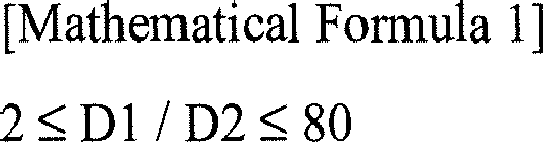
- the metal complex may satisfy Mathematical Formula 1 below. 2 ⁇ D ⁇ 1 / D ⁇ 2 ⁇ 80
- a value of D1/D2 described in Mathematical Formula 1 may be in the range of 3 to 30, and 5 to 25.
- the mean length of titanium oxide nanorods in a rutile phase may be in the range of 10 nm to 80 nm, and specifically, 20 nm to 50 mm.
- the mean particle diameter of titanium oxide nanoparticles in an anatase phase may be in the range of 1 nm to 8 nm, and specifically, 2 nm to 5 mm.
- the metal complex of the present invention titanium oxide in different formulations are complexly used. Therefore, it is confirmed that the metal complex of the present invention can promote electron drift and oxygen ion shift occurring on a surface of a catalytic active material, thereby maximizing a catalytic reaction rate.
- mean diameter refers to an average diameter of particles
- mean length refers to an average length of a major axis when an axis is divided into the major axis and a minor axis.
- a weight ratio of the titanium oxide nanorods in a rutile phase to the titanium oxide nanoparticles in an anatase phase may be in the range of 5 : 95 to 30 : 70, and specifically 8 : 92 to 20 : 80 or 9 : 91 to 12 : 88.
- the metal complex of the present invention can be used as a catalyst support, and more specifically, as a support of a catalyst for a water-gas shift reaction.
- a reaction rate is increased but a conversion rate is decreased, and as the temperature of the water-gas shift reaction is decreased, the reaction rate is decreased but the conversion rate is increased. Therefore, the water-gas shift reaction is composed of two steps: a high temperature water-gas shift reaction carried out at about 400°C; and a low temperature water-gas shift reaction carried out at about 200°C. If a reaction rate of the low temperature water-gas shift reaction is increased, there is no need to carry out the conventional two-step water-gas shift reaction.
- the titanium oxide nanoparticles in an anatase phase stable at a low temperature are positioned closest to the catalytic active material.
- the titanium oxide nanoparticles in an anatase phase drift electrons generated in the catalytic reaction to a fluorinated tin oxide through the nanorods in a rutile phase at a high velocity and disperse the electrons to adjacent particles.
- Oxygen ions generated together with the electrons pass through the titanium oxide and are absorbed by the fluorinated tin oxide and then dispersed to adjacent particles, thereby maximizing catalytic activity.
- the present invention provides a preparation method of the above-described metal complex.
- the preparation method of the metal complex includes: treating a tin oxide with a titanium chloride solution and growing titanium oxide nanorods in a rutile phase on the tin oxide; and coating titanium oxide nanoparticles in an anatase phase on the grown titanium oxide nanorods in a rutile phase.
- a step of preparing a tin oxide may be carried out.
- a precursor of the tin oxide may include one or more materials selected from the group consisting of SnCl 4 -5H 2 O, SnCl 2 , and SnCl 2 -2H 2 O.
- SnCl 4 -5H 2 O may be used.
- SnCl 4 -5H 2 O is dissolved in a hydrofluoric acid solution (HF solution). Then, precipitation is induced by addition of an ammonia solution (NH 4 OH). Thereafter, a resultant product in the form of slurry is dried and calcined to produce a tin oxide.
- a weight ratio of the SnCl 4 -5H 2 O and the hydrofluoric acid solution (HF solution) may be in the range of 50 : 1 to 10 : 1, and specifically, 30 : 1 to 15 : 1.
- the hydrofluoric acid solution is used for preparing tin oxide, a fluorinated tin oxide can be produced.
- the tin oxide has a lattice structure similar to that of titanium oxide in a rutile phase, and thus, it is possible to easily grow the titanium oxide nanorods in a rutile phase on the fluorinated tin oxide.
- a step of growing the titanium oxide nanorods in a rutile phase on the tin oxide may be carried out.
- a sol-gel method, a heating method, a method using a solution, a chemical vapor deposition method, an atomic layer deposition method, and a sputtering method may be used.
- a titanium oxide can be easily grown on the tin oxide.
- the tin oxide treated with the titanium chloride is put into a reactor together with a hydrochloric acid solution and 4-butyl titanate (C 16 H 36 O 4 Ti) and through hydrothermal synthesis for 8 to 15 hours, titanium oxide nanorods in a rutile phase are grown on the tin oxide particles.
- a temperature of the reactor for the hydrothermal synthesis may be in the range of 100°C to 200°C, and specifically 150°C.
- a step of coating titanium oxide nanoparticles in an anatase phase on the titanium oxide nanorods in a rutile phase grown on the tin oxide may be carried out.
- the tin oxide on which the titanium oxide nanorods in a rutile phase are grown is put into the reactor together with a sulfuric acid solution and titanate (C 16 H 36 O 4 Ti) and then coated with titanium oxide nanoparticles in an anatase phase through hydrothermal synthesis.
- a temperature of the reactor for the hydrothermal synthesis may be in the range of 100°C to 200°C, and specifically 150°C.
- the tin oxide as obtained in the step 1) was put into 50 ml of a TiCl 4 solution (0.4 M) and left for 1 hour and then taken out to dry.
- the dried particles were put into an autoclave having a Teflon liner, and 30 ml of HCl (98 %), 30 ml of distilled water, and 0.5 ml of 4-butyl titanate were added thereto with stirring, and the autoclave was sealed.
- the sealed autoclave was put into an oven at 150°C and left for 20 hours. 20 hours later, the solution was taken out and filtered, and then washed with distilled water and dried to obtain 2 g of a tin oxide on which 10.1% titanium oxide in a rutile phase was grown.
- the tin oxide on which a titanium oxide in a rutile phase was grown as obtained in the step 2) was put into a TiCl 4 solution (0.4 M) and left for 1 hour and then taken out to dry.
- the dried particles were put into an autoclave having a Teflon liner, and 35 ml of H 2 SO 4 (98 %), 35 ml of distilled water, and 2 ml of 4-butyl titanate were added thereto with stirring, and the autoclave was sealed.
- the sealed autoclave was put into an oven at 150°C and left for 12 hours. 12 hours later, the solution was taken out and filtered, and then washed with distilled water and dried.
- the dried particles were calcined at 400°C for 2 hours to obtain a structure coated with 89.9% titanium oxide in an anatase phase.
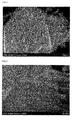
- FIG. 1 and FIG. 2 illustrate scanning electron micrographs of a metal complex according to the present invention.
- a metal complex having a structure and a composition suggested in the present invention includes a tin oxide having a mean diameter of 0.8 to 1 ⁇ m, and titanium oxide nanorods in a rutile phase grown thereon have a mean length of 30 to 40 nm.
- titanium oxide nanoparticles in an anatase phase coated on the titanium oxide nanorods in a rutile phase have a mean diameter of 3 nm.
- FIG. 3 shows a result of an X-ray diffraction analysis on a metal complex according to the present invention.
- Ce(NO 3 ) 3 ⁇ 6H 2 O was dissolved in distilled water and then heated up to 80°C. At a constant temperature, 15 wt% KOH as a precipitant was added thereto to adjust a pH to 10.5 and then aged for 3 days while maintaining the temperature of 80°C. In order to remove K + ions remaining in the aged solution, washing with distilled water was carried out several times. The prepared precipitate was dried at 110°C and calcined at 500°C for 6 hours to prepare a CeO 2 support.
- Example 1 wt% platinum was coated using an impregnation method.
- the sample coated with platinum underwent a drying process and a calcination process to prepare a catalyst for a water-gas shift reaction.
- 0.0478 g of the prepared catalyst was put into a 1/4 inch quartz tube and underwent a reduction process using 5% H 2 /N 2 mixed gas at 400°C for 1 hour, and then, a temperature of the reactor was lowered to 200°C.
- Steam and a mixed gas (59.81 % H 2 , 19.92 % N 2 , 1.06 % CH 4 , 10.1 % CO 2 , and 9.11 % CO) were injected to the reactor to adjust a gas hourly space velocity (GHSV) to 36,076 h -1 and 45,499 h -1 , and then a low temperature water-gas shift reaction was carried out.
- GHSV gas hourly space velocity
- the experimental result shows that when the support according to the present invention is used as a support of a catalyst required for a reaction such as a low temperature water-gas shift reaction accompanied with electron drift and oxygen ion shift, it is possible to promote electron drift and oxygen ion shift occurring on a surface of a catalytic active material, thereby maximizing a catalytic reaction.
- the titanium oxide nanoparticles in an anatase phase positioned closest to the catalytic active material drift electrons generated in the catalytic reaction to a fluorinated tin oxide through the nanorods in a rutile phase at a high velocity and disperse the electrons to adjacent particles.
- Oxygen ions generated together with the electrons pass through the titanium oxide and are absorbed by the fluorinated tin oxide and then dispersed to adjacent particles, thereby maximizing catalytic activity.
- a metal complex according to an exemplary embodiment of the present invention can be used as a catalyst support, and can promote electron drift and oxygen ion shift occurring on a surface of a catalytic active material, thereby maximizing a catalytic reaction rate.
Landscapes
- Chemical & Material Sciences (AREA)
- Organic Chemistry (AREA)
- Chemical Kinetics & Catalysis (AREA)
- Engineering & Computer Science (AREA)
- Materials Engineering (AREA)
- Inorganic Chemistry (AREA)
- General Life Sciences & Earth Sciences (AREA)
- Environmental & Geological Engineering (AREA)
- Life Sciences & Earth Sciences (AREA)
- Geology (AREA)
- Health & Medical Sciences (AREA)
- General Health & Medical Sciences (AREA)
- Combustion & Propulsion (AREA)
- Mechanical Engineering (AREA)
- Metallurgy (AREA)
- Catalysts (AREA)
- Inorganic Compounds Of Heavy Metals (AREA)
Description
- This application claims priority to and the benefit of Korean Patent Application No.
2013-0098035, filed on August 19, 2013 - The present invention relates to a metal complex of a fluorinated tin oxide and a titanium oxide, and a preparation method thereof.
- In recent years, since energy consumption has been rapidly increasing worldwide, demand and supply of fossil energy has been unstable. For a stable supply of energy, various energy conversion technologies have been actively studied. In order to replace fossil fuel, alternative energy technology is currently under development. However, since people are heavily dependent on fossil fuels, a use of the fossil fuels is not expected to be decreased for a long time. Therefore, studies on production and a use of hydrogen by converting or reforming the conventional fossil fuels such as oil or coal have been carried out. Hydrogen energy is clean energy that does not produce carbon dioxide by combustion and can be readily used in many households along with development of reforming reactors capable of reforming the conventional gas to produce hydrogen. The hydrogen energy can be used not only for general combustion but also as a fuel gas for a fuel cell. A representative method of producing such hydrogen uses a methane-steam reforming reaction and a water-gas shift reaction. In the methane-steam reforming reaction, methane is reacted with steam at 600 to 800°C in the presence of a nickel catalyst to produce hydrogen and carbon monoxide, and in the water-gas shift reaction, carbon monoxide produced from the downstream of a methane-steam reforming reactor is reacted again with steam to produce hydrogen and carbon dioxide. Typically, as a temperature of the water-gas shift reaction is increased, a reaction rate is increased but a conversion rate is decreased. On the contrary, as the temperature of the water-gas shift reaction is decreased, the reaction rate is decreased but the conversion rate is increased. Therefore, the water-gas shift reaction is composed of two steps: a high temperature water-gas shift reaction carried out at about 400°C; and a low temperature water-gas shift reaction carried out at about 200°C. If a reaction rate of the low temperature water-gas shift reaction is increased, there is no need to carry out the conventional two-step water-gas shift reaction. Therefore, a recent trend of the study is focusing on development of a low temperature water-gas shift reaction catalyst capable of increasing the reaction rate.
- As a conventional low temperature water-gas shift reaction catalyst, a Cu/ZnO/Al2O3-based oxide catalyst has been mainly used. Further, catalysts prepared by immersing Pt, Pd, Cu, Ni, or the like in ceria (CeO2) carriers having high oxygen mobility and a high oxygen storage capacity have shown excellent activity and thus have attracted a lot of attention. According to Korean Patent Laid-open Publication No.
2010-0089316 - The present invention is directed to providing a metal complex of a fluorinated tin oxide and a titanium oxide, and a preparation method thereof.
- One aspect of the present invention provides a metal complex including: a tin oxide; titanium oxide nanorods in a rutile phase grown on the tin oxide; and titanium oxide nanoparticles in an anatase phase coated on the titanium oxide nanorods in a rutile phase.
- Another aspect of the present invention provides a preparation method of the metal complex, specifically including: preparing a tin oxide; treating the prepared tin oxide with a titanium chloride solution and growing titanium oxide nanorods in a rutile phase on the tin oxide; and coating titanium oxide nanoparticles in an anatase phase on the grown titanium oxide nanorods in a rutile phase.
- The above and other objects, features, and advantages of the present invention will become more apparent to those of ordinary skill in the art by describing in detail exemplary embodiments thereof with reference to the attached drawings, in which:
-
FIGS. 1 and 2 are scanning electron micrographs of a metal complex according to an exemplary embodiment of the present invention. -
FIG. 3 shows a result of an X-ray diffraction analysis on a metal complex according to an exemplary embodiment of the present invention. -
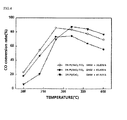
FIG. 4 shows a result of a water-gas shift reaction using a metal complex according to an exemplary embodiment of the present invention. - Hereinafter, the present invention will be described with reference to Examples in detail. However, the present invention is not limited to these Examples.
- The present invention suggests a metal complex having a systematic structure prepared by growing titanium oxide nanorods in a rutile phase on a tin oxide and coating titanium oxide nanoparticles in an anatase phase thereon, and a preparation method thereof. This metal complex can be used as a catalyst support, and when a water-gas shift reaction occurs on a surface of a catalytic active material, the titanium oxide in multiple phases including an anatase phase and a rutile phase has a small band gap, and thus the metal complex can provide a path through which electrons can be drifted at a high velocity and can shift electrons and oxygen ions to the tin oxide. Since tin oxide has high electron drift velocity and is capable of absorbing oxygen ions, the tin oxide prevents electrons from being shifted again to a catalyst surface to be recombined therewith. Further, the tin oxide keeps carbon monoxide adsorbed on the surface of the catalytic active material in an unstable state and thus forms conditions for a rapid reaction with steam.
- Most of the materials typically used as a catalyst support are single metal oxides or complex metal oxides, and have a single form including pores in a single phase or multiple phases although prepared in various preparation methods. Therefore, such a catalyst support has a uniform composition, and a physiochemical property of the catalyst support is determined depending on a composition.
- A metal complex of the present invention will be explained in detail as follows.
- A metal complex of the present invention includes a tin oxide; titanium oxide nanorods in a rutile phase formed on the tin oxide; and titanium oxide nanoparticles in an anatase phase formed on the titanium oxide nanorods in a rutile phase.
- The tin oxide may be a fluorinated tin oxide. For example, the fluorinated tin oxide can be prepared by using a hydrofluoric acid solution (HF solution). The prepared fluorinated tin oxide may have a substantially spherical or irregular form. The term "spherical" includes not only a theoretically complete sphere but also a three-dimensional structure in a round shape, and comprehensively includes a spheroid having a relatively long axis or a sphere whose surface is not smooth.
- A tin oxide is typically present as SnO or SnO2. SnO2 is an n-type semiconductor having a significant conductivity at room temperature. Further, the tin oxide has a wide direct transition band gap (Eg = 3.6 eV) and can be prepared at low costs and thus has attracted a lot attention as an important functional semiconductor material in the microelectronic engineering and photoelectronic engineering fields. For example, the tin oxide can be used as an anode material of a lithium battery, a transparent electrode of a solar cell, electrochromic glass, glass coating, a heat reflector, a nanofiltration membrane, a catalytic agent, a photocatalyst, and a gas sensor.
- A titanium oxide is an oxide of titanium and may be referred to as titanium dioxide, titanium anhydride, or titania having a chemical formula of TiO2. The titanium oxide is known as having three types of variant structures: a rutile type stable at a high temperature; an anatase type stable at a low temperature; and a brookite type stable at an intermediate temperature.
- The metal complex may satisfy
Mathematical Formula 1 below.
- In
Mathematical Formula 1, - D1 represents a mean length of the titanium oxide nanorods in a rutile phase, and
- D2 represents a mean particle diameter of the titanium oxide nanoparticles in an anatase phase.
- To be more specific, a value of D1/D2 described in
Mathematical Formula 1 may be in the range of 3 to 30, and 5 to 25. - For example, the mean length of titanium oxide nanorods in a rutile phase may be in the range of 10 nm to 80 nm, and specifically, 20 nm to 50 mm. Further, the mean particle diameter of titanium oxide nanoparticles in an anatase phase may be in the range of 1 nm to 8 nm, and specifically, 2 nm to 5 mm.
- Thus, it can be seen that in the metal complex of the present invention, titanium oxide in different formulations are complexly used. Therefore, it is confirmed that the metal complex of the present invention can promote electron drift and oxygen ion shift occurring on a surface of a catalytic active material, thereby maximizing a catalytic reaction rate.
- In the present invention, the term "mean diameter" refers to an average diameter of particles, and the term "mean length" refers to an average length of a major axis when an axis is divided into the major axis and a minor axis.
- A weight ratio of the titanium oxide nanorods in a rutile phase to the titanium oxide nanoparticles in an anatase phase may be in the range of 5 : 95 to 30 : 70, and specifically 8 : 92 to 20 : 80 or 9 : 91 to 12 : 88. By controlling the contents of the titanium oxide nanorods in a rutile phase and the titanium oxide nanoparticles in an anatase phase to be in the above range, in a water-gas shift reaction occurring on a surface of a catalytic active material, it is possible to effectively reduce a band gap between multiple phases of the anatase phase and the rutile phase and induce electron drift at a higher velocity.
- Further, the metal complex of the present invention can be used as a catalyst support, and more specifically, as a support of a catalyst for a water-gas shift reaction. Typically, as a temperature of the water-gas shift reaction is increased, a reaction rate is increased but a conversion rate is decreased, and as the temperature of the water-gas shift reaction is decreased, the reaction rate is decreased but the conversion rate is increased. Therefore, the water-gas shift reaction is composed of two steps: a high temperature water-gas shift reaction carried out at about 400°C; and a low temperature water-gas shift reaction carried out at about 200°C. If a reaction rate of the low temperature water-gas shift reaction is increased, there is no need to carry out the conventional two-step water-gas shift reaction. In the metal complex of the present invention, the titanium oxide nanoparticles in an anatase phase stable at a low temperature are positioned closest to the catalytic active material. The titanium oxide nanoparticles in an anatase phase drift electrons generated in the catalytic reaction to a fluorinated tin oxide through the nanorods in a rutile phase at a high velocity and disperse the electrons to adjacent particles. Oxygen ions generated together with the electrons pass through the titanium oxide and are absorbed by the fluorinated tin oxide and then dispersed to adjacent particles, thereby maximizing catalytic activity.
- Furthermore, the present invention provides a preparation method of the above-described metal complex. The preparation method of the metal complex includes: treating a tin oxide with a titanium chloride solution and growing titanium oxide nanorods in a rutile phase on the tin oxide; and coating titanium oxide nanoparticles in an anatase phase on the grown titanium oxide nanorods in a rutile phase.
- The preparation method of the metal complex will be explained in more detail as follows.
- First, prior to the above-described preparation method, a step of preparing a tin oxide may be carried out. A precursor of the tin oxide may include one or more materials selected from the group consisting of SnCl4-5H2O, SnCl2, and SnCl2-2H2O. To be specific, SnCl4-5H2O may be used. For example, SnCl4-5H2O is dissolved in a hydrofluoric acid solution (HF solution). Then, precipitation is induced by addition of an ammonia solution (NH4OH). Thereafter, a resultant product in the form of slurry is dried and calcined to produce a tin oxide. A weight ratio of the SnCl4-5H2O and the hydrofluoric acid solution (HF solution) may be in the range of 50 : 1 to 10 : 1, and specifically, 30 : 1 to 15 : 1. By controlling the ratio of the SnCl4-5H2O and the hydrofluoric acid solution (HF solution) to be in the above range, it is possible to increase a production yield of the tin oxide and also possible to effectively prepare the tin oxide having a desired size.
- Since the hydrofluoric acid solution is used for preparing tin oxide, a fluorinated tin oxide can be produced. The tin oxide has a lattice structure similar to that of titanium oxide in a rutile phase, and thus, it is possible to easily grow the titanium oxide nanorods in a rutile phase on the fluorinated tin oxide.
- Then, a step of growing the titanium oxide nanorods in a rutile phase on the tin oxide may be carried out. For example, a sol-gel method, a heating method, a method using a solution, a chemical vapor deposition method, an atomic layer deposition method, and a sputtering method may be used.
- Since a titanium chloride solution is used for treating the tin oxide, a titanium oxide can be easily grown on the tin oxide. The tin oxide treated with the titanium chloride is put into a reactor together with a hydrochloric acid solution and 4-butyl titanate (C16H36O4Ti) and through hydrothermal synthesis for 8 to 15 hours, titanium oxide nanorods in a rutile phase are grown on the tin oxide particles. A temperature of the reactor for the hydrothermal synthesis may be in the range of 100°C to 200°C, and specifically 150°C.
- Further, in the preparation method of the metal complex of the present invention, a step of coating titanium oxide nanoparticles in an anatase phase on the titanium oxide nanorods in a rutile phase grown on the tin oxide may be carried out. For example, the tin oxide on which the titanium oxide nanorods in a rutile phase are grown is put into the reactor together with a sulfuric acid solution and titanate (C16H36O4Ti) and then coated with titanium oxide nanoparticles in an anatase phase through hydrothermal synthesis. A temperature of the reactor for the hydrothermal synthesis may be in the range of 100°C to 200°C, and specifically 150°C.
- Hereinafter, the present invention will be explained in more detail with reference to Examples and Experimental Example according to the present invention. However, the scope of the present invention is not limited to Examples and Experimental Example provided below.
- In order to prepare a tin oxide, 22.3 g of SnCl4-5H2O and 1.14 g of a hydrofluoric acid solution (50 %) were put into 60 ml of distilled water and stirred on a magnetic plate for 20 minutes. With slow addition of an ammonia solution (25 wt%) to the stirred mixture, precipitation was induced and stirring continued. When precipitation did not occur any longer, the addition of the ammonia solution was stopped, and stirring continued for an additional 30 minutes to obtain slurry. The obtained slurry was put into a forced convection dryer and dried at a set temperature of 120°C for 24 hours. After drying, the resultant solids were lightly ground and then put into a heating furnace and calcined at 750°C for 90 minutes to obtain fluorinated tin oxide particles.
- The tin oxide as obtained in the step 1) was put into 50 ml of a TiCl4 solution (0.4 M) and left for 1 hour and then taken out to dry. The dried particles were put into an autoclave having a Teflon liner, and 30 ml of HCl (98 %), 30 ml of distilled water, and 0.5 ml of 4-butyl titanate were added thereto with stirring, and the autoclave was sealed. The sealed autoclave was put into an oven at 150°C and left for 20 hours. 20 hours later, the solution was taken out and filtered, and then washed with distilled water and dried to obtain 2 g of a tin oxide on which 10.1% titanium oxide in a rutile phase was grown.
- The tin oxide on which a titanium oxide in a rutile phase was grown as obtained in the step 2) was put into a TiCl4 solution (0.4 M) and left for 1 hour and then taken out to dry. The dried particles were put into an autoclave having a Teflon liner, and 35 ml of H2SO4 (98 %), 35 ml of distilled water, and 2 ml of 4-butyl titanate were added thereto with stirring, and the autoclave was sealed. The sealed autoclave was put into an oven at 150°C and left for 12 hours. 12 hours later, the solution was taken out and filtered, and then washed with distilled water and dried. The dried particles were calcined at 400°C for 2 hours to obtain a structure coated with 89.9% titanium oxide in an anatase phase.
-
FIG. 1 and FIG. 2 illustrate scanning electron micrographs of a metal complex according to the present invention. Referring toFIG. 1 , it can be seen that a metal complex having a structure and a composition suggested in the present invention includes a tin oxide having a mean diameter of 0.8 to 1 µm, and titanium oxide nanorods in a rutile phase grown thereon have a mean length of 30 to 40 nm. Further, referring toFIG. 2 , it can be seen that titanium oxide nanoparticles in an anatase phase coated on the titanium oxide nanorods in a rutile phase have a mean diameter of 3 nm. - Further,
FIG. 3 shows a result of an X-ray diffraction analysis on a metal complex according to the present invention. Referring toFIG. 3 , it can be seen from the result of the X-ray diffraction analysis that a titanium oxide in a rutile phase and a titanium oxide in an anatase phase co-exist in the metal complex. - Ce(NO3)3·6H2O was dissolved in distilled water and then heated up to 80°C. At a constant temperature, 15 wt% KOH as a precipitant was added thereto to adjust a pH to 10.5 and then aged for 3 days while maintaining the temperature of 80°C. In order to remove K+ ions remaining in the aged solution, washing with distilled water was carried out several times. The prepared precipitate was dried at 110°C and calcined at 500°C for 6 hours to prepare a CeO2 support.
- With 1 g of each support prepared in Example and Comparative Example, 1 wt% platinum was coated using an impregnation method. The sample coated with platinum underwent a drying process and a calcination process to prepare a catalyst for a water-gas shift reaction.
- 0.0478 g of the prepared catalyst was put into a 1/4 inch quartz tube and underwent a reduction process using 5% H2/N2 mixed gas at 400°C for 1 hour, and then, a temperature of the reactor was lowered to 200°C. Steam and a mixed gas (59.81 % H2, 19.92 % N2, 1.06 % CH4, 10.1 % CO2, and 9.11 % CO) were injected to the reactor to adjust a gas hourly space velocity (GHSV) to 36,076 h-1 and 45,499 h-1, and then a low temperature water-gas shift reaction was carried out. At each time of increasing a temperature by 50°C, a carbon monoxide conversion rate was recorded. Further, in order to make a comparison in catalyst performance, using a CeO2 catalyst coated with 1% platinum, an experiment was carried out in the same condition at a GHSV of 45,499 h-1. Reaction conditions and a gas composition for the low temperature water-gas shift reaction are shown in Table 1 and Table 2, respectively. A result of the experiment was as shown in
FIG. 4 . Referring toFIG. 4 , it is shown that when the support prepared by the method suggested in the present invention is used, high performance and high stability are obtained at a low temperature range (300°C or less) as compared with a CeO2 support which is recently known as having high performance.[Table 1] Conditions for Low Temperature Water-Gas Shift Reaction Catalyst Reduction condition (5%H2/N2bal.) Catalyst weight (mg) Gas hourly space velocity (GHSV) (h-1) 1 % Pt/ SnO2- TiO 2400°C, 1 hour 47.8 36,076 37.9 45,499 1 % Pt/ CeO 2400°C, 1 hour 36.6 45,515 [Table 2] Gas Composition for Low Temperature Water-Gas Shift Reaction H2 N2 CH4 CO2 CO Total 59.81 19.92 1.06 10.10 9.11 100 - The experimental result shows that when the support according to the present invention is used as a support of a catalyst required for a reaction such as a low temperature water-gas shift reaction accompanied with electron drift and oxygen ion shift, it is possible to promote electron drift and oxygen ion shift occurring on a surface of a catalytic active material, thereby maximizing a catalytic reaction.
- The titanium oxide nanoparticles in an anatase phase positioned closest to the catalytic active material drift electrons generated in the catalytic reaction to a fluorinated tin oxide through the nanorods in a rutile phase at a high velocity and disperse the electrons to adjacent particles. Oxygen ions generated together with the electrons pass through the titanium oxide and are absorbed by the fluorinated tin oxide and then dispersed to adjacent particles, thereby maximizing catalytic activity.
- A metal complex according to an exemplary embodiment of the present invention can be used as a catalyst support, and can promote electron drift and oxygen ion shift occurring on a surface of a catalytic active material, thereby maximizing a catalytic reaction rate.
- It will be apparent to those skilled in the art that various modifications can be made to the above-described exemplary embodiments of the present invention without departing from the spirit or scope of the invention. Thus, it is intended that the present invention covers all such modifications provided they come within the scope of the appended claims and their equivalents.
Claims (12)
- A metal complex comprising:a tin oxide;titanium oxide nanorods in a rutile phase formed on the tin oxide; andtitanium oxide nanoparticles in an anatase phase formed on the titanium oxide nanorods in a rutile phase.
- The metal complex of claim 1, wherein the tin oxide is a fluorinated tin oxide.
- The metal complex of claim 1, wherein the metal complex satisfies Mathematical Formula 1:
wherein in Mathematical Formula 1,
D1 represents a mean length of the titanium oxide nanorods in a rutile phase, and
D2 represents a mean particle diameter of the titanium oxide nanoparticles in an anatase phase. - The metal complex of claim 1, wherein a weight ratio of the titanium oxide nanorods in a rutile phase to the titanium oxide nanoparticles in an anatase phase is in the range of 5 : 95 to 30 : 70.
- The metal complex of claim 1, wherein the metal complex is prepared for water-gas shift reaction.
- A preparation method of a metal complex, the preparation method comprising:treating a tin oxide with a titanium chloride solution and growing titanium oxide nanorods in a rutile phase on the tin oxide; andcoating titanium oxide nanoparticles in an anatase phase on the grown titanium oxide nanorods in a rutile phase.
- The preparation method of claim 6, wherein the tin oxide is a fluorinated tin oxide, and the fluorinated tin oxide is prepared by mixing SnCl4-5H2O, a hydrofluoric acid solution (HF solution), and an ammonia solution (NH4OH).
- The preparation method of claim 7, wherein a weight ratio of the SnCl4-5H2O and the hydrofluoric acid solution (HF solution) is in the range of 50 : 1 to 10 : 1.
- The preparation method of claim 6, wherein the step of growing titanium oxide nanorods in a rutile phase is carried out through hydrothermal synthesis of the tin oxide, a hydrochloric acid solution, and 4-butyl titanate (C16H36O4Ti).
- The preparation method of claim 9, wherein the hydrothermal synthesis is carried out at a temperature in the range of 100°C to 200°C.
- The preparation method of claim 6, wherein the step of coating titanium oxide nanoparticles in an anatase phase is carried out through hydrothermal synthesis of the tin oxide on which the titanium oxide nanorods in a rutile phase are grown, a sulfuric acid solution, and 4-butyl titanate (C16H36O4Ti).
- The preparation method of claim 11, wherein the hydrothermal synthesis is carried out at a temperature in the range of 100°C to 200°C.
Applications Claiming Priority (1)
| Application Number | Priority Date | Filing Date | Title |
|---|---|---|---|
| KR1020130098035A KR101548190B1 (en) | 2013-08-19 | 2013-08-19 | Metal complex of fluorinated tin oxide and titanium oxide and preparation method thereof |
Publications (2)
| Publication Number | Publication Date |
|---|---|
| EP2840066A1 true EP2840066A1 (en) | 2015-02-25 |
| EP2840066B1 EP2840066B1 (en) | 2018-05-02 |
Family
ID=51302894
Family Applications (1)
| Application Number | Title | Priority Date | Filing Date |
|---|---|---|---|
| EP14179422.2A Active EP2840066B1 (en) | 2013-08-19 | 2014-08-01 | Metal complex of fluorinated tin oxide and titanium oxide and preparation method thereof |
Country Status (3)
| Country | Link |
|---|---|
| US (1) | US9446388B2 (en) |
| EP (1) | EP2840066B1 (en) |
| KR (1) | KR101548190B1 (en) |
Families Citing this family (4)
| Publication number | Priority date | Publication date | Assignee | Title |
|---|---|---|---|---|
| US7827642B2 (en) * | 2004-09-25 | 2010-11-09 | Han Man-Yop | Hollow prestressed concrete (HPC) girder and spliced hollow prestressed concrete girder (s-HPC) bridge construction method |
| CN106892452B (en) * | 2017-01-17 | 2018-05-08 | 北京交通大学 | A kind of Ti4O7/Sn5O6The preparation method of composite material |
| US12278342B2 (en) * | 2019-06-12 | 2025-04-15 | HHeLI, LLC | Alkaline and acidified metal oxide blended active materials |
| CN113998668A (en) * | 2021-10-22 | 2022-02-01 | 杭州电子科技大学 | Application of ultrathin titanium dioxide nanosheet as photocatalyst in solar energy decomposition of lignocellulose for hydrogen production |
Citations (2)
| Publication number | Priority date | Publication date | Assignee | Title |
|---|---|---|---|---|
| KR20100089316A (en) | 2009-02-03 | 2010-08-12 | 에스케이에너지 주식회사 | Water gas shift catalysts and method for producing syngas by water gas shift reaction using the same |
| WO2013042048A1 (en) * | 2011-09-19 | 2013-03-28 | University Of The Witwatersrand, Johannesburg | A thermally stable nano-catalyst |
-
2013
- 2013-08-19 KR KR1020130098035A patent/KR101548190B1/en active Active
-
2014
- 2014-07-30 US US14/446,882 patent/US9446388B2/en active Active
- 2014-08-01 EP EP14179422.2A patent/EP2840066B1/en active Active
Patent Citations (2)
| Publication number | Priority date | Publication date | Assignee | Title |
|---|---|---|---|---|
| KR20100089316A (en) | 2009-02-03 | 2010-08-12 | 에스케이에너지 주식회사 | Water gas shift catalysts and method for producing syngas by water gas shift reaction using the same |
| WO2013042048A1 (en) * | 2011-09-19 | 2013-03-28 | University Of The Witwatersrand, Johannesburg | A thermally stable nano-catalyst |
Non-Patent Citations (3)
| Title |
|---|
| C. FÀBREGA ET AL: "Optimization of surface charge transfer processes on rutile TiO2 nanorods photoanodes for water splitting", INTERNATIONAL JOURNAL OF HYDROGEN ENERGY, vol. 38, no. 7, 1 March 2013 (2013-03-01), pages 2979 - 2985, XP055148049, ISSN: 0360-3199, DOI: 10.1016/j.ijhydene.2012.12.077 * |
| TAREK A. KANDIEL ET AL: "Direct Synthesis of Photocatalytically Active Rutile TiO 2 Nanorods Partly Decorated with Anatase Nanoparticles", JOURNAL OF PHYSICAL CHEMISTRY C, vol. 114, no. 11, 25 March 2010 (2010-03-25), pages 4909 - 4915, XP055147667, ISSN: 1932-7447, DOI: 10.1021/jp912008k * |
| YULONG LIAO ET AL: "Controllable synthesis of brookite/anatase/rutile TiO2 nanocomposites and single-crystalline rutile nanorods array", JOURNAL OF MATERIALS CHEMISTRY, vol. 22, no. 16, 1 January 2012 (2012-01-01), pages 7937, XP055147932, ISSN: 0959-9428, DOI: 10.1039/c2jm16628c * |
Also Published As
| Publication number | Publication date |
|---|---|
| KR101548190B1 (en) | 2015-08-31 |
| US9446388B2 (en) | 2016-09-20 |
| US20150051069A1 (en) | 2015-02-19 |
| KR20150020915A (en) | 2015-02-27 |
| EP2840066B1 (en) | 2018-05-02 |
Similar Documents
| Publication | Publication Date | Title |
|---|---|---|
| Zhang et al. | Crystal facet engineering on SrTiO3 enhances photocatalytic overall water splitting | |
| Wang et al. | Research progress on photocatalytic CO2 reduction based on perovskite oxides | |
| Yang et al. | Cocatalyst engineering in piezocatalysis: a promising strategy for boosting hydrogen evolution | |
| Chen et al. | Surface strategies for particulate photocatalysts toward artificial photosynthesis | |
| Miao et al. | Z-scheme Bi/Bi2O2CO3/layered double-hydroxide nanosheet heterojunctions for photocatalytic CO2 reduction under visible light | |
| Fang et al. | Recent progress in photocatalysts for overall water splitting | |
| Chen et al. | A novel Z-scheme Bi-Bi 2 O 3/KTa 0.5 Nb 0.5 O 3 heterojunction for efficient photocatalytic conversion of N 2 to NH 3 | |
| Lu et al. | Efficient photocatalytic hydrogen production over solid solutions Sr1-xBixTi1-xFexO3 (0≤ x≤ 0.5) | |
| Feng et al. | Size-controlled growth of Co3O4 nanocubes | |
| Luo et al. | Construction of spatial charge separation facets on BaTaO2N crystals by flux growth approach for visible-light-driven H2 production | |
| Wu et al. | Photothermocatalytic dry reforming of methane for efficient CO2 reduction and solar energy storage | |
| Cao et al. | Hierarchically porous titania networks with tunable anatase: rutile ratios and their enhanced photocatalytic activities | |
| Zhang et al. | The development of better photocatalysts through composition‐and structure‐engineering | |
| Khan et al. | Effect of oxygen content on the photoelectrochemical activity of crystallographically preferred oriented porous Ta3N5 nanotubes | |
| Kashiwaya et al. | Nickel oxide selectively deposited on the {101} facet of anatase TiO2 nanocrystal bipyramids for enhanced photocatalysis | |
| CN112023938B (en) | Bimetallic ion doped nano composite photocatalyst and preparation method thereof | |
| Fang et al. | Effect of surface self-heterojunction existed in Bi x Y1–x VO4 on photocatalytic overall water splitting | |
| Qiu et al. | Construction of the rutile/anatase micro-heterophase junction photocatalyst from anatase by liquid nitrogen quenching method | |
| US9446388B2 (en) | Metal complex of fluorinated tin oxide and titanium oxide and preparation method thereof | |
| JP2016064976A (en) | Method for producing metal(x)-doped bismuth vanadate and metal(x)-doped bismuth vanadate | |
| Cao et al. | Graphdiyne (gC n H2 n–2) Coupled with Co3O4 Formed a Zero-Dimensional/Two-Dimensional p–n Heterojunction for Efficient Hydrogen Evolution | |
| Liu et al. | Highly Stable Bimetal Ni–Co on Alumina-Covered Spinel Oxide Derived from High Entropy Oxide for CO2 Methanation | |
| Zhang et al. | Onset potential shift of water oxidation in the metastable phase transformation process of β-Fe2O3 | |
| Kuang et al. | Nitridation of CoWO4/CdS nanocomposite formed metal nitrides assisting efficiently photocatalytic hydrogen evolution | |
| Guiet et al. | Copper-substituted NiTiO3 ilmenite-type materials for oxygen evolution reaction |
Legal Events
| Date | Code | Title | Description |
|---|---|---|---|
| PUAI | Public reference made under article 153(3) epc to a published international application that has entered the european phase |
Free format text: ORIGINAL CODE: 0009012 |
|
| 17P | Request for examination filed |
Effective date: 20140811 |
|
| AK | Designated contracting states |
Kind code of ref document: A1 Designated state(s): AL AT BE BG CH CY CZ DE DK EE ES FI FR GB GR HR HU IE IS IT LI LT LU LV MC MK MT NL NO PL PT RO RS SE SI SK SM TR |
|
| AX | Request for extension of the european patent |
Extension state: BA ME |
|
| 17Q | First examination report despatched |
Effective date: 20170222 |
|
| RIC1 | Information provided on ipc code assigned before grant |
Ipc: B01J 23/42 20060101ALI20170803BHEP Ipc: C01B 3/16 20060101ALI20170803BHEP Ipc: B01J 21/06 20060101ALI20170803BHEP Ipc: B01J 35/00 20060101ALI20170803BHEP Ipc: C01G 19/02 20060101AFI20170803BHEP Ipc: B01J 37/02 20060101ALI20170803BHEP Ipc: B01J 27/135 20060101ALI20170803BHEP Ipc: C01G 23/047 20060101ALI20170803BHEP |
|
| GRAP | Despatch of communication of intention to grant a patent |
Free format text: ORIGINAL CODE: EPIDOSNIGR1 |
|
| INTG | Intention to grant announced |
Effective date: 20170922 |
|
| GRAJ | Information related to disapproval of communication of intention to grant by the applicant or resumption of examination proceedings by the epo deleted |
Free format text: ORIGINAL CODE: EPIDOSDIGR1 |
|
| GRAS | Grant fee paid |
Free format text: ORIGINAL CODE: EPIDOSNIGR3 |
|
| GRAP | Despatch of communication of intention to grant a patent |
Free format text: ORIGINAL CODE: EPIDOSNIGR1 |
|
| INTC | Intention to grant announced (deleted) | ||
| INTG | Intention to grant announced |
Effective date: 20180227 |
|
| GRAA | (expected) grant |
Free format text: ORIGINAL CODE: 0009210 |
|
| AK | Designated contracting states |
Kind code of ref document: B1 Designated state(s): AL AT BE BG CH CY CZ DE DK EE ES FI FR GB GR HR HU IE IS IT LI LT LU LV MC MK MT NL NO PL PT RO RS SE SI SK SM TR |
|
| REG | Reference to a national code |
Ref country code: GB Ref legal event code: FG4D |
|
| REG | Reference to a national code |
Ref country code: CH Ref legal event code: EP Ref country code: AT Ref legal event code: REF Ref document number: 995036 Country of ref document: AT Kind code of ref document: T Effective date: 20180515 |
|
| REG | Reference to a national code |
Ref country code: DE Ref legal event code: R096 Ref document number: 602014024760 Country of ref document: DE |
|
| REG | Reference to a national code |
Ref country code: IE Ref legal event code: FG4D |
|
| REG | Reference to a national code |
Ref country code: NL Ref legal event code: MP Effective date: 20180502 |
|
| REG | Reference to a national code |
Ref country code: LT Ref legal event code: MG4D |
|
| PG25 | Lapsed in a contracting state [announced via postgrant information from national office to epo] |
Ref country code: ES Free format text: LAPSE BECAUSE OF FAILURE TO SUBMIT A TRANSLATION OF THE DESCRIPTION OR TO PAY THE FEE WITHIN THE PRESCRIBED TIME-LIMIT Effective date: 20180502 Ref country code: FI Free format text: LAPSE BECAUSE OF FAILURE TO SUBMIT A TRANSLATION OF THE DESCRIPTION OR TO PAY THE FEE WITHIN THE PRESCRIBED TIME-LIMIT Effective date: 20180502 Ref country code: BG Free format text: LAPSE BECAUSE OF FAILURE TO SUBMIT A TRANSLATION OF THE DESCRIPTION OR TO PAY THE FEE WITHIN THE PRESCRIBED TIME-LIMIT Effective date: 20180802 Ref country code: LT Free format text: LAPSE BECAUSE OF FAILURE TO SUBMIT A TRANSLATION OF THE DESCRIPTION OR TO PAY THE FEE WITHIN THE PRESCRIBED TIME-LIMIT Effective date: 20180502 Ref country code: SE Free format text: LAPSE BECAUSE OF FAILURE TO SUBMIT A TRANSLATION OF THE DESCRIPTION OR TO PAY THE FEE WITHIN THE PRESCRIBED TIME-LIMIT Effective date: 20180502 Ref country code: NO Free format text: LAPSE BECAUSE OF FAILURE TO SUBMIT A TRANSLATION OF THE DESCRIPTION OR TO PAY THE FEE WITHIN THE PRESCRIBED TIME-LIMIT Effective date: 20180802 |
|
| PG25 | Lapsed in a contracting state [announced via postgrant information from national office to epo] |
Ref country code: GR Free format text: LAPSE BECAUSE OF FAILURE TO SUBMIT A TRANSLATION OF THE DESCRIPTION OR TO PAY THE FEE WITHIN THE PRESCRIBED TIME-LIMIT Effective date: 20180803 Ref country code: RS Free format text: LAPSE BECAUSE OF FAILURE TO SUBMIT A TRANSLATION OF THE DESCRIPTION OR TO PAY THE FEE WITHIN THE PRESCRIBED TIME-LIMIT Effective date: 20180502 Ref country code: HR Free format text: LAPSE BECAUSE OF FAILURE TO SUBMIT A TRANSLATION OF THE DESCRIPTION OR TO PAY THE FEE WITHIN THE PRESCRIBED TIME-LIMIT Effective date: 20180502 Ref country code: LV Free format text: LAPSE BECAUSE OF FAILURE TO SUBMIT A TRANSLATION OF THE DESCRIPTION OR TO PAY THE FEE WITHIN THE PRESCRIBED TIME-LIMIT Effective date: 20180502 Ref country code: NL Free format text: LAPSE BECAUSE OF FAILURE TO SUBMIT A TRANSLATION OF THE DESCRIPTION OR TO PAY THE FEE WITHIN THE PRESCRIBED TIME-LIMIT Effective date: 20180502 |
|
| REG | Reference to a national code |
Ref country code: AT Ref legal event code: MK05 Ref document number: 995036 Country of ref document: AT Kind code of ref document: T Effective date: 20180502 |
|
| PG25 | Lapsed in a contracting state [announced via postgrant information from national office to epo] |
Ref country code: RO Free format text: LAPSE BECAUSE OF FAILURE TO SUBMIT A TRANSLATION OF THE DESCRIPTION OR TO PAY THE FEE WITHIN THE PRESCRIBED TIME-LIMIT Effective date: 20180502 Ref country code: CZ Free format text: LAPSE BECAUSE OF FAILURE TO SUBMIT A TRANSLATION OF THE DESCRIPTION OR TO PAY THE FEE WITHIN THE PRESCRIBED TIME-LIMIT Effective date: 20180502 Ref country code: SK Free format text: LAPSE BECAUSE OF FAILURE TO SUBMIT A TRANSLATION OF THE DESCRIPTION OR TO PAY THE FEE WITHIN THE PRESCRIBED TIME-LIMIT Effective date: 20180502 Ref country code: PL Free format text: LAPSE BECAUSE OF FAILURE TO SUBMIT A TRANSLATION OF THE DESCRIPTION OR TO PAY THE FEE WITHIN THE PRESCRIBED TIME-LIMIT Effective date: 20180502 Ref country code: AT Free format text: LAPSE BECAUSE OF FAILURE TO SUBMIT A TRANSLATION OF THE DESCRIPTION OR TO PAY THE FEE WITHIN THE PRESCRIBED TIME-LIMIT Effective date: 20180502 Ref country code: EE Free format text: LAPSE BECAUSE OF FAILURE TO SUBMIT A TRANSLATION OF THE DESCRIPTION OR TO PAY THE FEE WITHIN THE PRESCRIBED TIME-LIMIT Effective date: 20180502 Ref country code: DK Free format text: LAPSE BECAUSE OF FAILURE TO SUBMIT A TRANSLATION OF THE DESCRIPTION OR TO PAY THE FEE WITHIN THE PRESCRIBED TIME-LIMIT Effective date: 20180502 |
|
| REG | Reference to a national code |
Ref country code: DE Ref legal event code: R097 Ref document number: 602014024760 Country of ref document: DE |
|
| PG25 | Lapsed in a contracting state [announced via postgrant information from national office to epo] |
Ref country code: SM Free format text: LAPSE BECAUSE OF FAILURE TO SUBMIT A TRANSLATION OF THE DESCRIPTION OR TO PAY THE FEE WITHIN THE PRESCRIBED TIME-LIMIT Effective date: 20180502 |
|
| PLBE | No opposition filed within time limit |
Free format text: ORIGINAL CODE: 0009261 |
|
| STAA | Information on the status of an ep patent application or granted ep patent |
Free format text: STATUS: NO OPPOSITION FILED WITHIN TIME LIMIT |
|
| PG25 | Lapsed in a contracting state [announced via postgrant information from national office to epo] |
Ref country code: MC Free format text: LAPSE BECAUSE OF FAILURE TO SUBMIT A TRANSLATION OF THE DESCRIPTION OR TO PAY THE FEE WITHIN THE PRESCRIBED TIME-LIMIT Effective date: 20180502 |
|
| REG | Reference to a national code |
Ref country code: CH Ref legal event code: PL |
|
| 26N | No opposition filed |
Effective date: 20190205 |
|
| GBPC | Gb: european patent ceased through non-payment of renewal fee |
Effective date: 20180802 |
|
| PG25 | Lapsed in a contracting state [announced via postgrant information from national office to epo] |
Ref country code: CH Free format text: LAPSE BECAUSE OF NON-PAYMENT OF DUE FEES Effective date: 20180831 Ref country code: LU Free format text: LAPSE BECAUSE OF NON-PAYMENT OF DUE FEES Effective date: 20180801 Ref country code: LI Free format text: LAPSE BECAUSE OF NON-PAYMENT OF DUE FEES Effective date: 20180831 |
|
| REG | Reference to a national code |
Ref country code: BE Ref legal event code: MM Effective date: 20180831 |
|
| REG | Reference to a national code |
Ref country code: IE Ref legal event code: MM4A |
|
| PG25 | Lapsed in a contracting state [announced via postgrant information from national office to epo] |
Ref country code: SI Free format text: LAPSE BECAUSE OF FAILURE TO SUBMIT A TRANSLATION OF THE DESCRIPTION OR TO PAY THE FEE WITHIN THE PRESCRIBED TIME-LIMIT Effective date: 20180502 |
|
| PG25 | Lapsed in a contracting state [announced via postgrant information from national office to epo] |
Ref country code: IE Free format text: LAPSE BECAUSE OF NON-PAYMENT OF DUE FEES Effective date: 20180801 |
|
| PG25 | Lapsed in a contracting state [announced via postgrant information from national office to epo] |
Ref country code: FR Free format text: LAPSE BECAUSE OF NON-PAYMENT OF DUE FEES Effective date: 20180831 Ref country code: BE Free format text: LAPSE BECAUSE OF NON-PAYMENT OF DUE FEES Effective date: 20180831 |
|
| PG25 | Lapsed in a contracting state [announced via postgrant information from national office to epo] |
Ref country code: GB Free format text: LAPSE BECAUSE OF NON-PAYMENT OF DUE FEES Effective date: 20180802 |
|
| PG25 | Lapsed in a contracting state [announced via postgrant information from national office to epo] |
Ref country code: AL Free format text: LAPSE BECAUSE OF FAILURE TO SUBMIT A TRANSLATION OF THE DESCRIPTION OR TO PAY THE FEE WITHIN THE PRESCRIBED TIME-LIMIT Effective date: 20180502 |
|
| PG25 | Lapsed in a contracting state [announced via postgrant information from national office to epo] |
Ref country code: MT Free format text: LAPSE BECAUSE OF NON-PAYMENT OF DUE FEES Effective date: 20180801 |
|
| PG25 | Lapsed in a contracting state [announced via postgrant information from national office to epo] |
Ref country code: TR Free format text: LAPSE BECAUSE OF FAILURE TO SUBMIT A TRANSLATION OF THE DESCRIPTION OR TO PAY THE FEE WITHIN THE PRESCRIBED TIME-LIMIT Effective date: 20180502 |
|
| PG25 | Lapsed in a contracting state [announced via postgrant information from national office to epo] |
Ref country code: PT Free format text: LAPSE BECAUSE OF FAILURE TO SUBMIT A TRANSLATION OF THE DESCRIPTION OR TO PAY THE FEE WITHIN THE PRESCRIBED TIME-LIMIT Effective date: 20180502 Ref country code: HU Free format text: LAPSE BECAUSE OF FAILURE TO SUBMIT A TRANSLATION OF THE DESCRIPTION OR TO PAY THE FEE WITHIN THE PRESCRIBED TIME-LIMIT; INVALID AB INITIO Effective date: 20140801 |
|
| PG25 | Lapsed in a contracting state [announced via postgrant information from national office to epo] |
Ref country code: MK Free format text: LAPSE BECAUSE OF NON-PAYMENT OF DUE FEES Effective date: 20180502 Ref country code: CY Free format text: LAPSE BECAUSE OF FAILURE TO SUBMIT A TRANSLATION OF THE DESCRIPTION OR TO PAY THE FEE WITHIN THE PRESCRIBED TIME-LIMIT Effective date: 20180502 |
|
| PG25 | Lapsed in a contracting state [announced via postgrant information from national office to epo] |
Ref country code: IS Free format text: LAPSE BECAUSE OF FAILURE TO SUBMIT A TRANSLATION OF THE DESCRIPTION OR TO PAY THE FEE WITHIN THE PRESCRIBED TIME-LIMIT Effective date: 20180902 |
|
| PGFP | Annual fee paid to national office [announced via postgrant information from national office to epo] |
Ref country code: DE Payment date: 20250604 Year of fee payment: 12 |
|
| PGFP | Annual fee paid to national office [announced via postgrant information from national office to epo] |
Ref country code: IT Payment date: 20250722 Year of fee payment: 12 |