EP2839771A1 - Color-viewing function measuring means and color-viewing function measurement system - Google Patents
Color-viewing function measuring means and color-viewing function measurement system Download PDFInfo
- Publication number
- EP2839771A1 EP2839771A1 EP13777467.5A EP13777467A EP2839771A1 EP 2839771 A1 EP2839771 A1 EP 2839771A1 EP 13777467 A EP13777467 A EP 13777467A EP 2839771 A1 EP2839771 A1 EP 2839771A1
- Authority
- EP
- European Patent Office
- Prior art keywords
- color
- viewing function
- targets
- target
- viewing
- Prior art date
- Legal status (The legal status is an assumption and is not a legal conclusion. Google has not performed a legal analysis and makes no representation as to the accuracy of the status listed.)
- Granted
Links
Images




Classifications
-
- A—HUMAN NECESSITIES
- A61—MEDICAL OR VETERINARY SCIENCE; HYGIENE
- A61B—DIAGNOSIS; SURGERY; IDENTIFICATION
- A61B3/00—Apparatus for testing the eyes; Instruments for examining the eyes
- A61B3/02—Subjective types, i.e. testing apparatus requiring the active assistance of the patient
- A61B3/06—Subjective types, i.e. testing apparatus requiring the active assistance of the patient for testing light sensitivity, e.g. adaptation; for testing colour vision
- A61B3/066—Subjective types, i.e. testing apparatus requiring the active assistance of the patient for testing light sensitivity, e.g. adaptation; for testing colour vision for testing colour vision
-
- A—HUMAN NECESSITIES
- A61—MEDICAL OR VETERINARY SCIENCE; HYGIENE
- A61B—DIAGNOSIS; SURGERY; IDENTIFICATION
- A61B3/00—Apparatus for testing the eyes; Instruments for examining the eyes
- A61B3/0016—Operational features thereof
- A61B3/0041—Operational features thereof characterised by display arrangements
-
- A—HUMAN NECESSITIES
- A61—MEDICAL OR VETERINARY SCIENCE; HYGIENE
- A61B—DIAGNOSIS; SURGERY; IDENTIFICATION
- A61B3/00—Apparatus for testing the eyes; Instruments for examining the eyes
- A61B3/02—Subjective types, i.e. testing apparatus requiring the active assistance of the patient
- A61B3/028—Subjective types, i.e. testing apparatus requiring the active assistance of the patient for testing visual acuity; for determination of refraction, e.g. phoropters
- A61B3/032—Devices for presenting test symbols or characters, e.g. test chart projectors
Definitions
- This invention relates to color-viewing function measuring means and a color-viewing function measurement system for measuring color vision and/or a color-viewing field of an examinee.
- Inventors of the invention have measured vision of respective colors with an inspection table where fifteen (15) colored Landolt rings are shown in a gray background.
- brightness of the background is 100[cd/m 2 ]
- brightness of the targets is 30[cd/m 2 ]
- the colors of targets are R, YR, RY, Y, GY, YG, G, BG, GB, B, PB, BP, P, RP, PR (fifteen colors of NEW COLOR TEST).
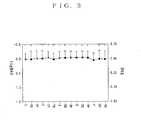
- Fig. 3 shows the measurement results, and colors are indicated in a lateral axis and visions are indicated in a longitudinal axis. It is clearly shown in Fig. 3 that the vision was constant in spite of the colors of the targets.
- this results means only color taste of each target does not influence the measurement results although the targets used for the measurement are colored, that is, such results are almost the same as the measurements of vision with white or black targets although vision was measured with colored targets, and it was not possible to accurately measure color vision (that is, the vision receiving the influences of color taste and saturation).
- An object of the invention is to provide color-viewing function measuring means and a color-viewing function measurement system with which the above-mentioned problems can be solved.
- the invention according to claim 1 is exemplified in Figs.1 and 2 , and is color-viewing function measuring means (1, 10) that indicates a plurality of targets (A 11 ”) that are colored in chromatic colors on a background (B) and is possible to measure color vision and/or a color-viewing field that is a color-viewing function of an examinee by testing whether the examinee can perceive each target (A 11 %), comprising:
- the invention according to claim 2 is the color-viewing function measuring means according to claim 1, wherein the brightness of all of the plurality of targets (A 11 ...) or the brightness of the predetermined number of targets (A 11 ...) are set almost equal to each other, and the following formula holds if the brightness of the target is ⁇ [cd/m2] and the brightness of the background is ⁇ [cd/m2] - 10 ⁇ ⁇ - ⁇ ⁇ + 10
- the invention according to claim 3 is color-viewing function measuring means according to claim 1 or 2, wherein the background (B) is an achromatic color.
- the invention according to claim 4 is color-viewing function measuring means according to one of claims 1 to 3, wherein all of the plurality of targets (A 11 %) or the predetermined number of targets (A 11 7) are set to be different in their sizes, and it is possible to measure the color vision regarding the chromatic color of the examinee by testing whether the examinee can perceive each target (A 11 ).
- the invention according to claim 5 is color-viewing function measuring means according to one of claims 1 to 3, wherein all of the plurality of targets (A 11 %) or the predetermined number of targets a (A 11 7) are set to be almost equal to each other in their sizes, and it is possible to measure the color-viewing field regarding the chromatic color of the examinee by testing whether the examinee can perceive respective targets (A 11 %) presented at various positions.
- the invention according to claim 6 is exemplified in Fig.1 , and is color-viewing function measuring means according to one of claims 1 to 5, wherein the color-viewing function measuring means is a paper or a resin sheet on which the background (B) and the targets (A 11 ...) are indicated.
- the invention according to claim 7 is exemplified in Fig.2 , and is color-viewing function measuring means according to one of claims 1 to 5, wherein a display (11) that is comprised of at least one of a liquid crystal display, a plasma display, an organic EL display and a CRT, a background indicator (12) that indicates the background (B) on the display (11), and a target indicator (13) that indicates the targets (A 11 ...) having a predetermined brightness, a predetermined color and a predetermined size on the display (11).
- the invention according to claim 8 is exemplified in Fig. 2 , and color-viewing function measuring means according to claim 7, wherein an indication time controller (14) that restricts time to indicate the target (A 11 %) through the target indicator (13), a perception detector (15) that outputs signal indicating that the examinee perceived the indicated target (A 11 7), and a color-viewing function judger (16) that judges the color vision and/or the color-viewing field based upon the signals from the perception detector (15).
- the invention according to claim 9 is color-viewing function measuring means according to claim 7, wherein a target indication time memory (17) that stores target indication time every each color, an indication time controller (14) that restricts the time to indicate the target (A 11 %) through the target indicator (13) to the target indication time every each color that is stored in the target indication time memory (17), and a perception detector (15) that outputs signals indicating that the examinee perceived the indicated target (A 11 7), and a color-viewing function judger (16) that judges the color vision and/or the color-viewing field of the examinee based upon the signals from the perception detector (15).
- the invention according to claim 10 is color-viewing function measurement system, comprising:
- the invention according to claim 11 is color-viewing function measurement system, comprising:
- the invention according to claim 12 is color-viewing function measurement system, comprising:
- color vision every each color, such as an ability to recognize red objects or blue objects with eyes
- color-viewing field a field of view every each color, such as a range of a perimetric view that can perceive red or blue without moving eyes
- color-viewing function the color vision and the color-viewing field are collectively referred to as "color-viewing function”.
- Color-viewing function measuring means is for measuring the color vision and/or the color-viewing field of an examinee.
- the color-viewing function is exemplified as reference numbers 1 and 10 in Fig.1 and Fig.2 , and indicates a plurality of targets, such as A 11 (that is, Landolt rings mentioned hereinafter or the other well-known targets) on a background B, and all of a plurality of targets A 11 ...or at least a predetermined number of targets A 11 ... are colored in almost the same chromatic color (that is, the chromatic color having almost equal color taste).
- all targets indicated are colored in respectively different five colors, such as the first color through the fifth color, but such a coloration is not restrictive, needless to say. All targets indicated may be respectively colored in one color, such as red, different two to four colors, or six or more colors.
- number of the targets indicated on the color-viewing function measuring means 1, 10 as shown in Figs.1 and 2 is forty (40), but such a number is not restrictive, and the number of the targets can be optionally set.
- the targets in achromatic color that is, saturation is zero
- the color-viewing function measuring means 1 and 10 as shown in Figs.1 and 2 simultaneously indicate all targets A 11 ..., but such an indication is not restrictive, and one or several targets may be indicated in order.
- the brightness of the background B is set as 20 to 100 [cd/m 2 ] (for instance, 30 [cd/m 2 ]), and when the brightness of the targets A 11 ... is ⁇ [cd/m 2 ] and the brightness of the background B is ⁇ [cd/m 2 ], the following formula holds. That is, - 10 ⁇ ⁇ - ⁇ ⁇ + 10
- the color of the, background B may be a chromatic color (that is, the color which saturation is not zero) or an almost achromatic color (that is, the achromatic color which saturation is zero or the achromatic color into which slightly chromatic color is mixed).
- the background may be gray and the targets A 11 ... may be some chromatic color as mentioned hereinafter.
- the background B may be a specific chromatic color and the targets A 11 ... may be a chromatic color (for instance, the background B may be red and the targets A 11 ... may be red which saturation is different from the background B, or the background B may be green and the targets A 11 ... may be red).
- the background in almost achromatic color is used for the examination of eye disease.
- the background in chromatic color is used for the examination of degree of fatigue of normal eyes.
- the color vision regarding the chromatic color of the examinee in such a way that all of a plurality of targets A 11 ... or a predetermined number of targets A 11 ... (that is, a plurality of targets that are colored in chromatic color having almost equal color taste) are set to be gradually different in their sizes so as to test whether or not the examinee can perceive each target A 11 .... .
- the color-viewing field regarding the chromatic color of the examinee in such a way that all of a plurality of targets A 11 ... or a predetermined number of targets A 11 ... (that is, a plurality of targets that are colored in chromatic color having almost equal color taste) are set to be almost equal in their sizes so as to test whether or not the examinee can perceive the respective targets that are presented at various positions.
- the color vision is measured through the above-mentioned color-viewing function measuring means 1, 10
- the size of the colored target that the examinee can perceive is known, so that the colored target of that size is used for the examination of the color-viewing field, preferably.
- a plane perimeter may be used since it is sufficient to measure the visual field in a center part in case of the measurement of the color-viewing field.
- the measurement results of the vision through the color-viewing function measuring means 1, 10 according to the invention is as shown Fig.5 .
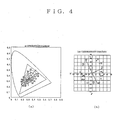
- Fig.5 fifteen colors of NEW COLOR TEST (R, YR, RY, Y, GY, YG, G, BG, GB, B, PB, BP, P, RP, PR) have been used as the colors of the targets (see Figs.4(a) and (b) ), and the fifteen colors are indicated in a lateral axis and the visions are indicated in a longitudinal axis.
- the background is grey, and the brightness of the background is 30 [cd/m 2 ], and the brightness of the targets is 30 [cd/m 2 ].
- the color vision of GY and BP drops, but this (that is, the drop of the color vision of GY and BP) is not important, but such a point that the measured color vision is not constant as Fig.3 , but is widely different, depending the colors is important.
- Such a fact that the measured color vision varies according to the colors means the color taste of the target affects the measurement result and it was possible to measure the vision every each color (that is, the color vision).
- the color-viewing function measuring means 1, 10 whenmeasuring the color-viewing field through the color-viewing function measuring means 1, 10 according to the invention, it is possible to measure the visual field every each color (the color-viewing field), and according to the invention, it is possible to correctly measure the color vision and the color-viewing field every each color.
- the vision of R color of elderly persons is inferior in comparison with their vision of the other colors
- the vision of a specific color of persons who suffer from eye diseases is inferior in comparison with their vision of the other colors.
- the lightness of the background and the lightness of the targets are set to be almost equal to each other, so that the examiners recognize the targets by the difference of the hue or the difference of the saturation.
- the above-mentioned color-viewing function measuring means indicates the background in an almost achromatic color and the target in an almost achromatic color and different from the background in the brightness, the background in a chromatic color and the target in the chromatic color and almost the same as the background in the brightness, or the background in an almost achromatic color and the target in a chromatic color and almost the same as the background in the brightness.
- the color-viewing function measuring means is for example a device which is comprised of a display 11 that is comprised of at least one of a liquid crystal display, a plasma display, an organic EL display, a CRT and the other well-known displays, a background indicator 12 that indicates the background B on the display 11, and a target indicator 13 that indicates the targets A 11 ... having a predetermined brightness, a predetermined color and a predetermined size on the display 11.
- a device and a control for strictly synchronizing both brightness is not necessary and the device can be made cheaper.
- a perception detector that outputs signals indicating that the examinee perceived the indicated target A 11 ...
- a perception time measurer that measures time from the presentation of the target A 11 ... to the perception by the examinee based upon the signal from the perception detector
- a color-viewing function judger that judges the color vision and/or the color viewing field of the examinee from the size or the position of the presented target A 11 ..., and the time that was measured through the perception time measurer may be provided. If provided, it is possible to judge the color vision or the color-viewing field, taking the time necessary for the perception into consideration in addition to whether the target can be perceived, and it is possibletocorrectlyjudge.
- an indication time controller 14 that restricts the time to indicate the target A 11 ...
- a perception detector 15 that outputs a signal indicating that the examinee perceived the indicated target A 11 ...
- a color-viewing function judger 16 that judges the color vision and/or the color-viewing field of the examinee based upon the signals from the perception detector 15 may be provided. If provided, it is easily judge the color-viewing function of the examinee, such as the color vision, the color-viewing field the degree of fatigue (for example, with ⁇ or ⁇ ).
- a target indication time memory 17 that stores the target indication time (prescribed time) every each color
- the indication time controller 14 that restricts the time to indicate the target through the target indicator 13 to the target indication time every each color that is stored in the target indication time memory (17) (prescribed time)
- the perception detector 15 that outputs the signal indicating that the examinee perceived the indicated target A 11 ...
- the color-viewing function judger 16 that judges the color vision and/or the color-viewing field of the examinee based upon the signals from the perception detector 15 may be provided. If such are provided, it is possible to properly set the target indication time every each color and shorten the whole time required for the measurement so as to improve efficiency of measurement works.
- the target indication time is changed according to kinds of e ye diseases . That is, the target indication time memory 17 for storing the target indication time every each color and every eye each disease (prescribed time), the indication time controller 14 that restricts the time to indicate the target through the target indicator 13 to the target indication time that is stored in the target indicator time memory 17 (prescribed time), the perception detector 15 that outputs the signal indicating that the examinee perceived the indicated target A 11 ..., and the color-viewing function judger 16 that judges the color vision and/or the color-viewing field of the examinee based upon the signals from the perception detector 15 may be provided.
- the target indication time memory 17 for storing the target indication time every each color and every eye each disease (prescribed time)
- the indication time controller 14 that restricts the time to indicate the target through the target indicator 13 to the target indication time that is stored in the target indicator time memory 17 (prescribed time)
- the perception detector 15 that outputs the signal indicating that the examinee perceived the indicated target A 11 ...
- the target having the color which can be perceived by normal eyes in 0.2 second is presented to patients predetermine several times of 0.2 second (such as four times), and in a case of the target having the color which can be perceived by normal eyes in 0.5 second, such a target is presented to patients predetermine several times of 0.5 second (such as four times).
- the target indication time or the color of the target may be changed by the condition of the eye disease, such as an initial stage and a terminal stage.
- the above-mentioned perception detector 15 are for instance a joy stick and a button that are operated by the examinees or the examiners.
- the color-viewing function measuring means are for example a paper, a resin sheet and a booklet, on which the background B and the targets A 11 ... are indicated (printed) (see the reference number 1 of Fig.1 ).
- it is not necessary to strictly synchronize the brightness of the background B and the brightness of the targets A 11 ..., and is sufficient to set both to be almost equal to each other. Then, it is possible to easily print these on the paper or the resin sheet with well-known methods.
- the colors in which vision deteriorates are different according to the kinds of the eye diseases. So, it is sufficient to prepare a vision test chart every each eye disease and to preferentially measure the vision of the person who suffers from the eye disease for necessary color only.
- a color-viewing function measurement system may be comprised of result input means that inputs measurement results regarding the color-viewing function measured through the above-mentioned color-viewing function measuring means 1, 10, result input means that inputs measurement results regarding the normal vision function that does not receive the influence of color taste (that is, the vision or the field of view that does not receive the influence of color taste, that is measured with the targets in almost achromatic color, such as white and black, or the targets different from the back ground in the brightness more than the predetermined brightness phases), and result comparison means that compares the measurement results regarding the color-viewing function and the measurement results regarding the normal vision function with each other or indicates both.
- the color-viewing function measurement system it is possible to easily compare the color vision of the examinee and the normal vision of the examinee (that is, the vision that does not receive the influences of the color taste) with each other.
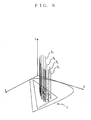
- the color-viewing function measurement system may be comprised of the result input means that inputs the measurement results regarding the color-viewing function that was measured through the color-viewing function measuring means 1, 10 and result indication means that three-dimensionally indicates the measurement results inputted through the result input means on a chromaticity diagram.
- Fig. 8 is an example of the figure indicated by the result indication means.
- a reference number C in the figure denotes the chromaticity diagramaled a reference number D 1 ... denotes a line showing the color-viewing function of each color, such as the color vision. According to the color-viewing function measurement system, it is possible to visually grasp superiority or inferiority of the color-viewing function every each color.
- the color-viewing function measurement system may be comprised of the result input means that inputs the measurement results regarding the color-viewing function that was measured through the color-viewing function measuring means 1, 10, age input means that inputs age of the examinee that was measured through the color-viewing function measuring means 1, 10, reference data storage that stores reference data regarding the color-viewing function every each age, a reference data extraction that extracts the reference data corresponding to the age data from the reference data storage based upon the age data inputted through the age input means, and data comparison means that compares the measurement results inputted through the result input means and the reference data extracted through the reference data extraction with each other.
- the color-viewing function measurement system it is possible to compare the color-viewing function of the examinee (the measurement results) and the reference data every each age with each other.
- Embodiment 1 of the invention is now mentioned, referring to appended Figs.1 and 6 .
- the color vision was measured with a vision test chart 1 as shown in Fig.1 (color-viewing function measuring means).
- the vision test chart 1 as shown in Fig.1 is possible to measure five colors of color visions since the Landolt rings (the targets) are colored in five colors.
- the Landolt rings colored in fifteen colors of NEW COLOR TEST such as R, YR, RY, Y, GY, YG, G, BG, GB, B, PB, BP, P, RP, PR have been used and the color vision for such fifteen colors have been measured.
- the color of the background was gray and the brightness of the each target A 11 ... and the background B was 30 [cd/m 2 ] .
- Figs.6 (a) to (e) show the measurement results of five examinees, and colors of the respective targets are indicated in a lateral axis and visions are indicated in a longitudinal axis.
- a normal vision in the figure is the vision that was measured with the brightness of the background B 100 [cd/m 2 ] and the brightness of the target A 11 ... 30 [cd/m 2 ].
- the color vision is the vision that was measured with the brightness of the background 30 [cd/m 2 ] and the brightness of the target A 11 ... 30 [cd/m 2 ]. From this figure, it is clear such a phenomenon that the vision partially drops near GY and BP is common among the examinees although the color vision goes up and down to some extent according to a person. According to the embodiment, it is known that it was possible to correctly measure the color vision that receives the influences of the color taste or the saturation.
- Fig.7 (a) is a view for comparison between the color vision in the sixth decade (the color vision of each color is a mean of seventeen males and five females) and the color vision in the second decade (the color vision of each color is a mean of five males and fourteen females), and Fig.7(b) is a list that represents the measurement mean of the second decade, the measurement mean of the sixth decade and the different of both every each color. From Fig. 7(a) , it is understood that the color vision of the examinees in the sixth decade is inferior to the color vision of the examinees in the second decade. Besides, from Fig.
- a degree of the deterioration of the vision by the aging varies according to a color
- the degree of the deterioration of R vision is for example 0.1765 that is higher than the Y vision, 0.1295.
Landscapes
- Life Sciences & Earth Sciences (AREA)
- Health & Medical Sciences (AREA)
- Medical Informatics (AREA)
- Biophysics (AREA)
- Ophthalmology & Optometry (AREA)
- Engineering & Computer Science (AREA)
- Biomedical Technology (AREA)
- Heart & Thoracic Surgery (AREA)
- Physics & Mathematics (AREA)
- Molecular Biology (AREA)
- Surgery (AREA)
- Animal Behavior & Ethology (AREA)
- General Health & Medical Sciences (AREA)
- Public Health (AREA)
- Veterinary Medicine (AREA)
- Eye Examination Apparatus (AREA)
Abstract
Description
- This invention relates to color-viewing function measuring means and a color-viewing function measurement system for measuring color vision and/or a color-viewing field of an examinee.
- It was common to use white or black targets in order to measure a vision or a field of view in the past (for example, patent
related document 1 shown below). But, we are surrounded by maley chromatically colored materials, and in fact, there are few white or black materials in our circumstances. Then, recently, measurement of vision or field of view adding influences of colors is increasingly attracting attention, but not measurement with white or black targets. And, various methods are proposed (for example, see patent related documents 2 and 3 shown below). -
- [Patent related document 1]: Japanese patent application publication No.
2012-11146 - [Patent related document 2]: Japanese patent application publication No.
2002-209849 - [Patent related document 3]: Specification of The
U.S.A. patent No.5461436 - Inventors of the invention have measured vision of respective colors with an inspection table where fifteen (15) colored Landolt rings are shown in a gray background. In this case, brightness of the background is 100[cd/m2], brightness of the targets is 30[cd/m2] and the colors of targets are R, YR, RY, Y, GY, YG, G, BG, GB, B, PB, BP, P, RP, PR (fifteen colors of NEW COLOR TEST).
Fig. 3 shows the measurement results, and colors are indicated in a lateral axis and visions are indicated in a longitudinal axis. It is clearly shown inFig. 3 that the vision was constant in spite of the colors of the targets. That is, this results means only color taste of each target does not influence the measurement results although the targets used for the measurement are colored, that is, such results are almost the same as the measurements of vision with white or black targets although vision was measured with colored targets, and it was not possible to accurately measure color vision (that is, the vision receiving the influences of color taste and saturation). - As know from the above, the means for correctly measuring the color vision or the color-viewing field every each color did not exist in the past.
- An object of the invention is to provide color-viewing function measuring means and a color-viewing function measurement system with which the above-mentioned problems can be solved.
- The invention according to
claim 1 is exemplified inFigs.1 and2 , and is color-viewing function measuring means (1, 10) that indicates a plurality of targets (A11...) that are colored in chromatic colors on a background (B) and is possible to measure color vision and/or a color-viewing field that is a color-viewing function of an examinee by testing whether the examinee can perceive each target (A11 ...), comprising: - all of the plurality of targets (A11 ...) or at least a predetermined number of the plurality of targets (A11 ...) being colored in almost the same chromatic color; and
- brightness of the targets (A11 ...) being set so as to almost equal to brightness of the background (B);
- The invention according to claim 2 is the color-viewing function measuring means according to
claim 1, wherein the brightness of all of the plurality of targets (A11 ...) or the brightness of the predetermined number of targets (A11 ...) are set almost equal to each other, and the following formula holds if the brightness of the target is α [cd/m2] and the brightness of the background is β [cd/m2]
- The invention according to claim 3 is color-viewing function measuring means according to
claim 1 or 2, wherein the background (B) is an achromatic color. - The invention according to
claim 4 is color-viewing function measuring means according to one ofclaims 1 to 3, wherein all of the plurality of targets (A11 ...) or the predetermined number of targets (A11 ...) are set to be different in their sizes, and it is possible to measure the color vision regarding the chromatic color of the examinee by testing whether the examinee can perceive each target (A11 ...). - The invention according to claim 5 is color-viewing function measuring means according to one of
claims 1 to 3, wherein all of the plurality of targets (A11 ...) or the predetermined number of targets a (A11 ...) are set to be almost equal to each other in their sizes, and it is possible to measure the color-viewing field regarding the chromatic color of the examinee by testing whether the examinee can perceive respective targets (A11 ...) presented at various positions. - The invention according to claim 6 is exemplified in
Fig.1 , and is color-viewing function measuring means according to one ofclaims 1 to 5, wherein the color-viewing function measuring means is a paper or a resin sheet on which the background (B) and the targets (A11 ...) are indicated. - The invention according to claim 7 is exemplified in
Fig.2 , and is color-viewing function measuring means according to one ofclaims 1 to 5, wherein a display (11) that is comprised of at least one of a liquid crystal display, a plasma display, an organic EL display and a CRT, a background indicator (12) that indicates the background (B) on the display (11), and a target indicator (13) that indicates the targets (A11 ...) having a predetermined brightness, a predetermined color and a predetermined size on the display (11). - The invention according to
claim 8 is exemplified inFig. 2 , and color-viewing function measuring means according to claim 7, wherein an indication time controller (14) that restricts time to indicate the target (A11 ...) through the target indicator (13), a perception detector (15) that outputs signal indicating that the examinee perceived the indicated target (A11 ...), and a color-viewing function judger (16) that judges the color vision and/or the color-viewing field based upon the signals from the perception detector (15). - The invention according to claim 9 is color-viewing function measuring means according to claim 7, wherein a target indication time memory (17) that stores target indication time every each color, an indication time controller (14) that restricts the time to indicate the target (A11 ...) through the target indicator (13) to the target indication time every each color that is stored in the target indication time memory (17), and a perception detector (15) that outputs signals indicating that the examinee perceived the indicated target (A11 ...), and a color-viewing function judger (16) that judges the color vision and/or the color-viewing field of the examinee based upon the signals from the perception detector (15).
- The invention according to
claim 10 is color-viewing function measurement system, comprising: - result input means that inputs measurement results regarding a color-viewing function that was measured through the color-viewing function measuring means according to one of
claims 1 to 9; - result input means that inputs measurement results regarding normal vision function that does not receive influences of color taste; and
- result comparison means that compare the measurement results regarding the color-viewing function and the measurement results regarding normal vision function with each other or indicates both.
- The invention according to
claim 11 is color-viewing function measurement system, comprising: - result input means that inputs measurement results regarding the color-viewing function that was measured through the color-viewing function measuring means according to one of
claims 1 to 9; and - result indication means that three-dimensionally indicates the measurement results inputted through the result input means on a chromaticity diagram
- The invention according to
claim 12 is color-viewing function measurement system, comprising: - result input means that inputs measurement results regarding the color-viewing function that was measured through the color-viewing function measuring means according to one of
claims 1 to 9; - age input means that inputs age of the examinee that was measured through the color-viewing function measuring means;
- a reference data storage that stores reference data regarding the color-viewing function every each age;
- a reference data extraction that extracts the reference data corresponding to age data from the reference data storage based upon the age data inputted through the age input means; and data comparison means that compares the measurement results inputted through the result input means and the reference data extracted through the reference data extraction with each other.
- The number in parentheses shows the corresponding element in the drawings for the sake of convenience, accordingly, the descriptions are not restricted and bound by the descriptions on the drawings.
- According to the invention of
claims 1 through 7, it is possible to correctly measure the color vision and the color-viewing field. - According to the invention of
claim 8, it is possible to easily judge the color-viewing function of the examinee (the color vision, the color-viewing field and the degree of fatigue). - According to the invention of claim 9, it is possible to set the target indication time in proper time every each color and to shorten the time required for the whole measurement so as to improve the efficiency of the measurement works.
- According to the invention of
claim 10, it is possible to easily compare the color vision of the examinee and the normal vision (that is, the vision that does not receive the influences of the color taste) with each other. - According to the invention of
claim 11, it is possible to visually grasp superiority or inferiority of the color vison function every each color. - According to the invention of
claim 12, it is possible to compare the color-viewing function of the examinee (the measurement results) and the reference data every each age with each other. -
- [
Fig.1] Fig.1 is a schematic view that shows an example of a structure of color-viewing function measuring means according to the invention. - [
Fig.2] Fig.2 is a schematic view that shows another example of the structure of the color-viewing function measuring means according to the invention. - [
Fig.3] Fig.3 is a view that shows measurement results when measuring a color vision with a conventional method. - [
Fig.4] Fig.4(a) is a xy chromaticity diagramaledFig.4(b) is a Lab chromaticity diagram. - [
Fig.5] Fig.5 is a view that shows measurement results when measuring a color vision with the color-viewing function measuring means according to the invention. - [
Fig.6] Fig.6(a) to (e) are views that show measurement results when measuring the color vision for five examinees. - [
Fig.7] Fig.7(a) is a view that shows measurement results of the color vision of examinees in the second decade and the sixth decade, and Fig. (b) is a chart indicating averagedmeasurement values in the second decade and the sixth decade and differences between both values every each color. - [
Fig.8] Fig.8 is a view three-dimensionally indicating measurement results of the color vision. - Embodiments of the invention are now mentioned, referring to appended drawings
Figs.1 to 8 . - In this specification, vision every each color, such as an ability to recognize red objects or blue objects with eyes, is referred to as "color vision", and a field of view every each color, such as a range of a perimetric view that can perceive red or blue without moving eyes is referred to as "color-viewing field", and the color vision and the color-viewing field are collectively referred to as "color-viewing function".
- Color-viewing function measuring means according to the invention is for measuring the color vision and/or the color-viewing field of an examinee. The color-viewing function is exemplified as
reference numbers Fig.1 andFig.2 , and indicates a plurality of targets, such as A11 (that is, Landolt rings mentioned hereinafter or the other well-known targets) on a background B, and all of a plurality of targets A11 ...or at least a predetermined number of targets A11... are colored in almost the same chromatic color (that is, the chromatic color having almost equal color taste). In the color-viewing function measuring means 1, 10 as shown inFigs.1 and2 , all targets indicated are colored in respectively different five colors, such as the first color through the fifth color, but such a coloration is not restrictive, needless to say. All targets indicated may be respectively colored in one color, such as red, different two to four colors, or six or more colors. Besides, number of the targets indicated on the color-viewing function measuring means 1, 10 as shown inFigs.1 and2 is forty (40), but such a number is not restrictive, and the number of the targets can be optionally set. Furthermore, the targets in achromatic color (that is, saturation is zero) may be indicated in addition to ones in chromatic color. And, the color-viewing function measuring means 1 and 10 as shown inFigs.1 and2 simultaneously indicate all targets A11..., but such an indication is not restrictive, and one or several targets may be indicated in order. - In this case, brightness (lightness) of at least predetermined number of targets A11... of a plurality of targets A11... and brightness (lightness) of background B are almost equal to each other, and it is possible to measure the color vision and/or the color-viewing field regarding the chromatic colors by testing whether the examinee can perceive such target A11.... The targets and the background are set to be different in at least one of hue and saturation (or in both). Preferably, the brightness of the background B is set as 20 to 100 [cd/m2] (for instance, 30 [cd/m2]), and when the brightness of the targets A11... is α [cd/m2] and the brightness of the background B is β [cd/m2], the following formula holds. That is,

- In such a case, the color of the, background B may be a chromatic color (that is, the color which saturation is not zero) or an almost achromatic color (that is, the achromatic color which saturation is zero or the achromatic color into which slightly chromatic color is mixed). For instance, the background may be gray and the targets A11... may be some chromatic color as mentioned hereinafter. Besides, the background B may be a specific chromatic color and the targets A11... may be a chromatic color (for instance, the background B may be red and the targets A11... may be red which saturation is different from the background B, or the background B may be green and the targets A11... may be red). Preferably, the background in almost achromatic color is used for the examination of eye disease. Preferably, the background in chromatic color is used for the examination of degree of fatigue of normal eyes.
- Preferably, it is possible to measure the color vision regarding the chromatic color of the examinee in such a way that all of a plurality of targets A11... or a predetermined number of targets A11... (that is, a plurality of targets that are colored in chromatic color having almost equal color taste) are set to be gradually different in their sizes so as to test whether or not the examinee can perceive each target A11.... .
- Otherwise, it may possible to measure the color-viewing field regarding the chromatic color of the examinee in such a way that all of a plurality of targets A11... or a predetermined number of targets A11... (that is, a plurality of targets that are colored in chromatic color having almost equal color taste) are set to be almost equal in their sizes so as to test whether or not the examinee can perceive the respective targets that are presented at various positions. When the color vision is measured through the above-mentioned color-viewing function measuring means 1, 10, the size of the colored target that the examinee can perceive is known, so that the colored target of that size is used for the examination of the color-viewing field, preferably. Besides, a plane perimeter may be used since it is sufficient to measure the visual field in a center part in case of the measurement of the color-viewing field.
- Subsequently, effects of the invention are now mentioned.
- Such trials to measure the color vision with the targets colored in chromatic colors (colored targets) have been performed in a field of an examination of the vision. But, in such trials the difference of the brightness between the background and the target was not adjusted as this invention, and the measurement result (the color vision) is as shown in
Fig.3 , for instance, and the measurement results are almost constant in spite of the color of the target. This result means that the color taste of each target does not affect the measurement results although the targets used for the measurement are colored (that is, the measurement result is almost the same as the measurement result that has been measured with the targets in white or black although the examination has been performed with the colored targets), and it was not possible to correctly measure the color vision). Fifteen colors of NEW COLOR TEST (R, YR, RY, Y, GY, YG, G, BG, GB, B, PB, BP, P, RP, PR) have been used as the colors of the targets (seeFigs.4(a) and (b) ), and the fifteen colors are indicated in a lateral axis and the visions are indicated in a longitudinal axis inFig.3 . And, the background is grey, and the brightness of the background is 100 [cd/m2], and the brightness of the targets is 30 [cd/m2]. - On the other hand, the measurement results of the vision through the color-viewing function measuring means 1, 10 according to the invention is as shown
Fig.5 . InFig.5 fifteen colors of NEW COLOR TEST (R, YR, RY, Y, GY, YG, G, BG, GB, B, PB, BP, P, RP, PR) have been used as the colors of the targets (seeFigs.4(a) and (b) ), and the fifteen colors are indicated in a lateral axis and the visions are indicated in a longitudinal axis. And, the background is grey, and the brightness of the background is 30 [cd/m2], and the brightness of the targets is 30 [cd/m2]. According toFig.5 , the color vision of GY and BP drops, but this (that is, the drop of the color vision of GY and BP) is not important, but such a point that the measured color vision is not constant asFig.3 , but is widely different, depending the colors is important. Such a fact that the measured color vision varies according to the colors means the color taste of the target affects the measurement result and it was possible to measure the vision every each color (that is, the color vision). Besides, whenmeasuring the color-viewing field through the color-viewing function measuring means 1, 10 according to the invention, it is possible to measure the visual field every each color (the color-viewing field), and according to the invention, it is possible to correctly measure the color vision and the color-viewing field every each color. It is known that the vision of R color of elderly persons is inferior in comparison with their vision of the other colors, and it is known that the vision of a specific color of persons who suffer from eye diseases is inferior in comparison with their vision of the other colors. But, according to the invention, it is possible to correctly measure such a deterioration of the vision every each color. That is, a color has three elements, such as hue, lightness (brightness) and saturation. In the invention, the lightness of the background and the lightness of the targets are set to be almost equal to each other, so that the examiners recognize the targets by the difference of the hue or the difference of the saturation. - Preferably, the above-mentioned color-viewing function measuring means indicates the background in an almost achromatic color and the target in an almost achromatic color and different from the background in the brightness, the background in a chromatic color and the target in the chromatic color and almost the same as the background in the brightness, or the background in an almost achromatic color and the target in a chromatic color and almost the same as the background in the brightness.
- As exemplified as the
reference number 10 inFig.2 , the color-viewing function measuring means is for example a device which is comprised of adisplay 11 that is comprised of at least one of a liquid crystal display, a plasma display, an organic EL display, a CRT and the other well-known displays, abackground indicator 12 that indicates the background B on thedisplay 11, and atarget indicator 13 that indicates the targets A11... having a predetermined brightness, a predetermined color and a predetermined size on thedisplay 11. According to the invention, it is not necessary to strictly synchronize the brightness of the background B and the brightness of the targets A11..., so that a device and a control for strictly synchronizing both brightness is not necessary and the device can be made cheaper. In such a case, a perception detector that outputs signals indicating that the examinee perceived the indicated target A11..., a perception time measurer that measures time from the presentation of the target A11... to the perception by the examinee based upon the signal from the perception detector, and a color-viewing function judger that judges the color vision and/or the color viewing field of the examinee from the size or the position of the presented target A11..., and the time that was measured through the perception time measurer may be provided. If provided, it is possible to judge the color vision or the color-viewing field, taking the time necessary for the perception into consideration in addition to whether the target can be perceived, and it is possibletocorrectlyjudge. Besides, anindication time controller 14 that restricts the time to indicate the target A11... through thetarget indicator 13 into a prescribed time, such as 0.5 second and 2.0 second, aperception detector 15 that outputs a signal indicating that the examinee perceived the indicated target A11..., and a color-viewing function judger 16 that judges the color vision and/or the color-viewing field of the examinee based upon the signals from theperception detector 15 may be provided. If provided, it is easily judge the color-viewing function of the examinee, such as the color vision, the color-viewing field the degree of fatigue (for example, with ○ or ×). Since the time required for the perception of the target by normal eyes depends on the colors of the target, a targetindication time memory 17 that stores the target indication time (prescribed time) every each color, theindication time controller 14 that restricts the time to indicate the target through thetarget indicator 13 to the target indication time every each color that is stored in the target indication time memory (17) (prescribed time), theperception detector 15 that outputs the signal indicating that the examinee perceived the indicated target A11..., and the color-viewing function judger 16 that judges the color vision and/or the color-viewing field of the examinee based upon the signals from theperception detector 15 may be provided. If such are provided, it is possible to properly set the target indication time every each color and shorten the whole time required for the measurement so as to improve efficiency of measurement works. Preferably, the target indication time is changed according to kinds of e ye diseases . That is, the targetindication time memory 17 for storing the target indication time every each color and every eye each disease (prescribed time), theindication time controller 14 that restricts the time to indicate the target through thetarget indicator 13 to the target indication time that is stored in the target indicator time memory 17 (prescribed time), theperception detector 15 that outputs the signal indicating that the examinee perceived the indicated target A11..., and the color-viewing function judger 16 that judges the color vision and/or the color-viewing field of the examinee based upon the signals from theperception detector 15 may be provided. Preferably, in a case of the target having the color which can be perceived by normal eyes in 0.2 second, such a target is presented to patients predetermine several times of 0.2 second (such as four times), and in a case of the target having the color which can be perceived by normal eyes in 0.5 second, such a target is presented to patients predetermine several times of 0.5 second (such as four times). If so, it is possible to properly set the target indication time for the patients every each color and every each eye disease and to shorten the time required for the whole measurements so as to improve the measurement works. The target indication time or the color of the target may be changed by the condition of the eye disease, such as an initial stage and a terminal stage. The above-mentionedperception detector 15 are for instance a joy stick and a button that are operated by the examinees or the examiners. - The color-viewing function measuring means are for example a paper, a resin sheet and a booklet, on which the background B and the targets A11... are indicated (printed) (see the
reference number 1 ofFig.1 ). According to the invention, it is not necessary to strictly synchronize the brightness of the background B and the brightness of the targets A11..., and is sufficient to set both to be almost equal to each other. Then, it is possible to easily print these on the paper or the resin sheet with well-known methods. The colors in which vision deteriorates are different according to the kinds of the eye diseases. So, it is sufficient to prepare a vision test chart every each eye disease and to preferentially measure the vision of the person who suffers from the eye disease for necessary color only. - On the other hand, a color-viewing function measurement system may be comprised of result input means that inputs measurement results regarding the color-viewing function measured through the above-mentioned color-viewing function measuring means 1, 10, result input means that inputs measurement results regarding the normal vision function that does not receive the influence of color taste (that is, the vision or the field of view that does not receive the influence of color taste, that is measured with the targets in almost achromatic color, such as white and black, or the targets different from the back ground in the brightness more than the predetermined brightness phases), and result comparison means that compares the measurement results regarding the color-viewing function and the measurement results regarding the normal vision function with each other or indicates both. According to the color-viewing function measurement system, it is possible to easily compare the color vision of the examinee and the normal vision of the examinee (that is, the vision that does not receive the influences of the color taste) with each other.
- Besides, the color-viewing function measurement system may be comprised of the result input means that inputs the measurement results regarding the color-viewing function that was measured through the color-viewing function measuring means 1, 10 and result indication means that three-dimensionally indicates the measurement results inputted through the result input means on a chromaticity diagram.
Fig. 8 is an example of the figure indicated by the result indication means. A reference number C in the figure denotes the chromaticity diagramaled a reference number D1... denotes a line showing the color-viewing function of each color, such as the color vision. According to the color-viewing function measurement system, it is possible to visually grasp superiority or inferiority of the color-viewing function every each color. - Furthermore, the color-viewing function measurement system may be comprised of the result input means that inputs the measurement results regarding the color-viewing function that was measured through the color-viewing function measuring means 1, 10, age input means that inputs age of the examinee that was measured through the color-viewing function measuring means 1, 10, reference data storage that stores reference data regarding the color-viewing function every each age, a reference data extraction that extracts the reference data corresponding to the age data from the reference data storage based upon the age data inputted through the age input means, and data comparison means that compares the measurement results inputted through the result input means and the reference data extracted through the reference data extraction with each other. According to the color-viewing function measurement system, it is possible to compare the color-viewing function of the examinee (the measurement results) and the reference data every each age with each other.
-
Embodiment 1 of the invention is now mentioned, referring to appendedFigs.1 and6 . - In this embodiment, the color vision was measured with a
vision test chart 1 as shown inFig.1 (color-viewing function measuring means). Thevision test chart 1 as shown inFig.1 is possible to measure five colors of color visions since the Landolt rings (the targets) are colored in five colors. But, in this embodiment, the Landolt rings colored in fifteen colors of NEW COLOR TEST, such as R, YR, RY, Y, GY, YG, G, BG, GB, B, PB, BP, P, RP, PR have been used and the color vision for such fifteen colors have been measured. And, the color of the background was gray and the brightness of the each target A11... and the background B was 30 [cd/m2] . -
Figs.6 (a) to (e) show the measurement results of five examinees, and colors of the respective targets are indicated in a lateral axis and visions are indicated in a longitudinal axis. A normal vision in the figure is the vision that was measured with the brightness of the background B 100 [cd/m2] and the brightness of the target A11... 30 [cd/m2]. The color vision is the vision that was measured with the brightness of the background 30 [cd/m2] and the brightness of the target A11... 30 [cd/m2]. From this figure, it is clear such a phenomenon that the vision partially drops near GY and BP is common among the examinees although the color vision goes up and down to some extent according to a person. According to the embodiment, it is known that it was possible to correctly measure the color vision that receives the influences of the color taste or the saturation. - An embodiment 2 of the invention is now explained, referring to the appended
figures 7(a) and (b) . -
Fig.7 (a) is a view for comparison between the color vision in the sixth decade (the color vision of each color is a mean of seventeen males and five females) and the color vision in the second decade (the color vision of each color is a mean of five males and fourteen females), andFig.7(b) is a list that represents the measurement mean of the second decade, the measurement mean of the sixth decade and the different of both every each color. FromFig. 7(a) , it is understood that the color vision of the examinees in the sixth decade is inferior to the color vision of the examinees in the second decade. Besides, fromFig. 7(b) , it is understood that a degree of the deterioration of the vision by the aging varies according to a color, and the degree of the deterioration of R vision is for example 0.1765 that is higher than the Y vision, 0.1295. -
- 1
- color-viewing function measuring means (vision test chart)
- 10
- color-viewing function measuring means
- 11
- display
- 12
- background indicator
- 13
- target indicator
- 14.
- indication time controller
- 15
- perception detector
- 16
- color-viewing function judger
- 17
- target indication time memory
- A11,
- targets (Landolt rings)
- B
- background
Claims (12)
- Color-viewing function measuring means that indicates a plurality of targets that are colored in chromatic colors on a background and is possible to measure color vision and/or a color-viewing field that is a color-viewing function of an examinee by testing whether the examinee can perceive each target, comprising:all of the plurality of targets or at least a predetermined number of the plurality of targets being colored in almost the same chromatic color; andbrightness of the targets being set so as to almost equal to brightness of the background;whereby it is possible to measure color vision and/or a color-viewing field regarding the chromatic color.
- The color-viewing function measuring means according to claim 1, wherein the brightness of all of the plurality of targets or the brightness of the predetermined number of targets are set almost equal to each other, and the following formula holds if the brightness of the target is α [cd/m2] and the brightness of the background is β [cd/m2]

- The color-viewing function measuring means according to claim 1 or 2, wherein the background is an achromatic color.
- The color-viewing function measuring means according to one of claims 1 to 3, wherein all of the plurality of targets or the predetermined number of targets are set to be different in their sizes, and it is possible to measure the color vision regarding the chromatic color of the examinee by testing whether the examinee can perceive each target.
- The color-viewing function measuring means according to one of claims 1 to 3, wherein all of the plurality of targets or the predetermined number of targets are set to be almost equal to each other in their sizes, and it is possible to measure the color-viewing field regarding the chromatic color of the examinee by testing whether the examinee can perceive respective targets presented at various positions.
- The color-viewing function measuring means according to one of claims 1 to 5, wherein the color-viewing function measuring means is a paper or a resin sheet on which the background and the targets are indicated.
- The color-viewing function measuring means according to one of claims 1 to 5, wherein a display that is comprised of at least one of a liquid crystal display, a plasma display, an organic EL display and a CRT, a background indicator that indicates the background on the display, and a target indicator that indicates the targets having a predetermined brightness, a predetermined color and a predetermined size on the display.
- The color-viewing function measuring means according to claim 7, wherein an indication time controller that restricts time to indicate the target through the target indicator, a perception detector that outputs signal indicating that the examinee perceived the indicated target, and a color-viewing function judger that judges the color vision and/or the color-viewing field based upon the signals from the perception detector.
- The color-viewing function measuring means according to claim 7, wherein a target indication time memory that stores target indication time every each color, an indication time controller that restricts the time to indicate the target through the target indicator to the target indication time every each color that is stored in the target indication time memory, and a perception detector that outputs signals indicating that the examinee perceived the indicated target, and a color-viewing function judger that judges the color vision and/or the color-viewing field of the examinee based upon the signals from the perception detector.
- A color-viewing function measurement system, comprising
result input means that inputs measurement results regarding a color-viewing function that was measured through the color-viewing function measuring means according to one of claims 1 to 9;
result input means that inputs measurement results regarding normal vision function that does not receive influences of color taste; and
result comparison means that compare the measurement results regarding the color-viewing function and the measurement results regarding normal vision function with each other or indicates both. - The color-viewing function measurement system, comprising:result input means that inputs measurement results regarding the color-viewing function that was measured through the color-viewing function measuring means according to one of claims 1 to 9; andresult indication means that three-dimensionally indicates the measurement results inputted through the result input means on a chromaticity diagram.
- The color-viewing function measurement system, comprising:result input means that inputs measurement results regarding the color-viewing function that was measured through the color-viewing function measuring means according to one of claims 1 to 9;age input means that inputs age of the examinee that was measured through the color-viewing function measuring means;reference data storage that stores reference data regarding the color-viewing function every each age;a reference data extraction that extracts the reference data corresponding to age data from the reference data storage based upon the age data inputted through the age input means; and data comparison means that compares the measurement results inputted through the result input means and the reference data extracted through the reference data extraction with each other.
Applications Claiming Priority (2)
| Application Number | Priority Date | Filing Date | Title |
|---|---|---|---|
| JP2012094639 | 2012-04-18 | ||
| PCT/JP2013/061386 WO2013157573A1 (en) | 2012-04-18 | 2013-04-17 | Color-viewing function measuring means and color-viewing function measurement system |
Publications (3)
| Publication Number | Publication Date |
|---|---|
| EP2839771A1 true EP2839771A1 (en) | 2015-02-25 |
| EP2839771A4 EP2839771A4 (en) | 2015-12-23 |
| EP2839771B1 EP2839771B1 (en) | 2021-09-15 |
Family
ID=49383528
Family Applications (1)
| Application Number | Title | Priority Date | Filing Date |
|---|---|---|---|
| EP13777467.5A Active EP2839771B1 (en) | 2012-04-18 | 2013-04-17 | Color-viewing function measuring means and color-viewing function measurement system |
Country Status (4)
| Country | Link |
|---|---|
| US (1) | US9596985B2 (en) |
| EP (1) | EP2839771B1 (en) |
| JP (1) | JP6212034B2 (en) |
| WO (1) | WO2013157573A1 (en) |
Cited By (2)
| Publication number | Priority date | Publication date | Assignee | Title |
|---|---|---|---|---|
| CN104825128A (en) * | 2015-05-07 | 2015-08-12 | 京东方科技集团股份有限公司 | Color blindness detection method and device |
| EP4137036A1 (en) * | 2021-08-17 | 2023-02-22 | Chukyo Medical Co., Inc. | Visual target display device, visual target presentation method, and program |
Families Citing this family (7)
| Publication number | Priority date | Publication date | Assignee | Title |
|---|---|---|---|---|
| US20170209041A1 (en) * | 2013-04-17 | 2017-07-27 | Kazuo Ichikawa | Color-viewing function measuring means and color-viewing function measurement system |
| US9370299B2 (en) * | 2013-05-16 | 2016-06-21 | Successfactors, Inc. | Display accessibility for color vision impairment |
| CN104706314A (en) | 2015-03-19 | 2015-06-17 | 京东方科技集团股份有限公司 | Vision detection device and method |
| JP6184046B1 (en) * | 2017-06-09 | 2017-08-23 | 株式会社中京メディカル | Inspection apparatus and inspection method |
| TWI832976B (en) * | 2019-02-27 | 2024-02-21 | 美商愛奎有限公司 | Method and apparatus for measuring vision function |
| IL298146B2 (en) * | 2020-09-24 | 2025-03-01 | Shamir Optical Ind Ltd | System and method for evaluating vision of a subject |
| CN116916810A (en) * | 2021-01-05 | 2023-10-20 | 沃缇奥普特蔻有限公司 | Eye examination method and device therefor |
Family Cites Families (19)
| Publication number | Priority date | Publication date | Assignee | Title |
|---|---|---|---|---|
| US2937567A (en) * | 1954-03-01 | 1960-05-24 | Ferree | Means for determining color sensitivity |
| US4615594A (en) * | 1985-01-23 | 1986-10-07 | The United States Of America As Represented By The Secretary Of The Air Force | Vision test chart and method using Gaussians |
| FR2669269B1 (en) | 1990-11-21 | 1994-02-25 | Ricoh Cy Ltd | THERMOSENSITIVE RECORDING MATERIAL. |
| US5461436A (en) | 1993-10-29 | 1995-10-24 | Humphrey Instruments, Inc. | Color field test with occlusion of non-tested eye |
| US5946075A (en) * | 1996-05-21 | 1999-08-31 | Horn; Gerald | Vision screening system |
| JPH11146A (en) | 1997-06-13 | 1999-01-06 | Sato Shokuhin Kogyo Kk | Production of extract powder of teas |
| JP3974704B2 (en) * | 1998-03-20 | 2007-09-12 | 興和株式会社 | Visual field measuring device |
| US6379007B1 (en) * | 2000-10-23 | 2002-04-30 | Mark Daniel Farb | Eye chart with distinct symbols and methods for vision testing |
| JP2002209849A (en) | 2001-01-16 | 2002-07-30 | Taketoshi Suzuki | Method and apparatus for testing retinal function |
| JP2002209851A (en) * | 2001-01-24 | 2002-07-30 | Canon Inc | Optometry device |
| JP4902071B2 (en) | 2001-08-27 | 2012-03-21 | 武敏 鈴木 | Field inspection table |
| US6851809B1 (en) * | 2001-10-22 | 2005-02-08 | Massachusetts Institute Of Technology | Color vision deficiency screening test resistant to display calibration errors |
| JP2005241808A (en) | 2004-02-25 | 2005-09-08 | Kyocera Corp | Fiber stub with optical isolator, optical receptacle with optical isolator, and optical module |
| US20060209258A1 (en) * | 2005-03-18 | 2006-09-21 | Xerox Corporation | Methods and systems for configuring color documents for colorblind users |
| JP4209935B1 (en) | 2008-09-16 | 2009-01-14 | 知博 蔦 | Dynamic perimeter operation method |
| JP5710899B2 (en) * | 2010-06-23 | 2015-04-30 | 一夫 市川 | Lens evaluation apparatus, control program, and control method for lens evaluation apparatus |
| JP5606813B2 (en) | 2010-07-05 | 2014-10-15 | 株式会社ニデック | Ophthalmic equipment |
| JP2012183260A (en) * | 2011-03-08 | 2012-09-27 | Hideharu Fukasaku | Color chart for visual acuity |
| JP5947043B2 (en) | 2012-01-13 | 2016-07-06 | メタウォーター株式会社 | Circulating fluid furnace |
-
2013
- 2013-04-17 JP JP2014511232A patent/JP6212034B2/en active Active
- 2013-04-17 WO PCT/JP2013/061386 patent/WO2013157573A1/en not_active Ceased
- 2013-04-17 US US14/395,641 patent/US9596985B2/en active Active
- 2013-04-17 EP EP13777467.5A patent/EP2839771B1/en active Active
Cited By (3)
| Publication number | Priority date | Publication date | Assignee | Title |
|---|---|---|---|---|
| CN104825128A (en) * | 2015-05-07 | 2015-08-12 | 京东方科技集团股份有限公司 | Color blindness detection method and device |
| US9788716B2 (en) | 2015-05-07 | 2017-10-17 | Boe Technology Group Co., Ltd. | Method and device of testing color blindness |
| EP4137036A1 (en) * | 2021-08-17 | 2023-02-22 | Chukyo Medical Co., Inc. | Visual target display device, visual target presentation method, and program |
Also Published As
| Publication number | Publication date |
|---|---|
| JPWO2013157573A1 (en) | 2015-12-21 |
| US9596985B2 (en) | 2017-03-21 |
| EP2839771B1 (en) | 2021-09-15 |
| US20150085258A1 (en) | 2015-03-26 |
| EP2839771A4 (en) | 2015-12-23 |
| WO2013157573A1 (en) | 2013-10-24 |
| JP6212034B2 (en) | 2017-10-11 |
Similar Documents
| Publication | Publication Date | Title |
|---|---|---|
| EP2839771B1 (en) | Color-viewing function measuring means and color-viewing function measurement system | |
| US20230083656A1 (en) | Methods and apparatus for enhancing color vision and quantifying color interpretation | |
| Rabin et al. | Rapid quantification of color vision: the cone contrast test | |
| EP3417764B1 (en) | Testing apparatus and testing method | |
| US6851809B1 (en) | Color vision deficiency screening test resistant to display calibration errors | |
| CN110251066A (en) | Based on the not positive system and method for subjective distance measuring measurement ophthalmic refractive | |
| CN115087389A (en) | Computer-implemented color vision test and method for calibrating a computer-implemented color vision test | |
| French et al. | The evolution of colour vision testing | |
| King‐Smith et al. | Visual thresholds measured with color video monitors | |
| US20170209041A1 (en) | Color-viewing function measuring means and color-viewing function measurement system | |
| EP4137036A1 (en) | Visual target display device, visual target presentation method, and program | |
| Wenzel et al. | Measurement of color defective and normal color vision subjects´ color and luminance contrast threshold functions on CRT | |
| Zhang et al. | How well can people use different color attributes? | |
| KR101725682B1 (en) | Apparatus and Method for Color Vision Test | |
| JP2014236904A (en) | Testing means and program | |
| EP2873364B1 (en) | Multispectrally tested, printed colour vision test for the fine evaluation of the degree of deficiency | |
| KR101227594B1 (en) | Visual acuity testing device | |
| Lillo et al. | Red-green dichromats’ use of basic colour terms | |
| WO2005053521A1 (en) | Method and apparatus for measuring degrees of colour vision deficiencies | |
| JP2013183898A (en) | Device and method for binocular function test | |
| Jover et al. | Do dichromats see colours in this way? Assessing simulation tools without colorimetric measurements | |
| Tanaka et al. | Characteristics of color visual acuity for normal eyes of young subjects | |
| EP2942004B1 (en) | Positioning of autostereoscopic tablet computer | |
| HOVIS et al. | 11. Estimating chromatic thresholds | |
| Breton et al. | Evaluation of a CRT-Based Test of Saturation Discrimination Using a Discrete Matching Technique |
Legal Events
| Date | Code | Title | Description |
|---|---|---|---|
| PUAI | Public reference made under article 153(3) epc to a published international application that has entered the european phase |
Free format text: ORIGINAL CODE: 0009012 |
|
| 17P | Request for examination filed |
Effective date: 20141018 |
|
| AK | Designated contracting states |
Kind code of ref document: A1 Designated state(s): AL AT BE BG CH CY CZ DE DK EE ES FI FR GB GR HR HU IE IS IT LI LT LU LV MC MK MT NL NO PL PT RO RS SE SI SK SM TR |
|
| AX | Request for extension of the european patent |
Extension state: BA ME |
|
| DAX | Request for extension of the european patent (deleted) | ||
| RA4 | Supplementary search report drawn up and despatched (corrected) |
Effective date: 20151119 |
|
| RIC1 | Information provided on ipc code assigned before grant |
Ipc: A61B 3/06 20060101ALI20151113BHEP Ipc: A61B 3/02 20060101AFI20151113BHEP Ipc: A61B 3/032 20060101ALI20151113BHEP Ipc: A61B 3/028 20060101ALI20151113BHEP Ipc: A61B 3/024 20060101ALI20151113BHEP |
|
| STAA | Information on the status of an ep patent application or granted ep patent |
Free format text: STATUS: EXAMINATION IS IN PROGRESS |
|
| 17Q | First examination report despatched |
Effective date: 20181205 |
|
| GRAP | Despatch of communication of intention to grant a patent |
Free format text: ORIGINAL CODE: EPIDOSNIGR1 |
|
| STAA | Information on the status of an ep patent application or granted ep patent |
Free format text: STATUS: GRANT OF PATENT IS INTENDED |
|
| INTG | Intention to grant announced |
Effective date: 20200212 |
|
| GRAJ | Information related to disapproval of communication of intention to grant by the applicant or resumption of examination proceedings by the epo deleted |
Free format text: ORIGINAL CODE: EPIDOSDIGR1 |
|
| STAA | Information on the status of an ep patent application or granted ep patent |
Free format text: STATUS: EXAMINATION IS IN PROGRESS |
|
| INTC | Intention to grant announced (deleted) | ||
| GRAP | Despatch of communication of intention to grant a patent |
Free format text: ORIGINAL CODE: EPIDOSNIGR1 |
|
| STAA | Information on the status of an ep patent application or granted ep patent |
Free format text: STATUS: GRANT OF PATENT IS INTENDED |
|
| INTG | Intention to grant announced |
Effective date: 20210430 |
|
| GRAS | Grant fee paid |
Free format text: ORIGINAL CODE: EPIDOSNIGR3 |
|
| GRAA | (expected) grant |
Free format text: ORIGINAL CODE: 0009210 |
|
| STAA | Information on the status of an ep patent application or granted ep patent |
Free format text: STATUS: THE PATENT HAS BEEN GRANTED |
|
| AK | Designated contracting states |
Kind code of ref document: B1 Designated state(s): AL AT BE BG CH CY CZ DE DK EE ES FI FR GB GR HR HU IE IS IT LI LT LU LV MC MK MT NL NO PL PT RO RS SE SI SK SM TR |
|
| REG | Reference to a national code |
Ref country code: GB Ref legal event code: FG4D Ref country code: CH Ref legal event code: EP |
|
| REG | Reference to a national code |
Ref country code: DE Ref legal event code: R096 Ref document number: 602013079273 Country of ref document: DE |
|
| REG | Reference to a national code |
Ref country code: IE Ref legal event code: FG4D |
|
| REG | Reference to a national code |
Ref country code: AT Ref legal event code: REF Ref document number: 1429873 Country of ref document: AT Kind code of ref document: T Effective date: 20211015 |
|
| REG | Reference to a national code |
Ref country code: LT Ref legal event code: MG9D |
|
| REG | Reference to a national code |
Ref country code: NL Ref legal event code: MP Effective date: 20210915 |
|
| PG25 | Lapsed in a contracting state [announced via postgrant information from national office to epo] |
Ref country code: HR Free format text: LAPSE BECAUSE OF FAILURE TO SUBMIT A TRANSLATION OF THE DESCRIPTION OR TO PAY THE FEE WITHIN THE PRESCRIBED TIME-LIMIT Effective date: 20210915 Ref country code: SE Free format text: LAPSE BECAUSE OF FAILURE TO SUBMIT A TRANSLATION OF THE DESCRIPTION OR TO PAY THE FEE WITHIN THE PRESCRIBED TIME-LIMIT Effective date: 20210915 Ref country code: LT Free format text: LAPSE BECAUSE OF FAILURE TO SUBMIT A TRANSLATION OF THE DESCRIPTION OR TO PAY THE FEE WITHIN THE PRESCRIBED TIME-LIMIT Effective date: 20210915 Ref country code: BG Free format text: LAPSE BECAUSE OF FAILURE TO SUBMIT A TRANSLATION OF THE DESCRIPTION OR TO PAY THE FEE WITHIN THE PRESCRIBED TIME-LIMIT Effective date: 20211215 Ref country code: RS Free format text: LAPSE BECAUSE OF FAILURE TO SUBMIT A TRANSLATION OF THE DESCRIPTION OR TO PAY THE FEE WITHIN THE PRESCRIBED TIME-LIMIT Effective date: 20210915 Ref country code: NO Free format text: LAPSE BECAUSE OF FAILURE TO SUBMIT A TRANSLATION OF THE DESCRIPTION OR TO PAY THE FEE WITHIN THE PRESCRIBED TIME-LIMIT Effective date: 20211215 Ref country code: FI Free format text: LAPSE BECAUSE OF FAILURE TO SUBMIT A TRANSLATION OF THE DESCRIPTION OR TO PAY THE FEE WITHIN THE PRESCRIBED TIME-LIMIT Effective date: 20210915 |
|
| REG | Reference to a national code |
Ref country code: AT Ref legal event code: MK05 Ref document number: 1429873 Country of ref document: AT Kind code of ref document: T Effective date: 20210915 |
|
| PG25 | Lapsed in a contracting state [announced via postgrant information from national office to epo] |
Ref country code: LV Free format text: LAPSE BECAUSE OF FAILURE TO SUBMIT A TRANSLATION OF THE DESCRIPTION OR TO PAY THE FEE WITHIN THE PRESCRIBED TIME-LIMIT Effective date: 20210915 Ref country code: GR Free format text: LAPSE BECAUSE OF FAILURE TO SUBMIT A TRANSLATION OF THE DESCRIPTION OR TO PAY THE FEE WITHIN THE PRESCRIBED TIME-LIMIT Effective date: 20211216 |
|
| PG25 | Lapsed in a contracting state [announced via postgrant information from national office to epo] |
Ref country code: AT Free format text: LAPSE BECAUSE OF FAILURE TO SUBMIT A TRANSLATION OF THE DESCRIPTION OR TO PAY THE FEE WITHIN THE PRESCRIBED TIME-LIMIT Effective date: 20210915 |
|
| PG25 | Lapsed in a contracting state [announced via postgrant information from national office to epo] |
Ref country code: IS Free format text: LAPSE BECAUSE OF FAILURE TO SUBMIT A TRANSLATION OF THE DESCRIPTION OR TO PAY THE FEE WITHIN THE PRESCRIBED TIME-LIMIT Effective date: 20220115 Ref country code: SM Free format text: LAPSE BECAUSE OF FAILURE TO SUBMIT A TRANSLATION OF THE DESCRIPTION OR TO PAY THE FEE WITHIN THE PRESCRIBED TIME-LIMIT Effective date: 20210915 Ref country code: SK Free format text: LAPSE BECAUSE OF FAILURE TO SUBMIT A TRANSLATION OF THE DESCRIPTION OR TO PAY THE FEE WITHIN THE PRESCRIBED TIME-LIMIT Effective date: 20210915 Ref country code: RO Free format text: LAPSE BECAUSE OF FAILURE TO SUBMIT A TRANSLATION OF THE DESCRIPTION OR TO PAY THE FEE WITHIN THE PRESCRIBED TIME-LIMIT Effective date: 20210915 Ref country code: PT Free format text: LAPSE BECAUSE OF FAILURE TO SUBMIT A TRANSLATION OF THE DESCRIPTION OR TO PAY THE FEE WITHIN THE PRESCRIBED TIME-LIMIT Effective date: 20220117 Ref country code: PL Free format text: LAPSE BECAUSE OF FAILURE TO SUBMIT A TRANSLATION OF THE DESCRIPTION OR TO PAY THE FEE WITHIN THE PRESCRIBED TIME-LIMIT Effective date: 20210915 Ref country code: NL Free format text: LAPSE BECAUSE OF FAILURE TO SUBMIT A TRANSLATION OF THE DESCRIPTION OR TO PAY THE FEE WITHIN THE PRESCRIBED TIME-LIMIT Effective date: 20210915 Ref country code: ES Free format text: LAPSE BECAUSE OF FAILURE TO SUBMIT A TRANSLATION OF THE DESCRIPTION OR TO PAY THE FEE WITHIN THE PRESCRIBED TIME-LIMIT Effective date: 20210915 Ref country code: EE Free format text: LAPSE BECAUSE OF FAILURE TO SUBMIT A TRANSLATION OF THE DESCRIPTION OR TO PAY THE FEE WITHIN THE PRESCRIBED TIME-LIMIT Effective date: 20210915 Ref country code: CZ Free format text: LAPSE BECAUSE OF FAILURE TO SUBMIT A TRANSLATION OF THE DESCRIPTION OR TO PAY THE FEE WITHIN THE PRESCRIBED TIME-LIMIT Effective date: 20210915 Ref country code: AL Free format text: LAPSE BECAUSE OF FAILURE TO SUBMIT A TRANSLATION OF THE DESCRIPTION OR TO PAY THE FEE WITHIN THE PRESCRIBED TIME-LIMIT Effective date: 20210915 |
|
| REG | Reference to a national code |
Ref country code: DE Ref legal event code: R097 Ref document number: 602013079273 Country of ref document: DE |
|
| PLBE | No opposition filed within time limit |
Free format text: ORIGINAL CODE: 0009261 |
|
| STAA | Information on the status of an ep patent application or granted ep patent |
Free format text: STATUS: NO OPPOSITION FILED WITHIN TIME LIMIT |
|
| PG25 | Lapsed in a contracting state [announced via postgrant information from national office to epo] |
Ref country code: DK Free format text: LAPSE BECAUSE OF FAILURE TO SUBMIT A TRANSLATION OF THE DESCRIPTION OR TO PAY THE FEE WITHIN THE PRESCRIBED TIME-LIMIT Effective date: 20210915 |
|
| 26N | No opposition filed |
Effective date: 20220616 |
|
| PG25 | Lapsed in a contracting state [announced via postgrant information from national office to epo] |
Ref country code: SI Free format text: LAPSE BECAUSE OF FAILURE TO SUBMIT A TRANSLATION OF THE DESCRIPTION OR TO PAY THE FEE WITHIN THE PRESCRIBED TIME-LIMIT Effective date: 20210915 |
|
| REG | Reference to a national code |
Ref country code: CH Ref legal event code: PL |
|
| REG | Reference to a national code |
Ref country code: BE Ref legal event code: MM Effective date: 20220430 |
|
| PG25 | Lapsed in a contracting state [announced via postgrant information from national office to epo] |
Ref country code: MC Free format text: LAPSE BECAUSE OF FAILURE TO SUBMIT A TRANSLATION OF THE DESCRIPTION OR TO PAY THE FEE WITHIN THE PRESCRIBED TIME-LIMIT Effective date: 20210915 Ref country code: LU Free format text: LAPSE BECAUSE OF NON-PAYMENT OF DUE FEES Effective date: 20220417 Ref country code: LI Free format text: LAPSE BECAUSE OF NON-PAYMENT OF DUE FEES Effective date: 20220430 Ref country code: IT Free format text: LAPSE BECAUSE OF FAILURE TO SUBMIT A TRANSLATION OF THE DESCRIPTION OR TO PAY THE FEE WITHIN THE PRESCRIBED TIME-LIMIT Effective date: 20210915 Ref country code: FR Free format text: LAPSE BECAUSE OF NON-PAYMENT OF DUE FEES Effective date: 20220430 Ref country code: CH Free format text: LAPSE BECAUSE OF NON-PAYMENT OF DUE FEES Effective date: 20220430 |
|
| PG25 | Lapsed in a contracting state [announced via postgrant information from national office to epo] |
Ref country code: BE Free format text: LAPSE BECAUSE OF NON-PAYMENT OF DUE FEES Effective date: 20220430 |
|
| PG25 | Lapsed in a contracting state [announced via postgrant information from national office to epo] |
Ref country code: IE Free format text: LAPSE BECAUSE OF NON-PAYMENT OF DUE FEES Effective date: 20220417 |
|
| REG | Reference to a national code |
Ref country code: DE Ref legal event code: R082 Ref document number: 602013079273 Country of ref document: DE Representative=s name: SEYER & NOBBE PATENTANWAELTE PARTNERSCHAFTSGES, DE |
|
| PG25 | Lapsed in a contracting state [announced via postgrant information from national office to epo] |
Ref country code: HU Free format text: LAPSE BECAUSE OF FAILURE TO SUBMIT A TRANSLATION OF THE DESCRIPTION OR TO PAY THE FEE WITHIN THE PRESCRIBED TIME-LIMIT; INVALID AB INITIO Effective date: 20130417 |
|
| PG25 | Lapsed in a contracting state [announced via postgrant information from national office to epo] |
Ref country code: MK Free format text: LAPSE BECAUSE OF FAILURE TO SUBMIT A TRANSLATION OF THE DESCRIPTION OR TO PAY THE FEE WITHIN THE PRESCRIBED TIME-LIMIT Effective date: 20210915 Ref country code: CY Free format text: LAPSE BECAUSE OF FAILURE TO SUBMIT A TRANSLATION OF THE DESCRIPTION OR TO PAY THE FEE WITHIN THE PRESCRIBED TIME-LIMIT Effective date: 20210915 |
|
| PG25 | Lapsed in a contracting state [announced via postgrant information from national office to epo] |
Ref country code: MT Free format text: LAPSE BECAUSE OF FAILURE TO SUBMIT A TRANSLATION OF THE DESCRIPTION OR TO PAY THE FEE WITHIN THE PRESCRIBED TIME-LIMIT Effective date: 20210915 |
|
| REG | Reference to a national code |
Ref country code: DE Ref legal event code: R081 Ref document number: 602013079273 Country of ref document: DE Owner name: SHINSHU UNIVERSITY, MATSUMOTO-SHI, JP Free format text: FORMER OWNERS: ICHIKAWA, KAZUO, NAGOYA-SHI, AICHI, JP; KOWA COMPANY, LTD., NAGOYA-SHI, AICHI, JP; SHINSHU UNIVERSITY, MATSUMOTO-SHI, NAGANO, JP Ref country code: DE Ref legal event code: R081 Ref document number: 602013079273 Country of ref document: DE Owner name: ICHIKAWA, KAZUO, NAGOYA-SHI, JP Free format text: FORMER OWNERS: ICHIKAWA, KAZUO, NAGOYA-SHI, AICHI, JP; KOWA COMPANY, LTD., NAGOYA-SHI, AICHI, JP; SHINSHU UNIVERSITY, MATSUMOTO-SHI, NAGANO, JP |
|
| REG | Reference to a national code |
Ref country code: GB Ref legal event code: 732E Free format text: REGISTERED BETWEEN 20250327 AND 20250402 |
|
| PGFP | Annual fee paid to national office [announced via postgrant information from national office to epo] |
Ref country code: DE Payment date: 20250429 Year of fee payment: 13 |
|
| PGFP | Annual fee paid to national office [announced via postgrant information from national office to epo] |
Ref country code: GB Payment date: 20250423 Year of fee payment: 13 |
|
| PG25 | Lapsed in a contracting state [announced via postgrant information from national office to epo] |
Ref country code: TR Free format text: LAPSE BECAUSE OF FAILURE TO SUBMIT A TRANSLATION OF THE DESCRIPTION OR TO PAY THE FEE WITHIN THE PRESCRIBED TIME-LIMIT Effective date: 20210915 |