EP2837703A1 - Composite niobium-bearing superalloys - Google Patents
Composite niobium-bearing superalloys Download PDFInfo
- Publication number
- EP2837703A1 EP2837703A1 EP20140180694 EP14180694A EP2837703A1 EP 2837703 A1 EP2837703 A1 EP 2837703A1 EP 20140180694 EP20140180694 EP 20140180694 EP 14180694 A EP14180694 A EP 14180694A EP 2837703 A1 EP2837703 A1 EP 2837703A1
- Authority
- EP
- European Patent Office
- Prior art keywords
- phase
- gamma
- delta
- niobium
- bearing alloy
- Prior art date
- Legal status (The legal status is an assumption and is not a legal conclusion. Google has not performed a legal analysis and makes no representation as to the accuracy of the status listed.)
- Granted
Links
- 239000010955 niobium Substances 0.000 title claims abstract description 120
- 229910052758 niobium Inorganic materials 0.000 title claims abstract description 115
- GUCVJGMIXFAOAE-UHFFFAOYSA-N niobium atom Chemical group [Nb] GUCVJGMIXFAOAE-UHFFFAOYSA-N 0.000 title claims abstract description 114
- 239000002131 composite material Substances 0.000 title claims abstract description 68
- 229910000601 superalloy Inorganic materials 0.000 title description 10
- 239000001996 bearing alloy Substances 0.000 claims abstract description 66
- 239000002244 precipitate Substances 0.000 claims abstract description 33
- PXHVJJICTQNCMI-UHFFFAOYSA-N Nickel Chemical compound [Ni] PXHVJJICTQNCMI-UHFFFAOYSA-N 0.000 claims description 80
- 229910052782 aluminium Inorganic materials 0.000 claims description 69
- XAGFODPZIPBFFR-UHFFFAOYSA-N aluminium Chemical compound [Al] XAGFODPZIPBFFR-UHFFFAOYSA-N 0.000 claims description 68
- 229910052715 tantalum Inorganic materials 0.000 claims description 38
- 239000010936 titanium Substances 0.000 claims description 38
- GUVRBAGPIYLISA-UHFFFAOYSA-N tantalum atom Chemical compound [Ta] GUVRBAGPIYLISA-UHFFFAOYSA-N 0.000 claims description 37
- 229910052719 titanium Inorganic materials 0.000 claims description 37
- RTAQQCXQSZGOHL-UHFFFAOYSA-N Titanium Chemical compound [Ti] RTAQQCXQSZGOHL-UHFFFAOYSA-N 0.000 claims description 36
- 239000011651 chromium Substances 0.000 claims description 35
- ZOXJGFHDIHLPTG-UHFFFAOYSA-N Boron Chemical compound [B] ZOXJGFHDIHLPTG-UHFFFAOYSA-N 0.000 claims description 34
- OKTJSMMVPCPJKN-UHFFFAOYSA-N Carbon Chemical compound [C] OKTJSMMVPCPJKN-UHFFFAOYSA-N 0.000 claims description 34
- VYZAMTAEIAYCRO-UHFFFAOYSA-N Chromium Chemical compound [Cr] VYZAMTAEIAYCRO-UHFFFAOYSA-N 0.000 claims description 34
- QCWXUUIWCKQGHC-UHFFFAOYSA-N Zirconium Chemical compound [Zr] QCWXUUIWCKQGHC-UHFFFAOYSA-N 0.000 claims description 34
- 229910052796 boron Inorganic materials 0.000 claims description 34
- 229910052799 carbon Inorganic materials 0.000 claims description 34
- 229910052804 chromium Inorganic materials 0.000 claims description 34
- 229910052759 nickel Inorganic materials 0.000 claims description 34
- 229910052726 zirconium Inorganic materials 0.000 claims description 34
- ZOKXTWBITQBERF-UHFFFAOYSA-N Molybdenum Chemical compound [Mo] ZOKXTWBITQBERF-UHFFFAOYSA-N 0.000 claims description 33
- 239000012535 impurity Substances 0.000 claims description 33
- 229910052750 molybdenum Inorganic materials 0.000 claims description 33
- 239000011733 molybdenum Substances 0.000 claims description 33
- WFKWXMTUELFFGS-UHFFFAOYSA-N tungsten Chemical compound [W] WFKWXMTUELFFGS-UHFFFAOYSA-N 0.000 claims description 33
- 229910052721 tungsten Inorganic materials 0.000 claims description 33
- 239000010937 tungsten Substances 0.000 claims description 33
- 239000010941 cobalt Substances 0.000 claims description 7
- 229910017052 cobalt Inorganic materials 0.000 claims description 7
- GUTLYIVDDKVIGB-UHFFFAOYSA-N cobalt atom Chemical compound [Co] GUTLYIVDDKVIGB-UHFFFAOYSA-N 0.000 claims description 7
- 229910052735 hafnium Inorganic materials 0.000 claims description 7
- VBJZVLUMGGDVMO-UHFFFAOYSA-N hafnium atom Chemical compound [Hf] VBJZVLUMGGDVMO-UHFFFAOYSA-N 0.000 claims description 7
- 229910052710 silicon Inorganic materials 0.000 claims description 7
- 239000010703 silicon Substances 0.000 claims description 7
- 238000005728 strengthening Methods 0.000 abstract description 7
- 239000011159 matrix material Substances 0.000 abstract description 6
- 229910045601 alloy Inorganic materials 0.000 description 53
- 239000000956 alloy Substances 0.000 description 53
- 239000002245 particle Substances 0.000 description 13
- 239000000843 powder Substances 0.000 description 12
- 239000000203 mixture Substances 0.000 description 10
- 239000000243 solution Substances 0.000 description 9
- 239000000463 material Substances 0.000 description 6
- 230000032683 aging Effects 0.000 description 5
- 238000010438 heat treatment Methods 0.000 description 5
- 238000001878 scanning electron micrograph Methods 0.000 description 5
- 239000007789 gas Substances 0.000 description 4
- 230000035882 stress Effects 0.000 description 4
- 230000002411 adverse Effects 0.000 description 2
- 238000005275 alloying Methods 0.000 description 2
- 230000015572 biosynthetic process Effects 0.000 description 2
- 238000009792 diffusion process Methods 0.000 description 2
- 230000007613 environmental effect Effects 0.000 description 2
- 230000005496 eutectics Effects 0.000 description 2
- 230000003647 oxidation Effects 0.000 description 2
- 238000007254 oxidation reaction Methods 0.000 description 2
- 238000004663 powder metallurgy Methods 0.000 description 2
- 229910001005 Ni3Al Inorganic materials 0.000 description 1
- NINIDFKCEFEMDL-UHFFFAOYSA-N Sulfur Chemical compound [S] NINIDFKCEFEMDL-UHFFFAOYSA-N 0.000 description 1
- QVGXLLKOCUKJST-UHFFFAOYSA-N atomic oxygen Chemical compound [O] QVGXLLKOCUKJST-UHFFFAOYSA-N 0.000 description 1
- 230000004888 barrier function Effects 0.000 description 1
- 238000001816 cooling Methods 0.000 description 1
- 230000007797 corrosion Effects 0.000 description 1
- 238000005260 corrosion Methods 0.000 description 1
- 230000002939 deleterious effect Effects 0.000 description 1
- 230000000694 effects Effects 0.000 description 1
- 238000005242 forging Methods 0.000 description 1
- 239000000446 fuel Substances 0.000 description 1
- 230000003993 interaction Effects 0.000 description 1
- 230000014759 maintenance of location Effects 0.000 description 1
- 238000004519 manufacturing process Methods 0.000 description 1
- 238000000034 method Methods 0.000 description 1
- 238000001000 micrograph Methods 0.000 description 1
- 238000012986 modification Methods 0.000 description 1
- 230000004048 modification Effects 0.000 description 1
- 229910052760 oxygen Inorganic materials 0.000 description 1
- 239000001301 oxygen Substances 0.000 description 1
- 238000005192 partition Methods 0.000 description 1
- 230000000704 physical effect Effects 0.000 description 1
- 238000001556 precipitation Methods 0.000 description 1
- 230000001737 promoting effect Effects 0.000 description 1
- 238000010583 slow cooling Methods 0.000 description 1
- 239000006104 solid solution Substances 0.000 description 1
- 229910052717 sulfur Inorganic materials 0.000 description 1
- 239000011593 sulfur Substances 0.000 description 1
- 230000036962 time dependent Effects 0.000 description 1
- 238000011282 treatment Methods 0.000 description 1
Images







Classifications
-
- C—CHEMISTRY; METALLURGY
- C22—METALLURGY; FERROUS OR NON-FERROUS ALLOYS; TREATMENT OF ALLOYS OR NON-FERROUS METALS
- C22C—ALLOYS
- C22C19/00—Alloys based on nickel or cobalt
- C22C19/03—Alloys based on nickel or cobalt based on nickel
- C22C19/05—Alloys based on nickel or cobalt based on nickel with chromium
- C22C19/051—Alloys based on nickel or cobalt based on nickel with chromium and Mo or W
- C22C19/057—Alloys based on nickel or cobalt based on nickel with chromium and Mo or W with the maximum Cr content being less 10%
-
- C—CHEMISTRY; METALLURGY
- C22—METALLURGY; FERROUS OR NON-FERROUS ALLOYS; TREATMENT OF ALLOYS OR NON-FERROUS METALS
- C22C—ALLOYS
- C22C19/00—Alloys based on nickel or cobalt
- C22C19/03—Alloys based on nickel or cobalt based on nickel
- C22C19/05—Alloys based on nickel or cobalt based on nickel with chromium
- C22C19/051—Alloys based on nickel or cobalt based on nickel with chromium and Mo or W
- C22C19/056—Alloys based on nickel or cobalt based on nickel with chromium and Mo or W with the maximum Cr content being at least 10% but less than 20%
-
- C—CHEMISTRY; METALLURGY
- C22—METALLURGY; FERROUS OR NON-FERROUS ALLOYS; TREATMENT OF ALLOYS OR NON-FERROUS METALS
- C22F—CHANGING THE PHYSICAL STRUCTURE OF NON-FERROUS METALS AND NON-FERROUS ALLOYS
- C22F1/00—Changing the physical structure of non-ferrous metals or alloys by heat treatment or by hot or cold working
- C22F1/10—Changing the physical structure of non-ferrous metals or alloys by heat treatment or by hot or cold working of nickel or cobalt or alloys based thereon
Definitions
- the present disclosure relates generally to superalloys. More specifically, the present disclosure relates to nickel-base composite niobium-bearing superalloys having high strength and improved ductility at elevated temperatures.
- alloys to enable disk rotors in gas turbine engines, such as those in the high pressure compressor and turbine, to operate at higher compressor outlet temperatures and faster shaft speeds.
- the higher temperatures and increased shaft speeds facilitate the high climb rates that are increasingly required by commercial airlines to move aircraft more quickly to altitude, to reduce fuel burn and to clear the busy air spaces around airports.
- These operating conditions give rise to fatigue cycles with long dwell periods at elevated temperatures, in which oxidation and time dependent deformation can significantly decrease resistance to low cycle fatigue.
- the strength, stability or ductility of some of these materials may not be adequate for the high stresses and highly multi-axial stress states encountered by compressor and turbine disks in operation and the high tantalum content, a heavy and expensive element, in some of the alloys could adversely affect cost and density.
- a composite niobium bearing alloy may consist of 2.2 to 4 wt. % aluminum, 0.01 to 0.05 wt. % boron, 0.02 to 0.06 wt. % carbon, 6 to 15 wt. % chromium, 0 to 20 wt. % cobalt, 0 to 0.5 wt. % hafnium, 1 to 3 wt. % molybdenum, 7.2 to 16 wt. % niobium, 0 to 0.6 wt % silicon, 1 to 5 wt. % tantalum, 0 to 2.5 wt. % titanium, 1 to 3 wt. % tungsten, .04 to .1 wt. % zirconium and the balance nickel and incidental impurities.
- the composite niobium bearing alloy consists of 2.2 to 2.8 wt. % aluminum, 0.015 wt. % boron, 0.03 wt. % carbon, 6 to 8.6 wt. % chromium, 1.5 wt. % molybdenum, 8.5 to 15 wt. % niobium, 2.9 to 4.5 wt. % tantalum, 1.5 to 2.25 wt. % titanium, 1.5 wt. % tungsten, .05 wt. % zirconium and the balance nickel and incidental impurities.
- the composite niobium bearing alloy consists of 2.8 wt. % aluminum, 0.15 wt. % boron, 0.03 wt. % carbon, 8.6 wt. % chromium, 1.5 wt. % molybdenum, 8.5 wt. % niobium, 4.5 wt. % tantalum, 1.6 wt. % titanium, 1.5 wt. % tungsten, .05 wt. % zirconium and the balance nickel and incidental impurities.
- the composite niobium bearing alloy consists of 2.25 wt. % aluminum, 0.15 wt. % boron, 0.03 wt.
- the composite niobium bearing alloy consists of 2.25 wt. % aluminum, 0.15 wt. % boron, 0.03 wt. % carbon, 7.85 wt. % chromium, 1.5 wt. % molybdenum, 12.85 wt. % niobium, 3 wt. % tantalum, 2.25 wt. % titanium, 1.5 wt. % tungsten, .05 wt. % zirconium and the balance nickel and incidental impurities.
- the composite niobium bearing alloy consists of 2.2 wt. % aluminum, 0.15 wt. % boron, 0.03 wt. % carbon, 6 wt. % chromium, 1.5 wt. % molybdenum, 15 wt. % niobium, 2.9 wt. % tantalum, 1.5 wt. % titanium, 1.5 wt. % tungsten, .05 wt. % zirconium and the balance nickel and incidental impurities.
- the composite niobium bearing alloy includes globular or acicular delta phase, aluminum containing delta phase, and eta phase precipitates singularly or in combination, and gamma prime phase precipitates in the gamma phase.
- the aluminum containing delta phase is Ni 6 AlNb.
- the delta, eta and/or aluminum containing delta phase is located at the gamma grain boundaries.
- the delta, eta, and/or aluminum containing delta phase is located at the gamma grain boundaries and within the gamma grains.
- a composite niobium bearing alloy may include about 7 wt. % to about 16 wt. % niobium.
- the composite niobium bearing alloy includes globular or acicular delta phase, aluminum containing delta phase, and eta phase precipitates singularly or in combination, and gamma prime phase precipitates in the gamma phase.
- the aluminum containing delta phase is Ni 6 AlNb.
- the delta, eta and/or aluminum containing delta phase is located at the gamma grain boundaries.
- the delta, eta, and/or aluminum containing delta phase is located at the gamma grain boundaries and within the gamma grains.
- the composite niobium bearing alloy includes a lamellar structure of gamma phase and delta phase, gamma prime phase precipitates in the gamma phase, and the volume percentage of delta phase is about 10% to about 40%. In some embodiments the composite niobium bearing alloy includes a lamellar structure of gamma phase and delta phase, gamma prime phase precipitates in the gamma phase, and wherein the volume percentage of delta phase and eta phase is about 2% to about 40%
- volume percentage of delta phase is about 2% to about 15%.
- a composite niobium bearing alloy may include about 2.2 to 4 wt. % aluminum, about 0.01 to 0.05 wt. % boron, about 0.02 to 0.06 wt. % carbon, about 6 to 15 wt. % chromium, about 0 to 20 wt.% cobalt, about 0 to 0.5 wt. % hafnium, about 1 to 3 wt. % molybdenum, about 7.2 to 16 wt. % niobium, about 0 to 0.6 wt % silicon, about 1 to 5 wt. % tantalum, about 0 to 2.5 wt. % titanium, about 1 to 3 wt. % tungsten, about .04 to .1 wt. % zirconium and the balance nickel and incidental impurities.
- the composite niobium bearing alloy includes about 2.2 to about 2.8 wt. % aluminum, about 0.15 wt. % boron, about 0.03 wt. % carbon, about 6 to about 8.6 wt. % chromium, about 1.5 wt. % molybdenum, about 7 to about 16 wt. % niobium, about 2.9 to about 4.5 wt. % tantalum, about 1.5 to about 2.25 wt. % titanium, about 1.5 wt. % tungsten, about .05 wt. % zirconium and the balance nickel and incidental impurities.
- the composite niobium bearing alloy includes about 2.8 wt. % aluminum, about 0.15 wt. % boron, about 0.03 wt. % carbon, about 8.6 wt. % chromium, about 1.5 wt. % molybdenum, about 8.5 wt. % niobium, about 4.5 wt. % tantalum, about 1.6 wt. % titanium, about 1.5 wt. % tungsten, about .05 wt. % zirconium and the balance nickel and incidental impurities.
- the composite niobium bearing alloy includes about 2.25 wt. % aluminum, about 0.15 wt. % boron, about 0.03 wt. % carbon, about 8 wt. % chromium, about 1.5 wt. % molybdenum, about 10.5 wt. % niobium, about 3 wt. % tantalum, about 2.25 wt. % titanium, about 1.5 wt. % tungsten, about .05 wt. % zirconium and the balance nickel and incidental impurities.
- the composite niobium bearing alloy includes about 2.25 wt. % aluminum, about 0.15 wt. % boron, about 0.03 wt. % carbon, about 7.85 wt. % chromium, about 1.5 wt. % molybdenum, about 12.85 wt. % niobium, about 3 wt. % tantalum, about 2.25 wt. % titanium, about 1.5 wt. % tungsten, about .05 wt. % zirconium and the balance nickel and incidental impurities.
- the composite niobium bearing alloy includes about 2.2 wt. % aluminum, about 0.15 wt. % boron, about 0.03 wt. % carbon, about 6 wt. % chromium, about 1.5 wt. % molybdenum, about 15 wt. % niobium, about 2.9 wt. % tantalum, about 1.5 wt. % titanium, about 1.5 wt. % tungsten, about .05 wt. % zirconium and the balance nickel and incidental impurities.
- the composite niobium bearing alloy includes globular or acicular delta phase, aluminum containing delta phase, and eta phase precipitates singularly or in combination, and gamma prime phase precipitates in the gamma phase.
- the aluminum containing delta phase is Ni 6 AlNb.
- the delta, eta and/or aluminum containing delta phase is located at the gamma grain boundaries.
- the delta, eta, and/or aluminum containing delta phase is located at the gamma grain boundaries and within the gamma grains.
- the composite niobium bearing alloy includes a lamellar structure of gamma phase and delta phase, gamma prime phase precipitates in the gamma phase, and the volume percentage of delta phase is about 10% to about 40%.
- volume percentage of delta phase is about 2% to about 15%.
- the present invention relates to a class of nickel-base superalloys with composite strengthening from delta and/or eta phases in addition to gamma prime particulate strengthening in a gamma matrix.
- These alloys can operate at higher temperatures with improved stability and ductility as compared to known alloys and are intended to operate for prolonged periods of time at high stresses and temperatures up to at least about 825°C.
- Alloys of the invention include niobium-bearing gamma-gamma prime-delta ( ⁇ - ⁇ '- ⁇ ) or gamma-gamma prime-eta ( ⁇ - ⁇ '- ⁇ ) superalloys.
- Microstructures of these composite niobium bearing alloys typically consist of (1) globular or acicular particles of delta, an aluminum containing delta phase, and/or eta phase precipitates singularly or in combination and (2) gamma prime phase precipitates in the gamma phase.
- the gamma prime, delta phases, and eta phases are ordered intermetallic phases of composition Ni 3 X, where X can be aluminum, niobium, titanium or tantalum.
- Gamma prime is a ductile phase with a face centered cubic structure.
- the composition of the gamma prime phase is typically Ni 3 Al and it is the primary strengthening precipitate.
- other elements such as titanium, tantalum and niobium, may substitute for the Al atoms.
- the gamma prime phase is typically spherical or cubic, but degenerate shapes can occur in larger particles.
- the delta phase has an orthorhombic structure and limited ductility.
- the composition of the delta phase is typically Ni 3 Nb.
- titanium and tantalum may substitute for the Nb atoms and, under certain conditions, Al may substitute for the Nb atoms to form Ni 6 AlNb with a hexagonal structure.
- the delta phase may be irregularly shaped globular particles or highly acicular needles or lamellae.
- the eta phase has a hexagonal structure and the composition of the eta phase is typically Ni 3 Ti. However, aluminum, tantalum and niobium may substitute for titanium.
- the eta phase is generally acicular, but the aspect ratio of the phase can vary considerably.
- the matrix gamma phase is disordered face centered cubic.
- Alloys of the present invention may contain a number of other elements in addition to Ni, Nb, Ti, Ta and Al.
- the addition of chromium increases resistance to oxidation and corrosion. Chromium preferentially partitions to the matrix gamma phase.
- the amount of Cr should be limited to no more than about 15 wt. % due to its propensity to combine with refractory elements in the alloy and form topologically close-packed (TCP) phases like sigma and, preferably, to no more than about 9 wt.% for the 10%-40% delta plus eta phase variants which contain correspondingly less matrix gamma phase fraction.
- TCP phases are embrittling and are therefore generally undesirable.
- Cobalt generally lowers the gamma prime solvus and the stacking fault energy which aids processability, creep rupture strength, and, at some temperatures, fatigue strength.
- Co can also aid formation of TCP phases and should therefore be limited to not more than about 20 wt.%.
- Molybdenum and tungsten are solid solution strengtheners for both the gamma and gamma prime phases. Boron, carbon, and zirconium may be added to strengthen the grain boundaries by forming nonmetallic particles at the grain boundaries. The elements can also counteract the deleterious effects of grain impurity segregates like sulfur and oxygen by acting as a diffusion barrier. Hafnium and silicon may be used to improve dwell fatigue and environmental resistance, respectively. In general, all the metallic phases exhibit some degree of solubility for the other alloying elements in the material.
- Alloys of the present invention have lower niobium content than traditional ternary eutectic gamma-gamma prime-delta alloys and higher niobium content than typical nickel-base superalloys.
- alloys of the present invention have niobium levels of about 7 weight % to about 16 weight %.
- Four alloys with varying niobium content were selected for examination and hot compacted powder specimens were produced. The nominal compositions of the four alloys are shown in Table 1. The compositions were selected in an attempt to produce gamma-gamma prime-delta/eta alloys with lower volume fractions of the delta and eta phases, which can adversely affect ductility.
- the volume percentage of the delta and eta phases is about 10% to about 40%. In other embodiments of the invention, the volume percentage of the delta and eta phases is about 2% to about 15%.
- the alloys have substantial quantities of multiple strengthening ordered precipitates and sufficient matrix phase for ductility, while avoiding undesirable topologically close-packed phases.
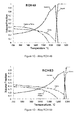
- Figures 1A-1D show predicted phase equilibrium for the gamma, gamma prime and delta phases versus temperature for arc melted samples of the alloys of Table 1 (minus carbon, boron, and zirconium). Increasing the niobium concentration dramatically increases the delta solvus temperature and the delta phase fraction.
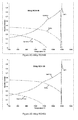
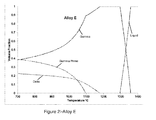
- Figures 2A-2I show predicted phase equilibrium for the gamma, gamma prime and delta phases versus temperature for arc melted samples of the alloys of Table 1 and Table 2 using a new thermodynamic nickel database and a new solver software package.
- the updated software shows the same trend of increase delta solvus temperature and delta phase fraction with increasing niobium concentration, but predicts greater delta stability versus the gamma and gamma prime phases for all the compositions.
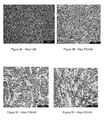
- Figures 3A-3D show the microstructures of arc melted samples of the alloys of Table 1 in the as-cast condition.
- the dark gray regions in Figures 3A-3D are the eutectic region and the light gray regions are the delta phase.
- the black regions are shrinkage porosity.
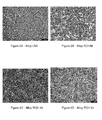
- Figures 4A-4E show the microstructures of compacted powder alloys from Table 2 after solution heat treatment and high temperature isothermal exposuress.
- the materials were solution heat treated at 1140°C to 1230°C and isothermally held at 1100°C to 1110°C for 4 to 8 hours.
- the small black speroidal particles are gamma prime within the light gray gamma phase.
- the lighter globular particles are delta and the more acicular phases are delta and eta, which can be light or dark.
- Figures 5A-5D show the microstructures of compacted powder alloys from Table 1 after solution and aging heat treatments.
- the materials were solution heat treated at 1195°C to 1215°C, controlled cooled from the solution temperature at 1 °C per second to simulate typical cooling conditions in large turbine engine disks, and aged at 850°C for 16 hours.
- the darker gray material is the gamma phase with small gamma prime precipitates within the gamma phase.
- the lighter globular particles are delta and the more acicular phases are delta and eta.
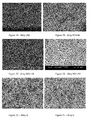
- Figures 6A-6D illustrate the interfaces of the delta and eta phases of the compacted powder alloys from Table 1 after solution and aging heat treatments.
- the smaller particles are gamma prime and the larger particles are delta or eta.
- the roughened interfaces of the delta and eta particles aid load transfer and thereby increase the strengthening effect of these particles.
- Figures 7A-7F are higher magnification scanning electron micrographs of the microstructures of the compacted powder alloys from Table 1 and alloys D and E from Table 2 after solution and aging heat treatments and show the gamma prime morphology.
- the gamma prime size remained quite small. In many conventional superalloys such treatments would produce gamma prime particles more than twice as large as those observed in these alloys.
- alloys of the present invention resist diffusion to a degree that prevents formation of such large particles.
- Figure 8 shows the variation in yield strength with temperature for one of the compacted powder alloys from Table 1 after solution and aging heat treatments compared with a number of prior art alloys. As shown in Figure 8 , the strength retention versus temperature for the embodiment of the alloy of the invention is equivalent or superior to the prior art alloys.
- Alloys of the present invention may be manufactured in a number of ways.
- the alloys may be manufactured using powder metallurgy typically used to produce high strength, high temperature disk alloys. Powder metallurgy manufacturing in conjunction with thermo-mechanically working the forging stock may refine the delta structure, thereby improving its ability to limit grain growth of the gamma phase. Cast and wrought processing techniques can also be used.
Landscapes
- Chemical & Material Sciences (AREA)
- Engineering & Computer Science (AREA)
- Materials Engineering (AREA)
- Mechanical Engineering (AREA)
- Metallurgy (AREA)
- Organic Chemistry (AREA)
- Physics & Mathematics (AREA)
- Thermal Sciences (AREA)
- Crystallography & Structural Chemistry (AREA)
- Sliding-Contact Bearings (AREA)
- Powder Metallurgy (AREA)
Abstract
Description
- This application claims the benefit under 35 USC § 119(e) of
U.S. Provisional Application Serial No. 61/865,181, filed on August 13, 2013 - The present disclosure relates generally to superalloys. More specifically, the present disclosure relates to nickel-base composite niobium-bearing superalloys having high strength and improved ductility at elevated temperatures.
- There is a continuing need for alloys to enable disk rotors in gas turbine engines, such as those in the high pressure compressor and turbine, to operate at higher compressor outlet temperatures and faster shaft speeds. The higher temperatures and increased shaft speeds facilitate the high climb rates that are increasingly required by commercial airlines to move aircraft more quickly to altitude, to reduce fuel burn and to clear the busy air spaces around airports. These operating conditions give rise to fatigue cycles with long dwell periods at elevated temperatures, in which oxidation and time dependent deformation can significantly decrease resistance to low cycle fatigue. As a result, there is a need to improve the resistance of alloys to surface environmental damage and dwell fatigue crack growth, and to increase proof strength, without compromising their other mechanical and physical properties or increasing their density.
- Conventional high pressure compressor disks and/or high pressure turbine disks of gas turbine engines are often produced from high strength nickel-base superalloys. These materials are often highly alloyed with refractory elements to enhance strength and precipitate a high volume fraction of gamma prime strengthening phase into the gamma phase. The grain structure of such alloys is typically designed to optimize strength and low cycle fatigue performance and/or resistance to fatigue crack growth and creep deformation by controlling heat treat parameters. Examples of in highly alloyed nickel-base superalloys are discussed in
U.S. Patent No. 6,132,527 ;U.S. Patent No. 6,521,175 ; andU.S. Patent No. 6,969,431 . As the overall level of refractory alloying elements increases in such alloys, the microstructure can become thermodynamically unstable, such that microstructural changes occurring during operation can reduce mechanical properties of the alloys. - Future gas turbine engine components likely will be required to operate at higher temperatures and/or higher stresses than existing ones. Presently available nickel-base superalloys may be unable to meet these future operating requirements. Various alloys have emerged as potential candidates for future gas turbine engine turbine and/or compressor disks. Examples of such alloys, which typically employ third phase precipitation of delta or eta phase to enhance high temperature mechanical properties, are discussed in
U.S. Patent Application Publication No. 2012/0027607 A1 ;U.S. Patent No. 8,147,749 ;U.S. Patent Application Publication No. 2013/0052077 A1 andU.S. Patent Application Publication No. 2009/0136381 A1 . However, the strength, stability or ductility of some of these materials may not be adequate for the high stresses and highly multi-axial stress states encountered by compressor and turbine disks in operation and the high tantalum content, a heavy and expensive element, in some of the alloys could adversely affect cost and density. - The present application discloses one or more of the features recited in the appended claims and/or the following features which, alone or in any combination, may comprise patentable subject matter.
- A composite niobium bearing alloy may consist of 2.2 to 4 wt. % aluminum, 0.01 to 0.05 wt. % boron, 0.02 to 0.06 wt. % carbon, 6 to 15 wt. % chromium, 0 to 20 wt. % cobalt, 0 to 0.5 wt. % hafnium, 1 to 3 wt. % molybdenum, 7.2 to 16 wt. % niobium, 0 to 0.6 wt % silicon, 1 to 5 wt. % tantalum, 0 to 2.5 wt. % titanium, 1 to 3 wt. % tungsten, .04 to .1 wt. % zirconium and the balance nickel and incidental impurities.
- In some embodiments the composite niobium bearing alloy consists of 2.2 to 2.8 wt. % aluminum, 0.015 wt. % boron, 0.03 wt. % carbon, 6 to 8.6 wt. % chromium, 1.5 wt. % molybdenum, 8.5 to 15 wt. % niobium, 2.9 to 4.5 wt. % tantalum, 1.5 to 2.25 wt. % titanium, 1.5 wt. % tungsten, .05 wt. % zirconium and the balance nickel and incidental impurities.
- In some embodiments the composite niobium bearing alloy consists of 2.8 wt. % aluminum, 0.15 wt. % boron, 0.03 wt. % carbon, 8.6 wt. % chromium, 1.5 wt. % molybdenum, 8.5 wt. % niobium, 4.5 wt. % tantalum, 1.6 wt. % titanium, 1.5 wt. % tungsten, .05 wt. % zirconium and the balance nickel and incidental impurities.
In some embodiments the composite niobium bearing alloy consists of 2.25 wt. % aluminum, 0.15 wt. % boron, 0.03 wt. % carbon, 8 wt. % chromium, 1.5 wt. % molybdenum, 10.5 wt. % niobium, 3 wt. % tantalum, 2.25 wt. % titanium, 1.5 wt. % tungsten, .05 wt. % zirconium and the balance nickel and incidental impurities. - In some embodiments the composite niobium bearing alloy consists of 2.25 wt. % aluminum, 0.15 wt. % boron, 0.03 wt. % carbon, 7.85 wt. % chromium, 1.5 wt. % molybdenum, 12.85 wt. % niobium, 3 wt. % tantalum, 2.25 wt. % titanium, 1.5 wt. % tungsten, .05 wt. % zirconium and the balance nickel and incidental impurities.
- In some embodiments the composite niobium bearing alloy consists of 2.2 wt. % aluminum, 0.15 wt. % boron, 0.03 wt. % carbon, 6 wt. % chromium, 1.5 wt. % molybdenum, 15 wt. % niobium, 2.9 wt. % tantalum, 1.5 wt. % titanium, 1.5 wt. % tungsten, .05 wt. % zirconium and the balance nickel and incidental impurities.
- In some embodiments the composite niobium bearing alloy includes globular or acicular delta phase, aluminum containing delta phase, and eta phase precipitates singularly or in combination, and gamma prime phase precipitates in the gamma phase.
- In some embodiments the aluminum containing delta phase is Ni6AlNb.
- In some embodiments the delta, eta and/or aluminum containing delta phase is located at the gamma grain boundaries.
- In some embodiments the delta, eta, and/or aluminum containing delta phase is located at the gamma grain boundaries and within the gamma grains.
- A composite niobium bearing alloy may include about 7 wt. % to about 16 wt. % niobium.
- In some embodiments the composite niobium bearing alloy includes globular or acicular delta phase, aluminum containing delta phase, and eta phase precipitates singularly or in combination, and gamma prime phase precipitates in the gamma phase.
- In some embodiments the aluminum containing delta phase is Ni6AlNb.
- In some embodiments the delta, eta and/or aluminum containing delta phase is located at the gamma grain boundaries.
- In some embodiments the delta, eta, and/or aluminum containing delta phase is located at the gamma grain boundaries and within the gamma grains.
- In some embodiments the composite niobium bearing alloy includes a lamellar structure of gamma phase and delta phase, gamma prime phase precipitates in the gamma phase, and the volume percentage of delta phase is about 10% to about 40%. In some embodiments the composite niobium bearing alloy includes a lamellar structure of gamma phase and delta phase, gamma prime phase precipitates in the gamma phase, and wherein the volume percentage of delta phase and eta phase is about 2% to about 40%
- In some embodiments the volume percentage of delta phase is about 2% to about 15%.
- A composite niobium bearing alloy may include about 2.2 to 4 wt. % aluminum, about 0.01 to 0.05 wt. % boron, about 0.02 to 0.06 wt. % carbon, about 6 to 15 wt. % chromium, about 0 to 20 wt.% cobalt, about 0 to 0.5 wt. % hafnium, about 1 to 3 wt. % molybdenum, about 7.2 to 16 wt. % niobium, about 0 to 0.6 wt % silicon, about 1 to 5 wt. % tantalum, about 0 to 2.5 wt. % titanium, about 1 to 3 wt. % tungsten, about .04 to .1 wt. % zirconium and the balance nickel and incidental impurities.
- In some embodiments the composite niobium bearing alloy includes about 2.2 to about 2.8 wt. % aluminum, about 0.15 wt. % boron, about 0.03 wt. % carbon, about 6 to about 8.6 wt. % chromium, about 1.5 wt. % molybdenum, about 7 to about 16 wt. % niobium, about 2.9 to about 4.5 wt. % tantalum, about 1.5 to about 2.25 wt. % titanium, about 1.5 wt. % tungsten, about .05 wt. % zirconium and the balance nickel and incidental impurities.
- In some embodiments the composite niobium bearing alloy includes about 2.8 wt. % aluminum, about 0.15 wt. % boron, about 0.03 wt. % carbon, about 8.6 wt. % chromium, about 1.5 wt. % molybdenum, about 8.5 wt. % niobium, about 4.5 wt. % tantalum, about 1.6 wt. % titanium, about 1.5 wt. % tungsten, about .05 wt. % zirconium and the balance nickel and incidental impurities.
- In some embodiments the composite niobium bearing alloy includes about 2.25 wt. % aluminum, about 0.15 wt. % boron, about 0.03 wt. % carbon, about 8 wt. % chromium, about 1.5 wt. % molybdenum, about 10.5 wt. % niobium, about 3 wt. % tantalum, about 2.25 wt. % titanium, about 1.5 wt. % tungsten, about .05 wt. % zirconium and the balance nickel and incidental impurities.
- In some embodiments the composite niobium bearing alloy includes about 2.25 wt. % aluminum, about 0.15 wt. % boron, about 0.03 wt. % carbon, about 7.85 wt. % chromium, about 1.5 wt. % molybdenum, about 12.85 wt. % niobium, about 3 wt. % tantalum, about 2.25 wt. % titanium, about 1.5 wt. % tungsten, about .05 wt. % zirconium and the balance nickel and incidental impurities.
- In some embodiments the composite niobium bearing alloy includes about 2.2 wt. % aluminum, about 0.15 wt. % boron, about 0.03 wt. % carbon, about 6 wt. % chromium, about 1.5 wt. % molybdenum, about 15 wt. % niobium, about 2.9 wt. % tantalum, about 1.5 wt. % titanium, about 1.5 wt. % tungsten, about .05 wt. % zirconium and the balance nickel and incidental impurities.
- In some embodiments the composite niobium bearing alloy includes globular or acicular delta phase, aluminum containing delta phase, and eta phase precipitates singularly or in combination, and gamma prime phase precipitates in the gamma phase.
- In some embodiments the aluminum containing delta phase is Ni6AlNb.
- In some embodiments the delta, eta and/or aluminum containing delta phase is located at the gamma grain boundaries.
- In some embodiments the delta, eta, and/or aluminum containing delta phase is located at the gamma grain boundaries and within the gamma grains.
- In some embodiments the composite niobium bearing alloy includes a lamellar structure of gamma phase and delta phase, gamma prime phase precipitates in the gamma phase, and the volume percentage of delta phase is about 10% to about 40%.
- In some embodiments the volume percentage of delta phase is about 2% to about 15%.
- The following numbered embodiments are contemplated and are nonlimiting:
- 1. A composite niobium bearing alloy consisting of 2.2 to 4 wt. % aluminum, 0.01 to 0.05 wt. % boron, 0.02 to 0.06 wt. % carbon, 6 to 15 wt. % chromium, 0 to 20 wt. % cobalt, 0 to 0.5 wt. % hafnium, 1 to 3 wt. % molybdenum, 7.2 to 16 wt. % niobium, 0 to 0.6 wt % silicon, 1 to 5 wt. % tantalum, 0 to 2.5 wt. % titanium, 1 to 3 wt. % tungsten, .04 to .1 wt. % zirconium and the balance nickel and incidental impurities.
- 2. A composite niobium bearing alloy according to
clause 1 consisting of 2.2 to 2.8 wt. % aluminum, 0.015 wt. % boron, 0.03 wt. % carbon, 6 to 8.6 wt. % chromium, 1.5 wt. % molybdenum, 8.5 to 15 wt. % niobium, 2.9 to 4.5 wt. % tantalum, 1.5 to 2.25 wt. % titanium, 1.5 wt. % tungsten, .05 wt. % zirconium and the balance nickel and incidental impurities. - 3. A composite niobium bearing alloy according to
clause 1 consisting of 2.8 wt. % aluminum, 0.15 wt. % boron, 0.03 wt. % carbon, 8.6 wt. % chromium, 1.5 wt. % molybdenum, 8.5 wt. % niobium, 4.5 wt. % tantalum, 1.6 wt. % titanium, 1.5 wt. % tungsten, .05 wt. % zirconium and the balance nickel and incidental impurities. - 4. A composite niobium bearing alloy according to
clause 1 consisting of 2.25 wt. % aluminum, 0.15 wt. % boron, 0.03 wt. % carbon, 8 wt. % chromium, 1.5 wt. % molybdenum, 10.5 wt. % niobium, 3 wt. % tantalum, 2.25 wt. % titanium, 1.5 wt. % tungsten, .05 wt. % zirconium and the balance nickel and incidental impurities. - 5. A composite niobium bearing alloy according to
clause 1 consisting of 2.25 wt. % aluminum, 0.15 wt. % boron, 0.03 wt. % carbon, 7.85 wt. % chromium, 1.5 wt. % molybdenum, 12.85 wt. % niobium, 3 wt. % tantalum, 2.25 wt. % titanium, 1.5 wt. % tungsten, .05 wt. % zirconium and the balance nickel and incidental impurities. - 6. A composite niobium bearing alloy according to
clause 1 consisting of 2.2 wt. % aluminum, 0.15 wt. % boron, 0.03 wt. % carbon, 6 wt. % chromium, 1.5 wt. % molybdenum, 15 wt. % niobium, 2.9 wt. % tantalum, 1.5 wt. % titanium, 1.5 wt. % tungsten, .05 wt. % zirconium and the balance nickel and incidental impurities. - 7. A composite niobium bearing alloy according to any one of
clauses 1 to 6, including globular or acicular delta phase, aluminum containing delta phase, and eta phase precipitates singularly or in combination, and gamma prime phase precipitates in the gamma phase. - 8. A composite niobium bearing alloy according to clause 7, wherein the aluminum containing delta phase is Ni6AlNb.
- 9. A composite niobium bearing alloy according to clause 7 wherein the delta, eta and/or aluminum containing delta phase is located at the gamma grain boundaries.
- 10. A composite niobium bearing alloy according to clause 7 wherein the delta, eta, and/or aluminum containing delta phase is located at the gamma grain boundaries and within the gamma grains.
- 11. A composite niobium bearing alloy including about 7 wt. % to about 16 wt. % niobium.
- 12. A composite niobium bearing alloy according to clause 11, including globular or acicular delta phase, aluminum containing delta phase, and eta phase precipitates singularly or in combination, and gamma prime phase precipitates in the gamma phase.
- 13. A composite niobium bearing alloy according to clause 12, wherein the aluminum containing delta phase is Ni6AlNb.
- 14. A composite niobium bearing alloy according to clause 12 wherein the delta, eta and/or aluminum containing delta phase is located at the gamma grain boundaries.
- 15. A composite niobium bearing alloy according to clause 12 wherein the delta, eta, and/or aluminum containing delta phase is located at the gamma grain boundaries and within the gamma grains.
- 16. A composite niobium bearing alloy according to any one of
clauses 1 to 15, including a lamellar structure of gamma phase and delta phase, gamma prime phase precipitates in the gamma phase, and wherein the volume percentage of delta phase is about 10% to about 40%. - 17. A composite niobium bearing alloy according to
clause 16, wherein the volume percentage of delta phase is about 2% to about 15%. - 18. A composite niobium bearing alloy including about 2.2 to 4 wt. % aluminum, about 0.01 to 0.05 wt. % boron, about 0.02 to 0.06 wt. % carbon, about 6 to 15 wt. % chromium, about 0 to 20 wt.% cobalt, about 0 to 0.5 wt. % hafnium, about 1 to 3 wt. % molybdenum, about 7.2 to 16 wt. % niobium, about 0 to 0.6 wt % silicon, about 1 to 5 wt. % tantalum, about 0 to 2.5 wt. % titanium, about 1 to 3 wt. % tungsten, about .04 to .1 wt. % zirconium and the balance nickel and incidental impurities.
- 19. A composite niobium bearing alloy according to clause 18 including about 2.2 to about 2.8 wt. % aluminum, about 0.15 wt. % boron, about 0.03 wt. % carbon, about 6 to about 8.6 wt. % chromium, about 1.5 wt. % molybdenum, about 7 to about 16 wt. % niobium, about 2.9 to about 4.5 wt. % tantalum, about 1.5 to about 2.25 wt. % titanium, about 1.5 wt. % tungsten, about .05 wt. % zirconium and the balance nickel and incidental impurities.
- 20. A composite niobium bearing alloy according to clause 18 including about 2.8 wt. % aluminum, about 0.15 wt. % boron, about 0.03 wt. % carbon, about 8.6 wt. % chromium, about 1.5 wt. % molybdenum, about 8.5 wt. % niobium, about 4.5 wt. % tantalum, about 1.6 wt. % titanium, about 1.5 wt. % tungsten, about .05 wt. % zirconium and the balance nickel and incidental impurities.
- 21. A composite niobium bearing alloy according to clause 18 including about 2.25 wt. % aluminum, about 0.15 wt. % boron, about 0.03 wt. % carbon, about 8 wt. % chromium, about 1.5 wt. % molybdenum, about 10.5 wt. % niobium, about 3 wt. % tantalum, about 2.25 wt. % titanium, about 1.5 wt. % tungsten, about .05 wt. % zirconium and the balance nickel and incidental impurities.
- 22. A composite niobium bearing alloy according to clause 18 including about 2.25 wt. % aluminum, about 0.15 wt. % boron, about 0.03 wt. % carbon, about 7.85 wt. % chromium, about 1.5 wt. % molybdenum, about 12.85 wt. % niobium, about 3 wt. % tantalum, about 2.25 wt. % titanium, about 1.5 wt. % tungsten, about .05 wt. % zirconium and the balance nickel and incidental impurities.
- 23. A composite niobium bearing alloy according to clause 18 including about 2.2 wt. % aluminum, about 0.15 wt. % boron, about 0.03 wt. % carbon, about 6 wt. % chromium, about 1.5 wt. % molybdenum, about 15 wt. % niobium, about 2.9 wt. % tantalum, about 1.5 wt. % titanium, about 1.5 wt. % tungsten, about .05 wt. % zirconium and the balance nickel and incidental impurities.
- 24. A composite niobium bearing alloy according to any one of clauses 18 to 23, including globular or acicular delta phase, aluminum containing delta phase, and eta phase precipitates singularly or in combination, and gamma prime phase precipitates in the gamma phase.
- 25. A niobium bearing alloy according to
clause 24, wherein the aluminum containing delta phase is Ni6AlNb. - 26. A composite niobium bearing alloy according to
clause 24 wherein the delta, eta and/or aluminum containing delta phase is located at the gamma grain boundaries. - 27. A composite niobium bearing alloy according to
clause 24 wherein the delta, eta, and/or aluminum containing delta phase is located at the gamma grain boundaries and within the gamma grains. - 28. A composite niobium bearing alloy according to any one of clauses 18 to 23, including a lamellar structure of gamma phase and delta phase, gamma prime phase precipitates in the gamma phase, and wherein the volume percentage of delta phase is about 10% to about 40%.
- 29. A composite niobium bearing alloy according to clause 28, wherein the volume percentage of delta phase is about 2% to about 15%.
- 30. A composite niobium bearing alloy according to any one of clauses 18 to 23, including a lamellar structure of gamma phase and delta phase, gamma prime phase precipitates in the gamma phase, and wherein the volume percentage of delta phase and eta phase is about 2% to about 40%.
- These and other features of the present disclosure will become more apparent from the following description of the illustrative embodiments.
-
-
Figs. 1A-1D are predicted phase equilibrium graphs of arc melted alloys using the 2012 thermodynamic database and solver according to certain embodiments of the present invention. -
Figs. 2A-2I are predicted phase equilibrium graphs of arc melted alloys using the 2013 thermodynamic database and solver according to certain embodiments of the present invention. -
Figs. 3A-3D are micrographs of arc melted alloys according to certain embodiments of the present invention. -
Figs. 4A-4E are scanning electron micrographs of heat treated arc melted or compacted powder alloys according to certain embodiments of the present invention. -
Figs. 5A-5D are scanning electron micrographs of heat treated compacted powder alloys according to certain embodiments of the present invention. -
Figs. 6A-6D are scanning electron micrographs of interfaces in heat treated compacted powder alloys according to certain embodiments of the present invention -
Figs. 7A-7F are higher magnification scanning electron micrographs of gamma prime morphology in heat treated compacted powder alloys according to certain embodiments of the present invention -
Fig. 8 shows the variation in yield strength with temperature for a heat treated compacted powder alloy according to an embodiment of the present invention compared with a number of prior art alloys. - For the purposes of promoting an understanding of the principles of the disclosure, reference will now be made to a number of illustrative embodiments illustrated in the drawings and specific language will be used to describe the same.
- The present invention relates to a class of nickel-base superalloys with composite strengthening from delta and/or eta phases in addition to gamma prime particulate strengthening in a gamma matrix. These alloys can operate at higher temperatures with improved stability and ductility as compared to known alloys and are intended to operate for prolonged periods of time at high stresses and temperatures up to at least about 825°C.
- Alloys of the invention include niobium-bearing gamma-gamma prime-delta (γ-γ'-δ) or gamma-gamma prime-eta (γ-γ'-η) superalloys. Microstructures of these composite niobium bearing alloys typically consist of (1) globular or acicular particles of delta, an aluminum containing delta phase, and/or eta phase precipitates singularly or in combination and (2) gamma prime phase precipitates in the gamma phase.
- The gamma prime, delta phases, and eta phases are ordered intermetallic phases of composition Ni3X, where X can be aluminum, niobium, titanium or tantalum. Gamma prime is a ductile phase with a face centered cubic structure. The composition of the gamma prime phase is typically Ni3Al and it is the primary strengthening precipitate. However, depending on the composition of the alloy, other elements, such as titanium, tantalum and niobium, may substitute for the Al atoms. The gamma prime phase is typically spherical or cubic, but degenerate shapes can occur in larger particles.
- The delta phase has an orthorhombic structure and limited ductility. The composition of the delta phase is typically Ni3Nb. Depending on the composition of the alloy, titanium and tantalum and may substitute for the Nb atoms and, under certain conditions, Al may substitute for the Nb atoms to form Ni6AlNb with a hexagonal structure. The delta phase may be irregularly shaped globular particles or highly acicular needles or lamellae.
- The eta phase has a hexagonal structure and the composition of the eta phase is typically Ni3Ti. However, aluminum, tantalum and niobium may substitute for titanium. The eta phase is generally acicular, but the aspect ratio of the phase can vary considerably. The matrix gamma phase is disordered face centered cubic.
- Alloys of the present invention may contain a number of other elements in addition to Ni, Nb, Ti, Ta and Al. The addition of chromium increases resistance to oxidation and corrosion. Chromium preferentially partitions to the matrix gamma phase. However, the amount of Cr should be limited to no more than about 15 wt. % due to its propensity to combine with refractory elements in the alloy and form topologically close-packed (TCP) phases like sigma and, preferably, to no more than about 9 wt.% for the 10%-40% delta plus eta phase variants which contain correspondingly less matrix gamma phase fraction. These TCP phases are embrittling and are therefore generally undesirable. Cobalt generally lowers the gamma prime solvus and the stacking fault energy which aids processability, creep rupture strength, and, at some temperatures, fatigue strength. However, Co can also aid formation of TCP phases and should therefore be limited to not more than about 20 wt.%. Molybdenum and tungsten are solid solution strengtheners for both the gamma and gamma prime phases. Boron, carbon, and zirconium may be added to strengthen the grain boundaries by forming nonmetallic particles at the grain boundaries. The elements can also counteract the deleterious effects of grain impurity segregates like sulfur and oxygen by acting as a diffusion barrier. Hafnium and silicon may be used to improve dwell fatigue and environmental resistance, respectively. In general, all the metallic phases exhibit some degree of solubility for the other alloying elements in the material.
- Alloys of the present invention have lower niobium content than traditional ternary eutectic gamma-gamma prime-delta alloys and higher niobium content than typical nickel-base superalloys. In certain embodiments, alloys of the present invention have niobium levels of about 7 weight % to about 16 weight %. Four alloys with varying niobium content were selected for examination and hot compacted powder specimens were produced. The nominal compositions of the four alloys are shown in Table 1. The compositions were selected in an attempt to produce gamma-gamma prime-delta/eta alloys with lower volume fractions of the delta and eta phases, which can adversely affect ductility. In certain embodiments of the invention, the volume percentage of the delta and eta phases is about 10% to about 40%. In other embodiments of the invention, the volume percentage of the delta and eta phases is about 2% to about 15%. The alloys have substantial quantities of multiple strengthening ordered precipitates and sufficient matrix phase for ductility, while avoiding undesirable topologically close-packed phases.
Table 1 Alloy Al B C Cr Mo Nb Ta Ti W Zr Ni LN8 2.8 .015 .03 8.6 1.5 8.5 4.5 1.6 1.5 .05 Balance RCH48 2.25 .015 .03 8 1.5 10.5 3 2.25 1.5 .05 Balance RCH49 2.25 .015 .03 7.85 1.5 12.85 3 2.25 1.5 .05 Balance RCH53 2.2 .015 .03 6 1.5 15 2.9 1.5 1.5 .05 Balance - Five additional alloys with varying niobium content were selected for examination and hot compacted powder specimens were produced. The nominal compositions of the five alloys are shown in Table 2. These alloys primarily explored compositional interactions towards the lower end of the delta plus eta phase range.
Table 2 Alloy Al Co Cr Mo Nb Ta Ti W Ni A 2.9 --- 10.3 1.6 7.7 4.5 --- 1.5 Balance B 2.7 --- 10.3 1.6 9.2 4.5 --- 1.5 Balance C 2.9 --- 10.3 1.6 7.7 4.5 .4 1.5 Balance D 3.4 17.7 12.2 2.4 8.5 3 --- 2.4 Balance E 3.4 12 12.2 2.4 8.5 3 --- 2.4 -
Figures 1A-1D show predicted phase equilibrium for the gamma, gamma prime and delta phases versus temperature for arc melted samples of the alloys of Table 1 (minus carbon, boron, and zirconium). Increasing the niobium concentration dramatically increases the delta solvus temperature and the delta phase fraction. -
Figures 2A-2I show predicted phase equilibrium for the gamma, gamma prime and delta phases versus temperature for arc melted samples of the alloys of Table 1 and Table 2 using a new thermodynamic nickel database and a new solver software package. The updated software shows the same trend of increase delta solvus temperature and delta phase fraction with increasing niobium concentration, but predicts greater delta stability versus the gamma and gamma prime phases for all the compositions. -
Figures 3A-3D show the microstructures of arc melted samples of the alloys of Table 1 in the as-cast condition. The dark gray regions inFigures 3A-3D are the eutectic region and the light gray regions are the delta phase. The black regions are shrinkage porosity. -
Figures 4A-4E show the microstructures of compacted powder alloys from Table 2 after solution heat treatment and high temperature isothermal exposuress. The materials were solution heat treated at 1140°C to 1230°C and isothermally held at 1100°C to 1110°C for 4 to 8 hours. The small black speroidal particles are gamma prime within the light gray gamma phase. The lighter globular particles are delta and the more acicular phases are delta and eta, which can be light or dark. -
Figures 5A-5D show the microstructures of compacted powder alloys from Table 1 after solution and aging heat treatments. The materials were solution heat treated at 1195°C to 1215°C, controlled cooled from the solution temperature at 1 °C per second to simulate typical cooling conditions in large turbine engine disks, and aged at 850°C for 16 hours. The darker gray material is the gamma phase with small gamma prime precipitates within the gamma phase. The lighter globular particles are delta and the more acicular phases are delta and eta. -
Figures 6A-6D illustrate the interfaces of the delta and eta phases of the compacted powder alloys from Table 1 after solution and aging heat treatments. The smaller particles are gamma prime and the larger particles are delta or eta. The roughened interfaces of the delta and eta particles aid load transfer and thereby increase the strengthening effect of these particles. -
Figures 7A-7F are higher magnification scanning electron micrographs of the microstructures of the compacted powder alloys from Table 1 and alloys D and E from Table 2 after solution and aging heat treatments and show the gamma prime morphology. In spite of the slow cooling rates employed from the solution heat treat temperature and the high aging temperature employed to increase alloy stability, the gamma prime size remained quite small. In many conventional superalloys such treatments would produce gamma prime particles more than twice as large as those observed in these alloys. However, alloys of the present invention resist diffusion to a degree that prevents formation of such large particles. -
Figure 8 shows the variation in yield strength with temperature for one of the compacted powder alloys from Table 1 after solution and aging heat treatments compared with a number of prior art alloys. As shown inFigure 8 , the strength retention versus temperature for the embodiment of the alloy of the invention is equivalent or superior to the prior art alloys. - Alloys of the present invention may be manufactured in a number of ways. For example, the alloys may be manufactured using powder metallurgy typically used to produce high strength, high temperature disk alloys. Powder metallurgy manufacturing in conjunction with thermo-mechanically working the forging stock may refine the delta structure, thereby improving its ability to limit grain growth of the gamma phase. Cast and wrought processing techniques can also be used.
- While the disclosure has been illustrated and described in detail in the foregoing drawings and description, the same is to be considered as exemplary and not restrictive in character, it being understood that only illustrative embodiments thereof have been shown and described and that all changes and modifications that come within the scope of the appended claims are desired to be protected.
Claims (15)
- A composite niobium bearing alloy consisting of 2.2 to 4 wt. % aluminum, 0.01 to 0.05 wt. % boron, 0.02 to 0.06 wt. % carbon, 6 to 15 wt. % chromium, 0 to 20 wt. % cobalt, 0 to 0.5 wt. % hafnium, 1 to 3 wt. % molybdenum, 7.2 to 16 wt. % niobium, 0 to 0.6 wt % silicon, 1 to 5 wt. % tantalum, 0 to 2.5 wt. % titanium, 1 to 3 wt. % tungsten, .04 to .1 wt. % zirconium and the balance nickel and incidental impurities.
- A composite niobium bearing alloy according to claim 1 consisting of 2.2 to 2.8 wt. % aluminum, 0.015 wt. % boron, 0.03 wt. % carbon, 6 to 8.6 wt. % chromium, 1.5 wt. % molybdenum, 8.5 to 15 wt. % niobium, 2.9 to 4.5 wt. % tantalum, 1.5 to 2.25 wt. % titanium, 1.5 wt. % tungsten, .05 wt. % zirconium and the balance nickel and incidental impurities.
- A composite niobium bearing alloy according to claim 1, including globular or acicular delta phase, aluminum containing delta phase, and eta phase precipitates singularly or in combination, and gamma prime phase precipitates in the gamma phase.
- A composite niobium bearing alloy according to claim 3, wherein:(i) the aluminum containing delta phase is Ni6AlNb; or(ii) the delta, eta and/or aluminum containing delta phase is located at the gamma grain boundaries; or(iii) the delta, eta, and/or aluminum containing delta phase is located at the gamma grain boundaries and within the gamma grains.
- A composite niobium bearing alloy including about 7 wt. % to about 16 wt. % niobium.
- A composite niobium bearing alloy according to claim 5, including globular or acicular delta phase, aluminum containing delta phase, and eta phase precipitates singularly or in combination, and gamma prime phase precipitates in the gamma phase.
- A composite niobium bearing alloy according to claim 6, wherein:(i) the aluminum containing delta phase is Ni6AlNb; or(ii) the delta, eta and/or aluminum containing delta phase is located at the gamma grain boundaries.
- A composite niobium bearing alloy according to claim 1, including a lamellar structure of gamma phase and delta phase, gamma prime phase precipitates in the gamma phase, and wherein the volume percentage of delta phase and eta phase is about 2% to about 40%.
- A composite niobium bearing alloy including about 2.2 to 4 wt. % aluminum, about 0.01 to 0.05 wt. % boron, about 0.02 to 0.06 wt. % carbon, about 6 to 15 wt. % chromium, about 0 to 20 wt.% cobalt, about 0 to 0.5 wt. % hafnium, about 1 to 3 wt. % molybdenum, about 7.2 to 16 wt. % niobium, about 0 to 0.6 wt % silicon, about 1 to 5 wt. % tantalum, about 0 to 2.5 wt. % titanium, about 1 to 3 wt. % tungsten, about .04 to .1 wt. % zirconium and the balance nickel and incidental impurities.
- A composite niobium bearing alloy according to claim 9 including about 2.2 to about 2.8 wt. % aluminum, about 0.15 wt. % boron, about 0.03 wt. % carbon, about 6 to about 8.6 wt. % chromium, about 1.5 wt. % molybdenum, about 7 to about 16 wt. % niobium, about 2.9 to about 4.5 wt. % tantalum, about 1.5 to about 2.25 wt. % titanium, about 1.5 wt. % tungsten, about .05 wt. % zirconium and the balance nickel and incidental impurities.
- A composite niobium bearing alloy according to claim 9 including about 2.8 wt. % aluminum, about 0.15 wt. % boron, about 0.03 wt. % carbon, about 8.6 wt. % chromium, about 1.5 wt. % molybdenum, about 8.5 wt. % niobium, about 4.5 wt. % tantalum, about 1.6 wt. % titanium, about 1.5 wt. % tungsten, about .05 wt. % zirconium and the balance nickel and incidental impurities.
- A composite niobium bearing alloy according to claim 9 including about 2.25 wt. % aluminum, about 0.15 wt. % boron, about 0.03 wt. % carbon, about 8 wt. % chromium, about 1.5 wt. % molybdenum, about 10.5 wt. % niobium, about 3 wt. % tantalum, about 2.25 wt. % titanium, about 1.5 wt. % tungsten, about .05 wt. % zirconium and the balance nickel and incidental impurities.
- A composite niobium bearing alloy according to claim 9 including:(i) about 2.25 wt. % aluminum, about 0.15 wt. % boron, about 0.03 wt. % carbon, about 7.85 wt. % chromium, about 1.5 wt. % molybdenum, about 12.85 wt. % niobium, about 3 wt. % tantalum, about 2.25 wt. % titanium, about 1.5 wt. % tungsten, about .05 wt. % zirconium and the balance nickel and incidental impurities; or(ii) about 2.2 wt. % aluminum, about 0.15 wt. % boron, about 0.03 wt. % carbon, about 6 wt. % chromium, about 1.5 wt. % molybdenum, about 15 wt. % niobium, about 2.9 wt. % tantalum, about 1.5 wt. % titanium, about 1.5 wt. % tungsten, about .05 wt. % zirconium and the balance nickel and incidental impurities.
- A composite niobium bearing alloy according to claim 9, including globular or acicular delta phase, aluminum containing delta phase, and eta phase precipitates singularly or in combination, and gamma prime phase precipitates in the gamma phase, optionally wherein the delta, eta and/or aluminum containing delta phase is located at the gamma grain boundaries.
- A composite niobium bearing alloy according to claim 9, including a lamellar structure of gamma phase and delta phase, gamma prime phase precipitates in the gamma phase, and wherein the volume percentage of delta phase and eta phase is about 2% to about 40%.
Applications Claiming Priority (1)
| Application Number | Priority Date | Filing Date | Title |
|---|---|---|---|
| US201361865181P | 2013-08-13 | 2013-08-13 |
Publications (2)
| Publication Number | Publication Date |
|---|---|
| EP2837703A1 true EP2837703A1 (en) | 2015-02-18 |
| EP2837703B1 EP2837703B1 (en) | 2017-03-22 |
Family
ID=51302659
Family Applications (1)
| Application Number | Title | Priority Date | Filing Date |
|---|---|---|---|
| EP14180694.3A Not-in-force EP2837703B1 (en) | 2013-08-13 | 2014-08-12 | Composite Nb-containing Superalloys |
Country Status (2)
| Country | Link |
|---|---|
| US (1) | US9828658B2 (en) |
| EP (1) | EP2837703B1 (en) |
Families Citing this family (2)
| Publication number | Priority date | Publication date | Assignee | Title |
|---|---|---|---|---|
| US11951528B2 (en) | 2020-08-20 | 2024-04-09 | Rolls-Royce Corporation | Controlled microstructure for superalloy components |
| US11525172B1 (en) | 2021-12-01 | 2022-12-13 | L.E. Jones Company | Nickel-niobium intermetallic alloy useful for valve seat inserts |
Citations (8)
| Publication number | Priority date | Publication date | Assignee | Title |
|---|---|---|---|---|
| US6132527A (en) | 1996-04-24 | 2000-10-17 | Rolls-Royce Plc | Nickel alloy for turbine engine components |
| US6521175B1 (en) | 1998-02-09 | 2003-02-18 | General Electric Co. | Superalloy optimized for high-temperature performance in high-pressure turbine disks |
| US20050047953A1 (en) * | 2003-08-29 | 2005-03-03 | Honeywell International Inc. | High temperature powder metallurgy superalloy with enhanced fatigue & creep resistance |
| US20090136381A1 (en) | 2007-11-23 | 2009-05-28 | Rolls-Royce Plc | Ternary nickel eutectic alloy |
| US20110203707A1 (en) * | 2009-05-29 | 2011-08-25 | General Electric Company | Nickel-base alloy, processing therefor, and components formed thereof |
| US20120027607A1 (en) | 2010-07-27 | 2012-02-02 | General Electric Company | Nickel alloy and articles |
| US8147749B2 (en) | 2005-03-30 | 2012-04-03 | United Technologies Corporation | Superalloy compositions, articles, and methods of manufacture |
| US20130052077A1 (en) | 2011-08-24 | 2013-02-28 | Rolls-Royce Plc | Nickel alloy |
Family Cites Families (52)
| Publication number | Priority date | Publication date | Assignee | Title |
|---|---|---|---|---|
| US3649379A (en) | 1969-06-20 | 1972-03-14 | Cabot Corp | Co-precipitation-strengthened nickel base alloys and method for producing same |
| US3700427A (en) | 1969-07-11 | 1972-10-24 | Gen Electric | Powder for diffusion bonding of superalloy members |
| US4084161A (en) | 1970-05-26 | 1978-04-11 | The United States Of America As Represented By The Secretary Of The Army | Heat resistant radar absorber |
| JPS5441976B2 (en) | 1973-02-16 | 1979-12-11 | ||
| US3838981A (en) | 1973-03-22 | 1974-10-01 | Cabot Corp | Wear-resistant power metallurgy nickel-base alloy |
| US3929467A (en) | 1973-05-21 | 1975-12-30 | Int Nickel Co | Grain refining of metals and alloys |
| FR2239537B1 (en) | 1973-07-30 | 1976-11-12 | Onera (Off Nat Aerospatiale) | |
| US3890816A (en) | 1973-09-26 | 1975-06-24 | Gen Electric | Elimination of carbide segregation to prior particle boundaries |
| US6909395B1 (en) | 1975-04-10 | 2005-06-21 | The United States Of America As Represented By The Secretary Of The Air Force | Radar absorbing coatings |
| US4012241A (en) | 1975-04-22 | 1977-03-15 | United Technologies Corporation | Ductile eutectic superalloy for directional solidification |
| US4439236A (en) | 1979-03-23 | 1984-03-27 | Allied Corporation | Complex boride particle containing alloys |
| US4569824A (en) | 1980-05-09 | 1986-02-11 | United Technologies Corporation | Corrosion resistant nickel base superalloys containing manganese |
| JPS57207145A (en) | 1981-06-15 | 1982-12-18 | Toshiba Corp | Wear resistant alloy |
| US4451431A (en) | 1982-10-25 | 1984-05-29 | Avco Corporation | Molybdenum-containing high temperature coatings for nickel- and cobalt-based superalloys |
| US4981644A (en) | 1983-07-29 | 1991-01-01 | General Electric Company | Nickel-base superalloy systems |
| US4556534A (en) | 1983-12-20 | 1985-12-03 | Dentsply Research & Development Corp. | Nickel based casting alloy |
| US4556607A (en) | 1984-03-28 | 1985-12-03 | Sastri Suri A | Surface coatings and subcoats |
| US5786785A (en) | 1984-05-21 | 1998-07-28 | Spectro Dynamics Systems, L.P. | Electromagnetic radiation absorptive coating composition containing metal coated microspheres |
| US5892476A (en) | 1984-05-21 | 1999-04-06 | Spectro Dynamics Systems, L.P. | Electromagnetic radiation absorptive composition containing inorganic coated microparticles |
| US4795504A (en) | 1984-08-08 | 1989-01-03 | Latrobe Steel Company | Nickel-cobalt base alloys |
| US4854980A (en) | 1987-12-17 | 1989-08-08 | Gte Laboratories Incorporated | Refractory transition metal glassy alloys containing molybdenum |
| US4883640A (en) | 1988-06-17 | 1989-11-28 | Gte Products Corporation | Titanium-niobium-nickel brazing alloy |
| US6017628A (en) | 1989-12-11 | 2000-01-25 | Alliant Defense Electronics Systems, Inc. | Metal-coated substrate articles responsive to electromagnetic radiation, and method of making and using the same |
| US5686178A (en) | 1989-12-11 | 1997-11-11 | Advanced Technology Materials, Inc. | Metal-coated substrate articles responsive to electromagnetic radiation, and method of making the same |
| US5866273A (en) | 1990-03-20 | 1999-02-02 | The Boeing Company | Corrosion resistant RAM powder |
| US5401307A (en) | 1990-08-10 | 1995-03-28 | Siemens Aktiengesellschaft | High temperature-resistant corrosion protection coating on a component, in particular a gas turbine component |
| US5582635A (en) | 1990-08-10 | 1996-12-10 | Siemens Aktiengesellschaft | High temperature-resistant corrosion protection coating for a component in particular a gas turbine component |
| US5133993A (en) | 1990-08-20 | 1992-07-28 | General Atomics | Fiber-reinforced refractory composites |
| JPH11310839A (en) * | 1998-04-28 | 1999-11-09 | Hitachi Ltd | High-strength Ni-base superalloy directionally solidified casting |
| DE60016292T2 (en) | 1999-02-02 | 2005-12-01 | Japan As Represented By Director General Of National Research Institute For Meta, Tsukuba | High melting temperature superalloy and process for its preparation |
| US6461415B1 (en) | 2000-08-23 | 2002-10-08 | Applied Thin Films, Inc. | High temperature amorphous composition based on aluminum phosphate |
| JP3665969B2 (en) | 2001-03-26 | 2005-06-29 | エイコス・インコーポレーテッド | Method for producing carbon nanotube-containing film and carbon nanotube-containing coating |
| US7247368B1 (en) | 2001-10-12 | 2007-07-24 | Touchstone Research Laboratory, Ltd. | Stealth foam and production method |
| US20040005483A1 (en) | 2002-03-08 | 2004-01-08 | Chhiu-Tsu Lin | Perovskite manganites for use in coatings |
| US6730264B2 (en) | 2002-05-13 | 2004-05-04 | Ati Properties, Inc. | Nickel-base alloy |
| US6797401B2 (en) | 2002-06-20 | 2004-09-28 | Lockheed-Martin Corporation | Electromagnetic wave absorbing materials |
| US7678465B2 (en) | 2002-07-24 | 2010-03-16 | Applied Thin Films, Inc. | Aluminum phosphate compounds, compositions, materials and related metal coatings |
| US7612138B2 (en) | 2005-01-25 | 2009-11-03 | International Technology Center | Electromagnetic radiation attenuation |
| US7156932B2 (en) | 2003-10-06 | 2007-01-02 | Ati Properties, Inc. | Nickel-base alloys and methods of heat treating nickel-base alloys |
| US7192537B2 (en) | 2003-12-04 | 2007-03-20 | Touchstone Research Laboratory, Ltd. | Radar emissions absorbing material |
| US7378132B2 (en) | 2004-12-14 | 2008-05-27 | Honeywell International, Inc. | Method for applying environmental-resistant MCrAlY coatings on gas turbine components |
| EP1872439B1 (en) | 2005-04-21 | 2016-09-07 | Bell Helicopter Textron Inc. | Method and apparatus for reducing the infrared and radar signature of a vehicle |
| US7531054B2 (en) | 2005-08-24 | 2009-05-12 | Ati Properties, Inc. | Nickel alloy and method including direct aging |
| US20070065676A1 (en) | 2005-09-16 | 2007-03-22 | Bacalski Carlos F | Inert processing of oxide ceramic matrix composites and oxidation sensitive ceramic materials and intermediate structures and articles incorporating same |
| US7633424B1 (en) | 2006-06-08 | 2009-12-15 | Skyworks Solutions, Inc. | Wide temperature range dielectric absorber |
| SE530443C2 (en) | 2006-10-19 | 2008-06-10 | Totalfoersvarets Forskningsins | Microwave absorbent, especially for high temperature application |
| US8197747B2 (en) | 2008-08-15 | 2012-06-12 | Xiao Huang | Low-melting boron-free braze alloy compositions |
| US8101122B2 (en) | 2009-05-06 | 2012-01-24 | General Electric Company | NiCrMoCb alloy with improved mechanical properties |
| US8349250B2 (en) | 2009-05-14 | 2013-01-08 | General Electric Company | Cobalt-nickel superalloys, and related articles |
| US20110200838A1 (en) | 2010-02-18 | 2011-08-18 | Clover Industries, Inc. | Laser clad metal matrix composite compositions and methods |
| WO2012129505A1 (en) | 2011-03-23 | 2012-09-27 | Scoperta, Inc. | Fine grained ni-based alloys for resistance to stress corrosion cracking and methods for their design |
| US9938610B2 (en) * | 2013-09-20 | 2018-04-10 | Rolls-Royce Corporation | High temperature niobium-bearing superalloys |
-
2014
- 2014-08-11 US US14/456,424 patent/US9828658B2/en active Active
- 2014-08-12 EP EP14180694.3A patent/EP2837703B1/en not_active Not-in-force
Patent Citations (9)
| Publication number | Priority date | Publication date | Assignee | Title |
|---|---|---|---|---|
| US6132527A (en) | 1996-04-24 | 2000-10-17 | Rolls-Royce Plc | Nickel alloy for turbine engine components |
| US6521175B1 (en) | 1998-02-09 | 2003-02-18 | General Electric Co. | Superalloy optimized for high-temperature performance in high-pressure turbine disks |
| US20050047953A1 (en) * | 2003-08-29 | 2005-03-03 | Honeywell International Inc. | High temperature powder metallurgy superalloy with enhanced fatigue & creep resistance |
| US6969431B2 (en) | 2003-08-29 | 2005-11-29 | Honeywell International, Inc. | High temperature powder metallurgy superalloy with enhanced fatigue and creep resistance |
| US8147749B2 (en) | 2005-03-30 | 2012-04-03 | United Technologies Corporation | Superalloy compositions, articles, and methods of manufacture |
| US20090136381A1 (en) | 2007-11-23 | 2009-05-28 | Rolls-Royce Plc | Ternary nickel eutectic alloy |
| US20110203707A1 (en) * | 2009-05-29 | 2011-08-25 | General Electric Company | Nickel-base alloy, processing therefor, and components formed thereof |
| US20120027607A1 (en) | 2010-07-27 | 2012-02-02 | General Electric Company | Nickel alloy and articles |
| US20130052077A1 (en) | 2011-08-24 | 2013-02-28 | Rolls-Royce Plc | Nickel alloy |
Also Published As
| Publication number | Publication date |
|---|---|
| EP2837703B1 (en) | 2017-03-22 |
| US20160215369A1 (en) | 2016-07-28 |
| US9828658B2 (en) | 2017-11-28 |
Similar Documents
| Publication | Publication Date | Title |
|---|---|---|
| US9518310B2 (en) | Superalloys and components formed thereof | |
| EP2591135B1 (en) | Nickel-base alloy, processing therefor, and components formed thereof | |
| JP5696995B2 (en) | Heat resistant superalloy | |
| EP2778241B1 (en) | Heat-resistant nickel-based superalloy | |
| EP3024957B1 (en) | Superalloys and components formed thereof | |
| US8613810B2 (en) | Nickel-base alloy, processing therefor, and components formed thereof | |
| JP5582532B2 (en) | Co-based alloy | |
| US11718897B2 (en) | Precipitation hardenable cobalt-nickel base superalloy and article made therefrom | |
| US10422024B2 (en) | Nickel-base superalloy | |
| EP3202931B1 (en) | Ni BASED SUPERHEAT-RESISTANT ALLOY | |
| EP2256223A1 (en) | Nickel-base superalloys and components formed thereof | |
| JP2018003157A (en) | Methods for preparing superalloy articles and related articles | |
| EP3290536A1 (en) | Grain refinement in in706 using laves phase precipitation | |
| JP2009149976A (en) | Ternary nickel eutectic alloy | |
| EP2853612B1 (en) | High temperature niobium-bearing nickel superalloy | |
| EP3249063A1 (en) | High strength ni-based superalloy | |
| EP2837703B1 (en) | Composite Nb-containing Superalloys | |
| EP3042973A1 (en) | A nickel alloy |
Legal Events
| Date | Code | Title | Description |
|---|---|---|---|
| 17P | Request for examination filed |
Effective date: 20140812 |
|
| AK | Designated contracting states |
Kind code of ref document: A1 Designated state(s): AL AT BE BG CH CY CZ DE DK EE ES FI FR GB GR HR HU IE IS IT LI LT LU LV MC MK MT NL NO PL PT RO RS SE SI SK SM TR |
|
| AX | Request for extension of the european patent |
Extension state: BA ME |
|
| PUAI | Public reference made under article 153(3) epc to a published international application that has entered the european phase |
Free format text: ORIGINAL CODE: 0009012 |
|
| RAP1 | Party data changed (applicant data changed or rights of an application transferred) |
Owner name: ROLLS-ROYCE CORPORATION |
|
| RIN1 | Information on inventor provided before grant (corrected) |
Inventor name: HELMINK, RANDOLPH CLIFFORD |
|
| R17P | Request for examination filed (corrected) |
Effective date: 20150730 |
|
| RBV | Designated contracting states (corrected) |
Designated state(s): AL AT BE BG CH CY CZ DE DK EE ES FI FR GB GR HR HU IE IS IT LI LT LU LV MC MK MT NL NO PL PT RO RS SE SI SK SM TR |
|
| 17Q | First examination report despatched |
Effective date: 20160222 |
|
| GRAP | Despatch of communication of intention to grant a patent |
Free format text: ORIGINAL CODE: EPIDOSNIGR1 |
|
| INTG | Intention to grant announced |
Effective date: 20160624 |
|
| GRAJ | Information related to disapproval of communication of intention to grant by the applicant or resumption of examination proceedings by the epo deleted |
Free format text: ORIGINAL CODE: EPIDOSDIGR1 |
|
| GRAP | Despatch of communication of intention to grant a patent |
Free format text: ORIGINAL CODE: EPIDOSNIGR1 |
|
| INTG | Intention to grant announced |
Effective date: 20160810 |
|
| GRAJ | Information related to disapproval of communication of intention to grant by the applicant or resumption of examination proceedings by the epo deleted |
Free format text: ORIGINAL CODE: EPIDOSDIGR1 |
|
| INTC | Intention to grant announced (deleted) | ||
| GRAR | Information related to intention to grant a patent recorded |
Free format text: ORIGINAL CODE: EPIDOSNIGR71 |
|
| GRAS | Grant fee paid |
Free format text: ORIGINAL CODE: EPIDOSNIGR3 |
|
| GRAA | (expected) grant |
Free format text: ORIGINAL CODE: 0009210 |
|
| AK | Designated contracting states |
Kind code of ref document: B1 Designated state(s): AL AT BE BG CH CY CZ DE DK EE ES FI FR GB GR HR HU IE IS IT LI LT LU LV MC MK MT NL NO PL PT RO RS SE SI SK SM TR |
|
| INTG | Intention to grant announced |
Effective date: 20170214 |
|
| REG | Reference to a national code |
Ref country code: GB Ref legal event code: FG4D |
|
| REG | Reference to a national code |
Ref country code: CH Ref legal event code: EP |
|
| REG | Reference to a national code |
Ref country code: AT Ref legal event code: REF Ref document number: 877847 Country of ref document: AT Kind code of ref document: T Effective date: 20170415 |
|
| REG | Reference to a national code |
Ref country code: IE Ref legal event code: FG4D |
|
| REG | Reference to a national code |
Ref country code: DE Ref legal event code: R096 Ref document number: 602014007771 Country of ref document: DE |
|
| REG | Reference to a national code |
Ref country code: NL Ref legal event code: MP Effective date: 20170322 |
|
| PG25 | Lapsed in a contracting state [announced via postgrant information from national office to epo] |
Ref country code: NO Free format text: LAPSE BECAUSE OF FAILURE TO SUBMIT A TRANSLATION OF THE DESCRIPTION OR TO PAY THE FEE WITHIN THE PRESCRIBED TIME-LIMIT Effective date: 20170622 Ref country code: GR Free format text: LAPSE BECAUSE OF FAILURE TO SUBMIT A TRANSLATION OF THE DESCRIPTION OR TO PAY THE FEE WITHIN THE PRESCRIBED TIME-LIMIT Effective date: 20170623 Ref country code: HR Free format text: LAPSE BECAUSE OF FAILURE TO SUBMIT A TRANSLATION OF THE DESCRIPTION OR TO PAY THE FEE WITHIN THE PRESCRIBED TIME-LIMIT Effective date: 20170322 Ref country code: FI Free format text: LAPSE BECAUSE OF FAILURE TO SUBMIT A TRANSLATION OF THE DESCRIPTION OR TO PAY THE FEE WITHIN THE PRESCRIBED TIME-LIMIT Effective date: 20170322 Ref country code: LT Free format text: LAPSE BECAUSE OF FAILURE TO SUBMIT A TRANSLATION OF THE DESCRIPTION OR TO PAY THE FEE WITHIN THE PRESCRIBED TIME-LIMIT Effective date: 20170322 |
|
| REG | Reference to a national code |
Ref country code: LT Ref legal event code: MG4D |
|
| REG | Reference to a national code |
Ref country code: AT Ref legal event code: MK05 Ref document number: 877847 Country of ref document: AT Kind code of ref document: T Effective date: 20170322 |
|
| REG | Reference to a national code |
Ref country code: FR Ref legal event code: PLFP Year of fee payment: 4 |
|
| PG25 | Lapsed in a contracting state [announced via postgrant information from national office to epo] |
Ref country code: RS Free format text: LAPSE BECAUSE OF FAILURE TO SUBMIT A TRANSLATION OF THE DESCRIPTION OR TO PAY THE FEE WITHIN THE PRESCRIBED TIME-LIMIT Effective date: 20170322 Ref country code: SE Free format text: LAPSE BECAUSE OF FAILURE TO SUBMIT A TRANSLATION OF THE DESCRIPTION OR TO PAY THE FEE WITHIN THE PRESCRIBED TIME-LIMIT Effective date: 20170322 Ref country code: BG Free format text: LAPSE BECAUSE OF FAILURE TO SUBMIT A TRANSLATION OF THE DESCRIPTION OR TO PAY THE FEE WITHIN THE PRESCRIBED TIME-LIMIT Effective date: 20170622 Ref country code: LV Free format text: LAPSE BECAUSE OF FAILURE TO SUBMIT A TRANSLATION OF THE DESCRIPTION OR TO PAY THE FEE WITHIN THE PRESCRIBED TIME-LIMIT Effective date: 20170322 |
|
| PG25 | Lapsed in a contracting state [announced via postgrant information from national office to epo] |
Ref country code: NL Free format text: LAPSE BECAUSE OF FAILURE TO SUBMIT A TRANSLATION OF THE DESCRIPTION OR TO PAY THE FEE WITHIN THE PRESCRIBED TIME-LIMIT Effective date: 20170322 |
|
| PG25 | Lapsed in a contracting state [announced via postgrant information from national office to epo] |
Ref country code: ES Free format text: LAPSE BECAUSE OF FAILURE TO SUBMIT A TRANSLATION OF THE DESCRIPTION OR TO PAY THE FEE WITHIN THE PRESCRIBED TIME-LIMIT Effective date: 20170322 Ref country code: IT Free format text: LAPSE BECAUSE OF FAILURE TO SUBMIT A TRANSLATION OF THE DESCRIPTION OR TO PAY THE FEE WITHIN THE PRESCRIBED TIME-LIMIT Effective date: 20170322 Ref country code: AT Free format text: LAPSE BECAUSE OF FAILURE TO SUBMIT A TRANSLATION OF THE DESCRIPTION OR TO PAY THE FEE WITHIN THE PRESCRIBED TIME-LIMIT Effective date: 20170322 Ref country code: CZ Free format text: LAPSE BECAUSE OF FAILURE TO SUBMIT A TRANSLATION OF THE DESCRIPTION OR TO PAY THE FEE WITHIN THE PRESCRIBED TIME-LIMIT Effective date: 20170322 Ref country code: RO Free format text: LAPSE BECAUSE OF FAILURE TO SUBMIT A TRANSLATION OF THE DESCRIPTION OR TO PAY THE FEE WITHIN THE PRESCRIBED TIME-LIMIT Effective date: 20170322 Ref country code: EE Free format text: LAPSE BECAUSE OF FAILURE TO SUBMIT A TRANSLATION OF THE DESCRIPTION OR TO PAY THE FEE WITHIN THE PRESCRIBED TIME-LIMIT Effective date: 20170322 Ref country code: SK Free format text: LAPSE BECAUSE OF FAILURE TO SUBMIT A TRANSLATION OF THE DESCRIPTION OR TO PAY THE FEE WITHIN THE PRESCRIBED TIME-LIMIT Effective date: 20170322 |
|
| PG25 | Lapsed in a contracting state [announced via postgrant information from national office to epo] |
Ref country code: IS Free format text: LAPSE BECAUSE OF FAILURE TO SUBMIT A TRANSLATION OF THE DESCRIPTION OR TO PAY THE FEE WITHIN THE PRESCRIBED TIME-LIMIT Effective date: 20170722 Ref country code: SM Free format text: LAPSE BECAUSE OF FAILURE TO SUBMIT A TRANSLATION OF THE DESCRIPTION OR TO PAY THE FEE WITHIN THE PRESCRIBED TIME-LIMIT Effective date: 20170322 Ref country code: PT Free format text: LAPSE BECAUSE OF FAILURE TO SUBMIT A TRANSLATION OF THE DESCRIPTION OR TO PAY THE FEE WITHIN THE PRESCRIBED TIME-LIMIT Effective date: 20170724 Ref country code: PL Free format text: LAPSE BECAUSE OF FAILURE TO SUBMIT A TRANSLATION OF THE DESCRIPTION OR TO PAY THE FEE WITHIN THE PRESCRIBED TIME-LIMIT Effective date: 20170322 |
|
| REG | Reference to a national code |
Ref country code: DE Ref legal event code: R097 Ref document number: 602014007771 Country of ref document: DE |
|
| PLBE | No opposition filed within time limit |
Free format text: ORIGINAL CODE: 0009261 |
|
| STAA | Information on the status of an ep patent application or granted ep patent |
Free format text: STATUS: NO OPPOSITION FILED WITHIN TIME LIMIT |
|
| PG25 | Lapsed in a contracting state [announced via postgrant information from national office to epo] |
Ref country code: DK Free format text: LAPSE BECAUSE OF FAILURE TO SUBMIT A TRANSLATION OF THE DESCRIPTION OR TO PAY THE FEE WITHIN THE PRESCRIBED TIME-LIMIT Effective date: 20170322 |
|
| 26N | No opposition filed |
Effective date: 20180102 |
|
| PG25 | Lapsed in a contracting state [announced via postgrant information from national office to epo] |
Ref country code: SI Free format text: LAPSE BECAUSE OF FAILURE TO SUBMIT A TRANSLATION OF THE DESCRIPTION OR TO PAY THE FEE WITHIN THE PRESCRIBED TIME-LIMIT Effective date: 20170322 |
|
| REG | Reference to a national code |
Ref country code: CH Ref legal event code: PL |
|
| PG25 | Lapsed in a contracting state [announced via postgrant information from national office to epo] |
Ref country code: MC Free format text: LAPSE BECAUSE OF FAILURE TO SUBMIT A TRANSLATION OF THE DESCRIPTION OR TO PAY THE FEE WITHIN THE PRESCRIBED TIME-LIMIT Effective date: 20170322 |
|
| PG25 | Lapsed in a contracting state [announced via postgrant information from national office to epo] |
Ref country code: LI Free format text: LAPSE BECAUSE OF NON-PAYMENT OF DUE FEES Effective date: 20170831 Ref country code: CH Free format text: LAPSE BECAUSE OF NON-PAYMENT OF DUE FEES Effective date: 20170831 |
|
| REG | Reference to a national code |
Ref country code: IE Ref legal event code: MM4A |
|
| REG | Reference to a national code |
Ref country code: BE Ref legal event code: MM Effective date: 20170831 |
|
| PG25 | Lapsed in a contracting state [announced via postgrant information from national office to epo] |
Ref country code: LU Free format text: LAPSE BECAUSE OF NON-PAYMENT OF DUE FEES Effective date: 20170812 |
|
| PG25 | Lapsed in a contracting state [announced via postgrant information from national office to epo] |
Ref country code: IE Free format text: LAPSE BECAUSE OF NON-PAYMENT OF DUE FEES Effective date: 20170812 |
|
| REG | Reference to a national code |
Ref country code: FR Ref legal event code: PLFP Year of fee payment: 5 |
|
| PG25 | Lapsed in a contracting state [announced via postgrant information from national office to epo] |
Ref country code: BE Free format text: LAPSE BECAUSE OF NON-PAYMENT OF DUE FEES Effective date: 20170831 |
|
| PG25 | Lapsed in a contracting state [announced via postgrant information from national office to epo] |
Ref country code: MT Free format text: LAPSE BECAUSE OF NON-PAYMENT OF DUE FEES Effective date: 20170812 |
|
| GBPC | Gb: european patent ceased through non-payment of renewal fee |
Effective date: 20180812 |
|
| PG25 | Lapsed in a contracting state [announced via postgrant information from national office to epo] |
Ref country code: HU Free format text: LAPSE BECAUSE OF FAILURE TO SUBMIT A TRANSLATION OF THE DESCRIPTION OR TO PAY THE FEE WITHIN THE PRESCRIBED TIME-LIMIT; INVALID AB INITIO Effective date: 20140812 |
|
| PG25 | Lapsed in a contracting state [announced via postgrant information from national office to epo] |
Ref country code: GB Free format text: LAPSE BECAUSE OF NON-PAYMENT OF DUE FEES Effective date: 20180812 Ref country code: CY Free format text: LAPSE BECAUSE OF FAILURE TO SUBMIT A TRANSLATION OF THE DESCRIPTION OR TO PAY THE FEE WITHIN THE PRESCRIBED TIME-LIMIT Effective date: 20170322 |
|
| PGFP | Annual fee paid to national office [announced via postgrant information from national office to epo] |
Ref country code: FR Payment date: 20190826 Year of fee payment: 6 Ref country code: DE Payment date: 20190828 Year of fee payment: 6 |
|
| PG25 | Lapsed in a contracting state [announced via postgrant information from national office to epo] |
Ref country code: MK Free format text: LAPSE BECAUSE OF FAILURE TO SUBMIT A TRANSLATION OF THE DESCRIPTION OR TO PAY THE FEE WITHIN THE PRESCRIBED TIME-LIMIT Effective date: 20170322 |
|
| PG25 | Lapsed in a contracting state [announced via postgrant information from national office to epo] |
Ref country code: TR Free format text: LAPSE BECAUSE OF FAILURE TO SUBMIT A TRANSLATION OF THE DESCRIPTION OR TO PAY THE FEE WITHIN THE PRESCRIBED TIME-LIMIT Effective date: 20170322 |
|
| PG25 | Lapsed in a contracting state [announced via postgrant information from national office to epo] |
Ref country code: AL Free format text: LAPSE BECAUSE OF FAILURE TO SUBMIT A TRANSLATION OF THE DESCRIPTION OR TO PAY THE FEE WITHIN THE PRESCRIBED TIME-LIMIT Effective date: 20170322 |
|
| REG | Reference to a national code |
Ref country code: DE Ref legal event code: R119 Ref document number: 602014007771 Country of ref document: DE |
|
| PG25 | Lapsed in a contracting state [announced via postgrant information from national office to epo] |
Ref country code: DE Free format text: LAPSE BECAUSE OF NON-PAYMENT OF DUE FEES Effective date: 20210302 Ref country code: FR Free format text: LAPSE BECAUSE OF NON-PAYMENT OF DUE FEES Effective date: 20200831 |