EP2837629B1 - Method for synthesizing sapropterin dihydrochloride - Google Patents
Method for synthesizing sapropterin dihydrochloride Download PDFInfo
- Publication number
- EP2837629B1 EP2837629B1 EP12874086.7A EP12874086A EP2837629B1 EP 2837629 B1 EP2837629 B1 EP 2837629B1 EP 12874086 A EP12874086 A EP 12874086A EP 2837629 B1 EP2837629 B1 EP 2837629B1
- Authority
- EP
- European Patent Office
- Prior art keywords
- compound
- formula
- temperature
- molar ratio
- ratio
- Prior art date
- Legal status (The legal status is an assumption and is not a legal conclusion. Google has not performed a legal analysis and makes no representation as to the accuracy of the status listed.)
- Not-in-force
Links
- 0 CC=CC(N*)=O Chemical compound CC=CC(N*)=O 0.000 description 8
- HNLGBHQJNORDKW-WHFBIAKZSA-N C[C@@H]1OC(C)(C)O[C@@H]1C(O)=O Chemical compound C[C@@H]1OC(C)(C)O[C@@H]1C(O)=O HNLGBHQJNORDKW-WHFBIAKZSA-N 0.000 description 4
- YQEWJHNYUVUHAK-NVNXEXLPSA-N C[C@@H]([C@@H](C(CNC(N=C(NC(C)=O)NC1=O)=C1[N+]([O-])=O)=O)O)O Chemical compound C[C@@H]([C@@H](C(CNC(N=C(NC(C)=O)NC1=O)=C1[N+]([O-])=O)=O)O)O YQEWJHNYUVUHAK-NVNXEXLPSA-N 0.000 description 3
- BGFHNLDCZSIVEU-DSEUIKHZSA-N C[C@@H]1OC(C)(C)OC1C(CCl)=O Chemical compound C[C@@H]1OC(C)(C)OC1C(CCl)=O BGFHNLDCZSIVEU-DSEUIKHZSA-N 0.000 description 3
- XYLJOGVVSQGQIY-ONEGZZNKSA-N C/C=C/C(NC)=O Chemical compound C/C=C/C(NC)=O XYLJOGVVSQGQIY-ONEGZZNKSA-N 0.000 description 2
- IJIZGTIHUBEURH-FSPLSTOPSA-N C[C@@H]1OC(C)(C)O[C@@H]1C(CN)=O Chemical compound C[C@@H]1OC(C)(C)O[C@@H]1C(CN)=O IJIZGTIHUBEURH-FSPLSTOPSA-N 0.000 description 2
- YBOCORODVPIHME-UHFFFAOYSA-N CC(NC(NC1=O)=NC(Cl)=C1[N+]([O-])=O)=O Chemical compound CC(NC(NC1=O)=NC(Cl)=C1[N+]([O-])=O)=O YBOCORODVPIHME-UHFFFAOYSA-N 0.000 description 1
- YBOCORODVPIHME-UHFFFAOYSA-O CC(NC(NC1=O)=NC(Cl)=C1[N+]([O-])=O)=[OH+] Chemical compound CC(NC(NC1=O)=NC(Cl)=C1[N+]([O-])=O)=[OH+] YBOCORODVPIHME-UHFFFAOYSA-O 0.000 description 1
- HXLBVPBXWYRWMK-QUNCOHTASA-N CC(c1ccccc1OC(C1OC(C)(C)O[C@H]1C)=O)N Chemical compound CC(c1ccccc1OC(C1OC(C)(C)O[C@H]1C)=O)N HXLBVPBXWYRWMK-QUNCOHTASA-N 0.000 description 1
- HNLGBHQJNORDKW-UHFFFAOYSA-N CC1OC(C)(C)OC1C(O)=O Chemical compound CC1OC(C)(C)OC1C(O)=O HNLGBHQJNORDKW-UHFFFAOYSA-N 0.000 description 1
- UDIKYTUYGOIPDP-UHFFFAOYSA-N CC1OC(C)(C)OC1C(OC1CC1)=O Chemical compound CC1OC(C)(C)OC1C(OC1CC1)=O UDIKYTUYGOIPDP-UHFFFAOYSA-N 0.000 description 1
- UHIKDVRJDKZQQU-UHFFFAOYSA-N CC1OC1C(OCc1ccccc1)=O Chemical compound CC1OC1C(OCc1ccccc1)=O UHIKDVRJDKZQQU-UHFFFAOYSA-N 0.000 description 1
- KWVCEHFFVJDOCJ-QRMWWUJWSA-N CC[C@@H](c1ccccc1)NOC(C1OC(C)(C)OC1C)=O Chemical compound CC[C@@H](c1ccccc1)NOC(C1OC(C)(C)OC1C)=O KWVCEHFFVJDOCJ-QRMWWUJWSA-N 0.000 description 1
- AQFLVLHRZFLDDV-SECBINFHSA-N CC[C@H](c1ccccc1)N Chemical compound CC[C@H](c1ccccc1)N AQFLVLHRZFLDDV-SECBINFHSA-N 0.000 description 1
- PPFTYFJBDQDNLS-WWLRPLJCSA-N C[C@@H](C(C(CN)=O)O)O Chemical compound C[C@@H](C(C(CN)=O)O)O PPFTYFJBDQDNLS-WWLRPLJCSA-N 0.000 description 1
- PPFTYFJBDQDNLS-UCORVYFPSA-N C[C@@H]([C@@H](C(CN)=O)O)O Chemical compound C[C@@H]([C@@H](C(CN)=O)O)O PPFTYFJBDQDNLS-UCORVYFPSA-N 0.000 description 1
- IJIZGTIHUBEURH-DSEUIKHZSA-N C[C@@H]1OC(C)(C)OC1C(CN)=O Chemical compound C[C@@H]1OC(C)(C)OC1C(CN)=O IJIZGTIHUBEURH-DSEUIKHZSA-N 0.000 description 1
- UWVZNPNCBLCFKA-XPUUQOCRSA-N C[C@@H]1OC(C)(C)O[C@@H]1C(CCCl)=O Chemical compound C[C@@H]1OC(C)(C)O[C@@H]1C(CCCl)=O UWVZNPNCBLCFKA-XPUUQOCRSA-N 0.000 description 1
- BGFHNLDCZSIVEU-FSPLSTOPSA-N C[C@@H]1OC(C)(C)O[C@@H]1C(CCl)=O Chemical compound C[C@@H]1OC(C)(C)O[C@@H]1C(CCl)=O BGFHNLDCZSIVEU-FSPLSTOPSA-N 0.000 description 1
Images

Classifications
-
- C—CHEMISTRY; METALLURGY
- C07—ORGANIC CHEMISTRY
- C07D—HETEROCYCLIC COMPOUNDS
- C07D475/00—Heterocyclic compounds containing pteridine ring systems
- C07D475/02—Heterocyclic compounds containing pteridine ring systems with an oxygen atom directly attached in position 4
- C07D475/04—Heterocyclic compounds containing pteridine ring systems with an oxygen atom directly attached in position 4 with a nitrogen atom directly attached in position 2
-
- C—CHEMISTRY; METALLURGY
- C07—ORGANIC CHEMISTRY
- C07C—ACYCLIC OR CARBOCYCLIC COMPOUNDS
- C07C209/00—Preparation of compounds containing amino groups bound to a carbon skeleton
- C07C209/62—Preparation of compounds containing amino groups bound to a carbon skeleton by cleaving carbon-to-nitrogen, sulfur-to-nitrogen, or phosphorus-to-nitrogen bonds, e.g. hydrolysis of amides, N-dealkylation of amines or quaternary ammonium compounds
-
- C—CHEMISTRY; METALLURGY
- C07—ORGANIC CHEMISTRY
- C07C—ACYCLIC OR CARBOCYCLIC COMPOUNDS
- C07C221/00—Preparation of compounds containing amino groups and doubly-bound oxygen atoms bound to the same carbon skeleton
-
- C—CHEMISTRY; METALLURGY
- C07—ORGANIC CHEMISTRY
- C07C—ACYCLIC OR CARBOCYCLIC COMPOUNDS
- C07C225/00—Compounds containing amino groups and doubly—bound oxygen atoms bound to the same carbon skeleton, at least one of the doubly—bound oxygen atoms not being part of a —CHO group, e.g. amino ketones
- C07C225/02—Compounds containing amino groups and doubly—bound oxygen atoms bound to the same carbon skeleton, at least one of the doubly—bound oxygen atoms not being part of a —CHO group, e.g. amino ketones having amino groups bound to acyclic carbon atoms of the carbon skeleton
- C07C225/04—Compounds containing amino groups and doubly—bound oxygen atoms bound to the same carbon skeleton, at least one of the doubly—bound oxygen atoms not being part of a —CHO group, e.g. amino ketones having amino groups bound to acyclic carbon atoms of the carbon skeleton the carbon skeleton being saturated
- C07C225/06—Compounds containing amino groups and doubly—bound oxygen atoms bound to the same carbon skeleton, at least one of the doubly—bound oxygen atoms not being part of a —CHO group, e.g. amino ketones having amino groups bound to acyclic carbon atoms of the carbon skeleton the carbon skeleton being saturated and acyclic
-
- C—CHEMISTRY; METALLURGY
- C07—ORGANIC CHEMISTRY
- C07D—HETEROCYCLIC COMPOUNDS
- C07D239/00—Heterocyclic compounds containing 1,3-diazine or hydrogenated 1,3-diazine rings
- C07D239/02—Heterocyclic compounds containing 1,3-diazine or hydrogenated 1,3-diazine rings not condensed with other rings
- C07D239/24—Heterocyclic compounds containing 1,3-diazine or hydrogenated 1,3-diazine rings not condensed with other rings having three or more double bonds between ring members or between ring members and non-ring members
- C07D239/28—Heterocyclic compounds containing 1,3-diazine or hydrogenated 1,3-diazine rings not condensed with other rings having three or more double bonds between ring members or between ring members and non-ring members with hetero atoms or with carbon atoms having three bonds to hetero atoms with at the most one bond to halogen, directly attached to ring carbon atoms
- C07D239/46—Two or more oxygen, sulphur or nitrogen atoms
- C07D239/50—Three nitrogen atoms
-
- C—CHEMISTRY; METALLURGY
- C07—ORGANIC CHEMISTRY
- C07D—HETEROCYCLIC COMPOUNDS
- C07D303/00—Compounds containing three-membered rings having one oxygen atom as the only ring hetero atom
- C07D303/02—Compounds containing oxirane rings
- C07D303/48—Compounds containing oxirane rings with hetero atoms or with carbon atoms having three bonds to hetero atoms with at the most one bond to halogen, directly attached to ring carbon atoms, e.g. ester or nitrile radicals
-
- C—CHEMISTRY; METALLURGY
- C07—ORGANIC CHEMISTRY
- C07D—HETEROCYCLIC COMPOUNDS
- C07D317/00—Heterocyclic compounds containing five-membered rings having two oxygen atoms as the only ring hetero atoms
- C07D317/08—Heterocyclic compounds containing five-membered rings having two oxygen atoms as the only ring hetero atoms having the hetero atoms in positions 1 and 3
- C07D317/10—Heterocyclic compounds containing five-membered rings having two oxygen atoms as the only ring hetero atoms having the hetero atoms in positions 1 and 3 not condensed with other rings
- C07D317/14—Heterocyclic compounds containing five-membered rings having two oxygen atoms as the only ring hetero atoms having the hetero atoms in positions 1 and 3 not condensed with other rings with substituted hydrocarbon radicals attached to ring carbon atoms
- C07D317/26—Radicals substituted by doubly bound oxygen or sulfur atoms or by two such atoms singly bound to the same carbon atom
-
- C—CHEMISTRY; METALLURGY
- C07—ORGANIC CHEMISTRY
- C07D—HETEROCYCLIC COMPOUNDS
- C07D317/00—Heterocyclic compounds containing five-membered rings having two oxygen atoms as the only ring hetero atoms
- C07D317/08—Heterocyclic compounds containing five-membered rings having two oxygen atoms as the only ring hetero atoms having the hetero atoms in positions 1 and 3
- C07D317/10—Heterocyclic compounds containing five-membered rings having two oxygen atoms as the only ring hetero atoms having the hetero atoms in positions 1 and 3 not condensed with other rings
- C07D317/14—Heterocyclic compounds containing five-membered rings having two oxygen atoms as the only ring hetero atoms having the hetero atoms in positions 1 and 3 not condensed with other rings with substituted hydrocarbon radicals attached to ring carbon atoms
- C07D317/28—Radicals substituted by nitrogen atoms
-
- C—CHEMISTRY; METALLURGY
- C07—ORGANIC CHEMISTRY
- C07D—HETEROCYCLIC COMPOUNDS
- C07D317/00—Heterocyclic compounds containing five-membered rings having two oxygen atoms as the only ring hetero atoms
- C07D317/08—Heterocyclic compounds containing five-membered rings having two oxygen atoms as the only ring hetero atoms having the hetero atoms in positions 1 and 3
- C07D317/10—Heterocyclic compounds containing five-membered rings having two oxygen atoms as the only ring hetero atoms having the hetero atoms in positions 1 and 3 not condensed with other rings
- C07D317/32—Heterocyclic compounds containing five-membered rings having two oxygen atoms as the only ring hetero atoms having the hetero atoms in positions 1 and 3 not condensed with other rings with hetero atoms or with carbon atoms having three bonds to hetero atoms with at the most one bond to halogen, e.g. ester or nitrile radicals, directly attached to ring carbon atoms
Definitions
- the present invention relates to a method for synthesizing a medicine for treating Phenylketonuria (PKU), and particularly to a method for synthesizing sapropterin dihydrochloride.
- PKU Phenylketonuria
- Sapropterin dihydrochloride chemical name (6R)-2-amino-6-[(1R,2S)-1,2-dihydroxypropyl]-5,6,7,8-tetrahydro-4(1H)-pteridinone dihydrochloride, molecular formula C 9 H 15 N 5 O 3 ⁇ 2HCl, and CAS registry number 69056-38-28, is a synthetic product of tetrahydrobiopterin (BH 4 ) dihydrochloride.
- BH4 is a cofactor of Phenylalanine Hydroxylase (PAH).
- Tyrosine is acquired from Phenylalanine (Phe) through hydroxylation under the action of PAH which is low in activity or even inactive in PKU patients, while BH 4 is able to activate PAH, promote normal oxidative metabolism of Phe in the bodies of the patients, and reduce the Phe levels in the bodies of some patients.
- Phe Phenylalanine
- BH 4 is able to activate PAH, promote normal oxidative metabolism of Phe in the bodies of the patients, and reduce the Phe levels in the bodies of some patients.
- FDA Food and Drug Administration
- BH 4 is mainly synthesized by the following methods reported in literatures:
- the present invention provides a method for synthesizing a sapropterin dihydrochloride compound.
- the present invention reduces a synthesis route of sapropterin dihydrochloride, and resolves a racemate intermediate or an intermediate having a low antimer isomerism value by using a chiral resolving reagent, thereby obtaining an intermediate having a high antimer isomerism value.
- Raw materials are cheap and readily available, and the cost is significantly reduced, hence providing an effective scheme for mass industrial production of sapropterin dihydrochloride.
- the present invention provides a method for synthesizing sapropterin dihydrochloride, characterized in that it comprises the following steps:
- the present invention has the following advantages: 1. raw materials applied by the synthesis method are readily available, and the cost is significantly reduced compared with the prior art; 2. the route of the present invention is simple, thus greatly reducing a synthesis route of sapropterin dihydrochloride; 3. technological conditions are stable, the whole operation process is simple with less discharge of waste water, waste gas, and waste residues, and less pollution, hence providing an effective scheme for mass industrial production of sapropterin dihydrochloride; 4. the present invention, which resolves a racemate intermediate or an intermediate having a low antimer isomerism value by using a chiral resolving reagent to obtain an intermediate having a high antimer isomerism value, is a supplement to a chiral route; 5. the present invention can obtain a target product with a purity higher than 98% and an enantiomeric excess as high as more than 98%.
- the ranges in the embodiments are caused by certain fluctuation of the temperatures and pH values as reactions progress in an experiment.
- synthesis of a sapropterin dihydrochloride compound disclosed in a method of the present invention can obtain a target product with a high purity, a high enantiomeric excess, and a high yield.
- the synthesis method uses readily-available raw materials, significantly reduces a synthesis route of sapropterin dihydrochloride.
- the technological conditions are stable, and there is less pollution in the whole operation process, hence providing an effective scheme for mass industrial production of sapropterin dihydrochloride.
Landscapes
- Chemical & Material Sciences (AREA)
- Organic Chemistry (AREA)
- Organic Low-Molecular-Weight Compounds And Preparation Thereof (AREA)
- Low-Molecular Organic Synthesis Reactions Using Catalysts (AREA)
- Pharmaceuticals Containing Other Organic And Inorganic Compounds (AREA)
Description
- The present invention relates to a method for synthesizing a medicine for treating Phenylketonuria (PKU), and particularly to a method for synthesizing sapropterin dihydrochloride.
- Sapropterin dihydrochloride, chemical name (6R)-2-amino-6-[(1R,2S)-1,2-dihydroxypropyl]-5,6,7,8-tetrahydro-4(1H)-pteridinone dihydrochloride, molecular formula C9H15N5O3·2HCl, and CAS registry number 69056-38-28, is a synthetic product of tetrahydrobiopterin (BH4) dihydrochloride. BH4 is a cofactor of Phenylalanine Hydroxylase (PAH). Tyrosine is acquired from Phenylalanine (Phe) through hydroxylation under the action of PAH which is low in activity or even inactive in PKU patients, while BH4 is able to activate PAH, promote normal oxidative metabolism of Phe in the bodies of the patients, and reduce the Phe levels in the bodies of some patients. On December 16th, 2007, the sapropterin dihydrochloride tablets produced by BioMarin Pharmaceutical Inc. in USA were approved by the Food and Drug Administration (FDA) for marketing for treatment of PKU. Because of the effective activity of sapropterin dihydrochloride, it is extremely necessary to select a route applicable to industrial production with high product purity.
- At present, BH4 is mainly synthesized by the following methods reported in literatures:
- 1. Preparation using 4-hydroxy-2,5,6-triaminopyrimidine (ATP) and 5-deoxy-L-arabinose as raw materials, please see literature E.L.Patterson et al., J.Am.Chem.Soc.78, 5868 (1956).
- 2. Preparation using TAP and 5-deoxy-L-arabinose phenylhydrazone as raw materials, please see literature Matsuura et al., Bull.Chem.Soc.Jpn., 48,3767 (1975);
- 3. Preparation by reaction of raw materials hydroxyl-protected TAP and 4-acetyl-2,3-epoxypentanal through oxidation of iodine and a dehydroxylation protecting group, please see literature Matsuura et al., Chemistry of Organic Synthesis,Ml/g.46.No.6,P570 (1988).
- These traditional methods for preparing BH4 have the following major disadvantages: raw materials are expensive, arabinose which can be hardly acquired is used as a carbon atom radical for asymmetric synthesis; there are multiple steps in reactions with low yield, and low product purity, 5-deoxy-L-arabinose is easily degraded in a reaction solution, and products of the synthesis routes above have low stereoselectivity. To sum up, the traditional synthesis methods are not applicable to mass industrial production. Therefore, a synthesis route, which is applicable to industrial production with high product purity, high yield and high stereoselectivity, needs to be searched urgently.
-
WO 2009/047902 A1 discloses a method which enables to commercially produce a pteridine compound with high yield. Specifically, it discloses a method for producing a pteridine compound represented by the general formula (3)


-
WO 2005/049614 A2 discloses a process for the preparation of tetrahydrobiopterin from neoprerin and/or 6-substituted pterins with an improved yield and a high stereoselectivity. Also disclosed are novel individual intermediates useful for the preparation of tetrahydrobiopterin, such as selectively protected neopterin. -
JP 2575781 B - The present invention provides a method for synthesizing a sapropterin dihydrochloride compound. The present invention reduces a synthesis route of sapropterin dihydrochloride, and resolves a racemate intermediate or an intermediate having a low antimer isomerism value by using a chiral resolving reagent, thereby obtaining an intermediate having a high antimer isomerism value. Raw materials are cheap and readily available, and the cost is significantly reduced, hence providing an effective scheme for mass industrial production of sapropterin dihydrochloride.
- The present invention provides a method for synthesizing sapropterin dihydrochloride, characterized in that it comprises the following steps:
- Step 1: a
compound 1 of the formula
compound 2 of the formula
- Step 2: in the presence of acetone, a Lewis acid, an inorganic base liquid, the
compound 2 of the formula
compound 3 of the formula
- Step 3: the
compound 3 of the formula

- Step 4: dissolving the compound 4 of the formula

compound 5 of the formula
- Step 5: using the
compound 5 of the formula
compound 6 of the formula
- Step 6: reacting the
compound 6 of the formula
compound 7 of the formula
- Step 7: subjecting the
compound 7 of the formula
compound 8 of the formula
- Step 8: reacting the
compound 8 of the formula

compound 9 of the formula
- Step 9: subjecting the
compound 9 of the formula
compound 10 of the formula
- Step 10: adding a catalyst to the
compound 10 of the formula
- Also provided is a method for preparing (3S,4S)-1-amino-3,4-dihydroxy-2-pentanone, characterized in that it comprises the following steps:
- Step 1: using a
compound 5 of the formula
compound 6 of the formula
- Step 2: reacting the
compound 6 of the formula
compound 7 of the formula
- Step 3: subjecting the
compound 7 of the formula
compound 8 of the formula
- Preferred embodiments of the present invention are set forth in the dependent claims.
- The present invention has the following advantages: 1. raw materials applied by the synthesis method are readily available, and the cost is significantly reduced compared with the prior art; 2. the route of the present invention is simple, thus greatly reducing a synthesis route of sapropterin dihydrochloride; 3. technological conditions are stable, the whole operation process is simple with less discharge of waste water, waste gas, and waste residues, and less pollution, hence providing an effective scheme for mass industrial production of sapropterin dihydrochloride; 4. the present invention, which resolves a racemate intermediate or an intermediate having a low antimer isomerism value by using a chiral resolving reagent to obtain an intermediate having a high antimer isomerism value, is a supplement to a chiral route; 5. the present invention can obtain a target product with a purity higher than 98% and an enantiomeric excess as high as more than 98%.
- The accompanying drawings of the specification are used for providing further understanding to the present invention and constitute a part of the present invention. The exemplary embodiments of the present invention and the illustrations thereof are used for explaining the present invention, instead of constituting an improper limitation to the present invention. In the accompanying drawings:
-
Fig. 1 is a flowchart of a chiral preparation process of a sapropterin dihydrochloride compound involved in the present invention. - It should be noted that, if there is no conflict, the embodiments in the present invention and the characteristics in the embodiments can be combined with one another. The present invention will be described in details below with reference to the accompanying drawings and in combination with the embodiments.
- The ranges in the embodiments are caused by certain fluctuation of the temperatures and pH values as reactions progress in an experiment.
- Embodiment 1: main raw material:

- Step 1: add 950L(10g/ml) of pure water, and 95kg(1 eq) of crotonyl propylamine

compound - Step 2: in the presence of 219 kg of (8eq) acetone, add 25kg(0.4eq) of aluminium chloride to a 2000L reaction kettle, control the temperature at 20±5°C, add 67.6kg(1.0eq) of 2,3 epoxy-butyryl propylamine


- Step 3: add 450.6(6ml/g) of tetrahydrofuran, and 75.1 kg(1 eq) of 2,3-acetonide-propylbutyramide

phenylethanamine 
- Step 4: add 28L(5ml/g) of 2-methyltetrahydrofuran, and 5.6kg (1eq) of 1-
phenylethanamine 

- Step 5: add 30 L (10 ml/g) of 2-methyltetrahydrofuran, 3.0 kg of (4S,5S)-2,2,5-trimethyl-1,3-dioxolan-4-methanoic acid


- Step 6: add 31L(10ml/g) of acetone, 3.1 kg of (4S,5S)-2,2,5-trimethyl-5-chloroacetyl-1,3-dioxolane


- Step 7: add 30.5L (10ml/g) of tetrahydrofuran, 4.4kg(1.1eq) of triphenylphosphine, and 0.3kg (1.1 eq) of water to a 100L reaction kettle, regulate the pH of the system to 3±0.5 with citric acid, add the acetone solution containing 3.05kg (1 eq) of (4S,5S)-2,2,5-trimethyl-5-(2-azidoacetyl)-1,3-dioxolane


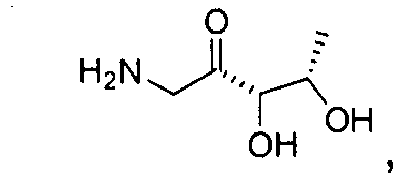
- Step 8: add 18.9 L(9 ml/g) of isopropanol, 2.3 L (1.1ml/g ) of pure water, 0.1 kg of (0.1 eq) of sodium iodide, 1.76kg(1.1 eq) of compound A (2-amino-6-chloro-5-nitro-3H-pyrimidin-4-one), 0.92kg(1eq) of (3S,4S)-1-amino-3,4-dihydroxy-2-pentanone

- Step 9: add 2.0kg(1eq) of 2-acetylamino-5-nitro-6-((3S,4S)-3,3-dihydroxy-2-oxo-pentylamino)-pyrimidin-4-one


- Step 10: add 0.255kg(0.15g/g) of 20% palladium on carbon to the aqueous solution containing 1.7kg of acetylamino-7,8-dihydropteridine

Step 9, introduce hydrogen until the pressure of the reaction kettle is 0.6±0.05MPa, control the temperature of the system at 20±5°C and the pressure at 0.6±0.05MPa, react for 80 hours, after reacting thoroughly, perform quenching in 10.29kg(7eq) of dilute hydrochloric acid having a concentration of 15%, and perform suction filtration and drying to the system to obtain a target product, i.e. a sapropterin dihydrochloride crude product of
- Embodiment 2: main raw material


- Step 1: add 2016L(20g/ml) of methanol, and 100.8kg(1eq) of crotonate cyclopropylalkyl ester

compound 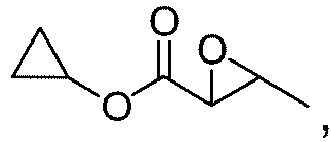
- Step 2: in the presence of 425kg of (15eq) acetone, add 79.2kg(1 eq) of ferric chloride to a 2000L reaction kettle, control the temperature at 30±5°C, add 69.4kg(1.0eq) of 2,3 epoxy- cyclopropylalkyl butyrate


- Step 3: add 753(10ml/g) of methanol, and 75.3kg(1 eq) of 2,3-acetonide-cyclopropylalkyl butyrate


- Step 4: add 27 L (10 ml/g) of tetrahydrofuran, 2.7 kg (1eq) of (4S,5S)-2,2,5-trimethyl-1,3-dioxolan-4-phenylpropylamino carboxylate


- Step 5: add 20L(15 ml/g) of tetrahydrofuran, 1.3kg of (4S,5S)-2,2,5-trimethyl-1,3-dioxolan-4-methanoic acid


- Step 6: add 19.5L(15ml/g) of acetonitrile, 1.3kg of (4S,5S)-2,2,5-trimethyl-5-chloroacetyl-1,3-dioxolane


- Step 7: add 18.2 L (15 ml/g) of 1,4-dioxane and 0.73 kg (0.6 g/g) of Raney nickel to a 50 L reaction kettle, introduce hydrogen until the system pressure is 0.9±0.1MPa, regulate the pH of the system to 1±0.5 with concentrated hydrochloric acid, add the acetonitrile solution containing 1.21 kg(1 eq) of (4S,5S)-2,2,5-trimethyl-5-(2-azidoacetyl)-1,3-dioxolane


- Step 8: add 47.5 L (15 ml/g) of methanol, 15.8L(5ml/g ) of pure water, 1.28kg of (0.5eq) of potassium iodide, 3.6kg(1.5eq) of compound A (2-amino-6-chloro-5-nitro-3H-pyrimidin-4-one), 1.4kg(1eq) of (3S,4S)-1-amino-3,4-dihydroxy-2-pentanone


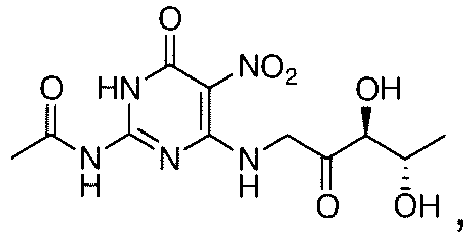
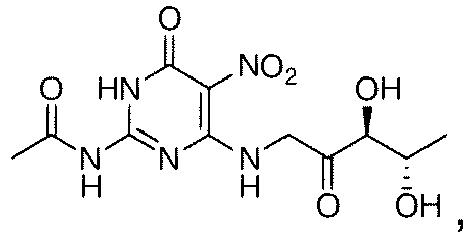
- Step 9: add 2.94kg(1 eq) of 2-acetylamino-5-nitro-6-((3S,4S)-3,3-dihydroxy-2-oxo-pentylamino)-pyrimidin-4-one

- Step 10: add 1.5 kg (0.6 g/g) of Raney nickel to the methanol solution containing 2.5kg of acetylamino-7,8-dihydropteridine

Step 9, introduce hydrogen until the pressure of the system is 0.9±0.05MPa, control the temperature of the system at 30±5°C and the pressure at 0.9±0.05MPa, react for 84 hours, after reacting thoroughly, perform quenching in 16.2kg(10eq) of dilute hydrochloric acid having a concentration of 20%, and perform suction filtration and drying to the system to obtain a target product, i.e. a crude product of sapropterin dihydrochloride
- Embodiment 3: main raw material:

- Step 1: add 495L(5g/ml) of ethanol, and 99kg(1 eq) of crotonyl methanamine


- Step 2: in the presence of 106kg of (3eq) acetone, add 2.6kg(0.1 eq) of lithium chloride to a 1000L reaction kettle, control the temperature at 10±5°C, add 70.2kg(1.0eq) of 2,3 epoxy - butyryl methylamine, react for 5 hours while preserving the temperature, add 610kg of a potassium bicarbonate (0.5eq) solution having a concentration of 5% to the system, and perform liquid separation, extraction, and concentration in the system to obtain 81.3kg of 2,3-acetonide-alkylformamide

- Step 3: add 243.9 L-(3ml/g) of ethanol, and 81.3kg(1 eq) of 2,3-acetonide-alkylformamide


- Step 4: add 30L(3ml/g) of 1,4-dioxane, 10kg (1eq) of (4S,5S)-2,2,5-trimethyl-1,3-dioxolan-4-phenylpropylamino carboxylate


- Step 5: add 26 L (5 ml/g) of 1,4-dioxane, 5.2 kg (1 eq) of (4S,5S)-2,2,5-trimethyl-1,3-dioxolan-4-methanoic acid


- Step 6: add 25L(5ml/g) of methanol, 5kg of (4S,5S)-2,2,5-trimethyl-5-chloroacetyl-1,3-dioxolane


- Step 7: add 22.5 L (5 ml/g) of methyl tert-butyl ether and 0.3 kg (0.05g/g) of 10% palladium on carbon to a 100L reaction kettle, introduce hydrogen until the system pressure is 0.4±0.1 MPa, regulate the pH of the system to 4±0.5 with benzenesulfonic acid, add the methanol solution containing 4.5kg (1 eq) of (4S,5S)-2,2,5-trimethyl-5-(2-azidoacetyl)-1,3-dioxolane


- Step 8: add 21 L (5 ml/g) of ethanol, 4.2L(1ml/g ) of pure water, 0.1 kg of (0.05eq) sodium iodide, 3.2kg(1 eq) of compound A (2-amino-6-chloro-5-nitro-3H-pyrimidin-4-one), 1.83kg(1eq) of (3S,4S)-1-amino-3,4-dihydroxy-2-pentanone


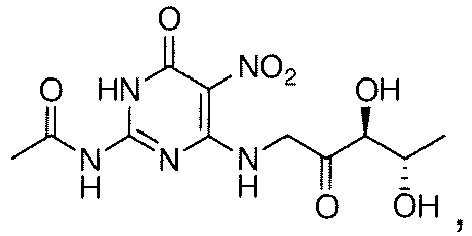
- Step 9: add 3.8kg(1 eq) of 2-acetylamino-5-nitro-6-((3S,4S)-3,3-dihydroxy-2-oxo-pentylamino)-pyrimidin-4-one

- Step 10: add 0.16kg(0.05g/g) of platinum dioxide in the presence of the ethanol solution containing 3.25kg of acetylamino-7,8-dihydropteridine

Step 9, introduce hydrogen until the system pressure is 0.4±0.05MPa, control the temperature of the system at 10±5°C and the pressure at 0.4±0.05MPa, react for 72 hours, after reacting thoroughly, perform quenching in 12.6kg(3eq) of dilute hydrochloric acid having a concentration of 10%, and perform suction filtration and drying to the system to obtain a target product, i.e. a crude product of sapropterin dihydrochloride
- Embodiment 4: main raw material:

- Step 1: add 900 L (15 g/ml) of isopropanol, and 60 kg (1 eq) of methyl crotonate


- Step 2: in the presence of 256 kg of (12eq) acetone, add 40 kg (0.8eq) of zinc chloride to a 2000 L reaction kettle, control the temperature at 25±5°C, add 42.6kg(1.0eq) of 2,3 epoxy-methyl butyrate


- Step 3: add 398(8ml/g) of methanol, and 49.8kg(1 eq) of 2,3-acetonide-methyl butyrate


- Step 4: add 48 L (8 ml/g) of methyl tert-butyl ether, 6kg (1 eq) of 1-phenylpropan-1-amine (4S,5S)-2,2,5-trimethyl-1,3-dioxolane-4-carboxylate


- Step 5: add 36L(12 ml/g) of tetrahydrofuran, 3.0kg of (4S,5S)-2,2,5-trimethyl-1,3-dioxolan-4-methanoic acid


- Step 6: add 36L(12ml/g) of acetone, 3kg of (4S,5S)-2,2,5-trimethyl-5-chloroacetyl-1,3-dioxolane


- Step 7: add 33.7L (12ml/g) of 2-methyltetrahydrofuran, 8.6kg(2.0eq) of triphenylphosphine, and 0.5kg(2.0eq) of water to a 72L reaction kettle, regulate the pH of the system to 3±0.5 with acetic acid, add the acetone solution containing 2.8kg of (4S,5S)-2,2,5-trimethyl-5-(2-azidoacetyl)-1,3-dioxolane


- Step 8: add 19.7 L(12 ml/g) of methanol, 6.4L(4ml/g ) of pure water, 0.8kg of (0.4eq) of sodium iodide, 4.0kg(1.4eq) of compound A (2-amino-6-chloro-5-nitro-3H-pyrimidin-4-one), 1.6kg(1eq) of (3S,4S)-1-amino-3,4-dihydroxy-2-pentanone

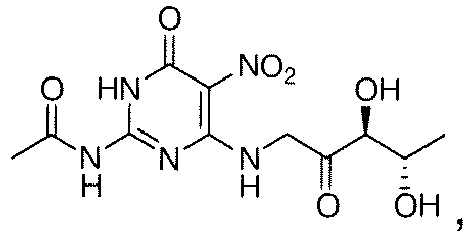
- Step 9: add 1.7kg(1 eq) of 2-acetylamino-5-nitro-6-((3S,4S)-3,3-dihydroxy-2-oxo-pentylamino)-pyrimidin-4-one
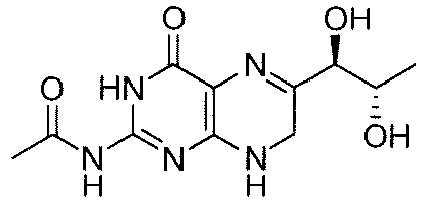
- Step 10: add 0.7kg(0.05g/g) of 5% palladium on carbon in the presence of the methanol solution containing 1.5kg of acetylamino-7,8-dihydropteridine

Step 9, introduce hydrogen until the pressure of the reaction kettle is 0.8±0.05MPa, control the temperature of the system at 25±5°C and the pressure at 0.8±0.05MPa, react for 82 hours, after reacting thoroughly, perform quenching in 31.9kg(9eq) of dilute hydrochloric acid having a concentration of 15%, and perform suction filtration and drying to the system to obtain a target product, i.e. a crude product of sapropterin dihydrochloride
- Embodiment 5: main raw material:


- Step 1: add 780L(12g/ml) of ethanol, and 65kg(1eq) of benzyl crotonate
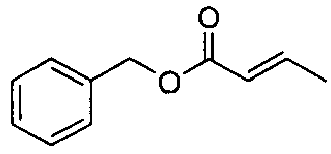

- Step 2: in the presence of 132.8kg of (10eq) acetone, add 5.8kg(0.6eq) of lithium chloride to a 1000L reaction kettle, control the temperature at 22±5°C, add 44kg(1.0eq) of 2,3-epoxy-benzyl butyrate


- Step 3: add 352(8ml/g) of ethanol, and 44kg(1 eq) of 2,3-acetonide-benzyl butyrate


- Step 4: add 48L(6ml/g) of 1,4-dioxane, 8kg (1 eq) of 1-phenylpropan-1-amine (4S,5S)-2,2,5-trimethyl-1,3-dioxolane-4-carboxylate


- Step 5: add 49L(12 ml/g) of 2-methyltetrahydrofuran, 4.1kg of 1,3-dioxolan-4-carboxylic acid


- Step 6: add 49L(12ml/g) of acetone, 4.1 kg of (4S,5S)-2,2,5-trimethyl-5-chloroacetyl-1,3-dioxolane


- Step 7: add 46.4L (12ml/g) of methyl tert-butyl ether and 1.2kg(0.3g/g) of Raney nickel to a 100L reaction kettle, introduce hydrogen until the system pressure is 0.8±0.1 MPa, regulate the pH of the system to 3±0.5 with concentrated sulfuric acid, add an acetonitrile solution containing 3.9kg(1 eq) of (4S,5S)-2,2,5-trimethyl-5-(2-azidoacetyl)-1,3-dioxolane
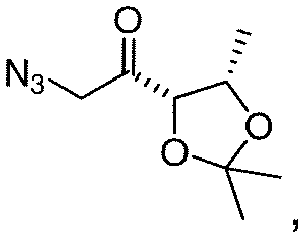

- Step 8: add 23L(10ml/g) of propanol, 6.9L(3ml/g) of pure water, 0.9kg of (0.3eq) of potassium iodide, 4.8kg(1.2eq) of compound A (2-amino-6-chloro-5-nitro-3H-pyrimidin-4-one), 2.3kg(1eq) of (3S,4S)-1-amino-3,4-dihydroxy-2-pentanone


- Step 9: add 1.25kg(1 eq) of 2-acetylamino-5-nitro-6-((3S,4S)-3,3-dihydroxy-2-oxo-pentylamino)-pyrimidin-4-one


- Step 10: add 0.44kg(0.4g/g) of 10% palladium on carbon in the presence of the ethanol solution containing 1.1 kg of acetylamino-7,8-dihydropteridine

Step 9, introduce hydrogen until the pressure of the reaction kettle is 0.8±0.05MPa, control the temperature of the system at 25±5°C and the pressure at 0.8±0.05MPa, react for 80 hours, after reacting thoroughly, perform quenching in 20kg(8eq) of dilute hydrochloric acid having a concentration of 15%, and perform suction filtration and drying to the system to obtain a target product, i.e. a crude product of sapropterin dihydrochloride
- Embodiment 6: main raw material:


- Step 1: add 510L(6g/ml) of methanol, and 85kg(1eq) of (E)-N-isopropylbut-2-enamide


- Step 2: in the presence of 119.8kg of (5eq) acetone, add 9.3kg(0.1 eq) of zinc bromide to a 1000L reaction kettle, control the temperature at 15±5°C, add 59kg(1.0eq) of N-isopropyl-3-methyloxirane-2-carboxamide


- Step 3: add 259(4ml/g) of tetrahydrofuran, and 64.7kg(1 eq) of N-isopropyl-2,2,5-trimethyl-1,3-dioxolane-4-carboxamide

phenylethanamine 
- Step 4: add 30L(3ml/g) of 2-methyltetrahydrofuran, 10kg (1eq) of 1-phenyltehanamine -2,2,5-trimethyl-1,3-dioxolane-4-carboxylat


- Step 5: add 42L(8 ml/g) of 1,4-dioxane, 5.3kg of 1,3-dioxolan-4-carboxylic acid


- Step 6: add 41 L(8ml/g) of tetrahydrofuran, 5.1kg of (4S,5S)-2,2,5-trimethyl-5-chloroacetyl-1,3-dioxolane
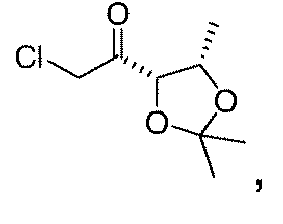

- Step 7: add 28L (6ml/g) of 1,4-dioxane and 0.23kg(0.05g/g) of 10% palladium on carbon to a 50L reaction kettle, introduce hydrogen until the system pressure is 0.8±0.1MPa, regulate the pH of the system to 3±0.5 with acetic acid, add an acetonitrile solution containing 4.6kg(1 eq) of (4S,5S)-2,2,5-trimethyl-5-(2-azidoacetyl)-1,3-dioxolane


- Step 8: add 16.3 L (6 ml/g) of isopropanol, 2.7 L (1 g/g ) of pure water, 0.4kg of (0.1 eq) of sodium iodide, 4.8kg(1.0eq) of compound A (2-amino-6-chloro-5-nitro-3H-pyrimidin-4-one), 2.7kg(1eq) of (3S,4S)-1-amino-3,4-dihydroxy-2-pentanone

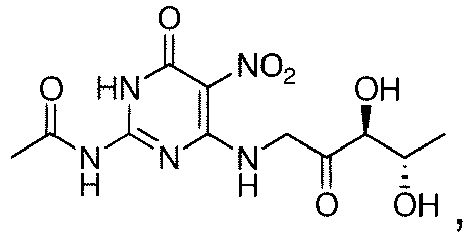
- Step 9: add 2kg(1 eq) of 2-acetylamino-5-nitro-6-((3S,4S)-3,3-dihydroxy-2-oxo-pentylamino)-pyrimidin-4-one


- Step 10: add 0.2kg(0.1g/g) of platinum dioxide in the presence of the ethanol solution containing 1.7kg of acetylamino-7,8-dihydropteridine

Step 9, introduce hydrogen until the pressure of the reaction kettle is 0.6±0.05MPa, control the temperature of the system at 15±5°C and the pressure at 0.6±0.05MPa, react for 75 hours, after reacting thoroughly, perform quenching in 30kg(5eq) of dilute hydrochloric acid having a concentration of 10%, and perform suction filtration and drying to the system to obtain a target product, i.e. a crude product of sapropterin dihydrochloride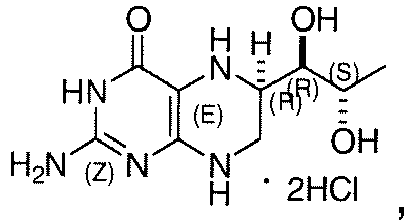
- Thus, it can be seen that synthesis of a sapropterin dihydrochloride compound disclosed in a method of the present invention can obtain a target product with a high purity, a high enantiomeric excess, and a high yield. The synthesis method uses readily-available raw materials, significantly reduces a synthesis route of sapropterin dihydrochloride. The technological conditions are stable, and there is less pollution in the whole operation process, hence providing an effective scheme for mass industrial production of sapropterin dihydrochloride.
Claims (15)
- A method for synthesizing sapropterin dihydrochloride, characterized in that it comprises the following steps:Step 1: a compound 1 of the formula

 Step 2: in the presence of acetone, a Lewis acid, an inorganic base liquid, the compound 2 of the formula
 Step 3: the compound 3 of the formula
 Step 4: dissolving the compound 4 of the formula
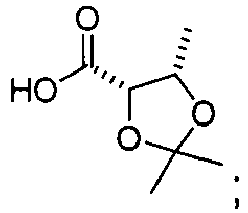 Step 5: using the compound 5 of the formula
 Step 6: reacting the compound 6 of the formula
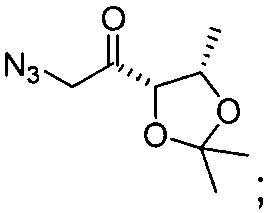 Step 7: subjecting the compound 7 of the formula
 Step 8: reacting the compound 8 of the formula

 Step 9: subjecting the compound 9 of the formula
 Step 10: adding a catalyst to the compound 10 of the formula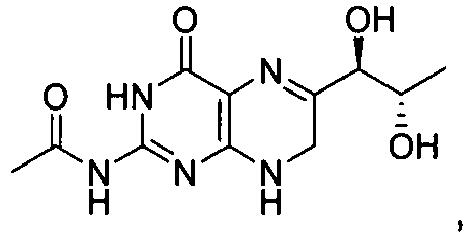
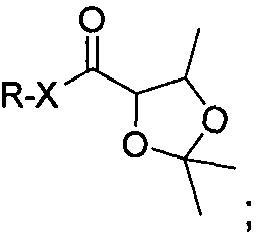
- The synthesizing method according to claim 1, characterized in that it comprises the following steps:Step 1: in the presence of a polar solvent, adding the compound 1 of the formula R-X

 Step 2: adding a Lewis acid in the presence of acetone, controlling the temperature at 10°C to 30°C, adding the compound 2, reacting for 5 to 10 hours while preserving the temperature, adding an inorganic base solution having a concentration of 5wt% to 10wt% to the system, and performing liquid separation, extraction and concentration to the system to obtain the compound 3 of the formula
 Step 3: adding the compound 3 in the presence of a polar solvent, increasing the temperature to 25°C to 40°C, adding pure water and an alkaline solution, reacting for 3 to 8 hours while preserving the temperature, performing centrifugation, dissolving a filter cake in a polar solvent which is the same as the polar solvent used in the reaction, adding a resolving reagent, preserving the temperature at 15°C to 30°C for 3 to 5 hours, performing centrifugation and drying to obtain the compound 4 of the formula
 Step 4: adding the compound 4 in the presence of an ether solvent, then adding an inorganic acid aqueous solution having a concentration of 5% to 10% to the system to regulate the pH to 1 to 3, controlling the temperature at -10°C to 10°C, preserving the temperature for 1 hour, performing liquid separation to obtain an organic phase, adding N,N-diisopropylethylamine to the organic phase, and concentrating the system to obtain the compound 5 of the formula
 Step 5: adding the compound 5 and N,N-diisopropylethylamine in the presence of an ether solvent, reducing the temperature to -30°C to 0°C, adding a chloroformate, reacting for 1 to 2 hours while preserving the temperature, introducing a diazomethane gas for 1 to 2 hours, adding a hydrochloride ethanol solution, reacting for 1 to 2 hours, adding an alkaline reagent to regulate the pH value to 7 to 9, performing extraction, liquid separation and concentration to obtain the compound 6 of the formula
 Step 6: adding the compound 6, a trinitride and a catalyst in the presence of a polar solvent, reacting the system at 15°C to 40°C for 20 to 30 hours while preserving the temperature, then performing filtering and concentration to obtain a solution of the compound 7 of the formula
 Step 7: adding triphenylphosphine and water, or palladium on carbon and hydrogen, or Raney nickel and hydrogen in the presence of an ether solvent, regulating the pH of the system to 1 to 4 with an acid reagent, adding a solution of the compound 7, preserving the temperature for 10°C to 30°C, reacting for 5 to 10 hours, performing suction filtration and concentration to obtain a filtrate containing the compound 8 of the formula
 Step 8: adding a catalyst, the compound A of the formula
 Step 9: adding a catalyst in the presence of the compound 9 and a polar solvent, introducing hydrogen until the pressure of the system is 0.4 to 0.9MPa, controlling the temperature of the system at 15°C to 30°C and the pressure at 0.4 to 0.9MPa, reacting for 18 to 24 hours, filtering the system, and regulating the pH of the system to 11 to 12 with an alkaline reagent to obtain a solution of the compound 10 of the formula
 Step 10: adding a catalyst in the presence of the solution of the compound 10 obtained in Step 9, introducing hydrogen until the pressure of the system is 0.4 to 0.9MPa, controlling the temperature of the system at 10°C to 30°C, controlling the pressure at 0.4 to 0.9MPa, reacting for 72 to 84 hours, performing quenching in dilute hydrochloric acid having a concentration of 10% to 20% after reacting thoroughly, and performing suction filtration and drying to the system to obtain a sapropterin dihydrochloride crude product.
 - The synthesizing method according to claim 2, characterized in that Step 10 further comprises: crystallizing and purifying the sapropterin dihydrochloride crude product with an alcoholic solvent or a ketone solvent at 0°C to 40°C to obtain a sapropterin dihydrochloride pure product.
- The synthesizing method according to claim 1, characterized in that it comprises the following steps:Step 1: in the presence of a polar solvent, adding the compound 1 of the formula


 Step 2: adding a Lewis acid in the presence of acetone, controlling the temperature at 10°C to 30°C, adding the compound 2, reacting for 5 to 10 hours while preserving the temperature, adding an inorganic base solution having a concentration of 5% to 10% to the system, and performing liquid separation, extraction and concentration to the system to obtain the compound 3 of the formula
 Step 3: adding the compound 3 in the presence of a polar solvent, increasing the temperature to 25°C to 40°C, adding pure water and an alkaline solution, reacting for 3 to 8 hours while preserving the temperature, performing centrifugation, dissolving a filter cake in a polar solvent which is the same as the polar solvent used in the reaction, adding a resolving reagent, preserving the temperature at 15°C to 30°C for 3 to 5 hours, performing centrifugation and drying to obtain the compound 4 of the formula
wherein the ratio of the use amount of the compound 3 to that of the polar solvent used in the reaction is 1 g/3 to 10ml; the molar ratio of the compound 3 to pure water is 1:0.5 to 3; the molar ratio of the compound 3 to an alkaline substance in the alkaline solution is 1:0.5 to 2; the ratio of the use amount of the compound 3 to that of the polar solvent for dissolving the filter cake is 1g/2 to 10ml; and the molar ratio of the compound 3 to the resolving reagent is 1:1 to 5;Step 4: adding the compound 4 in the presence of an ether solvent, then adding an inorganic acid aqueous solution having a concentration of 5% to 10% to the system to regulate the pH to 1 to 3, controlling the temperature at -10°C to 10°C, performing liquid separation to obtain an organic phase, adding N,N-diisopropylethylamine to the organic phase, and concentrating the system to obtain the compound 5 of the formula Step 5: adding the compound 5 and N,N-diisopropylethylamine in the presence of an ether solvent, reducing the temperature to -30°C to 0°C, adding a chloroformate, reacting for 1 to 2 hours while preserving the temperature, introducing a diazomethane gas for 1 to 2 hours, adding a hydrochloride ethanol solution, reacting for 1 to 2 hours, adding an alkaline reagent to regulate the pH value to 7 to 9, performing extraction, liquid separation and concentration to obtain the compound 6 of the formula
 Step 6: adding the compound 6, a trinitride and a catalyst in the presence of a polar solvent, reacting the system at 15°C to 40°C for 20 to 30 hours while preserving the temperature, then performing filtering and concentration to obtain a solution of the compound 7 of the formula
wherein the ratio of the use amount of the compound 6 to that of the polar solvent is 1g/5 to 15ml; the molar ratio of the compound 6 to the trinitride is 1:1 to 4; and the molar ratio of the compound 6 to the catalyst is 1:0.05 to 0.8;Step 7: adding triphenylphosphine and water, or palladium on carbon to and hydrogen, or Raney nickel and hydrogen in the presence of an ether solvent, regulating the pH of the system to 1 to 4 with an acid reagent, adding a solution of the compound 7, preserving the temperature for 10°C to 30°C, reacting for 5 to 10 hours, performing suction filtration and concentration to obtain a filtrate containing the compound 8 of the formula
wherein the ratio of the use amount of the compound 7 to that of the ether solvent is 1g/5 to 15ml; the molar ratio of the compound 7 to triphenylphosphine is 1:0.1 to 3; the ratio of the use amount of the compound 7 to that of water is 1:0.1 to 3; the mass ratio of the compound 7 to 5% palladium on carbon or 10% palladium on carbon or Raney nickel is 1:0.05 to 0.6; the hydrogen is introduced until the pressure of the system is 0.4 to 0.9MPa;Step 8: adding a catalyst, the compound A of the formula
 Step 9: adding a catalyst in the presence of the compound 9 and a polar solvent, introducing hydrogen until the pressure of the system is 0.4 to 0.9MPa, controlling the temperature of the system at 15°C to 30°C and the pressure at 0.4 to 0.9MPa, reacting for 18 to 24 hours, filtering the system, and regulating the pH of the system to 11 to 12 with an alkaline reagent to obtain a solution of the compound 10 of the formula
 Step 10: adding a catalyst in the presence of the solution of the compound 10 obtained in Step 9, introducing hydrogen until the pressure of the system is 0.4 to 0.9MPa, controlling the temperature of the system at 10°C to 30°C, controlling the pressure at 0.4 to 0.9MPa, reacting for 72 to 84 hours, performing quenching in dilute hydrochloric acid having a concentration of 10% to 20% after reacting thoroughly, and performing suction filtration and drying to the system to obtain a sapropterin dihydrochloride crude product, and further crystallizing and purifying the sapropterin dihydrochloride crude product with an alcoholic solvent or a ketone solvent at 0°C to 40°C to obtain a sapropterin dihydrochloride pure product,
wherein the mass ratio of the compound 10 to the catalyst is 1:0.05 to 0.6; the molar ratio of the compound 10 to hydrochloric acid is 1:3 to 10; and the ratio of the use amount of the compound 10 to that of the alcoholic solvent or the ketone solvent is 1g/5 to 25ml. - The synthesizing method according to claim 4, characterized in that in Step 1 the polar solvent is water, methanol, ethanol or isopropanol, preferably water, methanol or ethanol, optimally water; the oxidant is N-bromobutanimide, meta-chloroperoxybenzoic acid, hydrogen peroxide having a concentration of 35% or a toluene solution of tert-butyl hydroperoxide having a concentration of 50%, preferably N-bromobutanimide, meta-chloroperoxybenzoic acid or a toluene solution of tert-butyl hydroperoxide having a concentration of 50%, and optimally N-bromobutanimide; the strong base is sodium hydroxide or potassium hydroxide, preferably sodium hydroxide; the ratio of the use amount of the compound of formula


the ratio of the use amount of the compound 2 to that of acetone is 1:5 to 15, preferably 1:5 to 10; the molar ratio of the compound 2 to the Lewis acid is 1:0.1 to 0.8, preferably 1:0.1 to 0.6; the ratio of the use amount of the compound 2 to that of the inorganic base is 1:0.5 to 2.5, preferably 1:0.5 to 1.5;
preferably, in Step 3, the polar solvent is tetrahydrofuran, methanol or ethanol, preferably tetrahydrofuran or methanol, optimally methanol; the resolving reagent is L-α-phenylethylamine or L-α-amphetamine, preferably L-α-phenylethylamine; the alkaline solution is a methanol solution of sodium methoxide having a concentration of 29%, a potassium hydroxide aqueous solution having a concentration of 20% or a sodium hydroxide aqueous solution having a concentration of 20%, preferably the methanol solution of sodium methoxide having a concentration of 29% or the potassium hydroxide aqueous solution having a concentration of 20%, optimally the methanol solution of sodium methoxide having a concentration of 29%; the ratio of the use amount of the compound 3 to that of the polar solvent is 1g/3 to 8ml, preferably 1g/4 to 8ml; the molar ratio of the compound 3 to pure water is 1:0.5 to 1.8, preferably 1:0.5 to 1.5; the molar ratio of the compound 3 to the alkaline substance in the alkaline solution is 1:0.5 to 1.8, preferably 1:0.5 to 1.5; the ratio of the use amount of the compound 3 to that of the polar solvent for dissolving the filter cake is 1g/3 to 8ml, preferably 1g/3 to 7ml; the molar ratio of the compound 3 to the resolving reagent is 1:1 to 4, preferably 1:1 to 3;
preferably, in Step 4, the ether solvent is tetrahydrofuran, 2-methyltetrahydrofuran, methyl tert-butyl ether, 1,4-dioxane or ether, preferably tetrahydrofuran, 2-methyltetrahydrofuran, methyl tert-butyl ether or 1,4-dioxane, optimally 2-methyltetrahydrofuran or 1,4-dioxane; the inorganic acid is sulphuric acid, hydrochloric acid or phosphoric acid, preferably sulfuric acid or hydrochloric acid, optimally sulfuric acid; the ratio of the use amount of the compound 4 to that of the ether solvent is 1g/3 to 8ml, preferably 1g/3 to 6ml; and the molar ratio of the compound 4 to N,N-diisopropylethylamine is 1:0.8 to 2.5, preferably 1:0.8 to 2;
preferably, in Step 5, the ether solvent is tetrahydrofuran, 2-methyltetrahydrofuran, methyl tert-butyl ether, 1,4-dioxane or ether, preferably tetrahydrofuran, 2-methyltetrahydrofuran or methyl tert-butyl ether, optimally tetrahydrofuran or 2-methyltetrahydrofuran; the chloroformate is methyl chloroformate, ethyl chloroformate, or propyl chloroformate, preferably methyl chloroformate or ethyl chloroformate, optimally ethyl chloroformate; the alkaline reagent is triethylamine, sodium carbonate, potassium carbonate, sodium bicarbonate, potassium bicarbonate, sodium hydroxide or potassium hydroxide, preferably triethylamine, sodium carbonate, potassium carbonate, sodium hydroxide or potassium hydroxide, optimally triethylamine; the ratio of the use amount of the compound 5 to that of the ether solvent is 1 g/6 to 12ml, preferably 1g/8 to 12ml; the molar ratio of the compound 5 to N,N-diisopropylethylamine is 1:1.5 to 4, preferably 1:2 to 4; the molar ratio of the compound 5 to the chloroformate is 1:1 to 2.5, preferably 1:1 to 2; and the molar ratio of the compound 5 to hydrogen chloride is 1:1.5 to 4.5, preferably 1:2 to 4;
preferably, in Step 6, the polar solvent is acetonitrile, methanol, ethanol, acetone or tetrahydrofuran, preferably methanol, ethanol or acetone, optimally acetone; the catalyst is sodium iodide or potassium iodide, preferably potassium iodide; the trinitride is sodium azide or azidotrimethylsilane, preferably sodium azide; the ratio of the use amount of the compound 6 to that of the polar solvent is 1g/6 to 12ml, preferably 1g/8 to 12ml; the molar ratio of the compound 6 to the trinitride is 1:1 to 3, preferably 1:1 to 2.5; and the molar ratio of the compound 6 to the catalyst is 1:0.05 to 0.6, preferably 0.1 to 0.5. - The synthesizing method according to claim 4, characterized in that in Step 7, the ether solvent is tetrahydrofuran, 2-methyltetrahydrofuran, methyl tert-butyl ether, 1,4-dioxane or ether, preferably tetrahydrofuran, 2-methyltetrahydrofuran, methyl tert-butyl ether, or 1,4-dioxane, optimally tetrahydrofuran; the acid reagent is citric acid, p-toluenesulfonic acid, benzenesulfonic acid, formic acid, acetic acid, hydrochloric acid, sulfuric acid or phosphoric acid, preferably citric acid, p-toluenesulfonic acid, benzenesulfonic acid, hydrochloric acid or sulfuric acid, optimally citric acid or hydrochloric acid; the ratio of the use amount of the compound 7 to that of the ether solvent is 1g/5 to 12ml, preferably 1g/6 to 12ml; the molar ratio of the compound 7 to triphenylphosphine is 1:0.6 to 2, preferably 1:0.8 to 2; the ratio of the use amount of the compound 7 to that of water is 1:0.6 to 2, preferably 1:0.8 to 2; the mass ratio of the compound 7 to 5% palladium on carbon or 10% palladium on carbon or Raney nickel is 1:0.05 to 0.4, preferably 1:0.05 to 0.3; hydrogen is introduced until the pressure of the system is 0.5 to 0.8MPa, preferably 0.6 to 0.8MPa.
- The synthesizing method according to claim 4, characterized in that in Step 8, the alcoholic solvent is methanol, ethanol, propanol or isopropanol, preferably methanol, ethanol or isopropanol, optimally isopropanol or ethanol; the catalyst is sodium iodide or potassium iodide, preferably sodium iodide; the alkaline reagent is triethylamine, diisopropylethylamine, diisopropylamine, pyridine, sodium bicarbonate, potassium bicarbonate, sodium carbonate, potassium carbonate or cesium carbonate, preferably triethylamine, pyridine, sodium bicarbonate, potassium bicarbonate, sodium carbonate or potassium carbonate, optimally triethylamine; the buffer solution is a sodium dihydrogen phosphate-disodium hydrogen phosphate aqueous solution, a potassium dihydrogen phosphate-dipotassium hydrogen phosphate aqueous solution or an ammonium formate-ammonia aqueous solution, preferably the sodium dihydrogen phosphate-disodium hydrogen phosphate aqueous solution or the potassium dihydrogen phosphate-dipotassium hydrogen phosphate aqueous solution, optimally the potassium dihydrogen phosphate-dipotassium hydrogen phosphate aqueous solution; the ratio of the use amount of the compound 8 to that of the alcoholic solvent is 1 g/6 to 12ml, preferably 1g/6 to 10ml; the ratio of the use amount of the compound 8 to that of pure water is 1g/1 to 4ml, preferably 1g/1 to 3ml; the molar ratio of the compound 8 to the compound A is 1:1 to 1.4, preferably 1:1 to 1.2; the molar ratio of the compound 8 to the catalyst is 1:0.1 to 0.4, preferably 1:0.1 to 0.3; and the molar ratio of the compound 8 to the alkaline reagent is 1:4 to 7, preferably 1:4 to 6;
preferably, in Step 9, the catalyst is Raney nickel, 5% palladium on carbon, 10% palladium on carbon, platinum dioxide or 20% palladium on carbon, preferably Raney nickel, 5% palladium on carbon or 10% palladium on carbon, optimally Raney nickel; the polar solvent is pure water, methanol or ethanol, preferably pure water and methanol, optimally pure water; the alkaline solution is sodium hydroxide, potassium hydroxide, sodium carbonate or potassium carbonate, preferably sodium hydroxide or sodium carbonate, optimally sodium hydroxide; the ratio of the use amount of the compound 9 to that of the polar solvent is 1g/25 to 45ml, preferably 1g/30 to 40ml and the mass ratio of the compound 9 to the catalyst is 1:0.05 to 0.5, preferably 1:0.1 to 0.4;
preferably, in Step 10, the catalyst is Raney nickel, 5% palladium on carbon, 10% palladium on carbon, platinum dioxide or 20% palladium on carbon, preferably Raney nickel, platinum dioxide or 20% palladium on carbon, optimally 20% palladium on carbon; the alcoholic solvent is methanol, ethanol, isopropanol or n-butanol, preferably methanol, ethanol or isopropanol, optimally methanol; the ketone solvent is acetone or butanone, preferably acetone; the mass ratio of the compound 10 to the catalyst is 1:0.05 to 0.5, preferably 1:0.1 to 0.4; the molar ratio of the compound 10 to hydrochloric acid is 1:4 to 9, preferably 1:5 to 8; and the ratio of the use amount of the compound 10 to that of the alcoholic solvent or the ketone solvent is 1 g/5 to 20ml, preferably 1g/10 to 20ml. - A method for preparing (3S,4S)-1-amino-3,4-dihydroxy-2-pentanone, characterized in that it comprises the following steps:Step 1: using a compound 5 of the formula

 Step 2: reacting the compound 6 of the formula
 Step 3: subjecting the compound 7 of the formula

- The method according to claim 8, characterized in that it comprises the following steps:Step 1: adding the compound 5 and N,N-diisopropylethylamine in the presence of an ether solvent, reducing the temperature to -30°C to 0°C, adding a chloroformate, reacting for 1 to 2 hours while preserving the temperature, introducing a diazomethane gas for 1 to 2 hours, adding a hydrochloride ethanol solution, reacting for 1 to 2 hours, adding an alkaline reagent to regulate the pH value to 7 to 9, performing extraction, liquid separation and concentration to obtain the compound 6 of the formula
 Step 2: adding the compound 6, a trinitride and a catalyst in the presence of a polar solvent, reacting the system at 15°C to 40°C for 20 to 30 hours while preserving the temperature, then performing filtering and concentration to obtain a solution of the compound 7 of the formula
 Step 3: adding triphenylphosphine and water, or palladium on carbon and hydrogen, or Raney nickel and hydrogen in the presence of an ether solvent, regulating the pH of the system to 1 to 4 with an acid reagent, adding a solution of the compound 7, preserving the temperature at 10°C to 30°C, reacting for 5 to 10 hours, performing suction filtration and concentration to obtain a filtrate containing the compound 8 of the formula
- The method according to claim 9, characterized in that in Step 1, the ratio of the use amount of the compound 5 to that of the ether solvent is 1 g/5 to 15ml; the molar ratio of the compound 5 to N,N-diisopropylethylamine is 1:1 to 5; the molar ratio of the compound 5 to the chloroformate is 1:1 to 3; and the molar ratio of the compound 5 to hydrogen chloride is 1:1 to 5.
- The method according to claim 10, characterized in that in Step 1, the ether solvent is tetrahydrofuran, 2-methyltetrahydrofuran, methyl tert-butyl ether, 1,4-dioxane or ether; the chloroformate is methyl chloroformate, ethyl chloroformate, or propyl chloroformate; the alkaline reagent is triethylamine, sodium carbonate, potassium carbonate, sodium bicarbonate, potassium bicarbonate, sodium hydroxide or potassium hydroxide; the ratio of the use amount of the compound 5 to that of the ether solvent is 1g/6 to 12ml, preferably 1 g/8 to 12ml; the molar ratio of the compound 5 to N,N-diisopropylethylamine is 1:1.5 to 4, preferably 1:2 to 4; the molar ratio of the compound 5 to the chloroformate is 1:1 to 2.5, preferably 1:1 to 2; and the molar ratio of the compound 5 to hydrogen chloride is 1:1.5 to 4.5, preferably 1:2 to 4.
- The method according to claim 9, characterized in that in Step 2, the ratio of the use amount of the compound 6 to that of the polar solvent is 1 g/5 to 15ml; the molar ratio of the compound 6 to the trinitride is 1:1 to 4; and the molar ratio of the compound 6 to the catalyst is 1:0.05 to 0.8.
- The method according to claim 12, characterized in that the polar solvent is acetonitrile, methanol, ethanol, acetone or tetrahydrofuran; the catalyst is sodium iodide or potassium iodide; the trinitride is sodium azide or azidotrimethylsilane; the ratio of the use amount of the compound 6 to that of the polar solvent is 1 g/6 to 12ml, preferably 1 g/8 to 12ml; the molar ratio of the compound 6 to the trinitride is 1:1 to 3, preferably 1:1 to 2.5; and the molar ratio of the compound 6 to the catalyst is 1:0.05 to 0.6, preferably 0.1 to 0.5.
- The method according to claim 9, characterized in that in Step 3, the ratio of the use amount of the compound 7 to that of the ether solvent is 1g/5 to 15ml; the molar ratio of the compound 7 to triphenylphosphine is 1:0.1 to 3; the ratio of the use amount of the compound 7 to that of water is 1:0.1 to 3; the mass ratio of the compound 7 to 5% palladium on carbon or 10% palladium on carbon or Raney nickel is 1:0.05 to 0.6; introducing hydrogen until the pressure of the system is 0.4 to 0.9MPa.
- The method according to claim 14, characterized in that the ether solvent is tetrahydrofuran, 2-methyltetrahydrofuran, methyl tert-butyl ether, 1,4-dioxane or ether; the acid reagent is citric acid, p-toluenesulfonic acid, benzenesulfonic acid, formic acid, acetic acid, hydrochloric acid, sulfuric acid or phosphoric acid; the ratio of the use amount of the compound 7 to that of the ether solvent is 1 g/5 to 12ml, preferably 1 g/6 to 12ml; the molar ratio of the compound 7 to triphenylphosphine is 1:0.6 to 2, preferably 1:0.8 to 2; the ratio of the use amount of the compound 7 to that of water is 1:0.6 to 2, preferably 1:0.8 to 2; the mass ratio of the compound 7 to 5% palladium on carbon or 10% palladium on carbon or Raney nickel is 1:0.05 to 0.4, preferably 1:0.05 to 0.3; introduce hydrogen until the pressure of the system is 0.5 to 0.8MPa, preferably 0.6 to 0.8MPa.
Priority Applications (3)
| Application Number | Priority Date | Filing Date | Title |
|---|---|---|---|
| SI201230925A SI2837629T1 (en) | 2012-04-10 | 2012-12-27 | Method for synthesizing sapropterin dihydrochloride |
| RS20170360A RS55853B1 (en) | 2012-04-10 | 2012-12-27 | PROCEDURE FOR SYNTHESIS OF SAPROPTERIN DIHYDROCHLORIDE |
| PL12874086T PL2837629T3 (en) | 2012-04-10 | 2012-12-27 | Method for synthesizing sapropterin dihydrochloride |
Applications Claiming Priority (2)
| Application Number | Priority Date | Filing Date | Title |
|---|---|---|---|
| CN201210102879.1A CN102633799B (en) | 2012-04-10 | 2012-04-10 | Method for synthesizing sapropterin dihydrochloride from racemate intermediate separation route |
| PCT/CN2012/087732 WO2013152608A1 (en) | 2012-04-10 | 2012-12-27 | Method for synthesizing sapropterin dihydrochloride |
Publications (3)
| Publication Number | Publication Date |
|---|---|
| EP2837629A1 EP2837629A1 (en) | 2015-02-18 |
| EP2837629A4 EP2837629A4 (en) | 2015-11-25 |
| EP2837629B1 true EP2837629B1 (en) | 2017-03-22 |
Family
ID=46618392
Family Applications (1)
| Application Number | Title | Priority Date | Filing Date |
|---|---|---|---|
| EP12874086.7A Not-in-force EP2837629B1 (en) | 2012-04-10 | 2012-12-27 | Method for synthesizing sapropterin dihydrochloride |
Country Status (12)
| Country | Link |
|---|---|
| US (1) | US9371326B2 (en) |
| EP (1) | EP2837629B1 (en) |
| CN (1) | CN102633799B (en) |
| DK (1) | DK2837629T3 (en) |
| ES (1) | ES2624500T3 (en) |
| HU (1) | HUE033497T2 (en) |
| LT (1) | LT2837629T (en) |
| PL (1) | PL2837629T3 (en) |
| PT (1) | PT2837629T (en) |
| RS (1) | RS55853B1 (en) |
| SI (1) | SI2837629T1 (en) |
| WO (1) | WO2013152608A1 (en) |
Families Citing this family (52)
| Publication number | Priority date | Publication date | Assignee | Title |
|---|---|---|---|---|
| US9303038B2 (en) | 2011-09-06 | 2016-04-05 | Cellix Bio Private Limited | Compositions and methods for the treatment of epilepsy and neurological diseases |
| CN102627644B (en) | 2012-04-10 | 2014-04-16 | 凯莱英医药集团(天津)股份有限公司 | Method for preparing sapropterin dihydrochloride through direct chiral synthesis method |
| CN102633799B (en) | 2012-04-10 | 2014-06-25 | 凯莱英医药集团(天津)股份有限公司 | Method for synthesizing sapropterin dihydrochloride from racemate intermediate separation route |
| WO2013167990A1 (en) | 2012-05-07 | 2013-11-14 | Mahesh Kandula | Compositions and methods for the treatment of depression |
| SG11201407300VA (en) | 2012-05-07 | 2014-12-30 | Cellix Bio Private Ltd | Compositions and methods for the treatment of neurological disorders |
| WO2013168021A1 (en) | 2012-05-07 | 2013-11-14 | Mahesh Kandula | Compositions and methods for treatment of neuromuscular disorders and neurodegenerative disorders |
| US9309233B2 (en) | 2012-05-08 | 2016-04-12 | Cellix Bio Private Limited | Compositions and methods for the treatment of blood clotting disorders |
| WO2013167993A1 (en) | 2012-05-08 | 2013-11-14 | Mahesh Kandula | Compositions and methods for the treatment of neurological degenerative disorders |
| US9522884B2 (en) | 2012-05-08 | 2016-12-20 | Cellix Bio Private Limited | Compositions and methods for the treatment of metabolic disorders |
| US9266823B2 (en) | 2012-05-08 | 2016-02-23 | Cellix Bio Private Limited | Compositions and methods for the treatment of parkinson's disease |
| US9403826B2 (en) | 2012-05-08 | 2016-08-02 | Cellix Bio Private Limited | Compositions and methods for the treatment of inflammatory disorders |
| US9233161B2 (en) | 2012-05-10 | 2016-01-12 | Cellix Bio Private Limited | Compositions and methods for the treatment of neurological conditions |
| WO2013168015A1 (en) | 2012-05-10 | 2013-11-14 | Mahesh Kandula | Compositions and methods for the treatment of asthma and allergy |
| US9242939B2 (en) | 2012-05-10 | 2016-01-26 | Cellix Bio Private Limited | Compositions and methods for the treatment of respiratory disorders |
| US9273061B2 (en) | 2012-05-10 | 2016-03-01 | Cellix Bio Private Limited | Compositions and methods for the treatment of chronic pain |
| US9403857B2 (en) | 2012-05-10 | 2016-08-02 | Cellix Bio Private Limited | Compositions and methods for the treatment of metabolic syndrome |
| US9499526B2 (en) | 2012-05-10 | 2016-11-22 | Cellix Bio Private Limited | Compositions and methods for the treatment of neurologic diseases |
| WO2013168001A1 (en) | 2012-05-10 | 2013-11-14 | Mahesh Kandula | Compositions and methods for the treatment of moderate to severe pain |
| US9573927B2 (en) | 2012-05-10 | 2017-02-21 | Cellix Bio Private Limited | Compositions and methods for the treatment of severe pain |
| US9346742B2 (en) | 2012-05-10 | 2016-05-24 | Cellix Bio Private Limited | Compositions and methods for the treatment of fibromyalgia pain |
| WO2013167999A2 (en) | 2012-05-10 | 2013-11-14 | Mahesh Kandula | Compositions and methods for the treatment of neurologic diseases |
| US9339484B2 (en) | 2012-05-10 | 2016-05-17 | Cellix Bio Private Limited | Compositions and methods for the treatment of restless leg syndrome and fibromyalgia |
| WO2013168014A1 (en) | 2012-05-10 | 2013-11-14 | Mahesh Kandula | Compositions and methods for the treatment of familial amyloid polyneuropathy |
| WO2013167997A2 (en) | 2012-05-10 | 2013-11-14 | Mahesh Kandula | Compositions and methods for the treatment of metabolic syndrome |
| WO2013175347A2 (en) | 2012-05-23 | 2013-11-28 | Mahesh Kandula | Compositions and methods for the treatment of respiratory disorders |
| JP2015518854A (en) | 2012-05-23 | 2015-07-06 | セリックスビオ プライヴェート リミテッド | Compositions and methods for the treatment of multiple sclerosis |
| NZ701832A (en) | 2012-05-23 | 2016-08-26 | Cellix Bio Private Ltd | Compositions and methods for treatment of inflammatory bowel disease |
| WO2013175376A2 (en) | 2012-05-23 | 2013-11-28 | Mahesh Kandula | Compositions and methods for the treatment of local pain |
| US9434729B2 (en) | 2012-05-23 | 2016-09-06 | Cellix Bio Private Limited | Compositions and methods for the treatment of periodontitis and rheumatoid arthritis |
| SG11201407326XA (en) | 2012-05-23 | 2014-12-30 | Cellix Bio Private Ltd | Compositions and methods for treatment of mucositis |
| US9108942B1 (en) | 2014-11-05 | 2015-08-18 | Mahesh Kandula | Compositions and methods for the treatment of moderate to severe pain |
| US9187427B2 (en) | 2012-08-03 | 2015-11-17 | Cellix Bio Private Limited | N-substituted nicotinamide compounds and compositions for the treatment migraine and neurologic diseases |
| WO2014037833A2 (en) | 2012-09-06 | 2014-03-13 | Mahesh Kandula | Compositions and methods for the treatment inflammation and lipid disorders |
| AU2013311349A1 (en) | 2012-09-08 | 2014-11-27 | Cellixbio Private Limited | Compositions and methods for treatment of inflammation and lipid disorders |
| WO2014041446A2 (en) * | 2012-09-17 | 2014-03-20 | Mahesh Kandula | Compositions and methods for the treatment of metabolic diseases |
| US9333187B1 (en) | 2013-05-15 | 2016-05-10 | Cellix Bio Private Limited | Compositions and methods for the treatment of inflammatory bowel disease |
| AU2014276346A1 (en) | 2013-06-04 | 2015-12-24 | Cellixbio Private Limited | Compositions and methods for the treatment of diabetes and pre-diabetes |
| US9096537B1 (en) | 2014-12-31 | 2015-08-04 | Mahesh Kandula | Compositions and methods for the treatment of mucositis |
| SG11201706952VA (en) | 2014-09-26 | 2017-10-30 | Cellix Bio Private Ltd | Compositions and methods for the treatment of epilepsy and neurological disorders |
| EP3201168B1 (en) | 2014-09-29 | 2020-03-18 | Cellix Bio Private Limited | Compounds and compositions for the treatment of multiple sclerosis |
| AU2014414316B2 (en) | 2014-10-27 | 2020-04-09 | Cellix Bio Private Limited | Three component salts of fumaric acid monomethyl ester with piperazine or ethylene diamine for the treatment of multiple sclerosis |
| US9321716B1 (en) | 2014-11-05 | 2016-04-26 | Cellix Bio Private Limited | Compositions and methods for the treatment of metabolic syndrome |
| US10208014B2 (en) | 2014-11-05 | 2019-02-19 | Cellix Bio Private Limited | Compositions and methods for the treatment of neurological disorders |
| US9173877B1 (en) | 2014-11-05 | 2015-11-03 | Cellix Bio Private Limited | Compositions and methods for the treatment of local pain |
| US9175008B1 (en) | 2014-11-05 | 2015-11-03 | Cellix Bio Private Limited | Prodrugs of anti-platelet agents |
| US9290486B1 (en) | 2014-11-05 | 2016-03-22 | Cellix Bio Private Limited | Compositions and methods for the treatment of epilepsy |
| US9150557B1 (en) | 2014-11-05 | 2015-10-06 | Cellix Bio Private Limited | Compositions and methods for the treatment of hyperglycemia |
| US9284287B1 (en) | 2014-11-05 | 2016-03-15 | Cellix Bio Private Limited | Compositions and methods for the suppression of carbonic anhydrase activity |
| WO2016088132A1 (en) | 2014-12-01 | 2016-06-09 | Cellix Bio Private Limited | Compositions and methods for the treatment of multiple sclerosis |
| US9206111B1 (en) | 2014-12-17 | 2015-12-08 | Cellix Bio Private Limited | Compositions and methods for the treatment of neurological diseases |
| JP6679616B2 (en) | 2015-01-06 | 2020-04-22 | セリックス バイオ プライヴェート リミテッドCellix Bio Private Limited | Compositions and methods for the treatment of inflammation and pain |
| CN109776540B (en) * | 2017-11-15 | 2021-07-06 | 北京启慧生物医药有限公司 | Preparation method of sapropterin hydrochloride |
Family Cites Families (13)
| Publication number | Priority date | Publication date | Assignee | Title |
|---|---|---|---|---|
| JPS574990A (en) * | 1980-05-09 | 1982-01-11 | Bisukonchiini Matsukusu | Polyacylated tetrahydropterin derivative and manufacture |
| JPS60178887A (en) * | 1984-02-23 | 1985-09-12 | Kanegafuchi Chem Ind Co Ltd | Preparation of 5,6,7,8-tetrahydro-l-biopterin |
| JPS60204786A (en) * | 1984-03-29 | 1985-10-16 | Univ Nagoya | Synthesis method of (6R)-tetrahydrobiopterin |
| CA1262347A (en) * | 1985-01-28 | 1989-10-17 | Suntory Limited | Preparation process of (6r)-tetrahydro-l-biopterin |
| JP2575781B2 (en) * | 1988-02-29 | 1997-01-29 | 日清製粉株式会社 | 2,3-diacyloxy-4-hydroxy-topenanal and method for producing the same |
| JP2882116B2 (en) | 1991-09-13 | 1999-04-12 | 日本電気株式会社 | Package with heat sink |
| AU2004290692A1 (en) * | 2003-11-17 | 2005-06-02 | Biomarin Pharmaceutical Inc. | Processes for preparing tetrahydrobiopterin, and analogs of tetrahydrobiopterin |
| CA2552195C (en) * | 2003-12-30 | 2012-01-24 | Vasopharm Biotech Gmbh | 4-amino-7,8-dihydropteridines, pharmaceutical compositions containing them and their use for the treatment of diseases which are caused by an increased nitric oxide level |
| US7361759B2 (en) * | 2004-12-27 | 2008-04-22 | Shiratori Pharmaceutical Co., Ltd | Method for producing L-biopterin |
| JP2011011976A (en) * | 2007-10-10 | 2011-01-20 | Shiratori Pharmaceutical Co Ltd | Method for producing pteridine compound and l-biopterin |
| WO2009088979A1 (en) * | 2008-01-07 | 2009-07-16 | Biomarin Pharmaceutical Inc. | Method of synthesizing tetrahydrobiopterin |
| CN102633799B (en) * | 2012-04-10 | 2014-06-25 | 凯莱英医药集团(天津)股份有限公司 | Method for synthesizing sapropterin dihydrochloride from racemate intermediate separation route |
| CN102627644B (en) | 2012-04-10 | 2014-04-16 | 凯莱英医药集团(天津)股份有限公司 | Method for preparing sapropterin dihydrochloride through direct chiral synthesis method |
-
2012
- 2012-04-10 CN CN201210102879.1A patent/CN102633799B/en active Active
- 2012-12-27 HU HUE12874086A patent/HUE033497T2/en unknown
- 2012-12-27 PL PL12874086T patent/PL2837629T3/en unknown
- 2012-12-27 US US14/394,079 patent/US9371326B2/en not_active Expired - Fee Related
- 2012-12-27 SI SI201230925A patent/SI2837629T1/en unknown
- 2012-12-27 ES ES12874086.7T patent/ES2624500T3/en active Active
- 2012-12-27 LT LTEP12874086.7T patent/LT2837629T/en unknown
- 2012-12-27 EP EP12874086.7A patent/EP2837629B1/en not_active Not-in-force
- 2012-12-27 RS RS20170360A patent/RS55853B1/en unknown
- 2012-12-27 DK DK12874086.7T patent/DK2837629T3/en active
- 2012-12-27 WO PCT/CN2012/087732 patent/WO2013152608A1/en not_active Ceased
- 2012-12-27 PT PT128740867T patent/PT2837629T/en unknown
Also Published As
| Publication number | Publication date |
|---|---|
| EP2837629A1 (en) | 2015-02-18 |
| PT2837629T (en) | 2017-06-09 |
| SI2837629T1 (en) | 2017-05-31 |
| RS55853B1 (en) | 2017-08-31 |
| ES2624500T3 (en) | 2017-07-14 |
| PL2837629T3 (en) | 2017-12-29 |
| WO2013152608A1 (en) | 2013-10-17 |
| CN102633799A (en) | 2012-08-15 |
| LT2837629T (en) | 2017-06-12 |
| US20150119573A1 (en) | 2015-04-30 |
| CN102633799B (en) | 2014-06-25 |
| DK2837629T3 (en) | 2017-06-19 |
| EP2837629A4 (en) | 2015-11-25 |
| HUE033497T2 (en) | 2017-12-28 |
| US9371326B2 (en) | 2016-06-21 |
Similar Documents
| Publication | Publication Date | Title |
|---|---|---|
| EP2837629A1 (en) | Method for synthesizing sapropterin dihydrochloride | |
| US12410140B2 (en) | Method for synthesis of roxadustat and intermediate thereof, and intermediate thereof | |
| EP3371150B1 (en) | Process for preparing brivaracetam | |
| EP3472169B1 (en) | METHOD OF MANUFACTURING 4-CHLORO-7H-PYRROLO[2,3-d]PYRIMIDINE | |
| JP5698266B2 (en) | Preparation method of nebivolol | |
| EP2837630B1 (en) | Method for synthesizing sapropterin dihydrochloride | |
| CN105949153B (en) | synthesis method of tasimelteon | |
| CN115627282A (en) | Synthesis of (S) -nicotine and intermediates thereof | |
| CN107216335B (en) | A kind of tert-butyl 1- (methylol) -3- oxa- -9- azaspiro [5.5] hendecane -9- formic acid base ester preparation method | |
| JP5729512B2 (en) | Production intermediate of tetrahydropyran compounds | |
| CN110804022B (en) | Preparation method of dexrazoxane | |
| CN106749235B (en) | Preparation method of polysubstituted quinolinopyrrole derivatives | |
| CN114539285B (en) | Preparation method of Mabalo Sha Wei | |
| CN115521317B (en) | Preparation of nafurala method of forming intermediates for use in the preparation of pharmaceutical compositions | |
| CN102491954B (en) | Preparation method of linezolid | |
| CN101362767B (en) | Method for preparing pyrrolidine dispiros compound intermediate | |
| CN116284190B (en) | Pseudo-uridine intermediate, and preparation method and application thereof | |
| CN117886795A (en) | Process for the preparation of antifungal compounds and intermediates therefor | |
| CN118993990A (en) | Synthesis method of (3S, 4R) -3-fluoro-1-methylpiperidine-4-amine dihydrochloride | |
| CN104788357B (en) | The one class industrialized synthesis technique of chiral amino lactam compound | |
| CN121698831A (en) | Method for synthesizing oxetane-3-amine hydrochloride | |
| KR100756159B1 (en) | Easy Presynthesis of (+)-Decusinol from Lesosinol | |
| CN118027056A (en) | Preparation method of key intermediates of eribulin compounds | |
| CN112574048A (en) | Butoxymin hydrochloride and preparation method thereof | |
| WO2021074799A1 (en) | Synthesis of 2-(2-aminoethoxy) ethanol |
Legal Events
| Date | Code | Title | Description |
|---|---|---|---|
| PUAI | Public reference made under article 153(3) epc to a published international application that has entered the european phase |
Free format text: ORIGINAL CODE: 0009012 |
|
| 17P | Request for examination filed |
Effective date: 20141104 |
|
| AK | Designated contracting states |
Kind code of ref document: A1 Designated state(s): AL AT BE BG CH CY CZ DE DK EE ES FI FR GB GR HR HU IE IS IT LI LT LU LV MC MK MT NL NO PL PT RO RS SE SI SK SM TR |
|
| AX | Request for extension of the european patent |
Extension state: BA ME |
|
| DAX | Request for extension of the european patent (deleted) | ||
| RA4 | Supplementary search report drawn up and despatched (corrected) |
Effective date: 20151026 |
|
| RIC1 | Information provided on ipc code assigned before grant |
Ipc: C07D 475/04 20060101AFI20151020BHEP |
|
| 17Q | First examination report despatched |
Effective date: 20160801 |
|
| STAA | Information on the status of an ep patent application or granted ep patent |
Free format text: STATUS: EXAMINATION IS IN PROGRESS |
|
| REG | Reference to a national code |
Ref country code: DE Ref legal event code: R079 Ref document number: 602012030321 Country of ref document: DE Free format text: PREVIOUS MAIN CLASS: C07D0475040000 Ipc: C07C0049170000 |
|
| GRAP | Despatch of communication of intention to grant a patent |
Free format text: ORIGINAL CODE: EPIDOSNIGR1 |
|
| STAA | Information on the status of an ep patent application or granted ep patent |
Free format text: STATUS: GRANT OF PATENT IS INTENDED |
|
| INTG | Intention to grant announced |
Effective date: 20161222 |
|
| RIC1 | Information provided on ipc code assigned before grant |
Ipc: C07C 49/17 20060101AFI20161212BHEP |
|
| GRAS | Grant fee paid |
Free format text: ORIGINAL CODE: EPIDOSNIGR3 |
|
| GRAA | (expected) grant |
Free format text: ORIGINAL CODE: 0009210 |
|
| STAA | Information on the status of an ep patent application or granted ep patent |
Free format text: STATUS: THE PATENT HAS BEEN GRANTED |
|
| AK | Designated contracting states |
Kind code of ref document: B1 Designated state(s): AL AT BE BG CH CY CZ DE DK EE ES FI FR GB GR HR HU IE IS IT LI LT LU LV MC MK MT NL NO PL PT RO RS SE SI SK SM TR |
|
| REG | Reference to a national code |
Ref country code: GB Ref legal event code: FG4D |
|
| REG | Reference to a national code |
Ref country code: CH Ref legal event code: EP Ref country code: CH Ref legal event code: NV Representative=s name: KIRKER AND CIE S.A., CH |
|
| REG | Reference to a national code |
Ref country code: AT Ref legal event code: REF Ref document number: 877571 Country of ref document: AT Kind code of ref document: T Effective date: 20170415 |
|
| REG | Reference to a national code |
Ref country code: IE Ref legal event code: FG4D |
|
| REG | Reference to a national code |
Ref country code: RO Ref legal event code: EPE |
|
| REG | Reference to a national code |
Ref country code: DE Ref legal event code: R096 Ref document number: 602012030321 Country of ref document: DE |
|
| REG | Reference to a national code |
Ref country code: NL Ref legal event code: FP |
|
| REG | Reference to a national code |
Ref country code: PT Ref legal event code: SC4A Ref document number: 2837629 Country of ref document: PT Date of ref document: 20170609 Kind code of ref document: T Free format text: AVAILABILITY OF NATIONAL TRANSLATION Effective date: 20170522 |
|
| REG | Reference to a national code |
Ref country code: DK Ref legal event code: T3 Effective date: 20170613 |
|
| REG | Reference to a national code |
Ref country code: SE Ref legal event code: TRGR |
|
| REG | Reference to a national code |
Ref country code: ES Ref legal event code: FG2A Ref document number: 2624500 Country of ref document: ES Kind code of ref document: T3 Effective date: 20170714 |
|
| REG | Reference to a national code |
Ref country code: EE Ref legal event code: FG4A Ref document number: E013749 Country of ref document: EE Effective date: 20170517 |
|
| PG25 | Lapsed in a contracting state [announced via postgrant information from national office to epo] |
Ref country code: HR Free format text: LAPSE BECAUSE OF FAILURE TO SUBMIT A TRANSLATION OF THE DESCRIPTION OR TO PAY THE FEE WITHIN THE PRESCRIBED TIME-LIMIT Effective date: 20170322 Ref country code: GR Free format text: LAPSE BECAUSE OF FAILURE TO SUBMIT A TRANSLATION OF THE DESCRIPTION OR TO PAY THE FEE WITHIN THE PRESCRIBED TIME-LIMIT Effective date: 20170623 Ref country code: NO Free format text: LAPSE BECAUSE OF FAILURE TO SUBMIT A TRANSLATION OF THE DESCRIPTION OR TO PAY THE FEE WITHIN THE PRESCRIBED TIME-LIMIT Effective date: 20170622 |
|
| REG | Reference to a national code |
Ref country code: SK Ref legal event code: T3 Ref document number: E 24255 Country of ref document: SK |
|
| PG25 | Lapsed in a contracting state [announced via postgrant information from national office to epo] |
Ref country code: RO Free format text: LAPSE BECAUSE OF FAILURE TO SUBMIT A TRANSLATION OF THE DESCRIPTION OR TO PAY THE FEE WITHIN THE PRESCRIBED TIME-LIMIT Effective date: 20170322 |
|
| REG | Reference to a national code |
Ref country code: FR Ref legal event code: PLFP Year of fee payment: 6 |
|
| PG25 | Lapsed in a contracting state [announced via postgrant information from national office to epo] |
Ref country code: SM Free format text: LAPSE BECAUSE OF FAILURE TO SUBMIT A TRANSLATION OF THE DESCRIPTION OR TO PAY THE FEE WITHIN THE PRESCRIBED TIME-LIMIT Effective date: 20170322 Ref country code: IS Free format text: LAPSE BECAUSE OF FAILURE TO SUBMIT A TRANSLATION OF THE DESCRIPTION OR TO PAY THE FEE WITHIN THE PRESCRIBED TIME-LIMIT Effective date: 20170722 |
|
| REG | Reference to a national code |
Ref country code: HU Ref legal event code: AG4A Ref document number: E033497 Country of ref document: HU |
|
| REG | Reference to a national code |
Ref country code: DE Ref legal event code: R097 Ref document number: 602012030321 Country of ref document: DE |
|
| PLBE | No opposition filed within time limit |
Free format text: ORIGINAL CODE: 0009261 |
|
| STAA | Information on the status of an ep patent application or granted ep patent |
Free format text: STATUS: NO OPPOSITION FILED WITHIN TIME LIMIT |
|
| PGFP | Annual fee paid to national office [announced via postgrant information from national office to epo] |
Ref country code: FR Payment date: 20171127 Year of fee payment: 6 Ref country code: HU Payment date: 20171130 Year of fee payment: 6 |
|
| 26N | No opposition filed |
Effective date: 20180102 |
|
| PGFP | Annual fee paid to national office [announced via postgrant information from national office to epo] |
Ref country code: BE Payment date: 20171124 Year of fee payment: 6 Ref country code: IE Payment date: 20171211 Year of fee payment: 6 Ref country code: PT Payment date: 20171222 Year of fee payment: 6 |
|
| PGFP | Annual fee paid to national office [announced via postgrant information from national office to epo] |
Ref country code: ES Payment date: 20180102 Year of fee payment: 6 |
|
| PGFP | Annual fee paid to national office [announced via postgrant information from national office to epo] |
Ref country code: IT Payment date: 20171221 Year of fee payment: 6 |
|
| REG | Reference to a national code |
Ref country code: DE Ref legal event code: R119 Ref document number: 602012030321 Country of ref document: DE |
|
| REG | Reference to a national code |
Ref country code: EE Ref legal event code: MM4A Ref document number: E013749 Country of ref document: EE Effective date: 20171231 |
|
| REG | Reference to a national code |
Ref country code: LT Ref legal event code: MM4D Effective date: 20171227 |
|
| REG | Reference to a national code |
Ref country code: DK Ref legal event code: EBP Effective date: 20171231 |
|
| PG25 | Lapsed in a contracting state [announced via postgrant information from national office to epo] |
Ref country code: FI Free format text: LAPSE BECAUSE OF NON-PAYMENT OF DUE FEES Effective date: 20171227 |
|
| REG | Reference to a national code |
Ref country code: CH Ref legal event code: PL |
|
| REG | Reference to a national code |
Ref country code: NL Ref legal event code: MM Effective date: 20180101 |
|
| GBPC | Gb: european patent ceased through non-payment of renewal fee |
Effective date: 20171227 |
|
| PG25 | Lapsed in a contracting state [announced via postgrant information from national office to epo] |
Ref country code: LV Free format text: LAPSE BECAUSE OF NON-PAYMENT OF DUE FEES Effective date: 20171227 Ref country code: SE Free format text: LAPSE BECAUSE OF NON-PAYMENT OF DUE FEES Effective date: 20171228 Ref country code: RO Free format text: LAPSE BECAUSE OF NON-PAYMENT OF DUE FEES Effective date: 20170322 |
|
| REG | Reference to a national code |
Ref country code: SK Ref legal event code: MM4A Ref document number: E 24255 Country of ref document: SK Effective date: 20171227 |
|
| PG25 | Lapsed in a contracting state [announced via postgrant information from national office to epo] |
Ref country code: MT Free format text: LAPSE BECAUSE OF NON-PAYMENT OF DUE FEES Effective date: 20171227 Ref country code: LU Free format text: LAPSE BECAUSE OF NON-PAYMENT OF DUE FEES Effective date: 20171227 Ref country code: NL Free format text: LAPSE BECAUSE OF NON-PAYMENT OF DUE FEES Effective date: 20180101 |
|
| REG | Reference to a national code |
Ref country code: SI Ref legal event code: KO00 Effective date: 20180806 |
|
| PG25 | Lapsed in a contracting state [announced via postgrant information from national office to epo] |
Ref country code: DE Free format text: LAPSE BECAUSE OF NON-PAYMENT OF DUE FEES Effective date: 20180703 Ref country code: EE Free format text: LAPSE BECAUSE OF NON-PAYMENT OF DUE FEES Effective date: 20171231 Ref country code: LT Free format text: LAPSE BECAUSE OF NON-PAYMENT OF DUE FEES Effective date: 20171227 |
|
| PG25 | Lapsed in a contracting state [announced via postgrant information from national office to epo] |
Ref country code: SK Free format text: LAPSE BECAUSE OF NON-PAYMENT OF DUE FEES Effective date: 20171227 Ref country code: RS Free format text: LAPSE BECAUSE OF NON-PAYMENT OF DUE FEES Effective date: 20180703 Ref country code: SI Free format text: LAPSE BECAUSE OF NON-PAYMENT OF DUE FEES Effective date: 20171228 Ref country code: CZ Free format text: LAPSE BECAUSE OF NON-PAYMENT OF DUE FEES Effective date: 20171227 Ref country code: CH Free format text: LAPSE BECAUSE OF NON-PAYMENT OF DUE FEES Effective date: 20171231 Ref country code: GB Free format text: LAPSE BECAUSE OF NON-PAYMENT OF DUE FEES Effective date: 20171227 Ref country code: LI Free format text: LAPSE BECAUSE OF NON-PAYMENT OF DUE FEES Effective date: 20171231 |
|
| PG25 | Lapsed in a contracting state [announced via postgrant information from national office to epo] |
Ref country code: BG Free format text: LAPSE BECAUSE OF NON-PAYMENT OF DUE FEES Effective date: 20180706 Ref country code: DK Free format text: LAPSE BECAUSE OF NON-PAYMENT OF DUE FEES Effective date: 20171231 |
|
| REG | Reference to a national code |
Ref country code: AT Ref legal event code: MM01 Ref document number: 877571 Country of ref document: AT Kind code of ref document: T Effective date: 20171227 |
|
| PG25 | Lapsed in a contracting state [announced via postgrant information from national office to epo] |
Ref country code: AT Free format text: LAPSE BECAUSE OF NON-PAYMENT OF DUE FEES Effective date: 20171227 |
|
| REG | Reference to a national code |
Ref country code: AT Ref legal event code: UEP Ref document number: 877571 Country of ref document: AT Kind code of ref document: T Effective date: 20170322 |
|
| PG25 | Lapsed in a contracting state [announced via postgrant information from national office to epo] |
Ref country code: MC Free format text: LAPSE BECAUSE OF FAILURE TO SUBMIT A TRANSLATION OF THE DESCRIPTION OR TO PAY THE FEE WITHIN THE PRESCRIBED TIME-LIMIT Effective date: 20170322 |
|
| PG25 | Lapsed in a contracting state [announced via postgrant information from national office to epo] |
Ref country code: PL Free format text: LAPSE BECAUSE OF NON-PAYMENT OF DUE FEES Effective date: 20171227 Ref country code: PT Free format text: LAPSE BECAUSE OF NON-PAYMENT OF DUE FEES Effective date: 20190627 |
|
| REG | Reference to a national code |
Ref country code: IE Ref legal event code: MM4A |
|
| REG | Reference to a national code |
Ref country code: BE Ref legal event code: MM Effective date: 20181231 |
|
| PG25 | Lapsed in a contracting state [announced via postgrant information from national office to epo] |
Ref country code: CY Free format text: LAPSE BECAUSE OF FAILURE TO SUBMIT A TRANSLATION OF THE DESCRIPTION OR TO PAY THE FEE WITHIN THE PRESCRIBED TIME-LIMIT Effective date: 20170322 Ref country code: IT Free format text: LAPSE BECAUSE OF NON-PAYMENT OF DUE FEES Effective date: 20181227 Ref country code: FR Free format text: LAPSE BECAUSE OF NON-PAYMENT OF DUE FEES Effective date: 20181231 Ref country code: IE Free format text: LAPSE BECAUSE OF NON-PAYMENT OF DUE FEES Effective date: 20181227 |
|
| PG25 | Lapsed in a contracting state [announced via postgrant information from national office to epo] |
Ref country code: MK Free format text: LAPSE BECAUSE OF FAILURE TO SUBMIT A TRANSLATION OF THE DESCRIPTION OR TO PAY THE FEE WITHIN THE PRESCRIBED TIME-LIMIT Effective date: 20170322 Ref country code: HU Free format text: LAPSE BECAUSE OF NON-PAYMENT OF DUE FEES Effective date: 20181228 Ref country code: BE Free format text: LAPSE BECAUSE OF NON-PAYMENT OF DUE FEES Effective date: 20181231 |
|
| REG | Reference to a national code |
Ref country code: ES Ref legal event code: FD2A Effective date: 20200204 |
|
| PG25 | Lapsed in a contracting state [announced via postgrant information from national office to epo] |
Ref country code: ES Free format text: LAPSE BECAUSE OF NON-PAYMENT OF DUE FEES Effective date: 20181228 |
|
| PG25 | Lapsed in a contracting state [announced via postgrant information from national office to epo] |
Ref country code: AL Free format text: LAPSE BECAUSE OF FAILURE TO SUBMIT A TRANSLATION OF THE DESCRIPTION OR TO PAY THE FEE WITHIN THE PRESCRIBED TIME-LIMIT Effective date: 20170322 |
|
| PG25 | Lapsed in a contracting state [announced via postgrant information from national office to epo] |
Ref country code: TR Free format text: LAPSE BECAUSE OF NON-PAYMENT OF DUE FEES Effective date: 20171227 |