EP2837624A1 - 4-substituent-2-hydroxylmorpholine-3-one and preparation method thereof - Google Patents
4-substituent-2-hydroxylmorpholine-3-one and preparation method thereof Download PDFInfo
- Publication number
- EP2837624A1 EP2837624A1 EP13775919.7A EP13775919A EP2837624A1 EP 2837624 A1 EP2837624 A1 EP 2837624A1 EP 13775919 A EP13775919 A EP 13775919A EP 2837624 A1 EP2837624 A1 EP 2837624A1
- Authority
- EP
- European Patent Office
- Prior art keywords
- alkyl
- cor
- hydrogen
- substituted
- phenyl
- Prior art date
- Legal status (The legal status is an assumption and is not a legal conclusion. Google has not performed a legal analysis and makes no representation as to the accuracy of the status listed.)
- Granted
Links
- 0 C**1ccccc1 Chemical compound C**1ccccc1 0.000 description 2
- YXFVVABEGXRONW-UHFFFAOYSA-N Cc1ccccc1 Chemical compound Cc1ccccc1 YXFVVABEGXRONW-UHFFFAOYSA-N 0.000 description 1
- CNBFSLDCRFCSKK-YESZJQIVSA-N N[C@H](c1cc(C(F)(F)F)cc(C(F)(F)F)c1)O[C@H]1OCCN[C@H]1c(cc1)ccc1F Chemical compound N[C@H](c1cc(C(F)(F)F)cc(C(F)(F)F)c1)O[C@H]1OCCN[C@H]1c(cc1)ccc1F CNBFSLDCRFCSKK-YESZJQIVSA-N 0.000 description 1
- UDYIKOXRVPPJKM-UHFFFAOYSA-N OC1OCCN(Cc2c(C(F)(F)F)cccc2)C1=O Chemical compound OC1OCCN(Cc2c(C(F)(F)F)cccc2)C1=O UDYIKOXRVPPJKM-UHFFFAOYSA-N 0.000 description 1
Classifications
-
- C—CHEMISTRY; METALLURGY
- C07—ORGANIC CHEMISTRY
- C07D—HETEROCYCLIC COMPOUNDS
- C07D265/00—Heterocyclic compounds containing six-membered rings having one nitrogen atom and one oxygen atom as the only ring hetero atoms
- C07D265/28—1,4-Oxazines; Hydrogenated 1,4-oxazines
- C07D265/30—1,4-Oxazines; Hydrogenated 1,4-oxazines not condensed with other rings
- C07D265/32—1,4-Oxazines; Hydrogenated 1,4-oxazines not condensed with other rings with oxygen atoms directly attached to ring carbon atoms
-
- C—CHEMISTRY; METALLURGY
- C07—ORGANIC CHEMISTRY
- C07D—HETEROCYCLIC COMPOUNDS
- C07D413/00—Heterocyclic compounds containing two or more hetero rings, at least one ring having nitrogen and oxygen atoms as the only ring hetero atoms
- C07D413/02—Heterocyclic compounds containing two or more hetero rings, at least one ring having nitrogen and oxygen atoms as the only ring hetero atoms containing two hetero rings
- C07D413/06—Heterocyclic compounds containing two or more hetero rings, at least one ring having nitrogen and oxygen atoms as the only ring hetero atoms containing two hetero rings linked by a carbon chain containing only aliphatic carbon atoms
Definitions
- the present invention relates to the field of pharmaceutical chemistry, and particularly to an intermediate of aprepitant of Formula I, compound 4-substituent-2-hydroxymorpholin-3-one, and the preparation method thereof.
- Aprepitant is the first neurokinin-1 (NK-1) receptor antagonist developed by Merck Company, USA. This medicine can pass through the blood brain barrier, and antagonize NK-1 receptor with high selectivity, so as to block the effect of substance P, and additionally, it has lower affinity to NK-2 and NK-3. Aprepitant is clinically used for the prevention of nausea and vomiting due to chemotherapy, as well as postoperative nausea and vomiting. Aprepitant was marketed in 2003 under the trade name of Emend.
- the compound of Formula VII is an important intermediate, which can be synthesized by the condensation reaction of aqueous glyoxalic acid solution and the compound of Formula VI as the starting material, which has the following reaction equation:
- 4-substituent-2-hydroxymorpholin-3-one is obtained by the condensation reaction of aqueous glyoxalic acid solution and the compound of Formula IV as the starting material. Especially, when electron-withdrawing substituents are bonded to the benzene ring, the yield of 4-substituent-2-hydroxymorpholin-3-one can be enhanced significantly.
- the present invention provides a molecule with neural activities,especially 4-substituent-2-hydroxymorpholin-3-one(I), as a new intermediate of neurokinin-1 receptor antagonist aprepitant, and preparation method thereof.
- 4-substituent-2-hydroxymorpholin-3-one(I) as a new intermediate of neurokinin-1 receptor antagonist aprepitant, and preparation method thereof.
- the yield of 4-substituent-2-hydroxymorpholin-3-one can be enhanced significantly and the reaction time becomes shorter, as compared to the method reported in J. AM. CHEM. SOC. 2003, 125, 2129-2135 .
- a class of novel compound, 4-substituent-2-hydroxymorpholin-3-one has the structure of Formula I: wherein, G is selected from:
- the compound of Formula I above are preferably selected from the following compounds:
- the method for preparing the compound 4-substituent-2-hydroxymorpholin-3-one of Formula I is also encompassed in the present invention, in which the compound of Formula IV as the starting material reacts with the aqueous glyoxalic acid solution to abtain the compound 4-substituent-2-hydroxymorpholin-3-one corresponding to Formula I; wherein, G is selected from:
- the solvent used in the reaction is selected from the group comprising: ethyl acetate, C 6 -C 12 alkane, benzene, toluene, paraxylene, chlorobenzene, orthodichlorobenzene, acetone, dichloromethane, chloroform, nitromethane, N,N-dimethyl formamide, dimethyl sulfoxide, 2-butanone, C 1 -C 6 alcohols, 1,3-dioxane, 1,4-dioxane, tetrahydrofuran, acetonitrile, 1,2-dimethyl ethyl, water and the mixture thereof.
- the solvent used in the reaction can be the solvent miscible with water, including acetone, 2-butanone, N,N-dimethyl formamide, dimethyl sulfoxide, C 1 -C 3 alcohols, 1,3-dioxane, 1,4-dioxane, tetrahydrofuran, acetonitrile, 1,2-dimethyl ethyl and the mixture thereof.
- the solvent used in the reaction is selected from tetrahydrofuran, acetonitrile and the mixture thereof.
- the solvent used in the reaction is selected from tetrahydrofuran.
- the reaction temperature is selected from 30 to 100°C, and preferably 60 to 70°C.
- the aqueous glyoxalic acid solution used in the reaction is selected from the aqueous solution of glyoxalic acid monohydrate, and the aqueous glyoxalic acid solution with a mass ratio of 1-99%, wherein the mass ratio of the aqueous glyoxalic acid solution is preferably 50%.
- the present invention also provides a method for preparing the compound of Formula IX, a key intermediate of aprepitant, which is characterized in that the compound of Formula IX can be prepared using the compound of Formula I as the starting material.
- the reaction yield and time for the preparation of N-substituted-2-hydroxymorpholin-3-one can be significantly improved, as compared with the method reported in J. AM. CHEM. SOC. 2003, 125, 2129-2135 .
- the production cost can be significantly reduced for the preparation of aprepitant.
- aqueous glyoxalic acid solution (46.4 ml, 0.408 mol) (50 wt% referred that the mass ratio of glyoxalic acid is 50%, the same below) and tetrahydrofuran (31 ml) were added into a reaction bottle, and heated up to reflux. Subsequently, 2-(4-nitrobenzylamino)ethanol (40 g, 0.204 mol) in tetrahydrofuran (71 ml) was slowly added dropwise. After the addition, it was refluxed for 8 h. Water (102 ml) is then added. The tetrahydrofuran was removed by evaporation under reduced pressure.
- aqueous glyoxalic acid solution (41.3 ml, 0.363 mol) and tetrahydrofuran (27 ml) were added into a reaction bottle, and heated up to reflux. Subsequently, 2-(2,4-dichlorobenzylamino)ethanol (40 g, 0.182 mol) in tetrahydrofuran (64 ml) was slowly added dropwise. After the addition, it was refluxed for 8 h. Water (91 ml) is then added. The tetrahydrofuran was removed by evaporation under reduced pressure.
- aqueous glyoxalic acid solution (43.1 ml, 0.379 mol) and tetrahydrofuran (28 ml) were added into a reaction bottle, and heated up to reflux. Subsequently, 2-(2,4-dimethoxybenzylamino)ethanol (40 g, 0.189 mol) in tetrahydrofuran (67 ml) was slowly added dropwise. After the addition, it was refluxed for 24 h. Water (95 ml) is then added. The tetrahydrofuran is removed by evaporation under reduced pressure.
Landscapes
- Chemical & Material Sciences (AREA)
- Organic Chemistry (AREA)
- Pharmaceuticals Containing Other Organic And Inorganic Compounds (AREA)
- Heterocyclic Carbon Compounds Containing A Hetero Ring Having Nitrogen And Oxygen As The Only Ring Hetero Atoms (AREA)
- Plural Heterocyclic Compounds (AREA)
Abstract
Description
- The present invention relates to the field of pharmaceutical chemistry, and particularly to an intermediate of aprepitant of Formula I, compound 4-substituent-2-hydroxymorpholin-3-one, and the preparation method thereof.
- Aprepitant, the chemical name of 5-[[(2R,3S)-2-[(R)-1-[3,5-bis(trifluoromethylphenyl)ethoxy]-3-(4-fluorophenyl)-4-morpholiny 1]methyl]-1,2-dihydro-3H-1,2,4-triazol-3-one, has the structure of Formula V:

- Aprepitant is the first neurokinin-1 (NK-1) receptor antagonist developed by Merck Company, USA. This medicine can pass through the blood brain barrier, and antagonize NK-1 receptor with high selectivity, so as to block the effect of substance P, and additionally, it has lower affinity to NK-2 and NK-3. Aprepitant is clinically used for the prevention of nausea and vomiting due to chemotherapy, as well as postoperative nausea and vomiting. Aprepitant was marketed in 2003 under the trade name of Emend.
- In the synthetic route reported by Karel M. J. Brands et al. in J. AM. CHEM. SOC. 2003, 125, 2129-2135, the compound of Formula VII is an important intermediate, which can be synthesized by the condensation reaction of aqueous glyoxalic acid solution and the compound of Formula VI as the starting material, which has the following reaction equation:

- Additionally, another preparation method for the compound of Formula VII was also reported by Todd D. Nelson in Tetrahedron Letters 45 (2004) 8917-8920. In this method, the compound of Formula VII was obtained by reducing the compound of Formula VIII using lithium tri-sec-butylborohydride, in which the compound of Formula VIII was obtained by the reaction of the compound of Formula VI and diethyl oxalate. However, the yield of this method is low, and the reducing agent lithium tri-sec-butylborohydride is demanded, which is inflammable, corrosive and expensive, so that this is not favorable for industrial production.
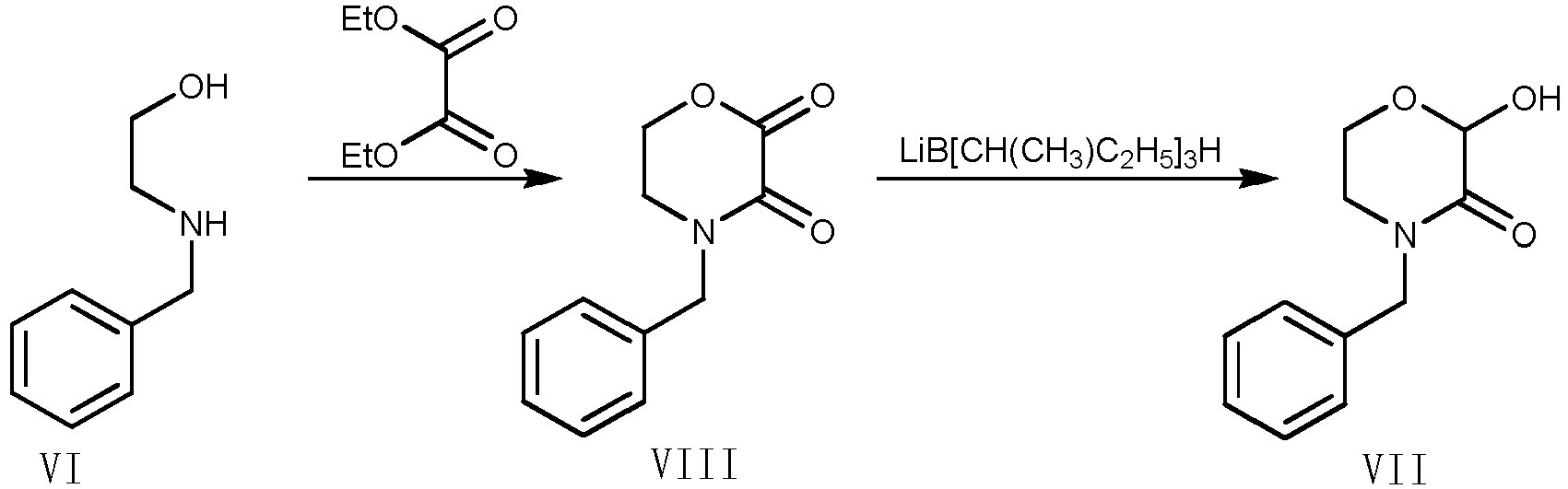
- In the present invention, 4-substituent-2-hydroxymorpholin-3-one is obtained by the condensation reaction of aqueous glyoxalic acid solution and the compound of Formula IV as the starting material. Especially, when electron-withdrawing substituents are bonded to the benzene ring, the yield of 4-substituent-2-hydroxymorpholin-3-one can be enhanced significantly.
- The present invention provides a molecule with neural activities,especially 4-substituent-2-hydroxymorpholin-3-one(I), as a new intermediate of neurokinin-1 receptor antagonist aprepitant, and preparation method thereof. When electron-withdrawing substituents are bonded to the aryl, the yield of 4-substituent-2-hydroxymorpholin-3-one can be enhanced significantly and the reaction time becomes shorter, as compared to the method reported in J. AM. CHEM. SOC. 2003, 125, 2129-2135.
- A class of novel compound, 4-substituent-2-hydroxymorpholin-3-one, has the structure of Formula I:

- (i) groups of Formula II

- R1, R2, and R3 are independently selected from: hydrogen, substituted or unsubstituted C1-C6 alkyl, substituted or unsubstituted C2-C6 alkenyl, C2-C6 alkynyl, substituted or unsubstituted phenyl, halo-, -CN, -CX3 (X is selected from Cl, Br, and F), -NO2, -SR6, -SOR6, -SO2R6, -(CH2)m-NR4R5, -NR4COR5, -NR4CO2R5, -CONR4R5, -COR4, -CO2R4, hydroxyl, and C1-C6 alkoxy; the substituents on the C1-C6 alkyl and C2-C6 alkenyl can be independently selected from: hydroxyl, oxo-, C1-C6 alkoxy, phenyl, -CN, -NO2, halo-, -NR4R5, -NR4COR5, -NR4CO2R5, -CONR4R5, -COR4, and -CO2R4; the substituents on the phenyl can be selected from: hydroxyl, C1-C6 alkyl, C1-C6 alkoxy, C2-C6 alkenyl, halo-, -CN, -NO2, -CF3, -(CH2)m-NR4R5, -NR4COR5, -NR4CO2R5, -CONR4R5, -COR4, and -CO2R4; and R1, R2, and R3 can not be hydrogen at the same time;
- preferably, R1, R2, and R3 are independently selected from: hydrogen, unsubstituted C1-C6 alkyl, C1-C6 alkoxy, halogen, -NO2, -CN, and -CX3 (X is selected from Cl, Br, and F); and R1, R2, and R3 can not be hydrogen at the same time;
- further preferably, R1, R2, and R3 are independently selected from: hydrogen, -NO2, -Cl, and -CF3; and
- R1, R2, and R3 can not be hydrogen at the same time;
- R4 and R5 are independently selected from: hydrogen, C1-C6 alkyl, monohydroxyl substituted C1-C6 alkyl, and phenyl;
- R6 is hydrogen or C1-C6 alkyl;
- m is selected from 1, 2, 3 or 4;
- (ii) groups of Formula III

- R7, R8, and R9 are independently selected from: hydrogen, substituted or unsubstituted C1-C6 alkyl, substituted or unsubstituted C2-C6 alkenyl, C2-C6 alkynyl, substituted or unsubstituted phenyl, halo-, -CN, -CX3 (X is selected from Cl, Br, and F), -NO2, -SR12, -SOR12, -SO2R12, -(CH2)m-NR10R11, -NR10COR11, -NR10CO2R11, -CONR10R11, -COR10, -CO2R10, hydroxyl, and C1-C6 alkoxy; the substituents on the C1-C6 alkyl and C2-C6 alkenyl are each independently selected from: hydroxyl, oxo-, C1-6 alkoxy, phenyl, -CN, -NO2, halo-, -NR10R11, -NR10COR11, -NR10CO2R11, -CONR10R11, -COR10, and -CO2R10; the substituents on the phenyl can be selected from: hydroxyl, C1-C6 alkyl, C1-C6 alkoxy, C2-C6 alkenyl, halo-, -CN, -NO2, -CF3, -(CH2)m-NR10R11, -NR10COR11, -NR10CO2R11, -CONR10R11, -COR10, and -CO2R10;
- preferably, R7, R8, and R9 are independently selected from: hydrogen, unsubstituted C1-C6 alkyl, C1-C6 alkoxy, halogen, -NO2, -CN, and -CX3 (X is selected from Cl, Br, and F); further preferably, R7, R8, and R9 are hydrogen.
- R10 and R11 are independently selected from: hydrogen, C1-C6 alkyl, monohydroxyl substituted C1-C6 alkyl, and phenyl;
- R12 is hydrogen or C1-C6 alkyl;
- m is selected from 1, 2, 3, or 4.
- Particularly, the compound of Formula I above are preferably selected from the following compounds:


- The method for preparing the compound 4-substituent-2-hydroxymorpholin-3-one of Formula I is also encompassed in the present invention, in which the compound of Formula IV as the starting material reacts with the aqueous glyoxalic acid solution to abtain the compound 4-substituent-2-hydroxymorpholin-3-one corresponding to Formula I;
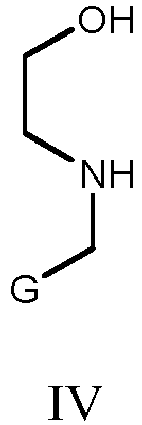
G is selected from: - (i) groups of Formula II
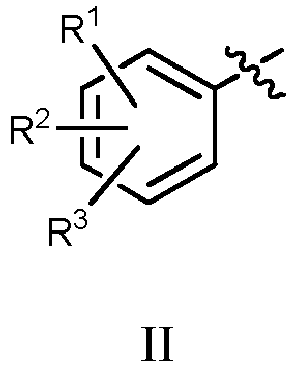
- R1, R2, and R3 are independently selected from: hydrogen, substituted or unsubstituted C1-C6 alkyl, substituted or unsubstituted C2-C6 alkenyl, C2-C6 alkynyl, substituted or unsubstituted phenyl, halo-, -CN, -CX3 (X is selected from Cl, Br, and F), -NO2, -SR6, -SOR6, -SO2R6, -(CH2)m-NR4R5, -NR4COR5, -NR4CO2R5, -CONR4R5, -COR4, -CO2R4, hydroxyl, and C1-C6 alkoxy; the substituents on the C1-C6 alkyl and C2-C6 alkenyl can be independently selected from: hydroxyl, oxo-, C1-C6 alkoxy, phenyl, -CN, -NO2, halo-, -NR4R5, -NR4COR5, -NR4CO2R5, -CONR4R5, -COR4, and -CO2R4; the substituents on the phenyl can be selected from: hydroxyl, C1-C6 alkyl, C1-C6 alkoxy, C2-C6 alkenyl, halo-, -CN, -NO2, -CF3, -(CH2)m-NR4R5, -NR4COR5, -NR4CO2R5, -CONR4R5, -COR4, and -CO2R4; and R1, R2, and R3 can not be hydrogen at the same time;
- R4 and R5 are independently selected from: hydrogen, C1-C6 alkyl, monohydroxyl substituted C1-C6 alkyl, and phenyl;
- R6 is hydrogen or C1-C6 alkyl;
- m is selected from 1, 2, 3 or 4;
- (ii) groups of Formula III

- R7, R8, and R9 are independently selected from: hydrogen, substituted or unsubstituted C1-C6 alkyl, substituted or unsubstituted C2-C6 alkenyl, C2-C6 alkynyl, substituted or unsubstituted phenyl, halo-, -CN, -CX3 (X is selected from Cl, Br, and F), -NO2, -SR12, -SOR12, -SO2R12, -(CH2)m-NR10R11, -NR10COR11, -NR10CO2R11, -CONR10R11, -COR10, -CO2R10, hydroxyl, and C1-C6 alkoxy; the substituents on the C1-C6 alkyl and C1-C6 alkenyl are each independently selected from: hydroxyl, oxo-, C1-C6 alkoxy, phenyl, -CN, -NO2, halo-, -NR10R11, -NR10COR11, -NR10CO2R11, -CONR10R11, -COR10, and -CO2R10; the substituents on the phenyl can be selected from: hydroxyl, C1-C6 alkyl, C1-C6 alkoxy, C2-C6 alkenyl, halo-, -CN, -NO2, -CF3, -(CH2)m-NR10R11, -NR10COR11, -NR10CO2R11, -CONR10R11, -COR10, and -CO2R10;
- R10 and R11 are independently selected from: hydrogen, C1-C6 alkyl, monohydroxyl substituted C1-C6 alkyl, and phenyl;
- R12 is hydrogen or C1-C6 alkyl;
- m is selected from 1, 2, 3 or 4.
- In this method, the higher the electron-withdrawing effect of R1, R2, and R3 on the groups of Formula II is, the higher the yield of 4-substituent-2-hydroxymorpholin-3-one will be obtained.
- The solvent used in the reaction is selected from the group comprising: ethyl acetate, C6-C12 alkane, benzene, toluene, paraxylene, chlorobenzene, orthodichlorobenzene, acetone, dichloromethane, chloroform, nitromethane, N,N-dimethyl formamide, dimethyl sulfoxide, 2-butanone, C1-C6 alcohols, 1,3-dioxane, 1,4-dioxane, tetrahydrofuran, acetonitrile, 1,2-dimethyl ethyl, water and the mixture thereof.
- Preferably, the solvent used in the reaction can be the solvent miscible with water, including acetone, 2-butanone, N,N-dimethyl formamide, dimethyl sulfoxide, C1-C3 alcohols, 1,3-dioxane, 1,4-dioxane, tetrahydrofuran, acetonitrile, 1,2-dimethyl ethyl and the mixture thereof.
- Preferably, the solvent used in the reaction is selected from tetrahydrofuran, acetonitrile and the mixture thereof.
- Preferably, the solvent used in the reaction is selected from tetrahydrofuran.
- The reaction temperature is selected from 30 to 100°C, and preferably 60 to 70°C.
- The aqueous glyoxalic acid solution used in the reaction is selected from the aqueous solution of glyoxalic acid monohydrate, and the aqueous glyoxalic acid solution with a mass ratio of 1-99%, wherein the mass ratio of the aqueous glyoxalic acid solution is preferably 50%.
- The present invention also provides a method for preparing the compound of Formula IX, a key intermediate of aprepitant, which is characterized in that the compound of Formula IX can be prepared using the compound of Formula I as the starting material.

- Specific reaction route is as follows:
- i) the compound of Formula I is reacted with trifluoroacetic anhydride to obtain the compound of Formula X:

- ii) under the catalysis by boron trifluoride, the compound of Formula X is reacted with the compound of Formula XI,
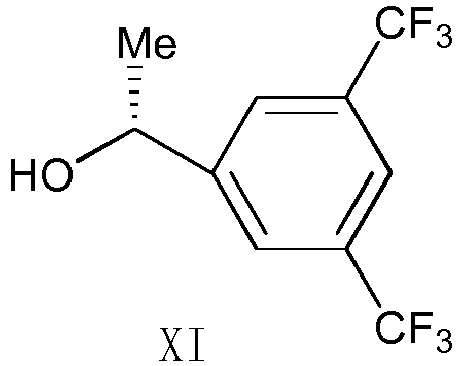

- iii) the compound of Formula XII is chirally transformed in the presence of potassium linaloolate to obtain the compound of formula XIII:

- iv) after reaction with p-fluorophenyl magnesium bromide, the compound of Formula XIII is hydrogenated under the catalysis by palladium/carbon to obtain the compound of Formula IX.
- The reaction equation for preparing the compound of Formula IX from the compound of Formula I is shown below:

- The use of the compound of Formula I in the preparation of aprepitant is also encompassed in the present invention.
- In the present invention, when there are electron-withdrawing substituents on the aryl, the reaction yield and time for the preparation of N-substituted-2-hydroxymorpholin-3-one can be significantly improved, as compared with the method reported in J. AM. CHEM. SOC. 2003, 125, 2129-2135.Additionally, the production cost can be significantly reduced for the preparation of aprepitant.
- 50 wt% aqueous glyoxalic acid solution (46.4 ml, 0.408 mol) (50 wt% referred that the mass ratio of glyoxalic acid is 50%, the same below) and tetrahydrofuran (31 ml) were added into a reaction bottle, and heated up to reflux. Subsequently, 2-(4-nitrobenzylamino)ethanol (40 g, 0.204 mol) in tetrahydrofuran (71 ml) was slowly added dropwise. After the addition, it was refluxed for 8 h. Water (102 ml) is then added. The tetrahydrofuran was removed by evaporation under reduced pressure. The residue was heated until dissolved, and it was then cooled down for crystallization to give 2-hydroxy-4-(4-nitrobenzyl)morpholin-3-one (47.2 g, 91.7%) as a light yellow solid;
TOF-MS (m/z): 253.1 [M+1];
1H-NMR (400MHz, CDCl3) δ: 8.21 (d, J=8.8, 2H), 7.52 (d, J=8.8, 2H), 7.11 (d, J=6.4, 1H), 5.06 (d, J=6.4, 1H), 4.65 (dd, J=43.6, 15.6, 2H), 4.15 (ddd, J=11.6, 11.2, 3.6, 1H), 3.73 (ddd, J=12.0, 4.4, 2.0, 1H), 3.43 (ddd, J=14.8, 12.0, 4.8, 1H), 3.19 (ddd, J=10.8, 3.6, 1.6, 1H). - 50 wt% aqueous glyoxalic acid solution (46.4 ml, 0.408 mol) and tetrahydrofuran (31 ml) were added into a reaction bottle, and heated up to reflux. Subsequently, 2-(3-nitrobenzylamino)ethanol (40 g, 0.204 mol) in tetrahydrofuran (71 ml) was slowly added dropwise. After the addition, it was refluxed for 8 h. Water (102 ml) is then added. The tetrahydrofuran was removed by evaporation under reduced pressure. The residue was heated until dissolved, and it was then cooled down for crystallization to give 2-hydroxy-4-(3-nitrobenzyl)morpholin-3-one (46.5 g, 90.3%) as a light yellow solid;
TOF-MS (m/z): 253.1 [M+1];
1H-NMR (400MHz, CDCl3) δ: 8.11 (d, m, 2H), 7.75 (d, m, 2H), 7.18 (d, J=6.4, 1H), 5.10 (d, J=6.4, 1H), 4.55 (dd, J=65.6, 15.6, 2H), 4.21 (ddd, J=12.0, 11.0, 3.6, 1H), 3.79 (ddd, J=12.0, 4.6, 2.0, 1H), 3.46 (ddd, J=16.0, 12.0, 4.8, 1H), 3.22 (ddd, J=11.2, 3.6, 1.6, 1H). - 50 wt% aqueous glyoxalic acid solution (46.4 ml, 0.408 mol) and tetrahydrofuran (31 ml) were added into a reaction bottle, and heated up to reflux. Subsequently, 2-(2-nitrobenzylamino)ethanol (40 g, 0.204 mol) in tetrahydrofuran (71 ml) was slowly added dropwise. After the addition, it was refluxed for 8 h. Water (102 ml) is then added. The tetrahydrofuran was removed by evaporation under reduced pressure. The residue was heated until dissolved, and it was then cooled down for crystallization to give 2-hydroxy-4-(2-nitrobenzyl)morpholin-3-one (46.1 g,89.5%) as a light yellow solid;
TOF-MS (m/z): 253.1 [M+1];
1H-NMR (400MHz, CDCl3) δ: 8.06 (dd, J=8.0, 1.2, 1H), 7.76 (ddd, J=8.0, 7.2, 0.8, 1H), 7.56 (ddd, J=8.4, 7.2, 0.4, 1H), 7.38 (d, J=8.0, 1H), 7.15 (d, J=6.4, 1H), 5.08 (d, J=6.0, 1H), 4.82 (dd, J=71.2, 15.6, 2H), 4.20 (ddd,J=15.2, 7.6, 4.0,1H), 3.76 (ddd, J=9.6, 7.2, 2.4, 1H), 3.47 (ddd, J=12.0, 10.8, 4.8, 1H), 3.21 (ddd, J=12.4, 3.6, 2.4, 1H). - 50 wt% aqueous glyoxalic acid solution (49.1 ml, 0.431 mol) and tetrahydrofuran (32 ml) were added into a reaction bottle, and heated up to reflux. Subsequently, 2-(2-chlorobenzylamino)ethanol (40 g, 0.215 mol) in tetrahydrofuran (76ml) was slowly added dropwise. After the addition, it was refluxed for 8 h. Water (108 ml) is then added. The tetrahydrofuran was removed by evaporation under reduced pressure. The residue was heated until dissolved, and it was then cooled down for crystallization to give 2-hydroxy-4-(2-chlorobenzyl)morpholin-3-one (41.2 g, 78.9%) as a white solid;
TOF-MS (m/z): 242.2 [M+1];
1H-NMR (400MHz, CDCl3) δ: 7.47 (dd, J=7.6, 1.6, 1H), 7.35 (ddd, 14.4, 7.6, 5.6, 2H), 7.25 (m, 1H), 7.09 (d, J=6.4, 1H), 5.07 (d, J=6.4, 1H), 4.60 (dd, J=42.8, 16.0, 2H), 4.18 (ddd, J=14.8, 11.2, 3.6, 1H), 3.74 (ddd, J=12.0, 4.8, 2.0, 1H), 3.42 (ddd, J=15.2, 10.4, 4.4, 1H), 3.17 (ddd, J=12.4, 4.0, 2.4, 1H). - 50 wt% aqueous glyoxalic acid solution (49.1 ml, 0.431 mol) and tetrahydrofuran (32 ml) were added into a reaction bottle, and heated up to reflux. Subsequently, 2-(3-chlorobenzylamino)ethanol (40 g, 0.215 mol) in tetrahydrofuran (75 ml) was slowly added dropwise. After the addition, it was refluxed for 12 h. Water (108 ml) is then added. The tetrahydrofuran was removed by evaporation under reduced pressure. The residue was heated until dissolved, and it was then cooled down for crystallization to give 2-hydroxy-4-(3-chlorobenzyl)morpholin-3-one (40.2 g, 76.9%) as a white solid;
TOF-MS (m/z): 242.2 [M+1];
1H-NMR (400MHz, CDCl3) δ: 7.51 (m, 2H), 7.33 (m, 2H), 7.12 (d, J=6.2, 1H), 5.08 (d, J=6.2, 1H), 4.54 (dd, J=44.0, 12.2, 2H), 4.14 (ddd, J=16.0, 11.6, 4.0, 1H), 3.69 (ddd, J=12.4, 4.8, 2.4, 1H), 3.38 (ddd, J=12.8, 11.0, 4.8, 1H), 3.20 (ddd, J=12.4, 3.6, 2.4, 1H); - 50 wt% aqueous glyoxalic acid solution (49.1 ml, 0.431 mol) and tetrahydrofuran (32 ml) were added into a reaction bottle, and heated up to reflux. Subsequently, 2-(4-chlorobenzylamino)ethanol (40 g, 0.215 mol) in tetrahydrofuran (75 ml) was slowly added dropwise. After the addition, it was refluxed for 12 h. Water (108 ml) is then added. The tetrahydrofuran was removed by evaporation under reduced pressure. The residue was heated until dissolved, and it was then cooled down for crystallization to give 2-hydroxy-4-(4-chlorobenzyl)morpholin-3-one (40.8 g, 78.1%) as a white solid;
TOF-MS (m/z): 242.2 [M+1];
1H-NMR (400MHz, CDCl3) δ: 7.34 (dd, J=60.8, 8.0, 4H), 7.06 (d, J=6.0, 1H), 5.04 (d, J=6.0, 1H), 4.50 (dd, J=52.0, 15.2, 2H), 4.11 (ddd, J=15.6, 11.2, 4.0, 1H), 3.69 (ddd, J=12.0, 4.8, 2.0, 1H), 3.36 (ddd, J=12.4, 10.8, 4.8, 1H), 3.17 (ddd, J=12.8, 3.6, 2.4, 1H). - 50 wt% aqueous glyoxalic acid solution (41.3 ml, 0.363 mol) and tetrahydrofuran (27 ml) were added into a reaction bottle, and heated up to reflux. Subsequently, 2-(2,4-dichlorobenzylamino)ethanol (40 g, 0.182 mol) in tetrahydrofuran (64 ml) was slowly added dropwise. After the addition, it was refluxed for 8 h. Water (91 ml) is then added. The tetrahydrofuran was removed by evaporation under reduced pressure. The residue was heated until dissolved, and it was then cooled down for crystallization to give 2-hydroxy-4-(2,4-dichlorobenzyl)morpholin-3-one (41.4 g, 82.4%) as a white solid;
TOF-MS (m/z): 276.2 [M+1];
1H-NMR (400MHz, CDCl3) δ: 7.63 (d, J=2.4, 1H), 7.45 (dd, J=8.4, 2.0, 1H), 7.27 (d, J=8.4, 1H), 7.11 (d, J=6.4, 1H), 5.06 (d, J=5.6, 1H), 4.57 (dd, J=47.2, 15.6, 2H), 4.17 (ddd, J=15.6, 10.8, 3.6, 1H), 3.73 (ddd, J=12.0, 4.8, 2.0, 1H), 3.42 (ddd, J=15.6 10.8, 4.8, 1H), 3.18 (ddd, J=12.4, 4.0, 2.4, 1H). - 50 wt% aqueous glyoxalic acid solution (41.5 ml, 0.364 mol) and tetrahydrofuran (27 ml) were added into a reaction bottle, and heated up to reflux. Subsequently, 2-(4-trifluoromethylbenzylamino)ethanol (40 g, 0.182 mol) in tetrahydrofuran (64 ml) was slowly added dropwise. After the addition, it was refluxed for 8 h. After the reaction was finished, water (91 ml) is then added. The tetrahydrofuran was removed by evaporation under reduced pressure. The residue was heated until dissolved, and it was then cooled down for crystallization to give 2-hydroxy-4-(4-trifluoromethylbenzyl)morpholin-3-one (47.8 g, 75.2%) as a white solid;
TOF-MS (m/z): 276.0 [M+1];
1H-NMR (400MHz, CDCl3) δ: 7.71 (d, J=8.8, 1H), 7.47 (d, J=8.0, 1H), 7.07 (d, J=6.4, 1H), 5.06 (d, J=6.4, 1H), 4.60 (dd, J=41.6, 15.2, 2H), 4.14 (ddd, J=15.6, 10.8, 3.6, 1H), 3.71 (ddd, J=12.0, 4.8, 2.4, 1H), 3.40 (ddd, J=15.6 10.8, 4.8, 1H), 3.26 (ddd, J=12.8, 4.0, 2.4, 1H). - 50 wt% aqueous glyoxalic acid solution (41.5 ml, 0.364 mol) and tetrahydrofuran (27 ml) were added into a reaction bottle, and heated up to reflux. Subsequently, 2-(3-trifluoromethylbenzylamino)ethanol (40 g, 0.182 mol) in tetrahydrofuran (64 ml) was slowly added dropwise. After the addition, it was refluxed for 8 h. After the reaction was finished, water (91 ml) is then added. The tetrahydrofuran was removed by evaporation under reduced pressure. The residue was heated until dissolved, and it was then cooled down for crystallization to give 2-hydroxy-4-(3-trifluoromethylbenzyl)morpholin-3-one (48.6 g, 76.8%) as a white solid;
TOF-MS (m/z): 276.0 [M+1];
1H-NMR (400MHz, CDCl3) δ: 7.80 (m, 2H), 7.51 (m, 2H), 7.10 (d, J=6.4, 1H), 5.12 (d, J=6.4, 1H), 4.62 (dd, J=54.6, 15.2, 2H), 4.16 (ddd, J=15.8, 11.2, 3.6, 1H), 3.74 (ddd, J=12.2, 4.8, 2.4, 1H), 3.44 (ddd, J=15.8, 11.0, 4.8, 1H), 3.28 (ddd, J=12.8, 4.4, 2.4, 1H). - 50 wt% aqueous glyoxalic acid solution (41.5 ml, 0.364 mol) and tetrahydrofuran (27 ml) were added into a reaction bottle, and heated up to reflux. Subsequently, 2-(2-trifluoromethylbenzylamino)ethanol (40 g, 0.182 mol) in tetrahydrofuran (64 ml) was slowly added dropwise. After the addition, it was refluxed for 8 h. After the reaction was finished, water (91 ml) is then added. The tetrahydrofuran was removed by evaporation under reduced pressure. The residue was heated until dissolved, and it was then cooled down for crystallization to give 2-hydroxy-4-(2-trifluoromethylbenzyl)morpholin-3-one (52.3 g, 82.9%) as a white solid;
TOF-MS (m/z): 276.0 [M+1];
1H-NMR (400MHz, CDCl3) δ: 7.96 (m, 2H), 7.72 (m, 2H), 7.21 (d, J=6.4, 1H), 5.34 (d, J=6.4, 1H), 4.62 (dd, J=64.2, 14.4, 2H), 4.16 (ddd, J=16.2, 11.0, 4.4, 1H), 3.74 (ddd, J=12.4, 4.6, 2.4, 1H), 3.44 (ddd, J=15.8, 11.0, 4.8, 1H), 3.28 (ddd, J=12.6, 4.6, 2.4, 1H). - 50 wt% aqueous glyoxalic acid solution (45.3 ml, 0.398 mol) and tetrahydrofuran (30 ml) were added into a reaction bottle, and heated up to reflux. Subsequently, 2-(naphth-2-ylmethylamino)ethanol (40 g, 0.199 mol) in tetrahydrofuran (70 ml) was slowly added dropwise. After the addition, it was refluxed for 24 h. Water (100 ml) is then added. The tetrahydrofuran is removed by evaporation under reduced pressure. The residue was heated until dissolved, and it was then cooled down for crystallization to give 2-hydroxy-4-(4-naphth-2-ylmethyl)morpholin-3-one (40.3 g, 78.8%) as a white solid;
TOF-MS (m/z): 258.1 [M+1];
1H-NMR (400MHz, CDCl3) δ: 7.84 (m, 3H), 7.54 (s, 1H), 7.50 (m, 2H), 7.40 (dd, J=8.4, 1.6, 1H), 7.07 (d, J=6.0, 1H), 5.06 (d, J=5.6, 1H), 4.69 (dd, J=31.6, 14.8, 2H), 4.13 (ddd, J=13.5, 9.3, 3.6, 1H), 3.70 (ddd, J=12.0, 4.8, 2.0, 1H), 3.39 (ddd, J=15.6 10.4, 4.8, 1H), 3.26 (ddd, J=12.0, 3.6, 2.4, 1H). - 50 wt% aqueous glyoxalic acid solution (51.7 ml, 0.454 mol) and tetrahydrofuran (34 ml) were added into a reaction bottle, and heated up to reflux. Subsequently, 2-(3-cyanobenzylamino)ethanol (40 g, 0.227 mol) in tetrahydrofuran (79 ml) was slowly added dropwise. After the addition, it was refluxed for 12 h. Water (113 ml) is then added. The tetrahydrofuran is removed by evaporation under reduced pressure. The residue was heated until dissolved, and it was then cooled down for crystallization to give 2-hydroxy-4-(3-cyanobenzyl)morpholin-3-one (37.6 g, 71.4%) as a white solid;
TOF-MS (m/z): 233.1 [M+1];
1H-NMR (400MHz, CDCl3) δ: 7.88 (m, 2H), 7.50 (m, 2H), 7.22 (d, J=8.4, 1H), 5.12 (d, J=6.4, 1H), 4.62 (dd, J=68.8, 15.2, 2H), 4.24 (ddd, J=12.0, 11.2, 4.0, 1H), 3.78 (ddd, J=12.4, 4.8, 2.0, 1H), 3.51 (ddd, J=12.6, 10.6, 4.8, 1H), 3.22 (ddd, J=12.8, 3.6, 2.4, 1H). - 50 wt% aqueous glyoxalic acid solution (51.7 ml, 0.454 mol) and tetrahydrofuran (34 ml) were added into a reaction bottle, and heated up to reflux. Subsequently, 2-(2-cyanobenzylamino)ethanol (40 g, 0.227 mol) in tetrahydrofuran (79 ml) was slowly added dropwise. After the addition, it was refluxed for 12 h. Water (113 ml) is then added. The tetrahydrofuran is removed by evaporation under reduced pressure. The residue was heated until dissolved, and it was then cooled down for crystallization to give 2-hydroxy-4-(2-cyanobenzyl)morpholin-3-one (39.9 g, 75.8%) as a white solid;
TOF-MS (m/z): 233.1 [M+1];
1H-NMR (400MHz, CDCl3) δ: 8.02 (m, 2H), 7.72 (m, 2H), 7.36 (d, J=8.6, 1H), 5.22 (d, J=6.8, 1H), 4.74 (dd, J=72.6, 15.8, 2H), 4.36 (ddd, J=12.4, 11.4, 4.0, 1H), 3.94 (ddd, J=12.0, 4.6, 2.0, 1H), 3.69 (ddd, J=12.4, 10.6, 4.2, 1H), 3.31 (ddd, J=12.6, 3.4, 2.4, 1H). - 50 wt% aqueous glyoxalic acid solution (55.1 ml, 0.484 mol) and tetrahydrofuran (36 ml) were added into a reaction bottle, and heated up to reflux. Subsequently, 2-(4-methylbenzylamino)ethanol (40 g, 0.242 mol) in tetrahydrofuran (85 ml) was slowly added dropwise. After the addition, it was refluxed for 18 h. Water (121 ml) is then added. The tetrahydrofuran is removed by evaporation under reduced pressure. The residue was heated until dissolved, and it was then cooled down for crystallization to give 2-hydroxy-4-(4-methylbenzyl)morpholin-3-one (31.2 g, 58.3%) as a white solid;
TOF-MS (m/z): 222.1 [M+1];
1H-NMR (400MHz, CDCl3) δ: 7.13 (dd, J=19.6, 8.4, 4H), 7.02 (s, 1H), 5.03 (s, 1H), 4.47 (dd, J=44.0, 14.4, 2H), 4.08 (ddd, J=12.0, 11.6, 4.0, 1H), 3.68 (ddd, J=9.6, 4.8, 2.4, 1H), 3.30 (ddd, J=12.4, 10.8, 5.2, 1H), 3.08 (ddd, J=10.4, 3.6, 2.0, 1H). - 50 wt% aqueous glyoxalic acid solution (50.3 ml, 0.442 mol) and tetrahydrofuran (33 ml) were added into a reaction bottle, and heated up to reflux. Subsequently, 2-(4-methoxylbenzylamino)ethanol (40 g, 0.221 mol) in tetrahydrofuran (78 ml) was slowly added dropwise. After the addition, it was refluxed for 18 h. Water (100 ml) is then added. The tetrahydrofuran is removed by evaporation under reduced pressure. The residue was heated until dissolved, and it was then cooled down for crystallization to give 2-hydroxy-4-(4-methoxylbenzyl)morpholin-3-one (23.4 g, 44.7%) as a white solid;
TOF-MS (m/z): 238.1 [M+1];
1H-NMR (400MHz, CDCl3) δ: 7.18 (d, J=8.8, 2H), 7.06 (d, J=1.6, 1H), 6.90 (d, J=8.8, 2H), 5.01 (d, J=6.4, 1H), 4.43 (dd, J=22.8, 14.4, 2H), 4.06 (ddd, J=11.6, 11.2, 4.0, 1H), 3.73 (s, 3H), 3.67 (ddd, J=12.0, 4.8, 2.0, 1H), 3.30 (ddd, J=12.4, 11.2, 4.8, 1H), 3.08 (ddd, J=12.4, 3.6, 2.0, 1H). - 50 wt% aqueous glyoxalic acid solution (50.3 ml, 0.442 mol) and tetrahydrofuran (33 ml) were added into a reaction bottle, and heated up to reflux. Subsequently, 2-(2-methoxylbenzylamino)ethanol (40 g, 0.221 mol) in tetrahydrofuran (78 ml) was slowly added dropwise. After the addition, it was refluxed for 18 h. Water (100 ml) is then added. The tetrahydrofuran is removed by evaporation under reduced pressure. The residue was heated until dissolved, and it was then cooled down for crystallization to give 2-hydroxy-4-(2-methoxylbenzyl)morpholin-3-one (14.3 g, 27.2%) as a white solid;
TOF-MS (m/z): 238.1 [M+1];
1H-NMR (400MHz, CDCl3) δ: 7.25 (m, 1H), 7.07 (d, J=7.6, 1H), 6.99 (d, J=8.0, 1H), 6.91 (t, J=7.6, 1H), 5.01 (s, 1H), 4.43 (dd, J=38.8, 15.2, 2H), 4.10 (ddd, J=11.6, 11.2, 4.0, 1H), 3.77 (s, 3H), 3.67 (ddd, J=12.0, 3.6, 2.0, 1H), 3.36 (ddd, J=12.8, 10.4, 5.2, 1H), 3.12 (ddd, J=10.0, 6.0 2.4, 1H). - 50 wt% aqueous glyoxalic acid solution (55.1 ml, 0.484 mol) and tetrahydrofuran (36 ml) were added into a reaction bottle, and heated up to reflux. Subsequently, 2-(3-methylbenzylamino)ethanol (40 g, 0.242 mol) in tetrahydrofuran (85 ml) was slowly added dropwise. After the addition, it was refluxed for 24 h. Water (121 ml) is then added. The tetrahydrofuran is removed by evaporation under reduced pressure. The residue was heated until dissolved, and it was then cooled down for crystallization to give 2-hydroxy-4-(3-methylbenzyl)morpholin-3-one (10.3 g, 19.3%) as a white solid;
TOF-MS (m/z): 222.1 [M+1];
1H-NMR (400MHz, CDCl3) δ: 7.24 (m, 2H), 7.02 (m, 1H), 5.33 (s, 1H), 4.57 (dd, J=80.4, 14.8, 2H), 4.23 (ddd, J=14.0, 10.4, 4.0, 1H), 4.12 (s, 1H), 3.67 (ddd, J=11.6, 4.4, 3.2, 1H), 3.42 (ddd, J=12.4, 10.4, 4.4, 1H), 3.27 (s, 1H), 3.08 (ddd, J=10.8, 4.8, 3.6, 1H). - 50 wt% aqueous glyoxalic acid solution (43.1 ml, 0.379 mol) and tetrahydrofuran (28 ml) were added into a reaction bottle, and heated up to reflux. Subsequently, 2-(2,4-dimethoxybenzylamino)ethanol (40 g, 0.189 mol) in tetrahydrofuran (67 ml) was slowly added dropwise. After the addition, it was refluxed for 24 h. Water (95 ml) is then added. The tetrahydrofuran is removed by evaporation under reduced pressure. The residue was heated until dissolved, and it was then cooled down for crystallization to give 2-hydroxy-4-(2,4-dimethoxybenzyl)morpholin-3-one (9.75 g, 19.3%) as a white solid;
TOF-MS (m/z): 268.1 [M+1];
1H-NMR (400MHz, CDCl3) δ: 7.19 (d, J=8.8, 1H), 6.46 (m, 2H), 5.25 (d, J=2.8, 1H), 4.57 (dd, J=30.8, 14.0, 2H), 4.18 (ddd, J=14.0, 10.0, 4.0, 1H), 3.80 (s, 6H), 3.67 (ddd, J=10.8, 6.2, 4.0, 1H), 3.42 (ddd, J=12.8, 9.6, 4.4, 1H), 3. 19 (ddd, J=10.0, 6.0, 4.0, 1H). - 10 wt% aqueous glyoxalic acid solution (232.0 ml, 0.408 mol) and tetrahydrofuran (31 ml) were added into a reaction bottle, and heated up to reflux. Subsequently, 2-(4-nitrobenzylamino)ethanol (40 g, 0.204 mol) in tetrahydrofuran (71 ml) was slowly added dropwise. After the addition, it was refluxed for 8 h. Water (102 ml) is then added. The tetrahydrofuran is removed by evaporation under reduced pressure. The residue was heated until dissolved, and it was then cooled down for crystallization to give 2-hydroxy-4-(4-nitrobenzyl)morpholin-3-one (40.3 g, 78.3%) as a light yellow solid.
TOF-MS (m/z): 253.1 [M+1];
1H-NMR (400MHz, CDCl3) δ: 8.22 (d, J=8.8, 2H), 7.51 (d, J=8.8, 2H), 7.11 (d, J=6.4, 1H), 5.08 (d, J=6.4, 1H), 4.65 (dd, J=43.6, 15.6, 2H), 4.15 (ddd, J=11.6, 11.2, 3.6, 1H), 3.72 (ddd, J=12.0, 4.4, 2.0, 1H), 3.42 (ddd, J=14.8, 12.0, 4.8, 1H), 3.19 (ddd, J=10.8, 3.6, 1.6, 1H). - 30 wt% aqueous glyoxalic acid solution (77.3 ml, 0.408 mol) and tetrahydrofuran (31 ml) were added into a reaction bottle, and heated up to reflux. Subsequently, 2-(4-nitrobenzylamino)ethanol (40 g, 0.204 mol) in tetrahydrofuran (71 ml) was slowly added dropwise. After the addition, it was refluxed for 8 h. Water (102 ml) is then added. The tetrahydrofuran is removed by evaporation under reduced pressure. The residue was heated until dissolved, and it was then cooled down for crystallization to give 2-hydroxy-4-(4-nitrobenzyl)morpholin-3-one (43.0 g, 83.6%) as a light yellow solid.
TOF-MS (m/z): 253.1 [M+1];
1H-NMR (400MHz, CDCl3) δ: 8.20 (d, J=8.8, 2H), 7.51 (d, J=8.8, 2H), 7.11 (d, J=6.4, 1H), 5.08 (d, J=6.4, 1H), 4.66 (dd, J=43.6, 15.6, 2H), 4.15 (ddd, J=11.6, 11.2, 3.6, 1H), 3.70 (ddd, J=12.0, 4.4, 2.0, 1H), 3.40 (ddd, J=14.8, 12.0, 4.8, 1H), 3.20 (ddd, J=10.8, 3.6, 1.6, 1H). - 70 wt% aqueous glyoxalic acid solution (33.1 ml, 0.408 mol) and tetrahydrofuran (31 ml) were added into a reaction bottle, and heated up to reflux. Subsequently, 2-(4-nitrobenzylamino)ethanol (40 g, 0.204 mol) in tetrahydrofuran (71 ml) was slowly added dropwise. After the addition, it was refluxed for 8 h. Water (102 ml) is then added. The tetrahydrofuran is removed by evaporation under reduced pressure. The residue was heated until dissolved, and it was then cooled down for crystallization to give 2-hydroxy-4-(4-nitrobenzyl)morpholin-3-one (41.5 g, 80.7%) as a light yellow solid.
TOF-MS (m/z): 253.1 [M+1];
1H-NMR (400MHz, CDCl3) δ: 8.21 (d, J=8.8, 2H), 7.52 (d, J=8.8, 2H), 7.13 (d, J=6.4, 1H), 5.08 (d, J=6.4, 1H), 4.65 (dd, J=43.8, 15.6, 2H), 4.17 (ddd, J=11.6, 11.2, 3.6, 1H), 3.72 (ddd, J=12.0, 4.4, 2.0, 1H), 3.42 (ddd, J=14.6, 12.0, 4.8, 1H), 3.17 (ddd, J=10.8, 3.6, 1.6, 1H). - 90 wt% aqueous glyoxalic acid solution (25.8 ml, 0.408 mol) and tetrahydrofuran (31 ml) were added into a reaction bottle, and heated up to reflux. Subsequently, 2-(4-nitrobenzylamino)ethanol (40 g, 0.204 mol) in tetrahydrofuran (71 ml) was slowly added dropwise. After the addition, it was refluxed for 8 h. Water (102 ml) is then added. The tetrahydrofuran is removed by evaporation under reduced pressure. The residue was heated until dissolved, and it was then cooled down for crystallization to give 2-hydroxy-4-(4-nitrobenzyl)morpholin-3-one (37.8 g, 73.4%) as a light yellow solid.
TOF-MS (m/z): 253.1 [M+1];
1H-NMR (400MHz, CDCl3) δ: 8.20 (d, J=8.6, 2H), 7.51 (d, J=8.8, 2H), 7.14 (d, J=6.4, 1H), 5.08 (d, J=6.4, 1H), 4.66 (dd, J=43.6, 15.6, 2H), 4.14 (ddd, J=11.6, 11.2, 3.6, 1H), 3.72 (ddd, J=12.0, 4.4, 2.0, 1H), 3.42 (ddd, J=14.8, 12.0, 4.8, 1H), 3.19 (ddd, J=10.8, 3.6, 1.6, 1H).
Claims (9)
- A novel compound 4-substituent-2-hydroxymorpholin-3-one of Formula I:

G is selected from the group consisting of:(i) groups of Formula II R1, R2, and R3 are independently selected from: hydrogen, substituted or unsubstituted C1-C6 alkyl, substituted or unsubstituted C2-C6 alkenyl, C2-C6 alkynyl, substituted or unsubstituted phenyl, halo-, -CN, -CX3, -NO2, -SR6, -SOR6, -SO2R6, -(CH2)m-NR4R5, -NR4COR5, -NR4CO2R5, -CONR4R5, -COR4, -CO2R4, hydroxyl, and C1-C6 alkoxy; the substituents on the C1-C6 alkyl and C2-C6 alkenyl can be independently selected from: hydroxyl, oxo-, C1-C6 alkoxy, phenyl, -CN, -NO2, halo-, -NR4R5, -NR4COR5, -NR4CO2R5, -CONR4R5, -COR4, and -CO2R4; the substituents on the phenyl can be selected from: hydroxyl, C1-C6 alkyl, C1-C6 alkoxy, C2-C6 alkenyl, halo-, -CN, -NO2, -CF3, -(CH2)m-NR4R5, -NR4COR5, -NR4CO2R5, -CONR4R5, -COR4, and -CO2R4; and R1, R2, and R3 can not be hydrogen at the same time;R4 and R5 are independently selected from: hydrogen, C1-C6 alkyl, monohydroxyl substituted C1-C6 alkyl, and phenyl;R6 is hydrogen or C1-C6 alkyl;X is selected from Cl, Br, and F;m is selected from 1, 2, 3 or 4;(ii) groups of Formula III
 R7, R8, and R9 are independently selected from: hydrogen, substituted or unsubstituted C1-C6 alkyl, substituted or unsubstituted C2-C6 alkenyl, C2-C6 alkynyl, substituted or unsubstituted phenyl, halo-, -CN, -CX3, -NO2, -SR12, -SOR12, -SO2R12, -(CH2)m-NR10R11, -NR10COR11, -NR10CO2R11, -CONR10R11, -COR10, -CO2R10, hydroxyl, and C1-C6 alkoxy; the substituents on the C1-C6 alkyl and C2-C6 alkenyl are each independently selected from: hydroxyl, oxo-, C1-C6 alkoxy, phenyl, -CN, -NO2, halo-, -NR10R11, -NR10COR11, -NR10CO2R11, -CONR10R11, -COR10, and -CO2R10; the substituents on the phenyl can be selected from: hydroxyl, C1-C6 alkyl, C1-C6 alkoxy, C2-C6 alkenyl, halo-, -CN, -NO2, -CF3, -(CH2)m-NR10R11, -NR10COR11, -NR10CO2R11, -CONR10R11, -COR10, and -CO2R10;R10 and R11 are independently selected from: hydrogen, C1-C6 alkyl, monohydroxyl substituted C1-C6 alkyl, and phenyl;R12 is hydrogen or C1-C6 alkyl;X is selected from Cl, Br, and F;m is selected from 1, 2, 3 or 4.
 - The compound according to claim 1, which is characterized in that,
G is selected from(i) groups of Formula II
R1, R2, and R3 are independently selected from: hydrogen, unsubstituted C1-C6 alkyl, C1-C6 alkoxy, halogen, -NO2, -CN, and -CX3, wherein, X is selected from Cl, Br, and F; and R1, R2, and R3 can not be hydrogen at the same time;(ii) groups of Formula IIIR7, R8, and R9 are independently selected from: hydrogen, unsubstituted C1-C6 alkyl, C1-C6 alkoxy, halogen, -NO2, -CN, and -CX3, wherein, X is selected from Cl, Br, and F.
- The compound according to claim 1, which is characterized in that,
G is selected from(i) groups of Formula II (ii) groups of Formula III
- The compound of Formula I according to claim 1, which is selected from the following compounds:


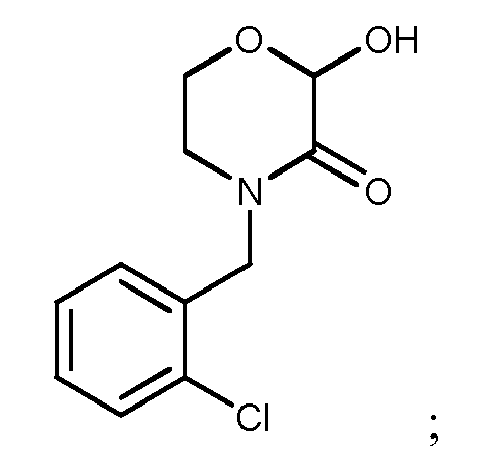
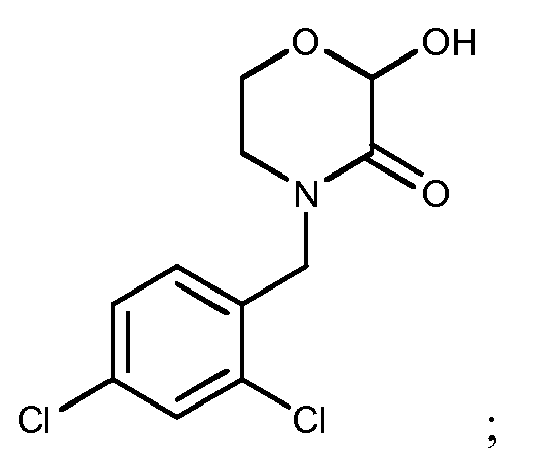


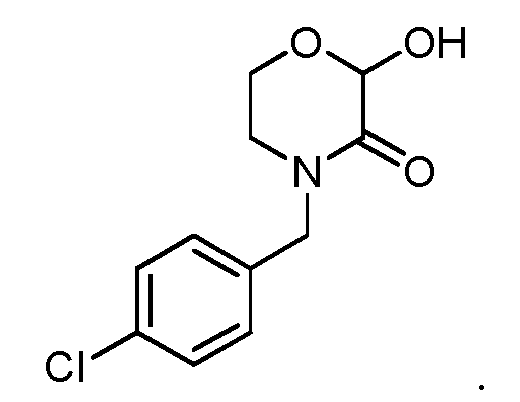
- A method for preparing the compound according to claim 1, wherein the compound 4-substituent-2-hydroxymorpholin-3-one corresponding to Formula I is prepared by reacting the compound of the structure as shown in the following Formula IV as raw material with an aqueous glyoxalic acid solution,

G is selected from:(i) groups of Formula II R1, R2, and R3 are independently selected from: hydrogen, substituted or unsubstituted C1-C6 alkyl, substituted or unsubstituted C2-C6 alkenyl, C2-C6 alkynyl, substituted or unsubstituted phenyl, halo-, -CN, -CX3, -NO2, -SR6, -SOR6, -SO2R6, -(CH2)m-NR4R5, -NR4COR5, -NR4CO2R5, -CONR4R5, -COR4, -CO2R4, hydroxyl, and C1-C6 alkoxy; the substituents on the C1-C6 alkyl and C2-C6 alkenyl can be independently selected from: hydroxyl, oxo-, C1-C6 alkoxy, phenyl, -CN, -NO2, halo-, -NR4R5, -NR4COR5, -NR4CO2R5, -CONR4R5, -COR4, and -CO2R4; the substituents on the phenyl can be selected from: hydroxyl, C1-C6 alkyl, C1-C6 alkoxy, C2-C6 alkenyl, halo-, -CN, -NO2, -CF3, -(CH2)m-NR4R5, -NR4COR5, -NR4CO2R5, -CONR4R5, -COR4, and -CO2R4; and R1, R2, and R3 can not be hydrogen at the same time;R4 and R5 are independently selected from: hydrogen, C1-C6 alkyl, monohydroxyl substituted C1-C6 alkyl, and phenyl;R6 is hydrogen or C1-C6 alkyl;X is selected from Cl, Br, and F;m is selected from 1, 2, 3 or 4;(ii) groups of Formula III
 R7, R8, and R9 are independently selected from: hydrogen, substituted or unsubstituted C1-C6 alkyl, substituted or unsubstituted C2-C6 alkenyl, C2-C6 alkynyl, substituted or unsubstituted phenyl, halo-, -CN, -CX3, -NO2, -SR12, -SOR12, -SO2R12, -(CH2)m-NR10R11, -NR10COR11, -NR10CO2R11, -CONR10R11, -COR10, -CO2R10, hydroxyl, and C1-C6 alkoxy; the substituents on the C1-C6 alkyl and C1-C6 alkenyl are each independently selected from: hydroxyl, oxo-, C1-C6 alkoxy, phenyl, -CN, -NO2, halo-, -NR10R11, -NR10COR11, -NR10CO2R11, -CONR10R11, -COR10, and -CO2R10; the substituents on the phenyl can be selected from: hydroxyl, C1-C6 alkyl, C1-C6 alkoxy, C2-C6 alkenyl, halo-, -CN, -NO2, -CF3, -(CH2)m-NR10R11, -NR10COR11, -NR10CO2R11, -CONR10R11, -COR10, and -CO2R10;R10 and R11 are independently selected from: hydrogen, C1-C6 alkyl, monohydroxyl substituted C1-C6 alkyl, and phenyl;R12 is hydrogen or C1-C6 alkyl;X is selected from Cl, Br, and F;m is selected from 1, 2, 3 or 4.
 - The method according to claim 5, which is characterized in that the solvent used in the reaction is selected from the group consisting of: ethyl acetate, C6-C12 alkane, benzene, toluene, paraxylene, chlorobenzene, orthodichlorobenzene, acetone, dichloromethane, chloroform, nitromethane, N,N-dimethyl formamide, dimethyl sulfoxide, 2-butanone, C1-C6 alcohols, 1,3-dioxane, 1,4-dioxane, tetrahydrofuran, acetonitrile, 1,2-dimethyl ethyl, water and the mixture thereof; and preferably, the solvent is selected from the solvent miscible with water, including N,N-dimethyl formamide, dimethyl sulfoxide, 2-butanone, C1-C6 alcohols, 1,3-dioxane, 1,4-dioxane, tetrahydrofuran, acetonitrile, 1,2-dimethyl ethyl and a mixture thereof; and more preferably, the solvent is selected from tetrahydrofuran, acetonitrile and the mixture thereof; and most preferably, the solvent is tetrahydrofuran.
- The method according to claim 5, which is characterized in that the reaction temperature for the method is from 30 to 100°C; and preferably, is from 60 to 70°C.
- The method according to claim 5, which is characterized in that the aqueous glyoxalic acid solution used in the method is selected from an aqueous solution of glyoxalic acid monohydrate, and an aqueous glyoxalic acid solution with a mass ratio of 1-99%; and preferably, the mass ratio of the aqueous glyoxalic acid solution is 50%.
- Use of the compound according to claim 1 in the preparation of aprepitant.
Applications Claiming Priority (2)
| Application Number | Priority Date | Filing Date | Title |
|---|---|---|---|
| CN201210112140.9A CN102675240B (en) | 2012-04-13 | 2012-04-13 | 4-substitute-2-hydroxy morpholine-3-ketone and preparation method thereof |
| PCT/CN2013/074202 WO2013152741A1 (en) | 2012-04-13 | 2013-04-15 | 4-substituent-2-hydroxylmorpholine-3-one and preparation method thereof |
Publications (3)
| Publication Number | Publication Date |
|---|---|
| EP2837624A1 true EP2837624A1 (en) | 2015-02-18 |
| EP2837624A4 EP2837624A4 (en) | 2015-09-09 |
| EP2837624B1 EP2837624B1 (en) | 2018-06-27 |
Family
ID=46807859
Family Applications (1)
| Application Number | Title | Priority Date | Filing Date |
|---|---|---|---|
| EP13775919.7A Not-in-force EP2837624B1 (en) | 2012-04-13 | 2013-04-15 | 4-substituent-2-hydroxylmorpholine-3-one and preparation method thereof |
Country Status (5)
| Country | Link |
|---|---|
| US (1) | US9676736B2 (en) |
| EP (1) | EP2837624B1 (en) |
| JP (1) | JP6063557B2 (en) |
| CN (1) | CN102675240B (en) |
| WO (1) | WO2013152741A1 (en) |
Families Citing this family (4)
| Publication number | Priority date | Publication date | Assignee | Title |
|---|---|---|---|---|
| CN102675240B (en) * | 2012-04-13 | 2015-01-14 | 浙江海正药业股份有限公司 | 4-substitute-2-hydroxy morpholine-3-ketone and preparation method thereof |
| CN103288813A (en) * | 2013-06-04 | 2013-09-11 | 四川百利药业有限责任公司 | Preparation method of aprepitant |
| CN105399672B (en) * | 2014-09-16 | 2019-01-25 | 昶凡生物科技(上海)有限公司 | The synthetic method of invertibity acetylcholinesterase inhibitor huperzine |
| CN110483436B (en) * | 2019-09-19 | 2021-07-16 | 西安凯立新材料股份有限公司 | Method for preparing 4-benzyl-2-hydroxy-morpholine-3-one |
Family Cites Families (9)
| Publication number | Priority date | Publication date | Assignee | Title |
|---|---|---|---|---|
| AU2001266689A1 (en) * | 2000-06-08 | 2001-12-17 | Merck And Co., Inc. | 4-benzyl-2-hydroxy-1,4-oxazin-3-one and polymorphic forms thereof |
| AU2001266690A1 (en) * | 2000-06-08 | 2001-12-17 | Merck And Co., Inc. | Process for the synthesis of (2r, 2-alpha-r)-4-benzyl-2-(1-(3,5-bis(trifluoromethyl)phenyl) ethoxy)-1,4-oxazin-3-one |
| AR030284A1 (en) * | 2000-06-08 | 2003-08-20 | Merck & Co Inc | PROCESS FOR THE SYNTHESIS OF (2R, 2-ALFA-R, 3A) -2- [1- (3,5-BIS (TRIFLUOROMETIL) PHENYL) ETOXI] -3- (4-FLUOROPHENIL) -1,4-OXAZINE; SUCH COMPOUND AND ITS POLYMORPHIC FORMS |
| WO2001096319A1 (en) * | 2000-06-09 | 2001-12-20 | Merck & Co., Inc. | Trans-glycosidation process for the synthesis of (2r, 2-alpha-r, 3a)-2-[1-(3,5-bis(trifluoromethyl)phenyl)ethoxy]-3-(4-fluorophenyl)-1,4-oxazine |
| MY144960A (en) | 2005-11-24 | 2011-11-30 | Eisai R&D Man Co Ltd | Morpholine type cinnamide compound |
| CN101312965B (en) * | 2005-11-24 | 2011-07-20 | 卫材R&D管理有限公司 | Morpholine type cinnamamide compound |
| SI2260029T1 (en) * | 2008-02-26 | 2015-01-30 | Sandoz Ag | Preparation of morpholine derivatives |
| CN102153522B (en) * | 2010-03-29 | 2014-06-18 | 武汉启瑞药业有限公司 | Novel method for preparing N-substituted 2-hydroxy-morpholin-3-one compound |
| CN102675240B (en) * | 2012-04-13 | 2015-01-14 | 浙江海正药业股份有限公司 | 4-substitute-2-hydroxy morpholine-3-ketone and preparation method thereof |
-
2012
- 2012-04-13 CN CN201210112140.9A patent/CN102675240B/en not_active Expired - Fee Related
-
2013
- 2013-04-15 WO PCT/CN2013/074202 patent/WO2013152741A1/en not_active Ceased
- 2013-04-15 US US14/394,041 patent/US9676736B2/en active Active
- 2013-04-15 JP JP2015504859A patent/JP6063557B2/en active Active
- 2013-04-15 EP EP13775919.7A patent/EP2837624B1/en not_active Not-in-force
Also Published As
| Publication number | Publication date |
|---|---|
| CN102675240B (en) | 2015-01-14 |
| JP2015512921A (en) | 2015-04-30 |
| EP2837624B1 (en) | 2018-06-27 |
| US20150087828A1 (en) | 2015-03-26 |
| US9676736B2 (en) | 2017-06-13 |
| JP6063557B2 (en) | 2017-01-18 |
| WO2013152741A1 (en) | 2013-10-17 |
| EP2837624A4 (en) | 2015-09-09 |
| CN102675240A (en) | 2012-09-19 |
Similar Documents
| Publication | Publication Date | Title |
|---|---|---|
| US7598378B2 (en) | Method for the production of 4-(4-aminophenyl)-3-morpholinone | |
| EP2837624B1 (en) | 4-substituent-2-hydroxylmorpholine-3-one and preparation method thereof | |
| EP2837628B1 (en) | Method for preparing rivaroxaban intermediate | |
| Yang et al. | Room temperature iron (ii)-catalyzed radical cyclization of unsaturated oximes with hypervalent iodine reagents | |
| US5925789A (en) | Asymmetric synthesis of benzoxazinones | |
| HU225655B1 (en) | Process for asymmetric synthesis of benzoxazinones | |
| Kakaei et al. | Synthesis of (2-alkylthiothiazolin-5-yl) methyl dodecanoates via tandem radical reaction | |
| CN104169279A (en) | (1R,4R) 7-oxo-2-azabicyclo[2.2.2]oct-5-ene and its derivatives | |
| US8420808B2 (en) | Process for the preparation of efavirenz | |
| WO2012041263A2 (en) | A method of manufacturing 2-({(5s)-2-oxo-3-[4-(3-oxo-4-morpholinyl)phenyl]- l,3-oxazolidin-5-yl}methyl)-lh-isoindol-l,3(2h)-dione with a high optical purity | |
| EP2627643A1 (en) | Process for the synthesis of cyclic carbamates | |
| US7423146B2 (en) | Process for the manufacturing of pharmaceutically active 3,1-benzoxazine-2-ones | |
| EP2627627B1 (en) | Process for the synthesis of chiral propargylic alcohols | |
| US8378143B2 (en) | Methods of making Efavirens and intermediates thereof | |
| EP2441759A1 (en) | Process for the synthesis of cyclic carbamates | |
| JP4867350B2 (en) | Process for producing 4-substituted-4-cyanotetrahydropyran compounds | |
| KR20080023730A (en) | Novel Pyrocatechin Derivatives | |
| WO2016170542A1 (en) | Process for preparation of vilazodone, novel intermediates thereof and novel crystalline form thereof | |
| Kobayashi et al. | Synthesis of 1, 4-dihydro-2H-3, 1-benzoxazin-2-ones by hydriodic acid mediated cyclization of t-butyl 2-vinylphenylcarbamates | |
| EP3448837A1 (en) | Process for the preparation of herbicidal pyridinylimidazolone compounds | |
| EP2229355B1 (en) | Method for preparing azetidine derivatives | |
| JP2004217598A (en) | Optically active isoxazoline derivative and method for producing the same |
Legal Events
| Date | Code | Title | Description |
|---|---|---|---|
| PUAI | Public reference made under article 153(3) epc to a published international application that has entered the european phase |
Free format text: ORIGINAL CODE: 0009012 |
|
| 17P | Request for examination filed |
Effective date: 20141106 |
|
| AK | Designated contracting states |
Kind code of ref document: A1 Designated state(s): AL AT BE BG CH CY CZ DE DK EE ES FI FR GB GR HR HU IE IS IT LI LT LU LV MC MK MT NL NO PL PT RO RS SE SI SK SM TR |
|
| AX | Request for extension of the european patent |
Extension state: BA ME |
|
| DAX | Request for extension of the european patent (deleted) | ||
| RA4 | Supplementary search report drawn up and despatched (corrected) |
Effective date: 20150807 |
|
| RIC1 | Information provided on ipc code assigned before grant |
Ipc: C07D 265/32 20060101AFI20150731BHEP Ipc: C07D 413/06 20060101ALI20150731BHEP |
|
| STAA | Information on the status of an ep patent application or granted ep patent |
Free format text: STATUS: EXAMINATION IS IN PROGRESS |
|
| 17Q | First examination report despatched |
Effective date: 20170717 |
|
| GRAP | Despatch of communication of intention to grant a patent |
Free format text: ORIGINAL CODE: EPIDOSNIGR1 |
|
| STAA | Information on the status of an ep patent application or granted ep patent |
Free format text: STATUS: GRANT OF PATENT IS INTENDED |
|
| INTG | Intention to grant announced |
Effective date: 20180105 |
|
| GRAS | Grant fee paid |
Free format text: ORIGINAL CODE: EPIDOSNIGR3 |
|
| GRAA | (expected) grant |
Free format text: ORIGINAL CODE: 0009210 |
|
| STAA | Information on the status of an ep patent application or granted ep patent |
Free format text: STATUS: THE PATENT HAS BEEN GRANTED |
|
| AK | Designated contracting states |
Kind code of ref document: B1 Designated state(s): AL AT BE BG CH CY CZ DE DK EE ES FI FR GB GR HR HU IE IS IT LI LT LU LV MC MK MT NL NO PL PT RO RS SE SI SK SM TR |
|
| REG | Reference to a national code |
Ref country code: GB Ref legal event code: FG4D |
|
| REG | Reference to a national code |
Ref country code: AT Ref legal event code: REF Ref document number: 1012205 Country of ref document: AT Kind code of ref document: T Effective date: 20180715 |
|
| REG | Reference to a national code |
Ref country code: IE Ref legal event code: FG4D |
|
| REG | Reference to a national code |
Ref country code: DE Ref legal event code: R096 Ref document number: 602013039454 Country of ref document: DE |
|
| PG25 | Lapsed in a contracting state [announced via postgrant information from national office to epo] |
Ref country code: BG Free format text: LAPSE BECAUSE OF FAILURE TO SUBMIT A TRANSLATION OF THE DESCRIPTION OR TO PAY THE FEE WITHIN THE PRESCRIBED TIME-LIMIT Effective date: 20180927 Ref country code: LT Free format text: LAPSE BECAUSE OF FAILURE TO SUBMIT A TRANSLATION OF THE DESCRIPTION OR TO PAY THE FEE WITHIN THE PRESCRIBED TIME-LIMIT Effective date: 20180627 Ref country code: FI Free format text: LAPSE BECAUSE OF FAILURE TO SUBMIT A TRANSLATION OF THE DESCRIPTION OR TO PAY THE FEE WITHIN THE PRESCRIBED TIME-LIMIT Effective date: 20180627 Ref country code: SE Free format text: LAPSE BECAUSE OF FAILURE TO SUBMIT A TRANSLATION OF THE DESCRIPTION OR TO PAY THE FEE WITHIN THE PRESCRIBED TIME-LIMIT Effective date: 20180627 Ref country code: NO Free format text: LAPSE BECAUSE OF FAILURE TO SUBMIT A TRANSLATION OF THE DESCRIPTION OR TO PAY THE FEE WITHIN THE PRESCRIBED TIME-LIMIT Effective date: 20180927 |
|
| REG | Reference to a national code |
Ref country code: NL Ref legal event code: MP Effective date: 20180627 |
|
| REG | Reference to a national code |
Ref country code: LT Ref legal event code: MG4D |
|
| PG25 | Lapsed in a contracting state [announced via postgrant information from national office to epo] |
Ref country code: HR Free format text: LAPSE BECAUSE OF FAILURE TO SUBMIT A TRANSLATION OF THE DESCRIPTION OR TO PAY THE FEE WITHIN THE PRESCRIBED TIME-LIMIT Effective date: 20180627 Ref country code: RS Free format text: LAPSE BECAUSE OF FAILURE TO SUBMIT A TRANSLATION OF THE DESCRIPTION OR TO PAY THE FEE WITHIN THE PRESCRIBED TIME-LIMIT Effective date: 20180627 Ref country code: GR Free format text: LAPSE BECAUSE OF FAILURE TO SUBMIT A TRANSLATION OF THE DESCRIPTION OR TO PAY THE FEE WITHIN THE PRESCRIBED TIME-LIMIT Effective date: 20180928 Ref country code: LV Free format text: LAPSE BECAUSE OF FAILURE TO SUBMIT A TRANSLATION OF THE DESCRIPTION OR TO PAY THE FEE WITHIN THE PRESCRIBED TIME-LIMIT Effective date: 20180627 |
|
| REG | Reference to a national code |
Ref country code: AT Ref legal event code: MK05 Ref document number: 1012205 Country of ref document: AT Kind code of ref document: T Effective date: 20180627 |
|
| PG25 | Lapsed in a contracting state [announced via postgrant information from national office to epo] |
Ref country code: NL Free format text: LAPSE BECAUSE OF FAILURE TO SUBMIT A TRANSLATION OF THE DESCRIPTION OR TO PAY THE FEE WITHIN THE PRESCRIBED TIME-LIMIT Effective date: 20180627 |
|
| PG25 | Lapsed in a contracting state [announced via postgrant information from national office to epo] |
Ref country code: SK Free format text: LAPSE BECAUSE OF FAILURE TO SUBMIT A TRANSLATION OF THE DESCRIPTION OR TO PAY THE FEE WITHIN THE PRESCRIBED TIME-LIMIT Effective date: 20180627 Ref country code: RO Free format text: LAPSE BECAUSE OF FAILURE TO SUBMIT A TRANSLATION OF THE DESCRIPTION OR TO PAY THE FEE WITHIN THE PRESCRIBED TIME-LIMIT Effective date: 20180627 Ref country code: CZ Free format text: LAPSE BECAUSE OF FAILURE TO SUBMIT A TRANSLATION OF THE DESCRIPTION OR TO PAY THE FEE WITHIN THE PRESCRIBED TIME-LIMIT Effective date: 20180627 Ref country code: PL Free format text: LAPSE BECAUSE OF FAILURE TO SUBMIT A TRANSLATION OF THE DESCRIPTION OR TO PAY THE FEE WITHIN THE PRESCRIBED TIME-LIMIT Effective date: 20180627 Ref country code: IS Free format text: LAPSE BECAUSE OF FAILURE TO SUBMIT A TRANSLATION OF THE DESCRIPTION OR TO PAY THE FEE WITHIN THE PRESCRIBED TIME-LIMIT Effective date: 20181027 Ref country code: AT Free format text: LAPSE BECAUSE OF FAILURE TO SUBMIT A TRANSLATION OF THE DESCRIPTION OR TO PAY THE FEE WITHIN THE PRESCRIBED TIME-LIMIT Effective date: 20180627 Ref country code: EE Free format text: LAPSE BECAUSE OF FAILURE TO SUBMIT A TRANSLATION OF THE DESCRIPTION OR TO PAY THE FEE WITHIN THE PRESCRIBED TIME-LIMIT Effective date: 20180627 |
|
| PG25 | Lapsed in a contracting state [announced via postgrant information from national office to epo] |
Ref country code: IT Free format text: LAPSE BECAUSE OF FAILURE TO SUBMIT A TRANSLATION OF THE DESCRIPTION OR TO PAY THE FEE WITHIN THE PRESCRIBED TIME-LIMIT Effective date: 20180627 Ref country code: SM Free format text: LAPSE BECAUSE OF FAILURE TO SUBMIT A TRANSLATION OF THE DESCRIPTION OR TO PAY THE FEE WITHIN THE PRESCRIBED TIME-LIMIT Effective date: 20180627 Ref country code: ES Free format text: LAPSE BECAUSE OF FAILURE TO SUBMIT A TRANSLATION OF THE DESCRIPTION OR TO PAY THE FEE WITHIN THE PRESCRIBED TIME-LIMIT Effective date: 20180627 |
|
| REG | Reference to a national code |
Ref country code: DE Ref legal event code: R097 Ref document number: 602013039454 Country of ref document: DE |
|
| PLBE | No opposition filed within time limit |
Free format text: ORIGINAL CODE: 0009261 |
|
| STAA | Information on the status of an ep patent application or granted ep patent |
Free format text: STATUS: NO OPPOSITION FILED WITHIN TIME LIMIT |
|
| PG25 | Lapsed in a contracting state [announced via postgrant information from national office to epo] |
Ref country code: DK Free format text: LAPSE BECAUSE OF FAILURE TO SUBMIT A TRANSLATION OF THE DESCRIPTION OR TO PAY THE FEE WITHIN THE PRESCRIBED TIME-LIMIT Effective date: 20180627 |
|
| 26N | No opposition filed |
Effective date: 20190328 |
|
| PG25 | Lapsed in a contracting state [announced via postgrant information from national office to epo] |
Ref country code: SI Free format text: LAPSE BECAUSE OF FAILURE TO SUBMIT A TRANSLATION OF THE DESCRIPTION OR TO PAY THE FEE WITHIN THE PRESCRIBED TIME-LIMIT Effective date: 20180627 |
|
| REG | Reference to a national code |
Ref country code: DE Ref legal event code: R119 Ref document number: 602013039454 Country of ref document: DE |
|
| PG25 | Lapsed in a contracting state [announced via postgrant information from national office to epo] |
Ref country code: AL Free format text: LAPSE BECAUSE OF FAILURE TO SUBMIT A TRANSLATION OF THE DESCRIPTION OR TO PAY THE FEE WITHIN THE PRESCRIBED TIME-LIMIT Effective date: 20180627 |
|
| REG | Reference to a national code |
Ref country code: CH Ref legal event code: PL |
|
| REG | Reference to a national code |
Ref country code: BE Ref legal event code: MM Effective date: 20190430 |
|
| GBPC | Gb: european patent ceased through non-payment of renewal fee |
Effective date: 20190415 |
|
| PG25 | Lapsed in a contracting state [announced via postgrant information from national office to epo] |
Ref country code: LU Free format text: LAPSE BECAUSE OF NON-PAYMENT OF DUE FEES Effective date: 20190415 Ref country code: MC Free format text: LAPSE BECAUSE OF FAILURE TO SUBMIT A TRANSLATION OF THE DESCRIPTION OR TO PAY THE FEE WITHIN THE PRESCRIBED TIME-LIMIT Effective date: 20180627 |
|
| PG25 | Lapsed in a contracting state [announced via postgrant information from national office to epo] |
Ref country code: LI Free format text: LAPSE BECAUSE OF NON-PAYMENT OF DUE FEES Effective date: 20190430 Ref country code: GB Free format text: LAPSE BECAUSE OF NON-PAYMENT OF DUE FEES Effective date: 20190415 Ref country code: DE Free format text: LAPSE BECAUSE OF NON-PAYMENT OF DUE FEES Effective date: 20191101 Ref country code: CH Free format text: LAPSE BECAUSE OF NON-PAYMENT OF DUE FEES Effective date: 20190430 |
|
| PG25 | Lapsed in a contracting state [announced via postgrant information from national office to epo] |
Ref country code: BE Free format text: LAPSE BECAUSE OF NON-PAYMENT OF DUE FEES Effective date: 20190430 |
|
| PG25 | Lapsed in a contracting state [announced via postgrant information from national office to epo] |
Ref country code: TR Free format text: LAPSE BECAUSE OF FAILURE TO SUBMIT A TRANSLATION OF THE DESCRIPTION OR TO PAY THE FEE WITHIN THE PRESCRIBED TIME-LIMIT Effective date: 20180627 |
|
| PG25 | Lapsed in a contracting state [announced via postgrant information from national office to epo] |
Ref country code: IE Free format text: LAPSE BECAUSE OF NON-PAYMENT OF DUE FEES Effective date: 20190415 |
|
| PG25 | Lapsed in a contracting state [announced via postgrant information from national office to epo] |
Ref country code: PT Free format text: LAPSE BECAUSE OF FAILURE TO SUBMIT A TRANSLATION OF THE DESCRIPTION OR TO PAY THE FEE WITHIN THE PRESCRIBED TIME-LIMIT Effective date: 20181029 |
|
| PG25 | Lapsed in a contracting state [announced via postgrant information from national office to epo] |
Ref country code: CY Free format text: LAPSE BECAUSE OF FAILURE TO SUBMIT A TRANSLATION OF THE DESCRIPTION OR TO PAY THE FEE WITHIN THE PRESCRIBED TIME-LIMIT Effective date: 20180627 |
|
| PG25 | Lapsed in a contracting state [announced via postgrant information from national office to epo] |
Ref country code: HU Free format text: LAPSE BECAUSE OF FAILURE TO SUBMIT A TRANSLATION OF THE DESCRIPTION OR TO PAY THE FEE WITHIN THE PRESCRIBED TIME-LIMIT; INVALID AB INITIO Effective date: 20130415 Ref country code: MT Free format text: LAPSE BECAUSE OF FAILURE TO SUBMIT A TRANSLATION OF THE DESCRIPTION OR TO PAY THE FEE WITHIN THE PRESCRIBED TIME-LIMIT Effective date: 20180627 |
|
| PG25 | Lapsed in a contracting state [announced via postgrant information from national office to epo] |
Ref country code: MK Free format text: LAPSE BECAUSE OF FAILURE TO SUBMIT A TRANSLATION OF THE DESCRIPTION OR TO PAY THE FEE WITHIN THE PRESCRIBED TIME-LIMIT Effective date: 20180627 |
|
| PGFP | Annual fee paid to national office [announced via postgrant information from national office to epo] |
Ref country code: FR Payment date: 20230425 Year of fee payment: 11 |
|
| PG25 | Lapsed in a contracting state [announced via postgrant information from national office to epo] |
Ref country code: FR Free format text: LAPSE BECAUSE OF NON-PAYMENT OF DUE FEES Effective date: 20240430 |
|
| PG25 | Lapsed in a contracting state [announced via postgrant information from national office to epo] |
Ref country code: FR Free format text: LAPSE BECAUSE OF NON-PAYMENT OF DUE FEES Effective date: 20240430 |