EP2837612A1 - Nitrogen-doped carbon nanotubes as high selective noble metal-free catalysts for hydrogenation of functionalized nitroaromatics - Google Patents
Nitrogen-doped carbon nanotubes as high selective noble metal-free catalysts for hydrogenation of functionalized nitroaromatics Download PDFInfo
- Publication number
- EP2837612A1 EP2837612A1 EP20130180172 EP13180172A EP2837612A1 EP 2837612 A1 EP2837612 A1 EP 2837612A1 EP 20130180172 EP20130180172 EP 20130180172 EP 13180172 A EP13180172 A EP 13180172A EP 2837612 A1 EP2837612 A1 EP 2837612A1
- Authority
- EP
- European Patent Office
- Prior art keywords
- nitrogen
- nitro
- nitrobenzene
- chloro
- halogen
- Prior art date
- Legal status (The legal status is an assumption and is not a legal conclusion. Google has not performed a legal analysis and makes no representation as to the accuracy of the status listed.)
- Withdrawn
Links
- OKTJSMMVPCPJKN-UHFFFAOYSA-N Carbon Chemical compound [C] OKTJSMMVPCPJKN-UHFFFAOYSA-N 0.000 title claims abstract description 25
- 239000002041 carbon nanotube Substances 0.000 title claims abstract description 20
- 229910021393 carbon nanotube Inorganic materials 0.000 title claims abstract description 19
- 239000003054 catalyst Substances 0.000 title claims description 34
- 238000005984 hydrogenation reaction Methods 0.000 title claims description 24
- 238000000034 method Methods 0.000 claims abstract description 37
- IJGRMHOSHXDMSA-UHFFFAOYSA-N Atomic nitrogen Chemical compound N#N IJGRMHOSHXDMSA-UHFFFAOYSA-N 0.000 claims description 61
- 229910052757 nitrogen Inorganic materials 0.000 claims description 32
- 238000006243 chemical reaction Methods 0.000 claims description 27
- 229910052739 hydrogen Inorganic materials 0.000 claims description 14
- 239000001257 hydrogen Substances 0.000 claims description 14
- UFHFLCQGNIYNRP-UHFFFAOYSA-N Hydrogen Chemical compound [H][H] UFHFLCQGNIYNRP-UHFFFAOYSA-N 0.000 claims description 12
- SCCCFNJTCDSLCY-UHFFFAOYSA-N 1-iodo-4-nitrobenzene Chemical compound [O-][N+](=O)C1=CC=C(I)C=C1 SCCCFNJTCDSLCY-UHFFFAOYSA-N 0.000 claims description 11
- 239000002904 solvent Substances 0.000 claims description 11
- NKJIFDNZPGLLSH-UHFFFAOYSA-N 4-nitrobenzonitrile Chemical compound [O-][N+](=O)C1=CC=C(C#N)C=C1 NKJIFDNZPGLLSH-UHFFFAOYSA-N 0.000 claims description 10
- 125000001495 ethyl group Chemical group [H]C([H])([H])C([H])([H])* 0.000 claims description 5
- ZDFBKZUDCQQKAC-UHFFFAOYSA-N 1-bromo-4-nitrobenzene Chemical compound [O-][N+](=O)C1=CC=C(Br)C=C1 ZDFBKZUDCQQKAC-UHFFFAOYSA-N 0.000 claims description 4
- 239000007788 liquid Substances 0.000 claims description 4
- 239000003960 organic solvent Substances 0.000 claims description 4
- 125000000524 functional group Chemical group 0.000 claims description 3
- 239000007791 liquid phase Substances 0.000 claims description 3
- LGXXEDSIJZHDBN-OWOJBTEDSA-N (e)-3-(4-nitrophenyl)prop-2-en-1-ol Chemical compound OC\C=C\C1=CC=C([N+]([O-])=O)C=C1 LGXXEDSIJZHDBN-OWOJBTEDSA-N 0.000 claims description 2
- WYFWXPVPVXACFN-UHFFFAOYSA-N 1,4-dihydro-6-nitro-1,4-methanonaphthalene Chemical compound C12=CC([N+](=O)[O-])=CC=C2C2C=CC1C2 WYFWXPVPVXACFN-UHFFFAOYSA-N 0.000 claims description 2
- FSUOVUOTCOOEQK-UHFFFAOYSA-N 1-(2-cyclopropylethenyl)-2-nitrobenzene Chemical compound [O-][N+](=O)C1=CC=CC=C1C=CC1CC1 FSUOVUOTCOOEQK-UHFFFAOYSA-N 0.000 claims description 2
- UKTIMFAJRPSNGR-UHFFFAOYSA-N 1-bromo-4-chloro-2-nitrobenzene Chemical compound [O-][N+](=O)C1=CC(Cl)=CC=C1Br UKTIMFAJRPSNGR-UHFFFAOYSA-N 0.000 claims description 2
- KMAQZIILEGKYQZ-UHFFFAOYSA-N 1-chloro-3-nitrobenzene Chemical compound [O-][N+](=O)C1=CC=CC(Cl)=C1 KMAQZIILEGKYQZ-UHFFFAOYSA-N 0.000 claims description 2
- HISHUMDTGXICEZ-UHFFFAOYSA-N 1-chloro-4-methoxy-2-nitrobenzene Chemical compound COC1=CC=C(Cl)C([N+]([O-])=O)=C1 HISHUMDTGXICEZ-UHFFFAOYSA-N 0.000 claims description 2
- WFQDTOYDVUWQMS-UHFFFAOYSA-N 1-fluoro-4-nitrobenzene Chemical compound [O-][N+](=O)C1=CC=C(F)C=C1 WFQDTOYDVUWQMS-UHFFFAOYSA-N 0.000 claims description 2
- VIXSTSCFPDRETO-UHFFFAOYSA-N 2-bromo-1-tert-butyl-4-nitrobenzene Chemical compound CC(C)(C)C1=CC=C([N+]([O-])=O)C=C1Br VIXSTSCFPDRETO-UHFFFAOYSA-N 0.000 claims description 2
- FQXFHRSYMORXKN-UHFFFAOYSA-N 2-chloro-1-iodo-4-nitrobenzene Chemical compound [O-][N+](=O)C1=CC=C(I)C(Cl)=C1 FQXFHRSYMORXKN-UHFFFAOYSA-N 0.000 claims description 2
- ZIGQFRQZYVQQDR-UHFFFAOYSA-N 2-chloro-4-nitrobenzonitrile Chemical compound [O-][N+](=O)C1=CC=C(C#N)C(Cl)=C1 ZIGQFRQZYVQQDR-UHFFFAOYSA-N 0.000 claims description 2
- LLYXJBROWQDVMI-UHFFFAOYSA-N 2-chloro-4-nitrotoluene Chemical compound CC1=CC=C([N+]([O-])=O)C=C1Cl LLYXJBROWQDVMI-UHFFFAOYSA-N 0.000 claims description 2
- IHFAHQKEKVTXOG-UHFFFAOYSA-N 2-iodo-1,5-dimethyl-3-nitrobenzene Chemical compound CC1=CC(C)=C(I)C([N+]([O-])=O)=C1 IHFAHQKEKVTXOG-UHFFFAOYSA-N 0.000 claims description 2
- AKYPSJARSQSCHJ-UHFFFAOYSA-N 2-iodo-1-methyl-3-nitrobenzene Chemical compound CC1=CC=CC([N+]([O-])=O)=C1I AKYPSJARSQSCHJ-UHFFFAOYSA-N 0.000 claims description 2
- SCJHPUGWYHCYAZ-UHFFFAOYSA-N 3,5-diethyl-2-propylpyridine Chemical compound CCCC1=NC=C(CC)C=C1CC SCJHPUGWYHCYAZ-UHFFFAOYSA-N 0.000 claims description 2
- CZGCEKJOLUNIFY-UHFFFAOYSA-N 4-Chloronitrobenzene Chemical compound [O-][N+](=O)C1=CC=C(Cl)C=C1 CZGCEKJOLUNIFY-UHFFFAOYSA-N 0.000 claims description 2
- JAHADAZIDZMHOP-UHFFFAOYSA-N 4-amino-3-nitrobenzonitrile Chemical compound NC1=CC=C(C#N)C=C1[N+]([O-])=O JAHADAZIDZMHOP-UHFFFAOYSA-N 0.000 claims description 2
- FXRMUJPWDOLCLX-UHFFFAOYSA-N 4-bromo-3-nitrobenzonitrile Chemical compound [O-][N+](=O)C1=CC(C#N)=CC=C1Br FXRMUJPWDOLCLX-UHFFFAOYSA-N 0.000 claims description 2
- INBLGVOPOSGVTA-UHFFFAOYSA-N 4-hydroxy-3-nitrobenzonitrile Chemical compound OC1=CC=C(C#N)C=C1[N+]([O-])=O INBLGVOPOSGVTA-UHFFFAOYSA-N 0.000 claims description 2
- ZCWXYZBQDNFULS-UHFFFAOYSA-N 5-chloro-2-nitroaniline Chemical compound NC1=CC(Cl)=CC=C1[N+]([O-])=O ZCWXYZBQDNFULS-UHFFFAOYSA-N 0.000 claims description 2
- 230000000694 effects Effects 0.000 claims description 2
- 150000002431 hydrogen Chemical class 0.000 claims description 2
- 239000000203 mixture Substances 0.000 claims description 2
- BASFCYQUMIYNBI-UHFFFAOYSA-N platinum Substances [Pt] BASFCYQUMIYNBI-UHFFFAOYSA-N 0.000 description 19
- KFZMGEQAYNKOFK-UHFFFAOYSA-N Isopropanol Chemical compound CC(C)O KFZMGEQAYNKOFK-UHFFFAOYSA-N 0.000 description 12
- 239000011521 glass Substances 0.000 description 9
- 125000000449 nitro group Chemical group [O-][N+](*)=O 0.000 description 9
- 238000012360 testing method Methods 0.000 description 9
- PXHVJJICTQNCMI-UHFFFAOYSA-N Nickel Chemical compound [Ni] PXHVJJICTQNCMI-UHFFFAOYSA-N 0.000 description 7
- 238000003786 synthesis reaction Methods 0.000 description 7
- WEVYAHXRMPXWCK-UHFFFAOYSA-N Acetonitrile Chemical compound CC#N WEVYAHXRMPXWCK-UHFFFAOYSA-N 0.000 description 6
- 229910052799 carbon Inorganic materials 0.000 description 6
- 230000003247 decreasing effect Effects 0.000 description 6
- 238000003756 stirring Methods 0.000 description 6
- 238000004458 analytical method Methods 0.000 description 5
- 150000001448 anilines Chemical class 0.000 description 5
- 230000015572 biosynthetic process Effects 0.000 description 5
- 229910052697 platinum Inorganic materials 0.000 description 5
- 230000035484 reaction time Effects 0.000 description 5
- VLVCDUSVTXIWGW-UHFFFAOYSA-N 4-iodoaniline Chemical compound NC1=CC=C(I)C=C1 VLVCDUSVTXIWGW-UHFFFAOYSA-N 0.000 description 4
- 239000003795 chemical substances by application Substances 0.000 description 4
- PFBQVGXIMLXCQB-VMPITWQZSA-N ethyl (e)-3-(4-nitrophenyl)prop-2-enoate Chemical compound CCOC(=O)\C=C\C1=CC=C([N+]([O-])=O)C=C1 PFBQVGXIMLXCQB-VMPITWQZSA-N 0.000 description 4
- 229910000510 noble metal Inorganic materials 0.000 description 4
- 238000009903 catalytic hydrogenation reaction Methods 0.000 description 3
- 238000002474 experimental method Methods 0.000 description 3
- 125000005843 halogen group Chemical group 0.000 description 3
- 238000004128 high performance liquid chromatography Methods 0.000 description 3
- 239000012535 impurity Substances 0.000 description 3
- 239000012528 membrane Substances 0.000 description 3
- QJGQUHMNIGDVPM-UHFFFAOYSA-N nitrogen group Chemical group [N] QJGQUHMNIGDVPM-UHFFFAOYSA-N 0.000 description 3
- 229910052763 palladium Inorganic materials 0.000 description 3
- 239000011541 reaction mixture Substances 0.000 description 3
- 229910001220 stainless steel Inorganic materials 0.000 description 3
- 239000010935 stainless steel Substances 0.000 description 3
- YBAZINRZQSAIAY-UHFFFAOYSA-N 4-aminobenzonitrile Chemical compound NC1=CC=C(C#N)C=C1 YBAZINRZQSAIAY-UHFFFAOYSA-N 0.000 description 2
- PAYRUJLWNCNPSJ-UHFFFAOYSA-N Aniline Chemical compound NC1=CC=CC=C1 PAYRUJLWNCNPSJ-UHFFFAOYSA-N 0.000 description 2
- CPLXHLVBOLITMK-UHFFFAOYSA-N Magnesium oxide Chemical compound [Mg]=O CPLXHLVBOLITMK-UHFFFAOYSA-N 0.000 description 2
- 239000007868 Raney catalyst Substances 0.000 description 2
- 229910000564 Raney nickel Inorganic materials 0.000 description 2
- GWEVSGVZZGPLCZ-UHFFFAOYSA-N Titan oxide Chemical compound O=[Ti]=O GWEVSGVZZGPLCZ-UHFFFAOYSA-N 0.000 description 2
- 150000001412 amines Chemical group 0.000 description 2
- 125000004429 atom Chemical group 0.000 description 2
- 150000001875 compounds Chemical class 0.000 description 2
- 238000005695 dehalogenation reaction Methods 0.000 description 2
- NRPMBSHHBFFYBF-VMPITWQZSA-N ethyl (e)-3-(4-aminophenyl)prop-2-enoate Chemical compound CCOC(=O)\C=C\C1=CC=C(N)C=C1 NRPMBSHHBFFYBF-VMPITWQZSA-N 0.000 description 2
- 238000010348 incorporation Methods 0.000 description 2
- 229910052751 metal Inorganic materials 0.000 description 2
- 239000002184 metal Substances 0.000 description 2
- 229910044991 metal oxide Inorganic materials 0.000 description 2
- 150000004706 metal oxides Chemical class 0.000 description 2
- 239000002071 nanotube Substances 0.000 description 2
- 229910052759 nickel Inorganic materials 0.000 description 2
- 125000004433 nitrogen atom Chemical group N* 0.000 description 2
- 239000008363 phosphate buffer Substances 0.000 description 2
- 238000006722 reduction reaction Methods 0.000 description 2
- 239000002002 slurry Substances 0.000 description 2
- 239000000126 substance Substances 0.000 description 2
- GQPLMRYTRLFLPF-UHFFFAOYSA-N Nitrous Oxide Chemical group [O-][N+]#N GQPLMRYTRLFLPF-UHFFFAOYSA-N 0.000 description 1
- QALQXPDXOWOWLD-UHFFFAOYSA-N [N][N+]([O-])=O Chemical group [N][N+]([O-])=O QALQXPDXOWOWLD-UHFFFAOYSA-N 0.000 description 1
- 239000003905 agrochemical Substances 0.000 description 1
- PNEYBMLMFCGWSK-UHFFFAOYSA-N aluminium oxide Inorganic materials [O-2].[O-2].[O-2].[Al+3].[Al+3] PNEYBMLMFCGWSK-UHFFFAOYSA-N 0.000 description 1
- 150000001491 aromatic compounds Chemical class 0.000 description 1
- QVGXLLKOCUKJST-UHFFFAOYSA-N atomic oxygen Chemical compound [O] QVGXLLKOCUKJST-UHFFFAOYSA-N 0.000 description 1
- 239000011203 carbon fibre reinforced carbon Chemical group 0.000 description 1
- 230000003197 catalytic effect Effects 0.000 description 1
- 238000006555 catalytic reaction Methods 0.000 description 1
- 239000000470 constituent Substances 0.000 description 1
- 239000003814 drug Substances 0.000 description 1
- 239000000975 dye Substances 0.000 description 1
- 230000007613 environmental effect Effects 0.000 description 1
- 229910052736 halogen Inorganic materials 0.000 description 1
- 150000002367 halogens Chemical group 0.000 description 1
- 239000004009 herbicide Substances 0.000 description 1
- 125000005842 heteroatom Chemical group 0.000 description 1
- 239000013462 industrial intermediate Substances 0.000 description 1
- UQSXHKLRYXJYBZ-UHFFFAOYSA-N iron oxide Inorganic materials [Fe]=O UQSXHKLRYXJYBZ-UHFFFAOYSA-N 0.000 description 1
- 235000013980 iron oxide Nutrition 0.000 description 1
- VBMVTYDPPZVILR-UHFFFAOYSA-N iron(2+);oxygen(2-) Chemical class [O-2].[Fe+2] VBMVTYDPPZVILR-UHFFFAOYSA-N 0.000 description 1
- 238000002386 leaching Methods 0.000 description 1
- 238000004519 manufacturing process Methods 0.000 description 1
- 150000002825 nitriles Chemical class 0.000 description 1
- 125000000018 nitroso group Chemical group N(=O)* 0.000 description 1
- 229910052760 oxygen Inorganic materials 0.000 description 1
- 239000001301 oxygen Substances 0.000 description 1
- 239000000575 pesticide Substances 0.000 description 1
- 239000000049 pigment Substances 0.000 description 1
- 239000002243 precursor Substances 0.000 description 1
- 238000000746 purification Methods 0.000 description 1
- 230000009257 reactivity Effects 0.000 description 1
- 238000011160 research Methods 0.000 description 1
- 230000007847 structural defect Effects 0.000 description 1
- 125000001424 substituent group Chemical group 0.000 description 1
Images


Classifications
-
- C—CHEMISTRY; METALLURGY
- C07—ORGANIC CHEMISTRY
- C07B—GENERAL METHODS OF ORGANIC CHEMISTRY; APPARATUS THEREFOR
- C07B43/00—Formation or introduction of functional groups containing nitrogen
- C07B43/04—Formation or introduction of functional groups containing nitrogen of amino groups
-
- C—CHEMISTRY; METALLURGY
- C07—ORGANIC CHEMISTRY
- C07C—ACYCLIC OR CARBOCYCLIC COMPOUNDS
- C07C209/00—Preparation of compounds containing amino groups bound to a carbon skeleton
- C07C209/30—Preparation of compounds containing amino groups bound to a carbon skeleton by reduction of nitrogen-to-oxygen or nitrogen-to-nitrogen bonds
- C07C209/32—Preparation of compounds containing amino groups bound to a carbon skeleton by reduction of nitrogen-to-oxygen or nitrogen-to-nitrogen bonds by reduction of nitro groups
- C07C209/36—Preparation of compounds containing amino groups bound to a carbon skeleton by reduction of nitrogen-to-oxygen or nitrogen-to-nitrogen bonds by reduction of nitro groups by reduction of nitro groups bound to carbon atoms of six-membered aromatic rings in presence of hydrogen-containing gases and a catalyst
- C07C209/365—Preparation of compounds containing amino groups bound to a carbon skeleton by reduction of nitrogen-to-oxygen or nitrogen-to-nitrogen bonds by reduction of nitro groups by reduction of nitro groups bound to carbon atoms of six-membered aromatic rings in presence of hydrogen-containing gases and a catalyst by reduction with preservation of halogen-atoms in compounds containing nitro groups and halogen atoms bound to the same carbon skeleton
-
- C—CHEMISTRY; METALLURGY
- C07—ORGANIC CHEMISTRY
- C07C—ACYCLIC OR CARBOCYCLIC COMPOUNDS
- C07C227/00—Preparation of compounds containing amino and carboxyl groups bound to the same carbon skeleton
- C07C227/04—Formation of amino groups in compounds containing carboxyl groups
-
- C—CHEMISTRY; METALLURGY
- C07—ORGANIC CHEMISTRY
- C07C—ACYCLIC OR CARBOCYCLIC COMPOUNDS
- C07C253/00—Preparation of carboxylic acid nitriles
- C07C253/30—Preparation of carboxylic acid nitriles by reactions not involving the formation of cyano groups
Definitions
- Functionalized aniline derivatives and halogen-substituted anilines are important industrial intermediates in the synthesis of many agrochemicals, organic dyes, pigments, herbicides, pesticides and pharmaceuticals, etc.
- the hydrogenation of functional group-substituted nitro aromatic molecules and halogen-substituted nitro aromatic molecules, such as halogen, carbon-carbon double bond, nitrile functionalizes nitro aromatics is a common strategy for the production of the corresponding functionalized (halo) aniline derivatives. It remains a challenging task for both academic research and industrial application to chemoselectively hydrogenate nitro groups in the presence of halogen substituents and other functional substituents ( H.-U. Blaser, H. Steiner and M.
- CNT carbon nanotubes
- WO 2009080204 A1 and WO 2009149849 A1 disclose the incorporation of nitrogen atoms during synthesis of the carbon nanotube by introducing some nitrogen precursors.
- the NCNTs synthesized in this way have a nitrogen content varying from 0.1 to 18 wt % and there are four main types of bonding configurations for nitrogen in graphitic networks. These four most common nitrogen species are pyridine-like, pyrrole-like, types of quarternary and oxidised pyridinic species ( WO 2009080204 A1 ).
- NNTs nitrogen-doped carbon nanotubes
- NNTs nitrogen-doped carbon nanotubes
- the invention has solved said problem by providing a process for highly selective hydrogenation of functional or halogen-substituted nitro-aromatic compounds using nitrogen-doped carbon nanotubes (NCNT) as a noble metal free catalyst.
- NCNT nitrogen-doped carbon nanotubes
- the invention provides a process for hydrogenating functional or halogen-substituted nitro-aromatic compounds by means of hydrogen, characterized in that the hydrogenation is carried out in the presence of a catalyst which comprises nitrogen-doped carbon nanotubes (NCNTs) as catalytically active component and, the proportion of nitrogen in the nitrogen-doped carbon nanotubes is in the range from 0.05 to 20% by weight in the graphitic layers and the nitrogen is present at least partly in a pyridinic arrangement.
- a catalyst which comprises nitrogen-doped carbon nanotubes (NCNTs) as catalytically active component and, the proportion of nitrogen in the nitrogen-doped carbon nanotubes is in the range from 0.05 to 20% by weight in the graphitic layers and the nitrogen is present at least partly in a pyridinic arrangement.
- NCNTs nitrogen-doped carbon nanotubes
- the functional or halogen-substituted nitro-aromatic compound is present in a liquid phase and the hydrogen in the present in gaseous form.
- the functional or halogen-substituted nitro-aromatic compound is present in a liquid solvent.
- the liquid solvent can be an organic solvent which does not comprise any hydrogenation-active functional group.
- the liquid solvent can also be a mixture of such organic solvents.
- the process is carried out at temperatures in the range from 20°C to 350°C, preferably from 40°C to 110°C.
- the functional or halogen-substituted nitro-aromatic compounds and the hydrogen are present in gaseous form.
- the process is carried out in a plurality of stages, preferably in from 2 to 10, particularly preferably from 2 to 6, very particularly preferably from 2 to 5, in particular 2 or 3, reaction zones connected in series.
- the catalyst used in the process contains at least 50% by weight, preferably at least 80% by weight, particularly preferably at least 95% by weight, of nitrogen-doped carbon nanotubes.
- the catalyst used in the process of the invention can be present as a fixed bed.
- Such fixed bed can be present in the form of a structured bed in which the catalyst activity increases in the main flow direction in the reaction zone.
- the functional nitro-aromatic compound that is hydrogenated with the process of the invention can be any functional nitro-aromatic compound.
- said functional nitro-aromatic compound is selected from the group consisting of 4-Nitrobenzonitrile, Ethyl 4-nitrocinnmate, 4-Nitrocinnamic acid, 4-Nitrocinnamyl alcohol, 2-Chloro-4-nitrobenzonitrile, 4-Amino-3-nitrobenzonitrile, 4-Hydroxy-3-nitrobenzonitrile, 4-Bromo-3-nitrobenzonitrile, (1,4-dihydro-6-nitro)-1,4-Methanonaphthalene and 1-(2-cyclopropylethenyl)-2-nitroBenzene.
- This list of preferred compounds is not limiting to the type of functional nitro-aromatic compound that can be hydrogenated using the process of the invention.
- the halogen-substituted nitro-aromatic compound that is hydrogenated with the process of the invention can be any halogen-substituted nitro-aromatic compound.
- said halogen-substituted nitro-aromatic compound is selected from the group consisting of 4-Iodo-nitrobenzene, 4-Fluoronitrobenzene, 4-Chloronitrobenzene, 4-Bromonitrobenzene, 1-Chloro-3-nitrobenzene, 1-Bromo-4-chloro-2-nitrobenzene, 5-Chloro-2-nitroaniline, 4-Chloro-3-nitroanisole, 2-Chloro-4-nitrotoluene, 1-Bromo-4-nitrobenzene, 2-Bromo-1-tert-butyl-4-nitrobenzene, 1-Iodo-2,4-dimethyl-6-nitrobenzene, 1-Chloro-2-iodo-5-nitrobenzene and 2-Iodo-3-
- the catalyst used in the process of the invention preferably comprises nitrogen-doped carbon nanotubes (NCNTs) having a nitrogen content of from 0.1% by weight to 18% by weight and particularly preferably from 0.5% by weight to 16% by weight in the graphitic layers.
- NCNTs nitrogen-doped carbon nanotubes
- the proportions of nitrogen in the nitrogen-doped carbon nanotubes are particularly advantageous because there is an optimum of the nitrogen content of the nitrogen-doped carbon nanotubes for the hydrogenation of functional or halogen-substituted nitro-aromatic compounds.
- the proportion of nitrogen present in the nitrogen-doped carbon nanotubes that are used in the process of the invention can be present not only as at least a proportion of pyridinic nitrogen, but also in the form of quaternary nitrogen and/or nitro nitrogen and/or nitroso nitrogen and/or amine nitrogen.
- the proportions of nitro and/or nitroso and/or amine nitrogen are of subordinate importance to the NCNTs used in the process of the invention insofar as their presence does not significantly hinder the generation of the NCNTs in advance of using them as a catalyst as long as the above-described proportions and ratios in respect of pyridinic and/or quaternary nitrogen are present.
- the proportion of pyridinic nitrogen in the catalyst is preferably at least 20 mol% of the nitrogen present in the nitrogen-doped carbon nanotubes.
- the proportion is particularly preferably greater than 30 mol%.
- the ratio of pyridinic nitrogen to quaternary nitrogen is preferably at least 1.25 mol/mol, particularly preferably at least 1.3 mol/mol.
- the proportions and ratios indicated are particularly advantageous because the pyridinic nitrogen in particular has a particularly strong influence on the catalytic activity of the catalyst for the hydrogenation of functional or halogen-substituted nitro-aromatic compounds.
- the process of the invention surprisingly and advantageously allows the heterogeneously catalyzed hydrogenation of functional and halogen-substituted nitro aromatics with a high conversion, selectivity and yield and dispenses with the use of expensive noble metals or pyrophoric catalyst constituents.
- NCNTs were prepared as described in WO2009080204 A1 and WO2009149849 A1 .
- the NCNTs were first washed with 10 % HCl solution to remove metal oxide impurities introduced during the NCNT synthesis stage.
- the purified NCNTs demonstrated very high hydrogenation selectivity to 4-iodoaniline molecule under normal conditions (see Scheme 1).
- the reaction was carried out in the slurry type parallel reactors under a hydrogen pressure of 5-60 bar, temperature of 20-110 °C and reaction time of 10-300 minutes.
- NCNT catalysts showed higher hydrogenation selectivity and yield (see Fig. 1 and Reaction 1). These results suggest that the NCNT-based catalysts have the potential to be cost effective and metal-leaching-free alternatives for conventional Pt or Pd based catalysts in the field of halo nitro aromatics hydrogenation.
- NCNTs were prepared as described in WO2009080204 A1 and WO2009149849 A1 .
- the NCNTs were first washed with 10 % HCl solution to remove metal oxide impurities introduced during the NCNT synthesis stage.
- 4-iodonitrobenzene, 4-nitrobenzonitrile and ethyl 4-nitrocinnmate the purified NCNTs demonstrated very high hydrogenation selectivity to the corresponding aniline derivatives under normal conditions (see Scheme 1).
- the reaction was carried out in the slurry type parallel reactors under a hydrogen pressure of 5-60 bar, temperature of 20-110 °C and reaction time of 10-300 minutes.
- the reactor was pressurized with 10 bar of hydrogen. The pressure decreased with time. After 30 min the remaining pressure (7.5 bar) was released and the reactor was flushed two times with 4 bar of nitrogen. The reactor was cooled down and the reactor chamber was opened. The glass vial was weighed again to determine the loss of solvent.
- the catalyst was isolated by filtrating using a membrane filter. 1 mL of the reaction mixture was diluted with 4 mL of isopropanol and was filled in a HPLC-vial. The analysis was carried out by HPLC (column: Agilent XDB-C18, 1.8 ⁇ m, 4.6x50 mm; method: see table 1). There was a complete conversion of 1-iodo-4-nitrobenzene. The selectivity to the target molecule 4-iodoaniline was 70.6%.
- NCNT-MIV-11-E028 washed The experimental procedure for the test with NCNT (NCNT-MIV-11-E028 washed) was identical. 200 mg of 1-iodo-4-nitrobenzene and 120 mg of NCNT were used. The reaction temperature was 100 °C. The reaction time was 60 min. The initial hydrogen pressure was 40 bar, which decreased in 60 min at 35 bar. There was a complete conversion of 1-iodo-4-nitrobenzene. The selectivity to the target molecule 4-iodoaniline was 95.8%.
- NCNT-MIV-11-E028 washed
- the experimental procedure for the test with NCNT was identical. 100 mg of 4-nitrobenzonitrile and 60 mg of NCNT were used. The reaction temperature was 100 °C. The reaction time was 90 min. The initial hydrogen pressure was 40 bar, which decreased in 90 min at 34 bar. There was a complete conversion of 4-nitrobenzonitrile. The selectivity to the target molecule 4-aminobenzonitrile was 93.6%.
- Table 1 HPLC-method of the analysis of 1-iodo-4-nitrobenzene and 4-nitrobenzonitrile flow 2 mL/min time 10 min temperature 55 °C injector volume 2 ⁇ L wavelength 210 nm flow agent A phosphate buffer flow agent B acetonitrile gradient time (min) %B 0 10 4.5 25 6.5 50 8 60 10 60
- NCNT-MIV-11-E028 washed
- the experimental procedure for the test with NCNT was identical. 200 mg of ethyl 4-nitrocinnamate and 120 mg of NCNT were used. The reaction temperature was 100°C. The reaction time was 40 min. The initial hydrogen pressure was 40 bar, which decreased in 40 min at 34.5 bar. There was a complete conversion of ethyl 4-aminocinnamate. The selectivity to the target molecule p-iodoaniline was 95.2%.
- Table 2 HPLC-method of the analysis of ethyl 4-nitrocinnamate flow 2 mL/min time 12 min temperature 55 °C injector volume 2 ⁇ L wavelength 210 nm flow agent A phosphate buffer flow agent B acetonitrile gradient time (min) %B 0 10 4.5 25 6.5 50 .8 60 12 60
Landscapes
- Chemical & Material Sciences (AREA)
- Organic Chemistry (AREA)
- Chemical Kinetics & Catalysis (AREA)
- Organic Low-Molecular-Weight Compounds And Preparation Thereof (AREA)
- Low-Molecular Organic Synthesis Reactions Using Catalysts (AREA)
Abstract
The invention relates to a process for hydrogenating halogen-substituted nitro-aromatic compounds or functional nitro-aromatic compounds using nitrogendoped carbon nanotubes (NCNTs).
Description
- Functionalized aniline derivatives and halogen-substituted anilines are important industrial intermediates in the synthesis of many agrochemicals, organic dyes, pigments, herbicides, pesticides and pharmaceuticals, etc. The hydrogenation of functional group-substituted nitro aromatic molecules and halogen-substituted nitro aromatic molecules, such as halogen, carbon-carbon double bond, nitrile functionalizes nitro aromatics, is a common strategy for the production of the corresponding functionalized (halo) aniline derivatives. It remains a challenging task for both academic research and industrial application to chemoselectively hydrogenate nitro groups in the presence of halogen substituents and other functional substituents (H.-U. Blaser, H. Steiner and M. Studer, ChemCatChem 2009, 1, 210-221 ; A. Corma, P. Serna, et. al., J. Am. Chem. Soc. 2008, 130, 8748-8753 ; G. Wu, M. Huang, et. al., Synthesis 2003, 11, 1657-1660 ). The traditional and most often used catalyst systems for such selective hydrogenation of nitro groups are the noble metals Pt and Pd, mostly supported on alumina, titania, MgO, iron oxides or active carbon, as well as the classical Raney nickel (RaNi) or supported Ni (C. Xiao, X. Wang, et. al., Current Organic Chemistry 2012, 16, 280-296). Low selectivity due to the loss or reduction of functional groups in the process of hydrogenation over these mentioned platinum or nickel catalysts is frequently observed. In addition, dehalogenation of the haloaromatics in the process of hydrogenation over these mentioned platinum or nickel catalysts is frequently observed. On the other hand, the high cost of noble metal due to the scarcity limits of the large scale industrial application. Furthermore, the metal leaching issue, which leaves metal impurities in the final halo aniline products and brings extra post-synthesis purification costs as well as negative environmental impact. Therefore it is important to develop an economically feasible catalyst with high selectivity, and hence low dehalogenation rate in the case of halogen-substituted anilines, for such hydrogenation reaction.
- The incorporation of heteroatoms like nitrogen atoms within the carbon nanotubes (CNT) network will generate some structural defects in the nanotubes due to the different atom size. On the other hand, the introduction of foreign atoms will also dramatically influence the physical, chemical and electronic properties of these nanotubes. In particular, the substitutional doping of nitrogen has brought significant changes in the mechanical hardness, electrical conductivity, and chemical reactivity of CNTs (P. Ayala, R. Arenal, et. al., Carbon 2010, 48, 575-586 ; L. F. Mabena, S. S. Ray, et. al., Appl Nanosci 2011, 1, 67-77 ; Z. Chen, D. Higgins, et. al., Carbon 2010, 48, 3057-3065; K. Gong, L. Dai, et. al., Science 2009, 323, 760-764 . All these unique changes make NCNT an excellent candidate for the application fields as electronic devices, and catalysts for various reactions. It was reported that NCNTs have been used as catalyst support (L. F. Mabena, S. S. Ray, et. al., Appl Nanosci 2011, 1, 67-77 ), as well as catalyst for oxygen reduction reaction (Z. Chen, D. Higgins, et. al., Carbon 2010, 48, 3057-3065 ; K. Gong, L. Dai, et. al., Science 2009, 323, 760-764), liquid-phase C=C bond hydrogenation (J. Amadou, K. Chizari, et. al., Catalysis Today 2008, 138, 62-68 ) and nitro group hydrogenation (
WO2009149849 A1 ). -
WO 2009080204 A1 andWO 2009149849 A1 disclose the incorporation of nitrogen atoms during synthesis of the carbon nanotube by introducing some nitrogen precursors. The NCNTs synthesized in this way have a nitrogen content varying from 0.1 to 18 wt % and there are four main types of bonding configurations for nitrogen in graphitic networks. These four most common nitrogen species are pyridine-like, pyrrole-like, types of quarternary and oxidised pyridinic species (WO 2009080204 A1 ). - Thus far, it has not yet been reported to use nitrogen-doped carbon nanotubes (NCNTs) as catalysts for the selective hydrogenation of functional nitro aromatics and halogen-substituted nitro aromatics.
- It has therefore been the problem of the invention to provide a process of using nitrogen-doped carbon nanotubes (NCNTs) in chemical synthesis of substituted aromatic compounds.
- The invention has solved said problem by providing a process for highly selective hydrogenation of functional or halogen-substituted nitro-aromatic compounds using nitrogen-doped carbon nanotubes (NCNT) as a noble metal free catalyst.
- It has surprisingly been found that this problem can be solved in a particularly advantageous way by the process provided by the invention.
- In particular, the invention provides a process for hydrogenating functional or halogen-substituted nitro-aromatic compounds by means of hydrogen, characterized in that the hydrogenation is carried out in the presence of a catalyst which comprises nitrogen-doped carbon nanotubes (NCNTs) as catalytically active component and, the proportion of nitrogen in the nitrogen-doped carbon nanotubes is in the range from 0.05 to 20% by weight in the graphitic layers and the nitrogen is present at least partly in a pyridinic arrangement.
- In one embodiment of the invention, the functional or halogen-substituted nitro-aromatic compound is present in a liquid phase and the hydrogen in the present in gaseous form.
- In a further embodiment of the invention, the functional or halogen-substituted nitro-aromatic compound is present in a liquid solvent.
- The liquid solvent can be an organic solvent which does not comprise any hydrogenation-active functional group. The liquid solvent can also be a mixture of such organic solvents.
- In a preferred embodiment of the invention, the process is carried out at temperatures in the range from 20°C to 350°C, preferably from 40°C to 110°C.
- In a further embodiment of the invention, the functional or halogen-substituted nitro-aromatic compounds and the hydrogen are present in gaseous form.
- In a preferred embodiment of the invention, the process is carried out in a plurality of stages, preferably in from 2 to 10, particularly preferably from 2 to 6, very particularly preferably from 2 to 5, in particular 2 or 3, reaction zones connected in series.
- In a further embodiment of the invention, the catalyst used in the process contains at least 50% by weight, preferably at least 80% by weight, particularly preferably at least 95% by weight, of nitrogen-doped carbon nanotubes.
- The catalyst used in the process of the invention can be present as a fixed bed. Such fixed bed can be present in the form of a structured bed in which the catalyst activity increases in the main flow direction in the reaction zone.
- The functional nitro-aromatic compound that is hydrogenated with the process of the invention can be any functional nitro-aromatic compound. In a particularly preferred embodiment of the invention, said functional nitro-aromatic compound is selected from the group consisting of 4-Nitrobenzonitrile, Ethyl 4-nitrocinnmate, 4-Nitrocinnamic acid, 4-Nitrocinnamyl alcohol, 2-Chloro-4-nitrobenzonitrile, 4-Amino-3-nitrobenzonitrile, 4-Hydroxy-3-nitrobenzonitrile, 4-Bromo-3-nitrobenzonitrile, (1,4-dihydro-6-nitro)-1,4-Methanonaphthalene and 1-(2-cyclopropylethenyl)-2-nitroBenzene. This list of preferred compounds is not limiting to the type of functional nitro-aromatic compound that can be hydrogenated using the process of the invention.
- The halogen-substituted nitro-aromatic compound that is hydrogenated with the process of the invention can be any halogen-substituted nitro-aromatic compound. In a particularly preferred embodiment of the invention, said halogen-substituted nitro-aromatic compound is selected from the group consisting of 4-Iodo-nitrobenzene, 4-Fluoronitrobenzene, 4-Chloronitrobenzene, 4-Bromonitrobenzene, 1-Chloro-3-nitrobenzene, 1-Bromo-4-chloro-2-nitrobenzene, 5-Chloro-2-nitroaniline, 4-Chloro-3-nitroanisole, 2-Chloro-4-nitrotoluene, 1-Bromo-4-nitrobenzene, 2-Bromo-1-tert-butyl-4-nitrobenzene, 1-Iodo-2,4-dimethyl-6-nitrobenzene, 1-Chloro-2-iodo-5-nitrobenzene and 2-Iodo-3-nitrotoluene. This list of preferred compounds is not limiting to the type of halogen-substituted nitro-aromatic compound that can be hydrogenated using the process of the invention.
- The catalyst used in the process of the invention preferably comprises nitrogen-doped carbon nanotubes (NCNTs) having a nitrogen content of from 0.1% by weight to 18% by weight and particularly preferably from 0.5% by weight to 16% by weight in the graphitic layers.
- The proportions of nitrogen in the nitrogen-doped carbon nanotubes are particularly advantageous because there is an optimum of the nitrogen content of the nitrogen-doped carbon nanotubes for the hydrogenation of functional or halogen-substituted nitro-aromatic compounds.
- The proportion of nitrogen present in the nitrogen-doped carbon nanotubes that are used in the process of the invention can be present not only as at least a proportion of pyridinic nitrogen, but also in the form of quaternary nitrogen and/or nitro nitrogen and/or nitroso nitrogen and/or amine nitrogen.
- The proportions of nitro and/or nitroso and/or amine nitrogen are of subordinate importance to the NCNTs used in the process of the invention insofar as their presence does not significantly hinder the generation of the NCNTs in advance of using them as a catalyst as long as the above-described proportions and ratios in respect of pyridinic and/or quaternary nitrogen are present.
- The proportion of pyridinic nitrogen in the catalyst is preferably at least 20 mol% of the nitrogen present in the nitrogen-doped carbon nanotubes. The proportion is particularly preferably greater than 30 mol%.
- Likewise, the ratio of pyridinic nitrogen to quaternary nitrogen is preferably at least 1.25 mol/mol, particularly preferably at least 1.3 mol/mol.
- The proportions and ratios indicated are particularly advantageous because the pyridinic nitrogen in particular has a particularly strong influence on the catalytic activity of the catalyst for the hydrogenation of functional or halogen-substituted nitro-aromatic compounds.
- The process of the invention surprisingly and advantageously allows the heterogeneously catalyzed hydrogenation of functional and halogen-substituted nitro aromatics with a high conversion, selectivity and yield and dispenses with the use of expensive noble metals or pyrophoric catalyst constituents.
- The process of the invention will be illustrated below with the aid of examples which do not, however, constitute a restriction of the inventive concept.
-
FIG. 1 shows the catalytic hydrogenation of 4-iodonitrobenzene with NCNT and Pt/C and compares the % conversion, yield and selectivity. -
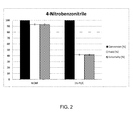
FIG. 2 shows the catalytic hydrogenation of 4-nitrobenzonitrile with NCNTs and 1% Pt/C and compares the % conversion, yield and selectivity. -
FIG. 3 shows the catalytic hydrogenation of ethyl 4-nitrocinnmate with NCNTs and 1% Pt/C and compares the % conversion, yield and selectivity. - NCNTs were prepared as described in
WO2009080204 A1 andWO2009149849 A1 . In particular, the NCNTs were first washed with 10 % HCl solution to remove metal oxide impurities introduced during the NCNT synthesis stage. With regard to 4-iodonitrobenzene, the purified NCNTs demonstrated very high hydrogenation selectivity to 4-iodoaniline molecule under normal conditions (see Scheme 1). The reaction was carried out in the slurry type parallel reactors under a hydrogen pressure of 5-60 bar, temperature of 20-110 °C and reaction time of 10-300 minutes. In comparison with reference catalyst, Pt/C (Pt/C= Platin and Carbon, Johnson Matthey, Hertfordshire), NCNT catalysts showed higher hydrogenation selectivity and yield (seeFig. 1 and Reaction 1). These results suggest that the NCNT-based catalysts have the potential to be cost effective and metal-leaching-free alternatives for conventional Pt or Pd based catalysts in the field of halo nitro aromatics hydrogenation.
- NCNTs were prepared as described in
WO2009080204 A1 andWO2009149849 A1 . In particular, the NCNTs were first washed with 10 % HCl solution to remove metal oxide impurities introduced during the NCNT synthesis stage. With regard to 4-iodonitrobenzene, 4-nitrobenzonitrile and ethyl 4-nitrocinnmate, the purified NCNTs demonstrated very high hydrogenation selectivity to the corresponding aniline derivatives under normal conditions (see Scheme 1). The reaction was carried out in the slurry type parallel reactors under a hydrogen pressure of 5-60 bar, temperature of 20-110 °C and reaction time of 10-300 minutes. In comparison with the reference catalyst, Pt/C (Pt/C= Platin and Carbon, Johnson Matthey, Hertfordshire), the NCNT catalysts showed higher hydrogenation selectivity and yield (seeFig. 1 ). These results suggest that the NCNT-based catalysts have the potential to be cost effective and metal-leaching-free alternatives for conventional Pt or Pd based catalysts in the field of functional nitro aromatics hydrogenation. - For the reference test 200 mg of 1-iodo-4-nitrobenzene and 60 mg of 5% Pt/C (Johnson Matthey) were weighed and filled in a 20 mL glass vial with a magnetic stirrer inside. 10 mL isopropanol were added as solvent. The filled glass vial was weighed and put in one of the 20 mL stainless steel reaction chambers of the 6-fold parallel-reactors. The reaction chamber was closed and a pressure test was carried out (The reactor was pressurized with 10 bar of nitrogen. After 10 min the pressure drop should not be bigger than 0.1 bar.). The pressure was released and the reactor was flushed two times with 4 bar of nitrogen. The reactor was heated up to 60 °C while stirring with a stirring rate of ∼ 800 rpm. Then the reactor was pressurized with 10 bar of hydrogen. The pressure decreased with time. After 30 min the remaining pressure (7.5 bar) was released and the reactor was flushed two times with 4 bar of nitrogen. The reactor was cooled down and the reactor chamber was opened. The glass vial was weighed again to determine the loss of solvent. The catalyst was isolated by filtrating using a membrane filter. 1 mL of the reaction mixture was diluted with 4 mL of isopropanol and was filled in a HPLC-vial. The analysis was carried out by HPLC (column: Agilent XDB-C18, 1.8 µm, 4.6x50 mm; method: see table 1). There was a complete conversion of 1-iodo-4-nitrobenzene. The selectivity to the target molecule 4-iodoaniline was 70.6%.
- The experimental procedure for the test with NCNT (NCNT-MIV-11-E028 washed) was identical. 200 mg of 1-iodo-4-nitrobenzene and 120 mg of NCNT were used. The reaction temperature was 100 °C. The reaction time was 60 min. The initial hydrogen pressure was 40 bar, which decreased in 60 min at 35 bar. There was a complete conversion of 1-iodo-4-nitrobenzene. The selectivity to the target molecule 4-iodoaniline was 95.8%.
- For the
reference test 100 mg of 4-nitrobenzonitrile and 30 mg of 5% Pt/C (Johnson Matthey) were weighed and filled in a 20 mL glass vial with a magnetic stirrer inside. 10 mL isopropanol were added as solvent. The filled glass vial was weighed and put in one of the 20 mL stainless steel reaction chamber of the 6-fold parallel-reactors. The reaction chamber was closed and a pressure test was carried out (The reactor was pressurized with 10 bar of nitrogen. After 10 min the pressure drop should not be bigger than 0.1 bar.). The pressure was released and the reactor was flushed two times with 4 bar of nitrogen. The reactor was heated up to 60 °C while stirring with a stirring rate of ∼ 800 rpm. Then the reactor was pressurized with 10 bar of hydrogen. The pressure decreased with time. After 240 min the remaining pressure (7.7 bar) was released and the reactor was flushed two times with 4 bar of nitrogen. The reactor was cooled down and the reactor chamber was opened. The glass vial was weighed again to determine the loss of solvent. The catalyst was isolated by filtrating using a membrane filter. 1 mL of the reaction mixture was diluted with 4 mL of isopropanol and was filled in a HPLC-vial. The analysis was carried out by HPLC (column: Agilent XDB-C18, 1.8 µm, 4.6x50 mm; method: see Table 1,Scheme 2,Figure 2 ). There was a complete conversion of 4-nitrobenzonitrile. The selectivity to the target molecule 4-aminobenzonitrile was 42.2%. - The experimental procedure for the test with NCNT (NCNT-MIV-11-E028 washed) was identical. 100 mg of 4-nitrobenzonitrile and 60 mg of NCNT were used. The reaction temperature was 100 °C. The reaction time was 90 min. The initial hydrogen pressure was 40 bar, which decreased in 90 min at 34 bar. There was a complete conversion of 4-nitrobenzonitrile. The selectivity to the target molecule 4-aminobenzonitrile was 93.6%.
Table 1: HPLC-method of the analysis of 1-iodo-4-nitrobenzene and 4- nitrobenzonitrile flow 2 mL/ min time 10 min temperature 55 ° C injector volume 2 µL wavelength 210 nm flow agent A phosphate buffer flow agent B acetonitrile gradient time (min) %B 0 10 4.5 25 6.5 50 8 60 10 60 - For the reference test 200 mg of ethyl 4-nitrocinnamate and 30 mg of 5% Pt/C (Johnson Matthey) were weighed and filled in a 20 mL glass vial with a magnetic stirrer inside. 10 mL isopropanol were added as solvent. The filled glass vial was weighed and put in one of the 20 mL stainless steel reaction chambers of the 6-fold parallel-reactors. The reaction chamber was closed and a pressure test was carried out (The reactor was pressurized with 10 bar of nitrogen. After 10 min the pressure drop should not be bigger than 0.1 bar.). The pressure was released and the reactor was flushed two times with 4 bar of nitrogen. The reactor was heated up to 60 °C while stirring with a stirring rate of ∼ 800 rpm. Then the reactor was pressurized with 10 bar of hydrogen. The pressure decreased with time. After 30 min the remaining pressure (6.5 bar) was released and the reactor was flushed two times with 4 bar of nitrogen. The reactor was cooled down and the reactor chamber was opened. The glass vial was weighed again to determine the loss of solvent. The catalyst was isolated by filtrating using a membrane filter. 1 mL of the reaction mixture was diluted with 4 mL of isopropanol and was filled in a HPLC-vial. The analysis was carried out by HPLC (column: Agilent XDB-C18, 1.8 µm, 4.6x50 mm; method: see Table 2,
Scheme 2 andFigure 3 ). There was a complete conversion of ethyl 4-nitrocinnamate. The selectivity to the target molecule ethyl 4-aminocinnamate was 40.8%. - The experimental procedure for the test with NCNT (NCNT-MIV-11-E028 washed) was identical. 200 mg of ethyl 4-nitrocinnamate and 120 mg of NCNT were used. The reaction temperature was 100°C. The reaction time was 40 min. The initial hydrogen pressure was 40 bar, which decreased in 40 min at 34.5 bar. There was a complete conversion of ethyl 4-aminocinnamate. The selectivity to the target molecule p-iodoaniline was 95.2%.
Table 2: HPLC-method of the analysis of ethyl 4- nitrocinnamate flow 2 mL/min time 12 min temperature 55 ° C injector volume 2 µL wavelength 210 nm flow agent A phosphate buffer flow agent B acetonitrile gradient time (min) %B 0 10 4.5 25 6.5 50 .8 60 12 60 
Claims (12)
- A process for hydrogenating halogen-substituted nitro-aromatic compounds or functional nitro-aromatic compounds by means of hydrogen, characterized in that the hydrogenation is carried out in the presence of a catalyst which comprises nitrogen-doped carbon nanotubes as catalytically active component and, the proportion of nitrogen in the nitrogen-doped carbon nanotubes is in the range from 0.05 to 20% by weight in the graphitic layers and the nitrogen is present at least partly in a pyridinic arrangement.
- The process as claimed in claim 1, characterized in that the halogen-substituted or functional nitro-aromatic compound is present in a liquid phase and the hydrogen in the present in gaseous form.
- The process as claimed in claim 1, characterized in that the halogen-substituted or functional nitro-aromatic compound is present in a liquid solvent.
- The process as claimed in claim 3, characterized in that the solvent is an organic solvent which does not comprise any hydrogenation-active functional group or is a mixture of such organic solvents.
- The process as claimed in any of claims 2 to 4, characterized in that it is carried out at temperatures in the range from 20°C to 350°C, preferably from 40°C to 110°C.
- The process as claimed in claim 1, characterized in that the halogen-substituted or functional nitro-aromatic compounds and the hydrogen are present in gaseous form.
- The process as claimed in any of claims 1 to 6, characterized in that it is carried out in a plurality of stages, preferably in from 2 to 10, particularly preferably from 2 to 6, very particularly preferably from 2 to 5, in particular 2 or 3, reaction zones connected in series.
- The process as claimed in any of claims 1 to 7, characterized in that the catalyst contains at least 50% by weight, preferably at least 80% by weight, particularly preferably at least 95% by weight, of nitrogen-doped carbon nanotubes.
- The process as claimed in any of claims 1 to 8, characterized in that the catalyst is present as a fixed bed.
- The process as claimed in claim 9, characterized in that the fixed bed is present in the form of a structured bed in which the catalyst activity increases in the main flow direction in the reaction zone.
- The process as claimed in any one of claims 1 to 10, characterized in that the halogen-substituted nitro-aromatic compound is selected from the group consisting of 4-Iodo-nitrobenzene, 4-Fluoronitrobenzene, 4-Chloronitrobenzene, 4-Bromonitrobenzene, 1-Chloro-3-nitrobenzene, 1-Bromo-4-chloro-2-nitrobenzene, 5-Chloro-2-nitroaniline, 4-Chloro-3-nitroanisole, 2-Chloro-4-nitrotoluene, 1-Bromo-4-nitrobenzene, 2-Bromo-1-tert-butyl-4-nitrobenzene, 1-Iodo-2,4-dimethyl-6-nitrobenzene, 1-Chloro-2-iodo-5-nitrobenzene and 2-Iodo-3-nitrotoluene.
- The process as claimed in any one of claims 1 to 10, characterized in that the functional nitro-aromatic compound is selected from the group consisting of 4-Nitrobenzonitrile, Ethyl 4-nitrocinnmate, 4-Nitrocinnamic acid, 4-Nitrocinnamyl alcohol, 2-Chloro-4-nitrobenzonitrile, 4-Amino-3-nitrobenzonitrile, 4-Hydroxy-3-nitrobenzonitrile, 4-Bromo-3-nitrobenzonitrile, (1,4-dihydro-6-nitro)-1,4-Methanonaphthalene and 1-(2-cyclopropylethenyl)-2-nitro-Benzene.
Priority Applications (2)
| Application Number | Priority Date | Filing Date | Title |
|---|---|---|---|
| EP20130180172 EP2837612A1 (en) | 2013-08-13 | 2013-08-13 | Nitrogen-doped carbon nanotubes as high selective noble metal-free catalysts for hydrogenation of functionalized nitroaromatics |
| PCT/EP2014/067143 WO2015022282A1 (en) | 2013-08-13 | 2014-08-11 | Nitrogen-doped carbon nanotubes as high selective noble metal-free catalysts for hydrogenation of functionalized nitroaromatics |
Applications Claiming Priority (1)
| Application Number | Priority Date | Filing Date | Title |
|---|---|---|---|
| EP20130180172 EP2837612A1 (en) | 2013-08-13 | 2013-08-13 | Nitrogen-doped carbon nanotubes as high selective noble metal-free catalysts for hydrogenation of functionalized nitroaromatics |
Publications (1)
| Publication Number | Publication Date |
|---|---|
| EP2837612A1 true EP2837612A1 (en) | 2015-02-18 |
Family
ID=48951388
Family Applications (1)
| Application Number | Title | Priority Date | Filing Date |
|---|---|---|---|
| EP20130180172 Withdrawn EP2837612A1 (en) | 2013-08-13 | 2013-08-13 | Nitrogen-doped carbon nanotubes as high selective noble metal-free catalysts for hydrogenation of functionalized nitroaromatics |
Country Status (2)
| Country | Link |
|---|---|
| EP (1) | EP2837612A1 (en) |
| WO (1) | WO2015022282A1 (en) |
Cited By (2)
| Publication number | Priority date | Publication date | Assignee | Title |
|---|---|---|---|---|
| CN106076325A (en) * | 2016-06-03 | 2016-11-09 | 西安交通大学 | A kind of preparation method of organic hydrogenation catalysts based on noble metal nano particles |
| CN106807426A (en) * | 2015-11-30 | 2017-06-09 | 北京化工大学 | One kind is without catalytic hydrogenation and application |
Families Citing this family (4)
| Publication number | Priority date | Publication date | Assignee | Title |
|---|---|---|---|---|
| CN105753717B (en) * | 2016-04-01 | 2018-06-01 | 湘潭大学 | A kind of application of no catalytic hydrogenation in 1- nitronaphthalene hydrogenation reactions are catalyzed |
| CN105669464B (en) * | 2016-04-01 | 2018-07-27 | 湘潭大学 | A kind of application of no catalytic hydrogenation in being catalyzed nitro benzene and its derivative hydrogenation reaction |
| CN112495418A (en) * | 2020-12-03 | 2021-03-16 | 山东科技大学 | Preparation method of nitrogen-doped carbon-supported non-noble metal catalyst and application of nitrogen-doped carbon-supported non-noble metal catalyst in reduction of nitro compounds |
| CN114797934A (en) * | 2022-04-06 | 2022-07-29 | 福州大学 | Nitrogen-doped carbon nanotube supported palladium platinum catalyst and preparation method and application thereof |
Citations (2)
| Publication number | Priority date | Publication date | Assignee | Title |
|---|---|---|---|---|
| WO2009080204A1 (en) | 2007-12-20 | 2009-07-02 | Bayer Technology Services Gmbh | Method for producing nitrogen-doped carbon nanotubes |
| WO2009149849A1 (en) | 2008-06-12 | 2009-12-17 | Bayer Technology Services Gmbh | Catalyst and process for hydrogenating organic compounds |
-
2013
- 2013-08-13 EP EP20130180172 patent/EP2837612A1/en not_active Withdrawn
-
2014
- 2014-08-11 WO PCT/EP2014/067143 patent/WO2015022282A1/en not_active Ceased
Patent Citations (2)
| Publication number | Priority date | Publication date | Assignee | Title |
|---|---|---|---|---|
| WO2009080204A1 (en) | 2007-12-20 | 2009-07-02 | Bayer Technology Services Gmbh | Method for producing nitrogen-doped carbon nanotubes |
| WO2009149849A1 (en) | 2008-06-12 | 2009-12-17 | Bayer Technology Services Gmbh | Catalyst and process for hydrogenating organic compounds |
Non-Patent Citations (10)
| Title |
|---|
| A. CORMA; P. SERNA, J. AM. CHEM. SOC., vol. 130, 2008, pages 8748 - 8753 |
| C. XIAO; X. WANG, CURRENT ORGANIC CHEMISTRY, vol. 16, 2012, pages 280 - 296 |
| G. WU; M. HUANG, SYNTHESIS, vol. 11, 2003, pages 1657 - 1660 |
| H.-U. BLASER; H. STEINER; M. STUDER, CHEMCATCHEM, vol. 1, 2009, pages 210 - 221 |
| H.-U. BLASER; H. STEINER; M. STUDER, CHEMCATCHEM, vol. 1, 2009, pages 210 - 221, XP002718291 * |
| J. AMADOU; K. CHIZARI, CATALYSIS TODAY, vol. 138, 2008, pages 62 - 68 |
| K. GONG; L. DAI, SCIENCE, vol. 323, 2009, pages 760 - 764 |
| L. F. MABENA; S. S. RAY, APPL NANOSCI, vol. 1, 2011, pages 67 - 77 |
| P. AYALA; R. ARENAL, CARBON, vol. 48, 2010, pages 575 - 586 |
| Z. CHEN; D. HIGGINS, CARBON, vol. 48, 2010, pages 3057 - 3065 |
Cited By (3)
| Publication number | Priority date | Publication date | Assignee | Title |
|---|---|---|---|---|
| CN106807426A (en) * | 2015-11-30 | 2017-06-09 | 北京化工大学 | One kind is without catalytic hydrogenation and application |
| CN106076325A (en) * | 2016-06-03 | 2016-11-09 | 西安交通大学 | A kind of preparation method of organic hydrogenation catalysts based on noble metal nano particles |
| CN106076325B (en) * | 2016-06-03 | 2018-09-04 | 西安交通大学 | A kind of preparation method of the organic hydrogenation catalysts based on noble metal nano particles |
Also Published As
| Publication number | Publication date |
|---|---|
| WO2015022282A1 (en) | 2015-02-19 |
Similar Documents
| Publication | Publication Date | Title |
|---|---|---|
| WO2015022282A1 (en) | Nitrogen-doped carbon nanotubes as high selective noble metal-free catalysts for hydrogenation of functionalized nitroaromatics | |
| CN111151284B (en) | Nitrogen-doped carbon-coated catalyst, and preparation method and application thereof | |
| US5689021A (en) | Raney-type catalysts for the hydrogenation of halonitroaromatic compounds | |
| JP5473901B2 (en) | Method for producing amine | |
| CN105992756B (en) | The method of hydroaromatic compound | |
| Boymans et al. | A study on the selective hydrogenation of nitroaromatics to N-arylhydroxylamines using a supported Pt nanoparticle catalyst | |
| US8614355B2 (en) | Catalyst and process for hydrogenating organic compounds | |
| JP2011522696A5 (en) | ||
| JP4523275B2 (en) | Supported catalysts for the hydrogenation of nitroaromatic compounds. | |
| JP6704896B2 (en) | Method for producing aromatic primary diamine | |
| KR102472836B1 (en) | Method for hydrogenation of toluenediamine (TDA) tar | |
| Bal et al. | Visible light-photoinduced and Cu-catalyzed reduction of nitrobenzenes into anilines | |
| EP2905272B1 (en) | Process for hydrogenating aromatic di- and polyamines to cycloaliphatic di- and polyamines | |
| CN101265194B (en) | Catalytic hydrogenation method for preparing halogenated aromatic amine from halogenated arene nitro compounds | |
| CN1199935C (en) | Production process of catalytically hydrogenating nitrobenzene halide to synthesize haloarylamine | |
| Senzaki et al. | Reductive N-Alkylation of Amines with Ketones Using Heterogeneous Polysilane–Palladium Catalysts under Continuous-Flow Conditions | |
| JP2007099771A (en) | Method for reductively aminating ketone and aldehyde with aqueous amine and suitable catalyst | |
| DE19911865A1 (en) | Process for the catalytic hydrogenation of dinitrotoluene and catalyst | |
| JP2010241691A (en) | Method for hydrogen reduction of nitro compounds using MCM-41 catalyst supported on metal nanoparticles | |
| JP7145486B2 (en) | Aromatic ring hydrogenation method using alcohol and water | |
| KR101356114B1 (en) | Process for preparing alicyclic amine derivatives by hydrogenation of nitrobenzene derivatives | |
| US4387247A (en) | Catalytic reduction of nitro aromatic compounds with hydrogen sulfide and carbon monoxide | |
| ES2981841B2 (en) | Procedure for the reduction of nitroaromatic compounds using y-terpinene as a reducing agent | |
| CN100364959C (en) | Process for preparing diamines and polyamines of the diphenylmethane series | |
| JPH04506353A (en) | Method for producing N-alkyl-halogenoaniline |
Legal Events
| Date | Code | Title | Description |
|---|---|---|---|
| 17P | Request for examination filed |
Effective date: 20130813 |
|
| AK | Designated contracting states |
Kind code of ref document: A1 Designated state(s): AL AT BE BG CH CY CZ DE DK EE ES FI FR GB GR HR HU IE IS IT LI LT LU LV MC MK MT NL NO PL PT RO RS SE SI SK SM TR |
|
| AX | Request for extension of the european patent |
Extension state: BA ME |
|
| PUAI | Public reference made under article 153(3) epc to a published international application that has entered the european phase |
Free format text: ORIGINAL CODE: 0009012 |
|
| RAP1 | Party data changed (applicant data changed or rights of an application transferred) |
Owner name: BAYER CROPSCIENCE AG |
|
| STAA | Information on the status of an ep patent application or granted ep patent |
Free format text: STATUS: THE APPLICATION IS DEEMED TO BE WITHDRAWN |
|
| 18D | Application deemed to be withdrawn |
Effective date: 20150819 |