EP2836497B1 - Catalyst compounds - Google Patents
Catalyst compounds Download PDFInfo
- Publication number
- EP2836497B1 EP2836497B1 EP13721029.0A EP13721029A EP2836497B1 EP 2836497 B1 EP2836497 B1 EP 2836497B1 EP 13721029 A EP13721029 A EP 13721029A EP 2836497 B1 EP2836497 B1 EP 2836497B1
- Authority
- EP
- European Patent Office
- Prior art keywords
- alkyl
- ring
- aryl
- hydrogen
- independently selected
- Prior art date
- Legal status (The legal status is an assumption and is not a legal conclusion. Google has not performed a legal analysis and makes no representation as to the accuracy of the status listed.)
- Not-in-force
Links
- 239000003054 catalyst Substances 0.000 title claims description 153
- 150000001875 compounds Chemical class 0.000 title claims description 134
- 125000000217 alkyl group Chemical group 0.000 claims description 278
- -1 [NRcRdRe]+ Chemical group 0.000 claims description 225
- 239000001257 hydrogen Substances 0.000 claims description 121
- 229910052739 hydrogen Inorganic materials 0.000 claims description 121
- UFHFLCQGNIYNRP-UHFFFAOYSA-N Hydrogen Chemical compound [H][H] UFHFLCQGNIYNRP-UHFFFAOYSA-N 0.000 claims description 103
- 125000003118 aryl group Chemical group 0.000 claims description 101
- 238000000034 method Methods 0.000 claims description 79
- 125000003545 alkoxy group Chemical group 0.000 claims description 69
- 238000006243 chemical reaction Methods 0.000 claims description 64
- 125000002887 hydroxy group Chemical group [H]O* 0.000 claims description 62
- 125000005843 halogen group Chemical group 0.000 claims description 61
- 125000001997 phenyl group Chemical group [H]C1=C([H])C([H])=C(*)C([H])=C1[H] 0.000 claims description 61
- 125000001072 heteroaryl group Chemical group 0.000 claims description 58
- 125000001424 substituent group Chemical group 0.000 claims description 56
- 239000000758 substrate Substances 0.000 claims description 55
- 125000000449 nitro group Chemical group [O-][N+](*)=O 0.000 claims description 45
- 125000001951 carbamoylamino group Chemical group C(N)(=O)N* 0.000 claims description 41
- 125000002023 trifluoromethyl group Chemical group FC(F)(F)* 0.000 claims description 41
- JXLHNMVSKXFWAO-UHFFFAOYSA-N azane;7-fluoro-2,1,3-benzoxadiazole-4-sulfonic acid Chemical compound N.OS(=O)(=O)C1=CC=C(F)C2=NON=C12 JXLHNMVSKXFWAO-UHFFFAOYSA-N 0.000 claims description 40
- 125000000623 heterocyclic group Chemical group 0.000 claims description 39
- PXQLVRUNWNTZOS-UHFFFAOYSA-N sulfanyl Chemical class [SH] PXQLVRUNWNTZOS-UHFFFAOYSA-N 0.000 claims description 37
- 125000000753 cycloalkyl group Chemical group 0.000 claims description 26
- 229910052717 sulfur Inorganic materials 0.000 claims description 26
- 150000002466 imines Chemical class 0.000 claims description 23
- 229910052760 oxygen Inorganic materials 0.000 claims description 23
- 125000000392 cycloalkenyl group Chemical group 0.000 claims description 22
- 125000004435 hydrogen atom Chemical group [H]* 0.000 claims description 22
- 125000002947 alkylene group Chemical group 0.000 claims description 21
- 150000002576 ketones Chemical class 0.000 claims description 21
- 229910052757 nitrogen Inorganic materials 0.000 claims description 21
- 125000004953 trihalomethyl group Chemical group 0.000 claims description 21
- 229910003827 NRaRb Inorganic materials 0.000 claims description 20
- 239000000203 mixture Substances 0.000 claims description 20
- LMBFAGIMSUYTBN-MPZNNTNKSA-N teixobactin Chemical compound C([C@H](C(=O)N[C@@H]([C@@H](C)CC)C(=O)N[C@@H](CO)C(=O)N[C@H](CCC(N)=O)C(=O)N[C@H]([C@@H](C)CC)C(=O)N[C@@H]([C@@H](C)CC)C(=O)N[C@@H](CO)C(=O)N[C@H]1C(N[C@@H](C)C(=O)N[C@@H](C[C@@H]2NC(=N)NC2)C(=O)N[C@H](C(=O)O[C@H]1C)[C@@H](C)CC)=O)NC)C1=CC=CC=C1 LMBFAGIMSUYTBN-MPZNNTNKSA-N 0.000 claims description 19
- 125000004122 cyclic group Chemical group 0.000 claims description 17
- 125000003342 alkenyl group Chemical group 0.000 claims description 16
- 125000000304 alkynyl group Chemical group 0.000 claims description 15
- 150000001412 amines Chemical class 0.000 claims description 15
- QGZKDVFQNNGYKY-UHFFFAOYSA-N Ammonia Chemical compound N QGZKDVFQNNGYKY-UHFFFAOYSA-N 0.000 claims description 14
- 238000009901 transfer hydrogenation reaction Methods 0.000 claims description 13
- 125000004172 4-methoxyphenyl group Chemical group [H]C1=C([H])C(OC([H])([H])[H])=C([H])C([H])=C1* 0.000 claims description 12
- 125000001624 naphthyl group Chemical group 0.000 claims description 12
- 229910052799 carbon Inorganic materials 0.000 claims description 11
- QTBSBXVTEAMEQO-UHFFFAOYSA-M Acetate Chemical compound CC([O-])=O QTBSBXVTEAMEQO-UHFFFAOYSA-M 0.000 claims description 10
- 125000004450 alkenylene group Chemical group 0.000 claims description 10
- 125000002619 bicyclic group Chemical group 0.000 claims description 10
- 125000002496 methyl group Chemical group [H]C([H])([H])* 0.000 claims description 8
- 150000001299 aldehydes Chemical class 0.000 claims description 7
- 229910021529 ammonia Inorganic materials 0.000 claims description 7
- 238000011065 in-situ storage Methods 0.000 claims description 5
- RUVINXPYWBROJD-UHFFFAOYSA-N para-methoxyphenyl Natural products COC1=CC=C(C=CC)C=C1 RUVINXPYWBROJD-UHFFFAOYSA-N 0.000 claims description 3
- 230000001419 dependent effect Effects 0.000 claims 2
- OKKJLVBELUTLKV-UHFFFAOYSA-N Methanol Chemical compound OC OKKJLVBELUTLKV-UHFFFAOYSA-N 0.000 description 69
- 239000002904 solvent Substances 0.000 description 46
- 238000005984 hydrogenation reaction Methods 0.000 description 45
- 238000006268 reductive amination reaction Methods 0.000 description 39
- 239000000047 product Substances 0.000 description 25
- BDAGIHXWWSANSR-UHFFFAOYSA-N methanoic acid Natural products OC=O BDAGIHXWWSANSR-UHFFFAOYSA-N 0.000 description 23
- 125000005842 heteroatom Chemical group 0.000 description 22
- IJGRMHOSHXDMSA-UHFFFAOYSA-N nitrogen Substances N#N IJGRMHOSHXDMSA-UHFFFAOYSA-N 0.000 description 22
- 238000002360 preparation method Methods 0.000 description 21
- YMWUJEATGCHHMB-UHFFFAOYSA-N Dichloromethane Chemical group ClCCl YMWUJEATGCHHMB-UHFFFAOYSA-N 0.000 description 20
- HEDRZPFGACZZDS-MICDWDOJSA-N Trichloro(2H)methane Chemical compound [2H]C(Cl)(Cl)Cl HEDRZPFGACZZDS-MICDWDOJSA-N 0.000 description 18
- RTZKZFJDLAIYFH-UHFFFAOYSA-N Diethyl ether Chemical compound CCOCC RTZKZFJDLAIYFH-UHFFFAOYSA-N 0.000 description 17
- 239000011541 reaction mixture Substances 0.000 description 16
- 239000007787 solid Substances 0.000 description 16
- LFQSCWFLJHTTHZ-UHFFFAOYSA-N Ethanol Chemical compound CCO LFQSCWFLJHTTHZ-UHFFFAOYSA-N 0.000 description 15
- RHQDFWAXVIIEBN-UHFFFAOYSA-N Trifluoroethanol Chemical compound OCC(F)(F)F RHQDFWAXVIIEBN-UHFFFAOYSA-N 0.000 description 15
- VLKZOEOYAKHREP-UHFFFAOYSA-N n-Hexane Chemical compound CCCCCC VLKZOEOYAKHREP-UHFFFAOYSA-N 0.000 description 15
- ZMANZCXQSJIPKH-UHFFFAOYSA-N Triethylamine Chemical compound CCN(CC)CC ZMANZCXQSJIPKH-UHFFFAOYSA-N 0.000 description 12
- 235000019253 formic acid Nutrition 0.000 description 12
- XLYOFNOQVPJJNP-UHFFFAOYSA-N water Substances O XLYOFNOQVPJJNP-UHFFFAOYSA-N 0.000 description 12
- 0 CC1=*(c2ccc(*)cc2)I=Cc2cc(*)ccc12 Chemical compound CC1=*(c2ccc(*)cc2)I=Cc2cc(*)ccc12 0.000 description 11
- VZTDIZULWFCMLS-UHFFFAOYSA-N ammonium formate Chemical compound [NH4+].[O-]C=O VZTDIZULWFCMLS-UHFFFAOYSA-N 0.000 description 11
- 125000000956 methoxy group Chemical group [H]C([H])([H])O* 0.000 description 11
- 238000005160 1H NMR spectroscopy Methods 0.000 description 10
- YMWUJEATGCHHMB-DICFDUPASA-N dichloromethane-d2 Chemical compound [2H]C([2H])(Cl)Cl YMWUJEATGCHHMB-DICFDUPASA-N 0.000 description 10
- 230000002829 reductive effect Effects 0.000 description 10
- 239000000243 solution Substances 0.000 description 10
- 239000002253 acid Substances 0.000 description 9
- 239000003960 organic solvent Substances 0.000 description 9
- QBXVXKRWOVBUDB-GRKNLSHJSA-N ClC=1C(=CC(=C(CN2[C@H](C[C@H](C2)O)C(=O)O)C1)OCC1=CC(=CC=C1)C#N)OCC1=C(C(=CC=C1)C1=CC2=C(OCCO2)C=C1)C Chemical compound ClC=1C(=CC(=C(CN2[C@H](C[C@H](C2)O)C(=O)O)C1)OCC1=CC(=CC=C1)C#N)OCC1=C(C(=CC=C1)C1=CC2=C(OCCO2)C=C1)C QBXVXKRWOVBUDB-GRKNLSHJSA-N 0.000 description 8
- CSNNHWWHGAXBCP-UHFFFAOYSA-L Magnesium sulfate Chemical compound [Mg+2].[O-][S+2]([O-])([O-])[O-] CSNNHWWHGAXBCP-UHFFFAOYSA-L 0.000 description 8
- 239000012298 atmosphere Substances 0.000 description 8
- 239000003153 chemical reaction reagent Substances 0.000 description 8
- HLBBKKJFGFRGMU-UHFFFAOYSA-M sodium formate Chemical compound [Na+].[O-]C=O HLBBKKJFGFRGMU-UHFFFAOYSA-M 0.000 description 8
- 235000019254 sodium formate Nutrition 0.000 description 8
- 239000011593 sulfur Chemical group 0.000 description 8
- 238000001644 13C nuclear magnetic resonance spectroscopy Methods 0.000 description 7
- OSWFIVFLDKOXQC-UHFFFAOYSA-N 4-(3-methoxyphenyl)aniline Chemical compound COC1=CC=CC(C=2C=CC(N)=CC=2)=C1 OSWFIVFLDKOXQC-UHFFFAOYSA-N 0.000 description 7
- VYPSYNLAJGMNEJ-UHFFFAOYSA-N Silicium dioxide Chemical compound O=[Si]=O VYPSYNLAJGMNEJ-UHFFFAOYSA-N 0.000 description 7
- NINIDFKCEFEMDL-UHFFFAOYSA-N Sulfur Chemical group [S] NINIDFKCEFEMDL-UHFFFAOYSA-N 0.000 description 7
- 125000004432 carbon atom Chemical group C* 0.000 description 7
- 239000000852 hydrogen donor Substances 0.000 description 7
- 229910052741 iridium Inorganic materials 0.000 description 7
- GKOZUEZYRPOHIO-UHFFFAOYSA-N iridium atom Chemical group [Ir] GKOZUEZYRPOHIO-UHFFFAOYSA-N 0.000 description 7
- XKRFYHLGVUSROY-UHFFFAOYSA-N Argon Chemical compound [Ar] XKRFYHLGVUSROY-UHFFFAOYSA-N 0.000 description 6
- XEKOWRVHYACXOJ-UHFFFAOYSA-N Ethyl acetate Chemical compound CCOC(C)=O XEKOWRVHYACXOJ-UHFFFAOYSA-N 0.000 description 6
- 229910021640 Iridium dichloride Inorganic materials 0.000 description 6
- YXFVVABEGXRONW-UHFFFAOYSA-N Toluene Chemical compound CC1=CC=CC=C1 YXFVVABEGXRONW-UHFFFAOYSA-N 0.000 description 6
- 239000007810 chemical reaction solvent Substances 0.000 description 6
- 125000001309 chloro group Chemical group Cl* 0.000 description 6
- 239000010948 rhodium Substances 0.000 description 6
- BDAGIHXWWSANSR-UHFFFAOYSA-M Formate Chemical compound [O-]C=O BDAGIHXWWSANSR-UHFFFAOYSA-M 0.000 description 5
- QVGXLLKOCUKJST-UHFFFAOYSA-N atomic oxygen Chemical group [O] QVGXLLKOCUKJST-UHFFFAOYSA-N 0.000 description 5
- 125000002950 monocyclic group Chemical group 0.000 description 5
- 239000001301 oxygen Chemical group 0.000 description 5
- 150000003839 salts Chemical class 0.000 description 5
- 229920006395 saturated elastomer Polymers 0.000 description 5
- 238000012216 screening Methods 0.000 description 5
- 239000007858 starting material Substances 0.000 description 5
- 125000004568 thiomorpholinyl group Chemical group 0.000 description 5
- KWOLFJPFCHCOCG-UHFFFAOYSA-N Acetophenone Chemical compound CC(=O)C1=CC=CC=C1 KWOLFJPFCHCOCG-UHFFFAOYSA-N 0.000 description 4
- 239000004215 Carbon black (E152) Substances 0.000 description 4
- 229910020889 NaBH3 Inorganic materials 0.000 description 4
- VMHLLURERBWHNL-UHFFFAOYSA-M Sodium acetate Chemical group [Na+].CC([O-])=O VMHLLURERBWHNL-UHFFFAOYSA-M 0.000 description 4
- 239000004280 Sodium formate Substances 0.000 description 4
- DTQVDTLACAAQTR-UHFFFAOYSA-M Trifluoroacetate Chemical compound [O-]C(=O)C(F)(F)F DTQVDTLACAAQTR-UHFFFAOYSA-M 0.000 description 4
- 230000002378 acidificating effect Effects 0.000 description 4
- MWPLVEDNUUSJAV-UHFFFAOYSA-N anthracene Chemical compound C1=CC=CC2=CC3=CC=CC=C3C=C21 MWPLVEDNUUSJAV-UHFFFAOYSA-N 0.000 description 4
- 125000004429 atom Chemical group 0.000 description 4
- 239000000872 buffer Substances 0.000 description 4
- 150000007942 carboxylates Chemical class 0.000 description 4
- 230000003197 catalytic effect Effects 0.000 description 4
- 238000002474 experimental method Methods 0.000 description 4
- 229930195733 hydrocarbon Natural products 0.000 description 4
- 229910052943 magnesium sulfate Inorganic materials 0.000 description 4
- 238000012986 modification Methods 0.000 description 4
- 230000004048 modification Effects 0.000 description 4
- 239000002808 molecular sieve Substances 0.000 description 4
- 125000004433 nitrogen atom Chemical group N* 0.000 description 4
- QJGQUHMNIGDVPM-UHFFFAOYSA-N nitrogen group Chemical group [N] QJGQUHMNIGDVPM-UHFFFAOYSA-N 0.000 description 4
- YNPNZTXNASCQKK-UHFFFAOYSA-N phenanthrene Chemical compound C1=CC=C2C3=CC=CC=C3C=CC2=C1 YNPNZTXNASCQKK-UHFFFAOYSA-N 0.000 description 4
- 238000006722 reduction reaction Methods 0.000 description 4
- URGAHOPLAPQHLN-UHFFFAOYSA-N sodium aluminosilicate Chemical compound [Na+].[Al+3].[O-][Si]([O-])=O.[O-][Si]([O-])=O URGAHOPLAPQHLN-UHFFFAOYSA-N 0.000 description 4
- 125000005958 tetrahydrothienyl group Chemical group 0.000 description 4
- QTBSBXVTEAMEQO-UHFFFAOYSA-N Acetic acid Chemical compound CC(O)=O QTBSBXVTEAMEQO-UHFFFAOYSA-N 0.000 description 3
- OKTJSMMVPCPJKN-UHFFFAOYSA-N Carbon Chemical compound [C] OKTJSMMVPCPJKN-UHFFFAOYSA-N 0.000 description 3
- JUJWROOIHBZHMG-UHFFFAOYSA-N Pyridine Chemical compound C1=CC=NC=C1 JUJWROOIHBZHMG-UHFFFAOYSA-N 0.000 description 3
- 229910052786 argon Inorganic materials 0.000 description 3
- 150000008365 aromatic ketones Chemical class 0.000 description 3
- 125000001164 benzothiazolyl group Chemical group S1C(=NC2=C1C=CC=C2)* 0.000 description 3
- 125000002618 bicyclic heterocycle group Chemical group 0.000 description 3
- KRKNYBCHXYNGOX-UHFFFAOYSA-N citric acid Chemical compound OC(=O)CC(O)(C(O)=O)CC(O)=O KRKNYBCHXYNGOX-UHFFFAOYSA-N 0.000 description 3
- 230000000052 comparative effect Effects 0.000 description 3
- RAXXELZNTBOGNW-UHFFFAOYSA-N imidazole Natural products C1=CNC=N1 RAXXELZNTBOGNW-UHFFFAOYSA-N 0.000 description 3
- 125000002883 imidazolyl group Chemical group 0.000 description 3
- 125000000842 isoxazolyl group Chemical group 0.000 description 3
- 239000003446 ligand Substances 0.000 description 3
- 239000000463 material Substances 0.000 description 3
- 239000012299 nitrogen atmosphere Substances 0.000 description 3
- 125000002971 oxazolyl group Chemical group 0.000 description 3
- 125000003373 pyrazinyl group Chemical group 0.000 description 3
- 125000003226 pyrazolyl group Chemical group 0.000 description 3
- 125000000714 pyrimidinyl group Chemical group 0.000 description 3
- 125000000168 pyrrolyl group Chemical group 0.000 description 3
- 230000009467 reduction Effects 0.000 description 3
- 125000006413 ring segment Chemical group 0.000 description 3
- 238000003786 synthesis reaction Methods 0.000 description 3
- 231100000331 toxic Toxicity 0.000 description 3
- 230000002588 toxic effect Effects 0.000 description 3
- 238000010626 work up procedure Methods 0.000 description 3
- HBAQYPYDRFILMT-UHFFFAOYSA-N 8-[3-(1-cyclopropylpyrazol-4-yl)-1H-pyrazolo[4,3-d]pyrimidin-5-yl]-3-methyl-3,8-diazabicyclo[3.2.1]octan-2-one Chemical class C1(CC1)N1N=CC(=C1)C1=NNC2=C1N=C(N=C2)N1C2C(N(CC1CC2)C)=O HBAQYPYDRFILMT-UHFFFAOYSA-N 0.000 description 2
- CURLTUGMZLYLDI-UHFFFAOYSA-N Carbon dioxide Chemical compound O=C=O CURLTUGMZLYLDI-UHFFFAOYSA-N 0.000 description 2
- SIKJAQJRHWYJAI-UHFFFAOYSA-N Indole Chemical compound C1=CC=C2NC=CC2=C1 SIKJAQJRHWYJAI-UHFFFAOYSA-N 0.000 description 2
- KFZMGEQAYNKOFK-UHFFFAOYSA-N Isopropanol Chemical compound CC(C)O KFZMGEQAYNKOFK-UHFFFAOYSA-N 0.000 description 2
- AFVFQIVMOAPDHO-UHFFFAOYSA-N Methanesulfonic acid Chemical compound CS(O)(=O)=O AFVFQIVMOAPDHO-UHFFFAOYSA-N 0.000 description 2
- 238000005481 NMR spectroscopy Methods 0.000 description 2
- 229910002651 NO3 Inorganic materials 0.000 description 2
- UFWIBTONFRDIAS-UHFFFAOYSA-N Naphthalene Chemical compound C1=CC=CC2=CC=CC=C21 UFWIBTONFRDIAS-UHFFFAOYSA-N 0.000 description 2
- NHNBFGGVMKEFGY-UHFFFAOYSA-N Nitrate Chemical compound [O-][N+]([O-])=O NHNBFGGVMKEFGY-UHFFFAOYSA-N 0.000 description 2
- 229910019142 PO4 Inorganic materials 0.000 description 2
- NBIIXXVUZAFLBC-UHFFFAOYSA-N Phosphoric acid Chemical compound OP(O)(O)=O NBIIXXVUZAFLBC-UHFFFAOYSA-N 0.000 description 2
- PMZURENOXWZQFD-UHFFFAOYSA-L Sodium Sulfate Chemical compound [Na+].[Na+].[O-]S([O-])(=O)=O PMZURENOXWZQFD-UHFFFAOYSA-L 0.000 description 2
- UIIMBOGNXHQVGW-UHFFFAOYSA-M Sodium bicarbonate Chemical compound [Na+].OC([O-])=O UIIMBOGNXHQVGW-UHFFFAOYSA-M 0.000 description 2
- 150000001336 alkenes Chemical group 0.000 description 2
- 150000003863 ammonium salts Chemical class 0.000 description 2
- 239000012300 argon atmosphere Substances 0.000 description 2
- 125000002393 azetidinyl group Chemical group 0.000 description 2
- 125000003785 benzimidazolyl group Chemical group N1=C(NC2=C1C=CC=C2)* 0.000 description 2
- 125000000499 benzofuranyl group Chemical group O1C(=CC2=C1C=CC=C2)* 0.000 description 2
- WPYMKLBDIGXBTP-UHFFFAOYSA-N benzoic acid Chemical compound OC(=O)C1=CC=CC=C1 WPYMKLBDIGXBTP-UHFFFAOYSA-N 0.000 description 2
- 125000004196 benzothienyl group Chemical group S1C(=CC2=C1C=CC=C2)* 0.000 description 2
- 125000004541 benzoxazolyl group Chemical group O1C(=NC2=C1C=CC=C2)* 0.000 description 2
- 125000001797 benzyl group Chemical group [H]C1=C([H])C([H])=C(C([H])=C1[H])C([H])([H])* 0.000 description 2
- 230000015572 biosynthetic process Effects 0.000 description 2
- 238000009835 boiling Methods 0.000 description 2
- NNTOJPXOCKCMKR-UHFFFAOYSA-N boron;pyridine Chemical compound [B].C1=CC=NC=C1 NNTOJPXOCKCMKR-UHFFFAOYSA-N 0.000 description 2
- 239000007853 buffer solution Substances 0.000 description 2
- PBAYDYUZOSNJGU-UHFFFAOYSA-N chelidonic acid Natural products OC(=O)C1=CC(=O)C=C(C(O)=O)O1 PBAYDYUZOSNJGU-UHFFFAOYSA-N 0.000 description 2
- 125000003016 chromanyl group Chemical group O1C(CCC2=CC=CC=C12)* 0.000 description 2
- 125000000259 cinnolinyl group Chemical group N1=NC(=CC2=CC=CC=C12)* 0.000 description 2
- 238000002425 crystallisation Methods 0.000 description 2
- 150000004292 cyclic ethers Chemical class 0.000 description 2
- 125000000113 cyclohexyl group Chemical group [H]C1([H])C([H])([H])C([H])([H])C([H])(*)C([H])([H])C1([H])[H] 0.000 description 2
- 125000001511 cyclopentyl group Chemical group [H]C1([H])C([H])([H])C([H])([H])C([H])(*)C1([H])[H] 0.000 description 2
- 239000010432 diamond Substances 0.000 description 2
- 239000000539 dimer Substances 0.000 description 2
- 229910001873 dinitrogen Inorganic materials 0.000 description 2
- ZUOUZKKEUPVFJK-UHFFFAOYSA-N diphenyl Chemical compound C1=CC=CC=C1C1=CC=CC=C1 ZUOUZKKEUPVFJK-UHFFFAOYSA-N 0.000 description 2
- 230000000694 effects Effects 0.000 description 2
- 125000006575 electron-withdrawing group Chemical group 0.000 description 2
- 125000001153 fluoro group Chemical group F* 0.000 description 2
- 125000002541 furyl group Chemical group 0.000 description 2
- 150000004820 halides Chemical class 0.000 description 2
- 150000002430 hydrocarbons Chemical group 0.000 description 2
- 125000003453 indazolyl group Chemical group N1N=C(C2=C1C=CC=C2)* 0.000 description 2
- 125000003387 indolinyl group Chemical group N1(CCC2=CC=CC=C12)* 0.000 description 2
- 125000001041 indolyl group Chemical group 0.000 description 2
- 239000000543 intermediate Substances 0.000 description 2
- 150000002503 iridium Chemical class 0.000 description 2
- 125000000904 isoindolyl group Chemical group C=1(NC=C2C=CC=CC12)* 0.000 description 2
- 125000001449 isopropyl group Chemical group [H]C([H])([H])C([H])(*)C([H])([H])[H] 0.000 description 2
- 125000001786 isothiazolyl group Chemical group 0.000 description 2
- 239000010410 layer Substances 0.000 description 2
- 238000011068 loading method Methods 0.000 description 2
- 235000019341 magnesium sulphate Nutrition 0.000 description 2
- 229910052751 metal Inorganic materials 0.000 description 2
- 239000002184 metal Substances 0.000 description 2
- 239000000178 monomer Substances 0.000 description 2
- 125000004573 morpholin-4-yl group Chemical group N1(CCOCC1)* 0.000 description 2
- 125000002757 morpholinyl group Chemical group 0.000 description 2
- 125000004593 naphthyridinyl group Chemical group N1=C(C=CC2=CC=CN=C12)* 0.000 description 2
- 238000000655 nuclear magnetic resonance spectrum Methods 0.000 description 2
- 125000001715 oxadiazolyl group Chemical group 0.000 description 2
- BHAAPTBBJKJZER-UHFFFAOYSA-N p-anisidine Chemical compound COC1=CC=C(N)C=C1 BHAAPTBBJKJZER-UHFFFAOYSA-N 0.000 description 2
- ISWSIDIOOBJBQZ-UHFFFAOYSA-M phenolate Chemical compound [O-]C1=CC=CC=C1 ISWSIDIOOBJBQZ-UHFFFAOYSA-M 0.000 description 2
- 229940031826 phenolate Drugs 0.000 description 2
- NBIIXXVUZAFLBC-UHFFFAOYSA-K phosphate Chemical compound [O-]P([O-])([O-])=O NBIIXXVUZAFLBC-UHFFFAOYSA-K 0.000 description 2
- 239000010452 phosphate Substances 0.000 description 2
- XNGIFLGASWRNHJ-UHFFFAOYSA-N phthalic acid Chemical compound OC(=O)C1=CC=CC=C1C(O)=O XNGIFLGASWRNHJ-UHFFFAOYSA-N 0.000 description 2
- 125000004193 piperazinyl group Chemical group 0.000 description 2
- 125000000587 piperidin-1-yl group Chemical group [H]C1([H])N(*)C([H])([H])C([H])([H])C([H])([H])C1([H])[H] 0.000 description 2
- 125000003386 piperidinyl group Chemical group 0.000 description 2
- 125000003367 polycyclic group Chemical group 0.000 description 2
- 239000000843 powder Substances 0.000 description 2
- 239000002243 precursor Substances 0.000 description 2
- 150000003141 primary amines Chemical class 0.000 description 2
- 125000001436 propyl group Chemical group [H]C([*])([H])C([H])([H])C([H])([H])[H] 0.000 description 2
- 125000001042 pteridinyl group Chemical group N1=C(N=CC2=NC=CN=C12)* 0.000 description 2
- 238000000746 purification Methods 0.000 description 2
- 125000000561 purinyl group Chemical group N1=C(N=C2N=CNC2=C1)* 0.000 description 2
- 125000002098 pyridazinyl group Chemical group 0.000 description 2
- 125000004076 pyridyl group Chemical group 0.000 description 2
- 125000000719 pyrrolidinyl group Chemical group 0.000 description 2
- 125000002294 quinazolinyl group Chemical group N1=C(N=CC2=CC=CC=C12)* 0.000 description 2
- 125000001567 quinoxalinyl group Chemical group N1=C(C=NC2=CC=CC=C12)* 0.000 description 2
- SBYHFKPVCBCYGV-UHFFFAOYSA-N quinuclidine Chemical compound C1CC2CCN1CC2 SBYHFKPVCBCYGV-UHFFFAOYSA-N 0.000 description 2
- 150000003335 secondary amines Chemical class 0.000 description 2
- 239000001632 sodium acetate Substances 0.000 description 2
- 235000017281 sodium acetate Nutrition 0.000 description 2
- 239000000126 substance Substances 0.000 description 2
- BDHFUVZGWQCTTF-UHFFFAOYSA-M sulfonate Chemical compound [O-]S(=O)=O BDHFUVZGWQCTTF-UHFFFAOYSA-M 0.000 description 2
- 238000010189 synthetic method Methods 0.000 description 2
- 125000003718 tetrahydrofuranyl group Chemical group 0.000 description 2
- 125000003831 tetrazolyl group Chemical group 0.000 description 2
- 125000000335 thiazolyl group Chemical group 0.000 description 2
- 125000001544 thienyl group Chemical group 0.000 description 2
- JOXIMZWYDAKGHI-UHFFFAOYSA-N toluene-4-sulfonic acid Chemical compound CC1=CC=C(S(O)(=O)=O)C=C1 JOXIMZWYDAKGHI-UHFFFAOYSA-N 0.000 description 2
- 238000012546 transfer Methods 0.000 description 2
- 125000001425 triazolyl group Chemical group 0.000 description 2
- ITMCEJHCFYSIIV-UHFFFAOYSA-M triflate Chemical compound [O-]S(=O)(=O)C(F)(F)F ITMCEJHCFYSIIV-UHFFFAOYSA-M 0.000 description 2
- JVCBVWTTXCNJBJ-UHFFFAOYSA-N 1-azabicyclo[2.2.1]heptane Chemical compound C1CC2CCN1C2 JVCBVWTTXCNJBJ-UHFFFAOYSA-N 0.000 description 1
- STHHLVCQSLRQNI-UHFFFAOYSA-N 1-azabicyclo[3.2.1]octane Chemical compound C1C2CCN1CCC2 STHHLVCQSLRQNI-UHFFFAOYSA-N 0.000 description 1
- 125000004343 1-phenylethyl group Chemical group [H]C1=C([H])C([H])=C(C([H])=C1[H])C([H])(*)C([H])([H])[H] 0.000 description 1
- XHLHPRDBBAGVEG-UHFFFAOYSA-N 1-tetralone Chemical class C1=CC=C2C(=O)CCCC2=C1 XHLHPRDBBAGVEG-UHFFFAOYSA-N 0.000 description 1
- DIQOUXNTSMWQSA-UHFFFAOYSA-N 2-oxa-5-azabicyclo[2.2.1]heptane Chemical compound C1OC2CNC1C2 DIQOUXNTSMWQSA-UHFFFAOYSA-N 0.000 description 1
- 125000004637 2-oxopiperidinyl group Chemical group O=C1N(CCCC1)* 0.000 description 1
- 125000000094 2-phenylethyl group Chemical group [H]C1=C([H])C([H])=C(C([H])=C1[H])C([H])([H])C([H])([H])* 0.000 description 1
- MCSXGCZMEPXKIW-UHFFFAOYSA-N 3-hydroxy-4-[(4-methyl-2-nitrophenyl)diazenyl]-N-(3-nitrophenyl)naphthalene-2-carboxamide Chemical compound Cc1ccc(N=Nc2c(O)c(cc3ccccc23)C(=O)Nc2cccc(c2)[N+]([O-])=O)c(c1)[N+]([O-])=O MCSXGCZMEPXKIW-UHFFFAOYSA-N 0.000 description 1
- 239000005711 Benzoic acid Substances 0.000 description 1
- KUGVDPFTWBPXCO-UHFFFAOYSA-N CC(C(C1)=CC=CC1Br)=O Chemical compound CC(C(C1)=CC=CC1Br)=O KUGVDPFTWBPXCO-UHFFFAOYSA-N 0.000 description 1
- QGCLEUGNYRXBMZ-UHFFFAOYSA-N CC(c(cc1)ccc1F)N Chemical compound CC(c(cc1)ccc1F)N QGCLEUGNYRXBMZ-UHFFFAOYSA-N 0.000 description 1
- LIBZHYLTOAGURM-UHFFFAOYSA-N CC(c1cc(Br)ccc1)N Chemical compound CC(c1cc(Br)ccc1)N LIBZHYLTOAGURM-UHFFFAOYSA-N 0.000 description 1
- GGWCZBGAIGGTDA-UHFFFAOYSA-N CC(c1ccc(cc(cc2)OC)c2c1)=O Chemical compound CC(c1ccc(cc(cc2)OC)c2c1)=O GGWCZBGAIGGTDA-UHFFFAOYSA-N 0.000 description 1
- AKHXTFSFLLCYTJ-UHFFFAOYSA-N CC(c1ccc(cccc2)c2c1)Nc(cc1)ccc1OC Chemical compound CC(c1ccc(cccc2)c2c1)Nc(cc1)ccc1OC AKHXTFSFLLCYTJ-UHFFFAOYSA-N 0.000 description 1
- QMATYTFXDIWACW-UHFFFAOYSA-N CC(c1ccccc1F)=O Chemical compound CC(c1ccccc1F)=O QMATYTFXDIWACW-UHFFFAOYSA-N 0.000 description 1
- IDARAQGFZJPPNW-VIFPVBQESA-N C[C@@H](CCc(cc1)cc2c1OCO2)NC Chemical compound C[C@@H](CCc(cc1)cc2c1OCO2)NC IDARAQGFZJPPNW-VIFPVBQESA-N 0.000 description 1
- XFXPMWWXUTWYJX-UHFFFAOYSA-N Cyanide Chemical compound N#[C-] XFXPMWWXUTWYJX-UHFFFAOYSA-N 0.000 description 1
- YLQBMQCUIZJEEH-UHFFFAOYSA-N Furan Chemical group C=1C=COC=1 YLQBMQCUIZJEEH-UHFFFAOYSA-N 0.000 description 1
- MKYBYDHXWVHEJW-UHFFFAOYSA-N N-[1-oxo-1-(2,4,6,7-tetrahydrotriazolo[4,5-c]pyridin-5-yl)propan-2-yl]-2-[[3-(trifluoromethoxy)phenyl]methylamino]pyrimidine-5-carboxamide Chemical compound O=C(C(C)NC(=O)C=1C=NC(=NC=1)NCC1=CC(=CC=C1)OC(F)(F)F)N1CC2=C(CC1)NN=N2 MKYBYDHXWVHEJW-UHFFFAOYSA-N 0.000 description 1
- DWLVFWDCSFTDOD-UHFFFAOYSA-N OC(C(c1c[nH]c2c1cccc2)=O)=O Chemical compound OC(C(c1c[nH]c2c1cccc2)=O)=O DWLVFWDCSFTDOD-UHFFFAOYSA-N 0.000 description 1
- GIWRVUADKUVEGU-UHFFFAOYSA-N OC(C(c1ccc[s]1)=O)=O Chemical compound OC(C(c1ccc[s]1)=O)=O GIWRVUADKUVEGU-UHFFFAOYSA-N 0.000 description 1
- KJTLSVCANCCWHF-UHFFFAOYSA-N Ruthenium Chemical compound [Ru] KJTLSVCANCCWHF-UHFFFAOYSA-N 0.000 description 1
- YPWFISCTZQNZAU-UHFFFAOYSA-N Thiane Chemical compound C1CCSCC1 YPWFISCTZQNZAU-UHFFFAOYSA-N 0.000 description 1
- FZWLAAWBMGSTSO-UHFFFAOYSA-N Thiazole Chemical group C1=CSC=N1 FZWLAAWBMGSTSO-UHFFFAOYSA-N 0.000 description 1
- YTPLMLYBLZKORZ-UHFFFAOYSA-N Thiophene Chemical group C=1C=CSC=1 YTPLMLYBLZKORZ-UHFFFAOYSA-N 0.000 description 1
- KHLLPZNNCPFTHQ-XMMWENQYSA-N [Ir].c1cc(OC)ccc1\N=C(/C)c1ccc(C#N)cc1 Chemical compound [Ir].c1cc(OC)ccc1\N=C(/C)c1ccc(C#N)cc1 KHLLPZNNCPFTHQ-XMMWENQYSA-N 0.000 description 1
- HZRGMFLIIWUEAC-KCUXUEJTSA-N [Ir].c1cc(OC)ccc1\N=C(/C)c1ccc(OC)cc1 Chemical compound [Ir].c1cc(OC)ccc1\N=C(/C)c1ccc(OC)cc1 HZRGMFLIIWUEAC-KCUXUEJTSA-N 0.000 description 1
- DODTXAUGYMZHPN-RSOFWHLMSA-N [Ir].c1cc(OC)ccc1\N=C(/C)c1ccc(c2c(cccc2)cc2)c2c1 Chemical compound [Ir].c1cc(OC)ccc1\N=C(/C)c1ccc(c2c(cccc2)cc2)c2c1 DODTXAUGYMZHPN-RSOFWHLMSA-N 0.000 description 1
- PZPKWODUTKIPHZ-UNLLECTCSA-N [Ir].c1cc(OC)ccc1\N=C(/C)c1ccc2cc(OC)ccc2c1 Chemical compound [Ir].c1cc(OC)ccc1\N=C(/C)c1ccc2cc(OC)ccc2c1 PZPKWODUTKIPHZ-UNLLECTCSA-N 0.000 description 1
- QNNHRVBCVRWMHG-RSOFWHLMSA-N [Ir].c1cc(OC)ccc1\N=C(/C)c1ccc2cc3ccccc3cc2c1 Chemical compound [Ir].c1cc(OC)ccc1\N=C(/C)c1ccc2cc3ccccc3cc2c1 QNNHRVBCVRWMHG-RSOFWHLMSA-N 0.000 description 1
- CETYKPJJKYGEKB-RANVTSCRSA-N [Ir].c1cc(OC)ccc1\N=C(/C)c1ccc2ccccc2c1 Chemical compound [Ir].c1cc(OC)ccc1\N=C(/C)c1ccc2ccccc2c1 CETYKPJJKYGEKB-RANVTSCRSA-N 0.000 description 1
- JLSZISGTPFTCFF-LTRPLHCISA-N [Ir].c1cc(OC)ccc1\N=C1/CCCc2cc(OC)ccc12 Chemical compound [Ir].c1cc(OC)ccc1\N=C1/CCCc2cc(OC)ccc12 JLSZISGTPFTCFF-LTRPLHCISA-N 0.000 description 1
- CMGRSZQBYHYWFQ-ZAGWXBKKSA-N [Ir].c1cc(OC)ccc1\N=C1/CCCc2ccccc12 Chemical compound [Ir].c1cc(OC)ccc1\N=C1/CCCc2ccccc12 CMGRSZQBYHYWFQ-ZAGWXBKKSA-N 0.000 description 1
- 235000011054 acetic acid Nutrition 0.000 description 1
- 125000005426 adeninyl group Chemical group N1=C(N=C2N=CNC2=C1N)* 0.000 description 1
- 238000013019 agitation Methods 0.000 description 1
- 150000001345 alkine derivatives Chemical class 0.000 description 1
- 150000004716 alpha keto acids Chemical class 0.000 description 1
- 229910000147 aluminium phosphate Inorganic materials 0.000 description 1
- 125000002178 anthracenyl group Chemical group C1(=CC=CC2=CC3=CC=CC=C3C=C12)* 0.000 description 1
- 239000000010 aprotic solvent Substances 0.000 description 1
- AAMATCKFMHVIDO-UHFFFAOYSA-N azane;1h-pyrrole Chemical compound N.C=1C=CNC=1 AAMATCKFMHVIDO-UHFFFAOYSA-N 0.000 description 1
- 125000004604 benzisothiazolyl group Chemical group S1N=C(C2=C1C=CC=C2)* 0.000 description 1
- 125000004603 benzisoxazolyl group Chemical group O1N=C(C2=C1C=CC=C2)* 0.000 description 1
- 125000004602 benzodiazinyl group Chemical group N1=NC(=CC2=C1C=CC=C2)* 0.000 description 1
- 125000002047 benzodioxolyl group Chemical group O1OC(C2=C1C=CC=C2)* 0.000 description 1
- 125000004601 benzofurazanyl group Chemical group N1=C2C(=NO1)C(=CC=C2)* 0.000 description 1
- 235000010233 benzoic acid Nutrition 0.000 description 1
- 125000004622 benzoxazinyl group Chemical group O1NC(=CC2=C1C=CC=C2)* 0.000 description 1
- 239000004305 biphenyl Substances 0.000 description 1
- 235000010290 biphenyl Nutrition 0.000 description 1
- UORVGPXVDQYIDP-UHFFFAOYSA-N borane Chemical class B UORVGPXVDQYIDP-UHFFFAOYSA-N 0.000 description 1
- 229910000085 borane Inorganic materials 0.000 description 1
- 125000001246 bromo group Chemical group Br* 0.000 description 1
- 239000006227 byproduct Substances 0.000 description 1
- HVZUWCOFRPHDRK-VHEBQXMUSA-N c1cc(OC)ccc1\N=C1/CCCc2cc(OC)ccc12 Chemical compound c1cc(OC)ccc1\N=C1/CCCc2cc(OC)ccc12 HVZUWCOFRPHDRK-VHEBQXMUSA-N 0.000 description 1
- DAHVQOFAMVMRDX-ISLYRVAYSA-N c1cc(OC)ccc1\N=C1/CCCc2ccccc12 Chemical compound c1cc(OC)ccc1\N=C1/CCCc2ccccc12 DAHVQOFAMVMRDX-ISLYRVAYSA-N 0.000 description 1
- 125000000609 carbazolyl group Chemical group C1(=CC=CC=2C3=CC=CC=C3NC12)* 0.000 description 1
- 150000001721 carbon Chemical group 0.000 description 1
- 239000001569 carbon dioxide Substances 0.000 description 1
- 229910002092 carbon dioxide Inorganic materials 0.000 description 1
- 150000001728 carbonyl compounds Chemical class 0.000 description 1
- 125000002915 carbonyl group Chemical group [*:2]C([*:1])=O 0.000 description 1
- 150000001768 cations Chemical class 0.000 description 1
- 125000003636 chemical group Chemical group 0.000 description 1
- 239000003638 chemical reducing agent Substances 0.000 description 1
- 238000004587 chromatography analysis Methods 0.000 description 1
- 125000004230 chromenyl group Chemical group O1C(C=CC2=CC=CC=C12)* 0.000 description 1
- 235000015165 citric acid Nutrition 0.000 description 1
- 239000002131 composite material Substances 0.000 description 1
- 239000006184 cosolvent Substances 0.000 description 1
- 239000012043 crude product Substances 0.000 description 1
- 125000001047 cyclobutenyl group Chemical group C1(=CCC1)* 0.000 description 1
- 125000001995 cyclobutyl group Chemical group [H]C1([H])C([H])([H])C([H])(*)C1([H])[H] 0.000 description 1
- 125000001162 cycloheptenyl group Chemical group C1(=CCCCCC1)* 0.000 description 1
- 125000000582 cycloheptyl group Chemical group [H]C1([H])C([H])([H])C([H])([H])C([H])([H])C([H])(*)C([H])([H])C1([H])[H] 0.000 description 1
- 125000000596 cyclohexenyl group Chemical group C1(=CCCCC1)* 0.000 description 1
- 125000000522 cyclooctenyl group Chemical group C1(=CCCCCCC1)* 0.000 description 1
- 125000002433 cyclopentenyl group Chemical group C1(=CCCC1)* 0.000 description 1
- 125000001559 cyclopropyl group Chemical group [H]C1([H])C([H])([H])C1([H])* 0.000 description 1
- RAABOESOVLLHRU-UHFFFAOYSA-N diazene Chemical compound N=N RAABOESOVLLHRU-UHFFFAOYSA-N 0.000 description 1
- 229910000071 diazene Inorganic materials 0.000 description 1
- VILAVOFMIJHSJA-UHFFFAOYSA-N dicarbon monoxide Chemical group [C]=C=O VILAVOFMIJHSJA-UHFFFAOYSA-N 0.000 description 1
- 125000000723 dihydrobenzofuranyl group Chemical group O1C(CC2=C1C=CC=C2)* 0.000 description 1
- 125000004582 dihydrobenzothienyl group Chemical group S1C(CC2=C1C=CC=C2)* 0.000 description 1
- 125000000532 dioxanyl group Chemical group 0.000 description 1
- 238000010494 dissociation reaction Methods 0.000 description 1
- 230000005593 dissociations Effects 0.000 description 1
- 239000003480 eluent Substances 0.000 description 1
- 125000005678 ethenylene group Chemical group [H]C([*:1])=C([H])[*:2] 0.000 description 1
- 238000001704 evaporation Methods 0.000 description 1
- 230000008020 evaporation Effects 0.000 description 1
- 239000000706 filtrate Substances 0.000 description 1
- 239000012467 final product Substances 0.000 description 1
- 125000003838 furazanyl group Chemical group 0.000 description 1
- 239000007789 gas Substances 0.000 description 1
- 239000011521 glass Substances 0.000 description 1
- 125000004475 heteroaralkyl group Chemical group 0.000 description 1
- 238000004896 high resolution mass spectrometry Methods 0.000 description 1
- 125000000879 imine group Chemical group 0.000 description 1
- 150000007976 iminium ions Chemical class 0.000 description 1
- 239000012535 impurity Substances 0.000 description 1
- PZOUSPYUWWUPPK-UHFFFAOYSA-N indole Natural products CC1=CC=CC2=C1C=CN2 PZOUSPYUWWUPPK-UHFFFAOYSA-N 0.000 description 1
- RKJUIXBNRJVNHR-UHFFFAOYSA-N indolenine Natural products C1=CC=C2CC=NC2=C1 RKJUIXBNRJVNHR-UHFFFAOYSA-N 0.000 description 1
- 125000003406 indolizinyl group Chemical group C=1(C=CN2C=CC=CC12)* 0.000 description 1
- 125000002346 iodo group Chemical group I* 0.000 description 1
- 125000001977 isobenzofuranyl group Chemical group C=1(OC=C2C=CC=CC12)* 0.000 description 1
- 125000003384 isochromanyl group Chemical group C1(OCCC2=CC=CC=C12)* 0.000 description 1
- 125000004594 isoindolinyl group Chemical group C1(NCC2=CC=CC=C12)* 0.000 description 1
- 125000002183 isoquinolinyl group Chemical group C1(=NC=CC2=CC=CC=C12)* 0.000 description 1
- 125000005956 isoquinolyl group Chemical group 0.000 description 1
- ZLTPDFXIESTBQG-UHFFFAOYSA-N isothiazole Chemical group C=1C=NSC=1 ZLTPDFXIESTBQG-UHFFFAOYSA-N 0.000 description 1
- 238000004811 liquid chromatography Methods 0.000 description 1
- 229910052987 metal hydride Inorganic materials 0.000 description 1
- 150000004681 metal hydrides Chemical class 0.000 description 1
- 150000007524 organic acids Chemical class 0.000 description 1
- 239000012044 organic layer Substances 0.000 description 1
- 125000003566 oxetanyl group Chemical group 0.000 description 1
- 125000000466 oxiranyl group Chemical group 0.000 description 1
- XLYOFNOQVPJJNP-UHFFFAOYSA-O oxonium Chemical compound [OH3+] XLYOFNOQVPJJNP-UHFFFAOYSA-O 0.000 description 1
- 125000005476 oxopyrrolidinyl group Chemical group 0.000 description 1
- 239000003208 petroleum Substances 0.000 description 1
- 125000001791 phenazinyl group Chemical group C1(=CC=CC2=NC3=CC=CC=C3N=C12)* 0.000 description 1
- 125000000286 phenylethyl group Chemical group [H]C1=C([H])C([H])=C(C([H])=C1[H])C([H])([H])C([H])([H])* 0.000 description 1
- 235000011007 phosphoric acid Nutrition 0.000 description 1
- 125000004592 phthalazinyl group Chemical group C1(=NN=CC2=CC=CC=C12)* 0.000 description 1
- 125000004805 propylene group Chemical group [H]C([H])([H])C([H])([*:1])C([H])([H])[*:2] 0.000 description 1
- 239000003586 protic polar solvent Substances 0.000 description 1
- UMJSCPRVCHMLSP-UHFFFAOYSA-N pyridine Natural products COC1=CC=CN=C1 UMJSCPRVCHMLSP-UHFFFAOYSA-N 0.000 description 1
- 125000002943 quinolinyl group Chemical group N1=C(C=CC2=CC=CC=C12)* 0.000 description 1
- 125000005493 quinolyl group Chemical group 0.000 description 1
- 230000035484 reaction time Effects 0.000 description 1
- 238000001953 recrystallisation Methods 0.000 description 1
- 238000010992 reflux Methods 0.000 description 1
- 229910052703 rhodium Inorganic materials 0.000 description 1
- MHOVAHRLVXNVSD-UHFFFAOYSA-N rhodium atom Chemical compound [Rh] MHOVAHRLVXNVSD-UHFFFAOYSA-N 0.000 description 1
- 229910052707 ruthenium Inorganic materials 0.000 description 1
- 239000000741 silica gel Substances 0.000 description 1
- 229910002027 silica gel Inorganic materials 0.000 description 1
- 229910000030 sodium bicarbonate Inorganic materials 0.000 description 1
- MNWBNISUBARLIT-UHFFFAOYSA-N sodium cyanide Chemical compound [Na+].N#[C-] MNWBNISUBARLIT-UHFFFAOYSA-N 0.000 description 1
- 229910052938 sodium sulfate Inorganic materials 0.000 description 1
- 235000011152 sodium sulphate Nutrition 0.000 description 1
- 125000003003 spiro group Chemical group 0.000 description 1
- 229910001220 stainless steel Inorganic materials 0.000 description 1
- 239000010935 stainless steel Substances 0.000 description 1
- 238000010561 standard procedure Methods 0.000 description 1
- 125000001273 sulfonato group Chemical group [O-]S(*)(=O)=O 0.000 description 1
- 150000003457 sulfones Chemical group 0.000 description 1
- 150000003462 sulfoxides Chemical class 0.000 description 1
- 125000000999 tert-butyl group Chemical group [H]C([H])([H])C(*)(C([H])([H])[H])C([H])([H])[H] 0.000 description 1
- 150000003512 tertiary amines Chemical class 0.000 description 1
- 125000003039 tetrahydroisoquinolinyl group Chemical group C1(NCCC2=CC=CC=C12)* 0.000 description 1
- 125000001412 tetrahydropyranyl group Chemical group 0.000 description 1
- 125000000147 tetrahydroquinolinyl group Chemical group N1(CCCC2=CC=CC=C12)* 0.000 description 1
- 125000001113 thiadiazolyl group Chemical group 0.000 description 1
- JWCVYQRPINPYQJ-UHFFFAOYSA-N thiepane Chemical compound C1CCCSCC1 JWCVYQRPINPYQJ-UHFFFAOYSA-N 0.000 description 1
- 125000002813 thiocarbonyl group Chemical group *C(*)=S 0.000 description 1
- 125000000464 thioxo group Chemical group S=* 0.000 description 1
- 125000004306 triazinyl group Chemical group 0.000 description 1
Images

Classifications
-
- C—CHEMISTRY; METALLURGY
- C07—ORGANIC CHEMISTRY
- C07F—ACYCLIC, CARBOCYCLIC OR HETEROCYCLIC COMPOUNDS CONTAINING ELEMENTS OTHER THAN CARBON, HYDROGEN, HALOGEN, OXYGEN, NITROGEN, SULFUR, SELENIUM OR TELLURIUM
- C07F15/00—Compounds containing elements of Groups 8, 9, 10 or 18 of the Periodic Table
- C07F15/0006—Compounds containing elements of Groups 8, 9, 10 or 18 of the Periodic Table compounds of the platinum group
- C07F15/0033—Iridium compounds
-
- B—PERFORMING OPERATIONS; TRANSPORTING
- B01—PHYSICAL OR CHEMICAL PROCESSES OR APPARATUS IN GENERAL
- B01J—CHEMICAL OR PHYSICAL PROCESSES, e.g. CATALYSIS OR COLLOID CHEMISTRY; THEIR RELEVANT APPARATUS
- B01J31/00—Catalysts comprising hydrides, coordination complexes or organic compounds
- B01J31/16—Catalysts comprising hydrides, coordination complexes or organic compounds containing coordination complexes
- B01J31/18—Catalysts comprising hydrides, coordination complexes or organic compounds containing coordination complexes containing nitrogen, phosphorus, arsenic or antimony as complexing atoms, e.g. in pyridine ligands, or in resonance therewith, e.g. in isocyanide ligands C=N-R or as complexed central atoms
- B01J31/1805—Catalysts comprising hydrides, coordination complexes or organic compounds containing coordination complexes containing nitrogen, phosphorus, arsenic or antimony as complexing atoms, e.g. in pyridine ligands, or in resonance therewith, e.g. in isocyanide ligands C=N-R or as complexed central atoms the ligands containing nitrogen
-
- B—PERFORMING OPERATIONS; TRANSPORTING
- B01—PHYSICAL OR CHEMICAL PROCESSES OR APPARATUS IN GENERAL
- B01J—CHEMICAL OR PHYSICAL PROCESSES, e.g. CATALYSIS OR COLLOID CHEMISTRY; THEIR RELEVANT APPARATUS
- B01J31/00—Catalysts comprising hydrides, coordination complexes or organic compounds
- B01J31/16—Catalysts comprising hydrides, coordination complexes or organic compounds containing coordination complexes
- B01J31/22—Organic complexes
- B01J31/2282—Unsaturated compounds used as ligands
- B01J31/2295—Cyclic compounds, e.g. cyclopentadienyls
-
- C—CHEMISTRY; METALLURGY
- C07—ORGANIC CHEMISTRY
- C07B—GENERAL METHODS OF ORGANIC CHEMISTRY; APPARATUS THEREFOR
- C07B31/00—Reduction in general
-
- C—CHEMISTRY; METALLURGY
- C07—ORGANIC CHEMISTRY
- C07F—ACYCLIC, CARBOCYCLIC OR HETEROCYCLIC COMPOUNDS CONTAINING ELEMENTS OTHER THAN CARBON, HYDROGEN, HALOGEN, OXYGEN, NITROGEN, SULFUR, SELENIUM OR TELLURIUM
- C07F17/00—Metallocenes
- C07F17/02—Metallocenes of metals of Groups 8, 9 or 10 of the Periodic Table
-
- B—PERFORMING OPERATIONS; TRANSPORTING
- B01—PHYSICAL OR CHEMICAL PROCESSES OR APPARATUS IN GENERAL
- B01J—CHEMICAL OR PHYSICAL PROCESSES, e.g. CATALYSIS OR COLLOID CHEMISTRY; THEIR RELEVANT APPARATUS
- B01J2231/00—Catalytic reactions performed with catalysts classified in B01J31/00
- B01J2231/60—Reduction reactions, e.g. hydrogenation
- B01J2231/64—Reductions in general of organic substrates, e.g. hydride reductions or hydrogenations
- B01J2231/641—Hydrogenation of organic substrates, i.e. H2 or H-transfer hydrogenations, e.g. Fischer-Tropsch processes
-
- B—PERFORMING OPERATIONS; TRANSPORTING
- B01—PHYSICAL OR CHEMICAL PROCESSES OR APPARATUS IN GENERAL
- B01J—CHEMICAL OR PHYSICAL PROCESSES, e.g. CATALYSIS OR COLLOID CHEMISTRY; THEIR RELEVANT APPARATUS
- B01J2231/00—Catalytic reactions performed with catalysts classified in B01J31/00
- B01J2231/60—Reduction reactions, e.g. hydrogenation
- B01J2231/64—Reductions in general of organic substrates, e.g. hydride reductions or hydrogenations
- B01J2231/641—Hydrogenation of organic substrates, i.e. H2 or H-transfer hydrogenations, e.g. Fischer-Tropsch processes
- B01J2231/643—Hydrogenation of organic substrates, i.e. H2 or H-transfer hydrogenations, e.g. Fischer-Tropsch processes of R2C=O or R2C=NR (R= C, H)
-
- B—PERFORMING OPERATIONS; TRANSPORTING
- B01—PHYSICAL OR CHEMICAL PROCESSES OR APPARATUS IN GENERAL
- B01J—CHEMICAL OR PHYSICAL PROCESSES, e.g. CATALYSIS OR COLLOID CHEMISTRY; THEIR RELEVANT APPARATUS
- B01J2531/00—Additional information regarding catalytic systems classified in B01J31/00
- B01J2531/80—Complexes comprising metals of Group VIII as the central metal
- B01J2531/82—Metals of the platinum group
- B01J2531/827—Iridium
Definitions
- the present invention relates to catalyst compounds and, more specifically, to catalyst compounds for use in the hydrogenation of reducible substrates.
- the invention also relates to a method for preparing these catalyst compounds, a method of reducing a reducible substrate using these compounds and to compositions comprising these catalyst compounds.
- Reduction of imines and reductive amination reactions are commonly employed in the chemical field to produce amines.
- reductive amination reactions are widely used in the synthesis of pharmaceutical compounds and their intermediates.
- reductive amination of an aldehyde or ketone involves their reaction with either ammonia, a primary amine, or secondary amine under reductive conditions to respectively yield corresponding primary, secondary, or tertiary amines.
- Reducing agents such as NaBH 3 CN, NaBH(OAc) 3 , and boranes (e.g. pyridine borane) are commonly used to provide the reductive conditions required in the reductive amination process.
- boranes e.g. pyridine borane
- NaBH 3 CN gives rise to slow reactions, particularly where aromatic ketones and weakly basic amines are used, and final products are often contaminated with highly toxic cyanide.
- NaBH 3 CN is itself highly toxic and leads to the evolution of toxic byproducts such as HCN and NaCN during post-reaction workups.
- NaBH(OAc) 3 again needs to be used in excessive quantities and is poorly soluble in most commonly used organic solvents.
- Pyridine borane can be unsafe to use on industrial scales due to its propensity to violently decompose.
- the inventors have found a particular set of catalyst compounds which perform well in general, and particularly well under certain synthetically useful conditions.
- a method of reducing a reducible substrate comprising hydrogenating the reducible substrate in the presence of a catalyst compound of Formula I as defined herein.
- composition comprising the catalyst compound of Formula I as defined herein.
- kit of parts comprising the compound of Formula II as defined herein and the compound of Formula III as defined herein.
- a method of reducing a reducible substrate comprising hydrogenating the reducible substrate in the presence of a catalyst compound of Formula A as defined herein.
- composition comprising the catalyst compound of Formula A as defined herein.
- kit of parts comprising the compound of Formula II as defined herein and the compound of Formula B as defined herein.
- any features, including optional, suitable, and preferred features, described in relation to any particular aspect of the invention may also be features, including optional, suitable and preferred features, of any other aspect of the present invention.
- the definitions for Ring A, Ring B, R 1 , Z 1 , Z 2 , Z 3 , Z 4 , Z 5 , LG, and LG' used in relation to compounds of Formulas I and III are also, unless stated otherwise, applicable definitions in relation to compounds of Formulas A and B.
- Figure 1 is a graph showing a comparison of the catalytic activity of catalyst compounds 2b (prior art compound - solid squares) and 2c (compound of the invention - solid diamonds) in the illustrated reductive amination in MeOH.
- alkyl includes both straight and branched chain alkyl groups. References to individual alkyl groups such as “propyl” are specific for the straight chain version only and references to individual branched chain alkyl groups such as “isopropyl” are specific for the branched chain version only.
- (1-6C)alkyl includes (1-4C)alkyl, (1-3C)alkyl, propyl, isopropyl and t-butyl.
- phenyl(1-6C)alkyl includes phenyl(1-4C)alkyl, benzyl, 1-phenylethyl and 2-phenylethyl.
- (m-nC) or "(m-nC) group” used alone or as a prefix, refers to any group having m to n carbon atoms.
- alkylene or “alkenylene,” group is respectively an alkyl or alkenyl group that is positioned between and serves to connect two other chemical groups.
- (1-6C)alkylene means a linear saturated divalent hydrocarbon radical of one to six carbon atoms or a branched saturated divalent hydrocarbon radical of three to six carbon atoms, for example, methylene, ethylene, propylene, 2-methylpropylene, pentylene, and the like.
- (2-6C)alkenylene means a linear divalent hydrocarbon radical of two to six carbon atoms or a branched divalent hydrocarbon radical of three to six carbon atoms, containing at least one double bond, for example, as in ethenylene, 2,4-pentadienylene, and the like.
- (3-8C)cycloalkyl means a hydrocarbon ring containing from 3 to 8 carbon atoms, for example, cyclopropyl, cyclobutyl, cyclopentyl, cyclohexyl, cycloheptyl or bicyclo[2.2.1]heptyl.
- (3-8C)cycloalkenyl means a hydrocarbon ring containing at least one double bond, for example, cyclobutenyl, cyclopentenyl, cyclohexenyl or cycloheptenyl, such as 3-cyclohexen-1-yl, or cyclooctenyl.
- (3-8C)cycloalkyl-(1-6C)alkylene means a (3-8C)cycloalkyl group covalently attached to a (1-6C)alkylene group, both of which are defined herein.
- halo or halogeno refers to fluoro, chloro, bromo and iodo.
- heterocyclyl means a non-aromatic saturated or partially saturated monocyclic, fused, bridged, or spiro bicyclic heterocyclic ring system(s).
- heterocyclyl includes both monovalent species and divalent species.
- Monocyclic heterocyclic rings contain from about 3 to 12 (suitably from 3 to 7) ring atoms, with from 1 to 5 (suitably 1, 2 or 3) heteroatoms selected from nitrogen, oxygen or sulfur in the ring.
- Bicyclic heterocycles contain from 7 to 17 member atoms, suitably 7 to 12 member atoms, in the ring.
- Bicyclic heterocycles contain from about 7 to about 17 ring atoms, suitably from 7 to 12 ring atoms. Bicyclic heterocyclic(s) rings may be fused, spiro, or bridged ring systems.
- heterocyclic groups include cyclic ethers such as oxiranyl, oxetanyl, tetrahydrofuranyl, dioxanyl, and substituted cyclic ethers.
- Heterocycles containing nitrogen include, for example, azetidinyl, pyrrolidinyl, piperidinyl, piperazinyl, tetrahydrotriazinyl, tetrahydropyrazolyl, and the like.
- Typical sulfur containing heterocycles include tetrahydrothienyl, dihydro-1,3-dithiol, tetrahydro-2H-thiopyran, and hexahydrothiepine.
- Other heterocycles include dihydro-oxathiolyl, tetrahydro-oxazolyl, tetrahydro-oxadiazolyl, tetrahydrodioxazolyl, tetrahydro-oxathiazolyl, hexahydrotriazinyl, tetrahydro-oxazinyl, morpholinyl, thiomorpholinyl, tetrahydropyrimidinyl, dioxolinyl, octahydrobenzofuranyl, octahydrobenzimidazolyl, and octahydrobenzothiazolyl.
- the oxidized sulfur heterocycles containing SO or SO2 groups are also included.
- examples include the sulfoxide and sulfone forms of tetrahydrothienyl and thiomorpholinyl such as tetrahydrothiene 1,1-dioxide and thiomorpholinyl 1,1-dioxide.
- heterocyclyl groups are saturated monocyclic 3 to 7 membered heterocyclyls containing 1, 2 or 3 heteroatoms selected from nitrogen, oxygen or sulfur, for example azetidinyl, tetrahydrofuranyl, tetrahydropyranyl, pyrrolidinyl, morpholinyl, tetrahydrothienyl, tetrahydrothienyl 1,1-dioxide, thiomorpholinyl, thiomorpholinyl 1,1-dioxide, piperidinyl, homopiperidinyl, piperazinyl or homopiperazinyl.
- any heterocycle may be linked to another group via any suitable atom, such as via a carbon or nitrogen atom.
- reference herein to piperidino or morpholino refers to a piperidin-1-yl or morpholin-4-yl ring that is linked via the ring nitrogen.
- bridged ring systems is meant ring systems in which two rings share more than two atoms, see for example Advanced Organic Chemistry, by Jerry March, 4th Edition, Wiley Interscience, pages 131-133, 1992 .
- bridged heterocyclyl ring systems include, aza-bicyclo[2.2.1]heptane, 2-oxa-5-azabicyclo[2.2.1]heptane, azabicyclo[2.2.2]octane, aza-bicyclo[3.2.1]octane and quinuclidine.
- Heterocyclyl(1-6C)alkyl means a heterocyclyl group covalently attached to a (1-6C)alkylene group, both of which are defined herein.
- heteroaryl or “heteroaromatic” means an aromatic mono-, bi-, or polycyclic ring incorporating one or more (for example 1-4, particularly 1, 2 or 3) heteroatoms selected from nitrogen, oxygen or sulfur.
- heteroaryl includes both monovalent species and divalent species. Examples of heteroaryl groups are monocyclic and bicyclic groups containing from five to twelve ring members, and more usually from five to ten ring members.
- the heteroaryl group can be, for example, a 5- or 6-membered monocyclic ring or a 9- or 10-membered bicyclic ring, for example a bicyclic structure formed from fused five and six membered rings or two fused six membered rings.
- Each ring may contain up to about four heteroatoms typically selected from nitrogen, sulfur and oxygen.
- the heteroaryl ring will contain up to 3 heteroatoms, more usually up to 2, for example a single heteroatom.
- the heteroaryl ring contains at least one ring nitrogen atom.
- the nitrogen atoms in the heteroaryl rings can be basic, as in the case of an imidazole or pyridine, or essentially non-basic as in the case of an indole or pyrrole nitrogen. In general the number of basic nitrogen atoms present in the heteroaryl group, including any amino group substituents of the ring, will be less than five.
- heteroaryl examples include furyl, pyrrolyl, thienyl, oxazolyl, isoxazolyl, imidazolyl, pyrazolyl, thiazolyl, isothiazolyl, oxadiazolyl, thiadiazolyl, triazolyl, tetrazolyl, pyridyl, pyridazinyl, pyrimidinyl, pyrazinyl, 1,3,5-triazenyl, benzofuranyl, indolyl, isoindolyl, benzothienyl, benzoxazolyl, benzimidazolyl, benzothiazolyl, benzothiazolyl, indazolyl, purinyl, benzofurazanyl, quinolyl, isoquinolyl, quinazolinyl, quinoxalinyl, cinnolinyl, pteridinyl, naphthyridinyl, carb
- Heteroaryl also covers partially aromatic bi- or polycyclic ring systems wherein at least one ring is an aromatic ring and one or more of the other ring(s) is a non-aromatic, saturated or partially saturated ring, provided at least one ring contains one or more heteroatoms selected from nitrogen, oxygen or sulfur.
- partially aromatic heteroaryl groups include for example, tetrahydroisoquinolinyl, tetrahydroquinolinyl, 2-oxo-1,2,3,4-tetrahydroquinolinyl, dihydrobenzothienyl, dihydrobenzofuranyl, 2,3-dihydro-benzo[1,4]dioxinyl, benzo[1,3]dioxolyl, 2,2-dioxo-1,3-dihydro-2-benzothienyl, 4,5,6,7-tetrahydrobenzofuranyl, indolinyl, 1,2,3,4-tetrahydro-1,8-naphthyridinyl, 1,2,3,4-tetrahydropyrido[2,3-b]pyrazinyl and 3,4-dihydro-2H-pyrido[3,2-b][1,4]oxazinyl
- heteroaryl groups examples include but are not limited to pyrrolyl, furanyl, thienyl, imidazolyl, furazanyl, oxazolyl, oxadiazolyl, oxatriazolyl, isoxazolyl, thiazolyl, isothiazolyl, pyrazolyl, triazolyl and tetrazolyl groups.
- heteroaryl groups examples include but are not limited to pyridyl, pyrazinyl, pyridazinyl, pyrimidinyl and triazinyl.
- a bicyclic heteroaryl group may be, for example, a group selected from:
- bicyclic heteroaryl groups containing a six membered ring fused to a five membered ring include but are not limited to benzofuranyl, benzothiophenyl, benzimidazolyl, benzoxazolyl, benzisoxazolyl, benzothiazolyl, benzisothiazolyl, isobenzofuranyl, indolyl, isoindolyl, indolizinyl, indolinyl, isoindolinyl, purinyl (e.g., adeninyl, guaninyl), indazolyl, benzodioxolyl and pyrazolopyridinyl groups.
- bicyclic heteroaryl groups containing two fused six membered rings include but are not limited to quinolinyl, isoquinolinyl, chromanyl, thiochromanyl, chromenyl, isochromenyl, chromanyl, isochromanyl, benzodioxanyl, quinolizinyl, benzoxazinyl, benzodiazinyl, pyridopyridinyl, quinoxalinyl, quinazolinyl, cinnolinyl, phthalazinyl, naphthyridinyl and pteridinyl groups.
- linear fused ring system and "kinked fused ring system” are used herein to describe systems comprising three or more fused rings which are respectively ortho -fused in either a linear fashion (e.g. anthracene) or a kinked fashion (e.g. phenanthrene).
- Heteroaryl(1-6C)alkyl means a heteroaryl group covalently attached to a (1-6C)alkylene group, both of which are defined herein.
- heteroaralkyl groups include pyridin-3-ylmethyl, 3-(benzofuran-2-yl)propyl, and the like.
- aryl means a cyclic or polycyclic aromatic ring having from 5 to 12 carbon atoms.
- aryl includes both monovalent species and divalent species. Examples of aryl groups include, but are not limited to, phenyl, biphenyl, naphthyl and the like. In particular embodiment, an aryl is phenyl.
- aryl(1-6C)alkyl means an aryl group covalently attached to a (1-6C)alkylene group, both of which are defined herein.
- aryl-(1-6C)alkyl groups include benzyl, phenylethyl, and the like
- heterocyclyl(m-nC)alkyl comprises (m-nC)alkyl substituted by heterocyclyl.
- ketone may also encompass aldehydes, though in some embodiments, the term “ketone” may be used in a manner which excludes aldehydes.
- substituent positions e.g. ortho-, para-, etc.
- said positions are suitably relative to the imine nitrogen atom to which ring A is attached in the catalyst compound, or to the corresponding amine nitrogen atom to which ring A is attached in the precursor amine compound.
- substituent positions e.g. ortho-, para-, etc.
- said positions are suitably relative to the imine carbon atom to which ring B is attached in the catalyst compound, or to the corresponding carbonyl carbon atom to which ring B is attached in the precursor carbonyl compound.
- Electron withdrawing group and “electron donating group” are well understood by those skilled in the art, and herein refer to particular substituent groups which respectively withdraw or donate electron density from or to a correspondingly substituted ⁇ -bonding system, such as a phenyl group. Electron donating substituents are determinable by a number of methods, including by reference to substituent constants in accordance with the Hammett equation or other equivalent mathematical and experimental techniques. Electron donation is measured relative to hydrogen, and a substituent may be said to be electron donating where it contributes more electron density to the ⁇ -bonding system than a standard hydrogen substituent. Electron withdrawing substituents are the opposite of electron donating groups, and a substituent may be said to be electron withdrawing where it withdraws more electron density from the ⁇ -bonding system than a standard hydrogen substituent.
- a particular substituent group e.g. a nitro group
- another group e.g. an imine group
- p- or ⁇ -orbitals of the particular substituent group are electronically linked to p- or ⁇ -orbitals of the other group, optionally via an intervening ⁇ -system (e.g. such as an alkene, phenyl, or naphthyl moiety).
- an intervening ⁇ -system e.g. such as an alkene, phenyl, or naphthyl moiety.
- the nitro group denoted by #
- the imine whose carbon is denoted by *
- references herein to the catalyst compound or "compound of the invention” may refer to any enantiomer, a mixture of enantiomers, or a racemic mixture of enantiomers.
- a catalyst compound of Formula I wherein ring A, ring B, R 1 , LG, Z 1 , Z 2 , Z 3 , Z 4 , and Z 5 are as defined hereinbefore.
- the catalyst compound is defined by Formula I: wherein:
- catalyst compounds of the present invention include, for example, compounds of Formula I, wherein, unless otherwise stated, each of ring A, ring B, R 1 , LG, Z 1 , Z 2 , Z 3 , Z 4 , and Z 5 has any one of the meanings defined hereinbefore or in any of paragraphs (1) to (33) hereinafter:-
- ring B is naphthyl, whether further substituted or otherwise it may be attached to the iridium and imine-carbon atoms respectively as either ⁇ , ⁇ -naphthyl, ⁇ , ⁇ -naphthyl, or ⁇ , ⁇ -naphthyl, though most suitably the naphthyl is ⁇ , ⁇ -naphthyl.
- naphthalene there are two sets of equivalent hydrogen atoms: the alpha (a) positions are positions 1, 4, 5, and 8 on the drawing below, and the beta ( ⁇ ) positions are positions 2, 3, 6, and 7.
- ⁇ , ⁇ -naphthyl refers to a particular connectivity of the naphthyl group whereby it is attached to the iridium atom and imine-carbon atom respectively at the 2- and 3-positions. Further optional substituents, as defined herein, may be present in any of the remaining 1, 4, 5, 6, 7, or 8-positions.
- Ring B is ⁇ , ⁇ -naphthyl, optionally substituted as defined hereinbefore, i.e. the compounds have the structural formula la shown below: wherein ring A, R 1 , Z 1 , Z 2 , Z 3 , Z 4 , Z 5 , and LG are as defined herein, and R 2 , R 3 , R 4 , R 5 , R 6 , and R 7 are each independently selected from hydrogen or any of the optional substituents for ring B defined herein.
- Ring B is ⁇ , ⁇ -naphthyl, optionally substituted as defined hereinbefore, and Ring A is phenyl optionally substituted as shown, i.e. the compounds have the structural formula Ib shown below: wherein R 1 , Z 1 , Z 2 , Z 3 , Z 4 , Z 5 , and LG are as defined herein, R 2 , R 3 , R 4 , R 5 , R 6 , and R 7 are each independently selected from hydrogen or any of the optional substituents for ring B defined herein, and at least one of R 8 , R 9 , and R 10 are hydrogen, and the others of R 8 , R 9 , and R 10 are each independently selected from hydrogen or any of the optional substituents for ring A defined herein. In a particular embodiment, one or two of R 8 , R 9 , and R 10 are methoxy. In a particular embodiment, R 8 is methoxy and R 9 and R 10 are both hydrogen.
- Ring B is ⁇ , ⁇ -naphthyl
- Ring A is phenyl optionally substituted as shown
- Z 1 , Z 2 , Z 3 , Z 4 , and Z 5 are all methyl
- the compounds have the structural formula Ic shown below: wherein R 1 and LG are as defined herein, at least one of R 8 , R 9 , and R 10 is hydrogen, and the others of R 8 , R 9 , and R 10 are each independently selected from hydrogen or any of the optional substituents for ring A defined herein.
- one or two of R 8 , R 9 , and R 10 are methoxy.
- R 8 is methoxy and R 9 and R 10 are both hydrogen.
- the catalyst compound has the structural formula:
- the catalyst compound is selected from any one of:
- a catalyst compound of Formula A wherein ring A, ring B, R 1 , LG, Z 1 , Z 2 , Z 3 , Z 4 , and Z 5 are as defined hereinbefore.
- the catalyst compound is defined by Formula A: wherein:
- catalyst compounds of the present invention include, for example, compounds of Formula A, wherein, unless otherwise stated, each of ring A, ring B, R 1 , LG, Z 1 , Z 2 , Z 3 , Z 4 , and Z 5 has any one of the meanings defined hereinbefore in relation to the compounds of either Formula A or Formula I (with the exception of R 1 whose meanings are defined in relation to Formula A only), or in any of paragraphs (34) to (40) hereinafter:-
- Ring B is phenyl optionally substituted as defined hereinbefore, i.e. the compounds have the structural formula A1 shown below: wherein ring A, R 1 , Z 1 , Z 2 , Z 3 , Z 4 , Z 5 , and LG are as defined herein, and R 2 , R 3 , and R 4 are each independently selected from hydrogen or any of the optional substituents for ring B defined herein.
- Ring B is phenyl optionally substituted as shown
- Ring A is phenyl optionally substituted as shown
- the compounds have the structural formula A2 shown below: wherein R 1 , Z 1 , Z 2 , Z 3 , Z 4 , Z 5 , and LG are as defined herein, R 2 , R 3 , and R 4 are each independently selected from hydrogen or any of the optional substituents for ring B defined herein, and at least one of R 5 , R 6 , and R 7 are hydrogen, and the others of R 8 , R 9 , and R 10 are each independently selected from hydrogen or any of the optional substituents for ring A defined herein.
- one or two of R 5 , R 6 , and R 7 are methoxy.
- R 5 is methoxy and R 6 and R 7 are both hydrogen.
- Ring B is phenyl optionally substituted as shown
- Ring A is phenyl optionally substituted as shown
- the compounds have the structural formula A3 shown below: wherein R 1 , Z 1 , Z 2 , Z 3 , Z 4 , Z 5 , and LG are as defined herein, R 3 is selected from hydrogen or any of the optional substituents for ring B defined herein, R 5 is hydrogen or is selected from any of the optional substituents for ring A defined herein. In a particular embodiment, R 5 is methoxy and R 3 is either hydrogen or methoxy.
- Ring B is phenyl optionally substituted as shown
- Ring A is phenyl optionally substituted as shown
- R 1 is a propylene group linked to ring B to form a six-membered ring
- the compounds have the structural formula A4 shown below: wherein Z 1 , Z 2 , Z 3 , Z 4 , Z 5 , and LG are as defined herein
- R 3 is selected from hydrogen or any of the optional substituents for ring B defined herein
- R 5 is hydrogen or is selected from any of the optional substituents for ring A defined herein.
- R 5 is methoxy
- R 3 is either hydrogen or methoxy
- all of Z 1 , Z 2 , Z 3 , Z 4 , and Z 5 are methyl.
- the catalyst compound is selected from:
- the compound of Formula II is shown as a dimer, it will be understood by those skilled in the art that this compound may also exist as a monomer, suitably solvated by virtue of a solvent molecule coordinating to the iridium atom. As such, the definition of the compound of Formula II is intended to include such equivalent monomeric forms.
- a catalyst compound of Formula I obtainable by, obtained by, or directly obtained by the method as defined herein for preparing a catalyst compound of Formula I.
- LG' may have any one of the definitions given herein in relation to LG, LG' may be either the same as or different to LG.
- LG' is halogeno (e.g. chloro, bromo, iodo), carboxylate (e.g. acetate, trifluoroacetate), sulfonate (e.g. triflate, tosylate, mesylate), nitrate, phosphate, phenolate.
- halogeno e.g. chloro, bromo, iodo
- carboxylate e.g. acetate, trifluoroacetate
- sulfonate e.g. triflate, tosylate, mesylate
- nitrate phosphate, phenolate.
- LG' is halogeno (e.g. chloro, bromo, iodo), or carboxylate (e.g. acetate, trifluoroacetate).
- halogeno e.g. chloro, bromo, iodo
- carboxylate e.g. acetate, trifluoroacetate
- LG' is chloro
- LG and LG' are both the same, most suitably both chloro.
- the method involves reacting 1 molar equivalent of the compound of Formula II with between 1 and 10 molar equivalents of the compound of Formula III, more suitably between 1.2 and 5 molar equivalents of the compound of Formula III, most suitably between 1.5 and 2.5 molar equivalents of the compound of Formula III.
- molar equivalent is used to illustrate relative molar ratios of different substances, wherein the 1 molar equivalent used in relation to the compound of Formula II is a reference quantity in moles.
- the reaction is performed in the presence of a base, suitably between 1 and 20 molar equivalents of base, more suitably between 1.2 and 12 molar equivalents of base, most suitably 8 to 12 molar equivalents of base (i.e. relative to the 1 molar equivalent reference used in relation to the compound of Formula II).
- a base suitably between 1 and 20 molar equivalents of base, more suitably between 1.2 and 12 molar equivalents of base, most suitably 8 to 12 molar equivalents of base (i.e. relative to the 1 molar equivalent reference used in relation to the compound of Formula II).
- the base is sodium acetate, though a host of other suitable bases would be apparent to those skilled in the art.
- the reaction is performed under a (substantially) inert atmosphere, e.g. under a nitrogen or argon atmosphere.
- the reaction is suitably performed in a solvent, suitably an organic solvent.
- a solvent suitably an organic solvent.
- organic solvent is dichloromethane.
- the reaction is suitably allowed to proceed to completion, which typically takes at least 1 hour, more suitably at least 12 hours.
- the reaction is suitably allowed to proceed at a temperature between 10 and 80°C.
- the catalyst compound of Formula I is suitably isolated from the reaction mixture after the reaction is complete, typically by removing the reaction solvent to provide a solid, which is then subsequently washed with further organic solvents (e.g. hexane and/or diethyl ether).
- further organic solvents e.g. hexane and/or diethyl ether.
- the reaction mixture may be filtered (e.g. through celite) and optionally dried (e.g. over MgSO 4 ).
- the compound of Formula II is shown as a dimer, it will be understood by those skilled in the art that this compound may also exist as a monomer, suitably solvated by virtue of a solvent molecule coordinating to the iridium atom. As such, the definition of the compound of Formula II is intended to include such equivalent monomeric forms.
- a catalyst compound of Formula A obtainable by, obtained by, or directly obtained by the method as defined herein for preparing a catalyst compound of Formula A.
- LG' is suitably defined in the same manner as per the method of preparing the catalyst compound of Formula I.
- the method involves reacting 1 molar equivalent of the compound of Formula II with between 1 and 10 molar equivalents of the compound of Formula B, more suitably between 1.2 and 5 molar equivalents of the compound of Formula B, most suitably between 1.5 and 2.5 molar equivalents of the compound of Formula B.
- the reaction is performed in the presence of a base, suitably between 1 and 20 molar equivalents of base, more suitably between 1.2 and 12 molar equivalents of base, most suitably 8 to 12 molar equivalents of base (i.e. relative to the 1 molar equivalent reference used in relation to the compound of Formula II).
- a base suitably between 1 and 20 molar equivalents of base, more suitably between 1.2 and 12 molar equivalents of base, most suitably 8 to 12 molar equivalents of base (i.e. relative to the 1 molar equivalent reference used in relation to the compound of Formula II).
- the base is sodium acetate, though a host of other suitable bases would be apparent to those skilled in the art.
- the reaction is performed under a (substantially) inert atmosphere, e.g. under a nitrogen or argon atmosphere.
- the reaction is suitably performed in a solvent, suitably an organic solvent.
- a solvent suitably an organic solvent.
- organic solvent is dichloromethane.
- the reaction is suitably allowed to proceed to completion, which typically takes at least 1 hour, more suitably at least 12 hours.
- the reaction is suitably allowed to proceed at a temperature between 10 and 80°C.
- the catalyst compound of Formula I is suitably isolated from the reaction mixture after the reaction is complete, typically by removing the reaction solvent to provide a solid, which is then subsequently washed with further organic solvents (e.g. hexane and/or diethyl ether).
- further organic solvents e.g. hexane and/or diethyl ether.
- the reaction mixture may be filtered (e.g. through celite) and optionally dried (e.g. over MgSO 4 ).
- a method of reducing a reducible substrate comprising hydrogenating the reducible substrate in the presence of a catalyst compound of Formula I as defined herein.
- a method of reducing a reducible substrate comprising hydrogenating the reducible substrate in the presence of a catalyst compound of Formula A as defined herein.
- a hydrogenated substrate obtainable by, obtained by, or directly obtained by any one of the methods as defined herein for reducing a reducible substrate.
- Necessary starting materials may be obtained by standard procedures of organic chemistry. The preparation of such starting materials is described in conjunction with the following representative process variants and within the accompanying Examples. Alternatively necessary starting materials are obtainable by analogous procedures to those illustrated which are within the ordinary skill of an organic chemist.
- the methodologies of the present invention generally involve the hydrogenation of a reducible substrate in an appropriate solvent in the presence of a sufficient loading of the catalyst.
- Other conditions such as temperature, pH, reaction times, additional reagents, and reaction mixture agitation are also discussed below.
- the reducible substrate comprises at least one reducible moiety which is reducible by the method(s) of the present invention.
- the reducible substrate comprises a single reducible moiety.
- the reducible substrate comprises a plurality of reducible moieties, which may either all be reduced or some selectively reduced by the method(s) of the invention.
- the methodology according to the invention is broadly applicable to a diverse range of reducible substrates. Moreover, in the light of this disclosure the skilled artisan can readily appreciate that the methodology of the invention is especially applicable to reducing reducible moieties such as those comprising polar ⁇ -bonds.
- the reducible substrate or a reducible moiety thereof
- the reducible substrate comprises a reducible moiety selected from the group including an imine, iminium, carbonyl, oxonium, thiocarbonyl, thioxonium, or an alkene or alkyne in ⁇ -conjugation with a nitro, cyano, formyl, carboxy, carbamoyl, sulphamoyl, ureido, isocyano, sulphonyl, or sulphonate group.
- the reducible substrate comprises a reducible moiety selected from an imine and an iminium group (optionally made in situ - i.e. as per a reductive amination procedure). The reducible moiety is reduced by the method of the present invention.
- the reducible substrate is defined by a compound of Formula X: wherein R 20 and R 21 are each independently selected from hydrogen, (1-8C)alkyl, (2-8C)alkenyl, (2-8C)alkynyl, (3-8C)cycloalkyl, (3-8C)cycloalkyl-(1-6C)alkyl, (3-8C)cycloalkenyl, (3-8C)cycloalkenyl-(1-6C)alkyl, (3-8C)cycloalkynyl, (3-8C)cycloalkynyl-(1-6C)alkyl, heterocyclyl, heterocyclyl-(1-6C)alkyl, aryl, aryl-(1-6C)alkyl, heteroaryl, heteroaryl-(1-6C)alkyl; and wherein R 20 and R 21 are optionally substituted by one or more substituent groups selected from halogeno, hydroxyl, NR r R s , (1-6C)alkyl, (1-6C)alkyl; and where
- R r , R s , and R t are each independently selected from hydrogen or (1-6C)alkyl, or aryl (e.g. phenyl); or a substituent group of the formula: L 3 -Q 3 wherein:
- R 20 and R 21 are each independently selected from (1-8C)alkyl, aryl, aryl-(1-6C)alkyl, heteroaryl, heteroaryl-(1-6C)alkyl; and wherein R 20 and R 21 are optionally substituted by one or more substituent groups selected from (1-6C)alkoxy, nitro, trihalomethyl (e.g. trifluoromethyl), or a substituent group of the formula: L 3 -Q 3 wherein:
- one of R 20 and R 21 is (1-3C)alkyl, whilst the other of R 20 and R 21 is aryl (e.g. phenyl, naphthyl, anthracenyl); and wherein said aryl group is optionally substituted by one or more substituent groups selected from (1-3C)alkoxy, nitro, trifluotomethyl, or phenyl; wherein any two substituent groups of either or both of R 20 and R 21 are optionally linked so as to form a 5-membered ring.
- aryl e.g. phenyl, naphthyl, anthracenyl
- Q is NR 22 , or [NR 23 R 24 ] + as defined herein, i.e. the reducible substrate is defined by a compound of Formula X1 or X2: wherein R 20 , R 21 , R 22 , , R 23 and R 24 each have any of the meanings as defined herein.
- Q is NR 22 and R 22 is hydrogen.
- Ammonia or ammonium salts may suitably provide a source of ammonia to produce an imine with such a Q group.
- the reducible substrate (X) is reduced to a reduced product of Formula XH 2 according to the scheme below: wherein R 20 , R 21 , and Q are as defined herein.
- the reducible substrate i.e. the substrate being reduced in the method
- the reducible substrate may be pre-formed (i.e. prior to its reduction in accordance with the method).
- the reducible substrate is formed in situ (e.g. as per reductive aminations).
- the method of reducing is a method of reductive amination whereby the reducible substrate is an imine (e.g. Formula X1) or iminium (e.g. Formula X2) prepared in situ by a reaction between a ketone (e.g. of Formula X3) and ammonia or an amine (e.g. of either Formula X1' or Formula X2' or a salt thereof) as illustrated, by way of example, by the scheme below: wherein R 20 , R 21 , R 22 , , R 23 and R 24 each have any of the meanings as defined herein.
- an imine e.g. Formula X1
- iminium e.g. Formula X2
- ammonia or an amine e.g. of either Formula X1' or Formula X2' or a salt thereof
- the amine is ammonia (optionally supplied by ammonium salts such as ammonium formate).
- the ketone is a methyl-aryl-ketone.
- hydrogenation conditions suitably prevail as the ketone reacts with the amine to form the imine or iminium.
- the imine or iminium is more susceptible to hydrogenation than the corresponding ketone. As such, the imine or iminium is preferentially reduced.
- Formulas given in relation to amines or imines may also include acceptable salts thereof.
- an imine may become protonated (e.g. at acid pHs) to yield an iminium ion.
- the amine starting materials including ammonia
- the amine starting materials may themselves be provided as protonated salts (e.g. ammonium formate) where said salts still provide a source of the free amine under the relevant reaction conditions.
- Any cations are suitably associated with appropriate counterions (e.g. counterions usually depend on the prevailing conditions).
- Hydrogenating the reducible substrate may suitably involve exposing the reducible substrate (and the catalyst compound) to a source of hydrogen.
- hydrogenating involves exposing the reducible substrate and catalyst compound to a gaseous hydrogen atmosphere, suitably a pressurized hydrogen atomosphere (e.g. 1-2000 Bar pressure, most suitably 1-100 Bar pressure).
- a pressurized hydrogen atomosphere e.g. 1-2000 Bar pressure, most suitably 1-100 Bar pressure.
- the reducible substrate and catalyst compound are agitated (e.g. stirred or shaken in a reaction solvent) during hydrogenation under a hydrogen atmosphere.
- hydrogenating the reducible substrate occurs via transfer hydrogenation.
- transfer hydrogenation involves providing an alternative source of hydrogen to gaseous hydrogen, i.e. from a "hydrogen donor".
- hydrogen donor i.e. from a "hydrogen donor”.
- Transfer hydrogenation reactions may be carried out with a range of "hydrogen donors" known in the art (e.g. diimide, formic acid, formate, isopropanol, etc.).
- the hydrogen donor comprises formic acid or formate.
- the hydrogen donor comprises (or consists of) formic acid, ammonium formate, a metal formate (e.g. sodium formate), or a mixture thereof.
- the hydrogen donor comprises (or consists of) ammonium formate.
- the transfer hydrogenation reaction mixture suitably comprises a hydrogen donor in an amount sufficient to provide at least 1 molar equivalent of hydrogen per molar equivalent of reducible moiety of the reducible substrate, more suitably at least 2 molar equivalents of hydrogen per molar equivalent of reducible moiety, most suitably at least 5 molar equivalents of hydrogen per molar equivalent of reducible moiety.
- the transfer hydrogen reaction mixture may suitably comprise a hydrogen donor in an amount sufficient to provide at most 50 molar equivalents of hydrogen per molar equivalent of reducible moiety, more suitably at most 20 molar equivalents of hydrogen per molar equivalent of reducible moiety, most suitably at most 15 molar equivalents of hydrogen per molar equivalent of reducible moiety.
- the hydrogenation reaction suitably takes place under an otherwise inert atmosphere (e.g. of nitrogen or argon).
- an otherwise inert atmosphere e.g. of nitrogen or argon
- the method(s) of reducing according to the invention are suitably performed in an appropriate hydrogenation solvent, which may be chosen from a variety of solvents, for example, to suit the particular conditions, reagents, substrate, and/or product.
- an appropriate hydrogenation solvent which may be chosen from a variety of solvents, for example, to suit the particular conditions, reagents, substrate, and/or product.
- a particular solvent or solvent combination may be selected for a variety of reasons, including inter alia reagent solubilities (including of the reducible substrate and catalyst), solvent boiling point (whether to achieve higher temperatures if required to effect hydrogenation or to facilitate facile post-reaction removal of a low-boiling solvent), ease of crystallisation of the product therefrom (with or without a co-solvent), safety considerations, solvent availability, and cost.
- the solvent may also be selected to suit the catalyst, for instance to facilitate dissociation of the catalyst leaving group to enhance catalytic activity, or to inhibit coordination of the substrate and product to the metal centre.
- the hydrogenation solvent comprises a polar protic or aprotic solvent.
- a solvent is considered "polar" where it is miscible with water.
- the hydrogenation solvent comprises a polar protic solvent.
- the solvent comprises a (1-3C)alcohol, optionally substituted by one or more halides (e.g. fluoro, an example of which is trifluoroethanol (TFE)).
- the hydrogenation solvent comprises a (1-3C)alcohol, suitably a (1-2C)alcohol, most suitably methanol.
- the hydrogenation solvent comprises a (2-3C)alcohol optionally substituted by one or more halides, most suitably trifluoroethanol (TFE).
- TFE trifluoroethanol
- the hydrogenation solvent may comprise a mixture of two or more solvents.
- the hydrogenation solvent comprises at least 80% w/w (relative to the total amount of hydrogenation solvent) of any one of the single solvents referred to above in relation to the hydrogenation solvent, more suitably at least 90%.
- the hydrogenation solvent is any one of the single solvents referred to above in relation to the hydrogen solvent.
- the catalyst is pre-dissolved in a portion of the hydrogenation solvent before its addition to the hydrogenation reaction mixture.
- the hydrogenation reaction mixture comprises an acid or acidic buffer, suitably comprising an organic acid.
- an acid or acidic buffer suitably comprising an organic acid.
- sufficient acid or acidic buffer is used to provide a starting pH (i.e. the pH before hydrogenation is initiated) between pH 3-8.
- the acid or acidic buffer is not itself susceptive to hydrogenation or reaction with the catalyst.
- the acid or acidic buffer may provide an additional source of hydrogen, e.g. if formic acid is used.
- the acid (or acid associated with the acid buffer) has a pK a in water (at 25°C) of greater than or equal to 3, suitably greater than or equal to 3.5.
- the acid or acid buffer is selected from the group including formic acid, acetic acid, benzoic acid, phosphoric acid, citric acid, phthalic acid, and formic acid/triethylamine azeotrope.
- the hydrogenation reaction mixture suitably comprises sufficient catalyst compound for effective hydrogenation of the reducible substrate.
- the reaction mixture comprises at least 0.000001 molar equivalents of the catalyst compound per molar equivalent of reducible moiety of the reducible substrate, more suitably at least 0.0001 molar equivalents of the catalyst compound per molar equivalent of reducible moiety of the reducible substrate, most suitably at least 0.0003 molar equivalents of the catalyst compound per molar equivalent of reducible moiety of the reducible substrate.
- the reaction mixture comprises at most 0.1 molar equivalents of the catalyst compound per molar equivalent of reducible moiety of the reducible substrate, more suitably at most 0.01 molar equivalents of the catalyst compound per molar equivalent of reducible moiety of the reducible substrate, most suitably at most 0.005 molar equivalents of the catalyst compound per molar equivalent of reducible moiety of the reducible substrate.
- the reduction reaction may be carried out under anhydrous conditions.
- the reaction is suitably carried out under an atmosphere of hydrogen, optionally under greater pressure than atmospheric pressure.
- Transfer hydrogenation reactions may be suitably carried out in the presence of an inert atmosphere, such as argon or nitrogen.
- Hydrogenation reactions of the invention are suitably carried out at elevated temperature (e.g. above room temperature, i.e. above 25°C).
- elevated temperature e.g. above room temperature, i.e. above 25°C.
- hydrogenation reactions are carried out at greater than or equal to 40°C, more suitably at greater than or equal to 60°C, most suitably at greater than or equal to 75°C.
- hydrogenation reactions are carried out at less than or equal to 120°C, more suitably at less than or equal to 100°C, most suitably at less than or equal to 90°C.
- the hydrogenation reactions suitably proceed under at least 2 Bar of pressure, more suitably at least 4 Bar, most suitably at least 15 Bar.
- the hydrogenation reactions suitably proceed under at most 2000 Bar of pressure, more suitably at most 100 Bar, most suitably at most 30 Bar.
- the hydrogenation reactions suitably proceed under atmospheric pressure (e.g. about 1 Bar pressure).
- the duration of hydrogenation reactions is suitably at least 10 minutes, suitably at least 30 minutes, suitably at least 5 hours.
- the duration of hydrogenation reactions is suitably at most 48 hours, suitably at most 24 hours, suitably at most 12 hours, suitably at most 7 hours.
- the reaction conditions suitably provide for at least 30% completion of the hydrogenation reaction (as measured via in-process checks, e.g. liquid chromatography, or via isolated yields), suitably at least 50% completion, more suitably at least 70% completion, most suitably at least 90% completion. It will be understood that where hydrogenation reactions do not proceed to completion, hydrogenated substrate (i.e. the product) may still be recovered and separated from other reagents, intermediates and starting materials by techniques well known in the art, including via workups, crystallisation, and chromatography.
- composition comprising the catalyst compound of Formula I as defined herein.
- composition comprising the catalyst compound of Formula A as defined herein.
- Such catalyst compositions may comprise an additional catalyst, suitably an additional hydrogenation catalyst such as the well-known Wilkinson's rhodium and ruthenium catalysts and the Crabtree's iridium catalyst.
- an additional hydrogenation catalyst such as the well-known Wilkinson's rhodium and ruthenium catalysts and the Crabtree's iridium catalyst.
- the catalyst composition may comprise a solvent, suitably a solvent which dissolves the catalyst compound, suitably a solvent compatible with the hydrogenation reactions for which the catalyst compound is intended.
- the catalyst composition may optionally comprise the catalyst compound upon a solid support.
- the catalyst composition may optionally comprise the catalyst compound dispersed within a solid carrier (e.g. carbon).
- a solid carrier e.g. carbon
- kit of parts comprising the compound of Formula II as defined herein and the compound of Formula III as defined herein.
- kit of parts comprising the compound of Formula II as defined herein and the compound of Formula B as defined herein.
- kits are ideal where it is desirable to form the catalyst on site or in situ, rather than, for example obtaining the pre-formed catalyst from a commercial source. In certain embodiments, it is desirable to form a "fresh" batch of the catalyst prior to its use in hydrogenation reactions of the present invention.
- Ketone (0.5 mmol) and HCOONH 4 (5 mmol) were dissolved in MeOH (2ml) in a carousel reaction tube. The mixture was than degassed and stirred for 10 minutes at 80°C under nitrogen. HCOOH/NEt 3 azeotrope (0.5 ml) and catalyst solution (1 ml) (prepared by dissolving catalyst (0.5 ⁇ mol) in MeOH (1 ml)) were then introduced. The resulting mixture was stirred at 80°C for the time indicated. The reaction was quenched with water, basified with aqueous KOH solution and extracted with DCM. The solvent was then removed under vacuum. The crude product was dissolved in ethanol (10 ml) and 6 N HCl solution (5 ml) was than added.
- the mixture was refluxed for 6 hrs. Ethanol was then removed under vacuum and the resultant aqueous layer was washed with ethyl acetate to remove impurities.
- the aqueous layer was basified with a KOH solution and extracted with DCM. The organic layers were combined and dried over sodium sulphate. The final product was obtained after the evaporation of solvent under vacuum.
- FIG. 1 is a graph showing a comparison of the catalytic activity of catalyst compounds 2b (prior art compound - solid squares) and 2c (compound of the invention - solid diamonds) in the illustrated reductive amination in MeOH.
- FIG. 1 in particular demonstrates the superior catalytic activity of a compound of Formula I, specifically Example 2c, relative to comparative example 2b catalyst of the prior art.
- Ketone (10 mmol), amine (10 mmol) and activated 4 ⁇ molecular sieves (2 g) were introduced in a Smith Process VialTM containing a small stirrer bar.
- the vial was then degassed and recharged with nitrogen gas for three times.
- the vial was sealed and heated with a microwave reactor at 200 for 3-6 hours.
- the desired imine was purified by recrystallization from hexane and DCM.
- the product was obtained as an orange powder (90.5mg, 98%) according to the general procedure for the preparation of cyclometalated complexes from [Cp*IrCl 2 ] 2 and (E)-N-(3,4-dihydronaphthalen-1(2H)-ylidene)-4-methoxyaniline.
- the product was obtained as a light orange powder (31.7mg, 98%) according to the general procedure for the preparation of cyclometalated complexes from [Cp*IrCl 2 ] 2 and (E)-4-methoxy-N-(6-methoxy-3,4-dihydronaphthalen-1(2H)-ylidene)aniline.
- the imine (0.3 mmol) was added to a 3ml glass tube equipped with a magnetic stirrer bar. Then 0.5 ml of trifluoroethanol was added, and a solution of the catalyst compound in trifluoroethanol (3 x 10 -5 mmol) was transferred into the tube with syringe. The tube was put into a stainless steel autoclave and the gas was exchanged with hydrogen for three times. The reaction was carried out in one hour with 20 bar pressure at 85 . The autoclave was cooled down to room temperature after reaction and hydrogen gas was released slowly. The solvent was removed under the reduced pressure and the product was purified by a short silica gel column using petroleum ether and ethyl acetate as eluent.
Landscapes
- Chemical & Material Sciences (AREA)
- Organic Chemistry (AREA)
- Inorganic Chemistry (AREA)
- Engineering & Computer Science (AREA)
- Materials Engineering (AREA)
- Chemical Kinetics & Catalysis (AREA)
- Organic Low-Molecular-Weight Compounds And Preparation Thereof (AREA)
- Plural Heterocyclic Compounds (AREA)
- Low-Molecular Organic Synthesis Reactions Using Catalysts (AREA)
- Pharmaceuticals Containing Other Organic And Inorganic Compounds (AREA)
Description
- The present invention relates to catalyst compounds and, more specifically, to catalyst compounds for use in the hydrogenation of reducible substrates. The invention also relates to a method for preparing these catalyst compounds, a method of reducing a reducible substrate using these compounds and to compositions comprising these catalyst compounds.
- Reduction of imines and reductive amination reactions are commonly employed in the chemical field to produce amines. For instance, reductive amination reactions are widely used in the synthesis of pharmaceutical compounds and their intermediates. Typically, reductive amination of an aldehyde or ketone involves their reaction with either ammonia, a primary amine, or secondary amine under reductive conditions to respectively yield corresponding primary, secondary, or tertiary amines.
- Reducing agents such as NaBH3CN, NaBH(OAc)3, and boranes (e.g. pyridine borane) are commonly used to provide the reductive conditions required in the reductive amination process. However, for successful reductive aminations, a significant excess of NaBH3CN is often required for the reactions to reach completion within a reasonable timeframe. NaBH3CN gives rise to slow reactions, particularly where aromatic ketones and weakly basic amines are used, and final products are often contaminated with highly toxic cyanide. Moreover, NaBH3CN is itself highly toxic and leads to the evolution of toxic byproducts such as HCN and NaCN during post-reaction workups. NaBH(OAc)3 again needs to be used in excessive quantities and is poorly soluble in most commonly used organic solvents. Pyridine borane, on the other hand, can be unsafe to use on industrial scales due to its propensity to violently decompose.
- More recently, certain cyclometalated Iridium complexes have been developed to address some of the problems of the prior art (Xiao J et al, Angew. Chem. Int. Ed., 2010, 49: 7548-7552). However, these catalysts, though suitable for use under certain conditions, are not necessarily appropriate for all reductive amination reaction conditions. In order to meet particular synthetic requirements, reaction conditions (e.g. solvents, temperature, pH, etc.) may need to be tailored to the reagents or products of the reductive amination process rather than the catalyst. As such, it is an object of the invention to provide alternative catalysts which meet particular synthetic needs that the prior art catalysts fail to address.
- Chao Wang et al, "A Versatile Catalyst for Reductive Amination by Transfer Hydrogenation", Angewandte Chemie International Edition, vol. 49, no.41, 4 October 2010, pages 7548-7552, describes reductive aminations using amines and formate in the presence of certain cyclometalated iridium complexes.
- The inventors have found a particular set of catalyst compounds which perform well in general, and particularly well under certain synthetically useful conditions.
- In accordance with a first aspect of the present invention there is provided a catalyst compound of Formula I:

- ring A is aryl or heteroaryl, optionally substituted by one or two groups selected from hydroxyl, NRaRb, (1-6C)alkyl, (1-6C)alkoxy, or aryl which is optionally substituted by halogeno, hydroxyl, NRaRb, (1-6C)alkyl, (1-6C)alkoxy, wherein Ra and Rb are each independently selected from hydrogen or (1-6C)alkyl;
- ring B is a bicyclic or tricyclic aromatic or heteroaromatic fused ring system, optionally substituted by one or more groups selected from halogeno, hydroxyl, NRcRd, (1-6C)alkyl, (1-6C)alkoxy, [NRcRdRe]+, nitro, cyano, formyl, carboxy, carbamoyl, sulphamoyl, ureido, isocyano, sulphonyl, sulphonate, trihalomethyl (e.g. trifluoromethyl), mercapto, wherein Rc, Rd, and Re are each independently selected from hydrogen or (1-6C)alkyl, or aryl (e.g. phenyl); or a group of the formula:
L1-Q1
wherein:- L1 is absent or is selected from O, S, SO, SO2, N(Rf), C(O), CH(ORf), C(O)N(Rf), N(Rf)C(O), N(Rf)C(O)N(Rg), S(O)2N(Rf), or N(Rf)SO2, wherein Rf and Rg are each independently selected from hydrogen or (1-4C)alkyl; and ;
- Q1 is (1-6C)alkyl, (2-6C)alkenyl, (2-6C)alkynyl, aryl, aryl-(1-6C)alkyl, (3-6C)cycloalkyl, (3-6C)cycloalkyl-(1-6C)alkyl, (3-6C)cycloalkenyl, (3-6C)cycloalkenyl-(1-6C)alkyl, heteroaryl, heteroaryl-(1-6C)alkyl, heterocyclyl or heterocyclyl-(1-6C)alkyl; and wherein Q1 is optionally further substituted by one or more substituents independently selected from halogeno, hydroxyl, NRcRd, [NRcRdRe]+, (1-6C)alkyl, (1-6C)alkoxy, nitro, cyano, formyl, carboxy, carbamoyl, ureido, isocyano, sulphonyl, sulphonate, trifluoromethyl, mercapto;
- R1 is selected from the group consisting of hydrogen, (1-6C)alkyl, (2-6C)alkenyl, (2-6C)alkynyl, aryl, (3-6C)cycloalkyl, heteroaryl, or R1 is (2-4C)alkylene or (2-4C)alkenylene linked to ring B to form a fused 5-, 6- or 7-membered ring, wherein R1 is optionally substituted by one or more groups selected from halogeno, hydroxyl, NRhRi, (1-6C)alkyl, (1-6C)alkoxy, [NRhRiRj]+, nitro, cyano, formyl, carboxy, carbamoyl, sulphamoyl, ureido, isocyano, sulphonyl, sulphonate, trihalomethyl (e.g. trifluoromethyl), mercapto, wherein Rh, Ri, and Rj are each independently selected from hydrogen or (1-6C)alkyl, or aryl (e.g. phenyl); or a group of the formula:
L2-Q2
wherein:- L2 is absent or is selected from O, S, SO, SO2, N(Rk), C(O), CH(ORk), C(O)N(Rk), N(Rk)C(O), N(Rk)C(O)N(Rl), S(O)2N(Rk), or N(Rk)SO2, wherein Rk and Rl are each independently selected from hydrogen or (1-4C)alkyl; and ;
- Q2 is (1-6C)alkyl, aryl, aryl-(1-6C)alkyl, (3-6C)cycloalkyl, (3-6C)cycloalkyl-(1-6C)alkyl, (3-6C)cycloalkenyl, (3-6C)cycloalkenyl-(1-6C)alkyl, heteroaryl, heteroaryl-(1-6C)alkyl, heterocyclyl or heterocyclyl-(1-6C)alkyl; and wherein Q2 is optionally further substituted by one or more substituents independently selected from halogeno, hydroxyl, NRmRn, [NRmRnRo]+, (1-6C)alkyl, (1-6C)alkoxy, nitro, cyano, formyl, carboxy, carbamoyl, ureido, isocyano, sulphonyl, sulphonate, trifluoromethyl, mercapto, wherein Rm, Rn, and Ro are each independently selected from hydrogen or (1-6C)alkyl, or aryl (e.g. phenyl);
- LG is a leaving group (eg. halo, acetate);
- Z1, Z2, Z3, Z4, and Z5 are each independently selected from hydrogen, (1-6C)alkyl, or aryl, (1-6C)alkoxy, hydroxyl, or NRpRq, wherein Rp and Rq are each independently selected from hydrogen or (1-6C)alkyl, or aryl (e.g. phenyl).
- In accordance with a second aspect of the present invention there is provided a method for preparing a catalyst compound of Formula I as defined herein, the method comprising:
- reacting a compound of formula II:

- with a compound of Formula III:

- In accordance with a third aspect of the present invention there is provided a method of reducing a reducible substrate, the method comprising hydrogenating the reducible substrate in the presence of a catalyst compound of Formula I as defined herein.
- In accordance with a fourth aspect of the present invention there is provided a composition comprising the catalyst compound of Formula I as defined herein.
- In accordance with a fifth aspect of the present invention there is provided a kit of parts comprising the compound of Formula II as defined herein and the compound of Formula III as defined herein.
- In accordance with a sixth aspect of the present invention, there is provided a catalyst compound of Formula A:

- ring A is aryl or heteroaryl, optionally substituted by one or two groups selected from hydroxyl, NRaRb, (1-6C)alkyl, (1-6C)alkoxy, or aryl which is optionally substituted by halogeno, hydroxyl, NRaRb, (1-6C)alkyl, (1-6C)alkoxy, wherein Ra and Rb are each independently selected from hydrogen or (1-6C)alkyl;
- ring B is a aryl or heteroaryl, optionally substituted by one or more groups selected from halogeno, hydroxyl, NRcRd, (1-6C)alkyl, (1-6C)alkoxy, [NRcRdRe]+, nitro, cyano, formyl, carboxy, carbamoyl, sulphamoyl, ureido, isocyano, sulphonyl, sulphonate, trihalomethyl (e.g. trifluoromethyl), mercapto, wherein Rc, Rd, and Re are each independently selected from hydrogen or (1-6C)alkyl, or aryl (e.g. phenyl); or a group of the formula:
L1-Q1
wherein:- L1 is absent or is selected from O, S, SO, SO2, N(Rf), C(O), CH(ORf), C(O)N(Rf), N(Rf)C(O), N(Rf)C(O)N(Rg), S(O)2N(Rf), or N(Rf)SO2, wherein Rf and Rg are each independently selected from hydrogen or (1-4C)alkyl; and
- Q1 is (1-6C)alkyl, (2-6C)alkenyl, (2-6C)alkynyl, aryl, aryl-(1-6C)alkyl, (3-6C)cycloalkyl, (3-6C)cycloalkyl-(1-6C)alkyl, (3-6C)cycloalkenyl, (3-6C)cycloalkenyl-(1-6C)alkyl, heteroaryl, heteroaryl-(1-6C)alkyl, heterocyclyl or heterocyclyl-(1-6C)alkyl; and wherein Q1 is optionally further substituted by one or more substituents independently selected from halogeno, hydroxyl, NRcRd, [NRcRdRe]+, (1-6C)alkyl, (1-6C)alkoxy, nitro, cyano, formyl, carboxy, carbamoyl, ureido, isocyano, sulphonyl, sulphonate, trifluoromethyl, mercapto;
- R1 is (2-4C)alkylene or (2-4C)alkenylene linked to ring B to form a fused 5- 6-, or 7-membered ring, wherein R1 is optionally substituted by one or more groups selected from halogeno, hydroxyl, NRhRi, (1-6C)alkyl, (1-6C)alkoxy, [NRhRiRj]+, nitro, cyano, formyl, carboxy, carbamoyl, sulphamoyl, ureido, isocyano, sulphonyl, sulphonate, trihalomethyl (e.g. trifluoromethyl), mercapto, wherein Rh, Ri, and Rj are each independently selected from hydrogen or (1-6C)alkyl, or aryl (e.g. phenyl); or a group of the formula:
L2-Q2
wherein:- L2 is absent or is selected from O, S, SO, SO2, N(Rk), C(O), CH(ORk), C(O)N(Rk), N(Rk)C(O), N(Rk)C(O)N(Rl), S(O)2N(Rk), or N(Rk)SO2, wherein Rk and Rl are each independently selected from hydrogen or (1-4C)alkyl; and ;
- Q2 is (1-6C)alkyl, aryl, aryl-(1-6C)alkyl, (3-6C)cycloalkyl, (3-6C)cycloalkyl-(1-6C)alkyl, (3-6C)cycloalkenyl, (3-6C)cycloalkenyl-(1-6C)alkyl, heteroaryl, heteroaryl-(1-6C)alkyl, heterocyclyl or heterocyclyl-(1-6C)alkyl ; and wherein Q2 is optionally further substituted by one or more substituents independently selected from halogeno, hydroxyl, NRmRn, [NRmRnRo]+, (1-6C)alkyl, (1-6C)alkoxy, nitro, cyano, formyl, carboxy, carbamoyl, ureido, isocyano, sulphonyl, sulphonate, trifluoromethyl, mercapto, wherein Rm, Rn, and Ro are each independently selected from hydrogen or (1-6C)alkyl, or aryl (e.g. phenyl);
- LG is a leaving group (eg. halo, acetate);
- Z1, Z2, Z3, Z4, and Z5 are each independently selected from hydrogen, (1-6C)alkyl, or aryl, (1-6C)alkoxy, hydroxyl, or NRpRq, wherein Rp and Rq are each independently selected from hydrogen or (1-6C)alkyl, or aryl (e.g. phenyl).
- In accordance with a seventh aspect of the present invention there is provided a method for preparing a catalyst compound of Formula A as defined herein, the method comprising:
- reacting a compound of formula II:
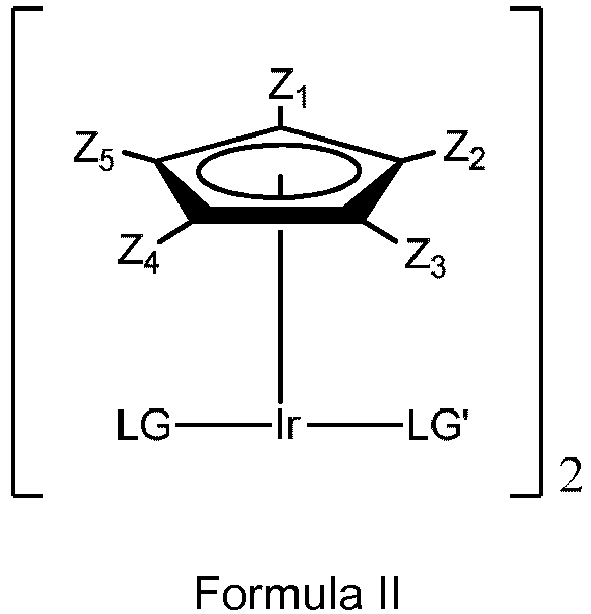
- with a compound of Formula B:

- In accordance with an eighth aspect of the present invention there is provided a method of reducing a reducible substrate, the method comprising hydrogenating the reducible substrate in the presence of a catalyst compound of Formula A as defined herein.
- In accordance with a ninth aspect of the present invention there is provided a composition comprising the catalyst compound of Formula A as defined herein.
- In accordance with a tenth aspect of the present invention there is provided a kit of parts comprising the compound of Formula II as defined herein and the compound of Formula B as defined herein.
- Any features, including optional, suitable, and preferred features, described in relation to any particular aspect of the invention may also be features, including optional, suitable and preferred features, of any other aspect of the present invention. In particular, the definitions for Ring A, Ring B, R1, Z1, Z2, Z3, Z4, Z5, LG, and LG' used in relation to compounds of Formulas I and III are also, unless stated otherwise, applicable definitions in relation to compounds of Formulas A and B.
- For a better understanding of the invention, and to show how embodiments of the same are put into effect, reference is now made, by way of example, to the following diagrammatic drawings, in which:
-
Figure 1 is a graph showing a comparison of the catalytic activity of catalyst compounds 2b (prior art compound - solid squares) and 2c (compound of the invention - solid diamonds) in the illustrated reductive amination in MeOH. - Unless otherwise stated, the following terms used in the specification and claims have the following meanings set out below.
- In this specification the term "alkyl" includes both straight and branched chain alkyl groups. References to individual alkyl groups such as "propyl" are specific for the straight chain version only and references to individual branched chain alkyl groups such as "isopropyl" are specific for the branched chain version only. For example, "(1-6C)alkyl" includes (1-4C)alkyl, (1-3C)alkyl, propyl, isopropyl and t-butyl. A similar convention applies to other radicals, for example "phenyl(1-6C)alkyl" includes phenyl(1-4C)alkyl, benzyl, 1-phenylethyl and 2-phenylethyl.
- The term "(m-nC)" or "(m-nC) group" used alone or as a prefix, refers to any group having m to n carbon atoms.
- An "alkylene" or "alkenylene," group is respectively an alkyl or alkenyl group that is positioned between and serves to connect two other chemical groups. Thus, "(1-6C)alkylene" means a linear saturated divalent hydrocarbon radical of one to six carbon atoms or a branched saturated divalent hydrocarbon radical of three to six carbon atoms, for example, methylene, ethylene, propylene, 2-methylpropylene, pentylene, and the like.
- "(2-6C)alkenylene" means a linear divalent hydrocarbon radical of two to six carbon atoms or a branched divalent hydrocarbon radical of three to six carbon atoms, containing at least one double bond, for example, as in ethenylene, 2,4-pentadienylene, and the like.
- "(3-8C)cycloalkyl" means a hydrocarbon ring containing from 3 to 8 carbon atoms, for example, cyclopropyl, cyclobutyl, cyclopentyl, cyclohexyl, cycloheptyl or bicyclo[2.2.1]heptyl.
- "(3-8C)cycloalkenyl" means a hydrocarbon ring containing at least one double bond, for example, cyclobutenyl, cyclopentenyl, cyclohexenyl or cycloheptenyl, such as 3-cyclohexen-1-yl, or cyclooctenyl.
- "(3-8C)cycloalkyl-(1-6C)alkylene" means a (3-8C)cycloalkyl group covalently attached to a (1-6C)alkylene group, both of which are defined herein.
- The term "halo" or "halogeno" refers to fluoro, chloro, bromo and iodo.
- The term "heterocyclyl", "heterocyclic" or "heterocycle" means a non-aromatic saturated or partially saturated monocyclic, fused, bridged, or spiro bicyclic heterocyclic ring system(s). The term heterocyclyl includes both monovalent species and divalent species. Monocyclic heterocyclic rings contain from about 3 to 12 (suitably from 3 to 7) ring atoms, with from 1 to 5 (suitably 1, 2 or 3) heteroatoms selected from nitrogen, oxygen or sulfur in the ring. Bicyclic heterocycles contain from 7 to 17 member atoms, suitably 7 to 12 member atoms, in the ring. Bicyclic heterocycles contain from about 7 to about 17 ring atoms, suitably from 7 to 12 ring atoms. Bicyclic heterocyclic(s) rings may be fused, spiro, or bridged ring systems. Examples of heterocyclic groups include cyclic ethers such as oxiranyl, oxetanyl, tetrahydrofuranyl, dioxanyl, and substituted cyclic ethers. Heterocycles containing nitrogen include, for example, azetidinyl, pyrrolidinyl, piperidinyl, piperazinyl, tetrahydrotriazinyl, tetrahydropyrazolyl, and the like. Typical sulfur containing heterocycles include tetrahydrothienyl, dihydro-1,3-dithiol, tetrahydro-2H-thiopyran, and hexahydrothiepine. Other heterocycles include dihydro-oxathiolyl, tetrahydro-oxazolyl, tetrahydro-oxadiazolyl, tetrahydrodioxazolyl, tetrahydro-oxathiazolyl, hexahydrotriazinyl, tetrahydro-oxazinyl, morpholinyl, thiomorpholinyl, tetrahydropyrimidinyl, dioxolinyl, octahydrobenzofuranyl, octahydrobenzimidazolyl, and octahydrobenzothiazolyl. For heterocycles containing sulfur, the oxidized sulfur heterocycles containing SO or SO2 groups are also included. Examples include the sulfoxide and sulfone forms of tetrahydrothienyl and thiomorpholinyl such as
tetrahydrothiene 1,1-dioxide andthiomorpholinyl 1,1-dioxide. A suitable value for a heterocyclyl group which bears 1 or 2 oxo (=O) or thioxo (=S) substituents is, for example, 2-oxopyrrolidinyl, 2-thioxopyrrolidinyl, 2-oxoimidazolidinyl, 2-thioxoimidazolidinyl, 2-oxopiperidinyl, 2,5-dioxopyrrolidinyl, 2,5-dioxoimidazolidinyl or 2,6-dioxopiperidinyl. Particular heterocyclyl groups are saturated monocyclic 3 to 7 membered heterocyclyls containing 1, 2 or 3 heteroatoms selected from nitrogen, oxygen or sulfur, for example azetidinyl, tetrahydrofuranyl, tetrahydropyranyl, pyrrolidinyl, morpholinyl, tetrahydrothienyl,tetrahydrothienyl 1,1-dioxide, thiomorpholinyl,thiomorpholinyl 1,1-dioxide, piperidinyl, homopiperidinyl, piperazinyl or homopiperazinyl. As the skilled person would appreciate, any heterocycle may be linked to another group via any suitable atom, such as via a carbon or nitrogen atom. However, reference herein to piperidino or morpholino refers to a piperidin-1-yl or morpholin-4-yl ring that is linked via the ring nitrogen. - By "bridged ring systems" is meant ring systems in which two rings share more than two atoms, see for example Advanced Organic Chemistry, by Jerry March, 4th Edition, Wiley Interscience, pages 131-133, 1992. Examples of bridged heterocyclyl ring systems include, aza-bicyclo[2.2.1]heptane, 2-oxa-5-azabicyclo[2.2.1]heptane, azabicyclo[2.2.2]octane, aza-bicyclo[3.2.1]octane and quinuclidine.
- "Heterocyclyl(1-6C)alkyl" means a heterocyclyl group covalently attached to a (1-6C)alkylene group, both of which are defined herein.
- The term "heteroaryl" or "heteroaromatic" means an aromatic mono-, bi-, or polycyclic ring incorporating one or more (for example 1-4, particularly 1, 2 or 3) heteroatoms selected from nitrogen, oxygen or sulfur. The term heteroaryl includes both monovalent species and divalent species. Examples of heteroaryl groups are monocyclic and bicyclic groups containing from five to twelve ring members, and more usually from five to ten ring members. The heteroaryl group can be, for example, a 5- or 6-membered monocyclic ring or a 9- or 10-membered bicyclic ring, for example a bicyclic structure formed from fused five and six membered rings or two fused six membered rings. Each ring may contain up to about four heteroatoms typically selected from nitrogen, sulfur and oxygen. Typically the heteroaryl ring will contain up to 3 heteroatoms, more usually up to 2, for example a single heteroatom. In one embodiment, the heteroaryl ring contains at least one ring nitrogen atom. The nitrogen atoms in the heteroaryl rings can be basic, as in the case of an imidazole or pyridine, or essentially non-basic as in the case of an indole or pyrrole nitrogen. In general the number of basic nitrogen atoms present in the heteroaryl group, including any amino group substituents of the ring, will be less than five.
- Examples of heteroaryl include furyl, pyrrolyl, thienyl, oxazolyl, isoxazolyl, imidazolyl, pyrazolyl, thiazolyl, isothiazolyl, oxadiazolyl, thiadiazolyl, triazolyl, tetrazolyl, pyridyl, pyridazinyl, pyrimidinyl, pyrazinyl, 1,3,5-triazenyl, benzofuranyl, indolyl, isoindolyl, benzothienyl, benzoxazolyl, benzimidazolyl, benzothiazolyl, benzothiazolyl, indazolyl, purinyl, benzofurazanyl, quinolyl, isoquinolyl, quinazolinyl, quinoxalinyl, cinnolinyl, pteridinyl, naphthyridinyl, carbazolyl, phenazinyl, benzisoquinolinyl, pyridopyrazinyl, thieno[2,3-b]furanyl, 2H-furo[3,2-b]-pyranyl, 5H-pyrido[2,3-d]-o-oxazinyl, 1 H-pyrazolo[4,3-d]-oxazolyl, 4H-imidazo[4,5-d]thiazolyl, pyrazino[2,3-d]pyridazinyl, imidazo[2,1-b]thiazolyl, imidazo[1,2-b][1,2,4]triazinyl. "Heteroaryl" also covers partially aromatic bi- or polycyclic ring systems wherein at least one ring is an aromatic ring and one or more of the other ring(s) is a non-aromatic, saturated or partially saturated ring, provided at least one ring contains one or more heteroatoms selected from nitrogen, oxygen or sulfur. Examples of partially aromatic heteroaryl groups include for example, tetrahydroisoquinolinyl, tetrahydroquinolinyl, 2-oxo-1,2,3,4-tetrahydroquinolinyl, dihydrobenzothienyl, dihydrobenzofuranyl, 2,3-dihydro-benzo[1,4]dioxinyl, benzo[1,3]dioxolyl, 2,2-dioxo-1,3-dihydro-2-benzothienyl, 4,5,6,7-tetrahydrobenzofuranyl, indolinyl, 1,2,3,4-tetrahydro-1,8-naphthyridinyl, 1,2,3,4-tetrahydropyrido[2,3-b]pyrazinyl and 3,4-dihydro-2H-pyrido[3,2-b][1,4]oxazinyl
- Examples of five membered heteroaryl groups include but are not limited to pyrrolyl, furanyl, thienyl, imidazolyl, furazanyl, oxazolyl, oxadiazolyl, oxatriazolyl, isoxazolyl, thiazolyl, isothiazolyl, pyrazolyl, triazolyl and tetrazolyl groups.
- Examples of six membered heteroaryl groups include but are not limited to pyridyl, pyrazinyl, pyridazinyl, pyrimidinyl and triazinyl.
- A bicyclic heteroaryl group may be, for example, a group selected from:
- a benzene ring fused to a 5- or 6-membered ring containing 1, 2 or 3 ring heteroatoms;
- a pyridine ring fused to a 5- or 6-membered ring containing 1, 2 or 3 ring heteroatoms;
- a pyrimidine ring fused to a 5- or 6-membered ring containing 1 or 2 ring heteroatoms;
- a pyrrole ring fused to a 5- or 6-membered ring containing 1, 2 or 3 ring heteroatoms;
- a pyrazole ring fused to a 5- or 6-membered ring containing 1 or 2 ring heteroatoms;
- a pyrazine ring fused to a 5- or 6-membered ring containing 1 or 2 ring heteroatoms;
- an imidazole ring fused to a 5- or 6-membered ring containing 1 or 2 ring heteroatoms;
- an oxazole ring fused to a 5- or 6-membered ring containing 1 or 2 ring heteroatoms;
- an isoxazole ring fused to a 5- or 6-membered ring containing 1 or 2 ring heteroatoms;
- a thiazole ring fused to a 5- or 6-membered ring containing 1 or 2 ring heteroatoms;
- an isothiazole ring fused to a 5- or 6-membered ring containing 1 or 2 ring heteroatoms;
- a thiophene ring fused to a 5- or 6-membered ring containing 1, 2 or 3 ring heteroatoms;
- a furan ring fused to a 5- or 6-membered ring containing 1, 2 or 3 ring heteroatoms;
- a cyclohexyl ring fused to a 5- or 6-membered heteroaromatic ring containing 1, 2 or 3 ring heteroatoms; and
- a cyclopentyl ring fused to a 5- or 6-membered heteroaromatic ring containing 1, 2 or 3 ring heteroatoms.
- Particular examples of bicyclic heteroaryl groups containing a six membered ring fused to a five membered ring include but are not limited to benzofuranyl, benzothiophenyl, benzimidazolyl, benzoxazolyl, benzisoxazolyl, benzothiazolyl, benzisothiazolyl, isobenzofuranyl, indolyl, isoindolyl, indolizinyl, indolinyl, isoindolinyl, purinyl (e.g., adeninyl, guaninyl), indazolyl, benzodioxolyl and pyrazolopyridinyl groups.
- Particular examples of bicyclic heteroaryl groups containing two fused six membered rings include but are not limited to quinolinyl, isoquinolinyl, chromanyl, thiochromanyl, chromenyl, isochromenyl, chromanyl, isochromanyl, benzodioxanyl, quinolizinyl, benzoxazinyl, benzodiazinyl, pyridopyridinyl, quinoxalinyl, quinazolinyl, cinnolinyl, phthalazinyl, naphthyridinyl and pteridinyl groups.
- The term "linear fused ring system" and "kinked fused ring system" are used herein to describe systems comprising three or more fused rings which are respectively ortho-fused in either a linear fashion (e.g. anthracene) or a kinked fashion (e.g. phenanthrene).
- "Heteroaryl(1-6C)alkyl" means a heteroaryl group covalently attached to a (1-6C)alkylene group, both of which are defined herein. Examples of heteroaralkyl groups include pyridin-3-ylmethyl, 3-(benzofuran-2-yl)propyl, and the like.
- The term "aryl" means a cyclic or polycyclic aromatic ring having from 5 to 12 carbon atoms. The term aryl includes both monovalent species and divalent species. Examples of aryl groups include, but are not limited to, phenyl, biphenyl, naphthyl and the like. In particular embodiment, an aryl is phenyl.
- The term "aryl(1-6C)alkyl" means an aryl group covalently attached to a (1-6C)alkylene group, both of which are defined herein. Examples of aryl-(1-6C)alkyl groups include benzyl, phenylethyl, and the like
- This specification also makes use of several composite terms to describe groups comprising more than one functionality. Such terms will be understood by a person skilled in the art. For example heterocyclyl(m-nC)alkyl comprises (m-nC)alkyl substituted by heterocyclyl.
- The term "optionally substituted" refers to either groups, structures, or molecules that are substituted and those that are not substituted.
- Where optional substituents are chosen from "one or more" groups it is to be understood that this definition includes all substituents being chosen from one of the specified groups or the substituents being chosen from two or more of the specified groups.
- Herein, use of the term "ketone" may also encompass aldehydes, though in some embodiments, the term "ketone" may be used in a manner which excludes aldehydes.
- When referring to substituent positions (e.g. ortho-, para-, etc.) in relation to Ring A, said positions are suitably relative to the imine nitrogen atom to which ring A is attached in the catalyst compound, or to the corresponding amine nitrogen atom to which ring A is attached in the precursor amine compound.
- When referring to substituent positions (e.g. ortho-, para-, etc.) in relation to Ring B, said positions are suitably relative to the imine carbon atom to which ring B is attached in the catalyst compound, or to the corresponding carbonyl carbon atom to which ring B is attached in the precursor carbonyl compound.
- The terms "electron withdrawing group" and "electron donating group" are well understood by those skilled in the art, and herein refer to particular substituent groups which respectively withdraw or donate electron density from or to a correspondingly substituted π-bonding system, such as a phenyl group. Electron donating substituents are determinable by a number of methods, including by reference to substituent constants in accordance with the Hammett equation or other equivalent mathematical and experimental techniques. Electron donation is measured relative to hydrogen, and a substituent may be said to be electron donating where it contributes more electron density to the π-bonding system than a standard hydrogen substituent. Electron withdrawing substituents are the opposite of electron donating groups, and a substituent may be said to be electron withdrawing where it withdraws more electron density from the π-bonding system than a standard hydrogen substituent.
- Herein, a particular substituent group (e.g. a nitro group) is considered to be "in π-conjugation with" another group (e.g. an imine group) where p- or π-orbitals of the particular substituent group are electronically linked to p- or π-orbitals of the other group, optionally via an intervening π-system (e.g. such as an alkene, phenyl, or naphthyl moiety). By way of example, in the molecule depicted below, the nitro group, denoted by #, is in π-conjugation with the imine, whose carbon is denoted by *, via an intervening naphthyl π-system.

- References herein to the catalyst compound or "compound of the invention" may refer to any enantiomer, a mixture of enantiomers, or a racemic mixture of enantiomers.
- The phrase "compound of the invention" means those compounds which are disclosed herein, both generically and specifically.
- In accordance with a first aspect of the present invention there is provided a catalyst compound of Formula I:

- In a particular embodiment, the catalyst compound is defined by Formula I:

- ring A is aryl or heteroaryl, substituted by one or two groups selected from hydroxyl, NRaRb, (1-6C)alkyl, (1-6C)alkoxy, or aryl which is optionally substituted by halogeno, hydroxyl, NRaRb, (1-6C)alkyl, (1-6C)alkoxy, wherein Ra and Rb are each independently selected from hydrogen or (1-6C)alkyl;
- ring B is a bicyclic or tricyclic aromatic or heteroaromatic fused ring system, optionally substituted by one or more groups selected from halogeno, hydroxyl, NRcRd, (1-6C)alkyl, (1-6C)alkoxy, [NRcRdRe]+, nitro, cyano, formyl, carboxy, carbamoyl, sulphamoyl, ureido, isocyano, sulphonyl, sulphonate, trihalomethyl (e.g. trifluoromethyl), mercapto, wherein Rc, Rd, and Re are each independently selected from hydrogen or (1-6C)alkyl, or aryl (e.g. phenyl); or a group of the formula:
L1-Q1
wherein:- L1 is absent or is selected from O, S, SO, SO2, N(Rf), C(O), CH(ORf), C(O)N(Rf), N(Rf)C(O), N(Rf)C(O)N(Rg), S(O)2N(Rf), or N(Rf)SO2, wherein Rf and Rg are each independently selected from hydrogen or (1-4C)alkyl; and ;
- Q1 is (1-6C)alkyl, aryl, aryl-(1-6C)alkyl, (3-6C)cycloalkyl, (3-6C)cycloalkyl-(1-6C)alkyl, (3-6C)cycloalkenyl, (3-6C)cycloalkenyl-(1-6C)alkyl, heteroaryl, heteroaryl-(1-6C)alkyl, heterocyclyl or heterocyclyl-(1-6C)alkyl ; and wherein Q1 is optionally further substituted by one or more substituents independently selected from halogeno, hydroxyl, NRcRd, [NRcRdRe]+, (1-6C)alkyl, (1-6C)alkoxy, nitro, cyano, formyl, carboxy, carbamoyl, ureido, isocyano, sulphonyl, sulphonate, trifluoromethyl, mercapto;
- R1 is selected from the group consisting of hydrogen, (1-6C)alkyl, (2-6C)alkenyl, (2-6C)alkynyl, aryl, (3-6C)cycloalkyl, heteroaryl, or R1 is (2-3C)alkylene or (2-3C)alkenylene linked to ring B to form a fused 5- or 6-membered ring, wherein R1 is optionally substituted by one or more groups selected from halogeno, hydroxyl, NRhRi, (1-6C)alkyl, (1-6C)alkoxy, [NRhRiRj]+, nitro, cyano, formyl, carboxy, carbamoyl, sulphamoyl, ureido, isocyano, sulphonyl, sulphonate, trihalomethyl (e.g. trifluoromethyl), mercapto, wherein Rh, Ri, and Rj are each independently selected from hydrogen or (1-6C)alkyl, or aryl (e.g. phenyl); or a group of the formula:
L2-Q2
wherein:- L2 is absent or is selected from O, S, SO, SO2, N(Rk), C(O), CH(ORk), C(O)N(Rk), N(Rk)C(O), N(Rk)C(O)N(Rl), S(O)2N(Rk), or N(Rk)SO2, wherein Rk and Rl are each independently selected from hydrogen or (1-4C)alkyl; and ;
- Q2 is (1-6C)alkyl, aryl, aryl-(1-6C)alkyl, (3-6C)cycloalkyl, (3-6C)cycloalkyl-(1-6C)alkyl, (3-6C)cycloalkenyl, (3-6C)cycloalkenyl-(1-6C)alkyl, heteroaryl, heteroaryl-(1-6C)alkyl, heterocyclyl or heterocyclyl-(1-6C)alkyl; and wherein Q2 is optionally further substituted by one or more substituents independently selected from halogeno, hydroxyl, NRmRn, [NRmRnRo], (1-6C)alkyl, (1-6C)alkoxy, nitro, cyano, formyl, carboxy, carbamoyl, ureido, isocyano, sulphonyl, sulphonate, trifluoromethyl, mercapto, wherein Rm, Rn, and Ro are each independently selected from hydrogen or (1-6C)alkyl, or aryl (e.g. phenyl);
- LG is a leaving group (eg. halo, acetate);
- Z1, Z2, Z3, Z4, and Z5 are each independently selected from hydrogen, (1-6C)alkyl, or aryl.
- Particular catalyst compounds of the present invention include, for example, compounds of Formula I, wherein, unless otherwise stated, each of ring A, ring B, R1, LG, Z1, Z2, Z3, Z4, and Z5 has any one of the meanings defined hereinbefore or in any of paragraphs (1) to (33) hereinafter:-
- (1) Ring A is aryl, optionally substituted by one or two groups selected from hydroxyl, NRaRb, (1-6C)alkyl, (1-6C)alkoxy, or aryl which is optionally substituted by halogeno, hydroxyl, NRaRb, (1-6C)alkyl, (1-6C)alkoxy, wherein Ra and Rb are each independently selected from hydrogen or (1-6C)alkyl.
- (2) Ring A is phenyl, optionally substituted by one or two groups selected from hydroxyl, NRaRb, (1-3C)alkyl, (1-3C)alkoxy, or aryl which is optionally substituted by halogeno, hydroxyl, NRaRb, (1-3C)alkyl, (1-3C)alkoxy, wherein Ra and Rb are each independently selected from hydrogen or (1-2C)alkyl.
- (3) Ring A is phenyl, optionally substituted, in either or both of the ortho- and/or para-position relative to the imine nitrogen atom to which ring A is attached, by one or two groups selected from hydroxyl, NRaRb, (1-3C)alkyl, (1-3C)alkoxy, or aryl which is optionally substituted by halogeno, hydroxyl, NRaRb, (1-3C)alkyl, (1-3C)alkoxy, wherein Ra and Rb are each independently selected from hydrogen or (1-2C)alkyl.
- (4) Ring A is phenyl substituted by one or two (1-3C)alkoxy groups.
- (5) Ring A is phenyl substituted by one or two (1-3C)alkoxy groups in either or both of the ortho- and/or para-position relative to the imine nitrogen atom to which ring A is attached.
- (6) Ring A is phenyl substituted by one (1-3C)alkoxy group in either the ortho- or para-position relative to the imine nitrogen atom to which ring A is attached.
- (7) Ring A is para-methoxyphenyl.
- (8) Any bicyclic fused ring systems of Ring B are ortho-fused.
- (9) Any tricyclic fused ring systems of Ring B are solely ortho-fused.
- (10) Any tricyclic fused ring systems of Ring B are ortho- and peri-fused.
- (11) Any tricyclic fused ring systems of Ring B are linear fused ring systems (i.e. as opposed to kinked fused ring systems).
- (12) ring B is a bicyclic aromatic fused ring system, optionally substituted by one or more groups selected from halogeno, hydroxyl, NRcRd, (1-3C)alkyl, (1-3C)alkoxy, [NRcRdRe]+, nitro, cyano, formyl, carboxy, carbamoyl, sulphamoyl, ureido, isocyano, sulphonyl, sulphonate, trihalomethyl (e.g. trifluoromethyl), mercapto, wherein Rc, Rd, and Re are each independently selected from hydrogen or (1-3C)alkyl, or aryl (e.g. phenyl); or a group of the formula:
L1-Q1
wherein:- L1 is absent or is selected from O, S, SO, SO2, N(Rf), C(O), CH(ORf), C(O)N(Rf), N(Rf)C(O), N(Rf)C(O)N(Rg), S(O)2N(Rf), or N(Rf)SO2, wherein Rf and Rg are each independently selected from hydrogen or (1-2C)alkyl; and ;
- Q1 is (1-6C)alkyl, (2-3C)alkenyl, (1-3)alkynyl, aryl, aryl-(1-3C)alkyl, (5-6C)cycloalkyl, (5-6C)cycloalkyl-(1-3C)alkyl, (5-6C)cycloalkenyl, (5-6C)cycloalkenyl-(3-6C)alkyl, heteroaryl, heteroaryl-(1-3C)alkyl, heterocyclyl or heterocyclyl-(1-3C)alkyl; and wherein Q1 is optionally further substituted by one or more substituents independently selected from halogeno, hydroxyl, NRcRd, [NRcRdRe]+, (1-3C)alkyl, (1-3C)alkoxy, nitro, cyano, formyl, carboxy, carbamoyl, ureido, isocyano, sulphonyl, sulphonate, trifluoromethyl, mercapto.
- (13) Ring B is optionally substituted by one or more groups selected from halogeno, [NRcRdRe]+, nitro, cyano, formyl, carboxy, carbamoyl, sulphamoyl, ureido, isocyano, sulphonyl, sulphonate, trihalomethyl (e.g. trifluoromethyl), wherein Rc, Rd, and Re are each independently selected from hydrogen or (1-6C)alkyl, or aryl (e.g. phenyl); or a group of the formula:
L1-Q1
wherein:- L1 is absent or is selected from SO, SO2, C(O); and
- Q1 is (1-6C)alkyl, (2-6C)alkenyl, (2-6C)alkynyl, aryl, aryl-(1-6C)alkyl, (3-6C)cycloalkyl, (3-6C)cycloalkyl-(1-6C)alkyl, (3-6C)cycloalkenyl, (3-6C)cycloalkenyl-(1-6C)alkyl, heteroaryl, heteroaryl-(1-6C)alkyl, heterocyclyl or heterocyclyl-(1-6C)alkyl; and wherein Q1 is optionally further substituted by one or more substituents independently selected from halogeno, hydroxyl, NRcRd, [NRcRdRe]+, (1-6C)alkyl, (1-6C)alkoxy, nitro, cyano, formyl, carboxy, carbamoyl, ureido, isocyano, sulphonyl, sulphonate, trifluoromethyl, mercapto
- (14) Ring B is optionally substituted by one or more groups selected from halogeno, [NRcRdRe]+, nitro, cyano, formyl, carboxy, carbamoyl, sulphamoyl, ureido, isocyano, sulphonyl, sulphonate, trihalomethyl (e.g. trifluoromethyl), wherein Rc, Rd, and Re are each independently selected from hydrogen or (1-6C)alkyl.
- (15) Ring B is optionally substituted by electron withdrawing groups only (where "electron withdrawing" refers to an overall withdrawal of electron density from the fused ring system, as would be understood by the skilled person).
- (16) Ring B is unsubstituted.
- (17) Ring B is naphthyl, optionally substituted as defined hereinbefore in relation to Ring B.
- (18) Ring B is naphthyl, optionally substituted by one or more groups selected from nitro, cyano, formyl, carboxy, carbamoyl, ureido, isocyano, sulphonyl, sulphonate, or trifluoromethyl.
- (19) Ring B is naphthyl.
- (20) Ring B is β,β-naphthyl, optionally substituted as herein defined in relation to Ring B, such that the naphthyl substituent is attached to the iridium atom and imine-carbon atom respectively at the 2- and 3-position of the naphthyl ring, i.e. has the connectivity:

- (21) R1 is selected from the group consisting of hydrogen or (1-6C)alkyl, or R1 is (2-4C)alkylene or (2-4C)alkenylene linked to ring B to form a fused 5-, 6-, or 7-membered ring, wherein R1, is optionally substituted as herein defined.
- (22) R1 is selected from the group consisting of hydrogen or (1-3C)alkyl, or R1 is (2-4C)alkylene or (2-4C)alkenylene linked to ring B to form a fused 5-, 6- or 7-membered ring, wherein R1 is optionally substituted by one or more groups selected from halogeno, hydroxyl, NRhRi, (1-6C)alkyl, (1-6C)alkoxy, [NRhRiRj]+, nitro, cyano, formyl, carboxy, carbamoyl, sulphamoyl, ureido, isocyano, sulphonyl, sulphonate, trihalomethyl (e.g. trifluoromethyl), mercapto, wherein Rh, Ri, and Rj are each independently selected from hydrogen or (1-6C)alkyl, or aryl (e.g. phenyl); or a group of the formula:
L2-Q2
wherein:- L2 is absent or is selected from O, S, SO, SO2, N(Rk), C(O), CH(ORk), C(O)N(Rk), N(Rk)C(O), N(Rk)C(O)N(Rl), S(O)2N(Rk), or N(Rk)SO2, wherein Rk and Rl are each independently selected from hydrogen or (1-4C)alkyl; and ;
- Q2 is (1-6C)alkyl, aryl, aryl-(1-6C)alkyl, (3-6C)cycloalkyl, (3-6C)cycloalkyl-(1-6C)alkyl, (3-6C)cycloalkenyl, (3-6C)cycloalkenyl-(1-6C)alkyl, heteroaryl, heteroaryl-(1-6C)alkyl, heterocyclyl or heterocyclyl-(1-6C)alkyl; and wherein Q2 is optionally further substituted by one or more substituents independently selected from halogeno, hydroxyl, NRmRn, [NRmRnRo]+, (1-6C)alkyl, (1-6C)alkoxy, nitro, cyano, formyl, carboxy, carbamoyl, ureido, isocyano, sulphonyl, sulphonate, trifluoromethyl, mercapto, wherein Rm, Rn, and Ro are each independently selected from hydrogen or (1-6C)alkyl, or aryl (e.g. phenyl).
- (23) R1 is (2-4C)alkylene linked to ring B to form a fused 5-, 6-, or 7-membered ring, optionally substituted as defined herein.
- (24) R1 is selected from the group consisting of hydrogen or methyl, or R1 is (3C)alkylene linked to ring B to form a fused 6-membered ring.
- (25) R1 is methyl.
- (26) LG is halogeno (e.g. chloro, bromo, iodo), carboxylate (e.g. acetate, trifluoroacetate), sulfonate (e.g. triflate, tosylate, mesylate), nitrate, phosphate, phenolate.
- (27) LG is halogeno (e.g. chloro, bromo, iodo), or carboxylate (e.g. acetate, trifluoroacetate).
- (28) LG is chloro.
- (29) Z1, Z2, Z3, Z4, and Z5 are each independently selected from hydrogen, (1-6C)alkyl, phenyl, (1-3C)alkoxy, hydroxyl, or NRpRq, wherein Rp and Rq are each independently selected from hydrogen or (1-6C)alkyl, or aryl (e.g. phenyl).
- (30) Z1, Z2, Z3, Z4, and Z5 are each independently selected from hydrogen, (1-6C)alkyl, or phenyl.
- (31) Z1, Z2, Z3, Z4, and Z5 are each independently selected from hydrogen or methyl.
- (32) Z1, Z2, Z3, Z4, and Z5 are all hydrogen or methyl.
- (33) Z1, Z2, Z3, Z4, and Z5 are all methyl.
- Where ring B is naphthyl, whether further substituted or otherwise it may be attached to the iridium and imine-carbon atoms respectively as either α,β-naphthyl, β,β-naphthyl, or β,α-naphthyl, though most suitably the naphthyl is β,β-naphthyl. In naphthalene there are two sets of equivalent hydrogen atoms: the alpha (a) positions are
positions positions 
- In a particular group of compounds of the invention, Ring B is β,β-naphthyl, optionally substituted as defined hereinbefore, i.e. the compounds have the structural formula la shown below:
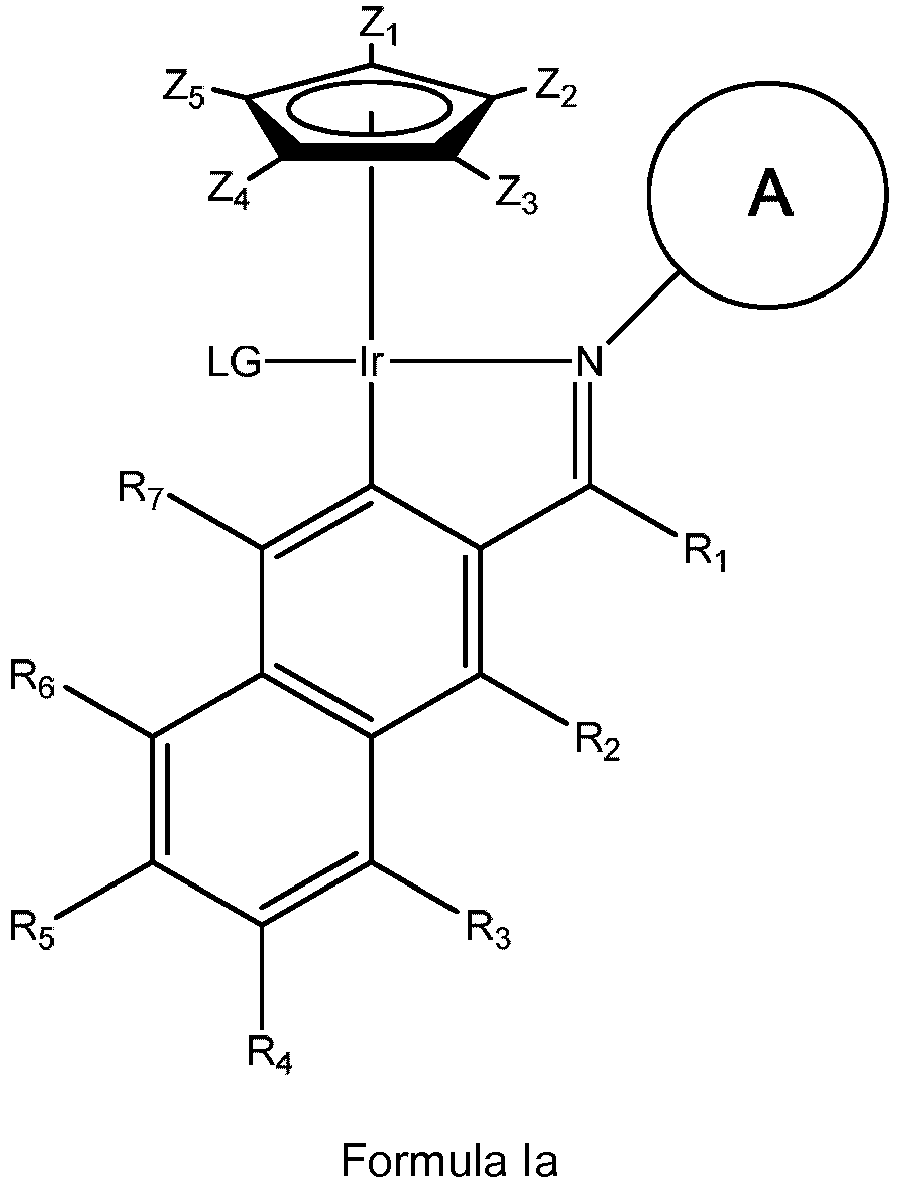
- In a particular group of compounds of the invention, Ring B is β,β-naphthyl, optionally substituted as defined hereinbefore, and Ring A is phenyl optionally substituted as shown, i.e. the compounds have the structural formula Ib shown below:

- In a particular group of compounds of the invention, Ring B is β,β-naphthyl, and Ring A is phenyl optionally substituted as shown, Z1, Z2, Z3, Z4, and Z5 are all methyl, i.e. the compounds have the structural formula Ic shown below:

- In a particular embodiment, the catalyst compound has the structural formula:

- In a particular group of compounds of the invention, the catalyst compound is selected from any one of:

- In accordance with a sixth aspect of the present invention, there is provided a catalyst compound of Formula A:

- In a particular embodiment, the catalyst compound is defined by Formula A:

- ring A is aryl or heteroaryl, substituted by one or two groups selected from hydroxyl, NRaRb, (1-6C)alkyl, (1-6C)alkoxy, or aryl which is optionally substituted by halogeno, hydroxyl, NRaRb, (1-6C)alkyl, (1-6C)alkoxy, wherein Ra and Rb are each independently selected from hydrogen or (1-6C)alkyl;
- ring B is a aryl or heteroaryl, optionally substituted by one or more groups selected from halogeno, hydroxyl, NRcRd, (1-6C)alkyl, (1-6C)alkoxy, [NRcRdRe]+, nitro, cyano, formyl, carboxy, carbamoyl, sulphamoyl, ureido, isocyano, sulphonyl, sulphonate, trihalomethyl (e.g. trifluoromethyl), mercapto, wherein Rc, Rd, and Re are each independently selected from hydrogen or (1-6C)alkyl, or aryl (e.g. phenyl); or a group of the formula:
L1-Q1
wherein:- L1 is absent or is selected from O, S, SO, SO2, N(Rf), C(O), CH(ORf), C(O)N(Rf), N(Rf)C(O), N(Rf)C(O)N(Rg), S(O)2N(Rf), or N(Rf)SO2, wherein Rf and Rg are each independently selected from hydrogen or (1-4C)alkyl; and ;
- Q1 is (1-6C)alkyl, aryl, aryl-(1-6C)alkyl, (3-6C)cycloalkyl, (3-6C)cycloalkyl-(1-6C)alkyl, (3-6C)cycloalkenyl, (3-6C)cycloalkenyl-(1-6C)alkyl, heteroaryl, heteroaryl-(1-6C)alkyl, heterocyclyl or heterocyclyl-(1-6C)alkyl ; and wherein Q1 is optionally further substituted by one or more substituents independently selected from halogeno, hydroxyl, NRcRd, [NRcRdRe]+, (1-6C)alkyl, (1-6C)alkoxy, nitro, cyano, formyl, carboxy, carbamoyl, ureido, isocyano, sulphonyl, sulphonate, trifluoromethyl, mercapto;
- R1 is (2-4C)alkylene or (2-4C)alkenylene linked to ring B to form a fused 5- or 6-or 7- membered ring, wherein R1 is optionally substituted by one or more groups selected from halogeno, hydroxyl, NRhRi, (1-6C)alkyl, (1-6C)alkoxy, [NRhRiRj]+, nitro, cyano, formyl, carboxy, carbamoyl, sulphamoyl, ureido, isocyano, sulphonyl, sulphonate, trihalomethyl (e.g. trifluoromethyl), mercapto, wherein Rh, Ri, and Rj are each independently selected from hydrogen or (1-6C)alkyl, or aryl (e.g. phenyl); or a group of the formula:
L2-Q2
wherein:- L2 is absent or is selected from O, S, SO, SO2, N(Rk), C(O), CH(ORk), C(O)N(Rk), N(Rk)C(O), N(Rk)C(O)N(Rl), S(O)2N(Rk), or N(Rk)SO2, wherein Rk and Rl are each independently selected from hydrogen or (1-4C)alkyl; and ;
- Q2 is (1-6C)alkyl, aryl, aryl-(1-6C)alkyl, (3-6C)cycloalkyl, (3-6C)cycloalkyl-(1-6C)alkyl, (3-6C)cycloalkenyl, (3-6C)cycloalkenyl-(1-6C)alkyl, heteroaryl, heteroaryl-(1-6C)alkyl, heterocyclyl or heterocyclyl-(1-6C)alkyl ; and wherein Q2 is optionally further substituted by one or more substituents independently selected from halogeno, hydroxyl, NRmRn, [NRmRnRo]+, (1-6C)alkyl, (1-6C)alkoxy, nitro, cyano, formyl, carboxy, carbamoyl, ureido, isocyano, sulphonyl, sulphonate, trifluoromethyl, mercapto, wherein Rm, Rn, and Ro are each independently selected from hydrogen or (1-6C)alkyl, or aryl (e.g. phenyl);
- LG is a leaving group (eg. halo, acetate);
- Z1, Z2, Z3, Z4, and Z5 are each independently selected from hydrogen, (1-6C)alkyl, or aryl.
- Particular catalyst compounds of the present invention include, for example, compounds of Formula A, wherein, unless otherwise stated, each of ring A, ring B, R1, LG, Z1, Z2, Z3, Z4, and Z5 has any one of the meanings defined hereinbefore in relation to the compounds of either Formula A or Formula I (with the exception of R1 whose meanings are defined in relation to Formula A only), or in any of paragraphs (34) to (40) hereinafter:-
- (34) Ring A is para-methoxyphenyl.
- (35) Ring B is phenyl, optionally substituted by one or more groups selected from halogeno, hydroxyl, NRcRd, (1-6C)alkyl, (1-6C)alkoxy, [NRcRdRe]+, nitro, cyano, formyl, carboxy, carbamoyl, sulphamoyl, ureido, isocyano, sulphonyl, sulphonate, trihalomethyl (e.g. trifluoromethyl), mercapto, wherein Rc, Rd, and Re are each independently selected from hydrogen or (1-6C)alkyl, or aryl (e.g. phenyl); or a group of the formula:
L1-Q1
wherein:- L1 is absent or is selected from O, S, SO, SO2, N(Rf), C(O), CH(ORf), C(O)N(Rf), N(Rf)C(O), N(Rf)C(O)N(Rg), S(O)2N(Rf), or N(Rf)SO2, wherein Rf and Rg are each independently selected from hydrogen or (1-4C)alkyl; and ;
- Q1 is (1-6C)alkyl, (2-6C)alkenyl, (2-6C)alkynyl, aryl, aryl-(1-6C)alkyl, (3-6C)cycloalkyl, (3-6C)cycloalkyl-(1-6C)alkyl, (3-6C)cycloalkenyl, (3-6C)cycloalkenyl-(1-6C)alkyl, heteroaryl, heteroaryl-(1-6C)alkyl, heterocyclyl or heterocyclyl-(1-6C)alkyl ; and wherein Q1 is optionally further substituted by one or more substituents independently selected from halogeno, hydroxyl, NRcRd, [NRcRdRe]+, (1-6C)alkyl, (1-6C)alkoxy, nitro, cyano, formyl, carboxy, carbamoyl, ureido, isocyano, sulphonyl, sulphonate, trifluoromethyl, mercapto.
- (36) Ring B is phenyl optionally substituted, in either or both of the ortho- and/or para-position relative to the imine carbon atom to which ring B is attached, by one or more groups selected from halogeno, hydroxyl, NRcRd, (1-6C)alkyl, (1-6C)alkoxy, [NRcRdRe]+, nitro, cyano, formyl, carboxy, carbamoyl, sulphamoyl, ureido, isocyano, sulphonyl, sulphonate, trihalomethyl (e.g. trifluoromethyl), mercapto, wherein Rc, Rd, and Re are each independently selected from hydrogen or (1-6C)alkyl, or aryl (e.g. phenyl); or a group of the formula:
L1-Q1
wherein:- L1 is absent or is selected from O, S, SO, SO2, N(Rf), C(O), CH(ORf), C(O)N(Rf), N(Rf)C(O), N(Rf)C(O)N(Rg), S(O)2N(Rf), or N(Rf)SO2, wherein Rf and Rg are each independently selected from hydrogen or (1-4C)alkyl; and ;
- Q1 is (1-6C)alkyl, (2-6C)alkenyl, (2-6C)alkynyl, aryl, aryl-(1-6C)alkyl, (3-6C)cycloalkyl, (3-6C)cycloalkyl-(1-6C)alkyl, (3-6C)cycloalkenyl, (3-6C)cycloalkenyl-(1-6C)alkyl, heteroaryl, heteroaryl-(1-6C)alkyl, heterocyclyl or heterocyclyl-(1-6C)alkyl ; and wherein Q1 is optionally further substituted by one or more substituents independently selected from halogeno, hydroxyl, NRcRd, [NRcRdRe]+, (1-6C)alkyl, (1-6C)alkoxy, nitro, cyano, formyl, carboxy, carbamoyl, ureido, isocyano, sulphonyl, sulphonate, trifluoromethyl, mercapto.
- (37) Ring B is phenyl optionally substituted, in either or both of the ortho- and/or para-position relative to the imine carbon atom to which ring B is attached, by (1-3C)alkoxy.
- (38) R1 is (2-4C)alkylene linked to ring B to form a fused 5-, 6-, or 7-membered ring, optionally substituted as defined herein.
- (39) R1 is (3C)alkylene linked to ring B to form a fused 6-membered ring, optionally substituted as defined herein.
- (40) R1 is unsubstituted (3C)alkylene linked to ring B to form a fused 6-membered ring.
- In a particular group of compounds of the invention, Ring B is phenyl optionally substituted as defined hereinbefore, i.e. the compounds have the structural formula A1 shown below:

- In a particular group of compounds of the invention, Ring B is phenyl optionally substituted as shown, and Ring A is phenyl optionally substituted as shown, i.e. the compounds have the structural formula A2 shown below:

- In a particular group of compounds of the invention, Ring B is phenyl optionally substituted as shown, and Ring A is phenyl optionally substituted as shown, i.e. the compounds have the structural formula A3 shown below:

- In a particular group of compounds of the invention, Ring B is phenyl optionally substituted as shown, Ring A is phenyl optionally substituted as shown, and R1 is a propylene group linked to ring B to form a six-membered ring, i.e. the compounds have the structural formula A4 shown below:

- In a particular embodiment, the catalyst compound is selected from:

- In accordance with a second aspect of the present invention there is provided a method for preparing a catalyst compound of Formula I as defined herein, the method comprising:
- reacting a compound of formula II:

- with a compound of Formula III:

- Though the compound of Formula II is shown as a dimer, it will be understood by those skilled in the art that this compound may also exist as a monomer, suitably solvated by virtue of a solvent molecule coordinating to the iridium atom. As such, the definition of the compound of Formula II is intended to include such equivalent monomeric forms.
- According to a further aspect of the present invention, there is provided a catalyst compound of Formula I obtainable by, obtained by, or directly obtained by the method as defined herein for preparing a catalyst compound of Formula I.
- Though LG' may have any one of the definitions given herein in relation to LG, LG' may be either the same as or different to LG.
- In a particular embodiment, LG' is halogeno (e.g. chloro, bromo, iodo), carboxylate (e.g. acetate, trifluoroacetate), sulfonate (e.g. triflate, tosylate, mesylate), nitrate, phosphate, phenolate.
- In a particular embodiment, LG' is halogeno (e.g. chloro, bromo, iodo), or carboxylate (e.g. acetate, trifluoroacetate).
- In a particular embodiment, LG' is chloro.
- In a particular embodiment, LG and LG' are both the same, most suitably both chloro.
- Suitably the method involves reacting 1 molar equivalent of the compound of Formula II with between 1 and 10 molar equivalents of the compound of Formula III, more suitably between 1.2 and 5 molar equivalents of the compound of Formula III, most suitably between 1.5 and 2.5 molar equivalents of the compound of Formula III. Herein, the term molar equivalent is used to illustrate relative molar ratios of different substances, wherein the 1 molar equivalent used in relation to the compound of Formula II is a reference quantity in moles.
- In an embodiment, the reaction is performed in the presence of a base, suitably between 1 and 20 molar equivalents of base, more suitably between 1.2 and 12 molar equivalents of base, most suitably 8 to 12 molar equivalents of base (i.e. relative to the 1 molar equivalent reference used in relation to the compound of Formula II). In an embodiment, the base is sodium acetate, though a host of other suitable bases would be apparent to those skilled in the art.
- Suitably, the reaction is performed under a (substantially) inert atmosphere, e.g. under a nitrogen or argon atmosphere.
- The reaction is suitably performed in a solvent, suitably an organic solvent. Though a range of organic solvents may be used, in a particular embodiment the organic solvent is dichloromethane.
- The reaction is suitably allowed to proceed to completion, which typically takes at least 1 hour, more suitably at least 12 hours.
- The reaction is suitably allowed to proceed at a temperature between 10 and 80°C.
- The catalyst compound of Formula I is suitably isolated from the reaction mixture after the reaction is complete, typically by removing the reaction solvent to provide a solid, which is then subsequently washed with further organic solvents (e.g. hexane and/or diethyl ether). Optionally, before the reaction solvents are removed, the reaction mixture may be filtered (e.g. through celite) and optionally dried (e.g. over MgSO4).
- In accordance with a seventh aspect of the present invention there is provided a method for preparing a catalyst compound of Formula A as defined herein, the method comprising:
- reacting a compound of formula II:
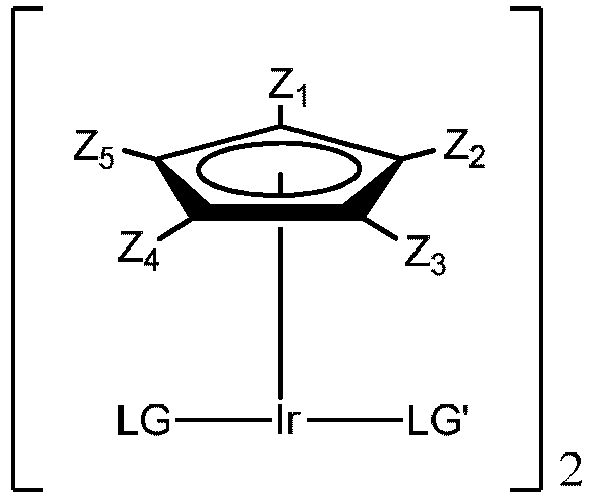

- with a compound of Formula B:

- Again, though the compound of Formula II is shown as a dimer, it will be understood by those skilled in the art that this compound may also exist as a monomer, suitably solvated by virtue of a solvent molecule coordinating to the iridium atom. As such, the definition of the compound of Formula II is intended to include such equivalent monomeric forms.
- According to a further aspect of the present invention, there is provided a catalyst compound of Formula A obtainable by, obtained by, or directly obtained by the method as defined herein for preparing a catalyst compound of Formula A.
- LG' is suitably defined in the same manner as per the method of preparing the catalyst compound of Formula I.
- Suitably the method involves reacting 1 molar equivalent of the compound of Formula II with between 1 and 10 molar equivalents of the compound of Formula B, more suitably between 1.2 and 5 molar equivalents of the compound of Formula B, most suitably between 1.5 and 2.5 molar equivalents of the compound of Formula B.
- In an embodiment, the reaction is performed in the presence of a base, suitably between 1 and 20 molar equivalents of base, more suitably between 1.2 and 12 molar equivalents of base, most suitably 8 to 12 molar equivalents of base (i.e. relative to the 1 molar equivalent reference used in relation to the compound of Formula II). In an embodiment, the base is sodium acetate, though a host of other suitable bases would be apparent to those skilled in the art.
- Suitably, the reaction is performed under a (substantially) inert atmosphere, e.g. under a nitrogen or argon atmosphere.
- The reaction is suitably performed in a solvent, suitably an organic solvent. Though a range of organic solvents may be used, in a particular embodiment the organic solvent is dichloromethane.
- The reaction is suitably allowed to proceed to completion, which typically takes at least 1 hour, more suitably at least 12 hours.
- The reaction is suitably allowed to proceed at a temperature between 10 and 80°C.
- The catalyst compound of Formula I is suitably isolated from the reaction mixture after the reaction is complete, typically by removing the reaction solvent to provide a solid, which is then subsequently washed with further organic solvents (e.g. hexane and/or diethyl ether). Optionally, before the reaction solvents are removed, the reaction mixture may be filtered (e.g. through celite) and optionally dried (e.g. over MgSO4).
- In accordance with a third aspect of the present invention there is provided a method of reducing a reducible substrate, the method comprising hydrogenating the reducible substrate in the presence of a catalyst compound of Formula I as defined herein.
- In accordance with an eighth aspect of the present invention there is provided a method of reducing a reducible substrate, the method comprising hydrogenating the reducible substrate in the presence of a catalyst compound of Formula A as defined herein.
- According to a further aspect of the present invention there is provided a hydrogenated substrate obtainable by, obtained by, or directly obtained by any one of the methods as defined herein for reducing a reducible substrate.
- In the description of the synthetic methods described below and in the referenced synthetic methods that are used to prepare the staring materials, it is to be understood that all proposed reaction conditions, including choice of solvent, reaction atmosphere, reaction temperature, duration of the experiment and workup procedures, can be selected by a person skilled in the art.
- It is understood by one skilled in the art of organic synthesis that the functionality present on various portions of the molecule must be compatible with the reagents and reaction conditions utilised.
- Necessary starting materials may be obtained by standard procedures of organic chemistry. The preparation of such starting materials is described in conjunction with the following representative process variants and within the accompanying Examples. Alternatively necessary starting materials are obtainable by analogous procedures to those illustrated which are within the ordinary skill of an organic chemist.
- The methodologies of the present invention, which are discussed below in more detail, generally involve the hydrogenation of a reducible substrate in an appropriate solvent in the presence of a sufficient loading of the catalyst. Other conditions such as temperature, pH, reaction times, additional reagents, and reaction mixture agitation are also discussed below.
- Unless otherwise stated, the following features apply equally to both catalyst compounds of Formula I and Formula A regarding their use in methods of reducing a reducible substrate.
- The reducible substrate comprises at least one reducible moiety which is reducible by the method(s) of the present invention. In an embodiment, the reducible substrate comprises a single reducible moiety. In other embodiments, the reducible substrate comprises a plurality of reducible moieties, which may either all be reduced or some selectively reduced by the method(s) of the invention.
- It will be apparent to those skilled in the art that the methodology according to the invention is broadly applicable to a diverse range of reducible substrates. Moreover, in the light of this disclosure the skilled artisan can readily appreciate that the methodology of the invention is especially applicable to reducing reducible moieties such as those comprising polar π-bonds. As such, the reducible substrate (or a reducible moiety thereof) suitably comprises a polar π-bond (e.g. a C=Q moiety, where Q is a group more electronegative than the carbon atom to which it is attached).
- In a particular embodiment, the reducible substrate comprises a reducible moiety selected from the group including an imine, iminium, carbonyl, oxonium, thiocarbonyl, thioxonium, or an alkene or alkyne in π-conjugation with a nitro, cyano, formyl, carboxy, carbamoyl, sulphamoyl, ureido, isocyano, sulphonyl, or sulphonate group. In a particular embodiment, the reducible substrate comprises a reducible moiety selected from an imine and an iminium group (optionally made in situ - i.e. as per a reductive amination procedure). The reducible moiety is reduced by the method of the present invention.
- In a particular embodiment, the reducible substrate is defined by a compound of Formula X:

L3-Q3
wherein: - L3 is absent or is selected from O, S, SO, SO2, N(Ru), C(O), CH(ORu), C(O)N(Ru), N(Ru)C(O), N(Ru)C(O)N(Rv), S(O)2N(Ru), or N(Ru)SO2, wherein Ru and Rv are each independently selected from hydrogen or (1-4C)alkyl; and ;
- Q3 is (1-6C)alkyl, (2-6C)alkenyl, (2-6C)alkynyl, aryl, aryl-(1-6C)alkyl, (3-6C)cycloalkyl, (3-6C)cycloalkyl-(1-6C)alkyl, (3-6C)cycloalkenyl, (3-6C)cycloalkenyl-(1-6C)alkyl, heteroaryl, heteroaryl-(1-6C)alkyl, heterocyclyl or heterocyclyl-(1-6C)alkyl; and wherein Q3 is optionally further substituted by one or more substituents independently selected from halogeno, hydroxyl, NRrRs, [NRrRsRt]+, (1-6C)alkyl, (1-6C)alkoxy, nitro, cyano, formyl, carboxy, carbamoyl, ureido, isocyano, sulphonyl, sulphonate, trifluoromethyl, mercapto;
- wherein any two substituent groups of either or both of R20 and R21 are optionally linked so as to form a 5-, 6-, or 7-membered ring;
- R22, R23 and R24 are each independently selected from hydrogen, (1-8C)alkyl, (2-8C)alkenyl, (2-8C)alkynyl, (3-8C)cycloalkyl, (3-8C)cycloalkyl-(1-6C)alkyl, (3-8C)cycloalkenyl, (3-8C)cycloalkenyl-(1-6C)alkyl, (3-8C)cycloalkynyl, (3-8C)cycloalkynyl-(1-6C)alkyl, heterocyclyl, heterocyclyl-(1-6C)alkyl, aryl, aryl-(1-6C)alkyl, heteroaryl, heteroaryl-(1-6C)alkyl; and wherein R22, R23, and R24 are each independently optionally further substituted by one or more substituent groups selected from halogeno, hydroxyl, NRwRx, (1-6C)alkyl, (1-6C)alkoxy, [NRwRxRy]+, nitro, cyano, formyl, carboxy, carbamoyl, sulphamoyl, ureido, isocyano, sulphonyl, sulphonate, trihalomethyl (e.g. trifluoromethyl), mercapto, wherein Rw, Rx, and Ry are each independently selected from hydrogen or (1-6C)alkyl, or aryl (e.g. phenyl); or a substituent group of the formula:
L4-Q4
wherein:- L4 is absent or is selected from O, S, SO, SO2, N(Rz1), C(O), CH(ORz1), C(O)N(Rz1), N(Rz1)C(O), N(Rz1)C(O)N(Rz2), S(O)2N(Rz1), or N(Rz1)SO2, wherein Rz1 and Rz2 are each independently selected from hydrogen or (1-4C)alkyl; and ;
- Q4 is (1-6C)alkyl, (2-6C)alkenyl, (2-6C)alkynyl, aryl, aryl-(1-6C)alkyl, (3-6C)cycloalkyl, (3-6C)cycloalkyl-(1-6C)alkyl, (3-6C)cycloalkenyl, (3-6C)cycloalkenyl-(1-6C)alkyl, heteroaryl, heteroaryl-(1-6C)alkyl, heterocyclyl or heterocyclyl-(1-6C)alkyl; and wherein Q4 is optionally further substituted by one or more substituents independently selected from halogeno, hydroxyl, NRwRx, [NRwRxRy]+, (1-6C)alkyl, (1-6C)alkoxy, nitro, cyano, formyl, carboxy, carbamoyl, ureido, isocyano, sulphonyl, sulphonate, trifluoromethyl, mercapto;
- wherein any two substituent groups of R22, R23 and R24 are optionally linked so as to form a 5-, 6-, or 7-membered ring;
- on the proviso that neither R23 or R24 are hydrogen;
- In a particular embodiment, R20 and R21 are each independently selected from (1-8C)alkyl, aryl, aryl-(1-6C)alkyl, heteroaryl, heteroaryl-(1-6C)alkyl; and wherein R20 and R21 are optionally substituted by one or more substituent groups selected from (1-6C)alkoxy, nitro, trihalomethyl (e.g. trifluoromethyl), or a substituent group of the formula:
L3-Q3
wherein: - L3 is absent; and
- Q3 is aryl
- In a particular embodiment, one of R20 and R21 is (1-3C)alkyl, whilst the other of R20 and R21 is aryl (e.g. phenyl, naphthyl, anthracenyl); and wherein said aryl group is optionally substituted by one or more substituent groups selected from (1-3C)alkoxy, nitro, trifluotomethyl, or phenyl; wherein any two substituent groups of either or both of R20 and R21 are optionally linked so as to form a 5-membered ring.
- In a particular embodiment, Q is NR22, or [NR23R24]+ as defined herein, i.e. the reducible substrate is defined by a compound of Formula X1 or X2:

- In a particular embodiment, Q is NR22 and R22 is hydrogen. Ammonia or ammonium salts (e.g. ammonium formate) may suitably provide a source of ammonia to produce an imine with such a Q group.
- Where the method is applied to a reducible substrate of Formula X, the reducible substrate (X) is reduced to a reduced product of Formula XH2 according to the scheme below:

- In a particular embodiment, the reducible substrate (i.e. the substrate being reduced in the method) may be pre-formed (i.e. prior to its reduction in accordance with the method). In an alternative embodiment, the reducible substrate is formed in situ (e.g. as per reductive aminations).
- In a particular embodiment, the method of reducing is a method of reductive amination whereby the reducible substrate is an imine (e.g. Formula X1) or iminium (e.g. Formula X2) prepared in situ by a reaction between a ketone (e.g. of Formula X3) and ammonia or an amine (e.g. of either Formula X1' or Formula X2' or a salt thereof) as illustrated, by way of example, by the scheme below:


- In a particular embodiment, the amine is ammonia (optionally supplied by ammonium salts such as ammonium formate). In an embodiment, the ketone is a methyl-aryl-ketone.
- During reductive aminations, hydrogenation conditions suitably prevail as the ketone reacts with the amine to form the imine or iminium. However, suitably under the prevailing conditions, the imine or iminium is more susceptible to hydrogenation than the corresponding ketone. As such, the imine or iminium is preferentially reduced.
- Formulas given in relation to amines or imines may also include acceptable salts thereof. For instance, an imine may become protonated (e.g. at acid pHs) to yield an iminium ion. Alternatively, the amine starting materials (including ammonia) may themselves be provided as protonated salts (e.g. ammonium formate) where said salts still provide a source of the free amine under the relevant reaction conditions. Any cations are suitably associated with appropriate counterions (e.g. counterions usually depend on the prevailing conditions).
- Hydrogenating the reducible substrate may suitably involve exposing the reducible substrate (and the catalyst compound) to a source of hydrogen.
- In a particular embodiment, hydrogenating involves exposing the reducible substrate and catalyst compound to a gaseous hydrogen atmosphere, suitably a pressurized hydrogen atomosphere (e.g. 1-2000 Bar pressure, most suitably 1-100 Bar pressure). Suitably the reducible substrate and catalyst compound are agitated (e.g. stirred or shaken in a reaction solvent) during hydrogenation under a hydrogen atmosphere.
- In an embodiment, hydrogenating the reducible substrate occurs via transfer hydrogenation. This involves providing an alternative source of hydrogen to gaseous hydrogen, i.e. from a "hydrogen donor". The skilled person can readily appreciate the benefits of transfer hydrogenation over standard hydrogenation, not least the added convenience and safety.
- Transfer hydrogenation reactions may be carried out with a range of "hydrogen donors" known in the art (e.g. diimide, formic acid, formate, isopropanol, etc.). In a particular embodiment, the hydrogen donor comprises formic acid or formate. In a particular embodiment, the hydrogen donor comprises (or consists of) formic acid, ammonium formate, a metal formate (e.g. sodium formate), or a mixture thereof. In a particular embodiment, the hydrogen donor comprises (or consists of) ammonium formate.
- It is well understood that during transfer hydrogenation reactions, one molar equivalent of formic acid or formate breaks down in the presence of a suitable catalyst to form 1 molar equivalent of hydrogen along with 1 molar equivalent of carbon dioxide. The hydrogen, which generally exists as metal hydride,, is then available to participate in the transfer hydrogenation reaction.
- The transfer hydrogenation reaction mixture suitably comprises a hydrogen donor in an amount sufficient to provide at least 1 molar equivalent of hydrogen per molar equivalent of reducible moiety of the reducible substrate, more suitably at least 2 molar equivalents of hydrogen per molar equivalent of reducible moiety, most suitably at least 5 molar equivalents of hydrogen per molar equivalent of reducible moiety. The transfer hydrogen reaction mixture may suitably comprise a hydrogen donor in an amount sufficient to provide at most 50 molar equivalents of hydrogen per molar equivalent of reducible moiety, more suitably at most 20 molar equivalents of hydrogen per molar equivalent of reducible moiety, most suitably at most 15 molar equivalents of hydrogen per molar equivalent of reducible moiety.
- Where transfer hydrogenation is employed, the hydrogenation reaction suitably takes place under an otherwise inert atmosphere (e.g. of nitrogen or argon).
- The method(s) of reducing according to the invention are suitably performed in an appropriate hydrogenation solvent, which may be chosen from a variety of solvents, for example, to suit the particular conditions, reagents, substrate, and/or product.
- A particular solvent or solvent combination may be selected for a variety of reasons, including inter alia reagent solubilities (including of the reducible substrate and catalyst), solvent boiling point (whether to achieve higher temperatures if required to effect hydrogenation or to facilitate facile post-reaction removal of a low-boiling solvent), ease of crystallisation of the product therefrom (with or without a co-solvent), safety considerations, solvent availability, and cost. However, the solvent may also be selected to suit the catalyst, for instance to facilitate dissociation of the catalyst leaving group to enhance catalytic activity, or to inhibit coordination of the substrate and product to the metal centre.
- In a particular embodiment the hydrogenation solvent comprises a polar protic or aprotic solvent. Suitably a solvent is considered "polar" where it is miscible with water. In a particular embodiment, the hydrogenation solvent comprises a polar protic solvent. In another embodiment, the solvent comprises a (1-3C)alcohol, optionally substituted by one or more halides (e.g. fluoro, an example of which is trifluoroethanol (TFE)).
- In a particular embodiment, where the catalyst used is the catalyst compound of Formula I, the hydrogenation solvent comprises a (1-3C)alcohol, suitably a (1-2C)alcohol, most suitably methanol.
- In a particular embodiment, where the catalyst used is the catalyst compound of Formula A, the hydrogenation solvent comprises a (2-3C)alcohol optionally substituted by one or more halides, most suitably trifluoroethanol (TFE).
- The hydrogenation solvent may comprise a mixture of two or more solvents. However, in a particular embodiment, the hydrogenation solvent comprises at least 80% w/w (relative to the total amount of hydrogenation solvent) of any one of the single solvents referred to above in relation to the hydrogenation solvent, more suitably at least 90%. In a particular embodiment, the hydrogenation solvent is any one of the single solvents referred to above in relation to the hydrogen solvent.
- Suitably the catalyst is pre-dissolved in a portion of the hydrogenation solvent before its addition to the hydrogenation reaction mixture.
- The skilled person will appreciate that the particular catalyst compounds of the present invention may provide particular advantages over those of the prior art in particular solvents.
- In particular embodiments, especially in respect of reductive aminations, the hydrogenation reaction mixture comprises an acid or acidic buffer, suitably comprising an organic acid. Suitably, sufficient acid or acidic buffer is used to provide a starting pH (i.e. the pH before hydrogenation is initiated) between pH 3-8. Suitably the acid or acidic buffer is not itself susceptive to hydrogenation or reaction with the catalyst. However, the acid or acidic buffer may provide an additional source of hydrogen, e.g. if formic acid is used.
- In a particular embodiment, the acid (or acid associated with the acid buffer) has a pKa in water (at 25°C) of greater than or equal to 3, suitably greater than or equal to 3.5.
- In particular embodiments, the acid or acid buffer is selected from the group including formic acid, acetic acid, benzoic acid, phosphoric acid, citric acid, phthalic acid, and formic acid/triethylamine azeotrope.
- The hydrogenation reaction mixture suitably comprises sufficient catalyst compound for effective hydrogenation of the reducible substrate. Suitably the reaction mixture comprises at least 0.000001 molar equivalents of the catalyst compound per molar equivalent of reducible moiety of the reducible substrate, more suitably at least 0.0001 molar equivalents of the catalyst compound per molar equivalent of reducible moiety of the reducible substrate, most suitably at least 0.0003 molar equivalents of the catalyst compound per molar equivalent of reducible moiety of the reducible substrate. Suitably the reaction mixture comprises at most 0.1 molar equivalents of the catalyst compound per molar equivalent of reducible moiety of the reducible substrate, more suitably at most 0.01 molar equivalents of the catalyst compound per molar equivalent of reducible moiety of the reducible substrate, most suitably at most 0.005 molar equivalents of the catalyst compound per molar equivalent of reducible moiety of the reducible substrate.
- Suitably, the reduction reaction may be carried out under anhydrous conditions.
- For standard hydrogenation conditions, the reaction is suitably carried out under an atmosphere of hydrogen, optionally under greater pressure than atmospheric pressure. Transfer hydrogenation reactions, on the other hand, may be suitably carried out in the presence of an inert atmosphere, such as argon or nitrogen.
- Hydrogenation reactions of the invention are suitably carried out at elevated temperature (e.g. above room temperature, i.e. above 25°C). Suitably hydrogenation reactions are carried out at greater than or equal to 40°C, more suitably at greater than or equal to 60°C, most suitably at greater than or equal to 75°C. Suitably hydrogenation reactions are carried out at less than or equal to 120°C, more suitably at less than or equal to 100°C, most suitably at less than or equal to 90°C.
- When using standard hydrogenation conditions (i.e. with gaseous hydrogen), the hydrogenation reactions suitably proceed under at least 2 Bar of pressure, more suitably at least 4 Bar, most suitably at least 15 Bar. When using standard hydrogenation conditions, the hydrogenation reactions suitably proceed under at most 2000 Bar of pressure, more suitably at most 100 Bar, most suitably at most 30 Bar.
- When using transfer hydrogenation conditions, the hydrogenation reactions suitably proceed under atmospheric pressure (e.g. about 1 Bar pressure).
- The duration of hydrogenation reactions is suitably at least 10 minutes, suitably at least 30 minutes, suitably at least 5 hours. The duration of hydrogenation reactions is suitably at most 48 hours, suitably at most 24 hours, suitably at most 12 hours, suitably at most 7 hours.
- A person skilled in the art will be able to select appropriate reaction conditions to use in order to facilitate this reaction. Moreover, the resulting hydrogenated substrate can be isolated and purified using techniques well known in the art.
- The reaction conditions suitably provide for at least 30% completion of the hydrogenation reaction (as measured via in-process checks, e.g. liquid chromatography, or via isolated yields), suitably at least 50% completion, more suitably at least 70% completion, most suitably at least 90% completion. It will be understood that where hydrogenation reactions do not proceed to completion, hydrogenated substrate (i.e. the product) may still be recovered and separated from other reagents, intermediates and starting materials by techniques well known in the art, including via workups, crystallisation, and chromatography.
- In accordance with a fourth aspect of the present invention there is provided a composition comprising the catalyst compound of Formula I as defined herein.
- In accordance with a ninth aspect of the present invention there is provided a composition comprising the catalyst compound of Formula A as defined herein.
- Such catalyst compositions may comprise an additional catalyst, suitably an additional hydrogenation catalyst such as the well-known Wilkinson's rhodium and ruthenium catalysts and the Crabtree's iridium catalyst.
- The catalyst composition may comprise a solvent, suitably a solvent which dissolves the catalyst compound, suitably a solvent compatible with the hydrogenation reactions for which the catalyst compound is intended.
- The catalyst composition may optionally comprise the catalyst compound upon a solid support.
- The catalyst composition may optionally comprise the catalyst compound dispersed within a solid carrier (e.g. carbon).
- In accordance with a fifth aspect of the present invention there is provided a kit of parts comprising the compound of Formula II as defined herein and the compound of Formula III as defined herein.
- In accordance with a tenth aspect of the present invention there is provided a kit of parts comprising the compound of Formula II as defined herein and the compound of Formula B as defined herein.
- Such kits are ideal where it is desirable to form the catalyst on site or in situ, rather than, for example obtaining the pre-formed catalyst from a commercial source. In certain embodiments, it is desirable to form a "fresh" batch of the catalyst prior to its use in hydrogenation reactions of the present invention.
- Unless otherwise specified, all reagents were commercially purchased from Aldrich, Alfa Aesar, Acros organics, Apollo scientific, or Fluorochem and used without further purification. Molecular sieves (4 Å) were heated in oven at 160°C overnight prior to use. NMR spectra were recorded on a Brucker 400 MHz NMR spectrometer with TMS as an internal standard, all at ambient temperature.
- Amine (20 mmol), ketone (20 mmol), NaHCO3 (2.52 g, 30 mmol), molecular sieves (8 g, 4 Å) were dissolved in toluene (50 ml) in a Schlenk tube. The reaction mixture was exposed to nitrogen atmosphere and heated to reflux for 24 hrs. The reaction mixture was cooled and filtered through celite. The celite washed with DCM, filtrate was collected and the solvents were evaporated in vacuo. The resultant solid was washed with diethyl ether and recrystallised using hexane/DCM.
- [Cp*IrCl2]2 (1 equiv.), imine ligand (2.2 equiv.) and NaOAc (10 equiv.) were placed into a Schlenk tube. The tube was degassed and charged with nitrogen prior to the addition of DCM (5 ml). The resulting mixture was stirred for 24 hr at 27°C. The reaction mixture was filtered through celite and dried over magnesium sulphate. The solvent was removed under vacuum and the resultant solid was washed with hexane and diethyl ether.
- Specific examples are now described.
-

- The product, already disclosed in the prior art, was obtained as a deep red solid the general procedure for the preparation of cyclometalated complexes in 17 h; 1H NMR (400 MHz, 253 K, CDCl3) δ 1.44 (s, 15H), 2.47 (s, 3H), 3.88 (s, 3H), 6.82-6.83 (m, 1 H), 6.93 (d, J = 5.8 Hz, 1 H), 7.02 (d, J = 5.9 Hz, 1 H), 7.33 (d, J = 7.6 Hz, 1 H), 7.56 (d, J = 7.6 Hz, 1 H), 7.77 (d, J = 7.8 Hz, 1 H), 8.05 (s, 1 H) ppm; 13C NMR (100 MHz, 253 K, CDCl3) δ 8.8, 17.5, 55.7, 90.0, 112.5, 114.3, 115.1, 120.1, 123.1, 125.2, 128.2, 138.2, 138.3, 143.6, 151.8, 157.9, 167.4, 180.9 ppm; Anal Calcd for C26H28ClIrN2O: C, 51.01; H, 4.61; N, 4.58. Found: C, 51.02; H, 4.65; N, 4.42.
-

- The product, already disclosed in the prior art, was obtained as a bright yellow solid the general procedure for the preparation of cyclometalated complexes in 17 h; 1H NMR (400 MHz, 253 K, CDCl3) δ 1.44 (s, 15H), 2.41 (s, 3H), 3.87 (s, 3H), 3.93 (s, 3H), 6.61 (dd, J = 8.5, 2.4 Hz, 1 H), 6.81 (d, J = 8.4 Hz, 1 H), 6.90 (d, J = 8.4 Hz, 1 H), 6.98 (d, J = 8.4 Hz, 1 H), 7.35 (d, J = 2.4 Hz, 1 H), 7.49 (d, J = 8.5 Hz, 1 H), 7.80 (d, J = 8.4 Hz, 1H) ppm; 13C NMR (100 MHz, 253 K, CDCl3) δ 8.8, 17.1, 55.2, 55.6, 89.0, 107.6, 112.2, 114.8, 119.1, 123.8, 125.2, 130.2, 141.2, 144.2, 157.3, 161.9, 170.3, 180.1 ppm; Anal Calcd for C26H31ClIrNO2: C, 50.60; H, 5.06; N, 2.27. Found: C, 50.60; H, 4.93; N, 2.16.
-

- The product was obtained as an orange solid according to the general procedure for the preparation of cyclometalated complexes; 1H NMR (CD2Cl2, 400 MHz, 293 K) δ 8.10 (s, 1 H), 8.04 (s, 1 H), 7.80 (ddd, J = 8.2 Hz, 4.4 Hz, 0.5 Hz, 2H), 7.46 (ddd, J = 8.2 Hz, 6.9 Hz, 1.3 Hz, 1 H), 7.32 (ddd, J = 8.1 Hz, 6.9 Hz, 1.2 Hz, 1 H), 7.02-6.91 (m, 4H), 3.86 (s, 3H), 2.53 (s, 3H), 1.44 (s, 15H) ppm; 13C NMR (CD2Cl2, 100 MHz, 273 K) δ 181.9, 160.7, 158.8, 149.4, 145.0, 137.5, 132.9, 130.3, 129.8, 129.3, 128.1, 126.8, 125.0, 124.2, 89.8, 56.3, 17.6, 9.1 ppm; Anal. calc. for C29H31ClIrNO (%): C, 54.66, H, 4.90, N, 2.20. Found: C, 54.33, H, 4.90, N, 2.06. HRMS-FAB for C29H31Cl191IrNO calc: 635.1695; found: 635.1692.
-

- The product was obtained as an orange solid according to the general procedure for the preparation of cyclometalated complexes; 1H NMR (CDCl3, 400 MHz, 273 K) δ (ppm): 8.02 (s, 1 H), 7.92 (s, 1 H), 7.86 (s, 1 H), 7.65 (d, J = 8.9 Hz, 1 H), 7.19-6.80 ppm (m, 5H), 3.95 (s, 3H), 3.86 (s, 3H), 2.51 (s, 3H), 1.47 (s, 15H). 13C NMR (CD2Cl2, 100 MHz, 273 K) δ (ppm): 181.5, 161.3, 159.4, 158.2, 154.7, 146.7, 144.7, 138.9, 136.0, 131.6, 131.1, 129.2, 125.5, 116.8, 104.7, 89.3, 56.0, 55.7, 17.3, 9.04. HRMS: [M-Cl]+ calc: 632.2141; found; 632.2136.
-

- The product was obtained according to the general procedure for the preparation of cyclometalated complexes; High-resolution mass spectrometry gave [M+H]+; calc: 652.2191; found: 652.2188
-

- The product was obtained as a red solid according to the general procedure for the preparation of cyclometalated complexes; 1H NMR (CD2Cl2, 400 MHz, 273 K) δ (ppm): 9.04 (s, 1 H), 8.85 (d, J = 8.18, 1 H), 8.05 (s, 1 H), 7.87 (dd, J = 7.8 Hz, 1.3 Hz, 1 H), 7.72 (d, J = 8.7, 1 H), 7.67 (ddd, J = 8.2, 7.0 Hz, 1.4 Hz, 1 H), 7.63-7.58 (m, 2H), 7.06-6.94 (m, 4H), 3.86 (s, 3H), 2.58 (s, 3H), 1.50 (s, 15H); 13C NMR (CD2Cl2, 100 MHz, 273 K) δ (ppm): 181.9, 164.2, 158.8, 149.2, 145.0, 134.1, 133.8, 130.1, 129.3, 129.1, 128.6, 128.5, 128.1, 127.7, 126.9, 125.1, 124.9, 124.2, 90.1, 56.3, 17.6, 9.3; Anal. calc. for C33H33ClIrNO (%): C, 57.67, H, 4.84, N, 2.04. Found: C, 57.58, H, 4.80, N, 1.91. HRMS: [M-Cl]+; calc: 652.2191; found; 652.2188.
- Ketone (0.5 mmol) and HCOONH4 (5 mmol) were dissolved in MeOH (2ml) in a carousel reaction tube. The mixture was than degassed and stirred for 10 minutes at 80°C under nitrogen. HCOOH/NEt3 azeotrope (0.5 ml) and catalyst solution (1 ml) (prepared by dissolving catalyst (0.5 µmol) in MeOH (1 ml)) were then introduced. The resulting mixture was stirred at 80°C for the time indicated. The reaction was quenched with water, basified with aqueous KOH solution and extracted with DCM. The solvent was then removed under vacuum. The crude product was dissolved in ethanol (10 ml) and 6 N HCl solution (5 ml) was than added. The mixture was refluxed for 6 hrs. Ethanol was then removed under vacuum and the resultant aqueous layer was washed with ethyl acetate to remove impurities. The aqueous layer was basified with a KOH solution and extracted with DCM. The organic layers were combined and dried over sodium sulphate. The final product was obtained after the evaporation of solvent under vacuum.
- The following experiments have been performed, by way of example, to illustrate the applicability of the present invention.
- This general reaction procedure was then applied to the following reaction scheme, the results of the catalyst screen in methanol are presented in Table 1 below.

Table 1: Catalyst screening in MeOH Catalyst Conversion (%) b [Cp*IrCl2]2 N/R A=p-OMe-Ph, B=p-CN-Ph, 2a 2 A=p-OMe-Ph, B=p-OMe-Ph, 2b 22 A=p-OMe-Ph, B= 
96 A=p-OMe-Ph, B= 
52 A=p-OMe-Ph, B= 
72 A=p-OMe-Ph, B= 
4 aGeneral condition : Ketone (0.5 mmol), Catalyst (5 x 10⁻⁴ mmol), F/T (0.5 ml), HCO2NH4 (5 mmol), MeOH (3.0 ml), 6 hr, 80 °C. bDetermined by 1H-NMR. -
FIG. 1 is a graph showing a comparison of the catalytic activity of catalyst compounds 2b (prior art compound - solid squares) and 2c (compound of the invention - solid diamonds) in the illustrated reductive amination in MeOH. - This general reaction procedure was then applied to the following reaction scheme, the results of the catalyst screen in trifluoroethanol (TFE) are presented in Table 2 below.

Table 2: Catalyst screening in TFE Catalyst Conversion (%) b [Cp*IrCl2]2 N/R A=p-OMe-Ph, B=p-CN-Ph, 2a 36 A=p-OMe-Ph, B=p-OMe-Ph, 2b 28 A=p-OMe-Ph, B = 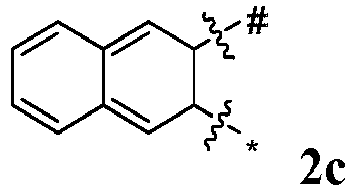
8 A=p-OMe-Ph, B= 
72 A=p-OMe-Ph, B= 
12 A=p-OMe-Ph, B= 
13 aGeneral condition : Ketone (0.5 mmol), Catalyst (5 x 10⁻⁴ mmol), F/T (0.5 ml), HCO2NH4 (5 mmol), MeOH (3.0 ml), 6 hr, 80 °C.
bDetermined by 1H-NMR. - A modification of this general reaction procedure was then applied to the following reaction scheme, the results of the catalyst screen in water are presented in Table 2A below.

Table 2A - Catalyst Screening in Water Catalyst R T [min] Conv. [b] [%] 7d [b] [%] 7d [b] [%] 2b p-OMe 90 76 73 3 2a p-CN 90 17 17 0 2c 4,5-(CH) 4 90 87 82 5 2c [c] 4,5-(CH) 4 120 99 96(95) 3 [a]reaction conditions: acetophenone (2.5 mmol), p-anisidine (3 mmol), catalyst (0.025 mmol), HCOOH/HCOONa solution (pH 4.8, 4 mL), 80°C, solution bubbled with argon for 15 min in a sealed tube.
[b] Determined by 1H NMR spectroscopy.
[c] Acetophenone (2.5 mmol) and p-anisidine (5 mmol). Number in brackets refers to the yield of the isolated product. - This general reaction procedure was then applied to the following reaction scheme, the results of the solvent screen for catalyst 2c being presented in Table 3 below.

Table 3: Solvent screening for catalyst 2c Solvent Conversion (%) MeOH 96 EtOH 92 TFE 8 Toluene 14 DMF 12 - This general reaction procedure was then applied to the following reductive amination reactions using catalyst 2c in methanol, the results for which are presented in Table 4A below.
Table 4A - reductive aminations of aromatic ketones with ammonium formate 
Ketones Amines Yield (%)[b] 
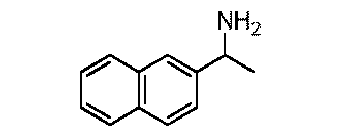
93 

94 

84 

91 

88 

89 

91 

85 

90 

89 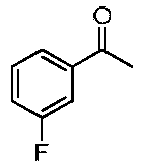

90 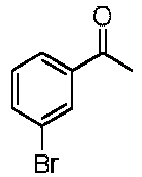
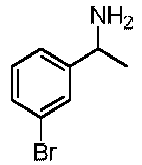
87 

82 

88 

84 

86 

90 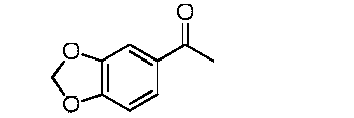

92 

88 

82 

90 

87 

91 

92 [a] Reaction conditions: ketone (0.5 mmol), HCO2NH4 (5 mmol), catalyst (5x10⁻⁴ mmol), HCO2H/Et3N (5:2) azeotrope (0.5 ml), MeOH (3 ml) refluxed at 80 °C in a carousel tube, overnight. [b] Yield of isolated product. - This general reaction procedure was then applied to the following reductive amination reactions using catalyst 2c in methanol, the results for which are presented in Table 4B below.
Table 4B - reductive aminations of aliphatic ketones with ammonium formate 
Ketones Amines Yield (%)[b] 

91 

93 

84 

83 

90 

82 

84 

86 

90 

87 [a] Reaction conditions: ketone (0.5 mmol), HCO2NH4 (5 mmol), catalyst (5x10⁻⁴ mmol), HCO2H/Et3N (5:2) azeotrope (0.5 ml), MeOH (3 ml) refluxed at 80 °C in a carousel tube, overnight. [b] Yield of isolated product. - This general reaction procedure was then applied to the following reductive amination reactions using catalyst 2c in methanol, the results for which are presented in Table 4C below.
Table 4C - reductive aminations of α-keto ethers with ammonium formate 
Ketones Amines Yield (%)[b] 

87 

91 

93 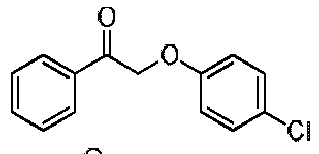

90 

91 

74 

77 

81 [a] Reaction conditions: ketone (0.5 mmol), HCO2NH4 (5 mmol), catalyst (5x10⁻⁴ mmol), HCO2H/Et3N (5:2) azeotrope (0.5 ml), MeOH (3 ml) refluxed at 80 °C in a carousel tube, overnight. [b] Yield of isolated product. - This general reaction procedure was then applied to the following reductive amination reactions using catalyst 2c in methanol, the results for which are presented in Table 4D below.
Table 4D - reductive aminations of α-keto acids with ammonium formate 
Ketones Amines Yield (%)[b] 

95 

91 

90 

88 

96 

94 

92 [a] Reaction conditions: ketone (0.5 mmol), HCO2NH4 (5 mmol), catalyst (5x10⁻⁴ mmol), HCO2H/Et3N (5:2) azeotrope (0.5 ml), MeOH (3 ml) refluxed at 80 °C in a carousel tube, overnight. [b] Yield of isolated product. - A modification of this general reaction procedure was then applied to the following reductive amination reactions using catalyst 2c in water, the results for which are presented in Table 4E below.
Table 4E - reductive aminations of aromatic ketones with sodium formate at pH 4.8 
Entry[a] Ketone Amine S/C r[h] Yield [%][b] 1 

1000 2 95 2 

1000 2 98 3 

1000 2 95 4 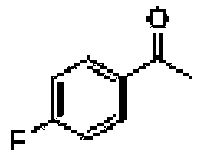

1000 2 94 5 

1000 2 98 6 

1000 2 98 7 

1000 2 98 8 

1000 2 96 9 

1000 2 93 10 

1000 2 92 11[c] 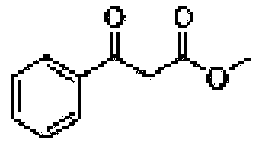

200 12 71 12 

1000 2 82 13 

1000 2 91 14 

1000 2 93 15 

1000 10 77 16 

200 24 59 17 

2000 4 87 19 

200 64 82 19 

500 24 44 (> 99:1)[d] [a] Reaction conditions: ketone (2.5 mmol), amine (5 mmol) 2c HCOOH/HCOONa solution (pH 4.8, 4 mL), 80°C. [b] Yield of the iso-lated product. [c] pH 4.2. [d] The diastereomeric ratio (d-r.) is given in brackets. - A modification of this general reaction procedure was then applied to the following reductive amination reactions using catalyst 2c in water, the results for which are presented in Table 4F below.
Table 4F - reductive aminations of aliphatic ketones with sodium formate at pH 4.8 
Entry[a] Ketone Amine S/C r [h] Yield [%][b] 1 

2000 2 98 2 

2000 2 99 3 

2000 2 98 4 

2000 2 98 5 

2000 2 99 6 

1000 2 96 7 

2000 2 79 8 

2000 2 97 9 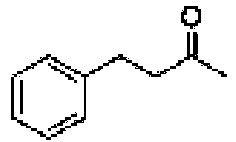

2000 2 54 10 

1000 6 85 11[a] 

200 48 52 12[c] 

200 24 64 13 

2000 3 95 (= 79:21)[d] 14 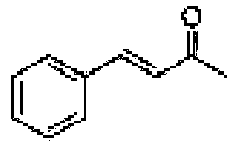

1000 4 93 15 

1000 2 98 16 

2000 2 88 17 

2000 2 98 18 

2000 2 95 [a] Reaction conditions: ketone (5 mmol), amine (10 mmol); 2c HCOOH/HCOONa solution (pH 4.8, 8 mL), 80°C [b] Yield of the iso-lated product. [c] pH 5.0. [d] The d.r. value is given in brackets. - A modification of this general reaction procedure was then applied to the following reductive amination reactions using catalyst 2c in water, the results for which are presented in Table 4G below.
Table 4G - reductive aminations of various aldehydes with sodium formate at pH 4.8 
Entry[a] Aldehyde Amine S/C r[h] Yield [%][b] 1 

2000 2 98 2 

2000 2 98 3 

2000 2 95 4 

2000 2 97 5 

2000 2 79 6 

2000 2 92 7 

2000 2 97 8 

2000 2 96 9 

2000 4 97 10 

2000 5 97 11 

2000 2 94 12 

2000 2 98 13 

2000 2 99 14 

1000 2 95 15 

2000 2 96 16 

2000 2 97 17 

1000 4 83 18 

1000 4 93 19 

1000 5 72 20 
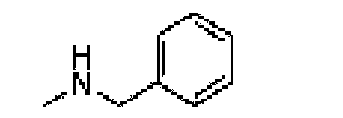
1000 2 98 21 

500 2 99 [a] Reaction conditions: aldehydes (5 mmol), amine (10 mmol), 2c HCOOH/HCOONa solution (pH 4.8, 8 mL), 80°C. [b] Yield of the iso-lated product. - The results show that the catalyst compounds of Formula I facilitate transfer hydrogenation reactions across a range of substrates and reaction conditions, though they are especially suitable for use in transfer hydrogenations where the reaction solvent is methanol or ethanol.
FIG. 1 in particular demonstrates the superior catalytic activity of a compound of Formula I, specifically Example 2c, relative to comparative example 2b catalyst of the prior art. - Unless otherwise specified, all reagents were commercially purchased from Aldrich, Alfa Aesar, Acros organics, Apollo scientific, or Fluorochem and used without further purification. Molecular sieves (4 Å) were heated in oven at 160°C overnight prior to use. NMR spectra were recorded on a Brucker 400 MHz NMR spectrometer with TMS as an internal standard, all at ambient temperature.
- Ketone (10 mmol), amine (10 mmol) and activated 4Å molecular sieves (2 g) were introduced in a Smith Process Vial™ containing a small stirrer bar. The vial was then degassed and recharged with nitrogen gas for three times. The vial was sealed and heated with a microwave reactor at 200for 3-6 hours. The desired imine was purified by recrystallization from hexane and DCM.

- [Cp*IrCl2]2 (1 equiv.), an imine ligand (2.2 equiv.) and NaOAc (10 equiv.) were placed into a Schlenk tube. The tube was then degassed and recharged with nitrogen gas for three times. DCM was then added and the resulting mixture was stirred at room temperature overnight. The reaction mixture was filtered through celite, and dried over MgSO4. Following removal of the solvent under vacuum the resulting solid was washed with diethyl ether.
- Specific examples are now described.
-

- The product was obtained as an orange powder (90.5mg, 98%) according to the general procedure for the preparation of cyclometalated complexes from [Cp*IrCl2]2 and (E)-N-(3,4-dihydronaphthalen-1(2H)-ylidene)-4-methoxyaniline. 1H NMR (CDCl3, 400 MHz, 258K) δ 7.82 (m, 1 H), 7.66 (d, 1 H), 7.17(t, 1 H), 6.99-6.92 (m, 3H), 6.80 (d, 1 H), 3.88 (s, 3H), 3.01-2.66 (m, 4H), 1.91-1.90 (m, 2H), 1.46 (s 15H) ppm; 13C NMR (CDCl3, 100 MHz, 258K) δ 182.9, 168.4, 157.4, 144.6, 143.4, 143.0, 132.7, 132.4, 125.2, 123.3, 121.2, 115.0, 112.3, 88.9, 55.7, 30.4, 29,2, 23.8, 15.5, 8.9 ppm; Analytical calculation for C27H31ClIrNO (%): C, 52.88, H, 5.10, N, 2.61. Found: C, 52.69, H, 5.12, N, 2.09.
-

- The product was obtained as a light orange powder (31.7mg, 98%) according to the general procedure for the preparation of cyclometalated complexes from [Cp*IrCl2]2 and (E)-4-methoxy-N-(6-methoxy-3,4-dihydronaphthalen-1(2H)-ylidene)aniline. 1H NMR (CDCl3, 400 MHz, 258K) δ 7.82-7.80 (m, 1 H), 7.19 (s, 1 H), 6.97-6.86 (m, 3H), 6.37 (s, 1H), 3.91 (s, 3H), 3.87 (s, 3H), 2.96-2.60 (m, 4H), 1.89-1.88 (m, 2H) ppm;13C NMR (CDCl3, 100 MHz)
δ 181,4, 170.7, 162.3, 157.5, 144.7, 143.5, 138.4, 124.8, 117.6, 114.2, 113.8, 113.5, 106.9, 88.7, 55.6, 55.0, 30.2, 29.5, 23.9. 8.7 ppm; Analytical calculation for C28H33CllrNO2 %: C, 52.28, H, 5.17, N, 2.18. Found: C, 52.43, H, 5.48, N, 1.94. - The imine (0.3 mmol) was added to a 3ml glass tube equipped with a magnetic stirrer bar. Then 0.5 ml of trifluoroethanol was added, and a solution of the catalyst compound in trifluoroethanol (3 x 10⁻⁵mmol) was transferred into the tube with syringe. The tube was put into a stainless steel autoclave and the gas was exchanged with hydrogen for three times. The reaction was carried out in one hour with 20 bar pressure at 85. The autoclave was cooled down to room temperature after reaction and hydrogen gas was released slowly. The solvent was removed under the reduced pressure and the product was purified by a short silica gel column using petroleum ether and ethyl acetate as eluent.
- The following experiments have been performed, by way of example, to illustrate the applicability of the present invention.
- This general reaction procedure was then applied to the following reductive amination reactions using catalysts 5a and 5b in trifluoroethanol (TFE), the results for which are presented in Table 5 below.
Table 5: Hydrogenation of imines (6) with high substrate to catalyst (S/C) ratios using catalysts 5a and 5b in TFE 
Entry Product S/C Yield (%)b 1 
10000 90 70c 2 
10000 90 3 
10000 11 1000 90 4 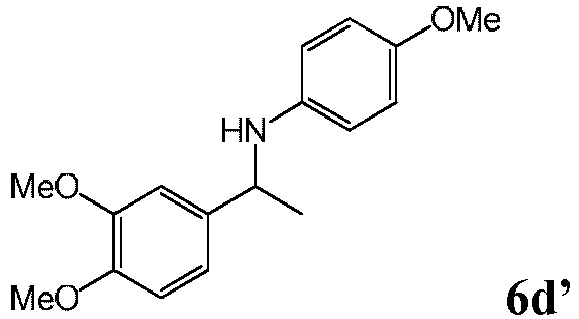
10000 91 5 
1000 91 6 
10000 91 7 
10000 90 8 
10000 88 9 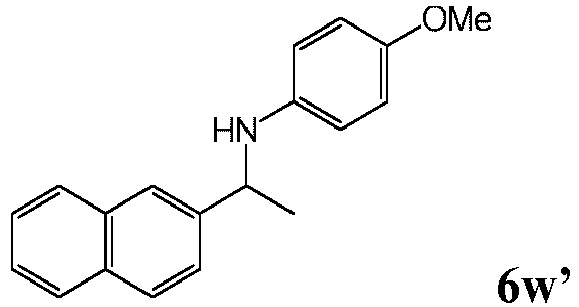
10000 89 10 
10000 45 1000 91 11 
10000 53 2000 91 a Reaction conditions: 0.3 mmol of imine, 0.1-0.01 mol% catalyst 5a, 0.5 mL CF3CH2OH, 20 bar H2, 85 °C, 60min. bIsolated yields. c 0.01 mol% catalyst 5b was used. - The results show that the catalyst compounds of Formula A facilitate hydrogenation reactions across a range of substrates and reaction conditions.

Claims (13)
- A catalyst compound of Formula I:
 ring A is aryl or heteroaryl, optionally substituted by one or two groups selected from hydroxyl, NRaRb, (1-6C)alkyl, (1-6C)alkoxy, or aryl which is optionally substituted by halogeno, hydroxyl, NRaRb, (1-6C)alkyl, (1-6C)alkoxy, wherein Ra and Rb are each independently selected from hydrogen or (1-6C)alkyl;ring B is a bicyclic or tricyclic aromatic or heteroaromatic fused ring system, optionally substituted by one or more groups selected from halogeno, hydroxyl, NRcRd, (1-6C)alkyl, (1-6C)alkoxy, [NRcRdRe]+, nitro, cyano, formyl, carboxy, carbamoyl, sulphamoyl, ureido, isocyano, sulphonyl, sulphonate, trihalomethyl (e.g. trifluoromethyl), mercapto, wherein Rc, Rd, and Re are each independently selected from hydrogen or (1-6C)alkyl, or aryl (e.g. phenyl); or a group of the formula:
L1-Q1
wherein:L1 is absent or is selected from O, S, SO, SO2, N(Rf), C(O), CH(ORf), C(O)N(Rf), N(Rf)C(O), N(Rf)C(O)N(Rg), S(O)2N(Rf), or N(Rf)SO2, wherein Rf and Rg are each independently selected from hydrogen or (1-4C)alkyl; and ;Q1 is (1-6C)alkyl, (2-6C)alkenyl, (2-6C)alkynyl, aryl, aryl-(1-6C)alkyl, (3-6C)cycloalkyl, (3-6C)cycloalkyl-(1-6C)alkyl, (3-6C)cycloalkenyl, (3-6C)cycloalkenyl-(1-6C)alkyl, heteroaryl, heteroaryl-(1-6C)alkyl, heterocyclyl or heterocyclyl-(1-6C)alkyl; and wherein Q1 is optionally further substituted by one or more substituents independently selected from halogeno, hydroxyl, NRcRd, [NRcRdRe]+, (1-6C)alkyl, (1-6C)alkoxy, nitro, cyano, formyl, carboxy, carbamoyl, ureido, isocyano, sulphonyl, sulphonate, trifluoromethyl, mercapto;R1 is selected from the group consisting of hydrogen, (1-6C)alkyl, (2-6C)alkenyl, (2-6C)alkynyl, aryl, (3-6C)cycloalkyl, heteroaryl, or R1 is (2-4C)alkylene or (2-4C)alkenylene linked to ring B to form a fused 5-, 6- or 7-membered ring, wherein R1 is optionally substituted by one or more groups selected from halogeno, hydroxyl, NRhRi, (1-6C)alkyl, (1-6C)alkoxy, [NRhRiRj]+, nitro, cyano, formyl, carboxy, carbamoyl, sulphamoyl, ureido, isocyano, sulphonyl, sulphonate, trihalomethyl (e.g. trifluoromethyl), mercapto, wherein Rh, Ri, and Rj are each independently selected from hydrogen or (1-6C)alkyl, or aryl (e.g. phenyl); or a group of the formula:
L2-Q2
wherein:L2 is absent or is selected from O, S, SO, SO2, N(Rk), C(O), CH(ORk), C(O)N(Rk), N(Rk)C(O), N(Rk)C(O)N(Rl), S(O)2N(Rk), or N(Rk)SO2, wherein Rk and Rl are each independently selected from hydrogen or (1-4C)alkyl; and ;Q2 is (1-6C)alkyl, aryl, aryl-(1-6C)alkyl, (3-6C)cycloalkyl, (3-6C)cycloalkyl-(1-6C)alkyl, (3-6C)cycloalkenyl, (3-6C)cycloalkenyl-(1-6C)alkyl, heteroaryl, heteroaryl-(1-6C)alkyl, heterocyclyl or heterocyclyl-(1-6C)alkyl; and wherein Q2 is optionally further substituted by one or more substituents independently selected from halogeno, hydroxyl, NRmRn, [NRmRnRo], (1-6C)alkyl, (1-6C)alkoxy, nitro, cyano, formyl, carboxy, carbamoyl, ureido, isocyano, sulphonyl, sulphonate, trifluoromethyl, mercapto, wherein Rm, Rn, and Ro are each independently selected from hydrogen or (1-6C)alkyl, or aryl (e.g. phenyl);LG is a leaving group (eg. halo, acetate);Z1, Z2, Z3, Z4, and Z5 are each independently selected from hydrogen, (1-6C)alkyl, or aryl, (1-6C)alkoxy, hydroxyl, or NRpRq, wherein Rp and Rq are each independently selected from hydrogen or (1-6C)alkyl, or aryl (e.g. phenyl). - A catalyst compound of Formula A:
 ring A is aryl or heteroaryl, optionally substituted by one or two groups selected from hydroxyl, NRaRb, (1-6C)alkyl, (1-6C)alkoxy, or aryl which is optionally substituted by halogeno, hydroxyl, NRaRb, (1-6C)alkyl, (1-6C)alkoxy, wherein Ra and Rb are each independently selected from hydrogen or (1-6C)alkyl;ring B is a aryl or heteroaryl, optionally substituted by one or more groups selected from halogeno, hydroxyl, NRcRd, (1-6C)alkyl, (1-6C)alkoxy, [NRcRdRe]+, nitro, cyano, formyl, carboxy, carbamoyl, sulphamoyl, ureido, isocyano, sulphonyl, sulphonate, trihalomethyl (e.g. trifluoromethyl), mercapto, wherein Rc, Rd, and Re are each independently selected from hydrogen or (1-6C)alkyl, or aryl (e.g. phenyl); or a group of the formula:
L1-Q1
wherein:L1 is absent or is selected from O, S, SO, SO2, N(Rf), C(O), CH(ORf), C(O)N(Rf), N(Rf)C(O), N(Rf)C(O)N(Rg), S(O)2N(Rf), or N(Rf)SO2, wherein Rf and Rg are each independently selected from hydrogen or (1-4C)alkyl; and ;Q1 is (1-6C)alkyl, (2-6C)alkenyl, (2-6C)alkynyl, aryl, aryl-(1-6C)alkyl, (3-6C)cycloalkyl, (3-6C)cycloalkyl-(1-6C)alkyl, (3-6C)cycloalkenyl, (3-6C)cycloalkenyl-(1-6C)alkyl, heteroaryl, heteroaryl-(1-6C)alkyl, heterocyclyl or heterocyclyl-(1-6C)alkyl ; and wherein Q1 is optionally further substituted by one or more substituents independently selected from halogeno, hydroxyl, NRcRd, [NRcRdRe]+, (1-6C)alkyl, (1-6C)alkoxy, nitro, cyano, formyl, carboxy, carbamoyl, ureido, isocyano, sulphonyl, sulphonate, trifluoromethyl, mercapto;R1 is (2-4C)alkylene or (2-4C)alkenylene linked to ring B to form a fused 5- 6-, or 7-membered ring, wherein R1 is optionally substituted by one or more groups selected from halogeno, hydroxyl, NRhRi, (1-6C)alkyl, (1-6C)alkoxy, [NRhRiRj]+, nitro, cyano, formyl, carboxy, carbamoyl, sulphamoyl, ureido, isocyano, sulphonyl, sulphonate, trihalomethyl (e.g. trifluoromethyl), mercapto, wherein Rh, Ri, and Rj are each independently selected from hydrogen or (1-6C)alkyl, or aryl (e.g. phenyl); or a group of the formula:
L2-Q2
wherein:L2 is absent or is selected from O, S, SO, SO2, N(Rk), C(O), CH(ORk), C(O)N(Rk), N(Rk)C(O), N(Rk)C(O)N(Rl), S(O)2N(Rk), or N(Rk)SO2, wherein Rk and Rl are each independently selected from hydrogen or (1-4C)alkyl; and ;Q2 is (1-6C)alkyl, aryl, aryl-(1-6C)alkyl, (3-6C)cycloalkyl, (3-6C)cycloalkyl-(1-6C)alkyl, (3-6C)cycloalkenyl, (3-6C)cycloalkenyl-(1-6C)alkyl, heteroaryl, heteroaryl-(1-6C)alkyl, heterocyclyl or heterocyclyl-(1-6C)alkyl ; and wherein Q2 is optionally further substituted by one or more substituents independently selected from halogeno, hydroxyl, NRmRn, [NRmRnRo]+, (1-6C)alkyl, (1-6C)alkoxy, nitro, cyano, formyl, carboxy, carbamoyl, ureido, isocyano, sulphonyl, sulphonate, trifluoromethyl, mercapto, wherein Rm, Rn, and Ro are each independently selected from hydrogen or (1-6C)alkyl, or aryl (e.g. phenyl);LG is a leaving group (eg. halo, acetate);Z1, Z2, Z3, Z4, and Z5 are each independently selected from hydrogen, (1-6C)alkyl, or aryl, (1-6C)alkoxy, hydroxyl, or NRpRq, wherein Rp and Rq are each independently selected from hydrogen or (1-6C)alkyl, or aryl (e.g. phenyl). - The catalyst compound of claim 1 or 2, wherein ring A is phenyl, optionally substituted, in either or both of the ortho- and/or para-position relative to the imine nitrogen atom to which ring A is attached, by one or two groups selected from hydroxyl, NRaRb, (1-3C)alkyl, (1-3C)alkoxy, or aryl which is optionally substituted by halogeno, hydroxyl, NRaRb, (1-3C)alkyl, (1-3C)alkoxy, wherein Ra and Rb are each independently selected from hydrogen or (1-2C)alkyl.
- The catalyst compound of any preceding claim, wherein ring A is para-methoxyphenyl
- The catalyst compound of any preceding claim, wherein ring B is naphthyl, optionally substituted as defined in any preceding claim in relation to ring B.
- The catalyst compound of claim 1 or 2, wherein:- R1 is selected from the group consisting of hydrogen or methyl, where the catalyst compound is a compound of claim 1; or- R1 is (3C)alkylene linked to ring B to form a fused 6-membered ring optionally substituted as defined in claim 2, where the catalyst compound is a compound of claim 1 or claim 2.
- The catalyst compound of claim 2, wherein ring B is phenyl optionally substituted, in either or both of the ortho- and/or para-position relative to the imine carbon atom to which ring B is attached, by (1-3C)alkoxy.
- A catalyst compound of claim 1 or 2 selected from the group consisting of:


- A method of reducing a reducible substrate, the method comprising hydrogenating the reducible substrate in the presence of:- a catalyst compound of Formula I as defined in claim 1 or any other preceding claim dependent on claim 1; or- a catalyst compound of Formula A as defined in claim 2 or any of claims 3 to 8 dependent on claim 2.
- The method of claim 9, wherein the at least one reducible moiety is selected from an imine and an iminium group, wherein the imine or iminium is optionally prepared in situ by a reaction between a ketone or an aldehyde and ammonia or an amine.
- The method of any of claims 9 to 10, wherein hydrogenating the reducible substrate occurs via transfer hydrogenation.
- A composition comprising the catalyst compound of Formula I as defined in claim 1; or comprising the catalyst compound of Formula A as defined in claim 2.
- A kit of parts comprising the compound of Formula II:
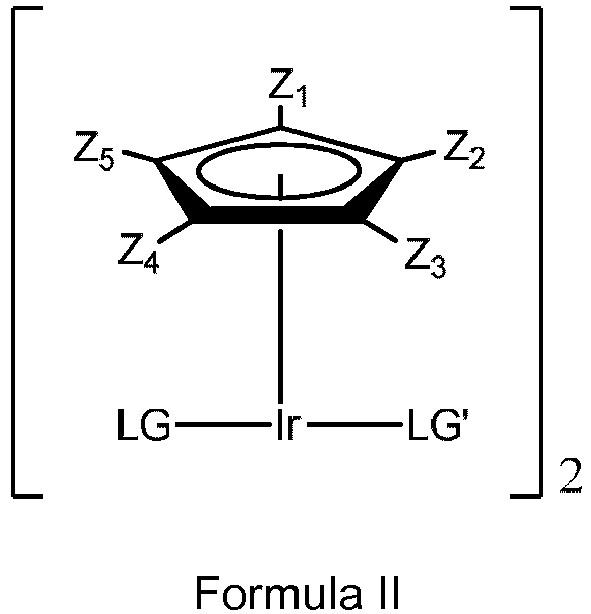
and the compound of Formula III:
OR
a kit of parts comprising the compound of Formula II:
and the compound of Formula B:
Applications Claiming Priority (2)
| Application Number | Priority Date | Filing Date | Title |
|---|---|---|---|
| GBGB1206572.8A GB201206572D0 (en) | 2012-04-13 | 2012-04-13 | Catalyst compounds |
| PCT/GB2013/050959 WO2013153407A1 (en) | 2012-04-13 | 2013-04-15 | Catalyst compounds |
Publications (2)
| Publication Number | Publication Date |
|---|---|
| EP2836497A1 EP2836497A1 (en) | 2015-02-18 |
| EP2836497B1 true EP2836497B1 (en) | 2016-03-23 |
Family
ID=46209059
Family Applications (1)
| Application Number | Title | Priority Date | Filing Date |
|---|---|---|---|
| EP13721029.0A Not-in-force EP2836497B1 (en) | 2012-04-13 | 2013-04-15 | Catalyst compounds |
Country Status (4)
| Country | Link |
|---|---|
| US (1) | US9212199B2 (en) |
| EP (1) | EP2836497B1 (en) |
| GB (1) | GB201206572D0 (en) |
| WO (1) | WO2013153407A1 (en) |
Families Citing this family (5)
| Publication number | Priority date | Publication date | Assignee | Title |
|---|---|---|---|---|
| CN109384681B (en) * | 2017-08-11 | 2021-11-09 | 南京理工大学 | Method for synthesizing mexiletine hydrochloride |
| CN108358793B (en) * | 2018-02-12 | 2021-03-23 | 三峡大学 | A kind of secondary amine compound synthesized from alkyne and synthesis method thereof |
| GB201818113D0 (en) * | 2018-11-06 | 2018-12-19 | Syngenta Participations Ag | Process |
| GB201818117D0 (en) | 2018-11-06 | 2018-12-19 | Syngenta Participations Ag | Enantioselective process |
| KR102335947B1 (en) * | 2020-10-30 | 2021-12-08 | (주)자람테크놀로지 | Clock jitter improvement MAC within XGS-PON holdover period and method thereof |
Family Cites Families (1)
| Publication number | Priority date | Publication date | Assignee | Title |
|---|---|---|---|---|
| GB201008584D0 (en) | 2010-05-22 | 2010-07-07 | Univ Warwick | Novel iridium anti-cancer compounds |
-
2012
- 2012-04-13 GB GBGB1206572.8A patent/GB201206572D0/en not_active Ceased
-
2013
- 2013-04-15 US US14/394,239 patent/US9212199B2/en not_active Expired - Fee Related
- 2013-04-15 EP EP13721029.0A patent/EP2836497B1/en not_active Not-in-force
- 2013-04-15 WO PCT/GB2013/050959 patent/WO2013153407A1/en not_active Ceased
Also Published As
| Publication number | Publication date |
|---|---|
| WO2013153407A1 (en) | 2013-10-17 |
| US20150080592A1 (en) | 2015-03-19 |
| EP2836497A1 (en) | 2015-02-18 |
| GB201206572D0 (en) | 2012-05-30 |
| US9212199B2 (en) | 2015-12-15 |
Similar Documents
| Publication | Publication Date | Title |
|---|---|---|
| Buschmann et al. | The isoinversion principle—A general model of chemical selectivity | |
| EP0916637B1 (en) | Process for preparating optically active compounds | |
| Müller et al. | C2‐symmetric 4, 4′, 5, 5′‐tetrahydrobi (oxazoles) and 4, 4′, 5, 5′‐tetrahydro‐2, 2′‐methylenebis [oxazoles] as chiral ligands for enantioselective catalysis preliminary communication | |
| CA2518435C (en) | Process for the preparation of chiral beta amino acid derivatives by asymmetric hydrogenation | |
| Abbenhuis et al. | Carbon-carbon and carbon-nitrogen bond formation mediated by ruthenium (II) complexes: synthesis of (1H)-isoquinolinium derivatives | |
| EP2855494B1 (en) | Iron catalysts with unsymmetrical pnn'p ligands | |
| CN101671365A (en) | Chiral spiro aminophosphine ligand compound and synthesis method as well as application thereof | |
| US9212199B2 (en) | Catalyst compounds | |
| EP4089097A1 (en) | Preparation method for and application of chiral spirocyclic phosphine-nitrogen-phosphine tridentate ligand and iridium catalyst thereof | |
| Hayashi et al. | A new optically active monodentate phosphine ligand,(R)-(+)-3-diphenylphosphino-3′-methoxy-4, 4′-biphenanthryl (MOP-phen): preparation and use for palladium-catalyzed asymmetric reduction of allylic esters with formic acid | |
| CN112521333A (en) | Synthesis method of chiral 2, 3-disubstituted tetrahydroquinoline derivative | |
| CN114436949A (en) | Tetradentate ligand and metal complex, and preparation method and application thereof | |
| Yang et al. | Metal-free β-amino alcohol synthesis: A two-step smiles rearrangement | |
| EP3256250B1 (en) | Phenanthroline based pincer complexes useful as catalysts for the preparation of methanol from carbondioxide | |
| Bolm et al. | Synthesis of novel chiral phosphinocyrhetrenyloxazoline ligands and their application in asymmetric catalysis | |
| EP3122725A1 (en) | Synthetic process | |
| WO2013153408A1 (en) | Catalyst compounds | |
| Vasconcelos et al. | New homochiral amino-phosphine ligands: application in asymmetric palladium catalyzed allylic alkylation | |
| CN118878543A (en) | Axial chiral cyclopentenyl indole-naphthyl compound and preparation method and application thereof | |
| Gavrilov et al. | Complexation with PdII and enantioselective allylic amination using new P*-monodentane bicyclic amidophosphite | |
| CN118684719A (en) | Chiral ferrocene PNN manganese complex and preparation method thereof, catalyst composition and application thereof | |
| Abebayehu et al. | Synthesis and spectroscopic behaviour of metal complexes of meso-alkylidenyl carbaporphyrinoids and their expanded analogues | |
| CN114989137B (en) | A chiral imine-containing quinoline imidazoline compound and its metal complex as well as preparation methods and applications | |
| CN114539319B (en) | Chiral phosphine-dicyclophosphoramidite ligand and preparation method and application thereof | |
| US20240294448A1 (en) | Hydrogenation of esters to alcohols in the presence of an mn-pnn complex |
Legal Events
| Date | Code | Title | Description |
|---|---|---|---|
| PUAI | Public reference made under article 153(3) epc to a published international application that has entered the european phase |
Free format text: ORIGINAL CODE: 0009012 |
|
| 17P | Request for examination filed |
Effective date: 20141112 |
|
| AK | Designated contracting states |
Kind code of ref document: A1 Designated state(s): AL AT BE BG CH CY CZ DE DK EE ES FI FR GB GR HR HU IE IS IT LI LT LU LV MC MK MT NL NO PL PT RO RS SE SI SK SM TR |
|
| AX | Request for extension of the european patent |
Extension state: BA ME |
|
| DAX | Request for extension of the european patent (deleted) | ||
| GRAP | Despatch of communication of intention to grant a patent |
Free format text: ORIGINAL CODE: EPIDOSNIGR1 |
|
| INTG | Intention to grant announced |
Effective date: 20150922 |
|
| GRAS | Grant fee paid |
Free format text: ORIGINAL CODE: EPIDOSNIGR3 |
|
| GRAA | (expected) grant |
Free format text: ORIGINAL CODE: 0009210 |
|
| AK | Designated contracting states |
Kind code of ref document: B1 Designated state(s): AL AT BE BG CH CY CZ DE DK EE ES FI FR GB GR HR HU IE IS IT LI LT LU LV MC MK MT NL NO PL PT RO RS SE SI SK SM TR |
|
| REG | Reference to a national code |
Ref country code: GB Ref legal event code: FG4D |
|
| REG | Reference to a national code |
Ref country code: CH Ref legal event code: EP |
|
| REG | Reference to a national code |
Ref country code: AT Ref legal event code: REF Ref document number: 783030 Country of ref document: AT Kind code of ref document: T Effective date: 20160415 |
|
| REG | Reference to a national code |
Ref country code: IE Ref legal event code: FG4D |
|
| REG | Reference to a national code |
Ref country code: DE Ref legal event code: R096 Ref document number: 602013005742 Country of ref document: DE |
|
| REG | Reference to a national code |
Ref country code: LT Ref legal event code: MG4D |
|
| REG | Reference to a national code |
Ref country code: NL Ref legal event code: MP Effective date: 20160323 |
|
| PG25 | Lapsed in a contracting state [announced via postgrant information from national office to epo] |
Ref country code: FI Free format text: LAPSE BECAUSE OF FAILURE TO SUBMIT A TRANSLATION OF THE DESCRIPTION OR TO PAY THE FEE WITHIN THE PRESCRIBED TIME-LIMIT Effective date: 20160323 Ref country code: HR Free format text: LAPSE BECAUSE OF FAILURE TO SUBMIT A TRANSLATION OF THE DESCRIPTION OR TO PAY THE FEE WITHIN THE PRESCRIBED TIME-LIMIT Effective date: 20160323 Ref country code: NO Free format text: LAPSE BECAUSE OF FAILURE TO SUBMIT A TRANSLATION OF THE DESCRIPTION OR TO PAY THE FEE WITHIN THE PRESCRIBED TIME-LIMIT Effective date: 20160623 Ref country code: GR Free format text: LAPSE BECAUSE OF FAILURE TO SUBMIT A TRANSLATION OF THE DESCRIPTION OR TO PAY THE FEE WITHIN THE PRESCRIBED TIME-LIMIT Effective date: 20160624 |
|
| REG | Reference to a national code |
Ref country code: AT Ref legal event code: MK05 Ref document number: 783030 Country of ref document: AT Kind code of ref document: T Effective date: 20160323 |
|
| PG25 | Lapsed in a contracting state [announced via postgrant information from national office to epo] |
Ref country code: LT Free format text: LAPSE BECAUSE OF FAILURE TO SUBMIT A TRANSLATION OF THE DESCRIPTION OR TO PAY THE FEE WITHIN THE PRESCRIBED TIME-LIMIT Effective date: 20160323 Ref country code: RS Free format text: LAPSE BECAUSE OF FAILURE TO SUBMIT A TRANSLATION OF THE DESCRIPTION OR TO PAY THE FEE WITHIN THE PRESCRIBED TIME-LIMIT Effective date: 20160323 Ref country code: LV Free format text: LAPSE BECAUSE OF FAILURE TO SUBMIT A TRANSLATION OF THE DESCRIPTION OR TO PAY THE FEE WITHIN THE PRESCRIBED TIME-LIMIT Effective date: 20160323 Ref country code: NL Free format text: LAPSE BECAUSE OF FAILURE TO SUBMIT A TRANSLATION OF THE DESCRIPTION OR TO PAY THE FEE WITHIN THE PRESCRIBED TIME-LIMIT Effective date: 20160323 Ref country code: BE Free format text: LAPSE BECAUSE OF NON-PAYMENT OF DUE FEES Effective date: 20160430 Ref country code: SE Free format text: LAPSE BECAUSE OF FAILURE TO SUBMIT A TRANSLATION OF THE DESCRIPTION OR TO PAY THE FEE WITHIN THE PRESCRIBED TIME-LIMIT Effective date: 20160323 |
|
| PG25 | Lapsed in a contracting state [announced via postgrant information from national office to epo] |
Ref country code: PL Free format text: LAPSE BECAUSE OF FAILURE TO SUBMIT A TRANSLATION OF THE DESCRIPTION OR TO PAY THE FEE WITHIN THE PRESCRIBED TIME-LIMIT Effective date: 20160323 Ref country code: IS Free format text: LAPSE BECAUSE OF FAILURE TO SUBMIT A TRANSLATION OF THE DESCRIPTION OR TO PAY THE FEE WITHIN THE PRESCRIBED TIME-LIMIT Effective date: 20160723 Ref country code: EE Free format text: LAPSE BECAUSE OF FAILURE TO SUBMIT A TRANSLATION OF THE DESCRIPTION OR TO PAY THE FEE WITHIN THE PRESCRIBED TIME-LIMIT Effective date: 20160323 |
|
| REG | Reference to a national code |
Ref country code: DE Ref legal event code: R119 Ref document number: 602013005742 Country of ref document: DE |
|
| PG25 | Lapsed in a contracting state [announced via postgrant information from national office to epo] |
Ref country code: SM Free format text: LAPSE BECAUSE OF FAILURE TO SUBMIT A TRANSLATION OF THE DESCRIPTION OR TO PAY THE FEE WITHIN THE PRESCRIBED TIME-LIMIT Effective date: 20160323 Ref country code: RO Free format text: LAPSE BECAUSE OF FAILURE TO SUBMIT A TRANSLATION OF THE DESCRIPTION OR TO PAY THE FEE WITHIN THE PRESCRIBED TIME-LIMIT Effective date: 20160323 Ref country code: CZ Free format text: LAPSE BECAUSE OF FAILURE TO SUBMIT A TRANSLATION OF THE DESCRIPTION OR TO PAY THE FEE WITHIN THE PRESCRIBED TIME-LIMIT Effective date: 20160323 Ref country code: AT Free format text: LAPSE BECAUSE OF FAILURE TO SUBMIT A TRANSLATION OF THE DESCRIPTION OR TO PAY THE FEE WITHIN THE PRESCRIBED TIME-LIMIT Effective date: 20160323 Ref country code: SK Free format text: LAPSE BECAUSE OF FAILURE TO SUBMIT A TRANSLATION OF THE DESCRIPTION OR TO PAY THE FEE WITHIN THE PRESCRIBED TIME-LIMIT Effective date: 20160323 Ref country code: ES Free format text: LAPSE BECAUSE OF FAILURE TO SUBMIT A TRANSLATION OF THE DESCRIPTION OR TO PAY THE FEE WITHIN THE PRESCRIBED TIME-LIMIT Effective date: 20160323 Ref country code: PT Free format text: LAPSE BECAUSE OF FAILURE TO SUBMIT A TRANSLATION OF THE DESCRIPTION OR TO PAY THE FEE WITHIN THE PRESCRIBED TIME-LIMIT Effective date: 20160725 |
|
| REG | Reference to a national code |
Ref country code: CH Ref legal event code: PL |
|
| PG25 | Lapsed in a contracting state [announced via postgrant information from national office to epo] |
Ref country code: IT Free format text: LAPSE BECAUSE OF FAILURE TO SUBMIT A TRANSLATION OF THE DESCRIPTION OR TO PAY THE FEE WITHIN THE PRESCRIBED TIME-LIMIT Effective date: 20160323 Ref country code: BE Free format text: LAPSE BECAUSE OF FAILURE TO SUBMIT A TRANSLATION OF THE DESCRIPTION OR TO PAY THE FEE WITHIN THE PRESCRIBED TIME-LIMIT Effective date: 20160323 |
|
| REG | Reference to a national code |
Ref country code: IE Ref legal event code: MM4A |
|
| PLBE | No opposition filed within time limit |
Free format text: ORIGINAL CODE: 0009261 |
|
| REG | Reference to a national code |
Ref country code: FR Ref legal event code: ST Effective date: 20161230 |
|
| STAA | Information on the status of an ep patent application or granted ep patent |
Free format text: STATUS: NO OPPOSITION FILED WITHIN TIME LIMIT |
|
| PG25 | Lapsed in a contracting state [announced via postgrant information from national office to epo] |
Ref country code: CH Free format text: LAPSE BECAUSE OF NON-PAYMENT OF DUE FEES Effective date: 20160430 Ref country code: LI Free format text: LAPSE BECAUSE OF NON-PAYMENT OF DUE FEES Effective date: 20160430 Ref country code: DK Free format text: LAPSE BECAUSE OF FAILURE TO SUBMIT A TRANSLATION OF THE DESCRIPTION OR TO PAY THE FEE WITHIN THE PRESCRIBED TIME-LIMIT Effective date: 20160323 Ref country code: DE Free format text: LAPSE BECAUSE OF NON-PAYMENT OF DUE FEES Effective date: 20161101 Ref country code: FR Free format text: LAPSE BECAUSE OF NON-PAYMENT OF DUE FEES Effective date: 20160523 |
|
| PG25 | Lapsed in a contracting state [announced via postgrant information from national office to epo] |
Ref country code: BG Free format text: LAPSE BECAUSE OF FAILURE TO SUBMIT A TRANSLATION OF THE DESCRIPTION OR TO PAY THE FEE WITHIN THE PRESCRIBED TIME-LIMIT Effective date: 20160623 |
|
| 26N | No opposition filed |
Effective date: 20170102 |
|
| PG25 | Lapsed in a contracting state [announced via postgrant information from national office to epo] |
Ref country code: IE Free format text: LAPSE BECAUSE OF NON-PAYMENT OF DUE FEES Effective date: 20160415 Ref country code: SI Free format text: LAPSE BECAUSE OF FAILURE TO SUBMIT A TRANSLATION OF THE DESCRIPTION OR TO PAY THE FEE WITHIN THE PRESCRIBED TIME-LIMIT Effective date: 20160323 |
|
| GBPC | Gb: european patent ceased through non-payment of renewal fee |
Effective date: 20170415 |
|
| PG25 | Lapsed in a contracting state [announced via postgrant information from national office to epo] |
Ref country code: GB Free format text: LAPSE BECAUSE OF NON-PAYMENT OF DUE FEES Effective date: 20170415 |
|
| PG25 | Lapsed in a contracting state [announced via postgrant information from national office to epo] |
Ref country code: HU Free format text: LAPSE BECAUSE OF FAILURE TO SUBMIT A TRANSLATION OF THE DESCRIPTION OR TO PAY THE FEE WITHIN THE PRESCRIBED TIME-LIMIT; INVALID AB INITIO Effective date: 20130415 |
|
| PG25 | Lapsed in a contracting state [announced via postgrant information from national office to epo] |
Ref country code: MT Free format text: LAPSE BECAUSE OF NON-PAYMENT OF DUE FEES Effective date: 20160430 Ref country code: MC Free format text: LAPSE BECAUSE OF FAILURE TO SUBMIT A TRANSLATION OF THE DESCRIPTION OR TO PAY THE FEE WITHIN THE PRESCRIBED TIME-LIMIT Effective date: 20160323 Ref country code: CY Free format text: LAPSE BECAUSE OF FAILURE TO SUBMIT A TRANSLATION OF THE DESCRIPTION OR TO PAY THE FEE WITHIN THE PRESCRIBED TIME-LIMIT Effective date: 20160323 Ref country code: LU Free format text: LAPSE BECAUSE OF NON-PAYMENT OF DUE FEES Effective date: 20160415 Ref country code: MK Free format text: LAPSE BECAUSE OF FAILURE TO SUBMIT A TRANSLATION OF THE DESCRIPTION OR TO PAY THE FEE WITHIN THE PRESCRIBED TIME-LIMIT Effective date: 20160323 |
|
| PG25 | Lapsed in a contracting state [announced via postgrant information from national office to epo] |
Ref country code: TR Free format text: LAPSE BECAUSE OF FAILURE TO SUBMIT A TRANSLATION OF THE DESCRIPTION OR TO PAY THE FEE WITHIN THE PRESCRIBED TIME-LIMIT Effective date: 20160323 Ref country code: AL Free format text: LAPSE BECAUSE OF FAILURE TO SUBMIT A TRANSLATION OF THE DESCRIPTION OR TO PAY THE FEE WITHIN THE PRESCRIBED TIME-LIMIT Effective date: 20160323 |