EP2836074B1 - Co-crystals of 3-iodopropynyl butylcarbamate - Google Patents
Co-crystals of 3-iodopropynyl butylcarbamate Download PDFInfo
- Publication number
- EP2836074B1 EP2836074B1 EP13720809.6A EP13720809A EP2836074B1 EP 2836074 B1 EP2836074 B1 EP 2836074B1 EP 13720809 A EP13720809 A EP 13720809A EP 2836074 B1 EP2836074 B1 EP 2836074B1
- Authority
- EP
- European Patent Office
- Prior art keywords
- crystal
- molar ratio
- ipbc
- butyl carbamate
- iodopropynyl butyl
- Prior art date
- Legal status (The legal status is an assumption and is not a legal conclusion. Google has not performed a legal analysis and makes no representation as to the accuracy of the status listed.)
- Not-in-force
Links
- 239000013078 crystal Substances 0.000 title claims description 178
- DNKGZSOYWMQDTK-UHFFFAOYSA-N 3-iodoprop-1-ynyl N-butylcarbamate Chemical compound CCCCNC(=O)OC#CCI DNKGZSOYWMQDTK-UHFFFAOYSA-N 0.000 title claims description 121
- 239000000203 mixture Substances 0.000 claims description 33
- 239000003795 chemical substances by application Substances 0.000 claims description 22
- NHGXDBSUJJNIRV-UHFFFAOYSA-M tetrabutylammonium chloride Chemical compound [Cl-].CCCC[N+](CCCC)(CCCC)CCCC NHGXDBSUJJNIRV-UHFFFAOYSA-M 0.000 claims description 22
- 238000002288 cocrystallisation Methods 0.000 claims description 20
- 229910052736 halogen Inorganic materials 0.000 claims description 18
- 239000003139 biocide Substances 0.000 claims description 13
- 239000002904 solvent Substances 0.000 claims description 13
- UXVMQQNJUSDDNG-UHFFFAOYSA-L Calcium chloride Chemical compound [Cl-].[Cl-].[Ca+2] UXVMQQNJUSDDNG-UHFFFAOYSA-L 0.000 claims description 12
- 239000001110 calcium chloride Substances 0.000 claims description 12
- 229910001628 calcium chloride Inorganic materials 0.000 claims description 12
- JIAARYAFYJHUJI-UHFFFAOYSA-L zinc dichloride Chemical compound [Cl-].[Cl-].[Zn+2] JIAARYAFYJHUJI-UHFFFAOYSA-L 0.000 claims description 12
- -1 compound 3-iodopropynyl butylcarbamate Chemical class 0.000 claims description 11
- 238000000034 method Methods 0.000 claims description 11
- 238000009472 formulation Methods 0.000 claims description 9
- IMNIMPAHZVJRPE-UHFFFAOYSA-N triethylenediamine Chemical compound C1CN2CCN1CC2 IMNIMPAHZVJRPE-UHFFFAOYSA-N 0.000 claims description 8
- DQRKTVIJNCVZAX-UHFFFAOYSA-N 4-(2-pyridin-4-ylethyl)pyridine Chemical compound C=1C=NC=CC=1CCC1=CC=NC=C1 DQRKTVIJNCVZAX-UHFFFAOYSA-N 0.000 claims description 7
- 239000003085 diluting agent Substances 0.000 claims description 7
- DPKBAXPHAYBPRL-UHFFFAOYSA-M tetrabutylazanium;iodide Chemical compound [I-].CCCC[N+](CCCC)(CCCC)CCCC DPKBAXPHAYBPRL-UHFFFAOYSA-M 0.000 claims description 7
- 239000011592 zinc chloride Substances 0.000 claims description 7
- MWVTWFVJZLCBMC-UHFFFAOYSA-N 4,4'-bipyridine Chemical compound C1=NC=CC(C=2C=CN=CC=2)=C1 MWVTWFVJZLCBMC-UHFFFAOYSA-N 0.000 claims description 6
- 239000002023 wood Substances 0.000 claims description 6
- 230000003115 biocidal effect Effects 0.000 claims description 5
- 230000000855 fungicidal effect Effects 0.000 claims description 5
- GALBBNXAQQLEJF-UHFFFAOYSA-N n-[6-(pyridine-4-carbonylamino)hexyl]pyridine-4-carboxamide Chemical compound C=1C=NC=CC=1C(=O)NCCCCCCNC(=O)C1=CC=NC=C1 GALBBNXAQQLEJF-UHFFFAOYSA-N 0.000 claims description 5
- 235000005074 zinc chloride Nutrition 0.000 claims description 5
- XVMSFILGAMDHEY-UHFFFAOYSA-N 6-(4-aminophenyl)sulfonylpyridin-3-amine Chemical compound C1=CC(N)=CC=C1S(=O)(=O)C1=CC=C(N)C=N1 XVMSFILGAMDHEY-UHFFFAOYSA-N 0.000 claims description 4
- 239000003619 algicide Substances 0.000 claims description 4
- 230000000844 anti-bacterial effect Effects 0.000 claims description 4
- 238000000576 coating method Methods 0.000 claims description 4
- 239000002537 cosmetic Substances 0.000 claims description 4
- 239000000417 fungicide Substances 0.000 claims description 4
- 238000005555 metalworking Methods 0.000 claims description 4
- 239000003973 paint Substances 0.000 claims description 4
- 239000003755 preservative agent Substances 0.000 claims description 4
- 230000002335 preservative effect Effects 0.000 claims description 4
- 230000008569 process Effects 0.000 claims description 4
- 239000000654 additive Substances 0.000 claims description 3
- 238000002425 crystallisation Methods 0.000 claims description 3
- 238000004321 preservation Methods 0.000 claims description 3
- 239000012530 fluid Substances 0.000 claims description 2
- 238000002955 isolation Methods 0.000 claims description 2
- 238000002360 preparation method Methods 0.000 claims description 2
- 239000007790 solid phase Substances 0.000 claims description 2
- 238000000634 powder X-ray diffraction Methods 0.000 description 28
- 239000000843 powder Substances 0.000 description 21
- 238000002844 melting Methods 0.000 description 16
- 230000008018 melting Effects 0.000 description 16
- 239000007787 solid Substances 0.000 description 14
- 239000000243 solution Substances 0.000 description 14
- 230000015572 biosynthetic process Effects 0.000 description 13
- 238000002329 infrared spectrum Methods 0.000 description 13
- JUJWROOIHBZHMG-UHFFFAOYSA-N Pyridine Chemical compound C1=CC=NC=C1 JUJWROOIHBZHMG-UHFFFAOYSA-N 0.000 description 10
- 230000003993 interaction Effects 0.000 description 10
- 239000000126 substance Substances 0.000 description 10
- YMWUJEATGCHHMB-UHFFFAOYSA-N Dichloromethane Chemical compound ClCCl YMWUJEATGCHHMB-UHFFFAOYSA-N 0.000 description 9
- 239000007788 liquid Substances 0.000 description 9
- LFQSCWFLJHTTHZ-UHFFFAOYSA-N Ethanol Chemical compound CCO LFQSCWFLJHTTHZ-UHFFFAOYSA-N 0.000 description 8
- 238000001938 differential scanning calorimetry curve Methods 0.000 description 8
- 239000000463 material Substances 0.000 description 8
- WEVYAHXRMPXWCK-UHFFFAOYSA-N Acetonitrile Chemical compound CC#N WEVYAHXRMPXWCK-UHFFFAOYSA-N 0.000 description 6
- HEDRZPFGACZZDS-UHFFFAOYSA-N Chloroform Chemical compound ClC(Cl)Cl HEDRZPFGACZZDS-UHFFFAOYSA-N 0.000 description 6
- XEKOWRVHYACXOJ-UHFFFAOYSA-N Ethyl acetate Chemical compound CCOC(C)=O XEKOWRVHYACXOJ-UHFFFAOYSA-N 0.000 description 6
- LYCAIKOWRPUZTN-UHFFFAOYSA-N Ethylene glycol Chemical compound OCCO LYCAIKOWRPUZTN-UHFFFAOYSA-N 0.000 description 6
- OKKJLVBELUTLKV-UHFFFAOYSA-N Methanol Chemical compound OC OKKJLVBELUTLKV-UHFFFAOYSA-N 0.000 description 6
- 238000001704 evaporation Methods 0.000 description 6
- 230000008020 evaporation Effects 0.000 description 6
- XLYOFNOQVPJJNP-UHFFFAOYSA-N water Substances O XLYOFNOQVPJJNP-UHFFFAOYSA-N 0.000 description 6
- 239000012973 diazabicyclooctane Substances 0.000 description 5
- 150000002367 halogens Chemical group 0.000 description 5
- UMJSCPRVCHMLSP-UHFFFAOYSA-N pyridine Natural products COC1=CC=CN=C1 UMJSCPRVCHMLSP-UHFFFAOYSA-N 0.000 description 5
- ZCYVEMRRCGMTRW-UHFFFAOYSA-N 7553-56-2 Chemical group [I] ZCYVEMRRCGMTRW-UHFFFAOYSA-N 0.000 description 4
- 241000233866 Fungi Species 0.000 description 4
- 238000013459 approach Methods 0.000 description 4
- 150000001875 compounds Chemical class 0.000 description 4
- 229910052740 iodine Inorganic materials 0.000 description 4
- 244000005700 microbiome Species 0.000 description 4
- 238000003786 synthesis reaction Methods 0.000 description 4
- CSCPPACGZOOCGX-UHFFFAOYSA-N Acetone Chemical compound CC(C)=O CSCPPACGZOOCGX-UHFFFAOYSA-N 0.000 description 3
- 241000894006 Bacteria Species 0.000 description 3
- ZMXDDKWLCZADIW-UHFFFAOYSA-N N,N-Dimethylformamide Chemical compound CN(C)C=O ZMXDDKWLCZADIW-UHFFFAOYSA-N 0.000 description 3
- YXFVVABEGXRONW-UHFFFAOYSA-N Toluene Chemical compound CC1=CC=CC=C1 YXFVVABEGXRONW-UHFFFAOYSA-N 0.000 description 3
- 239000004480 active ingredient Substances 0.000 description 3
- 239000008186 active pharmaceutical agent Substances 0.000 description 3
- 238000007906 compression Methods 0.000 description 3
- 230000006835 compression Effects 0.000 description 3
- 238000013461 design Methods 0.000 description 3
- 239000003995 emulsifying agent Substances 0.000 description 3
- 150000004820 halides Chemical class 0.000 description 3
- 229920000642 polymer Polymers 0.000 description 3
- 238000001556 precipitation Methods 0.000 description 3
- VYPSYNLAJGMNEJ-UHFFFAOYSA-N silicon dioxide Inorganic materials O=[Si]=O VYPSYNLAJGMNEJ-UHFFFAOYSA-N 0.000 description 3
- 238000004467 single crystal X-ray diffraction Methods 0.000 description 3
- UUGLSEIATNSHRI-UHFFFAOYSA-N 1,3,4,6-tetrakis(hydroxymethyl)-3a,6a-dihydroimidazo[4,5-d]imidazole-2,5-dione Chemical compound OCN1C(=O)N(CO)C2C1N(CO)C(=O)N2CO UUGLSEIATNSHRI-UHFFFAOYSA-N 0.000 description 2
- YXIWHUQXZSMYRE-UHFFFAOYSA-N 1,3-benzothiazole-2-thiol Chemical compound C1=CC=C2SC(S)=NC2=C1 YXIWHUQXZSMYRE-UHFFFAOYSA-N 0.000 description 2
- QUFZJIHSEXWUQN-UHFFFAOYSA-N 1-(hydroxymethylamino)propan-2-ol Chemical compound CC(O)CNCO QUFZJIHSEXWUQN-UHFFFAOYSA-N 0.000 description 2
- 238000001644 13C nuclear magnetic resonance spectroscopy Methods 0.000 description 2
- ZWEHNKRNPOVVGH-UHFFFAOYSA-N 2-Butanone Chemical compound CCC(C)=O ZWEHNKRNPOVVGH-UHFFFAOYSA-N 0.000 description 2
- CFKMVGJGLGKFKI-UHFFFAOYSA-N 4-chloro-m-cresol Chemical compound CC1=CC(O)=CC=C1Cl CFKMVGJGLGKFKI-UHFFFAOYSA-N 0.000 description 2
- FJKROLUGYXJWQN-UHFFFAOYSA-N 4-hydroxybenzoic acid Chemical compound OC(=O)C1=CC=C(O)C=C1 FJKROLUGYXJWQN-UHFFFAOYSA-N 0.000 description 2
- CURLTUGMZLYLDI-UHFFFAOYSA-N Carbon dioxide Chemical compound O=C=O CURLTUGMZLYLDI-UHFFFAOYSA-N 0.000 description 2
- 241001600093 Coniophora Species 0.000 description 2
- IAZDPXIOMUYVGZ-UHFFFAOYSA-N Dimethylsulphoxide Chemical compound CS(C)=O IAZDPXIOMUYVGZ-UHFFFAOYSA-N 0.000 description 2
- LRHPLDYGYMQRHN-UHFFFAOYSA-N N-Butanol Chemical compound CCCCO LRHPLDYGYMQRHN-UHFFFAOYSA-N 0.000 description 2
- 229920003171 Poly (ethylene oxide) Polymers 0.000 description 2
- ATUOYWHBWRKTHZ-UHFFFAOYSA-N Propane Chemical compound CCC ATUOYWHBWRKTHZ-UHFFFAOYSA-N 0.000 description 2
- 150000001338 aliphatic hydrocarbons Chemical class 0.000 description 2
- 230000000845 anti-microbial effect Effects 0.000 description 2
- 239000012736 aqueous medium Substances 0.000 description 2
- 150000004982 aromatic amines Chemical class 0.000 description 2
- 125000004429 atom Chemical group 0.000 description 2
- LLEMOWNGBBNAJR-UHFFFAOYSA-N biphenyl-2-ol Chemical compound OC1=CC=CC=C1C1=CC=CC=C1 LLEMOWNGBBNAJR-UHFFFAOYSA-N 0.000 description 2
- MVPPADPHJFYWMZ-UHFFFAOYSA-N chlorobenzene Chemical compound ClC1=CC=CC=C1 MVPPADPHJFYWMZ-UHFFFAOYSA-N 0.000 description 2
- 238000002447 crystallographic data Methods 0.000 description 2
- JHIVVAPYMSGYDF-UHFFFAOYSA-N cyclohexanone Chemical compound O=C1CCCCC1 JHIVVAPYMSGYDF-UHFFFAOYSA-N 0.000 description 2
- 229960001760 dimethyl sulfoxide Drugs 0.000 description 2
- 239000002270 dispersing agent Substances 0.000 description 2
- WSDISUOETYTPRL-UHFFFAOYSA-N dmdm hydantoin Chemical compound CC1(C)N(CO)C(=O)N(CO)C1=O WSDISUOETYTPRL-UHFFFAOYSA-N 0.000 description 2
- 239000000839 emulsion Substances 0.000 description 2
- 150000002148 esters Chemical class 0.000 description 2
- 150000002170 ethers Chemical class 0.000 description 2
- 235000010228 ethyl p-hydroxybenzoate Nutrition 0.000 description 2
- 239000004403 ethyl p-hydroxybenzoate Substances 0.000 description 2
- 239000004088 foaming agent Substances 0.000 description 2
- 239000007789 gas Substances 0.000 description 2
- 239000001257 hydrogen Substances 0.000 description 2
- 229910052739 hydrogen Inorganic materials 0.000 description 2
- 239000012770 industrial material Substances 0.000 description 2
- 238000004519 manufacturing process Methods 0.000 description 2
- 229910052751 metal Inorganic materials 0.000 description 2
- 239000002184 metal Substances 0.000 description 2
- 235000010270 methyl p-hydroxybenzoate Nutrition 0.000 description 2
- 239000004292 methyl p-hydroxybenzoate Substances 0.000 description 2
- 238000002156 mixing Methods 0.000 description 2
- 230000007935 neutral effect Effects 0.000 description 2
- 239000003960 organic solvent Substances 0.000 description 2
- 239000000123 paper Substances 0.000 description 2
- 235000010232 propyl p-hydroxybenzoate Nutrition 0.000 description 2
- 239000004405 propyl p-hydroxybenzoate Substances 0.000 description 2
- 229960002026 pyrithione Drugs 0.000 description 2
- 230000005855 radiation Effects 0.000 description 2
- 230000004044 response Effects 0.000 description 2
- 239000000725 suspension Substances 0.000 description 2
- 238000007738 vacuum evaporation Methods 0.000 description 2
- PXMNMQRDXWABCY-UHFFFAOYSA-N 1-(4-chlorophenyl)-4,4-dimethyl-3-(1H-1,2,4-triazol-1-ylmethyl)pentan-3-ol Chemical compound C1=NC=NN1CC(O)(C(C)(C)C)CCC1=CC=C(Cl)C=C1 PXMNMQRDXWABCY-UHFFFAOYSA-N 0.000 description 1
- WKBPZYKAUNRMKP-UHFFFAOYSA-N 1-[2-(2,4-dichlorophenyl)pentyl]1,2,4-triazole Chemical compound C=1C=C(Cl)C=C(Cl)C=1C(CCC)CN1C=NC=N1 WKBPZYKAUNRMKP-UHFFFAOYSA-N 0.000 description 1
- PZBPKYOVPCNPJY-UHFFFAOYSA-N 1-[2-(allyloxy)-2-(2,4-dichlorophenyl)ethyl]imidazole Chemical compound ClC1=CC(Cl)=CC=C1C(OCC=C)CN1C=NC=C1 PZBPKYOVPCNPJY-UHFFFAOYSA-N 0.000 description 1
- MLQBZPKXXHILCJ-UHFFFAOYSA-N 2,2-dibromo-3-cyanopropanamide Chemical compound NC(=O)C(Br)(Br)CC#N MLQBZPKXXHILCJ-UHFFFAOYSA-N 0.000 description 1
- STMIIPIFODONDC-UHFFFAOYSA-N 2-(2,4-dichlorophenyl)-1-(1H-1,2,4-triazol-1-yl)hexan-2-ol Chemical compound C=1C=C(Cl)C=C(Cl)C=1C(O)(CCCC)CN1C=NC=N1 STMIIPIFODONDC-UHFFFAOYSA-N 0.000 description 1
- UFNOUKDBUJZYDE-UHFFFAOYSA-N 2-(4-chlorophenyl)-3-cyclopropyl-1-(1H-1,2,4-triazol-1-yl)butan-2-ol Chemical compound C1=NC=NN1CC(O)(C=1C=CC(Cl)=CC=1)C(C)C1CC1 UFNOUKDBUJZYDE-UHFFFAOYSA-N 0.000 description 1
- NCDBYAPSWOPDRN-UHFFFAOYSA-N 2-[dichloro(fluoro)methyl]sulfanylisoindole-1,3-dione Chemical compound C1=CC=C2C(=O)N(SC(Cl)(Cl)F)C(=O)C2=C1 NCDBYAPSWOPDRN-UHFFFAOYSA-N 0.000 description 1
- NCKMMSIFQUPKCK-UHFFFAOYSA-N 2-benzyl-4-chlorophenol Chemical compound OC1=CC=C(Cl)C=C1CC1=CC=CC=C1 NCKMMSIFQUPKCK-UHFFFAOYSA-N 0.000 description 1
- DHVLDKHFGIVEIP-UHFFFAOYSA-N 2-bromo-2-(bromomethyl)pentanedinitrile Chemical compound BrCC(Br)(C#N)CCC#N DHVLDKHFGIVEIP-UHFFFAOYSA-N 0.000 description 1
- TXNSZCSYBXHETP-UHFFFAOYSA-N 2-chloro-n-(hydroxymethyl)acetamide Chemical compound OCNC(=O)CCl TXNSZCSYBXHETP-UHFFFAOYSA-N 0.000 description 1
- AVGVFDSUDIUXEU-UHFFFAOYSA-N 2-octyl-1,2-thiazolidin-3-one Chemical compound CCCCCCCCN1SCCC1=O AVGVFDSUDIUXEU-UHFFFAOYSA-N 0.000 description 1
- NRAYWXLNSHEHQO-UHFFFAOYSA-N 3-(1-benzothiophen-2-yl)-5,6-dihydro-1,4,2-oxathiazine 4-oxide Chemical compound O=S1CCON=C1C1=CC2=CC=CC=C2S1 NRAYWXLNSHEHQO-UHFFFAOYSA-N 0.000 description 1
- XMTQQYYKAHVGBJ-UHFFFAOYSA-N 3-(3,4-DICHLOROPHENYL)-1,1-DIMETHYLUREA Chemical compound CN(C)C(=O)NC1=CC=C(Cl)C(Cl)=C1 XMTQQYYKAHVGBJ-UHFFFAOYSA-N 0.000 description 1
- DXAPHSOWUANPNB-UHFFFAOYSA-N 3-cyclohexyl-1,1-dioxo-1-benzothiophene-2-carboxamide Chemical compound C12=CC=CC=C2S(=O)(=O)C(C(=O)N)=C1C1CCCCC1 DXAPHSOWUANPNB-UHFFFAOYSA-N 0.000 description 1
- 229940090248 4-hydroxybenzoic acid Drugs 0.000 description 1
- 150000005168 4-hydroxybenzoic acids Chemical class 0.000 description 1
- 241000223600 Alternaria Species 0.000 description 1
- 241000223602 Alternaria alternata Species 0.000 description 1
- 241000228212 Aspergillus Species 0.000 description 1
- 241000228245 Aspergillus niger Species 0.000 description 1
- IJGRMHOSHXDMSA-UHFFFAOYSA-N Atomic nitrogen Chemical compound N#N IJGRMHOSHXDMSA-UHFFFAOYSA-N 0.000 description 1
- 241000223651 Aureobasidium Species 0.000 description 1
- 241000223678 Aureobasidium pullulans Species 0.000 description 1
- 239000005741 Bromuconazole Substances 0.000 description 1
- LVDKZNITIUWNER-UHFFFAOYSA-N Bronopol Chemical compound OCC(Br)(CO)[N+]([O-])=O LVDKZNITIUWNER-UHFFFAOYSA-N 0.000 description 1
- TWFZGCMQGLPBSX-UHFFFAOYSA-N Carbendazim Natural products C1=CC=C2NC(NC(=O)OC)=NC2=C1 TWFZGCMQGLPBSX-UHFFFAOYSA-N 0.000 description 1
- OKTJSMMVPCPJKN-UHFFFAOYSA-N Carbon Chemical compound [C] OKTJSMMVPCPJKN-UHFFFAOYSA-N 0.000 description 1
- 239000005746 Carboxin Substances 0.000 description 1
- 241000221955 Chaetomium Species 0.000 description 1
- 241001515917 Chaetomium globosum Species 0.000 description 1
- HXODGWDHALJTDF-UHFFFAOYSA-N ClC1(C(CN(S1)CCCCCCCC)=O)Cl Chemical compound ClC1(C(CN(S1)CCCCCCCC)=O)Cl HXODGWDHALJTDF-UHFFFAOYSA-N 0.000 description 1
- 241000195493 Cryptophyta Species 0.000 description 1
- XDTMQSROBMDMFD-UHFFFAOYSA-N Cyclohexane Chemical compound C1CCCCC1 XDTMQSROBMDMFD-UHFFFAOYSA-N 0.000 description 1
- 239000005757 Cyproconazole Substances 0.000 description 1
- GZDFHIJNHHMENY-UHFFFAOYSA-N Dimethyl dicarbonate Chemical compound COC(=O)OC(=O)OC GZDFHIJNHHMENY-UHFFFAOYSA-N 0.000 description 1
- 239000005510 Diuron Substances 0.000 description 1
- 241000588722 Escherichia Species 0.000 description 1
- 241000588724 Escherichia coli Species 0.000 description 1
- 238000005033 Fourier transform infrared spectroscopy Methods 0.000 description 1
- SXRSQZLOMIGNAQ-UHFFFAOYSA-N Glutaraldehyde Chemical compound O=CCCCC=O SXRSQZLOMIGNAQ-UHFFFAOYSA-N 0.000 description 1
- 239000005795 Imazalil Substances 0.000 description 1
- 241000222418 Lentinus Species 0.000 description 1
- 241000222451 Lentinus tigrinus Species 0.000 description 1
- 239000002841 Lewis acid Substances 0.000 description 1
- 239000002879 Lewis base Substances 0.000 description 1
- 239000005868 Metconazole Substances 0.000 description 1
- CTQNGGLPUBDAKN-UHFFFAOYSA-N O-Xylene Chemical compound CC1=CC=CC=C1C CTQNGGLPUBDAKN-UHFFFAOYSA-N 0.000 description 1
- BPQQTUXANYXVAA-UHFFFAOYSA-N Orthosilicate Chemical compound [O-][Si]([O-])([O-])[O-] BPQQTUXANYXVAA-UHFFFAOYSA-N 0.000 description 1
- 239000005813 Penconazole Substances 0.000 description 1
- 241000228143 Penicillium Species 0.000 description 1
- 241001123663 Penicillium expansum Species 0.000 description 1
- 241000222640 Polyporus Species 0.000 description 1
- 239000005822 Propiconazole Substances 0.000 description 1
- 241000589516 Pseudomonas Species 0.000 description 1
- 241000589517 Pseudomonas aeruginosa Species 0.000 description 1
- 240000004808 Saccharomyces cerevisiae Species 0.000 description 1
- 241000191940 Staphylococcus Species 0.000 description 1
- 241000191967 Staphylococcus aureus Species 0.000 description 1
- 241000907561 Sydowia polyspora Species 0.000 description 1
- 239000005839 Tebuconazole Substances 0.000 description 1
- 241000222355 Trametes versicolor Species 0.000 description 1
- HEDRZPFGACZZDS-MICDWDOJSA-N Trichloro(2H)methane Chemical compound [2H]C(Cl)(Cl)Cl HEDRZPFGACZZDS-MICDWDOJSA-N 0.000 description 1
- 241000223259 Trichoderma Species 0.000 description 1
- 241000223261 Trichoderma viride Species 0.000 description 1
- 150000007960 acetonitrile Chemical class 0.000 description 1
- 238000001720 action spectrum Methods 0.000 description 1
- 239000000853 adhesive Substances 0.000 description 1
- 230000001070 adhesive effect Effects 0.000 description 1
- 150000001298 alcohols Chemical class 0.000 description 1
- 230000002353 algacidal effect Effects 0.000 description 1
- 150000001350 alkyl halides Chemical class 0.000 description 1
- PNEYBMLMFCGWSK-UHFFFAOYSA-N aluminium oxide Inorganic materials [O-2].[O-2].[O-2].[Al+3].[Al+3] PNEYBMLMFCGWSK-UHFFFAOYSA-N 0.000 description 1
- 235000012211 aluminium silicate Nutrition 0.000 description 1
- 125000000129 anionic group Chemical group 0.000 description 1
- 239000004599 antimicrobial Substances 0.000 description 1
- 150000004945 aromatic hydrocarbons Chemical class 0.000 description 1
- 239000003849 aromatic solvent Substances 0.000 description 1
- AKNQMEBLVAMSNZ-UHFFFAOYSA-N azaconazole Chemical compound ClC1=CC(Cl)=CC=C1C1(CN2N=CN=C2)OCCO1 AKNQMEBLVAMSNZ-UHFFFAOYSA-N 0.000 description 1
- 229950000294 azaconazole Drugs 0.000 description 1
- 230000001580 bacterial effect Effects 0.000 description 1
- DMSMPAJRVJJAGA-UHFFFAOYSA-N benzo[d]isothiazol-3-one Chemical compound C1=CC=C2C(=O)NSC2=C1 DMSMPAJRVJJAGA-UHFFFAOYSA-N 0.000 description 1
- 125000002619 bicyclic group Chemical group 0.000 description 1
- 230000004071 biological effect Effects 0.000 description 1
- 210000001124 body fluid Anatomy 0.000 description 1
- HJJVPARKXDDIQD-UHFFFAOYSA-N bromuconazole Chemical compound ClC1=CC(Cl)=CC=C1C1(CN2N=CN=C2)OCC(Br)C1 HJJVPARKXDDIQD-UHFFFAOYSA-N 0.000 description 1
- 244000309464 bull Species 0.000 description 1
- 239000001273 butane Substances 0.000 description 1
- ABJKWBDEJIDSJZ-UHFFFAOYSA-N butenafine Chemical compound C=1C=CC2=CC=CC=C2C=1CN(C)CC1=CC=C(C(C)(C)C)C=C1 ABJKWBDEJIDSJZ-UHFFFAOYSA-N 0.000 description 1
- 229960002962 butenafine Drugs 0.000 description 1
- 239000006013 carbendazim Substances 0.000 description 1
- JNPZQRQPIHJYNM-UHFFFAOYSA-N carbendazim Chemical compound C1=C[CH]C2=NC(NC(=O)OC)=NC2=C1 JNPZQRQPIHJYNM-UHFFFAOYSA-N 0.000 description 1
- 229910052799 carbon Inorganic materials 0.000 description 1
- 239000001569 carbon dioxide Substances 0.000 description 1
- 229910002092 carbon dioxide Inorganic materials 0.000 description 1
- 238000001460 carbon-13 nuclear magnetic resonance spectrum Methods 0.000 description 1
- GYSSRZJIHXQEHQ-UHFFFAOYSA-N carboxin Chemical compound S1CCOC(C)=C1C(=O)NC1=CC=CC=C1 GYSSRZJIHXQEHQ-UHFFFAOYSA-N 0.000 description 1
- 239000011111 cardboard Substances 0.000 description 1
- 230000015556 catabolic process Effects 0.000 description 1
- 239000013626 chemical specie Substances 0.000 description 1
- DHNRXBZYEKSXIM-UHFFFAOYSA-N chloromethylisothiazolinone Chemical compound CN1SC(Cl)=CC1=O DHNRXBZYEKSXIM-UHFFFAOYSA-N 0.000 description 1
- 239000011248 coating agent Substances 0.000 description 1
- 238000007796 conventional method Methods 0.000 description 1
- 239000002826 coolant Substances 0.000 description 1
- 239000008710 crystal-8 Substances 0.000 description 1
- 238000012926 crystallographic analysis Methods 0.000 description 1
- 238000006731 degradation reaction Methods 0.000 description 1
- 230000006866 deterioration Effects 0.000 description 1
- WURGXGVFSMYFCG-UHFFFAOYSA-N dichlofluanid Chemical compound CN(C)S(=O)(=O)N(SC(F)(Cl)Cl)C1=CC=CC=C1 WURGXGVFSMYFCG-UHFFFAOYSA-N 0.000 description 1
- 235000014113 dietary fatty acids Nutrition 0.000 description 1
- 238000000113 differential scanning calorimetry Methods 0.000 description 1
- 238000002050 diffraction method Methods 0.000 description 1
- 235000010300 dimethyl dicarbonate Nutrition 0.000 description 1
- 239000004316 dimethyl dicarbonate Substances 0.000 description 1
- FBOUIAKEJMZPQG-BLXFFLACSA-N diniconazole-M Chemical compound C1=NC=NN1/C([C@H](O)C(C)(C)C)=C/C1=CC=C(Cl)C=C1Cl FBOUIAKEJMZPQG-BLXFFLACSA-N 0.000 description 1
- 239000003814 drug Substances 0.000 description 1
- 229940079593 drug Drugs 0.000 description 1
- 238000007876 drug discovery Methods 0.000 description 1
- 230000001804 emulsifying effect Effects 0.000 description 1
- 229960002125 enilconazole Drugs 0.000 description 1
- HLEKLAHSVAPCPF-UHFFFAOYSA-N ethyl 4-hydroxybenzoate;sodium Chemical compound [Na].CCOC(=O)C1=CC=C(O)C=C1 HLEKLAHSVAPCPF-UHFFFAOYSA-N 0.000 description 1
- 229940043351 ethyl-p-hydroxybenzoate Drugs 0.000 description 1
- NUVBSKCKDOMJSU-UHFFFAOYSA-N ethylparaben Chemical compound CCOC(=O)C1=CC=C(O)C=C1 NUVBSKCKDOMJSU-UHFFFAOYSA-N 0.000 description 1
- 238000011156 evaluation Methods 0.000 description 1
- 238000002474 experimental method Methods 0.000 description 1
- 239000000194 fatty acid Substances 0.000 description 1
- 229930195729 fatty acid Natural products 0.000 description 1
- 150000004665 fatty acids Chemical class 0.000 description 1
- 150000002191 fatty alcohols Chemical class 0.000 description 1
- FKLFBQCQQYDUAM-UHFFFAOYSA-N fenpiclonil Chemical compound ClC1=CC=CC(C=2C(=CNC=2)C#N)=C1Cl FKLFBQCQQYDUAM-UHFFFAOYSA-N 0.000 description 1
- 235000013312 flour Nutrition 0.000 description 1
- MUJOIMFVNIBMKC-UHFFFAOYSA-N fludioxonil Chemical compound C=12OC(F)(F)OC2=CC=CC=1C1=CNC=C1C#N MUJOIMFVNIBMKC-UHFFFAOYSA-N 0.000 description 1
- 239000006260 foam Substances 0.000 description 1
- 230000002538 fungal effect Effects 0.000 description 1
- 239000003292 glue Substances 0.000 description 1
- 239000008187 granular material Substances 0.000 description 1
- 238000000227 grinding Methods 0.000 description 1
- 239000010440 gypsum Substances 0.000 description 1
- 229910052602 gypsum Inorganic materials 0.000 description 1
- 150000008282 halocarbons Chemical class 0.000 description 1
- 238000010438 heat treatment Methods 0.000 description 1
- 230000002363 herbicidal effect Effects 0.000 description 1
- 150000004677 hydrates Chemical class 0.000 description 1
- 125000004435 hydrogen atom Chemical group [H]* 0.000 description 1
- 208000015181 infectious disease Diseases 0.000 description 1
- 229910052500 inorganic mineral Inorganic materials 0.000 description 1
- 229910017053 inorganic salt Inorganic materials 0.000 description 1
- 230000000749 insecticidal effect Effects 0.000 description 1
- 239000011630 iodine Substances 0.000 description 1
- 150000002500 ions Chemical class 0.000 description 1
- 230000001788 irregular Effects 0.000 description 1
- 150000002576 ketones Chemical class 0.000 description 1
- 239000010985 leather Substances 0.000 description 1
- 150000007517 lewis acids Chemical class 0.000 description 1
- 150000007527 lewis bases Chemical class 0.000 description 1
- 239000000314 lubricant Substances 0.000 description 1
- 239000011159 matrix material Substances 0.000 description 1
- 239000000155 melt Substances 0.000 description 1
- XWPZUHJBOLQNMN-UHFFFAOYSA-N metconazole Chemical compound C1=NC=NN1CC1(O)C(C)(C)CCC1CC1=CC=C(Cl)C=C1 XWPZUHJBOLQNMN-UHFFFAOYSA-N 0.000 description 1
- ZWJNEYVWPYIKMB-UHFFFAOYSA-N methfuroxam Chemical compound CC1=C(C)OC(C)=C1C(=O)NC1=CC=CC=C1 ZWJNEYVWPYIKMB-UHFFFAOYSA-N 0.000 description 1
- KRCMKUNIILUXPF-UHFFFAOYSA-N methyl 4-hydroxybenzoate;sodium Chemical compound [Na].COC(=O)C1=CC=C(O)C=C1 KRCMKUNIILUXPF-UHFFFAOYSA-N 0.000 description 1
- 229920000609 methyl cellulose Polymers 0.000 description 1
- 239000001923 methylcellulose Substances 0.000 description 1
- BEGLCMHJXHIJLR-UHFFFAOYSA-N methylisothiazolinone Chemical compound CN1SC=CC1=O BEGLCMHJXHIJLR-UHFFFAOYSA-N 0.000 description 1
- LXCFILQKKLGQFO-UHFFFAOYSA-N methylparaben Chemical compound COC(=O)C1=CC=C(O)C=C1 LXCFILQKKLGQFO-UHFFFAOYSA-N 0.000 description 1
- 230000000813 microbial effect Effects 0.000 description 1
- 239000011707 mineral Substances 0.000 description 1
- 235000010755 mineral Nutrition 0.000 description 1
- IJDNQMDRQITEOD-UHFFFAOYSA-N n-butane Chemical compound CCCC IJDNQMDRQITEOD-UHFFFAOYSA-N 0.000 description 1
- OFBQJSOFQDEBGM-UHFFFAOYSA-N n-pentane Natural products CCCCC OFBQJSOFQDEBGM-UHFFFAOYSA-N 0.000 description 1
- JCXJVPUVTGWSNB-UHFFFAOYSA-N nitrogen dioxide Inorganic materials O=[N]=O JCXJVPUVTGWSNB-UHFFFAOYSA-N 0.000 description 1
- 235000010292 orthophenyl phenol Nutrition 0.000 description 1
- 125000004430 oxygen atom Chemical group O* 0.000 description 1
- 239000006072 paste Substances 0.000 description 1
- 239000012071 phase Substances 0.000 description 1
- PETXWIMJICIQTQ-UHFFFAOYSA-N phenylmethoxymethanol Chemical compound OCOCC1=CC=CC=C1 PETXWIMJICIQTQ-UHFFFAOYSA-N 0.000 description 1
- ZWLUXSQADUDCSB-UHFFFAOYSA-N phthalaldehyde Chemical compound O=CC1=CC=CC=C1C=O ZWLUXSQADUDCSB-UHFFFAOYSA-N 0.000 description 1
- 230000000704 physical effect Effects 0.000 description 1
- 239000004033 plastic Substances 0.000 description 1
- 239000002798 polar solvent Substances 0.000 description 1
- 239000001294 propane Substances 0.000 description 1
- STJLVHWMYQXCPB-UHFFFAOYSA-N propiconazole Chemical compound O1C(CCC)COC1(C=1C(=CC(Cl)=CC=1)Cl)CN1N=CN=C1 STJLVHWMYQXCPB-UHFFFAOYSA-N 0.000 description 1
- WXSLOYPZKHFWII-UHFFFAOYSA-N propyl 4-hydroxybenzoate;sodium Chemical compound [Na].CCCOC(=O)C1=CC=C(O)C=C1 WXSLOYPZKHFWII-UHFFFAOYSA-N 0.000 description 1
- QELSKZZBTMNZEB-UHFFFAOYSA-N propylparaben Chemical compound CCCOC(=O)C1=CC=C(O)C=C1 QELSKZZBTMNZEB-UHFFFAOYSA-N 0.000 description 1
- 238000000746 purification Methods 0.000 description 1
- FGVVTMRZYROCTH-UHFFFAOYSA-N pyridine-2-thiol N-oxide Chemical compound [O-][N+]1=CC=CC=C1S FGVVTMRZYROCTH-UHFFFAOYSA-N 0.000 description 1
- 239000010453 quartz Substances 0.000 description 1
- 150000003839 salts Chemical class 0.000 description 1
- 229920006395 saturated elastomer Polymers 0.000 description 1
- 239000012047 saturated solution Substances 0.000 description 1
- 239000000377 silicon dioxide Substances 0.000 description 1
- 239000004402 sodium ethyl p-hydroxybenzoate Substances 0.000 description 1
- 239000004290 sodium methyl p-hydroxybenzoate Substances 0.000 description 1
- 239000004404 sodium propyl p-hydroxybenzoate Substances 0.000 description 1
- 238000010532 solid phase synthesis reaction Methods 0.000 description 1
- 239000012453 solvate Substances 0.000 description 1
- 241000894007 species Species 0.000 description 1
- 238000001228 spectrum Methods 0.000 description 1
- 239000004094 surface-active agent Substances 0.000 description 1
- 230000002195 synergetic effect Effects 0.000 description 1
- 239000003826 tablet Substances 0.000 description 1
- 239000000454 talc Substances 0.000 description 1
- 229910052623 talc Inorganic materials 0.000 description 1
- 150000003512 tertiary amines Chemical class 0.000 description 1
- 238000012360 testing method Methods 0.000 description 1
- WJCNZQLZVWNLKY-UHFFFAOYSA-N thiabendazole Chemical compound S1C=NC(C=2NC3=CC=CC=C3N=2)=C1 WJCNZQLZVWNLKY-UHFFFAOYSA-N 0.000 description 1
- 229960004546 thiabendazole Drugs 0.000 description 1
- HYVWIQDYBVKITD-UHFFFAOYSA-N tolylfluanid Chemical compound CN(C)S(=O)(=O)N(SC(F)(Cl)Cl)C1=CC=C(C)C=C1 HYVWIQDYBVKITD-UHFFFAOYSA-N 0.000 description 1
- 229910052723 transition metal Inorganic materials 0.000 description 1
- 150000003624 transition metals Chemical class 0.000 description 1
- 239000013638 trimer Substances 0.000 description 1
- 239000008096 xylene Substances 0.000 description 1
Images








Classifications
-
- A—HUMAN NECESSITIES
- A01—AGRICULTURE; FORESTRY; ANIMAL HUSBANDRY; HUNTING; TRAPPING; FISHING
- A01N—PRESERVATION OF BODIES OF HUMANS OR ANIMALS OR PLANTS OR PARTS THEREOF; BIOCIDES, e.g. AS DISINFECTANTS, AS PESTICIDES OR AS HERBICIDES; PEST REPELLANTS OR ATTRACTANTS; PLANT GROWTH REGULATORS
- A01N25/00—Biocides, pest repellants or attractants, or plant growth regulators, characterised by their forms, or by their non-active ingredients or by their methods of application, e.g. seed treatment or sequential application; Substances for reducing the noxious effect of the active ingredients to organisms other than pests
- A01N25/08—Biocides, pest repellants or attractants, or plant growth regulators, characterised by their forms, or by their non-active ingredients or by their methods of application, e.g. seed treatment or sequential application; Substances for reducing the noxious effect of the active ingredients to organisms other than pests containing solids as carriers or diluents
-
- A—HUMAN NECESSITIES
- A01—AGRICULTURE; FORESTRY; ANIMAL HUSBANDRY; HUNTING; TRAPPING; FISHING
- A01N—PRESERVATION OF BODIES OF HUMANS OR ANIMALS OR PLANTS OR PARTS THEREOF; BIOCIDES, e.g. AS DISINFECTANTS, AS PESTICIDES OR AS HERBICIDES; PEST REPELLANTS OR ATTRACTANTS; PLANT GROWTH REGULATORS
- A01N47/00—Biocides, pest repellants or attractants, or plant growth regulators containing organic compounds containing a carbon atom not being member of a ring and having no bond to a carbon or hydrogen atom, e.g. derivatives of carbonic acid
- A01N47/08—Biocides, pest repellants or attractants, or plant growth regulators containing organic compounds containing a carbon atom not being member of a ring and having no bond to a carbon or hydrogen atom, e.g. derivatives of carbonic acid the carbon atom having one or more single bonds to nitrogen atoms
- A01N47/10—Carbamic acid derivatives, i.e. containing the group —O—CO—N<; Thio analogues thereof
- A01N47/12—Carbamic acid derivatives, i.e. containing the group —O—CO—N<; Thio analogues thereof containing a —O—CO—N< group, or a thio analogue thereof, neither directly attached to a ring nor the nitrogen atom being a member of a heterocyclic ring
-
- A—HUMAN NECESSITIES
- A01—AGRICULTURE; FORESTRY; ANIMAL HUSBANDRY; HUNTING; TRAPPING; FISHING
- A01N—PRESERVATION OF BODIES OF HUMANS OR ANIMALS OR PLANTS OR PARTS THEREOF; BIOCIDES, e.g. AS DISINFECTANTS, AS PESTICIDES OR AS HERBICIDES; PEST REPELLANTS OR ATTRACTANTS; PLANT GROWTH REGULATORS
- A01N37/00—Biocides, pest repellants or attractants, or plant growth regulators containing organic compounds containing a carbon atom having three bonds to hetero atoms with at the most two bonds to halogen, e.g. carboxylic acids
- A01N37/18—Biocides, pest repellants or attractants, or plant growth regulators containing organic compounds containing a carbon atom having three bonds to hetero atoms with at the most two bonds to halogen, e.g. carboxylic acids containing the group —CO—N<, e.g. carboxylic acid amides or imides; Thio analogues thereof
Definitions
- the present invention relates to biocidal agents designed to protect industrial products against microbial, bacterial, fungal and algal infections.
- the present invention relates to co-crystals containing 3-iodopropynyl butylcarbamate (IPBC) and to compositions containing said co-crystals which have improved physical, chemical and workability properties compared with the use of IPBC.
- IPBC 3-iodopropynyl butylcarbamate
- IPBC 3-Iodopropynyl butylcarbamate
- IPBC can be added directly to the formulation concerned at room temperature.
- the compound is difficult to use in industrial products and processes. Its solubility in water is extremely low (156 ppm at 20°C), and it tends to be uneven and sticky, which makes it unsuitable for automatic manufacturing devices.
- the product melts at the temperature of 67°C, above which it degrades rapidly. It is therefore considered unusable in compositions which must be used above said temperature.
- the product can be prepared with high yields and purity as disclosed in US 6,999,208 .
- IPBC crystalline and molecular structure
- Co-crystals between IPBC and a second component are not known.
- co-crystal has long been debated in the crystallography sphere.
- the simplest definition is a crystalline structure consisting of two or more components in a precise stoichiometric ratio, where each component can be an atom, an ion or a molecule ( G.P. Stahly et al., A survey of co-crystals reported prior to 2000, Crystal Growth & Design, 9(10), 4212-4229, 2009 ).
- this definition includes many types of compounds, such as hydrates, solvates and clathrates, so the definition is sometimes extended by specifying that the components of the co-crystals are solid in their pure forms under room conditions ( J. H.
- co-crystals consist of two or more components that form a single crystalline structure having unique properties ( G.P. Stahly, Diversity in Single- and Multiple-Component Crystals. The Search for and Prevalence of Polymorphs and Cocrystals, Crystal Growth & Design 7(6), 1007-1026, 2007 ).
- Co-crystals are orderly structures, and their components interact through non-covalent interactions, such as hydrogen bonds, ionic interactions, van der Waals interactions and ⁇ interactions.
- the properties of co-crystals such as their melting point, solubility, chemical stability and mechanical properties, differ from those of their individual components.
- co-crystallisation approaches used to generate new supramolecular materials are reported in US2011152266 (A1 ), GB2476202 (A ), CA2738866 (A1 ), WO2011035456 (A1 ), KR20100091127 (A ), WO2010011926 (A2 ), WO2010128977 (A1 ), MX2008015937 (A ), KR20090015912 (A ), WO2009116055 (A1 ), US2009247749 (A1 ), WO2008108639 (A1 ), US2008280858 (A1 ), WO2008021559 (A2 ), WO2007067727 (A2 ), US2006149521 (A1 ), CN1757780 (A ) and WO2005089375 (A2 ).
- the co-crystals are formed by non-covalent interactions involving hydrogen bonds, ⁇ - ⁇ (stacking) interactions or ion- ⁇ interactions.
- co-crystal is defined as a crystal that contains in the crystal unit cell at least one molecule of IPBC and at least one molecule of a second compound, called the “co-crystallisation agent”, which can be liquid or solid at room temperature.
- halogen bond indicates a non-covalent interaction involving the iodine atom of IPBC, which acts as electron density acceptor. This type of bond is indicated in the present application by the graphical representation D --- I, wherein I is the iodine atom (Lewis acid, electron acceptor, XB-donor) and D is an electron-donor species (Lewis base, XB-acceptor).
- I is the iodine atom (Lewis acid, electron acceptor, XB-donor)
- D is an electron-donor species (Lewis base, XB-acceptor).
- the object of the present invention is co-crystals of the compound 3-iodopropynyl butylcarbamate with a co-crystallisation agent as of claim 1, wherein said agent is in the liquid or solid state at room temperature and is bonded to IPBC via at least one halogen bond.
- the co-crystals according to the invention have more advantageous chemico-physical properties than IPBC, such as better water solubility, greater heat stability, better powder flowability and better compressibility for tablet formation.
- co-crystals according to the invention are obtained by synthesis in the solid state or in solution. They can be formed by a supramolecular approach involving assembly of IPBC with selected chemical species called co-crystallisation agents, which are able to establish non-covalent interactions involving the iodine atom (halogen bond, XB) present on the molecular structure of IPBC.
- a further object of the invention is a composition containing a co-crystal as defined above, and additives.
- a further object of the invention is the use of a co-crystal or a composition as herein defined, as a biocide, in particular as a preservative, antibacterial, fungicide or algaecide.
- a further object of the invention is industrial products containing a co-crystal as herein defined.
- a further object of the invention is a process for the preparation of a co-crystal as herein defined, comprising: a) placing IPBC in contact with a co-crystallisation agent able to form at least one halogen bond with said IPBC, under crystallisation conditions such as to form a solid phase wherein the IPBC and said agent are bonded together via at least one halogen bond; and b) optional isolation of the co-crystals formed in step a).
- co-crystals according to the invention are selected from the group consisting of:
- the crystallisation methods used to prepare the co-crystals according to the invention comprise slow and fast evaporation of solutions containing IPBC and the co-crystallisation agent in the desired stoichiometric ratios, wherein the formation of the co-crystal takes place in solution by slow and fast evaporation of the solvent; fast precipitation from quasi-saturated solvent solutions containing IPBC and the co-crystallisation agent; grinding (dry or in the presence of drops of solvent) of a mixture of IPBC and the co-crystallisation agent; melting of the mixture of IPBC and the co-crystallisation agent; mechano-chemical solid-phase synthesis in a ball mill; or a combination of said methods.
- the choice of one or more of said methods is made on the basis of the physical state (solid or liquid) of the IPBC and/or the co-crystallisation agent at the temperature at which the formation of the co-crystal is conducted.
- the co-crystals are synthesised in solution.
- IPBC and the co-crystallisation agent are in the solid state, each substance, in the exact molar ratios, is dissolved separately in a suitable solvent, such as methanol, ethanol, chloroform, dichloromethane, acetonitrile or ethyl acetate. The two solutions are then mixed together, and the resulting mixture is left to evaporate. The evaporation is performed slowly if a single crystal is to be obtained or rapidly, for example with the aid of a vacuum evaporation system, if the co-crystal is to be obtained in powder form.
- a suitable solvent such as methanol, ethanol, chloroform, dichloromethane, acetonitrile or ethyl acetate.
- the co-crystallisation agent is a liquid
- a quasi-saturated solution of IPBC is prepared in a suitable solvent, such as methanol, ethanol, chloroform, dichloromethane, acetonitrile or ethyl acetate.
- the liquid co-crystallisation agent is then added to said solution in an exact molar ratio.
- the resulting mixture is left to evaporate.
- the evaporation is performed slowly if a single crystal is to be obtained or rapidly, for example with the aid of a vacuum evaporation system, if the co-crystal is to be obtained in powder form.
- the co-crystals are synthesised in the solid state.
- IPBC and the co-crystallisation agent weighed in the exact molar ratio desired for the co-crystal, are mixed together and placed in a metal container of various dimensions.
- One or more metal balls of various dimensions are introduced into the container.
- the container is placed in a ball mill and vibrated with a frequency of 10-30 Hz for a time ranging between 5 and 30 minutes, depending on the dimensions of the container.
- the product recovered from the container is the co-crystal, which requires no further purification.
- the co-crystals according to the invention containing IPBC are suitable to protect industrial materials such as adhesives, glues, paper, cardboard, leather, wood and wood-based materials, coating materials, paints, plastic materials, industrial coolants, industrial lubricants, metalworking fluids, body care products such as wet wipes, toilet paper, cosmetics, and other materials which can be infested or decomposed by micro-organisms.
- industrial materials such as adhesives, glues, paper, cardboard, leather, wood and wood-based materials, coating materials, paints, plastic materials, industrial coolants, industrial lubricants, metalworking fluids, body care products such as wet wipes, toilet paper, cosmetics, and other materials which can be infested or decomposed by micro-organisms.
- micro-organisms which can cause the degradation or deterioration of industrial materials, against which the co-crystals according to the invention can be advantageously used, are bacteria, fungi (in particular fungi and moulds that attack wood), yeasts,
- micro-organisms of the genus Alternaria such as Alternaria tenuis, Aspergillus, such as Aspergillus niger, Chaetomium, such as Chaetomium globosum, Coniophora, such as Coniophora puetana, Lentinus, such as Lentinus tigrinus, Penicillium, such as Penicillium glaucum, Polyporus, such as Polyporus versicolor, Aureobasidium, such as Aureobasidium pullulans, Sclerophoma, such as Sclerophoma pityophila, Trichoderma, such as Trichoderma viride, Escherichia, such as Escherichia coli, Pseudomonas, such as Pseudomonas aeruginosa, and Staphylococcus, such as Staphylococcus aureus.
- Alternaria such as Alternaria tenuis, Aspergill
- the co-crystals according to the invention can be incorporated in formulations such as solutions, emulsions, suspensions, powders, foams, pastes, granules, tablets and inhalers, or microencapsulated in polymers.
- the formulations according to the invention can be prepared by conventional methods.
- the formulations can be prepared by mixing the co-crystals with diluents, such as liquid solvents or gases liquefied under pressure, and/or with solid diluents, if necessary also using surfactants, such as emulsifying agents and/or dispersing agents and/or foaming agents.
- organic solvents can also be used as co-solvents.
- the solvents usable are aromatic solvents such as toluene and xylene; chlorinated aliphatic or aromatic hydrocarbons such as dichloromethane and chlorobenzene; aliphatic hydrocarbons such as cyclohexane; alcohols such as butanol, ethylene glycol and their ethers and esters; ketones such as acetone and ethyl methyl ketone, or cyclohexanone; highly polar solvents such as water, dimethyl sulphoxide and dimethylformamide.
- gases liquefied under pressure are liquids which are gaseous at room pressure and temperature, such as halogenated hydrocarbons, butane, propane, nitrogen and carbon dioxide.
- Suitable solid diluents are pulverised natural or synthetic minerals such as kaolins, clays, talc, gypsum, quartz, fossil flours, and silica, alumina and silicate powders.
- Suitable emulsifying and/or foaming agents are, for example, non-ionic or anionic emulsifying agents such as polyoxyethylene esters with fatty acids, ethers between polyoxyethylene and fatty alcohols, alkyl- or aryl-sulphonates, and alkylsulphates.
- a suitable dispersing agent is methylcellulose.
- the formulations generally contain between 0.1% and 95% by weight of the co-crystals, preferably between 2% and 75% by weight.
- a further object of the present invention is therefore compositions with a biocidal activity containing a co-crystal of IPBC according to the invention and at least one solvent or diluent.
- the compositions according to the invention can also contain additives which assist the process of obtaining the composition and, if necessary, other biocidal agents such as agents with an antimicrobial, fungicidal, bactericidal, herbicidal, insecticidal or algaecidal activity.
- the co-crystals according to the invention and the other biocidal agents can be present in solution, suspension or emulsion.
- the solvents or diluents can be water or conventional organic solvents.
- compositions containing a co-crystal according to the invention and another biocidal agent as active ingredients can present a broader action spectrum than the individual active ingredients and/or a synergic effect.
- biocidal agents which can be present in the compositions according to the invention include azaconazole, bromuconazole, cyproconazole, dichlorobutrazole, diniconazole, diuron, hexaconazole, metconazole, penconazole, propiconazole, tebuconazole, dichlofluanid, tolylfluanid, fluor-folpet, methfuroxam, carboxin, cyclohexyl-benzo[b]thiophene carboxamide S,S-dioxide, fenpiclonil, 4-(2,2-difluoro-1,3-benzodioxol-4-yl)-1H-pyrrole-3-carbonitrile, butenafine, imazal
- the weight ratio between the co-crystals of the invention and the other biocidal agents can vary within a wide range. Said ratio preferably ranges between 50:1 and 1:50.
- compositions with antimicrobial activity of the invention contain the co-crystals of the invention or a mixture of the co-crystals of the invention and another biocidal agent in a concentration of between 0.1% and 95% by weight, preferably between 0.1% and 60% by weight.
- concentrations at which the co-crystals of the invention or their combination with another biocidal agent are used depend on the nature and incidence of the micro-organisms to be controlled, and the composition of the material to be protected.
- the ideal quantity for use can be determined by a series of tests. In general, for most applications the concentration is between 0.001% and 5% by weight, preferably between 0.05% and 2% by weight, depending on the material to be protected.
- compositions containing the co-crystals of the invention have better physical and chemical properties (such as greater solubility in water and greater heat stability) and workability properties (such as better powder flowability and better compressibility for tablet formation) than compositions containing IPBC.
- a further object of the invention is therefore the use of a co-crystal or composition of the invention as biocide in industrial products, in particular as a preservative, antibacterial, fungicide or algaecide, especially in paints, coatings, metalworking fluids, protection and preservation of wood, and in body care products or cosmetic formulations.
- the IR spectra were obtained with a Nicolet Nexus FTIR spectrophotometer equipped with the U-ATR device. The values are reported as wave numbers, and are rounded to 1 cm -1 after automatic assignment. The melting points were obtained by differential scanning calorimetry (DSC, Mettler Toledo 823e).
- the Bruker KRYOFLEX device was used for the low-temperature acquisitions.
- the structures were resolved and refined with the SIR2004 and SHELXL-97 programs respectively.
- the refinement was performed by the full-matrix least squares method on F 2 .
- the hydrogen atoms were placed using standard geometric models and with their thermal parameters based on those of their geminal atoms.
- the powder diffraction data was collected at room temperature with a 2 ⁇ interval of 5-40°, using increments of 0.016° and an exposure time of 1.5 s per increment.
- Co-crystal containing 3-iodopropynyl butylcarbamate and 4-[2-(4-pyridinyl)ethyl]pyridine in a 2:1 molar ratio (co-crystal 1)
- This example demonstrates the ability of IPBC to co-crystallise with a neutral aromatic amine able to act as halogen bond acceptor, such as 4-[2-(4-pyridinyl)ethyl]pyridine.
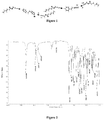
- Single-crystal X-ray diffraction demonstrates that in the co-crystal, IPBC and 4-[2-(4-pyridinyl)ethyl]pyridine are present in a molar ratio of 2:1, as shown in Figure 1 .
- the basic structural pattern in the co-crystal is a trimer unit wherein 4-[2-(4-pyridinyl)ethyl]pyridine acts as bridge between two IPBC molecules via two halogen bonds I ⁇ N.
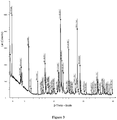
- Figure 3 shows the X-ray powder diffraction (XRPD) of the co-crystal, the main peaks of which, in the 5-40° 2 ⁇ value range, are shown in Table 1.
- the co-crystal thus obtained has a higher melting point, higher thermal stability, better workability and higher degree of crystallinity than IPBC. It is easily manageable in the operations required to form tablets, such as compression.
- Co-crystal 2 Co-crystal containing 3-iodopropynyl butylcarbamate and 4,4'-bipyridine in a 2:1 molar ratio (co-crystal 2)
- This example demonstrates the ability of IPBC to co-crystallise with another neutral aromatic amine able to act as halogen bond acceptor, such as 4,4'-dipyridine.
- the basic structural motif in the co-crystal is a trimeric unit, bonded via halogen bonds, consisting of one molecule of 4,4'-bipyridine and two molecules of IPBC, as shown in Figure 5 .
- the co-crystal is a solid crystalline product with a melting point of between 112°C and 114°C.
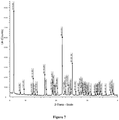
- Figure 7 shows the X-ray powder diffraction (XRPD) of the co-crystal, the main peaks of which, in the 5-40° 2 ⁇ value range, are shown in Table 2.
- the co-crystal thus obtained has a higher melting point, higher thermal stability, better workability and higher degree of crystallinity than IPBC. It is easily manageable in the operations required to form tablets, such as compression.
- Co-crystal containing 3-iodopropynyl butylcarbamate and tetrabutyl ammonium iodide in a 3:1 molar ratio (co-crystal 3)
- This example demonstrates the ability of IPBC to co-crystallise with a halide deriving from an organic salt such as tetrabutylammonium iodide.
- the co-crystal was formed by mechano-chemical synthesis in a ball mill, using a stoichiometric ratio of 1:3 between tetrabutyl ammonium iodide and IPBC.
- the co-crystal obtained contains one molecule of tetrabutyl ammonium iodide and three molecules of IPBC, as shown in the graphical representation in Figure 9 .
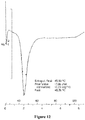
- the co-crystal is a solid crystalline product with a melting point between 42°C and 47.5°C.
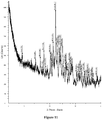
- Figure 11 shows the X-ray powder diffraction (XRPD) of the co-crystal, the main peaks of which, in the 5-40° 2 ⁇ value range, are shown in Table 3.
- the co-crystal thus obtained has a lower melting point, higher solubility and better workability in an aqueous medium than IPBC.
- its aqueous solubility is approx. 40% greater than that of IPBC.
- Co-crystal containing 3-iodopropynyl butylcarbamate and calcium chloride in a 4:1 molar ratio (co-crystal 4)
- This example demonstrates the ability of IPBC to co-crystallise with a halide deriving from an inorganic salt such as calcium chloride.
- the co-crystal was formed by mechano-chemical synthesis in a ball mill, using a stoichiometric ratio of 1:4 between calcium chloride and IPBC.
- composition of the co-crystal was detected by analysing the DSC trace, where the presence of peaks of the starting products was not observed.
- the co-crystal is a solid crystalline product with a melting point of 83-86°C.
- Figure 14 shows the X-ray powder diffraction (XRPD) of the co-crystal, the main peaks of which, in the 5-40° 2 ⁇ value range, are shown in Table 4.
- the co-crystal thus obtained has a higher melting point, higher solubility and better workability in an aqueous medium than IPBC.
- its aqueous solubility is approx. 50% greater than that of IPBC.
- Co-crystal containing 3-iodopropynyl butylcarbamate and N,N'-bis(4-pyridylcarbonyl)-1,6-hexanediamine in a 2:1 molar ratio (co-crystal 5)
- IPBC was co-crystallised with N, N'-bis(4-pyridylcarbonyl)-1,6-hexanediamine by slow evaporation from alcohol solutions and by mechano-chemical synthesis in a ball mill, using a ratio of 1:2 between the co-crystallisation agent and IPBC.
- the co-crystal is a solid crystalline product with a melting point of 132°C.
- Figure 18 shows the X-ray powder diffraction (XRPD) of the co-crystal, the main peaks of which, in the 5-40° 2 ⁇ value range, are shown in Table 5.
- the co-crystal thus obtained has a higher melting point, higher thermal stability, better workability and higher degree of crystallinity than IPBC. It is easily manageable in the operations required to form tablets, such as compression.
- Co-crystal containing 3-iodopropynyl butylcarbamate and pyridine in a 1:1 molar ratio (co-crystal 6)
- IPBC was co-crystallised with pyridine.
- the co-crystal was prepared dissolving in the 1:1 molar ratio IPBC in pyridine.
- the cocrystal is liquid at room temperature, but the formation of a halogen bonded system between IPBC and pyridine can be confirmed looking at the chemical shift variation of 13 C-NMR for the carbon bound to iodine.
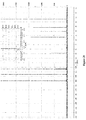
- the ⁇ C -I signals of deuterochloroform solutions of pure IPBC is at 3.68 ppm, in the cocrystal with pyridine the ⁇ C -I chemical shift varies from 4.00 ppm up to 14 ppm depending of the concentration of pyridine used, as shown in Figure 20 .
- Co-crystal containing 3-iodopropynyl butylcarbamate and 1,4-diazabicyclo[2.2.2]octane (DABCO) in a 2:1 molar ratio (co-crystal 7)
- IPBC was co-crystallised with the bicyclic tertiary amine 1,4-diazabicyclo[2.2.2]octane (DABCO), to give a co-crystal IPBC:DABCO with molar ratio 2:1.
- DABCO bicyclic tertiary amine 1,4-diazabicyclo[2.2.2]octane
- IPBC was co-crystallised with DABCO by slow evaporation from alcohol/haloalkane solutions, using a ratio of 1:2 between the co-crystallisation agent and IPBC. Melting point: 35-38°C.
- Co-crystal containing 3-iodopropynyl butylcarbamate and tetrabutylammonium chloride (TBACl) in a 2:1 molar ratio Co-crystal 8)
- IPBC was co-crystallised with tetrabutylammonium chloride (TBACl) to give a IPBC:TBACl co-crystal with molar ratio 2:1.
- TBACl tetrabutylammonium chloride
- the co-crystal was formed by heating the two components up to 50°C using a stoichiometric ratio of 1:2 between tetrabutyl ammonium chloride and IPBC.
- the co-crystal is liquid at room temperature. Melting point -15°C.
- the formation of a halogen bonded co-crystal between IPBC and TBACl can be confirmed looking at the IR wave number variation for C ⁇ C group.
- the triple bond stretching band is at 2198 cm -1 in the pure IPBC while it is red-shifted at 2181 cm -1 for the (IPBC) 2 :TBACl cocrystal, as shown in Figure 22 .
- Co-crystal containing 3-iodopropynyl butylcarbamate and zinc chloride in a 4:1 molar ratio (co-crystal 9)
- the co-crystal was prepared using the same procedure employed for example 4.
- IPBC co-crystal
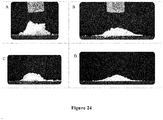
- Figure 24 shows that the cohesive properties of powder for co-crystal (IPBC) 4 :CaCl 2 are drastically different compared to the pure IPBC.
- Co-crystal (IPBC) 4 :CaCl 2 has values of angle of repose between 13° and 20° which indicates that it has excellent free-flow powder characteristic.
- the pure IPBC it is impossible to evaluate any angle of repose since the cohesive forces in the powder are too strong and its powder does not form an appropriate cone shape but tends to aggregate in irregular pillared shape.
- the cylindrical shape of IPBC cones indicates clearly the high cohesion of the powders, while the flat cone shape of co-crystal (IPBC) 4 :CaCl 2 indicates improved flow powder properties.
Landscapes
- Life Sciences & Earth Sciences (AREA)
- Health & Medical Sciences (AREA)
- General Health & Medical Sciences (AREA)
- Dentistry (AREA)
- Plant Pathology (AREA)
- Engineering & Computer Science (AREA)
- Pest Control & Pesticides (AREA)
- Agronomy & Crop Science (AREA)
- Wood Science & Technology (AREA)
- Zoology (AREA)
- Environmental Sciences (AREA)
- Toxicology (AREA)
- Pyridine Compounds (AREA)
- Pharmaceuticals Containing Other Organic And Inorganic Compounds (AREA)
Description
- The present invention relates to biocidal agents designed to protect industrial products against microbial, bacterial, fungal and algal infections. In particular, the present invention relates to co-crystals containing 3-iodopropynyl butylcarbamate (IPBC) and to compositions containing said co-crystals which have improved physical, chemical and workability properties compared with the use of IPBC.
- 3-Iodopropynyl butylcarbamate (IPBC) is a biocide used as a preservative, fungicide and algaecide in industrial formulations such as paints and coatings, in metalworking and in the protection and preservation of wood. It is also added to polymer formulations to prevent the growth of fungi and bacteria in products obtained from polymers. It is also present in personal care products and cosmetics to prevent the growth of bacteria and fungi.
- In some of its applications, IPBC can be added directly to the formulation concerned at room temperature. However, the compound is difficult to use in industrial products and processes. Its solubility in water is extremely low (156 ppm at 20°C), and it tends to be uneven and sticky, which makes it unsuitable for automatic manufacturing devices. The product melts at the temperature of 67°C, above which it degrades rapidly. It is therefore considered unusable in compositions which must be used above said temperature.
- The product can be prepared with high yields and purity as disclosed in
US 6,999,208 . - The crystalline and molecular structure of IPBC was described by E.V. Avtomonov et al, Zeitschrifit fuer Naturforschung, B: Chemical Sciences, 52(2), 256-258, 1997.
- Co-crystals between IPBC and a second component are not known.
- The definition of co-crystal has long been debated in the crystallography sphere. The simplest definition is a crystalline structure consisting of two or more components in a precise stoichiometric ratio, where each component can be an atom, an ion or a molecule (G.P. Stahly et al., A survey of co-crystals reported prior to 2000, Crystal Growth & Design, 9(10), 4212-4229, 2009). However, this definition includes many types of compounds, such as hydrates, solvates and clathrates, so the definition is sometimes extended by specifying that the components of the co-crystals are solid in their pure forms under room conditions (J. H. ter Horst et al, Discovering new co-crystals, Crystal Growth & Design. 9 (3), 1531-1537, 2009). Another definition present in the literature is that co-crystals consist of two or more components that form a single crystalline structure having unique properties (G.P. Stahly, Diversity in Single- and Multiple-Component Crystals. The Search for and Prevalence of Polymorphs and Cocrystals, Crystal Growth & Design 7(6), 1007-1026, 2007).
- Co-crystals are orderly structures, and their components interact through non-covalent interactions, such as hydrogen bonds, ionic interactions, van der Waals interactions and π interactions. The properties of co-crystals, such as their melting point, solubility, chemical stability and mechanical properties, differ from those of their individual components.
- The formation of co-crystals wherein one of the components is a substance with biological activity is an increasingly common approach in the pharmaceutical industry, because it allows the chemico-physical properties of the active ingredient of interest to be optimised. See, for example: M.J. Zaworokto et al, The role of cocrystals in pharmaceutical science, Drug Discovery Today, 13, 440, 2008; O. Almarsson et al, Crystal engineering of the composition of pharmaceutical phases. Do pharmaceutical cocrystals represent a new path to improved medicines? Chem.. Comm., 1889, 2004; P. Vishweshwar et al, Pharmaceutical cocrystals. J.Pharm. Sciences, 95, 499, 2006; A. V. Trask, An overview of pharmaceutical cocrystals as intellectual property. Mol. Pharma. 4, 30, 2007; W. Jones et al., Pharmaceutical cocrystals: an emerging approach to physical property enhancement. MRS Bull. 31, 875, 2006.
- Examples of co-crystallisation approaches used to generate new supramolecular materials are reported in
US2011152266 (A1 ),GB2476202 (A CA2738866 (A1 ),WO2011035456 (A1 ),KR20100091127 (A WO2010011926 (A2 ),WO2010128977 (A1 ),MX2008015937 (A KR20090015912 (A WO2009116055 (A1 ),US2009247749 (A1 ),WO2008108639 (A1 ),US2008280858 (A1 ),WO2008021559 (A2 ),WO2007067727 (A2 ),US2006149521 (A1 ),CN1757780 (A ) andWO2005089375 (A2 ). In all cases, the co-crystals are formed by non-covalent interactions involving hydrogen bonds, π-π (stacking) interactions or ion-π interactions. - Methods for generating new molecular entities involving IPBC are described in
US20040143011A1 andUS7851516B2 . However, these documents do not suggest the formation of co-crystals involving the iodoacetylenyl group and halogen bond interaction like those forming the object of the present application. - For the purpose of the present application, "co-crystal" is defined as a crystal that contains in the crystal unit cell at least one molecule of IPBC and at least one molecule of a second compound, called the "co-crystallisation agent", which can be liquid or solid at room temperature.
- For the purpose of the present application, the term "halogen bond" (XB) indicates a non-covalent interaction involving the iodine atom of IPBC, which acts as electron density acceptor. This type of bond is indicated in the present application by the graphical representation D --- I, wherein I is the iodine atom (Lewis acid, electron acceptor, XB-donor) and D is an electron-donor species (Lewis base, XB-acceptor). For a discussion of the halogen bond, see P. Metrangolo, F. Meyer, T. Pilati, G. Resnati, G. Terraneo, Halogen Bonding in Supramolecular Chemistry, Angewandte Chemie International Edition, Volume 47(33), 6114-6127, 2008.
- The object of the present invention is co-crystals of the compound 3-iodopropynyl butylcarbamate with a co-crystallisation agent as of
claim 1, wherein said agent is in the liquid or solid state at room temperature and is bonded to IPBC via at least one halogen bond. The co-crystals according to the invention have more advantageous chemico-physical properties than IPBC, such as better water solubility, greater heat stability, better powder flowability and better compressibility for tablet formation. - The co-crystals according to the invention are obtained by synthesis in the solid state or in solution. They can be formed by a supramolecular approach involving assembly of IPBC with selected chemical species called co-crystallisation agents, which are able to establish non-covalent interactions involving the iodine atom (halogen bond, XB) present on the molecular structure of IPBC. A further object of the invention is a composition containing a co-crystal as defined above, and additives.
- A further object of the invention is the use of a co-crystal or a composition as herein defined, as a biocide, in particular as a preservative, antibacterial, fungicide or algaecide.
- A further object of the invention is industrial products containing a co-crystal as herein defined.
- Finally, a further object of the invention is a process for the preparation of a co-crystal as herein defined, comprising: a) placing IPBC in contact with a co-crystallisation agent able to form at least one halogen bond with said IPBC, under crystallisation conditions such as to form a solid phase wherein the IPBC and said agent are bonded together via at least one halogen bond; and b) optional isolation of the co-crystals formed in step a).
- The co-crystals according to the invention are selected from the group consisting of:
- co-crystal containing 3-iodopropynyl butylcarbamate and pyridine in a 1:1 molar ratio;
- co-crystal containing 3-iodopropynyl butylcarbamate and 4-[2-(4-pyridinyl)ethyl]pyridine in a 2:1 molar ratio;
- co-crystal containing 3-iodopropynyl butylcarbamate and 4,4'-bipyridine in a 2:1 molar ratio;
- co-crystal containing 3-iodopropynyl butylcarbamate and 1,4-diazabicyclo[2.2.2]octane in a 2:1 molar ratio;
- co-crystal containing 3-iodopropynyl butylcarbamate and tetrabutyl ammonium iodide in a 3:1 molar ratio;
- co-crystal containing 3-iodopropynyl butyl carbamate and tetrabutyl ammonium chloride in a 2:1 molar ratio;
- co-crystal containing 3-iodopropynyl butylcarbamate and calcium chloride in a 4:1 molar ratio;
- co-crystal containing 3-iodopropynyl butylcarbamate and zinc chloride in a 4:1 molar ratio
- co-crystal containing 3-iodopropynyl butylcarbamate and N,N'-bis(4-pyridylcarbonyl)-1,6-hexanediamine in a 2:1 molar ratio.
- The following co-crystals according to the invention are preferred:
- co-crystal containing 3-iodopropynyl butylcarbamate and 4-[2-(4-pyridinyl)ethyl]pyridine in a 2:1 molar ratio, having characteristic X-ray powder diffraction (XRPD) peaks at 2θ angle values of 5.12, 5.68, 11.44, 16.95, 22.22, 22.66, 24.97 and 27.88 ± 0.05°, and unit cell dimensions [a=30.666(3) b=4.9869(4) c=21.068(2)] and [α=90.00 β=92.115(6) γ=90.00];
- co-crystal containing 3-iodopropynyl butylcarbamate and 4,4'-bipyridine in a 2:1 molar ratio, having characteristic X-ray powder diffraction (XRPD) peaks at 2θ angle values of 6.23 and 21.93 ± 0.05°, and unit cell dimensions a=28.683(2) b=4.9270(4) c=21.429(2)] and [α=90.00 β=99.92(2) γ=90.00];
- co-crystal containing 3-iodopropynyl butylcarbamate and tetrabutyl ammonium iodide in a 3:1 molar ratio, having characteristic X-ray powder diffraction (XRPD) peaks at 2θ angle values of 9.28, 14.48, 16.32, 17.73, 20.25, 20.69, 21.10, 21.33, 22.26, 22.90, 23.60, 23.97, 24.30, 25.01, 26.13, 26.51, 27.90 and 28.40 ± 0.1°, and unit cell dimensions [a=10.7688(9) b=20.204(2) c=23.735(2)] and [α=90.00 β=94.778(2) γ=90.00];
- co-crystal containing 3-iodopropynyl butylcarbamate and calcium chloride in a 4:1 molar ratio, having characteristic X-ray powder diffraction peaks (XRPD) at 2θ angle values of 9.67 and 22.28 ± 0.05°;
- co-crystal containing 3-iodopropynyl butylcarbamate and N,N'-bis(4-pyridylcarbonyl)-1,6-hexanediamine in a 2:1 molar ratio, having characteristic X-ray powder diffraction (XRPD) peaks at 2θ angle values of 11.83 and 22.78 ± 0.05°, and unit cell dimensions [a=29.4501(18) b=5.1100(3) c=27.9417(17)] and [α=90.00 β=118.566(3) γ=90.00];
- co-crystal containing 3-iodopropynyl butylcarbamate and pyridine in a 1:1 molar ratio, having a 13C-NMR spectrum substantially as depicted in
Figure 20 wherein the ≡C-I chemical shift may vary from 4.00 ppm up to 14 ppm; - co-crystal containing 3-iodopropynyl butylcarbamate and 1,4-diazabicyclo[2.2.2]octane (DABCO) in a 2:1 molar ratio, having an orthorhombic unit cell, Pccn, a: 9.8955(7); b: 31.623(2); c: 8.9335(6) and V = 2795.55 A3;
- co-crystal containing 3-iodopropynyl butylcarbamate and tetrabutylammonium chloride in a 2:1 molar ratio, having an IR spectrum substantially as depicted in
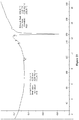
Figure 22 ; - co-crystal containing 3-iodopropynyl butylcarbamate and zinc chloride in a 4:1 molar ratio, having a DSC plot substantially as depicted in
Figure 23 , showing two peaks at 118°C and 139°C . - "Characteristic peaks in the XRPD spectrum" means peaks with a relative intensity exceeding 40% compared with the peak of greatest intensity, taken as 100.
- The crystallisation methods used to prepare the co-crystals according to the invention comprise slow and fast evaporation of solutions containing IPBC and the co-crystallisation agent in the desired stoichiometric ratios, wherein the formation of the co-crystal takes place in solution by slow and fast evaporation of the solvent; fast precipitation from quasi-saturated solvent solutions containing IPBC and the co-crystallisation agent; grinding (dry or in the presence of drops of solvent) of a mixture of IPBC and the co-crystallisation agent; melting of the mixture of IPBC and the co-crystallisation agent; mechano-chemical solid-phase synthesis in a ball mill; or a combination of said methods. The choice of one or more of said methods is made on the basis of the physical state (solid or liquid) of the IPBC and/or the co-crystallisation agent at the temperature at which the formation of the co-crystal is conducted.
- In one embodiment of the invention, the co-crystals are synthesised in solution.
- If both IPBC and the co-crystallisation agent are in the solid state, each substance, in the exact molar ratios, is dissolved separately in a suitable solvent, such as methanol, ethanol, chloroform, dichloromethane, acetonitrile or ethyl acetate. The two solutions are then mixed together, and the resulting mixture is left to evaporate. The evaporation is performed slowly if a single crystal is to be obtained or rapidly, for example with the aid of a vacuum evaporation system, if the co-crystal is to be obtained in powder form.
- However, if the co-crystallisation agent is a liquid, a quasi-saturated solution of IPBC is prepared in a suitable solvent, such as methanol, ethanol, chloroform, dichloromethane, acetonitrile or ethyl acetate. The liquid co-crystallisation agent is then added to said solution in an exact molar ratio. The resulting mixture is left to evaporate. The evaporation is performed slowly if a single crystal is to be obtained or rapidly, for example with the aid of a vacuum evaporation system, if the co-crystal is to be obtained in powder form.
- In another embodiment of the invention, the co-crystals are synthesised in the solid state. IPBC and the co-crystallisation agent, weighed in the exact molar ratio desired for the co-crystal, are mixed together and placed in a metal container of various dimensions. One or more metal balls of various dimensions are introduced into the container. The container is placed in a ball mill and vibrated with a frequency of 10-30 Hz for a time ranging between 5 and 30 minutes, depending on the dimensions of the container. The product recovered from the container is the co-crystal, which requires no further purification.
- The co-crystals according to the invention containing IPBC are suitable to protect industrial materials such as adhesives, glues, paper, cardboard, leather, wood and wood-based materials, coating materials, paints, plastic materials, industrial coolants, industrial lubricants, metalworking fluids, body care products such as wet wipes, toilet paper, cosmetics, and other materials which can be infested or decomposed by micro-organisms. Examples of micro-organisms which can cause the degradation or deterioration of industrial materials, against which the co-crystals according to the invention can be advantageously used, are bacteria, fungi (in particular fungi and moulds that attack wood), yeasts, algae and mucous organisms such as slime. Specific examples are micro-organisms of the genus Alternaria, such as Alternaria tenuis, Aspergillus, such as Aspergillus niger, Chaetomium, such as Chaetomium globosum, Coniophora, such as Coniophora puetana, Lentinus, such as Lentinus tigrinus, Penicillium, such as Penicillium glaucum, Polyporus, such as Polyporus versicolor, Aureobasidium, such as Aureobasidium pullulans, Sclerophoma, such as Sclerophoma pityophila, Trichoderma, such as Trichoderma viride, Escherichia, such as Escherichia coli, Pseudomonas, such as Pseudomonas aeruginosa, and Staphylococcus, such as Staphylococcus aureus.
- Depending on their chemico-physical properties, the co-crystals according to the invention can be incorporated in formulations such as solutions, emulsions, suspensions, powders, foams, pastes, granules, tablets and inhalers, or microencapsulated in polymers. The formulations according to the invention can be prepared by conventional methods. For example, the formulations can be prepared by mixing the co-crystals with diluents, such as liquid solvents or gases liquefied under pressure, and/or with solid diluents, if necessary also using surfactants, such as emulsifying agents and/or dispersing agents and/or foaming agents. If the diluent used is water, organic solvents can also be used as co-solvents. The solvents usable are aromatic solvents such as toluene and xylene; chlorinated aliphatic or aromatic hydrocarbons such as dichloromethane and chlorobenzene; aliphatic hydrocarbons such as cyclohexane; alcohols such as butanol, ethylene glycol and their ethers and esters; ketones such as acetone and ethyl methyl ketone, or cyclohexanone; highly polar solvents such as water, dimethyl sulphoxide and dimethylformamide. Examples of gases liquefied under pressure are liquids which are gaseous at room pressure and temperature, such as halogenated hydrocarbons, butane, propane, nitrogen and carbon dioxide.
- Suitable solid diluents are pulverised natural or synthetic minerals such as kaolins, clays, talc, gypsum, quartz, fossil flours, and silica, alumina and silicate powders.
- Suitable emulsifying and/or foaming agents are, for example, non-ionic or anionic emulsifying agents such as polyoxyethylene esters with fatty acids, ethers between polyoxyethylene and fatty alcohols, alkyl- or aryl-sulphonates, and alkylsulphates. An example of a suitable dispersing agent is methylcellulose.
- The formulations generally contain between 0.1% and 95% by weight of the co-crystals, preferably between 2% and 75% by weight.
- A further object of the present invention is therefore compositions with a biocidal activity containing a co-crystal of IPBC according to the invention and at least one solvent or diluent. The compositions according to the invention can also contain additives which assist the process of obtaining the composition and, if necessary, other biocidal agents such as agents with an antimicrobial, fungicidal, bactericidal, herbicidal, insecticidal or algaecidal activity. In this case, the co-crystals according to the invention and the other biocidal agents can be present in solution, suspension or emulsion. The solvents or diluents can be water or conventional organic solvents. Compositions containing a co-crystal according to the invention and another biocidal agent as active ingredients can present a broader action spectrum than the individual active ingredients and/or a synergic effect. Examples of other biocidal agents which can be present in the compositions according to the invention include azaconazole, bromuconazole, cyproconazole, dichlorobutrazole, diniconazole, diuron, hexaconazole, metconazole, penconazole, propiconazole, tebuconazole, dichlofluanid, tolylfluanid, fluor-folpet, methfuroxam, carboxin, cyclohexyl-benzo[b]thiophene carboxamide S,S-dioxide, fenpiclonil, 4-(2,2-difluoro-1,3-benzodioxol-4-yl)-1H-pyrrole-3-carbonitrile, butenafine, imazalil, N-methyl-isothiazolin-3-one, 5-chloro-N-methyl-isothiazolin-3-one, N-octyl-isothiazolin-3-one, dichloro-N-octyl-isothiazolinone, mercaptobenzothiazole, thiocyano-methylthiobenzothiazole, tiabendazole, benzisothiazolinone, N-(2-hydroxypropyl)aminomethanol, benzyl hemiformal, N-methylol-chloroacetamide, N-(2-hydroxypropyl)aminomethanol, glutaraldehyde, omadine, Zn-omadine, dimethyl dicarbonate, 2-bromo-2-nitro-1,3-propanediol, bethoxazin, o-phthaldialdehyde, 2,2-dibromo-3-cyano-propionamide, 1,2-dibromo-2,4-dicyano-butane, 1,3-bis(hydroxymethyl)-5,5-dimethylimidazolidine-2,4-dione (DMDMH), tetramethylolacetylenediurea (TMAD), ethylene glycol hemiformal, p-hydroxybenzoic acid and p-hydroxybenzoic acid esters (parabens), such as ethyl p-hydroxybenzoate (E214), ethyl-p-hydroxybenzoate sodium salt (E215), propyl p-hydroxybenzoate (E216), propyl p-hydroxybenzoate sodium salt (E217), methyl-p-hydroxybenzoate (E218) and methyl-p-hydroxybenzoate sodium salt (E219), carbendazim, chlorophene, 3-methyl-4-chlorophenol and o-phenylphenol.
- The weight ratio between the co-crystals of the invention and the other biocidal agents can vary within a wide range. Said ratio preferably ranges between 50:1 and 1:50.
- The compositions with antimicrobial activity of the invention contain the co-crystals of the invention or a mixture of the co-crystals of the invention and another biocidal agent in a concentration of between 0.1% and 95% by weight, preferably between 0.1% and 60% by weight.
- The concentrations at which the co-crystals of the invention or their combination with another biocidal agent are used depend on the nature and incidence of the micro-organisms to be controlled, and the composition of the material to be protected. The ideal quantity for use can be determined by a series of tests. In general, for most applications the concentration is between 0.001% and 5% by weight, preferably between 0.05% and 2% by weight, depending on the material to be protected.
- Compositions containing the co-crystals of the invention have better physical and chemical properties (such as greater solubility in water and greater heat stability) and workability properties (such as better powder flowability and better compressibility for tablet formation) than compositions containing IPBC.
- A further object of the invention is therefore the use of a co-crystal or composition of the invention as biocide in industrial products, in particular as a preservative, antibacterial, fungicide or algaecide, especially in paints, coatings, metalworking fluids, protection and preservation of wood, and in body care products or cosmetic formulations.
-
-
Figure 1 : Graphical representation of the co-crystal of example 1. -
Figure 2 : IR spectrum of the co-crystal of example 1. -
Figure 3 : XRPD tracing of the co-crystal of example 1. -
Figure 4 : DSC tracing of the co-crystal of example 1. -
Figure 5 : Graphical representation of the co-crystal of example 2. -
Figure 6 : IR spectrum of the co-crystal of example 2. -
Figure 7 : XRPD tracing of the co-crystal of example 2. -
Figure 8 : DSC tracing of the co-crystal of example 2. -
Figure 9 : Graphical representation of the co-crystal of example 3. -
Figure 10 : API IR spectrum of the co-crystal of example 3. -
Figure 11 : XRPD tracing of the co-crystal of example 3. -
Figure 12 : DSC tracing of the co-crystal of example 3. -
Figure 13 : API IR spectrum of the co-crystal of example 4. -
Figure 14 : XRPD tracing of the co-crystal of example 4. -
Figure 15 : DSC tracing of the co-crystal of example 4. -
Figure 16 : Graphical representation of the co-crystal of example 5. -
Figure 17 : API IR spectrum of the co-crystal of example 5. -
Figure 18 : XRPD tracing of the co-crystal of example 5. -
Figure 19 : DSC tracing of the co-crystal of example 5. -
Figure 20 : 13C-NMR of the co-crystal of example 6. -
Figure 21 : Ball and stick representation from single crystal analysis of the co-crystal of example 7. DABCO hydrogen atoms are omitted for clarity. -
Figure 22 : IR spectrum of the co-crystal of example 8. -
Figure 23 : DSC plot of the co-crystal of example 9.Figure 24 : Pictures of cones of pure IPBC (A, C) and co-crystal (IPBC)4:CaCl2 (B, D) powders, taken after flowing the powders through the funnel. - The invention will now be illustrated by the following examples.
- The IR spectra were obtained with a Nicolet Nexus FTIR spectrophotometer equipped with the U-ATR device. The values are reported as wave numbers, and are rounded to 1 cm-1 after automatic assignment. The melting points were obtained by differential scanning calorimetry (DSC, Mettler Toledo 823e).
- The data were collected at different temperatures with a Bruker KAPPA APEX II diffractometer with Mo-Kα radiation (λ= 0.71073) and a CCD detector. The Bruker KRYOFLEX device was used for the low-temperature acquisitions. The structures were resolved and refined with the SIR2004 and SHELXL-97 programs respectively. The refinement was performed by the full-matrix least squares method on F2. The hydrogen atoms were placed using standard geometric models and with their thermal parameters based on those of their geminal atoms.
- The X-ray powder diffraction experiments were conducted with a Bruker D8 Advance diffractometer operating in reflection mode with Ge-monochromatic Cu Kα1 radiation (λ = 1.5406 Å) and with a position-sensitive linear detector. The powder diffraction data was collected at room temperature with a 2θ interval of 5-40°, using increments of 0.016° and an exposure time of 1.5 s per increment.
-

- This example demonstrates the ability of IPBC to co-crystallise with a neutral aromatic amine able to act as halogen bond acceptor, such as 4-[2-(4-pyridinyl)ethyl]pyridine.
- Rapid precipitation of the two compounds in a quasi-saturated acetonitrile solution leads to the formation of a solid white powder with a melting point of between 81°C and 83°C.
- Single-crystal X-ray diffraction demonstrates that in the co-crystal, IPBC and 4-[2-(4-pyridinyl)ethyl]pyridine are present in a molar ratio of 2:1, as shown in
Figure 1 . The basic structural pattern in the co-crystal is a trimer unit wherein 4-[2-(4-pyridinyl)ethyl]pyridine acts as bridge between two IPBC molecules via two halogen bonds I···N. - The dimensions and angles of the crystallographic unit cell are [a=30.666(3) b=4.9869(4) c=21.068(2)] and [α=90.00 β=92.115(6) γ=90.00] respectively.
- The IR spectrum of the co-crystal and its characteristic bands are reported in
Figure 2 . -
Figure 3 shows the X-ray powder diffraction (XRPD) of the co-crystal, the main peaks of which, in the 5-40° 2θ value range, are shown in Table 1. - The DSC thermogram of
co-crystal 1 is reported inFigure 4 .Table 1 Angle(2θ)* d (Å) Intensity % 2th=5.117° 17.25577 2521 51.2 2th=5.684° 15.53601 4923 100.0 2th=8.644° 10.22081 1240 25.2 2th=8.924° 9.90129 1792 36.4 2th=9.274° 9.52842 907 18.4 2th=11.445° 7.72521 3010 61.1 2th=12.225° 7.23443 490 10.0 2th=14.471° 6.11592 932 18.9 2th=15.726° 5.63077 310 6.3 2th=16.087° 5.50517 408 8.3 2th=16.402° 5.40011 592 12.0 2th=16.951° 5.22630 2000 40.6 2th=17.228° 5.14312 872 17.7 2th=17.997° 4.92493 576 11.7 2th=18.382° 4.82269 644 13.1 2th=19.133° 4.63491 368 7.5 2th=19.692° 4.50459 476 9.7 2th=20.105° 4.41308 507 10.3 2th=21.176° 4.19213 350 7.1 2th=21.524° 4.12518 1449 29.4 2th=21.800° 4.07364 894 18.2 2th=22.221° 3.99734 4665 94.8 2th=22.663° 3.92047 2184 44.4 2th=23.181° 3.83400 1450 29.5 2th=24.580° 3.61886 373 7.6 2th=24.967° 3.56356 2850 57.9 2th=25.348° 3.51083 400 8.1 2th=25.876° 3.44043 339 6.9 2th=26.404° 3.37283 302 6.1 2th=27.191° 3.27701 783 15.9 2th=27.882° 3.19725 4091 83.1 2th=28.258° 3.15564 451 9.2 2th=28.838° 3.09341 1892 38.4 2th=29.185° 3.05747 373 7.6 2th=30.311° 2.94642 344 7.0 2th=30.988° 2.88354 260 5.3 2th=32.914° 2.71904 255 5.2 2th=33.516° 2.67160 361 7.3 2th=34.345° 2.60901 250 5.1 2th=34.793° 2.57641 883 17.9 2th=35.051° 2.55803 443 9.0 2th=35.850° 2.50285 270 5.5 2th=36.589° 2.45396 519 10.5 2th=37.072° 2.42311 464 9.4 2th=37.905° 2.37175 254 5.2 2th=38.291° 2.34872 309 6.3 2th=39.015° 2.30676 228 4.6 2th=39.738° 2.26645 438 8.9 * Values ± 0.05° - The co-crystal thus obtained has a higher melting point, higher thermal stability, better workability and higher degree of crystallinity than IPBC. It is easily manageable in the operations required to form tablets, such as compression.
-

- This example demonstrates the ability of IPBC to co-crystallise with another neutral aromatic amine able to act as halogen bond acceptor, such as 4,4'-dipyridine.
- In this case the formation of the co-crystal was effected by slow precipitation from an ethanol solution, which leads to the formation of a white powder.
- The basic structural motif in the co-crystal is a trimeric unit, bonded via halogen bonds, consisting of one molecule of 4,4'-bipyridine and two molecules of IPBC, as shown in
Figure 5 . - The co-crystal is a solid crystalline product with a melting point of between 112°C and 114°C. The dimensions and angles of the crystallographic unit cell are [a=28.683(2) b=4.9270(4) c=21.429(2)] and [α=90.00 β=99.92(2) γ=90.00] respectively.
- The IR spectrum of the co-crystal and its characteristic bands are reported in
Figure 6 . -
Figure 7 shows the X-ray powder diffraction (XRPD) of the co-crystal, the main peaks of which, in the 5-40° 2θ value range, are shown in Table 2. - The DSC thermogram of
co-crystal 2 is reported inFigure 8 .Table 2 Angle(2θ)* d (Å) Intensity % 2th=6.234° 14.16728 8558 100.0 2th=8.358° 10.57069 353 4.1 2th=9.560° 9.24440 679 7.9 2th=12.160° 7.27286 269 3.1 2th=12.521° 7.06371 1737 20.3 2th=13.187° 6.70850 197 2.3 2th=13.841° 6.39289 399 4.7 2th=16.255° 5.44854 2148 25.1 2th=16.825° 5.26536 663 7.7 2th=18.651° 4.75371 507 5.9 2th=18.861° 4.70134 1402 16.4 2th=19.248° 4.60750 1051 12.3 2th=19.892° 4.45974 187 2.2 2th=20.400° 4.34990 797 9.3 2th=21.931° 4.04952 5931 69.3 2th=22.695° 3.91488 453 5.3 2th=23.110° 3.84554 991 11.6 2th=23.835° 3.73028 1084 12.7 2th=24.461° 3.63616 319 3.7 2th=24.826° 3.58348 679 7.9 2th=25.194° 3.53200 3287 38.4 2th=26.333° 3.38179 452 5.3 2th=27.465° 3.24488 325 3.8 2th=27.980° 3.18637 877 10.2 2th=28.475° 3.13207 786 9.2 2th=28.928° 3.08399 349 4.1 2th=29.463° 3.02919 427 5.0 2th=29.735° 3.00209 298 3.5 2th=30.264° 2.95086 255 3.0 2th=30.571° 2.92189 319 3.7 2th=31.311° 2.85455 198 2.3 2th=32.653° 2.74021 176 2.1 2th=33.314° 2.68732 203 2.4 2th=33.439° 2.67760 232 2.7 2th=33.914° 2.64116 241 2.8 2th=34.205° 2.61934 475 5.6 2th=34.762° 2.57862 234 2.7 2th=36.146° 2.48303 206 2.4 2th=37.672° 2.38589 384 4.5 2th=38.213° 2.35331 596 7.0 2th=38.614° 2.32980 258 3.0 * Values ± 0.05° - The co-crystal thus obtained has a higher melting point, higher thermal stability, better workability and higher degree of crystallinity than IPBC. It is easily manageable in the operations required to form tablets, such as compression.
-

- This example demonstrates the ability of IPBC to co-crystallise with a halide deriving from an organic salt such as tetrabutylammonium iodide.
- The co-crystal was formed by mechano-chemical synthesis in a ball mill, using a stoichiometric ratio of 1:3 between tetrabutyl ammonium iodide and IPBC.
- The co-crystal obtained contains one molecule of tetrabutyl ammonium iodide and three molecules of IPBC, as shown in the graphical representation in
Figure 9 . - The co-crystal is a solid crystalline product with a melting point between 42°C and 47.5°C. The dimensions and angles of the crystallographic unit cell are a=10.7688(9) b=20.204(2) c=23.735(2)] and [α=90.00 β=94.778(2) γ=90.00] respectively.
- The IR spectrum of the co-crystal and its characteristic bands are reported in
Figure 10 . -
Figure 11 shows the X-ray powder diffraction (XRPD) of the co-crystal, the main peaks of which, in the 5-40° 2θ value range, are shown in Table 3. - The DSC thermogram of
co-crystal 3 is reported inFigure 12 .Table 3 Angle(2θ)* d (Å) Intensity % 2th=9.285° 9.51690 513 53.5 2th=14.485° 6.11006 445 46.5 2th=16.322° 5.42635 469 49.0 2th=17.432° 5.08330 346 36.1 2th=17.729° 4.99868 537 56.1 2th=18.440° 4.80755 373 38.9 2th=20.246° 4.38272 517 54.0 2th=20.698° 4.28791 438 45.7 2th=21.072° 4.21276 423 44.2 2th=21.331° 4.16217 629 65.7 2th=22.261° 3.99035 958 100.0 2th=22.903° 3.87977 590 61.6 2th=23.605° 3.76596 613 64.0 2th=23.968° 3.70974 484 50.5 2th=24.305° 3.65910 616 64.3 2th=25.009° 3.55775 580 60.5 2th=25.670° 3.46761 363 37.9 2th=26.129° 3.40770 406 42.4 2th=26.507° 3.35996 423 44.2 2th=26.730° 3.33240 343 35.8 2th=27.359° 3.25726 326 34.0 2th=27.893° 3.19608 432 45.1 2th=28.399° 3.14030 389 40.6 2th=28.918° 3.08502 372 38.8 2th=30.514° 2.92722 311 32.5 2th=31.221° 2.86256 302 31.5 2th=31.654° 2.82441 322 33.6 2th=32.085° 2.78741 349 36.4 2th=32.592° 2.74517 308 32.2 2th=33.490° 2.67360 323 33.7 2th=34.033° 2.63217 246 25.7 2th=34.608° 2.58975 249 26.0 2th=34.973° 2.56357 314 32.8 2th=35.533° 2.52440 269 28.1 2th=36.332° 2.47069 261 27.2 2th=36.772° 2.44214 278 29.0 2th=37.328° 2.40703 225 23.5 2th=38.414° 2.34144 277 28.9 * Values ± 0.1° - The co-crystal thus obtained has a lower melting point, higher solubility and better workability in an aqueous medium than IPBC. In particular, its aqueous solubility is approx. 40% greater than that of IPBC.
-

- This example demonstrates the ability of IPBC to co-crystallise with a halide deriving from an inorganic salt such as calcium chloride.
- The co-crystal was formed by mechano-chemical synthesis in a ball mill, using a stoichiometric ratio of 1:4 between calcium chloride and IPBC.
- The composition of the co-crystal was detected by analysing the DSC trace, where the presence of peaks of the starting products was not observed.
- The co-crystal is a solid crystalline product with a melting point of 83-86°C.
- The IR spectrum of the co-crystal and its characteristic bands are reported in
Figure 13 . -
Figure 14 shows the X-ray powder diffraction (XRPD) of the co-crystal, the main peaks of which, in the 5-40° 2θ value range, are shown in Table 4. - The DSC thermogram of
co-crystal 4 is reported inFigure 15 .Table 4 Angle(2θ) d (Å) Intensity % 2th=6.581° 13.41984 5844 16.2 2th=7.314° 12.07749 10715 29.7 2th=8.160° 10.82602 4892 13.6 2th=9.674° 9.13549 16217 45.0 2th=11.059° 7.99382 7263 20.1 2th=11.991° 7.37478 4418 12.3 2th=13.299° 6.65245 6966 19.3 2th=15.631° 5.66483 4674 13.0 2th=15.982° 5.54118 6113 17.0 2th=17.374° 5.10003 8718 24.2 2th=18.517° 4.78765 9325 25.9 2th=19.365° 4.57995 11180 31.0 2th=20.091° 4.41616 3184 8.8 2th=21.313° 4.16552 4102 11.4 2th=22.282° 3.98664 36057 100.0 2th=23.054° 3.85484 3660 10.2 2th=23.469° 3.78751 3136 8.7 2th=24.435° 3.63994 6628 18.4 2th=24.990° 3.56041 12456 34.5 2th=26.159° 3.40384 5054 14.0 2th=26.775° 3.32689 4703 13.0 2th=27.659° 3.22252 11372 31.5 2th=28.514° 3.12789 5945 16.5 2th=29.588° 3.01671 6588 18.3 2th=30.368° 2.94095 2644 7.3 2th=31.158° 2.86817 4800 13.3 2th=31.838° 2.80850 8422 23.4 2th=32.766° 2.73101 2388 6.6 2th=33.979° 2.63621 4478 12.4 2th=34.729° 2.58102 3049 8.5 2th=35.337° 2.53800 2887 8.0 2th=36.000° 2.49271 2816 7.8 2th=36.603° 2.45308 2980 8.3 2th=37.030° 2.42574 3009 8.3 2th=37.436° 2.40037 3085 8.6 2th=38.110° 2.35946 4670 13.0 2th=38.968° 2.30947 3168 8.8 2th=39.475° 2.28092 2995 8.3 * Values ± 0.05° - The co-crystal thus obtained has a higher melting point, higher solubility and better workability in an aqueous medium than IPBC. In particular, its aqueous solubility is approx. 50% greater than that of IPBC.
-

- In this example, IPBC was co-crystallised with N, N'-bis(4-pyridylcarbonyl)-1,6-hexanediamine by slow evaporation from alcohol solutions and by mechano-chemical synthesis in a ball mill, using a ratio of 1:2 between the co-crystallisation agent and IPBC.
- In the co-crystal obtained there is a ratio of 1:2 between the co-crystallisation agent and IPBC, as shown in the graphical representation in
Figure 16 . - The co-crystal is a solid crystalline product with a melting point of 132°C. The dimensions and angles of the crystallographic unit cell are [a=29.4501(18) b=5.1100(3) c=27.9417(17)] and [α=90.00 β=118.566(3) γ=90.00] respectively.
- The IR spectrum of the co-crystal and its characteristic bands are reported in
Figure 17 . -
Figure 18 shows the X-ray powder diffraction (XRPD) of the co-crystal, the main peaks of which, in the 5-40° 2θ value range, are shown in Table 5. - The DSC thermogram of
co-crystal 5 is reported inFigure 19 .Table 5 Angle(2θ) d (Å) Intensity % 2th=5.887° 14.99966 1231 18.2 2th=6.951° 12.70619 545 8.1 2th=10.380° 8.51551 690 10.2 2th=11.831° 7.47444 3530 52.3 2th=13.013° 6.79759 324 4.8 2th=13.477° 6.56468 591 8.8 2th=13.961° 6.33814 1111 16.5 2th=14.270° 6.20161 272 4.0 2th=15.441° 5.73399 1653 24.5 2th=16.713° 5.30018 510 7.6 2th=17.132° 5.17156 244 3.6 2th=17.945° 4.93909 411 6.1 2th=18.816° 4.71240 331 4.9 2th=19.095° 4.64417 378 5.6 2th=19.516° 4.54479 300 4.4 2th=20.075° 4.41964 366 5.4 2th=20.950° 4.23697 1050 15.6 2th=21.366° 4.15541 563 8.3 2th=21.916° 4.05229 740 11.0 2th=22.784° 3.89988 6751 100.0 2th=23.513° 3.78060 855 12.7 2th=23.856° 3.72703 939 13.9 2th=24.326° 3.65609 332 4.9 2th=25.096° 3.54550 509 7.5 2th=25.760° 3.45568 376 5.6 2th=26.944° 3.30641 653 9.7 2th=27.924° 3.19254 305 4.5 2th=28.684° 3.10973 548 8.1 2th=29.094° 3.06678 276 4.1 2th=29.709° 3.00471 330 4.9 2th=30.531° 2.92568 430 6.4 2th=31.214° 2.86315 419 6.2 2th=31.568° 2.83188 367 5.4 2th=32.461° 2.75600 241 3.6 2th=32.802° 2.72810 284 4.2 2th=34.124° 2.62537 365 5.4 2th=34.688° 2.58393 478 7.1 2th=36.154° 2.48246 505 7.5 2th=36.966° 2.42976 398 5.9 2th=37.750° 2.38110 561 8.3 2th=39.102° 2.30185 457 6.8 * Values ± 0.05° - The co-crystal thus obtained has a higher melting point, higher thermal stability, better workability and higher degree of crystallinity than IPBC. It is easily manageable in the operations required to form tablets, such as compression.
- In this example, IPBC was co-crystallised with pyridine.
- The co-crystal was prepared dissolving in the 1:1 molar ratio IPBC in pyridine.
- The cocrystal is liquid at room temperature, but the formation of a halogen bonded system between IPBC and pyridine can be confirmed looking at the chemical shift variation of 13C-NMR for the carbon bound to iodine.
- Previous studies have demonstrated that the 13C signals of the iodinated carbons of iodoethynyl moieties undergo major low-field shifts on changing the solvent from chloroform to dimethylsulphoxide as a consequence of the XB occurring with the oxygen atoms of the solvent. [ref. Rege, P.D.; Malkina, O. L.; Goroff, N. S. J. Am. Chem. Soc. 2002, 124, 370-371. Gao, K.; Goroff, N. S. J. Am. Chem. Soc. 2000, 122, 9320-9321.]. The ≡C-I signals of deuterochloroform solutions of pure IPBC is at 3.68 ppm, in the cocrystal with pyridine the ≡C-I chemical shift varies from 4.00 ppm up to 14 ppm depending of the concentration of pyridine used, as shown in
Figure 20 . -

- In this example, IPBC was co-crystallised with the bicyclic
tertiary amine 1,4-diazabicyclo[2.2.2]octane (DABCO), to give a co-crystal IPBC:DABCO with molar ratio 2:1. - IPBC was co-crystallised with DABCO by slow evaporation from alcohol/haloalkane solutions, using a ratio of 1:2 between the co-crystallisation agent and IPBC.
Melting point: 35-38°C. - The structure of the IPBC.DABCO co-crystal from single crystal crystallographic analysis is shown in
Figure 21 , wherein DABCO hydrogen atoms are omitted for clarity. - Crystallographic data: orthorhombic, Pccn, a: 9.8955(7); b: 31.623(2); c: 8.9335(6) and V = 2795.55 A3.
- In this example, IPBC was co-crystallised with tetrabutylammonium chloride (TBACl) to give a IPBC:TBACl co-crystal with molar ratio 2:1.
- The co-crystal was formed by heating the two components up to 50°C using a stoichiometric ratio of 1:2 between tetrabutyl ammonium chloride and IPBC.
- The co-crystal is liquid at room temperature.
Melting point -15°C. - The formation of a halogen bonded co-crystal between IPBC and TBACl can be confirmed looking at the IR wave number variation for C≡C group. The triple bond stretching band is at 2198 cm-1 in the pure IPBC while it is red-shifted at 2181 cm-1 for the (IPBC)2:TBACl cocrystal, as shown in
Figure 22 . - This example demonstrates the ability of IPBC to co-crystallise with a halide deriving from a transition metal, such as zinc chloride, to give a IPBC:ZnCl2 co-crystal with molar ratio 4:1
- The co-crystal was prepared using the same procedure employed for example 4.
- The formation of a halogen bonded cocrystal between IPBC and ZnCl2 can be confirmed looking at the DSC plot (
Figure 23 ) showing two peaks at 118°C and 139°C (mixture of polymorphs) and the absence of the IPBC melting peak. - In this example the angle of response of powders containing the halogen bonded (IPBC)4:CaCl2 complex of example 4 was compared to that of powders containing pure IPBC (
Figure 24 ). The angle of response estimates the flow characteristics of the powders, - The use of pure IPBC in industrial products faces significant manufacturing drawbacks. IPBC is difficult to handle because it tends to be clumpy and sticky, this implies that it cannot be fed easily from the blending equipment and the automatic feeding device.
Figure 24 shows that the cohesive properties of powder for co-crystal (IPBC)4:CaCl2 are drastically different compared to the pure IPBC. Co-crystal (IPBC)4:CaCl2 has values of angle of repose between 13° and 20° which indicates that it has excellent free-flow powder characteristic. On the contrary for the pure IPBC it is impossible to evaluate any angle of repose since the cohesive forces in the powder are too strong and its powder does not form an appropriate cone shape but tends to aggregate in irregular pillared shape. The cylindrical shape of IPBC cones indicates clearly the high cohesion of the powders, while the flat cone shape of co-crystal (IPBC)4:CaCl2 indicates improved flow powder properties.
Claims (5)
- A co-crystal of the compound 3-iodopropynyl butylcarbamate with a co-crystallisation agent, wherein said co-crystal is selected from the group consisting of:i. co-crystal containing 3-iodopropynyl butyl carbamate and pyridine in a 1:1 molar ratio;ii. co-crystal containing 3-iodopropynyl butyl carbamate and 4-[2-(4-pyridinyl)ethyl]pyridine in a 2:1 molar ratio;iii. co-crystal containing 3-iodopropynyl butyl carbamate and 4,4'-bipyridine in a 2:1 molar ratio;iv. co-crystal containing 3-iodopropynyl butyl carbamate and 1,4-diazabicyclo[2.2.2]octane in a 2:1 molar ratio;v. co-crystal containing 3-iodopropynyl butyl carbamate and tetrabutylammonium iodide in a 3:1 molar ratio;vi. co-crystal containing 3-iodopropynyl butyl carbamate and tetrabutylammonium chloride in a 2:1 molar ratio;vii. co-crystal containing 3-iodopropynyl butyl carbamate and calcium chloride in a 4:1 molar ratio;viii. co-crystal containing 3-iodopropynyl butyl carbamate and zinc chloride in a 4:1 molar ratio;ix. co-crystal containing 3-iodopropynyl butyl carbamate and N,
N'-bis(4-pyridylcarbonyl)-1,6-hexanediamine in a 2:1 molar ratio. - Composition containing a co-crystal of claim 1, a solvent or diluent and optionally additives and/or a biocidal agent.
- Use of a co-crystal according to claim 1 or of a composition according to claim 2 as biocide in industrial products, preservative, antibacterial, fungicide or algaecide, in paints, coatings, metalworking fluids, in the protection and preservation of wood, in personal care products or in cosmetic formulations.
- Industrial products containing a co-crystal according to claim 1.
- Process for the preparation of a co-crystal according to claim 1, comprising the steps of:a) contacting 3-iodopropynyl butyl carbamate with the co-crystallization agent under crystallisation conditions able to form a solid phase wherein 3-iodopropynyl butyl carbamate and said co-crystallisation agent are bound to each other through at least one halogen bond;b) optional isolation of the co-crystals formed in step a).
Applications Claiming Priority (2)
| Application Number | Priority Date | Filing Date | Title |
|---|---|---|---|
| IT000586A ITMI20120586A1 (en) | 2012-04-11 | 2012-04-11 | CO-CRYSTALS OF 3-IODIOPROPINYL BUTYCARBAMMATE |
| PCT/EP2013/057384 WO2013153059A1 (en) | 2012-04-11 | 2013-04-09 | Co-crystals of 3-iodopropynyl butylcarbamate |
Publications (2)
| Publication Number | Publication Date |
|---|---|
| EP2836074A1 EP2836074A1 (en) | 2015-02-18 |
| EP2836074B1 true EP2836074B1 (en) | 2018-12-26 |
Family
ID=46582871
Family Applications (1)
| Application Number | Title | Priority Date | Filing Date |
|---|---|---|---|
| EP13720809.6A Not-in-force EP2836074B1 (en) | 2012-04-11 | 2013-04-09 | Co-crystals of 3-iodopropynyl butylcarbamate |
Country Status (4)
| Country | Link |
|---|---|
| US (1) | US9848599B2 (en) |
| EP (1) | EP2836074B1 (en) |
| IT (1) | ITMI20120586A1 (en) |
| WO (1) | WO2013153059A1 (en) |
Families Citing this family (1)
| Publication number | Priority date | Publication date | Assignee | Title |
|---|---|---|---|---|
| CN113493421B (en) * | 2020-04-08 | 2024-12-27 | 鲁南制药集团股份有限公司 | A 1,2-di(4-pyridyl)ethane-acemidox eutectic |
Family Cites Families (22)
| Publication number | Priority date | Publication date | Assignee | Title |
|---|---|---|---|---|
| CA2323575A1 (en) | 1998-03-30 | 1999-11-25 | Regents Of The University Of California | Methods and compounds for modulating nuclear receptor coactivator binding |
| US6999208B2 (en) | 2000-09-22 | 2006-02-14 | Ricoh Company, Ltd. | Optical scanner, optical scanning method, scanning image forming optical system, optical scanning lens and image forming apparatus |
| CA2439640A1 (en) | 2001-03-01 | 2002-09-12 | Lonza Inc. | Combination of an iodopropynyl derivative with a ketone acid or its salt and/or with an aromatic carboxylic acid or its salt |
| US6992208B2 (en) * | 2003-08-04 | 2006-01-31 | H&S Chemical Company, Inc. | Process for the synthesis of iodopropynyl butylcarbamate in an aqueous solution of a suitable surfactant |
| US20070287194A1 (en) | 2004-03-12 | 2007-12-13 | S.S.C.I., Inc | Screening For Solid Forms By Ultrasound Crystallization And Cocrystallization Using Ultrasound |
| US7951852B2 (en) * | 2005-04-07 | 2011-05-31 | Isp Investments Inc. | Free-flowing composition of a biocide and a processing additive therewith for incorporation into a polymer or plastic matrix product |
| CN1757780A (en) | 2005-11-01 | 2006-04-12 | 邹志尚 | Cocrystallization agent of binary phosphorus cocrystal and ternary phosphorus cocrystal of pearlite gray pig liron |
| US8163790B2 (en) | 2005-12-08 | 2012-04-24 | New Form Pharmaceuticals, Inc. | Metronidazole cocrystals and imipramine cocrystals |
| TWI370818B (en) | 2006-04-05 | 2012-08-21 | Astellas Pharma Inc | Cocrystal of c-glycoside derivative and l-proline |
| MX2008015937A (en) | 2006-06-13 | 2009-04-01 | Ingenio Del Cauca S A Incauca | Process for cocrystallization of saccharose and a natural sweetener and the product obtained. |
| US20080051435A1 (en) | 2006-08-18 | 2008-02-28 | Cephalon, Inc. | Crystalline and amorphous forms of tiagabine |
| GB0702402D0 (en) | 2007-02-08 | 2007-03-21 | Thar Pharmaceuticals Inc | Method of creating crystalline substances |
| WO2008108639A1 (en) | 2007-03-08 | 2008-09-12 | Avantium Holding B.V. | Co-crystalline forms of carbamazepine |
| WO2009116055A1 (en) | 2008-03-17 | 2009-09-24 | Lupin Limited | Lamivudine : zidovudine : water 1 : 1 : 1 cocrystal |
| US7935817B2 (en) | 2008-03-31 | 2011-05-03 | Apotex Pharmachem Inc. | Salt form and cocrystals of adefovir dipivoxil and processes for preparation thereof |
| DE102008028071A1 (en) | 2008-06-12 | 2009-12-17 | Bayer Schering Pharma Aktiengesellschaft | New cocrystal compound of rivaroxaban and malonic acid |
| EP2340245A4 (en) | 2008-07-25 | 2011-09-28 | Bionevia Pharmaceuticals Inc | A novel betaine cocrystal of epalrestat |
| AU2009279604A1 (en) | 2008-08-06 | 2010-02-11 | Bionevia Pharmaceuticals, Inc. | Flupirtine hydrochloride maleic acid cocrystal |
| EA016904B1 (en) | 2008-09-06 | 2012-08-30 | Бионевия Фармасьютикалс, Инк. | Novel choline cocrystal of epalrestat |
| KR20100091127A (en) | 2009-02-09 | 2010-08-18 | 주식회사 한독약품 | Novel salts of adefovir dipivoxil and method for the preparation of the same |
| US8173625B2 (en) | 2009-05-08 | 2012-05-08 | Theaprin Pharmaceuticals Inc. | Intravenous formulation with water-soluble cocrystals of acetylsalicylic acid and theanine |
| WO2011035456A1 (en) | 2009-09-25 | 2011-03-31 | 上海抗体药物国家工程研究中心有限公司 | Method of acquiring proteins with high affinity by computer aided design |
-
2012
- 2012-04-11 IT IT000586A patent/ITMI20120586A1/en unknown
-
2013
- 2013-04-09 WO PCT/EP2013/057384 patent/WO2013153059A1/en not_active Ceased
- 2013-04-09 EP EP13720809.6A patent/EP2836074B1/en not_active Not-in-force
- 2013-04-09 US US14/391,504 patent/US9848599B2/en not_active Expired - Fee Related
Non-Patent Citations (1)
| Title |
|---|
| None * |
Also Published As
| Publication number | Publication date |
|---|---|
| EP2836074A1 (en) | 2015-02-18 |
| US9848599B2 (en) | 2017-12-26 |
| US20150051280A1 (en) | 2015-02-19 |
| WO2013153059A1 (en) | 2013-10-17 |
| ITMI20120586A1 (en) | 2013-10-12 |
Similar Documents
| Publication | Publication Date | Title |
|---|---|---|
| TW491686B (en) | Fungicidal mixtures based on amide compounds and tetrachloroisophthalonitrile | |
| ES2207433T3 (en) | MICROBICIDES | |
| PL206415B1 (en) | Fungicidal heterocyclic aromatic amides and their compositions, methods of use and preparation | |
| JP2017110004A (en) | Metalloenzyme inhibitor compounds | |
| JPS6072867A (en) | Novel n-(2-nitrophenyl)-4-amino-pyrimidine derivative, manufacture and composition | |
| BR102013033840A2 (en) | 1- (benzoyl substituted) -5-fluoro-4-imino-3-methyl-3,4-dihydropyrimidine-2 (1h) -one derivatives | |
| Walkiewicz et al. | Multifunctional long-alkyl-chain quaternary ammonium azolate based ionic liquids | |
| CA2085714A1 (en) | Microbicides | |
| BG60803B1 (en) | Fungicide composition and method for fungi control | |
| JPS6141353B2 (en) | ||
| DK164888B (en) | SYNERGISTIC FUNGICIDE AGENT, APPLICATION OF THE AGENT AND A PROCEDURE FOR COMBATING FUNGI | |
| EP0082340B1 (en) | Microbicidal triazolyl-ethyl-ethers | |
| JPH0717811A (en) | Microbicide | |
| US9848599B2 (en) | Co-crystals of 3-iodopropynyl butylcarbamate | |
| PT87764B (en) | METHOD FOR THE PREPARATION OF ETHER (AZOLYL-VINYL) -PHENOL-ALCENYLS WITH MICROBICIDE EFFECT | |
| JP2009535377A (en) | Biocidal combination comprising imazalil | |
| HU196694B (en) | Fungicidal composition comprising 1-fluoro-1-triazolyl-2,2-diphenylethane derivatives as active ingredient and process for producing the active ingredients | |
| JPH02295983A (en) | Thiazole derivative | |
| ES2417355T3 (en) | Compounds and methods for fungal control | |
| PL158210B1 (en) | Mycotic agent | |
| US3224935A (en) | Fungicidal compositions | |
| JPH04230271A (en) | Microbicide | |
| EP0362135A2 (en) | Parasiticide | |
| JP2003026515A (en) | Acaricide for mites | |
| HK1169995A (en) | Compounds and methods for controlling fungi |
Legal Events
| Date | Code | Title | Description |
|---|---|---|---|
| PUAI | Public reference made under article 153(3) epc to a published international application that has entered the european phase |
Free format text: ORIGINAL CODE: 0009012 |
|
| 17P | Request for examination filed |
Effective date: 20141014 |
|
| AK | Designated contracting states |
Kind code of ref document: A1 Designated state(s): AL AT BE BG CH CY CZ DE DK EE ES FI FR GB GR HR HU IE IS IT LI LT LU LV MC MK MT NL NO PL PT RO RS SE SI SK SM TR |
|
| AX | Request for extension of the european patent |
Extension state: BA ME |
|
| DAX | Request for extension of the european patent (deleted) | ||
| STAA | Information on the status of an ep patent application or granted ep patent |
Free format text: STATUS: EXAMINATION IS IN PROGRESS |
|
| 17Q | First examination report despatched |
Effective date: 20171123 |
|
| GRAP | Despatch of communication of intention to grant a patent |
Free format text: ORIGINAL CODE: EPIDOSNIGR1 |
|
| STAA | Information on the status of an ep patent application or granted ep patent |
Free format text: STATUS: GRANT OF PATENT IS INTENDED |
|
| INTG | Intention to grant announced |
Effective date: 20180720 |
|
| RAP1 | Party data changed (applicant data changed or rights of an application transferred) |
Owner name: POLITECNICO DI MILANO |
|
| GRAS | Grant fee paid |
Free format text: ORIGINAL CODE: EPIDOSNIGR3 |
|
| GRAA | (expected) grant |
Free format text: ORIGINAL CODE: 0009210 |
|
| STAA | Information on the status of an ep patent application or granted ep patent |
Free format text: STATUS: THE PATENT HAS BEEN GRANTED |
|
| AK | Designated contracting states |
Kind code of ref document: B1 Designated state(s): AL AT BE BG CH CY CZ DE DK EE ES FI FR GB GR HR HU IE IS IT LI LT LU LV MC MK MT NL NO PL PT RO RS SE SI SK SM TR |
|
| REG | Reference to a national code |
Ref country code: GB Ref legal event code: FG4D |
|
| REG | Reference to a national code |
Ref country code: CH Ref legal event code: EP |
|
| REG | Reference to a national code |
Ref country code: AT Ref legal event code: REF Ref document number: 1080152 Country of ref document: AT Kind code of ref document: T Effective date: 20190115 |
|
| REG | Reference to a national code |
Ref country code: DE Ref legal event code: R096 Ref document number: 602013048754 Country of ref document: DE |
|
| REG | Reference to a national code |
Ref country code: IE Ref legal event code: FG4D |
|
| PG25 | Lapsed in a contracting state [announced via postgrant information from national office to epo] |
Ref country code: BG Free format text: LAPSE BECAUSE OF FAILURE TO SUBMIT A TRANSLATION OF THE DESCRIPTION OR TO PAY THE FEE WITHIN THE PRESCRIBED TIME-LIMIT Effective date: 20190326 Ref country code: LT Free format text: LAPSE BECAUSE OF FAILURE TO SUBMIT A TRANSLATION OF THE DESCRIPTION OR TO PAY THE FEE WITHIN THE PRESCRIBED TIME-LIMIT Effective date: 20181226 Ref country code: LV Free format text: LAPSE BECAUSE OF FAILURE TO SUBMIT A TRANSLATION OF THE DESCRIPTION OR TO PAY THE FEE WITHIN THE PRESCRIBED TIME-LIMIT Effective date: 20181226 Ref country code: HR Free format text: LAPSE BECAUSE OF FAILURE TO SUBMIT A TRANSLATION OF THE DESCRIPTION OR TO PAY THE FEE WITHIN THE PRESCRIBED TIME-LIMIT Effective date: 20181226 Ref country code: NO Free format text: LAPSE BECAUSE OF FAILURE TO SUBMIT A TRANSLATION OF THE DESCRIPTION OR TO PAY THE FEE WITHIN THE PRESCRIBED TIME-LIMIT Effective date: 20190326 Ref country code: FI Free format text: LAPSE BECAUSE OF FAILURE TO SUBMIT A TRANSLATION OF THE DESCRIPTION OR TO PAY THE FEE WITHIN THE PRESCRIBED TIME-LIMIT Effective date: 20181226 |
|
| REG | Reference to a national code |
Ref country code: NL Ref legal event code: MP Effective date: 20181226 |
|
| REG | Reference to a national code |
Ref country code: LT Ref legal event code: MG4D |
|
| PG25 | Lapsed in a contracting state [announced via postgrant information from national office to epo] |
Ref country code: AL Free format text: LAPSE BECAUSE OF FAILURE TO SUBMIT A TRANSLATION OF THE DESCRIPTION OR TO PAY THE FEE WITHIN THE PRESCRIBED TIME-LIMIT Effective date: 20181226 Ref country code: SE Free format text: LAPSE BECAUSE OF FAILURE TO SUBMIT A TRANSLATION OF THE DESCRIPTION OR TO PAY THE FEE WITHIN THE PRESCRIBED TIME-LIMIT Effective date: 20181226 Ref country code: RS Free format text: LAPSE BECAUSE OF FAILURE TO SUBMIT A TRANSLATION OF THE DESCRIPTION OR TO PAY THE FEE WITHIN THE PRESCRIBED TIME-LIMIT Effective date: 20181226 Ref country code: GR Free format text: LAPSE BECAUSE OF FAILURE TO SUBMIT A TRANSLATION OF THE DESCRIPTION OR TO PAY THE FEE WITHIN THE PRESCRIBED TIME-LIMIT Effective date: 20190327 |
|
| REG | Reference to a national code |
Ref country code: AT Ref legal event code: MK05 Ref document number: 1080152 Country of ref document: AT Kind code of ref document: T Effective date: 20181226 |
|
| PG25 | Lapsed in a contracting state [announced via postgrant information from national office to epo] |
Ref country code: NL Free format text: LAPSE BECAUSE OF FAILURE TO SUBMIT A TRANSLATION OF THE DESCRIPTION OR TO PAY THE FEE WITHIN THE PRESCRIBED TIME-LIMIT Effective date: 20181226 |
|
| PG25 | Lapsed in a contracting state [announced via postgrant information from national office to epo] |
Ref country code: CZ Free format text: LAPSE BECAUSE OF FAILURE TO SUBMIT A TRANSLATION OF THE DESCRIPTION OR TO PAY THE FEE WITHIN THE PRESCRIBED TIME-LIMIT Effective date: 20181226 Ref country code: IT Free format text: LAPSE BECAUSE OF FAILURE TO SUBMIT A TRANSLATION OF THE DESCRIPTION OR TO PAY THE FEE WITHIN THE PRESCRIBED TIME-LIMIT Effective date: 20181226 Ref country code: PT Free format text: LAPSE BECAUSE OF FAILURE TO SUBMIT A TRANSLATION OF THE DESCRIPTION OR TO PAY THE FEE WITHIN THE PRESCRIBED TIME-LIMIT Effective date: 20190426 Ref country code: PL Free format text: LAPSE BECAUSE OF FAILURE TO SUBMIT A TRANSLATION OF THE DESCRIPTION OR TO PAY THE FEE WITHIN THE PRESCRIBED TIME-LIMIT Effective date: 20181226 Ref country code: ES Free format text: LAPSE BECAUSE OF FAILURE TO SUBMIT A TRANSLATION OF THE DESCRIPTION OR TO PAY THE FEE WITHIN THE PRESCRIBED TIME-LIMIT Effective date: 20181226 |
|
| PG25 | Lapsed in a contracting state [announced via postgrant information from national office to epo] |
Ref country code: EE Free format text: LAPSE BECAUSE OF FAILURE TO SUBMIT A TRANSLATION OF THE DESCRIPTION OR TO PAY THE FEE WITHIN THE PRESCRIBED TIME-LIMIT Effective date: 20181226 Ref country code: IS Free format text: LAPSE BECAUSE OF FAILURE TO SUBMIT A TRANSLATION OF THE DESCRIPTION OR TO PAY THE FEE WITHIN THE PRESCRIBED TIME-LIMIT Effective date: 20190426 Ref country code: RO Free format text: LAPSE BECAUSE OF FAILURE TO SUBMIT A TRANSLATION OF THE DESCRIPTION OR TO PAY THE FEE WITHIN THE PRESCRIBED TIME-LIMIT Effective date: 20181226 Ref country code: SK Free format text: LAPSE BECAUSE OF FAILURE TO SUBMIT A TRANSLATION OF THE DESCRIPTION OR TO PAY THE FEE WITHIN THE PRESCRIBED TIME-LIMIT Effective date: 20181226 Ref country code: SM Free format text: LAPSE BECAUSE OF FAILURE TO SUBMIT A TRANSLATION OF THE DESCRIPTION OR TO PAY THE FEE WITHIN THE PRESCRIBED TIME-LIMIT Effective date: 20181226 |
|
| REG | Reference to a national code |
Ref country code: DE Ref legal event code: R097 Ref document number: 602013048754 Country of ref document: DE |
|
| PG25 | Lapsed in a contracting state [announced via postgrant information from national office to epo] |
Ref country code: DK Free format text: LAPSE BECAUSE OF FAILURE TO SUBMIT A TRANSLATION OF THE DESCRIPTION OR TO PAY THE FEE WITHIN THE PRESCRIBED TIME-LIMIT Effective date: 20181226 Ref country code: AT Free format text: LAPSE BECAUSE OF FAILURE TO SUBMIT A TRANSLATION OF THE DESCRIPTION OR TO PAY THE FEE WITHIN THE PRESCRIBED TIME-LIMIT Effective date: 20181226 |
|
| PLBE | No opposition filed within time limit |
Free format text: ORIGINAL CODE: 0009261 |
|
| STAA | Information on the status of an ep patent application or granted ep patent |
Free format text: STATUS: NO OPPOSITION FILED WITHIN TIME LIMIT |
|
| REG | Reference to a national code |
Ref country code: CH Ref legal event code: PL |
|
| 26N | No opposition filed |
Effective date: 20190927 |
|
| REG | Reference to a national code |
Ref country code: BE Ref legal event code: MM Effective date: 20190430 |
|
| PG25 | Lapsed in a contracting state [announced via postgrant information from national office to epo] |
Ref country code: LU Free format text: LAPSE BECAUSE OF NON-PAYMENT OF DUE FEES Effective date: 20190409 Ref country code: MC Free format text: LAPSE BECAUSE OF FAILURE TO SUBMIT A TRANSLATION OF THE DESCRIPTION OR TO PAY THE FEE WITHIN THE PRESCRIBED TIME-LIMIT Effective date: 20181226 |
|
| PG25 | Lapsed in a contracting state [announced via postgrant information from national office to epo] |
Ref country code: LI Free format text: LAPSE BECAUSE OF NON-PAYMENT OF DUE FEES Effective date: 20190430 Ref country code: CH Free format text: LAPSE BECAUSE OF NON-PAYMENT OF DUE FEES Effective date: 20190430 |
|
| PG25 | Lapsed in a contracting state [announced via postgrant information from national office to epo] |
Ref country code: BE Free format text: LAPSE BECAUSE OF NON-PAYMENT OF DUE FEES Effective date: 20190430 Ref country code: SI Free format text: LAPSE BECAUSE OF FAILURE TO SUBMIT A TRANSLATION OF THE DESCRIPTION OR TO PAY THE FEE WITHIN THE PRESCRIBED TIME-LIMIT Effective date: 20181226 |
|
| PG25 | Lapsed in a contracting state [announced via postgrant information from national office to epo] |
Ref country code: TR Free format text: LAPSE BECAUSE OF FAILURE TO SUBMIT A TRANSLATION OF THE DESCRIPTION OR TO PAY THE FEE WITHIN THE PRESCRIBED TIME-LIMIT Effective date: 20181226 |
|
| PG25 | Lapsed in a contracting state [announced via postgrant information from national office to epo] |
Ref country code: IE Free format text: LAPSE BECAUSE OF NON-PAYMENT OF DUE FEES Effective date: 20190409 |
|
| PG25 | Lapsed in a contracting state [announced via postgrant information from national office to epo] |
Ref country code: CY Free format text: LAPSE BECAUSE OF FAILURE TO SUBMIT A TRANSLATION OF THE DESCRIPTION OR TO PAY THE FEE WITHIN THE PRESCRIBED TIME-LIMIT Effective date: 20181226 |
|
| PGFP | Annual fee paid to national office [announced via postgrant information from national office to epo] |
Ref country code: GB Payment date: 20210323 Year of fee payment: 9 |
|
| PG25 | Lapsed in a contracting state [announced via postgrant information from national office to epo] |
Ref country code: HU Free format text: LAPSE BECAUSE OF FAILURE TO SUBMIT A TRANSLATION OF THE DESCRIPTION OR TO PAY THE FEE WITHIN THE PRESCRIBED TIME-LIMIT; INVALID AB INITIO Effective date: 20130409 Ref country code: MT Free format text: LAPSE BECAUSE OF FAILURE TO SUBMIT A TRANSLATION OF THE DESCRIPTION OR TO PAY THE FEE WITHIN THE PRESCRIBED TIME-LIMIT Effective date: 20181226 |
|
| PGFP | Annual fee paid to national office [announced via postgrant information from national office to epo] |
Ref country code: DE Payment date: 20210429 Year of fee payment: 9 Ref country code: FR Payment date: 20210419 Year of fee payment: 9 |
|
| PG25 | Lapsed in a contracting state [announced via postgrant information from national office to epo] |
Ref country code: MK Free format text: LAPSE BECAUSE OF FAILURE TO SUBMIT A TRANSLATION OF THE DESCRIPTION OR TO PAY THE FEE WITHIN THE PRESCRIBED TIME-LIMIT Effective date: 20181226 |
|
| REG | Reference to a national code |
Ref country code: DE Ref legal event code: R119 Ref document number: 602013048754 Country of ref document: DE |
|
| GBPC | Gb: european patent ceased through non-payment of renewal fee |
Effective date: 20220409 |
|
| PG25 | Lapsed in a contracting state [announced via postgrant information from national office to epo] |
Ref country code: GB Free format text: LAPSE BECAUSE OF NON-PAYMENT OF DUE FEES Effective date: 20220409 Ref country code: FR Free format text: LAPSE BECAUSE OF NON-PAYMENT OF DUE FEES Effective date: 20220430 Ref country code: DE Free format text: LAPSE BECAUSE OF NON-PAYMENT OF DUE FEES Effective date: 20221103 |