EP2835955A2 - Detecting co-occurrence patterns in DNS - Google Patents
Detecting co-occurrence patterns in DNS Download PDFInfo
- Publication number
- EP2835955A2 EP2835955A2 EP20140180373 EP14180373A EP2835955A2 EP 2835955 A2 EP2835955 A2 EP 2835955A2 EP 20140180373 EP20140180373 EP 20140180373 EP 14180373 A EP14180373 A EP 14180373A EP 2835955 A2 EP2835955 A2 EP 2835955A2
- Authority
- EP
- European Patent Office
- Prior art keywords
- domains
- lists
- name
- list
- occurring
- Prior art date
- Legal status (The legal status is an assumption and is not a legal conclusion. Google has not performed a legal analysis and makes no representation as to the accuracy of the status listed.)
- Withdrawn
Links
- 238000000034 method Methods 0.000 claims abstract description 63
- 238000005067 remediation Methods 0.000 claims description 3
- 238000004891 communication Methods 0.000 claims description 2
- 238000010586 diagram Methods 0.000 description 4
- 230000000694 effects Effects 0.000 description 4
- 230000000246 remedial effect Effects 0.000 description 4
- 230000000903 blocking effect Effects 0.000 description 2
- 238000005065 mining Methods 0.000 description 2
- 230000002085 persistent effect Effects 0.000 description 2
- 241000700605 Viruses Species 0.000 description 1
- 238000005516 engineering process Methods 0.000 description 1
- ZXQYGBMAQZUVMI-GCMPRSNUSA-N gamma-cyhalothrin Chemical compound CC1(C)[C@@H](\C=C(/Cl)C(F)(F)F)[C@H]1C(=O)O[C@H](C#N)C1=CC=CC(OC=2C=CC=CC=2)=C1 ZXQYGBMAQZUVMI-GCMPRSNUSA-N 0.000 description 1
- 208000015181 infectious disease Diseases 0.000 description 1
- 238000007726 management method Methods 0.000 description 1
- 238000013507 mapping Methods 0.000 description 1
- 230000006855 networking Effects 0.000 description 1
- 238000005457 optimization Methods 0.000 description 1
- 230000002123 temporal effect Effects 0.000 description 1
Images



Classifications
-
- H—ELECTRICITY
- H04—ELECTRIC COMMUNICATION TECHNIQUE
- H04L—TRANSMISSION OF DIGITAL INFORMATION, e.g. TELEGRAPHIC COMMUNICATION
- H04L63/00—Network architectures or network communication protocols for network security
- H04L63/14—Network architectures or network communication protocols for network security for detecting or protecting against malicious traffic
- H04L63/1408—Network architectures or network communication protocols for network security for detecting or protecting against malicious traffic by monitoring network traffic
-
- H—ELECTRICITY
- H04—ELECTRIC COMMUNICATION TECHNIQUE
- H04L—TRANSMISSION OF DIGITAL INFORMATION, e.g. TELEGRAPHIC COMMUNICATION
- H04L61/00—Network arrangements, protocols or services for addressing or naming
- H04L61/45—Network directories; Name-to-address mapping
- H04L61/4505—Network directories; Name-to-address mapping using standardised directories; using standardised directory access protocols
- H04L61/4511—Network directories; Name-to-address mapping using standardised directories; using standardised directory access protocols using domain name system [DNS]
-
- H—ELECTRICITY
- H04—ELECTRIC COMMUNICATION TECHNIQUE
- H04L—TRANSMISSION OF DIGITAL INFORMATION, e.g. TELEGRAPHIC COMMUNICATION
- H04L63/00—Network architectures or network communication protocols for network security
- H04L63/14—Network architectures or network communication protocols for network security for detecting or protecting against malicious traffic
- H04L63/1441—Countermeasures against malicious traffic
- H04L63/145—Countermeasures against malicious traffic the attack involving the propagation of malware through the network, e.g. viruses, trojans or worms
Definitions
- the techniques provided herein relate to detecting suspicious software.
- a method includes obtaining a plurality of name resolution requests received over a period of time from a plurality of name servers, generating, using a sliding time window with a fixed duration, sets of lists, one set of lists for each of the plurality of name servers, each list comprising one or more domains requested within the fixed duration, combining the sets of lists, whereby a global set of lists is generated, detecting a co-occurring list in the global set of lists, determining that a plurality of domains in the co-occurring list are non-existent, and indicating the domains in the co-occurring list.
- Each name resolution request can include an identification of a domain, a time, and a name server.
- Each name server can include a recursive name server.
- the method can include sorting the plurality of name resolution requests according to name server, such that the sets of lists, one for each of the plurality of name servers, are obtained.
- the method can include instituting remediation measures against malware associated with the co-occurring list.
- the detecting can include constructing a frequent pattern tree.
- the detecting can include performing a breadth-first search.
- the method can include determining that the plurality of domains in the co-occurring list that are non-existent comprises at least 1000 domains.
- the method can include determining that the co-occurring list includes at least 1000 domains.
- the indicating can include displaying.
- the method can include indicating that suspicious software might have requested the domains in the co-occurring list.
- the method can include indicating that malware might have requested the domains in the co-occurring list.
- a system includes at least one processor in communication with a plurality of name servers, the at least one processor configured to: obtain a plurality of name resolution requests received over a period of time from a plurality of name servers, generate, using a sliding time window with a fixed duration, sets of lists, one set of lists for each of the plurality of name servers, each list comprising one or more domains requested within the fixed duration, combine the sets of lists, such that a global set of lists is generated, detect a co-occurring list in the global set of lists, determine that a plurality of domains in the co-occurring list are non-existent, and indicate the domains in the co-occurring list.
- Each name resolution request can include an identification of a domain, a time, and a name server.
- Each name server can include a recursive name server.
- the at least one processor can be further configured to: sort the plurality of name resolution requests according to name server, such that the sets of lists, one for each of the plurality of name servers, are obtained.
- the system can include at least one processor configured to institute remediation measures against malware associated with the co-occurring list.
- the at least one processor can be further configured to construct a frequent pattern tree.
- the at least one processor can be further configured to perform a breadth-first search.
- the at least one processor can be further configured to determine that the plurality of domains in the co-occurring list that are non-existent includes at least 1000 domains.
- the at least one processor can be further configured to determine that the co-occurring list includes at least 1000 domains.
- the system can be operably coupled to a monitor, where the at least one processor can be further configured to indicate that malware requested domains in the co-occurring list by displaying an indication on the monitor.
- the at least one processor can be further configured to indicate that suspicious software might have requested the domains in the co-occurring list._The at least one processor can be further configured to indicate that malware might have requested the domains in the co-occurring list.
- domains used for unscrupulous activities Such domains may be used for scams, phishing, spamming, botnet command-and-control activities, etc.
- the ability to perpetrate malicious activity depends on coordinating a large collection of computers infected with malware to perform a particular activity.
- DNS domain name system
- IP internet protocol
- infected computers may locate the controller machine according to its domain name.
- computers infected with the same malware typically contact the same set of domains. Many such domains are non-existent, i.e., are not registered.
- some implementations infer the existence malware by detecting multiple requests for the same sets of domains, some of which are non-existent.
- such implementations allow for detecting the existence of malware or other suspicious software without requiring reverse engineering of the malware's domain generation algorithm.
- Fig. 1 is a schematic diagram of a system according to some embodiments of the present invention.
- the system includes processors 102 configured to carry out at least portions of the methods disclosed herein.
- Processors 102 can be implemented as part of a computer or computer system, e.g., a rack-mount server; for purposes of description herein, processors 102 can include such a computer or computer system.
- Processors 102 are communicatively coupled to persistent storage 104, such as a hard disk or disk array.
- Storage 104 can store instructions for execution by processors 102 to perform at least some portions of the methods disclosed herein.
- Processors 102 are communicatively coupled, by way of network 110, to DNS servers 112, 114 and 116.
- Network 110 can be, for example, the internet.
- Processors 102 can receive data from DNS servers 112, 114 and 115 as disclosed herein.
- processors 102 can receive data reflecting name resolution requests received from each of DNS servers 112, 114 and 116.
- DNS servers 112, 114 and 116 can be, for example, top-level domain servers and/or recursive name servers.
- a client device e.g., computers 106 or 108
- receives a uniform resource locator ("URL") from, e.g., a user or application
- the client device sends a name resolution request through network 110 to a name server to obtain an IP address corresponding to the URL.
- a recursive server receives a name resolution request and does not itself have information for that domain, it sends a request to a top-level domain server to obtain the associated IP address.
- each recursive server represents a different geographical region.
- DNS servers 112, 114 and 116 convey to processors 102 information reflecting each name resolution request that they receive.
- DNS servers 112, 114 and 116 can convey data indicating, for each name resolution request received, a time that the request was received, an identification (e.g., IP address) of the name server that received the request, and a domain whose corresponding IP address was requested.
- Computers 106 and 108 in Fig. 1 are infected with malware, such as a virus or Trojan horse.
- computers 106 and 108 can be so-called zombie computers.
- a malware operator can utilize such zombie computers 106 and 108 to perform malicious actions, such as sending email spam or performing a distributed denial of service attack.
- the malware thus causes computers 106 and 108 to seek instructions, such as what spam to send and to where, or what computer to bombard as part of a denial of service attack. (Embodiments are not limited to detecting denial-of-service malware.)
- Computers 106 and 108 typically obtain such instructions by contacting computers using a large number of URLs.
- Fig. 2 is a schematic diagram of a portion of a method according to some embodiments of the present invention.
- the method aims to identify malware infections by detecting the co-occurrence of sets of multiple time-clustered name resolution requests from many different malware-infected computers. That is, the method can detect malware-infected computers by determining that one or more name servers receive, from a plurality of infected computers, requests for the same set of URLs clustered together in time. More generally, the method can detect the existence of suspicious software by detecting the co-occurrence of requests for non-existent domains.
- the method can begin when an embodiment, such as that illustrated in Fig. 1 including processors 102 and storage 104, receives a stream of data reflecting name resolution requests received by one or more name servers.
- the stream of name resolution requests can reflect requests received over a period of time, e.g., an hour, a day, a week, etc. In general, the period of time can be any interval from one minute to several weeks.
- the stream of data can include data reflecting discreet name resolution requests.
- the data for each request can include a time of day (e.g., internet time), a requested domain (e.g., a character string), and an identification of the name server that received the request (e.g., an IP address).
- the embodiment can group the data according to name servers that received the request. The embodiment can then arrange the data by time within each group.
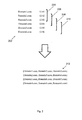
- One such arrangement 202 is illustrated in Fig. 2 . That is, arrangement 202 represents requested domains received by a single name server, where the requested domains are arranged by time that the request was received by the name server. Note that some embodiments receive data from multiple name servers; thus, such embodiments arrange the type of data illustrated by arrangement 202 multiple times.
- sliding time window 204, 206, 208 and 210 uses sliding time window 204, 206, 208 and 210 to obtain lists of domains for which a name server received requests clustered together in time.
- sliding time window 204, 206, 208 and 210 can be of duration, e.g., any number of seconds between 0.1 second and 10 seconds.
- Fig. 2 schematically illustrates sliding time window 204, 206, 208 and 210 applied to arrangement 202.
- each list 212 includes three domains.
- each list can include any number of domains.
- the embodiment obtains one or more sets of lists of temporally-clustered domains, it combines the sets of lists to produce a global set of lists of temporally-clustered requested domains. The embodiment then detects co-occurrence of such lists from among the global set of lists. This process is discussed in detail in reference to Fig. 3 .
- Fig. 3 is a flowchart of a method according to some embodiments of the present invention.
- the method of Fig. 3 can include the method portion depicted according to Fig. 2 . Further, the method of Fig. 3 can be implemented using an embodiment illustrated in Fig. 1 , including processors 102 and storage 104.
- the method obtains a plurality, e.g., as stream, of name resolution requests.
- the method can obtain such requests, e.g., from DNS servers 112, 114 and 116.
- the DNS servers can be programmed to provide the name resolution requests, e.g., to processors 102 via the internet.
- the method sorts the name resolution requests it received at block 302 according to receiving name server. For example, if processors 102 receive name resolution requests from seven different name servers, then the results of block 304 will be seven sets of name resolutions requests.
- the method uses a sliding time window to generate sets of lists.
- the technique of block 306 is performed for each set of name resolution requests produced at block 304. More particularly, the technique of block 306 is performed for each set of name resolution requests received from a single name server. Thus, block 306 generates one set of lists for each name server. Additional details of the technique of block 306 are discussed above in reference to Fig. 2 .
- the method combines the sets of lists generated at block 306 to generate a global set of lists.
- the combination can be an ordinary merge for example, that is, a set-theoretic union, with duplicates permitted. For example, merging the set of lists [ ⁇ Domain1.com, Domain2.com ⁇ , ⁇ Domain2.com, Domain3.com ⁇ ] with the set of lists [ ⁇ Domain1.com, Domain2.com ⁇ , ⁇ Domain3.com, Domain4.com ⁇ ] yields the global set of lists [ ⁇ Domain1.com, Domain2.com ⁇ , ⁇ Domain1.com, Domain2.com ⁇ , ⁇ Domain2.com, Domain3.com ⁇ , ⁇ Domain3.com, Domain4.com ⁇ ].
- the method detects at least one co-occurring list in the global set of lists.
- a co-occurring list here means a list that appears at least twice.
- block 310 detects one or more lists that appear more than once in the global set of lists.
- Many existing techniques can be used to detect a co-occurring list. For example, techniques that construct a frequent pattern tree can be used, such as that described in J. Han, H. Pei, and Y. Yin, Mining Frequent Patterns without Candidate Generation, Proc. Conf. on the Management of Data (SIGMOD'00, Dallas, TX) ACM Press, New York, NY, USA 2000 .
- the output of the algorithms, and that of block 310 is an identification of at least one list that appears at least twice in the global set of lists.
- the output of block 310 includes a count, for each co-occurring list, of the number of occurrences of the co-occurring list in the global set of lists.
- the method determines that at least some domains in the (one or more) co-occurring lists are non-existent. That is, the method determines that at least some domains in the co-occurring list(s) are not registered. This can be accomplished by, for example, processors 102 communicating with a name server to determine whether the domains in question are currently registered.
- the technique indicates that suspicious software or malware likely requested domains in the co-occurring list. This conclusion can result from the method determining co-occurring lists of domains that include a plurality of non-existent domains.
- the indication can be in any of several forms.
- the indication incudes displaying the domains on a computer monitor a notice.
- the notice can include or link to a list of the domains in the co-occurring list(s) and/or a list of the non-existent domains in the co-occurring list(s).
- the technique can indicate (e.g., display) the domains in the co-occurring list without indicating that the domains might be associated with suspicious software or malware.
- the number of domains or non-existent domains in a co-occurring list must exceed a threshold before triggering block 314.
- the threshold can be, for example, 100, 500, 750, 1000, 1500, 2000, etc. In general, the threshold can be any number between 100 and 10,000. In general, the threshold can be determined by taking into account where in the recursive DNS hierarchy this system is implemented, the type of top-level domains it might be serving, and/or the number of users behind the name servers.
- the method institutes remedial measures against the suspected malware.
- the remedial measures can include, for example, communicating with one or more name servers to provide an indication that malware likely requested the domains or the non-existent domains appearing in the co-occurring list(s).
- the remedial measures can include, for example, blocking, or requesting blocking, of name server requests for registered domains that are included in the co-occurring list(s). Other remedial measures are also contemplated.
- Fig. 4 is a chart of name server queries according to some embodiments of the present invention.
- Fig. 4 is a chart illustrating time between domain name requests as a function of number of requests for domains by computers infected with versions of the Conficker A/B malware.
- the chart illustrates, in particular for each number of requested domains, first quartile 402, median 404, third quartile 406, and standard deviation 408.
- the chart of Fig. 4 and analogous charts for new malware, can be used to fine-tune implementations of the technique by providing, e.g., threshold information as discussed above in reference to block 314.
- Fig. 5 is a chart of name server queries according to some embodiments of the present invention.
- the chart of Fig. 5 is an x/y scatterplot of domain name requests by computers infected with versions of the Conficker A/B malware, where the x-axis represents number of domains requested, and the y -axis represents time between requests in seconds. Note that the most frequent case 502 shows one or two requests within a five-to-ten-second period.
- the chart of Fig. 5 and analogous charts for new malware, can be used to fine-tune implementations of the technique by providing, e.g., threshold information as discussed above in reference to block 314.
- Some implementations detect multiple co-occurring domain requests and utilize this information for cache optimization. For example, such implementations can detect that requests for a particular first domain are frequently followed for requests for a second domain. In such instances, such implementations can be used to enhance prefetching and cache techniques in web browsers and name servers.
- Some implementations detect multiple co-occurring domain requests and utilize this information to determine associations or affiliations between domains. This information can be used by advertisers, for example, so that they can place advertisements in multiple places and increase the chance of reaching a target audience.
- Implementations can be used to detect co-occurrence patterns for many types of requests, not limited to DNS requests. For example, some implementations can be used to detect co-occurrence patterns in web page requests. Such implementations can be utilized in a content-delivery environment, where an entity hosts many (e.g., hundreds) of web pages. Such an entity can apply the techniques disclosed herein to detect patterns of requests for unavailable web pages, e.g., requests that yield HTTP 404 Not Found errors.
- systems capable of performing the presented techniques may take many different forms. Further, the functionality of one portion of the system may be substituted into another portion of the system.
- Each hardware component may include one or more processors coupled to random access memory operating under control of, or in conjunction with, an operating system. Further, each hardware component can include persistent storage, such as a hard drive or drive array, which can store program instructions to perform the techniques presented herein. That is, such program instructions can serve to perform the disclosed methods.
- persistent storage such as a hard drive or drive array
Landscapes
- Engineering & Computer Science (AREA)
- Computer Security & Cryptography (AREA)
- Computer Networks & Wireless Communication (AREA)
- Signal Processing (AREA)
- Computer Hardware Design (AREA)
- General Engineering & Computer Science (AREA)
- Computing Systems (AREA)
- Health & Medical Sciences (AREA)
- Virology (AREA)
- General Health & Medical Sciences (AREA)
- Debugging And Monitoring (AREA)
- Storage Device Security (AREA)
- Stored Programmes (AREA)
Abstract
Description
- The techniques provided herein relate to detecting suspicious software.
- According to some implementations, a method is provided. The method includes obtaining a plurality of name resolution requests received over a period of time from a plurality of name servers, generating, using a sliding time window with a fixed duration, sets of lists, one set of lists for each of the plurality of name servers, each list comprising one or more domains requested within the fixed duration, combining the sets of lists, whereby a global set of lists is generated, detecting a co-occurring list in the global set of lists, determining that a plurality of domains in the co-occurring list are non-existent, and indicating the domains in the co-occurring list.
- Various optional features of the above method include the following. Each name resolution request can include an identification of a domain, a time, and a name server. Each name server can include a recursive name server. The method can include sorting the plurality of name resolution requests according to name server, such that the sets of lists, one for each of the plurality of name servers, are obtained. The method can include instituting remediation measures against malware associated with the co-occurring list. The detecting can include constructing a frequent pattern tree. The detecting can include performing a breadth-first search. The method can include determining that the plurality of domains in the co-occurring list that are non-existent comprises at least 1000 domains. The method can include determining that the co-occurring list includes at least 1000 domains. The indicating can include displaying. The method can include indicating that suspicious software might have requested the domains in the co-occurring list. The method can include indicating that malware might have requested the domains in the co-occurring list.
- According to some implementations, a system is provided. The system includes at least one processor in communication with a plurality of name servers, the at least one processor configured to: obtain a plurality of name resolution requests received over a period of time from a plurality of name servers, generate, using a sliding time window with a fixed duration, sets of lists, one set of lists for each of the plurality of name servers, each list comprising one or more domains requested within the fixed duration, combine the sets of lists, such that a global set of lists is generated, detect a co-occurring list in the global set of lists, determine that a plurality of domains in the co-occurring list are non-existent, and indicate the domains in the co-occurring list.
- Various optional features of the above system include the following. Each name resolution request can include an identification of a domain, a time, and a name server. Each name server can include a recursive name server. The at least one processor can be further configured to: sort the plurality of name resolution requests according to name server, such that the sets of lists, one for each of the plurality of name servers, are obtained. The system can include at least one processor configured to institute remediation measures against malware associated with the co-occurring list. The at least one processor can be further configured to construct a frequent pattern tree. The at least one processor can be further configured to perform a breadth-first search. The at least one processor can be further configured to determine that the plurality of domains in the co-occurring list that are non-existent includes at least 1000 domains. The at least one processor can be further configured to determine that the co-occurring list includes at least 1000 domains. The system can be operably coupled to a monitor, where the at least one processor can be further configured to indicate that malware requested domains in the co-occurring list by displaying an indication on the monitor. The at least one processor can be further configured to indicate that suspicious software might have requested the domains in the co-occurring list._The at least one processor can be further configured to indicate that malware might have requested the domains in the co-occurring list.
- The accompanying drawings, which are incorporated in and constitute a part of this specification, illustrate implementations of the described technology. In the figures:
-
Fig. 1 is a schematic diagram of a system according to some embodiments of the present invention; -
Fig. 2 is a schematic diagram of a method according to some embodiments of the present invention; -
Fig. 3 is a flowchart of a method according to some embodiments of the present invention; -
Fig. 4 is a chart of name server queries according to some embodiments of the present invention; and -
Fig. 5 is a chart of name server queries according to some embodiments of the present invention. - The growth of computer networking has brought with it domains used for unscrupulous activities. Such domains may be used for scams, phishing, spamming, botnet command-and-control activities, etc. The ability to perpetrate malicious activity depends on coordinating a large collection of computers infected with malware to perform a particular activity. These large-scale operations typically use the domain name system ("DNS") to help direct infected computers to the appropriate location on the network. (DNS maintains the mapping between domain names and the internet protocol ("IP") addresses of a web site.) In the case of attacks such as spam and phishing attacks, these domains may be used to direct victims to a web site (or through a proxy) that hosts malicious content. In the case of botnet command-and-control, infected computers may locate the controller machine according to its domain name. In particular, computers infected with the same malware typically contact the same set of domains. Many such domains are non-existent, i.e., are not registered. Accordingly, some implementations infer the existence malware by detecting multiple requests for the same sets of domains, some of which are non-existent. Advantageously, such implementations allow for detecting the existence of malware or other suspicious software without requiring reverse engineering of the malware's domain generation algorithm.
- Reference will now be made in detail to example implementations, which are illustrated in the accompanying drawings. Where possible the same reference numbers will be used throughout the drawings to refer to the same or like parts.
-
Fig. 1 is a schematic diagram of a system according to some embodiments of the present invention. The system includesprocessors 102 configured to carry out at least portions of the methods disclosed herein.Processors 102 can be implemented as part of a computer or computer system, e.g., a rack-mount server; for purposes of description herein,processors 102 can include such a computer or computer system.Processors 102 are communicatively coupled topersistent storage 104, such as a hard disk or disk array.Storage 104 can store instructions for execution byprocessors 102 to perform at least some portions of the methods disclosed herein. -
Processors 102 are communicatively coupled, by way ofnetwork 110, toDNS servers Processors 102 can receive data fromDNS servers processors 102 can receive data reflecting name resolution requests received from each ofDNS servers -
DNS servers computers network 110 to a name server to obtain an IP address corresponding to the URL. If a recursive server receives a name resolution request and does not itself have information for that domain, it sends a request to a top-level domain server to obtain the associated IP address. In general, each recursive server represents a different geographical region.DNS servers processors 102 information reflecting each name resolution request that they receive. In particular,DNS servers -
Computers Fig. 1 are infected with malware, such as a virus or Trojan horse. In particular,computers such zombie computers computers Computers - Typically, many URLs that zombie computers contact for instructions are non-existent. That is, many URLs that malware-infected computers contact are not registered with a register at the time of contact, and are therefore not associated with an IP address.
-
Fig. 2 is a schematic diagram of a portion of a method according to some embodiments of the present invention. The method aims to identify malware infections by detecting the co-occurrence of sets of multiple time-clustered name resolution requests from many different malware-infected computers. That is, the method can detect malware-infected computers by determining that one or more name servers receive, from a plurality of infected computers, requests for the same set of URLs clustered together in time. More generally, the method can detect the existence of suspicious software by detecting the co-occurrence of requests for non-existent domains. - The method can begin when an embodiment, such as that illustrated in
Fig. 1 includingprocessors 102 andstorage 104, receives a stream of data reflecting name resolution requests received by one or more name servers. The stream of name resolution requests can reflect requests received over a period of time, e.g., an hour, a day, a week, etc. In general, the period of time can be any interval from one minute to several weeks. The stream of data can include data reflecting discreet name resolution requests. For example, the data for each request can include a time of day (e.g., internet time), a requested domain (e.g., a character string), and an identification of the name server that received the request (e.g., an IP address). - Once the embodiment receives a sufficient amount of data reflecting name resolution requests, it can group the data according to name servers that received the request. The embodiment can then arrange the data by time within each group. One
such arrangement 202 is illustrated inFig. 2 . That is,arrangement 202 represents requested domains received by a single name server, where the requested domains are arranged by time that the request was received by the name server. Note that some embodiments receive data from multiple name servers; thus, such embodiments arrange the type of data illustrated byarrangement 202 multiple times. - Next, the embodiment uses sliding
time window time window Fig. 2 schematically illustrates slidingtime window arrangement 202. - The embodiment thus obtains a set of
lists 212 of domains that were requested from a name server in temporal proximity to one-another. In the example illustrated inFig. 2 , eachlist 212 includes three domains. However, each list can include any number of domains. - Once the embodiment obtains one or more sets of lists of temporally-clustered domains, it combines the sets of lists to produce a global set of lists of temporally-clustered requested domains. The embodiment then detects co-occurrence of such lists from among the global set of lists. This process is discussed in detail in reference to
Fig. 3 . -
Fig. 3 is a flowchart of a method according to some embodiments of the present invention. The method ofFig. 3 can include the method portion depicted according toFig. 2 . Further, the method ofFig. 3 can be implemented using an embodiment illustrated inFig. 1 , includingprocessors 102 andstorage 104. - At
block 302, the method obtains a plurality, e.g., as stream, of name resolution requests. The method can obtain such requests, e.g., fromDNS servers processors 102 via the internet. - At
block 304, the method sorts the name resolution requests it received atblock 302 according to receiving name server. For example, ifprocessors 102 receive name resolution requests from seven different name servers, then the results ofblock 304 will be seven sets of name resolutions requests. - At
block 306, the method uses a sliding time window to generate sets of lists. The technique ofblock 306 is performed for each set of name resolution requests produced atblock 304. More particularly, the technique ofblock 306 is performed for each set of name resolution requests received from a single name server. Thus, block 306 generates one set of lists for each name server. Additional details of the technique ofblock 306 are discussed above in reference toFig. 2 . - At
block 308, the method combines the sets of lists generated atblock 306 to generate a global set of lists. The combination can be an ordinary merge for example, that is, a set-theoretic union, with duplicates permitted. For example, merging the set of lists [{Domain1.com, Domain2.com}, {Domain2.com, Domain3.com}] with the set of lists [{Domain1.com, Domain2.com}, {Domain3.com, Domain4.com}] yields the global set of lists [{Domain1.com, Domain2.com}, {Domain1.com, Domain2.com}, {Domain2.com, Domain3.com}, {Domain3.com, Domain4.com}]. - At
block 310, the method detects at least one co-occurring list in the global set of lists. A co-occurring list here means a list that appears at least twice. Thus, block 310 detects one or more lists that appear more than once in the global set of lists. Many existing techniques can be used to detect a co-occurring list. For example, techniques that construct a frequent pattern tree can be used, such as that described in J. Han, H. Pei, and Y. Yin, Mining Frequent Patterns without Candidate Generation, Proc. Conf. on the Management of Data (SIGMOD'00, Dallas, TX) ACM Press, New York, NY, USA 2000. As another example, techniques that utilize a breadth-first search can be used, such as "apriori", e.g., as disclosed in Rakesh Agrawal and Ramakrishnan Srikant, Fast Algorithms For Mining Association Rules In Large Databases, Proc. 20th Int'I Conf. on Very Large Data Bases, VLDB, pp. 487-499, Santiago, Chile, September 1994. An yet additional examples, variations of the above algorithms, or different algorithms for detecting co-occurrence can be used. The output of the algorithms, and that ofblock 310, is an identification of at least one list that appears at least twice in the global set of lists. In some embodiments, the output ofblock 310 includes a count, for each co-occurring list, of the number of occurrences of the co-occurring list in the global set of lists. - At
block 312, the method determines that at least some domains in the (one or more) co-occurring lists are non-existent. That is, the method determines that at least some domains in the co-occurring list(s) are not registered. This can be accomplished by, for example,processors 102 communicating with a name server to determine whether the domains in question are currently registered. - At
block 314, the technique indicates that suspicious software or malware likely requested domains in the co-occurring list. This conclusion can result from the method determining co-occurring lists of domains that include a plurality of non-existent domains. The indication can be in any of several forms. In some embodiments, the indication incudes displaying the domains on a computer monitor a notice. The notice can include or link to a list of the domains in the co-occurring list(s) and/or a list of the non-existent domains in the co-occurring list(s). Alternately, the technique can indicate (e.g., display) the domains in the co-occurring list without indicating that the domains might be associated with suspicious software or malware. - In some embodiments, the number of domains or non-existent domains in a co-occurring list must exceed a threshold before triggering
block 314. In such embodiments, the threshold can be, for example, 100, 500, 750, 1000, 1500, 2000, etc. In general, the threshold can be any number between 100 and 10,000. In general, the threshold can be determined by taking into account where in the recursive DNS hierarchy this system is implemented, the type of top-level domains it might be serving, and/or the number of users behind the name servers. - At
block 316, the method institutes remedial measures against the suspected malware. The remedial measures can include, for example, communicating with one or more name servers to provide an indication that malware likely requested the domains or the non-existent domains appearing in the co-occurring list(s). The remedial measures can include, for example, blocking, or requesting blocking, of name server requests for registered domains that are included in the co-occurring list(s). Other remedial measures are also contemplated. -
Fig. 4 is a chart of name server queries according to some embodiments of the present invention. In particular,Fig. 4 is a chart illustrating time between domain name requests as a function of number of requests for domains by computers infected with versions of the Conficker A/B malware. The chart illustrates, in particular for each number of requested domains,first quartile 402, median 404,third quartile 406, andstandard deviation 408. The chart ofFig. 4 , and analogous charts for new malware, can be used to fine-tune implementations of the technique by providing, e.g., threshold information as discussed above in reference to block 314. -
Fig. 5 is a chart of name server queries according to some embodiments of the present invention. In particular, the chart ofFig. 5 is an x/y scatterplot of domain name requests by computers infected with versions of the Conficker A/B malware, where the x-axis represents number of domains requested, and the y-axis represents time between requests in seconds. Note that the mostfrequent case 502 shows one or two requests within a five-to-ten-second period. The chart ofFig. 5 , and analogous charts for new malware, can be used to fine-tune implementations of the technique by providing, e.g., threshold information as discussed above in reference to block 314. - Some implementations detect multiple co-occurring domain requests and utilize this information for cache optimization. For example, such implementations can detect that requests for a particular first domain are frequently followed for requests for a second domain. In such instances, such implementations can be used to enhance prefetching and cache techniques in web browsers and name servers.
- Some implementations detect multiple co-occurring domain requests and utilize this information to determine associations or affiliations between domains. This information can be used by advertisers, for example, so that they can place advertisements in multiple places and increase the chance of reaching a target audience.
- Implementations can be used to detect co-occurrence patterns for many types of requests, not limited to DNS requests. For example, some implementations can be used to detect co-occurrence patterns in web page requests. Such implementations can be utilized in a content-delivery environment, where an entity hosts many (e.g., hundreds) of web pages. Such an entity can apply the techniques disclosed herein to detect patterns of requests for unavailable web pages, e.g., requests that yield
HTTP 404 Not Found errors. - In general, systems capable of performing the presented techniques may take many different forms. Further, the functionality of one portion of the system may be substituted into another portion of the system. Each hardware component may include one or more processors coupled to random access memory operating under control of, or in conjunction with, an operating system. Further, each hardware component can include persistent storage, such as a hard drive or drive array, which can store program instructions to perform the techniques presented herein. That is, such program instructions can serve to perform the disclosed methods. Other configurations of the first and second devices as discussed herein, and other hardware, software, and service resources are possible.
- The foregoing description is illustrative, and variations in configuration and implementation are possible. For example, resources described as singular can be plural, and resources described as integrated can be distributed. Further, resources described as multiple or distributed can be combined. The scope of the presented techniques is accordingly intended to be limited only by the following claims.
Claims (13)
- A method comprising:obtaining (302) a plurality of name resolution requests received over a period of time from a plurality of name servers (112, 114, 116);generating (306), using a sliding time window (204)with a fixed duration, sets of lists (212), one set of lists for each of the plurality of name servers, each list comprising one or more domains requested within the fixed duration;combining (308) the sets of lists, whereby a global set of lists is generated;detecting (310) a co-occurring list in the global set of lists;determining (312) that a plurality of domains in the co-occurring list are non-existent; andindicating (314) the domains in the co-occurring list.
- The method of claim 1, wherein each name resolution request comprises an identification of a domain, a time, and a name server.
- The method of claim 1, wherein each name server comprises a recursive name server.
- The method of claim 1, further comprising:sorting the plurality of name resolution requests according to name server, whereby the sets of lists, one for each of the plurality of name servers, are obtained.
- The method of claim 1, further comprising instituting remediation measures against malware associated with the co-occurring list.
- The method of claim 1, wherein the detecting comprises constructing a frequent pattern tree.
- The method of claim 1, wherein the detecting comprises performing a breadth-first search.
- The method of claim 1, further comprising determining that the plurality of domains in the co-occurring list that are non-existent comprises at least 1000 domains.
- The method of claim 1, further comprising determining that the co-occurring list comprises at least 1000 domains.
- The method of claim 1, wherein the indicating comprises displaying.
- The method of claim 1, further comprising indicating that suspicious software might have requested the domains in the co-occurring list.
- The method of claim 1, further comprising indicating that malware might have requested the domains in the co-occurring list.
- A system comprising:at least one processor (102) in communication with a plurality of name servers (112, 114, 116), the at least one processor configured to:obtain a plurality of name resolution requests received over a period of time from a plurality of name servers;generate, using a sliding time window with a fixed duration, sets of lists, one set of lists for each of the plurality of name servers, each list comprising one or more domains requested within the fixed duration;combine the sets of lists, whereby a global set of lists is generated;detect a co-occurring list in the global set of lists;determine that a plurality of domains in the co-occurring list are non-existent; andindicate that malware requested domains in the co-occurring list.
Applications Claiming Priority (1)
| Application Number | Priority Date | Filing Date | Title |
|---|---|---|---|
| US13/963,390 US9680842B2 (en) | 2013-08-09 | 2013-08-09 | Detecting co-occurrence patterns in DNS |
Publications (2)
| Publication Number | Publication Date |
|---|---|
| EP2835955A2 true EP2835955A2 (en) | 2015-02-11 |
| EP2835955A3 EP2835955A3 (en) | 2015-04-08 |
Family
ID=51453574
Family Applications (1)
| Application Number | Title | Priority Date | Filing Date |
|---|---|---|---|
| EP20140180373 Withdrawn EP2835955A3 (en) | 2013-08-09 | 2014-08-08 | Detecting co-occurrence patterns in DNS |
Country Status (4)
| Country | Link |
|---|---|
| US (1) | US9680842B2 (en) |
| EP (1) | EP2835955A3 (en) |
| JP (1) | JP2015043204A (en) |
| IL (1) | IL234004A0 (en) |
Cited By (1)
| Publication number | Priority date | Publication date | Assignee | Title |
|---|---|---|---|---|
| CN113917905A (en) * | 2021-09-09 | 2022-01-11 | 华能汕头风力发电有限公司 | Comprehensive analysis method for booster station auxiliary control system |
Families Citing this family (18)
| Publication number | Priority date | Publication date | Assignee | Title |
|---|---|---|---|---|
| US8555388B1 (en) | 2011-05-24 | 2013-10-08 | Palo Alto Networks, Inc. | Heuristic botnet detection |
| US9104870B1 (en) | 2012-09-28 | 2015-08-11 | Palo Alto Networks, Inc. | Detecting malware |
| US9215239B1 (en) | 2012-09-28 | 2015-12-15 | Palo Alto Networks, Inc. | Malware detection based on traffic analysis |
| US9613210B1 (en) | 2013-07-30 | 2017-04-04 | Palo Alto Networks, Inc. | Evaluating malware in a virtual machine using dynamic patching |
| US9811665B1 (en) | 2013-07-30 | 2017-11-07 | Palo Alto Networks, Inc. | Static and dynamic security analysis of apps for mobile devices |
| US10019575B1 (en) | 2013-07-30 | 2018-07-10 | Palo Alto Networks, Inc. | Evaluating malware in a virtual machine using copy-on-write |
| US9807110B2 (en) * | 2014-03-11 | 2017-10-31 | Vectra Networks, Inc. | Method and system for detecting algorithm-generated domains |
| US9489516B1 (en) | 2014-07-14 | 2016-11-08 | Palo Alto Networks, Inc. | Detection of malware using an instrumented virtual machine environment |
| US9654484B2 (en) * | 2014-07-31 | 2017-05-16 | Cisco Technology, Inc. | Detecting DGA-based malicious software using network flow information |
| US9805193B1 (en) * | 2014-12-18 | 2017-10-31 | Palo Alto Networks, Inc. | Collecting algorithmically generated domains |
| US9542554B1 (en) | 2014-12-18 | 2017-01-10 | Palo Alto Networks, Inc. | Deduplicating malware |
| US9350750B1 (en) * | 2015-04-03 | 2016-05-24 | Area 1 Security, Inc. | Distribution of security rules among sensor computers |
| US20170155667A1 (en) * | 2015-11-30 | 2017-06-01 | Symantec Corporation | Systems and methods for detecting malware infections via domain name service traffic analysis |
| US10956573B2 (en) | 2018-06-29 | 2021-03-23 | Palo Alto Networks, Inc. | Dynamic analysis techniques for applications |
| US11010474B2 (en) | 2018-06-29 | 2021-05-18 | Palo Alto Networks, Inc. | Dynamic analysis techniques for applications |
| US11196765B2 (en) | 2019-09-13 | 2021-12-07 | Palo Alto Networks, Inc. | Simulating user interactions for malware analysis |
| US20220200941A1 (en) * | 2020-12-22 | 2022-06-23 | Mcafee, Llc | Reputation Clusters for Uniform Resource Locators |
| US12028373B2 (en) | 2021-04-14 | 2024-07-02 | Bank Of America Corporation | Information security system and method for preventing communications from detected phishing domains |
Family Cites Families (22)
| Publication number | Priority date | Publication date | Assignee | Title |
|---|---|---|---|---|
| US7165116B2 (en) | 2000-07-10 | 2007-01-16 | Netli, Inc. | Method for network discovery using name servers |
| WO2002101516A2 (en) | 2001-06-13 | 2002-12-19 | Intruvert Networks, Inc. | Method and apparatus for distributed network security |
| CN100346324C (en) | 2003-08-14 | 2007-10-31 | 华为技术有限公司 | A method for parsing user requests |
| US7614004B2 (en) | 2003-12-15 | 2009-11-03 | Microsoft Corporation | Intelligent forward resource navigation |
| US20050289241A1 (en) | 2005-06-24 | 2005-12-29 | The Go Daddy Group, Inc. | Resolving access to content associated with shared domain name using toggling content server |
| JP4732874B2 (en) * | 2005-11-28 | 2011-07-27 | 株式会社エヌ・ティ・ティ・ドコモ | Software behavior modeling device, software behavior monitoring device, software behavior modeling method, and software behavior monitoring method |
| US8069182B2 (en) | 2006-04-24 | 2011-11-29 | Working Research, Inc. | Relevancy-based domain classification |
| US7590707B2 (en) | 2006-08-07 | 2009-09-15 | Webroot Software, Inc. | Method and system for identifying network addresses associated with suspect network destinations |
| US20080168049A1 (en) | 2007-01-08 | 2008-07-10 | Microsoft Corporation | Automatic acquisition of a parallel corpus from a network |
| WO2008128177A1 (en) * | 2007-04-13 | 2008-10-23 | The University Of Vermont And State Agricultural College | Relational pattern discovery across multiple databases |
| US8954550B2 (en) | 2008-02-13 | 2015-02-10 | Microsoft Corporation | Service dependency discovery in enterprise networks |
| US8024428B2 (en) * | 2008-03-19 | 2011-09-20 | The Go Daddy Group, Inc. | Methods for updating WHOIS with information collected from non-controlling party |
| US20090282028A1 (en) | 2008-09-23 | 2009-11-12 | Michael Subotin | User Interface and Method for Web Browsing based on Topical Relatedness of Domain Names |
| US8040798B2 (en) | 2008-09-25 | 2011-10-18 | Microsoft Corporation | Discovering communication rules in a network trace |
| US8224923B2 (en) | 2009-06-22 | 2012-07-17 | Verisign, Inc. | Characterizing unregistered domain names |
| US8347394B1 (en) | 2009-07-15 | 2013-01-01 | Trend Micro, Inc. | Detection of downloaded malware using DNS information |
| US8843571B2 (en) | 2010-01-15 | 2014-09-23 | Endurance International Group, Inc. | Web hosting service based on a common service architecture and third party services |
| US10976784B2 (en) | 2010-07-01 | 2021-04-13 | Cox Communications, Inc. | Mobile device user interface change based on motion |
| US8504673B2 (en) | 2011-03-31 | 2013-08-06 | Verisign, Inc. | Traffic like NXDomains |
| US8930338B2 (en) | 2011-05-17 | 2015-01-06 | Yahoo! Inc. | System and method for contextualizing query instructions using user's recent search history |
| US9619811B2 (en) * | 2011-12-20 | 2017-04-11 | Bitly, Inc. | Systems and methods for influence of a user on content shared via 7 encoded uniform resource locator (URL) link |
| CN102685145A (en) | 2012-05-28 | 2012-09-19 | 西安交通大学 | Domain name server (DNS) data packet-based bot-net domain name discovery method |
-
2013
- 2013-08-09 US US13/963,390 patent/US9680842B2/en active Active
-
2014
- 2014-08-06 JP JP2014159959A patent/JP2015043204A/en active Pending
- 2014-08-07 IL IL234004A patent/IL234004A0/en unknown
- 2014-08-08 EP EP20140180373 patent/EP2835955A3/en not_active Withdrawn
Non-Patent Citations (2)
| Title |
|---|
| J. HAN; H. PEI; Y. YIN: "Mining Frequent Patterns without Candidate Generation, Proc. Conf. on the Management of Data", 2000, ACM PRESS |
| RAKESH AGRAWAL; RAMAKRISHNAN SRIKANT: "Fast Algorithms For Mining Association Rules In Large Databases", PROC. 20TH INT'I CONF. ON VERY LARGE DATA BASES, September 1994 (1994-09-01), pages 487 - 499 |
Cited By (1)
| Publication number | Priority date | Publication date | Assignee | Title |
|---|---|---|---|---|
| CN113917905A (en) * | 2021-09-09 | 2022-01-11 | 华能汕头风力发电有限公司 | Comprehensive analysis method for booster station auxiliary control system |
Also Published As
| Publication number | Publication date |
|---|---|
| JP2015043204A (en) | 2015-03-05 |
| US20150047033A1 (en) | 2015-02-12 |
| IL234004A0 (en) | 2014-11-30 |
| EP2835955A3 (en) | 2015-04-08 |
| US9680842B2 (en) | 2017-06-13 |
Similar Documents
| Publication | Publication Date | Title |
|---|---|---|
| US9680842B2 (en) | Detecting co-occurrence patterns in DNS | |
| USRE50377E1 (en) | DNS misuse detection through attribute cardinality tracking | |
| Passerini et al. | Fluxor: Detecting and monitoring fast-flux service networks | |
| Yen et al. | Traffic aggregation for malware detection | |
| US10044748B2 (en) | Methods and systems for detecting compromised computers | |
| US8347394B1 (en) | Detection of downloaded malware using DNS information | |
| US8533581B2 (en) | Optimizing security seals on web pages | |
| US10097566B1 (en) | Identifying targets of network attacks | |
| US9258289B2 (en) | Authentication of IP source addresses | |
| WO2009155453A1 (en) | System and method for fast flux detection | |
| CN109474575B (en) | DNS tunnel detection method and device | |
| US20100235915A1 (en) | Using host symptoms, host roles, and/or host reputation for detection of host infection | |
| US20080082662A1 (en) | Method and apparatus for controlling access to network resources based on reputation | |
| US9942270B2 (en) | Database deception in directory services | |
| US20130318170A1 (en) | System for detecting the presence of rogue domain name service providers through passive monitoring | |
| CN103685168B (en) | A kind of inquiry request method of servicing of DNS recursion server | |
| CN103701793A (en) | Method and device for identifying server broiler chicken | |
| CN107135238A (en) | A kind of DNS reflection amplification attacks detection method, apparatus and system | |
| CN108111548A (en) | A kind of domain name system attack detection method, apparatus and system | |
| CN108270778A (en) | A kind of DNS domain name abnormal access detection method and device | |
| JP2014179993A (en) | Whitelisting of DNS Top Talkers | |
| Zhou et al. | Collaborative detection of fast flux phishing domains. | |
| Lim et al. | Registration, detection, and deregistration: analyzing DNS abuse for phishing attacks | |
| Moura et al. | Domain names abuse and tlds: from monetization towards mitigation | |
| Anbar et al. | Investigating study on network scanning techniques |
Legal Events
| Date | Code | Title | Description |
|---|---|---|---|
| PUAI | Public reference made under article 153(3) epc to a published international application that has entered the european phase |
Free format text: ORIGINAL CODE: 0009012 |
|
| 17P | Request for examination filed |
Effective date: 20140808 |
|
| AK | Designated contracting states |
Kind code of ref document: A2 Designated state(s): AL AT BE BG CH CY CZ DE DK EE ES FI FR GB GR HR HU IE IS IT LI LT LU LV MC MK MT NL NO PL PT RO RS SE SI SK SM TR |
|
| AX | Request for extension of the european patent |
Extension state: BA ME |
|
| PUAL | Search report despatched |
Free format text: ORIGINAL CODE: 0009013 |
|
| AK | Designated contracting states |
Kind code of ref document: A3 Designated state(s): AL AT BE BG CH CY CZ DE DK EE ES FI FR GB GR HR HU IE IS IT LI LT LU LV MC MK MT NL NO PL PT RO RS SE SI SK SM TR |
|
| AX | Request for extension of the european patent |
Extension state: BA ME |
|
| RIC1 | Information provided on ipc code assigned before grant |
Ipc: H04L 29/12 20060101AFI20150303BHEP Ipc: H04L 29/06 20060101ALI20150303BHEP |
|
| R17P | Request for examination filed (corrected) |
Effective date: 20151006 |
|
| RBV | Designated contracting states (corrected) |
Designated state(s): AL AT BE BG CH CY CZ DE DK EE ES FI FR GB GR HR HU IE IS IT LI LT LU LV MC MK MT NL NO PL PT RO RS SE SI SK SM TR |
|
| GRAP | Despatch of communication of intention to grant a patent |
Free format text: ORIGINAL CODE: EPIDOSNIGR1 |
|
| INTG | Intention to grant announced |
Effective date: 20190103 |
|
| STAA | Information on the status of an ep patent application or granted ep patent |
Free format text: STATUS: THE APPLICATION IS DEEMED TO BE WITHDRAWN |
|
| 18D | Application deemed to be withdrawn |
Effective date: 20190514 |