EP2835942A1 - Dynamic interest forwarding mechanism for information centric networking - Google Patents
Dynamic interest forwarding mechanism for information centric networking Download PDFInfo
- Publication number
- EP2835942A1 EP2835942A1 EP13306124.2A EP13306124A EP2835942A1 EP 2835942 A1 EP2835942 A1 EP 2835942A1 EP 13306124 A EP13306124 A EP 13306124A EP 2835942 A1 EP2835942 A1 EP 2835942A1
- Authority
- EP
- European Patent Office
- Prior art keywords
- data packet
- interface
- node
- over
- request
- Prior art date
- Legal status (The legal status is an assumption and is not a legal conclusion. Google has not performed a legal analysis and makes no representation as to the accuracy of the status listed.)
- Granted
Links
Images
Classifications
-
- H—ELECTRICITY
- H04—ELECTRIC COMMUNICATION TECHNIQUE
- H04L—TRANSMISSION OF DIGITAL INFORMATION, e.g. TELEGRAPHIC COMMUNICATION
- H04L67/00—Network arrangements or protocols for supporting network services or applications
- H04L67/50—Network services
- H04L67/60—Scheduling or organising the servicing of application requests, e.g. requests for application data transmissions using the analysis and optimisation of the required network resources
- H04L67/63—Routing a service request depending on the request content or context
-
- H—ELECTRICITY
- H04—ELECTRIC COMMUNICATION TECHNIQUE
- H04L—TRANSMISSION OF DIGITAL INFORMATION, e.g. TELEGRAPHIC COMMUNICATION
- H04L45/00—Routing or path finding of packets in data switching networks
- H04L45/12—Shortest path evaluation
- H04L45/121—Shortest path evaluation by minimising delays
-
- H—ELECTRICITY
- H04—ELECTRIC COMMUNICATION TECHNIQUE
- H04L—TRANSMISSION OF DIGITAL INFORMATION, e.g. TELEGRAPHIC COMMUNICATION
- H04L45/00—Routing or path finding of packets in data switching networks
- H04L45/54—Organization of routing tables
-
- H—ELECTRICITY
- H04—ELECTRIC COMMUNICATION TECHNIQUE
- H04L—TRANSMISSION OF DIGITAL INFORMATION, e.g. TELEGRAPHIC COMMUNICATION
- H04L67/00—Network arrangements or protocols for supporting network services or applications
- H04L67/50—Network services
- H04L67/56—Provisioning of proxy services
- H04L67/568—Storing data temporarily at an intermediate stage, e.g. caching
-
- H—ELECTRICITY
- H04—ELECTRIC COMMUNICATION TECHNIQUE
- H04L—TRANSMISSION OF DIGITAL INFORMATION, e.g. TELEGRAPHIC COMMUNICATION
- H04L45/00—Routing or path finding of packets in data switching networks
- H04L45/70—Routing based on monitoring results
Definitions
- the present invention relates to the technical field of Content Centric Networking (CCN), and particularly to mechanisms to realize dynamic request forwarding in CCN nodes.
- CCN Content Centric Networking
- ICN Information Centric Networking
- CCN Content Centric Networking
- NDN Named data networking
- request forwarding policy refers here broadly and as non-limitative, to ways/rules to manage the forwarding of a content request within a network comprising nodes.
- request forwarding policy plays an important role in providing better end-users performance (ex: data delivery time) and reducing the amount of data transferred in a network, i.e. providing a lower network load.
- CCN content items/files are split in a sequence of chunks uniquely identified by a hierarchical name of possibly variable size B components, for instance the B components may be "/bell_labs/video/talks.avi/chunk1".
- the B -1components identifies the content item name (/bell_labs/video/talks.avi), while the last component specifies the chunk name (chunk1).
- Servers in CCN announce the set of prefixes (here /bell_labs/video/ or /bell_labs/) of content items they can serve by means of routing protocols, i.e. prefixes of permanently stored items. Network nodes receiving these announcements build their forwarding/routing tables accordingly.
- network nodes store in their routing tables, the shortest paths in terms of delay towards a permanent copy of a file. Chunks of a file are then requested by a receiver, through Interest packets that are forwarded by network nodes towards servers storing permanent copies of the requested chunks.
- Interest packet here is a packet type, referring to interest/request about content item/file.
- Another packet type referred in this document is Data packet, corresponding to data transmitted in response to an interest/request of content (i.e. Interest packet).
- a Data packet may be a chunk of a content item/file.
- Interest packet leaves traces that a matching chunk (i.e. Data packet) can follow via reverse path, to reach back the original requester.
- a matching chunk can be found in every node caching a temporary copy or at the server where the permanent copy is stored.
- one Interest packet permits to retrieve one Data packet.
- a sequence of Interest packets permits to retrieve a sequence of Data packets, i.e. for instance the chunks of a large piece of content such as a video file.
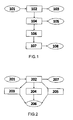
- FIG. 1 shows the procedure upon reception of an Interest packet.
- the node checks for content availability in its Content Store (CS ), such as a cache/buffer memory (step 102). If the content is available, the CS sends the requested Data packet back on the incoming interface (step 103). Otherwise, the node checks in its Pending interest Table ( PIT ) for a pending request, i.e. whether this content has been already requested upward over this interface (step 104). If an entry is found in the PIT, the PIT is updated (step 105) in order to track that the incoming interface is waiting for this content.
- CS Content Store
- PIT Pending interest Table
- a new entry is created and the Interest packet is forwarded to one or multiple interfaces determined via longest prefix match on the content name prefixes stored in a Forwarding table (step 106), referred in the background art as Forwarding Information Base (FIB ).
- FIB Forwarding Information Base
- the node can also probe interfaces not specified in the FIB (step 107) in order to discover other available routes and forward the Interest packet (step 108).
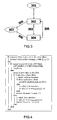
- step 201 the procedure upon reception of a Data packet is shown.
- the node checks for pending requests in its PIT (step 202). If a pending request is found, the Data packet is first stored in the node CS.
- the node updates its CS, PIT and FIB entries (respectively steps 203,204,205) and forwards the Data packet towards all requesting interfaces (step 206) as listed in the PIT. For example, when a Data packet is received, the node may update in its FIB information about the quality (for instance round-trip time ( RTT ), number of hops) of the interface from which the packet has been received. If no matching PIT entry is found, the Data packet is discarded (step 207).
- RTT round-trip time
- NDN Named-Data-Networking
- One object is to provide a solution to the aforementioned problems, and offers other advantages over the prior art.
- Another object is to provide a mechanism to realize dynamic request forwarding in a CCN node.
- Another object is to improve end-user performance.
- Another object is to reduce network costs.
- Various embodiments relate to a method for managing packets over interfaces of a Content Centric Networking node, the method comprising the following steps
- the method further comprises an exploitation step performed by
- the method requires standard ICN operations of storing the received data packet in a Content Store of the node and forwarding the received data packet over the interface used for receiving the request.
- various embodiments relate to a Content Centric Networking node for managing packets, the node being configured for
- Various embodiments further relate to computer program products for performing the above method.
- the dynamic request mechanism leverages a reinforcement learning approach for routing, and extends it to the case of a CCN cached-network.
- Q-routing In a Q-routing algorithm, each node of a network builds its routing table/FIB, by learning information, such as delivery times of a packet towards other nodes. These information are referred as Q values and are stored by every node i in their FIBs, for all possible destination nodes d , through each neighboring node v of node i .
- Q i (d,v) is a Q value, representing the delivery time of a packet from node i to node d if the packet is forwarded via a neighboring node v among the neighboring nodes.
- the forwarding of a packet by a node i consists in selecting the interface to the neighboring node v , towards a given destination node d with the smallest Q value Q i (d,v) i.e. the smallest delivery time.
- the node i receives in response over the interface with node v , the "best" Q value of v that is the minimum delivery time estimated for node v i.e. min k_in_neighbours(v) Q v (d,k).
- Q-routing approach provides an effective way to improve performance with respective shortest path forwarding in presence of dynamic conditions, such as evolutions of links connection between nodes or storage capacities in network.
- the reinforcement learning approach may be based on Q-routing, by implementing a distributed version of O-learning. This distributed reinforcement learning, is performed at each network node in a CCN network.
- a dynamic INterest FORrwarding Mechanism further referred as INFORM is run by each node in the CCN network.
- a node i For at least a given file f /Data packet that can be requested by at least one Interest packet, a node i maintains in its FIB a set of Q i (f, v) values, for v neighboring nodes in I(i) values, where I(i) denotes the set of interfaces of node i .
- Q i (f, v) Q i (f, v) values
- an update step of Q values exploits the knowledge of the smallest Q value of a neighbor node v chosen for forwarding a given Interest packet, this value being piggy-backed in a returning Data packet. Q values are then used during an exploitation phase, to identify the best available interface where to forward Interest packets.
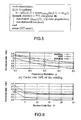
- the mechanism starts by initializing at node i the set of Q values Q i (f, v) (step 301), for neighboring nodes v in I(i) values (set of interfaces of node i ), when an Interest packet (i.e. a request) for a given Data packet/file f is received and corresponding Q values are not available in the node FIB.
- a first exploration phase then starts (step 302). The goal of such initial exploration phase, is to compute/update Q values for the different interfaces in I(i) values, while guaranteeing the delivery of the requested Data packets.
- a node i randomly select an interface in I(i) values to forward an incoming Interest packet, and at the same time, forwards the Interest packet over the interface providing the shortest path in terms of delay, towards a permanent copy of the file/Data packet.
- the shortest paths are stored too in the node FIB according to the content item servers announcements. Indeed, the use of permanent copy of the file permits to guarantee the delivery of Data packets during the exploration phase.
- Nr chunks arrow 303
- Nr Interest packets are sent by node i to randomly selected interfaces in I(i) values and Nr Data packets are forwarded back through these interfaces with best (i.e. minimum) delivery time values estimated.
- Interest packets are also forwarded over the interface providing the shortest path in terms of delay towards a permanent copy of the file/Data packet.
- Q values are updated, according to the Q value updating step formula mentioned above.
- the exploitation phase starts (step 304).
- the goal of this phase is to exploit the information (Q values) about cost/rewards delays associated with each interface collected during the exploration phase.
- an Interest packet is forwarded over the best interface k only, i.e. over the identified interface, providing the minimum time delivery value for a data packet.
- Data Packet is forwarded back over the same identified interface with the associated minimum time delivery value.
- the corresponding Q(f, k) value referring to the identified interface delivery time, is the only one Q value still being updated. The mechanism remains in exploitation phase until
- an Interest packet i.e. a request for a data packet
- the algorithm returns in exploration phase (step 302).
- an Interest packet i.e. a request for a data packet
- the previously determined best interface k (rather than shortest path interface previously).
- Q values associated with a given file f /Data packet are deleted (step 307 ) when they are not updated for Te time units (arrows 306 ), i.e. no Interest packet for file f /Data Packet is forwarded by the node during a time period Te . This situation may occur indifferently during the exploration or the exploitation phase.
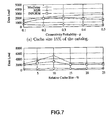
- Figure 4 details the operations performed by INFORM upon reception by a node i in a CCN network, of an Interest packet for a Data packet, forwarded from an interface j . If the requested Data packet is present in the CS (for example a buffer memory) of the node, then it is send over the interface j . that requested it. The minimum value Qmin(f) is also added to the Data packet, as it will be used by downstream nodes to update their Q values. Otherwise if a pending request for the Data packet is not present in the node PIT, and INFORM is in exploration phase, the Interest packet is forwarded over a random interface, and over the best interface (or over the interface towards the shortest path in terms of delay in case of first exploration). Alternatively, if the algorithm is in exploitation phase, the Interest packet is forwarded towards the best interface k only,
- Figure 5 shows operations performed by INFORM upon reception by a node i in a CCN network, of a Data packet on interface j . from a neighbor node y .
- the Q value associated with the incoming interface j of the considered file f is updated.
- the list of requesting interfaces of the Data Packet is looked up from the PIT of node i , and the Data packet is forwarded towards the interested interfaces then the PIT entry is finally removed.
- figures 6 and 7 report the results obtained by means of packet-level simulation under several scenarios.
- a network topology is modeled as an Erdos-Renyi graph G(n, ⁇ ) where n is the number of nodes and ⁇ is the probability that a link connecting two nodes does exist.
- G(n, ⁇ ) the number of nodes and ⁇ is the probability that a link connecting two nodes does exist.
- LRU Least Recently Used
- the FIBs of the nodes are configured with next hop information for the minimum delay path towards one of the permanent content item copy.
- INFORM is compared with min-delay path forwarding and a NDN forwarding scheme supposed to be currently one of the best available existing solutions.
- Curve (a) of figure 6 reports the average Data packet delivery time as a function of the network connectivity (i.e. probability ⁇ that any two nodes are connected), which determines the number of available paths between clients and servers. It is clearly observed, that the delivery time decreases as the network connectivity increases. As the number of links in the network increases, the distance between clients and servers is reduced, with a consequence decrease in the delivery time.
- INFORM provides the smallest delivery time among the three mechanisms for all connectivity values. Specifically, it provides a performance improvement between 18-33% with respect to simple min-delay path forwarding, and between 10-33% with respect to the NDN forwarding strategy. The performance gap increases with the connectivity, testifying that INFORM can better exploit an increasing number of paths.
- Curve (b) of figure 6 shows the average Data packet delivery time as a function of the cache size. It is observed that the delivery time sharply decreases as the cache size increases (until additional storage does not provide any additional I benefits). Moreover INFORM outperforms other algorithms for all cache sizes providing an improvement of 22-25% with respect to the NDN forwarding strategy and 5-26% with respect to min-delay path forwarding.
- Curves (a) and (b) of Figure 7 report the Data load as a function of the network connectivity and cache size respectively. It is observed that INFORM generates less traffic than the NDN forwarding scheme, but clearly more than min-delay path forwarding. As the network connectivity or cache size increase, the Data load decreases for min-delay path forwarding. Differently, for INFORM and NDN, the Data load first increases and then decreases as the connectivity and cache size increase. Additional links in the network or storage capacity increase the availability of temporary item replicas that are discovered by such algorithms: it follows requests are forwarded through longer paths to reach those replicas resulting in a higher Data Load. After a certain threshold, the load decreases as more links or additional storage capacity do not increase item availability but only shorten the distance between clients and item copies thus reducing the load on the network.
- the above described embodiments permit to provide a dynamic request forwarding mechanism that clearly outperforms current existing solutions in terms of end-user performance (i.e. delivery time) and network costs (reductions of the load in the network).
- the disclosed embodiments make feasible the implementation of dynamic forwarding algorithms in CCN nodes, and more generally within high-speed network equipments in order to provide the best performance.
Landscapes
- Engineering & Computer Science (AREA)
- Computer Networks & Wireless Communication (AREA)
- Signal Processing (AREA)
- Data Exchanges In Wide-Area Networks (AREA)
- Information Transfer Between Computers (AREA)
Abstract
- receiving over an interface of the node at least a request for a data packet ;
- if the data packet is stored by the node, forwarding the data packet over the interface of the received request ; otherwise
- performing an exploration step, by
o selecting randomly at least an interface towards a neighboring node ;
o forwarding the request over the selected interface ;
o receiving in response over the randomly selected interface, the data packet with associated minimum time delivery value estimated by the neighboring node ;
- identifying an interface providing the minimum data packet delivery time value based on exploration step results.
Description
- The present invention relates to the technical field of Content Centric Networking (CCN), and particularly to mechanisms to realize dynamic request forwarding in CCN nodes.
- Information Centric Networking (ICN), Content Centric Networking (CCN) or Named data networking (NDN) have introduced a new networking model, where the communication is centered on named-data rather than host address. Indeed, in CCN every data packet is identified, addressed and retrieved by its unique name instead of its physical location. All network nodes potentially store the data that they forward to serve future requests for the same content. To this aim, it is possible to equip network nodes with enhanced storage capabilities such as caches/buffer memories. Indeed, storage resources can be used to maintain temporary content replicas spread through the network for a period of time ranging from minutes to hours or days. The availability of different replicas depends on several factors, such as content popularity, cache replacement policies, and is impacted by the request forwarding policy. The term "request forwarding policy" refers here broadly and as non-limitative, to ways/rules to manage the forwarding of a content request within a network comprising nodes. In fact, request forwarding policy plays an important role in providing better end-users performance (ex: data delivery time) and reducing the amount of data transferred in a network, i.e. providing a lower network load.
- In CCN, content items/files are split in a sequence of chunks uniquely identified by a hierarchical name of possibly variable size B components, for instance the B components may be "/bell_labs/video/talks.avi/chunk1". By considering the following example, the B-1components identifies the content item name (/bell_labs/video/talks.avi), while the last component specifies the chunk name (chunk1). Servers in CCN announce the set of prefixes (here /bell_labs/video/ or /bell_labs/) of content items they can serve by means of routing protocols, i.e. prefixes of permanently stored items. Network nodes receiving these announcements build their forwarding/routing tables accordingly. For instance network nodes store in their routing tables, the shortest paths in terms of delay towards a permanent copy of a file. Chunks of a file are then requested by a receiver, through Interest packets that are forwarded by network nodes towards servers storing permanent copies of the requested chunks.
- Interest packet here is a packet type, referring to interest/request about content item/file. Another packet type referred in this document is Data packet, corresponding to data transmitted in response to an interest/request of content (i.e. Interest packet). Indeed, a Data packet may be a chunk of a content item/file. Interest packet leaves traces that a matching chunk (i.e. Data packet) can follow via reverse path, to reach back the original requester. A matching chunk can be found in every node caching a temporary copy or at the server where the permanent copy is stored. In fact, one Interest packet permits to retrieve one Data packet. Hence, a sequence of Interest packets permits to retrieve a sequence of Data packets, i.e. for instance the chunks of a large piece of content such as a video file.
-
Figure 1 shows the procedure upon reception of an Interest packet. When an Interest packet is received (step 101) by a node on an incoming interface the node checks for content availability in its Content Store (CS), such as a cache/buffer memory (step 102). If the content is available, the CS sends the requested Data packet back on the incoming interface (step 103). Otherwise, the node checks in its Pending interest Table (PIT) for a pending request, i.e. whether this content has been already requested upward over this interface (step 104). If an entry is found in the PIT, the PIT is updated (step 105) in order to track that the incoming interface is waiting for this content. If no PIT entry is found, a new entry is created and the Interest packet is forwarded to one or multiple interfaces determined via longest prefix match on the content name prefixes stored in a Forwarding table (step 106), referred in the background art as Forwarding Information Base (FIB). Moreover, the node can also probe interfaces not specified in the FIB (step 107) in order to discover other available routes and forward the Interest packet (step 108). - Now with referring to
figure 2 , the procedure upon reception of a Data packet is shown. When a Data packet is received by a node (step 201) the node checks for pending requests in its PIT (step 202). If a pending request is found, the Data packet is first stored in the node CS. The node updates its CS, PIT and FIB entries (respectively steps 203,204,205) and forwards the Data packet towards all requesting interfaces (step 206) as listed in the PIT. For example, when a Data packet is received, the node may update in its FIB information about the quality (for instance round-trip time (RTT), number of hops) of the interface from which the packet has been received. If no matching PIT entry is found, the Data packet is discarded (step 207). - Indeed, following the reception of an Interest packet, an ideal name-based routing protocol would have to address all temporary copies of every content item (i.e. Data packets), in order to forward user request towards the "best" (i.e. the closest in term of path/time in the network) available replica. Nevertheless, this is clearly unfeasible in CCN, since:
- in term of network scale, CCN may comprise content of different applications and is not intended to be confined to small, controlled network areas;
- in term of time scale, temporary copies stored at network nodes are highly volatile and the signaling overhead involved by frequent route update would be excessive;
- the nodes forwarding tables (i.e. the FIBs) size are already a matter of concern, even considering only permanent content copies rather than network-cached temporary replicas.
- On the other hand, the usage of dynamic forwarding mechanisms, able to discover and exploit temporary content replicas can provide significant benefits in terms of end-user performance and network provider costs.
- One idea to solve this problem would be to assume node FIB knowledge about multiple paths in a CCN network, leading toward permanent copies that can be directly exploited by a forwarding strategy. However, it would require a routing protocol that distributes permanent copy availability information, and could not thus be applied to forward requests towards temporary copies.
- One existing dynamic forwarding approach for Named-Data-Networking (NDN) framework relies on probing interfaces periodically, and gathering statistics for each of them. If for content, an interface is estimated to be better than the currently exploited one, the forwarding plane is switched to that interface. Although this proposition seems to be efficient, it is still needed to provide better performance in terms of end-user (ex: data throughputs) and to reduce network costs (ex: data load).
- One object is to provide a solution to the aforementioned problems, and offers other advantages over the prior art.
- Another object is to provide a mechanism to realize dynamic request forwarding in a CCN node.
- Another object is to improve end-user performance.
- Another object is to reduce network costs.
- Various embodiments are directed to addressing the effects of one or more of the problems set forth above. The following presents a simplified summary of embodiments in order to provide a basic understanding of some aspects of the various embodiments. This summary is not an exhaustive overview of these various embodiments. It is not intended to identify key of critical elements or to delineate the scope of these various embodiments. Its sole purpose is to present some concepts in a simplified form as a prelude to the more detailed description that is discussed later.
- Various embodiments relate to a method for managing packets over interfaces of a Content Centric Networking node, the method comprising the following steps
- receiving over an interface of the node at least a request for a data packet ;
- if the data packet is stored by the node, forwarding the data packet over the interface of the received request ;
otherwise - performing an exploration step, by
- ○ selecting randomly at least an interface towards a neighboring node ;
- ○ forwarding the request over the selected interface ;
- ○ receiving in response over the randomly selected interface, the data packet with associated minimum time delivery value estimated by the neighboring node ;
- identifying an interface providing the minimum data packet delivery time value based on exploration step results.
- In accordance with a broad aspect, the method further comprises an exploitation step performed by
- using the identified interface providing the minimum data packet delivery time, to forward the request and receive back the data packet ;
- receiving for the data packet, associated minimum time delivery value estimated over the identified interface.
- In accordance with a broad aspect, the method requires standard ICN operations of storing the received data packet in a Content Store of the node and forwarding the received data packet over the interface used for receiving the request.
- Further, various embodiments relate to a Content Centric Networking node for managing packets, the node being configured for
- receiving over an interface of the node at least a request for a data packet;
- forwarding the data packet over the interface of the received request if the data packet is stored by the node ;
- selecting randomly at least an interface towards a neighboring node;
- forwarding the request over the randomly selected interface ;
- receiving in response over the randomly selected interface, the data packet with associated minimum time delivery value estimated by the neighboring node ;
- identifying an interface providing the minimum data packet delivery time value based on exploration step results ;
- using the identified interface providing the minimum data packet delivery time, to forward the request and receive back the data packet ;
- receiving for the data packet, associated minimum time delivery value estimated over the identified interface ;
- storing in a Content store the received data packet and forwarding the received data packet over the interface used for receiving the request.
- Various embodiments further relate to computer program products for performing the above method.
- While the various embodiments are susceptible to various modification and alternative forms, specific embodiments thereof have been shown by way of example in the drawings. It should be understood, however, that the description herein of specific embodiments is not intended to limit the various embodiments to the particular forms disclosed.
- It may of course be appreciated that in the development of any such actual embodiments, implementation-specific decisions should be made to achieve the developer's specific goal, such as compliance with system-related and business-related constraints. It will be appreciated that such a development effort might be time consuming but may nevertheless be a routine understanding for those or ordinary skill in the art having the benefit of this disclosure.
- The objects, advantages and other features of various embodiments will become more apparent from the following disclosure and claims. The following non-restrictive description of preferred embodiments is given for the purpose of exemplification only with reference to the accompanying drawing in which
-
Figure 1 is a schematic diagram illustrating reception procedure of an Interest packet, according to the prior art; -
Figure 2 is a schematic diagram illustrating reception procedure of a Data packet, according to the prior art; -
Figure 3 is a schematic diagram illustrating transition phase of a dynamic interest forwarding mechanism, according to various embodiments; -
Figure 4 details the operations of a dynamic interest forwarding mechanism upon reception of an Interest packet, according to various embodiments; -
Figure 5 details the operations of a dynamic interest forwarding mechanism upon reception of a Data packet, according to various embodiments; -
Figure 6 and7 illustrate performance of a dynamic interest forwarding mechanism over the prior art, according to various embodiments. - In the following embodiments it is proposed to provide a dynamic request mechanism permitting
- to discover paths to temporary copies of a content item that are not addressed in routing tables ;
- to forward requests for the content item towards the "best" performing interface (according to specified metric), while guaranteeing continuous Data delivery and limiting the network overhead.
- In one embodiment, the dynamic request mechanism leverages a reinforcement learning approach for routing, and extends it to the case of a CCN cached-network.
- One known reinforcement learning approach in the prior art, is Q-routing. In a Q-routing algorithm, each node of a network builds its routing table/FIB, by learning information, such as delivery times of a packet towards other nodes. These information are referred as Q values and are stored by every node i in their FIBs, for all possible destination nodes d, through each neighboring node v of node i. Qi(d,v) is a Q value, representing the delivery time of a packet from node i to node d if the packet is forwarded via a neighboring node v among the neighboring nodes. In a Q-routing algorithm, the forwarding of a packet by a node i consists in selecting the interface to the neighboring node v, towards a given destination node d with the smallest Q value Qi(d,v) i.e. the smallest delivery time. For every packet forwarded through a neighboring node v, the node i receives in response over the interface with node v, the "best" Q value of v that is the minimum delivery time estimated for node v i.e. mink_in_neighbours(v)Qv(d,k). The associated Q value at node i is then updated as follows:

where η is a value referred as "learning rate", f is a file referring to an Interest packet, rtti,v denotes the round trip delay between nodes i and v. - In fact, Q-routing approach provides an effective way to improve performance with respective shortest path forwarding in presence of dynamic conditions, such as evolutions of links connection between nodes or storage capacities in network.
- In a preferred embodiment, the reinforcement learning approach may be based on Q-routing, by implementing a distributed version of O-learning. This distributed reinforcement learning, is performed at each network node in a CCN network. In fact, a dynamic INterest FORrwarding Mechanism, further referred as INFORM is run by each node in the CCN network.
- For at least a given file f/Data packet that can be requested by at least one Interest packet, a node i maintains in its FIB a set of Qi(f, v) values, for v neighboring nodes in I(i) values, where I(i) denotes the set of interfaces of node i. These values are computed and updated during an exploration phase, where a node probes the interfaces in order to learn the cost/reward in terms of residual delay (rtti,v) to the first hitting cache for file f/Data Packet associated with each of them. As exposed above, an update step of Q values exploits the knowledge of the smallest Q value of a neighbor node v chosen for forwarding a given Interest packet, this value being piggy-backed in a returning Data packet. Q values are then used during an exploitation phase, to identify the best available interface where to forward Interest packets.
- With reference to
Figure 3 , the transitions phases of INFORM are detailed. The mechanism starts by initializing at node i the set of Q values Qi(f, v) (step 301), for neighboring nodes v in I(i) values (set of interfaces of node i), when an Interest packet (i.e. a request) for a given Data packet/file f is received and corresponding Q values are not available in the node FIB. A first exploration phase then starts (step 302). The goal of such initial exploration phase, is to compute/update Q values for the different interfaces in I(i) values, while guaranteeing the delivery of the requested Data packets. To this end, a node i randomly select an interface in I(i) values to forward an incoming Interest packet, and at the same time, forwards the Interest packet over the interface providing the shortest path in terms of delay, towards a permanent copy of the file/Data packet. As a reminder, the shortest paths are stored too in the node FIB according to the content item servers announcements. Indeed, the use of permanent copy of the file permits to guarantee the delivery of Data packets during the exploration phase. - The exploration phase lasts Nr chunks (arrow 303), i.e. Nr Interest packets are sent by node i to randomly selected interfaces in I(i) values and Nr Data packets are forwarded back through these interfaces with best (i.e. minimum) delivery time values estimated. During this exploration phase Interest packets are also forwarded over the interface providing the shortest path in terms of delay towards a permanent copy of the file/Data packet. Then, Q values are updated, according to the Q value updating step formula mentioned above. After which the interface k providing the minimum delivery delay is identified, i.e.: Q (f, k) = minv_in_I(i)Q(f; v), and its Q value is stored, i.e. Qmin(f) = Q(f, k).
- After the exploration phase (step 302) the exploitation phase starts (step 304). The goal of this phase is to exploit the information (Q values) about cost/rewards delays associated with each interface collected during the exploration phase. To do so, an Interest packet is forwarded over the best interface k only, i.e. over the identified interface, providing the minimum time delivery value for a data packet. Data Packet is forwarded back over the same identified interface with the associated minimum time delivery value. Hence, during the exploitation phase the corresponding Q(f, k) value, referring to the identified interface delivery time, is the only one Q value still being updated. The mechanism remains in exploitation phase until
- the reaching of a threshold value that is function of the Data packet delivery time value: |Qmin(f)-Q(f,k)|/Qmin(f)>δ, where δ is a threshold value. This event, indicates that system state has changed and that Q values need to be updated;
- the duration of Nt chunks, i.e. until the reception of Nt Data packets at most. This event is also required because as, despite the Q value of the best interface is not significantly changed, the state of the other interfaces may have changed.
- Consequently, after the exploitation phase (step 304), if one of this event occurs (arrow 305) the algorithm returns in exploration phase (step 302). As previously mentioned, this is required to deal with dynamic content availability, and to update Q values accordingly. Differently from the first exploration phase execution, during all the subsequent explorations an Interest packet (i.e. a request for a data packet) is forwarded towards a randomly selected interface, and, at the same time, towards the previously determined best interface k (rather than shortest path interface previously). At the end of this exploration phase (i.e. after Nr chunks), a new interface k' providing the minimum delay is identified, i.e.: Q(f,k') = minv in I(i)Q(f,v), the minimum Q value is updated, i.e. Qmin(f) = Q(f, k'), and the algorithm returns (arrow 303) in exploitation phase (step 304).
- Finally, Q values associated with a given file f/Data packet are deleted (step 307) when they are not updated for Te time units (arrows 306), i.e. no Interest packet for file f/Data Packet is forwarded by the node during a time period Te. This situation may occur indifferently during the exploration or the exploitation phase.
-
Figure 4 details the operations performed by INFORM upon reception by a node i in a CCN network, of an Interest packet for a Data packet, forwarded from an interface j. If the requested Data packet is present in the CS (for example a buffer memory) of the node, then it is send over the interface j. that requested it. The minimum value Qmin(f) is also added to the Data packet, as it will be used by downstream nodes to update their Q values. Otherwise if a pending request for the Data packet is not present in the node PIT, and INFORM is in exploration phase, the Interest packet is forwarded over a random interface, and over the best interface (or over the interface towards the shortest path in terms of delay in case of first exploration). Alternatively, if the algorithm is in exploitation phase, the Interest packet is forwarded towards the best interface k only, -
Figure 5 shows operations performed by INFORM upon reception by a node i in a CCN network, of a Data packet on interface j. from a neighbor node y. After storing the received Data packet in its CS (such as cache), the Q value associated with the incoming interface j of the considered file f is updated. Finally, the list of requesting interfaces of the Data Packet, is looked up from the PIT of node i, and the Data packet is forwarded towards the interested interfaces then the PIT entry is finally removed. - As illustration of the achievable performance with the disclosed mechanism,
figures 6 and7 report the results obtained by means of packet-level simulation under several scenarios. - In all scenarios, a network topology is modeled as an Erdos-Renyi graph G(n, ρ) where n is the number of nodes and ρ is the probability that a link connecting two nodes does exist. We assume b is a number of border routers among the n nodes where users are connected to, and s<=n is the number of content servers connected to the network.
- It is assumed herein that n=22, b=8, s=1, and ρ=0.3. It is further assumed that every node is equipped with a cache of size c =15% of a content catalog and implements a Least Recently Used (LRU) replacement policy. The placement of border routers and servers are randomly generated, results are averaged over multiple simulation runs, and cache warm up period is not considered. Users generate content requests according to a Poisson process of intensity λ=1 request per second per border router. A catalog of 10^5 content items (i.e. files) is chosen, whose popularity is a Zipf distribution with α=1. It is assumed too, that each content item is composed of 100 independent Data packets that are permanently stored at content servers s. Finally, the FIBs of the nodes are configured with next hop information for the minimum delay path towards one of the permanent content item copy.
- On
Figures 6 and7 , INFORM is compared with min-delay path forwarding and a NDN forwarding scheme supposed to be currently one of the best available existing solutions. - To do so, two metrics are considered herein:
- the Data packet delivery time, which represents the time elapsing between a client expression of a Interest for a given packet, and the reception of the corresponding Data packet;
- the Data load, defined as the average number of Data packets owing through the network in one time unit.
- Moreover, the learning rate is set to η=0.7, the duration of the exploration phase to Nr=50 chunks, and the duration of the exploitation phase to Nt=100 chunks.
- Curve (a) of
figure 6 , reports the average Data packet delivery time as a function of the network connectivity (i.e. probability ρ that any two nodes are connected), which determines the number of available paths between clients and servers. It is clearly observed, that the delivery time decreases as the network connectivity increases. As the number of links in the network increases, the distance between clients and servers is reduced, with a consequence decrease in the delivery time. INFORM provides the smallest delivery time among the three mechanisms for all connectivity values. Specifically, it provides a performance improvement between 18-33% with respect to simple min-delay path forwarding, and between 10-33% with respect to the NDN forwarding strategy. The performance gap increases with the connectivity, testifying that INFORM can better exploit an increasing number of paths. - Curve (b) of
figure 6 , shows the average Data packet delivery time as a function of the cache size. It is observed that the delivery time sharply decreases as the cache size increases (until additional storage does not provide any additional I benefits). Moreover INFORM outperforms other algorithms for all cache sizes providing an improvement of 22-25% with respect to the NDN forwarding strategy and 5-26% with respect to min-delay path forwarding. - Curves (a) and (b) of
Figure 7 , report the Data load as a function of the network connectivity and cache size respectively. It is observed that INFORM generates less traffic than the NDN forwarding scheme, but clearly more than min-delay path forwarding. As the network connectivity or cache size increase, the Data load decreases for min-delay path forwarding. Differently, for INFORM and NDN, the Data load first increases and then decreases as the connectivity and cache size increase. Additional links in the network or storage capacity increase the availability of temporary item replicas that are discovered by such algorithms: it follows requests are forwarded through longer paths to reach those replicas resulting in a higher Data Load. After a certain threshold, the load decreases as more links or additional storage capacity do not increase item availability but only shorten the distance between clients and item copies thus reducing the load on the network. - Advantageously, the above described embodiments permit to provide a dynamic request forwarding mechanism that clearly outperforms current existing solutions in terms of end-user performance (i.e. delivery time) and network costs (reductions of the load in the network).
- Advantageously, the disclosed embodiments make feasible the implementation of dynamic forwarding algorithms in CCN nodes, and more generally within high-speed network equipments in order to provide the best performance.
Claims (15)
- A method for managing packets over interfaces of a Content Centric Networking node, the method comprising the following steps- receiving over an interface of the node at least a request for a data packet;- if the data packet is stored by the node, forwarding the data packet over the interface of the received request ;
otherwise- performing an exploration step, by○ selecting randomly at least an interface towards a neighboring node ;○ forwarding the request over the selected interface ;○ receiving in response over the randomly selected interface, the data packet with associated minimum time delivery value estimated by the neighboring node ;- identifying an interface providing the minimum data packet delivery time value based on exploration step results. - The method according to claim 1, further comprising an exploitation step performed by- using the identified interface providing the minimum data packet delivery time, to forward the request and receive back the data packet ;- receiving for the data packet, associated minimum time delivery value estimated over the identified interface.
- The method according to claim 1 or 2, wherein during the exploration step, if an interface providing the minimum time delivery value is not yet identified, forwarding the request at the same time as the randomly selected interface over an interface towards a permanent copy of the data packet.
- The method according to any of the claim 1 or 2, wherein during the exploration step, if an interface providing the minimum time delivery value is identified, forwarding the request at the same time as the randomly selected interface over the identified interface.
- The method according to any of claims 2 to 4, wherein the exploration step is performed until a first event, the first event being the reception of a predefined number of data packets.
- The method, according to claim 5, wherein the exploitation step is performed following the said first event.
- The method according to claim 6, wherein the exploitation step is performed until a second event, the second event being the reaching of a threshold value that is function of minimum time delivery value estimated.
- The method according to any of claims 6 or 7, wherein the exploitation step is performed until a third event, the third event being the reception of a predefined number of data packets at most.
- The method according to claim 8, wherein the exploration step is performed following the second event or the third event.
- The method according to any of claims 1 to 9, wherein information referring to delivery time values are stored in a Forwarding Information Base of the node.
- The method according to claim 10, wherein the said information are deleted from the Forwarding Information Base of the node when no request for data packet is forwarded by the node during a predefined time period.
- The method according to claim 10 or 11, wherein the said information are initialized when a request for a data packet is received and the information are not available in the Forwarding Information Base of the node.
- The method according to any of the preceding claims, further comprising a storing step of received data packet in a Content Store of the node and a forwarding step of the received data packet over the interface used for receiving the request.
- A Content Centric Networking node for managing packets, the node being configured for- receiving over an interface of the node at least a request for a data packet;- forwarding the data packet over the interface of the received request if the data packet is stored by the node ;
otherwise- selecting randomly at least an interface towards a neighboring node ;- forwarding the request over the randomly selected interface ;- receiving in response over the randomly selected interface, the data packet with associated minimum time delivery value estimated by the neighboring node ;- identifying an interface providing the minimum data packet delivery time value based on exploration step results ;- using the identified interface providing the minimum data packet delivery time, to forward the request and receive back the data packet ;- receiving for the data packet, associated minimum time delivery value estimated over the identified interface ;- storing in a Content store the received data packet and forwarding the received data packet over the interface used for receiving the request. - Computer program implemented on a processing unit of a computer, the program including code sections for performing instructions corresponding to the steps of a method according to any of claims 1 to 13.
Priority Applications (5)
| Application Number | Priority Date | Filing Date | Title |
|---|---|---|---|
| EP13306124.2A EP2835942B1 (en) | 2013-08-05 | 2013-08-05 | Dynamic interest forwarding mechanism for information centric networking |
| PCT/EP2014/066752 WO2015018802A1 (en) | 2013-08-05 | 2014-08-04 | Dynamic interest forwarding mechanism for information centric networking |
| JP2016532348A JP6244461B2 (en) | 2013-08-05 | 2014-08-04 | Dynamic Interest Transfer Mechanism for Information Oriented Networks |
| CN201480044250.3A CN105519053B (en) | 2013-08-05 | 2014-08-04 | The method and network node that dynamic interest for information centre's network forwards |
| US15/015,977 US20160156737A1 (en) | 2013-08-05 | 2016-02-04 | Dynamic interest forwarding mechanism for information centric networking |
Applications Claiming Priority (1)
| Application Number | Priority Date | Filing Date | Title |
|---|---|---|---|
| EP13306124.2A EP2835942B1 (en) | 2013-08-05 | 2013-08-05 | Dynamic interest forwarding mechanism for information centric networking |
Publications (2)
| Publication Number | Publication Date |
|---|---|
| EP2835942A1 true EP2835942A1 (en) | 2015-02-11 |
| EP2835942B1 EP2835942B1 (en) | 2019-10-09 |
Family
ID=48985709
Family Applications (1)
| Application Number | Title | Priority Date | Filing Date |
|---|---|---|---|
| EP13306124.2A Active EP2835942B1 (en) | 2013-08-05 | 2013-08-05 | Dynamic interest forwarding mechanism for information centric networking |
Country Status (5)
| Country | Link |
|---|---|
| US (1) | US20160156737A1 (en) |
| EP (1) | EP2835942B1 (en) |
| JP (1) | JP6244461B2 (en) |
| CN (1) | CN105519053B (en) |
| WO (1) | WO2015018802A1 (en) |
Cited By (4)
| Publication number | Priority date | Publication date | Assignee | Title |
|---|---|---|---|---|
| CN105812261A (en) * | 2016-03-07 | 2016-07-27 | 北京交通大学 | Message forwarding method and system in information center network |
| CN107637047A (en) * | 2015-05-08 | 2018-01-26 | 高通股份有限公司 | Aggregate target and exploration are inquired about |
| WO2018036550A1 (en) * | 2016-08-25 | 2018-03-01 | Huawei Technologies Co., Ltd. | A hybrid approach with classification for name resolution and producer selection in icn |
| CN113726664A (en) * | 2021-08-03 | 2021-11-30 | 哈尔滨工程大学 | Internet of vehicles node forwarding utility learning method based on double updating strategies |
Families Citing this family (18)
| Publication number | Priority date | Publication date | Assignee | Title |
|---|---|---|---|---|
| US20170230283A1 (en) * | 2016-02-05 | 2017-08-10 | Fujitsu Limited | Routing protocols in information centric networking networks |
| WO2017148542A1 (en) | 2016-03-01 | 2017-09-08 | Telefonaktiebolaget Lm Ericsson (Publ) | Handover initiated alignment of pending interest tables |
| CN105704032B (en) * | 2016-04-13 | 2019-03-01 | 北京邮电大学 | A kind of interest packet forwarding method and device |
| US20180006937A1 (en) * | 2016-06-30 | 2018-01-04 | Fujitsu Limited | Packet forwarding in information centric networking networks |
| US10749995B2 (en) | 2016-10-07 | 2020-08-18 | Cisco Technology, Inc. | System and method to facilitate integration of information-centric networking into internet protocol networks |
| US10244071B2 (en) * | 2016-11-21 | 2019-03-26 | Intel Corporation | Data management in an edge network |
| US10764188B2 (en) | 2017-02-22 | 2020-09-01 | Cisco Technology, Inc. | System and method to facilitate robust traffic load balancing and remote adaptive active queue management in an information-centric networking environment |
| US10805825B2 (en) | 2017-02-23 | 2020-10-13 | Cisco Technology, Inc. | System and method to facilitate cross-layer optimization of video over WiFi in an information-centric networking environment |
| US10798633B2 (en) | 2017-02-23 | 2020-10-06 | Cisco Technology, Inc. | Heterogeneous access gateway for an information-centric networking environment |
| EP3610418B1 (en) * | 2017-04-14 | 2021-10-13 | Deepmind Technologies Limited | Distributional reinforcement learning |
| JP6969987B2 (en) | 2017-11-15 | 2021-11-24 | パナソニック株式会社 | Communication equipment, communication systems and mobile tracking methods |
| US11568236B2 (en) | 2018-01-25 | 2023-01-31 | The Research Foundation For The State University Of New York | Framework and methods of diverse exploration for fast and safe policy improvement |
| CN108924051B (en) * | 2018-07-04 | 2021-03-16 | 河南科技大学 | Information center network interest packet forwarding method based on reinforcement learning |
| KR102025921B1 (en) * | 2018-08-09 | 2019-09-26 | 숭실대학교산학협력단 | Method of data caching in delay tolerant network based on information centric network, computer readable medium and device for performing the method |
| CN109862121B (en) * | 2019-03-26 | 2021-06-29 | 广东技术师范大学 | A Cache Placement Method in Information Center Network Based on Dijkstra Algorithm |
| US10917328B2 (en) | 2019-06-27 | 2021-02-09 | Intel Corporation | Routing updates in ICN based networks |
| CN114490758B (en) * | 2022-01-13 | 2025-05-27 | 南京邮电大学 | A CCN routing and forwarding method based on improved DBSCAN clustering |
| CN114222007B (en) * | 2022-02-22 | 2022-07-01 | 北京凌云创想科技有限公司 | Hybrid cloud communication method and system |
Citations (1)
| Publication number | Priority date | Publication date | Assignee | Title |
|---|---|---|---|---|
| EP2323346A1 (en) * | 2009-10-21 | 2011-05-18 | Palo Alto Research Center Incorporated | Adaptive multi-interface use for content networking |
Family Cites Families (7)
| Publication number | Priority date | Publication date | Assignee | Title |
|---|---|---|---|---|
| US5740164A (en) * | 1993-02-09 | 1998-04-14 | Teledesic Corporation | Traffic routing for satellite communication system |
| CN103348639B (en) * | 2011-02-07 | 2015-11-25 | 日本电气株式会社 | Routing method and control server |
| US9137152B2 (en) * | 2012-02-16 | 2015-09-15 | Futurewei Technologies, Inc. | Method for scalable routing in content-oriented networks |
| US8762570B2 (en) * | 2012-02-21 | 2014-06-24 | Futurewei Technologies, Inc. | Method and apparatus for adaptive forwarding strategies in content-centric networking |
| WO2013143137A1 (en) * | 2012-03-31 | 2013-10-03 | France Telecom Research & Development Beijing Company Limited | Content centric m2m system |
| CN102739517B (en) * | 2012-05-25 | 2015-10-07 | 中国人民解放军国防科学技术大学 | Based on route selection method and the system of laminated network |
| CN103118013B (en) * | 2013-01-16 | 2015-12-23 | 西安电子科技大学 | The method of packet incidentally reverse interest bag in content center network |
-
2013
- 2013-08-05 EP EP13306124.2A patent/EP2835942B1/en active Active
-
2014
- 2014-08-04 CN CN201480044250.3A patent/CN105519053B/en active Active
- 2014-08-04 JP JP2016532348A patent/JP6244461B2/en not_active Expired - Fee Related
- 2014-08-04 WO PCT/EP2014/066752 patent/WO2015018802A1/en not_active Ceased
-
2016
- 2016-02-04 US US15/015,977 patent/US20160156737A1/en not_active Abandoned
Patent Citations (1)
| Publication number | Priority date | Publication date | Assignee | Title |
|---|---|---|---|---|
| EP2323346A1 (en) * | 2009-10-21 | 2011-05-18 | Palo Alto Research Center Incorporated | Adaptive multi-interface use for content networking |
Non-Patent Citations (2)
| Title |
|---|
| GIUSEPPE ROSSINI ET AL: "Evaluating CCN multi-path interest forwarding strategies", COMPUTER COMMUNICATIONS, vol. 36, no. 7, 1 April 2013 (2013-04-01), pages 771 - 778, XP055087058, ISSN: 0140-3664, DOI: 10.1016/j.comcom.2013.01.008 * |
| MIURA H ET AL: "Content routing with network support using passive measurement in content distribution networks", COMPUTER COMMUNICATIONS AND NETWORKS, 2002. PROCEEDINGS. ELEVENTH INTE RNATIONAL CONFERENCE ON 14-16 OCT. 2002, PISCATAWAY, NJ, USA,IEEE, 14 October 2002 (2002-10-14), pages 96 - 101, XP010610865, ISBN: 978-0-7803-7553-6 * |
Cited By (6)
| Publication number | Priority date | Publication date | Assignee | Title |
|---|---|---|---|---|
| CN107637047A (en) * | 2015-05-08 | 2018-01-26 | 高通股份有限公司 | Aggregate target and exploration are inquired about |
| US10880198B2 (en) | 2015-05-08 | 2020-12-29 | Qualcomm Incorporated | Aggregating targeted and exploration queries |
| CN105812261A (en) * | 2016-03-07 | 2016-07-27 | 北京交通大学 | Message forwarding method and system in information center network |
| CN105812261B (en) * | 2016-03-07 | 2019-02-26 | 北京交通大学 | Method and system for message forwarding in information center network |
| WO2018036550A1 (en) * | 2016-08-25 | 2018-03-01 | Huawei Technologies Co., Ltd. | A hybrid approach with classification for name resolution and producer selection in icn |
| CN113726664A (en) * | 2021-08-03 | 2021-11-30 | 哈尔滨工程大学 | Internet of vehicles node forwarding utility learning method based on double updating strategies |
Also Published As
| Publication number | Publication date |
|---|---|
| CN105519053B (en) | 2019-07-19 |
| EP2835942B1 (en) | 2019-10-09 |
| US20160156737A1 (en) | 2016-06-02 |
| JP6244461B2 (en) | 2017-12-06 |
| JP2016531507A (en) | 2016-10-06 |
| WO2015018802A1 (en) | 2015-02-12 |
| CN105519053A (en) | 2016-04-20 |
Similar Documents
| Publication | Publication Date | Title |
|---|---|---|
| EP2835942B1 (en) | Dynamic interest forwarding mechanism for information centric networking | |
| KR102301353B1 (en) | Method for transmitting packet of node and content owner in content centric network | |
| Chiocchetti et al. | Inform: a dynamic interest forwarding mechanism for information centric networking | |
| CN104115472B (en) | The method of expansible route in network is oriented to for content | |
| Fang et al. | A survey of energy-efficient caching in information-centric networking | |
| JP5855817B2 (en) | Computer-implemented method for transferring packets with hierarchical variable length identifiers in a network | |
| US20140280823A1 (en) | Wire-speed pending interest table | |
| Marandi et al. | BFR: A bloom filter-based routing approach for information-centric networks | |
| Wang et al. | Hop-based probabilistic caching for information-centric networks | |
| Tortelli et al. | Cobra: Lean intra-domain routing in ndn | |
| US20130215756A1 (en) | Apparatus and method for managing contents cache considering network cost | |
| US10530893B2 (en) | Method for managing packets in a network of information centric networking (ICN) nodes | |
| Ascigil et al. | A native content discovery mechanism for the information-centric networks | |
| JP2016082479A (en) | Communication device, communication method, and program | |
| Ahmed et al. | Performance evaluation of best route and broadcast strategy for NDN producer’s mobility | |
| Xu et al. | SIONA: A service and information oriented network architecture | |
| KR20150080957A (en) | A Caching Method in Content-Centric Networks based on Content Popularity Prediction by Prefix-Tree | |
| Zeng et al. | Rank-based routing strategy for named data network | |
| Tsilopoulos et al. | Adaptive semi-stateless forwarding for content-centric networks | |
| CN106657181A (en) | CCN (Content center network) based data push method | |
| Priscilla et al. | A comparative study on caching strategies in content centric networking for mobile networks | |
| CN110035092A (en) | A kind of implicit cache policy based on LCD in ICN network | |
| EP2785014B1 (en) | Device and method for organizing forwarding information in nodes of a content centric networking | |
| US20130275619A1 (en) | Router, method for using cache when content server is unreachable, and program | |
| Awiphan et al. | Outbound face selection considering response time and buffer usage for CCN adaptive video streaming |
Legal Events
| Date | Code | Title | Description |
|---|---|---|---|
| PUAI | Public reference made under article 153(3) epc to a published international application that has entered the european phase |
Free format text: ORIGINAL CODE: 0009012 |
|
| 17P | Request for examination filed |
Effective date: 20130805 |
|
| AK | Designated contracting states |
Kind code of ref document: A1 Designated state(s): AL AT BE BG CH CY CZ DE DK EE ES FI FR GB GR HR HU IE IS IT LI LT LU LV MC MK MT NL NO PL PT RO RS SE SI SK SM TR |
|
| AX | Request for extension of the european patent |
Extension state: BA ME |
|
| R17P | Request for examination filed (corrected) |
Effective date: 20150811 |
|
| RBV | Designated contracting states (corrected) |
Designated state(s): AL AT BE BG CH CY CZ DE DK EE ES FI FR GB GR HR HU IE IS IT LI LT LU LV MC MK MT NL NO PL PT RO RS SE SI SK SM TR |
|
| RAP1 | Party data changed (applicant data changed or rights of an application transferred) |
Owner name: ALCATEL LUCENT |
|
| RAP1 | Party data changed (applicant data changed or rights of an application transferred) |
Owner name: ALCATEL LUCENT |
|
| STAA | Information on the status of an ep patent application or granted ep patent |
Free format text: STATUS: EXAMINATION IS IN PROGRESS |
|
| 17Q | First examination report despatched |
Effective date: 20180508 |
|
| GRAP | Despatch of communication of intention to grant a patent |
Free format text: ORIGINAL CODE: EPIDOSNIGR1 |
|
| STAA | Information on the status of an ep patent application or granted ep patent |
Free format text: STATUS: GRANT OF PATENT IS INTENDED |
|
| RIC1 | Information provided on ipc code assigned before grant |
Ipc: H04L 12/727 20130101AFI20190131BHEP Ipc: H04L 12/721 20130101ALI20190131BHEP Ipc: H04L 12/771 20130101ALI20190131BHEP Ipc: H04L 29/08 20060101ALI20190131BHEP Ipc: H04L 12/741 20130101ALI20190131BHEP |
|
| INTG | Intention to grant announced |
Effective date: 20190227 |
|
| GRAS | Grant fee paid |
Free format text: ORIGINAL CODE: EPIDOSNIGR3 |
|
| GRAA | (expected) grant |
Free format text: ORIGINAL CODE: 0009210 |
|
| STAA | Information on the status of an ep patent application or granted ep patent |
Free format text: STATUS: THE PATENT HAS BEEN GRANTED |
|
| AK | Designated contracting states |
Kind code of ref document: B1 Designated state(s): AL AT BE BG CH CY CZ DE DK EE ES FI FR GB GR HR HU IE IS IT LI LT LU LV MC MK MT NL NO PL PT RO RS SE SI SK SM TR |
|
| REG | Reference to a national code |
Ref country code: GB Ref legal event code: FG4D |
|
| REG | Reference to a national code |
Ref country code: CH Ref legal event code: EP |
|
| REG | Reference to a national code |
Ref country code: IE Ref legal event code: FG4D |
|
| REG | Reference to a national code |
Ref country code: DE Ref legal event code: R096 Ref document number: 602013061411 Country of ref document: DE |
|
| REG | Reference to a national code |
Ref country code: AT Ref legal event code: REF Ref document number: 1190122 Country of ref document: AT Kind code of ref document: T Effective date: 20191115 |
|
| REG | Reference to a national code |
Ref country code: NL Ref legal event code: MP Effective date: 20191009 |
|
| REG | Reference to a national code |
Ref country code: LT Ref legal event code: MG4D |
|
| REG | Reference to a national code |
Ref country code: AT Ref legal event code: MK05 Ref document number: 1190122 Country of ref document: AT Kind code of ref document: T Effective date: 20191009 |
|
| PG25 | Lapsed in a contracting state [announced via postgrant information from national office to epo] |
Ref country code: AT Free format text: LAPSE BECAUSE OF FAILURE TO SUBMIT A TRANSLATION OF THE DESCRIPTION OR TO PAY THE FEE WITHIN THE PRESCRIBED TIME-LIMIT Effective date: 20191009 Ref country code: PT Free format text: LAPSE BECAUSE OF FAILURE TO SUBMIT A TRANSLATION OF THE DESCRIPTION OR TO PAY THE FEE WITHIN THE PRESCRIBED TIME-LIMIT Effective date: 20200210 Ref country code: ES Free format text: LAPSE BECAUSE OF FAILURE TO SUBMIT A TRANSLATION OF THE DESCRIPTION OR TO PAY THE FEE WITHIN THE PRESCRIBED TIME-LIMIT Effective date: 20191009 Ref country code: LT Free format text: LAPSE BECAUSE OF FAILURE TO SUBMIT A TRANSLATION OF THE DESCRIPTION OR TO PAY THE FEE WITHIN THE PRESCRIBED TIME-LIMIT Effective date: 20191009 Ref country code: NL Free format text: LAPSE BECAUSE OF FAILURE TO SUBMIT A TRANSLATION OF THE DESCRIPTION OR TO PAY THE FEE WITHIN THE PRESCRIBED TIME-LIMIT Effective date: 20191009 Ref country code: FI Free format text: LAPSE BECAUSE OF FAILURE TO SUBMIT A TRANSLATION OF THE DESCRIPTION OR TO PAY THE FEE WITHIN THE PRESCRIBED TIME-LIMIT Effective date: 20191009 Ref country code: BG Free format text: LAPSE BECAUSE OF FAILURE TO SUBMIT A TRANSLATION OF THE DESCRIPTION OR TO PAY THE FEE WITHIN THE PRESCRIBED TIME-LIMIT Effective date: 20200109 Ref country code: GR Free format text: LAPSE BECAUSE OF FAILURE TO SUBMIT A TRANSLATION OF THE DESCRIPTION OR TO PAY THE FEE WITHIN THE PRESCRIBED TIME-LIMIT Effective date: 20200110 Ref country code: PL Free format text: LAPSE BECAUSE OF FAILURE TO SUBMIT A TRANSLATION OF THE DESCRIPTION OR TO PAY THE FEE WITHIN THE PRESCRIBED TIME-LIMIT Effective date: 20191009 Ref country code: NO Free format text: LAPSE BECAUSE OF FAILURE TO SUBMIT A TRANSLATION OF THE DESCRIPTION OR TO PAY THE FEE WITHIN THE PRESCRIBED TIME-LIMIT Effective date: 20200109 Ref country code: SE Free format text: LAPSE BECAUSE OF FAILURE TO SUBMIT A TRANSLATION OF THE DESCRIPTION OR TO PAY THE FEE WITHIN THE PRESCRIBED TIME-LIMIT Effective date: 20191009 Ref country code: LV Free format text: LAPSE BECAUSE OF FAILURE TO SUBMIT A TRANSLATION OF THE DESCRIPTION OR TO PAY THE FEE WITHIN THE PRESCRIBED TIME-LIMIT Effective date: 20191009 |
|
| PG25 | Lapsed in a contracting state [announced via postgrant information from national office to epo] |
Ref country code: RS Free format text: LAPSE BECAUSE OF FAILURE TO SUBMIT A TRANSLATION OF THE DESCRIPTION OR TO PAY THE FEE WITHIN THE PRESCRIBED TIME-LIMIT Effective date: 20191009 Ref country code: HR Free format text: LAPSE BECAUSE OF FAILURE TO SUBMIT A TRANSLATION OF THE DESCRIPTION OR TO PAY THE FEE WITHIN THE PRESCRIBED TIME-LIMIT Effective date: 20191009 Ref country code: IS Free format text: LAPSE BECAUSE OF FAILURE TO SUBMIT A TRANSLATION OF THE DESCRIPTION OR TO PAY THE FEE WITHIN THE PRESCRIBED TIME-LIMIT Effective date: 20200224 |
|
| PG25 | Lapsed in a contracting state [announced via postgrant information from national office to epo] |
Ref country code: AL Free format text: LAPSE BECAUSE OF FAILURE TO SUBMIT A TRANSLATION OF THE DESCRIPTION OR TO PAY THE FEE WITHIN THE PRESCRIBED TIME-LIMIT Effective date: 20191009 |
|
| REG | Reference to a national code |
Ref country code: DE Ref legal event code: R097 Ref document number: 602013061411 Country of ref document: DE |
|
| PG2D | Information on lapse in contracting state deleted |
Ref country code: IS |
|
| PG25 | Lapsed in a contracting state [announced via postgrant information from national office to epo] |
Ref country code: RO Free format text: LAPSE BECAUSE OF FAILURE TO SUBMIT A TRANSLATION OF THE DESCRIPTION OR TO PAY THE FEE WITHIN THE PRESCRIBED TIME-LIMIT Effective date: 20191009 Ref country code: CZ Free format text: LAPSE BECAUSE OF FAILURE TO SUBMIT A TRANSLATION OF THE DESCRIPTION OR TO PAY THE FEE WITHIN THE PRESCRIBED TIME-LIMIT Effective date: 20191009 Ref country code: DK Free format text: LAPSE BECAUSE OF FAILURE TO SUBMIT A TRANSLATION OF THE DESCRIPTION OR TO PAY THE FEE WITHIN THE PRESCRIBED TIME-LIMIT Effective date: 20191009 Ref country code: EE Free format text: LAPSE BECAUSE OF FAILURE TO SUBMIT A TRANSLATION OF THE DESCRIPTION OR TO PAY THE FEE WITHIN THE PRESCRIBED TIME-LIMIT Effective date: 20191009 Ref country code: IS Free format text: LAPSE BECAUSE OF FAILURE TO SUBMIT A TRANSLATION OF THE DESCRIPTION OR TO PAY THE FEE WITHIN THE PRESCRIBED TIME-LIMIT Effective date: 20200209 |
|
| PLBE | No opposition filed within time limit |
Free format text: ORIGINAL CODE: 0009261 |
|
| STAA | Information on the status of an ep patent application or granted ep patent |
Free format text: STATUS: NO OPPOSITION FILED WITHIN TIME LIMIT |
|
| PG25 | Lapsed in a contracting state [announced via postgrant information from national office to epo] |
Ref country code: SK Free format text: LAPSE BECAUSE OF FAILURE TO SUBMIT A TRANSLATION OF THE DESCRIPTION OR TO PAY THE FEE WITHIN THE PRESCRIBED TIME-LIMIT Effective date: 20191009 Ref country code: IT Free format text: LAPSE BECAUSE OF FAILURE TO SUBMIT A TRANSLATION OF THE DESCRIPTION OR TO PAY THE FEE WITHIN THE PRESCRIBED TIME-LIMIT Effective date: 20191009 Ref country code: SM Free format text: LAPSE BECAUSE OF FAILURE TO SUBMIT A TRANSLATION OF THE DESCRIPTION OR TO PAY THE FEE WITHIN THE PRESCRIBED TIME-LIMIT Effective date: 20191009 |
|
| 26N | No opposition filed |
Effective date: 20200710 |
|
| PG25 | Lapsed in a contracting state [announced via postgrant information from national office to epo] |
Ref country code: SI Free format text: LAPSE BECAUSE OF FAILURE TO SUBMIT A TRANSLATION OF THE DESCRIPTION OR TO PAY THE FEE WITHIN THE PRESCRIBED TIME-LIMIT Effective date: 20191009 |
|
| PG25 | Lapsed in a contracting state [announced via postgrant information from national office to epo] |
Ref country code: MC Free format text: LAPSE BECAUSE OF FAILURE TO SUBMIT A TRANSLATION OF THE DESCRIPTION OR TO PAY THE FEE WITHIN THE PRESCRIBED TIME-LIMIT Effective date: 20191009 |
|
| REG | Reference to a national code |
Ref country code: CH Ref legal event code: PL |
|
| PG25 | Lapsed in a contracting state [announced via postgrant information from national office to epo] |
Ref country code: LU Free format text: LAPSE BECAUSE OF NON-PAYMENT OF DUE FEES Effective date: 20200805 Ref country code: LI Free format text: LAPSE BECAUSE OF NON-PAYMENT OF DUE FEES Effective date: 20200831 Ref country code: CH Free format text: LAPSE BECAUSE OF NON-PAYMENT OF DUE FEES Effective date: 20200831 |
|
| REG | Reference to a national code |
Ref country code: BE Ref legal event code: MM Effective date: 20200831 |
|
| PG25 | Lapsed in a contracting state [announced via postgrant information from national office to epo] |
Ref country code: BE Free format text: LAPSE BECAUSE OF NON-PAYMENT OF DUE FEES Effective date: 20200831 Ref country code: IE Free format text: LAPSE BECAUSE OF NON-PAYMENT OF DUE FEES Effective date: 20200805 |
|
| REG | Reference to a national code |
Ref country code: DE Ref legal event code: R079 Ref document number: 602013061411 Country of ref document: DE Free format text: PREVIOUS MAIN CLASS: H04L0012727000 Ipc: H04L0045121000 |
|
| PG25 | Lapsed in a contracting state [announced via postgrant information from national office to epo] |
Ref country code: TR Free format text: LAPSE BECAUSE OF FAILURE TO SUBMIT A TRANSLATION OF THE DESCRIPTION OR TO PAY THE FEE WITHIN THE PRESCRIBED TIME-LIMIT Effective date: 20191009 Ref country code: MT Free format text: LAPSE BECAUSE OF FAILURE TO SUBMIT A TRANSLATION OF THE DESCRIPTION OR TO PAY THE FEE WITHIN THE PRESCRIBED TIME-LIMIT Effective date: 20191009 Ref country code: CY Free format text: LAPSE BECAUSE OF FAILURE TO SUBMIT A TRANSLATION OF THE DESCRIPTION OR TO PAY THE FEE WITHIN THE PRESCRIBED TIME-LIMIT Effective date: 20191009 |
|
| PG25 | Lapsed in a contracting state [announced via postgrant information from national office to epo] |
Ref country code: MK Free format text: LAPSE BECAUSE OF FAILURE TO SUBMIT A TRANSLATION OF THE DESCRIPTION OR TO PAY THE FEE WITHIN THE PRESCRIBED TIME-LIMIT Effective date: 20191009 |
|
| PGFP | Annual fee paid to national office [announced via postgrant information from national office to epo] |
Ref country code: DE Payment date: 20250702 Year of fee payment: 13 |
|
| PGFP | Annual fee paid to national office [announced via postgrant information from national office to epo] |
Ref country code: GB Payment date: 20250703 Year of fee payment: 13 |
|
| PGFP | Annual fee paid to national office [announced via postgrant information from national office to epo] |
Ref country code: FR Payment date: 20250703 Year of fee payment: 13 |