EP2835407A1 - Conjugated polymer compounds - Google Patents
Conjugated polymer compounds Download PDFInfo
- Publication number
- EP2835407A1 EP2835407A1 EP20130179740 EP13179740A EP2835407A1 EP 2835407 A1 EP2835407 A1 EP 2835407A1 EP 20130179740 EP20130179740 EP 20130179740 EP 13179740 A EP13179740 A EP 13179740A EP 2835407 A1 EP2835407 A1 EP 2835407A1
- Authority
- EP
- European Patent Office
- Prior art keywords
- group
- unit
- alkyl
- polymer
- divalent
- Prior art date
- Legal status (The legal status is an assumption and is not a legal conclusion. Google has not performed a legal analysis and makes no representation as to the accuracy of the status listed.)
- Withdrawn
Links
- 229920000547 conjugated polymer Polymers 0.000 title claims description 40
- 150000001875 compounds Chemical class 0.000 title claims description 13
- 229920000642 polymer Polymers 0.000 claims abstract description 152
- 125000003118 aryl group Chemical group 0.000 claims abstract description 101
- 125000002534 ethynyl group Chemical group [H]C#C* 0.000 claims abstract description 18
- YTPLMLYBLZKORZ-UHFFFAOYSA-N Thiophene Chemical group C=1C=CSC=1 YTPLMLYBLZKORZ-UHFFFAOYSA-N 0.000 claims abstract description 16
- -1 fullerene compound Chemical class 0.000 claims description 180
- 125000001072 heteroaryl group Chemical group 0.000 claims description 54
- 125000000217 alkyl group Chemical group 0.000 claims description 49
- 125000004435 hydrogen atom Chemical group [H]* 0.000 claims description 48
- 238000000034 method Methods 0.000 claims description 36
- 125000003860 C1-C20 alkoxy group Chemical group 0.000 claims description 34
- 125000003837 (C1-C20) alkyl group Chemical group 0.000 claims description 32
- 125000000623 heterocyclic group Chemical group 0.000 claims description 30
- 125000003545 alkoxy group Chemical group 0.000 claims description 23
- 125000004414 alkyl thio group Chemical group 0.000 claims description 22
- 229910003472 fullerene Inorganic materials 0.000 claims description 21
- 238000006068 polycondensation reaction Methods 0.000 claims description 20
- 125000000732 arylene group Chemical group 0.000 claims description 19
- 150000004982 aromatic amines Chemical group 0.000 claims description 17
- 239000000178 monomer Substances 0.000 claims description 17
- 230000003381 solubilizing effect Effects 0.000 claims description 17
- MCEWYIDBDVPMES-UHFFFAOYSA-N [60]pcbm Chemical compound C123C(C4=C5C6=C7C8=C9C%10=C%11C%12=C%13C%14=C%15C%16=C%17C%18=C(C=%19C=%20C%18=C%18C%16=C%13C%13=C%11C9=C9C7=C(C=%20C9=C%13%18)C(C7=%19)=C96)C6=C%11C%17=C%15C%13=C%15C%14=C%12C%12=C%10C%10=C85)=C9C7=C6C2=C%11C%13=C2C%15=C%12C%10=C4C23C1(CCCC(=O)OC)C1=CC=CC=C1 MCEWYIDBDVPMES-UHFFFAOYSA-N 0.000 claims description 16
- 229910052736 halogen Inorganic materials 0.000 claims description 16
- 150000002367 halogens Chemical class 0.000 claims description 16
- 229910052739 hydrogen Inorganic materials 0.000 claims description 16
- 239000001257 hydrogen Substances 0.000 claims description 16
- 125000004185 ester group Chemical group 0.000 claims description 10
- 125000005620 boronic acid group Chemical group 0.000 claims description 8
- 238000004519 manufacturing process Methods 0.000 claims description 8
- 230000008569 process Effects 0.000 claims description 8
- 230000005693 optoelectronics Effects 0.000 claims description 7
- ZADPBFCGQRWHPN-UHFFFAOYSA-N boronic acid Chemical group OBO ZADPBFCGQRWHPN-UHFFFAOYSA-N 0.000 claims description 6
- 239000000463 material Substances 0.000 description 62
- 239000000203 mixture Substances 0.000 description 62
- 239000002904 solvent Substances 0.000 description 56
- 239000007788 liquid Substances 0.000 description 35
- 239000004065 semiconductor Substances 0.000 description 32
- YXFVVABEGXRONW-UHFFFAOYSA-N Toluene Chemical compound CC1=CC=CC=C1 YXFVVABEGXRONW-UHFFFAOYSA-N 0.000 description 30
- 238000006243 chemical reaction Methods 0.000 description 29
- 229910052799 carbon Inorganic materials 0.000 description 26
- 0 CC(C)c([s]c(-c1cc(c(O*)c2[s]c(C)cc2c2O*)c2[s]1)c12)c1[s]c(*)c2F Chemical compound CC(C)c([s]c(-c1cc(c(O*)c2[s]c(C)cc2c2O*)c2[s]1)c12)c1[s]c(*)c2F 0.000 description 25
- 150000001721 carbon Chemical group 0.000 description 25
- 125000001424 substituent group Chemical group 0.000 description 23
- ZMXDDKWLCZADIW-UHFFFAOYSA-N N,N-Dimethylformamide Chemical compound CN(C)C=O ZMXDDKWLCZADIW-UHFFFAOYSA-N 0.000 description 21
- WYURNTSHIVDZCO-UHFFFAOYSA-N Tetrahydrofuran Chemical compound C1CCOC1 WYURNTSHIVDZCO-UHFFFAOYSA-N 0.000 description 19
- RFFLAFLAYFXFSW-UHFFFAOYSA-N 1,2-dichlorobenzene Chemical compound ClC1=CC=CC=C1Cl RFFLAFLAYFXFSW-UHFFFAOYSA-N 0.000 description 18
- XMWRBQBLMFGWIX-UHFFFAOYSA-N C60 fullerene Chemical class C12=C3C(C4=C56)=C7C8=C5C5=C9C%10=C6C6=C4C1=C1C4=C6C6=C%10C%10=C9C9=C%11C5=C8C5=C8C7=C3C3=C7C2=C1C1=C2C4=C6C4=C%10C6=C9C9=C%11C5=C5C8=C3C3=C7C1=C1C2=C4C6=C2C9=C5C3=C12 XMWRBQBLMFGWIX-UHFFFAOYSA-N 0.000 description 18
- 125000000753 cycloalkyl group Chemical group 0.000 description 18
- 125000004432 carbon atom Chemical group C* 0.000 description 16
- PCLIMKBDDGJMGD-UHFFFAOYSA-N N-bromosuccinimide Chemical compound BrN1C(=O)CCC1=O PCLIMKBDDGJMGD-UHFFFAOYSA-N 0.000 description 14
- 239000000243 solution Substances 0.000 description 14
- 238000009835 boiling Methods 0.000 description 12
- 239000010408 film Substances 0.000 description 12
- 125000003342 alkenyl group Chemical group 0.000 description 11
- 125000003710 aryl alkyl group Chemical group 0.000 description 11
- 229910052731 fluorine Inorganic materials 0.000 description 11
- 125000001188 haloalkyl group Chemical group 0.000 description 11
- 239000000758 substrate Substances 0.000 description 11
- IJGRMHOSHXDMSA-UHFFFAOYSA-N Atomic nitrogen Chemical compound N#N IJGRMHOSHXDMSA-UHFFFAOYSA-N 0.000 description 10
- HEDRZPFGACZZDS-UHFFFAOYSA-N Chloroform Chemical compound ClC(Cl)Cl HEDRZPFGACZZDS-UHFFFAOYSA-N 0.000 description 10
- 125000000304 alkynyl group Chemical group 0.000 description 10
- 230000015572 biosynthetic process Effects 0.000 description 10
- 239000002800 charge carrier Substances 0.000 description 10
- 125000005842 heteroatom Chemical group 0.000 description 10
- 229910052757 nitrogen Inorganic materials 0.000 description 10
- 125000003367 polycyclic group Chemical group 0.000 description 10
- YMWUJEATGCHHMB-UHFFFAOYSA-N Dichloromethane Chemical compound ClCCl YMWUJEATGCHHMB-UHFFFAOYSA-N 0.000 description 9
- 239000000654 additive Substances 0.000 description 9
- 229920001577 copolymer Polymers 0.000 description 9
- 125000004122 cyclic group Chemical group 0.000 description 9
- 239000000126 substance Substances 0.000 description 9
- 150000004945 aromatic hydrocarbons Chemical group 0.000 description 8
- 125000001153 fluoro group Chemical group F* 0.000 description 8
- 230000003287 optical effect Effects 0.000 description 8
- 229910052717 sulfur Inorganic materials 0.000 description 8
- 239000010409 thin film Substances 0.000 description 8
- 125000003178 carboxy group Chemical group [H]OC(*)=O 0.000 description 7
- 239000000460 chlorine Substances 0.000 description 7
- 229910052760 oxygen Inorganic materials 0.000 description 7
- 125000001997 phenyl group Chemical group [H]C1=C([H])C([H])=C(*)C([H])=C1[H] 0.000 description 7
- PBKONEOXTCPAFI-UHFFFAOYSA-N 1,2,4-trichlorobenzene Chemical compound ClC1=CC=C(Cl)C(Cl)=C1 PBKONEOXTCPAFI-UHFFFAOYSA-N 0.000 description 6
- OKKJLVBELUTLKV-UHFFFAOYSA-N Methanol Chemical compound OC OKKJLVBELUTLKV-UHFFFAOYSA-N 0.000 description 6
- SECXISVLQFMRJM-UHFFFAOYSA-N N-Methylpyrrolidone Chemical compound CN1CCCC1=O SECXISVLQFMRJM-UHFFFAOYSA-N 0.000 description 6
- RDOXTESZEPMUJZ-UHFFFAOYSA-N anisole Chemical compound COC1=CC=CC=C1 RDOXTESZEPMUJZ-UHFFFAOYSA-N 0.000 description 6
- 125000004429 atom Chemical group 0.000 description 6
- 229910052801 chlorine Inorganic materials 0.000 description 6
- MVPPADPHJFYWMZ-UHFFFAOYSA-N chlorobenzene Chemical compound ClC1=CC=CC=C1 MVPPADPHJFYWMZ-UHFFFAOYSA-N 0.000 description 6
- 239000000975 dye Substances 0.000 description 6
- 125000006575 electron-withdrawing group Chemical group 0.000 description 6
- 125000005843 halogen group Chemical group 0.000 description 6
- KDLHZDBZIXYQEI-UHFFFAOYSA-N palladium Substances [Pd] KDLHZDBZIXYQEI-UHFFFAOYSA-N 0.000 description 6
- 229910052710 silicon Inorganic materials 0.000 description 6
- 238000003786 synthesis reaction Methods 0.000 description 6
- 125000006649 (C2-C20) alkynyl group Chemical group 0.000 description 5
- CSCPPACGZOOCGX-UHFFFAOYSA-N Acetone Chemical compound CC(C)=O CSCPPACGZOOCGX-UHFFFAOYSA-N 0.000 description 5
- 125000006539 C12 alkyl group Chemical group [H]C([H])([H])C([H])([H])C([H])([H])C([H])([H])C([H])([H])C([H])([H])C([H])([H])C([H])([H])C([H])([H])C([H])([H])C([H])([H])C([H])([H])* 0.000 description 5
- 125000003358 C2-C20 alkenyl group Chemical group 0.000 description 5
- 125000005915 C6-C14 aryl group Chemical group 0.000 description 5
- YLQBMQCUIZJEEH-UHFFFAOYSA-N Furan Chemical compound C=1C=COC=1 YLQBMQCUIZJEEH-UHFFFAOYSA-N 0.000 description 5
- KFZMGEQAYNKOFK-UHFFFAOYSA-N Isopropanol Chemical compound CC(C)O KFZMGEQAYNKOFK-UHFFFAOYSA-N 0.000 description 5
- XUIMIQQOPSSXEZ-UHFFFAOYSA-N Silicon Chemical compound [Si] XUIMIQQOPSSXEZ-UHFFFAOYSA-N 0.000 description 5
- 239000002253 acid Substances 0.000 description 5
- 125000002619 bicyclic group Chemical group 0.000 description 5
- 150000002148 esters Chemical group 0.000 description 5
- 230000005669 field effect Effects 0.000 description 5
- 229910052751 metal Inorganic materials 0.000 description 5
- 239000002184 metal Substances 0.000 description 5
- 125000002950 monocyclic group Chemical group 0.000 description 5
- 125000004433 nitrogen atom Chemical group N* 0.000 description 5
- 238000002360 preparation method Methods 0.000 description 5
- 230000002829 reductive effect Effects 0.000 description 5
- 125000006413 ring segment Chemical group 0.000 description 5
- 239000010703 silicon Substances 0.000 description 5
- 239000008096 xylene Substances 0.000 description 5
- FYGHSUNMUKGBRK-UHFFFAOYSA-N 1,2,3-trimethylbenzene Chemical compound CC1=CC=CC(C)=C1C FYGHSUNMUKGBRK-UHFFFAOYSA-N 0.000 description 4
- XKRFYHLGVUSROY-UHFFFAOYSA-N Argon Chemical compound [Ar] XKRFYHLGVUSROY-UHFFFAOYSA-N 0.000 description 4
- VYPSYNLAJGMNEJ-UHFFFAOYSA-N Silicium dioxide Chemical compound O=[Si]=O VYPSYNLAJGMNEJ-UHFFFAOYSA-N 0.000 description 4
- 150000001338 aliphatic hydrocarbons Chemical class 0.000 description 4
- MWPLVEDNUUSJAV-UHFFFAOYSA-N anthracene Chemical group C1=CC=CC2=CC3=CC=CC=C3C=C21 MWPLVEDNUUSJAV-UHFFFAOYSA-N 0.000 description 4
- QVGXLLKOCUKJST-UHFFFAOYSA-N atomic oxygen Chemical compound [O] QVGXLLKOCUKJST-UHFFFAOYSA-N 0.000 description 4
- 125000002837 carbocyclic group Chemical group 0.000 description 4
- 239000011203 carbon fibre reinforced carbon Substances 0.000 description 4
- 239000003054 catalyst Substances 0.000 description 4
- 238000005352 clarification Methods 0.000 description 4
- JHIVVAPYMSGYDF-UHFFFAOYSA-N cyclohexanone Chemical compound O=C1CCCCC1 JHIVVAPYMSGYDF-UHFFFAOYSA-N 0.000 description 4
- 238000001035 drying Methods 0.000 description 4
- 150000002605 large molecules Chemical class 0.000 description 4
- 238000005259 measurement Methods 0.000 description 4
- QPJVMBTYPHYUOC-UHFFFAOYSA-N methyl benzoate Chemical compound COC(=O)C1=CC=CC=C1 QPJVMBTYPHYUOC-UHFFFAOYSA-N 0.000 description 4
- 125000002496 methyl group Chemical group [H]C([H])([H])* 0.000 description 4
- VLKZOEOYAKHREP-UHFFFAOYSA-N n-Hexane Chemical compound CCCCCC VLKZOEOYAKHREP-UHFFFAOYSA-N 0.000 description 4
- 239000001301 oxygen Substances 0.000 description 4
- 229910052698 phosphorus Inorganic materials 0.000 description 4
- BWHMMNNQKKPAPP-UHFFFAOYSA-L potassium carbonate Chemical compound [K+].[K+].[O-]C([O-])=O BWHMMNNQKKPAPP-UHFFFAOYSA-L 0.000 description 4
- 239000000047 product Substances 0.000 description 4
- 239000011669 selenium Substances 0.000 description 4
- 238000001228 spectrum Methods 0.000 description 4
- ARYHTUPFQTUBBG-UHFFFAOYSA-N thiophen-2-ylboronic acid Chemical compound OB(O)C1=CC=CS1 ARYHTUPFQTUBBG-UHFFFAOYSA-N 0.000 description 4
- 125000006708 (C5-C14) heteroaryl group Chemical group 0.000 description 3
- WSLDOOZREJYCGB-UHFFFAOYSA-N 1,2-Dichloroethane Chemical compound ClCCCl WSLDOOZREJYCGB-UHFFFAOYSA-N 0.000 description 3
- ZWEHNKRNPOVVGH-UHFFFAOYSA-N 2-Butanone Chemical compound CCC(C)=O ZWEHNKRNPOVVGH-UHFFFAOYSA-N 0.000 description 3
- UHOVQNZJYSORNB-UHFFFAOYSA-N Benzene Chemical compound C1=CC=CC=C1 UHOVQNZJYSORNB-UHFFFAOYSA-N 0.000 description 3
- XDTMQSROBMDMFD-UHFFFAOYSA-N Cyclohexane Chemical compound C1CCCCC1 XDTMQSROBMDMFD-UHFFFAOYSA-N 0.000 description 3
- LFQSCWFLJHTTHZ-UHFFFAOYSA-N Ethanol Chemical compound CCO LFQSCWFLJHTTHZ-UHFFFAOYSA-N 0.000 description 3
- XEKOWRVHYACXOJ-UHFFFAOYSA-N Ethyl acetate Chemical compound CCOC(C)=O XEKOWRVHYACXOJ-UHFFFAOYSA-N 0.000 description 3
- LYCAIKOWRPUZTN-UHFFFAOYSA-N Ethylene glycol Chemical compound OCCO LYCAIKOWRPUZTN-UHFFFAOYSA-N 0.000 description 3
- UFHFLCQGNIYNRP-UHFFFAOYSA-N Hydrogen Chemical compound [H][H] UFHFLCQGNIYNRP-UHFFFAOYSA-N 0.000 description 3
- IMNFDUFMRHMDMM-UHFFFAOYSA-N N-Heptane Chemical compound CCCCCCC IMNFDUFMRHMDMM-UHFFFAOYSA-N 0.000 description 3
- CTQNGGLPUBDAKN-UHFFFAOYSA-N O-Xylene Chemical compound CC1=CC=CC=C1C CTQNGGLPUBDAKN-UHFFFAOYSA-N 0.000 description 3
- 229920000144 PEDOT:PSS Polymers 0.000 description 3
- 229920001609 Poly(3,4-ethylenedioxythiophene) Polymers 0.000 description 3
- DNIAPMSPPWPWGF-UHFFFAOYSA-N Propylene glycol Chemical compound CC(O)CO DNIAPMSPPWPWGF-UHFFFAOYSA-N 0.000 description 3
- HEMHJVSKTPXQMS-UHFFFAOYSA-M Sodium hydroxide Chemical compound [OH-].[Na+] HEMHJVSKTPXQMS-UHFFFAOYSA-M 0.000 description 3
- NINIDFKCEFEMDL-UHFFFAOYSA-N Sulfur Chemical compound [S] NINIDFKCEFEMDL-UHFFFAOYSA-N 0.000 description 3
- 238000006069 Suzuki reaction reaction Methods 0.000 description 3
- 230000000996 additive effect Effects 0.000 description 3
- 125000001931 aliphatic group Chemical group 0.000 description 3
- 230000031709 bromination Effects 0.000 description 3
- 238000005893 bromination reaction Methods 0.000 description 3
- 229910052794 bromium Inorganic materials 0.000 description 3
- 125000001309 chloro group Chemical group Cl* 0.000 description 3
- 238000000576 coating method Methods 0.000 description 3
- 238000004440 column chromatography Methods 0.000 description 3
- XNMQEEKYCVKGBD-UHFFFAOYSA-N dimethylacetylene Natural products CC#CC XNMQEEKYCVKGBD-UHFFFAOYSA-N 0.000 description 3
- 239000003759 ester based solvent Substances 0.000 description 3
- 125000001495 ethyl group Chemical group [H]C([H])([H])C([H])([H])* 0.000 description 3
- 238000002474 experimental method Methods 0.000 description 3
- 238000005227 gel permeation chromatography Methods 0.000 description 3
- 239000011521 glass Substances 0.000 description 3
- 238000010438 heat treatment Methods 0.000 description 3
- 238000007641 inkjet printing Methods 0.000 description 3
- 125000000959 isobutyl group Chemical group [H]C([H])([H])C([H])(C([H])([H])[H])C([H])([H])* 0.000 description 3
- 238000002955 isolation Methods 0.000 description 3
- 125000001449 isopropyl group Chemical group [H]C([H])([H])C([H])(*)C([H])([H])[H] 0.000 description 3
- 239000005453 ketone based solvent Substances 0.000 description 3
- 238000004768 lowest unoccupied molecular orbital Methods 0.000 description 3
- 229920002521 macromolecule Polymers 0.000 description 3
- AUHZEENZYGFFBQ-UHFFFAOYSA-N mesitylene Substances CC1=CC(C)=CC(C)=C1 AUHZEENZYGFFBQ-UHFFFAOYSA-N 0.000 description 3
- 125000001827 mesitylenyl group Chemical group [H]C1=C(C(*)=C(C([H])=C1C([H])([H])[H])C([H])([H])[H])C([H])([H])[H] 0.000 description 3
- UZKWTJUDCOPSNM-UHFFFAOYSA-N methoxybenzene Substances CCCCOC=C UZKWTJUDCOPSNM-UHFFFAOYSA-N 0.000 description 3
- 125000004108 n-butyl group Chemical group [H]C([H])([H])C([H])([H])C([H])([H])C([H])([H])* 0.000 description 3
- 125000004123 n-propyl group Chemical group [H]C([H])([H])C([H])([H])C([H])([H])* 0.000 description 3
- 125000002080 perylenyl group Chemical group C1(=CC=C2C=CC=C3C4=CC=CC5=CC=CC(C1=C23)=C45)* 0.000 description 3
- 229920001467 poly(styrenesulfonates) Polymers 0.000 description 3
- 229920001343 polytetrafluoroethylene Polymers 0.000 description 3
- 239000004810 polytetrafluoroethylene Substances 0.000 description 3
- 238000007639 printing Methods 0.000 description 3
- 125000004076 pyridyl group Chemical group 0.000 description 3
- XSCHRSMBECNVNS-UHFFFAOYSA-N quinoxaline Chemical compound N1=CC=NC2=CC=CC=C21 XSCHRSMBECNVNS-UHFFFAOYSA-N 0.000 description 3
- 239000011541 reaction mixture Substances 0.000 description 3
- 125000002914 sec-butyl group Chemical group [H]C([H])([H])C([H])([H])C([H])(*)C([H])([H])[H] 0.000 description 3
- 238000000926 separation method Methods 0.000 description 3
- 238000001542 size-exclusion chromatography Methods 0.000 description 3
- 239000007787 solid Substances 0.000 description 3
- 239000011593 sulfur Substances 0.000 description 3
- 125000000999 tert-butyl group Chemical group [H]C([H])([H])C(*)(C([H])([H])[H])C([H])([H])[H] 0.000 description 3
- 125000001544 thienyl group Chemical group 0.000 description 3
- 125000003396 thiol group Chemical group [H]S* 0.000 description 3
- RMVRSNDYEFQCLF-UHFFFAOYSA-N thiophenol Chemical compound SC1=CC=CC=C1 RMVRSNDYEFQCLF-UHFFFAOYSA-N 0.000 description 3
- 125000002023 trifluoromethyl group Chemical group FC(F)(F)* 0.000 description 3
- QVGRURMQPVFYBL-UHFFFAOYSA-N (2,3,4-triphenylcyclobuta-1,3-dien-1-yl)benzene Chemical compound C1=CC=CC=C1C1=C(C=2C=CC=CC=2)C(C=2C=CC=CC=2)=C1C1=CC=CC=C1 QVGRURMQPVFYBL-UHFFFAOYSA-N 0.000 description 2
- JCXLYAWYOTYWKM-UHFFFAOYSA-N (2,3,4-triphenylcyclopenta-1,3-dien-1-yl)benzene Chemical compound C1C(C=2C=CC=CC=2)=C(C=2C=CC=CC=2)C(C=2C=CC=CC=2)=C1C1=CC=CC=C1 JCXLYAWYOTYWKM-UHFFFAOYSA-N 0.000 description 2
- UBOXGVDOUJQMTN-UHFFFAOYSA-N 1,1,2-trichloroethane Chemical compound ClCC(Cl)Cl UBOXGVDOUJQMTN-UHFFFAOYSA-N 0.000 description 2
- KVNYFPKFSJIPBJ-UHFFFAOYSA-N 1,2-diethylbenzene Chemical compound CCC1=CC=CC=C1CC KVNYFPKFSJIPBJ-UHFFFAOYSA-N 0.000 description 2
- VXNZUUAINFGPBY-UHFFFAOYSA-N 1-Butene Chemical compound CCC=C VXNZUUAINFGPBY-UHFFFAOYSA-N 0.000 description 2
- FCEHBMOGCRZNNI-UHFFFAOYSA-N 1-benzothiophene Chemical compound C1=CC=C2SC=CC2=C1 FCEHBMOGCRZNNI-UHFFFAOYSA-N 0.000 description 2
- JTPNRXUCIXHOKM-UHFFFAOYSA-N 1-chloronaphthalene Chemical compound C1=CC=C2C(Cl)=CC=CC2=C1 JTPNRXUCIXHOKM-UHFFFAOYSA-N 0.000 description 2
- QPUYECUOLPXSFR-UHFFFAOYSA-N 1-methylnaphthalene Chemical compound C1=CC=C2C(C)=CC=CC2=C1 QPUYECUOLPXSFR-UHFFFAOYSA-N 0.000 description 2
- 125000001637 1-naphthyl group Chemical group [H]C1=C([H])C([H])=C2C(*)=C([H])C([H])=C([H])C2=C1[H] 0.000 description 2
- HRUNMSCVUSIWQM-UHFFFAOYSA-N 2,7-dibromo-9-heptadecan-9-ylcarbazole Chemical compound C1=C(Br)C=C2N(C(CCCCCCCC)CCCCCCCC)C3=CC(Br)=CC=C3C2=C1 HRUNMSCVUSIWQM-UHFFFAOYSA-N 0.000 description 2
- ZFBGPHMLWLSONG-UHFFFAOYSA-N 2-[4-(2-ethylhexoxy)phenyl]-4,4,5,5-tetramethyl-1,3,2-dioxaborolane Chemical compound C1=CC(OCC(CC)CCCC)=CC=C1B1OC(C)(C)C(C)(C)O1 ZFBGPHMLWLSONG-UHFFFAOYSA-N 0.000 description 2
- 125000001622 2-naphthyl group Chemical group [H]C1=C([H])C([H])=C2C([H])=C(*)C([H])=C([H])C2=C1[H] 0.000 description 2
- ZPVFWPFBNIEHGJ-UHFFFAOYSA-N 2-octanone Chemical compound CCCCCCC(C)=O ZPVFWPFBNIEHGJ-UHFFFAOYSA-N 0.000 description 2
- DHWADSHFLSDMBJ-UHFFFAOYSA-N 4,7-bis(4,4,5,5-tetramethyl-1,3,2-dioxaborolan-2-yl)-2,1,3-benzothiadiazole Chemical compound O1C(C)(C)C(C)(C)OB1C(C1=NSN=C11)=CC=C1B1OC(C)(C)C(C)(C)O1 DHWADSHFLSDMBJ-UHFFFAOYSA-N 0.000 description 2
- FEOWHLLJXAECMU-UHFFFAOYSA-N 4,7-dibromo-2,1,3-benzothiadiazole Chemical compound BrC1=CC=C(Br)C2=NSN=C12 FEOWHLLJXAECMU-UHFFFAOYSA-N 0.000 description 2
- HCFAJYNVAYBARA-UHFFFAOYSA-N 4-heptanone Chemical compound CCCC(=O)CCC HCFAJYNVAYBARA-UHFFFAOYSA-N 0.000 description 2
- KDCGOANMDULRCW-UHFFFAOYSA-N 7H-purine Chemical compound N1=CNC2=NC=NC2=C1 KDCGOANMDULRCW-UHFFFAOYSA-N 0.000 description 2
- 239000005725 8-Hydroxyquinoline Substances 0.000 description 2
- HBAQYPYDRFILMT-UHFFFAOYSA-N 8-[3-(1-cyclopropylpyrazol-4-yl)-1H-pyrazolo[4,3-d]pyrimidin-5-yl]-3-methyl-3,8-diazabicyclo[3.2.1]octan-2-one Chemical class C1(CC1)N1N=CC(=C1)C1=NNC2=C1N=C(N=C2)N1C2C(N(CC1CC2)C)=O HBAQYPYDRFILMT-UHFFFAOYSA-N 0.000 description 2
- DDGNKKWZIXFLTH-UHFFFAOYSA-N 9-henicosan-11-yl-2,7-bis(4,4,5,5-tetramethyl-1,3,2-dioxaborolan-2-yl)carbazole Chemical compound CCCCCCCCCCC(CCCCCCCCCC)n1c2cc(ccc2c2ccc(cc12)B1OC(C)(C)C(C)(C)O1)B1OC(C)(C)C(C)(C)O1 DDGNKKWZIXFLTH-UHFFFAOYSA-N 0.000 description 2
- XMKFCPVHTTWWCK-UHFFFAOYSA-N 9-heptadecan-9-yl-2,7-bis(4,4,5,5-tetramethyl-1,3,2-dioxaborolan-2-yl)carbazole Chemical compound C1=C2N(C(CCCCCCCC)CCCCCCCC)C3=CC(B4OC(C)(C)C(C)(C)O4)=CC=C3C2=CC=C1B1OC(C)(C)C(C)(C)O1 XMKFCPVHTTWWCK-UHFFFAOYSA-N 0.000 description 2
- KWOLFJPFCHCOCG-UHFFFAOYSA-N Acetophenone Chemical compound CC(=O)C1=CC=CC=C1 KWOLFJPFCHCOCG-UHFFFAOYSA-N 0.000 description 2
- DKPFZGUDAPQIHT-UHFFFAOYSA-N Butyl acetate Natural products CCCCOC(C)=O DKPFZGUDAPQIHT-UHFFFAOYSA-N 0.000 description 2
- ZAMOUSCENKQFHK-UHFFFAOYSA-N Chlorine atom Chemical compound [Cl] ZAMOUSCENKQFHK-UHFFFAOYSA-N 0.000 description 2
- IAZDPXIOMUYVGZ-UHFFFAOYSA-N Dimethylsulphoxide Chemical compound CS(C)=O IAZDPXIOMUYVGZ-UHFFFAOYSA-N 0.000 description 2
- YNQLUTRBYVCPMQ-UHFFFAOYSA-N Ethylbenzene Chemical compound CCC1=CC=CC=C1 YNQLUTRBYVCPMQ-UHFFFAOYSA-N 0.000 description 2
- PEDCQBHIVMGVHV-UHFFFAOYSA-N Glycerine Chemical compound OCC(O)CO PEDCQBHIVMGVHV-UHFFFAOYSA-N 0.000 description 2
- SIKJAQJRHWYJAI-UHFFFAOYSA-N Indole Chemical compound C1=CC=C2NC=CC2=C1 SIKJAQJRHWYJAI-UHFFFAOYSA-N 0.000 description 2
- MZRVEZGGRBJDDB-UHFFFAOYSA-N N-Butyllithium Chemical compound [Li]CCCC MZRVEZGGRBJDDB-UHFFFAOYSA-N 0.000 description 2
- OFBQJSOFQDEBGM-UHFFFAOYSA-N Pentane Chemical compound CCCCC OFBQJSOFQDEBGM-UHFFFAOYSA-N 0.000 description 2
- OAICVXFJPJFONN-UHFFFAOYSA-N Phosphorus Chemical compound [P] OAICVXFJPJFONN-UHFFFAOYSA-N 0.000 description 2
- 239000004793 Polystyrene Substances 0.000 description 2
- KWYUFKZDYYNOTN-UHFFFAOYSA-M Potassium hydroxide Chemical compound [OH-].[K+] KWYUFKZDYYNOTN-UHFFFAOYSA-M 0.000 description 2
- KYQCOXFCLRTKLS-UHFFFAOYSA-N Pyrazine Chemical group C1=CN=CC=N1 KYQCOXFCLRTKLS-UHFFFAOYSA-N 0.000 description 2
- JUJWROOIHBZHMG-UHFFFAOYSA-N Pyridine Chemical group C1=CC=NC=C1 JUJWROOIHBZHMG-UHFFFAOYSA-N 0.000 description 2
- KAESVJOAVNADME-UHFFFAOYSA-N Pyrrole Chemical compound C=1C=CNC=1 KAESVJOAVNADME-UHFFFAOYSA-N 0.000 description 2
- SMWDFEZZVXVKRB-UHFFFAOYSA-N Quinoline Chemical compound N1=CC=CC2=CC=CC=C21 SMWDFEZZVXVKRB-UHFFFAOYSA-N 0.000 description 2
- 229910006069 SO3H Inorganic materials 0.000 description 2
- BUGBHKTXTAQXES-UHFFFAOYSA-N Selenium Chemical compound [Se] BUGBHKTXTAQXES-UHFFFAOYSA-N 0.000 description 2
- 229910021626 Tin(II) chloride Inorganic materials 0.000 description 2
- ZMANZCXQSJIPKH-UHFFFAOYSA-N Triethylamine Chemical compound CCN(CC)CC ZMANZCXQSJIPKH-UHFFFAOYSA-N 0.000 description 2
- CLCCVBBZENWTHS-UHFFFAOYSA-N [Li]c1cc(CC(CC)CCCC)cs1 Chemical compound [Li]c1cc(CC(CC)CCCC)cs1 CLCCVBBZENWTHS-UHFFFAOYSA-N 0.000 description 2
- 239000011358 absorbing material Substances 0.000 description 2
- 150000007513 acids Chemical class 0.000 description 2
- DZBUGLKDJFMEHC-UHFFFAOYSA-N acridine Chemical compound C1=CC=CC2=CC3=CC=CC=C3N=C21 DZBUGLKDJFMEHC-UHFFFAOYSA-N 0.000 description 2
- 239000005456 alcohol based solvent Substances 0.000 description 2
- 150000001299 aldehydes Chemical class 0.000 description 2
- 150000001335 aliphatic alkanes Chemical class 0.000 description 2
- 125000003368 amide group Chemical group 0.000 description 2
- 150000001408 amides Chemical class 0.000 description 2
- 238000004458 analytical method Methods 0.000 description 2
- 229910052786 argon Inorganic materials 0.000 description 2
- 125000005018 aryl alkenyl group Chemical group 0.000 description 2
- 125000004659 aryl alkyl thio group Chemical group 0.000 description 2
- 125000005015 aryl alkynyl group Chemical group 0.000 description 2
- 150000008378 aryl ethers Chemical class 0.000 description 2
- 125000005110 aryl thio group Chemical group 0.000 description 2
- 125000004104 aryloxy group Chemical group 0.000 description 2
- 238000007611 bar coating method Methods 0.000 description 2
- 239000002585 base Substances 0.000 description 2
- WPYMKLBDIGXBTP-UHFFFAOYSA-N benzoic acid Chemical compound OC(=O)C1=CC=CC=C1 WPYMKLBDIGXBTP-UHFFFAOYSA-N 0.000 description 2
- 125000005841 biaryl group Chemical group 0.000 description 2
- 125000001246 bromo group Chemical group Br* 0.000 description 2
- KDKYADYSIPSCCQ-UHFFFAOYSA-N but-1-yne Chemical compound CCC#C KDKYADYSIPSCCQ-UHFFFAOYSA-N 0.000 description 2
- IAQRGUVFOMOMEM-UHFFFAOYSA-N but-2-ene Chemical compound CC=CC IAQRGUVFOMOMEM-UHFFFAOYSA-N 0.000 description 2
- 229940043232 butyl acetate Drugs 0.000 description 2
- 125000000484 butyl group Chemical group [H]C([*])([H])C([H])([H])C([H])([H])C([H])([H])[H] 0.000 description 2
- OCKPCBLVNKHBMX-UHFFFAOYSA-N butylbenzene Chemical compound CCCCC1=CC=CC=C1 OCKPCBLVNKHBMX-UHFFFAOYSA-N 0.000 description 2
- 238000005266 casting Methods 0.000 description 2
- 125000003636 chemical group Chemical group 0.000 description 2
- 239000003153 chemical reaction reagent Substances 0.000 description 2
- 239000011248 coating agent Substances 0.000 description 2
- 239000002131 composite material Substances 0.000 description 2
- 239000004020 conductor Substances 0.000 description 2
- RWGFKTVRMDUZSP-UHFFFAOYSA-N cumene Chemical compound CC(C)C1=CC=CC=C1 RWGFKTVRMDUZSP-UHFFFAOYSA-N 0.000 description 2
- 125000000113 cyclohexyl group Chemical group [H]C1([H])C([H])([H])C([H])([H])C([H])(*)C([H])([H])C1([H])[H] 0.000 description 2
- HHNHBFLGXIUXCM-GFCCVEGCSA-N cyclohexylbenzene Chemical compound [CH]1CCCC[C@@H]1C1=CC=CC=C1 HHNHBFLGXIUXCM-GFCCVEGCSA-N 0.000 description 2
- ZAJNGDIORYACQU-UHFFFAOYSA-N decan-2-one Chemical compound CCCCCCCCC(C)=O ZAJNGDIORYACQU-UHFFFAOYSA-N 0.000 description 2
- DIOQZVSQGTUSAI-UHFFFAOYSA-N decane Chemical compound CCCCCCCCCC DIOQZVSQGTUSAI-UHFFFAOYSA-N 0.000 description 2
- 239000008367 deionised water Substances 0.000 description 2
- 238000003618 dip coating Methods 0.000 description 2
- USIUVYZYUHIAEV-UHFFFAOYSA-N diphenyl ether Chemical compound C=1C=CC=CC=1OC1=CC=CC=C1 USIUVYZYUHIAEV-UHFFFAOYSA-N 0.000 description 2
- 239000004210 ether based solvent Substances 0.000 description 2
- 125000000524 functional group Chemical group 0.000 description 2
- 125000002541 furyl group Chemical group 0.000 description 2
- 238000007756 gravure coating Methods 0.000 description 2
- 125000003106 haloaryl group Chemical group 0.000 description 2
- HTENFZMEHKCNMD-UHFFFAOYSA-N helio brilliant orange rk Chemical compound C1=CC=C2C(=O)C(C=C3Br)=C4C5=C2C1=C(Br)C=C5C(=O)C1=CC=CC3=C14 HTENFZMEHKCNMD-UHFFFAOYSA-N 0.000 description 2
- CATSNJVOTSVZJV-UHFFFAOYSA-N heptan-2-one Chemical compound CCCCCC(C)=O CATSNJVOTSVZJV-UHFFFAOYSA-N 0.000 description 2
- NGAZZOYFWWSOGK-UHFFFAOYSA-N heptan-3-one Chemical compound CCCCC(=O)CC NGAZZOYFWWSOGK-UHFFFAOYSA-N 0.000 description 2
- 150000002391 heterocyclic compounds Chemical class 0.000 description 2
- DCAYPVUWAIABOU-UHFFFAOYSA-N hexadecane Chemical compound CCCCCCCCCCCCCCCC DCAYPVUWAIABOU-UHFFFAOYSA-N 0.000 description 2
- FUZZWVXGSFPDMH-UHFFFAOYSA-M hexanoate Chemical compound CCCCCC([O-])=O FUZZWVXGSFPDMH-UHFFFAOYSA-M 0.000 description 2
- 125000005462 imide group Chemical group 0.000 description 2
- 239000013067 intermediate product Substances 0.000 description 2
- 229910052740 iodine Inorganic materials 0.000 description 2
- 125000001972 isopentyl group Chemical group [H]C([H])([H])C([H])(C([H])([H])[H])C([H])([H])C([H])([H])* 0.000 description 2
- AWJUIBRHMBBTKR-UHFFFAOYSA-N isoquinoline Chemical compound C1=NC=CC2=CC=CC=C21 AWJUIBRHMBBTKR-UHFFFAOYSA-N 0.000 description 2
- 125000005956 isoquinolyl group Chemical group 0.000 description 2
- 150000002576 ketones Chemical class 0.000 description 2
- 239000003446 ligand Substances 0.000 description 2
- 229940095102 methyl benzoate Drugs 0.000 description 2
- UAEPNZWRGJTJPN-UHFFFAOYSA-N methylcyclohexane Chemical compound CC1CCCCC1 UAEPNZWRGJTJPN-UHFFFAOYSA-N 0.000 description 2
- 125000000740 n-pentyl group Chemical group [H]C([H])([H])C([H])([H])C([H])([H])C([H])([H])C([H])([H])* 0.000 description 2
- 150000002790 naphthalenes Chemical class 0.000 description 2
- VKCYHJWLYTUGCC-UHFFFAOYSA-N nonan-2-one Chemical compound CCCCCCCC(C)=O VKCYHJWLYTUGCC-UHFFFAOYSA-N 0.000 description 2
- BKIMMITUMNQMOS-UHFFFAOYSA-N nonane Chemical compound CCCCCCCCC BKIMMITUMNQMOS-UHFFFAOYSA-N 0.000 description 2
- TVMXDCGIABBOFY-UHFFFAOYSA-N octane Chemical compound CCCCCCCC TVMXDCGIABBOFY-UHFFFAOYSA-N 0.000 description 2
- 238000007645 offset printing Methods 0.000 description 2
- 150000002894 organic compounds Chemical class 0.000 description 2
- 125000004043 oxo group Chemical group O=* 0.000 description 2
- 229960003540 oxyquinoline Drugs 0.000 description 2
- 229910052763 palladium Inorganic materials 0.000 description 2
- WXHIJDCHNDBCNY-UHFFFAOYSA-N palladium dihydride Chemical compound [PdH2] WXHIJDCHNDBCNY-UHFFFAOYSA-N 0.000 description 2
- NFHFRUOZVGFOOS-UHFFFAOYSA-N palladium;triphenylphosphane Chemical compound [Pd].C1=CC=CC=C1P(C=1C=CC=CC=1)C1=CC=CC=C1.C1=CC=CC=C1P(C=1C=CC=CC=1)C1=CC=CC=C1.C1=CC=CC=C1P(C=1C=CC=CC=1)C1=CC=CC=C1.C1=CC=CC=C1P(C=1C=CC=CC=1)C1=CC=CC=C1 NFHFRUOZVGFOOS-UHFFFAOYSA-N 0.000 description 2
- 125000005004 perfluoroethyl group Chemical group FC(F)(F)C(F)(F)* 0.000 description 2
- CSHWQDPOILHKBI-UHFFFAOYSA-N peryrene Natural products C1=CC(C2=CC=CC=3C2=C2C=CC=3)=C3C2=CC=CC3=C1 CSHWQDPOILHKBI-UHFFFAOYSA-N 0.000 description 2
- RDOWQLZANAYVLL-UHFFFAOYSA-N phenanthridine Chemical compound C1=CC=C2C3=CC=CC=C3C=NC2=C1 RDOWQLZANAYVLL-UHFFFAOYSA-N 0.000 description 2
- 239000011574 phosphorus Substances 0.000 description 2
- 229920002223 polystyrene Polymers 0.000 description 2
- 229920000123 polythiophene Polymers 0.000 description 2
- 229910000027 potassium carbonate Inorganic materials 0.000 description 2
- 238000001556 precipitation Methods 0.000 description 2
- 238000012545 processing Methods 0.000 description 2
- 125000001436 propyl group Chemical group [H]C([*])([H])C([H])([H])C([H])([H])[H] 0.000 description 2
- ODLMAHJVESYWTB-UHFFFAOYSA-N propylbenzene Chemical compound CCCC1=CC=CC=C1 ODLMAHJVESYWTB-UHFFFAOYSA-N 0.000 description 2
- LLBIOIRWAYBCKK-UHFFFAOYSA-N pyranthrene-8,16-dione Chemical compound C12=CC=CC=C2C(=O)C2=CC=C3C=C4C5=CC=CC=C5C(=O)C5=C4C4=C3C2=C1C=C4C=C5 LLBIOIRWAYBCKK-UHFFFAOYSA-N 0.000 description 2
- 125000005030 pyridylthio group Chemical group N1=C(C=CC=C1)S* 0.000 description 2
- 125000000168 pyrrolyl group Chemical group 0.000 description 2
- MCJGNVYPOGVAJF-UHFFFAOYSA-N quinolin-8-ol Chemical compound C1=CN=C2C(O)=CC=CC2=C1 MCJGNVYPOGVAJF-UHFFFAOYSA-N 0.000 description 2
- 125000005493 quinolyl group Chemical group 0.000 description 2
- 125000001567 quinoxalinyl group Chemical group N1=C(C=NC2=CC=CC=C12)* 0.000 description 2
- 150000003839 salts Chemical class 0.000 description 2
- 229910052711 selenium Inorganic materials 0.000 description 2
- 239000000377 silicon dioxide Substances 0.000 description 2
- 238000005507 spraying Methods 0.000 description 2
- 239000007858 starting material Substances 0.000 description 2
- 150000005846 sugar alcohols Polymers 0.000 description 2
- 150000003462 sulfoxides Chemical class 0.000 description 2
- 238000012360 testing method Methods 0.000 description 2
- BGHCVCJVXZWKCC-UHFFFAOYSA-N tetradecane Chemical compound CCCCCCCCCCCCCC BGHCVCJVXZWKCC-UHFFFAOYSA-N 0.000 description 2
- 125000004149 thio group Chemical group *S* 0.000 description 2
- AXZWODMDQAVCJE-UHFFFAOYSA-L tin(II) chloride (anhydrous) Chemical compound [Cl-].[Cl-].[Sn+2] AXZWODMDQAVCJE-UHFFFAOYSA-L 0.000 description 2
- 150000003738 xylenes Chemical class 0.000 description 2
- QGKMIGUHVLGJBR-UHFFFAOYSA-M (4z)-1-(3-methylbutyl)-4-[[1-(3-methylbutyl)quinolin-1-ium-4-yl]methylidene]quinoline;iodide Chemical compound [I-].C12=CC=CC=C2N(CCC(C)C)C=CC1=CC1=CC=[N+](CCC(C)C)C2=CC=CC=C12 QGKMIGUHVLGJBR-UHFFFAOYSA-M 0.000 description 1
- 125000004169 (C1-C6) alkyl group Chemical group 0.000 description 1
- 125000006570 (C5-C6) heteroaryl group Chemical group 0.000 description 1
- SRDQTCUHAMDAMG-UHFFFAOYSA-N 1,1,2,2,3,3,4,4,5,5,6,6,7,7,8,8-hexadecafluoro-1,8-diiodooctane Chemical compound FC(F)(I)C(F)(F)C(F)(F)C(F)(F)C(F)(F)C(F)(F)C(F)(F)C(F)(F)I SRDQTCUHAMDAMG-UHFFFAOYSA-N 0.000 description 1
- 229940015975 1,2-hexanediol Drugs 0.000 description 1
- RYHBNJHYFVUHQT-UHFFFAOYSA-N 1,4-Dioxane Chemical compound C1COCCO1 RYHBNJHYFVUHQT-UHFFFAOYSA-N 0.000 description 1
- AZQWKYJCGOJGHM-UHFFFAOYSA-N 1,4-benzoquinone Chemical compound O=C1C=CC(=O)C=C1 AZQWKYJCGOJGHM-UHFFFAOYSA-N 0.000 description 1
- SWJPEBQEEAHIGZ-UHFFFAOYSA-N 1,4-dibromobenzene Chemical compound BrC1=CC=C(Br)C=C1 SWJPEBQEEAHIGZ-UHFFFAOYSA-N 0.000 description 1
- NDOVLWQBFFJETK-UHFFFAOYSA-N 1,4-thiazinane 1,1-dioxide Chemical compound O=S1(=O)CCNCC1 NDOVLWQBFFJETK-UHFFFAOYSA-N 0.000 description 1
- YHIIJNLSGULWAA-UHFFFAOYSA-N 1,4-thiazinane 1-oxide Chemical compound O=S1CCNCC1 YHIIJNLSGULWAA-UHFFFAOYSA-N 0.000 description 1
- SGRHVVLXEBNBDV-UHFFFAOYSA-N 1,6-dibromohexane Chemical compound BrCCCCCCBr SGRHVVLXEBNBDV-UHFFFAOYSA-N 0.000 description 1
- PGTWZHXOSWQKCY-UHFFFAOYSA-N 1,8-Octanedithiol Chemical compound SCCCCCCCCS PGTWZHXOSWQKCY-UHFFFAOYSA-N 0.000 description 1
- DKEGCUDAFWNSSO-UHFFFAOYSA-N 1,8-dibromooctane Chemical compound BrCCCCCCCCBr DKEGCUDAFWNSSO-UHFFFAOYSA-N 0.000 description 1
- KZDTZHQLABJVLE-UHFFFAOYSA-N 1,8-diiodooctane Chemical compound ICCCCCCCCI KZDTZHQLABJVLE-UHFFFAOYSA-N 0.000 description 1
- FLBAYUMRQUHISI-UHFFFAOYSA-N 1,8-naphthyridine Chemical compound N1=CC=CC2=CC=CN=C21 FLBAYUMRQUHISI-UHFFFAOYSA-N 0.000 description 1
- DLKQHBOKULLWDQ-UHFFFAOYSA-N 1-bromonaphthalene Chemical compound C1=CC=C2C(Br)=CC=CC2=C1 DLKQHBOKULLWDQ-UHFFFAOYSA-N 0.000 description 1
- 125000005978 1-naphthyloxy group Chemical group 0.000 description 1
- GWOLZNVIRIHJHB-UHFFFAOYSA-N 11-mercaptoundecanoic acid Chemical compound OC(=O)CCCCCCCCCCS GWOLZNVIRIHJHB-UHFFFAOYSA-N 0.000 description 1
- 125000005955 1H-indazolyl group Chemical group 0.000 description 1
- NRKYWOKHZRQRJR-UHFFFAOYSA-N 2,2,2-trifluoroacetamide Chemical group NC(=O)C(F)(F)F NRKYWOKHZRQRJR-UHFFFAOYSA-N 0.000 description 1
- WPWWHXPRJFDTTJ-UHFFFAOYSA-N 2,3,4,5,6-pentafluorobenzamide Chemical group NC(=O)C1=C(F)C(F)=C(F)C(F)=C1F WPWWHXPRJFDTTJ-UHFFFAOYSA-N 0.000 description 1
- PGJYYCIOYBZTPU-UHFFFAOYSA-N 2,3,4,5,6-pentafluorobenzyl alcohol Chemical compound OCC1=C(F)C(F)=C(F)C(F)=C1F PGJYYCIOYBZTPU-UHFFFAOYSA-N 0.000 description 1
- VFBJMPNFKOMEEW-UHFFFAOYSA-N 2,3-diphenylbut-2-enedinitrile Chemical group C=1C=CC=CC=1C(C#N)=C(C#N)C1=CC=CC=C1 VFBJMPNFKOMEEW-UHFFFAOYSA-N 0.000 description 1
- GVNVAWHJIKLAGL-UHFFFAOYSA-N 2-(cyclohexen-1-yl)cyclohexan-1-one Chemical compound O=C1CCCCC1C1=CCCCC1 GVNVAWHJIKLAGL-UHFFFAOYSA-N 0.000 description 1
- XNWFRZJHXBZDAG-UHFFFAOYSA-N 2-METHOXYETHANOL Chemical compound COCCO XNWFRZJHXBZDAG-UHFFFAOYSA-N 0.000 description 1
- WFSMVVDJSNMRAR-UHFFFAOYSA-N 2-[2-(2-ethoxyethoxy)ethoxy]ethanol Chemical compound CCOCCOCCOCCO WFSMVVDJSNMRAR-UHFFFAOYSA-N 0.000 description 1
- POAOYUHQDCAZBD-UHFFFAOYSA-N 2-butoxyethanol Chemical compound CCCCOCCO POAOYUHQDCAZBD-UHFFFAOYSA-N 0.000 description 1
- CGYGETOMCSJHJU-UHFFFAOYSA-N 2-chloronaphthalene Chemical compound C1=CC=CC2=CC(Cl)=CC=C21 CGYGETOMCSJHJU-UHFFFAOYSA-N 0.000 description 1
- ZNQVEEAIQZEUHB-UHFFFAOYSA-N 2-ethoxyethanol Chemical compound CCOCCO ZNQVEEAIQZEUHB-UHFFFAOYSA-N 0.000 description 1
- SVONRAPFKPVNKG-UHFFFAOYSA-N 2-ethoxyethyl acetate Chemical compound CCOCCOC(C)=O SVONRAPFKPVNKG-UHFFFAOYSA-N 0.000 description 1
- 125000005979 2-naphthyloxy group Chemical group 0.000 description 1
- OCJLPZCBZSCVCO-UHFFFAOYSA-N 2-propylcyclohexan-1-one Chemical compound CCCC1CCCCC1=O OCJLPZCBZSCVCO-UHFFFAOYSA-N 0.000 description 1
- MGADZUXDNSDTHW-UHFFFAOYSA-N 2H-pyran Chemical compound C1OC=CC=C1 MGADZUXDNSDTHW-UHFFFAOYSA-N 0.000 description 1
- DKIDEFUBRARXTE-UHFFFAOYSA-N 3-mercaptopropanoic acid Chemical compound OC(=O)CCS DKIDEFUBRARXTE-UHFFFAOYSA-N 0.000 description 1
- LZPWAYBEOJRFAX-UHFFFAOYSA-N 4,4,5,5-tetramethyl-1,3,2$l^{2}-dioxaborolane Chemical compound CC1(C)O[B]OC1(C)C LZPWAYBEOJRFAX-UHFFFAOYSA-N 0.000 description 1
- OURXRFYZEOUCRM-UHFFFAOYSA-N 4-hydroxymorpholine Chemical compound ON1CCOCC1 OURXRFYZEOUCRM-UHFFFAOYSA-N 0.000 description 1
- 125000006163 5-membered heteroaryl group Chemical group 0.000 description 1
- 125000006164 6-membered heteroaryl group Chemical group 0.000 description 1
- 150000004325 8-hydroxyquinolines Chemical class 0.000 description 1
- DLFVBJFMPXGRIB-UHFFFAOYSA-N Acetamide Chemical group CC(N)=O DLFVBJFMPXGRIB-UHFFFAOYSA-N 0.000 description 1
- KXDAEFPNCMNJSK-UHFFFAOYSA-N Benzamide Chemical group NC(=O)C1=CC=CC=C1 KXDAEFPNCMNJSK-UHFFFAOYSA-N 0.000 description 1
- ZOXJGFHDIHLPTG-UHFFFAOYSA-N Boron Chemical compound [B] ZOXJGFHDIHLPTG-UHFFFAOYSA-N 0.000 description 1
- UQYHFKFHLIJWIV-UHFFFAOYSA-N CCCCC(CC)Cc1c(-c([s]2)ccc2[Br]=C)[s]c(-c(c2c3)c(cccc4c(-c(cc5)ccc5OCC(CC)CCCC)cc5c6-c7cc(CC(CC)CCCC)c(C8=CC(C)C(B=C)S8)[s]7)c4c5c2c2c6cccc2c3-c(cc2)ccc2OCC(CC)CCCC)c1 Chemical compound CCCCC(CC)Cc1c(-c([s]2)ccc2[Br]=C)[s]c(-c(c2c3)c(cccc4c(-c(cc5)ccc5OCC(CC)CCCC)cc5c6-c7cc(CC(CC)CCCC)c(C8=CC(C)C(B=C)S8)[s]7)c4c5c2c2c6cccc2c3-c(cc2)ccc2OCC(CC)CCCC)c1 UQYHFKFHLIJWIV-UHFFFAOYSA-N 0.000 description 1
- OKTJSMMVPCPJKN-UHFFFAOYSA-N Carbon Chemical compound [C] OKTJSMMVPCPJKN-UHFFFAOYSA-N 0.000 description 1
- LVGJJUJVDAJKSR-UHFFFAOYSA-N Cc(cc1)ccc1N(c1ccc[s]1)c1ccc(C)cc1 Chemical compound Cc(cc1)ccc1N(c1ccc[s]1)c1ccc(C)cc1 LVGJJUJVDAJKSR-UHFFFAOYSA-N 0.000 description 1
- IVTGCNRWEUCKAX-UHFFFAOYSA-N Cc1c(ccc2c(ccc3c(C)c4ccccc44)c5c3c4ccc53)c4c2[n]3nc4c2c1cccc2 Chemical compound Cc1c(ccc2c(ccc3c(C)c4ccccc44)c5c3c4ccc53)c4c2[n]3nc4c2c1cccc2 IVTGCNRWEUCKAX-UHFFFAOYSA-N 0.000 description 1
- XTHFKEDIFFGKHM-UHFFFAOYSA-N Dimethoxyethane Chemical compound COCCOC XTHFKEDIFFGKHM-UHFFFAOYSA-N 0.000 description 1
- CJQWLNNCQIHKHP-UHFFFAOYSA-N Ethyl 3-mercaptopropanoic acid Chemical compound CCOC(=O)CCS CJQWLNNCQIHKHP-UHFFFAOYSA-N 0.000 description 1
- JNCMHMUGTWEVOZ-UHFFFAOYSA-N F[CH]F Chemical compound F[CH]F JNCMHMUGTWEVOZ-UHFFFAOYSA-N 0.000 description 1
- ZHNUHDYFZUAESO-UHFFFAOYSA-N Formamide Chemical group NC=O ZHNUHDYFZUAESO-UHFFFAOYSA-N 0.000 description 1
- JGFZNNIVVJXRND-UHFFFAOYSA-N N,N-Diisopropylethylamine (DIPEA) Chemical compound CCN(C(C)C)C(C)C JGFZNNIVVJXRND-UHFFFAOYSA-N 0.000 description 1
- ZSBDPRIWBYHIAF-UHFFFAOYSA-N N-acetyl-acetamide Natural products CC(=O)NC(C)=O ZSBDPRIWBYHIAF-UHFFFAOYSA-N 0.000 description 1
- 229930192627 Naphthoquinone Natural products 0.000 description 1
- PCNDJXKNXGMECE-UHFFFAOYSA-N Phenazine Chemical group C1=CC=CC2=NC3=CC=CC=C3N=C21 PCNDJXKNXGMECE-UHFFFAOYSA-N 0.000 description 1
- 229920000292 Polyquinoline Polymers 0.000 description 1
- NBBJYMSMWIIQGU-UHFFFAOYSA-N Propionic aldehyde Chemical compound CCC=O NBBJYMSMWIIQGU-UHFFFAOYSA-N 0.000 description 1
- CZPWVGJYEJSRLH-UHFFFAOYSA-N Pyrimidine Chemical group C1=CN=CN=C1 CZPWVGJYEJSRLH-UHFFFAOYSA-N 0.000 description 1
- 238000005700 Stille cross coupling reaction Methods 0.000 description 1
- KQNSPSCVNXCGHK-UHFFFAOYSA-N [3-(4-tert-butylphenoxy)phenyl]methanamine Chemical compound C1=CC(C(C)(C)C)=CC=C1OC1=CC=CC(CN)=C1 KQNSPSCVNXCGHK-UHFFFAOYSA-N 0.000 description 1
- XMIJDTGORVPYLW-UHFFFAOYSA-N [SiH2] Chemical compound [SiH2] XMIJDTGORVPYLW-UHFFFAOYSA-N 0.000 description 1
- 238000010521 absorption reaction Methods 0.000 description 1
- 125000002252 acyl group Chemical group 0.000 description 1
- 125000005073 adamantyl group Chemical group C12(CC3CC(CC(C1)C3)C2)* 0.000 description 1
- 230000001476 alcoholic effect Effects 0.000 description 1
- 229910052783 alkali metal Inorganic materials 0.000 description 1
- 229910000288 alkali metal carbonate Inorganic materials 0.000 description 1
- 150000008041 alkali metal carbonates Chemical class 0.000 description 1
- 150000008044 alkali metal hydroxides Chemical class 0.000 description 1
- 150000001336 alkenes Chemical class 0.000 description 1
- 125000005907 alkyl ester group Chemical group 0.000 description 1
- HSFWRNGVRCDJHI-UHFFFAOYSA-N alpha-acetylene Natural products C#C HSFWRNGVRCDJHI-UHFFFAOYSA-N 0.000 description 1
- 229920005603 alternating copolymer Polymers 0.000 description 1
- 229920006125 amorphous polymer Polymers 0.000 description 1
- 125000005577 anthracene group Chemical group 0.000 description 1
- 150000001454 anthracenes Chemical class 0.000 description 1
- 125000002178 anthracenyl group Chemical group C1(=CC=CC2=CC3=CC=CC=C3C=C12)* 0.000 description 1
- PYKYMHQGRFAEBM-UHFFFAOYSA-N anthraquinone Natural products CCC(=O)c1c(O)c2C(=O)C3C(C=CC=C3O)C(=O)c2cc1CC(=O)OC PYKYMHQGRFAEBM-UHFFFAOYSA-N 0.000 description 1
- 150000004056 anthraquinones Chemical class 0.000 description 1
- 239000003963 antioxidant agent Substances 0.000 description 1
- 230000003078 antioxidant effect Effects 0.000 description 1
- 235000006708 antioxidants Nutrition 0.000 description 1
- 239000007864 aqueous solution Substances 0.000 description 1
- 125000006615 aromatic heterocyclic group Chemical group 0.000 description 1
- 125000002102 aryl alkyloxo group Chemical group 0.000 description 1
- 238000011914 asymmetric synthesis Methods 0.000 description 1
- 125000000751 azo group Chemical group [*]N=N[*] 0.000 description 1
- 230000004888 barrier function Effects 0.000 description 1
- RFRXIWQYSOIBDI-UHFFFAOYSA-N benzarone Chemical compound CCC=1OC2=CC=CC=C2C=1C(=O)C1=CC=C(O)C=C1 RFRXIWQYSOIBDI-UHFFFAOYSA-N 0.000 description 1
- 125000003785 benzimidazolyl group Chemical group N1=C(NC2=C1C=CC=C2)* 0.000 description 1
- 125000004604 benzisothiazolyl group Chemical group S1N=C(C2=C1C=CC=C2)* 0.000 description 1
- 125000004603 benzisoxazolyl group Chemical group O1N=C(C2=C1C=CC=C2)* 0.000 description 1
- 125000005605 benzo group Chemical group 0.000 description 1
- 125000002047 benzodioxolyl group Chemical group O1OC(C2=C1C=CC=C2)* 0.000 description 1
- 125000004618 benzofuryl group Chemical group O1C(=CC2=C1C=CC=C2)* 0.000 description 1
- 125000001164 benzothiazolyl group Chemical group S1C(=NC2=C1C=CC=C2)* 0.000 description 1
- 125000004196 benzothienyl group Chemical group S1C(=CC2=C1C=CC=C2)* 0.000 description 1
- 125000003354 benzotriazolyl group Chemical group N1N=NC2=C1C=CC=C2* 0.000 description 1
- 125000004541 benzoxazolyl group Chemical group O1C(=NC2=C1C=CC=C2)* 0.000 description 1
- 125000001797 benzyl group Chemical group [H]C1=C([H])C([H])=C(C([H])=C1[H])C([H])([H])* 0.000 description 1
- 229920001400 block copolymer Polymers 0.000 description 1
- 229910052796 boron Inorganic materials 0.000 description 1
- DNSISZSEWVHGLH-UHFFFAOYSA-N butanamide Chemical group CCCC(N)=O DNSISZSEWVHGLH-UHFFFAOYSA-N 0.000 description 1
- 125000004369 butenyl group Chemical group C(=CCC)* 0.000 description 1
- SKGVGRLWZVRZDC-UHFFFAOYSA-N butyl 2-sulfanylacetate Chemical compound CCCCOC(=O)CS SKGVGRLWZVRZDC-UHFFFAOYSA-N 0.000 description 1
- 125000000480 butynyl group Chemical group [*]C#CC([H])([H])C([H])([H])[H] 0.000 description 1
- KWTSZCJMWHGPOS-UHFFFAOYSA-M chloro(trimethyl)stannane Chemical compound C[Sn](C)(C)Cl KWTSZCJMWHGPOS-UHFFFAOYSA-M 0.000 description 1
- WBLIXGSTEMXDSM-UHFFFAOYSA-N chloromethane Chemical compound Cl[CH2] WBLIXGSTEMXDSM-UHFFFAOYSA-N 0.000 description 1
- 125000003016 chromanyl group Chemical group O1C(CCC2=CC=CC=C12)* 0.000 description 1
- 238000004587 chromatography analysis Methods 0.000 description 1
- 125000004230 chromenyl group Chemical group O1C(C=CC2=CC=CC=C12)* 0.000 description 1
- WCZVZNOTHYJIEI-UHFFFAOYSA-N cinnoline Chemical compound N1=NC=CC2=CC=CC=C21 WCZVZNOTHYJIEI-UHFFFAOYSA-N 0.000 description 1
- 125000000259 cinnolinyl group Chemical group N1=NC(=CC2=CC=CC=C12)* 0.000 description 1
- 150000004696 coordination complex Chemical class 0.000 description 1
- ZYGHJZDHTFUPRJ-UHFFFAOYSA-N coumarin Chemical compound C1=CC=C2OC(=O)C=CC2=C1 ZYGHJZDHTFUPRJ-UHFFFAOYSA-N 0.000 description 1
- 125000000000 cycloalkoxy group Chemical group 0.000 description 1
- 125000005366 cycloalkylthio group Chemical group 0.000 description 1
- 125000001995 cyclobutyl group Chemical group [H]C1([H])C([H])([H])C([H])(*)C1([H])[H] 0.000 description 1
- 125000002188 cycloheptatrienyl group Chemical group C1(=CC=CC=CC1)* 0.000 description 1
- 125000000582 cycloheptyl group Chemical group [H]C1([H])C([H])([H])C([H])([H])C([H])([H])C([H])(*)C([H])([H])C1([H])[H] 0.000 description 1
- 125000003678 cyclohexadienyl group Chemical group C1(=CC=CCC1)* 0.000 description 1
- HPXRVTGHNJAIIH-UHFFFAOYSA-N cyclohexanol Chemical compound OC1CCCCC1 HPXRVTGHNJAIIH-UHFFFAOYSA-N 0.000 description 1
- 125000000596 cyclohexenyl group Chemical group C1(=CCCCC1)* 0.000 description 1
- WVIIMZNLDWSIRH-UHFFFAOYSA-N cyclohexylcyclohexane Chemical group C1CCCCC1C1CCCCC1 WVIIMZNLDWSIRH-UHFFFAOYSA-N 0.000 description 1
- 125000002933 cyclohexyloxy group Chemical group C1(CCCCC1)O* 0.000 description 1
- 125000002433 cyclopentenyl group Chemical group C1(=CCCC1)* 0.000 description 1
- 125000001511 cyclopentyl group Chemical group [H]C1([H])C([H])([H])C([H])([H])C([H])(*)C1([H])[H] 0.000 description 1
- 125000001559 cyclopropyl group Chemical group [H]C1([H])C([H])([H])C1([H])* 0.000 description 1
- 230000003247 decreasing effect Effects 0.000 description 1
- 230000002950 deficient Effects 0.000 description 1
- 229910021641 deionized water Inorganic materials 0.000 description 1
- 238000013461 design Methods 0.000 description 1
- ZJULYDCRWUEPTK-UHFFFAOYSA-N dichloromethyl Chemical compound Cl[CH]Cl ZJULYDCRWUEPTK-UHFFFAOYSA-N 0.000 description 1
- TWXWPPKDQOWNSX-UHFFFAOYSA-N dicyclohexylmethanone Chemical compound C1CCCCC1C(=O)C1CCCCC1 TWXWPPKDQOWNSX-UHFFFAOYSA-N 0.000 description 1
- 238000007599 discharging Methods 0.000 description 1
- 239000006185 dispersion Substances 0.000 description 1
- WNAHIZMDSQCWRP-UHFFFAOYSA-N dodecane-1-thiol Chemical compound CCCCCCCCCCCCS WNAHIZMDSQCWRP-UHFFFAOYSA-N 0.000 description 1
- 230000000694 effects Effects 0.000 description 1
- 230000005684 electric field Effects 0.000 description 1
- 239000003480 eluent Substances 0.000 description 1
- 125000005678 ethenylene group Chemical group [H]C([*:1])=C([H])[*:2] 0.000 description 1
- 125000001301 ethoxy group Chemical group [H]C([H])([H])C([H])([H])O* 0.000 description 1
- 125000003754 ethoxycarbonyl group Chemical group C(=O)(OCC)* 0.000 description 1
- KLKFAASOGCDTDT-UHFFFAOYSA-N ethoxymethoxyethane Chemical compound CCOCOCC KLKFAASOGCDTDT-UHFFFAOYSA-N 0.000 description 1
- 229940093499 ethyl acetate Drugs 0.000 description 1
- 125000004705 ethylthio group Chemical group C(C)S* 0.000 description 1
- 238000011156 evaluation Methods 0.000 description 1
- 230000005284 excitation Effects 0.000 description 1
- 238000011049 filling Methods 0.000 description 1
- 150000008376 fluorenones Chemical class 0.000 description 1
- VUWZPRWSIVNGKG-UHFFFAOYSA-N fluoromethane Chemical compound F[CH2] VUWZPRWSIVNGKG-UHFFFAOYSA-N 0.000 description 1
- 230000008014 freezing Effects 0.000 description 1
- 238000007710 freezing Methods 0.000 description 1
- 125000004612 furopyridinyl group Chemical group O1C(=CC2=C1C=CC=N2)* 0.000 description 1
- 235000011187 glycerol Nutrition 0.000 description 1
- 238000007646 gravure printing Methods 0.000 description 1
- DMEGYFMYUHOHGS-UHFFFAOYSA-N heptamethylene Natural products C1CCCCCC1 DMEGYFMYUHOHGS-UHFFFAOYSA-N 0.000 description 1
- MSTLSCNJAHAQNU-UHFFFAOYSA-N heptylcyclohexane Chemical compound CCCCCCCC1CCCCC1 MSTLSCNJAHAQNU-UHFFFAOYSA-N 0.000 description 1
- 125000005368 heteroarylthio group Chemical group 0.000 description 1
- 125000000592 heterocycloalkyl group Chemical group 0.000 description 1
- FHKSXSQHXQEMOK-UHFFFAOYSA-N hexane-1,2-diol Chemical compound CCCCC(O)CO FHKSXSQHXQEMOK-UHFFFAOYSA-N 0.000 description 1
- 125000006038 hexenyl group Chemical group 0.000 description 1
- 125000004051 hexyl group Chemical group [H]C([H])([H])C([H])([H])C([H])([H])C([H])([H])C([H])([H])C([H])([H])* 0.000 description 1
- QHWAQXOSHHKCFK-UHFFFAOYSA-N hexylcyclohexane Chemical compound CCCCCCC1CCCCC1 QHWAQXOSHHKCFK-UHFFFAOYSA-N 0.000 description 1
- 125000005980 hexynyl group Chemical group 0.000 description 1
- 238000004128 high performance liquid chromatography Methods 0.000 description 1
- 229920001519 homopolymer Polymers 0.000 description 1
- 150000002430 hydrocarbons Chemical group 0.000 description 1
- 238000005286 illumination Methods 0.000 description 1
- 125000002632 imidazolidinyl group Chemical group 0.000 description 1
- MTNDZQHUAFNZQY-UHFFFAOYSA-N imidazoline Chemical compound C1CN=CN1 MTNDZQHUAFNZQY-UHFFFAOYSA-N 0.000 description 1
- 125000002636 imidazolinyl group Chemical group 0.000 description 1
- 125000002883 imidazolyl group Chemical group 0.000 description 1
- 125000004857 imidazopyridinyl group Chemical group N1C(=NC2=C1C=CC=N2)* 0.000 description 1
- 150000003949 imides Chemical class 0.000 description 1
- 150000002466 imines Chemical class 0.000 description 1
- 230000006872 improvement Effects 0.000 description 1
- 125000003392 indanyl group Chemical group C1(CCC2=CC=CC=C12)* 0.000 description 1
- AMGQUBHHOARCQH-UHFFFAOYSA-N indium;oxotin Chemical compound [In].[Sn]=O AMGQUBHHOARCQH-UHFFFAOYSA-N 0.000 description 1
- 125000003387 indolinyl group Chemical group N1(CCC2=CC=CC=C12)* 0.000 description 1
- 125000003406 indolizinyl group Chemical group C=1(C=CN2C=CC=CC12)* 0.000 description 1
- 125000001041 indolyl group Chemical group 0.000 description 1
- 230000000977 initiatory effect Effects 0.000 description 1
- 150000002484 inorganic compounds Chemical class 0.000 description 1
- 229910010272 inorganic material Inorganic materials 0.000 description 1
- 230000010354 integration Effects 0.000 description 1
- 125000002346 iodo group Chemical group I* 0.000 description 1
- 229920000554 ionomer Polymers 0.000 description 1
- KXUHSQYYJYAXGZ-UHFFFAOYSA-N isobutylbenzene Chemical compound CC(C)CC1=CC=CC=C1 KXUHSQYYJYAXGZ-UHFFFAOYSA-N 0.000 description 1
- 125000005929 isobutyloxycarbonyl group Chemical group [H]C([H])([H])C([H])(C([H])([H])[H])C([H])([H])OC(*)=O 0.000 description 1
- 125000000904 isoindolyl group Chemical group C=1(NC=C2C=CC=CC12)* 0.000 description 1
- 125000005928 isopropyloxycarbonyl group Chemical group [H]C([H])([H])C([H])(OC(*)=O)C([H])([H])[H] 0.000 description 1
- 125000001786 isothiazolyl group Chemical group 0.000 description 1
- 125000000842 isoxazolyl group Chemical group 0.000 description 1
- 230000031700 light absorption Effects 0.000 description 1
- 125000005647 linker group Chemical group 0.000 description 1
- 230000008018 melting Effects 0.000 description 1
- 238000002844 melting Methods 0.000 description 1
- 125000000956 methoxy group Chemical group [H]C([H])([H])O* 0.000 description 1
- 125000001160 methoxycarbonyl group Chemical group [H]C([H])([H])OC(*)=O 0.000 description 1
- MKIJJIMOAABWGF-UHFFFAOYSA-N methyl 2-sulfanylacetate Chemical compound COC(=O)CS MKIJJIMOAABWGF-UHFFFAOYSA-N 0.000 description 1
- 150000004702 methyl esters Chemical class 0.000 description 1
- GYNNXHKOJHMOHS-UHFFFAOYSA-N methyl-cycloheptane Natural products CC1CCCCCC1 GYNNXHKOJHMOHS-UHFFFAOYSA-N 0.000 description 1
- 125000001570 methylene group Chemical group [H]C([H])([*:1])[*:2] 0.000 description 1
- 125000002816 methylsulfanyl group Chemical group [H]C([H])([H])S[*] 0.000 description 1
- XKBGEWXEAPTVCK-UHFFFAOYSA-M methyltrioctylammonium chloride Chemical compound [Cl-].CCCCCCCC[N+](C)(CCCCCCCC)CCCCCCCC XKBGEWXEAPTVCK-UHFFFAOYSA-M 0.000 description 1
- 238000002156 mixing Methods 0.000 description 1
- 125000002757 morpholinyl group Chemical group 0.000 description 1
- DCZNSJVFOQPSRV-UHFFFAOYSA-N n,n-diphenyl-4-[4-(n-phenylanilino)phenyl]aniline Chemical class C1=CC=CC=C1N(C=1C=CC(=CC=1)C=1C=CC(=CC=1)N(C=1C=CC=CC=1)C=1C=CC=CC=1)C1=CC=CC=C1 DCZNSJVFOQPSRV-UHFFFAOYSA-N 0.000 description 1
- ZHDORMMHAKXTPT-UHFFFAOYSA-N n-benzoylbenzamide Chemical group C=1C=CC=CC=1C(=O)NC(=O)C1=CC=CC=C1 ZHDORMMHAKXTPT-UHFFFAOYSA-N 0.000 description 1
- 125000006606 n-butoxy group Chemical group 0.000 description 1
- 125000004708 n-butylthio group Chemical group C(CCC)S* 0.000 description 1
- 125000006610 n-decyloxy group Chemical group 0.000 description 1
- AIDQCFHFXWPAFG-UHFFFAOYSA-N n-formylformamide Chemical group O=CNC=O AIDQCFHFXWPAFG-UHFFFAOYSA-N 0.000 description 1
- 125000003136 n-heptyl group Chemical group [H]C([H])([H])C([H])([H])C([H])([H])C([H])([H])C([H])([H])C([H])([H])C([H])([H])* 0.000 description 1
- 125000001298 n-hexoxy group Chemical group [H]C([H])([H])C([H])([H])C([H])([H])C([H])([H])C([H])([H])C([H])([H])O* 0.000 description 1
- 125000001280 n-hexyl group Chemical group C(CCCCC)* 0.000 description 1
- 125000004718 n-hexylthio group Chemical group C(CCCCC)S* 0.000 description 1
- 125000006609 n-nonyloxy group Chemical group 0.000 description 1
- 125000006608 n-octyloxy group Chemical group 0.000 description 1
- 125000003935 n-pentoxy group Chemical group [H]C([H])([H])C([H])([H])C([H])([H])C([H])([H])C([H])([H])O* 0.000 description 1
- 125000004712 n-pentylthio group Chemical group C(CCCC)S* 0.000 description 1
- 125000004706 n-propylthio group Chemical group C(CC)S* 0.000 description 1
- 239000002159 nanocrystal Substances 0.000 description 1
- 150000002791 naphthoquinones Chemical class 0.000 description 1
- 125000004593 naphthyridinyl group Chemical group N1=C(C=CC2=CC=CN=C12)* 0.000 description 1
- 125000001971 neopentyl group Chemical group [H]C([*])([H])C(C([H])([H])[H])(C([H])([H])[H])C([H])([H])[H] 0.000 description 1
- 125000002868 norbornyl group Chemical group C12(CCC(CC1)C2)* 0.000 description 1
- 125000005482 norpinyl group Chemical group 0.000 description 1
- LZIMBRCILNYJOE-UHFFFAOYSA-N octane-1,6-dithiol Chemical compound CCC(S)CCCCCS LZIMBRCILNYJOE-UHFFFAOYSA-N 0.000 description 1
- 239000003921 oil Substances 0.000 description 1
- 150000007530 organic bases Chemical class 0.000 description 1
- 238000013086 organic photovoltaic Methods 0.000 description 1
- 239000003960 organic solvent Substances 0.000 description 1
- 150000004866 oxadiazoles Chemical class 0.000 description 1
- 125000001715 oxadiazolyl group Chemical group 0.000 description 1
- 150000002916 oxazoles Chemical class 0.000 description 1
- 125000000160 oxazolidinyl group Chemical group 0.000 description 1
- 125000002971 oxazolyl group Chemical group 0.000 description 1
- 239000002245 particle Substances 0.000 description 1
- 125000003933 pentacenyl group Chemical group C1(=CC=CC2=CC3=CC4=CC5=CC=CC=C5C=C4C=C3C=C12)* 0.000 description 1
- 125000006340 pentafluoro ethyl group Chemical group FC(F)(F)C(F)(F)* 0.000 description 1
- 125000000538 pentafluorophenyl group Chemical group FC1=C(F)C(F)=C(*)C(F)=C1F 0.000 description 1
- RGSFGYAAUTVSQA-UHFFFAOYSA-N pentamethylene Natural products C1CCCC1 RGSFGYAAUTVSQA-UHFFFAOYSA-N 0.000 description 1
- 125000002255 pentenyl group Chemical group C(=CCCC)* 0.000 description 1
- 125000001147 pentyl group Chemical group C(CCCC)* 0.000 description 1
- 125000005981 pentynyl group Chemical group 0.000 description 1
- 125000005003 perfluorobutyl group Chemical group FC(F)(F)C(F)(F)C(F)(F)C(F)(F)* 0.000 description 1
- 125000005005 perfluorohexyl group Chemical group FC(F)(F)C(F)(F)C(F)(F)C(F)(F)C(F)(F)C(F)(F)* 0.000 description 1
- 125000005007 perfluorooctyl group Chemical group FC(C(C(C(C(C(C(C(F)(F)F)(F)F)(F)F)(F)F)(F)F)(F)F)(F)F)(F)* 0.000 description 1
- 239000003444 phase transfer catalyst Substances 0.000 description 1
- 125000001792 phenanthrenyl group Chemical group C1(=CC=CC=2C3=CC=CC=C3C=CC12)* 0.000 description 1
- DLRJIFUOBPOJNS-UHFFFAOYSA-N phenetole Chemical compound CCOC1=CC=CC=C1 DLRJIFUOBPOJNS-UHFFFAOYSA-N 0.000 description 1
- 125000000951 phenoxy group Chemical group [H]C1=C([H])C([H])=C(O*)C([H])=C1[H] 0.000 description 1
- 125000006678 phenoxycarbonyl group Chemical group 0.000 description 1
- WVDDGKGOMKODPV-ZQBYOMGUSA-N phenyl(114C)methanol Chemical compound O[14CH2]C1=CC=CC=C1 WVDDGKGOMKODPV-ZQBYOMGUSA-N 0.000 description 1
- VYMDGNCVAMGZFE-UHFFFAOYSA-N phenylbutazonum Chemical compound O=C1C(CCCC)C(=O)N(C=2C=CC=CC=2)N1C1=CC=CC=C1 VYMDGNCVAMGZFE-UHFFFAOYSA-N 0.000 description 1
- 125000003356 phenylsulfanyl group Chemical group [*]SC1=C([H])C([H])=C([H])C([H])=C1[H] 0.000 description 1
- 125000004437 phosphorous atom Chemical group 0.000 description 1
- LFSXCDWNBUNEEM-UHFFFAOYSA-N phthalazine Chemical compound C1=NN=CC2=CC=CC=C21 LFSXCDWNBUNEEM-UHFFFAOYSA-N 0.000 description 1
- 125000004592 phthalazinyl group Chemical group C1(=NN=CC2=CC=CC=C12)* 0.000 description 1
- 125000004193 piperazinyl group Chemical group 0.000 description 1
- 125000003386 piperidinyl group Chemical group 0.000 description 1
- 125000005936 piperidyl group Chemical group 0.000 description 1
- 229920003023 plastic Polymers 0.000 description 1
- 239000004033 plastic Substances 0.000 description 1
- 239000002798 polar solvent Substances 0.000 description 1
- 229920003227 poly(N-vinyl carbazole) Polymers 0.000 description 1
- 229920003229 poly(methyl methacrylate) Polymers 0.000 description 1
- 229920000553 poly(phenylenevinylene) Polymers 0.000 description 1
- 229920000548 poly(silane) polymer Polymers 0.000 description 1
- 229920000767 polyaniline Polymers 0.000 description 1
- 229920002098 polyfluorene Polymers 0.000 description 1
- 229920002959 polymer blend Polymers 0.000 description 1
- 238000006116 polymerization reaction Methods 0.000 description 1
- 239000004926 polymethyl methacrylate Substances 0.000 description 1
- 229920000128 polypyrrole Polymers 0.000 description 1
- 229920001296 polysiloxane Polymers 0.000 description 1
- 239000000843 powder Substances 0.000 description 1
- BDERNNFJNOPAEC-UHFFFAOYSA-N propan-1-ol Chemical compound CCCO BDERNNFJNOPAEC-UHFFFAOYSA-N 0.000 description 1
- 125000004368 propenyl group Chemical group C(=CC)* 0.000 description 1
- QLNJFJADRCOGBJ-UHFFFAOYSA-N propionamide Chemical group CCC(N)=O QLNJFJADRCOGBJ-UHFFFAOYSA-N 0.000 description 1
- 125000002572 propoxy group Chemical group [*]OC([H])([H])C(C([H])([H])[H])([H])[H] 0.000 description 1
- 125000002568 propynyl group Chemical group [*]C#CC([H])([H])[H] 0.000 description 1
- 125000001042 pteridinyl group Chemical group N1=C(N=CC2=NC=CN=C12)* 0.000 description 1
- 238000000746 purification Methods 0.000 description 1
- 125000000561 purinyl group Chemical group N1=C(N=C2N=CNC2=C1)* 0.000 description 1
- 125000004309 pyranyl group Chemical group O1C(C=CC=C1)* 0.000 description 1
- 125000003373 pyrazinyl group Chemical group 0.000 description 1
- 150000003217 pyrazoles Chemical class 0.000 description 1
- 125000003072 pyrazolidinyl group Chemical group 0.000 description 1
- 150000003219 pyrazolines Chemical class 0.000 description 1
- 125000002755 pyrazolinyl group Chemical group 0.000 description 1
- 125000003226 pyrazolyl group Chemical group 0.000 description 1
- PBMFSQRYOILNGV-UHFFFAOYSA-N pyridazine Chemical group C1=CC=NN=C1 PBMFSQRYOILNGV-UHFFFAOYSA-N 0.000 description 1
- 125000002098 pyridazinyl group Chemical group 0.000 description 1
- UMJSCPRVCHMLSP-UHFFFAOYSA-N pyridine Natural products COC1=CC=CN=C1 UMJSCPRVCHMLSP-UHFFFAOYSA-N 0.000 description 1
- ILVXOBCQQYKLDS-UHFFFAOYSA-N pyridine N-oxide Chemical compound [O-][N+]1=CC=CC=C1 ILVXOBCQQYKLDS-UHFFFAOYSA-N 0.000 description 1
- 125000000714 pyrimidinyl group Chemical group 0.000 description 1
- 125000000719 pyrrolidinyl group Chemical group 0.000 description 1
- 125000001422 pyrrolinyl group Chemical group 0.000 description 1
- 238000011002 quantification Methods 0.000 description 1
- 238000010791 quenching Methods 0.000 description 1
- 230000000171 quenching effect Effects 0.000 description 1
- JWVCLYRUEFBMGU-UHFFFAOYSA-N quinazoline Chemical compound N1=CN=CC2=CC=CC=C21 JWVCLYRUEFBMGU-UHFFFAOYSA-N 0.000 description 1
- 125000002294 quinazolinyl group Chemical group N1=C(N=CC2=CC=CC=C12)* 0.000 description 1
- 229920005604 random copolymer Polymers 0.000 description 1
- 238000005215 recombination Methods 0.000 description 1
- 230000006798 recombination Effects 0.000 description 1
- 238000006578 reductive coupling reaction Methods 0.000 description 1
- 238000010992 reflux Methods 0.000 description 1
- 238000011160 research Methods 0.000 description 1
- 230000004044 response Effects 0.000 description 1
- 229920006395 saturated elastomer Polymers 0.000 description 1
- 229930195734 saturated hydrocarbon Natural products 0.000 description 1
- 238000007650 screen-printing Methods 0.000 description 1
- ZJMWRROPUADPEA-UHFFFAOYSA-N sec-butylbenzene Chemical compound CCC(C)C1=CC=CC=C1 ZJMWRROPUADPEA-UHFFFAOYSA-N 0.000 description 1
- 238000007764 slot die coating Methods 0.000 description 1
- 150000003384 small molecules Chemical class 0.000 description 1
- 239000011734 sodium Substances 0.000 description 1
- 229940006186 sodium polystyrene sulfonate Drugs 0.000 description 1
- 238000001179 sorption measurement Methods 0.000 description 1
- 238000001894 space-charge-limited current method Methods 0.000 description 1
- 230000003595 spectral effect Effects 0.000 description 1
- 238000004528 spin coating Methods 0.000 description 1
- 230000000087 stabilizing effect Effects 0.000 description 1
- 238000010561 standard procedure Methods 0.000 description 1
- 235000011150 stannous chloride Nutrition 0.000 description 1
- 125000003638 stannyl group Chemical group [H][Sn]([H])([H])* 0.000 description 1
- PJANXHGTPQOBST-UHFFFAOYSA-N stilbene Chemical class C=1C=CC=CC=1C=CC1=CC=CC=C1 PJANXHGTPQOBST-UHFFFAOYSA-N 0.000 description 1
- 150000001629 stilbenes Chemical class 0.000 description 1
- 235000021286 stilbenes Nutrition 0.000 description 1
- 125000000472 sulfonyl group Chemical group *S(*)(=O)=O 0.000 description 1
- 125000004434 sulfur atom Chemical group 0.000 description 1
- 239000004094 surface-active agent Substances 0.000 description 1
- 150000003512 tertiary amines Chemical class 0.000 description 1
- 150000005622 tetraalkylammonium hydroxides Chemical class 0.000 description 1
- 125000003718 tetrahydrofuranyl group Chemical group 0.000 description 1
- 125000001712 tetrahydronaphthyl group Chemical group C1(CCCC2=CC=CC=C12)* 0.000 description 1
- 125000000147 tetrahydroquinolinyl group Chemical group N1(CCCC2=CC=CC=C12)* 0.000 description 1
- 125000003507 tetrahydrothiofenyl group Chemical group 0.000 description 1
- 125000003831 tetrazolyl group Chemical group 0.000 description 1
- 238000002207 thermal evaporation Methods 0.000 description 1
- 150000004867 thiadiazoles Chemical class 0.000 description 1
- 125000001113 thiadiazolyl group Chemical group 0.000 description 1
- 150000003557 thiazoles Chemical class 0.000 description 1
- 125000000335 thiazolyl group Chemical group 0.000 description 1
- 239000002562 thickening agent Substances 0.000 description 1
- 238000004809 thin layer chromatography Methods 0.000 description 1
- 125000004568 thiomorpholinyl group Chemical group 0.000 description 1
- 229930192474 thiophene Natural products 0.000 description 1
- UMHFSEWKWORSLP-UHFFFAOYSA-N thiophene 1,1-dioxide Chemical compound O=S1(=O)C=CC=C1 UMHFSEWKWORSLP-UHFFFAOYSA-N 0.000 description 1
- LWRYDHOHXNQTSK-UHFFFAOYSA-N thiophene oxide Chemical compound O=S1C=CC=C1 LWRYDHOHXNQTSK-UHFFFAOYSA-N 0.000 description 1
- 125000003944 tolyl group Chemical group 0.000 description 1
- 230000001052 transient effect Effects 0.000 description 1
- 125000001425 triazolyl group Chemical group 0.000 description 1
- XDMHGFCQJCEXKD-UHFFFAOYSA-N tributyl-[4-(2-ethylhexyl)thiophen-2-yl]stannane Chemical compound CCCCC(CC)CC1=CSC([Sn](CCCC)(CCCC)CCCC)=C1 XDMHGFCQJCEXKD-UHFFFAOYSA-N 0.000 description 1
- ZBZJXHCVGLJWFG-UHFFFAOYSA-N trichloromethyl(.) Chemical compound Cl[C](Cl)Cl ZBZJXHCVGLJWFG-UHFFFAOYSA-N 0.000 description 1
- 125000005034 trifluormethylthio group Chemical group FC(S*)(F)F 0.000 description 1
- 125000000876 trifluoromethoxy group Chemical group FC(F)(F)O* 0.000 description 1
- LWIHDJKSTIGBAC-UHFFFAOYSA-K tripotassium phosphate Chemical compound [K+].[K+].[K+].[O-]P([O-])([O-])=O LWIHDJKSTIGBAC-UHFFFAOYSA-K 0.000 description 1
- 229910000404 tripotassium phosphate Inorganic materials 0.000 description 1
- XKGLSKVNOSHTAD-UHFFFAOYSA-N valerophenone Chemical compound CCCCC(=O)C1=CC=CC=C1 XKGLSKVNOSHTAD-UHFFFAOYSA-N 0.000 description 1
- 125000000391 vinyl group Chemical group [H]C([*])=C([H])[H] 0.000 description 1
- XLYOFNOQVPJJNP-UHFFFAOYSA-N water Chemical compound O XLYOFNOQVPJJNP-UHFFFAOYSA-N 0.000 description 1
- 238000010626 work up procedure Methods 0.000 description 1
- 239000001018 xanthene dye Substances 0.000 description 1
Images

Classifications
-
- C—CHEMISTRY; METALLURGY
- C08—ORGANIC MACROMOLECULAR COMPOUNDS; THEIR PREPARATION OR CHEMICAL WORKING-UP; COMPOSITIONS BASED THEREON
- C08G—MACROMOLECULAR COMPOUNDS OBTAINED OTHERWISE THAN BY REACTIONS ONLY INVOLVING UNSATURATED CARBON-TO-CARBON BONDS
- C08G61/00—Macromolecular compounds obtained by reactions forming a carbon-to-carbon link in the main chain of the macromolecule
- C08G61/12—Macromolecular compounds containing atoms other than carbon in the main chain of the macromolecule
- C08G61/122—Macromolecular compounds containing atoms other than carbon in the main chain of the macromolecule derived from five- or six-membered heterocyclic compounds, other than imides
- C08G61/123—Macromolecular compounds containing atoms other than carbon in the main chain of the macromolecule derived from five- or six-membered heterocyclic compounds, other than imides derived from five-membered heterocyclic compounds
-
- C—CHEMISTRY; METALLURGY
- C08—ORGANIC MACROMOLECULAR COMPOUNDS; THEIR PREPARATION OR CHEMICAL WORKING-UP; COMPOSITIONS BASED THEREON
- C08G—MACROMOLECULAR COMPOUNDS OBTAINED OTHERWISE THAN BY REACTIONS ONLY INVOLVING UNSATURATED CARBON-TO-CARBON BONDS
- C08G61/00—Macromolecular compounds obtained by reactions forming a carbon-to-carbon link in the main chain of the macromolecule
- C08G61/12—Macromolecular compounds containing atoms other than carbon in the main chain of the macromolecule
- C08G61/122—Macromolecular compounds containing atoms other than carbon in the main chain of the macromolecule derived from five- or six-membered heterocyclic compounds, other than imides
- C08G61/123—Macromolecular compounds containing atoms other than carbon in the main chain of the macromolecule derived from five- or six-membered heterocyclic compounds, other than imides derived from five-membered heterocyclic compounds
- C08G61/126—Macromolecular compounds containing atoms other than carbon in the main chain of the macromolecule derived from five- or six-membered heterocyclic compounds, other than imides derived from five-membered heterocyclic compounds with a five-membered ring containing one sulfur atom in the ring
-
- H—ELECTRICITY
- H10—SEMICONDUCTOR DEVICES; ELECTRIC SOLID-STATE DEVICES NOT OTHERWISE PROVIDED FOR
- H10K—ORGANIC ELECTRIC SOLID-STATE DEVICES
- H10K85/00—Organic materials used in the body or electrodes of devices covered by this subclass
- H10K85/10—Organic polymers or oligomers
- H10K85/111—Organic polymers or oligomers comprising aromatic, heteroaromatic, or aryl chains, e.g. polyaniline, polyphenylene or polyphenylene vinylene
-
- H—ELECTRICITY
- H10—SEMICONDUCTOR DEVICES; ELECTRIC SOLID-STATE DEVICES NOT OTHERWISE PROVIDED FOR
- H10K—ORGANIC ELECTRIC SOLID-STATE DEVICES
- H10K85/00—Organic materials used in the body or electrodes of devices covered by this subclass
- H10K85/10—Organic polymers or oligomers
- H10K85/111—Organic polymers or oligomers comprising aromatic, heteroaromatic, or aryl chains, e.g. polyaniline, polyphenylene or polyphenylene vinylene
- H10K85/113—Heteroaromatic compounds comprising sulfur or selene, e.g. polythiophene
-
- H—ELECTRICITY
- H10—SEMICONDUCTOR DEVICES; ELECTRIC SOLID-STATE DEVICES NOT OTHERWISE PROVIDED FOR
- H10K—ORGANIC ELECTRIC SOLID-STATE DEVICES
- H10K85/00—Organic materials used in the body or electrodes of devices covered by this subclass
- H10K85/10—Organic polymers or oligomers
- H10K85/151—Copolymers
-
- C—CHEMISTRY; METALLURGY
- C08—ORGANIC MACROMOLECULAR COMPOUNDS; THEIR PREPARATION OR CHEMICAL WORKING-UP; COMPOSITIONS BASED THEREON
- C08G—MACROMOLECULAR COMPOUNDS OBTAINED OTHERWISE THAN BY REACTIONS ONLY INVOLVING UNSATURATED CARBON-TO-CARBON BONDS
- C08G2261/00—Macromolecular compounds obtained by reactions forming a carbon-to-carbon link in the main chain of the macromolecule
- C08G2261/10—Definition of the polymer structure
- C08G2261/14—Side-groups
- C08G2261/142—Side-chains containing oxygen
- C08G2261/1424—Side-chains containing oxygen containing ether groups, including alkoxy
-
- C—CHEMISTRY; METALLURGY
- C08—ORGANIC MACROMOLECULAR COMPOUNDS; THEIR PREPARATION OR CHEMICAL WORKING-UP; COMPOSITIONS BASED THEREON
- C08G—MACROMOLECULAR COMPOUNDS OBTAINED OTHERWISE THAN BY REACTIONS ONLY INVOLVING UNSATURATED CARBON-TO-CARBON BONDS
- C08G2261/00—Macromolecular compounds obtained by reactions forming a carbon-to-carbon link in the main chain of the macromolecule
- C08G2261/10—Definition of the polymer structure
- C08G2261/14—Side-groups
- C08G2261/148—Side-chains having aromatic units
-
- C—CHEMISTRY; METALLURGY
- C08—ORGANIC MACROMOLECULAR COMPOUNDS; THEIR PREPARATION OR CHEMICAL WORKING-UP; COMPOSITIONS BASED THEREON
- C08G—MACROMOLECULAR COMPOUNDS OBTAINED OTHERWISE THAN BY REACTIONS ONLY INVOLVING UNSATURATED CARBON-TO-CARBON BONDS
- C08G2261/00—Macromolecular compounds obtained by reactions forming a carbon-to-carbon link in the main chain of the macromolecule
- C08G2261/10—Definition of the polymer structure
- C08G2261/14—Side-groups
- C08G2261/149—Side-chains having heteroaromatic units
-
- C—CHEMISTRY; METALLURGY
- C08—ORGANIC MACROMOLECULAR COMPOUNDS; THEIR PREPARATION OR CHEMICAL WORKING-UP; COMPOSITIONS BASED THEREON
- C08G—MACROMOLECULAR COMPOUNDS OBTAINED OTHERWISE THAN BY REACTIONS ONLY INVOLVING UNSATURATED CARBON-TO-CARBON BONDS
- C08G2261/00—Macromolecular compounds obtained by reactions forming a carbon-to-carbon link in the main chain of the macromolecule
- C08G2261/30—Monomer units or repeat units incorporating structural elements in the main chain
- C08G2261/31—Monomer units or repeat units incorporating structural elements in the main chain incorporating aromatic structural elements in the main chain
- C08G2261/314—Condensed aromatic systems, e.g. perylene, anthracene or pyrene
-
- C—CHEMISTRY; METALLURGY
- C08—ORGANIC MACROMOLECULAR COMPOUNDS; THEIR PREPARATION OR CHEMICAL WORKING-UP; COMPOSITIONS BASED THEREON
- C08G—MACROMOLECULAR COMPOUNDS OBTAINED OTHERWISE THAN BY REACTIONS ONLY INVOLVING UNSATURATED CARBON-TO-CARBON BONDS
- C08G2261/00—Macromolecular compounds obtained by reactions forming a carbon-to-carbon link in the main chain of the macromolecule
- C08G2261/30—Monomer units or repeat units incorporating structural elements in the main chain
- C08G2261/32—Monomer units or repeat units incorporating structural elements in the main chain incorporating heteroaromatic structural elements in the main chain
- C08G2261/322—Monomer units or repeat units incorporating structural elements in the main chain incorporating heteroaromatic structural elements in the main chain non-condensed
- C08G2261/3223—Monomer units or repeat units incorporating structural elements in the main chain incorporating heteroaromatic structural elements in the main chain non-condensed containing one or more sulfur atoms as the only heteroatom, e.g. thiophene
-
- C—CHEMISTRY; METALLURGY
- C08—ORGANIC MACROMOLECULAR COMPOUNDS; THEIR PREPARATION OR CHEMICAL WORKING-UP; COMPOSITIONS BASED THEREON
- C08G—MACROMOLECULAR COMPOUNDS OBTAINED OTHERWISE THAN BY REACTIONS ONLY INVOLVING UNSATURATED CARBON-TO-CARBON BONDS
- C08G2261/00—Macromolecular compounds obtained by reactions forming a carbon-to-carbon link in the main chain of the macromolecule
- C08G2261/30—Monomer units or repeat units incorporating structural elements in the main chain
- C08G2261/32—Monomer units or repeat units incorporating structural elements in the main chain incorporating heteroaromatic structural elements in the main chain
- C08G2261/324—Monomer units or repeat units incorporating structural elements in the main chain incorporating heteroaromatic structural elements in the main chain condensed
- C08G2261/3246—Monomer units or repeat units incorporating structural elements in the main chain incorporating heteroaromatic structural elements in the main chain condensed containing nitrogen and sulfur as heteroatoms
-
- C—CHEMISTRY; METALLURGY
- C08—ORGANIC MACROMOLECULAR COMPOUNDS; THEIR PREPARATION OR CHEMICAL WORKING-UP; COMPOSITIONS BASED THEREON
- C08G—MACROMOLECULAR COMPOUNDS OBTAINED OTHERWISE THAN BY REACTIONS ONLY INVOLVING UNSATURATED CARBON-TO-CARBON BONDS
- C08G2261/00—Macromolecular compounds obtained by reactions forming a carbon-to-carbon link in the main chain of the macromolecule
- C08G2261/40—Polymerisation processes
- C08G2261/41—Organometallic coupling reactions
- C08G2261/411—Suzuki reactions
-
- C—CHEMISTRY; METALLURGY
- C08—ORGANIC MACROMOLECULAR COMPOUNDS; THEIR PREPARATION OR CHEMICAL WORKING-UP; COMPOSITIONS BASED THEREON
- C08G—MACROMOLECULAR COMPOUNDS OBTAINED OTHERWISE THAN BY REACTIONS ONLY INVOLVING UNSATURATED CARBON-TO-CARBON BONDS
- C08G2261/00—Macromolecular compounds obtained by reactions forming a carbon-to-carbon link in the main chain of the macromolecule
- C08G2261/90—Applications
- C08G2261/91—Photovoltaic applications
-
- H—ELECTRICITY
- H10—SEMICONDUCTOR DEVICES; ELECTRIC SOLID-STATE DEVICES NOT OTHERWISE PROVIDED FOR
- H10K—ORGANIC ELECTRIC SOLID-STATE DEVICES
- H10K30/00—Organic devices sensitive to infrared radiation, light, electromagnetic radiation of shorter wavelength or corpuscular radiation
- H10K30/30—Organic devices sensitive to infrared radiation, light, electromagnetic radiation of shorter wavelength or corpuscular radiation comprising bulk heterojunctions, e.g. interpenetrating networks of donor and acceptor material domains
-
- H—ELECTRICITY
- H10—SEMICONDUCTOR DEVICES; ELECTRIC SOLID-STATE DEVICES NOT OTHERWISE PROVIDED FOR
- H10K—ORGANIC ELECTRIC SOLID-STATE DEVICES
- H10K30/00—Organic devices sensitive to infrared radiation, light, electromagnetic radiation of shorter wavelength or corpuscular radiation
- H10K30/50—Photovoltaic [PV] devices
-
- H—ELECTRICITY
- H10—SEMICONDUCTOR DEVICES; ELECTRIC SOLID-STATE DEVICES NOT OTHERWISE PROVIDED FOR
- H10K—ORGANIC ELECTRIC SOLID-STATE DEVICES
- H10K85/00—Organic materials used in the body or electrodes of devices covered by this subclass
- H10K85/10—Organic polymers or oligomers
- H10K85/111—Organic polymers or oligomers comprising aromatic, heteroaromatic, or aryl chains, e.g. polyaniline, polyphenylene or polyphenylene vinylene
- H10K85/113—Heteroaromatic compounds comprising sulfur or selene, e.g. polythiophene
- H10K85/1135—Polyethylene dioxythiophene [PEDOT]; Derivatives thereof
-
- H—ELECTRICITY
- H10—SEMICONDUCTOR DEVICES; ELECTRIC SOLID-STATE DEVICES NOT OTHERWISE PROVIDED FOR
- H10K—ORGANIC ELECTRIC SOLID-STATE DEVICES
- H10K85/00—Organic materials used in the body or electrodes of devices covered by this subclass
- H10K85/20—Carbon compounds, e.g. carbon nanotubes or fullerenes
- H10K85/211—Fullerenes, e.g. C60
- H10K85/215—Fullerenes, e.g. C60 comprising substituents, e.g. PCBM
-
- Y—GENERAL TAGGING OF NEW TECHNOLOGICAL DEVELOPMENTS; GENERAL TAGGING OF CROSS-SECTIONAL TECHNOLOGIES SPANNING OVER SEVERAL SECTIONS OF THE IPC; TECHNICAL SUBJECTS COVERED BY FORMER USPC CROSS-REFERENCE ART COLLECTIONS [XRACs] AND DIGESTS
- Y02—TECHNOLOGIES OR APPLICATIONS FOR MITIGATION OR ADAPTATION AGAINST CLIMATE CHANGE
- Y02E—REDUCTION OF GREENHOUSE GAS [GHG] EMISSIONS, RELATED TO ENERGY GENERATION, TRANSMISSION OR DISTRIBUTION
- Y02E10/00—Energy generation through renewable energy sources
- Y02E10/50—Photovoltaic [PV] energy
- Y02E10/549—Organic PV cells
Definitions
- the present invention relates to polymers comprising at least one planar aromatic unit and their use in photovoltaic devices.
- the polymer PA1 has an extended planar conjugated tetrathienoanthracene system in its repeating unit which improves significantly self-organization of the polymer chains in semiconducting thin films of photovoltaic devices and induces a high degree of crystallinity which is missing in the amorphous polymer PA2.
- PA1 exhibits one order of magnitude higher charge carrier mobility and two times higher efficiency in solar batteries than PA2.
- planar aromatic units on the charge carrier mobility properties of conjugated polymers is also illustrated by structures PA3 and PA4 disclosed in P. A. Troshin et. al. Adv. Energ. Mater. 2013, 3, 161-166 and D. A. M. Egbe et. al., Macromolecules, 2004, 37, 7451 .
- the planar anthracene unit introduced in the polymer backbone of PA3 improved the charge carrier mobility performance or charge carrier capacity performance in solar cells from 0.7% (recorded for PA4 without planar anthracene unit) up to 3.5-5.0% (recorded for PA3) when used together with fullerene derivatives, while n was not further defined.
- conjugated polymers PA5 and PA6 disclosed in Y. Lee et.al., J. Mater. Chem., 2011, 21, 8583-8590
- the polymer PA5 comprises a planar condensed aromatic ⁇ -system which is missing in the case of PA6 because two phenyl rings are not coplanar with the quinoxaline moiety.
- the molecular architecture of PA5 results in higher charge carrier mobility and higher performance of solar cells compared to the polymer PA6 ( n was not further defined).
- the object of the present invention is to provide polymers comprising aromatic ⁇ -systems with improved photoelectric conversion efficiency.
- the present invention is therefore directed to polymers comprising a conjugated backbone with repeating units represented by formula (I) -[-X-A-X-]- (I) containing at least one planar aromatic system A selected from the list wherein wavy bond shows the attachment positions of X-blocks in formula (I);
- the present invention illustrates that introduction of planar aromatic systems in the backbone of conjugated polymers improve their electrical properties, preferably their charge carrier mobility property and as a consequence an improvement of the performance of organic solar cells or organic solar batteries is discovered.
- X in formula (I) represents a divalent acetylene fragment X 1
- the present invention provides polymers comprising a conjugated backbone represented by formula (II) containing at least one planar aromatic system A selected from the list and wavy bond shows the attachment positions of the acetylene fragment in formula (II);
- X in formula (I) represents a thiophene unit X 2
- the present invention provides polymers comprising a conjugated backbone represented by formula (III) containing at least one planar aromatic system A selected from the list and wavy bond shows the attachment positions of the thiophene-blocks in formula (III);
- polymers are represented by formula (I') wherein
- the polymers (I') do not comprise an Ar 1 moiety.
- the polymers (I') do not comprise an Ar 2 moiety.
- poly is understood to mean that more than one identical or different repeating units of the general formula (I) are present in the polymers (I').
- the polymers according to the present invention contain a total of n repeating units of the general formula (I) where n is an integer from 2 to 2000, preferably from 2 to 200.
- the repeating units of the general formula (I) may each be the same or different within a polymer according to the present invention. Preference is given to polymers containing identical repeating units of the general formula (I) in each case.
- Polymers according to the present invention preferably have hydrogen as end groups. In another embodiment polymers according to the present invention preferably have phenyl units as end groups.
- the present invention provides polymers that can be used as organic semiconductor materials. Also provided are associated devices and related methods for the preparation and use of these polymers.
- the polymers according to the present invention can exhibit properties such as optimized optical absorption, good charge transport characteristics and chemical stability in ambient conditions, low-temperature processability, large solubility in common solvents, and processing versatility (e.g. via various solution processes).
- optoelectronic devices preferably solar cells, that incorporate one or more of the polymers according to the present invention as a photoactive layer can exhibit high performance in ambient conditions, for example, demonstrating one or more of low band-gap, high fill factor, high open circuit voltage, and high power conversion efficiency, and preferably all of these criteria.
- other organic semiconductor-based devices such as organic light emitting transistors (OLETs) can be fabricated efficiently using polymers according to the present invention as organic semiconductor materials.
- OLETs organic light emitting transistors
- the present invention also provides methods for preparing such polymers and organic semiconductor materials, as well as various compositions, composites, and optoelectronic devices that incorporate the polymers and semiconductor materials according to the present invention.
- Fig. 1 shows dark and light-on I-V curves for a solar battery based on polymers according to the present invention, especially for polymer P3 and [60]PCBM that have been used in test devices.
- the present invention provides polymers of formula (I') comprising at least one planar aromatic system in the repeating unit, the backbone, of formula (I).
- Polymers of the present invention show semiconductor behavior, preferably an optimized light absorption property, a charge separation property or a charge carrier mobility property in optoelectronic devices, preferably in batteries or in photovoltaic devices, especially preferred when used in combination with at least one fullerene compound.
- the polymers according to the present invention further show charge transport/recombination/light emission in light-emitting devices and/or high carrier mobility and/or good current modulation characteristics in field-effect devices, especially preferred when used in combination with at least one fullerene compound.
- the polymers according to the present invention can show certain processing advantages such as solution-processability and/or good stability, preferably air stability, in ambient conditions, especially preferred when used in combination with at least one fullerene compound.
- the polymers of the present invention can be used to prepare either p-type (donor or hole-transporting), n-type (acceptor or electron-transporting), or ambipolar semiconductor materials, which in turn can be used to fabricate various organic or hybrid optoelectronic articles, structures and devices, including organic photovoltaic devices and organic light-emitting transistors, especially preferred when used in combination with at least one fullerene compound.
- compositions are described as having, including, or comprising specific components, or where processes are described as having, including, or comprising specific process steps, it is contemplated that compositions of the present invention also consist essentially of, or consist of, the recited components, and that the processes of the present invention also consist of, the recited process steps.
- a "p-type semiconductor material” or a “donor material” refers to a semiconductor material, preferably an organic semiconductor material, having holes as the majority current or charge carriers.
- a p-type semiconductor material when deposited on a substrate, it can provide a hole mobility in excess of about 10 -5 cm 2 /Vs.
- a p-type semiconductor in the case of field-effect devices, can also exhibit a current on/off ratio of greater than about 10.
- an "n-type semiconductor material” or an “acceptor material” refers to a semiconductor material, for example, an organic semiconductor material, having electrons as the majority current or charge carriers.
- an n-type semiconductor material when deposited on a substrate, it can provide an electron mobility in excess of about 10 -5 cm 2 /Vs. In the case of field-effect devices, an n-type semiconductor also can exhibit a current on/off ratio of greater than about 10.
- mobility refers to a measure of the velocity with which charge carriers, for example, holes (or units of positive charge) in the case of a p-type semiconductor material and electrons (or units of negative charge) in the case of an n-type semiconductor material, move through the material under the influence of an electric field.
- This parameter which depends on the device architecture, can be measured using a field-effect device or space-charge limited current measurements or some other techniques like transient photocurrent measurements, CELIV (current extracted by linearly increased voltage) measurements.
- the power conversion efficiency (PCE) of a solar cell is the percentage of power converted from absorbed light to electrical energy.
- the PCE of a solar cell can be calculated by dividing the maximum power point (P m ) by the input light irradiance (E, in w/m 2 ) under standard test conditions (STC) and the surface area of the solar cell (A c , in m 2 ).
- STC typically refers to a temperature of 25°C and an irradiance of 1000 w/m 2 with an air mass 1.5 (AM 1.5) spectrum.
- a component such as a thin film layer
- a component can be considered "photoactive" if it contains one or more compounds that can absorb photons to produce excitons for the generation of a photocurrent.
- solution-processible refers to compounds, preferably polymers, materials, or compositions that can be used in various solution-phase processes including spin-coating, printing, preferably inkjet printing, gravure printing, offset printing and the like, spray coating, electrospray coating, drop casting, dip coating, and blade coating.
- a "polymeric compound” or “polymer” refers to a molecule including a plurality of one or more repeating units connected by covalent chemical bonds.
- a polymer can be represented by the general formula: * - - M - n - * wherein M is the repeating unit or monomer and n is an integer indicating the number of repeating units.
- the polymer can have only one type of repeating unit as well as two or more types of different repeating units depending on the integer n. When a polymer has only one type of repeating unit, it can be referred to as a homopolymer.
- a copolymer can include repeating units * - - M a - n - * and * - - M b - n - * , where M a and M b represent two different repeating units and n is an integer indicating the number of repeating units.
- the assembly of the repeating units in the copolymer can be head-to-tail, head-to-head, or tail-to-tail.
- the copolymer can be a random copolymer, an alternating copolymer, or a block copolymer.
- the general formula *-(-M a x -M b y -) n - * can be used to represent a copolymer of M a and M b having x mole fraction of M a and y mole fraction of M b in the copolymer, where the manner in which comonomers M a and M b is repeated can be alternating, random, regiorandom, regioregular, or in blocks and n is an integer indicating the number of repeating units.
- a polymer can be further characterized by its degree of polymerization (n) and molar mass (e.g., number average molecular weight (M n ) and/or weight average molecular weight (M w ) depending on the measuring technique(s)).
- halo or halogen refers preferably to fluoro, chloro, bromo, and iodo, more preferred to chloro or bromo, most preferred to chloro.
- alkyl refers to a straight-chain or branched saturated hydrocarbon group.
- Preferred alkyl groups include methyl (Me), ethyl (Et), propyl (e.g., n-propyl and iso-propyl), butyl (e.g., n-butyl, iso-butyl, sec-butyl, tert-butyl), pentyl groups (e.g., n-pentyl, iso-pentyl, neo-pentyl), hexyl groups, and the like.
- an alkyl group has 1 to 40 carbon atoms (i.e., C 1-40 alkyl group), more preferred 1-20 carbon atoms (i.e., C 1-20 alkyl group).
- an alkyl group can have 1 to 6 carbon atoms, and can be referred to as a "lower alkyl group.”
- Most preferred lower alkyl groups include methyl, ethyl, propyl (e.g., n-propyl and iso-propyl), and butyl groups (e.g., n-butyl, iso-butyl, sec-butyl, tert-butyl).
- alkyl groups can be substituted as described herein, preferably with halogen to form a haloalkyl group.
- An alkyl group is generally not substituted with another alkyl group, an alkenyl group, or an alkynyl group.
- haloalkyl refers to an alkyl group having one or more halogen substituents.
- a haloalkyl group has 1 to 40 carbon atoms (i.e., C 1-40 haloalkyl group), more preferred 1 to 20 carbon atoms (i.e., C 1-20 haloalkyl group).
- Most preferred haloalkyl groups include CF 3 , C 2 F 5 , CHF 2 , CH 2 F, CCl 3 , CHCl 2 , CH 2 Cl, C 2 Cl 5 , and the like.
- Perhaloalkyl groups i.e., alkyl groups where all of the hydrogen atoms are replaced with halogen atoms (e.g., CF 3 and C 2 F 5 ), are included within the definition of "haloalkyl.”
- a C 1-40 haloalkyl group can have the formula -C s H 2s+1-t X 0 t , where X 0 , at each occurrence, is F, Cl, Br or I, "s” is an integer in the range of 1 to 40, and “t” is an integer in the range of 1 to 81, provided that t is less than or equal to 2s+1.
- Haloalkyl groups that are not perhaloalkyl groups can be substituted as described herein.
- alkoxy refers to an -O-alkyl group.
- alkoxy groups include, but are not limited to, methoxy, ethoxy, n-propoxy, iso-propoxy, t-butoxy, n-butoxy, iso-butoxy, pentoxy, hexoxy groups, and the like.
- the alkyl group in the -O-alkyl group can be substituted as described herein.
- alkylthio refers to an -S-alkyl group.
- alkylthio groups include, but are not limited to, methylthio, ethylthio, n-propylthio, iso-propylthio, t-butylthio, n-butylthio, isobutylthio, pentylthio, hexylthio groups, and the like.
- the alkyl group in the -S-alkyl group can be substituted as described herein.
- alkenyl refers to a straight-chain or branched alkyl group having one or more carbon-carbon double bonds.
- alkenyl groups include ethenyl, propenyl, butenyl, pentenyl, hexenyl, butadienyl, pentadienyl, hexadienyl groups, and the like.
- the one or more carbon-carbon double bonds can be internal (such as in 2-butene) or terminal (such as in 1-butene).
- an alkenyl group has 2 to 40 carbon atoms (i.e., C 2-40 alkenyl group), more preferred 2 to 20 carbon atoms (i.e., C 2-20 alkenyl group).
- alkenyl groups can be substituted as described herein.
- An alkenyl group is generally not substituted with another alkenyl group, an alkyl group, or an alkynyl group.
- alkynyl refers to a straight-chain or branched alkyl group having one or more triple carbon-carbon bonds.
- alkynyl groups include ethynyl, propynyl, butynyl, pentynyl, hexynyl, and the like.
- the one or more triple carbon-carbon bonds can be internal (such as in 2-butyne) or terminal (such as in 1-butyne).
- an alkynyl group has 2 to 40 carbon atoms (i.e., C 2-40 alkynyl group), more preferred 2 to 20 carbon atoms (i.e., C 2-20 alkynyl group).
- alkynyl groups can be substituted as described herein.
- An alkynyl group is generally not substituted with another alkynyl group, an alkyl group, or an alkenyl group.
- a "cyclic moiety" can include one or more (e.g., 1-6) carbocyclic or heterocyclic rings.
- the cyclic moiety is a cycloalkyl group, a heterocycloalkyl group, an aryl group, or a heteroaryl group (i.e., can include only saturated bonds, or can include one or more unsaturated bonds regardless of aromaticity), each including, preferably 3-24 ring atoms and optionally can be substituted as described herein.
- the cyclic moiety is a "monocyclic moiety”
- the “monocyclic moiety” can include a 3-14 membered aromatic or non-aromatic, carbocyclic or heterocyclic ring.
- a monocyclic moiety can include, preferably, a phenyl group or a 5- or 6-membered heteroaryl group, each of which optionally can be substituted as described herein.
- the cyclic moiety is a "polycyclic moiety”
- the "polycyclic moiety” can include two or more rings fused to each other (i.e., sharing a common bond) and/or connected to each other via a spiro atom, or one or more bridged atoms.
- a polycyclic moiety can include an 8-24 membered aromatic or non-aromatic, carbocyclic or heterocyclic ring, such as a C 8-24 aryl group or an 8-24 membered heteroaryl group, each of which optionally can be substituted as described herein.
- cycloalkyl refers to a non-aromatic carbocyclic group including cyclized alkyl, alkenyl, and alkynyl groups.
- cycloalkyl groups Preferably have 3 to 24 carbon atoms, more preferred 3 to 20 carbon atoms (e.g., C 3-14 cycloalkyl group).
- a cycloalkyl group can be monocyclic (e.g., cyclohexyl) or polycyclic (e.g., containing fused, bridged, and/or spiro ring systems), where the carbon atoms are located inside or outside of the ring system. Any suitable ring position of the cycloalkyl group can be covalently linked to the defined chemical structure.
- cycloalkyl groups include cyclopropyl, cyclobutyl, cyclopentyl, cyclohexyl, cycloheptyl, cyclopentenyl, cyclohexenyl, cyclohexadienyl, cycloheptatrienyl, norbornyl, norpinyl, norcaryl, adamantyl, and spiro[4.5]decanyl groups, as well as their homologs, isomers, and the like.
- cycloalkyl groups can be substituted as described herein.
- heteroatom refers to an atom of any element other than carbon or hydrogen and is preferably nitrogen, oxygen, silicon, sulfur, phosphorus, and selenium.
- cycloheteroalkyl refers to a non-aromatic cycloalkyl group that contains at least one ring heteroatom selected from O, S, Se, N, P, and Si (e.g., O, S, and N), and optionally contains one or more double or triple bonds.
- a cycloheteroalkyl group has 3 to 24 ring atoms, more preferred 3 to 20 ring atoms (e.g., 3-14 membered cycloheteroalkyl group).
- N, P, S, or Se atoms in a cycloheteroalkyl ring may be oxidized (e.g., morpholine N-oxide, thiomorpholine S-oxide, thiomorpholine S,S-dioxide).
- nitrogen or phosphorus atoms of cycloheteroalkyl groups can bear a substituent, for example, a hydrogen atom, an alkyl group, or other substituents as described herein.
- Cycloheteroalkyl groups can also contain one or more oxo groups, such as oxopiperidyl, oxooxazolidyl, dioxo-(1H,3H)-pyrimidyl, oxo-2(1H)-pyridyl, and the like.
- oxo groups such as oxopiperidyl, oxooxazolidyl, dioxo-(1H,3H)-pyrimidyl, oxo-2(1H)-pyridyl, and the like.
- Preferred cycloheteroalkyl groups include, among others, morpholinyl, thiomorpholinyl, pyranyl, imidazolidinyl, imidazolinyl, oxazolidinyl, pyrazolidinyl, pyrazolinyl, pyrrolidinyl, pyrrolinyl, tetrahydrofuranyl, tetrahydrothiophenyl, piperidinyl, piperazinyl, and the like.
- cycloheteroalkyl groups can be substituted as described herein.
- aryl refers to an aromatic monocyclic hydrocarbon ring system or a polycyclic ring system in which two or more aromatic hydrocarbon rings are fused (i.e., having a bond in common with) together or at least one aromatic monocyclic hydrocarbon ring is fused to one or more cycloalkyl and/or cycloheteroalkyl rings.
- an aryl group has 6 to 24 carbon atoms in its ring system (e.g., C 6-20 aryl group), which can include multiple fused rings.
- a polycyclic aryl group can have 8 to 24 carbon atoms. Any suitable ring position of the aryl group can be covalently linked to the defined chemical structure.
- Preferred aryl groups having only aromatic carbocyclic ring(s) include phenyl, 1-naphthyl (bicyclic), 2-naphthyl (bicyclic), anthracenyl (tricyclic), phenanthrenyl (tricyclic), pentacenyl (pentacyclic), and like groups.
- Preferred polycyclic ring systems in which at least one aromatic carbocyclic ring is fused to one or more cycloalkyl and/or cycloheteroalkyl rings include, among others, benzo derivatives of cyclopentane (i.e., an indanyl group, which is a 5,6-bicyclic cycloalkyl/aromatic ring system), cyclohexane (i.e., a tetrahydronaphthyl group, which is a 6,6-bicyclic cycloalkyl/aromatic ring system), imidazoline (i.e., a benzimidazolinyl group, which is a 5,6-bicyclic cycloheteroalkyl/aromatic ring system), and pyran (i.e., a chromenyl group, which is a 6,6-bicyclic cycloheteroalkyl/aromatic ring system).
- aryl groups include benzodioxanyl, benzodioxolyl, chromanyl, indolinyl groups, and the like.
- aryl groups can be substituted as described herein.
- an aryl group can have one or more halogen substituents, and can be referred to as a "haloaryl" group.
- Perhaloaryl groups i.e., aryl groups where all of the hydrogen atoms are replaced with halogen atoms (e.g., -C 6 F 5 ), are included within the definition of "haloaryl.”
- an aryl group is substituted with another aryl group and can be referred to as a biaryl group.
- Each of the aryl groups in the biaryl group can be substituted as disclosed herein.
- arylene refers to a divalent aromatic monocyclic hydrocarbon ring system or a polycyclic ring system in which two or more aromatic hydrocarbon rings are fused (i.e., having a bond in common with) together or at least one aromatic monocyclic hydrocarbon ring is fused to one or more cycloalkyl and/or cycloheteroalkyl rings.
- an arylene group has 6 to 24 carbon atoms in its ring system (e.g., C 6-20 aryl group), which can include multiple fused rings.
- a polycyclic arylene group can have 8 to 24 carbon atoms. Any suitable ring position of the arylene group can be covalently linked to the defined chemical structure.
- Preferred divalent arylene groups having only aromatic carbocyclic ring(s) are listed in the "aryl" section of the present specification.
- arylalkyl refers to an -alkyl-aryl group, where the arylalkyl group is covalently linked to the defined chemical structure via the alkyl group.
- a preferred arylalkyl group is a benzyl group (-CH 2 -C 6 H 5 ).
- An arylalkyl group can be optionally substituted, i.e., the aryl group and/or the alkyl group, can be substituted as disclosed herein.
- heteroaryl refers to an aromatic monocyclic ring system containing at least one ring heteroatom selected from oxygen (O), nitrogen (N), sulfur (S), silicon (Si), and selenium (Se) or a polycyclic ring system where at least one of the rings present in the ring system is aromatic and contains at least one ring heteroatom.
- Polycyclic heteroaryl groups include those having two or more heteroaryl rings fused together, as well as those having at least one monocyclic heteroaryl ring fused to one or more aromatic carbocyclic rings, non-aromatic carbocyclic rings, and/or non-aromatic cycloheteroalkyl rings.
- a heteroaryl group as a whole, has preferably 5 to 24 ring atoms and contains 1-5 ring heteroatoms (i.e., 5-20 membered heteroaryl group).
- the heteroaryl group can be attached to the defined chemical structure at any heteroatom or carbon atom that results in a stable structure.
- heteroaryl rings do not contain O-O, S-S, or S-O bonds.
- one or more N or S atoms in a heteroaryl group can be oxidized (e.g., pyridine N-oxide, thiophene S-oxide, thiophene S,S-dioxide).
- Preferred heteroaryl groups include the 5- or 6-membered monocyclic and 5-6 bicyclic ring systems shown below: wherein T is O, S, NH, N-alkyl, N-aryl, N-(arylalkyl) (e.g., N-benzyl), SiH 2 , SiH(alkyl), Si(alkyl) 2 , SiH(arylalkyl), Si(arylalkyl) 2 , or Si(alkyl)(arylalkyl).
- T is O, S, NH, N-alkyl, N-aryl, N-(arylalkyl) (e.g., N-benzyl), SiH 2 , SiH(alkyl), Si(alkyl) 2 , SiH(arylalkyl), Si(arylalkyl) 2 , or Si(alkyl)(arylalkyl).
- More preferred heteroaryl rings include pyrrolyl, furyl, thienyl, pyridyl, pyrimidyl, pyridazinyl, pyrazinyl, triazolyl, tetrazolyl, pyrazolyl, imidazolyl, isothiazolyl, thiazolyl, thiadiazolyl, isoxazolyl, oxazolyl, oxadiazolyl, indolyl, isoindolyl, benzofuryl, benzothienyl, quinolyl, 2-methylquinolyl, isoquinolyl, quinoxalyl, quinazolyl, benzotriazolyl, benzimidazolyl, benzothiazolyl, benzisothiazolyl, benzisoxazolyl, benzoxadiazolyl, benzoxazolyl, cinnolinyl, 1H-indazolyl, 2H-indazoly
- heteroaryl groups include 4,5,6,7- tetrahydroindolyl, tetrahydroquinolinyl, benzothienopyridinyl, benzofuropyridinyl groups, and the like.
- heteroaryl groups can be substituted as described herein.
- polymers of the present invention can include a "divalent group" defined herein as a linking group capable of forming a covalent bond with two other moieties.
- polymers of the present invention can include a divalent C 1-20 alkyl group (e.g., a methylene group), a divalent C 2-20 alkenyl group (e.g., a vinylyl group), a divalent C 2-20 alkynyl group (e.g., an ethynylyl group).
- a divalent C 6-14 aryl group e.g., a phenylyl group
- a divalent 3-14 membered cycloheteroalkyl group e.g., a pyrrolidylyl
- a divalent 5-14 membered heteroaryl group e.g., a thienylyl group
- a chemical group e.g., -Ar-
- -Ar- is understood to be divalent by the inclusion of the two bonds before and after the group.
- EWG electron-withdrawing group
- Preferred electron withdrawing groups include, but are not limited to, halogen or halo (e.g., F, Cl, Br, I), -NO 2 , -CN, -NC, -S(R 0 ) 2 + , -N(R 0 ) 3 + , -SO 3 H, -SO 2 R 0 , -SO 3 R 0 , -SO 2 NHR 0 , -SO 2 N(R 0 ) 2 , -COOH, -COR 0 , -COOR 0 , -CONHR 0 , -CON(R 0 ) 2 , C 1-40 haloalkyl groups, C 6-14 aryl groups, and 5-14 membered electron-poor heteroaryl groups; where R 0 is a C 1-20 alkyl group, a C 2-20 alkenyl group, a C 2-20 alkynyl group, a C 1-20 haloalkyl group, a C 1-20
- each of the C 1-20 alkyl group, the C 2-20 alkenyl group, the C 2-20 alkynyl group, the C 1-20 haloalkyl group, the C 1-20 alkoxy group, the C 6-14 aryl group, the C 3-14 cycloalkyl group, the 3-14 membered cycloheteroalkyl group, and the 5-14 membered heteroaryl group can be optionally substituted with 1-5 small electron-withdrawing groups such as F, Cl, Br, -NO 2 , -CN, -NC, -S(R 0 ) 2 + , -N(R 0 ) 3 + , -SO 3 H, -SO 2 R 0 , -SO 3 R 0 , -SO 2 NHR 0 , -SO 2 N(R 0 ) 2 , -COOH, -COR 0 , -COOR 0 ,-CONHR 0 , and -CON(R°) 2
- an “electron-donating group” can be used synonymously herein with “electron donor”.
- an “electron-donating group” or an “electron-donor” refers to a functional group that donates electrons to a neighboring atom more than a hydrogen atom would if it occupied the same position in a molecule.
- Preferred electron-donating groups include -OH, -OR 0 , -NH 2 , -NHR 0 , -N(R 0 ) 2 , and 5-14 membered electron-rich heteroaryl groups, where R 0 is a C 1-20 alkyl group, a C 2-20 alkenyl group, a C 2-20 alkynyl group, a C 6-14 aryl group, or a C 3-14 cycloalkyl group.
- Various unsubstituted heteroaryl groups can be described as electron-rich (or ⁇ -excessive) or electron-poor (or ⁇ -deficient). Such classification is based on the average electron density on each ring atom as compared to that of a carbon atom in benzene.
- electron-rich systems include 5-membered heteroaryl groups having one heteroatom such as furan, pyrrole, and thiophene; and their benzofused counterparts such as benzofuran, benzopyrrole, and benzothiophene.
- Examples of electron-poor systems include 6-membered heteroaryl groups having one or more heteroatoms such as pyridine, pyrazine, pyridazine, and pyrimidine; as well as their benzofused counterparts such as quinoline, isoquinoline, quinoxaline, cinnoline, phthalazine, naphthyridine, quinazoline, phenanthridine, acridine, and purine.
- Mixed heteroaromatic rings can belong to either class depending on the type, number, and position of the one or more heteroatom(s) in the ring. See Katritzky, A.R and Lagowski, J.M., Heterocyclic Chemistry (John Wiley & Sons, New York, 1960 ).
- C 1-6 alkyl is specifically intended to individually disclose C 1 , C 2 , C 3 , C 4 , C 5 , C 6 , C 1 -C 6 , C 1 -C 5 , C 1 -C 4 , C 1 -C 3 , C 1 -C 2 , C 2 -C 6 , C 2 -C 5 , C 2 -C 4 , C 2 -C 3 , C 3 -C 6 , C 3 -C 5 , C 3 -C 4 , C 4 -C 6 , C 4 -C 5 , and C 5 -C 6 alkyl.
- an integer in the range of 0 to 40 is specifically intended to individually disclose 0, 1, 2, 3, 4, 5, 6, 7, 8, 9, 10, 11, 12, 13, 14, 15, 16, 17, 18, 19, 20, 21, 22, 23, 24, 25, 26, 27, 28, 29, 30, 31, 32, 33, 34, 35, 36, 37, 38, 39, and 40, and an integer in the range of 1 to 20 is specifically intended to individually disclose 1, 2, 3, 4, 5, 6, 7, 8, 9, 10, 11, 12, 13, 14, 15, 16, 17, 18, 19, and 20.
- Polymers described herein can contain an asymmetric atom (also referred as a chiral center) and some of the polymers can contain two or more asymmetric atoms or centers, which can thus give rise to optical isomers (enantiomers) and geometric isomers (diastereomers).
- the present invention includes such optical and geometric isomers, including their respective resolved enantiomerically or diastereomerically pure isomers (e.g., (+) or (-) stereoisomer) and their racemic mixtures, as well as other mixtures of the enantiomers and diastereomers.
- optical isomers can be obtained in enantiomerically enriched or pure form by standard procedures known to those skilled in the art, which include, for example, chiral separation, diastereomeric salt formation, kinetic resolution, and asymmetric synthesis.
- the present invention also encompasses cis- and trans-isomers of polymers containing alkenyl moieties (e.g., alkenes, azo compounds, and imines). It also should be understood that the polymers of the present invention encompass all possible regioisomers in pure form and mixtures thereof.
- the preparation of the present polymers can include separating such isomers using standard separation procedures known to those skilled in the art, for example, by using one or more of column chromatography, thin-layer chromatography, simulated moving-bed chromatography, and high-performance liquid chromatography.
- standard separation procedures known to those skilled in the art, for example, by using one or more of column chromatography, thin-layer chromatography, simulated moving-bed chromatography, and high-performance liquid chromatography.
- mixtures of regioisomers can be used similarly to the uses of each individual regioisomer of the present invention as described herein and/or known by a skilled artisan.
- the present invention relates to polymers that can be used as organic semiconductor materials.
- the polymers according to the present invention can have good solubility in various common solvents and good stability in air.
- optical or optoelectronic devices including, but not limited to, photovoltaic cells or solar cells, light emitting diodes, and light emitting transistors
- the polymers according to the present invention can confer various desirable performance properties.
- the polymers of formula (I') are used in a photoactive layer of a solar cell (e.g., bulk heterojunction devices), the solar cell can exhibit very high power conversion efficiency (e.g., about 3.0% or greater).
- the present invention provides polymers of formula (I') having at least one repeating unit of formula (I) that includes a planar aromatic ring system that is substituted at least with two electron-withdrawing groups, thereby providing a strong acceptor moiety.
- the electron-poor polycyclic heteroaryl group is a bicyclic heteroaryl group that includes one or more nitrogen atoms.
- the electron-poor polycyclic heteroaryl group is a benzo-fused bicyclic heteroaryl group that includes one or more nitrogen atoms.
- the electron-poor polycyclic heteroaryl group is a pyrido-fused bicyclic heteroaryl group that includes two or more nitrogen atoms.
- Preferred electron-withdrawing groups are selected from the substituents F, Cl, CN, an acyl group, or a haloalkyl group.
- an alkyl group may be linear or branched, and may also be a cycloalkyl group.
- the alkyl group has a carbon atom number of usually 1 to 20. More preferred the alkyl group is selected from the group of a methyl group, an ethyl group, a n-propyl group, an i-propyl group, a n-butyl group, an i-butyl group, a t-butyl group, a s-butyl group, a 3-methylbutyl group, a n-pentyl group, a n-hexyl group, a 2-ethylhexyl group, a n-heptyl group, a n-octyl group, a n-nonyl group, a n-decyl group, a 3,7-dimethyloctyl group and a n-lauryl group.
- a hydrogen atom in the above-described alkyl group is optionally substituted by a fluorine atom.
- the alkyl group substituted by a fluorine atom is preferably a trifluoromethyl group, a pentafluoroethyl group, a perfluorobutyl group, a perfluorohexyl group, a perfluorooctyl group and the like.
- an alkoxy group may be linear or branched, and may also be a cycloalkyloxy group.
- the alkoxy group has a carbon atom number of usually 1 to 20. More preferred the alkoxy group is selected from the group of a methoxy group, an ethoxy group, a propyloxy group, an i-propyloxy group, a n-butoxy group, an i-butoxy group, a s-butoxy group, a t-butoxy group, a n-pentyloxy group, a n-hexyloxy group, a cyclohexyloxy group, a n-heptyloxy group, a n-octyloxy group, a 2-ethylhexyloxy group, a n-nonyloxy group, a n-decyloxy group, a 3,7-dimethyloctyloxy group or a n-lauryl
- a hydrogen atom in the above-described alkoxy group is optionally substituted by a fluorine atom.
- the alkoxy group substituted by a fluorine atom is preferably a trifluoromethoxy group, a pentafluoroethoxy group, a perfluorobutoxy group, a perfluorohexyloxy group, a perfluorooctyloxy group and the like.
- an alkylthio group may be linear or branched, and may also be a cycloalkylthio group.
- the alkylthio group has a carbon atom number of usually 1 to 20. More preferred the alkylthio group is selected from the group of a methylthio group, an ethylthio group, a n-propylthio group, an isopropylthio group, a n-butylthio group, an isobutylthio group, a s-butylthio group, a t-butylthio group, a n-pentylthio group, a n-hexylthio group, a cyclohexylthio group, a n-heptylthio group, a n-octylthio group, a 2-ethylhexylthio group, a n-nonylthio group, a
- a hydrogen atom in the above-described alkylthio group is optionally substituted by a fluorine atom.
- the alkylthio group substituted by a fluorine atom is preferably a trifluoromethylthio group and the like.
- an aryl group means an atomic group obtained by removing one hydrogen atom from an aromatic hydrocarbon, and includes also those having a condensed ring, and those having two or more independent benzene rings or condensed rings or two or more of both the rings, bonded directly or via a vinylene group or the like.
- the aryl group preferably has a carbon atom number of usually 6 to 60, more preferably 6 to 48.
- the above-described aryl group optionally has a substituent.
- This substituent includes linear or branched alkyl groups having a carbon atom number of 1 to 20, cycloalkyl groups having a carbon atom number of 3 to 20, alkoxy groups containing the alkyl group or the cycloalkyl group in its structure, groups represented by the formula (IV), and the like, -O-(CH 2 ) gl -O(CH 2 ) hl -CH 3 (IV) wherein gl represents an integer of from 1 to 6, and hl represents an integer of from 0 to 5.
- Preferred aryl groups are selected from the group of a phenyl group, C 1 to C 12 alkoxyphenyl groups (C 1 to C 12 means that the carbon atom number thereof is 1 to 12; the same shall apply hereinafter), C 1 to C 12 alkylphenyl groups, a 1-naphthyl group, a 2-naphthyl group, a 1-anthracenyl group, a 2-anthracenyl group, a 9-anthracenyl group, a pentafluorophenyl group and the like. More preferred are C 1 to C 12 alkoxyphenyl groups and C 1 to C 12 alkylphenyl groups.
- the C 1 to C 12 alkoxyphenyl group preferably includes a methoxyphenyl group, an ethoxyphenyl group, a n-propyloxyphenyl group, an isopropyloxyphenyl group, a n-butoxyphenyl group, an isobutoxyphenyl group, a s-butoxyphenyl group, a t-butoxyphenyl group, a n-pentyloxyphenyl group, a n-hexyloxyphenyl group, a cyclohexyloxyphenyl group, a n-heptyloxyphenyl group, a n-octyloxyphenyl group, a 2-ethylhexyloxyphenyl group, a n-nonyloxyphenyl group, a n-decyloxyphenyl group, a 3,7-dimethyloctyloxyphenyl group and a n
- the C 1 to C 12 alkylphenyl group preferably includes a methylphenyl group, an ethylphenyl group, a dimethylphenyl group, a n-propylphenyl group, a mesityl group, a methylethylphenyl group, an isopropylphenyl group, a n-butylphenyl group, an isobutylphenyl group, a s-butylphenyl group, a t-butylphenyl group, a n-pentylphenyl group, an isoamylphenyl group, a n-hexylphenyl group, a n-heptylphenyl group, a n-octylphenyl group, a n-nonylphenyl group, a n-decylphenyl group, a n-dodecylphenyl group, and the
- an aryloxy group has a carbon atom number of 6 to 60, more preferably of 6 to 48.
- Preferred aryloxy groups are those selected from the group of a phenoxy group, C 1 to C 12 alkoxyphenoxy groups, C 1 to C 12 alkylphenoxy groups, a 1-naphthyloxy group, a 2-naphthyloxy group, a pentafluorophenyloxy group and the like. More preferred are C 1 to C 12 alkoxyphenoxy groups and C 1 to C 12 alkylphenoxy groups.
- the C 1 to C 12 alkoxy is preferably selected from the group of methoxy, ethoxy, n-propyloxy, isopropyloxy, n-butoxy, isobutoxy, s-butoxy, t-butoxy, n-pentyloxy, n-hexyloxy, cyclohexyloxy, n-heptyloxy, n-octyloxy, 2-ethylhexyloxy, n-nonyloxy, n-decyloxy, 3,7-dimethyloctyloxy and n-lauryloxy.
- the C 1 to C 12 alkylphenoxy group is preferably selected from the group of a methylphenoxy group, an ethylphenoxy group, a dimethylphenoxy group, a n-propylphenoxy group, a 1,3,5-trimethylphenoxy group, a methylethylphenoxy group, an isopropylphenoxy group, a n-butylphenoxy group, an isobutylphenoxy group, a s-butylphenoxy group, a t-butylphenoxy group, a n-pentylphenoxy group, an isoamylphenoxy group, a n-hexylphenoxy group, a n-heptylphenoxy group, a n-octylphenoxy group, a n-nonylphenoxy group, a n-decylphenoxy group, a n-dodecylphenoxy group and the like.
- an arylthio group optionally has a substituent on an aromatic ring, and preferably has a carbon atom number of 6 to 60.
- the arylthio group is preferably selected from the group of a phenylthio group, C 1 to C 12 alkoxyphenylthio group, C 1 to C 12 alkylphenylthio group, a 1-naphthylthio group, a 2-naphthylthio group, a pentafluorophenylthio group, a pyridylthio group, a pyridazinylthio group, a pyrimidylthio group, a pyrazylthio group and a triazylthio group.
- an arylalkyl group optionally has a substituent, and preferably has a carbon atom number of 7 to 60.
- the arylalkyl group is preferably selected from the group of phenyl-C 1 to C 12 -alkyl groups, C 1 to C 12 -alkoxyphenyl-C 1 to C 12 -alkyl groups, C 1 to C 12 -alkylphenyl-C 1 to C 12 -alkyl groups, 1-naphthyl-C 1 to C 12 -alkyl groups and 2-naphthyl-C 1 to C 12 -alkyl groups.
- an arylalkoxy group optionally has a substituent, and preferably has a carbon atom number of 7 to 60.
- the aylalkoxy group is preferably selected from the group of phenyl-C 1 to C 12 -alkoxy groups, C 1 to C 12 -alkoxyphenyl-C 1 to C 12 -alkoxy groups, C 1 to C 12 -alkylphenyl-C 1 to C 12 -alkoxy groups, 1-naphthyl-C 1 to C 12 -alkoxy groups and 2-naphthyl-C 1 to C 12 -alkoxy groups.
- an arylalkylthio group optionally has a substituent, and preferably has a carbon atom number of 7 to 60.
- the arylalkylthio group is selected from the group of phenyl-C 1 to C 12 -alkylthio groups, C 1 to C 12 -alkoxyphenyl-C 1 to C 12 -alkylthio groups, C 1 to C 12 -alkylphenyl-C 1 to C 12 -alkylthio groups, 1-naphthyl-C 1 to C 12 -alkylthio groups and 2-naphthyl-C 1 to C 12 -alkylthio groups.
- an arylalkenyl group has a carbon atom number of 8 to 60.
- the arylalkenyl group is preferably selected from the group of phenyl-C 2 to C 12 -alkenyl groups, C 1 to C 12 -alkoxyphenyl-C 2 to C 12 -alkenyl groups, C 1 to C 12 -alkylphenyl-C 2 to C 12 -alkenyl groups, 1-naphthyl-C 2 to C 12 -alkenyl groups and 2-naphthyl-C 2 to C 12 -alkenyl groups, and more preferred are C 1 to C 12 -alkoxyphenyl-C 2 to C 12 -alkenyl groups and C 1 to C 12 -alkylphenyl-C 2 to C 12 -alkenyl groups, 1-naphtyl-C 2 to C 12 -alkenyl groups and 2-naphtyl-C 2 to C 12 -alken
- an arylalkynyl group has a carbon atom number of 8 to 60.
- the arylalkynyl group is preferably selected from the group of phenyl-C 2 to C 12 -alkynyl groups, C 1 to C 12 -alkoxyphenyl-C 2 to C 12 -alkynyl groups, C 1 to C 12 -alkylphenyl-C 2 to C 12 -alkynyl groups, 1-naphthyl-C 2 to C 12 -alkynyl groups and 2-naphthyl-C 2 to C 12 -alkynyl groups, and more preferred are C 12 to C 12 -alkoxyphenyl-C 2 to C 12 -alkynyl groups and C 1 to C 12 -alkylphenyl-C 2 to C 12 -alkynyl groups.
- a monovalent heterocyclic group means an atomic group remaining after removing one hydrogen atom from a heterocyclic compound.
- the monovalent heterocyclic group has preferably a carbon atom number of 4 to 60, more preferred of 4 to 20.
- the carbon atom number of the monovalent heterocyclic group does not include the carbon atom number of the substituent.
- the above-described heterocyclic compound means an organic compound having a cyclic structure in which elements constituting the ring include not only a carbon atom, but also a hetero atom selected from the group of oxygen, sulfur, nitrogen, phosphorus, boron, silicon and the like contained in the ring.
- Preferred monovalent heterocyclic groups are selected from the group of a thienyl group, C 1 to C 12 -alkylthienyl groups, a pyrrolyl group, a furyl group, a pyridyl group, C 1 to C 12 -alkylpyridyl groups, a piperidyl group, a quinolyl group and an isoquinolyl group. More preferred are a thienyl group, a C 1 to C 12 -aklthienyl group, a pyridyl group and a C 1 to C 12 -alkylpyridyl group. Of the monovalent heterocyclic groups, monovalent aromatic heterocyclic groups are preferable.
- a heterocyclic thio group means a group obtained by substituting a hydrogen atom of a mercapto group by a monovalent heterocyclic group.
- the heterocyclic thio group includes hetero arylthio groups, preferably a pyridylthio group, a pyridazinylthio group, a pyrimidylthio group, a pyrazinylthio group, a triazinylthio group and the like.
- an amide group has a carbon atom number of 2 to 20, more preferred of 2 to 18.
- Preferred amide groups are selected from the group of a formamide group, an acetamide group, a propionamide group, a butyroamide group, a benzamide group, a trifluoroacetamide group, a pentafluorobenzamide group, a diformamide group, a diacetamide group, a dipropioamide group, a dibutyroamide group, a dibenzamide group, a ditrifluoroacetamide group and a dipentafluorobenzamide group.
- an acid imide group includes residues obtained by removing from an acid imide one hydrogen atom connected to its nitrogen atom, and has a carbon atom number preferably of 4 to 20.
- Preferred acid imide groups are selected from the groups shown below:
- a substituted carboxyl group includes carboxyl groups substituted by an alkyl group, an aryl group, an arylalkyl group or a monovalent heterocyclic group.
- the above-described alkyl group, aryl group, arylalkyl group and monovalent heterocyclic group optionally have a substituent.
- the substituted carboxyl group has preferably a carbon atom number of 2 to 60, more preferred of 2 to 48. The carbon atom number of the substituted carboxyl group does not include the carbon atom number of the substituent.
- Preferred substituted carboxyl groups are selected from the group of a methoxycarbonyl group, an ethoxycarbonyl group, a n-propoxycarbonyl group, an isopropoxycarbonyl group, a n-butoxycarbonyl group, an isobutoxycarbonyl group, a t-butoxycarbonyl group, a n-pentyloxycarbonyl group, a n-hexyloxycarbonyl group, a cyclohexyloxycarbonyl group, a n-heptyloxycarbonyl group, a n-octyloxycarbonyl group, a 2-ethylhexyloxycarbonyl group, a n-nonyloxycarbonyl group, a n-decyloxycarbonyl group, a 3,7-dimethyloctyloxycarbonyl group, a n-dodecyloxycarbonyl group, a trifluo
- the present invention refers to Ar 1 or Ar 2 in formula (I') wherein the divalent arylene units are those selected from the group wherein R 5 represents a hydrogen atom or a C 1 -C 20 alkyl chain.
- the present invention refers to Ar 1 or Ar 2 in formula (I') wherein the divalent heterocyclic groups are those selected from heterocycles from the group wherein R 5 , R 6 , R 7 and R 8 are the same or mutually different and represent in each case a hydrogen atom or a C 1 -C 20 alkyl chain.
- the present invention refers to Ar 1 or Ar 2 in formula (I') wherein the divalent aromatic amine residue is selected from the group wherein R 5 represents a hydrogen atom or a C 1 -C 20 alkyl chain.
- the present invention is directed to polymers of formula (I') comprising in their repeating unit at least one planar aromatic ring system A represented by formulas (IIa), (IIb), (IIc) or (IId): wherein:
- R in formulas (IIa), (IIb), (IIc) and (IId) represents an aryl group selected from the list:
- the present invention refers to polymers comprising in their repeating unit at least one planar aromatic ring system A represented by formulas (IIIa), (IIIb), (IIIc) or (IIId) wherein in each case R represents an aryl or an heteroaryl group which is non-substituted or substituted with at least one solubilizing group selected from C 1 -C 20 alkyl or C 1 -C 20 alkoxy groups and R 3 represents in each case a hydrogen atom, an alkyl group, an alkoxy group or an alkylthio group, preferably R 3 represents a C 1 -C 20 alkyl or a C 1 -C 20 alkoxy group.
- R represents an aryl or an heteroaryl group which is non-substituted or substituted with at least one solubilizing group selected from C 1 -C 20 alkyl or C 1 -C 20 alkoxy groups
- R 3 represents in each case a hydrogen atom, an alkyl group, an alkoxy group or an al
- poly is understood to mean that more than one identical or different repeating units of the general formulas (IIa), (IIb), (IIc) or (IId) (hereinafter (IIa)-(IId)) or (IIIa), (IIIb), (IIIc) or (IIId) (hereinafter (IIIa)-(IIId)) are present in the polymer according to the present invention.
- the polymers according to the present invention preferably contain a total of n repeating units of the general formulas (IIa)-(IId) or (IIIa)-(IIId) where n is preferably an integer in the range from from 2 to 2000, more preferred in the range from 2 to 200.
- the repeating units of the general formulas (II'a)-(II'd) or (III'a)-(III'd) may each be the same or different within a polymer according to the present invention. Preference is given to a polymer having identical repeating units of the general formulas (II'a)-(II'd) or identical repeating units of the general formulas (III'a)-(III'd) in each case.
- a polymer according to the present invention preferably has independent from each other end groups EG 1 and EG 2 selected from the group of hydrogen, halogen, a trialkylstannyl group (-Sn(Alkyl) 3 ), a boronic acid group (-B(OH) 2 ), a boronic ester group (-B(OAlkyl) 2 ), an aryl unit or a heteroaryl unit.
- end groups EG 1 and EG 2 selected from the group of hydrogen, halogen, a trialkylstannyl group (-Sn(Alkyl) 3 ), a boronic acid group (-B(OH) 2 ), a boronic ester group (-B(OAlkyl) 2 ), an aryl unit or a heteroaryl unit.
- a composition of the present invention is a composition comprising of at least one polymer according to formula (I') of the present invention, and additionally at least one further additive, a material selected from the group comprising a hole transporting material, an electron acceptor material, an electron transporting material, or a light absorbing material.
- the present invention refers to a composition comprising at least two polymers of the present invention and additionally at least one further material selected from the group comprising a hole transporting material, an electron acceptor material, an electron transporting material, or a light absorbing material.
- a composition of the present invention is preferably a liquid composition, and is useful for fabrication of light absorbing devices, photovoltaic devices, preferably thin film organic solar cells or thin film organic solar batteries, and other electronic devices, preferably polymer light emitting diodes or organic field-effect transistors.
- the liquid composition according to the present invention comprises at least one of the polymers according to formula (I') with at least one solvent.
- the present invention comprises at least one of the polymers according to formula (I') with at least one solvent and with at least one additive.
- liquid composition means a composition which is liquid during the device fabrication.
- a liquid composition according to the present invention is liquid at normal pressure at 1 atm (1 bar) and at 25°C.
- the liquid composition according to the present invention is, in general, referred to as ink, ink composition, solution or the like in some cases.
- the liquid composition contains in addition to the polymer(s) of formula (I') and the solvent(s) an additive selected from the group of additives with a boiling temperature below 450 °C affecting the structure of the thin films obtained after drying the liquid composition, low molecular weight fluorescent material, an electron acceptor material, a hole transporting material, an electron transporting material, additives for stabilizing, additives for adjusting viscosity and/or surface tension, additives as antioxidant and the like.
- additives with a boiling temperature below 450 °C affecting the structure of the thin films obtained after drying the liquid composition low molecular weight fluorescent material, an electron acceptor material, a hole transporting material, an electron transporting material, additives for stabilizing, additives for adjusting viscosity and/or surface tension, additives as antioxidant and the like.
- additives with a boiling temperature below 450 °C affecting the structure of the thin films obtained after drying the liquid composition
- low molecular weight fluorescent material low molecular weight fluorescent material
- an electron acceptor material
- Preferred low molecular weight additives with a boiling temperature below 450 °C are selected from C 8 -C 22 aliphatic hydrocarbons, halogenated alkanes, aliphatic thiols, acids and esters comprising thiol groups, aromatic ethers, ketones, aldehydes, aliphatic esters, or substituted aromatic hydrocarbons.
- Preferred aliphatic hydrocarbons are tetradecane, hexadecane and alike.
- Preferred halogenated alkanes are 1,8-diiodooctane, perfluoro-1,8-diiodoctane, 1,8-dibromooctane, 1,6-dibromohexane, perfuorotetradecane and alike.
- Preferred aliphatic thiols are 1,8-octanedithiol, 1,6-octanedithiol, 1-dodecylthiol and alike.
- Preferred acids and esters comprising thiol groups are methyl 2-mercaptoacetate, n-butyl-2-mercaptoacetate, ethyl-3-mercaptopropionate, 3-mercaptopropionic acid, 11-mercaptoundecanoic acid and alike.
- Preferred aromatic ethers are diphenyl ether, methylphenyl ether and alike.
- Preferred ketones are acetophenone, valerophenone and alike.
- Preferred aldehydes are propional, perfuorooctanal and alike.
- Preferred aliphatic esters are butylacetate, methyl ester of perfluorohexanoic acid and alike.
- Preferred substituted aromatic hydrocarbons are 2-chloronaphthalene, 1-bromonaphthalene, benzyl alcohol, pentafluorobenzyl alcohol, 1,4-dibromobenzene, thiophenol and alike.
- Preferred low molecular weight fluorescent materials which may be contained in the liquid composition include low molecular weight fluorescent materials from the group of naphthalene derivatives, anthracene, anthracene derivatives, perylene, perylene derivatives, polymethine dyes, xanthene dyes, coumarine dyes, cyanine dyes; metal complexes having a metal complex of 8-hydroxyquinoline as a ligand; metal complexes having a 8-hydroxyquinoline derivative as a ligand; other fluorescent metal complexes, aromatic amines, tetraphenylcyclopentadiene, tetraphenylcyclopentadiene derivatives, tetraphenylcyclobutadiene, tetraphenylcyclobutadiene derivatives, stilbenes, silicon-containing aromatics, oxazoles, furoxanes, thiazoles, tetraarylmethanes, thiadiazoles, pyrazoles, meta
- Preferred hole transporting materials which may be contained in the liquid composition include polyvinylcarbazole and derivatives thereof, polysilane and derivatives thereof, polysiloxane derivatives having an aromatic amine on the side chain or the main chain, pyrazoline derivatives, arylamine derivatives, stilbene derivatives, triphenyldiamine derivatives, polyaniline and derivatives thereof, polythiophene and derivatives thereof, polypyrrole and derivatives thereof, poly(p-phenylenevinylene) and derivatives thereof, and poly(2,5-thienylenevinylene) and derivatives thereof.
- Preferred electron transporting materials which may be contained in the liquid composition include oxadiazole derivatives, anthraquinodimethane and derivatives thereof, benzoquinone and derivatives thereof, naphthoquinone and derivatives thereof, anthraquinone and derivatives thereof, tetracyanoanthraquinodimethane and derivatives thereof, fluorenone derivatives, diphenyldicyanoethylene and derivatives thereof, diphenoquinoline derivatives; metal complexes of 8-hydroxyquinoline and derivatives thereof, polyquinoline and derivatives thereof, polyquinoxaline and derivatives thereof, and polyfluorene and derivatives thereof, fullerenes C 60 or fullerenes C 70 and derivatives thereof.
- Preferred additives for adjusting viscosity and/or surface tension which may be contained in the liquid composition according to the present invention include a high molecular weight compound (thickening agent) and a “poor solvent” for increasing viscosity, a low molecular weight compound for decreasing viscosity, and a surfactant for lowering surface tension.
- the "poor solvent” means a solvent with which the weight of the polymer of the present invention dissolvable in 1 g of the solvent is 0.1 mg or less.
- the above-described high molecular weight compound for adjusting viscosity and/or surface tension those not disturbing light adsorption and charge transportation may be permissible, and usually, those which are soluble in the solvent of the liquid composition are mentioned.
- the high molecular weight compound preferably, polystyrene of high molecular weight or polymethyl methacrylate of high molecular weight can be used.
- the above described high molecular weight compound for adjusting viscosity and/or surface tension has an average molecular weight of preferably 500000 or more, more preferred 1000000 or more.
- the amount of the hole transporting material in the liquid composition is usually 1 to 80 parts by weight, preferably 5 to 60 parts by weight when the weight of all components excluding the solvent is 100 parts by weight.
- the amount of the electron transporting material in the liquid composition is usually 1 to 80 parts by weight, preferably 5 to 60 parts by weight when the weight of all components excluding the solvent is 100 parts by weight.
- drying is carried out by heating at a temperatures from about 50 to 150°C, alternatively, drying may be carried out under reduced pressure of about 10 -3 Pa.
- the film formation method using the liquid composition preferably application methods selected from the group of spin coat method, casting method, slot die coating method, micro gravure coating method, gravure coating method, bar coating method, roll coating method, wire bar coating method, dip coating method, spray coating method, screen printing method, flexo printing method, offset printing method, inkjet printing method and the like are used.
- spin coat method casting method, slot die coating method, micro gravure coating method, gravure coating method, bar coating method, roll coating method, wire bar coating method, dip coating method, spray coating method, screen printing method, flexo printing method, offset printing method, inkjet printing method and the like.
- the proportion of a solvent in the liquid composition is usually 1 wt% to 99.9 wt%, preferably 60 wt% to 99.9 wt%, further preferably 90 wt% to 99.8 wt% with respect to the total weight of the liquid composition.
- the viscosity of the liquid composition varies depending on the printing method, the viscosity at 25°C is preferably in the range of 0.5 to 500 mPa ⁇ s, and when a liquid composition passes through a discharge apparatus such as in an inkjet printing method and the like, the viscosity at 25°C is preferably in the range of 0.5 to 20 mPa ⁇ s, for preventing clogging and flying curving in discharging.
- solvents contained in the liquid compositions according to the present invention those capable of dissolving or dispersing components other than the solvent in the composition are preferable.
- Preferred solvents are selected from the group of chlorine-based solvents, ether solvents, aromatic hydrocarbon solvents, aliphatic hydrocarbon solvents, ketone solvents, ester solvents, polyhydric alcohols, alcohol solvents, sulfoxides solvents or amide solvents.
- Preferred chlorine-based solvents are chloroform, methylene chloride, 1,2-dichloroethane, 1,1,2-trichloroethane, chlorobenzene, o-dichlorobenzene and the like.
- Preferred ether solvents are tetrahydrofuran, dioxane and the like.
- Preferred aromatic hydrocarbon solvents are toluene, xylene, trimethylbenzene, mesitylene and the like.
- Preferred aliphatic hydrocarbon solvents are cyclohexane, methylcyclohexane, n-pentane, n-hexane, n-heptane, n-octane, n-nonane, n-decane and the like.
- Preferred ketone solvents are acetone, methyl ethyl ketone, cyclohexanone and the like.
- Preferred ester solvents are ethyl acetate, butyl acetate, methyl benzoate, ethyl-cellosolve acetate and the like.
- Preferred polyhydric alcohols are ethylene glycol, ethylene glycol monobutyl ether, ethylene glycol monoethyl ether, ethylene glycol monomethyl ether, dimethoxyethane, propylene glycol, diethoxymethane, triethylene glycol monoethyl ether, glycerin, 1,2-hexane diol and the like and derivatives thereof.
- Preferred alcohol solvents are methanol, ethanol, propanol, isopropanol, cyclohexanol and the like.
- Preferred sulfoxide solvents are dimethyl sulfoxide and the like.
- Preferred amide solvents are N-methyl-2-pyrrolidone, N,N-dimethylformamide, and the like.
- solvents may be used singly or in combination of two or more.
- one or more organic solvents having a structure containing at least one benzene ring and having a melting point of 0°C or lower and a boiling point of 100°C or higher are preferably contained from the standpoint of viscosity, film formability and the like.
- aromatic hydrocarbon solvents aliphatic hydrocarbon solvents, ester solvents and ketone solvents are preferred from the standpoint of solubility of components other than the solvent in the liquid composition into the solvent, uniformity in film formation, viscosity property and the like, and more preferable are toluene, xylene, ethylbenzene, diethylbenzene, trimethylbenzene, mesitylene, n-propylbenzene, i-propylbenzene, n-butylbenzene, i-butylbenzene, s-butylbenzene, anisole, ethoxybenzene, 1-methylnaphthalene, cyclohexane, cyclohexanone, cyclohexylbenzene, bicyclohexyl, cyclohexenylcyclohexanone, n-heptylcyclohexane, n-hexyl
- chlorinated solvents are selected from the group 1,2-dichlorobenzene, chlorobenzene, 1,2,4-trichlorobenzene, 1-chloronaphthalene, chloroform, methylene chloride and 1,2-dichlorethane, most preferred chlorinated solvent is 1,2-dichlorobenzene.
- the number of the solvents to be contained in the liquid composition is preferably 2 or more, more preferably 2 to 3, and most preferred 2, from the standpoint of film formability and from the standpoint of device properties, and the like.
- one of them may be solid at 25°C. From the standpoint of film formability, it is preferable that one solvent has a boiling point of 180°C or higher and another solvent has a boiling point of lower than 180°C, and it is more preferable that one solvent has a boiling point of 200°C or higher and another solvent has a boiling point of lower than 180°C.
- one or two of them may be solid at 25°C. From the standpoint of film formability, it is preferable that at least one of three solvents has a boiling point of 180°C or higher and at least one solvent has a boiling point of 180°C or lower, and it is more preferable that at least one of three solvents has a boiling point of 200°C or higher and 300°C or lower and at least one solvent has a boiling point of 180°C or lower.
- the content of a solvent having the highest boiling point is preferably 40 to 90 wt%, more preferably 50 to 90 wt%, and further preferably 65 to 85 wt% with respect to the weight of all solvents contained in the liquid composition, from the standpoint of viscosity and film formability.
- the polymers of formula (I') of the present invention can be used as photovoltaic material, as a light emitting material, but also as a film material, as an organic semiconductor material, as an organic transistor material, as an optical material, as a solar battery material, or as a conductive material, preferably by doping.
- the polymers of formula (I') of the present invention are used in an optoelectronic devices, more preferred in photovoltaic conversion devices, even called photovoltaic devices or solar cells.
- a photovoltaic device can be used preferably for applications as a solar cell, solar battery, solar module, as an optical sensor and the like.
- a solar battery as a preferred embodiment of the photoelectric conversion devices, will be further explained.
- the polymers of formula (I') of the present invention are used as photovoltaic material of a solar battery, preferably as an organic semiconductor layer of a Schottky Barrier type device utilizing an interface between an organic semiconductor and a metal, or as a hybrid semiconductor layer of a p-n heterojunction type device utilizing an interface between an organic semiconductor and an inorganic semiconductor, or as an organic semiconductor layer of a p-n heterojunction type device utilizing an interface between at least two organic semiconductors.
- the polymers of formula (I') of the present invention are used as electron donating polymers or as electron accepting polymers in a bulk heterojunction type device in which the donor-acceptor contact area is increased, or as electron donating conjugated polymers (dispersion supporting body) in a solar battery using a high molecular weight-low molecular weight composite system, more preferred a bulk heterojunction type organic photoelectric conversion device in which a fullerene derivative is dispersed as an electron acceptor. If the polymers of formula (I') are used in a solar battery, high conversion efficiency can be obtained.
- the polymers of the general formula (I') are preferably used in combinations with electron acceptor materials, preferably selected from unmodified fullerenes or fullerene derivatives.
- the present invention therefore refers to the combination of at least one polymer of formula (I') as an electron donor and at least one fullerene compound as an electron acceptor and the use of such combination as photovoltaic material, as a light emitting material, as a film material, as an organic semiconductor material, as an organic transistor material, as an optical material, as a solar battery material, or as a conductive material, preferably by doping.
- the present invention refers to a bulk heterojunction type organic photoelectric conversion device, preferably an organic thin film solar battery, wherein at least one polymer of formula (I') is used in combination with at least one fullerene compound in a photoactive blend solution, preferably with at least one C 60 fullerene compound or C 70 fullerene compound or their derivatives, more preferred with at least one C 60 fullerene compound or its derivatives, most preferred with [60]PCBM and the use of such combinations as photoactive layer compositions.
- a photoactive blend solution preferably with at least one C 60 fullerene compound or C 70 fullerene compound or their derivatives, more preferred with at least one C 60 fullerene compound or its derivatives, most preferred with [60]PCBM and the use of such combinations as photoactive layer compositions.
- [60]" represents a C 60 fullerene
- [70]" represents a C 70 fullerene.
- such combinations of polymer of formula (I') with fullerenes are applied in solvents selected from the group 1,2-dichlorobenzene, chlorobenzene, 1,2,4-trichlorobenzene, 1-chloronaphthalene, chloroform, methylene chloride and 1,2-dichlorethane, most preferred chlorinated solvent is 1,2-dichlorobenzene.
- the present invention is even directed to combinations of polymers comprising a conjugated backbone with repeating units represented by the formula (I) -[-X-A-X-]- (I) containing at least one planar aromatic system A selected from the list wherein wavy bond shows the attachment positions of X-blocks in formula (I);
- the present invention is directed to combinations of polymers comprising a conjugated backbone with repeating units represented by the formula (II) containing at least one planar aromatic system A selected from the list given above, with at least one fullerene compound, preferably with at least one C 60 fullerene compound or C 70 fullerene compound or their derivatives, more preferred with at least one C 60 fullerene compound or its derivatives, most preferred with [60]PCBM.
- the present invention is directed to combinations of polymers comprising a conjugated backbone with repeating units represented by the formula (III)
- R3 and R4 are the same or mutually different and represent independent from each other a hydrogen atom, an alkyl group, an alkoxy group or an alkylthio group, with at least one fullerene compound, preferably with at least one C 60 fullerene compound or C 70 fullerene compound or their derivatives, more preferred with at least one C 60 fullerene compound or its derivatives, most preferred with [60]PCBM.
- a p-type semiconductor layer is formed on an ohmic electrode, for example, on ITO (indium-tin-oxide), further, an n-type semiconductor layer is laminated, and an ohmic electrode is provided thereon.
- ITO indium-tin-oxide
- a solar battery according to the present invention is usually formed on a supporting substrate.
- the supporting substrate is preferably one which does not disturb the property of an organic photoelectric conversion device, and more preferred glass substrates and flexible film substrates and plastic substrates are used.
- a solar battery according to the present invention can be produced by known methods, for example, a method described in Synth. Met., 102, 982 (1999 ), and a method described in Science, 270, 1789 (1995 ).
- the present invention is even directed to a process for the manufacture of polymers of general formula (I') characterized in that Suzuki or Stille polycondensation reaction is involved to link the monomers together thus forming a conjugated polymer.
- the present invention is even directed to a process for the manufacture of polymers of general formulas (II'a)-(II'd) characterized in that Suzuki or Stille polycondensation reaction is involved to link the monomers together thus forming a conjugated polymer.
- the present invention is even directed to a process for the manufacture of polymers of general formulas (III'a)-(III'b) characterized in that Suzuki or Stille polycondensation reaction is involved to link the monomers together thus forming a conjugated polymer.
- polymers of general formula (I') are preferably produced using Stille or Suzuki polycondensation reactions as illustrated in Schemes 1-3 for copolymer (III'b) and Scheme 4 for copolymer (III'c):
- substituent A in M2 or M6 is represented by stannyl residues R 3 Sn-, preferably trialkylstannyl (Alkyl) 3 Sn-, especially preferred trimethylstannyl Me 3 Sn.
- substituent A in M2 and M6 in the case of Suzuki polycondensation reaction can be represented by -BF 3 K, -BF 3 Na, -BF 3 Rb or -BF 3 Cs residues.
- R 3 and R 5 in M2 and M6 are the same or mutually different and represent in each case a hydrogen atom or a C 1 -C 20 alkyl chain and n represents an integer from 2 to 2000, preferably from 2 to 200.
- Stille polycondensation reaction The conditions of Stille polycondensation reaction are known to a technician having ordinary skills in the art of polycondensation reactions.
- 0.0001-20 mole % of Pd(0) or Pd(II) catalyst is introduced to a solution of two monomers (for example, M1 and M2 according to Scheme 1) taken in 1:1 molar ratio.
- Organic liquids which are not reactive towards monomers or palladium catalyst can be used as solvents.
- toluene or xylenes or THF or DMF or their mixtures with other solvents are used to perform Stille polycondensation reactions.
- toluene with more polar solvents such as DMF (N,N-dimethylformamide) or NMP (N-methylpyrrolidinone) are the most preferred.
- the reaction mixture preferably should be deaerated before initiation of the reaction.
- the reaction can be initiated using conventional heating or using microwaves. Using microwaves is most preferred in some cases (see Microwave Methods in Organic Synthesis, M. Larhed, K. Olofsson, (Eds.), Topics in Current Chemistry, Vol. 266, 2006, XII, p. 103-144 for more details).
- the reaction temperature is preferably set in the range from 20 °C to 200 °C, more preferred in the range from 30 °C to 150 °C, most preferred in the range from 50 °C to 130 °C, especially preferred in the range from 60 °C to 120 °C and especially most preferred in the range from 90 °C to 110 °C.
- the Stille polycondensation reaction is preferably performed at normal (ambient, e.g. 760 mm Hg or 1.01325 bar) pressure.
- the reaction can be performed under reduced pressure, preferably 0.1 bar to 0.9 bar, more preferred 0.2 bar to 0.9 bar, most preferred 0.6 bar to 0.9 bar or the reaction is performed under elevated pressure, preferably 1.1 bar to 10 bar, more preferred 1.5 bar to 10 bar, most preferred 2 bar to 10 bar, especially preferred 5 bar to 10 bar.
- the Stille polycondensation reaction is preferably carried out in sealed tubes or autoclaves when reduced or elevated pressures are required.
- the preferred pressure range is from 0.01 to 100 bar, more preferred from 0.1 to 10 bar.
- Suzuki polycondensation reaction The conditions of Suzuki polycondensation reaction are also known to a technician having ordinary skills in the art of polycondensation.
- 0.0001-20 mole % of Pd(0) or Pd(II) catalyst is introduced to a solution of M1 and M2 taken into 1:1 molar ratio.
- Organic liquids which are not reactive towards M1 and/or M2 or which are not reactive towards a palladium catalyst can be used as solvents.
- toluene or xylenes or THF or DMF or their mixtures with other solvents are used to perform Suzuki polycondensation reactions.
- an appropriate base and phase transfer catalyst can be introduced into the reaction.
- Preferred bases are aqueous or alcoholic solutions of alkali metal carbonates, preferably K 2 CO 3 , alkali metal hydroxides, preferably KOH, NaOH, organic bases, preferably tertiary amines, more preferred Et 3 N or Hunig base, or tetraalkylammonium hydroxides, preferably Et 4 NOH, Bu 4 NOH, and alkali metal salts, preferably K 3 PO 4 , CsF, Rb 3 PO 4 and etc. More details can be found in the literature, e.g. Design and Synthesis of Conjugated Polymers, M. Leclerc and J. F. Morin Eds., Wiley InterScience (2010), p. 45-98 or A. Suzuki, Acc. Chem. Res. 1982, 15, 178-184 .
- the reaction temperature might be set in the range from 20 °C to 200 °C, preferably in the range from 30 °C to 150 °C, more preferably in the range from 50 °C to 130 °C, even more preferably in the range from 60 °C to 120 °C and the most preferably in the range from 90 °C to 110 °C.
- the Suzuki polycondensation reaction is preferably performed at normal (ambient, e.g. 760 mm Hg or 1.01325 bar) pressure. In some variations the reaction can be performed under reduced (e.g. 0.1 bar, 0.2 bar, 0.6 bar or 0.9 bar and etc) or elevated pressure (e.g. 1.1 bar, 1.5 bar, 2 bar, 5 bar, 10 bar).
- the Suzuki polycondensation reaction might be carried out in sealed tubes or in an autoclave when reduced or elevated pressures are required. Preferably a pressure range from 0.01 to 100 bar, more preferred from 0.1 to 10 bar is applied.
- compounds of general formula M2 can be represented by 9-(9-Heptadecanyl)-9H-carbazole-2,7-diboronic acid bis(pinacol) ester (CAS 958261-51-3, Debye Scientific Co., Limited) and 9-(eicosan-11-yl)-2,7-bis(4,4,5,5-tetramethyl-1,3,2-dioxaborolan-2-yl)-9H-carbazole (CAS 1185885-88-4, Santai Labs, Inc).
- the compound of general formula M4 can be represented by 2,7-dibromo-9-(heptadecan-9-yl)-9H-carbazole (CAS 955964-73-5, Lumtec).
- Compounds M8 (4,7-Dibromobenzo[c]-1,2,5-thiadiazole, CAS 15155-41-6) and M6 (2,1,3-Benzothiadiazole-4,7-bis(boronic acid pinacol ester, CAS 934365-16-9) are available from Sigma-Aldrich.
- Monomer M3 was obtained from M1 following the procedure shown in Scheme 7.
- the solution of M1 in THF was cooled down to -78 °C and then 1.2 eq. of butyllithium was added.
- the reaction mixture was stirred for 2 hrs and then a solution of 1.3 eq. of Me 3 SnCl was introduced via syringe.
- the mixture was stirred for 1 hr at -78 °C and then was allowed to warm up to the room temperature. Standard workup produced M3 as a red solid.
- Monomer M5 was synthesized from M1 in two steps as it is shown in Scheme 8.
- the monomer M1 (0.1 mole) was treated with 0.17 moles of 4-(2-Ethylhexyl)-2-tributylstannylthiophene (CAS 886746-54-9) under typical Stille cross-coupling conditions (identical to the Stille polycondensation reaction conditions described above) to yield X2.
- Monomer M9 was synthesized from M5 according to the Scheme 9.
- M5 (0.1 mole) was treated with 0.2 mole of 2-thienylboronic acid (CAS 6165-68-0) in 50-60 mL of toluene under typical Suzuki cross-coupling conditions (see above Suzuki polycondensation reaction conditions) to yield intermediate product X3 which was purified using preparative GPC (gel permeation chromatography). Bromination of X3 by NBS (1.0 eq.) in DMF resulted in compound M9.
- Monomer M10 was synthesized from commercially available dye vat orange 3 using a sequence of the reactions shown in Scheme 10.
- the vat orange 3 dye was treated with 1.7 eq. of 2-(4-((2-ethylhexyl)oxy)phenyl)-4,4,5,5-tetramethyl-1,3,2-dioxaborolane (CAS 251566-01-5) in toluene under Suzuki cross-coupling conditions (see above).
- the product X4 was easily isolated using column chromatography on silica.
- the next step was reductive coupling of X4 with (4-(2-ethylhexyl)thiophen-2-yl)lithium in THF followed by quenching with aqueous SnCl 2 .
- the polystyrene-equivalent number average molecular weight and weight average molecular weight were measured by using size exclusion chromatography (SEC) (LC-20AD manufactured by Shimadzu Corporation).
- a polymer of formula (I') to be measured (1 mg) was dissolved in small amount of 1,2-dichlorbenzene (0.2-0.5 mL) and the resulting solution was diluted with 5-10 mL of tetrahydrofuran.
- the prepared solution was injected in an amount of 20 ⁇ L into SES (LC-20AD GPC instrument). Tetrahydrofuran was used as a mobile phase of SEC, the flow rate was 0.3 ml/min.
- the conjugated polymer P1 was synthesized according to the following reaction:
- Monomers M1a (922 mg, 1.0 mmol) and M2a (657.6 mg, 1.0 mmol) were introduced into a 50 mL round-bottom three necked flask equipped with a thermometer and reversed condenser. Toluene (25 mL), 2molar aqueous solution of K 2 CO 3 (2 mL), anhydrous ethanol (5 mL), aliquat 336 (1 drop, ca. 80 mg) and tetrakis(triphenylphosphine)palladium(0) (10 mg) were added in the here listed sequence. The reaction mixture was deaerated using repeating cycles of freezing in liquid nitrogen, evacuation, filling with argon, and heating up to room temperature.
- the reaction flask with the deaerated mixture of reagents was immersed into an oil bath and heated at reflux for 12-24 hours.
- the molecular weight characteristics of the formed product were controlled every 30 min.
- the reaction was stopped when the weight average molecular weight M w showed no increase within 3 hrs.
- the mixture was cooled down to the room temperature, the polymer was extracted with 500 mL of toluene, the resulting solution was washed 3 times with deionised water (250 mL), dried and concentrated in vacuum (rotary evaporator) to 40 mL. Addition of 150 mL of methanol precipitated the crude polymer. Subsequent purification was achieved using several additional dissolving/precipitation cycles.
- the yield of the purified polymer P1 varied between 70% and 80% depending on the applied number of dissolving/precipitation cycles.
- the conjugated polymer P2 was synthesized according to the following reaction:
- the polymer P2 was synthesized starting from 0.1 mmol of M5a (1.311 g) and 0.1 mmol (388 mg) of M6a.
- the experimental procedure used for preparation and isolation of the polymer P2 is completely identical to the one described in Example 1 for P1.
- the conjugated polymer P3 was synthesized according to the following reaction:
- the polymer P3 was synthesized starting from 0.1 mmol of M9a (1.489 g) and 0.1 mmol (388 mg) of M6a.
- the experimental procedure used for preparation and isolation of the polymer P3 is completely identical to the one described in Example 1 for P1.
- the conjugated polymer P4 was synthesized according to the following reaction:
- the polymer P4 was synthesized starting from 0.1 mmol of M10a (1.3957 g) and 0.1 mmol (388 mg) of M6a.
- the experimental procedure used for preparation and isolation of the polymer P4 is completely identical to the one described in Example 1 for P1.
- a photovoltaic cell was constructed in the following way.
- the patterned ITO-coated glass substrates (25 x 25 mm) were sonicated consecutively with acetone, isopropyl alcohol, and deionized water for 10 min.
- PEDOT:PSS Chemically Deoxyribonate
- the resulting films were dried in air at 180 °C for 15 min.
- the substrates were cooled down to 70 °C (or to the room temperature) and a photoactive blend comprising one of the polymers P1-P4 and fullerene derivative [60]PCBM was deposited on top.
- PEDOT:PSS or poly(3,4-ethylenedioxythiophene) poly(styrenesulfonate) is a polymer mixture of two ionomers. One component in this mixture is made up of sodium polystyrene sulfonate which is a sulfonated polystyrene. Part of the sulfonyl groups are deprotonated and carry a negative charge.
- the other component poly(3,4-ethylenedioxythiophene) or PEDOT is a conjugated polymer and carries positive charges and is based on polythiophene. Together the charged macromolecules form a macromolecular salt.
- the current-voltage (I-V) characteristics of the devices were obtained in dark and under the simulated 100 mW/cm 2 AM1.5 solar irradiation provided by a KHS Steuernagel solar simulator obtainable from K.H.Steuernagel Lichttechnik GmbH, Mörfelden-Walldorf, Germany.
- the intensity of the illumination was checked every time before the measurements using a calibrated silicon diode with known spectral response.
- the parameters of the best photovoltaic cells calculated from the current-voltage (I-V) curves are listed in Table 1. It is seen from the table that the best solar cells comprising polymer P3 and [60]PCBM provided J SC (short circuit current density) of 5.5 mA/cm 2 , V OC (open circuit voltage) of 0.737 V, FF (fill factor) of 34%, and photoelectric conversion efficiency ( ⁇ ) of 1.4%.
- the I-V curves for the best devices are presented in Fig. 1 showing dark and light-on I-V curves for a solar battery based on polymer P3 and [60]PCBM.
Landscapes
- Chemical & Material Sciences (AREA)
- Health & Medical Sciences (AREA)
- Chemical Kinetics & Catalysis (AREA)
- Medicinal Chemistry (AREA)
- Polymers & Plastics (AREA)
- Organic Chemistry (AREA)
- Engineering & Computer Science (AREA)
- Materials Engineering (AREA)
- Polyoxymethylene Polymers And Polymers With Carbon-To-Carbon Bonds (AREA)
- Photovoltaic Devices (AREA)
Abstract
The present invention relates to polymers comprising a conjugated backbone with repeating units represented by formula (I)
-[-X-A-X-]- (I)
wherein
A represents a planar aromatic unit and
X in each case independent from each other represents a divalent acetylene fragment or a thiophene unit and the use of theses polymers in photovoltaic devices.
-[-X-A-X-]- (I)
wherein
A represents a planar aromatic unit and
X in each case independent from each other represents a divalent acetylene fragment or a thiophene unit and the use of theses polymers in photovoltaic devices.
Description
- The present invention relates to polymers comprising at least one planar aromatic unit and their use in photovoltaic devices.
- According to C. Duan et. al., J. Mater. Chem., 2012, 22, 10416-10434; Z.-G. Zhang, J. Mater. Chem., 2012, 22, 4178-4187; H. Zhou, et. al., Macromolecules 2012, 45, 607-632 different polymers were designed and investigated as photoactive materials in photovoltaic devices, preferably in organic solar cells or batteries.
- F. He, J. Am. Chem. Soc. 2011, 133, 3284-3287 discloses polymer structures of the formulas PA1 and PA2 (PA = prior art polymers),

- The polymer PA1 has an extended planar conjugated tetrathienoanthracene system in its repeating unit which improves significantly self-organization of the polymer chains in semiconducting thin films of photovoltaic devices and induces a high degree of crystallinity which is missing in the amorphous polymer PA2. As a result, PA1 exhibits one order of magnitude higher charge carrier mobility and two times higher efficiency in solar batteries than PA2.
- The effect of planar aromatic units on the charge carrier mobility properties of conjugated polymers is also illustrated by structures PA3 and PA4 disclosed in P. A. Troshin et. al. Adv. Energ. Mater. 2013, 3, 161-166 and D. A. M. Egbe et. al., Macromolecules, 2004, 37, 7451. The planar anthracene unit introduced in the polymer backbone of PA3 improved the charge carrier mobility performance or charge carrier capacity performance in solar cells from 0.7% (recorded for PA4 without planar anthracene unit) up to 3.5-5.0% (recorded for PA3) when used together with fullerene derivatives, while n was not further defined.

- Further illustration is provided by conjugated polymers PA5 and PA6 disclosed in Y. Lee et.al., J. Mater. Chem., 2011, 21, 8583-8590

- The polymer PA5 comprises a planar condensed aromatic π-system which is missing in the case of PA6 because two phenyl rings are not coplanar with the quinoxaline moiety. The molecular architecture of PA5 results in higher charge carrier mobility and higher performance of solar cells compared to the polymer PA6 ( n was not further defined).
- The object of the present invention is to provide polymers comprising aromatic π-systems with improved photoelectric conversion efficiency.
- The object was achieved when polymers comprising a conjugated backbone with repeating units represented by general formula (I) containing at least one planar aromatic system A in their repeating unit, the backbone of the conjugated polymer, were used in semiconducting thin films of photovoltaic devices or batteries and the repeating unit is represented by formula (I)
-[-X-A-X-]- (I)
wherein
A represents a planar aromatic unit and
X in each case independent from each other represents a divalent acetylene fragment or a thiophene unit. - The present invention is therefore directed to polymers comprising a conjugated backbone with repeating units represented by formula (I)
-[-X-A-X-]- (I)
containing at least one planar aromatic system A selected from the list


wavy bondshows the attachment positions of X-blocks in formula (I);
- R
- represents an aryl or a heteroaryl group which is non-substituted or substituted with a solubilizing group selected from C1-C20 alkyl or C1-C20 alkoxy,
- R1
- represents a C1-C20 alkoxy group or a C1-C20 alkylthio group,
- X
- in each case independent from each other represents a divalent acetylene fragment X1 or a thiophene unit X2
- The present invention illustrates that introduction of planar aromatic systems in the backbone of conjugated polymers improve their electrical properties, preferably their charge carrier mobility property and as a consequence an improvement of the performance of organic solar cells or organic solar batteries is discovered.
- For clarification, it should be noted that the scope of the invention encompasses all of the definitions, parameters, process steps and illustrations set forth above and below, either in general terms or within areas of preference or preferred embodiments, with one another, i.e., also any combinations between the particular areas and areas of preference.
- In a preferred embodiment of the present invention R in the planar aromatic systems shown in the list above is selected from the group

- When X in formula (I) represents a divalent acetylene fragment X1, the present invention provides polymers comprising a conjugated backbone represented by formula (II)


wavy bondshows the attachment positions of the acetylene fragment in formula (II);
- R
- represents an aryl or a heteroaryl group which is non-substituted or substituted with a solubilizing group selected from C1-C20 alkyl or C1-C20 alkoxy, and
- R1
- represents a C1-C20 alkoxy group or a C1-C20 alkylthio group.
- When X in formula (I) represents a thiophene unit X2, the present invention provides polymers comprising a conjugated backbone represented by formula (III)


wavy bondshows the attachment positions of the thiophene-blocks in formula (III);
- R
- represents an aryl or a heteroaryl group which is non-substituted or substituted with a solubilizing group selected from C1-C20 alkyl or C1-C20 alkoxy,
- R1
- represents a C1-C20 alkoxy group or a C1-C20 alkylthio group, and
- R3 and R4
- are the same or mutually different and represent independent from each other a hydrogen atom, an alkyl group, an alkoxy group or an alkylthio group.
- In an embodiment of the present invention the polymers are represented by formula (I')

- A
- represents a planar aromatic system selected from the list given above,
- Ar1 and Ar2
- are the same or mutually different and independent from each other represent a divalent arylene group, a divalent heterocyclic group, or a divalent aromatic amine residue,
- k
- represents the number of Ar1 units connected in series in the repeating unit of the conjugated polymer and is a number between 0 and 3, preferably from 1 to 3,
- m
- represents the number of Ar2 units connected in series in the repeating unit of the conjugated polymer and is a number between 0 and 3, preferably from 1 to 3;
- n
- represents an integer from 2 to 2000, preferably from 2 to 200,
- EG1 and EG2
- are the end groups of the polymer and independent from each other they represent a hydrogen, a halogen, a trialkylstannyl unit (-Sn(Alkyl)3), a boronic acid unit (-B(OH)2), a boronic ester unit (-B(OAlkyl)2), an aryl unit or a heteroaryl unit and
- X
- represents in each case independent from each other a divalent acetylene fragment X1 or a thiophene unit X2
- R3 and R4
- are the same or mutually different and represent a hydrogen atom, an alkyl group, an alkoxy group or an alkylthio group.
- For clarification and in one embodiment of the present invention, when k = 0 the polymers (I') do not comprise an Ar1 moiety. For clarification and in one embodiment of the present invention when m = 0, the polymers (I') do not comprise an Ar2 moiety.
- In one embodiment of the present invention formula (I'-1) is a conjugated polymer with k = 1 and m = 3:

- A
- represents a planar aromatic system selected from the list given above,
- Ar1 and Ar2
- are the same or mutually different and independent from each other represent a divalent arylene group, a divalent heterocyclic group, or a divalent aromatic amine residue,
- n
- represents an integer from 2 to 2000, preferably from 2 to 200,
- EG1 and EG2
- are the end groups of the polymers and independent from each other they represent a hydrogen, a halogen, a trialkylstannyl unit (-Sn(Alkyl)3), a boronic acid unit (-B(OH)2), a boronic ester unit (-B(OAlkyl)2), an aryl unit or a heteroaryl unit and
- X
- represents in each case independent from each other a divalent acetylene fragment X1 or a thiophene unit X2.
- In the context of the present invention the prefix "poly" is understood to mean that more than one identical or different repeating units of the general formula (I) are present in the polymers (I'). The polymers according to the present invention contain a total of n repeating units of the general formula (I) where n is an integer from 2 to 2000, preferably from 2 to 200. The repeating units of the general formula (I) may each be the same or different within a polymer according to the present invention. Preference is given to polymers containing identical repeating units of the general formula (I) in each case. Polymers according to the present invention preferably have hydrogen as end groups. In another embodiment polymers according to the present invention preferably have phenyl units as end groups.
- In the light of the foregoing, the present invention provides polymers that can be used as organic semiconductor materials. Also provided are associated devices and related methods for the preparation and use of these polymers. The polymers according to the present invention can exhibit properties such as optimized optical absorption, good charge transport characteristics and chemical stability in ambient conditions, low-temperature processability, large solubility in common solvents, and processing versatility (e.g. via various solution processes). As a result, optoelectronic devices, preferably solar cells, that incorporate one or more of the polymers according to the present invention as a photoactive layer can exhibit high performance in ambient conditions, for example, demonstrating one or more of low band-gap, high fill factor, high open circuit voltage, and high power conversion efficiency, and preferably all of these criteria. Similarly, other organic semiconductor-based devices such as organic light emitting transistors (OLETs) can be fabricated efficiently using polymers according to the present invention as organic semiconductor materials.
- The present invention also provides methods for preparing such polymers and organic semiconductor materials, as well as various compositions, composites, and optoelectronic devices that incorporate the polymers and semiconductor materials according to the present invention.
- The foregoing as well as other features and advantages of the present invention will be more fully understood from the following figures, description, examples, and claims.
- It should be understood that the drawings in the present specification are for illustration purposes only. The drawings are not necessarily to scale, with emphasis generally being placed upon illustrating the principles of the present invention. The drawings are not intended to limit the scope of the present invention in any way.
-
Fig. 1 shows dark and light-on I-V curves for a solar battery based on polymers according to the present invention, especially for polymer P3 and [60]PCBM that have been used in test devices. - The present invention provides polymers of formula (I') comprising at least one planar aromatic system in the repeating unit, the backbone, of formula (I).
- Polymers of the present invention show semiconductor behavior, preferably an optimized light absorption property, a charge separation property or a charge carrier mobility property in optoelectronic devices, preferably in batteries or in photovoltaic devices, especially preferred when used in combination with at least one fullerene compound. The polymers according to the present invention further show charge transport/recombination/light emission in light-emitting devices and/or high carrier mobility and/or good current modulation characteristics in field-effect devices, especially preferred when used in combination with at least one fullerene compound. In addition, the polymers according to the present invention can show certain processing advantages such as solution-processability and/or good stability, preferably air stability, in ambient conditions, especially preferred when used in combination with at least one fullerene compound. The polymers of the present invention can be used to prepare either p-type (donor or hole-transporting), n-type (acceptor or electron-transporting), or ambipolar semiconductor materials, which in turn can be used to fabricate various organic or hybrid optoelectronic articles, structures and devices, including organic photovoltaic devices and organic light-emitting transistors, especially preferred when used in combination with at least one fullerene compound.
- Throughout the present specification, where compositions are described as having, including, or comprising specific components, or where processes are described as having, including, or comprising specific process steps, it is contemplated that compositions of the present invention also consist essentially of, or consist of, the recited components, and that the processes of the present invention also consist of, the recited process steps.
- In the present specification, where an element or component is said to be included in and/or selected from a list of recited elements or components, it should be understood that the element or component can be any one of the recited elements or components, or the element or component can be selected from a group consisting of two or more of the recited elements or components. Further, it should be understood that elements and/or features of a composition, an apparatus, or a method described herein can be combined in a variety of ways without departing from the spirit and scope of the present invention, whether explicit or implicit herein.
- The use of the terms "include", "includes", "including", "have", "has", or "having" should be generally understood as open-ended and non-limiting unless specifically stated otherwise.
- The use of the singular herein includes the plural (and vice versa) unless specifically stated otherwise. In addition, where the use of the term "about" is before a quantitative value, the present invention also includes the specific quantitative value itself, unless specifically stated otherwise. As used herein, the term "about" refers to ± 10% variation from the nominal value unless otherwise indicated or inferred.
- It should be understood that the order of steps or order for performing certain actions is immaterial so long as the present invention remains operable. Moreover, two or more steps or actions may be conducted simultaneously.
- As used herein, a "p-type semiconductor material" or a "donor material" refers to a semiconductor material, preferably an organic semiconductor material, having holes as the majority current or charge carriers. In some embodiments, when a p-type semiconductor material is deposited on a substrate, it can provide a hole mobility in excess of about 10-5 cm2/Vs. In the case of field-effect devices, a p-type semiconductor can also exhibit a current on/off ratio of greater than about 10.
- As used herein, an "n-type semiconductor material" or an "acceptor material" refers to a semiconductor material, for example, an organic semiconductor material, having electrons as the majority current or charge carriers. In some embodiments, when an n-type semiconductor material is deposited on a substrate, it can provide an electron mobility in excess of about 10-5 cm2/Vs. In the case of field-effect devices, an n-type semiconductor also can exhibit a current on/off ratio of greater than about 10.
- As used herein, "mobility" refers to a measure of the velocity with which charge carriers, for example, holes (or units of positive charge) in the case of a p-type semiconductor material and electrons (or units of negative charge) in the case of an n-type semiconductor material, move through the material under the influence of an electric field. This parameter, which depends on the device architecture, can be measured using a field-effect device or space-charge limited current measurements or some other techniques like transient photocurrent measurements, CELIV (current extracted by linearly increased voltage) measurements.
- As used herein, the power conversion efficiency (PCE) of a solar cell is the percentage of power converted from absorbed light to electrical energy. The PCE of a solar cell can be calculated by dividing the maximum power point (Pm) by the input light irradiance (E, in w/m2) under standard test conditions (STC) and the surface area of the solar cell (Ac, in m2). STC typically refers to a temperature of 25°C and an irradiance of 1000 w/m2 with an air mass 1.5 (AM 1.5) spectrum.
- As used herein, a component (such as a thin film layer) can be considered "photoactive" if it contains one or more compounds that can absorb photons to produce excitons for the generation of a photocurrent.
- As used herein, "solution-processible" refers to compounds, preferably polymers, materials, or compositions that can be used in various solution-phase processes including spin-coating, printing, preferably inkjet printing, gravure printing, offset printing and the like, spray coating, electrospray coating, drop casting, dip coating, and blade coating.
- As used herein, a "polymeric compound" or "polymer" refers to a molecule including a plurality of one or more repeating units connected by covalent chemical bonds. A polymer can be represented by the general formula:

wherein M is the repeating unit or monomer and n is an integer indicating the number of repeating units. The polymer can have only one type of repeating unit as well as two or more types of different repeating units depending on the integer n. When a polymer has only one type of repeating unit, it can be referred to as a homopolymer. - When a polymer has two or more types of different repeating units, the term "copolymer" or "copolymeric compound" can be used instead. For example, a copolymer can include repeating units

where Ma and Mb represent two different repeating units and n is an integer indicating the number of repeating units. - Unless specified otherwise, the assembly of the repeating units in the copolymer can be head-to-tail, head-to-head, or tail-to-tail. In addition, unless specified otherwise, the copolymer can be a random copolymer, an alternating copolymer, or a block copolymer. For example, the general formula *-(-Ma x-Mb y-)n- *, can be used to represent a copolymer of Ma and Mb having x mole fraction of Ma and y mole fraction of Mb in the copolymer, where the manner in which comonomers Ma and Mb is repeated can be alternating, random, regiorandom, regioregular, or in blocks and n is an integer indicating the number of repeating units.
- Consequently and in addition to its composition, a polymer can be further characterized by its degree of polymerization (n) and molar mass (e.g., number average molecular weight (Mn) and/or weight average molecular weight (Mw) depending on the measuring technique(s)).
- As used herein, "halo" or "halogen" refers preferably to fluoro, chloro, bromo, and iodo, more preferred to chloro or bromo, most preferred to chloro.
- As used herein, "oxo" refers to a double-bonded oxygen (i.e. =O).
- As used herein, "alkyl" refers to a straight-chain or branched saturated hydrocarbon group. Preferred alkyl groups include methyl (Me), ethyl (Et), propyl (e.g., n-propyl and iso-propyl), butyl (e.g., n-butyl, iso-butyl, sec-butyl, tert-butyl), pentyl groups (e.g., n-pentyl, iso-pentyl, neo-pentyl), hexyl groups, and the like. In preferred embodiments an alkyl group has 1 to 40 carbon atoms (i.e., C1-40 alkyl group), more preferred 1-20 carbon atoms (i.e., C1-20 alkyl group). In some embodiments, an alkyl group can have 1 to 6 carbon atoms, and can be referred to as a "lower alkyl group." Most preferred lower alkyl groups include methyl, ethyl, propyl (e.g., n-propyl and iso-propyl), and butyl groups (e.g., n-butyl, iso-butyl, sec-butyl, tert-butyl). In some embodiments, alkyl groups can be substituted as described herein, preferably with halogen to form a haloalkyl group. An alkyl group is generally not substituted with another alkyl group, an alkenyl group, or an alkynyl group.
- As used herein, "haloalkyl" refers to an alkyl group having one or more halogen substituents. Preferably a haloalkyl group has 1 to 40 carbon atoms (i.e., C1-40haloalkyl group), more preferred 1 to 20 carbon atoms (i.e., C1-20 haloalkyl group). Most preferred haloalkyl groups include CF3, C2F5, CHF2, CH2F, CCl3, CHCl2, CH2Cl, C2Cl5, and the like. Perhaloalkyl groups, i.e., alkyl groups where all of the hydrogen atoms are replaced with halogen atoms (e.g., CF3 and C2F5), are included within the definition of "haloalkyl." Preferably a C1-40haloalkyl group can have the formula -CsH2s+1-t X0 t, where X0, at each occurrence, is F, Cl, Br or I, "s" is an integer in the range of 1 to 40, and "t" is an integer in the range of 1 to 81, provided that t is less than or equal to 2s+1. Haloalkyl groups that are not perhaloalkyl groups can be substituted as described herein.
- As used herein, "alkoxy" refers to an -O-alkyl group. Preferably alkoxy groups include, but are not limited to, methoxy, ethoxy, n-propoxy, iso-propoxy, t-butoxy, n-butoxy, iso-butoxy, pentoxy, hexoxy groups, and the like. The alkyl group in the -O-alkyl group can be substituted as described herein.
- As used herein, "alkylthio" refers to an -S-alkyl group. Preferably alkylthio groups include, but are not limited to, methylthio, ethylthio, n-propylthio, iso-propylthio, t-butylthio, n-butylthio, isobutylthio, pentylthio, hexylthio groups, and the like. The alkyl group in the -S-alkyl group can be substituted as described herein.
- As used herein, "alkenyl" refers to a straight-chain or branched alkyl group having one or more carbon-carbon double bonds. Preferably alkenyl groups include ethenyl, propenyl, butenyl, pentenyl, hexenyl, butadienyl, pentadienyl, hexadienyl groups, and the like. The one or more carbon-carbon double bonds can be internal (such as in 2-butene) or terminal (such as in 1-butene). In preferred embodiments, an alkenyl group has 2 to 40 carbon atoms (i.e., C2-40 alkenyl group), more preferred 2 to 20 carbon atoms (i.e., C2-20 alkenyl group). In some embodiments, alkenyl groups can be substituted as described herein. An alkenyl group is generally not substituted with another alkenyl group, an alkyl group, or an alkynyl group.
- As used herein, "alkynyl" refers to a straight-chain or branched alkyl group having one or more triple carbon-carbon bonds. Preferably alkynyl groups include ethynyl, propynyl, butynyl, pentynyl, hexynyl, and the like. The one or more triple carbon-carbon bonds can be internal (such as in 2-butyne) or terminal (such as in 1-butyne). Preferably an alkynyl group has 2 to 40 carbon atoms (i.e., C2-40 alkynyl group), more preferred 2 to 20 carbon atoms (i.e., C2-20 alkynyl group). In some embodiments, alkynyl groups can be substituted as described herein. An alkynyl group is generally not substituted with another alkynyl group, an alkyl group, or an alkenyl group.
- As used herein, a "cyclic moiety" can include one or more (e.g., 1-6) carbocyclic or heterocyclic rings. Preferably the cyclic moiety is a cycloalkyl group, a heterocycloalkyl group, an aryl group, or a heteroaryl group (i.e., can include only saturated bonds, or can include one or more unsaturated bonds regardless of aromaticity), each including, preferably 3-24 ring atoms and optionally can be substituted as described herein. In embodiments where the cyclic moiety is a "monocyclic moiety," the "monocyclic moiety" can include a 3-14 membered aromatic or non-aromatic, carbocyclic or heterocyclic ring. A monocyclic moiety can include, preferably, a phenyl group or a 5- or 6-membered heteroaryl group, each of which optionally can be substituted as described herein. In embodiments where the cyclic moiety is a "polycyclic moiety," the "polycyclic moiety" can include two or more rings fused to each other (i.e., sharing a common bond) and/or connected to each other via a spiro atom, or one or more bridged atoms. A polycyclic moiety can include an 8-24 membered aromatic or non-aromatic, carbocyclic or heterocyclic ring, such as a C8-24 aryl group or an 8-24 membered heteroaryl group, each of which optionally can be substituted as described herein.
- As used herein, "cycloalkyl" refers to a non-aromatic carbocyclic group including cyclized alkyl, alkenyl, and alkynyl groups. Preferably cycloalkyl groups have 3 to 24 carbon atoms, more preferred 3 to 20 carbon atoms (e.g., C3-14 cycloalkyl group). A cycloalkyl group can be monocyclic (e.g., cyclohexyl) or polycyclic (e.g., containing fused, bridged, and/or spiro ring systems), where the carbon atoms are located inside or outside of the ring system. Any suitable ring position of the cycloalkyl group can be covalently linked to the defined chemical structure. Preferred cycloalkyl groups include cyclopropyl, cyclobutyl, cyclopentyl, cyclohexyl, cycloheptyl, cyclopentenyl, cyclohexenyl, cyclohexadienyl, cycloheptatrienyl, norbornyl, norpinyl, norcaryl, adamantyl, and spiro[4.5]decanyl groups, as well as their homologs, isomers, and the like. In some embodiments, cycloalkyl groups can be substituted as described herein.
- As used herein, "heteroatom" refers to an atom of any element other than carbon or hydrogen and is preferably nitrogen, oxygen, silicon, sulfur, phosphorus, and selenium.
- As used herein, "cycloheteroalkyl" refers to a non-aromatic cycloalkyl group that contains at least one ring heteroatom selected from O, S, Se, N, P, and Si (e.g., O, S, and N), and optionally contains one or more double or triple bonds. Preferably a cycloheteroalkyl group has 3 to 24 ring atoms, more preferred 3 to 20 ring atoms (e.g., 3-14 membered cycloheteroalkyl group). One or more N, P, S, or Se atoms (e.g., N or S) in a cycloheteroalkyl ring may be oxidized (e.g., morpholine N-oxide, thiomorpholine S-oxide, thiomorpholine S,S-dioxide). In some embodiments, nitrogen or phosphorus atoms of cycloheteroalkyl groups can bear a substituent, for example, a hydrogen atom, an alkyl group, or other substituents as described herein. Cycloheteroalkyl groups can also contain one or more oxo groups, such as oxopiperidyl, oxooxazolidyl, dioxo-(1H,3H)-pyrimidyl, oxo-2(1H)-pyridyl, and the like. Preferred cycloheteroalkyl groups include, among others, morpholinyl, thiomorpholinyl, pyranyl, imidazolidinyl, imidazolinyl, oxazolidinyl, pyrazolidinyl, pyrazolinyl, pyrrolidinyl, pyrrolinyl, tetrahydrofuranyl, tetrahydrothiophenyl, piperidinyl, piperazinyl, and the like. In some embodiments, cycloheteroalkyl groups can be substituted as described herein.
- As used herein, "aryl" refers to an aromatic monocyclic hydrocarbon ring system or a polycyclic ring system in which two or more aromatic hydrocarbon rings are fused (i.e., having a bond in common with) together or at least one aromatic monocyclic hydrocarbon ring is fused to one or more cycloalkyl and/or cycloheteroalkyl rings. Preferably an aryl group has 6 to 24 carbon atoms in its ring system (e.g., C6-20 aryl group), which can include multiple fused rings. In some embodiments, a polycyclic aryl group can have 8 to 24 carbon atoms. Any suitable ring position of the aryl group can be covalently linked to the defined chemical structure. Preferred aryl groups having only aromatic carbocyclic ring(s) include phenyl, 1-naphthyl (bicyclic), 2-naphthyl (bicyclic), anthracenyl (tricyclic), phenanthrenyl (tricyclic), pentacenyl (pentacyclic), and like groups. Preferred polycyclic ring systems in which at least one aromatic carbocyclic ring is fused to one or more cycloalkyl and/or cycloheteroalkyl rings include, among others, benzo derivatives of cyclopentane (i.e., an indanyl group, which is a 5,6-bicyclic cycloalkyl/aromatic ring system), cyclohexane (i.e., a tetrahydronaphthyl group, which is a 6,6-bicyclic cycloalkyl/aromatic ring system), imidazoline (i.e., a benzimidazolinyl group, which is a 5,6-bicyclic cycloheteroalkyl/aromatic ring system), and pyran (i.e., a chromenyl group, which is a 6,6-bicyclic cycloheteroalkyl/aromatic ring system). Other preferred aryl groups include benzodioxanyl, benzodioxolyl, chromanyl, indolinyl groups, and the like. In some embodiments, aryl groups can be substituted as described herein. In some embodiments, an aryl group can have one or more halogen substituents, and can be referred to as a "haloaryl" group. Perhaloaryl groups, i.e., aryl groups where all of the hydrogen atoms are replaced with halogen atoms (e.g., -C6F5), are included within the definition of "haloaryl." In certain embodiments, an aryl group is substituted with another aryl group and can be referred to as a biaryl group. Each of the aryl groups in the biaryl group can be substituted as disclosed herein.
- A used herein "arylene" refers to a divalent aromatic monocyclic hydrocarbon ring system or a polycyclic ring system in which two or more aromatic hydrocarbon rings are fused (i.e., having a bond in common with) together or at least one aromatic monocyclic hydrocarbon ring is fused to one or more cycloalkyl and/or cycloheteroalkyl rings. Preferably an arylene group has 6 to 24 carbon atoms in its ring system (e.g., C6-20 aryl group), which can include multiple fused rings. In some embodiments, a polycyclic arylene group can have 8 to 24 carbon atoms. Any suitable ring position of the arylene group can be covalently linked to the defined chemical structure. Preferred divalent arylene groups having only aromatic carbocyclic ring(s) are listed in the "aryl" section of the present specification.
- As used herein, "arylalkyl" refers to an -alkyl-aryl group, where the arylalkyl group is covalently linked to the defined chemical structure via the alkyl group. An arylalkyl group is within the definition of a -Y-C6-14 aryl group, where Y is represented by C1-C10 aliphatic chain such as -(CH2)n - , and n =1-10. A preferred arylalkyl group is a benzyl group (-CH2-C6H5). An arylalkyl group can be optionally substituted, i.e., the aryl group and/or the alkyl group, can be substituted as disclosed herein.
- As used herein, "heteroaryl" refers to an aromatic monocyclic ring system containing at least one ring heteroatom selected from oxygen (O), nitrogen (N), sulfur (S), silicon (Si), and selenium (Se) or a polycyclic ring system where at least one of the rings present in the ring system is aromatic and contains at least one ring heteroatom. Polycyclic heteroaryl groups include those having two or more heteroaryl rings fused together, as well as those having at least one monocyclic heteroaryl ring fused to one or more aromatic carbocyclic rings, non-aromatic carbocyclic rings, and/or non-aromatic cycloheteroalkyl rings. A heteroaryl group, as a whole, has preferably 5 to 24 ring atoms and contains 1-5 ring heteroatoms (i.e., 5-20 membered heteroaryl group). The heteroaryl group can be attached to the defined chemical structure at any heteroatom or carbon atom that results in a stable structure. Generally, heteroaryl rings do not contain O-O, S-S, or S-O bonds. However, one or more N or S atoms in a heteroaryl group can be oxidized (e.g., pyridine N-oxide, thiophene S-oxide, thiophene S,S-dioxide). Preferred heteroaryl groups include the 5- or 6-membered monocyclic and 5-6 bicyclic ring systems shown below:


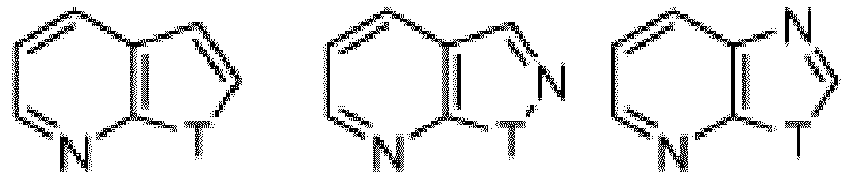
- In contrast to monovalent groups polymers of the present invention can include a "divalent group" defined herein as a linking group capable of forming a covalent bond with two other moieties. For example, polymers of the present invention can include a divalent C1-20 alkyl group (e.g., a methylene group), a divalent C2-20 alkenyl group (e.g., a vinylyl group), a divalent C2-20 alkynyl group (e.g., an ethynylyl group). a divalent C6-14 aryl group (e.g., a phenylyl group); a divalent 3-14 membered cycloheteroalkyl group (e.g., a pyrrolidylyl), and/or a divalent 5-14 membered heteroaryl group (e.g., a thienylyl group). Generally, a chemical group (e.g., -Ar-) is understood to be divalent by the inclusion of the two bonds before and after the group.
- The electron-donating or electron-withdrawing properties of several hundred of the most common substituents, reflecting all common classes of substituents having been determined, quantified, and published. The most common quantification of electron-donating and electron-withdrawing properties is in terms of Hammett σ values. Hydrogen has a Hammett σ value of zero, while other substituents have Hammett σ values that increase positively or negatively in direct relation to their electron-withdrawing or electron-donating characteristics. Substituents with negative Hammett σ values are considered electron donating, while those with positive Hammett σ values are considered electron-withdrawing. See Lange's Handbook of Chemistry, 12th ed., McGraw Hill, 1979, Table 3-12, pp. 3-134 to 3-138, which lists Hammett σ values for a large number of commonly encountered substituents and is incorporated by reference herein or see http://de.wikipedia.org/wiki/Hammett-Gleichung.
- It should be understood that the term "electron-accepting group" can be used synonymously herein with "electron acceptor" and "electron-withdrawing group". In particular, an "electron-withdrawing group" ("EWG") or an "electron-accepting group" or an "electron-acceptor" refers to a functional group that draws electrons to itself more than a hydrogen atom would do if it occupies the same position in a molecule. Preferred electron withdrawing groups include, but are not limited to, halogen or halo (e.g., F, Cl, Br, I), -NO2, -CN, -NC, -S(R0)2 +, -N(R0)3 +, -SO3H, -SO2R0, -SO3R0, -SO2NHR0, -SO2N(R0)2, -COOH, -COR0, -COOR0, -CONHR0, -CON(R0)2, C1-40 haloalkyl groups, C6-14 aryl groups, and 5-14 membered electron-poor heteroaryl groups; where R0 is a C1-20alkyl group, a C2-20 alkenyl group, a C2-20 alkynyl group, a C1-20 haloalkyl group, a C1-20 alkoxy group, a C6-14 aryl group, a C3-14 cycloalkyl group, a 3-14 membered cycloheteroalkyl group, and a 5-14 membered heteroaryl group, each of which can be optionally substituted as described herein. For example, each of the C1-20 alkyl group, the C2-20 alkenyl group, the C2-20 alkynyl group, the C1-20 haloalkyl group, the C1-20 alkoxy group, the C6-14 aryl group, the C3-14 cycloalkyl group, the 3-14 membered cycloheteroalkyl group, and the 5-14 membered heteroaryl group can be optionally substituted with 1-5 small electron-withdrawing groups such as F, Cl, Br, -NO2, -CN, -NC, -S(R0)2 +, -N(R0)3 +, -SO3H, -SO2R0, -SO3R0, -SO2NHR0, -SO2N(R0)2, -COOH, -COR0, -COOR0,-CONHR0, and -CON(R°)2.
- It should be understood that the term "electron-donating group" can be used synonymously herein with "electron donor". In particular, an "electron-donating group" or an "electron-donor" refers to a functional group that donates electrons to a neighboring atom more than a hydrogen atom would if it occupied the same position in a molecule. Preferred electron-donating groups include -OH, -OR0, -NH2, -NHR0, -N(R0)2, and 5-14 membered electron-rich heteroaryl groups, where R0 is a C1-20 alkyl group, a C2-20 alkenyl group, a C2-20 alkynyl group, a C6-14 aryl group, or a C3-14 cycloalkyl group.
- Various unsubstituted heteroaryl groups can be described as electron-rich (or π-excessive) or electron-poor (or π-deficient). Such classification is based on the average electron density on each ring atom as compared to that of a carbon atom in benzene. Examples of electron-rich systems include 5-membered heteroaryl groups having one heteroatom such as furan, pyrrole, and thiophene; and their benzofused counterparts such as benzofuran, benzopyrrole, and benzothiophene. Examples of electron-poor systems include 6-membered heteroaryl groups having one or more heteroatoms such as pyridine, pyrazine, pyridazine, and pyrimidine; as well as their benzofused counterparts such as quinoline, isoquinoline, quinoxaline, cinnoline, phthalazine, naphthyridine, quinazoline, phenanthridine, acridine, and purine. Mixed heteroaromatic rings can belong to either class depending on the type, number, and position of the one or more heteroatom(s) in the ring. See Katritzky, A.R and Lagowski, J.M., Heterocyclic Chemistry (John Wiley & Sons, New York, 1960).
- At various places in the present specification, substituents are disclosed in groups or in ranges. It is specifically intended that the description includes each and every individual subcombination of the members of such groups and ranges. For example, the term "C1-6 alkyl" is specifically intended to individually disclose C1, C2, C3, C4, C5, C6, C1-C6, C1-C5, C1-C4, C1-C3, C1-C2, C2-C6, C2-C5, C2-C4, C2-C3, C3-C6, C3-C5, C3-C4, C4-C6, C4-C5, and C5-C6 alkyl. By way of other examples, an integer in the range of 0 to 40 is specifically intended to individually disclose 0, 1, 2, 3, 4, 5, 6, 7, 8, 9, 10, 11, 12, 13, 14, 15, 16, 17, 18, 19, 20, 21, 22, 23, 24, 25, 26, 27, 28, 29, 30, 31, 32, 33, 34, 35, 36, 37, 38, 39, and 40, and an integer in the range of 1 to 20 is specifically intended to individually disclose 1, 2, 3, 4, 5, 6, 7, 8, 9, 10, 11, 12, 13, 14, 15, 16, 17, 18, 19, and 20. The phrase "optionally substituted with 1-5 substituents" is specifically intended to individually disclose a chemical group that can include 0, 1, 2, 3, 4, 5, 0-5, 0-4, 0-3, 0-2, 0-1, 1-5, 1-4, 1-3, 1-2, 2-5, 2-4 ,2-3, 3-5, 3-4, and 4-5 substituents.
- Polymers described herein can contain an asymmetric atom (also referred as a chiral center) and some of the polymers can contain two or more asymmetric atoms or centers, which can thus give rise to optical isomers (enantiomers) and geometric isomers (diastereomers). The present invention includes such optical and geometric isomers, including their respective resolved enantiomerically or diastereomerically pure isomers (e.g., (+) or (-) stereoisomer) and their racemic mixtures, as well as other mixtures of the enantiomers and diastereomers. In some embodiments, optical isomers can be obtained in enantiomerically enriched or pure form by standard procedures known to those skilled in the art, which include, for example, chiral separation, diastereomeric salt formation, kinetic resolution, and asymmetric synthesis. The present invention also encompasses cis- and trans-isomers of polymers containing alkenyl moieties (e.g., alkenes, azo compounds, and imines). It also should be understood that the polymers of the present invention encompass all possible regioisomers in pure form and mixtures thereof. In some embodiments, the preparation of the present polymers can include separating such isomers using standard separation procedures known to those skilled in the art, for example, by using one or more of column chromatography, thin-layer chromatography, simulated moving-bed chromatography, and high-performance liquid chromatography. However, mixtures of regioisomers can be used similarly to the uses of each individual regioisomer of the present invention as described herein and/or known by a skilled artisan.
- It is specifically contemplated that the depiction of one regioisomer includes any other regioisomers and any regioisomeric mixtures unless specifically stated otherwise.
- Throughout the specification, structures may or may not be presented with chemical names. Where any question arises as to nomenclature, the structure prevails.
- The present invention relates to polymers that can be used as organic semiconductor materials. The polymers according to the present invention can have good solubility in various common solvents and good stability in air. When incorporated into optical or optoelectronic devices including, but not limited to, photovoltaic cells or solar cells, light emitting diodes, and light emitting transistors, the polymers according to the present invention can confer various desirable performance properties. For example, when the polymers of formula (I') are used in a photoactive layer of a solar cell (e.g., bulk heterojunction devices), the solar cell can exhibit very high power conversion efficiency (e.g., about 3.0% or greater).
- The present invention provides polymers of formula (I') having at least one repeating unit of formula (I) that includes a planar aromatic ring system that is substituted at least with two electron-withdrawing groups, thereby providing a strong acceptor moiety. In a preferred embodiment the electron-poor polycyclic heteroaryl group is a bicyclic heteroaryl group that includes one or more nitrogen atoms. In another preferred embodiment, the electron-poor polycyclic heteroaryl group is a benzo-fused bicyclic heteroaryl group that includes one or more nitrogen atoms. In another preferred embodiment, the electron-poor polycyclic heteroaryl group is a pyrido-fused bicyclic heteroaryl group that includes two or more nitrogen atoms. Preferred electron-withdrawing groups are selected from the substituents F, Cl, CN, an acyl group, or a haloalkyl group.
- Preferably an alkyl group may be linear or branched, and may also be a cycloalkyl group. Preferably the alkyl group has a carbon atom number of usually 1 to 20. More preferred the alkyl group is selected from the group of a methyl group, an ethyl group, a n-propyl group, an i-propyl group, a n-butyl group, an i-butyl group, a t-butyl group, a s-butyl group, a 3-methylbutyl group, a n-pentyl group, a n-hexyl group, a 2-ethylhexyl group, a n-heptyl group, a n-octyl group, a n-nonyl group, a n-decyl group, a 3,7-dimethyloctyl group and a n-lauryl group. A hydrogen atom in the above-described alkyl group is optionally substituted by a fluorine atom. The alkyl group substituted by a fluorine atom is preferably a trifluoromethyl group, a pentafluoroethyl group, a perfluorobutyl group, a perfluorohexyl group, a perfluorooctyl group and the like.
- Preferably an alkoxy group may be linear or branched, and may also be a cycloalkyloxy group. Preferably the alkoxy group has a carbon atom number of usually 1 to 20. More preferred the alkoxy group is selected from the group of a methoxy group, an ethoxy group, a propyloxy group, an i-propyloxy group, a n-butoxy group, an i-butoxy group, a s-butoxy group, a t-butoxy group, a n-pentyloxy group, a n-hexyloxy group, a cyclohexyloxy group, a n-heptyloxy group, a n-octyloxy group, a 2-ethylhexyloxy group, a n-nonyloxy group, a n-decyloxy group, a 3,7-dimethyloctyloxy group or a n-lauryloxy group. A hydrogen atom in the above-described alkoxy group is optionally substituted by a fluorine atom. The alkoxy group substituted by a fluorine atom is preferably a trifluoromethoxy group, a pentafluoroethoxy group, a perfluorobutoxy group, a perfluorohexyloxy group, a perfluorooctyloxy group and the like.
- Preferably an alkylthio group may be linear or branched, and may also be a cycloalkylthio group. Preferably the alkylthio group has a carbon atom number of usually 1 to 20. More preferred the alkylthio group is selected from the group of a methylthio group, an ethylthio group, a n-propylthio group, an isopropylthio group, a n-butylthio group, an isobutylthio group, a s-butylthio group, a t-butylthio group, a n-pentylthio group, a n-hexylthio group, a cyclohexylthio group, a n-heptylthio group, a n-octylthio group, a 2-ethylhexylthio group, a n-nonylthio group, a n-decylthio group, a 3,7-dimethyloctylthio group or a n-laurylthio group. A hydrogen atom in the above-described alkylthio group is optionally substituted by a fluorine atom. The alkylthio group substituted by a fluorine atom is preferably a trifluoromethylthio group and the like.
- Preferably an aryl group means an atomic group obtained by removing one hydrogen atom from an aromatic hydrocarbon, and includes also those having a condensed ring, and those having two or more independent benzene rings or condensed rings or two or more of both the rings, bonded directly or via a vinylene group or the like. The aryl group preferably has a carbon atom number of usually 6 to 60, more preferably 6 to 48. The above-described aryl group optionally has a substituent. This substituent includes linear or branched alkyl groups having a carbon atom number of 1 to 20, cycloalkyl groups having a carbon atom number of 3 to 20, alkoxy groups containing the alkyl group or the cycloalkyl group in its structure, groups represented by the formula (IV), and the like,
-O-(CH2)gl-O(CH2)hl-CH3 (IV)
wherein gl represents an integer of from 1 to 6, and hl represents an integer of from 0 to 5. - Preferred aryl groups are selected from the group of a phenyl group, C1 to C12 alkoxyphenyl groups (C1 to C12 means that the carbon atom number thereof is 1 to 12; the same shall apply hereinafter), C1 to C12 alkylphenyl groups, a 1-naphthyl group, a 2-naphthyl group, a 1-anthracenyl group, a 2-anthracenyl group, a 9-anthracenyl group, a pentafluorophenyl group and the like. More preferred are C1 to C12 alkoxyphenyl groups and C1 to C12 alkylphenyl groups. The C1 to C12 alkoxyphenyl group preferably includes a methoxyphenyl group, an ethoxyphenyl group, a n-propyloxyphenyl group, an isopropyloxyphenyl group, a n-butoxyphenyl group, an isobutoxyphenyl group, a s-butoxyphenyl group, a t-butoxyphenyl group, a n-pentyloxyphenyl group, a n-hexyloxyphenyl group, a cyclohexyloxyphenyl group, a n-heptyloxyphenyl group, a n-octyloxyphenyl group, a 2-ethylhexyloxyphenyl group, a n-nonyloxyphenyl group, a n-decyloxyphenyl group, a 3,7-dimethyloctyloxyphenyl group and a n-lauryloxyphenyl group. The C1 to C12 alkylphenyl group preferably includes a methylphenyl group, an ethylphenyl group, a dimethylphenyl group, a n-propylphenyl group, a mesityl group, a methylethylphenyl group, an isopropylphenyl group, a n-butylphenyl group, an isobutylphenyl group, a s-butylphenyl group, a t-butylphenyl group, a n-pentylphenyl group, an isoamylphenyl group, a n-hexylphenyl group, a n-heptylphenyl group, a n-octylphenyl group, a n-nonylphenyl group, a n-decylphenyl group, a n-dodecylphenyl group, and the like. A hydrogen atom in the above-described aryl group is optionally substituted by a fluorine atom.
- Preferably an aryloxy group has a carbon atom number of 6 to 60, more preferably of 6 to 48. Preferred aryloxy groups are those selected from the group of a phenoxy group, C1 to C12 alkoxyphenoxy groups, C1 to C12 alkylphenoxy groups, a 1-naphthyloxy group, a 2-naphthyloxy group, a pentafluorophenyloxy group and the like. More preferred are C1 to C12 alkoxyphenoxy groups and C1 to C12 alkylphenoxy groups. The C1 to C12 alkoxy is preferably selected from the group of methoxy, ethoxy, n-propyloxy, isopropyloxy, n-butoxy, isobutoxy, s-butoxy, t-butoxy, n-pentyloxy, n-hexyloxy, cyclohexyloxy, n-heptyloxy, n-octyloxy, 2-ethylhexyloxy, n-nonyloxy, n-decyloxy, 3,7-dimethyloctyloxy and n-lauryloxy. The C1 to C12 alkylphenoxy group is preferably selected from the group of a methylphenoxy group, an ethylphenoxy group, a dimethylphenoxy group, a n-propylphenoxy group, a 1,3,5-trimethylphenoxy group, a methylethylphenoxy group, an isopropylphenoxy group, a n-butylphenoxy group, an isobutylphenoxy group, a s-butylphenoxy group, a t-butylphenoxy group, a n-pentylphenoxy group, an isoamylphenoxy group, a n-hexylphenoxy group, a n-heptylphenoxy group, a n-octylphenoxy group, a n-nonylphenoxy group, a n-decylphenoxy group, a n-dodecylphenoxy group and the like.
- Preferably an arylthio group optionally has a substituent on an aromatic ring, and preferably has a carbon atom number of 6 to 60. The arylthio group is preferably selected from the group of a phenylthio group, C1 to C12 alkoxyphenylthio group, C1 to C12 alkylphenylthio group, a 1-naphthylthio group, a 2-naphthylthio group, a pentafluorophenylthio group, a pyridylthio group, a pyridazinylthio group, a pyrimidylthio group, a pyrazylthio group and a triazylthio group.
- Preferably an arylalkyl group optionally has a substituent, and preferably has a carbon atom number of 7 to 60. The arylalkyl group is preferably selected from the group of phenyl-C1 to C12-alkyl groups, C1 to C12-alkoxyphenyl-C1 to C12 -alkyl groups, C1 to C12-alkylphenyl-C1 to C12-alkyl groups, 1-naphthyl-C1 to C12-alkyl groups and 2-naphthyl-C1 to C12-alkyl groups.
- Preferably an arylalkoxy group optionally has a substituent, and preferably has a carbon atom number of 7 to 60. The aylalkoxy group is preferably selected from the group of phenyl-C1 to C12-alkoxy groups, C1 to C12-alkoxyphenyl-C1 to C12-alkoxy groups, C1 to C12-alkylphenyl-C1 to C12-alkoxy groups, 1-naphthyl-C1 to C12-alkoxy groups and 2-naphthyl-C1 to C12-alkoxy groups.
- Preferably an arylalkylthio group optionally has a substituent, and preferably has a carbon atom number of 7 to 60. The arylalkylthio group is selected from the group of phenyl-C1 to C12-alkylthio groups, C1 to C12-alkoxyphenyl-C1 to C12-alkylthio groups, C1 to C12-alkylphenyl-C1 to C12-alkylthio groups, 1-naphthyl-C1 to C12-alkylthio groups and 2-naphthyl-C1 to C12-alkylthio groups.
- Preferably an arylalkenyl group has a carbon atom number of 8 to 60. The arylalkenyl group is preferably selected from the group of phenyl-C2 to C12-alkenyl groups, C1 to C12-alkoxyphenyl-C2 to C12-alkenyl groups, C1 to C12-alkylphenyl-C2 to C12-alkenyl groups, 1-naphthyl-C2 to C12-alkenyl groups and 2-naphthyl-C2 to C12-alkenyl groups, and more preferred are C1 to C12-alkoxyphenyl-C2 to C12-alkenyl groups and C1 to C12-alkylphenyl-C2 to C12-alkenyl groups, 1-naphtyl-C2 to C12-alkenyl groups and 2-naphtyl-C2 to C12-alkenyl groups, and most preferred are C1 to C12-alkoxyphenyl-C2 to C12-alkenyl groups and C1 to C12-alkylphenyl-C2 to C12-alkenyl groups.
- Preferably an arylalkynyl group has a carbon atom number of 8 to 60. The arylalkynyl group is preferably selected from the group of phenyl-C2 to C12-alkynyl groups, C1 to C12-alkoxyphenyl-C2 to C12-alkynyl groups, C1 to C12-alkylphenyl-C2 to C12-alkynyl groups, 1-naphthyl-C2 to C12-alkynyl groups and 2-naphthyl-C2 to C12-alkynyl groups, and more preferred are C12 to C12-alkoxyphenyl-C2 to C12-alkynyl groups and C1 to C12-alkylphenyl-C2 to C12-alkynyl groups.
- Preferably a monovalent heterocyclic group means an atomic group remaining after removing one hydrogen atom from a heterocyclic compound. The monovalent heterocyclic group has preferably a carbon atom number of 4 to 60, more preferred of 4 to 20. The carbon atom number of the monovalent heterocyclic group does not include the carbon atom number of the substituent. The above-described heterocyclic compound means an organic compound having a cyclic structure in which elements constituting the ring include not only a carbon atom, but also a hetero atom selected from the group of oxygen, sulfur, nitrogen, phosphorus, boron, silicon and the like contained in the ring. Preferred monovalent heterocyclic groups are selected from the group of a thienyl group, C1 to C12-alkylthienyl groups, a pyrrolyl group, a furyl group, a pyridyl group, C1 to C12-alkylpyridyl groups, a piperidyl group, a quinolyl group and an isoquinolyl group. More preferred are a thienyl group, a C1 to C12-aklthienyl group, a pyridyl group and a C1 to C12-alkylpyridyl group. Of the monovalent heterocyclic groups, monovalent aromatic heterocyclic groups are preferable. Preferably a heterocyclic thio group means a group obtained by substituting a hydrogen atom of a mercapto group by a monovalent heterocyclic group. The heterocyclic thio group includes hetero arylthio groups, preferably a pyridylthio group, a pyridazinylthio group, a pyrimidylthio group, a pyrazinylthio group, a triazinylthio group and the like.
- Preferably an amide group has a carbon atom number of 2 to 20, more preferred of 2 to 18. Preferred amide groups are selected from the group of a formamide group, an acetamide group, a propionamide group, a butyroamide group, a benzamide group, a trifluoroacetamide group, a pentafluorobenzamide group, a diformamide group, a diacetamide group, a dipropioamide group, a dibutyroamide group, a dibenzamide group, a ditrifluoroacetamide group and a dipentafluorobenzamide group.
- Preferably an acid imide group includes residues obtained by removing from an acid imide one hydrogen atom connected to its nitrogen atom, and has a carbon atom number preferably of 4 to 20. Preferred acid imide groups are selected from the groups shown below:


- Preferably a substituted carboxyl group includes carboxyl groups substituted by an alkyl group, an aryl group, an arylalkyl group or a monovalent heterocyclic group. The above-described alkyl group, aryl group, arylalkyl group and monovalent heterocyclic group optionally have a substituent. The substituted carboxyl group has preferably a carbon atom number of 2 to 60, more preferred of 2 to 48. The carbon atom number of the substituted carboxyl group does not include the carbon atom number of the substituent. Preferred substituted carboxyl groups are selected from the group of a methoxycarbonyl group, an ethoxycarbonyl group, a n-propoxycarbonyl group, an isopropoxycarbonyl group, a n-butoxycarbonyl group, an isobutoxycarbonyl group, a t-butoxycarbonyl group, a n-pentyloxycarbonyl group, a n-hexyloxycarbonyl group, a cyclohexyloxycarbonyl group, a n-heptyloxycarbonyl group, a n-octyloxycarbonyl group, a 2-ethylhexyloxycarbonyl group, a n-nonyloxycarbonyl group, a n-decyloxycarbonyl group, a 3,7-dimethyloctyloxycarbonyl group, a n-dodecyloxycarbonyl group, a trifluoromethoxycarbonyl group, a pentafluoroethoxycarbonyl group, a perfluorobutoxycarbonyl group, a per-fluorohexyloxycarbonyl group, a perfluorooctyloxycarbonyl group, a phenoxycarbonyl group, a naphthoxycarbonyl group and a pyridyloxycarbonyl group.
- In a preferred embodiment the present invention refers to Ar1 or Ar2 in formula (I') wherein the divalent arylene units are those selected from the group


- In another preferred embodiment the present invention refers to Ar1 or Ar2 in formula (I') wherein the divalent heterocyclic groups are those selected from heterocycles from the group


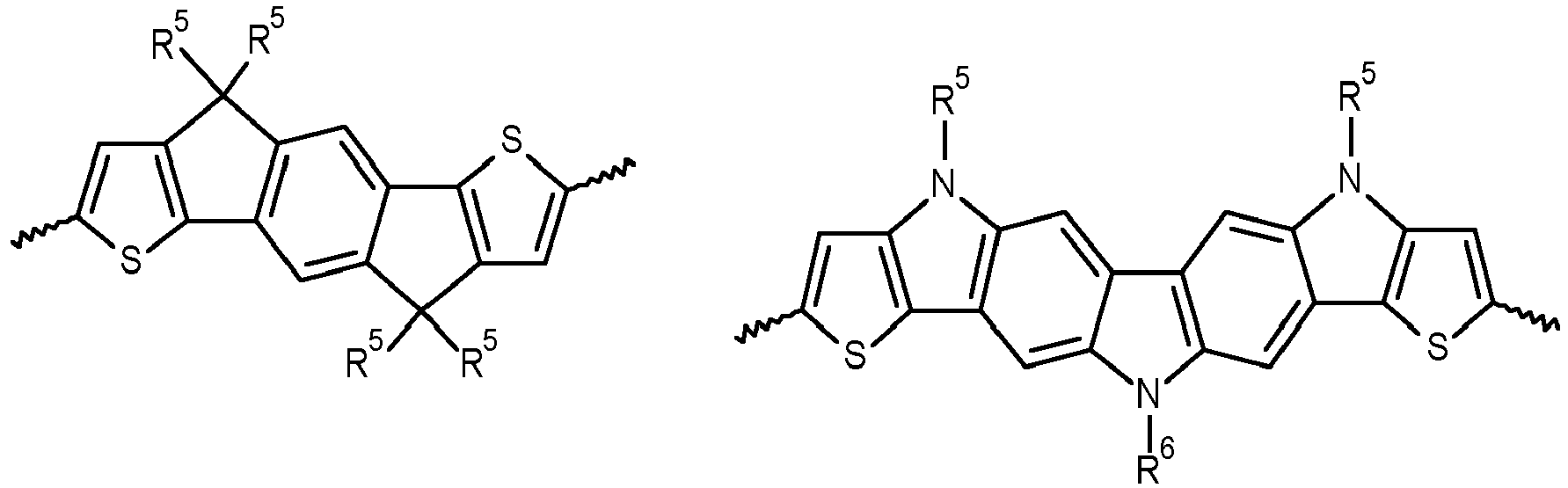
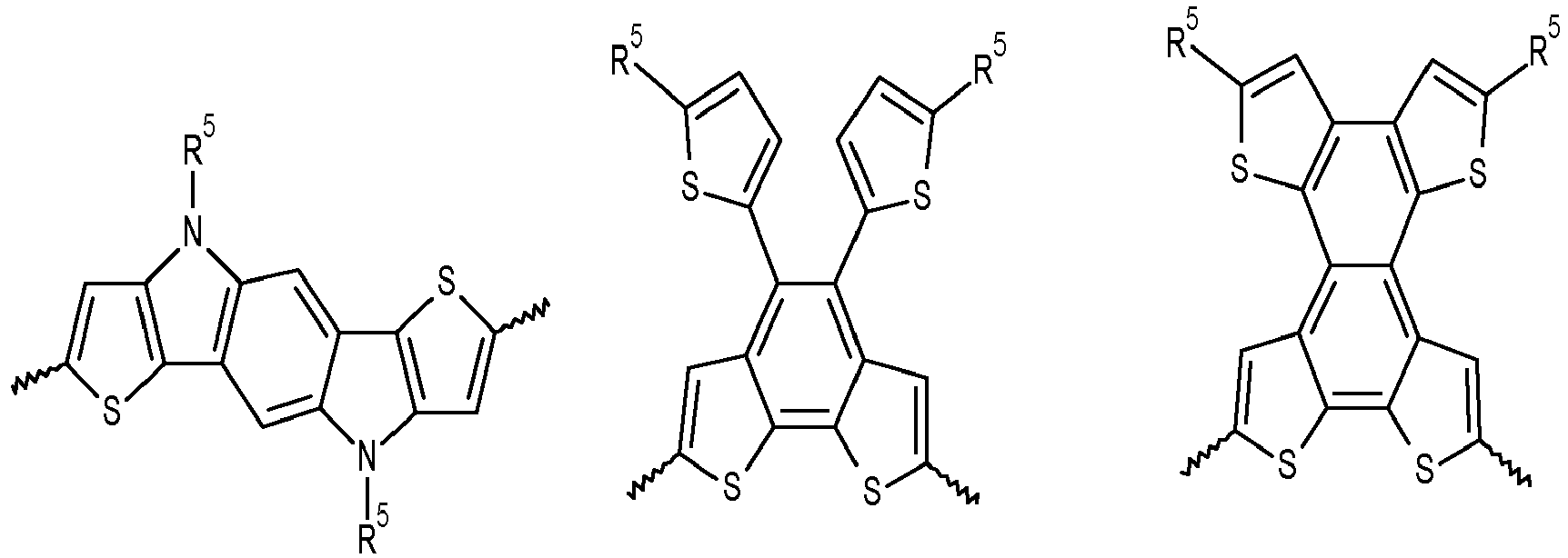


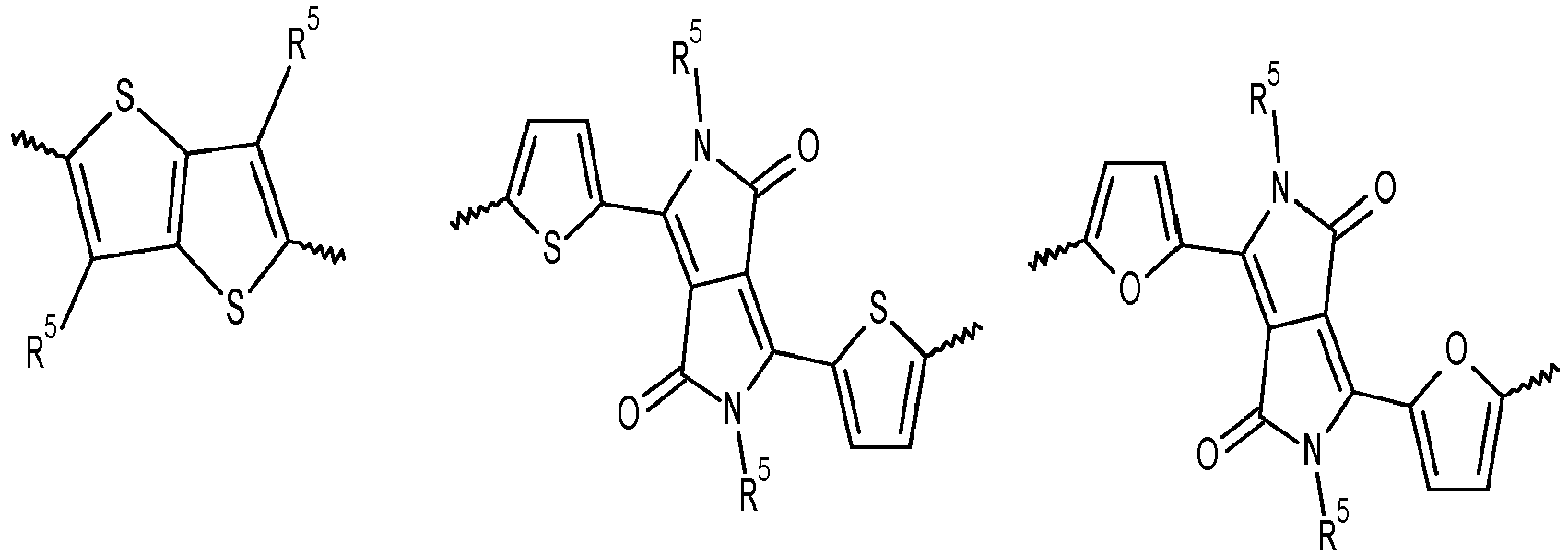


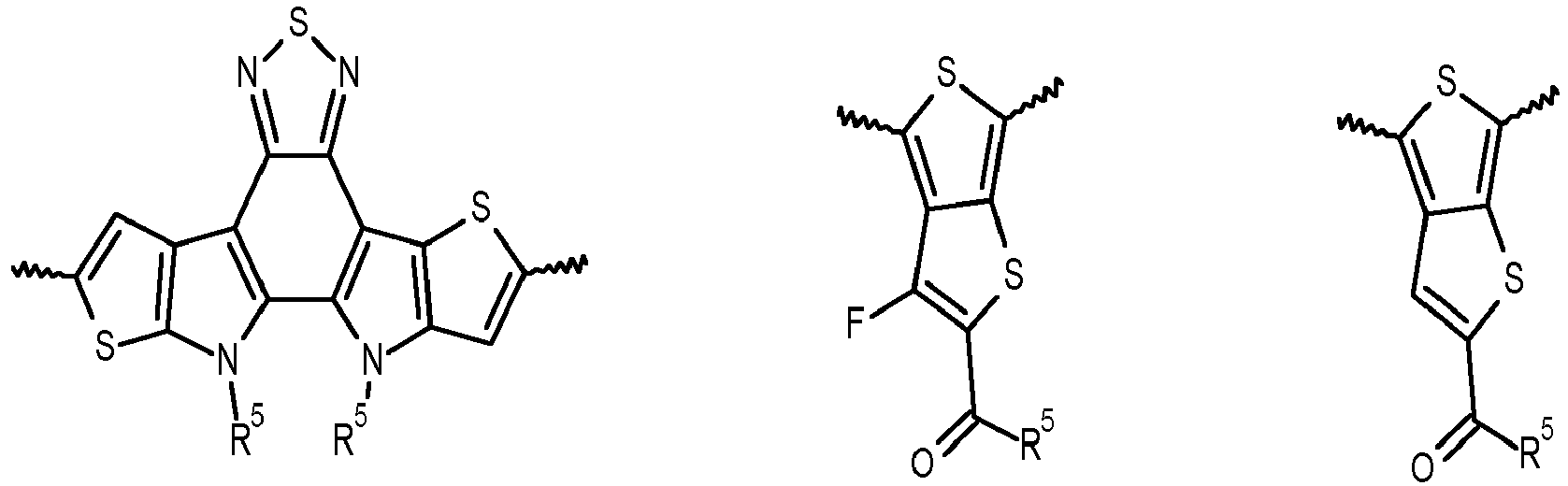


- In another preferred embodiment the present invention refers to Ar1 or Ar2 in formula (I') wherein the divalent aromatic amine residue is selected from the group


- In one of the most preferred embodiments the present invention is directed to polymers of formula (I') comprising in their repeating unit at least one planar aromatic ring system A represented by formulas (IIa), (IIb), (IIc) or (IId):


- R represents an aryl or a heteroaryl group which is non-substituted or substituted with at least one solubilizing group selected from C1-C20 alkyl or C1-C20 alkoxy groups.
- Preferably R in formulas (IIa), (IIb), (IIc) and (IId) represents an aryl group selected from the list:
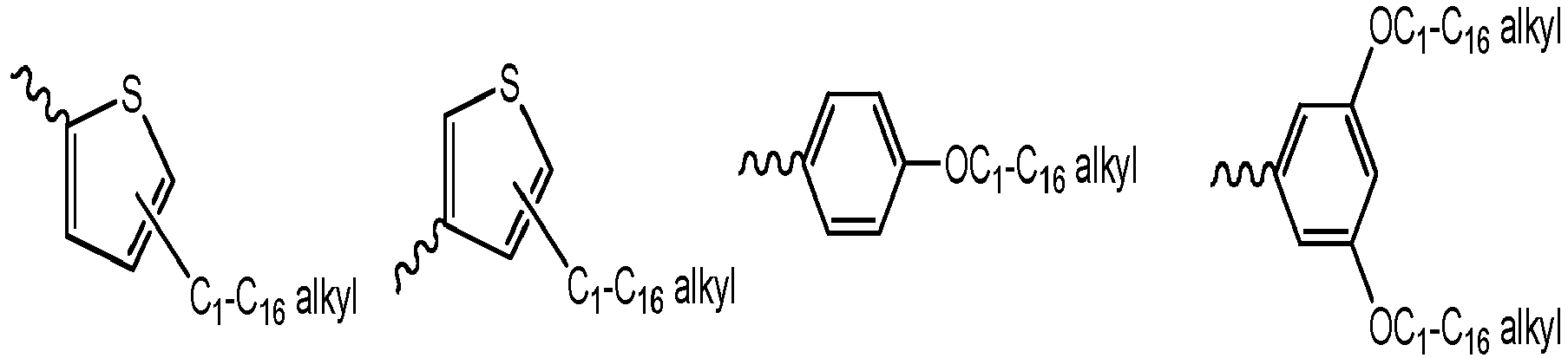
- In a preferred embodiment the present invention refers to polymers represented by a formula of the group (II'a), (II'b), (II'c) or (II'd)


in each case Ar1 and Ar2 are the same or mutually different and independent from each other represent an arylene group, a divalent heterocyclic group, or a divalent aromatic amine residue,
k represents in each case a number of Ar1 units connected in series in the repeating unit of the conjugated polymer, preferably k is an integer from thenumbers 0, 1, 2 or 3; and when k = 0 the polymer does not comprise an Ar1 moiety;
m represents in each case a number of Ar2 units connected in series in the repeating unit of the conjugated polymer, preferably m is an integer from the numbers 0, 1, 2or 3; and when m = 0 the polymer does not comprise an Ar2 moiety; n is a number of repeating units, preferably an integer in the range from 2 to 2000, more preferred from 2 to 200,
EG1 and EG2 are the end groups of the respective polymer and in each case independent from each other those are selected from the group hydrogen, halogen, a trialkylstannyl group (-Sn(Alkyl)3), a boronic acid group (-B(OH)2), a boronic ester group (-B(OAlkyl)2), an aryl unit or a heteroaryl unit. - In a preferred embodiment the present invention refers to polymers comprising in their repeating unit at least one planar aromatic ring system A represented by formulas (IIIa), (IIIb), (IIIc) or (IIId)

R3 represents in each case a hydrogen atom, an alkyl group, an alkoxy group or an alkylthio group, preferably R3 represents a C1-C20 alkyl or a C1-C20 alkoxy group. - In such case the polymer is represented by formulas (III'a), (III'b), (III'c) or (III'd)


in each case Ar1 and Ar2 are the same or mutually different and represent independent from each other a divalent arylene group, a divalent heterocyclic group, or a divalent aromatic amine residue,
k represents in each case the number of Ar1 units connected in series in the repeating unit of the conjugated polymer, preferably k is an integer from thenumbers 0, 1, 2 or 3; and when k = 0 the polymer does not comprise an Ar1 moiety;
m represents in each case represents the number of Ar2 units connected in series in the repeating unit of the conjugated polymer, preferably m is an integer from thenumbers 0, 1, 2 or 3; and when m = 0 the polymer does not comprise an Ar2 moiety; n in each case is the number of repeating units, preferably an integer in the range from 2 to 2000, more preferred an integer in the range from 2 to 200,
R in each case represents an aryl or a heteroaryl group which is non-substituted or substituted with at least one solubilizing group selected from C1-C20 alkyl or C1-C20 alkoxy groups and R3 in each case represents a hydrogen atom, an alkyl group, an alkoxy group or an alkylthio group, preferably R3 represents a C1-C20 alkyl or a C1-C20alkoxy group,
EG1 and EG2 in each case are the end groups of the polymer and independent from each other they represent hydrogen, halogen, a trialkylstannyl group (-Sn(Alkyl)3), a boronic acid group (-B(OH)2), a boronic ester group (-B(OAlkyl)2), an aryl unit or a heteroaryl unit. - In the context of the present invention the prefix "poly" is understood to mean that more than one identical or different repeating units of the general formulas (IIa), (IIb), (IIc) or (IId) (hereinafter (IIa)-(IId)) or (IIIa), (IIIb), (IIIc) or (IIId) (hereinafter (IIIa)-(IIId)) are present in the polymer according to the present invention. The polymers according to the present invention preferably contain a total of n repeating units of the general formulas (IIa)-(IId) or (IIIa)-(IIId) where n is preferably an integer in the range from from 2 to 2000, more preferred in the range from 2 to 200. The repeating units of the general formulas (II'a)-(II'd) or (III'a)-(III'd) may each be the same or different within a polymer according to the present invention. Preference is given to a polymer having identical repeating units of the general formulas (II'a)-(II'd) or identical repeating units of the general formulas (III'a)-(III'd) in each case.
- In each case a polymer according to the present invention preferably has independent from each other end groups EG1 and EG2 selected from the group of hydrogen, halogen, a trialkylstannyl group (-Sn(Alkyl)3), a boronic acid group (-B(OH)2), a boronic ester group (-B(OAlkyl)2), an aryl unit or a heteroaryl unit.
- A composition of the present invention is a composition comprising of at least one polymer according to formula (I') of the present invention, and additionally at least one further additive, a material selected from the group comprising a hole transporting material, an electron acceptor material, an electron transporting material, or a light absorbing material.
- In another embodiment the present invention refers to a composition comprising at least two polymers of the present invention and additionally at least one further material selected from the group comprising a hole transporting material, an electron acceptor material, an electron transporting material, or a light absorbing material.
- A composition of the present invention is preferably a liquid composition, and is useful for fabrication of light absorbing devices, photovoltaic devices, preferably thin film organic solar cells or thin film organic solar batteries, and other electronic devices, preferably polymer light emitting diodes or organic field-effect transistors. The liquid composition according to the present invention comprises at least one of the polymers according to formula (I') with at least one solvent. In a preferred embodiment the present invention comprises at least one of the polymers according to formula (I') with at least one solvent and with at least one additive.
- In this specification, "liquid composition" means a composition which is liquid during the device fabrication. Preferably a liquid composition according to the present invention is liquid at normal pressure at 1 atm (1 bar) and at 25°C. The liquid composition according to the present invention is, in general, referred to as ink, ink composition, solution or the like in some cases.
- In a preferred embodiment the liquid composition contains in addition to the polymer(s) of formula (I') and the solvent(s) an additive selected from the group of additives with a boiling temperature below 450 °C affecting the structure of the thin films obtained after drying the liquid composition, low molecular weight fluorescent material, an electron acceptor material, a hole transporting material, an electron transporting material, additives for stabilizing, additives for adjusting viscosity and/or surface tension, additives as antioxidant and the like. These optional components may be used independent from each other in single form or in combination of two or more.
- Preferred low molecular weight additives with a boiling temperature below 450 °C are selected from C8-C22 aliphatic hydrocarbons, halogenated alkanes, aliphatic thiols, acids and esters comprising thiol groups, aromatic ethers, ketones, aldehydes, aliphatic esters, or substituted aromatic hydrocarbons.
- Preferred aliphatic hydrocarbons are tetradecane, hexadecane and alike. Preferred halogenated alkanes are 1,8-diiodooctane, perfluoro-1,8-diiodoctane, 1,8-dibromooctane, 1,6-dibromohexane, perfuorotetradecane and alike. Preferred aliphatic thiols are 1,8-octanedithiol, 1,6-octanedithiol, 1-dodecylthiol and alike. Preferred acids and esters comprising thiol groups are methyl 2-mercaptoacetate, n-butyl-2-mercaptoacetate, ethyl-3-mercaptopropionate, 3-mercaptopropionic acid, 11-mercaptoundecanoic acid and alike. Preferred aromatic ethers are diphenyl ether, methylphenyl ether and alike. Preferred ketones are acetophenone, valerophenone and alike. Preferred aldehydes are propional, perfuorooctanal and alike. Preferred aliphatic esters are butylacetate, methyl ester of perfluorohexanoic acid and alike. Preferred substituted aromatic hydrocarbons are 2-chloronaphthalene, 1-bromonaphthalene, benzyl alcohol, pentafluorobenzyl alcohol, 1,4-dibromobenzene, thiophenol and alike.
- Preferred electron acceptor materials are selected from unmodified fullerenes, fullerene derivatives, n-type conjugated polymers, derivatives of naphthalene, perylene, nanocrystals of inorganic n-type semiconductors, and other types of organic compounds with LUMO energy (or inorganic compounds with their valence band) of -3.5 eV or lower (e.g. -3.6 eV, -3.8 eV and etc.) as estimated vs. vacuum level. (LUMO = Lowest Unoccupied Molecular Orbital).
- Preferred low molecular weight fluorescent materials which may be contained in the liquid composition include low molecular weight fluorescent materials from the group of naphthalene derivatives, anthracene, anthracene derivatives, perylene, perylene derivatives, polymethine dyes, xanthene dyes, coumarine dyes, cyanine dyes; metal complexes having a metal complex of 8-hydroxyquinoline as a ligand; metal complexes having a 8-hydroxyquinoline derivative as a ligand; other fluorescent metal complexes, aromatic amines, tetraphenylcyclopentadiene, tetraphenylcyclopentadiene derivatives, tetraphenylcyclobutadiene, tetraphenylcyclobutadiene derivatives, stilbenes, silicon-containing aromatics, oxazoles, furoxanes, thiazoles, tetraarylmethanes, thiadiazoles, pyrazoles, metacyclophanes, acetylenes and the like. Specifically, low molecular weight fluorescent materials are described in, for example,
EP 0 044 686 A1 ,EP 0 120 673 A2 and the like - herein enclosed by reference -. - Preferred hole transporting materials which may be contained in the liquid composition include polyvinylcarbazole and derivatives thereof, polysilane and derivatives thereof, polysiloxane derivatives having an aromatic amine on the side chain or the main chain, pyrazoline derivatives, arylamine derivatives, stilbene derivatives, triphenyldiamine derivatives, polyaniline and derivatives thereof, polythiophene and derivatives thereof, polypyrrole and derivatives thereof, poly(p-phenylenevinylene) and derivatives thereof, and poly(2,5-thienylenevinylene) and derivatives thereof.
- Preferred electron transporting materials which may be contained in the liquid composition include oxadiazole derivatives, anthraquinodimethane and derivatives thereof, benzoquinone and derivatives thereof, naphthoquinone and derivatives thereof, anthraquinone and derivatives thereof, tetracyanoanthraquinodimethane and derivatives thereof, fluorenone derivatives, diphenyldicyanoethylene and derivatives thereof, diphenoquinoline derivatives; metal complexes of 8-hydroxyquinoline and derivatives thereof, polyquinoline and derivatives thereof, polyquinoxaline and derivatives thereof, and polyfluorene and derivatives thereof, fullerenes C60 or fullerenes C70 and derivatives thereof.
- Preferred additives for adjusting viscosity and/or surface tension which may be contained in the liquid composition according to the present invention include a high molecular weight compound (thickening agent) and a "poor solvent" for increasing viscosity, a low molecular weight compound for decreasing viscosity, and a surfactant for lowering surface tension. The "poor solvent" means a solvent with which the weight of the polymer of the present invention dissolvable in 1 g of the solvent is 0.1 mg or less.
- As the above-described high molecular weight compound for adjusting viscosity and/or surface tension, those not disturbing light adsorption and charge transportation may be permissible, and usually, those which are soluble in the solvent of the liquid composition are mentioned. As the high molecular weight compound, preferably, polystyrene of high molecular weight or polymethyl methacrylate of high molecular weight can be used. The above described high molecular weight compound for adjusting viscosity and/or surface tension has an average molecular weight of preferably 500000 or more, more preferred 1000000 or more.
- When the liquid composition of the present invention contains a hole transporting material, the amount of the hole transporting material in the liquid composition is usually 1 to 80 parts by weight, preferably 5 to 60 parts by weight when the weight of all components excluding the solvent is 100 parts by weight. When the liquid composition of the present invention contains an electron transporting material, the amount of the electron transporting material in the liquid composition is usually 1 to 80 parts by weight, preferably 5 to 60 parts by weight when the weight of all components excluding the solvent is 100 parts by weight.
- In the case of film formation using this liquid composition in fabricating a photovoltaic device, it may be advantageous to only remove a solvent by drying after application of the liquid composition, and also in the case of mixing of a charge transporting material and a light adsorbing material, the same means can be applied, that is, this method is extremely advantageous for production. Preferably drying is carried out by heating at a temperatures from about 50 to 150°C, alternatively, drying may be carried out under reduced pressure of about 10-3 Pa.
- As the film formation method using the liquid composition, preferably application methods selected from the group of spin coat method, casting method, slot die coating method, micro gravure coating method, gravure coating method, bar coating method, roll coating method, wire bar coating method, dip coating method, spray coating method, screen printing method, flexo printing method, offset printing method, inkjet printing method and the like are used. Such methods are described in the prior art, e.g. F. C. Krebs, Solar Energy Materials & Solar Cells 93 (2009) 394-412.
- The proportion of a solvent in the liquid composition is usually 1 wt% to 99.9 wt%, preferably 60 wt% to 99.9 wt%, further preferably 90 wt% to 99.8 wt% with respect to the total weight of the liquid composition. Though the viscosity of the liquid composition varies depending on the printing method, the viscosity at 25°C is preferably in the range of 0.5 to 500 mPa·s, and when a liquid composition passes through a discharge apparatus such as in an inkjet printing method and the like, the viscosity at 25°C is preferably in the range of 0.5 to 20 mPa·s, for preventing clogging and flying curving in discharging.
- As the solvent contained in the liquid compositions according to the present invention, those capable of dissolving or dispersing components other than the solvent in the composition are preferable. Preferred solvents are selected from the group of chlorine-based solvents, ether solvents, aromatic hydrocarbon solvents, aliphatic hydrocarbon solvents, ketone solvents, ester solvents, polyhydric alcohols, alcohol solvents, sulfoxides solvents or amide solvents.
- Preferred chlorine-based solvents are chloroform, methylene chloride, 1,2-dichloroethane, 1,1,2-trichloroethane, chlorobenzene, o-dichlorobenzene and the like. Preferred ether solvents are tetrahydrofuran, dioxane and the like. Preferred aromatic hydrocarbon solvents are toluene, xylene, trimethylbenzene, mesitylene and the like. Preferred aliphatic hydrocarbon solvents are cyclohexane, methylcyclohexane, n-pentane, n-hexane, n-heptane, n-octane, n-nonane, n-decane and the like. Preferred ketone solvents are acetone, methyl ethyl ketone, cyclohexanone and the like. Preferred ester solvents are ethyl acetate, butyl acetate, methyl benzoate, ethyl-cellosolve acetate and the like. Preferred polyhydric alcohols are ethylene glycol, ethylene glycol monobutyl ether, ethylene glycol monoethyl ether, ethylene glycol monomethyl ether, dimethoxyethane, propylene glycol, diethoxymethane, triethylene glycol monoethyl ether, glycerin, 1,2-hexane diol and the like and derivatives thereof. Preferred alcohol solvents are methanol, ethanol, propanol, isopropanol, cyclohexanol and the like. Preferred sulfoxide solvents are dimethyl sulfoxide and the like. Preferred amide solvents are N-methyl-2-pyrrolidone, N,N-dimethylformamide, and the like. These solvents may be used singly or in combination of two or more. Among the above-described solvents, one or more organic solvents having a structure containing at least one benzene ring and having a melting point of 0°C or lower and a boiling point of 100°C or higher are preferably contained from the standpoint of viscosity, film formability and the like.
- Regarding the kind of the solvent, aromatic hydrocarbon solvents, aliphatic hydrocarbon solvents, ester solvents and ketone solvents are preferred from the standpoint of solubility of components other than the solvent in the liquid composition into the solvent, uniformity in film formation, viscosity property and the like, and more preferable are toluene, xylene, ethylbenzene, diethylbenzene, trimethylbenzene, mesitylene, n-propylbenzene, i-propylbenzene, n-butylbenzene, i-butylbenzene, s-butylbenzene, anisole, ethoxybenzene, 1-methylnaphthalene, cyclohexane, cyclohexanone, cyclohexylbenzene, bicyclohexyl, cyclohexenylcyclohexanone, n-heptylcyclohexane, n-hexylcyclohexane, methyl benzoate, 2-propylcyclohexanone, 2-heptanone, 3-heptanone, 4-heptanone, 2-octanone, 2-nonanone, 2-decanone, dicyclohexyl ketone and bicyclohexylmethyl benzoate, and particularly preferable are xylene, anisole, mesitylene, cyclohexylbenzene and bicyclohexylmethyl benzoate.
- Most preferred chlorinated solvents are selected from the group 1,2-dichlorobenzene, chlorobenzene, 1,2,4-trichlorobenzene, 1-chloronaphthalene, chloroform, methylene chloride and 1,2-dichlorethane, most preferred chlorinated solvent is 1,2-dichlorobenzene.
- The number of the solvents to be contained in the liquid composition is preferably 2 or more, more preferably 2 to 3, and most preferred 2, from the standpoint of film formability and from the standpoint of device properties, and the like.
- When two solvents are contained in the liquid composition, one of them may be solid at 25°C. From the standpoint of film formability, it is preferable that one solvent has a boiling point of 180°C or higher and another solvent has a boiling point of lower than 180°C, and it is more preferable that one solvent has a boiling point of 200°C or higher and another solvent has a boiling point of lower than 180°C.
- When three solvents are contained in the liquid composition, one or two of them may be solid at 25°C. From the standpoint of film formability, it is preferable that at least one of three solvents has a boiling point of 180°C or higher and at least one solvent has a boiling point of 180°C or lower, and it is more preferable that at least one of three solvents has a boiling point of 200°C or higher and 300°C or lower and at least one solvent has a boiling point of 180°C or lower.
- When two or more solvents are contained in the liquid composition, the content of a solvent having the highest boiling point is preferably 40 to 90 wt%, more preferably 50 to 90 wt%, and further preferably 65 to 85 wt% with respect to the weight of all solvents contained in the liquid composition, from the standpoint of viscosity and film formability.
- The polymers of formula (I') of the present invention can be used as photovoltaic material, as a light emitting material, but also as a film material, as an organic semiconductor material, as an organic transistor material, as an optical material, as a solar battery material, or as a conductive material, preferably by doping.
- Preferably the polymers of formula (I') of the present invention are used in an optoelectronic devices, more preferred in photovoltaic conversion devices, even called photovoltaic devices or solar cells.
- A photovoltaic device according to the present invention can be used preferably for applications as a solar cell, solar battery, solar module, as an optical sensor and the like. Here, a solar battery as a preferred embodiment of the photoelectric conversion devices, will be further explained.
- In a preferred embodiment the polymers of formula (I') of the present invention are used as photovoltaic material of a solar battery, preferably as an organic semiconductor layer of a Schottky Barrier type device utilizing an interface between an organic semiconductor and a metal, or as a hybrid semiconductor layer of a p-n heterojunction type device utilizing an interface between an organic semiconductor and an inorganic semiconductor, or as an organic semiconductor layer of a p-n heterojunction type device utilizing an interface between at least two organic semiconductors.
- In a further preferred embodiment the polymers of formula (I') of the present invention are used as electron donating polymers or as electron accepting polymers in a bulk heterojunction type device in which the donor-acceptor contact area is increased, or as electron donating conjugated polymers (dispersion supporting body) in a solar battery using a high molecular weight-low molecular weight composite system, more preferred a bulk heterojunction type organic photoelectric conversion device in which a fullerene derivative is dispersed as an electron acceptor. If the polymers of formula (I') are used in a solar battery, high conversion efficiency can be obtained.
- As mentioned above the polymers of the general formula (I') are preferably used in combinations with electron acceptor materials, preferably selected from unmodified fullerenes or fullerene derivatives. In a preferred embodiment the present invention therefore refers to the combination of at least one polymer of formula (I') as an electron donor and at least one fullerene compound as an electron acceptor and the use of such combination as photovoltaic material, as a light emitting material, as a film material, as an organic semiconductor material, as an organic transistor material, as an optical material, as a solar battery material, or as a conductive material, preferably by doping.
- In a more preferred embodiment the present invention refers to a bulk heterojunction type organic photoelectric conversion device, preferably an organic thin film solar battery, wherein at least one polymer of formula (I') is used in combination with at least one fullerene compound in a photoactive blend solution, preferably with at least one C60 fullerene compound or C70 fullerene compound or their derivatives, more preferred with at least one C60 fullerene compound or its derivatives, most preferred with [60]PCBM and the use of such combinations as photoactive layer compositions. For clarification in the present invention "[60]" represents a C60 fullerene and "[70]" represents a C70 fullerene.
- Consequently the present invention is even directed to combinations of at least one polymer represented by formula (I')

- A
- represents a planar aromatic system selected from the list given above,
- Ar1 and Ar2
- are the same or mutually different and independent from each other represent a divalent arylene group, a divalent heterocyclic group, or a divalent aromatic amine residue,
- k
- represents the number of Ar1 units connected in series in the repeating unit of the conjugated polymer and is a number between 0 and 3, preferably from 1 to 3,
- m
- represents a number of Ar2 units connected in series in the repeating unit of the conjugated polymer and is a number between 0 and 3, preferably from 1 to 3;
- n
- represents an integer from 2 to 2000, preferably from 2 to 200,
- EG1 and EG2
- are the end groups of the polymer and independent from each other they represent a hydrogen, a halogen, a trialkylstannyl unit (-Sn(Alkyl)3), a boronic acid unit(-B(OH)2), a boronic ester unit (-B(OAlkyl)2), an aryl unit or a heteroaryl unit and
- X
- represents in each case independent from each other a divalent acetylene fragment X1 or a thiophene unit X2,
- In a preferred embodiment such combinations of polymer of formula (I') with fullerenes are applied in solvents selected from the group 1,2-dichlorobenzene, chlorobenzene, 1,2,4-trichlorobenzene, 1-chloronaphthalene, chloroform, methylene chloride and 1,2-dichlorethane, most preferred chlorinated solvent is 1,2-dichlorobenzene.

- The present invention is even directed to combinations of polymers comprising a conjugated backbone with repeating units represented by the formula (I)
-[-X-A-X-]- (I)
containing at least one planar aromatic system A selected from the list




wavy bondshows the attachment positions of X-blocks in formula (I);
- R
- represents an aryl or a heteroaryl group which is non-substituted or substituted with a solubilizing group selected from C1-C20 alkyl or C1-C20 alkoxy,
- R1
- represents a C1-C20 alkoxy group or a C1-C20 alkylthio group,
- X
- in each case independent from each other represents a divalent acetylene fragment X1 or a thiophene unit X2
- In a preferred embodiment the present invention is directed to combinations of polymers comprising a conjugated backbone with repeating units represented by the formula (II)

- In a preferred embodiment the present invention is directed to combinations of polymers comprising a conjugated backbone with repeating units represented by the formula (III)

- Containing at least one planar aromatic system A selected from the list given above, and R3 and R4 are the same or mutually different and represent independent from each other a hydrogen atom, an alkyl group, an alkoxy group or an alkylthio group, with at least one fullerene compound, preferably with at least one C60 fullerene compound or C70 fullerene compound or their derivatives, more preferred with at least one C60 fullerene compound or its derivatives, most preferred with [60]PCBM.
- With respect to the structure of such a solar battery, in the case of, for example, a p-n heterojunction type device, it is advantageous that a p-type semiconductor layer is formed on an ohmic electrode, for example, on ITO (indium-tin-oxide), further, an n-type semiconductor layer is laminated, and an ohmic electrode is provided thereon.
- A solar battery according to the present invention is usually formed on a supporting substrate. The supporting substrate is preferably one which does not disturb the property of an organic photoelectric conversion device, and more preferred glass substrates and flexible film substrates and plastic substrates are used.
- A solar battery according to the present invention can be produced by known methods, for example, a method described in Synth. Met., 102, 982 (1999), and a method described in Science, 270, 1789 (1995).
- The present invention is even directed to a process for the manufacture of polymers of general formula (I') characterized in that Suzuki or Stille polycondensation reaction is involved to link the monomers together thus forming a conjugated polymer.
- The present invention is even directed to a process for the manufacture of polymers of general formulas (II'a)-(II'd) characterized in that Suzuki or Stille polycondensation reaction is involved to link the monomers together thus forming a conjugated polymer.
- The present invention is even directed to a process for the manufacture of polymers of general formulas (III'a)-(III'b) characterized in that Suzuki or Stille polycondensation reaction is involved to link the monomers together thus forming a conjugated polymer.
- The polymers of general formula (I') are preferably produced using Stille or Suzuki polycondensation reactions as illustrated in Schemes 1-3 for copolymer (III'b) and Scheme 4 for copolymer (III'c):


- In the case of Stille polycondensation reactions substituent A in M2 or M6 is represented by stannyl residues R3Sn-, preferably trialkylstannyl (Alkyl)3Sn-, especially preferred trimethylstannyl Me3Sn.
- In the case of Suzuki polycondensation reaction substituent A in M2 and in M6 is represented by boronic acid residue -B(OH)2, boronic acid ester residue -B(OR)2, preferably boronic alkyl esters -B(OAlkyl)2, especially preferred boronic acid ester residues selected from the list:

- Alternatively, substituent A in M2 and M6 in the case of Suzuki polycondensation reaction can be represented by -BF3K, -BF3Na, -BF3Rb or -BF3Cs residues. R3 and R5 in M2 and M6 are the same or mutually different and represent in each case a hydrogen atom or a C1-C20 alkyl chain and n represents an integer from 2 to 2000, preferably from 2 to 200.
- The end groups of the polymer chain formed according to Schemes 1-4 can be further modified using a sequence of the reactions illustrated for (III'c-1) in Scheme 5:

- The conditions of Stille polycondensation reaction are known to a technician having ordinary skills in the art of polycondensation reactions. Generally, 0.0001-20 mole % of Pd(0) or Pd(II) catalyst is introduced to a solution of two monomers (for example, M1 and M2 according to Scheme 1) taken in 1:1 molar ratio. Organic liquids which are not reactive towards monomers or palladium catalyst can be used as solvents. Preferably, toluene or xylenes or THF or DMF or their mixtures with other solvents are used to perform Stille polycondensation reactions. Mixtures of toluene with more polar solvents such as DMF (N,N-dimethylformamide) or NMP (N-methylpyrrolidinone) are the most preferred. The reaction mixture preferably should be deaerated before initiation of the reaction. The reaction can be initiated using conventional heating or using microwaves. Using microwaves is most preferred in some cases (see Microwave Methods in Organic Synthesis, M. Larhed, K. Olofsson, (Eds.), Topics in Current Chemistry, Vol. 266, 2006, XII, p. 103-144 for more details).
- The reaction temperature is preferably set in the range from 20 °C to 200 °C, more preferred in the range from 30 °C to 150 °C, most preferred in the range from 50 °C to 130 °C, especially preferred in the range from 60 °C to 120 °C and especially most preferred in the range from 90 °C to 110 °C. The Stille polycondensation reaction is preferably performed at normal (ambient, e.g. 760 mm Hg or 1.01325 bar) pressure. In some variations the reaction can be performed under reduced pressure, preferably 0.1 bar to 0.9 bar, more preferred 0.2 bar to 0.9 bar, most preferred 0.6 bar to 0.9 bar or the reaction is performed under elevated pressure, preferably 1.1 bar to 10 bar, more preferred 1.5 bar to 10 bar, most preferred 2 bar to 10 bar, especially preferred 5 bar to 10 bar.
- The Stille polycondensation reaction is preferably carried out in sealed tubes or autoclaves when reduced or elevated pressures are required. The preferred pressure range is from 0.01 to 100 bar, more preferred from 0.1 to 10 bar.
- The conditions of Suzuki polycondensation reaction are also known to a technician having ordinary skills in the art of polycondensation. With respect to Scheme 1, generally, 0.0001-20 mole % of Pd(0) or Pd(II) catalyst is introduced to a solution of M1 and M2 taken into 1:1 molar ratio. Organic liquids which are not reactive towards M1 and/or M2 or which are not reactive towards a palladium catalyst can be used as solvents. Preferably, toluene or xylenes or THF or DMF or their mixtures with other solvents are used to perform Suzuki polycondensation reactions. Optionally, an appropriate base and phase transfer catalyst can be introduced into the reaction. Preferred bases are aqueous or alcoholic solutions of alkali metal carbonates, preferably K2CO3, alkali metal hydroxides, preferably KOH, NaOH, organic bases, preferably tertiary amines, more preferred Et3N or Hunig base, or tetraalkylammonium hydroxides, preferably Et4NOH, Bu4NOH, and alkali metal salts, preferably K3PO4, CsF, Rb3PO4 and etc. More details can be found in the literature, e.g. Design and Synthesis of Conjugated Polymers, M. Leclerc and J. F. Morin Eds., Wiley InterScience (2010), p. 45-98 or A. Suzuki, Acc. Chem. Res. 1982, 15, 178-184.
- The reaction temperature might be set in the range from 20 °C to 200 °C, preferably in the range from 30 °C to 150 °C, more preferably in the range from 50 °C to 130 °C, even more preferably in the range from 60 °C to 120 °C and the most preferably in the range from 90 °C to 110 °C. The Suzuki polycondensation reaction is preferably performed at normal (ambient, e.g. 760 mm Hg or 1.01325 bar) pressure. In some variations the reaction can be performed under reduced (e.g. 0.1 bar, 0.2 bar, 0.6 bar or 0.9 bar and etc) or elevated pressure (e.g. 1.1 bar, 1.5 bar, 2 bar, 5 bar, 10 bar). The Suzuki polycondensation reaction might be carried out in sealed tubes or in an autoclave when reduced or elevated pressures are required. Preferably a pressure range from 0.01 to 100 bar, more preferred from 0.1 to 10 bar is applied.
- Some starting compounds are generally commercially available. For example, compounds of general formula M2 can be represented by 9-(9-Heptadecanyl)-9H-carbazole-2,7-diboronic acid bis(pinacol) ester (CAS 958261-51-3, Debye Scientific Co., Limited) and 9-(eicosan-11-yl)-2,7-bis(4,4,5,5-tetramethyl-1,3,2-dioxaborolan-2-yl)-9H-carbazole (CAS 1185885-88-4, Santai Labs, Inc). The compound of general formula M4 can be represented by 2,7-dibromo-9-(heptadecan-9-yl)-9H-carbazole (CAS 955964-73-5, Lumtec). Compounds M8 (4,7-Dibromobenzo[c]-1,2,5-thiadiazole, CAS 15155-41-6) and M6 (2,1,3-Benzothiadiazole-4,7-bis(boronic acid pinacol ester, CAS 934365-16-9) are available from Sigma-Aldrich.
- Starting compound of general formula M1 can be synthesized according to the chemical routes shown in Scheme 6 below.

- Readily available dye vat orange 9 (CAS 128-70-1) was treated with 3 mole equivalents of (4-(2-ethylhexyl)thiophen-2-yl)lithium in THF which resulted in the formation of a soluble intermediate which was quenched with tin (II) chloride to yield bright red powder of X1. The bromination of X1 was easily accomplished using stoichiometric amounts of N-bromosuccinimide (CAS 128-08-05) thus resulting in monomer M1.
- Monomer M3 was obtained from M1 following the procedure shown in Scheme 7. The solution of M1 in THF was cooled down to -78 °C and then 1.2 eq. of butyllithium was added. The reaction mixture was stirred for 2 hrs and then a solution of 1.3 eq. of Me3SnCl was introduced via syringe. The mixture was stirred for 1 hr at -78 °C and then was allowed to warm up to the room temperature. Standard workup produced M3 as a red solid.


- Monomer M7 (A=Me3Sn) has been synthesized from M5 using the procedure described above for conversion of M1 to M3 (Scheme 7).
- Monomer M9 was synthesized from M5 according to the Scheme 9. M5 (0.1 mole) was treated with 0.2 mole of 2-thienylboronic acid (CAS 6165-68-0) in 50-60 mL of toluene under typical Suzuki cross-coupling conditions (see above Suzuki polycondensation reaction conditions) to yield intermediate product X3 which was purified using preparative GPC (gel permeation chromatography). Bromination of X3 by NBS (1.0 eq.) in DMF resulted in compound M9.

- Monomer M10 was synthesized from commercially available dye vat orange 3 using a sequence of the reactions shown in
Scheme 10. At the first step the vat orange 3 dye was treated with 1.7 eq. of 2-(4-((2-ethylhexyl)oxy)phenyl)-4,4,5,5-tetramethyl-1,3,2-dioxaborolane (CAS 251566-01-5) in toluene under Suzuki cross-coupling conditions (see above). The product X4 was easily isolated using column chromatography on silica. The next step was reductive coupling of X4 with (4-(2-ethylhexyl)thiophen-2-yl)lithium in THF followed by quenching with aqueous SnCl2. The resulting product X5 was brominated using stoichiometric amount of NBS in chloroform to afford X6. The next step was Suzuki cross coupling of dibromide X6 with 2-thienylboronic acid (CAS 6165-68-0) (50% excess of the reagent was used to achieve good yield of the product X7). Finally, X7 was brominated with NBS in chloroform to produce the title monomer M10.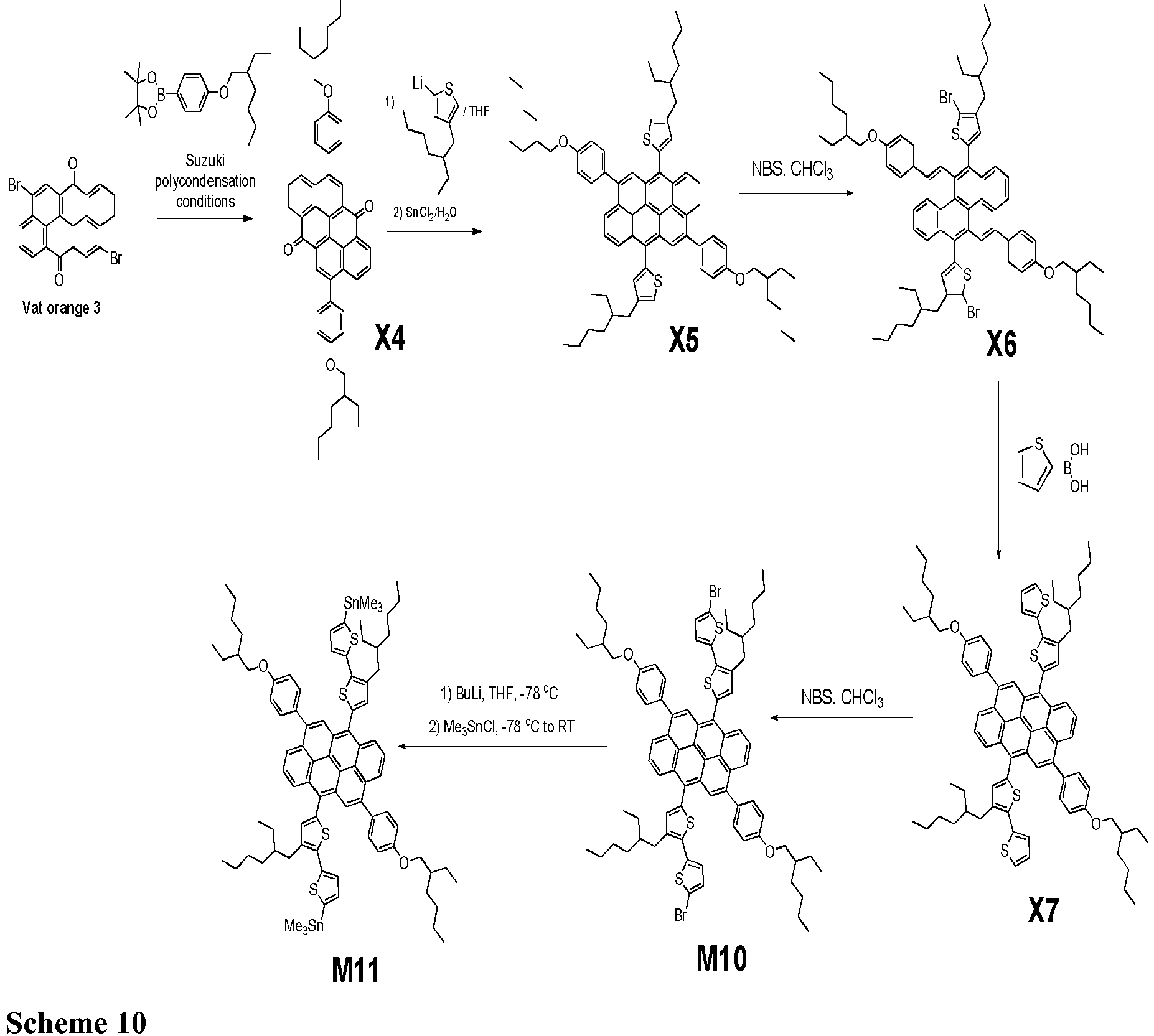
- Monomer M11 (A=SnMe3) can be obtained from M10 using the procedure described above for conversion of M1 to M3 (Scheme 7).
- It will be understood that the specification and examples are illustrative but not limitative of the present invention and that other embodiments within the spirit and scope of the invention will suggest themselves to those skilled in the art.
- Examples will be shown below for illustrating the present invention further in detail, but the present invention is not limited to them.
- The polystyrene-equivalent number average molecular weight and weight average molecular weight were measured by using size exclusion chromatography (SEC) (LC-20AD manufactured by Shimadzu Corporation).
- A polymer of formula (I') to be measured (1 mg) was dissolved in small amount of 1,2-dichlorbenzene (0.2-0.5 mL) and the resulting solution was diluted with 5-10 mL of tetrahydrofuran. The prepared solution was injected in an amount of 20 µL into SES (LC-20AD GPC instrument). Tetrahydrofuran was used as a mobile phase of SEC, the flow rate was 0.3 ml/min. Phenomenex 300x7.8 mm column filled with Phenogel particles (104 Å) was used for analysis. The column was pre-calibrated against a series of polystyrene standards (1000-750000 g/mol, Fluka).
- The conjugated polymer P1 was synthesized according to the following reaction:

- Monomers M1a (922 mg, 1.0 mmol) and M2a (657.6 mg, 1.0 mmol) were introduced into a 50 mL round-bottom three necked flask equipped with a thermometer and reversed condenser. Toluene (25 mL), 2molar aqueous solution of K2CO3 (2 mL), anhydrous ethanol (5 mL), aliquat 336 (1 drop, ca. 80 mg) and tetrakis(triphenylphosphine)palladium(0) (10 mg) were added in the here listed sequence. The reaction mixture was deaerated using repeating cycles of freezing in liquid nitrogen, evacuation, filling with argon, and heating up to room temperature. The reaction flask with the deaerated mixture of reagents was immersed into an oil bath and heated at reflux for 12-24 hours. The molecular weight characteristics of the formed product were controlled every 30 min. The reaction was stopped when the weight average molecular weight Mw showed no increase within 3 hrs. The mixture was cooled down to the room temperature, the polymer was extracted with 500 mL of toluene, the resulting solution was washed 3 times with deionised water (250 mL), dried and concentrated in vacuum (rotary evaporator) to 40 mL. Addition of 150 mL of methanol precipitated the crude polymer. Subsequent purification was achieved using several additional dissolving/precipitation cycles. Finally, the precipitated polymer flakes were filtered out and dried in vacuum. The yield of the purified polymer P1 varied between 70% and 80% depending on the applied number of dissolving/precipitation cycles. The prepared sample of P1 showed the following molecular weight characteristics: Mw=9000 g/mol, Mn=5300 g/mol.
- The conjugated polymer P2 was synthesized according to the following reaction:

- The polymer P2 was synthesized starting from 0.1 mmol of M5a (1.311 g) and 0.1 mmol (388 mg) of M6a. The experimental procedure used for preparation and isolation of the polymer P2 is completely identical to the one described in Example 1 for P1. The prepared sample of polymer P2 showed the following molecular weight characteristics: Mw=40300 g/mol, Mn=24600 g/mol.
- The conjugated polymer P3 was synthesized according to the following reaction:

- The polymer P3 was synthesized starting from 0.1 mmol of M9a (1.489 g) and 0.1 mmol (388 mg) of M6a. The experimental procedure used for preparation and isolation of the polymer P3 is completely identical to the one described in Example 1 for P1. The prepared sample of P3 showed the following molecular weight characteristics: Mw=30000 g/mol, Mn=17100 g/mol.
- The conjugated polymer P4 was synthesized according to the following reaction:

- The polymer P4 was synthesized starting from 0.1 mmol of M10a (1.3957 g) and 0.1 mmol (388 mg) of M6a. The experimental procedure used for preparation and isolation of the polymer P4 is completely identical to the one described in Example 1 for P1. The prepared sample of P4 showed the following molecular weight characteristics: Mw=12200 g/mol, Mn=6500 g/mol.
- A photovoltaic cell, according to the present invention, was constructed in the following way. The patterned ITO-coated glass substrates (25 x 25 mm) were sonicated consecutively with acetone, isopropyl alcohol, and deionized water for 10 min. Subsequently, PEDOT:PSS (Clevios HTL Solar) was spin-coated on the ITO-coated glass substrates at 3000 rpm. The resulting films were dried in air at 180 °C for 15 min. Then the substrates were cooled down to 70 °C (or to the room temperature) and a photoactive blend comprising one of the polymers P1-P4 and fullerene derivative [60]PCBM was deposited on top.
- PEDOT:PSS or poly(3,4-ethylenedioxythiophene) : poly(styrenesulfonate) is a polymer mixture of two ionomers. One component in this mixture is made up of sodium polystyrene sulfonate which is a sulfonated polystyrene. Part of the sulfonyl groups are deprotonated and carry a negative charge. The other component poly(3,4-ethylenedioxythiophene) or PEDOT is a conjugated polymer and carries positive charges and is based on polythiophene. Together the charged macromolecules form a macromolecular salt.
- The photoactive blend solution was prepared as follows. In each case 9 mg of one of the polymers P1, P2, P3 and P4 and fullerene derivative [60]PCBM (9, 18, 27 or 36 mg) were dissolved together in 1,2-dichlorobenzene (DCB). The blend solution was stirred for 36 hrs at 45 °C. The resulting polymer/fullerene solution was filtered through a PTFE syringe (0.4 µm) (PTFE = polytetrafluoroethylene) and spin-coated at 900-1100 rpm for 70 sec. on ITO/PEDOT:PSS substrates. The dried samples were subsequently annealed at 90°C for 5 min in an argon glovebox. The top electrode comprising 20 nm of Ca and 100 nm of Ag was deposited by thermal evaporation in the vacuum of 10-6 mbar.
- The current-voltage (I-V) characteristics of the devices were obtained in dark and under the simulated 100 mW/cm2 AM1.5 solar irradiation provided by a KHS Steuernagel solar simulator obtainable from K.H.Steuernagel Lichttechnik GmbH, Mörfelden-Walldorf, Germany. The intensity of the illumination was checked every time before the measurements using a calibrated silicon diode with known spectral response. The photocurrent spectra were measured with a SR 830 lock-in amplifier ( SRS Inc., Stanford Research Systems, Sunnyvale, California) using the monochromated light from a 150W Xe lamp as excitation. Integration of the experimental IPCE spectra over real AM1.5 irradiation spectrum was used to check the short circuit current densities obtained from the I-V curves (IPCE =Incident photon-to-current efficiency).
- The parameters of the best photovoltaic cells calculated from the current-voltage (I-V) curves are listed in Table 1. It is seen from the table that the best solar cells comprising polymer P3 and [60]PCBM provided JSC (short circuit current density) of 5.5 mA/cm2, VOC (open circuit voltage) of 0.737 V, FF (fill factor) of 34%, and photoelectric conversion efficiency (η) of 1.4%. The I-V curves for the best devices are presented in
Fig. 1 showing dark and light-on I-V curves for a solar battery based on polymer P3 and [60]PCBM.Table 1 Parameters of solar batteries comprising polymers P1-P4 Photoactive layer composition VOC, mV JSC, mA/cm2 FF, % η, % P1+[60]PCBM, 1:3 w/w 690 3.8 37 1.0 P2+[60]PCBM, 1:4 w/w 720 3.9 35 1.0 P3+[60]PCBM, 1:3 w/w 737 5.5 34 1.4 P4+[60]PCBM, 1:2 w/w 660 2.7 36 0.6
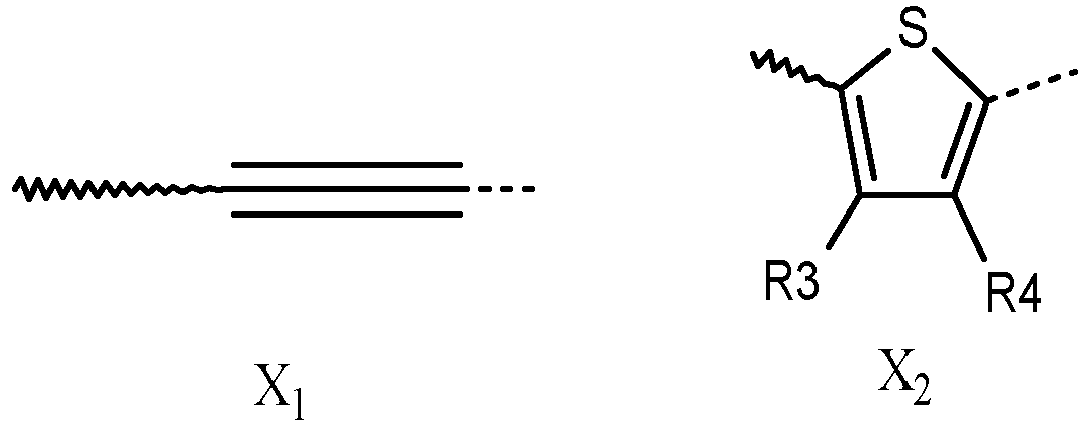

R3 and R4 are the same or mutually different and represent a hydrogen atom, an alkyl group, an alkoxy group or an alkylthio group.


R33 and R44 are the same or mutually different and represent a hydrogen atom, an alkyl group, an alkoxy group or an alkylthio group, with fullerene compounds, preferably with C60 fullerene compounds or C70 fullerene compounds or their derivatives, more preferred with C60 fullerene compounds or their derivatives, most preferred with [60]PCBM.
Claims (15)
- A polymer comprising a conjugated backbone with repeating units represented by formula (I)
-[-X-A-X-]- (I)
containing at least one planar aromatic system A selected from the list


wavy bondshows the attachment positions of X-blocks in formula (I); R represents an aryl or a heteroaryl group which is non-substituted or substituted with a solubilizing group selected from C1-C20 alkyl or C1-C20 alkoxy,R1 represents a C1-C20 alkoxy group or a C1-C20 alkylthio group,X in each case independent from each other represents a divalent acetylene fragment X1 or a thiophene unit X2
represents a wavy bond as the attachment position(s) of A in formula (I) and
R3 and R4 are the same or mutually different and represent a hydrogen atom, an alkyl group, an alkoxy group or an alkylthio group. - A polymer according to Claim 1 characterized in that the repeating unit is represented by formula (II)





wavy bondshows the attachment positions of the acetylene fragment in formula (II); R represents an aryl or a heteroaryl group which is non-substituted or substituted with a solubilizing group selected from C1-C20 alkyl or C1-C20 alkoxy, andR1 represents a C1-C20 alkoxy group or a C1-C20 alkylthio group.
 - A polymer according to Claim 1 characterized in that the repeating unit is represented by
formula (III)


 shows the attachment positions of the thiophene-blocks in formula (III);
 R represents an aryl or a heteroaryl group which is non-substituted or substituted with a solubilizing group selected from C1-C20 alkyl or C1-C20 alkoxy,R1 represents a C1-C20 alkoxy group or a C1-C20 alkylthio group, andR3 and R4 are the same or mutually different and represent independent from each other a hydrogen atom, an alkyl group, an alkoxy group or an alkylthio group.
 - A polymer represented by formula (I')
 A represents a planar aromatic system selected from the list


wavy bondshows the attachment positions of the X-blocks in formula (I'); R represents an aryl or a heteroaryl group which is non-substituted or substituted with a solubilizing group selected from C1-C20 alkyl or C1-C20 alkoxy,R1 represents a C1-C20 alkoxy group or a C1-C20 alkylthio group,Ar1 and Ar2 are the same or mutually different and independent from each other represent A divalent arylene group, a divalent heterocyclic group, or a divalent aromatic amine residue,k represents the number of Ar1 units connected in series in the repeating unit of the conjugated polymer and is a number between 0 and 3, preferably from 1 to 3,m represents a number of Ar2 units connected in series in the repeating unit of the conjugated polymer and is a number between 0 and 3, preferably from 1 to 3;n represents an integer from 2 to 2000, preferably from 2 to 200,EG1 and EG2 are the end groups of the polymer and independent from each other they represent a hydrogen, a halogen, a trialkylstannyl unit (-Sn(Alkyl)3), a boronic acid unit(-B(OH)2), a boronic ester unit (-B(OAlkyl)2), an aryl unit or a heteroaryl unit andX represents in each case independent from each other a divalent acetylene fragment X1 or a thiophene unit X2
represents a wavy bond as the attachment position(s) of and R3 and R4 are the same or mutually different and represent a hydrogen atom, an alkyl group, an alkoxy group or an alkylthio group.
 - A polymer according to Claim 4, characterized in that Ar1 or Ar2 in formula (I'), the divalent arylene group, is selected from the group


- A polymer according to Claim 4, characterized in that Ar1 or Ar2 in formula (I'), the
divalent heterocyclic group, is selected from heterocycles from the group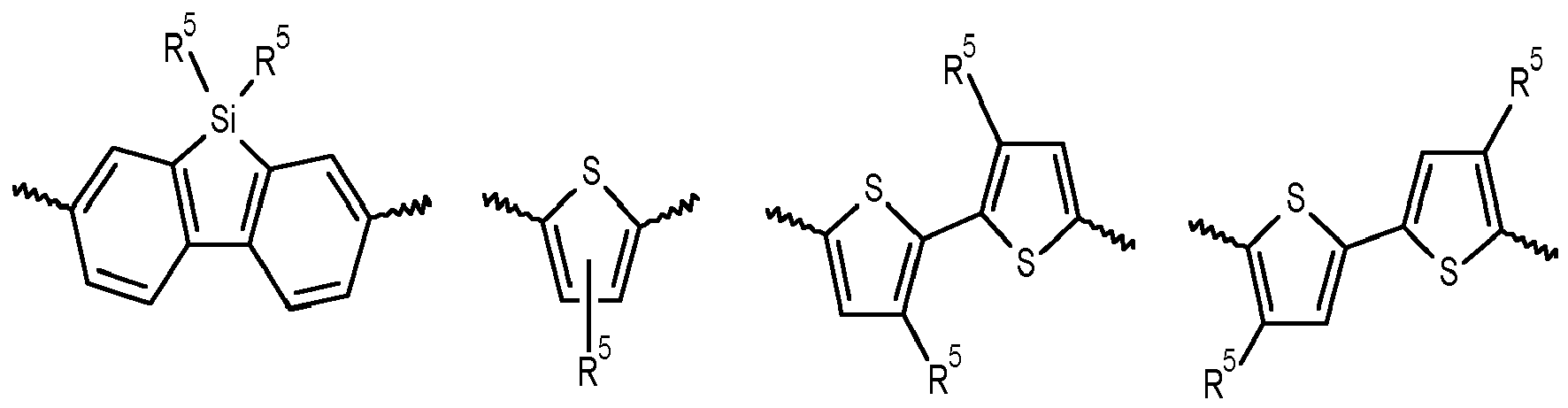


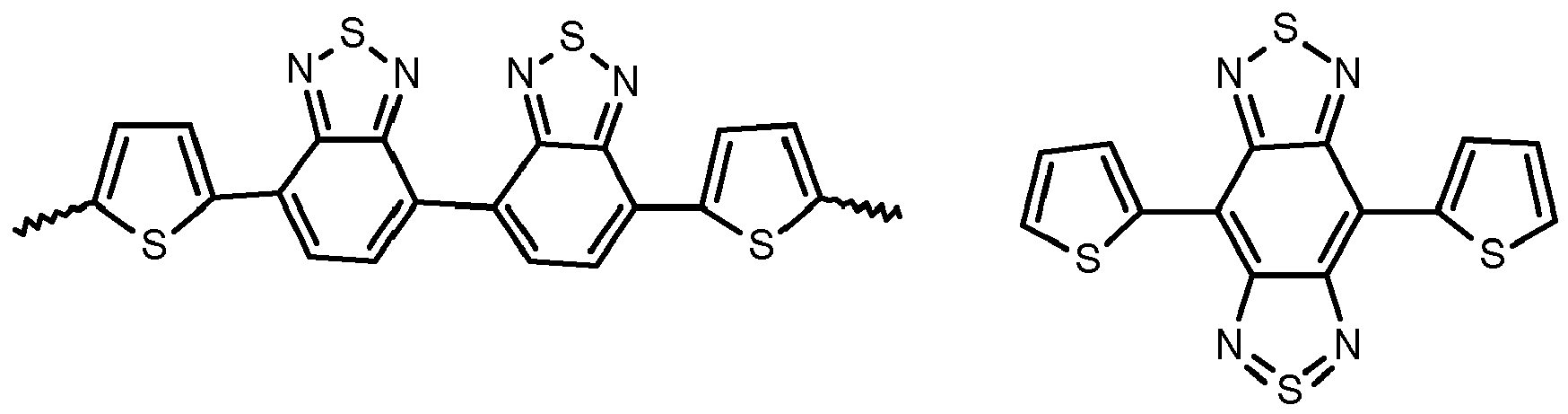


- A polymer according to Claim 4, characterized in that Ar1 or Ar2 in formula (I'), the divalent aromatic amine residue, is selected from the group


- A polymer according to one of Claims 4 to 7, characterized in that those comprise in their repeating unit at least one planar aromatic ring system A represented by formulas (IIa), (IIb), (IIc) or (IId):


- A polymer according to Claim 8, characterized in that R in formulas (IIa), (IIb), (IIc) and (IId) represents an aryl group selected from the list:
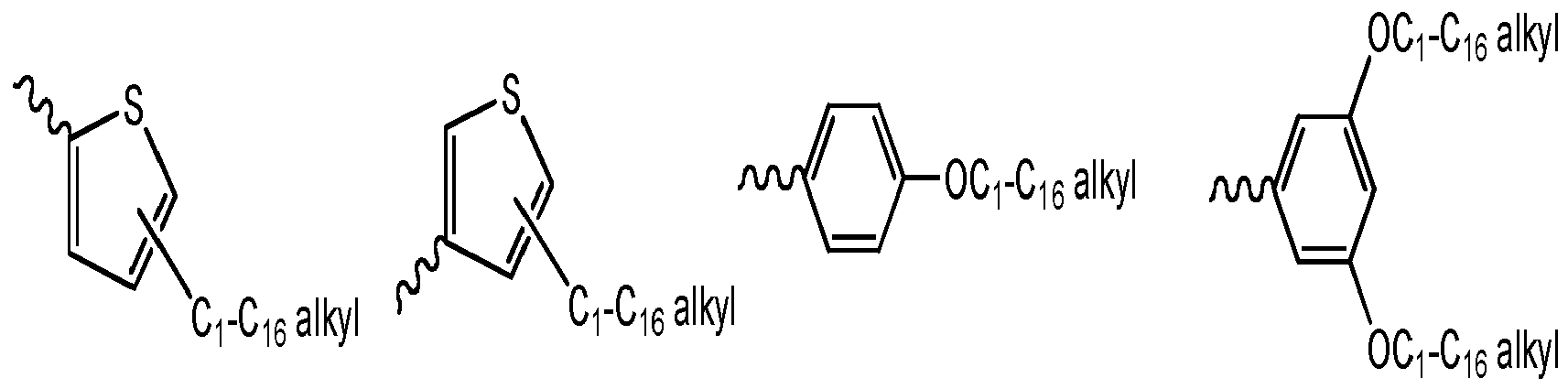
- A polymer characterized by a formula of the group (II'a), (II'b), (II'c) or (II'd)


in each case Ar1 and Ar2 are the same or mutually different and independent from each other represent a divalent arylene group, a divalent heterocyclic group, or a divalent aromatic amine residue,
k represents in each case a number of Ar1 units connected in series in the repeating unit of the conjugated polymer, preferably k is an integer from the numbers 0, 1, 2 or 3; and when k = 0 the polymer compound does not comprise an Ar1 moiety;
m represents in each case a number of Ar2 units connected in series in the repeating unit of the conjugated polymer, preferably m is an integer from the numbers 0, 1, 2 or 3; and when m = 0 the polymer compound does not comprise an Ar2 moiety;
n is a number of repeating units, preferably an integer in the range from 2 to 2000,
EG1 and EG2 are the end groups of the respective polymer and in each case independent from each other those are selected from the group hydrogen, halogen, a trialkylstannyl group (-Sn(Alkyl)3), a boronic acid group (-B(OH)2), a boronic ester group (-B(OAlkyl)2), an aryl unit or a heteroaryl unit. - A polymer characterized by formulas (III'a), (III'b), (III'c) or (III'd)


in each case Ar1 and Ar2 are the same or mutually different and represent independent from each other a divalent arylene group, a divalent heterocyclic group, or a divalent aromatic amine residue,
k represents in each case is the number of Ar1 units connected in series in the repeating unit of the conjugated polymer, preferably k is an integer from the numbers 0, 1, 2 or 3; and when k = 0 the polymer compound does not comprise an Ar1 moiety;
m in each case represents the number of Ar2 units connected in series in the repeating unit of the conjugated polymer, preferably m is an integer from the numbers 0, 1, 2 or 3; and when m = 0 the polymer compound does not comprise an Ar2 moiety;
n in each case is the number of repeating units, preferably an integer in the range from 2 to 2000,
R in each case represents an aryl or a heteroaryl group which is non-substituted or substituted with at least one solubilizing group selected from C1-C20 alkyl or C1-C20 alkoxy groups and R3 in each case represents a hydrogen atom, an alkyl group, an alkoxy group or an alkylthio group, preferably R3 represents a C1-C20 alkyl or a C1-C20 alkoxy group,
EG1 and EG2 in each case are the end groups of the respective polymer and independent from each other they represent hydrogen, halogen, a trialkylstannyl group (-Sn(Alkyl)3), a boronic acid group (-B(OH)2), a boronic ester group (-B(OAlkyl)2), an aryl unit or a heteroaryl unit. - Combinations of at least one polymer represented by formula (I')
 a represents a planar aromatic system selected from the list


 shows the attachment positions of X-blocks in formula (I');
 R represents an aryl or a heteroaryl group which is non-substituted or substituted with a solubilizing group selected from C1-C20 alkyl or C1-C20 alkoxy,R1 represents a C1-C20 alkoxy group or a C1-C20 alkylthio group,Ar1 and Ar2 are the same or mutually different and independent from each other represent A divalent arylene group, a divalent heterocyclic group, or a divalent aromatic amine residue,k represents the number of Ar1 units connected in series in the repeating unit of the conjugated polymer and is a number between 0 and 3,m represents a number of Ar2 units connected in series in the repeating unit of the conjugated polymer and is a number between 0 and 3,n represents an integer from 2 to 2000,EG1 and EG2 are the end groups of the polymer and independent from each other they represent a hydrogen, a halogen, a trialkylstannyl unit (-Sn(Alkyl)3), a boronic acid unit(-B(OH)2), a boronic ester unit (-B(OAlkyl)2), an aryl unit or a heteroaryl unit andX represents in each case independent from each other a divalent acetylene fragment X1 or a thiophene unit X2,
represents a wavy bond as the attachment position(s) of A and R3 and R4 are the same or mutually different and represent a hydrogen atom, an alkyl group, an alkoxy group or an alkylthio group,
with at least one fullerene compound, preferably with at least one C60 fullerene compound or at least one C70 fullerene compound or their derivatives, more preferred with at least one C60 fullerene compound or its derivatives, most preferred with [60]PCBM. - A process for the manufacture of polymers of formula (I')
 A represents a planar aromatic system selected from the list


 shows the attachment positions of X-blocks in formula (I');
 R represents an aryl or a heteroaryl group which is non-substituted or substituted with a solubilizing group selected from C1-C20 alkyl or C1-C20 alkoxy,R1 represents a C1-C20 alkoxy group or a C1-C20 alkylthio group, Ar1 and Ar2 are the same or mutually different and independent from each other represent a divalent arylene group, a divalent heterocyclic group, or a divalent aromatic amine residue,k represents the number of Ar1 units connected in series in the repeating unit of the conjugated polymer and is a number between 0 and 3, preferably from 1 to 3,m represents a number of Ar2 units connected in series in the repeating unit of the conjugated polymer and is a number between 0 and 3, preferably from 1 to 3;n represents an integer from 2 to 2000, preferably from 2 to 200,EG1 and EG2 are the end groups of the polymer and independent from each other they represent a hydrogen, a halogen, a trialkylstannyl unit (-Sn(Alkyl)3), a boronic acid unit(-B(OH)2), a boronic ester unit (-B(OAlkyl)2), an aryl unit or a heteroaryl unit andX represents in each case independent from each other a divalent acetylene fragment X1 or a thiophene unit X2,
 represents a wavy bond as the attachment position(s) of A and
 R3 and R4 are the same or mutually different and represent a hydrogen atom, an alkyl group, an alkoxy group or an alkylthio group, characterized in that Suzuki or Stille polycondensation reaction is involved to link the monomers together thus forming a conjugated polymer.
 - Use of polymers represented by formula (I')
 A represents a planar aromatic system selected from the list
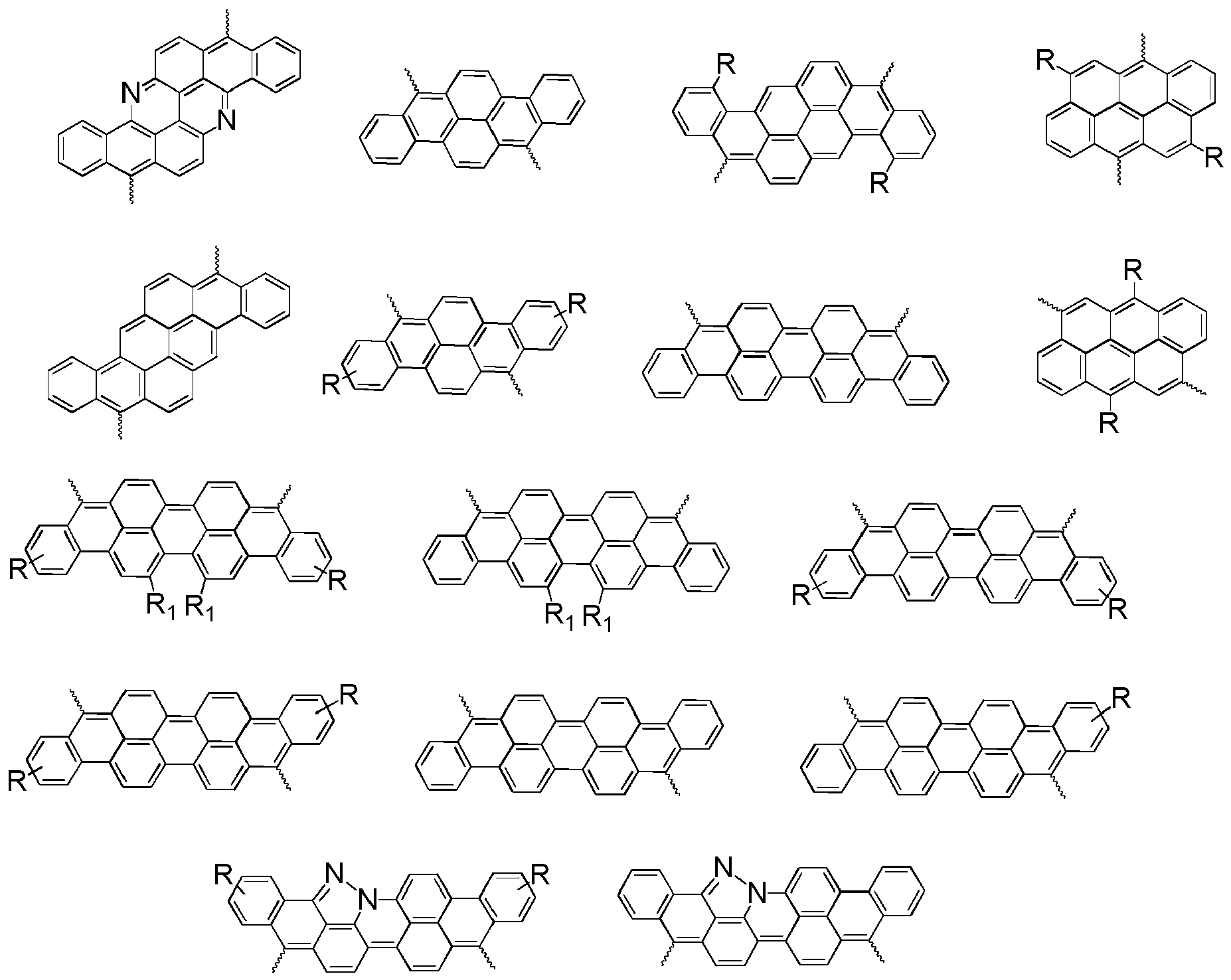 shows the attachment positions of X-blocks in formula (I');
 R represents an aryl or a heteroaryl group which is non-substituted or substituted with a solubilizing group selected from C1-C20 alkyl or C1-C20 alkoxy,R1 represents a C1-C20 alkoxy group or a C1-C20 alkylthio group, Ar1 and Ar2 are the same or mutually different and independent from each other represent a divalent arylene group, a divalent heterocyclic group, or a divalent aromatic amine residue,k represents the number of Ar1 units connected in series in the repeating unit of the conjugated polymer and is a number between 0 and 3, preferably from 1 to 3,m represents a number of Ar2 units connected in series in the repeating unit of the conjugated polymer and is a number between 0 and 3,n represents an integer from 2 to 2000,EG1 and EG2 are the end groups of the polymer and independent from each other they represent a hydrogen, a halogen, a trialkylstannyl unit (-Sn(Alkyl)3), a boronic acid unit(-B(OH)2), a boronic ester unit (-B(OAlkyl)2), an aryl unit or a heteroaryl unit andX represents in each case independent from each other a divalent acetylene fragment X1 or a thiophene unit X2
represents a wavy bond as the attachment position(s) of A and
R3 and R4 are the same or mutually different and represent a hydrogen atom, an alkyl group, an alkoxy group or an alkylthio group,
in optoelectronic devices, preferably in batteries or in photovoltaic devices. - Use according to Claim 14 characterized in that combinations of at least one polymer represented by formula (I')
 A represents a planar aromatic system selected from the listwavy bond


 shows the attachment positions of X-blocks in formula (I');
 R represents an aryl or a heteroaryl group which is non-substituted or substituted with a solubilizing group selected from C1-C20 alkyl or C1-C20 alkoxy,R1 represents a C1-C20 alkoxy group or a C1-C20 alkylthio group, Ar1 and Ar2 are the same or mutually different and independent from each other represent a divalent arylene group, a divalent heterocyclic group, or a divalent aromatic amine residue,k represents the number of Ar1 units connected in series in the repeating unit of the conjugated polymer and is a number between 0 and 3,m represents a number of Ar2 units connected in series in the repeating unit of the conjugated polymer and is a number between 0 and 3n represents an integer from 2 to 2000,EG1 and EG2 are the end groups of the polymer and independent from each other they represent a hydrogen, a halogen, a trialkylstannyl unit (-Sn(Alkyl)3), a boronic acid unit(-B(OH)2), a boronic ester unit (-B(OAlkyl)2), an aryl unit or a heteroaryl unit andX represents in each case independent from each other a divalent acetylene fragment X1 or a thiophene unit X2,wherein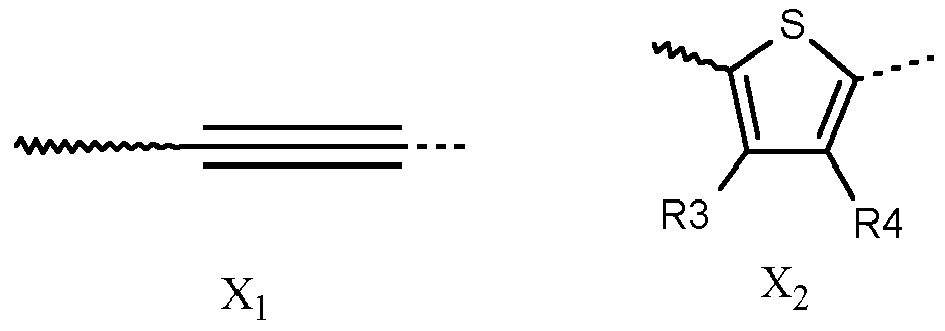
represents a wavy bond as the attachment position(s) of A and
R3 and R4 are the same or mutually different and represent a hydrogen atom, an alkyl group, an alkoxy group or an alkylthio group,
with at least one fullerene compound, preferably with at least one C60 fullerene compound or at least one C70 fullerene compound or their derivatives, more preferred with at least one C60 fullerene compound or its derivatives, most preferred with [60]PCBM, are applied.
Priority Applications (2)
| Application Number | Priority Date | Filing Date | Title |
|---|---|---|---|
| EP20130179740 EP2835407A1 (en) | 2013-08-08 | 2013-08-08 | Conjugated polymer compounds |
| PCT/RU2014/000596 WO2015020572A1 (en) | 2013-08-08 | 2014-08-07 | Conjugated polymers |
Applications Claiming Priority (1)
| Application Number | Priority Date | Filing Date | Title |
|---|---|---|---|
| EP20130179740 EP2835407A1 (en) | 2013-08-08 | 2013-08-08 | Conjugated polymer compounds |
Publications (1)
| Publication Number | Publication Date |
|---|---|
| EP2835407A1 true EP2835407A1 (en) | 2015-02-11 |
Family
ID=48948307
Family Applications (1)
| Application Number | Title | Priority Date | Filing Date |
|---|---|---|---|
| EP20130179740 Withdrawn EP2835407A1 (en) | 2013-08-08 | 2013-08-08 | Conjugated polymer compounds |
Country Status (2)
| Country | Link |
|---|---|
| EP (1) | EP2835407A1 (en) |
| WO (1) | WO2015020572A1 (en) |
Cited By (3)
| Publication number | Priority date | Publication date | Assignee | Title |
|---|---|---|---|---|
| CN114085360A (en) * | 2021-10-12 | 2022-02-25 | 中国科学院大学 | A Narrow Band Gap Conjugated Polymer and Its Preparation of Organic Photoelectric Synapse Devices |
| CN115232322A (en) * | 2022-08-04 | 2022-10-25 | 大连海洋大学 | Preparation method and application of organic conjugated polymer |
| CN116240573A (en) * | 2023-03-16 | 2023-06-09 | 陕西科技大学 | Boron-doped fullerene amine loaded metal nanoparticle electrocatalyst and preparation method thereof |
Families Citing this family (3)
| Publication number | Priority date | Publication date | Assignee | Title |
|---|---|---|---|---|
| JP6646649B2 (en) * | 2014-10-22 | 2020-02-14 | レイナジー テック インコーポレイション | Conjugated polymers based on terthiophene and their applications |
| US11005042B2 (en) * | 2015-12-10 | 2021-05-11 | Merck Patent Gmbh | Formulations containing ketones comprising non-aromatic cycles |
| CN112409387B (en) * | 2020-11-23 | 2023-05-23 | 东华理工大学 | A-D-A organic micromolecule photovoltaic material taking reduction orange 1 as central core |
Citations (6)
| Publication number | Priority date | Publication date | Assignee | Title |
|---|---|---|---|---|
| EP0044686A1 (en) | 1980-07-17 | 1982-01-27 | EASTMAN KODAK COMPANY (a New Jersey corporation) | Organic electroluminescent cell, process for manufacturing the cell and its use |
| EP0120673A2 (en) | 1983-03-25 | 1984-10-03 | EASTMAN KODAK COMPANY (a New Jersey corporation) | Organic electroluminescent devices having improved power conversion efficiencies |
| US20050048313A1 (en) * | 2003-08-29 | 2005-03-03 | Fujitsu Limited | Fluorescent material, organic electroluminescent element and organic electroluminescent display |
| US20050212409A1 (en) * | 2004-03-23 | 2005-09-29 | Jianmmin Shi | Organic luminescent materials |
| US20050214566A1 (en) * | 2004-03-23 | 2005-09-29 | Jianmin Shi | Organic electroluminescent devices |
| GB2483628A (en) * | 2010-06-25 | 2012-03-21 | Cambridge Display Tech Ltd | Organic Light-Emitting Composition |
Family Cites Families (1)
| Publication number | Priority date | Publication date | Assignee | Title |
|---|---|---|---|---|
| EP2730633A1 (en) * | 2012-11-07 | 2014-05-14 | LANXESS Deutschland GmbH | Polymer compound and its use in photovoltaic devices |
-
2013
- 2013-08-08 EP EP20130179740 patent/EP2835407A1/en not_active Withdrawn
-
2014
- 2014-08-07 WO PCT/RU2014/000596 patent/WO2015020572A1/en not_active Ceased
Patent Citations (6)
| Publication number | Priority date | Publication date | Assignee | Title |
|---|---|---|---|---|
| EP0044686A1 (en) | 1980-07-17 | 1982-01-27 | EASTMAN KODAK COMPANY (a New Jersey corporation) | Organic electroluminescent cell, process for manufacturing the cell and its use |
| EP0120673A2 (en) | 1983-03-25 | 1984-10-03 | EASTMAN KODAK COMPANY (a New Jersey corporation) | Organic electroluminescent devices having improved power conversion efficiencies |
| US20050048313A1 (en) * | 2003-08-29 | 2005-03-03 | Fujitsu Limited | Fluorescent material, organic electroluminescent element and organic electroluminescent display |
| US20050212409A1 (en) * | 2004-03-23 | 2005-09-29 | Jianmmin Shi | Organic luminescent materials |
| US20050214566A1 (en) * | 2004-03-23 | 2005-09-29 | Jianmin Shi | Organic electroluminescent devices |
| GB2483628A (en) * | 2010-06-25 | 2012-03-21 | Cambridge Display Tech Ltd | Organic Light-Emitting Composition |
Non-Patent Citations (20)
| Title |
|---|
| "Design and Synthesis of Conjugated Polymers", 2010, WILEY INTERSCIENCE, pages: 45 - 98 |
| "Lange's Handbook of Chemistry", 1979, MCGRAW HILL |
| "Topics in Current Chemistry", vol. 266, 2006, article "Microwave Methods in Organic Synthesis", pages: 103 - 144 |
| A. SUZUKI, ACC. CHEM. RES., vol. 15, 1982, pages 178 - 184 |
| ANDREW C GRIMSDALE ET AL: "Synthesis of Light-Emitting Conjugated Polymers for Applications in Electroluminescent Devices", CHEMICAL REVIEWS, AMERICAN CHEMICAL SOCIETY, US, vol. 109, 1 February 2009 (2009-02-01), pages 897 - 1091, XP009133687, ISSN: 0009-2665, DOI: 10.1021/CR000013V * |
| BIPIN K. SHAH ET AL: "Anthanthrene Derivatives as Blue Emitting Materials for Organic Light-Emitting Diode Applications", CHEMISTRY OF MATERIALS, vol. 18, no. 3, 1 February 2006 (2006-02-01), pages 603 - 608, XP055117953, ISSN: 0897-4756, DOI: 10.1021/cm052188x * |
| BIPIN K. SHAH ET AL: "Photophysical Properties of Anthanthrene-Based Tunable Blue Emitters", THE JOURNAL OF PHYSICAL CHEMISTRY A, vol. 109, no. 34, 1 September 2005 (2005-09-01), pages 7677 - 7681, XP055117955, ISSN: 1089-5639, DOI: 10.1021/jp052337z * |
| C. DUAN, J. MATER. CHEM., vol. 22, 2012, pages 10416 - 10434 |
| D. A. M. EGBE, MACROMOLECULES, vol. 37, 2004, pages 7451 |
| F. C. KREBS, SOLAR ENERGY MATERIALS & SOLAR CELLS, vol. 93, 2009, pages 394 - 412 |
| F. HE, J. AM. CHEM. SOC., vol. 133, 2011, pages 3284 - 3287 |
| H. ZHOU, MACROMOLECULES, vol. 45, 2012, pages 607 - 632 |
| JEAN-BENOÎT GIGUÈRE ET AL: "Cruciform Alkynylated Anthanthrene Derivatives: A Structure-Properties Relationship Case Study", THE JOURNAL OF ORGANIC CHEMISTRY, vol. 79, no. 6, 21 March 2014 (2014-03-21), pages 2404 - 2418, XP055117950, ISSN: 0022-3263, DOI: 10.1021/jo402674m * |
| JIANMIN SHI ET AL: "61.4: Anthanthrene Derivatives for Stable Blue-Emitting Organic Electroluminescent Devices", 2005 SID INTERNATIONAL SYMPOSIUM. BOSTON, MA, MAY 24 - 27, 2005; [SID INTERNATIONAL SYMPOSIUM], SAN JOSE, CA : SID, US, vol. XXXVI, 24 May 2005 (2005-05-24), pages 1760 - 1763, XP007012392 * |
| KATRITZKY, A.R; LAGOWSKI, J.M.: "Heterocyclic Chemistry", 1960, JOHN WILEY & SONS |
| P. A. TROSHIN, ADV. ENERG. MATER., vol. 3, 2013, pages 161 - 166 |
| SCIENCE, vol. 270, 1995, pages 1789 |
| SYNTH. MET., vol. 102, 1999, pages 982 |
| Y. LEE, J. MATER. CHEM., vol. 21, 2011, pages 8583 - 8590 |
| Z.-G. ZHANG, J. MATER. CHEM., vol. 22, 2012, pages 4178 - 4187 |
Cited By (4)
| Publication number | Priority date | Publication date | Assignee | Title |
|---|---|---|---|---|
| CN114085360A (en) * | 2021-10-12 | 2022-02-25 | 中国科学院大学 | A Narrow Band Gap Conjugated Polymer and Its Preparation of Organic Photoelectric Synapse Devices |
| CN114085360B (en) * | 2021-10-12 | 2023-08-01 | 中国科学院大学 | Narrow band gap conjugated polymer and organic photoelectric synaptic device prepared from same |
| CN115232322A (en) * | 2022-08-04 | 2022-10-25 | 大连海洋大学 | Preparation method and application of organic conjugated polymer |
| CN116240573A (en) * | 2023-03-16 | 2023-06-09 | 陕西科技大学 | Boron-doped fullerene amine loaded metal nanoparticle electrocatalyst and preparation method thereof |
Also Published As
| Publication number | Publication date |
|---|---|
| WO2015020572A1 (en) | 2015-02-12 |
Similar Documents
| Publication | Publication Date | Title |
|---|---|---|
| KR101763954B1 (en) | Conjugated polymers and their use in optoelectronic devices | |
| EP2630676B1 (en) | Conjugated polymers and their use in optoelectronic devices | |
| EP2550688B1 (en) | Pyrrolo[3,2-b]pyrrole semiconducting compounds and devices incorporating same | |
| US9472764B2 (en) | Conjugated polymers and their use in optoelectronic devices | |
| EP2626375A1 (en) | Semiconductor materials prepared from dithienylvinylene copolymers | |
| EP2438104B1 (en) | Fused bithiophene-vinylene polymers | |
| WO2010117449A2 (en) | Semiconducting compounds and devices incorporating same | |
| EP2828904A1 (en) | Conjugated polymers and their use in optoelectronic devices | |
| WO2015020572A1 (en) | Conjugated polymers | |
| EP2730600A1 (en) | Conjugated polymer compound comprising 1,2,3-Benzothiadiazole units and its use in photovoltaic devices | |
| Kim et al. | Synthesis and characterization of indeno [1, 2-b] fluorene-based low bandgap copolymers for photovoltaic cells | |
| RU2641103C2 (en) | Polymeric compound and its application in photovoltaic devices | |
| EP2730632A1 (en) | Polymer compound and its use in photovoltaic devices | |
| Ye et al. | Conjugated polymers for organic solar cells | |
| JP2015183032A (en) | Polymer having condensed ring type cyclopenta-dithiophene skeleton and organic thin-film solar battery material using the same | |
| Wang et al. | The effect of intramolecular donor-acceptor moieties with donor-π-bridge-acceptor structure on the solar photovoltaic performance. | |
| 유태웅 | Effects of Different Chalcogen Atom Substitution in Electron Rich Unit of Isoindigo-based Conjugated Copolymer on Photovoltaic Properties | |
| Kim | Investigations of the Interplay of Molecule Structures, Crystal Packing, Solar Cell, and Field-Effect Transistor Characteristics in Novel Polymeric Semiconductors |
Legal Events
| Date | Code | Title | Description |
|---|---|---|---|
| PUAI | Public reference made under article 153(3) epc to a published international application that has entered the european phase |
Free format text: ORIGINAL CODE: 0009012 |
|
| 17P | Request for examination filed |
Effective date: 20130808 |
|
| AK | Designated contracting states |
Kind code of ref document: A1 Designated state(s): AL AT BE BG CH CY CZ DE DK EE ES FI FR GB GR HR HU IE IS IT LI LT LU LV MC MK MT NL NO PL PT RO RS SE SI SK SM TR |
|
| AX | Request for extension of the european patent |
Extension state: BA ME |
|
| STAA | Information on the status of an ep patent application or granted ep patent |
Free format text: STATUS: THE APPLICATION IS DEEMED TO BE WITHDRAWN |
|
| 18D | Application deemed to be withdrawn |
Effective date: 20150812 |