EP2835375A1 - Bis-salphen compounds and carbonaceous material composites comprising them - Google Patents
Bis-salphen compounds and carbonaceous material composites comprising them Download PDFInfo
- Publication number
- EP2835375A1 EP2835375A1 EP13382322.9A EP13382322A EP2835375A1 EP 2835375 A1 EP2835375 A1 EP 2835375A1 EP 13382322 A EP13382322 A EP 13382322A EP 2835375 A1 EP2835375 A1 EP 2835375A1
- Authority
- EP
- European Patent Office
- Prior art keywords
- iii
- phenyl
- halogen
- polymer
- carbonaceous material
- Prior art date
- Legal status (The legal status is an assumption and is not a legal conclusion. Google has not performed a legal analysis and makes no representation as to the accuracy of the status listed.)
- Withdrawn
Links
- 239000003575 carbonaceous material Substances 0.000 title claims abstract description 100
- 239000002131 composite material Substances 0.000 title description 39
- 239000000203 mixture Substances 0.000 claims abstract description 128
- 150000001875 compounds Chemical class 0.000 claims abstract description 116
- -1 ca(II) Chemical compound 0.000 claims abstract description 94
- 238000000034 method Methods 0.000 claims abstract description 37
- 239000006185 dispersion Substances 0.000 claims abstract description 30
- 239000002612 dispersion medium Substances 0.000 claims abstract description 18
- PTFCDOFLOPIGGS-UHFFFAOYSA-N Zinc dication Chemical compound [Zn+2] PTFCDOFLOPIGGS-UHFFFAOYSA-N 0.000 claims abstract description 14
- WAEMQWOKJMHJLA-UHFFFAOYSA-N Manganese(2+) Chemical compound [Mn+2] WAEMQWOKJMHJLA-UHFFFAOYSA-N 0.000 claims abstract description 13
- CWYNVVGOOAEACU-UHFFFAOYSA-N Fe2+ Chemical compound [Fe+2] CWYNVVGOOAEACU-UHFFFAOYSA-N 0.000 claims abstract description 11
- XLJKHNWPARRRJB-UHFFFAOYSA-N cobalt(2+) Chemical compound [Co+2] XLJKHNWPARRRJB-UHFFFAOYSA-N 0.000 claims abstract description 11
- 229910021645 metal ion Inorganic materials 0.000 claims abstract description 11
- VTLYFUHAOXGGBS-UHFFFAOYSA-N Fe3+ Chemical compound [Fe+3] VTLYFUHAOXGGBS-UHFFFAOYSA-N 0.000 claims abstract description 9
- PWHULOQIROXLJO-UHFFFAOYSA-N Manganese Chemical compound [Mn] PWHULOQIROXLJO-UHFFFAOYSA-N 0.000 claims abstract description 9
- BFGKITSFLPAWGI-UHFFFAOYSA-N chromium(3+) Chemical compound [Cr+3] BFGKITSFLPAWGI-UHFFFAOYSA-N 0.000 claims abstract description 9
- 150000004696 coordination complex Chemical class 0.000 claims abstract description 9
- WXHIJDCHNDBCNY-UHFFFAOYSA-N palladium dihydride Chemical compound [PdH2] WXHIJDCHNDBCNY-UHFFFAOYSA-N 0.000 claims abstract description 9
- 239000002270 dispersing agent Substances 0.000 claims abstract description 8
- CKHJYUSOUQDYEN-UHFFFAOYSA-N gallium(3+) Chemical compound [Ga+3] CKHJYUSOUQDYEN-UHFFFAOYSA-N 0.000 claims abstract description 8
- MILUBEOXRNEUHS-UHFFFAOYSA-N iridium(3+) Chemical compound [Ir+3] MILUBEOXRNEUHS-UHFFFAOYSA-N 0.000 claims abstract description 8
- MMIPFLVOWGHZQD-UHFFFAOYSA-N manganese(3+) Chemical compound [Mn+3] MMIPFLVOWGHZQD-UHFFFAOYSA-N 0.000 claims abstract description 8
- 230000006872 improvement Effects 0.000 claims abstract description 5
- 229910052759 nickel Inorganic materials 0.000 claims abstract description 5
- 229920000642 polymer Polymers 0.000 claims description 91
- OKTJSMMVPCPJKN-UHFFFAOYSA-N Carbon Chemical compound [C] OKTJSMMVPCPJKN-UHFFFAOYSA-N 0.000 claims description 82
- 239000002904 solvent Substances 0.000 claims description 59
- 239000002041 carbon nanotube Substances 0.000 claims description 54
- 229910021393 carbon nanotube Inorganic materials 0.000 claims description 51
- 229910052736 halogen Inorganic materials 0.000 claims description 40
- 150000002367 halogens Chemical class 0.000 claims description 40
- 125000001072 heteroaryl group Chemical group 0.000 claims description 40
- 125000001997 phenyl group Chemical group [H]C1=C([H])C([H])=C(*)C([H])=C1[H] 0.000 claims description 39
- 125000004169 (C1-C6) alkyl group Chemical group 0.000 claims description 37
- 229920000402 bisphenol A polycarbonate polymer Polymers 0.000 claims description 27
- 125000004093 cyano group Chemical group *C#N 0.000 claims description 26
- 125000000449 nitro group Chemical group [O-][N+](*)=O 0.000 claims description 26
- 229920000515 polycarbonate Polymers 0.000 claims description 24
- 239000004417 polycarbonate Substances 0.000 claims description 23
- 125000003118 aryl group Chemical group 0.000 claims description 19
- 229910052757 nitrogen Inorganic materials 0.000 claims description 17
- 229910052760 oxygen Inorganic materials 0.000 claims description 17
- 229910052717 sulfur Inorganic materials 0.000 claims description 17
- 229920001577 copolymer Polymers 0.000 claims description 16
- 125000004435 hydrogen atom Chemical class [H]* 0.000 claims description 15
- 125000004432 carbon atom Chemical group C* 0.000 claims description 14
- 125000005842 heteroatom Chemical group 0.000 claims description 14
- JPVYNHNXODAKFH-UHFFFAOYSA-N Cu2+ Chemical compound [Cu+2] JPVYNHNXODAKFH-UHFFFAOYSA-N 0.000 claims description 13
- 239000004952 Polyamide Substances 0.000 claims description 12
- 229910052799 carbon Inorganic materials 0.000 claims description 12
- 229920002647 polyamide Polymers 0.000 claims description 12
- 125000003178 carboxy group Chemical group [H]OC(*)=O 0.000 claims description 11
- 229910021389 graphene Inorganic materials 0.000 claims description 11
- 125000001931 aliphatic group Chemical group 0.000 claims description 10
- 229910002804 graphite Inorganic materials 0.000 claims description 10
- 239000010439 graphite Substances 0.000 claims description 10
- 239000004814 polyurethane Substances 0.000 claims description 10
- 229920002635 polyurethane Polymers 0.000 claims description 10
- 229910003481 amorphous carbon Inorganic materials 0.000 claims description 9
- 229910052739 hydrogen Inorganic materials 0.000 claims description 9
- 239000001257 hydrogen Substances 0.000 claims description 9
- 239000004793 Polystyrene Substances 0.000 claims description 8
- 229920001470 polyketone Polymers 0.000 claims description 8
- 229920002223 polystyrene Polymers 0.000 claims description 8
- 229920000139 polyethylene terephthalate Polymers 0.000 claims description 7
- 239000005020 polyethylene terephthalate Substances 0.000 claims description 7
- 229920000128 polypyrrole Polymers 0.000 claims description 7
- 125000006552 (C3-C8) cycloalkyl group Chemical group 0.000 claims description 6
- XMWRBQBLMFGWIX-UHFFFAOYSA-N C60 fullerene Chemical class C12=C3C(C4=C56)=C7C8=C5C5=C9C%10=C6C6=C4C1=C1C4=C6C6=C%10C%10=C9C9=C%11C5=C8C5=C8C7=C3C3=C7C2=C1C1=C2C4=C6C4=C%10C6=C9C9=C%11C5=C5C8=C3C3=C7C1=C1C2=C4C6=C2C9=C5C3=C12 XMWRBQBLMFGWIX-UHFFFAOYSA-N 0.000 claims description 6
- 229920000089 Cyclic olefin copolymer Polymers 0.000 claims description 6
- 239000005977 Ethylene Substances 0.000 claims description 6
- LYCAIKOWRPUZTN-UHFFFAOYSA-N Ethylene glycol Chemical compound OCCO LYCAIKOWRPUZTN-UHFFFAOYSA-N 0.000 claims description 6
- 125000000592 heterocycloalkyl group Chemical group 0.000 claims description 6
- 229920003229 poly(methyl methacrylate) Polymers 0.000 claims description 6
- 229920001197 polyacetylene Polymers 0.000 claims description 6
- 239000004926 polymethyl methacrylate Substances 0.000 claims description 6
- 229920006324 polyoxymethylene Polymers 0.000 claims description 6
- 229920001296 polysiloxane Polymers 0.000 claims description 6
- UFHFLCQGNIYNRP-UHFFFAOYSA-N Hydrogen Chemical compound [H][H] UFHFLCQGNIYNRP-UHFFFAOYSA-N 0.000 claims description 5
- 229920000331 Polyhydroxybutyrate Polymers 0.000 claims description 5
- 150000002148 esters Chemical class 0.000 claims description 5
- 229910003472 fullerene Inorganic materials 0.000 claims description 5
- 125000000524 functional group Chemical group 0.000 claims description 5
- 229920000554 ionomer Polymers 0.000 claims description 5
- 239000005015 poly(hydroxybutyrate) Substances 0.000 claims description 5
- 229920002492 poly(sulfone) Polymers 0.000 claims description 5
- 229930040373 Paraformaldehyde Natural products 0.000 claims description 4
- 229920001609 Poly(3,4-ethylenedioxythiophene) Polymers 0.000 claims description 4
- 229920000491 Polyphenylsulfone Polymers 0.000 claims description 4
- 125000003545 alkoxy group Chemical group 0.000 claims description 4
- 150000001412 amines Chemical class 0.000 claims description 4
- 229920000775 emeraldine polymer Polymers 0.000 claims description 4
- 229920000767 polyaniline Polymers 0.000 claims description 4
- 125000004469 siloxy group Chemical group [SiH3]O* 0.000 claims description 4
- 125000000171 (C1-C6) haloalkyl group Chemical group 0.000 claims description 3
- YAAQEISEHDUIFO-UHFFFAOYSA-N C=CC#N.OC(=O)C=CC=CC1=CC=CC=C1 Chemical compound C=CC#N.OC(=O)C=CC=CC1=CC=CC=C1 YAAQEISEHDUIFO-UHFFFAOYSA-N 0.000 claims description 3
- 239000004713 Cyclic olefin copolymer Substances 0.000 claims description 3
- VGGSQFUCUMXWEO-UHFFFAOYSA-N Ethene Chemical compound C=C VGGSQFUCUMXWEO-UHFFFAOYSA-N 0.000 claims description 3
- 229920003189 Nylon 4,6 Polymers 0.000 claims description 3
- 229920000805 Polyaspartic acid Polymers 0.000 claims description 3
- 239000005062 Polybutadiene Substances 0.000 claims description 3
- 239000004695 Polyether sulfone Substances 0.000 claims description 3
- 239000004698 Polyethylene Substances 0.000 claims description 3
- 239000004721 Polyphenylene oxide Substances 0.000 claims description 3
- 239000004743 Polypropylene Substances 0.000 claims description 3
- 229920002125 Sokalan® Polymers 0.000 claims description 3
- 239000002253 acid Substances 0.000 claims description 3
- 229920006243 acrylic copolymer Polymers 0.000 claims description 3
- 229920002877 acrylic styrene acrylonitrile Polymers 0.000 claims description 3
- XECAHXYUAAWDEL-UHFFFAOYSA-N acrylonitrile butadiene styrene Chemical compound C=CC=C.C=CC#N.C=CC1=CC=CC=C1 XECAHXYUAAWDEL-UHFFFAOYSA-N 0.000 claims description 3
- 239000004676 acrylonitrile butadiene styrene Substances 0.000 claims description 3
- 229920000122 acrylonitrile butadiene styrene Polymers 0.000 claims description 3
- 239000004205 dimethyl polysiloxane Substances 0.000 claims description 3
- MYHAPMIBKQASKC-UHFFFAOYSA-N ethene;prop-2-enoic acid;sodium Chemical compound [Na].C=C.OC(=O)C=C MYHAPMIBKQASKC-UHFFFAOYSA-N 0.000 claims description 3
- 229920006242 ethylene acrylic acid copolymer Polymers 0.000 claims description 3
- 229920005648 ethylene methacrylic acid copolymer Polymers 0.000 claims description 3
- 239000005038 ethylene vinyl acetate Substances 0.000 claims description 3
- 229920006244 ethylene-ethyl acrylate Polymers 0.000 claims description 3
- 229920001903 high density polyethylene Polymers 0.000 claims description 3
- 239000004700 high-density polyethylene Substances 0.000 claims description 3
- 125000004356 hydroxy functional group Chemical group O* 0.000 claims description 3
- WGCNASOHLSPBMP-UHFFFAOYSA-N hydroxyacetaldehyde Natural products OCC=O WGCNASOHLSPBMP-UHFFFAOYSA-N 0.000 claims description 3
- 229920000092 linear low density polyethylene Polymers 0.000 claims description 3
- 239000004707 linear low-density polyethylene Substances 0.000 claims description 3
- 229920001684 low density polyethylene Polymers 0.000 claims description 3
- 239000004702 low-density polyethylene Substances 0.000 claims description 3
- 239000002070 nanowire Substances 0.000 claims description 3
- 125000001624 naphthyl group Chemical group 0.000 claims description 3
- 229920000435 poly(dimethylsiloxane) Polymers 0.000 claims description 3
- 229920001200 poly(ethylene-vinyl acetate) Polymers 0.000 claims description 3
- 229920000218 poly(hydroxyvalerate) Polymers 0.000 claims description 3
- 229920000747 poly(lactic acid) Polymers 0.000 claims description 3
- 229920000058 polyacrylate Polymers 0.000 claims description 3
- 239000004584 polyacrylic acid Substances 0.000 claims description 3
- 229920002239 polyacrylonitrile Polymers 0.000 claims description 3
- 108010064470 polyaspartate Proteins 0.000 claims description 3
- 229920002857 polybutadiene Polymers 0.000 claims description 3
- 229920001748 polybutylene Polymers 0.000 claims description 3
- 229920001707 polybutylene terephthalate Polymers 0.000 claims description 3
- 229920006393 polyether sulfone Polymers 0.000 claims description 3
- 229920000120 polyethyl acrylate Polymers 0.000 claims description 3
- 229920000573 polyethylene Polymers 0.000 claims description 3
- 239000004626 polylactic acid Substances 0.000 claims description 3
- 229920000306 polymethylpentene Polymers 0.000 claims description 3
- 239000011116 polymethylpentene Substances 0.000 claims description 3
- 229920006380 polyphenylene oxide Polymers 0.000 claims description 3
- 229920001155 polypropylene Polymers 0.000 claims description 3
- 229920001343 polytetrafluoroethylene Polymers 0.000 claims description 3
- 239000004810 polytetrafluoroethylene Substances 0.000 claims description 3
- 229920002215 polytrimethylene terephthalate Polymers 0.000 claims description 3
- 229920002451 polyvinyl alcohol Polymers 0.000 claims description 3
- 229920003048 styrene butadiene rubber Polymers 0.000 claims description 3
- 125000000383 tetramethylene group Chemical group [H]C([H])([*:1])C([H])([H])C([H])([H])C([H])([H])[*:2] 0.000 claims description 3
- DWJXWSIJKSXJJA-UHFFFAOYSA-N 4-n-[4-(4-aminoanilino)phenyl]benzene-1,4-diamine Chemical compound C1=CC(N)=CC=C1NC(C=C1)=CC=C1NC1=CC=C(N)C=C1 DWJXWSIJKSXJJA-UHFFFAOYSA-N 0.000 claims description 2
- 229920000571 Nylon 11 Polymers 0.000 claims description 2
- 229920000299 Nylon 12 Polymers 0.000 claims description 2
- 229920002292 Nylon 6 Polymers 0.000 claims description 2
- 229920000305 Nylon 6,10 Polymers 0.000 claims description 2
- 229920002302 Nylon 6,6 Polymers 0.000 claims description 2
- 229920000572 Nylon 6/12 Polymers 0.000 claims description 2
- 229920002303 PEDOT-TMA Polymers 0.000 claims description 2
- 229920000144 PEDOT:PSS Polymers 0.000 claims description 2
- 239000004696 Poly ether ether ketone Substances 0.000 claims description 2
- 229920000265 Polyparaphenylene Polymers 0.000 claims description 2
- 239000004734 Polyphenylene sulfide Substances 0.000 claims description 2
- 229920001756 Polyvinyl chloride acetate Polymers 0.000 claims description 2
- UCKMPCXJQFINFW-UHFFFAOYSA-N Sulphide Chemical compound [S-2] UCKMPCXJQFINFW-UHFFFAOYSA-N 0.000 claims description 2
- 229920000763 leucoemeraldine polymer Polymers 0.000 claims description 2
- 229920002285 poly(styrene-co-acrylonitrile) Polymers 0.000 claims description 2
- 229920001467 poly(styrenesulfonates) Polymers 0.000 claims description 2
- 229920002530 polyetherether ketone Polymers 0.000 claims description 2
- 229920000069 polyphenylene sulfide Polymers 0.000 claims description 2
- 229920002689 polyvinyl acetate Polymers 0.000 claims description 2
- 239000011118 polyvinyl acetate Substances 0.000 claims description 2
- 239000004800 polyvinyl chloride Substances 0.000 claims description 2
- 229920000915 polyvinyl chloride Polymers 0.000 claims description 2
- 229920001004 polyvinyl nitrate Polymers 0.000 claims description 2
- 150000003839 salts Chemical class 0.000 claims description 2
- YMWUJEATGCHHMB-UHFFFAOYSA-N Dichloromethane Chemical compound ClCCl YMWUJEATGCHHMB-UHFFFAOYSA-N 0.000 description 99
- 239000000243 solution Substances 0.000 description 75
- 239000010408 film Substances 0.000 description 49
- 239000002048 multi walled nanotube Substances 0.000 description 39
- 239000002071 nanotube Substances 0.000 description 30
- HXFYGSOGECBSOY-UHFFFAOYSA-N 2-[[2-[(2-hydroxyphenyl)methylideneamino]phenyl]iminomethyl]phenol Chemical class OC1=CC=CC=C1C=NC1=CC=CC=C1N=CC1=CC=CC=C1O HXFYGSOGECBSOY-UHFFFAOYSA-N 0.000 description 28
- 239000007788 liquid Substances 0.000 description 20
- 239000000463 material Substances 0.000 description 19
- 229940125904 compound 1 Drugs 0.000 description 17
- 239000011159 matrix material Substances 0.000 description 16
- 229910052751 metal Inorganic materials 0.000 description 16
- 239000002184 metal Substances 0.000 description 15
- YLEIFZAVNWDOBM-ZTNXSLBXSA-N ac1l9hc7 Chemical compound C([C@H]12)C[C@@H](C([C@@H](O)CC3)(C)C)[C@@]43C[C@@]14CC[C@@]1(C)[C@@]2(C)C[C@@H]2O[C@]3(O)[C@H](O)C(C)(C)O[C@@H]3[C@@H](C)[C@H]12 YLEIFZAVNWDOBM-ZTNXSLBXSA-N 0.000 description 14
- 239000007787 solid Substances 0.000 description 13
- BASFCYQUMIYNBI-UHFFFAOYSA-N platinum Substances [Pt] BASFCYQUMIYNBI-UHFFFAOYSA-N 0.000 description 12
- 239000000725 suspension Substances 0.000 description 12
- IISBACLAFKSPIT-UHFFFAOYSA-N bisphenol A Chemical compound C=1C=C(O)C=CC=1C(C)(C)C1=CC=C(O)C=C1 IISBACLAFKSPIT-UHFFFAOYSA-N 0.000 description 11
- 239000002609 medium Substances 0.000 description 11
- HEDRZPFGACZZDS-UHFFFAOYSA-N Chloroform Chemical compound ClC(Cl)Cl HEDRZPFGACZZDS-UHFFFAOYSA-N 0.000 description 10
- 125000004429 atom Chemical group 0.000 description 10
- OKKJLVBELUTLKV-UHFFFAOYSA-N Methanol Chemical compound OC OKKJLVBELUTLKV-UHFFFAOYSA-N 0.000 description 9
- 238000001125 extrusion Methods 0.000 description 9
- 238000001746 injection moulding Methods 0.000 description 9
- 238000002156 mixing Methods 0.000 description 9
- 239000000523 sample Substances 0.000 description 9
- QPFMBZIOSGYJDE-UHFFFAOYSA-N 1,1,2,2-tetrachloroethane Chemical compound ClC(Cl)C(Cl)Cl QPFMBZIOSGYJDE-UHFFFAOYSA-N 0.000 description 8
- 238000000748 compression moulding Methods 0.000 description 8
- 239000003446 ligand Substances 0.000 description 8
- 238000003917 TEM image Methods 0.000 description 7
- 238000007429 general method Methods 0.000 description 7
- 230000003287 optical effect Effects 0.000 description 7
- 230000015572 biosynthetic process Effects 0.000 description 6
- 238000009826 distribution Methods 0.000 description 6
- 239000010931 gold Substances 0.000 description 6
- 238000005259 measurement Methods 0.000 description 6
- 150000003254 radicals Chemical class 0.000 description 6
- 238000004528 spin coating Methods 0.000 description 6
- 238000004627 transmission electron microscopy Methods 0.000 description 6
- 230000002776 aggregation Effects 0.000 description 5
- 238000004458 analytical method Methods 0.000 description 5
- 239000010949 copper Substances 0.000 description 5
- 230000008030 elimination Effects 0.000 description 5
- 238000003379 elimination reaction Methods 0.000 description 5
- 238000002389 environmental scanning electron microscopy Methods 0.000 description 5
- 125000004433 nitrogen atom Chemical group N* 0.000 description 5
- 239000000047 product Substances 0.000 description 5
- 239000002109 single walled nanotube Substances 0.000 description 5
- 238000000527 sonication Methods 0.000 description 5
- 230000002269 spontaneous effect Effects 0.000 description 5
- IJGRMHOSHXDMSA-UHFFFAOYSA-N Atomic nitrogen Chemical compound N#N IJGRMHOSHXDMSA-UHFFFAOYSA-N 0.000 description 4
- 238000005054 agglomeration Methods 0.000 description 4
- 229910052782 aluminium Inorganic materials 0.000 description 4
- 239000004411 aluminium Substances 0.000 description 4
- XAGFODPZIPBFFR-UHFFFAOYSA-N aluminium Chemical compound [Al] XAGFODPZIPBFFR-UHFFFAOYSA-N 0.000 description 4
- 239000002717 carbon nanostructure Substances 0.000 description 4
- 238000005266 casting Methods 0.000 description 4
- 238000012512 characterization method Methods 0.000 description 4
- 238000002296 dynamic light scattering Methods 0.000 description 4
- 230000005855 radiation Effects 0.000 description 4
- 239000011343 solid material Substances 0.000 description 4
- 238000002604 ultrasonography Methods 0.000 description 4
- RYGMFSIKBFXOCR-UHFFFAOYSA-N Copper Chemical compound [Cu] RYGMFSIKBFXOCR-UHFFFAOYSA-N 0.000 description 3
- GRYLNZFGIOXLOG-UHFFFAOYSA-N Nitric acid Chemical compound O[N+]([O-])=O GRYLNZFGIOXLOG-UHFFFAOYSA-N 0.000 description 3
- 150000001408 amides Chemical class 0.000 description 3
- 229910052796 boron Inorganic materials 0.000 description 3
- 229910052802 copper Inorganic materials 0.000 description 3
- 238000000921 elemental analysis Methods 0.000 description 3
- 238000001704 evaporation Methods 0.000 description 3
- 230000008020 evaporation Effects 0.000 description 3
- 238000002474 experimental method Methods 0.000 description 3
- 238000011068 loading method Methods 0.000 description 3
- 150000002739 metals Chemical class 0.000 description 3
- GVOISEJVFFIGQE-YCZSINBZSA-N n-[(1r,2s,5r)-5-[methyl(propan-2-yl)amino]-2-[(3s)-2-oxo-3-[[6-(trifluoromethyl)quinazolin-4-yl]amino]pyrrolidin-1-yl]cyclohexyl]acetamide Chemical compound CC(=O)N[C@@H]1C[C@H](N(C)C(C)C)CC[C@@H]1N1C(=O)[C@@H](NC=2C3=CC(=CC=C3N=CN=2)C(F)(F)F)CC1 GVOISEJVFFIGQE-YCZSINBZSA-N 0.000 description 3
- 239000002086 nanomaterial Substances 0.000 description 3
- 239000002073 nanorod Substances 0.000 description 3
- 229910017604 nitric acid Inorganic materials 0.000 description 3
- 230000000704 physical effect Effects 0.000 description 3
- 238000002360 preparation method Methods 0.000 description 3
- 238000001338 self-assembly Methods 0.000 description 3
- 238000002834 transmittance Methods 0.000 description 3
- NEHGPDMEZCHDIZ-UHFFFAOYSA-N 3-(3-formyl-2-hydroxyphenyl)-2-hydroxybenzaldehyde Chemical group OC1=C(C=O)C=CC=C1C1=CC=CC(C=O)=C1O NEHGPDMEZCHDIZ-UHFFFAOYSA-N 0.000 description 2
- ZOXJGFHDIHLPTG-UHFFFAOYSA-N Boron Chemical compound [B] ZOXJGFHDIHLPTG-UHFFFAOYSA-N 0.000 description 2
- CURLTUGMZLYLDI-UHFFFAOYSA-N Carbon dioxide Chemical compound O=C=O CURLTUGMZLYLDI-UHFFFAOYSA-N 0.000 description 2
- UGFAIRIUMAVXCW-UHFFFAOYSA-N Carbon monoxide Chemical compound [O+]#[C-] UGFAIRIUMAVXCW-UHFFFAOYSA-N 0.000 description 2
- XEEYBQQBJWHFJM-UHFFFAOYSA-N Iron Chemical compound [Fe] XEEYBQQBJWHFJM-UHFFFAOYSA-N 0.000 description 2
- 229920004117 Makrolon® OD2015 Polymers 0.000 description 2
- 238000005481 NMR spectroscopy Methods 0.000 description 2
- 239000004642 Polyimide Substances 0.000 description 2
- VYPSYNLAJGMNEJ-UHFFFAOYSA-N Silicium dioxide Chemical compound O=[Si]=O VYPSYNLAJGMNEJ-UHFFFAOYSA-N 0.000 description 2
- 150000004703 alkoxides Chemical class 0.000 description 2
- 239000006229 carbon black Substances 0.000 description 2
- 229910002091 carbon monoxide Inorganic materials 0.000 description 2
- 229950005499 carbon tetrachloride Drugs 0.000 description 2
- 150000007942 carboxylates Chemical class 0.000 description 2
- 125000002843 carboxylic acid group Chemical group 0.000 description 2
- 239000003795 chemical substances by application Substances 0.000 description 2
- NEHMKBQYUWJMIP-UHFFFAOYSA-N chloromethane Chemical compound ClC NEHMKBQYUWJMIP-UHFFFAOYSA-N 0.000 description 2
- XLJMAIOERFSOGZ-UHFFFAOYSA-N cyanic acid Chemical compound OC#N XLJMAIOERFSOGZ-UHFFFAOYSA-N 0.000 description 2
- 238000000151 deposition Methods 0.000 description 2
- 230000008021 deposition Effects 0.000 description 2
- 238000002518 distortionless enhancement with polarization transfer Methods 0.000 description 2
- 238000007606 doctor blade method Methods 0.000 description 2
- 230000000694 effects Effects 0.000 description 2
- 229920002313 fluoropolymer Polymers 0.000 description 2
- 239000004811 fluoropolymer Substances 0.000 description 2
- 238000007306 functionalization reaction Methods 0.000 description 2
- 150000004820 halides Chemical class 0.000 description 2
- AMGQUBHHOARCQH-UHFFFAOYSA-N indium;oxotin Chemical compound [In].[Sn]=O AMGQUBHHOARCQH-UHFFFAOYSA-N 0.000 description 2
- 229920002521 macromolecule Polymers 0.000 description 2
- 238000000816 matrix-assisted laser desorption--ionisation Methods 0.000 description 2
- VNWKTOKETHGBQD-UHFFFAOYSA-N methane Chemical compound C VNWKTOKETHGBQD-UHFFFAOYSA-N 0.000 description 2
- 125000002496 methyl group Chemical group [H]C([H])([H])* 0.000 description 2
- VLKZOEOYAKHREP-UHFFFAOYSA-N n-Hexane Chemical class CCCCCC VLKZOEOYAKHREP-UHFFFAOYSA-N 0.000 description 2
- 229910052755 nonmetal Inorganic materials 0.000 description 2
- 230000005693 optoelectronics Effects 0.000 description 2
- 230000003647 oxidation Effects 0.000 description 2
- 238000007254 oxidation reaction Methods 0.000 description 2
- 150000003003 phosphines Chemical class 0.000 description 2
- AQSJGOWTSHOLKH-UHFFFAOYSA-N phosphite(3-) Chemical class [O-]P([O-])[O-] AQSJGOWTSHOLKH-UHFFFAOYSA-N 0.000 description 2
- 229920001308 poly(aminoacid) Polymers 0.000 description 2
- 229920006260 polyaryletherketone Polymers 0.000 description 2
- 229920006289 polycarbonate film Polymers 0.000 description 2
- 229920000728 polyester Polymers 0.000 description 2
- 229920000570 polyether Polymers 0.000 description 2
- 229920001721 polyimide Polymers 0.000 description 2
- 229920006254 polymer film Polymers 0.000 description 2
- 229920000098 polyolefin Polymers 0.000 description 2
- 229920006295 polythiol Polymers 0.000 description 2
- 229920000123 polythiophene Polymers 0.000 description 2
- 239000002244 precipitate Substances 0.000 description 2
- 230000008569 process Effects 0.000 description 2
- 238000012545 processing Methods 0.000 description 2
- 230000001737 promoting effect Effects 0.000 description 2
- BBEAQIROQSPTKN-UHFFFAOYSA-N pyrene Chemical compound C1=CC=C2C=CC3=CC=CC4=CC=C1C2=C43 BBEAQIROQSPTKN-UHFFFAOYSA-N 0.000 description 2
- 238000003756 stirring Methods 0.000 description 2
- VZGDMQKNWNREIO-UHFFFAOYSA-N tetrachloromethane Chemical compound ClC(Cl)(Cl)Cl VZGDMQKNWNREIO-UHFFFAOYSA-N 0.000 description 2
- 229920001169 thermoplastic Polymers 0.000 description 2
- 239000004416 thermosoftening plastic Substances 0.000 description 2
- PHDIJLFSKNMCMI-ITGJKDDRSA-N (3R,4S,5R,6R)-6-(hydroxymethyl)-4-(8-quinolin-6-yloxyoctoxy)oxane-2,3,5-triol Chemical compound OC[C@@H]1[C@H]([C@@H]([C@H](C(O1)O)O)OCCCCCCCCOC=1C=C2C=CC=NC2=CC=1)O PHDIJLFSKNMCMI-ITGJKDDRSA-N 0.000 description 1
- 238000001644 13C nuclear magnetic resonance spectroscopy Methods 0.000 description 1
- 238000005160 1H NMR spectroscopy Methods 0.000 description 1
- IKYDTCFKUJZPPO-UHFFFAOYSA-N 2-hydroxy-3-phenylbenzaldehyde Chemical compound OC1=C(C=O)C=CC=C1C1=CC=CC=C1 IKYDTCFKUJZPPO-UHFFFAOYSA-N 0.000 description 1
- QBXVXKRWOVBUDB-GRKNLSHJSA-N ClC=1C(=CC(=C(CN2[C@H](C[C@H](C2)O)C(=O)O)C1)OCC1=CC(=CC=C1)C#N)OCC1=C(C(=CC=C1)C1=CC2=C(OCCO2)C=C1)C Chemical compound ClC=1C(=CC(=C(CN2[C@H](C[C@H](C2)O)C(=O)O)C1)OCC1=CC(=CC=C1)C#N)OCC1=C(C(=CC=C1)C1=CC2=C(OCCO2)C=C1)C QBXVXKRWOVBUDB-GRKNLSHJSA-N 0.000 description 1
- 239000004593 Epoxy Substances 0.000 description 1
- PXGOKWXKJXAPGV-UHFFFAOYSA-N Fluorine Chemical compound FF PXGOKWXKJXAPGV-UHFFFAOYSA-N 0.000 description 1
- 229910000530 Gallium indium arsenide Inorganic materials 0.000 description 1
- 229910000760 Hardened steel Inorganic materials 0.000 description 1
- AVXURJPOCDRRFD-UHFFFAOYSA-N Hydroxylamine Chemical group ON AVXURJPOCDRRFD-UHFFFAOYSA-N 0.000 description 1
- 239000004425 Makrolon Substances 0.000 description 1
- 239000004594 Masterbatch (MB) Substances 0.000 description 1
- DKCIZCBUSJWNEJ-XUTLUUPISA-N Nc1ccccc1\N=C(/c1ccccc1)c1c(O)cccc1 Chemical compound Nc1ccccc1\N=C(/c1ccccc1)c1c(O)cccc1 DKCIZCBUSJWNEJ-XUTLUUPISA-N 0.000 description 1
- HBTMSQNHFPSWLA-XHBOYTQMSA-N OC1=CC=CC=C1\C(C=1C=CC=CC=1)=N\C1=CC=CC=C1\N=C\C1=CC=CC(C=2C(=C(\C=N\C=3C(=CC=CC=3)\N=C(/C=3C=CC=CC=3)C=3C(=CC=CC=3)O)C=CC=2)O)=C1O Chemical compound OC1=CC=CC=C1\C(C=1C=CC=CC=1)=N\C1=CC=CC=C1\N=C\C1=CC=CC(C=2C(=C(\C=N\C=3C(=CC=CC=3)\N=C(/C=3C=CC=CC=3)C=3C(=CC=CC=3)O)C=CC=2)O)=C1O HBTMSQNHFPSWLA-XHBOYTQMSA-N 0.000 description 1
- ISWSIDIOOBJBQZ-UHFFFAOYSA-N Phenol Chemical compound OC1=CC=CC=C1 ISWSIDIOOBJBQZ-UHFFFAOYSA-N 0.000 description 1
- BQCADISMDOOEFD-UHFFFAOYSA-N Silver Chemical compound [Ag] BQCADISMDOOEFD-UHFFFAOYSA-N 0.000 description 1
- 230000002745 absorbent Effects 0.000 description 1
- 239000002250 absorbent Substances 0.000 description 1
- 239000000654 additive Substances 0.000 description 1
- 238000004220 aggregation Methods 0.000 description 1
- 239000003125 aqueous solvent Substances 0.000 description 1
- 238000000429 assembly Methods 0.000 description 1
- 230000000712 assembly Effects 0.000 description 1
- 230000009286 beneficial effect Effects 0.000 description 1
- 230000008901 benefit Effects 0.000 description 1
- 230000005540 biological transmission Effects 0.000 description 1
- GZUXJHMPEANEGY-UHFFFAOYSA-N bromomethane Chemical compound BrC GZUXJHMPEANEGY-UHFFFAOYSA-N 0.000 description 1
- 229910002092 carbon dioxide Inorganic materials 0.000 description 1
- 239000001569 carbon dioxide Substances 0.000 description 1
- 239000011818 carbonaceous material particle Substances 0.000 description 1
- 150000001732 carboxylic acid derivatives Chemical class 0.000 description 1
- 239000003054 catalyst Substances 0.000 description 1
- 238000005119 centrifugation Methods 0.000 description 1
- 239000000919 ceramic Substances 0.000 description 1
- 125000003636 chemical group Chemical group 0.000 description 1
- 238000006243 chemical reaction Methods 0.000 description 1
- 238000000576 coating method Methods 0.000 description 1
- 230000000052 comparative effect Effects 0.000 description 1
- 239000000306 component Substances 0.000 description 1
- 230000006835 compression Effects 0.000 description 1
- 238000007906 compression Methods 0.000 description 1
- OPQARKPSCNTWTJ-UHFFFAOYSA-L copper(ii) acetate Chemical compound [Cu+2].CC([O-])=O.CC([O-])=O OPQARKPSCNTWTJ-UHFFFAOYSA-L 0.000 description 1
- 150000005676 cyclic carbonates Chemical class 0.000 description 1
- 230000007547 defect Effects 0.000 description 1
- 238000003795 desorption Methods 0.000 description 1
- 229910003460 diamond Inorganic materials 0.000 description 1
- 239000010432 diamond Substances 0.000 description 1
- HQWPLXHWEZZGKY-UHFFFAOYSA-N diethylzinc Chemical compound CC[Zn]CC HQWPLXHWEZZGKY-UHFFFAOYSA-N 0.000 description 1
- 239000002019 doping agent Substances 0.000 description 1
- 239000002079 double walled nanotube Substances 0.000 description 1
- 238000001035 drying Methods 0.000 description 1
- 230000005672 electromagnetic field Effects 0.000 description 1
- 238000005516 engineering process Methods 0.000 description 1
- 150000002118 epoxides Chemical class 0.000 description 1
- 125000001495 ethyl group Chemical group [H]C([H])([H])C([H])([H])* 0.000 description 1
- GVEPBJHOBDJJJI-UHFFFAOYSA-N fluoranthrene Natural products C1=CC(C2=CC=CC=C22)=C3C2=CC=CC3=C1 GVEPBJHOBDJJJI-UHFFFAOYSA-N 0.000 description 1
- 229910052731 fluorine Inorganic materials 0.000 description 1
- 239000011737 fluorine Substances 0.000 description 1
- 125000002541 furyl group Chemical group 0.000 description 1
- 239000007789 gas Substances 0.000 description 1
- 239000000499 gel Substances 0.000 description 1
- PCHJSUWPFVWCPO-UHFFFAOYSA-N gold Chemical compound [Au] PCHJSUWPFVWCPO-UHFFFAOYSA-N 0.000 description 1
- 229910052737 gold Inorganic materials 0.000 description 1
- XLYOFNOQVPJJNP-ZSJDYOACSA-N heavy water Substances [2H]O[2H] XLYOFNOQVPJJNP-ZSJDYOACSA-N 0.000 description 1
- 238000004896 high resolution mass spectrometry Methods 0.000 description 1
- 125000001841 imino group Chemical group [H]N=* 0.000 description 1
- 230000001771 impaired effect Effects 0.000 description 1
- 239000012535 impurity Substances 0.000 description 1
- 238000011065 in-situ storage Methods 0.000 description 1
- 238000010348 incorporation Methods 0.000 description 1
- 239000007924 injection Substances 0.000 description 1
- 238000002347 injection Methods 0.000 description 1
- 238000009413 insulation Methods 0.000 description 1
- 150000002500 ions Chemical class 0.000 description 1
- 229910052742 iron Inorganic materials 0.000 description 1
- 125000001449 isopropyl group Chemical group [H]C([H])([H])C([H])(*)C([H])([H])[H] 0.000 description 1
- 239000004816 latex Substances 0.000 description 1
- 229920000126 latex Polymers 0.000 description 1
- 238000004519 manufacturing process Methods 0.000 description 1
- 238000002844 melting Methods 0.000 description 1
- 230000008018 melting Effects 0.000 description 1
- 238000007431 microscopic evaluation Methods 0.000 description 1
- 230000000877 morphologic effect Effects 0.000 description 1
- 125000004108 n-butyl group Chemical group [H]C([H])([H])C([H])([H])C([H])([H])C([H])([H])* 0.000 description 1
- 125000001971 neopentyl group Chemical group [H]C([*])([H])C(C([H])([H])[H])(C([H])([H])[H])C([H])([H])[H] 0.000 description 1
- 239000012788 optical film Substances 0.000 description 1
- 125000001147 pentyl group Chemical group C(CCCC)* 0.000 description 1
- 238000005325 percolation Methods 0.000 description 1
- 239000013500 performance material Substances 0.000 description 1
- 229910052697 platinum Inorganic materials 0.000 description 1
- 239000002861 polymer material Substances 0.000 description 1
- 238000006116 polymerization reaction Methods 0.000 description 1
- 150000004032 porphyrins Chemical class 0.000 description 1
- 239000002243 precursor Substances 0.000 description 1
- 108090000765 processed proteins & peptides Proteins 0.000 description 1
- SCUZVMOVTVSBLE-UHFFFAOYSA-N prop-2-enenitrile;styrene Chemical compound C=CC#N.C=CC1=CC=CC=C1 SCUZVMOVTVSBLE-UHFFFAOYSA-N 0.000 description 1
- 125000001436 propyl group Chemical group [H]C([*])([H])C([H])([H])C([H])([H])[H] 0.000 description 1
- 238000000746 purification Methods 0.000 description 1
- 125000004076 pyridyl group Chemical group 0.000 description 1
- 230000009467 reduction Effects 0.000 description 1
- 238000010992 reflux Methods 0.000 description 1
- 238000011160 research Methods 0.000 description 1
- 229920005989 resin Polymers 0.000 description 1
- 239000011347 resin Substances 0.000 description 1
- 238000005070 sampling Methods 0.000 description 1
- 229920006395 saturated elastomer Polymers 0.000 description 1
- 125000002914 sec-butyl group Chemical group [H]C([H])([H])C([H])([H])C([H])(*)C([H])([H])[H] 0.000 description 1
- 239000000377 silicon dioxide Substances 0.000 description 1
- 229910052709 silver Inorganic materials 0.000 description 1
- 239000004332 silver Substances 0.000 description 1
- 239000007962 solid dispersion Substances 0.000 description 1
- 238000009987 spinning Methods 0.000 description 1
- 238000003892 spreading Methods 0.000 description 1
- 230000007480 spreading Effects 0.000 description 1
- 239000012899 standard injection Substances 0.000 description 1
- 238000010561 standard procedure Methods 0.000 description 1
- 239000007858 starting material Substances 0.000 description 1
- 229920000638 styrene acrylonitrile Polymers 0.000 description 1
- 239000000126 substance Substances 0.000 description 1
- 239000004094 surface-active agent Substances 0.000 description 1
- 238000003786 synthesis reaction Methods 0.000 description 1
- 125000000999 tert-butyl group Chemical group [H]C([H])([H])C(*)(C([H])([H])[H])C([H])([H])[H] 0.000 description 1
- 238000012360 testing method Methods 0.000 description 1
- 125000001544 thienyl group Chemical group 0.000 description 1
- 229910052723 transition metal Inorganic materials 0.000 description 1
- 238000002371 ultraviolet--visible spectrum Methods 0.000 description 1
- 238000001392 ultraviolet--visible--near infrared spectroscopy Methods 0.000 description 1
- 238000009827 uniform distribution Methods 0.000 description 1
- XLYOFNOQVPJJNP-UHFFFAOYSA-N water Substances O XLYOFNOQVPJJNP-UHFFFAOYSA-N 0.000 description 1
- 238000002424 x-ray crystallography Methods 0.000 description 1
Images



Classifications
-
- C—CHEMISTRY; METALLURGY
- C07—ORGANIC CHEMISTRY
- C07F—ACYCLIC, CARBOCYCLIC OR HETEROCYCLIC COMPOUNDS CONTAINING ELEMENTS OTHER THAN CARBON, HYDROGEN, HALOGEN, OXYGEN, NITROGEN, SULFUR, SELENIUM OR TELLURIUM
- C07F1/00—Compounds containing elements of Groups 1 or 11 of the Periodic Table
- C07F1/08—Copper compounds
-
- C—CHEMISTRY; METALLURGY
- C01—INORGANIC CHEMISTRY
- C01B—NON-METALLIC ELEMENTS; COMPOUNDS THEREOF; METALLOIDS OR COMPOUNDS THEREOF NOT COVERED BY SUBCLASS C01C
- C01B32/00—Carbon; Compounds thereof
- C01B32/15—Nano-sized carbon materials
- C01B32/158—Carbon nanotubes
- C01B32/168—After-treatment
- C01B32/174—Derivatisation; Solubilisation; Dispersion in solvents
-
- C—CHEMISTRY; METALLURGY
- C07—ORGANIC CHEMISTRY
- C07C—ACYCLIC OR CARBOCYCLIC COMPOUNDS
- C07C251/00—Compounds containing nitrogen atoms doubly-bound to a carbon skeleton
- C07C251/02—Compounds containing nitrogen atoms doubly-bound to a carbon skeleton containing imino groups
- C07C251/24—Compounds containing nitrogen atoms doubly-bound to a carbon skeleton containing imino groups having carbon atoms of imino groups bound to carbon atoms of six-membered aromatic rings
-
- C—CHEMISTRY; METALLURGY
- C07—ORGANIC CHEMISTRY
- C07F—ACYCLIC, CARBOCYCLIC OR HETEROCYCLIC COMPOUNDS CONTAINING ELEMENTS OTHER THAN CARBON, HYDROGEN, HALOGEN, OXYGEN, NITROGEN, SULFUR, SELENIUM OR TELLURIUM
- C07F15/00—Compounds containing elements of Groups 8, 9, 10 or 18 of the Periodic Table
- C07F15/04—Nickel compounds
- C07F15/045—Nickel compounds without a metal-carbon linkage
-
- C—CHEMISTRY; METALLURGY
- C07—ORGANIC CHEMISTRY
- C07F—ACYCLIC, CARBOCYCLIC OR HETEROCYCLIC COMPOUNDS CONTAINING ELEMENTS OTHER THAN CARBON, HYDROGEN, HALOGEN, OXYGEN, NITROGEN, SULFUR, SELENIUM OR TELLURIUM
- C07F3/00—Compounds containing elements of Groups 2 or 12 of the Periodic Table
- C07F3/06—Zinc compounds
-
- B—PERFORMING OPERATIONS; TRANSPORTING
- B82—NANOTECHNOLOGY
- B82Y—SPECIFIC USES OR APPLICATIONS OF NANOSTRUCTURES; MEASUREMENT OR ANALYSIS OF NANOSTRUCTURES; MANUFACTURE OR TREATMENT OF NANOSTRUCTURES
- B82Y30/00—Nanotechnology for materials or surface science, e.g. nanocomposites
-
- B—PERFORMING OPERATIONS; TRANSPORTING
- B82—NANOTECHNOLOGY
- B82Y—SPECIFIC USES OR APPLICATIONS OF NANOSTRUCTURES; MEASUREMENT OR ANALYSIS OF NANOSTRUCTURES; MANUFACTURE OR TREATMENT OF NANOSTRUCTURES
- B82Y40/00—Manufacture or treatment of nanostructures
Definitions
- the present proposals relate to dispersant and templating compounds for use with carbonaceous materials and composite materials incorporating these compounds with carbonaceous materials, in particular carbon nanostructures. These proposals also relate to methods of making such composite materials.
- Carbonaceous materials such as carbon nanotubes, carbon black and graphite, are commonly used as additives in polymer compositions to take advantage of the beneficial properties of the carbon nanostructures and improve, mechanical, optical and/or electrical properties, among others, of the composite material.
- carbon nanotube-polymer composite are considered as a possible alternative to expensive and rigid indium-tin-oxide, widely used in touchscreens and various displays, among other applications.
- Such composites are also used in the field of performance materials since the carbon materials provide an improved mechanical resistivity to stress to the polymer matrix.
- Other possible applications of these materials include heat insulation, electromagnetic shielding, transparent conductive coatings, electrostatic dissipation, printed circuits and many others.
- the manufacture of such composite materials suffers from a limited processability and dispersion of the carbonaceous material in the polymeric matrix still represents one of the major challenges in the field.
- the carbonaceous material tends to aggregate and form clusters or bundles within the polymer matrix which reduces the homogeneity of the material and its isotropy and can impair the desirable properties of the composite.
- higher performance is likely obtained for well-dispersed, yet physically connected nanotubes, thus forming embedded electrically conductive networks of nanowires.
- Another important issue related to composites of carbonaceous materials and in particular carbon nanotubes relates to the control of the alignment of the carbon materials at the nanoscale in a homogeneous way.
- CNTs carbon nanotubes
- fullerene derivatives interact with porphyrin oligomers or peptide helices to form structured assemblies at the nanoscale.
- these methods have not been demonstrated in polymer matrices or on non-metallic supports.
- the present proposals relate to the use of bis-salphen compounds as defined herein as dispersing agents to disperse carbonaceous materials, in particular CNTs, in a polymer, gel, solvent or onto a supporting surface.
- the present proposals relate to a compound of formula (I) or a coordination complex thereof with a metal ion selected from the group consisting of Ni(II), Cu(II), Sc(III), Fe(II), Fe(III), Ca(II), Co(II), Co(III), Os(III), Os(IV), Al(III), Mn(IV), Mn(III), Mn(II), Cr(III), Ti(II), Ti(IV), Zr(IV), Hf(IV), W(IV), W(V), Ta(IV), Ta(V), Pd(II), Pt(II), Pt(IV), Ir(III), Rh(III), Ru(II), Ru(III), Re(IV), In(II), In(III), Ga(III), Sn(II), Sn(IV), V(IV), V(V), Nb(V), Au(III), Mg(II), Cd(II), Ce(III), Ce(IV), Eu(III), Yb(III), Gd
- C 1-6 alkyl refers to a saturated, linear or branched aliphatic hydrocarbon radical containing from 1 to 6 carbon atoms.
- Non limitative examples include methyl, ethyl, propyl, isopropyl, n-butyl, tert-butyl, sec-butyl, pentyl, neo-pentyl.
- the term "dispersing agent" in relation to a carbonaceous material refers to a compound which improves the dispersion of the carbonaceous material in a dispersion medium.
- the dispersion medium is as defined herein and may preferably be a polymer, gel or liquid medium, such as a halogenated liquid. This improvement in dispersion may involve preventing the spontaneous aggregation of the carbonaceous material particles into packed arrangements, e.g. bundles, or promoting the dispersion of bundles of the carbonaceous material into the dispersion medium.
- the carbonaceous material or dispersion optionally being placed onto a surface or within a volume. Compositions incorporating such a dispersing agent may show a more uniform distribution of carbonaceous material throughout the dispersion medium than a comparable composition that does not contain the dispersing agent.
- dispersion medium refers to a continuous medium, such as a gas, a liquid or a solid in which a disperse phase is distributed.
- dispersion media are defined herein and may include liquid dispersion media such as non-aqueous or aqueous solvents, including halogenated solvents and more particularly, chlorinated solvents such as dichloromethane, chloroform, tetrachloromethane and tetrachloroethane.
- solid dispersion media include polymeric materials, ceramics, gel components, and silica.
- the dispersion medium may be selected from any of the liquid, gel, polymer or solid media described herein.
- C 5-6 heteroaryl refers to an aromatic ring containing from 5 to 6 atoms selected from the group consisting of C, N, O and S.
- the bis-salphen compounds defined herein are compounds of formula (I) which may be complexed with a metal ion selected from Ni(II), Cu(II), Sc(III), Fe(II), Fe(III), Ca(II), Co(II), Co(III), Os(III), Os(IV), Al(III), Mn(IV), Mn(III), Mn(II), Cr(III), Ti(II), Ti(IV), Zr(IV), Hf(IV), W(IV), W(V), Ta(IV), Ta(V), Pd(II), Pt(II), Pt(IV), Ir(III), Rh(III), Ru(II), Ru(III), Re(IV), In(II), In(III), Ga(III), Sn(II), Sn(IV), V(IV), V(V), Nb(V), Au(III), Mg(II), Cd(II), Ce(III), Ce(IV), Eu(III), Yb(III), Gd(III), and
- a coordination complex of a compound of formula (I) with a metal refers to a compound of formula (I) wherein one or more metal atom is bonded to two X and two N atoms of the compounds of formula (I), with the proviso that two N atoms bonded to the same metal atom are born by the same aromatic ring and that the X and N atoms bonded to the same metal atom are separated by four covalent bonds.
- the geometry of the metal may be square planar.
- the coordination complex may further comprise one or two axial ligands, in which the metal atom is bonded to the axial ligand orthogonal to the plane formed by the metal and the two nitrogen atoms of formula (I) to which the metal is bonded.
- axial ligands are halide, carbon monoxide, aquo, hydroxy, cyanide, phosphines, phosphites, carboxylates, aromatic heterocycles, alkoxides, and aryloxides.
- the metal ions with which the bis-salphen compounds of formula (I) may be complexed are preferably independently selected from Ni(II), Cu(II), Sc(III), Fe(II), Fe(III), Ca(II), Co(II), Co(III), Os(III), Os(IV), Al(III), Mn(IV), Mn(III), Mn(II), Cr(III), Ti(II), Ti(IV), Zr(IV), Hf(IV), W(IV), W(V), Ta(IV), Ta(V), Pd(II), Pt(II), Pt(IV), Ir(III), Rh(III), Ru(II), Ru(III), Re(IV), In(II), In(III), Ga(III), Sn(II), Sn(IV), V(IV), V(V), Nb(V), Au(III), Mg(II), Cd(II), Ce(III), Ce(IV), Eu(III), Yb(III), Gd(III), and Zn(
- the metal ions are selected from Ni(II), Cu(II), Fe(II), Co(II), Mn(II), Cr(II), Ti(II),Pd (II), Ru (II), Mn(II), In(II), Sn(II), Mg(II) and Zn(II). More preferably the metal ions are selected from Ni(II), Cu(II) and Zn(II).
- each X is independently selected from OH and SH, preferably OH.
- the R 1 , R 2 , R 3 , R 1 ', R 2 ' and R 3 ' groups and the groups formed when R 1 and R 2 , R 2 and R 3 , R 1 ' and R 2 ', or R 2 ' and R 3 ' together with the carbon atoms to which they are attached join to form a ring group are all independently selected from planar groups, i.e. chemical groups in which the atoms are coplanar.
- one of the pairs of groups R 1 and R 2 or R 2 and R 3 and, in addition, or as an alternative thereto, one of the pairs of groups R 1 ' and R 2 ' or R 2 ' and R 3 ', together with the carbon atoms to which they are attached form a phenyl group or a 5 or 6 membered heteroaromatic ring having one or more heteroatoms selected from O, N and S, with any remaining, i.e. not joined in a ring, of the groups R 1 , R 2 , R 3 , R 1 ', R 2 ', R 3 ' being as defined above.
- R 1 and R 1 ' are both hydrogen.
- R 1 , R 1 ', R 2 , R 2 ', R 3 and R 3 ' are all hydrogen.
- R 1 and R 1 ' are both hydrogen and the pairs of groups R 2 and R 3 , R 2 ' and R 3 ' together with the carbon atoms to which they are attached each form a phenyl ring.
- R 8 and R 8 ' are each independently selected from: a phenyl group or a 5 or 6 membered heteroaromatic ring having one or more heteroatoms selected from O, N and S, the phenyl or heteroaromatic ring optionally being bridged or fused with one or more 5 to 12 membered ring; wherein one or more of the hydrogen atoms of each ring is optionally replaced by a radical selected from halogen, nitro, and cyano.
- R 8 and R 8 ' are selected from furyl, pyrrolydyl, thiophenyl, phenyl, naphthyl, biphenylyl, and pyridyl. More preferably, R 8 and R 8 ' are selected from phenyl, naphthyl, and biphenylyl.
- R 8 and R 8 ' are preferably identical groups. In preferred compounds R 8 and R 8 ' are both phenyl groups.
- R 4 , R 5 , R 6 , R 7 , R 9 , R 10 , R 11 , R 12 , R 4 ', R 5 ', R 6 ', R 7 ', R 9 ', Rio', R 11 ', R 12 ' are each independently selected from H, halogen, nitro, cyano, phenyl, and C 5-6 heteroaryl, wherein any of the phenyl and C 5-6 heteroaryl groups are optionally substituted with one or more groups selected from halogen, nitro, cyano, and C 1-6 alkyl; provided that one or more of the pairs of groups R 4 and R 5 , R 5 and R 6 , R 6 and R 7 , R 9 and R 10 , R 10 and R 11 , R 11 and R 12 , R 4 ' and R 5 ', R 5 ' and R 6 ', R 6 ' and R 7 ', R 9 ' and R 10 ', R 10 ' and R 11 ', R 11 '
- R 4 , R 5 , R 6 , R 7 , R 9 , R 10 , R 11 , R 12 , R 4 ', R 5 ', R 6 ', R 7 ', R 9 ', R 10 ', R 11 ', R 12 ' are each independently selected from H, halogen, nitro, cyano, phenyl, and C 5-6 heteroaryl, wherein any of the phenyl and C 5-6 heteroaryl groups are optionally substituted with one or more groups selected from halogen, nitro, cyano, and C 1-6 alkyl.
- R 4 , R 5 , R 6 , R 7 , R 9 , R 10 , R 11 , R 12 , R 4 ', R 5 ', R 6 ', R 7 ', R 9 ', R 10 ', R 11 ', R 12 ' are each independently selected from H, halogen, nitro, cyano, phenyl, and C 5-6 heteroaryl.
- R 4 , R 5 , R 6 , R 7 , R 9 , R 10 , R 11 , R 12 , R 4 ', R 5 ', R 6 ', R 7 ', R 9 ', R 10 ', R 11 ', R 12 ' are each independently selected from H, halogen, nitro, and cyano.
- R 4 , R 5 , R 6 , R 7 , R 9 , R 10 , R 11 , R 12 , R 4 ', R 5 ', R 6 ', R 7 ', R 9 ', R 10 ', R 11 ', R 12 ' are each independently H.
- the compounds described herein are compounds of formula II or coordination complexes thereof with a metal ion selected from the group consisting of Ni(II), Cu(II), Sc(III), Fe(II), Fe(III), Ca(II), Co(II), Co(III), Os(III), Os(IV), Al(III), Mn(IV), Mn(III), Mn(II), Cr(III), Ti(II), Ti(IV), Zr(IV), Hf(IV), W(IV), W(V), Ta(IV), Ta(V), Pd(II), Pt(II), Pt(IV), Ir(III), Rh(III), Ru(II), Ru(III), Re(IV), In(II), In(III), Ga(III), Sn(II), Sn(IV), V(IV), V(V), Nb(V), Au(III), Mg(II), Cd(II), Ce(III), Ce(IV), Eu(III), Yb(III), Gd(III), and
- the compounds described herein are compounds of formula II or coordination complexes thereof with a metal ion selected from the group consisting of Ni(II), Cu(II), Fe(II), Fe(III), Co(II), Co(III), Al(III), Mn(IV), Mn(II), Cr(III), Ti(II), Ti(IV), Pd(II), Ru(II), In(II), In(III), Sn(II), Sn(IV), Mg(II) and Zn(II).
- a metal ion selected from the group consisting of Ni(II), Cu(II), Fe(II), Fe(III), Co(II), Co(III), Al(III), Mn(IV), Mn(II), Cr(III), Ti(II), Ti(IV), Pd(II), Ru(II), In(II), In(III), Sn(II), Sn(IV), Mg(II) and Zn(II).
- Compounds of formula (II) are compounds of formula (I) wherein R 8 and R 8 ' are each phenyl, and R 1 , R 1 ', R 4 , R 5 , R 6 , R 7 , R 9 , R 10 , R 11 , R 12 , R 4 ', R 5 ', R 6 ', R 7 ', R 9 ', R 10 ', R 11 ', R 12 ' are each hydrogen.
- the compounds are metal-ion complexes of formula III.
- each Y is independently selected from O and S, and is preferably O.
- M and M' are independently selected from Ni(II), Cu(II), Sc(III), Fe(II), Fe(III), Ca(II), Co(II), Co(III), Os(III), Os(IV), Al(III), Mn(IV), Mn(III), Mn(II), Cr(III), Ti(II), Ti(IV), Zr(IV), Hf(IV), W(IV), W(V), Ta(IV), Ta(V), Pd(II), Pt(II), Pt(IV), Ir(III), Rh(III), Ru(II), Ru(III), Re(IV), In(II), In(III), Ga(III), Sn(II), Sn(IV), V(IV), V(V), Nb(V), Au(III), Mg(II), Cd(I), Cu(II), Sc(III), Fe(II), Fe(III), Ca(II), Co(II), Co(
- M and M' are each independently selected from Ni(II), Cu(II), Fe(II), Co(II), Mn(II), Cr(II), Ti(II), Pd (II), Ru (II), Mn(II), In(II), Sn(II), Mg(II) and Zn(II), more preferably Ni(II), Cu(II) and Zn(II).
- Compounds of formula (III) are coordination complexes of the compounds of formula (II) with any of the metal ions M and M' mentioned above.
- the bis-salphen compounds described herein are selected from the compounds of formula 1, 1a, 1b, 1 c, 2, 2a, 2b and 2c.
- the carbonaceous material is dispersed evenly through the dispersion medium and, where carbon nanotubes (CNTs) are used as the carbonaceous material, the nanotubes are well separated, even to the extent of separated into individual tubes, from the bundles that are typically found in raw carbon nanotube products.
- the dispersion medium may be a liquid (such as halogenated solvent), a polymer, or a gel component.
- the CNTs are aligned (e.g. by self-assembly) such that they are in electrically conductive contact in the polymer matrix over an extended network of CNTs.
- a templating agent or templating compound for a carbonaceous material refers to a compound that promotes spontaneous organisation of the carbonaceous material within a medium into organised structures, e.g. structures that are not formed in the absence of the templating compound.
- the compounds of the invention act as templating compounds in this way by promoting formation of interconnected rings and/or wires of the carbonaceous materials within the medium.
- the medium may be, in a non-limitative way, a solvent, a polymer or a gel component, for example, in some aspects the medium may be a dispersion medium as defined herein.
- Dispersions of the carbonaceous material in a medium may then be deposited on a surface after which deposition, the medium, e.g. solvent, may be removed (e.g. evaporated) to leave a deposition of the carbonaceous material on the surface, preferably well dispersed and aligned in a similar manner to that in the medium.
- the medium e.g. solvent
- the medium e.g. evaporated
- the even, thorough dispersions of the carbonaceous material throughout a polymer, gel, or solvent or on a surface that are achievable using the present compounds means that high electrical conductivity can be achieved at relatively low loading of carbonaceous material.
- This low loading of the carbonaceous material can result in a high transparency of the polymer product while still maintaining a high electrical conductivity.
- polymer composite products can be formed that are transparent to visible light (and may also be transparent to other wavelength radiation such as infrared radiation - although many bis-salphen compounds are typically absorbent in the ultraviolet region). Such products are particularly useful in optoelectronic devices.
- the spontaneous organisation of the carbonaceous material into organised structures e.g.
- wires as noted above allows sufficient carbonaceous material to be incorporated into the medium, e.g. polymer, gel or solvent, to increase the electrical conductivity but while still maintaining good optical transparency.
- the dispersion pattern of the carbonaceous material within the medium achievable using the present compounds may allow improvement of other properties of the material, including, in a non-limitative way, magnetic shielding properties and mechanical strength.
- compositions and composite materials comprising:
- compositions comprising:
- compositions comprising:
- compositions comprising:
- compositions comprising:
- compositions may exhibit good electrical conductivity. Furthermore, these compositions may be transparent (e.g. to visible light, infrared radiation and/or ultraviolet radiation).
- the combination of transparency and electrical conductivity is particularly preferred because it is these compositions that offer a possible substitute for Indium-Tin-Oxide (ITO) in optoelectronic applications.
- ITO Indium-Tin-Oxide
- a carbonaceous material refers to a material that is or derives from the allotropic forms of carbon: amorphous carbon, graphite, diamond, graphene, fullerenes and nanotubes.
- the material may further comprise a doping agent (e.g. metal atoms, nitrogen atoms, boron atoms) or may further be functionalized with various functional groups, such as carboxyl, halogen, hydroxy, esters and amine.
- the carbonaceous material is selected from carbon nanostructures.
- the carbonaceous material is preferably selected from graphite, amorphous carbon (e.g. carbon black), graphene, graphene flakes, fullerenes, carbon nanotubes, carbon nanowires and carbon nanorods.
- the carbonaceous material is selected from amorphous carbon, fullerenes and carbon nanotubes, and is preferably carbon nanotubes.
- the carbon nanotubes may be single-walled nanotubes, or multi-walled nanotubes (e.g. double-walled nanotubes or nanotubes with greater than two concentric tubes), or a mixture thereof.
- Single-walled nanotubes may be preferred because they offer a good balance between electrical conductivity and transparency, they are easier to solubilize compared to multi-walled nanotubes and their work function directly depends on diameter and chiral angle so the electrical properties are more predictable.
- SWNTs are typically more difficult and expensive to produce. Therefore, in some compositions, multi-walled nanotubes (MWNTs) are preferred. Furthermore, it is found that good transparency is demonstrated by the present compositions even when MWNTs are used as the carbonaceous material, possibly because the MWNTs are highly dispersed in the polymer by the bis-salphen compound.
- the carbonaceous material may be surface-modified, e.g. treated to provide pendant surface functional groups.
- Some preferred functional groups may be carboxylic acid, halogen, hydroxy, alkoxy, siloxy, esters, amide or amine.
- the carbonaceous material is carbon nanotubes, they are preferably oxidised to provide carboxylic acid groups at defect sites in the tube structure and/or at the ends of the tubes.
- CNTs in particular MWNTs
- CNTs may be treated (e.g. by reflux) in nitric acid which has the result of opening the ends of the nanotubes and functionalising at least the open ends with carboxylic acid groups.
- Standard methods for the functionalization of carbon nanotubes with functional groups such as hydroxy, amine, amide, alkoxy, siloxy, ester or halogen are well known in the art.
- the carbonaceous material is selected from amorphous carbon, graphite, graphene, fullerene, carbon nanorods and carbon nanotubes, being the carbonaceous material optionally functionalised with one or more groups selected from hydroxy, carboxy, halogen, alkoxy, siloxy, ester, amide and amine.
- the carbonaceous material is selected from graphite, graphene, and carbon nanotubes, being the carbonaceous material optionally functionalised with one or more groups selected from hydroxy, carboxy, and halogen.
- graphene When graphene is used as carbonaceous material, it may further be doped with metal atoms (e.g.
- the carbonaceous material is carbon nanotubes optionally functionalised with one or more carboxy groups.
- carbon nanotubes may further be doped with non-metal atoms (e.g. nitrogen, boron).
- compositions comprising:
- compositions comprising:
- compositions comprising:
- compositions comprising:
- compositions comprising:
- compositions comprising:
- compositions comprising:
- compositions comprising:
- the weight ratio of the compound selected from the compounds of formula (I), the coordination complexes of the compounds of formula (I) and mixtures thereof to the carbonaceous material is from 1:100,000 to 1000:1. In some aspects, the weight ratio of the compound selected from the compounds of formula (I), the coordination complexes of the compounds of formula (I) and mixtures thereof to the carbonaceous material is from 1:10,000 to 500:1. In some aspects, the weight ratio of the compound selected from the compounds of formula (I), the coordination complexes of the compounds of formula (I) and mixtures thereof to the carbonaceous material is from 1:1000 to 150:1. Most preferably, the weight ratio of the compound selected from the compounds of formula (I), the coordination complexes of the compounds of formula (I) and mixtures thereof to the carbonaceous material is from 2:1 to 1:60.
- the present compositions further comprise a polymer or gel component.
- a polymer or gel component Preferably, the carbonaceous material and the compound as described herein is dispersed in the polymer or gel component.
- Composites of this type may achieve the desired advantageous properties (e.g. high electrical conductivity and/or optical transparency) while still having some of the physical properties of the polymer component (e.g. flexibility, processability etc.).
- the polymer component is not particularly limited and may be selected depending on the physical characteristics that are generally desirable for the particular application.
- the polymer is one that is soluble in a halogenated, e.g. chlorinated solvent.
- halogenated solvents include chloroform, dichloromethane, tetrachloroethane, chloromethane, tetrachloromethane, bromomethane.
- the polymer component is one that is soluble in halogenated solvents.
- suitable polymers may be selected from polyolefins, polycarbonates, polyurethanes, polythiophenes, polyanilines, unsaturated polymers, fluoropolymers, polyketones, polyaryletherketones, polypyrroles, polyamides, polyimides, polysulfones, silicones, polyesters, polyethers, polythioethers, polyaminoacids, ionomers, copolymers, blends and mixtures thereof.
- Polyolefins include, in a non-limitative way, high density polyethylene, linear low density polyethylene, low density polyethylene, polyethylene acrylates, poly(methyl methacrylate), poly(vinyl alcohol), polyacrylic acid, polyacrylate, polyacrylonitrile, polybutylene, polybutylene adipate, polystyrene, polystyrene brominated, polyethylacrylate, polyethylene, polymethylpentene, polypropylene, polyvinyl acetate, polyvinyl nitrate, polyvinyl chloride.
- Polycarbonates include, in a non-limitative way, aromatic-aliphatic polycarbonates, aromatic polycarbonates, aliphatic polycarbonates.
- Polyurethanes include, in a non-limitative way, aromatic-aliphatic polyurethanes, aromatic polyurethanes, aliphatic polyurethanes.
- Polythiophenes include, in a non-limitative way, Poly(3,4-ethylenedioxythiophene), Poly(3,4-ethylenedioxythiophene)-tetramethacrylate.
- Polyanilines include, in a non limitative way, leucoemeraldine, emeraldine salt, emeraldine base, (per)nigraniline.
- Unsaturated polymers include, in a non limitative way, polybutadiene, trans-polyacetylene, cis-polyacetylene.
- Fluoropolymers include, in a non-limitative way, polytetrafluoroethylene and its derivatives.
- Polyketones and polyaryletherketones include, in a non-limitative way, aromatic-aliphatic polyketones, aromatic polyketones, aliphatic polyketones, polyether ether ketone,
- Polypyrroles include, in a non-limitative way, aromatic-aliphatic, aromatic and aliphatic derivatives.
- Polyamides include, in a non-limitative way, aromatic-aliphatic, aromatic and aliphatic derivatives, polyamide 46, polyamide 6, polyamide 66, polyamide 610, polyamide 612, polyamide 10, polyamide 11, polyamide 12, polyamide 6-6T, polyamide 6-61, polyamide 6T-6I.
- Polyimides include, in a non-limitative way, poly-oxydiphenylene-pyromellitimide.
- Polysulfones include, in a non-limitative way, polyphenylsulfone, polyethersulfone.
- Silicones include, in a non-limitative way, polydimethylsiloxane, aromatic-aliphatic polysiloxanes, aromatic polysiloxanes.
- Polyesters include, in a non-limitative way, poly(butylene succinate), poly(trimethylene terephthalate), polybutylene terephthalate, polyethylene terephthalate glycol, polyethylene terephthalate, polyhydroxybutyrate, polyhydroxyvalerate, polylactic acid.
- Polyethers include, in a non-limitative way, polyoxymethylene, polyphenylene oxide.
- Polythioethers include, in a non-limitative way, polyphenylene sulphide.
- Polyaminoacids include, in a non-limitative way, polyaspartic acid.
- Ionomers include, in a non-limitative way, ethylene acrylic acid sodium ionomer, poly(styrenesulfonate).
- Copolymers, blends and mixtures include, in a non-limitative way, PEDOT:PSS, acrylonitrile-butadiene-styrene copolymer, acrylic copolymers, acrylonitrile-styrene-acrylate copolymer, cyclic olefin copolymers, cyclic olefin polymers, ethylene acrylic ester copolymer, ethylene acrylic acid copolymer, ethylene epoxyacrylate copolymer, ethylene ethylacrylate copolymer, ethylene vinyl acetate copolymer, poly(butylene adipate-co-terephthalate), poly(ether-block-amides), poly(ethylene-co-methacrylic acid), methyl methacrylate copolymers, methacrylate copolymers, styrene acrylonitrile copolymer, polyvinyl chloride acetate.
- PEDOT:PSS acrylonitrile-butadiene-s
- the polymer is selected from polymethylmethacrylate, polystyrene, styrene-butadiene block copolymer, bisphenol-A polycarbonate, acrylonitrile-butadiene-styrene copolymer, acrylic copolymers, acrylonitrile-styrene-acrylate copolymer, cyclic olefin copolymers, cyclic olefin polymers, ethylene acrylic ester copolymer, ethylene acrylic acid copolymer, ethylene acrylic acid sodium ionomer, ethylene epoxyacrylate copolymer, ethylene ethylacrylate copolymer, ethylene vinyl acetate copolymer, high density polyethylene, linear low density polyethylene, low density polyethylene, poly ethylene acrylates, poly(butylene adipate-co-terephthalate), poly(butylene succinate), poly(ether-block-amides), poly(ethylene-co-methacrylic acid),poly(ethylene-
- the carbonaceous material is multi-wall carbon nanotubes (MWNTs) and the polymer is selected from polymethylmethacrylate, polystyrene, styrene-butadiene block copolymer, and bisphenol-A polycarbonate.
- MWNTs multi-wall carbon nanotubes
- the use of the bis-salphen compounds as described herein in the compositions of the present proposals, particularly in compositions in which the carbonaceous material is CNTs, results in good dispersion of the carbonaceous material in the polymer component and reduces the spontaneous agglomeration and clumping of the carbonaceous material (especially CNT material) in the polymer. This reduction in the agglomeration is advantageous because any agglomeration can lead to impaired optical, mechanical and conductive properties.
- the presence of a bis-salphen compound as described herein in compositions comprising CNTs (in particular MWNTs) results in the CNTs dispersing homogeneously with a unimodal aggregate size distribution profile which closely matched the diameter of the CNTs used, e.g. a size distribution profile from about 10 nm to about 1 ⁇ m, particularly 30 to 750 nm, more particularly 100 to 250 nm.
- the use of the bis-salphen compounds as described herein in compositions in which the carbonaceous component is CNTs results in networks of CNTs, in which the CNTs are in extended electrical contact, being formed (e.g. by self-assembly) in the dispersion medium (e.g. polymer matrix, surface).
- the polymer-comprising compositions contain up to about 1 wt.% of the bis-salphen compound, more particularly up to 0.5 wt.%, most particularly up to about 0.1 wt.%. If too much of the bis-salphen compound is included, the cost of the compositions will increase making the compositions less commercially viable, and some physical properties of the polymer may be lost.
- the lower amount of bis-salphen compound in the composition is not particularly limited. However, below about 0.001 wt.%, the advantageous effects of the bis-salphen compounds may decrease.
- the polymer-comprising compositions contain about less than about 30 wt.%, preferably less than 15 wt.%, preferably less than 10 wt.%, more preferably less than 1 wt.%, most preferably less than 0.5 wt.% of the carbonaceous material.
- the polymer-comprising compositions preferably contain more than about 0.000001 wt.%, preferably more than 0.00001 wt.%, more preferably more than 0.0001 wt.%, most preferably more than 0.01 wt.% of the carbonaceous material.
- the polymer-comprising compositions contain about 0.00001 wt.% to about 30 wt.% of the carbonaceous material (e.g. CNTs), preferably 0.0001 wt.% to 10 wt.%, most preferably 0.01 wt.% to 5 wt.%.
- the carbonaceous material e.g. CNTs
- the amount of carbonaceous material is too low, the desired physical properties (e.g. high electrical conductivity) of the composition may not be observed. If the amount of carbonaceous material is too high, the optical film transparency of the composition may be degraded.
- the amount of polymer or gel component (when present) in the composition is preferably greater than 50 wt.%, more preferably greater than 60 wt.%, more preferably greater than 70 wt.%, more preferably greater than 80 wt.%, even more preferably greater than 90 or 95 wt.% of the total weight of the composition.
- the present proposals also relate to a method for preparing a composition as described herein.
- the method comprises the steps of: preparing a mixture of carbonaceous material with a compound as described herein in a solvent; and eliminating the solvent to provide the composition.
- the mixture may further incorporate a polymer or gel component as defined herein.
- the solvent used in the method for preparing a composition as described herein is a halogenated solvent.
- the solvent used in the method for preparing a composition as described herein is selected from chloroform, dichloromethane, and tetrachloroethane; more preferably, the solvent is dichloromethane.
- Preferred methods comprise the steps of: preparing a mixture of carbonaceous material with a compound as described herein in a solvent; and eliminating the solvent to provide the composition; wherein the concentration of the compound as described herein of the mixture used in the first step is from 10 -9 M to 10 -3 M; preferably the concentration of the compound as described herein of the mixture used in the first step is from 10 -6 to 10 -4 M. More preferably, the concentration of the compound as described herein of the mixture used in the first step is 10 -5 M.
- a solution of the polymer component and the bis-salphen compound in the solvent may be prepared first and, separately, a solution or suspension of the carbonaceous component may be prepared in a solvent (preferably the same solvent as used for the polymer and bis-salphen solution), after which the two solutions/suspensions are combined and mixed (optionally with sonication e.g. using an ultrasound probe or bath, to improve mixing), before elimination of the solvent(s) to provide the composition.
- a solvent preferably the same solvent as used for the polymer and bis-salphen solution
- a solution of the polymer component in the solvent may be prepared first and, separately, a solution or suspension of the carbonaceous component with the bis-salphen compound may be prepared in a solvent (preferably the same solvent as used for the polymer solution), after which the two solutions/suspensions are combined and mixed (optionally with sonication e.g. using an ultrasound probe or bath, to improve mixing), before elimination of the solvent(s) to provide the composition.
- a solvent preferably the same solvent as used for the polymer solution
- a solution of the polymer component in the solvent may be prepared first and, separately, a solution or suspension of the carbonaceous component may be prepared in a solvent (preferably the same solvent as used for the polymer solution), and, separately a solution of the bis-salphen compound may be prepared in a solvent (preferably the same solvent as used for the polymer solution) after which the three solutions/suspensions are combined and mixed (optionally with sonication e.g. using an ultrasound probe or bath, to improve mixing), before elimination of the solvent(s) to provide the composition.
- a solvent preferably the same solvent as used for the polymer solution
- a solution or suspension of the polymer component and the carbonaceous component in the solvent may be prepared first and, separately, a solution of the bis-salphen compound may be prepared in a solvent (preferably the same solvent as used for the polymer and carbonaceous component solution), after which the two solutions/suspensions are combined and mixed (optionally with sonication e.g. using an ultrasound probe or bath, to improve mixing), before elimination of the solvent(s) to provide the composition.
- a solvent preferably the same solvent as used for the polymer and carbonaceous component solution
- the solvent and the polymer components are selected such that the polymer is soluble in the solvent. This allows intimate mixing of the polymer and carbonaceous material and an even dispersion of the carbonaceous material throughout the polymer matrix.
- the solvent is a halogenated solvent, preferably a chlorinated solvent, more preferably a solvent selected from dichloromethane, chloroform, and tetrachloroethane. Even more preferably, the solvent is dichloromethane.
- the step of eliminating the solvent may comprise formation of the composition by simple evaporation, dropcasting, spin coating, doctor-blade film formation, or compression moulding, during which the solvent is eliminated to leave the product composition.
- the methods described herein may further comprise a step of processing the composition to shape or form it into a desired component.
- the method may further comprise the step of melt extrusion, or injection moulding, after elimination of the solvent.
- characterization of synthesised compounds was by elemental analysis, Matrix-assisted laser desorption/ionization-Time of flight (MALDI-TOF) and High Resolution Mass Spectrometry, 1 H and 13 C Nuclear Magnetic Resonance ( 1 H NMR and 13 C NMR), 13 C ⁇ 1 H ⁇ Distortionless Enhancement by Polarization Transfer (DEPT) and X-ray crystallography molecular structure. All NMR measurements were carried out on a Bruker-400 MHz spectrometer at ambient temperature unless stated otherwise, and chemical shifts are given in parts per million versus TMS. Mass spectrometric data were obtained from the Research Support Unit of the ICIQ and MALDI-TOF experiments were carried out with pyrene as matrix.
- TEM analysis was performed on a JEOL model 1011 electron microscope at 100 kV.
- Liquid samples analyzed by TEM were prepared by dropcasting 0.35 mM solutions of the corresponding compound (previously dissolved in the selected solvent) on formvar carbon film-covered square mesh copper grids and dried completely for 4 h.
- Solid film samples were embedded in a standard preparative epoxy-based resin, cured for 72 h at 80 °C, cut with a microtome and fixed on a double copper grid fixation system for analysis.
- UV-vis spectra and optical transmission measurements were recorded on a Shimadzu UV1800 Spectrophotometer.
- UV-Vis-NIR measurements were carried out on a Lamba 1050 PerkinElmer spectrophotometer equipped with a PMT, InGaAs and PbS detectors system, double beam optics, double monochromator and D2 and W light sources.
- the polymers used in the following examples are bis phenol A polycarbonate purchased from Bayer Material Sciences with catalogue numbers MAKROLON OD2015 (used Examples 2-10) and MAKROLON ML3105 (used in Example 11).
- the carbon nanotubes were dried before use at 120 °C, under vacuum (300 mBar) for 90 min and stored under dry and low-pressure conditions until needed.
- Multiwall carbon nanotubes were refluxed in 2.6 M nitric acid for 4 h to oxidize the metallic impurities remaining from the synthesis ( C.A. Furtado, U.J. Kim, H.R. Gutierrez, L. Pan, E.C. Dickey, P.C.J. Eklund, J. Am. Chem. Soc. 2004, 126, 6095 ).
- the carbon nanotubes became carboxylated at the ends after this oxidation step (MWNT-COOH).
- the MWNT-COOH in nitric acid solution were filtered and thoroughly rinsed with water to remove the acid completely.
- the filtered MWNT-COOH were dried overnight at 80 °C.
- Di-metallic-Salphen compounds can be prepared from di-, tri-, or tetravalent transition metal salts, depending on the metal center required, and using the ligands 1 or 2 in an analogous procedure to the preparation of Di-Cu-Salphen 1c from Di-Zn-Salphen 1 a. For instance, using Ni(OAc) 2 instead of Cu(OAc) 2 in the preparative example 1, compound 1 b was isolated in 98% yield as a brown solid.
- Example 1 Dispersion of nanotubes within dichloromethane using compounds 1 a or 2a
- Table 1 summarizes the aggregate-size distribution profile, as recorded by dynamic light scattering (DLS), of: (i) DCM solutions of the complexes 1a or 2a at the indicated concentration; (ii) DCM suspensions of MWNTs (length: 100-700 nm, external diameter: 15-42 nm) at the indicated concentration; and (iii) mixtures of the complexes 1 a, or 2a with the MWNTs in DCM at the indicated concentration.
- DLS dynamic light scattering
- Table 1 shows that it is possible to avoid the spontaneous agglomeration of MWNTs in DCM dispersions by incorporating one of the complexes 1 a or 2a.
- the presence of the complex facilitates the nanotubes to homogeneously disperse into an unimodal aggregate size distribution profile.
- Figure 2 shows the DLS profile of the prepared materials.
- the presence of single sharp peaks in the DCM profiles for samples containing both MWNTs and compound 1a or 2a indicates good dispersion of the MWNTs.
- the correlation between the average diameter of the MWNTs used in the samples and the DCM values at which the peaks for the mixtures with compounds 1 a and 2a as observed indicates that the MWNTs are close to monodisperse.
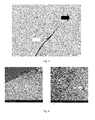
- Figure 3 shows a TEM image of a drop-cast solution of 1 a (70 ⁇ M) containing MWNT (0.02 g/mL), wherein the carbon nanotubes and complex 1 a are organized into an extended network.
- the presence of the bis-salphen compound or complex facilitates the nanotubes to homogeneously disperse into a unimodal aggregate size distribution profile ranging from 105 to 220 nm, depending on the complex used.
- Comparative preparative solutions i.e. solutions that do not contain MWNT and/or do not contain compound 1 a, 1 c or 2a, were also prepared following the same procedure but using neat DCM instead of solution 1 and/or dispersion 1.
- Films were prepared by the Doctor Blade technique from casting the preparative solutions 4 of example 2 at the desired nanotubes:(salphen + polymer) mass ratio under high-efficiency particulate air-filtered laminar flow conditions.
- An aliquot of the solution (commonly 1 - 5 mL, depending on the surface to cover and the film thickness desired) was deposited on a polyethylene terephthalate sheet used as support and the cast solution was homogeneously spread onto the support at a spreading speed ranging from 2.5 mm/s to 30 mm/s at 25 °C by means of a standardized iron blade with sub-micrometer-sized adjusting capabilities.
- the film therein formed was dried at low vacuum (10-100 mBar) and 25 °C for 1-2 h.
- Films of variable thicknesses are possible by adjusting the blade height (commonly between 0.05 ⁇ m and 500 ⁇ m).
- Blank films were prepared from liquid mixtures of nanotubes:polymer in variable mass ratios between 0:100 and 5:95.
- Salphen-containing films were prepared from liquid mixtures of nanotubes:(salphen + polymer) in variable mass ratios between 0:100 and 5:95; the load of salphen in the salphen + polymer solution was adjusted by selecting the concentration range described in Example 2 above.
- Example 4 General method for obtaining films by Spin Coating Technique
- Films were prepared by spin coating from casting the preparative solutions of Example 2 at the desired nanotubes:(salphen + polymer) mass ratio under a closed injection system.
- An aliquot of the solution (commonly 1-10 mL, depending on the film thickness desired) was deposited on a circular flat aluminium container (6 cm diameter) adapted to a spin coater.
- the solution was then dispersed by spinning at 10-100 rpm (preferably 60 rpm) and dried at 25 °C and 1 Atm.
- the film therein formed was dried at low vacuum (10-100 mBar) and 25 °C for 1-2 h and separated from the aluminium container. Thickness of the films was controlled during preparation procedure to a final value of approximately 10, 50 or 100 ⁇ m in the solid state.
- Blank films were prepared from liquid mixtures of nanotubes:polymer in variable mass ratios between 0:100 and 5:95.
- Salphen-containing films were prepared from liquid mixtures of nanotubes:(salphen + polymer) in variable mass ratios between 0:100 and 5:95; the load of salphen in the salphen + polymer solution was adjusted by selecting the concentration range described in the Example 2 above.
- Films were prepared by compression moulding from casting the preparative solutions of Example 2 at the desired nanotubes:(salphen + polymer) mass ratio. An aliquot of the solution (commonly 1 - 10 mL, depending on the surface to cover and the film thickness desired) was deposited on a flat compressing surface protected by a disposable aluminium layer. The cast solution was homogeneously spread onto the compressing surface and dried at 25 °C and 1 Atm until complete evaporation was achieved. The material therein prepared was finally moulded melting at 300 °C and compression at 10 4 Pa. Blank films were prepared from liquid mixtures of nanotubes:polymer in variable mass ratios between 0:100 and 5:95.
- Salphen-containing films were prepared from liquid mixtures of nanotubes:(salphen + polymer) in variable mass ratios between 0:100 and 5:95; the load of salphen in the salphen+polymer solution was adjusted by selecting the concentration range described in Example 2 above.
- Parts were prepared by melt extrusion starting from the preparative solutions of Example 2 at the desired nanotubes:(salphen + polymer) mass ratio.
- Salphen-containing extruded parts were prepared from liquid mixtures of nanotubes:(salphen + polymer) in variable mass ratios between 0:100 and 5:95; the load of salphen in the salphen + polymer solution was adjusted by selecting the concentration range described in Example 1 above.
- the liquid mixtures of nanotubes:(salphen + polymer) were completely evaporated at low vacuum 10-200 mBar, 40 °C and stirring conditions (20-80 rpm). The solid material was recovered and ground to a grain size of approximately 400 ⁇ m - 4 mm.
- the solid material was fed into a standard extruder for thermoplastics (MiniLab Rheomex CTW5. HAAKE, Germany).
- the form of the extruded parts was adjusted by commercially available standard nozzles.
- Example 7 General method for obtaining parts by Injection moulding
- Salphen-containing moulded parts were prepared from liquid mixtures of nanotubes:(salphen + polymer) in variable mass ratios between 0:100 and 5:95; the load of salphen in the salphen + polymer solution was adjusted by selecting the concentration range described in Example 1 above.
- the liquid mixtures of nanotubes:(salphen + polymer) were completely evaporated at low vacuum 10-200 mBar, 40 °C and stirring conditions (20-80 rpm). The solid material was recovered and ground to a grain size of approximately 400 ⁇ m - 4 mm.
- the solid material was fed into a standard injection moulding for thermoplastics (Injection moulding device model MiniJet II, Thermo Scientific, Germany).
- Cylinder Temperature 280 °C
- Mould Temperature 105 °C
- Pressure 500 Bar
- Holding Pressure 300 Bar
- Time 15 s.
- the form, height, length and width of the moulded parts was adjusted by commercially available standard hardened steel moulds.
- Example 8 Dispersion of nanotubes within a polymer matrix using compound 2a - Composite films
- a blank bisphenol A polycarbonate film was prepared from a cast solution of polymer in DCM by compression moulding as described in Example 5.
- a composite film was similarly prepared with the complex 2a (0.07 %-wt.) and MWNTs (0.02 %-wt).
- Environmental scanning electron microscopy (ESEM) was performed on each sample and a superficial view is shown in Fig. 4 (part A showing the blank polycarbonate and part B showing the composite including the complex 2a and the MWNTs).
- Fig. 5 Transversal cuts observed by TEM are shown in Fig. 5 (part A showing the polycarbonate alone; part B showing the polycarbonate & complex 1 a; and part C showing the polycarbonate, complex 1 a & MWNTs).
- Figures 4 and 5 show that the compound of formula (I) or a coordination complex thereof allows for dispersing the nanotubes within a polymer matrix.
- Various film formation techniques have been used and self-assembled structures are maintained.
- the composite film comprises 0.07 % by weight of compound of formula (I) (i.e. 1 a, 1 c, or 2a).
- “blank” refer to composite films prepared from bis phenol-A (BPA) polycarbonate and carbon nanotubes, i.e. free of the compound of formula (I).
- BPA bis phenol-A
- the typical morphological characteristics of the films thus obtained are: diameter: 6.5 cm; nominal thickness: 0.1 mm; average film density: 1.6 g/cm 3 . Surface and volume resistivity was measured as described above.
- Fig. 6 shows the surface resistivity (ohm) measurements from Table 2 of polycarbonate films with different compositions.
- X axis load of MWNT in weight % (linear scale)
- Y axis Surface resistivity (ohm), logarithmic scale
- Table 3 Compound (I) % wt MWNT Volume resistivity (ohm ⁇ cm) Blank 5 778,6666667 Blank 4 21360 Blank 2 9226,666667 1c 5 77,86666667 1c 2 3240 1a 5 24 1a 4 318,4 1a 3 489,63808 1a 2 5920 2a 5 392 2a 3 4221,792533 2a 2 7760
- Fig. 7 shows volumetric resistivity (ohm ⁇ cm) of different films of composite materials from Table 3 containing 0.07 wt.% bis-salphen compound: Film disk dimensions: 33.2 cm 2 (6.5 cm diameter), 100 ⁇ m thickness, Average film density: 1.6 g/cm 3 , Average mass/film disk: 540 mg, Average optical transmittance: 60-90%, depending on the type of sample and thickness
- X axis load of MWNT in weight % (logarithmic scale)
- Y axis Volumetric resistivity (ohm ⁇ cm), logarithmic scale
- Tables 2 and 3 along with Figs 6 and 7 show that composite materials comprising the compound of formula (I) or a coordination complex thereof have a lower electrical percolation threshold than composite materials formed from BPA polycarbonate and MWNT alone in the same conditions. These results also show that the selection of the metals of the compound of formula (III) allows for fine-tuning the properties of the material.
- Figure 8 shows the transmittance (in %) for different wavelengths (in nm) of the prepared films.
- Example 10 Composite polymer films with carboxylated nanotubes
- a composite film of BPA, compound 2a (0.07 wt.%) and carboxylated multi-wall carbon nanotubes,(0.02% wt.%) was prepared by compression moulding as described above (example 5).
- the obtained film was studied by TEM and compared with a film similarly prepared using non-functionalized carbon nanotubes.
- the figure 10 shows that functionalization of the carbon nanotubes can be used to influence the assembly of the carbonaceous material within the matrix.
- Example 11 Composite polymer parts obtained by extrusion and injection moulding
Landscapes
- Chemical & Material Sciences (AREA)
- Organic Chemistry (AREA)
- Engineering & Computer Science (AREA)
- Materials Engineering (AREA)
- Nanotechnology (AREA)
- Inorganic Chemistry (AREA)
- Compositions Of Macromolecular Compounds (AREA)
- Organic Low-Molecular-Weight Compounds And Preparation Thereof (AREA)
Abstract
The present invention relates to compounds of formula (I) or a coordination complex thereof with a metal ion selected from the group consisting of Ni(II), cu(II), sc(III), Fe(II), Fe(III), ca(II), Co(II), co(III), Os(III), Os(IV), Al(III), Mn(IV), Mn(III), Mn(II), Cr(III), Ti(II), Ti(IV), Zr(IV), Hf(IV), W(IV), W(V), Ta(IV), Ta(V), Pd(II), Pt(II), Pt(IV), Ir(III), Rh(III), Ru(II), Ru(III), Re(IV), In(II), In(III), Ga(III), Sn(II), Sn(IV), V(IV), V(V), Nb(V), Au(III), Mg(II), cd(II), Ce(III), Ce(IV), Eu(III), Yb(III), Gd(III), and Zn(II) for use as a dispersing agent for improvement of dispersion of a carbonaceous material in a dispersion medium

It also relates to compositions comprising a compound of formula (I), a coordination complex thereof or a mixture thereof and a carbonaceous material, and to methods of making them.
Description
- The present proposals relate to dispersant and templating compounds for use with carbonaceous materials and composite materials incorporating these compounds with carbonaceous materials, in particular carbon nanostructures. These proposals also relate to methods of making such composite materials.
- Polymer-carbon composite materials represent an interesting and expanding family of materials with a wide range of applications due to their specific properties. Carbonaceous materials, such as carbon nanotubes, carbon black and graphite, are commonly used as additives in polymer compositions to take advantage of the beneficial properties of the carbon nanostructures and improve, mechanical, optical and/or electrical properties, among others, of the composite material. In particular, carbon nanotube-polymer composite are considered as a possible alternative to expensive and rigid indium-tin-oxide, widely used in touchscreens and various displays, among other applications. Such composites are also used in the field of performance materials since the carbon materials provide an improved mechanical resistivity to stress to the polymer matrix. Other possible applications of these materials include heat insulation, electromagnetic shielding, transparent conductive coatings, electrostatic dissipation, printed circuits and many others.
- The manufacture of such composite materials however suffers from a limited processability and dispersion of the carbonaceous material in the polymeric matrix still represents one of the major challenges in the field. The carbonaceous material tends to aggregate and form clusters or bundles within the polymer matrix which reduces the homogeneity of the material and its isotropy and can impair the desirable properties of the composite. In particular, in the case of electrically conductive composite materials of carbon nanotubes, higher performance is likely obtained for well-dispersed, yet physically connected nanotubes, thus forming embedded electrically conductive networks of nanowires. Another important issue related to composites of carbonaceous materials and in particular carbon nanotubes, relates to the control of the alignment of the carbon materials at the nanoscale in a homogeneous way.
- Some methods of aligning carbon nanostructures, in particular carbon nanotubes, in a polymer matrix are known. A brief overview is given in Macromolecules (2006), 39(16), 5194-5205 and includes:
- direct mixing (solution blending or melt blending) with or without a solvent. This is easy to implement but requires high loadings of carbon nanotubes (CNTs) and the technique is limited to certain polymer matrices.
- a latex procedure which involves debundling of CNTs by treatment of the CNTs with a surfactant followed by sonication, centrifugation, polymer addition and drying (Carbon 2007;45:2897-903 and
US 7999028 B2 ). - application of an electromagnetic field (
WO 2009/035478 ). This method presents some difficulties for implementation and some limitations for the nanostructures used therein. - chemically modifying the CNTs to improve dispersability in the polymer matrix (
US 2012145968 andWO 2008/114910 ). - Utilisation of mixed polymer matrices (
WO 2008/143233 ) - in-situ polymerization
- All of these methods involve significant drawbacks in terms of versatility and ease of implementation. A high load of the carbonaceous material is usually required to fully incorporate and disperse the material in the polymer matrix. Also the methods are often hard to implement and are not cost-effective for use in high-volume.
- There are some reports of self-assembled systems of carbonaceous nanostructures in which carbon nanotubes (CNTs) or fullerene derivatives interact with porphyrin oligomers or peptide helices to form structured assemblies at the nanoscale. However, these methods have not been demonstrated in polymer matrices or on non-metallic supports.
- Some bis-salphen compounds have been developed and studied by Kleij et al. These compounds have proven useful in the molecular recognition of chiral molecules, and as a precursor of a trinuclear catalyst for the preparation of cyclic carbonates from epoxides and carbon dioxide.
- There remains a need for composites in which carbonaceous materials are well dispersed and preferably aligned or interconnected in a polymer matrix, which are cost effective to produce and may offer the capability to tune the properties of the composite by varying the carbon incorporation parameters.
-
- Moniruzzaman et al. Macromolecules (2006), 39(16), 5194-5205
- Yu et al., Carbon 2007,45,2897-903
-
US 7999028 B2 -
WO 2009/035478 -
US 2012145968 -
WO 2008/114910 -
WO 2008/143233 - Kleij et al. Chem. Eur. J. 2013, 19, 2641 - 2648
- Kleij et al. Chem. Eur. J. 2012, 18, 6805 - 6810
- Kleij et al. Dalton Trans., 2012, 41, 9766-9772
- Kämpfe et al. Eur. J. Inorg. Chem. 2009, 1027-1035
- Zhang et al. J. Org. Chem. 2001, 66, 481-487
- Görl et al. J. Organomet. Chem. 2007, 692, 5727-5753
- The present proposals relate to the use of bis-salphen compounds as defined herein as dispersing agents to disperse carbonaceous materials, in particular CNTs, in a polymer, gel, solvent or onto a supporting surface.
- Further proposals relate to the use of bis-salphen compounds as defined herein as templating agents to promote the self-assembly of carbonaceous materials into nanostructures in a dispersion medium.
- In one aspect, the present proposals relate to a compound of formula (I) or a coordination complex thereof with a metal ion selected from the group consisting of Ni(II), Cu(II), Sc(III), Fe(II), Fe(III), Ca(II), Co(II), Co(III), Os(III), Os(IV), Al(III), Mn(IV), Mn(III), Mn(II), Cr(III), Ti(II), Ti(IV), Zr(IV), Hf(IV), W(IV), W(V), Ta(IV), Ta(V), Pd(II), Pt(II), Pt(IV), Ir(III), Rh(III), Ru(II), Ru(III), Re(IV), In(II), In(III), Ga(III), Sn(II), Sn(IV), V(IV), V(V), Nb(V), Au(III), Mg(II), Cd(II), Ce(III), Ce(IV), Eu(III), Yb(III), Gd(III), and Zn(II) for use as a dispersing agent for improvement of dispersion of a carbonaceous material in a dispersion medium

- each X is independently selected from OH and SH;
- R1, R2, R3, R1', R2' and R3' are each independently selected from the group consisting of halogen, hydrogen, cyano and nitro; provided that one or more of the pairs of groups R1 and R2, R2 and R3, R1' and R2', R2' and R3' together with the carbon atoms to which they are attached optionally form a phenyl group or a 5 or 6 membered heteroaromatic ring having one or more heteroatoms selected from O, N and S; wherein one or more of the hydrogen atoms of the phenyl or heteroaromatic ring is optionally replaced by a radical selected from halogen, nitro and cyano;
- R4, R5, R6, R7, R9, R10, R11, R12, R4', R5', R6', R7', R9', R10', R11', and R12', are each independently selected from H, halogen, nitro, cyano, C1-6 alkyl, -O(C1-6 alkyl), -(C=O)C1-6 alkyl, -O(C=O)C1-6 alkyl, -(C=O)O(C1-6 alkyl), C3-8 cycloalkyl, C3-8 heterocycloalkyl, phenyl, and C5-6 heteroaryl, wherein any of the C3-8 cycloalkyl, C3-8 heterocycloalkyl, phenyl, and C5-6 heteroaryl groups are optionally substituted with one or more groups selected from halogen, nitro, cyano, and C1-6 alkyl; provided that one or more of the pairs of groups R4 and
- R5, R5 and R6, R6 and R7, R9 and R10, R10 and R11, R11 and R12, R4' and R5', R5' and R6', R6' and R7', R9' and R10', R10' and R11', R11' and R12' together with the carbon atoms to which they are attached optionally form a phenyl group or a 5 or 6 membered heteroaromatic ring having one or more heteroatoms selected from O, N and S; wherein one or more of the hydrogen atoms of the phenyl or heteroaromatic ring is optionally replaced by a radical selected from halogen, nitro, and cyano, C1-6 alkyl, C1-6 haloalkyl, -O(C1-6 alkyl), -(C=O)C1-6 alkyl, -O(C=O)C1-6 alkyl, and -(C=O)O(C1-6 alkyl);
- R8 and R8' are independently selected from: a phenyl group or a 5 or 6 membered heteroaromatic ring having one or more heteroatoms selected from O, N and S, the phenyl or heteroaromatic ring optionally being bridged or fused with one or more 5 to 12 membered ring; wherein one or more of the hydrogen atoms of each ring is optionally replaced by a radical selected from halogen, nitro, and cyano.
- These proposals also provide a composite material comprising: a bis-salphen compound as defined herein; and a carbonaceous material; and optionally a polymer or gel component.
- These proposals also provide a method for preparing a composite material as defined herein comprising the steps of: preparing a mixture of carbonaceous material with a compound as defined herein and optionally also a polymer or gel, in a solvent; and eliminating the solvent to provide the composition.
- These proposals also relate to methods of improving the dispersion of a carbonaceous material in a dispersion medium using a compound as defined herein.
- These proposals further relate to the use of compounds as defined herein to improve or effect the dispersion of a carbonaceous material in a dispersion medium.
-
-
Fig. 1 shows two bis-salphen framework structures in parts A1 and A2 with the various options for the M metal centre in each being listed as a, b and c.Parts compounds -
Fig. 2 shows size distributions measured by dynamic light scattering for (x axis is diameter in nm, y axis is the peak intensity, expressed as a percentage):- Empty black squares: solution of multi walled carbon nanotubes (MWNTs) at a 0.02 mg per mL concentration (in dichloromethane, DCM),
- Empty black circles: solution of
compound 2a at 70 nM concentration in DCM Grey dashed line: solution ofcompound 1 a at 70 nM concentration in DCM Dashed line marked with solid black triangles: solution ofcompound 2a at 70 nM concentration in DCM and MWNT at 0.02 mg per mL - Dashed line marked with crosses (X): solution of
compound 1 a at 70 nM concentration in DCM and MWNT at 0.02 mg per mL - Dashed line marked with solid black circles: solution of
compound 1a at 280 nM concentration in DCM and MWNT at 0.08 mg per mL - Dotted line marked with crosses (+); solution of
compound 2a at 280 nM concentration in DCM and MWNT at 0.08 mg per mL
-
Fig. 3 shows a TEM micrograph (scale bar 500 nm) of a dropcast solution of complex 1a in DCM containing MWNTs. The white arrow points to nanotubes, while the black arrow shows a self-assembled rod ofcompound 1a. -
Fig. 4 shows TEM micrographs of a blank bisphenol-A polycarbonate polymer film prepared by compression moulding (part A -scale bar 300 µm) and a similarly prepared film to that in part A but incorporatingcompound 2a and MWNTs (part B -scale bar 20 µm). Arrows show rings of MWNTs. -
Fig. 5 shows TEM micrographs of transverse cuts of polymer films prepared by spin coating from solutions composed of bisphenol-A polycarbonate (part A -scale bar 2 µm), bisphenol-A polycarbonate withcompound 2a (part B -scale bar 2 µm), and bisphenol-A polycarbonate withcompound 2a and MWNTs (part C -scale bar 500 nm). In parts B and C, the black arrows points to a rod ofcompound 2a. In part C, the white arrow points to MWNTs embedded into a rod ofcompound 2a. -
Fig. 6 shows the surface resistivity (ohm) measurements of polycarbonate films with different compositions. X axis is the load of MWNTs, expressed in weight percent and represented on a logarithmic scale. Y axis is the surface resistivity of the film.- Solid line: (bisphenol A polycarbonate + MWNCT)
- Crosses: (bisphenol A polycarbonate + MWNCT +
Compound 1 c) - Triangles: (bisphenol A polycarbonate + MWNCT +
Compound 1 a) - Squares: (bisphenol A polycarbonate + MWNCT + Compound 2c)
-
Fig. 7 shows volumetric resistivity (ohm·cm) of different films of composite materials containing 0.07 wt.% bis-salphen compound as a function of the load of MWNTs (x axis), expressed in weight percent.- Solid line: (bisphenol A polycarbonate + MWNCT)
- Crosses: (bisphenol A polycarbonate + MWNCT +
Compound 2a) - Triangles: (bisphenol A polycarbonate + MWNCT +
Compound 1 a) - Squares: (bisphenol A polycarbonate + MWNCT +
Compound 1c)
-
Fig. 8 shows the transmittance, expressed as a percentage (y axis), as a function of the wavelength (x axis), expressed in nm, of the following film compositions, obtained by compression moulding:- Black triangles (top trace): bisphenol A polycarbonate
- Grey circles (top trace): bisphenol A polycarbonate+0.07 wt% of
compound 2a - Grey triangles (bottom trace): bisphenol A polycarbonate+0.5 wt%
- MWNTs+0.07
wt% compound 2a - Black circles (bottom trace): bisphenol A polycarbonate+0.5 wt% MWNTs.
-
Fig. 9 shows TEM images of parts obtained by melt extrusion and injection moulding of: A) Bisphenol A polycarbonate (BPA), scale bar 2 µm; B) BPA + 0.3 weight % MWNT (scale bar 2 µm), white arrows point MWNT aggregates; C) BPA +compound 1 a (0.07 weight%), scale bar 2 µm, black arrow points to a nanorod of 1 a; D) BPA + MWNT (0.3 weight%) +compound 1 a (0.07 weight %);scale bar 1 µm; white arrows point to nanotubes aligned along a rod ofcompound 1 a. -
Fig. 10 shows TEM images of films prepared by compression moulding of: A) bisphenol A polycarbonate,compound 1 a (0.07 weight%) and MWNT (0.02 weight%), scale-bar 200 nm; B) bisphenol A polycarbonate,compound 1 a (0.07 weight%) and MWNT functionalized with carboxyl groups (0.02 weight%), scale-bar 1 µm. The black arrows points to a nanorod ofcompound 1 a. The white arrow points to MWNTs embedded into a nanorod ofcompound 1 a. - In the context of the invention, the term C1-6 alkyl refers to a saturated, linear or branched aliphatic hydrocarbon radical containing from 1 to 6 carbon atoms. Non limitative examples include methyl, ethyl, propyl, isopropyl, n-butyl, tert-butyl, sec-butyl, pentyl, neo-pentyl.
- In the context of the invention, the term "dispersing agent" in relation to a carbonaceous material refers to a compound which improves the dispersion of the carbonaceous material in a dispersion medium. The dispersion medium is as defined herein and may preferably be a polymer, gel or liquid medium, such as a halogenated liquid. This improvement in dispersion may involve preventing the spontaneous aggregation of the carbonaceous material particles into packed arrangements, e.g. bundles, or promoting the dispersion of bundles of the carbonaceous material into the dispersion medium. The carbonaceous material or dispersion optionally being placed onto a surface or within a volume. Compositions incorporating such a dispersing agent may show a more uniform distribution of carbonaceous material throughout the dispersion medium than a comparable composition that does not contain the dispersing agent.
- In the context of the invention, the term "dispersion medium" refers to a continuous medium, such as a gas, a liquid or a solid in which a disperse phase is distributed. Examples of dispersion media are defined herein and may include liquid dispersion media such as non-aqueous or aqueous solvents, including halogenated solvents and more particularly, chlorinated solvents such as dichloromethane, chloroform, tetrachloromethane and tetrachloroethane. Non-limiting examples of solid dispersion media include polymeric materials, ceramics, gel components, and silica. For example the dispersion medium may be selected from any of the liquid, gel, polymer or solid media described herein.
- In the context of the invention, the term C5-6 heteroaryl refers to an aromatic ring containing from 5 to 6 atoms selected from the group consisting of C, N, O and S.
- The bis-salphen compounds defined herein are compounds of formula (I) which may be complexed with a metal ion selected from Ni(II), Cu(II), Sc(III), Fe(II), Fe(III), Ca(II), Co(II), Co(III), Os(III), Os(IV), Al(III), Mn(IV), Mn(III), Mn(II), Cr(III), Ti(II), Ti(IV), Zr(IV), Hf(IV), W(IV), W(V), Ta(IV), Ta(V), Pd(II), Pt(II), Pt(IV), Ir(III), Rh(III), Ru(II), Ru(III), Re(IV), In(II), In(III), Ga(III), Sn(II), Sn(IV), V(IV), V(V), Nb(V), Au(III), Mg(II), Cd(II), Ce(III), Ce(IV), Eu(III), Yb(III), Gd(III), and Zn(II).

- In the context of the invention, a coordination complex of a compound of formula (I) with a metal refers to a compound of formula (I) wherein one or more metal atom is bonded to two X and two N atoms of the compounds of formula (I), with the proviso that two N atoms bonded to the same metal atom are born by the same aromatic ring and that the X and N atoms bonded to the same metal atom are separated by four covalent bonds. For the metals in the oxidation state +2, the geometry of the metal may be square planar. For some metals, the coordination complex may further comprise one or two axial ligands, in which the metal atom is bonded to the axial ligand orthogonal to the plane formed by the metal and the two nitrogen atoms of formula (I) to which the metal is bonded. Non limitative examples of such axial ligands are halide, carbon monoxide, aquo, hydroxy, cyanide, phosphines, phosphites, carboxylates, aromatic heterocycles, alkoxides, and aryloxides.
- The metal ions with which the bis-salphen compounds of formula (I) may be complexed are preferably independently selected from Ni(II), Cu(II), Sc(III), Fe(II), Fe(III), Ca(II), Co(II), Co(III), Os(III), Os(IV), Al(III), Mn(IV), Mn(III), Mn(II), Cr(III), Ti(II), Ti(IV), Zr(IV), Hf(IV), W(IV), W(V), Ta(IV), Ta(V), Pd(II), Pt(II), Pt(IV), Ir(III), Rh(III), Ru(II), Ru(III), Re(IV), In(II), In(III), Ga(III), Sn(II), Sn(IV), V(IV), V(V), Nb(V), Au(III), Mg(II), Cd(II), Ce(III), Ce(IV), Eu(III), Yb(III), Gd(III), and Zn(II). Preferably, the metal ions are selected from Ni(II), Cu(II), Fe(II), Co(II), Mn(II), Cr(II), Ti(II),Pd (II), Ru (II), Mn(II), In(II), Sn(II), Mg(II) and Zn(II). More preferably the metal ions are selected from Ni(II), Cu(II) and Zn(II).
- In some aspects of the compounds described herein, each X is independently selected from OH and SH, preferably OH.
- In some aspects of the present compounds, the R1, R2, R3, R1', R2' and R3' groups and the groups formed when R1 and R2, R2 and R3, R1' and R2', or R2' and R3' together with the carbon atoms to which they are attached join to form a ring group, are all independently selected from planar groups, i.e. chemical groups in which the atoms are coplanar.
- In preferred aspects, one of the pairs of groups R1 and R2 or R2 and R3, and, in addition, or as an alternative thereto, one of the pairs of groups R1' and R2' or R2' and R3', together with the carbon atoms to which they are attached form a phenyl group or a 5 or 6 membered heteroaromatic ring having one or more heteroatoms selected from O, N and S, with any remaining, i.e. not joined in a ring, of the groups R1, R2, R3, R1', R2', R3' being as defined above.
- In preferred aspects, R1 and R1' are both hydrogen.
- In preferred aspects, R1, R1', R2, R2', R3 and R3' are all hydrogen.
- In most preferred aspects, R1 and R1' are both hydrogen and the pairs of groups R2 and R3, R2' and R3' together with the carbon atoms to which they are attached each form a phenyl ring.
- In the compounds described herein, R8 and R8' are each independently selected from: a phenyl group or a 5 or 6 membered heteroaromatic ring having one or more heteroatoms selected from O, N and S, the phenyl or heteroaromatic ring optionally being bridged or fused with one or more 5 to 12 membered ring; wherein one or more of the hydrogen atoms of each ring is optionally replaced by a radical selected from halogen, nitro, and cyano. Preferably R8 and R8' are selected from furyl, pyrrolydyl, thiophenyl, phenyl, naphthyl, biphenylyl, and pyridyl. More preferably, R8 and R8' are selected from phenyl, naphthyl, and biphenylyl.
- In some preferred compounds R8 and R8' are preferably identical groups. In preferred compounds R8 and R8' are both phenyl groups.
- In the compounds described herein, R4, R5, R6, R7, R9, R10, R11, R12, R4', R5', R6', R7', R9', R10', R11', and R12' are each independently selected from H, halogen, nitro, cyano, C1-6 alkyl, -O(C1-6 alkyl), -(C=O)C1-6 alkyl, -O(C=O)C1-6 alkyl, -(C=O)O(C1-6 alkyl), C3-8 cycloalkyl, C3-8 heterocycloalkyl, phenyl, and C5-6 heteroaryl, wherein any of the C3-8 cycloalkyl, C3-8 heterocycloalkyl, phenyl, and C5-6 heteroaryl groups are optionally substituted with one or more groups selected from halogen, nitro, cyano, and C1-6 alkyl; provided that one or more of the pairs of groups R4 and R5, R5 and R6, R6 and R7, R9 and R10, R10 and R11, R11 and R12, R4' and R5', R5' and R6', R6' and R7', R9' and R10', R10' and R11', R11' and R12' together with the carbon atoms to which they are attached optionally form a phenyl ring or a 5 or 6 membered heteroaromatic ring having one or more heteroatoms selected from O, N and S; wherein one or more of the hydrogen atoms of the aromatic or heteroaromatic ring is optionally replaced by a radical selected from halogen, nitro, and cyano, C1-6 alkyl, C1-6 haloalkyl, -O(C1-6 alkyl), -(C=O)C1-6 alkyl, -O(C=O)C1-6 alkyl, and - (C=O)O(C1-6 alkyl).
- Preferably R4, R5, R6, R7, R9, R10, R11, R12, R4', R5', R6', R7', R9', Rio', R11', R12' are each independently selected from H, halogen, nitro, cyano, phenyl, and C5-6 heteroaryl, wherein any of the phenyl and C5-6 heteroaryl groups are optionally substituted with one or more groups selected from halogen, nitro, cyano, and C1-6 alkyl; provided that one or more of the pairs of groups R4 and R5, R5 and R6, R6 and R7, R9 and R10, R10 and R11, R11 and R12, R4' and R5', R5' and R6', R6' and R7', R9' and R10', R10' and R11', R11' and R12' together with the carbon atoms to which they are attached optionally form a phenyl ring or a 5 or 6 membered heteroaromatic ring having one or more heteroatoms selected from O, N and S; wherein one or more of the hydrogen atoms of the aromatic or heteroaromatic ring is optionally replaced by a radical selected from halogen, nitro, and cyano.
- More preferably R4, R5, R6, R7, R9, R10, R11, R12, R4', R5', R6', R7', R9', R10', R11', R12' are each independently selected from H, halogen, nitro, cyano, phenyl, and C5-6 heteroaryl, wherein any of the phenyl and C5-6 heteroaryl groups are optionally substituted with one or more groups selected from halogen, nitro, cyano, and C1-6 alkyl.
- Even more preferably R4, R5, R6, R7, R9, R10, R11, R12, R4', R5', R6', R7', R9', R10', R11', R12' are each independently selected from H, halogen, nitro, cyano, phenyl, and C5-6 heteroaryl.
- Even more preferably R4, R5, R6, R7, R9, R10, R11, R12, R4', R5', R6', R7', R9', R10', R11', R12' are each independently selected from H, halogen, nitro, and cyano.
- Most preferably R4, R5, R6, R7, R9, R10, R11, R12, R4', R5', R6', R7', R9', R10', R11', R12' are each independently H.
- Preferably the compounds described herein are compounds of formula II or coordination complexes thereof with a metal ion selected from the group consisting of Ni(II), Cu(II), Sc(III), Fe(II), Fe(III), Ca(II), Co(II), Co(III), Os(III), Os(IV), Al(III), Mn(IV), Mn(III), Mn(II), Cr(III), Ti(II), Ti(IV), Zr(IV), Hf(IV), W(IV), W(V), Ta(IV), Ta(V), Pd(II), Pt(II), Pt(IV), Ir(III), Rh(III), Ru(II), Ru(III), Re(IV), In(II), In(III), Ga(III), Sn(II), Sn(IV), V(IV), V(V), Nb(V), Au(III), Mg(II), Cd(II), Ce(III), Ce(IV), Eu(III), Yb(III), Gd(III), and Zn(II).

- More preferably, the compounds described herein are compounds of formula II or coordination complexes thereof with a metal ion selected from the group consisting of Ni(II), Cu(II), Fe(II), Fe(III), Co(II), Co(III), Al(III), Mn(IV), Mn(II), Cr(III), Ti(II), Ti(IV), Pd(II), Ru(II), In(II), In(III), Sn(II), Sn(IV), Mg(II) and Zn(II).
- In formula II, the groups X, R2, R3, R2' and R3' and preferred options for these are as defined herein. Compounds of formula (II) are compounds of formula (I) wherein R8 and R8' are each phenyl, and R1, R1', R4, R5, R6, R7, R9, R10, R11, R12, R4', R5', R6', R7', R9', R10', R11', R12' are each hydrogen.
Preferably the compounds are metal-ion complexes of formula III.
- In formula III, the groups R2, R3, R2', R3' and preferred options for these are as defined herein. Each Y is independently selected from O and S, and is preferably O.
M and M' are independently selected from Ni(II), Cu(II), Sc(III), Fe(II), Fe(III), Ca(II), Co(II), Co(III), Os(III), Os(IV), Al(III), Mn(IV), Mn(III), Mn(II), Cr(III), Ti(II), Ti(IV), Zr(IV), Hf(IV), W(IV), W(V), Ta(IV), Ta(V), Pd(II), Pt(II), Pt(IV), Ir(III), Rh(III), Ru(II), Ru(III), Re(IV), In(II), In(III), Ga(III), Sn(II), Sn(IV), V(IV), V(V), Nb(V), Au(III), Mg(II), Cd(II), Ce(III), Ce(IV), Eu(III), Yb(III), Gd(III), and Zn(II) in which ions with a coordination number greater than 4 also have one or more axial ligands selected from halide, carbon monoxide, aquo, hydroxy, cyanide, phosphines, phosphites, carboxylates, aromatic heterocycles, alkoxides, and aryloxides. Preferably M and M' are each independently selected from Ni(II), Cu(II), Fe(II), Co(II), Mn(II), Cr(II), Ti(II), Pd (II), Ru (II), Mn(II), In(II), Sn(II), Mg(II) and Zn(II), more preferably Ni(II), Cu(II) and Zn(II). Compounds of formula (III) are coordination complexes of the compounds of formula (II) with any of the metal ions M and M' mentioned above. - Preferably, the bis-salphen compounds described herein are selected from the compounds of
formula 
- When compounds according to the present proposals are used for dispersion of a carbonaceous material, a good dispersion can be achieved, particularly dispersion of carbon nanotubes (e.g. single walled carbon nanotubes or multi walled carbon nanotubes). In particular, the carbonaceous material is dispersed evenly through the dispersion medium and, where carbon nanotubes (CNTs) are used as the carbonaceous material, the nanotubes are well separated, even to the extent of separated into individual tubes, from the bundles that are typically found in raw carbon nanotube products. In particular, the dispersion medium may be a liquid (such as halogenated solvent), a polymer, or a gel component.
- Furthermore, when compounds according to the present proposals are used to disperse CNTs, the CNTs are aligned (e.g. by self-assembly) such that they are in electrically conductive contact in the polymer matrix over an extended network of CNTs.
- In the context of the invention, a templating agent or templating compound for a carbonaceous material refers to a compound that promotes spontaneous organisation of the carbonaceous material within a medium into organised structures, e.g. structures that are not formed in the absence of the templating compound. For example, the compounds of the invention act as templating compounds in this way by promoting formation of interconnected rings and/or wires of the carbonaceous materials within the medium. The medium may be, in a non-limitative way, a solvent, a polymer or a gel component, for example, in some aspects the medium may be a dispersion medium as defined herein.
- Dispersions of the carbonaceous material in a medium may then be deposited on a surface after which deposition, the medium, e.g. solvent, may be removed (e.g. evaporated) to leave a deposition of the carbonaceous material on the surface, preferably well dispersed and aligned in a similar manner to that in the medium.
- The even, thorough dispersions of the carbonaceous material throughout a polymer, gel, or solvent or on a surface that are achievable using the present compounds means that high electrical conductivity can be achieved at relatively low loading of carbonaceous material. This low loading of the carbonaceous material can result in a high transparency of the polymer product while still maintaining a high electrical conductivity. In some cases, polymer composite products can be formed that are transparent to visible light (and may also be transparent to other wavelength radiation such as infrared radiation - although many bis-salphen compounds are typically absorbent in the ultraviolet region). Such products are particularly useful in optoelectronic devices. In some aspects, the spontaneous organisation of the carbonaceous material into organised structures (e.g. wires) as noted above allows sufficient carbonaceous material to be incorporated into the medium, e.g. polymer, gel or solvent, to increase the electrical conductivity but while still maintaining good optical transparency. Similarly, the dispersion pattern of the carbonaceous material within the medium achievable using the present compounds may allow improvement of other properties of the material, including, in a non-limitative way, magnetic shielding properties and mechanical strength.
- The present proposals also relate to compositions and composite materials comprising:
- a bis-salphen compound as defined herein or mixtures thereof; and
- a carbonaceous material or mixtures thereof.
- In some embodiments, the present proposals relate to compositions comprising:
- a compound selected from the compounds of formula (I), the coordination complexes of the compounds of formula (I) and mixtures thereof; and
- a carbonaceous material or mixtures thereof.
- In some embodiments, the present proposals relate to compositions comprising:
- a compound selected from the compounds of formula (I), the coordination complexes of the compounds of formula (I) and mixtures thereof; wherein R1, R2, R3, R4, R5, R6, R7, R8, R9, R10, R11, R12, R1', R2', R3', R4', R5', R6', R7', R8', R9', R10', R11', R12' and X are as defined in the options and preferences herein; and
- a carbonaceous material or mixtures thereof.
- In some embodiments, the present proposals relate to compositions comprising:
- a compound selected from the compounds of formula (II), the compounds of formula (III) and mixtures thereof wherein M, M', X, Y, R2, R3, R2' and R3' are as defined in the options and preferences herein; and
- a carbonaceous material or mixtures thereof.
- In some embodiments, the present proposals relate to compositions comprising:
- a compound selected from the compounds of
formula - a carbonaceous material or mixtures thereof.
- Such compositions may exhibit good electrical conductivity. Furthermore, these compositions may be transparent (e.g. to visible light, infrared radiation and/or ultraviolet radiation).
- The combination of transparency and electrical conductivity is particularly preferred because it is these compositions that offer a possible substitute for Indium-Tin-Oxide (ITO) in optoelectronic applications.
- In the context of the invention, a carbonaceous material refers to a material that is or derives from the allotropic forms of carbon: amorphous carbon, graphite, diamond, graphene, fullerenes and nanotubes. The material may further comprise a doping agent (e.g. metal atoms, nitrogen atoms, boron atoms) or may further be functionalized with various functional groups, such as carboxyl, halogen, hydroxy, esters and amine.
- In preferred compositions the carbonaceous material is selected from carbon nanostructures. For example, the carbonaceous material is preferably selected from graphite, amorphous carbon (e.g. carbon black), graphene, graphene flakes, fullerenes, carbon nanotubes, carbon nanowires and carbon nanorods. In most preferred compositions, the carbonaceous material is selected from amorphous carbon, fullerenes and carbon nanotubes, and is preferably carbon nanotubes. The carbon nanotubes may be single-walled nanotubes, or multi-walled nanotubes (e.g. double-walled nanotubes or nanotubes with greater than two concentric tubes), or a mixture thereof.
- Single-walled nanotubes (SWNTs) may be preferred because they offer a good balance between electrical conductivity and transparency, they are easier to solubilize compared to multi-walled nanotubes and their work function directly depends on diameter and chiral angle so the electrical properties are more predictable. However, SWNTs are typically more difficult and expensive to produce. Therefore, in some compositions, multi-walled nanotubes (MWNTs) are preferred. Furthermore, it is found that good transparency is demonstrated by the present compositions even when MWNTs are used as the carbonaceous material, possibly because the MWNTs are highly dispersed in the polymer by the bis-salphen compound.
- The carbonaceous material may be surface-modified, e.g. treated to provide pendant surface functional groups. Some preferred functional groups may be carboxylic acid, halogen, hydroxy, alkoxy, siloxy, esters, amide or amine. Where the carbonaceous material is carbon nanotubes, they are preferably oxidised to provide carboxylic acid groups at defect sites in the tube structure and/or at the ends of the tubes. Preferably, CNTs (in particular MWNTs) may be treated (e.g. by reflux) in nitric acid which has the result of opening the ends of the nanotubes and functionalising at least the open ends with carboxylic acid groups. Standard methods for the functionalization of carbon nanotubes with functional groups such as hydroxy, amine, amide, alkoxy, siloxy, ester or halogen are well known in the art.
- Thus, in some embodiments, the carbonaceous material is selected from amorphous carbon, graphite, graphene, fullerene, carbon nanorods and carbon nanotubes, being the carbonaceous material optionally functionalised with one or more groups selected from hydroxy, carboxy, halogen, alkoxy, siloxy, ester, amide and amine. In preferred embodiments, the carbonaceous material is selected from graphite, graphene, and carbon nanotubes, being the carbonaceous material optionally functionalised with one or more groups selected from hydroxy, carboxy, and halogen. When graphene is used as carbonaceous material, it may further be doped with metal atoms (e.g. aluminium, silver, copper, gold, platinum) or non-metal atoms (e.g. nitrogen, boron, fluorine). In more preferred aspects, the carbonaceous material is carbon nanotubes optionally functionalised with one or more carboxy groups. When carbon nanotubes are used as carbonaceous material, they may further be doped with non-metal atoms (e.g. nitrogen, boron).
- In some aspects, the present proposals relate to compositions comprising:
- a compound selected from the compounds of formula (I), the coordination complexes of the compounds of formula (I) and mixtures thereof; and
- a carbonaceous material selected from amorphous carbon, graphite, graphene, and carbon nanotubes, being the carbonaceous material optionally functionalised with one or more groups selected from hydroxy, carboxy, and halogen or mixtures thereof.
- In some aspects, the present proposals relate to compositions comprising:
- a compound selected from the compounds of formula (I), the coordination complexes of the compounds of formula (I) and mixtures thereof; wherein R1, R2, R3, R4, R5, R6, R7, R8, R9, R10, R11 R12, R1', R2', R3', R4', R5', R6', R7', R8', R9', R10', R11', R12' and X are as defined in the options and preferences herein; and
- a carbonaceous material selected from amorphous carbon, graphite, graphene, and carbon nanotubes, being the carbonaceous material optionally functionalised with one or more groups selected from hydroxy, carboxy, and halogen or mixtures thereof.
- In some embodiments, the present proposals relate to compositions comprising:
- a compound selected from the compounds of formula (II), the compounds of formula (III) and mixtures thereof wherein M, M', X, Y, R2, R3, R2' and R3' are as defined in the options and preferences herein; and
- a carbonaceous material selected from amorphous carbon, graphite, graphene, and carbon nanotubes, being the carbonaceous material optionally functionalised with one or more groups selected from hydroxy, carboxy, and halogen or mixtures thereof.
- In some embodiments, the present proposals relate to compositions comprising:
- a compound selected from the compounds of
formula - a carbonaceous material selected from amorphous carbon, graphite, graphene, and carbon nanotubes, being the carbonaceous material optionally functionalised with one or more groups selected from hydroxy, carboxy, and halogen or mixtures thereof.
- In some embodiments, the present proposals relate to compositions comprising:
- a compound selected from the compounds of formula (I), the coordination complexes of the compounds of formula (I) and mixtures thereof; and
- a carbonaceous material that is carbon nanotubes, being the carbonaceous material optionally functionalised with one or more carboxy groups.
- In some embodiments, the present proposals relate to compositions comprising:
- a compound selected from the compounds of formula (I), the coordination complexes of the compounds of formula (I) and mixtures thereof; wherein R1, R2, R3, R4, R5, R6, R7, R8, R9, R10, R11, R12, R1', R2', R3', R4', R5', R6', R7', R8', R9', R10', R11', R12' and X are as defined in the options and preferences herein; and
- a carbonaceous material that is carbon nanotubes, being the carbonaceous material optionally functionalised with one or more carboxy groups.
- In some embodiments, the present proposals relate to compositions comprising:
- a compound selected from the compounds of formula (II), the compounds of formula (III) and mixtures thereof wherein M, M', X, Y, R2, R3, R2' and R3' are as defined in the options and preferences herein; and
- a carbonaceous material that is carbon nanotubes, being the carbonaceous material optionally functionalised with one or more carboxy groups.
- In some embodiments, the present proposals relate to compositions comprising:
- a compound selected from the compounds of
formula - a carbonaceous material that is carbon nanotubes, being the carbonaceous material optionally functionalised with one or more carboxy groups.
- In further embodiments, in the compositions described above, the weight ratio of the compound selected from the compounds of formula (I), the coordination complexes of the compounds of formula (I) and mixtures thereof to the carbonaceous material is from 1:100,000 to 1000:1. In some aspects, the weight ratio of the compound selected from the compounds of formula (I), the coordination complexes of the compounds of formula (I) and mixtures thereof to the carbonaceous material is from 1:10,000 to 500:1. In some aspects, the weight ratio of the compound selected from the compounds of formula (I), the coordination complexes of the compounds of formula (I) and mixtures thereof to the carbonaceous material is from 1:1000 to 150:1. Most preferably, the weight ratio of the compound selected from the compounds of formula (I), the coordination complexes of the compounds of formula (I) and mixtures thereof to the carbonaceous material is from 2:1 to 1:60.
- In some aspects, the present compositions further comprise a polymer or gel component. Preferably, the carbonaceous material and the compound as described herein is dispersed in the polymer or gel component. Composites of this type may achieve the desired advantageous properties (e.g. high electrical conductivity and/or optical transparency) while still having some of the physical properties of the polymer component (e.g. flexibility, processability etc.).
- In the present composites, the polymer component is not particularly limited and may be selected depending on the physical characteristics that are generally desirable for the particular application. In preferred compositions the polymer is one that is soluble in a halogenated, e.g. chlorinated solvent.
Non limitative examples of halogenated solvents include chloroform, dichloromethane, tetrachloroethane, chloromethane, tetrachloromethane, bromomethane. - In preferred aspects, the polymer component is one that is soluble in halogenated solvents. For example polymers that have solubility in halogenated solvents (e.g. dichloromethane) of at least one gram of polymer per litre of solvent are preferred. Thus, suitable polymers may be selected from polyolefins, polycarbonates, polyurethanes, polythiophenes, polyanilines, unsaturated polymers, fluoropolymers, polyketones, polyaryletherketones, polypyrroles, polyamides, polyimides, polysulfones, silicones, polyesters, polyethers, polythioethers, polyaminoacids, ionomers, copolymers, blends and mixtures thereof.
- Polyolefins include, in a non-limitative way, high density polyethylene, linear low density polyethylene, low density polyethylene, polyethylene acrylates, poly(methyl methacrylate), poly(vinyl alcohol), polyacrylic acid, polyacrylate, polyacrylonitrile, polybutylene, polybutylene adipate, polystyrene, polystyrene brominated, polyethylacrylate, polyethylene, polymethylpentene, polypropylene, polyvinyl acetate, polyvinyl nitrate, polyvinyl chloride.
- Polycarbonates include, in a non-limitative way, aromatic-aliphatic polycarbonates, aromatic polycarbonates, aliphatic polycarbonates.
- Polyurethanes include, in a non-limitative way, aromatic-aliphatic polyurethanes, aromatic polyurethanes, aliphatic polyurethanes.
- Polythiophenes include, in a non-limitative way, Poly(3,4-ethylenedioxythiophene), Poly(3,4-ethylenedioxythiophene)-tetramethacrylate.
- Polyanilines include, in a non limitative way, leucoemeraldine, emeraldine salt, emeraldine base, (per)nigraniline.
- Unsaturated polymers include, in a non limitative way, polybutadiene, trans-polyacetylene, cis-polyacetylene.
- Fluoropolymers include, in a non-limitative way, polytetrafluoroethylene and its derivatives.
- Polyketones and polyaryletherketones include, in a non-limitative way, aromatic-aliphatic polyketones, aromatic polyketones, aliphatic polyketones, polyether ether ketone,
- Polypyrroles include, in a non-limitative way, aromatic-aliphatic, aromatic and aliphatic derivatives.
- Polyamides include, in a non-limitative way, aromatic-aliphatic, aromatic and aliphatic derivatives, polyamide 46, polyamide 6, polyamide 66, polyamide 610, polyamide 612,
polyamide 10,polyamide 11,polyamide 12, polyamide 6-6T, polyamide 6-61, polyamide 6T-6I. - Polyimides include, in a non-limitative way, poly-oxydiphenylene-pyromellitimide.
- Polysulfones include, in a non-limitative way, polyphenylsulfone, polyethersulfone.
- Silicones include, in a non-limitative way, polydimethylsiloxane, aromatic-aliphatic polysiloxanes, aromatic polysiloxanes.
- Polyesters include, in a non-limitative way, poly(butylene succinate), poly(trimethylene terephthalate), polybutylene terephthalate, polyethylene terephthalate glycol, polyethylene terephthalate, polyhydroxybutyrate, polyhydroxyvalerate, polylactic acid.
- Polyethers include, in a non-limitative way, polyoxymethylene, polyphenylene oxide.
- Polythioethers include, in a non-limitative way, polyphenylene sulphide.
- Polyaminoacids include, in a non-limitative way, polyaspartic acid.
- Ionomers include, in a non-limitative way, ethylene acrylic acid sodium ionomer, poly(styrenesulfonate).
- Copolymers, blends and mixtures include, in a non-limitative way, PEDOT:PSS, acrylonitrile-butadiene-styrene copolymer, acrylic copolymers, acrylonitrile-styrene-acrylate copolymer, cyclic olefin copolymers, cyclic olefin polymers, ethylene acrylic ester copolymer, ethylene acrylic acid copolymer, ethylene epoxyacrylate copolymer, ethylene ethylacrylate copolymer, ethylene vinyl acetate copolymer, poly(butylene adipate-co-terephthalate), poly(ether-block-amides), poly(ethylene-co-methacrylic acid), methyl methacrylate copolymers, methacrylate copolymers, styrene acrylonitrile copolymer, polyvinyl chloride acetate.
- Preferably the polymer is selected from polymethylmethacrylate, polystyrene, styrene-butadiene block copolymer, bisphenol-A polycarbonate, acrylonitrile-butadiene-styrene copolymer, acrylic copolymers, acrylonitrile-styrene-acrylate copolymer, cyclic olefin copolymers, cyclic olefin polymers, ethylene acrylic ester copolymer, ethylene acrylic acid copolymer, ethylene acrylic acid sodium ionomer, ethylene epoxyacrylate copolymer, ethylene ethylacrylate copolymer, ethylene vinyl acetate copolymer, high density polyethylene, linear low density polyethylene, low density polyethylene, poly ethylene acrylates, poly(butylene adipate-co-terephthalate), poly(butylene succinate), poly(ether-block-amides), poly(ethylene-co-methacrylic acid),poly(methyl methacrylate), methyl methacrylate copolymers, methacrylate copolymers, poly(trimethylene terephthalate), poly(vinyl alcohol), polyacetic acid, polyacrylic acid, polyacrylate, polyacrylonitrile, polyamide, PA 46, 6, 66, 610, 612, 10, 11, 12, 6T, 6-6T, 6-61, 6T-6I polyaspartic acid, polybutadiene, polybutylene, polybutylene adipate, polybutylene terephthalate , polycarbonate, aromatic-aliphatic polycarbonates, aromatic polycarbonates, aliphatic polycarbonates, polydimethylsiloxane, polystyrene brominated, polysulfone, polyphenylsulfone, polyethersulfone polyethylacrylate, polyethylene, polyethylene terephthalate glycol, polyethylene terephthalate, polyhydroxybutyrate, polyhydroxyvalerate, polylactic acid, polymethylpentene, polyoxymethylene acetal polymer, polyphenylene oxide, polyphenylene sulfide, polyphenylsulfone, polypropylene, polystyrene, polysulphone, polytetrafluoroethylene, polyurethane, polyhydroxybutyrate, styrene acrylonitrile, PEDOT, polypyrrole, polyaniline, polyacetylenes, mixtures, blends and co-polymers thereof.
- In most preferred compositions, the carbonaceous material is multi-wall carbon nanotubes (MWNTs) and the polymer is selected from polymethylmethacrylate, polystyrene, styrene-butadiene block copolymer, and bisphenol-A polycarbonate.
- The use of the bis-salphen compounds as described herein in the compositions of the present proposals, particularly in compositions in which the carbonaceous material is CNTs, results in good dispersion of the carbonaceous material in the polymer component and reduces the spontaneous agglomeration and clumping of the carbonaceous material (especially CNT material) in the polymer. This reduction in the agglomeration is advantageous because any agglomeration can lead to impaired optical, mechanical and conductive properties. The presence of a bis-salphen compound as described herein in compositions comprising CNTs (in particular MWNTs) results in the CNTs dispersing homogeneously with a unimodal aggregate size distribution profile which closely matched the diameter of the CNTs used, e.g. a size distribution profile from about 10 nm to about 1 µm, particularly 30 to 750 nm, more particularly 100 to 250 nm.
- Furthermore, the use of the bis-salphen compounds as described herein in compositions in which the carbonaceous component is CNTs results in networks of CNTs, in which the CNTs are in extended electrical contact, being formed (e.g. by self-assembly) in the dispersion medium (e.g. polymer matrix, surface).
- In particular aspects, the polymer-comprising compositions contain up to about 1 wt.% of the bis-salphen compound, more particularly up to 0.5 wt.%, most particularly up to about 0.1 wt.%. If too much of the bis-salphen compound is included, the cost of the compositions will increase making the compositions less commercially viable, and some physical properties of the polymer may be lost. The lower amount of bis-salphen compound in the composition is not particularly limited. However, below about 0.001 wt.%, the advantageous effects of the bis-salphen compounds may decrease.
- In particular aspects, the polymer-comprising compositions contain about less than about 30 wt.%, preferably less than 15 wt.%, preferably less than 10 wt.%, more preferably less than 1 wt.%, most preferably less than 0.5 wt.% of the carbonaceous material. As a lower limit, the polymer-comprising compositions preferably contain more than about 0.000001 wt.%, preferably more than 0.00001 wt.%, more preferably more than 0.0001 wt.%, most preferably more than 0.01 wt.% of the carbonaceous material.
- In particular aspects, the polymer-comprising compositions contain about 0.00001 wt.% to about 30 wt.% of the carbonaceous material (e.g. CNTs), preferably 0.0001 wt.% to 10 wt.%, most preferably 0.01 wt.% to 5 wt.%.
- If the amount of carbonaceous material is too low, the desired physical properties (e.g. high electrical conductivity) of the composition may not be observed. If the amount of carbonaceous material is too high, the optical film transparency of the composition may be degraded.
- The amount of polymer or gel component (when present) in the composition is preferably greater than 50 wt.%, more preferably greater than 60 wt.%, more preferably greater than 70 wt.%, more preferably greater than 80 wt.%, even more preferably greater than 90 or 95 wt.% of the total weight of the composition.
- The present proposals also relate to a method for preparing a composition as described herein. The method comprises the steps of: preparing a mixture of carbonaceous material with a compound as described herein in a solvent; and eliminating the solvent to provide the composition. The mixture may further incorporate a polymer or gel component as defined herein.
- In some embodiments, the solvent used in the method for preparing a composition as described herein is a halogenated solvent. Preferably, the solvent used in the method for preparing a composition as described herein is selected from chloroform, dichloromethane, and tetrachloroethane; more preferably, the solvent is dichloromethane.
- Preferred methods comprise the steps of: preparing a mixture of carbonaceous material with a compound as described herein in a solvent; and eliminating the solvent to provide the composition; wherein the concentration of the compound as described herein of the mixture used in the first step is from 10-9 M to 10-3 M; preferably the concentration of the compound as described herein of the mixture used in the first step is from 10-6 to 10-4 M. More preferably, the concentration of the compound as described herein of the mixture used in the first step is 10-5 M.
- In some methods, a solution of the polymer component and the bis-salphen compound in the solvent may be prepared first and, separately, a solution or suspension of the carbonaceous component may be prepared in a solvent (preferably the same solvent as used for the polymer and bis-salphen solution), after which the two solutions/suspensions are combined and mixed (optionally with sonication e.g. using an ultrasound probe or bath, to improve mixing), before elimination of the solvent(s) to provide the composition.
- In some methods, a solution of the polymer component in the solvent may be prepared first and, separately, a solution or suspension of the carbonaceous component with the bis-salphen compound may be prepared in a solvent (preferably the same solvent as used for the polymer solution), after which the two solutions/suspensions are combined and mixed (optionally with sonication e.g. using an ultrasound probe or bath, to improve mixing), before elimination of the solvent(s) to provide the composition.
- In some methods, a solution of the polymer component in the solvent may be prepared first and, separately, a solution or suspension of the carbonaceous component may be prepared in a solvent (preferably the same solvent as used for the polymer solution), and, separately a solution of the bis-salphen compound may be prepared in a solvent (preferably the same solvent as used for the polymer solution) after which the three solutions/suspensions are combined and mixed (optionally with sonication e.g. using an ultrasound probe or bath, to improve mixing), before elimination of the solvent(s) to provide the composition.
- In some methods, a solution or suspension of the polymer component and the carbonaceous component in the solvent may be prepared first and, separately, a solution of the bis-salphen compound may be prepared in a solvent (preferably the same solvent as used for the polymer and carbonaceous component solution), after which the two solutions/suspensions are combined and mixed (optionally with sonication e.g. using an ultrasound probe or bath, to improve mixing), before elimination of the solvent(s) to provide the composition.
- In preferred methods, the solvent and the polymer components are selected such that the polymer is soluble in the solvent. This allows intimate mixing of the polymer and carbonaceous material and an even dispersion of the carbonaceous material throughout the polymer matrix.
- In preferred methods, the solvent is a halogenated solvent, preferably a chlorinated solvent, more preferably a solvent selected from dichloromethane, chloroform, and tetrachloroethane. Even more preferably, the solvent is dichloromethane.
- The step of eliminating the solvent may comprise formation of the composition by simple evaporation, dropcasting, spin coating, doctor-blade film formation, or compression moulding, during which the solvent is eliminated to leave the product composition.
- The methods described herein may further comprise a step of processing the composition to shape or form it into a desired component. For example the method may further comprise the step of melt extrusion, or injection moulding, after elimination of the solvent.
- The present invention also covers all possible combinations of particular and preferred embodiments, options and preferences described herein.
- Components, composites and compositions formed by methods described herein also form part of the present proposals.
- In the usual way, in the numerical ranges described herein, the upper and lower limits of the ranges are distinct proposals.
- The present proposals are illustrated in the following examples which are provided for illustrative purposes only and are not intended to limit the scope of the invention.
- Generally, characterization of synthesised compounds was by elemental analysis, Matrix-assisted laser desorption/ionization-Time of flight (MALDI-TOF) and High Resolution Mass Spectrometry, 1H and 13C Nuclear Magnetic Resonance (1H NMR and 13C NMR), 13C{1H} Distortionless Enhancement by Polarization Transfer (DEPT) and X-ray crystallography molecular structure. All NMR measurements were carried out on a Bruker-400 MHz spectrometer at ambient temperature unless stated otherwise, and chemical shifts are given in parts per million versus TMS. Mass spectrometric data were obtained from the Research Support Unit of the ICIQ and MALDI-TOF experiments were carried out with pyrene as matrix.
- TEM analysis was performed on a JEOL model 1011 electron microscope at 100 kV. Liquid samples analyzed by TEM were prepared by dropcasting 0.35 mM solutions of the corresponding compound (previously dissolved in the selected solvent) on formvar carbon film-covered square mesh copper grids and dried completely for 4 h. Solid film samples were embedded in a standard preparative epoxy-based resin, cured for 72 h at 80 °C, cut with a microtome and fixed on a double copper grid fixation system for analysis.
- Microscopic analysis was carried out at 4 Torr, 10 °C and 30 kV using a FEI Quanta microscope with Everhart-Thornley Detector (ETD), model 600 coupled to an X-ray microanalyzer. Liquid samples for ESEM analysis were prepared by dropcasting required solutions (0.35 mM) on a metal slide for wet sampling and completely evaporated prior to analysis. Solid samples were fixed on sample holders without any previous treatment and directly analyzed at the microscope.
- Surface electrical resistivity of solid films was determined with a Keithley Model 8009 high resistivity test fixture with integrated Faraday box electrostatic shielding system coupled to a Keithley 6517A electrometer. Film samples with the dimension 6 cm x 6 cm were directly analyzed within the fixture without any previous treatment at applied voltages of 100 V and 500 V. Volume electrical resistivity measurements were carried out under the same conditions.
- UV-vis spectra and optical transmission measurements were recorded on a Shimadzu UV1800 Spectrophotometer. UV-Vis-NIR measurements were carried out on a Lamba 1050 PerkinElmer spectrophotometer equipped with a PMT, InGaAs and PbS detectors system, double beam optics, double monochromator and D2 and W light sources.
- All starting materials were purchased from commercial sources and used without further purification.
- The polymers used in the following examples are bis phenol A polycarbonate purchased from Bayer Material Sciences with catalogue numbers
MAKROLON OD2015 (used Examples 2-10) and MAKROLON ML3105 (used in Example 11). - The multiwall carbon nanotubes (MWNTs) used in the experiments - >99% purity, >>1 µm length and 13-16 nm outer mean diameter (used in Examples 6, 7, 11), or >95% purity, 100-700 nm length and 15-42 outer mean diameter (used in Examples 1, 5, 8, 10), or >99% purity, >>1 µm length and 8-15 nm outer mean diameter (used Examples 2,3,4,9) - were purchased from Bayer Technology Services (Leverkusen, Germany), Nanocyl SA (Sambreville, Belgium), and HeJi (Shenzhen, China) respectively. The carbon nanotubes were dried before use at 120 °C, under vacuum (300 mBar) for 90 min and stored under dry and low-pressure conditions until needed.
- Multiwall carbon nanotubes were refluxed in 2.6 M nitric acid for 4 h to oxidize the metallic impurities remaining from the synthesis (C.A. Furtado, U.J. Kim, H.R. Gutierrez, L. Pan, E.C. Dickey, P.C.J. Eklund, J. Am. Chem. Soc. 2004, 126, 6095). The carbon nanotubes became carboxylated at the ends after this oxidation step (MWNT-COOH). The MWNT-COOH in nitric acid solution were filtered and thoroughly rinsed with water to remove the acid completely. The filtered MWNT-COOH were dried overnight at 80 °C.
- The following compounds were prepared using previously reported methodologies:
- (E)-2-(((2-aminophenyl)imino) (phenyl)methyl) phenol (A. Kämpfe, E. Kroke and J. Wagler. Eur. J. Inorg. Chem. 2009, 1027-1035);
- 3,3'-diformyl-2,2'-dihydroxy-1,1'-biphenyl (H.-C. Zhang, W.-S. Huang, L. Pu, J. Org. Chem. 2001, 66, 481-487);
- 2-hydroxy-[1,1'-biphenyl]-3-carbaldehyde (C. Görl, H. G. Alt, J. Organomet. Chem. 2007, 692, 5727-5753);
- 3,3'-bis((E)-((2-((E)-((2-hydroxyphenyl)(phenyl)-methylene)amino)phenyl)imino)methyl)-[1,1'-biphenyl]-2,2'-diol (bis-salphen ligand 1), and di-Zn-salphen complex 1a (M. V. Escárcega-Bobadilla, G. Salassa, M. Martínez Belmonte, E. C. Escudero-Adán and A. W. Kleij. Chem.-Eur. J. 2012, 18, 6805-6810); and
- di-Ni-
salphen complex 1 b (Escárcega-Bobadilla M.V., Zelada-Guillén G.A., Pyrlin S., Wegrzyn M., Ramos M.M.D., Giménez E., Stewart A., Maier G., Kleij A.W. in preparation). -

- A solution of 1a (50 mg, 0.06 mmol) in 10 mL of THF and Cu(AcO)2 (21 mg, 0.12 mmol) in 5 mL of MeOH was stirred for 18h. The brownish suspension was filtered off and the solid washed with MeOH. Brown solid, 54 mg, 99%.
- MS (MALDI+) m/z 904.2 ([M+]). Elemental analysis calculated (%) for C52H34Cu2N4O4·2H2O C 66.30, H 4.07, N 5.95 found C 66.58, H 4.00, N 5.95.
-
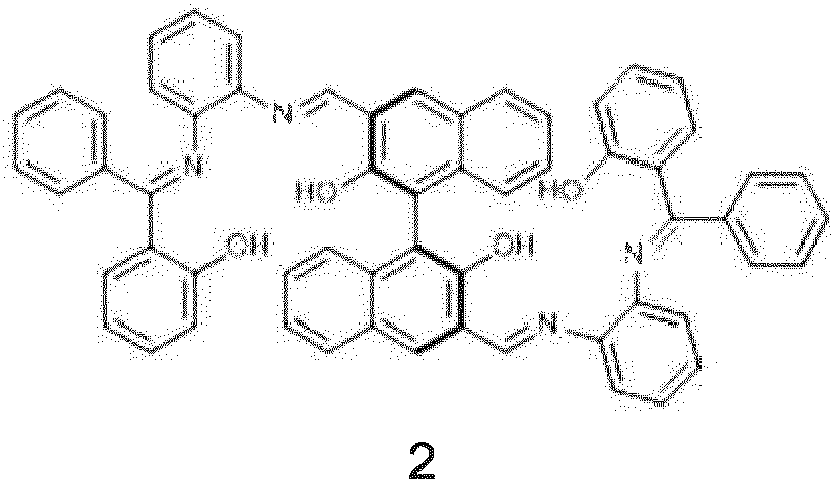
- (E)-2-(((2-aminopheny))imino)(phenyl)methyl)phenol (200 mg, 0.7 mmol) in 2 mL of CHCl3 and (S)-2,2'-dihydroxy-[1,1'-binaphthalene]-3,3'-dicarbal-dehyde (119 mg, 0.35 mmol) in 5 mL of MeOH were refluxed for 24 h. The precipitate formed was then filtered off. Yellow solid, 300 mg, 97%.
- HRMS (TOF ES+) m/z 883.3326 ([M+H]) C60H43N4O4 requires 883.3284.
-

- To a solution of ligand 2 (100 mg, 0.13 mmol) in 6 mL of anhydrous THF, ZnEt2 (0.29 mL 1 M in hexanes, 0.29 mmol) was slowly added. The reaction was stirred at room temperature 18 h. The red precipitate was filtered off. Red solid, 127 mg, 97%.
- MS (MALDI+) m/z 1009.1 ([M+H]). Elemental analysis calculated (%) for C60H38N4O4Zn2·14H2O C 56.30, H 5.35, N 4.38 found C 56.02, H 3.74, N 4.91.
- Di-metallic-Salphen compounds can be prepared from di-, tri-, or tetravalent transition metal salts, depending on the metal center required, and using the
ligands Salphen 1c from Di-Zn-Salphen 1 a. For instance, using Ni(OAc)2 instead of Cu(OAc)2 in the preparative example 1,compound 1 b was isolated in 98% yield as a brown solid. - Table 1 summarizes the aggregate-size distribution profile, as recorded by dynamic light scattering (DLS), of:
(i) DCM solutions of thecomplexes
(ii) DCM suspensions of MWNTs (length: 100-700 nm, external diameter: 15-42 nm) at the indicated concentration; and
(iii) mixtures of thecomplexes Table 1 [1a] (nM) [2a] (nM) [MWNT]( mg/mL) Peak 1 diameter value (nm)Peak 2 diameter value (nm)Peak 3 diameter value (nm)0 0 0.02 164 531 5560 70 0 0 2.3 190 5560 0 70 0 0.6 6.5 164 70 0 0.02 220 - - 0 70 0.02 38 - - 280 0 0.08 615 - - 0 280 0.08 122 - - - Table 1 shows that it is possible to avoid the spontaneous agglomeration of MWNTs in DCM dispersions by incorporating one of the
complexes Figure 2 shows the DLS profile of the prepared materials. The presence of single sharp peaks in the DCM profiles for samples containing both MWNTs andcompound compounds -
Figure 3 shows a TEM image of a drop-cast solution of 1 a (70 µM) containing MWNT (0.02 g/mL), wherein the carbon nanotubes and complex 1 a are organized into an extended network. Interestingly, the presence of the bis-salphen compound or complex facilitates the nanotubes to homogeneously disperse into a unimodal aggregate size distribution profile ranging from 105 to 220 nm, depending on the complex used. These values are closely similar to the size dimensions of the nanotubes used, which indicates the predominance of individually dispersed nanotubes in solution. - The results show that a compound of formula (I) or a coordination complex thereof is useful for the dispersion of a carbonaceous material, such as carbon nanotubes into halogenated solvents, by the formation of unique structures.
- Preparative solutions of composite materials of different compositions containing bisphenol A polycarbonate,
compound - (i) The different following solutions were prepared:
- a) Solution 1: A solution of 1 a, 2a or 1 c in dichloromethane (DCM) at a concentration of 0.7 mM.
- b) Solution 2: Solutions of polymers were prepared prior to material processing by dissolving bisphenol A polycarbonate MAKROLON OD2015 in anhydrous dichloromethane (DCM, 99.8%) at a concentration of 0.1 g per mL.
- c) Solution 3:
Solution 2 andsolution 1 were mixed in a 9:1 volume ratio, so that the concentration ofsolution 3 incompound - e) Dispersion 1: Separately, liquid dispersions of carbon nanotubes in DCM (either unmodified or carboxylated carbon nanotubes) were prepared and sonicated for 30 minutes at 25 °C in a standard bath sonicating system. The amount of MWNT in the suspension varies depending on the desired load of MWNT in the final composite material.
- f) Solution 4: Liquid mixtures of
solution 3 anddispersion 1 were prepared by mixing 10 volume parts ofsolution 3 with one volume part ofdispersion 1.
- Comparative preparative solutions, i.e. solutions that do not contain MWNT and/or do not contain
compound solution 1 and/ordispersion 1. - According to this procedure, the following amounts of MWNT have been used:
Amount of MWNT in dispersion 1 (g per litre) Masterbatch composite load in MWNT (wt.%) 47.4 5 37.5 4 27.9 3 10.4 2 9.1 1 2.0 0.22 1.0 0.11 0.2 0.022 0.1 0.011 0.02 0.0022 0.01 0.0011 0.002 0.00022 0.001 0.00011 - Films were prepared by the Doctor Blade technique from casting the
preparative solutions 4 of example 2 at the desired nanotubes:(salphen + polymer) mass ratio under high-efficiency particulate air-filtered laminar flow conditions. An aliquot of the solution (commonly 1 - 5 mL, depending on the surface to cover and the film thickness desired) was deposited on a polyethylene terephthalate sheet used as support and the cast solution was homogeneously spread onto the support at a spreading speed ranging from 2.5 mm/s to 30 mm/s at 25 °C by means of a standardized iron blade with sub-micrometer-sized adjusting capabilities. The film therein formed was dried at low vacuum (10-100 mBar) and 25 °C for 1-2 h. Films of variable thicknesses are possible by adjusting the blade height (commonly between 0.05 µm and 500 µm). Blank films were prepared from liquid mixtures of nanotubes:polymer in variable mass ratios between 0:100 and 5:95. Salphen-containing films were prepared from liquid mixtures of nanotubes:(salphen + polymer) in variable mass ratios between 0:100 and 5:95; the load of salphen in the salphen + polymer solution was adjusted by selecting the concentration range described in Example 2 above. - Films were prepared by spin coating from casting the preparative solutions of Example 2 at the desired nanotubes:(salphen + polymer) mass ratio under a closed injection system. An aliquot of the solution (commonly 1-10 mL, depending on the film thickness desired) was deposited on a circular flat aluminium container (6 cm diameter) adapted to a spin coater. The solution was then dispersed by spinning at 10-100 rpm (preferably 60 rpm) and dried at 25 °C and 1 Atm. The film therein formed was dried at low vacuum (10-100 mBar) and 25 °C for 1-2 h and separated from the aluminium container. Thickness of the films was controlled during preparation procedure to a final value of approximately 10, 50 or 100 µm in the solid state. Blank films were prepared from liquid mixtures of nanotubes:polymer in variable mass ratios between 0:100 and 5:95. Salphen-containing films were prepared from liquid mixtures of nanotubes:(salphen + polymer) in variable mass ratios between 0:100 and 5:95; the load of salphen in the salphen + polymer solution was adjusted by selecting the concentration range described in the Example 2 above.
- Films were prepared by compression moulding from casting the preparative solutions of Example 2 at the desired nanotubes:(salphen + polymer) mass ratio. An aliquot of the solution (commonly 1 - 10 mL, depending on the surface to cover and the film thickness desired) was deposited on a flat compressing surface protected by a disposable aluminium layer. The cast solution was homogeneously spread onto the compressing surface and dried at 25 °C and 1 Atm until complete evaporation was achieved. The material therein prepared was finally moulded melting at 300 °C and compression at 104 Pa. Blank films were prepared from liquid mixtures of nanotubes:polymer in variable mass ratios between 0:100 and 5:95. Salphen-containing films were prepared from liquid mixtures of nanotubes:(salphen + polymer) in variable mass ratios between 0:100 and 5:95; the load of salphen in the salphen+polymer solution was adjusted by selecting the concentration range described in Example 2 above.
- Parts were prepared by melt extrusion starting from the preparative solutions of Example 2 at the desired nanotubes:(salphen + polymer) mass ratio. Salphen-containing extruded parts were prepared from liquid mixtures of nanotubes:(salphen + polymer) in variable mass ratios between 0:100 and 5:95; the load of salphen in the salphen + polymer solution was adjusted by selecting the concentration range described in Example 1 above. The liquid mixtures of nanotubes:(salphen + polymer) were completely evaporated at low vacuum 10-200 mBar, 40 °C and stirring conditions (20-80 rpm). The solid material was recovered and ground to a grain size of approximately 400 µm - 4 mm. The solid material was fed into a standard extruder for thermoplastics (MiniLab Rheomex CTW5. HAAKE, Germany). The extrusion process was carried out at the following conditions: Tm = 280 °C, Ts = 280 °C, moment = 18 N cm and n = 60 min-1. The form of the extruded parts was adjusted by commercially available standard nozzles.
- Parts were prepared by melt extrusion starting from the preparative solutions of Example 2 at the desired nanotubes:(salphen + polymer) mass ratio. Salphen-containing moulded parts were prepared from liquid mixtures of nanotubes:(salphen + polymer) in variable mass ratios between 0:100 and 5:95; the load of salphen in the salphen + polymer solution was adjusted by selecting the concentration range described in Example 1 above. The liquid mixtures of nanotubes:(salphen + polymer) were completely evaporated at low vacuum 10-200 mBar, 40 °C and stirring conditions (20-80 rpm). The solid material was recovered and ground to a grain size of approximately 400 µm - 4 mm. The solid material was fed into a standard injection moulding for thermoplastics (Injection moulding device model MiniJet II, Thermo Scientific, Germany). The injection moulding experiments were carried out at the following conditions: Cylinder Temperature = 280 °C, Mould Temperature = 105 °C, Pressure = 500 Bar, Holding Pressure = 300 Bar, Time = 15 s. The form, height, length and width of the moulded parts was adjusted by commercially available standard hardened steel moulds.
- A blank bisphenol A polycarbonate film was prepared from a cast solution of polymer in DCM by compression moulding as described in Example 5. A composite film was similarly prepared with the complex 2a (0.07 %-wt.) and MWNTs (0.02 %-wt). Environmental scanning electron microscopy (ESEM) was performed on each sample and a superficial view is shown in
Fig. 4 (part A showing the blank polycarbonate and part B showing the composite including the complex 2a and the MWNTs). - Similarly, films were prepared by casting (spin-coating) from the preparative solutions of Example 2:
- solution of bisphenol A (BPA) polycarbonate in DCM;
- solution of BPA polycarbonate with complex 1 a 0.07 wt.% in DCM; and
- suspension of BPA polycarbonate with complex 1 a 0.07 wt.% and MWNTs 0.02 wt.%
- Transversal cuts observed by TEM are shown in
Fig. 5 (part A showing the polycarbonate alone; part B showing the polycarbonate & complex 1 a; and part C showing the polycarbonate, complex 1 a & MWNTs). -
Figures 4 and5 show that the compound of formula (I) or a coordination complex thereof allows for dispersing the nanotubes within a polymer matrix. Various film formation techniques have been used and self-assembled structures are maintained. - Different composite film compositions were prepared by spin-coating of the preparative solutions of Example 2 having the concentrations specified in Table 2 and Table 3. In all cases, the composite film comprises 0.07 % by weight of compound of formula (I) (i.e. 1 a, 1 c, or 2a). In Tables 2 and 3, "blank" refer to composite films prepared from bis phenol-A (BPA) polycarbonate and carbon nanotubes, i.e. free of the compound of formula (I). The typical morphological characteristics of the films thus obtained are: diameter: 6.5 cm; nominal thickness: 0.1 mm; average film density: 1.6 g/cm3. Surface and volume resistivity was measured as described above.
Table 2 Compound (I) % wt MWNT Surface resistivity (ohm) Blank 5 190000 Blank 3 4,05378E+12 Blank 1 6,02239E+14 Blank 0,22 1,34697E+14 Blank 0,11 2,04107E+14 Blank 0,022 2,17182E+14 Blank 0,011 2,95477E+14 Blank 0,0022 3,11397E+14 Blank 0,0011 3,63556E+14 Blank 0,00022 4,39481E+14 Blank 0,00011 6,13302E+14 Blank 0 5,23139E+16 1c 0,22 3,18573E+12 1c 0,022 2,98494E+14 1c 0,0022 3,4785E+14 1c 0,00022 6,61377E+14 1c 0 1,07956E+15 1a 5 46000 1a 3 386524,8667 1a 0,22 5,16024E+13 1a 0,11 2,09714E+14 1a 0,022 2,42327E+14 1a 0,011 2,56274E+14 1a 0,0022 4,01555E+14 1a 0,0011 5,81021E+14 1a 0,00022 9,14042E+14 1a 0,00011 1,70782E+15 1a 0 7,11571E+16 2a 5 40650 2a 3 247677,5 2a 2 573318,4 2a 1 295980915 2a 0,22 4,25928E+13 2a 0,11 1,21096E+14 2a 0,022 1,34371E+14 2a 0,011 3,72199E+14 2a 0,0022 2,65073E+14 2a 0,0011 3,7314E+14 2a 0,00022 3,78432E+14 2a 0,00011 6,69138E+14 2a 0 4,2438E+16 -
Fig. 6 shows the surface resistivity (ohm) measurements from Table 2 of polycarbonate films with different compositions.
X axis: load of MWNT in weight % (linear scale)
Y axis: Surface resistivity (ohm), logarithmic scaleTable 3 Compound (I) % wt MWNT Volume resistivity (ohm·cm) Blank 5 778,6666667 Blank 4 21360 Blank 2 9226,666667 1c 5 77,86666667 1c 2 3240 1a 5 24 1a 4 318,4 1a 3 489,63808 1a 2 5920 2a 5 392 2a 3 4221,792533 2a 2 7760 -
Fig. 7 shows volumetric resistivity (ohm·cm) of different films of composite materials from Table 3 containing 0.07 wt.% bis-salphen compound: Film disk dimensions: 33.2 cm2 (6.5 cm diameter), 100 µm thickness, Average film density: 1.6 g/cm3, Average mass/film disk: 540 mg, Average optical transmittance: 60-90%, depending on the type of sample and thickness X axis: load of MWNT in weight % (logarithmic scale)
Y axis: Volumetric resistivity (ohm·cm), logarithmic scale - Tables 2 and 3 along with
Figs 6 and 7 show that composite materials comprising the compound of formula (I) or a coordination complex thereof have a lower electrical percolation threshold than composite materials formed from BPA polycarbonate and MWNT alone in the same conditions. These results also show that the selection of the metals of the compound of formula (III) allows for fine-tuning the properties of the material. -
Figure 8 shows the transmittance (in %) for different wavelengths (in nm) of the prepared films. - A composite film of BPA,
compound 2a (0.07 wt.%) and carboxylated multi-wall carbon nanotubes,(0.02% wt.%) was prepared by compression moulding as described above (example 5). The obtained film was studied by TEM and compared with a film similarly prepared using non-functionalized carbon nanotubes. Thefigure 10 shows that functionalization of the carbon nanotubes can be used to influence the assembly of the carbonaceous material within the matrix. - Composite polymer parts of BPA polycarbonate,
compound 1 a, and MWNTs having the compositions detailed in Table 4 have been prepared by extrusion and injection moulding as described in the general method above (examples 6 and 7). The obtained materials were studied by TEM as shown inFigure 9 .Table 4 Sample [1a] wt.% [MWNT] wt.% 1 0 0 2 0.07 0 3 0 0.3 4 0 3 5 0.07 0.3 6 0.07 3 - The results of
figure 9 show that the even dispersion and interconnection of the carbonaceous material is preserved within the polymer matrix, even when the material is submitted to harsh process conditions, such as melt extrusion and injection moulding.

Claims (15)
- A compound of formula (I) or a coordination complex thereof with a metal ion selected from the group consisting of Ni(II), Cu(II), Sc(III), Fe(II), Fe(III), Ca(II), Co(II), Co(III), Os(III), Os(IV), AI(III), Mn(IV), Mn(III), Mn(II), Cr(III), Ti(II), Ti(IV), Zr(IV), Hf(IV), W(IV), W(V), Ta(IV), Ta(V), Pd(II), Pt(II), Pt(IV), Ir(III), Rh(III), Ru(II), Ru(III), Re(IV), In(II), In(III), Ga(III), Sn(II), Sn(IV), V(IV), V(V), Nb(V), Au(III), Mg(II), Cd(II), Ce(III), Ce(IV), Eu(III), Yb(III), Gd(III), and Zn(II) for use as a dispersing agent for improvement of dispersion of a carbonaceous material in a dispersion medium
 each X is independently selected from OH and SH;R1, R2, R3, T1' R2' and R3' are each independently selected from the group consisting of halogen, hydrogen, cyano and nitro; provided that one or more of the pairs of groups R1 and R2, R2 and R3, R1' and R2', R2' and R3' together with the carbon atoms to which they are attached optionally form a phenyl ring or a 5 or 6 membered heteroaromatic ring having one or more heteroatoms selected from O, N and S; wherein one or more of the hydrogen atoms of the aromatic or heteroaromatic ring is optionally replaced by a radical selected from halogen, nitro and cyano;R4, R5, R6, R7, R9, R10, R11, R12, R4', R5', R6', R7', R9', R10', R11', and R12' are each independently selected from H, halogen, nitro, cyano, C1-6 alkyl, -O(C1-6 alkyl), -(C=O)C1-6 alkyl, -O(C=O)C1-6 alkyl, -(C=O)O(C1-6 alkyl), C3-8 cycloalkyl, C3-8 heterocycloalkyl, phenyl, and C5-6 heteroaryl, wherein any of the C3-8 cycloalkyl, C3-8 heterocycloalkyl, phenyl, and C5-6 heteroaryl groups are optionally substituted with one or more groups selected from halogen, nitro, cyano, and C1-6 alkyl; provided that one or more of the pairs of groups R4 and R5, R5 and R6, R6 and R7, R9 and R10, R10 and R11, R11 and R12, R4' and R5', R5' and R6', R6'and R7', R9' and R10', R10' and R11', R11' and R12' together with the carbon atoms to which they are attached optionally form a phenyl ring or a 5 or 6 membered heteroaromatic ring having one or more heteroatoms selected from O, N and S; wherein one or more of the hydrogen atoms of the aromatic or heteroaromatic ring is optionally replaced by a radical selected from halogen, nitro, and cyano, C1-6 alkyl, C1-6 haloalkyl, -O(C1-6 alkyl), - (C=O)C1-6 alkyl, -O(C=O)C1-6 alkyl, and -(C=O)O(C1-6 alkyl);R8 and R8' are independently selected from a phenyl ring and a 5 or 6 membered heteroaromatic ring having one or more heteroatoms selected from O, N and S, the phenyl ring or 5 or 6 heteroaromatic ring optionally being bridged or fused with one or more 5 to 12 membered ring; wherein one or more of the hydrogen atoms of each ring is optionally replaced by a radical selected from halogen, nitro, and cyano.
 - The compound according to claim 1 wherein R8 and R8' are each independently selected from phenyl and a 5 or 6 membered heteroaromatic ring having one or more heteroatoms selected from O, N and S, the phenyl group or 5 or 6 heteroaromatic ring optionally being bridged or fused with one or more 5 to 7 membered ring.
- The compound according to any of the preceding claims wherein R8 and R8' are each independently selected from phenyl, naphthyl, and biphenylyl.
- The compound according to any of the preceding claims wherein R8 and R8' are both phenyl.
- The compound according to any one of the preceding claims, wherein R1, R2, R3, R1', R2', R3' are each independently selected from the group consisting of halogen, hydrogen, cyano and nitro; provided that one or more of the pairs of groups R1 and R2, R2 and R3, R1' and R2', R2' and R3' together with the carbon atoms to which they are attached optionally form a phenyl ring or a 5 or 6 membered heteroaromatic ring having one or more heteroatoms selected from O, N and S; and
R4, R5, R6, R7, R9, R10, R11, R12 R4', R5', R6', R7', R9', R10', R11', and R12' are each independently selected from H, halogen, nitro, cyano, phenyl, and C5-6 heteroaryl, wherein any of the phenyl and C5-6 heteroaryl groups are optionally substituted with one or more groups selected from halogen, nitro, cyano, and C1-6 alkyl; provided that one or more of the pairs of groups R4 and R5, R5 and R6, R6 and R7, R9 and R10, R10 and R11, R11 and R12, R4' and R5', R5' and R6', R6' and R7', R9' and R10', R10' and R11', R11' and R12' together with the carbon atoms to which they are attached optionally form a phenyl ring or a 5 or 6 membered heteroaromatic ring having one or more heteroatoms selected from O, N and S; wherein one or more of the hydrogen atoms of the aromatic or heteroaromatic ring is optionally replaced by a radical selected from halogen, nitro, and cyano. - The compound according to any one of the preceding claims, wherein R4, R5, R6, R7, R9, R10, R11, R12, R4', R5', R6', R7', R9', R10', R11', and R12' are each independently selected from H, halogen, nitro, and cyano.
- The compound according to any of the preceding claims selected from the compounds of formula (II) and (III)
 M and M' are each independently selected from Ni(II), Cu(II), Sc(III), Fe(II), Fe(III), Ca(II), Co(II), Co(III), Os(III), Os(IV), AI(III), Mn(IV), Mn(III), Mn(II), Cr(III), Ti(II), Ti(IV), Zr(IV), Hf(IV), W(IV), W(V), Ta(IV), Ta(V), Pd(II), Pt(II), Pt(IV), Ir(III), Rh(III), Ru(II), Ru(III), Re(IV), In(II), In(III), Ga(III), Sn(II), Sn(IV), V(IV), V(V), Nb(V), Au(III), Mg(II), Cd(II), Ce(III), Ce(IV), Eu(III), Yb(III), Gd(III), and Zn(II);each X is independently selected from OH and SH;each Y is independently selected from O and S; andR2, R3, R2' and R3' are independently selected from hydrogen, halogen, cyano and nitro; provided that one or more of the pairs of groups R2 and R3, R2' and R3', together with the carbon atoms to which they are attached optionally form a phenyl ring or a 5 or 6 membered heteroaromatic ring having one or more heteroatoms selected from O, N and S; wherein one or more of the hydrogen atoms of the phenyl or heteroaromatic ring is optionally replaced by a radical selected from halogen, nitro and cyano.
 - The compound according to claim 7, wherein R2, R3, R2' and R3' are each hydrogen; or the two pairs of R2 and R3 and R2' and R3' together with the carbon atoms to which they are attached each form a phenyl ring.
- The compound according to claim 8, wherein
M and M' are the same and are selected from Ni(II), Cu(II) and Zn(II); and X is OH and Y is O. - A composition comprising:a compound according to any one of the preceding claims or mixtures thereof; anda carbonaceous material selected from amorphous carbon, graphene, graphite, fullerenes, carbon nanowires, carbon nanotubes and mixtures thereof, the carbonaceous material optionally having one or more functional groups selected from carboxy, halogen, hydroxy, alkoxy, siloxy, esters and amine.
- The composition according to claim 10, further comprising a polymer or gel component.
- The composition according to claim 11, comprising a polymer component which has a solubility in halogenated solvent of at least one gram of polymer per litre of solvent.
- The composition according to claim 11 or 12, wherein the polymer is selected from linear low density polyethylene, polyethylene acrylates, poly(methyl methacrylate), poly(vinyl alcohol), polystyrene brominated, polyethylacrylate, polyvinyl acetate, polyvinyl nitrate, polyvinyl chloride, aromatic-aliphatic polyurethanes, aromatic polyurethanes, aliphatic polyurethanes, poly(3,4-ethylenedioxythiophene), poly(3,4-ethylenedioxythiophene)-tetramethacrylate, leucoemeraldine, emeraldine salt, emeraldine base, (per)nigraniline, trans-polyacetylene, cis-polyacetylene, aromatic-aliphatic polyketones, aromatic polyketones, aliphatic polyketones, polyether ether ketone, aromatic-aliphatic polypyrroles, aromatic polypyrroles and aliphatic polypyrroles, polyamide 46, polyamide 6, polyamide 66, polyamide 610, polyamide 612, polyamide 10, polyamide 11, polyamide 12, polyamide 6-6T, polyamide 6-61, polyamide 6T-6I, poly-oxydiphenylene-pyromellitimide, polydimethylsiloxane, aromatic-aliphatic polysiloxanes, aromatic polysiloxanes, poly(butylene succinate), poly(trimethylene terephthalate), polybutylene terephthalate, polyethylene terephthalate glycol, polyethylene terephthalate, polyhydroxybutyrate, polyhydroxyvalerate, polylactic acid, polyoxymethylene, polyphenylene oxide, polyphenylene sulphide, polyaspartic acid, ethylene acrylic acid sodium ionomer, poly(styrenesulfonate), PEDOT:PSS, acrylonitrile-butadiene-styrene copolymer, acrylic copolymers, acrylonitrile-styrene-acrylate copolymer, cyclic olefin copolymers, cyclic olefin polymers, ethylene acrylic ester copolymer, ethylene acrylic acid copolymer, ethylene epoxyacrylate copolymer, ethylene ethylacrylate copolymer, ethylene vinyl acetate copolymer, poly(butylene adipate-co-terephthalate), poly(ether-block-amides), poly(ethylene-co-methacrylic acid), methyl methacrylate copolymers, methacrylate copolymers, styrene acrylonitrile copolymer, polyvinyl chloride acetate, polymethylmethacrylate, polystyrene, styrene-butadiene block copolymer, bisphenol-A polycarbonate, high density polyethylene, low density polyethylene, poly ethylene acrylates, polyacetic acid, polyacrylic acid, polyacrylate, polyacrylonitrile, polyamide, polybutadiene, polybutylene, polybutylene adipate, polycarbonate, aromatic-aliphatic polycarbonates, aromatic polycarbonates, aliphatic polycarbonates, polyphenylsulphone, polyethersulfone, polyethylene, polymethylpentene, polyoxymethylene acetal polymer, polyphenylene sulfide, polypropylene, polysulphone, polytetrafluoroethylene, polyurethane, polyhydroxybutyrate, PEDOT, polypyrrole, polyaniline, polyacetylenes, mixtures, blends and co-polymers thereof.
- A composition according to any one of claims 11 to 13, wherein the amount of carbonaceous material in the composition is from 0.00001 to 30 wt.% and the amount of polymer or gel component in the composition is at least 70 wt.%.
- A method for preparing a composition according to any one of claims 10 to 14, the method comprising the steps of: preparing a mixture of carbonaceous material with a compound according to any one of claims 1 to 9 and optionally also a polymer or gel component, in a solvent; and eliminating the solvent to provide the composition.
Priority Applications (2)
| Application Number | Priority Date | Filing Date | Title |
|---|---|---|---|
| EP13382322.9A EP2835375A1 (en) | 2013-08-09 | 2013-08-09 | Bis-salphen compounds and carbonaceous material composites comprising them |
| PCT/EP2014/067125 WO2015018940A1 (en) | 2013-08-09 | 2014-08-08 | Bis-salphen compounds and carbonaceous material composites comprising them |
Applications Claiming Priority (1)
| Application Number | Priority Date | Filing Date | Title |
|---|---|---|---|
| EP13382322.9A EP2835375A1 (en) | 2013-08-09 | 2013-08-09 | Bis-salphen compounds and carbonaceous material composites comprising them |
Publications (1)
| Publication Number | Publication Date |
|---|---|
| EP2835375A1 true EP2835375A1 (en) | 2015-02-11 |
Family
ID=49029043
Family Applications (1)
| Application Number | Title | Priority Date | Filing Date |
|---|---|---|---|
| EP13382322.9A Withdrawn EP2835375A1 (en) | 2013-08-09 | 2013-08-09 | Bis-salphen compounds and carbonaceous material composites comprising them |
Country Status (2)
| Country | Link |
|---|---|
| EP (1) | EP2835375A1 (en) |
| WO (1) | WO2015018940A1 (en) |
Cited By (8)
| Publication number | Priority date | Publication date | Assignee | Title |
|---|---|---|---|---|
| CN105802155A (en) * | 2016-05-12 | 2016-07-27 | 江西禾尔斯环保科技有限公司 | Preparation method and application of PBAT modified material |
| CN106243644A (en) * | 2016-08-23 | 2016-12-21 | 宁德师范学院 | In-situ polymerization solution combines the method preparing GO/PBS material |
| WO2017070520A1 (en) * | 2015-10-23 | 2017-04-27 | Nanocomp Technologies, Inc. | Directed infrared radiator article |
| WO2019109726A1 (en) * | 2017-12-08 | 2019-06-13 | 中车青岛四方机车车辆股份有限公司 | Electromagnetic shielding filler, electromagnetic shielding coating comprising same, preparation method and application thereof |
| CN110183679A (en) * | 2019-06-25 | 2019-08-30 | 淮阴师范学院 | A kind of accessory of metal organic frame and preparation |
| CN112875768A (en) * | 2021-03-16 | 2021-06-01 | 青岛理工大学 | One-dimensional coralliform NiS/Ni3S4@PPy@MoS2Wave absorber, preparation method and application |
| CN116404358A (en) * | 2023-06-01 | 2023-07-07 | 合肥长阳新能源科技有限公司 | Battery separator, preparation method thereof and lithium ion battery |
| WO2023166496A1 (en) * | 2022-03-04 | 2023-09-07 | Graphenest, S.A | Graphene-based coating composition for eletromagnetic interference shielding, methods and uses thereof |
Families Citing this family (23)
| Publication number | Priority date | Publication date | Assignee | Title |
|---|---|---|---|---|
| ES2928164T3 (en) | 2015-10-19 | 2022-11-15 | Incyte Corp | Heterocyclic compounds as immunomodulators |
| MD3377488T2 (en) | 2015-11-19 | 2023-02-28 | Incyte Corp | Heterocyclic compounds as immunomodulators |
| MA44075A (en) | 2015-12-17 | 2021-05-19 | Incyte Corp | N-PHENYL-PYRIDINE-2-CARBOXAMIDE DERIVATIVES AND THEIR USE AS MODULATORS OF PROTEIN / PROTEIN PD-1 / PD-L1 INTERACTIONS |
| MY199705A (en) | 2015-12-22 | 2023-11-20 | Incyte Corp | Heterocyclic compounds as immunomodulators |
| WO2017192961A1 (en) | 2016-05-06 | 2017-11-09 | Incyte Corporation | Heterocyclic compounds as immunomodulators |
| WO2017205464A1 (en) | 2016-05-26 | 2017-11-30 | Incyte Corporation | Heterocyclic compounds as immunomodulators |
| KR102685249B1 (en) | 2016-06-20 | 2024-07-17 | 인사이트 코포레이션 | Heterocyclic Compounds as Immunomodulators |
| MA45669A (en) | 2016-07-14 | 2019-05-22 | Incyte Corp | HETEROCYCLIC COMPOUNDS USED AS IMMUNOMODULATORS |
| WO2018044783A1 (en) | 2016-08-29 | 2018-03-08 | Incyte Corporation | Heterocyclic compounds as immunomodulators |
| WO2018119224A1 (en) | 2016-12-22 | 2018-06-28 | Incyte Corporation | Tetrahydro imidazo[4,5-c]pyridine derivatives as pd-l1 internalization inducers |
| EP3558973B1 (en) | 2016-12-22 | 2021-09-15 | Incyte Corporation | Pyridine derivatives as immunomodulators |
| PE20191532A1 (en) | 2016-12-22 | 2019-10-23 | Incyte Corp | HETEROCYCLIC COMPOUNDS AS IMMUNOMODULATORS |
| CA3047991A1 (en) | 2016-12-22 | 2018-06-28 | Incyte Corporation | Bicyclic heteroaromatic compounds as immunomodulators |
| EP3558989B1 (en) | 2016-12-22 | 2021-04-14 | Incyte Corporation | Triazolo[1,5-a]pyridine derivatives as immunomodulators |
| RS64055B1 (en) | 2018-03-30 | 2023-04-28 | Incyte Corp | Heterocyclic compounds as immunomodulators |
| MD3790877T2 (en) | 2018-05-11 | 2023-08-31 | Incyte Corp | Tetrahydro-imidazo[4,5-c]pyridine derivatives as pd-l1 immunomodulators |
| CN112175344A (en) * | 2019-07-05 | 2021-01-05 | 中国石油化工股份有限公司 | Polyketone composite material, preparation method and application thereof |
| JP7665593B2 (en) | 2019-08-09 | 2025-04-21 | インサイト・コーポレイション | Salts of PD-1/PD-L1 inhibitors |
| AR120109A1 (en) | 2019-09-30 | 2022-02-02 | Incyte Corp | PYRIDO[3,2-D]PYRIMIDINE COMPOUNDS AS IMMUNOMODULATORS |
| PE20230407A1 (en) | 2019-11-11 | 2023-03-07 | Incyte Corp | SALTS AND CRYSTALLINE FORMS OF A PD-1/PD-L1 INHIBITOR |
| WO2022099018A1 (en) | 2020-11-06 | 2022-05-12 | Incyte Corporation | Process of preparing a pd-1/pd-l1 inhibitor |
| TW202233616A (en) | 2020-11-06 | 2022-09-01 | 美商英塞特公司 | Process for making a pd-1/pd-l1 inhibitor and salts and crystalline forms thereof |
| WO2022099075A1 (en) | 2020-11-06 | 2022-05-12 | Incyte Corporation | Crystalline form of a pd-1/pd-l1 inhibitor |
Citations (6)
| Publication number | Priority date | Publication date | Assignee | Title |
|---|---|---|---|---|
| WO2008114910A1 (en) | 2007-03-16 | 2008-09-25 | Korea Advanced Institute Of Science And Technology | Dispersion composite of nanotube for a process for preparing the same |
| WO2008143233A1 (en) | 2007-05-21 | 2008-11-27 | Kyoto University | Phenylene polymer, dispersing agent for carbon nanotube, carbon nanotube composite body, thin film for solar cell, and dispersion liquid of carbon nanotube composite body and method for producing the same |
| JP2009023886A (en) * | 2007-07-20 | 2009-02-05 | Nara Institute Of Science & Technology | Carbon nanotube dispersion, method for producing the same, and use thereof |
| WO2009035478A1 (en) | 2007-05-14 | 2009-03-19 | Raytheon Company | System and methods of dispersion of nanostructures in composite materials |
| US7999028B2 (en) | 2005-06-23 | 2011-08-16 | Kuan-Jiuh Lin | Method for fast dispersing carbon nanotube in aqueous solution |
| US20120145968A1 (en) | 2010-12-10 | 2012-06-14 | Sony Corporation | Process for producing transparent conductive films, transparent conductive film, process for producing conductive fibers, conductive fiber, carbon nanotube/conductive polymer composite dispersion, process for producing carbon nanotube/conductive polymer composite dispersions, and electronic device |
-
2013
- 2013-08-09 EP EP13382322.9A patent/EP2835375A1/en not_active Withdrawn
-
2014
- 2014-08-08 WO PCT/EP2014/067125 patent/WO2015018940A1/en not_active Ceased
Patent Citations (6)
| Publication number | Priority date | Publication date | Assignee | Title |
|---|---|---|---|---|
| US7999028B2 (en) | 2005-06-23 | 2011-08-16 | Kuan-Jiuh Lin | Method for fast dispersing carbon nanotube in aqueous solution |
| WO2008114910A1 (en) | 2007-03-16 | 2008-09-25 | Korea Advanced Institute Of Science And Technology | Dispersion composite of nanotube for a process for preparing the same |
| WO2009035478A1 (en) | 2007-05-14 | 2009-03-19 | Raytheon Company | System and methods of dispersion of nanostructures in composite materials |
| WO2008143233A1 (en) | 2007-05-21 | 2008-11-27 | Kyoto University | Phenylene polymer, dispersing agent for carbon nanotube, carbon nanotube composite body, thin film for solar cell, and dispersion liquid of carbon nanotube composite body and method for producing the same |
| JP2009023886A (en) * | 2007-07-20 | 2009-02-05 | Nara Institute Of Science & Technology | Carbon nanotube dispersion, method for producing the same, and use thereof |
| US20120145968A1 (en) | 2010-12-10 | 2012-06-14 | Sony Corporation | Process for producing transparent conductive films, transparent conductive film, process for producing conductive fibers, conductive fiber, carbon nanotube/conductive polymer composite dispersion, process for producing carbon nanotube/conductive polymer composite dispersions, and electronic device |
Non-Patent Citations (19)
| Title |
|---|
| A. KAMPFE; E. KROKE; J. WAGLER, EUR. J. INORG. CHEM., 2009, pages 1027 - 1035 |
| C. G6RL; H. G. ALT, J. ORGANOMET. CHEM., vol. 692, 2007, pages 5727 - 5753 |
| C.A. FURTADO; U.J. KIM; H.R. GUTIERREZ; L. PAN; E.C. DICKEY; P.C.J. EKLUND, J. AM. CHEM. SOC., vol. 126, 2004, pages 6095 |
| CARBON, vol. 45, 2007, pages 2897 - 903 |
| GÖRL ET AL., J. ORGANOMET. CHEM., vol. 692, 2007, pages 5727 - 5753 |
| H.-C. ZHANG; W.-S. HUANG; L. PU, J. ORG. CHEM., vol. 66, 2001, pages 481 - 487 |
| KAMPFE ET AL., EUR. J. INORG. CHEM., 2009, pages 1027 - 1035 |
| KLEIJ ET AL., CHEM. EUR. J, vol. 18, 2012, pages 6805 - 6810 |
| KLEIJ ET AL., CHEM. EUR. J., vol. 19, 2013, pages 2641 - 2648 |
| KLEIJ ET AL., DALTON TRANS., vol. 41, 2012, pages 9766 - 9772 |
| M. V. ESCÁRCEGA-BOBADILLA; G. SALASSA; M. MARTINEZ BELMONTE; E. C. ESCUDERO-ADAN; A. W. KLEIJ, CHEM.- EUR. J, vol. 18, 2012, pages 6805 - 6810 |
| MACROMOLECULES, vol. 39, no. 16, 2006, pages 5194 - 5205 |
| MARTHA V. ESCÁRCEGA-BOBADILLA ET AL: "A Recyclable Trinuclear Bifunctional Catalyst Derived from a Tetraoxo Bis-Zn(salphen) Metalloligand", CHEMISTRY - A EUROPEAN JOURNAL, vol. 19, no. 8, 18 February 2013 (2013-02-18), pages 2641 - 2648, XP055094710, ISSN: 0947-6539, DOI: 10.1002/chem.201204132 * |
| MARTHA V. ESCÁRCEGA-BOBADILLA ET AL: "Metal-directed assembly of chiral bis-Zn(ii) Schiff base structures", DALTON TRANSACTIONS, vol. 41, no. 32, 1 January 2012 (2012-01-01), pages 9766, XP055094709, ISSN: 1477-9226, DOI: 10.1039/c2dt30642e * |
| MARTHA V. ESCÁRCEGA-BOBADILLA ET AL: "Versatile Switching in Substrate Topicity: Supramolecular Chirality Induction in Di- and Trinuclear Host Complexes", CHEMISTRY - A EUROPEAN JOURNAL, vol. 18, no. 22, 29 May 2012 (2012-05-29), pages 6805 - 6810, XP055094711, ISSN: 0947-6539, DOI: 10.1002/chem.201200335 * |
| MONIRUZZAMAN ET AL., MACROMOLECULES, vol. 39, no. 16, 2006, pages 5194 - 5205 |
| TEDIM J ET AL: "Preparation and characterization of poly[Ni(salen)(crown receptor)]/multi-walled carbon nanotube composite films", ELECTROCHIMICA ACTA, ELSEVIER SCIENCE PUBLISHERS, BARKING, GB, vol. 53, no. 23, 1 October 2008 (2008-10-01), pages 6722 - 6731, XP022940432, ISSN: 0013-4686, [retrieved on 20080205], DOI: 10.1016/J.ELECTACTA.2008.01.079 * |
| YU ET AL., CARBON, vol. 45, 2007, pages 2897 - 903 |
| ZHANG ET AL., J. ORG. CHEM., vol. 66, 2001, pages 481 - 487 |
Cited By (13)
| Publication number | Priority date | Publication date | Assignee | Title |
|---|---|---|---|---|
| US11071174B2 (en) | 2015-10-23 | 2021-07-20 | Nanocomp Technologies, Inc. | Directed infrared radiator article |
| WO2017070520A1 (en) * | 2015-10-23 | 2017-04-27 | Nanocomp Technologies, Inc. | Directed infrared radiator article |
| CN105802155A (en) * | 2016-05-12 | 2016-07-27 | 江西禾尔斯环保科技有限公司 | Preparation method and application of PBAT modified material |
| CN106243644A (en) * | 2016-08-23 | 2016-12-21 | 宁德师范学院 | In-situ polymerization solution combines the method preparing GO/PBS material |
| CN106243644B (en) * | 2016-08-23 | 2018-08-21 | 宁德师范学院 | In-situ polymerization-solution is combined the method for preparing GO/PBS materials |
| US11441050B2 (en) | 2017-12-08 | 2022-09-13 | Crrc Qingdao Sifang Co., Ltd. | Electromagnetic shielding filler, electromagnetic shielding coating comprising the same, preparation method and use thereof |
| WO2019109726A1 (en) * | 2017-12-08 | 2019-06-13 | 中车青岛四方机车车辆股份有限公司 | Electromagnetic shielding filler, electromagnetic shielding coating comprising same, preparation method and application thereof |
| CN110183679A (en) * | 2019-06-25 | 2019-08-30 | 淮阴师范学院 | A kind of accessory of metal organic frame and preparation |
| CN112875768A (en) * | 2021-03-16 | 2021-06-01 | 青岛理工大学 | One-dimensional coralliform NiS/Ni3S4@PPy@MoS2Wave absorber, preparation method and application |
| CN112875768B (en) * | 2021-03-16 | 2022-05-17 | 青岛理工大学 | One-dimensional coralliform NiS/Ni3S4@PPy@MoS2Wave absorber, preparation method and application |
| WO2023166496A1 (en) * | 2022-03-04 | 2023-09-07 | Graphenest, S.A | Graphene-based coating composition for eletromagnetic interference shielding, methods and uses thereof |
| CN116404358A (en) * | 2023-06-01 | 2023-07-07 | 合肥长阳新能源科技有限公司 | Battery separator, preparation method thereof and lithium ion battery |
| CN116404358B (en) * | 2023-06-01 | 2023-09-29 | 合肥长阳新能源科技有限公司 | Battery separator, preparation method thereof and lithium ion battery |
Also Published As
| Publication number | Publication date |
|---|---|
| WO2015018940A1 (en) | 2015-02-12 |
Similar Documents
| Publication | Publication Date | Title |
|---|---|---|
| WO2015018940A1 (en) | Bis-salphen compounds and carbonaceous material composites comprising them | |
| US20240387070A1 (en) | Utilizing Nanoscale Materials as Dispersants, Surfactants or Stabilizing Molecules, Methods of Making the Same and the Products Produced Therefrom | |
| Khan et al. | Carbon nanotube-based polymer composites: synthesis, properties and applications | |
| Yue et al. | A versatile ethanol-mediated polymerization of dopamine for efficient surface modification and the construction of functional core–shell nanostructures | |
| KR101638049B1 (en) | Nanocomposites with core-shell structure comprising carbon nanoparticles and metal-organic frameworks, a preparation method thereof and a composition for absorbing gas comprising the same | |
| JP6297135B2 (en) | Copper nanoparticles and method for producing the same, copper nanoparticle dispersion, copper nanoink, method for storing copper nanoparticles, and method for sintering copper nanoparticles | |
| US8361430B2 (en) | Method and system for producing graphene and graphenol | |
| Meschi Amoli et al. | Highly electrically conductive adhesives using silver nanoparticle (Ag NP)-decorated graphene: The effect of NPs sintering on the electrical conductivity improvement | |
| US20040217520A1 (en) | Ceramic nanocomposite powders reinforced with carbon nanotubes and their fabrication process | |
| US20100029823A1 (en) | Method for fabricating carbon nanotube-metal-polymer nanocomposites | |
| KR101627016B1 (en) | Highly dispersible carbon nano structures and method for preparation thereof, and polymer composite comprising the carbon nano structures | |
| CN103842285A (en) | Nano composite consisting of carbon nanotubes and metal oxide and method for manufacturing the same | |
| US8703235B2 (en) | Preparation of metal nanowire decorated carbon allotropes | |
| JP4835435B2 (en) | Method for producing ultrafine particle-containing thermoplastic resin composition | |
| KR101843795B1 (en) | Method for Preparing Nano-sized Thin Film Coating | |
| Li et al. | Preparation of aligned Fe3O4@ Ag-nanowire/poly (vinyl alcohol) nanocomposite films via a low magnetic field | |
| Fu et al. | One-pot noncovalent method to functionalize multi-walled carbon nanotubes using cyclomatrix-type polyphosphazenes | |
| KR101465205B1 (en) | A preparing method of graphene using a surfactant containing aromatic functional group | |
| Cui et al. | Doped polyaniline/multiwalled carbon nanotube composites: Preparation and characterization | |
| Li et al. | Poly (lactide)-functionalized and Fe 3 O 4 nanoparticle-decorated multiwalled carbon nanotubes for preparation of electrically-conductive and magnetic poly (lactide) films and electrospun nanofibers | |
| KR101540030B1 (en) | The Graphenenanoplatelets coated with silver and manufacturing method thereof | |
| Kumar et al. | Novel amino-acid-based polymer/multi-walled carbon nanotube bio-nanocomposites: highly water dispersible carbon nanotubes decorated with gold nanoparticles | |
| KR100713222B1 (en) | Carbon nanotubes modified with pyrene derivatives, high dielectric polymer / carbon nanotube composites using the same, and methods for their preparation | |
| Shen et al. | Facile synthesis of magnetic nanoparticle–coated single‐walled carbon nanotubes and its functional modification in epoxy resin | |
| KR101227449B1 (en) | Manufacturing Method Of Carbon Nanotube Iodine Conducting Solid Using Dry Powder Mixing |
Legal Events
| Date | Code | Title | Description |
|---|---|---|---|
| PUAI | Public reference made under article 153(3) epc to a published international application that has entered the european phase |
Free format text: ORIGINAL CODE: 0009012 |
|
| 17P | Request for examination filed |
Effective date: 20130809 |
|
| AK | Designated contracting states |
Kind code of ref document: A1 Designated state(s): AL AT BE BG CH CY CZ DE DK EE ES FI FR GB GR HR HU IE IS IT LI LT LU LV MC MK MT NL NO PL PT RO RS SE SI SK SM TR |
|
| AX | Request for extension of the european patent |
Extension state: BA ME |
|
| STAA | Information on the status of an ep patent application or granted ep patent |
Free format text: STATUS: THE APPLICATION IS DEEMED TO BE WITHDRAWN |
|
| 18D | Application deemed to be withdrawn |
Effective date: 20150812 |