EP2834453B1 - Methods for determining wettability from nmr measurements - Google Patents
Methods for determining wettability from nmr measurements Download PDFInfo
- Publication number
- EP2834453B1 EP2834453B1 EP13773065.1A EP13773065A EP2834453B1 EP 2834453 B1 EP2834453 B1 EP 2834453B1 EP 13773065 A EP13773065 A EP 13773065A EP 2834453 B1 EP2834453 B1 EP 2834453B1
- Authority
- EP
- European Patent Office
- Prior art keywords
- saturation
- nmr
- wettability
- pore
- data
- Prior art date
- Legal status (The legal status is an assumption and is not a legal conclusion. Google has not performed a legal analysis and makes no representation as to the accuracy of the status listed.)
- Active
Links
Images



Classifications
-
- G—PHYSICS
- G01—MEASURING; TESTING
- G01V—GEOPHYSICS; GRAVITATIONAL MEASUREMENTS; DETECTING MASSES OR OBJECTS; TAGS
- G01V3/00—Electric or magnetic prospecting or detecting; Measuring magnetic field characteristics of the earth, e.g. declination, deviation
- G01V3/38—Processing data, e.g. for analysis, for interpretation, for correction
-
- G—PHYSICS
- G01—MEASURING; TESTING
- G01N—INVESTIGATING OR ANALYSING MATERIALS BY DETERMINING THEIR CHEMICAL OR PHYSICAL PROPERTIES
- G01N24/00—Investigating or analyzing materials by the use of nuclear magnetic resonance, electron paramagnetic resonance or other spin effects
- G01N24/08—Investigating or analyzing materials by the use of nuclear magnetic resonance, electron paramagnetic resonance or other spin effects by using nuclear magnetic resonance
- G01N24/081—Making measurements of geologic samples, e.g. measurements of moisture, pH, porosity, permeability, tortuosity or viscosity
-
- G—PHYSICS
- G01—MEASURING; TESTING
- G01V—GEOPHYSICS; GRAVITATIONAL MEASUREMENTS; DETECTING MASSES OR OBJECTS; TAGS
- G01V3/00—Electric or magnetic prospecting or detecting; Measuring magnetic field characteristics of the earth, e.g. declination, deviation
- G01V3/14—Electric or magnetic prospecting or detecting; Measuring magnetic field characteristics of the earth, e.g. declination, deviation operating with electron or nuclear magnetic resonance
Definitions
- the subject disclosure generally relates to methods for determining wettability from nuclear magnetic resonance (NMR) measurements and other data.
- NMR nuclear magnetic resonance
- the subject disclosure relates to inversion-based methods for determining wettability and saturation over a range of pore sizes.
- the wettability of the rock in an oil reservoir affects the saturations, capillary pressures (Pc), electrical properties, relative permeability and ultimate hydrocarbon recovery.
- Pc capillary pressures
- semi-empirical indices based on Pc curve measurements are used to describe core plug wettability: (1) Amott or Amott-Harvey index I AH , and (2) U.S. Bureau of Mines (USBM) index, I USBM . Frequently those indices do not match, despite industry expectation.
- NMR is a technique that has been shown to be very sensitive to rock/fluid interfaces.
- the most widely used application is the measurement of the pore size distribution when the pores are all 100% saturated with a single phase such as water.
- the interpretation is straightforward and is based on the fact that as the pore size decreases, the surface to volume ratio increases resulting in shorter ( i.e. enhanced) T 2 relaxation times.
- the NMR T 2 relaxation times are highly sensitive to the presence of fractionally saturated (oil and water) and mixed wet pores, such as in the case of core-plugs in their native state taken from an oil zone.
- a technique for determining a wettability from NMR measurements, making use of a forward model is described by Looyestijn et al. in "Wettability Index Determination by Nuclear Magnetic Resonance", Proceedings of SPE, no. SPE93624, 12 March 2005 .
- the invention concerns a method for characterizing wettability of a porous medium, the method comprising receiving pore size distribution data representing a distribution of pore sizes within the porous medium; receiving NMR echo train data from a bulk aqueous fluid; receiving NMR echo train data from a bulk oil; and performing an inversion on the NMR echo train data using a forward model for pore level distribution of wettability and saturation in mixed wet conditions over a plurality of pore sizes using the pore size distribution data and the NMR echo train data for the bulk aqueous fluid and the bulk oil, thereby generating a wettability profile and saturation profile across a pore spectrum for the aqueous and oil fluids over a plurality of pore sizes of the porous medium.
- the inversion is performed in the time domain, and the NMR data is of a type such as CPMG, diffusion editing, T 1 -T 2 , T 2 , T 2 -T 2 , D-T 1 and D-T 2 .
- the forward model can include a function for saturation that is either monotonically or non-monotonically increasing or decreasing along a spectrum of pore sizes, and the inversion can include mathematically constraining saturation values across a plurality of pore sizes in the forward model, for example based on a known saturation history of the porous medium.
- overall wettability can be determined by integrating the wettability profile weighted by the pore size distribution data and/or overall saturation can be determined by integrating the saturation profile weighted by the pore size distribution data.
- the inversion is performed in domains other than the time domain (e.g. in the T2 domain).
- the system in accordance with the invention for characterizing wettability of a porous medium includes: an NMR measurement system adapted and configured to make NMR measurements of a bulk aqueous fluid and a bulk oil, and to generate therefrom NMR echo train data; and a processing system programmed and configured to perform an inversion on the NMR echo train data using a forward model for pore level distribution of wettability and saturation in mixed wet conditions over a plurality of pore sizes using a pore size distribution of the porous medium, and the NMR echo train data, thereby generating a wettability profile and saturation profile across a pore spectrum for the aqueous fluid over a plurality of pore sizes of the porous medium.
- the porous medium is a core sample from a subterranean hydrocarbon-bearing formation, for example obtained using a core sampling tool deployable in a wellbore.
- at least part of the NMR measurement system is adapted to be deployed downhole so as to make the NMR measurements of the bulk aqueous fluid and/or bulk oil downhole while the fluid is in a live state.
- This disclosure describes a laboratory based wettability characterization method based on NMR measurements, which are uniquely sensitive to the surface wetting conditions of oil and water at the pore scale.
- the subject disclosure exploits the well-known surface relaxation effects on the NMR relaxation ( T 2 ).
- T 2 NMR relaxation
- a new workflow to obtain the NMR wettability of a porous medium such as a rock either in the native state or prepared to a certain state in the laboratory is disclosed.
- a new underlying forward model for the mixed wet and fractionally saturated T 2 distribution is also disclosed.
- the new outputs of the subject disclosure are the continuous saturation and wettability profiles as a function of the pore sizes in the porous medium.
- the subject disclosure improves upon the existing methods used in the laboratory.
- Wettability is an important parameter in the development of an oilfield ( E Donaldson, R D Thomas, and P B Lorenz, “Wettability Determination and Its Effect on Recovery Efficiency,” SPE Journal, (1969), 9, pp. 13-20 ; R A Salathiel, “Oil recovery by surface film drainage in mixed-wettability rocks," Journal of Petroleum Technology, (1973 ); W G Anderson, “Wettability Literature Survey - Part 6: The effects of Wettability on Waterflooding," Journal of Petroleum Technology, (1987 ); T Okasha, J Funk, and H Rashidi, "Fifty Years of Wettability Measurements in the Arab-D Carbonate Reservoir,” Proceedings of SPE Middle East Oil and Gas Show and Conference, (Mar 2007), pp. 1-12 ), yet there are few methods of quantifying it. The two most common are the qualitative indices based on Pc curve measurements: (1) Amott-Harvey (AH), and (2) U.S. Bureau of Mines (USBM) methods.
- AH Amott-Harvey
- an inversion technique is described that has been validated in the laboratory under a controlled set of conditions.
- such validation has been done by correlating the NMR wettability index under investigation against the various industry standards, and thereby determining whether the NMR method is valid.
- AH and USBM indices See S Ma, X Zhang, N R Morrow, and X Zhou, "Characterization of wettability from spontaneous imbibition measurements," Journal of Canadian Petroleum Technology, (1999), 38 no. 13, p. 56 )
- such benchmarking can be misleading.
- the NMR wettability index as described provides more information and is more consistent with the expected wettability based on well defined preparation methods.
- a number of principles are used to extract wettability and saturation as a function of pore size from NMR T 2 data.
- the described method does not require that a pore geometry be specified, but instead is incorporated into the model by the measured, fully water-saturated relaxation ( T 2 ) distribution.
- the method makes use of NMR data for two states of the core plug (for example, native and fully water saturated) and for two bulk fluid samples (for example, water and native oil).
- one output of the analysis is the native state T 2 distribution, which is decomposed into oil and water T 2 spectra, respectively.
- a second output is a wettability index as a function of the pore size spectrum. This index can be averaged over the pore size distribution to provide a single wettability index for the core plug on a -1 to +1 scale, consistent with the traditional convention.
- the basic physics is that the NMR relaxation time T 2 of a fluid contained in a porous system is shortened from its bulk value as a result of surface interactions.
- the extent of relaxation enhancement is related to the pore diameter d as T 2 ⁇ d, i.e. smaller pores have shorter T 2 .
- the amount of T 2 shortening from surface relaxation for a given phase is directly proportional to the fraction of surface wetted by that phase.
- an unambiguous NMR wettability index for the rock can be derived from an average of the wettability across the pore system.
- the T 2 for a given phase in a pore also depends on the saturation of that phase in that pore. This implies that T 2 is sensitive to both wettability and saturation in the pore, as well as the pore size distribution itself.
- FIG. 2 shows plots of D-T 2 data from a representative case, according to some embodiments.
- Three D-T 2 distributions are presented in the main plot 200: (1) the bulk water peak 204, (2) the bulk dead crude oil distribution 202 which lies along the diagonal correlation line 230, and (3) the native state data for this plug 206. Note that although D-T 2 distributions are shown, according to some embodiments the described inversion can be obtained using only T 2 . The data were taken at ambient conditions.
- the horizontal dashed line 232 corresponds to the water line
- the diagonal dashed line 230 corresponds to the dead crude oil correlation as described by S-W Lo, G J Hirasaki, W V House, and R Kobayashi, "Mixing rules and correlations of NMR relaxation time with viscosity, diffusivity, and gas/oil ratio of methane/hydrocarbon mixtures," SPE Journal, (2002), 7 no. 1, pp. 24-34 .
- the two prominent features for the native state data are (1) the leftward shift of the signal from the bulk water peak 204, which corresponds to water wetting the rock, and, (2) a similar shift for the oil signal 202, which corresponds to crude oil wetting the rock.
- T 2 projection plot 220 shows how wetting causes the bulk fluid responses to shift to the left, i.e. to shorter T 2 , as a result of surface relaxation. It is significant that both fluids are found to shift to the left, which indicates that both fluids are to a certain extent wetting the pore surface. Therefore, according to D-T 2 , this native state plug is qualitatively mixed-wet, which agrees well with the native state wettability indices (I NMR , I AH , I USBM* ) which range between -0.3 and -0.2 for this case.
- FIG. 3-1, 3-2 and 3-3 are schematic representations of different states of a triangular shaped pore.
- FIG. 3-1 shows pore 300 after deposition
- FIG. 3-2 shows pore 300 after oil migration
- FIG. 3-3 shows pore 300 after flushing caused by either a water based mud (WBM) filtrate invasion or water injection.
- FIGs. 3-1, 3-2 and 3-3 illustrate how S i and W i can vary inside a triangular pore during the geological lifetime of a reservoir rock.
- WBM water based mud
- the overall water saturation, S NMR , and wettability index, I NMR for the whole plug are determined as functions of the average values of S i and W i over the pore spectrum P ( T 2 S,i ) (i.e. the pore size distribution).
- the overall saturation is simply the average of S i weighted by the pore size distribution, while the wettability index is scaled to the traditional -1 to 1 interval.
- T 2 S,i is defined as the relaxation time due to surface relaxation inside the i 'th pore, and P ( T 2S ) is normalized to 1.
- FIG. 4 illustrates a representative example of the forward model and inversion output for S i and W i across the pore spectrum data, according to some embodiments.
- S i (410) and wettability W i (412) across the pore spectrum data (420).
- the pore cartoons 430 and 440 illustrate how the big pores (440) would look according to S i and W i , and similarly for the small pores (430). Note that the pore cartoons are meant as an illustration and do not correspond to the precise values of S i , W i , and pore size.
- Inversion The theory of surface relaxation, including the one for wettability described herein, is presented in terms of relaxation times T 2 . This makes the representation clearer and easier to understand. However, when we are dealing with real experimental data, we have to remember that the acquisition is done in the time domain. To express the results in the T 2 domain, an inversion (Inverse Laplace Transform, or ILT) is used (See L Venkataramanan, Y-Q Song, and M D Hürlimann, "Solving Fredholm integrals of the first kind with tensor product structure in 2 and 2.5 dimensions," IEEE Transactions on Signal Processing, (2002), 50 no. 5, pp. 1017-1026 ). This process is well known to be an ill posed problem without a unique solution.
- ILT Inverse Laplace Transform
- constraints are used in connection with the inversion.
- One example is an intelligent grid search method, which has the advantage of providing many solutions indexed by their overall quality of fitness to the data.
- a strength of the inversion is that we may easily introduce a constraint, such as described above, on the saturation S i across the pore spectrum in order to stabilize the inversion for wettability W i across the pore spectrum.
- the saturation constraint is based on the saturation history of the rock as well as some petrophysical insight into the problem. Table 1 shows four common reservoir scenarios dictating helpful saturation constraints without any loss of generality: Table 1: Description of the different filters used in the inversion and petrophysical justifications.
- S i is a Gaussian profile centered in the large pores corresponding to T 2S > 10 -1 s
- the saturation index can be obtained independently from other techniques such as the amount of fluid production.
- S NMR lies within +/- 5% of an independent measurement
- NMR wettability inversion can help to understand the complexity of wettability and saturation profiles at the pore scale. Three examples covering a wide variety of wettability types and saturation states are shown below:
- FIGs. 5-1 and 5-2 are graphs of the T 2 distribution from ILT and the oil and water distributions obtained from the inversion for a strongly oil-wet rock example, according to some embodiments.
- FIG. 5-1 plots the ILT (510) and the oil (512) and water (514) distributions along with the total (516).
- FIG. 5-1 clearly shows the presence of oil in the smaller pores ( T 2 ⁇ 10 -1 s) and water in the larger ( T 2 > 10 -1 s) pores. This is consistent with the history of the plug, that started fully oil saturated and has been de-saturated by centrifuging with water. Note that the total (oil + water) fit has narrower and better-resolved peaks than the ILT. This is not an issue as such since the misfit from the inversion is calculated in the time domain (not shown), and furthermore, as already noted the ILT tends to artificially smooth out the solution in the T 2 domain as a result of regularization.
- S NMR 0.74
- I NMR wettability index
- the saturation function S i reflects the fluid distribution observed in the left panel.
- the wettability function W i stays very low for most of the range of T 2S as expected for an oil-wet plug. We note that W i increases slightly in the range of T 2S values where there are no data, therefore we do not speculate on this trend.
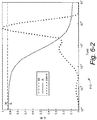
- FIGs. 6-1 and 6-2 are graphs of the T 2 distribution from ILT and the oil and water distributions obtained from the inversion for an example water-wet plug at Swirr, according to some embodiments.
- the oil and water distribution ranges are inverted and the wettability function is a constant at high values.
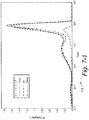
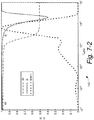
- FIGs. 7-1 and 7-2 are graphs of the T 2 distribution from ILT and the oil and water distributions obtained from the inversion for an example water-wet plug at S or , according to some embodiments.
- S NMR 0.89
- the wettability index from I NMR +0.32.
- new approaches to an NMR wettability inversion algorithm as well to the underlying forward model, both of which are applicable over a wide range of saturation and wettability conditions are described.
- the described approach takes the saturation history of the plug as well as some petrophysical insight into account to formulate a saturation filter on the set of solutions from the inversion, thereby stabilizing a solution set for the wettability across the pore spectrum.
- a new NMR inversion technique is incorporated which does not rely on an Inverse Laplace Transform or a regularization parameter, which further stabilizes the inversion algorithm for the wettability across the pore spectrum.
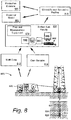
- FIG. 8 is a diagram showing aspects of a system for determining wettability and saturation profiles from NMR data, according to some embodiments.
- Core samples are being gathered from a subterranean rock formation 802 at wellsite 800 via a wireline truck 820 deploying a wireline tool string in a well via wireline 822.
- the tool string includes one or more wireline tools including a core sampling tool 824, and/or an NMR tool 826.
- the acquired core sample 814 is transported from the wellsite 800 to a surface facility 850, which includes one or more central processing units 844 for carrying out the data processing procedures as described herein, as well as other processing.
- Facility also includes a data storage system 842, communications and input/output modules 840, a user display 846 and a user input system 848.
- the surface facility 850 may be located in a location remote from the wellsite 800.
- borehole NMR measurements are made of the fluids and rock in formation 802 and the resulting NMR data 812 is transmitted to the surface lab facility 850.
- the NMR tool 826 and/or the core sampling tool 824 are configured and adapted to be deployed in a bottom hole assembly and make measurements and/or obtain core samples during a drilling operation.
- Surface facility 850 also includes preparation and measurement equipment 816 which is adapted and configured to carry out the core preparation and various measurement procedures such as described herein to results such as wettability and saturation profiles 818 which can then be used for purposes such as enhancing a production estimate 860 and/or reservoir model 862.
- FIG. 9 is a block diagram showing aspects of methods for determining wettability and saturation profiles from NMR data, according to some embodiments.
- pore size distribution data is obtained using a technique such as NMR measurements on the solid sample.
- other methods can be used to obtain the pore size distribution, such as a mercury intrusion method, which can be particularly useful in cases where the sample is relatively homogeneous, such as sandstone.
- Another known method for obtaining the pore size distribution is digital rock images such as x-ray tomographic methods.
- one or more characteristics of mixed-state fluid e.g. oil
- Examples include T 2 distribution data determined from rock samples in a fractionally saturated state (i.e. containing both oil and water).
- an third input is T 2 distribution data of one of the bulk fluids, for example the oil.
- this measurement can be performed downhole using a wellbore deployable NMR tool, or according to other embodiments, this can be performed using laboratory measurements at reservoir conditions. According to some embodiments, lab measurements can be corrected for the reservoir conditions, or a simulated response for the bulk fluids at reservoir conditions can be used.
- the inputs shown blocks 910, 912 and 914 are used in a forward model, which include a function for saturation that is non-monotonically increasing or decreasing along a spectrum of pore sizes.
- an inversion is performed on the forward model. According to some embodiments, the inversion is performed in the time domain.
- the inversion can be carried out with mathematical constraints 920 on the saturation values, for example based on known saturation history and/or petrophysical insight.
- the inversion yields a wettability W i profile 930 and/or a saturation S i profile 932, which can be in the form of oil distributions as a function of pore size 940 and water distributions as a function of pore size 942.
- a wettability W i profile 930 and/or a saturation S i profile 932 can be in the form of oil distributions as a function of pore size 940 and water distributions as a function of pore size 942.
- the overall wettability for the sample can be calculated from pore size distribution data 910 and the saturation S i profile 932 the overall saturation for the sample can be calculated.
- the oil and water distributions 940 and 942 are technically encompassed in the inversion block 924, they can be re-computed according to some embodiments. Additionally, according to some embodiments, the overall water saturation, S NMR , and wettability index, I NMR , for the whole plug are determined as functions of the average values of S i and W i over the pore spectrum P ( T 2S,i ) (i.e. the pore size distribution).
- the techniques described herein are applicable beyond the oilfield industry.
- the techniques described herein can be applied wherever porous media applications are important, for example in the medical, pharmaceutical, materials science, construction, aerospace, and environmental industries.
- applications for the described techniques include: bone research, drug delivery methods, novel materials development, improved construction materials such as cements, lighter aircraft wings, and spill cleanup.
Landscapes
- Physics & Mathematics (AREA)
- Life Sciences & Earth Sciences (AREA)
- High Energy & Nuclear Physics (AREA)
- Engineering & Computer Science (AREA)
- Environmental & Geological Engineering (AREA)
- Geology (AREA)
- General Life Sciences & Earth Sciences (AREA)
- General Physics & Mathematics (AREA)
- Remote Sensing (AREA)
- Geophysics (AREA)
- Geochemistry & Mineralogy (AREA)
- Health & Medical Sciences (AREA)
- Chemical & Material Sciences (AREA)
- Analytical Chemistry (AREA)
- Biochemistry (AREA)
- General Health & Medical Sciences (AREA)
- Immunology (AREA)
- Pathology (AREA)
- Geophysics And Detection Of Objects (AREA)
- Investigating Or Analysing Materials By Optical Means (AREA)
Description
- The subject disclosure generally relates to methods for determining wettability from nuclear magnetic resonance (NMR) measurements and other data. In particular, the subject disclosure relates to inversion-based methods for determining wettability and saturation over a range of pore sizes.
- The wettability of the rock in an oil reservoir affects the saturations, capillary pressures (Pc), electrical properties, relative permeability and ultimate hydrocarbon recovery. In the petroleum industry, semi-empirical indices based on Pc curve measurements are used to describe core plug wettability: (1) Amott or Amott-Harvey index IAH, and (2) U.S. Bureau of Mines (USBM) index, IUSBM. Frequently those indices do not match, despite industry expectation.
- NMR is a technique that has been shown to be very sensitive to rock/fluid interfaces. The most widely used application is the measurement of the pore size distribution when the pores are all 100% saturated with a single phase such as water. In such cases, the interpretation is straightforward and is based on the fact that as the pore size decreases, the surface to volume ratio increases resulting in shorter (i.e. enhanced) T 2 relaxation times. It is also well known that the NMR T2 relaxation times are highly sensitive to the presence of fractionally saturated (oil and water) and mixed wet pores, such as in the case of core-plugs in their native state taken from an oil zone. A technique for determining a wettability from NMR measurements, making use of a forward model is described by Looyestijn et al. in "Wettability Index Determination by Nuclear Magnetic Resonance", Proceedings of SPE, no. SPE93624, 12 March 2005.
- This summary is provided to introduce a selection of concepts that are further described below in the detailed description.
- The invention concerns a method for characterizing wettability of a porous medium, the method comprising receiving pore size distribution data representing a distribution of pore sizes within the porous medium; receiving NMR echo train data from a bulk aqueous fluid; receiving NMR echo train data from a bulk oil; and performing an inversion on the NMR echo train data using a forward model for pore level distribution of wettability and saturation in mixed wet conditions over a plurality of pore sizes using the pore size distribution data and the NMR echo train data for the bulk aqueous fluid and the bulk oil, thereby generating a wettability profile and saturation profile across a pore spectrum for the aqueous and oil fluids over a plurality of pore sizes of the porous medium. According to some embodiments, the inversion is performed in the time domain, and the NMR data is of a type such as CPMG, diffusion editing, T1-T2, T2, T2-T2, D-T1 and D-T2. The forward model can include a function for saturation that is either monotonically or non-monotonically increasing or decreasing along a spectrum of pore sizes, and the inversion can include mathematically constraining saturation values across a plurality of pore sizes in the forward model, for example based on a known saturation history of the porous medium. According to some embodiments, overall wettability can be determined by integrating the wettability profile weighted by the pore size distribution data and/or overall saturation can be determined by integrating the saturation profile weighted by the pore size distribution data. According to some other embodiments, the inversion is performed in domains other than the time domain (e.g. in the T2 domain).
- The system in accordance with the invention for characterizing wettability of a porous medium includes: an NMR measurement system adapted and configured to make NMR measurements of a bulk aqueous fluid and a bulk oil, and to generate therefrom NMR echo train data; and a processing system programmed and configured to perform an inversion on the NMR echo train data using a forward model for pore level distribution of wettability and saturation in mixed wet conditions over a plurality of pore sizes using a pore size distribution of the porous medium, and the NMR echo train data, thereby generating a wettability profile and saturation profile across a pore spectrum for the aqueous fluid over a plurality of pore sizes of the porous medium. According to some embodiments, the porous medium is a core sample from a subterranean hydrocarbon-bearing formation, for example obtained using a core sampling tool deployable in a wellbore. According to some embodiments, at least part of the NMR measurement system is adapted to be deployed downhole so as to make the NMR measurements of the bulk aqueous fluid and/or bulk oil downhole while the fluid is in a live state.
- This disclosure describes a laboratory based wettability characterization method based on NMR measurements, which are uniquely sensitive to the surface wetting conditions of oil and water at the pore scale. The subject disclosure exploits the well-known surface relaxation effects on the NMR relaxation (T2 ). A new workflow to obtain the NMR wettability of a porous medium such as a rock either in the native state or prepared to a certain state in the laboratory is disclosed. A new underlying forward model for the mixed wet and fractionally saturated T2 distribution is also disclosed. Among the new outputs of the subject disclosure are the continuous saturation and wettability profiles as a function of the pore sizes in the porous medium. We demonstrate the use of this invention on a set of reservoir and outcrop carbonate core-plugs with a variety of laboratory controlled saturation and wettability conditions, along with a variety of core cleaning preparation techniques. The subject disclosure improves upon the existing methods used in the laboratory.
- Further features and advantages of the subject disclosure will become more readily apparent from the following detailed description when taken in conjunction with the accompanying drawings.
- The subject disclosure is further described in the detailed description which follows, in reference to the noted plurality of drawings by way of non-limiting examples of embodiments of the subject disclosure, in which like reference numerals represent similar parts throughout the several views of the drawings, and wherein:
-
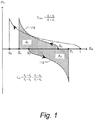
FIG. 1 illustrates a PC curve and definitions of the areas used to compute IAH and IUSBM*, according to some embodiments; -
FIG. 2 shows plots of D-T2 data from a representative case, according to some embodiments; -
FIGs. 3-1, 3-2 and 3-3 are schematic representations of different states of a triangular shaped pore, according to some embodiments; -
FIG. 4 illustrates a representative example of the forward model and inversion output for Si and Wi across the pore spectrum data, according to some embodiments; -
FIGs. 5-1 and5-2 are graphs of the T2 distribution from inverse Laplace transform (ILT), the oil and water distributions, and wettability and saturation functions obtained from the inversion for a strongly oil-wet (W close to zero, i.e. most of the surface is covered by oil) rock example, according to some embodiments; -
FIGs. 6-1 and6-2 are graphs of the T2 distribution from ILT and the oil and water distributions, and wettability and saturation functions obtained from the inversion for an example of a strongly water-wet plug at Swirr, according to some embodiments; -
FIGs. 7-1 and7-2 are graphs of the T2 distribution from ILT and the oil and water distributions, and wettability and saturation functions obtained from the inversion for an example water-wet plug at Sor, according to some embodiments; -
FIG. 8 is a diagram showing aspects of a system for determining wettability and saturation profiles from NMR data, according to some embodiments; and -
FIG. 9 is a block diagram showing aspects of methods for determining wettability and saturation profiles from NMR data, according to some embodiments. - The particulars shown herein are by way of example and for purposes of illustrative discussion of the embodiments of the subject disclosure only, and are presented in the cause of providing what is believed to be the most useful and readily understood description of the principles and conceptual aspects of the subject disclosure. In this regard, no attempt is made to show structural details in more detail than is necessary for the fundamental understanding of the subject disclosure, the description taken with the drawings making apparent to those skilled in the art how the several forms of the subject disclosure may be embodied in practice. Furthermore, like reference numbers and designations in the various drawings indicate like elements.
- Wettability is an important parameter in the development of an oilfield (E Donaldson, R D Thomas, and P B Lorenz, "Wettability Determination and Its Effect on Recovery Efficiency," SPE Journal, (1969), 9, pp. 13-20; R A Salathiel, "Oil recovery by surface film drainage in mixed-wettability rocks," Journal of Petroleum Technology, (1973); W G Anderson, "Wettability Literature Survey - Part 6: The effects of Wettability on Waterflooding," Journal of Petroleum Technology, (1987); T Okasha, J Funk, and H Rashidi, "Fifty Years of Wettability Measurements in the Arab-D Carbonate Reservoir," Proceedings of SPE Middle East Oil and Gas Show and Conference, (Mar 2007), pp. 1-12), yet there are few methods of quantifying it. The two most common are the qualitative indices based on Pc curve measurements: (1) Amott-Harvey (AH), and (2) U.S. Bureau of Mines (USBM) methods.
- According to some embodiments, an inversion technique is described that has been validated in the laboratory under a controlled set of conditions. Traditionally, such validation has been done by correlating the NMR wettability index under investigation against the various industry standards, and thereby determining whether the NMR method is valid. However, given the qualitative nature of the AH and USBM indices (See S Ma, X Zhang, N R Morrow, and X Zhou, "Characterization of wettability from spontaneous imbibition measurements," Journal of Canadian Petroleum Technology, (1999), 38 no. 13, p. 56), such benchmarking can be misleading. For a wide range of core plugs including native state, aged, and cleaned core plugs, it is shown herein that the NMR wettability index as described provides more information and is more consistent with the expected wettability based on well defined preparation methods.
- A number of principles are used to extract wettability and saturation as a function of pore size from NMR T2 data. The described method does not require that a pore geometry be specified, but instead is incorporated into the model by the measured, fully water-saturated relaxation (T2 ) distribution. The method makes use of NMR data for two states of the core plug (for example, native and fully water saturated) and for two bulk fluid samples (for example, water and native oil). According to some embodiments, one output of the analysis is the native state T2 distribution, which is decomposed into oil and water T2 spectra, respectively. A second output is a wettability index as a function of the pore size spectrum. This index can be averaged over the pore size distribution to provide a single wettability index for the core plug on a -1 to +1 scale, consistent with the traditional convention.
- The basic physics is that the NMR relaxation time T2 of a fluid contained in a porous system is shortened from its bulk value as a result of surface interactions. In a pore system fully saturated and wetted by a single phase, the extent of relaxation enhancement is related to the pore diameter d as T2 ∼ d, i.e. smaller pores have shorter T2. In the case of a mixed saturated pore system, the amount of T2 shortening from surface relaxation for a given phase is directly proportional to the fraction of surface wetted by that phase. As a result, an unambiguous NMR wettability index for the rock can be derived from an average of the wettability across the pore system. The T2 for a given phase in a pore also depends on the saturation of that phase in that pore. This implies that T2 is sensitive to both wettability and saturation in the pore, as well as the pore size distribution itself.
- To illustrate these principles, in a fully water-wet scenario, when a drop of oil is suspended in the water filled pore, the oil drop is isolated from the surface and therefore behaves as a bulk fluid with long T2. Meanwhile, the T2 of the water is shortened since the pore size for the water phase is effectively reduced by the presence of the suspended oil in the pore. A similar principle holds for the reverse situation of a water droplet suspended in an oil wet and oil saturated pore. These are the basic underlying principles which make up the forward model in the wettability model on which the described inversion is based.
- Qualitative Interpretation from 2D NMR.
FIG. 2 shows plots of D-T2 data from a representative case, according to some embodiments. Three D-T2 distributions are presented in the main plot 200: (1) thebulk water peak 204, (2) the bulk deadcrude oil distribution 202 which lies along thediagonal correlation line 230, and (3) the native state data for thisplug 206. Note that although D-T2 distributions are shown, according to some embodiments the described inversion can be obtained using only T2. The data were taken at ambient conditions. The horizontal dashedline 232 corresponds to the water line, while the diagonal dashedline 230 corresponds to the dead crude oil correlation as described by S-W Lo, G J Hirasaki, W V House, and R Kobayashi, "Mixing rules and correlations of NMR relaxation time with viscosity, diffusivity, and gas/oil ratio of methane/hydrocarbon mixtures," SPE Journal, (2002), 7 no. 1, pp. 24-34. The two prominent features for the native state data are (1) the leftward shift of the signal from thebulk water peak 204, which corresponds to water wetting the rock, and, (2) a similar shift for theoil signal 202, which corresponds to crude oil wetting the rock. - Also shown in
FIG. 2 are the T2 projection plot 220 and theD projection plot 210. The arrows in the T2 projection plot 220 show how wetting causes the bulk fluid responses to shift to the left, i.e. to shorter T2, as a result of surface relaxation. It is significant that both fluids are found to shift to the left, which indicates that both fluids are to a certain extent wetting the pore surface. Therefore, according to D-T2, this native state plug is qualitatively mixed-wet, which agrees well with the native state wettability indices (INMR, IAH, IUSBM*) which range between -0.3 and -0.2 for this case. - Advanced Interpretation: Wettability Inversion - Forward Model. In order to understand the forward model in more detail, it is useful to first define what the saturation and wettability are at the pore scale. We define the saturation as Si and wettability as Wi , where the subscript i refers to the i'th pore of size i. In particular, Si is defined as the volume fraction of water in the i'th pore with surface relaxation time T2S,i (∝ di), which is bound by 0 ≤ Si ≤ 1. Wi is defined as the surface fraction of that pore wall wetted by water, also bound by 0 ≤ Wi ≤ 1.
FIGs. 3-1, 3-2 and 3-3 are schematic representations of different states of a triangular shaped pore. In particular,FIG. 3-1 shows pore 300 after deposition,FIG. 3-2 shows pore 300 after oil migration, andFIG. 3-3 shows pore 300 after flushing caused by either a water based mud (WBM) filtrate invasion or water injection.FIGs. 3-1, 3-2 and 3-3 illustrate how Si and Wi can vary inside a triangular pore during the geological lifetime of a reservoir rock. A systematic analysis of fluid distribution and flow in angular pores was provided by Ma et al., "Effect of contact angle on drainage and imbibition in regular polygonal tubes," Colloids and Surfaces A: Physicochemical and Engineering Aspects, (1996), 117 no. 3, pp. 273-291. The concavity/convexity of the oil/water interface arises from the balance between surface tension forces and viscous forces. - After the NMR T2 inversion, the overall water saturation, SNMR, and wettability index, I NMR, for the whole plug are determined as functions of the average values of Si and Wi over the pore spectrum P(T 2S,i ) (i.e. the pore size distribution). The overall saturation is simply the average of Si weighted by the pore size distribution, while the wettability index is scaled to the traditional -1 to 1 interval.


- The water saturation is bound by 0 ≤ S NMR ≤ 1, where S NMR = 1 implies 100% water saturated rock, while S NMR = 0 implies 100% oil saturated rock. The wettability index I NMR is bound by -1 ≤ I NMR ≤ 1, where I NMR = 1 implies an entirely water-wet rock, I NMR = -1 implies an entirely oil-wet rock, and I NMR ≈ 0 implies a neutral wettability of a mixed-wet rock. T 2S,i is defined as the relaxation time due to surface relaxation inside the i'th pore, and P(T2S ) is normalized to 1. Note that we have distinguished between the surface relaxation T2S and the full relaxation time T2 as such: 1/T 2 = 1/T 2bulk +1/T2S, where T 2bulk is the bulk relaxation component of the fluid without the presence of a pore surface. In order to limit the number of free parameters associated with Si and Wi , Looyestijn et al. (See W. Looyestijn and J. Hofman, "Wettability Index Determination by Nuclear Magnetic Resonance," Proceedings of SPE Middle East Oil and Gas Show and Conference, (Mar 2005) and W J Looyestijn, S I Exploration, and P Bv, "Wettability Index Determination from NMR Logs," (April 2008), Petrophysics, pp. 130-145) proposed to represent the saturation Si and wettability Wi by a function. We consider two types of functions:
- (1) The original 4 parameter function proposed by Looyestijn et al. (See W. Looyestijn and J. Hofman, "Wettability Index Determination by Nuclear Magnetic Resonance," Proceedings of SPE Middle East Oil and Gas Show and Conference, (Mar 2005) and W J Looyestijn, S I Exploration, and P Bv, "Wettability Index Determination from NMR Logs," (April 2008), Petrophysics, pp. 130-145). Looyestijn discloses receiving pore size distribution data representing a distribution of pore sizes within the porous media, receiving NMR data from bulk aqueous fluid and from a bulk oil and performing an inversion on the NMR data using a forward model using the pore distribution data and the NMR data for the bulk aqueous fluid and bulk oil. This function is monotonic and characterized by two plateaus at short and long T2S, and a smooth transition between the two plateaus. These functions reasonably match the expected distributions of fluids and wettabilities in native core plugs.
- (2) A Gaussian function for the saturation Si allowing a non-monotonic saturation profile along the pore spectrum. Non-monotonic behavior in saturations may occur as a result of multiple drainage and imbibition events caused by tectonism and/or oilfield development.
-
FIG. 4 illustrates a representative example of the forward model and inversion output for Si and Wi across the pore spectrum data, according to some embodiments. Si (410) and wettability Wi (412) across the pore spectrum data (420). Thepore cartoons - Inversion. The theory of surface relaxation, including the one for wettability described herein, is presented in terms of relaxation times T 2 . This makes the representation clearer and easier to understand. However, when we are dealing with real experimental data, we have to remember that the acquisition is done in the time domain. To express the results in the T 2 domain, an inversion (Inverse Laplace Transform, or ILT) is used (See L Venkataramanan, Y-Q Song, and M D Hürlimann, "Solving Fredholm integrals of the first kind with tensor product structure in 2 and 2.5 dimensions," IEEE Transactions on Signal Processing, (2002), 50 no. 5, pp. 1017-1026). This process is well known to be an ill posed problem without a unique solution. This problem is solved by the use of a regularization parameter which imposes a certain degree of smoothness to the T 2 distribution. This regularization parameter allows a stable solution at the price of details in the T 2 distribution. The use of a regularization parameter has proved to be fairly reliable and adequate for most applications in the oil industry, however, there is still an open question regarding the possibility of improving the data processing. Along these lines, according to some embodiments, we avoid the Laplace Inversion altogether following the same technique as described in L Venkataramanan, F K Gruber, T M Habashy, and D E Freed, "Mellin transform of CPMG data," Journal of Magnetic Resonance, (2010), 206 no. 1, pp. 20-31.
- According to some embodiments, constraints are used in connection with the inversion. One example is an intelligent grid search method, which has the advantage of providing many solutions indexed by their overall quality of fitness to the data. A strength of the inversion is that we may easily introduce a constraint, such as described above, on the saturation Si across the pore spectrum in order to stabilize the inversion for wettability Wi across the pore spectrum. The saturation constraint is based on the saturation history of the rock as well as some petrophysical insight into the problem. Table 1 shows four common reservoir scenarios dictating helpful saturation constraints without any loss of generality:
Table 1: Description of the different filters used in the inversion and petrophysical justifications. Saturation history and petrophysical insight Saturation filter Strongly oil wet rocks with the cycle Sw=0→(1-Sor) have been first saturated with oil and aged, and then flooded to Sor. Therefore one can assume that small pores are full of oil, while big pores contain more water. Si monotonically increasing Strongly water wet rocks with the cycle SW=1→Swirr have been saturated first with water, and then flooded to Swirr. Therefore one can assume that small pores are water filled, while big pores have more oil. Si monotonically decreasing Water-wet rocks with two cycles SW=1→Swirr→(1-Sor) and oil-wet rocks with two cycles SW=0→(1-Sor)→Swirr have a Gaussian saturation profile where irreducible fluids in small pores T 2S < 10-1s have not been displaced. Native state plugs affected by drilling mud fall into the first of these categories. Si is a Gaussian profile centered in the large pores corresponding to T 2S > 10-1s The saturation index can be obtained independently from other techniques such as the amount of fluid production. S NMR lies within +/- 5% of an independent measurement - NMR wettability inversion Results. NMR wettability inversion can help to understand the complexity of wettability and saturation profiles at the pore scale. Three examples covering a wide variety of wettability types and saturation states are shown below:
- Strongly oil-wet rock S W =0→(1-S or ).
FIGs. 5-1 and5-2 are graphs of the T2 distribution from ILT and the oil and water distributions obtained from the inversion for a strongly oil-wet rock example, according to some embodiments.FIG. 5-1 plots the ILT (510) and the oil (512) and water (514) distributions along with the total (516).FIG. 5-2 plots the wettability (Wi ) (520) and saturation (Si ) (522) functions obtained with the inversion together with the pore spectrum from SW = 1 (524). The saturation steps at which the plug has been submitted before measuring the NMR response are SW=0→(1-Sor). The overall water saturation is S NMR = 0.74 and the wettability index is I NMR = -0.47.FIG. 5-1 clearly shows the presence of oil in the smaller pores (T2 < 10-1s) and water in the larger (T2 > 10-1s) pores. This is consistent with the history of the plug, that started fully oil saturated and has been de-saturated by centrifuging with water. Note that the total (oil + water) fit has narrower and better-resolved peaks than the ILT. This is not an issue as such since the misfit from the inversion is calculated in the time domain (not shown), and furthermore, as already noted the ILT tends to artificially smooth out the solution in the T 2 domain as a result of regularization. InFIG. 5-2 , the saturation function S i reflects the fluid distribution observed in the left panel. The wettability function Wi stays very low for most of the range of T2S as expected for an oil-wet plug. We note that Wi increases slightly in the range of T 2S values where there are no data, therefore we do not speculate on this trend. - Strongly water-wet rock S W =1-->S wirr . In
FIGs. 6-1 (graph 610) and 6-2 (graph 612) we present a situation that is completely opposite to the one inFIGs. 5-1 and5-2 .FIGs. 6-1 and 6-2 are graphs of the T2 distribution from ILT and the oil and water distributions obtained from the inversion for an example water-wet plug at Swirr, according to some embodiments. The saturation steps at which the plug has been submitted are SW=1-->Swirr. The overall water saturation is S NMR = 0.29 and the wettability index is I NMR = +0.86. The oil and water distribution ranges are inverted and the wettability function is a constant at high values. These results are supported by the fact that the history of the plug is opposite too; the core-plug started from water saturated and was partially desaturated by oil. The forced cleaning used for this core plug also is consistent with the high wettability value. - Water-wet rock S W =1-->S wirr -->(1-S or ).
FIGs. 7-1 and7-2 are graphs of the T2 distribution from ILT and the oil and water distributions obtained from the inversion for an example water-wet plug at Sor, according to some embodiments. The saturation steps at which the plug has been submitted are SW=1→Swirr→(1-Sor). For this solution the overall water saturation is S NMR = 0.89 and the wettability index from I NMR = +0.32.FIG. 7-1 (graph 710) andFIG. 7-2 (graph 712) present the cases in which the plug has been exposed to two changes of saturation SW=1→Swirr→(1-Sor) for the water wet plug. Because of this double change in saturation we adopted the inverted Gaussian profile for Si . In this case the inverted Gaussian function helps in resolving oil trapped in the intermediate size pores. Similarly, for the oil wet plug exposed to two changes SW=0→(1-Sor)→Swirr (data not shown), the fluid distributions show water trapped in the intermediate pores corresponding to a Gaussian (not inverted) profile. Although the specific examples shown and described inFIGs. 5-1 ,5-2 ,6-1 ,6-2 ,7-1 and7-2 illustrate a laboratory validating technique and demonstrate the benefits of having a saturation profile constrained by the saturation history, the specifics are not intended to be limiting. - According to some embodiments, new approaches to an NMR wettability inversion algorithm as well to the underlying forward model, both of which are applicable over a wide range of saturation and wettability conditions are described. The described approach takes the saturation history of the plug as well as some petrophysical insight into account to formulate a saturation filter on the set of solutions from the inversion, thereby stabilizing a solution set for the wettability across the pore spectrum. According to some embodiments, a new NMR inversion technique is incorporated which does not rely on an Inverse Laplace Transform or a regularization parameter, which further stabilizes the inversion algorithm for the wettability across the pore spectrum. These new techniques have been utilized on a set of reservoir and outcrop carbonate core-plugs with a variety of laboratory controlled saturation and wettability conditions, along with a variety of core cleaning preparation techniques. From knowledge of the wettability state following forced cleaning and outcrops, it has been found that the resulting NMR wettability index is more accurate than the industry standards in the case of water wet cores. Our findings suggest that a traditional one-to-one comparison of wettability indices is not a reliable way of benchmarking the various wettability techniques against each other. According to some embodiments, the described NMR wettability index is used as the measurement of choice for carbonate core plugs in the laboratory.
-
FIG. 8 is a diagram showing aspects of a system for determining wettability and saturation profiles from NMR data, according to some embodiments. Core samples are being gathered from a subterranean rock formation 802 atwellsite 800 via awireline truck 820 deploying a wireline tool string in a well viawireline 822. The tool string includes one or more wireline tools including acore sampling tool 824, and/or anNMR tool 826. The acquiredcore sample 814 is transported from thewellsite 800 to asurface facility 850, which includes one or morecentral processing units 844 for carrying out the data processing procedures as described herein, as well as other processing. Facility also includes a data storage system 842, communications and input/output modules 840, auser display 846 and auser input system 848. According to some embodiments, thesurface facility 850 may be located in a location remote from thewellsite 800. According to some embodiments, borehole NMR measurements are made of the fluids and rock in formation 802 and the resultingNMR data 812 is transmitted to thesurface lab facility 850. According to some embodiments, theNMR tool 826 and/or thecore sampling tool 824 are configured and adapted to be deployed in a bottom hole assembly and make measurements and/or obtain core samples during a drilling operation. -
Surface facility 850 also includes preparation andmeasurement equipment 816 which is adapted and configured to carry out the core preparation and various measurement procedures such as described herein to results such as wettability andsaturation profiles 818 which can then be used for purposes such as enhancing aproduction estimate 860 and/orreservoir model 862. -
FIG. 9 is a block diagram showing aspects of methods for determining wettability and saturation profiles from NMR data, according to some embodiments. Inblock 910, pore size distribution data is obtained using a technique such as NMR measurements on the solid sample. According to some embodiments, other methods can be used to obtain the pore size distribution, such as a mercury intrusion method, which can be particularly useful in cases where the sample is relatively homogeneous, such as sandstone. Another known method for obtaining the pore size distribution is digital rock images such as x-ray tomographic methods. Inblock 912, one or more characteristics of mixed-state fluid (e.g. oil) determined from the rock sample. Examples include T2 distribution data determined from rock samples in a fractionally saturated state (i.e. containing both oil and water). Inblock 914, an third input is T2 distribution data of one of the bulk fluids, for example the oil. According to some embodiments, this measurement can be performed downhole using a wellbore deployable NMR tool, or according to other embodiments, this can be performed using laboratory measurements at reservoir conditions. According to some embodiments, lab measurements can be corrected for the reservoir conditions, or a simulated response for the bulk fluids at reservoir conditions can be used. Inblock 922 the inputs shownblocks block 924 an inversion is performed on the forward model. According to some embodiments, the inversion is performed in the time domain. The inversion can be carried out withmathematical constraints 920 on the saturation values, for example based on known saturation history and/or petrophysical insight. The inversion yields a wettability Wi profile 930 and/or a saturation Si profile 932, which can be in the form of oil distributions as a function ofpore size 940 and water distributions as a function ofpore size 942. According to some embodiments, from poresize distribution data 910 and the wettability Wi profile 930 the overall wettability for the sample can be calculated. Similarly, from poresize distribution data 910 and the saturation Siprofile 932 the overall saturation for the sample can be calculated. Note that while the oil andwater distributions inversion block 924, they can be re-computed according to some embodiments. Additionally, according to some embodiments, the overall water saturation, S NMR, and wettability index, I NMR, for the whole plug are determined as functions of the average values of Si and Wi over the pore spectrum P(T2S,i ) (i.e. the pore size distribution). - According to some embodiments, the techniques described herein are applicable beyond the oilfield industry. In general, the techniques described herein can be applied wherever porous media applications are important, for example in the medical, pharmaceutical, materials science, construction, aerospace, and environmental industries. Examples of applications for the described techniques include: bone research, drug delivery methods, novel materials development, improved construction materials such as cements, lighter aircraft wings, and spill cleanup.
- Although only some example embodiments have been described in detail above, those skilled in the art will readily appreciate that many modifications are possible in the example embodiments without materially departing from this invention. Accordingly, all such modifications are intended to be included within the scope of the invention as defined in the following claims.
Claims (16)
- A method for characterizing wettability of a porous medium, the method comprising:receiving pore size distribution data representing a distribution of pore sizes within the porous medium;receiving NMR echo train data from a bulk aqueous fluid;receiving NMR echo train data from a bulk oil; andperforming an inversion on the NMR echo train data using a forward model for pore level distribution of wettability and saturation in mixed wet conditions over a plurality of pore sizes using the pore size distribution data and the NMR echo train data for the bulk aqueous fluid and bulk oil, thereby generating a wettability profile and saturation profile across a pore spectrum for the aqueous and oil fluids over a plurality of pore sizes of the porous medium.
- A method according to claim 1, wherein the inversion is performed in the time domain.
- A method according to claim 1, wherein the NMR data is of a type selected from a group consisting of: CPMG, diffusion editing, T1-T2, T2, T2-T2, D-T1 and D-T2.
- A method according to claim 1, wherein the forward model includes a function for saturation that is non-monotonically increasing or decreasing along a spectrum of pore sizes.
- A method according to claim 1, wherein the performing of the inversion includes using a grid search method for the inversion.
- A method according to claim 1, wherein the performing of the inversion includes mathematically constraining saturation values across a plurality of pore sizes in the forward model based at least in part on a known saturation history of the porous medium.
- A method according to claim 1, wherein the performing of the inversion includes mathematically constraining the forward model using data derived from NMR data.
- A method according to claim 1, wherein the performing of the inversion includes mathematically constraining the forward model using data derived from NMR data using a Mellin transform.
- A method according to claim 1, wherein in the performing of the inversion further generates a saturation profile across a pore spectrum.
- A method according to claim 9, further comprising determining overall wettability by integrating the wettability profile weighted by the pore size distribution data; and determining overall saturation by integrating the saturation profile weighted by the pore size distribution data.
- A method according to claim 1, wherein the pore size distribution data is obtained using a technique selected from a group consisting of: NMR T2 pore size distribution; mercury intrusion; and x-ray tomography.
- A system for characterizing wettability of a porous medium, the system comprising:an NMR measurement system adapted and configured to make NMR measurements of a bulk aqueous fluid and a bulk oil, and to generate therefrom NMR echo train data; anda processing system programmed and configured to perform an inversion in the time domain on the NMR echo train data using a forward model for pore level distribution of wettability and saturation in mixed wet conditions over a plurality of pore sizes using a pore size distribution of the porous medium, and the NMR echo train data, thereby generating a wettability profile and saturation profile across a pore spectrum for the aqueous fluid over a plurality of pore sizes of the porous medium.
- A system according to claim 12, wherein at least part of the NMR measurement system is adapted to be deployed downhole so as to make the NMR measurements of the bulk aqueous fluid and/or bulk oil downhole while the fluid is in a live state.
- A system according to claim 12, wherein the inversion on the NMR data further generates a saturation profile across the pore spectrum and wherein the processing system is further configured to displaying to a user said wettability and saturation profiles as a function of pore size distribution.
- A method according to claim 1 , wherein the performing of the inversion includes mathematically constraining saturation values across a plurality of pore sizes in the forward model.
- A method according to claim 1 , wherein the performing of the inversion includes:using a Mellin transform;mathematically constraining saturation values across a plurality of pore sizes in the forward model based at least in part on a known saturation history of the porous medium; andwherein the saturation is known by injecting a paramagnetic fluid into the porous medium.
Applications Claiming Priority (3)
| Application Number | Priority Date | Filing Date | Title |
|---|---|---|---|
| US201261619144P | 2012-04-02 | 2012-04-02 | |
| US13/854,183 US9405037B2 (en) | 2012-04-02 | 2013-04-01 | Methods for determining wettability from NMR |
| PCT/US2013/034928 WO2013151985A2 (en) | 2012-04-02 | 2013-04-02 | Methods for determining wettability from nmr |
Publications (3)
| Publication Number | Publication Date |
|---|---|
| EP2834453A2 EP2834453A2 (en) | 2015-02-11 |
| EP2834453A4 EP2834453A4 (en) | 2015-12-09 |
| EP2834453B1 true EP2834453B1 (en) | 2019-03-27 |
Family
ID=49236133
Family Applications (1)
| Application Number | Title | Priority Date | Filing Date |
|---|---|---|---|
| EP13773065.1A Active EP2834453B1 (en) | 2012-04-02 | 2013-04-02 | Methods for determining wettability from nmr measurements |
Country Status (5)
| Country | Link |
|---|---|
| US (1) | US9405037B2 (en) |
| EP (1) | EP2834453B1 (en) |
| CN (1) | CN104246484B (en) |
| CA (1) | CA2866325A1 (en) |
| WO (1) | WO2013151985A2 (en) |
Families Citing this family (44)
| Publication number | Priority date | Publication date | Assignee | Title |
|---|---|---|---|---|
| US9098889B2 (en) * | 2013-01-29 | 2015-08-04 | Schlumberger Technology Corporation | Method for quantitative prediction of matrix acidizing treatment outcomes |
| EP3052970A1 (en) | 2013-12-19 | 2016-08-10 | Halliburton Energy Services, Inc. | Pore size classification in subterranean formations based on nuclear magnetic resonance (nmr) relaxation distributions |
| WO2015112449A1 (en) * | 2014-01-24 | 2015-07-30 | Schlumberger Canada Limited | Workflow for resaturation and multidimensional nmr analysis of unconventional core samples |
| CN103884633B (en) * | 2014-03-05 | 2016-05-11 | 中国石油天然气股份有限公司 | A method and device for determining rock permeability |
| RU2642896C1 (en) * | 2014-05-07 | 2018-01-29 | Ингрейн, Инк. | Method and system for determining wettability with spatial resolution |
| WO2015175985A1 (en) | 2014-05-15 | 2015-11-19 | The Regents Of The University Of California | Methods for determining oil and water compositions in drilling muds |
| CN104807847A (en) * | 2015-04-09 | 2015-07-29 | 上海理工大学 | Method for simultaneously quantitatively analyzing water and oil in oily sludge through low-field NMR (nuclear magnetic resonance) |
| US10718701B2 (en) | 2015-05-12 | 2020-07-21 | Schlumberger Technology Corporation | NMR based reservoir wettability measurements |
| MX2018000120A (en) * | 2015-07-31 | 2018-03-22 | Halliburton Energy Services Inc | Apparatus and method for processing and interpreting nmr logging data. |
| EP3329305B1 (en) | 2015-07-31 | 2020-10-14 | Halliburton Energy Services, Inc. | Apparatus and method for determining earth fluid formation |
| EP3472433A4 (en) * | 2016-09-20 | 2019-07-24 | Halliburton Energy Services, Inc. | Analyzing fluids in core samples contained in pressurized nmr core holders with 1h and 19f nmr |
| US10317351B2 (en) | 2016-09-20 | 2019-06-11 | Halliburton Energy Services, Inc. | Pressurized NMR core analyzer |
| CN106990131B (en) * | 2017-02-21 | 2019-08-06 | 上海大学 | A rapid evaluation method for changing the wettability of core by nanofluid |
| WO2018163188A1 (en) * | 2017-03-09 | 2018-09-13 | B.G. Negev Technologies And Applications Ltd., At Ben-Gurion University | Generation of nuclear magnetic resonance multidimensional t1(spin-matrix)-t2(spin-spin) energy relaxation maps and uses thereof |
| WO2018195646A1 (en) * | 2017-04-26 | 2018-11-01 | Green Imaging Technologies, Inc. | Methods of nuclear magnetic resonance measurement of crushed porous media |
| JP6877236B2 (en) * | 2017-05-23 | 2021-05-26 | ルネサスエレクトロニクス株式会社 | Wireless communication module and wireless communication equipment |
| CN107831186B (en) * | 2017-09-28 | 2019-09-20 | 同济大学 | One-dimensional 1H nuclear magnetic resonance imaging measurement and characterization method of core capillary pressure and saturation curve, oil and gas reservoir parameters |
| US20190101665A1 (en) * | 2017-10-03 | 2019-04-04 | Schlumberger Technology Corporation | Wettability of Formations with Heavy Oil |
| US10416063B2 (en) * | 2017-11-02 | 2019-09-17 | Saudi Arabian Oil Company | Measuring rock wettability |
| US10451571B2 (en) | 2017-12-11 | 2019-10-22 | Saudi Arabian Oil Company | Measuring the wettability of porous media based on the temperature sensitivity of nuclear magnetic resonance relaxation time |
| CN108268712B (en) * | 2018-01-05 | 2021-05-11 | 中国石油大学(北京) | Method and device for determining capillary pressure of porous medium by nuclear magnetic resonance |
| CN108489864B (en) * | 2018-02-11 | 2020-03-27 | 中国石油大学(北京) | Method for characterizing wettability of heterogeneous wetting pore medium by using nuclear magnetic resonance technology |
| US10495589B2 (en) | 2018-04-17 | 2019-12-03 | Saudi Arabian Oil Company | Determining permeability of porous media based on nuclear magnetic resonance measurement |
| CN108468536B (en) * | 2018-05-08 | 2023-04-25 | 中国海洋石油集团有限公司 | Oil saturation monitoring method based on ultraviolet spectrum microcosmic oil displacement simulation experiment |
| CN109030292B (en) * | 2018-09-26 | 2019-12-17 | 西南石油大学 | A new method for determining the wettability of tight rocks |
| US11531137B2 (en) * | 2019-02-11 | 2022-12-20 | Schlumberger Technology Corporation | System and method for characterizing reservoir wettability from an imaging technique combined with multiphysics logs and data analytics |
| CN109856176B (en) * | 2019-03-27 | 2022-03-08 | 中国石油大学(华东) | NMR and LTNA-based compact reservoir full-size pore quantitative characterization method |
| US11249001B2 (en) | 2019-05-23 | 2022-02-15 | Saudi Arabian Oil Company | Determination of scanning loops of capillary pressure and relative permeability curves and wettability distribution of rock samples |
| US10895543B2 (en) * | 2019-05-23 | 2021-01-19 | Saudi Arabian Oil Company | Wettability determination of rock samples |
| CN110160932B (en) * | 2019-06-03 | 2023-12-15 | 西南石油大学 | Oil-water relative permeability curve testing device and testing method |
| US11371827B2 (en) | 2019-06-11 | 2022-06-28 | Halliburton Energy Services, Inc. | Multiple scale analysis of core sample to estimate surface roughness |
| CN112305004B (en) * | 2019-08-02 | 2024-08-20 | 中国石油化工股份有限公司 | Polymer material aggregation state analysis method and system based on time domain nuclear magnetic resonance |
| CN110687613B (en) * | 2019-09-25 | 2020-09-04 | 中国石油天然气股份有限公司 | A method for continuous characterization of relative wettability index of shale oil reservoirs |
| US11112373B1 (en) | 2020-02-26 | 2021-09-07 | Saudi Arabian Oil Company | Systems and methods for slice selective nuclear magnetic resonance testing of fractured core plugs to determine in-situ pore volume |
| US11131186B1 (en) | 2020-03-04 | 2021-09-28 | King Fahd University Of Petroleum And Minerals | Method for determining wettability index of rock from T2 NMR measurements |
| US11768144B2 (en) | 2020-04-17 | 2023-09-26 | Green Imaging Technologies Inc. | Methods of NMR measurement of crushed porous media |
| US11175430B1 (en) | 2020-05-19 | 2021-11-16 | Halliburton Energy Services, Inc. | Processing nuclear magnetic resonance signals in a downhole environment |
| CN112129802B (en) * | 2020-10-22 | 2023-08-15 | 重庆科技学院 | A quantitative analysis method for pore volume increment of different scales in hydrated shale |
| US11454097B2 (en) | 2021-01-04 | 2022-09-27 | Saudi Arabian Oil Company | Artificial rain to enhance hydrocarbon recovery |
| US11821861B2 (en) | 2021-04-22 | 2023-11-21 | Baker Hughes Oilfield Operations Llc | Wettability estimation using magnetic resonance |
| US11614417B2 (en) | 2021-07-06 | 2023-03-28 | Saudi Arabian Oil Company | Determining saturation in low resistivity pay zones |
| CN114235879B (en) * | 2021-12-22 | 2024-04-30 | 重庆大学 | Method for testing the wettability and capillary pressure of caprock under stress loading conditions |
| CN114577673B (en) * | 2022-01-18 | 2024-02-02 | 重庆大学 | An NMR characterization method for pore wettability of coal powder with equal particle size |
| CN114755145B (en) * | 2022-04-07 | 2025-03-28 | 东北石油大学 | Method and device for characterizing rock wetting heterogeneity based on imbibition wetting angle distribution |
Family Cites Families (11)
| Publication number | Priority date | Publication date | Assignee | Title |
|---|---|---|---|---|
| US5387865A (en) * | 1991-09-20 | 1995-02-07 | Exxon Research And Engineering Company | Permeability determination from NMR relaxation measurements for fluids in porous media |
| US5696448A (en) * | 1995-06-26 | 1997-12-09 | Numar Corporation | NMR system and method for formation evaluation using diffusion and relaxation log measurements |
| US6883702B2 (en) | 2002-03-21 | 2005-04-26 | Schlumberger Technology Corporation | Method and apparatus for NMR measurement of wettability |
| US6765380B2 (en) | 2002-05-23 | 2004-07-20 | Schlumberger Technology Corporation | Determining wettability of an oil reservoir using borehole NMR measurements |
| US7363161B2 (en) | 2005-06-03 | 2008-04-22 | Baker Hughes Incorporated | Pore-scale geometric models for interpretation of downhole formation evaluation data |
| US20060272812A1 (en) * | 2005-06-04 | 2006-12-07 | Gang Yu | Method for analyzing drill cuttings using nuclear magnetic resonance techniques |
| EP2144053A1 (en) * | 2008-07-08 | 2010-01-13 | Services Pétroliers Schlumberger | Determination of earth formation parameters from T1 NMR relaxation dispersion measurements |
| US8278922B2 (en) | 2009-03-23 | 2012-10-02 | Schlumberger Technology Corporation | Continuous wettability logging based on NMR measurements |
| US8076933B2 (en) | 2009-04-29 | 2011-12-13 | Schlumberger Technology Corporation | Method for determining wettability of an oil reservoir |
| BR112012017778A2 (en) | 2010-01-22 | 2018-08-14 | Prad Res & Development Ltd | Method for determining wetting ability of rock formations using nuclear magnetic resonance measurements, method for determining surface relaxivity of a subsurface rock formation using nuclear magnetic resonance measurements made from within a borehole penetrating the rock formation , method for determining surface relaxivity of a subsurface rock formation, and method for determining water and hydrocarbon saturation in a subsurface rock formation using nuclear magnetic resonance (nmr) relaxation time measurements and constant measurements diffusion |
| CN101915716B (en) | 2010-07-06 | 2012-01-04 | 中国石油天然气股份有限公司 | Method for judging wettability of reservoir rock |
-
2013
- 2013-04-01 US US13/854,183 patent/US9405037B2/en active Active
- 2013-04-02 EP EP13773065.1A patent/EP2834453B1/en active Active
- 2013-04-02 CA CA2866325A patent/CA2866325A1/en not_active Abandoned
- 2013-04-02 WO PCT/US2013/034928 patent/WO2013151985A2/en not_active Ceased
- 2013-04-02 CN CN201380018378.8A patent/CN104246484B/en not_active Expired - Fee Related
Non-Patent Citations (1)
| Title |
|---|
| None * |
Also Published As
| Publication number | Publication date |
|---|---|
| CN104246484B (en) | 2017-08-15 |
| CA2866325A1 (en) | 2013-10-10 |
| US20130261979A1 (en) | 2013-10-03 |
| US9405037B2 (en) | 2016-08-02 |
| CN104246484A (en) | 2014-12-24 |
| EP2834453A2 (en) | 2015-02-11 |
| WO2013151985A2 (en) | 2013-10-10 |
| WO2013151985A3 (en) | 2013-12-05 |
| EP2834453A4 (en) | 2015-12-09 |
Similar Documents
| Publication | Publication Date | Title |
|---|---|---|
| US9405037B2 (en) | Methods for determining wettability from NMR | |
| EP3033484B1 (en) | Digital core sensitivity analysis | |
| AU2014357650B2 (en) | Tuning digital core analysis to laboratory results | |
| US10247684B2 (en) | Nuclear magnetic resonance (NMR) distributions and pore information | |
| Minh et al. | Planning and interpreting NMR fluid-characterization logs | |
| Al-Muthana et al. | Wettability as a function of pore size by NMR | |
| US20150130460A1 (en) | Methods for separating oil and water on multidimensional nuclear magnetic resonance maps | |
| US9823205B2 (en) | Methods and systems for determining surface relaxivity of a medium using nuclear magnetic resonance | |
| Teklu et al. | Residual oil saturation determination–case studies in sandstone and carbonate reservoirs | |
| Anand et al. | Predicting effective permeability to oil in sandstone and carbonate reservoirs from well-logging data | |
| Serry et al. | Sourceless Porosity and Permeability Estimation with NMR Logs While Drilling in a Carbonate Reservoir: A Case Study | |
| Nandi et al. | Core-Independent saturation height function from NMR logs in carbonates-A must in current oil price environment | |
| Ighodalo et al. | Integrated NMR Fluid Characterization Guides Stimulation in Tight Sand Reservoirs | |
| Ling et al. | Synergy of Intelligent Wireline Formation Testing Platform Together with Drill Stem Testing to Unlock Hydrocarbon Potential in Asia Greenfield | |
| Wang et al. | Case study of dielectric logging in the Permian Basin: An opportunity for solving petrophysical challenges in tight formations | |
| Novikov et al. | Tight gas Achimov formation evaluation and sampling with wireline logging tools: Advanced approaches and technologies | |
| Serag El Din et al. | Water Saturation (Sw) from Logging-While-Drilling Resistivity, Capture Sigma and Core Analysis for ROS Determination in a Giant Middle East Carbonate Reservoir | |
| Permanasari et al. | Integration of NMR Factor Analysis, Multifunction LWD Measurements, and T2 Modeling Improve Fluid Identification in Complex Carbonate Reservoirs | |
| Abdul Azim et al. | Sourceless well placement and formation evaluation with logging while drilling technologies | |
| Chen et al. | Determination of gas-oil ratio and live-oil viscosity from NMR log incorporating oil-based mud filtrate invasion | |
| Ijasan et al. | Re-Defining the Limiter in LWD NMR-Unique Case of Designing the BHA for Specific Objectives | |
| Ghosh et al. | Multi-dimensional NMR technique for wireline formation tester sampling optimization and perforation strategy determination in a brown field, India | |
| Ibrahim et al. | Advancing Carbonate Complex Reservoir Characterizations Using Integrated Logging Technologies | |
| Oifoghe et al. | Formation Evaluation of Magnetic Resonance Logging-While-Drilling Data Recorded at a High Rate of Penetration | |
| Ramatullayev et al. | Optimum Logging Suite Design for Characterization of Shaly Sandstones as a Part of Brown Field Exploration Campaign in West Kazakhstan |
Legal Events
| Date | Code | Title | Description |
|---|---|---|---|
| PUAI | Public reference made under article 153(3) epc to a published international application that has entered the european phase |
Free format text: ORIGINAL CODE: 0009012 |
|
| 17P | Request for examination filed |
Effective date: 20140906 |
|
| AK | Designated contracting states |
Kind code of ref document: A2 Designated state(s): AL AT BE BG CH CY CZ DE DK EE ES FI FR GB GR HR HU IE IS IT LI LT LU LV MC MK MT NL NO PL PT RO RS SE SI SK SM TR |
|
| AX | Request for extension of the european patent |
Extension state: BA ME |
|
| DAX | Request for extension of the european patent (deleted) | ||
| A4 | Supplementary search report drawn up and despatched |
Effective date: 20151106 |
|
| RIC1 | Information provided on ipc code assigned before grant |
Ipc: G01N 24/08 20060101AFI20151102BHEP Ipc: E21B 43/32 20060101ALI20151102BHEP Ipc: E21B 47/00 20120101ALI20151102BHEP |
|
| 17Q | First examination report despatched |
Effective date: 20151203 |
|
| GRAP | Despatch of communication of intention to grant a patent |
Free format text: ORIGINAL CODE: EPIDOSNIGR1 |
|
| STAA | Information on the status of an ep patent application or granted ep patent |
Free format text: STATUS: GRANT OF PATENT IS INTENDED |
|
| INTG | Intention to grant announced |
Effective date: 20181016 |
|
| GRAS | Grant fee paid |
Free format text: ORIGINAL CODE: EPIDOSNIGR3 |
|
| GRAA | (expected) grant |
Free format text: ORIGINAL CODE: 0009210 |
|
| STAA | Information on the status of an ep patent application or granted ep patent |
Free format text: STATUS: THE PATENT HAS BEEN GRANTED |
|
| AK | Designated contracting states |
Kind code of ref document: B1 Designated state(s): AL AT BE BG CH CY CZ DE DK EE ES FI FR GB GR HR HU IE IS IT LI LT LU LV MC MK MT NL NO PL PT RO RS SE SI SK SM TR |
|
| REG | Reference to a national code |
Ref country code: GB Ref legal event code: FG4D |
|
| REG | Reference to a national code |
Ref country code: CH Ref legal event code: EP |
|
| REG | Reference to a national code |
Ref country code: AT Ref legal event code: REF Ref document number: 1113702 Country of ref document: AT Kind code of ref document: T Effective date: 20190415 |
|
| REG | Reference to a national code |
Ref country code: IE Ref legal event code: FG4D |
|
| REG | Reference to a national code |
Ref country code: DE Ref legal event code: R096 Ref document number: 602013052983 Country of ref document: DE |
|
| REG | Reference to a national code |
Ref country code: NL Ref legal event code: FP |
|
| PG25 | Lapsed in a contracting state [announced via postgrant information from national office to epo] |
Ref country code: SE Free format text: LAPSE BECAUSE OF FAILURE TO SUBMIT A TRANSLATION OF THE DESCRIPTION OR TO PAY THE FEE WITHIN THE PRESCRIBED TIME-LIMIT Effective date: 20190327 Ref country code: NO Free format text: LAPSE BECAUSE OF FAILURE TO SUBMIT A TRANSLATION OF THE DESCRIPTION OR TO PAY THE FEE WITHIN THE PRESCRIBED TIME-LIMIT Effective date: 20190627 Ref country code: FI Free format text: LAPSE BECAUSE OF FAILURE TO SUBMIT A TRANSLATION OF THE DESCRIPTION OR TO PAY THE FEE WITHIN THE PRESCRIBED TIME-LIMIT Effective date: 20190327 Ref country code: LT Free format text: LAPSE BECAUSE OF FAILURE TO SUBMIT A TRANSLATION OF THE DESCRIPTION OR TO PAY THE FEE WITHIN THE PRESCRIBED TIME-LIMIT Effective date: 20190327 |
|
| PG25 | Lapsed in a contracting state [announced via postgrant information from national office to epo] |
Ref country code: RS Free format text: LAPSE BECAUSE OF FAILURE TO SUBMIT A TRANSLATION OF THE DESCRIPTION OR TO PAY THE FEE WITHIN THE PRESCRIBED TIME-LIMIT Effective date: 20190327 Ref country code: HR Free format text: LAPSE BECAUSE OF FAILURE TO SUBMIT A TRANSLATION OF THE DESCRIPTION OR TO PAY THE FEE WITHIN THE PRESCRIBED TIME-LIMIT Effective date: 20190327 Ref country code: GR Free format text: LAPSE BECAUSE OF FAILURE TO SUBMIT A TRANSLATION OF THE DESCRIPTION OR TO PAY THE FEE WITHIN THE PRESCRIBED TIME-LIMIT Effective date: 20190628 Ref country code: BG Free format text: LAPSE BECAUSE OF FAILURE TO SUBMIT A TRANSLATION OF THE DESCRIPTION OR TO PAY THE FEE WITHIN THE PRESCRIBED TIME-LIMIT Effective date: 20190627 Ref country code: LV Free format text: LAPSE BECAUSE OF FAILURE TO SUBMIT A TRANSLATION OF THE DESCRIPTION OR TO PAY THE FEE WITHIN THE PRESCRIBED TIME-LIMIT Effective date: 20190327 |
|
| REG | Reference to a national code |
Ref country code: AT Ref legal event code: MK05 Ref document number: 1113702 Country of ref document: AT Kind code of ref document: T Effective date: 20190327 |
|
| PG25 | Lapsed in a contracting state [announced via postgrant information from national office to epo] |
Ref country code: CZ Free format text: LAPSE BECAUSE OF FAILURE TO SUBMIT A TRANSLATION OF THE DESCRIPTION OR TO PAY THE FEE WITHIN THE PRESCRIBED TIME-LIMIT Effective date: 20190327 Ref country code: ES Free format text: LAPSE BECAUSE OF FAILURE TO SUBMIT A TRANSLATION OF THE DESCRIPTION OR TO PAY THE FEE WITHIN THE PRESCRIBED TIME-LIMIT Effective date: 20190327 Ref country code: PT Free format text: LAPSE BECAUSE OF FAILURE TO SUBMIT A TRANSLATION OF THE DESCRIPTION OR TO PAY THE FEE WITHIN THE PRESCRIBED TIME-LIMIT Effective date: 20190727 Ref country code: AL Free format text: LAPSE BECAUSE OF FAILURE TO SUBMIT A TRANSLATION OF THE DESCRIPTION OR TO PAY THE FEE WITHIN THE PRESCRIBED TIME-LIMIT Effective date: 20190327 Ref country code: RO Free format text: LAPSE BECAUSE OF FAILURE TO SUBMIT A TRANSLATION OF THE DESCRIPTION OR TO PAY THE FEE WITHIN THE PRESCRIBED TIME-LIMIT Effective date: 20190327 Ref country code: IT Free format text: LAPSE BECAUSE OF FAILURE TO SUBMIT A TRANSLATION OF THE DESCRIPTION OR TO PAY THE FEE WITHIN THE PRESCRIBED TIME-LIMIT Effective date: 20190327 Ref country code: EE Free format text: LAPSE BECAUSE OF FAILURE TO SUBMIT A TRANSLATION OF THE DESCRIPTION OR TO PAY THE FEE WITHIN THE PRESCRIBED TIME-LIMIT Effective date: 20190327 Ref country code: SK Free format text: LAPSE BECAUSE OF FAILURE TO SUBMIT A TRANSLATION OF THE DESCRIPTION OR TO PAY THE FEE WITHIN THE PRESCRIBED TIME-LIMIT Effective date: 20190327 |
|
| REG | Reference to a national code |
Ref country code: DE Ref legal event code: R119 Ref document number: 602013052983 Country of ref document: DE |
|
| PG25 | Lapsed in a contracting state [announced via postgrant information from national office to epo] |
Ref country code: PL Free format text: LAPSE BECAUSE OF FAILURE TO SUBMIT A TRANSLATION OF THE DESCRIPTION OR TO PAY THE FEE WITHIN THE PRESCRIBED TIME-LIMIT Effective date: 20190327 Ref country code: SM Free format text: LAPSE BECAUSE OF FAILURE TO SUBMIT A TRANSLATION OF THE DESCRIPTION OR TO PAY THE FEE WITHIN THE PRESCRIBED TIME-LIMIT Effective date: 20190327 |
|
| REG | Reference to a national code |
Ref country code: CH Ref legal event code: PL |
|
| REG | Reference to a national code |
Ref country code: BE Ref legal event code: MM Effective date: 20190430 |
|
| PG25 | Lapsed in a contracting state [announced via postgrant information from national office to epo] |
Ref country code: IS Free format text: LAPSE BECAUSE OF FAILURE TO SUBMIT A TRANSLATION OF THE DESCRIPTION OR TO PAY THE FEE WITHIN THE PRESCRIBED TIME-LIMIT Effective date: 20190727 Ref country code: AT Free format text: LAPSE BECAUSE OF FAILURE TO SUBMIT A TRANSLATION OF THE DESCRIPTION OR TO PAY THE FEE WITHIN THE PRESCRIBED TIME-LIMIT Effective date: 20190327 Ref country code: LU Free format text: LAPSE BECAUSE OF NON-PAYMENT OF DUE FEES Effective date: 20190402 |
|
| PG25 | Lapsed in a contracting state [announced via postgrant information from national office to epo] |
Ref country code: LI Free format text: LAPSE BECAUSE OF NON-PAYMENT OF DUE FEES Effective date: 20190430 Ref country code: CH Free format text: LAPSE BECAUSE OF NON-PAYMENT OF DUE FEES Effective date: 20190430 Ref country code: DK Free format text: LAPSE BECAUSE OF FAILURE TO SUBMIT A TRANSLATION OF THE DESCRIPTION OR TO PAY THE FEE WITHIN THE PRESCRIBED TIME-LIMIT Effective date: 20190327 Ref country code: DE Free format text: LAPSE BECAUSE OF NON-PAYMENT OF DUE FEES Effective date: 20191101 Ref country code: MC Free format text: LAPSE BECAUSE OF FAILURE TO SUBMIT A TRANSLATION OF THE DESCRIPTION OR TO PAY THE FEE WITHIN THE PRESCRIBED TIME-LIMIT Effective date: 20190327 |
|
| PLBE | No opposition filed within time limit |
Free format text: ORIGINAL CODE: 0009261 |
|
| STAA | Information on the status of an ep patent application or granted ep patent |
Free format text: STATUS: NO OPPOSITION FILED WITHIN TIME LIMIT |
|
| PG25 | Lapsed in a contracting state [announced via postgrant information from national office to epo] |
Ref country code: SI Free format text: LAPSE BECAUSE OF FAILURE TO SUBMIT A TRANSLATION OF THE DESCRIPTION OR TO PAY THE FEE WITHIN THE PRESCRIBED TIME-LIMIT Effective date: 20190327 Ref country code: BE Free format text: LAPSE BECAUSE OF NON-PAYMENT OF DUE FEES Effective date: 20190430 |
|
| 26N | No opposition filed |
Effective date: 20200103 |
|
| PG25 | Lapsed in a contracting state [announced via postgrant information from national office to epo] |
Ref country code: TR Free format text: LAPSE BECAUSE OF FAILURE TO SUBMIT A TRANSLATION OF THE DESCRIPTION OR TO PAY THE FEE WITHIN THE PRESCRIBED TIME-LIMIT Effective date: 20190327 |
|
| PG25 | Lapsed in a contracting state [announced via postgrant information from national office to epo] |
Ref country code: IE Free format text: LAPSE BECAUSE OF NON-PAYMENT OF DUE FEES Effective date: 20190402 |
|
| PG25 | Lapsed in a contracting state [announced via postgrant information from national office to epo] |
Ref country code: FR Free format text: LAPSE BECAUSE OF NON-PAYMENT OF DUE FEES Effective date: 20190527 |
|
| PG25 | Lapsed in a contracting state [announced via postgrant information from national office to epo] |
Ref country code: CY Free format text: LAPSE BECAUSE OF FAILURE TO SUBMIT A TRANSLATION OF THE DESCRIPTION OR TO PAY THE FEE WITHIN THE PRESCRIBED TIME-LIMIT Effective date: 20190327 |
|
| PG25 | Lapsed in a contracting state [announced via postgrant information from national office to epo] |
Ref country code: HU Free format text: LAPSE BECAUSE OF FAILURE TO SUBMIT A TRANSLATION OF THE DESCRIPTION OR TO PAY THE FEE WITHIN THE PRESCRIBED TIME-LIMIT; INVALID AB INITIO Effective date: 20130402 Ref country code: MT Free format text: LAPSE BECAUSE OF FAILURE TO SUBMIT A TRANSLATION OF THE DESCRIPTION OR TO PAY THE FEE WITHIN THE PRESCRIBED TIME-LIMIT Effective date: 20190327 |
|
| PG25 | Lapsed in a contracting state [announced via postgrant information from national office to epo] |
Ref country code: MK Free format text: LAPSE BECAUSE OF FAILURE TO SUBMIT A TRANSLATION OF THE DESCRIPTION OR TO PAY THE FEE WITHIN THE PRESCRIBED TIME-LIMIT Effective date: 20190327 |
|
| PGFP | Annual fee paid to national office [announced via postgrant information from national office to epo] |
Ref country code: NL Payment date: 20250227 Year of fee payment: 13 |
|
| PGFP | Annual fee paid to national office [announced via postgrant information from national office to epo] |
Ref country code: GB Payment date: 20260324 Year of fee payment: 14 |