EP2833746B1 - Insert for a protective garment - Google Patents
Insert for a protective garment Download PDFInfo
- Publication number
- EP2833746B1 EP2833746B1 EP13771947.2A EP13771947A EP2833746B1 EP 2833746 B1 EP2833746 B1 EP 2833746B1 EP 13771947 A EP13771947 A EP 13771947A EP 2833746 B1 EP2833746 B1 EP 2833746B1
- Authority
- EP
- European Patent Office
- Prior art keywords
- fabric
- article
- weight
- per inch
- less
- Prior art date
- Legal status (The legal status is an assumption and is not a legal conclusion. Google has not performed a legal analysis and makes no representation as to the accuracy of the status listed.)
- Not-in-force
Links
- 230000001681 protective effect Effects 0.000 title claims description 10
- 239000004744 fabric Substances 0.000 claims description 58
- LXEKPEMOWBOYRF-UHFFFAOYSA-N [2-[(1-azaniumyl-1-imino-2-methylpropan-2-yl)diazenyl]-2-methylpropanimidoyl]azanium;dichloride Chemical compound Cl.Cl.NC(=N)C(C)(C)N=NC(C)(C)C(N)=N LXEKPEMOWBOYRF-UHFFFAOYSA-N 0.000 claims description 52
- 238000005452 bending Methods 0.000 claims description 42
- 229920001343 polytetrafluoroethylene Polymers 0.000 claims description 40
- 239000004810 polytetrafluoroethylene Substances 0.000 claims description 40
- 229920000295 expanded polytetrafluoroethylene Polymers 0.000 claims description 36
- 239000000835 fiber Substances 0.000 claims description 26
- 238000013467 fragmentation Methods 0.000 claims description 9
- 238000006062 fragmentation reaction Methods 0.000 claims description 9
- -1 polytetrafluoroethylene Polymers 0.000 claims description 6
- 239000004753 textile Substances 0.000 description 44
- 239000010410 layer Substances 0.000 description 38
- 238000012360 testing method Methods 0.000 description 31
- 239000002356 single layer Substances 0.000 description 21
- 229920003235 aromatic polyamide Polymers 0.000 description 15
- 238000007378 ring spinning Methods 0.000 description 13
- 238000009941 weaving Methods 0.000 description 13
- 229920000561 Twaron Polymers 0.000 description 12
- 239000000463 material Substances 0.000 description 12
- 238000010276 construction Methods 0.000 description 8
- 239000012634 fragment Substances 0.000 description 8
- 230000035699 permeability Effects 0.000 description 8
- XLYOFNOQVPJJNP-UHFFFAOYSA-N water Substances O XLYOFNOQVPJJNP-UHFFFAOYSA-N 0.000 description 8
- 230000035515 penetration Effects 0.000 description 7
- 239000004760 aramid Substances 0.000 description 6
- 230000006835 compression Effects 0.000 description 6
- 238000007906 compression Methods 0.000 description 6
- 239000004762 twaron Substances 0.000 description 6
- 239000002759 woven fabric Substances 0.000 description 6
- 229920000271 Kevlar® Polymers 0.000 description 4
- 238000013461 design Methods 0.000 description 4
- 238000011156 evaluation Methods 0.000 description 4
- 239000004761 kevlar Substances 0.000 description 4
- 239000000203 mixture Substances 0.000 description 4
- 238000010998 test method Methods 0.000 description 4
- 239000012153 distilled water Substances 0.000 description 3
- 241001408630 Chloroclystis Species 0.000 description 2
- 229920000784 Nomex Polymers 0.000 description 2
- 239000004677 Nylon Substances 0.000 description 2
- 230000001580 bacterial effect Effects 0.000 description 2
- 238000000034 method Methods 0.000 description 2
- 239000004763 nomex Substances 0.000 description 2
- 229920001778 nylon Polymers 0.000 description 2
- 238000011160 research Methods 0.000 description 2
- 230000035945 sensitivity Effects 0.000 description 2
- 238000004329 water eliminated fourier transform Methods 0.000 description 2
- 241000894006 Bacteria Species 0.000 description 1
- 229910052782 aluminium Inorganic materials 0.000 description 1
- XAGFODPZIPBFFR-UHFFFAOYSA-N aluminium Chemical compound [Al] XAGFODPZIPBFFR-UHFFFAOYSA-N 0.000 description 1
- 238000004458 analytical method Methods 0.000 description 1
- 230000000845 anti-microbial effect Effects 0.000 description 1
- 230000000712 assembly Effects 0.000 description 1
- 238000000429 assembly Methods 0.000 description 1
- 230000005540 biological transmission Effects 0.000 description 1
- 230000001143 conditioned effect Effects 0.000 description 1
- 238000004880 explosion Methods 0.000 description 1
- 238000010304 firing Methods 0.000 description 1
- 239000003721 gunpowder Substances 0.000 description 1
- 238000007654 immersion Methods 0.000 description 1
- 238000010348 incorporation Methods 0.000 description 1
- 239000007788 liquid Substances 0.000 description 1
- 238000005259 measurement Methods 0.000 description 1
- 229910052751 metal Inorganic materials 0.000 description 1
- 239000002184 metal Substances 0.000 description 1
- 230000008520 organization Effects 0.000 description 1
- 230000000284 resting effect Effects 0.000 description 1
- 239000004576 sand Substances 0.000 description 1
- 229920000785 ultra high molecular weight polyethylene Polymers 0.000 description 1
- 230000003313 weakening effect Effects 0.000 description 1
- 238000005303 weighing Methods 0.000 description 1
- 210000002268 wool Anatomy 0.000 description 1
Images


Classifications
-
- F—MECHANICAL ENGINEERING; LIGHTING; HEATING; WEAPONS; BLASTING
- F41—WEAPONS
- F41H—ARMOUR; ARMOURED TURRETS; ARMOURED OR ARMED VEHICLES; MEANS OF ATTACK OR DEFENCE, e.g. CAMOUFLAGE, IN GENERAL
- F41H1/00—Personal protection gear
- F41H1/02—Armoured or projectile- or missile-resistant garments; Composite protection fabrics
-
- D—TEXTILES; PAPER
- D03—WEAVING
- D03D—WOVEN FABRICS; METHODS OF WEAVING; LOOMS
- D03D1/00—Woven fabrics designed to make specified articles
- D03D1/0035—Protective fabrics
- D03D1/0052—Antiballistic fabrics
-
- D—TEXTILES; PAPER
- D03—WEAVING
- D03D—WOVEN FABRICS; METHODS OF WEAVING; LOOMS
- D03D15/00—Woven fabrics characterised by the material, structure or properties of the fibres, filaments, yarns, threads or other warp or weft elements used
- D03D15/20—Woven fabrics characterised by the material, structure or properties of the fibres, filaments, yarns, threads or other warp or weft elements used characterised by the material of the fibres or filaments constituting the yarns or threads
- D03D15/283—Woven fabrics characterised by the material, structure or properties of the fibres, filaments, yarns, threads or other warp or weft elements used characterised by the material of the fibres or filaments constituting the yarns or threads synthetic polymer-based, e.g. polyamide or polyester fibres
-
- F—MECHANICAL ENGINEERING; LIGHTING; HEATING; WEAPONS; BLASTING
- F41—WEAPONS
- F41H—ARMOUR; ARMOURED TURRETS; ARMOURED OR ARMED VEHICLES; MEANS OF ATTACK OR DEFENCE, e.g. CAMOUFLAGE, IN GENERAL
- F41H5/00—Armour; Armour plates
- F41H5/02—Plate construction
- F41H5/04—Plate construction composed of more than one layer
- F41H5/0471—Layered armour containing fibre- or fabric-reinforced layers
- F41H5/0485—Layered armour containing fibre- or fabric-reinforced layers all the layers being only fibre- or fabric-reinforced layers
-
- D—TEXTILES; PAPER
- D10—INDEXING SCHEME ASSOCIATED WITH SUBLASSES OF SECTION D, RELATING TO TEXTILES
- D10B—INDEXING SCHEME ASSOCIATED WITH SUBLASSES OF SECTION D, RELATING TO TEXTILES
- D10B2321/00—Fibres made from polymers obtained by reactions only involving carbon-to-carbon unsaturated bonds
- D10B2321/04—Fibres made from polymers obtained by reactions only involving carbon-to-carbon unsaturated bonds polymers of halogenated hydrocarbons
- D10B2321/042—Fibres made from polymers obtained by reactions only involving carbon-to-carbon unsaturated bonds polymers of halogenated hydrocarbons polymers of fluorinated hydrocarbons, e.g. polytetrafluoroethene [PTFE]
-
- D—TEXTILES; PAPER
- D10—INDEXING SCHEME ASSOCIATED WITH SUBLASSES OF SECTION D, RELATING TO TEXTILES
- D10B—INDEXING SCHEME ASSOCIATED WITH SUBLASSES OF SECTION D, RELATING TO TEXTILES
- D10B2331/00—Fibres made from polymers obtained otherwise than by reactions only involving carbon-to-carbon unsaturated bonds, e.g. polycondensation products
- D10B2331/02—Fibres made from polymers obtained otherwise than by reactions only involving carbon-to-carbon unsaturated bonds, e.g. polycondensation products polyamides
- D10B2331/021—Fibres made from polymers obtained otherwise than by reactions only involving carbon-to-carbon unsaturated bonds, e.g. polycondensation products polyamides aromatic polyamides, e.g. aramides
-
- Y—GENERAL TAGGING OF NEW TECHNOLOGICAL DEVELOPMENTS; GENERAL TAGGING OF CROSS-SECTIONAL TECHNOLOGIES SPANNING OVER SEVERAL SECTIONS OF THE IPC; TECHNICAL SUBJECTS COVERED BY FORMER USPC CROSS-REFERENCE ART COLLECTIONS [XRACs] AND DIGESTS
- Y10—TECHNICAL SUBJECTS COVERED BY FORMER USPC
- Y10T—TECHNICAL SUBJECTS COVERED BY FORMER US CLASSIFICATION
- Y10T428/00—Stock material or miscellaneous articles
- Y10T428/249921—Web or sheet containing structurally defined element or component
Definitions
- the present invention relates to a protective undergarment (PUG).
- a PUG is an undergarment article similar to briefs and is used to protect the wearer from minor projectiles such as shrapnel, building debris, sand, and fragments due to an explosion occurring near the article wearer.
- the PUG may be the briefs themselves, or it may take the form of an insert fitted into a pocket in the crotch of the briefs.
- a common test to rate the PUG's effectiveness for stopping small projectiles is known as the V-50 2-grain fragment test.
- PUGs are made of high strength fibers such as Kevlar and Nomex. Although such PUGs made of these materials satisfy the V-50 2-grain fragment test, they are very uncomfortable to wear.
- Another known PUG is made of silk. Although silk helps the wearer feel more comfortable, many layers of the silk must be used to satisfy the V-50 2-grain fragment test. As a result, the PUG is bulky and heavy. Moreover, silk fibers weaken with moisture (as do Kevlar and Nomex), so they risk failing the V-50 2-grain fragment test, and thus not protecting the wearer, if the wearer gets wet.
- US 2011/129657 A1 discloses a ballistic resistant article comprising high strength Kevlar fibers and expanded PTFE fibers, wherein the article is a fabric further comprising a V50 of greater than about 1420 ft/s (433 m/s) at a fabric weight of about 0.75 Ib/ft2 (3.7 kg/m 2 ) and a bending moment at room temperature of less than about 0.0008 N-m.
- a ballistic resistant article comprising high strength Spectra fibers and expanded PTFE fibers, wherein the article is a fabric further comprising a V50 of greater than about 735 ft/s (224 m/s) at a fabric weight of about 0.75 Ib/ft2 (3.7 kg/m 2 ) and a bending moment at room temperature of less than about 0.0007 N-m. It is further stated that lower percentage incorporation of expanded PTFE fibers comes at the expense of poorer handleability; and too high a percent composition compromises ballistic performance (V50).
- an insert for a protective undergarment can be constructed using a high percentage of expanded polytetrafluoroethylene (ePTFE) fibers and still satisfy the applicable V-50 ballistic protection criteria.
- the amount of ePTFE fibers is equal to or greater than about 45% by weight, preferably greater than 50%, 55%, 65%, 75%, 85%, and even 95%, and most preferably 100% ePTFE fibers.
- EPTFE fibers greatly enhances the comfort of the undergarment, while still maintaining excellent ballistic protection. EPTFE fibers also provide distinct advantages such as water resistance, antimicrobial protection, and maintains strength even when wet (unlike silk and Kevlar, for example).
- one embodiment of invention provides an article comprising an insert for a protective garment, the insert comprising a fabric having at least 50 percent by weight of expanded polytetrafluoroethylene fibers, the fabric having a 2-Grain V-50 Fragmentation Resistance of at least 700 feet per second and a FAST-2 Bending Rigidity of less than 40 microNewtonmeters.
- the fabric has at least 75 percent by weight of polytetrafluoroethylene fibers, and most preferably it is 100 percent by weight of polytetrafluoroethylene fibers.
- the fabric has a 2-Grain V-50 Fragmentation Resistance of at least 800 feet per second.
- the fabric has a Vertical Wicking after 10 minutes of less than 150 mm, and more preferably the fabric has a Vertical Wicking after 10 minutes of zero mm.
- the FAST-2 Bending Rigidity is less than 30 microNewtonmeters, less than 20 microNewtonmeters, and most preferably about 10 microNewtonmeters.
- the invention provides an article comprising an insert for a protective garment, the insert comprising a fabric having at least 45 percent by weight of expanded polytetrafluoroethylene filaments having a tenacity of less than about 10 grams per dtex, the fabric having a 2-Grain V-50 Fragmentation Resistance of at least 700 feet per second and the fabric having a weight of less than about 160 grams per square meter.
- the fabric has a weight of less than about 140 grams per square meter, and most preferably, less than about 120 grams per square meter.
- the invention provides an article comprising an insert for a protective garment, the insert comprising a fabric having at least 50 percent by weight of expanded polytetrafluoroethylene fibers, the fabric having a 2-Grain V-50 Fragmentation Resistance of at least 700 feet per second and a FAST-2 Bending Rigidity of less than 40 microNewtonmeters; and the fabric having a weight of less than about 160 grams per square meter.
- the insert is designed to fit into a pouch in the crotch area of the undergarment.
- the pouch itself, or the crouch area without a pouch-insert type construction, or even the entire protective undergarment may be constructed of the ePTFE fibers.
- the insert provides the adequate V-50 protection.
- EPTFE fibers typically have a tenacity value of well less than 10 grams/dtex, while traditional ballistic fibers generally have a tenacity value of well above 10 grams/dtex.
- One skilled in the art would typically be motivated to decrease the weight percentage of ePTFE fibers in favor of the higher tenacity fibers.
- the ePTFE fiber insert can be constructed of only two layers and still provide adequate protection, although additional layers are used in alternative embodiments. It is even conceivable that for some applications even one layer may provide adequate protection.
- Figure 1 shows a single layer plain weave construction 10 according to one embodiment of the invention in which the same filament is used in warp and weft directions.
- Figure 2 shows a single layer plain weave construction 20 according to one embodiment of the invention in which alternating filaments are used both in warp and weft directions.
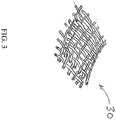
- Figure 3 shows a two layer stacking 30 of two single layer plain weave constructions according to one embodiment of the invention.
- the experimental textile comprises expanded PTFE filaments or expanded PTFE multifilaments (e.g., towed monofilaments) as well as component yarn assemblies consisting of an ePTFE and para-aramid filaments twisted together and component fabric weave design consisting of ePTFE and para-aramid filaments.
- Example 1 Invention 100% 400 denier ePTFE multifilament 33x33, 1-layer
- a plain weave textile consisting of 33 ends per inch (epi) by 33 picks per inch (ppi) equivalent to 1300 epm by 1300 ppm textile composed of 400 denier (444 dtex) expanded PTFE multifilament part number V112939 available from W. L. Gore and Associates, Inc. Elkton, MD. Prior to weaving, the filament was twisted to 1.2 twists per inch (47.2 twists per meter) in a Z twist configuration using a ring spinning frame.
- Example 2 Invention 100% 400 denier ePTFE multifilament 36x36, 1-layer
- a plain weave textile consisting of 36 ends per inch (epi) by 36 picks per inch (ppi) equivalent to 1417 epm by 1417 ppm textile composed of 400 denier (444 dtex) expanded PTFE multifilament part number V112939 available from W. L. Gore and Associates, Inc. Elkton, MD. Prior to weaving, the filament was twisted to 1.2 twists per inch (47.2 twists per meter) in a Z twist configuration using a ring spinning frame.
- a plain weave textile consisting of two filament materials woven at 29 ends per inch (epi) by 29 picks per inch (ppi) equivalent to 1142 epm by 1142 ppm textile.
- the filament materials were a 400 denier (444 dtex) expanded PTFE multifilament part number V112939 available from W. L. Gore and Associates, Inc. Elkton, MD and 495 denier (550 dtex) paramide Twaron ® available from Teijin Aramid Company, Conyers, GA.
- the two materials were woven every other pick and every other end forming a balanced weave design.
- the 400 denier expanded PTFE filament was twisted to 1.2 twists per inch (47.2 twists per meter) in a Z twist configuration using a ring spinning frame.
- the woven fabric is 45% ePTFE by weight.
- Example 4 Invention TWARON 550 DTEX/PTFE 444 DTEX 14.5x14.5(twisted BLEND), 1-layer
- a plain weave textile consisting of blended twisted filament woven at 14.5ends per inch (epi) by 14.5 picks per inch (ppi) equivalent to 571epm by 571 ppm textile.
- a blended filament was made by ring twisting one end of a 400 denier (444 dtex) expanded PTFE multifilament part number V112939 available from W. L. Gore and Associates, Inc. Elkton, MD and one end of a 495 denier (550 dtex) paramide Twaron ® available from Teijin Aramid Company, Conyers, GA. The ends were twisted together at 1.2 turns per inch (47.2 twists per meter) in a Z twist configuration. In this example the woven fabric is 45% ePTFE by weight.
- Example 5 Invention 100% 400 denier ePTFE multifilament 40x40, 1-layer
- a plain weave textile consisting of 40 ends per inch (epi) by 40 picks per inch (ppi) equivalent to 1575 epm by 1575 ppm textile composed of 400 denier (444 dtex) expanded PTFE multifilament part number V112939 available from W. L. Gore and Associates, Inc. Elkton, MD. Prior to weaving, the filament was twisted to 1.2 twists per inch (47.2 twists per meter) in a Z twist configuration using a ring spinning frame.
- Example 6 Invention 100% 400 denier ePTFE multifilament 45x45, 1-layer
- a plain weave textile consisting of 45 ends per inch (epi) by 45 picks per inch (ppi) equivalent to 1772 epm by 1772 ppm textile composed of 400 denier (444 dtex) expanded PTFE multifilament part number V112939 available from W. L. Gore and Associates, Inc. Elkton, MD. Prior to weaving, the filament was twisted to 1.2 twists per inch (47.2 twists per meter) in a Z twist configuration using a ring spinning frame.
- Example 7 Invention 100% 400 denier ePTFE multifilament 33x33, 2-layers
- a plain weave textile consisting of 33 ends per inch (epi) by 33 picks per inch (ppi) equivalent to 1300 epm by 1300 ppm textile composed of 400 denier (444 dtex) expanded PTFE multifilament part number V112939 available from W. L. Gore and Associates, Inc. Elkton, MD, were combined together in a two layer stack measuring 15 inches x 15 inches (381mm x 381mm). Prior to weaving, the filament was twisted to 1.2 twists per inch (47.2 twists per meter) in a Z twist configuration using a ring spinning frame.
- Example 8 Invention 100% 400 denier ePTFE multifilament 33x33, 3-layers
- a plain weave textile consisting of 33 ends per inch (epi) by 33 picks per inch (ppi) equivalent to 1300 epm by 1300 ppm textile composed of 400 denier (444 dtex) expanded PTFE multifilament part number V112939 available from W. L. Gore and Associates, Inc. Elkton, MD, were combined together in a three layer stack measuring 15 inches x 15 inches (381mm x 381mm). Prior to weaving, the filament was twisted to 1.2 twists per inch (47.2 twists per meter) in a Z twist configuration using a ring spinning frame.
- Example 9 Invention 100% 400 denier ePTFE multifilament 36x36, 2-layers
- a plain weave textile consisting of 36 ends per inch (epi) by 36 picks per inch (ppi) equivalent to 1417 epm by 1417 ppm textile composed of 400 denier (444 dtex) expanded PTFE multifilament part number V112939 available from W. L. Gore and Associates, Inc. Elkton, MD, were combined together in a two layer stack measuring 15 inches x 15 inches (381mm x 381mm). Prior to weaving, the filament was twisted to 1.2 twists per inch (47.2 twists per meter) in a Z twist configuration using a ring spinning frame.
- Example 10 Invention 100% 400 denier ePTFE multifilament 36x36, 3-layers
- a plain weave textile consisting of 36 ends per inch (epi) by 36 picks per inch (ppi) equivalent to 1417 epm by 1417 ppm textile composed of 400 denier (444 dtex) expanded PTFE multifilament part number V112939 available from W. L. Gore and Associates, Inc. Elkton, MD, were combined together in a three layer stack measuring 15 inches x 15 inches (381mm x 381mm). Prior to weaving, the filament was twisted to 1.2 twists per inch (47.2 twists per meter) in a Z twist configuration using a ring spinning frame.
- Example 11 TWARON 550 DTEX/PTFE 444 DTEX 29X29 (alternating every other end) 2-layers
- a plain weave textile consisting of two filament materials woven at 29 ends per inch (epi) by 29 picks per inch (ppi) equivalent to 1142 epm by 1142 ppm textile.
- the filament materials were a 400 denier (444 dtex) expanded PTFE multifilament part number V112939 available from W. L. Gore and Associates, Inc. Elkton, MD and 495 denier (550 dtex) paramide Twaron ® available from Teijin Aramid Company, Conyers, GA.
- the two materials were woven every other pick and every other end forming a balanced weave design.
- the 400 denier expanded PTFE filament was twisted to 1.2 twists per inch (47.2 twists per meter) in a Z twist configuration using a ring spinning frame. Two woven pieces were combined together to form a two layer stack measuring 15 inches x 15 inches (381mm x 381mm). In this example the woven fabric is 45% ePTFE by weight.
- Example 12 Invention TWARON 550 DTEX/PTFE 444 DTEX 29X29 (alternating every other end) 3-layers
- a plain weave textile consisting of two filament materials woven at 29 ends per inch (epi) by 29 picks per inch (ppi) equivalent to 1142 epm by 1142 ppm textile.
- the filament materials were a 400 denier (444 dtex) expanded PTFE multifilament part number V112939 available from W. L. Gore and Associates, Inc. Elkton, MD and 495 denier (550 dtex) paramide Twaron ® available from Teijin Aramid Company, Conyers, GA.
- the two materials were woven every other pick and every other end forming a balanced weave design.
- the 400 denier expanded PTFE filament was twisted to 1.2 twists per inch (47.2 twists per meter) in a Z twist configuration using a ring spinning frame. Three woven pieces were combined together to form a three layer stack measuring 15 inches x 15 inches (381mm x 381mm). In this example the woven fabric is 45% ePTFE by weight.
- Example 13 Invention TWARON 550 DTEX/PTFE 444 DTEX 14.5x14.5(twisted BLEND), 2-layers
- a plain weave textile consisting of blended twisted filament woven at 14.5ends per inch (epi) by 14.5 picks per inch (ppi) equivalent to 571epm by 571 ppm textile.
- a blended filament was made by ring twisting one end of a 400 denier (444 dtex) expanded PTFE multifilament part number V112939 available from W. L. Gore and Associates, Inc. Elkton, MD and one end of a 495 denier (550 dtex) paramide Twaron ® available from Teijin Aramid Company, Conyers, GA. The ends were twisted together at 1.2 turns per inch (47.2 twists per meter) in a Z twist configuration. Two woven pieces were combined together to form a two layer stack measuring 15 inches x 15 inches (381mm x 381mm). In this example the woven fabric is 45% ePTFE by weight.
- Example 14 Invention TWARON 550 DTEX/PTFE 444 DTEX 14.5x14.5(twisted BLEND), 3-layers
- a plain weave textile consisting of blended twisted filament woven at 14.5ends per inch (epi) by 14.5 picks per inch (ppi) equivalent to 571epm by 571 ppm textile.
- a blended filament was made by ring twisting one end of a 400 denier (444 dtex) expanded PTFE multifilament part number V112939 available from W. L. Gore and Associates, Inc. Elkton, MD and one end of a 495 denier (550 dtex) paramide Twaron ® available from Teijin Aramid Company, Conyers, GA. The ends were twisted together at 1.2 turns per inch (47.2 twists per meter) in a Z twist configuration. Three woven pieces were combined together to form a three layer stack measuring 15 inches x 15 inches (381mm x 381mm). In this example the woven fabric is 45% ePTFE by weight.
- Example 15 Invention 100% 400 denier ePTFE multifilament 40x40, 3-layers
- a plain weave textile consisting of 40 ends per inch (epi) by 40 picks per inch (ppi) equivalent to 1575 epm by 1575 ppm textile composed of 400 denier (444 dtex) expanded PTFE multifilament part number V112939 available from W. L. Gore and Associates, Inc. Elkton, MD, were combined together in a three layer stack measuring 15 inches x 15 inches (381mm x 381mm). Prior to weaving, the filament was twisted to 1.2 twists per inch (47.2 twists per meter) in a Z twist configuration using a ring spinning frame.
- Example 16 Invention 100% 400 denier ePTFE multifilament 45x45, 3-layers
- a plain weave textile consisting of 45 ends per inch (epi) by 45 picks per inch (ppi) equivalent to 1772 epm by 1772 ppm textile composed of 400 denier (444 dtex) expanded PTFE multifilament part number V112939 available from W. L. Gore and Associates, Inc. Elkton, MD, were combined together in a three layer stack measuring 15 inches x 15 inches (381mm x 381mm). Prior to weaving, the filament was twisted to 1.2 twists per inch (47.2 twists per meter) in a Z twist configuration using a ring spinning frame.
- Kawabata Hand is a function of 16 different data statistics or parameters in which the fabric is tested. The mechanical properties tested are listed in Table 1. Table 1. Fabric Mechanical Properties of Kawabata Hand. Property Parameter Description Tensile Strength LT Linearity of load-extension curve WT Tensile Energy (g cm/cm 2 ) RT Tensile Resilience (%) EMT Higher value indicates greater extension resulting in improves comfort during movement of wearer. Shear G Shear Rigidity (g/cm degree). Lower values compare to less resistance to shear and offering wearer better comfort due to ease of movement.
- the fabric under analysis was subjected to the five tests above and the results were compared against the other candidates in the study to determine its relative hand.
- the various tests were conducted on single layer test swatches, 20 ⁇ 20 cm. The warp direction and the fabric face side were marked to maintain proper orientation of the sample during testing. Standard conditions were used in the set-up. Table 2 lists the standard conditions used in the Kawabata testing.
- a garment made of fabric that requires less force to bend is expected to be more comfortable especially for fabrics deployed for undergarments than fabrics that require high force to bend.
- Table 3 contains the single layer results of the warp direction for examples 1 to 4 and Table 4 contains the single layer results of the weft direction for examples 1 to 4.
- Table 3- Kawabata Evaluation System Single Layer WARP Results EXAMPLE Single Layer 1 2 3 4 WARP weave 100% PTFE 33X33 100% PTFE 36X36 PTFE-Para aramid Alternating 29X29 PTFE-Para aramid Twisted 14.5X14.5 LT 0.627 0.723 0.527 0.519 TENSILE WT 2.97 2.75 2.38 2.1 RT 37.63 32.71 41.61 43.64 EMT 1.9 1.52 1.91 1.62 G 0.23 0.25 0.48 0.33 SHEAR 2HG 0.28 0.47 2.7 0.9 2HG5 0.42 0.68 2.84 1.02 BENDING B 0.063 0.0736 0.1951 0.1703 2HB 0.1477 0.1901 0.5144 0.3555 LC 0.343 0.45 0.235 0.369 COMP
- FAST is an assessment system for quickly evaluating fabric appearance, hand, and performance properties objectively developed by Commonwealth Scientific & Industrial Research Organization (CSIRO) Division of Wool Technology- Sydney Laboratory, Sydney, Australia. The test was specifically designed for the garment industry and worsted-wool finishers.
- the bending test apparatus developed by CSIRO contains a photocell, which detects the fabric as it bends to a 41.5° angle deflecting from the horizontal plane.
- the length of the fabric required to be deflected reaching the test angle is measured by a rotary pulse encoder indirectly coupled to the test fabric through a flat aluminum bar resting over the test sample and encoder wheel. Equation 1 is used to calculate the bending force based on the bending length measured by the FAST bending apparatus as referenced in British Standard BS:3356 (1990), Method for determination of bending length and flexural rigidity of fabrics .
- Bending _ Rigidity Weight ⁇ Bending _ Length 3 ⁇ 9.807 ⁇ 10 ⁇ 6
- a property that is useful to the undergarment maker is bending rigidity.
- a textile or fabric which shows less rigidity to bending, would be useful for undergarments.
- multiple layers may be combined together in the FAST-2 and the bending length can be measured.
- the bending forces measured by the Kawabata tests tend to be more precise than the FAST-2 test due to the use of actual load cells measuring the force to bend the fabric in Kawabata.
- the FAST-2 bending test permits the measuring of multiple layers and coupled with the bending forces measured by Kawabata for single layers, a sense or direction of where the Kawabata bending results would be for multiple layers can be achieved by the use of the FAST-2 data.
- a right circular cylinder or RCC simulator metal fragment weighing 2 grains is shot from a laboratory rifle towards the PUG article from a distance of 9.5 feet (2.9 m).
- the rifle muzzle velocity is measured as well as the velocity of the fragment before striking the target.
- the RCC velocity was determined using two IR chronographs available from Oehler Research, Inc. Austin, TX positioned at 1.52 m and 3.05 m from the front of the panel.
- the velocity of the 2 grain RCC striking the panel was calculated at a distance of 2.29 m from the panel.
- a minimum of eight shots are fired at the target stack. If the projectile completely penetrates the target and through the witness panel located behind the target, it is identified as complete. If the projectile does not completely penetrate the target, it is identified as partial.
- V-50 statistic the velocities associated with an equal number of complete and partial penetrations were averaged. All of the velocities used to determine V-50 must fall within a range of 150 ft/sec (45.7 m/sec) of each other. When it is necessary to choose between velocities, the highest partial penetrations and lowest complete penetrations that fall within the 150 ft/sec (45.7 m/sec) tolerance are used in the calculation. The V-50 statistic is then calculated from the average of these shot velocities. Preferably, the calculation is based on at least three "partial" shots and three "complete" penetrations..
- Equation 2 defines V-50 in a mathematical formula using the preferred method.
- the projectile velocities used in the V-50 statistic are calculated velocities using the two IR chronographs described above and the units are in feet per second.
- Various layers of the protective textile may be combined together. The goal is to achieve a sufficiently high V-50 value with the least amount of textile layers and weight.
- the textile is placed under a 70denier nylon rip stop woven cover and mounted prior to the test firing.
- V50 statistic The spacing between the witness panel located behind the target is 6 inches (152.4mm), shot spacing is 16-shot, midpoint to target is 3 inches, (76 mm) obliquity is 0 degrees, the gun powder is available from Bullseye, the test sample is dry and the temperature of the testing room is ambient. Table 6 contains the V-50 ballistic test results.
- the amount of liquid water which is able to wick in the fabrics was investigated by vertically suspending a 1 inch (25.4mm) wide sample 8 inches (203mm) in length and submerged 1 inch (25.4mm) in distilled water at ambient temperature and observing the wick height at time periods starting from the initial immersion of 1, 3, and 5 minutes and thereafter each 5 minute interval for 60 minutes or an observed wick height of 150mm whichever is first to be achieved.
- Graph 1 is a plot of the vertical wicking height verses time of single layers for Examples 1, 2, 3, and 4. No observable wicking of the distilled water was shown in the examples consisting of single layer 100% ePTFE fabrics, namely Examples 1 and 2.
- Bacteria growth is facilitated by the presence of water.
- a fabric possessing the capability of minimal to no water wicking is thought to minimize the likelihood for bacterial growth within the fabric or textile. It is expected that the present invention will possess minimal bacterial growth in view of the minimal water wicking characteristic shown in examples 1 and 2 in the above results.
- the air permeability transmission rate of single layers used in Examples 1, 2, 3, and 4 were measured in accordance to ASTM D737-04 Air Permeability of Textile Fabrics test method. The test pressure was 125 Pascal and five air flow measurements were taken per sample. Table 7 contains the results of the air permeability tests. Table 7 - Air Permeability of Single Layer Results Example # Layers N Average Air Permeability (CFM) Std. Dev. Air Permeability (CFM) 1 1 5 193.4 5.5 2 1 5 157.4 31.8 3 1 5 113.2 9.3 4 1 5 449.8 93.6 Note: Test pressure 125Pa, per ASTM D737
Landscapes
- Engineering & Computer Science (AREA)
- General Engineering & Computer Science (AREA)
- Ceramic Engineering (AREA)
- Textile Engineering (AREA)
- Woven Fabrics (AREA)
- Knitting Of Fabric (AREA)
- Professional, Industrial, Or Sporting Protective Garments (AREA)
- Laminated Bodies (AREA)
Description
- The present invention relates to a protective undergarment (PUG).
- A PUG is an undergarment article similar to briefs and is used to protect the wearer from minor projectiles such as shrapnel, building debris, sand, and fragments due to an explosion occurring near the article wearer. The PUG may be the briefs themselves, or it may take the form of an insert fitted into a pocket in the crotch of the briefs. A common test to rate the PUG's effectiveness for stopping small projectiles is known as the V-50 2-grain fragment test.
- Known PUGs are made of high strength fibers such as Kevlar and Nomex. Although such PUGs made of these materials satisfy the V-50 2-grain fragment test, they are very uncomfortable to wear. Another known PUG is made of silk. Although silk helps the wearer feel more comfortable, many layers of the silk must be used to satisfy the V-50 2-grain fragment test. As a result, the PUG is bulky and heavy. Moreover, silk fibers weaken with moisture (as do Kevlar and Nomex), so they risk failing the V-50 2-grain fragment test, and thus not protecting the wearer, if the wearer gets wet.
- A PUG that satisfies the V-50 2-grain fragment test and is comfortable to the wearer, without being bulky or subject to weakening by moisture, is desirable.
-
US 2011/129657 A1 discloses a ballistic resistant article comprising high strength Kevlar fibers and expanded PTFE fibers, wherein the article is a fabric further comprising a V50 of greater than about 1420 ft/s (433 m/s) at a fabric weight of about 0.75 Ib/ft2 (3.7 kg/m2) and a bending moment at room temperature of less than about 0.0008 N-m. In addition a ballistic resistant article comprising high strength Spectra fibers and expanded PTFE fibers, wherein the article is a fabric further comprising a V50 of greater than about 735 ft/s (224 m/s) at a fabric weight of about 0.75 Ib/ft2 (3.7 kg/m2) and a bending moment at room temperature of less than about 0.0007 N-m. It is further stated that lower percentage incorporation of expanded PTFE fibers comes at the expense of poorer handleability; and too high a percent composition compromises ballistic performance (V50). - The inventors have surprisingly discovered that an insert for a protective undergarment can be constructed using a high percentage of expanded polytetrafluoroethylene (ePTFE) fibers and still satisfy the applicable V-50 ballistic protection criteria. The amount of ePTFE fibers is equal to or greater than about 45% by weight, preferably greater than 50%, 55%, 65%, 75%, 85%, and even 95%, and most preferably 100% ePTFE fibers.
- Including such a high percentage of ePTFE fibers greatly enhances the comfort of the undergarment, while still maintaining excellent ballistic protection. EPTFE fibers also provide distinct advantages such as water resistance, antimicrobial protection, and maintains strength even when wet (unlike silk and Kevlar, for example).
- More specifically, one embodiment of invention provides an article comprising an insert for a protective garment, the insert comprising a fabric having at least 50 percent by weight of expanded polytetrafluoroethylene fibers, the fabric having a 2-Grain V-50 Fragmentation Resistance of at least 700 feet per second and a FAST-2 Bending Rigidity of less than 40 microNewtonmeters. Preferably, the fabric has at least 75 percent by weight of polytetrafluoroethylene fibers, and most preferably it is 100 percent by weight of polytetrafluoroethylene fibers. Preferably, the fabric has a 2-Grain V-50 Fragmentation Resistance of at least 800 feet per second. Preferably, the fabric has a Vertical Wicking after 10 minutes of less than 150 mm, and more preferably the fabric has a Vertical Wicking after 10 minutes of zero mm. Preferably, the FAST-2 Bending Rigidity is less than 30 microNewtonmeters, less than 20 microNewtonmeters, and most preferably about 10 microNewtonmeters.
- In another embodiment, the invention provides an article comprising an insert for a protective garment, the insert comprising a fabric having at least 45 percent by weight of expanded polytetrafluoroethylene filaments having a tenacity of less than about 10 grams per dtex, the fabric having a 2-Grain V-50 Fragmentation Resistance of at least 700 feet per second and the fabric having a weight of less than about 160 grams per square meter. Preferably, the fabric has a weight of less than about 140 grams per square meter, and most preferably, less than about 120 grams per square meter.
- In yet another embodiment, the invention provides an article comprising an insert for a protective garment, the insert comprising a fabric having at least 50 percent by weight of expanded polytetrafluoroethylene fibers, the fabric having a 2-Grain V-50 Fragmentation Resistance of at least 700 feet per second and a FAST-2 Bending Rigidity of less than 40 microNewtonmeters; and the fabric having a weight of less than about 160 grams per square meter.
- In a preferred embodiment of the invention, the insert is designed to fit into a pouch in the crotch area of the undergarment. In alternative embodiments, the pouch itself, or the crouch area without a pouch-insert type construction, or even the entire protective undergarment may be constructed of the ePTFE fibers.
-
-
Figure 1 shows a single layer plain weave construction of the same filament in warp and weft directions. -
Figure 2 shows a single layer plain weave construction of alternating filaments both in warp and weft directions. -
Figure 3 shows a two layer stacking of two single layer plain weave constructions. - Because the ePTFE fibers have a relatively low tenacity compared to the material set of fibers commonly used for ballistic protection, it is surprising that the insert provides the adequate V-50 protection. EPTFE fibers typically have a tenacity value of well less than 10 grams/dtex, while traditional ballistic fibers generally have a tenacity value of well above 10 grams/dtex. One skilled in the art would typically be motivated to decrease the weight percentage of ePTFE fibers in favor of the higher tenacity fibers. It is also surprising that the ePTFE fiber insert can be constructed of only two layers and still provide adequate protection, although additional layers are used in alternative embodiments. It is even conceivable that for some applications even one layer may provide adequate protection.
-
Figure 1 shows a single layerplain weave construction 10 according to one embodiment of the invention in which the same filament is used in warp and weft directions.Figure 2 shows a single layerplain weave construction 20 according to one embodiment of the invention in which alternating filaments are used both in warp and weft directions.Figure 3 shows a two layer stacking 30 of two single layer plain weave constructions according to one embodiment of the invention. - The invention will be described in connection with the following examples which are intended to illustrate, but not limit the scope of, the invention.
- This is a summary of the current V-50 2-grain fragmentary ballistic results on experimental ballistic resistant fabric (textile) for use in applications such as in a PUG. The experimental textile comprises expanded PTFE filaments or expanded PTFE multifilaments (e.g., towed monofilaments) as well as component yarn assemblies consisting of an ePTFE and para-aramid filaments twisted together and component fabric weave design consisting of ePTFE and para-aramid filaments.
- A plain weave textile consisting of 33 ends per inch (epi) by 33 picks per inch (ppi) equivalent to 1300 epm by 1300 ppm textile composed of 400 denier (444 dtex) expanded PTFE multifilament part number V112939 available from W. L. Gore and Associates, Inc. Elkton, MD. Prior to weaving, the filament was twisted to 1.2 twists per inch (47.2 twists per meter) in a Z twist configuration using a ring spinning frame.
- A plain weave textile consisting of 36 ends per inch (epi) by 36 picks per inch (ppi) equivalent to 1417 epm by 1417 ppm textile composed of 400 denier (444 dtex) expanded PTFE multifilament part number V112939 available from W. L. Gore and Associates, Inc. Elkton, MD. Prior to weaving, the filament was twisted to 1.2 twists per inch (47.2 twists per meter) in a Z twist configuration using a ring spinning frame.
- A plain weave textile consisting of two filament materials woven at 29 ends per inch (epi) by 29 picks per inch (ppi) equivalent to 1142 epm by 1142 ppm textile. The filament materials were a 400 denier (444 dtex) expanded PTFE multifilament part number V112939 available from W. L. Gore and Associates, Inc. Elkton, MD and 495 denier (550 dtex) paramide Twaron ® available from Teijin Aramid Company, Conyers, GA. The two materials were woven every other pick and every other end forming a balanced weave design. Prior to weaving, the 400 denier expanded PTFE filament was twisted to 1.2 twists per inch (47.2 twists per meter) in a Z twist configuration using a ring spinning frame. In this example the woven fabric is 45% ePTFE by weight.
- A plain weave textile consisting of blended twisted filament woven at 14.5ends per inch (epi) by 14.5 picks per inch (ppi) equivalent to 571epm by 571 ppm textile. A blended filament was made by ring twisting one end of a 400 denier (444 dtex) expanded PTFE multifilament part number V112939 available from W. L. Gore and Associates, Inc. Elkton, MD and one end of a 495 denier (550 dtex) paramide Twaron ® available from Teijin Aramid Company, Conyers, GA. The ends were twisted together at 1.2 turns per inch (47.2 twists per meter) in a Z twist configuration. In this example the woven fabric is 45% ePTFE by weight.
- A plain weave textile consisting of 40 ends per inch (epi) by 40 picks per inch (ppi) equivalent to 1575 epm by 1575 ppm textile composed of 400 denier (444 dtex) expanded PTFE multifilament part number V112939 available from W. L. Gore and Associates, Inc. Elkton, MD. Prior to weaving, the filament was twisted to 1.2 twists per inch (47.2 twists per meter) in a Z twist configuration using a ring spinning frame.
- A plain weave textile consisting of 45 ends per inch (epi) by 45 picks per inch (ppi) equivalent to 1772 epm by 1772 ppm textile composed of 400 denier (444 dtex) expanded PTFE multifilament part number V112939 available from W. L. Gore and Associates, Inc. Elkton, MD. Prior to weaving, the filament was twisted to 1.2 twists per inch (47.2 twists per meter) in a Z twist configuration using a ring spinning frame.
- A plain weave textile consisting of 33 ends per inch (epi) by 33 picks per inch (ppi) equivalent to 1300 epm by 1300 ppm textile composed of 400 denier (444 dtex) expanded PTFE multifilament part number V112939 available from W. L. Gore and Associates, Inc. Elkton, MD, were combined together in a two layer stack measuring 15 inches x 15 inches (381mm x 381mm). Prior to weaving, the filament was twisted to 1.2 twists per inch (47.2 twists per meter) in a Z twist configuration using a ring spinning frame.
- A plain weave textile consisting of 33 ends per inch (epi) by 33 picks per inch (ppi) equivalent to 1300 epm by 1300 ppm textile composed of 400 denier (444 dtex) expanded PTFE multifilament part number V112939 available from W. L. Gore and Associates, Inc. Elkton, MD, were combined together in a three layer stack measuring 15 inches x 15 inches (381mm x 381mm). Prior to weaving, the filament was twisted to 1.2 twists per inch (47.2 twists per meter) in a Z twist configuration using a ring spinning frame.
- A plain weave textile consisting of 36 ends per inch (epi) by 36 picks per inch (ppi) equivalent to 1417 epm by 1417 ppm textile composed of 400 denier (444 dtex) expanded PTFE multifilament part number V112939 available from W. L. Gore and Associates, Inc. Elkton, MD, were combined together in a two layer stack measuring 15 inches x 15 inches (381mm x 381mm). Prior to weaving, the filament was twisted to 1.2 twists per inch (47.2 twists per meter) in a Z twist configuration using a ring spinning frame.
- A plain weave textile consisting of 36 ends per inch (epi) by 36 picks per inch (ppi) equivalent to 1417 epm by 1417 ppm textile composed of 400 denier (444 dtex) expanded PTFE multifilament part number V112939 available from W. L. Gore and Associates, Inc. Elkton, MD, were combined together in a three layer stack measuring 15 inches x 15 inches (381mm x 381mm). Prior to weaving, the filament was twisted to 1.2 twists per inch (47.2 twists per meter) in a Z twist configuration using a ring spinning frame.
- A plain weave textile consisting of two filament materials woven at 29 ends per inch (epi) by 29 picks per inch (ppi) equivalent to 1142 epm by 1142 ppm textile. The filament materials were a 400 denier (444 dtex) expanded PTFE multifilament part number V112939 available from W. L. Gore and Associates, Inc. Elkton, MD and 495 denier (550 dtex) paramide Twaron ® available from Teijin Aramid Company, Conyers, GA. The two materials were woven every other pick and every other end forming a balanced weave design. Prior to weaving, the 400 denier expanded PTFE filament was twisted to 1.2 twists per inch (47.2 twists per meter) in a Z twist configuration using a ring spinning frame. Two woven pieces were combined together to form a two layer stack measuring 15 inches x 15 inches (381mm x 381mm). In this example the woven fabric is 45% ePTFE by weight.
- A plain weave textile consisting of two filament materials woven at 29 ends per inch (epi) by 29 picks per inch (ppi) equivalent to 1142 epm by 1142 ppm textile. The filament materials were a 400 denier (444 dtex) expanded PTFE multifilament part number V112939 available from W. L. Gore and Associates, Inc. Elkton, MD and 495 denier (550 dtex) paramide Twaron ® available from Teijin Aramid Company, Conyers, GA. The two materials were woven every other pick and every other end forming a balanced weave design. Prior to weaving, the 400 denier expanded PTFE filament was twisted to 1.2 twists per inch (47.2 twists per meter) in a Z twist configuration using a ring spinning frame. Three woven pieces were combined together to form a three layer stack measuring 15 inches x 15 inches (381mm x 381mm). In this example the woven fabric is 45% ePTFE by weight.
- A plain weave textile consisting of blended twisted filament woven at 14.5ends per inch (epi) by 14.5 picks per inch (ppi) equivalent to 571epm by 571 ppm textile. A blended filament was made by ring twisting one end of a 400 denier (444 dtex) expanded PTFE multifilament part number V112939 available from W. L. Gore and Associates, Inc. Elkton, MD and one end of a 495 denier (550 dtex) paramide Twaron ® available from Teijin Aramid Company, Conyers, GA. The ends were twisted together at 1.2 turns per inch (47.2 twists per meter) in a Z twist configuration. Two woven pieces were combined together to form a two layer stack measuring 15 inches x 15 inches (381mm x 381mm). In this example the woven fabric is 45% ePTFE by weight.
- A plain weave textile consisting of blended twisted filament woven at 14.5ends per inch (epi) by 14.5 picks per inch (ppi) equivalent to 571epm by 571 ppm textile. A blended filament was made by ring twisting one end of a 400 denier (444 dtex) expanded PTFE multifilament part number V112939 available from W. L. Gore and Associates, Inc. Elkton, MD and one end of a 495 denier (550 dtex) paramide Twaron ® available from Teijin Aramid Company, Conyers, GA. The ends were twisted together at 1.2 turns per inch (47.2 twists per meter) in a Z twist configuration. Three woven pieces were combined together to form a three layer stack measuring 15 inches x 15 inches (381mm x 381mm). In this example the woven fabric is 45% ePTFE by weight.
- A plain weave textile consisting of 40 ends per inch (epi) by 40 picks per inch (ppi) equivalent to 1575 epm by 1575 ppm textile composed of 400 denier (444 dtex) expanded PTFE multifilament part number V112939 available from W. L. Gore and Associates, Inc. Elkton, MD, were combined together in a three layer stack measuring 15 inches x 15 inches (381mm x 381mm). Prior to weaving, the filament was twisted to 1.2 twists per inch (47.2 twists per meter) in a Z twist configuration using a ring spinning frame.
- A plain weave textile consisting of 45 ends per inch (epi) by 45 picks per inch (ppi) equivalent to 1772 epm by 1772 ppm textile composed of 400 denier (444 dtex) expanded PTFE multifilament part number V112939 available from W. L. Gore and Associates, Inc. Elkton, MD, were combined together in a three layer stack measuring 15 inches x 15 inches (381mm x 381mm). Prior to weaving, the filament was twisted to 1.2 twists per inch (47.2 twists per meter) in a Z twist configuration using a ring spinning frame.
- Kawabata Hand is a function of 16 different data statistics or parameters in which the fabric is tested. The mechanical properties tested are listed in Table 1.
Table 1. Fabric Mechanical Properties of Kawabata Hand. Property Parameter Description Tensile Strength LT Linearity of load-extension curve WT Tensile Energy (g cm/cm2) RT Tensile Resilience (%) EMT Higher value indicates greater extension resulting in improves comfort during movement of wearer. Shear G Shear Rigidity (g/cm degree). Lower values compare to less resistance to shear and offering wearer better comfort due to ease of movement. 2HG Hysteresis of shear force at 0.5 degrees (g/cm) 2HG5 Hysteresis of shear force at 5 degrees (g/cm) Bending B Bending Rigidity (g cm2/cm) Lower values correspond to greater ease of movement and comfort due to less resistance to bending. 2HB Hysteresis of bending moment (g cm/cm) Compression LC Linearity of compression-thickness curve WC Energy of Compression (g cm/cm2) RC Resilience to Compression (%) Surface MIU Coefficient of Friction MMD Mean Deviation of Coefficient of Friction SMD Geometrical roughness (µm) Fabric construction W Fabric weight per unit area (mg/cm2) T Fabric Thickness (mm) - The fabric under analysis was subjected to the five tests above and the results were compared against the other candidates in the study to determine its relative hand. The various tests were conducted on single layer test swatches, 20 × 20 cm. The warp direction and the fabric face side were marked to maintain proper orientation of the sample during testing. Standard conditions were used in the set-up. Table 2 lists the standard conditions used in the Kawabata testing.
Table 2- Kawabata Standard Condition Settings Apparatus Setting Tensile Shear Bending Compression Surface Sensitivity 5x5 2 x 5 2 x 1 2 x 5 2 x 5 Velocity 0.2mm/sec 50sec/mm 1.0mm/sec Sample Width (cm) 20 20 20 Clamp Interval (cm) 5 5 Elongation Sensitivity 25mm/10V Maximum Load 50gf/cm Tensile-Preset 2 Maximum Shear Angle +8.0 to - 8.0 2HG = 0.5 2HG5 = 5.0 2HB Hysteresis G= 0.5 to 2.5 K=1.0 cm -1 Shear Tension 10gf/cm Bending Rigidity B K=0.5 to 1.5 cm -1 Compressing Area 2cm2 Stroke Selection 5mm/10V Maximum Load (Fm) 50gf/cm2 FM Set Dial 5 Roughness contractor comp 10gf - Particular attention is drawn to the bending and shear property results. A garment made of fabric that requires less force to bend is expected to be more comfortable especially for fabrics deployed for undergarments than fabrics that require high force to bend.
- The results of the Kawabata Evaluation System (KES) are shown in Tables 3 and 4. Table 3 contains the single layer results of the warp direction for examples 1 to 4 and Table 4 contains the single layer results of the weft direction for examples 1 to 4.
Table 3- Kawabata Evaluation System Single Layer WARP Results EXAMPLE Single Layer 1 2 3 4 WARP weave 100% PTFE 33X33 100% PTFE 36X36 PTFE-Para aramid Alternating 29X29 PTFE-Para aramid Twisted 14.5X14.5 LT 0.627 0.723 0.527 0.519 TENSILE WT 2.97 2.75 2.38 2.1 RT 37.63 32.71 41.61 43.64 EMT 1.9 1.52 1.91 1.62 G 0.23 0.25 0.48 0.33 SHEAR 2HG 0.28 0.47 2.7 0.9 2HG5 0.42 0.68 2.84 1.02 BENDING B 0.063 0.0736 0.1951 0.1703 2HB 0.1477 0.1901 0.5144 0.3555 LC 0.343 0.45 0.235 0.369 COMPRESSION WC 0.064 0.065 0.145 0.122 RC 12.55 25.23 40.69 33.52 T0 0.336 0.326 0.654 0.482 TM 0.261 0.267 0.351 0.351 MIU 0.419 0.39 0.313 0.671 SURFACE MMD 0.039 0.0421 0.0359 0.0397 SMD 11.662 9.515 9.377 9.9 Table 4- Kawabata Evaluation System Single Layer WEFT Results EXAMPLE Single Layer 1 2 3 4 WEFT weave 100% PTFE 33X33 100% PTFE 36X36 PTFE-Para aramid Alternating 29X29 PTFE-Para aramid Twisted 14.5X14.5 LT 0.589 0.668 0.566 0.527 TENSILE WT 4 4.6 3.97 2.12 RT 25.02 26.65 27.46 43.94 EMT 2.72 2.75 2.82 1.63 G 0.25 0.26 0.41 0.31 SHEAR 2HG 0.31 0.5 2.6 0.85 2HG5 0.47 0.74 2.89 0.92 BENDING B 0.0588 0.0534 0.2275 0.178 2HB 0.1357 0.1562 0.4544 0.305 LC 0.343 0.45 0.235 0.369 COMPRESSION WC 0.064 0.065 0.145 0.122 RC 12.55 25.23 40.69 33.52 T0 0.336 0.326 0.654 0.482 TM 0.261 0.267 0.351 0.351 MIU 0.309 0.239 0.24 0.621 SURFACE MMD 0.0421 0.0491 0.028 0.035 SMD 12.872 11.747 12.17 10.058 - FAST is an assessment system for quickly evaluating fabric appearance, hand, and performance properties objectively developed by Commonwealth Scientific & Industrial Research Organization (CSIRO) Division of Wool Technology- Sydney Laboratory, Sydney, Australia. The test was specifically designed for the garment industry and worsted-wool finishers. One test of the FAST assessment system, FAST-2 bending, was used to measure the bending of single, double, and triple stacked layers. Test specimens measuring 49.5 mm by 200 mm were cut from bolts of the present invention both in the weft and warp directions. The test specimen strips were placed in a 51 mm wide, by 200 mm pouch consisting of circular knitted nylon material that had been conditioned through a 25°C 10- minute wash cycle five times and air-dried. The bending test apparatus developed by CSIRO contains a photocell, which detects the fabric as it bends to a 41.5° angle deflecting from the horizontal plane. The length of the fabric required to be deflected reaching the test angle is measured by a rotary pulse encoder indirectly coupled to the test fabric through a flat aluminum bar resting over the test sample and encoder wheel.
Equation 1 is used to calculate the bending force based on the bending length measured by the FAST bending apparatus as referenced in British Standard BS:3356 (1990), Method for determination of bending length and flexural rigidity of fabrics.
- where: Bending Rigidity in µNm
- Bending Length in mm
- Fabric Weight in g/m2
- A property that is useful to the undergarment maker is bending rigidity. As described in the section regarding the Kawabata evaluation, a textile or fabric, which shows less rigidity to bending, would be useful for undergarments. Unlike the Kawabata system of testing, multiple layers may be combined together in the FAST-2 and the bending length can be measured. The bending forces measured by the Kawabata tests tend to be more precise than the FAST-2 test due to the use of actual load cells measuring the force to bend the fabric in Kawabata. The FAST-2 bending test permits the measuring of multiple layers and coupled with the bending forces measured by Kawabata for single layers, a sense or direction of where the Kawabata bending results would be for multiple layers can be achieved by the use of the FAST-2 data.
- The results of the FAST-2 bending tests are shown in Tables 5 with bending rigidity calculated using
Equation 1.Table 5. FAST-2 Bending (per BS:3356 (1990)) and Bending Rigidity Results Example # of Layers Orientation Single layer weight (g/m2) Bending Length (mm) Bending Rigidity (µNm) Std Dev. Bending Rigidity (µNm) Warp/Weft Average (µNm) Warp/Weft Std. Dev. (µNm) 7 2 Warp 116 21 10.1 0.83 7 2 Weft 116 22 10.6 1.34 10.3 0.36 8 3 Warp 116 22 12.7 1.00 8 3 Weft 116 19.5 8.7 1.02 10.7 2.84 9 2 Warp 126 22.5 12.1 4.27 9 2 Weft 126 20.5 10.1 4.29 11.1 1.42 10 3 Warp 126 18.5 13.6 4.40 10 3 Weft 126 24 16.1 1,74 14.8 1.78 3 1 Warp 115 21.5 14.6 4.57 3 1 Weft 115 21.5 13.5 2.20 14.1 0.79 11 2 Warp 115 32.5 28.9 10.63 11 2 Weft 115 26 23.2 3.93 26.1 4.07 12 3 Warp 115 32.5 38.7 1.79 12 3 Weft 115 31 32.6 3.26 35.7 4.34 4 1 Weft 115 22.5 14.2 1.94 14.2 n/a 13 2 Warp 115 22 12.0 0.01 13 2 Weft 115 21 14.1 5.02 13.1 1.47 14 3 Warp 115 27.5 23.5 0.01 14 3 Weft 115 23.5 12.9 2.42 18.2 7.45 - A right circular cylinder or RCC simulator metal fragment weighing 2 grains is shot from a laboratory rifle towards the PUG article from a distance of 9.5 feet (2.9 m). The rifle muzzle velocity is measured as well as the velocity of the fragment before striking the target. The RCC velocity was determined using two IR chronographs available from Oehler Research, Inc. Austin, TX positioned at 1.52 m and 3.05 m from the front of the panel. The velocity of the 2 grain RCC striking the panel was calculated at a distance of 2.29 m from the panel. A minimum of eight shots are fired at the target stack. If the projectile completely penetrates the target and through the witness panel located behind the target, it is identified as complete. If the projectile does not completely penetrate the target, it is identified as partial.
- To determine the V-50 statistic, the velocities associated with an equal number of complete and partial penetrations were averaged. All of the velocities used to determine V-50 must fall within a range of 150 ft/sec (45.7 m/sec) of each other. When it is necessary to choose between velocities, the highest partial penetrations and lowest complete penetrations that fall within the 150 ft/sec (45.7 m/sec) tolerance are used in the calculation. The V-50 statistic is then calculated from the average of these shot velocities. Preferably, the calculation is based on at least three "partial" shots and three "complete" penetrations..
- Equation 2 defines V-50 in a mathematical formula using the preferred method. The projectile velocities used in the V-50 statistic are calculated velocities using the two IR chronographs described above and the units are in feet per second. Various layers of the protective textile may be combined together. The goal is to achieve a sufficiently high V-50 value with the least amount of textile layers and weight. The textile is placed under a 70denier nylon rip stop woven cover and mounted prior to the test firing. Additional parameters for the V50 statistic follow: The spacing between the witness panel located behind the target is 6 inches (152.4mm), shot spacing is 16-shot, midpoint to target is 3 inches, (76 mm) obliquity is 0 degrees, the gun powder is available from Bullseye, the test sample is dry and the temperature of the testing room is ambient. Table 6 contains the V-50 ballistic test results.
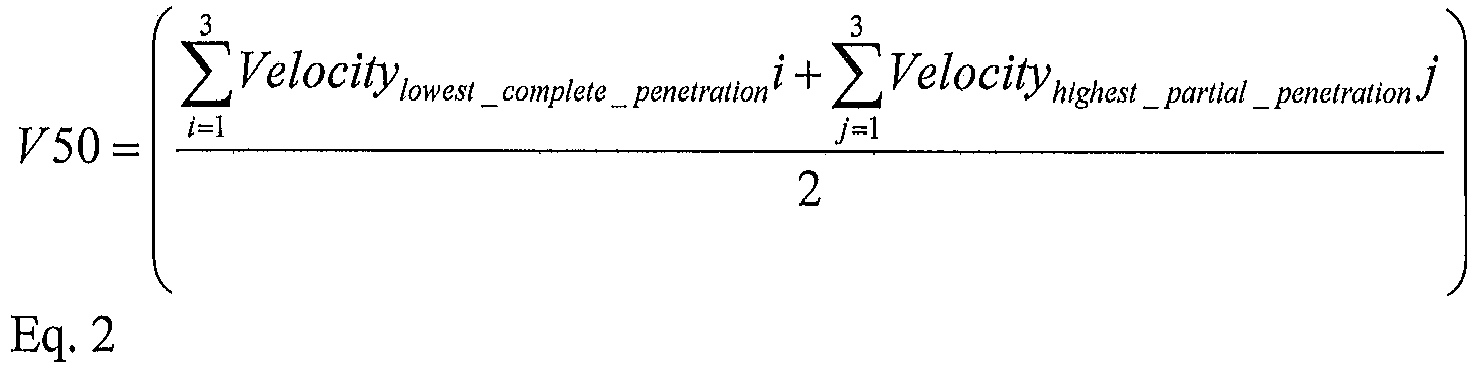
Table 6 - V-50 Results and Fabric Weights Example V-50 (fps) Layers Vhighest partial penetration (fps) Vlowest_complete pentration (fps) Weight (g/m2) 7 799 2 869 773 116 8 802 3 860 786 116 8 817 3 831 753 116 10 850 3 828 874 126 11 814 2 862 766 115 12 941 3 932 917 115 14 794 3 766 823 115 15 891 3 868 874 140 16 953 3 955 915 158 - The amount of liquid water which is able to wick in the fabrics was investigated by vertically suspending a 1 inch (25.4mm) wide sample 8 inches (203mm) in length and submerged 1 inch (25.4mm) in distilled water at ambient temperature and observing the wick height at time periods starting from the initial immersion of 1, 3, and 5 minutes and thereafter each 5 minute interval for 60 minutes or an observed wick height of 150mm whichever is first to be achieved.
Graph 1 is a plot of the vertical wicking height verses time of single layers for Examples 1, 2, 3, and 4. No observable wicking of the distilled water was shown in the examples consisting of single layer 100% ePTFE fabrics, namely Examples 1 and 2. Wicking was observed for the examples of a single layer textile comprised of a twisted para-aramid and ePTFE multifilament namely Example 4 and the single layer textile consisting of alternating ePTFE multifilaments and para-aramid filaments namely Example 3.
- Bacteria growth is facilitated by the presence of water. A fabric possessing the capability of minimal to no water wicking is thought to minimize the likelihood for bacterial growth within the fabric or textile. It is expected that the present invention will possess minimal bacterial growth in view of the minimal water wicking characteristic shown in examples 1 and 2 in the above results.
- The air permeability transmission rate of single layers used in Examples 1, 2, 3, and 4 were measured in accordance to ASTM D737-04 Air Permeability of Textile Fabrics test method. The test pressure was 125 Pascal and five air flow measurements were taken per sample. Table 7 contains the results of the air permeability tests.
Table 7 - Air Permeability of Single Layer Results Example # Layers N Average Air Permeability (CFM) Std. Dev. Air Permeability (CFM) 1 1 5 193.4 5.5 2 1 5 157.4 31.8 3 1 5 113.2 9.3 4 1 5 449.8 93.6 Note: Test pressure 125Pa, per ASTM D737 - Using a textile comprising of 100% 400 denier ePTFE multifilament at various pick and end densities is shown to offer excellent fragmentary ballistic protection, not wick distilled water, bend with minimal force and exhibit excellent air permeability compared to traditional ballistic textile composed of para-aramid filaments.
Claims (15)
- An article comprising an insert for a protective garment, said insert comprising a fabric having at least 45 percent by weight of expanded polytetrafluoroethylene fibers, said fabric having a 2-Grain V-50 Fragmentation Resistance of at least 213 meters (700 feet) per second and a FAST-2 Bending Rigidity of less than 40 microNewtonmeters.
- An article as defined in claim 1 wherein said FAST-2 Bending Rigidity is less than 30 microNewtonmeters, particularly wherein said FAST-2 Bending Rigidity is less than 20 microNewtonmeters, more particularly wherein said FAST-2 Bending Rigidity is about 10 microNewtonmeters.
- An article comprising an insert for a protective garment, said insert comprising a fabric having at least 45 percent by weight of expanded polytetrafluoroethylene filaments having a tenacity of less than about 10 grams per dtex, said fabric having a 2-Grain V-50 Fragmentation Resistance of at least 213 meters (700 feet) per second and said fabric having a weight of less than about 160 grams per square meter.
- An article as defined in claim 3 wherein said fabric has at least 75 percent by weight of polytetrafluoroethylene filaments.
- An article as defined in claim 3 wherein said fabric comprises 100 percent by weight of polytetrafluoroethylene filaments.
- An article as defined in claim 3 wherein said fabric has a 2-Grain V-50 Fragmentation Resistance of at least 244 meters (800 feet) per second.
- An article as defined in claim 3 wherein said fabric has a Vertical Wicking after 10 minutes of less than 150 mm.
- An article as defined in claim 3 wherein said fabric has a Vertical Wicking after 10 minutes of zero mm.
- An article as defined in claim 3 wherein said fabric has a weight of less than about 140 grams per square meter, particularly has a weight of less than about 120 grams per square meter.
- An article as defined in claim 1, said fabric having a weight of less than about 160 grams per square meter.
- An article as defined in claim 1 or 10 wherein said fabric has at least 75 percent by weight of polytetrafluoroethylene fibers.
- An article as defined in claim 1 or 10 wherein said fabric comprises 100 percent by weight of polytetrafluoroethylene fibers.
- An article as defined in claim 1 or 10 wherein said fabric has a 2-Grain V-50 Fragmentation Resistance of at least 244 meters (800 feet) per second.
- An article as defined in claim 1 or 10 wherein said fabric has a Vertical Wicking after 10 minutes of less than 150 mm.
- An article as defined in claim 1 or 10 wherein said fabric has a Vertical Wicking after 10 minutes of zero mm.
Applications Claiming Priority (5)
| Application Number | Priority Date | Filing Date | Title |
|---|---|---|---|
| US201261618996P | 2012-04-02 | 2012-04-02 | |
| US201261621701P | 2012-04-09 | 2012-04-09 | |
| US201361791047P | 2013-03-15 | 2013-03-15 | |
| US13/854,557 US9513088B2 (en) | 2012-04-02 | 2013-04-01 | Protective undergarment |
| PCT/US2013/034872 WO2013151950A1 (en) | 2012-04-02 | 2013-04-02 | Protective undergarment |
Publications (3)
| Publication Number | Publication Date |
|---|---|
| EP2833746A1 EP2833746A1 (en) | 2015-02-11 |
| EP2833746A4 EP2833746A4 (en) | 2015-11-11 |
| EP2833746B1 true EP2833746B1 (en) | 2018-07-18 |
Family
ID=49300972
Family Applications (1)
| Application Number | Title | Priority Date | Filing Date |
|---|---|---|---|
| EP13771947.2A Not-in-force EP2833746B1 (en) | 2012-04-02 | 2013-04-02 | Insert for a protective garment |
Country Status (8)
| Country | Link |
|---|---|
| US (1) | US9513088B2 (en) |
| EP (1) | EP2833746B1 (en) |
| KR (1) | KR20140143217A (en) |
| CN (1) | CN104270975A (en) |
| AU (1) | AU2013243683B2 (en) |
| CA (1) | CA2869860C (en) |
| RU (1) | RU2014144386A (en) |
| WO (1) | WO2013151950A1 (en) |
Families Citing this family (11)
| Publication number | Priority date | Publication date | Assignee | Title |
|---|---|---|---|---|
| US8933145B2 (en) | 2009-02-20 | 2015-01-13 | The General Hospital Corporation | High temperature melting |
| EP2727555B1 (en) * | 2012-10-31 | 2016-10-05 | W.L. Gore & Associates GmbH | Fluoropolymer articles having a high surface roughness and high coarseness |
| US20150361599A1 (en) * | 2014-06-16 | 2015-12-17 | W. L. Gore & Associates, Inc. | Woven Fabrics Containing Expanded Polytetrafluoroethylene Fibers |
| US11136697B2 (en) * | 2015-03-16 | 2021-10-05 | W. L. Gore & Associates, Inc. | Fabrics containing conformable low density fluoropolymer fiber blends |
| US9988758B2 (en) * | 2015-06-15 | 2018-06-05 | W. L. Gore & Associates, Inc. | Fabrics containing expanded polytetrafluoroethylene fibers |
| AU2016352992A1 (en) | 2015-11-12 | 2018-05-24 | The General Hospital Corporation | Methods of making therapeutic polymeric material |
| US11300386B2 (en) | 2015-12-31 | 2022-04-12 | Dupont Safety & Construction, Inc. | Ballistic materials incorporating spunlaced nonwovens |
| US12115289B2 (en) | 2016-02-05 | 2024-10-15 | The General Hospital Corporation | Drug eluting polymer composed of biodegradable polymers applied to surface of medical device |
| BE1023672B1 (en) | 2016-05-19 | 2017-06-12 | Seyntex N.V. | FLEXIBLE, LIGHT-WEIGHT ANTIBALLIST PROTECTION |
| JP7794124B2 (en) * | 2021-03-29 | 2026-01-06 | 東レ株式会社 | Fabrics and sliding materials |
| US11970600B2 (en) | 2021-03-31 | 2024-04-30 | The General Hospital Corporation | Di-cumyl peroxide crosslinking of UHMWPE |
Family Cites Families (23)
| Publication number | Priority date | Publication date | Assignee | Title |
|---|---|---|---|---|
| US4194041A (en) | 1978-06-29 | 1980-03-18 | W. L. Gore & Associates, Inc. | Waterproof laminate |
| US4868928A (en) * | 1987-10-21 | 1989-09-26 | W. L. Gore & Associates, Inc. | Windproof weather-resistant lined garment material |
| US4923741A (en) * | 1988-06-30 | 1990-05-08 | The United States Of America As Represented By The Administrator, National Aeronautics And Space Administration | Hazards protection for space suits and spacecraft |
| US5155867A (en) | 1991-05-23 | 1992-10-20 | W. L. Gore & Associates, Inc. | Protective undergarment |
| US5721283A (en) | 1992-06-25 | 1998-02-24 | E. I. Du Pont De Nemours And Company | Porous polytetrafluoroethylene and preparation |
| US5471906A (en) | 1993-10-15 | 1995-12-05 | W. L. Gore & Associates, Inc. | Body armor cover and method for making the same |
| US5590420A (en) | 1994-03-24 | 1997-01-07 | Gunn; Robert T. | Low friction apparel |
| FR2738993B1 (en) | 1995-09-26 | 1997-12-12 | Aerazur | WATERPROOF UNDERWEAR SUITABLE TO BE WEAR UNDER FLYING CLOTHING SUCH AS A FLYING SUIT |
| DE19641849A1 (en) | 1996-10-10 | 1998-04-16 | Peter Sczypior | Pantiliner |
| CA2250802A1 (en) | 1998-06-09 | 1999-12-09 | Intellitecs International Inc. | Male incontinence undergarment |
| US6281515B1 (en) | 1998-12-07 | 2001-08-28 | Meridian Research And Development | Lightweight radiation protective garments |
| US6723428B1 (en) | 1999-05-27 | 2004-04-20 | Foss Manufacturing Co., Inc. | Anti-microbial fiber and fibrous products |
| US7162746B2 (en) | 2001-12-12 | 2007-01-16 | Reynolds Eric M | Body form-fitting rainwear |
| WO2003074770A1 (en) * | 2002-03-07 | 2003-09-12 | Manegro Administração E Participações Ltda. | Expanded ptfe fiber |
| US7571493B1 (en) * | 2004-08-04 | 2009-08-11 | Sandia Corporation | Armored garment for protecting |
| US7296394B2 (en) | 2005-02-11 | 2007-11-20 | Gore Enterprise Holdings, Inc. | Fluoropolymer fiber composite bundle |
| US20110129657A1 (en) | 2005-02-11 | 2011-06-02 | Norman Clough | Ballistic Resistant Composite Fabric |
| US8007202B2 (en) | 2006-08-02 | 2011-08-30 | Honeywell International, Inc. | Protective marine barrier system |
| US8017530B1 (en) | 2007-03-28 | 2011-09-13 | Honeywell International Inc. | Environmentally resistant ballistic composite based on a fluorocarbon-modified matrix binder |
| US20090077724A1 (en) | 2007-09-26 | 2009-03-26 | Courtney Mark J | Protective Undergarment |
| US7739750B2 (en) | 2008-01-15 | 2010-06-22 | Toray Fluorofibers (America), Inc. | Garment prepared from fluoropolymer staple yarn |
| US20110217504A1 (en) * | 2010-03-08 | 2011-09-08 | Steven Michael Lampo | Ballistic Panels and Method of Making the Same |
| US8956985B2 (en) * | 2010-03-08 | 2015-02-17 | W. L. Gore & Associates, Inc. | Ballistic panels and method of making the same |
-
2013
- 2013-04-01 US US13/854,557 patent/US9513088B2/en not_active Expired - Fee Related
- 2013-04-02 AU AU2013243683A patent/AU2013243683B2/en not_active Ceased
- 2013-04-02 RU RU2014144386A patent/RU2014144386A/en not_active Application Discontinuation
- 2013-04-02 WO PCT/US2013/034872 patent/WO2013151950A1/en not_active Ceased
- 2013-04-02 CA CA2869860A patent/CA2869860C/en not_active Expired - Fee Related
- 2013-04-02 KR KR1020147030724A patent/KR20140143217A/en not_active Withdrawn
- 2013-04-02 EP EP13771947.2A patent/EP2833746B1/en not_active Not-in-force
- 2013-04-02 CN CN201380023701.0A patent/CN104270975A/en active Pending
Non-Patent Citations (1)
| Title |
|---|
| None * |
Also Published As
| Publication number | Publication date |
|---|---|
| US20130273343A1 (en) | 2013-10-17 |
| EP2833746A4 (en) | 2015-11-11 |
| EP2833746A1 (en) | 2015-02-11 |
| KR20140143217A (en) | 2014-12-15 |
| AU2013243683A1 (en) | 2014-10-23 |
| CA2869860C (en) | 2017-01-03 |
| CN104270975A (en) | 2015-01-07 |
| WO2013151950A1 (en) | 2013-10-10 |
| US9513088B2 (en) | 2016-12-06 |
| RU2014144386A (en) | 2016-05-27 |
| AU2013243683B2 (en) | 2016-02-25 |
| CA2869860A1 (en) | 2013-10-10 |
Similar Documents
| Publication | Publication Date | Title |
|---|---|---|
| AU2013243683B2 (en) | Protective undergarment | |
| EP1064515B2 (en) | Penetration-resistant ballistic article | |
| US7010811B1 (en) | Lightweight soft body-armor product | |
| EP1290396B1 (en) | Knife-stab-resistant ballistic article | |
| MX2010012885A (en) | Antiballistically effective article. | |
| US20030188631A1 (en) | Lightweight soft body-armor product | |
| EP0615558B1 (en) | Hybrid ballistic fabric | |
| EP1540057B1 (en) | Penetration resistant life protection articles | |
| US7905256B2 (en) | Penetration-obstructing article | |
| JP3794924B2 (en) | Hybrid protective complex | |
| EP1644684A1 (en) | Layered ballistic-resistant material | |
| EP1269103B1 (en) | Ballistic vest | |
| KR20090076225A (en) | Aramid fabric, method of making the same and body armor made therefrom | |
| US9457206B2 (en) | Fire resistant anti-ballistic knit fabric and protective article and protective undergarment made from the same | |
| RU236555U1 (en) | Anti-shatter protective curtain for window openings | |
| KR20180122778A (en) | Reinforced Fiber product for bullet and knife protections and method of producing thereof | |
| KR20090076475A (en) | Bulletproof material | |
| HK1035572B (en) | Penetration-resistant ballistic article |
Legal Events
| Date | Code | Title | Description |
|---|---|---|---|
| PUAI | Public reference made under article 153(3) epc to a published international application that has entered the european phase |
Free format text: ORIGINAL CODE: 0009012 |
|
| 17P | Request for examination filed |
Effective date: 20141031 |
|
| AK | Designated contracting states |
Kind code of ref document: A1 Designated state(s): AL AT BE BG CH CY CZ DE DK EE ES FI FR GB GR HR HU IE IS IT LI LT LU LV MC MK MT NL NO PL PT RO RS SE SI SK SM TR |
|
| AX | Request for extension of the european patent |
Extension state: BA ME |
|
| DAX | Request for extension of the european patent (deleted) | ||
| RA4 | Supplementary search report drawn up and despatched (corrected) |
Effective date: 20151013 |
|
| RIC1 | Information provided on ipc code assigned before grant |
Ipc: F41H 1/02 20060101ALN20151007BHEP Ipc: F41H 5/04 20060101AFI20151007BHEP Ipc: D03D 1/00 20060101ALN20151007BHEP Ipc: A41D 27/12 20060101ALN20151007BHEP |
|
| STAA | Information on the status of an ep patent application or granted ep patent |
Free format text: STATUS: EXAMINATION IS IN PROGRESS |
|
| 17Q | First examination report despatched |
Effective date: 20170419 |
|
| REG | Reference to a national code |
Ref country code: DE Ref legal event code: R079 Ref document number: 602013040506 Country of ref document: DE Free format text: PREVIOUS MAIN CLASS: A41D0027120000 Ipc: F41H0005040000 |
|
| GRAP | Despatch of communication of intention to grant a patent |
Free format text: ORIGINAL CODE: EPIDOSNIGR1 |
|
| STAA | Information on the status of an ep patent application or granted ep patent |
Free format text: STATUS: GRANT OF PATENT IS INTENDED |
|
| RIC1 | Information provided on ipc code assigned before grant |
Ipc: F41H 1/02 20060101ALN20180201BHEP Ipc: F41H 5/04 20060101AFI20180201BHEP Ipc: A41D 27/12 20060101ALN20180201BHEP Ipc: D03D 1/00 20060101ALN20180201BHEP |
|
| INTG | Intention to grant announced |
Effective date: 20180215 |
|
| GRAS | Grant fee paid |
Free format text: ORIGINAL CODE: EPIDOSNIGR3 |
|
| GRAA | (expected) grant |
Free format text: ORIGINAL CODE: 0009210 |
|
| STAA | Information on the status of an ep patent application or granted ep patent |
Free format text: STATUS: THE PATENT HAS BEEN GRANTED |
|
| AK | Designated contracting states |
Kind code of ref document: B1 Designated state(s): AL AT BE BG CH CY CZ DE DK EE ES FI FR GB GR HR HU IE IS IT LI LT LU LV MC MK MT NL NO PL PT RO RS SE SI SK SM TR |
|
| REG | Reference to a national code |
Ref country code: GB Ref legal event code: FG4D |
|
| REG | Reference to a national code |
Ref country code: CH Ref legal event code: EP |
|
| REG | Reference to a national code |
Ref country code: IE Ref legal event code: FG4D |
|
| REG | Reference to a national code |
Ref country code: AT Ref legal event code: REF Ref document number: 1019843 Country of ref document: AT Kind code of ref document: T Effective date: 20180815 |
|
| REG | Reference to a national code |
Ref country code: DE Ref legal event code: R096 Ref document number: 602013040506 Country of ref document: DE |
|
| REG | Reference to a national code |
Ref country code: NL Ref legal event code: MP Effective date: 20180718 |
|
| REG | Reference to a national code |
Ref country code: LT Ref legal event code: MG4D |
|
| REG | Reference to a national code |
Ref country code: AT Ref legal event code: MK05 Ref document number: 1019843 Country of ref document: AT Kind code of ref document: T Effective date: 20180718 |
|
| PG25 | Lapsed in a contracting state [announced via postgrant information from national office to epo] |
Ref country code: NL Free format text: LAPSE BECAUSE OF FAILURE TO SUBMIT A TRANSLATION OF THE DESCRIPTION OR TO PAY THE FEE WITHIN THE PRESCRIBED TIME-LIMIT Effective date: 20180718 |
|
| PG25 | Lapsed in a contracting state [announced via postgrant information from national office to epo] |
Ref country code: IS Free format text: LAPSE BECAUSE OF FAILURE TO SUBMIT A TRANSLATION OF THE DESCRIPTION OR TO PAY THE FEE WITHIN THE PRESCRIBED TIME-LIMIT Effective date: 20181118 Ref country code: LT Free format text: LAPSE BECAUSE OF FAILURE TO SUBMIT A TRANSLATION OF THE DESCRIPTION OR TO PAY THE FEE WITHIN THE PRESCRIBED TIME-LIMIT Effective date: 20180718 Ref country code: PL Free format text: LAPSE BECAUSE OF FAILURE TO SUBMIT A TRANSLATION OF THE DESCRIPTION OR TO PAY THE FEE WITHIN THE PRESCRIBED TIME-LIMIT Effective date: 20180718 Ref country code: RS Free format text: LAPSE BECAUSE OF FAILURE TO SUBMIT A TRANSLATION OF THE DESCRIPTION OR TO PAY THE FEE WITHIN THE PRESCRIBED TIME-LIMIT Effective date: 20180718 Ref country code: AT Free format text: LAPSE BECAUSE OF FAILURE TO SUBMIT A TRANSLATION OF THE DESCRIPTION OR TO PAY THE FEE WITHIN THE PRESCRIBED TIME-LIMIT Effective date: 20180718 Ref country code: BG Free format text: LAPSE BECAUSE OF FAILURE TO SUBMIT A TRANSLATION OF THE DESCRIPTION OR TO PAY THE FEE WITHIN THE PRESCRIBED TIME-LIMIT Effective date: 20181018 Ref country code: GR Free format text: LAPSE BECAUSE OF FAILURE TO SUBMIT A TRANSLATION OF THE DESCRIPTION OR TO PAY THE FEE WITHIN THE PRESCRIBED TIME-LIMIT Effective date: 20181019 Ref country code: NO Free format text: LAPSE BECAUSE OF FAILURE TO SUBMIT A TRANSLATION OF THE DESCRIPTION OR TO PAY THE FEE WITHIN THE PRESCRIBED TIME-LIMIT Effective date: 20181018 Ref country code: SE Free format text: LAPSE BECAUSE OF FAILURE TO SUBMIT A TRANSLATION OF THE DESCRIPTION OR TO PAY THE FEE WITHIN THE PRESCRIBED TIME-LIMIT Effective date: 20180718 Ref country code: FI Free format text: LAPSE BECAUSE OF FAILURE TO SUBMIT A TRANSLATION OF THE DESCRIPTION OR TO PAY THE FEE WITHIN THE PRESCRIBED TIME-LIMIT Effective date: 20180718 |
|
| PG25 | Lapsed in a contracting state [announced via postgrant information from national office to epo] |
Ref country code: HR Free format text: LAPSE BECAUSE OF FAILURE TO SUBMIT A TRANSLATION OF THE DESCRIPTION OR TO PAY THE FEE WITHIN THE PRESCRIBED TIME-LIMIT Effective date: 20180718 Ref country code: AL Free format text: LAPSE BECAUSE OF FAILURE TO SUBMIT A TRANSLATION OF THE DESCRIPTION OR TO PAY THE FEE WITHIN THE PRESCRIBED TIME-LIMIT Effective date: 20180718 Ref country code: LV Free format text: LAPSE BECAUSE OF FAILURE TO SUBMIT A TRANSLATION OF THE DESCRIPTION OR TO PAY THE FEE WITHIN THE PRESCRIBED TIME-LIMIT Effective date: 20180718 |
|
| REG | Reference to a national code |
Ref country code: DE Ref legal event code: R097 Ref document number: 602013040506 Country of ref document: DE |
|
| PG25 | Lapsed in a contracting state [announced via postgrant information from national office to epo] |
Ref country code: CZ Free format text: LAPSE BECAUSE OF FAILURE TO SUBMIT A TRANSLATION OF THE DESCRIPTION OR TO PAY THE FEE WITHIN THE PRESCRIBED TIME-LIMIT Effective date: 20180718 Ref country code: RO Free format text: LAPSE BECAUSE OF FAILURE TO SUBMIT A TRANSLATION OF THE DESCRIPTION OR TO PAY THE FEE WITHIN THE PRESCRIBED TIME-LIMIT Effective date: 20180718 Ref country code: IT Free format text: LAPSE BECAUSE OF FAILURE TO SUBMIT A TRANSLATION OF THE DESCRIPTION OR TO PAY THE FEE WITHIN THE PRESCRIBED TIME-LIMIT Effective date: 20180718 Ref country code: EE Free format text: LAPSE BECAUSE OF FAILURE TO SUBMIT A TRANSLATION OF THE DESCRIPTION OR TO PAY THE FEE WITHIN THE PRESCRIBED TIME-LIMIT Effective date: 20180718 Ref country code: ES Free format text: LAPSE BECAUSE OF FAILURE TO SUBMIT A TRANSLATION OF THE DESCRIPTION OR TO PAY THE FEE WITHIN THE PRESCRIBED TIME-LIMIT Effective date: 20180718 |
|
| PLBE | No opposition filed within time limit |
Free format text: ORIGINAL CODE: 0009261 |
|
| STAA | Information on the status of an ep patent application or granted ep patent |
Free format text: STATUS: NO OPPOSITION FILED WITHIN TIME LIMIT |
|
| PG25 | Lapsed in a contracting state [announced via postgrant information from national office to epo] |
Ref country code: SM Free format text: LAPSE BECAUSE OF FAILURE TO SUBMIT A TRANSLATION OF THE DESCRIPTION OR TO PAY THE FEE WITHIN THE PRESCRIBED TIME-LIMIT Effective date: 20180718 Ref country code: DK Free format text: LAPSE BECAUSE OF FAILURE TO SUBMIT A TRANSLATION OF THE DESCRIPTION OR TO PAY THE FEE WITHIN THE PRESCRIBED TIME-LIMIT Effective date: 20180718 Ref country code: SK Free format text: LAPSE BECAUSE OF FAILURE TO SUBMIT A TRANSLATION OF THE DESCRIPTION OR TO PAY THE FEE WITHIN THE PRESCRIBED TIME-LIMIT Effective date: 20180718 |
|
| 26N | No opposition filed |
Effective date: 20190423 |
|
| PG25 | Lapsed in a contracting state [announced via postgrant information from national office to epo] |
Ref country code: SI Free format text: LAPSE BECAUSE OF FAILURE TO SUBMIT A TRANSLATION OF THE DESCRIPTION OR TO PAY THE FEE WITHIN THE PRESCRIBED TIME-LIMIT Effective date: 20180718 |
|
| REG | Reference to a national code |
Ref country code: CH Ref legal event code: PL |
|
| REG | Reference to a national code |
Ref country code: BE Ref legal event code: MM Effective date: 20190430 |
|
| PG25 | Lapsed in a contracting state [announced via postgrant information from national office to epo] |
Ref country code: MC Free format text: LAPSE BECAUSE OF FAILURE TO SUBMIT A TRANSLATION OF THE DESCRIPTION OR TO PAY THE FEE WITHIN THE PRESCRIBED TIME-LIMIT Effective date: 20180718 Ref country code: LU Free format text: LAPSE BECAUSE OF NON-PAYMENT OF DUE FEES Effective date: 20190402 |
|
| PG25 | Lapsed in a contracting state [announced via postgrant information from national office to epo] |
Ref country code: LI Free format text: LAPSE BECAUSE OF NON-PAYMENT OF DUE FEES Effective date: 20190430 Ref country code: CH Free format text: LAPSE BECAUSE OF NON-PAYMENT OF DUE FEES Effective date: 20190430 |
|
| PG25 | Lapsed in a contracting state [announced via postgrant information from national office to epo] |
Ref country code: BE Free format text: LAPSE BECAUSE OF NON-PAYMENT OF DUE FEES Effective date: 20190430 |
|
| PG25 | Lapsed in a contracting state [announced via postgrant information from national office to epo] |
Ref country code: TR Free format text: LAPSE BECAUSE OF FAILURE TO SUBMIT A TRANSLATION OF THE DESCRIPTION OR TO PAY THE FEE WITHIN THE PRESCRIBED TIME-LIMIT Effective date: 20180718 |
|
| PG25 | Lapsed in a contracting state [announced via postgrant information from national office to epo] |
Ref country code: IE Free format text: LAPSE BECAUSE OF NON-PAYMENT OF DUE FEES Effective date: 20190402 |
|
| PG25 | Lapsed in a contracting state [announced via postgrant information from national office to epo] |
Ref country code: PT Free format text: LAPSE BECAUSE OF FAILURE TO SUBMIT A TRANSLATION OF THE DESCRIPTION OR TO PAY THE FEE WITHIN THE PRESCRIBED TIME-LIMIT Effective date: 20181118 |
|
| PG25 | Lapsed in a contracting state [announced via postgrant information from national office to epo] |
Ref country code: CY Free format text: LAPSE BECAUSE OF FAILURE TO SUBMIT A TRANSLATION OF THE DESCRIPTION OR TO PAY THE FEE WITHIN THE PRESCRIBED TIME-LIMIT Effective date: 20180718 |
|
| PG25 | Lapsed in a contracting state [announced via postgrant information from national office to epo] |
Ref country code: HU Free format text: LAPSE BECAUSE OF FAILURE TO SUBMIT A TRANSLATION OF THE DESCRIPTION OR TO PAY THE FEE WITHIN THE PRESCRIBED TIME-LIMIT; INVALID AB INITIO Effective date: 20130402 Ref country code: MT Free format text: LAPSE BECAUSE OF FAILURE TO SUBMIT A TRANSLATION OF THE DESCRIPTION OR TO PAY THE FEE WITHIN THE PRESCRIBED TIME-LIMIT Effective date: 20180718 |
|
| PGFP | Annual fee paid to national office [announced via postgrant information from national office to epo] |
Ref country code: GB Payment date: 20220323 Year of fee payment: 10 |
|
| PGFP | Annual fee paid to national office [announced via postgrant information from national office to epo] |
Ref country code: FR Payment date: 20220323 Year of fee payment: 10 |
|
| PG25 | Lapsed in a contracting state [announced via postgrant information from national office to epo] |
Ref country code: MK Free format text: LAPSE BECAUSE OF FAILURE TO SUBMIT A TRANSLATION OF THE DESCRIPTION OR TO PAY THE FEE WITHIN THE PRESCRIBED TIME-LIMIT Effective date: 20180718 |
|
| PGFP | Annual fee paid to national office [announced via postgrant information from national office to epo] |
Ref country code: DE Payment date: 20220322 Year of fee payment: 10 |
|
| REG | Reference to a national code |
Ref country code: DE Ref legal event code: R119 Ref document number: 602013040506 Country of ref document: DE |
|
| GBPC | Gb: european patent ceased through non-payment of renewal fee |
Effective date: 20230402 |
|
| PG25 | Lapsed in a contracting state [announced via postgrant information from national office to epo] |
Ref country code: GB Free format text: LAPSE BECAUSE OF NON-PAYMENT OF DUE FEES Effective date: 20230402 |
|
| PG25 | Lapsed in a contracting state [announced via postgrant information from national office to epo] |
Ref country code: GB Free format text: LAPSE BECAUSE OF NON-PAYMENT OF DUE FEES Effective date: 20230402 Ref country code: FR Free format text: LAPSE BECAUSE OF NON-PAYMENT OF DUE FEES Effective date: 20230430 Ref country code: DE Free format text: LAPSE BECAUSE OF NON-PAYMENT OF DUE FEES Effective date: 20231103 |