EP2833303A1 - Method for solving multidimensional optimization problems - Google Patents
Method for solving multidimensional optimization problems Download PDFInfo
- Publication number
- EP2833303A1 EP2833303A1 EP13178377.1A EP13178377A EP2833303A1 EP 2833303 A1 EP2833303 A1 EP 2833303A1 EP 13178377 A EP13178377 A EP 13178377A EP 2833303 A1 EP2833303 A1 EP 2833303A1
- Authority
- EP
- European Patent Office
- Prior art keywords
- optimization
- values
- sol
- functions
- normalized
- Prior art date
- Legal status (The legal status is an assumption and is not a legal conclusion. Google has not performed a legal analysis and makes no representation as to the accuracy of the status listed.)
- Ceased
Links
Images

Classifications
-
- G—PHYSICS
- G06—COMPUTING OR CALCULATING; COUNTING
- G06Q—INFORMATION AND COMMUNICATION TECHNOLOGY [ICT] SPECIALLY ADAPTED FOR ADMINISTRATIVE, COMMERCIAL, FINANCIAL, MANAGERIAL OR SUPERVISORY PURPOSES; SYSTEMS OR METHODS SPECIALLY ADAPTED FOR ADMINISTRATIVE, COMMERCIAL, FINANCIAL, MANAGERIAL OR SUPERVISORY PURPOSES, NOT OTHERWISE PROVIDED FOR
- G06Q10/00—Administration; Management
- G06Q10/04—Forecasting or optimisation specially adapted for administrative or management purposes, e.g. linear programming or "cutting stock problem"
Definitions
- the invention concerns a method for solving multidimensional optimization problems on a set of feasible solutions of a discrete combinatorial problem.
- Optimization criteria are represented as optimization functions f i ; S ⁇ R computing a numeric optimization value for each solution.
- the set of best solutions S * ⁇ S contains those solutions S j which minimize all the optimization functions.
- optimization criteria are:
- a normalization function is a projection from one range (unit system) to another (the common unit system).
- the main approach is a weighted sum model .
- the crucial step is to normalize the different optimization functions to a standard unit system.
- To define robust normalization functions is not a trivial task and is usually done in a heuristic way by analyzing the range of the optimization function and designing the normalization projection.
- the range of an optimization criterion "CO2 footprint" depends on the various parts in the component catalogue, the selection of parts for a solution and the size of the solution. It is often difficult to find meaningful minimum and maximum values.
- the min-max model is used, where the minimum and maximum optimization function value is computed or estimated.
- It is a goal of this invention is to disclose a more robust, general and domain-independent model for normalization functions.
- the new normalization method is completely domain-independent. It can be applied to every normally distributed optimization function in a general way. This will reduce modelling time and code complexity.
- Fig. 1 shows the calculation schema for accumulation of several optimization values to a single optimization value.
- the task of normalizing optimization criteria with different units is usually done by heuristic, domain-dependent normalization functions.
- standard deviation is used for normalization.
- the normalized optimization value is the raw value shifted by the mean value and divided by the standard deviation. In fact, it is the amount of standard deviations the actual raw value differs from the mean value and therefore a very convenient measurement of the quality of a solution.
- the range of that new normalization function is , but most of the values will group around the mean value. E.g., about 68% of the values will lie within +/-1 standard deviation around the mean value. Examples:
Landscapes
- Engineering & Computer Science (AREA)
- Business, Economics & Management (AREA)
- Human Resources & Organizations (AREA)
- Economics (AREA)
- Strategic Management (AREA)
- Marketing (AREA)
- Game Theory and Decision Science (AREA)
- Entrepreneurship & Innovation (AREA)
- Development Economics (AREA)
- Operations Research (AREA)
- Quality & Reliability (AREA)
- Tourism & Hospitality (AREA)
- Physics & Mathematics (AREA)
- General Business, Economics & Management (AREA)
- General Physics & Mathematics (AREA)
- Theoretical Computer Science (AREA)
- Management, Administration, Business Operations System, And Electronic Commerce (AREA)
Abstract
Description
- The invention concerns a method for solving multidimensional optimization problems on a set of feasible solutions of a discrete combinatorial problem.
- In many economical and technical domains, discrete combinatorial problems play an important role for problem formulation and reasoning. Examples of such discrete combinatorial problems are:
- The knowledge-based configuration of products and services as described in http://en.wikipedia.org/wiki/Knowledge-based_configuration;
- product line engineering, which has established itself as a standard practice for exploiting the commonalities among a family of products and managing the variabilities among them in a systematic way;
- recommender systems, which are used for predicting the rating a user would give to a certain product or piece of information;
- scheduling, that are methods by which threads, processes or data flows are given access to system resources, e.g. processor time or communications bandwidth;
- decision support systems, that are computer-based information system that supports business or organizational decision-making activities;
- "OR problems" as described in C.H.Papadimitriou, K. Steiglitz. Combinatorial Optimization: Algorithms and Complexity. Prentice-Hall, 1982 ; second edition, Dover, 1998 .
- In a general way, discrete combinatorial problems are defined as follows: Given are a problem domain description and a set of requirements for a concrete problem (e.g., both in form of a logical theory). The task is to find one or all solutions to the concrete problem.
- The solutions which obey the domain description and the requirements are called feasible solutions S = {S1, ..., Sn}.
- Searching for feasible solutions is often not enough, but the subset of feasible solutions which minimize or maximize several optimization criteria are of interest.
- The tasks to find this solutions are known as multidimensional optimization problems.
- Optimization criteria are represented as optimization functions

computing a numeric optimization value for each solution. The set of best solutions S* ⊆ S contains those solutions Sj which minimize all the optimization functions. - There are two major models how to deal with multiple optimization criteria: Pareto optimality as described in http://en.wikipedia.org/wiki/Pareto_efficiency and the weighted sum model.
- The weighted sum model simply condenses all the optimization function to a single function by summing them up. Usually weight factors are involved to represent the importance of the different optimization criteria. min

- Examples of optimization criteria are:
- price (of unit Euro)
- maintenance costs (of unit h/year)
- CO2 footprint (of unit kg/year)
- power consumption (of unit W)
- We see that all these criteria are of different units, so, mathematically, it does not make any sense to directly sum them up. They have to be normalized to a common unit system. A normalization function is a projection from one range (unit system) to another (the common unit system).
- Known systems for representing and solving discrete combinatorial problems can cope only with a single optimization function. Examples of such systems are ILOG, CHOCO, or Answer Set Programming systems like Potassco DLV.
- To use these systems for multidimensional optimization problems, the multiple optimization functions must be accumulated to a single optimization function. The main approach is a weighted sum model .
- In this approach, the crucial step is to normalize the different optimization functions to a standard unit system. To define robust normalization functions is not a trivial task and is usually done in a heuristic way by analyzing the range of the optimization function and designing the normalization projection. E.g., the range of an optimization criterion "CO2 footprint" (of unit kg/year) depends on the various parts in the component catalogue, the selection of parts for a solution and the size of the solution. It is often difficult to find meaningful minimum and maximum values.
- Often, the min-max model is used, where the minimum and maximum optimization function value is computed or estimated. The projection function of the min-max normalization model is then:

- The values of an optimization function are often not distributed equally throughout all possible solutions, leading to deformations of the overall optimization value.
- The disadvantages of such heuristic normalization functions are that they must be designed separately for each optimization criterion and each domain, they may lead to faulty calculations if not the whole range has been taken into account (e.g., if lower or higher values than the estimated min and max values show up), and they may lead to deformations of the optimization functions if the value distribution of the raw data does not match the value distribution of the normalized data.
- It is a goal of this invention is to disclose a more robust, general and domain-independent model for normalization functions.
- This is done with a method according to claim 1.
- The new normalization method is completely domain-independent. It can be applied to every normally distributed optimization function in a general way. This will reduce modelling time and code complexity.
- The new normalization method is based on standard statistics methods and is very easy to understand and to compute.
- Because of its general and domain-independent nature, the new normalization method is robust. E.g., during the modelling phase, when standard deviations of optimization functions are computed, standard outlier detection methods can easily be integrated to avoid distorted normalization functions. In contrast, heuristic normalization functions sometimes must use artificial cut-offs for the projection function which may lead to the same optimization values for different raw values.
- By having a simple and robust method for the definition of normalization functions, the application of multidimensional optimization is easier to implement. This gets more and more important in the future, where not only the price of a system (e.g. a configured product) is to be taken into account, but also other criteria like
- sustainability: a higher rating of products which consist of sustainable parts and materials, and which contribute to a sustainable usage of valuable resources
- green technology: higher rating of products which consist of regional resources (shorter routes of transport, promotion of local economy), which are produced with less environmental pollution, which have a longer span of life, ...
- strategic preferences: higher rating of products which are, e.g., currently available in stock.
- The method according to the invention is exemplified with an example shown in Fig. 1
- Fig. 1 shows the calculation schema for accumulation of several optimization values to a single optimization value.
- The task of normalizing optimization criteria with different units (e.g. price in Euro, CO2 footprint in kg/year, maintenance costs in h/year) to a standard unit so that they can be accumulated to a single optimization value is usually done by heuristic, domain-dependent normalization functions.
- According to the invention, standard deviation is used for normalization.
- The process is described in the following:
- Let be S the set of all feasible solutions to a discrete combinatorial problem.
- Let Ssample = {S1, ..., Sn} be a set of sample solutions. This set of sample solutions is a subset of all feasible solutions S. The sample solutions must be a representative set of solutions. An example of such a set of sample solutions is the set of products sold in the last time period.
- Let {f1, ..., fk} be a set of optimization functions. An optimization function fi: S → is a function which computes a "raw" (i.e., un-normalized) optimization value for a solution.

- Let µ(fi) be the mean value [15] of optimization function fi:

- Let s(fi) be the adjusted standard deviation [16] of optimization function fi (see figure 5.2):

- With the use of the mean value and the standard deviation computed from the set of sample solutions S1 ... Sn, we compute the optimization criterion value for an arbitrary new solution Sol (member of feasible solutions S). The normalized optimization criterion value of an arbitrary solution Sol is then defined by:

- So the normalized optimization value is the raw value shifted by the mean value and divided by the standard deviation. In fact, it is the amount of standard deviations the actual raw value differs from the mean value and therefore a very convenient measurement of the quality of a solution. Theoretically, the range of that new normalization function is, but most of the values will group around the mean value. E.g., about 68% of the values will lie within +/-1 standard deviation around the mean value. Examples:

- norm(fi (Sol)) =0 : the normalized value is exactly the mean value
- norm(fi (Sol)) =-0.5 : the normalized value is a half standard deviation better than the mean value
- norm(fi (Sol)) =2.3 : the normalized value is 2.3 standard deviations worse than the mean value
- Normalized values of different optimization functions can now easily be compared with each other, because they are of the same unit: the standard deviation.
- If weights wi are used to differentiate between high and less important criteria, the accumulated optimization value for a solution Sol is then defined by:

- For a concrete combinatorial problem with technically feasible solutions S1, ..., Sn, the goal is to find the one(s) with minimal value of f:
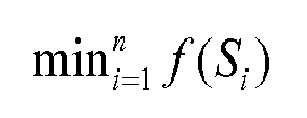
Claims (2)
- Method for solving multidimensional optimization problems on a set of feasible solutions {S1, ..., Sn} of a discrete combinatorial problem comprising steps of:- calculating optimization values for the set of feasible solutions {S1, ..., Sn} by using a set of optimization functions {f1, ..., fk}- calculating mean values µ(fi ) to the set of optimization functions {f1, ..., fk} according to
 - calculating standard deviation values s(f) to the set of optimization functions {f1, ..., fk} according to
 - normalize the optimization values for the set of feasible solutions {S1, ..., Sn} according to
 - accumulate the normalized optimization values norm(fi (Sol)) according to
 - find a minimum for the accumulated normalized optimization values
- Method for solving multidimensional optimization problems according to claim 1, characterized in, that the accumulation is based on weighted normalized optimization values according to

Priority Applications (3)
| Application Number | Priority Date | Filing Date | Title |
|---|---|---|---|
| EP13178377.1A EP2833303A1 (en) | 2013-07-29 | 2013-07-29 | Method for solving multidimensional optimization problems |
| EP14739834.1A EP3028223A1 (en) | 2013-07-29 | 2014-07-17 | Method for solving multidimensional optimization problems |
| PCT/EP2014/065369 WO2015014627A1 (en) | 2013-07-29 | 2014-07-17 | Method for solving multidimensional optimization problems |
Applications Claiming Priority (1)
| Application Number | Priority Date | Filing Date | Title |
|---|---|---|---|
| EP13178377.1A EP2833303A1 (en) | 2013-07-29 | 2013-07-29 | Method for solving multidimensional optimization problems |
Publications (1)
| Publication Number | Publication Date |
|---|---|
| EP2833303A1 true EP2833303A1 (en) | 2015-02-04 |
Family
ID=48917360
Family Applications (2)
| Application Number | Title | Priority Date | Filing Date |
|---|---|---|---|
| EP13178377.1A Ceased EP2833303A1 (en) | 2013-07-29 | 2013-07-29 | Method for solving multidimensional optimization problems |
| EP14739834.1A Ceased EP3028223A1 (en) | 2013-07-29 | 2014-07-17 | Method for solving multidimensional optimization problems |
Family Applications After (1)
| Application Number | Title | Priority Date | Filing Date |
|---|---|---|---|
| EP14739834.1A Ceased EP3028223A1 (en) | 2013-07-29 | 2014-07-17 | Method for solving multidimensional optimization problems |
Country Status (2)
| Country | Link |
|---|---|
| EP (2) | EP2833303A1 (en) |
| WO (1) | WO2015014627A1 (en) |
Cited By (1)
| Publication number | Priority date | Publication date | Assignee | Title |
|---|---|---|---|---|
| CN109697530A (en) * | 2018-12-22 | 2019-04-30 | 中铁十八局集团有限公司 | Rail yard construction period optimization method based on network technology |
-
2013
- 2013-07-29 EP EP13178377.1A patent/EP2833303A1/en not_active Ceased
-
2014
- 2014-07-17 WO PCT/EP2014/065369 patent/WO2015014627A1/en not_active Ceased
- 2014-07-17 EP EP14739834.1A patent/EP3028223A1/en not_active Ceased
Non-Patent Citations (2)
| Title |
|---|
| C.H.PAPADIMITRIOU; K. STEI- GLITZ: "Combinatorial Optimization: Algorithms and Complexity", 1982, PRENTICE-HALL |
| No relevant documents disclosed * |
Cited By (1)
| Publication number | Priority date | Publication date | Assignee | Title |
|---|---|---|---|---|
| CN109697530A (en) * | 2018-12-22 | 2019-04-30 | 中铁十八局集团有限公司 | Rail yard construction period optimization method based on network technology |
Also Published As
| Publication number | Publication date |
|---|---|
| EP3028223A1 (en) | 2016-06-08 |
| WO2015014627A1 (en) | 2015-02-05 |
Similar Documents
| Publication | Publication Date | Title |
|---|---|---|
| Park et al. | An analysis of the ripple effect for disruptions occurring in circular flows of a supply chain network | |
| Dellino et al. | A reliable decision support system for fresh food supply chain management | |
| Khemiri et al. | A fuzzy multi-criteria decision-making approach for managing performance and risk in integrated procurement–production planning | |
| Aqlan et al. | A fuzzy-based integrated framework for supply chain risk assessment | |
| Haldar et al. | Resilient supplier selection under a fuzzy environment | |
| Vlachos et al. | Lean thinking in the European hotel industry | |
| Rezaeisaray et al. | A novel hybrid MCDM approach for outsourcing supplier selection: A case study in pipe and fittings manufacturing | |
| Alfieri et al. | A project scheduling approach to production planning with feeding precedence relations | |
| US9230211B1 (en) | Analytics scripting systems and methods | |
| Buddas | A bottleneck analysis in the IFRC supply chain | |
| Funaki | Strategic safety stock placement in supply chain design with due-date based demand | |
| Gohar et al. | Identifying and evaluating risks of construction projects in fuzzy environment: a case study in Iranian construction industry | |
| US20160110733A1 (en) | Inventory management system | |
| Meisel et al. | The design of Make-to-Order supply networks under uncertainties using simulation and optimisation | |
| Kemmoe et al. | Model for flexibility evaluation in manufacturing network strategic planning | |
| Morton et al. | A Bayesian stochastic programming approach to an employee scheduling problem | |
| Clark | Rolling horizon heuristics for production planning and set-up scheduling with backlogs and error-prone demand forecasts | |
| Saarinen et al. | Resilience through appropriate response: a simulation study of disruptions and response strategies–case COVID-19 and the grocery supply chain: Saarinen L. et al. | |
| Käki et al. | Impact of the shape of demand distribution in decision models for operations management | |
| US20210150582A1 (en) | System and method for detecting and rectifying abnormal ad spends | |
| May et al. | Prioritisation of performance indicators in air cargo demand management: an insight from industry | |
| García-Pozo et al. | Impact of introducing eco-innovation measures on productivity in transport sector companies | |
| Yan et al. | Inferring fundamental value and crash nonlinearity from bubble calibration | |
| Kuhlmann et al. | A dynamic systems model for an economic evaluation of sales forecasting methods | |
| Mehmood et al. | Vending machine product demand prediction using machine learning algorithms |
Legal Events
| Date | Code | Title | Description |
|---|---|---|---|
| 17P | Request for examination filed |
Effective date: 20130729 |
|
| AK | Designated contracting states |
Kind code of ref document: A1 Designated state(s): AL AT BE BG CH CY CZ DE DK EE ES FI FR GB GR HR HU IE IS IT LI LT LU LV MC MK MT NL NO PL PT RO RS SE SI SK SM TR |
|
| AX | Request for extension of the european patent |
Extension state: BA ME |
|
| PUAI | Public reference made under article 153(3) epc to a published international application that has entered the european phase |
Free format text: ORIGINAL CODE: 0009012 |
|
| R17P | Request for examination filed (corrected) |
Effective date: 20150803 |
|
| RBV | Designated contracting states (corrected) |
Designated state(s): AL AT BE BG CH CY CZ DE DK EE ES FI FR GB GR HR HU IE IS IT LI LT LU LV MC MK MT NL NO PL PT RO RS SE SI SK SM TR |
|
| 17Q | First examination report despatched |
Effective date: 20150909 |
|
| APBK | Appeal reference recorded |
Free format text: ORIGINAL CODE: EPIDOSNREFNE |
|
| APBN | Date of receipt of notice of appeal recorded |
Free format text: ORIGINAL CODE: EPIDOSNNOA2E |
|
| APBR | Date of receipt of statement of grounds of appeal recorded |
Free format text: ORIGINAL CODE: EPIDOSNNOA3E |
|
| APAF | Appeal reference modified |
Free format text: ORIGINAL CODE: EPIDOSCREFNE |
|
| APAF | Appeal reference modified |
Free format text: ORIGINAL CODE: EPIDOSCREFNE |
|
| APBX | Invitation to file observations in appeal sent |
Free format text: ORIGINAL CODE: EPIDOSNOBA2E |
|
| APBZ | Receipt of observations in appeal recorded |
Free format text: ORIGINAL CODE: EPIDOSNOBA4E |
|
| APBT | Appeal procedure closed |
Free format text: ORIGINAL CODE: EPIDOSNNOA9E |
|
| STAA | Information on the status of an ep patent application or granted ep patent |
Free format text: STATUS: THE APPLICATION HAS BEEN REFUSED |
|
| 18R | Application refused |
Effective date: 20201010 |