EP2832734A1 - Heterocyclic compound - Google Patents
Heterocyclic compound Download PDFInfo
- Publication number
- EP2832734A1 EP2832734A1 EP13769902.1A EP13769902A EP2832734A1 EP 2832734 A1 EP2832734 A1 EP 2832734A1 EP 13769902 A EP13769902 A EP 13769902A EP 2832734 A1 EP2832734 A1 EP 2832734A1
- Authority
- EP
- European Patent Office
- Prior art keywords
- group
- optionally substituted
- alkyl
- alkoxy
- substituents selected
- Prior art date
- Legal status (The legal status is an assumption and is not a legal conclusion. Google has not performed a legal analysis and makes no representation as to the accuracy of the status listed.)
- Withdrawn
Links
- 150000002391 heterocyclic compounds Chemical class 0.000 title description 2
- 150000001875 compounds Chemical class 0.000 claims abstract description 291
- 150000003839 salts Chemical class 0.000 claims abstract description 73
- 208000023275 Autoimmune disease Diseases 0.000 claims abstract description 24
- 238000011282 treatment Methods 0.000 claims abstract description 21
- 206010039073 rheumatoid arthritis Diseases 0.000 claims abstract description 20
- 208000022559 Inflammatory bowel disease Diseases 0.000 claims abstract description 19
- 230000002401 inhibitory effect Effects 0.000 claims abstract description 19
- 201000004681 Psoriasis Diseases 0.000 claims abstract description 18
- 201000006417 multiple sclerosis Diseases 0.000 claims abstract description 18
- 238000011321 prophylaxis Methods 0.000 claims abstract description 18
- 201000000596 systemic lupus erythematosus Diseases 0.000 claims abstract description 18
- 208000009137 Behcet syndrome Diseases 0.000 claims abstract description 17
- 208000021386 Sjogren Syndrome Diseases 0.000 claims abstract description 17
- -1 2-oxopiperidino group Chemical group 0.000 claims description 570
- 125000001424 substituent group Chemical group 0.000 claims description 389
- 125000004169 (C1-C6) alkyl group Chemical group 0.000 claims description 311
- 125000006615 aromatic heterocyclic group Chemical group 0.000 claims description 197
- 125000002950 monocyclic group Chemical group 0.000 claims description 182
- 125000005843 halogen group Chemical group 0.000 claims description 171
- 125000002887 hydroxy group Chemical group [H]O* 0.000 claims description 156
- 125000004191 (C1-C6) alkoxy group Chemical group 0.000 claims description 151
- 125000004093 cyano group Chemical group *C#N 0.000 claims description 134
- 238000000034 method Methods 0.000 claims description 99
- 125000004435 hydrogen atom Chemical group [H]* 0.000 claims description 97
- 125000004454 (C1-C6) alkoxycarbonyl group Chemical group 0.000 claims description 92
- 125000004739 (C1-C6) alkylsulfonyl group Chemical group 0.000 claims description 87
- 125000005913 (C3-C6) cycloalkyl group Chemical group 0.000 claims description 86
- 125000003917 carbamoyl group Chemical group [H]N([H])C(*)=O 0.000 claims description 83
- 125000004916 (C1-C6) alkylcarbonyl group Chemical group 0.000 claims description 80
- 125000003178 carboxy group Chemical group [H]OC(*)=O 0.000 claims description 78
- 125000003277 amino group Chemical group 0.000 claims description 57
- 125000003118 aryl group Chemical group 0.000 claims description 51
- 125000005915 C6-C14 aryl group Chemical group 0.000 claims description 47
- 239000003814 drug Substances 0.000 claims description 36
- 125000006517 heterocyclyl carbonyl group Chemical group 0.000 claims description 31
- 125000004043 oxo group Chemical group O=* 0.000 claims description 28
- 125000004397 aminosulfonyl group Chemical group NS(=O)(=O)* 0.000 claims description 27
- 125000006273 (C1-C3) alkyl group Chemical group 0.000 claims description 21
- 239000003795 chemical substances by application Substances 0.000 claims description 21
- HNJBEVLQSNELDL-UHFFFAOYSA-N pyrrolidin-2-one Chemical group O=C1CCCN1 HNJBEVLQSNELDL-UHFFFAOYSA-N 0.000 claims description 20
- 125000002252 acyl group Chemical group 0.000 claims description 19
- 125000000623 heterocyclic group Chemical group 0.000 claims description 19
- 125000004414 alkyl thio group Chemical group 0.000 claims description 14
- 238000004519 manufacturing process Methods 0.000 claims description 14
- 241000124008 Mammalia Species 0.000 claims description 8
- 108010010057 TYK2 Kinase Proteins 0.000 claims description 4
- 229940123371 Tyrosine kinase 2 inhibitor Drugs 0.000 claims description 4
- APAIFKNDLXGEFT-JOCHJYFZSA-N (3r)-3-ethyl-1-[2-[4-[4-(hydroxymethyl)oxan-4-yl]anilino]pyrimidin-4-yl]-2-oxopyrrolidine-3-carbonitrile Chemical compound O=C1[C@@](CC)(C#N)CCN1C1=CC=NC(NC=2C=CC(=CC=2)C2(CO)CCOCC2)=N1 APAIFKNDLXGEFT-JOCHJYFZSA-N 0.000 claims description 3
- QTKBWGVTKFTNCJ-LJQANCHMSA-N (3s)-3-cyclopropyl-1-[2-[[1-(1-hydroxy-2-methylpropan-2-yl)pyrazol-4-yl]amino]pyrimidin-4-yl]-2-oxopyrrolidine-3-carbonitrile Chemical compound C1=NN(C(C)(CO)C)C=C1NC1=NC=CC(N2C([C@](C#N)(C3CC3)CC2)=O)=N1 QTKBWGVTKFTNCJ-LJQANCHMSA-N 0.000 claims description 3
- CCQVDKMVXKADMX-LJQANCHMSA-N (3s)-3-cyclopropyl-1-[2-[[1-[1-(hydroxymethyl)cyclopropyl]pyrazol-4-yl]amino]pyrimidin-4-yl]-2-oxopyrrolidine-3-carbonitrile Chemical compound C1=C(NC=2N=C(C=CN=2)N2C([C@](C#N)(C3CC3)CC2)=O)C=NN1C1(CO)CC1 CCQVDKMVXKADMX-LJQANCHMSA-N 0.000 claims description 3
- 102000015774 TYK2 Kinase Human genes 0.000 claims 1
- 125000002496 methyl group Chemical group [H]C([H])([H])* 0.000 description 170
- 235000002639 sodium chloride Nutrition 0.000 description 75
- 125000000956 methoxy group Chemical group [H]C([H])([H])O* 0.000 description 72
- 238000006243 chemical reaction Methods 0.000 description 66
- 125000001495 ethyl group Chemical group [H]C([H])([H])C([H])([H])* 0.000 description 64
- 229910052731 fluorine Inorganic materials 0.000 description 63
- 125000001153 fluoro group Chemical group F* 0.000 description 63
- 125000004170 methylsulfonyl group Chemical group [H]C([H])([H])S(*)(=O)=O 0.000 description 53
- 125000001559 cyclopropyl group Chemical group [H]C1([H])C([H])([H])C1([H])* 0.000 description 50
- 125000002777 acetyl group Chemical group [H]C([H])([H])C(*)=O 0.000 description 47
- WEVYAHXRMPXWCK-UHFFFAOYSA-N Acetonitrile Chemical compound CC#N WEVYAHXRMPXWCK-UHFFFAOYSA-N 0.000 description 45
- UHOVQNZJYSORNB-UHFFFAOYSA-N Benzene Chemical compound C1=CC=CC=C1 UHOVQNZJYSORNB-UHFFFAOYSA-N 0.000 description 45
- YMWUJEATGCHHMB-UHFFFAOYSA-N Dichloromethane Chemical compound ClCCl YMWUJEATGCHHMB-UHFFFAOYSA-N 0.000 description 42
- RTZKZFJDLAIYFH-UHFFFAOYSA-N Diethyl ether Chemical compound CCOCC RTZKZFJDLAIYFH-UHFFFAOYSA-N 0.000 description 42
- ZMXDDKWLCZADIW-UHFFFAOYSA-N N,N-Dimethylformamide Chemical compound CN(C)C=O ZMXDDKWLCZADIW-UHFFFAOYSA-N 0.000 description 42
- YXFVVABEGXRONW-UHFFFAOYSA-N Toluene Chemical compound CC1=CC=CC=C1 YXFVVABEGXRONW-UHFFFAOYSA-N 0.000 description 42
- VLKZOEOYAKHREP-UHFFFAOYSA-N n-Hexane Chemical compound CCCCCC VLKZOEOYAKHREP-UHFFFAOYSA-N 0.000 description 42
- ZMANZCXQSJIPKH-UHFFFAOYSA-N Triethylamine Chemical compound CCN(CC)CC ZMANZCXQSJIPKH-UHFFFAOYSA-N 0.000 description 39
- SJRJJKPEHAURKC-UHFFFAOYSA-N N-Methylmorpholine Chemical compound CN1CCOCC1 SJRJJKPEHAURKC-UHFFFAOYSA-N 0.000 description 36
- 125000002757 morpholinyl group Chemical group 0.000 description 36
- 239000002904 solvent Substances 0.000 description 36
- 125000005931 tert-butyloxycarbonyl group Chemical group [H]C([H])([H])C(OC(*)=O)(C([H])([H])[H])C([H])([H])[H] 0.000 description 35
- 229910052783 alkali metal Inorganic materials 0.000 description 34
- 239000002585 base Substances 0.000 description 34
- 125000003566 oxetanyl group Chemical group 0.000 description 32
- 125000001997 phenyl group Chemical group [H]C1=C([H])C([H])=C(*)C([H])=C1[H] 0.000 description 32
- KWYUFKZDYYNOTN-UHFFFAOYSA-M Potassium hydroxide Chemical compound [OH-].[K+] KWYUFKZDYYNOTN-UHFFFAOYSA-M 0.000 description 30
- HEMHJVSKTPXQMS-UHFFFAOYSA-M Sodium hydroxide Chemical compound [OH-].[Na+] HEMHJVSKTPXQMS-UHFFFAOYSA-M 0.000 description 30
- HEDRZPFGACZZDS-UHFFFAOYSA-N Chloroform Chemical compound ClC(Cl)Cl HEDRZPFGACZZDS-UHFFFAOYSA-N 0.000 description 28
- IAZDPXIOMUYVGZ-UHFFFAOYSA-N Dimethylsulphoxide Chemical compound CS(C)=O IAZDPXIOMUYVGZ-UHFFFAOYSA-N 0.000 description 28
- IMNFDUFMRHMDMM-UHFFFAOYSA-N N-Heptane Chemical compound CCCCCCC IMNFDUFMRHMDMM-UHFFFAOYSA-N 0.000 description 28
- WYURNTSHIVDZCO-UHFFFAOYSA-N Tetrahydrofuran Chemical compound C1CCOC1 WYURNTSHIVDZCO-UHFFFAOYSA-N 0.000 description 28
- XTHFKEDIFFGKHM-UHFFFAOYSA-N Dimethoxyethane Chemical compound COCCOC XTHFKEDIFFGKHM-UHFFFAOYSA-N 0.000 description 26
- LFQSCWFLJHTTHZ-UHFFFAOYSA-N Ethanol Chemical compound CCO LFQSCWFLJHTTHZ-UHFFFAOYSA-N 0.000 description 26
- CDBYLPFSWZWCQE-UHFFFAOYSA-L Sodium Carbonate Chemical compound [Na+].[Na+].[O-]C([O-])=O CDBYLPFSWZWCQE-UHFFFAOYSA-L 0.000 description 26
- 125000001995 cyclobutyl group Chemical group [H]C1([H])C([H])([H])C([H])(*)C1([H])[H] 0.000 description 26
- GETQZCLCWQTVFV-UHFFFAOYSA-N trimethylamine Chemical compound CN(C)C GETQZCLCWQTVFV-UHFFFAOYSA-N 0.000 description 26
- GQHTUMJGOHRCHB-UHFFFAOYSA-N 2,3,4,6,7,8,9,10-octahydropyrimido[1,2-a]azepine Chemical compound C1CCCCN2CCCN=C21 GQHTUMJGOHRCHB-UHFFFAOYSA-N 0.000 description 24
- BWHMMNNQKKPAPP-UHFFFAOYSA-L potassium carbonate Chemical compound [K+].[K+].[O-]C([O-])=O BWHMMNNQKKPAPP-UHFFFAOYSA-L 0.000 description 24
- JUJWROOIHBZHMG-UHFFFAOYSA-N Pyridine Chemical compound C1=CC=NC=C1 JUJWROOIHBZHMG-UHFFFAOYSA-N 0.000 description 23
- 125000000999 tert-butyl group Chemical group [H]C([H])([H])C(*)(C([H])([H])[H])C([H])([H])[H] 0.000 description 23
- 239000003054 catalyst Substances 0.000 description 22
- 238000002425 crystallisation Methods 0.000 description 22
- 125000001449 isopropyl group Chemical group [H]C([H])([H])C([H])(*)C([H])([H])[H] 0.000 description 22
- 125000003226 pyrazolyl group Chemical group 0.000 description 22
- OKKJLVBELUTLKV-UHFFFAOYSA-N Methanol Chemical compound OC OKKJLVBELUTLKV-UHFFFAOYSA-N 0.000 description 21
- 150000002430 hydrocarbons Chemical group 0.000 description 21
- JLTDJTHDQAWBAV-UHFFFAOYSA-N N,N-dimethylaniline Chemical compound CN(C)C1=CC=CC=C1 JLTDJTHDQAWBAV-UHFFFAOYSA-N 0.000 description 20
- UIIMBOGNXHQVGW-UHFFFAOYSA-M Sodium bicarbonate Chemical compound [Na+].OC([O-])=O UIIMBOGNXHQVGW-UHFFFAOYSA-M 0.000 description 20
- WQDUMFSSJAZKTM-UHFFFAOYSA-N Sodium methoxide Chemical compound [Na+].[O-]C WQDUMFSSJAZKTM-UHFFFAOYSA-N 0.000 description 20
- 125000003754 ethoxycarbonyl group Chemical group C(=O)(OCC)* 0.000 description 20
- 125000004193 piperazinyl group Chemical group 0.000 description 20
- SCVFZCLFOSHCOH-UHFFFAOYSA-M potassium acetate Chemical compound [K+].CC([O-])=O SCVFZCLFOSHCOH-UHFFFAOYSA-M 0.000 description 20
- 238000000926 separation method Methods 0.000 description 20
- MFRIHAYPQRLWNB-UHFFFAOYSA-N sodium tert-butoxide Chemical compound [Na+].CC(C)(C)[O-] MFRIHAYPQRLWNB-UHFFFAOYSA-N 0.000 description 20
- LWIHDJKSTIGBAC-UHFFFAOYSA-K tripotassium phosphate Chemical compound [K+].[K+].[K+].[O-]P([O-])([O-])=O LWIHDJKSTIGBAC-UHFFFAOYSA-K 0.000 description 20
- 125000002393 azetidinyl group Chemical group 0.000 description 18
- 239000003112 inhibitor Substances 0.000 description 18
- 125000001412 tetrahydropyranyl group Chemical group 0.000 description 18
- KFZMGEQAYNKOFK-UHFFFAOYSA-N Isopropanol Chemical compound CC(C)O KFZMGEQAYNKOFK-UHFFFAOYSA-N 0.000 description 17
- 125000000113 cyclohexyl group Chemical group [H]C1([H])C([H])([H])C([H])([H])C([H])(*)C([H])([H])C1([H])[H] 0.000 description 17
- 229930195733 hydrocarbon Natural products 0.000 description 17
- 239000000203 mixture Substances 0.000 description 17
- 125000004076 pyridyl group Chemical group 0.000 description 17
- 238000004587 chromatography analysis Methods 0.000 description 16
- 230000003287 optical effect Effects 0.000 description 16
- 239000012071 phase Substances 0.000 description 16
- 150000001412 amines Chemical class 0.000 description 15
- 201000010099 disease Diseases 0.000 description 15
- 208000037265 diseases, disorders, signs and symptoms Diseases 0.000 description 15
- 125000001436 propyl group Chemical group [H]C([*])([H])C([H])([H])C([H])([H])[H] 0.000 description 15
- RYHBNJHYFVUHQT-UHFFFAOYSA-N 1,4-Dioxane Chemical compound C1COCCO1 RYHBNJHYFVUHQT-UHFFFAOYSA-N 0.000 description 14
- ZAFNJMIOTHYJRJ-UHFFFAOYSA-N Diisopropyl ether Chemical compound CC(C)OC(C)C ZAFNJMIOTHYJRJ-UHFFFAOYSA-N 0.000 description 14
- CTQNGGLPUBDAKN-UHFFFAOYSA-N O-Xylene Chemical compound CC1=CC=CC=C1C CTQNGGLPUBDAKN-UHFFFAOYSA-N 0.000 description 14
- 230000002411 adverse Effects 0.000 description 14
- 150000002170 ethers Chemical class 0.000 description 14
- 229940052308 general anesthetics halogenated hydrocarbons Drugs 0.000 description 14
- 150000008282 halocarbons Chemical class 0.000 description 14
- 150000002825 nitriles Chemical class 0.000 description 14
- 238000000638 solvent extraction Methods 0.000 description 14
- YLQBMQCUIZJEEH-UHFFFAOYSA-N tetrahydrofuran Natural products C=1C=COC=1 YLQBMQCUIZJEEH-UHFFFAOYSA-N 0.000 description 14
- 125000001544 thienyl group Chemical group 0.000 description 14
- 239000008096 xylene Substances 0.000 description 14
- BZLVMXJERCGZMT-UHFFFAOYSA-N Methyl tert-butyl ether Chemical compound COC(C)(C)C BZLVMXJERCGZMT-UHFFFAOYSA-N 0.000 description 13
- 125000003710 aryl alkyl group Chemical group 0.000 description 13
- 230000008025 crystallization Effects 0.000 description 13
- GNOIPBMMFNIUFM-UHFFFAOYSA-N hexamethylphosphoric triamide Chemical compound CN(C)P(=O)(N(C)C)N(C)C GNOIPBMMFNIUFM-UHFFFAOYSA-N 0.000 description 13
- 239000002798 polar solvent Substances 0.000 description 13
- 238000000746 purification Methods 0.000 description 13
- 239000002994 raw material Substances 0.000 description 13
- 230000035484 reaction time Effects 0.000 description 13
- 238000001953 recrystallisation Methods 0.000 description 13
- 230000002829 reductive effect Effects 0.000 description 13
- 229910000029 sodium carbonate Inorganic materials 0.000 description 13
- 235000017550 sodium carbonate Nutrition 0.000 description 13
- 238000012546 transfer Methods 0.000 description 13
- 229910052723 transition metal Inorganic materials 0.000 description 13
- 150000003624 transition metals Chemical class 0.000 description 13
- 125000006717 (C3-C10) cycloalkenyl group Chemical group 0.000 description 12
- 125000006376 (C3-C10) cycloalkyl group Chemical group 0.000 description 12
- QTBSBXVTEAMEQO-UHFFFAOYSA-N Acetic acid Chemical compound CC(O)=O QTBSBXVTEAMEQO-UHFFFAOYSA-N 0.000 description 12
- JGFZNNIVVJXRND-UHFFFAOYSA-N N,N-Diisopropylethylamine (DIPEA) Chemical compound CCN(C(C)C)C(C)C JGFZNNIVVJXRND-UHFFFAOYSA-N 0.000 description 12
- LRHPLDYGYMQRHN-UHFFFAOYSA-N N-Butanol Chemical compound CCCCO LRHPLDYGYMQRHN-UHFFFAOYSA-N 0.000 description 12
- FJDQFPXHSGXQBY-UHFFFAOYSA-L caesium carbonate Chemical compound [Cs+].[Cs+].[O-]C([O-])=O FJDQFPXHSGXQBY-UHFFFAOYSA-L 0.000 description 12
- 229910000024 caesium carbonate Inorganic materials 0.000 description 12
- 229910000027 potassium carbonate Inorganic materials 0.000 description 12
- 235000011181 potassium carbonates Nutrition 0.000 description 12
- BDERNNFJNOPAEC-UHFFFAOYSA-N propan-1-ol Chemical compound CCCO BDERNNFJNOPAEC-UHFFFAOYSA-N 0.000 description 12
- DGAQECJNVWCQMB-PUAWFVPOSA-M Ilexoside XXIX Chemical compound C[C@@H]1CC[C@@]2(CC[C@@]3(C(=CC[C@H]4[C@]3(CC[C@@H]5[C@@]4(CC[C@@H](C5(C)C)OS(=O)(=O)[O-])C)C)[C@@H]2[C@]1(C)O)C)C(=O)O[C@H]6[C@@H]([C@H]([C@@H]([C@H](O6)CO)O)O)O.[Na+] DGAQECJNVWCQMB-PUAWFVPOSA-M 0.000 description 11
- SECXISVLQFMRJM-UHFFFAOYSA-N N-Methylpyrrolidone Chemical compound CN1CCCC1=O SECXISVLQFMRJM-UHFFFAOYSA-N 0.000 description 11
- 229910052801 chlorine Inorganic materials 0.000 description 11
- 125000001309 chloro group Chemical group Cl* 0.000 description 11
- 125000005049 dihydrooxadiazolyl group Chemical group O1N(NC=C1)* 0.000 description 11
- 238000002955 isolation Methods 0.000 description 11
- 125000005936 piperidyl group Chemical group 0.000 description 11
- 238000002360 preparation method Methods 0.000 description 11
- UMJSCPRVCHMLSP-UHFFFAOYSA-N pyridine Natural products COC1=CC=CN=C1 UMJSCPRVCHMLSP-UHFFFAOYSA-N 0.000 description 11
- 125000000714 pyrimidinyl group Chemical group 0.000 description 11
- 239000011734 sodium Substances 0.000 description 11
- 229910052708 sodium Inorganic materials 0.000 description 11
- VEXZGXHMUGYJMC-UHFFFAOYSA-N Hydrochloric acid Chemical compound Cl VEXZGXHMUGYJMC-UHFFFAOYSA-N 0.000 description 10
- WHXSMMKQMYFTQS-UHFFFAOYSA-N Lithium Chemical compound [Li] WHXSMMKQMYFTQS-UHFFFAOYSA-N 0.000 description 10
- ZLMJMSJWJFRBEC-UHFFFAOYSA-N Potassium Chemical compound [K] ZLMJMSJWJFRBEC-UHFFFAOYSA-N 0.000 description 10
- KEAYESYHFKHZAL-UHFFFAOYSA-N Sodium Chemical compound [Na] KEAYESYHFKHZAL-UHFFFAOYSA-N 0.000 description 10
- VMHLLURERBWHNL-UHFFFAOYSA-M Sodium acetate Chemical compound [Na+].CC([O-])=O VMHLLURERBWHNL-UHFFFAOYSA-M 0.000 description 10
- 150000001340 alkali metals Chemical class 0.000 description 10
- 125000004744 butyloxycarbonyl group Chemical group 0.000 description 10
- 125000001485 cycloalkadienyl group Chemical group 0.000 description 10
- 125000001511 cyclopentyl group Chemical group [H]C1([H])C([H])([H])C([H])([H])C([H])(*)C1([H])[H] 0.000 description 10
- 230000032050 esterification Effects 0.000 description 10
- 238000005886 esterification reaction Methods 0.000 description 10
- 229910052744 lithium Inorganic materials 0.000 description 10
- 229910052987 metal hydride Inorganic materials 0.000 description 10
- 150000004681 metal hydrides Chemical class 0.000 description 10
- 239000011591 potassium Substances 0.000 description 10
- 229960003975 potassium Drugs 0.000 description 10
- 229910052700 potassium Inorganic materials 0.000 description 10
- 235000011056 potassium acetate Nutrition 0.000 description 10
- 239000011736 potassium bicarbonate Substances 0.000 description 10
- 235000015497 potassium bicarbonate Nutrition 0.000 description 10
- 229910000028 potassium bicarbonate Inorganic materials 0.000 description 10
- NTTOTNSKUYCDAV-UHFFFAOYSA-N potassium hydride Chemical compound [KH] NTTOTNSKUYCDAV-UHFFFAOYSA-N 0.000 description 10
- 229910000105 potassium hydride Inorganic materials 0.000 description 10
- TYJJADVDDVDEDZ-UHFFFAOYSA-M potassium hydrogencarbonate Chemical compound [K+].OC([O-])=O TYJJADVDDVDEDZ-UHFFFAOYSA-M 0.000 description 10
- 229940086066 potassium hydrogencarbonate Drugs 0.000 description 10
- 235000011118 potassium hydroxide Nutrition 0.000 description 10
- 229910000160 potassium phosphate Inorganic materials 0.000 description 10
- 235000011009 potassium phosphates Nutrition 0.000 description 10
- LPNYRYFBWFDTMA-UHFFFAOYSA-N potassium tert-butoxide Chemical compound [K+].CC(C)(C)[O-] LPNYRYFBWFDTMA-UHFFFAOYSA-N 0.000 description 10
- 239000001632 sodium acetate Substances 0.000 description 10
- 235000017281 sodium acetate Nutrition 0.000 description 10
- 229910000030 sodium bicarbonate Inorganic materials 0.000 description 10
- 235000017557 sodium bicarbonate Nutrition 0.000 description 10
- QDRKDTQENPPHOJ-UHFFFAOYSA-N sodium ethoxide Chemical compound [Na+].CC[O-] QDRKDTQENPPHOJ-UHFFFAOYSA-N 0.000 description 10
- 239000012312 sodium hydride Substances 0.000 description 10
- 229910000104 sodium hydride Inorganic materials 0.000 description 10
- 235000011121 sodium hydroxide Nutrition 0.000 description 10
- 239000001488 sodium phosphate Substances 0.000 description 10
- 229910000162 sodium phosphate Inorganic materials 0.000 description 10
- 235000011008 sodium phosphates Nutrition 0.000 description 10
- RYFMWSXOAZQYPI-UHFFFAOYSA-K trisodium phosphate Chemical compound [Na+].[Na+].[Na+].[O-]P([O-])([O-])=O RYFMWSXOAZQYPI-UHFFFAOYSA-K 0.000 description 10
- 239000013078 crystal Substances 0.000 description 9
- 229940079593 drug Drugs 0.000 description 9
- 125000002632 imidazolidinyl group Chemical group 0.000 description 9
- 125000002883 imidazolyl group Chemical group 0.000 description 9
- 125000003453 indazolyl group Chemical group N1N=C(C2=C1C=CC=C2)* 0.000 description 9
- 125000001041 indolyl group Chemical group 0.000 description 9
- 125000000959 isobutyl group Chemical group [H]C([H])([H])C([H])(C([H])([H])[H])C([H])([H])* 0.000 description 9
- 125000000719 pyrrolidinyl group Chemical group 0.000 description 9
- 125000000547 substituted alkyl group Chemical group 0.000 description 9
- 125000000335 thiazolyl group Chemical group 0.000 description 9
- FBPFZTCFMRRESA-KVTDHHQDSA-N D-Mannitol Chemical compound OC[C@@H](O)[C@@H](O)[C@H](O)[C@H](O)CO FBPFZTCFMRRESA-KVTDHHQDSA-N 0.000 description 8
- QAOWNCQODCNURD-UHFFFAOYSA-N Sulfuric acid Chemical compound OS(O)(=O)=O QAOWNCQODCNURD-UHFFFAOYSA-N 0.000 description 8
- DTQVDTLACAAQTR-UHFFFAOYSA-N Trifluoroacetic acid Chemical compound OC(=O)C(F)(F)F DTQVDTLACAAQTR-UHFFFAOYSA-N 0.000 description 8
- 150000008044 alkali metal hydroxides Chemical class 0.000 description 8
- 125000001164 benzothiazolyl group Chemical group S1C(=NC2=C1C=CC=C2)* 0.000 description 8
- ZCSHNCUQKCANBX-UHFFFAOYSA-N lithium diisopropylamide Chemical compound [Li+].CC(C)[N-]C(C)C ZCSHNCUQKCANBX-UHFFFAOYSA-N 0.000 description 8
- 125000002816 methylsulfanyl group Chemical group [H]C([H])([H])S[*] 0.000 description 8
- 239000000047 product Substances 0.000 description 8
- 125000003831 tetrazolyl group Chemical group 0.000 description 8
- XLYOFNOQVPJJNP-UHFFFAOYSA-N water Substances O XLYOFNOQVPJJNP-UHFFFAOYSA-N 0.000 description 8
- 125000000008 (C1-C10) alkyl group Chemical group 0.000 description 7
- 125000006374 C2-C10 alkenyl group Chemical group 0.000 description 7
- 125000000882 C2-C6 alkenyl group Chemical group 0.000 description 7
- 102000003814 Interleukin-10 Human genes 0.000 description 7
- 108090000174 Interleukin-10 Proteins 0.000 description 7
- 239000002253 acid Substances 0.000 description 7
- 125000005018 aryl alkenyl group Chemical group 0.000 description 7
- 125000000499 benzofuranyl group Chemical group O1C(=CC2=C1C=CC=C2)* 0.000 description 7
- 230000037396 body weight Effects 0.000 description 7
- 125000002541 furyl group Chemical group 0.000 description 7
- 125000000449 nitro group Chemical group [O-][N+](*)=O 0.000 description 7
- 229910052757 nitrogen Inorganic materials 0.000 description 7
- 239000000126 substance Substances 0.000 description 7
- CYPYTURSJDMMMP-WVCUSYJESA-N (1e,4e)-1,5-diphenylpenta-1,4-dien-3-one;palladium Chemical compound [Pd].[Pd].C=1C=CC=CC=1\C=C\C(=O)\C=C\C1=CC=CC=C1.C=1C=CC=CC=1\C=C\C(=O)\C=C\C1=CC=CC=C1.C=1C=CC=CC=1\C=C\C(=O)\C=C\C1=CC=CC=C1 CYPYTURSJDMMMP-WVCUSYJESA-N 0.000 description 6
- 102000004127 Cytokines Human genes 0.000 description 6
- 108090000695 Cytokines Proteins 0.000 description 6
- PXHVJJICTQNCMI-UHFFFAOYSA-N Nickel Chemical compound [Ni] PXHVJJICTQNCMI-UHFFFAOYSA-N 0.000 description 6
- MUBZPKHOEPUJKR-UHFFFAOYSA-N Oxalic acid Chemical compound OC(=O)C(O)=O MUBZPKHOEPUJKR-UHFFFAOYSA-N 0.000 description 6
- KDLHZDBZIXYQEI-UHFFFAOYSA-N Palladium Chemical compound [Pd] KDLHZDBZIXYQEI-UHFFFAOYSA-N 0.000 description 6
- DNIAPMSPPWPWGF-UHFFFAOYSA-N Propylene glycol Chemical compound CC(O)CO DNIAPMSPPWPWGF-UHFFFAOYSA-N 0.000 description 6
- 125000000217 alkyl group Chemical group 0.000 description 6
- 125000003236 benzoyl group Chemical group [H]C1=C([H])C([H])=C(C([H])=C1[H])C(*)=O 0.000 description 6
- 125000001797 benzyl group Chemical group [H]C1=C([H])C([H])=C(C([H])=C1[H])C([H])([H])* 0.000 description 6
- KRKNYBCHXYNGOX-UHFFFAOYSA-N citric acid Chemical compound OC(=O)CC(O)(C(O)=O)CC(O)=O KRKNYBCHXYNGOX-UHFFFAOYSA-N 0.000 description 6
- 125000002485 formyl group Chemical group [H]C(*)=O 0.000 description 6
- 239000003446 ligand Substances 0.000 description 6
- 125000004433 nitrogen atom Chemical group N* 0.000 description 6
- NFHFRUOZVGFOOS-UHFFFAOYSA-N palladium;triphenylphosphane Chemical compound [Pd].C1=CC=CC=C1P(C=1C=CC=CC=1)C1=CC=CC=C1.C1=CC=CC=C1P(C=1C=CC=CC=1)C1=CC=CC=C1.C1=CC=CC=C1P(C=1C=CC=CC=1)C1=CC=CC=C1.C1=CC=CC=C1P(C=1C=CC=CC=1)C1=CC=CC=C1 NFHFRUOZVGFOOS-UHFFFAOYSA-N 0.000 description 6
- 125000006239 protecting group Chemical group 0.000 description 6
- RIOQSEWOXXDEQQ-UHFFFAOYSA-N triphenylphosphine Chemical compound C1=CC=CC=C1P(C=1C=CC=CC=1)C1=CC=CC=C1 RIOQSEWOXXDEQQ-UHFFFAOYSA-N 0.000 description 6
- BWHDROKFUHTORW-UHFFFAOYSA-N tritert-butylphosphane Chemical compound CC(C)(C)P(C(C)(C)C)C(C)(C)C BWHDROKFUHTORW-UHFFFAOYSA-N 0.000 description 6
- CXNIUSPIQKWYAI-UHFFFAOYSA-N xantphos Chemical compound C=12OC3=C(P(C=4C=CC=CC=4)C=4C=CC=CC=4)C=CC=C3C(C)(C)C2=CC=CC=1P(C=1C=CC=CC=1)C1=CC=CC=C1 CXNIUSPIQKWYAI-UHFFFAOYSA-N 0.000 description 6
- 125000006552 (C3-C8) cycloalkyl group Chemical group 0.000 description 5
- 108010065805 Interleukin-12 Proteins 0.000 description 5
- 102000013462 Interleukin-12 Human genes 0.000 description 5
- 125000005099 aryl alkyl carbonyl group Chemical group 0.000 description 5
- 208000027866 inflammatory disease Diseases 0.000 description 5
- 238000002844 melting Methods 0.000 description 5
- 230000008018 melting Effects 0.000 description 5
- 125000001624 naphthyl group Chemical group 0.000 description 5
- 229940002612 prodrug Drugs 0.000 description 5
- 239000000651 prodrug Substances 0.000 description 5
- 108090000623 proteins and genes Proteins 0.000 description 5
- 229910052717 sulfur Inorganic materials 0.000 description 5
- BMYNFMYTOJXKLE-UHFFFAOYSA-N 3-azaniumyl-2-hydroxypropanoate Chemical compound NCC(O)C(O)=O BMYNFMYTOJXKLE-UHFFFAOYSA-N 0.000 description 4
- 239000004215 Carbon black (E152) Substances 0.000 description 4
- VZCYOOQTPOCHFL-OWOJBTEDSA-N Fumaric acid Chemical compound OC(=O)\C=C\C(O)=O VZCYOOQTPOCHFL-OWOJBTEDSA-N 0.000 description 4
- 108010065637 Interleukin-23 Proteins 0.000 description 4
- 102000013264 Interleukin-23 Human genes 0.000 description 4
- AFVFQIVMOAPDHO-UHFFFAOYSA-N Methanesulfonic acid Chemical compound CS(O)(=O)=O AFVFQIVMOAPDHO-UHFFFAOYSA-N 0.000 description 4
- 206010028980 Neoplasm Diseases 0.000 description 4
- NBIIXXVUZAFLBC-UHFFFAOYSA-N Phosphoric acid Chemical compound OP(O)(O)=O NBIIXXVUZAFLBC-UHFFFAOYSA-N 0.000 description 4
- FEWJPZIEWOKRBE-UHFFFAOYSA-N Tartaric acid Natural products [H+].[H+].[O-]C(=O)C(O)C(O)C([O-])=O FEWJPZIEWOKRBE-UHFFFAOYSA-N 0.000 description 4
- DKGAVHZHDRPRBM-UHFFFAOYSA-N Tert-Butanol Chemical compound CC(C)(C)O DKGAVHZHDRPRBM-UHFFFAOYSA-N 0.000 description 4
- 150000004945 aromatic hydrocarbons Chemical class 0.000 description 4
- 125000005098 aryl alkoxy carbonyl group Chemical group 0.000 description 4
- 125000001584 benzyloxycarbonyl group Chemical group C(=O)(OCC1=CC=CC=C1)* 0.000 description 4
- 201000011510 cancer Diseases 0.000 description 4
- 210000004027 cell Anatomy 0.000 description 4
- 150000001924 cycloalkanes Chemical class 0.000 description 4
- 150000001925 cycloalkenes Chemical class 0.000 description 4
- 230000007062 hydrolysis Effects 0.000 description 4
- 238000006460 hydrolysis reaction Methods 0.000 description 4
- CGIGDMFJXJATDK-UHFFFAOYSA-N indomethacin Chemical compound CC1=C(CC(O)=O)C2=CC(OC)=CC=C2N1C(=O)C1=CC=C(Cl)C=C1 CGIGDMFJXJATDK-UHFFFAOYSA-N 0.000 description 4
- 235000010355 mannitol Nutrition 0.000 description 4
- 239000000041 non-steroidal anti-inflammatory agent Substances 0.000 description 4
- 229940021182 non-steroidal anti-inflammatory drug Drugs 0.000 description 4
- 150000007524 organic acids Chemical class 0.000 description 4
- YJVFFLUZDVXJQI-UHFFFAOYSA-L palladium(ii) acetate Chemical compound [Pd+2].CC([O-])=O.CC([O-])=O YJVFFLUZDVXJQI-UHFFFAOYSA-L 0.000 description 4
- UYWQUFXKFGHYNT-UHFFFAOYSA-N phenylmethyl ester of formic acid Natural products O=COCC1=CC=CC=C1 UYWQUFXKFGHYNT-UHFFFAOYSA-N 0.000 description 4
- XNGIFLGASWRNHJ-UHFFFAOYSA-N phthalic acid Chemical compound OC(=O)C1=CC=CC=C1C(O)=O XNGIFLGASWRNHJ-UHFFFAOYSA-N 0.000 description 4
- 239000003586 protic polar solvent Substances 0.000 description 4
- 125000003808 silyl group Chemical group [H][Si]([H])([H])[*] 0.000 description 4
- 125000003003 spiro group Chemical group 0.000 description 4
- 125000001981 tert-butyldimethylsilyl group Chemical group [H]C([H])([H])[Si]([H])(C([H])([H])[H])[*]C(C([H])([H])[H])(C([H])([H])[H])C([H])([H])[H] 0.000 description 4
- FPGGTKZVZWFYPV-UHFFFAOYSA-M tetrabutylammonium fluoride Chemical compound [F-].CCCC[N+](CCCC)(CCCC)CCCC FPGGTKZVZWFYPV-UHFFFAOYSA-M 0.000 description 4
- JOXIMZWYDAKGHI-UHFFFAOYSA-N toluene-4-sulfonic acid Chemical compound CC1=CC=C(S(O)(=O)=O)C=C1 JOXIMZWYDAKGHI-UHFFFAOYSA-N 0.000 description 4
- VZCYOOQTPOCHFL-UHFFFAOYSA-N trans-butenedioic acid Natural products OC(=O)C=CC(O)=O VZCYOOQTPOCHFL-UHFFFAOYSA-N 0.000 description 4
- 125000000026 trimethylsilyl group Chemical group [H]C([H])([H])[Si]([*])(C([H])([H])[H])C([H])([H])[H] 0.000 description 4
- 125000002221 trityl group Chemical group [H]C1=C([H])C([H])=C([H])C([H])=C1C([*])(C1=C(C(=C(C(=C1[H])[H])[H])[H])[H])C1=C([H])C([H])=C([H])C([H])=C1[H] 0.000 description 4
- OISVCGZHLKNMSJ-UHFFFAOYSA-N 2,6-dimethylpyridine Chemical compound CC1=CC=CC(C)=N1 OISVCGZHLKNMSJ-UHFFFAOYSA-N 0.000 description 3
- 125000003903 2-propenyl group Chemical group [H]C([*])([H])C([H])=C([H])[H] 0.000 description 3
- CSCPPACGZOOCGX-UHFFFAOYSA-N Acetone Chemical compound CC(C)=O CSCPPACGZOOCGX-UHFFFAOYSA-N 0.000 description 3
- WVDDGKGOMKODPV-UHFFFAOYSA-N Benzyl alcohol Chemical compound OCC1=CC=CC=C1 WVDDGKGOMKODPV-UHFFFAOYSA-N 0.000 description 3
- 125000005974 C6-C14 arylcarbonyl group Chemical group 0.000 description 3
- 206010009900 Colitis ulcerative Diseases 0.000 description 3
- 208000011231 Crohn disease Diseases 0.000 description 3
- FEWJPZIEWOKRBE-JCYAYHJZSA-N Dextrotartaric acid Chemical compound OC(=O)[C@H](O)[C@@H](O)C(O)=O FEWJPZIEWOKRBE-JCYAYHJZSA-N 0.000 description 3
- XEKOWRVHYACXOJ-UHFFFAOYSA-N Ethyl acetate Chemical compound CCOC(C)=O XEKOWRVHYACXOJ-UHFFFAOYSA-N 0.000 description 3
- 229920002153 Hydroxypropyl cellulose Polymers 0.000 description 3
- 102100026720 Interferon beta Human genes 0.000 description 3
- 108090000467 Interferon-beta Proteins 0.000 description 3
- 102000015617 Janus Kinases Human genes 0.000 description 3
- 108010024121 Janus Kinases Proteins 0.000 description 3
- 208000034578 Multiple myelomas Diseases 0.000 description 3
- 229910021586 Nickel(II) chloride Inorganic materials 0.000 description 3
- 102100032028 Non-receptor tyrosine-protein kinase TYK2 Human genes 0.000 description 3
- 206010035226 Plasma cell myeloma Diseases 0.000 description 3
- RWRDLPDLKQPQOW-UHFFFAOYSA-N Pyrrolidine Chemical compound C1CCNC1 RWRDLPDLKQPQOW-UHFFFAOYSA-N 0.000 description 3
- 206010039491 Sarcoma Diseases 0.000 description 3
- 229920002472 Starch Polymers 0.000 description 3
- 229930006000 Sucrose Natural products 0.000 description 3
- CZMRCDWAGMRECN-UGDNZRGBSA-N Sucrose Chemical compound O[C@H]1[C@H](O)[C@@H](CO)O[C@@]1(CO)O[C@@H]1[C@H](O)[C@@H](O)[C@H](O)[C@@H](CO)O1 CZMRCDWAGMRECN-UGDNZRGBSA-N 0.000 description 3
- 108060008682 Tumor Necrosis Factor Proteins 0.000 description 3
- 102000000852 Tumor Necrosis Factor-alpha Human genes 0.000 description 3
- 201000006704 Ulcerative Colitis Diseases 0.000 description 3
- IOPQYDKQISFMJI-UHFFFAOYSA-N [1-[2-bis(4-methylphenyl)phosphanylnaphthalen-1-yl]naphthalen-2-yl]-bis(4-methylphenyl)phosphane Chemical group C1=CC(C)=CC=C1P(C=1C(=C2C=CC=CC2=CC=1)C=1C2=CC=CC=C2C=CC=1P(C=1C=CC(C)=CC=1)C=1C=CC(C)=CC=1)C1=CC=C(C)C=C1 IOPQYDKQISFMJI-UHFFFAOYSA-N 0.000 description 3
- 230000002378 acidificating effect Effects 0.000 description 3
- 238000005917 acylation reaction Methods 0.000 description 3
- 238000005804 alkylation reaction Methods 0.000 description 3
- 125000000304 alkynyl group Chemical group 0.000 description 3
- 229940024606 amino acid Drugs 0.000 description 3
- 235000001014 amino acid Nutrition 0.000 description 3
- 150000001413 amino acids Chemical class 0.000 description 3
- 125000004429 atom Chemical group 0.000 description 3
- MUALRAIOVNYAIW-UHFFFAOYSA-N binap Chemical group C1=CC=CC=C1P(C=1C(=C2C=CC=CC2=CC=1)C=1C2=CC=CC=C2C=CC=1P(C=1C=CC=CC=1)C=1C=CC=CC=1)C1=CC=CC=C1 MUALRAIOVNYAIW-UHFFFAOYSA-N 0.000 description 3
- 125000004432 carbon atom Chemical group C* 0.000 description 3
- 238000006555 catalytic reaction Methods 0.000 description 3
- 230000001684 chronic effect Effects 0.000 description 3
- 238000006482 condensation reaction Methods 0.000 description 3
- NXQGGXCHGDYOHB-UHFFFAOYSA-L cyclopenta-1,4-dien-1-yl(diphenyl)phosphane;dichloropalladium;iron(2+) Chemical compound [Fe+2].Cl[Pd]Cl.[CH-]1C=CC(P(C=2C=CC=CC=2)C=2C=CC=CC=2)=C1.[CH-]1C=CC(P(C=2C=CC=CC=2)C=2C=CC=CC=2)=C1 NXQGGXCHGDYOHB-UHFFFAOYSA-L 0.000 description 3
- 238000010511 deprotection reaction Methods 0.000 description 3
- WDVGNXKCFBOKDF-UHFFFAOYSA-N dicyclohexyl-[3,6-dimethoxy-2-[2,4,6-tri(propan-2-yl)phenyl]phenyl]phosphane Chemical compound COC1=CC=C(OC)C(C=2C(=CC(=CC=2C(C)C)C(C)C)C(C)C)=C1P(C1CCCCC1)C1CCCCC1 WDVGNXKCFBOKDF-UHFFFAOYSA-N 0.000 description 3
- 125000000723 dihydrobenzofuranyl group Chemical group O1C(CC2=C1C=CC=C2)* 0.000 description 3
- 229910052736 halogen Inorganic materials 0.000 description 3
- 230000002140 halogenating effect Effects 0.000 description 3
- 125000001072 heteroaryl group Chemical group 0.000 description 3
- 125000005842 heteroatom Chemical group 0.000 description 3
- 125000005844 heterocyclyloxy group Chemical group 0.000 description 3
- 239000001863 hydroxypropyl cellulose Substances 0.000 description 3
- 229940076144 interleukin-10 Drugs 0.000 description 3
- 229940100601 interleukin-6 Drugs 0.000 description 3
- 150000007522 mineralic acids Chemical class 0.000 description 3
- JJYKJUXBWFATTE-UHFFFAOYSA-N mosher's acid Chemical compound COC(C(O)=O)(C(F)(F)F)C1=CC=CC=C1 JJYKJUXBWFATTE-UHFFFAOYSA-N 0.000 description 3
- 229910052759 nickel Inorganic materials 0.000 description 3
- QMMRZOWCJAIUJA-UHFFFAOYSA-L nickel dichloride Chemical compound Cl[Ni]Cl QMMRZOWCJAIUJA-UHFFFAOYSA-L 0.000 description 3
- 125000004430 oxygen atom Chemical group O* 0.000 description 3
- 229910052763 palladium Inorganic materials 0.000 description 3
- LXNAVEXFUKBNMK-UHFFFAOYSA-N palladium(II) acetate Substances [Pd].CC(O)=O.CC(O)=O LXNAVEXFUKBNMK-UHFFFAOYSA-N 0.000 description 3
- PIBWKRNGBLPSSY-UHFFFAOYSA-L palladium(II) chloride Chemical compound Cl[Pd]Cl PIBWKRNGBLPSSY-UHFFFAOYSA-L 0.000 description 3
- 235000018102 proteins Nutrition 0.000 description 3
- 102000004169 proteins and genes Human genes 0.000 description 3
- 238000006722 reduction reaction Methods 0.000 description 3
- 230000019491 signal transduction Effects 0.000 description 3
- 239000000243 solution Substances 0.000 description 3
- 239000008107 starch Substances 0.000 description 3
- 235000019698 starch Nutrition 0.000 description 3
- 125000003107 substituted aryl group Chemical group 0.000 description 3
- 125000004434 sulfur atom Chemical group 0.000 description 3
- UGOMMVLRQDMAQQ-UHFFFAOYSA-N xphos Chemical group CC(C)C1=CC(C(C)C)=CC(C(C)C)=C1C1=CC=CC=C1P(C1CCCCC1)C1CCCCC1 UGOMMVLRQDMAQQ-UHFFFAOYSA-N 0.000 description 3
- 125000006553 (C3-C8) cycloalkenyl group Chemical group 0.000 description 2
- 125000006636 (C3-C8) cycloalkylcarbonyl group Chemical group 0.000 description 2
- 125000006625 (C3-C8) cycloalkyloxy group Chemical group 0.000 description 2
- IAKHMKGGTNLKSZ-INIZCTEOSA-N (S)-colchicine Chemical compound C1([C@@H](NC(C)=O)CC2)=CC(=O)C(OC)=CC=C1C1=C2C=C(OC)C(OC)=C1OC IAKHMKGGTNLKSZ-INIZCTEOSA-N 0.000 description 2
- 125000004973 1-butenyl group Chemical group C(=CCC)* 0.000 description 2
- 125000004972 1-butynyl group Chemical group [H]C([H])([H])C([H])([H])C#C* 0.000 description 2
- 125000006039 1-hexenyl group Chemical group 0.000 description 2
- 125000006023 1-pentenyl group Chemical group 0.000 description 2
- 125000006017 1-propenyl group Chemical group 0.000 description 2
- 125000000530 1-propynyl group Chemical group [H]C([H])([H])C#C* 0.000 description 2
- HZNVUJQVZSTENZ-UHFFFAOYSA-N 2,3-dichloro-5,6-dicyano-1,4-benzoquinone Chemical compound ClC1=C(Cl)C(=O)C(C#N)=C(C#N)C1=O HZNVUJQVZSTENZ-UHFFFAOYSA-N 0.000 description 2
- HZAXFHJVJLSVMW-UHFFFAOYSA-N 2-Aminoethan-1-ol Chemical compound NCCO HZAXFHJVJLSVMW-UHFFFAOYSA-N 0.000 description 2
- 125000004974 2-butenyl group Chemical group C(C=CC)* 0.000 description 2
- 125000000069 2-butynyl group Chemical group [H]C([H])([H])C#CC([H])([H])* 0.000 description 2
- 125000006176 2-ethylbutyl group Chemical group [H]C([H])([H])C([H])([H])C([H])(C([H])([H])*)C([H])([H])C([H])([H])[H] 0.000 description 2
- 125000006020 2-methyl-1-propenyl group Chemical group 0.000 description 2
- 125000006024 2-pentenyl group Chemical group 0.000 description 2
- WRMNZCZEMHIOCP-UHFFFAOYSA-N 2-phenylethanol Chemical compound OCCC1=CC=CC=C1 WRMNZCZEMHIOCP-UHFFFAOYSA-N 0.000 description 2
- 125000001494 2-propynyl group Chemical group [H]C#CC([H])([H])* 0.000 description 2
- 125000004975 3-butenyl group Chemical group C(CC=C)* 0.000 description 2
- 125000000474 3-butynyl group Chemical group [H]C#CC([H])([H])C([H])([H])* 0.000 description 2
- 125000006041 3-hexenyl group Chemical group 0.000 description 2
- 125000003119 4-methyl-3-pentenyl group Chemical group [H]\C(=C(/C([H])([H])[H])C([H])([H])[H])C([H])([H])C([H])([H])* 0.000 description 2
- YYROPELSRYBVMQ-UHFFFAOYSA-N 4-toluenesulfonyl chloride Chemical compound CC1=CC=C(S(Cl)(=O)=O)C=C1 YYROPELSRYBVMQ-UHFFFAOYSA-N 0.000 description 2
- 125000006043 5-hexenyl group Chemical group 0.000 description 2
- MJZJYWCQPMNPRM-UHFFFAOYSA-N 6,6-dimethyl-1-[3-(2,4,5-trichlorophenoxy)propoxy]-1,6-dihydro-1,3,5-triazine-2,4-diamine Chemical compound CC1(C)N=C(N)N=C(N)N1OCCCOC1=CC(Cl)=C(Cl)C=C1Cl MJZJYWCQPMNPRM-UHFFFAOYSA-N 0.000 description 2
- ZCYVEMRRCGMTRW-UHFFFAOYSA-N 7553-56-2 Chemical group [I] ZCYVEMRRCGMTRW-UHFFFAOYSA-N 0.000 description 2
- RZVAJINKPMORJF-UHFFFAOYSA-N Acetaminophen Chemical compound CC(=O)NC1=CC=C(O)C=C1 RZVAJINKPMORJF-UHFFFAOYSA-N 0.000 description 2
- BSYNRYMUTXBXSQ-UHFFFAOYSA-N Aspirin Chemical compound CC(=O)OC1=CC=CC=C1C(O)=O BSYNRYMUTXBXSQ-UHFFFAOYSA-N 0.000 description 2
- 206010003571 Astrocytoma Diseases 0.000 description 2
- 206010004593 Bile duct cancer Diseases 0.000 description 2
- 241000283690 Bos taurus Species 0.000 description 2
- 206010006187 Breast cancer Diseases 0.000 description 2
- 208000026310 Breast neoplasm Diseases 0.000 description 2
- WKBOTKDWSSQWDR-UHFFFAOYSA-N Bromine atom Chemical group [Br] WKBOTKDWSSQWDR-UHFFFAOYSA-N 0.000 description 2
- 125000003320 C2-C6 alkenyloxy group Chemical group 0.000 description 2
- 125000003601 C2-C6 alkynyl group Chemical group 0.000 description 2
- 125000005914 C6-C14 aryloxy group Chemical group 0.000 description 2
- 241000282472 Canis lupus familiaris Species 0.000 description 2
- 241000282693 Cercopithecidae Species 0.000 description 2
- 206010009944 Colon cancer Diseases 0.000 description 2
- 208000001333 Colorectal Neoplasms Diseases 0.000 description 2
- 241000699800 Cricetinae Species 0.000 description 2
- 201000004624 Dermatitis Diseases 0.000 description 2
- 208000001976 Endocrine Gland Neoplasms Diseases 0.000 description 2
- 241000282326 Felis catus Species 0.000 description 2
- PEDCQBHIVMGVHV-UHFFFAOYSA-N Glycerine Chemical compound OCC(O)CO PEDCQBHIVMGVHV-UHFFFAOYSA-N 0.000 description 2
- 206010071119 Hormone-dependent prostate cancer Diseases 0.000 description 2
- OAKJQQAXSVQMHS-UHFFFAOYSA-N Hydrazine Chemical compound NN OAKJQQAXSVQMHS-UHFFFAOYSA-N 0.000 description 2
- 206010061218 Inflammation Diseases 0.000 description 2
- 108010047761 Interferon-alpha Proteins 0.000 description 2
- 102000006992 Interferon-alpha Human genes 0.000 description 2
- 108010050904 Interferons Proteins 0.000 description 2
- 102000014150 Interferons Human genes 0.000 description 2
- 102000019223 Interleukin-1 receptor Human genes 0.000 description 2
- 108050006617 Interleukin-1 receptor Proteins 0.000 description 2
- 102000051628 Interleukin-1 receptor antagonist Human genes 0.000 description 2
- 102000004889 Interleukin-6 Human genes 0.000 description 2
- 108090001005 Interleukin-6 Proteins 0.000 description 2
- 108090001007 Interleukin-8 Proteins 0.000 description 2
- 102000004890 Interleukin-8 Human genes 0.000 description 2
- 102000015696 Interleukins Human genes 0.000 description 2
- 108010063738 Interleukins Proteins 0.000 description 2
- 108010000837 Janus Kinase 1 Proteins 0.000 description 2
- 108010019437 Janus Kinase 2 Proteins 0.000 description 2
- 108010019421 Janus Kinase 3 Proteins 0.000 description 2
- 201000009906 Meningitis Diseases 0.000 description 2
- 206010027476 Metastases Diseases 0.000 description 2
- BAVYZALUXZFZLV-UHFFFAOYSA-N Methylamine Chemical compound NC BAVYZALUXZFZLV-UHFFFAOYSA-N 0.000 description 2
- 208000003250 Mixed connective tissue disease Diseases 0.000 description 2
- YNAVUWVOSKDBBP-UHFFFAOYSA-N Morpholine Chemical compound C1COCCN1 YNAVUWVOSKDBBP-UHFFFAOYSA-N 0.000 description 2
- UFWIBTONFRDIAS-UHFFFAOYSA-N Naphthalene Chemical compound C1=CC=CC2=CC=CC=C21 UFWIBTONFRDIAS-UHFFFAOYSA-N 0.000 description 2
- GRYLNZFGIOXLOG-UHFFFAOYSA-N Nitric acid Chemical compound O[N+]([O-])=O GRYLNZFGIOXLOG-UHFFFAOYSA-N 0.000 description 2
- MWUXSHHQAYIFBG-UHFFFAOYSA-N Nitric oxide Chemical compound O=[N] MWUXSHHQAYIFBG-UHFFFAOYSA-N 0.000 description 2
- 241000283973 Oryctolagus cuniculus Species 0.000 description 2
- 241001494479 Pecora Species 0.000 description 2
- GLUUGHFHXGJENI-UHFFFAOYSA-N Piperazine Chemical compound C1CNCCN1 GLUUGHFHXGJENI-UHFFFAOYSA-N 0.000 description 2
- NQRYJNQNLNOLGT-UHFFFAOYSA-N Piperidine Chemical compound C1CCNCC1 NQRYJNQNLNOLGT-UHFFFAOYSA-N 0.000 description 2
- 206010035664 Pneumonia Diseases 0.000 description 2
- OFOBLEOULBTSOW-UHFFFAOYSA-N Propanedioic acid Natural products OC(=O)CC(O)=O OFOBLEOULBTSOW-UHFFFAOYSA-N 0.000 description 2
- 241000700159 Rattus Species 0.000 description 2
- FAPWRFPIFSIZLT-UHFFFAOYSA-M Sodium chloride Chemical compound [Na+].[Cl-] FAPWRFPIFSIZLT-UHFFFAOYSA-M 0.000 description 2
- 201000002661 Spondylitis Diseases 0.000 description 2
- KDYFGRWQOYBRFD-UHFFFAOYSA-N Succinic acid Natural products OC(=O)CCC(O)=O KDYFGRWQOYBRFD-UHFFFAOYSA-N 0.000 description 2
- 206010051379 Systemic Inflammatory Response Syndrome Diseases 0.000 description 2
- QJJXYPPXXYFBGM-LFZNUXCKSA-N Tacrolimus Chemical compound C1C[C@@H](O)[C@H](OC)C[C@@H]1\C=C(/C)[C@@H]1[C@H](C)[C@@H](O)CC(=O)[C@H](CC=C)/C=C(C)/C[C@H](C)C[C@H](OC)[C@H]([C@H](C[C@H]2C)OC)O[C@@]2(O)C(=O)C(=O)N2CCCC[C@H]2C(=O)O1 QJJXYPPXXYFBGM-LFZNUXCKSA-N 0.000 description 2
- GSEJCLTVZPLZKY-UHFFFAOYSA-N Triethanolamine Chemical compound OCCN(CCO)CCO GSEJCLTVZPLZKY-UHFFFAOYSA-N 0.000 description 2
- 102100033438 Tyrosine-protein kinase JAK1 Human genes 0.000 description 2
- 102100033444 Tyrosine-protein kinase JAK2 Human genes 0.000 description 2
- 102100025387 Tyrosine-protein kinase JAK3 Human genes 0.000 description 2
- 238000010521 absorption reaction Methods 0.000 description 2
- DPXJVFZANSGRMM-UHFFFAOYSA-N acetic acid;2,3,4,5,6-pentahydroxyhexanal;sodium Chemical compound [Na].CC(O)=O.OCC(O)C(O)C(O)C(O)C=O DPXJVFZANSGRMM-UHFFFAOYSA-N 0.000 description 2
- 230000021736 acetylation Effects 0.000 description 2
- 238000006640 acetylation reaction Methods 0.000 description 2
- 229960001138 acetylsalicylic acid Drugs 0.000 description 2
- 230000009471 action Effects 0.000 description 2
- 239000012042 active reagent Substances 0.000 description 2
- 230000010933 acylation Effects 0.000 description 2
- 150000001298 alcohols Chemical class 0.000 description 2
- 229910052784 alkaline earth metal Inorganic materials 0.000 description 2
- 230000029936 alkylation Effects 0.000 description 2
- 125000005530 alkylenedioxy group Chemical group 0.000 description 2
- 125000005133 alkynyloxy group Chemical group 0.000 description 2
- HSFWRNGVRCDJHI-UHFFFAOYSA-N alpha-acetylene Natural products C#C HSFWRNGVRCDJHI-UHFFFAOYSA-N 0.000 description 2
- 229910000147 aluminium phosphate Inorganic materials 0.000 description 2
- 150000003863 ammonium salts Chemical class 0.000 description 2
- 238000004458 analytical method Methods 0.000 description 2
- 239000003963 antioxidant agent Substances 0.000 description 2
- 230000003078 antioxidant effect Effects 0.000 description 2
- 235000006708 antioxidants Nutrition 0.000 description 2
- 239000003435 antirheumatic agent Substances 0.000 description 2
- 206010003246 arthritis Diseases 0.000 description 2
- 125000002102 aryl alkyloxo group Chemical group 0.000 description 2
- 125000004391 aryl sulfonyl group Chemical group 0.000 description 2
- SRSXLGNVWSONIS-UHFFFAOYSA-N benzenesulfonic acid Chemical compound OS(=O)(=O)C1=CC=CC=C1 SRSXLGNVWSONIS-UHFFFAOYSA-N 0.000 description 2
- 229940092714 benzenesulfonic acid Drugs 0.000 description 2
- 125000003785 benzimidazolyl group Chemical group N1=C(NC2=C1C=CC=C2)* 0.000 description 2
- 125000004196 benzothienyl group Chemical group S1C(=CC2=C1C=CC=C2)* 0.000 description 2
- 125000004541 benzoxazolyl group Chemical group O1C(=NC2=C1C=CC=C2)* 0.000 description 2
- SESFRYSPDFLNCH-UHFFFAOYSA-N benzyl benzoate Chemical compound C=1C=CC=CC=1C(=O)OCC1=CC=CC=C1 SESFRYSPDFLNCH-UHFFFAOYSA-N 0.000 description 2
- 239000011230 binding agent Substances 0.000 description 2
- 239000006172 buffering agent Substances 0.000 description 2
- KDYFGRWQOYBRFD-NUQCWPJISA-N butanedioic acid Chemical compound O[14C](=O)CC[14C](O)=O KDYFGRWQOYBRFD-NUQCWPJISA-N 0.000 description 2
- 125000000484 butyl group Chemical group [H]C([*])([H])C([H])([H])C([H])([H])C([H])([H])[H] 0.000 description 2
- 159000000007 calcium salts Chemical class 0.000 description 2
- 229920003123 carboxymethyl cellulose sodium Polymers 0.000 description 2
- 229940063834 carboxymethylcellulose sodium Drugs 0.000 description 2
- 229920002678 cellulose Polymers 0.000 description 2
- 239000001913 cellulose Substances 0.000 description 2
- OSASVXMJTNOKOY-UHFFFAOYSA-N chlorobutanol Chemical compound CC(C)(O)C(Cl)(Cl)Cl OSASVXMJTNOKOY-UHFFFAOYSA-N 0.000 description 2
- HVYWMOMLDIMFJA-DPAQBDIFSA-N cholesterol Chemical compound C1C=C2C[C@@H](O)CC[C@]2(C)[C@@H]2[C@@H]1[C@@H]1CC[C@H]([C@H](C)CCCC(C)C)[C@@]1(C)CC2 HVYWMOMLDIMFJA-DPAQBDIFSA-N 0.000 description 2
- KMPWYEUPVWOPIM-KODHJQJWSA-N cinchonidine Chemical compound C1=CC=C2C([C@H]([C@H]3[N@]4CC[C@H]([C@H](C4)C=C)C3)O)=CC=NC2=C1 KMPWYEUPVWOPIM-KODHJQJWSA-N 0.000 description 2
- KMPWYEUPVWOPIM-UHFFFAOYSA-N cinchonidine Natural products C1=CC=C2C(C(C3N4CCC(C(C4)C=C)C3)O)=CC=NC2=C1 KMPWYEUPVWOPIM-UHFFFAOYSA-N 0.000 description 2
- 238000005859 coupling reaction Methods 0.000 description 2
- 125000004465 cycloalkenyloxy group Chemical group 0.000 description 2
- 125000000000 cycloalkoxy group Chemical group 0.000 description 2
- 125000001047 cyclobutenyl group Chemical group C1(=CCC1)* 0.000 description 2
- 125000000582 cycloheptyl group Chemical group [H]C1([H])C([H])([H])C([H])([H])C([H])([H])C([H])(*)C([H])([H])C1([H])[H] 0.000 description 2
- 125000000596 cyclohexenyl group Chemical group C1(=CCCCC1)* 0.000 description 2
- 125000006639 cyclohexyl carbonyl group Chemical group 0.000 description 2
- PAFZNILMFXTMIY-UHFFFAOYSA-N cyclohexylamine Chemical compound NC1CCCCC1 PAFZNILMFXTMIY-UHFFFAOYSA-N 0.000 description 2
- 125000000640 cyclooctyl group Chemical group [H]C1([H])C([H])([H])C([H])([H])C([H])([H])C([H])(*)C([H])([H])C([H])([H])C1([H])[H] 0.000 description 2
- 125000002433 cyclopentenyl group Chemical group C1(=CCCC1)* 0.000 description 2
- 125000006638 cyclopentyl carbonyl group Chemical group 0.000 description 2
- 125000000298 cyclopropenyl group Chemical group [H]C1=C([H])C1([H])* 0.000 description 2
- 125000006255 cyclopropyl carbonyl group Chemical group [H]C1([H])C([H])([H])C1([H])C(*)=O 0.000 description 2
- PGRHXDWITVMQBC-UHFFFAOYSA-N dehydroacetic acid Chemical compound CC(=O)C1C(=O)OC(C)=CC1=O PGRHXDWITVMQBC-UHFFFAOYSA-N 0.000 description 2
- 201000001981 dermatomyositis Diseases 0.000 description 2
- 238000000113 differential scanning calorimetry Methods 0.000 description 2
- 239000002988 disease modifying antirheumatic drug Substances 0.000 description 2
- 239000007884 disintegrant Substances 0.000 description 2
- 238000004821 distillation Methods 0.000 description 2
- 239000003937 drug carrier Substances 0.000 description 2
- 201000011523 endocrine gland cancer Diseases 0.000 description 2
- 125000006125 ethylsulfonyl group Chemical group 0.000 description 2
- 125000002534 ethynyl group Chemical group [H]C#C* 0.000 description 2
- 125000005290 ethynyloxy group Chemical group C(#C)O* 0.000 description 2
- 239000001530 fumaric acid Substances 0.000 description 2
- 235000011087 fumaric acid Nutrition 0.000 description 2
- 125000000524 functional group Chemical group 0.000 description 2
- 210000004211 gastric acid Anatomy 0.000 description 2
- 238000001415 gene therapy Methods 0.000 description 2
- 230000012010 growth Effects 0.000 description 2
- 125000004051 hexyl group Chemical group [H]C([H])([H])C([H])([H])C([H])([H])C([H])([H])C([H])([H])C([H])([H])* 0.000 description 2
- JYGXADMDTFJGBT-VWUMJDOOSA-N hydrocortisone Chemical compound O=C1CC[C@]2(C)[C@H]3[C@@H](O)C[C@](C)([C@@](CC4)(O)C(=O)CO)[C@@H]4[C@@H]3CCC2=C1 JYGXADMDTFJGBT-VWUMJDOOSA-N 0.000 description 2
- IXCSERBJSXMMFS-UHFFFAOYSA-N hydrogen chloride Substances Cl.Cl IXCSERBJSXMMFS-UHFFFAOYSA-N 0.000 description 2
- 229910000041 hydrogen chloride Inorganic materials 0.000 description 2
- 235000010977 hydroxypropyl cellulose Nutrition 0.000 description 2
- 230000028993 immune response Effects 0.000 description 2
- 229960000905 indomethacin Drugs 0.000 description 2
- 230000002757 inflammatory effect Effects 0.000 description 2
- 230000004054 inflammatory process Effects 0.000 description 2
- 230000005764 inhibitory process Effects 0.000 description 2
- 229940079322 interferon Drugs 0.000 description 2
- 229940117681 interleukin-12 Drugs 0.000 description 2
- 229940124829 interleukin-23 Drugs 0.000 description 2
- 229910052740 iodine Inorganic materials 0.000 description 2
- 125000004491 isohexyl group Chemical group C(CCC(C)C)* 0.000 description 2
- 125000001972 isopentyl group Chemical group [H]C([H])([H])C([H])(C([H])([H])[H])C([H])([H])C([H])([H])* 0.000 description 2
- 125000001786 isothiazolyl group Chemical group 0.000 description 2
- 239000007951 isotonicity adjuster Substances 0.000 description 2
- 125000000842 isoxazolyl group Chemical group 0.000 description 2
- 239000007788 liquid Substances 0.000 description 2
- 201000007270 liver cancer Diseases 0.000 description 2
- 229960002373 loxoprofen Drugs 0.000 description 2
- BAZQYVYVKYOAGO-UHFFFAOYSA-M loxoprofen sodium hydrate Chemical compound O.O.[Na+].C1=CC(C(C([O-])=O)C)=CC=C1CC1C(=O)CCC1 BAZQYVYVKYOAGO-UHFFFAOYSA-M 0.000 description 2
- 239000000314 lubricant Substances 0.000 description 2
- 159000000003 magnesium salts Chemical class 0.000 description 2
- HQKMJHAJHXVSDF-UHFFFAOYSA-L magnesium stearate Chemical compound [Mg+2].CCCCCCCCCCCCCCCCCC([O-])=O.CCCCCCCCCCCCCCCCCC([O-])=O HQKMJHAJHXVSDF-UHFFFAOYSA-L 0.000 description 2
- VZCYOOQTPOCHFL-UPHRSURJSA-N maleic acid Chemical compound OC(=O)\C=C/C(O)=O VZCYOOQTPOCHFL-UPHRSURJSA-N 0.000 description 2
- 239000011976 maleic acid Substances 0.000 description 2
- IWYDHOAUDWTVEP-UHFFFAOYSA-N mandelic acid Chemical compound OC(=O)C(O)C1=CC=CC=C1 IWYDHOAUDWTVEP-UHFFFAOYSA-N 0.000 description 2
- 201000001441 melanoma Diseases 0.000 description 2
- 239000000155 melt Substances 0.000 description 2
- 229910052751 metal Inorganic materials 0.000 description 2
- 239000002184 metal Substances 0.000 description 2
- 230000009401 metastasis Effects 0.000 description 2
- 229940098779 methanesulfonic acid Drugs 0.000 description 2
- BDAGIHXWWSANSR-UHFFFAOYSA-N methanoic acid Natural products OC=O BDAGIHXWWSANSR-UHFFFAOYSA-N 0.000 description 2
- 125000001160 methoxycarbonyl group Chemical group [H]C([H])([H])OC(*)=O 0.000 description 2
- 229920000609 methyl cellulose Polymers 0.000 description 2
- 239000001923 methylcellulose Substances 0.000 description 2
- 235000010981 methylcellulose Nutrition 0.000 description 2
- 229960002900 methylcellulose Drugs 0.000 description 2
- 239000003094 microcapsule Substances 0.000 description 2
- 238000002156 mixing Methods 0.000 description 2
- BQJCRHHNABKAKU-KBQPJGBKSA-N morphine Chemical compound O([C@H]1[C@H](C=C[C@H]23)O)C4=C5[C@@]12CCN(C)[C@@H]3CC5=CC=C4O BQJCRHHNABKAKU-KBQPJGBKSA-N 0.000 description 2
- OHDXDNUPVVYWOV-UHFFFAOYSA-N n-methyl-1-(2-naphthalen-1-ylsulfanylphenyl)methanamine Chemical compound CNCC1=CC=CC=C1SC1=CC=CC2=CC=CC=C12 OHDXDNUPVVYWOV-UHFFFAOYSA-N 0.000 description 2
- 125000001971 neopentyl group Chemical group [H]C([*])([H])C(C([H])([H])[H])(C([H])([H])[H])C([H])([H])[H] 0.000 description 2
- 230000001613 neoplastic effect Effects 0.000 description 2
- 208000015122 neurodegenerative disease Diseases 0.000 description 2
- 229910017604 nitric acid Inorganic materials 0.000 description 2
- 150000007530 organic bases Chemical class 0.000 description 2
- 235000006408 oxalic acid Nutrition 0.000 description 2
- 125000002971 oxazolyl group Chemical group 0.000 description 2
- 239000007800 oxidant agent Substances 0.000 description 2
- 238000007254 oxidation reaction Methods 0.000 description 2
- 229910052760 oxygen Inorganic materials 0.000 description 2
- 230000009996 pancreatic endocrine effect Effects 0.000 description 2
- 229960001639 penicillamine Drugs 0.000 description 2
- 125000003538 pentan-3-yl group Chemical group [H]C([H])([H])C([H])([H])C([H])(*)C([H])([H])C([H])([H])[H] 0.000 description 2
- 125000001147 pentyl group Chemical group C(CCCC)* 0.000 description 2
- 239000008194 pharmaceutical composition Substances 0.000 description 2
- 239000000546 pharmaceutical excipient Substances 0.000 description 2
- 239000000825 pharmaceutical preparation Substances 0.000 description 2
- CPJSUEIXXCENMM-UHFFFAOYSA-N phenacetin Chemical compound CCOC1=CC=C(NC(C)=O)C=C1 CPJSUEIXXCENMM-UHFFFAOYSA-N 0.000 description 2
- 125000003170 phenylsulfonyl group Chemical group C1(=CC=CC=C1)S(=O)(=O)* 0.000 description 2
- XHXFXVLFKHQFAL-UHFFFAOYSA-N phosphoryl trichloride Chemical compound ClP(Cl)(Cl)=O XHXFXVLFKHQFAL-UHFFFAOYSA-N 0.000 description 2
- 230000026731 phosphorylation Effects 0.000 description 2
- 238000006366 phosphorylation reaction Methods 0.000 description 2
- 230000004962 physiological condition Effects 0.000 description 2
- 201000006292 polyarteritis nodosa Diseases 0.000 description 2
- 239000001267 polyvinylpyrrolidone Substances 0.000 description 2
- 229920000036 polyvinylpyrrolidone Polymers 0.000 description 2
- 235000013855 polyvinylpyrrolidone Nutrition 0.000 description 2
- XAEFZNCEHLXOMS-UHFFFAOYSA-M potassium benzoate Chemical compound [K+].[O-]C(=O)C1=CC=CC=C1 XAEFZNCEHLXOMS-UHFFFAOYSA-M 0.000 description 2
- 125000001844 prenyl group Chemical group [H]C([*])([H])C([H])=C(C([H])([H])[H])C([H])([H])[H] 0.000 description 2
- 239000003755 preservative agent Substances 0.000 description 2
- 230000002335 preservative effect Effects 0.000 description 2
- 125000002924 primary amino group Chemical group [H]N([H])* 0.000 description 2
- 125000004742 propyloxycarbonyl group Chemical group 0.000 description 2
- 125000000168 pyrrolyl group Chemical group 0.000 description 2
- 239000011541 reaction mixture Substances 0.000 description 2
- 102000005962 receptors Human genes 0.000 description 2
- 108020003175 receptors Proteins 0.000 description 2
- 230000009467 reduction Effects 0.000 description 2
- YGSDEFSMJLZEOE-UHFFFAOYSA-N salicylic acid Chemical compound OC(=O)C1=CC=CC=C1O YGSDEFSMJLZEOE-UHFFFAOYSA-N 0.000 description 2
- 229920006395 saturated elastomer Polymers 0.000 description 2
- 125000002914 sec-butyl group Chemical group [H]C([H])([H])C([H])([H])C([H])(*)C([H])([H])[H] 0.000 description 2
- NDVLTYZPCACLMA-UHFFFAOYSA-N silver oxide Chemical compound [O-2].[Ag+].[Ag+] NDVLTYZPCACLMA-UHFFFAOYSA-N 0.000 description 2
- 159000000000 sodium salts Chemical class 0.000 description 2
- 239000007787 solid Substances 0.000 description 2
- 239000012453 solvate Substances 0.000 description 2
- 239000000375 suspending agent Substances 0.000 description 2
- 238000003786 synthesis reaction Methods 0.000 description 2
- 239000011975 tartaric acid Substances 0.000 description 2
- 235000002906 tartaric acid Nutrition 0.000 description 2
- NHGXDBSUJJNIRV-UHFFFAOYSA-M tetrabutylammonium chloride Chemical compound [Cl-].CCCC[N+](CCCC)(CCCC)CCCC NHGXDBSUJJNIRV-UHFFFAOYSA-M 0.000 description 2
- 125000003718 tetrahydrofuranyl group Chemical group 0.000 description 2
- 229940126585 therapeutic drug Drugs 0.000 description 2
- 125000002769 thiazolinyl group Chemical group 0.000 description 2
- ITMCEJHCFYSIIV-UHFFFAOYSA-N triflic acid Chemical compound OS(=O)(=O)C(F)(F)F ITMCEJHCFYSIIV-UHFFFAOYSA-N 0.000 description 2
- CSRZQMIRAZTJOY-UHFFFAOYSA-N trimethylsilyl iodide Chemical compound C[Si](C)(C)I CSRZQMIRAZTJOY-UHFFFAOYSA-N 0.000 description 2
- 230000002485 urinary effect Effects 0.000 description 2
- 229960003824 ustekinumab Drugs 0.000 description 2
- 125000000391 vinyl group Chemical group [H]C([*])=C([H])[H] 0.000 description 2
- 229920002554 vinyl polymer Polymers 0.000 description 2
- GVJHHUAWPYXKBD-IEOSBIPESA-N α-tocopherol Chemical compound OC1=C(C)C(C)=C2O[C@@](CCC[C@H](C)CCC[C@H](C)CCCC(C)C)(C)CCC2=C1C GVJHHUAWPYXKBD-IEOSBIPESA-N 0.000 description 2
- PROQIPRRNZUXQM-UHFFFAOYSA-N (16alpha,17betaOH)-Estra-1,3,5(10)-triene-3,16,17-triol Natural products OC1=CC=C2C3CCC(C)(C(C(O)C4)O)C4C3CCC2=C1 PROQIPRRNZUXQM-UHFFFAOYSA-N 0.000 description 1
- RQEUFEKYXDPUSK-SSDOTTSWSA-N (1R)-1-phenylethanamine Chemical compound C[C@@H](N)C1=CC=CC=C1 RQEUFEKYXDPUSK-SSDOTTSWSA-N 0.000 description 1
- RQEUFEKYXDPUSK-ZETCQYMHSA-N (1S)-1-phenylethanamine Chemical compound C[C@H](N)C1=CC=CC=C1 RQEUFEKYXDPUSK-ZETCQYMHSA-N 0.000 description 1
- RDJGLLICXDHJDY-NSHDSACASA-N (2s)-2-(3-phenoxyphenyl)propanoic acid Chemical compound OC(=O)[C@@H](C)C1=CC=CC(OC=2C=CC=CC=2)=C1 RDJGLLICXDHJDY-NSHDSACASA-N 0.000 description 1
- WEEYASWRWODDTJ-ZDUSSCGKSA-N (2s)-2-[[4-[(2,4-diaminopteridin-6-yl)methyl]-2,3-dihydro-1,4-benzothiazine-7-carbonyl]amino]hexanedioic acid Chemical compound C1CSC2=CC(C(=O)N[C@@H](CCCC(O)=O)C(O)=O)=CC=C2N1CC1=NC2=C(N)N=C(N)N=C2N=C1 WEEYASWRWODDTJ-ZDUSSCGKSA-N 0.000 description 1
- LJRDOKAZOAKLDU-UDXJMMFXSA-N (2s,3s,4r,5r,6r)-5-amino-2-(aminomethyl)-6-[(2r,3s,4r,5s)-5-[(1r,2r,3s,5r,6s)-3,5-diamino-2-[(2s,3r,4r,5s,6r)-3-amino-4,5-dihydroxy-6-(hydroxymethyl)oxan-2-yl]oxy-6-hydroxycyclohexyl]oxy-4-hydroxy-2-(hydroxymethyl)oxolan-3-yl]oxyoxane-3,4-diol;sulfuric ac Chemical compound OS(O)(=O)=O.N[C@@H]1[C@@H](O)[C@H](O)[C@H](CN)O[C@@H]1O[C@H]1[C@@H](O)[C@H](O[C@H]2[C@@H]([C@@H](N)C[C@@H](N)[C@@H]2O)O[C@@H]2[C@@H]([C@@H](O)[C@H](O)[C@@H](CO)O2)N)O[C@@H]1CO LJRDOKAZOAKLDU-UDXJMMFXSA-N 0.000 description 1
- OQANPHBRHBJGNZ-FYJGNVAPSA-N (3e)-6-oxo-3-[[4-(pyridin-2-ylsulfamoyl)phenyl]hydrazinylidene]cyclohexa-1,4-diene-1-carboxylic acid Chemical compound C1=CC(=O)C(C(=O)O)=C\C1=N\NC1=CC=C(S(=O)(=O)NC=2N=CC=CC=2)C=C1 OQANPHBRHBJGNZ-FYJGNVAPSA-N 0.000 description 1
- MZOFCQQQCNRIBI-VMXHOPILSA-N (3s)-4-[[(2s)-1-[[(2s)-1-[[(1s)-1-carboxy-2-hydroxyethyl]amino]-4-methyl-1-oxopentan-2-yl]amino]-5-(diaminomethylideneamino)-1-oxopentan-2-yl]amino]-3-[[2-[[(2s)-2,6-diaminohexanoyl]amino]acetyl]amino]-4-oxobutanoic acid Chemical compound OC[C@@H](C(O)=O)NC(=O)[C@H](CC(C)C)NC(=O)[C@H](CCCN=C(N)N)NC(=O)[C@H](CC(O)=O)NC(=O)CNC(=O)[C@@H](N)CCCCN MZOFCQQQCNRIBI-VMXHOPILSA-N 0.000 description 1
- HMLGSIZOMSVISS-ONJSNURVSA-N (7r)-7-[[(2z)-2-(2-amino-1,3-thiazol-4-yl)-2-(2,2-dimethylpropanoyloxymethoxyimino)acetyl]amino]-3-ethenyl-8-oxo-5-thia-1-azabicyclo[4.2.0]oct-2-ene-2-carboxylic acid Chemical compound N([C@@H]1C(N2C(=C(C=C)CSC21)C(O)=O)=O)C(=O)\C(=N/OCOC(=O)C(C)(C)C)C1=CSC(N)=N1 HMLGSIZOMSVISS-ONJSNURVSA-N 0.000 description 1
- 125000004178 (C1-C4) alkyl group Chemical group 0.000 description 1
- 125000004738 (C1-C6) alkyl sulfinyl group Chemical group 0.000 description 1
- IWYDHOAUDWTVEP-SSDOTTSWSA-N (R)-mandelic acid Chemical compound OC(=O)[C@H](O)C1=CC=CC=C1 IWYDHOAUDWTVEP-SSDOTTSWSA-N 0.000 description 1
- WHTVZRBIWZFKQO-AWEZNQCLSA-N (S)-chloroquine Chemical compound ClC1=CC=C2C(N[C@@H](C)CCCN(CC)CC)=CC=NC2=C1 WHTVZRBIWZFKQO-AWEZNQCLSA-N 0.000 description 1
- BJEPYKJPYRNKOW-REOHCLBHSA-N (S)-malic acid Chemical compound OC(=O)[C@@H](O)CC(O)=O BJEPYKJPYRNKOW-REOHCLBHSA-N 0.000 description 1
- 125000001607 1,2,3-triazol-1-yl group Chemical group [*]N1N=NC([H])=C1[H] 0.000 description 1
- 125000001359 1,2,3-triazol-4-yl group Chemical group [H]N1N=NC([*])=C1[H] 0.000 description 1
- 125000004505 1,2,4-oxadiazol-5-yl group Chemical group O1N=CN=C1* 0.000 description 1
- 125000003626 1,2,4-triazol-1-yl group Chemical group [*]N1N=C([H])N=C1[H] 0.000 description 1
- 125000001305 1,2,4-triazol-3-yl group Chemical group [H]N1N=C([*])N=C1[H] 0.000 description 1
- 125000004509 1,3,4-oxadiazol-2-yl group Chemical group O1C(=NN=C1)* 0.000 description 1
- 125000004521 1,3,4-thiadiazol-2-yl group Chemical group S1C(=NN=C1)* 0.000 description 1
- 125000004173 1-benzimidazolyl group Chemical group [H]C1=NC2=C([H])C([H])=C([H])C([H])=C2N1* 0.000 description 1
- VBICKXHEKHSIBG-UHFFFAOYSA-N 1-monostearoylglycerol Chemical compound CCCCCCCCCCCCCCCCCC(=O)OCC(O)CO VBICKXHEKHSIBG-UHFFFAOYSA-N 0.000 description 1
- 125000001088 1-naphthoyl group Chemical group C1(=CC=CC2=CC=CC=C12)C(=O)* 0.000 description 1
- 125000001637 1-naphthyl group Chemical group [H]C1=C([H])C([H])=C2C(*)=C([H])C([H])=C([H])C2=C1[H] 0.000 description 1
- IIZPXYDJLKNOIY-JXPKJXOSSA-N 1-palmitoyl-2-arachidonoyl-sn-glycero-3-phosphocholine Chemical compound CCCCCCCCCCCCCCCC(=O)OC[C@H](COP([O-])(=O)OCC[N+](C)(C)C)OC(=O)CCC\C=C/C\C=C/C\C=C/C\C=C/CCCCC IIZPXYDJLKNOIY-JXPKJXOSSA-N 0.000 description 1
- 125000004214 1-pyrrolidinyl group Chemical group [H]C1([H])N(*)C([H])([H])C([H])([H])C1([H])[H] 0.000 description 1
- 125000001462 1-pyrrolyl group Chemical group [*]N1C([H])=C([H])C([H])=C1[H] 0.000 description 1
- ABEXEQSGABRUHS-UHFFFAOYSA-N 16-methylheptadecyl 16-methylheptadecanoate Chemical compound CC(C)CCCCCCCCCCCCCCCOC(=O)CCCCCCCCCCCCCCC(C)C ABEXEQSGABRUHS-UHFFFAOYSA-N 0.000 description 1
- VOXZDWNPVJITMN-ZBRFXRBCSA-N 17β-estradiol Chemical compound OC1=CC=C2[C@H]3CC[C@](C)([C@H](CC4)O)[C@@H]4[C@@H]3CCC2=C1 VOXZDWNPVJITMN-ZBRFXRBCSA-N 0.000 description 1
- CILPHQCEVYJUDN-VWYCJHECSA-N 2-[(1s,2s,5r)-5-methyl-2-propan-2-ylcyclohexyl]oxyacetic acid Chemical compound CC(C)[C@@H]1CC[C@@H](C)C[C@@H]1OCC(O)=O CILPHQCEVYJUDN-VWYCJHECSA-N 0.000 description 1
- YGZFYDFBHIDIBH-UHFFFAOYSA-N 2-[bis(2-hydroxyethyl)amino]icosan-1-ol Chemical compound CCCCCCCCCCCCCCCCCCC(CO)N(CCO)CCO YGZFYDFBHIDIBH-UHFFFAOYSA-N 0.000 description 1
- GTEZSHJBMRWRIG-UHFFFAOYSA-N 2-amino-3-[4-(naphthalene-2-carbonyloxy)phenyl]propanoic acid Chemical group C1=CC(CC(N)C(O)=O)=CC=C1OC(=O)C1=CC=C(C=CC=C2)C2=C1 GTEZSHJBMRWRIG-UHFFFAOYSA-N 0.000 description 1
- 125000004174 2-benzimidazolyl group Chemical group [H]N1C(*)=NC2=C([H])C([H])=C([H])C([H])=C12 0.000 description 1
- 125000002941 2-furyl group Chemical group O1C([*])=C([H])C([H])=C1[H] 0.000 description 1
- XWKFPIODWVPXLX-UHFFFAOYSA-N 2-methyl-5-methylpyridine Natural products CC1=CC=C(C)N=C1 XWKFPIODWVPXLX-UHFFFAOYSA-N 0.000 description 1
- BSKHPKMHTQYZBB-UHFFFAOYSA-N 2-methylpyridine Chemical compound CC1=CC=CC=N1 BSKHPKMHTQYZBB-UHFFFAOYSA-N 0.000 description 1
- 125000001216 2-naphthoyl group Chemical group C1=C(C=CC2=CC=CC=C12)C(=O)* 0.000 description 1
- 125000001622 2-naphthyl group Chemical group [H]C1=C([H])C([H])=C2C([H])=C(*)C([H])=C([H])C2=C1[H] 0.000 description 1
- 125000000094 2-phenylethyl group Chemical group [H]C1=C([H])C([H])=C(C([H])=C1[H])C([H])([H])C([H])([H])* 0.000 description 1
- 125000004105 2-pyridyl group Chemical group N1=C([*])C([H])=C([H])C([H])=C1[H] 0.000 description 1
- 125000004485 2-pyrrolidinyl group Chemical group [H]N1C([H])([H])C([H])([H])C([H])([H])C1([H])* 0.000 description 1
- 125000000389 2-pyrrolyl group Chemical group [H]N1C([*])=C([H])C([H])=C1[H] 0.000 description 1
- 125000000175 2-thienyl group Chemical group S1C([*])=C([H])C([H])=C1[H] 0.000 description 1
- MOUZYBYTICOTFQ-UHFFFAOYSA-N 3-(8,8-dipropyl-2-azaspiro[4.5]decan-2-yl)-n,n-diethylpropan-1-amine;hydron;dichloride Chemical compound Cl.Cl.C1CC(CCC)(CCC)CCC11CN(CCCN(CC)CC)CC1 MOUZYBYTICOTFQ-UHFFFAOYSA-N 0.000 description 1
- AEDQNOLIADXSBB-UHFFFAOYSA-N 3-(dodecylazaniumyl)propanoate Chemical compound CCCCCCCCCCCCNCCC(O)=O AEDQNOLIADXSBB-UHFFFAOYSA-N 0.000 description 1
- 125000003682 3-furyl group Chemical group O1C([H])=C([*])C([H])=C1[H] 0.000 description 1
- 125000003349 3-pyridyl group Chemical group N1=C([H])C([*])=C([H])C([H])=C1[H] 0.000 description 1
- 125000001397 3-pyrrolyl group Chemical group [H]N1C([H])=C([*])C([H])=C1[H] 0.000 description 1
- 125000001541 3-thienyl group Chemical group S1C([H])=C([*])C([H])=C1[H] 0.000 description 1
- OSWFIVFLDKOXQC-UHFFFAOYSA-N 4-(3-methoxyphenyl)aniline Chemical compound COC1=CC=CC(C=2C=CC(N)=CC=2)=C1 OSWFIVFLDKOXQC-UHFFFAOYSA-N 0.000 description 1
- PBBGSZCBWVPOOL-HDICACEKSA-N 4-[(1r,2s)-1-ethyl-2-(4-hydroxyphenyl)butyl]phenol Chemical compound C1([C@H](CC)[C@H](CC)C=2C=CC(O)=CC=2)=CC=C(O)C=C1 PBBGSZCBWVPOOL-HDICACEKSA-N 0.000 description 1
- GDTQLZHHDRRBEB-UHFFFAOYSA-N 4-[5-(cyclopropylcarbamoyl)-2-methylanilino]-5-methyl-n-propylpyrrolo[2,1-f][1,2,4]triazine-6-carboxamide Chemical compound C12=C(C)C(C(=O)NCCC)=CN2N=CN=C1NC(C(=CC=1)C)=CC=1C(=O)NC1CC1 GDTQLZHHDRRBEB-UHFFFAOYSA-N 0.000 description 1
- WUBBRNOQWQTFEX-UHFFFAOYSA-N 4-aminosalicylic acid Chemical compound NC1=CC=C(C(O)=O)C(O)=C1 WUBBRNOQWQTFEX-UHFFFAOYSA-N 0.000 description 1
- 125000004217 4-methoxybenzyl group Chemical group [H]C1=C([H])C(=C([H])C([H])=C1OC([H])([H])[H])C([H])([H])* 0.000 description 1
- 125000000339 4-pyridyl group Chemical group N1=C([H])C([H])=C([*])C([H])=C1[H] 0.000 description 1
- 125000004487 4-tetrahydropyranyl group Chemical group [H]C1([H])OC([H])([H])C([H])([H])C([H])(*)C1([H])[H] 0.000 description 1
- KDDQRKBRJSGMQE-UHFFFAOYSA-N 4-thiazolyl Chemical group [C]1=CSC=N1 KDDQRKBRJSGMQE-UHFFFAOYSA-N 0.000 description 1
- 125000004229 4H-chromen-2-yl group Chemical group [H]C1=C([H])C([H])=C2C(OC(*)=C([H])C2([H])[H])=C1[H] 0.000 description 1
- PJJGZPJJTHBVMX-UHFFFAOYSA-N 5,7-Dihydroxyisoflavone Chemical compound C=1C(O)=CC(O)=C(C2=O)C=1OC=C2C1=CC=CC=C1 PJJGZPJJTHBVMX-UHFFFAOYSA-N 0.000 description 1
- 125000004539 5-benzimidazolyl group Chemical group N1=CNC2=C1C=CC(=C2)* 0.000 description 1
- CWDWFSXUQODZGW-UHFFFAOYSA-N 5-thiazolyl Chemical group [C]1=CN=CS1 CWDWFSXUQODZGW-UHFFFAOYSA-N 0.000 description 1
- XDBHURGONHZNJF-UHFFFAOYSA-N 6-[2-(3,4-diethoxyphenyl)-1,3-thiazol-4-yl]pyridine-2-carboxylic acid Chemical compound C1=C(OCC)C(OCC)=CC=C1C1=NC(C=2N=C(C=CC=2)C(O)=O)=CS1 XDBHURGONHZNJF-UHFFFAOYSA-N 0.000 description 1
- 229930000680 A04AD01 - Scopolamine Natural products 0.000 description 1
- 239000005541 ACE inhibitor Substances 0.000 description 1
- 208000024893 Acute lymphoblastic leukemia Diseases 0.000 description 1
- 208000014697 Acute lymphocytic leukaemia Diseases 0.000 description 1
- 208000031261 Acute myeloid leukaemia Diseases 0.000 description 1
- 206010001052 Acute respiratory distress syndrome Diseases 0.000 description 1
- 208000026872 Addison Disease Diseases 0.000 description 1
- 208000003200 Adenoma Diseases 0.000 description 1
- 206010001233 Adenoma benign Diseases 0.000 description 1
- 208000009746 Adult T-Cell Leukemia-Lymphoma Diseases 0.000 description 1
- 208000016683 Adult T-cell leukemia/lymphoma Diseases 0.000 description 1
- GUBGYTABKSRVRQ-XLOQQCSPSA-N Alpha-Lactose Chemical compound O[C@@H]1[C@@H](O)[C@@H](O)[C@@H](CO)O[C@H]1O[C@@H]1[C@@H](CO)O[C@H](O)[C@H](O)[C@H]1O GUBGYTABKSRVRQ-XLOQQCSPSA-N 0.000 description 1
- RLFWWDJHLFCNIJ-UHFFFAOYSA-N Aminoantipyrine Natural products CN1C(C)=C(N)C(=O)N1C1=CC=CC=C1 RLFWWDJHLFCNIJ-UHFFFAOYSA-N 0.000 description 1
- VHUUQVKOLVNVRT-UHFFFAOYSA-N Ammonium hydroxide Chemical compound [NH4+].[OH-] VHUUQVKOLVNVRT-UHFFFAOYSA-N 0.000 description 1
- BOJKULTULYSRAS-OTESTREVSA-N Andrographolide Chemical compound C([C@H]1[C@]2(C)CC[C@@H](O)[C@]([C@H]2CCC1=C)(CO)C)\C=C1/[C@H](O)COC1=O BOJKULTULYSRAS-OTESTREVSA-N 0.000 description 1
- 101710129690 Angiotensin-converting enzyme inhibitor Proteins 0.000 description 1
- 239000004475 Arginine Substances 0.000 description 1
- CIWBSHSKHKDKBQ-JLAZNSOCSA-N Ascorbic acid Natural products OC[C@H](O)[C@H]1OC(=O)C(O)=C1O CIWBSHSKHKDKBQ-JLAZNSOCSA-N 0.000 description 1
- 229930003347 Atropine Natural products 0.000 description 1
- 206010055128 Autoimmune neutropenia Diseases 0.000 description 1
- 239000005485 Azilsartan Substances 0.000 description 1
- 208000010839 B-cell chronic lymphocytic leukemia Diseases 0.000 description 1
- 208000032791 BCR-ABL1 positive chronic myelogenous leukemia Diseases 0.000 description 1
- 208000005440 Basal Cell Neoplasms Diseases 0.000 description 1
- 206010004146 Basal cell carcinoma Diseases 0.000 description 1
- 208000023328 Basedow disease Diseases 0.000 description 1
- KUVIULQEHSCUHY-XYWKZLDCSA-N Beclometasone Chemical compound C1CC2=CC(=O)C=C[C@]2(C)[C@]2(Cl)[C@@H]1[C@@H]1C[C@H](C)[C@@](C(=O)COC(=O)CC)(OC(=O)CC)[C@@]1(C)C[C@@H]2O KUVIULQEHSCUHY-XYWKZLDCSA-N 0.000 description 1
- SJDDOCKBXFJEJB-MOKWFATOSA-N Belnacasan Chemical compound CCO[C@@H]1OC(=O)C[C@@H]1NC(=O)[C@H]1N(C(=O)[C@@H](NC(=O)C=2C=C(Cl)C(N)=CC=2)C(C)(C)C)CCC1 SJDDOCKBXFJEJB-MOKWFATOSA-N 0.000 description 1
- MNIPYSSQXLZQLJ-UHFFFAOYSA-N Biofenac Chemical compound OC(=O)COC(=O)CC1=CC=CC=C1NC1=C(Cl)C=CC=C1Cl MNIPYSSQXLZQLJ-UHFFFAOYSA-N 0.000 description 1
- 208000020084 Bone disease Diseases 0.000 description 1
- 101710086378 Bradykinin-potentiating and C-type natriuretic peptides Proteins 0.000 description 1
- 208000003174 Brain Neoplasms Diseases 0.000 description 1
- 229940124020 C-Rel inhibitor Drugs 0.000 description 1
- 102100036166 C-X-C chemokine receptor type 1 Human genes 0.000 description 1
- 239000002053 C09CA06 - Candesartan Substances 0.000 description 1
- 239000003861 C09CA09 - Azilsartan medoxomil Substances 0.000 description 1
- 125000005947 C1-C6 alkylsulfonyloxy group Chemical group 0.000 description 1
- 229940124803 CXCR2 antagonist Drugs 0.000 description 1
- 206010006895 Cachexia Diseases 0.000 description 1
- 101100180402 Caenorhabditis elegans jun-1 gene Proteins 0.000 description 1
- GHOSNRCGJFBJIB-UHFFFAOYSA-N Candesartan cilexetil Chemical compound C=12N(CC=3C=CC(=CC=3)C=3C(=CC=CC=3)C3=NNN=N3)C(OCC)=NC2=CC=CC=1C(=O)OC(C)OC(=O)OC1CCCCC1 GHOSNRCGJFBJIB-UHFFFAOYSA-N 0.000 description 1
- 241000283707 Capra Species 0.000 description 1
- 229920002134 Carboxymethyl cellulose Polymers 0.000 description 1
- 102000014914 Carrier Proteins Human genes 0.000 description 1
- 206010008909 Chronic Hepatitis Diseases 0.000 description 1
- 208000006545 Chronic Obstructive Pulmonary Disease Diseases 0.000 description 1
- 208000000668 Chronic Pancreatitis Diseases 0.000 description 1
- 208000010833 Chronic myeloid leukaemia Diseases 0.000 description 1
- 208000015943 Coeliac disease Diseases 0.000 description 1
- 108010071942 Colony-Stimulating Factors Proteins 0.000 description 1
- QPLDLSVMHZLSFG-UHFFFAOYSA-N Copper oxide Chemical compound [Cu]=O QPLDLSVMHZLSFG-UHFFFAOYSA-N 0.000 description 1
- 239000005751 Copper oxide Substances 0.000 description 1
- 229920002261 Corn starch Polymers 0.000 description 1
- ITRJWOMZKQRYTA-RFZYENFJSA-N Cortisone acetate Chemical compound C1CC2=CC(=O)CC[C@]2(C)[C@@H]2[C@@H]1[C@@H]1CC[C@@](C(=O)COC(=O)C)(O)[C@@]1(C)CC2=O ITRJWOMZKQRYTA-RFZYENFJSA-N 0.000 description 1
- XDTMQSROBMDMFD-UHFFFAOYSA-N Cyclohexane Chemical compound C1CCCCC1 XDTMQSROBMDMFD-UHFFFAOYSA-N 0.000 description 1
- 229940122204 Cyclooxygenase inhibitor Drugs 0.000 description 1
- CMSMOCZEIVJLDB-UHFFFAOYSA-N Cyclophosphamide Chemical compound ClCCN(CCCl)P1(=O)NCCCO1 CMSMOCZEIVJLDB-UHFFFAOYSA-N 0.000 description 1
- PMATZTZNYRCHOR-CGLBZJNRSA-N Cyclosporin A Chemical compound CC[C@@H]1NC(=O)[C@H]([C@H](O)[C@H](C)C\C=C\C)N(C)C(=O)[C@H](C(C)C)N(C)C(=O)[C@H](CC(C)C)N(C)C(=O)[C@H](CC(C)C)N(C)C(=O)[C@@H](C)NC(=O)[C@H](C)NC(=O)[C@H](CC(C)C)N(C)C(=O)[C@H](C(C)C)NC(=O)[C@H](CC(C)C)N(C)C(=O)CN(C)C1=O PMATZTZNYRCHOR-CGLBZJNRSA-N 0.000 description 1
- 108010036949 Cyclosporine Proteins 0.000 description 1
- FBPFZTCFMRRESA-FSIIMWSLSA-N D-Glucitol Natural products OC[C@H](O)[C@H](O)[C@@H](O)[C@H](O)CO FBPFZTCFMRRESA-FSIIMWSLSA-N 0.000 description 1
- FBPFZTCFMRRESA-JGWLITMVSA-N D-glucitol Chemical compound OC[C@H](O)[C@@H](O)[C@H](O)[C@H](O)CO FBPFZTCFMRRESA-JGWLITMVSA-N 0.000 description 1
- VVNCNSJFMMFHPL-VKHMYHEASA-N D-penicillamine Chemical compound CC(C)(S)[C@@H](N)C(O)=O VVNCNSJFMMFHPL-VKHMYHEASA-N 0.000 description 1
- 239000004287 Dehydroacetic acid Substances 0.000 description 1
- 206010012438 Dermatitis atopic Diseases 0.000 description 1
- YZCKVEUIGOORGS-OUBTZVSYSA-N Deuterium Chemical compound [2H] YZCKVEUIGOORGS-OUBTZVSYSA-N 0.000 description 1
- 229920001353 Dextrin Polymers 0.000 description 1
- 239000004375 Dextrin Substances 0.000 description 1
- XBPCUCUWBYBCDP-UHFFFAOYSA-N Dicyclohexylamine Chemical compound C1CCCCC1NC1CCCCC1 XBPCUCUWBYBCDP-UHFFFAOYSA-N 0.000 description 1
- 208000021994 Diffuse astrocytoma Diseases 0.000 description 1
- ROSDSFDQCJNGOL-UHFFFAOYSA-N Dimethylamine Chemical group CNC ROSDSFDQCJNGOL-UHFFFAOYSA-N 0.000 description 1
- 206010013710 Drug interaction Diseases 0.000 description 1
- 206010061825 Duodenal neoplasm Diseases 0.000 description 1
- 108010061435 Enalapril Proteins 0.000 description 1
- 206010014733 Endometrial cancer Diseases 0.000 description 1
- 206010014759 Endometrial neoplasm Diseases 0.000 description 1
- 102000004190 Enzymes Human genes 0.000 description 1
- 108090000790 Enzymes Proteins 0.000 description 1
- RHAXSHUQNIEUEY-UHFFFAOYSA-N Epirizole Chemical compound COC1=CC(C)=NN1C1=NC(C)=CC(OC)=N1 RHAXSHUQNIEUEY-UHFFFAOYSA-N 0.000 description 1
- 241000283086 Equidae Species 0.000 description 1
- 102000003951 Erythropoietin Human genes 0.000 description 1
- 108090000394 Erythropoietin Proteins 0.000 description 1
- 208000000461 Esophageal Neoplasms Diseases 0.000 description 1
- 108010008165 Etanercept Proteins 0.000 description 1
- LYCAIKOWRPUZTN-UHFFFAOYSA-N Ethylene glycol Chemical compound OCCO LYCAIKOWRPUZTN-UHFFFAOYSA-N 0.000 description 1
- 208000017259 Extragonadal germ cell tumor Diseases 0.000 description 1
- 206010053717 Fibrous histiocytoma Diseases 0.000 description 1
- APQPGQGAWABJLN-UHFFFAOYSA-N Floctafenine Chemical compound OCC(O)COC(=O)C1=CC=CC=C1NC1=CC=NC2=C(C(F)(F)F)C=CC=C12 APQPGQGAWABJLN-UHFFFAOYSA-N 0.000 description 1
- WJOHZNCJWYWUJD-IUGZLZTKSA-N Fluocinonide Chemical compound C1([C@@H](F)C2)=CC(=O)C=C[C@]1(C)[C@]1(F)[C@@H]2[C@@H]2C[C@H]3OC(C)(C)O[C@@]3(C(=O)COC(=O)C)[C@@]2(C)C[C@@H]1O WJOHZNCJWYWUJD-IUGZLZTKSA-N 0.000 description 1
- 206010017533 Fungal infection Diseases 0.000 description 1
- 208000022072 Gallbladder Neoplasms Diseases 0.000 description 1
- 206010051066 Gastrointestinal stromal tumour Diseases 0.000 description 1
- 108010010803 Gelatin Proteins 0.000 description 1
- 208000010412 Glaucoma Diseases 0.000 description 1
- 208000032612 Glial tumor Diseases 0.000 description 1
- 206010018338 Glioma Diseases 0.000 description 1
- WQZGKKKJIJFFOK-GASJEMHNSA-N Glucose Natural products OC[C@H]1OC(O)[C@H](O)[C@@H](O)[C@@H]1O WQZGKKKJIJFFOK-GASJEMHNSA-N 0.000 description 1
- WHUUTDBJXJRKMK-UHFFFAOYSA-N Glutamic acid Natural products OC(=O)C(N)CCC(O)=O WHUUTDBJXJRKMK-UHFFFAOYSA-N 0.000 description 1
- 208000009329 Graft vs Host Disease Diseases 0.000 description 1
- 102100039620 Granulocyte-macrophage colony-stimulating factor Human genes 0.000 description 1
- 208000015023 Graves' disease Diseases 0.000 description 1
- 239000008961 HMPL-004 Substances 0.000 description 1
- 208000035186 Hemolytic Autoimmune Anemia Diseases 0.000 description 1
- 206010019755 Hepatitis chronic active Diseases 0.000 description 1
- 208000008051 Hereditary Nonpolyposis Colorectal Neoplasms Diseases 0.000 description 1
- 208000017095 Hereditary nonpolyposis colon cancer Diseases 0.000 description 1
- 208000017604 Hodgkin disease Diseases 0.000 description 1
- 208000010747 Hodgkins lymphoma Diseases 0.000 description 1
- 241000282412 Homo Species 0.000 description 1
- 241000282414 Homo sapiens Species 0.000 description 1
- 101000947174 Homo sapiens C-X-C chemokine receptor type 1 Proteins 0.000 description 1
- 101001076407 Homo sapiens Interleukin-1 receptor antagonist protein Proteins 0.000 description 1
- 101000841267 Homo sapiens Long chain 3-hydroxyacyl-CoA dehydrogenase Proteins 0.000 description 1
- 101001047090 Homo sapiens Potassium voltage-gated channel subfamily H member 2 Proteins 0.000 description 1
- 239000004354 Hydroxyethyl cellulose Substances 0.000 description 1
- 229920000663 Hydroxyethyl cellulose Polymers 0.000 description 1
- RKUNBYITZUJHSG-UHFFFAOYSA-N Hyosciamin-hydrochlorid Natural products CN1C(C2)CCC1CC2OC(=O)C(CO)C1=CC=CC=C1 RKUNBYITZUJHSG-UHFFFAOYSA-N 0.000 description 1
- STECJAGHUSJQJN-GAUPFVANSA-N Hyoscine Natural products C1([C@H](CO)C(=O)OC2C[C@@H]3N([C@H](C2)[C@@H]2[C@H]3O2)C)=CC=CC=C1 STECJAGHUSJQJN-GAUPFVANSA-N 0.000 description 1
- 206010020751 Hypersensitivity Diseases 0.000 description 1
- 229940124790 IL-6 inhibitor Drugs 0.000 description 1
- HEFNNWSXXWATRW-UHFFFAOYSA-N Ibuprofen Chemical compound CC(C)CC1=CC=C(C(C)C(O)=O)C=C1 HEFNNWSXXWATRW-UHFFFAOYSA-N 0.000 description 1
- ANMATWQYLIFGOK-UHFFFAOYSA-N Iguratimod Chemical compound CS(=O)(=O)NC1=CC=2OC=C(NC=O)C(=O)C=2C=C1OC1=CC=CC=C1 ANMATWQYLIFGOK-UHFFFAOYSA-N 0.000 description 1
- WRYCSMQKUKOKBP-UHFFFAOYSA-N Imidazolidine Chemical compound C1CNCN1 WRYCSMQKUKOKBP-UHFFFAOYSA-N 0.000 description 1
- 108060003951 Immunoglobulin Proteins 0.000 description 1
- 208000005726 Inflammatory Breast Neoplasms Diseases 0.000 description 1
- 206010021980 Inflammatory carcinoma of the breast Diseases 0.000 description 1
- 229940119178 Interleukin 1 receptor antagonist Drugs 0.000 description 1
- 229940082909 Interleukin 1beta converting enzyme inhibitor Drugs 0.000 description 1
- 229940123658 Interleukin 2 receptor antagonist Drugs 0.000 description 1
- 229940124103 Interleukin 6 antagonist Drugs 0.000 description 1
- 102000000589 Interleukin-1 Human genes 0.000 description 1
- 108010002352 Interleukin-1 Proteins 0.000 description 1
- 108700021006 Interleukin-1 receptor antagonist Proteins 0.000 description 1
- 102000004388 Interleukin-4 Human genes 0.000 description 1
- 108090000978 Interleukin-4 Proteins 0.000 description 1
- 208000037396 Intraductal Noninfiltrating Carcinoma Diseases 0.000 description 1
- 206010073094 Intraductal proliferative breast lesion Diseases 0.000 description 1
- 241000764238 Isis Species 0.000 description 1
- UETNIIAIRMUTSM-UHFFFAOYSA-N Jacareubin Natural products CC1(C)OC2=CC3Oc4c(O)c(O)ccc4C(=O)C3C(=C2C=C1)O UETNIIAIRMUTSM-UHFFFAOYSA-N 0.000 description 1
- 229940121730 Janus kinase 2 inhibitor Drugs 0.000 description 1
- 229940122245 Janus kinase inhibitor Drugs 0.000 description 1
- 208000008839 Kidney Neoplasms Diseases 0.000 description 1
- AHLPHDHHMVZTML-BYPYZUCNSA-N L-Ornithine Chemical compound NCCC[C@H](N)C(O)=O AHLPHDHHMVZTML-BYPYZUCNSA-N 0.000 description 1
- ODKSFYDXXFIFQN-BYPYZUCNSA-P L-argininium(2+) Chemical compound NC(=[NH2+])NCCC[C@H]([NH3+])C(O)=O ODKSFYDXXFIFQN-BYPYZUCNSA-P 0.000 description 1
- CKLJMWTZIZZHCS-REOHCLBHSA-N L-aspartic acid Chemical compound OC(=O)[C@@H](N)CC(O)=O CKLJMWTZIZZHCS-REOHCLBHSA-N 0.000 description 1
- WHUUTDBJXJRKMK-VKHMYHEASA-N L-glutamic acid Chemical compound OC(=O)[C@@H](N)CCC(O)=O WHUUTDBJXJRKMK-VKHMYHEASA-N 0.000 description 1
- KDXKERNSBIXSRK-YFKPBYRVSA-N L-lysine Chemical compound NCCCC[C@H](N)C(O)=O KDXKERNSBIXSRK-YFKPBYRVSA-N 0.000 description 1
- FBOZXECLQNJBKD-ZDUSSCGKSA-N L-methotrexate Chemical compound C=1N=C2N=C(N)N=C(N)C2=NC=1CN(C)C1=CC=C(C(=O)N[C@@H](CCC(O)=O)C(O)=O)C=C1 FBOZXECLQNJBKD-ZDUSSCGKSA-N 0.000 description 1
- 239000002144 L01XE18 - Ruxolitinib Substances 0.000 description 1
- GUBGYTABKSRVRQ-QKKXKWKRSA-N Lactose Natural products OC[C@H]1O[C@@H](O[C@H]2[C@H](O)[C@@H](O)C(O)O[C@@H]2CO)[C@H](O)[C@@H](O)[C@H]1O GUBGYTABKSRVRQ-QKKXKWKRSA-N 0.000 description 1
- 206010023825 Laryngeal cancer Diseases 0.000 description 1
- 208000018142 Leiomyosarcoma Diseases 0.000 description 1
- JAQUASYNZVUNQP-USXIJHARSA-N Levorphanol Chemical compound C1C2=CC=C(O)C=C2[C@]23CCN(C)[C@H]1[C@@H]2CCCC3 JAQUASYNZVUNQP-USXIJHARSA-N 0.000 description 1
- 108010007859 Lisinopril Proteins 0.000 description 1
- 102100029107 Long chain 3-hydroxyacyl-CoA dehydrogenase Human genes 0.000 description 1
- 208000019693 Lung disease Diseases 0.000 description 1
- 206010058467 Lung neoplasm malignant Diseases 0.000 description 1
- 208000031422 Lymphocytic Chronic B-Cell Leukemia Diseases 0.000 description 1
- 206010025323 Lymphomas Diseases 0.000 description 1
- 201000005027 Lynch syndrome Diseases 0.000 description 1
- KDXKERNSBIXSRK-UHFFFAOYSA-N Lysine Natural products NCCCCC(N)C(O)=O KDXKERNSBIXSRK-UHFFFAOYSA-N 0.000 description 1
- 239000004472 Lysine Substances 0.000 description 1
- 229940126560 MAPK inhibitor Drugs 0.000 description 1
- 229940123313 MCP-1 antagonist Drugs 0.000 description 1
- 208000032271 Malignant tumor of penis Diseases 0.000 description 1
- SBDNJUWAMKYJOX-UHFFFAOYSA-N Meclofenamic Acid Chemical compound CC1=CC=C(Cl)C(NC=2C(=CC=CC=2)C(O)=O)=C1Cl SBDNJUWAMKYJOX-UHFFFAOYSA-N 0.000 description 1
- 208000037196 Medullary thyroid carcinoma Diseases 0.000 description 1
- ZRVUJXDFFKFLMG-UHFFFAOYSA-N Meloxicam Chemical compound OC=1C2=CC=CC=C2S(=O)(=O)N(C)C=1C(=O)NC1=NC=C(C)S1 ZRVUJXDFFKFLMG-UHFFFAOYSA-N 0.000 description 1
- XADCESSVHJOZHK-UHFFFAOYSA-N Meperidine Chemical compound C=1C=CC=CC=1C1(C(=O)OCC)CCN(C)CC1 XADCESSVHJOZHK-UHFFFAOYSA-N 0.000 description 1
- FEWJPZIEWOKRBE-XIXRPRMCSA-N Mesotartaric acid Chemical compound OC(=O)[C@@H](O)[C@@H](O)C(O)=O FEWJPZIEWOKRBE-XIXRPRMCSA-N 0.000 description 1
- 206010027406 Mesothelioma Diseases 0.000 description 1
- 239000012359 Methanesulfonyl chloride Substances 0.000 description 1
- 241000699666 Mus <mouse, genus> Species 0.000 description 1
- 241000699670 Mus sp. Species 0.000 description 1
- 201000003793 Myelodysplastic syndrome Diseases 0.000 description 1
- 208000033761 Myelogenous Chronic BCR-ABL Positive Leukemia Diseases 0.000 description 1
- 208000033776 Myeloid Acute Leukemia Diseases 0.000 description 1
- STECJAGHUSJQJN-UHFFFAOYSA-N N-Methyl-scopolamin Natural products C1C(C2C3O2)N(C)C3CC1OC(=O)C(CO)C1=CC=CC=C1 STECJAGHUSJQJN-UHFFFAOYSA-N 0.000 description 1
- PHSPJQZRQAJPPF-UHFFFAOYSA-N N-alpha-Methylhistamine Chemical compound CNCCC1=CN=CN1 PHSPJQZRQAJPPF-UHFFFAOYSA-N 0.000 description 1
- 102000003945 NF-kappa B Human genes 0.000 description 1
- 108010057466 NF-kappa B Proteins 0.000 description 1
- BLXXJMDCKKHMKV-UHFFFAOYSA-N Nabumetone Chemical compound C1=C(CCC(C)=O)C=CC2=CC(OC)=CC=C21 BLXXJMDCKKHMKV-UHFFFAOYSA-N 0.000 description 1
- CMWTZPSULFXXJA-UHFFFAOYSA-N Naproxen Natural products C1=C(C(C)C(O)=O)C=CC2=CC(OC)=CC=C21 CMWTZPSULFXXJA-UHFFFAOYSA-N 0.000 description 1
- AHLPHDHHMVZTML-UHFFFAOYSA-N Orn-delta-NH2 Natural products NCCCC(N)C(O)=O AHLPHDHHMVZTML-UHFFFAOYSA-N 0.000 description 1
- UTJLXEIPEHZYQJ-UHFFFAOYSA-N Ornithine Natural products OC(=O)C(C)CCCN UTJLXEIPEHZYQJ-UHFFFAOYSA-N 0.000 description 1
- 208000001132 Osteoporosis Diseases 0.000 description 1
- 208000007571 Ovarian Epithelial Carcinoma Diseases 0.000 description 1
- 206010033128 Ovarian cancer Diseases 0.000 description 1
- 206010033268 Ovarian low malignant potential tumour Diseases 0.000 description 1
- 206010061535 Ovarian neoplasm Diseases 0.000 description 1
- UQCNKQCJZOAFTQ-ISWURRPUSA-N Oxymorphone Chemical compound O([C@H]1C(CC[C@]23O)=O)C4=C5[C@@]12CCN(C)[C@@H]3CC5=CC=C4O UQCNKQCJZOAFTQ-ISWURRPUSA-N 0.000 description 1
- 229910019142 PO4 Inorganic materials 0.000 description 1
- 208000008900 Pancreatic Ductal Carcinoma Diseases 0.000 description 1
- 206010061902 Pancreatic neoplasm Diseases 0.000 description 1
- 206010033645 Pancreatitis Diseases 0.000 description 1
- 206010033647 Pancreatitis acute Diseases 0.000 description 1
- 206010033649 Pancreatitis chronic Diseases 0.000 description 1
- 208000002471 Penile Neoplasms Diseases 0.000 description 1
- 206010034299 Penile cancer Diseases 0.000 description 1
- 208000009565 Pharyngeal Neoplasms Diseases 0.000 description 1
- 206010034811 Pharyngeal cancer Diseases 0.000 description 1
- 229940099471 Phosphodiesterase inhibitor Drugs 0.000 description 1
- 201000007286 Pilocytic astrocytoma Diseases 0.000 description 1
- 239000002202 Polyethylene glycol Substances 0.000 description 1
- 239000004372 Polyvinyl alcohol Substances 0.000 description 1
- 102100022807 Potassium voltage-gated channel subfamily H member 2 Human genes 0.000 description 1
- TVQZAMVBTVNYLA-UHFFFAOYSA-N Pranoprofen Chemical compound C1=CC=C2CC3=CC(C(C(O)=O)C)=CC=C3OC2=N1 TVQZAMVBTVNYLA-UHFFFAOYSA-N 0.000 description 1
- 208000006664 Precursor Cell Lymphoblastic Leukemia-Lymphoma Diseases 0.000 description 1
- 102100038277 Prostaglandin G/H synthase 1 Human genes 0.000 description 1
- 108050003243 Prostaglandin G/H synthase 1 Proteins 0.000 description 1
- 206010060862 Prostate cancer Diseases 0.000 description 1
- 208000000236 Prostatic Neoplasms Diseases 0.000 description 1
- 208000036824 Psoriatic arthropathy Diseases 0.000 description 1
- 208000006193 Pulmonary infarction Diseases 0.000 description 1
- 208000015634 Rectal Neoplasms Diseases 0.000 description 1
- 206010038389 Renal cancer Diseases 0.000 description 1
- 208000006265 Renal cell carcinoma Diseases 0.000 description 1
- 208000013616 Respiratory Distress Syndrome Diseases 0.000 description 1
- 201000000582 Retinoblastoma Diseases 0.000 description 1
- 241000219061 Rheum Species 0.000 description 1
- 206010039710 Scleroderma Diseases 0.000 description 1
- 229940124639 Selective inhibitor Drugs 0.000 description 1
- VYPSYNLAJGMNEJ-UHFFFAOYSA-N Silicium dioxide Chemical compound O=[Si]=O VYPSYNLAJGMNEJ-UHFFFAOYSA-N 0.000 description 1
- 201000010001 Silicosis Diseases 0.000 description 1
- 208000000453 Skin Neoplasms Diseases 0.000 description 1
- 206010041067 Small cell lung cancer Diseases 0.000 description 1
- 206010054184 Small intestine carcinoma Diseases 0.000 description 1
- DBMJMQXJHONAFJ-UHFFFAOYSA-M Sodium laurylsulphate Chemical compound [Na+].CCCCCCCCCCCCOS([O-])(=O)=O DBMJMQXJHONAFJ-UHFFFAOYSA-M 0.000 description 1
- ABBQHOQBGMUPJH-UHFFFAOYSA-M Sodium salicylate Chemical compound [Na+].OC1=CC=CC=C1C([O-])=O ABBQHOQBGMUPJH-UHFFFAOYSA-M 0.000 description 1
- 208000021712 Soft tissue sarcoma Diseases 0.000 description 1
- 208000007156 Spondylarthritis Diseases 0.000 description 1
- 208000005718 Stomach Neoplasms Diseases 0.000 description 1
- 241000282887 Suidae Species 0.000 description 1
- 208000024770 Thyroid neoplasm Diseases 0.000 description 1
- 206010043781 Thyroiditis chronic Diseases 0.000 description 1
- 239000004012 Tofacitinib Substances 0.000 description 1
- 206010062129 Tongue neoplasm Diseases 0.000 description 1
- 206010067584 Type 1 diabetes mellitus Diseases 0.000 description 1
- 208000007097 Urinary Bladder Neoplasms Diseases 0.000 description 1
- 208000006105 Uterine Cervical Neoplasms Diseases 0.000 description 1
- 208000002495 Uterine Neoplasms Diseases 0.000 description 1
- 208000014070 Vestibular schwannoma Diseases 0.000 description 1
- 206010047741 Vulval cancer Diseases 0.000 description 1
- 208000004354 Vulvar Neoplasms Diseases 0.000 description 1
- 208000027418 Wounds and injury Diseases 0.000 description 1
- MUXFZBHBYYYLTH-UHFFFAOYSA-N Zaltoprofen Chemical compound O=C1CC2=CC(C(C(O)=O)C)=CC=C2SC2=CC=CC=C21 MUXFZBHBYYYLTH-UHFFFAOYSA-N 0.000 description 1
- 230000002159 abnormal effect Effects 0.000 description 1
- 229960004420 aceclofenac Drugs 0.000 description 1
- 150000001242 acetic acid derivatives Chemical class 0.000 description 1
- 238000005903 acid hydrolysis reaction Methods 0.000 description 1
- 208000004064 acoustic neuroma Diseases 0.000 description 1
- 125000003647 acryloyl group Chemical group O=C([*])C([H])=C([H])[H] 0.000 description 1
- 239000004480 active ingredient Substances 0.000 description 1
- 201000003229 acute pancreatitis Diseases 0.000 description 1
- 229960002964 adalimumab Drugs 0.000 description 1
- 125000005073 adamantyl group Chemical group C12(CC3CC(CC(C1)C3)C2)* 0.000 description 1
- 239000000654 additive Substances 0.000 description 1
- 201000008395 adenosquamous carcinoma Diseases 0.000 description 1
- 239000000853 adhesive Substances 0.000 description 1
- 230000001070 adhesive effect Effects 0.000 description 1
- 239000002313 adhesive film Substances 0.000 description 1
- 201000006966 adult T-cell leukemia Diseases 0.000 description 1
- 208000011341 adult acute respiratory distress syndrome Diseases 0.000 description 1
- 201000000028 adult respiratory distress syndrome Diseases 0.000 description 1
- 239000000443 aerosol Substances 0.000 description 1
- 125000005090 alkenylcarbonyl group Chemical group 0.000 description 1
- 125000005092 alkenyloxycarbonyl group Chemical group 0.000 description 1
- 125000005136 alkenylsulfinyl group Chemical group 0.000 description 1
- 125000005137 alkenylsulfonyl group Chemical group 0.000 description 1
- 125000005196 alkyl carbonyloxy group Chemical group 0.000 description 1
- 125000005087 alkynylcarbonyl group Chemical group 0.000 description 1
- 125000005225 alkynyloxycarbonyl group Chemical group 0.000 description 1
- 125000005134 alkynylsulfinyl group Chemical group 0.000 description 1
- 125000005139 alkynylsulfonyl group Chemical group 0.000 description 1
- 208000026935 allergic disease Diseases 0.000 description 1
- 230000007815 allergy Effects 0.000 description 1
- OFCNXPDARWKPPY-UHFFFAOYSA-N allopurinol Chemical compound OC1=NC=NC2=C1C=NN2 OFCNXPDARWKPPY-UHFFFAOYSA-N 0.000 description 1
- 229960003459 allopurinol Drugs 0.000 description 1
- 229940087168 alpha tocopherol Drugs 0.000 description 1
- BJEPYKJPYRNKOW-UHFFFAOYSA-N alpha-hydroxysuccinic acid Natural products OC(=O)C(O)CC(O)=O BJEPYKJPYRNKOW-UHFFFAOYSA-N 0.000 description 1
- AZDRQVAHHNSJOQ-UHFFFAOYSA-N alumane Chemical class [AlH3] AZDRQVAHHNSJOQ-UHFFFAOYSA-N 0.000 description 1
- 230000009435 amidation Effects 0.000 description 1
- 238000007112 amidation reaction Methods 0.000 description 1
- 150000001408 amides Chemical class 0.000 description 1
- 229960004909 aminosalicylic acid Drugs 0.000 description 1
- QGZKDVFQNNGYKY-UHFFFAOYSA-N ammonia Natural products N QGZKDVFQNNGYKY-UHFFFAOYSA-N 0.000 description 1
- 150000003868 ammonium compounds Chemical class 0.000 description 1
- 235000011114 ammonium hydroxide Nutrition 0.000 description 1
- 229960004238 anakinra Drugs 0.000 description 1
- 206010002224 anaplastic astrocytoma Diseases 0.000 description 1
- 230000033115 angiogenesis Effects 0.000 description 1
- 239000002333 angiotensin II receptor antagonist Substances 0.000 description 1
- 229940126317 angiotensin II receptor antagonist Drugs 0.000 description 1
- 229940044094 angiotensin-converting-enzyme inhibitor Drugs 0.000 description 1
- 239000005557 antagonist Substances 0.000 description 1
- 230000003092 anti-cytokine Effects 0.000 description 1
- 230000003110 anti-inflammatory effect Effects 0.000 description 1
- 230000000692 anti-sense effect Effects 0.000 description 1
- 210000003293 antilymphocyte serum Anatomy 0.000 description 1
- 239000003430 antimalarial agent Substances 0.000 description 1
- VEQOALNAAJBPNY-UHFFFAOYSA-N antipyrine Chemical compound CN1C(C)=CC(=O)N1C1=CC=CC=C1 VEQOALNAAJBPNY-UHFFFAOYSA-N 0.000 description 1
- ODKSFYDXXFIFQN-UHFFFAOYSA-N arginine Natural products OC(=O)C(N)CCCNC(N)=N ODKSFYDXXFIFQN-UHFFFAOYSA-N 0.000 description 1
- 125000005161 aryl oxy carbonyl group Chemical group 0.000 description 1
- 125000005163 aryl sulfanyl group Chemical group 0.000 description 1
- 125000005135 aryl sulfinyl group Chemical group 0.000 description 1
- 125000005279 aryl sulfonyloxy group Chemical group 0.000 description 1
- 235000010323 ascorbic acid Nutrition 0.000 description 1
- 229960005070 ascorbic acid Drugs 0.000 description 1
- 239000011668 ascorbic acid Substances 0.000 description 1
- 235000003704 aspartic acid Nutrition 0.000 description 1
- 208000006673 asthma Diseases 0.000 description 1
- 201000008937 atopic dermatitis Diseases 0.000 description 1
- RKUNBYITZUJHSG-SPUOUPEWSA-N atropine Chemical compound O([C@H]1C[C@H]2CC[C@@H](C1)N2C)C(=O)C(CO)C1=CC=CC=C1 RKUNBYITZUJHSG-SPUOUPEWSA-N 0.000 description 1
- 229960000396 atropine Drugs 0.000 description 1
- AUJRCFUBUPVWSZ-XTZHGVARSA-M auranofin Chemical compound CCP(CC)(CC)=[Au]S[C@@H]1O[C@H](COC(C)=O)[C@@H](OC(C)=O)[C@H](OC(C)=O)[C@H]1OC(C)=O AUJRCFUBUPVWSZ-XTZHGVARSA-M 0.000 description 1
- 229960005207 auranofin Drugs 0.000 description 1
- 201000005000 autoimmune gastritis Diseases 0.000 description 1
- 201000000448 autoimmune hemolytic anemia Diseases 0.000 description 1
- LMEKQMALGUDUQG-UHFFFAOYSA-N azathioprine Chemical compound CN1C=NC([N+]([O-])=O)=C1SC1=NC=NC2=C1NC=N2 LMEKQMALGUDUQG-UHFFFAOYSA-N 0.000 description 1
- 125000003725 azepanyl group Chemical group 0.000 description 1
- KGSXMPPBFPAXLY-UHFFFAOYSA-N azilsartan Chemical compound CCOC1=NC2=CC=CC(C(O)=O)=C2N1CC(C=C1)=CC=C1C1=CC=CC=C1C1=NOC(=O)N1 KGSXMPPBFPAXLY-UHFFFAOYSA-N 0.000 description 1
- 229960002731 azilsartan Drugs 0.000 description 1
- 229960001211 azilsartan medoxomil Drugs 0.000 description 1
- QJFSABGVXDWMIW-UHFFFAOYSA-N azilsartan medoxomil Chemical compound C=12N(CC=3C=CC(=CC=3)C=3C(=CC=CC=3)C=3NC(=O)ON=3)C(OCC)=NC2=CC=CC=1C(=O)OCC=1OC(=O)OC=1C QJFSABGVXDWMIW-UHFFFAOYSA-N 0.000 description 1
- 229960004168 balsalazide Drugs 0.000 description 1
- IPOKCKJONYRRHP-FMQUCBEESA-N balsalazide Chemical compound C1=CC(C(=O)NCCC(=O)O)=CC=C1\N=N\C1=CC=C(O)C(C(O)=O)=C1 IPOKCKJONYRRHP-FMQUCBEESA-N 0.000 description 1
- 159000000009 barium salts Chemical class 0.000 description 1
- 229950000210 beclometasone dipropionate Drugs 0.000 description 1
- 208000001119 benign fibrous histiocytoma Diseases 0.000 description 1
- 229960000686 benzalkonium chloride Drugs 0.000 description 1
- JUHORIMYRDESRB-UHFFFAOYSA-N benzathine Chemical compound C=1C=CC=CC=1CNCCNCC1=CC=CC=C1 JUHORIMYRDESRB-UHFFFAOYSA-N 0.000 description 1
- WHQCHUCQKNIQEC-UHFFFAOYSA-N benzbromarone Chemical compound CCC=1OC2=CC=CC=C2C=1C(=O)C1=CC(Br)=C(O)C(Br)=C1 WHQCHUCQKNIQEC-UHFFFAOYSA-N 0.000 description 1
- 229960002529 benzbromarone Drugs 0.000 description 1
- CSKNSYBAZOQPLR-UHFFFAOYSA-N benzenesulfonyl chloride Chemical compound ClS(=O)(=O)C1=CC=CC=C1 CSKNSYBAZOQPLR-UHFFFAOYSA-N 0.000 description 1
- 229960003872 benzethonium Drugs 0.000 description 1
- UREZNYTWGJKWBI-UHFFFAOYSA-M benzethonium chloride Chemical compound [Cl-].C1=CC(C(C)(C)CC(C)(C)C)=CC=C1OCCOCC[N+](C)(C)CC1=CC=CC=C1 UREZNYTWGJKWBI-UHFFFAOYSA-M 0.000 description 1
- 125000004603 benzisoxazolyl group Chemical group O1N=C(C2=C1C=CC=C2)* 0.000 description 1
- 125000003354 benzotriazolyl group Chemical group N1N=NC2=C1C=CC=C2* 0.000 description 1
- 235000019445 benzyl alcohol Nutrition 0.000 description 1
- 229960002903 benzyl benzoate Drugs 0.000 description 1
- CADWTSSKOVRVJC-UHFFFAOYSA-N benzyl(dimethyl)azanium;chloride Chemical compound [Cl-].C[NH+](C)CC1=CC=CC=C1 CADWTSSKOVRVJC-UHFFFAOYSA-N 0.000 description 1
- WQZGKKKJIJFFOK-VFUOTHLCSA-N beta-D-glucose Chemical compound OC[C@H]1O[C@@H](O)[C@H](O)[C@@H](O)[C@@H]1O WQZGKKKJIJFFOK-VFUOTHLCSA-N 0.000 description 1
- OQFSQFPPLPISGP-UHFFFAOYSA-N beta-carboxyaspartic acid Natural products OC(=O)C(N)C(C(O)=O)C(O)=O OQFSQFPPLPISGP-UHFFFAOYSA-N 0.000 description 1
- 229960002537 betamethasone Drugs 0.000 description 1
- UREBDLICKHMUKA-DVTGEIKXSA-N betamethasone Chemical compound C1CC2=CC(=O)C=C[C@]2(C)[C@]2(F)[C@@H]1[C@@H]1C[C@H](C)[C@@](C(=O)CO)(O)[C@@]1(C)C[C@@H]2O UREBDLICKHMUKA-DVTGEIKXSA-N 0.000 description 1
- 208000026900 bile duct neoplasm Diseases 0.000 description 1
- 230000027455 binding Effects 0.000 description 1
- 108091008324 binding proteins Proteins 0.000 description 1
- 230000004071 biological effect Effects 0.000 description 1
- 230000033228 biological regulation Effects 0.000 description 1
- 210000001185 bone marrow Anatomy 0.000 description 1
- 238000005885 boration reaction Methods 0.000 description 1
- 208000012172 borderline epithelial tumor of ovary Diseases 0.000 description 1
- 229960002874 briakinumab Drugs 0.000 description 1
- IYYIVELXUANFED-UHFFFAOYSA-N bromo(trimethyl)silane Chemical compound C[Si](C)(C)Br IYYIVELXUANFED-UHFFFAOYSA-N 0.000 description 1
- 206010006451 bronchitis Diseases 0.000 description 1
- RRKTZKIUPZVBMF-IBTVXLQLSA-N brucine Chemical compound O([C@@H]1[C@H]([C@H]2C3)[C@@H]4N(C(C1)=O)C=1C=C(C(=CC=11)OC)OC)CC=C2CN2[C@@H]3[C@]41CC2 RRKTZKIUPZVBMF-IBTVXLQLSA-N 0.000 description 1
- RRKTZKIUPZVBMF-UHFFFAOYSA-N brucine Natural products C1=2C=C(OC)C(OC)=CC=2N(C(C2)=O)C3C(C4C5)C2OCC=C4CN2C5C31CC2 RRKTZKIUPZVBMF-UHFFFAOYSA-N 0.000 description 1
- 239000000872 buffer Substances 0.000 description 1
- 239000007853 buffer solution Substances 0.000 description 1
- 125000004063 butyryl group Chemical group O=C([*])C([H])([H])C([H])([H])C([H])([H])[H] 0.000 description 1
- CJZGTCYPCWQAJB-UHFFFAOYSA-L calcium stearate Chemical compound [Ca+2].CCCCCCCCCCCCCCCCCC([O-])=O.CCCCCCCCCCCCCCCCCC([O-])=O CJZGTCYPCWQAJB-UHFFFAOYSA-L 0.000 description 1
- 239000008116 calcium stearate Substances 0.000 description 1
- 235000013539 calcium stearate Nutrition 0.000 description 1
- 229960000772 camostat Drugs 0.000 description 1
- FSEKIHNIDBATFG-UHFFFAOYSA-N camostat mesylate Chemical compound CS([O-])(=O)=O.C1=CC(CC(=O)OCC(=O)N(C)C)=CC=C1OC(=O)C1=CC=C([NH+]=C(N)N)C=C1 FSEKIHNIDBATFG-UHFFFAOYSA-N 0.000 description 1
- 229960000932 candesartan Drugs 0.000 description 1
- SGZAIDDFHDDFJU-UHFFFAOYSA-N candesartan Chemical compound CCOC1=NC2=CC=CC(C(O)=O)=C2N1CC(C=C1)=CC=C1C1=CC=CC=C1C1=NN=N[N]1 SGZAIDDFHDDFJU-UHFFFAOYSA-N 0.000 description 1
- 229960004349 candesartan cilexetil Drugs 0.000 description 1
- 208000001969 capillary hemangioma Diseases 0.000 description 1
- 239000002775 capsule Substances 0.000 description 1
- 229960000830 captopril Drugs 0.000 description 1
- FAKRSMQSSFJEIM-RQJHMYQMSA-N captopril Chemical compound SC[C@@H](C)C(=O)N1CCC[C@H]1C(O)=O FAKRSMQSSFJEIM-RQJHMYQMSA-N 0.000 description 1
- 150000004649 carbonic acid derivatives Chemical class 0.000 description 1
- 239000001768 carboxy methyl cellulose Substances 0.000 description 1
- 235000010948 carboxy methyl cellulose Nutrition 0.000 description 1
- 125000002057 carboxymethyl group Chemical group [H]OC(=O)C([H])([H])[*] 0.000 description 1
- 239000008112 carboxymethyl-cellulose Substances 0.000 description 1
- 229940105329 carboxymethylcellulose Drugs 0.000 description 1
- 229940084030 carboxymethylcellulose calcium Drugs 0.000 description 1
- 239000012876 carrier material Substances 0.000 description 1
- 229960000590 celecoxib Drugs 0.000 description 1
- RZEKVGVHFLEQIL-UHFFFAOYSA-N celecoxib Chemical compound C1=CC(C)=CC=C1C1=CC(C(F)(F)F)=NN1C1=CC=C(S(N)(=O)=O)C=C1 RZEKVGVHFLEQIL-UHFFFAOYSA-N 0.000 description 1
- 230000030833 cell death Effects 0.000 description 1
- 230000010261 cell growth Effects 0.000 description 1
- OSUPRVCFDQWKQN-UHFFFAOYSA-N cerium;nitric acid Chemical compound [Ce].O[N+]([O-])=O.O[N+]([O-])=O.O[N+]([O-])=O.O[N+]([O-])=O.O[N+]([O-])=O.O[N+]([O-])=O OSUPRVCFDQWKQN-UHFFFAOYSA-N 0.000 description 1
- 229960003115 certolizumab pegol Drugs 0.000 description 1
- 201000010881 cervical cancer Diseases 0.000 description 1
- 239000003153 chemical reaction reagent Substances 0.000 description 1
- 238000010800 chemical transportation method Methods 0.000 description 1
- 239000003073 chemokine receptor CCR9 antagonist Substances 0.000 description 1
- 239000002573 chemokine receptor CXCR2 antagonist Substances 0.000 description 1
- 239000002559 chemokine receptor antagonist Substances 0.000 description 1
- 229960004926 chlorobutanol Drugs 0.000 description 1
- 229960003677 chloroquine Drugs 0.000 description 1
- WHTVZRBIWZFKQO-UHFFFAOYSA-N chloroquine Natural products ClC1=CC=C2C(NC(C)CCCN(CC)CC)=CC=NC2=C1 WHTVZRBIWZFKQO-UHFFFAOYSA-N 0.000 description 1
- 208000006990 cholangiocarcinoma Diseases 0.000 description 1
- 235000012000 cholesterol Nutrition 0.000 description 1
- 125000004230 chromenyl group Chemical group O1C(C=CC2=CC=CC=C12)* 0.000 description 1
- 208000032852 chronic lymphocytic leukemia Diseases 0.000 description 1
- 208000025302 chronic primary adrenal insufficiency Diseases 0.000 description 1
- 229960001265 ciclosporin Drugs 0.000 description 1
- HHHKFGXWKKUNCY-FHWLQOOXSA-N cilazapril Chemical compound C([C@@H](C(=O)OCC)N[C@@H]1C(N2[C@@H](CCCN2CCC1)C(O)=O)=O)CC1=CC=CC=C1 HHHKFGXWKKUNCY-FHWLQOOXSA-N 0.000 description 1
- 229960005025 cilazapril Drugs 0.000 description 1
- LOUPRKONTZGTKE-UHFFFAOYSA-N cinchonine Natural products C1C(C(C2)C=C)CCN2C1C(O)C1=CC=NC2=CC=C(OC)C=C21 LOUPRKONTZGTKE-UHFFFAOYSA-N 0.000 description 1
- 150000001860 citric acid derivatives Chemical class 0.000 description 1
- 238000002288 cocrystallisation Methods 0.000 description 1
- 229960001338 colchicine Drugs 0.000 description 1
- 239000008119 colloidal silica Substances 0.000 description 1
- 239000003086 colorant Substances 0.000 description 1
- 238000004440 column chromatography Methods 0.000 description 1
- JNGZXGGOCLZBFB-IVCQMTBJSA-N compound E Chemical compound N([C@@H](C)C(=O)N[C@@H]1C(N(C)C2=CC=CC=C2C(C=2C=CC=CC=2)=N1)=O)C(=O)CC1=CC(F)=CC(F)=C1 JNGZXGGOCLZBFB-IVCQMTBJSA-N 0.000 description 1
- 238000001816 cooling Methods 0.000 description 1
- 229910000431 copper oxide Inorganic materials 0.000 description 1
- 235000005687 corn oil Nutrition 0.000 description 1
- 239000002285 corn oil Substances 0.000 description 1
- 239000008120 corn starch Substances 0.000 description 1
- 229940099112 cornstarch Drugs 0.000 description 1
- 229960003290 cortisone acetate Drugs 0.000 description 1
- 229940111134 coxibs Drugs 0.000 description 1
- 239000006071 cream Substances 0.000 description 1
- 239000012043 crude product Substances 0.000 description 1
- 125000000392 cycloalkenyl group Chemical group 0.000 description 1
- 125000006254 cycloalkyl carbonyl group Chemical group 0.000 description 1
- 125000005170 cycloalkyloxycarbonyl group Chemical group 0.000 description 1
- 125000005171 cycloalkylsulfanyl group Chemical group 0.000 description 1
- 125000005149 cycloalkylsulfinyl group Chemical group 0.000 description 1
- 125000005144 cycloalkylsulfonyl group Chemical group 0.000 description 1
- 125000006637 cyclobutyl carbonyl group Chemical group 0.000 description 1
- 125000001162 cycloheptenyl group Chemical group C1(=CCCCCC1)* 0.000 description 1
- SLWUKADRZLNCNP-UHFFFAOYSA-N cyclohexa-1,4-dien-1-ol Chemical compound OC1=CCC=CC1 SLWUKADRZLNCNP-UHFFFAOYSA-N 0.000 description 1
- 125000004090 cyclononenyl group Chemical group C1(=CCCCCCCC1)* 0.000 description 1
- 125000006547 cyclononyl group Chemical group [H]C1([H])C([H])([H])C([H])([H])C([H])([H])C([H])([H])C([H])(*)C([H])([H])C([H])([H])C1([H])[H] 0.000 description 1
- 125000000522 cyclooctenyl group Chemical group C1(=CCCCCCC1)* 0.000 description 1
- 229960004397 cyclophosphamide Drugs 0.000 description 1
- 229930182912 cyclosporin Natural products 0.000 description 1
- 201000003146 cystitis Diseases 0.000 description 1
- 230000016396 cytokine production Effects 0.000 description 1
- 230000006378 damage Effects 0.000 description 1
- 230000003247 decreasing effect Effects 0.000 description 1
- 125000002704 decyl group Chemical group [H]C([H])([H])C([H])([H])C([H])([H])C([H])([H])C([H])([H])C([H])([H])C([H])([H])C([H])([H])C([H])([H])C([H])([H])* 0.000 description 1
- 238000006297 dehydration reaction Methods 0.000 description 1
- 235000019258 dehydroacetic acid Nutrition 0.000 description 1
- 229940061632 dehydroacetic acid Drugs 0.000 description 1
- 239000003405 delayed action preparation Substances 0.000 description 1
- 230000001419 dependent effect Effects 0.000 description 1
- 238000013461 design Methods 0.000 description 1
- 229910052805 deuterium Inorganic materials 0.000 description 1
- 238000011161 development Methods 0.000 description 1
- 229960003957 dexamethasone Drugs 0.000 description 1
- UREBDLICKHMUKA-CXSFZGCWSA-N dexamethasone Chemical compound C1CC2=CC(=O)C=C[C@]2(C)[C@]2(F)[C@@H]1[C@@H]1C[C@@H](C)[C@@](C(=O)CO)(O)[C@@]1(C)C[C@@H]2O UREBDLICKHMUKA-CXSFZGCWSA-N 0.000 description 1
- 235000019425 dextrin Nutrition 0.000 description 1
- 229960001259 diclofenac Drugs 0.000 description 1
- DCOPUUMXTXDBNB-UHFFFAOYSA-N diclofenac Chemical compound OC(=O)CC1=CC=CC=C1NC1=C(Cl)C=CC=C1Cl DCOPUUMXTXDBNB-UHFFFAOYSA-N 0.000 description 1
- 229960001193 diclofenac sodium Drugs 0.000 description 1
- ZBCBWPMODOFKDW-UHFFFAOYSA-N diethanolamine Chemical compound OCCNCCO ZBCBWPMODOFKDW-UHFFFAOYSA-N 0.000 description 1
- HPNMFZURTQLUMO-UHFFFAOYSA-N diethylamine Chemical compound CCNCC HPNMFZURTQLUMO-UHFFFAOYSA-N 0.000 description 1
- 230000004069 differentiation Effects 0.000 description 1
- 238000009792 diffusion process Methods 0.000 description 1
- SBZXBUIDTXKZTM-UHFFFAOYSA-N diglyme Chemical compound COCCOCCOC SBZXBUIDTXKZTM-UHFFFAOYSA-N 0.000 description 1
- 125000005433 dihydrobenzodioxinyl group Chemical group O1C(COC2=C1C=CC=C2)* 0.000 description 1
- 125000005972 dihydrochromenyl group Chemical group 0.000 description 1
- 125000001070 dihydroindolyl group Chemical group N1(CCC2=CC=CC=C12)* 0.000 description 1
- 125000004611 dihydroisoindolyl group Chemical group C1(NCC2=CC=CC=C12)* 0.000 description 1
- 125000005046 dihydronaphthyl group Chemical group 0.000 description 1
- 125000004925 dihydropyridyl group Chemical group N1(CC=CC=C1)* 0.000 description 1
- 125000005072 dihydrothiopyranyl group Chemical group S1C(CCC=C1)* 0.000 description 1
- 125000005058 dihydrotriazolyl group Chemical group N1(NNC=C1)* 0.000 description 1
- 125000006222 dimethylaminomethyl group Chemical group [H]C([H])([H])N(C([H])([H])[H])C([H])([H])* 0.000 description 1
- 125000005879 dioxolanyl group Chemical group 0.000 description 1
- 229940120889 dipyrone Drugs 0.000 description 1
- VXIHRIQNJCRFQX-UHFFFAOYSA-K disodium aurothiomalate Chemical compound [Na+].[Na+].[O-]C(=O)CC(S[Au])C([O-])=O VXIHRIQNJCRFQX-UHFFFAOYSA-K 0.000 description 1
- 238000004090 dissolution Methods 0.000 description 1
- 238000009826 distribution Methods 0.000 description 1
- 239000008298 dragée Substances 0.000 description 1
- 208000028715 ductal breast carcinoma in situ Diseases 0.000 description 1
- 201000007273 ductal carcinoma in situ Diseases 0.000 description 1
- 201000000312 duodenum cancer Diseases 0.000 description 1
- 230000000694 effects Effects 0.000 description 1
- 238000005868 electrolysis reaction Methods 0.000 description 1
- 239000003480 eluent Substances 0.000 description 1
- 239000000839 emulsion Substances 0.000 description 1
- 229960000873 enalapril Drugs 0.000 description 1
- GBXSMTUPTTWBMN-XIRDDKMYSA-N enalapril Chemical compound C([C@@H](C(=O)OCC)N[C@@H](C)C(=O)N1[C@@H](CCC1)C(O)=O)CC1=CC=CC=C1 GBXSMTUPTTWBMN-XIRDDKMYSA-N 0.000 description 1
- 230000002255 enzymatic effect Effects 0.000 description 1
- 229940088598 enzyme Drugs 0.000 description 1
- 229950003801 epirizole Drugs 0.000 description 1
- 229940105423 erythropoietin Drugs 0.000 description 1
- 201000004101 esophageal cancer Diseases 0.000 description 1
- 150000002148 esters Chemical class 0.000 description 1
- 229960001348 estriol Drugs 0.000 description 1
- PROQIPRRNZUXQM-ZXXIGWHRSA-N estriol Chemical compound OC1=CC=C2[C@H]3CC[C@](C)([C@H]([C@H](O)C4)O)[C@@H]4[C@@H]3CCC2=C1 PROQIPRRNZUXQM-ZXXIGWHRSA-N 0.000 description 1
- 229960000403 etanercept Drugs 0.000 description 1
- FRYHCSODNHYDPU-UHFFFAOYSA-N ethanesulfonyl chloride Chemical compound CCS(Cl)(=O)=O FRYHCSODNHYDPU-UHFFFAOYSA-N 0.000 description 1
- 125000005949 ethanesulfonyloxy group Chemical group 0.000 description 1
- BEFDCLMNVWHSGT-UHFFFAOYSA-N ethenylcyclopentane Chemical compound C=CC1CCCC1 BEFDCLMNVWHSGT-UHFFFAOYSA-N 0.000 description 1
- SBNKFTQSBPKMBZ-UHFFFAOYSA-N ethenzamide Chemical compound CCOC1=CC=CC=C1C(N)=O SBNKFTQSBPKMBZ-UHFFFAOYSA-N 0.000 description 1
- 229960000514 ethenzamide Drugs 0.000 description 1
- 125000004705 ethylthio group Chemical group C(C)S* 0.000 description 1
- 229960005293 etodolac Drugs 0.000 description 1
- XFBVBWWRPKNWHW-UHFFFAOYSA-N etodolac Chemical compound C1COC(CC)(CC(O)=O)C2=N[C]3C(CC)=CC=CC3=C21 XFBVBWWRPKNWHW-UHFFFAOYSA-N 0.000 description 1
- MNJVRJDLRVPLFE-UHFFFAOYSA-N etoricoxib Chemical compound C1=NC(C)=CC=C1C1=NC=C(Cl)C=C1C1=CC=C(S(C)(=O)=O)C=C1 MNJVRJDLRVPLFE-UHFFFAOYSA-N 0.000 description 1
- 229960004945 etoricoxib Drugs 0.000 description 1
- 230000029142 excretion Effects 0.000 description 1
- 201000008819 extrahepatic bile duct carcinoma Diseases 0.000 description 1
- 239000003889 eye drop Substances 0.000 description 1
- 208000020603 familial colorectal cancer Diseases 0.000 description 1
- ZPAKPRAICRBAOD-UHFFFAOYSA-N fenbufen Chemical compound C1=CC(C(=O)CCC(=O)O)=CC=C1C1=CC=CC=C1 ZPAKPRAICRBAOD-UHFFFAOYSA-N 0.000 description 1
- 229960001395 fenbufen Drugs 0.000 description 1
- 229960001419 fenoprofen Drugs 0.000 description 1
- 201000001169 fibrillary astrocytoma Diseases 0.000 description 1
- 239000007941 film coated tablet Substances 0.000 description 1
- 238000001914 filtration Methods 0.000 description 1
- 239000012467 final product Substances 0.000 description 1
- 229960003240 floctafenine Drugs 0.000 description 1
- 229960004369 flufenamic acid Drugs 0.000 description 1
- LPEPZBJOKDYZAD-UHFFFAOYSA-N flufenamic acid Chemical compound OC(=O)C1=CC=CC=C1NC1=CC=CC(C(F)(F)F)=C1 LPEPZBJOKDYZAD-UHFFFAOYSA-N 0.000 description 1
- 229960001347 fluocinolone acetonide Drugs 0.000 description 1
- FEBLZLNTKCEFIT-VSXGLTOVSA-N fluocinolone acetonide Chemical compound C1([C@@H](F)C2)=CC(=O)C=C[C@]1(C)[C@]1(F)[C@@H]2[C@@H]2C[C@H]3OC(C)(C)O[C@@]3(C(=O)CO)[C@@]2(C)C[C@@H]1O FEBLZLNTKCEFIT-VSXGLTOVSA-N 0.000 description 1
- 229960000785 fluocinonide Drugs 0.000 description 1
- 125000003983 fluorenyl group Chemical group C1(=CC=CC=2C3=CC=CC=C3CC12)* 0.000 description 1
- 229960001048 fluorometholone Drugs 0.000 description 1
- FAOZLTXFLGPHNG-KNAQIMQKSA-N fluorometholone Chemical compound C([C@@]12C)=CC(=O)C=C1[C@@H](C)C[C@@H]1[C@]2(F)[C@@H](O)C[C@]2(C)[C@@](O)(C(C)=O)CC[C@H]21 FAOZLTXFLGPHNG-KNAQIMQKSA-N 0.000 description 1
- 229960002390 flurbiprofen Drugs 0.000 description 1
- SYTBZMRGLBWNTM-UHFFFAOYSA-N flurbiprofen Chemical compound FC1=CC(C(C(O)=O)C)=CC=C1C1=CC=CC=C1 SYTBZMRGLBWNTM-UHFFFAOYSA-N 0.000 description 1
- 238000007716 flux method Methods 0.000 description 1
- 235000003599 food sweetener Nutrition 0.000 description 1
- 235000019253 formic acid Nutrition 0.000 description 1
- 238000002194 freeze distillation Methods 0.000 description 1
- 208000024386 fungal infectious disease Diseases 0.000 description 1
- 229940084434 fungoid Drugs 0.000 description 1
- 229950000501 gabexate Drugs 0.000 description 1
- DNTNDFLIKUKKOC-UHFFFAOYSA-N gabexate methanesulfonate Chemical compound CS([O-])(=O)=O.CCOC(=O)C1=CC=C(OC(=O)CCCCCN=C(N)[NH3+])C=C1 DNTNDFLIKUKKOC-UHFFFAOYSA-N 0.000 description 1
- 201000010175 gallbladder cancer Diseases 0.000 description 1
- 238000004817 gas chromatography Methods 0.000 description 1
- 238000010574 gas phase reaction Methods 0.000 description 1
- 238000010582 gas stream method Methods 0.000 description 1
- 206010017758 gastric cancer Diseases 0.000 description 1
- 230000002496 gastric effect Effects 0.000 description 1
- 201000011243 gastrointestinal stromal tumor Diseases 0.000 description 1
- 239000008273 gelatin Substances 0.000 description 1
- 229920000159 gelatin Polymers 0.000 description 1
- 235000019322 gelatine Nutrition 0.000 description 1
- 235000011852 gelatine desserts Nutrition 0.000 description 1
- 239000008103 glucose Substances 0.000 description 1
- 235000013922 glutamic acid Nutrition 0.000 description 1
- 239000004220 glutamic acid Substances 0.000 description 1
- 235000011187 glycerol Nutrition 0.000 description 1
- PCHJSUWPFVWCPO-UHFFFAOYSA-N gold Chemical compound [Au] PCHJSUWPFVWCPO-UHFFFAOYSA-N 0.000 description 1
- 229910052737 gold Inorganic materials 0.000 description 1
- 239000010931 gold Substances 0.000 description 1
- 229960001743 golimumab Drugs 0.000 description 1
- 208000024908 graft versus host disease Diseases 0.000 description 1
- 239000008187 granular material Substances 0.000 description 1
- 239000003102 growth factor Substances 0.000 description 1
- 229960002706 gusperimus Drugs 0.000 description 1
- IDINUJSAMVOPCM-UHFFFAOYSA-N gusperimus Chemical compound NCCCNCCCCNC(=O)C(O)NC(=O)CCCCCCN=C(N)N IDINUJSAMVOPCM-UHFFFAOYSA-N 0.000 description 1
- 150000002367 halogens Chemical class 0.000 description 1
- 201000005787 hematologic cancer Diseases 0.000 description 1
- 208000006454 hepatitis Diseases 0.000 description 1
- 231100000283 hepatitis Toxicity 0.000 description 1
- 206010073071 hepatocellular carcinoma Diseases 0.000 description 1
- 125000003187 heptyl group Chemical group [H]C([*])([H])C([H])([H])C([H])([H])C([H])([H])C([H])([H])C([H])([H])C([H])([H])[H] 0.000 description 1
- 229950001996 hexestrol Drugs 0.000 description 1
- 229960000890 hydrocortisone Drugs 0.000 description 1
- 150000002431 hydrogen Chemical class 0.000 description 1
- 229910052739 hydrogen Inorganic materials 0.000 description 1
- 239000001257 hydrogen Substances 0.000 description 1
- 229920001477 hydrophilic polymer Polymers 0.000 description 1
- 238000001027 hydrothermal synthesis Methods 0.000 description 1
- 235000019447 hydroxyethyl cellulose Nutrition 0.000 description 1
- 229940071826 hydroxyethyl cellulose Drugs 0.000 description 1
- 229920003063 hydroxymethyl cellulose Polymers 0.000 description 1
- 229940031574 hydroxymethyl cellulose Drugs 0.000 description 1
- 239000001866 hydroxypropyl methyl cellulose Substances 0.000 description 1
- 235000010979 hydroxypropyl methyl cellulose Nutrition 0.000 description 1
- 229920003088 hydroxypropyl methyl cellulose Polymers 0.000 description 1
- UFVKGYZPFZQRLF-UHFFFAOYSA-N hydroxypropyl methyl cellulose Chemical compound OC1C(O)C(OC)OC(CO)C1OC1C(O)C(O)C(OC2C(C(O)C(OC3C(C(O)C(O)C(CO)O3)O)C(CO)O2)O)C(CO)O1 UFVKGYZPFZQRLF-UHFFFAOYSA-N 0.000 description 1
- 229940071676 hydroxypropylcellulose Drugs 0.000 description 1
- 229960001680 ibuprofen Drugs 0.000 description 1
- 229950003909 iguratimod Drugs 0.000 description 1
- 238000005417 image-selected in vivo spectroscopy Methods 0.000 description 1
- 125000004282 imidazolidin-2-yl group Chemical group [H]N1C([H])([H])C([H])([H])N([H])C1([H])* 0.000 description 1
- 125000004283 imidazolin-2-yl group Chemical group [H]N1C(*)=NC([H])([H])C1([H])[H] 0.000 description 1
- 125000002636 imidazolinyl group Chemical group 0.000 description 1
- 125000005945 imidazopyridyl group Chemical group 0.000 description 1
- 125000001841 imino group Chemical group [H]N=* 0.000 description 1
- 239000012729 immediate-release (IR) formulation Substances 0.000 description 1
- 210000000987 immune system Anatomy 0.000 description 1
- 230000036039 immunity Effects 0.000 description 1
- 102000018358 immunoglobulin Human genes 0.000 description 1
- 239000002955 immunomodulating agent Substances 0.000 description 1
- 229940121354 immunomodulator Drugs 0.000 description 1
- 230000002584 immunomodulator Effects 0.000 description 1
- 229960003444 immunosuppressant agent Drugs 0.000 description 1
- 230000001861 immunosuppressant effect Effects 0.000 description 1
- 239000003018 immunosuppressive agent Substances 0.000 description 1
- 125000003392 indanyl group Chemical group C1(CCC2=CC=CC=C12)* 0.000 description 1
- 125000000593 indol-1-yl group Chemical group [H]C1=C([H])C([H])=C2N([*])C([H])=C([H])C2=C1[H] 0.000 description 1
- 125000002249 indol-2-yl group Chemical group [H]C1=C([H])C([H])=C2N([H])C([*])=C([H])C2=C1[H] 0.000 description 1
- 125000000814 indol-3-yl group Chemical group [H]C1=C([H])C([H])=C2N([H])C([H])=C([*])C2=C1[H] 0.000 description 1
- 125000004531 indol-5-yl group Chemical group [H]N1C([H])=C([H])C2=C([H])C(*)=C([H])C([H])=C12 0.000 description 1
- 230000006698 induction Effects 0.000 description 1
- 208000015181 infectious disease Diseases 0.000 description 1
- 230000002458 infectious effect Effects 0.000 description 1
- 201000004653 inflammatory breast carcinoma Diseases 0.000 description 1
- 229960000598 infliximab Drugs 0.000 description 1
- 238000001802 infusion Methods 0.000 description 1
- 239000003999 initiator Substances 0.000 description 1
- 239000007924 injection Substances 0.000 description 1
- 238000002347 injection Methods 0.000 description 1
- 208000014674 injury Diseases 0.000 description 1
- 238000012739 integrated shape imaging system Methods 0.000 description 1
- 229940125798 integrin inhibitor Drugs 0.000 description 1
- 239000003407 interleukin 1 receptor blocking agent Substances 0.000 description 1
- 108010027775 interleukin-1beta-converting enzyme inhibitor Proteins 0.000 description 1
- 229940028885 interleukin-4 Drugs 0.000 description 1
- 229940096397 interleukin-8 Drugs 0.000 description 1
- XKTZWUACRZHVAN-VADRZIEHSA-N interleukin-8 Chemical compound C([C@H](NC(=O)[C@H](CC(O)=O)NC(=O)[C@H](CC=1C2=CC=CC=C2NC=1)NC(=O)[C@@H](NC(C)=O)CCSC)C(=O)N[C@@H](CC(O)=O)C(=O)N[C@@H](CC(O)=O)C(=O)N[C@@H](CC(C)C)C(=O)N[C@@H](CC(N)=O)C(=O)N[C@@H](CC=1C=CC=CC=1)C(=O)N[C@@H]([C@@H](C)O)C(=O)NCC(=O)N[C@@H](CCSC)C(=O)N1[C@H](CCC1)C(=O)N1[C@H](CCC1)C(=O)N[C@@H](C)C(=O)N[C@H](CC(O)=O)C(=O)N[C@H](CCC(O)=O)C(=O)N[C@H](CC(O)=O)C(=O)N[C@H](CC=1C=CC(O)=CC=1)C(=O)N[C@H](CO)C(=O)N1[C@H](CCC1)C(N)=O)C1=CC=CC=C1 XKTZWUACRZHVAN-VADRZIEHSA-N 0.000 description 1
- 238000007918 intramuscular administration Methods 0.000 description 1
- 238000010255 intramuscular injection Methods 0.000 description 1
- 239000007927 intramuscular injection Substances 0.000 description 1
- 238000007912 intraperitoneal administration Methods 0.000 description 1
- 239000007928 intraperitoneal injection Substances 0.000 description 1
- 238000001990 intravenous administration Methods 0.000 description 1
- 238000010253 intravenous injection Methods 0.000 description 1
- 206010073095 invasive ductal breast carcinoma Diseases 0.000 description 1
- 201000010985 invasive ductal carcinoma Diseases 0.000 description 1
- 125000001977 isobenzofuranyl group Chemical group C=1(OC=C2C=CC=CC12)* 0.000 description 1
- 125000005990 isobenzothienyl group Chemical group 0.000 description 1
- 125000005929 isobutyloxycarbonyl group Chemical group [H]C([H])([H])C([H])(C([H])([H])[H])C([H])([H])OC(*)=O 0.000 description 1
- 125000000904 isoindolyl group Chemical group C=1(NC=C2C=CC=CC12)* 0.000 description 1
- 125000005928 isopropyloxycarbonyl group Chemical group [H]C([H])([H])C([H])(OC(*)=O)C([H])([H])[H] 0.000 description 1
- 125000005956 isoquinolyl group Chemical group 0.000 description 1
- 150000002576 ketones Chemical class 0.000 description 1
- DKYWVDODHFEZIM-UHFFFAOYSA-N ketoprofen Chemical compound OC(=O)C(C)C1=CC=CC(C(=O)C=2C=CC=CC=2)=C1 DKYWVDODHFEZIM-UHFFFAOYSA-N 0.000 description 1
- 229960000991 ketoprofen Drugs 0.000 description 1
- 210000003734 kidney Anatomy 0.000 description 1
- 201000010982 kidney cancer Diseases 0.000 description 1
- TYQCGQRIZGCHNB-JLAZNSOCSA-N l-ascorbic acid Chemical compound OC[C@H](O)[C@H]1OC(O)=C(O)C1=O TYQCGQRIZGCHNB-JLAZNSOCSA-N 0.000 description 1
- 239000008101 lactose Substances 0.000 description 1
- 206010023841 laryngeal neoplasm Diseases 0.000 description 1
- 239000000787 lecithin Substances 0.000 description 1
- 235000010445 lecithin Nutrition 0.000 description 1
- 229940067606 lecithin Drugs 0.000 description 1
- 229960000681 leflunomide Drugs 0.000 description 1
- VHOGYURTWQBHIL-UHFFFAOYSA-N leflunomide Chemical compound O1N=CC(C(=O)NC=2C=CC(=CC=2)C(F)(F)F)=C1C VHOGYURTWQBHIL-UHFFFAOYSA-N 0.000 description 1
- 230000003902 lesion Effects 0.000 description 1
- 229960003406 levorphanol Drugs 0.000 description 1
- 238000004811 liquid chromatography Methods 0.000 description 1
- 238000004943 liquid phase epitaxy Methods 0.000 description 1
- 229960002394 lisinopril Drugs 0.000 description 1
- RLAWWYSOJDYHDC-BZSNNMDCSA-N lisinopril Chemical compound C([C@H](N[C@@H](CCCCN)C(=O)N1[C@@H](CCC1)C(O)=O)C(O)=O)CC1=CC=CC=C1 RLAWWYSOJDYHDC-BZSNNMDCSA-N 0.000 description 1
- 208000014018 liver neoplasm Diseases 0.000 description 1
- 230000007774 longterm Effects 0.000 description 1
- OXROWJKCGCOJDO-JLHYYAGUSA-N lornoxicam Chemical compound O=C1C=2SC(Cl)=CC=2S(=O)(=O)N(C)\C1=C(\O)NC1=CC=CC=N1 OXROWJKCGCOJDO-JLHYYAGUSA-N 0.000 description 1
- 229960002202 lornoxicam Drugs 0.000 description 1
- 239000006210 lotion Substances 0.000 description 1
- 231100000053 low toxicity Toxicity 0.000 description 1
- 201000005202 lung cancer Diseases 0.000 description 1
- 208000020816 lung neoplasm Diseases 0.000 description 1
- 206010025135 lupus erythematosus Diseases 0.000 description 1
- 229960003511 macrogol Drugs 0.000 description 1
- 235000019359 magnesium stearate Nutrition 0.000 description 1
- 239000001630 malic acid Substances 0.000 description 1
- 235000011090 malic acid Nutrition 0.000 description 1
- 208000006178 malignant mesothelioma Diseases 0.000 description 1
- 208000015486 malignant pancreatic neoplasm Diseases 0.000 description 1
- 239000000463 material Substances 0.000 description 1
- 238000010297 mechanical methods and process Methods 0.000 description 1
- 229960003803 meclofenamic acid Drugs 0.000 description 1
- 208000023356 medullary thyroid gland carcinoma Diseases 0.000 description 1
- 229960003464 mefenamic acid Drugs 0.000 description 1
- 229960001929 meloxicam Drugs 0.000 description 1
- KBOPZPXVLCULAV-UHFFFAOYSA-N mesalamine Chemical compound NC1=CC=C(O)C(C(O)=O)=C1 KBOPZPXVLCULAV-UHFFFAOYSA-N 0.000 description 1
- 229960004963 mesalazine Drugs 0.000 description 1
- 230000004060 metabolic process Effects 0.000 description 1
- 229910044991 metal oxide Inorganic materials 0.000 description 1
- 150000004706 metal oxides Chemical class 0.000 description 1
- AFCCDDWKHLHPDF-UHFFFAOYSA-M metam-sodium Chemical compound [Na+].CNC([S-])=S AFCCDDWKHLHPDF-UHFFFAOYSA-M 0.000 description 1
- DJGAAPFSPWAYTJ-UHFFFAOYSA-M metamizole sodium Chemical compound [Na+].O=C1C(N(CS([O-])(=O)=O)C)=C(C)N(C)N1C1=CC=CC=C1 DJGAAPFSPWAYTJ-UHFFFAOYSA-M 0.000 description 1
- QARBMVPHQWIHKH-UHFFFAOYSA-N methanesulfonyl chloride Chemical compound CS(Cl)(=O)=O QARBMVPHQWIHKH-UHFFFAOYSA-N 0.000 description 1
- 125000005948 methanesulfonyloxy group Chemical group 0.000 description 1
- WVJKHCGMRZGIJH-UHFFFAOYSA-N methanetriamine Chemical compound NC(N)N WVJKHCGMRZGIJH-UHFFFAOYSA-N 0.000 description 1
- PMRYVIKBURPHAH-UHFFFAOYSA-N methimazole Chemical compound CN1C=CNC1=S PMRYVIKBURPHAH-UHFFFAOYSA-N 0.000 description 1
- 229960000485 methotrexate Drugs 0.000 description 1
- 238000006063 methoxycarbonylation reaction Methods 0.000 description 1
- MMHHPKCJJIFLBQ-QFIPXVFZSA-N methyl (2s)-2-[(2,6-dichlorobenzoyl)amino]-3-[4-[6-(dimethylamino)-1-methyl-2,4-dioxoquinazolin-3-yl]phenyl]propanoate Chemical compound N([C@@H](CC=1C=CC(=CC=1)N1C(C2=CC(=CC=C2N(C)C1=O)N(C)C)=O)C(=O)OC)C(=O)C1=C(Cl)C=CC=C1Cl MMHHPKCJJIFLBQ-QFIPXVFZSA-N 0.000 description 1
- MOVBJUGHBJJKOW-UHFFFAOYSA-N methyl 2-amino-5-methoxybenzoate Chemical compound COC(=O)C1=CC(OC)=CC=C1N MOVBJUGHBJJKOW-UHFFFAOYSA-N 0.000 description 1
- 125000006216 methylsulfinyl group Chemical group [H]C([H])([H])S(*)=O 0.000 description 1
- 229960005181 morphine Drugs 0.000 description 1
- 229960005195 morphine hydrochloride Drugs 0.000 description 1
- XELXKCKNPPSFNN-BJWPBXOKSA-N morphine hydrochloride trihydrate Chemical compound O.O.O.Cl.O([C@H]1[C@H](C=C[C@H]23)O)C4=C5[C@@]12CCN(C)[C@@H]3CC5=CC=C4O XELXKCKNPPSFNN-BJWPBXOKSA-N 0.000 description 1
- 125000004573 morpholin-4-yl group Chemical group N1(CCOCC1)* 0.000 description 1
- 201000010879 mucinous adenocarcinoma Diseases 0.000 description 1
- 206010028417 myasthenia gravis Diseases 0.000 description 1
- 229960004270 nabumetone Drugs 0.000 description 1
- 229960002009 naproxen Drugs 0.000 description 1
- CMWTZPSULFXXJA-VIFPVBQESA-N naproxen Chemical compound C1=C([C@H](C)C(O)=O)C=CC2=CC(OC)=CC=C21 CMWTZPSULFXXJA-VIFPVBQESA-N 0.000 description 1
- 229960005027 natalizumab Drugs 0.000 description 1
- 208000025189 neoplasm of testis Diseases 0.000 description 1
- 201000008383 nephritis Diseases 0.000 description 1
- 238000006386 neutralization reaction Methods 0.000 description 1
- QJGQUHMNIGDVPM-UHFFFAOYSA-N nitrogen group Chemical group [N] QJGQUHMNIGDVPM-UHFFFAOYSA-N 0.000 description 1
- 208000002154 non-small cell lung carcinoma Diseases 0.000 description 1
- 125000001400 nonyl group Chemical group [H]C([*])([H])C([H])([H])C([H])([H])C([H])([H])C([H])([H])C([H])([H])C([H])([H])C([H])([H])C([H])([H])[H] 0.000 description 1
- 125000002868 norbornyl group Chemical group C12(CCC(CC1)C2)* 0.000 description 1
- IOQPZZOEVPZRBK-UHFFFAOYSA-N octan-1-amine Chemical compound CCCCCCCCN IOQPZZOEVPZRBK-UHFFFAOYSA-N 0.000 description 1
- 125000002347 octyl group Chemical group [H]C([*])([H])C([H])([H])C([H])([H])C([H])([H])C([H])([H])C([H])([H])C([H])([H])C([H])([H])[H] 0.000 description 1
- 239000002674 ointment Substances 0.000 description 1
- 239000004006 olive oil Substances 0.000 description 1
- 235000008390 olive oil Nutrition 0.000 description 1
- QQBDLJCYGRGAKP-FOCLMDBBSA-N olsalazine Chemical compound C1=C(O)C(C(=O)O)=CC(\N=N\C=2C=C(C(O)=CC=2)C(O)=O)=C1 QQBDLJCYGRGAKP-FOCLMDBBSA-N 0.000 description 1
- 229960004110 olsalazine Drugs 0.000 description 1
- 239000006191 orally-disintegrating tablet Substances 0.000 description 1
- 239000003960 organic solvent Substances 0.000 description 1
- 229960003104 ornithine Drugs 0.000 description 1
- 201000008482 osteoarthritis Diseases 0.000 description 1
- 208000021284 ovarian germ cell tumor Diseases 0.000 description 1
- 125000001715 oxadiazolyl group Chemical group 0.000 description 1
- 229960002739 oxaprozin Drugs 0.000 description 1
- OFPXSFXSNFPTHF-UHFFFAOYSA-N oxaprozin Chemical compound O1C(CCC(=O)O)=NC(C=2C=CC=CC=2)=C1C1=CC=CC=C1 OFPXSFXSNFPTHF-UHFFFAOYSA-N 0.000 description 1
- MBACRDZWRXWNMY-UHFFFAOYSA-N oxathiazolidine 2,2-dioxide Chemical group O=S1(=O)NCCO1 MBACRDZWRXWNMY-UHFFFAOYSA-N 0.000 description 1
- 125000004288 oxazolidin-2-yl group Chemical group [H]N1C([H])([H])C([H])([H])OC1([H])* 0.000 description 1
- 125000000160 oxazolidinyl group Chemical group 0.000 description 1
- 125000005968 oxazolinyl group Chemical group 0.000 description 1
- 125000004274 oxetan-2-yl group Chemical group [H]C1([H])OC([H])(*)C1([H])[H] 0.000 description 1
- 125000006299 oxetan-3-yl group Chemical group [H]C1([H])OC([H])([H])C1([H])* 0.000 description 1
- 230000003647 oxidation Effects 0.000 description 1
- 125000000466 oxiranyl group Chemical group 0.000 description 1
- 229960005118 oxymorphone Drugs 0.000 description 1
- 230000026792 palmitoylation Effects 0.000 description 1
- 201000002528 pancreatic cancer Diseases 0.000 description 1
- 208000008443 pancreatic carcinoma Diseases 0.000 description 1
- 201000008129 pancreatic ductal adenocarcinoma Diseases 0.000 description 1
- FJKROLUGYXJWQN-UHFFFAOYSA-N papa-hydroxy-benzoic acid Natural products OC(=O)C1=CC=C(O)C=C1 FJKROLUGYXJWQN-UHFFFAOYSA-N 0.000 description 1
- 208000004019 papillary adenocarcinoma Diseases 0.000 description 1
- 229960005489 paracetamol Drugs 0.000 description 1
- 239000008188 pellet Substances 0.000 description 1
- IPVQLZZIHOAWMC-QXKUPLGCSA-N perindopril Chemical compound C1CCC[C@H]2C[C@@H](C(O)=O)N(C(=O)[C@H](C)N[C@@H](CCC)C(=O)OCC)[C@H]21 IPVQLZZIHOAWMC-QXKUPLGCSA-N 0.000 description 1
- 229960002582 perindopril Drugs 0.000 description 1
- 229960000482 pethidine Drugs 0.000 description 1
- 229960003893 phenacetin Drugs 0.000 description 1
- 229960005222 phenazone Drugs 0.000 description 1
- 125000006678 phenoxycarbonyl group Chemical group 0.000 description 1
- WVDDGKGOMKODPV-ZQBYOMGUSA-N phenyl(114C)methanol Chemical compound O[14CH2]C1=CC=CC=C1 WVDDGKGOMKODPV-ZQBYOMGUSA-N 0.000 description 1
- 229960002895 phenylbutazone Drugs 0.000 description 1
- VYMDGNCVAMGZFE-UHFFFAOYSA-N phenylbutazonum Chemical compound O=C1C(CCCC)C(=O)N(C=2C=CC=CC=2)N1C1=CC=CC=C1 VYMDGNCVAMGZFE-UHFFFAOYSA-N 0.000 description 1
- 229940067107 phenylethyl alcohol Drugs 0.000 description 1
- HKOOXMFOFWEVGF-UHFFFAOYSA-N phenylhydrazine Chemical compound NNC1=CC=CC=C1 HKOOXMFOFWEVGF-UHFFFAOYSA-N 0.000 description 1
- 229940067157 phenylhydrazine Drugs 0.000 description 1
- OAHKWDDSKCRNFE-UHFFFAOYSA-N phenylmethanesulfonyl chloride Chemical compound ClS(=O)(=O)CC1=CC=CC=C1 OAHKWDDSKCRNFE-UHFFFAOYSA-N 0.000 description 1
- 125000003356 phenylsulfanyl group Chemical group [*]SC1=C([H])C([H])=C([H])C([H])=C1[H] 0.000 description 1
- 235000021317 phosphate Nutrition 0.000 description 1
- 239000008363 phosphate buffer Substances 0.000 description 1
- 150000004714 phosphonium salts Chemical class 0.000 description 1
- 150000003013 phosphoric acid derivatives Chemical class 0.000 description 1
- FAIAAWCVCHQXDN-UHFFFAOYSA-N phosphorus trichloride Chemical compound ClP(Cl)Cl FAIAAWCVCHQXDN-UHFFFAOYSA-N 0.000 description 1
- 125000005633 phthalidyl group Chemical group 0.000 description 1
- 125000000612 phthaloyl group Chemical group C(C=1C(C(=O)*)=CC=CC1)(=O)* 0.000 description 1
- 230000000704 physical effect Effects 0.000 description 1
- 229940023488 pill Drugs 0.000 description 1
- 239000006187 pill Substances 0.000 description 1
- 201000007315 pineal gland astrocytoma Diseases 0.000 description 1
- 229960002702 piroxicam Drugs 0.000 description 1
- QYSPLQLAKJAUJT-UHFFFAOYSA-N piroxicam Chemical compound OC=1C2=CC=CC=C2S(=O)(=O)N(C)C=1C(=O)NC1=CC=CC=N1 QYSPLQLAKJAUJT-UHFFFAOYSA-N 0.000 description 1
- 229920001223 polyethylene glycol Polymers 0.000 description 1
- 208000005987 polymyositis Diseases 0.000 description 1
- 229920002451 polyvinyl alcohol Polymers 0.000 description 1
- 235000019422 polyvinyl alcohol Nutrition 0.000 description 1
- 230000002980 postoperative effect Effects 0.000 description 1
- OXCMYAYHXIHQOA-UHFFFAOYSA-N potassium;[2-butyl-5-chloro-3-[[4-[2-(1,2,4-triaza-3-azanidacyclopenta-1,4-dien-5-yl)phenyl]phenyl]methyl]imidazol-4-yl]methanol Chemical compound [K+].CCCCC1=NC(Cl)=C(CO)N1CC1=CC=C(C=2C(=CC=CC=2)C2=N[N-]N=N2)C=C1 OXCMYAYHXIHQOA-UHFFFAOYSA-N 0.000 description 1
- 239000000843 powder Substances 0.000 description 1
- 238000000634 powder X-ray diffraction Methods 0.000 description 1
- 229960003101 pranoprofen Drugs 0.000 description 1
- 238000004321 preservation Methods 0.000 description 1
- 229960003081 probenecid Drugs 0.000 description 1
- DBABZHXKTCFAPX-UHFFFAOYSA-N probenecid Chemical compound CCCN(CCC)S(=O)(=O)C1=CC=C(C(O)=O)C=C1 DBABZHXKTCFAPX-UHFFFAOYSA-N 0.000 description 1
- 108090000765 processed proteins & peptides Proteins 0.000 description 1
- 229940072288 prograf Drugs 0.000 description 1
- 230000002062 proliferating effect Effects 0.000 description 1
- 230000035755 proliferation Effects 0.000 description 1
- 230000001737 promoting effect Effects 0.000 description 1
- 125000001325 propanoyl group Chemical group O=C([*])C([H])([H])C([H])([H])[H] 0.000 description 1
- 230000000069 prophylactic effect Effects 0.000 description 1
- 239000002599 prostaglandin synthase inhibitor Substances 0.000 description 1
- LVTJOONKWUXEFR-FZRMHRINSA-N protoneodioscin Natural products O(C[C@@H](CC[C@]1(O)[C@H](C)[C@@H]2[C@]3(C)[C@H]([C@H]4[C@@H]([C@]5(C)C(=CC4)C[C@@H](O[C@@H]4[C@H](O[C@H]6[C@@H](O)[C@@H](O)[C@@H](O)[C@H](C)O6)[C@@H](O)[C@H](O[C@H]6[C@@H](O)[C@@H](O)[C@@H](O)[C@H](C)O6)[C@H](CO)O4)CC5)CC3)C[C@@H]2O1)C)[C@H]1[C@H](O)[C@H](O)[C@H](O)[C@@H](CO)O1 LVTJOONKWUXEFR-FZRMHRINSA-N 0.000 description 1
- 230000002685 pulmonary effect Effects 0.000 description 1
- 230000007575 pulmonary infarction Effects 0.000 description 1
- 201000003651 pulmonary sarcoidosis Diseases 0.000 description 1
- 125000004309 pyranyl group Chemical group O1C(C=CC=C1)* 0.000 description 1
- 125000004307 pyrazin-2-yl group Chemical group [H]C1=C([H])N=C(*)C([H])=N1 0.000 description 1
- 125000003373 pyrazinyl group Chemical group 0.000 description 1
- 125000004290 pyrazolidin-3-yl group Chemical group [H]N1N([H])C([H])(*)C([H])([H])C1([H])[H] 0.000 description 1
- USPWKWBDZOARPV-UHFFFAOYSA-N pyrazolidine Chemical compound C1CNNC1 USPWKWBDZOARPV-UHFFFAOYSA-N 0.000 description 1
- 125000003072 pyrazolidinyl group Chemical group 0.000 description 1
- 125000002755 pyrazolinyl group Chemical group 0.000 description 1
- 125000002206 pyridazin-3-yl group Chemical group [H]C1=C([H])C([H])=C(*)N=N1 0.000 description 1
- 125000004940 pyridazin-4-yl group Chemical group N1=NC=C(C=C1)* 0.000 description 1
- 125000002098 pyridazinyl group Chemical group 0.000 description 1
- 125000005400 pyridylcarbonyl group Chemical group N1=C(C=CC=C1)C(=O)* 0.000 description 1
- 125000000246 pyrimidin-2-yl group Chemical group [H]C1=NC(*)=NC([H])=C1[H] 0.000 description 1
- 125000004527 pyrimidin-4-yl group Chemical group N1=CN=C(C=C1)* 0.000 description 1
- 125000004528 pyrimidin-5-yl group Chemical group N1=CN=CC(=C1)* 0.000 description 1
- 230000006824 pyrimidine synthesis Effects 0.000 description 1
- 125000002294 quinazolinyl group Chemical group N1=C(N=CC2=CC=CC=C12)* 0.000 description 1
- 125000005493 quinolyl group Chemical group 0.000 description 1
- 125000001567 quinoxalinyl group Chemical group N1=C(C=NC2=CC=CC=C12)* 0.000 description 1
- 239000000700 radioactive tracer Substances 0.000 description 1
- 208000006934 radiodermatitis Diseases 0.000 description 1
- 229910052705 radium Inorganic materials 0.000 description 1
- 229960003401 ramipril Drugs 0.000 description 1
- HDACQVRGBOVJII-JBDAPHQKSA-N ramipril Chemical compound C([C@@H](C(=O)OCC)N[C@@H](C)C(=O)N1[C@@H](C[C@@H]2CCC[C@@H]21)C(O)=O)CC1=CC=CC=C1 HDACQVRGBOVJII-JBDAPHQKSA-N 0.000 description 1
- 206010038038 rectal cancer Diseases 0.000 description 1
- 229940100618 rectal suppository Drugs 0.000 description 1
- 239000006215 rectal suppository Substances 0.000 description 1
- 201000001275 rectum cancer Diseases 0.000 description 1
- KQDRVXQXKZXMHP-LLVKDONJSA-N reparixin Chemical compound CC(C)CC1=CC=C([C@@H](C)C(=O)NS(C)(=O)=O)C=C1 KQDRVXQXKZXMHP-LLVKDONJSA-N 0.000 description 1
- 229950005650 reparixin Drugs 0.000 description 1
- 238000012552 review Methods 0.000 description 1
- 201000009410 rhabdomyosarcoma Diseases 0.000 description 1
- 229960001487 rimexolone Drugs 0.000 description 1
- QTTRZHGPGKRAFB-OOKHYKNYSA-N rimexolone Chemical compound C1CC2=CC(=O)C=C[C@]2(C)[C@@H]2[C@@H]1[C@@H]1C[C@@H](C)[C@@](C(=O)CC)(C)[C@@]1(C)C[C@@H]2O QTTRZHGPGKRAFB-OOKHYKNYSA-N 0.000 description 1
- 229910052701 rubidium Inorganic materials 0.000 description 1
- 229960000215 ruxolitinib Drugs 0.000 description 1
- HFNKQEVNSGCOJV-OAHLLOKOSA-N ruxolitinib Chemical compound C1([C@@H](CC#N)N2N=CC(=C2)C=2C=3C=CNC=3N=CN=2)CCCC1 HFNKQEVNSGCOJV-OAHLLOKOSA-N 0.000 description 1
- 229960004889 salicylic acid Drugs 0.000 description 1
- 229940058287 salicylic acid derivative anticestodals Drugs 0.000 description 1
- 150000003872 salicylic acid derivatives Chemical class 0.000 description 1
- 229930195734 saturated hydrocarbon Natural products 0.000 description 1
- STECJAGHUSJQJN-FWXGHANASA-N scopolamine Chemical compound C1([C@@H](CO)C(=O)O[C@H]2C[C@@H]3N([C@H](C2)[C@@H]2[C@H]3O2)C)=CC=CC=C1 STECJAGHUSJQJN-FWXGHANASA-N 0.000 description 1
- 229960002646 scopolamine Drugs 0.000 description 1
- 238000010581 sealed tube method Methods 0.000 description 1
- 125000000467 secondary amino group Chemical group [H]N([*:1])[*:2] 0.000 description 1
- 239000008159 sesame oil Substances 0.000 description 1
- 235000011803 sesame oil Nutrition 0.000 description 1
- RMAQACBXLXPBSY-UHFFFAOYSA-N silicic acid Chemical compound O[Si](O)(O)O RMAQACBXLXPBSY-UHFFFAOYSA-N 0.000 description 1
- 235000012239 silicon dioxide Nutrition 0.000 description 1
- 229910001923 silver oxide Inorganic materials 0.000 description 1
- 201000000849 skin cancer Diseases 0.000 description 1
- 238000010583 slow cooling Methods 0.000 description 1
- 208000000587 small cell lung carcinoma Diseases 0.000 description 1
- 229960001315 sodium aurothiomalate Drugs 0.000 description 1
- 239000011780 sodium chloride Substances 0.000 description 1
- 239000001509 sodium citrate Substances 0.000 description 1
- NLJMYIDDQXHKNR-UHFFFAOYSA-K sodium citrate Chemical compound O.O.[Na+].[Na+].[Na+].[O-]C(=O)CC(O)(CC([O-])=O)C([O-])=O NLJMYIDDQXHKNR-UHFFFAOYSA-K 0.000 description 1
- 235000019333 sodium laurylsulphate Nutrition 0.000 description 1
- 229960004025 sodium salicylate Drugs 0.000 description 1
- YWIVKILSMZOHHF-QJZPQSOGSA-N sodium;(2s,3s,4s,5r,6r)-6-[(2s,3r,4r,5s,6r)-3-acetamido-2-[(2s,3s,4r,5r,6r)-6-[(2r,3r,4r,5s,6r)-3-acetamido-2,5-dihydroxy-6-(hydroxymethyl)oxan-4-yl]oxy-2-carboxy-4,5-dihydroxyoxan-3-yl]oxy-5-hydroxy-6-(hydroxymethyl)oxan-4-yl]oxy-3,4,5-trihydroxyoxane-2- Chemical compound [Na+].CC(=O)N[C@H]1[C@H](O)O[C@H](CO)[C@@H](O)[C@@H]1O[C@H]1[C@H](O)[C@@H](O)[C@H](O[C@H]2[C@@H]([C@@H](O[C@H]3[C@@H]([C@@H](O)[C@H](O)[C@H](O3)C(O)=O)O)[C@H](O)[C@@H](CO)O2)NC(C)=O)[C@@H](C(O)=O)O1 YWIVKILSMZOHHF-QJZPQSOGSA-N 0.000 description 1
- JGMJQSFLQWGYMQ-UHFFFAOYSA-M sodium;2,6-dichloro-n-phenylaniline;acetate Chemical compound [Na+].CC([O-])=O.ClC1=CC=CC(Cl)=C1NC1=CC=CC=C1 JGMJQSFLQWGYMQ-UHFFFAOYSA-M 0.000 description 1
- 239000007901 soft capsule Substances 0.000 description 1
- 239000004334 sorbic acid Substances 0.000 description 1
- 235000010199 sorbic acid Nutrition 0.000 description 1
- 229940075582 sorbic acid Drugs 0.000 description 1
- 229960002920 sorbitol Drugs 0.000 description 1
- 229940032147 starch Drugs 0.000 description 1
- 150000003431 steroids Chemical class 0.000 description 1
- 201000011549 stomach cancer Diseases 0.000 description 1
- 125000005504 styryl group Chemical group 0.000 description 1
- 239000006190 sub-lingual tablet Substances 0.000 description 1
- 238000007920 subcutaneous administration Methods 0.000 description 1
- 238000010254 subcutaneous injection Methods 0.000 description 1
- 239000007929 subcutaneous injection Substances 0.000 description 1
- 229940098466 sublingual tablet Drugs 0.000 description 1
- 230000035322 succinylation Effects 0.000 description 1
- 238000010613 succinylation reaction Methods 0.000 description 1
- 239000005720 sucrose Substances 0.000 description 1
- 239000007940 sugar coated tablet Substances 0.000 description 1
- 229960001940 sulfasalazine Drugs 0.000 description 1
- NCEXYHBECQHGNR-UHFFFAOYSA-N sulfasalazine Natural products C1=C(O)C(C(=O)O)=CC(N=NC=2C=CC(=CC=2)S(=O)(=O)NC=2N=CC=CC=2)=C1 NCEXYHBECQHGNR-UHFFFAOYSA-N 0.000 description 1
- 229960003329 sulfinpyrazone Drugs 0.000 description 1
- MBGGBVCUIVRRBF-UHFFFAOYSA-N sulfinpyrazone Chemical compound O=C1N(C=2C=CC=CC=2)N(C=2C=CC=CC=2)C(=O)C1CCS(=O)C1=CC=CC=C1 MBGGBVCUIVRRBF-UHFFFAOYSA-N 0.000 description 1
- LSNNMFCWUKXFEE-UHFFFAOYSA-L sulfite Chemical class [O-]S([O-])=O LSNNMFCWUKXFEE-UHFFFAOYSA-L 0.000 description 1
- 150000003462 sulfoxides Chemical class 0.000 description 1
- 229960000894 sulindac Drugs 0.000 description 1
- MLKXDPUZXIRXEP-MFOYZWKCSA-N sulindac Chemical compound CC1=C(CC(O)=O)C2=CC(F)=CC=C2\C1=C/C1=CC=C(S(C)=O)C=C1 MLKXDPUZXIRXEP-MFOYZWKCSA-N 0.000 description 1
- 239000000829 suppository Substances 0.000 description 1
- 239000004094 surface-active agent Substances 0.000 description 1
- 239000000725 suspension Substances 0.000 description 1
- 238000013268 sustained release Methods 0.000 description 1
- 239000012730 sustained-release form Substances 0.000 description 1
- 239000003765 sweetening agent Substances 0.000 description 1
- 208000024891 symptom Diseases 0.000 description 1
- 238000001308 synthesis method Methods 0.000 description 1
- 239000006188 syrup Substances 0.000 description 1
- 235000020357 syrup Nutrition 0.000 description 1
- 239000003826 tablet Substances 0.000 description 1
- 229960001967 tacrolimus Drugs 0.000 description 1
- QJJXYPPXXYFBGM-SHYZHZOCSA-N tacrolimus Natural products CO[C@H]1C[C@H](CC[C@@H]1O)C=C(C)[C@H]2OC(=O)[C@H]3CCCCN3C(=O)C(=O)[C@@]4(O)O[C@@H]([C@H](C[C@H]4C)OC)[C@@H](C[C@H](C)CC(=C[C@@H](CC=C)C(=O)C[C@H](O)[C@H]2C)C)OC QJJXYPPXXYFBGM-SHYZHZOCSA-N 0.000 description 1
- 239000000454 talc Substances 0.000 description 1
- 229910052623 talc Inorganic materials 0.000 description 1
- 235000012222 talc Nutrition 0.000 description 1
- WZWYJBNHTWCXIM-UHFFFAOYSA-N tenoxicam Chemical compound O=C1C=2SC=CC=2S(=O)(=O)N(C)C1=C(O)NC1=CC=CC=N1 WZWYJBNHTWCXIM-UHFFFAOYSA-N 0.000 description 1
- 229960002871 tenoxicam Drugs 0.000 description 1
- 230000006209 tert-butylation Effects 0.000 description 1
- 229950002896 tetomilast Drugs 0.000 description 1
- JRMUNVKIHCOMHV-UHFFFAOYSA-M tetrabutylammonium bromide Chemical compound [Br-].CCCC[N+](CCCC)(CCCC)CCCC JRMUNVKIHCOMHV-UHFFFAOYSA-M 0.000 description 1
- DPKBAXPHAYBPRL-UHFFFAOYSA-M tetrabutylazanium;iodide Chemical compound [I-].CCCC[N+](CCCC)(CCCC)CCCC DPKBAXPHAYBPRL-UHFFFAOYSA-M 0.000 description 1
- QSUJAUYJBJRLKV-UHFFFAOYSA-M tetraethylazanium;fluoride Chemical compound [F-].CC[N+](CC)(CC)CC QSUJAUYJBJRLKV-UHFFFAOYSA-M 0.000 description 1
- 125000005887 tetrahydrobenzofuranyl group Chemical group 0.000 description 1
- 125000004192 tetrahydrofuran-2-yl group Chemical group [H]C1([H])OC([H])(*)C([H])([H])C1([H])[H] 0.000 description 1
- 125000001712 tetrahydronaphthyl group Chemical group C1(CCCC2=CC=CC=C12)* 0.000 description 1
- 125000005942 tetrahydropyridyl group Chemical group 0.000 description 1
- 125000004632 tetrahydrothiopyranyl group Chemical group S1C(CCCC1)* 0.000 description 1
- 229940124597 therapeutic agent Drugs 0.000 description 1
- 229940021747 therapeutic vaccine Drugs 0.000 description 1
- 125000001113 thiadiazolyl group Chemical group 0.000 description 1
- 229960002178 thiamazole Drugs 0.000 description 1
- 125000004300 thiazolidin-2-yl group Chemical group [H]N1C([H])([H])C([H])([H])SC1([H])* 0.000 description 1
- 125000001984 thiazolidinyl group Chemical group 0.000 description 1
- 125000004301 thiazolin-2-yl group Chemical group [H]C1([H])SC(*)=NC1([H])[H] 0.000 description 1
- 125000004588 thienopyridyl group Chemical group S1C(=CC2=C1C=CC=N2)* 0.000 description 1
- 125000005297 thienyloxy group Chemical group S1C(=CC=C1)O* 0.000 description 1
- 125000002053 thietanyl group Chemical group 0.000 description 1
- 125000003396 thiol group Chemical group [H]S* 0.000 description 1
- 125000001166 thiolanyl group Chemical group 0.000 description 1
- BRNULMACUQOKMR-UHFFFAOYSA-N thiomorpholine Chemical compound C1CSCCN1 BRNULMACUQOKMR-UHFFFAOYSA-N 0.000 description 1
- 125000005505 thiomorpholino group Chemical group 0.000 description 1
- 125000004568 thiomorpholinyl group Chemical group 0.000 description 1
- 206010043554 thrombocytopenia Diseases 0.000 description 1
- 208000008732 thymoma Diseases 0.000 description 1
- 201000002510 thyroid cancer Diseases 0.000 description 1
- 208000013818 thyroid gland medullary carcinoma Diseases 0.000 description 1
- 229950010302 tiaramide Drugs 0.000 description 1
- HTJXMOGUGMSZOG-UHFFFAOYSA-N tiaramide Chemical compound C1CN(CCO)CCN1C(=O)CN1C(=O)SC2=CC=C(Cl)C=C21 HTJXMOGUGMSZOG-UHFFFAOYSA-N 0.000 description 1
- 229960003989 tocilizumab Drugs 0.000 description 1
- 229960000984 tocofersolan Drugs 0.000 description 1
- 229960001350 tofacitinib Drugs 0.000 description 1
- UJLAWZDWDVHWOW-YPMHNXCESA-N tofacitinib Chemical compound C[C@@H]1CCN(C(=O)CC#N)C[C@@H]1N(C)C1=NC=NC2=C1C=CN2 UJLAWZDWDVHWOW-YPMHNXCESA-N 0.000 description 1
- 229960001017 tolmetin Drugs 0.000 description 1
- UPSPUYADGBWSHF-UHFFFAOYSA-N tolmetin Chemical compound C1=CC(C)=CC=C1C(=O)C1=CC=C(CC(O)=O)N1C UPSPUYADGBWSHF-UHFFFAOYSA-N 0.000 description 1
- 238000013518 transcription Methods 0.000 description 1
- 230000035897 transcription Effects 0.000 description 1
- 206010044412 transitional cell carcinoma Diseases 0.000 description 1
- 229960005294 triamcinolone Drugs 0.000 description 1
- GFNANZIMVAIWHM-OBYCQNJPSA-N triamcinolone Chemical compound O=C1C=C[C@]2(C)[C@@]3(F)[C@@H](O)C[C@](C)([C@@]([C@H](O)C4)(O)C(=O)CO)[C@@H]4[C@@H]3CCC2=C1 GFNANZIMVAIWHM-OBYCQNJPSA-N 0.000 description 1
- 229960002117 triamcinolone acetonide Drugs 0.000 description 1
- YNDXUCZADRHECN-JNQJZLCISA-N triamcinolone acetonide Chemical compound C1CC2=CC(=O)C=C[C@]2(C)[C@]2(F)[C@@H]1[C@@H]1C[C@H]3OC(C)(C)O[C@@]3(C(=O)CO)[C@@]1(C)C[C@@H]2O YNDXUCZADRHECN-JNQJZLCISA-N 0.000 description 1
- 125000004306 triazinyl group Chemical group 0.000 description 1
- 125000001425 triazolyl group Chemical group 0.000 description 1
- UJMLRSWRUXXZEW-UHFFFAOYSA-M tributyl(octyl)phosphanium;bromide Chemical compound [Br-].CCCCCCCC[P+](CCCC)(CCCC)CCCC UJMLRSWRUXXZEW-UHFFFAOYSA-M 0.000 description 1
- 125000005951 trifluoromethanesulfonyloxy group Chemical group 0.000 description 1
- 239000002447 tumor necrosis factor alpha converting enzyme inhibitor Substances 0.000 description 1
- 229940046728 tumor necrosis factor alpha inhibitor Drugs 0.000 description 1
- 239000002451 tumor necrosis factor inhibitor Substances 0.000 description 1
- 208000029729 tumor suppressor gene on chromosome 11 Diseases 0.000 description 1
- 208000001072 type 2 diabetes mellitus Diseases 0.000 description 1
- 229950008558 ulinastatin Drugs 0.000 description 1
- 201000005112 urinary bladder cancer Diseases 0.000 description 1
- ODVKSTFPQDVPJZ-UHFFFAOYSA-N urinastatin Chemical compound C1C=CCCC11COC(C=2OC=CC=2)OC1 ODVKSTFPQDVPJZ-UHFFFAOYSA-N 0.000 description 1
- 108010088854 urinastatin Proteins 0.000 description 1
- 206010046766 uterine cancer Diseases 0.000 description 1
- 201000003365 uterine corpus sarcoma Diseases 0.000 description 1
- 229960005486 vaccine Drugs 0.000 description 1
- 206010046885 vaginal cancer Diseases 0.000 description 1
- 208000013139 vaginal neoplasm Diseases 0.000 description 1
- 229940120293 vaginal suppository Drugs 0.000 description 1
- 239000006216 vaginal suppository Substances 0.000 description 1
- LNPDTQAFDNKSHK-UHFFFAOYSA-N valdecoxib Chemical compound CC=1ON=C(C=2C=CC=CC=2)C=1C1=CC=C(S(N)(=O)=O)C=C1 LNPDTQAFDNKSHK-UHFFFAOYSA-N 0.000 description 1
- 229960002004 valdecoxib Drugs 0.000 description 1
- 238000009834 vaporization Methods 0.000 description 1
- 230000002792 vascular Effects 0.000 description 1
- 229960004914 vedolizumab Drugs 0.000 description 1
- 230000003612 virological effect Effects 0.000 description 1
- 201000005102 vulva cancer Diseases 0.000 description 1
- 239000008215 water for injection Substances 0.000 description 1
- 239000000080 wetting agent Substances 0.000 description 1
- 230000029663 wound healing Effects 0.000 description 1
- 229950004227 zaltoprofen Drugs 0.000 description 1
- 238000004857 zone melting Methods 0.000 description 1
- 239000002076 α-tocopherol Substances 0.000 description 1
- 235000004835 α-tocopherol Nutrition 0.000 description 1
Classifications
-
- C—CHEMISTRY; METALLURGY
- C07—ORGANIC CHEMISTRY
- C07D—HETEROCYCLIC COMPOUNDS
- C07D403/00—Heterocyclic compounds containing two or more hetero rings, having nitrogen atoms as the only ring hetero atoms, not provided for by group C07D401/00
- C07D403/02—Heterocyclic compounds containing two or more hetero rings, having nitrogen atoms as the only ring hetero atoms, not provided for by group C07D401/00 containing two hetero rings
- C07D403/04—Heterocyclic compounds containing two or more hetero rings, having nitrogen atoms as the only ring hetero atoms, not provided for by group C07D401/00 containing two hetero rings directly linked by a ring-member-to-ring-member bond
-
- A—HUMAN NECESSITIES
- A61—MEDICAL OR VETERINARY SCIENCE; HYGIENE
- A61K—PREPARATIONS FOR MEDICAL, DENTAL OR TOILETRY PURPOSES
- A61K31/00—Medicinal preparations containing organic active ingredients
- A61K31/33—Heterocyclic compounds
- A61K31/395—Heterocyclic compounds having nitrogen as a ring hetero atom, e.g. guanethidine or rifamycins
- A61K31/495—Heterocyclic compounds having nitrogen as a ring hetero atom, e.g. guanethidine or rifamycins having six-membered rings with two or more nitrogen atoms as the only ring heteroatoms, e.g. piperazine or tetrazines
- A61K31/505—Pyrimidines; Hydrogenated pyrimidines, e.g. trimethoprim
- A61K31/506—Pyrimidines; Hydrogenated pyrimidines, e.g. trimethoprim not condensed and containing further heterocyclic rings
-
- A—HUMAN NECESSITIES
- A61—MEDICAL OR VETERINARY SCIENCE; HYGIENE
- A61P—SPECIFIC THERAPEUTIC ACTIVITY OF CHEMICAL COMPOUNDS OR MEDICINAL PREPARATIONS
- A61P1/00—Drugs for disorders of the alimentary tract or the digestive system
- A61P1/04—Drugs for disorders of the alimentary tract or the digestive system for ulcers, gastritis or reflux esophagitis, e.g. antacids, inhibitors of acid secretion, mucosal protectants
-
- A—HUMAN NECESSITIES
- A61—MEDICAL OR VETERINARY SCIENCE; HYGIENE
- A61P—SPECIFIC THERAPEUTIC ACTIVITY OF CHEMICAL COMPOUNDS OR MEDICINAL PREPARATIONS
- A61P17/00—Drugs for dermatological disorders
- A61P17/06—Antipsoriatics
-
- A—HUMAN NECESSITIES
- A61—MEDICAL OR VETERINARY SCIENCE; HYGIENE
- A61P—SPECIFIC THERAPEUTIC ACTIVITY OF CHEMICAL COMPOUNDS OR MEDICINAL PREPARATIONS
- A61P19/00—Drugs for skeletal disorders
- A61P19/02—Drugs for skeletal disorders for joint disorders, e.g. arthritis, arthrosis
-
- A—HUMAN NECESSITIES
- A61—MEDICAL OR VETERINARY SCIENCE; HYGIENE
- A61P—SPECIFIC THERAPEUTIC ACTIVITY OF CHEMICAL COMPOUNDS OR MEDICINAL PREPARATIONS
- A61P25/00—Drugs for disorders of the nervous system
-
- A—HUMAN NECESSITIES
- A61—MEDICAL OR VETERINARY SCIENCE; HYGIENE
- A61P—SPECIFIC THERAPEUTIC ACTIVITY OF CHEMICAL COMPOUNDS OR MEDICINAL PREPARATIONS
- A61P37/00—Drugs for immunological or allergic disorders
- A61P37/02—Immunomodulators
-
- A—HUMAN NECESSITIES
- A61—MEDICAL OR VETERINARY SCIENCE; HYGIENE
- A61P—SPECIFIC THERAPEUTIC ACTIVITY OF CHEMICAL COMPOUNDS OR MEDICINAL PREPARATIONS
- A61P43/00—Drugs for specific purposes, not provided for in groups A61P1/00-A61P41/00
-
- C—CHEMISTRY; METALLURGY
- C07—ORGANIC CHEMISTRY
- C07D—HETEROCYCLIC COMPOUNDS
- C07D401/00—Heterocyclic compounds containing two or more hetero rings, having nitrogen atoms as the only ring hetero atoms, at least one ring being a six-membered ring with only one nitrogen atom
- C07D401/02—Heterocyclic compounds containing two or more hetero rings, having nitrogen atoms as the only ring hetero atoms, at least one ring being a six-membered ring with only one nitrogen atom containing two hetero rings
- C07D401/04—Heterocyclic compounds containing two or more hetero rings, having nitrogen atoms as the only ring hetero atoms, at least one ring being a six-membered ring with only one nitrogen atom containing two hetero rings directly linked by a ring-member-to-ring-member bond
-
- C—CHEMISTRY; METALLURGY
- C07—ORGANIC CHEMISTRY
- C07D—HETEROCYCLIC COMPOUNDS
- C07D401/00—Heterocyclic compounds containing two or more hetero rings, having nitrogen atoms as the only ring hetero atoms, at least one ring being a six-membered ring with only one nitrogen atom
- C07D401/14—Heterocyclic compounds containing two or more hetero rings, having nitrogen atoms as the only ring hetero atoms, at least one ring being a six-membered ring with only one nitrogen atom containing three or more hetero rings
-
- C—CHEMISTRY; METALLURGY
- C07—ORGANIC CHEMISTRY
- C07D—HETEROCYCLIC COMPOUNDS
- C07D403/00—Heterocyclic compounds containing two or more hetero rings, having nitrogen atoms as the only ring hetero atoms, not provided for by group C07D401/00
- C07D403/14—Heterocyclic compounds containing two or more hetero rings, having nitrogen atoms as the only ring hetero atoms, not provided for by group C07D401/00 containing three or more hetero rings
-
- C—CHEMISTRY; METALLURGY
- C07—ORGANIC CHEMISTRY
- C07D—HETEROCYCLIC COMPOUNDS
- C07D405/00—Heterocyclic compounds containing both one or more hetero rings having oxygen atoms as the only ring hetero atoms, and one or more rings having nitrogen as the only ring hetero atom
- C07D405/14—Heterocyclic compounds containing both one or more hetero rings having oxygen atoms as the only ring hetero atoms, and one or more rings having nitrogen as the only ring hetero atom containing three or more hetero rings
-
- C—CHEMISTRY; METALLURGY
- C07—ORGANIC CHEMISTRY
- C07D—HETEROCYCLIC COMPOUNDS
- C07D409/00—Heterocyclic compounds containing two or more hetero rings, at least one ring having sulfur atoms as the only ring hetero atoms
- C07D409/14—Heterocyclic compounds containing two or more hetero rings, at least one ring having sulfur atoms as the only ring hetero atoms containing three or more hetero rings
-
- C—CHEMISTRY; METALLURGY
- C07—ORGANIC CHEMISTRY
- C07D—HETEROCYCLIC COMPOUNDS
- C07D413/00—Heterocyclic compounds containing two or more hetero rings, at least one ring having nitrogen and oxygen atoms as the only ring hetero atoms
- C07D413/14—Heterocyclic compounds containing two or more hetero rings, at least one ring having nitrogen and oxygen atoms as the only ring hetero atoms containing three or more hetero rings
-
- C—CHEMISTRY; METALLURGY
- C07—ORGANIC CHEMISTRY
- C07D—HETEROCYCLIC COMPOUNDS
- C07D491/00—Heterocyclic compounds containing in the condensed ring system both one or more rings having oxygen atoms as the only ring hetero atoms and one or more rings having nitrogen atoms as the only ring hetero atoms, not provided for by groups C07D451/00 - C07D459/00, C07D463/00, C07D477/00 or C07D489/00
- C07D491/02—Heterocyclic compounds containing in the condensed ring system both one or more rings having oxygen atoms as the only ring hetero atoms and one or more rings having nitrogen atoms as the only ring hetero atoms, not provided for by groups C07D451/00 - C07D459/00, C07D463/00, C07D477/00 or C07D489/00 in which the condensed system contains two hetero rings
- C07D491/10—Spiro-condensed systems
- C07D491/107—Spiro-condensed systems with only one oxygen atom as ring hetero atom in the oxygen-containing ring
Definitions
- the present invention relates to a heterocyclic compound having a tyrosine kinase 2 (In the present specification, sometimes to be abbreviated as "Tyk2”) inhibitory action, which is useful as an agent for the prophylaxis or treatment of autoimmune diseases (e.g., psoriasis, rheumatoid arthritis, inflammatory bowel disease, Sjogren's syndrome, Behcet's disease, multiple sclerosis, systemic lupus erythematosus etc.) and the like, a pharmaceutical composition containing thereof, and the like.
- autoimmune diseases e.g., psoriasis, rheumatoid arthritis, inflammatory bowel disease, Sjogren's syndrome, Behcet's disease, multiple sclerosis, systemic lupus erythematosus etc.
- Cytokines are proteins secreted by a cell of the immune system and transduce a signal to a specific cell. Cytokines have various kinds, and many of them are especially associated with immunity and inflammation and also associated with cell growth, differentiation, cell death, wound healing and the like ( Curr Opin Cell Biol. 1991 Apr;3(2):171-5 .).
- the janus kinase (JAK) family plays a role in cytokine-dependent regulation of the function of cells associated with growth and immune response.
- Tyk2 is one of the four kinds of janus kinases (JAK1 (janus kinase 1), JAK2 (janus kinase 2), JAK3 (janus kinase 3) and Tyk2 (tyrosine kinase 2)), and it is known to be involved in signal transduction of cytokines such as IFN(interferon)- ⁇ , IFN- ⁇ , IL(interleukin)-6, IL-10 family (IL-10, IL-19, IL-20, IL-22, IL-28, IL-29), IL-12, IL-23 and the like ( Nature Immunology 10, 356 - 360 (2009 ), New York Academy of Science 1246, 34-40 (2011 )).
- cytokines play an important role in immune response when exist in an appropriate amount.
- excessive production of them is involved in many autoimmune diseases such as psoriasis, rheumatoid arthritis, inflammatory bowel disease, Sjogren's syndrome, Behcet's disease, multiple sclerosis, systemic lupus erythematosus and the like ( Journal of Allergy and Clinical Immunology 127, 3,701-721.e70 (2011 ), Cytokine & Growth Factor Reviews 19, 41-52 (2008 ), Invest Ophthalmol Vis Sci. 2008 Jul; 49(7):3058-3064 , Ann Rheum Dis. 2010 Jul;69(7):1325-1328 ).
- Ustekinumab which is an anti-IL-12/23 monoclonal antibody
- Ustekinumab has been approved as a therapeutic drug for moderate to severe psoriasis patient in Europe, and furthermore, clinical trials for various diseases in which the IL-12/23 signaling pathway is suggested to be involved are performed.
- a Tyk2 inhibitor is a therapeutic drug for various autoimmune diseases such as psoriasis, rheumatoid arthritis, inflammatory bowel disease, Sjogren's syndrome, Behcet's disease, multiple sclerosis, systemic lupus erythematosus and the like ( Front Biosci. 2011 Jun 1;17:3214-32 ).
- Examples of the compound having a structure similar to the compound described in the present specification include the following compounds.
- An object of the present invention is to provide an agent for the prophylaxis or treatment of autoimmune diseases (e.g., psoriasis, rheumatoid arthritis, inflammatory bowel disease, Sjogren's syndrome, Behcet's disease, multiple sclerosis, systemic lupus erythematosus etc.) and the like, which has a superior Tyk2 inhibitory action.
- autoimmune diseases e.g., psoriasis, rheumatoid arthritis, inflammatory bowel disease, Sjogren's syndrome, Behcet's disease, multiple sclerosis, systemic lupus erythematosus etc.
- the present invention provides the following.
- Compound (I) has a superior Tyk2 inhibitory action, which is useful as an agent for the prophylaxis or treatment of autoimmune diseases (e.g., psoriasis, rheumatoid arthritis, inflammatory bowel disease (e.g., Crohn's disease, ulcerative colitis etc.), Sjogren's syndrome, Behcet's disease, multiple sclerosis, systemic lupus erythematosus etc.) and the like.
- autoimmune diseases e.g., psoriasis, rheumatoid arthritis, inflammatory bowel disease (e.g., Crohn's disease, ulcerative colitis etc.), Sjogren's syndrome, Behcet's disease, multiple sclerosis, systemic lupus erythematosus etc.
- halogen atom means a fluorine atom, a chlorine atom, a bromine atom or iodine atom.
- C 1-3 alkyl (group) means methyl, ethyl, propyl or isopropyl.
- C 1-6 alkyl (group) means, for example, methyl, ethyl, propyl, isopropyl, butyl, isobutyl, sec-butyl, tert-butyl, pentyl, isopentyl, neo-pentyl, 1-ethylpropyl, hexyl, isohexyl, 1,1-dimethylbutyl, 2,2-dimethylbutyl, 3,3-dimethylbutyl, 2-ethylbutyl or the like.
- C 1-10 alkyl (group) means, for example, methyl, ethyl, propyl, isopropyl, butyl, isobutyl, sec-butyl, tert-butyl, pentyl, isopentyl, neo-pentyl, 1-ethylpropyl, hexyl, isohexyl, 1,1-dimethylbutyl, 2,2-dimethylbutyl, 3,3-dimethylbutyl, 2-ethylbutyl, heptyl, octyl, nonyl, decyl or the like.
- a C 1-6 alkyl group is preferable.
- C 2-6 alkenyl (group) means, for example, vinyl, 1-propenyl, 2-propenyl, 2-methyl-1-propenyl, 1-butenyl, 2-butenyl, 3-butenyl, 3-methyl-2-butenyl, 1-pentenyl, 2-pentenyl, 3-pentenyl, 4-pentenyl, 4-methyl-3-pentenyl, 1-hexenyl, 3-hexenyl, 5-hexenyl or the like.
- C 2-10 alkenyl (group) means, for example, vinyl, 1-propenyl, 2-propenyl, 2-methyl-1-propenyl, 1-butenyl, 2-butenyl, 3-butenyl, 3-methyl-2-butenyl, 1-pentenyl, 2-pentenyl, 3-pentenyl, 4-pentenyl, 4-methyl-3-pentenyl, 1-hexenyl, 3-hexenyl, 5-hexenyl, 1-heptenyl, 1-octenyl or the like.
- a C 2-6 alkenyl group is preferable.
- C 2-6 alkynyl (group) means, for example, ethynyl, 1-propynyl, 2-propynyl, 1-butynyl, 2-butynyl, 3-butynyl, 1-pentynyl, 2-pentynyl, 3-pentynyl, 4-pentynyl, 1,1-dimethylprop-2-yn-1-yl, 1-hexynyl, 2-hexynyl, 3-hexynyl, 4-hexynyl, 5-hexynyl or the like.
- C 2-10 alkynyl (group) means, for example, ethynyl, 1-propynyl, 2-propynyl, 1-butynyl, 2-butynyl, 3-butynyl, 1-pentynyl, 2-pentynyl, 3-pentynyl, 4-pentynyl, 1,1-dimethylprop-2-yn-1-yl, 1-hexynyl, 2-hexynyl, 3-hexynyl, 4-hexynyl, 5-hexynyl, 1-heptynyl, 1-octynyl or the like.
- a C 2-6 alkynyl group is preferable.
- C 1-6 alkoxy (group) means, for example, methoxy, ethoxy, propoxy, isopropoxy, butoxy, isobutoxy, sec-butoxy, tert-butoxy, pentyloxy, isopentyloxy, hexyloxy or the like.
- C 2-6 alkenyloxy (group) means, for example, vinyloxy, 1-propenyloxy, 2-propenyloxy, 2-methyl-1-propenyloxy, 1-butenyloxy, 2-butenyloxy, 3-butenyloxy, 3-methyl-2-butenyloxy, 1-pentenyloxy, 2-pentenyloxy, 3-pentenyloxy, 4-pentenyloxy, 4-methyl-3-pentenyloxy, 1-hexenyl, 3-hexenyloxy, 5-hexenyloxy or the like.
- C 2-6 alkynyloxy (group) means, for example, ethynyloxy, 1-propynyloxy, 2-propynyloxy, 1-butynyloxy, 2-butynyloxy, 3-butynyloxy, 1-pentynyloxy, 2-pentynyloxy, 3-pentynyloxy, 4-pentynyloxy, 1,1-dimethylprop-2-yn-1-yloxy, 1-hexynyloxy, 2-hexynyloxy, 3-hexynyloxy, 4-hexynyloxy, 5-hexynyloxy or the like.
- C 1-6 alkylenedioxy (group) means, for example, methylenedioxy, ethylenedioxy or the like.
- C 1-6 alkoxy-carbonyl (group) means, for example, methoxycarbonyl, ethoxycarbonyl, propoxycarbonyl, isopropoxycarbonyl, butoxycarbonyl, isobutoxycarbonyl, tert-butoxycarbonyl or the like.
- C 1-6 alkyl-carbonyl (group) means, for example, acetyl, propanoyl, butanoyl, 2-methylpropanoyl or the like.
- C 3-6 cycloalkyl (group) means, for example, cyclopropyl, cyclobutyl, cyclopentyl and cyclohexyl or the like.
- C 3-8 cycloalkyl (group) means, for example, cyclopropyl, cyclobutyl, cyclopentyl, cyclohexyl, cycloheptyl, cyclooctyl or the like. Among them, a C 3-6 cycloalkyl group is preferable.
- C 3-10 cycloalkyl (group) means, for example, cyclopropyl, cyclobutyl, cyclopentyl, cyclohexyl, cycloheptyl, cyclooctyl, cyclononyl, cyclodecyl or the like. Among them, a C 3-6 cycloalkyl group is preferable.
- C 3-8 cycloalkenyl (group) means, for example, cyclopropenyl (e.g., 2-cyclopropen-1-yl), cyclobutenyl (e.g., 2-cyclobuten-1-yl), cyclopentenyl (e.g., 1-cyclopenten-1-yl, 2-cyclopenten-1-yl, 3-cyclopenten-1-yl), cyclohexenyl (e.g., 1-cyclohexen-1-yl, 2-cyclohexen-1-yl, 3-cyclohexen-1-yl) or the like.
- cyclopropenyl e.g., 2-cyclopropen-1-yl
- cyclobutenyl e.g., 2-cyclobuten-1-yl
- cyclopentenyl e.g., 1-cyclopenten-1-yl, 2-cyclopenten-1-yl, 3-cyclopenten-1-yl
- cyclohexenyl e
- C 3-10 cycloalkenyl (group) means, for example, cyclopropenyl (e.g., 2-cyclopropen-1-yl), cyclobutenyl (e.g., 2-cyclobuten-1-yl), cyclopentenyl (e.g., 2-cyclopenten-1-yl, 3-cyclopenten-1-yl), cyclohexenyl (e.g., 1-cyclohexen-1-yl, 2-cyclohexen-1-yl, 3-cyclohexen-1-yl), cycloheptenyl (e.g., 1-cyclopenten-1-yl, 2-cyclohepten-1-yl, 2-cyclohepten-1-yl), cyclooctenyl (e.g., 1-cyclohepten-1-yl, 2-cyclohepten-1-yl, 3-cyclohepten-1-yl), cyclononenyl (e.g., 1-
- C 4-6 cycloalkadienyl (group) means, for example, 1,3-cyclobutadien-1-yl, 1,3-cyclopentadien-1-yl, 1,4-cyclopentadien-1-yl, 2,4-cyclopentadien-1-yl, 1,3-cyclohexadien-1-yl, 1,4-cyclohexadien-1-ol, 1,5-cyclohexadien-1-yl, 2,4-cyclohexadien-1-yl, 2,5-cyclohexadien-1-yl or the like.
- C 4-10 cycloalkadienyl (group) means, for example, 1,3-cyclobutadien-1-yl, 1,3-cyclopentadien-1-yl, 1,4-cyclopentadien-1-yl, 2,4-cyclopentadien-1-yl, 1,3-cyclohexadien-1-yl, 1,4-cyclohexadien-1-yl, 1,5-cyclohexadien-1-yl, 2,4-cyclohexadien-1-yl, 2,5-cyclohexadien-1-yl, 1,3-cyclooctadien-1-yl, 1,4-cyclooctadien-1-yl, 1,5-cyclooctadien-1-yl, 1,6-cyclooctadien-1-yl, 1,7-cyclooctadien-1-yl, 2,4-cyclooctadien-1-yl, 2,5
- C 3-10 cycloalkyl group, C 3-10 cycloalkenyl group and C 4-10 cycloalkadienyl group are each optionally fused with a benzene ring to form a fused ring group, and examples of the fused ring group include indanyl, dihydronaphthyl, tetrahydronaphthyl, fluorenyl and the like.
- the above-mentioned C 3-10 cycloalkyl group, C 3-10 cycloalkenyl group and C 4-10 cycloalkadienyl group may be a C 7-10 bridged hydrocarbon group.
- Examples of the C 7-10 bridged hydrocarbon group include bicyclo[2.2.1]heptyl (norbornyl), bicyclo[2.2.2]octyl, bicyclo[3.2.1]octyl, bicyclo[3.2.2]nonyl, bicyclo[3.3.1]nonyl, bicyclo[4.2.1]nonyl, bicyclo[4.3.1]decyl, adamantyl and the like.
- the above-mentioned C 3-10 cycloalkyl group, C 3-10 cycloalkenyl group and C 4-10 cycloalkadienyl group may each form a spiro ring group with a C 3-10 cycloalkane, a C 3-10 cycloalkene, a C 4-10 cycloalkadiene or a non-aromatic heterocycle.
- Examples of the C 3-10 cycloalkane, C 3-10 cycloalkene and C 4-10 cycloalkadiene include rings corresponding to the above-mentioned C 3-10 cycloalkyl group, C 3-10 cycloalkenyl group and C 4-10 cycloalkadienyl group.
- non-aromatic heterocycle examples include a ring corresponding to the following non-aromatic heterocyclic group.
- spiro ring group examples include spiro[4.5]decanyl (e.g., spiro[4.5]decan-8-yl) and the like.
- C 3-6 cycloalkyloxy (group) means, for example, cyclopropyloxy, cyclobutyloxy, cyclopentyloxy, cyclohexyloxy or the like.
- C 3-8 cycloalkyloxy (group) means, for example, cyclopropyloxy, cyclobutyloxy, cyclopentyloxy, cyclohexyloxy, cycloheptyloxy, cyclooctyloxy or the like. Among them, a C 3-6 cycloalkyloxy group is preferable.
- C 3-8 cycloalkenyloxy (group) means, for example, cyclopropenyloxy (e.g., 2-cyclopropen-1-yloxy), cyclobutenyloxy (e.g., 2-cyclobuten-1-yloxy), cyclopentenyloxy (e.g., 2-cyclopenten-1-yloxy, 3-cyclopenten-1-yloxy), cyclohexenyloxy (e.g., 2-cyclohexen-1-yloxy, 3-cyclohexen-1-yloxy) or the like.
- cyclopropenyloxy e.g., 2-cyclopropen-1-yloxy
- cyclobutenyloxy e.g., 2-cyclobuten-1-yloxy
- cyclopentenyloxy e.g., 2-cyclopenten-1-yloxy, 3-cyclopenten-1-yloxy
- cyclohexenyloxy e.g., 2-cyclohexen
- C 6-14 aryl (group) means, for example, phenyl, 1-naphthyl, 2-naphthyl or the like.
- C 6-14 aryloxy (group) means, for example, phenoxy, 1-naphthyloxy, 2-naphthyloxy or the like.
- C 7-14 aralkyl (group) means, for example, benzyl, phenethyl or the like.
- C 7-14 aralkyloxy (group) means, for example, benzyloxy, phenethyloxy or the like.
- C 8-13 arylalkenyl (group) means, for example, styryl or the like.
- heterocyclic group means an aromatic heterocyclic group or a non-aromatic heterocyclic group.
- aromatic heterocyclic group means a monocyclic aromatic heterocyclic group or a fused aromatic heterocyclic group.
- examples of the "monocyclic aromatic heterocyclic group” include a 5- to 7-membered (preferably 5- or 6-membered) monocyclic aromatic heterocyclic group containing, as a ring-constituting atom besides carbon atoms, 1 to 4 hetero atoms selected from an oxygen atom, a sulfur atom (optionally oxidized) and a nitrogen atom (optionally oxidized), for example, furyl (e.g., 2-furyl, 3-furyl), thienyl (e.g., 2-thienyl, 3-thienyl), pyridyl (e.g., 2-pyridyl, 3-pyridyl, 4-pyridyl), pyrimidinyl (e.g., 2-pyrimidinyl, 4-pyrimidinyl, 5-pyrimidinyl), pyridazinyl (e.g., 3-pyridazinyl, 4-pyridazinyl), pyrazinyl (e.
- examples of the "fused aromatic heterocyclic group” include an 8- to 12-membered fused aromatic heterocyclic group, specifically, a group derived from a fused ring wherein a ring corresponding to the above-mentioned 5- to 7-membered monocyclic aromatic heterocyclic group is fused with a C 6-14 aromatic hydrocarbon; and a group derived from a fused ring wherein rings corresponding to the above-mentioned 5- to 7-membered monocyclic aromatic heterocyclic groups are fused, for example, quinolyl (e.g., 2-quinolyl, 3-quinolyl, 4-quinolyl, 6-quinolyl), isoquinolyl (e.g., 3-isoquinolyl), quinazolyl (e.g., 2-quinazolyl, 4-quinazolyl), quinoxalyl (e.g., 2-quinoxalyl, 6-quinoxalyl), benzofuranyl (e.g., 2-benzofuranyl
- non-aromatic heterocyclic group means a monocyclic non-aromatic heterocyclic group or a fused non-aromatic heterocyclic group.
- examples of the "monocyclic non-aromatic heterocyclic group” include a 3- to 8-membered (preferably 5- or 6-membered) monocyclic non-aromatic heterocyclic group containing, as a ring-constituting atom besides carbon atoms, 1 to 4 hetero atoms selected from an oxygen atom, a sulfur atom (optionally oxidized) and a nitrogen atom (optionally oxidized), for example, azetidinyl (e.g., 1-azetidinyl, 2-azetidinyl), pyrrolidinyl (e.g., 1-pyrrolidinyl, 2-pyrrolidinyl), piperidyl (e.g., piperidino, 2-piperidyl, 3-piperidyl, 4-piperidyl), morpholinyl (e.g., morpholino), thiomorpholinyl (e.g., thiomorpholino), piperazinyl (
- examples of the "fused non-aromatic heterocyclic group” include an 8- to 12-membered fused non-aromatic heterocyclic group, specifically, a group derived from a fused ring wherein a ring corresponding to the above-mentioned 3- to 8-membered monocyclic non-aromatic heterocyclic group is fused with a C 6-14 aromatic hydrocarbon; a group derived from a fused ring wherein rings corresponding to the above-mentioned 3- to 8-membered monocyclic non-aromatic heterocyclic groups are fused; a group derived from a fused ring wherein a ring corresponding to the above-mentioned 3- to 8-membered monocyclic non-aromatic heterocyclic group is fused with a ring corresponding to the above-mentioned 5- to 7-membered monocyclic aromatic heterocyclic group; and a group wherein the above-mentioned group is partially saturated, for example, di
- non-aromatic heterocyclic group may each form a spiro ring group with a C 3-10 cycloalkane, a C 3-10 cycloalkene, a C 4-10 cycloalkadiene or a non-aromatic heterocycle.
- the C 3-10 cycloalkane, C 3-10 cycloalkene, C 4-10 cycloalkadiene and non-aromatic heterocycle include rings corresponding to the above-mentioned C 3-10 cycloalkyl group, C 3-10 cycloalkenyl group, C 4-10 cycloalkadienyl group and non-aromatic heterocyclic group.
- the spiro ring group include 2-oxa-6-azaspiro[3.3]heptyl (e.g., 2-oxa-6-azaspiro[3.3]heptan-6-yl) and the like.
- aromatic ring group means a C 6-14 aryl group (preferably phenyl) or an aromatic heterocyclic group.
- examples of the "C 6-14 aromatic hydrocarbon” include benzene and naphthalene.
- R 1 is a group represented by the following formula: or an optionally substituted 2-oxopiperidino group.
- Ring A 1 is an optionally further substituted 2-oxopyrrolidine ring.
- R 4 is a hydrogen atom, a halogen atom, a cyano group, an acyl group, an optionally substituted C 1-6 alkyl group, an optionally substituted hydroxy group, an optionally substituted amino group, an optionally substituted C 3-6 cycloalkyl group, or an optionally substituted heterocyclic group.
- R 5 is a hydrogen atom, a halogen atom, a cyano group, an acyl group, an optionally substituted C 1-6 alkyl group, an optionally substituted hydroxy group, an optionally substituted amino group, an optionally substituted C 3-6 cycloalkyl group, or an optionally substituted heterocyclic group.
- C 1-6 alkyl group" of the "optionally substituted C 1-6 alkyl group” for R 4 or R 5 optionally has 1 to 5 (preferably 1 to 3) substituents at substitutable position(s).
- substituents include substituents selected from the following Substituent Group A. When the number of the substituents is plural, the respective substituents may be the same or different.
- C 3-6 cycloalkyl group" of the "optionally substituted C 3-6 cycloalkyl group” for R 4 or R 5 optionally has 1 to 5 (preferably 1 to 3) substituents at substitutable position(s).
- substituents include substituents selected from the following Substituent Group B. When the number of the substituents is plural, the respective substituents may be the same or different.
- heterocyclic group of the “optionally substituted heterocyclic group” for R 4 or R 5 optionally has 1 to 5 (preferably 1 to 3) substituents at substitutable position(s).
- substituents include substituents selected from the above-mentioned Substituent Group B. When the number of the substituents is plural, the respective substituents may be the same or different.
- Examples of the "optionally substituted hydroxy group" for R 4 or R 5 include a hydroxy group optionally substituted by a substituent selected from a C 1-10 alkyl group, a C 2-10 alkenyl group, a C 3-10 cycloalkyl group, a C 3-10 cycloalkenyl group, a C 6-14 aryl group, a C 7-14 aralkyl group, a C 8-13 arylalkenyl group, a C 1-6 alkyl-carbonyl group, a heterocyclic group and the like, each of which is optionally substituted.
- a substituent selected from a C 1-10 alkyl group, a C 2-10 alkenyl group, a C 3-10 cycloalkyl group, a C 3-10 cycloalkenyl group, a C 6-14 aryl group, a C 7-14 aralkyl group, a C 8-13 arylalkenyl group, a C 1-6 alkyl-carbon
- the C 1-10 alkyl group, C 2-10 alkenyl group and C 1-6 alkyl-carbonyl group optionally have 1 to 5 (preferably 1 to 3) substituents at substitutable position(s).
- substituents include substituents selected from the above-mentioned Substituent Group A. When the number of the substituents is plural, the respective substituents may be the same or different.
- the C 3-10 cycloalkyl group, C 3-10 cycloalkenyl group, a C 6-14 aryl group, C 7-14 aralkyl group, C 8-13 arylalkenyl group and heterocyclic group optionally have 1 to 5 (preferably 1 to 3) substituents at substitutable position(s).
- substituents include substituents selected from the above-mentioned Substituent Group B. When the number of the substituents is plural, the respective substituents may be the same or different.
- Examples of the "optionally substituted amino group" for R 4 or R 5 include an amino group optionally mono- or di-substituted by substituent (s) selected from a C 1-10 alkyl group, a C 2-10 alkenyl group, a C 3-10 cycloalkyl group, a C 3-10 cycloalkenyl group, a C 6-14 aryl group, a C 7-14 aralkyl group, a C 8-13 arylalkenyl group and a heterocyclic group, each of which is optionally substituted; an acyl group and the like.
- substituent selected from a C 1-10 alkyl group, a C 2-10 alkenyl group, a C 3-10 cycloalkyl group, a C 3-10 cycloalkenyl group, a C 6-14 aryl group, a C 7-14 aralkyl group, a C 8-13 arylalkenyl group and a heterocyclic group, each of which is optionally substitute
- the C 1-10 alkyl group and C 2-10 alkenyl group optionally have 1 to 5 (preferably 1 to 3) substituents at substitutable position(s).
- substituents include substituents selected from the above-mentioned Substituent Group A. When the number of the substituents is plural, the respective substituents may be the same or different.
- the C 3-10 cycloalkyl group, C 3-10 cycloalkenyl group, a C 6-14 aryl group, C 7-14 aralkyl group, C 8-13 arylalkenyl group and heterocyclic group optionally have 1 to 5 (preferably 1 to 3) substituents at substitutable position(s).
- substituents include substituents selected from the above-mentioned Substituent Group B. When the number of the substituents is plural, the respective substituents may be the same or different.
- acyl group exemplified as the substituent for the “optionally substituted amino group” include those similar to the below-mentioned “acyl group” for R 4 or R 5 .
- Examples of the "hydrocarbon group" of the "optionally substituted hydrocarbon group" for R A , R A' or R B' include a C 1-10 alkyl group, a C 2-10 alkenyl group, a C 2-10 alkynyl group, a C 3-10 cycloalkyl group, a C 3-10 cycloalkenyl group, a C 4-10 cycloalkadienyl group, a C 6-14 aryl group, a C 7-14 aralkyl group, a C 8-13 arylalkenyl group and the like.
- substituents include substituents selected from the above-mentioned Substituent Group A. When the number of the substituents is plural, the respective substituents may be the same or different.
- substituents include substituents selected from the above-mentioned Substituent Group B. When the number of the substituents is plural, the respective substituents may be the same or different.
- heterocyclic group of the "optionally substituted heterocyclic group" for R A , R A' or R B' optionally has 1 to 5 (preferably 1 to 3) substituents at substitutable position(s).
- substituents include substituents selected from the above-mentioned Substituent Group B. When the number of the substituents is plural, the respective substituents may be the same or different.
- the nitrogen-containing heterocycle include pyrrolidine, imidazolidine, pyrazolidine, piperidine, piperazine, morpholine, thiomorpholine and the like.
- the nitrogen-containing heterocycle optionally has 1 to 5 (preferably 1 to 3) substituents at substitutable position(s).
- substituents include substituents selected from the above-mentioned Substituent Group B. When the number of the substituents is plural, the respective substituents may be the same or different.
- acyl group examples include
- the "2-oxopyrrolidine ring" of the "optionally further substituted 2-oxopyrrolidine ring" for ring A 1 optionally has 1 to 3 substituents at substitutable position(s).
- substituents include substituents selected from the above-mentioned Substituent Group B. When the number of the substituents is plural, the respective substituents may be the same or different.
- Ring A 1 is preferably an 2-oxopyrrolidine ring optionally further substituted by 1 to 3 substituents selected from
- ring A 1 is preferably an 2-oxopyrrolidine ring optionally further substituted by 1 to 3 substituents selected from
- the "2-oxopiperidino group" of the "optionally substituted 2-oxopiperidino group” for R 1 optionally has 1 to 3 substituents at substitutable position(s).
- substituents include substituents selected from the above-mentioned Substituent Group B. When the number of the substituents is plural, the respective substituents may be the same or different.
- R 1 is preferably a group represented by the following formula: wherein
- R 1 is preferably
- R 1 is preferably a group represented by the following formula: wherein
- R 1 is preferably
- R 1 is more preferably
- R 1 is still more preferably a group represented by the following formula: wherein R A1 and R A2 are the same or different and each is
- R 1 is particularly preferably a group represented by the following formula: wherein R A1 is
- R 2 is a hydrogen atom, an optionally substituted C 1-6 alkyl group, an optionally substituted aromatic ring group, or an acyl group.
- the "C 1-6 alkyl group" of the "optionally substituted C 1-6 alkyl group” for R 2 optionally has 1 to 5 (preferably 1 to 3) substituents at substitutable position(s).
- substituents include substituents selected from the above-mentioned Substituent Group A. When the number of the substituents is plural, the respective substituents may be the same or different.
- aromatic ring group of the "optionally substituted aromatic ring group” for R 2 is preferably a C 6-14 aryl group (preferably phenyl) or a 5- or 6-membered monocyclic aromatic heterocyclic group (preferably pyrazolyl, pyridyl, pyrimidinyl, more preferably pyrazolyl).
- aromatic ring group of the “optionally substituted aromatic ring group” for R 2 optionally have 1 to 5 (preferably 1 to 3) substituents at substitutable position(s).
- substituents include substituents selected from the above-mentioned Substituent Group B. When the number of the substituents is plural, the respective substituents may be the same or different.
- acyl group examples include those similar to the “acyl group” for R 4 or R 5 .
- R 2 is preferably an optionally substituted C 1-6 alkyl group, an optionally substituted aromatic ring group, or an acyl group.
- R 2 is preferably
- R 2 is preferably
- R 2 is more preferably
- R 2 is still more preferably
- R 3 is a hydrogen atom, a halogen atom, a cyano group, or an optionally substituted C 1-6 alkyl group.
- the "C 1-6 alkyl group" of the "optionally substituted C 1-6 alkyl group” for R 3 optionally has 1 to 5 (preferably 1 to 3) substituents at substitutable position(s).
- substituents include substituents selected from the above-mentioned Substituent Group A. When the number of the substituents is plural, the respective substituents may be the same or different.
- R 3 is preferably a hydrogen atom or a halogen atom (e.g., a fluorine atom), particularly preferably a hydrogen atom.
- compound (I) include the following compounds:
- R 1 is a group represented by the following formula: wherein R A1 and R A2 are the same or different and each is
- compound (I) when compound (I) is in a form of a salt, examples thereof include metal salts, an ammonium salt, salts with organic base, salts with inorganic acid, salts with organic acid, salts with basic or acidic amino acid, and the like.
- metal salts include alkali metal salts such as sodium salt, potassium salt and the like; alkaline earth metal salts such as calcium salt, magnesium salt, barium salt and the like; an aluminum salt, and the like.
- salts with organic base include salts with trimethylamine, triethylamine, pyridine, picoline, 2,6-lutidine, ethanolamine, diethanolamine, triethanolamine, cyclohexylamine, dicyclohexylamine, N,N'-dibenzylethylenediamine and the like.
- salts with inorganic acid include salts with hydrochloric acid, hydrobromic acid, nitric acid, sulfuric acid, phosphoric acid and the like.
- the salt with organic acid include salts with formic acid, acetic acid, trifluoroacetic acid, phthalic acid, fumaric acid, oxalic acid, tartaric acid, maleic acid, citric acid, succinic acid, malic acid, methanesulfonic acid, benzenesulfonic acid, p-toluenesulfonic acid and the like.
- Preferable examples of the salt with basic amino acid include salts with arginine, lysine, ornithine and the like.
- Preferable examples of the salt with acidic amino acid include salts with aspartic acid, glutamic acid and the like.
- a pharmaceutically acceptable salt is preferable.
- examples thereof include inorganic salts such as alkali metal salts (e.g., sodium salt, potassium salt etc.), alkaline earth metal salts (e.g., calcium salt, magnesium salt etc.) and the like, ammonium salt etc.
- examples thereof include salts with inorganic acid such as hydrochloric acid, hydrobromic acid, nitric acid, sulfuric acid, phosphoric acid and the like, and salts with organic acid such as acetic acid, phthalic acid, fumaric acid, oxalic acid, tartaric acid, maleic acid, citric acid, succinic acid, methanesulfonic acid, benzenesulfonic acid, p-toluenesulfonic acid and the like.
- the compound (I) and the raw material compounds can be produced according to a method known per se, for example, method shown in the following scheme and the like.
- the "room temperature” generally means 10 to 35°C and, unless otherwise specified, each symbol in the chemical formulas described in the schemes is as defined above.
- each compound in the formulas each compound includes salts, and examples of such salt include those similar to the salts of compound (I) and the like.
- each reaction when the raw material compound or intermediate has an amino group, a carboxy group or a hydroxy group as a substituent, these groups may be protected by a protecting group generally used in peptide chemistry and the like. By removing the protecting group as necessary after the reaction, the objective compound can be obtained.
- the introduction and removal of the protecting group can be performed according to a method known per se, for example, the method described in " Protective Groups in Organic Synthesis, 4th Ed", Wiley-Interscience, Inc. (2006) (Theodora W. Greene, Peter G. M. Wuts ).
- amino-protecting group examples include a C 1-6 alkyl group, a C 7-14 aralkyl group optionally substituted by C 1-6 alkoxy group(s) (e.g., benzyl, 4-methoxybenzyl), a formyl group, a C 1-6 alkyl-carbonyl group, a C 1-6 alkoxy-carbonyl group, a benzoyl group, a 4-fluorobenzoyl group, a C 7-14 aralkyl-carbonyl group (e.g., benzylcarbonyl etc.), a C 7-14 aralkyloxy-carbonyl group (e.g., benzyloxycarbonyl, 9-fluorenylmethoxycarbonyl etc.), a trityl group, a phthaloyl group, an N,N-dimethylaminomethylene group, a silyl group optionally substituted by C 1-6 alkyl group(s) (e.g., triflu
- Examples of the carboxyl-protecting group include a C 1-6 alkyl group, a C 7-14 aralkyl group (e.g., benzyl etc.), a phenyl group, a trityl group, a silyl group optionally substituted by C 1-6 alkyl group(s) (e.g., trimethylsilyl, triethylsilyl, dimethylphenylsilyl, tert-butyldimethylsilyl, tert-butyldiethylsilyl etc.), a C 2-6 alkenyl group (e.g., 1-allyl etc.) and the like.
- C 1-6 alkyl group e.g., benzyl etc.
- a phenyl group e.g., phenyl etc.
- a trityl group e.g., a silyl group optionally substituted by C 1-6 alkyl group(s)
- hydroxy-protecting group examples include a C 1-6 alkyl group, a phenyl group, a trityl group, a C 7-14 aralkyl group (e.g., benzyl etc.), a formyl group, a C 1-6 alkyl-carbonyl group, a benzoyl group, a C 7-14 aralkyl-carbonyl group (e.g., benzylcarbonyl etc.), a 2-tetrahydropyranyl group, a 2-tetrahydrofuranyl group, a silyl group optionally substituted by C 1-6 alkyl group(s) (e.g., trimethylsilyl, triethylsilyl, dimethylphenylsilyl, tert-butyldimethylsilyl, tert-butyldiethylsilyl etc.), a C 2-6 alkenyl group (e.g., 1-allyl etc.) and the like.
- These groups are optionally substituted by 1 to 3 substituents selected from a halogen atom, a C 1-6 alkyl group, a C 1-6 alkoxy group and a nitro group.
- These protecting groups can be removed according to a method known per se, for example, the method described in " Protective Groups in Organic Synthesis, 4thEd.” Wiley-Interscience, Inc. (2006) (Theodora W. Greene, Peter G. M. Wuts ) or the like. Specifically, a method using acid, base, ultraviolet rays, hydrazine, phenylhydrazine, sodium N-methyldithiocarbamate, tetrabutylammonium fluoride, palladium acetate, trialkylsilyl halide (e.g., trimethylsilyl iodide, trimethylsilyl bromide) and the like, a reduction method, and the like can be employed.
- the compound obtained in each step can be used directly for the next step as the reaction mixture or a crude product, or can be isolated from the reaction mixture according to a conventional means, and can be easily purified according to a separation means such as recrystallized, distillation, chromatography and the like.
- reaction in each step can also be carried out under microwave irradiation using microwave irradiation apparatus (e.g., INITIATOR, manufactured by Biotage, etc.) and the like.
- microwave irradiation apparatus e.g., INITIATOR, manufactured by Biotage, etc.
- Compound (I) can be produced, for example, according to the following Method A, Method B or a method analogous thereto.
- the raw material compound in each method may be a commercially available product, or can also be produced according to a method known per se or a method analogous thereto.
- the raw material compounds may be in the form of a salt, and examples of such salt include those similar to the salts of compound (I).
- LG is a leaving group, and the other symbols are as defined above.
- Examples of the leaving group for LG include halogen atoms (e.g., a chlorine atom, a bromine atom, an iodine atom etc.), optionally substituted sulfonyloxy groups (e.g., C 1-6 alkylsulfonyloxy groups optionally substituted by 1 to 3 halogen atoms (e.g., a methanesulfonyloxy group, an ethanesulfonyloxy group, a trifluoromethanesulfonyloxy group etc.); C 6-14 arylsulfonyloxy groups optionally substituted by 1 to 3 C 1-6 alkyl groups (e.g., a benzenesulfonyloxy group, a p-toluenesulfonyloxy group etc.); C 7-14 aralkylsulfonyloxy groups (e.g., a benzylsulfonyloxy group etc.)
- compound (II), compound (III) and compound (VI) used as raw material compounds may be commercially available products, or can also be produced according to a method known per se or a method analogous thereto.
- This step is a step of reacting compound (II) with compound (III) to convert compound (II) to compound (IV).
- This step can be performed, where necessary, in the presence of a base, in a solvent that does not adversely influence the reaction.
- the amount of compound (III) to be used is about 1 - about 100 mol equivalents, particularly preferably about 1 - about 10 mol equivalents, relative to compound (II).
- Examples of the acid to be used include hydrochloric acid, acetic acid, hydrobromic acid, sulfuric acid, trifluoroacetic acid, trifluoromethanesulfonic acid, hydrogen chloride and the like.
- the amount of the acid to be used is about 0.1 - about 100 mol equivalents, preferably about 1 - about 10 mol equivalents, relative to compound (II).
- Examples of the base to be used include organic amines (e.g., trimethylamine, triethylamine, N-ethyldiisopropylamine, N-methylmorpholine, 1,8-diazabicyclo[5.4.0]undec-7-ene, pyridine, N,N-dimethylaniline etc.), alkali metal salts (e.g., sodium hydrogen carbonate, potassium hydrogen carbonate, sodium carbonate, potassium carbonate, cesium carbonate, sodium acetate, potassium acetate, sodium phosphate, potassium phosphate etc.), alkali metal hydroxides (e.g., sodium hydroxide, potassium hydroxide etc.), metal hydrides (potassium hydride, sodium hydride etc.), alkali metal alkoxides (sodium methoxide, sodium ethoxide, sodium tert-butoxide, potassium tert-butoxide etc.), alkali metal disilazides (e.g., lithium disilazi
- organic amines e.g., trimethylamine, triethylamine, N-ethyldiisopropylamine, N-methylmorpholine, 1,8-diazabicyclo[5.4.0]undec-7-ene etc.
- trimethylamine triethylamine
- N-ethyldiisopropylamine N-methylmorpholine
- the amount of the base to be used is about 0.1 - about 100 mol equivalents, preferably about 1 - about 10 mol equivalents, relative to compound (II).
- the solvent is not particularly limited as long as the reaction proceeds.
- examples thereof include hydrocarbons (e.g., benzene, toluene, xylene, hexane, heptane etc.), halogenated hydrocarbons (e.g., chloroform, dichloromethane etc.), ethers (e.g., diethyl ether, diisopropyl ether, tert-butyl methyl ether, tetrahydrofuran, 1,4-dioxane, 1,2-dimethoxyethane, diethylene glycol dimethyl ether etc.), nitriles (e.g., acetonitrile etc.), aprotric polar solvents (e.g., N,N-dimethylformamide, dimethylsulfoxide, N-methylpyrrolidone, hexamethylphosphoramide etc.), protic polar solvents (e.g., water, methanol, ethanol, 1-propy
- the reaction temperature in this step is generally about -50 - about 200°C, preferably about 0°C - about 180°C.
- the reaction time in this step is generally about 0.1 hr - about 100 hr.
- the thus-obtained compound (IV) can be isolated and purified by a known separation and purification means, for example, concentration, concentrated under reduced pressure, solvent extraction, crystallization, recrystallization, phase transfer, chromatography and the like.
- compound (IV) may be directly used without isolation for the next reaction.
- This step is a step of reacting compound (IV) with a halogenating agent or a sulfonating agent to convert compound (IV) to compound (V).
- This step can be performed, where necessary, in a solvent that does not adversely influence the reaction.
- halogenating agent to be used examples include phosphorus oxychloride, phosphorus tribromide, phosphorus trichloride and the like.
- sulfonating agent to be used examples include methanesulfonyl chloride, ethanesulfonyl chloride, benzenesulfonyl chloride, p-toluenesulfonyl chloride, benzylsulfonyl chloride and the like.
- the amount of the halogenating agent or sulfonating agent to be used is about 1 - about 100 mol equivalents, relative to compound (IV), respectively.
- the solvent is not particularly limited as long as the reaction proceeds.
- examples thereof include hydrocarbons (e.g., benzene, toluene, xylene, hexane, heptane etc.), halogenated hydrocarbons (e.g., chloroform, dichloromethane etc.), ethers (e.g., diethyl ether, diisopropyl ether, tert-butyl methyl ether, tetrahydrofuran, 1,4-dioxane, 1,2-dimethoxyethane etc.), nitriles (e.g., acetonitrile etc.), aprotic polar solvents (e.g., N,N-dimethylformamide, dimethylsulfoxide, N-methylpyrrolidone, hexamethylphosphoramide etc.) and mixtures thereof.
- hydrocarbons e.g., benzene, toluene, xylene,
- the reaction temperature in this step is generally about -50 - about 200°C, preferably about -10°C - about 150°C.
- the reaction time in this step is generally about 0.1 hr - about 100 hr.
- the thus-obtained compound (V) can be isolated and purified by a known separation and purification means, for example, concentration, concentrated under reduced pressure, solvent extraction, crystallization, recrystallization, phase transfer, chromatography and the like.
- compound (V) may be directly used without isolation for the next reaction.
- This step is a step of subjecting compound (V) to a coupling reaction with compound (VI) using a transition metal catalyst to convert compound (V) to compound (I).
- the reaction using a transition metal catalyst can be carried out according to a method known per se [e.g., Chemical Science, 2011, vol. 2, page 27 , and the like], for example, in the presence of a transition metal catalyst and a base, in a solvent that does not adversely influence the reaction.
- the amount of compound (VI) to be used is about 1 mol-about 100 mol equivalents, preferably about 1 mol - about 5 mol equivalents, relative to compound (V).
- transition metal catalysts examples include palladium catalysts (e.g., palladium(II) acetate, tris(dibenzylideneacetone)dipalladium(0), palladium(II) chloride, tetrakis(triphenylphosphine)palladium(0), (1,1'-bis(diphenylphosphino)ferrocene)dichloropalladium(II)) and the like, nickel catalysts (e.g., nickel chloride etc.) and the like.
- palladium catalysts e.g., palladium(II) acetate, tris(dibenzylideneacetone)dipalladium(0), palladium(II) chloride, tetrakis(triphenylphosphine)palladium(0), (1,1'-bis(diphenylphosphino)ferrocene)dichloropalladium(II)
- nickel catalysts e.g., nickel chloride
- a ligand e.g., 4,5-bis(diphenylphosphino)-9,9-dimethylxanthene, 2,2'-bis(diphenylphosphino)-1,1'-binaphthyl, 2,2'-bis(di-p-tolylphosphino)-1,1'-binaphthyl, 2-dicyclohexyl phosphino-2',4',6'-triisopropyl-1,1'-biphenyl, triphenylphosphine, tri-tert-butylphosphine, dicyclohexyl (2',4',6'-triisopropyl-3,6-dimethoxybiphenyl-2-yl)phosphine etc.) may be added.
- a ligand e.g., 4,5-bis(diphenylphosphino)-9,9-dimethylxanthene, 2,2'-bis(
- the amount of the transition metal catalyst to be used varies depending on the kinds of the catalyst, it is generally about 0.0001 - about 1 mol equivalents, preferably about 0.01 - about 0.5 mol equivalents, relative to compound (V).
- the amount of the ligand to be used is generally about 0.0001- about 4 mol equivalents, preferably about 0.01 - about 2 mol equivalents, relative to compound (V).
- Examples of the base to be used include organic amines (e.g., trimethylamine, triethylamine, N-ethyldiisopropylamine, N-methylmorpholine, 1,8-diazabicyclo[5.4.0]undec-7-ene, pyridine, N,N-dimethylaniline etc.), alkali metal salts (e.g., sodium hydrogen carbonate, potassium hydrogen carbonate, sodium carbonate, potassium carbonate, cesium carbonate, sodium acetate, potassium acetate, sodium phosphate, potassium phosphate etc.), alkali metal hydroxides (e.g., sodium hydroxide, potassium hydroxide etc.), metal hydrides (potassium hydride, sodium hydride etc.), alkali metal alkoxides (sodium methoxide, sodium ethoxide, sodium tert-butoxide, potassium tert-butoxide etc.), alkali metal disilazides (e.g., lithium disilazi
- the amount of the base to be used is about 0.1 - about 100 mol equivalents, preferably about 1 - about 10 mol equivalents, relative to compound (V).
- the solvent is not particularly limited as long as the reaction proceeds.
- examples thereof include hydrocarbons (e.g., benzene, toluene, xylene, hexane, heptane etc.), halogenated hydrocarbons (e.g., chloroform, dichloromethane etc.), ethers (e.g., diethyl ether, diisopropyl ether, tert-butyl methyl ether, tetrahydrofuran, 1,4-dioxane, 1,2-dimethoxyethane etc.), nitriles (e.g., acetonitrile etc.), aprotic polar solvents (e.g., N,N-dimethylformamide, dimethylsulfoxide, N-methylpyrrolidone, hexamethylphosphoramide etc.), protic polar solvents (e.g., water, methanol, ethanol, 1-propanol, 2-propanol,
- the reaction temperature in this step is generally about -50 - about 200°C, preferably about -10°C - about 150°C.
- the reaction time in this step is generally about 0.1 hr - about 100 hr.
- the thus-obtained compound (I) can be isolated and purified by a known separation and purification means, for example, concentration, concentrated under reduced pressure, solvent extraction, crystallization, recrystallization, phase transfer, chromatography and the like.
- compound (VII), compound (III) and compound (VI) used as raw material compounds may be commercially available products, or can also be produced according to a method known per se or a method analogous thereto.
- This step is a step of subjecting compound (VII) to a coupling reaction with compound (VI) using a transition metal catalyst to convert compound (VII) to compound (VIII).
- the reaction using a transition metal catalyst can be carried out according to a method known per se [e.g., Chemical Science), 2011, vol. 2, page 27 , and the like], for example, in the presence of a transition metal catalyst and a base, in a solvent that does not adversely influence the reaction.
- the amount of compound (VI) to be used is about 1 mol - about 100 mol equivalents, preferably about 1 mol - about 5 mol equivalents, relative to compound (VII).
- transition metal catalysts examples include palladium catalysts (e.g., palladium(II) acetate, tris(dibenzylideneacetone)dipalladium(0), palladium(II) chloride, tetrakis(triphenylphosphine)palladium(0), (1,1'-bis(diphenylphosphino)ferrocene)dichloropalladium (II)) and the like, nickel catalysts (e.g., nickel chloride etc.) and the like.
- palladium catalysts e.g., palladium(II) acetate, tris(dibenzylideneacetone)dipalladium(0), palladium(II) chloride, tetrakis(triphenylphosphine)palladium(0), (1,1'-bis(diphenylphosphino)ferrocene)dichloropalladium (II)
- nickel catalysts e.g., nickel chloride
- a ligand e.g., 4,5-bis(diphenylphosphino)-9,9-dimethylxanthene, 2,2'-bis(diphenylphosphino)-1,1'-binaphthyl, 2,2'-bis(di-p-tolylphosphino)-1,1'-binaphthyl, 2-dicyclohexyl phosphino-2',4',6'-triisopropyl-1,1'-biphenyl, triphenylphosphine, tri-tert-butylphosphine, dicyclohexyl (2',4',6'-triisopropyl-3,6-dimethoxybiphenyl-2-yl)phosphine etc.) may be added.
- a ligand e.g., 4,5-bis(diphenylphosphino)-9,9-dimethylxanthene, 2,2'-bis(
- the amount of the transition metal catalyst to be used varies depending on the kinds of the catalyst, it is generally about 0.0001 - about 1 mol equivalents, preferably about 0.01 - about 0.5 mol equivalents, relative to compound (VII).
- the amount of the ligand to be used is generally about 0.0001- about 4 mol equivalents, preferably about 0.01 - about 2 mol equivalents, relative to compound (VII).
- Examples of the base to be used include organic amines (e.g., trimethylamine, triethylamine, N-ethyldiisopropylamine, N-methylmorpholine, 1,8-diazabicyclo[5.4.0]undec-7-ene, pyridine, N,N-dimethylaniline etc.), alkali metal salts (e.g., sodium hydrogen carbonate, potassium hydrogen carbonate, sodium carbonate, potassium carbonate, cesium carbonate, sodium acetate, potassium acetate, sodium phosphate, potassium phosphate etc.), alkali metal hydroxides (e.g., sodium hydroxide, potassium hydroxide etc.), metal hydrides (potassium hydride, sodium hydride etc.), alkali metal alkoxides (sodium methoxide, sodium ethoxide, sodium tert-butoxide, potassium tert-butoxide etc.), alkali metal disilazides (e.g., lithium disilazi
- the amount of the base to be used is about 0.1 - about 100 mol equivalents, preferably about 1 - about 10 mol equivalents, relative to compound (VII).
- the solvent is not particularly limited as long as the reaction proceeds.
- examples thereof include hydrocarbons (e.g., benzene, toluene, xylene, hexane, heptane etc.), halogenated hydrocarbons (e.g., chloroform, dichloromethane etc.), ethers (e.g., diethyl ether, diisopropyl ether, tert-butyl methyl ether, tetrahydrofuran, 1,4-dioxane, 1,2-dimethoxyethane etc.), nitriles (e.g., acetonitrile etc.), aprotic polar solvents (e.g., N,N-dimethylformamide, dimethylsulfoxide, N-methylpyrrolidone, hexamethylphosphoramide etc.), protic polar solvents (e.g., water, methanol, ethanol, 1-propanol, 2-propanol,
- the reaction temperature in this step is generally about -50 - about 200°C, preferably about -10°C - about 150°C.
- the reaction time in this step is generally about 0.1 hr - about 100 hr.
- the thus-obtained compound (VIII) can be isolated and purified by a known separation and purification means, for example, concentration, concentrated under reduced pressure, solvent extraction, crystallization, recrystallization, phase transfer, chromatography and the like.
- compound (VIII) may be directly used without isolation for the next reaction.
- This step is a step of reacting compound (VIII) with compound (III) to convert compound (VIII) to compound (I).
- This step can be performed, where necessary, in the presence of an acid or a base, adding a transition metal catalyst, in a solvent that does not adversely influence the reaction.
- the amount of compound (III) to be used is about 1 - about 100 mol equivalents, particularly preferably about 1 - about 10 mol equivalents, relative to compound (VIII).
- Examples of the acid to be used include hydrochloric acid, acetic acid, hydrobromic acid, sulfuric acid, trifluoroacetic acid, trifluoromethanesulfonic acid, hydrogen chloride and the like.
- the amount of the acid to be used is about 0.1 - about 100 mol equivalents, preferably about 1 - about 10 mol equivalents, relative to compound (VIII).
- Examples of the base to be used include organic amines (e.g., trimethylamine, triethylamine, N-ethyldiisopropylamine, N-methylmorpholine, 1,8-diazabicyclo[5.4.0]undec-7-ene, pyridine, N,N-dimethylaniline etc.), alkali metal salts (e.g., sodium hydrogen carbonate, potassium hydrogen carbonate, sodium carbonate, potassium carbonate, cesium carbonate, sodium acetate, potassium acetate, sodium phosphate, potassium phosphate etc.), alkali metal hydroxides (e.g., sodium hydroxide, potassium hydroxide etc.), metal hydrides (potassium hydride, sodium hydride etc.), alkali metal alkoxides (sodium methoxide, sodium ethoxide, sodium tert-butoxide, potassium tert-butoxide etc.), alkali metal disilazides (e.g., lithium disilazi
- organic amines e.g., trimethylamine, triethylamine, N-ethyldiisopropylamine, N-methylmorpholine, 1,8-diazabicyclo[5.4.0]undec-7-ene etc.
- trimethylamine triethylamine
- N-ethyldiisopropylamine N-methylmorpholine
- the amount of the base to be used is about 0.1 - about 100 mol equivalents, preferably about 1 - about 10 mol equivalents, relative to compound (VIII).
- transition metal catalysts examples include palladium catalysts (e.g., palladium(II) acetate, tris(dibenzylideneacetone)dipalladium(0) palladium(II) chloride, tetrakis(triphenylphosphine)palladium(0), (1,1'-bis(diphenylphosphino)ferrocene)dichloropalladium (II)) and the like, nickel catalysts (e.g., nickel chloride etc.) and the like.
- palladium catalysts e.g., palladium(II) acetate, tris(dibenzylideneacetone)dipalladium(0) palladium(II) chloride, tetrakis(triphenylphosphine)palladium(0), (1,1'-bis(diphenylphosphino)ferrocene)dichloropalladium (II)
- nickel catalysts e.g., nickel chloride etc.
- a ligand e.g., 4,5-bis(diphenylphosphino)-9,9-dimethylxanthene, 2,2'-bis(diphenylphosphino)-1,1'-binaphthyl, 2,2'-bis(di-p-tolylphosphino)-1,1'-binaphthyl, 2-dicyclohexyl phosphino-2',4',6'-triisopropyl-1,1'-biphenyl, triphenylphosphine, tri-tert-butylphosphine, dicyclohexyl (2',4',6'-triisopropyl-3,6-dimethoxybiphenyl-2-yl)phosphine etc.) may be added, or a metal oxide (e.g., copper oxide, silver oxide etc.) may uased as a cocatalyst.
- a metal oxide e.g.
- the amount of the transition metal catalyst to be used varies depending on the kinds of the catalyst, it is generally about 0.0001 - about 1 mol equivalents, preferably about 0.01 - about 0.5 mol equivalents, relative to compound (VIII).
- the amount of the ligand to be used is generally about 0.0001- about 4 mol equivalents, preferably about 0.01 - about 2 mol equivalents, relative to compound (VIII).
- the solvent is not particularly limited as long as the reaction proceeds.
- examples thereof include hydrocarbons (e.g., benzene, toluene, xylene, hexane, heptane etc.), halogenated hydrocarbons (e.g., chloroform, dichloromethane etc.), ethers (e.g., diethyl ether, diisopropyl ether, tert-butyl methyl ether, tetrahydrofuran, 1,4-dioxane, 1,2-dimethoxyethane etc.), nitriles (e.g., acetonitrile etc.), aprotic polar solvents (e.g., N,N-dimethylformamide, dimethylsulfoxide, N-methylpyrrolidone, hexamethylphosphoramide etc.), protic polar solvents (e.g., water, methanol, ethanol, 1-propanol, 2-propanol,
- the reaction temperature in this step is generally about -50 - about 200°C, preferably about 0°C - about 180°C.
- the reaction time in this step is generally about 0.1 hr - about 100 hr.
- the thus-obtained compound (I) can be isolated and purified by a known separation and purification means, for example, concentration, concentrated under reduced pressure, solvent extraction, crystallization, recrystallization, phase transfer, chromatography and the like.
- compound (VI) can be produced, for example, according to the following Method C or Method D, or a method analogous thereto.
- the raw material compounds used in each method may be a commercially available product, or can also be produced according to a method known per se or a method analogous thereto.
- the raw material compounds may be in the form of a salt, and examples of such salt include those similar to the salts of compound (I).
- PG 1 is an amino-protecting group, and the other symbols are as defined above.
- Examples of the "amino-protecting group" for PG 1 include a formyl group, C 1-6 alkyl-carbonyl groups, C 1-6 alkoxy-carbonyl groups, a benzoyl group, a 4-fluorobenzoyl group, C 7-14 aralkyl-carbonyl groups (e.g., benzylcarbonyl etc.), C 7-14 aralkyloxy-carbonyl groups (e.g., benzyloxycarbonyl, 9-fluorenylmethoxycarbonyl etc.) and the like. These group are optionally substituted by 1 to 3 substituents selected from a halogen atom, a C 1-6 alkoxy group and a nitro group.
- compound (IX) and compound (X) used as raw material compounds may be a commercially available product, or can also be produced according to a method known per se [e.g., Journal Heterocyclic Chemistry, 2005, vol 42, page 543 , and the like] or method analogous thereto.
- This step is a step of reacting compound (IX) with compound (X) to convert compound (IX) to compound (XI).
- This step can be performed in the presence of a base, where necessary, in a solvent that does not adversely influence the reaction.
- the amount of compound (X) to be used is about 1 - about 100 mol equivalents, particularly preferably about 1 - about 10 mol equivalents, relative to compound (IX).
- Examples of the base to be used include organic amines (e.g., trimethylamine, triethylamine, N-ethyldiisopropylamine, N-methylmorpholine, 1,8-diazabicyclo[5.4.0]undec-7-ene, pyridine, N,N-dimethylaniline etc.), alkali metal salts (e.g., sodium hydrogen carbonate, potassium hydrogen carbonate, sodium carbonate, potassium carbonate, cesium carbonate, sodium acetate, potassium acetate, sodium phosphate, potassium phosphate etc.), alkali metal hydroxides (e.g., sodium hydroxide, potassium hydroxide etc.), metal hydrides (potassium hydride, sodium hydride etc.), alkali metal alkoxides (sodium methoxide, sodium ethoxide, sodium tert-butoxide, potassium tert-butoxide etc.), alkali metal disilazides (e.g., lithium disilazi
- the amount of the base to be used is about 0.1 - about 100 mol equivalents, particularly preferably about 1 - about 10 mol equivalents, relative to compound (IX).
- the solvent is not particularly limited as long as the reaction proceeds.
- examples thereof include hydrocarbons (e.g., benzene, toluene, xylene, hexane, heptane etc.), halogenated hydrocarbons (e.g., chloroform, dichloromethane etc.), ethers (e.g., diethyl ether, diisopropyl ether, tert-butyl methyl ether, tetrahydrofuran, 1,4-dioxane, 1,2-dimethoxyethane etc.), nitriles (e.g., acetonitrile etc.), aprotic polar solvents (e.g., N,N-dimethylformamide, dimethylsulfoxide, N-methylpyrrolidone, hexamethylphosphoramide etc.) and mixtures thereof.
- hydrocarbons e.g., benzene, toluene, xylene,
- the reaction temperature in this step is generally about -80 - about 200°C, preferably about -80°C- about 80°C.
- the reaction time in this step is generally about 0.1 hr - about 100 hr.
- the thus-obtained compound (XI) can be isolated and purified by a known separation and purification means, for example, concentration, concentrated under reduced pressure, solvent extraction, crystallization, recrystallization, phase transfer, chromatography and the like.
- compound (XI) may be directly used without isolation for the next reaction.
- This step is a step of subjecting compound (XI) to a deprotection reaction to convert compound (XI) to compound (VIA).
- This step can be performed, for example, in the presence of an amine (e.g., aqueous ammonia, methylamine, n-octylamine etc.), where necessary, in a solvent that does not adversely influence the reaction.
- an amine e.g., aqueous ammonia, methylamine, n-octylamine etc.
- the amount of the amine to be used is about 0.1 - about 100 mol equivalents, particularly preferably about 1 - about 10 mol equivalents, relative to compound (XI).
- the solvent is not particularly limited as long as the reaction proceeds.
- examples thereof include hydrocarbons (e.g., benzene, toluene, xylene, hexane, heptane etc.), halogenated hydrocarbons (e.g., chloroform, dichloromethane etc.), ethers (e.g., diethyl ether, diisopropyl ether, tert-butyl methyl ether, tetrahydrofuran, 1,4-dioxane, 1,2-dimethoxyethane etc.), nitriles (e.g., acetonitrile etc.), aprotic polar solvents (e.g., N,N-dimethylformamide, dimethylsulfoxide, N-methylpyrrolidone, hexamethylphosphoramide etc.) and mixtures thereof.
- hydrocarbons e.g., benzene, toluene, xylene,
- the reaction temperature in this step is generally about -80 - about 200°C, preferably about 0 - about 100°C.
- the reaction time in this step is generally about 0.1 hr - about 100 hr.
- the thus-obtained compound (VI-A) can be isolated and purified by a known separation and purification means, for example, concentration, concentrated under reduced pressure, solvent extraction, crystallization, recrystallization, phase transfer, chromatography and the like.
- compound (VI-A) may be directly used without isolation for the next reaction.
- the raw material compounds may be in the form of a salt, and examples of such salt include those similar to the salts of compound (I).
- PG 2 is an amino-protecting group, and the other symbols are as defined above.
- amino-protecting group examples include C 1-6 alkyl groups, C 7-14 aralkyl groups (e.g., benzyl, p-methoxybenzyl) and the like. These groups are optionally substituted by 1 to 3 substituents selected from a halogen atom, a C 1-6 alkoxy group and a nitro group.
- compound (XII), compound (XIII), compound (XV) and compound (XVII) used as raw material compounds may be commercially available products, or can also be produced according to a method known per se or a method analogous thereto.
- This step is a step of reacting compound (XII) with compound (XIII) to convert compound (XII) to compound (XIV).
- This step can be performed in the presence of a base, where necessary, in a solvent that does not adversely influence the reaction.
- the amount of compound (XIII) to be used is about 1-about 100 mol equivalents, particularly preferably about 1-about 10 mol equivalents, relative to compound (XII).
- Examples of the base to be used include organic amines (e.g., trimethylamine, triethylamine, N-ethyldiisopropylamine, N-methylmorpholine, 1,8-diazabicyclo[5.4.0]undec-7-ene, pyridine, N,N-dimethylaniline etc.), alkali metal salts (e.g., sodium hydrogen carbonate, potassium hydrogen carbonate, sodium carbonate, potassium carbonate, cesium carbonate, sodium acetate, potassium acetate, sodium phosphate, potassium phosphate etc.), alkali metal hydroxides (e.g., sodium hydroxide, potassium hydroxide etc.), metal hydrides (potassium hydride, sodium hydride etc.), alkali metal alkoxides (sodium methoxide, sodium ethoxide, sodium tert-butoxide, potassium tert-butoxide etc.), alkali metal disilazides (e.g., lithium disilazi
- the amount of the base to be used is about 0.1 - about 100 mol equivalents, particularly preferably about 1 - about 10 mol equivalents, relative to compound (XII).
- the solvent is not particularly limited as long as the reaction proceeds.
- examples thereof include hydrocarbons (e.g., benzene, toluene, xylene, hexane, heptane etc.), halogenated hydrocarbons (e.g., chloroform, dichloromethane etc.), ethers (e.g., diethyl ether, diisopropyl ether, tert-butyl methyl ether, tetrahydrofuran, 1,4-dioxane, 1,2-dimethoxyethane etc.), nitriles (e.g., acetonitrile etc.), aprotic polar solvents (e.g., N,N-dimethylformamide, dimethylsulfoxide, N-methylpyrrolidone, hexamethylphosphoramide etc.) and mixtures thereof.
- hydrocarbons e.g., benzene, toluene, xylene,
- the reaction temperature in this step is generally about -50 - about 200°C, preferably about -10°C - about 100°C.
- the reaction time in this step is generally about 0.1 hr - about 100 hr.
- the thus-obtained compound (XIV) can be isolated and purified by a known separation and purification means, for example, concentration, concentrated under reduced pressure, solvent extraction, crystallization, recrystallization, phase transfer, chromatography and the like.
- compound (XIV) may be directly used without isolation for the next reaction.
- This step is a step of reacting compound (XIV) with compound (XV) to convert compound (XIV) to compound (XVI).
- This step can be performed in the presence of a base, where necessary, in a solvent that does not adversely influence the reaction.
- the amount of compound (XV) to be used is about 1 - about 100 mol equivalents, particularly preferably about 1 - about 10 mol equivalents, relative to compound (XIV).
- Examples of the base to be used include organic amines (e.g., trimethylamine, triethylamine, N-ethyldiisopropylamine, N-methylmorpholine, 1,8-diazabicyclo[5.4.0]undec-7-ene, pyridine, N,N-dimethylaniline etc.), alkali metal salts (e.g., sodium hydrogen carbonate, potassium hydrogen carbonate, sodium carbonate, potassium carbonate, cesium carbonate, sodium acetate, potassium acetate, sodium phosphate, potassium phosphate etc.), alkali metal hydroxides (e.g., sodium hydroxide, potassium hydroxide etc.), metal hydrides (potassium hydride, sodium hydride etc.), alkali metal alkoxides (sodium methoxide, sodium ethoxide, sodium tert-butoxide, potassium tert-butoxide etc.), alkali metal disilazides (e.g., lithium disilazi
- the amount of the base to be used is about 0.1 - about 100 mol equivalents, particularly preferably about 1 - about 10 mol equivalents, relative to compound (XIV).
- the solvent is not particularly limited as long as the reaction proceeds.
- examples thereof include hydrocarbons (e.g., benzene, toluene, xylene, hexane, heptane etc.), halogenated hydrocarbons (e.g., chloroform, dichloromethane etc.), ethers (e.g., diethyl ether, diisopropyl ether, tert-butyl methyl ether, tetrahydrofuran, 1,4-dioxane, 1,2-dimethoxyethane etc.), nitriles (e.g., acetonitrile etc.), aprotic polar solvents (e.g., N,N-dimethylformamide, dimethylsulfoxide, N-methylpyrrolidone, hexamethylphosphoramide etc.) and mixtures thereof.
- hydrocarbons e.g., benzene, toluene, xylene,
- the reaction temperature in this step is generally about -80 - about 200°C, preferably about -80- about 80°C.
- the reaction time in this step is generally about 0.1 hr - about 100 hr.
- the thus-obtained compound (XVI) can be isolated and purified by a known separation and purification means, for example, concentration, concentrated under reduced pressure, solvent extraction, crystallization, recrystallization, phase transfer, chromatography and the like.
- compound (XVI) may be directly used without isolation for the next reaction.
- This step is a step of reacting compound (XVI) with compound (XVII) to convert compound (XVI) to compound (XVIII).
- This step can be performed in the presence of a base, where necessary, in a solvent that does not adversely influence the reaction.
- the amount of compound (XVII) to be used is about 1-about 100 mol equivalents, particularly preferably about 1-about 10 mol equivalents, relative to compound (XVI).
- Examples of the base to be used include organic amines (e.g., trimethylamine, triethylamine, N-ethyldiisopropylamine, N-methylmorpholine, 1,8-diazabicyclo[5.4.0]undec-7-ene, pyridine, N,N-dimethylaniline etc.), alkali metal salts (e.g., sodium hydrogen carbonate, potassium hydrogen carbonate, sodium carbonate, potassium carbonate, cesium carbonate, sodium acetate, potassium acetate, sodium phosphate, potassium phosphate etc.), alkali metal hydroxides (e.g., sodium hydroxide, potassium hydroxide etc.), metal hydrides (potassium hydride, sodium hydride etc.), alkali metal alkoxides (sodium methoxide, sodium ethoxide, sodium tert-butoxide, potassium tert-butoxide etc.), alkali metal disilazides (e.g., lithium disilazi
- the amount of the base to be used is about 0.1 - about 100 mol equivalents, particularly preferably about 1 - about 10 mol equivalents, relative to compound (XVI).
- the solvent is not particularly limited as long as the reaction proceeds.
- examples thereof include hydrocarbons (e.g., benzene, toluene, xylene, hexane, heptane etc.), halogenated hydrocarbons (e.g., chloroform, dichloromethane etc.), ethers (e.g., diethyl ether, diisopropyl ether, tert-butyl methyl ether, tetrahydrofuran, 1,4-dioxane, 1,2-dimethoxyethane etc.), nitriles (e.g., acetonitrile etc.), aprotic polar solvents (e.g., N,N-dimethylformamide, dimethylsulfoxide, N-methylpyrrolidone, hexamethylphosphoramide etc.) and mixtures thereof.
- hydrocarbons e.g., benzene, toluene, xylene,
- the reaction temperature in this step is generally about -80 - about 200°C, preferably about -80 - 80°C.
- the reaction time in this step is generally about 0.1 hr - about 100 hr.
- the thus-obtained compound (XVIII) can be isolated and purified by a known separation and purification means, for example, concentration, concentrated under reduced pressure, solvent extraction, crystallization, recrystallization, phase transfer, chromatography and the like.
- compound (XVIII) may be directly used without isolation for the next reaction.
- This step is a step of subjecting compound (XVIII) to the above-mentioned deprotection reaction to convert compound (XVIII) to compound (VI-B).
- This step can be performed, where necessary, in a solvent that does not adversely influence the reaction.
- This step can be performed, for example, in the presence of an oxidizing agent (e.g., ammonium hexanitratocerate(IV), 2,3-dichloro-5,6-dicyano-1,4-benzoquinone etc.), in a solvent that does not adversely influence the reaction.
- an oxidizing agent e.g., ammonium hexanitratocerate(IV), 2,3-dichloro-5,6-dicyano-1,4-benzoquinone etc.
- the amount of the oxidizing agent to be used is about 0.1 - about 100 mol equivalents, particularly preferably about 1 - about 10 mol equivalents, relative to compound (XVIII).
- the solvent is not particularly limited as long as the reaction proceeds.
- examples thereof include hydrocarbons (e.g., benzene, toluene, xylene, hexane, heptane etc.), halogenated hydrocarbons (e.g., chloroform, dichloromethane etc.), ethers (e.g., diethyl ether, diisopropyl ether, tert-butyl methyl ether, tetrahydrofuran, 1,4-dioxane, 1,2-dimethoxyethane etc.), nitriles (e.g., acetonitrile etc.), aprotic polar solvents (e.g., N,N-dimethylformamide, dimethylsulfoxide, N-methylpyrrolidone, hexamethylphosphoramide etc.), water and mixtures thereof.
- hydrocarbons e.g., benzene, toluene, xylene,
- the reaction temperature in this step is generally about -80 - about 200°C, preferably about -80 - about 150°C.
- the reaction time in this step is generally about 0.1 hr - about 100 hr.
- the thus-obtained compound (VI-B) can be isolated and purified by a known separation and purification means, for example, concentration, concentrated under reduced pressure, solvent extraction, crystallization, recrystallization, phase transfer, chromatography and the like.
- compound (VI-B) may be directly used without isolation for the next reaction.
- compound (VI) the compound represented by the formula (VI-C) wherein R 11 , R 12 , R 13 and R 14 are each independently a hydrogen atom or an optionally substituted C 1-6 alkyl group, R 15 is a hydrogen atom, an optionally substituted C 1-6 alkyl group, an optionally substituted 3- to 8-membered monocyclic non-aromatic heterocyclic group, or a C 3-6 cycloalkyl group, and R 16 is a cyano group or a C 1-6 alkoxycarbonyl group (hereinafter to be referred to as compound (VI-C)) can be produced according to the following Method E or a method analogous thereto.
- the raw material compounds may be in the form of a salt, and examples of such salt include those similar to the salts of compound (I).
- PG 1 is the above-mentioned carboxy group-protecting group
- PG 2 is the above-mentioned amino-protecting group
- R 17 is a hydrogen atom
- LG is as defined above, or R 17 and LG in combination form a heterocycle (e.g., a 2,2-dioxide-1,2,3-oxathiazolidine ring etc.), and the other symbols are as defined above.
- Examples of the carboxy-protecting group for PG 1 include C 1-6 alkyl groups, C 7-12 aralkyl groups (e.g., benzyl etc.), a phenyl group, a trityl group, silyl groups optionally substituted by C 1-6 alkyl group(s) (e.g., trimethylsilyl, triethylsilyl, tert-butyldimethylsilyl, tert-butyldiethylsilyl etc.), C 2-6 alkenyl groups (e.g., allyl etc.) and the like.
- C 1-6 alkyl groups e.g., C 7-12 aralkyl groups (e.g., benzyl etc.), a phenyl group, a trityl group, silyl groups optionally substituted by C 1-6 alkyl group(s) (e.g., trimethylsilyl, triethylsilyl, tert-
- amino-protecting group for PG 2 examples include a formyl group, C 1-6 alkyl-carbonyl groups, C 1-6 alkoxy-carbonyl groups (e.g., tert-butoxycarbonyl etc.), a benzoyl group, C 7-10 aralkyl-carbonyl groups (e.g., benzylcarbonyl etc.), C 7-12 aralkyloxy-carbonyl groups (e.g., benzyloxycarbonyl etc.) and the like.
- compound (XIX) and compound (XX) used as raw material compounds may be a commercially available product, or can also be produced according to a method known per se or a method analogous thereto.
- This step is a step of reacting compound (XIX) with compound (XX) to convert compound (XIX) to compound (XXI).
- This step can be performed in the presence of a base, where necessary, in the presence of a phase tranafer catalysis, in a solvent that does not adversely influence the reaction.
- the amount of compound (XX) to be used is 1 to 100 mol equivalents, particularly preferably 1 to 10 mol equivalents, relative to compound (XIX).
- Examples of the base to be used include organic amines (e.g., trimethylamine, triethylamine, N-ethyldiisopropylamine, N-methylmorpholine, 1,8-diazabicyclo[5.4.0]undec-7-ene, pyridine, N,N-dimethylaniline etc.), alkali metal salts (e.g., sodium hydrogen carbonate, potassium hydrogen carbonate, sodium carbonate, potassium carbonate, cesium carbonate, sodium acetate, potassium acetate, sodium phosphate, potassium phosphate, sodium hydroxide, potassium hydroxide etc.), metal hydrides (potassium hydride, sodium hydride etc.), alkali metal alkoxides (sodium methoxide, sodium ethoxide, sodium tert-butoxide, potassium tert-butoxide etc.), alkali metal disilazides (e.g., lithium disilazide, sodium disilazide, potassium disilazide
- the amount of the base to be used is 0.1 to 100 mol equivalents, particularly preferably 1 to 10 mol equivalents, relative to compound (XIX).
- Examplrs of the phase tranafer catalysis to be used include quaternized ammonium compounds (e.g., tetramethylammonium fluoride, tetraethylammonium fluoride, tetrabutylammonium fluoride, tetrabutylammonium chloride, tetrabutylammonium bromide, tetrabutylammonium iodide etc.), phosphonium compounds (e.g., tributyl-n-octylphosphonium bromide etc.), pyridinium compounds (e.g., 1-butylpyridinium tetrafluoroborate etc.) and the like.
- quaternized ammonium compounds e.g., tetramethylammonium fluoride, tetraethylammonium fluoride, tetrabutylammonium fluoride, tetrabutylammonium
- the amount of the phase tranafer catalysis to be used is 0.1 to 100 mol equivalents, particularly preferably 0.1 to 10 mol equivalents, relative to compound (XIX).
- the solvent is not particularly limited as long as the reaction proceeds.
- examples thereof include hydrocarbons (e.g., benzene, toluene, xylene, hexane, heptane etc.), halogenated hydrocarbons (e.g., chloroform, dichloromethane etc.), ethers (e.g., diethyl ether, diisopropyl ether, tert-butyl methyl ether, tetrahydrofuran, 1,4-dioxane, 1,2-dimethoxyethane etc.), nitriles (e.g., acetonitrile etc.), aprotic polar solvents (e.g., N,N-dimethylformamide, dimethylsulfoxide, hexamethylphosphoramide etc.) and mixtures thereof.
- hydrocarbons e.g., benzene, toluene, xylene, hexane, heptan
- the reaction temperature in this step is generally about -50 - 200°C, preferably -10 - 100°C.
- the reaction time in this step is generally 0.1 hr - 100 hr.
- the thus-obtained compound (XXI) can be isolated and purified by a known separation and purification means, for example, concentration, concentrated under reduced pressure, solvent extraction, crystallization, recrystallization, phase transfer, chromatography and the like.
- compound (XXI) may be directly used without isolation for the next reaction.
- This step is a step of treating compound (XXI) with a base, or, where necessary, subjecting compound (XXI) to the above-mentioned deprotection reaction (amino-protecting group) and then reacting the resulting compound with a base to convert compound (XXI) to compound (VI-C).
- This step can be performed in the presence of a base, in a solvent that does not adversely influence the reaction.
- Examples of the base to be used include organic amines (e.g., trimethylamine, triethylamine, N-ethyldiisopropylamine, N-methylmorpholine, 1,8-diazabicyclo[5.4.0]undec-7-ene, pyridine, N,N-dimethylaniline etc.), alkali metal salts (e.g., sodium hydrogen carbonate, potassium hydrogen carbonate, sodium carbonate, potassium carbonate, cesium carbonate, sodium acetate, potassium acetate, sodium phosphate, potassium phosphate, sodium hydroxide, potassium hydroxide etc.), metal hydrides (potassium hydride, sodium hydride etc.), alkali metal alkoxides (sodium methoxide, sodium ethoxide, sodium tert-butoxide, potassium tert-butoxide etc.), alkali metal disilazides (e.g., lithium disilazide, sodium disilazide, potassium disilazide
- the amount of the base to be used is 0.1 to 100 mol equivalents, particularly preferably 1 to 10 mol equivalents, relative to compound (XXI).
- the solvent is not particularly limited as long as the reaction proceeds.
- examples thereof include hydrocarbons (e.g., benzene, toluene, xylene, hexane, heptane etc.), halogenated hydrocarbons (e.g., chloroform, dichloromethane etc.), ethers (e.g., diethyl ether, diisopropyl ether, tert-butyl methyl ether, tetrahydrofuran, 1,4-dioxane, 1,2-dimethoxyethane etc.), nitriles (e.g., acetonitrile etc.), aprotic polar solvents (e.g., N,N-dimethylformamide, dimethylsulfoxide, hexamethylphosphoramide etc.) and mixtures thereof.
- hydrocarbons e.g., benzene, toluene, xylene, hexane, heptan
- the reaction temperature in this step is generally about -50 - 200°C, preferably -10 - 100°C.
- the reaction time in this step is generally 0.1 hr - 100 hr.
- the thus-obtained compound (VI-C) can be isolated and purified by a known separation and purification means, for example, concentration, concentrated under reduced pressure, solvent extraction, crystallization, recrystallization, phase transfer, chromatography and the like.
- compound (VI-C) may be directly used without isolation for the next reaction.
- the compound (I) obtained according to the above-mentioned Methods can be isolated and purified by a known separation means such as recrystallized, distillation, chromatography and the like.
- compound (I) has an optical isomer, a stereoisomer, a regioisomer or a rotamer, these are also encompassed in compound (I), and can be obtained as a single product according to a synthesis method and separation method known per se (e.g., concentration, solvent extraction, column chromatography, recrystallized etc.).
- a synthesis method and separation method known per se (e.g., concentration, solvent extraction, column chromatography, recrystallized etc.).
- the optical isomer resolved from the compound is also encompassed in compound (I).
- the optical isomer can be produced according to a method known per se. Specifically, the optical isomer is obtained using an optically active synthetic intermediate or by subjecting the racemic final product to an optical resolution according to a known method.
- the method of optical resolution may be a method known per se, such as a fractional recrystallized method, a chiral column method, a diastereomer method etc.
- a method wherein a salt of a racemate with an optically active compound e.g., (+)-mandelic acid, (-)-mandelic acid, (+)-tartaric acid, (-)-tartaric acid, (+)-1-phenethylamine, (-)-1-phenethylamine, cinchonine, (-)-cinchonidine, brucine etc.
- an optically active compound e.g., (+)-mandelic acid, (-)-mandelic acid, (+)-tartaric acid, (-)-tartaric acid, (+)-1-phenethylamine, (-)-1-phenethylamine, cinchonine, (-)-cinchonidine, brucine etc.
- a method wherein a racemate or a salt thereof is applied to a column (a chiral column) for separation of an optical isomer to allow separation.
- a column a chiral column
- a mixture of the optical isomers is applied to a chiral column such as ENANTIO-OVM (manufactured by Tosoh Corporation), CHIRAL series (manufactured by Daicel Chemical Industries, Ltd.) and the like, and developed with water, various buffers (e.g., phosphate buffer, etc.) and organic solvents (e.g., ethanol, methanol, isopropanol, acetonitrile, trifluoroacetic acid, diethylamine, etc.) as an eluent, solely or in admixture to separate the optical isomer.
- a chiral column such as CP-Chirasil-DeX CB (manufactured by GL Sciences Inc.
- a typical separation means e.g., a fractional recrystallized method, a chromatography method etc.
- compound (I) when compound (I) contains hydroxy or primary or secondary amino in a molecule, the compound and an optically active organic acid (e.g., MTPA [ ⁇ -methoxy- ⁇ -(trifluoromethyl)phenylacetic acid], (-)-menthoxyacetic acid etc.) and the like are subjected to condensation reaction to give diastereomers of the ester compound or the amide compound, respectively.
- an optically active organic acid e.g., MTPA [ ⁇ -methoxy- ⁇ -(trifluoromethyl)phenylacetic acid], (-)-menthoxyacetic acid etc.
- MTPA ⁇ -methoxy- ⁇ -(trifluoromethyl)phenylacetic acid], (-)-menthoxyacetic acid etc.
- Compound (I) may be a crystal.
- the crystal of compound (I) can be produced according to a crystallization method known per se.
- crystallization method examples include crystallization method from a solution, crystallization method from vapor crystallization method from a melt, and the like.
- the "crystallization method from a solution” is typically a method of shifting a non-saturated state to supersaturated state by varying factors involved in solubility of compounds (solvent composition, pH, temperature, ionic strength, redox state, etc.) or the amount of solvent. Specific examples thereof include a concentration method, a slow cooling method, a reaction method (a diffusion method, an electrolysis method), a hydrothermal growth method, a flux method and the like.
- solvent to be used examples include aromatic hydrocarbons (e.g., benzene, toluene, xylene, etc.), halogenated hydrocarbons (e.g., dichloromethane, chloroform, etc.), saturated hydrocarbons (e.g., hexane, heptane, cyclohexane, etc.), ethers (e.g., diethyl ether, diisopropyl ether, tetrahydrofuran, dioxane, etc.), nitriles (e.g., acetonitrile, etc.), ketones (e.g., acetone, etc.), sulfoxides (e.g., dimethyl sulfoxide, etc.), acid amides (e.g., N,N-dimethylformamide, etc.), esters (e.g., ethyl acetate, etc.), alcohols (e.g., methanol, ethanol,
- the "crystallization method from vapor” is, for example, a vaporization method (a sealed tube method, a gas stream method), a gas phase reaction method, a chemical transportation method and the like.
- the "crystallization method from a melt” is, for example, a normal freezing method (a pulling method, a temperature gradient method, a Bridgman method), a zone melting method (a zone leveling method, a floating zone method), a special growth method (a VLS method, a liquid phase epitaxy method) and the like.
- the crystallization method include a method comprising dissolving compound (I) in a suitable solvent (e.g., alcohols such as methanol, ethanol etc.) at about 20°C to about 120°C, and cooling the obtained solution to a temperature (e.g., about 0 to about 50°C, preferably about 0 to about 20°C) not higher than the dissolution temperature, and the like.
- a suitable solvent e.g., alcohols such as methanol, ethanol etc.
- the thus-obtained crystals of the present invention can be isolated, for example, by filtration and the like.
- An analysis method of the obtained crystal is generally a method of crystal analysis by powder X-ray diffraction.
- a method of determining crystal orientation a mechanical method or an optical method and the like can also be used.
- the crystal of compound (I) obtained by the above-mentioned production method (hereinafter to be abbreviated as "the crystal of the present invention") has high purity, high quality, and low hygroscopicity, is not denatured even after a long-term preservation under general conditions, and is extremely superior in the stability. In addition, it is also superior in the biological properties (e.g., pharmacokinetics (absorption, distribution, metabolism, excretion), efficacy expression etc.) and is extremely useful as a medicament.
- specific optical rotation means a specific optical rotation measured using, for example, polarimeter (JASCO, P-1030 Polarimeter (No.AP-2)) and the like.
- the melting point means a melting point measured using, for example, a micro melting point determination apparatus (YANACO, MP-500D), a DSC (differential scanning calorimetry) apparatus (SEIKO, EXSTAR6000) or the like.
- Compound (I) may be used as a prodrug.
- the prodrug of compound (I) means a compound which is converted to compound (I) with a reaction due to an enzyme, gastric acid and the like under the physiological condition in the living body, that is, a compound which is converted to compound (I) by enzymatic oxidation, reduction, hydrolysis and the like; a compound which is converted to compound (I) by hydrolysis and the like due to gastric acid, and the like.
- Examples of the prodrug for compound (I) include
- the prodrug of compound (I) may also be one which is converted to compound (I) under physiological conditions as described in " IYAKUHIN no KAIHATSU (Development of Pharmaceuticals)", Vol. 7, Design of Molecules, p. 163-198, Published by HIROKAWA SHOTEN (1990 ).
- compound (I) and the prodrug of compound (I) are sometimes collectively abbreviated as "the compound of the present invention”.
- Compound (I) may be a hydrate, a non-hydrate, a solvate or a non-solvate.
- Compound (I) also encompasses a compound labeled with an isotope (e.g., 3 H, 14 C, 35 S, 125 I etc.) and the like.
- an isotope e.g., 3 H, 14 C, 35 S, 125 I etc.
- Compound (I) also encompasses a deuterium conversion form wherein 1 H is converted to 2 H(D).
- Compound (I) also encompasses a tautomer thereof.
- Compound (I) may be a pharmaceutically acceptable cocrystal or a salt thereof.
- the cocrystal or a salt thereof means a crystalline substance constituted with two or more special solids at room temperature, each having different physical properties (e.g., structure, melting point, melting heat, hygroscopicity, solubility and stability etc.).
- the cocrystal or a salt thereof can be produced according to a cocrystallization a method known per se.
- Compound (I) may also be used as a PET tracer.
- the compound of the present invention has a superior Tyk2 inhibitory action, it is also useful as safe medicaments based on such action.
- the compound of the present invention has also an IFN- ⁇ inhibitory action, IFN- ⁇ inhibitory action, IL-6 inhibitory action, IL-10 inhibitory action, IL-19 inhibitory action, IL-20 inhibitory action, IL-22 inhibitory action, IL-28 inhibitory action, IL-29 inhibitory action, IL-12 inhibitory action and/or IL-23 inhibitory action, it is also useful as safe medicaments based on such action.
- the medicament of the present invention containing the compound of the present invention can be used for a mammal (e.g., mouse, rat, hamster, rabbit, cat, dog, bovine, sheep, monkey, human etc.) as a prophylactic or therapeutic agent for Tyk2 associated diseases, more specifically, the diseases described in (1) - (4) below.
- a mammal e.g., mouse, rat, hamster, rabbit, cat, dog, bovine, sheep, monkey, human etc.
- Tyk2 associated diseases e.g., the diseases described in (1) - (4) below.
- the medicament of the present invention can be preferably used as an agent for the prophylaxis or treatment of autoimmune diseases, inflammatory disease, osteoarticular degenerative disease or neoplastic disease, particularly preferably psoriasis, rheumatoid arthritis, inflammatory bowel disease (preferably Crohn's disease or ulcerative colitis), Sjogren's syndrome, Behcet's disease, multiple sclerosis, or systemic lupus erythematosus.
- autoimmune diseases inflammatory disease, osteoarticular degenerative disease or neoplastic disease, particularly preferably psoriasis, rheumatoid arthritis, inflammatory bowel disease (preferably Crohn's disease or ulcerative colitis), Sjogren's syndrome, Behcet's disease, multiple sclerosis, or systemic lupus erythematosus.
- the above-mentioned “prophylaxis” of a disease means, for example, administration of a medicament containing the compound of the present invention to patients who are expected to have a high risk of the onset due to some factor relating to the disease but have not developed the disease or patients who have developed the disease but do not have a subjective symptom, or administration of a medicament containing the compound of the present invention to patients who are feared to show recurrence of the disease after treatment of the disease.
- the medicament of the present invention shows superior pharmacokinetics (e.g., a half-life of the drug in plasma), low toxicity (e.g., HERG inhibition, CYP inhibition, CYP induction), and decreased drug interaction.
- the compound of the present invention can be directly used as a medicament, or as the medicament of the present invention by producing a pharmaceutical composition by mixing with a pharmaceutically acceptable carrier by a means known per se and generally used in a production method of pharmaceutical preparations.
- the medicament of the present invention can be orally or parenterally administered safely to mammals (e.g., humans, monkeys, cows, horses, pigs, mice, rats, hamsters, rabbits, cats, dogs, sheep and goats).
- a medicament containing the compound of the present invention can be safely administered solely or by mixing with a pharmacologically acceptable carrier according to a method known per se (e.g., the method described in the Japanese Pharmacopoeia etc.) as the production method of a pharmaceutical preparation, and in the form of, for example, tablet (including sugar-coated tablet, film-coated tablet, sublingual tablet, orally disintegrating tablet, buccal etc.), pill, powder, granule, capsule (including soft capsule, microcapsule), troche, syrup, liquid, emulsion, suspension, release control preparation (e.g., immediate-release preparation, sustained-release preparation, sustained-release microcapsule), aerosol, film (e.g., orally disintegrating film, oral mucosa-adhesive film), injection (e.g., subcutaneous injection, intravenous injection, intramuscular injection, intraperitoneal injection), drip infusion, transdermal absorption type preparation, cream, ointment, lotion, adhesive preparation, suppository (e.
- the content of the compound of the present invention in the medicament of the present invention is about 0.01 to 100% by weight of the entire medicament.
- the dose varies depending on administration subject, administration route, disease and the like.
- patients body weight about 60 kg
- psoriasis rheumatoid arthritis
- inflammatory bowel disease Sjogren's syndrome
- Behcet's disease multiple sclerosis or systemic lupus erythematosus
- about 0.01 mg/kg body weight - about 500 mg/kg body weight preferably about 0.1 mg/kg body weight - about 50 mg/kg body weight, more preferably about 1 mg/kg body weight - about 30 mg/kg body weight of an active ingredient (compound (I)) can be administered once to several portions per day.
- the pharmaceutically acceptable carrier which may be used for the production of the medicament of the present invention, may be exemplified by various organic or inorganic carrier materials that are conventionally used as preparation materials, for example, excipient, lubricant, bin ding agent and disintegrant for solid preparations; or solvent, solubilizing agent, suspending agent, isotonic agent, buffering agent, soothing agent and the like for liquid preparations.
- solvent solubilizing agent, suspending agent, isotonic agent, buffering agent, soothing agent and the like for liquid preparations.
- ordinary additives such as preservative, antioxidant, colorant, sweetening agent, adsorbing agent, wetting agent and the like can be also used as appropriate in an appropriate amount.
- excipient examples include lactose, white sugar, D-mannitol, starch, corn starch, crystalline cellulose, light anhydrous silicic acid and the like.
- lubricant examples include magnesium stearate, calcium stearate, talc, colloidal silica and the like.
- binding agent examples include crystalline cellulose, white sugar, D-mannitol, dextrin, hydroxypropylcellulose, hydroxypropylmethylcellulose, polyvinylpyrrolidone, starch, sucrose, gelatin, methylcellulose, carboxymethylcellulose sodium and the like.
- disintegrant examples include starch, carboxymethylcellulose, carboxymethylcellulose calcium, carboxymethylstarch sodium, L-hydroxypropylcellulose and the like.
- solvent examples include water for injection, alcohol, propylene glycol, Macrogol, sesame oil, corn oil, olive oil and the like.
- solubilizing agent examples include polyethylene glycol, propylene glycol, D-mannitol, benzyl benzoate, ethanol, trisaminomethane, cholesterol, triethanolamine, sodium carbonate, sodium citrate and the like.
- suspending agent examples include surfactants such as stearyl triethanolamine, sodium lauryl sulfate, laurylaminopropionic acid, lecithin, benzalkonium chloride, benzetonium chloride, glycerin monostearate and the like; hydrophilic polymers such as polyvinyl alcohol, polyvinylpyrrolidone, carboxymethylcellulose sodium, methylcellulose, hydroxymethylcellulose, hydroxyethylcellulose, hydroxypropylcellulose and the like; and the like.
- surfactants such as stearyl triethanolamine, sodium lauryl sulfate, laurylaminopropionic acid, lecithin, benzalkonium chloride, benzetonium chloride, glycerin monostearate and the like
- hydrophilic polymers such as polyvinyl alcohol, polyvinylpyrrolidone, carboxymethylcellulose sodium, methylcellulose, hydroxymethylcellulose, hydroxyethylcellulose, hydroxy
- isotonic agent examples include glucose, D-sorbitol, sodium chloride, glycerin, D-mannitol and the like.
- buffering agent examples include buffer solutions such as phosphates, acetates, carbonates, citrates and the like.
- Examples of the soothing agent include benzyl alcohol and the like.
- preservative examples include parahydroxybenzoates, chlorobutanol, benzyl alcohol, phenylethyl alcohol, dehydroacetic acid, sorbic acid and the like.
- antioxidant examples include sulfites, ascorbic acid, ⁇ -tocopherol and the like.
- the compound of the present invention can also be used together with other medicaments.
- a medicament to be used when the compound of the present invention is used together with other drug is referred to as "the combination agent of the present invention”.
- the compound of the present invention when used as a Tyk2 inhibitor, IFN- ⁇ inhibitor, IFN- ⁇ inhibitor, IL-6 inhibitor, IL-10 inhibitor, IL-19 inhibitor, IL-20 inhibitor, IL-22 inhibitor, IL-28 inhibitor, IL-29 inhibitor, IL-12 inhibitor and/or IL-23 inhibitor, it can be used together with the following drugs.
- concomitant drugs include , for example, antibacterial agent, antifungal agent, antiprotozoal agent, antibiotic, antitussive and expectorant drug, sedative, anesthetic, antiulcer drug, antiarrhythmic agent, hypotensive diuretic drug, anticoagulant, tranquilizer, antipsychotic, antitumor drug, hypolipidemic drug, muscle relaxant, antiepileptic drug, antidepressant, antiallergic drug, cardiac stimulants, therapeutic drug for arrhythmia, vasodilator, vasoconstrictor, hypotensive diuretic, therapeutic drug for diabetes, antinarcotic, vitamin, vitamin derivative, antiasthmatic, therapeutic agent for pollakisuria/anischuria, antipruritic drug, therapeutic agent for atopic dermatitis, therapeutic agent for allergic rhinitis, hypertensor, endotoxin-antagonist or -antibody, signal transduction inhibitor, inhibitor of inflammatory mediator activity, antibody to inhibit inflammatory mediator
- the administration time of the compound of the present invention and the concomitant drug is not restricted, and the compound of the present invention or the concomitant drug can be administered to an administration subject simultaneously, or may be administered at different times.
- the dosage of the concomitant drug may be determined according to the dose clinically used, and can be appropriately selected depending on an administration subject, administration route, disease, combination and the like.
- administration form of the combined use is not particularly limited, and the compound of the present invention and a concomitant drug only need to be combined on administration.
- administration mode include the following:
- the mixing ratio of the compound of the present invention and a concomitant drug in the combination agent of the present invention can be appropriately selected based on the subject of administration, administration route, disease and the like.
- the content of the compound of the present invention in the combination agent of the present invention varies depending on the preparation form, it is generally about 0.01 - 100 wt%, preferably about 0.1 - 50 wt%, more preferably about 0.5 - 20 wt%, of the whole preparation.
- the content of the concomitant drug in the combination agent of the present invention varies depending on the preparation form, and generally about 0.01 to 100% by weight, preferably about 0.1 to 50% by weight, further preferably about 0.5 to 20% by weight, of the entire preparation.
- the content of the additive such as a carrier and the like in the combination agent of the present invention varies depending on the form of a preparation, it is generally about 1 to 99.99% by weight, preferably about 10 to 90% by weight, based on the preparation.
- the dose of the combination agent varies depending on the kind of the compound of the present invention, administration route, symptom, age of patients and the like.
- oral administration to patients body weight about 60 kg
- psoriasis, rheumatoid arthritis, inflammatory bowel disease, Sjogren's syndrome, Behcet's disease, multiple sclerosis or systemic lupus erythematosus about 0.1 mg/kg body weight - about 50 mg/kg body weight, preferably about 1 mg/kg body weight - 30 mg/kg body weight, of compound (I) can be administered once to several portions per day.
- the dose of the pharmaceutical composition of the present invention as a sustained-release preparation varies depending on the kind and content of compound (I), dosage form, period of sustained drug release, subject animal of administration (e.g., mammals such as mouse, rat, hamster, guinea pig, rabbit, cat, dog, bovine, horse, swine, sheep, monkey, human etc.), and administration object.
- subject animal of administration e.g., mammals such as mouse, rat, hamster, guinea pig, rabbit, cat, dog, bovine, horse, swine, sheep, monkey, human etc.
- administration object e.g., mammals such as mouse, rat, hamster, guinea pig, rabbit, cat, dog, bovine, horse, swine, sheep, monkey, human etc.
- parenteral administration about 0.1 to about 100 mg of compound (I) needs to be released from the administered preparation per 1 week.
- the daily dosage in terms of the concomitant drug varies depending on the severity, age, sex, body weight, sensitivity difference of the subject, administration period, interval, and nature, pharmacology, kind of the pharmaceutical preparation, kind of effective ingredient, and the like, and not particularly restricted, and the amount of a drug is, in the case of oral administration for example, generally about 0.001 to 2000 mg, preferably about 0.01 to 500 mg, further preferably about 0.1 to 100 mg, per 1 kg of a mammal and this is generally administered once to 4-times, divided in a day.
- the compound of the present invention and the concomitant drug can be administered simultaneously, or may be administered in a staggered manner.
- the interval varies depending on the effective ingredient, dosage form and administration method, and, for example, when the concomitant drug is administered first, a method in which the compound of the present invention is administered within time range of from 1 minute to 3 days, preferably from 10 minutes to 1 day, more preferably from 15 minutes to 1 hour, after administration of the concomitant drug is an example.
- a method in which the concomitant drug is administered within time range of from 1 minute to 1 day, preferably from 10 minutes to 6 hours, more preferably from 15 minutes to 1 hour after administration of the compound of the present invention is an example.
- room temperature generally means about 10°C to about 35°C.
- the ratios indicated for mixed solvents are volume mixing ratios, unless otherwise specified.
- % means wt%, unless otherwise specified.
- NH means use of aminopropylsilane-bound silica gel.
- HPLC high performance liquid chromatography
- C18 means use of octadecyl-bound silica gel.
- the ratios of elution solvents are volume mixing ratios, unless otherwise specified.
- MS mass spectrum
- LC/MS liquid chromatography mass spectrometer
- ESI Electro Spray Ionization
- APCI Atomospheric Pressure Chemical Ionization
- N-(3-cyano-4,5-dihydrofuran-2-yl)-4-fluorobenzamide (5.0 g) obtained in Step E in N,N-dimethylformamide (30 mL) was added sodium iodide (6.5 g), and the mixture was stirred at 150°C for 30 min.
- the solvent was evaporated under reduced pressure, and to the residue was added ice water.
- the resulting solid was collected by filtration, and washed with water.
- the residue was purified by silica gel column chromatography (hexane/ethyl acetate), and the resulting solid was washed with diisopropyl ether to give the title compound (1.3 g).
- Example 15 to 28 the title compound was obtained from 1-(2-chloropyrimidin-4-yl)-3,3-diethylpyrrolidin-2-one obtained in Step A of Example 14, and aniline, 3-aminobenzenesulfonamide, 3-(methylsulfonyl)aniline, (3-aminophenyl)methanol, 3-(morpholin-4-yl)aniline, 3-aminobenzonitrile, 4-aminobenzenesulfonamide, 3-aminobenzamide, 1-(tetrahydro-2H-pyran-4-yl)-1H-pyrazol-4-amine, 1H-pyrazol-4-amine, 4-(4-methylpiperazin-1-yl)aniline, 4-(piperidin-1-yl)aniline, N,N-dimethylbenzene-1,4-diamine or 1-methyl-1H-pyrazol-3-amine (these compounds can be produced according to a method known per se), each corresponding to the compounds of Examples 15 to 28, in the same manner
- Example 42 to 47 the title compound was obtained from 1-(2-chloropyrimidin-4-yl)-3-ethyl-2-oxopyrrolidine-3-carbonitrile obtained in Step A of Example 2, and (4-amino-1H-pyrazol-1-yl)acetonitrile, 1-(tetrahydro-2H-pyran-4-yl)-1H-pyrazol-4-amine, butyl (4-amino-1H-pyrazol-1-yl)acetate, 1-(4-methoxybenzyl)-1H-pyrazol-4-amine, (4-amino-1H-pyrazol-1-yl)acetic acid or ethyl (4-amino-1H-pyrazol-1-yl)acetate (these compounds can be produced according to a method known per se), each corresponding to the compounds of Examples 42 to 47, in the same manner as in Step B of Example 2 or a method analogous thereto.
- Example 48 to 55 the title compound was obtained from 1-(2-chloropyrimidin-4-yl)-3-ethyl-2-oxopyrrolidine-3-carbonitrile obtained in Step A of Example 2, and ethyl (4-aminophenyl)acetate, N-(4-aminophenyl)acetamide, 4-aminobenzamide, 4-amino-N-methylbenzamide, 4-amino-N,N-dimethylbenzamide, 4-aminobenzoic acid, 1-(4-aminophenyl)ethanone or 4-(1,1-dioxidethiomorpholin-4-yl)aniline (these compounds can be produced according to a method known per se), each corresponding to the compounds of Examples 48 to 55, in the same manner as in Step B of Example 2 or a method analogous thereto.
- Example 57 and 58 the title compound was obtained from 1-(2-chloropyrimidin-4-yl)-3-ethyl-2-oxopyrrolidine-3-carbonitrile obtained in Step A of Example 2, and pyridin-4-amine or 4-(morpholin-4-ylmethyl)aniline (these compounds can be produced according to a method known per se), each corresponding to the compounds of Examples 57 and 58, in the same manner as in Example 56.
- MS in the tables means actual measured value.
- Example 59 and 60 the title compound was obtained from 1-(2-chloropyrimidin-4-yl)-3-ethyl-2-oxopyrrolidine-3-carbonitrile obtained in Step A of Example 2, and 2-(morpholin-4-yl)pyrimidin-5-amine or 6-(morpholin-4-yl)pyridin-3-amine (these compounds can be produced according to a method known per se), each corresponding to the compounds of Examples 59 and 60, in the same manner as in Step B of Example 2 or a method analogous thereto.
- MS in the tables means actual measured value.
- Example 62 to 77 the title compound was obtained from 1-(2-chloropyrimidin-4-yl)-3-ethyl-2-oxopyrrolidine-3-carbonitrile obtained in Step A of Example 2, and 3-cyanobenzylamine hydrochloride, benzylamine, 3-methoxybenzylamine, 4-fluorobenzylamine, 4-(4-methylpiperidin-1-yl)benzylamine, 4-(morpholinomethyl)benzylamine, 1-benzofuran-5-ylmethylamine, 2-phenylethylamine, 3-(2-aminoethyl)pyridine, furfurylamine, 2-thiophenemethylamine, 2-naphthalenemethylamine hydrochloride, 4-methoxybenzylamine, 4-(2-aminoethyl)pyridine or cyclopropylmethylamine (these compounds can be produced according to a method known per se), each corresponding to the compounds of Examples 62 to 77, in the same manner as in Example 61.
- Example 78 to 84 the title compound was obtained from 1-(2-chloropyrimidin-4-yl)-3-isopropyl-2-oxopyrrolidine-3-carbonitrile obtained in Step C of Example 5, and 2-(4-amino-1H-pyrazol-1-yl)acetamide, 2-(4-amino-1H-pyrazol-1-yl)-N-methylacetamide, 2-(4-amino-1H-pyrazol-1-yl)-N,N-dimethylacetamide, 4-aminobenzamide, 4-amino-N-methylbenzamide, 1-(tetrahydro-2H-pyran-4-yl)-1H-pyrazol-4-amine or N-(4-aminobenzyl)acetamide (these compounds can be produced according to a method known per se), each corresponding to the compounds of Examples 78 to 84, in the same manner as in Step B of Example 2 or a method analogous thereto.
- the obtained crude product was subjected to HPLC (C18, mobile phase: water/acetonitrile (containing 0.1% ammonium formate)), to the obtained fraction was added saturated aqueous sodium hydrogen carbonate solution, and the mixture was extracted with ethyl acetate. The extract was dried over anhydrous magnesium sulfate, and concentrated under reduced pressure. To a solution of the residue (17 mg) in ethanol (3 mL) was added 1M hydrochloric acid (57 ⁇ L), and the solvent was evaporated under reduced pressure. The residue was recrystallized (diisopropyl ether/ethanol) to give the title compound (13 mg).
- Examples 98 to 100 the title compound was obtained from (3R)-1-(2-chloropyrimidin-4-yl)-3-ethyl-2-oxopyrrolidine-3-carbonitrile obtained in Step A of Example 8, and N-(4-aminophenyl)-N-methylacetamide, 3-chloro-4-(morpholin-4-yl)aniline or 1-(4-(4-aminophenyl)piperazin-1-yl)ethanone (these compounds can be produced according to a method known per se), each corresponding to the compounds of Examples 98 to 100, in the same manner as in Step B of Example 2 or a method analogous thereto. MS in the tables means actual measured value.
- the obtained organic layer was washed with saturated brine, and dried over anhydrous magnesium sulfate, and the solvent was evaporated under reduced pressure.
- the residue was purified by silica gel column chromatography (hexane/ethyl acetate).
- Example 111 to 113 the title compound was obtained from 2-(4-((4-((3S)-3-cyano-3-cyclopropyl-2-oxopyrrolidin-1-yl)pyrimidin-2-yl)amino)-1H-pyrazol-1-yl)-2-methylpropanoic acid hydrochloride obtained in Example 108 and the amine each corresponding to the compounds of Examples 111 to 113 ((S)-(-)-pyrrolidinol, (R)-(+)-pyrrolidinol and 4-hydroxypiperidine (these compounds can be produced according to a method known per se)), in the same manner as in Example 110 or a method analogous thereto.
- MS in the tables means actual measured value.
- Example 117 to 121 the title compound was obtained from (3S)-1-(2-((1-(1-amino-2-methylpropan-2-yl)-1H-pyrazol-4-yl)amino)pyrimidin-4-yl)-3-cyclopropyl-2-oxopyrrolidine-3-carbonitrile dihydrochloride obtained in Example 115 and the reagent each corresponding to the compounds of Examples 117 to 121 (acetyl chloride, glycol acid, methanesulfonyl chloride, N,N-dimethylsulfamoyl chloride and (tert-butoxycarbonyl)((4-(dimethyliminio)pyridin-1(4H)-yl)sulfonyl)azanide (these compounds can be produced according to a method known per se)), in the same manner as in Example 116 or a method analogous thereto.
- Example 123 to 126 the title compound was obtained from (3S)-3-cyclopropyl-1-(2-((1-(2-methyl-1-(methylamino)propan-2-yl)-1H-pyrazol-4-yl)amino)pyrimidin-4-yl)-2-oxopyrrolidine-3-carbonitrile dihydrochloride obtained in Example 122 and the reagent each corresponding to the compounds of Examples 123 to 126 (glycol acid, acetyl chloride, N,N-dimethylsulfamoyl chloride and (tert-butoxycarbonyl)((4-(dimethyliminio)pyridin-1(4H)-yl)sulfonyl)azanide (these compounds can be produced according to a method known per se)), in the same manner as in Example 116 or a method analogous thereto.
- Example 135 to 137 the title compound was obtained from (3S)-1-(2-chloropyrimidin-4-yl)-3-cyclopropyl-2-oxopyrrolidine-3-carbonitrile obtained in Step E of Example 103 and the amine each corresponding to the compounds of Examples 135 to 137 (N-(2-(4-amino-1H-pyrazol-1-yl)ethyl)acetamide, N-(2-(4-amino-1H-pyrazol-1-yl)ethyl)-2-methoxyacetamide and N-(2-(4-amino-1H-pyrazol-1-yl)ethyl)methanesulfonamide (these compounds can be produced according to a method known per se)), in the same manner as in Step I of Example 103 or a method analogous thereto.
Landscapes
- Chemical & Material Sciences (AREA)
- Organic Chemistry (AREA)
- Health & Medical Sciences (AREA)
- Pharmacology & Pharmacy (AREA)
- Veterinary Medicine (AREA)
- Public Health (AREA)
- General Health & Medical Sciences (AREA)
- Animal Behavior & Ethology (AREA)
- Medicinal Chemistry (AREA)
- Life Sciences & Earth Sciences (AREA)
- General Chemical & Material Sciences (AREA)
- Nuclear Medicine, Radiotherapy & Molecular Imaging (AREA)
- Chemical Kinetics & Catalysis (AREA)
- Bioinformatics & Cheminformatics (AREA)
- Engineering & Computer Science (AREA)
- Immunology (AREA)
- Epidemiology (AREA)
- Rheumatology (AREA)
- Physical Education & Sports Medicine (AREA)
- Orthopedic Medicine & Surgery (AREA)
- Dermatology (AREA)
- Biomedical Technology (AREA)
- Neurology (AREA)
- Neurosurgery (AREA)
- Pharmaceuticals Containing Other Organic And Inorganic Compounds (AREA)
- Nitrogen Condensed Heterocyclic Rings (AREA)
- Plural Heterocyclic Compounds (AREA)
Abstract
Description
- The present invention relates to a heterocyclic compound having a tyrosine kinase 2 (In the present specification, sometimes to be abbreviated as "Tyk2") inhibitory action, which is useful as an agent for the prophylaxis or treatment of autoimmune diseases (e.g., psoriasis, rheumatoid arthritis, inflammatory bowel disease, Sjogren's syndrome, Behcet's disease, multiple sclerosis, systemic lupus erythematosus etc.) and the like, a pharmaceutical composition containing thereof, and the like.
- Cytokines are proteins secreted by a cell of the immune system and transduce a signal to a specific cell. Cytokines have various kinds, and many of them are especially associated with immunity and inflammation and also associated with cell growth, differentiation, cell death, wound healing and the like (Curr Opin Cell Biol. 1991 Apr;3(2):171-5.).
- The janus kinase (JAK) family plays a role in cytokine-dependent regulation of the function of cells associated with growth and immune response. Tyk2 is one of the four kinds of janus kinases (JAK1 (janus kinase 1), JAK2 (janus kinase 2), JAK3 (janus kinase 3) and Tyk2 (tyrosine kinase 2)), and it is known to be involved in signal transduction of cytokines such as IFN(interferon)-α, IFN-β, IL(interleukin)-6, IL-10 family (IL-10, IL-19, IL-20, IL-22, IL-28, IL-29), IL-12, IL-23 and the like (Nature Immunology 10, 356 - 360 (2009), New York Academy of Science 1246, 34-40 (2011)). These cytokines play an important role in immune response when exist in an appropriate amount. However, excessive production of them is involved in many autoimmune diseases such as psoriasis, rheumatoid arthritis, inflammatory bowel disease, Sjogren's syndrome, Behcet's disease, multiple sclerosis, systemic lupus erythematosus and the like (Journal of Allergy and Clinical Immunology 127, 3,701-721.e70 (2011), Cytokine & Growth Factor Reviews 19, 41-52 (2008), Invest Ophthalmol Vis Sci. 2008 Jul; 49(7):3058-3064, Ann Rheum Dis. 2010 Jul;69(7):1325-1328). For example, Ustekinumab, which is an anti-IL-12/23 monoclonal antibody, has been approved as a therapeutic drug for moderate to severe psoriasis patient in Europe, and furthermore, clinical trials for various diseases in which the IL-12/23 signaling pathway is suggested to be involved are performed. From the foregoing, a Tyk2 inhibitor is a therapeutic drug for various autoimmune diseases such as psoriasis, rheumatoid arthritis, inflammatory bowel disease, Sjogren's syndrome, Behcet's disease, multiple sclerosis, systemic lupus erythematosus and the like (Front Biosci. 2011 Jun 1;17:3214-32).
- Examples of the compound having a structure similar to the compound described in the present specification include the following compounds.
- (1) A compound represented by the following formula:

- (I) X is CH or N;
R1 is halogen;
R2 is H, halogen, cyano, an optionally substituted nitrogen-containing non-aromatic heterocyclic group or the like;
R3 is H or alkyl;
R4 is H or alkyl; and
R5 is H or alkyl; or - (II) X is -CRA;
RA is a group represented by the following formula:
- * means a binding position; and
- RB is an optionally substituted amino or the like;
R2 is H;
R3 is H or hydroxy;
R4 is H or alkyl; and
R5 is H or alkyl,
- (I) X is CH or N;
- (2) A compound represented by the following formula:

- R1 is optionally substituted C1-4 alkyl or the like;
- R2 is optionally substituted phenyl or the like; and
- R3 is an optionally substituted aromatic heterocyclic group or the like,
- (3) A compound represented by the following formula:

- X is an nitrogen-containing heterocycle or the like;
- Y is -NR6- or the like;
- R1 and R2 are independently hydrogen, an optionally substituted alkyl group or the like;
- R5 is an optionally substituted alkyl group, an optionally fused aryl group or the like; and
- R6 is an optionally substituted alkyl group or the like,
- (4) A compound represented by the following formula:

- R1 is a hydrogen atom or an alkyl group;
- R2 is an optionally substituted aryl group, an optionally substituted heteroaryl group or the like;
- Z is an optionally substituted alkyl group, an optionally substituted aryl group, an optionally substituted heteroaryl group or the like;
- J is a hydrogen atom, an optionally substituted alkyl group or the like; and
- L is a hydrogen atom, an optionally substituted alkyl group, an optionally substituted aryl group, an optionally substituted heteroaryl group or the like,
- (5) A compound represented by the following formula:


- R2, R3, R4, Ra and Rb are independently a hydrogen atom, an optionally substituted alkyl group or the like;
- R5 and R6 are independently a nitrogen-containing heterocycle or the like;
- X is O, S, N(Rk) or the like;
- Y is O, S, (CHRg)m, N(Rk) or the like;
- Q, U and V are independently N or CRg or the like;
- Rk is a hydrogen atom, an optionally substituted alkyl group or the like;
- Rg is a hydrogen atom, an optionally substituted alkyl group or the like; and
- M is 0, 1, 2, 3 or 4,
-
- [Patent Document 1]
WO 2010/090290 - [Patent Document 2]
WO 2004/037784 - [Patent Document 3]
WO 99/41253 - [Patent Document 4]
WO 02/102313 - [Patent Document 5]
WO 2006/128172 - [Patent Document 6]
WO 02/064096 - [Patent Document 7]
WO 2006/128129 - An object of the present invention is to provide an agent for the prophylaxis or treatment of autoimmune diseases (e.g., psoriasis, rheumatoid arthritis, inflammatory bowel disease, Sjogren's syndrome, Behcet's disease, multiple sclerosis, systemic lupus erythematosus etc.) and the like, which has a superior Tyk2 inhibitory action.
- The present inventors have conducted intensive studies in an attempt to solve the above-mentioned problem and found that compound represented by the following formula (I) has a superior Tyk2 inhibitory action, which resulted in the completion of the present invention.
- Accordingly, the present invention provides the following.
- [1] A compound represented by the formula (I):

R1 is
a group represented by the following formula:
- ring A1 is an optionally further substituted 2-oxopyrrolidine ring;
- R4 is a hydrogen atom, a halogen atom, a cyano group, an acyl group, an optionally substituted C1-6 alkyl group, an optionally substituted hydroxy group, an optionally substituted amino group, an optionally substituted C3-6 cycloalkyl group, or an optionally substituted heterocyclic group; and
- R5 is a hydrogen atom, a halogen atom, a cyano group, an acyl group, an optionally substituted C1-6 alkyl group, an optionally substituted hydroxy group, an optionally substituted amino group, an optionally substituted C3-6 cycloalkyl group, or an optionally substituted heterocyclic group, or
R2 is a hydrogen atom, an optionally substituted C1-6 alkyl group, an optionally substituted aromatic ring group, or an acyl group; and
R3 is a hydrogen atom, a halogen atom, a cyano group, or an optionally substituted C1-6 alkyl group,
or a salt thereof (hereinafter sometime to be referred to as "compound (I)"). - [2] The compound or salt of the above-mentioned [1], wherein R1 is
- (A) a group represented by the following formula:
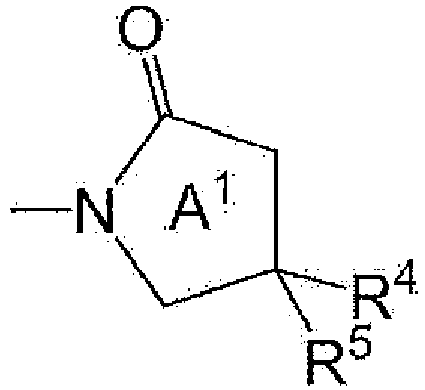
ring A1 is an 2-oxopyrrolidine ring optionally further substituted by 1 to 3 substituents selected from- (1) a cyano group,
- (2) a carbamoyl group,
- (3) a C1-6 alkyl group optionally substituted by 1 to 3 substituents selected from
- (I) a carboxy group,
- (II) a cyano group,
- (III) a halogen atom,
- (IV) a C1-6 alkoxy group,
- (V) a C3-6 cycloalkyl group,
- (VI) an amino group optionally mono- or di-substituted by substituent(s) selected from
- (i) a C1-6 alkyl-carbonyl group, and
- (ii) a C1-6 alkoxy-carbonyl group, and
- (VII) a hydroxy group,
- (4) a C3-6 cycloalkyl group,
- (5) a 3- to 8-membered monocyclic non-aromatic heterocyclic group optionally substituted by 1 to 3 C1-6 alkoxy-carbonyl groups,
- (6) a C1-6 alkoxy-carbonyl group, and
- (7) a 5- or 6-membered monocyclic aromatic heterocyclic group optionally substituted by 1 to 3 C1-6 alkyl groups;
R5 is a hydrogen atom; or - (B) an 2-oxopiperidino group optionally substituted by 1 to 3 C1-6 alkyl groups;
R2 is- (1) a 5- or 6-membered monocyclic aromatic heterocyclic group, a C6-14 aryl group or a 8- to 12-membered fused aromatic heterocyclic group, each of which is optionally substituted by 1 to 3 substituents selected from
- (a) a cyano group,
- (b) a carboxy group,
- (c) a halogen atom,
- (d) a C1-6 alkyl group optionally substituted by 1 to 3 substituents selected from
- (I) a hydroxy group,
- (II) a cyano group,
- (III) a carboxy group,
- (IV) a carbamoyl group optionally mono- or di-substituted by C1-6 alkyl group(s) optionally substituted by 1 to 3 substituents selected from
- (i) a C1-6 alkoxy group,
- (ii) a hydroxy group,
- (iii) a halogen atom, and
- (iv) a C1-6 alkylsulfonyl group,
- (V) an amino group optionally mono- or di-substituted by substituent(s) selected from
- (i) a C1-6 alkyl-carbonyl group optionally substituted by 1 to 3 substituents selected from (A) a C1-6 alkoxy group and (B) a hydroxy group,
- (ii) a C1-6 alkylsulfonyl group,
- (iii) a sulfamoyl group optionally mono- or di-substituted by C1-6 alkyl group (s), and
- (iv) a C1-6 alkyl group,
- (VI) a C1-6 alkoxy-carbonyl group,
- (VII) a C6-14 aryl group optionally substituted by 1 to 3 C1-6 alkoxy groups,
- (VIII) a 3- to 8-membered monocyclic non-aromatic heterocyclic group,
- (IX) a 3- to 8-membered monocyclic non-aromatic heterocyclylcarbonyl group optionally substituted by 1 to 3 substituents selected from
- (i) a hydroxy group,
- (ii) a carbamoyl group, and
- (iii) a C1-6 alkyl group,
- (X) a halogen atom, and
- (XI) a C1-6 alkylsulfonyl group,
- (e) a C1-6 alkyl-carbonyl group,
- (f) a C1-6 alkylsulfonyl group,
- (g) an amino group optionally mono- or di-substituted by substituent(s) selected from
- (I) a C1-6 alkyl group,
- (II) a C1-6 alkyl-carbonyl group optionally substituted by 1 to 3 C1-6 alkoxy groups, and
- (III) a C1-6 alkylsulfonyl group,
- (h) a carbamoyl group optionally mono- or di-substituted by substituent(s) selected from
- (I) a C1-6 alkyl group optionally substituted by 1 to 3 substituents selected from
- (i) a hydroxy group,
- (ii) a 3- to 8-membered monocyclic non-aromatic heterocyclic group optionally substituted by 1 to 3 C1-6 alkyl groups, and
- (iii) a C1-6 alkylsulfonyl group,
- (II) a C3-6 cycloalkyl group optionally substituted by 1 to 3 substituents selected from
- (i) a cyano group, and
- (ii) a hydroxy group, and
- (III) a 3- to 8-membered monocyclic non-aromatic heterocyclic group,
- (I) a C1-6 alkyl group optionally substituted by 1 to 3 substituents selected from
- (i) a sulfamoyl group optionally mono- or di-substituted by C1-6 alkyl group (s),
- (j) a 3- to 8-membered monocyclic non-aromatic heterocyclic group optionally substituted by 1 to 3 substituents selected from
- (I) a C1-6 alkyl group optionally substituted by 1 to 3 hydroxy groups,
- (II) a C1-6 alkyl-carbonyl group optionally substituted by 1 to 3 substituents selected from
- (i) a C1-6 alkoxy group, and
- (ii) a cyano group,
- (III) a C1-6 alkoxy-carbonyl group,
- (IV) an oxo group,
- (V) a C1-6 alkylsulfonyl group,
- (VI) a carbamoyl group optionally mono- or di-substituted by C1-6 alkyl group(s),
- (VII) a cyano group,
- (VIII) a hydroxy group, and
- (IX) a carboxy group,
- (k) a C3-6 cycloalkyl group optionally substituted by 1 to 3 substituents selected from
- (I) a carbamoyl group optionally mono- or di-substituted by C1-6 alkyl group (s),
- (II) a carboxy group, and
- (III) a C1-6 alkyl group optionally substituted by 1 to 3 hydroxy groups,
- (l) a C1-6 alkoxy group optionally substituted by 1 to 3 substituents selected from
- (I) a halogen atom,
- (II) a C1-6 alkoxy group, and
- (III) a C3-6 cycloalkyl group,
- (m) a C1-6 alkoxy-carbonyl group,
- (n) a 3- to 8-membered monocyclic non-aromatic heterocyclylcarbonyl group optionally substituted by 1 to 3 substituents selected from
- (I) a hydroxy group,
- (II) an oxo group,
- (III) a halogen atom,
- (IV) a C1-6 alkoxy group, and
- (V) a C1-6 alkyl group,
- (o) a C1-6 alkylsulfanyl group, and
- (p) a 5- or 6-membered monocyclic aromatic heterocyclic group, or
- (2) a C1-6 alkyl group optionally substituted by 1 to 3 substituents selected from
- (a) a C6-14 aryl group optionally substituted by 1 to 3 substituents selected from
- (I) a cyano group,
- (II) a C1-6 alkyl group optionally substituted by 1 to 3 of 3- to 8-membered monocyclic non-aromatic heterocyclic groups,
- (III) a C1-6 alkoxy group,
- (IV) a halogen atom, and
- (V) a 3- to 8-membered monocyclic non-aromatic heterocyclic group optionally substituted by 1 to 3 C1-6 alkyl groups,
- (b) a 5- or 6-membered monocyclic aromatic heterocyclic group optionally substituted by 1 to 3 substituents selected from
- (I) a cyano group,
- (II) a C1-6 alkyl group optionally substituted by 1 to 3 of 3- to 8-membered monocyclic non-aromatic heterocyclic groups,
- (III) a C1-6 alkoxy group,
- (IV) a halogen atom, and
- (V) a 3- to 8-membered monocyclic non-aromatic heterocyclic group optionally substituted by 1 to 3 C1-6 alkyl groups,
- (c) a 8- to 12-membered fused aromatic heterocyclic group optionally substituted by 1 to 3 substituents selected from
- (I) a cyano group,
- (II) a C1-6 alkyl group optionally substituted by 1 to 3 of 3- to 8-membered monocyclic non-aromatic heterocyclic groups,
- (III) a C1-6 alkoxy group,
- (IV) a halogen atom, and
- (V) a 3- to 8-membered monocyclic non-aromatic heterocyclic group optionally substituted by 1 to 3 C1-6 alkyl groups, and
- (d) a C3-6 cycloalkyl group; and
- (a) a C6-14 aryl group optionally substituted by 1 to 3 substituents selected from
- (1) a 5- or 6-membered monocyclic aromatic heterocyclic group, a C6-14 aryl group or a 8- to 12-membered fused aromatic heterocyclic group, each of which is optionally substituted by 1 to 3 substituents selected from
- (A) a group represented by the following formula:
- [3] The compound or salt of the above-mentioned [1], wherein R1 is
- (A) a group represented by the following formula:

RA1 and RA2 are the same or different and each is- (1) a cyano group,
- (2) a carbamoyl group,
- (3) a C1-6 alkyl group optionally substituted by 1 to 3 substituents selected from
- (I) a carboxy group,
- (II) a cyano group,
- (III) a halogen atom,
- (IV) a C1-6 alkoxy group,
- (V) a C3-6 cycloalkyl group,
- (VI) an amino group optionally mono- or di-substituted by substituent(s) selected from
- (i) a C1-6 alkyl-carbonyl group, and
- (ii) a C1-6 alkoxy-carbonyl group, and
- (VII) a hydroxy group,
- (4) a C3-6 cycloalkyl group,
- (5) a 3- to 8-membered monocyclic non-aromatic heterocyclic group optionally substituted by 1 to 3 C1-6 alkoxy-carbonyl groups, or
- (6) a C1-6 alkoxy-carbonyl group;
RA4 is a hydrogen atom;
R4 is a hydrogen atom or a C1-3 alkyl group; and
R5 is a hydrogen atom; or - (B) an 2-oxopiperidino group optionally substituted by 1 to 3 C1-6 alkyl groups.
- (A) a group represented by the following formula:
- [4] The compound or salt of the above-mentioned [1], wherein R1 is
- (A) a group represented by the following formula:

RA1 and RA2 are the same or different and each is- (1) a cyano group,
- (2) a carbamoyl group,
- (3) a C1-6 alkyl group optionally substituted by 1 to 3 substituents selected from
- (I) a carboxy group,
- (II) a cyano group,
- (III) a halogen atom,
- (IV) a C1-6 alkoxy group,
- (V) a C3-6 cycloalkyl group,
- (VI) an amino group optionally mono- or di-substituted by substituent(s) selected from
- (i) a C1-6 alkyl-carbonyl group, and
- (ii) a C1-6 alkoxy-carbonyl group, and
- (VII) a hydroxy group,
- (4) a C3-6 cycloalkyl group,
- (5) a 3- to 8-membered monocyclic non-aromatic heterocyclic group optionally substituted by 1 to 3 C1-6 alkoxy-carbonyl groups, or
- (6) a C1-6 alkoxy-carbonyl group;
RA4 is a hydrogen atom;
R4 is a hydrogen atom or a C1-3 alkyl group; and
R5 is a hydrogen atom.
- (A) a group represented by the following formula:
- [5] The compound or salt of the above-mentioned [1], wherein R2 is
- (1) a 5- or 6-membered monocyclic aromatic heterocyclic group, a C6-14 aryl group or a 8- to 12-membered fused aromatic heterocyclic group, each of which is optionally substituted by 1 to 3 substituents selected from
- (a) a cyano group,
- (b) a carboxy group,
- (c) a halogen atom,
- (d) a C1-6 alkyl group optionally substituted by 1 to 3 substituents selected from
- (I) a hydroxy group,
- (II) a cyano group,
- (III) a carboxy group,
- (IV) a carbamoyl group optionally mono- or di-substituted by C1-6 alkyl group(s) optionally substituted by 1 to 3 substituents selected from
- (i) a C1-6 alkoxy group,
- (ii) a hydroxy group,
- (iii) a halogen atom, and
- (iv) a C1-6 alkylsulfonyl group,
- (V) an amino group optionally mono- or di-substituted by substituent(s) selected from
- (i) a C1-6 alkyl-carbonyl group optionally substituted by 1 to 3 substituents selected from (A) a C1-6 alkoxy group and (B) a hydroxy group,
- (ii) a C1-6 alkylsulfonyl group,
- (iii) a sulfamoyl group optionally mono- or di-substituted by C1-6 alkyl group (s), and
- (iv) a C1-6 alkyl group,
- (VI) a C1-6 alkoxy-carbonyl group,
- (VII) a C6-14 aryl group optionally substituted by 1 to 3 C1-6 alkoxy groups,
- (VIII) a 3- to 8-membered monocyclic non-aromatic heterocyclic group,
- (IX) a 3- to 8-membered monocyclic non-aromatic heterocyclylcarbonyl group optionally substituted by 1 to 3 substituents selected from
- (i) a hydroxy group,
- (ii) a carbamoyl group, and
- (iii) a C1-6 alkyl group,
- (X) a halogen atom, and
- (XI) a C1-6 alkylsulfonyl group,
- (e) a C1-6 alkyl-carbonyl group,
- (f) a C1-6 alkylsulfonyl group,
- (g) an amino group optionally mono- or di-substituted by substituent(s) selected from
- (I) a C1-6 alkyl group,
- (II) a C1-6 alkyl-carbonyl group optionally substituted by 1 to 3 C1-6 alkoxy groups, and
- (III) a C1-6 alkylsulfonyl group,
- (h) a carbamoyl group optionally mono- or di-substituted by substituent(s) selected from
- (I) a C1-6 alkyl group optionally substituted by 1 to 3 substituents selected from
- (i) a hydroxy group,
- (ii) a 3- to 8-membered monocyclic non-aromatic heterocyclic group optionally substituted by 1 to 3 C1-6 alkyl groups, and
- (iii) a C1-6 alkylsulfonyl group,
- (II) a C3-6 cycloalkyl group optionally substituted by 1 to 3 substituents selected from
- (i) a cyano group, and
- (ii) a hydroxy group, and
- (III) a 3- to 8-membered monocyclic non-aromatic heterocyclic group,
- (I) a C1-6 alkyl group optionally substituted by 1 to 3 substituents selected from
- (i) a sulfamoyl group optionally mono- or di-substituted by C1-6 alkyl group (s),
- (j) a 3- to 8-membered monocyclic non-aromatic heterocyclic group optionally substituted by 1 to 3 substituents selected from
- (I) a C1-6 alkyl group optionally substituted by 1 to 3 hydroxy groups,
- (II) a C1-6 alkyl-carbonyl group optionally substituted by 1 to 3 substituents selected from
- (i) a C1-6 alkoxy group, and
- (ii) a cyano group,
- (III) a C1-6 alkoxy-carbonyl group,
- (IV) an oxo group,
- (V) a C1-6 alkylsulfonyl group,
- (VI) a carbamoyl group optionally mono- or di-substituted by C1-6 alkyl group (s),
- (VII) a cyano group,
- (VIII) a hydroxy group, and
- (IX) a carboxy group,
- (k) a C3-6 cycloalkyl group optionally substituted by 1 to 3 substituents selected from
- (I) a carbamoyl group optionally mono- or di-substituted by C1-6 alkyl group(s),
- (II) a carboxy group, and
- (III) a C1-6 alkyl group optionally substituted by 1 to 3 hydroxy groups,
- (l) a C1-6 alkoxy group optionally substituted by 1 to 3 substituents selected from
- (I) a halogen atom,
- (II) a C1-6 alkoxy group, and
- (III) a C3-6 cycloalkyl group,
- (m) a C1-6 alkoxy-carbonyl group,
- (n) a 3- to 8-membered monocyclic non-aromatic heterocyclylcarbonyl group optionally substituted by 1 to 3 substituents selected from
- (I) a hydroxy group,
- (II) an oxo group,
- (III) a halogen atom,
- (IV) a C1-6 alkoxy group, and
- (V) a C1-6 alkyl group,
- (o) a C1-6 alkylsulfanyl group, and
- (p) a 5- or 6-membered monocyclic aromatic heterocyclic group.
- (1) a 5- or 6-membered monocyclic aromatic heterocyclic group, a C6-14 aryl group or a 8- to 12-membered fused aromatic heterocyclic group, each of which is optionally substituted by 1 to 3 substituents selected from
- [6] (3S)-3-Cyclopropyl-1-(2-((1-(1-hydroxy-2-methylpropan-2-yl)-1H-pyrazol-4-yl)amino)pyrimidin-4-yl)-2-oxopyrrolidine-3-carbonitrile or a salt thereof.
- [7] (3S)-3-Cyclopropyl-1-(2-((1-(1-(hydroxymethyl)cyclopropyl)-1H-pyrazol-4-yl)amino)pyrimidin-4-yl)-2-oxopyrrolidine-3-carbonitrile or a salt thereof.
- [8] (3R)-3-Ethyl-1-(2-((4-(4-(hydroxymethyl)tetrahydro-2H-pyran-4-yl)phenyl)amino)pyrimidin-4-yl)-2-oxopyrrolidine-3-carbonitrile or a salt thereof.
- [9] A medicament comprising the compound or salt of the above-mentioned [l].
- [10] The medicament of the above-mentioned [9], which is a tyrosine kinase 2 inhibitor.
- [11] The medicament of the above-mentioned [9], which is an agent for the prophylaxis or treatment of autoimmune diseases.
- [12] The medicament of the above-mentioned [11], wherein the autoimmune diseases is psoriasis, rheumatoid arthritis, inflammatory bowel disease, Sjogren's syndrome, Behcet's disease, multiple sclerosis or systemic lupus erythematosus.
- [13] The compound or salt of the above-mentioned [1] for use in the prophylaxis or treatment of autoimmune diseases.
- [14] The compound or salt of the above-mentioned [13], wherein the autoimmune diseases is psoriasis, rheumatoid arthritis, inflammatory bowel disease, Sjogren's syndrome, Behcet's disease, multiple sclerosis or systemic lupus erythematosus.
- [15] A method of inhibiting tyrosine kinase 2 in a mammal, which comprises administering an effective amount of the compound or salt of the above-mentioned [1] to the mammal.
- [16] A method for the prophylaxis or treatment of autoimmune diseases, which comprises administering an effective amount of the compound or salt of the above-mentioned [1] to the mammal.
- [17] The method of the above-mentioned [16], wherein the autoimmune diseases is psoriasis, rheumatoid arthritis, inflammatory bowel disease, Sjogren's syndrome, Behcet's disease, multiple sclerosis or systemic lupus erythematosus.
- [18] Use of the compound or salt of the above-mentioned [1] for the production of an agent for the prophylaxis or treatment of autoimmune diseases.
- [19] The use of the above-mentioned [18], wherein the autoimmune diseases is psoriasis, rheumatoid arthritis, inflammatory bowel disease, Sjogren's syndrome, Behcet's disease, multiple sclerosis or systemic lupus erythematosus.
- Compound (I) has a superior Tyk2 inhibitory action, which is useful as an agent for the prophylaxis or treatment of autoimmune diseases (e.g., psoriasis, rheumatoid arthritis, inflammatory bowel disease (e.g., Crohn's disease, ulcerative colitis etc.), Sjogren's syndrome, Behcet's disease, multiple sclerosis, systemic lupus erythematosus etc.) and the like.
- In the present specification, the "halogen atom" means a fluorine atom, a chlorine atom, a bromine atom or iodine atom.
- In the present specification, the "C1-3 alkyl (group)" means methyl, ethyl, propyl or isopropyl.
- In the present specification, the "C1-6 alkyl (group)" means, for example, methyl, ethyl, propyl, isopropyl, butyl, isobutyl, sec-butyl, tert-butyl, pentyl, isopentyl, neo-pentyl, 1-ethylpropyl, hexyl, isohexyl, 1,1-dimethylbutyl, 2,2-dimethylbutyl, 3,3-dimethylbutyl, 2-ethylbutyl or the like.
- In the present specification, the "C1-10 alkyl (group)" means, for example, methyl, ethyl, propyl, isopropyl, butyl, isobutyl, sec-butyl, tert-butyl, pentyl, isopentyl, neo-pentyl, 1-ethylpropyl, hexyl, isohexyl, 1,1-dimethylbutyl, 2,2-dimethylbutyl, 3,3-dimethylbutyl, 2-ethylbutyl, heptyl, octyl, nonyl, decyl or the like. Among them, a C1-6 alkyl group is preferable.
- In the present specification, the "C2-6 alkenyl (group)" means, for example, vinyl, 1-propenyl, 2-propenyl, 2-methyl-1-propenyl, 1-butenyl, 2-butenyl, 3-butenyl, 3-methyl-2-butenyl, 1-pentenyl, 2-pentenyl, 3-pentenyl, 4-pentenyl, 4-methyl-3-pentenyl, 1-hexenyl, 3-hexenyl, 5-hexenyl or the like.
- In the present specification, the "C2-10 alkenyl (group)" means, for example, vinyl, 1-propenyl, 2-propenyl, 2-methyl-1-propenyl, 1-butenyl, 2-butenyl, 3-butenyl, 3-methyl-2-butenyl, 1-pentenyl, 2-pentenyl, 3-pentenyl, 4-pentenyl, 4-methyl-3-pentenyl, 1-hexenyl, 3-hexenyl, 5-hexenyl, 1-heptenyl, 1-octenyl or the like. Among them, a C2-6 alkenyl group is preferable.
- In the present specification, the "C2-6 alkynyl (group)" means, for example, ethynyl, 1-propynyl, 2-propynyl, 1-butynyl, 2-butynyl, 3-butynyl, 1-pentynyl, 2-pentynyl, 3-pentynyl, 4-pentynyl, 1,1-dimethylprop-2-yn-1-yl, 1-hexynyl, 2-hexynyl, 3-hexynyl, 4-hexynyl, 5-hexynyl or the like.
- In the present specification, the "C2-10 alkynyl (group)" means, for example, ethynyl, 1-propynyl, 2-propynyl, 1-butynyl, 2-butynyl, 3-butynyl, 1-pentynyl, 2-pentynyl, 3-pentynyl, 4-pentynyl, 1,1-dimethylprop-2-yn-1-yl, 1-hexynyl, 2-hexynyl, 3-hexynyl, 4-hexynyl, 5-hexynyl, 1-heptynyl, 1-octynyl or the like. Among them, a C2-6 alkynyl group is preferable.
- In the present specification, the "C1-6 alkoxy (group)" means, for example, methoxy, ethoxy, propoxy, isopropoxy, butoxy, isobutoxy, sec-butoxy, tert-butoxy, pentyloxy, isopentyloxy, hexyloxy or the like.
- In the present specification, the "C2-6 alkenyloxy (group)" means, for example, vinyloxy, 1-propenyloxy, 2-propenyloxy, 2-methyl-1-propenyloxy, 1-butenyloxy, 2-butenyloxy, 3-butenyloxy, 3-methyl-2-butenyloxy, 1-pentenyloxy, 2-pentenyloxy, 3-pentenyloxy, 4-pentenyloxy, 4-methyl-3-pentenyloxy, 1-hexenyl, 3-hexenyloxy, 5-hexenyloxy or the like.
- In the present specification, the "C2-6 alkynyloxy (group)" means, for example, ethynyloxy, 1-propynyloxy, 2-propynyloxy, 1-butynyloxy, 2-butynyloxy, 3-butynyloxy, 1-pentynyloxy, 2-pentynyloxy, 3-pentynyloxy, 4-pentynyloxy, 1,1-dimethylprop-2-yn-1-yloxy, 1-hexynyloxy, 2-hexynyloxy, 3-hexynyloxy, 4-hexynyloxy, 5-hexynyloxy or the like.
- In the present specification, the "C1-6 alkylenedioxy (group)" means, for example, methylenedioxy, ethylenedioxy or the like.
- In the present specification, the "C1-6 alkoxy-carbonyl (group)" means, for example, methoxycarbonyl, ethoxycarbonyl, propoxycarbonyl, isopropoxycarbonyl, butoxycarbonyl, isobutoxycarbonyl, tert-butoxycarbonyl or the like.
- In the present specification, the "C1-6 alkyl-carbonyl (group)" means, for example, acetyl, propanoyl, butanoyl, 2-methylpropanoyl or the like.
- In the present specification, the "C3-6 cycloalkyl (group)" means, for example, cyclopropyl, cyclobutyl, cyclopentyl and cyclohexyl or the like.
- In the present specification, the "C3-8 cycloalkyl (group)" means, for example, cyclopropyl, cyclobutyl, cyclopentyl, cyclohexyl, cycloheptyl, cyclooctyl or the like. Among them, a C3-6 cycloalkyl group is preferable.
- In the present specification, the "C3-10 cycloalkyl (group)" means, for example, cyclopropyl, cyclobutyl, cyclopentyl, cyclohexyl, cycloheptyl, cyclooctyl, cyclononyl, cyclodecyl or the like. Among them, a C3-6 cycloalkyl group is preferable.
- In the present specification, the "C3-8 cycloalkenyl (group)" means, for example, cyclopropenyl (e.g., 2-cyclopropen-1-yl), cyclobutenyl (e.g., 2-cyclobuten-1-yl), cyclopentenyl (e.g., 1-cyclopenten-1-yl, 2-cyclopenten-1-yl, 3-cyclopenten-1-yl), cyclohexenyl (e.g., 1-cyclohexen-1-yl, 2-cyclohexen-1-yl, 3-cyclohexen-1-yl) or the like.
- In the present specification, the "C3-10 cycloalkenyl (group)" means, for example, cyclopropenyl (e.g., 2-cyclopropen-1-yl), cyclobutenyl (e.g., 2-cyclobuten-1-yl), cyclopentenyl (e.g., 2-cyclopenten-1-yl, 3-cyclopenten-1-yl), cyclohexenyl (e.g., 1-cyclohexen-1-yl, 2-cyclohexen-1-yl, 3-cyclohexen-1-yl), cycloheptenyl (e.g., 1-cyclopenten-1-yl, 2-cyclohepten-1-yl, 2-cyclohepten-1-yl), cyclooctenyl (e.g., 1-cyclohepten-1-yl, 2-cyclohepten-1-yl, 3-cyclohepten-1-yl), cyclononenyl (e.g., 1-cyclononen-1-yl, 2-cyclononen-1-yl, 3-cyclononen-1-yl) or the like. Among them, a C3-8 cycloalkenyl group is preferable.
- In the present specification, the "C4-6 cycloalkadienyl (group)" means, for example, 1,3-cyclobutadien-1-yl, 1,3-cyclopentadien-1-yl, 1,4-cyclopentadien-1-yl, 2,4-cyclopentadien-1-yl, 1,3-cyclohexadien-1-yl, 1,4-cyclohexadien-1-ol, 1,5-cyclohexadien-1-yl, 2,4-cyclohexadien-1-yl, 2,5-cyclohexadien-1-yl or the like.
- In the present specification, the "C4-10 cycloalkadienyl (group)" means, for example, 1,3-cyclobutadien-1-yl, 1,3-cyclopentadien-1-yl, 1,4-cyclopentadien-1-yl, 2,4-cyclopentadien-1-yl, 1,3-cyclohexadien-1-yl, 1,4-cyclohexadien-1-yl, 1,5-cyclohexadien-1-yl, 2,4-cyclohexadien-1-yl, 2,5-cyclohexadien-1-yl, 1,3-cyclooctadien-1-yl, 1,4-cyclooctadien-1-yl, 1,5-cyclooctadien-1-yl, 1,6-cyclooctadien-1-yl, 1,7-cyclooctadien-1-yl, 2,4-cyclooctadien-1-yl, 2,5-cyclooctadien-1-yl, 2,6-cyclooctadien-1-yl, 2,7-cyclooctadien-1-yl, 3,5-cyclooctadien-1-yl, 3,6-cyclooctadien-1-yl or the like. Among them, a C4-6 cycloalkadienyl group is preferable.
- The above-mentioned C3-10 cycloalkyl group, C3-10 cycloalkenyl group and C4-10 cycloalkadienyl group are each optionally fused with a benzene ring to form a fused ring group, and examples of the fused ring group include indanyl, dihydronaphthyl, tetrahydronaphthyl, fluorenyl and the like.
- The above-mentioned C3-10 cycloalkyl group, C3-10 cycloalkenyl group and C4-10 cycloalkadienyl group may be a C7-10 bridged hydrocarbon group. Examples of the C7-10 bridged hydrocarbon group include bicyclo[2.2.1]heptyl (norbornyl), bicyclo[2.2.2]octyl, bicyclo[3.2.1]octyl, bicyclo[3.2.2]nonyl, bicyclo[3.3.1]nonyl, bicyclo[4.2.1]nonyl, bicyclo[4.3.1]decyl, adamantyl and the like.
- In addition, the above-mentioned C3-10 cycloalkyl group, C3-10 cycloalkenyl group and C4-10 cycloalkadienyl group may each form a spiro ring group with a C3-10 cycloalkane, a C3-10 cycloalkene, a C4-10 cycloalkadiene or a non-aromatic heterocycle. Examples of the C3-10 cycloalkane, C3-10 cycloalkene and C4-10 cycloalkadiene include rings corresponding to the above-mentioned C3-10 cycloalkyl group, C3-10 cycloalkenyl group and C4-10 cycloalkadienyl group. Examples of the non-aromatic heterocycle include a ring corresponding to the following non-aromatic heterocyclic group. Examples of the spiro ring group include spiro[4.5]decanyl (e.g., spiro[4.5]decan-8-yl) and the like.
- In the present specification, the "C3-6 cycloalkyloxy (group)" means, for example, cyclopropyloxy, cyclobutyloxy, cyclopentyloxy, cyclohexyloxy or the like.
- In the present specification, the "C3-8 cycloalkyloxy (group)" means, for example, cyclopropyloxy, cyclobutyloxy, cyclopentyloxy, cyclohexyloxy, cycloheptyloxy, cyclooctyloxy or the like. Among them, a C3-6 cycloalkyloxy group is preferable.
- In the present specification, the "C3-8 cycloalkenyloxy (group)" means, for example, cyclopropenyloxy (e.g., 2-cyclopropen-1-yloxy), cyclobutenyloxy (e.g., 2-cyclobuten-1-yloxy), cyclopentenyloxy (e.g., 2-cyclopenten-1-yloxy, 3-cyclopenten-1-yloxy), cyclohexenyloxy (e.g., 2-cyclohexen-1-yloxy, 3-cyclohexen-1-yloxy) or the like.
- In the present specification, the "C6-14 aryl (group)" means, for example, phenyl, 1-naphthyl, 2-naphthyl or the like.
- In the present specification, the "C6-14 aryloxy (group)" means, for example, phenoxy, 1-naphthyloxy, 2-naphthyloxy or the like.
- In the present specification, the "C7-14 aralkyl (group)" means, for example, benzyl, phenethyl or the like.
- In the present specification, the "C7-14 aralkyloxy (group)" means, for example, benzyloxy, phenethyloxy or the like.
- In the present specification, the "C8-13 arylalkenyl (group)" means, for example, styryl or the like.
- In the present specification, the "heterocyclic group" means an aromatic heterocyclic group or a non-aromatic heterocyclic group.
- In the present specification, the "aromatic heterocyclic group" means a monocyclic aromatic heterocyclic group or a fused aromatic heterocyclic group.
- In the present specification, examples of the "monocyclic aromatic heterocyclic group" include a 5- to 7-membered (preferably 5- or 6-membered) monocyclic aromatic heterocyclic group containing, as a ring-constituting atom besides carbon atoms, 1 to 4 hetero atoms selected from an oxygen atom, a sulfur atom (optionally oxidized) and a nitrogen atom (optionally oxidized), for example, furyl (e.g., 2-furyl, 3-furyl), thienyl (e.g., 2-thienyl, 3-thienyl), pyridyl (e.g., 2-pyridyl, 3-pyridyl, 4-pyridyl), pyrimidinyl (e.g., 2-pyrimidinyl, 4-pyrimidinyl, 5-pyrimidinyl), pyridazinyl (e.g., 3-pyridazinyl, 4-pyridazinyl), pyrazinyl (e.g., 2-pyrazinyl), pyrrolyl (e.g., 1-pyrrolyl, 2-pyrrolyl, 3-pyrrolyl), imidazolyl (e.g., 1-imidazolyl, 2-imidazolyl, 4-imidazolyl, 5-imidazolyl), pyrazolyl (e.g., 1-pyrazolyl, 3-pyrazolyl, 4-pyrazolyl), thiazolyl (e.g., 2-thiazolyl, 4-thiazolyl, 5-thiazolyl), isothiazolyl (e.g., 3-isothiazolyl, 4-isothiazolyl, 5-isothiazolyl), oxazolyl (e.g., 2-oxazolyl, 4-oxazolyl, 5-oxazolyl), isoxazolyl (e.g., 3-isoxazolyl, 4-isoxazolyl, 5-isoxazolyl), oxadiazolyl (e.g., 1,2,4-oxadiazol-5-yl, 1,3,4-oxadiazol-2-yl), thiadiazolyl (e.g., 1,3,4-thiadiazol-2-yl), triazolyl (e.g., 1,2,4-triazol-1-yl, 1,2,4-triazol-3-yl, 1,2,3-triazol-1-yl, 1,2,3-triazol-2-yl, 1,2,3-triazol-4-yl), tetrazolyl (e.g., 1H-tetrazol-1-yl, 1H-tetrazol-5-yl), triazinyl (e.g., 1,2,4-triazin-1-yl, 1,2,4-triazin-3-yl) and the like.
- In the present specification, examples of the "fused aromatic heterocyclic group" include an 8- to 12-membered fused aromatic heterocyclic group, specifically, a group derived from a fused ring wherein a ring corresponding to the above-mentioned 5- to 7-membered monocyclic aromatic heterocyclic group is fused with a C6-14 aromatic hydrocarbon; and a group derived from a fused ring wherein rings corresponding to the above-mentioned 5- to 7-membered monocyclic aromatic heterocyclic groups are fused, for example, quinolyl (e.g., 2-quinolyl, 3-quinolyl, 4-quinolyl, 6-quinolyl), isoquinolyl (e.g., 3-isoquinolyl), quinazolyl (e.g., 2-quinazolyl, 4-quinazolyl), quinoxalyl (e.g., 2-quinoxalyl, 6-quinoxalyl), benzofuranyl (e.g., 2-benzofuranyl, 3-benzofuranyl), benzothienyl (e.g., 2-benzothienyl, 3-benzothienyl), benzoxazolyl (e.g., 2-benzoxazolyl), benzisoxazolyl (e.g., 7-benzisoxazolyl), benzothiazolyl (e.g., 2-benzothiazolyl, 6-benzothiazolyl), benzimidazolyl (e.g., benzimidazol-1-yl, benzimidazol-2-yl, benzimidazol-5-yl), benzotriazolyl (e.g., 1H-1,2,3-benzotriazol-5-yl), indolyl (e.g., indol-1-yl, indol-2-yl, indol-3-yl, indol-5-yl), indazolyl (e.g., 1H-indazol-3-yl, 1H-indazol-5-yl), pyrrolopyrazinyl (e.g., 1H-pyrrolo[2,3-b]pyrazin-2-yl, 1H-pyrrolo[2,3-b]pyrazin-6-yl), imidazopyridyl (e.g., 1H-imidazo[4,5-b]pyridin-2-yl, 1H-imidazo[4,5-c]pyridin-2-yl, 2H-imidazo[1,2-a]pyridin-3-yl), thienopyridyl (e.g., thieno[2,3-b]pyridin-3-yl), imidazopyrazinyl (e.g., 1H-imidazo[4,5-b]pyrazin-2-yl), pyrazolopyridyl (e.g., 1H-pyrazolo[4,3-c]pyridin-3-yl), pyrazolothienyl (e.g., 2H-pyrazolo[3,4-b]thiophen-2-yl), pyrazolotriazinyl (e.g., pyrazolo[5,1-c][1,2,4]triazin-3-yl) and the like.
- In the present specification, the "non-aromatic heterocyclic group" means a monocyclic non-aromatic heterocyclic group or a fused non-aromatic heterocyclic group.
- In the present specification, examples of the "monocyclic non-aromatic heterocyclic group" include a 3- to 8-membered (preferably 5- or 6-membered) monocyclic non-aromatic heterocyclic group containing, as a ring-constituting atom besides carbon atoms, 1 to 4 hetero atoms selected from an oxygen atom, a sulfur atom (optionally oxidized) and a nitrogen atom (optionally oxidized), for example, azetidinyl (e.g., 1-azetidinyl, 2-azetidinyl), pyrrolidinyl (e.g., 1-pyrrolidinyl, 2-pyrrolidinyl), piperidyl (e.g., piperidino, 2-piperidyl, 3-piperidyl, 4-piperidyl), morpholinyl (e.g., morpholino), thiomorpholinyl (e.g., thiomorpholino), piperazinyl (e.g., 1-piperazinyl, 2-piperazinyl, 3-piperazinyl), oxazolidinyl (e.g., oxazolidin-2-yl), thiazolidinyl (e.g., thiazolidin-2-yl), dihydrothiopyranyl (e.g., dihydrothiopyran-3-yl, dihydrothiopyran-4-yl), imidazolidinyl (e.g., imidazolidin-2-yl, imidazolidin-3-yl), oxazolinyl (e.g., oxazolin-2-yl), thiazolinyl (e.g., thiazolin-2-yl), imidazolinyl (e.g., imidazolin-2-yl, imidazolin-3-yl), dioxolyl (e.g., 1,3-dioxol-4-yl), dioxolanyl (e.g., 1,3-dioxolan-4-yl), dihydrooxadiazolyl (e.g., 4,5-dihydro-1,2,4-oxadiazol-3-yl), pyranyl (e.g., 2-pyranyl, 4-pyranyl), tetrahydropyranyl (e.g., 2-tetrahydropyranyl, 3-tetrahydropyranyl, 4-tetrahydropyranyl), thiopyranyl (e.g., 4-thiopyranyl), tetrahydrothiopyranyl (e.g., 2-tetrahydrothiopyranyl, 3-tetrahydrothiopyranyl, 4-tetrahydrothiopyranyl), 1-oxidetetrahydrothiopyranyl (e.g., 1-oxidetetrahydrothiopyran-4-yl), 1,1-dioxidotetrahydrothiopyranyl (e.g., 1,1-dioxidotetrahydrothiopyran-4-yl), tetrahydrofuryl (e.g., tetrahydrofuran-3-yl, tetrahydrofuran-2-yl), oxetanyl (e.g., oxetan-2-yl, oxetan-3-yl), pyrazolidinyl (e.g., pyrazolidin-1-yl, pyrazolidin-3-yl), pyrazolinyl (e.g., pyrazolin-1-yl), tetrahydropyrimidinyl (e.g., tetrahydropyrimidin-1-yl), dihydrotriazolyl (e.g., 2,3-dihydro-1H-1,2,3-triazol-1-yl), tetrahydrotriazolyl (e.g., 2,3,4,5-tetrahydro-1H-1,2,3-triazol-1-yl), azepanyl (e.g., 1-azepanyl, 2-azepanyl, 3-azepanyl, 4-azepanyl), dihydropyridyl (e.g., dihydropyridin-1-yl, dihydropyridin-2-yl, dihydropyridin-3-yl, dihydropyridin-4-yl), tetrahydropyridyl (e.g., 1,2,3,4-tetrahydropyridin-1-yl, 1,2,3,4-tetrahydropyridin-2-yl, 1,2,3,4-tetrahydropyridin-3-yl, 1,2,3,4-tetrahydropyridin-4-yl), 1,1-dioxidothiomorpholinyl (e.g., 1,1-dioxidothiomorpholino) and the like.
- In the present specification, examples of the "fused non-aromatic heterocyclic group" include an 8- to 12-membered fused non-aromatic heterocyclic group, specifically, a group derived from a fused ring wherein a ring corresponding to the above-mentioned 3- to 8-membered monocyclic non-aromatic heterocyclic group is fused with a C6-14 aromatic hydrocarbon; a group derived from a fused ring wherein rings corresponding to the above-mentioned 3- to 8-membered monocyclic non-aromatic heterocyclic groups are fused; a group derived from a fused ring wherein a ring corresponding to the above-mentioned 3- to 8-membered monocyclic non-aromatic heterocyclic group is fused with a ring corresponding to the above-mentioned 5- to 7-membered monocyclic aromatic heterocyclic group; and a group wherein the above-mentioned group is partially saturated, for example, dihydroindolyl (e.g., 2,3-dihydro-1H-indol-1-yl), dihydroisoindolyl (e.g., 1,3-dihydro-2H-isoindol-2-yl), dihydrobenzofuranyl (e.g., 2,3-dihydro-1-benzofuran-5-yl), tetrahydrobenzofuranyl (e.g., 4,5,6,7-tetrahydro-1-benzofuran-3-yl), dihydrobenzodioxinyl (e.g., 2,3-dihydro-1,4-benzodidioxin-2-yl), dihydrobenzodioxepinyl (e.g., 3,4-dihydro-2H-1,5-benzodioxepin-2-yl), chromenyl (e.g., 4H-chromen-2-yl, 2H-chromen-3-yl), dihydrochromenyl (e.g., 3,4-dihydro-2H-chromen-2-yl), dihydroquinolyl (e.g., 1,2-dihydroquinolin-4-yl), tetrahydroquinolyl (e.g., 1,2,3,4-tetrahydroquinolin-4-yl), dihydroisoquinolyl (e.g., 1,2-dihydroisoquinolin-4-yl), tetrahydroisoquinolyl (e.g., 1,2,3,4-tetrahydroisoquinolin-4-yl), dihydrophthalazinyl (e.g., 1,4-dihydrophthalazin-4-yl) and the like.
- In addition, the above-mentioned non-aromatic heterocyclic group may each form a spiro ring group with a C3-10 cycloalkane, a C3-10 cycloalkene, a C4-10 cycloalkadiene or a non-aromatic heterocycle. Examples of the C3-10 cycloalkane, C3-10 cycloalkene, C4-10 cycloalkadiene and non-aromatic heterocycle include rings corresponding to the above-mentioned C3-10 cycloalkyl group, C3-10 cycloalkenyl group, C4-10 cycloalkadienyl group and non-aromatic heterocyclic group. Examples of the spiro ring group include 2-oxa-6-azaspiro[3.3]heptyl (e.g., 2-oxa-6-azaspiro[3.3]heptan-6-yl) and the like.
- In the present specification, the "aromatic ring group" means a C6-14 aryl group (preferably phenyl) or an aromatic heterocyclic group.
- In the present specification, examples of the "C6-14 aromatic hydrocarbon" include benzene and naphthalene.
- Each symbol of the formula (I) is explained below.
- In the formula (I), R1 is a group represented by the following formula:

an optionally substituted 2-oxopiperidino group. - Ring A1 is an optionally further substituted 2-oxopyrrolidine ring.
- R4 is a hydrogen atom, a halogen atom, a cyano group, an acyl group, an optionally substituted C1-6 alkyl group, an optionally substituted hydroxy group, an optionally substituted amino group, an optionally substituted C3-6 cycloalkyl group, or an optionally substituted heterocyclic group.
- R5 is a hydrogen atom, a halogen atom, a cyano group, an acyl group, an optionally substituted C1-6 alkyl group, an optionally substituted hydroxy group, an optionally substituted amino group, an optionally substituted C3-6 cycloalkyl group, or an optionally substituted heterocyclic group.
- The "C1-6 alkyl group" of the "optionally substituted C1-6 alkyl group" for R4 or R5 optionally has 1 to 5 (preferably 1 to 3) substituents at substitutable position(s). Examples of the substituent include substituents selected from the following Substituent Group A. When the number of the substituents is plural, the respective substituents may be the same or different.
-
- (1) a halogen atom;
- (2) a cyano group;
- (3) a nitro group;
- (4) a hydroxy group;
- (5) a C3-8 cycloalkyl group optionally substituted by 1 to 3 substituents selected from
- (a) a halogen atom,
- (b) a cyano group,
- (c) a C1-6 alkyl group optionally substituted by 1 to 3 substituents selected from
- (i) a halogen atom, and
- (ii) a hydroxy group,
- (d) a C1-6 alkoxy group optionally substituted by 1 to 3 halogen atoms,
- (e) a carbamoyl group optionally mono- or di-substituted by C1-6 alkyl group (s), and
- (f) a carboxy group;
- (6) a C6-14 aryl group optionally substituted by 1 to 3 substituents selected from
- (a) a halogen atom,
- (b) a cyano group,
- (c) a C1-6 alkyl group optionally substituted by 1 to 3 halogen atoms or 3- to 8-membered monocyclic non-aromatic heterocyclic groups,
- (d) a C1-6 alkoxy group optionally substituted by 1 to 3 halogen atoms, and
- (e) a 3- to 8-membered monocyclic non-aromatic heterocyclic group optionally substituted by 1 to 3 C1-6 alkyl groups;
- (7) a C1-6 alkoxy group optionally substituted by 1 to 3 substituents selected from
- (a) a halogen atom,
- (b) a cyano group,
- (c) a C3-8 cycloalkyl group optionally having 1 to 3 halogen atoms,
- (d) a C3-8 cycloalkenyl group optionally having 1 to 3 halogen atoms,
- (e) a C6-14 aryl group optionally having 1 to 3 halogen atoms,
- (f) a 5- or 6-membered monocyclic aromatic heterocyclic group, and
- (g) a C1-6 alkoxy group;
- (8) a C2-6 alkenyloxy group (e.g., vinyloxy, propenyloxy, butenyloxy, pentenyloxy, hexenyloxy) optionally having 1 to 3 halogen atoms;
- (9) a C2-6 alkynyloxy group (e.g., ethynyloxy, propynyloxy, butynyloxy, pentynyloxy, hexynyloxy) optionally having 1 to 3 halogen atoms;
- (10) a C3-8 cycloalkyloxy group (e.g., cyclopropyloxy, cyclobutyloxy, cyclopentyloxy, cyclohexyloxy) optionally having 1 to 3 halogen atoms;
- (11) a C3-8 cycloalkenyloxy group (e.g., cyclopropenyloxy, cyclobutenyloxy, cyclopentenyloxy, cyclohexenyloxy) optionally having 1 to 3 halogen atoms;
- (12) a C6-14 aryloxy group optionally having 1 to 3 halogen atoms;
- (13) a C7-14 aralkyloxy group optionally having 1 to 3 halogen atoms;
- (14) a carbamoyl group optionally mono- or di-substituted by substituent(s) selected from
- (a) a C1-6 alkyl group optionally substituted by 1 to 3 substituents selected from
- (i) a hydroxy group,
- (ii) a 3- to 8-membered monocyclic non-aromatic heterocyclic group optionally substituted by 1 to 3 C1-6 alkyl groups, and
- (iii) a C1-6 alkylsulfonyl group,
- (b) a C3-8 cycloalkyl group optionally substituted by 1 to 3 substituents selected from
- (i) a cyano group, and
- (ii) a hydroxy group,
- (c) a C6-14 aryl group,
- (d) a C1-6 alkoxy group,
- (e) a 5- or 6-membered monocyclic aromatic heterocyclic group,
- (f) a 8- to 12-membered fused aromatic heterocyclic group,
- (g) a 3- to 8-membered monocyclic non-aromatic heterocyclic group, and
- (h) a 8- to 12-membered fused non-aromatic heterocyclic group;
- (a) a C1-6 alkyl group optionally substituted by 1 to 3 substituents selected from
- (15) a sulfamoyl group optionally mono- or di-substituted by substituent(s) selected from
- (a) a C1-6 alkyl group,
- (b) a C3-6 cycloalkyl group,
- (c) a C6-14 aryl group,
- (d) a C1-6 alkoxy group,
- (e) a 5- or 6-membered monocyclic aromatic heterocyclic group,
- (f) a 8- to 12-membered fused aromatic heterocyclic group,
- (g) a 3- to 8-membered monocyclic non-aromatic heterocyclic group, and
- (h) a 8- to 12-membered fused non-aromatic heterocyclic group;
- (16) formyl;
- (17) a C1-6 alkyl-carbonyl group;
- (18) a C2-6 alkenyl-carbonyl group (e.g., acryloyl, butenoyl, pentenoyl, hexenoyl, heptenoyl);
- (19) a C2-6 alkynyl-carbonyl group (e.g., propioloyl, propynylcarbonyl, butynylcarbonyl, pentynylcarbonyl, hexynylcarbonyl);
- (20) a C3-8 cycloalkyl-carbonyl group (e.g., cyclopropylcarbonyl, cyclobutylcarbonyl, cyclopentylcarbonyl, cyclohexylcarbonyl);
- (21) a C3-8 cycloalkenyl-carbonyl group (e.g., cyclopropenylcarbonyl, cyclobutenylcarbonyl, cyclopentenylcarbonyl, cyclohexenylcarbonyl);
- (22) a C6-14 aryl-carbonyl group (e.g., benzoyl, 1-naphthylcarbonyl, 2-naphthylcarbonyl);
- (23) a C3-8 cycloalkyl-C1-6 alkyl-carbonyl group (e.g., cyclopropylacetyl, 3-cyclopropylpropionyl, cyclobutylacetyl, cyclopentylacetyl, cyclohexylacetyl, cyclohexylpropionyl);
- (24) a C3-8 cycloalkenyl-C1-6 alkyl-carbonyl group (e.g., cyclopentenylacetyl, cyclohexenylacetyl, 3-cyclohexenylpropionyl, 3-cyclohexenylpropionyl);
- (25) a C7-14 aralkyl-carbonyl group (e.g., phenylacetyl, 3-phenylpropionyl);
- (26) a 5- or 6-membered monocyclic aromatic heterocyclylcarbonyl group (e.g., furylcarbonyl, thienylcarbonyl, pyrrolylcarbonyl, oxazolylcarbonyl, isoxazolylcarbonyl, thiazolylcarbonyl, isothiazolylcarbonyl, imidazolylcarbonyl, pyridylcarbonyl, pyrazolylcarbonyl);
- (27) a 8- to 12-membered fused aromatic heterocyclylcarbonyl group (e.g., benzofuranylcarbonyl, isobenzofuranylcarbonyl, benzothienylcarbonyl, isobenzothienylcarbonyl, indolylcarbonyl, isoindolylcarbonyl, indazolylcarbonyl, benzimidazolylcarbonyl, benzoxazolylcarbonyl);
- (28) a 3- to 8-membered monocyclic non-aromatic heterocyclylcarbonyl group (e.g., oxiranylcarbonyl, azetidinylcarbonyl, oxetanylcarbonyl, thietanylcarbonyl, pyrrolidinylcarbonyl, tetrahydrofurylcarbonyl, thiolanylcarbonyl, piperidylcarbonyl, morpholinylcarbonyl, 2-oxa-6-azaspiro[3.3]heptylcarbonyl, 1,1-dioxidothiomorpholinylcarbonyl) optionally substituted by 1 to 3 substituents selected from
- (a) a hydroxy group,
- (b) an oxo group,
- (c) a halogen atom,
- (d) a C1-6 alkoxy group, and
- (e) a C1-6 alkyl group;
- (29) a 8- to 12-membered fused non-aromatic heterocyclylcarbonyl group (e.g., dihydrobenzofuranyl);
- (30) an amino group optionally mono- or di-substituted by substituent(s) selected from
- (a) a C1-6 alkyl group optionally substituted by 1 to 3 substituents selected from
- (i) a halogen atom, and
- (ii) a C1-6 alkoxy group,
- (b) a C1-6 alkyl-carbonyl group optionally having 1 to 3 halogen atoms,
- (c) a C3-8 cycloalkyl-carbonyl group,
- (d) a C6-14 aryl-carbonyl group optionally having 1 to 3 halogen atoms,
- (e) a 5- or 6-membered monocyclic aromatic heterocyclylcarbonyl group,
- (f) a 8- to 12-membered fused aromatic heterocyclylcarbonyl group,
- (g) a 3- to 8-membered monocyclic non-aromatic heterocyclylcarbonyl group,
- (h) a 8- to 12-membered fused non-aromatic heterocyclylcarbonyl group, and
- (i) a C1-6 alkylsulfonyl group;
- (a) a C1-6 alkyl group optionally substituted by 1 to 3 substituents selected from
- (31) a sulfanyl group;
- (32) a C1-6 alkylsulfanyl group (e.g., methylsulfanyl, ethylsulfanyl);
- (33) a C2-6 alkenylsulfanyl group (e.g., vinylsulfanyl, propenylsulfanyl);
- (34) a C2-6 alkynylsulfanyl group (e.g., ethynylsulfanyl, propynylsulfanyl);
- (35) a C3-8 cycloalkylsulfanyl group (e.g., cyclopropylsulfanyl, cyclobutylsulfanyl);
- (36) a C3-8 cycloalkenylsulfanyl group (e.g., cyclopropenylsulfanyl, cyclobutenylsulfanyl);
- (37) a C6-14 arylsulfanyl group (e.g., phenylsulfanyl);
- (38) a C3-8 cycloalkyl-C1-6 alkylsulfanyl group (e.g., cyclopropylmethylsulfanyl);
- (39) a C3-8 cycloalkenyl-C1-6 alkylsulfanyl group (e.g., cyclopentenylmethylsulfanyl);
- (40) a C1-6 alkylsulfinyl group (e.g., methylsulfinyl, ethylsulfinyl);
- (41) a C2-6 alkenylsulfinyl group (e.g., vinylsulfinyl, propenylsulfinyl);
- (42) a C2-6 alkynylsulfinyl group (e.g., ethynylsulfinyl, propynylsulfinyl);
- (43) a C3-8 cycloalkylsulfinyl group (e.g., cyclopropylsulfinyl, cyclobutylsulfinyl);
- (44) a C3-8 cycloalkenylsulfinyl group (e.g., cyclopropenylsulfinyl, cyclobutenylsulfinyl);
- (45) a C6-14 arylsulfinyl group (e.g., phenylsulfinyl);
- (46) a C3-8 cycloalkyl-C1-6 alkylsulfinyl group (e.g., cyclopropylmethylsulfinyl);
- (47) a C3-8 cycloalkenyl-C1-6 alkylsulfinyl group (e.g., cyclopentenylmethylsulfinyl);
- (48) a C1-6 alkylsulfonyl group (e.g., methylsulfonyl, ethylsulfonyl);
- (49) a C2-6 alkenylsulfonyl group (e.g., vinylsulfonyl, propenylsulfonyl);
- (50) a C2-6 alkynylsulfonyl group (e.g., ethynylsulfonyl, propynylsulfonyl);
- (51) a C3-8 cycloalkylsulfonyl group (e.g., cyclopropylsulfonyl, cyclobutylsulfonyl);
- (52) a C3-8 cycloalkenylsulfonyl group (e.g., cyclopropenylsulfonyl, cyclobutenylsulfonyl);
- (53) a C6-14 arylsulfonyl group (e.g., phenylsulfonyl);
- (54) a C3-8 cycloalkyl-C1-6 alkylsulfonyl group (e.g., cyclopropylmethylsulfonyl);
- (55) a C3-8 cycloalkenyl-C1-6 alkylsulfonyl group (e.g., cyclopentenylmethylsulfonyl);
- (56) a C6-14 aryl-C1-6 alkylsulfonyl group (e.g., benzylsulfonyl);
- (57) a 5- or 6-membered monocyclic aromatic heterocyclylsulfonyl group (e.g., furylsulfonyl, thienylsulfonyl, pyridylsulfonyl);
- (58) a 8- to 12-membered fused aromatic heterocyclylsulfonyl group (e.g., benzofuranylsulfonyl, isobenzofuranylsulfonyl);
- (59) a 3- to 8-membered monocyclic non-aromatic heterocyclylsulfonyl group (e.g., oxiranylsulfonyl, azetidinylsulfonyl);
- (60) a 8- to 12-membered fused non-aromatic heterocyclylsulfonyl group (e.g., dihydrobenzofuranylsulfonyl);
- (61) a 5- or 6-membered monocyclic aromatic heterocyclic group (e.g., furyl, thienyl, pyrrolyl, oxazolyl, isoxazolyl, thiazolyl, isothiazolyl, imidazolyl, pyridyl, pyrazolyl) optionally substituted by 1 to 3 substituents selected from
- (a) a halogen atom,
- (b) a C1-6 alkyl group optionally substituted by 1 to 3 halogen atoms, and
- (c) a C1-6 alkoxy group optionally substituted by 1 to 3 halogen atoms;
- (62) a 8- to 12-membered fused aromatic heterocyclic group (e.g., benzofuranyl, isobenzofuranyl, benzothienyl, isobenzothienyl, indolyl, isoindolyl, indazolyl, benzimidazolyl, benzoxazolyl) optionally substituted by 1 to 3 substituents selected from
- (a) a halogen atom,
- (b) a C1-6 alkyl group optionally substituted by 1 to 3 halogen atoms, and
- (c) a C1-6 alkoxy group optionally substituted by 1 to 3 halogen atoms;
- (63) a 3- to 8-membered monocyclic non-aromatic heterocyclic group (e.g., oxiranyl, azetidinyl, oxetanyl, thietanyl, pyrrolidinyl, tetrahydrofuryl, thiolanyl, piperidyl, piperazinyl, dihydrooxadiazolyl, thiazolinyl, morpholinyl, tetrahydropyranyl, 1,1-dioxidothiomorpholinyl, imidazolidinyl, 1,1-dioxidetetrahydrothiopyranyl) optionally substituted by 1 to 3 substituents selected from
- (a) a halogen atom,
- (b) a C1-6 alkyl group optionally substituted by 1 to 3 substituents selected from
- (i) a halogen atom, and
- (ii) a hydroxy group,
- (c) a C1-6 alkoxy group optionally substituted by 1 to 3 halogen atoms,
- (d) a C1-6 alkyl-carbonyl group optionally substituted by 1 to 3 substituents selected from
- (i) a C1-6 alkoxy group, and
- (ii) a cyano group,
- (e) an oxo group,
- (f) a C1-6 alkoxy-carbonyl group,
- (g) a C1-6 alkylsulfonyl group,
- (h) a carbamoyl group optionally mono- or di-substituted by C1-6 alkyl group (s),
- (i) a cyano group,
- (j) a hydroxy group, and
- (k) a carboxy group;
- (64) a 8- to 12-membered fused non-aromatic heterocyclic group (e.g., dihydrobenzofuranyl) optionally substituted by 1 to 3 substituents selected from
- (a) a halogen atom,
- (b) a C1-6 alkyl group optionally substituted by 1 to 3 halogen atoms,
- (c) a C1-6 alkoxy group optionally substituted by 1 to 3 halogen atoms, and
- (d) an oxo group;
- (65) a 5- or 6-membered monocyclic aromatic heterocyclyloxy group (e.g., furyloxy, thienyloxy, pyrrolyloxy, oxazolyloxy, isoxazolyloxy, thiazolyloxy, isothiazolyloxy, imidazolyloxy, pyridyloxy, pyrazolyloxy);
- (66) a 8- to 12-membered fused aromatic heterocyclyloxy group (e.g., benzofuranyloxy, isobenzofuranyloxy, benzothienyloxy, isobenzothienyloxy, indolyloxy, isoindolyloxy, indazolyloxy, benzimidazolyloxy, benzoxazolyloxy);
- (67) a 3- to 8-membered monocyclic non-aromatic heterocyclyloxy group (e.g., oxiranyloxy, azetidinyloxy, oxetanyloxy, thietanyloxy, pyrrolidinyloxy, tetrahydrofuryloxy, thiolanyloxy, piperidyloxy);
- (68) a 8- to 12-membered fused non-aromatic heterocyclyloxy group (e.g., dihydrobenzofuranyloxy);
- (69) a carboxy group;
- (70) a C1-6 alkoxy-carbonyl group;
- (71) a C2-6 alkenyloxy-carbonyl group (e.g., vinyloxycarbonyl, propenyloxycarbonyl, butenyloxycarbonyl, pentenyloxycarbonyl, hexenyloxycarbonyl);
- (72) a C2-6 alkynyloxy-carbonyl group (e.g., ethynyloxycarbonyl, propynyloxycarbonyl, butynyloxycarbonyl, pentynyloxycarbonyl, hexynyloxycarbonyl);
- (73) a C3-8 cycloalkyloxy-carbonyl group (e.g., cyclopropyloxycarbonyl, cyclobutyloxycarbonyl, cyclopentyloxycarbonyl, cyclohexyloxycarbonyl);
- (74) a C3-8 cycloalkenyloxy-carbonyl group (e.g., cyclopropenyloxycarbonyl, cyclobutenyloxycarbonyl, cyclopentenyloxycarbonyl, cyclohexenyloxycarbonyl);
- (75) a C6-14 aryloxy-carbonyl group (e.g., phenoxycarbonyl, 1-naphthyloxycarbonyl, 2-naphthyloxycarbonyl);
- (76) a C3-8 cycloalkyl-C1-6 alkoxy-carbonyl group (e.g., cyclopropylmethyloxycarbonyl, cyclopropylethyloxycarbonyl, cyclobutylmethyloxycarbonyl, cyclopentylmethyloxycarbonyl, cyclohexylmethyloxycarbonyl, cyclohexylethyloxycarbonyl);
- (77) a C3-8 cycloalkenyl-C1-6 alkoxy-carbonyl group (e.g., cyclopentenylmethyloxycarbonyl, cyclohexenylmethyloxycarbonyl, cyclohexenylethyloxycarbonyl, cyclohexenylpropyloxycarbonyl);
- (78) a C7-14 aralkyloxy-carbonyl group (e.g., benzyloxycarbonyl, phenethyloxycarbonyl);
- (79) mono-C1-6 alkylthiocarbamoyl group (e.g., methylthiocarbamoyl, ethylthiocarbamoyl, propylthiocarbamoyl);
- (80) di-C1-6 alkylthiocarbamoyl group (e.g., dimethylthiocarbamoyl, diethylthiocarbamoyl, dipropylthiocarbamoyl);
- (81) a C1-6 alkyl-carbonyloxy group (e.g., acetyloxy, propanoyloxy, butanoyloxy, 2-methylpropanoyloxy);
- (82) an imino group optionally substituted by a hydroxy group; and
- (83) a C1-6 alkylenedioxy group (e.g., methylenedioxy, ethylenedioxy).
- The "C3-6 cycloalkyl group" of the "optionally substituted C3-6 cycloalkyl group" for R4 or R5 optionally has 1 to 5 (preferably 1 to 3) substituents at substitutable position(s). Examples of the substituent include substituents selected from the following Substituent Group B. When the number of the substituents is plural, the respective substituents may be the same or different.
-
- (1) the above-mentioned Substituent Group A;
- (2) a C1-6 alkyl group optionally substituted by 1 to 3 substituents selected from
- (a) a halogen atom,
- (b) a cyano group,
- (c) a hydroxy group,
- (d) a C3-8 cycloalkyl group optionally substituted by 1 to 3 substituents selected from
- (i) a halogen atom,
- (ii) a cyano group, and
- (iii) a C1-6 alkyl group optionally substituted by 1 to 3 halogen atoms,
- (e) a C6-14 aryl group optionally substituted by 1 to 3 substituents selected from
- (i) a halogen atom,
- (ii) a cyano group,
- (iii) a C1-6 alkoxy group, and
- (iv) a C1-6 alkyl group optionally substituted by 1 to 3 halogen atoms,
- (f) a C1-6 alkoxy group optionally substituted by 1 to 3 halogen atoms,
- (g) an amino group optionally mono- or di-substituted by substituent(s) selected from
- (i) a C1-6 alkyl group,
- (ii) a C1-6 alkyl-carbonyl group optionally substituted by 1 to 3 substituents selected from
- (A) a C1-6 alkoxy group, and
- (B) a hydroxy group,
- (iii) a C1-6 alkoxy-carbonyl group,
- (iv) a C1-6 alkylsulfonyl group, and
- (v) a sulfamoyl group optionally mono- or di-substituted by C1-6 alkyl group(s),
- (h) a 5- or 6-membered monocyclic aromatic heterocyclic group,
- (i) a 8- to 12-membered fused aromatic heterocyclic group,
- (j) a 3- to 8-membered monocyclic non-aromatic heterocyclic group,
- (k) a 8- to 12-membered fused non-aromatic heterocyclic group,
- (l) a carboxy group,
- (m) a C1-6 alkoxy-carbonyl group optionally substituted by 1 to 3 halogen atoms,
- (n) a C1-6 alkyl-carbonyl group,
- (o) a carbamoyl group optionally mono- or di-substituted by C1-6 alkyl group(s) optionally substituted by 1 to 3 substituents selected from
- (i) a C1-6 alkoxy group,
- (ii) a hydroxy group,
- (iii) a halogen atom, and
- (iv) a C1-6 alkylsulfonyl group,
- (p) a 3- to 8-membered monocyclic non-aromatic heterocyclylcarbonyl group optionally substituted by 1 to 3 substituents selected from
- (i) a hydroxy group,
- (ii) a carbamoyl group, and
- (iii) a C1-6 alkyl group, and
- (q) a C1-6 alkylsulfonyl group;
- (3) a C2-6 alkenyl group optionally substituted by 1 to 3 substituents selected from
- (a) a halogen atom,
- (b) a hydroxy group,
- (c) a C1-6 alkoxy group,
- (d) an amino group optionally mono- or di-substituted by a C1-6 alkyl,
- (e) a carboxy group, and
- (f) a C1-6 alkoxy-carbonyl group;
- (4) a C7-14 aralkyl group optionally substituted by 1 to 3 substituents selected from
- (a) a halogen atom,
- (b) a hydroxy group,
- (c) a C1-6 alkoxy group, and
- (d) a C1-6 alkyl group optionally substituted by 1 to 3 halogen atoms; and
- (5) an oxo group.
- The "heterocyclic group" of the "optionally substituted heterocyclic group" for R4 or R5 optionally has 1 to 5 (preferably 1 to 3) substituents at substitutable position(s). Examples of the substituent include substituents selected from the above-mentioned Substituent Group B. When the number of the substituents is plural, the respective substituents may be the same or different.
- Examples of the "optionally substituted hydroxy group" for R4 or R5 include a hydroxy group optionally substituted by a substituent selected from a C1-10 alkyl group, a C2-10 alkenyl group, a C3-10 cycloalkyl group, a C3-10 cycloalkenyl group, a C6-14 aryl group, a C7-14 aralkyl group, a C8-13 arylalkenyl group, a C1-6 alkyl-carbonyl group, a heterocyclic group and the like, each of which is optionally substituted.
- The C1-10 alkyl group, C2-10 alkenyl group and C1-6 alkyl-carbonyl group optionally have 1 to 5 (preferably 1 to 3) substituents at substitutable position(s). Examples of the substituent include substituents selected from the above-mentioned Substituent Group A. When the number of the substituents is plural, the respective substituents may be the same or different.
- The C3-10 cycloalkyl group, C3-10 cycloalkenyl group, a C6-14 aryl group, C7-14 aralkyl group, C8-13 arylalkenyl group and heterocyclic group optionally have 1 to 5 (preferably 1 to 3) substituents at substitutable position(s). Examples of the substituent include substituents selected from the above-mentioned Substituent Group B. When the number of the substituents is plural, the respective substituents may be the same or different.
- Examples of the "optionally substituted amino group" for R4 or R5 include an amino group optionally mono- or di-substituted by substituent (s) selected from a C1-10 alkyl group, a C2-10 alkenyl group, a C3-10 cycloalkyl group, a C3-10 cycloalkenyl group, a C6-14 aryl group, a C7-14 aralkyl group, a C8-13 arylalkenyl group and a heterocyclic group, each of which is optionally substituted; an acyl group and the like.
- The C1-10 alkyl group and C2-10 alkenyl group optionally have 1 to 5 (preferably 1 to 3) substituents at substitutable position(s). Examples of the substituent include substituents selected from the above-mentioned Substituent Group A. When the number of the substituents is plural, the respective substituents may be the same or different.
- The C3-10 cycloalkyl group, C3-10 cycloalkenyl group, a C6-14 aryl group, C7-14 aralkyl group, C8-13 arylalkenyl group and heterocyclic group optionally have 1 to 5 (preferably 1 to 3) substituents at substitutable position(s). Examples of the substituent include substituents selected from the above-mentioned Substituent Group B. When the number of the substituents is plural, the respective substituents may be the same or different.
- Examples of the "acyl group" exemplified as the substituent for the "optionally substituted amino group" include those similar to the below-mentioned "acyl group" for R4 or R5.
- Examples of the "acyl group" for R4 or R5 include a group represented by the formula: -CORA, -CO-ORA, -SO3RA, -S(O)2RA,-SORA, -CO-NRA'RB', -CS-NRA'RB', -S(O)2NRA'RB' wherein RA is a hydrogen atom, an optionally substituted hydrocarbon group or an optionally substituted heterocyclic group, and RA' and RB' are the same or different and each is a hydrogen atom, an optionally substituted hydrocarbon group or an optionally substituted heterocyclic group, or RA' and RB' in combination optionally form, together with the adjacent nitrogen atom, an optionally substituted nitrogen-containing heterocycle, and the like.
- Examples of the "hydrocarbon group" of the "optionally substituted hydrocarbon group" for RA, RA' or RB' include a C1-10 alkyl group, a C2-10 alkenyl group, a C2-10 alkynyl group, a C3-10 cycloalkyl group, a C3-10 cycloalkenyl group, a C4-10 cycloalkadienyl group, a C6-14 aryl group, a C7-14 aralkyl group, a C8-13 arylalkenyl group and the like.
- The C1-10 alkyl group, C2-10 alkenyl group and C2-10 alkynyl group, which are exemplified as the above-mentioned "hydrocarbon group", optionally have 1 to 5 (preferably 1 to 3) substituents at substitutable position(s). Examples of the substituent include substituents selected from the above-mentioned Substituent Group A. When the number of the substituents is plural, the respective substituents may be the same or different.
- The C3-10 cycloalkyl group, C3-10 cycloalkenyl group, C4-10 cycloalkadienyl group, a C6-14 aryl group, C7-14 aralkyl group and C8-13 arylalkenyl group, which are exemplified as the above-mentioned "hydrocarbon group", optionally have 1 to 5 (preferably 1 to 3) substituents at substitutable position(s). Examples of the substituent include substituents selected from the above-mentioned Substituent Group B. When the number of the substituents is plural, the respective substituents may be the same or different.
- The "heterocyclic group" of the "optionally substituted heterocyclic group" for RA, RA' or RB' optionally has 1 to 5 (preferably 1 to 3) substituents at substitutable position(s). Examples of the substituent include substituents selected from the above-mentioned Substituent Group B. When the number of the substituents is plural, the respective substituents may be the same or different.
- Examples of the "nitrogen-containing heterocycle" of the "optionally substituted nitrogen-containing heterocycle" formed by RA' and RB' together with the adjacent nitrogen atom include a 5- to 7-membered nitrogen-containing heterocycle containing, as a ring-constituting atom besides carbon atoms, at least one nitrogen atom and optionally further containing one or two hetero atoms selected from an oxygen atom, a sulfur atom and a nitrogen atom. Preferable examples of the nitrogen-containing heterocycle include pyrrolidine, imidazolidine, pyrazolidine, piperidine, piperazine, morpholine, thiomorpholine and the like.
- The nitrogen-containing heterocycle optionally has 1 to 5 (preferably 1 to 3) substituents at substitutable position(s). Examples of the substituent include substituents selected from the above-mentioned Substituent Group B. When the number of the substituents is plural, the respective substituents may be the same or different.
- Preferable examples of the "acyl group" include
- (1) a formyl group;
- (2) a carboxy group;
- (3) a C1-6 alkyl-carbonyl group (e.g., acetyl) optionally substituted by 1 to 3 halogen atoms;
- (4) a C1-6 alkoxy-carbonyl group (e.g., methoxycarbonyl, ethoxycarbonyl, propoxycarbonyl, tert-butoxycarbonyl) optionally substituted by 1 to 3 halogen atoms;
- (5) a C3-10 cycloalkyl-carbonyl group (e.g., cyclopropylcarbonyl, cyclopentylcarbonyl, cyclohexylcarbonyl);
- (6) a C6-14 aryl-carbonyl group (e.g., benzoyl, 1-naphthoyl, 2-naphthoyl) optionally substituted by 1 to 3 halogen atoms;
- (7) a carbamoyl group optionally mono- or di-substituted by substituent(s) selected from
- (a) a C1-6 alkyl group optionally substituted by 1 to 3 substituents selected from a halogen atom, a C1-6 alkoxy group, a C1-6 alkoxy-carbonyl group and a carboxy group, and
- (b) an amino group optionally mono- or di-substituted by C1-alkoxy-carbonyl group(s);
- (8) a C1-6 alkylsulfonyl group (e.g., methylsulfonyl, ethylsulfonyl, isopropylsulfonyl) optionally substituted by 1 to 3 halogen atoms;
- (9) a C6-14 arylsulfonyl group (e.g., benzenesulfonyl);
- (10) a sulfamoyl group;
- (11) a thiocarbamoyl group;
- (12) an aromatic heterocyclylcarbonyl group (e.g., furylcarbonyl, thienylcarbonyl) optionally substituted by 1 to 3 substituents selected from a C1-6 alkyl group optionally substituted by 1 to 3 halogen atoms;
- (13) a non-aromatic heterocyclylcarbonyl group (e.g., tetrahydrofurylcarbonyl, pyrrolidinocarbonyl) optionally substituted by 1 to 3 substituents selected from a C1-6 alkyl group optionally substituted by 1 to 3 halogen atoms;
- The "2-oxopyrrolidine ring" of the "optionally further substituted 2-oxopyrrolidine ring" for ring A1 optionally has 1 to 3 substituents at substitutable position(s). Examples of the substituent include substituents selected from the above-mentioned Substituent Group B. When the number of the substituents is plural, the respective substituents may be the same or different.
- Ring A1 is preferably an 2-oxopyrrolidine ring optionally further substituted by 1 to 3 substituents selected from
- (1) a cyano group,
- (2) a carbamoyl group, and
- (3) a C1-6 alkyl group (e.g., methyl, ethyl, propyl, isopropyl) optionally substituted by 1 to 3 substituents selected from
- (i) a carboxy group,
- (ii) a cyano group,
- (iii) a halogen atom (e.g., a fluorine atom),
- (iv) a C1-6 alkoxy group (e.g., methoxy), and
- (v) a C3-6 cycloalkyl group (e.g., cyclopropyl).
- In another embodiment, ring A1 is preferably an 2-oxopyrrolidine ring optionally further substituted by 1 to 3 substituents selected from
- (1) a cyano group,
- (2) a carbamoyl group,
- (3) a C1-6 alkyl group (e.g., methyl, ethyl, propyl, isopropyl) optionally substituted by 1 to 3 substituents selected from
- (I) a carboxy group,
- (II) a cyano group,
- (III) a halogen atom (e.g., a fluorine atom),
- (IV) a C1-6 alkoxy group (e.g., methoxy),
- (V) a C3-6 cycloalkyl group (e.g., cyclopropyl),
- (VI) an amino group optionally mono- or di-substituted by substituent(s) selected from
- (i) a C1-6 alkyl-carbonyl group (e.g., acetyl), and
- (ii) a C1-6 alkoxy-carbonyl group (e.g., tert-butoxycarbonyl), and
- (VII) a hydroxy group,
- (4) a C3-6 cycloalkyl group (e.g., cyclopropyl, cyclobutyl),
- (5) a 3- to 8-membered monocyclic non-aromatic heterocyclic group (e.g., oxetanyl, azetidinyl) optionally substituted by 1 to 3 C1-6 alkoxy-carbonyl groups (e.g., tert-butoxycarbonyl), and
- (6) a C1-6 alkoxy-carbonyl group (e.g., ethoxycarbonyl), and
- (7) a 5- or 6-membered monocyclic aromatic heterocyclic group optionally substituted by 1 to 3 C1-6 alkyl groups.
- The "2-oxopiperidino group" of the "optionally substituted 2-oxopiperidino group" for R1 optionally has 1 to 3 substituents at substitutable position(s). Examples of the substituent include substituents selected from the above-mentioned Substituent Group B. When the number of the substituents is plural, the respective substituents may be the same or different.
- R1 is preferably
a group represented by the following formula:
- ring A1 is an optionally further substituted 2-oxopyrrolidine ring; and
- R4 and R5 are both hydrogen atoms, or
- Specifically, R1 is preferably
- (A) a group represented by the following formula:

ring A1 is an 2-oxopyrrolidine ring optionally further substituted by 1 to 3 substituents selected from- (1) a cyano group,
- (2) a carbamoyl group, and
- (3) a C1-6 alkyl group (e.g., methyl, ethyl, propyl, isopropyl) optionally substituted by 1 to 3 substituents selected from
- (i) a carboxy group,
- (ii) a cyano group,
- (iii) a halogen atom (e.g., a fluorine atom),
- (iv) a C1-6 alkoxy group (e.g., methoxy), and
- (v) a C3-6 cycloalkyl group (e.g., cyclopropyl); and
- (B) a 2-oxopiperidino group optionally substituted by 1 to 3 C1-6 alkyl groups (e.g., methyl).
- In another embodiment, R1 is preferably
a group represented by the following formula:
- ring A1 is an optionally further substituted 2-oxopyrrolidine ring;
- R4 is a hydrogen atom or a C1-6 alkyl group (e.g., methyl, ethyl); and
- R5 is a hydrogen atom, or
- ring A1 is an optionally further substituted 2-oxopyrrolidine ring;
- R4 is a hydrogen atom or a C1-6 alkyl group (e.g., methyl, ethyl); and
- R5 is a hydrogen atom.
- Specifically, R1 is preferably
- (A) a group represented by the following formula:

ring A1 is an 2-oxopyrrolidine ring optionally further substituted by 1 to 3 substituents selected from- (1) a cyano group,
- (2) a carbamoyl group,
- (3) a C1-6 alkyl group (e.g., methyl, ethyl, propyl, isopropyl) optionally substituted by 1 to 3 substituents selected from
- (I) a carboxy group,
- (II) a cyano group,
- (III) a halogen atom (e.g., a fluorine atom),
- (IV) a C1-6 alkoxy group (e.g., methoxy),
- (V) a C3-6 cycloalkyl group (e.g., cyclopropyl),
- (VI) an amino group optionally mono- or di-substituted by substituent(s) selected from
- (i) a C1-6 alkyl-carbonyl group (e.g., acetyl), and
- (ii) a C1-6 alkoxy-carbonyl group (e.g., tert-butoxycarbonyl), and
- (VII) a hydroxy group,
- (4) a C3-6 cycloalkyl group (e.g., cyclopropyl, cyclobutyl),
- (5) a 3- to 8-membered monocyclic non-aromatic heterocyclic group (e.g., oxetanyl, azetidinyl) optionally substituted by 1 to 3 C1-6 alkoxy-carbonyl groups (e.g., tert-butoxycarbonyl),
- (6) a C1-6 alkoxy-carbonyl group (e.g., ethoxycarbonyl), and
- (7) a 5- or 6-membered monocyclic aromatic heterocyclic group optionally substituted by 1 to 3 C1-6 alkyl groups;
R5 is a hydrogen atom; or - (B) a 2-oxopiperidino group optionally substituted by 1 to 3 C1-6 alkyl groups (e.g., methyl).
- R1 is more preferably
- (A) a group represented by the following formula:
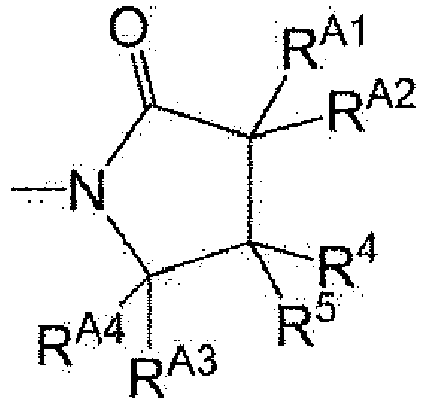
RA1 and RA2 are the same or different and each is- (1) a cyano group,
- (2) a carbamoyl group,
- (3) a C1-6 alkyl group (e.g., methyl, ethyl, propyl, isopropyl) optionally substituted by 1 to 3 substituents selected from
- (I) a carboxy group,
- (II) a cyano group,
- (III) a halogen atom (e.g., a fluorine atom),
- (IV) a C1-6 alkoxy group (e.g., methoxy),
- (V) a C3-6 cycloalkyl group (e.g., cyclopropyl),
- (VI) an amino group optionally mono- or di-substituted by substituent(s) selected from
- (i) a C1-6 alkyl-carbonyl group (e.g., acetyl), and
- (ii) a C1-6 alkoxy-carbonyl group (e.g., tert-butoxycarbonyl), and
- (VII) a hydroxy group,
- (4) a C3-6 cycloalkyl group (e.g., cyclopropyl, cyclobutyl),
- (5) a 3- to 8-membered monocyclic non-aromatic heterocyclic group (e.g., oxetanyl, azetidinyl) optionally substituted by 1 to 3 C1-6 alkoxy-carbonyl groups (e.g., tert-butoxycarbonyl), or
- (6) a C1-6 alkoxy-carbonyl group (e.g., ethoxycarbonyl);
RA4 is a hydrogen atom;
R4 is a hydrogen atom or a C1-3 alkyl group (e.g., methyl, ethyl); and
R5 is a hydrogen atom; or - (B) an 2-oxopiperidino group optionally substituted by 1 to 3 C1-6 alkyl groups.
- R1 is still more preferably a group represented by the following formula:

RA1 and RA2 are the same or different and each is - (1) a cyano group,
- (2) a carbamoyl group,
- (3) a C1-6 alkyl group (e.g., methyl, ethyl, propyl, isopropyl) optionally substituted by 1 to 3 substituents selected from
- (I) a carboxy group,
- (II) a cyano group,
- (III) a halogen atom (e.g., a fluorine atom),
- (IV) a C1-6 alkoxy group (e.g., methoxy),
- (V) a C3-6 cycloalkyl group (e.g., cyclopropyl),
- (VI) an amino group optionally mono- or di-substituted by substituent(s) selected from
- (i) a C1-6 alkyl-carbonyl group (e.g., acetyl), and
- (ii) a C1-6 alkoxy-carbonyl group (e.g., tert-butoxycarbonyl), and
- (VII) a hydroxy group,
- (4) a C3-6 cycloalkyl group (e.g., cyclopropyl, cyclobutyl),
- (5) a 3- to 8-membered monocyclic non-aromatic heterocyclic group (e.g., oxetanyl, azetidinyl) optionally substituted by 1 to 3 C1-6 alkoxy-carbonyl groups (e.g., tert-butoxycarbonyl), or
- (6) a C1-6 alkoxy-carbonyl group (e.g., ethoxycarbonyl);
- R1 is particularly preferably a group represented by the following formula:

RA1 is - (1) a cyano group,
- (2) a C1-6 alkyl group (e.g., methyl, ethyl) optionally substituted by 1 to 3 substituents selected from
- (I) an amino group optionally mono- or di-substituted by substituent(s) selected from
- (i) a C1-6 alkyl-carbonyl group (e.g., acetyl), and
- (ii) a C1-6 alkoxy-carbonyl group (e.g., tert-butoxycarbonyl),
- (II) a hydroxy group, and
- (III) a cyano group, or
- (I) an amino group optionally mono- or di-substituted by substituent(s) selected from
- (3) a C1-6 alkoxy-carbonyl group (e.g., ethoxycarbonyl);
RA2 is- (1) a C3-6 cycloalkyl group (e.g., cyclopropyl, cyclobutyl),
- (2) a C1-6 alkyl group (e.g., methyl, ethyl, propyl, isopropyl) optionally substituted by 1 to 3 substituents selected from
- (I) a carboxy group,
- (II) a cyano group,
- (III) a halogen atom (e.g., a fluorine atom),
- (IV) a C1-6 alkoxy group (e.g., methoxy),
- (V) a C3-6 cycloalkyl group (e.g., cyclopropyl), and
- (VI) a hydroxy group,
- (3) a carbamoyl group, or
- (4) a 3- to 8-membered monocyclic non-aromatic heterocyclic group (e.g., oxetanyl, azetidinyl) optionally substituted by 1 to 3 C1-6 alkoxy-carbonyl groups (e.g., tert-butoxycarbonyl);
RA4 is a hydrogen atom;
R4 is a hydrogen atom or a C1-3 alkyl group (e.g., methyl, ethyl); and
R5 is a hydrogen atom. - In the formula (I), R2 is a hydrogen atom, an optionally substituted C1-6 alkyl group, an optionally substituted aromatic ring group, or an acyl group.
- The "C1-6 alkyl group" of the "optionally substituted C1-6 alkyl group" for R2 optionally has 1 to 5 (preferably 1 to 3) substituents at substitutable position(s). Examples of the substituent include substituents selected from the above-mentioned Substituent Group A. When the number of the substituents is plural, the respective substituents may be the same or different.
- The "aromatic ring group" of the "optionally substituted aromatic ring group" for R2 is preferably a C6-14 aryl group (preferably phenyl) or a 5- or 6-membered monocyclic aromatic heterocyclic group (preferably pyrazolyl, pyridyl, pyrimidinyl, more preferably pyrazolyl).
- The "aromatic ring group" of the "optionally substituted aromatic ring group" for R2 optionally have 1 to 5 (preferably 1 to 3) substituents at substitutable position(s). Examples of the substituent include substituents selected from the above-mentioned Substituent Group B. When the number of the substituents is plural, the respective substituents may be the same or different.
- Examples of the "acyl group" for R2 include those similar to the "acyl group" for R4 or R5.
- R2 is preferably an optionally substituted C1-6 alkyl group, an optionally substituted aromatic ring group, or an acyl group.
- Specifically, R2 is preferably
- (1) an aromatic ring group (preferably a C6-14 aryl group (preferably phenyl) or a 5- or 6-membered monocyclic aromatic heterocyclic group (preferably pyrazolyl, pyridyl, pyrimidinyl, more preferably pyrazolyl)) optionally substituted by 1 to 5 (preferably 1 to 3) substituents selected from
- (a) a cyano group,
- (b) a carboxy group,
- (c) a halogen atom (e.g., a chlorine atom),
- (d) a C1-6 alkyl group (e.g., methyl) optionally substituted by 1 to 3 substituents selected from
- (i) a hydroxy group,
- (ii) a cyano group,
- (iii) a carboxy group,
- (iv) a carbamoyl group optionally mono- or di-substituted by C1-6 alkyl group(s) (e.g., methyl),
- (v) an amino group optionally mono- or di-substituted by C1-6 alkyl-carbonyl group(s) (e.g., acetyl),
- (vi) a C1-6 alkoxy-carbonyl group (e.g., ethoxycarbonyl, butoxycarbonyl),
- (vii) a C6-14 aryl group (e.g., phenyl) optionally substituted by 1 to 3 C1-6 alkoxy groups (e.g., methoxy), and
- (viii) a 3- to 8-membered monocyclic non-aromatic heterocyclic group (e.g., morpholinyl),
- (e) a C1-6 alkyl-carbonyl group (e.g., acetyl),
- (f) a C1-6 alkylsulfonyl group (e.g., methylsulfonyl),
- (g) an amino group optionally mono- or di-substituted by substituent(s) selected from
- (i) a C1-6 alkyl group (e.g., methyl), and
- (ii) a C1-6 alkyl-carbonyl group (e.g., acetyl),
- (h) a carbamoyl group optionally mono- or di-substituted by C1-6 alkyl group(s) (e.g., methyl, ethyl),
- (i) a sulfamoyl group, and
- (j) a 3- to 8-membered monocyclic non-aromatic heterocyclic group (e.g., morpholinyl, tetrahydropyranyl, piperidyl, piperazinyl, 1,1-dioxidothiomorpholinyl, dihydrooxadiazolyl) optionally substituted by 1 to 3 substituents selected from
- (i) a C1-6 alkyl group (e.g., methyl),
- (ii) a C1-6 alkyl-carbonyl group (e.g., acetyl), and
- (iii) an oxo group, or
- (2) a C1-6 alkyl group (e.g., methyl, ethyl) optionally substituted by 1 to 5 (preferably 1 to 3) substituents selected from
- (a) a C6-14 aryl group (e.g., phenyl, naphthyl) optionally substituted by 1 to 3 substituents selected from
- (i) a cyano group,
- (ii) a C1-6 alkyl group (e.g., methyl) optionally substituted by 1 to 3 of 3- to 8-membered monocyclic non-aromatic heterocyclic groups (e.g., morpholinyl),
- (iii) a C1-6 alkoxy group (e.g., methoxy),
- (iv) a halogen atom (e.g., a fluorine atom), and
- (v) a 3- to 8-membered monocyclic non-aromatic heterocyclic group (e.g., piperazinyl) optionally substituted by 1 to 3 C1-6 alkyl groups (e.g., methyl),
- (b) a 5- or 6-membered monocyclic aromatic heterocyclic group (e.g., pyridyl, furyl, thienyl),
- (c) a 8- to 12-membered fused aromatic heterocyclic group (e.g., benzofuranyl), and
- (d) a C3-6 cycloalkyl group (e.g., cyclopropyl).
- (a) a C6-14 aryl group (e.g., phenyl, naphthyl) optionally substituted by 1 to 3 substituents selected from
- In another embodiment, specifically, R2 is preferably
- (1) a 5- or 6-membered monocyclic aromatic heterocyclic group (preferably pyrazolyl, pyridyl, pyrimidinyl, thiazolyl, imidazolyl, thienyl, more preferably pyrazolyl), a C6-14 aryl group (preferably phenyl) or a 8- to 12-membered fused aromatic heterocyclic group (preferably indazolyl, benzothiazolyl, indolyl), each of which is optionally substituted by 1 to 3 substituents selected from
- (a) a cyano group,
- (b) a carboxy group,
- (c) a halogen atom (e.g., a chlorine atom, a fluorine atom),
- (d) a C1-6 alkyl group (e.g., methyl, ethyl, isopropyl, tert-butyl, isobutyl) optionally substituted by 1 to 3 substituents selected from
- (I) a hydroxy group,
- (II) a cyano group,
- (III) a carboxy group,
- (IV) a carbamoyl group optionally mono- or di-substituted by C1-6 alkyl group(s) (e.g., methyl, ethyl, tert-butyl) optionally substituted by 1 to 3 substituents selected from
- (i) a C1-6 alkoxy group (e.g., methoxy),
- (ii) a hydroxy group,
- (iii) a halogen atom (e.g., a fluorine atom), and
- (iv) a C1-6 alkylsulfonyl group (e.g., methylsulfonyl),
- (V) an amino group optionally mono- or di-substituted by substituent(s) selected from
- (i) a C1-6 alkyl-carbonyl group (e.g., acetyl) optionally substituted by 1 to 3 substituents selected from
- (A) a C1-6 alkoxy group (e.g., methoxy), and
- (B) a hydroxy group,
- (ii) a C1-6 alkylsulfonyl group (e.g., methylsulfonyl),
- (iii) a sulfamoyl group optionally mono- or di-substituted by C1-6 alkyl group(s) (e.g., methyl), and
- (iv) a C1-6 alkyl group (e.g., methyl),
- (i) a C1-6 alkyl-carbonyl group (e.g., acetyl) optionally substituted by 1 to 3 substituents selected from
- (VI) a C1-6 alkoxy-carbonyl group (e.g., ethoxycarbonyl, butoxycarbonyl),
- (VII) a C6-14 aryl group (e.g., phenyl) optionally substituted by 1 to 3 C1-6 alkoxy groups (e.g., methoxy),
- (VIII) a 3- to 8-membered monocyclic non-aromatic heterocyclic group (e.g., morpholinyl),
- (IX) a 3- to 8-membered monocyclic non-aromatic heterocyclylcarbonyl group (e.g., morpholinylcarbonyl, pyrrolidinylcarbonyl, piperidylcarbonyl, piperazinylcarbonyl) optionally substituted by 1 to 3 substituents selected from
- (i) a hydroxy group,
- (ii) a carbamoyl group, and
- (iii) a C1-6 alkyl group (e.g., methyl),
- (X) a halogen atom (e.g., a fluorine atom), and
- (XI) a C1-6 alkylsulfonyl group (e.g., methylsulfonyl),
- (e) a C1-6 alkyl-carbonyl group (e.g., acetyl),
- (f) a C1-6 alkylsulfonyl group (e.g., methylsulfonyl),
- (g) an amino group optionally mono- or di-substituted by substituent(s) selected from
- (I) a C1-6 alkyl group (e.g., methyl),
- (II) a C1-6 alkyl-carbonyl group (e.g., acetyl) optionally substituted by 1 to 3 C1-6 alkoxy groups (e.g., methoxy), and
- (III) a C1-6 alkylsulfonyl group (e.g., methylsulfonyl),
- (h) a carbamoyl group optionally mono- or di-substituted by substituent(s) selected from
- (I) a C1-6 alkyl group (e.g., methyl, ethyl, tert-butyl) optionally substituted by 1 to 3 substituents selected from
- (i) a hydroxy group,
- (ii) a 3- to 8-membered monocyclic non-aromatic heterocyclic group (e.g., oxetanyl, morpholinyl) optionally substituted by 1 to 3 C1-6 alkyl groups (e.g., methyl), and
- (iii) a C1-6 alkylsulfonyl group (e.g., methylsulfonyl),
- (II) a C3-6 cycloalkyl group (e.g., cyclopropyl, cyclobutyl, cyclohexyl) optionally substituted by 1 to 3 substituents selected from
- (i) a cyano group, and
- (ii) a hydroxy group, and
- (III) a 3- to 8-membered monocyclic non-aromatic heterocyclic group (e.g., oxetanyl, tetrahydropyranyl),
- (I) a C1-6 alkyl group (e.g., methyl, ethyl, tert-butyl) optionally substituted by 1 to 3 substituents selected from
- (i) a sulfamoyl group optionally mono- or di-substituted by C1-6 alkyl group(s) (e.g., methyl),
- (j) a 3- to 8-membered monocyclic non-aromatic heterocyclic group (e.g., morpholinyl, tetrahydropyranyl, piperidyl, piperazinyl, 1,1-dioxidothiomorpholinyl, dihydrooxadiazolyl, azetidinyl, imidazolidinyl, oxetanyl, pyrrolidinyl, 1,1-dioxidetetrahydrothiopyranyl) optionally substituted by 1 to 3 substituents selected from
- (I) a C1-6 alkyl group (e.g., methyl) optionally substituted by 1 to 3 hydroxy groups,
- (II) a C1-6 alkyl-carbonyl group (e.g., acetyl) optionally substituted by 1 to 3 substituents selected from
- (i) a C1-6 alkoxy group (e.g., methoxy), and
- (ii) a cyano group,
- (III) a C1-6 alkoxy-carbonyl group (e.g., tert-butoxycarbonyl),
- (IV) an oxo group,
- (V) a C1-6 alkylsulfonyl group (e.g., methylsulfonyl),
- (VI) a carbamoyl group optionally mono- or di-substituted by C1-6 alkyl group(s) (e.g., methyl),
- (VII) a cyano group,
- (VIII) a hydroxy group, and
- (IX) a carboxy group,
- (k) a C3-6 cycloalkyl group (e.g., cyclopropyl, cyclobutyl, cyclopentyl, cyclohexyl) optionally substituted by 1 to 3 substituents selected from
- (I) a carbamoyl group optionally mono- or di-substituted by C1-6 alkyl group(s) (e.g., methyl),
- (II) a carboxy group, and
- (III) a C1-6 alkyl group (e.g., methyl) optionally substituted by 1 to 3 hydroxy groups,
- (l) a C1-6 alkoxy group (e.g., methoxy, ethoxy, isopropoxy, isobutoxy) optionally substituted by 1 to 3 substituents selected from
- (I) a halogen atom (e.g., a fluorine atom),
- (II) a C1-6 alkoxy group (e.g., methoxy), and
- (III) a C3-6 cycloalkyl group (e.g., cyclopropyl),
- (m) a C1-6 alkoxy-carbonyl group (e.g., tert-butoxycarbonyl),
- (n) a 3- to 8-membered monocyclic non-aromatic heterocyclylcarbonyl group (e.g., pyrrolidinylcarbonyl, morpholinylcarbonyl, piperidylcarbonyl, azetidinylcarbonyl, 2-oxa-6-azaspiro[3.3]heptylcarbonyl, 1,1-dioxidothiomorpholinylcarbonyl) optionally substituted by 1 to 3 substituents selected from
- (I) a hydroxy group,
- (II) an oxo group,
- (III) a halogen atom (e.g., a fluorine atom),
- (IV) a C1-6 alkoxy group (e.g., methoxy), and
- (V) a C1-6 alkyl group (e.g., methyl),
- (o) a C1-6 alkylsulfanyl group (e.g., methylsulfanyl), and
- (p) a 5- or 6-membered monocyclic aromatic heterocyclic group (e.g., tetrazolyl), or
- (2) a C1-6 alkyl group (e.g., methyl, ethyl) optionally substituted by 1 to 5 (preferably 1 to 3) substituents selected from
- (a) a C6-14 aryl group (e.g., phenyl, naphthyl) optionally substituted by 1 to 3 substituents selected from
- (I) a cyano group,
- (II) a C1-6 alkyl group (e.g., methyl) optionally substituted by 1 to 3 of 3- to 8-membered monocyclic non-aromatic heterocyclic groups (e.g., morpholinyl),
- (III) a C1-6 alkoxy group (e.g., methoxy),
- (IV) a halogen atom (e.g., a fluorine atom), and
- (V) a 3- to 8-membered monocyclic non-aromatic heterocyclic group (e.g., piperazinyl) optionally substituted by 1 to 3 C1-6 alkyl groups (e.g., methyl),
- (b) a 5- or 6-membered monocyclic aromatic heterocyclic group (e.g., pyridyl, furyl, thienyl) optionally substituted by 1 to 3 substituents selected from
- (I) a cyano group,
- (II) a C1-6 alkyl group (e.g., methyl) optionally substituted by 1 to 3 of 3- to 8-membered monocyclic non-aromatic heterocyclic groups (e.g., morpholinyl),
- (III) a C1-6 alkoxy group (e.g., methoxy),
- (IV) a halogen atom (e.g., a fluorine atom), and
- (V) a 3- to 8-membered monocyclic non-aromatic heterocyclic group (e.g., piperazinyl) optionally substituted by 1 to 3 C1-6 alkyl groups (e.g., methyl),
- (c) a 8- to 12-membered fused aromatic heterocyclic group (e.g., benzofuranyl) optionally substituted by 1 to 3 substituents selected from
- (I) a cyano group,
- (II) a C1-6 alkyl group (e.g., methyl) optionally substituted by 1 to 3 of 3- to 8-membered monocyclic non-aromatic heterocyclic groups (e.g., morpholinyl),
- (III) a C1-6 alkoxy group (e.g., methoxy),
- (IV) a halogen atom (e.g., a fluorine atom), and
- (V) a 3- to 8-membered monocyclic non-aromatic heterocyclic group (e.g., piperazinyl) optionally substituted by 1 to 3 C1-6 alkyl groups (e.g., methyl), and
- (d) a C3-6 cycloalkyl group (e.g., cyclopropyl).
- (a) a C6-14 aryl group (e.g., phenyl, naphthyl) optionally substituted by 1 to 3 substituents selected from
- R2 is more preferably
- (1) a 5- or 6-membered monocyclic aromatic heterocyclic group (preferably pyrazolyl, pyridyl, pyrimidinyl, thiazolyl, imidazolyl, thienyl, more preferably pyrazolyl), a C6-14 aryl group (preferably phenyl) or a 8- to 12-membered fused aromatic heterocyclic group (preferably indazolyl, benzothiazolyl, indolyl), each of which is optionally substituted by 1 to 3 substituents selected from
- (a) a cyano group,
- (b) a carboxy group,
- (c) a halogen atom (e.g., a chlorine atom, a fluorine atom),
- (d) a C1-6 alkyl group (e.g., methyl, ethyl, isopropyl, tert-butyl, isobutyl) optionally substituted by 1 to 3 substituents selected from
- (I) a hydroxy group,
- (II) a cyano group,
- (III) a carboxy group,
- (IV) a carbamoyl group optionally mono- or di-substituted by C1-6 alkyl group(s) (e.g., methyl, ethyl, tert-butyl) optionally substituted by 1 to 3 substituents selected from
- (i) a C1-6 alkoxy group (e.g., methoxy),
- (ii) a hydroxy group,
- (iii) a halogen atom (e.g., a fluorine atom), and
- (iv) a C1-6 alkylsulfonyl group (e.g., methylsulfonyl),
- (V) an amino group optionally mono- or di-substituted by substituent(s) selected from
- (i) a C1-6 alkyl-carbonyl group (e.g., acetyl) optionally substituted by 1 to 3 substituents selected from
- (A) a C1-6 alkoxy group (e.g., methoxy), and
- (B) a hydroxy group,
- (ii) a C1-6 alkylsulfonyl group (e.g., methylsulfonyl),
- (iii) a sulfamoyl group optionally mono- or di-substituted by C1-6 alkyl group(s) (e.g., methyl), and
- (iv) a C1-6 alkyl group (e.g., methyl),
- (i) a C1-6 alkyl-carbonyl group (e.g., acetyl) optionally substituted by 1 to 3 substituents selected from
- (VI) a C1-6 alkoxy-carbonyl group (e.g., ethoxycarbonyl, butoxycarbonyl),
- (VII) a C6-14 aryl group (e.g., phenyl) optionally substituted by 1 to 3 C1-6 alkoxy groups (e.g., methoxy),
- (VIII) a 3- to 8-membered monocyclic non-aromatic heterocyclic group (e.g., morpholinyl),
- (IX) a 3- to 8-membered monocyclic non-aromatic heterocyclylcarbonyl group (e.g., morpholinylcarbonyl, pyrrolidinylcarbonyl, piperidylcarbonyl, piperazinylcarbonyl) optionally substituted by 1 to 3 substituents selected from
- (i) a hydroxy group,
- (ii) a carbamoyl group, and
- (iii) a C1-6 alkyl group (e.g., methyl),
- (X) a halogen atom (e.g., a fluorine atom), and
- (XI) a C1-6 alkylsulfonyl group (e.g., methylsulfonyl),
- (e) a C1-6 alkyl-carbonyl group (e.g., acetyl),
- (f) a C1-6 alkylsulfonyl group (e.g., methylsulfonyl),
- (g) an amino group optionally mono- or di-substituted by substituent(s) selected from
- (I) a C1-6 alkyl group (e.g., methyl),
- (II) a C1-6 alkyl-carbonyl group (e.g., acetyl) optionally substituted by 1 to 3 C1-6 alkoxy groups (e.g., methoxy), and
- (III) a C1-6 alkylsulfonyl group (e.g., methylsulfonyl),
- (h) a carbamoyl group optionally mono- or di-substituted by substituent(s) selected from
- (I) a C1-6 alkyl group (e.g., methyl, ethyl, tert-butyl) optionally substituted by 1 to 3 substituents selected from
- (i) a hydroxy group,
- (ii) a 3- to 8-membered monocyclic non-aromatic heterocyclic group (e.g., oxetanyl, morpholinyl) optionally substituted by 1 to 3 C1-6 alkyl groups (e.g., methyl), and
- (iii) a C1-6 alkylsulfonyl group (e.g., methylsulfonyl),
- (II) a C3-6 cycloalkyl group (e.g., cyclopropyl, cyclobutyl, cyclohexyl) optionally substituted by 1 to 3 substituents selected from
- (i) a cyano group, and
- (ii) a hydroxy group, and
- (III) a 3- to 8-membered monocyclic non-aromatic heterocyclic group (e.g., oxetanyl, tetrahydropyranyl),
- (I) a C1-6 alkyl group (e.g., methyl, ethyl, tert-butyl) optionally substituted by 1 to 3 substituents selected from
- (i) a sulfamoyl group optionally mono- or di-substituted by C1-6 alkyl group(s) (e.g., methyl),
- (j) a 3- to 8-membered monocyclic non-aromatic heterocyclic group (e.g., morpholinyl, tetrahydropyranyl, piperidyl, piperazinyl, 1,1-dioxidothiomorpholinyl, dihydrooxadiazolyl, azetidinyl, imidazolidinyl, oxetanyl, pyrrolidinyl, 1,1-dioxidetetrahydrothiopyranyl) optionally substituted by 1 to 3 substituents selected from
- (I) a C1-6 alkyl group (e.g., methyl) optionally substituted by 1 to 3 hydroxy groups,
- (II) a C1-6 alkyl-carbonyl group (e.g., acetyl) optionally substituted by 1 to 3 substituents selected from
- (i) a C1-6 alkoxy group (e.g., methoxy), and
- (ii) a cyano group,
- (III) a C1-6 alkoxy-carbonyl group (e.g., tert-butoxycarbonyl),
- (IV) an oxo group,
- (V) a C1-6 alkylsulfonyl group (e.g., methylsulfonyl),
- (VI) a carbamoyl group optionally mono- or di-substituted by C1-6 alkyl group(s) (e.g., methyl),
- (VII) a cyano group,
- (VIII) a hydroxy group, and
- (IX) a carboxy group,
- (k) a C3-6 cycloalkyl group (e.g., cyclopropyl, cyclobutyl, cyclopentyl, cyclohexyl) optionally substituted by 1 to 3 substituents selected from
- (I) a carbamoyl group optionally mono- or di-substituted by C1-6 alkyl group(s) (e.g., methyl),
- (II) a carboxy group, and
- (III) a C1-6 alkyl group (e.g., methyl) optionally substituted by 1 to 3 hydroxy groups,
- (l) a C1-6 alkoxy group (e.g., methoxy, ethoxy, isopropoxy, isobutoxy) optionally substituted by 1 to 3 substituents selected from
- (I) a halogen atom (e.g., a fluorine atom),
- (II) a C1-6 alkoxy group (e.g., methoxy), and
- (III) a C3-6 cycloalkyl group (e.g., cyclopropyl),
- (m) a C1-6 alkoxy-carbonyl group (e.g., tert-butoxycarbonyl),
- (n) a 3- to 8-membered monocyclic non-aromatic heterocyclylcarbonyl group (e.g., pyrrolidinylcarbonyl, morpholinylcarbonyl, piperidylcarbonyl, azetidinylcarbonyl, 2-oxa-6-azaspiro[3.3]heptylcarbonyl, 1,1-dioxidothiomorpholinylcarbonyl) optionally substituted by 1 to 3 substituents selected from
- (I) a hydroxy group,
- (II) an oxo group,
- (III) a halogen atom (e.g., a fluorine atom),
- (IV) a C1-6 alkoxy group (e.g., methoxy), and
- (V) a C1-6 alkyl group (e.g., methyl),
- (o) a C1-6 alkylsulfanyl group (e.g., methylsulfanyl), and
- (p) a 5- or 6-membered monocyclic aromatic heterocyclic group (e.g., tetrazolyl), or
- (2) a C1-6 alkyl group (e.g., methyl, ethyl) optionally substituted by 1 to 5 (preferably 1 to 3) substituents selected from
- (a) a C6-14 aryl group (e.g., phenyl, naphthyl) optionally substituted by 1 to 3 substituents selected from
- (I) a cyano group,
- (II) a C1-6 alkyl group (e.g., methyl) optionally substituted by 1 to 3 of 3- to 8-membered monocyclic non-aromatic heterocyclic groups (e.g., morpholinyl),
- (III) a C1-6 alkoxy group (e.g., methoxy),
- (IV) a halogen atom (e.g., a fluorine atom), and
- (V) a 3- to 8-membered monocyclic non-aromatic heterocyclic group (e.g., piperazinyl) optionally substituted by 1 to 3 C1-6 alkyl groups (e.g., methyl),
- (b) a 5- or 6-membered monocyclic aromatic heterocyclic group (e.g., pyridyl, furyl, thienyl),
- (c) a 8- to 12-membered fused aromatic heterocyclic group (e.g., benzofuranyl), and
- (d) a C3-6 cycloalkyl group (e.g., cyclopropyl).
- (a) a C6-14 aryl group (e.g., phenyl, naphthyl) optionally substituted by 1 to 3 substituents selected from
- R2 is still more preferably
- (1) a 5- or 6-membered monocyclic aromatic heterocyclic group (preferably pyrazolyl, pyridyl, pyrimidinyl, thiazolyl, imidazolyl, thienyl, more preferably pyrazolyl), a C6-14 aryl group (preferably phenyl) or a 8- to 12-membered fused aromatic heterocyclic group (preferably indazolyl, benzothiazolyl, indolyl), each of which is optionally substituted by 1 to 3 substituents selected from
- (a) a cyano group,
- (b) a carboxy group,
- (c) a halogen atom (e.g., a chlorine atom, a fluorine atom),
- (d) a C1-6 alkyl group (e.g., methyl, ethyl, isopropyl, tert-butyl, isobutyl) optionally substituted by 1 to 3 substituents selected from
- (I) a hydroxy group,
- (II) a cyano group,
- (III) a carboxy group,
- (IV) a carbamoyl group optionally mono- or di-substituted by C1-6 alkyl group(s) (e.g., methyl, ethyl, tert-butyl) optionally substituted by 1 to 3 substituents selected from
- (i) a C1-6 alkoxy group (e.g., methoxy),
- (ii) a hydroxy group,
- (iii) a halogen atom (e.g., a fluorine atom), and
- (iv) a C1-6 alkylsulfonyl group (e.g., methylsulfonyl),
- (V) an amino group optionally mono- or di-substituted by substituent(s) selected from
- (i) a C1-6 alkyl-carbonyl group (e.g., acetyl) optionally substituted by 1 to 3 substituents selected from
- (A) a C1-6 alkoxy group (e.g., methoxy), and
- (B) a hydroxy group,
- (ii) a C1-6 alkylsulfonyl group (e.g., methylsulfonyl),
- (iii) a sulfamoyl group optionally mono- or di-substituted by C1-6 alkyl group(s) (e.g., methyl), and
- (iv) a C1-6 alkyl group (e.g., methyl),
- (i) a C1-6 alkyl-carbonyl group (e.g., acetyl) optionally substituted by 1 to 3 substituents selected from
- (VI) a C1-6 alkoxy-carbonyl group (e.g., ethoxycarbonyl, butoxycarbonyl),
- (VII) a C6-14 aryl group (e.g., phenyl) optionally substituted by 1 to 3 C1-6 alkoxy groups (e.g., methoxy),
- (VIII) a 3- to 8-membered monocyclic non-aromatic heterocyclic group (e.g., morpholinyl),
- (IX) a 3- to 8-membered monocyclic non-aromatic heterocyclylcarbonyl group (e.g., morpholinylcarbonyl, pyrrolidinylcarbonyl, piperidylcarbonyl, piperazinylcarbonyl) optionally substituted by 1 to 3 substituents selected from
- (i) a hydroxy group,
- (ii) a carbamoyl group, and
- (iii) a C1-6 alkyl group (e.g., methyl),
- (X) a halogen atom (e.g., a fluorine atom), and
- (XI) a C1-6 alkylsulfonyl group (e.g., methylsulfonyl),
- (e) a C1-6 alkyl-carbonyl group (e.g., acetyl),
- (f) a C1-6 alkylsulfonyl group (e.g., methylsulfonyl),
- (g) an amino group optionally mono- or di-substituted by substituent(s) selected from
- (I) a C1-6 alkyl group (e.g., methyl),
- (II) a C1-6 alkyl-carbonyl group (e.g., acetyl) optionally substituted by 1 to 3 C1-6 alkoxy groups (e.g., methoxy), and
- (III) a C1-6 alkylsulfonyl group (e.g., methylsulfonyl),
- (h) a carbamoyl group optionally mono- or di-substituted by substituent(s) selected from
- (I) a C1-6 alkyl group (e.g., methyl, ethyl, tert-butyl) optionally substituted by 1 to 3 substituents selected from
- (i) a hydroxy group,
- (ii) a 3- to 8-membered monocyclic non-aromatic heterocyclic group (e.g., oxetanyl, morpholinyl) optionally substituted by 1 to 3 C1-6 alkyl groups (e.g., methyl), and
- (iii) a C1-6 alkylsulfonyl group (e.g., methylsulfonyl),
- (II) a C3-6 cycloalkyl group (e.g., cyclopropyl, cyclobutyl, cyclohexyl) optionally substituted by 1 to 3 substituents selected from
- (i) a cyano group, and
- (ii) a hydroxy group, and
- (III) a 3- to 8-membered monocyclic non-aromatic heterocyclic group (e.g., oxetanyl, tetrahydropyranyl),
- (I) a C1-6 alkyl group (e.g., methyl, ethyl, tert-butyl) optionally substituted by 1 to 3 substituents selected from
- (i) a sulfamoyl group optionally mono- or di-substituted by C1-6 alkyl group(s) (e.g., methyl),
- (j) a 3- to 8-membered monocyclic non-aromatic heterocyclic group (e.g., morpholinyl, tetrahydropyranyl, piperidyl, piperazinyl, 1,1-dioxidothiomorpholinyl, dihydrooxadiazolyl, azetidinyl, imidazolidinyl, oxetanyl, pyrrolidinyl, 1,1-dioxidetetrahydrothiopyranyl) optionally substituted by 1 to 3 substituents selected from
- (I) a C1-6 alkyl group (e.g., methyl) optionally substituted by 1 to 3 hydroxy groups,
- (II) a C1-6 alkyl-carbonyl group (e.g., acetyl) optionally substituted by 1 to 3 substituents selected from
- (i) a C1-6 alkoxy group (e.g., methoxy), and
- (ii) a cyano group,
- (III) a C1-6 alkoxy-carbonyl group (e.g., tert-butoxycarbonyl),
- (IV) an oxo group,
- (V) a C1-6 alkylsulfonyl group (e.g., methylsulfonyl),
- (VI) a carbamoyl group optionally mono- or di-substituted by C1-6 alkyl group(s) (e.g., methyl),
- (VII) a cyano group,
- (VIII) a hydroxy group, and
- (IX) a carboxy group,
- (k) a C3-6 cycloalkyl group (e.g., cyclopropyl, cyclobutyl, cyclopentyl, cyclohexyl) optionally substituted by 1 to 3 substituents selected from
- (I) a carbamoyl group optionally mono- or di-substituted by C1-6 alkyl group (s) (e.g., methyl),
- (II) a carboxy group, and
- (III) a C1-6 alkyl group (e.g., methyl) optionally substituted by 1 to 3 hydroxy groups,
- (l) a C1-6 alkoxy group (e.g., methoxy, ethoxy, isopropoxy, isobutoxy) optionally substituted by 1 to 3 substituents selected from
- (I) a halogen atom (e.g., a fluorine atom),
- (II) a C1-6 alkoxy group (e.g., methoxy), and
- (III) a C3-6 cycloalkyl group (e.g., cyclopropyl),
- (m) a C1-6 alkoxy-carbonyl group (e.g., tert-butoxycarbonyl),
- (n) a 3- to 8-membered monocyclic non-aromatic heterocyclylcarbonyl group (e.g., pyrrolidinylcarbonyl, morpholinylcarbonyl, piperidylcarbonyl, azetidinylcarbonyl, 2-oxa-6-azaspiro[3.3]heptylcarbonyl, 1,1-dioxidothiomorpholinylcarbonyl) optionally substituted by 1 to 3 substituents selected from
- (I) a hydroxy group,
- (II) an oxo group,
- (III) a halogen atom (e.g., a fluorine atom),
- (IV) a C1-6 alkoxy group (e.g., methoxy), and
- (V) a C1-6 alkyl group (e.g., methyl),
- (o) a C1-6 alkylsulfanyl group (e.g., methylsulfanyl), and
- (p) a 5- or 6-membered monocyclic aromatic heterocyclic group (e.g., tetrazolyl).
- In the formula (I), R3 is a hydrogen atom, a halogen atom, a cyano group, or an optionally substituted C1-6 alkyl group.
- The "C1-6 alkyl group" of the "optionally substituted C1-6 alkyl group" for R3 optionally has 1 to 5 (preferably 1 to 3) substituents at substitutable position(s). Examples of the substituent include substituents selected from the above-mentioned Substituent Group A. When the number of the substituents is plural, the respective substituents may be the same or different.
- R3 is preferably a hydrogen atom or a halogen atom (e.g., a fluorine atom), particularly preferably a hydrogen atom.
- Preferable examples of compound (I) include the following compounds:
- Compound (I) wherein
R1 is
a group represented by the
- ring A1 is an optionally further substituted 2-oxopyrrolidine ring; and
- R4 and R5 are both hydrogen atoms, or
- Compound (I) wherein
R1 is
a group represented by the following formula:
- ring A1 is an optionally further substituted 2-oxopyrrolidine ring;
- R4 is a hydrogen atom or a C1-6 alkyl group (e.g., methyl, ethyl); and
- R5 is a hydrogen atom, or
- Compound (I) wherein
R1 is - (A) a group represented by the following formula:

ring A1 is an 2-oxopyrrolidine ring optionally further substituted by 1 to 3 substituents selected from- (1) a cyano group,
- (2) a carbamoyl group, and
- (3) a C1-6 alkyl group (e.g., methyl, ethyl, propyl, isopropyl) optionally substituted by 1 to 3 substituents selected from
- (i) a carboxy group,
- (ii) a cyano group,
- (iii) a halogen atom (e.g., a fluorine atom),
- (iv) a C1-6 alkoxy group (e.g., methoxy), and
- (v) a C3-6 cycloalkyl group (e.g., cyclopropyl); and
- (B) a 2-oxopiperidino group optionally substituted by 1 to 3 C1-6 alkyl groups (e.g., methyl);
R2 is- (1) an aromatic ring group (preferably a C6-14 aryl group (preferably phenyl) or a 5- or 6-membered monocyclic aromatic heterocyclic group (preferably pyrazolyl, pyridyl, pyrimidinyl, more preferably pyrazolyl)) optionally substituted by 1 to 5 (preferably 1 to 3) substituents selected from
- (a) a cyano group,
- (b) a carboxy group,
- (c) a halogen atom (e.g., a chlorine atom),
- (d) a C1-6 alkyl group (e.g., methyl) optionally substituted by 1 to 3 substituents selected from
- (i) a hydroxy group,
- (ii) a cyano group,
- (iii) a carboxy group,
- (iv) a carbamoyl group optionally mono- or di-substituted by C1-6 alkyl group(s) (e.g., methyl),
- (v) an amino group optionally mono- or di-substituted by C1-6 alkyl-carbonyl group(s) (e.g., acetyl),
- (vi) a C1-6 alkoxy-carbonyl group (e.g., ethoxycarbonyl, butoxycarbonyl),
- (vii) a C6-14 aryl group (e.g., phenyl) optionally substituted by 1 to 3 C1-6 alkoxy groups (e.g., methoxy), and
- (viii) a 3- to 8-membered monocyclic non-aromatic heterocyclic group (e.g., morpholinyl),
- (e) a C1-6 alkyl-carbonyl group (e.g., acetyl),
- (f) a C1-6 alkylsulfonyl group (e.g., methylsulfonyl),
- (g) an amino group optionally mono- or di-substituted by substituent(s) selected from
- (i) a C1-6 alkyl group (e.g., methyl), and
- (ii) a C1-6 alkyl-carbonyl group (e.g., acetyl),
- (h) a carbamoyl group optionally mono- or di-substituted by C1-6 alkyl group(s) (e.g., methyl, ethyl),
- (i) a sulfamoyl group, and
- (j) a 3- to 8-membered monocyclic non-aromatic heterocyclic group (e.g., morpholinyl, tetrahydropyranyl, piperidyl, piperazinyl, 1,1-dioxidothiomorpholinyl, dihydrooxadiazolyl) optionally substituted by 1 to 3 substituents selected from
- (i) a C1-6 alkyl group (e.g., methyl),
- (ii) a C1-6 alkyl-carbonyl group (e.g., acetyl), and
- (iii) an oxo group, or
- (2) a C1-6 alkyl group (e.g., methyl, ethyl) optionally substituted by 1 to 5 (preferably 1 to 3) substituents selected from
- (a) a C6-14 aryl group (e.g., phenyl, naphthyl) optionally substituted by 1 to 3 substituents selected from
- (i) a cyano group,
- (ii) a C1-6 alkyl group (e.g., methyl) optionally substituted by 1 to 3 of 3- to 8-membered monocyclic non-aromatic heterocyclic groups (e.g., morpholinyl),
- (iii) a C1-6 alkoxy group (e.g., methoxy),
- (iv) a halogen atom (e.g., a fluorine atom), and
- (v) a 3- to 8-membered monocyclic non-aromatic heterocyclic group (e.g., piperazinyl) optionally substituted by 1 to 3 C1-6 alkyl groups (e.g., methyl),
- (b) a 5- or 6-membered monocyclic aromatic heterocyclic group (e.g., pyridyl, furyl, thienyl),
- (c) a 8- to 12-membered fused aromatic heterocyclic group (e.g., benzofuranyl), and
- (d) a C3-6 cycloalkyl group (e.g., cyclopropyl); and
- (a) a C6-14 aryl group (e.g., phenyl, naphthyl) optionally substituted by 1 to 3 substituents selected from
- (1) an aromatic ring group (preferably a C6-14 aryl group (preferably phenyl) or a 5- or 6-membered monocyclic aromatic heterocyclic group (preferably pyrazolyl, pyridyl, pyrimidinyl, more preferably pyrazolyl)) optionally substituted by 1 to 5 (preferably 1 to 3) substituents selected from
- Compound (I) wherein
R1 is - (A) a group represented by the following formula:

ring A1 is an 2-oxopyrrolidine ring optionally further substituted by 1 to 3 substituents selected from- (1) a cyano group,
- (2) a carbamoyl group,
- (3) a C1-6 alkyl group (e.g., methyl, ethyl, propyl, isopropyl) optionally substituted by 1 to 3 substituents selected from
- (I) a carboxy group,
- (II) a cyano group,
- (III) a halogen atom (e.g., a fluorine atom),
- (IV) a C1-6 alkoxy group (e.g., methoxy),
- (V) a C3-6 cycloalkyl group (e.g., cyclopropyl),
- (VI) an amino group optionally mono- or di-substituted by substituent(s) selected from
- (i) a C1-6 alkyl-carbonyl group (e.g., acetyl), and
- (ii) a C1-6 alkoxy-carbonyl group (e.g., tert-butoxycarbonyl), and
- (VII) a hydroxy group,
- (4) a C3-6 cycloalkyl group (e.g., cyclopropyl, cyclobutyl),
- (5) a 3- to 8-membered monocyclic non-aromatic heterocyclic group (e.g., oxetanyl, azetidinyl) optionally substituted by 1 to 3 C1-6 alkoxy-carbonyl groups (e.g., tert-butoxycarbonyl),
- (6) a C1-6 alkoxy-carbonyl group (e.g., ethoxycarbonyl), and
- (7) a 5- or 6-membered monocyclic aromatic heterocyclic group optionally substituted by 1 to 3 C1-6 alkyl groups;
R5 is a hydrogen atom; or - (B) a 2-oxopiperidino group optionally substituted by 1 to 3 C1-6 alkyl groups (e.g., methyl);
R2 is- (1) a 5- or 6-membered monocyclic aromatic heterocyclic group (preferably pyrazolyl, pyridyl, pyrimidinyl, thiazolyl, imidazolyl, thienyl, more preferably pyrazolyl), a C6-14 aryl group (preferably phenyl) or a 8- to 12-membered fused aromatic heterocyclic group (preferably indazolyl, benzothiazolyl, indolyl), each of which is optionally substituted by 1 to 3 substituents selected from
- (a) a cyano group,
- (b) a carboxy group,
- (c) a halogen atom (e.g., a chlorine atom, a fluorine atom),
- (d) a C1-6 alkyl group (e.g., methyl, ethyl, isopropyl, tert-butyl, isobutyl) optionally substituted by 1 to 3 substituents selected from
- (I) a hydroxy group,
- (II) a cyano group,
- (III) a carboxy group,
- (IV) a carbamoyl group optionally mono- or di-substituted by C1-6 alkyl group(s) (e.g., methyl, ethyl, tert-butyl) optionally substituted by 1 to 3 substituents selected from
- (i) a C1-6 alkoxy group (e.g., methoxy),
- (ii) a hydroxy group,
- (iii) a halogen atom (e.g., a fluorine atom), and
- (iv) a C1-6 alkylsulfonyl group (e.g., methylsulfonyl),
- (V) an amino group optionally mono- or di-substituted by substituent(s) selected from
- (i) a C1-6 alkyl-carbonyl group (e.g., acetyl) optionally substituted by 1 to 3 substituents selected from
- (A) a C1-6 alkoxy group (e.g., methoxy), and
- (B) a hydroxy group,
- (ii) a C1-6 alkylsulfonyl group (e.g., methylsulfonyl),
- (iii) a sulfamoyl group optionally mono- or di-substituted by C1-6 alkyl group(s) (e.g., methyl), and
- (iv) a C1-6 alkyl group (e.g., methyl),
- (i) a C1-6 alkyl-carbonyl group (e.g., acetyl) optionally substituted by 1 to 3 substituents selected from
- (VI) a C1-6 alkoxy-carbonyl group (e.g., ethoxycarbonyl, butoxycarbonyl),
- (VII) a C6-14 aryl group (e.g., phenyl) optionally substituted by 1 to 3 C1-6 alkoxy groups (e.g., methoxy),
- (VIII) a 3- to 8-membered monocyclic non-aromatic heterocyclic group (e.g., morpholinyl),
- (IX) a 3- to 8-membered monocyclic non-aromatic heterocyclylcarbonyl group (e.g., morpholinylcarbonyl, pyrrolidinylcarbonyl, piperidylcarbonyl, piperazinylcarbonyl) optionally substituted by 1 to 3 substituents selected from
- (i) a hydroxy group,
- (ii) a carbamoyl group, and
- (iii) a C1-6 alkyl group (e.g., methyl),
- (X) a halogen atom (e.g., a fluorine atom), and
- (XI) a C1-6 alkylsulfonyl group (e.g., methylsulfonyl),
- (e) a C1-6 alkyl-carbonyl group (e.g., acetyl),
- (f) a C1-6 alkylsulfonyl group (e.g., methylsulfonyl),
- (g) an amino group optionally mono- or di-substituted by substituent(s) selected from
- (I) a C1-6 alkyl group (e.g., methyl),
- (II) a C1-6 alkyl-carbonyl group (e.g., acetyl) optionally substituted by 1 to 3 C1-6 alkoxy groups (e.g., methoxy), and
- (III) a C1-6 alkylsulfonyl group (e.g., methylsulfonyl),
- (h) a carbamoyl group optionally mono- or di-substituted by substituent(s) selected from
- (I) a C1-6 alkyl group (e.g., methyl, ethyl, tert-butyl) optionally substituted by 1 to 3 substituents selected from
- (i) a hydroxy group,
- (ii) a 3- to 8-membered monocyclic non-aromatic heterocyclic group (e.g., oxetanyl, morpholinyl) optionally substituted by 1 to 3 C1-6 alkyl groups (e.g., methyl), and
- (iii) a C1-6 alkylsulfonyl group (e.g., methylsulfonyl),
- (II) a C3-6 cycloalkyl group (e.g., cyclopropyl, cyclobutyl, cyclohexyl) optionally substituted by 1 to 3 substituents selected from
- (i) a cyano group, and
- (ii) a hydroxy group, and
- (III) a 3- to 8-membered monocyclic non-aromatic heterocyclic group (e.g., oxetanyl, tetrahydropyranyl),
- (I) a C1-6 alkyl group (e.g., methyl, ethyl, tert-butyl) optionally substituted by 1 to 3 substituents selected from
- (i) a sulfamoyl group optionally mono- or di-substituted by C1-6 alkyl group(s) (e.g., methyl),
- (j) a 3- to 8-membered monocyclic non-aromatic heterocyclic group (e.g., morpholinyl, tetrahydropyranyl, piperidyl, piperazinyl, 1,1-dioxidothiomorpholinyl, dihydrooxadiazolyl, azetidinyl, imidazolidinyl, oxetanyl, pyrrolidinyl, 1,1-dioxidetetrahydrothiopyranyl) optionally substituted by 1 to 3 substituents selected from
- (I) a C1-6 alkyl group (e.g., methyl) optionally substituted by 1 to 3 hydroxy groups,
- (II) a C1-6 alkyl-carbonyl group (e.g., acetyl) optionally substituted by 1 to 3 substituents selected from
- (i) a C1-6 alkoxy group (e.g., methoxy), and
- (ii) a cyano group,
- (III) a C1-6 alkoxy-carbonyl group (e.g., tert-butoxycarbonyl),
- (IV) an oxo group,
- (V) a C1-6 alkylsulfonyl group (e.g., methylsulfonyl),
- (VI) a carbamoyl group optionally mono- or di-substituted by C1-6 alkyl group (s) (e.g., methyl),
- (VII) a cyano group,
- (VIII) a hydroxy group, and
- (IX) a carboxy group,
- (k) a C3-6 cycloalkyl group (e.g., cyclopropyl, cyclobutyl, cyclopentyl, cyclohexyl) optionally substituted by 1 to 3 substituents selected from
- (I) a carbamoyl group optionally mono- or di-substituted by C1-6 alkyl group(s) (e.g., methyl),
- (II) a carboxy group, and
- (III) a C1-6 alkyl group (e.g., methyl) optionally substituted by 1 to 3 hydroxy groups,
- (l) a C1-6 alkoxy group (e.g., methoxy, ethoxy, isopropoxy, isobutoxy) optionally substituted by 1 to 3 substituents selected from
- (I) a halogen atom (e.g., a fluorine atom),
- (II) a C1-6 alkoxy group (e.g., methoxy), and
- (III) a C3-6 cycloalkyl group (e.g., cyclopropyl),
- (m) a C1-6 alkoxy-carbonyl group (e.g., tert-butoxycarbonyl),
- (n) a 3- to 8-membered monocyclic non-aromatic heterocyclylcarbonyl group (e.g., pyrrolidinylcarbonyl, morpholinylcarbonyl, piperidylcarbonyl, azetidinylcarbonyl, 2-oxa-6-azaspiro[3.3]heptylcarbonyl, 1,1-dioxidothiomorpholinylcarbonyl) optionally substituted by 1 to 3 substituents selected from
- (I) a hydroxy group,
- (II) an oxo group,
- (III) a halogen atom (e.g., a fluorine atom),
- (IV) a C1-6 alkoxy group (e.g., methoxy), and
- (V) a C1-6 alkyl group (e.g., methyl),
- (o) a C1-6 alkylsulfanyl group (e.g., methylsulfanyl), and
- (p) a 5- or 6-membered monocyclic aromatic heterocyclic group (e.g., tetrazolyl), or
- (2) a C1-6 alkyl group (e.g., methyl, ethyl) optionally substituted by 1 to 5 (preferably 1 to 3) substituents selected from
- (a) a C6-14 aryl group (e.g., phenyl, naphthyl) optionally substituted by 1 to 3 substituents selected from
- (I) a cyano group,
- (II) a C1-6 alkyl group (e.g., methyl) optionally substituted by 1 to 3 of 3- to 8-membered monocyclic non-aromatic heterocyclic groups (e.g., morpholinyl),
- (III) a C1-6 alkoxy group (e.g., methoxy),
- (IV) a halogen atom (e.g., a fluorine atom), and
- (V) a 3- to 8-membered monocyclic non-aromatic heterocyclic group (e.g., piperazinyl) optionally substituted by 1 to 3 C1-6 alkyl groups (e.g., methyl),
- (b) a 5- or 6-membered monocyclic aromatic heterocyclic group (e.g., pyridyl, furyl, thienyl) optionally substituted by 1 to 3 substituents selected from
- (I) a cyano group,
- (II) a C1-6 alkyl group (e.g., methyl) optionally substituted by 1 to 3 of 3- to 8-membered monocyclic non-aromatic heterocyclic groups (e.g., morpholinyl),
- (III) a C1-6 alkoxy group (e.g., methoxy),
- (IV) a halogen atom (e.g., a fluorine atom), and
- (V) a 3- to 8-membered monocyclic non-aromatic heterocyclic group (e.g., piperazinyl) optionally substituted by 1 to 3 C1-6 alkyl groups (e.g., methyl),
- (c) a 8- to 12-membered fused aromatic heterocyclic group (e.g., benzofuranyl) optionally substituted by 1 to 3 substituents selected from
- (I) a cyano group,
- (II) a C1-6 alkyl group (e.g., methyl) optionally substituted by 1 to 3 of 3- to 8-membered monocyclic non-aromatic heterocyclic groups (e.g., morpholinyl),
- (III) a C1-6 alkoxy group (e.g., methoxy),
- (IV) a halogen atom (e.g., a fluorine atom), and
- (V) a 3- to 8-membered monocyclic non-aromatic heterocyclic group (e.g., piperazinyl) optionally substituted by 1 to 3 C1-6 alkyl groups (e.g., methyl), and
- (d) a C3-6 cycloalkyl group (e.g., cyclopropyl); and
- (a) a C6-14 aryl group (e.g., phenyl, naphthyl) optionally substituted by 1 to 3 substituents selected from
- (1) a 5- or 6-membered monocyclic aromatic heterocyclic group (preferably pyrazolyl, pyridyl, pyrimidinyl, thiazolyl, imidazolyl, thienyl, more preferably pyrazolyl), a C6-14 aryl group (preferably phenyl) or a 8- to 12-membered fused aromatic heterocyclic group (preferably indazolyl, benzothiazolyl, indolyl), each of which is optionally substituted by 1 to 3 substituents selected from
- Compound (I) wherein
R1 is - (A) a group represented by the following formula:

RA1 and RA2 are the same or different and each is- (1) a cyano group,
- (2) a carbamoyl group,
- (3) a C1-6 alkyl group (e.g., methyl, ethyl, propyl, isopropyl) optionally substituted by 1 to 3 substituents selected from
- (I) a carboxy group,
- (II) a cyano group,
- (III) a halogen atom (e.g., a fluorine atom),
- (IV) a C1-6 alkoxy group (e.g., methoxy),
- (V) a C3-6 cycloalkyl group (e.g., cyclopropyl),
- (VI) an amino group optionally mono- or di-substituted by substituent(s) selected from
- (i) a C1-6 alkyl-carbonyl group (e.g., acetyl), and
- (ii) a C1-6 alkoxy-carbonyl group (e.g., tert-butoxycarbonyl), and
- (VII) a hydroxy group,
- (4) a C3-6 cycloalkyl group (e.g., cyclopropyl, cyclobutyl),
- (5) a 3- to 8-membered monocyclic non-aromatic heterocyclic group (e.g., oxetanyl, azetidinyl) optionally substituted by 1 to 3 C1-6 alkoxy-carbonyl groups (e.g., tert-butoxycarbonyl), or
- (6) a C1-6 alkoxy-carbonyl group (e.g., ethoxycarbonyl);
RA4 is a hydrogen atom;
R4 is a hydrogen atom or a C1-3 alkyl group (e.g., methyl, ethyl); and
R5 is a hydrogen atom; or - (B) an 2-oxopiperidino group optionally substituted by 1 to 3 C1-6 alkyl groups;
R2 is- (1) a 5- or 6-membered monocyclic aromatic heterocyclic group (preferably pyrazolyl, pyridyl, pyrimidinyl, thiazolyl, imidazolyl, thienyl, more preferably pyrazolyl), a C6-14 aryl group (preferably phenyl) or a 8- to 12-membered fused aromatic heterocyclic group (preferably indazolyl, benzothiazolyl, indolyl), each of which is optionally substituted by 1 to 3 substituents selected from
- (a) a cyano group,
- (b) a carboxy group,
- (c) a halogen atom (e.g., a chlorine atom, a fluorine atom),
- (d) a C1-6 alkyl group (e.g., methyl, ethyl, isopropyl, tert-butyl, isobutyl) optionally substituted by 1 to 3 substituents selected from
- (I) a hydroxy group,
- (II) a cyano group,
- (III) a carboxy group,
- (IV) a carbamoyl group optionally mono- or di-substituted by C1-6 alkyl group(s) (e.g., methyl, ethyl, tert-butyl) optionally substituted by 1 to 3 substituents selected from
- (i) a C1-6 alkoxy group (e.g., methoxy),
- (ii) a hydroxy group,
- (iii) a halogen atom (e.g., a fluorine atom), and
- (iv) a C1-6 alkylsulfonyl group (e.g., methylsulfonyl),
- (V) an amino group optionally mono- or di-substituted by substituent(s) selected from
- (i) a C1-6 alkyl-carbonyl group (e.g., acetyl) optionally substituted by 1 to 3 substituents selected from
- (A) a C1-6 alkoxy group (e.g., methoxy), and
- (B) a hydroxy group,
- (ii) a C1-6 alkylsulfonyl group (e.g., methylsulfonyl),
- (iii) a sulfamoyl group optionally mono- or di-substituted by C1-6 alkyl group(s) (e.g., methyl), and
- (iv) a C1-6 alkyl group (e.g., methyl),
- (i) a C1-6 alkyl-carbonyl group (e.g., acetyl) optionally substituted by 1 to 3 substituents selected from
- (VI) a C1-6 alkoxy-carbonyl group (e.g., ethoxycarbonyl, butoxycarbonyl),
- (VII) a C6-14 aryl group (e.g., phenyl) optionally substituted by 1 to 3 C1-6 alkoxy groups (e.g., methoxy),
- (VIII) a 3- to 8-membered monocyclic non-aromatic heterocyclic group (e.g., morpholinyl),
- (IX) a 3- to 8-membered monocyclic non-aromatic heterocyclylcarbonyl group (e.g., morpholinylcarbonyl, pyrrolidinylcarbonyl, piperidylcarbonyl, piperazinylcarbonyl) optionally substituted by 1 to 3 substituents selected from
- (i) a hydroxy group,
- (ii) a carbamoyl group, and
- (iii) a C1-6 alkyl group (e.g., methyl),
- (X) a halogen atom (e.g., a fluorine atom), and
- (XI) a C1-6 alkylsulfonyl group (e.g., methylsulfonyl),
- (e) a C1-6 alkyl-carbonyl group (e.g., acetyl),
- (f) a C1-6 alkylsulfonyl group (e.g., methylsulfonyl),
- (g) an amino group optionally mono- or di-substituted by substituent(s) selected from
- (I) a C1-6 alkyl group (e.g., methyl),
- (II) a C1-6 alkyl-carbonyl group (e.g., acetyl) optionally substituted by 1 to 3 C1-6 alkoxy groups (e.g., methoxy), and
- (III) a C1-6 alkylsulfonyl group (e.g., methylsulfonyl),
- (h) a carbamoyl group optionally mono- or di-substituted by substituent(s) selected from
- (I) a C1-6 alkyl group (e.g., methyl, ethyl, tert-butyl) optionally substituted by 1 to 3 substituents selected from
- (i) a hydroxy group,
- (ii) a 3- to 8-membered monocyclic non-aromatic heterocyclic group (e.g., oxetanyl, morpholinyl) optionally substituted by 1 to 3 C1-6 alkyl groups (e.g., methyl), and
- (iii) a C1-6 alkylsulfonyl group (e.g., methylsulfonyl),
- (II) a C3-6 cycloalkyl group (e.g., cyclopropyl, cyclobutyl, cyclohexyl) optionally substituted by 1 to 3 substituents selected from
- (i) a cyano group, and
- (ii) a hydroxy group, and
- (III) a 3- to 8-membered monocyclic non-aromatic heterocyclic group (e.g., oxetanyl, tetrahydropyranyl),
- (I) a C1-6 alkyl group (e.g., methyl, ethyl, tert-butyl) optionally substituted by 1 to 3 substituents selected from
- (i) a sulfamoyl group optionally mono- or di-substituted by C1-6 alkyl group(s) (e.g., methyl),
- (j) a 3- to 8-membered monocyclic non-aromatic heterocyclic group (e.g., morpholinyl, tetrahydropyranyl, piperidyl, piperazinyl, 1,1-dioxidothiomorpholinyl, dihydrooxadiazolyl, azetidinyl, imidazolidinyl, oxetanyl, pyrrolidinyl, 1,1-dioxidetetrahydrothiopyranyl) optionally substituted by 1 to 3 substituents selected from
- (I) a C1-6 alkyl group (e.g., methyl) optionally substituted by 1 to 3 hydroxy groups,
- (II) a C1-6 alkyl-carbonyl group (e.g., acetyl) optionally substituted by 1 to 3 substituents selected from
- (i) a C1-6 alkoxy group (e.g., methoxy), and
- (ii) a cyano group,
- (III) a C1-6 alkoxy-carbonyl group (e.g., tert-butoxycarbonyl),
- (IV) an oxo group,
- (V) a C1-6 alkylsulfonyl group (e.g., methylsulfonyl),
- (VI) a carbamoyl group optionally mono- or di-substituted by C1-6 alkyl group(s) (e.g., methyl),
- (VII) a cyano group,
- (VIII) a hydroxy group, and
- (IX) a carboxy group,
- (k) a C3-6 cycloalkyl group (e.g., cyclopropyl, cyclobutyl, cyclopentyl, cyclohexyl) optionally substituted by 1 to 3 substituents selected from
- (I) a carbamoyl group optionally mono- or di-substituted by C1-6 alkyl group(s) (e.g., methyl),
- (II) a carboxy group, and
- (III) a C1-6 alkyl group (e.g., methyl) optionally substituted by 1 to 3 hydroxy groups,
- (l) a C1-6 alkoxy group (e.g., methoxy, ethoxy, isopropoxy, isobutoxy) optionally substituted by 1 to 3 substituents selected from
- (I) a halogen atom (e.g., a fluorine atom),
- (II) a C1-6 alkoxy group (e.g., methoxy), and
- (III) a C3-6 cycloalkyl group (e.g., cyclopropyl),
- (m) a C1-6 alkoxy-carbonyl group (e.g., tert-butoxycarbonyl),
- (n) a 3- to 8-membered monocyclic non-aromatic heterocyclylcarbonyl group (e.g., pyrrolidinylcarbonyl, morpholinylcarbonyl, piperidylcarbonyl, azetidinylcarbonyl, 2-oxa-6-azaspiro[3.3]heptylcarbonyl, 1,1-dioxidothiomorpholinylcarbonyl) optionally substituted by 1 to 3 substituents selected from
- (I) a hydroxy group,
- (II) an oxo group,
- (III) a halogen atom (e.g., a fluorine atom),
- (IV) a C1-6 alkoxy group (e.g., methoxy), and
- (V) a C1-6 alkyl group (e.g., methyl),
- (o) a C1-6 alkylsulfanyl group (e.g., methylsulfanyl), and
- (p) a 5- or 6-membered monocyclic aromatic heterocyclic group (e.g., tetrazolyl); and
- (1) a 5- or 6-membered monocyclic aromatic heterocyclic group (preferably pyrazolyl, pyridyl, pyrimidinyl, thiazolyl, imidazolyl, thienyl, more preferably pyrazolyl), a C6-14 aryl group (preferably phenyl) or a 8- to 12-membered fused aromatic heterocyclic group (preferably indazolyl, benzothiazolyl, indolyl), each of which is optionally substituted by 1 to 3 substituents selected from
- Compound (I) wherein
R1 is a group represented by the following formula: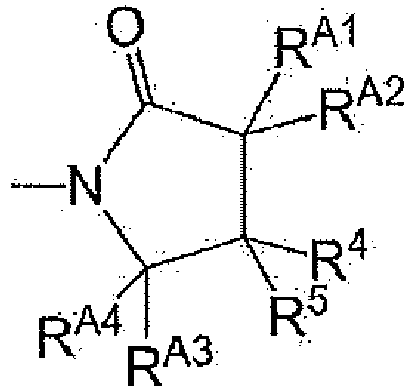
RA1 and RA2 are the same or different and each is - (1) a cyano group,
- (2) a carbamoyl group,
- (3) a C1-6 alkyl group (e.g., methyl, ethyl, propyl, isopropyl) optionally substituted by 1 to 3 substituents selected from
- (I) a carboxy group,
- (II) a cyano group,
- (III) a halogen atom (e.g., a fluorine atom),
- (IV) a C1-6 alkoxy group (e.g., methoxy),
- (V) a C3-6 cycloalkyl group (e.g., cyclopropyl),
- (VI) an amino group optionally mono- or di-substituted by substituent(s) selected from
- (i) a C1-6 alkyl-carbonyl group (e.g., acetyl), and
- (ii) a C1-6 alkoxy-carbonyl group (e.g., tert-butoxycarbonyl), and
- (VII) a hydroxy group,
- (4) a C3-6 cycloalkyl group (e.g., cyclopropyl, cyclobutyl),
- (5) a 3- to 8-membered monocyclic non-aromatic heterocyclic group (e.g., oxetanyl, azetidinyl) optionally substituted by 1 to 3 C1-6 alkoxy-carbonyl groups (e.g., tert-butoxycarbonyl), or
- (6) a C1-6 alkoxy-carbonyl group (e.g., ethoxycarbonyl);
RA3 is a hydrogen atom or a C1-3 alkyl group (e.g., methyl, ethyl);
RA4 is a hydrogen atom;
R4 is a hydrogen atom or a C1-3 alkyl group (e.g., methyl, ethyl); and
R5 is a hydrogen atom; - (1) a 5- or 6-membered monocyclic aromatic heterocyclic group (preferably pyrazolyl, pyridyl, pyrimidinyl, thiazolyl, imidazolyl, thienyl, more preferably pyrazolyl), a C6-14 aryl group (preferably phenyl) or a 8- to 12-membered fused aromatic heterocyclic group (preferably indazolyl, benzothiazolyl, indolyl), each of which is optionally substituted by 1 to 3 substituents selected from
- (a) a cyano group,
- (b) a carboxy group,
- (c) a halogen atom (e.g., a chlorine atom, a fluorine atom),
- (d) a C1-6 alkyl group (e.g., methyl, ethyl, isopropyl, tert-butyl, isobutyl) optionally substituted by 1 to 3 substituents selected from
- (I) a hydroxy group,
- (II) a cyano group,
- (III) a carboxy group,
- (IV) a carbamoyl group optionally mono- or di-substituted by C1-6 alkyl group(s) (e.g., methyl, ethyl, tert-butyl) optionally substituted by 1 to 3 substituents selected from
- (i) a C1-6 alkoxy group (e.g., methoxy),
- (ii) a hydroxy group,
- (iii) a halogen atom (e.g., a fluorine atom), and
- (iv) a C1-6 alkylsulfonyl group (e.g., methylsulfonyl),
- (V) an amino group optionally mono- or di-substituted by substituent(s) selected from
- (i) a C1-6 alkyl-carbonyl group (e.g., acetyl) optionally substituted by 1 to 3 substituents selected from
- (A) a C1-6 alkoxy group (e.g., methoxy), and
- (B) a hydroxy group,
- (ii) a C1-6 alkylsulfonyl group (e.g., methylsulfonyl),
- (iii) a sulfamoyl group optionally mono- or di-substituted by C1-6 alkyl group(s) (e.g., methyl), and
- (iv) a C1-6 alkyl group (e.g., methyl),
- (i) a C1-6 alkyl-carbonyl group (e.g., acetyl) optionally substituted by 1 to 3 substituents selected from
- (VI) a C1-6 alkoxy-carbonyl group (e.g., ethoxycarbonyl, butoxycarbonyl),
- (VII) a C6-14 aryl group (e.g., phenyl) optionally substituted by 1 to 3 C1-6 alkoxy groups (e.g., methoxy),
- (VIII) a 3- to 8-membered monocyclic non-aromatic heterocyclic group (e.g., morpholinyl),
- (IX) a 3- to 8-membered monocyclic non-aromatic heterocyclylcarbonyl group (e.g., morpholinylcarbonyl, pyrrolidinylcarbonyl, piperidylcarbonyl, piperazinylcarbonyl) optionally substituted by 1 to 3 substituents selected from
- (i) a hydroxy group,
- (ii) a carbamoyl group, and
- (iii) a C1-6 alkyl group (e.g., methyl),
- (X) a halogen atom (e.g., a fluorine atom), and
- (XI) a C1-6 alkylsulfonyl group (e.g., methylsulfonyl),
- (e) a C1-6 alkyl-carbonyl group (e.g., acetyl),
- (f) a C1-6 alkylsulfonyl group (e.g., methylsulfonyl),
- (g) an amino group optionally mono- or di-substituted by substituent(s) selected from
- (I) a C1-6 alkyl group (e.g., methyl),
- (II) a C1-6 alkyl-carbonyl group (e.g., acetyl) optionally substituted by 1 to 3 C1-6 alkoxy groups (e.g., methoxy), and
- (III) a C1-6 alkylsulfonyl group (e.g., methylsulfonyl),
- (h) a carbamoyl group optionally mono- or di-substituted by substituent(s) selected from
- (I) a C1-6 alkyl group (e.g., methyl, ethyl, tert-butyl) optionally substituted by 1 to 3 substituents selected from
- (i) a hydroxy group,
- (ii) a 3- to 8-membered monocyclic non-aromatic heterocyclic group (e.g., oxetanyl, morpholinyl) optionally substituted by 1 to 3 C1-6 alkyl groups (e.g., methyl), and
- (iii) a C1-6 alkylsulfonyl group (e.g., methylsulfonyl),
- (II) a C3-6 cycloalkyl group (e.g., cyclopropyl, cyclobutyl, cyclohexyl) optionally substituted by 1 to 3 substituents selected from
- (i) a cyano group, and
- (ii) a hydroxy group, and
- (III) a 3- to 8-membered monocyclic non-aromatic heterocyclic group (e.g., oxetanyl, tetrahydropyranyl),
- (I) a C1-6 alkyl group (e.g., methyl, ethyl, tert-butyl) optionally substituted by 1 to 3 substituents selected from
- (i) a sulfamoyl group optionally mono- or di-substituted by C1-6 alkyl group(s) (e.g., methyl),
- (j) a 3- to 8-membered monocyclic non-aromatic heterocyclic group (e.g., morpholinyl, tetrahydropyranyl, piperidyl, piperazinyl, 1,1-dioxidothiomorpholinyl, dihydrooxadiazolyl, azetidinyl, imidazolidinyl, oxetanyl, pyrrolidinyl, 1,1-dioxidetetrahydrothiopyranyl) optionally substituted by 1 to 3 substituents selected from
- (I) a C1-6 alkyl group (e.g., methyl) optionally substituted by 1 to 3 hydroxy groups,
- (II) a C1-6 alkyl-carbonyl group (e.g., acetyl) optionally substituted by 1 to 3 substituents selected from
- (i) a C1-6 alkoxy group (e.g., methoxy), and
- (ii) a cyano group,
- (III) a C1-6 alkoxy-carbonyl group (e.g., tert-butoxycarbonyl),
- (IV) an oxo group,
- (V) a C1-6 alkylsulfonyl group (e.g., methylsulfonyl),
- (VI) a carbamoyl group optionally mono- or di-substituted by C1-6 alkyl group(s) (e.g., methyl),
- (VII) a cyano group,
- (VIII) a hydroxy group, and
- (IX) a carboxy group,
- (k) a C3-6 cycloalkyl group (e.g., cyclopropyl, cyclobutyl, cyclopentyl, cyclohexyl) optionally substituted by 1 to 3 substituents selected from
- (I) a carbamoyl group optionally mono- or di-substituted by C1-6 alkyl group (s) (e.g., methyl),
- (II) a carboxy group, and
- (III) a C1-6 alkyl group (e.g., methyl) optionally substituted by 1 to 3 hydroxy groups,
- (l) a C1-6 alkoxy group (e.g., methoxy, ethoxy, isopropoxy, isobutoxy) optionally substituted by 1 to 3 substituents selected from
- (I) a halogen atom (e.g., a fluorine atom),
- (II) a C1-6 alkoxy group (e.g., methoxy), and
- (III) a C3-6 cycloalkyl group (e.g., cyclopropyl),
- (m) a C1-6 alkoxy-carbonyl group (e.g., tert-butoxycarbonyl),
- (n) a 3- to 8-membered monocyclic non-aromatic heterocyclylcarbonyl group (e.g., pyrrolidinylcarbonyl, morpholinylcarbonyl, piperidylcarbonyl, azetidinylcarbonyl, 2-oxa-6-azaspiro[3.3]heptylcarbonyl, 1,1-dioxidothiomorpholinylcarbonyl) optionally substituted by 1 to 3 substituents selected from
- (I) a hydroxy group,
- (II) an oxo group,
- (III) a halogen atom (e.g., a fluorine atom),
- (IV) a C1-6 alkoxy group (e.g., methoxy), and
- (V) a C1-6 alkyl group (e.g., methyl),
- (o) a C1-6 alkylsulfanyl group (e.g., methylsulfanyl), and
- (p) a 5- or 6-membered monocyclic aromatic heterocyclic group (e.g., tetrazolyl); and
- Compound (I) wherein
R1 is a group represented by the following formula:
RA1 is - (1) a cyano group,
- (2) a C1-6 alkyl group (e.g., methyl, ethyl) optionally substituted by 1 to 3 substituents selected from
- (I) an amino group optionally mono- or di-substituted by substituent(s) selected from
- (i) a C1-6 alkyl-carbonyl group (e.g., acetyl), and
- (ii) a C1-6 alkoxy-carbonyl group (e.g., tert-butoxycarbonyl),
- (II) a hydroxy group, and
- (III) a cyano group, or
- (I) an amino group optionally mono- or di-substituted by substituent(s) selected from
- (3) a C1-6 alkoxy-carbonyl group (e.g., ethoxycarbonyl);
RA2 is- (1) a C3-6 cycloalkyl group (e.g., cyclopropyl, cyclobutyl),
- (2) a C1-6 alkyl group (e.g., methyl, ethyl, propyl, isopropyl) optionally substituted by 1 to 3 substituents selected from
- (I) a carboxy group,
- (II) a cyano group,
- (III) a halogen atom (e.g., a fluorine atom),
- (IV) a C1-6 alkoxy group (e.g., methoxy),
- (V) a C3-6 cycloalkyl group (e.g., cyclopropyl), and
- (VI) a hydroxy group,
- (3) a carbamoyl group, or
- (4) a 3- to 8-membered monocyclic non-aromatic heterocyclic group (e.g., oxetanyl, azetidinyl) optionally substituted by 1 to 3 C1-6 alkoxy-carbonyl groups (e.g., tert-butoxycarbonyl);
RA4 is a hydrogen atom;
R4 is a hydrogen atom or a C1-3 alkyl group (e.g., methyl, ethyl); and
R5 is a hydrogen atom;
R2 is- (1) a 5- or 6-membered monocyclic aromatic heterocyclic group (preferably pyrazolyl, pyridyl, pyrimidinyl, thiazolyl, imidazolyl, thienyl, more preferably pyrazolyl), a C6-14 aryl group (preferably phenyl) or a 8- to 12-membered fused aromatic heterocyclic group (preferably indazolyl, benzothiazolyl, indolyl), each of which is optionally substituted by 1 to 3 substituents selected from
- (a) a cyano group,
- (b) a carboxy group,
- (c) a halogen atom (e.g., a chlorine atom, a fluorine atom),
- (d) a C1-6 alkyl group (e.g., methyl, ethyl, isopropyl, tert-butyl, isobutyl) optionally substituted by 1 to 3 substituents selected from
- (I) a hydroxy group,
- (II) a cyano group,
- (III) a carboxy group,
- (IV) a carbamoyl group optionally mono- or di-substituted by C1-6 alkyl group(s) (e.g., methyl, ethyl, tert-butyl) optionally substituted by 1 to 3 substituents selected from
- (i) a C1-6 alkoxy group (e.g., methoxy),
- (ii) a hydroxy group,
- (iii) a halogen atom (e.g., a fluorine atom), and
- (iv) a C1-6 alkylsulfonyl group (e.g., methylsulfonyl),
- (V) an amino group optionally mono- or di-substituted by substituent(s) selected from
- (i) a C1-6 alkyl-carbonyl group (e.g., acetyl) optionally substituted by 1 to 3 substituents selected from
- (A) a C1-6 alkoxy group (e.g., methoxy), and
- (B) a hydroxy group,
- (ii) a C1-6 alkylsulfonyl group (e.g., methylsulfonyl),
- (iii) a sulfamoyl group optionally mono- or di-substituted by C1-6 alkyl group(s) (e.g., methyl), and
- (iv) a C1-6 alkyl group (e.g., methyl),
- (i) a C1-6 alkyl-carbonyl group (e.g., acetyl) optionally substituted by 1 to 3 substituents selected from
- (VI) a C1-6 alkoxy-carbonyl group (e.g., ethoxycarbonyl, butoxycarbonyl),
- (VII) a C6-14 aryl group (e.g., phenyl) optionally substituted by 1 to 3 C1-6 alkoxy groups (e.g., methoxy),
- (VIII) a 3- to 8-membered monocyclic non-aromatic heterocyclic group (e.g., morpholinyl),
- (IX) a 3- to 8-membered monocyclic non-aromatic heterocyclylcarbonyl group (e.g., morpholinylcarbonyl, pyrrolidinylcarbonyl, piperidylcarbonyl, piperazinylcarbonyl) optionally substituted by 1 to 3 substituents selected from
- (i) a hydroxy group,
- (ii) a carbamoyl group, and
- (iii) a C1-6 alkyl group (e.g., methyl),
- (X) a halogen atom (e.g., a fluorine atom), and
- (XI) a C1-6 alkylsulfonyl group (e.g., methylsulfonyl),
- (e) a C1-6 alkyl-carbonyl group (e.g., acetyl),
- (f) a C1-6 alkylsulfonyl group (e.g., methylsulfonyl),
- (g) an amino group optionally mono- or di-substituted by substituent(s) selected from
- (I) a C1-6 alkyl group (e.g., methyl),
- (II) a C1-6 alkyl-carbonyl group (e.g., acetyl) optionally substituted by 1 to 3 C1-6 alkoxy groups (e.g., methoxy), and
- (III) a C1-6 alkylsulfonyl group (e.g., methylsulfonyl),
- (h) a carbamoyl group optionally mono- or di-substituted by substituent(s) selected from
- (I) a C1-6 alkyl group (e.g., methyl, ethyl, tert-butyl) optionally substituted by 1 to 3 substituents selected from
- (i) a hydroxy group,
- (ii) a 3- to 8-membered monocyclic non-aromatic heterocyclic group (e.g., oxetanyl, morpholinyl) optionally substituted by 1 to 3 C1-6 alkyl groups (e.g., methyl), and
- (iii) a C1-6 alkylsulfonyl group (e.g., methylsulfonyl),
- (II) a C3-6 cycloalkyl group (e.g., cyclopropyl, cyclobutyl, cyclohexyl) optionally substituted by 1 to 3 substituents selected from
- (i) a cyano group, and
- (ii) a hydroxy group, and
- (III) a 3- to 8-membered monocyclic non-aromatic heterocyclic group (e.g., oxetanyl, tetrahydropyranyl),
- (I) a C1-6 alkyl group (e.g., methyl, ethyl, tert-butyl) optionally substituted by 1 to 3 substituents selected from
- (i) a sulfamoyl group optionally mono- or di-substituted by C1-6 alkyl group (s) (e.g., methyl),
- (j) a 3- to 8-membered monocyclic non-aromatic heterocyclic group (e.g., morpholinyl, tetrahydropyranyl, piperidyl, piperazinyl, 1,1-dioxidothiomorpholinyl, dihydrooxadiazolyl, azetidinyl, imidazolidinyl, oxetanyl, pyrrolidinyl, 1,1-dioxidetetrahydrothiopyranyl) optionally substituted by 1 to 3 substituents selected from
- (I) a C1-6 alkyl group (e.g., methyl) optionally substituted by 1 to 3 hydroxy groups,
- (II) a C1-6 alkyl-carbonyl group (e.g., acetyl) optionally substituted by 1 to 3 substituents selected from
- (i) a C1-6 alkoxy group (e.g., methoxy), and
- (ii) a cyano group,
- (III) a C1-6 alkoxy-carbonyl group (e.g., tert-butoxycarbonyl),
- (IV) an oxo group,
- (V) a C1-6 alkylsulfonyl group (e.g., methylsulfonyl),
- (VI) a carbamoyl group optionally mono- or di-substituted by C1-6 alkyl group(s) (e.g., methyl),
- (VII) a cyano group,
- (VIII) a hydroxy group, and
- (IX) a carboxy group,
- (k) a C3-6 cycloalkyl group (e.g., cyclopropyl, cyclobutyl, cyclopentyl, cyclohexyl) optionally substituted by 1 to 3 substituents selected from
- (I) a carbamoyl group optionally mono- or di-substituted by C1-6 alkyl group(s) (e.g., methyl),
- (II) a carboxy group, and
- (III) a C1-6 alkyl group (e.g., methyl) optionally substituted by 1 to 3 hydroxy groups,
- (l) a C1-6 alkoxy group (e.g., methoxy, ethoxy, isopropoxy, isobutoxy) optionally substituted by 1 to 3 substituents selected from
- (I) a halogen atom (e.g., a fluorine atom),
- (II) a C1-6 alkoxy group (e.g., methoxy), and
- (III) a C3-6 cycloalkyl group (e.g., cyclopropyl),
- (m) a C1-6 alkoxy-carbonyl group (e.g., tert-butoxycarbonyl),
- (n) a 3- to 8-membered monocyclic non-aromatic heterocyclylcarbonyl group (e.g., pyrrolidinylcarbonyl, morpholinylcarbonyl, piperidylcarbonyl, azetidinylcarbonyl, 2-oxa-6-azaspiro[3.3]heptylcarbonyl, 1,1-dioxidothiomorpholinylcarbonyl) optionally substituted by 1 to 3 substituents selected from
- (I) a hydroxy group,
- (II) an oxo group,
- (III) a halogen atom (e.g., a fluorine atom),
- (IV) a C1-6 alkoxy group (e.g., methoxy), and
- (V) a C1-6 alkyl group (e.g., methyl),
- (o) a C1-6 alkylsulfanyl group (e.g., methylsulfanyl), and
- (p) a 5- or 6-membered monocyclic aromatic heterocyclic group (e.g., tetrazolyl); and
- A compound selected from
- (3S)-3-cyclopropyl-1-(2-((1-(1-hydroxy-2-methylpropan-2-yl)-1H-pyrazol-4-yl)amino)pyrimidin-4-yl)-2-oxopyrrolidine-3-carbonitrile;
- (3S)-3-cyclopropyl-1-(2-((1-(1-(hydroxymethyl)cyclopropyl)-1H-pyrazol-4-yl)amino)pyrimidin-4-yl)-2-oxopyrrolidine-3-carbonitrile; and
- (3R)-3-ethyl-1-(2-((4-(4-(hydroxymethyl)tetrahydro-2H-pyran-4-yl)phenyl)amino)pyrimidin-4-yl)-2-oxopyrrolidine-3-carbonitrile,
- When compound (I) is in a form of a salt, examples thereof include metal salts, an ammonium salt, salts with organic base, salts with inorganic acid, salts with organic acid, salts with basic or acidic amino acid, and the like. Preferable examples of the metal salt include alkali metal salts such as sodium salt, potassium salt and the like; alkaline earth metal salts such as calcium salt, magnesium salt, barium salt and the like; an aluminum salt, and the like. Preferable examples of the salt with organic base include salts with trimethylamine, triethylamine, pyridine, picoline, 2,6-lutidine, ethanolamine, diethanolamine, triethanolamine, cyclohexylamine, dicyclohexylamine, N,N'-dibenzylethylenediamine and the like. Preferable examples of the salt with inorganic acid include salts with hydrochloric acid, hydrobromic acid, nitric acid, sulfuric acid, phosphoric acid and the like. Preferable examples of the salt with organic acid include salts with formic acid, acetic acid, trifluoroacetic acid, phthalic acid, fumaric acid, oxalic acid, tartaric acid, maleic acid, citric acid, succinic acid, malic acid, methanesulfonic acid, benzenesulfonic acid, p-toluenesulfonic acid and the like. Preferable examples of the salt with basic amino acid include salts with arginine, lysine, ornithine and the like. Preferable examples of the salt with acidic amino acid include salts with aspartic acid, glutamic acid and the like.
- Among them, a pharmaceutically acceptable salt is preferable. For example, when a compound has an acidic functional group, examples thereof include inorganic salts such as alkali metal salts (e.g., sodium salt, potassium salt etc.), alkaline earth metal salts (e.g., calcium salt, magnesium salt etc.) and the like, ammonium salt etc., and when a compound has a basic functional group, examples thereof include salts with inorganic acid such as hydrochloric acid, hydrobromic acid, nitric acid, sulfuric acid, phosphoric acid and the like, and salts with organic acid such as acetic acid, phthalic acid, fumaric acid, oxalic acid, tartaric acid, maleic acid, citric acid, succinic acid, methanesulfonic acid, benzenesulfonic acid, p-toluenesulfonic acid and the like.
- The production method of compound (I) or a salt thereof of the present invention are explained in the followings.
- The compound (I) and the raw material compounds can be produced according to a method known per se, for example, method shown in the following scheme and the like. In each step in the following production method, the "room temperature" generally means 10 to 35°C and, unless otherwise specified, each symbol in the chemical formulas described in the schemes is as defined above. In the compounds in the formulas, each compound includes salts, and examples of such salt include those similar to the salts of compound (I) and the like.
- In each reaction, when the raw material compound or intermediate has an amino group, a carboxy group or a hydroxy group as a substituent, these groups may be protected by a protecting group generally used in peptide chemistry and the like. By removing the protecting group as necessary after the reaction, the objective compound can be obtained. The introduction and removal of the protecting group can be performed according to a method known per se, for example, the method described in "Protective Groups in Organic Synthesis, 4th Ed", Wiley-Interscience, Inc. (2006) (Theodora W. Greene, Peter G. M. Wuts).
- Examples of the amino-protecting group include a C1-6 alkyl group, a C7-14 aralkyl group optionally substituted by C1-6 alkoxy group(s) (e.g., benzyl, 4-methoxybenzyl), a formyl group, a C1-6 alkyl-carbonyl group, a C1-6 alkoxy-carbonyl group, a benzoyl group, a 4-fluorobenzoyl group, a C7-14 aralkyl-carbonyl group (e.g., benzylcarbonyl etc.), a C7-14 aralkyloxy-carbonyl group (e.g., benzyloxycarbonyl, 9-fluorenylmethoxycarbonyl etc.), a trityl group, a phthaloyl group, an N,N-dimethylaminomethylene group, a silyl group optionally substituted by C1-6 alkyl group(s) (e.g., trimethylsilyl, triethylsilyl, dimethylphenylsilyl, tert-butyldimethylsilyl, tert-butyldiethylsilyl etc.), a C2-6 alkenyl group (e.g., 1-allyl etc.) and the like. These groups are optionally substituted by 1 to 3 substituents selected from a halogen atom, C1-6 alkoxy group and a nitro group.
- Examples of the carboxyl-protecting group include a C1-6 alkyl group, a C7-14 aralkyl group (e.g., benzyl etc.), a phenyl group, a trityl group, a silyl group optionally substituted by C1-6 alkyl group(s) (e.g., trimethylsilyl, triethylsilyl, dimethylphenylsilyl, tert-butyldimethylsilyl, tert-butyldiethylsilyl etc.), a C2-6 alkenyl group (e.g., 1-allyl etc.) and the like.
- Examples of the hydroxy-protecting group include a C1-6 alkyl group, a phenyl group, a trityl group, a C7-14 aralkyl group (e.g., benzyl etc.), a formyl group, a C1-6 alkyl-carbonyl group, a benzoyl group, a C7-14 aralkyl-carbonyl group (e.g., benzylcarbonyl etc.), a 2-tetrahydropyranyl group, a 2-tetrahydrofuranyl group, a silyl group optionally substituted by C1-6 alkyl group(s) (e.g., trimethylsilyl, triethylsilyl, dimethylphenylsilyl, tert-butyldimethylsilyl, tert-butyldiethylsilyl etc.), a C2-6 alkenyl group (e.g., 1-allyl etc.) and the like.
- These groups are optionally substituted by 1 to 3 substituents selected from a halogen atom, a C1-6 alkyl group, a C1-6 alkoxy group and a nitro group.
- These protecting groups can be removed according to a method known per se, for example, the method described in "Protective Groups in Organic Synthesis, 4thEd." Wiley-Interscience, Inc. (2006) (Theodora W. Greene, Peter G. M. Wuts) or the like. Specifically, a method using acid, base, ultraviolet rays, hydrazine, phenylhydrazine, sodium N-methyldithiocarbamate, tetrabutylammonium fluoride, palladium acetate, trialkylsilyl halide (e.g., trimethylsilyl iodide, trimethylsilyl bromide) and the like, a reduction method, and the like can be employed.
- The compound obtained in each step can be used directly for the next step as the reaction mixture or a crude product, or can be isolated from the reaction mixture according to a conventional means, and can be easily purified according to a separation means such as recrystallized, distillation, chromatography and the like.
- Where necessary, the reaction in each step can also be carried out under microwave irradiation using microwave irradiation apparatus (e.g., INITIATOR, manufactured by Biotage, etc.) and the like.
- Compound (I) can be produced, for example, according to the following Method A, Method B or a method analogous thereto. The raw material compound in each method may be a commercially available product, or can also be produced according to a method known per se or a method analogous thereto. In each step of the following production methods, the raw material compounds may be in the form of a salt, and examples of such salt include those similar to the salts of compound (I).
-

- Examples of the leaving group for LG include halogen atoms (e.g., a chlorine atom, a bromine atom, an iodine atom etc.), optionally substituted sulfonyloxy groups (e.g., C1-6 alkylsulfonyloxy groups optionally substituted by 1 to 3 halogen atoms (e.g., a methanesulfonyloxy group, an ethanesulfonyloxy group, a trifluoromethanesulfonyloxy group etc.); C6-14 arylsulfonyloxy groups optionally substituted by 1 to 3 C1-6 alkyl groups (e.g., a benzenesulfonyloxy group, a p-toluenesulfonyloxy group etc.); C7-14 aralkylsulfonyloxy groups (e.g., a benzylsulfonyloxy group etc.) etc.), an [(oxide)phenyl-λ4-sulfanylidene]dimethylammonium group and the like.
- In this method, compound (II), compound (III) and compound (VI) used as raw material compounds may be commercially available products, or can also be produced according to a method known per se or a method analogous thereto.
- This step is a step of reacting compound (II) with compound (III) to convert compound (II) to compound (IV). This step can be performed, where necessary, in the presence of a base, in a solvent that does not adversely influence the reaction.
- The amount of compound (III) to be used is about 1 - about 100 mol equivalents, particularly preferably about 1 - about 10 mol equivalents, relative to compound (II).
- Examples of the acid to be used include hydrochloric acid, acetic acid, hydrobromic acid, sulfuric acid, trifluoroacetic acid, trifluoromethanesulfonic acid, hydrogen chloride and the like.
- The amount of the acid to be used is about 0.1 - about 100 mol equivalents, preferably about 1 - about 10 mol equivalents, relative to compound (II).
- Examples of the base to be used include organic amines (e.g., trimethylamine, triethylamine, N-ethyldiisopropylamine, N-methylmorpholine, 1,8-diazabicyclo[5.4.0]undec-7-ene, pyridine, N,N-dimethylaniline etc.), alkali metal salts (e.g., sodium hydrogen carbonate, potassium hydrogen carbonate, sodium carbonate, potassium carbonate, cesium carbonate, sodium acetate, potassium acetate, sodium phosphate, potassium phosphate etc.), alkali metal hydroxides (e.g., sodium hydroxide, potassium hydroxide etc.), metal hydrides (potassium hydride, sodium hydride etc.), alkali metal alkoxides (sodium methoxide, sodium ethoxide, sodium tert-butoxide, potassium tert-butoxide etc.), alkali metal disilazides (e.g., lithium disilazide, sodium disilazide, potassium disilazide etc.) and the like. Among them, organic amines (e.g., trimethylamine, triethylamine, N-ethyldiisopropylamine, N-methylmorpholine, 1,8-diazabicyclo[5.4.0]undec-7-ene etc.) are preferable.
- The amount of the base to be used is about 0.1 - about 100 mol equivalents, preferably about 1 - about 10 mol equivalents, relative to compound (II).
- In this step, the solvent is not particularly limited as long as the reaction proceeds. Examples thereof include hydrocarbons (e.g., benzene, toluene, xylene, hexane, heptane etc.), halogenated hydrocarbons (e.g., chloroform, dichloromethane etc.), ethers (e.g., diethyl ether, diisopropyl ether, tert-butyl methyl ether, tetrahydrofuran, 1,4-dioxane, 1,2-dimethoxyethane, diethylene glycol dimethyl ether etc.), nitriles (e.g., acetonitrile etc.), aprotric polar solvents (e.g., N,N-dimethylformamide, dimethylsulfoxide, N-methylpyrrolidone, hexamethylphosphoramide etc.), protic polar solvents (e.g., water, methanol, ethanol, 1-propanol, 2-propanol, 1-butanol, 2-methyl-2-propanol etc.) and mixtures thereof.
- The reaction temperature in this step is generally about -50 - about 200°C, preferably about 0°C - about 180°C. The reaction time in this step is generally about 0.1 hr - about 100 hr.
- The thus-obtained compound (IV) can be isolated and purified by a known separation and purification means, for example, concentration, concentrated under reduced pressure, solvent extraction, crystallization, recrystallization, phase transfer, chromatography and the like. In addition, compound (IV) may be directly used without isolation for the next reaction.
- This step is a step of reacting compound (IV) with a halogenating agent or a sulfonating agent to convert compound (IV) to compound (V). This step can be performed, where necessary, in a solvent that does not adversely influence the reaction.
- Examples of the halogenating agent to be used include phosphorus oxychloride, phosphorus tribromide, phosphorus trichloride and the like. Examples of the sulfonating agent to be used include methanesulfonyl chloride, ethanesulfonyl chloride, benzenesulfonyl chloride, p-toluenesulfonyl chloride, benzylsulfonyl chloride and the like.
- The amount of the halogenating agent or sulfonating agent to be used is about 1 - about 100 mol equivalents, relative to compound (IV), respectively.
- In this reaction, the solvent is not particularly limited as long as the reaction proceeds. Examples thereof include hydrocarbons (e.g., benzene, toluene, xylene, hexane, heptane etc.), halogenated hydrocarbons (e.g., chloroform, dichloromethane etc.), ethers (e.g., diethyl ether, diisopropyl ether, tert-butyl methyl ether, tetrahydrofuran, 1,4-dioxane, 1,2-dimethoxyethane etc.), nitriles (e.g., acetonitrile etc.), aprotic polar solvents (e.g., N,N-dimethylformamide, dimethylsulfoxide, N-methylpyrrolidone, hexamethylphosphoramide etc.) and mixtures thereof.
- The reaction temperature in this step is generally about -50 - about 200°C, preferably about -10°C - about 150°C. The reaction time in this step is generally about 0.1 hr - about 100 hr.
- The thus-obtained compound (V) can be isolated and purified by a known separation and purification means, for example, concentration, concentrated under reduced pressure, solvent extraction, crystallization, recrystallization, phase transfer, chromatography and the like. In addition, compound (V) may be directly used without isolation for the next reaction.
- This step is a step of subjecting compound (V) to a coupling reaction with compound (VI) using a transition metal catalyst to convert compound (V) to compound (I).
- The reaction using a transition metal catalyst can be carried out according to a method known per se [e.g., Chemical Science, 2011, vol. 2, page 27, and the like], for example, in the presence of a transition metal catalyst and a base, in a solvent that does not adversely influence the reaction.
- The amount of compound (VI) to be used is about 1 mol-about 100 mol equivalents, preferably about 1 mol - about 5 mol equivalents, relative to compound (V).
- Examples of the transition metal catalyst to be used include palladium catalysts (e.g., palladium(II) acetate, tris(dibenzylideneacetone)dipalladium(0), palladium(II) chloride, tetrakis(triphenylphosphine)palladium(0), (1,1'-bis(diphenylphosphino)ferrocene)dichloropalladium(II)) and the like, nickel catalysts (e.g., nickel chloride etc.) and the like. Where necessary, a ligand (e.g., 4,5-bis(diphenylphosphino)-9,9-dimethylxanthene, 2,2'-bis(diphenylphosphino)-1,1'-binaphthyl, 2,2'-bis(di-p-tolylphosphino)-1,1'-binaphthyl, 2-dicyclohexyl phosphino-2',4',6'-triisopropyl-1,1'-biphenyl, triphenylphosphine, tri-tert-butylphosphine, dicyclohexyl (2',4',6'-triisopropyl-3,6-dimethoxybiphenyl-2-yl)phosphine etc.) may be added.
- While the amount of the transition metal catalyst to be used varies depending on the kinds of the catalyst, it is generally about 0.0001 - about 1 mol equivalents, preferably about 0.01 - about 0.5 mol equivalents, relative to compound (V). The amount of the ligand to be used is generally about 0.0001- about 4 mol equivalents, preferably about 0.01 - about 2 mol equivalents, relative to compound (V).
- Examples of the base to be used include organic amines (e.g., trimethylamine, triethylamine, N-ethyldiisopropylamine, N-methylmorpholine, 1,8-diazabicyclo[5.4.0]undec-7-ene, pyridine, N,N-dimethylaniline etc.), alkali metal salts (e.g., sodium hydrogen carbonate, potassium hydrogen carbonate, sodium carbonate, potassium carbonate, cesium carbonate, sodium acetate, potassium acetate, sodium phosphate, potassium phosphate etc.), alkali metal hydroxides (e.g., sodium hydroxide, potassium hydroxide etc.), metal hydrides (potassium hydride, sodium hydride etc.), alkali metal alkoxides (sodium methoxide, sodium ethoxide, sodium tert-butoxide, potassium tert-butoxide etc.), alkali metal disilazides (e.g., lithium disilazide, sodium disilazide, potassium disilazide etc.) and the like. Among them, alkali metal salts (sodium carbonate, potassium carbonate, cesium carbonate etc.) are preferable.
- The amount of the base to be used is about 0.1 - about 100 mol equivalents, preferably about 1 - about 10 mol equivalents, relative to compound (V).
- In this reaction, the solvent is not particularly limited as long as the reaction proceeds. Examples thereof include hydrocarbons (e.g., benzene, toluene, xylene, hexane, heptane etc.), halogenated hydrocarbons (e.g., chloroform, dichloromethane etc.), ethers (e.g., diethyl ether, diisopropyl ether, tert-butyl methyl ether, tetrahydrofuran, 1,4-dioxane, 1,2-dimethoxyethane etc.), nitriles (e.g., acetonitrile etc.), aprotic polar solvents (e.g., N,N-dimethylformamide, dimethylsulfoxide, N-methylpyrrolidone, hexamethylphosphoramide etc.), protic polar solvents (e.g., water, methanol, ethanol, 1-propanol, 2-propanol, 1-butanol, 2-methyl-2-propanol etc.) and mixtures thereof.
- The reaction temperature in this step is generally about -50 - about 200°C, preferably about -10°C - about 150°C. The reaction time in this step is generally about 0.1 hr - about 100 hr.
- The thus-obtained compound (I) can be isolated and purified by a known separation and purification means, for example, concentration, concentrated under reduced pressure, solvent extraction, crystallization, recrystallization, phase transfer, chromatography and the like.
-

- In this method, compound (VII), compound (III) and compound (VI) used as raw material compounds may be commercially available products, or can also be produced according to a method known per se or a method analogous thereto.
- This step is a step of subjecting compound (VII) to a coupling reaction with compound (VI) using a transition metal catalyst to convert compound (VII) to compound (VIII).
- The reaction using a transition metal catalyst can be carried out according to a method known per se [e.g., Chemical Science), 2011, vol. 2, page 27, and the like], for example, in the presence of a transition metal catalyst and a base, in a solvent that does not adversely influence the reaction.
- The amount of compound (VI) to be used is about 1 mol - about 100 mol equivalents, preferably about 1 mol - about 5 mol equivalents, relative to compound (VII).
- Examples of the transition metal catalyst to be used include palladium catalysts (e.g., palladium(II) acetate, tris(dibenzylideneacetone)dipalladium(0), palladium(II) chloride, tetrakis(triphenylphosphine)palladium(0), (1,1'-bis(diphenylphosphino)ferrocene)dichloropalladium (II)) and the like, nickel catalysts (e.g., nickel chloride etc.) and the like. Where necessary, a ligand (e.g., 4,5-bis(diphenylphosphino)-9,9-dimethylxanthene, 2,2'-bis(diphenylphosphino)-1,1'-binaphthyl, 2,2'-bis(di-p-tolylphosphino)-1,1'-binaphthyl, 2-dicyclohexyl phosphino-2',4',6'-triisopropyl-1,1'-biphenyl, triphenylphosphine, tri-tert-butylphosphine, dicyclohexyl (2',4',6'-triisopropyl-3,6-dimethoxybiphenyl-2-yl)phosphine etc.) may be added.
- While the amount of the transition metal catalyst to be used varies depending on the kinds of the catalyst, it is generally about 0.0001 - about 1 mol equivalents, preferably about 0.01 - about 0.5 mol equivalents, relative to compound (VII). The amount of the ligand to be used is generally about 0.0001- about 4 mol equivalents, preferably about 0.01 - about 2 mol equivalents, relative to compound (VII).
- Examples of the base to be used include organic amines (e.g., trimethylamine, triethylamine, N-ethyldiisopropylamine, N-methylmorpholine, 1,8-diazabicyclo[5.4.0]undec-7-ene, pyridine, N,N-dimethylaniline etc.), alkali metal salts (e.g., sodium hydrogen carbonate, potassium hydrogen carbonate, sodium carbonate, potassium carbonate, cesium carbonate, sodium acetate, potassium acetate, sodium phosphate, potassium phosphate etc.), alkali metal hydroxides (e.g., sodium hydroxide, potassium hydroxide etc.), metal hydrides (potassium hydride, sodium hydride etc.), alkali metal alkoxides (sodium methoxide, sodium ethoxide, sodium tert-butoxide, potassium tert-butoxide etc.), alkali metal disilazides (e.g., lithium disilazide, sodium disilazide, potassium disilazide etc.) and the like. Among them, alkali metal salts (sodium carbonate, potassium carbonate, cesium carbonate etc.) are preferable.
- The amount of the base to be used is about 0.1 - about 100 mol equivalents, preferably about 1 - about 10 mol equivalents, relative to compound (VII).
- In this reaction, the solvent is not particularly limited as long as the reaction proceeds. Examples thereof include hydrocarbons (e.g., benzene, toluene, xylene, hexane, heptane etc.), halogenated hydrocarbons (e.g., chloroform, dichloromethane etc.), ethers (e.g., diethyl ether, diisopropyl ether, tert-butyl methyl ether, tetrahydrofuran, 1,4-dioxane, 1,2-dimethoxyethane etc.), nitriles (e.g., acetonitrile etc.), aprotic polar solvents (e.g., N,N-dimethylformamide, dimethylsulfoxide, N-methylpyrrolidone, hexamethylphosphoramide etc.), protic polar solvents (e.g., water, methanol, ethanol, 1-propanol, 2-propanol, 1-butanol, 2-methyl-2-propanol etc.) and mixtures thereof.
- The reaction temperature in this step is generally about -50 - about 200°C, preferably about -10°C - about 150°C. The reaction time in this step is generally about 0.1 hr - about 100 hr.
- The thus-obtained compound (VIII) can be isolated and purified by a known separation and purification means, for example, concentration, concentrated under reduced pressure, solvent extraction, crystallization, recrystallization, phase transfer, chromatography and the like. In addition, compound (VIII) may be directly used without isolation for the next reaction.
- This step is a step of reacting compound (VIII) with compound (III) to convert compound (VIII) to compound (I). This step can be performed, where necessary, in the presence of an acid or a base, adding a transition metal catalyst, in a solvent that does not adversely influence the reaction.
- The amount of compound (III) to be used is about 1 - about 100 mol equivalents, particularly preferably about 1 - about 10 mol equivalents, relative to compound (VIII).
- Examples of the acid to be used include hydrochloric acid, acetic acid, hydrobromic acid, sulfuric acid, trifluoroacetic acid, trifluoromethanesulfonic acid, hydrogen chloride and the like.
- The amount of the acid to be used is about 0.1 - about 100 mol equivalents, preferably about 1 - about 10 mol equivalents, relative to compound (VIII).
- Examples of the base to be used include organic amines (e.g., trimethylamine, triethylamine, N-ethyldiisopropylamine, N-methylmorpholine, 1,8-diazabicyclo[5.4.0]undec-7-ene, pyridine, N,N-dimethylaniline etc.), alkali metal salts (e.g., sodium hydrogen carbonate, potassium hydrogen carbonate, sodium carbonate, potassium carbonate, cesium carbonate, sodium acetate, potassium acetate, sodium phosphate, potassium phosphate etc.), alkali metal hydroxides (e.g., sodium hydroxide, potassium hydroxide etc.), metal hydrides (potassium hydride, sodium hydride etc.), alkali metal alkoxides (sodium methoxide, sodium ethoxide, sodium tert-butoxide, potassium tert-butoxide etc.), alkali metal disilazides (e.g., lithium disilazide, sodium disilazide, potassium disilazide etc.) and the like. Among them, organic amines (e.g., trimethylamine, triethylamine, N-ethyldiisopropylamine, N-methylmorpholine, 1,8-diazabicyclo[5.4.0]undec-7-ene etc.) are preferable.
- The amount of the base to be used is about 0.1 - about 100 mol equivalents, preferably about 1 - about 10 mol equivalents, relative to compound (VIII).
- Examples of the transition metal catalyst to be used include palladium catalysts (e.g., palladium(II) acetate, tris(dibenzylideneacetone)dipalladium(0) palladium(II) chloride, tetrakis(triphenylphosphine)palladium(0), (1,1'-bis(diphenylphosphino)ferrocene)dichloropalladium (II)) and the like, nickel catalysts (e.g., nickel chloride etc.) and the like. Where necessary, a ligand (e.g., 4,5-bis(diphenylphosphino)-9,9-dimethylxanthene, 2,2'-bis(diphenylphosphino)-1,1'-binaphthyl, 2,2'-bis(di-p-tolylphosphino)-1,1'-binaphthyl, 2-dicyclohexyl phosphino-2',4',6'-triisopropyl-1,1'-biphenyl, triphenylphosphine, tri-tert-butylphosphine, dicyclohexyl (2',4',6'-triisopropyl-3,6-dimethoxybiphenyl-2-yl)phosphine etc.) may be added, or a metal oxide (e.g., copper oxide, silver oxide etc.) may uased as a cocatalyst.
- While the amount of the transition metal catalyst to be used varies depending on the kinds of the catalyst, it is generally about 0.0001 - about 1 mol equivalents, preferably about 0.01 - about 0.5 mol equivalents, relative to compound (VIII). The amount of the ligand to be used is generally about 0.0001- about 4 mol equivalents, preferably about 0.01 - about 2 mol equivalents, relative to compound (VIII).
- In this reaction, the solvent is not particularly limited as long as the reaction proceeds. Examples thereof include hydrocarbons (e.g., benzene, toluene, xylene, hexane, heptane etc.), halogenated hydrocarbons (e.g., chloroform, dichloromethane etc.), ethers (e.g., diethyl ether, diisopropyl ether, tert-butyl methyl ether, tetrahydrofuran, 1,4-dioxane, 1,2-dimethoxyethane etc.), nitriles (e.g., acetonitrile etc.), aprotic polar solvents (e.g., N,N-dimethylformamide, dimethylsulfoxide, N-methylpyrrolidone, hexamethylphosphoramide etc.), protic polar solvents (e.g., water, methanol, ethanol, 1-propanol, 2-propanol, 1-butanol, 2-methyl-2-propanol etc.) and mixtures thereof.
- The reaction temperature in this step is generally about -50 - about 200°C, preferably about 0°C - about 180°C. The reaction time in this step is generally about 0.1 hr - about 100 hr.
- The thus-obtained compound (I) can be isolated and purified by a known separation and purification means, for example, concentration, concentrated under reduced pressure, solvent extraction, crystallization, recrystallization, phase transfer, chromatography and the like.
- Alternatively, compound (VI) can be produced, for example, according to the following Method C or Method D, or a method analogous thereto. The raw material compounds used in each method may be a commercially available product, or can also be produced according to a method known per se or a method analogous thereto.
- Of compound (VI), the compound represented by the formula (VI-A)

-

- Examples of the "amino-protecting group" for PG1 include a formyl group, C1-6 alkyl-carbonyl groups, C1-6 alkoxy-carbonyl groups, a benzoyl group, a 4-fluorobenzoyl group, C7-14 aralkyl-carbonyl groups (e.g., benzylcarbonyl etc.), C7-14 aralkyloxy-carbonyl groups (e.g., benzyloxycarbonyl, 9-fluorenylmethoxycarbonyl etc.) and the like. These group are optionally substituted by 1 to 3 substituents selected from a halogen atom, a C1-6 alkoxy group and a nitro group.
- In this method, compound (IX) and compound (X) used as raw material compounds may be a commercially available product, or can also be produced according to a method known per se [e.g., Journal Heterocyclic Chemistry, 2005, vol 42, page 543, and the like] or method analogous thereto.
- This step is a step of reacting compound (IX) with compound (X) to convert compound (IX) to compound (XI).
- This step can be performed in the presence of a base, where necessary, in a solvent that does not adversely influence the reaction.
- The amount of compound (X) to be used is about 1 - about 100 mol equivalents, particularly preferably about 1 - about 10 mol equivalents, relative to compound (IX).
- Examples of the base to be used include organic amines (e.g., trimethylamine, triethylamine, N-ethyldiisopropylamine, N-methylmorpholine, 1,8-diazabicyclo[5.4.0]undec-7-ene, pyridine, N,N-dimethylaniline etc.), alkali metal salts (e.g., sodium hydrogen carbonate, potassium hydrogen carbonate, sodium carbonate, potassium carbonate, cesium carbonate, sodium acetate, potassium acetate, sodium phosphate, potassium phosphate etc.), alkali metal hydroxides (e.g., sodium hydroxide, potassium hydroxide etc.), metal hydrides (potassium hydride, sodium hydride etc.), alkali metal alkoxides (sodium methoxide, sodium ethoxide, sodium tert-butoxide, potassium tert-butoxide etc.), alkali metal disilazides (e.g., lithium disilazide, sodium disilazide, potassium disilazide etc.), lithium diisopropylamide and the like.
- The amount of the base to be used is about 0.1 - about 100 mol equivalents, particularly preferably about 1 - about 10 mol equivalents, relative to compound (IX).
- In this step, the solvent is not particularly limited as long as the reaction proceeds. Examples thereof include hydrocarbons (e.g., benzene, toluene, xylene, hexane, heptane etc.), halogenated hydrocarbons (e.g., chloroform, dichloromethane etc.), ethers (e.g., diethyl ether, diisopropyl ether, tert-butyl methyl ether, tetrahydrofuran, 1,4-dioxane, 1,2-dimethoxyethane etc.), nitriles (e.g., acetonitrile etc.), aprotic polar solvents (e.g., N,N-dimethylformamide, dimethylsulfoxide, N-methylpyrrolidone, hexamethylphosphoramide etc.) and mixtures thereof.
- The reaction temperature in this step is generally about -80 - about 200°C, preferably about -80°C- about 80°C. The reaction time in this step is generally about 0.1 hr - about 100 hr.
- The thus-obtained compound (XI) can be isolated and purified by a known separation and purification means, for example, concentration, concentrated under reduced pressure, solvent extraction, crystallization, recrystallization, phase transfer, chromatography and the like. In addition, compound (XI) may be directly used without isolation for the next reaction.
- This step is a step of subjecting compound (XI) to a deprotection reaction to convert compound (XI) to compound (VIA).
- This step can be performed, for example, in the presence of an amine (e.g., aqueous ammonia, methylamine, n-octylamine etc.), where necessary, in a solvent that does not adversely influence the reaction.
- The amount of the amine to be used is about 0.1 - about 100 mol equivalents, particularly preferably about 1 - about 10 mol equivalents, relative to compound (XI).
- In this step, the solvent is not particularly limited as long as the reaction proceeds. Examples thereof include hydrocarbons (e.g., benzene, toluene, xylene, hexane, heptane etc.), halogenated hydrocarbons (e.g., chloroform, dichloromethane etc.), ethers (e.g., diethyl ether, diisopropyl ether, tert-butyl methyl ether, tetrahydrofuran, 1,4-dioxane, 1,2-dimethoxyethane etc.), nitriles (e.g., acetonitrile etc.), aprotic polar solvents (e.g., N,N-dimethylformamide, dimethylsulfoxide, N-methylpyrrolidone, hexamethylphosphoramide etc.) and mixtures thereof.
- The reaction temperature in this step is generally about -80 - about 200°C, preferably about 0 - about 100°C. The reaction time in this step is generally about 0.1 hr - about 100 hr.
- The thus-obtained compound (VI-A) can be isolated and purified by a known separation and purification means, for example, concentration, concentrated under reduced pressure, solvent extraction, crystallization, recrystallization, phase transfer, chromatography and the like. In addition, compound (VI-A) may be directly used without isolation for the next reaction.
- Of compound (VI), the compound represented by the formula (VI-B)

-

- Examples of the "amino-protecting group" for PG2 include C1-6 alkyl groups, C7-14 aralkyl groups (e.g., benzyl, p-methoxybenzyl) and the like. These groups are optionally substituted by 1 to 3 substituents selected from a halogen atom, a C1-6 alkoxy group and a nitro group.
- In this method, compound (XII), compound (XIII), compound (XV) and compound (XVII) used as raw material compounds may be commercially available products, or can also be produced according to a method known per se or a method analogous thereto.
- This step is a step of reacting compound (XII) with compound (XIII) to convert compound (XII) to compound (XIV).
- This step can be performed in the presence of a base, where necessary, in a solvent that does not adversely influence the reaction.
- The amount of compound (XIII) to be used is about 1-about 100 mol equivalents, particularly preferably about 1-about 10 mol equivalents, relative to compound (XII).
- Examples of the base to be used include organic amines (e.g., trimethylamine, triethylamine, N-ethyldiisopropylamine, N-methylmorpholine, 1,8-diazabicyclo[5.4.0]undec-7-ene, pyridine, N,N-dimethylaniline etc.), alkali metal salts (e.g., sodium hydrogen carbonate, potassium hydrogen carbonate, sodium carbonate, potassium carbonate, cesium carbonate, sodium acetate, potassium acetate, sodium phosphate, potassium phosphate etc.), alkali metal hydroxides (e.g., sodium hydroxide, potassium hydroxide etc.), metal hydrides (potassium hydride, sodium hydride etc.), alkali metal alkoxides (sodium methoxide, sodium ethoxide, sodium tert-butoxide, potassium tert-butoxide etc.), alkali metal disilazides (e.g., lithium disilazide, sodium disilazide, potassium disilazide etc.), lithium diisopropylamide and the like.
- The amount of the base to be used is about 0.1 - about 100 mol equivalents, particularly preferably about 1 - about 10 mol equivalents, relative to compound (XII).
- In this step, the solvent is not particularly limited as long as the reaction proceeds. Examples thereof include hydrocarbons (e.g., benzene, toluene, xylene, hexane, heptane etc.), halogenated hydrocarbons (e.g., chloroform, dichloromethane etc.), ethers (e.g., diethyl ether, diisopropyl ether, tert-butyl methyl ether, tetrahydrofuran, 1,4-dioxane, 1,2-dimethoxyethane etc.), nitriles (e.g., acetonitrile etc.), aprotic polar solvents (e.g., N,N-dimethylformamide, dimethylsulfoxide, N-methylpyrrolidone, hexamethylphosphoramide etc.) and mixtures thereof.
- The reaction temperature in this step is generally about -50 - about 200°C, preferably about -10°C - about 100°C. The reaction time in this step is generally about 0.1 hr - about 100 hr.
- The thus-obtained compound (XIV) can be isolated and purified by a known separation and purification means, for example, concentration, concentrated under reduced pressure, solvent extraction, crystallization, recrystallization, phase transfer, chromatography and the like. In addition, compound (XIV) may be directly used without isolation for the next reaction.
- This step is a step of reacting compound (XIV) with compound (XV) to convert compound (XIV) to compound (XVI).
- This step can be performed in the presence of a base, where necessary, in a solvent that does not adversely influence the reaction.
- The amount of compound (XV) to be used is about 1 - about 100 mol equivalents, particularly preferably about 1 - about 10 mol equivalents, relative to compound (XIV).
- Examples of the base to be used include organic amines (e.g., trimethylamine, triethylamine, N-ethyldiisopropylamine, N-methylmorpholine, 1,8-diazabicyclo[5.4.0]undec-7-ene, pyridine, N,N-dimethylaniline etc.), alkali metal salts (e.g., sodium hydrogen carbonate, potassium hydrogen carbonate, sodium carbonate, potassium carbonate, cesium carbonate, sodium acetate, potassium acetate, sodium phosphate, potassium phosphate etc.), alkali metal hydroxides (e.g., sodium hydroxide, potassium hydroxide etc.), metal hydrides (potassium hydride, sodium hydride etc.), alkali metal alkoxides (sodium methoxide, sodium ethoxide, sodium tert-butoxide, potassium tert-butoxide etc.), alkali metal disilazides (e.g., lithium disilazide, sodium disilazide, potassium disilazide etc.), lithium diisopropylamide and the like.
- The amount of the base to be used is about 0.1 - about 100 mol equivalents, particularly preferably about 1 - about 10 mol equivalents, relative to compound (XIV).
- In this step, the solvent is not particularly limited as long as the reaction proceeds. Examples thereof include hydrocarbons (e.g., benzene, toluene, xylene, hexane, heptane etc.), halogenated hydrocarbons (e.g., chloroform, dichloromethane etc.), ethers (e.g., diethyl ether, diisopropyl ether, tert-butyl methyl ether, tetrahydrofuran, 1,4-dioxane, 1,2-dimethoxyethane etc.), nitriles (e.g., acetonitrile etc.), aprotic polar solvents (e.g., N,N-dimethylformamide, dimethylsulfoxide, N-methylpyrrolidone, hexamethylphosphoramide etc.) and mixtures thereof.
- The reaction temperature in this step is generally about -80 - about 200°C, preferably about -80- about 80°C. The reaction time in this step is generally about 0.1 hr - about 100 hr.
- The thus-obtained compound (XVI) can be isolated and purified by a known separation and purification means, for example, concentration, concentrated under reduced pressure, solvent extraction, crystallization, recrystallization, phase transfer, chromatography and the like. In addition, compound (XVI) may be directly used without isolation for the next reaction.
- This step is a step of reacting compound (XVI) with compound (XVII) to convert compound (XVI) to compound (XVIII).
- This step can be performed in the presence of a base, where necessary, in a solvent that does not adversely influence the reaction.
- The amount of compound (XVII) to be used is about 1-about 100 mol equivalents, particularly preferably about 1-about 10 mol equivalents, relative to compound (XVI).
- Examples of the base to be used include organic amines (e.g., trimethylamine, triethylamine, N-ethyldiisopropylamine, N-methylmorpholine, 1,8-diazabicyclo[5.4.0]undec-7-ene, pyridine, N,N-dimethylaniline etc.), alkali metal salts (e.g., sodium hydrogen carbonate, potassium hydrogen carbonate, sodium carbonate, potassium carbonate, cesium carbonate, sodium acetate, potassium acetate, sodium phosphate, potassium phosphate etc.), alkali metal hydroxides (e.g., sodium hydroxide, potassium hydroxide etc.), metal hydrides (potassium hydride, sodium hydride etc.), alkali metal alkoxides (sodium methoxide, sodium ethoxide, sodium tert-butoxide, potassium tert-butoxide etc.), alkali metal disilazides (e.g., lithium disilazide, sodium disilazide, potassium disilazide etc.), lithium diisopropylamide and the like.
- The amount of the base to be used is about 0.1 - about 100 mol equivalents, particularly preferably about 1 - about 10 mol equivalents, relative to compound (XVI).
- In this step, the solvent is not particularly limited as long as the reaction proceeds. Examples thereof include hydrocarbons (e.g., benzene, toluene, xylene, hexane, heptane etc.), halogenated hydrocarbons (e.g., chloroform, dichloromethane etc.), ethers (e.g., diethyl ether, diisopropyl ether, tert-butyl methyl ether, tetrahydrofuran, 1,4-dioxane, 1,2-dimethoxyethane etc.), nitriles (e.g., acetonitrile etc.), aprotic polar solvents (e.g., N,N-dimethylformamide, dimethylsulfoxide, N-methylpyrrolidone, hexamethylphosphoramide etc.) and mixtures thereof.
- The reaction temperature in this step is generally about -80 - about 200°C, preferably about -80 - 80°C. The reaction time in this step is generally about 0.1 hr - about 100 hr.
- The thus-obtained compound (XVIII) can be isolated and purified by a known separation and purification means, for example, concentration, concentrated under reduced pressure, solvent extraction, crystallization, recrystallization, phase transfer, chromatography and the like. In addition, compound (XVIII) may be directly used without isolation for the next reaction.
- This step is a step of subjecting compound (XVIII) to the above-mentioned deprotection reaction to convert compound (XVIII) to compound (VI-B).
- This step can be performed, where necessary, in a solvent that does not adversely influence the reaction.
- This step can be performed, for example, in the presence of an oxidizing agent (e.g., ammonium hexanitratocerate(IV), 2,3-dichloro-5,6-dicyano-1,4-benzoquinone etc.), in a solvent that does not adversely influence the reaction.
- The amount of the oxidizing agent to be used is about 0.1 - about 100 mol equivalents, particularly preferably about 1 - about 10 mol equivalents, relative to compound (XVIII).
- In this step, the solvent is not particularly limited as long as the reaction proceeds. Examples thereof include hydrocarbons (e.g., benzene, toluene, xylene, hexane, heptane etc.), halogenated hydrocarbons (e.g., chloroform, dichloromethane etc.), ethers (e.g., diethyl ether, diisopropyl ether, tert-butyl methyl ether, tetrahydrofuran, 1,4-dioxane, 1,2-dimethoxyethane etc.), nitriles (e.g., acetonitrile etc.), aprotic polar solvents (e.g., N,N-dimethylformamide, dimethylsulfoxide, N-methylpyrrolidone, hexamethylphosphoramide etc.), water and mixtures thereof.
- The reaction temperature in this step is generally about -80 - about 200°C, preferably about -80 - about 150°C. The reaction time in this step is generally about 0.1 hr - about 100 hr.
- The thus-obtained compound (VI-B) can be isolated and purified by a known separation and purification means, for example, concentration, concentrated under reduced pressure, solvent extraction, crystallization, recrystallization, phase transfer, chromatography and the like. In addition, compound (VI-B) may be directly used without isolation for the next reaction.
- Of compound (VI), the compound represented by the formula (VI-C)

-

- Examples of the carboxy-protecting group for PG1 include C1-6 alkyl groups, C7-12 aralkyl groups (e.g., benzyl etc.), a phenyl group, a trityl group, silyl groups optionally substituted by C1-6 alkyl group(s) (e.g., trimethylsilyl, triethylsilyl, tert-butyldimethylsilyl, tert-butyldiethylsilyl etc.), C2-6 alkenyl groups (e.g., allyl etc.) and the like. These groups are optionally substituted by 1 to 3 substituents selected from a halogen atom, a C1-6 alkoxy group and a nitro group. Examples of the amino-protecting group for PG2 include a formyl group, C1-6 alkyl-carbonyl groups, C1-6 alkoxy-carbonyl groups (e.g., tert-butoxycarbonyl etc.), a benzoyl group, C7-10 aralkyl-carbonyl groups (e.g., benzylcarbonyl etc.), C7-12 aralkyloxy-carbonyl groups (e.g., benzyloxycarbonyl etc.) and the like. These groups are optionally substituted by 1 to 3 substituents selected from a halogen atom, a C1-6 alkoxy group and a nitro group. In this method, compound (XIX) and compound (XX) used as raw material compounds may be a commercially available product, or can also be produced according to a method known per se or a method analogous thereto.
- This step is a step of reacting compound (XIX) with compound (XX) to convert compound (XIX) to compound (XXI).
- This step can be performed in the presence of a base, where necessary, in the presence of a phase tranafer catalysis, in a solvent that does not adversely influence the reaction.
- The amount of compound (XX) to be used is 1 to 100 mol equivalents, particularly preferably 1 to 10 mol equivalents, relative to compound (XIX).
- Examples of the base to be used include organic amines (e.g., trimethylamine, triethylamine, N-ethyldiisopropylamine, N-methylmorpholine, 1,8-diazabicyclo[5.4.0]undec-7-ene, pyridine, N,N-dimethylaniline etc.), alkali metal salts (e.g., sodium hydrogen carbonate, potassium hydrogen carbonate, sodium carbonate, potassium carbonate, cesium carbonate, sodium acetate, potassium acetate, sodium phosphate, potassium phosphate, sodium hydroxide, potassium hydroxide etc.), metal hydrides (potassium hydride, sodium hydride etc.), alkali metal alkoxides (sodium methoxide, sodium ethoxide, sodium tert-butoxide, potassium tert-butoxide etc.), alkali metal disilazides (e.g., lithium disilazide, sodium disilazide, potassium disilazide etc.) and the like.
- The amount of the base to be used is 0.1 to 100 mol equivalents, particularly preferably 1 to 10 mol equivalents, relative to compound (XIX).
- Examplrs of the phase tranafer catalysis to be used include quaternized ammonium compounds (e.g., tetramethylammonium fluoride, tetraethylammonium fluoride, tetrabutylammonium fluoride, tetrabutylammonium chloride, tetrabutylammonium bromide, tetrabutylammonium iodide etc.), phosphonium compounds (e.g., tributyl-n-octylphosphonium bromide etc.), pyridinium compounds (e.g., 1-butylpyridinium tetrafluoroborate etc.) and the like.
- The amount of the phase tranafer catalysis to be used is 0.1 to 100 mol equivalents, particularly preferably 0.1 to 10 mol equivalents, relative to compound (XIX).
- In this step, the solvent is not particularly limited as long as the reaction proceeds. Examples thereof include hydrocarbons (e.g., benzene, toluene, xylene, hexane, heptane etc.), halogenated hydrocarbons (e.g., chloroform, dichloromethane etc.), ethers (e.g., diethyl ether, diisopropyl ether, tert-butyl methyl ether, tetrahydrofuran, 1,4-dioxane, 1,2-dimethoxyethane etc.), nitriles (e.g., acetonitrile etc.), aprotic polar solvents (e.g., N,N-dimethylformamide, dimethylsulfoxide, hexamethylphosphoramide etc.) and mixtures thereof.
- The reaction temperature in this step is generally about -50 - 200°C, preferably -10 - 100°C. The reaction time in this step is generally 0.1 hr - 100 hr.
- The thus-obtained compound (XXI) can be isolated and purified by a known separation and purification means, for example, concentration, concentrated under reduced pressure, solvent extraction, crystallization, recrystallization, phase transfer, chromatography and the like. In addition, compound (XXI) may be directly used without isolation for the next reaction.
- This step is a step of treating compound (XXI) with a base, or, where necessary, subjecting compound (XXI) to the above-mentioned deprotection reaction (amino-protecting group) and then reacting the resulting compound with a base to convert compound (XXI) to compound (VI-C).
- This step can be performed in the presence of a base, in a solvent that does not adversely influence the reaction.
- Examples of the base to be used include organic amines (e.g., trimethylamine, triethylamine, N-ethyldiisopropylamine, N-methylmorpholine, 1,8-diazabicyclo[5.4.0]undec-7-ene, pyridine, N,N-dimethylaniline etc.), alkali metal salts (e.g., sodium hydrogen carbonate, potassium hydrogen carbonate, sodium carbonate, potassium carbonate, cesium carbonate, sodium acetate, potassium acetate, sodium phosphate, potassium phosphate, sodium hydroxide, potassium hydroxide etc.), metal hydrides (potassium hydride, sodium hydride etc.), alkali metal alkoxides (sodium methoxide, sodium ethoxide, sodium tert-butoxide, potassium tert-butoxide etc.), alkali metal disilazides (e.g., lithium disilazide, sodium disilazide, potassium disilazide etc.) and the like.
- The amount of the base to be used is 0.1 to 100 mol equivalents, particularly preferably 1 to 10 mol equivalents, relative to compound (XXI).
- In this step, the solvent is not particularly limited as long as the reaction proceeds. Examples thereof include hydrocarbons (e.g., benzene, toluene, xylene, hexane, heptane etc.), halogenated hydrocarbons (e.g., chloroform, dichloromethane etc.), ethers (e.g., diethyl ether, diisopropyl ether, tert-butyl methyl ether, tetrahydrofuran, 1,4-dioxane, 1,2-dimethoxyethane etc.), nitriles (e.g., acetonitrile etc.), aprotic polar solvents (e.g., N,N-dimethylformamide, dimethylsulfoxide, hexamethylphosphoramide etc.) and mixtures thereof.
- The reaction temperature in this step is generally about -50 - 200°C, preferably -10 - 100°C. The reaction time in this step is generally 0.1 hr - 100 hr.
- The thus-obtained compound (VI-C) can be isolated and purified by a known separation and purification means, for example, concentration, concentrated under reduced pressure, solvent extraction, crystallization, recrystallization, phase transfer, chromatography and the like. In addition, compound (VI-C) may be directly used without isolation for the next reaction.
- Compound (I) obtained according to the above-mentioned Method A or Method B, compound (IV) and compound (V), obtained according to the above-mentioned Method A, compound (VIII) obtained according to the above-mentioned Method B, compound (VI-A) and compound (XI) obtained according to the above-mentioned Method C, and compound (VI-B), compound (XIV), compound (XVI) and compound (XVIII) obtained according to the above-mentioned Method D can also be modified by subjecting to a known reaction such as condensation reaction (e.g. various acylation reaction, alkylation reaction etc.), oxidation reaction, reduction reaction, dehydration reaction and the like. Such reaction can be carried out according to a known method per se.
- The compound (I) obtained according to the above-mentioned Methods can be isolated and purified by a known separation means such as recrystallized, distillation, chromatography and the like.
- When compound (I) has an optical isomer, a stereoisomer, a regioisomer or a rotamer, these are also encompassed in compound (I), and can be obtained as a single product according to a synthesis method and separation method known per se (e.g., concentration, solvent extraction, column chromatography, recrystallized etc.). For example, when compound (I) has an optical isomer, the optical isomer resolved from the compound is also encompassed in compound (I).
- The optical isomer can be produced according to a method known per se. Specifically, the optical isomer is obtained using an optically active synthetic intermediate or by subjecting the racemic final product to an optical resolution according to a known method.
- The method of optical resolution may be a method known per se, such as a fractional recrystallized method, a chiral column method, a diastereomer method etc.
- A method wherein a salt of a racemate with an optically active compound (e.g., (+)-mandelic acid, (-)-mandelic acid, (+)-tartaric acid, (-)-tartaric acid, (+)-1-phenethylamine, (-)-1-phenethylamine, cinchonine, (-)-cinchonidine, brucine etc.) is formed, which is separated by a fractional recrystallized method, and if desired, a neutralization step to give a free optical isomer.
- A method wherein a racemate or a salt thereof is applied to a column (a chiral column) for separation of an optical isomer to allow separation. In the case of a liquid chromatography, for example, a mixture of the optical isomers is applied to a chiral column such as ENANTIO-OVM (manufactured by Tosoh Corporation), CHIRAL series (manufactured by Daicel Chemical Industries, Ltd.) and the like, and developed with water, various buffers (e.g., phosphate buffer, etc.) and organic solvents (e.g., ethanol, methanol, isopropanol, acetonitrile, trifluoroacetic acid, diethylamine, etc.) as an eluent, solely or in admixture to separate the optical isomer. In the case of a gas chromatography, for example, a chiral column such as CP-Chirasil-DeX CB (manufactured by GL Sciences Inc.) and the like is used to allow separation.
- A method wherein a racemic mixture is prepared into a diastereomeric mixture by chemical reaction with an optically active reagent, which is made into a single substance by a typical separation means (e.g., a fractional recrystallized method, a chromatography method etc.) and the like, and is subjected to a chemical treatment such as hydrolysis and the like to separate an optically active reagent moiety, whereby an optical isomer is obtained. For example, when compound (I) contains hydroxy or primary or secondary amino in a molecule, the compound and an optically active organic acid (e.g., MTPA [α-methoxy-α-(trifluoromethyl)phenylacetic acid], (-)-menthoxyacetic acid etc.) and the like are subjected to condensation reaction to give diastereomers of the ester compound or the amide compound, respectively. When compound (I) has a carboxy group, the compound and an optically active amine or an optically active alcohol reagent are subjected to condensation reaction to give diastereomers of the amide compound or the ester compound, respectively. The separated diastereomer is converted to an optical isomer of the original compound by acid hydrolysis or base hydrolysis.
- Compound (I) may be a crystal.
- The crystal of compound (I) can be produced according to a crystallization method known per se.
- Examples of the crystallization method include crystallization method from a solution, crystallization method from vapor crystallization method from a melt, and the like.
- The "crystallization method from a solution" is typically a method of shifting a non-saturated state to supersaturated state by varying factors involved in solubility of compounds (solvent composition, pH, temperature, ionic strength, redox state, etc.) or the amount of solvent. Specific examples thereof include a concentration method, a slow cooling method, a reaction method (a diffusion method, an electrolysis method), a hydrothermal growth method, a flux method and the like. Examples of the solvent to be used include aromatic hydrocarbons (e.g., benzene, toluene, xylene, etc.), halogenated hydrocarbons (e.g., dichloromethane, chloroform, etc.), saturated hydrocarbons (e.g., hexane, heptane, cyclohexane, etc.), ethers (e.g., diethyl ether, diisopropyl ether, tetrahydrofuran, dioxane, etc.), nitriles (e.g., acetonitrile, etc.), ketones (e.g., acetone, etc.), sulfoxides (e.g., dimethyl sulfoxide, etc.), acid amides (e.g., N,N-dimethylformamide, etc.), esters (e.g., ethyl acetate, etc.), alcohols (e.g., methanol, ethanol, isopropyl alcohol, etc.), water and the like. These solvents are used alone or in a combination of two or more at a suitable ratio (e.g., 1:1 to 1:100 (a volume ratio)). Where necessary, a seed crystal can be used.
- The "crystallization method from vapor" is, for example, a vaporization method (a sealed tube method, a gas stream method), a gas phase reaction method, a chemical transportation method and the like.
- The "crystallization method from a melt" is, for example, a normal freezing method (a pulling method, a temperature gradient method, a Bridgman method), a zone melting method (a zone leveling method, a floating zone method), a special growth method (a VLS method, a liquid phase epitaxy method) and the like.
- Preferable examples of the crystallization method include a method comprising dissolving compound (I) in a suitable solvent (e.g., alcohols such as methanol, ethanol etc.) at about 20°C to about 120°C, and cooling the obtained solution to a temperature (e.g., about 0 to about 50°C, preferably about 0 to about 20°C) not higher than the dissolution temperature, and the like.
- The thus-obtained crystals of the present invention can be isolated, for example, by filtration and the like.
- An analysis method of the obtained crystal is generally a method of crystal analysis by powder X-ray diffraction. As a method of determining crystal orientation, a mechanical method or an optical method and the like can also be used.
- The crystal of compound (I) obtained by the above-mentioned production method (hereinafter to be abbreviated as "the crystal of the present invention") has high purity, high quality, and low hygroscopicity, is not denatured even after a long-term preservation under general conditions, and is extremely superior in the stability. In addition, it is also superior in the biological properties (e.g., pharmacokinetics (absorption, distribution, metabolism, excretion), efficacy expression etc.) and is extremely useful as a medicament.
- In the present specification, specific optical rotation ([α]D) means a specific optical rotation measured using, for example, polarimeter (JASCO, P-1030 Polarimeter (No.AP-2)) and the like.
- In the present specification, the melting point means a melting point measured using, for example, a micro melting point determination apparatus (YANACO, MP-500D), a DSC (differential scanning calorimetry) apparatus (SEIKO, EXSTAR6000) or the like.
- Compound (I) may be used as a prodrug. The prodrug of compound (I) means a compound which is converted to compound (I) with a reaction due to an enzyme, gastric acid and the like under the physiological condition in the living body, that is, a compound which is converted to compound (I) by enzymatic oxidation, reduction, hydrolysis and the like; a compound which is converted to compound (I) by hydrolysis and the like due to gastric acid, and the like.
- Examples of the prodrug for compound (I) include
- (1) a compound obtained by subjecting an amino group in compound (I) to acylation, alkylation or phosphorylation (e.g., a compound obtained by subjecting an amino group in compound (I) to eicosanoylation, alanylation, pentylaminocarbonylation, (5-methyl-2-oxo-1,3-dioxolen-4-yl)methoxycarbonylation, tetrahydrofurylation, pyrrolidylmethylation, pivaloyloxymethylation, tert-butylation, ethoxycarbonylation, tert-butoxycarbonylation, acetylation or cyclopropylcarbonylation, and the like);
- (2) a compound obtained by subjecting a hydroxy group in compound (I) to acylation, alkylation, phosphorylation or boration (e.g., a compound obtained by subjecting a hydroxy group in compound (I) to acetylation, palmitoylation, propanoylation, pivaloylation, succinylation, fumarylation, alanylation or dimethylaminomethylcarbonylation, and the like);
- (3) a compound obtained by subjecting a carboxyl group in compound (I) to esterification or amidation (e.g., a compound obtained by subjecting a carboxyl group in compound (I) to ethyl esterification, phenyl esterification, carboxymethyl esterification, dimethylaminomethyl esterification, pivaloyloxymethyl esterification, ethoxycarbonyloxyethyl esterification, phthalidyl esterification, (5-methyl-2-oxo-1,3-dioxolen-4-yl)methyl esterification, cyclohexyloxycarbonylethyl esterification or methylamidation, and the like) and the like. These compounds can be produced from compound (I) according to a method known per se.
- The prodrug of compound (I) may also be one which is converted to compound (I) under physiological conditions as described in "IYAKUHIN no KAIHATSU (Development of Pharmaceuticals)", Vol. 7, Design of Molecules, p. 163-198, Published by HIROKAWA SHOTEN (1990).
- In the present specification, compound (I) and the prodrug of compound (I) are sometimes collectively abbreviated as "the compound of the present invention".
- Compound (I) may be a hydrate, a non-hydrate, a solvate or a non-solvate.
- Compound (I) also encompasses a compound labeled with an isotope (e.g., 3H, 14C, 35S, 125I etc.) and the like.
- Compound (I) also encompasses a deuterium conversion form wherein 1H is converted to 2H(D).
- Compound (I) also encompasses a tautomer thereof.
- Compound (I) may be a pharmaceutically acceptable cocrystal or a salt thereof. The cocrystal or a salt thereof means a crystalline substance constituted with two or more special solids at room temperature, each having different physical properties (e.g., structure, melting point, melting heat, hygroscopicity, solubility and stability etc.). The cocrystal or a salt thereof can be produced according to a cocrystallization a method known per se.
- Compound (I) may also be used as a PET tracer.
- Since the compound of the present invention has a superior Tyk2 inhibitory action, it is also useful as safe medicaments based on such action.
- Since the compound of the present invention has also an IFN-α inhibitory action, IFN-β inhibitory action, IL-6 inhibitory action, IL-10 inhibitory action, IL-19 inhibitory action, IL-20 inhibitory action, IL-22 inhibitory action, IL-28 inhibitory action, IL-29 inhibitory action, IL-12 inhibitory action and/or IL-23 inhibitory action, it is also useful as safe medicaments based on such action.
- For example, the medicament of the present invention containing the compound of the present invention can be used for a mammal (e.g., mouse, rat, hamster, rabbit, cat, dog, bovine, sheep, monkey, human etc.) as a prophylactic or therapeutic agent for Tyk2 associated diseases, more specifically, the diseases described in (1) - (4) below.
- (1) inflammatory diseases (e.g., acute pancreatitis, chronic pancreatitis, asthma, adult respiratory distress syndrome, chronic obstructive pulmonary disease (COPD), inflammatory bone disease, inflammatory pulmonary disease, inflammatory bowel disease, celiac disease, hepatitis, systemic inflammatory response syndrome (SIRS), postoperative or posttraumatic inflammation, pneumonia, nephritis, meningitis, cystitis, pharyngolaryngitis, gastric mucosal injury, meningitis, spondylitis, arthritis, dermatitis, chronic pneumonia, bronchitis, pulmonary infarction, silicosis, pulmonary sarcoidosis etc.),
- (2) autoimmune diseases (e.g., psoriasis, rheumatoid arthritis, inflammatory bowel disease (e.g., Crohn's disease, ulcerative colitis etc.), Sjogren's syndrome, Behcet's disease, multiple sclerosis, systemic lupus erythematosus, ankylopoietic spondylarthritis, polymyositis, dermatomyositis (DM), polyarteritis nodosa (PN), mixed connective tissue disease (MCTD), scleroderma, profundus lupus erythematosus, chronic thyroiditis, Graves' disease, autoimmune gastritis, type I and type II diabetes, autoimmune hemolytic anemia, autoimmune neutropenia, thrombocytopenia, atopic dermatitis, chronic active hepatitis, myasthenia gravis, graft versus host disease, Addison's disease, abnormal immunoresponse, arthritis, dermatitis, radiodermatitis etc.),
- (3) osteoarticular degenerative disease (e.g., rheumatoid arthritis, osteoporosis, osteoarthritis etc.),
- (4) neoplastic diseases [e.g., malignant tumor, angiogenesis glaucoma, infantile hemangioma, multiple myeloma, acute myeloblastic leukemia, chronic sarcoma, multiple myeloma, chronic myelogenous leukemia, metastasis melanoma, Kaposi's sacroma, vascular proliferation, cachexia, metastasis of the breast cancer, cancer (e.g., colorectal cancer (e.g., familial colorectal cancer, hereditary nonpolyposis colorectal cancer, gastrointestinal stromal tumor etc.), lung cancer (e.g., non-small cell lung cancer, small cell lung cancer, malignant mesothelioma etc.), mesothelioma, pancreatic cancer (e.g., pancreatic duct cancer etc.), gastric cancer (e.g., papillary adenocarcinoma, mucinous adenocarcinoma, adenosquamous carcinoma, etc.), breast cancer (e.g., invasive ductal carcinoma, ductal carcinoma in situ, inflammatory breast cancer etc.), ovarian cancer (e.g., ovarian epithelial carcinoma, extragonadal germ cell tumor, ovarian germ cell tumor, ovarian low malignant potential tumor etc.), prostate cancer (e.g., hormone-dependent prostate cancer, non-hormone dependent prostate cancer etc.), liver cancer (e.g., primary liver cancer, extrahepatic bile duct cancer etc.), thyroid cancer (e.g., medullary thyroid carcinoma etc.), kidney cancer (e.g., renal cell carcinoma, transitional cell carcinoma in kidney and urinary duct etc.), uterine cancer, brain tumor (e.g., pineal astrocytoma, pilocytic astrocytoma, diffuse astrocytoma, anaplastic astrocytoma etc.), melanoma, sarcoma, urinary bladder cancer, hematologic cancer and the like including multiple myeloma, hypophyseal adenoma, glioma, acoustic neurinoma, retinoblastoma, pharyngeal cancer, laryngeal cancer, cancer of the tongue, thymoma, esophagus cancer, duodenal cancer, colorectal cancer, rectal cancer, hepatoma, pancreatic endocrine tumor, bile duct cancer, gallbladder cancer, penile cancer, urinary duct cancer, testis tumor, vulvar cancer, cervix cancer, endometrial cancer, uterus sarcoma, cholionic disease, vaginal cancer, skin cancer, fungoid mycosis, basal cell tumor, soft tissue sarcoma, malignant lymphoma, Hodgkin's disease, myelodysplastic syndrome, acute lymphocytic leukemia, chronic lymphocytic leukemia, adult T cell leukemia, chronic bone marrow proliferative disease, pancreatic endocrine tumor fibrous histiocytoma, leiomyosarcoma, rhabdomyosarcoma, cancer of unknown primary).
- The medicament of the present invention can be preferably used as an agent for the prophylaxis or treatment of autoimmune diseases, inflammatory disease, osteoarticular degenerative disease or neoplastic disease, particularly preferably psoriasis, rheumatoid arthritis, inflammatory bowel disease (preferably Crohn's disease or ulcerative colitis), Sjogren's syndrome, Behcet's disease, multiple sclerosis, or systemic lupus erythematosus.
- Here, the above-mentioned "prophylaxis" of a disease means, for example, administration of a medicament containing the compound of the present invention to patients who are expected to have a high risk of the onset due to some factor relating to the disease but have not developed the disease or patients who have developed the disease but do not have a subjective symptom, or administration of a medicament containing the compound of the present invention to patients who are feared to show recurrence of the disease after treatment of the disease.
- The medicament of the present invention shows superior pharmacokinetics (e.g., a half-life of the drug in plasma), low toxicity (e.g., HERG inhibition, CYP inhibition, CYP induction), and decreased drug interaction. The compound of the present invention can be directly used as a medicament, or as the medicament of the present invention by producing a pharmaceutical composition by mixing with a pharmaceutically acceptable carrier by a means known per se and generally used in a production method of pharmaceutical preparations. The medicament of the present invention can be orally or parenterally administered safely to mammals (e.g., humans, monkeys, cows, horses, pigs, mice, rats, hamsters, rabbits, cats, dogs, sheep and goats).
- A medicament containing the compound of the present invention can be safely administered solely or by mixing with a pharmacologically acceptable carrier according to a method known per se (e.g., the method described in the Japanese Pharmacopoeia etc.) as the production method of a pharmaceutical preparation, and in the form of, for example, tablet (including sugar-coated tablet, film-coated tablet, sublingual tablet, orally disintegrating tablet, buccal etc.), pill, powder, granule, capsule (including soft capsule, microcapsule), troche, syrup, liquid, emulsion, suspension, release control preparation (e.g., immediate-release preparation, sustained-release preparation, sustained-release microcapsule), aerosol, film (e.g., orally disintegrating film, oral mucosa-adhesive film), injection (e.g., subcutaneous injection, intravenous injection, intramuscular injection, intraperitoneal injection), drip infusion, transdermal absorption type preparation, cream, ointment, lotion, adhesive preparation, suppository (e.g., rectal suppository, vaginal suppository), pellet, nasal preparation, pulmonary preparation (inhalant), eye drop and the like, orally or parenterally (e.g., intravenous, intramuscular, subcutaneous, intraorgan, intranasal, intradermal, instillation, intracerebral, intrarectal, intravaginal, intraperitoneal and intratumor administrations, administration to the vicinity of tumor and direct administration to the lesion).
- The content of the compound of the present invention in the medicament of the present invention is about 0.01 to 100% by weight of the entire medicament. The dose varies depending on administration subject, administration route, disease and the like. For example, for oral administration to patients (body weight about 60 kg) with psoriasis, rheumatoid arthritis, inflammatory bowel disease, Sjogren's syndrome, Behcet's disease, multiple sclerosis or systemic lupus erythematosus, about 0.01 mg/kg body weight - about 500 mg/kg body weight, preferably about 0.1 mg/kg body weight - about 50 mg/kg body weight, more preferably about 1 mg/kg body weight - about 30 mg/kg body weight of an active ingredient (compound (I)) can be administered once to several portions per day.
- The pharmaceutically acceptable carrier, which may be used for the production of the medicament of the present invention, may be exemplified by various organic or inorganic carrier materials that are conventionally used as preparation materials, for example, excipient, lubricant, bin ding agent and disintegrant for solid preparations; or solvent, solubilizing agent, suspending agent, isotonic agent, buffering agent, soothing agent and the like for liquid preparations. Furthermore, when necessary, ordinary additives such as preservative, antioxidant, colorant, sweetening agent, adsorbing agent, wetting agent and the like can be also used as appropriate in an appropriate amount.
- Examples of the excipient include lactose, white sugar, D-mannitol, starch, corn starch, crystalline cellulose, light anhydrous silicic acid and the like.
- Examples of the lubricant include magnesium stearate, calcium stearate, talc, colloidal silica and the like.
- Examples of the binding agent include crystalline cellulose, white sugar, D-mannitol, dextrin, hydroxypropylcellulose, hydroxypropylmethylcellulose, polyvinylpyrrolidone, starch, sucrose, gelatin, methylcellulose, carboxymethylcellulose sodium and the like.
- Examples of the disintegrant include starch, carboxymethylcellulose, carboxymethylcellulose calcium, carboxymethylstarch sodium, L-hydroxypropylcellulose and the like.
- Examples of the solvent include water for injection, alcohol, propylene glycol, Macrogol, sesame oil, corn oil, olive oil and the like.
- Examples of the solubilizing agent include polyethylene glycol, propylene glycol, D-mannitol, benzyl benzoate, ethanol, trisaminomethane, cholesterol, triethanolamine, sodium carbonate, sodium citrate and the like.
- Examples of the suspending agent include surfactants such as stearyl triethanolamine, sodium lauryl sulfate, laurylaminopropionic acid, lecithin, benzalkonium chloride, benzetonium chloride, glycerin monostearate and the like; hydrophilic polymers such as polyvinyl alcohol, polyvinylpyrrolidone, carboxymethylcellulose sodium, methylcellulose, hydroxymethylcellulose, hydroxyethylcellulose, hydroxypropylcellulose and the like; and the like.
- Examples of the isotonic agent include glucose, D-sorbitol, sodium chloride, glycerin, D-mannitol and the like.
- Examples of the buffering agent include buffer solutions such as phosphates, acetates, carbonates, citrates and the like.
- Examples of the soothing agent include benzyl alcohol and the like.
- Examples of the preservative include parahydroxybenzoates, chlorobutanol, benzyl alcohol, phenylethyl alcohol, dehydroacetic acid, sorbic acid and the like.
- Examples of the antioxidant include sulfites, ascorbic acid, α-tocopherol and the like.
- For the prophylaxis or treatment of various diseases, the compound of the present invention can also be used together with other medicaments. In the following, a medicament to be used when the compound of the present invention is used together with other drug is referred to as "the combination agent of the present invention".
- For example, when the compound of the present invention is used as a Tyk2 inhibitor, IFN-α inhibitor, IFN-β inhibitor, IL-6 inhibitor, IL-10 inhibitor, IL-19 inhibitor, IL-20 inhibitor, IL-22 inhibitor, IL-28 inhibitor, IL-29 inhibitor, IL-12 inhibitor and/or IL-23 inhibitor, it can be used together with the following drugs.
- (1) non-steroidal anti-inflammatory drug (NSAIDs)
- (i) Classical NSAIDs
alcofenac, aceclofenac, sulindac, tolmetin, etodolac, fenoprofen, thiaprofenic acid, meclofenamic acid, meloxicam, tenoxicam, lornoxicam, nabumeton, acetaminophen, phenacetin, ethenzamide, sulpyrine, antipyrine, migrenin, aspirin, mefenamic acid, flufenamic acid, diclofenac sodium, loxoprofen sodium, phenylbutazone, indomethacin, ibuprofen, ketoprofen, naproxen, oxaprozin, flurbiprofen, fenbufen, pranoprofen, floctafenine, piroxicam, epirizole, tiaramide hydrochloride, zaltoprofen, gabexate mesylate, camostat mesylate, ulinastatin, colchicine, probenecid, sulfinpyrazone, benzbromarone, allopurinol, sodium aurothiomalate, hyaluronate sodium, sodium salicylate, morphine hydrochloride, salicylic acid, atropine, scopolamine, morphine, pethidine, levorphanol, oxymorphone or a salt thereof and the like. - (ii) cyclooxygenase inhibitor (COX-1 selective inhibitor COX-2 selective inhibitor etc.)
salicylic acid derivatives (e.g., celecoxib, aspirin), etoricoxib, valdecoxib, diclofenac, indomethacin, loxoprofen and the like. - (iii) nitric oxide-releasing NSAIDs.
- (iv) JAK inhibitor
tofacitinib, ruxolitinib and the like.
- (i) Classical NSAIDs
- (2) disease-modifying anti-rheumatic drugs (DMARDs)
- (i) Gold preparation
auranofin and the like. - (ii) penicillamine
D-penicillamine and the like. - (iii) aminosalicylic acid preparation
sulfasalazine, mesalamine, olsalazine, balsalazide and the like. - (iv) antimalarial drug
chloroquine and the like. - (v) pyrimidine synthesis inhibitor
leflunomide and the like. - (vi) prograf
- (i) Gold preparation
- (3) anti-cytokine drug
- (I) protein drug
- (i) TNF inhibitor
etanercept, infliximab, adalimumab, certolizumab pegol, golimumab, PASSTNF-α, soluble TNF-α receptor TNF-α binding protein, anti-TNF-α antibody and the like. - (ii) interleukin-1 inhibitor
anakinra (interleukin-1 receptor antagonist), soluble interleukin-1 receptor and the like. - (iii) interleukin-6 inhibitor
tocilizumab (anti-interleukin-6 receptor antibody), anti-interleukin-6 antibody and the like. - (iv) interleukin-10 drug
interleukin-10 and the like. - (v) interleukin-12/23 inhibitor
ustekinumab, briakinumab (anti-interleukin-12/23 antibody) and the like.
- (i) TNF inhibitor
- (II) non-protein drug
- (i) MAPK inhibitor
BMS-582949 and the like. - (ii) gene modulator
inhibitor of molecule involved in signal transduction, such as NF-κ, NF-κB, IKK-1, IKK-2, AP-1 and the like, and the like. - (iii) cytokine production inhibitor
iguratimod, tetomilast and the like. - (iv) TNF-α converting enzyme inhibitor
- (v) interleukin-1β converting enzyme inhibitor
VX-765 and the like. - (vi) interleukin-6 antagonist
HMPL-004 and the like. - (vii) interleukin-8 inhibitor
IL-8 antagonist, CXCR1 & CXCR2 antagonist, reparixin and the like. - (viii) chemokine antagonist
CCR9 antagonist (CCX-282, CCX-025), MCP-1 antagonist and the like. - (ix) interleukin-2 receptor antagonist
denileukin, diftitox and the like. - (x) therapeutic vaccines
TNF-α vaccine and the like. - (xi) gene therapy drug
gene therapy drugs aiming at promoting the expression of gene having an anti-inflammatory action such as interleukin-4, interleukin-10, soluble interleukin-1 receptor soluble TNF-α receptor and the like. - (xii) antisense compound
ISIS 104838 and the like.
- (i) MAPK inhibitor
- (I) protein drug
- (4) integrin inhibitor
natalizumab, vedolizumab, AJM300, TRK-170, E-6007 and the like. - (5) immunomodulator (immunosuppressant)
methotrexate, cyclophosphamide, MX-68, atiprimod dihydrochloride, BMS-188667, CKD-461, rimexolone, cyclosporine, tacrolimus, gusperimus, azathiopurine, antilymphocyte serum, freeze-dried sulfonated normal immunoglobulin, erythropoietin, colony stimulating factor interleukin, interferon and the like. - (6) steroid
dexamethasone, hexestrol, methimazole, betamethasone, triamcinolone, triamcinolone acetonide, fluocinonide, fluocinolone acetonide, predonisolone, methylpredonisolone, cortisone acetate, hydrocortisone, fluorometholone, beclomethasone dipropionate, estriol and the like. - (7) angiotensin converting enzyme inhibitor
enalapril, captopril, ramipril, lisinopril, cilazapril, perindopril and the like. - (8) angiotensin II receptor antagonist
candesartan, candesartan cilexetil, azilsartan, azilsartan medoxomil, valsartan, irbesartan, olmesartan, eprosartan and the like. - (9) diuretic drug
hydrochlorothiazide, spironolactone, furosemide, indapamide, bendrofluazide, cyclopenthiazide and the like. - (10) cardiotonic drug
digoxin, dobutamine and the like. - (11) β receptor antagonist
carvedilol, metoprolol, atenolol and the like. - (12) Ca sensitizer
MCC-135 and the like. - (13) Ca channel antagonist
nifedipine, diltiazem, verapamil and the like. - (14) anti-platelet drug, anticoagulator
heparin, aspirin, warfarin and the like. - (15) HMG-CoA reductase inhibitor
atorvastatin, simvastatin and the like. - (16) contraceptive
- (i) sex hormone or derivatives thereof
gestagen or a derivative thereof (progesterone, 17α-hydroxy progesterone, medroxyprogesterone, medroxyprogesterone acetate, norethisterone, norethisterone enanthate, norethindrone, norethindrone acetate, norethynodrel, levonorgestrel, norgestrel, ethynodiol diacetate, desogestrel, norgestimate, gestodene, progestin, etonogestrel, drospirenone, dienogest, trimegestone, nestorone, chlormadinone acetate, mifepristone, nomegestrol acetate, Org-30659, TX-525, EMM-310525) or a combination agent of a gestagen or a derivative thereof and an estrogen or a derivative thereof (estradiol, estradiol benzoate, estradiol cypionate, estradiol dipropionate, estradiol enanthate, estradiol hexahydrobenzoate, estradiol phenylpropionate, estradiol undecanoate, estradiol valerate, estrone, ethinylestradiol, mestranol) and the like. - (ii) antiestrogen
ormeloxifene, mifepristone, Org-33628 and the like. - (iii) spermatocide
ushercell and the like.
- (i) sex hormone or derivatives thereof
- (17) others
- (i) T cell inhibitors
- (ii) inosine monophosphate dehydrogenase (IMPDH) inhibitor mycophenolate mofetil and the like.
- (iii) adhesion molecule inhibitor
ISIS-2302, selectin inhibitor ELAM-1, VCAM-1, ICAM-1 and the like. - (iv) thalidomide
- (v) cathepsin inhibitor
- (vi) matrix metalloprotease (MMPs) inhibitor
V-85546 and the like. - (vii) glucose-6-phosphate dehydrogenase inhibitor
- (viii) Dihydroorotate dehydrogenase (DHODH) inhibitor
- (ix) phosphodiesterase IV(PDE IV) inhibitor
roflumilast, CG-1088 and the like. - (x) phospholipase A2 inhibitor
- (xi) iNOS inhibitor
VAS-203 and the like. - (xii) microtubule stimulating drug
paclitaxel and the like. - (xiii) microtuble inhibitor
reumacon and the like. - (xiv) MHC class II antagonist
- (xv) prostacyclin agonist
iloprost and the like. - (xvi) CD4 antagonist
zanolimumab and the like. - (xvii) CD23 antagonist
- (xviii) LTB4 receptor antagonist
DW-1305 and the like. - (xix) 5-lipoxygenase inhibitor
zileuton and the like. - (xx) cholinesterase inhibitor
galanthamine and the like. - (xxi) tyrosine kinase inhibitor
Tyk2 inhibitor (WO2010142752 ) and the like. - (xxii) cathepsin B inhibitor
- (xxiii) adenosine deaminase inhibitor
pentostatin and the like. - (xxiv) osteogenesis stimulator
- (xxv) dipeptidylpeptidase inhibitor
- (xxvi) collagen agonist
- (xxvii) capsaicin cream
- (xxviii) hyaluronic acid derivative
synvisc (hylan G-F 20), orthovisc and the like. - (xxix) glucosamine sulfate
- (xxx) amiprilose
- (xxxi) CD-20 inhibitor
rituximab, ibritumomab, tositumomab, ofatumumab and the like. - (xxxii) BAFF inhibitor
belimumab, tabalumab, atacicept, A-623 and the like. - (xxxiii) CD52 inhibitor
alemtuzumab and the like. - (xxxiv) IL-17 inhibitor
secukinumab (AIN-457), LY-2439821, AMG827 and the like
- Other concomitant drugs besides the above-mentioned include , for example, antibacterial agent, antifungal agent, antiprotozoal agent, antibiotic, antitussive and expectorant drug, sedative, anesthetic, antiulcer drug, antiarrhythmic agent, hypotensive diuretic drug, anticoagulant, tranquilizer, antipsychotic, antitumor drug, hypolipidemic drug, muscle relaxant, antiepileptic drug, antidepressant, antiallergic drug, cardiac stimulants, therapeutic drug for arrhythmia, vasodilator, vasoconstrictor, hypotensive diuretic, therapeutic drug for diabetes, antinarcotic, vitamin, vitamin derivative, antiasthmatic, therapeutic agent for pollakisuria/anischuria, antipruritic drug, therapeutic agent for atopic dermatitis, therapeutic agent for allergic rhinitis, hypertensor, endotoxin-antagonist or -antibody, signal transduction inhibitor, inhibitor of inflammatory mediator activity, antibody to inhibit inflammatory mediator activity, inhibitor of anti-inflammatory mediator activity, antibody to inhibit anti-inflammatory mediator activity and the like. Specific examples thereof include the following.
- (1) Antibacterial agent
- (i) sulfa drug
sulfamethizole, sulfisoxazole, sulfamonomethoxine, sulfamethizole, salazosulfapyridine, silver sulfadiazine and the like. - (ii) quinolone antibacterial agent
nalidixic acid, pipemidic acid trihydrate, enoxacin, norfloxacin, ofloxacin, tosufloxacin tosylate, ciprofloxacin hydrochloride, lomefloxacin hydrochloride, sparfloxacin, fleroxacin and the like. - (iii) antiphthisic
isoniazid, ethambutol (ethambutol hydrochloride), p-aminosalicylic acid (calcium p-aminosalicylate), pyrazinamide, ethionamide, protionamide, rifampicin, streptomycin sulfate, kanamycin sulfate, cycloserine and the like. - (iv) antiacidfast bacterium drug diaphenylsulfone, rifampicin and the like.
- (v) antiviral drug
idoxuridine, acyclovir, vidarabine, gancyclovir and the like. - (vi) anti-HIV agent
zidovudine, didanosine, zalcitabine, indinavir sulfate ethanolate, ritonavir and the like. - (vii) antispirochetele
- (viii) antibiotic
tetracycline hydrochloride, ampicillin, piperacillin, gentamicin, dibekacin, kanendomycin, lividomycin, tobramycin, amikacin, fradiomycin, sisomicin, tetracycline, oxytetracycline, rolitetracycline, doxycycline, ticarcillin, cephalothin, cephapirin, cephaloridine, cefaclor cephalexin, cefroxadine, cefadroxil, cefamandole, cefotoam, cefuroxime, cefotiam, cefotiam hexetil, cefuroxime axetil, cefdinir, cefditoren pivoxil, ceftazidime, cefpiramide, cefsulodin, cefmenoxime, cefpodoxime proxetil, cefpirome, cefozopran, cefepime, cefsulodin, cefmenoxime, cefmetazole, cefminox, cefoxitin, cefbuperazone, latamoxef, flomoxef, cefazolin, cefotaxime, cefoperazone, ceftizoxime, moxalactam, thienamycin, sulfazecin, aztreonam or a salt a salt thereof, griseofulvin, lankacidin-group [Journal of Antibiotics (J. Antibiotics), 38, 877-885(1985)], azole compound [2-[(1R,2R)-2-(2,4-difluorophenyl)-2-hydxoxy-1-methyl-3-(1H-1,2,4-triazol-1-yl)propyl]-4-[4-(2,2,3,3-tetrafluoropropoxy)phenyl]-3(2H,4H)-1,2,4-triazolone, fluconazole, itraconazole and the like] and the like.
- (i) sulfa drug
- (2) antifungal agent
- (i) polyethylene antibiotic (e.g., amphotericin B, nystatin, trichomycin)
- (ii) griseofulvin, pyrrolnitrin and the like
- (iii) cytosine metabolism antagonist (e.g., flucytosine)
- (iv) imidazole derivative (e.g., econazole, clotrimazole, miconazole nitrate, bifonazole, croconazole)
- (v) triazole derivative (e.g., fluconazole, itraconazole)
- (vi) thiocarbamic acid derivative (e.g., trinaphthol) and the like.
- (3) antiprotozoal agent
metronidazole, tinidazole, diethylcarbamazine citrate, quinine hydrochloride, quinine sulfate and the like. - (4) antitussive and expectorant drug
ephedrine hydrochloride, noscapine hydrochloride, codeine phosphate, dihydrocodeine phosphate, isoproterenol hydrochloride, methylephedrine hydrochloride, alloclamide, chlophedianol, picoperidamine, cloperastine, protokylol, isoproterenol, salbutamol, terputaline, oxypetebanol, morphine hydrochloride, dextropethorfan hydrobromide, oxycodone hydrochloride, dimorphan phosphate, tipepidine hibenzate, pentoxyverine citrate, clofedanol hydrochloride, benzonatate, guaifenesin, bromhexine hydrochloride, ambroxol hydrochloride, acetylcysteine, ethyl cysteine hydrochloride, carbocysteine and the like. - (5) sedative
chlorpromazine hydrochloride, atropine sulfate, phenobarbital, barbital, amobarbital, pentobarbital, thiopental sodium, thiamylal sodium, nitrazepam, estazolam, flurazepam, haloxazolam, triazolam, flunitrazepam, bromovalerylurea, chloral hydrate, triclofos sodium and the like. - (6) anesthetic
- (6-1) local anesthetic
cocaine hydrochloride, procaine hydrochloride, lidocaine, dibucaine hydrochloride, tetracaine hydrochloride, mepivacaine hydrochloride, bupivacaine hydrochloride, oxybuprocaine hydrochloride, ethyl aminobenzoate, oxethazaine and the like. - (6-2) general anesthetic
- (i) inhalation anesthetic (e.g., ether, halothane, nitrous oxide, isoflurane, enflurane),
- (ii) intravenous anesthetic (e.g., ketamine hydrochloride, droperidol, thiopental sodium, thiamylal sodium, pentobarbital) and the like.
- (6-1) local anesthetic
- (7) antiulcer drug
histidine hydrochloride, lansoprazole, metoclopramide, pirenzepine, cimetidine, ranitidine, famotidine, urogastrine, oxethazaine, proglumide, omeprazole, sucralfate, sulpiride, cetraxate, gefarnate, aldioxa, teprenone, prostaglandin and the like. - (8) antiarrhythmic agent
- (i) sodium channel blocker (e.g., quinidine, procainamide, disopyramide, ajmaline, lidocaine, mexiletine, phenytoin),
- (ii) β-blocker (e.g., propranolol, alprenolol, bufetolol hydrochloride, oxprenolol, atenolol, acebutolol, metoprolol, bisoprolol, pindolol, carteolol, arotinolol hydrochloride),
- (iii) potassium channel blocker (e.g., amiodarone),
- (iv) calcium channel blocker (e.g., verapamil, diltiazem) and the like.
- (9) hypotensive diuretic drug
hexamethonium bromide, clonidine hydrochloride, hydrochlorothiazide, trichlormethiazide, furosemide, ethacrynic acid, bumetanide, mefruside, azosemide, spironolactone, potassium canrenoate, triamterene, amiloride, acetazolamide, D-mannitol, isosorbide, aminophylline and the like. - (10) anticoagulant
heparin sodium, sodium citrate, activated protein C, tissue factor pathway inhibitor antithrombin III, dalteparin sodium, warfarin potassium, argatroban, gabexate, ozagrel sodium, ethyl icosapentate, beraprost sodium, alprostadil, ticlopidine hydrochloride, pentoxifylline, dipyridamole, tisokinase, urokinase, streptokinase and the like. - (11) tranquilizer
diazepam, lorazepam, oxazepam, chlordiazepoxide, medazepam, oxazolam, cloxazolam, clotiazepam, bromazepam, etizolam, fludiazepam, hydroxyzine and the like. - (12) antipsychotic
chlorpromazine hydrochloride, prochlorperazine, trifluoperazine, thioridazine hydrochloride, perphenazine maleate, fluphenazine enanthate, prochlorperazine maleate, levomepromazine maleate, promethazine hydrochloride, haloperidol, bromperidol, spiperone, reserpine, clocapramine hydrochloride, sulpiride, zotepine and the like. - (13) antitumor drug
6-0-(N-chloroacetylcarbamoyl)fumagillol, bleomycin, methotrexate, actinomycin D, mitomycin C, daunorubicin, adriamycin, neocarzinostatin, cytosine arabinoside, fluorouracil, tetrahydrofuryl-5-fluorouracil, picibanil, lentinan, levamisole, bestatin, azimexon, glycyrrhizin, doxorubicin hydrochloride, aclarubicin hydrochloride, bleomycin hydrochloride, peplomycin sulfate, vincristine sulfate, vinblastine sulfate, irinotecan hydrochloride, cyclophosphamide, melphalan, zusulfan, thiotepa, procarbazine hydrochloride, cisplatin, azathioprine, mercaptopurine, tegafur, carmofur, cytarabine, methyltestosterone, testosterone propionate, testosterone enanthate, mepitiostane, fosfestrol, chlormadinone acetate, leuprorelin acetate, buserelin acetate and the like. - (14) hypolipidemic drug
clofibrate, ethyl 2-chloro-3-[4-(2-methyl-2-phenylpropoxy)phenyl]propionate [Chem. Pharm. Bull, 38, 2792-2796 (1990)], pravastatin, simvastatin, probucol, bezafibrate, clinofibrate, nicomol, cholestyramine, dextran sulfate sodium and the like. - (15) muscle relaxant
pridinol, tubocurarine, pancuronium, tolperisone hydrochloride, chlorphenesin carbamate, baclofen, chlormezanone, mephenesin, chlorzoxazone, eperisone, tizanidine and the like. - (16) antiepileptic drug
phenytoin, ethosuximide, acetazolamide, chlordiazepoxide, tripethadione, carbamazepine, phenobarbital, primidone, sulthiame, sodium valproate, clonazepam, diazepam, nitrazepam and the like. - (17) antidepressant
imipramine, clomipramine, noxiptiline, phenelzine, amitriptyline hydrochloride, nortriptyline hydrochloride, amoxapine, mianserin hydrochloride, maprotiline hydrochloride, sulpiride, fluvoxamine maleate, trazodone hydrochloride and the like. - (18) antiallergic drug
diphenhydramine, chlorpheniramine, tripelennamine, metodilamine, clemizole, diphenylpyraline, methoxyphenamine, sodium cromoglicate, tranilast, repirinast, amlexanox, ibudilast, ketotifen, terfenadine, mequitazine, azelastine hydrochloride, epinastine, ozagrel hydrochloride, pranlukast hydrate, seratrodast and the like. - (19) cardiac stimulants
trans-π-oxocamphor terephyllol, aminophylline, etilefrine, dopamine, dobutamine, denopamine, vesinarine, amrinone, pimobendan, ubidecarenone, digitoxin, digoxin, methyldigoxin, lanatoside C, G-strophanthin and the like. - (20) vasodilator
oxyfedrine, diltiazem, tolazoline, hexobendine, bamethan, clonidine, methyldopa, guanabenz and the like. - (21) vasoconstrictor
dopamine, dobutamine denopamine and the like. - (22) hypotensive diuretic
hexamethonium bromide, pentolinium, mecamylamine, ecarazine, clonidine, diltiazem, nifedipine and the like. - (23) therapeutic drug for diabetes
tolbutamide, chlorpropamide, acetohexamide, glibenclamide, tolazamide, acarbose, epalrestat, troglitazone, glucagon, glymidine, glipuzide, phenformin, buformin, metformin and the like. - (24) antinarcotic
levallorphan, nalorphine, naloxone or a salt thereof and the like. - (25) liposoluble vitamins
- (i) vitamin A: vitamin A1, vitamin A2 and retinol palmitate
- (ii) vitamin D: vitamin D1, D2, D3, D4 and D5
- (iii) vitamin E: α-tocopherol, β-tocopherol, γ-tocopherol, δ-tocopherol, d1-α-tocopherol nicotinate
- (iv) vitamin K: vitamin K1, K2, K3 and K4
- (v) folic acid (vitamin M) and the like.
- (26) vitamin derivative
various derivatives of vitamins, for example, vitamin D3 derivatives such as 5,6-trans-cholecalciferol, 2,5-hydroxycholecalciferol, 1-α-hydroxycholecalciferol and the like, vitamin D2 derivatives such as 5,6-trans-ergocalciferol and the like, and the like. - (27) antiasthmatic
isoprenaline hydrochloride, salbutamol sulfate, procaterol hydrochloride, terbutaline sulfate, trimetoquinol hydrochloride, tulobuterol hydrochloride, orciprenaline sulfate, fenoterol hydrobromide, ephedrine hydrochloride, ipratropium bromide, oxitropium bromide, flutropium bromide, theophylline, aminophylline, sodium cromoglicate, tranilast, repirinast, amlexanox, ibudilast, ketotifen, terfenadine, mequitazine, azelastine, epinastine, ozagrel hydrochloride, pranlkast hydrate, seratrodast, dexamethasone, prednisolone, hydrocortisone, hydrocortisone sodium succinate, beclometasone dipropionate and the like. - (28) therapeutic agent for pollakisuria/anischuria flavoxate hydrochloride and the like.
- (29) therapeutic agent for atopic dermatitis
sodium cromoglicate and the like. - (30) therapeutic agent for allergic rhinitis
sodium cromoglicate, chlorpheniramine maleate, alimemazine tartrate, clemastine fumarate, homochlorcyclizine hydrochloride, fexofenadine, mequitazine and the like. - (31) hypertensor
dopamine, dobutamine, denopamine, digitoxin, digoxin, methyldigoxin, lanatoside C, G-strophanthin and the like. - (32) others
hydroxycam, diacerein, megestrol acetate, nicergoline, prostaglandins and the like. - For combined use, the administration time of the compound of the present invention and the concomitant drug is not restricted, and the compound of the present invention or the concomitant drug can be administered to an administration subject simultaneously, or may be administered at different times. The dosage of the concomitant drug may be determined according to the dose clinically used, and can be appropriately selected depending on an administration subject, administration route, disease, combination and the like.
- The administration form of the combined use is not particularly limited, and the compound of the present invention and a concomitant drug only need to be combined on administration. Examples of such administration mode include the following:
- (1) administration of a single preparation obtained by simultaneously processing the compound of the present invention and the concomitant drug, (2) simultaneous administration of two kinds of preparations of the compound of the present invention and the concomitant drug, which have been separately produced, by the same administration route, (3) administration of two kinds of preparations of the compound of the present invention and the concomitant drug, which have been separately produced, by the same administration route in a staggered manner, (4) simultaneous administration of two kinds of preparations of the compound of the present invention and the concomitant drug, which have been separately produced, by different administration routes, (5) administration of two kinds of preparations of the compound of the present invention and the concomitant drug, which have been separately produced, by different administration routes in a staggered manner (e.g., administration in the order of the compound of the present invention and the concomitant drug, or in the reverse order) and the like.
- The mixing ratio of the compound of the present invention and a concomitant drug in the combination agent of the present invention can be appropriately selected based on the subject of administration, administration route, disease and the like.
- For example, while the content of the compound of the present invention in the combination agent of the present invention varies depending on the preparation form, it is generally about 0.01 - 100 wt%, preferably about 0.1 - 50 wt%, more preferably about 0.5 - 20 wt%, of the whole preparation.
- The content of the concomitant drug in the combination agent of the present invention varies depending on the preparation form, and generally about 0.01 to 100% by weight, preferably about 0.1 to 50% by weight, further preferably about 0.5 to 20% by weight, of the entire preparation.
- While the content of the additive such as a carrier and the like in the combination agent of the present invention varies depending on the form of a preparation, it is generally about 1 to 99.99% by weight, preferably about 10 to 90% by weight, based on the preparation.
- When the compound of the present invention and the concomitant drug are separately prepared, the same content may be adopted.
- The dose of the combination agent varies depending on the kind of the compound of the present invention, administration route, symptom, age of patients and the like. For example, for oral administration to patients (body weight about 60 kg) with psoriasis, rheumatoid arthritis, inflammatory bowel disease, Sjogren's syndrome, Behcet's disease, multiple sclerosis or systemic lupus erythematosus, about 0.1 mg/kg body weight - about 50 mg/kg body weight, preferably about 1 mg/kg body weight - 30 mg/kg body weight, of compound (I) can be administered once to several portions per day.
- The dose of the pharmaceutical composition of the present invention as a sustained-release preparation varies depending on the kind and content of compound (I), dosage form, period of sustained drug release, subject animal of administration (e.g., mammals such as mouse, rat, hamster, guinea pig, rabbit, cat, dog, bovine, horse, swine, sheep, monkey, human etc.), and administration object. For example, for application by parenteral administration, about 0.1 to about 100 mg of compound (I) needs to be released from the administered preparation per 1 week.
- Any amount of the concomitant drug can be adopted as long as the side effects do not cause a problem. The daily dosage in terms of the concomitant drug varies depending on the severity, age, sex, body weight, sensitivity difference of the subject, administration period, interval, and nature, pharmacology, kind of the pharmaceutical preparation, kind of effective ingredient, and the like, and not particularly restricted, and the amount of a drug is, in the case of oral administration for example, generally about 0.001 to 2000 mg, preferably about 0.01 to 500 mg, further preferably about 0.1 to 100 mg, per 1 kg of a mammal and this is generally administered once to 4-times, divided in a day.
- When the combination agent of the present invention is administered, the compound of the present invention and the concomitant drug can be administered simultaneously, or may be administered in a staggered manner. When administered at a time interval, the interval varies depending on the effective ingredient, dosage form and administration method, and, for example, when the concomitant drug is administered first, a method in which the compound of the present invention is administered within time range of from 1 minute to 3 days, preferably from 10 minutes to 1 day, more preferably from 15 minutes to 1 hour, after administration of the concomitant drug is an example. When the compound of the present invention is administered first, a method in which the concomitant drug is administered within time range of from 1 minute to 1 day, preferably from 10 minutes to 6 hours, more preferably from 15 minutes to 1 hour after administration of the compound of the present invention is an example.
- The present invention is explained in detail in the following by referring to Examples, Experimental Examples and Formulation Examples, which are not to be construed as limitative, and the invention may be changed within the scope of the present invention.
- In the following Examples, the "room temperature" generally means about 10°C to about 35°C. The ratios indicated for mixed solvents are volume mixing ratios, unless otherwise specified. % means wt%, unless otherwise specified.
- In silica gel column chromatography, NH means use of aminopropylsilane-bound silica gel. In HPLC (high performance liquid chromatography), C18 means use of octadecyl-bound silica gel. The ratios of elution solvents are volume mixing ratios, unless otherwise specified.
- In Examples, the following abbreviations are used.
- BSA: bovine serum albumin
- DMSO: dimethyl sulfoxide
- DTT: dithiothreitol
- EDTA: ethylenediaminetetraacetic acid
- EGTA: glycoletherdiaminetetraacetic acid
- HEPES: 4-(2-hydroxyethyl)-1-piperazine ethanesulfonic acid
- M: mol concentration
- SFC: Supercritical fluid chromatography
- 1H NMR (protone nuclear magnetic resonance spectrum) was measured by Fourier-transform type NMR. For the analysis, ACD/SpecManager (trade name) and the like were used. Peaks with very mild protons such as a hydroxy group, an amino group and the like are not described.
- MS (mass spectrum) was measured by LC/MS (liquid chromatography mass spectrometer). As ionization method, ESI (Electro Spray Ionization) method or APCI (Atomospheric Pressure Chemical Ionization) method was used. The data indicates those found. Generally, a molecular ion peak is observed. In the case of a salt, a molecular ion peak or fragment ion peak of free form is generally observed.
-

- To 2-thioxo-2,3-dihydropyrimidin-4(1H)-one (21 g) was added dropwise a solution of sodium hydroxide (13 g) in water (120 mL), iodomethane (11.5 mL) was added thereto, and the mixture was stirred overnight at room temperature. To the reaction mixture was added acetic acid (9.5 mL), and the resulting solid was collected by filtration. The obtained solid was washed with cold water to give the title compound (24 g).
1H NMR(300 MHz, DMSO-d6) δ 2.48 (3H, s), 6.09 (1H, d, J = 6.4 Hz), 7.87 (1H, d, J = 6.8 Hz), 11.83-13.31 (1H, m). - To a solution of 2-(methylsulfanyl)pyrimidin-4(3H)-one (5.2 g) obtained in Step A in diethylene glycol dimethyl ether (50 mL) was added 1-methyl-1H-pyrazol-4-amine (4.1 g), the mixture was stirred overnight at 150°C, and the solvent was evaporated under reduced pressure. The residue was purified by silica gel column chromatography (ethyl acetate/methanol) to give the title compound (5.4 g).
1H NMR(300 MHz, DMSO-d6) δ 3.79 (3H, s), 5.62-5.78 (1H, m), 7.45 (1H, s), 7.63-7.78 (1H, m), 7.89 (1H, s), 8.47-8.75 (1H, m), 10.77 (1H, dd, J = 15.5, 8.7 Hz). MS (ESI+) : [M+H]+192.1. - To a solution of 2-((1-methyl-1H-pyrazol-4-yl)amino)pyrimidin-4(3H)-one (3.4 g) obtained in Step B in acetonitrile (35 mL) was added dropwise phosphorus oxychloride (3.2 mL), and the mixture was stirred at 80°C for 2 hr. The reaction mixture was neutralized with 8M aqueous sodium hydroxide solution, and extracted with ethyl acetate. The organic layer was washed with saturated brine, and dried over anhydrous sodium sulfate, and the solvent was evaporated to give the title compound (3.3 g).
1H NMR(300 MHz, DMSO-d6) δ 3.81 (3H, s), 6.83 (1H, d, J = 5.3 Hz), 7.46 (1H, s), 7.85 (1H, s), 8.37 (1H, d, J = 5.3 Hz), 9.87 (1H, s). - To a solution of malononitrile (6.0 g) and 2-chloroethanol (7.3 g) in methanol (40 mL) was added dropwise a solution of 28% sodium methoxide in methanol (17 mL), and the mixture was stirred at 50°C for 2 hr. The resulting sodium chloride was removed by filtration through Celite, and the solvent was evaporated under reduced pressure. Ice was added thereto, and the resulting solid was collected by filtration, and washed with cold water to give the title compound (3.5 g). 1H NMR(300 MHz, DMSO-d6) δ 2.59-2.91 (2H, m), 4.17-4.48 (2H, m), 6.93 (2H, brs).
- To a solution of 2-amino-4,5-dihydrofuran-3-carbonitrile (3.5 g) obtained in Step D in pyridine (8 mL) was added dropwise 4-fluorobenzoyl chloride (5.5 g) in an ice bath, and the mixture was stirred at room temperature for 3 hr. The solvent was evaporated under reduced pressure, and to the residue was added dropwise saturated aqueous sodium hydrogen carbonate solution in an ice bath. The resulting solid was collected by filtration, and washed with water to give the title compound (7.1 g).
1H NMR(300 MHz, DMSO-d6) δ 3.00 (2H, t, J = 9.2 Hz), 4.53 (2H, t, J = 9.2 Hz), 7.37 (2H, t, J = 8.9 Hz), 7.88-8.18 (2H, m), 11.16 (1H, s). - To a solution of N-(3-cyano-4,5-dihydrofuran-2-yl)-4-fluorobenzamide (5.0 g) obtained in Step E in N,N-dimethylformamide (30 mL) was added sodium iodide (6.5 g), and the mixture was stirred at 150°C for 30 min. The solvent was evaporated under reduced pressure, and to the residue was added ice water. The resulting solid was collected by filtration, and washed with water. The residue was purified by silica gel column chromatography (hexane/ethyl acetate), and the resulting solid was washed with diisopropyl ether to give the title compound (1.3 g).
1H NMR(300 MHz, DMSO-d6) δ 2.28-2.50 (2H, m), 3.74 (1H, td, J = 10.6, 6.8 Hz), 3.84-4.04 (1H, m), 4.43 (1H, dd, J = 11.3, 8.7 Hz), 7.15-7.39 (2H, m), 7.62-7.86 (2H, m). - To a solution of 1-(4-fluorobenzoyl)-2-oxopyrrolidine-3-carbonitrile (1.3 g) obtained in Step F in N,N-dimethylformamide (10 mL) was added sodium hydride (60% in mineral oil, 340 mg) in an ice bath, and the mixture was stirred at the same temperature for 30 min. To the reaction mixture was added dropwise iodoethane (0.90 mL) in an ice bath, and the mixture was stirred at the same temperature for 30 min. To the reaction mixture was added saturated aqueous ammonium chloride solution, and the mixture was extracted with ethyl acetate. The obtained organic layer was washed successively with water and saturated brine, and dried over anhydrous magnesium sulfate, and the solvent was evaporated under reduced pressure. The residue was purified by silica gel column chromatography (hexane/ethyl acetate) to give the title compound (1.1 g).
1H NMR(300 MHz, DMSO-d6) δ 1.19 (3H, t, J = 7.6 Hz), 1.82 (1H, dq, J = 14.3, 7.2 Hz), 2.06-2.33 (2H, m), 2.63 (1H, dt, J = 13.3, 6.8 Hz), 4.03 (2H, t, J = 6.8 Hz), 7.04-7.20 (2H, m), 7.52-7.84 (2H, m). - To a solution of 3-ethyl-1-(4-fluorobenzoyl)-2-oxopyrrolidine-3-carbonitrile (1.1 g) obtained in Step G in ethanol (15 mL) was added dropwise 28% aqueous ammonia solution (5 mL), and the mixture was stirred at room temperature for 2 hr. The solvent was evaporated under reduced pressure, and the residue was purified by silica gel column chromatography (hexane/ethyl acetate). The obtained crude crystals were dissolved in diisopropyl ether, and the remaining solid was removed by filtration. The solvent was evaporated under reduced pressure, and the resulting solid was collected by filtration, and washed with diisopropyl ether to give the title compound (82 mg).
1H NMR(300MHz, CDCl3) δ 1.16 (3H, t, J = 7.4 Hz), 1.75 (1H, dq, J = 14.2, 7.4 Hz), 1.99-2.31 (2H, m), 2.62 (1H, ddd, J = 13.0, 7.9, 4.7 Hz), 3.34-3.46 (1H, m), 3.48-3.62 (1H, m), 5.84 (1H, brs). - To a mixture of 4-chloro-N-(1-methyl-1H-pyrazol-4 yl)pyrimidin-2-amine (110 mg) obtained in Step C, 3-ethyl-2-oxopyrrolidine-3-carbonitrile (82 mg) obtained in Step H, cesium carbonate (350 mg) and 4,5-bis(diphenylphosphino)-9,9-dimethylxanthene (19 mg) in tetrahydrofuran (3 mL) was added tris(dibenzylideneacetone)dipalladium(0) (10 mg), and the mixture was stirred overnight at 90°C. The insoluble substance was removed by filtration through Celite, and the solvent was evaporated under reduced pressure. The residue was purified by silica gel column chromatography (hexane/ethyl acetate), and recrystallized (hexane/ethyl acetate) to give the title compound (87 mg).
1H NMR (300 MHz, DMSO-d6) δ 1.08 (3H, t, J = 7.6 Hz), 1.80-2.07 (2H, m), 2.36 (1H, ddd, J = 12.7, 7.6, 4.7 Hz), 2.61 (1H, dt, J = 12.8, 7.7 Hz), 3.32 (3H, s), 3.93-4.30 (2H, m), 7.45-7.53 (2H, m), 7.81 (1H, brs), 8.35 (1H, d, J = 5.7 Hz), 9.52 (1H, brs). MS(ESI+): [M+H]+312.2. -

- To a mixture of 3-ethyl-2-oxopyrrolidine-3-carbonitrile (40 mg) obtained in Step H of Example 1, 2,4-dichloropyrimidine (86 mg), cesium carbonate (190 mg) and 4,5-bis(diphenylphosphino)-9,9-dimethylxanthene (10 mg) in tetrahydrofuran (1 mL) was added tris(dibenzylideneacetone)dipalladium(0) (5 mg), and the mixture was stirred overnight at 100°C. The insoluble substance was removed by filtration through Celite, and the solvent was evaporated under reduced pressure. The residue was purified by silica gel column chromatography (hexane/ethyl acetate) to give the title compound (46 mg).
MS(ESI+): [M+H]+251.1. - A mixture of 1-(2-chloropyrimidin-4-yl)-3-ethyl-2-oxopyrrolidine-3-carbonitrile (42 mg) obtained in Step A, 4-(morpholin-4-yl)aniline (39 mg) and acetic acid (11 µL) in 1-butanol (2 mL) was stirred in a microwave reactor at 160°C for 1 hr. The reaction mixture was concentrated under reduced pressure, to the residue was added saturated aqueous sodium hydrogen carbonate solution, and the mixture was extracted with ethyl acetate. The extract was washed with saturated brine, and dried over anhydrous sodium sulfate, and the solvent was evaporated under reduced pressure. The residue was purified by silica gel column chromatography (hexane/ethyl acetate), and recrystallized (hexane/ethyl acetate) to give the title compound (30 mg).
1H NMR(300 MHz, CDCl3) δ 1.20 (3H, t, J = 7.6 Hz), 1.83 (1H, dq, J = 14.3, 7.2 Hz), 2.08-2.31 (2H, m), 2.52-2.68 (1H, m), 3.07-3.17 (4H, m), 3.83-3.91 (4H, m), 4.05-4.17 (2H, m), 6.86-6.98 (3H, m), 7.44 (2H, d, J = 9.1 Hz), 7.68 (1H, d, J= 5.7 Hz), 8.32 (1H, d, J = 5.7 Hz).
MS (ESI+) : [M+H]+393.3. -

- 3-Ethyl-1-(2-((4-(morpholin-4-yl)phenyl)amino)pyrimidin-4-yl)-2-oxopyrrolidine-3-carbonitrile (200 mg) obtained in Example 2 was resolved by SFC (column: CHIRALCEL OJH, 20 mmID×250 mmL, manufactured by Daicel Chemical Industries, mobile phase: carbon dioxide/methanol/acetonitrile = 660/170/170), and the compound having a shorter retention time was recrystallized (hexane/ethyl acetate) to give the title compound (47 mg).
1H NMR(300 MHz, CDCl3) δ 1.20 (3H, t, J = 7.4 Hz), 1.73-1.90 (1H, m), 2.07-2.27 (2H, m), 2.54-2.67 (1H, m), 3.08-3.18 (4H, m), 3.80-3.92 (4H, m), 4.04-4.18 (2H, m), 6.87-6.96 (3H, m), 7.44 (2H, d, J = 9.1 Hz), 7.68 (1H, d, J = 5.7 Hz), 8.33 (1H, d, J = 5.7 Hz).
MS (ESI+) : [M+H]+393.3.
>99%ee (SFC (column: CHIRALCEL OJH, 4.6 mmID×150 mmL, manufactured by Daicel Chemical Industries, mobile phase: carbon dioxide/methanol/acetonitrile = 600/200/200, flow rate: 4 mL/min, retention time: 2.67 min)) -

- 3-Ethyl-1-(2-((4-(morpholin-4-yl)phenyl)amino)pyrimidin-4-yl)-2-oxopyrrolidine-3-carbonitrile (200 mg) obtained in Example 2 was resolved by SFC (column: CHIRALCEL OJH, 20 mmID×250 mmL, manufactured by Daicel Chemical Industries, mobile phase: carbon dioxide/methanol/acetonitrile = 660/170/170), and the compound having a longer retention time was recrystallized (hexane/ethyl acetate) to give the title compound (58 mg).
1H NMR(300 MHz, CDCl3) δ 1.20 (3H, t, J = 7.4 Hz), 1.73-1.90 (1H, m), 2.07-2.30 (2H, m), 2.52-2.68 (1H, m), 3.06-3.18 (4H, m), 3.81-3.91 (4H, m), 4.06-4.16 (2H, m), 6.85-6.96 (3H, m), 7.44 (2H, d, J = 9.1 Hz), 7.68 (1H, d, J = 5.7 Hz), 8.33 (1H, d, J = 5.7 Hz).
MS(ESI+): [M+H]+393.3.
>99%ee (SFC (column: CHIRALCEL OJH, 4.6 mmID×150 mmL, manufactured by Daicel Chemical Industries, mobile phase: carbon dioxide/methanol/acetonitrile = 600/200/200, flow rate: 4 mL/min, retention time: 3.42 min)) -

- To a solution of 1-(4-fluorobenzoyl)-2-oxopyrrolidine-3-carbonitrile (500 mg) obtained in Step F of Example 1 in N,N-dimethylformamide (5 mL) was added sodium hydride (60% in mineral oil, 130 mg) in an ice bath, and the mixture was stirred at the same temperature for 5 min. To the reaction mixture was added 2-iodopropane (1.1 mL) in an ice bath, and the mixture was stirred at 50°C for 1 hr. To the reaction mixture was added 10% aqueous citric acid solution in an ice bath, and the mixture was extracted with ethyl acetate. The extract was washed with saturated brine, and dried over anhydrous sodium sulfate, and the solvent was evaporated under reduced pressure. The residue was purified by silica gel column chromatography (hexane/ethyl acetate) to give the title compound (310 mg).
MS (ESI+) : [M+H]+275.2. - To a solution of 1-(4-fluorobenzoyl)-3-isopropyl-2-oxopyrrolidine-3-carbonitrile (280 mg) obtained in Step A in tetrahydrofuran (3 mL) was added n-octylamine (180 µL), and the mixture was stirred overnight at room temperature. To the reaction mixture was added n-octylamine (168 µL) at room temperature, and the mixture was stirred at 50°C for 5 hr. The reaction mixture was concentrated under reduced pressure, and the residue was purified by silica gel column chromatography (hexane/ethyl acetate) to give the title compound (120 mg). MS(ESI+): [M+H]+ 152.9.
- To a mixture of 3-isopropyl-2-oxopyrrolidine-3-carbonitrile (120 mg) obtained in Step B, 2,4-dichloropyrimidine (240 mg), cesium carbonate (510 mg) and 4,5-bis(diphenylphosphino)-9,9-dimethylxanthene (27 mg) in tetrahydrofuran (3 mL) was added tris(dibenzylideneacetone)dipalladium(0) (14 mg), and the mixture was stirred overnight at 100°C. To the reaction mixture was added water, and the mixture was extracted with ethyl acetate. The extract was washed with saturated brine, and dried over anhydrous sodium sulfate, and the solvent was evaporated under reduced pressure. The residue was purified by silica gel column chromatography (hexane/ethyl acetate) to give the title compound (160 mg).
MS(ESI+) : [M+H]+265.2. - A solution of 1-(2-chloropyrimidin-4-yl)-3-isopropyl-2-oxopyrrolidine-3-carbonitrile (100 mg) obtained in Step C, 4-(morpholin-4-yl)aniline (77 mg) and acetic acid (25 µL) in 1-butanol (2 mL) was stirred in a microwave reactor at 160°C for 1 hr. The reaction mixture was concentrated under reduced pressure, saturated aqueous sodium hydrogen carbonate solution was added thereto, and the mixture was extracted with ethyl acetate. The extract was washed with saturated brine, and dried over anhydrous sodium sulfate, and the solvent was evaporated under reduced pressure. The residue was purified by silica gel column chromatography (hexane/ethyl acetate), and recrystallized (hexane/ethyl acetate) to give the title compound (54 mg).
1H NMR(300 MHz, CDCl3) δ 1.06 (3H, d, J = 6.8 Hz), 1.24 (3H, d, J = 6.8 Hz), 2.23-2.56 (3H, m), 3.07-3.17 (4H, m), 3.81-3.91 (4H, m), 4.09 (2H, t, J = 7.0 Hz), 6.84-6.97 (3H, m), 7.44 (2H, d, J = 9.1 Hz), 7.70 (1H, d, J = 5.7 Hz), 8.33 (1H, d, J = 5.7 Hz). MS (ESI+) : [M+H]+407.3. -

- 3-Isopropyl-1-(2-((4-(morpholin-4-yl)phenyl)amino)pyrimidin-4-yl)-2-oxopyrrolidine-3-carbonitrile (85 mg) obtained in Example 5 was resolved by SFC (column: CHIRALCEL OJH, 20 mmIDx250 mmL, manufactured by Daicel Chemical Industries, mobile phase: carbon dioxide/methanol/acetonitrile = 660/170/170), and the compound having a shorter retention time was recrystallized (hexane/ethyl acetate) to give the title compound (13 mg).
1H NMR(300 MHz, CDCl3) δ 1.06 (3H, d, J = 6.8 Hz), 1.25 (3H, s), 2.24-2.55 (3H, m), 3.09-3.18 (4H, m), 3.84-3.92 (4H, m), 4.09 (2H, t, J = 7.0 Hz), 6.89-6.96 (3H, m), 7.44 (2H, d, J = 8.7 Hz), 7.70 (1H, d, J = 5.7 Hz), 8.33 (1H, d, J = 5.7 Hz). MS(ESI+): [M+H]+407.3.
>99%ee (SFC (column: CHIRALCEL OJH, 4.6 mmID×150 mmL, manufactured by Daicel Chemical Industries, mobile phase: carbon dioxide/methanol/acetonitrile = 600/200/200, flow rate: 4 mL/min, retention time: 1.82 min)) -
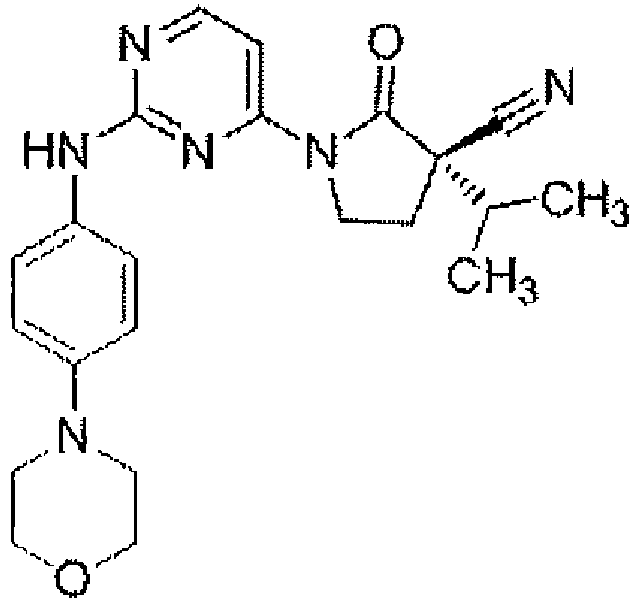
- 3-Isopropyl-1-(2-((4-(morpholin-4-yl)phenyl)amino)pyrimidin-4-yl)-2-oxopyrrolidine-3-carbonitrile (85 mg) obtained in Example 5 was resolved by SFC (column: CHIRALCEL OJH, 20 mmIDx250 mmL, manufactured by Daicel Chemical Industries, mobile phase: carbon dioxide/methanol/acetonitrile = 660/170/170), and the compound having a longer retention time was recrystallized (hexane/ethyl acetate) to give the title compound (9 mg).
1H NMR(300 MHz, CDCl3) δ 1.06 (3H, d, J = 6.8 Hz), 1.24 (3H, d, J = 6.8 Hz), 2.23-2.56 (3H, m), 3.08-3.17 (4H, m), 3.82-3.91 (4H, m), 4.09 (2H, t, J = 7.0 Hz), 6.87-6.95 (3H, m), 7.44 (2H, d, J = 9.1 Hz), 7.70 (1H, d, J = 5.7 Hz), 8.33 (1H, d, J = 5.7 Hz).
MS (ESI+) : [M+H]+407.3.
>99%ee (SFC (column: CHIRALCEL OJH, 4.6 mmID×150 mmL, manufactured by Daicel Chemical Industries, mobile phase: carbon dioxide/methanol/acetonitrile = 600/200/200, flow rate: 4 mL/min, retention time: 2.49 min)) -

- 1-(2-Chloropyrimidin-4-yl)-3-ethyl-2-oxopyrrolidine-3-carbonitrile (7.8 g) obtained in Step A of Example 2 was resolved by HPLC (column: CHIRALPAK IC, 50 mmID×500 mmL, manufactured by Daicel Chemical Industries, mobile phase: hexane/2-propanol = 200/800) to give the title compound (3.5 g) having a shorter retention time.
MS (ESI+) : [M+H]+ 251.2.
>99.9%ee (HPLC (column: CHIRALPAK IC, 4.6 mmID×250 mmL, manufactured by Daicel Chemical Industries, mobile phase: hexane/2-propanol = 200/800, flow rate: 0.5 mL/min, retention time: 18.5 min))
[α]D 25 -2.9 (c 0.39, chloroform) - A solution of (3R)-1-(2-chloropyrimidin-4-yl)-3-ethyl-2-oxopyrrolidine-3-carbonitrile (51 mg), 4-amino-N-methylbenzamide (32 mg) and acetic acid (12 µL) in 2-propanol (1 mL) was stirred in a microwave reactor at 150°C for 1 hr. The reaction mixture was concentrated under reduced pressure, saturated aqueous sodium hydrogen carbonate solution was added thereto, and the mixture was extracted with ethyl acetate. The extract was washed with saturated brine, and dried over anhydrous sodium sulfate, and the solvent was evaporated under reduced pressure. The residue was purified by silica gel column chromatography (hexane/ethyl acetate), and recrystallized (hexane/ethyl acetate) to give the title compound (31 mg).
1H NMR(300 MHz, CDCl3) δ 1.15-1.26 (3H, m), 1.77-1.95 (1H, m), 2.10-2.34 (2H, m), 2.59-2.72 (1H, m), 2.96-3.08 (3H, m), 4.15 (2H, t, J = 6.6 Hz), 6.11 (1H, brs), 7.29 (1H, brs), 7.61-7.69 (2H, m), 7.73-7.85 (3H, m), 8.35-8.45 (1H, m).
MS (ESI+) : [M+H]+365.3. -

- 1-(2-Chloropyrimidin-4-yl)-3-isopropyl-2-oxopyrrolidine-3-carbonitrile (14.1 g) obtained in Step C of Example 5 was resolved by HPLC (column: CHIRALPAK IC, 50 mmIDx500 mmL, manufactured by Daicel Chemical Industries, mobile phase: hexane/2-propanol = 200/800) to give the title compound (6.9 g) having a shorter retention time.
MS(ESI+): [M+H]+265.2.
>99.9%ee (HPLC (column: CHIRALPAK IC, 4.6 mmID×250 mmL, manufactured by Daicel Chemical Industries, mobile phase: hexane/2-propanol = 200/800, flow rate: 0.5 mL/min, retention time: 17.1 min)) - A solution of (3S)-1-(2-chloropyrimidin-4-yl)-3-isopropyl-2-oxopyrrolidine-3-carbonitrile (55 mg) obtained in Step A, 4-amino-N-methylbenzamide (37 mg) and acetic acid (13 µL) in ethanol (2 mL) was stirred in a microwave reactor at 150°C for 1 hr, and the solvent was evaporated under reduced pressure. The obtained residue was purified by silica gel column chromatography (NH, hexane/ethyl acetate). To a solution of the residue (87 mg) in ethanol (3 mL) was added lM hydrochloric acid (230 µL), and the solvent was evaporated under reduced pressure. The residue was recrystallized (diisopropyl ether/ethanol) to give the title compound (65 mg).
1H NMR(300 MHz, DMSO-d6) δ 1.02 (3H, d, J = 6.8 Hz), 1.12 (3H, d, J = 6.8 Hz), 2.33 (1H, dt, J = 13.6, 6.8 Hz), 2.40-2.48 (1H, m), 2.53-2.63 (1H, m), 2.77 (3H, d, J = 4.2 Hz), 3.95-4.21 (2H, m), 7.68 (1H, d, J = 5.7 Hz), 7.80 (4H, s), 8.28 (1H, d, J = 4.2 Hz), 8.49 (1H, d, J = 5.7 Hz), 9.98 (1H, s).
MS(ESI+): [M+H]+379.3. -

- To a mixture of 4-chloro-N-(1-methyl-1H-pyrazol-4-yl)pyrimidin-2-amine (150 mg) obtained in Step C of Example 1, 3,3-diethylpyrrolidin-2-one (110 mg), cesium carbonate (700 mg) and 2,2'-bis(diphenylphosphino)-1,1'-binaphthyl (90 mg) in tetrahydrofuran (5 mL) was added tris(dibenzylideneacetone)dipalladium(0) (130 mg), and the mixture was stirred in a microwave reactor at 130°C for 1.5 hr. The insoluble substance was removed by filtration through Celite, and the solvent was evaporated under reduced pressure. The residue was purified by silica gel column chromatography (hexane/ethyl acetate), to a solution of the residue in ethanol (5 mL) was added 12M hydrogen chloride ethanol solution (1 mL), and the mixture was stirred at room temperature for 5 min. The solvent was evaporated under reduced pressure, and the obtained crude crystals were recrystallized (ethanol/ethyl acetate) to give the title compound (76 mg).
MS(ESI+): [M+H]+315.2. -

- The title compound was obtained from 4-chloro-N-(1-methyl-1H-pyrazol-4-yl)pyrimidin-2-amine obtained in Step C of Example 1 and 3,3-dimethylpyrrolidin-2-one in the same manner as in Example 10.
MS(ESI+): [M+H]+387.2. -
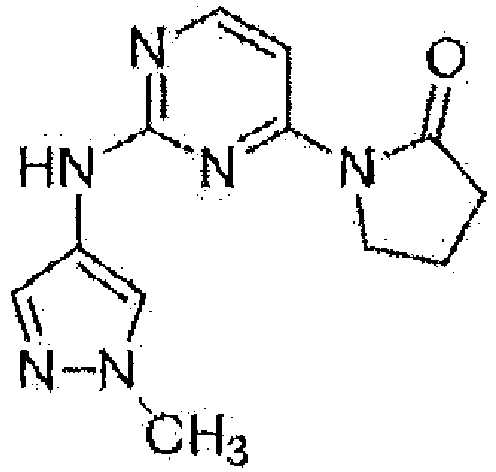
- The title compound was obtained from 4-chloro-N-(1-methyl-1H-pyrazol-4-yl)pyrimidin-2-amine obtained in Step C of Example 1 and pyrrolidin-2-one in the same manner as in Example 10. MS(ESI+): [M+H]+259.2.
-

- To a mixture of 2,4-dichloropyrimidine (2.6 g), pyrrolidin-2-one (1.0 g), cesium carbonate (11 g) and 2,2'-bis(diphenylphosphino)-1,1'-binaphthyl (370 mg) in toluene (10 mL) was added tris(dibenzylideneacetone)dipalladium(0) (540 mg), and the mixture was stirred in a microwave reactor at 110°C for 1.5 hr. The insoluble substance was removed by filtration through Celite, and the solvent was evaporated under reduced pressure. The residue was purified by silica gel column chromatography (hexane/ethyl acetate) to give the title compound (370 mg).
1H NMR(300 MHz, DMSO-d6) δ 2.00-2.15 (2H, m), 2.63 (2H, t, J = 8.1 Hz), 3.82-3.98 (2H, m), 8.27 (1H, d, J = 6.0 Hz), 8.58 (1H, d, J = 6.0 Hz). - To a solution of diisopropylamine (0.79 mL) in tetrahydrofuran (5 mL) was added dropwise n-butyllithium (1.6 M hexane solution, 3.5 mL) at -78°C under nitrogen atmosphere, and the mixture was warmed to 0°C, and stirred for 30 min. The reaction mixture was cooled to -78°C, and 1-(2-chloropyrimidin-4-yl)pyrrolidin-2-one (370 mg) obtained in Step A was added thereto. The reaction mixture was stirred at the same temperature for 1 hr, iodomethane (0.35 mL) was added thereto, and the mixture was stirred overnight while it was allowed to be warmed. To the reaction mixture was added saturated aqueous ammonium chloride solution, and the mixture was extracted with ethyl acetate. The obtained organic layer was washed with saturated brine, and dried over anhydrous magnesium sulfate, and the solvent was evaporated under reduced pressure. The residue was purified by silica gel column chromatography (hexane/ethyl acetate) to give the title compound (38 mg).
1H NMR(300 MHz, CDCl3) δ 1.31 (3H, d, J = 7.2 Hz), 1.77 (1H, dq, J = 12.8, 9.3 Hz), 2.31-2.50 (1H, m), 2.66-2.85 (1H, m), 3.84 (1H, ddd, J = 11.6, 9.3, 7.4 Hz), 4.17 (1H, ddd, J = 11.4, 8.8, 2.8 Hz), 8.35 (1H, d, J = 5.7 Hz), 8.44 (1H, d, J = 6.0 Hz). MS(ESI+): [M+H]+212.1. - The title compound was obtained from 1-(2-chloropyrimidin-4-yl)-3-methylpyrrolidin-2-one obtained in Step B and 1-methyl-1H-pyrazol-4-amine in the same manner as in Step B of Example 2.
MS(ESI+): [M+H]+273.2. -

- The title compound was obtained from 2,4-dichloropyrimidine and 3,3-diethylpyrrolidin-2-one in the same manner as in Step A of Example 2.
1H NMR(300 MHz, CDCl3) δ 0.91 (6H, t, J = 7.6 Hz), 1.65 (4H, q, J = 7.3 Hz), 1.93-2.09 (2H, m), 3.88-4.05 (2H, m), 8.35-8.41 (1H, m), 8.42-8.47 (1H, m). - The title compound was obtained from 1-(2-chloropyrimidin-4-yl)-3,3-diethylpyrrolidin-2-one obtained in Step A and 4-(morpholin-4-yl)aniline in the same manner as in Step B of Example 2.
MS(ESI+): [M+H]+396.3. - In Examples 15 to 28, the title compound was obtained from 1-(2-chloropyrimidin-4-yl)-3,3-diethylpyrrolidin-2-one obtained in Step A of Example 14, and aniline, 3-aminobenzenesulfonamide, 3-(methylsulfonyl)aniline, (3-aminophenyl)methanol, 3-(morpholin-4-yl)aniline, 3-aminobenzonitrile, 4-aminobenzenesulfonamide, 3-aminobenzamide, 1-(tetrahydro-2H-pyran-4-yl)-1H-pyrazol-4-amine, 1H-pyrazol-4-amine, 4-(4-methylpiperazin-1-yl)aniline, 4-(piperidin-1-yl)aniline, N,N-dimethylbenzene-1,4-diamine or 1-methyl-1H-pyrazol-3-amine (these compounds can be produced according to a method known per se), each corresponding to the compounds of Examples 15 to 28, in the same manner as in Step B of Example 2. MS in the tables means actual measured value.
Table 1-1 Example Number IUPAC Name Structure Salt MS 15 1-(2-anilinopyrimidin-4-yl)-3,3-diethylpyrrolidin-2-one 
Free 311.2 16 3-((4-(3,3-diethyl-2-oxopyrrolidin-1-yl)pyrimidin-2-yl)amino)benzenesulfonamide 
Free 390.3 17 3,3-diethyl-1-(2-((3-(methylsulfonyl)phenyl)amino)pyrimid in-4-yl)pyrrolidin-2-one 
Free 389.3 18 3,3-diethyl-1-(2-((3-(hydroxymethyl)phenyl)amino)pyrimidi n-4-yl)pyrrolidin-2-one 
Free 341.2 19 3,3-diethyl-1-(2-((3-(morpholin-4-yl)phenyl)amino)pyrimidin-4-yl)pyrrolidin-2-one 
HCl 396.3 20 3-((4-(3,3-diethyl-2-oxopyrrolidin-1-yl)pyrimidin-2-yl)amino)benzonitrile 
Free 336.3 21 4-((4-(3,3-diethyl-2-oxopyrrolidin-1-yl)pyrimidin-2-yl)amino)benzenesulfonamide 
Free 390.2 22 3-((4-(3,3-diethyl-2-oxopyrrolidin-1-yl)pyrimidin-2-yl)amino)benzamide 
Free 354.2 Table 1-2 23 3,3-diethyl-1-(2-((1-(tetrahydro-2H-pyran-4-yl)-1H-pyrazol-4-yl)amino)pyrimidin-1-yl)pyrrolidin-2-one 
Free 385.3 24 3,3-diethyl-1-(2-(1H-pyrazol-4-ylamino)pyrimidin-4-yl)pyrrolidin-2-one 
HCl 301.2 25 3,3-diethyl-1-(2-((4-(4-methylpiperazin-1-yl)phenyl)amino)pyrimidin-4-yl)pyrrolidin-2-one 
2HCl 409.4 26 3,3-diethyl-1-(2-((4-(piperidin-1-yl)phenyl)amino)pyrimidin-4-yl)pyrrolidin-2-one 
HCl 394.4 27 1-(2-((4-(dimethylamino)phenyl)amino)pyrimidi n-4-yl)-3,3-diethylpyrrolidin-2-one 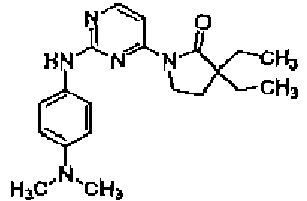
Free 354.3 28 3,3-diethyl-1-(2-((1-methyl-1H-pyrazol-3-yl)amino)pyrimidin-4-yl)pyrrolidin-2-one 
Free 315.2 -

- The title compound was obtained from 2,4-dichloro-5-fluoropyrimidine and 3,3-dimethylpyrrolidin-2-one in the same manner as in Step A of Example 2.
1H NMR(300 MHz, CDCl3) δ 1.28 (6H, s), 2.09 (2H, t, J = 7.0 Hz), 3.94 (2H, t, J = 6.8 Hz), 8.43 (1H, d, J = 2.3 Hz). - The title compound was obtained from 1-(2-chloro-5-fluoropyrimidin-4-yl)-3,3-dimethylpyrrolidin-2-one obtained in Step A and 1-methyl-1H-pyrazol-4-amine in the same manner as in Step B of Example 2.
MS(ESI+): [M+H]+305.2. -

- To a solution of pyrrolidin-2-one (15 g) in a mixed solvent of tetrahydrofuran/N,N-dimethylformamide (1/1, 100 mL) was added sodium hydride (60% in mineral oil, 8.5 g) at 0°C under nitrogen atmosphere, and the mixture was stirred for 30 min. p-Methoxybenzyl chloride (33 g) was added thereto at the same temperature, and the mixture was stirred at room temperature for 5 hr. To the reaction mixture was added water, and the mixture was extracted with ethyl acetate. The obtained organic layer was washed successively with water and saturated brine, and dried over anhydrous magnesium sulfate, and the solvent was evaporated under reduced pressure. The residue was purified by silica gel column chromatography (hexane/ethyl acetate) to give the title compound (28 g).
1H NMR(300 MHz, CDCl3) δ 1.87-2.09 (2H, m), 2.38-2.50 (2H, m), 3.15-3.34 (2H, m), 3.80 (3H, s), 4.39 (2H, s), 6.81-6.92 (2H, m), 7.17 (2H, d, J = 8.7 Hz). - To a solution of diisopropylamine (4.1 mL) in tetrahydrofuran (25 mL) was added dropwise n-butyllithium (1.6 M hexane solution, 18 mL) at -78°C under nitrogen atmosphere, and the mixture was warmed to 0°C, and stirred for 30 min. The reaction mixture was cooled to -78°C, a solution of 1-(4-methoxybenzyl)pyrrolidin-2-one (5.0 g) obtained in Step A in tetrahydrofuran (25 mL) was added thereto, and the mixture was stirred at the same temperature for 1 hr. Iodoethane (2.9 mL) was added thereto, and the mixture was stirred overnight while it was allowed to be warmed. To the reaction mixture was added saturated aqueous ammonium chloride solution, and the mixture was extracted with ethyl acetate. The obtained organic layer was washed with saturated brine, and dried over anhydrous magnesium sulfate, and the solvent was evaporated under reduced pressure. The residue was purified by silica gel column chromatography (hexane/ethyl acetate) to give the title compound (2.8 g).
1H NMR(300 MHz, CDCl3) δ 0.96 (3H, t, J = 7.4 Hz), 1.35-1.52 (1H, m), 1.55-1.72 (1H, m), 1.81-2.00 (1H, m), 2.06-2.26 (1H, m), 2.39 (1H, qd, J = 8.7, 4.2 Hz), 3.05-3.30 (2H, m), 3.79 (3H, s), 4.27-4.51 (2H, m), 6.73-6.95 (2H, m), 7.11-7.22 (2H, m). - To a solution of diisopropylamine (3.4 mL) in tetrahydrofuran (10 mL) was added dropwise n-butyllithium (1.6 M hexane solution, 15 mL) at -78°C under nitrogen atmosphere, and the mixture was warmed to 0°C, and stirred for 30 min. The reaction mixture was cooled to -78°C, a solution of 3-ethyl-1-(4-methoxybenzyl)pyrrolidin-2-one (2.8 g) obtained in Step B in tetrahydrofuran (10 mL) was added thereto, and the mixture was stirred at the same temperature for 1 hr. Ethyl bromoacetate (4.0 mL) was added thereto, and the mixture was stirred overnight while it was allowed to be warmed. To the reaction mixture was added saturated aqueous ammonium chloride solution, and the mixture was extracted with ethyl acetate. The obtained organic layer was washed with saturated brine, and dried over anhydrous magnesium sulfate, and the solvent was evaporated under reduced pressure. The residue was purified by silica gel column chromatography (hexane/ethyl acetate) to give the title compound (1.5 g).
1H NMR(300 MHz, CDCl3) δ 0.87 (3H, t, J = 7.4 Hz), 1.23 (3H, t, J = 7.2 Hz), 1.48-1.72 (2H, m), 1.83-2.19 (2H, m), 2.42-2.59 (1H, m), 2.60-2.76 (1H, m), 3.04-3.25 (2H, m), 3.80 (3H, s), 4.10 (2H, q, J = 7.1 Hz), 4.31 (1H, d, J = 14.4 Hz), 4.45-4.61 (1H, m), 6.85 (2H, d, J = 8.3 Hz), 7.19 (2H, d, J = 8.7 Hz). - To a solution of ethyl (3-ethyl-1-(4-methoxybenzyl)-2-oxopyrrolidin-3-yl)acetate (1.5 g) obtained in Step C in a mixed solvent of acetonitrile/water (3/1, 8 mL) was added ammonium hexanitratocerate(IV) (5.2 g), and the mixture was stirred at room temperature for 30 min. To the reaction mixture was added potassium carbonate, the solid was removed by filtration through Celite, and the solvent was evaporated under reduced pressure. The residue was purified by silica gel column chromatography (hexane/ethyl acetate) to give the title compound (900 mg).
1H NMR(300 MHz, DMSO-d6) δ 0.82 (3H, t, J = 7.4 Hz), 1.17 (3H, td, J = 7.2, 2.6 Hz), 1.44 (2H, qd, J = 7.5, 1.7 Hz), 1.86-1.97 (1H, m), 2.03-2.19 (1H, m), 2.40 (2H, s), 3.13 (2H, t, J = 7.2 Hz), 4.03 (2H, q, J = 7.2 Hz), 7.58 (1H, brs). - The title compound was obtained from ethyl (3-ethyl-2-oxopyrrolidin-3-yl)acetate obtained in Step D and 4-chloro-N-(1-methyl-1H-pyrazol-4-yl)pyrimidin-2-amine obtained in Step C of Example 1 in the same manner as in Step I of Example 1. MS(ESI+): [M+H]+373.3.
- To a solution of ethyl (3-ethyl-1-(2-((1-methyl-2H-pyrazol-4-yl)amino)pyrimidin-4-yl)-2-oxopyrrolidin-3-yl)acetate (270 mg) obtained in Step E in ethanol (5 mL) was added dropwise 2M aqueous sodium hydroxide solution (1.4 mL), and the mixture was stirred overnight at room temperature. To the reaction mixture was added water, and the mixture was washed with diethyl ether. The aqueous layer was neutralized with 2M hydrochloric acid, and extracted with ethyl acetate. The obtained organic layer was washed with saturated brine, and dried over anhydrous magnesium sulfate, and the solvent was evaporated under reduced pressure. The residue was recrystallized (ethyl acetate) to give the title compound (100 mg).
MS(ESI+): [M+H]+345.2. -

- To a solution of (3-ethyl-1-(2-((1-methyl-1H-pyrazol-4-yl)amino)pyrimidin-4-yl)-2-oxopyrrolidin-3-yl)acetic acid (100 mg) obtained in Example 30 and 1-hydroxybenzotriazole ammonium salt (88 mg) in N,N-dimethylformamide (5 mL) was added 1-ethyl-3-(3-dimethylaminopropyl)carbodiimide hydrochloride (110 mg), and the mixture was stirred overnight at room temperature. To the reaction mixture was added water, and the mixture was extracted with ethyl acetate. The obtained organic layer was washed with water and saturated brine, and dried over anhydrous magnesium sulfate, and the solvent was evaporated under reduced pressure. To a solution of the residue and pyridine (70 mg) in tetrahydrofuran (5 mL) was added trifluoroacetic anhydride (0.12 mL), and the mixture was stirred at 70°C for 30 min. The reaction mixture was neutralized with saturated aqueous sodium hydrogen carbonate solution, and extracted with ethyl acetate. The obtained organic layer was washed with saturated brine, and dried over anhydrous magnesium sulfate, and the solvent was evaporated under reduced pressure. The residue was purified by silica gel column chromatography (hexane/ethyl acetate), and recrystallized (hexane/ethyl acetate) to give the title compound (17 mg).
MS (ESI+) : [M+H]+326.2. -

- The title compound was obtained from 4-methoxybenzyl chloride and 5-methylpyrrolidin-2-one in the same manner as in Step A of Example 30.
1H NMR(300 MHz, CDCl3) δ 1.16 (3H, d, J = 6.0 Hz), 1.58 (1H, dddd, J = 12.7, 9.6, 7.1, 6.0 Hz), 2.07-2.21 (1H, m), 2.28-2.59 (2H, m), 3.40-3.64 (1H, m), 3.79 (3H, s), 3.91 (1H, d, J = 14.7 Hz), 4.91 (1H, d, J = 14.7 Hz), 6.79-6.93 (2H, m), 7.17 (2H, d, J = 8.7 Hz). - To a solution of 1-(4-methoxybenzyl)-5-methylpyrrolidin-2-one (3.0 g) obtained in Step A in tetrahydrofuran (25 mL) was added sodium bis(trimethylsilyl)amide (1.9M tetrahydrofuran solution, 11 mL) at -78°C under nitrogen atmosphere, and the mixture was stirred at the same temperature for 1 hr. Iodoethane (2.2 mL) was added thereto, and the mixture was stirred overnight while it was allowed to be warmed. To the reaction mixture was added saturated aqueous ammonium chloride solution, and the mixture was extracted with ethyl acetate. The obtained organic layer was washed with saturated brine, and dried over anhydrous magnesium sulfate, and the solvent was evaporated under reduced pressure. The residue was purified by silica gel column chromatography (hexane/ethyl acetate) to give the title compound (2.5 g).
MS(ESI+): [M+H]+248.2. - To a solution of diisopropylamine (2.1 g) in tetrahydrofuran (20 mL) was added dropwise n-butyllithium (1.6 M hexane solution, 13 mL) at -78°C under nitrogen atmosphere, and the mixture was warmed to 0°C, and stirred for 30 min. The reaction mixture was cooled to -78°C, a solution of 3-ethyl-1-(4-methoxybenzyl)-5-methylpyrrolidin-2-one (2.5 g) obtained in Step B in tetrahydrofuran (10 mL) was added thereto, and the mixture was stirred at the same temperature for 1 hr. Iodoethane (2.5 mL) was added thereto, and the mixture was stirred overnight while it was allowed to be warmed. To the reaction mixture was added saturated aqueous ammonium chloride solution, and the mixture was extracted with ethyl acetate. The obtained organic layer was washed with saturated brine, and dried over anhydrous magnesium sulfate, and the solvent was evaporated under reduced pressure. The residue was purified by silica gel column chromatography (hexane/ethyl acetate) to give the title compound (1.3 g).
1H NMR(300 MHz, CDCl3) δ 0.75-0.98(6H, m), 1.16 (3H, d, J = 6.4 Hz), 1.37-1.70 (5H, m), 1.95 (1H, dd, J = 13.2, 7.9 Hz), 3.25-3.50 (1H, m), 3.79 (3H, s), 3.89 (1H, d, J = 14.7 Hz), 4.94 (1H, d, J = 14.7 Hz), 6.75-6.93 (2H, m), 7.17 (2H, d, J = 8.7 Hz). - The title compound was obtained from 3,3-diethyl-1-(4 methoxybenzyl)-5-methylpyrrolidin-2-one obtained in Step C in the same manner as in Step D of Example 30.
1H NMR(300 MHz, CDCl3) δ 0.90 (6H, dt, J = 10. 2, 7. 6 Hz), 1. 21 (3H, d, J = 6.0 Hz), 1.42-1.63 (5H, m), 2.05-2.17 (1H, m), 3.57-3.78 (1H, m), 5.53 (1H, brs). - The title compound was obtained from 2,4-dichloropyrimidine and 3,3-diethyl-5-methylpyrrolidin-2-one obtained in Step D in the same manner as in Step A of Example 2. 1H NMR(300 MHz, CDCl3) δ 0.85 (3H, t, J = 7.6 Hz), 0.95 (3H, t,
J = 7.6 Hz), 1.45 (3H, d, J = 6.0 Hz), 1.56-1.75 (5H, m), 2.23 (1H, dd, J = 13.6, 8.7 Hz), 4.59 (1H, dquin, J = 8.7, 6.2 Hz), 8.26 (1H, d, J = 6.0 Hz), 8.45 (1H, d, J = 5.7 Hz). - The title compound was obtained from 1-(2-chloropyrimidin-4-yl)-3,3-diethyl-5-methylpyrrolidin-2-one and 4-(morpholin-4-yl)aniline obtained in Step E in the same manner as in Step B of Example 2.
MS(ESI+): [M+H]+410.3. -

- The title compound was obtained from 1-(2-chloropyrimidin-4-yl)-3,3-diethyl-5-methylpyrrolidin-2-one obtained in Step E of Example 32 and 1-methyl-1H-pyrazol-4-amine in the same manner as in Step B of Example 2.
MS(ESI+): [M+H]+329.3. -

- To a solution of 3-ethyl-1-(2-((4-(morpholin-4-yl)phenyl)amino)pyrimidin-4-yl)-2-oxopyrrolidine-3-carbonitrile (36 mg) obtained in Example 2 in dimethylsulfoxide (1 mL) were added a solution of 30% aqueous hydrogen peroxide (28 µL) and 2M aqueous potassium carbonate (0.14 mL), and the mixture was stirred overnight at room temperature. Water was added thereto in an ice bath, and the precipitated solid was collected by filtration. The obtained crude crystals were recrystallized (diisopropyl ether/ethanol) to give the title compound (13 mg).
MS (ESI+) : [M+H]+411.3. -

- To a solution of 1-(4-fluorobenzoyl)-2-oxopyrrolidine-3-carbonitrile (300 mg) obtained in Step F of Example 1 in tetrahydrofuran (3 mL) was added dropwise 1,8-diazabicyclo[5.4.0]undec-7-ene (0.23 mL) at 0°C under nitrogen atmosphere. The reaction mixture was stirred at room temperature for 20 min, [(oxide)phenyl(trifluoromethyl)-λ4-sulfanylidene]dimethylammonium tetrafluoroborate (630 mg) was added thereto, and the mixture was stirred at room temperature for 1 hr. The solvent was evaporated under reduced pressure, and the residue was purified by silica gel column chromatography (hexane/ethyl acetate) to give the title compound (190 mg).
1H NMR(300 MHz, CDCl3) δ 2.74-2.92 (2H, m), 3.95-4.33 (2H, m), 7.15 (2H, t, J = 8. 5 Hz), 7.67 (2H, dd, J = 8.9, 5. 1 Hz). - The title compound was obtained from 1-(4-fluorobenzoyl)-2-oxo-3-(trifluoromethyl)pyrrolidine-3-carbonitrile obtained in Step A in the same manner as in Step B of Example 5.
1H NMR(300 MHz, CDCl3) δ2.79 (2H, dt, J = 9.6, 3.7 Hz), 3.36-3.79 (2H, m), 5.98 (1H, brs). - The title compound was obtained from 2,4-dichloropyrimidine and 2-oxo-3-(trifluoromethyl)pyrrolidine-3-carbonitrile obtained in Step B in the same manner as in Step A of Example 2.
1H NMR(300 MHz, DMSO-d6) δ 2.78-2.93 (1H, m), 2.95-3.10 (1H, m), 3.99-4.25 (2H, m), 8.21 (1H, d, J = 6.0 Hz), 8.78 (1H, d, J = 5.7 Hz). - The title compound was obtained from 1-(2-chloropyrimidin-4-yl)-2-oxo-3-(trifluoromethyl)pyrrolidine-3-carbonitrile obtained in Step C and 4-(morpholin-4-yl)aniline in the same manner as in Step B of Example 2.
MS(ESI+): [M+H]+433.3. -

- The title compound was obtained from 1-(4-fluorobenzoyl)-2-oxopyrrolidine-3-carbonitrile obtained in Step F of Example 1 and 1-iodopropane in the same manner as in Step G of Example 1.
1H NMR(300 MHz, CDCl3) δ1.03 (3H, t, J = 7.0 Hz), 1.43-1.52 (1H, m), 1.61-1.79 (2H, m), 1.94-2.10 (1H, m), 2.25 (1H, dt, J = 13.3, 7.3 Hz), 2.57-2.70 (1H, m), 4.03 (2H, t, J = 6.8 Hz), 7.04-7.18 (2H, m), 7.59-7.69 (2H, m). - The title compound was obtained from 1-(4-fluorobenzoyl)-2-oxo-3-propylpyrrolidine-3-carbonitrile obtained in Step A in the same manner as in Step B of Example 5.
1H NMR(300 MHz, CDCl3) δ 1.02 (3H, t, J = 7.0 Hz), 1.39-1.63 (2H, m), 1.64-1.76 (1H, m), 1.93-2.03 (1H, m), 2.15-2.29 (1H, m), 2.62 (1H, ddd, J = 13.0, 7.7, 4.9 Hz), 3.35-3.46 (1H, m), 3.47-3.58 (1H, m), 6.75 (1H, brs). - The title compound was obtained from 2,4-dichloropyrimidine and 2-oxo-3-propylpyrrolidine-3-carbonitrile obtained in Step B in the same manner as in Step A of Example 2.
MS(ESI+): [M+H]+265.0. - The title compound was obtained from 1-(2-chloropyrimidin-4-yl)-2-oxo-3-propylpyrrolidine-3-carbonitrile obtained in Step C and 4-(morpholin-4-yl)aniline in the same manner as in Step B of Example 2.
MS(ESI+): [M+H]+407.4. -

- The title compound was obtained from 1-(2-chloropyrimidin-4-yl)-2-oxo-3-propylpyrrolidine-3-carbonitrile obtained in Step C of Example 36 and 1-methyl-1H-pyrazol-4-amine in the same manner as in Step B of Example 2.
MS (ESI+) : [M+H]+326.2. -

- The title compound was obtained from 1-(4-fluorobenzoyl)-2-oxopyrrolidine-3-carbonitrile obtained in Step F of Example 1 and 2,2,2-trifluoroethyl trifluoromethanesulfonate in the same manner as in Step A of Example 5.
1H NMR(300 MHz, CDCl3) δ 2.34-2.50 (1H, m), 2.50-2.65 (1H, m), 2.82 (1H, dd, J = 13.8, 5.5 Hz), 3.01 (1H, dq, J = 15.8, 10.1 Hz), 4.03-4.16 (1H, m), 4.17-4.32 (1H, m), 7.09-7.19 (2H, m), 7.61-7.68 (2H, m). - The title compound was obtained from 1-(4-fluorobenzoyl)-2-oxo-3-(2,2,2-trifluoroethyl)pyrrolidine-3-carbonitrile obtained in Step A in the same manner as in Step B of Example 5.
1H NMR(300 MHz, CDCl3) δ 2.29-2.49 (2H, m), 2.71-2.86 (1H, m), 3.05 (1H, dq, J = 15.5, 10.3 Hz), 3.40-3.55 (1H, m), 3.59-3.72 (1H, m), 5.98 (1H, brs). - The title compound was obtained from 2,4-dichloropyrimidine and 2-oxo-3-(2,2,2-trifluoroethyl)pyrrolidine-3-carbonitrile obtained in Step B in the same manner as in Step A of Example 2.
1H NMR(300 MHz, CDCl3) δ 2.32-2.48 (1H, m), 2.49-2.64 (1H, m), 2.77-2.95 (1H, m), 3.13 (1H, dq, J = 15.5, 10.2 Hz), 4.08-4.20 (1H, m), 4.43 (1H, d, J = 1.9 Hz), 8.24 (1H, d, J = 5.7 Hz), 8.59 (1H, d, J = 5.7 Hz). - The title compound was obtained from 1-(2-chloropyrimidin-4-yl)-2-oxo-3-(2,2,2-trifluoroethyl)pyrrolidine-3-carbonitrile obtained in Step C and 4-(morpholin-4-yl)aniline in the same manner as in Step B of Example 2.
MS (ESI+) : [M+H]+407.4. -

- The title compound was obtained from 1-(4-fluorobenzoyl)-2-oxopyrrolidine-3-carbonitrile obtained in Step F of Example 1 and (iodomethyl)cyclopropane in the same manner as in Step G of Example 1.
1H NMR(300 MHz, CDCl3) δ 0.18-0.38 (2H, m), 0.56-0.71 (2H, m), 0.81-0.98 (1H, m), 1.71 (1H, dd, J = 14.0, 7.2 Hz), 2.04 (1H, dd, J = 14.0, 6.8 Hz), 2.45 (1H, dt, J = 13.3, 7.3 Hz), 2.70 (1H, dt, J = 13.2, 6.6 Hz), 4.05 (2H, t, J = 6.8 Hz), 7.12 (2H, t, J = 8.7 Hz), 7.65 (2H, dd, J = 8.7, 5.3 Hz). - The title compound was obtained from 3-(cyclopropylmethyl)-1-(4-fluorobenzoyl)-2-oxopyrrolidine-3-carbonitrile obtained in Step A in the same manner as in Step B of Example 5.
1H NMR(300 MHz, CDCl3) δ 0.16-0.37 (2H, m), 0.50-0.68 (2H, m), 0.80-0.97 (1H, m), 1.68 (1H, dd, J = 14.4, 6.8 Hz), 1.97 (1H, dd, J = 14.4, 7.2 Hz), 2.42 (1H, ddd, J = 13.5, 7.6, 6.4 Hz), 2.68 (1H, ddd, J = 13.1, 8.0, 4.9 Hz), 3.36-3.48 (1H, m), 3.49-3.60 (1H, m), 6.63 (1H, brs). - The title compound was obtained from 2,4-dichloropyrimidine and 3-(cyclopropylmethyl)-2-oxopyrrolidine-3-carbonitrile obtained in Step B in the same manner as in Step A of Example 2.
MS (ESI+) : [M+H]+277.2. - The title compound was obtained from 1-(2-chloropyrimidin-4-yl)-3-(cyclopropylmethyl)-2-oxopyrrolidine-3-carbonitrile obtained in Step C and 4-(morpholin-4-yl)aniline in the same manner as in Step B of Example 2.
MS(ESI+): [M+H]+419.4. -

- The title compound was obtained from 1-(4-fluorobenzoyl)-2-oxopyrrolidine-3-carbonitrile obtained in Step F of Example 1 and chloromethyl methyl ether in the same manner as in Step G of Example 1.
1H NMR(300 MHz, CDCl3) δ 2.54-2.67 (2H, m), 3.44 (3H, s), 3.72 (1H, d, J = 9.1 Hz), 3.87 (1H, d, J = 9.1 Hz), 4.01 (2H, t, J = 7.2 Hz), 7.05-7.17 (2H, m), 7.60-7.71 (2H, m). - The title compound was obtained from 1-(4-fluorobenzoyl)-3-(methoxymethyl)-2-oxopyrrolidine-3-carbonitrile obtained in Step A in the same manner as in Step B of Example 5.
1H NMR(300 MHz, CDCl3) δ 2.47-2.68 (2H, m), 3.33-3.60 (5H, m), 3.75 (2H, q, J = 9.2 Hz), 6.27 (1H, brs). - The title compound was obtained from 2,4-dichloropyrimidine and 3-(methoxymethyl)-2-oxopyrrolidine-3-carbonitrile obtained in Step B in the same manner as in Step A of Example 2.
MS(ESI+): [M+H]+267.1. - The title compound was obtained from 1-(2-chloropyrimidin-4-yl)-3-(methoxymethyl)-2-oxopyrrolidine-3-carbonitrile obtained in Step C and 4-(morpholin-4-yl)aniline in the same manner as in Step B of Example 2.
MS(ESI+): [M+H]+409.3. -
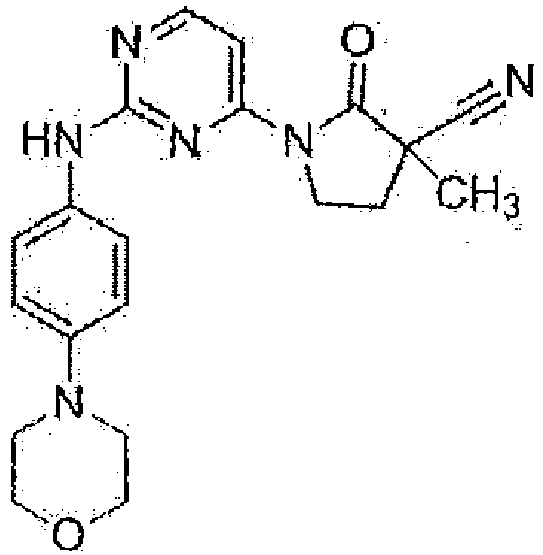
- The title compound was obtained from 1-(4-fluorobenzoyl)-2-oxopyrrolidine-3-carbonitrile obtained in Step F of Example 1 and iodomethane in the same manner as in Step G of Example 1.
1H NMR(300 MHz, CDCl3) δ 1.66 (3H, s), 2.22 (1H, dt, J = 13.0, 7.5 Hz), 2.71 (1H, dt, J = 13.2, 6.6 Hz), 4.05 (2H, t, J = 7.0 Hz), 7.07-7.18 (2H, m), 7.60-7.70 (2H, m). - The title compound was obtained from 1-(4-fluorobenzoyl)-3-methyl-2-oxopyrrolidine-3-carbonitrile obtained in Step A in the same manner as in Step B of Example 5.
1H NMR(300 MHz, CDCl3) δ 1.61 (3H, s), 2.12-2.27 (1H, m), 2.70 (1H, ddd, J = 12.9, 7.6, 5.1 Hz), 3.37-3.48 (1H, m), 3.49-3.61 (1H, m), 6.50 (1H, brs). - The title compound was obtained from 2,4-dichloropyrimidine and 3-methyl-2-oxopyrrolidine-3-carbonitrile obtained in Step B in the same manner as in Step A of Example 2.
MS (ESI+) : [M+H]+237.1. - The title compound was obtained from 1-(2-chloropyrimidin-4-yl)-3-methyl-2-oxopyrrolidine-3-carbonitrile obtained in Step C and 4-(morpholin-4-yl)aniline in the same manner as in Step B of Example 2.
MS(ESI+): [M+H]+379.3. - In Examples 42 to 47, the title compound was obtained from 1-(2-chloropyrimidin-4-yl)-3-ethyl-2-oxopyrrolidine-3-carbonitrile obtained in Step A of Example 2, and (4-amino-1H-pyrazol-1-yl)acetonitrile, 1-(tetrahydro-2H-pyran-4-yl)-1H-pyrazol-4-amine, butyl (4-amino-1H-pyrazol-1-yl)acetate, 1-(4-methoxybenzyl)-1H-pyrazol-4-amine, (4-amino-1H-pyrazol-1-yl)acetic acid or ethyl (4-amino-1H-pyrazol-1-yl)acetate (these compounds can be produced according to a method known per se), each corresponding to the compounds of Examples 42 to 47, in the same manner as in Step B of Example 2 or a method analogous thereto. MS in the tables means actual measured value.
Table 2 Example Number IUPAC Name Structure Salt MS 42 1-(2-((1-(cyanomethyl)-1H-pyrazol-4-yl)amino)pyrimidin-4-yl)-3-ethyl-2-oxopyrrolidine-3-carbonitrile 
HCl 337.2 43 3-ethyl-2-oxo-1-(2-((1-(tetrahydro-2H-pyran-4-yl)-1H-pyrazol-4-yl)amino)pyrimidin-4-yl)pyrrolidine-3-carbonitrile 
Free 382.3 44 butyl (4-((4-(3-cyano-3-ethyl-2-oxopyrrolidin-1-yl)pyrimidin-2-yl)amino)-1H-pyrazol-1-yl)acetate 
HCl 412.3 45 3-ethyl-1-(2-((1-(4-methoxybenzyl)-1H-pyrazol-4-yl)amino)pyrimidin-4-yl)-2-oxopyrrolidine-3-carbonitrile 
Free 418.3 46 (4-((4-(3-cyano-3-ethyl-2-oxopyrrolidin-1-yl)pyrimidin-2-yl)amino)-1H-pyrazol-1-yl)acetic acid 
HCl 356.2 47 ethyl (4-((4-(3-cyano-3-ethyl-2-oxopyrrolidin-1-yl)pyrimidin-2-yl)amino)-1H-pyrazol-1-yl)acetate 
HCl 384.3 - In Examples 48 to 55, the title compound was obtained from 1-(2-chloropyrimidin-4-yl)-3-ethyl-2-oxopyrrolidine-3-carbonitrile obtained in Step A of Example 2, and ethyl (4-aminophenyl)acetate, N-(4-aminophenyl)acetamide, 4-aminobenzamide, 4-amino-N-methylbenzamide, 4-amino-N,N-dimethylbenzamide, 4-aminobenzoic acid, 1-(4-aminophenyl)ethanone or 4-(1,1-dioxidethiomorpholin-4-yl)aniline (these compounds can be produced according to a method known per se), each corresponding to the compounds of Examples 48 to 55, in the same manner as in Step B of Example 2 or a method analogous thereto. MS in the tables means actual measured value.
Table 3 Example Number IUPAC Name Structure Salt MS 48 ethyl (4-((4-(3-cyano-3-ethyl-2-oxopyrrolidin-1-yl)pyrimidin-2-yl)amino)phenyl)acetate 
HCl 394.3 49 N-(4-((4-(3-cyano-3-ethyl-2-oxopyrrolidin-1-yl)pyrimidin-2-yl)amino)phenyl)acetamide 
Free 365.3 50 4-((4-(3-cyano-3-ethyl-2-oxopyrrolidin-1-yl)pyrimidin-2-yl)amino)benzamide 
Free 351.3 51 4-((4-(3-cyano-3-ethyl-2-oxopyrrolidin-1-yl)pyrimidin-2-yl)amino)-N-methylbenzamide 
Free 365.3 52 4-((4-(3-cyano-3-ethyl-2-oxopyrrolidin-1-yl)pyrimidin-2-yl)amino)-N,N-dimethylbenzamide 
Free 379.3 53 4-((4-(3-cyano-3-ethyl-2-oxopyrrolidin-1-yl)pyrimidin-2-yl)amino)benzoic acid 
Free 352.2 54 1-(2-((4-acetylphenyl)amino)pyrimidin-4-yl)-3-ethyl-2-oxopyrrolidine-3-carbonitrile 
Free 360.3 55 1-(2-((4-(1,1-dioxidethiomorpholin-4-yl)phenyl)amino)pyrimidin-4-yl)-3-ethyl-2-oxopyrrolidine-3-carbonitrile 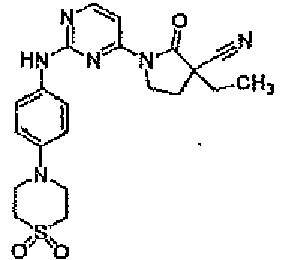
Free 441.3 -

- To a mixture of 1-(2-chloropyrimidin-4-yl)-3-ethyl-2-oxopyrrolidine-3-carbonitrile (100 mg) obtained in Step A of Example 2, 3-aminopyridine (45 mg), cesium carbonate (260 mg) and 2,2'-bis(diphenylphosphino)-1,1'-binaphthyl (37 mg) in tetrahydrofuran (2 mL) was added tris(dibenzylideneacetone)dipalladium(0) (37 mg), and the mixture was stirred overnight at 90°C. The insoluble substance was removed by filtration through Celite, and the solvent was evaporated under reduced pressure. The residue was purified by silica gel column chromatography (NH, hexane/ethyl acetate), 4M hydrogen chloride in ethyl acetate (4 mL) was added thereto, and the mixture was stirred at room temperature for 5 min. The solvent was evaporated under reduced pressure, and the residue was recrystallized (ethyl acetate) to give the title compound (49 mg).
MS(ESI+): [M+H]+309.2. - In Examples 57 and 58, the title compound was obtained from 1-(2-chloropyrimidin-4-yl)-3-ethyl-2-oxopyrrolidine-3-carbonitrile obtained in Step A of Example 2, and pyridin-4-amine or 4-(morpholin-4-ylmethyl)aniline (these compounds can be produced according to a method known per se), each corresponding to the compounds of Examples 57 and 58, in the same manner as in Example 56. MS in the tables means actual measured value.
Table 4 Example Number IUPAC Name Structure Salt MS 57 3-ethyl-2-oxo-1-(2-(pyridin-4-ylamino)pyrimidin-4-yl)pyrrolidine-3-carbonitrile 
2HCl 308.9 68 3-ethyl-1-(2-((4-(morpholin-4-ylmethyl)phenyl)amino)pyrimidin-4-yl)-2-oxopyrrolidine-3-carbonitrile 
2HCl 407.3 - In Examples 59 and 60, the title compound was obtained from 1-(2-chloropyrimidin-4-yl)-3-ethyl-2-oxopyrrolidine-3-carbonitrile obtained in Step A of Example 2, and 2-(morpholin-4-yl)pyrimidin-5-amine or 6-(morpholin-4-yl)pyridin-3-amine (these compounds can be produced according to a method known per se), each corresponding to the compounds of Examples 59 and 60, in the same manner as in Step B of Example 2 or a method analogous thereto. MS in the tables means actual measured value.
Table 5 Example Number IUPAC Name Structure Salt MS 59 3-ethyl-1-(2-((2-(morpholin-4-yl)pyrimidin-6-yl)amino)pyrimidin-4-yl)-2-oxopyrrolidine-3-carbonitrile 
Free 395.3 60 3-ethyl-1-(2-((6-(morpholin-4-yl)pyridin-3-yl)amino)pyrimidin-4-yl)-2-oxopyrrolidine-3-carbonitrile 
Free 394.3 -

- To a solution of 1-(2-chloropyrimidin-4-yl)-3-ethyl-2-oxopyrrolidine-3-carbonitrile (20 mg) obtained in Step A of Example 2 and 4-(aminomethyl)benzonitrile hydrochloride (27 mg) in N-methylpyrrolidone (2 mL) was added diisopropylethylamine (0.028 mL), and the mixture was stirred at 60°C for 3 hr. To the reaction mixture were added ethyl acetate (3 mL) and water (1 mL), and the mixture was stirred for 5 min. The organic layer was filtered through Top-Phase Separation Fiter Tube, and the solvent was evaporated at 60°C. The residue was purified by HPLC (C18, mobile phase: acetonitrile/10 mM aqueous ammonium hydrogen carbonate solution), and dried at 60°C to give the title compound.
MS(ESI+): [M+H]+346.9. - In Examples 62 to 77, the title compound was obtained from 1-(2-chloropyrimidin-4-yl)-3-ethyl-2-oxopyrrolidine-3-carbonitrile obtained in Step A of Example 2, and 3-cyanobenzylamine hydrochloride, benzylamine, 3-methoxybenzylamine, 4-fluorobenzylamine, 4-(4-methylpiperidin-1-yl)benzylamine, 4-(morpholinomethyl)benzylamine, 1-benzofuran-5-ylmethylamine, 2-phenylethylamine, 3-(2-aminoethyl)pyridine, furfurylamine, 2-thiophenemethylamine, 2-naphthalenemethylamine hydrochloride, 4-methoxybenzylamine, 4-(2-aminoethyl)pyridine or cyclopropylmethylamine (these compounds can be produced according to a method known per se), each corresponding to the compounds of Examples 62 to 77, in the same manner as in Example 61. MS in the tables means actual measured value.
Table 6-1 Example Number IUPAC Name Structure Salt MS 62 1-(2-((3-cyanobenzyl)amino)pyrimidin-4-yl)-3-ethyl-2-oxopyrrolidine-3-carbonitrile 
Free 347.0 63 1-(2-(benzylamino)pyrimidin-4-yl)-3-ethyl-2-oxopyrrolidine-3-carbonitrile 
Free 321.9 64 3-ethyl-1-(2-((3-methoxybenzyl)amino)pyrimidin-4-yl)-2-oxopyrrolidine-3-carbonitrile 
Free 352.0 66 3-ethyl-1-(2-((4-fluorobenzyl)amino)pyrimidin-4-yl)-2-oxopyrrolidine-3-carbonitrile 
Free 339.9 66 3-ethyl-1-(2-((4-(4-methylpiperazin-1-yl)benzyl)amino)pyrimidin-4-yl)-2-oxopyrrolidine-3-carbonitrile 
Free 420.1 67 3-ethyl-1-(2-((4-(morpholin-4-ylmethyl)benzyl)amino)pyrimidin-4-yl)-2-oxopyrrolidine-3-carbonitrile 
Free 421.1 68 1-(2-((1-benzofuran-5-ylmethyl)amino)pyrimidin-4-yl)-3-ethyl-2-oxopyrrolidine-3-carbonitrile 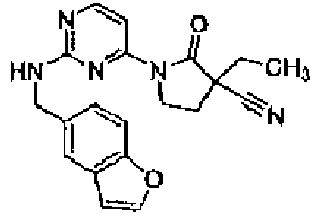
Free 362.0 69 3-ethyl-2-oxo-1-(2-((2-phenylethyl)amino)pyrimidin-4-yl)pyrrolidine-3-carbonitrile 
Free 335.9 Table 6-2 70 3-ethyl-2-oxo-1-<2-((2-(pyridin-3-yl)ethyl)amino)pyrimidin-4-yl)pyrrolidine-3-carbonitrile 
Free 337.0 72 3-ethyl-1-(2-((2-furylmethyl)amino)pyrimidin-4-yl)-2-oxopyrrolidine-3-carbonitrile 
Free 311.9 73 3-ethyl-2-oxo-1-(2-((2-thienylmethyl)amino)pyrimidin-4-yl)pyrrolidine-3-carbonitrile 
Free 327.9 74 3-ethyl-1-(2-((2-naphthyl methyl)amino)pyrimidin-4-yl)-2-oxopyrrolidine-3-carbonitrile 
Free 372.0 75 3-ethyl-1-(2-((4-methoxybenzyl)amino)pyrimidin-4-yl)-2-oxopyrrolidine-3-carbonitrile 
Free 361.9 76 3-ethyl-2-oxo-1-(2-((2-(pyridin-4-yl)ethyl)omino)pyrimidin-4-yl)pyrrolidino-3-carbonitrile 
Free 337.0 77 1-(2-((cyclopropylmethyl)amino)pyrimidin-4-yl)-3-ethyl-2-oxopyrrolidine-3-carbonitrile 
Free 285.9 - In Examples 78 to 84, the title compound was obtained from 1-(2-chloropyrimidin-4-yl)-3-isopropyl-2-oxopyrrolidine-3-carbonitrile obtained in Step C of Example 5, and 2-(4-amino-1H-pyrazol-1-yl)acetamide, 2-(4-amino-1H-pyrazol-1-yl)-N-methylacetamide, 2-(4-amino-1H-pyrazol-1-yl)-N,N-dimethylacetamide, 4-aminobenzamide, 4-amino-N-methylbenzamide, 1-(tetrahydro-2H-pyran-4-yl)-1H-pyrazol-4-amine or N-(4-aminobenzyl)acetamide (these compounds can be produced according to a method known per se), each corresponding to the compounds of Examples 78 to 84, in the same manner as in Step B of Example 2 or a method analogous thereto. MS in the tables means actual measured value.
Table 7 Example Number IUPAC Name Structure Salt MS 78 2-(4-((4-(3-cyano-3-isopropyl-2-oxopyrrolidin-1-yl)pyrimidin-2-yl)amino)-1H-pyrazol-1-yl)acetamide 
HCl 369.3 79 2-(4-((4-(3-cyano-3-isopropyl-2-oxopyrrolidin-1-yl)pyrimidin-2-yl)amino)-1H-pyrazol-1-yl)-N-methylacetamide 
HCl 383.3 80 2-(4-((4-(3-cyano-3-isopropyl-2-oxopyrrolidin-1-yl)pyrimidin-2-yl)amino)-1H-pyrazol-1-yl)-N,N-dimethylacetamide 
HCl 397.3 81 4-((4-(3-cyano-3-isopropyl-2-oxopyrrolidin-1-yl)pyrimidin-2-yl)amino)benzamide 
HCl 365.3 82 4-((4-(3-cyano-3-isopropyl-2-oxopyrrolidin-1-yl)pyrimidin-2-yl)amino)-N-methylbenzamide 
HCl 379.3 83 3-isopropyl-2-oxo-1-(2-((1-(tetrahydro-2H-pyran-4-yl)-1H-pyrazol-4-yl)amino)pyrimidin-4-yl)pyrrolidine-3-carbonitrile 
HCl 396.3 84 N-(4-((4-(3-cyano-3-isopropyl-2-oxopyrrolidin-1-yl)pyrimidin-2-yl)amino)benzyl)acetamide 
HCl 393.3 -

- A solution of (3S)-1-(2-chloropyrimidin-4-yl)-3-isopropyl-2-oxopyrrolidine-3-carbonitrile (55 mg) obtained in Step A of Example 9, 2-(4-amino-1H-pyrazol-1-yl)acetamide (35 mg) and acetic acid (13 µL) in ethanol (2 mL) was strried in a microwave reactor at 150°C for 1 hr, and the solvent was evaporated under reduced pressure. The obtained residue was purified by silica gel column chromatography (NH, ethyl acetate/methanol). The obtained crude product was subjected to HPLC (C18, mobile phase: water/acetonitrile (containing 0.1% ammonium formate)), to the obtained fraction was added saturated aqueous sodium hydrogen carbonate solution, and the mixture was extracted with ethyl acetate. The extract was dried over anhydrous magnesium sulfate, and concentrated under reduced pressure. To a solution of the residue (17 mg) in ethanol (3 mL) was added 1M hydrochloric acid (57 µL), and the solvent was evaporated under reduced pressure. The residue was recrystallized (diisopropyl ether/ethanol) to give the title compound (13 mg).
1H NMR(300 MHz, DMSO-d6)δ0.99-1.03 (3H, m), 1.07-1.15 (3H, m), 2.24-2.37 (1H, m), 2.38-2.47 (1H, m), 2.55 (1H, d, J = 7.9 Hz), 4.08 (2H, brs), 4.72 (2H, s), 7.23 (1H, brs), 7.39 (1H, brs), 7.49-7.60 (2H, m), 7.87 (1H, brs), 8.37 (1H, d, J = 5.7 Hz), 9.61 (1H, brs).
MS(ESI+): [M+H]+369.3. -

- A solution of (3S)-1-(2-chloropyrimidin-4-yl)-3-isopropyl-2-oxopyrrolidine-3-carbonitrile (55 mg) obtained in Step A of Example 9, 2-(4-amino-1H-pyrazol-1-yl)-N-methylacetamide (38 mg) and acetic acid (13 µL) in ethanol (2 mL) was strried in a microwave reactor at 150°C for 1 hr, and the solvent was evaporated under reduced pressure. The obtained residue was purified by silica gel column chromatography (NH, ethyl acetate/methanol). To a solution of the residue (83 mg) in ethanol (3 mL) was added 1M hydrochloric acid (220 µL), and the solvent was evaporated under reduced pressure. The residue was recrystallized (diisopropyl ether/ethanol) to give the title compound (87 mg).
1H NMR(300 MHz, DMSO-d6)δ 0.95-1.05 (3H, m), 1.07-1.16 (3H, m), 2.32 (1H, dt, J = 13.6, 6.8 Hz), 2.41-2.46 (1H, m), 2.55 (1H, d, J = 7.9 Hz), 2.61 (3H, d, J = 4.5 Hz), 4.08 (2H, brs), 4.73 (2H, s), 7.45-7.62 (2H, m), 7.79-7.99 (2H, m), 8.37 (1H, d, J = 5.7 Hz), 9.66 (1H, brs).
MS(ESI+): [M+H]+383.3. -

- A solution of (3S)-1-(2-chloropyrimidin-4-yl)-3-isopropyl-2-oxopyrrolidine-3-carbonitrile (55 mg) obtained in Step A of Example 9, 2-(4-amino-1H-pyrazol-1-yl)-N,N-dimethylacetamide (42 mg) and acetic acid (13 µL) in ethanol (2 mL) was strried in a microwave reactor at 150°C for 1 hr, and the solvent was evaporated under reduced pressure. The obtained residue was purified by silica gel column chromatography (NH, ethyl acetate/methanol). To a solution of the residue (80 mg) in ethanol (3 mL) was added 1M hydrochloric acid (200 µL), and the solvent was evaporated under reduced pressure. The residue was recrystallized (diisopropyl ether/ethanol) to give the title compound (90 mg).
1H NMR(300 MHz, DMSO-d6)δ 0.96-1.05 (3H, m), 1.07-1.15 (3H, m), 2.32 (1H, dt,J = 13.6, 6.8 Hz), 2.41-2.46 (1H, m), 2.54-2.60 (1H, m), 2.85 (3H, s), 3.02 (3H, s), 4.04 (2H, brs), 4.98-5.13 (2H, m), 7.46-7.61 (2H, m), 7.68-7.91 (1H, m), 8.37 (1H, d, J = 6.0 Hz), 9.68 (1H, brs).
MS(ESI+): [M+H]+397.3. - In Examples 88 to 97, the title compound was obtained from (3S)-1-(2-chloropyrimidin-4-yl)-3-isopropyl-2-oxopyrrolidine-3-carbonitrile obtained in Step A of Example 9, and 4-(4-aminophenyl)morpholin-3-one, 6-((3R)-3-methylmorpholin-4-yl)pyridin-3-amine, N-(3-aminophenyl)acetamide, 6-((3S)-3-methylmorpholin-4-yl)pyridin-3-amine, 4-aminobenzamide, 4-amino-N-methylbenzamide, 2-(4-aminophenyl)acetamide, 2-(4-aminophenyl)-N-methylacetamide, 3-(4-aminophenyl)-1,2,4-oxadiazol-5(4H)-one or 4-(4-aminophenyl)piperazin-2-one (these compounds can be produced according to a method known per se), each corresponding to the compounds of Examples 88 to 97, in the same manner as in Step B of Example 2 or a method analogous thereto. MS in the tables means actual measured value.
Table 8-1 Example Number IUPAC Name Structure Salt MS 88 (3S)-3-isopropyl-2-oxo-1-(2-((4-(3-oxomorpholin-4-yl)phenyl)amino)pyrimidin-4-yl)pyrrolidine-3-carbonitrile 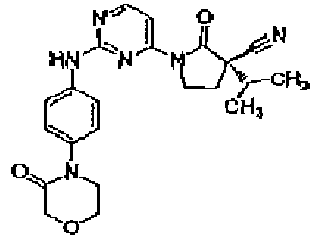
Free 421.3 89 (3S)-3-isopropyl-1-(2-((6-((3R)-3-methylmorpholin-4-yl)pyridin-3-yl)amino)pyrimidin-4-yl)-2-oxopyrrolidine-3-carbonitrile 
HCl 422.4 90 N-(3-((4-((3S)-3-cyano-3-isopropyl-2-oxopyrrolidin-1-yl)pyrimidin-2-yl)amino)phenyl)acetamide 
HCl 379.3 91 (3S)-3-isopropyl-1-(2-((6-((3S)-3-methylmorpholin-4-yl)pyridin-3-yl)amino)pyrimidin-4-yl)-2-oxopyrrolidine-3-carbonitrile 
HCl 422.4 92 4-((4-((3S)-3-cyano-3-isopropyl-2-oxopyrrolidin-1-yl)pyrimidin-2-yl)amino)benzamide 
HCl 365.3 93 4-((4-((3S)-3-cyano-3-isopropyl-2-oxopyrrolidin-1-yl)pyrimidin-2-yl)amino)-N-ethylbenzamide 
HCl 393.3 94 2-(4-((4-((3S)-3-cyano-3-isopropyl-2-oxopyrrolidin-1-yl)pyrimidin-2-yl)amino)phenyl)acetamide 
HCl 379.3 96 2-(4-((4-((3S)-3-cyano-3-isopropyl-2-oxopyrrolidin-1-yl)pyrimidin-2-yl)amino)phenyl)-N-methylacetamido 
HCl 393.3 Table 8-2 96 (3S)-3-isopropyl-2-oxo-1-(2-((4-(5-oxo-4,5-dihydro-1,2,4-oxadiazol-3-yl)phenyl)amino)pyrimidin-4-yl)pyrrolidine-3-carbonitrile 
Free 406.3 97 (3S)-3-isopropyl-2-oxo-1-(9-((4-(3-oxopiperazin-1-yl)phenyl)amino)pyrimidin-4-yl)pyrrolidine-3-carbonitrile 
Free 420.4 - In Examples 98 to 100, the title compound was obtained from (3R)-1-(2-chloropyrimidin-4-yl)-3-ethyl-2-oxopyrrolidine-3-carbonitrile obtained in Step A of Example 8, and N-(4-aminophenyl)-N-methylacetamide, 3-chloro-4-(morpholin-4-yl)aniline or 1-(4-(4-aminophenyl)piperazin-1-yl)ethanone (these compounds can be produced according to a method known per se), each corresponding to the compounds of Examples 98 to 100, in the same manner as in Step B of Example 2 or a method analogous thereto. MS in the tables means actual measured value.
Table 9 Example Number IUPAC Name Structure Salt MS 98 N-(4-((4-((3R)-3-cyano-3-ethyl-2-oxopyrrolidin-1-yl)pyrimidin-2-yl)amino)phenyl)-N-methylacetamide 
Free 370.3 99 (3R)-1-(2-((3-chloro-4-(morpholin-4-yl)phenyl)amino)pyrimidin-4-yl)-3-ethyl-2-oxopyrrolidine-3-carbonitrile 
Free 427.3 100 (3R)-1-(2-((4-(4-acetylpiperazin-1-yl)phenyl)amino)pyrimidin-4-yl)-3-ethyl-2-oxopyrrolidine-3-carbonitrile 
HCl 434.4 -

- The title compound was obtained from 4-chloro-N-(1-methyl-1H-pyrazol-4-yl)pyrimidin-2-amine obtained in Step C of Example 1 and 3,3-dimethylpiperidin-2-one in the same manner as in Step I of Example 1.
MS (ESI+) : [M+H]+301.2. -

- The title compound was obtained from 4-chloro-N-(1-methyl-1H-pyrazol-4-yl)pyrimidin-2-amine obtained in Step C of Example 1 and piperidin-2-one in the same manner as in Step I of Example 1.
MS(ESI+): [M+H]+273.2. -
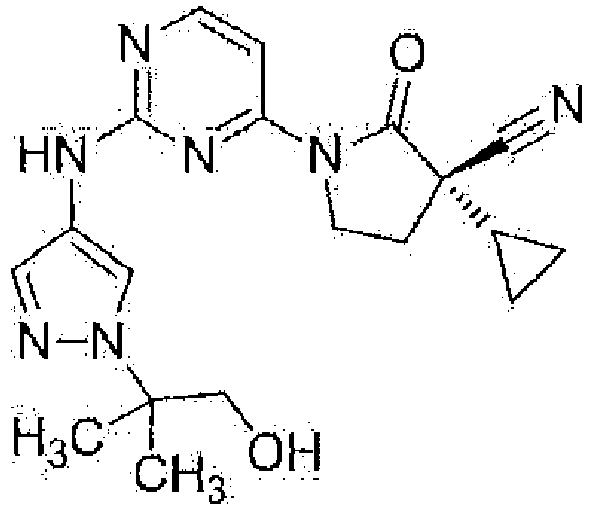
- To a solution of sodium hydride (60% in mineral oil, 38 g) and diethyl carbonate (97 mL) in toluene (240 mL) was added dropwise a solution of cyclopropylacetonitrile (32 g) in toluene (120 mL) over 40 min with heating under reflux, and the mixture was heated under reflux for additional 2 hr. The mixture was neutralized with acetic acid (120 mL) in an ice bath, water was added thereto, and the mixture was extracted with ethyl acetate. The obtained organic layer was washed with saturated brine, and dried over anhydrous magnesium sulfate, and the solvent was evaporated under reduced pressure. The residue was distilled (boling point 69-72°C, 4.0 mmHg) to give the title compound (50 g).
1H NMR (400 MHz, CDCl3)δ0.49-0.61 (2H, m), 0.68-0.78 (2H, m), 1.34 (3H, t, J = 7.2 Hz), 1.36-1.43 (1H, m), 3.23 (1H, d, J = 7.6 Hz), 4.29 (2H, q, J = 7.1 Hz). - To a solution of ethyl cyano(cyclopropyl)acetate (27 g) obtained in Step A of Example 103 in toluene (400 mL) were added cesium carbonate (88 g), tetrabutylammonium bromide (5.8 g) and tert-butyl 1,2,3-oxathiazolidine-3-carboxylate 2,2-dioxide (40 g), and the mixture was stirred overnight at room temperature. The reaction mixture was neutralized with 0.5 M hydrochloric acid (400 mL), and extracted with ethyl acetate. The obtained organic layer was washed successively with water and saturated brine, and dried over anhydrous magnesium sulfate, and the solvent was evaporated under reduced pressure. The residue was purified by silica gel column chromatography (hexane/ethyl acetate) to give the title compound (45 g).
1H NMR(400 MHz, DMSO-d6)δ0.35-0.47 (2H, m), 0.55-0.62 (1H, m), 0.63-0.72 (1H, m), 1.21-1.27 (3H, m), 1.30-1.34 (1H, m), 1.35-1.43 (9H, m), 1.95-2.00 (1H, m), 2.11-2.21 (1H, m), 2.90-3.03 (1H, m), 3.09-3.21 (1H, m), 4.15-4.30 (2H, m), 6.92 (1H, t, J = 5.5 Hz). - To a solution of ethyl 4-((tert-butoxycarbonyl)amino)-2-cyano-2-cyclopropylbutanoate (45 g) obtained in Step B of Example 103 in tetrahydrofuran (1.2 L) was added sodium hydride (60% in mineral oil, 7.3 g) in an ice bath, and the mixture was stirred at room temperature for 2 hr. To the reaction mixture was added saturated aqueous ammonium chloride solution (100 mL), the solvent (tetrahydrofuran) was evaporated under reduced pressure, and the reaction mixture was extracted with ethyl acetate. The obtained organic layer was washed with saturated brine, and dried over anhydrous magnesium sulfate, and the solvent was evaporated under reduced pressure. The residue was purified by silica gel column chromatography (hexane/ethyl acetate) to give the title compound (18 g).
1H NMR(400 MHz, DMSO-d6)δ0.40-0.57 (3H, m), 0.59-0.69 (1H, m), 1.31 (1H, m), 2.20 (1H, m), 2.43-2.48 (1H, m), 3.24-3.30 (2H, m), 8.30 (1H, brs). - To a mixture of 3-cyclopropyl-2-oxopyrrolidine-3-carbonitrile (18 g) obtained in Step C of Example 103, 2,4-dichloropyrimidine (17 g), cesium carbonate (76 g) and 4,5-bis(diphenylphosphino)-9,9-dimethylxanthene (4.1 g) in tetrahydrofuran (300 mL) was added tris(dibenzylideneacetone)dipalladium(0) (2.1 g), and the mixture was stirred overnight at 85°C. The insoluble substance was removed by filtration through Celite, and the solvent was evaporated under reduced pressure. The residue was purified by silica gel column chromatography (hexane/ethyl acetate) to give the title compound (23 g).
1H NMR(400 MHz, DMSO-d6)δ0.49-0.59 (2H, m), 0.62-0.74 (2H, m), 1.48-1.60 (1H, m), 2.37 (1H, m), 2.65 (1H, m), 3.95-4.04 (1H, m), 4.05-4.13 (1H, m), 8.24 (1H, d, J = 5.9 Hz), 8.70 (1H, d, J = 5.6 Hz).
MS (ESI+) : [M+H]+ 263.2. - 1-(2-Cloropyrimidin-4-yl)-3-cyclopropyl-2-oxopyrrolidine-3-carbonitrile (23 g) obtained in Step D of Example 103 was resolved by HPLC (column: CHIRALPAK IC, 50 mmID×500 mmL, manufactured by Daicel Chemical Industries, mobile phase: hexane/2-propanol = 200/800) to give the title compound (12 g: a shorter retention time).
>99%ee (HPLC (column: CHIRALPAK IC, 4.6 mmID×250 mmL, manufactured by Daicel Chemical Industries, mobile phase: hexane/2-propanol = 200/800, flow rate: 0.5 mL/min, retention time: 19.33 min)) - To a solution of 4-nitro-1H-pyrazole (25 g) in N,N-dimethylformamide (100 mL) was added ethyl 2-bromo-2-methylpropanoate (39 mL), and the mixture was stirred at 80°C for 2 hr. To the reaction mixture was added water, and the mixture was extracted with ethyl acetate. The obtained organic layer was washed with saturated brine, and dried over anhydrous magnesium sulfate, and the solvent was evaporated under reduced pressure. The residue was purified by silica gel column chromatography (hexane/ethyl acetate) to give the title compound (50 g).
1H NMR(400 MHz, CDCl3)δ1.23 (3H, t, J = 7.2 Hz), 1.88 (6H, s), 4.20 (2H, q, J = 7.1 Hz), 8.11 (1H, s), 8.20-8.51 (1H, m). - To a solution of ethyl 2-methyl-2-(4-nitro-1H-pyrazol-1-yl)propanoate (45 g) obtained in Step F of Example 103 in tetrahydrofuran (400 mL) was added gradually dropwise diisopropylaluminium hydride in toluene (1.5 M in toluene, 400 mL) while maintaining the internal temperature of -20°C or less, and the reaction mixture was stirred overnight while it was allowed to be warmed. To the reaction mixture was added aqueous potassium sodium tartrate solution in an ice bath, and the mixture was extracted with ethyl acetate. The obtained organic layer was washed with saturated brine, and dried over anhydrous magnesium sulfate, and the solvent was evaporated under reduced pressure. The residue was purified by silica gel column chromatography (ethyl acetate) to give the crude title compound (36 g).
1H NMR(400 MHz, CDCl3)δ1.60 (6H, s), 2.71 (1H, brs), 3.84 (2H, s), 8.10 (1H, s), 8.28 (1H, d, J = 0.5 Hz). - To a solution of the crude 2-methyl-2-(4-nitro-1H-pyrazol-1-yl)propan-1-ol (36 g) obtained in Step G of Example 103 in ethanol (200 mL) was added 10% palladium-carbon (360 mg), and the mixture was stirred overnight at room temperature under hydrogen atmosphere (at normal pressure). The palladium-carbon was removed by filtration through Celite, and the solvent was evaporated under reduced pressure. The residue was purified by silica gel column chromatography (ethyl acetate/methanol), and the obtained solid was washed with diisopropyl ether to give the title compound (15 g).
1H NMR (400 MHz, DMSO-d6)δ1.36 (6H, s), 3.48 (2H, d, J = 5.6 Hz), 3.71 (2H, brs), 4.86 (1H, t, J = 5.6 Hz), 6.91 (1H, d, J = 0.7 Hz), 7.09 (1H, d, J = 1.0 Hz). - A solution of (3S)-1-(2-chloropyrimidin-4-yl)-3-cyclopropyl-2-oxopyrrolidine-3-carbonitrile (11.5 g) obtained in Step E of Example 103, 2-(4-amino-1H-pyrazol-1-yl)-2-methylpropan-1-ol (7.1 g) obtained in Step H of Example 103 and acetic acid (2.6 mL) in ethanol (200 mL) was stirred in a sealed tube reactor at 150°C for 1 hr, and the solvent was evaporated under reduced pressure. The reaction mixture was neutralized with saturated aqueous sodium bicarbonate, and extracted with ethyl acetate. The obtained organic layer was washed with saturated brine, and dried over anhydrous magnesium sulfate, and the solvent was evaporated under reduced pressure. The residue was purified by silica gel column chromatography (hexane/ethyl acetate), and recrystallized (diisopropyl ether/ethyl acetate) to give the title compound (6.9 g).
1H NMR(400 MHz, DMSO-d6)δ0.43-0.78 (4H, m), 1.45 (6H, s), 1.54 (1H, m), 2.28-2.43 (1H, m), 2.65 (1H, m), 3.56 (2H, d, J = 5.6 Hz), 3.90-4.29 (2H, m), 4.97 (1H, t, J = 5.5 Hz), 7.48 (1H, d, J = 5.6 Hz), 7.54 (1H, s), 7.95 (1H, s), 8.36 (1H, d, J = 4.9 Hz), 9.53 (1H, brs).
MS(ESI+): [M+H]+ 382.3. -

- To a solution of (3S)-3-cyclopropyl-1-(2-((1-(1-hydroxy-2-methylpropan-2-yl)-1H-pyrazol-4-yl)amino)pyrimidin-4-yl)-2-oxopyrrolidine-3-carbonitrile (4.3 g) obtained in Step I of Example 103 in ethanol (80 mL) was added 1 M hydrochloric acid (11 mL), and the mixture was stirred at room temperature for 5 min. The solvent was evaporated under reduced pressure, and the residue was recrystallized (diisopropyl ether/ethanol) to give the title compound (4.1 g).
1H NMR(400 MHz, DMSO-d6)δ0.42-0.84 (4H, m), 1.45 (6H, s), 1.50-1.62 (1H, m), 2.25-2.42 (1H, m), 2.65 (1H, m), 3.92-4.26 (4H, m), 4.44 (2H, brs), 7.50 (1H, d, J = 5.9 Hz), 7.55 (1H, s), 7.96 (1H, s), 8.36 (1H, d, J = 5.6 Hz), 9.65 (1H, brs).
MS(ESI+): [M+H]+ 382.3. -
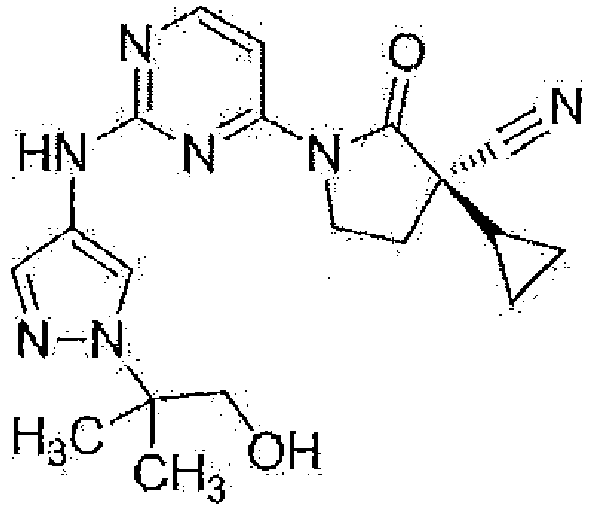
- 1-(2-Chloropyrimidin-4-yl)-3-cyclopropyl-2-oxopyrrolidine-3-carbonitrile (23 g) obtained in Step D of Example 103 was resolved by HPLC (column: CHIRALPAK IC, 50 mmID×500 mmL, manufactured by Daicel Chemical Industries, mobile phase: hexane/2-propanol = 200/800) to give the title compound (11 g: a longer retention time).
>99%ee (HPLC (column: CHIRALPAK IC, 4.6 mmIDx250 mmL, manufactured by Daicel Chemical Industries, mobile phase: hexane/2-propanol = 200/800, flow rate: 0.5 mL/min, retention time: 27.06 min)) - A solution of (3R)-1-(2-chloropyrimidin-4-yl)-3-cyclopropyl-2-oxopyrrolidine-3-carbonitrile (200 mg) obtained in Step A of Example 105, 2-(4-amino-1H-pyrazol-1-yl)-2-methylpropan-1-ol (120 mg) obtained in Step H of Example 103 and acetic acid (48 µL) in ethanol (20 mL) was stirred in a microwave reactor at 150°C for 1 hr, and the solvent was evaporated under reduced pressure. The reaction mixture was neutralized with saturated aqueous sodium bicarbonate, and extracted with ethyl acetate. The obtained organic layer was washed with saturated brine, and dried over anhydrous magnesium sulfate, and the solvent was evaporated under reduced pressure. The residue was purified by silica gel column chromatography (hexane/ethyl acetate), and recrystallized (diisopropyl ether/ethyl acetate) to give the title compound (110 mg).
1H NMR(400 MHz, DMSO-d6)δ0.40-0.87 (4H, m), 1.45 (6H, s), 1.54 (1H, m), 2.29-2.42 (1H, m), 2.57-2.75 (1H, m), 3.56 (2H, d, J = 5.6 Hz), 3.95-4.36 (2H, m), 4.98 (1H, t, J = 5.4 Hz), 7.48 (1H, d, J = 5.6 Hz), 7.54 (1H, s), 7.95 (1H, s), 8.36 (1H, d, J = 5.1 Hz), 9.53 (1H, brs).
MS(ESI+):[M+H]+ 382.3. -

- To a solution of 2-(4-amino-1H-pyrazol-1-yl)-2-methylpropan-1-ol (350 mg) obtained in Step H of Example 103 in deuterated water (3.0 mL) was added a solution of 4 M hydrogen chloride in ethyl acetate (0.56 mL), the mixture was stirred in a microwave reactor at 180°C for 1 hr, and the solvent was evaporated under reduced pressure. The residue was purified by silica gel column chromatography (NH, hexane/ethyl acetate) to give the title compound (150 mg).
1H NMR(400 MHz, DMSO-d6)δ1.36 (6H, s), 3.48 (2H, d, J = 5.9 Hz), 3.70 (2H, brs), 4.86 (1H, t, J = 5.6 Hz). - The title compound (18 mg) was obtained from (3S)-1-(2-chloropyrimidin-4-yl)-3-cyclopropyl-2-oxopyrrolidine-3-carbonitrile (180 mg) obtained in Step E of Example 103 and 2-(4-amino-(2H2)-1H-pyrazol-1-yl)-2-methylpropan-1-ol (150 mg) obtained in Step A of Example 106 in the same manner as in Example 56.
1H NMR(400 MHz, DMSO-d6)δ0.44-0.77 (4H, m), 1.45 (6H, s), 1.49-1.61 (1H, m), 2.30-2.42 (1H, m), 2.59-2.72 (1H, m), 3.56 (2H, d, J = 5.4 Hz), 3.95-4.30 (2H, m), 4.97 (1H, t, J = 5.4 Hz), 7.48 (1H, d, J = 5.6 Hz), 8.36 (1H, d, J = 5.4 Hz), 9.52 (1H, brs). MS(ESI+): [M+H]+ 384.4. -
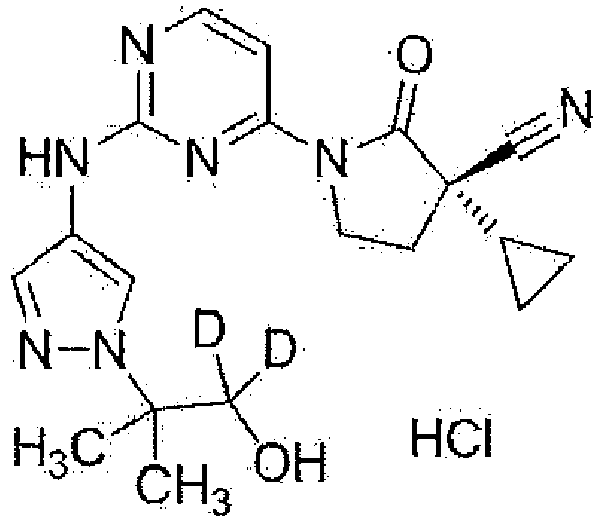
- To a solution of deuterated lithium aluminium hydride (2.0 g) in tetrahydrofuran (40 mL) was added a solution of ethyl 2-methyl-2-(4-nitro-1H-pyrazol-1-yl)propanoate (5.0 g) obtained in Step F of Example 103 in tetrahydrofuran (40 mL) at -78°C under nitrogen atmosphere, and the mixture was stirred for 3 hr while it was allowed to be warmed to 0°C. To the reaction mixture was added sodium sulfate decahydrate in an ice bath, and the mixture was stirred at room temperature for 30 min. The resulting solid was removed by filtration through Celite, and the solvent was evaporated under reduced pressure. The residue was purified by silica gel column chromatography (hexane/ethyl acetate) to give the title compound (260 mg).
1H NMR (400 MHz, CDCl3)δ1.60 (6H, s), 2.61 (1H, s), 8.10 (1H, s). - The title compound (160 mg) was obtained from 2-methyl-2-(4-nitro(3-2H)-1H-pyrazol-1-yl)-(1,1-2H2)propan-1-ol (260 mg) obtained in Step A of Example 107 in the same manner as in Step H of Example 103.
1H NMR(400 MHz, DMSO-d6)δ1.36 (6H, s), 3.70 (2H, brs), 4.82 (1H, s), 6.90 (1H, s). - The title compound (150 mg) was obtained from (3S)-1-(2-chloropyrimidin-4-yl)-3-cyclopropyl-2-oxopyrrolidine-3-carbonitrile (200 mg) obtained in Step E of Example 103 and 2-(4-amino(3-2H)-1H-pyrazol-1-yl)-2-methyl- (1,1-2H2)propan-1-ol (130 mg) obtained in Step B of Example 107 in the same manner as in Step D of Example 109.
1H NMR (400 MHz, DMSO-d6)δ0.43-0.80 (4H, m), 1.45 (6H, s), 1.50-1.67 (1H, m), 2.26-2.42 (1H, m), 2.65 (1H, m), 3.88-4.31 (2H, m), 5.16 (2H, brs), 7.50 (1H, d, J = 5.9 Hz), 7.55 (1H, s), 7.96 (1H, s), 8.36 (1H, d, J = 5.6 Hz), 9.61 (1H, brs). MS(ESI+): [M+H]+ 384.3. -

- To a solution of 4-nitro-1H-pyrazole (3.0 g) in N,N-dimethylformamide (50 mL) was added tert-butyl 2-bromo-2-methylpropanoate (15 mL), and the mixture was stirred at 80°C for 3 hr. To the reaction mixture was added water, and the mixture was extracted with ethyl acetate. The obtained organic layer was washed with saturated brine, and dried over anhydrous magnesium sulfate, and the solvent was evaporated under reduced pressure. The residue was purified by silica gel column chromatography (hexane/ethyl acetate) to give the title compound (7.0 g).
1H NMR(400 MHz, DMSO-d6)δ1.35 (9H, s), 1.78 (6H, s), 8.33 (1H, s), 9.06 (1H, d, J = 0.5 Hz). - The title compound (5.4 g) was obtained from tert-butyl 2-methyl-2-(4-nitro-1H-pyrazol-1-yl)propanoate (7.0 g) obtained in Step A of Example 108 in the same manner as in Step H of Example 103.
1H NMR (400 MHz, DMSO-d6)δ1.33 (9H, s), 1.61 (6H, s), 3.80 (2H, brs), 6.95 (1H, d, J = 0.7 Hz), 7.09 (1H, d, J = 0.7 Hz). MS(ESI+): [M-(tBu)+2H]+ 270.2. - The title compound (1.5 g) was obtained from (3S)-1-(2-chloropyrimidin-4-yl)-3-cyclopropyl-2-oxopyrrolidine-3-carbonitrile (1.0 g) obtained in Step E of Example 103 and tert-butyl 2-(4-amino-1H-pyrazol-1-yl)-2-methylpropanoate (1.0 g) obtained in Step B of Example 108 in the same manner as in Step I of Example 103.
MS(ES1+): [M+H]+ 452.3. - To a solution of tert-butyl 2-(4-((4-((3S)-3-cyano-3-cyclopropyl-2-oxopyrrolidin-1-yl)pyrimidin-2-yl)amino)-1H-pyrazol-1-yl)-2-methylpropanoate (1.0 g) obtained in Step C of Example 108 in ethyl acetate (10 mL) was added a solution of 4 M hydrogen chloride in ethyl acetate (10 mL), and the mixture was stirred at room temperature for 3 hr. The solvent was evaporated under reduced pressure, and the residue was recrystallized (diisopropyl ether/ethanol) to give the crude title compound (1.1 g).
- The crude title compound (100 mg) was pufified by HPLC (C18, mobile phase: water/acetonitrile (containing 10 mM NH4HCO3)), and the solvent was evaporated under reduced pressure. To a solution of the residue (90 mg) in ethanol (3 mL) was added 1M hydrochloric acid (0.23 mL), and the solvent was evaporated under reduced pressure. The residue was recrystallized (diisopropyl ether/ethanol) to give the title compound (55 mg).
MS(ESI+): [M+H]+ 396.3. -

- To a solution of ethyl 2-methyl-2-(4-nitro-1H-pyrazol-1-yl)propanoate (6.0 g) obtained in Step F of Example 103 in ethanol (50 mL) was added dropwise 2 M aqueous sodium hydroxide solution (26 mL), and the mixture was stirred at room temperature for 3 hr. To the reaction mixture was added water, and the mixture was washed with diethyl ether. The obtained aqueous layer was neutralized with 2 M hydrochloric acid, and extracted with ethyl acetate. The obtained organic layer was washed with saturated brine, and dried over anhydrous magnesium sulfate, and the solvent was evaporated under reduced pressure to give the title compound (5.0 g).
1H NMR(300 MHz, DMSC-d6)δ1.79 (6H, s), 8.31 (1H, s), 9.06 (1H, s), 13.40 (1H, brs). - To a solution of 2-methyl-2-(4-nitro-1H-pyrazol-1-yl)propanoic acid (1.2 g) obtained in Step A of Example 109 in N,N-dimethylformamide (10 mL) were added 1-ethyl-3-(3-dimethylaminopropyl)carbodiimide hydrochloride (1.3 g) and 1-hydroxybenzotriazole ammonia salt (1.4 g), and the mixture was stirred overnight at room temperature. To the reaction mixture was added saturated aqueous sodium hydrogen carbonate solution, and the mixture was extracted with ethyl acetate. The obtained organic layer was washed successively with water and saturated brine, and dried over anhydrous magnesium sulfate, and the solvent was evaporated under reduced pressure. The residue was purified by silica gel column chromatography (NH, ethyl acetate) to give the title compound (1.0 g).
1H NMR(300 MHz, DMSO-d6)δ1.75 (6H, s), 6.89-7.61 (2H, m), 8.29 (1H, s), 8.94 (1H, s). - To a solution of 2-methyl-2-(4-nitro-1H-pyrazol-1-yl)propanamide (1.0 g) obtained in Step B of Example 109 in ethanol (50 mL) was added 10% palladium-carbon (100 mg), and the mixture was stirred at room temperature for 5 hr under hydrogen atmosphere (at normal pressure). The palladium carbon was removed by filtration through Celite, and the solvent was evaporated under reduced pressure. The residue was recrystallized (ethyl acetate/hexane) to give the title compound (760 mg).
1H NMR (300 MHz, DMSO-d6)δ1.60 (6H, s), 3.85 (2H, brs), 6.35 (1H, brs), 7.01 (1H, d, J = 0.8 Hz), 7.11 (1H, d, J = 0.8 Hz), 7.11 (1H, brs). - A solution of (3S)-1-(2-chloropyrimidin-4-yl)-3-cyclopropyl-2-oxopyrrolidine-3-carbonitrile (250 mg) obtained in Step E of Example 103, 2-(4-amino-1H-pyrazol-1-yl)-2-methylpropanamide (160 mg) obtained in Step C of Example 109 and acetic acid (57 µL) in ethanol (3.0 mL) was stirred in a microwave reactor at 150°C for 1 hr, and the solvent was evaporated under reduced pressure. The reaction mixture was neutralized with saturated aqueous sodium bicarbonate, and extracted with ethyl acetate. The obtained organic layer was washed with saturated brine, and dried over anhydrous magnesium sulfate, and the solvent was evaporated under reduced pressure. The residue was purified by silica gel column chromatography (hexane/ethyl acetate).
- To a solution of the residue in ethanol (5.0 mL) was added 2 M hydrochloric acid (0.95 mL), the mixture was stirred for 5 min, and the solvent was evaporated under reduced pressure. The residue was recrystallized (ethyl acetate/acetonitrile) to give the title compound (230 mg).
1H NMR(400 MHz, DMSO-d6)δ0.39-0.87 (4H, m), 1.49-1.61 (1H, m), 1.69 (6H, s), 2.27-2.43 (1H, m), 2.65 (1H, m), 3.93-4.36 (2H, m), 4.89 (1H, brs), 6.75 (1H, brs), 7.20 (1H, brs), 7.51 (1H, d, J = 5.6 Hz), 7.61 (1H, s), 7.98 (1H, s), 8.38 (1H, d, J = 5.9 Hz), 9.63 (1H, brs).
MS(ESI+): [M+H]+395.1. -

- To a solution of 2-(4-((4-((3S)-3-cyano-3-cyclopropyl-2-oxopyrrolidin-1-yl)pyrimidin-2-ylyamino)-1H-pyrazol-1-yl)-2-methylpropanoic acid hydrochloride (80 mg) obtained in Example 108 in N,N-dimethylformamide (2.0 mL) were added 1-ethyl-3-(3-dimethylaminopropyl)carbodiimide (58 mg), 1-hydroxybenzotriazole monohydrate (57 mg), N,N-diisopropylethylamine (97 µL) and morpholine (19 mg), and the mixture was stirred overnight at room temperature. The solvent was evaporated under reduced pressure, and the residue was purified by silica gel column chromatography (NH, hexane/ethyl acetate). To a solution of the residue (87 mg) in ethanol (3.0 mL) was added dropwise 1 M hydrochloric acid (0.19 mL), the mixture was stirred for 5 min, and the solvent was evaporated under reduced pressure. The residue was recrystallized (ethanol/diisopropyl ether) to give the title compound (35 mg).
MS(ESI+): [M+H]+ 465.4. - In Examples 111 to 113, the title compound was obtained from 2-(4-((4-((3S)-3-cyano-3-cyclopropyl-2-oxopyrrolidin-1-yl)pyrimidin-2-yl)amino)-1H-pyrazol-1-yl)-2-methylpropanoic acid hydrochloride obtained in Example 108 and the amine each corresponding to the compounds of Examples 111 to 113 ((S)-(-)-pyrrolidinol, (R)-(+)-pyrrolidinol and 4-hydroxypiperidine (these compounds can be produced according to a method known per se)), in the same manner as in Example 110 or a method analogous thereto. MS in the tables means actual measured value.
Table 10 Example Number IUPAC Name Structure Salt MS 111 (3S)-3-cyclopropyl-1-(2-((1-(1-((3R)-3-hydroxypyrrolidin-1-yl)-2-methyl-1-oxopropan-2-yl)-1H-pyrazol-4-yl)amino)pyrimidin-4-yl)-2-oxopyrrolidine-3-carbonitrile 
HCl 465.4 112 (3S)-3-cyclopropyl-1-(2-((1-(1-((3S)-3-hydroxypyrrolidin-1-yl)-2-methyl-1-oxopropan-2-yl)-1H-pyrazol-4-yl)amino)pyrimidin-4-yl)-2-oxopyrrolidine-3-carbonitrile 
HCl 466.4 113 (3S)-3-cyclopropyl-1-(2-((1-(1-(4-hydroxypiperidin-1-yl)-2-methyl-1-oxopropan-2-yl)-1H-pyrazol-4-yl)amino)pyrimidin-4-yl)-2-oxopyrrolidine-3-carbonitrile 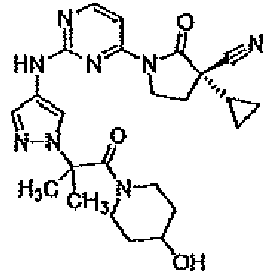
free 479.2 -

- To a solution of 2-(4-amino-1H-pyrazol-1-yl)-2-methylpropan-1-ol (2.1 g) obtained in Step H of Example 103 in tetrahydrofuran (50 mL) were added triethylamine (1.6 g) and di-tert-butyl dicarbonate (3.5 g), and the mixture was stirred at room temperature for 2 hr. To the reaction mixture was added water, and the mixture was extracted with ethyl acetate. The obtained organic layer was washed with saturated brine, and dried over anhydrous magnesium sulfate, and the solvent was evaporated under reduced pressure. The residue was purified by silica gel column chromatography (hexane/ethyl acetate) to give the title compound (3.4 g).
1H NMR(400 MHz, DMSO-d6)(δ1.40 (6H, s), 1.44 (9H, s), 3.51 (2H, d, J = 5.6 Hz), 4.93 (1H, t, J = 5.6 Hz), 7.27 (1H, s), 7.66 (1H, s), 9.07 (1H, s). - To tert-butyl (1-(1-hydroxy-2-methylpropan-2-yl)-1H-pyrazol-4-yl)carbamate (3.4 g) obtained in Step A of Example 114 were added successively triethylamine (2.4 mL) and methanesulfonyl chloride (1.2 mL) in an ice bath, and the mixture was stirred at room temperature for 2 hr. To the reaction mixture was added water, and the mixture was extracted with ethyl acetate. The obtained organic layer was washed with saturated brine, and dried over anhydrous magnesium sulfate, and the solvent was evaporated under reduced pressure to give the crude title compound (2.2 g).
1H NMR(400 MHz, CDCl3)δ1.50 (9H, s), 1.63 (6H, s), 2.78 (3H, s), 4.41 (2H, s), 6.23 (1H, brs), 7.38 (1H, s), 7.78 (1H, s). - To a solution of the crude 2-(4-((tert-butoxycarbonyl)amino)-1H-pyrazol-1-yl)-2-methylpropyl methanesulfonate (1.1 g) obtained in Step B of Example 114 in N,N-dimethylformamide (10 mL) were added sodium iodide (740 mg) and sodium methanesulfinate (1.0 g), and the mixture was stirred overnight at 140°C. To the reaction mixture was added water, and the mixture was extracted with ethyl acetate. The obtained organic layer was washed with saturated brine, and dried over anhydrous magnesium sulfate, and the solvent was evaporated under reduced pressure. The residue was purified by silica gel column chromatography (hexane/ethyl acetate) to give the title compound (250 mg).
MS(ESI+): [M+H]+ 318.3. - To tert-butyl (1-(2-methyl-1-(methylsulfonyl)propan-2-yl)-1H-pyrazol-4-yl)carbamate (250 mg) obtained in Step C of Example 114 was added dropwise a solution of 4 M hydrogen chloride in ethyl acetate (4.0 mL), and the mixture was stirred at room temperature for 30 min. The reaction mixture was neutralized with saturated aqueous sodium hydrogen carbonate solution, and extracted with ethyl acetate. The obtained organic layer was washed with saturated brine, and dried over anhydrous magnesium sulfate, and the solvent was evaporated under reduced pressure. The residue was purified by silica gel column chromatography (ethyl acetate/methanol) to give the title compound (23 mg).
1H NMR (400 MHz, DMSO-d6)δ1.64 (6H, s), 2.39 (3H, s), 3.67 (2H, s), 3.86 (2H, brs), 7.02 (1H, d, J = 0.7 Hz), 7.17 (1H, d, J = 0.7 Hz). - The title compound (27 mg) was obtained from (3S)-1-(2-chloropyrimidin-4-yl)-3-cyclopropyl-2-oxopyrrolidine-3-carbonitrile (28 mg) obtained in Step E of Example 103 and 1-(2-methyl-1-(methylsulfonyl)propan-2-yl)-1H-pyrazol-4-amine (23 mg) obtained in Step D of Example 114 in the same manner as in Step D of Example 109.
MS(ESI+): [M+H]+ 444.3. -

- To a solution of 2-methyl-2-(4-nitro-1H-pyrazol-1-yl)propan-1-ol (13 g) obtained in Step G of Example 103 in tetrahydrofuran (100 mL) were added successively dropwise triethylamine (12 mL) and methanesulfonyl chloride (6.3 mL) at 0°C under nitrogen atmosphere, and the mixture was stirred at room temperature for 2 hr. To the reaction mixture was added water, and the mixture was extracted with ethyl acetate. The obtained organic layer was washed with saturated brine, and dried over anhydrous magnesium sulfate, and the solvent was evaporated under reduced pressure to give the crude title compound (18 g).
1H NMR(400 MHz, CDCl3)δ1.70 (6H, s), 2.90 (3H, s), 4.45 (2H, s), 8.13 (1H, s), 8.27 (1H, s). - To a solution of the crude 2-methyl-2-(4-nitro-1H-pyrazol-1-yl)propyl methanesulfonate (18 g) obtained in Step A of Example 115 in N,N-dimethylformamide (150 mL) was added sodium iodide (20 g), and the mixture was stirred overnight at 130°C. To the reaction mixture was added water, and the mixture was extracted with ethyl acetate. The obtained organic layer was washed with saturated brine, and dried over anhydrous magnesium sulfate, and the solvent was evaporated under reduced pressure. The residue was purified by silica gel column chromatography (hexane/ethyl acetate) to give the title compound (14 g).
1H NMR(400 MHz, CDCl3)δ1.80 (6H, s), 3.68 (2H, s), 8.13 (1H, s), 8.22 (1H, s). - To a solution of 1-(1-iodo-2-methylpropan-2-yl)-4-nitro-1H-pyrazole (14 g) obtained in Step B of Example 115 in N,N-dimethylformamide (100 mL) was added sodium azide (4.8 g), and the mixture was stirred overnight at 140°C. To the reaction mixture was added water, and the mixture was extracted with ethyl acetate. The obtained organic layer was washed with saturated brine, and dried over anhydrous magnesium sulfate, and the solvent was evaporated under reduced pressure. The residue was purified by silica gel column chromatography (hexane/ethyl acetate) to give the title compound (10 g).
1H NMR(400 MHz, CDCl3)δ1.65 (6H, s), 3.68 (2H, s), 8.13 (1H, s), 8.25 (1H, s). - To a solution of 1-(1-azido-2-methylpropan-2-yl)-4-nitro-1H-pyrazole (10 g) obtained in Step C of Example 115 in a mixed solvent of tetrahydrofuran/water (v/v = 10/1, 88 mL) was added triphenylphosphine (15 g), and the mixture was stirred overnight at room temperature. The solvent was evaporated under reduced pressure, and the residue was purified by silica gel column chromatography (ethyl acetate/methanol) to give the title compound (8.7 g) as a mixture with triphenylphosphine oxide.
MS(ESI+): [M+H]+ 185.3. - To a solution of the crude 2-methyl-2-(4-nitro-1H-pyrazol-1-yl)propan-1-amine (8.7 g) obtained in Step D of Example 115 in tetrahydrofuran (100 mL) were added triethylamine (8.6 mL) and di-tert-butyl dicarbonate (13 mL) at 0°C under nitrogen atmosphere, and the mixture was stirred overnight at room temperature. To the reaction mixture was added 1 M hydrochloric acid, and the mixture was extracted with ethyl acetate. The obtained organic layer was washed with saturated brine, and dried over anhydrous magnesium sulfate, and the solvent was evaporated under reduced pressure. The residue was purified by silica gel column chromatography (hexane/ethyl acetate) to give the title compound (3.0 g).
1H NMR(400 MHz, CDCl3)δ1.42 (9H, s), 1.59 (6H, s), 3.58 (2H, d, J = 6.8 Hz), 4.74 (1H, brs), 8.10 (1H, s), 8.23 (1H, s). - The title compound (1.5 g) was obtained from tert-butyl (2-methyl-2-(4-nitro-1H-pyrazol-1-yl)propyl)carbamate (1.9 g) obtained in Step E of Example 115 in the same manner as in Step H of Example 103.
1H NMR (400 MHz, DMSO-d6)δ1.31-1.44 (15H, m), 3.23 (2H, d, J = 6.4 Hz), 3.75 (2H, brs), 6.57 (1H, t, J = 6.5 Hz), 6.94 (1H, s), 7.08 (1H, s). - The title compound (880 mg) was obtained from (3S)-1-(2-chloropyrimidin-4-yl)-3-cyclopropyl-2-oxopyrrolidine-3-carbonitrile (600 mg) obtained in Step E of Example 103 and tert-butyl (2-(4-amino-1H-pyrazol-1-yl)-2-methylpropyl)carbamate (640 mg) obtained in Step F of Example 115 in the same manner as in Step D of Example 109.
MS(ESI+): [M+H]+ 381.4. -

- To a solution of (3S)-1(2-((1-(1-amino-2-methylpropan-2-yl)-1H-pyrazol-4-yl)amino)pyrimidin-4-yl)-3-cyclopropyl-2-oxopyrrolidine-3-carbonitrile dihydrochloride (100 mg) obtained in Example 115 in tetrahydrofuran (5 mL) were added successively dropwise triethylamine (0.15 mL) and methoxyacetyl chloride (26 mg) at 0°C under nitrogen atmosphere, and the mixture was stirred at room temperature for 5 hr. To the reaction mixture was added water, and the mixture was extracted with ethyl acetate. The obtained organic layer was washed with saturated brine, and dried over anhydrous magnesium sulfate, and the solvent was evaporated under reduced pressure. The residue was purified by silica gel column chromatography (ethyl acetate/methanol). To a solution of the residue (89 mg) in ethanol (5.0 mL) was added 1 M hydrochloric acid (0.20 mL), and the mixture was stirred at room temperature for 5 min. The solvent was evaporated under reduced pressure, and the residue was recrystallized (diisopropyl ether/ethyl acetate) to give the title compound (81 mg).
MS (ESI+) : [M+H]+ 453.4. - In Examples 117 to 121, the title compound was obtained from (3S)-1-(2-((1-(1-amino-2-methylpropan-2-yl)-1H-pyrazol-4-yl)amino)pyrimidin-4-yl)-3-cyclopropyl-2-oxopyrrolidine-3-carbonitrile dihydrochloride obtained in Example 115 and the reagent each corresponding to the compounds of Examples 117 to 121 (acetyl chloride, glycol acid, methanesulfonyl chloride, N,N-dimethylsulfamoyl chloride and (tert-butoxycarbonyl)((4-(dimethyliminio)pyridin-1(4H)-yl)sulfonyl)azanide (these compounds can be produced according to a method known per se)), in the same manner as in Example 116 or a method analogous thereto. MS in the tables means actual measured value.
Table 11 Example Number IUPAC Name Structure Salt MS 117 N-(2-(4-((4-((3S)-3-cyano-3-cyclopropyl-2-oxopyrrolidin-1-yl)pyrimidin-2-yl)amino)-1H-pyrazol-1-yl)-2-methylpropyl)acetamide 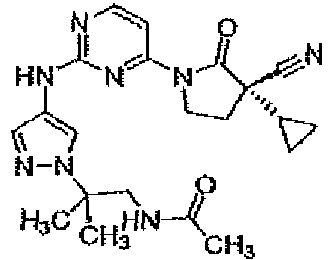
HCl 423.4 118 N-(2-(4-((4-((3S)-3-cyano-3-cyclopropyl-2-oxopyrrolidin-1-yl)pyrimidin-2-yl)amino)-1H-pyrazol-1-yl)-2-methylpropyl)-2-hydroxyacetamide 
HCl 463.4 119 N-(2-(4-((4-((3S)-3-cyano-3-cyclopropyl-2-oxopyrrolidin-1-yl)pyrimidin-2-yl)amino)-1H-pyrazol-1-ol)-2-methylpropyl)methanesulfonamide 
HCl 439.3 120 N'-(2-(4-((4-((3S)-3-cyano-3-cyclopropyl-2-oxopyrrolidin-1-yl)pyrimidin-2-yl)amino)-1H-pyrazol-1-yl)-2-methylpropyl)-N,N-dimethylsulfonyl diamide 
HCl 469.4 121 N-(2-(4-((4-((3S)-3-cyano-3-cyclopropyl-2-oxopyrrolidin-1-yl)pyrimidin)-2-yl)amino)-1H-pyrazol-1-yl)-2-methylpropyl)sulfonyl diamide 
HCl 488.4 -

- To a solution of tert-butyl (2-methyl-2-(4-nitro-1H-pyrazol-1-yl)propyl)carbamate (1.1 g) obtained in Step E of Example 115 in N,N-dimethylformamide (10 mL) was added sodium hydride (60% in mineral oil, 160 mg) at 0°C under nitrogen atmosphere, and the mixture was stirred at room temperature for 30 min. Then, to the reaction mixture was added methyl iodide (640 mg) at room temperature, and the mixture was stirred overnight at room temperature. To the reaction mixture was added 1 M hydrochloric acid, and the mixture was extracted with ethyl acetate. The obtained organic layer was washed with saturated brine, and dried over anhydrous magnesium sulfate, and the solvent was evaporated under reduced pressure. The residue was purified by silica gel column chromatography (hexane/ethyl acetate) to give the title compound (1.1 g).
1H NMR(400 MHz, CDCl3)δ1.44 (9H, brs), 1.62 (6H, s), 2.26-2.44 (3H, m), 3.66 (2H, brs), 8.13 (1H, s), 8.22 (1H, s). - The title compound (1.0 g) was obtained from tert-butyl methyl (2-methyl-2-(4-nitro-1H-pyrazol-1-yl)propyl)carbamate (1.1 g) obtained in Step A of Example 122 in the same manner as in Step H of Example 103.
1H NMR (400 MHz, DMSO-d6)δ1.28-1.52 (15H, m), 2.15 (3H, s), 3.41-3.49 (2H, m), 3.78 (2H, brs), 6.98 (1H, d, J = 0.7 Hz), 7.08 (1H, d, J = 0.7 Hz). - The title compound (720 mg) was obtained from (3S)-1-(2-chloropyrimidin-4-yl)-3-cyclopropyl-2-oxopyrrolidine-3-carbonitrile (600 mg) obtained in Step E of Example 103 and tert-butyl (2-(4-amino-1H-pyrazol-1-yl)-2-methylpropyl)methylcarbamate (680 mg) obtained in Step B of Example 122 in the same manner as in Step D of Example 109.
MS(ESI+): [M+H]+ 395.4. - In Examples 123 to 126, the title compound was obtained from (3S)-3-cyclopropyl-1-(2-((1-(2-methyl-1-(methylamino)propan-2-yl)-1H-pyrazol-4-yl)amino)pyrimidin-4-yl)-2-oxopyrrolidine-3-carbonitrile dihydrochloride obtained in Example 122 and the reagent each corresponding to the compounds of Examples 123 to 126 (glycol acid, acetyl chloride, N,N-dimethylsulfamoyl chloride and (tert-butoxycarbonyl)((4-(dimethyliminio)pyridin-1(4H)-yl)sulfonyl)azanide (these compounds can be produced according to a method known per se)), in the same manner as in Example 116 or a method analogous thereto. MS in the tables means actual measured value.
Table 12 Example Number IUPAC Name Structure Salt MS 123 N-(2-(4-((4-((3S)-3-cyano-3-cyclopropyl-2-oxopyrrolidin-1-yl)pyrimidin-2-yl)amino)-1H-pyrazol-1-yl)-2-methylpropyl)-2-hydroxy-N-methylacetamide 
HCl 463.4 124 N-(3-(4-((4-((3S)-3-cyano-3-cyclopropyl-2-oxopyrrolidin-1-yl)pyrimidin-2-yl)amino)-1H-pyrazol-1-yl)-2-methylpropyl)-N-methylacetamide 
HCl 437.4 126 N-(2-(4-((4-((3S)-3-cyano-3-cyclopropyl-2-oxopyrrolidin-1-yl)pyrimidin-2-yl)amino)-1H-pyrazol-1-yl)-2-methylpropyl)-N,N',N'-trimethylsulfonyl diamide 
HCl 502.4 126 N-(2-(4-((4-((3S)-3-cyano-3-cyolopropyl-2-oxopyrrolidin-1-yl)pyrimidin-2-yl)amino)-1H-pyrazol-1-yl)-2-methylpropyl)-N-methylsulfonyl diamide 
HCl 474.4 -

- To a solution of 4-nitro-1H-pyrazole (8.2 g) in N,N-dimethylacetamide (70 mL) was added sodium hydride (60% in mineral oil, 3.2 g) in an ice bath, and the mixture was stirred at the same temperature for 30 min. To the reaction mixture was added ethyl 1-bromocyclobutanecarboxylate (15 g) in an ice bath, and the mixture was stirred at room temperature for 10 hr. Water was poured into the reaction mixture, and the reaction mixture was extracted with ethyl acetate. The obtained organic layer was washed with saturated brine, and dried over anhydrous magnesium sulfate, and the solvent was evaporated under reduced pressure. The residue was purified by silica gel column chromatography (hexane/ethyl acetate) to give the title compound (1.4 g).
MS(ESI+): [M+H]+ 240.9. - To a solution of ethyl 1-(4-nitro-1H-pyrazol-1-yl)cyclobutanecarboxylate (500 mg) obtained in Step A of Example 127 in tetrahydrofuran (30 mL) was added lithium tetrahydroborate (68 mg), and the mixture was stirred at room temperature for 3 hr. Water was poured into the reaction mixture, and the mixture was extracted with ethyl acetate. The obtained organic layer was washed with saturated brine, and dried over anhydrous magnesium sulfate, and the solvent was evaporated under reduced pressure. The residue was purified by silica gel column chromatography (hexane/ethyl acetate) to give the title compound (410 mg).
MS(ESI+): [M+H]+ 198.8. - To a solution of (1-(4-nitro-1H-pyrazol-1-yl)cyclobutyl)methanol (480 mg) obtained in Step B of Example 127 in ethanol (30 mL) was added 10% palladium-carbon (100 mg), and the mixture was stirred at room temperature for 10 hr under hydrogen atmosphere (at normal pressures). The palladium-carbon was removed by filtration through Celite, and the solvent was evaporated under reduced pressure to give the title compound (400 mg).
MS(ESI+): [M+H]+ 168.9. - A solution of (3S)-1-(2-chloropyrimidin-4-yl)-3-cyclopropyl-2-oxopyrrolidine-3-carbonitrile (150 mg) obtained in Step E of Example 103, (1-(4-amino-1H-pyrazol-1-yl)cyclobutyl)methanol (95 mg) obtained in Step C of Example 127 and acetic acid (34 mg) in propan-2-ol (4.0 mL) was stirred in a microwave reactor at 160°C for 1 hr. The reaction mixture was concentrated under reduced pressure, the residue was poured into saturated aqueous sodium hydrogen carbonate solution, and the mixture was extracted with ethyl acetate. The obtained organic layer was washed with saturated brine, and dried over anhydrous magnesium sulfate, and the solvent was evaporated under reduced pressure. The residue was purified by silica gel column chromatography (NH, hexane/ethyl acetate), and recrystallized (diisopropyl ether/ethyl acetate) to give the title compound (140 mg).
MS(ESI+): [M+H]+ 394.3. -

- To a solution of 4-nitro-1H-pyrazole (3.0 g) in N,N-dimethylacetamide (30 mL) was added sodium hydride (60% in mineral oil, 1.2 g) in an ice bath, and the mixture was stirred at the same temperature for 30 min. To the reaction mixture was added methyl 2,4-dibromobutanoate (6.9 g) in an ice bath, and the mixture was stirred at room temperature for 10 hr. The reaction mixture was poured into water, and the reaction mixture was extracted with ethyl acetate. The obtained organic layer was washed with saturated brine, and dried over anhydrous magnesium sulfate, and the solvent was evaporated under reduced pressure. The residue was purified by silica gel column chromatography (hexane/ethyl acetate) to give the title compound (3.4 g).
1H NMR (400 MHz, CDCl3)δ1.68-1.75 (2H, m), 1.89-1.97 (2H, m), 3.73 (3H, m), 8.08 (1H, s), 8.28 (1H, s).
MS(ESI+): [M+H]+ 211.6. - To a solution of methyl 1-(4-nitro-1H-pyrazol-1-yl)cyclopropanecarboxylate (1.0 g) obtained in Step A of Example 128 in tetrahydrofuran (50 mL) was added lithium tetrahydroborate (160 mg), and the mixture was stirred at room temperature for 10 hr. Water was poured into the reaction mixture, and the mixture was extracted with ethyl acetate. The obtained organic layer was washed with saturated brine, and dried over anhydrous magnesium sulfate, and the solvent was evaporated under reduced pressure. The residue was purified by silica gel column chromatography (hexane/ethyl acetate) to give the title compound (620 mg).
1H NMR (400 MHz, CDCl3)δ1.16-1.24 (2H, m), 1.33-1.39 (2H, m), 2.05-2.13 (1H, m), 3.82-3.88 (2H, m), 8.09 (1H, brs), 8.30 (1H, brs). - To a solution of (1-(4-nitro-1H-pyrazol-1-yl)cyclopropyl)methanol (300 mg) obtained in Step B of Example 128 in ethanol (20 mL) was added palladium-activated carbon ethylene diamine complex (Pd: 8.5-11.5%) (100 mg), and the mixture was stirred at room temperature for 5 hr under hydrogen atmosphere (at normal pressures). The palladium-activated carbon ethylene diamine complex was removed by filtration through Celite, and the solvent was evaporated under reduced pressure to give the title compound (250 mg).
1H NMR (400 MHz, CDCl3)δ1.01-1.09 (2H, m), 1.18-1.25 (2H, m), 2.66 (1H, brs), 2.89 (2H, brs), 3.72 (1H, brs), 7.10 (1H, brs), 7.18 (1H, brs).
MS(ESI+): [M+H]+ 154.0. - To a solution of (3S)-1-(2-chloropyrimidin-4-yl)-3-cyclopropyl-2-oxopyrrolidine-3-carbonitrile (200 mg) obtained in Step E of Example 103, (1-(4-amino-1H-pyrazol-1-yl)cyclopropyl)methanol (120 mg) obtained in Step C of Example 128, cesium carbonate (500 mg) and 2,2'-bis(diphenylphosphino)-1,1'-binaphthyl (71 mg) in tetrahydrofuran (10 mL) was added tris(dibenzylideneacetone)dipalladium(0) (70 mg), and the mixture was stirred at 90°C for 10 hr under argon atmosphere. The solvent was evaporated under reduced pressure, and the residue was purified by silica gel column chromatography (NH, hexane/ethyl acetate). The obtained crude product was subjected to HPLC (C18, mobile phase: water/acetonitrile (containing 5 mM AcONH4), to the obtained fraction was added saturated aqueous sodium hydrogen carbonate solution, and the mixture was extracted with ethyl acetate. The extract was dried over anhydrous magnesium sulfate, and concentrated under reduced pressure. The residue was recrystallized (ethyl acetate/diisopropyl ether) to give the title compound (71 mg).
1H NMR(400 MHz, DMSO-d6)δ0.43-0.75 (4H, m), 0.94-1.23 (4H, m), 1.42-1.61 (1H, m), 2.28-2.42 (1H, m), 2.61-2.74 (1H, m), 3.54-3.67 (2H, m), 3.92-4.35 (2H, m), 4.87-5.05 (1H, m), 7.28-7.60 (2H, m), 7.93 (1H, s), 8.40 (1H, s), 9.52 (1H, brs).
MS(ESI+): [M+H]+ 380.3. -

- A mixture of ethyl 1-(4-nitro-1H-pyrazol-1-yl)cyclobutanecarboxylate (300 mg) obtained in Step A of Example 127 and 8 M ammonia in methanol (15 mL) was stirred at room temperature for 10 hr. The reaction mixture was concentrated under reduced pressure to give the title compound (260 mg).
MS(ESI+): [M+H]+ 210.8. - The title compound (220 mg) was obtained from 1-(4-nitro-1H-pyrazol-1-yl)cyclobutanecarboxamide (270 mg) obtained in Step A of Example 129 in the same manner as in Step C of Example 128.
MS(ESI+): [M+H]+ 180.9. - The title compound (130 mg) was obtained from (3S)-1-(2-chloropyrimidin-4-yl)-3-cyclopropyl-2-oxopyrrolidine-3-carbonitrile (150 mg) obtained in Step E of Example 103 and 1-(4-amino-1H-pyrazol-1-yl)cyclobutanecarboxamide (100 mg) obtained in Step B of Example 129 in the same manner as in Step D of Example 127.
MS(ESI+): [M+H]+ 407.3. -

- The title compound (460 mg) was obtained from methyl 1-(4-nitro-1H-pyrazol-1-yl)cyclopropanecarboxylate (500 mg) obtained in Step A of Example 128 in the same manner as in Step A of Example 129.
MS(ESI+): [M+H]+ 196.8. - The title compound (370 mg) was obtained from 1-(4-nitro-1H-pyrazol-1-yl)cyclopropanecarboxamide (450 mg) obtained in Step A of Example 130 in the same manner as in Step B of Example 129.
MS(ESI+): [M+H]+ 166.8. - The title compound (160 mg) was obtained from (3S)-1-(2-chloropyrimidin-4-yl)-3-cyclopropyl-2-oxopyrrolidine-3-carbonitrile (150 mg) obtained in Step E of Example 103 and 1-(4-amino-1H-pyrazol-1-yl)cyclopropanecarboxamide (95 mg) obtained in Step B of Example 130 in the same manner as in Step D of Example 127.
MS(ESI+): [M+H]+ 393.3. -

- To a solution of 4-nitro-1H-pyrazole (2.0 g), tert-butyl 3-hydroxyazetidine-1-carboxylate (3.1 g) and triphenylphosphine (5.6 g) in tetrahydrofuran (20 mL) was added di-tert-butyl (E)-diazene-1,2-dicarboxylate (5.3 g) at room temperature, and the mixture was stirred overnight at room temperature. The solvent was evaporated under reduced pressure, and the residue was purified by silica gel column chromatography (hexane/ethyl acetate) to give the title compound (5.3 g).
1H NMR(300 MHz, CDCl3)δ1.47 (9H, s), 4.28-4.37 (2H, m), 4.38-4.47 (2H, m), 5.05 (1H, tt, J = 7.9, 5.1 Hz), 8.16 (1H, s), 8.27 (1H, s). - To a solution of tert-butyl 3-(4-nitro-1H-pyrazol-1-yl)azetidine-1-carboxylate (5.3 g) obtained in Step B of Example 131 in ethanol (30 mL) was added 5% palladium-carbon (4.2 g), and the mixture was stirred at room temperature for 2 hr under hydrogen atmosphere (at normal pressures). The palladium-carbon was removed by filtration through Celite, the solvent was evaporated under reduced pressure, and the residue was purified by silica gel column chromatography (NH, hexane/ethyl acetate) to give the title compound (2.1 g).
1H NMR(300 MHz, DMSO-d6)δ1.39 (9H, s), 3.89 (2H, s), 3.98-4.08 (2H, m), 4.14-4.26 (2H, m), 4.92-5.06 (1H, m), 7.03 (1H, s), 7.13 (1H, d, J = 0.8 Hz). - To a solution of (3S)-1-(2-chloropyrimidin-4-yl)-3-cyclopropyl-2-oxopyrrolidine-3-carbonitrile (300 mg) obtained in Step E of Example 103, tert-butyl 3-(4-amino-1H-pyrazol-1-yl)azetidine-1-carboxylate (300 mg) obtained in Step B of Example 131, cesium carbonate (740 mg) and 2,2'-bis(diphenylphosphino)-1,1'-binaphthyl (110 mg) in tetrahydrofuran (10 mL) was added tris(dibenzylideneacetone)dipalladium(0) (105 mg), and the mixture was stirred at 90°C for 10 hr under argon atmosphere. The solvent was evaporated under reduced pressure, and the reaction mixture was poured into water, and extracted with ethyl acetate. The obtained organic layer was washed with saturated brine, and dried over anhydrous magnesium sulfate, and the solvent was evaporated under reduced pressure. The residue was purified by silica gel column chromatography (NH, hexane/ethyl acetate) to give the title compound (310 mg).
MS(ESI+): [M+H]+ 465.4. - To a solution of tert-butyl 3-(4-((4-((3S)-3-cyano-3-cyclopropyl-2-oxopyrrolidin-1-yl)pyrimidin-2-yl)amino)-1H-pyrazol-1-yl)azetidine-1-carboxylate (300 mg) obtained in Step C of Example 131 in ethyl acetate (5 mL) was added a solution of 4 M hydrogen chloride in ethyl acetate (10 mL), and the mixture was stirred at room temperature for 30 min. The solvent was evaporated under reduced pressure, to a suspension of the reaction mixture in tetrahydrofuran (10 mL) were added triethylamine (1.3 g) and methoxyacetyl chloride (77 mg) at room temperature, and the mixture was stirred at room temperature for 3 hr. The solvent was evaporated under reduced pressure, and the reaction mixture was poured into water, and extracted with ethyl acetate. The obtained organic layer was washed with saturated brine, and dried over anhydrous magnesium sulfate, and the solvent was evaporated under reduced pressure. The residue was purified by silica gel column chromatography (NH, ethyl acetate/methanol). The obtained crude product was subjected to HPLC (C18, mobile phase: water/acetonitrile (containing 10 mM NH4HCO3)), and the obtained fraction was concentrated under reduced pressure. The residue was recrystallized (ethyl acetate/diisopropyl ether) to give the title compound (60 mg).
MS (ESI+) : [M+H]+ 437.3. -

- A solution of (3S)-1-(2-chloropyrimidin-4-yl)-3-cyclopropyl-2-oxopyrrolidine-3-carbonitrile (100 mg) obtained in Step E of Example 103, 2-(4-amino-1H-pyrazol-1-yl)acetamide (64 mg) and acetic acid (24 µL) in 2-propanol (3.0 mL) was stirred in a microwave reactor at 160°C for 1 hr, and the solvent was evaporated under reduced pressure. The obtained residue was purified by silica gel column chromatography (NH, ethyl acetate/methanol).
- To a solution of the residue (87 mg) in ethanol (3.0 mL) was added 1M hydrochloric acid (240 µL), and the solvent was evaporated under reduced pressure. The residue was recrystallized (diisopropyl ether/ethanol) to give the title compound (67 mg).
1H NMR(300 MHz, DMSO-d6)δ0.48-0.59 (2H, m), 0.59-0.74 (2H, m), 1.54 (1H, m), 2.30-2.41 (1H, m), 2.65 (1H, m), 3.91-4.30 (2H, m), 4.67-4.80 (2H, m), 7.16-7.31 (1H, m), 7.42 (1H, brs), 7.52-7.61 (2H, m), 7.79-7.99 (1H, m), 8.38 (1H, d, J = 5.6 Hz), 9.80 (1H, brs).
MS(ESI+): [M+H]+367.3. -

- A solution of (3R)-1-(2-chloropyrimidin-4-yl)-3-cyclopropyl-2-oxopyrrolidine-3-carbonitrile (130 mg) obtained in Step A of Example 105, 2-(4-amino-1H-pyrazol-1-yl)-N-methylacetamide (84 mg) and acetic acid (31 µL) in ethanol (3.0 mL) was stirred in a microwave reactor at 160°C for 1 hr, and the solvent was evaporated under reduced pressure. The obtained residue was purified by silica gel column chromatography (hexane/ethyl acetate). To a solution of the residue (180 mg) in ethanol (5.0 mL) was added 1 M hydrochloric acid (0.50 mL), and the solvent was evaporated under reduced pressure. The residue was recrystallized (diisopropyl ether/ethanol) to give the title compound (120 mg).
1H NMR(300 MHz, DMSO-d6)δ0.41-0.84 (4H, m), 1.43-1.64 (1H, m), 2.15-2.40 (2H, m), 2.61 (3H, d, J = 4.5 Hz), 2.65-2.81 (1H, m), 3.97-4.29 (2H, m), 4.73 (2H, s), 7.42-7.59 (2H, m), 7.73-8.09 (2H, m), 8.37 (1H, d, J = 5.7 Hz), 9.68 (1H, brs) .MS(ESI+): [M+H]+381.3. -

- A solution of (3S)-1-(2-chloropyrimidin-4-yl)-3-cyclopropyl-2-oxopyrrolidine-3-carbonitrile (130 mg) obtained in Step E of Example 103, 2-(4-amino-1H-pyrazol-1-yl)-N-methylacetamide (84 mg) and acetic acid (31 µL) in ethanol (3.0 mL) was strried in a microwave reactor at 150°C for 1 hr, and the solvent was evaporated under reduced pressure. The obtained residue was purified by silica gel column chromatography (hexane/ethyl acetate). To a solution of the residue (190 mg) in ethanol (5.0 mL) was added 1 M hydrochloric acid (0.50 mL), and the solvent was evaporated under reduced pressure. The residue was recrystallized (diisopropyl ether/ethanol) to give the title compound (120 mg).
1H NMR(300 MHz, DMSO-d6)δ0.43-0.79 (4H, m), 1.45-1.65 (1H, m), 2.26-2.43 (2H, m), 2.61 (3H, d, J = 4.5 Hz), 2.64-2.78 (1H, m), 3.85-4.36 (2H, m), 4.73 (2H, s), 7.44-7.65 (2H, m), 7.80-8.06 (2H, m), 8.37 (1H, d, J = 5.7 Hz), 9.67 (1H, brs).
MS (ESI+) : [M+H]+381.3. - In Examples 135 to 137, the title compound was obtained from (3S)-1-(2-chloropyrimidin-4-yl)-3-cyclopropyl-2-oxopyrrolidine-3-carbonitrile obtained in Step E of Example 103 and the amine each corresponding to the compounds of Examples 135 to 137 (N-(2-(4-amino-1H-pyrazol-1-yl)ethyl)acetamide, N-(2-(4-amino-1H-pyrazol-1-yl)ethyl)-2-methoxyacetamide and N-(2-(4-amino-1H-pyrazol-1-yl)ethyl)methanesulfonamide (these compounds can be produced according to a method known per se)), in the same manner as in Step I of Example 103 or a method analogous thereto. MS in the tables means actual measured value.
Table 13 Example Number IUPAC Name Structure Salt MS 135 N-(2-(4-((4-((3S)-3-cyano-3-cyclopropyl-2-oxopyrrolidin-1-yl)pyrimidin-2-yl)amino)-1H-pyrazol-1-yl)ethyl)acetamide 
free 395.3 136 N-(2-(4-((4-((3S)-3-cyano-3-cyolopropyl-2-oxopyrrolidin-1-yl)pyrimidin-2-yl)amino)-1H-pyrazol-1-yl)ethyl)-2-methoxyacetamide 
HCl 425.3 137 N-(2-(4-((4-((3S)-3-cyano-3-cyolopropyl-2-oxopyrrolidin-1-yl)pyrimidin-2-yl)amino)-1H-pyrazol-1-yl)ethyl)methanesulfonamide 
free 431.3 -

- To a solution of 2-(4-((4-((3S)-3-cyano-3-cyclopropyl-2-oxopyrrolidin-1-yl)pyrimidin-2-yl)amino)-1H-pyrazol-1-yl)-2-methylpropanamide (250 mg) obtained in the same manner as in Step D of Example 109 in tetrahydrofuran (5.0 mL) were added successively dropwise pyridine (0.15 mL) and 2,2,2-trifluoroacetic anhydride (0.27 mL), and the mixture was stirred at 70°C for 5 hr. The reaction mixture was neutralized with saturated aqueous sodium bicarbonate, and extracted with ethyl acetate. The obtained organic layer was washed with saturated brine, and dried over anhydrous magnesium sulfate, and the solvent was evaporated under reduced pressure. The residue was purified by silica gel column chromatography (hexane/ethyl acetate), and recrystallized (hexane/ethyl acetate) to give the title compound (190 mg).
MS(ESI+): [M+H]+377.3. -

- To a solution of 2-hydroxy-4-nitrobenzoic acid (5.0 g) in tert-butyl alcohol (100 mL) were added 1-ethyl-3-(3-dimethylaminopropyl)carbodiimide (6.4 g), 1-hydroxybenzotriazole (3.7 g) and triethylamine (7.6 mL), and the mixture was stirred overnight at room temperature. To the reaction mixture was added saturated aqueous sodium hydrogen carbonate solution, and the mixture was extracted with ethyl acetate. The obtained organic layer was washed with saturated brine, and dried over anhydrous magnesium sulfate, and the solvent was evaporated under reduced pressure. The residue was purified by silica gel column chromatography (hexane/ethyl acetate) to give the title compound (2.3 g).
1H NMR (400 MHz, DMSO-d6) δ1.57 (9H, s), 7.64-7.80 (2H, m), 7.83-7.97 (1H, m), 11.00 (1H, s). - To a solution of tert-butyl 2-hydroxy-4-nitrobenzoate (500 mg) obtained in Step A of Example 139 in acetone (5.0 mL) were added potassium carbonate (580 mg) and iodoethane (340 µL), and the mixture was stirred overnight with heating under reflux. To the reaction mixture was added water, and the mixture was extracted with ethyl acetate. The obtained organic layer was washed with saturated brine, and dried over anhydrous magnesium sulfate, and the solvent was evaporated under reduced pressure. The residue was purified by silica gel column chromatography (hexane/ethyl acetate) to give the title compound (550 mg).
1H NMR (400 MHz, DMSO-d6) δ1.37 (3H, t, J = 7.0 Hz), 1.53 (9H, s), 4.22 (2H, d, J = 7.1 Hz), 7.70-7.76 (1H, m), 7.81-7.86 (2H, m) . - To a solution of tert-butyl 2-ethoxy-4-nitrobenzoate (550 mg) obtained in Step B of Example 139 in ethanol (10 mL) was added 10% palladium-carbon (42 mg), and the mixture was stirred overnight at room temperature under hydrogen atmosphere (at normal pressures). The palladium carbon was removed by filtration through Celite, and the solvent was evaporated under reduced pressure to give the title compound (470 mg).
1H NMR (400 MHz, DMSO-d6) δ 1.32 (3H, t, J = 7.0 Hz), 1.46 (9H, s), 3.91 (2H, q, J = 7.0 Hz), 5.77 (2H, s), 6.10 (1H, dd, J = 8.6, 2.0 Hz), 6.14 (1H, d, J = 2.0 Hz), 7.40 (1H, d, J = 8.3 Hz). - To a solution of (3S)-1-(2-chloropyrimidin-4-yl)-3-cyclopropyl-2-oxopyrrolidine-3-carbonitrile (100 mg) obtained in Step E of Example 103, tert-butyl 4-amino-2-ethoxybenzoate (110 mg) obtained in Step C of Example 139, cesium carbonate (250 mg) and 2,2'-bis(diphenylphosphino)-1,1'-binaphthyl (35 mg) in tetrahydrofuran (3.0 mL) was added tris(dibenzylideneacetone)dipalladium(0) (34 mg) under argon atmosphere, and the mixture was stirred overnight at 90°C. The insoluble substance was removed by filtration through Celite, and the solvent was evaporated under reduced pressure. The residue was purified by silica gel column chromatography (hexane/ethyl acetate) to give the title compound (41 mg). MS(ESI+): [M+H]+ 464.4.
-

- To a solution of tert-butyl 4-((4-((3S)-3-cyano-3-cyclopropyl-2-oxopyrrolidin-1-yl)pyrimidin-2-yl)amino)-2-ethoxybenzoate (40 mg) obtained in Step D of Example 139 in ethyl acetate (4.0 mL) was added a solution of 4 M hydrogen chloride in ethyl acetate (4.0 mL), the mixture was stirred at room temperature for 2 hr, and the solvent was evaporated under reduced pressure. The residue was washed with ethyl acetate to give the title compound (20 mg).
MS(ESI+): [M+H]+ 408.3. -

- The title compound (600 mg) was obtained from tert-butyl 2-hydroxy-4-nitrobenzoate (500 mg) obtained in Step A of Example 139 and 2-iodopropane (710 mg) in the same manner as in Step B of Example 139.
1H NMR (400 MHz, DMSO-d6) δ 1.31 (6H, d, J = 5.9 Hz), 1.48-1.57 (9H, m), 4.87 (1H, dt, J = 12.0, 6.0 Hz), 7.69 (1H, s), 7.77-7.82 (1H, m), 7.85 (1H, d, J = 2.0 Hz). - The title compound (490 mg) was obtained from tert-butyl 2-isopropoxy-4-nitrobenzoate (550 mg) obtained in Step A of Example 141 in the same manner as in Step C of Example 139.
MS(ESI+): [M+H-(tBu)]+ 196.2. - The title compound (46 mg) was obtained from (3S)-1-(2-chloropyrimidin-4-yl)-3-cyclopropyl-2-oxopyrrolidine-3-carbonitrile (100 mg) obtained in Step E of Example 103 and tert-butyl 4-amino-2-isopropoxybenzoate (115 mg) obtained in Step B of Example 141 in the same manner as in Step D of Example 139.
MS(ESI+): [M+H]+ 478. 4. -

- The title compound (22 mg) was obtained from tert-butyl 4-((4-((3S)-3-cyano-3-cyclopropyl-2-oxopyrrolidin-1-yl)pyrimidin-2-yl)amino)-2-isopropoxybenzoate (40 mg) obtained in Step C of Example 141 in the same manner as in Example 140.
MS(ESI+): [M+H]+ 422.3. -

- The title compound (4.3 g) was obtained from 2-fluoro-4-nitrobenzoic acid (5.0 g) in the same manner as in Step A of Example 139.
1H NMR (400 MHz, DMSO-d6) δ 1.56 (9H, s), 8.03-8.09 (1H, m), 8.12-8.17 (1H, m), 8.22 (1H, dd, J = 10.4, 2.1 Hz). - To a solution of tert-butyl 2-fluoro-4-nitrobenzoate (1.0 g) obtained in Step A of Example 143 in tetrahydrofuran (10 mL) were successively added 2,2,2-trifluoropropan-1-ol (0.53 g) and sodium hydride (60% in mineral oil, 200 mg) in an ice bath, and the mixture was stirred at room temperature for 2 hr. To the reaction mixture was added saturated aqueous sodium hydrogen carbonate solution, and the mixture was extracted with ethyl acetate. The obtained organic layer was washed with saturated brine, and dried over anhydrous magnesium sulfate, and the solvent was evaporated under reduced pressure. The residue was purified by silica gel column chromatography (hexane/ethyl acetate) to give the title compound (1.1 g).
1H NMR (400 MHz, DMSO-d6) δ 1.53 (9H, s), 5.04 (2H, q, J = 8.7 Hz), 7.82 (1H, d, J = 8.3 Hz), 7.96 (1H, dd, J = 8.4, 2.1 Hz), 8.02 (1H, d, J = 2.2 Hz). - The title compound (1.1 g) was obtained from tert-butyl 4-nitro-2-(2,2,2-trifluoroethoxy)benzoate (1.1 g) obtained in Step B of Example 143 in the same manner as in Step C of Example 139.
1H NMR (400 MHz, DMSO-d6) δ 1.46 (9H, s), 4.58 (2H, q, J = 8.8 Hz), 5.90 (2H, s), 6.17 (1H, d, J = 2.0 Hz), 6.23 (1H, dd, J = 8.6, 2.0 Hz), 7.45 (1H, d, J = 8.6 Hz). - The title compound (110 mg) was obtained from (3S)-1-(2-chloropyrimidin-4-yl)-3-cyclopropyl-2-oxopyrrolidine-3-carbonitrile (100 mg) obtained in Step E of Example 103 and tert-butyl 4-amino-2-(2,2,2-trifluoroethoxy)benzoate (130 mg) obtained in Step C of Example 143 in the same manner as in Step D of Example 139.
MS(ESI+): [M+H]+ 518.3. - The title compound (64 mg) was obtained from tert-butyl 4-((4-((3S)-3-cyano-3-cyclopropyl-2-oxopyrrolidin-1-yl)pyrimidin-2-yl)amino)-2-(2,2,2-trifluoroethoxy)benzoate (110 mg) obtained in Step D of Example 143 in the same manner as in Example 140.
MS(ESI+): [M+H]+ 462.3. -

- The title compound (280 mg) was obtained from tert-butyl 2-hydroxy-4-nitrobenzoate (500 mg) obtained in Step A of Example 139 and 1-bromo-2-methylpropane (0.34 mL) in the same manner as in Step B of Example 139.
1H NMR (400 MHz, DMSO-d6) δ 1.01 (6H, d, J = 6.6 Hz), 1.50-1.57 (9H, m), 1.99-2.15 (1H, m), 3.95 (2H, d, J = 6.4 Hz), 7.72 (1H, d, J = 8.1 Hz), 7.79-7.86 (2H, m). - The crude title compound (250 mg) was obtained from tert-butyl 2-isobutoxy-4-nitrobenzoate (200 mg) obtained in Step A of Example 144 in the same manner as in Step C of Example 139.
1H NMR (400 MHz, DMSO-d6) δ 1.00 (6H, d, J = 6.8 Hz), 1.47 (9H, s), 2.02 (1H, d, J = 6.8 Hz), 3.63 (2H, d, J = 6.4 Hz), 5.74 (2H, s), 6.09 (1H, dd, J = 8.4, 2.1 Hz), 6.14 (1H, d, J = 2.0 Hz), 7.39 (1H, d, J = 8.6 Hz). - The title compound (110 mg) was obtained from (3S)-1-(2-chloropyrimidin-4-yl)-3-cyclopropyl-2-oxopyrrolidine-3-carbonitrile (100 mg) obtained in Step E of Example 103 and the crude tert-butyl 4-amino-2-isobutoxybenzoate (120 mg) obtained in Step B of Example 144 in the same manner as in Step D of Example 139.
MS(ESI+): [M+H]+ 492.4. - The title compound (90 mg) was obtained from tert-butyl 4-((4-((3S)-3-cyano-3-cyclopropyl-2-oxopyrrolidin-1-yl)pyrimidin-2-yl)amino)-2-isobutoxybenzoate (100 mg) obtained in Step C of Example 144 in the same manner as in Example 140.
MS(ESI+): [M+H]+ 436.3. -

- To a solution of ethyl (4-nitrophenyl)acetate (5.0 g) in N,N-dimethylformamide (100 mL) was added sodium hydride (60% in mineral oil, 1.9 g) in an ice bath, and the mixture was stirred at room temperature for 20 min. To the reaction mixture was added 1,2-dibromoethane (4.1 mL) in an ice bath, and the mixture was stirred at the same temperature for 30 min, and the at room temperature for 1 hr. The reaction mixture was colled to 0°C, water was added thereto, and the mixture was extracted with ethyl acetate. The obtained organic layer was washed with saturated brine, and dried over anhydrous sodium sulfate, and the solvent was evaporated under reduced pressure. The residue was purified by silica gel column chromatography (hexane/ethyl acetate) to give the title compound (3.0 g).
1H NMR (400 MHz, DMSO-d6) δ 1.10 (3H, t, J = 7.1 Hz), 1.26-1.33 (2H, m), 1.54-1.59 (2H, m), 4.05 (2H, q, J = 7.1 Hz), 7.60-7.67 (2H, m), 8.14-8.20 (2H, m). - To a solution of ethyl 1-(4-nitrophenyl)cyclopropanecarboxylate (3.0 g) obtained in Step A of Example 145 in ethanol (50 mL) was added 1M aqueous sodium hydroxide solution (25 mL), and the mixture was stirred overnight at room temperature. The reaction mixture was concentrated under reduced pressure, and 1M hydrochloric acid was added thereto at 0°C. The resulting solid was collected by filtration to give the title compound (2.5 g).
1H NMR (400 MHz, DMSO-d6) δ1.13-1.34 (2H, m), 1.39-1.67 (2H, m), 7.43-7.71 (2H, m), 7.97-8.27 (2H, m), 12.61 (1H, brs). - To a solution of 1-(4-nitrophenyl)cyclopropanecarboxylic acid (500 mg) obtained in Step B of Example 145 in ethanol (10 mL) was added palladium-activated carbon ethylene diamine complex (Pd 8.5 to 11.5%) (100 mg), and the mixture was stirred overnight at room temperature under hydrogen atmosphere (at normal pressures). The palladium carbon was removed by filtration through Celite, and the solvent was evaporated under reduced pressure to give the title compound (260 mg).
1H NMR (400 MHz, DMSO-d6) δ0.92-1.01 (2H, m), 1.32 (2H, q, J = 3.5 Hz), 4.96 (2H, brs), 6.41-6.53 (2H, m), 6.88-6.97 (2H, m). - A solution of (3S)-1-(2-chloropyrimidin-4-yl)-3-cyclopropyl-2-oxopyrrolidine-3-carbonitrile (100 mg) obtained in Step E of Example 103, 1-(4-aminophenyl)cyclopropanecarboxylic acid (67 mg) obtained in Step C of Example 145 and acetic acid (30 µL) in 2-propanol (1.5 mL) was stirred in a microwave reactor at 150°C for 1 hr, and the resulting solid was collected by filtration to give the title compound (130 mg).
MS(ESI+): [M+H]+ 404.3. -

- The title compound (1.9 g) was obtained from ethyl (4-nitrophenyl)acetate (5.0 g) and 1,3-diiodopropane (5.5 mL) in the same manner as in Step A of Example 145.
1H NMR (400 MHz, DMSO-d6) δ1.06-1.13 (3H, m), 1.79-1.90 (1H, m), 1.95-2.03 (1H, m), 2.45-2.50 (2H, m), 2.73-2.82 (2H, m), 4.06 (2H, q, J = 7.1 Hz), 7.48-7.67 (2H, m), 8.16-8.31 (2H, m). - The title compound (1.4 g) was obtained from ethyl 1-(4-nitrophenyl)cyclobutanecarboxylate (1.9 g) obtained in Step A of Example 146 in the same manner as in Step B of Example 145.
1H NMR (400 MHz, DMSO-d6) δ 1.75-1.88 (1H, m), 2.01 (1H, dquin, J = 10.6, 8.5 Hz), 2.40-2.49 (2H, m), 2.70-2.81 (2H, m), 7.50-7.56 (2H, m), 8.17-8.25 (2H, m), 12.70 (1H, brs). - The title compound (550 mg) was obtained from 1-(4-nitrophenyl)cyclobutanecarboxylic acid (1.0 g) obtained in Step B of Example 146 in the same manner as in Step C of Example 139.
1H NMR (400 MHz, DMSO-d6) δ1.64-1.97 (2H, m), 2.20-2.37 (2H, m), 2.56-2.68 (2H, m), 4.97 (2H, brs), 6.44-6.58 (2H, m), 6.88-7.00 (2H, m), 11.94 (1H, brs). - The title compound (120 mg) was obtained from (3S)-1-(2-chloropyrimidin-4-yl)-3-cyclopropyl-2-oxopyrrolidine-3-carbonitrile (100 mg) obtained in Step E of Example 103 and 1-(4-aminophenyl)cyclobutanecarboxylic acid (73 mg) obtained in Step C of Example 146 in the same manner as in Step D of Example 145.
MS(ESI+): [M+H]+ 418.3. -

- The title compound (110 mg) was obtained from (3S)-1-(2-chloropyrimidin-4-yl)-3-cyclopropyl-2-oxopyrrolidine-3-carbonitrile (100 mg) obtained in Step E of Example 103 and 2-(4-aminophenyl)-2-methylpropanecarboxylic acid (68 mg) in the same manner as in Step D of Example 145.
MS(ESI+): [M+H]+ 406.3. -

- The title compound (110 mg) was obtained from (3S)-1-(2-chloropyrimidin-4-yl)-3-cyclopropyl-2-oxopyrrolidine-3-carbonitrile (150 mg) obtained in Step E of Example 103 and 2-(4-aminophenyl)-2-methylpropanenitrile (91 mg) in the same manner as in Step B of Example 2.
MS(ESI+): [M+H]+ 387.1. -

- The title compound (40 mg) was obtained from (3S)-1-(2-chloropyrimidin-4-yl)-3-cyclopropyl-2-oxopyrrolidine-3-carbonitrile (61 mg) obtained in Step E of Example 103 and 2-(4-aminophenyl)-2-methylpropanamide (41 mg) in the same manner as in Step B of Example 2.
MS(ESI+): [M+H]+ 405.1. -

- To a solution of 2-(4-bromophenyl)acetonitrile (3.9 g) in tetrahydrofuran (50 mL) was added potassium tert-butoxide (4.9 g) in an ice bath, and the mixture was stirred for 1 hr in an ice bath, 1-bromo-2-(2-bromoethoxy)ethane (5.8 g) was added thereto at the same temperature, and the mixture was stirred at room temperature for 10 hr. The solvent was evaporated under reduced pressure, and the residue was purified by silica gel column chromatography (hexane/ethyl acetate) to give the title compound (3.7 g).
1H NMR (400 MHz, CDCl3)δ1.99-2.15 (4H, m), 3.83-3.95 (2H, m), 4.04-4.14 (2H, m), 7.33-7.40 (2H, m), 7.51-7.60 (2H, m). - To a solution of 4-(4-bromophenyl)tetrahydro-2H-pyran-4-carbonitrile (1.7 g) obtained in Step A of Example 150, diphenylmethanimine (1.4 g), tris(dibenzylideneacetone)dipalladium(0) (88 mg) and 2,2'-bis(diphenylphosphino)-1,1'-binaphthyl (130 mg) in toluene (50 mL) was added sodium 2-methylpropan-2-olate (920 mg) under nitrogen atmosphere, and the mixture was stirred at 90°C for 10 hr. The reaction mixture was diluted with ethyl acetate, and the insoluble substance was removed by filtration through Celite. The filtrate was concentrated, and to a solution of the residue in methanol (10 mL) were added hydroxylamine hydrochloride (440 mg) and sodium acetate (530 mg). The mixture was stirred at room temperature for 30 min, and 0.1 M aqueous sodium hydroxide solution and ethyl acetate were added thereto. The solvent was evaporated under reduced pressure, and the reaction mixture was poured into water, and extracted with ethyl acetate. The obtained organic layer was washed with saturated brine, and dried over anhydrous magnesium sulfate, and the solvent was evaporated under reduced pressure. The residue was purified by silica gel column chromatography (hexane/ethyl acetate) to give the title compound (910 mg).
MS(ESI+): [M+H]+ 202.9. - To a solution of 4-(4-aminophenyl)tetrahydro-2H-pyran-4-carbonitrile (500 mg) obtained in Step B of Example 150 and potassium carbonate (1.0 g) in dimethylsulfoxide (10 mL) was added 30% aqueous hydrogen peroxide (0.65 mL), and the mixture was stirred at room temperature for 10 hr. To the reaction mixture was added saturated aqueous sodium thiosulfate solution, and the mixture was extracted with ethyl acetate. The obtained organic layer was washed with saturated brine, and dried over anhydrous magnesium sulfate, and the solvent was evaporated under reduced pressure. The residue was purified by silica gel column chromatography (ethyl acetate/methanol) to give the title compound (380 mg).
MS(ESI+): [M+H]+ 220.9. - The title compound (41 mg) was obtained from (3S)-1-(2-chloropyrimidin-4-yl)-3-cyclopropyl-2-oxopyrrolidine-3-carbonitrile (100 mg) obtained in Step E of Example 103 and 4-(4-aminophenyl)tetrahydro-2H-pyran-4-carboxamide (84 mg) obtained in Step C of Example 150 in the same manner as in Step B of Example 2.
MS(ESI+): [M+H]+ 447.4. -

- The title compound (6.6 g) was obtained from ethyl (4-nitrophenyl)acetate (5.0 g) and 2,2'-dibromoethyl ether (6.0 mL) in the same manner as in Step A of Example 145.
1H NMR (400MHz, CDCl3)δ1.20 (3H, t, J = 7.1 Hz), 1.98 (2H, ddd, J = 13.4, 11.5, 4.4 Hz), 2.56 (2H, dd, J = 13.7, 2.4 Hz), 3.59 (2H, td, J = 11.7, 2.1 Hz), 3.96 (2H, dt, J = 11.9, 3.6 Hz), 4.17 (2H, q, J = 7.2 Hz), 7.48-7.65 (2H, m), 8.21 (2H, d, J = 9.0 Hz). - The title compound (4.0 g) was obtained from ethyl 4-(4-nitrophenyl)tetrahydro-2H-pyran-4-carboxylate (6.6 g) obtained in Step A of Example 151 in the same manner as in Step B of Example 145.
1H NMR (400 MHz, DMSO-d6)δ1.78-2.02 (2H, m), 2.41 (2H, d, J = 13.2 Hz), 3.48 (2H, td, J = 11.4, 2.0 Hz), 3.82 (2H, dt, J = 11.7, 3.7 Hz), 7.69 (2H, d, J = 9.3 Hz), 8.07-8.44 (2H, m), 13.02 (1H, s). - To a solution of 4-(4-nitrophenyl)tetrahydro-2H-pyran-4-carboxylic acid (750 mg) obtained in Step B of Example 151, methanamine hydrochloride (1.0 g) and triethylamine (3.0 g) in a mixed solvent of tetrahydrofuran (20 mL) and N,N-dimethylacetamide (5.0 mL) was added 2-(3H-[1,2,3]triazolo[4,5-b]pyridin-3-yl)-1,1,3,3-tetramethylisouronium hexafluorophosphate(V) (0.86 g), and the mixture was stirred at room temperature for 10 hr. The solvent was evaporated under reduced pressure, and the reaction mixture was poured into water, and extracted with ethyl acetate. The obtained organic layer was washed with saturated aqueous sodium hydrogen carbonate solution, and dried over anhydrous magnesium sulfate, and the solvent was evaporated under reduced pressure. The residue was purified by silica gel column chromatography (NH, hexane/ethyl acetate) to give the title compound (400 mg).
MS (ESI+) : [M+H]+ 265.9. - To a solution of N-methyl-4-(4-nitrophenyl)tetrahydro-2H-pyran-4-carboxamide (380 mg) obtained in Step C of Example 151 in ethanol (20 mL) was added 10% palladium-carbon (100 mg), and the mixture was stirred at room temperature for 10 hr under hydrogen atmosphere (at normal pressures). The palladium-carbon was removed by filtration through Celite, and the solvent was evaporated under reduced pressure. The residue was purified by silica gel column chromatography (NH, hexane/ethyl acetate) to give the title compound (330 mg).
MS(ESI+): [M+H]+ 234.9. - The title compound (170 mg) was obtained from (3S)-1-(2-chloropyrimidin-4-yl)-3-cyclopropyl-2-oxopyrrolidine-3-carbonitrile (160 mg) obtained in Step E of Example 103 and 4-(4-aminophenyl)-N-methyltetrahydro-2H-pyran-4-carboxamide (140 mg) obtained in Step D of Example 151 in the same manner as in Step B of Example 2.
MS(ESI+): [M+H]+ 461.4. -

- To a solution of lithium aluminium hydride (300 mg) in tetrahydrofuran (20 mL) was added dropwise a solution of ethyl 4-(4-nitrophenyl)tetrahydro-2H-pyran-4-carboxylate (1.0 g) obtained in Step A of Example 151 in tetrahydrofuran (10 mL) at -78°C, and the mixture was stirred at 0°C for 1 hr. To the reaction mixture was added sodium sulfate decahydrate, and the mixture was stirred at room temperature for 2 hr. The insoluble substance was removed by filtration through Celite, and the solvent was evaporated under reduced pressure. The residue was purified by silica gel column chromatography (hexane/ethyl acetate) to give the title compound (330 mg).
1H NMR (400MHz, DMSO-d6)δ1.82-1.94 (2H, m), 1.97-2.08 (2H, m), 3.36 (2H, ddd, J = 11.6, 8.9, 2.9 Hz), 3.46 (2H, d, J = 5.6 Hz), 3.70 (2H, ddd, J = 11.7, 5.6, 3.8 Hz), 4.74 (1H, t, J = 5.5 Hz), 7.65 (2H, d, J = 9.0 Hz), 8.18 (2H, d, J = 9.0 Hz). - The title compound (240 mg) was obtained from (4-(4-nitrophenyl)tetrahydro-2H-pyran-4-yl)methanol (330 mg) obtained in Step A of Example 152 in the same manner as in Step D of Example 151.
1H NMR (400MHz, DMSO-d6)δ1.73-1.92 (4H, m), 3.21 (2H, d, J = 5.4 Hz), 3.28-3.36 (2H, m), 3.64 (2H, dt, J = 11.4, 4.0 Hz), 4.47 (1H, t, J = 5.5 Hz), 4.85 (2H, s), 6.52 (2H, d, J = 8.6 Hz), 6.96 (2H, d, J = 8.6 Hz). - The title compound (95 mg) was obtained from (3S)-1-(2-chloropyrimidin-4-yl)-3-cyclopropyl-2-oxopyrrolidine-3-carbonitrile (100 mg) obtained in Step E of Example 103 and (4-(4-aminophenyl)tetrahydro-2H-pyran-4-yl)methanol (79 mg) obtained in Step B of Example 152 in the same manner as in Step B of Example 2.
MS(ESI+): [M+H]+ 434.4. -

- To a solution of 2-chloro-5-nitropyridine (7.0 g) in N,N-dimethylformamide (100 mL) were successively added sodium hydride (60% in mineral oil, 2.1 g) and tert-butyl ethyl malonate (10 g), and the mixture was stirred overnight at 50°C. To the reaction mixture was added water, and the mixture was extracted with ethyl acetate. The obtained organic layer was washed successively with water and saturated brine, and dried over anhydrous magnesium sulfate, and the solvent was evaporated under reduced pressure. The residue was purified by silica gel column chromatography (hexane/ethyl acetate) to give the title compound (10 g).
1H NMR (400MHz, CDCl3)δ1.30 (3H, t, J = 7.2 Hz), 1.48 (9H, s), 4.19-4.43 (2H, m), 4.98 (1H, s), 7.76 (1H, dd, J = 8.6, 0.5 Hz), 8.50 (1H, dd, J = 8.8, 2.7 Hz), 9.38 (1H, d, J = 2.4 Hz). - To tert-butyl ethyl (5-nitropyridin-2-yl)malonate (10 g) obtained in Step A of Example 153 was added a solution of 4 M hydrogen chloride in ethyl acetate (40 mL), and the mixture was stirred overnight at room temperature. The solvent was evaporated under reduced pressure, and diethyl ether (150 mL) and saturated aqueous sodium hydrogen carbonate solution were added thereto. To the reaction mixture was added sodium hydrogen carbonate until bubble generation stopped, and the mixture was extracted with ethyl acetate. The obtained organic layer was washed with saturated brine, and dried over anhydrous magnesium sulfate, and the solvent was evaporated under reduced pressure. The residue was purified by silica gel column chromatography (hexane/ethyl acetate) to give the title compound (5.6 g).
1H NMR (400MHz, CDCl3)δ1.28 (3H, t, J = 7.1 Hz), 3.98 (2H, s), 4.21 (2H, q, J = 7.1 Hz), 7.54 (1H, d, J = 8.6 Hz), 8.46 (1H, dd, J = 8.6, 2.7 Hz), 9.38 (1H, d, J = 2.4 Hz). - To a solution of sodium hydride (60% in mineral oil, 3.2 g) in N,N-dimethylformamide (40 mL) was added a solution of ethyl (5-nitropyridin-2-yl)acetate (5.6 g) obtained in Step B of Example 153 in N,N-dimethylformamide (10 mL) at -20°C under nitrogen atmosphere, and the mixture was stirred at 0°C for 1 hr. The reaction mixture was cooled to -20°C again, iodomethane (5.5 mL) was added thereto, and the mixture was stirred at 0°C for 5 hr. To the reaction mixture was added saturated aqueous ammonium chloride solution, and the mixture was extracted with ethyl acetate. The obtained organic layer was washed successively with water and saturated brine, and dried over anhydrous magnesium sulfate, and the solvent was evaporated under reduced pressure. The residue was purified by silica gel column chromatography (hexane/ethyl acetate) to give the title compound (3.2 g).
1H NMR (400MHz, CDCl3)δ1.19 (3H, t, J = 7.1 Hz), 1.65 (6H, s), 4.16 (2H, q, J = 7.1 Hz), 7.50 (1H, dd, J = 8.7, 0.6 Hz), 8.44 (1H, dd, J = 8.8, 2.7 Hz), 9.36 (1H, dd, J = 2.7, 0.5 Hz). - To a solution of ethyl 2-methyl-2-(5-nitropyridin-2-yl)propanoate (3.3 g) obtained in Step C of Example 153 in ethanol (30 mL) was added 10% palladium-carbon (300 mg), and the mixture was stirred overnight at room temperature under hydrogen atmosphere (at normal pressures). The palladium-carbon was removed by filtration through Celite, and the solvent was evaporated under reduced pressure.
- To a solution of the residue in tetrahydrofuran (30 mL) were added pyridine (3.3 g) and benzyl chloroformate (4.0 mL), and the mixture was stirred at room temperature for 2 hr in an ice bath. To the reaction mixture was added water, and the mixture was extracted with ethyl acetate. The obtained organic layer was washed successively with water and saturated brine, and dried over anhydrous magnesium sulfate, and the solvent was evaporated under reduced pressure. The residue was purified by silica gel column chromatography (hexane/ethyl acetate) to give the title compound (4.7 g).
1H NMR (400MHz, CDCl3)δ1.17 (3H, t, J = 7.1 Hz), 1.58 (6H, s), 4.01-4.27 (2H, m), 5.21 (2H, s), 6.72 (1H, brs), 7.33-7.48 (6H, m), 7.97 (1H, brs), 8.31-8.43 (1H, m). - To a solution of ethyl 2-(5-(((benzyloxy)carbonyl)amino)pyridin-2-yl)-2-methylpropanoate (4.7 g) obtained in Step D of Example 153 in ethanol (50 mL) was added 2 M aqueous sodium hydroxide solution (30 mL), and the mixture was stirred overnight at room temperature. To the reaction mixture was added water, and the mixture was washed with diethyl ether. The obtained aqueous layer was neutralized with 2 M hydrochloric acid, and extracted with ethyl acetate. The obtained organic layer was washed with saturated brine, and dried over anhydrous magnesium sulfate, and the solvent was evaporated under reduced pressure to give a crude compound (2.42 g).
- To a solution of the crude compound (800 mg) in N,N-dimethylacetamide (5.0 mL) were added ammonium chloride (230 mg), diisopropylethylamine (0.74 mL) and O-(benzotriazol-1-yl)-N,N,N',N'-tetramethyluronium hexafluorophosphorate (1.6 g), and the mixture was stirred overnight at room temperature. To the reaction mixture was added saturated aqueous sodium hydrogen carbonate solution, and the mixture was extracted with ethyl acetate. The obtained organic layer was washed successively with water and saturated brine, and dried over anhydrous magnesium sulfate, and the solvent was evaporated under reduced pressure. The residue was purified by silica gel column chromatography (hexane/ethyl acetate) to give the crude title compound (880 mg).
MS(ESI+): [M+H]+ 313.9. - To a solution of the crude benzyl (6-(1-amino-2-methyl-1-oxopropan-2-yl)pyridin-3-yl)carbamate (880 mg) obtained in Step E of Example 153 in ethanol (30 mL) was added 10% palladium-carbon (90 mg), and the mixture was stirred overnight at room temperature under hydrogen atmosphere (at normal pressures). The palladium-carbon was removed by filtration through Celite, the solvent was evaporated under reduced pressure, and the residue was purified by silica gel column chromatography (ethyl acetate/methanol) to give the title compound (100 mg).
MS(ESI+): [M+H]+ 180.3. - The title compound (30 mg) was obtained from (3S)-1-(2-chloropyrimidin-4-yl)-3-cyclopropyl-2-oxopyrrolidine-3-carbonitrile (70 mg) obtained in Step E of Example 103 and 2-(5-aminopyridin-2-yl)-2-methylpropanamide (48 mg) obtained in Step F of Example 153 in the same manner as in Example 56. MS (ESI+) : [M+H]+ 406. 3.
-

- To a solution of ethyl 2-(5-(((benzyloxy)carbonyl)amino)pyridin-2-yl)-2-methylpropanoate (4.7 g) obtained in Step D of Example 153 in ethanol (50 mL) was added 2 M aqueous sodium hydroxide solution00 (30 mL), and the mixture was stirred overnight at room temperature. To the reaction mixture was added water, and the mixture was washed with diethyl ether. The obtained aqueous layer was neutralized with 2 M hydrochloric acid, and extracted with ethyl acetate. The obtained organic layer was washed with saturated brine, and dried over anhydrous magnesium sulfate, and the solvent was evaporated under reduced pressure to give a crude compound (2.42 g).
- To a solution of the crude compound (800 mg) in N,N-dimethylacetamide (5.0 mL) were added methylamine hydrochloride (280 mg), diisopropylethylamine (0.74 mL) and O-(benzotriazol-1-yl)-N,N,N',N'-tetramethyluronium hexafluorophosphorate (1.6 g), and the mixture was stirred overnight at room temperature. To the reaction mixture was added saturated aqueous sodium hydrogen carbonate solution, and the mixture was extracted with ethyl acetate. The obtained organic layer was washed successively with water and saturated brine, and dried over anhydrous magnesium sulfate, and the solvent was evaporated under reduced pressure. The residue was purified by silica gel column chromatography (hexane/ethyl acetate) to give the crude title compound (1.2 g).
MS(ESI+): [M+H]+ 328.3. - The title compound (210 mg) was obtained from the crude benzyl (6-(2-methyl-1-(methylamino)-1-oxopropan-2-yl)pyridin-3-yl)carbamate (1.2 g) obtained in Step A of Example 154 in the same manner as in Step F of Example 153.
MS(ESI+): [M+H]+ 194.3. - The title compound (55 mg) was obtained from (3S)-1-(2-chloropyrimidin-4-yl)-3-cyclopropyl-2-oxopyrrolidine-3-carbonitrile (70 mg) obtained in Step E of Example 103 and 2-(5-aminopyridin-2-yl)-N,2-dimethylpropanamide (52 mg) obtained in Step B of Example 154 in the same manner as in Example 56.
MS (ESI+) : [M+H]+ 420.4. -

- The title compound (380 mg) was obtained from (3S)-1-(2-chloropyrimidin-4-yl)-3-cyclopropyl-2-oxopyrrolidine-3-carbonitrile (300 mg) obtained in Step E of Example 103 and 4-aminobenzoic acid (160 mg) in the same manner as in Step B of Example 2.
MS(ESI+): [M+H]+ 364.3. - The title compound was obtained from 4-((4-((3S)-3-cyano-3-cyclopropyl-2-oxopyrrolidin-1-yl)pyrimidin-2-yl)amino)benzoic acid obtained in Example 155 and each corresponding amine (these compounds can be produced according to a method known per se), in the same manner as in Example 110.
Table 14-1 Example Number IUPAC Name Structure Salt MS 156 (3S)-3-cyclopropyl-1-(2-((4-(morpholine-4-ylcarbonyl)phenyl)amino)pyrimidin-4-yl)-2-oxopyrrolidine-3-carbonitrile 
HCl 433.3 167 (3S)-3-cyclopropyl-1-(2-((4-(((3R)-3-hydroxypyrrolidin-1-yl)carbonyl)phenyl)amino)pyrimidin-4-yl)-2-oxopyrrolidine-3-carbonitrile 
Free 433.3 158 (3S)-3-cyclopropyl-1-(2-((4-(((3S)-3-hydroxypyrrolidin-1-yl)carboxyl)phenyl)amino)pyrimidin-4-yl)-2-oxopyrrolidine-3-carbonitrile 
Free 433.3 159 (3S)-3-cyclopropyl-1-(2-((4-((4-hydroxypiperidin-1-yl)carbonyl)phenyl)amino)pyrimidin-4-yl)-2-oxopyrrolidine-3-carbonitrile 
Free 447.1 160 4-((4-((3S)-3-cyano-3-cyclopropyl-2-oxopyrrolidin-1-yl)pyrimidin-2-yl)amino)-N-(2-(methylsulfonyl)ethyl)bonzamide 
Free 469.3 161 (3S)-3-cyolopropyl-1-(2-((4-((3-hydroxyazetidin-1-yl)carbonyl)phenyl)amino)pyrimidin-4-yl)-2-oxopyrrolidine-3-carbonitrile 
Frco 419.3 162 (3S)-3-cyclopropyl-2-oxo-1-(2-((4-((3-oxopyrrolidin-1-yl)carbonyl)phenyl)amino)pyrimidin--4-yl)pyrrolidine-3-carbonitrile 
Free 431.3 163 (3S)-3-cyclopropyl-1-(2-((4-((3,3-difluoropyrrolidin-1-yl)carbonyl)phenyl)amino)pyrimidin-4-yl)-2-oxopyrrolidine-3-carbonitrile 
Free 453.3 Table 14-2 164 (3S)-3-cyclopropyl-1-(2-((4-(2-oxa-6-azaspiro[3.3]hept-6-ylcarbonyl)phenyl)amino)pyrimidin-4-yl)-2-oxopyrrolidine-3-carbonitrile 
Free 445.3 165 (3S)-3-cyclopropyl-1-(2-((4-((1,1-dioxidethiomorpholin-4-yl)carbonyl)phenyl)amino)pyrimidin-4-yl)-2-oxopyrrolidine-3-carbonitrile 
Free 481.3 166 (3S)-3-cyclopropyl-1-(2-((4-(((3S)-3-fluoropyrrolidin-1-yl)carbonyl)phenyl)amino)pyrimidin-4-yl)-2-oxopyrrolidine-3-carbonitrile 
Free 436.3 167 (3S)-3-cyclopropyl-1-(2-((4-(((3R)-3-fluoropyrrolidin-1-yl)carbonyl)phenyl)amino)pyrimidin-4-yl)-2-oxopyrrolidine-3-carbonitrile 
Free 435.3 168 (3S)-3-cyolopropyl-1-(2-((4-((3-methoxyazetidin-1-yl)carbonyl)phenyl)amino)pyrimidin-4-yl)-2-oxopyrrolidine-3-carbonitrile 
Free 433.3 169 (3S)-3-cyclopropyl-1-(2- ((4- (((3S)-3-hydroxypiperidin-1-yl)carbonyl)phenyl)amino)pyrimidin-4-yl)-2-oxopyrrolidine-3-carbonitrile 
Free 447.4 170 (3S)-3-cyclopropyl-1-(2-((4-(((3R)-3-hydroxypiperidin-1-yl)carbonyl)phenyl)amino)pyrimidin-4-yl)-3-oxopyrrolidine-3-carbonitrile 
Free 447.4 171 4-((1-((3S)-3-cyano-3-cyclopropyl-2-oxopyrrolidin-1-yl)pyrimidin-2-yl)amino)-N-(tetrahydro-2H-pyran-4-yl)benzamide 
Free 447.3 172 4-((4-((3S)-3-cyano-3-cyclopropyl-2-oxopyrrolidin-1-yl)pyrimidin-2-yl)amino)-N-(trans-4-hydroxycyclohexyl)benzamide 
Free 461.4 Table 14-3 173 (3S)-3-cyclopropyl-1-(2-((4-((3-hydroxy-3-methylpyrrolidin-1-yl)carbonyl)phenyl)amino)pyrimidin-4-yl)-2-oxopyrrolidine-3-carbonitrile 
Free 447.3 174 (3S)-3-cyclopropyl-1-(2-((4-(((3S)-3-methoxypyrrolidin-1-yl)carbonyl)phenyl)amino)pyrimidin-4-yl)-2-oxopyrrolidine-3-carbonitrile 
Free 447.3 175 (3S)-3-cyolopropyl-1-(2-((4-(((3R)-3-methoxypyrrolidin-1-yl)carbonyl)phenyl)amino)pyrimidin-4-yl)-2-oxopyrrolidine-3-carbonitrile 
Free 447.3 - The title compound was obtained from (3R)-1-(2-chloropyrimidin-4-yl)-3-ethyl-2-oxopyrroiidine-3-carbonitrile obtained in Step A of Example 8 and each corresponding amine (these compounds can be produced according to a method known per se), in the same manner as in Step B of Example 2.
Table 15 Example Number IUPAC Name Structure Salt MS 176 2-(4-((4-((3R)-3-cyano-3-ethyl-3-oxopyrrolidin-1-yl)pyrimidin-2-yl)amino)-1H-pyrazol-1-yl)acetamide 
free 365.3 177 2-(4-((4-((3R)-3-cyano-3-ethyl-2-oxopyrrolidin-1-yl)pyrimidin-2-yl)amino)-1H-pyrazol-1-yl)-N-methylacetamide 
HCl 369.3 178 2-(4-((4-((3R)-3-cyano-3-ethyl-2-oxopyrrolidin-1-yl)pyrimidin-2-yl)amino)-1H-pyrazol-1-yl)-N,N-dimethylacetamide 
HCl 383.3 179 (3R)-3-ethyl-1-(2-((1-ethyl-1H-pyrazol-4-yl)amino)pyrimidin-4-yl)-2-oxopyrrolidine-3-carbonitrile 
HCl 326.2 180 (3R)-3-ethyl-1-(2-((1-(2-hydroxyethyl)-1H-pyrazol-4-yl)amino)pyrimidin-4-yl)-2-oxopyrrolidine-3-carbonitrile 
HCl 342.2 181 (3R)-1-(2-((1-(1,1-dioxidetetrahydro-2H-thiopyran-4-yl)-1H-pyrazol-4-yl)amino)pyrimidin-4-yl)-3-ethyl-2-oxopyrrolidine-3-carbonitrile 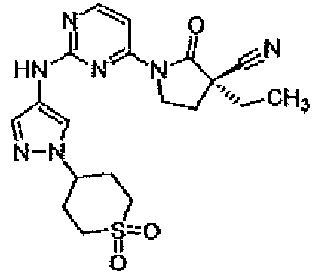
HCl 430.3 -
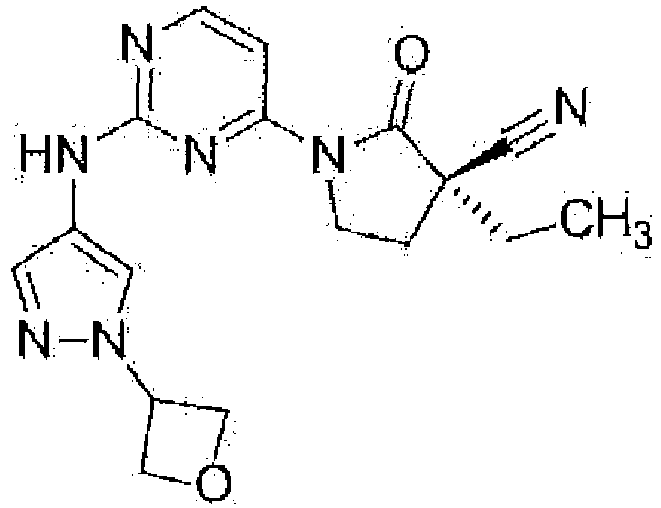
- The title compound (40 mg) was obtained from (3R)-1-(2-chloropyrimidin-4-yl)-3-ethyl-2-oxopyrrolidine-3-carbonitrile (150 mg) obtained in Step A of Example 8 and 1-(oxetan-3-yl)-1H-pyrazol-4-amine (83 mg) in the same manner as in Example 56.
MS(ESI+): [M+H]+ 354.3. -
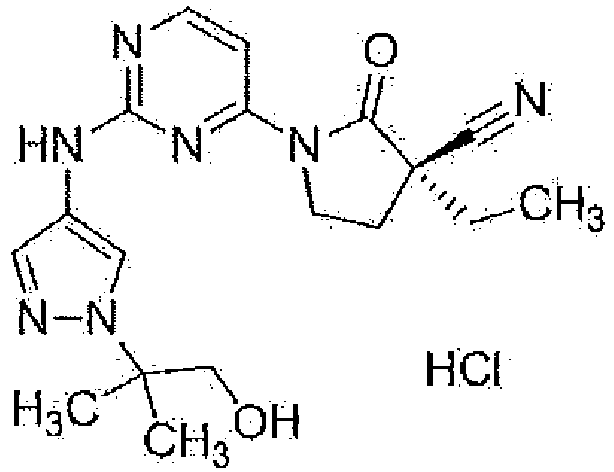
- The title compound (78 mg) was obtained from (3R)-1-(2-chloropyrimidin-4-yl)-3-ethyl-2-oxopyrrolidine-3-carbonitrile (90 mg) obtained in Step A of Example 8 and 2-(4-amino-1H-pyrazol-1-yl)-2-methylpropan-1-ol (56 mg) obtained in Step H of Example 103 in the same manner as in Step B of Example 2. MS(ESI+): [M+H]+ 370.3.
-

- The title compound (450 mg) was obtained from (3R)-1-(2-chloropyrimidin-4-yl)-3-ethyl-2-oxopyrrolidine-3-carbonitrile (500 mg) obtained in Step A of Example 8 and tert-butyl 3-(4-amino-1H-pyrazol-1-yl)azetidine-1-carboxylate (520 mg) obtained in Step B of Example 131 in the same manner as in Example 56.
MS(ESI+): [M+H]+ 453.2. -

- To tert-butyl 3-(4-((4-((3R)-3-cyano-3-ethyl-2-oxopyrrolidin-1-yl)pyrimidin-2-yl)amino)-1H-pyrazol-1-yl)azetidine-1-carboxylate (170 mg) obtained in Example 184 was added a solution of 4 M hydrogen chloride in ethyl acetate (6.0 mL), and the mixture was stirred at room temperature for 30 min. The solvent was evaporated under reduced pressure, and the residue was recrystallized (ethanol/ethyl acetate) to give the title compound (120 mg).
MS(ESI+): [M+H]+ 353.3. -

- To a solution of tert-butyl 3-(4-((4-((3R)-3-cyano-3-ethyl-2-oxopyrrolidin-1-yl)pyrimidin-2-yl)amino)-1H-pyrazol-1-yl)azetidine-1-carboxylate (140 mg) obtained in Example 184 in ethyl acetate (3.0 mL) was added a solution of 4 M hydrogen chloride in ethyl acetate (5.0 mL), and the mixture was stirred at room temperature for 30 min. The solvent was evaporated under reduced pressure, to a suspension of the reaction mixture in tetrahydrofuran (5 mL) were added triethylamine (160 mg) and methoxyacetyl chloride (37 mg) at room temperature, and the mixture was stirred at room temperature for 3 hr. The solvent was evaporated under reduced pressure, and the reaction mixture was poured into water, and extracted with ethyl acetate. The obtained organic layer was washed with saturated brine, and dried over anhydrous magnesium sulfate, and the solvent was evaporated under reduced pressure. The residue was purified by silica gel column chromatography (NH, ethyl acetate/methanol) to give the title compound (110 mg).
MS(ESI+): [M+H]+425.2. -

- To a solution of tert-butyl 3-(4-((4-((3R)-3-cyano-3-ethyl-2-oxopyrrolidin-1-yl)pyrimidin-2-yl)amino)-1H-pyrazol-1-yl)azetidine-1-carboxylate (100 mg) obtained in Example 184 in ethyl acetate (3.0 mL) was added a solution of 4 M hydrogen chloride in ethyl acetate (5.0 mL), and the mixture was stirred at room temperature for 30 min. The solvent was evaporated under reduced pressure, to a suspension of the reaction mixture in N,N-dimethylacetamide (3.0 mL) were added triethylamine (220 mg), 2-cyanoacetic acid (20 mg) and O-(7-aza-1H-benzotriazol-1-yl)-N,N,N',N'-tetramethyluronium hexafluorophosphate (170 mg) at room temperature, and the mixture was stirred at room temperature for 10 hr. The solvent was evaporated under reduced pressure, and the reaction mixture was poured into water, and extracted with ethyl acetate. The obtained organic layer was washed with saturated brine, and dried over anhydrous magnesium sulfate, and the solvent was evaporated under reduced pressure to give the title compound (35 mg).
1H NMR(400 MHz, DMSO-d6)δ1.00-1.16 (3H, m), 1.85-2.06 (3H, m), 2.24-2.41 (2H, m), 2.54-2.65 (1H, m), 3.96-4.22 (3H, m), 4.23-4.33 (1H, m), 4.33-4.42 (1H, m), 4.47-4.62 (1H, m), 5.17-5.35 (1H, m), 7.50-7.64 (1H, m), 7.63-7.76 (1H, m), 7.99-8.13 (1H, m), 8.31-8.48 (1H, m), 9.65 (1H, brs). -

- To a suspension of (3R)-1-(2-((1-(azetidin-3-yl)-1H-pyrazol-4-yl)amino)pyrimidin-4-yl)-3-ethyl-2-oxopyrrolidine-3-carbonitrile dihydrochloride (83 mg) obtained in Example 185 in tetrahydrofuran (5 mL) were added triethylamine (30 µL) and methanesulfonyl chloride (33 µL) at room temperature, and the mixture was stirred at room temperature for 2 hr. To the reaction mixture was added water, and the mixture was extracted with ethyl acetate. The obtained organic layer was washed with saturated brine, and dried over anhydrous magnesium sulfate, and the solvent was evaporated under reduced pressure. The residue was purified by silica gel column chromatography (ethyl acetate/hexane), and recrystallized (ethyl acetate/hexane) to give the title compound (16 mg).
MS(ESI+): [M+H]+431.3. -
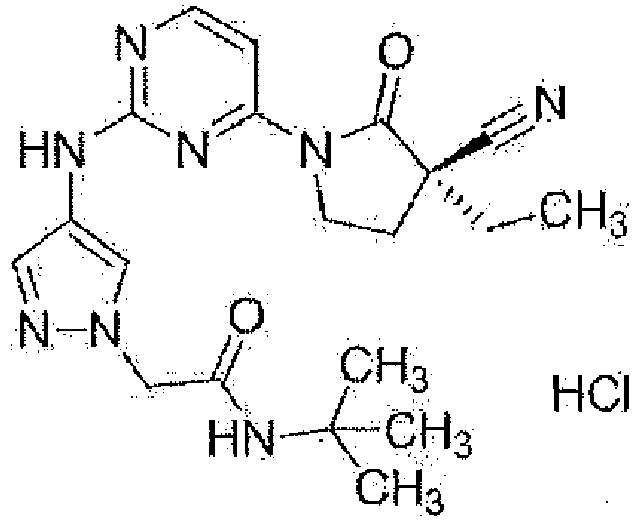
- The title compound (270 mg) was obtained from (3R)-1-(2-chloropyrimidin-4-yl)-3-ethyl-2-oxopyrrolidine-3-carbonitrile (600 mg) obtained in Step A of Example 8 and tert-butyl (4-amino-1H-pyrazol-1-yl)acetate (610 mg) in the same manner as in Step B of Example 2.
MS(ESI+): [M+H]+356.0. - To a solution of (4-((4-((3R)-3-cyano-3-ethyl-2-oxopyrrolidin-1-yl)pyrimidin-2-yl)amino)-1H-pyrazol-1-yl)acetic acid (100 mg) obtained in Step A of Example 189 in N,N-dimethylformamide (3 mL) were added 1-ethyl-3-(3-dimethylaminopropyl)carbodiimide (79 mg), 1-hydroxybenzotriazole monohydrate (78 mg), N,N-diisopropylethylamine (0.13 mL) and 2-methylpropan-2-amine (37 mg), and the mixture was stirred overnight at room temperature. To the reaction mixture was added saturated aqueous sodium hydrogen carbonate solution, and the mixture was extracted with ethyl acetate. The obtained organic layer was washed successively with water and saturated brine, and dried over anhydrous magnesium sulfate, and the solvent was evaporated under reduced pressure. The residue was purified by silica gel column chromatography (ethyl acetate/hexane). To a solution of the obtained residue in ethanol (3 mL) was added 1 M hydrochloric acid (0.19 mL), and the mixture was stirred at room temperature for 10 min. The solvent was evaporated under reduced pressure, and the residue was recrystallized (ethanol/diisopropyl ether) to give the title compound (66 mg).
MS(ESI+): [M+H]+411.4. - The title compound was obtained from (4-((4-((3R)-3-cyano-3-ethyl-2-oxopyrrolidin-1-yl)pyrimidin-2-yl)amino)-1H-pyrazol-1-yl)acetic acid obtained in Step A of Example 189 and the each corresponding amine (these compounds can be produced according to a method known per se), in the same manner as in Step B of Example 189.
Table 16 Example Number IUPAC Name Structure Salt MS 190 2-(4-((4-((3R)-3-cyano-3-ethyl-2-oxopyrrolidin-1-yl)pyrimidin-2-yl)amino)-1H-pyrazol-1-yl)-N-(2,2,2-trifluoroethyl)acetamide 
HCl 437.3 191 2-(4-((4-((3R)-3-cyano-3-ethyl-2-oxopyrrolidin-1-yl)pyrimidin-2-yl)amino)-1H-pyrazol-1-yl)-N-(2-hydroxyethyl)acetamide 
HCl 399.3 192 2-(4-((4-((3R)-3-cyano-3-ethyl-2-oxopyrrolidin-1-yl)pyrimidin-2-yl)amino)-1H-pyrazol-1-yl)-N-(2-methoxyethyl)acetamide 
HCl 413.3 193 (3R)-3-ethyl-1-(2-((1-(2-(morpholin-4-yl)-2-oxoethyl)-1H-pyrazol-4-yl)amino)pyrimidin-4-yl)-2-oxopyrrolidine-3-carbonitrile 
HCl 425.3 194 (3R)-3-ethyl-1-(2-((1-(2-(4-hydroxypiperidin-1-yl)-2-oxoethyl)-1H-pyrazol-4-yl)amino)pyrimidin-4-yl)-2-oxopyrrolidine-3-carbonitrile 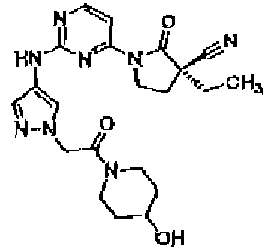
HCl 439.3 196 1-((4-((4-((3R)-3-cyano)-3-ethyl-2-xopyrrolidin-1-yl)pyrimidin-2-yl)amino)-1H-pyrazol-1-yl)acetyl)piperidine-4-carboxamide 
HCl 466.4 196 (3R)-3-ethyl-1-(2-((1-(2-(4-methylpiperazin-1-yl)-2-oxoethyl)-1H-pyrazol-4-yl)amino)pyrimidin-4-yl)-2-oxopyrrolidine-3-carbonitrile 
HCl 438.4 197 2-(4-((4-((3R)-3-cyano-3-ethyl-2-oxopyrrolidin-1-yl)pyrimidin-2-yl)amino)-1H-pyrazol-1-yl)-N-(2-hydroxyethyl)-N-methylacetamide 
HCl 413.3 198 2-(4-((4-((3R)-3-cyano-3-ethyl-2-oxopyrrolidin-1-yl-pyrimidin-2-yl)amino)-1H-pyrazol-1-yl)-N-(2-(methylsulfonyl)ethyl)acetamide 
HCl 461.3 -

- The title compound (1.6 g) was obtained from (3R)-1-(2-chloropyrimidin-4-yl)-3-ethyl-2-oxopyrrolidine-3-carbonitrile (1.0 g) obtained in Step A of Example 8 and tert-butyl 2-(4-amino-1H-pyrazol-1-yl)-2-methylpropanoate (1.1 g) obtained in Step B of Example 108 in the same manner as in Step B of Example 2.
MS(ESI+): [M+H]+440.4. - To a solution of tert-butyl 2-(4-((4-((3R)-3-cyano-3-ethyl-2-oxopyrrolidin-1-yl)pyrimidin-2-yl)amino)-1H-pyrazol-1-yl)-2-methylpropanoate (1.0 g) obtained in Step A of Example 199 in ethyl acetate (10 mL) was added a solution of 4 M hydrogen chloride in ethyl acetate (10 mL), and the mixture was stirred at room temperature for 3 hr. The solvent was evaporated under reduced pressure, and the residue was recrystallized (ethanol/diisopropyl ether) to give the crude title compound (820 mg). The crude title compound (100 mg) was purified by HPLC (C18, mobile phase: water/acetonitrile (containing 10 mM NH4HCO3)), and the solvent was evaporated under reduced pressure. To a solution of the residue in ethanol (3 mL) was added 1 M hydrochloric acid (0.20 mL), and the mixture was stirred at room temperature for 10 min. The solvent was evaporated under reduced pressure, and the residue was recrystallized (ethanol/diisopropyl ether) to give the title compound (820 mg).
MS(ESI+): [M+H]+384.3. -

- The title compound (25 mg) was obtained from 2-(4-((4-((3R)-3-cyano-3-ethyl-2-oxopyrrolidin-1-yl)pyrimidin-2-yl)amino)-1H-pyrazol-1-yl)-2-methylpropanoic acid hydrochloride (80 mg) obtained in Step B of Example 199 and morpholine (20 mg) in the same manner as in Step B of Example 189.
MS(ESI+): [M+H]+453.4. -

- A solution of (3R)-1-(2-chloropyrimidin-4-yl)-3-ethyl-2-oxopyrrolidine-3-carbonitrile (100 mg) obtained in Step A of Example 8 and 1,5-dimethyl-1H-pyrazol-4-amine dihydrochloride (73 mg) in propan-2-ol (4.0 mL) was stirred in a microwave reactor at 160°C for 1 hr, and the solvent was evaporated under reduced pressure. The obtained residue was purified by silica gel column chromatography (NH, hexane/ethyl acetate), and recrystallized (diisopropyl ether/ethyl acetate) to give the title compound (90 mg).
MS(ESI+): [M+H]+ 326.0. -

- The title compound (73 mg) was obtained from (3R)-1-(2-chloropyrimidin-4-yl)-3-ethyl-2-oxopyrrolidine-3-carbonitrile (100 mg) obtained in Step A of Example 8 and 1,3-dimethyl-1H-pyrazol-4-amine dihydrochloride in the same manner as in Example 201.
MS(ESI+): [M+H]+ 326.0. -

- The title compound (90 mg) was obtained from (3R)-1-(2-chloropyrimidin-4-yl)-3-ethyl-2-oxopyrrolidine-3-carbonitrile (140 mg) obtained in Step A of Example 8 and 1-(4-amino-1H-pyrazol-1-yl)cyclobutanecarboxamide (103 mg) obtained in Step B of Example 129 in the same manner as in Step B of Example 2.
MS(ESI+): [M+H]+ 395.4. -

- The title compound (140 mg) was obtained from (3R)-1-(2-chloropyrimidin-4-yl)-3-ethyl-2-oxopyrrolidine-3-carbonitrile (150 mg) obtained in Step A of Example 8 and 1-(4-amino-1H-pyrazol-1-yl)cyclopropanecarboxamide (99 mg) obtained in Step B of Example 130 in the same manner as in Step B of Example 2.
MS(ESI+): [M+H]+ 382.3. -

- The title compound (64 mg) was obtained from (3R)-1-(2-chloropyrimidin-4-yl)-3-ethyl-2-oxopyrrolidine-3-carbonitrile (150 mg) obtained in Step A of Example 8 and (1-(4-amino-1H-pyrazol-1-yl)cyclobutyl)methanol (100 mg) obtained in Step C of Example 127 in the same manner as in Step B of Example 2.
MS(ESI+): [M+H]+ 382.3. - The title compound was obtained from (3R)-1-(2-chloropyrimidin-4-yl)-3-ethyl-2-oxopyrrolidine-3-carbonitrile obtained in Step A of Example 8 and each corresponding aniline derivative (these compounds can be produced according to a method known per se), in the same manner as in Step B of Example 2.
Table 17-1 Example Number IUPAC Name Structure Salt MS 206 4-((4-((3R)-3-cyano-3-ethyl-2-oxopyrrolidin-1-yl)pyrimidin-2-yl)amino)-N-methylbenzenesulfonamide 
Free 401.3 207 (3R)-3-ethyl-2-oxo-1-(2-((4-(2-oxoimidazolidin-1-yl)phenyl)amino)pyrimidin-4-yl)pyrrolidine-3-carbonitrile 
Free 392.3 209 (3-((4-((3R)-3-cyano-3-ethyl-2-oxopyrrolidin-1-yl)pyrimidin-2-yl)amino)phenyl)acetic acid 
HCl 366.3 210 (3R)-3-ethyl-2-oxo-1-(2-((4-(pyrrolidin-1-ylcarbonyl)phenyl)amino)pyrimidin-4-yl)pyrrolidine-3-carbonitrile 
HCl 405.3 211 4-((4-((3R)-3-cyano-3-ethyl-2-oxopyrrolidin-1-yl)pyrimidin-2-yl)amino)-N-(2-hydroxyethyl)benzamide 
HCl 395.3 212 (4-((4-((3R)-3-cyano-3-ethyl-2-oxopyrrolidin-1-yl)pyrimidin-2-yl)amino)phenyl)acetic acid 
Free 366.3 213 (3R)-3-ethyl-2-oxo-1-(2-((4-(5-oxo-4,5-dihydro-1,2,4-oxadiazol-3-yl)phenyl)amino)pyrimidin-4-yl)pyrrolidine-3-carbonitrile 
Free 392.3 214 N-(3-((4-((3R)-3-cyano-3-ethyl-2-oxopyrrolidin-1-yl)pyrimidin-2-yl)amino)phenyl)-N-methylacetamido 
HCl 379.3 Table 17-2 Example Number IUPAC Name Structure Salt MS 215 4-(4- ((3R)-3-cyano-3-ethyl-2-oxopyrrolidin-1-yl)pyrimidin-2-yl)amino)-2-methoxybenzamide 
Free 381.3 216 4-((4-((3R)-3-cyano-3-ethyl-2-oxopyrrolidin-1-yl)pyrimidin-2-yl)amino)-2-methoxy-N-methylbenzamide 
Free 395.3 217 N-(3-((4-((3R)-3-cyano-3-ethyl-2-oxopyrrolidin-1-yl)pyrimidin-2-yl)amino)phenyl)-2-methoxyacetamide 
HCl 395.3 218 tert-butyl 4-(4-((4-((3R)-3-cyano-3-ethyl-2-oxopyrrolidin-1-yl)pyrimidin-2-yl)amino)phenyl)piperazine-1-carboxylate 
Free 492.4 219 (3R)-3-ethyl-1-(2-((4-(4-methylpiperazin-1-yl)phenyl)amino)pyrimidin-4-yl)-2-oxopyrrolidine-3-carbonitrile 
Free 406.3 220 (3R)-3-ethyl-2-oxo-1-(2-((4-(piperazin-1-yl)phenyl)amino)pyrimidin-4-yl)pyrrolidine-3-carbonitrile 
Free 392.4 222 N-(3-((4-((3R)-3-cyano-3-ethyl-2-oxopyrrolidin-1-yl)pyrimidin-2-yl)amino)benzyl)acetamide 
HCl 379.3 -

- Crude N-(3-((4-((3R)-3-cyano-3-ethyl-2-oxopyrrolidin-1-yl)pyrimidin-2-yl)amino)phenyl)-N-(methylsulfonyl)methanesulfonamide (100 mg) was obtained from (3R)-1-(2-chloropyrimidin-4-yl)-3-ethyl-2-oxopyrrolidine-3-carbonitrile (55 mg) obtained in Step A of Example 8 and N-(3-aminophenyl)-N-(methylsulfonyl)methanesulfonamide (58 mg) in the same manner as in Step B of Example 2.
- To a solution of the crude N-(3-((4-((3R)-3-cyano-3-ethyl-2-oxopyrrolidin-1-yl)pyrimidin-2-yl)amino)phenyl)-N-(methylsulfonyl)methanesulfonamide (100 mg) in tetrahydrofuran (3.0 mL) was added 4 M aqueouus lithium hydroxide solution (52 µL), and the mixture was stirred at room temperature for 3 hr. To the reaction mixture was added saturated aqueous ammonium chloride solution, and the mixture was extracted with ethyl acetate. The obtained organic layer was washed with saturated brine, and dried over anhydrous magnesium sulfate, and the solvent was evaporated under reduced pressure. The residue was purified by silica gel column chromatography (hexane/ethyl acetate). To a solution of the residue in ethanol (3.0 mL) was added 1 N hydrochloric acid (72 µL), and the mixture was stirred at room temperature for 5 min. The solvent was evaporated under reduced pressure, and the residue was recrystallized (ethanol/diisopropyl ether) to give the title compound (12 mg).
MS(ESI+): [M+H]+ 401.3. -

- To a solution of 2 M methylamine in tetrahydrofuran (0.28 mL) were added 1,1'-carbonyldiimidazole (91 mg) and tetrahydrofuran (3.0 mL) in an ice bath, and the mixture was stirred at the same temperature for 10 min. To the reaction mixture was added (3R)-3-ethyl-2-oxo-1-(2-((4-(piperazin-1-yl)phenyl)amino)pyrimidin-4-yl)pyrrolidine-3-carbonitrile (200 mg) obtained in Example 220, and the mixture was stirred at 70°C for 2 hr. To the reaction mixture was added water, and the mixture was extracted with ethyl acetate. The obtained organic layer was washed with saturated brine, and dried over anhydrous magnesium sulfate, and the solvent was evaporated under reduced pressure. The residue was purified by silica gel column chromatography (hexane/ethyl acetate). To a solution of the obtained purified product (290 mg) in ethanol (3 mL) was added 1 M hydrochloric acid (0.64 mL), and the mixture was stirred at room temperature for 5 min. The solvent was evaporated under reduced pressure, and the residue was recrystallized (ethanol/diisopropyl ether) to give the title compound (220 mg).
MS(ESI+): [M+H]+ 449.4. -

- To a solution of (3R)-3-ethyl-2-oxo-1-(2-((4-(piperazin-1-yl)phenyl)amino)pyrimidin-4-yl)pyrrolidine-3-carbonitrile (100 mg) obtained in Example 220 in tetrahydrofuran (3.0 mL) were added successively dropwise triethylamine (71 µL) and methanesulfonyl chloride (24 µL) in an ice bath, and the mixture was stirred at the same temperature for 3 hr. To the reaction mixture was added saturated aqueous ammonium chloride solution, and the solvent was evaporated under reduced pressure. The residue was purified by silica gel column chromatography (hexane/ethyl acetate), to a solution of the obtained purified product (120 mg) in ethanol (3 mL) was added 1 M hydrochloric acid (0.25 mL), and the mixture was stirred at room temperature for 5 min. The solvent was evaporated under reduced pressure, and the residue was recrystallized (ethanol/diisopropyl ether) to give the title compound (91 mg).
MS(ESI+): [M+H]+ 470.4. -

- The title compound (85 mg) was obtained from (3R)-3-ethyl-2-oxo-1-(2-((4-(piperazin-1-yl)phenyl)amino)pyrimidin-4-yl)pyrrolidine-3-carbonitrile (100 mg) obtained in Example 220 and methoxyacetyl chloride (28 µL) in the same manner as in Example 226.
MS(ESI+): [M+H]+ 464.4. - The title compound was obtained from (3R)-1-(2-chloropyrimidin-4-yl)-3-ethyl-2-oxopyrrolidine-3-carbonitrile obtained in Step A of Example 8 and each corresponding aniline derivative (these compounds can be produced according to a method known per se), in the same manner as in Step B of Example 2.
Table 18 Example Number IUPAC Name Structure Salt MS 228 4-((4-((3R)-3-cyano-3-ethyl-2-oxopyrrolidin-1-yl)pyrimidin-2-yl)amino)-2-(methylsulfonyl)benzamide 
Free 427.3 (M-H) 229 4-((4-((3R)-3-cyano-3-ethyl-2-oxopyrrolidin-1-yl)pyrimidin-2-yl)amino)-3-fluoro-N-methylbenzamide 
Free 383.1 230 4-((4-((3R)-3-cyano-3-ethyl-2-oxopyrrolidin-1-yl)pyrimidin-2-yl)amino)-2-fluoro-N-methylbenzamide 
Free 383.0 ' 231 4-((4-((3R)-3-cyano-3-ethyl-2-oxopyrrolidin-1-yl)pyrimidin-2-yl)amino)benzoic acid 
HCl 352.3 232 1-(4-((4-((3R)-3-cyano-3-ethyl-2-oxopyrrolidin-1-yl)pyrimidin-2-yl)amino)phenyl)cyclopropanecarboxyl ic acid 
HCl 392.3 233 2-(4-((4-((3R)-3-cyano-3-ethyl-2-oxopyrrolidin-1-yl)pyrimidin-2-yl)amino)phenyl)acetamide 
Free 365.3 234 2-(4-((4-((3R)-3-cyano-3-ethyl-2-oxopyrrolidin-1-yl)pyrimidin-2-yl)amino)phenyl)-N-methylacetamide 
Free 379.3 -
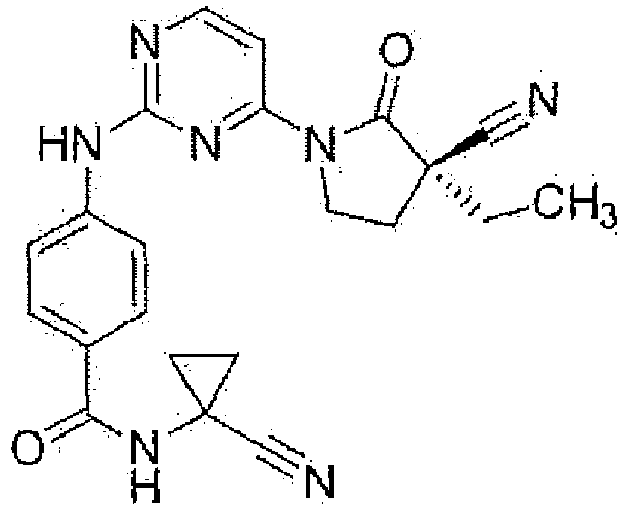
- To a solution of 4-((4-((3R)-3-cyano-3-ethyl-2-oxopyrrolidin-1-yl)pyrimidin-2-yl)amino)benzoic acid (100 mg) obtained in Example 231 in N,N-dimethylformamide (2.0 mL) were added 1-aminocyclopropanecarbonitrile hydrochloride (31 mg), 1-ethyl-3-(3-dimethylaminopropyl)carbodiimide (46 mg), 1-hydroxybenzotriazole (40 mg) and triethylamine (56 µL), and the mixture was stirred overnight at room temperature. To the reaction mixture was added saturated aqueous sodium hydrogen carbonate solution, and the mixture was extracted with ethyl acetate. The obtained organic layer was washed with saturated brine, and dried over anhydrous magnesium sulfate, and the solvent was evaporated under reduced pressure. The residue was purified by silica gel column chromatography (hexane/ethyl acetate) to give the title compound (38 mg).
MS(ESI+): [M+H]+ 416.3. - The title compound was obtained from 4-((4-((3R)-3-cyano-3-ethyl-2-oxopyrrolidin-1-yl)pyrimidin-2-yl)amino)benzoic acid obtained in Example 231 and each corresponding amine (these compounds can be produced according to a method known per se), in the same manner as in Example 235.
Table 19-1 Example Number IUPAC Name Structure Salt MS 236 4-((4-((3R)-3-cyano-3-ethyl-2-oxopyrrolidin-1-yl)pyrimidin-2-yl)amino)-N-(oxetan-3-yl)benzamide 
Free 407.4 237 4-((4-((3R)-3-cyano-3-ethyl-2-oxopyrrolidin-1-yl)pyrimidin-2-yl)amino)-N-((3-methyloxetan-3-yl)methyl)benzamide 
Free 435.4 238 (3R)-3-ethyl-1-(2-((4-(morpholin-4-ylcarbonyl)phenyl)amino)pyrimidin-4-yl)-2-oxopyrrolidine-3-carbonitrile 
HCl 421.3 239 (3R)-3-ethyl-1-(2-((4-((4-hydroxypiperidin-1-yl)carbonyl)phenyl)amino)pyrimidin-4-yl)-2-oxopyrrolidine-3-carbonitrile 
HCl 435.3 240 (3R)-3-ethyl-1-(2-((4-(((3R)-3-hydroxypyrrolidin-1-yl)carbonyl)phenyl)amino)pyrimidin-4-yl)-2-oxopyrrolidine-3-carbonitrile 
Free 419.3 (M-H) 241 (3R)-3-ethyl-1-(2-((4-(((3S)-3-hydroxypyrrolidin-1-yl)carbonyl)phenyl)amino)pyrimidin-4-yl)-2-oxopyrrolidine-3-carbonitrile 
Free 419.4 (M-H) 242 4-((4-((3R)-3-cyano-3-ethyl-2-oxopyrrolidin-1-yl)pyrimidin-2-yl)amino)-N-cyclobutylbenzemide 
Free 405.3 243 4-((4-((3R)-3-cyano-3-ethyl-2-oxopyrrolidin-1-yl)pyrimidin-2-yl)amino)-N-methyl-N-(2-(methylsulfonyl)ethyl)benzamide 
Free 471.4 Table 19-2 Example Number IUPAC Name Structure Salt MS 244 4-((4-((3R)-3-cyano-3-ethyl-2-oxopyrrolidin-1-yl)pyrimidin-2-yl)amino)-N-(2-(methylsulfonyl)ethyl)benzamide 
Free 467.1 245 (3R)-4-((4-(3-cyano-3-ethyl-2-oxopyrrolidin-1-yl)pyrimidin-2-yl)amino)-N-(1-hydroxy-2-methylpropan-2-yl)benzamide 
Free 423.1 246 4-((4-((3R)-3-cyano-3-ethyl-2-oxopyrrolidin-1-yl)pyrimidin-2-yl)amino)-N-(2-methyl-1-(morpholin-4-yl)propan-2-yl)benzamide 
Free 492.2 247 4-((4-((3R)-3-cyano-3-ethyl-2-oxopyrrolidin-1-yl)pyrimidin-2-yl)amino)-N-(tetrahydro-2H-pyran-4-yl)benzamide 
Free 436.3 -

- To a solution of tert-butyl (4-bromophenyl)carbamate (1.5 g) in tetrahydrofuran (30 mL) was added dropwise n-butyllithium (1.6 M hexane solution, 7.2 mL) at -78°C under nitrogen atmosphere, and the mixture was stirred at the same temperature for 1 hr. Dihydro-2H-pyran-4(3H)-one (0.58 g) was added thereto, and the mixture was stirred overnight while it was allowed to be warmed. To the reaction mixture was added saturated aqueous ammonium chloride solution, and the mixture was extracted with ethyl acetate. The obtained organic layer was washed with saturated brine, and dried over anhydrous magnesium sulfate, and the solvent was evaporated under reduced pressure. The residue was purified by silica gel column chromatography (hexane/ethyl acetate) to give the title compound (590 mg).
1H NMR(400 MHz, CDCl3)δ1.52 (9H, s), 1.65-1.73 (2H, m), 2.09-2.22 (2H, m), 3.82-3.99 (4H, m), 6.48 (1H, br. s), 7.32-7.39 (2H, m), 7.39-7.45 (2H, m). - The title compound (53 mg) was obtained from (3R)-1-(2-chloropyrimidin-4-yl)-3-ethyl-2-oxopyrrolidine-3-carbonitrile (80 mg) obtained in Step A of Example 8 and tert-butyl (4-(4-hydroxytetrahydro-2H-pyran-4-yl)phenyl)carbamate (110 mg) obtained in Step A of Example 248 in the same manner as in Step B of Example 2.
1H NMR(400 MHz, DMSO-d6)δ1.02-1.15 (3H, m), 1.84-2.08 (2H, m), 2.28-2.47 (5H, m), 2.56-2.72 (1H, m), 3.76-3.87 (2H, m), 4.01-4.17 (2H, m), 4.19-4.26 (2H, m), 6.17 (1H, s), 7.32-7.47 (2H, m), 7.57-7.64 (1H, m), 7.67-7.79 (2H, m), 8.39-8.49 (1H, m), 9.73 (1H, s). -

- To a solution of 2-(4-bromophenyl)acetonitrile (3.9 g) in tetrahydrofuran (50 mL) was added potassium t-butoxide (4.9 g) in an ice bath, and the mixture was stirred for 1 hr in an ice bath. 1-Bromo-2-(2-bromoethoxy)ethane (5.8 g) was added thereto at the same temperature, and the mixture was stirred at room temperature for 10 hr. The solvent was evaporated under reduced pressure, and the residue was purified by silica gel column chromatography (hexane/ethyl acetate) to give the title compound (3.7 g).
1H NMR (400 MHz, CDCl3)δ1.99-2.15 (4H, m), 3.83-3.95 (2H, m), 4.04-4.14 (2H, m), 7.33-7.40 (2H, m), 7.51-7.60 (2H, m). - To a solution of 4-(4-bromophenyl)tetrahydro-2H-pyran-4-carbonitrile (1.7 g) obtained in Step A of Example 249, diphenylmethanimine (1.4 g), tris(dibenzylideneacetone)dipalladium(0) (88 mg) and 2,2'-bis(diphenylphosphino)-1,1'-binaphthyl (130 mg) in toluene (50 mL) was added sodium 2-methylpropan-2-olate (921 mg), and the mixture was stirred at 90°C for 10 hr under nitrogen atmosphere. The reaction mixture was diluted with ethyl acetate, the insoluble substance was removed by filtration through Celite, and the solvent was evaporated under reduced pressure. To a solution of the residue in methanol (10 mL) were added hydroxylamine hydrochloride (440 mg) and sodium acetate (530 mg). The mixture was stirred at room temperature for 30 min, and 0.1 M aqueous sodium hydroxide solution and ethyl acetate were added thereto. The solvent was evaporated under reduced pressure, the reaction mixture was poured into water, and the reaction mixture was extracted with ethyl acetate. The obtained organic layer was washed with saturated brine, and dried over anhydrous magnesium sulfate, and the solvent was evaporated under reduced pressure. The residue was purified by silica gel column chromatography (hexane/ethyl acetate) to give the title compound (910 mg).
MS(ESI+): [M+H]+ 202.9. - The title compound (140 mg) was obtained from (3R)-1-(2-chloropyrimidin-4-yl)-3-ethyl-2-oxopyrrolidine-3-carbonitrile (100 mg) obtained in Step A of Example 8 and 4-(4-aminophenyl)tetrahydro-2H-pyran-4-carbonitrile (81 mg) obtained in Step B of Example 249 in the same manner as in Step B of Example 2.
MS(ESI+): [M+H]+ 417.1. -

- The title compound (120 mg) was obtained from (3R)-1-(2-chloropyrimidin-4-yl)-3-ethyl-2-oxopyrrolidine-3-carbonitrile (100 mg) obtained in Step A of Example 8 and tert-butyl 4-amino-2-ethoxybenzoate (110 mg) obtained in Step C of Example 139 in the same manner as in Example 56.
MS(ESI+): [M+H]+ 452.2. - To tert-butyl 4-((4-((3R)-3-cyano-3-ethyl-2-oxopyrrolidin-1-yl)pyrimidin-2-yl)amino)-2-ethoxybenzoate (120 mg) obtained in Step A of Example 250 was added a solution of 4 M hydrogen chloride in ethyl acetate (6.0 mL), and the mixture was stirred at room temperature for 2 hr. The reaction mixture was concentrated under reduced pressure. The residue was washed with ethyl acetate to give the title compound (90 mg).
MS (ESI+) : [M+H]+ 396.3. -

- The title compound (99 mg) was obtained from (3R)-1-(2-chloropyrimidin-4-yl)-3-ethyl-2-oxopyrrolidine-3-carbonitrile (100 mg) obtained in Step A of Example 8 and tert-butyl 4-amino-2-isopropoxybenzoate (120 mg) obtained in Step B of Example 141 in the same manner as in Example 56.
MS(ESI+): [M+H]+ 466.4. - The title compound (78 mg) was obtained from tert-butyl 4-((4-((3R)-3-cyano-3-ethyl-2-oxopyrrolidin-1-yl)pyrimidin-2-yl)amino)-2-isopropoxybenzoate (120 mg) obtained in Step A of Example 251 in the same manner as in Step B of Example 250.
MS(ESI+): [M+H]+ 410.3. -

- The title compound (67 mg) was obtained from 1-(4-((4-((3R)-3-cyano-3-ethyl-2-oxopyrrolidin-1-yl)pyrimidin-2-yl)amino)phenyl)cyclopropanecarboxylic acid hydrochloride (90 mg) obtained in Example 232 in the same manner as in Example 235.
MS(ESI+): [M+H]+ 391.3. -

- The title compound (60 mg) was obtained from 1-(4-((4-((3R)-3-cyano-3-ethyl-2-oxopyrrolidin-1-yl)pyrimidin-2-yl)amino)phenyl)cyclopropanecarboxylic acid hydrochloride (90 mg) obtained in Example 232 and methylamine hydrochloride (18 mg) in the same manner as in Example 235.
MS(ESI+): [M+H]+ 405.4. -

- The title compound (60 mg) was obtained from (3R)-1-(2-chloropyrimidin-4-yl)-3-ethyl-2-oxopyrrolidine-3-carbonitrile (70 mg) obtained in Step A of Example 8 and 4-amino-2-ethoxybenzamide (60 mg) in the same manner as in Step B of Example 2.
MS(ESI+): [M+H]+ 395.3. -

- To a solution of (3R)-1-(2-chloropyrimidin-4-yl)-3-ethyl-2-oxopyrrolidine-3-carbonitrile (100 mg) obtained in Step A of Example 8 in ethanol (3.0 mL) were added (4-(4-aminophenyl)tetrahydro-2H-pyran-4-yl)methanol (83 mg) obtained in Step B of Example 152 and acetic acid (25 µL), and the mixture was stirred in a microwave reactor at 150°C for 1 hr. The reaction mixture was concentrated under reduced pressure, and the residue was purified by silica gel column chromatography (hexane/ethyl acetate), and recrystallized (hexane/ethyl acetate) to give the title compound (100 mg).
1H NMR (400MHz, DMSO-d6) δ 1.08 (3H, t, J = 7.5 Hz), 1.77-2.10 (6H, m), 2.29-2.41 (1H, m), 2.56-2.72 (1H, m), 3.34-3.42 (4H, m), 3.62-3.75 (2H, m), 3.98-4.24 (2H, m), 4.54-4.63 (1H, m), 7.26 (2H, d, J = 8.8 Hz), 7.59 (1H, d, J = 5.6 Hz), 7.69 (2H, d, J = 9.0 Hz), 8.41 (1H, d, J = 5.6 Hz), 9.62 (1H, s).
MS(ESI+): [M+H]+ 422.3. -

- The title compound (170 mg) was obtained from (3R)-1-(2-chloropyrimidin-4-yl)-3-ethyl-2-oxopyrrolidine-3-carbonitrile (150 mg) obtained in Step A of Example 8 and 4-(4-aminophenyl)-N-methyltetrahydro-2H-pyran-4-carboxamide (140 mg) obtained in Step D of Example 151 in the same manner as in Step B of Example 2.
MS(ESI+): [M+H]+ 449.4. -

- The title compound (25 mg) was obtained from (3R)-1-(2-chloropyrimidin-4-yl)-3-ethyl-2-oxopyrrolidine-3-carbonitrile (70 mg) obtained in Step A of Example 8 and 2-(5-aminopyridin-2-yl)-2-methylpropanamide (50 mg) obtained in Step F of Example 153 in the same manner as in Example 56.
MS(ESI+): [M+H]+ 394.3. - The title compound was obtained from (3S)-1-(2-chloropyrimidin-4-yl)-3-isopropyl-2-oxopyrrolidine-3-carbonitrile obtained in Step A of Example 9 and each corresponding amine (these compounds can be produced according to a method known per se), in the same manner as in Step B of Example 2. MS in the tables means actual measured value.
Table 20 Example Number IUPAC Name Structure Salt MS 258 (4-((4-((3S)-3-cyano-3-isopropyl-2-oxopyrrolidin-1-yl)pyrimidin-2-yl)amino)-1H-pyrazol-1-yl)acetic acid 
HCl 370.3 259 (3S)-1-(2-((1-ethyl-1H-pyrazol-4-yl)amino)pyrimidin-4-yl)-3-isopropyl-2-oxopyrrolidine-3-carbonitrile 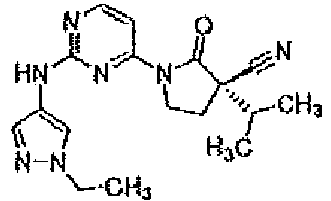
HCl 340.3 260 (3S)-3-isopropyl-2-oxo-1-(2-((1-(2, 2, 2-trifluoroethyl)-1H-pyrazol-4-yl)amino)pyrimidin-4-yl)pyrrolidine-3-carbonitrile 
HCl 394.3 261 (3S)-1-(2-((1-(2-hydroxyethyl)-1H-pyrazol-4-yl)amino)pyrimidin-4-yl)-3-isopropyl-2-oxopyrrolidine-3-carbonitrile 
HCl 354.3 262 (3S)-3-isopropyl-1-(2-((1-isopropyl-1H-pyrazol-4-yl)amino)pyrimidin-4-yl)-2-oxopyrrolidine-3-carbonitrile 
HCl 342.2 263 3-(4-((4-((3S)-3-cyano-3-isopropyl-2-oxopyrrolidin-1-yl)pyrimidin-2-yl)amino)-1H-pyrazol-1-yl)propanamide 
HCl 383.3 264 3-(4-((4-((3S)-3-cyano-3-isopropyl-2-oxopyrrolidin-1-yl)pyrimidin-2-yl)amino)-1H-pyrazol-1-yl)-N-methylpropanamide 
HCl 397.3 265 3-(4-((4-((3S)-3-cyano-3-isopropyl-2-oxopyrrolidin-1-yl)pyrimidin-2-yl)amino)-1H-pyrazol-1-yl)-N,N-dimethylpropanamide 
HCl 411.4 - The title compound was obtained from (3S)-1-(2-chloropyrimidin-4-yl)-3-isopropyl-2-oxopyrrolidine-3-carbonitrile obtained in Step A of Example 9 and each corresponding amine (these compounds can be produced according to a method known per se), in the same manner as in Example 56.
MS in the tables means actual measured value.Table 21 Example Number IUPAC Name Structure Salt MS 266 (3S)-1-(2-((1-(2-hydroxy-2-methylpropyl)-1H-pyrazol-4-yl)amino)pyrimidin-4-yl)-3-isopropyl-2-oxopyrrolidine-3-carbonitrile 
HCl 384.3 267 (3S)-1-(2-((1-(difluoromethyl)-1H-pyrazol-4-yl)amino)pyrimidin-4-yl)-3-isopropyl-2-oxopyrrolidine-3-carbonitrile 
HCl 362.3 268 2-(4-((4-((3S)-3-cyano-3-isopropyl-2-oxopyrrolidin-1-yl)pyrimidin-2-yl)amino)-1H-pyrazol-1-yl)-2-methylpropanamide 
HCl 397.3 269 2-(4-((4-((3S)-3-cyano-3-isopropyl-2-oxopyrrolidin-1-yl)pyrimidin-2-yl)amino)-1H-pyrazol-1-yl)-N,2-dimethylpropanamide 
HCl 411.3 270 2-(4-((4-((3S)-3-cyano-3-isopropyl-2-oxopyrrolidin-1-yl)pyrimidin-2-yl)amino)-1H-pyrazol-1-yl)-N,N,2-trimethylpropanamide 
HCl 426.4 -

- To a mixture of (3S)-1-(2-chloropyrimidin-4-yl)-3-isopropyl-2-oxopyrrolidine-3-carbonitrile (200 mg) obtained in Step A of Example 9, tert-butyl 3-(4-amino-1H-pyrazol-1-yl)azetidine-1-carboxylate (97 mg) obtained in Step B of Example 131, cesium carbonate (370 mg) and dicyclohexyl (2',4',6'-triisopropyl-3,6-dimethoxybiphenyl-2-yl)phosphine (57 mg) in tert-butanol (2.0 mL) was added tris(dibenzylideneacetone)dipalladium(0) (48 mg), and the mixture was stirred at 100°C for 5 hr. The insoluble substance was removed by filtration through Celite, and the solvent was evaporated under reduced pressure. The residue was purified by silica gel column chromatography (hexane/ethyl acetate) to give the title compound (22 mg).
MS(ESI+): [M+H]+ 467.4. - To tert-butyl 3-(4-((4-((3S)-3-cyano-3-isopropyl-2-oxopyrrolidin-1-yl)pyrimidin-2-yl)amino)-1H-pyrazol-1-yl)azetidine-1-carboxylate (22 mg) obtained in Step A of Example 271 was added a solution of 4 M hydrogen chloride in ethyl acetate (1.0 mL), the mixture was stirred at room temperature for 30 min, and the solvent was evaporated under reduced pressure. To a solution of the residue in tetrahydrofuran (1.0 mL) were added triethylamine (20 µL) and acetic anhydride (5.3 µL), and the mixture was stirred at room temperature for 30 min. To the reaction mixture was added water, and the mixture was extracted with ethyl acetate. The obtained organic layer was washed with saturated brine, and dried over anhydrous sodium sulfate, and the solvent was evaporated under reduced pressure. The residue was purified by silica gel column chromatography (ethyl acetate/methanol).
- To a solution of the purified product in ethanol (2.0 mL) was added 1 M hydrochloric acid (36 µL), the mixture was stirred at room temperature for 5 min, and the solvent was evaporated under reduced pressure. The residue was recrystallized (diisopropyl ether/ethanol) to give the title compound (13 mg).
MS(ESI+): [M+H]+ 409. 4. -

- The title compound (110 mg) was obtained from (3S)-1-(2-chloropyrimidin-4-yl)-3-isopropyl-2-oxopyrrolidine-3-carbonitrile (140 mg) obtained in Step A of Example 9 and tert-butyl 4-(4-amino-1H-pyrazol-1-yl)piperidine-1-carboxylate (120 mg) in the same manner as in Example 56.
MS(ESI+): [M+H]+ 495.5. - The title compound (47 mg) was obtained from tert-butyl 4-(4-((4-((3S)-3-cyano-3-isopropyl-2-oxopyrrolidin-1-yl)pyrimidin-2-yl)amino)-1H-pyrazol-1-yl)piperidine-1-carboxylate (110 mg) obtained in Step A of Example 272 in the same manner as in Step B of Example 271.
MS(ESI+): [M+H]+ 437.4. -

- The title compound (69 mg) was obtained from (3S)-1-(2-chloropyrimidin-4-yl)-3-isopropyl-2-oxopyrrolidine-3-carbonitrile (100 mg) obtained in Step A of Example 9 and tert-butyl (3R)-3-(4-amino-1H-pyrazol-1-yl)pyrrolidine-1-carboxylate (100 mg) in the same manner as in Example 56.
MS(ESI+): [M+H]+ 481.5. - The title compound (47 mg) was obtained from tert-butyl (3R)-3-(4-((4-((3S)-3-cyano-3-isopropyl-2-oxopyrrolidin-1-yl)pyrimidin-2-yl)amino)-1H-pyrazol-1-yl)pyrrolidine-1-carboxylate (69 mg) obtained in Step A of Example 273 in the same manner as in Step B of Example 271.
MS(ESI+): [M+H]+ 423.4. -

- The title compound (70 mg) was obtained from (3S)-1-(2-chloropyrimidin-4-yl)-3-isopropyl-2-oxopyrrolidine-3-carbonitrile (100 mg) obtained in Step A of Example 9 and tert-butyl (3S)-3-(4-amino-1H-pyrazol-1-yl)pyrrolidine-1-carboxylate (100 mg) in the same manner as in Example 56.
MS(ESI+): [M+H]+ 481.4. - The title compound (38 mg) was obtained from tert-butyl (3S)-3-(4-((4-((3S)-3-cyano-3-isopropyl-2-oxopyrrolidin-1-yl)pyrimidin-2-yl)amino)-1H-pyrazol-1-yl)pyrrolidine-1-carboxylate (70 mg) obtained in Step A of Example 274 in the same manner as in Step B of Example 271.
MS(ESI+): [M+H]+ 423.4. - The title compound was obtained from (4-((4-((3S)-3-cyano-3-isopropyl-2-oxopyrrolidin-1-yl)pyrimidin-2-yl)amino)-1H-pyrazol-1-yl)acetic acid hydrochloride obtained in Example 258, and morpholine or 4-hydroxypiperidine (these compounds can be produced according to a method known per se), each corresponding to the compounds of Examples 275 and 276, in the same manner as in Example 110.
Table 22 Example Number IUPAC Name Structure Salt MS 275 (3S)-3-isopropyl-1-(2-((1-(2-(morpholin-4-yl)-2-oxoethyl)-1H-pyrazol-4-yl)amino)pyrimidin-4-yl)-2-oxopyrrolidine-3-carbonitrile 
HCl 439.4 276 (3S)-1-(2-((1-(2-4-hydroxypiperidin-1-yl)-2-oxoethyl)-1H-pyrazol-4-yl)amino)pyrimidin-4-yl)-3-isopropyl-2-oxopyrrolidine-3-carbonitrile 
HCl 453.4 - The title compound was obtained from (3S)-1-(2-chloropyrimidin-4-yl)-3-isopropyl-2-oxopyrrolidine-3-carbonitrile obtained in Step A of Example 9 and each corresponding amine (these compounds can be produced according to a method known per se), in the same manner as in Step B of Example 2. MS in the tables means actual measured value.
Table 23-1 Example Number IUPAC Name Structure Salt MS 277 4-((4-((3S)-3-cyano-3-isopropyl-2-oxopyrrolidin-1-yl)pyrimidin-2-yl)amino)benzoic acid 
HCl 366.3 278 ethyl (4-((4-((3S)-3-cyano-3-isopropyl-2-oxopyrrolidin-1-yl)pyrimidin-2-yl)amino)phenyl)acetate 
HCl 408.3 279 N-(5-((4-((3S)-3-cyano-3-isopropyl-2-oxopyrrolidin-1-yl)pyrimidin-2-yl)amino)-2-fluorophenyl)acetamide 
HCl 397.3 280 5-((4-((3S)-3-cyano-3-isopropyl-2-oxopyrrolidin-1-yl)pyrimidin-2-yl)amino)-N-methylpyridine-2-carboxamide 
Free 380.3 281 (4-((4-((3S)-3-cyano-3-isopropyl-2-oxopyrrolidin-1-yl)pyrimidin-2-yl)amino)phenyl)acetic acid 
HCl 380.3 282 (3S)-1-(2-((4-(4-acetylpiperazin-1-yl)phenyl)amino)pyrimidin-4-yl)-3-isopropyl-2-oxopyrrolidine-3-carbonitrile 
HCl 448.4 283 2-(3-((4-((3S)-3-cyano-3-isopropyl-2-oxopyrrolidin-1-yl)pyrimidin-2-yl)amino)phenyl)acetamide 
HCl 379.3 284 3-(3-((4-((3S)-3-cyano-3-isopropyl-2-oxopyrrolidin-1-yl)pyrimidin-2-yl)amino)phenyl)-N-methylacetamide 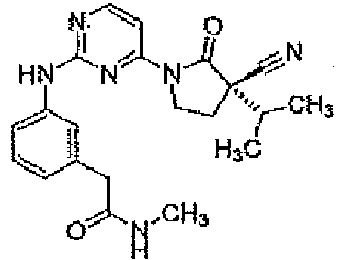
HCl 393.3 Table 23-2 Example Number IUPAC Name Structure Salt MS 285 2-(3-((4-((3S)-3-cyano-3-isopropyl-2-oxopyrrolidin-1-yl)pyrimidin-2-yl)amino)phenyl)-N,N-dimethylacetamide 
HCl 407.3 287 N-(5-((4-((3S)-3-cyano-3-isopropyl-2-oxopyrrolidin-1-yl)pyrimidin-2-yl)amino)-2-methoxyphenyl)acetamide 
HCl 409.3 289 (3S)-3-isopropyl-1-(2-((3-methoxy-4-(1H-tetrazol-5-yl)phenyl)amino)pyrimidin-4-yl)-2-oxopyrrolidine-3-carbonitrile 
HCl 420.3 290 2-(4-((4-((3S)-3-cyano-3-isopropyl-2-oxopyrrolidin-1-yl)pyrimidin-2-yl)amino)phenyl)-2-methylpropanoic acid 
HCl 408.3 -

- The title compound (11 mg) was obtained from (3S)-1-(2-chloropyrimidin-4-yl)-3-isopropyl-2-oxopyrrolidine-3-carbonitrile (100 mg) obtained in Step A of Example 9 and 4-amino-2-methoxybenzoic acid (63 mg) in the same manner as in Example 56.
MS(ESI+): [M+H]+ 396.3. -

- The title compound (120 mg) was obtained from (3S)-1-(2-chloropyrimidin-4-yl)-3-isopropyl-2-oxopyrrolidine-3-carbonitrile (100 mg) obtained in Step A of Example 9 and tert-butyl 4-amino-2-(2,2,2-trifluoroethoxy)benzoate (130 mg) obtained in Step C of Example 143 in the same manner as in Example 56.
MS(ESI+): [M+H]+ 520.4. - To tert-butyl 4-((4-((3S)-3-cyano-3-isopropyl-2-oxopyrrolidin-1-yl)pyrimidin-2-yl)amino)-2-(2,2,2-trifluoroethoxy)benzoate (120 mg) obtained in Step A of Example 292 was added dropwise a solution of 4 M hydrogen chloride in ethyl acetate (6.0 mL), and the mixture was stirred at room temperature for 1 hr. The solvent was evaporated under reduced pressure, and the residue was washed with ethyl acetate to give the title compound (71 mg).
MS(ESI+): [M+H]+ 464.3. -

- The title compound (410 mg) was obtained from tert-butyl 2-fluoro-4-nitrobenzoate (500 mg) obtained in Step A of Example 143 in the same manner as in Step C of Example 139.
1H NMR (400 MHz, DMSO-d6) δ 1.48 (9H, s), 6.17 (2H, s), 6.25 (1H, dd, J = 14.2, 2.2 Hz), 6.36 (1H, dd, J = 8.7, 2.1 Hz), 7.49 (1H, t, J = 8.8 Hz). - The title compound (100 mg) was obtained from (3S)-1-(2-chloropyrimidin-4-yl)-3-isopropyl-2-oxopyrrolidine-3-carbonitrile (100 mg) obtained in Step A of Example 9 and tert-butyl 4-amino-2-fluorobenzoate (100 mg) obtained in Step A of Example 293 in the same manner as in Example 56.
MS(ESI+): [M+H]+ 440.3. - The title compound (64 mg) was obtained from tert-butyl 4-((4-((3S)-3-cyano-3-isopropyl-2-oxopyrrolidin-1-yl)pyrimidin-2-yl)amino)-2-fluorobenzoate (100 mg) obtained in Step B of Example 293 in the same manner as in Step B of Example 292.
MS(ESI+): [M+H]+ 384.3. -

- To a solution of 2-(methylsulfanyl)-4-nitrobenzoic acid (1.0 g) in toluene (30 mL) was added dropwise N,N-dimethylformamide di-tert-butylacetal (11 mL), and the mixture was stirred at 100°C for 10 hr. The solvent was evaporated under reduced pressure, and the residue was purified by silica gel column chromatography (hexane/ethyl acetate) to give the title compound (1.2 g).
1H NMR (400MHz, CDCl3) δ1.63 (9H, s), 2.54 (3H, s), 7.93 (1H, dd, J = 8.6, 2.0 Hz), 8.05 (1H, d, J = 8.6 Hz), 8.08 (1H, d, J = 2.2 Hz). - The title compound (940 mg) was obtained from tert-butyl 2-(methylsulfanyl)-4-nitrobenzoate (1.2 g) obtained in Step A of Example 294 in the same manner as in Step C of Example 139.
1H NMR (400MHz, CDCl3)1.58 (9H, s), 2.39 (3H, s), 4.00 (2H, brs), 6.38 (1H, dd, J = 8.6, 2.2 Hz), 6.43 (1H, d, J = 2.0 Hz), 7.81 (1H, d, J = 8.3 Hz). - The title compound (37 mg) was obtained from (3S)-1-(2-chloropyrimidin-4-yl)-3-isopropyl-2-oxopyrrolidine-3-carbonitrile (100 mg) obtained in Step A of Example 9 and tert-butyl 4-amino-2-(methylsulfanyl)benzoate (100 mg) obtained in Step B of Example 294 in the same manner as in Example 56. MS(ESI+): [M+H]+ 468.4.
- The title compound (22 mg) was obtained from tert-butyl 4-((4-((3S)-3-cyano-3-isopropyl-2-oxopyrrolidin-1-yl)pyrimidin-2-yl)amino)-2-(methylsulfanyl)benzoate (37 mg) obtained in Step C of Example 294 in the same manner as in Step B of Example 292.
MS(ESI+): [M+H]+ 412.3. - The title compound was obtained from (3S)-1-(2-chloropyrimidin-4-yl)-3-isopropyl-2-oxopyrrolidine-3-carbonitrile obtained in Step A of Example 9 and each corresponding amine (these compounds can be produced according to a method known per se), in the same manner as in Step B of Example 2. MS in the tables means actual measured value.
Table 24 Example Number IUPAC Name Structure Salt MS 295 1-(4-((4-((3S)-3-cyano-3-isopropyl-2-oxopyrrolidin-1-yl)pyrimidin-2-yl)amino)phenyl)cyclopropanocarboxyl ic acid 
HCl 406.3 296 1-(4-((4-((3S)-3-cyano-3-isopropyl-2-oxopyrrolidin-1-yl)pyrimidin-2-yl)amino)phenyl)cyclobutanecarboxyli c acid 
HCl 420.3 297 1-(4-((4-((3S)-3-cyano-3-isopropyl-2-oxopyrrolidin-1-yl)pyrimidin-2-yl)amino)phenyl)cyclopentanecarboxyl ic acid 
HCl 434.3 298 1-(4-((4-((3S)-3-cyano-3-isopropyl-2-oxopyrrolidin-1-yl)pyrimidin-2-yl)amino)phenyl)cyclohexanecarboxyli c acid 
HCl 448.4 299 tert-butyl 4-(4-((4-((3S)-3-cyano-3-isopropyl-2-oxopyrrolidin-1-yl)pyrimidin-2-yl)amino)phenyl)tetrahydro-2H-pyran-4-carboxylate 
Free 506.3 -

- To a suspension of tert-butyl 4-(4-((4-((3S)-3-cyano-3-isopropyl-2-oxopyrrolidin-1-yl)pyrimidin-2-yl)amino)phenyl)tetrahydro-2H-pyran-4-carboxylate (30 mg) obtained in Example 299 in water (5.0 mL) was added 2 M hydrochloric acid (3.0 mL), and the mixture was stirred at 100°C for 1 hr. The solvent was evaporated under reduced pressure, and the residue was crystallized (diisopropyl ether/ethyl acetate) to give the title compound (7.5 mg).
MS(ESI+): [M+H]+ 450.4. -

- To a solution of 2-bromo-4-nitrobenzoic acid (2.0 g) in tert-butanol (20 mL) were successively added 4-dimethylaminopyridine (1.1 g) and di-tert-butyl dicarbonate (2.1 mL), and the mixture was stirred overnight at room temperature. To the reaction mixture was added water, and the mixture was extracted with ethyl acetate. The obtained organic layer was washed with saturated brine, and dried over anhydrous magnesium sulfate, and the solvent was evaporated under reduced pressure. The residue was purified by silica gel column chromatography (hexane/ethyl acetate) to give the title compound (1.5 g).
1H NMR (400 MHz, DMSO-d6)δ1.55-1.60 (9H, m), 7.89 (1H, d, J = 8.6 Hz), 8.29 (1H, dd, J = 8.6, 2.2 Hz), 8.48 (1H, d, J = 2.2 Hz). - To a solution of tert-butyl 2-bromo-4-nitrobenzoate (1.5 g) obtained in Step A of Example 301 in a mixed solvent of toluene-water (v/v = 5/1, 18 mL) were successively added cyclopropylboronic acid (1.3 g), tripotassium phosphate (4.7 g), tricyclohexyl phosphine (280 mg) and palladium acetate (110 mg), and the mixture was stirred overnight at 100°C. To the reaction mixture was added water, and the mixture was extracted with ethyl acetate. The obtained organic layer was washed with saturated brine, and dried over anhydrous magnesium sulfate, and the solvent was evaporated under reduced pressure. The residue was purified by silica gel column chromatography (hexane/ethyl acetate) to give the title compound (1.3 g).
1H NMR (400 MHz, DMSO-d6) δ0.77-0.83 (2H, m), 1.02-1.10 (2H, m), 1.58 (9H, s), 2.35-2.46 (1H, m), 7.76 (1H, d, J = 2.4 Hz), 7.79 (1H, d, J = 8.6 Hz), 8.06 (1H, dd, J = 8.4, 2.3 Hz). - To a solution of tert-butyl 2-cyclopropyl-4-nitrobenzoate (500 mg) obtained in Step B of Example 301 in ethanol (5.0 mL) was added 10% palladium-carbon (100 mg), and the mixture was stirred at room temperature for 3 hr under hydrogen atmosphere (at normal pressures). The palladium-carbon was removed by filtration, and the solvent was evaporated under reduced pressure. The residue was purified by silica gel column chromatography (hexane/ethyl acetate) to give the title compound (300 mg).
1H NMR (400 MHz, DMSO-d6) δ0.49-0.57 (2H, m), 0.83-0.92 (2H, m), 1.46-1.54 (9H, m), 2.68 (1H, tt, J = 8.5, 5.6 Hz), 5.62 (2H, s), 6.13 (1H, d, J = 2.2 Hz), 6.33 (1H, dd, J = 8.4, 2.3 Hz), 7.48 (1H, d, J = 8.6 Hz). - The title compound (150 mg) was obtained from (3S)-1-(2-chloropyrimidin-4-yl)-3-isopropyl-2-oxopyrrolidine-3-carbonitrile (100 mg) obtained in Step A of Example 9 and tert-butyl 4-amino-2-cyclopropylbenzoate (88 mg) obtained in Step C of Example 301 in the same manner as in Step B of Example 2.
MS (ESI+), found: 362.3. - The title compound (1.5 mg) was obtained from (S)-tert-butyl 4-((4-(3-cyano-3-isopropyl-2-oxopyrrolidin-1-yl)pyrimidin-2-yl)amino)-2-cyclopropylbenzoate (70 mg) obtained in Step D of Example 301 in the same manner as in Example 300.
MS(ESI+): [M+H]+ 406.3. -

- The title compound (39 mg) was obtained from (3S)-1-(2-chloropyrimidin-4-yl)-3-isopropyl-2-oxopyrrolidine-3-carbonitrile (70 mg) obtained in Step A of Example 9 and 4-amino-2-ethoxybenzonitrile (64 mg) in the same manner as in Step B of Example 2.
MS(ESI+): [M+H]+ 391.3. -

- The title compound (100 mg) was obtained from (3S)-1-(2-chloropyrimidin-4-yl)-3-isopropyl-2-oxopyrrolidine-3-carbonitrile (100 mg) obtained in Step A of Example 9 and tert-butyl 4-amino-2-isobutoxybenzoate (120 mg) obtained in Step B of Example 144 in the same manner as in Example 56.
MS(ESI+): [M+H]+ 494.4. - The title compound (62 mg) was obtained from tert-butyl 4-((4-((3S)-3-cyano-3-isopropyl-2-oxopyrrolidin-1-yl)pyrimidin-2-yl)amino)-2-isobutoxybenzoate (100 mg) obtained in Step A of Example 303 in the same manner as in Example 140.
MS(ESI+): [M+H]+ 438.3. -

- The title compound (600 mg) was obtained from tert-butyl 2-hydroxy-4-nitrobenzoate (500 mg) obtained in Step A of Example 139, (bromomethyl)cyclopropane (0.30 mL) and sodium iodide (470 mg) in the same manner as in Step B of Example 139.
1H NMR (400 MHz, DMSO-d6) δ0.35-0.40 (2H, m), 0.55-0.62 (2H, m), 1.24 (1H, s), 1.55 (9H, s), 4.02-4.05 (2H, m), 7.72 (1H, d, J = 8.3 Hz), 7.77-7.85 (2H, m). - The title compound (520 mg) was obtained from tert-butyl 2-(cyclopropylmethoxy)-4-nitrobenzoate (600 mg) obtained in Step A of Example 304 in the same manner as in Step C of Example 139.
1H NMR (400 MHz, DMSO-d6) δ0.33 (2H, dd, J = 4.8, 1.6 Hz), 0.52-0.58 (2H, m), 1.37-1.43 (1H, m), 1.47 (9H, s), 3.72 (2H, d, J = 6.6 Hz), 5.73 (2H, s), 6.08-6.13 (2H, m), 7.39 (1H, d, J = 8.3 Hz). - The title compound (150 mg) was obtained from (3S)-1-(2-chloropyrimidin-4-yl)-3-isopropyl-2-oxopyrrolidine-3-carbonitrile (100 mg) obtained in Step A of Example 9 and tert-butyl 4-amino-2-(cyclopropylmethoxy)benzoate (120 mg) obtained in Step B of Example 304 in the same manner as in Example 56.
MS(ESI+): [M+H]+ 492.4. - The title compound (68 mg) was obtained from tert-butyl 4-((4-((3S)-3-cyano-3-isopropyl-2-oxopyrrolidin-1-yl)pyrimidin-2-yl)amino)-2-(cyclopropylmethoxy)benzoate (150 mg) obtained in Step C of Example 304 in the same manner as in Example 140.
MS(ESI+): [M+H]+ 436.3. -

- The title compound (150 mg) was obtained from 1-(4-fluorobenzoyl)-2-oxopyrrolidine-3-carbonitrile (300 mg) obtained in Step F of Example 1 and chloroacetonitrile (0.12 mL) in the same manner as in Step G of Example 1.
1H NMR(300 MHz, CDCl3)δ 2.54 (1H, ddd, J = 13.4, 9.6, 8.3 Hz), 2.84 (1H, ddd, J = 13.5, 6.5, 2.6 Hz), 3.10 (2H, d, J = 1.1 Hz), 4.06-4.31 (2H, m), 7.04-7.21 (2H, m), 7.60-7.78 (2H, m). - The title compound (72 mg) was obtained from 3-(cyanomethyl)-1-(4-fluorobenzoyl)-2-oxopyrrolidine-3-carbonitrile (150 mg) obtained in Step A of Example 305 in the same manner as in Step B of Example 5.
1H NMR(300 MHz, CDCl3)δ 2.51 (1H, dt, J = 13.6, 8.3 Hz), 2.83 (1H, ddd, J = 13.6, 6.8, 2.6 Hz), 2.92-3.17 (2H, m), 3.49-3.75 (2H, m), 6.04 (1H, brs). - The title compound (53 mg) was obtained from 2,4-dichloropyrimidine (110 mg) and 3-(cyanomethyl)-2-oxopyrrolidine-3-carbonitrile (72 mg) obtained in Step B of Example 305 in the same manner as in Step A of Example 2.
1H NMR(300 MHz, CDCl3)δ 2.44-2.66 (1H, m), 2.89 (1H, ddd, J = 13.5, 6.9, 2.6 Hz), 3.03-3.29 (2H, m), 4.19 (1H, ddd, J = 12.0, 9.3, 7.0 Hz), 4.37-4.60 (1H, m), 8.26 (1H, d, J = 5.7 Hz), 8.61 (1H, d, J = 5.7 Hz). - The title compound (20 mg) was obtained from 1-(2-chloropyrimidin-4-yl)-3-(cyanomethyl)-2-oxopyrrolidine-3-carbonitrile (53 mg) obtained in Step C of Example 305 and 4-(morpholin-4-yl)aniline (36 mg) in the same manner as in Step B of Example 2.
MS(ESI+): [M+H]+ 414.3. -

- To a solution of 4-nitro-1H-imidazole (10 g) in N,N-dimethylformamide (150 mL) was added sodium hydride (60% in mineral oil, 4.2 g) in an ice bath, and the mixture was stirred at the same temperature for 20 min. To the reaction mixture was added ethyl 2-bromo-2-methylpropanoate (20 mL) at the same temperature, and the mixture was stirred overnight at 50°C. To the reaction mixture was added water, and the mixture was extracted with ethyl acetate. The obtained organic layer was washed with saturated brine, and dried over anhydrous magnesium sulfate, and the solvent was evaporated under reduced pressure. The residue was purified by silica gel column chromatography (hexane/ethyl acetate) to give the title compound (12 g).
1H NMR (400 MHz, DMSO-d6) δ 1.18 (3H, t, J = 7.1 Hz), 1.84 (6H, s), 4.16 (2H, q, J = 7.1 Hz), 8.09 (1H, d, J = 1.5 Hz), 8.60 (1H, d, J = 1.5 Hz). - To a solution of lithium aluminium hydride (400 mg) in tetrahydrofuran (50 mL) was added a solution of ethyl 2-methyl-2-(4-nitro-1H-imidazol-1-yl)propanoate (2.0 g) obtained in Step A of Example 306 in tetrahydrofuran (20 mL) in an ice bath, and the mixture was stirred at room temperature for 1 hr. To the reaction mixture were added water and 2M aqueous sodium hydroxide solution, the insoluble substance was removed by filtration through Celite, and the solvent was evaporated under reduced pressure. The residue was purified by silica gel column chromatography (ethyl acetate/methanol) to give the title compound (260 mg).
1H NMR (400 MHz, DMSO-d6) δ 1.50 (6H, s), 3.54 (2H, d, J = 5.6 Hz), 5.23 (1H, t, J = 5.6 Hz), 7.95 (1H, d, J = 1.5 Hz), 8.47 (1H, d, J = 1.5 Hz). - The title compound (220 mg) was obtained from 2-methyl-2-(4-nitro-1H-imidazol-1-yl)propan-1-ol (250 mg) obtained in Step B of Example 306 in the same manner as in Step H of Example 103. 1H NMR (400 MHz, DMSO-d6) δ 1.30-1.46 (6H, m), 3.41 (2H, d, J = 4.9 Hz), 3.98 (2H, s), 5.01 (1H, t, J = 5.0 Hz), 6.23 (1H, d, J = 1.5 Hz), 7.17 (1H, d, J = 1.7 Hz).
- The title compound (10 mg) was obtained from (3S)-1-(2-chloropyrimidin-4-yl)-3-cyclopropyl-2-oxopyrrolidine-3-carbonitrile (150 mg) obtained in Step E of Example 103 and 2-(4-amino-1H-imidazol-1-yl)-2-methylpropan-1-ol (93 mg) obtained in Step C of Example 306 in the same manner as in Step B of Example 2.
MS(ESI+): [M+H]+ 382.3. -

- The title compound (4.9 mg) was obtained from (3S)-1-(2-chloropyrimidin-4-yl)-3-isopropyl-2-oxopyrrolidine-3-carbonitrile (100 mg) obtained in Step A of Example 9 and 2-(4-amino-1H-imidazol-1-yl)-2-methylpropan-1-ol (65 mg) obtained in Step C of Example 306 in the same manner as in Step B of Example 2.
MS(ESI+): [M+H]+ 384.1. -

- To a mixture of (3R)-1-(2-chloropyrimidin-4-yl)-3-ethyl-2-oxopyrrolidine-3-carbonitrile (100 mg) obtained in Step A of Example 8, 2-methyl-1,3-thiazol-5-amine (56 mg), potassium carbonate (110 mg) and dicyclohexyl (2',4',6'-triisopropyl-[1,1'-biphenyl]-2-yl)phosphine (58 mg) in tert-butanol (1.0 mL) was added tris(dibenzylideneacetone)dipalladium(0) (22 mg), and the mixture was stirred for 5 hr with heated under reflux. The insoluble substance was removed by filtration through Celite, and the solvent was evaporated under reduced pressure. The residue was purified by silica gel column chromatography (hexane/ethyl acetate). To a solution of the obtained compound (26 mg) in ethanol (2.0 mL) was added 1 M hydrochloric acid (80 µL), and the mixture was stirred at room temperature for 5 min. The solvent was evaporated under reduced pressure, and the residue was recrystallized (ethanol) to give the title compound (15 mg).
MS(ESI+): [M+H]+329.2. -

- To a solution of tert-butyl 3-oxoazetidine-1-carboxylate (3.4 g), diethyl 2,6-dimethyl-1,4-dihydropyridine-3,5-dicarboxylate (5.0 g) and ethyl cyanoacetate (2.2 g) in dimethylsulfoxide (40 mL) was added L-proline (460 mg), and the mixture was stirred at room temperature for 48 hr. The insoluble substance was removed by filtration, saturated aqueous ammonium chloride solution was added thereto, and the mixture was extracted with ethyl acetate. The obtained organic layer was washed with saturated brine, and dried over anhydrous magnesium sulfate, and the solvent was evaporated under reduced pressure. The residue was purified by silica gel column chromatography (hexane/ethyl acetate) to give the title compound (4.3 g).
1H NMR (400 MHz, CDCl3) δ1.33 (3H, t, J = 7.2 Hz), 1.40-1.49 (9H, m), 3.02-3.20 (1H, m), 3.73 (1H, d, J = 8.6 Hz), 3.82 (1H, dd, J = 9.3, 5.4 Hz), 3.87 (1H, dd, J = 9.4, 5.5 Hz), 4.10-4.20 (2H, m), 4.28 (2H, q, J = 7.1 Hz). - To a solution of tert-butyl 3-(1-cyano-2-ethoxy-2-oxoethyl)azetidine-1-carboxylate (4.3 g) obtained in Step A of Example 309, tert-butyl 1,2,3-oxathiazolidine-3-carboxylate 2,2-dioxide (4.7 g) and tetrabutylammonium bromide (520 mg) in toluene (60 mL) was added cesium carbonate (10 g), and the mixture was stirred overnight at room temperature. To the reaction mixture was added 0.5 M hydrochloric acid, and the mixture was extracted with ethyl acetate. The obtained organic layer was washed with saturated brine, and dried over anhydrous magnesium sulfate, and the solvent was evaporated under reduced pressure. The residue was purified by silica gel column chromatography (hexane/ethyl acetate) to give the title compound (7.0 g).
1H NMR (400 MHz, CDCl3) 51.31-1.37 (3H, m), 1.40-1.52 (18H, m), 1.80-1.93 (1H, m), 2.11-2.25 (1H, m), 2.98-3.09 (1H, m), 3.26 (1H, dt, J = 14.0, 7.1 Hz), 3.32-3.43 (1H, m), 3.92 (2H, dt, J = 9.2, 6.2 Hz), 3.97-4.03 (1H, m), 4.03-4.08 (1H, m), 4.29 (2H, q, J = 7.2 Hz), 4.69 (1H, brs). - tert-Butyl 3-(4-((tert-butoxycarbonyl)amino)-2-cyano-1-ethoxy-1-oxobutan-2-yl)azetidine-1-carboxylate (7 g) obtained in Step B of Example 309 in tetrahydrofuran (80 mL) was added sodium hydride (60% in mineral oil, 816 mg) in an ice bath, and the mixture was stirred at room temperature for 1 hr. To the reaction mixture was added saturated aqueous sodium hydrogen carbonate solution, and the mixture was extracted with ethyl acetate. The obtained organic layer was washed with saturated brine, and dried over anhydrous magnesium sulfate, and the solvent was evaporated under reduced pressure. The residue was purified by silica gel column chromatography (hexane/ethyl acetate) to give the title compound (1.4 g).
1H NMR (400 MHz, CDCl3) δ 1.46 (9H, brs), 2.27 (1H, ddd, J = 13.4, 8.3, 7.0 Hz), 2.65 (1H, ddd, J = 13.4, 7.6, 4.2 Hz), 2.96-3.05 (1H, m), 3.45 (1H, dddd, J = 10.0, 8.5, 4.0, 1.2 Hz), 3.59 (1H, dt, J = 9.9, 7.4 Hz), 3.82-3.96 (1H, m), 4.05-4.12 (2H, m), 4.13-4.18 (1H, m), 6.38 (1H, brs). - To a mixture of tert-butyl 3-(3-cyano-2-oxopyrrolidin-3-yl)azetidine-1-carboxylate (1.3 g) obtained in Step C of Example 309, 2,4-dichloropyrimidine (750 mg), cesium carbonate (3.3 g) and 4,5-bis(diphenylphosphino)-9,9-dimethylxanthene (180 mg) in tetrahydrofuran (12 mL) was added tris(dibenzylideneacetone)dipalladium(0) (93 mg), and the mixture was stirred overnight at 85°C. The insoluble substance was removed by filtration through Celite, and the solvent was evaporated under reduced pressure. The residue was purified by silica gel column chromatography (hexane/ethyl acetate) to give the title compound (850 mg).
1H NMR (400 MHz, DMSO-d6) 1.39 (9H, s), 2.21-2.35 (1H, m), 2.61-2.71 (1H, m), 3.25-3.31 (1H, m), 3.77-3.89 (1H, m), 3.91-4.00 (3H, m), 4.01-4.14(2H, m), 8.19 (1H, d, J = 5.6 Hz), 8.69 (1H, d, J = 5.6 Hz). - A solution of tert-butyl 3-(1-(2-chloropyrimidin-4-yl)-3-cyano-2-oxopyrrolidin-3-yl)azetidine-1-carboxylate (100 mg) obtained in Step D of Example 309, 4-morpholinoaniline (61 mg) and acetic acid (50 µL) in n-butanol (4.0 mL) was stirred in a microwave reactor at 150°C for 1 hr, and the solvent was evaporated under reduced pressure. The residue was purified by silica gel column chromatography (NH, hexane/ethyl acetate), and recrystallized (diisopropyl ether/ethyl acetate) to give the title compound (35 mg).
MS(ESI+): [M+H]+ 520.4. -

- The title compound (20 mg) was obtained from tert-butyl 3-(3-cyano-1-(2-((4-(morpholin-4-yl)phenyl)amino)pyrimidin-4-yl)-2-oxopyrrolidin-3-yl)azetidine-1-carboxylate (25 mg) obtained in Step E of Example 309 in the same manner as in Example 140.
MS(ESI+): [M+H]+ 420.3. -

- The title compound (2.3 g) was obtained from oxetan-3-one (1.4 g) in the same manner as in Step A of Example 309.
1H NMR (400 MHz, CDCl3) 51.33 (3H, t, J = 7.1 Hz), 3.52-3.64 (1H, m), 3.89 (1H, d, J = 8.8 Hz), 4.28 (2H, q, J = 7.2 Hz), 4.57 (1H, t, J = 6.6 Hz), 4.62 (1H, d, J = 6.4 Hz), 4.88 (2H, q, J = 7.7 Hz). - The title compound (3.6 g) was obtained from ethyl cyano(oxetan-3-yl)acetate (2.2 g) obtained in Step A of Example 311 in the same manner as in Step B of Example 309.
1H NMR (400 MHz, CDCl3) δ1.34 (3H, t, J = 7.1 Hz), 1.43 (9H, s), 1.85 (1H, dt, J = 13.6, 6.8 Hz), 2.12-2.23 (1H, m), 3.16-3.42 (2H, m), 3.54 (1H, quin, J = 7.5 Hz), 4.29 (2H, q, J = 7.1 Hz), 4.63-4.76 (4H, m), 4.75-4.83 (1H, m). - The title compound (0.47 g) was obtained from ethyl 4-((tert-butoxycarbonyl)amino)-2-cyano-2-(oxetan-3-yl)butanoate (3.6 g) obtained in Step B of Example 311 in the same manner as in Step C of Example 309.
1H NMR (400 MHz, CDCl3) δ 2.31 (1H, ddd, J = 13.4, 8.1, 6.8 Hz), 2.66 (1H, ddd, J = 13.3, 7.8, 4.4 Hz), 3.40-3.51 (2H, m), 3.55-3.65 (1H, m), 4.66 (1H, t, J = 6.7 Hz), 4.82-4.92 (3H, m), 6.95 (1H, brs). - The title compound (0.25 g) was obtained from 3-(oxetan-3-yl)-2-oxopyrrolidine-3-carbonitrile (0.47 g) obtained in Step C of Example 311 in the same manner as in Step D of Example 309.
1H NMR (400 MHz, DMSO-d6) δ 2.26 (1H, ddd, J = 13.1, 7.7, 4.2 Hz), 2.65 (1H, ddd, J = 13.1, 8.7, 7.3 Hz), 3.69-3.79 (1H, m), 3.93-4.01 (1H, m), 4.03-4.10 (1H, m), 4.55 (1H, t, J = 6.6 Hz), 4.68 (2H, d, J = 7.3 Hz), 4.76 (1H, dd, J = 8.1, 6.8 Hz), 8.18 (1H, d, J = 5.9 Hz), 8.69 (1H, d, J = 5.9 Hz). - The title compound (59 mg) was obtained from 1-(2-chloropyrimidin-4-yl)-3-(oxetan-3-yl)-2-oxopyrrolidine-3-carbonitrile (100 mg) obtained in Step D of Example 311 in the same manner as in Step E of Example 309.
MS (ESI+) : [M+H]+ 421.3. -
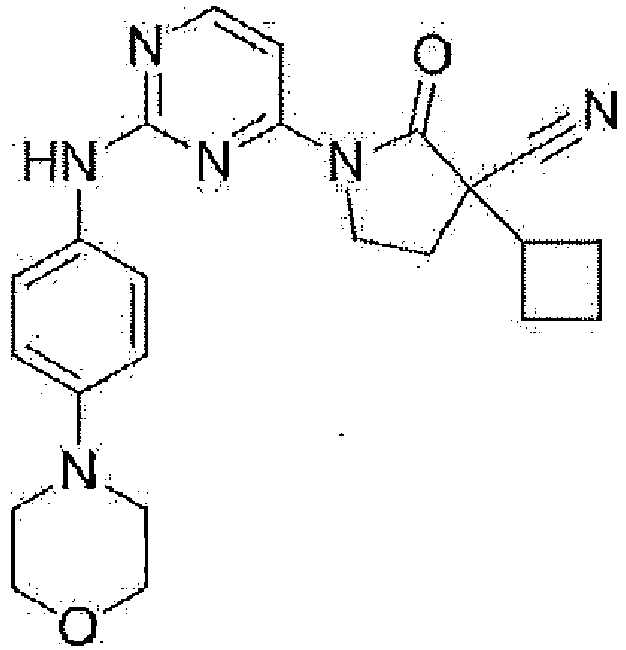
- The title compound (1.9 g) was obtained from cyclobutanone (1.4 g) in the same manner as in Step A of Example 309.
1H NMR (400 MHz, CDCl3) δ 1.31 (3H, t, J = 7.1 Hz), 1.87-2.08 (4H, m), 2.11-2.23 (2H, m), 2.85-2.96 (1H, m), 3.50 (1H, d, J = 7.3 Hz), 4.24 (2H, q, J = 7.2 Hz). - The title compound (1.8 g) was obtained from ethyl cyano(cyclobutyl)acetate (1.0 g) obtained in Step A of Example 312 in the same manner as in Step B of Example 309.
1H NMR (400 MHz, CDCl3) 1.32 (3H, t, J = 7.1 Hz), 1.43 (9H, s), 1.74-2.00 (4H, m), 2.06-2.15 (4H, m), 2.67-2.84 (1H, m), 3.13-3.28 (1H, m), 3.30-3.43
(1H, m), 4.26 (2H, q, J = 7.2 Hz), 4.66 (1H, brs). - The title compound (690 mg) was obtained from ethyl 4-((tert-butoxycarbonyl)amino)-2-cyano-2-cyclobutylbutanoate (1.8 g) obtained in Step B of Example 312 in the same manner as in Step C of Example 309.
1H NMR (400 MHz, CDCl3) δ1.84-2.00 (2H, m), 2.04-2.26 (5H, m), 2.56 (1H, ddd, J = 13.2, 8.3, 6.4 Hz), 2.75 (1H, quin, J = 8.6 Hz), 3.31-3.44 (1H, m), 3.44-3.54 (1H, m), 6.34 (1H, brs). - The title compound (0.50 g) was obtained from 3-cyclobutyl-2-oxopyrrolidine-3-carbonitrile (0.68 g) obtained in Step C of Example 312 in the same manner as in Step D of Example 309.
1H NMR (400 MHz, CDCl3) δ1.90-2.02 (2H, m), 2.11-2.21 (3H, m), 2.21-2.31 (2H, m), 2.58 (1H, ddd, J = 13.4, 8.6, 7.3 Hz), 2.75-2.86 (1H, m), 4.04 (1H, dt, J = 11.7, 7.6 Hz), 4.18 (1H, ddd, J = 11.9, 8.6, 4.6 Hz), 8.27 (1H, d, J = 5.9 Hz), 8.53 (1H, d, J = 5.9 Hz). - The title compound (70 mg) was obtained from 1-(2-chloropyrimidin-4-yl)-3-cyclobutyl-2-oxopyrrolidine-3-carbonitrile (100 mg) obtained in Step D of Example 312 in the same manner as in Step E of Example 309.
MS(ESI+): [M+H]+ 419.4. - In Examples 313 to 346, the title compound was obtained from 1-(2-chloropyrimidin-4-yl)-3-ethyl-2-oxopyrrolidine-3-carbonitrile obtained in Step A of Example 2 and the aniline derivative each corresponding to the compounds of Examples 313 to 346 (these compounds can be produced according to a method known per se), in the same manner as in Step B of Example 2. MS in the tables means actual measured value.
Table 25-1 Example Number IUPAC Name Structure Salt MS 313 1-(2-aminopyrimidin-4-yl)-3-ethyl-2-oxopyrrolidine-3-carbonitrile 
Free 307.9 314 3-ethyl-1-(2-((2-methylphenyl)amino)pyrimidin-4-yl)-2-oxopyrrolidine-3-carbonitrile 
Free 321.9 315 3-ethyl-1-(2-((4-methylphenyl)amino)pyrimidin-4-yl)-2-oxopyrrolidine-3-carbonitrile 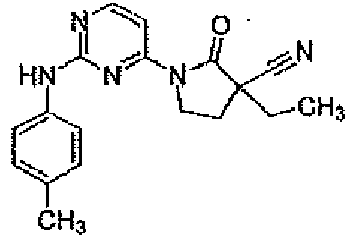
Free 321.9 316 3-ethyl-1-(2-((3-fluorophenyl)amino)pyrimidin-4-yl)-2-oxopyrrolidine-3-carbonitrile 
Free 325.9 317 3-ethyl-1-(2-((4-fluorophenyl)amino)pyrimidin-4-yl)-2-oxopyrrolidine-3-carbonitrile 
Free 325.9 318 1-(2-((2-chlorophenyl)amino)pyrimidin-4-yl)-3-ethyl-2-oxopyrrolidine-3-carbonitrile 
Free 341.9 319 1-(2-((3-chlorophenyl)amino)pyrimidin-4-yl)-3-ethyl-2-oxopyrrolidine-3-carbonitrile 
Free 341.9 320 1-(2-((4-chlorophenyl)amino)pyrimidin-4-yl)-3-ethyl-2-oxopyrrolidine-3-carbonitrile 
Free 341.9 321 3-ethyl-1-(2-((2-methoxyphenyl)amino)pyrimidin-4-yl)-2-oxopyrrolidine-3-carbonitrile 
Free 337.9 Table 25-2 Example Number IUPAC Name Structure Salt MS 322 3-ethyl-1-(2-((3-methoxyphenyl)amino)pyrimidin-4-yl)-2-oxopyrrolidine-3-carbonitrile 
Free 337.9 323 3-ethyl-1-(2-((4-methoxyphenyl)amino)pyrimidin-4-yl)-2-oxopyrrolidine-3-carbonitrile 
Free 337.9 324 3-ethyl-2-oxo-1-(2-((3-(trifluoromethoxy)phenyl)amino)pyrim idin-4-yl)pyrrolidine-8-carbonitrile 
Free 391.9 325 3-ethyl-2-oxo-1-(2-((4-(trifluoromethoxy)phenyl)amino)pyrim idin-4-yl)pyrrolidine-3-carbonitrile 
Free 391.9 326 1-(2-((3-cyanophenyl)amino)pyrimidin-4-yl)-3-ethyl-2-oxopyrrolidine-3-carbonitrile 
Free 332.9 327 1-(2-((4-cyanophenyl)amino)pyrimidin-4-yl)-3-ethyl-2-oxopyrrolidine-3-carbonitrile 
Free 332.9 328 3-((4-(3-cyano-3-ethyl-2-oxopyrrolidin-1-yl)pyrimidin-2-yl)amino)benzenesulfonamide 
Free 386.9 329 4-((4-(3-cyano-3-ethyl-2-oxopyrrolidin-1-yl)pyrimidin-2-yl)amino)benzenesulfonamide 
Free 387 330 3-ethyl-1-(2-((3-(hydroxymethyl)phenyl)amino)pyrimidi n-4-yl)-2-oxopyrrolidine-3-carbonitrile 
Free 337.9 Table 25-3 Example Number IUPAC Name Structure Salt MS 331 1-(2-((3-acetylphenyl)amino)pyrimidin-4-yl)-3-ethyl-2-oxopyrrolidine-3-carbonitrile 
Free 349.9 332 1-(2-((4-tert-butylphenyl)anino)pyrimidin-4-yl)-3-ethyl-2-oxopyrrolidine-3-carbonitrile 
Free 364.0 333 3-((4-(3-cyano-3-ethyl-2-oxopyrrolidin-1-yl)pyrimidin-2-yl)amino)benzamide 
Free 350.9 334 3-ethyl-1-(2-((6-methoxypyridin-3-yl)amino)pyrimidin-4-yl)-2-oxopyrrolidine-3-carbonitrile 
Free 338.9 335 3-ethyl-1-(2-((3-(methylsulfonyl)phenyl)amino)pyrimid in-4-yl)-2-oxopyrrolidine-3-carbonitrile 
Free 386.0 336 N-(3-((4-(3-cyano-3-ethyl-2-oxopyrrolidin-1-yl)pyrimidin-2-yl)amino)phenyl)acetemide 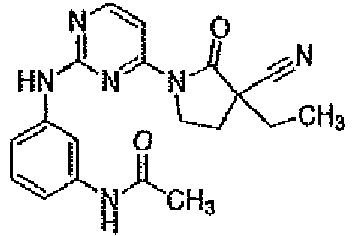
Free 364.9 337 1-(2-((4-(cyanomethyl)phenyl)amino)pyrimidin-4-yl)-3-ethy1-2-oxopyrrolidine-3-carbonitrile 
Free 364.9 338 3-ethyl-1-(2-((4-(2-methoxyethoxy)phenyl)amino)pyrimidin -4-yl)-2-oxopyrrolidine-3-carbonitrile 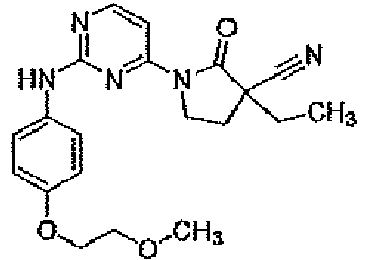
Free 382.0 Table 25-4 Example Number IUPAC Name Structure Salt MS 341 3-ethyl-1-(2-(1H-indazol-6-ylamino)pyrimidin-4-yl)-2-oxopyrrolidine-3-carbonitrile 
Free 348.0 342 1-(2-((1-tert-butyl-1H-pyrazol-4-yl)amino)pyrimidin-4-yl)-3-ethyl-2-oxopyrrolidine-3-carbonitrile 
Free 353.9 343 4-((4-(3-cyano-3-ethyl-2-oxopyrrolidin-1-yl)pyrimidin-2-yl)amino)thiophene-2-sulfonamide 
Free 392.9 344 1-(2-(1,3-benzothiazol-6-ylamino)pyrimidin-4-yl)-3-ethyl-2-oxopyrrolidine-3-carbonitrile 
Free 364.9 345 3-ethyl-1-(2-((1-methyl-1H-indol-5-yl)amino)pyrimidin-4-yl)-2-oxopyrrolidine-3-carbonitrile 
Free 361.0 -

- To an aqueous solution (200 mL) of sodium hydroxide (23 g) were added 2-thioxo-2,3-dihydropyrimidin-4(1H)-one (37 g) and iodomethane (20 mL), and the mixture was stirred overnight at room temperature. To the reaction mixture was added acetic acid (17 mL), and the precipitate was collected by filtration, and washed with ice water. The residue was dried to give the title compound (28 g).
1H NMR (400 MHz, DMSO-d6) δ 2.48 (3H, s), 6.10 (1H, d, J = 6.6 Hz), 7.87 (1H, d, J = 6.4 Hz), 12.69 (1H, brs). - To a solution of ethyl 2-methyl-2-(4-nitro-1H-pyrazol-1-yl)propanoate (20 g) obtained in Step F of Example 103 in ethanol (200 mL) was added 10% palladium-carbon (3.0 g), and the mixture was stirred overnight at room temperature under hydrogen atmosphere (at normal pressures). The palladium carbon was removed by filtration through Celite, and the solvent was evaporated under reduced pressure to give the title compound (17 g).
1H NMR (400 MHz, DMSO-d6) δ1.11 (3H, t, J = 7.1 Hz), 1.65 (6H, s), 3.82 (2H, s), 4.05 (2H, q, J = 7.1 Hz), 6.95 (1H, d, J = 0.7 Hz), 7.12 (1H, d, J = 1.0 Hz). - To a solution of 2-(methylsulfanyl)pyrimidin-4(3H)-one (9.1 g) obtained in Step A of Example 347 in diglyme (60 mL) was added ethyl 2-(4-amino-1H-pyrazol-1-yl)-2-methylpropanoate (13 g) obtained in Step B of Example 347, and the mixture was stirred at 140°C for 7 hr. To the reaction mixture was added water, and the mixture was extracted with ethyl acetate. The obtained organic layer was washed with water and saturated brine, and dried over anhydrous magnesium sulfate, and the solvent was evaporated under reduced pressure. The residue was purified by silica gel column chromatography (ethyl acetate/methanol) to give the title compound (17 g).
1H NMR (400 MHz, DMSO-d6) δ1.08-1.14 (3H, m), 1.69-1.78 (6H, m), 4.08 (2H, q, J = 7.3 Hz), 5.73 (1H, d, J = 5.6 Hz), 7.53-7.61 (1H, m), 7.68-7.81 (1H,m) 8.05 (1H, s), 8.68 (1H, brs). - To a solution of ethyl 2-methyl-2-(4-((6-oxo-1,6-dihydropyrimidin-2-yl)amino)-1H-pyrazol-1-yl)propanoate (2.0 g) obtained in Step C of Example 347 in acetonitrile (20 mL) was added phosphorus oxychloride (4.0 mL), and the mixture was stirred at 80°C for 2 hr. To the reaction mixture was added 8 M aqueous sodium hydroxide solution (25 mL), and the mixture was extracted with ethyl acetate. The obtained organic layer was washed with water and saturated brine, and dried over anhydrous magnesium sulfate, and the solvent was evaporated under reduced pressure to give the title compound (2.0 g).
1H NMR (400 MHz, DMSO-d6) δ1.13 (3H, t, J = 7.1 Hz), 1.75 (6H, s), 4.09 (2H, q, J = 7.1 Hz), 6.85 (1H, d, J = 5.1 Hz), 7.57 (1H, s), 7.98 (1H, s), 8.39 (1H, d, J = 4.9 Hz), 9.92 (1H, s). - To a solution of calcium chloride (540 mg) in a mixed solvent of tetrahydrofuran-ethanol (v/v = 1/1, 5.0 mL) was added sodium borohydride (240 mg), and the mixture was stirred at room temperature for 1 hr. To the reaction mixture was added a solution of ethyl 2-(4-((4-chloropyrimidin-2-yl)amino)-1H-pyrazol-1-yl)-2-methylpropanoate (1.0 g) obtained in Step D of Example 347 in a mixed solvent of tetrahydrofuran-ethanol (v/v = 1/1, 5.0 mL) in an ice bath, and the mixture was stirred overnight while it was allowed to be gradually warmed to room temperature. To the reaction mixture was added 1 M hydrochloric acid in an ice bath, and the mixture was stirred at the same temperature for 10 min. 1 M Aqueous sodium hydroxide solution was added thereto, and the solvent was evaporated under reduced pressure. To the residue was added water, and the mixture was extracted with ethyl acetate. The obtained organic layer was washed with saturated brine, and dried over anhydrous magnesium sulfate, and the solvent was evaporated under reduced pressure. The residue was purified by silica gel column chromatography (hexane/ethyl acetate) to give the title compound (700 mg).
1H NMR (400 MHz, DMSO-d6) δ 1.45 (6H, s), 3.55 (2H, d, J = 5.6 Hz), 4.96 (1H, t, J = 5.6 Hz), 6.81 (1H, d, J = 5.1 Hz), 7.54 (1H, s), 7.91 (1H, s), 8.37 (1H, d, J = 4.2 Hz), 9.83 (1H, s). - To a mixture of 2-(4-((4-chloropyrimidin-2-yl)amino)-1H-pyrazol-1-yl)-2-methylpropan-1-ol (200 mg) obtained in Step E of Example 347, 3-cyclopropyl-2-oxopyrrolidine-3-carbonitrile (110 mg) obtained in Step C of Example 103, cesium carbonate (490 mg) and 4,5-bis(diphenylphosphino)-9,9-dimethylxanthene (26 mg) in toluene (2.0 mL) was added tris(dibenzylideneacetone)dipalladium(0) (14 mg), and the mixture was stirred overnight at 85°C. The insoluble substance was removed by filtration through Celite, and the solvent was evaporated under reduced pressure. The residue was purified by silica gel column chromatography (hexane/ethyl acetate) to give the title compound (130 mg).
MS(ESI+): [M+H]+ 382.3. -
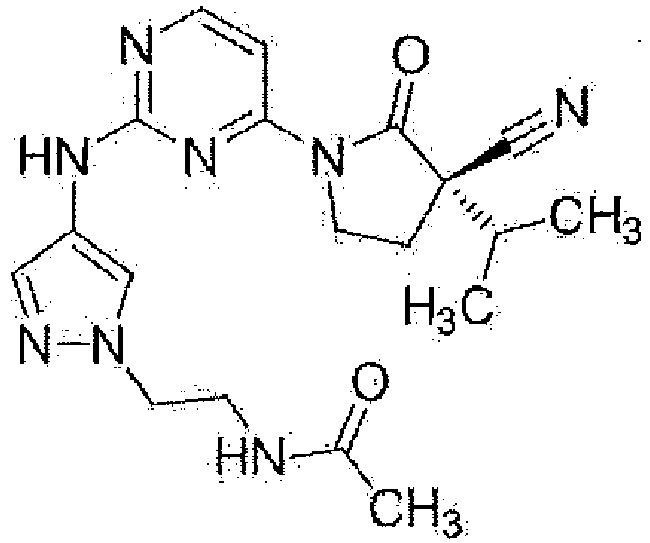
- To a solution of 4-nitro-1H-pyrazole (5.0 g) in N,N-dimethylformamide (100 mL) were added tert-butyl (2-bromoethyl)carbamate (12 g) and cesium carbonate (19 g), and the mixture was stirred overnight at 40°C. To the reaction mixture was added water, and the mixture was extracted with ethyl acetate. The obtained organic layer was washed with water and saturated brine, and dried over anhydrous sodium sulfate, and the solvent was evaporated under reduced pressure. The residue was purified by silica gel column chromatography (hexane/ethyl acetate) to give the title compound (13 g).
1H NMR (400 MHz, DMSO-d6) δ1.27-1.36 (9H, m), 3.35 (2H, q, J = 5.9 Hz), 4.20 (2H, t, J = 5.7 Hz), 6.96 (1H, t, J = 5.6 Hz), 8.26 (1H, s), 8.79 (1H, s). - To a solution of tert-butyl (2-(4-nitro-1H-pyrazol-1-yl)ethyl)carbamate (8.0 g) obtained in Step A of Example 348 in ethyl acetate (30 mL) was added a solution of 4 M hydrogen chloride in ethyl acetate (4.0 mL), and the mixture was stirred at room temperature for 3 hr. The reaction mixture was concentrated under reduced pressure to give the title compound (4.7 g).
1H NMR (400 MHz, DMSO-d6) δ3.41 (2H, brs), 4.41-4.52 (2H, m), 8.14 (3H, brs), 8.36 (1H, s), 8.96 (1H, s). - To a solution of 2-(4-nitro-1H-pyrazol-1-yl)ethanamine hydrochloride (1.0 g) obtained in Step B of Example 348 in tetrahydrofuran (30 mL) were successively added triethylamine (2.2 mL) and acetyl chloride (0.44 mL) in an ice bath, and the mixture was stirred at room temperature for 2 hr. To the reaction mixture was added water, and the mixture was extracted with ethyl acetate. The obtained organic layer was washed with water and saturated brine, and dried over anhydrous sodium sulfate, and the solvent was evaporated under reduced pressure. The residue was recrystallized (hexane/ethyl acetate) to give the title compound (610 mg).
1H NMR (400 MHz, DMSO-d6) δ 1.71-1.83 (3H, m), 3.46 (2H, q, J = 5.7 Hz), 4.21 (2H, t, J = 5.9 Hz), 7.96 (1H, brs), 8.28 (1H, d, J = 0. 7 Hz), 8.87 (1H, s). - To a solution of N-(2-(4-nitro-1H-pyrazol-1-yl)ethyl)acetamide (610 mg) obtained in Step C of Example 348 in ethanol (20 mL) was added 10% palladium-carbon (160 mg), and the mixture was stirred at room temperature for 3 hr under hydrogen atmosphere (at normal pressures). The palladium carbon was removed by filtration through Celite, and the solvent was evaporated under reduced pressure to give the title compound (570 mg).
1H NMR (400 MHz, DMSO-d6) δ 1.76-1.81 (3H, m), 3.32-3.35 (2H, m), 3.84 (2H, brs), 3.94 (2H, t, J = 6.5 Hz), 6.91 (1H, d, J = 0.7 Hz), 6.97-7.01 (1H, m), 7.87-7.98 (1H, m). - The title compound (28 mg) was obtained from (3S)-1-(2-chloropyrimidin-4-yl)-3-isopropyl-2-oxopyrrolidine-3-carbonitrile (55 mg) obtained in Step A of Example 9 and N-(2-(4-amino-1H-pyrazol-1-yl)ethyl)acetamide (38 mg) obtained in Step D of Example 348 in the same manner as in Step B of Example 2.
MS(ESI+): [M+H]+ 397.3. -

- To a solution of 2-(4-nitro-1H-pyrazol-1-yl)ethanamine hydrochloride (1.0 g) obtained in Step B of Example 348 in tetrahydrofuran (30 mL) were added triethylamine (2.2 mL) and methanesulfonyl chloride (0.60 mL) in an ice bath, and the mixture was stirred at room temperature for 3 hr. To the reaction mixture was added water, and the mixture was extracted with ethyl acetate. The obtained organic layer was washed with water and saturated brine, and dried over anhydrous sodium sulfate, and the solvent was evaporated under reduced pressure. The residue was recrystallized (hexane/ethyl acetate) to give the title compound (880 mg).
1H NMR (400 MHz, DMSO-d6) δ 2.80-2.94 (3H, m), 3.42 (2H, q, J = 6.1 Hz), 4.28 (2H, t, J = 6.0 Hz), 7.24 (1H, t, J = 6.1 Hz), 8.30 (1H, d, J = 0.5 Hz), 8.87 (1H, s). - To a solution of N-(2-(4-nitro-1H-pyrazol-1-yl)ethyl)methanesulfonamide (880 mg) obtained in Step A of Example 349 in ethanol (30 mL) was added 10% palladium-carbon (200 mg), and the mixture was stirred at room temperature for 3 hr under hydrogen atmosphere (at normal pressures). The palladium carbon was removed by filtration through Celite, and the solvent was evaporated under reduced pressure to give the title compound (860 mg).
1H NMR (400 MHz, DMSO-d6) δ 2.79 (3H, s), 3.27 (2H, t, J = 6.4 Hz), 3.82 (2H, brs), 4.00 (2H, t, J = 6.5 Hz), 6.93 (1H, d, J = 1.0 Hz), 7.05 (1H, d, J = 1.0 Hz), 7.14 (1H, brs). - The title compound (70 mg) was obtained from (3S)-1-(2-chloropyrimidin-4-yl)-3-isopropyl-2-oxopyrrolidine-3-carbonitrile (55 mg) obtained in Step A of Example 9 and N-(2-(4-amino-1H-pyrazol-1-yl)ethyl)acetamide (47 mg) obtained in Step B of Example 349 in the same manner as in Step B of Example 2.
MS(ESI+): [M+H]+ 433.3. -

- To a solution of 5-aminopyridine-2-carboxylic acid (2.0 g) in N,N-dimethylformamide (50 mL) were added ammonium chloride (3.9 g), 1-ethyl-3-(3-dimethylaminopropyl)carbodiimide (5.1 mL) and 1-hydroxybenzotriazole (4.4 g), and the mixture was stirred overnight at room temperature. To the reaction mixture was added saturated aqueous sodium hydrogen carbonate solution, and the mixture was extracted with ethyl acetate. The obtained organic layer was washed with saturated brine, and dried over anhydrous sodium sulfate, and the solvent was evaporated under reduced pressure. The residue was purified by silica gel column chromatography (NH, hexane/ethyl acetate) to give the title compound (260 mg).
MS(ESI+): [M+H]+ 138.3. - To a solution of (3R)-1-(2-chloropyrimidin-4-yl)-3-ethyl-2-oxopyrrolidine-3-carbonitrile (200 mg) obtained in Step A of Example 8, 5-aminopyridine-2-carboxamide (130 mg) obtained in Step A of Example 350, cesium carbonate (520 mg) and 2,2'-bis(diphenylphosphino)-1,1'-binaphthyl (75 mg) in tetrahydrofuran (5.0 mL) was added tris(dibenzylideneacetone)dipalladium(0) (73 mg), and the mixture was stirred overnight at 80°C under argon atmosphere. The insoluble substance was removed by filtration through Celite, and the solvent was evaporated under reduced pressure. The residue was purified by silica gel column chromatography (NH, hexane/ethyl acetate), and recrystallized (diisopropyl ether/ethanol) to give the title compound (25 mg).
MS (ESI+) : [M+H]+ 352.3. -

- To a solution of (3S)-1-(2-chloropyrimidin-4-yl)-3-isopropyl-2-oxopyrrolidine-3-carbonitrile (200 mg) obtained in Step A of Example 9, 5-aminopyridine-2-carboxamide (120 mg) obtained in Step A of Example 350, cesium carbonate (490 mg) and 2,2'-bis(diphenylphosphino)-1,1'-binaphthyl (71 mg) in tetrahydrofuran (5.0 mL) was added tris(dibenzylideneacetone)dipalladium(0) (69 mg), and the mixture was stirred overnight at 80°C under argon atmosphere. The insoluble substance was removed by filtration through Celite, and the solvent was evaporated under reduced pressure. The residue was purified by silica gel column chromatography (NH, hexane/ethyl acetate), and recrystallized (diisopropyl ether/ethanol) to give the title compound (54 mg).
MS(ESI+): [M+H]+ 366.3. -

- To a solution of (3S)-3-cyclopropyl-1-(2-((1-(1-hydroxy-2-methylpropan-2-yl)-1H-pyrazol-4-yl)amino)pyrimidin-4-yl)-2-oxopyrrolidine-3-carbonitrile (400 mg) obtained in Step I of Example 103 and cobalt(II) chloride hexahydrate (1.0 g) in methanol (6.0 mL) was added sodium borohydride (400 mg), and the mixture was stirred at room temperature for 4 hr. To the reaction mixture was added saturated aqueous sodium hydrogen carbonate solution in an ice bath, and the mixture was extracted with ethyl acetate. The obtained organic layer was washed with saturated brine, and dried over anhydrous sodium sulfate, and the solvent was evaporated under reduced pressure. The residue was purified by silica gel column chromatography (ethyl acetate/methanol) to give the title compound (84 mg). MS(ESI+): [M+H]+ 386.4.
-

- The title compound (30 mg) was obtained from (3S)-3-(aminomethyl)-3-cyclopropyl-1-(2-((1-(1-hydroxy-2-methylpropan-2-yl)-1H-pyrazol-4-yl)amino)pyrimidin-4-yl)pyrrolidin-2-one (76 mg) obtained in Example 352 in the same manner as in Step C of Example 348.
MS (ESI+): [M+H]+ 428.4. -

- To a solution of (35)-3-cyclopropyl-1-(2-((1-(1-hydroxy-2-methylpropan-2-yl)-1H-pyrazol-4-yl)amino)pyrimidin-4-yl)-2-oxopyrrolidine-3-carbonitrile (170 mg) obtained in Step I of Example 103 and cobalt(II) chloride hexahydrate (420 mg) in methanol (3.0 mL) was added sodium borohydride (170 mg), and the mixture was stirred at room temperature for 2 hr. To the reaction mixture were added saturated aqueous sodium hydrogen carbonate solution (5.0 mL) and di-tert-butyl dicarbonate (0.12 mL), and the mixture was stirred at room temperature for 2 hr. To the reaction mixture was added water, and the mixture was extracted with ethyl acetate. The obtained organic layer was washed with saturated aqueous ammonium chloride solution and saturated brine, and dried over anhydrous sodium sulfate, and the solvent was evaporated under reduced pressure. The residue was purified by silica gel column chromatography (hexane/ethyl acetate) to give the title compound (130 mg).
MS (ESI+) : [M+H]+ 486.4. -

- To a solution of 2-fluoro-4-nitrobenzoic acid (5.0 g) in N,N-dimethylformamide (100 mL) were added ammonium chloride (7.2 g), 1-ethyl-3-(3-dimethylaminopropyl)carbodiimide (9.5 mL), 1-hydroxybenzotriazole (8.3 g) and N,N-diisopropylethylamine (24 mL), and the mixture was stirred overnight at room temperature. To the reaction mixture was added saturated aqueous sodium hydrogen carbonate solution, and the precipitate was collected by filtration to give the title compound (3.1 g).
1H NMR (400 MHz, DMSO-d6) δ7.87 (1H, dd, J = 8.3, 7.1 Hz), 7.93 (1H, brs), 8.07 (1H, brs), 8.10-8.15 (1H, m), 8.20 (1H, dd, J = 9.9, 2.1 Hz). - The title compound (750 mg) was obtained from 2-fluoro-4-nitrobenzamide (1.0 g) obtained in Step A of Example 355 in the same manner as in Step D of Example 348.
1H NMR (400 MHz, DMSO-d6) δ5.94 (2H, s), 6.27 (1H, dd, J = 14.4, 2.0 Hz), 6.38 (1H, dd, J = 8.6, 2.2 Hz), 6.89-7.24 (2H, m), 7.48 (1H, t, J = 8.8 Hz). - The title compound (200 mg) was obtained from (3S)-1-(2-chloropyrimidin-4-yl)-3-isopropyl-2-oxopyrrolidine-3-carbonitrile (200 mg) obtained in Step A of Example 9 and 4-amino-2-fluorobenzamide (120 mg) obtained in Step B of Example 355 in the same manner as in Step B of Example 2.
MS (ESI+) : [M+H]+ + 383.3. -
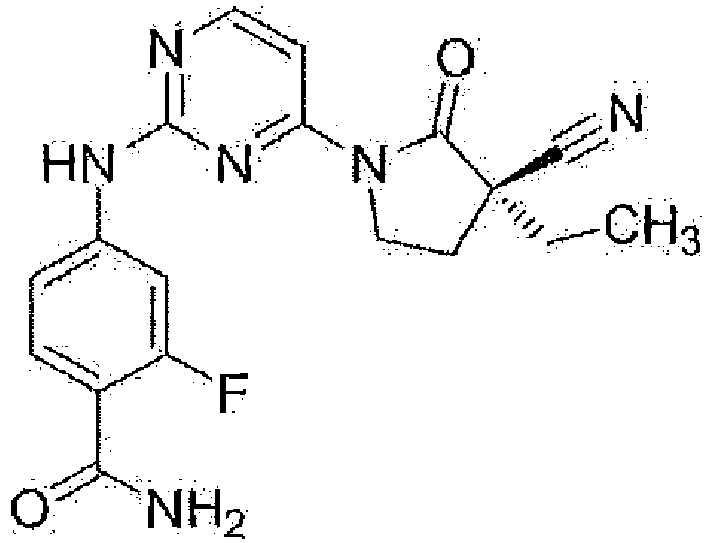
- The title compound (220 mg) was obtained from (3R)-1-(2-chloropyrimidin-4-yl)-3-ethyl-2-oxopyrrolidine-3-carbonitrile (200 mg) obtained in Step A of Example 8 and 4-amino-2-fluorobenzamide (120 mg) obtained in Step B of Example 355 in the same manner as in Step B of Example 2.
MS(ESI+): [M+H]+ 369.2. -
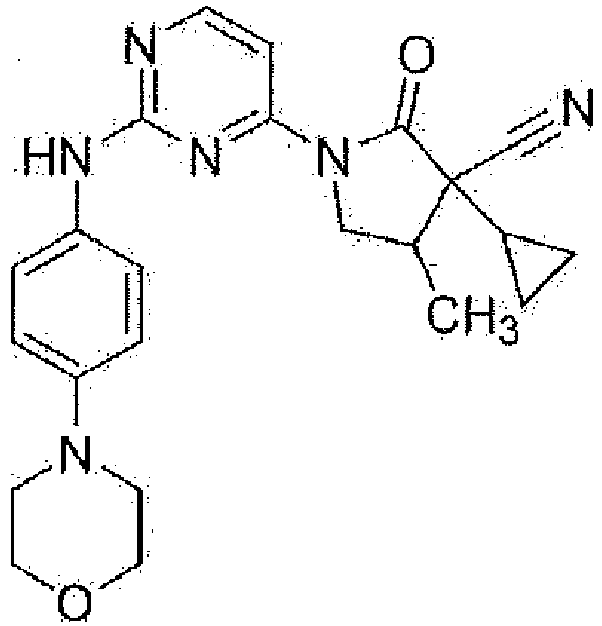
- The title compound (5.3 g) was obtained from tert-butyl 5-methyl-1,2,3-oxathiazolidine-3-carboxylate 2,2-dioxide (4.7 g) and ethyl cyano(cyclopropyl)acetate (3.0 g) obtained in Step A of Example 103 in the same manner as in Step B of Example 103.
MS(ESI+), found: 211.3 [M+H-(Boc)]+. - To ethyl 4-((tert-butoxycarbonyl)amino)-2-cyano-2-cyclopropyl-3-methylbutanoate (5.3 g) obtained in Step A of Example 357 was added 4 M hydrogen chloride in ethyl acetate (30 mL), and the mixture was stirred at room temperature for 2 hr. The reaction mixture was concentrated under reduced pressure, to a solution of the residue in acetonitrile (150 mL) was added potassium carbonate (9.4 g), and the mixture was stirred at room temperature for 5 hr. The insoluble substance was removed by filtration through Celite, and the solvent was evaporated under reduced pressure. The residue was purified by silica gel column chromatography (hexane/ethyl acetate) to give the title compound (2.2 g).
1H NMR (400 MHz, DMSO-d6) δ0.39-0.66 (4H, m), 1.08-1.26 (4H, m), 2.82-3.00 (1H, m), 3.26-3.46 (2H, m), 8.27 (1H, d, J = 15.9 Hz). - The title compound (2.6 g) was obtained from 3-cyclopropyl-4-methyl-2-oxopyrrolidine-3-carbonitrile (2.2 g) obtained in Step B of Example 357 and 2,4-dichloropyrimidine (2.0 g) in the same manner as in Step D of Example 103.
MS (ESI+) : [M+H]+ 277.2. - The title compound (88 mg) was obtained from 1-(2-chloropyrimidin-4-yl)-3-cyclopropyl-4-methyl-2-oxopyrrolidine-3-carbonitrile (110 mg) obtained in Step C of Example 357 and 4-morpholinoaniline (68 mg) in the same manner as in Step B of Example 2.
MS (ESI+): [M+H]+ 419.4. -

- The title compound (5.5 g) was obtained from tert-butyl (4S)-4-methyl-1,2,3-oxathiazolidine-3-carboxylate 2,2-dioxide (4.7 g) and ethyl cyano(cyclopropyl)acetate (3.0 g) obtained in Step A of Example 103 in the same manner as in Step B of Example 103.
1H NMR (400 MHz, DMSO-d6) δ0.32-0.72 (4H, m), 0.96-1.11 (3H, m), 1.21-1.27 (3H, m), 1.28-1.32 (1H, m), 1.33-1.42 (9H, m), 1.84-2.27 (2H, m), 3.58-3.86 (1H, m), 4.10-4.30 (2H, m), 6.41-6.84 (1H, m). - (3R,5S)-3-cyclopropyl-5-methyl-2-oxopyrrolidine-3-carbonitrile
(3S,5S)-3-Cyclopropyl-5-methyl-2-oxopyrrolidine-3-carbonitrile (780 mg) and (3R,5S)-3-cyclopropyl-5-methyl-2-oxopyrrolidine-3-carbonitrile (680 mg) were obtained from ethyl (4S)-4-((tert-butoxycarbonyl)amino)-2-cyano-2-cyclopropylpentanoate (5.5 g) obtained in Step A of Example 358 in the same manner as in Step B of Example 357.
(3S,5S)-3-cyclopropyl-5-methyl-2-oxopyrrolidine-3-carbonitrile 1H NMR (400 MHz, DMSO-d6) δ0.40-0.47 (1H, m), 0.49-0.56 (2H, m), 0.60-0.69 (1H, m), 1.15 (3H, d, J = 6.1 Hz), 1.23-1.33 (1H, m), 1.67 (1H, dd, J = 13.3, 7.5 Hz), 2.59 (1H, dd, J = 13.3, 6.7 Hz), 3.64-3.76 (1H, m), 8.46 (1H, brs).
(3R,5S)-3-cyclopropyl-5-methyl-2-oxopyrrolidine-3-carbonitrile 1H NMR (400 MHz, DMSO-d6) δ 0.39-0.57 (3H, m), 0.58-0.67 (1H, m), 1.15 (3H, d, J = 6.1 Hz), 1.32 (1H, tt, J = 8.2, 5.0 Hz), 1.99-2.05 (1H, m), 2.40 (1H, dd, J = 13.0, 6.4 Hz), 3.64-3.75 (1H, m), 8.39 (1H, brs). - To a mixture of (3S,5S)-3-cyclopropyl-5-methyl-2-oxopyrrolidine-3-carbonitrile (150 mg) obtained in Step B of Example 358, 2-(4-((4-chloropyrimidin-2-yl)amino)-1H-pyrazol-1-yl)-2-methylpropan-1-ol (200 mg) obtained in Step E of Example 347, potassium carbonate (210 mg) and 4,5-bis(diphenylphosphino)-9,9-dimethylxanthene (26 mg) in toluene (2.0 mL) was added tris(dibenzylideneacetone)dipalladium(0) (14 mg), and the mixture was stirred overnight at 85°C. The insoluble substance was removed by filtration through Celite, and the solvent was evaporated under reduced pressure. The residue was purified by silica gel column chromatography (NH, hexane/ethyl acetate), and to a solution of the residue (200 mg) in ethanol (2.0 mL) was added 1 M hydrochloric acid (0.51 mL). The reaction mixture was concentrated under reduced pressure, and the residue was recrystallized (diisopropyl ether/ethyl acetate) to give the title compound (65 mg).
MS(ESI+): [M+H]+ 396.4. -

- The title compound (110 mg) was obtained from (3R,5S)-3-cyclopropyl-5-methyl-2-oxopyrrolidine-3-carbonitrile (150 mg) obtained in Step B of Example 358 and 2-(4-((4-chloropyrimidin-2-yl)amino)-1H-pyrazol-1-yl)-2-methylpropan-1-ol (200 mg) obtained in Step E of Example 347 in the same manner as in Step C of Example 358.
MS(ESI+): [M+H]+ 396.4. -

- The title compound (6.3 g) was obtained from tert-butyl (4R)-4-methyl-1,2,3-oxathiazolidine-3-carboxylate 2,2-dioxide (5.1 g) and ethyl cyano(cyclopropyl)acetate (3.3 g) obtained in Step A of Example 103 in the same manner as in Step B of Example 103.
1H NMR (400 MHz, DMSO-d6) δ0.34-0.71 (4H, m), 0.97-1.11 (3H, m), 1.22-1.27 (3H, m), 1.28-1.32 (1H, m), 1.33-1.42 (9H, m), 1.84-2.28 (2H, m), 3.53-3.84 (1H, m), 4.11-4.31 (2H, m), 6.36-6.87 (1H, m). - (3R,5R)-3-cyclopropyl-5-methyl-2-oxopyrrolidine-3-carbonitrile
(3S,5R)-3-Cyclopropyl-5-methyl-2-oxopyrrolidine-3-carbonitrile (1.2 g) and (3R,5R)-3-cyclopropyl-5-methyl-2-oxopyrrolidine-3-carbonitrile (860 mg) were obtained from ethyl (4R)-4-((tert-butoxycarbonyl)amino)-2-cyano-2-cyclopropylpentanoate (5.0 g) obtained in Step A of Example 360 in the same manner as in Step B of Example 357.
(3S,5R)-3-cyclopropyl-5-methyl-2-oxopyrrolidine-3-carbonitrile 1H NMR (400 MHz, DMSO-d6) δ 0.40-0.48 (1H, m), 0.48-0.56 (2H, m), 0.61-0.69 (1H, m), 1.15 (3H, d, J = 6.1 Hz), 1.23-1.33 (1H, m), 1.67 (1H, dd, J = 13.3, 7.5 Hz), 2.59 (1H, dd, J = 13.3, 6.7 Hz), 3.64-3.76 (1H, m), 8.47 (1H, brs).
(3R,5R)-3-cyclopropyl-5-methyl-2-oxopyrrolidine-3-carbonitrile 1H NMR (400 MHz, DMSO-d6) δ0.39-0.68 (4H, m), 1.15 (3H, d, J = 6.4 Hz), 1.27-1.37 (1H, m), 2.02 (1H, dd, J = 13.2, 7.8 Hz), 2.40 (1H, dd, J = 13.0, 6.4 Hz), 3.64-3.75 (1H, m), 8.39 (1H, brs). - The title compound (220 mg) was obtained from (3S,5R)-3-cyclopropyl-5-methyl-2-oxopyrrolidine-3-carbonitrile (150 mg) obtained in Step B of Example 360 and 2-(4-((4-chloropyrimidin-2-yl)amino)-1H-pyrazol-1-yl)-2-methylpropan-1-ol (200 mg) obtained in Step E of Example 347 in the same manner as in Step C of Example 358.
MS(ESI+): [M+H]+ 396.4. -
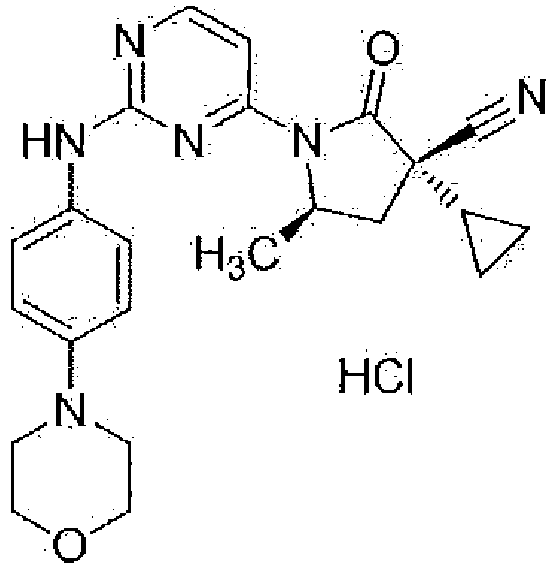
- The title compound (3.2 g) was obtained from 2-(methylsulfanyl)pyrimidin-4(3H)-one (2.4 g) obtained in Step A of Example 347 and 4-morpholinoaniline (3.0 g) in the same manner as in Step C of Example 347.
1H NMR (400 MHz, DMSO-d6) δ 2.98-3.12 (4H, m), 3.64-3.79 (4H, m), 5.71 (1H, brs), 6.90 (2H, d, J = 9.0 Hz), 7.41 (2H, d, J = 8.3 Hz), 7.67 (1H, brs), 8.60 (1H, brs), 10.70 (1H, brs). - The title compound (2.6 g) was obtained from 2-((4-(morpholin-4-yl)phenyl)amino)pyrimidin-4(3H)-one (3.2 g) obtained in Step A of Example 361 in the same manner as in Step D of Example 347.
1H NMR (400 MHz, DMSO-d6) δ 2.99-3.09 (4H, m), 3.67-3.78 (4H, m), 6.86 (1H, d, J = 5.1 Hz), 6.89-6.94 (2H, m), 7.49-7.57 (2H, m), 8.36 (1H, d, J = 5.4 Hz), 9.78 (1H, s). - The title compound (140 mg) was obtained from 4-chloro-N-(4-(morpholin-4-yl)phenyl)pyrimidin-2-amine (200 mg) obtained in Step B of Example 361 and (3S,5R)-3-cyclopropyl-5-methyl-2-oxopyrrolidine-3-carbonitrile (140 mg) obtained in Step B of Example 360 in the same manner as in Step C of Example 358.
MS(ESI+): [M+H]+ 419.4. -

- The title compound (83 mg) was obtained from 4-chloro-N-(4-(morpholin-4-yl)phenyl)pyrimidin-2-amine (200 mg) obtained in Step B of Example 361 and (3S,5S)-3-cyclopropyl-5-methyl-2-oxopyrrolidine-3-carbonitrile (140 mg) obtained in Step B of Example 360 in the same manner as in Step C of Example 358.
MS(ESI+): [M+H]+ 419.4. -

- To a solution of ethyl (5-aminopyridin-2-yl)acetate (2.0 g) in tetrahydrofuran (30 mL) were successively added pyridine (2.7 mL) and benzyl chloroformate (1.9 mL) in an ice bath, and the mixture was stirred at the same temperature for 3 hr. To the reaction mixture was added water, and the mixture was extracted with ethyl acetate. The obtained organic layer was washed with water and saturated brine, and dried over anhydrous sodium sulfate, and the solvent was evaporated under reduced pressure. The residue was purified by silica gel column chromatography (hexane/ethyl acetate) to give the title compound (2.6 g).
1H NMR (300 MHz, DMSO-d6) δ 1.17 (3H, t, J = 7.0 Hz), 3.75 (2H, s), 4.07 (2H, q, J = 7.1 Hz), 4.98-5.34 (2H, m), 7.11-7.60 (6H, m), 7.85 (1H, dd, J = 8.5, 2.5 Hz), 8.54 (1H, d, J = 2.3 Hz), 9.95 (1H, s). - To a solution of ethyl (5-(((benzyloxy)carbonyl)amino)pyridin-2-yl)acetate (1.0 g) obtained in Step A of Example 363 in a mixed solvent of tetrahydrofuran (20 mL) and 2-propanol (5.0 mL) was added 2 M aqueous sodium hydroxide solution (6.4 mL) in an ice bath, and the mixture was stirred at the same temperature for 3 hr. The reaction mixture was collected by filtration to give the title compound (2.6 g).
1H NMR (400 MHz, DMSO-d6) δ 3.30 (2H, s), 5.15 (2H, s), 7.21 (1H, d, J = 8.6 Hz), 7.30-7.49 (5H, m), 7.70 (1H, d, J = 8.1 Hz), 8.42 (1H, s), 9.81 (1H, brs). - The title compound (610 mg) was obtained from sodium (5-(((benzyloxy)carbonyl)amino)pyridin-2-yl)acetate (940 mg) obtained in Step B of Example 363 in the same manner as in Step A of Example 350.
1H NMR (400 MHz, DMSO-d6) δ3.50 (2H, s), 5.17 (2H, s), 6.93 (1H, brs), 7.25 (1H, d, J = 8.3 Hz), 7.31-7.51 (6H, m), 7.81 (1H, dd, J = 8.3, 2.2 Hz), 8.52 (1H, d, J = 2.2 Hz), 9.93 (1H, brs). - The title compound (74 mg) was obtained from benzyl (6-(2-amino-2-oxoethyl)pyridin-3-yl)carbamate (200 mg) obtained in Step C of Example 363 in the same manner as in Step D of Example 348.
1H NMR (400 MHz, DMSO-d6) 53.34 (2H, s), 5.13 (2H, s), 6.75-6.89 (2H, m), 6.93-6.99 (1H, m), 7.32 (1H, brs), 7.79-7.87 (1H, m). - To a solution of (3R)-1-(2-chloropyrimidin-4-yl)-3-ethyl-2-oxopyrrolidine-3-carbonitrile (130 mg) obtained in Step A of Example 8, 2-(5-aminopyridin-2-yl)acetamide (78 mg) obtained in Step D of Example 363, cesium carbonate (340 mg) and 2,2'-bis(diphenylphosphino)-1,1'-binaphthyl (48 mg) in tetrahydrofuran (5.0 mL) was added tris(dibenzylideneacetone)dipalladium(0) (48 mg), and the mixture was stirred overnight at 80°C under argon atmosphere. The insoluble substance was removed by filtration through Celite, and the solvent was evaporated under reduced pressure. The residue was purified by silica gel column chromatography (NH, ethyl acetate/methanol). To a solution of the residue (200 mg) in ethanol (2.0 mL) was added 1 M hydrochloric acid (0.55 mL), the mixture was stirred at room temperature for 5 min, and the solvent was evaporated under reduced pressure. The obtained crude crystals were recrystallized (diisopropyl ether/ethanol) to give the title compound (42 mg).
MS(ESI+): [M+H]+ 366.3. -

- The title compound (200 mg) was obtained from (3R)-1-(2-chloropyrimidin-4-yl)-3-ethyl-2-oxopyrrolidine-3-carbonitrile (150 mg) obtained in Step A of Example 8 and 4-aminobenzamide (90 mg) in the same manner as in Step B of Example 2.
MS(ESI+): [M+H]+ 351.3. -

- The title compound (44 mg) was obtained from (3R)-1-(2-chloropyrimidin-4-yl)-3-ethyl-2-oxopyrrolidine-3-carbonitrile (150 mg) obtained in Step A of Example 8 and 4-amino-N,N-dimethylbenzamide (110 mg) in the same manner as in Step B of Example 2.
MS(ESI+): [M+H]+ 379.4. -

- The title compound (910 mg) was obtained from (3S,5R)-3-cyclopropyl-5-methyl-2-oxopyrrolidine-3-carbonitrile (600 mg) obtained in Step B of Example 360 and 2,4-dichloropyrimidine (820 mg) in the same manner as in Step D of Example 103.
MS(ESI+): [M+H]+ 277.2. - The title compound (44 mg) was obtained from (3S,5R)-1-(2-chloropyrimidin-4-yl)-3-cyclopropyl-5-methyl-2-oxopyrrolidine-3-carbonitrile (100 mg) obtained in Step A of Example 366 and 1-methyl-1H-pyrazol-4-amine (37 mg) in the same manner as in Step B of Example 2.
MS(ESI+): [M+H]+ 338.0. -

- The title compound (110 mg) was obtained from (3S,5R)-1-(2-chloropyrimidin-4-yl)-3-cyclopropyl-5-methyl-2-oxopyrrolidine-3-carbonitrile (100 mg) obtained in Step A of Example 366 and 2-(4-amino-1H-pyrazol-1-yl)-N-methylacetamide (59 mg) in the same manner as in Step B of Example 2.
MS(ESI+): [M+H]+ 395.1. -

- The title compound (89 mg) was obtained from (3S,5R)-1-(2-chloropyrimidin-4-yl)-3-cyclopropyl-5-methyl-2-oxopyrrolidine-3-carbonitrile (100 mg) obtained in Step A of Example 366 and 1-(1,1-dioxidetetrahydro-2H-thiopyran-4-yl)-1H-pyrazol-4-amine (82 mg) in the same manner as in Step B of Example 2.
MS(ESI+) : [M+H]+ 456.3. -

- (3R,4S)-1-(2-chloropyrimidin-4-yl)-3-cyclopropyl-4-methyl-2-oxopyrrolidine-3-carbonitrile
(3S,4S)-1-(2-chloropyrimidin-4-yl)-3-cyclopropyl-4-methyl-2u oxopyrrolidine-3-carbonitrile
(3R,4R)-1-(2-chloropyrimidin-4-yl)-3-cyclopropyl-4-methyl-2-oxopyrrolidine-3-carbonitrile
1-(2-Chloropyrimidin-4-yl)-3-cyclopropyl-4-methyl-2-oxopyrrolidine-3-carbonitrile (2.6 g) obtained in Step C of Example 357 was purified by silica gel column chromatography (hexane/ethyl acetate) to give (3SR,4RS)-1-(2-chloropyrimidin-4-yl)-3-cyclopropyl-4-methyl-2-oxopyrrolidine-3-carbonitrile (820 mg) and (3SR,4SR)-1-(2-chloropyrimidin-4-yl)-3-cyclopropyl-4-methyl-2-oxopyrrolidine-3-carbonitrile (1.3 g).
(3SR,4RS)-1-(2-Chloropyrimidin-4-yl)-3-cyclopropyl-4-methyl-2-oxopyrrolidine-3-carbonitrile (810 mg) was resolved by HPLC (column: CHIRALCEL OD, 50 mmID×500 mmL, manufactured by Daicel Chemical Industries, mobile phase: hexane/2-propanol = 900/100) to give (3S,4R)-1-(2-chloropyrimidin-4-yl)-3-cyclopropyl-4-methyl-2-oxopyrrolidine-3-carbonitrile (400 mg) having a shorter retention time and (3R,4S)-1-(2-chloropyrimidin-4-yl)-3-cyclopropyl-9-methyl-2-oxopyrrolidine-3-carbonitrile (400 mg) having a longer retention time. (3SR,4SR)-1-(2-Chloropyrimidin-4-yl)-3-cyclopropyl-4-methyl-2-oxopyrrolidine-3-carbonitrile (1.3 g) was resolved by HPLC (column: CHIRALCEL OD, 50 mmID×500 mmL, manufactured by Daicel Chemical Industries, mobile phase: hexane/2-propanol = 900/100) to give (3S,4S)-1-(2-chloropyrimidin-4-yl)-3-cyclopropyl-4-methyl-2-oxopyrrolidine-3-carbonitrile (400 mg) having a shorter retention time and (3R,4R)-1-(2-chloropyrimidin-4-yl)-3-cyclopropyl-4-methyl-2-oxopyrrolidine-3-carbonitrile (400 mg) having a longer retention time. - (3SR,4RS)-1-(2-chloropyrimidin-4-yl)-3-cyclopropyl-4-methyl-2-oxopyrrolidine-3-carbonitrile
1H NMR (400 MHz, DMSO-d6) δ0.46-0.55 (2H, m), 0.56-0.63 (1H, m), 0.69-0.81 (1H, m), 1.26 (3H, d, J = 6.8 Hz), 1.35-1.54 (1H, m), 2.92-3.15 (1H, m), 3.64 (1H, t, J = 10.8 Hz), 4.26 (1H, dd, J = 11.0, 8.1 Hz), 8.21 (1H, d, J = 5.9 Hz), 8.69 (1H, d, J = 5.6 Hz). - (3SR,4SR)-1-(2-chloropyrimidin-4-yl)-3-cyclopropyl-4-methyl-2-oxopyrrolidine-3-carbonitrile
1H NMR (400 MHz, DMSO-d6) δ0.50-0.59 (2H, m), 0.62-0.74 (2H, m), 1.26 (3H, d, J = 6.8 Hz), 1.47 (1H, tt, J = 8.2, 5.1 Hz), 2.65-2.80 (1H, m), 3.64 (1H, dd, J = 11.5, 6.1 Hz), 4.25 (1H, dd, J = 11.5, 7.1 Hz), 8.22 (1H, d, J = 5.9 Hz), 8.70 (1H, d, J = 5.9 Hz). - (3S,4R)-1-(2-chloropyrimidin-4-yl)-3-cyclopropyl-4-methyl-2-oxopyrrolidine-3-carbonitrile
>99%ee (HPLC (column: CHIRALCEL OD, 4.6 mmIDx250 mmL, manufactured by Daicel Chemical Industries, mobile phase: hexane/2-propanol = 900/100, flow rate: 1.0 mL/min, retention time: 16.37 min))
(3R,4S)-1-(2-chloropyrimidin-4-yl)-3-cyclopropyl-4-methyl-2-oxopyrrolidine-3-carbonitrile
>99%ee (HPLC (column: CHIRALCEL OD, 4.6 mmIDx250 mmL, manufactured by Daicel Chemical Industries, mobile phase: hexane/2-propanol = 900/100, flow rate: 1.0 mL/min, retention time: 26.87 min))
(3S,4S)-1-(2-chloropyrimidin-4-yl)-3-cyclopropyl-4-methyl-2-oxopyrrolidine-3-carbonitrile
>99%ee (HPLC (column: CHIRALCEL OD, 4.6 mmIDx250 mmL, manufactured by Daicel Chemical Industries, mobile phase: hexane/2-propanol = 900/100, flow rate: 1.0 mL/min, retention time: 13.64 min))
(3R,4R)-1-(2-chloropyrimidin-4-yl)-3-cyclopropyl-4-methyl-2-oxopyrrolidine-3-carbonitrile
>99%ee (HPLC (column: CHIRALCEL OD, 4.6 mmIDx250 mmL, manufactured by Daicel Chemical Industries, mobile phase: hexane/2-propanol = 900/100, flow rate: 1.0 mL/min, retention time: 18.47 min)) - The title compound (81 mg) was obtained from (3S,4R)-1-(2-chloropyrimidin-4-yl)-3-cyclopropyl-4-methyl-2-oxopyrrolidine-3-carbonitrile (100 mg) obtained in Step A of Example 369 and 2-(4-amino-1H-pyrazol-1-yl)-2-methylpropan-1-ol (59 mg) obtained in Step H of Example 103 in the same manner as in Step B of Example 2.
MS(ESI+): [M+H]+ 396.4. -

- The title compound (71 mg) was obtained from (3R,4S)-1-(2-chloropyrimidin-4-yl)-3-cyclopropyl-4-methyl-2-oxopyrrolidine-3-carbonitrile (100 mg) obtained in Step A of Example 369 and 2-(4-amino-1H-pyrazol-1-yl)-2-methylpropan-1-ol (59 mg) obtained in Step H of Example 103 in the same manner as in Step B of Example 2.
MS(ESI+): [M+H]+ 396.4. -

- The title compound (97 mg) was obtained from (3S,4S)-1-(2-chloropyrimidin-4-yl)-3-cyclopropyl-4-methyl-2-oxopyrrolidine-3-carbonitrile (100 mg) obtained in Step A of Example 369 and 2-(4-amino-1H-pyrazol-1-yl)-2-methylpropan-1-ol (59 mg) obtained in Step H of Example 103 in the same manner as in Step B of Example 2.
MS(ESI+): [M+H]+ 396.4. -

- The title compound (94 mg) was obtained from (3R,4R)-1-(2-chloropyrimidin-4-yl)-3-cyclopropyl-4-methyl-2-oxopyrrolidine-3-carbonitrile (100 mg) obtained in Step A of Example 369 and 2-(4-amino-1H-pyrazol-1-yl)-2-methylpropan-1-ol (59 mg) obtained in Step H of Example 103 in the same manner as in Step B of Example 2.
MS(ESI+): [M+H]+ 396.4. -

- The title compound (110 mg) was obtained from (3S,5R)-1-(2-chloropyrimidin-4-yl)-3-cyclopropyl-5-methyl-2-oxopyrrolidine-3-carbonitrile (100 mg) obtained in Step A of Example 366 and 4-(4-aminophenyl)tetrahydro-2H-pyran-4-carboxamide (84 mg) obtained in Step C of Example 150 in the same manner as in Step B of Example 2.
MS(ESI+): [M+H]+ 461.4. -

- (3S,5R)-3-cyclopropyl-5-ethyl-2-oxopyrrolidine-3-carbonitrile
(3R,5R)-3-Cyclopropyl-5-ethyl-2-oxopyrrolidine-3-carbonitrile (990 mg) and (3S,5R)-3-cyclopropyl-5-ethyl-2-oxopyrrolidine-3-carbonitrile (590 mg) were obtained from tert-butyl (4R)-4-ethyl-1,2,3-oxathiazolidine-3-carboxylate 2,2-dioxide (4.3 g) and ethyl cyano(cyclopropyl)acetate (2.6 g) obtained in Step A of Example 103 in the same manner as in Step B of Example 103 and Step B of Example 357.
(3R,5R)-3-cyclopropyl-5-ethyl-2-oxopyrrolidine-3-carbonitrile 1H NMR (300 MHz, DMSO-d6) δ0.38-0.57 (3H, m), 0.59-0.71 (1H, m), 0.87 (3H, t, J = 7.4 Hz), 1.21-1.32 (1H, m), 1.33-1.59 (2H, m), 1.71 (1H, dd, J = 13.4, 7.4 Hz), 2.57 (1H, dd, J = 13.4, 6.6 Hz), 3.43-3.57 (1H, m), 8.57 (1H, brs).
(3S,5R)-3-cyclopropyl-5-ethyl-2-oxopyrrolidine-3-carbonitrile 1H NMR (300 MHz, DMSO-d6) δ0.39-0.70 (4H, m), 0.83-0.93 (3H, m), 1.26-1.55 (3H, m), 2.05 (1H, dd, J = 13.0, 7.7 Hz), 2.36 (1H, dd, J = 13.2, 6.4 Hz), 3.45-3.57 (1H, m), 8.49 (1H, brs). - The title compound (99 mg) was obtained from (3R,5R)-3-cyclopropyl-5-ethyl-2-oxopyrrolidine-3-carbonitrile (200 mg) obtained in Step A of Example 374 and 4-chloro-N-(4-(morpholin-4-yl)phenyl)pyrimidin-2-amine (270 mg) obtained in Step B of Example 361 in the same manner as in Step C of Example 358.
MS(ESI+): [M+H]+ 433.4. -

- The title compound (145 mg) was obtained from (3S,5R)-3-cyclopropyl-5-ethyl-2-oxopyrrolidine-3-carbonitrile (200 mg) obtained in Step A of Example 374 and 4-chloro-N-(4-(morpholin-4-yl)phenyl)pyrimidin-2-amine (272 mg) obtained in Step B of Example 361 in the same manner as in Step C of Example 358.
1H NMR (300 MHz, DMSO-d6) δ0.47-0.64 (3H, m), 0.65-0.75 (1H, m), 0.94 (3H, t, J = 7.4 Hz), 1.40-1.52 (1H, m), 1.54-1.69 (1H, m), 2.00-2.16 (1H, m), 2.44 (2H, d, J = 5.3 Hz), 3.37 (4H, brs), 3.92 (4H, brs), 4.56 (1H, brs), 7.39 (2H, brs), 7.58 (1H, d, J = 5.7 Hz), 7.68 (2H, d, J = 8.3 Hz), 8.46 (1H, d, J = 5.7 Hz), 9.87 (1H, brs).
MS(ESI+): [M+H]+ 433.4. -

- The title compound (11 g) was obtained from tert-butyl 5-ethyl-1,2,3-oxathiazolidine-3-carboxylate 2,2-dioxide (15 g) and ethyl cyano(cyclopropyl)acetate (9.1 g) obtained in Step A of Example 103 in the same manner as in Step B of Example 103.
MS(ESI+): [M+H]+ 325.3. - The title compound (3.7 g) was obtained from ethyl 3-(((tert-butoxycarbonyl)amino)methyl)-2-cyano-2-cyclopropylpentanoate (11 g) obtained in Step A of Example 376 in the same manner as in Step B of Example 357.
1H NMR (300 MHz, DMSO-d6) δ0.35-0.72 (4H, m), 0.86-1.05 (3H, m), 1.20-1.25 (1H, m), 1.37-1.62 (1H, m), 1.64-1.82 (1H, m), 2.24-2.76 (1H, m), 2.84-3.05 (1H, m), 3.33-3.48 (1H, m), 8.28 (1H, d, J = 14.0 Hz). - (3R,4S)-1-(2-chloropyrimidin-4-yl)-3-cyclopropyl-4-ethyl-2-oxopyrrolidine-3-carbonitrile
(3S,4S)-1-(2-chloropyrimidin-4-yl)-3-cyclopropyl-4-ethyl-2-oxopyrrolidine-3-carbonitrile
(3R,4R)-1-(2-chloropyrimidin-4-yl)-3-cyclopropyl-4-ethyl-2-oxopyrrolidine-3-carbonitrile - To a mixture of 3-cyclopropyl-4-ethyl-2-oxopyrrolidine-3-carbonitrile (3.7 g) obtained in Step B of Example 376, 2,4-dichloropyrimidine (3.1 g), cesium carbonate (13 g) and 4,5-bis(diphenylphosphino)-9,9-dimethylxanthene (0.71 g) in tetrahydrofuran (55 mL) was added tris(dibenzylideneacetone)dipalladium(0) (0.38 g), and the mixture was stirred overnight at 85°C. The insoluble substance was removed by filtration through Celite, and the solvent was evaporated under reduced pressure. The residue was purified by silica gel column chromatography (hexane/ethyl acetate) to give (3SR,4RS)-1-(2-chloropyrimidin-4-yl)-3-cyclopropyl-4-ethyl-2-oxopyrrolidine-3-carbonitrile (1.3 g) and (3SR,4SR)-1-(2-chloropyrimidin-4-yl)-3-cyclopropyl-4-ethyl-2-oxopyrrolidine-3-carbonitrile (1.6 g). (3SR,4RS)-1-(2-Chloropyrimidin-4-yl)-3-cyclopropyl-4-ethyl-2-oxopyrrolidine-3-carbonitrile (1.3 g) was resolved by HPLC (column: CHIRALCEL OD, 50 mmID×500 mmL, manufactured by Daicel Chemical Industries, mobile phase: hexane/2-propanol = 700/300) to give (3S,4R)-1-(2-chloropyrimidin-4-yl)-3-cyclopropyl-4-ethyl-2-oxopyrrolidine-3-carbonitrile (500 mg) having a shorter retention time and (3R,4S)-1-(2-chloropyrimidin-4-yl)-3-cyclopropyl-4-ethyl-2-oxopyrrolidine-3-carbonitrile (510 mg) having a longer retention time. (3SR,4SR)-1-(2-Chloropyrimidin-4-yl)-3-cyclopropyl-4-ethyl-2-oxopyrrolidine-3-carbonitrile (1.6 g) was resolved by HPLC (column: CHIRALCEL OD, 50 mmID×500 mmL, manufactured by Daicel Chemical Industries, mobile phase: hexane/2-propanol = 700/300) to give (3S,4S)-1-(2-chloropyrimidin-4-yl)-3-cyclopropyl-4-ethyl-2-oxopyrrolidine-3-carbonitrile (560 mg) having a shorter retention time and (3R,4R)-1-(2-chloropyrimidin-4-yl)-3-cyclopropyl-4-ethyl-2-oxopyrrolidine-3-carbonitrile (600 mg) having a longer retention time.
(3SR,4RS)-1-(2-chloropyrimidin-4-yl)-3-cyclopropyl-4-ethyl-2-oxopyrrolidine-3-carbonitrile
1H NMR (400 MHz, DMSO-d6) δ0.45-0.53 (1H, m), 0.54-0.62 (2H, m), 0.70-0.78 (1H, m), 1.04 (3H, t, J = 7.5 Hz), 1.46 (1H, tt, J = 8.0, 5.2 Hz), 1.65-1.85 (2H, m), 2.83-2.97 (1H, m), 3.64 (1H, t, J = 10.9 Hz), 4.26 (1H, dd, J = 11.0, 8.1 Hz), 8.22 (1H, d, J = 5.9 Hz), 8.69 (1H, d, J = 5.9 Hz).
(3SR,4SR)-1-(2-chloropyrimidin-4-yl)-3-cyclopropyl-4-ethyl-2-oxopyrrolidine-3-carbonitrile
1H NMR (400 MHz, DMSO-d6) δ0.50-0.61 (2H, m), 0.63-0.77 (2H, m), 1.01 (3H, t, J = 7.5 Hz), 1.41-1.50 (1H, m), 1.57 (1H, ddd, J = 13.6, 9.8, 7.3 Hz), 1.78 (1H, ddd, J = 13.6, 7.5, 4.4 Hz), 2.52-2.62 (1H, m), 3.69 (1H, dd, J = 11.5, 6.6 Hz), 4.25 (1H, dd, J = 11.4, 7.5 Hz), 8.22 (1H, d, J = 5.9 Hz), 8.70 (1H, d, J = 5.9 Hz). - (3S,4R)-1-(2-chloropyrimidin-4-yl)-3-cyclopropyl-4-ethyl-2-oxopyrrolidine-3-carbonitrile
>99%ee (HPLC (column: CHIRALCEL OD, 4.6 mmIDx250 mmL, manufactured by Daicel Chemical Industries, mobile phase: hexane/2-propanol = 700/300, flow rate: 1.0 mL/min, retention time: 8.02 min))
(3R,4S)-1-(2-chloropyrimidin-4-yl)-3-cyclopropyl-4-ethyl-2-oxopyrrolidine-3-carbonitrile
>99%ee (HPLC (column: CHIRALCEL OD, 4.6 mmID×250 mmL, manufactured by Daicel Chemical Industries, mobile phase: hexane/2-propanol = 700/300, flow rate: 1.0 mL/min, retention time: 12.48 min))
(3S,4S)-1-(2-chloropyrimidin-4-yl)-3-cyclopropyl-4-ethyl-2-oxopyrrolidine-3-carbonitrile
>99%ee (HPLC (column: CHIRALCEL OD, 4.6 mmIDx250 mmL, manufactured by Daicel Chemical Industries, mobile phase: hexane/2-propanol = 700/300, flow rate: 1.0 mL/min, retention time: 7.14 min))
(3R,4R)-1-(2-chloropyrimidin-4-yl)-3-cyclopropyl-4-ethyl-2-oxopyrrolidine-3-carbonitrile
>99%ee (HPLC (column: CHIRALCEL OD, 4.6 mmIDx250 mmL, manufactured by Daicel Chemical Industries, mobile phase: hexane/2-propanol = 700/300, flow rate: 1.0 mL/min, retention time: 9.07 min)) - The title compound (87 mg) was obtained from (3S,4R)-1-(2-chloropyrimidin-4-yl)-3-cyclopropyl-4-ethyl-2-oxopyrrolidine-3-carbonitrile (100 mg) obtained in Step C of Example 376 and 2-(4-amino-1H-pyrazol-1-yl)-2-methylpropan-1-ol (56 mg) obtained in Step H of Example 103 in the same manner as in Step B of Example 2.
MS(ESI+): [M+H]+ 410.4. -
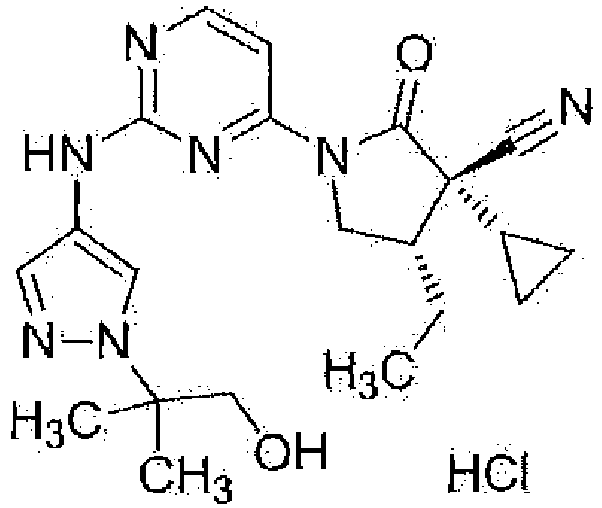
- The title compound (87 mg) was obtained from (3R,4S)-1-(2-chloropyrimidin-4-yl)-3-cyclopropyl-4-ethyl-2-oxopyrrolidine-3-carbonitrile (100 mg) obtained in Step C of Example 376 and 2-(4-amino-1H-pyrazol-1-yl)-2-methylpropan-1-ol (56 mg) obtained in Step H of Example 103 in the same manner as in Step B of Example 2.
MS(ESI+): [M+H]+ 410.4. -
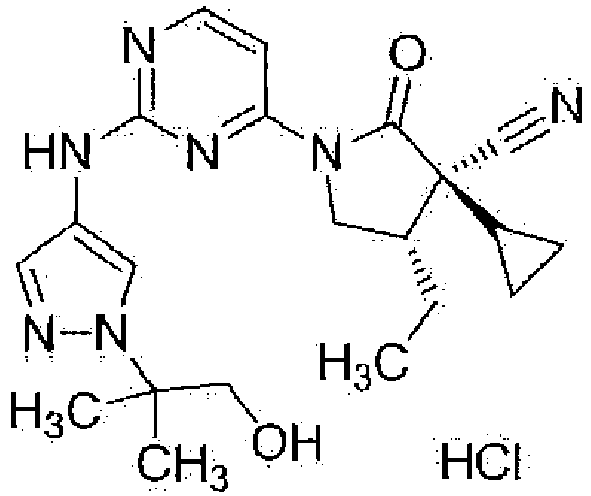
- The title compound (70 mg) was obtained from (3S,4S)-1-(2-chloropyrimidin-4-yl)-3-cyclopropyl-4-ethyl-2-oxopyrrolidine-3-carbonitrile (100 mg) obtained in Step C of Example 376 and 2-(4-amino-1H-pyrazol-1-yl)-2-methylpropan-1-ol (56 mg) obtained in Step H of Example 103 in the same manner as in Step B of Example 2.
MS(ESI+): [M+H]+ 410.4. -

- The title compound (63 mg) was obtained from (3R,4R)-1-(2-chloropyrimidin-4-yl)-3-cyclopropyl-4-ethyl-2-oxopyrrolidine-3-carbonitrile (100 mg) obtained in Step C of Example 376 and 2-(4-amino-1H-pyrazol-1-yl)-2-methylpropan-1-ol (56 mg) obtained in Step H of Example 103 in the same manner as in Step B of Example 2.
MS(ESI+): [M+H]+ 410.4. -
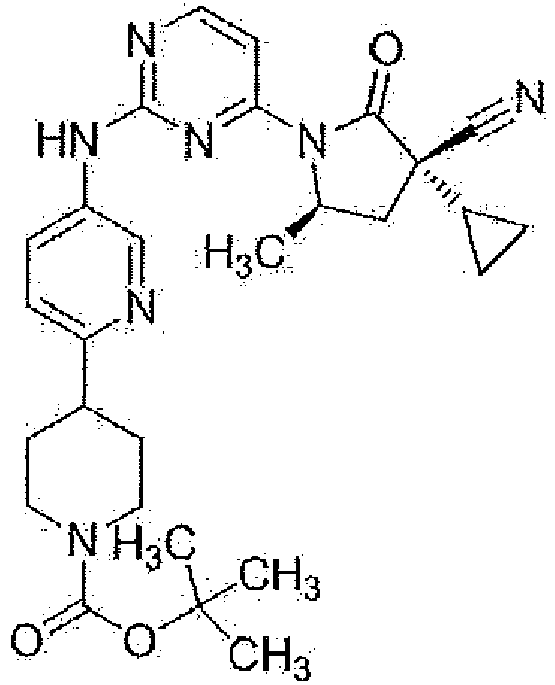
- The title compound (280 mg) was obtained from (3S,5R)-1-(2-chloropyrimidin-4-yl)-3-cyclopropyl-5-methyl-2-oxopyrrolidine-3-carbonitrile (100 mg) obtained in Step A of Example 366 and tert-butyl 4-(5-aminopyridin-2-yl)piperidine-1-carboxylate (300 mg) in the same manner as in Example 56.
MS(ESI+): [M+H]+ 518.5. -

- The title compound (110 mg) was obtained from (3R,4S)-1-(2-chloropyrimidin-4-yl)-3-cyclopropyl-4-methyl-2-oxopyrrolidine-3-carbonitrile (92 mg) obtained in Step A of Example 369 and 4-(4-aminophenyl)tetrahydro-2H-pyran-4-carboxamide (77 mg) obtained in Step C of Example 150 in the same manner as in Step B of Example 2.
MS(ESI+): [M+H]+ 461.4. -

- The title compound (290 mg) was obtained from tert-butyl 4-(5-((4-((3S,5R)-3-cyano-3-cyclopropyl-5-methyl-2-oxopyrrolidin-1-yl)pyrimidin-2-yl)amino)pyridin-2-yl)piperidine-1-carboxylate (280 mg) obtained in Example 380 in the same manner as in Step B of Example 348.
MS(ESI+): [M+H]+ 418.4. -

- The title compound (48 mg) was obtained from (3S,5R)-3-cyclopropyl-5-methyl-2-oxo-1-(2-((6-(piperidin-4-yl)pyridin-3-yl)amino)pyrimidin-4-yl)pyrrolidine-3-carbonitrile hydrochloride (100 mg) obtained in Example 382 in the same manner as in Step C of Example 348.
MS (ESI+): [M+H]+ 460.2. -

- The title compound (47 mg) was obtained from 2-(4-((4-chloropyrimidin-2-yl)amino)-1H-pyrazol-1-yl)-2-methylpropan-1-ol (250 mg) obtained in Step E of Example 347 and (3S,5R)-3-cyclopropyl-5-ethyl-2-oxopyrrolidine-3-carbonitrile (200 mg) obtained in Step A of Example 374 in the same manner as in Step F of Example 347.
MS (ESI+) : [M+H]+ 410.4. -

- The title compound (30 mg) was obtained from (3S,5R)-3-cyclopropyl-5-methyl-2-oxo-1-(2-((6-(piperidin-4-yl)pyridin-3-yl)amino)pyrimidin-4-yl)pyrrolidine-3-carbonitrile hydrochloride (100 mg) obtained in Example 382 and methoxyacetyl chloride (18 µL) in the same manner as in Step C of Example 348.
MS(ESI+): [M+H]+ 490.5. -

- The title compound (78 mg) was obtained from (3R,4S)-1-(2-chloropyrimidin-4-yl)-3-cyclopropyl-4-methyl-2-oxopyrrolidine-3-carbonitrile (100 mg) obtained in Step A of Example 369 and 2-(4-amino-1H-pyrazol-1-yl)-2-methylpropanamide (61 mg) obtained in Step C of Example 109 in the same manner as in Step B of Example 2.
MS (ESI+) : [M+H]+ 409.4. -

- The title compound (25 mg) was obtained from (3S,5R)-1-(2-chloropyrimidin-4-yl)-3-cyclopropyl-5-methyl-2-oxopyrrolidine-3-carbonitrile (250 mg) obtained in Step A of Example 366 and 5-amino-N,N-dimethylpicolinamide (150 mg) in the same manner as in Example 56.
MS(ESI+): [M+H]+ 406.3. -

- To a solution of ethyl cyano(cyclopropyl)acetate (17 g) obtained in Step A of Example 103 in ethanol (150 mL) was added conc. hydrochloric acid (150 mL) at room temperature, and the mixture was stirred at 100°C for 2 hr. The reaction mixture was concentrated under reduced pressure, to the obtained residue was added water, and the mixture was extracted with ethyl acetate. The obtained organic layer was washed with saturated brine, and dried over anhydrous magnesium sulfate, and the solvent was evaporated under reduced pressure. The residue was purified by silica gel column chromatography (hexane/ethyl acetate) to give the title compound (10 g).
1H NMR (300 MHz, DMSO-d6) δ 0.21-0.33 (2H, m), 0.49-0.60 (2H, m), 1.14-1.23 (7H, m), 2.84 (1H, d, J = 9.8 Hz), 4.13 (4H, q, J = 7.2 Hz). - To a solution of diethyl cyclopropylmalonate (7.7 g) obtained in Step A of Example 388 in N,N-dimethylformamide (90 mL) was added sodium hydride (60% in mineral oil, 1.8 g), and the mixture was stirred at 0°C for 30 min. To the reaction mixture was added tert-butyl 1,2,3-oxathiazolidine-3-carboxylate 2,2-dioxide (9.4 g) at the same temperature, and the mixture was stirred at 0°C for 2 hr. To the reaction mixture was added 1M hydrochloric acid, and the mixture was extracted with ethyl acetate. The obtained organic layer was washed with water and saturated brine, and dried over anhydrous magnesium sulfate, and the solvent was evaporated under reduced pressure. The residue was purified by silica gel column chromatography (hexane/ethyl acetate) to give the title compound (6.7 g).
1H NMR (300 MHz, DMSO-d6) δ0.21-0.33 (2H, m), 0.43-0.58 (2H, m), 1.11-1.21 (6H, m), 1.29-1.42 (10H, m), 1.79-1.91 (2H, m), 2.96 (2H, dt, J = 10.7, 5.4 Hz), 4.10 (4H, q, J = 6.9 Hz), 6.80 (1H, t, J = 5.3 Hz). - The title compound (3.6 g) was obtained from diethyl (2-((tert-butoxycarbonyl)amino)ethyl)(cyclopropyl)malonate (6.7 g) obtained in Step B of Example 388 in the same manner as in Step B of Example 357.
1H NMR (300 MHz, DMSO-d6) δ0.05-0.22 (1H, m), 0.31-0.41 (1H, m), 0.43-0.53 (2H, m), 1.18 (3H, t, J = 7.2 Hz), 1.25-1.37 (1H, m), 1.66-1.82 (1H, m), 2.25 (1H, ddd, J = 13.1, 8.0, 5.3 Hz), 3.07-3.29 (2H, m), 4.02-4.18 (2H, m), 7.87 (1H, brs). - The title compound (23 mg) was obtained from ethyl 3-cyclopropyl-2-oxopyrrolidine-3-carboxylate (48 mg) obtained in Step C of Example 388 and 4-chloro-N-(4-(morpholin-4-yl)phenyl)pyrimidin-2-amine (71 mg) obtained in Step B of Example 361 in the same manner as in Step C of Example 361.
MS(ESI+): [M+H]+ 452.4. -

- The title compound (220 mg) was obtained from (3S,5R)-1-(2-chloropyrimidin-4-yl)-3-cyclopropyl-5-methyl-2-oxopyrrolidine-3-carbonitrile (200 mg) obtained in Step A of Example 366 and 2-(4-aminophenyl)-2-methylpropanoic acid (140 mg) in the same manner as in Step B of Example 2.
MS(ESI+): [M+H]+ 420.3. -

- The title compound (120 mg) was obtained from (3S,5R)-1-(2-chloropyrimidin-4-yl)-3-cyclopropyl-5-methyl-2-oxopyrrolidine-3-carbonitrile (150 mg) obtained in Step A of Example 366 and 4-aminobenzamide (89 mg) in the same manner as in Step B of Example 2.
MS(ESI+): [M+H]+ 377.3. -

- The title compound (170 mg) was obtained from (3S,5R)-1-(2-chloropyrimidin-4-yl)-3-cyclopropyl-5-methyl-2-oxopyrrolidine-3-carbonitrile (150 mg) obtained in Step A of Example 366 and 4-amino-N-methylbenzamide (98 mg) in the same manner as in Step B of Example 2.
MS(ESI+): [M+H]+ 391.4. -

- The title compound (5.4 g) was obtained from 2-(methylsulfanyl)pyrimidin-4(3H)-one (5.2 g) obtained in Step A of Example 347 and 1-methyl-1H-pyrazol-4-amine (4.1 g) in the same manner as in Step C of Example 347.
1H NMR (400 MHz, DMSO-d6) δppm 3.79 (3 H, s), 5.62 - 5.78 (1 H, m), 7.45 (1 H, s), 7.63 - 7.78 (1 H, m), 7.89 (1 H, s), 8.47 - 8.75 (1 H, m), 10.77 (1 H, dd, J=15.5, 8.7 Hz). - The title compound (3.3 g) was obtained from 2-((1-methyl-1H-pyrazol-4-yl)amino)pyrimidin-4(3H)-one (3.4 g) obtained in Step A of Example 392 in the same manner as in Step D of Example 347.
1H NMR (400 MHz, DMSO-d6) δppm 3.81 (3 H, s), 6.83 (1 H, d, J=5.3 Hz), 7.46 (1 H, s), 7.85 (1 H, s), 8.37 (1 H, d, J=5.3 Hz), 9.87 (1H, s). - The title compound (346 mg) was obtained from 4-chloro-N-(1-methyl-1H-pyrazol-4-yl)pyrimidin-2-amine (260 mg) obtained in Step B of Example 392 and ethyl 3-cyclopropyl-2-oxopyrrolidine-3-carboxylate (240 mg) obtained in Step C of Example 388 in the same manner as in Step F of Example 347.
MS (ESI+) : [M+H]+ 371.3. -

- The title compound (50 mg) was obtained from ethyl 3-cyclopropyl-1-(2-((1-methyl-1H-pyrazol-4-yl)amino)pyrimidin-4-yl)-2-oxopyrrolidine-3-carboxylate (330 mg) obtained in Step C of Example 392 in the same manner as in Step E of Example 347. MS(ESI+): [M+H]+ 329.3.
-

- The title compound (72 mg) was obtained from (3S)-1-(2-chloropyrimidin-4-yl)-3-cyclopropyl-2-oxopyrrolidine-3-carbonitrile (100 mg) obtained in Step E of Example 103 and 1-(1,1-dioxidetetrahydro-2H-thiopyran-4-yl)-1H-pyrazol-4-amine (86 mg) in the same manner as in Step B of Example 2.
MS(ESI+): [M+H]+ 442.1. -

- The title compound (72 mg) was obtained from (3R,4S)-1-(2-chloropyrimidin-4-yl)-3-cyclopropyl-4-methyl-2-oxopyrrolidine-3-carbonitrile (100 mg) obtained in Step A of Example 369 and 1-(1,1-dioxidetetrahydro-2H-thiopyran-4-yl)-1H-pyrazol-4-amine (82 mg) in the same manner as in Step B of Example 2.
MS(ESI+): [M+H]+ 456.1. -

- To a solution of 3-cyclopropyl-3-(hydroxymethyl)-1-(2-((1-methyl-1H-pyrazol-4-yl)amino)pyrimidin-4-yl)pyrrolidin-2-one (45 mg) obtained in Example 393 in tetrahydrofuran (1.0 mL) were added methanesulfonyl chloride (15 µL) and triethylamine (29 µL) at 0°C, and the mixture was stirred at 0°C for 1 hr. To the reaction mixture was added saturated aqueous sodium hydrogen carbonate solution, and the mixture was extracted with ethyl acetate. The obtained organic layer was washed with saturated brine, and dried over anhydrous magnesium sulfate, and the solvent was evaporated under reduced pressure. To a solution of the residue in N,N-dimethylformamide (1.0 mL) were added potassium cyanide (36 mg) and sodium iodide (82 mg) at room temperature, and the mixture was stirred overnight at 120°C. To the reaction mixture was added saturated aqueous sodium hydrogen carbonate solution, and the mixture was extracted with ethyl acetate. The obtained organic layer was washed with saturated brine, and dried over anhydrous magnesium sulfate, and the solvent was evaporated under reduced pressure. The residue was purified by silica gel column chromatography (hexane/ethyl acetate) to give the title compound (17 mg).
MS(ESI+): [M+H]+ 338.0. -

- The title compound (35 mg) was obtained from 2-(4-((4-((3S,5R)-3-cyano-3-cyclopropyl-5-methyl-2-oxopyrrolidin-1-yl)pyrimidin-2-yl)amino)phenyl)-2-methylpropanoic acid (100 mg) obtained in Example 389 in the same manner as in Example 350.
MS(ESI+): [M+H]+ 419.4. -

- The title compound (82 mg) was obtained from (3S,5R)-1-(2-chloropyrimidin-4-yl)-3-cyclopropyl-5-methyl-2-oxopyrrolidine-3-carbonitrile (150 mg) obtained in Step A of Example 366 and 4-amino-N,N-dimethylbenzamide (89 mg) in the same manner as in Step B of Example 2.
MS(ESI+): [M+H]+ 405.3. - Tyk2 enzyme inhibitory activity of test compounds was measured by LANCE method (PerkinElmer). First, a test compound diluted with assay buffer (50 mM HEPES (pH = 7.5), 10 mM MgCl2, 1 mM EGTA, 2 mM DTT, 0.01% Tween20, 0.01% BSA) was added to 384-well plate at 2µL each. Then, a Tyk2 (Invitrogen) solution and a fluorescence-labeled peptide substrate (ULight-JAK1, PerkinElmer) solution diluted with assay buffer at 375 ng/mL and 300 nM, respectively were added at 2 µL each. Then, enzyme reaction was started by adding 2 µL each of ATP solution prepared with assay buffer at 30 µM. After the reaction at room temperature for 1 hr, Detection Buffer (PerkinElmer) prepared to be 20 mM EDTA, 4 nM europium-labeled anti-phosphotyrosine antibody (PerkinElmer) was added at 6 µL each. After standing at room temperature for 1 hr, fluorescence intensity (excitation wavelength 340 nm, fluorescence wavelength 665 nm, delay time 100 microsecond) was measured by a plate reader, Envision (PerkinElmer). The inhibitory activity of each compound was calculated as relative value where fluorescence intensity of a well without enzyme is considered as 100% inhibition.
Table 26 Ex. No. Tyk2 enzyme inhibitory activity (%, 1 µM) Ex. No. Tyk2 enzyme inhibitory activity (%, 1 µM) 1 99 33 97 4 100 61 14 7 100 72 20 10 97 77 22 12 51 85 100 15 89 86 100 29 91 87 100 31 98 101 88 Table 27 Ex. No. Tyk2 enzyme inhibitory activity (%, 1 µM) Ex. No, Tyk2 enzyme inhibitory activity (%, 1 µM) 103 100 109 99 128 100 133 24 134 99 255 99 - Recombinant mouse IL-23 (1 µg/20 µL/site) was intradermally administered into the right auricle of 7-8-week-old LEWEIS male rat. As control, phosphate buffered saline (PBS) which is a solvent was administered instead of IL-23. Then, a drug (the compound of Example 103) suspended in 0.5% methyl cellulose (MC) was orally administered 30 min before IL-23 administration, respectivelty. 0.5% MC was used as vehicle. The auricle tissues of 6 mm diameter were collected about 24 hr after IL-23 administration. Lysis buffer was added thereto, the tissues were crushed using beads, and centrifugalized, and the supernatant was collected. IL-22 in the tissues was measured using ELISA kit (R & D Systems). The result is shown below as a IL-23 inhibitory rate relative to vehicle. (mean of n=6)
The compound of Example 103 (10 mg/kg, q.d.): inhibitory rate 79% -
1) compound of Example 1 30 mg 2) fine powder cellulose 10 mg 3) lactose 19 mg 4) magnesium stearate 1 mg Total 60 mg 1), 2), 3) and 4) are mixed and filled in a gelatin capsule. -
1) compound of Example 1 30 g 2) lactose 50 g 3) cornstarch 15 g 4) calcium carboxymethylcellulose 44 g 5) magnesium stearate 1 g 1000 tablets total 140 g - The total amount of 1), 2) and 3) and 4) (30 g) is kneaded with water, and the mixture is vacuum dried, and sieved. The sieved powder is mixed with 4) (14 g) and 5) (1 g), and the mixture is punched by a tableting machine, whereby 1000 tablets containing 30 mg of the compound of Example 1 per tablet are obtained.
- The compound of the present invention has a superior Tyk2 inhibitory action, which is useful as an agent for the prophylaxis or treatment of autoimmune diseases (e.g., psoriasis, rheumatoid arthritis, inflammatory bowel disease, Sjogren's syndrome, Behcet's disease, multiple sclerosis, systemic lupus erythematosus etc.) and the like.
- This application is based on patent application No.
2012-075166 filed on March 28, 2012 -

- The title compound was obtained from 2,4-dichloropyrimidine and 3,3-diethylpyrrolidin-2-one in the same manner as in Step A of Example 2.
1H NMR(300 MHz, CDCl3) δ 0.91 (6H, t, J = 7.6 Hz), 1.65 (4H, q, J = 7.3 Hz), 1.93-2.09 (2H, m), 3.88-4.05 (2H, m), 8.35-8.41 (1H, m), 8.42-8.47 (1H, m). - The title compound was obtained from 1-(2-chloropyrimidin-4-yl)-3,3-diethylpyrrolidin-2-one obtained in Step A and 4-(morpholin-4-yl)aniline in the same manner as in Step B of Example 2.
MS(ESI+): [M+H]+396.3. - In Examples 15 to 28, the title compound was obtained from 1-(2-chloropyrimidin-4-yl)-3,3-diethylpyrrolidin-2-one obtained in Step A of Example 14, and aniline, 3-aminobenzenesulfonamide, 3-(methylsulfonyl)aniline, (3-aminophenyl)methanol, 3-(morpholin-4-yl)aniline, 3-aminobenzonitrile, 4-aminobenzenesulfonamide, 3-aminobenzamide, 1-(tetrahydro-2H-pyran-4-yl)-1H-pyrazol-4-amine, 1H-pyrazol-4-amine, 4-(4-methylpiperazin-1-yl)aniline, 4-(piperidin-1-yl)aniline, N,N-dimethylbenzene-1,4-diamine or 1-methyl-1H-pyrazol-3-amine (these compounds can be produced according to a method known per se), each corresponding to the compounds of Examples 15 to 28, in the same manner as in Step B of Example 2. MS in the tables means actual measured value.
Table 1-1 Example Number IUPAC Name Structure Salt MS 15 1-(2-anilinopyrimidin-4-yl)-3,3-diethylpyrrolidin-2-one 
Free 311.2 16 3-((4-(3,3-diethyl-2-oxopyrrolidin-1-yl)pyrimidin-2-yl)amino)benzenesulfonamide 
Free 390.3 17 3,3-diethyl-1-(2-((3 (methylsulfonyl)phenyl)amino)pyrimid in-4-yl)pyrrolidin-2-one 
Free 389.3 18 3,3-diethyl-1-(2-((3-(hydroxymethyl)phenyl)amino)pyrimidi n-4-yl)pyrrolidin-2-one 
Free 341.2 19 3,3-diethyl-1-(2-((3-(morpholin-4-yl)phenyl)amino)pyrimidin-4-yl)pyrrolidin-2-one 
HCl 396.3 20 3-((4-(3,3-diethyl-2-oxopyrrolidin-1-yl)pyrimidin-2-yl)amino)benzonitrile 
Free 336.3 21 4-((4-(3,3-diethyl-2-oxopyrrolidin-1-yl)pyrimidin-2-yl)amino)benzenesulfonamide 
Free 390.2 22 3-((4-(3,3-diethyl-2-oxopyrrolidin-1-yl)pyrimidin-2-yl)amino)benzamide 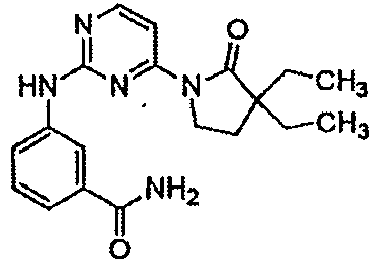
Free 354.2 23 3,3-diethyl-1-(2-((1-(tetrahydro-2H-pyran-4-yl)-1H-pyrazol-4-yl)amino)pyrimidin-4-yl)pyrrolidin-2-one 
Free 385.3 24 3,3-diethyl-1-(2-(1H-pyrazol-4-ylamino)pyrimidin-4-yl)pyrrolidin-2-one 
HCl 301.2 25 3,3-diethyl-1-(2-((4-(4-methylpiperazin-1-yl)phenyl)amino)pyrimidin-4-yl)pyrrolidin-2-one 
2HCl 409.4 26 3,3-diethyl-1-(2-((4-(piperidin-1-yl)phenyl)amino)pyrimidin-4-yl)pyrrolidin-2-one 
HCl 394.4 27 1-(2-((4-(dimethylamino)phenyl)amino)pyrimidi n-4-yl)-3,3-diethylpyrrolidin-2-one 
Free 354.3 28 3,3-diethyl-1-(2-((1-methyl-1H-pyrazol-3-yl)amino)pyrimidin-4-yl)pyrrolidin-2-one 
Free 315.2 -

- The title compound was obtained from 2,4-dichloro-5-fluoropyrimidine and 3,3-dimethylpyrrolidin-2-one in the same manner as in Step A of Example 2.
1H NMR(300 MHz, CDCl3) δ 1.28 (6H, s), 2.09 (2H, t, J = 7.0 Hz), 3.94 (2H, t, J = 6.8 Hz), 8.43 (1H, d, J = 2.3 Hz). - The title compound was obtained from 1-(2-chloro-5-fluoropyrimidin-4-yl)-3,3-dimethylpyrrolidin-2-one obtained in Step A and 1-methyl-1H-pyrazol-4-amine in the same manner as in Step B of Example 2.
MS (ESI+) : [M+H]+305.2. -

- To a solution of pyrrolidin-2-one (15 g) in a mixed solvent of tetrahydrofuran/N,N-dimethylformamide (1/1, 100 mL) was added sodium hydride (60% in mineral oil, 8.5 g) at 0°C under nitrogen atmosphere, and the mixture was stirred for 30 min. p-Methoxybenzyl chloride (33 g) was added thereto at the same temperature, and the mixture was stirred at room temperature for 5 hr. To the reaction mixture was added water, and the mixture was extracted with ethyl acetate. The obtained organic layer was washed successively with water and saturated brine, and dried over anhydrous magnesium sulfate, and the solvent was evaporated under reduced pressure. The residue was purified by silica gel column chromatography (hexane/ethyl acetate) to give the title compound (28 g).
1H NMR(300 MHz, CDCl3) δ 1.87-2.09 (2H, m), 2.38-2.50 (2H, m), 3.15-3.34 (2H, m), 3.80 (3H, s), 4.39 (2H, s), 6.81-6.92 (2H, m), 7.17 (2H, d, J = 8.7 Hz). - To a solution of diisopropylamine (4.1 mL) in tetrahydrofuran (25 mL) was added dropwise n-butyllithium (1.6 M hexane solution, 18 mL) at -78°C under nitrogen atmosphere, and the mixture was warmed to 0°C, and stirred for 30 min. The reaction mixture was cooled to -78°C, a solution of 1-(4-methoxybenzyl)pyrrolidin-2-one (5.0 g) obtained in Step A in tetrahydrofuran (25 mL) was added thereto, and the mixture was stirred at the same temperature for 1 hr. Iodoethane (2.9 mL) was added thereto, and the mixture was stirred overnight while it was allowed to be warmed. To the reaction mixture was added saturated aqueous ammonium chloride solution, and the mixture was extracted with ethyl acetate. The obtained organic layer was washed with saturated brine, and dried over anhydrous magnesium sulfate, and the solvent was evaporated under reduced pressure. The residue was purified by silica gel column chromatography (hexane/ethyl acetate) to give the title compound (2.8 g).
1H NMR(300 MHz, CDCl3) δ 0.96 (3H, t, J = 7.4 Hz), 1.35-1.52 (1H, m), 1.55-1.72 (1H, m), 1.81-2.00 (1H, m), 2.06-2.26 (1H, m), 2.39 (1H, qd, J = 8.7, 4.2 Hz), 3.05-3.30 (2H, m), 3.79 (3H, s), 4.27-4.51 (2H, m), 6.73-6.95 (2H, m), 7.11-7.22 (2H, m). - To a solution of diisopropylamine (3.4 mL) in tetrahydrofuran (10 mL) was added dropwise n-butyllithium (1.6 M hexane solution, 15 mL) at -78°C under nitrogen atmosphere, and the mixture was warmed to 0°C, and stirred for 30 min. The reaction mixture was cooled to -78°C, a solution of 3-ethyl-1-(4-methoxybenzyl)pyrrolidin-2-one (2.8 g) obtained in Step B in tetrahydrofuran (10 mL) was added thereto, and the mixture was stirred at the same temperature for 1 hr. Ethyl bromoacetate (4.0 mL) was added thereto, and the mixture was stirred overnight while it was allowed to be warmed. To the reaction mixture was added saturated aqueous ammonium chloride solution, and the mixture was extracted with ethyl acetate. The obtained organic layer was washed with saturated brine, and dried over anhydrous magnesium sulfate, and the solvent was evaporated under reduced pressure. The residue was purified by silica gel column chromatography (hexane/ethyl acetate) to give the title compound (1.5 g).
1H NMR(300 MHz, CDCl3) δ 0.87 (3H, t, J = 7.4 Hz), 1.23 (3H, t, J = 7.2 Hz), 1.48-1.72 (2H, m), 1.83-2.19 (2H, m), 2.42-2.59 (1H, m), 2.60-2.76 (1H, m), 3.04-3.25 (2H, m), 3.80 (3H, s), 4.10 (2H, q, J = 7.1 Hz), 4.31 (1H, d, J = 14.4 Hz), 4.45-4.61 (1H, m), 6.85 (2H, d, J = 8.3 Hz), 7.19 (2H, d, J = 8.7 Hz). - To a solution of ethyl (3-ethyl-1-(4-methoxybenzyl)-2-oxopyrrolidin-3-yl)acetate (1.5 g) obtained in Step C in a mixed solvent of acetonitrile/water (3/1, 8 mL) was added ammonium hexanitratocerate(IV) (5.2 g), and the mixture was stirred at room temperature for 30 min. To the reaction mixture was added potassium carbonate, the solid was removed by filtration through Celite, and the solvent was evaporated under reduced pressure. The residue was purified by silica gel column chromatography (hexane/ethyl acetate) to give the title compound (900 mg).
1H NMR(300 MHz, DMSO-d6) δ 0.82 (3H, t, J = 7.4 Hz), 1.17 (3H, td, J = 7.2, 2.6 Hz), 1.44 (2H, qd, J = 7.5, 1.7 Hz), 1.86-1.97 (1H, m), 2.03-2.19 (1H, m), 2.40 (2H, s), 3.13 (2H, t, J = 7.2 Hz), 4.03 (2H, q, J = 7.2 Hz), 7.58 (1H, brs). - The title compound was obtained from ethyl (3-ethyl-2-oxopyrrolidin-3-yl)acetate obtained in Step D and 4-chloro-N-(1-methyl-1H-pyrazol-4-yl)pyrimidin-2-amine obtained in Step C of Example 1 in the same manner as in Step I of Example 1.
MS(ESI+): [M+H]+373.3. - To a solution of ethyl (3-ethyl-1-(2-((1-methyl-1H-pyrazol-4-yl)amino)pyrimidin-4-yl)-2-oxopyrrolidin-3-yl)acetate (270 mg) obtained in Step E in ethanol (5 mL) was added dropwise 2M aqueous sodium hydroxide solution (1.4 mL), and the mixture was stirred overnight at room temperature. To the reaction mixture was added water, and the mixture was washed with diethyl ether. The aqueous layer was neutralized with 2M hydrochloric acid, and extracted with ethyl acetate. The obtained organic layer was washed with saturated brine, and dried over anhydrous magnesium sulfate, and the solvent was evaporated under reduced pressure. The residue was recrystallized (ethyl acetate) to give the title compound (100 mg).
MS(ESI+): [M+H]+345.2. -

- To a solution of (3-ethyl-1-(2-((1-methyl-1H-pyrazol-4-yl)amino)pyrimidin-4-yl)-2-oxopyrrolidin-3-yl)acetic acid (100 mg) obtained in Example 30 and 1-hydroxybenzotriazole ammonium salt (88 mg) in N,N-dimethylformamide (5 mL) was added 1-ethyl-3-(3-dimethylaminopropyl)carbodiimide hydrochloride (110 mg), and the mixture was stirred overnight at room temperature. To the reaction mixture was added water, and the mixture was extracted with ethyl acetate. The obtained organic layer was washed with water and saturated brine, and dried over anhydrous magnesium sulfate, and the solvent was evaporated under reduced pressure. To a solution of the residue and pyridine (70 mg) in tetrahydrofuran (5 mL) was added trifluoroacetic anhydride (0.12 mL), and the mixture was stirred at 70°C for 30 min. The reaction mixture was neutralized with saturated aqueous sodium hydrogen carbonate solution, and extracted with ethyl acetate. The obtained organic layer was washed with saturated brine, and dried over anhydrous magnesium sulfate, and the solvent was evaporated under reduced pressure. The residue was purified by silica gel column chromatography (hexane/ethyl acetate), and recrystallized (hexane/ethyl acetate) to give the title compound (17 mg).
MS (ESI+) : [M+H]+326.2. -

- The title compound was obtained from 4-methoxybenzyl chloride and 5-methylpyrrolidin-2-one in the same manner as in Step A of Example 30.
1H NMR(300 MHz, CDCl3) δ 1.16 (3H, d, J = 6.0 Hz), 1.58 (1H, dddd, J = 12.7, 9.6, 7.1, 6.0 Hz), 2.07-2.21 (1H, m), 2.28-2.59 (2H, m), 3.40-3.64 (1H, m), 3.79 (3H, s), 3.91 (1H, d, J = 14.7 Hz), 4.91 (1H, d, J = 14.7 Hz), 6.79-6.93 (2H, m), 7.17 (2H, d, J = 8.7 Hz). - To a solution of 1-(4-methoxybenzyl)-5-methylpyrrolidin-2-one (3.0 g) obtained in Step A in tetrahydrofuran (25 mL) was added sodium bis(trimethylsilyl)amide (1.9M tetrahydrofuran solution, 11 mL) at -78°C under nitrogen atmosphere, and the mixture was stirred at the same temperature for 1 hr. Iodoethane (2.2 mL) was added thereto, and the mixture was stirred overnight while it was allowed to be warmed. To the reaction mixture was added saturated aqueous ammonium chloride solution, and the mixture was extracted with ethyl acetate. The obtained organic layer was washed with saturated brine, and dried over anhydrous magnesium sulfate, and the solvent was evaporated under reduced pressure. The residue was purified by silica gel column chromatography (hexane/ethyl acetate) to give the title compound (2.5 g).
MS (ESI+) : [M+H]+248.2. - To a solution of diisopropylamine (2.1 g) in tetrahydrofuran (20 mL) was added dropwise n-butyllithium (1.6 M hexane solution, 13 mL) at -78°C under nitrogen atmosphere, and the mixture was warmed to 0°C, and stirred for 30 min. The reaction mixture was cooled to -78°C, a solution of 3-ethyl-1-(4-methoxybenzyl)-5-methylpyrrolidin-2-one (2.5 g) obtained in Step B in tetrahydrofuran (10 mL) was added thereto, and the mixture was stirred at the same temperature for 1 hr. Iodoethane (2.5 mL) was added thereto, and the mixture was stirred overnight while it was allowed to be warmed. To the reaction mixture was added saturated aqueous ammonium chloride solution, and the mixture was extracted with ethyl acetate. The obtained organic layer was washed with saturated brine, and dried over anhydrous magnesium sulfate, and the solvent was evaporated under reduced pressure. The residue was purified by silica gel column chromatography (hexane/ethyl acetate) to give the title compound (1.3 g).
1H NMR(300 MHz, CDCl3) δ 0.75-0.98(6H, m), 1.16 (3H, d, J = 6.4 Hz), 1.37-1.70 (5H, m), 1.95 (1H, dd, J = 13.2, 7.9 Hz), 3.25-3.50 (1H, m), 3.79 (3H, s), 3.89 (1H, d, J = 14.7 Hz), 4.94 (1H, d, J = 14.7 Hz), 6.75-6.93 (2H, m), 7.17 (2H, d, J = 8.7 Hz). - The title compound was obtained from 3,3-diethyl-1-(4-methoxybenzyl)-5-methylpyrrolidin-2-one obtained in Step C in the same manner as in Step D of Example 30.
1H NMR(300 MHz, CDCl3) δ 0.90(6H, dt, J = 10.2, 7.6 Hz), 1.21 (3H, d, J = 6.0 Hz), 1.42-1.63 (5H, m), 2.05-2.17 (1H, m), 3.57-3.78 (1H, m), 5.53 (1H, brs). - The title compound was obtained from 2,4-dichloropyrimidine and 3,3-diethyl-5-methylpyrrolidin-2-one obtained in Step D in the same manner as in Step A of Example 2.
1H NMR(300 MHz, CDCl3) δ 0.85 (3H, t, J = 7.6 Hz), 0.95 (3H, t, J = 7.6 Hz), 1.45 (3H, d, J = 6.0 Hz), 1.56-1.75 (5H, m), 2.23 (1H, dd, J = 13.6, 8.7 Hz), 4.59 (1H, dquin, J = 8.7, 6.2 Hz), 8.26 (1H, d, J = 6.0 Hz), 8.45 (1H, d, J = 5.7 Hz). - The title compound was obtained from 1-(2-chloropyrimidin-4-yl)-3,3-diethyl-5-methylpyrrolidin-2-one and 4-(morpholin-4-yl)aniline obtained in Step E in the same manner as in Step B of Example 2.
MS (ESI+) : [M+H]+410.3. -

- The title compound was obtained from 1-(2-chloropyrimidin-4-yl)-3,3-diethyl-5-methylpyrrolidin-2-one obtained in Step E of Example 32 and 1-methyl-1H-pyrazol-4-amine in the same manner as in Step B of Example 2.
MS (ESI+) : [M+H]+329.3. -

- To a solution of 3-ethyl-1-(2-((4-(morpholin-4-yl)phenyl)amino)pyrimidin-4-yl)-2-oxopyrrolidine-3-carbonitrile (36 mg) obtained in Example 2 in dimethylsulfoxide (1 mL) were added a solution of 30% aqueous hydrogen peroxide (28 µL) and 2M aqueous potassium carbonate (0.14 mL), and the mixture was stirred overnight at room temperature. Water was added thereto in an ice bath, and the precipitated solid was collected by filtration. The obtained crude crystals were recrystallized (diisopropyl ether/ethanol) to give the title compound (13 mg).
MS(ESI+): [M+H]+411.3. -

- To a solution of 1-(4-fluorobenzoyl)-2-oxopyrrolidine-3-carbonitrile (300 mg) obtained in Step F of Example 1 in tetrahydrofuran (3 mL) was added dropwise 1,8-diazabicyclo[5.4.0]undec-7-ene (0.23 mL) at 0°C under nitrogen atmosphere. The reaction mixture was stirred at room temperature for 20 min, [(oxide)phenyl(trifluoromethyl)-λ4-sulfanylidene]dimethylammonium tetrafluoroborate (630 mg) was added thereto, and the mixture was stirred at room temperature for 1 hr. The solvent was evaporated under reduced pressure, and the residue was purified by silica gel column chromatography (hexane/ethyl acetate) to give the title compound (190 mg).
1H NMR(300 MHz, CDCl3) δ 2.74-2.92 (2H, m), 3.95-4.33 (2H, m), 7.15 (2H, t, J = 8.5 Hz), 7.67 (2H, dd, J = 8.9, 5.1 Hz). - The title compound was obtained from 1-(4-fluorobenzoyl)-2-oxo-3-(trifluoromethyl)pyrrolidine-3-carbonitrile obtained in Step A in the same manner as in Step B of Example 5.
1H NMR(300 MHz, CDCl3) δ2.79 (2H, dt, J = 9.6, 3.7 Hz), 3.36-3.79 (2H, m), 5.98 (1H, brs). - The title compound was obtained from 2,4-dichloropyrimidine and 2-oxo-3-(trifluoromethyl)pyrrolidine-3-carbonitrile obtained in Step B in the same manner as in Step A of Example 2.
1H NMR(300 MHz, DMSO-d6) δ 2.78-2.93 (1H, m), 2.95-3.10 (1H, m), 3.99-4.25 (2H, m), 8.21 (1H, d, J = 6.0 Hz), 8.78 (1H, d, J = 5.7 Hz). - The title compound was obtained from 1-(2-chloropyrimidin-4-yl)-2-oxo-3-(trifluoromethyl)pyrrolidine-3-carbonitrile obtained in Step C and 4-(morpholin-4-yl)aniline in the same manner as in Step B of Example 2.
MS(ESI+): [M+H]+433.3. -

- The title compound was obtained from 1-(4-fluorobenzoyl)-2-oxopyrrolidine-3-carbonitrile obtained in Step F of Example 1 and 1-iodopropane in the same manner as in Step G of Example 1.
1H NMR (300 MHz, CDCl3) δ1.03 (3H, t, J = 7.0 Hz), 1.43-1.52 (1H, m), 1.61-1.79 (2H, m), 1.94-2.10 (1H, m), 2.25 (1H, dt, J = 13.3, 7.3 Hz), 2.57-2.70 (1H, m), 4.03 (2H, t, J = 6.8 Hz), 7.04-7.18 (2H, m), 7.59-7.69 (2H, m). - The title compound was obtained from 1-(4-fluorobenzoyl)-2-oxo-3-propylpyrrolidine-3-carbonitrile obtained in Step A in the same manner as in Step B of Example 5.
1H NMR (300 MHz, CDCl3) δ 1.02 (3H, t, J = 7.0 Hz), 1.39-1.63 (2H, m), 1.64-1.76 (1H, m), 1.93-2.03 (1H, m), 2.15-2.29 (1H, m), 2.62 (1H, ddd, J = 13.0, 7.7, 4.9 Hz), 3.35-3.46 (1H, m), 3.47-3.58 (1H, m), 6.75 (1H, brs). - The title compound was obtained from 2,4-dichloropyrimidine and 2-oxo-3-propylpyrrolidine-3-carbonitrile obtained in Step B in the same manner as in Step A of Example 2.
MS(ESI+): [M+H]+265.0. - The title compound was obtained from 1-(2-chloropyrimidin-4-yl)-2-oxo-3-propylpyrrolidine-3-carbonitrile obtained in Step C and 4-(morpholin-4-yl)aniline in the same manner as in Step B of Example 2.
MS (ESI+) : [M+H]+407.4. -

- The title compound was obtained from 1-(2-chloropyrimidin-4-yl)-2-oxo-3-propylpyrrolidine-3-carbonitrile obtained in Step C of Example 36 and 1-methyl-1H-pyrazol-4-amine in the same manner as in Step B of Example 2.
MS(ESI+): [M+H]+326.2. -

- The title compound was obtained from 1-(4-fluorobenzoyl)-2-oxopyrrolidine-3-carbonitrile obtained in Step F of Example 1 and 2,2,2-trifluoroethyl trifluoromethanesulfonate in the same manner as in Step A of Example 5.
1H NMR(300 MHz, CDCl3) δ 2.34-2.50 (1H, m), 2.50-2.65 (1H, m), 2.82 (1H, dd, J = 13.8, 5.5 Hz), 3.01 (1H, dq, J = 15.8, 10.1 Hz), 4.03-4.16 (1H, m), 4.17-4.32 (1H, m), 7.09-7.19 (2H, m), 7.61-7.68 (2H, m). - The title compound was obtained from 1-(4-fluorobenzoyl)-2-oxo-3-(2,2,2-trifluoroethyl)pyrrolidine-3-carbonitrile obtained in Step A in the same manner as in Step B of Example 5.
1H NMR(300 MHz, CDCl3) δ 2.29-2.49 (2H, m), 2.71-2.86 (1H, m), 3.05 (1H, dq, J = 15.5, 10.3 Hz), 3.40-3.55 (1H, m), 3.59-3.72 (1H, m), 5.98 (1H, brs). - The title compound was obtained from 2,4-dichloropyrimidine and 2-oxo-3-(2,2,2-trifluoroethyl)pyrrolidine-3-carbonitrile obtained in Step B in the same manner as in Step A of Example 2.
1H NMR(300 MHz, CDCl3) δ 2.32-2.48 (1H, m), 2.49-2.64 (1H, m), 2.77-2.95 (1H, m), 3.13 (1H, dq, J = 15.5, 10.2 Hz), 4.08-4.20 (1H, m), 4.43 (1H, d, J = 1.9 Hz), 8.24 (1H, d, J = 5.7 Hz), 8.59 (1H, d, J = 5.7 Hz). - The title compound was obtained from 1-(2-chloropyrimidin-4-yl)-2-oxo-3-(2,2,2-trifluoroethyl)pyrrolidine-3-carbonitrile obtained in Step C and 4-(morpholin-4-yl)aniline in the same manner as in Step B of Example 2.
MS(ESI+): [M+H]+407.4. -

- The title compound was obtained from 1-(4-fluorobenzoyl)-2-oxopyrrolidine-3-carbonitrile obtained in Step F of Example 1 and (iodomethyl)cyclopropane in the same manner as in Step G of Example 1.
1H NMR(300 MHz, CDCl3) δ 0.18-0.38 (2H, m), 0.56-0.71 (2H, m), 0.81-0.98 (1H, m), 1.71 (1H, dd, J = 14.0, 7.2 Hz), 2.04 (1H, dd, J = 14.0, 6.8 Hz), 2.45 (1H, dt, J = 13.3, 7.3 Hz), 2.70 (1H, dt, J = 13.2, 6.6 Hz), 4.05 (2H, t, J = 6.8 Hz), 7.12 (2H, t, J = 8.7 Hz), 7.65 (2H, dd, J = 8.7, 5.3 Hz). - The title compound was obtained from 3-(cyclopropylmethyl)-1-(4-fluorobenzoyl)-2-oxopyrrolidine-3-carbonitrile obtained in Step A in the same manner as in Step B of Example 5.
1H NMR(300 MHz, CDCl3) δ 0.16-0.37 (2H, m), 0.50-0.68 (2H, m), 0.80-0.97 (1H, m), 1.68 (1H, dd, J = 14.4, 6.8 Hz), 1.97 (1H, dd, J = 14.4, 7.2 Hz), 2.42 (1H, ddd, J = 13.5, 7.6, 6.4 Hz), 2.68 (1H, ddd, J = 13.1, 8.0, 4.9 Hz), 3.36-3.48 (1H, m), 3.49-3.60 (1H, m), 6.63 (1H, brs). - The title compound was obtained from 2,4-dichloropyrimidine and 3-(cyclopropylmethyl)-2-oxopyrrolidine-3-carbonitrile obtained in Step B in the same manner as in Step A of Example 2.
MS(ESI+): [M+H]+277.2. - The title compound was obtained from 1-(2-chloropyrimidin-4-yl)-3-(cyclopropylmethyl)-2-oxopyrrolidine-3-carbonitrile obtained in Step C and 4-(morpholin-4-yl)aniline in the same manner as in Step B of Example 2.
MS (ESI+) : [M+H]+419.4. -

- The title compound was obtained from 1-(4-fluorobenzoyl)-2-oxopyrrolidine-3-carbonitrile obtained in Step F of Example 1 and chloromethyl methyl ether in the same manner as in Step G of Example 1.
1H NMR(300 MHz, CDCl3) δ 2.54-2.67 (2H, m), 3.44 (3H, s), 3.72 (1H, d, J = 9.1 Hz), 3.87 (1H, d, J = 9.1 Hz), 4.01 (2H, t, J = 7.2 Hz), 7.05-7.17 (2H, m), 7.60-7.71 (2H, m). - The title compound was obtained from 1-(4-fluorobenzoyl)-3-(methoxymethyl)-2-oxopyrrolidine-3-carbonitrile obtained in Step A in the same manner as in Step B of Example 5.
1H NMR(300 MHz, CDCl3) δ 2.47-2.68 (2H, m), 3.33-3.60 (5H, m), 3.75 (2H, q, J = 9.2 Hz), 6.27 (1H, brs). - The title compound was obtained from 2,4-dichloropyrimidine and 3-(methoxymethyl)-2-oxopyrrolidine-3-carbonitrile obtained in Step B in the same manner as in Step A of Example 2.
MS(ESI+): [M+H]+267.1. - The title compound was obtained from 1-(2-chloropyrimidin-4-yl)-3-(methoxymethyl)-2-oxopyrrolidine-3-carbonitrile obtained in Step C and 4-(morpholin-4-yl)aniline in the same manner as in Step B of Example 2.
MS(ESI+): [M+H]+409.3. -

- The title compound was obtained from 1-(4-fluorobenzoyl)-2-oxopyrrolidine-3-carbonitrile obtained in Step F of Example 1 and iodomethane in the same manner as in Step G of Example 1.
1H NMR(300 MHz, CDCl3)δ 1.66 (3H, s), 2.22 (1H, dt, J = 13.0, 7.5 Hz), 2.71 (1H, dt, J = 13.2, 6.6 Hz), 4.05 (2H, t, J = 7.0 Hz), 7.07-7.18 (2H, m), 7.60-7.70 (2H, m). - The title compound was obtained from 1-(4-fluorobenzoyl)-3-methyl-2-oxopyrrolidine-3-carbonitrile obtained in Step A in the same manner as in Step B of Example 5.
1H NMR(300 MHz, CDCl3)δ 1.61 (3H, s), 2.12-2.27 (1H, m), 2.70 (1H, ddd, J = 12.9, 7.6, 5.1 Hz), 3.37-3.48 (1H, m), 3.49-3.61 (1H, m), 6.50 (1H, brs). - The title compound was obtained from 2,4-dichloropyrimidine and 3-methyl-2-oxopyrrolidine-3-carbonitrile obtained in Step B in the same manner as in Step A of Example 2.
MS(ESI+): [M+H]+237.1. - The title compound was obtained from 1-(2-chloropyrimidin-4-yl)-3-methyl-2-oxopyrrolidine-3-carbonitrile obtained in Step C and 4-(morpholin-4-yl)aniline in the same manner as in Step B of Example 2.
MS (ESI+) : [M+H]+379.3. - In Examples 42 to 47, the title compound was obtained from 1-(2-chloropyrimidin-4-yl)-3-ethyl-2-oxopyrrolidine-3-carbonitrile obtained in Step A of Example 2, and (4-amino-1H-pyrazol-1-yl)acetonitrile, 1-(tetrahydro-2H-pyran-4-yl)-1H-pyrazol-4-amine, butyl (4-amino-1H-pyrazol-1-yl)acetate, 1-(4-methoxybenzyl)-1H-pyrazol-4-amine, (4-amino-1H-pyrazol-1-yl)acetic acid or ethyl (4-amino-1H-pyrazol-1-yl)acetate (these compounds can be produced according to a method known per se), each corresponding to the compounds of Examples 42 to 47, in the same manner as in Step B of Example 2 or a method analogous thereto. MS in the tables means actual measured value.
Table 2 Example Number IUPAC Name Structure Salt MS 42 1-(2-((1-(cyanomethyl)-1H-pyrazol-4-yl)amino)pyrimidin-4-yl)-3-ethyl-2-oxopyrrolidine-3-carbonitrile 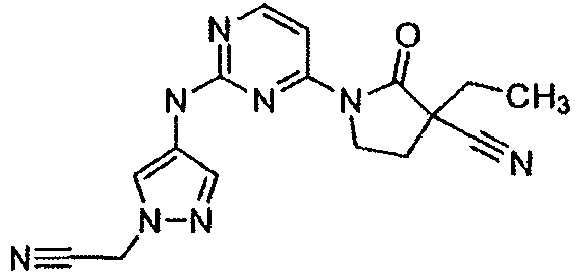
HCl 337.2 43 3-ethyl-2-oxo-1-(2-((1-(tetrahydro-2H-pyran-4-yl)-1H-pyrazol-4-yl)amino)pyrimidin-4-yl)pyrrolidine-3-carbonitrile 
Free 382.3 44 butyl (4-((4-(3-cyano-3-ethyl-2-oxopyrrolidin-1-yl)pyrimidin-2-yl)amino)-1H-pyrazol-1-yl)acetate 
HCl 412.3 45 3-ethyl-1-(2-((1-(4-methoxybenzyl)-1H-pyrazol-4-yl)amino)pyrimidin-4-yl)-2-oxopyrrolidine-3-carbonitrile 
Free 418.3 46 (4-((4-(3-cyano-3-ethyl-2-oxopyrrolidin-1-yl)pyrimidin-2-yl)amino)-1H-pyrazol-1-yl)acetic acid 
HCl 356.2 47 ethyl (4-((4-(3-cyano-3-ethyl-2-oxopyrrolidin-1-yl)pyrimidin-2-yl)amino)-1H-pyrazol-1-yl)acetate 
HCl 384. 3 - In Examples 48 to 55, the title compound was obtained from 1-(2-chloropyrimidin-4-yl)-3-ethyl-2-oxopyrrolidine-3-carbonitrile obtained in Step A of Example 2, and ethyl (4-aminophenyl)acetate, N-(4-aminophenyl)acetamide, 4-aminobenzamide, 4-amino-N-methylbenzamide, 4-amino-N,N-dimethylbenzamide, 4-aminobenzoic acid, 1-(4-aminophenyl)ethanone or 4-(1,1-dioxidethiomorpholin-4-yl)aniline (these compounds can be produced according to a method known per se), each corresponding to the compounds of Examples 48 to 55, in the same manner as in Step B of Example 2 or a method analogous thereto. MS in the tables means actual measured value.
Table 3 Example Number IUPAC Name Structure Salt MS 48 ethyl (4-((4-(3-cyano-3-ethyl-2-oxopyrrolidin-1-yl)pyrimidin-2-yl)amino)phenyl)acetate 
HCl 394.3 49 N-(4-((4-(3-cyano-3-ethyl-2-oxopyrrolidin-1-yl)pyrimidin-2-yl)amino)phenyl)acetamide 
Free 365.3 50 4-((4-(3-cyano-3-ethyl-2-oxopyrrolidin-1-yl)pyrimidin-2-yl)amino)benzamide 
Free 351.3 51 4-((4-(3-cyano-3-ethyl-2-oxopyrrolidin-1-yl)pyrimidin-2-yl)amino)-N-methylbenzamide 
Free 365.3 52 4-((4-(3-cyano-3-ethyl-2-oxopyrrolidin-1-y1)pyrimidin-2-yl)amino)-N,N-dimethylbenzamide 
Free 379.3 53 4-((4-(3-cyano-3-ethyl-2-oxopyrrolidin-1-yl)pyrimidin-2-yl)amino)benzoic acid 
Free 352.2 54 1-(2-((4-acetylphenyl)amino)pyrimidin-4-yl)-3-ethyl-2-oxopyrrolidine-3-carbonitrile 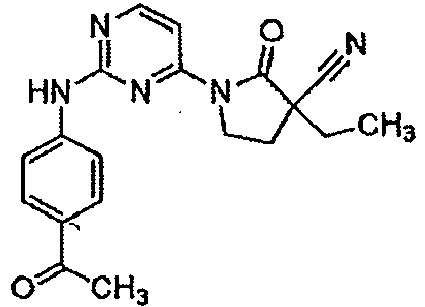
Free 350.3 55 1-(2-((4-(1,1-dioxidethiomorpholin-4-yl)phenyl)amino)pyrimidin-4-yl)-3-ethyl-2-oxopyrrolidine-3-carbonitrile 
Free 441. 3 -

- To a mixture of 1-(2-chloropyrimidin-4-yl)-3-ethyl-2-oxopyrrolidine-3-carbonitrile (100 mg) obtained in Step A of Example 2, 3-aminopyridine (45 mg), cesium carbonate (260 mg) and 2,2'-bis(diphenylphosphino)-1,1'-binaphthyl (37 mg) in tetrahydrofuran (2 mL) was added tris(dibenzylideneacetone)dipalladium(0) (37 mg), and the mixture was stirred overnight at 90°C. The insoluble substance was removed by filtration through Celite, and the solvent was evaporated under reduced pressure. The residue was purified by silica gel column chromatography (NH, hexane/ethyl acetate), 4M hydrogen chloride in ethyl acetate (4 mL) was added thereto, and the mixture was stirred at room temperature for 5 min. The solvent was evaporated under reduced pressure, and the residue was recrystallized (ethyl acetate) to give the title compound (49 mg).
MS(ESI+): [M+H]+309.2. - In Examples 57 and 58, the title compound was obtained from 1-(2-chloropyrimidin-4-yl)-3-ethyl-2-oxopyrrolidine-3-carbonitrile obtained in Step A of Example 2, and pyridin-4-amine or 4-(morpholin-4-ylmethyl)aniline (these compounds can be produced according to a method known per se), each corresponding to the compounds of Examples 57 and 58, in the same manner as in Example 56. MS in the tableau means actual measured value
Table 4 Example Number IUPAC Name Structure Salt MS 57 3-ethyl-2-oxo-1-(2-(pyridin-4-ylamino)pyrimidin-4-yl)pyrrolidine-3-carbonitrile 
2HCl 308.9 58 3-ethyl-1-(2-((4-(morpholin-4-ylmethyl)phenyl)amino)pyrimidin-4-yl)-2-oxopyrrolidine-3-carbonitrile 
2HCl 407.3 - In Examples 59 and 60, the title compound was obtained from 1-(2-chloropyrimidin-4-yl)-3-ethyl-2-oxopyrrolidine-3-carbonitrile obtained in Step A of Example 2, and 2-(morpholin-4-yl)pyrimidin-5-amine or 6-(morpholin-4-yl)pyridin-3-amine (these compounds can be produced according to a method known per se), each corresponding to the compounds of Examples 59 and 60, in the same manner as in Step B of Example 2 or a method analogous thereto. MS in the tables means actual measured value.
Table 5 Example Number IUPAC Name Structure Salt MS 59 3-ethyl-1-(2-((2-(morpholin-4-yl)pyrimidin-5-yl)amino)pyrimidin-4-yl)-2-oxopyrrolidine-3-carbonitrile 
Free 395.3 60 3-ethyl-1-(2-((6-(morpholin-4-yl)pyridin-3-yl)amino)pyrimidin-4-yl)-2-oxopyrrolidine-3-carbonitrile 
Free 394.3 -

- To a solution of 1-(2-chloropyrimidin-4-yl)-3-ethyl-2-oxopyrrolidine-3-carbonitrile (20 mg) obtained in Step A of Example 2 and 4-(aminomethyl)benzonitrile hydrochloride (27 mg) in N-methylpyrrolidone (2 mL) was added diisopropylethylamine (0.028 mL), and the mixture was stirred at 60°C for 3 hr. To the reaction mixture were added ethyl acetate (3 mL) and water (1 mL), and the mixture was stirred for 5 min. The organic layer was filtered through Top-Phase Separation Fiter Tube, and the solvent was evaporated at 60°C. The residue was purified by HPLC (C18, mobile phase: acetonitrile/10 mM aqueous ammonium hydrogen carbonate solution), and dried at 60°C to give the title compound.
MS (ESI+) : [M+H]+346.9. - In Examples 62 to 77, the title compound was obtained from 1-(2-chloropyrimidin-4-yl)-3-ethyl-2-oxopyrrolidine-3-carbonitrile obtained in Step A of Example 2, and 3-cyanobenzylamine hydrochloride, benzylamine, 3-methoxybenzylamine, 4-fluorobenzylamine, 4-(4-methylpiperidin-1-yl)benzylamine, 4-(morpholinomethyl)benzylamine, 1-benzofuran-5-ylmethylamine, 2-phenylethylamine, 3-(2-aminoethyl)pyridine, furfurylamine, 2-thiophenemethylamine, 2-naphthalenemethylamine hydrochloride, 4-methoxybenzylamine, 4-(2-aminoethyl)pyridine or cyclopropylmethylamine (these compounds can be produced according to a method known per se), each correctponding to the compounds of Examples 62 to 77, in the same manner as in Example 61. MS in the tables means actual measured value.
Table 6-1 Example Number IUPAC Name Structure Salt MS 62 1-(2-((3-cyanobenzyl)amino)pyrimidin-4-yl)-3-ethyl-2-oxopyrrolidine-3-carbonitrile 
Free 347.0 63 1-(2-(benzylamino)pyrimidin-4-yl)-3-ethyl-2-oxopyrrolidine-3-carbonitrile 
Free 321.9 64 3-ethyl-1-(2-((3-methoxybenzyl)amino)pyrimidin-4-yl)-2-oxopyrrolidine-3-carbonitrile 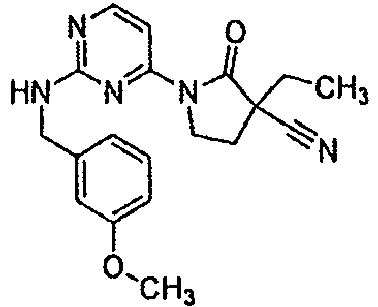
Free 352.0 65 3-ethyl-1-(2-((4-fluorobenzyl)amino)pyrimidin-4-yl)-2-oxopyrrolidine-3-carbonitrile 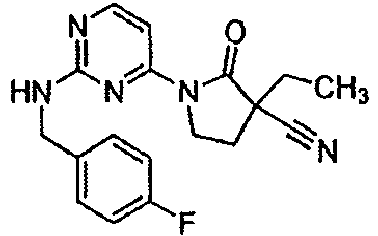
Free 339.9 66 3-ethyl-1-(2-((4-(4-methylpiperazin-1-yl)benzyl)amino)pyrimidin-4-yl)-2-oxopyrrolidine-3-carbonitrile 
Free 420. 1 67 3-ethyl-1-(2-((4-(morpholin-4-ylmethyl)benzyl)amino)pyrimidin-4-yl)-2-oxopyrrolidine-3-carbonitrile 
Free 421. 1 68 1-(2-((1-benzofuran-5-ylmethyl)amino)pyrimidin-4-yl)-3-ethyl-2-oxopyrrolidine-3-carbonitrile 
Free 362.0 69 3-ethyl-2-oxo-1-(2-((2-phenylethyl)amino)pyrimidin-4-yl)pyrrolidine-3-carbonitrile 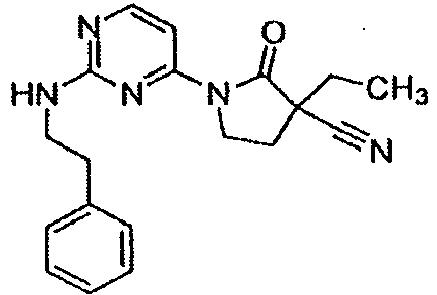
Free 335.9 Table 6-2 70 3-ethyl-2-oxo-1-(2-((2-(pyridin-3-yl)ethyl)amino)pyrimidin-4-yl)pyrrolidine-3-carbonitrile 
Free 337.0 72 3-ethyl-1-(2-((2-furylmethyl)amino)pyrimidin-4-yl)-2-oxopyrrolidine-3-carbonitrile 
Free 311.9 73 3-ethyl-2-oxo-1-(2-((2-thienylmethyl)amino)pyrimidin-4-yl)pyrrolidine-3-carbonitrile 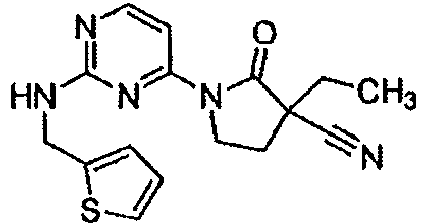
Free 327.9 74 3-ethyl-1-(2-((2-naphthyl methyl)amino)pyrimidin-4-yl)-2-oxopyrrolidine-3-carbonitrile 
Free 372.0 75 3-ethyl-1-(2-((4-methoxybenzyl)amino)pyrimidin-4-yl)-2-oxopyrrolidine-3-carbonitrile 
Free 351.9 76 3-ethyl-2-oxo-1-(2-((2-(pyridin-4-yl)ethyl)amino)pyrimidin-4-yl)pyrrolidine-3-carbonitrile 
Free 337.0 77 1-(2-((cyclopropylmethyl)amino)pyrimidin-4-yl)-3-ethyl-2-oxopyrrolidine-3-carbonitrile 
Free 285.9 - In Examples 78 to 84, the title compound was obtained from 1-(2-chloropyrimidin-4-yl)-3-isopropyl-2-oxopyrrolidine-3-carbonitrile obtained in Step C of Example 5, and 2-(4-amino-1H-pyrazol-1-yl)acetamide, 2-(4-amino-1H-pyrazol-1-yl)-N-methylacetamide, 2-(4-amino-1H-pyrazol-1-yl)-N,N-dimethylacetamide, 4-aminobenzamide, 4-amino-N-methylbenzamide, 1-(tetrahydro-2H-pyran-4-yl)-1H-pyrazol-4-amine or N-(4-aminobenzyl)acetamide (these compounds can be produced according to a method known per se), each corresponding to the compounds of Examples 78 to 84, in the same manner as in Step B of Example 2 or a method analogous thereto. MS in the tables means actual measured value.
Table 7 Example Number IUPAC Name Structure Salt MS 78 2-(4-((4-(3-cyano-3-isopropyl-2-oxopyrrolidin-1-yl)pyrimidin-2-yl)amino)-1H-pyrazol-1-yl)acetamide 
HCl 369.3 79 2-(4-((4-(3-cyano-3-isopropyl-2-oxopyrrolidin-1-yl)pyrimidin-2-yl)amino)-1H-pyrazol-1-yl)-N-methylacetamide 
HCl 383.3 80 2-(4-((4-(3-cyano-3-isopropyl-2-oxopyrrolidin-1-yl)pyrimidin-2-yl)amino)-1H-pyrazol-1-yl)-N,N-dimethylacetamide 
HCl 397.3 81 4-((4-(3-cyano-3-isopropyl-2-oxopyrrolidin-1-yl)pyrimidin-2-yl)amino)benzamide 
HCl 365.3 82 4-((4-(3-cyano-3-isopropyl-2-oxopyrrolidin-1-yl)pyrimidin-2-yl)amino)-N-methylbenzamide 
HCl 379.3 83 3-isopropyl-2-oxo-1-(2-((1-(tetrahydro-2H-pyran-4-yl)-1H-pyrazol-4-yl)amino)pyrimidin-4-yl)pyrrolidine-3-carbonitrile 
HCl 396.3 84 N-(4-((4-(3-cyano-3-isopropyl-2-oxopyrrolidin-1-yl)pyrimidin-2-yl)amino)benzyl)acetamide 
HCl 393.3 -

- A solution of (3S)-1-(2-chloropyrimidin-4-yl)-3-isopropyl-2-oxopyrrolidine-3-carbonitrile (55 mg) obtained in Step A of Example 9, 2-(4-amino-1H-pyrazol-1-yl)acetamide (35 mg) and acetic acid (13 µL) in ethanol (2 mL) was strried in a microwave reactor at 150°C for 1 hr, and the solvent was evaporated under reduced pressure. The obtained residue was purified by silica gel column chromatography (NH, ethyl acetate/methanol). The obtained crude product was subjected to HPLC (C18, mobile phase: water/acetonitrile (containing 0.1% ammonium formate)), to the obtained fraction was added saturated aqueous sodium hydrogen carbonate solution, and the mixture was extracted with ethyl acetate. The extract was dried over anhydrous magnesium sulfate, and concentrated under reduced pressure. To a solution of the residue (17 mg) in ethanol (3 mL) was added 1M hydrochloric acid (57 µL), and the solvent was evaporated under reduced pressure. The residue was recrystallized (diisopropyl ether/ethanol) to give the title compound (13 mg).
1H NMR(300 MHz, DMSO-d6)δ0.99-1.03 (3H, m), 1.07-1.15 (3H, m), 2.24-2.37 (1H, m), 2.38-2.47 (1H, m), 2.55 (1H, d, J = 7.9 Hz), 4.08 (2H, brs), 4.72 (2H, s), 7.23 (1H, brs), 7.39 (1H, brs), 7.49-7.60 (2H, m), 7.87 (1H, brs), 8.37 (1H, d, J = 5.7 Hz), 9.61 (1H, brs).
MS(ESI+): [M+H]+369.3. -

- A solution of (3S)-1-(2-chloropyrimidin-4-yl)-3-isopropyl-2-oxopyrrolidine-3-carbonitrile (55 mg) obtained in Step A of Example 9, 2-(4-amino-1H-pyrazol-1-yl)-N-methylacetamide (38 mg) and acetic acid (13 µL) in ethanol (2 mL) was strried in a microwave reactor at 150°C for 1 hr, and the solvent was evaporated under reduced pressure. The obtained residue was purified by silica gel column chromatography (NH, ethyl acetate/methanol). To a solution of the residue (83 mg) in ethanol (3 mL) was added 1M hydrochloric acid (220 µL), and the solvent was evaporated under reduced pressure. The residue was recrystallized (diisopropyl ether/ethanol) to give the title compound (87 mg).
1H NMR(300 MHz, DMSO-d6)δ 0.95-1.05 (3H, m), 1.07-1.16 (3H, m), 2.32 (1H, dt, J = 13.6, 6.8 Hz), 2.41-2.46 (1H, m), 2.55 (1H, d, J = 7.9 Hz), 2.61 (3H, d, J = 4.5 Hz), 4.08 (2H, brs), 4.73 (2H, s), 7.45-7.62 (2H, m), 7.79-7.99 (2H, m), 8.37 (1H, d, J = 5.7 Hz), 9.66 (1H, brs).
MS(ESI+): [M+H]+383.3. -

- A solution of (3S)-1-(2-chloropyrimidin-4-yl)-3-isopropyl-2-oxopyrrolidine-3-carbonitrile (55 mg) obtained in Step A of Example 9, 2-(4-amino-1H-pyrazol-1-yl)-N,N-dimethylacetamide (42 mg) and acetic acid (13 µL) in ethanol (2 mL) was strried in a microwave reactor at 150°C for 1 hr, and the solvent was evaporated under reduced pressure. The obtained residue was purified by silica gel column chromatography (NH, ethyl acetate/methanol). To a solution of the residue (80 mg) in ethanol (3 mL) was added 1M hydrochloric acid (200 µL), and the solvent was evaporated under reduced pressure. The residue was recrystallized (diisopropyl ether/ethanol) to give the title compound (90 mg).
1H NMR(300 MHz, DMSO-d6)δ 0.96-1.05 (3H, m), 1.07-1.15 (3H, m), 2.32 (1H, dt,J = 13.6, 6.8 Hz), 2.41-2.46 (1H, m), 2.54-2.60 (1H, m), 2.85 (3H, s), 3.02 (3H, s), 4.04 (2H, brs), 4.98-5.13 (2H, m), 7.46-7.61 (2H, m), 7.68-7.91 (1H, m), 8.37 (1H, d, J = 6.0 Hz), 9.68 (1H, brs).
MS(ESI+): [M+H]+397.3. - In Examples 88 to 97, the title compound was obtained from (3S)-1-(2-chloropyrimidin-4-yl)-3-isopropyl-2-oxopyrrolidine-3-carbonitrile obtained in Step A of Example 9, and 4-(4-aminophenyl)morpholin-3-one, 6-((3R)-3-methylmorpholin-4-yl)pyridin-3-amine, N-(3-aminophenyl)acetamide, 6-((3S)-3-methylmorpholin-4-yl)pyridin-3-amine, 4-aminobenzamide, 4-amino-N-methylbenzamide, 2-(4-aminophenyl)acetamide, 2-(4-aminophenyl)-N-methylacetamide, 3-(4-aminophenyl)-1,2,4-oxadiazol-5(4H)-one or 4-(4-aminophenyl)piperazin-2-one (these compounds can be produced according to a method known per se), each corresponding to the compounds of Examples 88 to 97, in the same manner as in Step B of Example 2 or a method analogous thereto. MS in the tables means actual measured value.
Table 8-1 Example Number IUPAC Name Structure Salt MS 88 (3S)-3-isopropyl-2-oxo-1-(2-((4-(3-oxomorpholin-4-yl)phenyl)amino)pyrimidin-4-yl)pyrrolidine-3-carbonitrile 
Free 421.3 89 (3S)-3-isopropyl-1-(2-((6-((3R)-3-methylmorpholin-4-yl)pyridin-3-yl)amino)pyrimidin-4-yl)-2-oxopyrrolidine-3-carbonitrile 
HCl 422.4 90 N-(3-((4-((3S)-3-cyano-3-isopropyl-2-oxopyrrolidin-1-yl)pyrimidin-2-yl)amino)phenyl)acetamide 
HCl 379.3 91 (3S)-3-isopropyl-1-(2-((6-((3S)-3-methylmorpholin-4-yl)pyridin-3-yl)amino)pyrimidin-4-yl)-2-oxopyrrolidine-3-carbonitrile 
HCl 422.4 92 4-((4-((3S)-3-cyano-3-isopropyl-2-oxopyrrolidin-1-yl)pyrimidin-2-yl)amino)benzamide 
HCl 365.3 93 4-((4-((3S)-3-cyano-3-isopropyl-2-oxopyrrolidin-1-yl)pyrimidin-2-yl)amino)-N-ethylbenzamide 
HCl 393.3 94 2-(4-((4-((3S)-3-cyano-3-isopropyl-2-oxopyrrolidin-1-yl)pyrimidin-2-yl)amino)phenyl)acetamide 
HCl 379.3 95 2-(4-((4-((3S)-3-cyano-3-isopropyl-2-oxopyrrolidin-1-yl)pyrimidin-2-yl)amino)phenyl)-N-methylacetamide 
HCl 393.3 Table 8-2 96 (3S)-3-isopropyl-2-oxo-1-(2-((4-(5-oxo-4,5-dihydro-1,2,4-oxadiazol-3-yl)phenyl)amino)pyrimidin-4-yl)pyrrolidine-3-carbonitrile 
Free 406.3 97 (3S)-3-isopropyl-2-oxo-1-(2-((4-(3-oxopiperazin-1-yl)phenyl)amino)pyrimidin-4-yl)pyrrolidine-3-carbonitrile 
Free 420.4 - In Examples 98 to 100, the title compound was obtained from (3R)-1-(2-chloropyrimidin-4-yl)-3-ethyl-2-oxopyrrolidine-3-carbonitrile obtained in Step A of Example 8, and N-(4-aminophenyl)-N-methylacetamide, 3-chloro-4-(morpholin-4-yl)aniline or 1-(4-(4-aminophenyl)piperazin-1-yl)ethanone (these compounds can be produced according to a method known per se), each corresponding to the compounds of Examples 98 to 100, in the same manner as in Step B of Example 2 or a method analogous thereto. MS in the tables means actual measured value.
Table 9 Example Number IUPAC Name Structure Salt MS 98 N-(4-((4-((3R)-3-cyano-3-ethyl-2-oxopyrrolidin-1-yl)pyrimidin-2-yl)amino)phenyl)-N-methylacetamide 
Free 379.3 99 (3R)-1-(2-((3-chloro-4-(morpholin-4-yl)phenyl)amino)pyrimidin-4-yl)-3-ethyl-2-oxopyrrolidine-3-carbonitrile 
Free 427.3 100 (3R)-1-(2-((4-(4-acetylpiperazin-1-yl)phenyl)amino)pyrimidin-4-yl)-3-ethyl-2-oxopyrrolidine-3-carbonitrile 
HCl 434.4 -

- The title compound was obtained from 4-chloro-N-(1-methyl-1H-pyrazol-4-yl)pyrimidin-2-amine obtained in Step C of Example 1 and 3,3-dimethylpiperidin-2-one in the same manner as in Step I of Example 1.
MS(ESI+): [M+H]+301.2. -

- The title compound was obtained from 4-chloro-N-(1-methyl-1H-pyrazol-4-yl)pyrimidin-2-amine obtained in Step C of Example 1 and piperidin-2-one in the same manner as in Step I of Example 1.
MS(ESI+): [M+H]+273.2. -

- To a solution of sodium hydride (60% in mineral oil, 38 g) and diethyl carbonate (97 mL) in toluene (240 mL) was added dropwise a solution of cyclopropylacetonitrile (32 g) in toluene (120 mL) over 40 min with heating under reflux, and the mixture was heated under reflux for additional 2 hr. The mixture was neutralized with acetic acid (120 mL) in an ice bath, water was added thereto, and the mixture was extracted with ethyl acetate. The obtained organic layer was washed with saturated brine, and dried over anhydrous magnesium sulfate, and the solvent was evaporated under reduced pressure. The residue was distilled (boling point 69-72°C, 4.0 mmHg) to give the title compound (50 g).
1H NMR (400 MHz, CDCl3)δ0.49-0.61 (2H, m), 0.68-0.78 (2H, m), 1.34 (3H, t, J = 7.2 Hz), 1.36-1.43 (1H, m), 3.23 (1H, d, J = 7.6 Hz), 4.29 (2H, q, J = 7.1 Hz). - To a solution of ethyl cyano(cyclopropyl)acetate (27 g) obtained in Step A of Example 103 in toluene (400 mL) were added cesium carbonate (88 g), tetrabutylammonium bromide (5.8 g) and tert-butyl 1,2,3-oxathiazolidine-3-carboxylate 2,2-dioxide (40 g), and the mixture was stirred overnight at room temperature. The reaction mixture was neutralized with 0.5 M hydrochloric acid (400 mL), and extracted with ethyl acetate. The obtained organic layer was washed successively with water and saturated brine, and dried over anhydrous magnesium sulfate, and the solvent was evaporated under reduced pressure. The residue was purified by silica gel column chromatography (hexane/ethyl acetate) to give the title compound (45 g).
1H NMR(400 MHz, DMSO-d6)δ0.35-0.47 (2H, m), 0.55-0.62 (1H, m), 0.63-0.72 (1H, m), 1.21-1.27 (3H, m), 1.30-1.34 (1H, m), 1.35-1.43 (9H, m), 1.95-2.00 (1H, m), 2.11-2.21 (1H, m), 2.90-3.03 (1H, m), 3.09-3.21 (1H, m), 4.15-4.30 (2H, m), 6.92 (1H, t, J = 5.5 Hz). - To a solution of ethyl 4-((tert-butoxycarbonyl)amino)-2-cyano-2-cyclopropylbutanoate (45 g) obtained in Step B of Example 103 in tetrahydrofuran (1.2 L) was added sodium hydride (60% in mineral oil, 7.3 g) in an ice bath, and the mixture was stirred at room temperature for 2 hr. To the reaction mixture was added saturated aqueous ammonium chloride solution (100 mL), the solvent (tetrahydrofuran) was evaporated under reduced pressure, and the reaction mixture was extracted with ethyl acetate. The obtained organic layer was washed with saturated brine, and dried over anhydrous magnesium sulfate, and the solvent was evaporated under reduced pressure. The residue was purified by silica gel column chromatography (hexane/ethyl acetate) to give the title compound (18 g).
1H NMR(400 MHz, DMSO-d6)δ0.40-0.57 (3H, m), 0.59-0.69 (1H, m), 1.31 (1H, m), 2.20 (1H, m), 2.43-2.48 (1H, m), 3.24-3.30 (2H, m), 8.30 (1H, brs). - To a mixture of 3-cyclopropyl-2-oxopyrrolidine-3-carbonitrile (18 g) obtained in Step C of Example 103, 2,4-dichloropyrimidine (17 g), cesium carbonate (76 g) and 4,5-bis(diphenylphosphino)-9,9-dimethylxanthene (4.1 g) in tetrahydrofuran (300 mL) was added tris(dibenzylideneacetone)dipalladium(0) (2.1 g), and the mixture was stirred overnight at 85°C. The insoluble substance was removed by filtration through Celite, and the solvent was evaporated under reduced pressure. The residue was purified by silica gel column chromatography (hexane/ethyl acetate) to give the title compound (23 g).
1H NMR(400 MHz, DMSO-d6)δ0.49-0.59 (2H, m), 0.62-0.74 (2H, m), 1.48-1.60 (1H, m), 2.37 (1H, m), 2.65 (1H, m), 3.95-4.04 (1H, m), 4.05-4.13 (1H, m), 8.24 (1H, d, J = 5.9 Hz), 8.70 (1H, d, J = 5.6 Hz).
MS (ESI+): [M+H]+ 263.2. - 1-(2-Cloropyrimidin-4-yl)-3-cyclopropyl-2-oxopyrrolidine-3-carbonitrile (23 g) obtained in Step D of Example 103 was resolved by HPLC (column: CHIRALPAK IC, 50 mmID×500 mmL, manufactured by Daicel Chemical Industries, mobile phase: hexane/2-propanol = 200/800) to give the title compound (12 g: a shorter retention time).
>99%ee (HPLC (column: CHIRALPAK IC, 4.6 mmID×250 mmL, manufactured by Daicel Chemical Industries, mobile phase: hexane/2-propanol = 200/800, flow rate: 0.5 mL/min, retention time: 19.33 min)) - To a solution of 4-nitro-1H-pyrazole (25 g) in N,N-dimethylformamide (100 mL) was added ethyl 2-bromo-2-methylpropanoate (39 mL), and the mixture was stirred at 80°C for 2 hr. To the reaction mixture was added water, and the mixture was extracted with ethyl acetate. The obtained organic layer was washed with saturated brine, and dried over anhydrous magnesium sulfate, and the solvent was evaporated under reduced pressure. The residue was purified by silica gel column chromatography (hexane/ethyl acetate) to give the title compound (50 g).
1H NMR(400 MHz, CDCl3)δ1.23 (3H, t, J = 7.2 Hz), 1.88 (6H, s), 4.20 (2H, q, J = 7.1 Hz), 8.11 (1H, s), 8.20-8.51 (1H, m). - To a solution of ethyl 2-methyl-2-(4-nitro-1H-pyrazol-1-yl)propanoate (45 g) obtained in Step F of Example 103 in tetrahydrofuran (400 mL) was added gradually dropwise diisopropylaluminium hydride in toluene (1.5 M in toluene, 400 mL) while maintaining the internal temperature of -20°C or less, and the reaction mixture was stirred overnight while it was allowed to be warmed. To the reaction mixture was added aqueous potassium sodium tartrate solution in an ice bath, and the mixture was extracted with ethyl acetate. The obtained organic layer was washed with saturated brine, and dried over anhydrous magnesium sulfate, and the solvent was evaporated under reduced pressure. The residue was purified by silica gel column chromatography (ethyl acetate) to give the crude title compound (36 g).
1H NMR(400 MHz, CDCl3)δ1.60 (6H, s), 2.71 (1H, brs), 3.84 (2H, s), 8.10 (1H, s), 8.28 (1H, d, J = 0.5 Hz). - To a solution of the crude 2-methyl-2-(4-nitro-1H-pyrazol-1-yl)propan-1-ol (36 g) obtained in Step G of Example 103 in ethanol (200 mL) was added 10% palladium-carbon (360 mg), and the mixture was stirred overnight at room temperature under hydrogen atmosphere (at normal pressure). The palladium-carbon was removed by filtration through Celite, and the solvent was evaporated under reduced pressure. The residue was purified by silica gel column chromatography (ethyl acetate/methanol), and the obtained solid was washed with diisopropyl ether to give the title compound (15 g).
1H NMR(400 MHz, DMSO-d6)δ1.36 (6H, s), 3.48 (2H, d, J = 5.6 Hz), 3.71 (2H, brs), 4.86 (1H, t, J = 5.6 Hz), 6.91 (1H, d, J = 0.7 Hz), 7.09 (1H, d, J = 1.0 Hz). - A solution of (3S)-1-(2-chloropyrimidin-4-yl)-3-cyclopropyl-2-oxopyrrolidine-3-carbonitrile (11.5 g) obtained in Step E of Example 103, 2-(4-amino-1H-pyrazol-1-yl)-2-methylpropan-1-ol (7.1 g) obtained in Step H of Example 103 and acetic acid (2.6 mL) in ethanol (200 mL) was stirred in a sealed tube reactor at 150°C for 1 hr, and the solvent was evaporated under reduced pressure. The reaction mixture was neutralized with saturated aqueous sodium bicarbonate, and extracted with ethyl acetate. The obtained organic layer was washed with saturated brine, and dried over anhydrous magnesium sulfate, and the solvent was evaporated under reduced pressure. The residue was purified by silica gel column chromatography (hexane/ethyl acetate), and recrystallized (diisopropyl ether/ethyl acetate) to give the title compound (6.9 g).
1H NMR(400 MHz, DMSO-d6)δ0.43-0.78 (4H, m), 1.45 (6H, s), 1.54 (1H, m), 2.28-2.43 (1H, m), 2.65 (1H, m), 3.56 (2H, d, J = 5.6 Hz), 3.90-4.29 (2H, m), 4.97 (1H, t, J = 5.5 Hz), 7.48 (1H, d, J = 5.6 Hz), 7.54 (1H, s), 7.95 (1H, s), 8.36 (1H, d, J = 4.9 Hz), 9.53 (1H, brs).
MS(ESI+): [M+H]+ 382.3. -

- To a solution of (3S)-3-cyclopropyl-1-(2-((1-(1-hydroxy-2-methylpropan-2-yl)-1H-pyrazol-4-yl)amino)pyrimidin-4-yl)-2-oxopyrrolidine-3-carbonitrile (4.3 g) obtained in Step I of Example 103 in ethanol (80 mL) was added 1 M hydrochloric acid (11 mL), and the mixture was stirred at room temperature for 5 min. The solvent was evaporated under reduced pressure, and the residue was recrystallized (diisopropyl ether/ethanol) to give the title compound (4.1 g).
1H NMR(400 MHz, DMSO-d6)δ0.42-0.84 (4H, m), 1.45 (6H, s), 1.50-1.62 (1H, m), 2.25-2.42 (1H, m), 2.65 (1H, m), 3.92-4.26 (4H, m), 4.44 (2H, brs), 7.50 (1H, d, J = 5.9 Hz), 7.55 (1H, s), 7.96 (1H, s), 8.36 (1H, d, J = 5.6 Hz), 9.65 (1H, brs).
MS(ESI+): [M+H]+ 382.3. -

- 1-(2-Chloropyrimidin-4-yl)-3-cyclopropyl-2-oxopyrrolidine-3-carbonitrile (23 g) obtained in Step D of Example 103 was resolved by HPLC (column: CHIRALPAK IC, 50 mmIDx500 mmL, manufactured by Daicel Chemical Industries, mobile phase: hexane/2-propanol = 200/800) to give the title compound (11 g: a longer retention time).
>99%ee (HPLC (column: CHIRALPAK IC, 4.6 mmID×250 mmL, manufactured by Daicel Chemical Industries, mobile phase: hexane/2-propanol = 200/800, flow rate: 0.5 mL/min, retention time: 27.06 min)) - A solution of (3R)-1-(2-chloropyrimidin-4-yl)-3-cyclopropyl-2-oxopyrrolidine-3-carbonitrile (200 mg) obtained in Step A of Example 105, 2-(4-amino-1H-pyrazol-1-yl)-2-methylpropan-1-ol (120 mg) obtained in Step H of Example 103 and acetic acid (48 µL) in ethanol (20 mL) was stirred in a microwave reactor at 150°C for 1 hr, and the solvent was evaporated under reduced pressure. The reaction mixture was neutralized with saturated aqueous sodium bicarbonate, and extracted with ethyl acetate. The obtained organic layer was washed with saturated brine, and dried over anhydrous magnesium sulfate, and the solvent was evaporated under reduced pressure. The residue was purified by silica gel column chromatography (hexane/ethyl acetate), and recrystallized (diisopropyl ether/ethyl acetate) to give the title compound (110 mg).
1H NMR(400 MHz, DMSO-d6)δ0.40-0.87 (4H, m), 1.45 (6H, s), 1.54 (1H, m), 2.29-2.42 (1H, m), 2.57-2.75 (1H, m), 3.56 (2H, d, J = 5.6 Hz), 3.95-4.36 (2H, m), 4.98 (1H, t, J = 5.4 Hz), 7.48 (1H, d, J = 5.6 Hz), 7.54 (1H, s), 7.95 (1H, s), 8.36 (1H, d, J = 5.1 Hz), 9.53 (1H, brs).
MS(ESI+): [M+H]+ 382.3. -

- To a solution of 2-(4-amino-1H-pyrazol-1-yl)-2-methylpropan-1-ol (350 mg) obtained in Step H of Example 103 in deuterated water (3.0 mL) was added a solution of 4 M hydrogen chloride in ethyl acetate (0.56 mL), the mixture was stirred in a microwave reactor at 180°C for 1 hr, and the solvent was evaporated under reduced pressure. The residue was purified by silica gel column chromatography (NH, hexane/ethyl acetate) to give the title compound (150 mg).
1H NMR(400 MHz, DMSO-d6)δ1.36 (6H, s), 3.48 (2H, d, J = 5.9 Hz), 3.70 (2H, brs), 4.86 (1H, t, J = 5.6 Hz). - The title compound (18 mg) was obtained from (3S)-1-(2-chloropyrimidin-4-yl)-3-cyclopropyl-2-oxopyrrolidine-3-carbonitrile (180 mg) obtained in Step E of Example 103 and 2-(4-amino-(2H2)-1H-pyrazol-1-yl)-2-methylpropan-1-ol (150 mg) obtained in Step A of Example 106 in the same manner as in Example 56.
1H NMR(400 MHz, DMSO-d6)δ0.44-0.77 (4H, m), 1.45 (6H, s), 1.49-1.61 (1H, m), 2.30-2.42 (1H, m), 2.59-2.72 (1H, m), 3.56 (2H, d, J = 5.4 Hz), 3.95-4.30 (2H, m), 4.97 (1H, t, J = 5.4 Hz), 7.48 (1H, d, J = 5.6 Hz), 8.36 (1H, d, J = 5.4 Hz), 9.52 (1H, brs).
MS(ESI+): [M+H]+ 384.4. -

- To a solution of deuterated lithium aluminium hydride (2.0 g) in tetrahydrofuran (40 mL) was added a solution of ethyl 2-methyl-2-(4-nitro-1H-pyrazol-1-yl)propanoate (5.0 g) obtained in Step F of Example 103 in tetrahydrofuran (40 mL) at -78°C under nitrogen atmosphere, and the mixture was stirred for 3 hr while it was allowed to be warmed to 0°C. To the reaction mixture was added sodium sulfate decahydrate in an ice bath, and the mixture was stirred at room temperature for 30 min. The resulting solid was removed by filtration through Celite, and the solvent was evaporated under reduced pressure. The residue was purified by silica gel column chromatography (hexane/ethyl acetate) to give the title compound (260 mg).
1H NMR (400 MHz, CDCl3)δ1.60 (6H, s), 2.61 (1H, s), 8.10 (1H, s). - The title compound (160 mg) was obtained from 2-methyl-2-(4-nitro(3-2H)-1H-pyrazol-1-yl)-(1,1-2H2)propan-1-ol (260 mg) obtained in Step A of Example 107 in the same manner as in Step H of Example 103.
1H NMR(400 MHz, DMSO-d6)δ1.36 (6H, s), 3.70 (2H, brs), 4.82 (1H, s), 6.90 (1H, s). - The title compound (150 mg) was obtained from (3S)-1-(2-chloropyrimidin-4-yl)-3-cyclopropyl-2-oxopyrrolidine-3-carbonitrile (200 mg) obtained in Step E of Example 103 and 2-(4-amino(3-2H)-1H-pyrazol-1-yl)-2-methyl-(1,1-2H2)propan-1-ol (130 mg) obtained in Step B of Example 107 in the same manner as in Step D of Example 109.
1H NMR (400 MHz, DMSO-d6)δ0.43-0.80 (4H, m), 1.45 (6H, s), 1.50-1.67 (1H, m), 2.26-2.42 (1H, m), 2.65 (1H, m), 3.88-4.31 (2H, m), 5.16 (2H, brs), 7.50 (1H, d, J = 5.9 Hz), 7.55 (1H, s), 7.96 (1H, s), 8.36 (1H, d, J = 5.6 Hz), 9.61 (1H, brs).
MS(ESI+): [M+H]+ 384.3. -

- To a solution of 4-nitro-1H-pyrazole (3.0 g) in N,N-dimethylformamide (50 mL) was added tert-butyl 2-bromo-2-methylpropanoate (15 mL), and the mixture was stirred at 80°C for 3 hr. To the reaction mixture was added water, and the mixture was extracted with ethyl acetate. The obtained organic layer was washed with saturated brine, and dried over anhydrous magnesium sulfate, and the solvent was evaporated under reduced pressure. The residue was purified by silica gel column chromatography (hexane/ethyl acetate) to give the title compound (7.0 g).
1H NMR(400 MHz, DMSO-d6)δ1.35 (9H, s), 1.78 (6H, s), 8.33 (1H, s), 9.06 (1H, d, J = 0.5 Hz). - The title compound (5.4 g) was obtained from tert-butyl 2-methyl-2-(4-nitro-1H-pyrazol-1-yl)propanoate (7.0 g) obtained in Step A of Example 108 in the same manner as in Step H of Example 103.
1H NMR (400 MHz, DMSO-d6)δ1.33 (9H, s), 1.61 (6H, s), 3.80 (2H, brs), 6.95 (1H, d, J = 0.7 Hz), 7.09 (1H, d, J = 0.7 Hz). MS(ESI+): [M-(tBu)+2H]+ 270.2. - The title compound (1.5 g) was obtained from (3S)-1-(2-chloropyrimidin-4-yl)-3-cyclopropyl-2-oxopyrrolidine-3-carbonitrile (1.0 g) obtained in Step E of Example 103 and tert-butyl 2-(4-amino-1H-pyrazol-1-yl)-2-methylpropanoate (1.0 g) obtained in Step B of Example 108 in the same manner as in Step I of Example 103.
MS (ESI+) : [M+H]+ 452.3. - To a solution of tert-butyl 2-(4-((4-((3S)-3-cyano-3-cyclopropyl-2-oxopyrrolidin-1-yl)pyrimidin-2-yl)amino)-1H-pyrazol-1-yl)-2-methylpropanoate (1.0 g) obtained in Step C of Example 108 in ethyl acetate (10 mL) was added a solution of 4 M hydrogen chloride in ethyl acetate (10 mL), and the mixture was stirred at room temperature for 3 hr. The solvent was evaporated under reduced pressure, and the residue was recrystallized (diisopropyl ether/ethanol) to give the crude title compound (1.1 g).
- The crude title compound (100 mg) was pufified by HPLC (C18, mobile phase: water/acetonitrile (containing 10 mM NH4HCO3)), and the solvent was evaporated under reduced pressure. To a solution of the residue (90 mg) in ethanol (3 mL) was added 1M hydrochloric acid (0.23 mL), and the solvent was evaporated under reduced pressure. The residue was recrystallized (diisopropyl ether/ethanol) to give the title compound (55 mg).
MS(ESI+): [M+H]+ 396.3. -

- To a solution of ethyl 2-methyl-2-(4-nitro-1H-pyrazol-1-yl)propanoate (6.0 g) obtained in Step F of Example 103 in ethanol (50 mL) was added dropwise 2 M aqueous sodium hydroxide solution (26 mL), and the mixture was stirred at room temperature for 3 hr. To the reaction mixture was added water, and the mixture was washed with diethyl ether. The obtained aqueous layer was neutralized with 2 M hydrochloric acid, and extracted with ethyl acetate. The obtained organic layer was washed with saturated brine, and dried over anhydrous magnesium sulfate, and the solvent was evaporated under reduced pressure to give the title compound (5.0 g).
1H NMR(300 MHz, DMSO-d6)δ1.79 (6H, s), 8.31 (1H, s), 9.06 (1H, s), 13.40 (1H, brs). - To a solution of 2-methyl-2-(4-nitro-1H-pyrazol-1-yl)propanoic acid (1.2 g) obtained in Step A of Example 109 in N,N-dimethylformamide (10 mL) were added 1-ethyl-3-(3-dimethylaminopropyl)carbodiimide hydrochloride (1.3 g) and 1-hydroxybenzotriazole ammonia salt (1.4 g), and the mixture was stirred overnight at room temperature. To the reaction mixture was added saturated aqueous sodium hydrogen carbonate solution, and the mixture was extracted with ethyl acetate. The obtained organic layer was washed successively with water and saturated brine, and dried over anhydrous magnesium sulfate, and the solvent was evaporated under reduced pressure. The residue was purified by silica gel column chromatography (NH, ethyl acetate) to give the title compound (1.0 g).
1H NMR(300 MHz, DMSO-d6)δ1.75 (6H, s), 6.89-7.61 (2H, m), 8.29 (1H, s), 8.94 (1H, s). - To a solution of 2-methyl-2-(4-nitro-1H-pyrazol-1-yl)propanamide (1.0 g) obtained in Step B of Example 109 in ethanol (50 mL) was added 10% palladium-carbon (100 mg), and the mixture was stirred at room temperature for 5 hr under hydrogen atmosphere (at normal pressure). The palladium carbon was removed by filtration through Celite, and the solvent was evaporated under reduced pressure. The residue was recrystallized (ethyl acetate/hexane) to give the title compound (760 mg).
1H NMR(300 MHz, DMSO-d6)δ1.60 (6H, s), 3.85 (2H, brs), 6.35 (1H, brs), 7.01 (1H, d, J = 0.8 Hz), 7.11 (1H, d, J = 0.8 Hz), 7.11 (1H, brs). - A solution of (3S)-1-(2-chloropyrimidin-4-yl)-3-cyclopropyl-2-oxopyrrolidine-3-carbonitrile (250 mg) obtained in Step E of Example 103, 2-(4-amino-1H-pyrazol-1-yl)-2-methylpropanamide (160 mg) obtained in Step C of Example 109 and acetic acid (57 µL) in ethanol (3.0 mL) was stirred in a microwave reactor at 150°C for 1 hr, and the solvent was evaporated under reduced pressure. The reaction mixture was neutralized with saturated aqueous sodium bicarbonate, and extracted with ethyl acetate. The obtained organic layer was washed with saturated brine, and dried over anhydrous magnesium sulfate, and the solvent was evaporated under reduced pressure. The residue was purified by silica gel column chromatography (hexane/ethyl acetate).
- To a solution of the residue in ethanol (5.0 mL) was added 2 M hydrochloric acid (0.95 mL), the mixture was stirred for 5 min, and the solvent was evaporated under reduced pressure. The residue was recrystallized (ethyl acetate/acetonitrile) to give the title compound (230 mg).
1H NMR(400 MHz, DMSO-d6)δ0.39-0.87 (4H, m), 1.49-1.61 (1H, m), 1.69 (6H, s), 2.27-2.43 (1H, m), 2.65 (1H, m), 3.93-4.36 (2H, m), 4.89 (1H, brs), 6.75 (1H, brs), 7.20 (1H, brs), 7.51 (1H, d, J = 5.6 Hz), 7.61 (1H, s), 7.98 (1H, s), 8.38 (1H, d, J = 5.9 Hz), 9.63 (1H, brs).
MS(ESI+): [M+H]+395.1. -

- To a solution of 2-(4-((4-((3S)-3-cyano-3-cyclopropyl-2-oxopyrrolidin-1-yl)pyrimidin-2-yl)amino)-1H-pyrazol-1-yl)-2-methylpropanoic acid hydrochloride (80 mg) obtained in Example 108 in N,N-dimethylformamide (2.0 mL) were added 1-ethyl-3-(3-dimethylaminopropyl)carbodiimide (58 mg), 1-hydroxybenzotriazole monohydrate (57 mg), N,N-diisopropylethylamine (97 µL) and morpholine (19 mg), and the mixture was stirred overnight at room temperature. The solvent was evaporated under reduced pressure, and the residue was purified by silica gel column chromatography (NH, hexane/ethyl acetate). To a solution of the residue (87 mg) in ethanol (3.0 mL) was added dropwise 1 M hydrochloric acid (0.19 mL), the mixture was stirred for 5 min, and the solvent was evaporated under reduced pressure. The residue was recrystallized (ethanol/diisopropyl ether) to give the title compound (35 mg).
MS(ESI+): [M+H]+ 465.4. - In Examples 111 to 113, the title compound was obtained from 2-(4-((4-((3S)-3-cyano-3-cyclopropyl-2-oxopyrrolidin-1-yl)pyrimidin-2-yl)amino)-1H-pyrazol-1-yl)-2-methylpropanoic acid hydrochloride obtained in Example 108 and the amine each corresponding to the compounds of Examples 111 to 113 ((S)-(-)-pyrrolidinol, (R)-(+)-pyrrolidinol and 4-hydroxypiperidine (these compounds can be produced according to a method known per se)), in the same manner as in Example 110 or a method analogous thereto. MS in the tables means actual measured value.
Table 10 Example Number IUPAC Name Structure Salt MS 111 (3S)-3-cyclopropyl-1-(2-((1-(1-((3R)-3-hydroxypyrrolidin-1-yl)-2-methyl-1-oxopropan-2-y1)-1H-pyrazol-4-yl)amino)pyrimidin-4-yl)-2-oxopyrrolidine-3-carbonitrile 
HCl 465.4 112 (3S)-3-cyclopropyl-1-(2-((1-(1-((3S)-3-hydroxypyrrolidin-1-yl)-2-methyl-1-oxopropan-2-yl)-1H-pyrazol-4-yl)amino)pyrimidin-4-yl)-2-oxopyrrolidine-3-carbonitrile 
HCl 465.4 113 (3S)-3-cyclopropyl-1-(2-((1-(1-(4-hydroxypiperidin-1-yl)-2-methyl-1-oxopropan-2-yl)-1H-pyrazol-4-yl)amino)pyrimidin-4-yl)-2-oxopyrrolidine-3-carbonitrile 
free 479.2 -

- To a solution of 2-(4-amino-1H-pyrazol-1-yl)-2-methylpropan-1-ol (2.1 g) obtained in Step H of Example 103 in tetrahydrofuran (50 mL) were added triethylamine (1.6 g) and di-tert-butyl dicarbonate (3.5 g), and the mixture was stirred at room temperature for 2 hr. To the reaction mixture was added water, and the mixture was extracted with ethyl acetate. The obtained organic layer was washed with saturated brine, and dried over anhydrous magnesium sulfate, and the solvent was evaporated under reduced pressure. The residue was purified by silica gel column chromatography (hexane/ethyl acetate) to give the title compound (3.4 g).
1H NMR(400 MHz, DMSO-d6) δ1.40 (6H, s), 1.44 (9H, s), 3.51 (2H, d, J = 5.6 Hz), 4.93 (1H, t, J = 5.6 Hz), 7.27 (1H, s), 7.66 (1H, s), 9.07 (1H, s). - To tert-butyl (1-(1-hydroxy-2-methylpropan-2-yl)-1H-pyrazol-4-yl)carbamate (3.4 g) obtained in Step A of Example 114 were added successively triethylamine (2.4 mL) and methanesulfonyl chloride (1.2 mL) in an ice bath, and the mixture was stirred at room temperature for 2 hr. To the reaction mixture was added water, and the mixture was extracted with ethyl acetate. The obtained organic layer was washed with saturated brine, and dried over anhydrous magnesium sulfate, and the solvent was evaporated under reduced pressure to give the crude title compound (2.2 g).
1H NMR(400 MHz, CDCl3)δ1.50 (9H, s), 1.63 (6H, s), 2.78 (3H, s), 4.41 (2H, s), 6.23 (1H, brs), 7.38 (1H, s), 7.78 (1H, s). - To a solution of the crude 2-(4-((tert-butoxycarbonyl)amino)-1H-pyrazol-1-yl)-2-methylpropyl methanesulfonate (1.1 g) obtained in Step B of Example 114 in N,N-dimethylformamide (10 mL) were added sodium iodide (740 mg) and sodium methanesulfinate (1.0 g), and the mixture was stirred overnight at 140°C. To the reaction mixture was added water, and the mixture was extracted with ethyl acetate. The obtained organic layer was washed with saturated brine, and dried over anhydrous magnesium sulfate, and the solvent was evaporated under reduced pressure. The residue was purified by silica gel column chromatography (hexane/ethyl acetate) to give the title compound (250 mg).
MS (ESI+) : [M+H]+ 318.3. - To tert-butyl (1-(2-methyl-1-(methylsulfonyl)propan-2-yl)-1H-pyrazol-4-yl)carbamate (250 mg) obtained in Step C of Example 114 was added dropwise a solution of 4 M hydrogen chloride in ethyl acetate (4.0 mL), and the mixture was stirred at room temperature for 30 min. The reaction mixture was neutralized with saturated aqueous sodium hydrogen carbonate solution, and extracted with ethyl acetate. The obtained organic layer was washed with saturated brine, and dried over anhydrous magnesium sulfate, and the solvent was evaporated under reduced pressure. The residue was purified by silica gel column chromatography (ethyl acetate/methanol) to give the title compound (23 mg).
1H NMR(400 MHz, DMSO-d6)δ1.64 (6H, s), 2.39 (3H, s), 3.67 (2H, s), 3.86 (2H, brs), 7.02 (1H, d, J = 0.7 Hz), 7.17 (1H, d, J = 0.7 Hz). - The title compound (27 mg) was obtained from (3S)-1-(2-chloropyrimidin-4-yl)-3-cyclopropyl-2-oxopyrrolidine-3-carbonitrile (28 mg) obtained in Step E of Example 103 and 1-(2-methyl-1-(methylsulfonyl)propan-2-yl)-1H-pyrazol-4-amine (23 mg) obtained in Step D of Example 114 in the same manner as in Step D of Example 109.
MS(ESI+): [M+H]+ 444.3. -

- To a solution of 2-methyl-2-(4-nitro-1H-pyrazol-1-yl)propan-1-ol (13 g) obtained in Step G of Example 103 in tetrahydrofuran (100 mL) were added successively dropwise triethylamine (12 mL) and methanesulfonyl chloride (6.3 mL) at 0°C under nitrogen atmosphere, and the mixture was stirred at room temperature for 2 hr. To the reaction mixture was added water, and the mixture was extracted with ethyl acetate. The obtained organic layer was washed with saturated brine, and dried over anhydrous magnesium sulfate, and the solvent was evaporated under reduced pressure to give the crude title compound (18 g).
1H NMR(400 MHz, CDCl3)δ1.70 (6H, s), 2.90 (3H, s), 4.45 (2H, s), 8.13 (1H, s), 8.27 (1H, s). - To a solution of the crude 2-methyl-2-(4-nitro-1H-pyrazol-1-yl)propyl methanesulfonate (18 g) obtained in Step A of Example 115 in N,N-dimethylformamide (150 mL) was added sodium iodide (20 g), and the mixture was stirred overnight at 130°C. To the reaction mixture was added water, and the mixture was extracted with ethyl acetate. The obtained organic layer was washed with saturated brine, and dried over anhydrous magnesium sulfate, and the solvent was evaporated under reduced pressure. The residue was purified by silica gel column chromatography (hexane/ethyl acetate) to give the title compound (14 g).
1H NMR(400 MHz, CDCl3)δ1.80 (6H, s), 3.68 (2H, s), 8.13 (1H, s), 8.22 (1H, s). - To a solution of 1-(1-iodo-2-methylpropan-2-yl)-4-nitro-1H-pyrazole (14 g) obtained in Step B of Example 115 in N,N-dimethylformamide (100 mL) was added sodium azide (4.8 g), and the mixture was stirred overnight at 140°C. To the reaction mixture was added water, and the mixture was extracted with ethyl acetate. The obtained organic layer was washed with saturated brine, and dried over anhydrous magnesium sulfate, and the solvent was evaporated under reduced pressure. The residue was purified by silica gel column chromatography (hexane/ethyl acetate) to give the title compound (10 g).
1H NMR(400 MHz, CDCl3)δ1.65 (6H, s), 3.68 (2H, s), 8.13 (1H, s), 8.25 (1H, s). - To a solution of 1-(1-azido-2-methylpropan-2-yl)-4-nitro-1H-pyrazole (10 g) obtained in Step C of Example 115 in a mixed solvent of tetrahydrofuran/water (v/v = 10/1, 88 mL) was added triphenylphosphine (15 g), and the mixture was stirred overnight at room temperature. The solvent was evaporated under reduced pressure, and the residue was purified by silica gel column chromatography (ethyl acetate/methanol) to give the title compound (8.7 g) as a mixture with triphenylphosphine oxide.
MS(ESI+): [M+H]+ 185.3. - To a solution of the crude 2-methyl-2-(4-nitro-1H-pyrazol-1-yl)propan-1-amine (8.7 g) obtained in Step D of Example 115 in tetrahydrofuran (100 mL) were added triethylamine (8.6 mL) and di-tert-butyl dicarbonate (13 mL) at 0°C under nitrogen atmosphere, and the mixture was stirred overnight at room temperature. To the reaction mixture was added 1 M hydrochloric acid, and the mixture was extracted with ethyl acetate. The obtained organic layer was washed with saturated brine, and dried over anhydrous magnesium sulfate, and the solvent was evaporated under reduced pressure. The residue was purified by silica gel column chromatography (hexane/ethyl acetate) to give the title compound (3.0 g).
1H NMR(400 MHz, CDCl3)δ1.42 (9H, s), 1.59 (6H, s), 3.58 (2H, d, J = 6.8 Hz), 4.74 (1H, brs), 8.10 (1H, s), 8.23 (1H, s). - The title compound (1.5 g) was obtained from tert-butyl (2-methyl-2-(4-nitro-1H-pyrazol-1-yl)propyl)carbamate (1.9 g) obtained in Step E of Example 115 in the same manner as in Step H of Example 103.
1H NMR (400 MHz, DMSO-d6)δ1.31-1.44 (15H, m), 3.23 (2H, d, J = 6.4 Hz), 3.75 (2H, brs), 6.57 (1H, t, J = 6.5 Hz), 6.94 (1H, s), 7.08 (1H, s). - The title compound (880 mg) was obtained from (3S)-1-(2-chloropyrimidin-4-yl)-3-cyclopropyl-2-oxopyrrolidine-3-carbonitrile (600 mg) obtained in Step E of Example 103 and tert-butyl (2-(4-amino-1H-pyrazol-1-yl)-2-methylpropyl)carbamate (640 mg) obtained in Step F of Example 115 in the same manner as in Step D of Example 109.
MS(ESI+): [M+H]+ 381.4. -

- To a solution of (3S)-1-(2-((1-(1-amino-2-methylpropan-2-yl)-1H-pyrazol-4-yl)amino)pyrimidin-4-yl)-3-cyclopropyl-2-oxopyrrolidine-3-carbonitrile dihydrochloride (100 mg) obtained in Example 115 in tetrahydrofuran (5 mL) were added successively dropwise triethylamine (0.15 mL) and methoxyacetyl chloride (26 mg) at 0°C under nitrogen atmosphere, and the mixture was stirred at room temperature for 5 hr. To the reaction mixture was added water, and the mixture was extracted with ethyl acetate. The obtained organic layer was washed with saturated brine, and dried over anhydrous magnesium sulfate, and the solvent was evaporated under reduced pressure. The residue was purified by silica gel column chromatography (ethyl acetate/methanol). To a solution of the residue (89 mg) in ethanol (5.0 mL) was added 1 M hydrochloric acid (0.20 mL), and the mixture was stirred at room temperature for 5 min. The solvent was evaporated under reduced pressure, and the residue was recrystallized (diisopropyl ether/ethyl acetate) to give the title compound (81 mg).
MS(ESI+): [M+H]+ 453.4. - In Examples 117 to 121, the title compound was obtained from (3S)-1-(2-((1-(1-amino-2-methylpropan-2-yl)-1H-pyrazol-4-yl)amino)pyrimidin-4-yl)-3-cyclopropyl-2-oxopyrrolidine-3-carbonitrile dihydrochloride obtained in Example 115 and the reagent each corresponding to the compounds of Examples 117 to 121 (acetyl chloride, glycol acid, methanesulfonyl chloride, N,N-dimethylsulfamoyl chloride and (tert-butoxycarbonyl)((4-(dimethyliminio)pyridin-1(4H)-yl)sulfonyl)azanide (these compounds can be produced according to a method known per se)), in the same manner as in Example 116 or a method analogous thereto. MS in the tables means actual measured value.
Table 11 Example Number IUPAC Name Structure Salt MS 117 N-(2-(4-((4-((3S)-3-cyano-3-cyclopropyl-2-oxopyrrolidin-1-yl)pyrimidin-2-yl)amino)-1H-pyrazol-1-yl)-2-methylpropyl)acetamide 
HCl 423.4 118 N-(2-(4-((4-((3S)-3-cyano-3-cyclopropyl-2-oxopyrrolidin-1-yl)pyrimidin-2-yl)amino)-1H-pyrazol-1-yl)-2-methylpropyl)-2-hydroxyacetamide 
HCl 453.4 119 N-(2-(4-((4-((3S)-3-cyano-3-cyclopropyl-2-oxopyrrolidin-1-yl)pyrimidin-2-yl)amino)-1H-pyrazol-1-yl)-2-methylpropyl)methanesulfonamide 
HCl 439.3 120 N'-(2-(4-((4-((3S)-3-cyano-3-cyclopropyl-2-oxopyrrolidin-1-yl)pyrimidin-2-yl)amino)-1H-pyrazol-1-yl)-2-methylpropyl)-N,N-dimethylsulfonyl diamide 
HCl 459.4 121 N-(2-(4-((4-((3S)-3-cyano-3-cyclopropyl-2-oxopyrrolidin-1-yl)pyrimidin-2-yl)amino)-1H-pyrazol-1-yl)-2-methylpropyl)sulfonyl diamide 
HCl 488.4 -

- To a solution of tert-butyl (2-methyl-2-(4-nitro-1H-pyrazol-1-yl)propyl)carbamate (1.1 g) obtained in Step E of Example 115 in N,N-dimethylformamide (10 mL) was added sodium hydride (60% in mineral oil, 160 mg) at 0°C under nitrogen atmosphere, and the mixture was stirred at room temperature for 30 min. Then, to the reaction mixture was added methyl iodide (640 mg) at room temperature, and the mixture was stirred overnight at room temperature. To the reaction mixture was added 1 M hydrochloric acid, and the mixture was extracted with ethyl acetate. The obtained organic layer was washed with saturated brine, and dried over anhydrous magnesium sulfate, and the solvent was evaporated under reduced pressure. The residue was purified by silica gel column chromatography (hexane/ethyl acetate) to give the title compound (1.1 g).
1H NMR(400 MHz, CDCl3)δ1.44 (9H, brs), 1.62 (6H, s), 2.26-2.44 (3H, m), 3.66 (2H, brs), 8.13 (1H, s), 8.22 (1H, s). - The title compound (1.0 g) was obtained from tert-butyl methyl (2-methyl-2-(4-nitro-1H-pyrazol-1-yl)propyl)carbamate (1.1 g) obtained in Step A of Example 122 in the same manner as in Step H of Example 103.
1H NMR (400 MHz, DMSO-d6)δ1.28-1.52 (15H, m), 2.15 (3H, s), 3.41-3.49 (2H, m), 3.78 (2H, brs), 6.98 (1H, d, J = 0.7 Hz), 7.08 (1H, d, J = 0.7 Hz). - The title compound (720 mg) was obtained from (3S)-1-(2-chloropyrimidin-4-yl)-3-cyclopropyl-2-oxopyrrolidine-3-carbonitrile (600 mg) obtained in Step E of Example 103 and tert-butyl (2-(4-amino-1H-pyrazol-1-yl)-2-methylpropyl)methylcarbamate (680 mg) obtained in Step B of Example 122 in the same manner as in Step D of Example 109.
MS(ESI+): [M+H]+ 395.4. - In Examples 123 to 126, the title compound was obtained from (3S)-3-cyclopropyl-1-(2-((1-(2-methyl-1-(methylamino)propan-2-yl)-1H-pyrazol-4-yl)amino)pyrimidin-4-yl)-2-oxopyrrolidine-3-carbonitrile dihydrochloride obtained in Example 122 and the reagent each corresponding to the compounds of Examples 123 to 126 (glycol acid, acetyl chloride, N,N-dimethylsulfamoyl chloride and (tert-butoxycarbonyl)((4-(dimethyliminio)pyridin-1(4H)-yl)sulfonyl)azanide (these compounds can be produced according to a method known per se)), in the same manner as in Example 116 or a method analogous thereto. MS in the tables means actual measured value.
Table 12 Example Number IUPAC Name Structure Salt MS 123 N-(2-(4-((4-((3S)-3-cyano-3-cyclopropyl-2-oxopyrrolidin-1-yl)pyrimidin-2-yl)amino)-1H-pyrazol-1-yl)-2-methylpropyl)-2-hydroxy-N-methylacetamide 
HCl 453.4 124 N-(2-(4-((4-((3S)-3-cyano-3-cyclopropyl-2-oxopyrrolidin-1-yl)pyrimidin-2-yl)amino)-1H-pyrazol-1-yl)-2-methylpropyl)-N-methylacetamide 
HCl 437.4 125 N-(2-(4-((4-((3S)-3-cyano-3-cyclopropyl-2-oxopyrrolidin-1-yl)pyrimidin-2-yl)amino)-1H-pyrazol-1-yl)-2-methylpropyl)-N,N',N'-trimethylsulfonyl diamide 
HCl 502.4 126 N-(2-(4-((4-((3S)-3-cyano-3-cyclopropyl-2-oxopyrrolidin-1-yl)pyrimidin-2-yl)amino)-1H-pyrazol-1-yl)-2-methylpropyl)-N-methylsulfonyl diamine 
HCl 474.4 -

- To a solution of 4-nitro-1H-pyrazole (8.2 g) in N,N-dimethylacetamide (70 mL) was added sodium hydride (60% in mineral oil, 3.2 g) in an ice bath, and the mixture was stirred at the same temperature for 30 min. To the reaction mixture was added ethyl 1-bromocyclobutanecarboxylate (15 g) in an ice bath, and the mixture was stirred at room temperature for 10 hr. Water was poured into the reaction mixture, and the reaction mixture was extracted with ethyl acetate. The obtained organic layer was washed with saturated brine, and dried over anhydrous magnesium sulfate, and the solvent was evaporated under reduced pressure. The residue was purified by silica gel column chromatography (hexane/ethyl acetate) to give the title compound (1.4 g).
MS(ESI+): [M+H]+ 240.9. - To a solution of ethyl 1-(4-nitro-1H-pyrazol-1-yl)cyclobutanecarboxylate (500 mg) obtained in Step A of Example 127 in tetrahydrofuran (30 mL) was added lithium tetrahydroborate (68 mg), and the mixture was stirred at room temperature for 3 hr. Water was poured into the reaction mixture, and the mixture was extracted with ethyl acetate. The obtained organic layer was washed with saturated brine, and dried over anhydrous magnesium sulfate, and the solvent was evaporated under reduced pressure. The residue was purified by silica gel column chromatography (hexane/ethyl acetate) to give the title compound (410 mg).
MS (ESI+) : [M+H]+ 198.8. - To a solution of (1-(4-nitro-1H-pyrazol-1-yl)cyclobutyl)methanol (480 mg) obtained in Step B of Example 127 in ethanol (30 mL) was added 10% palladium-carbon (100 mg), and the mixture was stirred at room temperature for 10 hr under hydrogen atmosphere (at normal pressures). The palladium-carbon was removed by filtration through Celite, and the solvent was evaporated under reduced pressure to give the title compound (400 mg).
MS(ESI+): [M+H]+ 168.9. - A solution of (3S)-1-(2-chloropyrimidin-4-yl)-3-cyclopropyl-2-oxopyrrolidine-3-carbonitrile (150 mg) obtained in Step E of Example 103, (1-(4-amino-1H-pyrazol-1-yl)cyclobutyl)methanol (95 mg) obtained in Step C of Example 127 and acetic acid (34 mg) in propan-2-ol (4.0 mL) was stirred in a microwave reactor at 160°C for 1 hr. The reaction mixture was concentrated under reduced pressure, the residue was poured into saturated aqueous sodium hydrogen carbonate solution, and the mixture was extracted with ethyl acetate. The obtained organic layer was washed with saturated brine, and dried over anhydrous magnesium sulfate, and the solvent was evaporated under reduced pressure. The residue was purified by silica gel column chromatography (NH, hexane/ethyl acetate), and recrystallized (diisopropyl ether/ethyl acetate) to give the title compound (140 mg).
MS(ESI+): [M+H]+ 394.3. -

- To a solution of 4-nitro-1H-pyrazole (3.0 g) in N,N-dimethylacetamide (30 mL) was added sodium hydride (60% in mineral oil, 1.2 g) in an ice bath, and the mixture was stirred at the same temperature for 30 min. To the reaction mixture was added methyl 2,4-dibromobutanoate (6.9 g) in an ice bath, and the mixture was stirred at room temperature for 10 hr. The reaction mixture was poured into water, and the reaction mixture was extracted with ethyl acetate. The obtained organic layer was washed with saturated brine, and dried over anhydrous magnesium sulfate, and the solvent was evaporated under reduced pressure. The residue was purified by silica gel column chromatography (hexane/ethyl acetate) to give the title compound (3.4 g).
1H NMR (400 MHz, CDCl3)δ1.68-1.75 (2H, m), 1.89-1.97 (2H, m), 3.73 (3H, m), 8.08 (1H, s), 8.28 (1H, s).
MS (ESI+) : [M+H]+ 211. 6. - To a solution of methyl 1-(4-nitro-1H-pyrazol-1-yl)cyclopropanecarboxylate (1.0 g) obtained in Step A of Example 128 in tetrahydrofuran (50 mL) was added lithium tetrahydroborate (160 mg), and the mixture was stirred at room temperature for 10 hr. Water was poured into the reaction mixture, and the mixture was extracted with ethyl acetate. The obtained organic layer was washed with saturated brine, and dried over anhydrous magnesium sulfate, and the solvent was evaporated under reduced pressure. The residue was purified by silica gel column chromatography (hexane/ethyl acetate) to give the title compound (620 mg).
1H NMR (400 MHz, CDCl3)δ1.16-1.24 (2H, m), 1.33-1.39 (2H, m), 2.05-2.13 (1H, m), 3.82-3.88 (2H, m), 8.09 (1H, brs), 8.30 (1H, brs). - To a solution of (1-(4-nitro-1H-pyrazol-1-yl)cyclopropyl)methanol (300 mg) obtained in Step B of Example 128 in ethanol (20 mL) was added palladium-activated carbon ethylene diamine complex (Pd: 8.5-11.5%) (100 mg), and the mixture was stirred at room temperature for 5 hr under hydrogen atmosphere (at normal pressures). The palladium-activated carbon ethylene diamine complex was removed by filtration through Celite, and the solvent was evaporated under reduced pressure to give the title compound (250 mg).
1H NMR (400 MHz, CDCl3)δ1.01-1.09 (2H, m), 1.18-1.25 (2H, m), 2.66 (1H, brs), 2.89 (2H, brs), 3.72 (1H, brs), 7.10 (1H, brs), 7.18 (1H, brs).
MS(ESI+): [M+H]+ 154.0. - To a solution of (3S)-1-(2-chloropyrimidin-4-yl)-3-cyclopropyl-2-oxopyrrolidine-3-carbonitrile (200 mg) obtained in Step E of Example 103, (1-(4-amino-1H-pyrazol-1-yl)cyclopropyl)methanol (120 mg) obtained in Step C of Example 128, cesium carbonate (500 mg) and 2,2'-bis(diphenylphosphino)-1,1'-binaphthyl (71 mg) in tetrahydrofuran (10 mL) was added tris(dibenzylideneacetone)dipalladium(0) (70 mg), and the mixture was stirred at 90°C for 10 hr under argon atmosphere. The solvent was evaporated under reduced pressure, and the residue was purified by silica gel column chromatography (NH, hexane/ethyl acetate). The obtained crude product was subjected to HPLC (C18, mobile phase: water/acetonitrile (containing 5 mM AcONH4), to the obtained fraction was added saturated aqueous sodium hydrogen carbonate solution, and the mixture was extracted with ethyl acetate. The extract was dried over anhydrous magnesium sulfate, and concentrated under reduced pressure. The residue was recrystallized (ethyl acetate/diisopropyl ether) to give the title compound (71 mg). 1H NMR(400 MHz, DMSO-d6)δ0.43-0.75 (4H, m), 0.94-1.23 (4H, m), 1.42-1.61 (1H, m), 2.28-2.42 (1H, m), 2.61-2.74 (1H, m), 3.54-3.67 (2H, m), 3.92-4.35 (2H, m), 4.87-5.05 (1H, m), 7.28-7.60 (2H, m), 7.93 (1H, s), 8.40 (1H, s), 9.52 (1H, brs).
MS(ESI+): [M+H]+ 380.3. -

- A mixture of ethyl 1-(4-nitro-1H-pyrazol-1-yl)cyclobutanecarboxylate (300 mg) obtained in Step A of Example 127 and 8 M ammonia in methanol (15 mL) was stirred at room temperature for 10 hr. The reaction mixture was concentrated under reduced pressure to give the title compound (260 mg).
MS(ESI+): [M+H]+ 210.8. - The title compound (220 mg) was obtained from 1-(4-nitro-1H-pyrazol-1-yl)cyclobutanecarboxamide (270 mg) obtained in Step A of Example 129 in the same manner as in Step C of Example 128.
MS (ESI+) : [M+H]+ 180.9. - The title compound (130 mg) was obtained from (3S)-1-(2-chloropyrimidin-4-yl)-3-cyclopropyl-2-oxopyrrolidine-3-carbonitrile (150 mg) obtained in Step E of Example 103 and 1-(4-amino-1H-pyrazol-1-yl)cyclobutanecarboxamide (100 mg) obtained in Step B of Example 129 in the same manner as in Step D of Example 127.
MS(ESI+): [M+H]+ 407.3. -

- The title compound (460 mg) was obtained from methyl 1-(4-nitro-1H-pyrazol-1-yl)cyclopropanecarboxylate (500 mg) obtained in Step A of Example 128 in the same manner as in Step A of Example 129.
MS (ESI+) : [M+H]+ 196.8. - The title compound (370 mg) was obtained from 1-(4-nitro-1H-pyrazol-1-yl)cyclopropanecarboxamide (450 mg) obtained in Step A of Example 130 in the same manner as in Step B of Example 129.
MS(ESI+): [M+H]+ 166.8. - The title compound (160 mg) was obtained from (3S)-1-(2-chloropyrimidin-4-yl)-3-cyclopropyl-2-oxopyrrolidine-3-carbonitrile (150 mg) obtained in Step E of Example 103 and 1-(4-amino-1H-pyrazol-1-yl)cyclopropanecarboxamide (95 mg) obtained in Step B of Example 130 in the same manner as in Step D of Example 127.
MS(ESI+): [M+H]+ 393.3. -
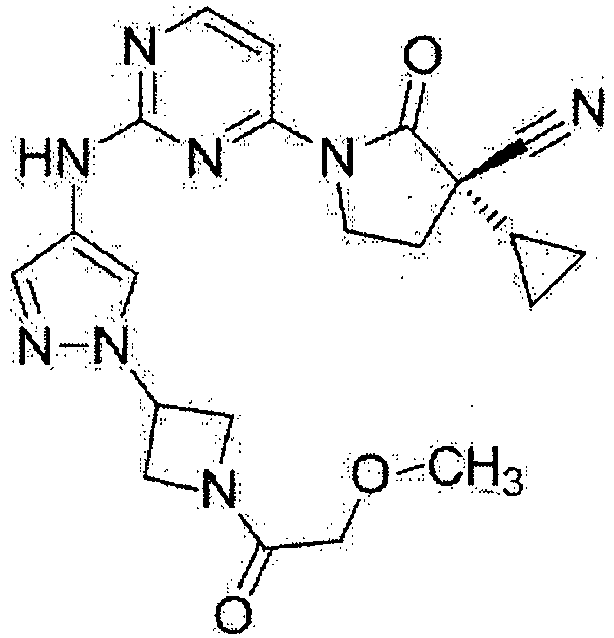
- To a solution of 4-nitro-1H-pyrazole (2.0 g), tert-butyl 3-hydroxyazetidine-1-carboxylate (3.1 g) and triphenylphosphine (5.6 g) in tetrahydrofuran (20 mL) was added di-tert-butyl (E)-diazene-1,2-dicarboxylate (5.3 g) at room temperature, and the mixture was stirred overnight at room temperature. The solvent was evaporated under reduced pressure, and the residue was purified by silica gel column chromatography (hexane/ethyl acetate) to give the title compound (5.3 g).
1H NMR(300 MHz, CDCl3)δ1.47 (9H, s), 4.28-4.37 (2H, m), 4.38-4.47 (2H, m), 5.05 (1H, tt, J = 7.9, 5.1 Hz), 8.16 (1H, s), 8.27 (1H, s). - To a solution of tert-butyl 3-(4-nitro-1H-pyrazol-1-yl)azetidine-1-carboxylate (5.3 g) obtained in Step B of Example 131 in ethanol (30 mL) was added 5% palladium-carbon (4.2 g), and the mixture was stirred at room temperature for 2 hr under hydrogen atmosphere (at normal pressures). The palladium-carbon was removed by filtration through Celite, the solvent was evaporated under reduced pressure, and the residue was purified by silica gel column chromatography (NH, hexane/ethyl acetate) to give the title compound (2.1 g).
1H NMR(300 MHz, DMSO-d6)δ1.39 (9H, s), 3.89 (2H, s), 3.98-4.08 (2H, m), 4.14-4.26 (2H, m), 4.92-5.06 (1H, m), 7.03 (1H, s), 7.13 (1H, d, J = 0.8 Hz). - To a solution of (3S)-1-(2-chloropyrimidin-4-yl)-3-cyclopropyl-2-oxopyrrolidine-3-carbonitrile (300 mg) obtained in Step E of Example 103, tert-butyl 3-(4-amino-1H-pyrazol-1-yl)azetidine-1-carboxylate (300 mg) obtained in Step B of Example 131, cesium carbonate (740 mg) and 2,2'-bis(diphenylphosphino)-1,1'-binaphthyl (110 mg) in tetrahydrofuran (10 mL) was added tris(dibenzylideneacetone)dipalladium(0) (105 mg), and the mixture was stirred at 90°C for 10 hr under argon atmosphere. The solvent was evaporated under reduced pressure, and the reaction mixture was poured into water, and extracted with ethyl acetate. The obtained organic layer was washed with saturated brine, and dried over anhydrous magnesium sulfate, and the solvent was evaporated under reduced pressure. The residue was purified by silica gel column chromatography (NH, hexane/ethyl acetate) to give the title compound (310 mg).
MS(ESI+): [M+H]+ 465.4. - To a solution of tert-butyl 3-(4-((4-((3S)-3-cyano-3-cyclopropyl-2-oxopyrrolidin-1-yl)pyrimidin-2-yl)amino)-1H-pyrazol-1-yl)azetidine-1-carboxylate (300 mg) obtained in Step C of Example 131 in ethyl acetate (5 mL) was added a solution of 4 M hydrogen chloride in ethyl acetate (10 mL), and the mixture was stirred at room temperature for 30 min. The solvent was evaporated under reduced pressure, to a suspension of the reaction mixture in tetrahydrofuran (10 mL) were added triethylamine (1.3 g) and methoxyacetyl chloride (77 mg) at room temperature, and the mixture was stirred at room temperature for 3 hr. The solvent was evaporated under reduced pressure, and the reaction mixture was poured into water, and extracted with ethyl acetate. The obtained organic layer was washed with saturated brine, and dried over anhydrous magnesium sulfate, and the solvent was evaporated under reduced pressure. The residue was purified by silica gel column chromatography (NH, ethyl acetate/methanol). The obtained crude product was subjected to HPLC (C18, mobile phase: water/acetonitrile (containing 10 mM NH4HCO3)), and the obtained fraction was concentrated under reduced pressure. The residue was recrystallized (ethyl acetate/diisopropyl ether) to give the title compound (60 mg).
MS(ESI+): [M+H]+ 437.3. -

- A solution of (3S)-1-(2-chloropyrimidin-4-yl)-3-cyclopropyl-2-oxopyrrolidine-3-carbonitrile (100 mg) obtained in Step E of Example 103, 2-(4-amino-1H-pyrazol-1-yl)acetamide (64 mg) and acetic acid (24 µL) in 2-propanol (3.0 mL) was stirred in a microwave reactor at 160°C for 1 hr, and the solvent was evaporated under reduced pressure. The obtained residue was purified by silica gel column chromatography (NH, ethyl acetate/methanol).
- To a solution of the residue (87 mg) in ethanol (3.0 mL) was added 1M hydrochloric acid (240 µL), and the solvent was evaporated under reduced pressure. The residue was recrystallized (diisopropyl ether/ethanol) to give the title compound (67 mg).
1H NMR(300 MHz, DMSO-d6)δ0.48-0.59 (2H, m), 0.59-0.74 (2H, m), 1.54 (1H, m), 2.30-2.41 (1H, m), 2.65 (1H, m), 3.91-4.30 (2H, m), 4.67-4.80 (2H, m), 7.16-7.31 (1H, m), 7.42 (1H, brs), 7.52-7.61 (2H, m), 7.79-7.99 (1H, m), 8.38 (1H, d, J = 5.6 Hz), 9.80 (1H, brs).
MS (ESI+) : [M+H]+ 367.3. -

- A solution of (3R)-1-(2-chloropyrimidin-4-yl)-3-cyclopropyl-2-oxopyrrolidine-3-carbonitrile (130 mg) obtained in Step A of Example 105, 2-(4-amino-1H-pyrazol-1-yl)-N-methylacetamide (84 mg) and acetic acid (31 µL) in ethanol (3.0 mL) was stirred in a microwave reactor at 160°C for 1 hr, and the solvent was evaporated under reduced pressure. The obtained residue was purified by silica gel column chromatography (hexane/ethyl acetate). To a solution of the residue (180 mg) in ethanol (5.0 mL) was added 1 M hydrochloric acid (0.50 mL), and the solvent was evaporated under reduced pressure. The residue was recrystallized (diisopropyl ether/ethanol) to give the title compound (120 mg).
1H NMR(300 MHz, DMSO-d6)δ0.41-0.84 (4H, m), 1.43-1.64 (1H, m), 2.15-2.40 (2H, m), 2.61 (3H, d, J = 4.5 Hz), 2.65-2.81 (1H, m), 3.97-4.29 (2H, m), 4.73 (2H, s), 7.42-7.59 (2H, m), 7.73-8.09 (2H, m), 8.37 (1H, d, J = 5.7 Hz), 9.68 (1H, brs). MS(ESI+): [M+H]+ 381.3. -

- A solution of (3S)-1-(2-chloropyrimidin-4-yl)-3-cyclopropyl-2-oxopyrrolidine-3-carbonitrile (130 mg) obtained in Step E of Example 103, 2-(4-amino-1H-pyrazol-1-yl)-N-methylacetamide (84 mg) and acetic acid (31 µL) in ethanol (3.0 mL) was strried in a microwave reactor at 150°C for 1 hr, and the solvent was evaporated under reduced pressure. The obtained residue was purified by silica gel column chromatography (hexane/ethyl acetate). To a solution of the residue (190 mg) in ethanol (5.0 mL) was added 1 M hydrochloric acid (0.50 mL), and the solvent was evaporated under reduced pressure. The residue was recrystallized (diisopropyl ether/ethanol) to give the title compound (120 mg).
1H NMR(300 MHz, DMSO-d6)δ0.43-0.79 (4H, m), 1.45-1.65 (1H, m), 2.26-2.43 (2H, m), 2.61 (3H, d, J = 4.5 Hz), 2.64-2.78 (1H, m), 3.85-4.36 (2H, m), 4.73 (2H, s), 7.44-7.65 (2H, m), 7.80-8.06 (2H, m), 8.37 (1H, d, J = 5.7 Hz), 9.67 (1H, brs).
MS (ESI+) : [M+H]+381.3. - In Examples 135 to 137, the title compound was obtained from (3S)-1-(2-chloropyrimidin-4-yl)-3-cyclopropyl-2-oxopyrrolidine-3-carbonitrile obtained in Step E of Example 103 and the amine each corresponding to the compounds of Examples 135 to 137 (N-(2-(4-amino-1H-pyrazol-1-yl)ethyl)acetamide, N-(2-(4-amino-1H-pyrazol-1-yl)ethyl)-2-methoxyacetamide and N-(2-(4-amino-1H-pyrazol-1-yl)ethyl)methanesulfonamide (these compounds can be produced according to a method known per se)), in the same manner as in Step I of Example 103 or a method analogous thereto. MS in the tables means actual measured value.
Table 13 Example Number IUPAC Name Structure Salt MS 135 N-(2-(4-((4-((3S)-3-cyano-3-cyclopropyl-2-oxopyrrolidin-1-yl)pyrimidin-2-yl)amino)-1H-pyrazol-1-yl)ethyl)acetamide 
free 395.3 136 N-(2-(4-((4-((3S)-3-cyano-3-cyclopropyl-2-oxopyrrolidin-1-yl)pyrimidin-2-yl)amino)-1H-pyrazol-1-yl)ethyl)-2-methoxyacetamide 
HCl 425.3 137 N-(2-(4-((4-((3S)-3-cyano-3-cyclopropyl-2-oxopyrrolidin-1-yl)pyrimidin-2-yl)amino)-1H-pyrazol-1-yl)ethyl)methanesulfonamide 
free 431.3 -

- To a solution of 2-(4-((4-((3S)-3-cyano-3-cyclopropyl-2-oxopyrrolidin-1-yl)pyrimidin-2-yl)amino)-1H-pyrazol-1-yl)-2-methylpropanamide (250 mg) obtained in the same manner as in Step D of Example 109 in tetrahydrofuran (5.0 mL) were added successively dropwise pyridine (0.15 mL) and 2,2,2-trifluoroacetic anhydride (0.27 mL), and the mixture was stirred at 70°C for 5 hr. The reaction mixture was neutralized with saturated aqueous sodium bicarbonate, and extracted with ethyl acetate. The obtained organic layer was washed with saturated brine, and dried over anhydrous magnesium sulfate, and the solvent was evaporated under reduced pressure. The residue was purified by silica gel column chromatography (hexane/ethyl acetate), and recrystallized (hexane/ethyl acetate) to give the title compound (190 mg).
MS(ESI+): [M+H]+377.3. -

- To a solution of 2-hydroxy-4-nitrobenzoic acid (5.0 g) in tert-butyl alcohol (100 mL) were added 1-ethyl-3-(3-dimethylaminopropyl)carbodiimide (6.4 g), 1-hydroxybenzotriazole (3.7 g) and triethylamine (7.6 mL), and the mixture was stirred overnight at room temperature. To the reaction mixture was added saturated aqueous sodium hydrogen carbonate solution, and the mixture was extracted with ethyl acetate. The obtained organic layer was washed with saturated brine, and dried over anhydrous magnesium sulfate, and the solvent was evaporated under reduced pressure. The residue was purified by silica gel column chromatography (hexane/ethyl acetate) to give the title compound (2.3 g).
1H NMR (400 MHz, DMSO-d6) δ1.57 (9H, s), 7.64-7.80 (2H, m), 7.83-7.97 (1H, m), 11.00 (1H, s). - To a solution of tert-butyl 2-hydroxy-4-nitrobenzoate (500 mg) obtained in Step A of Example 139 in acetone (5.0 mL) were added potassium carbonate (580 mg) and iodoethane (340 µL), and the mixture was stirred overnight with heating under reflux. To the reaction mixture was added water, and the mixture was extracted with ethyl acetate. The obtained organic layer was washed with saturated brine, and dried over anhydrous magnesium sulfate, and the solvent was evaporated under reduced pressure. The residue was purified by silica gel column chromatography (hexane/ethyl acetate) to give the title compound (550 mg).
1H NMR (400 MHz, DMSO-d6) δ1.37 (3H, t, J = 7.0 Hz), 1.53 (9H, s), 4.22 (2H, d, J = 7.1 Hz), 7.70-7.76 (1H, m), 7.81-7.86 (2H, m). - To a solution of tert-butyl 2-ethoxy-4-nitrobenzoate (550 mg) obtained in Step B of Example 139 in ethanol (10 mL) was added 10% palladium-carbon (42 mg), and the mixture was stirred overnight at room temperature under hydrogen atmosphere (at normal pressures). The palladium carbon was removed by filtration through Celite, and the solvent was evaporated under reduced pressure to give the title compound (470 mg).
1H NMR (400 MHz, DMSO-d6) δ 1.32 (3H, t, J = 7.0 Hz), 1.46 (9H, s), 3.91 (2H, q, J = 7.0 Hz), 5.77 (2H, s), 6.10 (1H, dd, J = 8.6, 2.0 Hz), 6.14 (1H, d, J = 2.0 Hz), 7.40 (1H, d, J = 8.3 Hz). - To a solution of (3S)-1-(2-chloropyrimidin-4-yl)-3-cyclopropyl-2-oxopyrrolidine-3-carbonitrile (100 mg) obtained in Step E of Example 103, tert-butyl 4-amino-2-ethoxybenzoate (110 mg) obtained in Step C of Example 139, cesium carbonate (250 mg) and 2,2'-bis(diphenylphosphino)-1,1'-binaphthyl (35 mg) in tetrahydrofuran (3.0 mL) was added tris(dibenzylideneacetone)dipalladium(0) (34 mg) under argon atmosphere, and the mixture was stirred overnight at 90°C. The insoluble substance was removed by filtration through Celite, and the solvent was evaporated under reduced pressure. The residue was purified by silica gel column chromatography (hexane/ethyl acetate) to give the title compound (41 mg).
MS(ESI+): [M+H]+ 464.4. -

- To a solution of tert-butyl 4-((4-((3S)-3-cyano-3-cyclopropyl-2-oxopyrrolidin-1-yl)pyrimidin-2-yl)amino)-2-ethoxybenzoate (40 mg) obtained in Step D of Example 139 in ethyl acetate (4.0 mL) was added a solution of 4 M hydrogen chloride in ethyl acetate (4.0 mL), the mixture was stirred at room temperature for 2 hr, and the solvent was evaporated under reduced pressure. The residue was washed with ethyl acetate to give the title compound (20 mg).
MS (ESI+) : [M+H]+ 408.3. -

- The title compound (600 mg) was obtained from tert-butyl 2-hydroxy-4-nitrobenzoate (500 mg) obtained in Step A of Example 139 and 2-iodopropane (710 mg) in the same manner as in Step B of Example 139.
1H NMR (400 MHz, DMSO-d6) δ 1.31 (6H, d, J = 5.9 Hz), 1.48-1.57 (9H, m), 4.87 (1H, dt, J = 12.0, 6.0 Hz), 7.69 (1H, s), 7.77-7.82 (1H, m), 7.85 (1H, d, J = 2.0 Hz). - The title compound (490 mg) was obtained from tert-butyl 2-isopropoxy-4-nitrobenzoate (550 mg) obtained in Step A of Example 141 in the same manner as in Step C of Example 139.
MS(ESI+): [M+H-(tBu)]+ 196.2. - The title compound (46 mg) was obtained from (3S)-1-(2-chloropyrimidin-4-yl)-3-cyclopropyl-2-oxopyrrolidine-3-carbonitrile (100 mg) obtained in Step E of Example 103 and tert-butyl 4-amino-2-isopropoxybenzoate (115 mg) obtained in Step B of Example 141 in the same manner as in Step D of Example 139.
MS(ESI+): [M+H]+ 478.4. -

- The title compound (22 mg) was obtained from tert-butyl 4-((4-((3S)-3-cyano-3-cyclopropyl-2-oxopyrrolidin-1-yl)pyrimidin-2-yl)amino)-2-isopropoxybenzoate (40 mg) obtained in Step C of Example 141 in the same manner as in Example 140.
MS(ESI+): [M+H]+ 422.3. -

- The title compound (4.3 g) was obtained from 2-fluoro-4-nitrobenzoic acid (5.0 g) in the same manner as in Step A of Example 139.
1H NMR (400 MHz, DMSO-d6) δ 1.56 (9H, s), 8.03-8.09 (1H, m), 8.12-8.17 (1H, m), 8.22 (1H, dd, J = 10.4, 2.1 Hz). - To a solution of tert-butyl 2-fluoro-4-nitrobenzoate (1.0 g) obtained in Step A of Example 143 in tetrahydrofuran (10 mL) were successively added 2,2,2-trifluoropropan-1-ol (0.53 g) and sodium hydride (60% in mineral oil, 200 mg) in an ice bath, and the mixture was stirred at room temperature for 2 hr. To the reaction mixture was added saturated aqueous sodium hydrogen carbonate solution, and the mixture was extracted with ethyl acetate. The obtained organic layer was washed with saturated brine, and dried over anhydrous magnesium sulfate, and the solvent was evaporated under reduced pressure. The residue was purified by silica gel column chromatography (hexane/ethyl acetate) to give the title compound (1.1 g).
1H NMR (400 MHz, DMSO-d6) δ 1.53 (9H, s), 5.04 (2H, q, J = 8.7 Hz), 7.82 (1H, d, J = 8.3 Hz), 7.96 (1H, dd, J = 8.4, 2.1 Hz), 8.02 (1H, d, J = 2.2 Hz). - The title compound (1.1 g) was obtained from tert-butyl 4-nitro-2-(2,2,2-trifluoroethoxy)benzoate (1.1 g) obtained in Step B of Example 143 in the same manner as in Step C of Example 139.
1H NMR (400 MHz, DMSO-d6) δ 1.46 (9H, s), 4.58 (2H, q, J = 8.8 Hz), 5.90 (2H, s), 6.17 (1H, d, J = 2.0 Hz), 6.23 (1H, dd, J = 8.6, 2.0 Hz), 7.45 (1H, d, J = 8.6 Hz). - The title compound (110 mg) was obtained from (3S)-1-(2-chloropyrimidin-4-yl)-3-cyclopropyl-2-oxopyrrolidine-3-carbonitrile (100 mg) obtained in Step E of Example 103 and tert-butyl 4-amino-2-(2,2,2-trifluoroethoxy)benzoate (130 mg) obtained in Step C of Example 143 in the same manner as in Step D of Example 139.
MS(ESI+): [M+H]+ 518.3. - The title compound (64 mg) was obtained from tert-butyl 4-((4-((3S)-3-cyano-3-cyclopropyl-2-oxopyrrolidin-1-yl)pyrimidin-2-yl)amino)-2-(2,2,2-trifluoroethoxy)benzoate (110 mg) obtained in Step D of Example 143 in the same manner as in Example 140.
MS (ESI+) : [M+H]+ 462.3. -

- The title compound (280 mg) was obtained from tert-butyl 2-hydroxy-4-nitrobenzoate (500 mg) obtained in Step A of Example 139 and 1-bromo-2-methylpropane (0.34 mL) in the same manner as in Step B of Example 139.
1H NMR (400 MHz, DMSO-d6) δ 1.01 (6H, d, J = 6.6 Hz), 1.50-1.57 (9H, m), 1.99-2.15 (1H, m), 3.95 (2H, d, J = 6.4 Hz), 7.72 (1H, d, J = 8.1 Hz), 7.79-7.86 (2H, m). - The crude title compound (250 mg) was obtained from tert-butyl 2-isobutoxy-4-nitrobenzoate (200 mg) obtained in Step A of Example 144 in the same manner as in Step C of Example 139.
1H NMR (400 MHz, DMSO-d6) δ 1.00 (6H, d, J = 6.8 Hz), 1.47 (9H, s), 2.02 (1H, d, J = 6.8 Hz), 3.63 (2H, d, J = 6.4 Hz), 5.74 (2H, s), 6.09 (1H, dd, J = 8.4, 2.1 Hz), 6.14 (1H, d, J = 2.0 Hz), 7.39 (1H, d, J = 8.6 Hz). - The title compound (110 mg) was obtained from (3S)-1-(2-chloropyrimidin-4-yl)-3-cyclopropyl-2-oxopyrrolidine-3-carbonitrile (100 mg) obtained in Step E of Example 103 and the crude tert-butyl 4-amino-2-isobutoxybenzoate (120 mg) obtained in Step B of Example 144 in the same manner as in Step D of Example 139.
MS(ESI+): [M+H]+ 492.4. - The title compound (90 mg) was obtained from tert-butyl 4-((4-((3S)-3-cyano-3-cyclopropyl-2-oxopyrrolidin-1-yl)pyrimidin-2-yl)amino)-2-isobutoxybenzoate (100 mg) obtained in Step C of Example 144 in the same manner as in Example 140.
MS(ESI+): [M+H]+ 436.3. -

- To a solution of ethyl (4-nitrophenyl)acetate (5.0 g) in N,N-dimethylformamide (100 mL) was added sodium hydride (60% in mineral oil, 1.9 g) in an ice bath, and the mixture was stirred at room temperature for 20 min. To the reaction mixture was added 1,2-dibromoethane (4.1 mL) in an ice bath, and the mixture was stirred at the same temperature for 30 min, and the at room temperature for 1 hr. The reaction mixture was colled to 0°C, water was added thereto, and the mixture was extracted with ethyl acetate. The obtained organic layer was washed with saturated brine, and dried over anhydrous sodium sulfate, and the solvent was evaporated under reduced pressure. The residue was purified by silica gel column chromatography (hexane/ethyl acetate) to give the title compound (3.0 g).
1H NMR (400 MHz, DMSO-d6) δ 1.10 (3H, t, J = 7.1 Hz), 1.26-1.33 (2H, m), 1.54-1.59 (2H, m), 4.05 (2H, q, J = 7.1 Hz), 7.60-7.67 (2H, m), 8.14-8.20 (2H, m). - To a solution of ethyl 1-(4-nitrophenyl)cyclopropanecarboxylate (3.0 g) obtained in Step A of Example 145 in ethanol (50 mL) was added 1M aqueous sodium hydroxide solution (25 mL), and the mixture was stirred overnight at room temperature. The reaction mixture was concentrated under reduced pressure, and 1M hydrochloric acid was added thereto at 0°C. The resulting solid was collected by filtration to give the title compound (2.5 g).
1H NMR (400 MHz, DMSO-d6) δ1.13-1.34 (2H, m), 1.39-1.67 (2H, m), 7.43-7.71 (2H, m), 7.97-8.27 (2H, m), 12.61 (1H, brs). - To a solution of 1-(4-nitrophenyl)cyclopropanecarboxylic acid (500 mg) obtained in Step B of Example 145 in ethanol (10 mL) was added palladium-activated carbon ethylene diamine complex (Pd 8.5 to 11.5%) (100 mg), and the mixture was stirred overnight at room temperature under hydrogen atmosphere (at normal pressures). The palladium carbon was removed by filtration through Celite, and the solvent was evaporated under reduced pressure to give the title compound (260 mg).
1H NMR (400 MHz, DMSO-d6) δ0.92-1.01 (2H, m), 1.32 (2H, q, J = 3.5 Hz), 4.96 (2H, brs), 6.41-6.53 (2H, m), 6.88-6.97 (2H, m). - A solution of (3S)-1-(2-chloropyrimidin-4-yl)-3-cyclopropyl-2-oxopyrrolidine-3-carbonitrile (100 mg) obtained in Step E of Example 103, 1-(4-aminophenyl)cyclopropanecarboxylic acid (67 mg) obtained in Step C of Example 145 and acetic acid (30 µL) in 2-propanol (1.5 mL) was stirred in a microwave reactor at 150°C for 1 hr, and the resulting solid was collected by filtration to give the title compound (130 mg).
MS(ESI+): [M+H]+ 404.3. -

- The title compound (1.9 g) was obtained from ethyl (4-nitrophenyl)acetate (5.0 g) and 1,3-diiodopropane (5.5 mL) in the same manner as in Step A of Example 145.
1H NMR (400 MHz, DMSO-d6) δ1.06-1.13 (3H, m), 1.79-1.90 (1H, m), 1.95-2.03 (1H, m), 2.45-2.50 (2H, m), 2.73-2.82 (2H, m), 4.06 (2H, q, J = 7.1 Hz), 7.48-7.67 (2H, m), 8.16-8.31 (2H, m). - The title compound (1.4 g) was obtained from ethyl 1-(4-nitrophenyl)cyclobutanecarboxylate (1.9 g) obtained in Step A of Example 146 in the same manner as in Step B of Example 145.
1H NMR (400 MHz, DMSO-d6) δ 1.75-1.88 (1H, m), 2.01 (1H, dquin, J = 10.6, 8.5 Hz), 2.40-2.49 (2H, m), 2.70-2.81 (2H, m), 7.50-7.56 (2H, m), 8.17-8.25 (2H, m), 12.70 (1H, brs). - The title compound (550 mg) was obtained from 1-(4-nitrophenyl)cyclobutanecarboxylic acid (1.0 g) obtained in Step B of Example 146 in the same manner as in Step C of Example 139.
1H NMR (400 MHz, DMSO-d6) δ1.64-1.97 (2H, m), 2.20-2.37 (2H, m), 2.56-2.68 (2H, m), 4.97 (2H, brs), 6.44-6.58 (2H, m), 6.88-7.00 (2H, m), 11.94 (1H, brs). - The title compound (120 mg) was obtained from (3S)-1-(2-chloropyrimidin-4-yl)-3-cyclopropyl-2-oxopyrrolidine-3-carbonitrile (100 mg) obtained in Step E of Example 103 and 1-(4-aminophenyl)cyclobutanecarboxylic acid (73 mg) obtained in Step C of Example 146 in the same manner as in Step D of Example 145.
MS(ESI+): [M+H]+ 418.3. -

- The title compound (110 mg) was obtained from (3S)-1-(2-chloropyrimidin-4-yl)-3-cyclopropyl-2-oxopyrrolidine-3-carbonitrile (100 mg) obtained in Step E of Example 103 and 2-(4-aminophenyl)-2-methylpropanecarboxylic acid (68 mg) in the same manner as in Step D of Example 145.
MS(ESI+): [M+H]+ 406.3. -

- The title compound (110 mg) was obtained from (3S)-1-(2-chloropyrimidin-4-yl)-3-cyclopropyl-2-oxopyrrolidine-3-carbonitrile (150 mg) obtained in Step E of Example 103 and 2-(4-aminophenyl)-2-methylpropanenitrile (91 mg) in the same manner as in Step B of Example 2.
MS (ESI+) : [M+H]+ 387.1. -

- The title compound (40 mg) was obtained from (3S)-1-(2-chloropyrimidin-4-yl)-3-cyclopropyl-2-oxopyrrolidine-3-carbonitrile (61 mg) obtained in Step E of Example 103 and 2-(4-aminophenyl)-2-methylpropanamide (41 mg) in the same manner as in Step B of Example 2.
MS(ESI+): [M+H]+ 405.1. -

- To a solution of 2-(4-bromophenyl)acetonitrile (3.9 g) in tetrahydrofuran (50 mL) was added potassium tert-butoxide (4.9 g) in an ice bath, and the mixture was stirred for 1 hr in an ice bath, 1-bromo-2-(2-bromoethoxy)ethane (5.8 g) was added thereto at the same temperature, and the mixture was stirred at room temperature for 10 hr. The solvent was evaporated under reduced pressure, and the residue was purified by silica gel column chromatography (hexane/ethyl acetate) to give the title compound (3.7 g).
1H NMR (400 MHz, CDCl3)δ1.99-2.15 (4H, m), 3.83-3.95 (2H, m), 4.04-4.14 (2H, m), 7.33-7.40 (2H, m), 7.51-7.60 (2H, m). - To a solution of 4-(4-bromophenyl)tetrahydro-2H-pyran-4-carbonitrile (1.7 g) obtained in Step A of Example 150, diphenylmethanimine (1.4 g), tris(dibenzylideneacetone)dipalladium(0) (88 mg) and 2,2'-bis(diphenylphosphino)-1,1'-binaphthyl (130 mg) in toluene (50 mL) was added sodium 2-methylpropan-2-olate (920 mg) under nitrogen atmosphere, and the mixture was stirred at 90°C for 10 hr. The reaction mixture was diluted with ethyl acetate, and the insoluble substance was removed by filtration through Celite. The filtrate was concentrated, and to a solution of the residue in methanol (10 mL) were added hydroxylamine hydrochloride (440 mg) and sodium acetate (530 mg). The mixture was stirred at room temperature for 30 min, and 0.1 M aqueous sodium hydroxide solution and ethyl acetate were added thereto. The solvent was evaporated under reduced pressure, and the reaction mixture was poured into water, and extracted with ethyl acetate. The obtained organic layer was washed with saturated brine, and dried over anhydrous magnesium sulfate, and the solvent was evaporated under reduced pressure. The residue was purified by silica gel column chromatography (hexane/ethyl acetate) to give the title compound (910 mg).
MS(ESI+): [M+H]+ 202.9. - To a solution of 4-(4-aminophenyl)tetrahydro-2H-pyran-4-carbonitrile (500 mg) obtained in Step B of Example 150 and potassium carbonate (1.0 g) in dimethylsulfoxide (10 mL) was added 30% aqueous hydrogen peroxide (0.65 mL), and the mixture was stirred at room temperature for 10 hr. To the reaction mixture was added saturated aqueous sodium thiosulfate solution, and the mixture was extracted with ethyl acetate. The obtained organic layer was washed with saturated brine, and dried over anhydrous magnesium sulfate, and the solvent was evaporated under reduced pressure. The residue was purified by silica gel column chromatography (ethyl acetate/methanol) to give the title compound (380 mg).
MS(ESI+): [M+H]+ 220.9. - The title compound (41 mg) was obtained from (3S)-1-(2-chloropyrimidin-4-yl)-3-cyclopropyl-2-oxopyrrolidine-3-carbonitrile (100 mg) obtained in Step E of Example 103 and 4-(4-aminophenyl)tetrahydro-2H-pyran-4-carboxamide (84 mg) obtained in Step C of Example 150 in the same manner as in Step B of Example 2.
MS (ESI+) : [M+H]+ 447.4. -
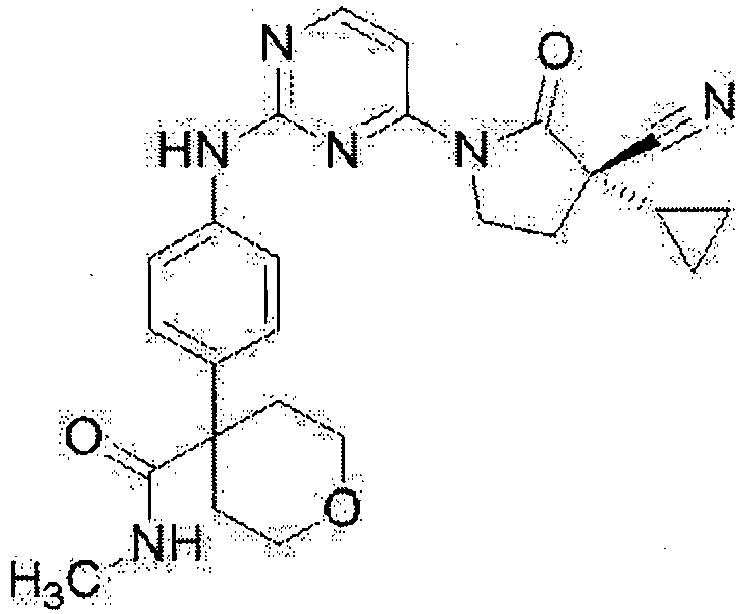
- The title compound (6.6 g) was obtained from ethyl (4-nitrophenyl)acetate (5.0 g) and 2,2'-dibromoethyl ether (6.0 mL) in the same manner as in Step A of Example 145.
1H NMR (400MHz, CDCl3)δ1.20 (3H, t, J = 7.1 Hz), 1.98 (2H, ddd, J = 13.4, 11.5, 4.4 Hz), 2.56 (2H, dd, J = 13.7, 2.4 Hz), 3.59 (2H, td, J = 11.7, 2.1 Hz), 3.96 (2H, dt, J = 11.9, 3.6 Hz), 4.17 (2H, q, J = 7.2 Hz), 7.48-7.65 (2H, m), 8.21 (2H, d, J = 9.0 Hz). - The title compound (4.0 g) was obtained from ethyl 4-(4-nitrophenyl)tetrahydro-2H-pyran-4-carboxylate (6.6 g) obtained in Step A of Example 151 in the same manner as in Step B of Example 145.
1H NMR (400 MHz, DMSO-d6)δ1.78-2.02 (2H, m), 2.41 (2H, d, J = 13.2 Hz), 3.48 (2H, td, J = 11.4, 2.0 Hz), 3.82 (2H, dt, J = 11.7, 3.7 Hz), 7.69 (2H, d, J = 9.3 Hz), 8.07-8.44 (2H, m), 13.02 (1H, s). - To a solution of 4-(4-nitrophenyl)tetrahydro-2H-pyran-4-carboxylic acid (750 mg) obtained in Step B of Example 151, methanamine hydrochloride (1.0 g) and triethylamine (3.0 g) in a mixed solvent of tetrahydrofuran (20 mL) and N,N-dimethylacetamide (5.0 mL) was added 2-(3H-[1,2,3]triazolo[4,5-b]pyridin-3-yl)-1,1,3,3-tetramethylisouronium hexafluorophosphate(V) (0.86 g), and the mixture was stirred at room temperature for 10 hr. The solvent was evaporated under reduced pressure, and the reaction mixture was poured into water, and extracted with ethyl acetate. The obtained organic layer was washed with saturated aqueous sodium hydrogen carbonate solution, and dried over anhydrous magnesium sulfate, and the solvent was evaporated under reduced pressure. The residue was purified by silica gel column chromatography (NH, hexane/ethyl acetate) to give the title compound (400 mg). MS(ESI+): [M+H]+ 265.9.
- To a solution of N-methyl-4-(4-nitrophenyl)tetrahydro-2H-pyran-4-carboxamide (380 mg) obtained in Step C of Example 151 in ethanol (20 mL) was added 10% palladium-carbon (100 mg), and the mixture was stirred at room temperature for 10 hr under hydrogen atmosphere (at normal pressures). The palladium-carbon was removed by filtration through Celite, and the solvent was evaporated under reduced pressure. The residue was purified by silica gel column chromatography (NH, hexane/ethyl acetate) to give the title compound (330 mg).
MS(ESI+): [M+H]+ 234.9. - The title compound (170 mg) was obtained from (3S)-1-(2-chloropyrimidin-4-yl)-3-cyclopropyl-2-oxopyrrolidine-3-carbonitrile (160 mg) obtained in Step E of Example 103 and 4-(4-aminophenyl)-N-methyltetrahydro-2H-pyran-4-carboxamide (140 mg) obtained in Step D of Example 151 in the same manner as in Step B of Example 2.
MS(ESI+): [M+H]+ 461.4. -

- To a solution of lithium aluminium hydride (300 mg) in tetrahydrofuran (20 mL) was added dropwise a solution of ethyl 4-(4-nitrophenyl)tetrahydro-2H-pyran-4-carboxylate (1.0 g) obtained in Step A of Example 151 in tetrahydrofuran (10 mL) at -78°C, and the mixture was stirred at 0°C for 1 hr. To the reaction mixture was added sodium sulfate decahydrate, and the mixture was stirred at room temperature for 2 hr. The insoluble substance was removed by filtration through Celite, and the solvent was evaporated under reduced pressure. The residue was purified by silica gel column chromatography (hexane/ethyl acetate) to give the title compound (330 mg).
1H NMR (400MHz, DMSO-d6)δ1.82-1.94 (2H, m), 1.97-2.08 (2H, m), 3.36 (2H, ddd, J = 11.6, 8.9, 2.9 Hz), 3.46 (2H, d, J = 5.6 Hz), 3.70 (2H, ddd, J = 11.7, 5.6, 3.8 Hz), 4.74 (1H, t, J = 5.5 Hz), 7.65 (2H, d, J = 9.0 Hz), 8.18 (2H, d, J = 9.0 Hz). - The title compound (240 mg) was obtained from (4-(4-nitrophenyl)tetrahydro-2H-pyran-4-yl)methanol (330 mg) obtained in Step A of Example 152 in the same manner as in Step D of Example 151.
1H NMR (400MHz, DMSO-d6)δ1.73-1.92 (4H, m), 3.21 (2H, d, J = 5.4 Hz), 3.28-3.36 (2H, m), 3.64 (2H, dt, J = 11.4, 4.0 Hz), 4.47 (1H, t, J = 5.5 Hz), 4.85 (2H, s), 6.52 (2H, d, J = 8.6 Hz), 6.96 (2H, d, J = 8.6 Hz). - The title compound (95 mg) was obtained from (3S)-1-(2-chloropyrimidin-4-yl)-3-cyclopropyl-2-oxopyrrolidine-3-carbonitrile (100 mg) obtained in Step E of Example 103 and (4-(4-aminophenyl)tetrahydro-2H-pyran-4-yl)methanol (79 mg) obtained in Step B of Example 152 in the same manner as in Step B of Example 2.
MS(ESI+): [M+H]+ 434.4. -

- To a solution of 2-chloro-5-nitropyridine (7.0 g) in N,N-dimethylformamide (100 mL) were successively added sodium hydride (60% in mineral oil, 2.1 g) and tert-butyl ethyl malonate (10 g), and the mixture was stirred overnight at 50°C. To the reaction mixture was added water, and the mixture was extracted with ethyl acetate. The obtained organic layer was washed successively with water and saturated brine, and dried over anhydrous magnesium sulfate, and the solvent was evaporated under reduced pressure. The residue was purified by silica gel column chromatography (hexane/ethyl acetate) to give the title compound (10 g).
1H NMR (400MHz, CDCl3)δ1.30 (3H, t, J = 7.2 Hz), 1.48 (9H, s), 4.19-4.43 (2H, m), 4.98 (1H, s), 7.76 (1H, dd, J = 8.6, 0.5 Hz), 8.50 (1H, dd, J = 8.8, 2.7 Hz), 9.38 (1H, d, J = 2.4 Hz). - To tert-butyl ethyl (5-nitropyridin-2-yl)malonate (10 g) obtained in Step A of Example 153 was added a solution of 4 M hydrogen chloride in ethyl acetate (40 mL), and the mixture was stirred overnight at room temperature. The solvent was evaporated under reduced pressure, and diethyl ether (150 mL) and saturated aqueous sodium hydrogen carbonate solution were added thereto. To the reaction mixture was added sodium hydrogen carbonate until bubble generation stopped, and the mixture was extracted with ethyl acetate. The obtained organic layer was washed with saturated brine, and dried over anhydrous magnesium sulfate, and the solvent was evaporated under reduced pressure. The residue was purified by silica gel column chromatography (hexane/ethyl acetate) to give the title compound (5.6 g).
1H NMR (400MHz, CDCl3)δ1.28 (3H, t, J = 7.1 Hz), 3.98 (2H, s), 4.21 (2H, q, J = 7.1 Hz), 7.54 (1H, d, J = 8.6 Hz), 8.46 (1H, dd, J = 8.6, 2.7 Hz), 9.38 (1H, d, J = 2.4 Hz). - To a solution of sodium hydride (60% in mineral oil, 3.2 g) in N,N-dimethylformamide (40 mL) was added a solution of ethyl (5-nitropyridin-2-yl)acetate (5.6 g) obtained in Step B of Example 153 in N,N-dimethylformamide (10 mL) at -20°C under nitrogen atmosphere, and the mixture was stirred at 0°C for 1 hr. The reaction mixture was cooled to -20°C again, iodomethane (5.5 mL) was added thereto, and the mixture was stirred at 0°C for 5 hr. To the reaction mixture was added saturated aqueous ammonium chloride solution, and the mixture was extracted with ethyl acetate. The obtained organic layer was washed successively with water and saturated brine, and dried over anhydrous magnesium sulfate, and the solvent was evaporated under reduced pressure. The residue was purified by silica gel column chromatography (hexane/ethyl acetate) to give the title compound (3.2 g).
1H NMR (400MHz, CDCl3)δ1.19 (3H, t, J = 7.1 Hz), 1.65 (6H, s), 4.16 (2H, q, J = 7.1 Hz), 7.50 (1H, dd, J = 8.7, 0.6 Hz), 8.44 (1H, dd, J = 8.8, 2.7 Hz), 9.36 (1H, dd, J = 2.7, 0.5 Hz). - To a solution of ethyl 2-methyl-2-(5-nitropyridin-2-yl)propanoate (3.3 g) obtained in Step C of Example 153 in ethanol (30 mL) was added 10% palladium-carbon (300 mg), and the mixture was stirred overnight at room temperature under hydrogen atmosphere (at normal pressures). The palladium-carbon was removed by filtration through Celite, and the solvent was evaporated under reduced pressure.
- To a solution of the residue in tetrahydrofuran (30 mL) were added pyridine (3.3 g) and benzyl chloroformate (4.0 mL), and the mixture was stirred at room temperature for 2 hr in an ice bath. To the reaction mixture was added water, and the mixture was extracted with ethyl acetate. The obtained organic layer was washed successively with water and saturated brine, and dried over anhydrous magnesium sulfate, and the solvent was evaporated under reduced pressure. The residue was purified by silica gel column chromatography (hexane/ethyl acetate) to give the title compound (4.7 g).
1H NMR (400MHz, CDCl3)δ1.17 (3H, t, J = 7.1 Hz), 1.58 (6H, s), 4.01-4.27 (2H, m), 5.21 (2H, s), 6.72 (1H, brs), 7.33-7.48 (6H, m), 7.97 (1H, brs), 8.31-8.43 (1H, m). - To a solution of ethyl 2-(5-(((benzyloxy)carbonyl)amino)pyridin-2-yl)-2-methylpropanoate (4.7 g) obtained in Step D of Example 153 in ethanol (50 mL) was added 2 M aqueous sodium hydroxide solution (30 mL), and the mixture was stirred overnight at room temperature. To the reaction mixture was added water, and the mixture was washed with diethyl ether. The obtained aqueous layer was neutralized with 2 M hydrochloric acid, and extracted with ethyl acetate. The obtained organic layer was washed with saturated brine, and dried over anhydrous magnesium sulfate, and the solvent was evaporated under reduced pressure to give a crude compound (2.42 g).
- To a solution of the crude compound (800 mg) in N,N-dimethylacetamide (5.0 mL) were added ammonium chloride (230 mg), diisopropylethylamine (0.74 mL) and O-(benzotriazol-1-yl)-N,N,N',N'-tetramethyluronium hexafluorophosphorate (1.6 g), and the mixture was stirred overnight at room temperature. To the reaction mixture was added saturated aqueous sodium hydrogen carbonate solution, and the mixture was extracted with ethyl acetate. The obtained organic layer was washed successively with water and saturated brine, and dried over anhydrous magnesium sulfate, and the solvent was evaporated under reduced pressure. The residue was purified by silica gel column chromatography (hexane/ethyl acetate) to give the crude title compound (880 mg).
MS(ESI+): [M+H]+ 313.9. - To a solution of the crude benzyl (6-(1-amino-2-methyl-1-oxopropan-2-yl)pyridin-3-yl)carbamate (880 mg) obtained in Step E of Example 153 in ethanol (30 mL) was added 10% palladium-carbon (90 mg), and the mixture was stirred overnight at room temperature under hydrogen atmosphere (at normal pressures). The palladium-carbon was removed by filtration through Celite, the solvent was evaporated under reduced pressure, and the residue was purified by silica gel column chromatography (ethyl acetate/methanol) to give the title compound (100 mg).
MS(ESI+): [M+H]+ 180.3. - The title compound (30 mg) was obtained from (3S)-1-(2-chloropyrimidin-4-yl)-3-cyclopropyl-2-oxopyrrolidine-3-carbonitrile (70 mg) obtained in Step E of Example 103 and 2-(5-aminopyridin-2-yl)-2-methylpropanamide (48 mg) obtained in Step F of Example 153 in the same manner as in Example 56. MS(ESI+): [M+H]+ 406.3.
-

- To a solution of ethyl 2-(5-(((benzyloxy)carbonyl)amino)pyridin-2-yl)-2-methylpropanoate (4.7 g) obtained in Step D of Example 153 in ethanol (50 mL) was added 2 M aqueous sodium hydroxide solution00 (30 mL), and the mixture was stirred overnight at room temperature. To the reaction mixture was added water, and the mixture was washed with diethyl ether. The obtained aqueous layer was neutralized with 2 M hydrochloric acid, and extracted with ethyl acetate. The obtained organic layer was washed with saturated brine, and dried over anhydrous magnesium sulfate, and the solvent was evaporated under reduced pressure to give a crude compound (2.42 g).
- To a solution of the crude compound (800 mg) in N,N-dimethylacetamide (5.0 mL) were added methylamine hydrochloride (280 mg), diisopropylethylamine (0.74 mL) and O-(benzotriazol-1-yl)-N,N,N',N'-tetramethyluronium hexafluorophosphorate (1.6 g), and the mixture was stirred overnight at room temperature. To the reaction mixture was added saturated aqueous sodium hydrogen carbonate solution, and the mixture was extracted with ethyl acetate. The obtained organic layer was washed successively with water and saturated brine, and dried over anhydrous magnesium sulfate, and the solvent was evaporated under reduced pressure. The residue was purified by silica gel column chromatography (hexane/ethyl acetate) to give the crude title compound (1.2 g).
MS(ESI+): [M+H]+ 328.3. - The title compound (210 mg) was obtained from the crude benzyl (6-(2-methyl-1-(methylamino)-1-oxopropan-2-yl)pyridin-3-yl)carbamate (1.2 g) obtained in Step A of Example 154 in the same manner as in Step F of Example 153.
MS(ESI+): [M+H]+ 194.3. - The title compound (55 mg) was obtained from (3S)-1-(2-chloropyrimidin-4-yl)-3-cyclopropyl-2-oxopyrrolidine-3-carbonitrile (70 mg) obtained in Step E of Example 103 and 2-(5-aminopyridin-2-yl)-N,2-dimethylpropanamide (52 mg) obtained in Step B of Example 154 in the same manner as in Example 56.
MS(ESI+): [M+H]+ 420.4. -

- The title compound (380 mg) was obtained from (3S)-1-(2-chloropyrimidin-4-yl)-3-cyclopropyl-2-oxopyrrolidine-3-carbonitrile (300 mg) obtained in Step E of Example 103 and 4-aminobenzoic acid (160 mg) in the same manner as in Step B of Example 2.
MS (ESI+) : [M+H]+ 364.3. - The title compound was obtained from 4-((4-((3S)-3-cyano-3-cyclopropyl-2-oxopyrrolidin-1-yl)pyrimidin-2-yl)amino)benzoic acid obtained in Example 155 and each corresponding amine (these compounds can be produced according to a method known per se), in the same manner as in Example 110.
Table 14-1 Example Number IUPAC Name Structure Salt MS 156 (3S)-3-cyclopropyl-1-(2-((4-(morpholin-4-ylcarbonyl)phenyl)amino)pyrimidin-4-yl)-2-oxopyrrolidine-3-carbonitrile 
HCl 433.3 157 (3S)-3-cyclopropyl-1-(2-((4-(((3R)-3-hydroxypyrrolidin-1-yl)carbonyl)phenyl)amino)pyrimidin-4-yl)-2-oxopyrrolidine-3-carbonitrile 
Free 433.3 158 (3S)-3-cyclopropyl-1-(2-((4-(((3S)-3-hydroxypyrrolidin-1-yl)carbonyl)phenyl)amino)pyrimidin-4-yl)-2-oxopyrrolidine-3-carbonitrile 
Free 433.3 159 (3S)-3-cyclopropyl-1-(2-((4-((4-hydroxypiperidin-1-yl)carbonyl)phenyl)amino)pyrimidin-4-yl)-2-oxopyrrolidine-3-carbonitrile 
Free 447.1 160 4-((4-((3S)-3-cyano-3-cyclopropyl-2-oxopyrrolidin-1-yl)pyrimidin-2-yl)amino)-N-(2-(methylsulfonyl)ethyl)benzamide 
Free 469.3 161 (3S)-3-cyclopropyl-1-(2-((4-((3-hydroxyazetidin-1-yl)carbonyl)phenyl)amino)pyrimidin-4-yl)-2-oxopyrrolidine-3-carbonitrile 
Free 419.3 162 (3S)-3-cyclopropyl-2-oxo-1-(2-((4-((3-oxopyrrolidin-1-yl)carbonyl)phenyl)amino)pyrimidin-4-yl)pyrrolidine-3-carbonitrile 
Free 431. 3 163 (3S)-3-cyclopropyl-1-(2-((4-((3,3-difluoropyrrolidin-1-yl)carbonyl)phenyl)amino)pyrimidin-4-yl)-2-oxopyrrolidine-3-carbonitrile 
Free 453.3 Table 14-2 164 (3S)-3-cyclopropyl-1-(2-((4-(2-oxa-6-azaspiro[3.3]hept-6-ylcarbonyl)phenyl)amino)pyrimidin-4-yl)-2-oxopyrrolidine-3-carbonitrile 
Free 445.3 165 (3S)-3-cyclopropyl-1-(2-((4-((1,1-dioxidethiomorpholin-4-yl)carbonyl)phenyl)amino)pyrimidin-4-yl)-2-oxopyrrolidine-3-carbonitrile 
Free 481.3 166 (3S)-3-cyclopropyl-1-(2-((4-(((3S)-3-fluoropyrrolidin-1-yl)carbonyl)phenyl)amino)pyrimidin-4-yl)-2-oxopyrrolidine-3-carbonitrile 
Free 435.3 167 (3S)-3-cyclopropyl-1-(2-((4-(((3R)-3-fluoropyrrolidin-1-yl)carbonyl)phenyl)amino)pyrimidin-4-yl)-2-oxopyrrolidine-3-carbonitrile 
Free 435.3 168 (3S)-3-cyclopropyl-1-(2-((4-((3-methoxyazetidin-1-yl)carbonyl)phenyl)amino)pyrimidin-4-yl)-2-oxopyrrolidine-3-carbonitrile 
Free 433.3 169 (3S)-3-cyclopropyl-1-(2-((4-(((3S)-3-hydroxypiperidin-1-yl)carbonyl)phenyl)amino)pyrimidin-4-yl)-2-oxopyrrolidine-3-carbonitrile 
Free 447.4 170 (3S)-3-cyclopropyl-1-(2-((4-(((3R)-3-hydroxypiperidin-1-yl)carbonyl)phenyl)amino)pyrimidin-4-yl)-2-oxopyrrolidine-3-carbonitrile 
Free 447.4 171 4-((4-((3S)-3-cyano-3-cyclopropyl-2-oxopyrrolidin-1-yl)pyrimidin-2-yl)amino)-N-(tetrahydro-2H-pyran-4-yl)benzamide 
Free 447.3 172 4-((4-((3S)-3-cyano-3-cyclopropyl-2-oxopyrrolidin-1-yl)pyrimidin-2-yl)amino)-N-(trans-4-hydroxycyclohexyl)benzamide 
Free 461.4 Table 14-3 173 (3S)-3-cyclopropyl-1-(2-((4-((3-hydroxy-3-methylpyrrolidin-1-yl)carbonyl)phenyl)amino)pyrimidin-4-yl)-2-oxopyrrolidine-3-carbonitrile 
Free 447.3 174 (3S)-3-cyclopropyl-1-(2-((4-(((3S)-3-methoxypyrrolidin-1-yl)carbonyl)phenyl)amino)pyrimidin-4-yl)-2-oxopyrrolidine-3-carbonitrile 
Free 447.3 175 (3S)-3-cyclopropyl-1-(2-((4-(((3R)-3-methoxypyrrolidin-1-yl)carbonyl)phenyl)amino)pyrimidin-4-yl)-2-oxopyrrolidine-3-carbonitrile 
Free 447. 3 - The title compound was obtained from (3R)-1-(2-chloropyrimidin-4-yl)-3-ethyl-2-oxopyrrolidine-3-carbonitrile obtained in Step A of Example 8 and each corresponding amine (these compounds can be produced according to a method known per se), in the same manner as in Step B of Example 2.
Table 15 Example Number IUPAC Name Structure Salt MS 176 2-(4-((4-((3R)-3-cyano-3-ethyl-2-oxopyrrolidin-1-yl)pyrimidin-2-yl)amino)-1H-pyrazol-1-yl)acetamide 
free 355.3 177 2-(4-((4-((3R)-3-cyano-3-ethyl-2-oxopyrrolidin-1-yl)pyrimidin-2-yl)amino)-1H-pyrazol-1-yl)-N-methylacetamide 
HCl 369.3 178 2-(4-((4-((3R)-3-cyano-3-ethyl-2-oxopyrrolidin-1-yl)pyrimidin-2-yl)amino)-1H-pyrazol-1-yl)-N,N-dimethylacetamide 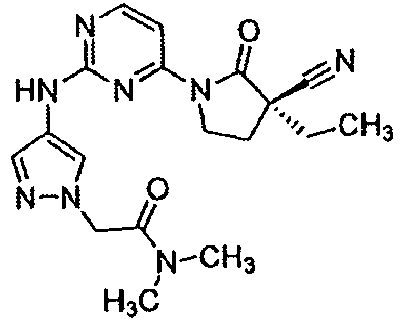
HCl 383.3 179 (3R)-3-ethyl-1-(2-((1-ethyl-1H-pyrazol-4-yl)amino)pyrimidin-4-yl)-2-oxopyrrolidine-3-carbonitrile 
HCl 326.2 180 (3R)-3-ethyl-1-(2-((1-(2-hydroxyethyl)-1H-pyrazol-4-yl)amino)pyrimidin-4-yl)-2-oxopyrrolidine-3-carbonitrile 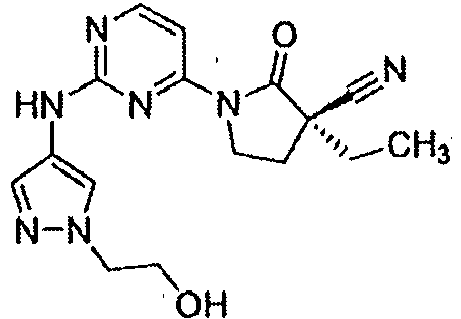
HCl 342.2 181 (3R)-1-(2-((1-(1,1-dioxidetetrahydro-2H-thiopyran-4-yl)-1H-pyrazol-4-yl)amino)pyrimidin-4-yl)-3-ethyl-2-oxopyrrolidine-3-carbonitrile 
HCl 430.3 -

- The title compound (40 mg) was obtained from (3R)-1-(2-chloropyrimidin-4-yl)-3-ethyl-2-oxopyrrolidine-3-carbonitrile (150 mg) obtained in Step A of Example 8 and 1-(oxetan-3-yl)-1H-pyrazol-4-amine (83 mg) in the same manner as in Example 56.
MS(ESI+): [M+H]+ 354.3. -

- The title compound (78 mg) was obtained from (3R)-1-(2-chloropyrimidin-4-yl)-3-ethyl-2-oxopyrrolidine-3-carbonitrile (90 mg) obtained in Step A of Example 8 and 2-(4-amino-1H-pyrazol-1-yl)-2-methylpropan-1-ol (56 mg) obtained in Step H of Example 103 in the same manner as in Step B of Example 2.
MS(ESI+): [M+H]+ 370.3. -

- The title compound (450 mg) was obtained from (3R)-1-(2-chloropyrimidin-4-yl)-3-ethyl-2-oxopyrrolidine-3-carbonitrile (500 mg) obtained in Step A of Example 8 and tert-butyl 3-(4-amino-1H-pyrazol-1-yl)azetidine-1-carboxylate (520 mg) obtained in Step B of Example 131 in the same manner as in Example 56.
MS (ESI+) : [M+H]+ 453.2. -

- To tert-butyl 3-(4-((4-((3R)-3-cyano-3-ethyl-2-oxopyrrolidin-1-yl)pyrimidin-2-yl)amino)-1H-pyrazol-1-yl)azetidine-1-carboxylate (170 mg) obtained in Example 184 was added a solution of 4 M hydrogen chloride in ethyl acetate (6.0 mL), and the mixture was stirred at room temperature for 30 min. The solvent was evaporated under reduced pressure, and the residue was recrystallized (ethanol/ethyl acetate) to give the title compound (120 mg).
MS(ESI+): [M+H]+ 353.3. -
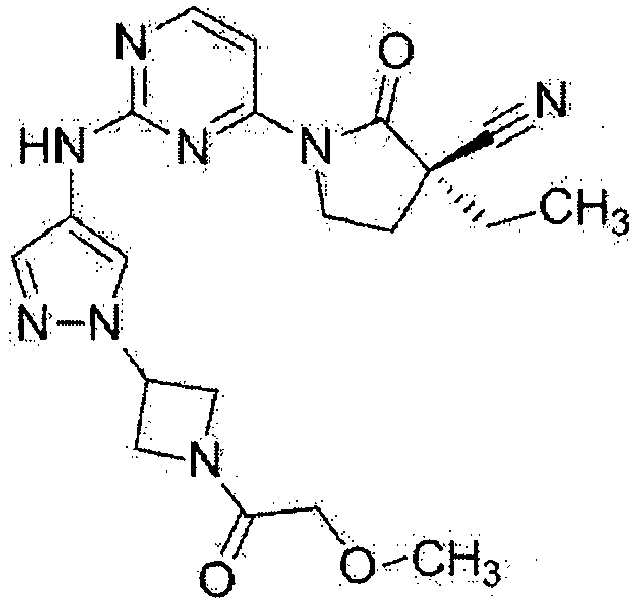
- To a solution of tert-butyl 3-(4-((4-((3R)-3-cyano-3-ethyl-2-oxopyrrolidin-1-yl)pyrimidin-2-yl)amino)-1H-pyrazol-1-yl)azetidine-1-carboxylate (140 mg) obtained in Example 184 in ethyl acetate (3.0 mL) was added a solution of 4 M hydrogen chloride in ethyl acetate (5.0 mL), and the mixture was stirred at room temperature for 30 min. The solvent was evaporated under reduced pressure, to a suspension of the reaction mixture in tetrahydrofuran (5 mL) were added triethylamine (160 mg) and methoxyacetyl chloride (37 mg) at room temperature, and the mixture was stirred at room temperature for 3 hr. The solvent was evaporated under reduced pressure, and the reaction mixture was poured into water, and extracted with ethyl acetate. The obtained organic layer was washed with saturated brine, and dried over anhydrous magnesium sulfate, and the solvent was evaporated under reduced pressure. The residue was purified by silica gel column chromatography (NH, ethyl acetate/methanol) to give the title compound (110 mg).
MS (ESI+) : [M+H]+425.2. -

- To a solution of tert-butyl 3-(4-((4-((3R)-3-cyano-3-ethyl-2-oxopyrrolidin-1-yl)pyrimidin-2-yl)amino)-1H-pyrazol-1-yl)azetidine-1-carboxylate (100 mg) obtained in Example 184 in ethyl acetate (3.0 mL) was added a solution of 4 M hydrogen chloride in ethyl acetate (5.0 mL), and the mixture was stirred at room temperature for 30 min. The solvent was evaporated under reduced pressure, to a suspension of the reaction mixture in N,N-dimethylacetamide (3.0 mL) were added triethylamine (220 mg), 2-cyanoacetic acid (20 mg) and O-(7-aza-1H-benzotriazol-1-yl)-N,N,N',N'-tetramethyluronium hexafluorophosphate (170 mg) at room temperature, and the mixture was stirred at room temperature for 10 hr. The solvent was evaporated under reduced pressure, and the reaction mixture was poured into water, and extracted with ethyl acetate. The obtained organic layer was washed with saturated brine, and dried over anhydrous magnesium sulfate, and the solvent was evaporated under reduced pressure to give the title compound (35 mg).
1H NMR(400 MHz, DMSO-d6)δ1.00-1.16 (3H, m), 1.85-2.06 (3H, m), 2.24-2.41 (2H, m), 2.54-2.65 (1H, m), 3.96-4.22 (3H, m), 4.23-4.33 (1H, m), 4.33-4.42 (1H, m), 4.47-4.62 (1H, m), 5.17-5.35 (1H, m), 7.50-7.64 (1H, m), 7.63-7.76 (1H, m), 7.99-8.13 (1H, m), 8.31-8.48 (1H, m), 9.65 (1H, brs). -

- To a suspension of (3R)-1-(2-((1-(azetidin-3-yl)-1H-pyrazol-4-yl)amino)pyrimidin-4-yl)-3-ethyl-2-oxopyrrolidine-3-carbonitrile dihydrochloride (83 mg) obtained in Example 185 in tetrahydrofuran (5 mL) were added triethylamine (30 µL) and methanesulfonyl chloride (33 µL) at room temperature, and the mixture was stirred at room temperature for 2 hr. To the reaction mixture was added water, and the mixture was extracted with ethyl acetate. The obtained organic layer was washed with saturated brine, and dried over anhydrous magnesium sulfate, and the solvent was evaporated under reduced pressure. The residue was purified by silica gel column chromatography (ethyl acetate/hexane), and recrystallized (ethyl acetate/hexane) to give the title compound (16 mg).
MS (ESI+) : [M+H]+431.3. -

- The title compound (270 mg) was obtained from (3R)-1-(2-chloropyrimidin-4-yl)-3-ethyl-2-oxopyrrolidine-3-carbonitrile (600 mg) obtained in Step A of Example 8 and tert-butyl (4-amino-1H-pyrazol-1-yl)acetate (610 mg) in the same manner as in Step B of Example 2.
MS(ESI+): [M+H]+356.0. - To a solution of (4-((4-((3R)-3-cyano-3-ethyl-2-oxopyrrolidin-1-yl)pyrimidin-2-yl)amino)-1H-pyrazol-1-yl)acetic acid (100 mg) obtained in Step A of Example 189 in N,N-dimethylformamide (3 mL) were added 1-ethyl-3-(3-dimethylaminopropyl)carbodiimide (79 mg), 1-hydroxybenzotriazole monohydrate (78 mg), N,N-diisopropylethylamine (0.13 mL) and 2-methylpropan-2-amine (37 mg), and the mixture was stirred overnight at room temperature. To the reaction mixture was added saturated aqueous sodium hydrogen carbonate solution, and the mixture was extracted with ethyl acetate. The obtained organic layer was washed successively with water and saturated brine, and dried over anhydrous magnesium sulfate, and the solvent was evaporated under reduced pressure. The residue was purified by silica gel column chromatography (ethyl acetate/hexane). To a solution of the obtained residue in ethanol (3 mL) was added 1 M hydrochloric acid (0.19 mL), and the mixture was stirred at room temperature for 10 min. The solvent was evaporated under reduced pressure, and the residue was recrystallized (ethanol/diisopropyl ether) to give the title compound (66 mg).
MS(ESI+): [M+H]+411.4. - The title compound was obtained from (4-((4-((3R)-3-cyano-3-ethyl-2-oxopyrrolidin-1-yl)pyrimidin-2-yl)amino)-1H-pyrazol-1-yl)acetic acid obtained in Step A of Example 189 and the each corresponding amine (these compounds can be produced according to a method known per se), in the same manner as in Step B of Example 189.
Table 16 Example Number IUPAC Name Structure Salt MS 190 2-(4-((4-((3R)-3-cyano-3-ethyl-2-oxopyrrolidin-1-yl)pyrimidin-2-yl)amino)-1H-pyrazol-1-yl)-N-(2,2,2-trifluoroethyl)acetamide 
HCl 437.3 191 2-(4-((4-((3R)-3-cyano-3-ethyl-2-oxopyrrolidin-1-yl)pyrimidin-2-yl)amino)-1H-pyrazol-1-yl)-N-(2-hydroxyethyl)acetamide 
HCl 399.3 192 2-(4-((4-((3R)-3-cyano-3-ethyl-2-oxopyrrolidin-1-yl)pyrimidin-2-yl)amino)-1H-pyrazol-1-yl)-N-(2-methoxyethyl)acetamide 
HCl 413.3 193 (3R)-3-ethyl-1-(2-((1-(2-(morpholin-4-yl)-2-oxoethyl)-1H-pyrazol-4-yl)amino)pyrimidin-4-yl)-2-oxopyrrolidine-3-carbonitrile 
HCl 425.3 194 (3R)-3-ethyl-1-(2-((1-(2- (4-hydroxypiperidin-1-yl)-2-oxoethyl)-1H-pyrazol-4-yl)amino)pyrimidin-4-yl)-2-oxopyrrolidine-3-carbonitrile 
HCl 439.3 195 1-((4-((4-((3R)-3-cyano-3-ethyl-2-oxopyrrolidin-1-yl)pyrimidin-2-yl)amino)-1H-pyrazol-1-yl)acetyl)piperidine-4-carboxamide 
HCl 466.4 196 (3R)-3-ethyl-1-(2-((1-(2-(4-methylpiperazin-1-yl)-2-oxoethyl)-1H-pyrazol-4-yl)amino)pyrimidin-4-yl)-2-oxopyrrolidine-3-carbonitrile 
HCl 438.4 197 2-(4-((4-((3R)-3-cyano-3-ethyl-2-oxopyrrolidin-1-yl)pyrimidin-2-yl)amino)-1H-pyrazol-1-yl)-N-(2-hydroxyethyl)-N-methylacetamide 
HCl 413.3 198 2-(4-((4-((3R)-3-cyano-3-ethyl-2-oxopyrrolidin-1-yl)pyrimidin-2-yl)amino)-1H-pyrazol-1-yl)-N-(2-(methylsulfonyl)ethyl)acetamide 
HCl 461.3 -

- The title compound (1.6 g) was obtained from (3R)-1-(2-chloropyrimidin-4-yl)-3-ethyl-2-oxopyrrolidine-3-carbonitrile (1.0 g) obtained in Step A of Example 8 and tert-butyl 2-(4-amino-1H-pyrazol-1-yl)-2-methylpropanoate (1.1 g) obtained in Step B of Example 108 in the same manner as in Step B of Example 2.
MS (ESI+) : [M+H]+440.4. - To a solution of tert-butyl 2-(4-((4-((3R)-3-cyano-3-ethyl-2-oxopyrrolidin-1-yl)pyrimidin-2-yl)amino)-1H-pyrazol-1-yl)-2-methylpropanoate (1.0 g) obtained in Step A of Example 199 in ethyl acetate (10 mL) was added a solution of 4 M hydrogen chloride in ethyl acetate (10 mL), and the mixture was stirred at room temperature for 3 hr. The solvent was evaporated under reduced pressure, and the residue was recrystallized (ethanol/diisopropyl ether) to give the crude title compound (820 mg). The crude title compound (100 mg) was purified by HPLC (C18, mobile phase: water/acetonitrile (containing 10 mM NH4HCO3)), and the solvent was evaporated under reduced pressure. To a solution of the residue in ethanol (3 mL) was added 1 M hydrochloric acid (0.20 mL), and the mixture was stirred at room temperature for 10 min. The solvent was evaporated under reduced pressure, and the residue was recrystallized (ethanol/diisopropyl ether) to give the title compound (820 mg).
MS (ESI+) : [M+H]+384.3. -

- The title compound (25 mg) was obtained from 2-(4-((4-((3R)-3-cyano-3-ethyl-2-oxopyrrolidin-1-yl)pyrimidin-2-yl)amino)-1H-pyrazol-1-yl)-2-methylpropanoic acid hydrochloride (80 mg) obtained in Step B of Example 199 and morpholine (20 mg) in the same manner as in Step B of Example 189.
MS (ESI+) : [M+H]+453.4. -

- A solution of (3R)-1-(2-chloropyrimidin-4-yl)-3-ethyl-2-oxopyrrolidine-3-carbonitrile (100 mg) obtained in Step A of Example 8 and 1,5-dimethyl-1H-pyrazol-4-amine dihydrochloride (73 mg) in propan-2-ol (4.0 mL) was stirred in a microwave reactor at 160°C for 1 hr, and the solvent was evaporated under reduced pressure. The obtained residue was purified by silica gel column chromatography (NH, hexane/ethyl acetate), and recrystallized (diisopropyl ether/ethyl acetate) to give the title compound (90 mg).
MS (ESI+) : [M+H]+ 326.0. -

- The title compound (73 mg) was obtained from (3R)-1-(2-chloropyrimidin-4-yl)-3-ethyl-2-oxopyrrolidine-3-carbonitrile (100 mg) obtained in Step A of Example 8 and 1,3-dimethyl-1H-pyrazol-4-amine dihydrochloride in the same manner as in Example 201.
MS(ESI+): [M+H]+ 326.0. -

- The title compound (90 mg) was obtained from (3R)-1-(2-chloropyrimidin-4-yl)-3-ethyl-2-oxopyrrolidine-3-carbonitrile (140 mg) obtained in Step A of Example 8 and 1-(4-amino-1H-pyrazol-1-yl)cyclobutanecarboxamide (103 mg) obtained in Step B of Example 129 in the same manner as in Step B of Example 2.
MS(ESI+): [M+H]+ 395.4. -

- The title compound (140 mg) was obtained from (3R)-1-(2-chloropyrimidin-4-yl)-3-ethyl-2-oxopyrrolidine-3-carbonitrile (150 mg) obtained in Step A of Example 8 and 1-(4-amino-1H-pyrazol-1-yl)cyclopropanecarboxamide (99 mg) obtained in Step B of Example 130 in the same manner as in Step B of Example 2.
MS (ESI+) : [M+H]+ 382.3. -

- The title compound (64 mg) was obtained from (3R)-1-(2-chloropyrimidin-4-yl)-3-ethyl-2-oxopyrrolidine-3-carbonitrile (150 mg) obtained in Step A of Example 8 and (1-(4-amino-1H-pyrazol-1-yl)cyclobutyl)methanol (100 mg) obtained in Step C of Example 127 in the same manner as in Step B of Example 2.
MS (ESI+) : [M+H]+ 382.3. - The title compound was obtained from (3R)-1-(2-chloropyrimidin-4-yl)-3-ethyl-2-oxopyrrolidine-3-carbonitrile obtained in Step A of Example 8 and each corresponding aniline derivative (these compounds can be produced according to a method known per se), in the same manner as in Step B of Example 2.
Table 17-1 Example Number IUPAC Name Structure Salt MS 206 4-((4-((3R)-3-cyano-3-ethyl-2-oxopyrrolidin-1-yl)pyrimidin-2-yl)amino)-N-methylbenzenesulfonamide 
Free 401.3 207 (3R)-3-ethyl-2-oxo-1-(2-((4-(2-oxoimidazolidin-1-yl)phenyl)amino)pyrimidin-4-yl)pyrrolidine-3-carbonitrile 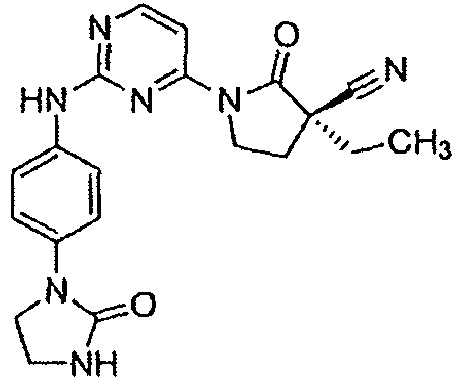
Free 392.3 209 (3-((4-((3R)-3-cyano-3-ethyl-2-oxopyrrolidin-1-yl)pyrimidin-2-yl)amino)phenyl)acetic acid 
HCl 366.3 210 (3R)-3-ethyl-2-oxo-1-(2-((4-(pyrrolidin-1-ylcarbonyl)phenyl)amino)pyrimidin-4-yl)pyrrolidine-3-carbonitrile 
HCl 405.3 211 4-((4-((3R)-3-cyano-3-ethyl-2-oxopyrrolidin-1-yl)pyrimidin-2-yl)amino)-N-(2-hydroxyethyl)benzamide 
HCl 395.3 212 (4-((4-((3R)-3-cyano-3-ethyl-2-oxopyrrolidin-1-yl)pyrimidin-2-yl)amino)phenyl)acetic acid 
Free 366.3 213 (3R)-3-ethyl-2-oxo-1-(2-((4-(5-oxo-4,5-dihydro-1,2,4-oxadiazol-3-yl)phenyl)amino)pyrimidin-4-yl)pyrrolidine-3-carbonitrile 
Free 392.3 214 N-(3-((4-((3R)-3-cyano-3-ethyl-2-oxopyrrolidin-1-yl)pyrimidin-2-yl)amino)phenyl)-N-methylacetamide 
HCl 379.3 Table 17-2 Example Number IUPAC Name Structure Salt MS 215 4-((4-((3R)-3-cyano-3-ethyl-2-oxopyrrolidin-1-yl)pyrimidin-2-yl)amino)-2-methoxybenzamide 
Free 381.3 216 4-((4-((3R)-3-cyano-3-ethyl-2-oxopyrrolidin-1-yl)pyrimidin-2-yl)amino)-2-methoxy-N-methylbenzamide 
Free 395.3 217 N-(3-((4-((3R)-3-cyano-3-ethyl-2-oxopyrrolidin-1-yl)pyrimidin-2-yl)amino)phenyl)-2-methoxyacetamide 
HCl 395.3 218 tert-butyl 4-(4-((4-((3R)-3-cyano-3-ethyl-2-oxopyrrolidin-1-yl)pyrimidin-2-yl)amino)phenyl)piperazine-1-carboxylate 
Free 492.4 219 (3R)-3-ethyl-1-(2-((4-(4-methylpiperazin-1-yl)phenyl)amino)pyrimidin-4-yl)-2-oxopyrrolidine-3-carbonitrile 
Free 406.3 220 (3R)-3-ethyl-2-oxo-1-(2-((4-(piperazin-1-yl)phenyl)amino)pyrimidin-4-yl)pyrrolidine-3-carbonitrile 
Free 392.4 222 N-(3-((4-((3R)-3-cyano-3-ethyl-2-oxopyrrolidin-1-yl)pyrimidin-2-yl)amino)benzyl)acetamide 
HCl 379.3 -

- Crude N-(3-((4-((3R)-3-cyano-3-ethyl-2-oxopyrrolidin-1-yl)pyrimidin-2-yl)amino)phenyl)-N-(methylsulfonyl)methanesulfonamide (100 mg) was obtained from (3R)-1-(2-chloropyrimidin-4-yl)-3-ethyl-2-oxopyrrolidine-3-carbonitrile (55 mg) obtained in Step A of Example 8 and N-(3-aminophenyl)-N-(methylsulfonyl)methanesulfonamide (58 mg) in the same manner as in Step B of Example 2.
- To a solution of the crude N-(3-((4-((3R)-3-cyano-3-ethyl-2-oxopyrrolidin-1-yl)pyrimidin-2-yl)amino)phenyl)-N-(methylsulfonyl)methanesulfonamide (100 mg) in tetrahydrofuran (3.0 mL) was added 4 M aqueouus lithium hydroxide solution (52 µL), and the mixture was stirred at room temperature for 3 hr. To the reaction mixture was added saturated aqueous ammonium chloride solution, and the mixture was extracted with ethyl acetate. The obtained organic layer was washed with saturated brine, and dried over anhydrous magnesium sulfate, and the solvent was evaporated under reduced pressure. The residue was purified by silica gel column chromatography (hexane/ethyl acetate). To a solution of the residue in ethanol (3.0 mL) was added 1 N hydrochloric acid (72 µL), and the mixture was stirred at room temperature for 5 min. The solvent was evaporated under reduced pressure, and the residue was recrystallized (ethanol/diisopropyl ether) to give the title compound (12 mg).
MS(ESI+): [M+H]+ 401.3. -

- To a solution of 2 M methylamine in tetrahydrofuran (0.28 mL) were added 1,1'-carbonyldiimidazole (91 mg) and tetrahydrofuran (3.0 mL) in an ice bath, and the mixture was stirred at the same temperature for 10 min. To the reaction mixture was added (3R)-3-ethyl-2-oxo-1-(2-((4-(piperazin-1-yl)phenyl)amino)pyrimidin-4-yl)pyrrolidine-3-carbonitrile (200 mg) obtained in Example 220, and the mixture was stirred at 70°C for 2 hr. To the reaction mixture was added water, and the mixture was extracted with ethyl acetate. The obtained organic layer was washed with saturated brine, and dried over anhydrous magnesium sulfate, and the solvent was evaporated under reduced pressure. The residue was purified by silica gel column chromatography (hexane/ethyl acetate). To a solution of the obtained purified product (290 mg) in ethanol (3 mL) was added 1 M hydrochloric acid (0.64 mL), and the mixture was stirred at room temperature for 5 min. The solvent was evaporated under reduced pressure, and the residue was recrystallized (ethanol/diisopropyl ether) to give the title compound (220 mg).
MS(ESI+): [M+H]+ 449.4. -

- To a solution of (3R)-3-ethyl-2-oxo-1-(2-((4-(piperazin-1-yl)phenyl)amino)pyrimidin-4-yl)pyrrolidine-3-carbonitrile (100 mg) obtained in Example 220 in tetrahydrofuran (3.0 mL) were added successively dropwise triethylamine (71 µL) and methanesulfonyl chloride (24 µL) in an ice bath, and the mixture was stirred at the same temperature for 3 hr. To the reaction mixture was added saturated aqueous ammonium chloride solution, and the solvent was evaporated under reduced pressure. The residue was purified by silica gel column chromatography (hexane/ethyl acetate), to a solution of the obtained purified product (120 mg) in ethanol (3 mL) was added 1 M hydrochloric acid (0.25 mL), and the mixture was stirred at room temperature for 5 min. The solvent was evaporated under reduced pressure, and the residue was recrystallized (ethanol/diisopropyl ether) to give the title compound (91 mg).
MS(ESI+): [M+H]+ 470.4. -

- The title compound (85 mg) was obtained from (3R)-3-ethyl-2-oxo-1-(2-((4-(piperazin-1-yl)phenyl)amino)pyrimidin-4-yl)pyrrolidine-3-carbonitrile (100 mg) obtained in Example 220 and methoxyacetyl chloride (28 µL) in the same manner as in Example 226.
MS (ESI+) : [M+H]+ 464.4. - The title compound was obtained from (3R)-1-(2-chloropyrimidin-4-yl)-3-ethyl-2-oxopyrrolidine-3-carbonitrile obtained in Step A of Example 8 and each corresponding aniline derivative (these compounds can be produced according to a method known per se), in the same manner as in Step B of Example 2.
Table 18 Example Number IUPAC Name Structure Salt MS 228 4-((4-((3R)-3-cyano-3-ethyl-2-oxopyrrolidin-1-yl)pyrimidin-2-yl)amino)-2-(methylsulfonyl)benzamide 
Free 427.3 (M-H) 229 4-((4-((3R)-3-cyano-3-ethyl-2-oxopyrrolidin-1-yl)pyrimidin-2-yl)amino)-3-fluoro-N-methylbenzamide 
Free 383.1 230 4-((4-((3R)-3-cyano-3-ethyl-2-oxopyrrolidin-1-yl)pyrimidin-2-yl)amino)-2-fluoro-N-methylbenzamide 
Free 383.0 231 4-((4-((3R)-3-cyano-3-ethyl-2-oxopyrrolidin-1-yl)pyrimidin-2-yl)amino)benzoic acid 
HCl 352.3 232 1-(4-((4-((3R)-3-cyano-3-ethyl-2-oxopyrrolidin-1-yl)pyrimidin-2-yl)amino)phenyl)cyclopropanecarboxyl ic acid 
HCl 392.3 233 2-(4-((4-((3R)-3-cyano-3-ethyl-2-oxopyrrolidin-1-yl)pyrimidin-2-yl)amino)phenyl)acetamide 
Free 365.3 234 2-(4-((4-((3R)-3-cyano-3-ethyl-2-oxopyrrolidin-1-yl)pyrimidin-2-yl)amino)phenyl)-N-methylacetamide 
Free 379,3 -

- To a solution of 4-((4-((3R)-3-cyano-3-ethyl-2-oxopyrrolidin-1-yl)pyrimidin-2-yl)amino)benzoic acid (100 mg) obtained in Example 231 in N,N-dimethylformamide (2.0 mL) were added 1-aminocyclopropanecarbonitrile hydrochloride (31 mg), 1-ethyl-3-(3-dimethylaminopropyl)carbodiimide (46 mg), 1-hydroxybenzotriazole (40 mg) and triethylamine (56 µL), and the mixture was stirred overnight at room temperature. To the reaction mixture was added saturated aqueous sodium hydrogen carbonate solution, and the mixture was extracted with ethyl acetate. The obtained organic layer was washed with saturated brine, and dried over anhydrous magnesium sulfate, and the solvent was evaporated under reduced pressure. The residue was purified by silica gel column chromatography (hexane/ethyl acetate) to give the title compound (38 mg).
MS(ESI+): [M+H]+ 416.3. - The title compound was obtained from 4-((4-((3R)-3-cyano-3-ethyl-2-oxopyrrolidin-1-yl)pyrimidin-2-yl)amino)benzoic acid obtained in Example 231 and each corresponding amine (these compounds can be produced according to a method known per se), in the same manner as in Example 235.
Table 19-1 Example Number IUPAC Name Structure Salt MS 236 4-((4-((3R)-3-cyano-3-ethyl-2-oxopyrrolidin-1-yl)pyrimidin-2-yl)amino)-N-(oxetan-3-yl)benzamide 
Free 407.4 237 4-((4-((3R)-3-cyano-3-ethyl-2-oxopyrrolidin-1-yl)pyrimidin-2-yl)amino)-N-((3-methyloxetan-3-yl)methyl)benzamide 
Free 435.4 238 (3R)-3-ethyl-1-(2-((4-(morpholin-4-ylcarbonyl)phenyl)amino)pyrimidin-4-yl)-2-oxopyrrolidine-3-carbonitrile 
HCl 421.3 239 (3R)-3-ethyl-1-(2-((4-((4-hydroxypiperidin-1-yl)carbonyl)phenyl)amino)pyrimidin-4-yl)-2-oxopyrrolidine-3-carbonitrile 
HCl 435.3 240 (3R)-3-ethyl-1-(2-((4-(((3R)-3-hydroxypyrrolidin-1-yl)carbonyl)phenyl)amino)pyrimidin-4-yl)-2-oxopyrrolidine-3-carbonitrile 
Free 419.3 (M-H) 241 (3R)-3-ethyl-1-(2-((4-(((3S)-3-hydroxypyrrolidin-1-yl)carbonyl)phenyl)amino)pyrimidin-4-yl)-2-oxopyrrolidine-3-carbonitrile 
Free 419.4 (M-H) 242 4-((4-((3R)-3-cyano-3-ethyl-2-oxopyrrolidin-1-yl)pyrimidin-2-yl)amino)-N-cyclobutylbenzamide 
Free 405.3 243 4-((4-((3R)-3-cyano-3-ethyl-2-oxopyrrolidin-1-yl)pyrimidin-2-yl)amino)-N-methyl-N-(2-(methylsulfonyl)ethyl)benzamide 
Free 471.4 Table 19-2 Example Number IUPAC Name Structure Salt MS 244 4-((4-((3R)-3-cyano-3-ethyl-2-oxopyrrolidin-1-yl)pyrimidin-2-yl)amino)-N-(2-(methylsulfonyl)ethyl)benzamide 
Free 457.1 245 (3R)-4-((4-(3-cyano-3-ethyl-2-oxopyrrolidin-1-yl)pyrimidin-2-yl)amino)-N-(1-hydroxy-2-methylpropan-2-yl)benzamide 
Free 423.1 246 4-((4-((3R)-3-cyano-3-ethyl-2-oxopyrrolidin-1-yl)pyrimidin-2-yl)amino)-N-(2-methyl-1-(morpholin-4-yl)propan-2-yl)benzamide 
Free 492.2 247 4-((4-((3R)-3-cyano-3-ethyl-2-oxopyrrolidin-1-yl)pyrimidin-2-yl)amino)-N-(tetrahydro-2H-pyran-4-yl)benzamide 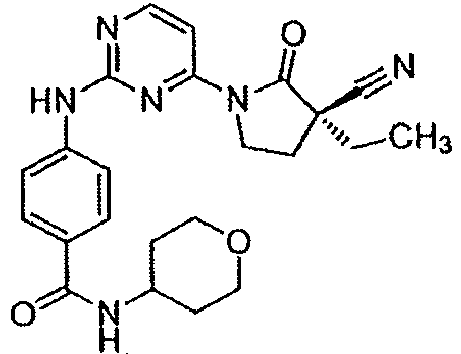
Free 435.3 -

- To a solution of tert-butyl (4-bromophenyl)carbamate (1.5 g) in tetrahydrofuran (30 mL) was added dropwise n-butyllithium (1.6 M hexane solution, 7.2 mL) at -78°C under nitrogen atmosphere, and the mixture was stirred at the same temperature for 1 hr. Dihydro-2H-pyran-4(3H)-one (0.58 g) was added thereto, and the mixture was stirred overnight while it was allowed to be warmed. To the reaction mixture was added saturated aqueous ammonium chloride solution, and the mixture was extracted with ethyl acetate. The obtained organic layer was washed with saturated brine, and dried over anhydrous magnesium sulfate, and the solvent was evaporated under reduced pressure. The residue was purified by silica gel column chromatography (hexane/ethyl acetate) to give the title compound (590 mg).
1H NMR(400 MHz, CDCl3)δ1.52 (9H, s), 1.65-1.73 (2H, m), 2.09-2.22 (2H, m), 3.82-3.99 (4H, m), 6.48 (1H, br. s), 7.32-7.39 (2H, m), 7.39-7.45 (2H, m). - The title compound (53 mg) was obtained from (3R)-1-(2-chloropyrimidin-4-yl)-3-ethyl-2-oxopyrrolidine-3-carbonitrile (80 mg) obtained in Step A of Example 8 and tert-butyl (4-(4-hydroxytetrahydro-2H-pyran-4-yl)phenyl)carbamate (110 mg) obtained in Step A of Example 248 in the same manner as in Step B of Example 2.
1H NMR(400 MHz, DMSO-d6)δ1.02-1.15 (3H, m), 1.84-2.08 (2H, m), 2.28-2.47 (5H, m), 2.56-2.72 (1H, m), 3.76-3.87 (2H, m), 4.01-4.17 (2H, m), 4.19-4.26 (2H, m), 6.17 (1H, s), 7.32-7.47 (2H, m), 7.57-7.64 (1H, m), 7.67-7.79 (2H, m), 8.39-8.49 (1H, m), 9.73 (1H, s). -

- To a solution of 2-(4-bromophenyl)acetonitrile (3.9 g) in tetrahydrofuran (50 mL) was added potassium t-butoxide (4.9 g) in an ice bath, and the mixture was stirred for 1 hr in an ice bath. 1-Bromo-2-(2-bromoethoxy)ethane (5.8 g) was added thereto at the same temperature, and the mixture was stirred at room temperature for 10 hr. The solvent was evaporated under reduced pressure, and the residue was purified by silica gel column chromatography (hexane/ethyl acetate) to give the title compound (3.7 g).
1H NMR (400 MHz, CDCl3)δ1.99-2.15 (4H, m), 3.83-3.95 (2H, m), 4.04-4.14 (2H, m), 7.33-7.40 (2H, m), 7.51-7.60 (2H, m). - To a solution of 4-(4-bromophenyl)tetrahydro-2H-pyran-4-carbonitrile (1.7 g) obtained in Step A of Example 249, diphenylmethanimine (1.4 g), tris(dibenzylideneacetone)dipalladium(0) (88 mg) and 2,2'-bis(diphenylphosphino)-1,1'-binaphthyl (130 mg) in toluene (50 mL) was added sodium 2-methylpropan-2-olate (921 mg), and the mixture was stirred at 90°C for 10 hr under nitrogen atmosphere. The reaction mixture was diluted with ethyl acetate, the insoluble substance was removed by filtration through Celite, and the solvent was evaporated under reduced pressure. To a solution of the residue in methanol (10 mL) were added hydroxylamine hydrochloride (440 mg) and sodium acetate (530 mg). The mixture was stirred at room temperature for 30 min, and 0.1 M aqueous sodium hydroxide solution and ethyl acetate were added thereto. The solvent was evaporated under reduced pressure, the reaction mixture was poured into water, and the reaction mixture was extracted with ethyl acetate. The obtained organic layer was washed with saturated brine, and dried over anhydrous magnesium sulfate, and the solvent was evaporated under reduced pressure. The residue was purified by silica gel column chromatography (hexane/ethyl acetate) to give the title compound (910 mg).
MS (ESI+) : [M+H]+ 202.9. - The title compound (140 mg) was obtained from (3R)-1-(2-chloropyrimidin-4-yl)-3-ethyl-2-oxopyrrolidine-3-carbonitrile (100 mg) obtained in Step A of Example 8 and 4-(4-aminophenyl)tetrahydro-2H-pyran-4-carbonitrile (81 mg) obtained in Step B of Example 249 in the same manner as in Step B of Example 2.
MS(ESI+): [M+H]+ 417.1. -

- The title compound (120 mg) was obtained from (3R)-1-(2-chloropyrimidin-4-yl)-3-ethyl-2-oxopyrrolidine-3-carbonitrile (100 mg) obtained in Step A of Example 8 and tert-butyl 4-amino-2-ethoxybenzoate (110 mg) obtained in Step C of Example 139 in the same manner as in Example 56.
MS (ESI+) : [M+H]+ 452.2. - To tert-butyl 4-((4-((3R)-3-cyano-3-ethyl-2-oxopyrrolidin-1-yl)pyrimidin-2-yl)amino)-2-ethoxybenzoate (120 mg) obtained in Step A of Example 250 was added a solution of 4 M hydrogen chloride in ethyl acetate (6.0 mL), and the mixture was stirred at room temperature for 2 hr. The reaction mixture was concentrated under reduced pressure. The residue was washed with ethyl acetate to give the title compound (90 mg).
MS (ESI+) : [M+H]+ 396.3. -

- The title compound (99 mg) was obtained from (3R)-1-(2-chloropyrimidin-4-yl)-3-ethyl-2-oxopyrrolidine-3-carbonitrile (100 mg) obtained in Step A of Example 8 and tert-butyl 4-amino-2-isopropoxybenzoate (120 mg) obtained in Step B of Example 141 in the same manner as in Example 56.
MS (ESI+) : [M+H]+ 466.4. - The title compound (78 mg) was obtained from tert-butyl 4-((4-((3R)-3-cyano-3-ethyl-2-oxopyrrolidin-1-yl)pyrimidin-2-yl)amino)-2-isopropoxybenzoate (120 mg) obtained in Step A of Example 251 in the same manner as in Step B of Example 250.
MS(ESI+): [M+H]+ 410.3. -

- The title compound (67 mg) was obtained from 1-(4-((4-((3R)-3-cyano-3-ethyl-2-oxopyrrolidin-1-yl)pyrimidin-2-yl)amino)phenyl)cyclopropanecarboxylic acid hydrochloride (90 mg) obtained in Example 232 in the same manner as in Example 235.
MS (ESI+) : [M+H]+ 391.3. -

- The title compound (60 mg) was obtained from 1-(4-((4-((3R)-3-cyano-3-ethyl-2-oxopyrrolidin-1-yl)pyrimidin-2-yl)amino)phenyl)cyclopropanecarboxylic acid hydrochloride (90 mg) obtained in Example 232 and methylamine hydrochloride (18 mg) in the same manner as in Example 235.
MS (ESI+) : [M+H]+ 405.4. -

- The title compound (60 mg) was obtained from (3R)-1-(2-chloropyrimidin-4-yl)-3-ethyl-2-oxopyrrolidine-3-carbonitrile (70 mg) obtained in Step A of Example 8 and 4-amino-2-ethoxybenzamide (60 mg) in the same manner as in Step B of Example 2.
MS(ESI+): [M+H]+ 395.3. -

- To a solution of (3R)-1-(2-chloropyrimidin-4-yl)-3-ethyl-2-oxopyrrolidine-3-carbonitrile (100 mg) obtained in Step A of Example 8 in ethanol (3.0 mL) were added (4-(4-aminophenyl)tetrahydro-2H-pyran-4-yl)methanol (83 mg) obtained in Step B of Example 152 and acetic acid (25 µL), and the mixture was stirred in a microwave reactor at 150°C for 1 hr. The reaction mixture was concentrated under reduced pressure, and the residue was purified by silica gel column chromatography (hexane/ethyl acetate), and recrystallized (hexane/ethyl acetate) to give the title compound (100 mg).
1H NMR (400MHz, DMSO-d6) δ 1.08 (3H, t, J = 7.5 Hz), 1.77-2.10 (6H, m), 2.29-2.41 (1H, m), 2.56-2.72 (1H, m), 3.34-3.42 (4H, m), 3.62-3.75 (2H, m), 3.98-4.24 (2H, m), 4.54-4.63 (1H, m), 7.26 (2H, d, J = 8.8 Hz), 7.59 (1H, d, J = 5.6 Hz), 7.69 (2H, d, J = 9.0 Hz), 8.41 (1H, d, J = 5.6 Hz), 9.62 (1H, s).
MS(ESI+): [M+H]+ 422.3. -

- The title compound (170 mg) was obtained from (3R)-1-(2-chloropyrimidin-4-yl)-3-ethyl-2-oxopyrrolidine-3-carbonitrile (150 mg) obtained in Step A of Example 8 and 4-(4-aminophenyl)-N-methyltetrahydro-2H-pyran-4-carboxamide (140 mg) obtained in Step D of Example 151 in the same manner as in Step B of Example 2.
MS(ESI+): [M+H]+ 449.4. -

- The title compound (25 mg) was obtained from (3R)-1-(2-chloropyrimidin-4-yl)-3-ethyl-2-oxopyrrolidine-3-carbonitrile (70 mg) obtained in Step A of Example 8 and 2-(5-aminopyridin-2-yl)-2-methylpropanamide (50 mg) obtained in Step F of Example 153 in the same manner as in Example 56.
MS(ESI+): [M+H]+ 394.3. - The title compound was obtained from (3S)-1-(2-chloropyrimidin-4-yl)-3-isopropyl-2-oxopyrrolidine-3-carbonitrile obtained in Step A of Example 9 and each corresponding amine (these compounds can be produced according to a method known per se), in the same manner as in Step B of Example 2. MS in the tables means actual measured value.
Table 20 Example Number IUPAC Name Structure Salt MS 258 (4-((4-((3S)-3-cyano-3-isopropyl-2-oxopyrrolidin-1-yl)pyrimidin-2-yl)amino)-1H-pyrazol-1-yl)acetic acid 
HCl 370.3 259 (3S)-1-(2-((1-ethyl-1H-pyrazol-4-yl)amino)pyrimidin-4-yl)-3-isopropyl-2-oxopyrrolidine-3-carbonitrile 
HCl 340.3 260 (3S)-3-isopropyl-2-oxo-1-(2-((1-(2,2,2-trifluoroethyl)-1H-pyrazol-4-yl)amino)pyrimidin-4-yl)pyrrolidine-3-carbonitrile 
HCl 394.3 261 (3S)-1-(2-((1-(2-hydroxyethyl)-1H-pyrazol-4-yl)amino)pyrimidin-4-yl)-3-isopropyl-2-oxopyrrolidine-3-carbonitrile 
HCl 354.3 262 (3S)-3-isopropyl-1-(2-((1-isopropyl-1H-pyrazol-4-yl)amino)pyrimidin-4-yl)-2-oxopyrrolidine-3-carbonitrile 
HCl 342.2 263 3-(4-((4-((3S)-3-cyano-3-isopropyl-2-oxopyrrolidin-1-yl)pyrimidin-2-yl)amino)-1H-pyrazol-1-yl)propanamide 
HCl 383.3 264 3-(4-((4-((3S)-3-cyano-3-isopropyl-2-oxopyrrolidin-1-yl)pyrimidin-2-yl)amino)-1H-pyrazol-1-yl)-N-methylpropanamide 
HCl 397.3 265 3-(4-((4-((3S)-3-cyano-3-isopropyl-2-oxopyrrolidin-1-yl)pyrimidin-2-yl)amino)-1H-pyrazol-1-yl)-N,N-dimethylpropanamide 
HCl 411.4 - The title compound was obtained from (3S)-1-(2-chloropyrimidin-4-yl)-3-isopropyl-2-oxopyrrolidine-3-carbonitrile obtained in Step A of Example 9 and each corresponding amine (these compounds can be produced according to a method known per se), in the same manner as in Example 56. MS in the tables means actual measured value.
Table 21 Example Number IUPAC Name Structure Salt MS 266 (3S)-1-(2-((1-(2-hydroxy-2-methylpropyl)-1H-pyrazol-4-yl)amino)pyrimidin-4-yl)-3-isopropyl-2-oxopyrrolidine-3-carbonitrile 
HCl 384.3 267 (3S)-1-(2-((1-(difluoromethyl)-1H-pyrazol-4-yl)amino)pyrimidin-4-yl)-3-isopropyl-2-oxopyrrolidine-3-carbonitrile 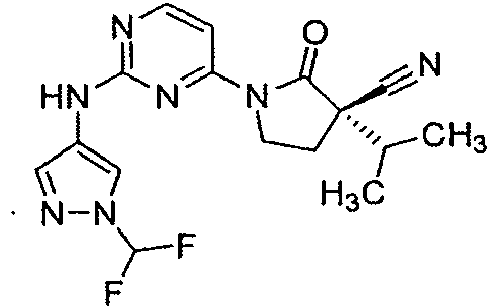
HCl 362.3 268 2-(4-((4-((3S)-3-cyano-3-isopropyl-2-oxopyrrolidin-1-yl)pyrimidin-2-yl)amino)-1H-pyrazol-1-yl)-2-methylpropanamide 
HCl 397.3 269 2-(4-((4-((3S)-3-cyano-3-isopropyl-2-oxopyrrolidin-1-yl)pyrimidin-2-yl)amino)-1H-pyrazol-1-yl)-N,2-dimethylpropanamide 
HCl 411.3 270 2-(4-((4-((3S)-3-cyano-3-isopropyl-2-oxopyrrolidin-1-yl)pyrimidin-2-yl)amino)-1H-pyrazol-1-yl)-N,N,2-trimethylpropanamide 
HCl 425.4 -

- To a mixture of (3S)-1-(2-chloropyrimidin-4-yl)-3-isopropyl-2-oxopyrrolidine-3-carbonitrile (200 mg) obtained in Step A of Example 9, tert-butyl 3-(4-amino-1H-pyrazol-1-yl)azetidine-1-carboxylate (97 mg) obtained in Step B of Example 131, cesium carbonate (370 mg) and dicyclohexyl (2',4',6'-triisopropyl-3,6-dimethoxybiphenyl-2-yl)phosphine (57 mg) in tert-butanol (2.0 mL) was added tris(dibenzylideneacetone)dipalladium(0) (48 mg), and the mixture was stirred at 100°C for 5 hr. The insoluble substance was removed by filtration through Celite, and the solvent was evaporated under reduced pressure. The residue was purified by silica gel column chromatography (hexane/ethyl acetate) to give the title compound (22 mg).
MS(ESI+): [M+H]+ 467.4. - To tert-butyl 3-(4-((4-((3S)-3-cyano-3-isopropyl-2-oxopyrrolidin-1-yl)pyrimidin-2-yl)amino)-1H-pyrazol-1-yl)azetidine-1-carboxylate (22 mg) obtained in Step A of Example 271 was added a solution of 4 M hydrogen chloride in ethyl acetate (1.0 mL), the mixture was stirred at room temperature for 30 min, and the solvent was evaporated under reduced pressure. To a solution of the residue in tetrahydrofuran (1.0 mL) were added triethylamine (20 µL) and acetic anhydride (5.3 µL), and the mixture was stirred at room temperature for 30 min. To the reaction mixture was added water, and the mixture was extracted with ethyl acetate. The obtained organic layer was washed with saturated brine, and dried over anhydrous sodium sulfate, and the solvent was evaporated under reduced pressure. The residue was purified by silica gel column chromatography (ethyl acetate/methanol).
- To a solution of the purified product in ethanol (2.0 mL) was added 1 M hydrochloric acid (36 µL), the mixture was stirred at room temperature for 5 min, and the solvent was evaporated under reduced pressure. The residue was recrystallized (diisopropyl ether/ethanol) to give the title compound (13 mg).
MS(ESI+): [M+H]+ 409.4. -

- The title compound (110 mg) was obtained from (3S)-1-(2-chloropyrimidin-4-yl)-3-isopropyl-2-oxopyrrolidine-3-carbonitrile (140 mg) obtained in Step A of Example 9 and tert-butyl 4-(4-amino-1H-pyrazol-1-yl)piperidine-1-carboxylate (120 mg) in the same manner as in Example 56.
MS(ESI+): [M+H]+ 495.5. - The title compound (47 mg) was obtained from tert-butyl 4-(4-((4-((3S)-3-cyano-3-isopropyl-2-oxopyrrolidin-1-yl)pyrimidin-2-yl)amino)-1H-pyrazol-1-yl)piperidine-1-carboxylate (110 mg) obtained in Step A of Example 272 in the same manner as in Step B of Example 271.
MS(ESI+): [M+H]+ 437.4. -

- The title compound (69 mg) was obtained from (3S)-1-(2-chloropyrimidin-4-yl)-3-isopropyl-2-oxopyrrolidine-3-carbonitrile (100 mg) obtained in Step A of Example 9 and tert-butyl (3R)-3-(4-amino-1H-pyrazol-1-yl)pyrrolidine-1-carboxylate (100 mg) in the same manner as in Example 56.
MS (ESI+) : [M+H]+ 481.5. - The title compound (47 mg) was obtained from tert-butyl (3R)-3-(4-((4-((3S)-3-cyano-3-isopropyl-2-oxopyrrolidin-1-yl)pyrimidin-2-yl)amino)-1H-pyrazol-1-yl)pyrrolidine-1-carboxylate (69 mg) obtained in Step A of Example 273 in the same manner as in Step B of Example 271.
MS (ESI+) : [M+H]+ 423.4. -

- The title compound (70 mg) was obtained from (3S)-1-(2-chloropyrimidin-4-yl)-3-isopropyl-2-oxopyrrolidine-3-carbonitrile (100 mg) obtained in Step A of Example 9 and tert-butyl (3S)-3-(4-amino-1H-pyrazol-1-yl)pyrrolidine-1-carboxylate (100 mg) in the same manner as in Example 56.
MS (ESI+) : [M+H]+ 481.4. - The title compound (38 mg) was obtained from tert-butyl (3S)-3-(4-((4-((3S)-3-cyano-3-isopropyl-2-oxopyrrolidin-1-yl)pyrimidin-2-yl)amino)-1H-pyrazol-1-yl)pyrrolidine-1-carboxylate (70 mg) obtained in Step A of Example 274 in the same manner as in Step B of Example 271.
MS (ESI+) : [M+H]+ 423.4. - The title compound was obtained from (4-((4-((3S)-3-cyano-3-isopropyl-2-oxopyrrolidin-1-yl)pyrimidin-2-yl)amino)-1H-pyrazol-1-yl)acetic acid hydrochloride obtained in Example 258, and morpholine or 4-hydroxypiperidine (these compounds can be produced according to a method known per se), each corresponding to the compounds of Examples 275 and 276, in the same manner as in Example 110.
Table 22 Example Number IUPAC Name Structure Salt MS 275 (3S)-3-isopropyl-1-(2-((1-(2-(morpholin-4-yl)-2-oxoethyl)-1H-pyrazol-4-yl)amino)pyrimidin-4-yl)-2-oxopyrrolidine-3-carbonitrile 
HCl 439.4 276 (3S)-1-(2-((1-(2-(4-hydroxypiperidin-1-yl)-2-oxoethyl)-1H-pyrazol-4-yl)amino)pyrimidin-4-yl)-3-isopropyl-2-oxopyrrolidine-3-carbonitrile 
HCl 453.4 - The title compound was obtained from (3S)-1-(2-chloropyrimidin-4-yl)-3-isopropyl-2-oxopyrrolidine-3-carbonitrile obtained in Step A of Example 9 and each corresponding amine (these compounds can be produced according to a method known per se), in the same manner as in Step B of Example 2. MS in the tables means actual measured value.
Table 23-1 Example Number IUPAC Name Structure Salt MS 277 4-((4-((3S)-3-cyano-3-isopropyl-2-oxopyrrolidin-1-yl)pyrimidin-2-yl)amino)benzoic acid 
HCl 366.3 278 ethyl (4-((4-((3S)-3-cyano-3-isopropyl-2-oxopyrrolidin-1-yl)pyrimidin-2-yl)amino)phenyl)acetate 
HCl 408.3 279 N-(5-((4-((3S)-3-cyano-3-isopropyl-2-oxopyrrolidin-1-yl)pyrimidin-2-yl)amino)-2-fluorophenyl)acetamide 
HCl 397.3 280 5-((4-((3S)-3-cyano-3-isopropyl-2-oxopyrrolidin-1-yl)pyrimidin-2-yl)amino)-N-methylpyridine-2-carboxamide 
Free 380.3 281 (4-((4-((3S)-3-cyano-3-isopropyl-2-oxopyrrolidin-1-yl)pyrimidin-2-yl)amino)phenyl)acetic acid 
HCl 380.3 282 (3S)-1-(2-((4-(4-acetylpiperazin-1-yl)phenyl)amino)pyrimidin-4-yl)-3-isopropyl-2-oxopyrrolidine-3-carbonitrile 
HCl 448.4 283 2-(3-((4-((3S)-3-cyano-3-isopropyl-2-oxopyrrolidin-1-yl)pyrimidin-2-yl)amino)phenyl)acetamide 
HCl 379.3 284 2-(3-((4-((3S)-3-cyano-3-isopropyl-2-oxopyrrolidin-1-yl)pyrimidin-2-yl)amino)phenyl)-N-methylacetamide 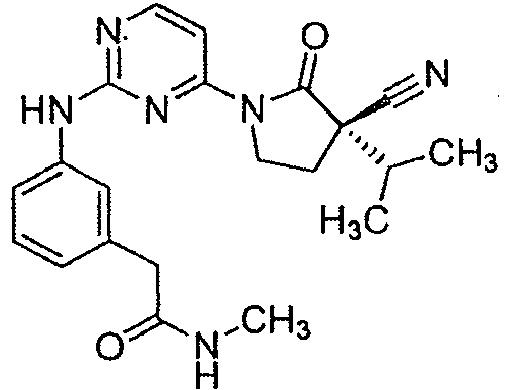
HCl 393.3 Table 23-2 Example Number IUPAC Name Structure Salt MS 285 2-(3-((4-((3S)-3-cyano-3-isopropyl-2-oxopyrrolidin-1-yl)pyrimidin-2-yl)amino)phenyl)-N,N-dimethylacetamide 
HCl 407.3 287 N-(5-((4-((3S)-3-cyano-3-isopropyl-2-oxopyrrolidin-1-yl)pyrimidin-2-yl)amino)-2-methoxyphenyl)acetamide 
HCl 409.3 289 (3S)-3-isopropyl-1-(2-((3-methoxy-4-(1H-tetrazol-5-yl)phenyl)amino)pyrimidin-4-yl)-2-oxopyrrolidine-3-carbonitrile 
HCl 420.3 290 2-(4-((4-((3S)-3-cyano-3-isopropyl-2-oxopyrrolidin-1-yl)pyrimidin-2-yl)amino)phenyl)-2-methylpropanoic acid 
HCl 408.3 -

- The title compound (11 mg) was obtained from (3S)-1-(2-chloropyrimidin-4-yl)-3-isopropyl-2-oxopyrrolidine-3-carbonitrile (100 mg) obtained in Step A of Example 9 and 4-amino-2-methoxybenzoic acid (63 mg) in the same manner as in Example 56.
MS (ESI+) : [M+H]+ 396.3. -

- The title compound (120 mg) was obtained from (3S)-1-(2-chloropyrimidin-4-yl)-3-isopropyl-2-oxopyrrolidine-3-carbonitrile (100 mg) obtained in Step A of Example 9 and tert-butyl 4-amino-2-(2,2,2-trifluoroethoxy)benzoate (130 mg) obtained in Step C of Example 143 in the same manner as in Example 56.
MS(ESI+): [M+H]+ 520.4. - To tert-butyl 4-((4-((3S)-3-cyano-3-isopropyl-2-oxopyrrolidin-1-yl)pyrimidin-2-yl)amino)-2-(2,2,2-trifluoroethoxy)benzoate (120 mg) obtained in Step A of Example 292 was added dropwise a solution of 4 M hydrogen chloride in ethyl acetate (6.0 mL), and the mixture was stirred at room temperature for 1 hr. The solvent was evaporated under reduced pressure, and the residue was washed with ethyl acetate to give the title compound (71 mg).
MS (ESI+) : [M+H]+ 464.3. -

- The title compound (410 mg) was obtained from tert-butyl 2-fluoro-4-nitrobenzoate (500 mg) obtained in Step A of Example 143 in the same manner as in Step C of Example 139.
1H NMR (400 MHz, DMSO-d6) δ 1.48 (9H, s), 6.17 (2H, s), 6.25 (1H, dd, J = 14.2, 2.2 Hz), 6.36 (1H, dd, J = 8.7, 2.1 Hz), 7.49 (1H, t, J = 8.8 Hz). - The title compound (100 mg) was obtained from (3S)-1-(2-chloropyrimidin-4-yl)-3-isopropyl-2-oxopyrrolidine-3-carbonitrile (100 mg) obtained in Step A of Example 9 and tert-butyl 4-amino-2-fluorobenzoate (100 mg) obtained in Step A of Example 293 in the same manner as in Example 56.
MS (ESI+) : [M+H]+ 440.3. - The title compound (64 mg) was obtained from tert-butyl 4-((4-((3S)-3-cyano-3-isopropyl-2-oxopyrrolidin-1-yl)pyrimidin-2-yl)amino)-2-fluorobenzoate (100 mg) obtained in Step B of Example 293 in the same manner as in Step B of Example 292.
MS(ESI+): [M+H]+ 384.3. -

- To a solution of 2-(methylsulfanyl)-4-nitrobenzoic acid (1.0 g) in toluene (30 mL) was added dropwise N,N-dimethylformamide di-tert-butylacetal (11 mL), and the mixture was stirred at 100°C for 10 hr. The solvent was evaporated under reduced pressure, and the residue was purified by silica gel column chromatography (hexane/ethyl acetate) to give the title compound (1.2 g).
1H NMR (400MHz, CDCl3) δ1.63 (9H, s), 2.54 (3H, s), 7.93 (1H, dd, J = 8.6, 2.0 Hz), 8.05 (1H, d, J = 8.6 Hz), 8.08 (1H, d, J = 2.2 Hz). - The title compound (940 mg) was obtained from tert-butyl 2-(methylsulfanyl)-4-nitrobenzoate (1.2 g) obtained in Step A of Example 294 in the same manner as in Step C of Example 139.
1H NMR (400MHz, CDCl3)1.58 (9H, s), 2.39 (3H, s), 4.00 (2H, brs), 6.38 (1H, dd, J = 8.6, 2.2 Hz), 6.43 (1H, d, J = 2.0 Hz), 7.81 (1H, d, J = 8.3 Hz). - The title compound (37 mg) was obtained from (3S)-1-(2-chloropyrimidin-4-yl)-3-isopropyl-2-oxopyrrolidine-3-carbonitrile (100 mg) obtained in Step A of Example 9 and tert-butyl 4-amino-2-(methylsulfanyl)benzoate (100 mg) obtained in Step B of Example 294 in the same manner as in Example 56.
MS (ESI+) : [M+H]+ 468.4. - The title compound (22 mg) was obtained from tert-butyl 4-((4-((3S)-3-cyano-3-isopropyl-2-oxopyrrolidin-1-yl)pyrimidin-2-yl)amino)-2-(methylsulfanyl)benzoate (37 mg) obtained in Step C of Example 294 in the same manner as in Step B of Example 292.
MS (ESI+) : [M+H]+ 412.3. - The title compound was obtained from (3S)-1-(2-chloropyrimidin-4-yl)-3-isopropyl-2-oxopyrrolidine-3-carbonitrile obtained in Step A of Example 9 and each corresponding amine (these compounds can be produced according to a method known per se), in the same manner as in Step B of Example 2. MS in the tables means actual measured value.
Table 24 Example Number IUPAC Name Structure Salt MS 295 1-(4-((4-((3S)-3-cyano-3-isopropyl-2-oxopyrrolidin-1-yl)pyrimidin-2-yl)amino)phenyl)cyclopropanecarboxyl ic acid 
HCl 406.3 296 1-(4-((4-((3S)-3-cyano-3-isopropyl-2-oxopyrrolidin-1-yl)pyrimidin-2-yl)amino)phenyl)cyclobutanecarboxyli c acid 
HCl 420.3 297 1-(4-((4-((3S)-3-cyano-3-isopropyl-2-oxopyrrolidin-1-yl)pyrimidin-2-yl)amino)phenyl)cyclopentanecarboxyl ic acid 
HCl 434.3 298 1-(4-((4-((3S)-3-cyano-3-isopropyl-2-oxopyrrolidin-1-yl)pyrimidin-2-yl)amino)phenyl)cyclohexanecarboxyli c acid 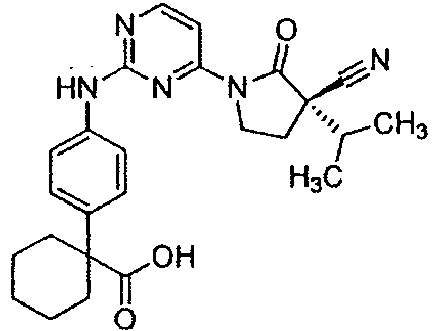
HCl 448.4 299 tert-butyl 4-(4-((4-((3S)-3-cyano-3-isopropyl-2-oxopyrrolidin-1-yl)pyrimidin-2-yl)amino)phenyl)tetrahydro-2H-pyran-4-carboxylate 
Free 506.3 -

- To a suspension of tert-butyl 4-(4-((4-((3S)-3-cyano-3-isopropyl-2-oxopyrrolidin-1-yl)pyrimidin-2-yl)amino)phenyl)tetrahydro-2H-pyran-4-carboxylate (30 mg) obtained in Example 299 in water (5.0 mL) was added 2 M hydrochloric acid (3.0 mL), and the mixture was stirred at 100°C for 1 hr. The solvent was evaporated under reduced pressure, and the residue was crystallized (diisopropyl ether/ethyl acetate) to give the title compound (7.5 mg).
MS(ESI+): [M+H]+ 450.4. -
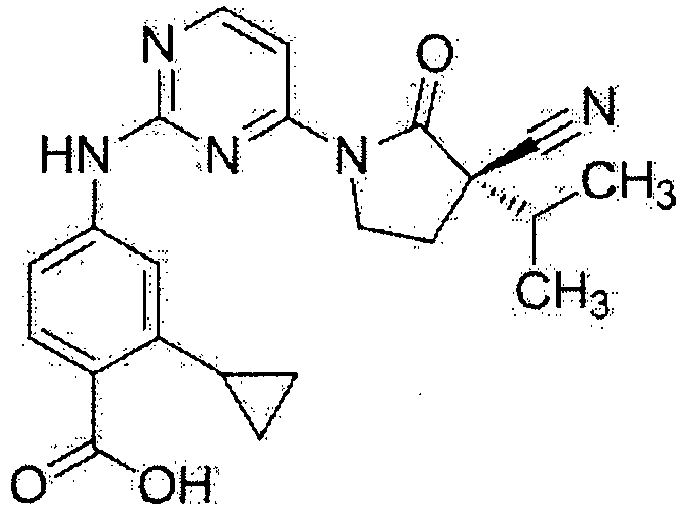
- To a solution of 2-bromo-4-nitrobenzoic acid (2.0 g) in tert-butanol (20 mL) were successively added 4-dimethylaminopyridine (1.1 g) and di-tert-butyl dicarbonate (2.1 mL), and the mixture was stirred overnight at room temperature. To the reaction mixture was added water, and the mixture was extracted with ethyl acetate. The obtained organic layer was washed with saturated brine, and dried over anhydrous magnesium sulfate, and the solvent was evaporated under reduced pressure. The residue was purified by silica gel column chromatography (hexane/ethyl acetate) to give the title compound (1.5 g).
1H NMR (400 MHz, DMSO-d6)δ1.55-1.60 (9H, m), 7.89 (1H, d, J = 8.6 Hz), 8.29 (1H, dd, J = 8.6, 2.2 Hz), 8.48 (1H, d, J = 2.2 Hz). - To a solution of tert-butyl 2-bromo-4-nitrobenzoate (1.5 g) obtained in Step A of Example 301 in a mixed solvent of toluene-water (v/v = 5/1, 18 mL) were successively added cyclopropylboronic acid (1.3 g), tripotassium phosphate (4.7 g), tricyclohexyl phosphine (280 mg) and palladium acetate (110 mg), and the mixture was stirred overnight at 100°C. To the reaction mixture was added water, and the mixture was extracted with ethyl acetate. The obtained organic layer was washed with saturated brine, and dried over anhydrous magnesium sulfate, and the solvent was evaporated under reduced pressure. The residue was purified by silica gel column chromatography (hexane/ethyl acetate) to give the title compound (1.3 g).
1H NMR (400 MHz, DMSO-d6) δ0.77-0.83 (2H, m), 1.02-1.10 (2H, m), 1.58 (9H, s), 2.35-2.46 (1H, m), 7.76 (1H, d, J = 2.4 Hz), 7.79 (1H, d, J = 8.6 Hz), 8.06 (1H, dd, J = 8.4, 2.3 Hz). - To a solution of tert-butyl 2-cyclopropyl-4-nitrobenzoate (500 mg) obtained in Step B of Example 301 in ethanol (5.0 mL) was added 10% palladium-carbon (100 mg), and the mixture was stirred at room temperature for 3 hr under hydrogen atmosphere (at normal pressures). The palladium-carbon was removed by filtration, and the solvent was evaporated under reduced pressure. The residue was purified by silica gel column chromatography (hexane/ethyl acetate) to give the title compound (300 mg).
1H NMR (400 MHz, DMSO-d6)δ0.49-0.57 (2H, m), 0.83-0.92 (2H, m), 1.46-1.54 (9H, m), 2.68 (1H, tt, J = 8.5, 5.6 Hz), 5.62 (2H, s), 6.13 (1H, d, J = 2.2 Hz), 6.33 (1H, dd, J = 8.4, 2.3 Hz), 7.48 (1H, d, J = 8.6 Hz). - The title compound (150 mg) was obtained from (3S)-1-(2-chloropyrimidin-4-yl)-3-isopropyl-2-oxopyrrolidine-3-carbonitrile (100 mg) obtained in Step A of Example 9 and tert-butyl 4-amino-2-cyclopropylbenzoate (88 mg) obtained in Step C of Example 301 in the same manner as in Step B of Example 2.
MS (ESI+), found: 362.3. - The title compound (1.5 mg) was obtained from (S)-tert-butyl 4-((4-(3-cyano-3-isopropyl-2-oxopyrrolidin-1-yl)pyrimidin-2-yl)amino)-2-cyclopropylbenzoate (70 mg) obtained in Step D of Example 301 in the same manner as in Example 300.
MS (ESI+) : [M+H]+ 406.3. -

- The title compound (39 mg) was obtained from (3S)-1-(2-chloropyrimidin-4-yl)-3-isopropyl-2-oxopyrrolidine-3-carbonitrile (70 mg) obtained in Step A of Example 9 and 4-amino-2-ethoxybenzonitrile (64 mg) in the same manner as in Step B of Example 2.
MS(ESI+): [M+H]+ 391.3. -
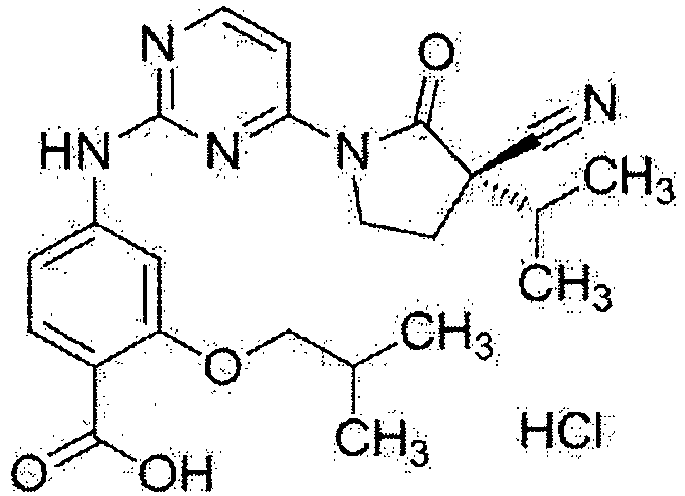
- The title compound (100 mg) was obtained from (3S)-1-(2-chloropyrimidin-4-yl)-3-isopropyl-2-oxopyrrolidine-3-carbonitrile (100 mg) obtained in Step A of Example 9 and tert-butyl 4-amino-2-isobutoxybenzoate (120 mg) obtained in Step B of Example 144 in the same manner as in Example 56.
MS (ESI+) : [M+H]+ 494.4. - The title compound (62 mg) was obtained from tert-butyl 4-((4-((3S)-3-cyano-3-isopropyl-2-oxopyrrolidin-1-yl)pyrimidin-2-yl)amino)-2-isobutoxybenzoate (100 mg) obtained in Step A of Example 303 in the same manner as in Example 140.
MS(ESI+): [M+H]+ 438.3. -

- The title compound (600 mg) was obtained from tert-butyl 2-hydroxy-4-nitrobenzoate (500 mg) obtained in Step A of Example 139, (bromomethyl)cyclopropane (0.30 mL) and sodium iodide (470 mg) in the same manner as in Step B of Example 139.
1H NMR (400 MHz, DMSO-d6) δ0.35-0.40 (2H, m), 0.55-0.62 (2H, m), 1.24 (1H, s), 1.55 (9H, s), 4.02-4.05 (2H, m), 7.72 (1H, d, J = 8.3 Hz), 7.77-7.85 (2H, m). - The title compound (520 mg) was obtained from tert-butyl 2-(cyclopropylmethoxy)-4-nitrobenzoate (600 mg) obtained in Step A of Example 304 in the same manner as in Step C of Example 139.
1H NMR (400 MHz, DMSO-d6) δ0.33 (2H, dd, J = 4.8, 1.6 Hz), 0.52-0.58 (2H, m), 1.37-1.43 (1H, m), 1.47 (9H, s), 3.72 (2H, d, J = 6.6 Hz), 5.73 (2H, s), 6.08-6.13 (2H, m), 7.39 (1H, d, J = 8.3 Hz). - The title compound (150 mg) was obtained from (3S)-1-(2-chloropyrimidin-4-yl)-3-isopropyl-2-oxopyrrolidine-3-carbonitrile (100 mg) obtained in Step A of Example 9 and tert-butyl 4-amino-2-(cyclopropylmethoxy)benzoate (120 mg) obtained in Step B of Example 304 in the same manner as in Example 56.
MS(ESI+): [M+H]+ 492.4. - The title compound (68 mg) was obtained from tert-butyl 4-((4-((3S)-3-cyano-3-isopropyl-2-oxopyrrolidin-1-yl)pyrimidin-2-yl)amino)-2-(cyclopropylmethoxy)benzoate (150 mg) obtained in Step C of Example 304 in the same manner as in Example 140. MS(ESI+): [M+H]+ 436.3.
-

- The title compound (150 mg) was obtained from 1-(4-fluorobenzoyl)-2-oxopyrrolidine-3-carbonitrile (300 mg) obtained in Step F of Example 1 and chloroacetonitrile (0.12 mL) in the same manner as in Step G of Example 1.
1H NMR(300 MHz, CDCl3)δ 2.54 (1H, ddd, J = 13.4, 9.6, 8.3 Hz), 2.84 (1H, ddd, J = 13.5, 6.5, 2.6 Hz), 3.10 (2H, d, J = 1.1 Hz), 4.06-4.31 (2H, m), 7.04-7.21 (2H, m), 7.60-7.78 (2H, m). - The title compound (72 mg) was obtained from 3-(cyanomethyl)-1-(4-fluorobenzoyl)-2-oxopyrrolidine-3-carbonitrile (150 mg) obtained in Step A of Example 305 in the same manner as in Step B of Example 5.
1H NMR(300 MHz, CDCl3)δ 2.51 (1H, dt, J = 13.6, 8.3 Hz), 2.83 (1H, ddd, J = 13.6, 6.8, 2.6 Hz), 2.92-3.17 (2H, m), 3.49-3.75 (2H, m), 6.04 (1H, brs). - The title compound (53 mg) was obtained from 2,4-dichloropyrimidine (110 mg) and 3-(cyanomethyl)-2-oxopyrrolidine-3-carbonitrile (72 mg) obtained in Step B of Example 305 in the same manner as in Step A of Example 2.
1H NMR(300 MHz, CDCl3)δ 2.44-2.66 (1H, m), 2.89 (1H, ddd, J = 13.5, 6.9, 2.6 Hz), 3.03-3.29 (2H, m), 4.19 (1H, ddd, J = 12.0, 9.3, 7.0 Hz), 4.37-4.60 (1H, m), 8.26 (1H, d, J = 5.7 Hz), 8.61 (1H, d, J = 5.7 Hz). - The title compound (20 mg) was obtained from 1-(2-chloropyrimidin-4-yl)-3-(cyanomethyl)-2-oxopyrrolidine-3-carbonitrile (53 mg) obtained in Step C of Example 305 and 4-(morpholin-4-yl)aniline (36 mg) in the same manner as in Step B of Example 2.
MS (ESI+) : [M+H]+ 414.3. -
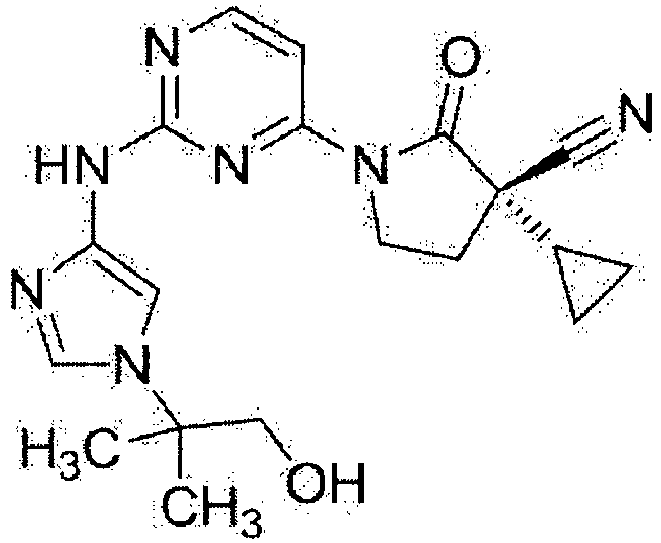
- To a solution of 4-nitro-1H-imidazole (10 g) in N,N-dimethylformamide (150 mL) was added sodium hydride (60% in mineral oil, 4.2 g) in an ice bath, and the mixture was stirred at the same temperature for 20 min. To the reaction mixture was added ethyl 2-bromo-2-methylpropanoate (20 mL) at the same temperature, and the mixture was stirred overnight at 50°C. To the reaction mixture was added water, and the mixture was extracted with ethyl acetate. The obtained organic layer was washed with saturated brine, and dried over anhydrous magnesium sulfate, and the solvent was evaporated under reduced pressure. The residue was purified by silica gel column chromatography (hexane/ethyl acetate) to give the title compound (12 g).
1H NMR (400 MHz, DMSO-d6) δ 1.18 (3H, t, J = 7.1 Hz), 1.84 (6H, s), 4.16 (2H, q, J = 7.1 Hz), 8.09 (1H, d, J = 1.5 Hz), 8.60 (1H, d, J = 1.5 Hz). - To a solution of lithium aluminium hydride (400 mg) in tetrahydrofuran (50 mL) was added a solution of ethyl 2-methyl-2-(4-nitro-1H-imidazol-1-yl)propanoate (2.0 g) obtained in Step A of Example 306 in tetrahydrofuran (20 mL) in an ice bath, and the mixture was stirred at room temperature for 1 hr. To the reaction mixture were added water and 2M aqueous sodium hydroxide solution, the insoluble substance was removed by filtration through Celite, and the solvent was evaporated under reduced pressure. The residue was purified by silica gel column chromatography (ethyl acetate/methanol) to give the title compound (260 mg).
1H NMR (400 MHz, DMSO-d6) δ 1.50 (6H, s), 3.54 (2H, d, J = 5.6 Hz), 5.23 (1H, t, J = 5.6 Hz), 7.95 (1H, d, J = 1.5 Hz), 8.47 (1H, d, J = 1.5 Hz). - The title compound (220 mg) was obtained from 2-methyl-2-(4-nitro-1H-imidazol-1-yl)propan-1-ol (250 mg) obtained in Step B of Example 306 in the same manner as in Step H of Example 103.
1H NMR (400 MHz, DMSO-d6) δ 1.30-1.46 (6H, m), 3.41 (2H, d, J = 4.9 Hz), 3.98 (2H, s), 5.01 (1H, t, J = 5.0 Hz), 6.23 (1H, d, J = 1.5 Hz), 7.17 (1H, d, J = 1.7 Hz). - The title compound (10 mg) was obtained from (3S)-1-(2-chloropyrimidin-4-yl)-3-cyclopropyl-2-oxopyrrolidine-3-carbonitrile (150 mg) obtained in Step E of Example 103 and 2-(4-amino-1H-imidazol-1-yl)-2-methylpropan-1-ol (93 mg) obtained in Step C of Example 306 in the same manner as in Step B of Example 2.
MS(ESI+): [M+H]+ 382.3. -

- The title compound (4.9 mg) was obtained from (3S)-1-(2-chloropyrimidin-4-yl)-3-isopropyl-2-oxopyrrolidine-3-carbonitrile (100 mg) obtained in Step A of Example 9 and 2-(4-amino-1H-imidazol-1-yl)-2-methylpropan-1-ol (65 mg) obtained in Step C of Example 306 in the same manner as in Step B of Example 2.
MS(ESI+): [M+H]+ 384.1. -

- To a mixture of (3R)-1-(2-chloropyrimidin-4-yl)-3-ethyl-2-oxopyrrolidine-3-carbonitrile (100 mg) obtained in Step A of Example 8, 2-methyl-1,3-thiazol-5-amine (56 mg), potassium carbonate (110 mg) and dicyclohexyl (2',4',6'-triisopropyl-[1,1'-biphenyl]-2-yl)phosphine (58 mg) in tert-butanol (1.0 mL) was added tris(dibenzylideneacetone)dipalladium(0) (22 mg), and the mixture was stirred for 5 hr with heated under reflux. The insoluble substance was removed by filtration through Celite, and the solvent was evaporated under reduced pressure. The residue was purified by silica gel column chromatography (hexane/ethyl acetate). To a solution of the obtained compound (26 mg) in ethanol (2.0 mL) was added 1 M hydrochloric acid (80 µL), and the mixture was stirred at room temperature for 5 min. The solvent was evaporated under reduced pressure, and the residue was recrystallized (ethanol) to give the title compound (15 mg).
MS (ESI+) : [M+H]+329.2. -

- To a solution of tert-butyl 3-oxoazetidine-1-carboxylate (3.4 g), diethyl 2,6-dimethyl-1,4-dihydropyridine-3,5-dicarboxylate (5.0 g) and ethyl cyanoacetate (2.2 g) in dimethylsulfoxide (40 mL) was added L-proline (460 mg), and the mixture was stirred at room temperature for 48 hr. The insoluble substance was removed by filtration, saturated aqueous ammonium chloride solution was added thereto, and the mixture was extracted with ethyl acetate. The obtained organic layer was washed with saturated brine, and dried over anhydrous magnesium sulfate, and the solvent was evaporated under reduced pressure. The residue was purified by silica gel column chromatography (hexane/ethyl acetate) to give the title compound (4.3 g).
1H NMR (400 MHz, CDCl3) δ1.33 (3H, t, J = 7.2 Hz), 1.40-1.49 (9H, m), 3.02-3.20 (1H, m), 3.73 (1H, d, J = 8.6 Hz), 3.82 (1H, dd, J = 9.3, 5.4 Hz), 3.87 (1H, dd, J = 9.4, 5.5 Hz), 4.10-4.20 (2H, m), 4.28 (2H, q, J = 7.1 Hz). - To a solution of tert-butyl 3-(1-cyano-2-ethoxy-2-oxoethyl)azetidine-1-carboxylate (4.3 g) obtained in Step A of Example 309, tert-butyl 1,2,3-oxathiazolidine-3-carboxylate 2,2-dioxide (4.7 g) and tetrabutylammonium bromide (520 mg) in toluene (60 mL) was added cesium carbonate (10 g), and the mixture was stirred overnight at room temperature. To the reaction mixture was added 0.5 M hydrochloric acid, and the mixture was extracted with ethyl acetate. The obtained organic layer was washed with saturated brine, and dried over anhydrous magnesium sulfate, and the solvent was evaporated under reduced pressure. The residue was purified by silica gel column chromatography (hexane/ethyl acetate) to give the title compound (7.0 g).
1H NMR (400 MHz, CDCl3) δ1.31-1.37 (3H, m), 1.40-1.52 (18H, m), 1.80-1.93 (1H, m), 2.11-2.25 (1H, m), 2.98-3.09 (1H, m), 3.26 (1H, dt, J = 14.0, 7.1 Hz), 3.32-3.43 (1H, m), 3.92 (2H, dt, J = 9.2, 6.2 Hz), 3.97-4.03 (1H, m), 4.03-4.08 (1H, m), 4.29 (2H, q, J = 7.2 Hz), 4.69 (1H, brs). - tert-Butyl 3-(4-((tert-butoxycarbonyl)amino)-2-cyano-1-ethoxy-1-oxobutan-2-yl)azetidine-1-carboxylate (7 g) obtained in Step B of Example 309 in tetrahydrofuran (80 mL) was added sodium hydride (60% in mineral oil, 816 mg) in an ice bath, and the mixture was stirred at room temperature for 1 hr. To the reaction mixture was added saturated aqueous sodium hydrogen carbonate solution, and the mixture was extracted with ethyl acetate. The obtained organic layer was washed with saturated brine, and dried over anhydrous magnesium sulfate, and the solvent was evaporated under reduced pressure. The residue was purified by silica gel column chromatography (hexane/ethyl acetate) to give the title compound (1.4 g).
1H NMR (400 MHz, CDCl3) δ 1.46 (9H, brs), 2.27 (1H, ddd, J = 13.4, 8.3, 7.0 Hz), 2.65 (1H, ddd, J = 13.4, 7.6, 4.2 Hz), 2.96-3.05 (1H, m), 3.45 (1H, dddd, J = 10.0, 8.5, 4.0, 1.2 Hz), 3.59 (1H, dt, J = 9.9, 7.4 Hz), 3.82-3.96 (1H, m), 4.05-4.12 (2H, m), 4.13-4.18 (1H, m), 6.38 (1H, brs). - To a mixture of tert-butyl 3-(3-cyano-2-oxopyrrolidin-3-yl)azetidine-1-carboxylate (1.3 g) obtained in Step C of Example 309, 2,4-dichloropyrimidine (750 mg), cesium carbonate (3.3 g) and 4,5-bis(diphenylphosphino)-9,9-dimethylxanthene (180 mg) in tetrahydrofuran (12 mL) was added tris(dibenzylideneacetone)dipalladium(0) (93 mg), and the mixture was stirred overnight at 85°C. The insoluble substance was removed by filtration through Celite, and the solvent was evaporated under reduced pressure. The residue was purified by silica gel column chromatography (hexane/ethyl acetate) to give the title compound (850 mg).
1H NMR (400 MHz, DMSO-d6) 1.39 (9H, s), 2.21-2.35 (1H, m), 2.61-2.71 (1H, m), 3.25-3.31 (1H, m), 3.77-3.89 (1H, m), 3.91-4.00 (3H, m), 4.01-4.14(2H, m), 8.19 (1H, d, J = 5.6 Hz), 8.69 (1H, d, J = 5.6 Hz). - A solution of tert-butyl 3-(1-(2-chloropyrimidin-4-yl)-3-cyano-2-oxopyrrolidin-3-yl)azetidine-1-carboxylate (100 mg) obtained in Step D of Example 309, 4-morpholinoaniline (61 mg) and acetic acid (50 µL) in n-butanol (4.0 mL) was stirred in a microwave reactor at 150°C for 1 hr, and the solvent was evaporated under reduced pressure. The residue was purified by silica gel column chromatography (NH, hexane/ethyl acetate), and recrystallized (diisopropyl ether/ethyl acetate) to give the title compound (35 mg).
MS (ESI+) : [M+H]+ 520. 4. -

- The title compound (20 mg) was obtained from tert-butyl 3-(3-cyano-1-(2-((4-(morpholin-4-yl)phenyl)amino)pyrimidin-4-yl)-2-oxopyrrolidin-3-yl)azetidine-1-carboxylate (25 mg) obtained in Step E of Example 309 in the same manner as in Example 140.
MS(ESI+): [M+H]+ 420.3. -
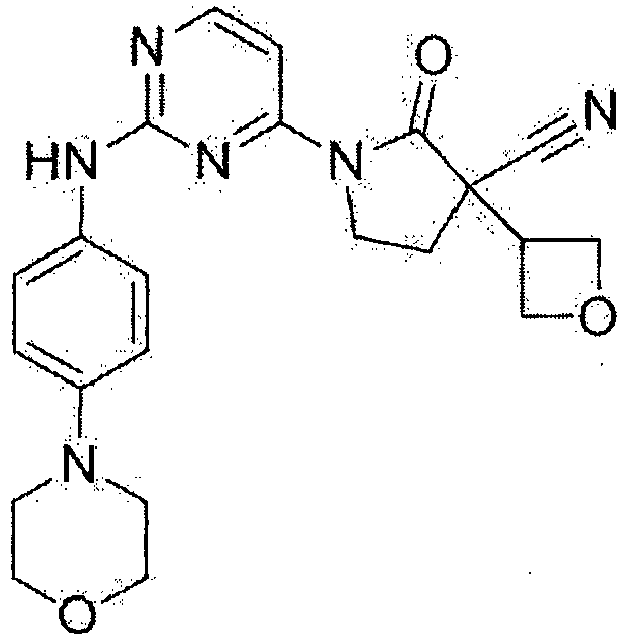
- The title compound (2.3 g) was obtained from oxetan-3-one (1.4 g) in the same manner as in Step A of Example 309.
1H NMR (400 MHz, CDCl3) δ1.33 (3H, t, J = 7.1 Hz), 3.52-3.64 (1H, m), 3.89 (1H, d, J = 8.8 Hz), 4.28 (2H, q, J = 7.2 Hz), 4.57 (1H, t, J = 6.6 Hz), 4.62 (1H, d, J = 6.4 Hz), 4.88 (2H, q, J = 7.7 Hz). - The title compound (3.6 g) was obtained from ethyl cyano(oxetan-3-yl)acetate (2.2 g) obtained in Step A of Example 311 in the same manner as in Step B of Example 309.
1H NMR (400 MHz, CDCl3) δ1.34 (3H, t, J = 7.1 Hz), 1.43 (9H, s), 1.85 (1H, dt, J = 13.6, 6.8 Hz), 2.12-2.23 (1H, m), 3.16-3.42 (2H, m), 3.54 (1H, quin, J = 7.5 Hz), 4.29 (2H, q, J = 7.1 Hz), 4.63-4.76 (4H, m), 4.75-4.83 (1H, m). - The title compound (0.47 g) was obtained from ethyl 4-((tert-butoxycarbonyl)amino)-2-cyano-2-(oxetan-3-yl)butanoate (3.6 g) obtained in Step B of Example 311 in the same manner as in Step C of Example 309.
1H NMR (400 MHz, CDCl3) δ 2.31 (1H, ddd, J = 13.4, 8.1, 6.8 Hz), 2.66 (1H, ddd, J = 13.3, 7.8, 4.4 Hz), 3.40-3.51 (2H, m), 3.55-3.65 (1H, m), 4.66 (1H, t, J = 6.7 Hz), 4.82-4.92 (3H, m), 6.95 (1H, brs). - The title compound (0.25 g) was obtained from 3-(oxetan-3-yl)-2-oxopyrrolidine-3-carbonitrile (0.47 g) obtained in Step C of Example 311 in the same manner as in Step D of Example 309.
1H NMR (400 MHz, DMSO-d6) δ 2.26 (1H, ddd, J = 13.1, 7.7, 4.2 Hz), 2.65 (1H, ddd, J = 13.1, 8.7, 7.3 Hz), 3.69-3.79 (1H, m), 3.93-4.01 (1H, m), 4.03-4.10 (1H, m), 4.55 (1H, t, J = 6.6 Hz), 4.68 (2H, d, J = 7.3 Hz), 4.76 (1H, dd, J = 8.1, 6.8 Hz), 8.18 (1H, d, J = 5.9 Hz), 8.69 (1H, d, J = 5.9 Hz). - The title compound (59 mg) was obtained from 1-(2-chloropyrimidin-4-yl)-3-(oxetan-3-yl)-2-oxopyrrolidine-3-carbonitrile (100 mg) obtained in Step D of Example 311 in the same manner as in Step E of Example 309.
MS (ESI+) : [M+H]+ 421.3. -

- The title compound (1.9 g) was obtained from cyclobutanone (1.4 g) in the same manner as in Step A of Example 309.
1H NMR (400 MHz, CDCl3) δ 1.31 (3H, t, J = 7.1 Hz), 1.87-2.08 (4H, m), 2.11-2.23 (2H, m), 2.85-2.96 (1H, m), 3.50 (1H, d, J = 7.3 Hz), 4.24 (2H, q, J = 7.2 Hz). - The title compound (1.8 g) was obtained from ethyl cyano(cyclobutyl)acetate (1.0 g) obtained in Step A of Example 312 in the same manner as in Step B of Example 309.
1H NMR (400 MHz, CDCl3) 1.32 (3H, t, J = 7.1 Hz), 1.43 (9H, s), 1.74-2.00 (4H, m), 2.06-2.15 (4H, m), 2.67-2.84 (1H, m), 3.13-3.28 (1H, m), 3.30-3.43 (1H, m), 4.26 (2H, q, J = 7.2 Hz), 4.66 (1H, brs). - The title compound (690 mg) was obtained from ethyl 4-((tert-butoxycarbonyl)amino)-2-cyano-2-cyclobutylbutanoate (1.8 g) obtained in Step B of Example 312 in the same manner as in Step C of Example 309.
1H NMR (400 MHz, CDCl3) δ1.84-2.00 (2H, m), 2.04-2.26 (5H, m), 2.56 (1H, ddd, J = 13.2, 8.3, 6.4 Hz), 2.75 (1H, quin, J = 8.6 Hz), 3.31-3.44 (1H, m), 3.44-3.54 (1H, m), 6.34 (1H, brs). - The title compound (0.50 g) was obtained from 3-cyclobutyl-2-oxopyrrolidine-3-carbonitrile (0.68 g) obtained in Step C of Example 312 in the same manner as in Step D of Example 309.
1H NMR (400 MHz, CDCl3) δ1.90-2.02 (2H, m), 2.11-2.21 (3H, m), 2.21-2.31 (2H, m), 2.58 (1H, ddd, J = 13.4, 8.6, 7.3 Hz), 2.75-2.86 (1H, m), 4.04 (1H, dt, J = 11.7, 7.6 Hz), 4.18 (1H, ddd, J = 11.9, 8.6, 4.6 Hz), 8.27 (1H, d, J = 5.9 Hz), 8.53 (1H, d, J = 5.9 Hz). - The title compound (70 mg) was obtained from 1-(2-chloropyrimidin-4-yl)-3-cyclobutyl-2-oxopyrrolidine-3-carbonitrile (100 mg) obtained in Step D of Example 312 in the same manner as in Step E of Example 309.
MS (ESI+) : [M+H]+ 419.4. - In Examples 313 to 346, the title compound was obtained from 1-(2-chloropyrimidin-4-yl)-3-ethyl-2-oxopyrrolidine-3-carbonitrile obtained in Step A of Example 2 and the aniline derivative each corresponding to the compounds of Examples 313 to 346 (these compounds can be produced according to a method known per se), in the same manner as in Step B of Example 2.
MS in the tables means actual measured value.Table 25-1 Example Number IUPAC Name Structure Salt MS 313 1-(2-anilinopyrimidin-4-yl)-3-ethyl-2-oxopyrrolidine-3-carbonitrile 
Free 307.9 314 3-ethyl-1-(2-((2-methylphenyl)amino)pyrimidin-4-yl)-2-oxopyrrolidine-3-carbonitrile 
Free 321.9 315 3-ethyl-1-(2-((4-methylphenyl)amino)pyrimidin-4-yl)-2-oxopyrrolidine-3-carbonitrile 
Free 321.9 316 3-ethyl-1-(2-((3-fluorophenyl)amino)pyrimidin-4-yl)-2-oxopyrrolidine-3-carbonitrile 
Free 325.9 317 3-ethyl-1-(2-((4-fluorophenyl)amino)pyrimidin-4-yl)-2-oxopyrrolidine-3-carbonitrile 
Free 325.9 318 1-(2-((2-chlorophenyl)amino)pyrimidin-4-yl)-3-ethyl-2-oxopyrrolidine-3-carbonitrile 
Free 341.9 319 1-(2-((3-chlorophenyl)amino)pyrimidin-4-yl)-3-ethyl-2-oxopyrrolidine-3-carbonitrile 
Free 341.9 320 1-(2-((4-chlorophenyl)amino)pyrimidin-4-yl)-3-ethyl-2-oxopyrrolidine-3-carbonitrile 
Free 341.9 321 3-ethyl-1-(2-((2-methoxyphenyl)amino)pyrimidin-4-yl)-2-oxopyrrolidine-3-carbonitrile 
Free 337.9 Table 25-2 Example Number IUPAC Name Structure Salt MS 322 3-ethyl-1-(2-((3-methoxyphenyl)amino)pyrimidin-4-yl) -2-oxopyrrolidine-3-carbonitrile 
Free 337.9 323 3-ethyl-1-(2-((4-methoxyphenyl)amino)pyrimidin-4-yl)-2-oxopyrrolidine-3-carbonitrile 
Free 337.9 324 3-ethyl-2-oxo-1-(2-((3-(trifluoromethoxy)phenyl)amino)pyrim idin-4-yl)pyrrolidine-3-carbonitrile 
Free 391.9 325 3-ethyl-2-oxo-1-(2-((4-(trifluoromethoxy)phenyl)amino)pyrim idin-4-yl)pyrrolidine-3-carbonitrile 
Free 391.9 326 1-(2-((3-cyanophenyl)amino)pyrimidin-4-yl)-3-ethyl-2-oxopyrrolidine-3-carbonitrile 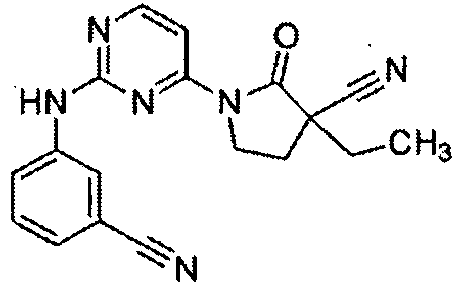
Free 332.9 327 1-(2-((4-cyanophenyl)amino)pyrimidin-4-yl)-3-ethyl-2-oxopyrrolidine-3-carbonitrile 
Free 332.9 328 3-((4-(3-cyano-3-ethyl-2-oxopyrrolidin-1-yl)pyrimidin-2-yl)amino)benzenesulfonamide 
Free 386.9 329 4-((4-(3-cyano-3-ethyl-2-oxopyrrolidin-1-yl)pyrimidin-2-yl)amino)benzenesulfonamide 
Free 387 330 3-ethyl-1-(2-((3-(hydroxymethyl)phenyl)amino)pyrimidi n-4-yl)-2-oxopyrrolidine-3-carbonitrile 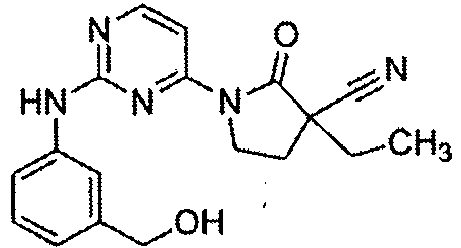
Free 337.9 Table 25-3 Example Number IUPAC Name Structure Salt MS 331 1-(2-((3-acetylphenyl)amino)pyrimidin-4-yl)-3-ethyl-2-oxopyrrolidine-3-carbonitrile 
Free 349.9 332 1-(2-((4-tert-butylphenyl)amino)pyrimidin-4-yl)-3-ethyl-2-oxopyrrolidine-3-carbonitrile 
Free 364.0 333 3-((4-(3-cyano-3-ethyl-2-oxopyrrolidin-1-yl)pyrimidin-2-yl)amino)benzamide 
Free 350.9 334 3-ethyl-1-(2-((6-methoxypyridin-3-yl)amino)pyrimidin-4-yl)-2-oxopyrrolidine-3-carbonitrile 
Free 338.9 335 3-ethyl-1-(2-((3-(methylsulfonyl)phenyl)amino)pyrimid in-4-yl)-2-oxopyrrolidine-3-carbonitrile 
Free 386.0 336 N-(3-((4-(3-cyano-3-ethyl-2-oxopyrrolidin-1-yl)pyrimidin-2-yl)amino)phenyl)acetamide 
Free 364.9 337 1-(2-((4-(cyanomethyl)phenyl)amino)pyrimidin-4-yl)-3-ethyl-2-oxopyrrolidine-3-carbonitrile 
Free 364.9 338 3-ethyl-1-(2-((4-(2-methoxyethoxy)phenyl)amino)pyrimidin-4-yl)-2-oxopyrrolidine-3-carbonitrile 
Free 382.0 Table 25-4 Example Number IUPAC Name Structure Salt MS 341 3-ethyl-1-(2-(1H-indazol-5-ylamino)pyrimidin-4-yl)-2-oxopyrrolidine-3-carbonitrile 
Free 348.0 342 1-(2-((1-tert-butyl-1H-pyrazol-4-yl)amino)pyrimidin-4-yl)-3-ethyl-2-oxopyrrolidine-3-carbonitrile 
Free 353.9 343 4-((4-(3-cyano-3-ethyl-2-oxopyrrolidin-1-yl)pyrimidin-2-yl)amino)thiophene-2-sulfonamide 
Free 392.9 344 1-(2-(1,3-benzothiazol-6-ylamino)pyrimidin-4-yl)-3-ethyl-2-oxopyrrolidine-3-carbonitrile 
Free 364.9 345 3-ethyl-1-(2-((1-methyl-1H-indol-5-yl)amino)pyrimidin-4-yl)-2-oxopyrrolidine-3-carbonitrile 
Free 361.0 -

- To an aqueous solution (200 mL) of sodium hydroxide (23 g) were added 2-thioxo-2,3-dihydropyrimidin-4(1H)-one (37 g) and iodomethane (20 mL), and the mixture was stirred overnight at room temperature. To the reaction mixture was added acetic acid (17 mL), and the precipitate was collected by filtration, and washed with ice water. The residue was dried to give the title compound (28 g).
1H NMR (400 MHz, DMSO-d6) δ 2.48 (3H, s), 6.10 (1H, d, J = 6.6 Hz), 7.87 (1H, d, J = 6.4 Hz), 12.69 (1H, brs). - To a solution of ethyl 2-methyl-2-(4-nitro-1H-pyrazol-1-yl)propanoate (20 g) obtained in Step F of Example 103 in ethanol (200 mL) was added 10% palladium-carbon (3.0 g), and the mixture was stirred overnight at room temperature under hydrogen atmosphere (at normal pressures). The palladium carbon was removed by filtration through Celite, and the solvent was evaporated under reduced pressure to give the title compound (17 g).
1H NMR (400 MHz, DMSO-d6) δ1.11 (3H, t, J = 7.1 Hz), 1.65 (6H, s), 3.82 (2H, s), 4.05 (2H, q, J = 7.1 Hz), 6.95 (1H, d, J = 0.7 Hz), 7.12 (1H, d, J = 1.0 Hz). - To a solution of 2-(methylsulfanyl)pyrimidin-4(3H)-one (9.1 g) obtained in Step A of Example 347 in diglyme (60 mL) was added ethyl 2-(4-amino-1H-pyrazol-1-yl)-2-methylpropanoate (13 g) obtained in Step B of Example 347, and the mixture was stirred at 140°C for 7 hr. To the reaction mixture was added water, and the mixture was extracted with ethyl acetate. The obtained organic layer was washed with water and saturated brine, and dried over anhydrous magnesium sulfate, and the solvent was evaporated under reduced pressure. The residue was purified by silica gel column chromatography (ethyl acetate/methanol) to give the title compound (17 g).
1H NMR (400 MHz, DMSO-d6) δ1.08-1.14 (3H, m), 1.69-1.78 (6H, m), 4.08 (2H, q, J = 7.3 Hz), 5.73 (1H, d, J = 5.6 Hz), 7.53-7.61 (1H, m), 7.68-7.81 (1H,m), 8.05 (1H, s), 8.68 (1H, brs). - To a solution of ethyl 2-methyl-2-(4-((6-oxo-1,6-dihydropyrimidin-2-yl)amino)-1H-pyrazol-1-yl)propanoate (2.0 g) obtained in Step C of Example 347 in acetonitrile (20 mL) was added phosphorus oxychloride (4.0 mL), and the mixture was stirred at 80°C for 2 hr. To the reaction mixture was added 8 M aqueous sodium hydroxide solution (25 mL), and the mixture was extracted with ethyl acetate. The obtained organic layer was washed with water and saturated brine, and dried over anhydrous magnesium sulfate, and the solvent was evaporated under reduced pressure to give the title compound (2.0 g).
1H NMR (400 MHz, DMSO-d6) δ1.13 (3H, t, J = 7.1 Hz), 1.75 (6H, s), 4.09 (2H, q, J = 7.1 Hz), 6.85 (1H, d, J = 5.1 Hz), 7.57 (1H, s), 7.98 (1H, s), 8.39 (1H, d, J = 4.9 Hz), 9.92 (1H, s). - To a solution of calcium chloride (540 mg) in a mixed solvent of tetrahydrofuran-ethanol (v/v = 1/1, 5.0 mL) was added sodium borohydride (240 mg), and the mixture was stirred at room temperature for 1 hr. To the reaction mixture was added a solution of ethyl 2-(4-((4-chloropyrimidin-2-yl)amino)-1H-pyrazol-1-yl)-2-methylpropanoate (1.0 g) obtained in Step D of Example 347 in a mixed solvent of tetrahydrofuran-ethanol (v/v = 1/1, 5.0 mL) in an ice bath, and the mixture was stirred overnight while it was allowed to be gradually warmed to room temperature. To the reaction mixture was added 1 M hydrochloric acid in an ice bath, and the mixture was stirred at the same temperature for 10 min. 1 M Aqueous sodium hydroxide solution was added thereto, and the solvent was evaporated under reduced pressure. To the residue was added water, and the mixture was extracted with ethyl acetate. The obtained organic layer was washed with saturated brine, and dried over anhydrous magnesium sulfate, and the solvent was evaporated under reduced pressure. The residue was purified by silica gel column chromatography (hexane/ethyl acetate) to give the title compound (700 mg).
1H NMR (400 MHz, DMSO-d6) δ 1.45 (6H, s), 3.55 (2H, d, J = 5.6 Hz), 4.96 (1H, t, J = 5.6 Hz), 6.81 (1H, d, J = 5.1 Hz), 7.54 (1H, s), 7.91 (1H, s), 8.37 (1H, d, J = 4.2 Hz), 9.83 (1H, s). - To a mixture of 2-(4-((4-chloropyrimidin-2-yl)amino)-1H-pyrazol-1-yl)-2-methylpropan-1-ol (200 mg) obtained in Step E of Example 347, 3-cyclopropyl-2-oxopyrrolidine-3-carbonitrile (110 mg) obtained in Step C of Example 103, cesium carbonate (490 mg) and 4,5-bis(diphenylphosphino)-9,9-dimethylxanthene (26 mg) in toluene (2.0 mL) was added tris(dibenzylideneacetone)dipalladium(O) (14 mg), and the mixture was stirred overnight at 85°C. The insoluble substance was removed by filtration through Celite, and the solvent was evaporated under reduced pressure. The residue was purified by silica gel column chromatography (hexane/ethyl acetate) to give the title compound (130 mg).
MS(ESI+): [M+H]+ 382.3. -
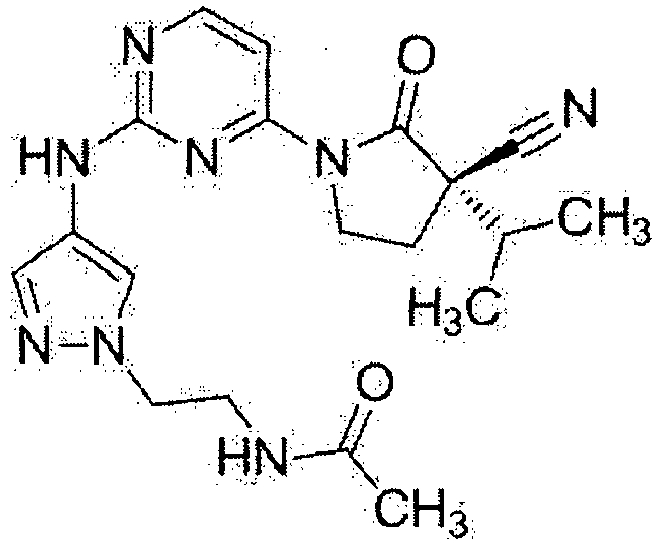
- To a solution of 4-nitro-1H-pyrazole (5.0 g) in N,N-dimethylformamide (100 mL) were added tert-butyl (2-bromoethyl)carbamate (12 g) and cesium carbonate (19 g), and the mixture was stirred overnight at 40°C. To the reaction mixture was added water, and the mixture was extracted with ethyl acetate. The obtained organic layer was washed with water and saturated brine, and dried over anhydrous sodium sulfate, and the solvent was evaporated under reduced pressure. The residue was purified by silica gel column chromatography (hexane/ethyl acetate) to give the title compound (13 g).
1H NMR (400 MHz, DMSO-d6) δ1.27-1.36 (9H, m), 3.35 (2H, q, J = 5.9 Hz), 4.20 (2H, t, J = 5.7 Hz), 6.96 (1H, t, J = 5.6 Hz), 8.26 (1H, s), 8.79 (1H, s). - To a solution of tert-butyl (2-(4-nitro-1H-pyrazol-1-yl)ethyl)carbamate (8.0 g) obtained in Step A of Example 348 in ethyl acetate (30 mL) was added a solution of 4 M hydrogen chloride in ethyl acetate (4.0 mL), and the mixture was stirred at room temperature for 3 hr. The reaction mixture was concentrated under reduced pressure to give the title compound (4.7 g).
1H NMR (400 MHz, DMSO-d6) δ3.41 (2H, brs), 4.41-4.52 (2H, m), 8.14 (3H, brs), 8.36 (1H, s), 8.96 (1H, s). - To a solution of 2-(4-nitro-1H-pyrazol-1-yl)ethanamine hydrochloride (1.0 g) obtained in Step B of Example 348 in tetrahydrofuran (30 mL) were successively added triethylamine (2.2 mL) and acetyl chloride (0.44 mL) in an ice bath, and the mixture was stirred at room temperature for 2 hr. To the reaction mixture was added water, and the mixture was extracted with ethyl acetate. The obtained organic layer was washed with water and saturated brine, and dried over anhydrous sodium sulfate, and the solvent was evaporated under reduced pressure. The residue was recrystallized (hexane/ethyl acetate) to give the title compound (610 mg).
1H NMR (400 MHz, DMSO-d6) δ 1.71-1.83 (3H, m), 3.46 (2H, q, J = 5.7 Hz), 4.21 (2H, t, J = 5.9 Hz), 7.96 (1H, brs), 8.28 (1H, d, J = 0.7 Hz), 8.87 (1H, s). - To a solution of N-(2-(4-nitro-1H-pyrazol-1-yl)ethyl)acetamide (610 mg) obtained in Step C of Example 348 in ethanol (20 mL) was added 10% palladium-carbon (160 mg), and the mixture was stirred at room temperature for 3 hr under hydrogen atmosphere (at normal pressures). The palladium carbon was removed by filtration through Celite, and the solvent was evaporated under reduced pressure to give the title compound (570 mg).
1H NMR (400 MHz, DMSO-d6) δ 1.76-1.81 (3H, m), 3.32-3.35 (2H, m), 3.84 (2H, brs), 3.94 (2H, t, J = 6.5 Hz), 6.91 (1H, d, J = 0.7 Hz), 6.97-7.01 (1H, m), 7.87-7.98 (1H, m). - The title compound (28 mg) was obtained from (3S)-1-(2-chloropyrimidin-4-yl)-3-isopropyl-2-oxopyrrolidine-3-carbonitrile (55 mg) obtained in Step A of Example 9 and N-(2-(4-amino-1H-pyrazol-1-yl)ethyl)acetamide (38 mg) obtained in Step D of Example 348 in the same manner as in Step B of Example 2.
MS(ESI+): [M+H]+ 397.3. -

- To a solution of 2-(4-nitro-1H-pyrazol-1-yl)ethanamine hydrochloride (1.0 g) obtained in Step B of Example 348 in tetrahydrofuran (30 mL) were added triethylamine (2.2 mL) and methanesulfonyl chloride (0.60 mL) in an ice bath, and the mixture was stirred at room temperature for 3 hr. To the reaction mixture was added water, and the mixture was extracted with ethyl acetate. The obtained organic layer was washed with water and saturated brine, and dried over anhydrous sodium sulfate, and the solvent was evaporated under reduced pressure. The residue was recrystallized (hexane/ethyl acetate) to give the title compound (880 mg).
1H NMR (400 MHz, DMSO-d6) δ 2.80-2.94 (3H, m), 3.42 (2H, q, J = 6.1 Hz), 4.28 (2H, t, J = 6.0 Hz), 7.24 (1H, t, J = 6.1 Hz), 8.30 (1H, d, J = 0.5 Hz), 8.87 (1H, s). - To a solution of N-(2-(4-nitro-1H-pyrazol-1-yl)ethyl)methanesulfonamide (880 mg) obtained in Step A of Example 349 in ethanol (30 mL) was added 10% palladium-carbon (200 mg), and the mixture was stirred at room temperature for 3 hr under hydrogen atmosphere (at normal pressures). The palladium carbon was removed by filtration through Celite, and the solvent was evaporated under reduced pressure to give the title compound (860 mg).
1H NMR (400 MHz, DMSO-d6) δ 2.79 (3H, s), 3.27 (2H, t, J = 6.4 Hz), 3.82 (2H, brs), 4.00 (2H, t, J = 6.5 Hz), 6.93 (1H, d, J = 1.0 Hz), 7.05 (1H, d, J = 1.0 Hz), 7.14 (1H, brs). - The title compound (70 mg) was obtained from (3S)-1-(2-chloropyrimidin-4-yl)-3-isopropyl-2-oxopyrrolidine-3-carbonitrile (55 mg) obtained in Step A of Example 9 and N-(2-(4-amino-1H-pyrazol-1-yl)ethyl)acetamide (47 mg) obtained in Step B of Example 349 in the same manner as in Step B of Example 2.
MS(ESI+): [M+H]+ 433.3. -

- To a solution of 5-aminopyridine-2-carboxylic acid (2.0 g) in N,N-dimethylformamide (50 mL) were added ammonium chloride (3.9 g), 1-ethyl-3-(3-dimethylaminopropyl)carbodiimide (5.1 mL) and 1-hydroxybenzotriazole (4.4 g), and the mixture was stirred overnight at room temperature. To the reaction mixture was added saturated aqueous sodium hydrogen carbonate solution, and the mixture was extracted with ethyl acetate. The obtained organic layer was washed with saturated brine, and dried over anhydrous sodium sulfate, and the solvent was evaporated under reduced pressure. The residue was purified by silica gel column chromatography (NH, hexane/ethyl acetate) to give the title compound (260 mg).
MS(ESI+): [M+H]+ 138.3. - To a solution of (3R)-1-(2-chloropyrimidin-4-yl)-3-ethyl-2-oxopyrrolidine-3-carbonitrile (200 mg) obtained in Step A of Example 8, 5-aminopyridine-2-carboxamide (130 mg) obtained in Step A of Example 350, cesium carbonate (520 mg) and 2,2'-bis(diphenylphosphino)-1,1'-binaphthyl (75 mg) in tetrahydrofuran (5.0 mL) was added tris(dibenzylideneacetone)dipalladium(O) (73 mg), and the mixture was stirred overnight at 80°C under argon atmosphere. The insoluble substance was removed by filtration through Celite, and the solvent was evaporated under reduced pressure. The residue was purified by silica gel column chromatography (NH, hexane/ethyl acetate), and recrystallized (diisopropyl ether/ethanol) to give the title compound (25 mg).
MS (ESI+) : [M+H]+ 352.3. -

- To a solution of (3S)-1-(2-chloropyrimidin-4-yl)-3-isopropyl-2-oxopyrrolidine-3-carbonitrile (200 mg) obtained in Step A of Example 9, 5-aminopyridine-2-carboxamide (120 mg) obtained in Step A of Example 350, cesium carbonate (490 mg) and 2,2'-bis(diphenylphosphino)-1,1'-binaphthyl (71 mg) in tetrahydrofuran (5.0 mL) was added tris(dibenzylideneacetone)dipalladium(O) (69 mg), and the mixture was stirred overnight at 80°C under argon atmosphere. The insoluble substance was removed by filtration through Celite, and the solvent was evaporated under reduced pressure. The residue was purified by silica gel column chromatography (NH, hexane/ethyl acetate), and recrystallized (diisopropyl ether/ethanol) to give the title compound (54 mg).
MS (ESI+) : [M+H]+ 366.3. -

- To a solution of (3S)-3-cyclopropyl-1-(2-((1-(1-hydroxy-2-methylpropan-2-yl)-1H-pyrazol-4-yl)amino)pyrimidin-4-yl)-2-oxopyrrolidine-3-carbonitrile (400 mg) obtained in Step I of Example 103 and cobalt(II) chloride hexahydrate (1.0 g) in methanol (6.0 mL) was added sodium borohydride (400 mg), and the mixture was stirred at room temperature for 4 hr. To the reaction mixture was added saturated aqueous sodium hydrogen carbonate solution in an ice bath, and the mixture was extracted with ethyl acetate. The obtained organic layer was washed with saturated brine, and dried over anhydrous sodium sulfate, and the solvent was evaporated under reduced pressure. The residue was purified by silica gel column chromatography (ethyl acetate/methanol) to give the title compound (84 mg).
MS(ESI+): [M+H]+ 386.4. -

- The title compound (30 mg) was obtained from (3S)-3-(aminomethyl)-3-cyclopropyl-1-(2-((1-(1-hydroxy-2-methylpropan-2-yl)-1H-pyrazol-4-yl)amino)pyrimidin-4-yl)pyrrolidin-2-one (76 mg) obtained in Example 352 in the same manner as in Step C of Example 348.
MS(ESI+): [M+H]+ 428.4. -

- To a solution of (3S)-3-cyclopropyl-1-(2-((1-(1-hydroxy-2-methylpropan-2-yl)-1H-pyrazol-4-yl)amino)pyrimidin-4-yl)-2-oxopyrrolidine-3-carbonitrile (170 mg) obtained in Step I of Example 103 and cobalt(II) chloride hexahydrate (420 mg) in methanol (3.0 mL) was added sodium borohydride (170 mg), and the mixture was stirred at room temperature for 2 hr. To the reaction mixture were added saturated aqueous sodium hydrogen carbonate solution (5.0 mL) and di-tert-butyl dicarbonate (0.12 mL), and the mixture was stirred at room temperature for 2 hr. To the reaction mixture was added water, and the mixture was extracted with ethyl acetate. The obtained organic layer was washed with saturated aqueous ammonium chloride solution and saturated brine, and dried over anhydrous sodium sulfate, and the solvent was evaporated under reduced pressure. The residue was purified by silica gel column chromatography (hexane/ethyl acetate) to give the title compound (130 mg).
MS(ESI+): [M+H]+ 486.4. -

- To a solution of 2-fluoro-4-nitrobenzoic acid (5.0 g) in N,N-dimethylformamide (100 mL) were added ammonium chloride (7.2 g), 1-ethyl-3-(3-dimethylaminopropyl)carbodiimide (9.5 mL), 1-hydroxybenzotriazole (8.3 g) and N,N-diisopropylethylamine (24 mL), and the mixture was stirred overnight at room temperature. To the reaction mixture was added saturated aqueous sodium hydrogen carbonate solution, and the precipitate was collected by filtration to give the title compound (3.1 g).
1H NMR (400 MHz, DMSO-d6) δ7.87 (1H, dd, J = 8.3, 7.1 Hz), 7.93 (1H, brs), 8.07 (1H, brs), 8.10-8.15 (1H, m), 8.20 (1H, dd, J = 9.9, 2.1 Hz). - The title compound (750 mg) was obtained from 2-fluoro-4-nitrobenzamide (1.0 g) obtained in Step A of Example 355 in the same manner as in Step D of Example 348.
1H NMR (400 MHz, DMSO-d6) δ5.94 (2H, s), 6.27 (1H, dd, J = 14.4, 2.0 Hz), 6.38 (1H, dd, J = 8.6, 2.2 Hz), 6.89-7.24 (2H, m), 7.48 (1H, t, J = 8.8 Hz). - The title compound (200 mg) was obtained from (3S)-1-(2-chloropyrimidin-4-yl)-3-isopropyl-2-oxopyrrolidine-3-carbonitrile (200 mg) obtained in Step A of Example 9 and 4-amino-2-fluorobenzamide (120 mg) obtained in Step B of Example 355 in the same manner as in Step B of Example 2.
MS(ESI+): [M+H]+ 383.3. -

- The title compound (220 mg) was obtained from (3R)-1-(2-chloropyrimidin-4-yl)-3-ethyl-2-oxopyrrolidine-3-carbonitrile (200 mg) obtained in Step A of Example 8 and 4-amino-2-fluorobenzamide (120 mg) obtained in Step B of Example 355 in the same manner as in Step B of Example 2.
MS (ESI+) : [M+H]+ 369.2. -

- The title compound (5.3 g) was obtained from tert-butyl 5-methyl-1,2,3-oxathiazolidine-3-carboxylate 2,2-dioxide (4.7 g) and ethyl cyano(cyclopropyl)acetate (3.0 g) obtained in Step A of Example 103 in the same manner as in Step B of Example 103.
MS(ESI+), found: 211.3 [M+H-(Boc)]+. - To ethyl 4-((tert-butoxycarbonyl)amino)-2-cyano-2-cyclopropyl-3-methylbutanoate (5.3 g) obtained in Step A of Example 357 was added 4 M hydrogen chloride in ethyl acetate (30 mL), and the mixture was stirred at room temperature for 2 hr. The reaction mixture was concentrated under reduced pressure, to a solution of the residue in acetonitrile (150 mL) was added potassium carbonate (9.4 g), and the mixture was stirred at room temperature for 5 hr. The insoluble substance was removed by filtration through Celite, and the solvent was evaporated under reduced pressure. The residue was purified by silica gel column chromatography (hexane/ethyl acetate) to give the title compound (2.2 g).
1H NMR (400 MHz, DMSO-d6) δ0.39-0.66 (4H, m), 1.08-1.26 (4H, m), 2.82-3.00 (1H, m), 3.26-3.46 (2H, m), 8.27 (1H, d, J = 15.9 Hz). - The title compound (2.6 g) was obtained from 3-cyclopropyl-4-methyl-2-oxopyrrolidine-3-carbonitrile (2.2 g) obtained in Step B of Example 357 and 2,4-dichloropyrimidine (2.0 g) in the same manner as in Step D of Example 103.
MS(ESI+): [M+H]+ 277.2. - The title compound (88 mg) was obtained from 1-(2-chloropyrimidin-4-yl)-3-cyclopropyl-4-methyl-2-oxopyrrolidine-3-carbonitrile (110 mg) obtained in Step C of Example 357 and 4-morpholinoaniline (68 mg) in the same manner as in Step B of Example 2.
MS(ESI+): [M+H]+ 419.4. -

- The title compound (5.5 g) was obtained from tert-butyl (4S)-4-methyl-1,2,3-oxathiazolidine-3-carboxylate 2,2-dioxide (4.7 g) and ethyl cyano(cyclopropyl)acetate (3.0 g) obtained in Step A of Example 103 in the same manner as in Step B of Example 103.
1H NMR (400 MHz, DMSO-d6) δ0.32-0.72 (4H, m), 0.96-1.11 (3H, m), 1.21-1.27 (3H, m), 1.28-1.32 (1H, m), 1.33-1.42 (9H, m), 1.84-2.27 (2H, m), 3.58-3.86 (1H, m), 4.10-4.30 (2H, m), 6.41-6.84 (1H, m). - (3R,5S)-3-cyclopropyl-5-methyl-2-oxopyrrolidine-3-carbonitrile
(3S,5S)-3-Cyclopropyl-5-methyl-2-oxopyrrolidine-3-carbonitrile (780 mg) and (3R,5S)-3-cyclopropyl-5-methyl-2-oxopyrrolidine-3-carbonitrile (680 mg) were obtained from ethyl (4S)-4-((tert-butoxycarbonyl)amino)-2-cyano-2-cyclopropylpentanoate (5.5 g) obtained in Step A of Example 358 in the same manner as in Step B of Example 357.
(3S,5S)-3-cyclopropyl-5-methyl-2-oxopyrrolidine-3-carbonitrile 1H NMR (400 MHz, DMSO-d6) δ0.40-0.47 (1H, m), 0.49-0.56 (2H, m), 0.60-0.69 (1H, m), 1.15 (3H, d, J = 6.1 Hz), 1.23-1.33 (1H, m), 1.67 (1H, dd, J = 13.3, 7.5 Hz), 2.59 (1H, dd, J = 13.3, 6.7 Hz), 3.64-3.76 (1H, m), 8.46 (1H, brs).
(3R,5S)-3-cyclopropyl-5-methyl-2-oxopyrrolidine-3-carbonitrile 1H NMR (400 MHz, DMSO-d6) δ 0.39-0.57 (3H, m), 0.58-0.67 (1H, m), 1.15 (3H, d, J = 6.1 Hz), 1.32 (1H, tt, J = 8.2, 5.0 Hz), 1.99-2.05 (1H, m), 2.40 (1H, dd, J = 13.0, 6.4 Hz), 3.64-3.75 (1H, m), 8.39 (1H, brs). - To a mixture of (3S,5S)-3-cyclopropyl-5-methyl-2-oxopyrrolidine-3-carbonitrile (150 mg) obtained in Step B of Example 358, 2-(4-((4-chloropyrimidin-2-yl)amino)-1H-pyrazol-1-yl)-2-methylpropan-1-ol (200 mg) obtained in Step E of Example 347, potassium carbonate (210 mg) and 4,5-bis(diphenylphosphino)-9,9-dimethylxanthene (26 mg) in toluene (2.0 mL) was added tris(dibenzylideneacetone)dipalladium(O) (14 mg), and the mixture was stirred overnight at 85°C. The insoluble substance was removed by filtration through Celite, and the solvent was evaporated under reduced pressure. The residue was purified by silica gel column chromatography (NH, hexane/ethyl acetate), and to a solution of the residue (200 mg) in ethanol (2.0 mL) was added 1 M hydrochloric acid (0.51 mL). The reaction mixture was concentrated under reduced pressure, and the residue was recrystallized (diisopropyl ether/ethyl acetate) to give the title compound (65 mg).
MS (ESI+) : [M+H]+ 396.4. -

- The title compound (110 mg) was obtained from (3R,5S)-3-cyclopropyl-5-methyl-2-oxopyrrolidine-3-carbonitrile (150 mg) obtained in Step B of Example 358 and 2-(4-((4-chloropyrimidin-2-yl)amino)-1H-pyrazol-1-yl)-2-methylpropan-1-ol (200 mg) obtained in Step E of Example 347 in the same manner as in Step C of Example 358.
MS(ESI+): [M+H]+ 396.4. -

- The title compound (6.3 g) was obtained from tert-butyl (4R)-4-methyl-1,2,3-oxathiazolidine-3-carboxylate 2,2-dioxide (5.1 g) and ethyl cyano(cyclopropyl)acetate (3.3 g) obtained in Step A of Example 103 in the same manner as in Step B of Example 103.
1H NMR (400 MHz, DMSO-d6) δ0.34-0.71 (4H, m), 0.97-1.11 (3H, m), 1.22-1.27 (3H, m), 1.28-1.32 (1H, m), 1.33-1.42 (9H, m), 1.84-2.28 (2H, m), 3.53-3.84 (1H, m), 4.11-4.31 (2H, m), 6.36-6.87 (1H, m). - (3R,5R)-3-cyclopropyl-5-methyl-2-oxopyrrolidine-3-carbonitrile
(3S,5R)-3-Cyclopropyl-5-methyl-2-oxopyrrolidine-3-carbonitrile (1.2 g) and (3R,5R)-3-cyclopropyl-5-methyl-2-oxopyrrolidine-3-carbonitrile (860 mg) were obtained from ethyl (4R)-4-((tert-butoxycarbonyl)amino)-2-cyano-2-cyclopropylpentanoate (5.0 g) obtained in Step A of Example 360 in the same manner as in Step B of Example 357.
(3S,5R)-3-cyclopropyl-5-methyl-2-oxopyrrolidine-3-carbonitrile 1H NMR (400 MHz, DMSO-d6) δ 0.40-0.48 (1H, m), 0.48-0.56 (2H, m), 0.61-0.69 (1H, m), 1.15 (3H, d, J = 6.1 Hz), 1.23-1.33 (1H, m), 1.67 (1H, dd, J = 13.3, 7.5 Hz), 2.59 (1H, dd, J = 13.3, 6.7 Hz), 3.64-3.76 (1H, m), 8.47 (1H, brs).
(3R,5R)-3-cyclopropyl-5-methyl-2-oxopyrrolidine-3-carbonitrile 1H NMR (400 MHz, DMSO-d6) δ0.39-0.68 (4H, m), 1.15 (3H, d, J = 6.4 Hz), 1.27-1.37 (1H, m), 2.02 (1H, dd, J = 13.2, 7.8 Hz), 2.40 (1H, dd, J = 13.0, 6.4 Hz), 3.64-3.75 (1H, m), 8.39 (1H, brs). - The title compound (220 mg) was obtained from (3S,5R)-3-cyclopropyl-5-methyl-2-oxopyrrolidine-3-carbonitrile (150 mg) obtained in Step B of Example 360 and 2-(4-((4-chloropyrimidin-2-yl)amino)-1H-pyrazol-1-yl)-2-methylpropan-1-ol (200 mg) obtained in Step E of Example 347 in the same manner as in Step C of Example 358.
MS(ESI+): [M+H]+ 396.4. -

- The title compound (3.2 g) was obtained from 2-(methylsulfanyl)pyrimidin-4(3H)-one (2.4 g) obtained in Step A of Example 347 and 4-morpholinoaniline (3.0 g) in the same manner as in Step C of Example 347.
1H NMR (400 MHz, DMSO-d6) δ 2.98-3.12 (4H, m), 3.64-3.79 (4H, m), 5.71 (1H, brs), 6.90 (2H, d, J = 9.0 Hz), 7.41 (2H, d, J = 8.3 Hz), 7.67 (1H, brs), 8.60 (1H, brs), 10.70 (1H, brs). - The title compound (2.6 g) was obtained from 2-((4-(morpholin-4-yl)phenyl)amino)pyrimidin-4(3H)-one (3.2 g) obtained in Step A of Example 361 in the same manner as in Step D of Example 347.
1H NMR (400 MHz, DMSO-d6) δ 2.99-3.09 (4H, m), 3.67-3.78 (4H, m), 6.86 (1H, d, J = 5.1 Hz), 6.89-6.94 (2H, m), 7.49-7.57 (2H, m), 8.36 (1H, d, J = 5.4 Hz), 9.78 (1H, s). - The title compound (140 mg) was obtained from 4-chloro-N-(4-(morpholin-4-yl)phenyl)pyrimidin-2-amine (200 mg) obtained in Step B of Example 361 and (3S,5R)-3-cyclopropyl-5-methyl-2-oxopyrrolidine-3-carbonitrile (140 mg) obtained in Step B of Example 360 in the same manner as in Step C of Example 358.
MS (ESI+) : [M+H]+ 419.4. -

- The title compound (83 mg) was obtained from 4-chloro-N-(4-(morpholin-4-yl)phenyl)pyrimidin-2-amine (200 mg) obtained in Step B of Example 361 and (3S,5S)-3-cyclopropyl-5-methyl-2-oxopyrrolidine-3-carbonitrile (140 mg) obtained in Step B of Example 360 in the same manner as in Step C of Example 358.
MS(ESI+): [M+H]+ + 419.4. -

- To a solution of ethyl (5-aminopyridin-2-yl)acetate (2.0 g) in tetrahydrofuran (30 mL) were successively added pyridine (2.7 mL) and benzyl chloroformate (1.9 mL) in an ice bath, and the mixture was stirred at the same temperature for 3 hr. To the reaction mixture was added water, and the mixture was extracted with ethyl acetate. The obtained organic layer was washed with water and saturated brine, and dried over anhydrous sodium sulfate, and the solvent was evaporated under reduced pressure. The residue was purified by silica gel column chromatography (hexane/ethyl acetate) to give the title compound (2.6 g).
1H NMR (300 MHz, DMSO-d6) δ 1.17 (3H, t, J = 7.0 Hz), 3.75 (2H, s), 4.07 (2H, q, J = 7.1 Hz), 4.98-5.34 (2H, m), 7.11-7.60 (6H, m), 7.85 (1H, dd, J = 8.5, 2.5 Hz), 8.54 (1H, d, J = 2.3 Hz), 9.95 (1H, s). - To a solution of ethyl (5-(((benzyloxy)carbonyl)amino)pyridin-2-yl)acetate (1.0 g) obtained in Step A of Example 363 in a mixed solvent of tetrahydrofuran (20 mL) and 2-propanol (5.0 mL) was added 2 M aqueous sodium hydroxide solution (6.4 mL) in an ice bath, and the mixture was stirred at the same temperature for 3 hr. The reaction mixture was collected by filtration to give the title compound (2.6 g).
1H NMR (400 MHz, DMSO-d6) δ 3.30 (2H, s), 5.15 (2H, s), 7.21 (1H, d, J = 8.6 Hz), 7.30-7.49 (5H, m), 7.70 (1H, d, J = 8.1 Hz), 8.42 (1H, s), 9.81 (1H, brs). - The title compound (610 mg) was obtained from sodium (5-(((benzyloxy)carbonyl)amino)pyridin-2-yl)acetate (940 mg) obtained in Step B of Example 363 in the same manner as in Step A of Example 350.
1H NMR (400 MHz, DMSO-d6) δ3.50 (2H, s), 5.17 (2H, s), 6.93 (1H, brs), 7.25 (1H, d, J = 8.3 Hz), 7.31-7.51 (6H, m), 7.81 (1H, dd, J = 8.3, 2.2 Hz), 8.52 (1H, d, J = 2.2 Hz), 9.93 (1H, brs). - The title compound (74 mg) was obtained from benzyl (6-(2-amino-2-oxoethyl)pyridin-3-yl)carbamate (200 mg) obtained in Step C of Example 363 in the same manner as in Step D of Example 348.
1H NMR (400 MHz, DMSO-d6) δ3.34 (2H, s), 5.13 (2H, s), 6.75-6.89 (2H, m), 6.93-6.99 (1H, m), 7.32 (1H, brs), 7.79-7.87 (1H, m). - To a solution of (3R)-1-(2-chloropyrimidin-4-yl)-3-ethyl-2-oxopyrrolidine-3-carbonitrile (130 mg) obtained in Step A of Example 8, 2-(5-aminopyridin-2-yl)acetamide (78 mg) obtained in Step D of Example 363, cesium carbonate (340 mg) and 2,2'-bis(diphenylphosphino)-1,1'-binaphthyl (48 mg) in tetrahydrofuran (5.0 mL) was added tris(dibenzylideneacetone)dipalladium(O) (48 mg), and the mixture was stirred overnight at 80°C under argon atmosphere. The insoluble substance was removed by filtration through Celite, and the solvent was evaporated under reduced pressure. The residue was purified by silica gel column chromatography (NH, ethyl acetate/methanol). To a solution of the residue (200 mg) in ethanol (2.0 mL) was added 1 M hydrochloric acid (0.55 mL), the mixture was stirred at room temperature for 5 min, and the solvent was evaporated under reduced pressure. The obtained crude crystals were recrystallized (diisopropyl ether/ethanol) to give the title compound (42 mg).
MS(ESI+): [M+H]+ 366.3. -

- The title compound (200 mg) was obtained from (3R)-1-(2-chloropyrimidin-4-yl)-3-ethyl-2-oxopyrrolidine-3-carbonitrile (150 mg) obtained in Step A of Example 8 and 4-aminobenzamide (90 mg) in the same manner as in Step B of Example 2.
MS (ESI+) : [M+H]+ 351.3. -

- The title compound (44 mg) was obtained from (3R)-1-(2-chloropyrimidin-4-yl)-3-ethyl-2-oxopyrrolidine-3-carbonitrile (150 mg) obtained in Step A of Example 8 and 4-amino-N,N-dimethylbenzamide (110 mg) in the same manner as in Step B of Example 2.
MS(ESI+): [M+H]+ 379.4. -

- The title compound (910 mg) was obtained from (3S,5R)-3-cyclopropyl-5-methyl-2-oxopyrrolidine-3-carbonitrile (600 mg) obtained in Step B of Example 360 and 2,4-dichloropyrimidine (820 mg) in the same manner as in Step D of Example 103.
MS(ESI+): [M+H]+ 277.2. - The title compound (44 mg) was obtained from (3S,5R)-1-(2-chloropyrimidin-4-yl)-3-cyclopropyl-5-methyl-2-oxopyrrolidine-3-carbonitrile (100 mg) obtained in Step A of Example 366 and 1-methyl-1H-pyrazol-4-amine (37 mg) in the same manner as in Step B of Example 2.
MS(ESI+): [M+H]+ 338.0. -

- The title compound (110 mg) was obtained from (3S,5R)-1-(2-chloropyrimidin-4-yl)-3-cyclopropyl-5-methyl-2-oxopyrrolidine-3-carbonitrile (100 mg) obtained in Step A of Example 366 and 2-(4-amino-1H-pyrazol-1-yl)-N-methylacetamide (59 mg) in the same manner as in Step B of Example 2.
MS (ESI+) : [M+H]+ 395.1. -

- The title compound (89 mg) was obtained from (3S,5R)-1-(2-chloropyrimidin-4-yl)-3-cyclopropyl-5-methyl-2-oxopyrrolidine-3-carbonitrile (100 mg) obtained in Step A of Example 366 and 1-(1,1-dioxidetetrahydro-2H-thiopyran-4-yl)-1H-pyrazol-4-amine (82 mg) in the same manner as in Step B of Example 2.
MS(ESI+): [M+H]+ 456.3. -

- (3R,4S)-1-(2-chloropyrimidin-4-yl)-3-cyclopropyl-4-methyl-2-oxopyrrolidine-3-carbonitrile
(3S,4S)-1-(2-chloropyrimidin-4-yl)-3-cyclopropyl-4-methyl-2-oxopyrrolidine-3-carbonitrile
(3R,4R)-1-(2-chloropyrimidin-4-yl)-3-cyclopropyl-4-methyl-2-oxopyrrolidine-3-carbonitrile - 1-(2-Chloropyrimidin-4-yl)-3-cyclopropyl-4-methyl-2-oxopyrrolidine-3-carbonitrile (2.6 g) obtained in Step C of Example 357 was purified by silica gel column chromatography (hexane/ethyl acetate) to give (3SR,4RS)-1-(2-chloropyrimidin-4-yl)-3-cyclopropyl-4-methyl-2-oxopyrrolidine-3-carbonitrile (820 mg) and (3SR,4SR)-1-(2-chloropyrimidin-4-yl)-3-cyclopropyl-4-methyl-2-oxopyrrolidine-3-carbonitrile (1.3 g). (3SR,4RS)-1-(2-Chloropyrimidin-4-yl)-3-cyclopropyl-4-methyl-2-oxopyrrolidine-3-carbonitrile (810 mg) was resolved by HPLC (column: CHIRALCEL OD, 50 mmID×500 mmL, manufactured by Daicel Chemical Industries, mobile phase: hexane/2-propanol = 900/100) to give (3S,4R)-1-(2-chloropyrimidin-4-yl)-3-cyclopropyl-4-methyl-2-oxopyrrolidine-3-carbonitrile (400 mg) having a shorter retention time and (3R,4S)-1-(2-chloropyrimidin-4-yl)-3-cyclopropyl-4-methyl-2-oxopyrrolidine-3-carbonitrile (400 mg) having a longer retention time. (3SR,4SR)-1-(2-Chloropyrimidin-4-yl)-3-cyclopropyl-4-methyl-2-oxopyrrolidine-3-carbonitrile (1.3 g) was resolved by HPLC (column: CHIRALCEL OD, 50 mmIDx500 mmL, manufactured by Daicel Chemical Industries, mobile phase: hexane/2-propanol = 900/100) to give (3S,4S)-1-(2-chloropyrimidin-4-yl)-3-cyclopropyl-4-methyl-2-oxopyrrolidine-3-carbonitrile (400 mg) having a shorter retention time and (3R,4R)-1-(2-chloropyrimidin-4-yl)-3-cyclopropyl-4-methyl-2-oxopyrrolidine-3-carbonitrile (400 mg) having a longer retention time.
- (3SR,4RS)-1-(2-chloropyrimidin-4-yl)-3-cyclopropyl-4-methyl-2-oxopyrrolidine-3-carbonitrile
1H NMR (400 MHz, DMSO-d6) δ0.46-0.55 (2H, m), 0.56-0.63 (1H, m), 0.69-0.81 (1H, m), 1.26 (3H, d, J = 6.8 Hz), 1.35-1.54 (1H, m), 2.92-3.15 (1H, m), 3.64 (1H, t, J = 10.8 Hz), 4.26 (1H, dd, J = 11.0, 8.1 Hz), 8.21 (1H, d, J = 5.9 Hz), 8.69 (1H, d, J = 5.6 Hz).
(3SR,4SR)-1-(2-chloropyrimidin-4-yl)-3-cyclopropyl-4-methyl-2-oxopyrrolidine-3-carbonitrile
1H NMR (400 MHz, DMSO-d6) δ0.50-0.59 (2H, m), 0.62-0.74 (2H, m), 1.26 (3H, d, J = 6.8 Hz), 1.47 (1H, tt, J = 8.2, 5.1 Hz), 2.65-2.80 (1H, m), 3.64 (1H, dd, J = 11.5, 6.1 Hz), 4.25 (1H, dd, J = 11.5, 7.1 Hz), 8.22 (1H, d, J = 5.9 Hz), 8.70 (1H, d, J = 5.9 Hz). - (3S,4R)-1-(2-chloropyrimidin-4-yl)-3-cyclopropyl-4-methyl-2-oxopyrrolidine-3-carbonitrile
>99%ee (HPLC (column: CHIRALCEL OD, 4.6 mmID×250 mmL, manufactured by Daicel Chemical Industries, mobile phase: hexane/2-propanol = 900/100, flow rate: 1.0 mL/min, retention time: 16.37 min))
(3R,4S)-1-(2-chloropyrimidin-4-yl)-3-cyclopropyl-4-methyl-2-oxopyrrolidine-3-carbonitrile
>99%ee (HPLC (column: CHIRALCEL OD, 4.6 mmID×250 mmL, manufactured by Daicel Chemical Industries, mobile phase: hexane/2-propanol = 900/100, flow rate: 1.0 mL/min, retention time: 26.87 min))
(3S,4S)-1-(2-chloropyrimidin-4-yl)-3-cyclopropyl-4-methyl-2-oxopyrrolidine-3-carbonitrile
>99%ee (HPLC (column: CHIRALCEL OD, 4.6 mmID×250 mmL, manufactured by Daicel Chemical Industries, mobile phase: hexane/2-propanol = 900/100, flow rate: 1.0 mL/min, retention time: 13.64 min))
(3R,4R)-1-(2-chloropyrimidin-4-yl)-3-cyclopropyl-4-methyl-2-oxopyrrolidine-3-carbonitrile
>99%ee (HPLC (column: CHIRALCEL OD, 4.6 mmID×250 mmL, manufactured by Daicel Chemical Industries, mobile phase: hexane/2-propanol = 900/100, flow rate: 1.0 mL/min, retention time: 18.47 min)) - The title compound (81 mg) was obtained from (3S,4R)-1-(2-chloropyrimidin-4-yl)-3-cyclopropyl-4-methyl-2-oxopyrrolidine-3-carbonitrile (100 mg) obtained in Step A of Example 369 and 2-(4-amino-1H-pyrazol-1-yl)-2-methylpropan-1-ol (59 mg) obtained in Step H of Example 103 in the same manner as in Step B of Example 2.
MS(ESI+): [M+H]+ 396.4. -
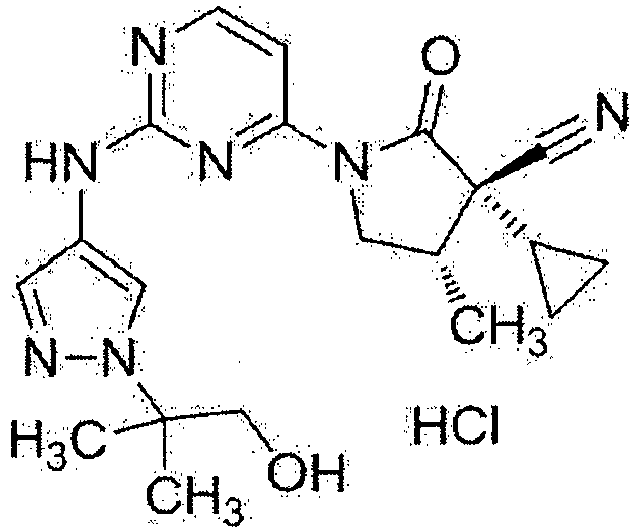
- The title compound (71 mg) was obtained from (3R,4S)-1-(2-chloropyrimidin-4-yl)-3-cyclopropyl-4-methyl-2-oxopyrrolidine-3-carbonitrile (100 mg) obtained in Step A of Example 369 and 2-(4-amino-1H-pyrazol-1-yl)-2-methylpropan-1-ol (59 mg) obtained in Step H of Example 103 in the same manner as in Step B of Example 2.
MS(ESI+): [M+H]+ 396.4. -

- The title compound (97 mg) was obtained from (3S,4S)-1-(2-chloropyrimidin-4-yl)-3-cyclopropyl-4-methyl-2-oxopyrrolidine-3-carbonitrile (100 mg) obtained in Step A of Example 369 and 2-(4-amino-1H-pyrazol-1-yl)-2-methylpropan-1-ol (59 mg) obtained in Step H of Example 103 in the same manner as in Step B of Example 2.
MS (ESI+) : [M+H]+ 396.4. -

- The title compound (94 mg) was obtained from (3R,4R)-1-(2-chloropyrimidin-4-yl)-3-cyclopropyl-4-methyl-2-oxopyrrolidine-3-carbonitrile (100 mg) obtained in Step A of Example 369 and 2-(4-amino-1H-pyrazol-1-yl)-2-methylpropan-1-ol (59 mg) obtained in Step H of Example 103 in the same manner as in Step B of Example 2.
MS(ESI+): [M+H]+ 396.4. -

- The title compound (110 mg) was obtained from (3S,5R)-1-(2-chloropyrimidin-4-yl)-3-cyclopropyl-5-methyl-2-oxopyrrolidine-3-carbonitrile (100 mg) obtained in Step A of Example 366 and 4-(4-aminophenyl)tetrahydro-2H-pyran-4-carboxamide (84 mg) obtained in Step C of Example 150 in the same manner as in Step B of Example 2.
MS(ESI+): [M+H]+ 461.4. -

- (3S,5R)-3-cyclopropyl-5-ethyl-2-oxopyrrolidine-3-carbonitrile
(3R,5R)-3-Cyclopropyl-5-ethyl-2-oxopyrrolidine-3-carbonitrile (990 mg) and (3S,5R)-3-cyclopropyl-5-ethyl-2-oxopyrrolidine-3-carbonitrile (590 mg) were obtained from tert-butyl (4R)-4-ethyl-1,2,3-oxathiazolidine-3-carboxylate 2,2-dioxide (4.3 g) and ethyl cyano(cyclopropyl)acetate (2.6 g) obtained in Step A of Example 103 in the same manner as in Step B of Example 103 and Step B of Example 357.
(3R,5R)-3-cyclopropyl-5-ethyl-2-oxopyrrolidine-3-carbonitrile 1H NMR (300 MHz, DMSO-d6) δ0.38-0.57 (3H, m), 0.59-0.71 (1H, m), 0.87 (3H, t, J = 7.4 Hz), 1.21-1.32 (1H, m), 1.33-1.59 (2H, m), 1.71 (1H, dd, J = 13.4, 7.4 Hz), 2.57 (1H, dd, J = 13.4, 6.6 Hz), 3.43-3.57 (1H, m), 8.57 (1H, brs).
(3S,5R)-3-cyclopropyl-5-ethyl-2-oxopyrrolidine-3-carbonitrile 1H NMR (300 MHz, DMSO-d6) δ0.39-0.70 (4H, m), 0.83-0.93 (3H, m), 1.26-1.55 (3H, m), 2.05 (1H, dd, J = 13.0, 7.7 Hz), 2.36 (1H, dd, J = 13.2, 6.4 Hz), 3.45-3.57 (1H, m), 8.49 (1H, brs). - The title compound (99 mg) was obtained from (3R,5R)-3-cyclopropyl-5-ethyl-2-oxopyrrolidine-3-carbonitrile (200 mg) obtained in Step A of Example 374 and 4-chloro-N-(4-(morpholin-4-yl)phenyl)pyrimidin-2-amine (270 mg) obtained in Step B of Example 361 in the same manner as in Step C of Example 358. MS(ESI+): [M+H]+ 433.4.
-

- The title compound (145 mg) was obtained from (3S,5R)-3-cyclopropyl-5-ethyl-2-oxopyrrolidine-3-carbonitrile (200 mg) obtained in Step A of Example 374 and 4-chloro-N-(4-(morpholin-4-yl)phenyl)pyrimidin-2-amine (272 mg) obtained in Step B of Example 361 in the same manner as in Step C of Example 358.
1H NMR (300 MHz, DMSO-d6) δ0.47-0.64 (3H, m), 0.65-0.75 (1H, m), 0.94 (3H, t, J = 7.4 Hz), 1.40-1.52 (1H, m), 1.54-1.69 (1H, m), 2.00-2.16 (1H, m), 2.44 (2H, d, J = 5.3 Hz), 3.37 (4H, brs), 3.92 (4H, brs), 4.56 (1H, brs), 7.39 (2H, brs), 7.58 (1H, d, J = 5.7 Hz), 7.68 (2H, d, J = 8.3 Hz), 8.46 (1H, d, J = 5.7 Hz), 9.87 (1H, brs).
MS (ESI+) : [M+H]+ 433.4. -

- The title compound (11 g) was obtained from tert-butyl 5-ethyl-1,2,3-oxathiazolidine-3-carboxylate 2,2-dioxide (15 g) and ethyl cyano(cyclopropyl)acetate (9.1 g) obtained in Step A of Example 103 in the same manner as in Step B of Example 103.
MS (ESI+) : [M+H]+ 325.3. - The title compound (3.7 g) was obtained from ethyl 3-(((tert-butoxycarbonyl)amino)methyl)-2-cyano-2-cyclopropylpentanoate (11 g) obtained in Step A of Example 376 in the same manner as in Step B of Example 357.
1H NMR (300 MHz, DMSO-d6) δ0.35-0.72 (4H, m), 0.86-1.05 (3H, m), 1.20-1.25 (1H, m), 1.37-1.62 (1H, m), 1.64-1.82 (1H, m), 2.24-2.76 (1H, m), 2.84-3.05 (1H, m), 3.33-3.48 (1H, m), 8.28 (1H, d, J = 14.0 Hz). - To a mixture of 3-cyclopropyl-4-ethyl-2-oxopyrrolidine-3-carbonitrile (3.7 g) obtained in Step B of Example 376, 2,4-dichloropyrimidine (3.1 g), cesium carbonate (13 g) and 4,5-bis(diphenylphosphino)-9,9-dimethylxanthene (0.71 g) in tetrahydrofuran (55 mL) was added tris(dibenzylideneacetone)dipalladium(O) (0.38 g), and the mixture was stirred overnight at 85°C. The insoluble substance was removed by filtration through Celite, and the solvent was evaporated under reduced pressure. The residue was purified by silica gel column chromatography (hexane/ethyl acetate) to give (3SR,4RS)-1-(2-chloropyrimidin-4-yl)-3-cyclopropyl-4-ethyl-2-oxopyrrolidine-3-carbonitrile (1.3 g) and (3SR,4SR)-1-(2-chloropyrimidin-4-yl)-3-cyclopropyl-4-ethyl-2-oxopyrrolidine-3-carbonitrile (1.6 g). (3SR,4RS)-1-(2-Chloropyrimidin-4-yl)-3-cyclopropyl-4-ethyl-2-oxopyrrolidine-3-carbonitrile (1.3 g) was resolved by HPLC (column: CHIRALCEL OD, 50 mmID×500 mmL, manufactured by Daicel Chemical Industries, mobile phase: hexane/2-propanol = 700/300) to give (3S,4R)-1-(2-chloropyrimidin-4-yl)-3-cyclopropyl-4-ethyl-2-oxopyrrolidine-3-carbonitrile (500 mg) having a shorter retention time and (3R,4S)-1-(2-chloropyrimidin-4-yl)-3-cyclopropyl-4-ethyl-2-oxopyrrolidine-3-carbonitrile (510 mg) having a longer retention time. (3SR,4SR)-1-(2-Chloropyrimidin-4-yl)-3-cyclopropyl-4-ethyl-2-oxopyrrolidine-3-carbonitrile (1.6 g) was resolved by HPLC (column: CHIRALCEL OD, 50 mmID×500 mmL, manufactured by Daicel Chemical Industries, mobile phase: hexane/2-propanol = 700/300) to give (3S,4S)-1-(2-chloropyrimidin-4-yl)-3-cyclopropyl-4-ethyl-2-oxopyrrolidine-3-carbonitrile (560 mg) having a shorter retention time and (3R,4R)-1-(2-chloropyrimidin-4-yl)-3-cyclopropyl-4-ethyl-2-oxopyrrolidine-3-carbonitrile (600 mg) having a longer retention time.
(3SR,4RS)-1-(2-chloropyrimidin-4-yl)-3-cyclopropyl-4-ethyl-2-oxopyrrolidine-3-carbonitrile
1H NMR (400 MHz, DMSO-d6) δ0.45-0.53 (1H, m), 0.54-0.62 (2H, m), 0.70-0.78 (1H, m), 1.04 (3H, t, J = 7.5 Hz), 1.46 (1H, tt, J = 8.0, 5.2 Hz), 1.65-1.85 (2H, m), 2.83-2.97 (1H, m), 3.64 (1H, t, J = 10.9 Hz), 4.26 (1H, dd, J = 11.0, 8.1 Hz), 8.22 (1H, d, J = 5.9 Hz), 8.69 (1H, d, J = 5.9 Hz).
(3SR,4SR)-1-(2-chloropyrimidin-4-yl)-3-cyclopropyl-4-ethyl-2-oxopyrrolidine-3-carbonitrile
1H NMR (400 MHz, DMSO-d6) δ0.50-0.61 (2H, m), 0.63-0.77 (2H, m), 1.01 (3H, t, J = 7.5 Hz), 1.41-1.50 (1H, m), 1.57 (1H, ddd, J = 13.6, 9.8, 7.3 Hz), 1.78 (1H, ddd, J = 13.6, 7.5, 4.4 Hz), 2.52-2.62 (1H, m), 3.69 (1H, dd, J = 11.5, 6.6 Hz), 4.25 (1H, dd, J = 11.4, 7.5 Hz), 8.22 (1H, d, J = 5.9 Hz), 8.70 (1H, d, J = 5.9 Hz). - (3S,4R)-1-(2-chloropyrimidin-4-yl)-3-cyclopropyl-4-ethyl-2-oxopyrrolidine-3-carbonitrile
>99%ee (HPLC (column: CHIRALCEL OD, 4.6 mmIDx250 mmL, manufactured by Daicel Chemical Industries, mobile phase: hexane/2-propanol = 700/300, flow rate: 1.0 mL/min, retention time: 8.02 min))
(3R,4S)-1-(2-chloropyrimidin-4-yl)-3-cyclopropyl-4-ethyl-2-oxopyrrolidine-3-carbonitrile
>99%ee (HPLC (column: CHIRALCEL OD, 4.6 mmIDx250 mmL, manufactured by Daicel Chemical Industries, mobile phase: hexane/2-propanol = 700/300, flow rate: 1.0 mL/min, retention time: 12.48 min))
(3S,4S)-1-(2-chloropyrimidin-4-yl)-3-cyclopropyl-4-ethyl-2-oxopyrrolidine-3-carbonitrile
>99%ee (HPLC (column: CHIRALCEL OD, 4.6 mmID×250 mmL, manufactured by Daicel Chemical Industries, mobile phase: hexane/2-propanol = 700/300, flow rate: 1.0 mL/min, retention time: 7.14 min))
(3R,4R)-1-(2-chloropyrimidin-4-yl)-3-cyclopropyl-4-ethyl-2-oxopyrrolidine-3-carbonitrile
>99%ee (HPLC (column: CHIRALCEL OD, 4.6 mmIDx250 mmL, manufactured by Daicel Chemical Industries, mobile phase: hexane/2-propanol = 700/300, flow rate: 1.0 mL/min, retention time: 9.07 min)) - The title compound (87 mg) was obtained from (3S,4R)-1-(2-chloropyrimidin-4-yl)-3-cyclopropyl-4-ethyl-2-oxopyrrolidine-3-carbonitrile (100 mg) obtained in Step C of Example 376 and 2-(4-amino-1H-pyrazol-1-yl)-2-methylpropan-1-ol (56 mg) obtained in Step H of Example 103 in the same manner as in Step B of Example 2.
MS (ESI+) : [M+H]+ 410.4. -

- The title compound (87 mg) was obtained from (3R,4S)-1-(2-chloropyrimidin-4-yl)-3-cyclopropyl-4-ethyl-2-oxopyrrolidine-3-carbonitrile (100 mg) obtained in Step C of Example 376 and 2-(4-amino-1H-pyrazol-1-yl)-2-methylpropan-1-ol (56 mg) obtained in Step H of Example 103 in the same manner as in Step B of Example 2.
MS (ESI+) : [M+H]+ 410.4. -

- The title compound (70 mg) was obtained from (3S,4S)-1-(2-chloropyrimidin-4-yl)-3-cyclopropyl-4-ethyl-2-oxopyrrolidine-3-carbonitrile (100 mg) obtained in Step C of Example 376 and 2-(4-amino-1H-pyrazol-1-yl)-2-methylpropan-1-ol (56 mg) obtained in Step H of Example 103 in the same manner as in Step B of Example 2.
MS (ESI+) : [M+H]+ 410.4. -

- The title compound (63 mg) was obtained from (3R,4R)-1-(2-chloropyrimidin-4-yl)-3-cyclopropyl-4-ethyl-2-oxopyrrolidine-3-carbonitrile (100 mg) obtained in Step C of Example 376 and 2-(4-amino-1H-pyrazol-1-yl)-2-methylpropan-1-ol (56 mg) obtained in Step H of Example 103 in the same manner as in Step B of Example 2.
MS(ESI+): [M+H]+ 410.4. -

- The title compound (280 mg) was obtained from (3S,5R)-1-(2-chloropyrimidin-4-yl)-3-cyclopropyl-5-methyl-2-oxopyrrolidine-3-carbonitrile (100 mg) obtained in Step A of Example 366 and tert-butyl 4-(5-aminopyridin-2-yl)piperidine-1-carboxylate (300 mg) in the same manner as in Example 56.
MS(ESI+): [M+H]+ 518.5. -

- The title compound (110 mg) was obtained from (3R,4S)-1-(2-chloropyrimidin-4-yl)-3-cyclopropyl-4-methyl-2-oxopyrrolidine-3-carbonitrile (92 mg) obtained in Step A of Example 369 and 4-(4-aminophenyl)tetrahydro-2H-pyran-4-carboxamide (77 mg) obtained in Step C of Example 150 in the same manner as in Step B of Example 2.
MS(ESI+): [M+H]+ 461.4. -

- The title compound (290 mg) was obtained from tert-butyl 4-(5-((4-((3S,5R)-3-cyano-3-cyclopropyl-5-methyl-2-oxopyrrolidin-1-yl)pyrimidin-2-yl)amino)pyridin-2-yl)piperidine-1-carboxylate (280 mg) obtained in Example 380 in the same manner as in Step B of Example 348.
MS(ESI+): [M+H]+ 418.4. -

- The title compound (48 mg) was obtained from (3S,5R)-3-cyclopropyl-5-methyl-2-oxo-1-(2-((6-(piperidin-4-yl)pyridin-3-yl)amino)pyrimidin-4-yl)pyrrolidine-3-carbonitrile hydrochloride (100 mg) obtained in Example 382 in the same manner as in Step C of Example 348.
MS(ESI+): [M+H]+ 460.2. -

- The title compound (47 mg) was obtained from 2-(4-((4-chloropyrimidin-2-yl)amino)-1H-pyrazol-1-yl)-2-methylpropan-1-ol (250 mg) obtained in Step E of Example 347 and (3S,5R)-3-cyclopropyl-5-ethyl-2-oxopyrrolidine-3-carbonitrile (200 mg) obtained in Step A of Example 374 in the same manner as in Step F of Example 347.
MS(ESI+): [M+H]+ 410.4. -

- The title compound (30 mg) was obtained from (3S,5R)-3-cyclopropyl-5-methyl-2-oxo-1-(2-((6-(piperidin-4-yl)pyridin-3-yl)amino)pyrimidin-4-yl)pyrrolidine-3-carbonitrile hydrochloride (100 mg) obtained in Example 382 and methoxyacetyl chloride (18 µL) in the same manner as in Step C of Example 348.
MS (ESI+) : [M+H]+ 490.5. -

- The title compound (78 mg) was obtained from (3R,4S)-1-(2-chloropyrimidin-4-yl)-3-cyclopropyl-4-methyl-2-oxopyrrolidine-3-carbonitrile (100 mg) obtained in Step A of Example 369 and 2-(4-amino-1H-pyrazol-1-yl)-2-methylpropanamide (61 mg) obtained in Step C of Example 109 in the same manner as in Step B of Example 2.
MS (ESI+) : [M+H]+ 409.4. -
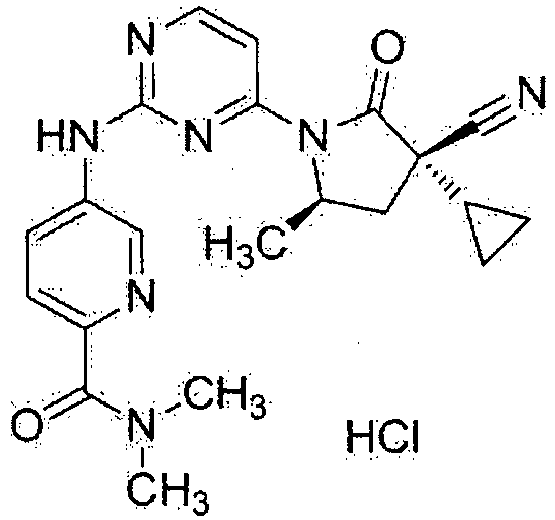
- The title compound (25 mg) was obtained from (3S,5R)-1-(2-chloropyrimidin-4-yl)-3-cyclopropyl-5-methyl-2-oxopyrrolidine-3-carbonitrile (250 mg) obtained in Step A of Example 366 and 5-amino-N,N-dimethylpicolinamide (150 mg) in the same manner as in Example 56.
MS(ESI+): [M+H]+ 406.3. -

- To a solution of ethyl cyano(cyclopropyl)acetate (17 g) obtained in Step A of Example 103 in ethanol (150 mL) was added conc. hydrochloric acid (150 mL) at room temperature, and the mixture was stirred at 100°C for 2 hr. The reaction mixture was concentrated under reduced pressure, to the obtained residue was added water, and the mixture was extracted with ethyl acetate. The obtained organic layer was washed with saturated brine, and dried over anhydrous magnesium sulfate, and the solvent was evaporated under reduced pressure. The residue was purified by silica gel column chromatography (hexane/ethyl acetate) to give the title compound (10 g).
1H NMR (300 MHz, DMSO-d6) δ 0.21-0.33 (2H, m), 0.49-0.60 (2H, m), 1.14-1.23 (7H, m), 2.84 (1H, d, J = 9.8 Hz), 4.13 (4H, q, J = 7.2 Hz). - To a solution of diethyl cyclopropylmalonate (7.7 g) obtained in Step A of Example 388 in N,N-dimethylformamide (90 mL) was added sodium hydride (60% in mineral oil, 1.8 g), and the mixture was stirred at 0°C for 30 min. To the reaction mixture was added tert-butyl 1,2,3-oxathiazolidine-3-carboxylate 2,2-dioxide (9.4 g) at the same temperature, and the mixture was stirred at 0°C for 2 hr. To the reaction mixture was added 1M hydrochloric acid, and the mixture was extracted with ethyl acetate. The obtained organic layer was washed with water and saturated brine, and dried over anhydrous magnesium sulfate, and the solvent was evaporated under reduced pressure. The residue was purified by silica gel column chromatography (hexane/ethyl acetate) to give the title compound (6.7 g).
1H NMR (300 MHz, DMSO-d6) δ0.21-0.33 (2H, m), 0.43-0.58 (2H, m), 1.11-1.21 (6H, m), 1.29-1.42 (10H, m), 1.79-1.91 (2H, m), 2.96 (2H, dt, J = 10.7, 5.4 Hz), 4.10 (4H, q, J = 6.9 Hz), 6.80 (1H, t, J = 5.3 Hz). - The title compound (3.6 g) was obtained from diethyl (2-((tert-butoxycarbonyl)amino)ethyl)(cyclopropyl)malonate (6.7 g) obtained in Step B of Example 388 in the same manner as in Step B of Example 357.
1H NMR (300 MHz, DMSO-d6) δ0.05-0.22 (1H, m), 0.31-0.41 (1H, m), 0.43-0.53 (2H, m), 1.18 (3H, t, J = 7.2 Hz), 1.25-1.37 (1H, m), 1.66-1.82 (1H, m), 2.25 (1H, ddd, J = 13.1, 8.0, 5.3 Hz), 3.07-3.29 (2H, m), 4.02-4.18 (2H, m), 7.87 (1H, brs). - The title compound (23 mg) was obtained from ethyl 3-cyclopropyl-2-oxopyrrolidine-3-carboxylate (48 mg) obtained in Step C of Example 388 and 4-chloro-N-(4-(morpholin-4-yl)phenyl)pyrimidin-2-amine (71 mg) obtained in Step B of Example 361 in the same manner as in Step C of Example 361.
MS(ESI+): [M+H]+ 452.4. -

- The title compound (220 mg) was obtained from (3S,5R)-1-(2-chloropyrimidin-4-yl)-3-cyclopropyl-5-methyl-2-oxopyrrolidine-3-carbonitrile (200 mg) obtained in Step A of Example 366 and 2-(4-aminophenyl)-2-methylpropanoic acid (140 mg) in the same manner as in Step B of Example 2.
MS(ESI+): [M+H]+ 420.3. -

- The title compound (120 mg) was obtained from (3S,5R)-1-(2-chloropyrimidin-4-yl)-3-cyclopropyl-5-methyl-2-oxopyrrolidine-3-carbonitrile (150 mg) obtained in Step A of Example 366 and 4-aminobenzamide (89 mg) in the same manner as in Step B of Example 2.
MS (ESI+) : [M+H]+ 377.3. -

- The title compound (170 mg) was obtained from (3S,5R)-1-(2-chloropyrimidin-4-yl)-3-cyclopropyl-5-methyl-2-oxopyrrolidine-3-carbonitrile (150 mg) obtained in Step A of Example 366 and 4-amino-N-methylbenzamide (98 mg) in the same manner as in Step B of Example 2.
MS (ESI+) : [M+H]+ 391.4. -

- The title compound (5.4 g) was obtained from 2-(methylsulfanyl)pyrimidin-4(3H)-one (5.2 g) obtained in Step A of Example 347 and 1-methyl-1H-pyrazol-4-amine (4.1 g) in the same manner as in Step C of Example 347.
1H NMR (400 MHz, DMSO-d6) δppm 3.79 (3 H, s), 5.62 - 5.78 (1 H, m), 7.45 (1 H, s), 7.63 - 7.78 (1 H, m), 7.89 (1 H, s), 8.47-8.75 (1 H, m), 10.77 (1 H, dd, J=15.5, 8.7 Hz). - The title compound (3.3 g) was obtained from 2-((1-methyl-1H-pyrazol-4-yl)amino)pyrimidin-4(3H)-one (3.4 g) obtained in Step A of Example 392 in the same manner as in Step D of Example 347.
1H NMR (400 MHz, DMSO-d6) δppm 3.81 (3 H, s), 6.83 (1 H, d, J=5.3 Hz), 7.46 (1 H, s), 7.85 (1 H, s), 8.37 (1 H, d, J=5.3 Hz), 9.87 (1H, s). - The title compound (346 mg) was obtained from 4-chloro-N-(1-methyl-1H-pyrazol-4-yl)pyrimidin-2-amine (260 mg) obtained in Step B of Example 392 and ethyl 3-cyclopropyl-2-oxopyrrolidine-3-carboxylate (240 mg) obtained in Step C of Example 388 in the same manner as in Step F of Example 347.
MS(ESI+): [M+H]+ 371.3. -

- The title compound (50 mg) was obtained from ethyl 3-cyclopropyl-1-(2-((1-methyl-1H-pyrazol-4-yl)amino)pyrimidin-4-yl)-2-oxopyrrolidine-3-carboxylate (330 mg) obtained in Step C of Example 392 in the same manner as in Step E of Example 347.
MS (ESI+) : [M+H]+ 329.3. -

- The title compound (72 mg) was obtained from (3S)-1-(2-chloropyrimidin-4-yl)-3-cyclopropyl-2-oxopyrrolidine-3-carbonitrile (100 mg) obtained in Step E of Example 103 and 1-(1,1-dioxidetetrahydro-2H-thiopyran-4-yl)-1H-pyrazol-4-amine (86 mg) in the same manner as in Step B of Example 2.
MS(ESI+): [M+H]+ 442.1. -

- The title compound (72 mg) was obtained from (3R,4S)-1-(2-chloropyrimidin-4-yl)-3-cyclopropyl-4-methyl-2-oxopyrrolidine-3-carbonitrile (100 mg) obtained in Step A of Example 369 and 1-(1,1-dioxidetetrahydro-2H-thiopyran-4-yl)-1H-pyrazol-4-amine (82 mg) in the same manner as in Step B of Example 2.
MS (ESI+) : [M+H]+ 456.1. -

- To a solution of 3-cyclopropyl-3-(hydroxymethyl)-1-(2-((1-methyl-1H-pyrazol-4-yl)amino)pyrimidin-4-yl)pyrrolidin-2-one (45 mg) obtained in Example 393 in tetrahydrofuran (1.0 mL) were added methanesulfonyl chloride (15 µL) and triethylamine (29 µL) at 0°C, and the mixture was stirred at 0°C for 1 hr. To the reaction mixture was added saturated aqueous sodium hydrogen carbonate solution, and the mixture was extracted with ethyl acetate. The obtained organic layer was washed with saturated brine, and dried over anhydrous magnesium sulfate, and the solvent was evaporated under reduced pressure. To a solution of the residue in N,N-dimethylformamide (1.0 mL) were added potassium cyanide (36 mg) and sodium iodide (82 mg) at room temperature, and the mixture was stirred overnight at 120°C. To the reaction mixture was added saturated aqueous sodium hydrogen carbonate solution, and the mixture was extracted with ethyl acetate. The obtained organic layer was washed with saturated brine, and dried over anhydrous magnesium sulfate, and the solvent was evaporated under reduced pressure. The residue was purified by silica gel column chromatography (hexane/ethyl acetate) to give the title compound (17 mg).
MS (ESI+) : [M+H]+ 338.0. -

- The title compound (35 mg) was obtained from 2-(4-((4-((3S,5R)-3-cyano-3-cyclopropyl-5-methyl-2-oxopyrrolidin-1-yl)pyrimidin-2-yl)amino)phenyl)-2-methylpropanoic acid (100 mg) obtained in Example 389 in the same manner as in Example 350.
MS(ESI+): [M+H]+ 419.4. -

- The title compound (82 mg) was obtained from (3S,5R)-1-(2-chloropyrimidin-4-yl)-3-cyclopropyl-5-methyl-2-oxopyrrolidine-3-carbonitrile (150 mg) obtained in Step A of Example 366 and 4-amino-N,N-dimethylbenzamide (89 mg) in the same manner as in Step B of Example 2.
MS(ESI+): [M+H]+ 405.3. - Tyk2 enzyme inhibitory activity of test compounds was measured by LANCE method (PerkinElmer). First, a test compound diluted with assay buffer (50 mM HEPES (pH = 7.5), 10 mM MgCl2, 1 mM EGTA, 2 mM DTT, 0.01% Tween20, 0.01% BSA) was added to 384-well plate at 2µL each. Then, a Tyk2 (Invitrogen) solution and a fluorescence-labeled peptide substrate (ULight-JAK1, PerkinElmer) solution diluted with assay buffer at 375 ng/mL and 300 nM, respectively were added at 2 µL each. Then, enzyme reaction was started by adding 2 µL each of ATP solution prepared with assay buffer at 30 µM. After the reaction at room temperature for 1 hr, Detection Buffer (PerkinElmer) prepared to be 20 mM EDTA, 4 nM europium-labeled anti-phosphotyrosine antibody (PerkinElmer) was added at 6 µL each. After standing at room temperature for 1 hr, fluorescence intensity (excitation wavelength 340 nm, fluorescence wavelength 665 nm, delay time 100 microsecond) was measured by a plate reader, Envision (PerkinElmer). The inhibitory activity of each compound was calculated as relative value where fluorescence intensity of a well without enzyme is considered as 100% inhibition.
Table 26 Ex. No. Tyk2 enzyme inhibitory activity (%, 1 µM) Ex. No. Tyk2 enzyme inhibitory activity (%, 1 µM) 1 99 33 97 4 100 61 14 7 100 72 20 10 97 77 22 12 51 85 100 15 89 86 100 29 91 87 100 31 98 101 88 Table 27 Ex. No. Tyk2 enzyme inhibitory activity (%, 1 µM) Ex. No. Tyk2 enzyme inhibitory activity (%, 1 µM) 103 100 109 99 128 100 133 24 134 99 255 99 - Recombinant mouse IL-23 (1 µg/20 µL/site) was intradermally administered into the right auricle of 7-8-week-old LEWEIS male rat. As control, phosphate buffered saline (PBS) which is a solvent was administered instead of IL-23. Then, a drug (the compound of Example 103) suspended in 0.5% methyl cellulose (MC) was orally administered 30 min before IL-23 administration, respectivelty. 0.5% MC was used as vehicle. The auricle tissues of 6 mm diameter were collected about 24 hr after IL-23 administration. Lysis buffer was added thereto, the tissues were crushed using beads, and centrifugalized, and the supernatant was collected. IL-22 in the tissues was measured using ELISA kit (R & D Systems). The result is shown below as a IL-23 inhibitory rate relative to vehicle. (mean of n=6)
The compound of Example 103 (10 mg/kg, q.d.): inhibitory rate 79% -
1) compound of Example 1 30 mg 2) fine powder cellulose 10 mg 3) lactose 19 mg 4) magnesium stearate 1 mg Total 60 mg 1), 2), 3) and 4) are mixed and filled in a gelatin capsule. -
1) compound of Example 1 30 g 2) lactose 50 g 3) cornstarch 15 g 4) calcium carboxymethylcellulose 44 g 5) magnesium stearate 1 g 1000 tablets total 140 g - The total amount of 1), 2) and 3) and 4) (30 g) is kneaded with water, and the mixture is vacuum dried, and sieved. The sieved powder is mixed with 4) (14 g) and 5) (1 g), and the mixture is punched by a tableting machine, whereby 1000 tablets containing 30 mg of the compound of Example 1 per tablet are obtained.
- The compound of the present invention has a superior Tyk2 inhibitory action, which is useful as an agent for the prophylaxis or treatment of autoimmune diseases (e.g., psoriasis, rheumatoid arthritis, inflammatory bowel disease, Sjogren's syndrome, Behcet's disease, multiple sclerosis, systemic lupus erythematosus etc.) and the like.
- This application is based on patent application No.
2012-075166 filed on March 28, 2012
more preferably a group represented by the following formula:

RA4 is a hydrogen atom;
R4 is a hydrogen atom or a C1-3 alkyl group (e.g., methyl, ethyl); and
R5 is a hydrogen atom.
R2 is an optionally substituted C1-6 alkyl group, an optionally substituted aromatic ring group, or an acyl group; and R3 is a hydrogen atom or a halogen atom.
R2 is an optionally substituted C1-6 alkyl group, an optionally substituted aromatic ring group, or an acyl group; and R3 is a hydrogen atom or a halogen atom.
Claims (19)
- A compound represented by the formula (I):

R1 is a group represented by the following formula: ring A1 is an optionally further substituted 2-oxopyrrolidine ring;R4 is a hydrogen atom, a halogen atom, a cyano group, an acyl group, an optionally substituted C1-6 alkyl group, an optionally substituted hydroxy group, an optionally substituted amino group, an optionally substituted C3-6 cycloalkyl group, or an optionally substituted heterocyclic group; andR5 is a hydrogen atom, a halogen atom, a cyano group, an acyl group, an optionally substituted C1-6 alkyl group, an optionally substituted hydroxy group, an optionally substituted amino group, an optionally substituted C3-6 cycloalkyl group, or an optionally substituted heterocyclic group, oran optionally substituted 2-oxopiperidino group;
R2 is a hydrogen atom, an optionally substituted C1-6 alkyl group, an optionally substituted aromatic ring group, or an acyl group; and
R3 is a hydrogen atom, a halogen atom, a cyano group, or an optionally substituted C1-6 alkyl group,
or a salt thereof. - The compound or salt of claim 1, wherein
R1 is(A) a group represented by the following formula: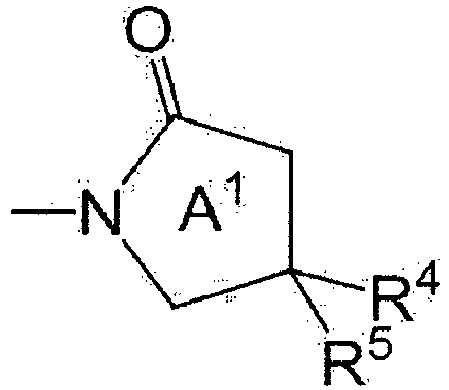
ring A1 is an 2-oxopyrrolidine ring optionally further substituted by 1 to 3 substituents selected from(1) a cyano group,(2) a carbamoyl group,(3) a C1-6 alkyl group optionally substituted by 1 to 3 substituents selected from(I) a carboxy group,(II) a cyano group,(III) a halogen atom,(IV) a C1-6 alkoxy group,(V) a C3-6 cycloalkyl group,(VI) an amino group optionally mono- or di-substituted by substituent(s) selected from(i) a C1-6 alkyl-carbonyl group, and(ii) a C1-6 alkoxy-carbonyl group, and(VII) a hydroxy group,(4) a C3-6 cycloalkyl group,(5) a 3- to 8-membered monocyclic non-aromatic heterocyclic group optionally substituted by 1 to 3 C1-6 alkoxy-carbonyl groups,(6) a C1-6 alkoxy-carbonyl group, and(7) a 5- or 6-membered monocyclic aromatic heterocyclic group optionally substituted by 1 to 3 C1-6 alkyl groups;R4 is a hydrogen atom or a C1-6 alkyl group; and
R5 is a hydrogen atom; or(B) an 2-oxopiperidino group optionally substituted by 1 to 3 C1-6 alkyl groups;R3 is a hydrogen atom or a halogen atom.
R2 is(1) a 5- or 6-membered monocyclic aromatic heterocyclic group, a C6-14 aryl group or a 8- to 12-membered fused aromatic heterocyclic group, each of which is optionally substituted by 1 to 3 substituents selected from(a) a cyano group,(b) a carboxy group,(c) a halogen atom,(d) a C1-6 alkyl group optionally substituted by 1 to 3 substituents selected from(I) a hydroxy group,(II) a cyano group,(III) a carboxy group,(IV) a carbamoyl group optionally mono- or di-substituted by C1-6 alkyl group(s) optionally substituted by 1 to 3 substituents selected from(i) a C1-6 alkoxy group,(ii) a hydroxy group,(iii) a halogen atom, and(iv) a C1-6 alkylsulfonyl group,(V) an amino group optionally mono- or di-substituted by substituent(s) selected from(i) a C1-6 alkyl-carbonyl group optionally substituted by 1 to 3 substituents selected from (A) a C1-6 alkoxy group and (B) a hydroxy group,(ii) a C1-6 alkylsulfonyl group,(iii) a sulfamoyl group optionally mono- or di-substituted by C1-6 alkyl group (s), and(iv) a C1-6 alkyl group,(VI) a C1-6 alkoxy-carbonyl group,(VII) a C6-14 aryl group optionally substituted by 1 to 3 C1-6 alkoxy groups,(VIII) a 3- to 8-membered monocyclic non-aromatic heterocyclic group,(IX) a 3- to 8-membered monocyclic non-aromatic heterocyclylcarbonyl group optionally substituted by 1 to 3 substituents selected from(i) a hydroxy group,(ii) a carbamoyl group, and(iii) a C1-6 alkyl group,(X) a halogen atom, and(XI) a C1-6 alkylsulfonyl group,(e) a C1-6 alkyl-carbonyl group,(f) a C1-6 alkylsulfonyl group,(g) an amino group optionally mono- or di-substituted by substituent(s) selected from(I) a C1-6 alkyl group,(II) a C1-6 alkyl-carbonyl group optionally substituted by 1 to 3 C1-6 alkoxy groups, and(III) a C1-6 alkylsulfonyl group,(h) a carbamoyl group optionally mono- or di-substituted by substituent(s) selected from(I) a C1-6 alkyl group optionally substituted by 1 to 3 substituents selected from(i) a hydroxy group,(ii) a 3- to 8-membered monocyclic non-aromatic heterocyclic group optionally substituted by 1 to 3 C1-6 alkyl groups, and(iii) a C1-6 alkylsulfonyl group,(II) a C3-6 cycloalkyl group optionally substituted by 1 to 3 substituents selected from(i) a cyano group, and(ii) a hydroxy group, and(III) a 3- to 8-membered monocyclic non-aromatic heterocyclic group,(i) a sulfamoyl group optionally mono- or di-substituted by C1-6 alkyl group (s),(j) a 3- to 8-membered monocyclic non-aromatic heterocyclic group optionally substituted by 1 to 3 substituents selected from(I) a C1-6 alkyl group optionally substituted by 1 to 3 hydroxy groups,(II) a C1-6 alkyl-carbonyl group optionally substituted by 1 to 3 substituents selected from(i) a C1-6 alkoxy group, and(ii) a cyano group,(III) a C1-6 alkoxy-carbonyl group,(IV) an oxo group,(V) a C1-6 alkylsulfonyl group,(VI) a carbamoyl group optionally mono- or di-substituted by C1-6 alkyl group(s),(VII) a cyano group,(VIII) a hydroxy group, and(IX) a carboxy group,(k) a C3-6 cycloalkyl group optionally substituted by 1 to 3 substituents selected from(I) a carbamoyl group optionally mono- or di-substituted by C1-6 alkyl group (s),(II) a carboxy group, and(III) a C1-6 alkyl group optionally substituted by 1 to 3 hydroxy groups,(l) a C1-6 alkoxy group optionally substituted by 1 to 3 substituents selected from(I) a halogen atom,(II) a C1-6 alkoxy group, and(III) a C3-6 cycloalkyl group,(m) a C1-6 alkoxy-carbonyl group,(n) a 3- to 8-membered monocyclic non-aromatic heterocyclylcarbonyl group optionally substituted by 1 to 3 substituents selected from(I) a hydroxy group,(II) an oxo group,(III) a halogen atom,(IV) a C1-6 alkoxy group, and(V) a C1-6 alkyl group,(o) a C1-6 alkylsulfanyl group, and(p) a 5- or 6-membered monocyclic aromatic heterocyclic group, or(2) a C1-6 alkyl group optionally substituted by 1 to 3 substituents selected from(a) a C6-14 aryl group optionally substituted by 1 to 3 substituents selected from(I) a cyano group,(II) a C1-6 alkyl group optionally substituted by 1 to 3 of 3- to 8-membered monocyclic non-aromatic heterocyclic groups,(III) a C1-6 alkoxy group,(IV) a halogen atom, and(V) a 3- to 8-membered monocyclic non-aromatic heterocyclic group optionally substituted by 1 to 3 C1-6 alkyl groups,(b) a 5- or 6-membered monocyclic aromatic heterocyclic group optionally substituted by 1 to 3 substituents selected from(I) a cyano group,(II) a C1-6 alkyl group optionally substituted by 1 to 3 of 3- to 8-membered monocyclic non-aromatic heterocyclic groups,(III) a C1-6 alkoxy group,(IV) a halogen atom, and(V) a 3- to 8-membered monocyclic non-aromatic heterocyclic group optionally substituted by 1 to 3 C1-6 alkyl groups,(c) a 8- to 12-membered fused aromatic heterocyclic group optionally substituted by 1 to 3 substituents selected from(I) a cyano group,(II) a C1-6 alkyl group optionally substituted by 1 to 3 of 3- to 8-membered monocyclic non-aromatic heterocyclic groups,(III) a C1-6 alkoxy group,(IV) a halogen atom, and(V) a 3- to 8-membered monocyclic non-aromatic heterocyclic group optionally substituted by 1 to 3 C1-6 alkyl groups, and(d) a C3-6 cycloalkyl group; and - The compound or salt of claim 1, wherein R1 is(A) a group represented by the following formula:

RA1 and RA2 are the same or different and each is(1) a cyano group,(2) a carbamoyl group,(3) a C1-6 alkyl group optionally substituted by 1 to 3 substituents selected from(I) a carboxy group,(II) a cyano group,(III) a halogen atom,(IV) a C1-6 alkoxy group,(V) a C3-6 cycloalkyl group,(VI) an amino group optionally mono- or di-substituted by substituent(s) selected from(i) a C1-6 alkyl-carbonyl group, and(ii) a C1-6 alkoxy-carbonyl group, and(VII) a hydroxy group,(4) a C3-6 cycloalkyl group,(5) a 3- to 8-membered monocyclic non-aromatic heterocyclic group optionally substituted by 1 to 3 C1-6 alkoxy-carbonyl groups, or(6) a C1-6 alkoxy-carbonyl group;RA3 is a hydrogen atom or a C1-3 alkyl group;
RA4 is a hydrogen atom;
R4 is a hydrogen atom or a C1-3 alkyl group; and
R5 is a hydrogen atom; or(B) an 2-oxopiperidino group optionally substituted by 1 to 3 C1-6 alkyl groups. - The compound or salt of claim 1, wherein R1 is(A) a group represented by the following formula:

RA1 and RA2 are the same or different and each is(1) a cyano group,(2) a carbamoyl group,(3) a C1-6 alkyl group optionally substituted by 1 to 3 substituents selected from(I) a carboxy group,(II) a cyano group,(III) a halogen atom,(IV) a C1-6 alkoxy group,(V) a C3-6 cycloalkyl group,(VI) an amino group optionally mono- or di-substituted by substituent(s) selected from(i) a C1-6 alkyl-carbonyl group, and(ii) a C1-6 alkoxy-carbonyl group, and(VII) a hydroxy group,(4) a C3-6 cycloalkyl group,(5) a 3- to 8-membered monocyclic non-aromatic heterocyclic group optionally substituted by 1 to 3 C1-6 alkoxy-carbonyl groups, or(6) a C1-6 alkoxy-carbonyl group;RA3 is a hydrogen atom or a C1-3 alkyl group;
RA4 is a hydrogen atom;
R4 is a hydrogen atom or a C1-3 alkyl group; and
R5 is a hydrogen atom. - The compound or salt of claim 1, wherein R2 is(1) a 5- or 6-membered monocyclic aromatic heterocyclic group, a C6-14 aryl group or a 8- to 12-membered fused aromatic heterocyclic group, each of which is optionally substituted by 1 to 3 substituents selected from(a) a cyano group,(b) a carboxy group,(c) a halogen atom,(d) a C1-6 alkyl group optionally substituted by 1 to 3 substituents selected from(I) a hydroxy group,(II) a cyano group,(III) a carboxy group,(IV) a carbamoyl group optionally mono- or di-substituted by C1-6 alkyl group(s) optionally substituted by 1 to 3 substituents selected from(i) a C1-6 alkoxy group,(ii) a hydroxy group,(iii) a halogen atom, and(iv) a C1-6 alkylsulfonyl group,(V) an amino group optionally mono- or di-substituted by substituent(s) selected from(i) a C1-6 alkyl-carbonyl group optionally substituted by 1 to 3 substituents selected from (A) a C1-6 alkoxy group and (B) a hydroxy group,(ii) a C1-6 alkylsulfonyl group,(iii) a sulfamoyl group optionally mono- or di-substituted by C1-6 alkyl group (s), and(iv) a C1-6 alkyl group,(VI) a C1-6 alkoxy-carbonyl group,(VII) a C6-14 aryl group optionally substituted by 1 to 3 C1-6 alkoxy groups,(VIII) a 3- to 8-membered monocyclic non-aromatic heterocyclic group,(IX) a 3- to 8-membered monocyclic non-aromatic heterocyclylcarbonyl group optionally substituted by 1 to 3 substituents selected from(i) a hydroxy group,(ii) a carbamoyl group, and(iii) a C1-6 alkyl group,(X) a halogen atom, and(XI) a C1-6 alkylsulfonyl group,(e) a C1-6 alkyl-carbonyl group,(f) a C1-6 alkylsulfonyl group,(g) an amino group optionally mono- or di-substituted by substituent(s) selected from(I) a C1-6 alkyl group,(II) a C1-6 alkyl-carbonyl group optionally substituted by 1 to 3 C1-6 alkoxy groups, and(III) a C1-6 alkylsulfonyl group,(h) a carbamoyl group optionally mono- or di-substituted by substituent(s) selected from(I) a C1-6 alkyl group optionally substituted by 1 to 3 substituents selected from(i) a hydroxy group,(ii) a 3- to 8-membered monocyclic non-aromatic heterocyclic group optionally substituted by 1 to 3 C1-6 alkyl groups, and(iii) a C1-6 alkylsulfonyl group,(II) a C3-6 cycloalkyl group optionally substituted by 1 to 3 substituents selected from(i) a cyano group, and(ii) a hydroxy group, and(III) a 3- to 8-membered monocyclic non-aromatic heterocyclic group,(i) a sulfamoyl group optionally mono- or di-substituted by C1-6 al kyl group (s),(j) a 3- to 8-membered monocyclic non-aromatic heterocyclic group optionally substituted by 1 to 3 substituents selected from(I) a C1-6 alkyl group optionally substituted by 1 to 3 hydroxy groups,(II) a C1-6 alkyl-carbonyl group optionally substituted by 1 to 3 substituents selected from(i) a C1-6 alkoxy group, and(ii) a cyano group,(III) a C1-6 alkoxy-carbonyl group,(IV) an oxo group,(V) a C1-6 alkylsulfonyl group,(VI) a carbamoyl group optionally mono- or di-substituted by C1-6 alkyl group (s),(VII) a cyano group,(VIII) a hydroxy group, and(IX) a carboxy group,(k) a C3-6 cycloalkyl group optionally substituted by 1 to 3 substituents selected from(I) a carbamoyl group optionally mono- or di-substituted by C1-6 alkyl group (s),(II) a carboxy group, and(III) a C1-6 alkyl group optionally substituted by 1 to 3 hydroxy groups,(l) a C1-6 alkoxy group optionally substituted by 1 to 3 substituents selected from(I) a halogen atom,(II) a C1-6 alkoxy group, and(III) a C3-6 cycloalkyl group,(m) a C1-6 alkoxy-carbonyl group,(n) a 3- to 8-membered monocyclic non-aromatic heterocyclylcarbonyl group optionally substituted by 1 to 3 substituents selected from(I) a hydroxy group,(II) an oxo group,(III) a halogen atom,(IV) a C1-6 alkoxy group, and(V) a C1-6 alkyl group,(o) a C1-6 alkylsulfanyl group, and(p) a 5- or 6-membered monocyclic aromatic heterocyclic group.
- (3S)-3-Cyclopropyl-1-(2-((1-(1-hydroxy-2-methylpropan-2-yl)-1H-pyrazol-4-yl)amino)pyrimidin-4-yl)-2-oxopyrrolidine-3-carbonitrile or a salt thereof.
- (3S)-3-Cyclopropyl-1-(2-((1-(1-(hydroxymethyl)cyclopropyl)-1H-pyrazol-4-yl)amino)pyrimidin-4-yl)-2-oxopyrrolidine-3-carbonitrile or a salt thereof.
- (3R)-3-Ethyl-1-(2-((4-(4-(hydroxymethyl)tetrahydro-2H-pyran-4-yl)phenyl)amino)pyrimidin-4-yl)-2-oxopyrrolidine-3-carbonitrile or a salt thereof.
- A medicament comprising the compound or salt of claim 1.
- The medicament of claim 9, which is a tyrosine kinase 2 inhibitor.
- The medicament of claim 9, which is an agent for the prophylaxis or treatment of autoimmune diseases.
- The medicament of claim 11, wherein the autoimmune diseases is psoriasis, rheumatoid arthritis, inflammatory bowel disease, Sjogren's syndrome, Behcet's disease, multiple sclerosis or systemic lupus erythematosus.
- The compound or salt of claim 1 for use in the prophylaxis or treatment of autoimmune diseases.
- The compound or salt of claim 13, wherein the autoimmune diseases is psoriasis, rheumatoid arthritis, inflammatory bowel disease, Sjogren's syndrome, Behcet's disease, multiple sclerosis or systemic lupus erythematosus.
- A method of inhibiting tyrosine kinase 2 in a mammal, which comprises administering an effective amount of the compound or salt of claim 1 to the mammal.
- A method for the prophylaxis or treatment of autoimmune diseases, which comprises administering an effective amount of the compound or salt of claim 1 to the mammal.
- The method of claim 16, wherein the autoimmune diseases is psoriasis, rheumatoid arthritis, inflammatory bowel disease, Sjogren's syndrome, Behcet's disease, multiple sclerosis or systemic lupus erythematosus.
- Use of the compound or salt of claim 1 for the production of an agent for the prophylaxis or treatment of autoimmune diseases.
- The use of claim 18, wherein the autoimmune diseases is psoriasis, rheumatoid arthritis, inflammatory bowel disease, Sjogren's syndrome, Behcet's disease, multiple sclerosis or systemic lupus erythematosus.
Applications Claiming Priority (2)
| Application Number | Priority Date | Filing Date | Title |
|---|---|---|---|
| JP2012075166 | 2012-03-28 | ||
| PCT/JP2013/059156 WO2013146963A1 (en) | 2012-03-28 | 2013-03-27 | Heterocyclic compound |
Publications (2)
| Publication Number | Publication Date |
|---|---|
| EP2832734A1 true EP2832734A1 (en) | 2015-02-04 |
| EP2832734A4 EP2832734A4 (en) | 2015-08-26 |
Family
ID=49260211
Family Applications (1)
| Application Number | Title | Priority Date | Filing Date |
|---|---|---|---|
| EP13769902.1A Withdrawn EP2832734A4 (en) | 2012-03-28 | 2013-03-27 | Heterocyclic compound |
Country Status (4)
| Country | Link |
|---|---|
| US (1) | US9187453B2 (en) |
| EP (1) | EP2832734A4 (en) |
| JP (1) | JPWO2013146963A1 (en) |
| WO (1) | WO2013146963A1 (en) |
Cited By (2)
| Publication number | Priority date | Publication date | Assignee | Title |
|---|---|---|---|---|
| CN110734428A (en) * | 2019-10-24 | 2020-01-31 | 嘉兴特科罗生物科技有限公司 | a small molecule compound |
| KR20220042344A (en) * | 2019-06-28 | 2022-04-05 | 광저우 이노케어 파마 테크 씨오., 엘티디. | Heterocyclic Compounds for Modulating Tyrosine Kinase 2 Activity |
Families Citing this family (22)
| Publication number | Priority date | Publication date | Assignee | Title |
|---|---|---|---|---|
| JP6280912B2 (en) | 2013-03-14 | 2018-02-14 | 武田薬品工業株式会社 | Heterocyclic compounds |
| WO2015002231A1 (en) | 2013-07-03 | 2015-01-08 | 武田薬品工業株式会社 | Heterocyclic compound |
| ES2950424T3 (en) | 2013-07-03 | 2023-10-09 | Takeda Pharmaceuticals Co | Amide compound |
| EP3029031A4 (en) * | 2013-07-30 | 2017-01-11 | Takeda Pharmaceutical Company Limited | Heterocyclic compound |
| AU2015317741B2 (en) * | 2014-09-17 | 2020-01-16 | Bristol-Myers Squibb Company | MK2 inhibitors and uses thereof |
| ES2794779T3 (en) * | 2016-02-24 | 2020-11-19 | Pfizer | Pyrazolo [1,5-a] pyrazin-4-yl derivatives as JAK inhibitors |
| CA3031592A1 (en) | 2016-08-31 | 2018-03-08 | Jiangsu Hengrui Medicine Co., Ltd. | Oxopicolinamide derivative, preparation method therefor and pharmaceutical use thereof |
| ES2890668T3 (en) * | 2017-01-26 | 2022-01-21 | Hanmi Pharm Ind Co Ltd | Pyrimidine compound and pharmaceutical use thereof |
| IT201800005874A1 (en) | 2018-05-30 | 2019-11-30 | PROCESS FOR THE PREPARATION OF APALUTAMIDE | |
| KR101954370B1 (en) | 2018-07-25 | 2019-03-05 | 한미약품 주식회사 | Pyrimidine compounds and pharmaceutical composition for preventing or treating cancers comprising the same |
| EP3856188B1 (en) * | 2018-09-25 | 2023-06-21 | Cardurion Pharmaceuticals, Inc. | Aminopyrimidine compound |
| WO2020068846A1 (en) * | 2018-09-25 | 2020-04-02 | Heterocyclic Compound | Heterocyclic compound |
| WO2020171646A1 (en) | 2019-02-22 | 2020-08-27 | 한미약품 주식회사 | Pharmaceutical composition comprising flt3 inhibitor and hypomethylating agent for treating acute myeloid leukemia |
| CN114269336A (en) | 2019-04-30 | 2022-04-01 | 细胞基因公司 | Combination therapy comprising apremilast and a TYK2 inhibitor |
| CA3145391A1 (en) | 2019-06-27 | 2020-12-30 | Hanmi Pharm. Co., Ltd. | Pharmaceutical composition for treating acute myeloid leukemia, containing flt3 inhibitor and chemotherapeutic agents |
| TWI782599B (en) * | 2020-07-02 | 2022-11-01 | 美商輝瑞股份有限公司 | Aminopyrimidinyl derivatives |
| EP3944859A1 (en) | 2020-07-30 | 2022-02-02 | Assistance Publique Hôpitaux de Paris | Method for treating immune toxicities induced by immune checkpoint inhibitors |
| TW202246282A (en) | 2021-02-01 | 2022-12-01 | 美商西建公司 | Mk2 inhibitors, the synthesis thereof, and intermediates thereto |
| EP4408527A2 (en) | 2021-09-30 | 2024-08-07 | Bristol-Myers Squibb Company | Methods for determining responsiveness to tyk2 inhibitors |
| EP4423086A1 (en) | 2021-10-25 | 2024-09-04 | Kymera Therapeutics, Inc. | Tyk2 degraders and uses thereof |
| WO2024148186A1 (en) * | 2023-01-04 | 2024-07-11 | Aerie Pharmaceuticals, Inc. | Polymorphs of a jak1/tyk2 inhibitor and uses thereof |
| WO2024148184A1 (en) * | 2023-01-04 | 2024-07-11 | Aerie Pharmaceuticals, Inc. | Compounds and processes for the preparation of jak inhibitors |
Family Cites Families (19)
| Publication number | Priority date | Publication date | Assignee | Title |
|---|---|---|---|---|
| JP2002503662A (en) | 1998-02-17 | 2002-02-05 | テュラリク インコーポレイテッド | Antiviral pyrimidine derivatives |
| GB9905075D0 (en) | 1999-03-06 | 1999-04-28 | Zeneca Ltd | Chemical compounds |
| WO2002064096A2 (en) | 2001-02-16 | 2002-08-22 | Tularik Inc. | Methods of using pyrimidine-based antiviral agents |
| US7105667B2 (en) | 2001-05-01 | 2006-09-12 | Bristol-Myers Squibb Co. | Fused heterocyclic compounds and use thereof |
| WO2002088079A2 (en) | 2001-05-01 | 2002-11-07 | Bristol-Myers Squibb Company | Dual inhibitors of pde 7 and pde 4 |
| WO2002102313A2 (en) | 2001-06-19 | 2002-12-27 | Bristol-Myers Squibb Company | Pyrimidine inhibitors of phosphodiesterase (pde) 7 |
| PE20030008A1 (en) | 2001-06-19 | 2003-01-22 | Bristol Myers Squibb Co | DUAL INHIBITORS OF PDE 7 AND PDE 4 |
| EP1427415B1 (en) * | 2001-09-21 | 2009-08-12 | Brystol-Myers Squibb Company | Lactam-containing compounds and derivatives thereof as factor xa inhibitors |
| WO2004037784A2 (en) | 2002-10-21 | 2004-05-06 | Irm Llc | Pyrrolidones with anti-hiv activity |
| MXPA06011658A (en) | 2004-05-14 | 2006-12-14 | Pfizer Prod Inc | Pyrimidine derivatives for the treatment of abnormal cell growth. |
| WO2006128129A2 (en) | 2005-05-26 | 2006-11-30 | Synta Pharmaceuticals Corp. | Method for treating cancer |
| WO2006128172A2 (en) | 2005-05-26 | 2006-11-30 | Synta Pharmaceuticals Corp. | Method for treating b cell regulated autoimmune disorders |
| US20090306116A1 (en) | 2005-09-16 | 2009-12-10 | Astrazeneca Ab | Pyrimidine derivatives for the inhibition of igf-ir tyrosine kinase activity |
| CN101675041A (en) * | 2007-03-20 | 2010-03-17 | 沃泰克斯药物股份有限公司 | Amino-metadiazine compound as kinase inhibitor |
| AR074210A1 (en) | 2008-11-24 | 2010-12-29 | Boehringer Ingelheim Int | PIRIMIDINE DERIVATIVES AS INHIBITORS OF PTK2-QUINASA |
| HRP20140265T1 (en) | 2009-02-06 | 2014-04-25 | Nippon Shinyaku Co., Ltd. | Aminopyrazine derivative and drug |
| TW201103904A (en) | 2009-06-11 | 2011-02-01 | Hoffmann La Roche | Janus kinase inhibitor compounds and methods |
| US8466155B2 (en) | 2009-10-02 | 2013-06-18 | Boehringer Ingelheim International Gmbh | Pyrimidines |
| WO2014147586A1 (en) * | 2013-03-22 | 2014-09-25 | Novartis Ag | 1-(2-(ethylamino)pyrimidin-4-yl)pyrrolidin-2-ones as inhibitors of mutant idh |
-
2013
- 2013-03-27 EP EP13769902.1A patent/EP2832734A4/en not_active Withdrawn
- 2013-03-27 JP JP2014507995A patent/JPWO2013146963A1/en active Pending
- 2013-03-27 WO PCT/JP2013/059156 patent/WO2013146963A1/en not_active Ceased
- 2013-03-27 US US14/388,452 patent/US9187453B2/en not_active Expired - Fee Related
Cited By (5)
| Publication number | Priority date | Publication date | Assignee | Title |
|---|---|---|---|---|
| KR20220042344A (en) * | 2019-06-28 | 2022-04-05 | 광저우 이노케어 파마 테크 씨오., 엘티디. | Heterocyclic Compounds for Modulating Tyrosine Kinase 2 Activity |
| EP3990449A4 (en) * | 2019-06-28 | 2023-07-26 | Guangzhou InnoCare Pharma Tech Co., Ltd. | HETEROCYCLIC COMPOUNDS FOR MEDIATING TYROSINE KINASE-2 ACTIVITY |
| US12448382B2 (en) | 2019-06-28 | 2025-10-21 | Guangzhou Innocare Pharma Tech Co. Ltd. | Heterocyclic compounds for mediating tyrosine kinase 2 activity |
| AU2020301437B2 (en) * | 2019-06-28 | 2026-02-26 | Guangzhou Innocare Pharma Tech Co., Ltd. | Heterocyclic compounds for mediating tyrosine kinase 2 activity |
| CN110734428A (en) * | 2019-10-24 | 2020-01-31 | 嘉兴特科罗生物科技有限公司 | a small molecule compound |
Also Published As
| Publication number | Publication date |
|---|---|
| EP2832734A4 (en) | 2015-08-26 |
| WO2013146963A1 (en) | 2013-10-03 |
| US20150094296A1 (en) | 2015-04-02 |
| US9187453B2 (en) | 2015-11-17 |
| JPWO2013146963A1 (en) | 2015-12-14 |
Similar Documents
| Publication | Publication Date | Title |
|---|---|---|
| US9187453B2 (en) | Heterocyclic compound | |
| US9371320B2 (en) | Heterocyclic compound | |
| US9085578B2 (en) | Heterocyclic compound | |
| US11053262B2 (en) | Heterocyclic amide compounds having RORyT inhibitory action | |
| US9890145B2 (en) | Heterocyclic compound | |
| US9637483B2 (en) | Heterocyclic compound | |
| US9643967B2 (en) | Pyrrolo[3,2-c]pyridine derivatives as TLR inhibitors | |
| US9156837B2 (en) | Heterocyclic compound | |
| US20160159773A1 (en) | Heterocyclic compound | |
| WO2019069844A1 (en) | Heterocyclic compound | |
| AU2019350717A1 (en) | Aminopyrimidine compound |
Legal Events
| Date | Code | Title | Description |
|---|---|---|---|
| PUAI | Public reference made under article 153(3) epc to a published international application that has entered the european phase |
Free format text: ORIGINAL CODE: 0009012 |
|
| 17P | Request for examination filed |
Effective date: 20140926 |
|
| AK | Designated contracting states |
Kind code of ref document: A1 Designated state(s): AL AT BE BG CH CY CZ DE DK EE ES FI FR GB GR HR HU IE IS IT LI LT LU LV MC MK MT NL NO PL PT RO RS SE SI SK SM TR |
|
| AX | Request for extension of the european patent |
Extension state: BA ME |
|
| DAX | Request for extension of the european patent (deleted) | ||
| RA4 | Supplementary search report drawn up and despatched (corrected) |
Effective date: 20150723 |
|
| RIC1 | Information provided on ipc code assigned before grant |
Ipc: A61K 31/541 20060101ALI20150717BHEP Ipc: A61K 31/5377 20060101ALI20150717BHEP Ipc: A61P 19/02 20060101ALI20150717BHEP Ipc: C07D 401/04 20060101AFI20150717BHEP Ipc: C07D 401/14 20060101ALI20150717BHEP Ipc: C07D 405/14 20060101ALI20150717BHEP Ipc: C07D 413/14 20060101ALI20150717BHEP Ipc: A61K 31/506 20060101ALI20150717BHEP Ipc: A61P 1/04 20060101ALI20150717BHEP Ipc: A61P 17/06 20060101ALI20150717BHEP Ipc: C07D 403/14 20060101ALI20150717BHEP Ipc: C07D 409/14 20060101ALI20150717BHEP Ipc: A61P 37/02 20060101ALI20150717BHEP Ipc: A61P 25/00 20060101ALI20150717BHEP Ipc: A61P 43/00 20060101ALI20150717BHEP |
|
| 17Q | First examination report despatched |
Effective date: 20160413 |
|
| GRAP | Despatch of communication of intention to grant a patent |
Free format text: ORIGINAL CODE: EPIDOSNIGR1 |
|
| INTG | Intention to grant announced |
Effective date: 20161018 |
|
| STAA | Information on the status of an ep patent application or granted ep patent |
Free format text: STATUS: THE APPLICATION IS DEEMED TO BE WITHDRAWN |
|
| 18D | Application deemed to be withdrawn |
Effective date: 20170301 |