EP2832724A1 - Nipecotic acid derivative and use thereof for medical purposes - Google Patents
Nipecotic acid derivative and use thereof for medical purposes Download PDFInfo
- Publication number
- EP2832724A1 EP2832724A1 EP20130767697 EP13767697A EP2832724A1 EP 2832724 A1 EP2832724 A1 EP 2832724A1 EP 20130767697 EP20130767697 EP 20130767697 EP 13767697 A EP13767697 A EP 13767697A EP 2832724 A1 EP2832724 A1 EP 2832724A1
- Authority
- EP
- European Patent Office
- Prior art keywords
- example compound
- mmol
- cyano
- piperidine
- benzyl
- Prior art date
- Legal status (The legal status is an assumption and is not a legal conclusion. Google has not performed a legal analysis and makes no representation as to the accuracy of the status listed.)
- Withdrawn
Links
- XJLSEXAGTJCILF-RXMQYKEDSA-N (R)-nipecotic acid zwitterion Chemical class OC(=O)[C@@H]1CCCNC1 XJLSEXAGTJCILF-RXMQYKEDSA-N 0.000 title claims abstract description 59
- 208000002815 pulmonary hypertension Diseases 0.000 claims abstract description 132
- 208000020832 chronic kidney disease Diseases 0.000 claims abstract description 53
- 230000001225 therapeutic effect Effects 0.000 claims abstract description 40
- 150000003839 salts Chemical class 0.000 claims abstract description 33
- 230000000069 prophylactic effect Effects 0.000 claims abstract description 10
- 125000004435 hydrogen atom Chemical group [H]* 0.000 claims description 38
- 125000004169 (C1-C6) alkyl group Chemical group 0.000 claims description 28
- 125000003545 alkoxy group Chemical group 0.000 claims description 28
- 125000005843 halogen group Chemical group 0.000 claims description 26
- 125000004183 alkoxy alkyl group Chemical group 0.000 claims description 22
- 125000004093 cyano group Chemical group *C#N 0.000 claims description 22
- 239000003795 chemical substances by application Substances 0.000 claims description 19
- 125000000217 alkyl group Chemical group 0.000 claims description 16
- 125000001316 cycloalkyl alkyl group Chemical group 0.000 claims description 16
- 125000000000 cycloalkoxy group Chemical group 0.000 claims description 15
- 125000002887 hydroxy group Chemical group [H]O* 0.000 claims description 15
- 125000005913 (C3-C6) cycloalkyl group Chemical group 0.000 claims description 11
- 125000000753 cycloalkyl group Chemical group 0.000 claims description 11
- 125000004429 atom Chemical group 0.000 claims description 7
- 125000001072 heteroaryl group Chemical group 0.000 claims description 6
- 125000001997 phenyl group Chemical group [H]C1=C([H])C([H])=C(*)C([H])=C1[H] 0.000 claims description 6
- 125000001424 substituent group Chemical group 0.000 claims description 6
- 108020002908 Epoxide hydrolase Proteins 0.000 claims description 5
- 102100025357 Lipid-phosphate phosphatase Human genes 0.000 claims description 5
- 229940122183 Epoxide hydrolase inhibitor Drugs 0.000 claims description 2
- 150000001875 compounds Chemical class 0.000 abstract description 83
- 230000002401 inhibitory effect Effects 0.000 abstract description 23
- 239000000126 substance Substances 0.000 abstract description 14
- 239000000243 solution Substances 0.000 description 211
- YMWUJEATGCHHMB-UHFFFAOYSA-N Dichloromethane Chemical compound ClCCl YMWUJEATGCHHMB-UHFFFAOYSA-N 0.000 description 174
- HEDRZPFGACZZDS-MICDWDOJSA-N Trichloro(2H)methane Chemical compound [2H]C(Cl)(Cl)Cl HEDRZPFGACZZDS-MICDWDOJSA-N 0.000 description 162
- 238000006243 chemical reaction Methods 0.000 description 134
- XEKOWRVHYACXOJ-UHFFFAOYSA-N Ethyl acetate Chemical compound CCOC(C)=O XEKOWRVHYACXOJ-UHFFFAOYSA-N 0.000 description 111
- 238000003786 synthesis reaction Methods 0.000 description 111
- 230000015572 biosynthetic process Effects 0.000 description 110
- 229940125904 compound 1 Drugs 0.000 description 79
- VLKZOEOYAKHREP-UHFFFAOYSA-N n-Hexane Chemical compound CCCCCC VLKZOEOYAKHREP-UHFFFAOYSA-N 0.000 description 78
- 230000002829 reductive effect Effects 0.000 description 73
- 241000700159 Rattus Species 0.000 description 70
- OKKJLVBELUTLKV-UHFFFAOYSA-N Methanol Chemical compound OC OKKJLVBELUTLKV-UHFFFAOYSA-N 0.000 description 69
- ZMXDDKWLCZADIW-UHFFFAOYSA-N N,N-Dimethylformamide Chemical compound CN(C)C=O ZMXDDKWLCZADIW-UHFFFAOYSA-N 0.000 description 67
- XLYOFNOQVPJJNP-UHFFFAOYSA-N water Chemical compound O XLYOFNOQVPJJNP-UHFFFAOYSA-N 0.000 description 65
- VEXZGXHMUGYJMC-UHFFFAOYSA-N Hydrochloric acid Chemical compound Cl VEXZGXHMUGYJMC-UHFFFAOYSA-N 0.000 description 64
- RTZKZFJDLAIYFH-UHFFFAOYSA-N Diethyl ether Chemical compound CCOCC RTZKZFJDLAIYFH-UHFFFAOYSA-N 0.000 description 60
- 238000001816 cooling Methods 0.000 description 59
- 239000012043 crude product Substances 0.000 description 57
- 239000012044 organic layer Substances 0.000 description 52
- PMZURENOXWZQFD-UHFFFAOYSA-L Sodium Sulfate Chemical compound [Na+].[Na+].[O-]S([O-])(=O)=O PMZURENOXWZQFD-UHFFFAOYSA-L 0.000 description 51
- 238000000605 extraction Methods 0.000 description 50
- 210000004072 lung Anatomy 0.000 description 46
- 230000002861 ventricular Effects 0.000 description 46
- JGFZNNIVVJXRND-UHFFFAOYSA-N N,N-Diisopropylethylamine (DIPEA) Chemical compound CCN(C(C)C)C(C)C JGFZNNIVVJXRND-UHFFFAOYSA-N 0.000 description 44
- UIIMBOGNXHQVGW-UHFFFAOYSA-M Sodium bicarbonate Chemical compound [Na+].OC([O-])=O UIIMBOGNXHQVGW-UHFFFAOYSA-M 0.000 description 42
- 229920006395 saturated elastomer Polymers 0.000 description 42
- 238000003756 stirring Methods 0.000 description 42
- HEDRZPFGACZZDS-UHFFFAOYSA-N Chloroform Chemical compound ClC(Cl)Cl HEDRZPFGACZZDS-UHFFFAOYSA-N 0.000 description 40
- FAPWRFPIFSIZLT-UHFFFAOYSA-M Sodium chloride Chemical compound [Na+].[Cl-] FAPWRFPIFSIZLT-UHFFFAOYSA-M 0.000 description 39
- 201000008383 nephritis Diseases 0.000 description 39
- 230000001575 pathological effect Effects 0.000 description 36
- 208000007342 Diabetic Nephropathies Diseases 0.000 description 34
- 208000033679 diabetic kidney disease Diseases 0.000 description 34
- ZMANZCXQSJIPKH-UHFFFAOYSA-N Triethylamine Chemical compound CCN(CC)CC ZMANZCXQSJIPKH-UHFFFAOYSA-N 0.000 description 33
- 239000003480 eluent Substances 0.000 description 31
- 238000010898 silica gel chromatography Methods 0.000 description 31
- WYURNTSHIVDZCO-UHFFFAOYSA-N Tetrahydrofuran Chemical compound C1CCOC1 WYURNTSHIVDZCO-UHFFFAOYSA-N 0.000 description 30
- 230000035488 systolic blood pressure Effects 0.000 description 29
- 229940125782 compound 2 Drugs 0.000 description 28
- 239000003814 drug Substances 0.000 description 28
- 150000001412 amines Chemical class 0.000 description 26
- 239000000203 mixture Substances 0.000 description 26
- -1 heteroaryl amide Chemical class 0.000 description 25
- 208000001647 Renal Insufficiency Diseases 0.000 description 24
- 201000006370 kidney failure Diseases 0.000 description 24
- 230000009885 systemic effect Effects 0.000 description 24
- 238000006482 condensation reaction Methods 0.000 description 23
- 201000010099 disease Diseases 0.000 description 23
- 208000037265 diseases, disorders, signs and symptoms Diseases 0.000 description 23
- 210000003734 kidney Anatomy 0.000 description 23
- 230000009471 action Effects 0.000 description 22
- 238000000034 method Methods 0.000 description 22
- 229920000609 methyl cellulose Polymers 0.000 description 22
- 239000001923 methylcellulose Substances 0.000 description 22
- 235000010981 methylcellulose Nutrition 0.000 description 22
- 229910000030 sodium bicarbonate Inorganic materials 0.000 description 21
- 235000017557 sodium bicarbonate Nutrition 0.000 description 21
- SYAWGTIVOGUZMM-ILYOTBPNSA-N (5Z,8Z,11Z)-14,15-dihydroxyicosatrienoic acid Chemical compound CCCCCC(O)C(O)C\C=C/C\C=C/C\C=C/CCCC(O)=O SYAWGTIVOGUZMM-ILYOTBPNSA-N 0.000 description 20
- 235000010482 polyoxyethylene sorbitan monooleate Nutrition 0.000 description 20
- 229920000053 polysorbate 80 Polymers 0.000 description 20
- 230000002685 pulmonary effect Effects 0.000 description 19
- 239000011780 sodium chloride Substances 0.000 description 19
- WEVYAHXRMPXWCK-UHFFFAOYSA-N Acetonitrile Chemical compound CC#N WEVYAHXRMPXWCK-UHFFFAOYSA-N 0.000 description 18
- 239000003112 inhibitor Substances 0.000 description 18
- ZSJLQEPLLKMAKR-UHFFFAOYSA-N Streptozotocin Natural products O=NN(C)C(=O)NC1C(O)OC(CO)C(O)C1O ZSJLQEPLLKMAKR-UHFFFAOYSA-N 0.000 description 17
- 230000036772 blood pressure Effects 0.000 description 17
- 229940079593 drug Drugs 0.000 description 17
- 230000000694 effects Effects 0.000 description 17
- 229960001052 streptozocin Drugs 0.000 description 17
- ZSJLQEPLLKMAKR-GKHCUFPYSA-N streptozocin Chemical compound O=NN(C)C(=O)N[C@H]1[C@@H](O)O[C@H](CO)[C@@H](O)[C@@H]1O ZSJLQEPLLKMAKR-GKHCUFPYSA-N 0.000 description 17
- 230000002485 urinary effect Effects 0.000 description 17
- 206010018364 Glomerulonephritis Diseases 0.000 description 16
- 230000000052 comparative effect Effects 0.000 description 16
- 239000002904 solvent Substances 0.000 description 16
- 238000012360 testing method Methods 0.000 description 16
- JBSCUHKPLGKXKH-ILYOTBPNSA-N 14,15-EET Chemical compound CCCCCC1OC1C\C=C/C\C=C/C\C=C/CCCC(O)=O JBSCUHKPLGKXKH-ILYOTBPNSA-N 0.000 description 15
- 102000009027 Albumins Human genes 0.000 description 15
- 108010088751 Albumins Proteins 0.000 description 15
- HEMHJVSKTPXQMS-UHFFFAOYSA-M Sodium hydroxide Chemical compound [OH-].[Na+] HEMHJVSKTPXQMS-UHFFFAOYSA-M 0.000 description 15
- 238000005160 1H NMR spectroscopy Methods 0.000 description 14
- NGNBDVOYPDDBFK-UHFFFAOYSA-N 2-[2,4-di(pentan-2-yl)phenoxy]acetyl chloride Chemical class CCCC(C)C1=CC=C(OCC(Cl)=O)C(C(C)CCC)=C1 NGNBDVOYPDDBFK-UHFFFAOYSA-N 0.000 description 14
- IAZDPXIOMUYVGZ-WFGJKAKNSA-N Dimethyl sulfoxide Chemical compound [2H]C([2H])([2H])S(=O)C([2H])([2H])[2H] IAZDPXIOMUYVGZ-WFGJKAKNSA-N 0.000 description 14
- 239000007821 HATU Substances 0.000 description 14
- CDBYLPFSWZWCQE-UHFFFAOYSA-L Sodium Carbonate Chemical compound [Na+].[Na+].[O-]C([O-])=O CDBYLPFSWZWCQE-UHFFFAOYSA-L 0.000 description 14
- DTQVDTLACAAQTR-UHFFFAOYSA-N Trifluoroacetic acid Chemical compound OC(=O)C(F)(F)F DTQVDTLACAAQTR-UHFFFAOYSA-N 0.000 description 13
- WFDIJRYMOXRFFG-UHFFFAOYSA-N Acetic anhydride Chemical compound CC(=O)OC(C)=O WFDIJRYMOXRFFG-UHFFFAOYSA-N 0.000 description 12
- JUJWROOIHBZHMG-UHFFFAOYSA-N Pyridine Chemical compound C1=CC=NC=C1 JUJWROOIHBZHMG-UHFFFAOYSA-N 0.000 description 12
- 208000000924 Right ventricular hypertrophy Diseases 0.000 description 12
- 238000005259 measurement Methods 0.000 description 12
- 210000002966 serum Anatomy 0.000 description 12
- 150000001732 carboxylic acid derivatives Chemical class 0.000 description 11
- 208000022831 chronic renal failure syndrome Diseases 0.000 description 11
- 230000029142 excretion Effects 0.000 description 11
- 230000003902 lesion Effects 0.000 description 11
- 210000001147 pulmonary artery Anatomy 0.000 description 11
- WSFSSNUMVMOOMR-UHFFFAOYSA-N Formaldehyde Chemical compound O=C WSFSSNUMVMOOMR-UHFFFAOYSA-N 0.000 description 10
- VYPSYNLAJGMNEJ-UHFFFAOYSA-N Silicium dioxide Chemical compound O=[Si]=O VYPSYNLAJGMNEJ-UHFFFAOYSA-N 0.000 description 10
- 238000000692 Student's t-test Methods 0.000 description 10
- 230000004872 arterial blood pressure Effects 0.000 description 10
- QPNKYNYIKKVVQB-UHFFFAOYSA-N crotaleschenine Natural products O1C(=O)C(C)C(C)C(C)(O)C(=O)OCC2=CCN3C2C1CC3 QPNKYNYIKKVVQB-UHFFFAOYSA-N 0.000 description 10
- 238000010586 diagram Methods 0.000 description 10
- 208000017169 kidney disease Diseases 0.000 description 10
- QVCMHGGNRFRMAD-XFGHUUIASA-N monocrotaline Chemical compound C1OC(=O)[C@](C)(O)[C@@](O)(C)[C@@H](C)C(=O)O[C@@H]2CCN3[C@@H]2C1=CC3 QVCMHGGNRFRMAD-XFGHUUIASA-N 0.000 description 10
- QVCMHGGNRFRMAD-UHFFFAOYSA-N monocrotaline Natural products C1OC(=O)C(C)(O)C(O)(C)C(C)C(=O)OC2CCN3C2C1=CC3 QVCMHGGNRFRMAD-UHFFFAOYSA-N 0.000 description 10
- 210000005241 right ventricle Anatomy 0.000 description 10
- 238000012353 t test Methods 0.000 description 10
- 229960000835 tadalafil Drugs 0.000 description 10
- IEHKWSGCTWLXFU-IIBYNOLFSA-N tadalafil Chemical compound C1=C2OCOC2=CC([C@@H]2C3=C([C]4C=CC=CC4=N3)C[C@H]3N2C(=O)CN(C3=O)C)=C1 IEHKWSGCTWLXFU-IIBYNOLFSA-N 0.000 description 10
- 229940124597 therapeutic agent Drugs 0.000 description 10
- 238000001061 Dunnett's test Methods 0.000 description 9
- SJRJJKPEHAURKC-UHFFFAOYSA-N N-Methylmorpholine Chemical compound CN1CCOCC1 SJRJJKPEHAURKC-UHFFFAOYSA-N 0.000 description 9
- 210000004369 blood Anatomy 0.000 description 9
- 239000008280 blood Substances 0.000 description 9
- ILUDPPGBUXWYAU-UHFFFAOYSA-N piperidine-3-carboxamide Chemical compound NC(=O)C1CCCNC1.NC(=O)C1CCCNC1 ILUDPPGBUXWYAU-UHFFFAOYSA-N 0.000 description 9
- SZUVGFMDDVSKSI-WIFOCOSTSA-N (1s,2s,3s,5r)-1-(carboxymethyl)-3,5-bis[(4-phenoxyphenyl)methyl-propylcarbamoyl]cyclopentane-1,2-dicarboxylic acid Chemical compound O=C([C@@H]1[C@@H]([C@](CC(O)=O)([C@H](C(=O)N(CCC)CC=2C=CC(OC=3C=CC=CC=3)=CC=2)C1)C(O)=O)C(O)=O)N(CCC)CC(C=C1)=CC=C1OC1=CC=CC=C1 SZUVGFMDDVSKSI-WIFOCOSTSA-N 0.000 description 8
- 206010007572 Cardiac hypertrophy Diseases 0.000 description 8
- FBPFZTCFMRRESA-KVTDHHQDSA-N D-Mannitol Chemical compound OC[C@@H](O)[C@@H](O)[C@H](O)[C@H](O)CO FBPFZTCFMRRESA-KVTDHHQDSA-N 0.000 description 8
- OKKJLVBELUTLKV-MZCSYVLQSA-N Deuterated methanol Chemical compound [2H]OC([2H])([2H])[2H] OKKJLVBELUTLKV-MZCSYVLQSA-N 0.000 description 8
- WQZGKKKJIJFFOK-GASJEMHNSA-N Glucose Natural products OC[C@H]1OC(O)[C@H](O)[C@@H](O)[C@@H]1O WQZGKKKJIJFFOK-GASJEMHNSA-N 0.000 description 8
- 206010020772 Hypertension Diseases 0.000 description 8
- 235000010724 Wisteria floribunda Nutrition 0.000 description 8
- 230000010261 cell growth Effects 0.000 description 8
- 229940126543 compound 14 Drugs 0.000 description 8
- 238000009472 formulation Methods 0.000 description 8
- 239000008103 glucose Substances 0.000 description 8
- 239000000741 silica gel Substances 0.000 description 8
- 229910002027 silica gel Inorganic materials 0.000 description 8
- 239000007787 solid Substances 0.000 description 8
- 239000000725 suspension Substances 0.000 description 8
- WSLDOOZREJYCGB-UHFFFAOYSA-N 1,2-Dichloroethane Chemical compound ClCCCl WSLDOOZREJYCGB-UHFFFAOYSA-N 0.000 description 7
- RYHBNJHYFVUHQT-UHFFFAOYSA-N 1,4-Dioxane Chemical compound C1COCCO1 RYHBNJHYFVUHQT-UHFFFAOYSA-N 0.000 description 7
- KXDHJXZQYSOELW-UHFFFAOYSA-M Carbamate Chemical compound NC([O-])=O KXDHJXZQYSOELW-UHFFFAOYSA-M 0.000 description 7
- LFQSCWFLJHTTHZ-UHFFFAOYSA-N Ethanol Chemical compound CCO LFQSCWFLJHTTHZ-UHFFFAOYSA-N 0.000 description 7
- 241000282414 Homo sapiens Species 0.000 description 7
- 206010020880 Hypertrophy Diseases 0.000 description 7
- 239000003153 chemical reaction reagent Substances 0.000 description 7
- 229940125773 compound 10 Drugs 0.000 description 7
- 238000006911 enzymatic reaction Methods 0.000 description 7
- 238000001914 filtration Methods 0.000 description 7
- NOESYZHRGYRDHS-UHFFFAOYSA-N insulin Chemical compound N1C(=O)C(NC(=O)C(CCC(N)=O)NC(=O)C(CCC(O)=O)NC(=O)C(C(C)C)NC(=O)C(NC(=O)CN)C(C)CC)CSSCC(C(NC(CO)C(=O)NC(CC(C)C)C(=O)NC(CC=2C=CC(O)=CC=2)C(=O)NC(CCC(N)=O)C(=O)NC(CC(C)C)C(=O)NC(CCC(O)=O)C(=O)NC(CC(N)=O)C(=O)NC(CC=2C=CC(O)=CC=2)C(=O)NC(CSSCC(NC(=O)C(C(C)C)NC(=O)C(CC(C)C)NC(=O)C(CC=2C=CC(O)=CC=2)NC(=O)C(CC(C)C)NC(=O)C(C)NC(=O)C(CCC(O)=O)NC(=O)C(C(C)C)NC(=O)C(CC(C)C)NC(=O)C(CC=2NC=NC=2)NC(=O)C(CO)NC(=O)CNC2=O)C(=O)NCC(=O)NC(CCC(O)=O)C(=O)NC(CCCNC(N)=N)C(=O)NCC(=O)NC(CC=3C=CC=CC=3)C(=O)NC(CC=3C=CC=CC=3)C(=O)NC(CC=3C=CC(O)=CC=3)C(=O)NC(C(C)O)C(=O)N3C(CCC3)C(=O)NC(CCCCN)C(=O)NC(C)C(O)=O)C(=O)NC(CC(N)=O)C(O)=O)=O)NC(=O)C(C(C)CC)NC(=O)C(CO)NC(=O)C(C(C)O)NC(=O)C1CSSCC2NC(=O)C(CC(C)C)NC(=O)C(NC(=O)C(CCC(N)=O)NC(=O)C(CC(N)=O)NC(=O)C(NC(=O)C(N)CC=1C=CC=CC=1)C(C)C)CC1=CN=CN1 NOESYZHRGYRDHS-UHFFFAOYSA-N 0.000 description 7
- ZLVXBBHTMQJRSX-VMGNSXQWSA-N jdtic Chemical compound C1([C@]2(C)CCN(C[C@@H]2C)C[C@H](C(C)C)NC(=O)[C@@H]2NCC3=CC(O)=CC=C3C2)=CC=CC(O)=C1 ZLVXBBHTMQJRSX-VMGNSXQWSA-N 0.000 description 7
- 230000003907 kidney function Effects 0.000 description 7
- 229910000029 sodium carbonate Inorganic materials 0.000 description 7
- 208000024891 symptom Diseases 0.000 description 7
- 125000000999 tert-butyl group Chemical group [H]C([H])([H])C(*)(C([H])([H])[H])C([H])([H])[H] 0.000 description 7
- 210000001519 tissue Anatomy 0.000 description 7
- 239000008215 water for injection Substances 0.000 description 7
- ASGMFNBUXDJWJJ-JLCFBVMHSA-N (1R,3R)-3-[[3-bromo-1-[4-(5-methyl-1,3,4-thiadiazol-2-yl)phenyl]pyrazolo[3,4-d]pyrimidin-6-yl]amino]-N,1-dimethylcyclopentane-1-carboxamide Chemical compound BrC1=NN(C2=NC(=NC=C21)N[C@H]1C[C@@](CC1)(C(=O)NC)C)C1=CC=C(C=C1)C=1SC(=NN=1)C ASGMFNBUXDJWJJ-JLCFBVMHSA-N 0.000 description 6
- 0 **(C(N(CCC1)C[C@@]1C(NCc1ccccc1)=O)=O)N Chemical compound **(C(N(CCC1)C[C@@]1C(NCc1ccccc1)=O)=O)N 0.000 description 6
- 229940127007 Compound 39 Drugs 0.000 description 6
- 206010018367 Glomerulonephritis chronic Diseases 0.000 description 6
- DNIAPMSPPWPWGF-UHFFFAOYSA-N Propylene glycol Chemical compound CC(O)CO DNIAPMSPPWPWGF-UHFFFAOYSA-N 0.000 description 6
- 238000001790 Welch's t-test Methods 0.000 description 6
- 230000037396 body weight Effects 0.000 description 6
- 230000003247 decreasing effect Effects 0.000 description 6
- 239000000706 filtrate Substances 0.000 description 6
- 238000004519 manufacturing process Methods 0.000 description 6
- CTSLXHKWHWQRSH-UHFFFAOYSA-N oxalyl chloride Chemical compound ClC(=O)C(Cl)=O CTSLXHKWHWQRSH-UHFFFAOYSA-N 0.000 description 6
- 230000000144 pharmacologic effect Effects 0.000 description 6
- 125000006239 protecting group Chemical group 0.000 description 6
- UMJSCPRVCHMLSP-UHFFFAOYSA-N pyridine Natural products COC1=CC=CN=C1 UMJSCPRVCHMLSP-UHFFFAOYSA-N 0.000 description 6
- 239000000758 substrate Substances 0.000 description 6
- DYHSDKLCOJIUFX-UHFFFAOYSA-N tert-butoxycarbonyl anhydride Chemical compound CC(C)(C)OC(=O)OC(=O)OC(C)(C)C DYHSDKLCOJIUFX-UHFFFAOYSA-N 0.000 description 6
- 210000005239 tubule Anatomy 0.000 description 6
- 210000002700 urine Anatomy 0.000 description 6
- IUSARDYWEPUTPN-OZBXUNDUSA-N (2r)-n-[(2s,3r)-4-[[(4s)-6-(2,2-dimethylpropyl)spiro[3,4-dihydropyrano[2,3-b]pyridine-2,1'-cyclobutane]-4-yl]amino]-3-hydroxy-1-[3-(1,3-thiazol-2-yl)phenyl]butan-2-yl]-2-methoxypropanamide Chemical compound C([C@H](NC(=O)[C@@H](C)OC)[C@H](O)CN[C@@H]1C2=CC(CC(C)(C)C)=CN=C2OC2(CCC2)C1)C(C=1)=CC=CC=1C1=NC=CS1 IUSARDYWEPUTPN-OZBXUNDUSA-N 0.000 description 5
- KQZLRWGGWXJPOS-NLFPWZOASA-N 1-[(1R)-1-(2,4-dichlorophenyl)ethyl]-6-[(4S,5R)-4-[(2S)-2-(hydroxymethyl)pyrrolidin-1-yl]-5-methylcyclohexen-1-yl]pyrazolo[3,4-b]pyrazine-3-carbonitrile Chemical compound ClC1=C(C=CC(=C1)Cl)[C@@H](C)N1N=C(C=2C1=NC(=CN=2)C1=CC[C@@H]([C@@H](C1)C)N1[C@@H](CCC1)CO)C#N KQZLRWGGWXJPOS-NLFPWZOASA-N 0.000 description 5
- WZZBNLYBHUDSHF-DHLKQENFSA-N 1-[(3s,4s)-4-[8-(2-chloro-4-pyrimidin-2-yloxyphenyl)-7-fluoro-2-methylimidazo[4,5-c]quinolin-1-yl]-3-fluoropiperidin-1-yl]-2-hydroxyethanone Chemical compound CC1=NC2=CN=C3C=C(F)C(C=4C(=CC(OC=5N=CC=CN=5)=CC=4)Cl)=CC3=C2N1[C@H]1CCN(C(=O)CO)C[C@@H]1F WZZBNLYBHUDSHF-DHLKQENFSA-N 0.000 description 5
- KCBAMQOKOLXLOX-BSZYMOERSA-N CC1=C(SC=N1)C2=CC=C(C=C2)[C@H](C)NC(=O)[C@@H]3C[C@H](CN3C(=O)[C@H](C(C)(C)C)NC(=O)CCCCCCCCCCNCCCONC(=O)C4=C(C(=C(C=C4)F)F)NC5=C(C=C(C=C5)I)F)O Chemical compound CC1=C(SC=N1)C2=CC=C(C=C2)[C@H](C)NC(=O)[C@@H]3C[C@H](CN3C(=O)[C@H](C(C)(C)C)NC(=O)CCCCCCCCCCNCCCONC(=O)C4=C(C(=C(C=C4)F)F)NC5=C(C=C(C=C5)I)F)O KCBAMQOKOLXLOX-BSZYMOERSA-N 0.000 description 5
- 238000002965 ELISA Methods 0.000 description 5
- 239000012359 Methanesulfonyl chloride Substances 0.000 description 5
- LJOOWESTVASNOG-UFJKPHDISA-N [(1s,3r,4ar,7s,8s,8as)-3-hydroxy-8-[2-[(4r)-4-hydroxy-6-oxooxan-2-yl]ethyl]-7-methyl-1,2,3,4,4a,7,8,8a-octahydronaphthalen-1-yl] (2s)-2-methylbutanoate Chemical compound C([C@H]1[C@@H](C)C=C[C@H]2C[C@@H](O)C[C@@H]([C@H]12)OC(=O)[C@@H](C)CC)CC1C[C@@H](O)CC(=O)O1 LJOOWESTVASNOG-UFJKPHDISA-N 0.000 description 5
- 229940125833 compound 23 Drugs 0.000 description 5
- 229940127204 compound 29 Drugs 0.000 description 5
- 229940126214 compound 3 Drugs 0.000 description 5
- 229940125877 compound 31 Drugs 0.000 description 5
- 229940125807 compound 37 Drugs 0.000 description 5
- 229910052739 hydrogen Inorganic materials 0.000 description 5
- 201000001421 hyperglycemia Diseases 0.000 description 5
- QARBMVPHQWIHKH-UHFFFAOYSA-N methanesulfonyl chloride Chemical compound CS(Cl)(=O)=O QARBMVPHQWIHKH-UHFFFAOYSA-N 0.000 description 5
- 239000012188 paraffin wax Substances 0.000 description 5
- 210000003462 vein Anatomy 0.000 description 5
- UAOUIVVJBYDFKD-XKCDOFEDSA-N (1R,9R,10S,11R,12R,15S,18S,21R)-10,11,21-trihydroxy-8,8-dimethyl-14-methylidene-4-(prop-2-enylamino)-20-oxa-5-thia-3-azahexacyclo[9.7.2.112,15.01,9.02,6.012,18]henicosa-2(6),3-dien-13-one Chemical compound C([C@@H]1[C@@H](O)[C@@]23C(C1=C)=O)C[C@H]2[C@]12C(N=C(NCC=C)S4)=C4CC(C)(C)[C@H]1[C@H](O)[C@]3(O)OC2 UAOUIVVJBYDFKD-XKCDOFEDSA-N 0.000 description 4
- AOSZTAHDEDLTLQ-AZKQZHLXSA-N (1S,2S,4R,8S,9S,11S,12R,13S,19S)-6-[(3-chlorophenyl)methyl]-12,19-difluoro-11-hydroxy-8-(2-hydroxyacetyl)-9,13-dimethyl-6-azapentacyclo[10.8.0.02,9.04,8.013,18]icosa-14,17-dien-16-one Chemical compound C([C@@H]1C[C@H]2[C@H]3[C@]([C@]4(C=CC(=O)C=C4[C@@H](F)C3)C)(F)[C@@H](O)C[C@@]2([C@@]1(C1)C(=O)CO)C)N1CC1=CC=CC(Cl)=C1 AOSZTAHDEDLTLQ-AZKQZHLXSA-N 0.000 description 4
- ABJSOROVZZKJGI-OCYUSGCXSA-N (1r,2r,4r)-2-(4-bromophenyl)-n-[(4-chlorophenyl)-(2-fluoropyridin-4-yl)methyl]-4-morpholin-4-ylcyclohexane-1-carboxamide Chemical compound C1=NC(F)=CC(C(NC(=O)[C@H]2[C@@H](C[C@@H](CC2)N2CCOCC2)C=2C=CC(Br)=CC=2)C=2C=CC(Cl)=CC=2)=C1 ABJSOROVZZKJGI-OCYUSGCXSA-N 0.000 description 4
- GHYOCDFICYLMRF-UTIIJYGPSA-N (2S,3R)-N-[(2S)-3-(cyclopenten-1-yl)-1-[(2R)-2-methyloxiran-2-yl]-1-oxopropan-2-yl]-3-hydroxy-3-(4-methoxyphenyl)-2-[[(2S)-2-[(2-morpholin-4-ylacetyl)amino]propanoyl]amino]propanamide Chemical compound C1(=CCCC1)C[C@@H](C(=O)[C@@]1(OC1)C)NC([C@H]([C@@H](C1=CC=C(C=C1)OC)O)NC([C@H](C)NC(CN1CCOCC1)=O)=O)=O GHYOCDFICYLMRF-UTIIJYGPSA-N 0.000 description 4
- ITOFPJRDSCGOSA-KZLRUDJFSA-N (2s)-2-[[(4r)-4-[(3r,5r,8r,9s,10s,13r,14s,17r)-3-hydroxy-10,13-dimethyl-2,3,4,5,6,7,8,9,11,12,14,15,16,17-tetradecahydro-1h-cyclopenta[a]phenanthren-17-yl]pentanoyl]amino]-3-(1h-indol-3-yl)propanoic acid Chemical compound C([C@H]1CC2)[C@H](O)CC[C@]1(C)[C@@H](CC[C@]13C)[C@@H]2[C@@H]3CC[C@@H]1[C@H](C)CCC(=O)N[C@H](C(O)=O)CC1=CNC2=CC=CC=C12 ITOFPJRDSCGOSA-KZLRUDJFSA-N 0.000 description 4
- WWTBZEKOSBFBEM-SPWPXUSOSA-N (2s)-2-[[2-benzyl-3-[hydroxy-[(1r)-2-phenyl-1-(phenylmethoxycarbonylamino)ethyl]phosphoryl]propanoyl]amino]-3-(1h-indol-3-yl)propanoic acid Chemical compound N([C@@H](CC=1C2=CC=CC=C2NC=1)C(=O)O)C(=O)C(CP(O)(=O)[C@H](CC=1C=CC=CC=1)NC(=O)OCC=1C=CC=CC=1)CC1=CC=CC=C1 WWTBZEKOSBFBEM-SPWPXUSOSA-N 0.000 description 4
- STBLNCCBQMHSRC-BATDWUPUSA-N (2s)-n-[(3s,4s)-5-acetyl-7-cyano-4-methyl-1-[(2-methylnaphthalen-1-yl)methyl]-2-oxo-3,4-dihydro-1,5-benzodiazepin-3-yl]-2-(methylamino)propanamide Chemical compound O=C1[C@@H](NC(=O)[C@H](C)NC)[C@H](C)N(C(C)=O)C2=CC(C#N)=CC=C2N1CC1=C(C)C=CC2=CC=CC=C12 STBLNCCBQMHSRC-BATDWUPUSA-N 0.000 description 4
- IWZSHWBGHQBIML-ZGGLMWTQSA-N (3S,8S,10R,13S,14S,17S)-17-isoquinolin-7-yl-N,N,10,13-tetramethyl-2,3,4,7,8,9,11,12,14,15,16,17-dodecahydro-1H-cyclopenta[a]phenanthren-3-amine Chemical compound CN(C)[C@H]1CC[C@]2(C)C3CC[C@@]4(C)[C@@H](CC[C@@H]4c4ccc5ccncc5c4)[C@@H]3CC=C2C1 IWZSHWBGHQBIML-ZGGLMWTQSA-N 0.000 description 4
- UDQTXCHQKHIQMH-KYGLGHNPSA-N (3ar,5s,6s,7r,7ar)-5-(difluoromethyl)-2-(ethylamino)-5,6,7,7a-tetrahydro-3ah-pyrano[3,2-d][1,3]thiazole-6,7-diol Chemical compound S1C(NCC)=N[C@H]2[C@@H]1O[C@H](C(F)F)[C@@H](O)[C@@H]2O UDQTXCHQKHIQMH-KYGLGHNPSA-N 0.000 description 4
- OTCUXFBIFNABRB-OAHLLOKOSA-N (3r)-n-[[4-cyano-2-(trifluoromethoxy)phenyl]methyl]-1-[2-(methanesulfonamido)-2-methylpropanoyl]piperidine-3-carboxamide Chemical compound C1N(C(=O)C(C)(NS(C)(=O)=O)C)CCC[C@H]1C(=O)NCC1=CC=C(C#N)C=C1OC(F)(F)F OTCUXFBIFNABRB-OAHLLOKOSA-N 0.000 description 4
- HUWSZNZAROKDRZ-RRLWZMAJSA-N (3r,4r)-3-azaniumyl-5-[[(2s,3r)-1-[(2s)-2,3-dicarboxypyrrolidin-1-yl]-3-methyl-1-oxopentan-2-yl]amino]-5-oxo-4-sulfanylpentane-1-sulfonate Chemical compound OS(=O)(=O)CC[C@@H](N)[C@@H](S)C(=O)N[C@@H]([C@H](C)CC)C(=O)N1CCC(C(O)=O)[C@H]1C(O)=O HUWSZNZAROKDRZ-RRLWZMAJSA-N 0.000 description 4
- ONBQEOIKXPHGMB-VBSBHUPXSA-N 1-[2-[(2s,3r,4s,5r)-3,4-dihydroxy-5-(hydroxymethyl)oxolan-2-yl]oxy-4,6-dihydroxyphenyl]-3-(4-hydroxyphenyl)propan-1-one Chemical compound O[C@@H]1[C@H](O)[C@@H](CO)O[C@H]1OC1=CC(O)=CC(O)=C1C(=O)CCC1=CC=C(O)C=C1 ONBQEOIKXPHGMB-VBSBHUPXSA-N 0.000 description 4
- FQMZXMVHHKXGTM-UHFFFAOYSA-N 2-(1-adamantyl)-n-[2-[2-(2-hydroxyethylamino)ethylamino]quinolin-5-yl]acetamide Chemical compound C1C(C2)CC(C3)CC2CC13CC(=O)NC1=CC=CC2=NC(NCCNCCO)=CC=C21 FQMZXMVHHKXGTM-UHFFFAOYSA-N 0.000 description 4
- PYRKKGOKRMZEIT-UHFFFAOYSA-N 2-[6-(2-cyclopropylethoxy)-9-(2-hydroxy-2-methylpropyl)-1h-phenanthro[9,10-d]imidazol-2-yl]-5-fluorobenzene-1,3-dicarbonitrile Chemical compound C1=C2C3=CC(CC(C)(O)C)=CC=C3C=3NC(C=4C(=CC(F)=CC=4C#N)C#N)=NC=3C2=CC=C1OCCC1CC1 PYRKKGOKRMZEIT-UHFFFAOYSA-N 0.000 description 4
- YSUIQYOGTINQIN-UZFYAQMZSA-N 2-amino-9-[(1S,6R,8R,9S,10R,15R,17R,18R)-8-(6-aminopurin-9-yl)-9,18-difluoro-3,12-dihydroxy-3,12-bis(sulfanylidene)-2,4,7,11,13,16-hexaoxa-3lambda5,12lambda5-diphosphatricyclo[13.2.1.06,10]octadecan-17-yl]-1H-purin-6-one Chemical compound NC1=NC2=C(N=CN2[C@@H]2O[C@@H]3COP(S)(=O)O[C@@H]4[C@@H](COP(S)(=O)O[C@@H]2[C@@H]3F)O[C@H]([C@H]4F)N2C=NC3=C2N=CN=C3N)C(=O)N1 YSUIQYOGTINQIN-UZFYAQMZSA-N 0.000 description 4
- TVTJUIAKQFIXCE-HUKYDQBMSA-N 2-amino-9-[(2R,3S,4S,5R)-4-fluoro-3-hydroxy-5-(hydroxymethyl)oxolan-2-yl]-7-prop-2-ynyl-1H-purine-6,8-dione Chemical compound NC=1NC(C=2N(C(N(C=2N=1)[C@@H]1O[C@@H]([C@H]([C@H]1O)F)CO)=O)CC#C)=O TVTJUIAKQFIXCE-HUKYDQBMSA-N 0.000 description 4
- NPRYCHLHHVWLQZ-TURQNECASA-N 2-amino-9-[(2R,3S,4S,5R)-4-fluoro-3-hydroxy-5-(hydroxymethyl)oxolan-2-yl]-7-prop-2-ynylpurin-8-one Chemical compound NC1=NC=C2N(C(N(C2=N1)[C@@H]1O[C@@H]([C@H]([C@H]1O)F)CO)=O)CC#C NPRYCHLHHVWLQZ-TURQNECASA-N 0.000 description 4
- QBWKPGNFQQJGFY-QLFBSQMISA-N 3-[(1r)-1-[(2r,6s)-2,6-dimethylmorpholin-4-yl]ethyl]-n-[6-methyl-3-(1h-pyrazol-4-yl)imidazo[1,2-a]pyrazin-8-yl]-1,2-thiazol-5-amine Chemical compound N1([C@H](C)C2=NSC(NC=3C4=NC=C(N4C=C(C)N=3)C3=CNN=C3)=C2)C[C@H](C)O[C@H](C)C1 QBWKPGNFQQJGFY-QLFBSQMISA-N 0.000 description 4
- 206010002091 Anaesthesia Diseases 0.000 description 4
- 229940126657 Compound 17 Drugs 0.000 description 4
- 229940126639 Compound 33 Drugs 0.000 description 4
- XTHFKEDIFFGKHM-UHFFFAOYSA-N Dimethoxyethane Chemical compound COCCOC XTHFKEDIFFGKHM-UHFFFAOYSA-N 0.000 description 4
- RRSNDVCODIMOFX-MPKOGUQCSA-N Fc1c(Cl)cccc1[C@H]1[C@@H](NC2(CCCCC2)[C@@]11C(=O)Nc2cc(Cl)ccc12)C(=O)Nc1ccc(cc1)C(=O)NCCCCCc1cccc2C(=O)N(Cc12)C1CCC(=O)NC1=O Chemical compound Fc1c(Cl)cccc1[C@H]1[C@@H](NC2(CCCCC2)[C@@]11C(=O)Nc2cc(Cl)ccc12)C(=O)Nc1ccc(cc1)C(=O)NCCCCCc1cccc2C(=O)N(Cc12)C1CCC(=O)NC1=O RRSNDVCODIMOFX-MPKOGUQCSA-N 0.000 description 4
- YNAVUWVOSKDBBP-UHFFFAOYSA-N Morpholine Chemical compound C1COCCN1 YNAVUWVOSKDBBP-UHFFFAOYSA-N 0.000 description 4
- OPFJDXRVMFKJJO-ZHHKINOHSA-N N-{[3-(2-benzamido-4-methyl-1,3-thiazol-5-yl)-pyrazol-5-yl]carbonyl}-G-dR-G-dD-dD-dD-NH2 Chemical compound S1C(C=2NN=C(C=2)C(=O)NCC(=O)N[C@H](CCCN=C(N)N)C(=O)NCC(=O)N[C@H](CC(O)=O)C(=O)N[C@H](CC(O)=O)C(=O)N[C@H](CC(O)=O)C(N)=O)=C(C)N=C1NC(=O)C1=CC=CC=C1 OPFJDXRVMFKJJO-ZHHKINOHSA-N 0.000 description 4
- 241000283973 Oryctolagus cuniculus Species 0.000 description 4
- PNUZDKCDAWUEGK-CYZMBNFOSA-N Sitafloxacin Chemical compound C([C@H]1N)N(C=2C(=C3C(C(C(C(O)=O)=CN3[C@H]3[C@H](C3)F)=O)=CC=2F)Cl)CC11CC1 PNUZDKCDAWUEGK-CYZMBNFOSA-N 0.000 description 4
- 229920002472 Starch Polymers 0.000 description 4
- LNUFLCYMSVYYNW-ZPJMAFJPSA-N [(2r,3r,4s,5r,6r)-2-[(2r,3r,4s,5r,6r)-6-[(2r,3r,4s,5r,6r)-6-[(2r,3r,4s,5r,6r)-6-[[(3s,5s,8r,9s,10s,13r,14s,17r)-10,13-dimethyl-17-[(2r)-6-methylheptan-2-yl]-2,3,4,5,6,7,8,9,11,12,14,15,16,17-tetradecahydro-1h-cyclopenta[a]phenanthren-3-yl]oxy]-4,5-disulfo Chemical compound O([C@@H]1[C@@H](COS(O)(=O)=O)O[C@@H]([C@@H]([C@H]1OS(O)(=O)=O)OS(O)(=O)=O)O[C@@H]1[C@@H](COS(O)(=O)=O)O[C@@H]([C@@H]([C@H]1OS(O)(=O)=O)OS(O)(=O)=O)O[C@@H]1[C@@H](COS(O)(=O)=O)O[C@H]([C@@H]([C@H]1OS(O)(=O)=O)OS(O)(=O)=O)O[C@@H]1C[C@@H]2CC[C@H]3[C@@H]4CC[C@@H]([C@]4(CC[C@@H]3[C@@]2(C)CC1)C)[C@H](C)CCCC(C)C)[C@H]1O[C@H](COS(O)(=O)=O)[C@@H](OS(O)(=O)=O)[C@H](OS(O)(=O)=O)[C@H]1OS(O)(=O)=O LNUFLCYMSVYYNW-ZPJMAFJPSA-N 0.000 description 4
- SMNRFWMNPDABKZ-WVALLCKVSA-N [[(2R,3S,4R,5S)-5-(2,6-dioxo-3H-pyridin-3-yl)-3,4-dihydroxyoxolan-2-yl]methoxy-hydroxyphosphoryl] [[[(2R,3S,4S,5R,6R)-4-fluoro-3,5-dihydroxy-6-(hydroxymethyl)oxan-2-yl]oxy-hydroxyphosphoryl]oxy-hydroxyphosphoryl] hydrogen phosphate Chemical compound OC[C@H]1O[C@H](OP(O)(=O)OP(O)(=O)OP(O)(=O)OP(O)(=O)OC[C@H]2O[C@H]([C@H](O)[C@@H]2O)C2C=CC(=O)NC2=O)[C@H](O)[C@@H](F)[C@@H]1O SMNRFWMNPDABKZ-WVALLCKVSA-N 0.000 description 4
- WREOTYWODABZMH-DTZQCDIJSA-N [[(2r,3s,4r,5r)-3,4-dihydroxy-5-[2-oxo-4-(2-phenylethoxyamino)pyrimidin-1-yl]oxolan-2-yl]methoxy-hydroxyphosphoryl] phosphono hydrogen phosphate Chemical compound O[C@@H]1[C@H](O)[C@@H](COP(O)(=O)OP(O)(=O)OP(O)(O)=O)O[C@H]1N(C=C\1)C(=O)NC/1=N\OCCC1=CC=CC=C1 WREOTYWODABZMH-DTZQCDIJSA-N 0.000 description 4
- 230000002159 abnormal effect Effects 0.000 description 4
- 230000037005 anaesthesia Effects 0.000 description 4
- 238000010171 animal model Methods 0.000 description 4
- 239000002220 antihypertensive agent Substances 0.000 description 4
- 239000007864 aqueous solution Substances 0.000 description 4
- XRWSZZJLZRKHHD-WVWIJVSJSA-N asunaprevir Chemical compound O=C([C@@H]1C[C@H](CN1C(=O)[C@@H](NC(=O)OC(C)(C)C)C(C)(C)C)OC1=NC=C(C2=CC=C(Cl)C=C21)OC)N[C@]1(C(=O)NS(=O)(=O)C2CC2)C[C@H]1C=C XRWSZZJLZRKHHD-WVWIJVSJSA-N 0.000 description 4
- 150000003939 benzylamines Chemical class 0.000 description 4
- 239000000872 buffer Substances 0.000 description 4
- KRKNYBCHXYNGOX-UHFFFAOYSA-N citric acid Chemical class OC(=O)CC(O)(C(O)=O)CC(O)=O KRKNYBCHXYNGOX-UHFFFAOYSA-N 0.000 description 4
- 229940125797 compound 12 Drugs 0.000 description 4
- 229940125758 compound 15 Drugs 0.000 description 4
- 229940126142 compound 16 Drugs 0.000 description 4
- 229940125810 compound 20 Drugs 0.000 description 4
- 229940126086 compound 21 Drugs 0.000 description 4
- 229940126208 compound 22 Drugs 0.000 description 4
- 229940125961 compound 24 Drugs 0.000 description 4
- 229940125846 compound 25 Drugs 0.000 description 4
- 229940125851 compound 27 Drugs 0.000 description 4
- 229940125878 compound 36 Drugs 0.000 description 4
- 229940127573 compound 38 Drugs 0.000 description 4
- 229940126540 compound 41 Drugs 0.000 description 4
- 229940125936 compound 42 Drugs 0.000 description 4
- 229940125898 compound 5 Drugs 0.000 description 4
- DDRJAANPRJIHGJ-UHFFFAOYSA-N creatinine Chemical compound CN1CC(=O)NC1=N DDRJAANPRJIHGJ-UHFFFAOYSA-N 0.000 description 4
- 238000010511 deprotection reaction Methods 0.000 description 4
- 238000000502 dialysis Methods 0.000 description 4
- 239000002552 dosage form Substances 0.000 description 4
- 230000006870 function Effects 0.000 description 4
- ZNNLBTZKUZBEKO-UHFFFAOYSA-N glyburide Chemical compound COC1=CC=C(Cl)C=C1C(=O)NCCC1=CC=C(S(=O)(=O)NC(=O)NC2CCCCC2)C=C1 ZNNLBTZKUZBEKO-UHFFFAOYSA-N 0.000 description 4
- RENRQMCACQEWFC-UGKGYDQZSA-N lnp023 Chemical compound C1([C@H]2N(CC=3C=4C=CNC=4C(C)=CC=3OC)CC[C@@H](C2)OCC)=CC=C(C(O)=O)C=C1 RENRQMCACQEWFC-UGKGYDQZSA-N 0.000 description 4
- 235000010355 mannitol Nutrition 0.000 description 4
- IOMMMLWIABWRKL-WUTDNEBXSA-N nazartinib Chemical compound C1N(C(=O)/C=C/CN(C)C)CCCC[C@H]1N1C2=C(Cl)C=CC=C2N=C1NC(=O)C1=CC=NC(C)=C1 IOMMMLWIABWRKL-WUTDNEBXSA-N 0.000 description 4
- PIDFDZJZLOTZTM-KHVQSSSXSA-N ombitasvir Chemical compound COC(=O)N[C@@H](C(C)C)C(=O)N1CCC[C@H]1C(=O)NC1=CC=C([C@H]2N([C@@H](CC2)C=2C=CC(NC(=O)[C@H]3N(CCC3)C(=O)[C@@H](NC(=O)OC)C(C)C)=CC=2)C=2C=CC(=CC=2)C(C)(C)C)C=C1 PIDFDZJZLOTZTM-KHVQSSSXSA-N 0.000 description 4
- 239000013641 positive control Substances 0.000 description 4
- BWHMMNNQKKPAPP-UHFFFAOYSA-L potassium carbonate Chemical compound [K+].[K+].[O-]C([O-])=O BWHMMNNQKKPAPP-UHFFFAOYSA-L 0.000 description 4
- 102000004169 proteins and genes Human genes 0.000 description 4
- 108090000623 proteins and genes Proteins 0.000 description 4
- 230000035484 reaction time Effects 0.000 description 4
- 239000008107 starch Substances 0.000 description 4
- 235000019698 starch Nutrition 0.000 description 4
- 239000007858 starting material Substances 0.000 description 4
- QFLWZFQWSBQYPS-AWRAUJHKSA-N (3S)-3-[[(2S)-2-[[(2S)-2-[5-[(3aS,6aR)-2-oxo-1,3,3a,4,6,6a-hexahydrothieno[3,4-d]imidazol-4-yl]pentanoylamino]-3-methylbutanoyl]amino]-3-(4-hydroxyphenyl)propanoyl]amino]-4-[1-bis(4-chlorophenoxy)phosphorylbutylamino]-4-oxobutanoic acid Chemical compound CCCC(NC(=O)[C@H](CC(O)=O)NC(=O)[C@H](Cc1ccc(O)cc1)NC(=O)[C@@H](NC(=O)CCCCC1SC[C@@H]2NC(=O)N[C@H]12)C(C)C)P(=O)(Oc1ccc(Cl)cc1)Oc1ccc(Cl)cc1 QFLWZFQWSBQYPS-AWRAUJHKSA-N 0.000 description 3
- UJLPBNKLISZBSF-QGZVFWFLSA-N (3r)-n-[[4-cyano-2-(trifluoromethoxy)phenyl]methyl]-1-[1-(propanoylamino)cyclobutanecarbonyl]piperidine-3-carboxamide Chemical compound C([C@@H](CCC1)C(=O)NCC=2C(=CC(=CC=2)C#N)OC(F)(F)F)N1C(=O)C1(NC(=O)CC)CCC1 UJLPBNKLISZBSF-QGZVFWFLSA-N 0.000 description 3
- JVSFQJZRHXAUGT-UHFFFAOYSA-N 2,2-dimethylpropanoyl chloride Chemical compound CC(C)(C)C(Cl)=O JVSFQJZRHXAUGT-UHFFFAOYSA-N 0.000 description 3
- QTBSBXVTEAMEQO-UHFFFAOYSA-N Acetic acid Chemical compound CC(O)=O QTBSBXVTEAMEQO-UHFFFAOYSA-N 0.000 description 3
- CSCPPACGZOOCGX-UHFFFAOYSA-N Acetone Chemical compound CC(C)=O CSCPPACGZOOCGX-UHFFFAOYSA-N 0.000 description 3
- WVDDGKGOMKODPV-UHFFFAOYSA-N Benzyl alcohol Chemical compound OCC1=CC=CC=C1 WVDDGKGOMKODPV-UHFFFAOYSA-N 0.000 description 3
- KWLRUXPRUORBMD-GOSISDBHSA-N CC(=O)NC1(CCCC1)C(=O)N1CCC[C@H](C1)C(=O)NCc1ccc(cc1OC(F)(F)F)C#N Chemical compound CC(=O)NC1(CCCC1)C(=O)N1CCC[C@H](C1)C(=O)NCc1ccc(cc1OC(F)(F)F)C#N KWLRUXPRUORBMD-GOSISDBHSA-N 0.000 description 3
- KKNBEWVMCRFCME-PBHICJAKSA-N CC(=O)N[C@@H](C(=O)N1CCC[C@H](C1)C(=O)NCc1ccc(Cl)cc1Cl)C(C)(C)O Chemical compound CC(=O)N[C@@H](C(=O)N1CCC[C@H](C1)C(=O)NCc1ccc(Cl)cc1Cl)C(C)(C)O KKNBEWVMCRFCME-PBHICJAKSA-N 0.000 description 3
- BHAGUJNPRVKXNA-AEFFLSMTSA-N CC(=O)N[C@@H](C(=O)N1CCC[C@H](C1)C(=O)NCc1ccc(cc1OC(F)(F)F)C#N)C(C)(C)O Chemical compound CC(=O)N[C@@H](C(=O)N1CCC[C@H](C1)C(=O)NCc1ccc(cc1OC(F)(F)F)C#N)C(C)(C)O BHAGUJNPRVKXNA-AEFFLSMTSA-N 0.000 description 3
- AQYIEEIQIWPXQQ-QGZVFWFLSA-N CC(C)(C(=O)N1CCC[C@H](C1)C(=O)NCc1ccc(cc1OC(F)(F)F)C#N)n1cccn1 Chemical compound CC(C)(C(=O)N1CCC[C@H](C1)C(=O)NCc1ccc(cc1OC(F)(F)F)C#N)n1cccn1 AQYIEEIQIWPXQQ-QGZVFWFLSA-N 0.000 description 3
- DZHLEONERMEYCU-MRXNPFEDSA-N CC(C)(C(=O)N1CCC[C@H](C1)C(=O)NCc1ccc(cc1OC(F)(F)F)C#N)n1cncn1 Chemical compound CC(C)(C(=O)N1CCC[C@H](C1)C(=O)NCc1ccc(cc1OC(F)(F)F)C#N)n1cncn1 DZHLEONERMEYCU-MRXNPFEDSA-N 0.000 description 3
- RGNRTOCPUQQQPK-CQSZACIVSA-N CC(C)(NS(C)(=O)=O)C(=O)N1CCC[C@H](C1)C(=O)NCc1ccc(Cl)cc1OCC(F)(F)F Chemical compound CC(C)(NS(C)(=O)=O)C(=O)N1CCC[C@H](C1)C(=O)NCc1ccc(Cl)cc1OCC(F)(F)F RGNRTOCPUQQQPK-CQSZACIVSA-N 0.000 description 3
- AFLLDZRDNHBTMG-IAGOWNOFSA-N CC[C@@H](NC(C)=O)C(=O)N1CCC[C@H](C1)C(=O)NCc1ccc(cc1OC(F)(F)F)C#N Chemical compound CC[C@@H](NC(C)=O)C(=O)N1CCC[C@H](C1)C(=O)NCc1ccc(cc1OC(F)(F)F)C#N AFLLDZRDNHBTMG-IAGOWNOFSA-N 0.000 description 3
- HKGCQENDGGZKCZ-MRXNPFEDSA-N CN(C1(CC1)C(=O)N1CCC[C@H](C1)C(=O)NCc1ccc(cc1OC(F)(F)F)C#N)S(C)(=O)=O Chemical compound CN(C1(CC1)C(=O)N1CCC[C@H](C1)C(=O)NCc1ccc(cc1OC(F)(F)F)C#N)S(C)(=O)=O HKGCQENDGGZKCZ-MRXNPFEDSA-N 0.000 description 3
- CLLQITKXFMEJTL-OAHLLOKOSA-N CS(=O)(=O)NC1(CC1)C(=O)N1CCC[C@H](C1)C(=O)NCc1ccc(cc1OC(F)(F)F)C#N Chemical compound CS(=O)(=O)NC1(CC1)C(=O)N1CCC[C@H](C1)C(=O)NCc1ccc(cc1OC(F)(F)F)C#N CLLQITKXFMEJTL-OAHLLOKOSA-N 0.000 description 3
- YXVGZQLDLQQHFU-QGZVFWFLSA-N CS(=O)(=O)NC1(CCOCC1)C(=O)N1CCC[C@H](C1)C(=O)NCc1ccc(cc1OC(F)(F)F)C#N Chemical compound CS(=O)(=O)NC1(CCOCC1)C(=O)N1CCC[C@H](C1)C(=O)NCc1ccc(cc1OC(F)(F)F)C#N YXVGZQLDLQQHFU-QGZVFWFLSA-N 0.000 description 3
- LDXSAIWVGASBSB-MLGOLLRUSA-N C[C@@H](NC(C)=O)C(=O)N1CCC[C@H](C1)C(=O)NCc1ccc(cc1OC(F)(F)F)C#N Chemical compound C[C@@H](NC(C)=O)C(=O)N1CCC[C@H](C1)C(=O)NCc1ccc(cc1OC(F)(F)F)C#N LDXSAIWVGASBSB-MLGOLLRUSA-N 0.000 description 3
- 206010006895 Cachexia Diseases 0.000 description 3
- 208000024172 Cardiovascular disease Diseases 0.000 description 3
- 229920002153 Hydroxypropyl cellulose Polymers 0.000 description 3
- 102000004877 Insulin Human genes 0.000 description 3
- 108090001061 Insulin Proteins 0.000 description 3
- 208000019693 Lung disease Diseases 0.000 description 3
- 108010025020 Nerve Growth Factor Proteins 0.000 description 3
- PQVMADYYAKIOMU-OAHLLOKOSA-N OC1(CCCCC1)C(=O)N1CCC[C@H](C1)C(=O)NCc1ccc(Cl)cc1Cl Chemical compound OC1(CCCCC1)C(=O)N1CCC[C@H](C1)C(=O)NCc1ccc(Cl)cc1Cl PQVMADYYAKIOMU-OAHLLOKOSA-N 0.000 description 3
- IWBSQXYMSBDQDZ-CYBMUJFWSA-N OC1(CCCCC1)C(=O)N1CCC[C@H](C1)C(=O)Nc1ccc(cn1)C(F)(F)F Chemical compound OC1(CCCCC1)C(=O)N1CCC[C@H](C1)C(=O)Nc1ccc(cn1)C(F)(F)F IWBSQXYMSBDQDZ-CYBMUJFWSA-N 0.000 description 3
- PSLUFJFHTBIXMW-WYEYVKMPSA-N [(3r,4ar,5s,6s,6as,10s,10ar,10bs)-3-ethenyl-10,10b-dihydroxy-3,4a,7,7,10a-pentamethyl-1-oxo-6-(2-pyridin-2-ylethylcarbamoyloxy)-5,6,6a,8,9,10-hexahydro-2h-benzo[f]chromen-5-yl] acetate Chemical compound O([C@@H]1[C@@H]([C@]2(O[C@](C)(CC(=O)[C@]2(O)[C@@]2(C)[C@@H](O)CCC(C)(C)[C@@H]21)C=C)C)OC(=O)C)C(=O)NCCC1=CC=CC=N1 PSLUFJFHTBIXMW-WYEYVKMPSA-N 0.000 description 3
- 230000005856 abnormality Effects 0.000 description 3
- 239000002253 acid Substances 0.000 description 3
- 230000002378 acidificating effect Effects 0.000 description 3
- 239000000883 anti-obesity agent Substances 0.000 description 3
- 239000002246 antineoplastic agent Substances 0.000 description 3
- 125000003917 carbamoyl group Chemical group [H]N([H])C(*)=O 0.000 description 3
- 125000004432 carbon atom Chemical group C* 0.000 description 3
- 125000001995 cyclobutyl group Chemical group [H]C1([H])C([H])([H])C([H])(*)C1([H])[H] 0.000 description 3
- 238000011161 development Methods 0.000 description 3
- 238000001035 drying Methods 0.000 description 3
- 235000019441 ethanol Nutrition 0.000 description 3
- 125000001495 ethyl group Chemical group [H]C([H])([H])C([H])([H])* 0.000 description 3
- 238000011156 evaluation Methods 0.000 description 3
- 238000002474 experimental method Methods 0.000 description 3
- 206010061989 glomerulosclerosis Diseases 0.000 description 3
- 239000001863 hydroxypropyl cellulose Substances 0.000 description 3
- 229960001195 imidapril Drugs 0.000 description 3
- KLZWOWYOHUKJIG-BPUTZDHNSA-N imidapril Chemical compound C([C@@H](C(=O)OCC)N[C@@H](C)C(=O)N1C(N(C)C[C@H]1C(O)=O)=O)CC1=CC=CC=C1 KLZWOWYOHUKJIG-BPUTZDHNSA-N 0.000 description 3
- 230000008595 infiltration Effects 0.000 description 3
- 238000001764 infiltration Methods 0.000 description 3
- 229940125396 insulin Drugs 0.000 description 3
- 239000010410 layer Substances 0.000 description 3
- 210000005240 left ventricle Anatomy 0.000 description 3
- 230000002503 metabolic effect Effects 0.000 description 3
- 230000004060 metabolic process Effects 0.000 description 3
- 125000002496 methyl group Chemical group [H]C([H])([H])* 0.000 description 3
- 210000005087 mononuclear cell Anatomy 0.000 description 3
- 150000007530 organic bases Chemical class 0.000 description 3
- 239000000047 product Substances 0.000 description 3
- 238000010186 staining Methods 0.000 description 3
- 238000003860 storage Methods 0.000 description 3
- 238000007920 subcutaneous administration Methods 0.000 description 3
- 230000008719 thickening Effects 0.000 description 3
- PNFVIPIQXAIUAY-ZCFIWIBFSA-N (2r)-2-[(2-methylpropan-2-yl)oxycarbonylamino]butanoic acid Chemical compound CC[C@H](C(O)=O)NC(=O)OC(C)(C)C PNFVIPIQXAIUAY-ZCFIWIBFSA-N 0.000 description 2
- SZVRVSZFEDIMFM-LURJTMIESA-N (2r)-3-hydroxy-3-methyl-2-[(2-methylpropan-2-yl)oxycarbonylamino]butanoic acid Chemical compound CC(C)(C)OC(=O)N[C@@H](C(O)=O)C(C)(C)O SZVRVSZFEDIMFM-LURJTMIESA-N 0.000 description 2
- YJLIKUSWRSEPSM-WGQQHEPDSA-N (2r,3r,4s,5r)-2-[6-amino-8-[(4-phenylphenyl)methylamino]purin-9-yl]-5-(hydroxymethyl)oxolane-3,4-diol Chemical compound C=1C=C(C=2C=CC=CC=2)C=CC=1CNC1=NC=2C(N)=NC=NC=2N1[C@@H]1O[C@H](CO)[C@@H](O)[C@H]1O YJLIKUSWRSEPSM-WGQQHEPDSA-N 0.000 description 2
- BIQQOAZDVYCETP-SNVBAGLBSA-N (3R)-N-[(2,4-dichlorophenyl)methyl]piperidine-3-carboxamide Chemical compound Clc1ccc(CNC(=O)[C@@H]2CCCNC2)c(Cl)c1 BIQQOAZDVYCETP-SNVBAGLBSA-N 0.000 description 2
- NXILIHONWRXHFA-MRVPVSSYSA-N (3r)-1-[(2-methylpropan-2-yl)oxycarbonyl]piperidine-3-carboxylic acid Chemical compound CC(C)(C)OC(=O)N1CCC[C@@H](C(O)=O)C1 NXILIHONWRXHFA-MRVPVSSYSA-N 0.000 description 2
- FHXZAKGZQWXECE-MRXNPFEDSA-N (3r)-n-[[4-cyano-2-(trifluoromethoxy)phenyl]methyl]-1-[1-(methanesulfonamido)cyclobutanecarbonyl]piperidine-3-carboxamide Chemical compound C([C@@H](CCC1)C(=O)NCC=2C(=CC(=CC=2)C#N)OC(F)(F)F)N1C(=O)C1(NS(=O)(=O)C)CCC1 FHXZAKGZQWXECE-MRXNPFEDSA-N 0.000 description 2
- VUSXBEZVJTZYLN-CQSZACIVSA-N (3r)-n-[[4-cyano-2-(trifluoromethoxy)phenyl]methyl]-1-[1-(trifluoromethyl)cyclopropanecarbonyl]piperidine-3-carboxamide Chemical compound FC(F)(F)OC1=CC(C#N)=CC=C1CNC(=O)[C@H]1CN(C(=O)C2(CC2)C(F)(F)F)CCC1 VUSXBEZVJTZYLN-CQSZACIVSA-N 0.000 description 2
- YQOLEILXOBUDMU-KRWDZBQOSA-N (4R)-5-[(6-bromo-3-methyl-2-pyrrolidin-1-ylquinoline-4-carbonyl)amino]-4-(2-chlorophenyl)pentanoic acid Chemical compound CC1=C(C2=C(C=CC(=C2)Br)N=C1N3CCCC3)C(=O)NC[C@H](CCC(=O)O)C4=CC=CC=C4Cl YQOLEILXOBUDMU-KRWDZBQOSA-N 0.000 description 2
- VPOHRJHBJKRUNX-UHFFFAOYSA-N 2-[[4-bromo-2-(trifluoromethoxy)phenyl]methyl]isoindole-1,3-dione Chemical compound FC(F)(F)OC1=CC(Br)=CC=C1CN1C(=O)C2=CC=CC=C2C1=O VPOHRJHBJKRUNX-UHFFFAOYSA-N 0.000 description 2
- KVVDRQDTODKIJD-UHFFFAOYSA-N 2-cyclopropylacetic acid Chemical compound OC(=O)CC1CC1 KVVDRQDTODKIJD-UHFFFAOYSA-N 0.000 description 2
- BWLBGMIXKSTLSX-UHFFFAOYSA-N 2-hydroxyisobutyric acid Chemical compound CC(C)(O)C(O)=O BWLBGMIXKSTLSX-UHFFFAOYSA-N 0.000 description 2
- WRMNZCZEMHIOCP-UHFFFAOYSA-N 2-phenylethanol Chemical compound OCCC1=CC=CC=C1 WRMNZCZEMHIOCP-UHFFFAOYSA-N 0.000 description 2
- SPPDKPRJPFTBEV-UHFFFAOYSA-N 4-[(2-methylpropan-2-yl)oxycarbonylamino]oxane-4-carboxylic acid Chemical compound CC(C)(C)OC(=O)NC1(C(O)=O)CCOCC1 SPPDKPRJPFTBEV-UHFFFAOYSA-N 0.000 description 2
- AXZVKHIUQLEMPJ-UHFFFAOYSA-N 4-bromo-2-(trifluoromethoxy)benzaldehyde Chemical compound FC(F)(F)OC1=CC(Br)=CC=C1C=O AXZVKHIUQLEMPJ-UHFFFAOYSA-N 0.000 description 2
- BDUOACVZFLPHFJ-UHFFFAOYSA-N 4-chloro-2-(2,2,2-trifluoroethoxy)benzonitrile Chemical compound FC(F)(F)COC1=CC(Cl)=CC=C1C#N BDUOACVZFLPHFJ-UHFFFAOYSA-N 0.000 description 2
- ZJAGHKBPSTXBRB-UHFFFAOYSA-N 8-oxa-1,3-diazaspiro[4.5]decane-2,4-dione Chemical compound N1C(=O)NC(=O)C11CCOCC1 ZJAGHKBPSTXBRB-UHFFFAOYSA-N 0.000 description 2
- 239000005541 ACE inhibitor Substances 0.000 description 2
- 108010064733 Angiotensins Proteins 0.000 description 2
- 102000015427 Angiotensins Human genes 0.000 description 2
- CIWBSHSKHKDKBQ-JLAZNSOCSA-N Ascorbic acid Chemical compound OC[C@H](O)[C@H]1OC(=O)C(O)=C1O CIWBSHSKHKDKBQ-JLAZNSOCSA-N 0.000 description 2
- LSNNMFCWUKXFEE-UHFFFAOYSA-M Bisulfite Chemical compound OS([O-])=O LSNNMFCWUKXFEE-UHFFFAOYSA-M 0.000 description 2
- 241000283690 Bos taurus Species 0.000 description 2
- NWDFUIWMIHUXAZ-QGZVFWFLSA-N CC(=O)NC1(CCC1)C(=O)N1CCC[C@H](C1)C(=O)NCc1ccc(cc1OC(F)(F)F)C#N Chemical compound CC(=O)NC1(CCC1)C(=O)N1CCC[C@H](C1)C(=O)NCc1ccc(cc1OC(F)(F)F)C#N NWDFUIWMIHUXAZ-QGZVFWFLSA-N 0.000 description 2
- TXFQRNBIOFPQGN-OAHLLOKOSA-N CC(=O)NCC(=O)N1CCC[C@H](C1)C(=O)NCc1ccc(cc1OC(F)(F)F)C#N Chemical compound CC(=O)NCC(=O)N1CCC[C@H](C1)C(=O)NCc1ccc(cc1OC(F)(F)F)C#N TXFQRNBIOFPQGN-OAHLLOKOSA-N 0.000 description 2
- HWUCLIVNNLOOJI-OAHLLOKOSA-N CC(C)(C)C(=O)N1CCC[C@H](C1)C(=O)NCc1ccc(cc1OC(F)(F)F)C#N Chemical compound CC(C)(C)C(=O)N1CCC[C@H](C1)C(=O)NCc1ccc(cc1OC(F)(F)F)C#N HWUCLIVNNLOOJI-OAHLLOKOSA-N 0.000 description 2
- SRCKSDJWGAUZHI-QGZVFWFLSA-N CC(C)(C)C(=O)NC1(CC1)C(=O)N1CCC[C@H](C1)C(=O)NCc1ccc(cc1OC(F)(F)F)C#N Chemical compound CC(C)(C)C(=O)NC1(CC1)C(=O)N1CCC[C@H](C1)C(=O)NCc1ccc(cc1OC(F)(F)F)C#N SRCKSDJWGAUZHI-QGZVFWFLSA-N 0.000 description 2
- RPLQOWXBIYTVIV-GOSISDBHSA-N CC(C)(C)C(=O)NC1(CCC1)C(=O)N1CCC[C@H](C1)C(=O)NCc1ccc(cc1OC(F)(F)F)C#N Chemical compound CC(C)(C)C(=O)NC1(CCC1)C(=O)N1CCC[C@H](C1)C(=O)NCc1ccc(cc1OC(F)(F)F)C#N RPLQOWXBIYTVIV-GOSISDBHSA-N 0.000 description 2
- IVUOQNBLERFVAT-CYBMUJFWSA-N CC(C)(C)OC(=O)N1CCC[C@H](C1)C(=O)NCc1ccc(Br)cc1OC(F)(F)F Chemical compound CC(C)(C)OC(=O)N1CCC[C@H](C1)C(=O)NCc1ccc(Br)cc1OC(F)(F)F IVUOQNBLERFVAT-CYBMUJFWSA-N 0.000 description 2
- JUWSUVHDJKNNMK-CQSZACIVSA-N CC(C)(C)OC(=O)N1CCC[C@H](C1)C(=O)NCc1ccc(Cl)cc1OCC(F)(F)F Chemical compound CC(C)(C)OC(=O)N1CCC[C@H](C1)C(=O)NCc1ccc(Cl)cc1OCC(F)(F)F JUWSUVHDJKNNMK-CQSZACIVSA-N 0.000 description 2
- ZGTDDFVNPZTMNW-OAHLLOKOSA-N CC(C)(C)OC(=O)N1CCC[C@H](C1)C(=O)NCc1ccc(cc1OC(F)(F)F)C#N Chemical compound CC(C)(C)OC(=O)N1CCC[C@H](C1)C(=O)NCc1ccc(cc1OC(F)(F)F)C#N ZGTDDFVNPZTMNW-OAHLLOKOSA-N 0.000 description 2
- HJUKAELGLSZHAM-LLVKDONJSA-N CC(C)(C)OC(=O)N1CCC[C@H](C1)C(=O)Nc1ccc(cn1)C(F)(F)F Chemical compound CC(C)(C)OC(=O)N1CCC[C@H](C1)C(=O)Nc1ccc(cn1)C(F)(F)F HJUKAELGLSZHAM-LLVKDONJSA-N 0.000 description 2
- NOXOVVKCHWEEIJ-QGZVFWFLSA-N CC(C)(C)OC(=O)NC(C)(C)C(=O)N1CCC[C@H](C1)C(=O)NCc1ccc(cc1OC(F)(F)F)C#N Chemical compound CC(C)(C)OC(=O)NC(C)(C)C(=O)N1CCC[C@H](C1)C(=O)NCc1ccc(cc1OC(F)(F)F)C#N NOXOVVKCHWEEIJ-QGZVFWFLSA-N 0.000 description 2
- ALHSPLFYCISEFV-QGZVFWFLSA-N CC(C)(C)OC(=O)NC1(CC1)C(=O)N1CCC[C@H](C1)C(=O)NCc1ccc(cc1OC(F)(F)F)C#N Chemical compound CC(C)(C)OC(=O)NC1(CC1)C(=O)N1CCC[C@H](C1)C(=O)NCc1ccc(cc1OC(F)(F)F)C#N ALHSPLFYCISEFV-QGZVFWFLSA-N 0.000 description 2
- ZASSWMHBKMYEOL-LJQANCHMSA-N CC(C)(C)OC(=O)NC1(CCCC1)C(=O)N1CCC[C@H](C1)C(=O)NCc1ccc(cc1OC(F)(F)F)C#N Chemical compound CC(C)(C)OC(=O)NC1(CCCC1)C(=O)N1CCC[C@H](C1)C(=O)NCc1ccc(cc1OC(F)(F)F)C#N ZASSWMHBKMYEOL-LJQANCHMSA-N 0.000 description 2
- PZBGXQNWZVBPTK-LJQANCHMSA-N CC(C)(C)OC(=O)NC1(CCOCC1)C(=O)N1CCC[C@H](C1)C(=O)NCc1ccc(cc1OC(F)(F)F)C#N Chemical compound CC(C)(C)OC(=O)NC1(CCOCC1)C(=O)N1CCC[C@H](C1)C(=O)NCc1ccc(cc1OC(F)(F)F)C#N PZBGXQNWZVBPTK-LJQANCHMSA-N 0.000 description 2
- VQVOZVZPIYUPSG-OAHLLOKOSA-N CC(C)(CO)C(=O)N1CCC[C@H](C1)C(=O)NCc1ccc(cc1OC(F)(F)F)C#N Chemical compound CC(C)(CO)C(=O)N1CCC[C@H](C1)C(=O)NCc1ccc(cc1OC(F)(F)F)C#N VQVOZVZPIYUPSG-OAHLLOKOSA-N 0.000 description 2
- LTAYHRKXQFMGRN-CYBMUJFWSA-N CC(C)(N)C(=O)N1CCC[C@H](C1)C(=O)NCc1ccc(Cl)cc1OCC(F)(F)F Chemical compound CC(C)(N)C(=O)N1CCC[C@H](C1)C(=O)NCc1ccc(Cl)cc1OCC(F)(F)F LTAYHRKXQFMGRN-CYBMUJFWSA-N 0.000 description 2
- QHBPVIBEKAFZOY-CQSZACIVSA-N CC(C)(N)C(=O)N1CCC[C@H](C1)C(=O)NCc1ccc(cc1OC(F)(F)F)C#N Chemical compound CC(C)(N)C(=O)N1CCC[C@H](C1)C(=O)NCc1ccc(cc1OC(F)(F)F)C#N QHBPVIBEKAFZOY-CQSZACIVSA-N 0.000 description 2
- NJWYBNCSGRJLEN-CQSZACIVSA-N CC(C)(NS(C)(=O)=O)C(=O)N1CCC[C@H](C1)C(=O)NCc1ccc(cc1OC(F)(F)F)C(N)=O Chemical compound CC(C)(NS(C)(=O)=O)C(=O)N1CCC[C@H](C1)C(=O)NCc1ccc(cc1OC(F)(F)F)C(N)=O NJWYBNCSGRJLEN-CQSZACIVSA-N 0.000 description 2
- CPVJNVQYZMCKDU-CQSZACIVSA-N CC(C)(O)C(=O)N1CCC[C@H](C1)C(=O)NCc1ccc(cc1OC(F)(F)F)C#N Chemical compound CC(C)(O)C(=O)N1CCC[C@H](C1)C(=O)NCc1ccc(cc1OC(F)(F)F)C#N CPVJNVQYZMCKDU-CQSZACIVSA-N 0.000 description 2
- JONWCWSVCGMKNA-ZBFHGGJFSA-N CC(C)(O)[C@@H](N)C(=O)N1CCC[C@H](C1)C(=O)NCc1ccc(cc1OC(F)(F)F)C#N Chemical compound CC(C)(O)[C@@H](N)C(=O)N1CCC[C@H](C1)C(=O)NCc1ccc(cc1OC(F)(F)F)C#N JONWCWSVCGMKNA-ZBFHGGJFSA-N 0.000 description 2
- HNDNAAIFIRLEFM-CJNGLKHVSA-N CC(C)(O)[C@@H](NS(C)(=O)=O)C(=O)N1CCC[C@H](C1)C(=O)NCc1ccc(Cl)cc1Cl Chemical compound CC(C)(O)[C@@H](NS(C)(=O)=O)C(=O)N1CCC[C@H](C1)C(=O)NCc1ccc(Cl)cc1Cl HNDNAAIFIRLEFM-CJNGLKHVSA-N 0.000 description 2
- DQTFRRANRKACHD-WBVHZDCISA-N CC(C)(O)[C@@H](NS(C)(=O)=O)C(=O)N1CCC[C@H](C1)C(=O)NCc1ccc(cc1OC(F)(F)F)C#N Chemical compound CC(C)(O)[C@@H](NS(C)(=O)=O)C(=O)N1CCC[C@H](C1)C(=O)NCc1ccc(cc1OC(F)(F)F)C#N DQTFRRANRKACHD-WBVHZDCISA-N 0.000 description 2
- NLIUMHRDYWFILH-NVXWUHKLSA-N CC(C)[C@@H](N)C(=O)N1CCC[C@H](C1)C(=O)NCc1ccc(cc1OC(F)(F)F)C#N Chemical compound CC(C)[C@@H](N)C(=O)N1CCC[C@H](C1)C(=O)NCc1ccc(cc1OC(F)(F)F)C#N NLIUMHRDYWFILH-NVXWUHKLSA-N 0.000 description 2
- PFHVFFZQGRFEHF-IEBWSBKVSA-N CC(C)[C@@H](NC(C)=O)C(=O)N1CCC[C@H](C1)C(=O)NCc1ccc(cc1OC(F)(F)F)C#N Chemical compound CC(C)[C@@H](NC(C)=O)C(=O)N1CCC[C@H](C1)C(=O)NCc1ccc(cc1OC(F)(F)F)C#N PFHVFFZQGRFEHF-IEBWSBKVSA-N 0.000 description 2
- KJOZFVVCWWWYDC-SJLPKXTDSA-N CC(C)[C@@H](NS(C)(=O)=O)C(=O)N1CCC[C@H](C1)C(=O)NCc1ccc(cc1OC(F)(F)F)C#N Chemical compound CC(C)[C@@H](NS(C)(=O)=O)C(=O)N1CCC[C@H](C1)C(=O)NCc1ccc(cc1OC(F)(F)F)C#N KJOZFVVCWWWYDC-SJLPKXTDSA-N 0.000 description 2
- NGKDIRRANJSINP-NVXWUHKLSA-N CC(C)[C@@H](O)C(=O)N1CCC[C@H](C1)C(=O)NCc1ccc(cc1OC(F)(F)F)C#N Chemical compound CC(C)[C@@H](O)C(=O)N1CCC[C@H](C1)C(=O)NCc1ccc(cc1OC(F)(F)F)C#N NGKDIRRANJSINP-NVXWUHKLSA-N 0.000 description 2
- KDAHXMQXKXOBPE-ZUIJCZDSSA-N CC1(CC1C(=O)N1CCC[C@H](C1)C(=O)NCc1ccc(cc1OC(F)(F)F)C(N)=O)NS(C)(=O)=O Chemical compound CC1(CC1C(=O)N1CCC[C@H](C1)C(=O)NCc1ccc(cc1OC(F)(F)F)C(N)=O)NS(C)(=O)=O KDAHXMQXKXOBPE-ZUIJCZDSSA-N 0.000 description 2
- ZHLMRHZSOGZOTO-KDOFPFPSSA-N CCC(=O)N[C@@H](C(=O)N1CCC[C@H](C1)C(=O)NCc1ccc(Cl)cc1Cl)C(C)(C)O Chemical compound CCC(=O)N[C@@H](C(=O)N1CCC[C@H](C1)C(=O)NCc1ccc(Cl)cc1Cl)C(C)(C)O ZHLMRHZSOGZOTO-KDOFPFPSSA-N 0.000 description 2
- IXRBUVREWPFWOT-APWZRJJASA-N CCC(=O)N[C@@H](C(=O)N1CCC[C@H](C1)C(=O)NCc1ccc(cc1OC(F)(F)F)C#N)C(C)(C)O Chemical compound CCC(=O)N[C@@H](C(=O)N1CCC[C@H](C1)C(=O)NCc1ccc(cc1OC(F)(F)F)C#N)C(C)(C)O IXRBUVREWPFWOT-APWZRJJASA-N 0.000 description 2
- NYUIEJHAYSRJGG-UHFFFAOYSA-N CCOC(=O)C1(CC1)N(C)S(C)(=O)=O Chemical compound CCOC(=O)C1(CC1)N(C)S(C)(=O)=O NYUIEJHAYSRJGG-UHFFFAOYSA-N 0.000 description 2
- IVSRWQPYLGGHNB-UHFFFAOYSA-N CCOC(=O)C1(CC1)NS(C)(=O)=O Chemical compound CCOC(=O)C1(CC1)NS(C)(=O)=O IVSRWQPYLGGHNB-UHFFFAOYSA-N 0.000 description 2
- LEFFUAGLYLGHKO-MRXNPFEDSA-N CCS(=O)(=O)NC1(CC1)C(=O)N1CCC[C@H](C1)C(=O)NCc1ccc(cc1OC(F)(F)F)C#N Chemical compound CCS(=O)(=O)NC1(CC1)C(=O)N1CCC[C@H](C1)C(=O)NCc1ccc(cc1OC(F)(F)F)C#N LEFFUAGLYLGHKO-MRXNPFEDSA-N 0.000 description 2
- DXDXTQMPHFQCJG-HUUCEWRRSA-N CC[C@@H](N)C(=O)N1CCC[C@H](C1)C(=O)NCc1ccc(cc1OC(F)(F)F)C#N Chemical compound CC[C@@H](N)C(=O)N1CCC[C@H](C1)C(=O)NCc1ccc(cc1OC(F)(F)F)C#N DXDXTQMPHFQCJG-HUUCEWRRSA-N 0.000 description 2
- OVPIYRSKUGUPIL-QZTJIDSGSA-N CC[C@@H](NC(=O)OC(C)(C)C)C(=O)N1CCC[C@H](C1)C(=O)NCc1ccc(cc1OC(F)(F)F)C#N Chemical compound CC[C@@H](NC(=O)OC(C)(C)C)C(=O)N1CCC[C@H](C1)C(=O)NCc1ccc(cc1OC(F)(F)F)C#N OVPIYRSKUGUPIL-QZTJIDSGSA-N 0.000 description 2
- IQGKQPJFGYRFEX-HZPDHXFCSA-N CC[C@@H](NS(C)(=O)=O)C(=O)N1CCC[C@H](C1)C(=O)NCc1ccc(cc1OC(F)(F)F)C#N Chemical compound CC[C@@H](NS(C)(=O)=O)C(=O)N1CCC[C@H](C1)C(=O)NCc1ccc(cc1OC(F)(F)F)C#N IQGKQPJFGYRFEX-HZPDHXFCSA-N 0.000 description 2
- JKQIJZZOMMKULL-HUUCEWRRSA-N CC[C@@H](O)C(=O)N1CCC[C@H](C1)C(=O)NCc1ccc(cc1OC(F)(F)F)C#N Chemical compound CC[C@@H](O)C(=O)N1CCC[C@H](C1)C(=O)NCc1ccc(cc1OC(F)(F)F)C#N JKQIJZZOMMKULL-HUUCEWRRSA-N 0.000 description 2
- RKSNAZMFYSPZKB-UHFFFAOYSA-N CN(C1(CC1)C(O)=O)S(C)(=O)=O Chemical compound CN(C1(CC1)C(O)=O)S(C)(=O)=O RKSNAZMFYSPZKB-UHFFFAOYSA-N 0.000 description 2
- HOCPOQHZIPXIDB-BXUZGUMPSA-N C[C@@H](N)C(=O)N1CCC[C@H](C1)C(=O)NCc1ccc(cc1OC(F)(F)F)C#N Chemical compound C[C@@H](N)C(=O)N1CCC[C@H](C1)C(=O)NCc1ccc(cc1OC(F)(F)F)C#N HOCPOQHZIPXIDB-BXUZGUMPSA-N 0.000 description 2
- NHMFVXOEZLDXOX-IUODEOHRSA-N C[C@@H](NS(C)(=O)=O)C(=O)N1CCC[C@H](C1)C(=O)NCc1ccc(cc1OC(F)(F)F)C#N Chemical compound C[C@@H](NS(C)(=O)=O)C(=O)N1CCC[C@H](C1)C(=O)NCc1ccc(cc1OC(F)(F)F)C#N NHMFVXOEZLDXOX-IUODEOHRSA-N 0.000 description 2
- TUCNFWWNXFMPFT-BXUZGUMPSA-N C[C@@H](O)C(=O)N1CCC[C@H](C1)C(=O)NCc1ccc(cc1OC(F)(F)F)C#N Chemical compound C[C@@H](O)C(=O)N1CCC[C@H](C1)C(=O)NCc1ccc(cc1OC(F)(F)F)C#N TUCNFWWNXFMPFT-BXUZGUMPSA-N 0.000 description 2
- 108010005939 Ciliary Neurotrophic Factor Proteins 0.000 description 2
- 102100031614 Ciliary neurotrophic factor Human genes 0.000 description 2
- 208000002249 Diabetes Complications Diseases 0.000 description 2
- 206010012655 Diabetic complications Diseases 0.000 description 2
- LCGLNKUTAGEVQW-UHFFFAOYSA-N Dimethyl ether Chemical compound COC LCGLNKUTAGEVQW-UHFFFAOYSA-N 0.000 description 2
- AOJJSUZBOXZQNB-TZSSRYMLSA-N Doxorubicin Chemical compound O([C@H]1C[C@@](O)(CC=2C(O)=C3C(=O)C=4C=CC=C(C=4C(=O)C3=C(O)C=21)OC)C(=O)CO)[C@H]1C[C@H](N)[C@H](O)[C@H](C)O1 AOJJSUZBOXZQNB-TZSSRYMLSA-N 0.000 description 2
- 229940118365 Endothelin receptor antagonist Drugs 0.000 description 2
- SLMZOGSNWOTVBD-LLVKDONJSA-N FC(F)(F)COc1cc(Cl)ccc1CNC(=O)[C@@H]1CCCNC1 Chemical compound FC(F)(F)COc1cc(Cl)ccc1CNC(=O)[C@@H]1CCCNC1 SLMZOGSNWOTVBD-LLVKDONJSA-N 0.000 description 2
- SQTPXHOWUBTVOV-OAHLLOKOSA-N FC(F)(F)Oc1cc(ccc1CNC(=O)[C@@H]1CCCN(C1)C(=O)C1(CC1)C#N)C#N Chemical compound FC(F)(F)Oc1cc(ccc1CNC(=O)[C@@H]1CCCN(C1)C(=O)C1(CC1)C#N)C#N SQTPXHOWUBTVOV-OAHLLOKOSA-N 0.000 description 2
- VDOQARRFTIGMBF-GOSISDBHSA-N FC(F)(F)Oc1cc(ccc1CNC(=O)[C@@H]1CCCN(C1)C(=O)C1(CC1)NC(=O)CC1CC1)C#N Chemical compound FC(F)(F)Oc1cc(ccc1CNC(=O)[C@@H]1CCCN(C1)C(=O)C1(CC1)NC(=O)CC1CC1)C#N VDOQARRFTIGMBF-GOSISDBHSA-N 0.000 description 2
- YYLMLQQKWADFED-LJQANCHMSA-N FC(F)(F)Oc1cc(ccc1CNC(=O)[C@@H]1CCCN(C1)C(=O)C1(CCC1)NC(=O)CC1CC1)C#N Chemical compound FC(F)(F)Oc1cc(ccc1CNC(=O)[C@@H]1CCCN(C1)C(=O)C1(CCC1)NC(=O)CC1CC1)C#N YYLMLQQKWADFED-LJQANCHMSA-N 0.000 description 2
- QXIGYFSEBQFKLT-GFCCVEGCSA-N FC(F)(F)Oc1cc(ccc1CNC(=O)[C@@H]1CCCNC1)C#N Chemical compound FC(F)(F)Oc1cc(ccc1CNC(=O)[C@@H]1CCCNC1)C#N QXIGYFSEBQFKLT-GFCCVEGCSA-N 0.000 description 2
- QSYZPVVKBUYLBN-MRVPVSSYSA-N FC(F)(F)c1ccc(NC(=O)[C@@H]2CCCNC2)nc1 Chemical compound FC(F)(F)c1ccc(NC(=O)[C@@H]2CCCNC2)nc1 QSYZPVVKBUYLBN-MRVPVSSYSA-N 0.000 description 2
- WZUVPPKBWHMQCE-UHFFFAOYSA-N Haematoxylin Chemical compound C12=CC(O)=C(O)C=C2CC2(O)C1C1=CC=C(O)C(O)=C1OC2 WZUVPPKBWHMQCE-UHFFFAOYSA-N 0.000 description 2
- CPELXLSAUQHCOX-UHFFFAOYSA-N Hydrogen bromide Chemical compound Br CPELXLSAUQHCOX-UHFFFAOYSA-N 0.000 description 2
- 208000031226 Hyperlipidaemia Diseases 0.000 description 2
- 108010063738 Interleukins Proteins 0.000 description 2
- 102000015696 Interleukins Human genes 0.000 description 2
- 241000124008 Mammalia Species 0.000 description 2
- 241001465754 Metazoa Species 0.000 description 2
- AFVFQIVMOAPDHO-UHFFFAOYSA-N Methanesulfonic acid Chemical compound CS(O)(=O)=O AFVFQIVMOAPDHO-UHFFFAOYSA-N 0.000 description 2
- 206010027525 Microalbuminuria Diseases 0.000 description 2
- 241000699666 Mus <mouse, genus> Species 0.000 description 2
- MZRVEZGGRBJDDB-UHFFFAOYSA-N N-Butyllithium Chemical compound [Li]CCCC MZRVEZGGRBJDDB-UHFFFAOYSA-N 0.000 description 2
- OKJIRPAQVSHGFK-UHFFFAOYSA-N N-acetylglycine Chemical compound CC(=O)NCC(O)=O OKJIRPAQVSHGFK-UHFFFAOYSA-N 0.000 description 2
- QBQLZMJKYUJHHA-CQSZACIVSA-N NC1(CC1)C(=O)N1CCC[C@H](C1)C(=O)NCc1ccc(cc1OC(F)(F)F)C#N Chemical compound NC1(CC1)C(=O)N1CCC[C@H](C1)C(=O)NCc1ccc(cc1OC(F)(F)F)C#N QBQLZMJKYUJHHA-CQSZACIVSA-N 0.000 description 2
- HYUTZGUDLULTOZ-OAHLLOKOSA-N NC1(CCC1)C(=O)N1CCC[C@H](C1)C(=O)NCc1ccc(cc1OC(F)(F)F)C#N Chemical compound NC1(CCC1)C(=O)N1CCC[C@H](C1)C(=O)NCc1ccc(cc1OC(F)(F)F)C#N HYUTZGUDLULTOZ-OAHLLOKOSA-N 0.000 description 2
- ISWUHMIPLRCKMR-MRXNPFEDSA-N NC1(CCCC1)C(=O)N1CCC[C@H](C1)C(=O)NCc1ccc(cc1OC(F)(F)F)C#N Chemical compound NC1(CCCC1)C(=O)N1CCC[C@H](C1)C(=O)NCc1ccc(cc1OC(F)(F)F)C#N ISWUHMIPLRCKMR-MRXNPFEDSA-N 0.000 description 2
- FDMUVJHAWRMNEO-KLHKWILBSA-N NC1CCOC(C1)C(=O)N1CCC[C@H](C1)C(=O)NCc1ccc(cc1OC(F)(F)F)C#N Chemical compound NC1CCOC(C1)C(=O)N1CCC[C@H](C1)C(=O)NCc1ccc(cc1OC(F)(F)F)C#N FDMUVJHAWRMNEO-KLHKWILBSA-N 0.000 description 2
- 102000007072 Nerve Growth Factors Human genes 0.000 description 2
- PVNIIMVLHYAWGP-UHFFFAOYSA-N Niacin Chemical compound OC(=O)C1=CC=CN=C1 PVNIIMVLHYAWGP-UHFFFAOYSA-N 0.000 description 2
- HQNQDLCNQQPDPD-QGZVFWFLSA-N OC1(CCCCC1)C(=O)N1CCC[C@H](C1)C(=O)NCc1ccc(cc1OC(F)(F)F)C#N Chemical compound OC1(CCCCC1)C(=O)N1CCC[C@H](C1)C(=O)NCc1ccc(cc1OC(F)(F)F)C#N HQNQDLCNQQPDPD-QGZVFWFLSA-N 0.000 description 2
- 208000014777 Pulmonary venoocclusive disease Diseases 0.000 description 2
- YASAKCUCGLMORW-UHFFFAOYSA-N Rosiglitazone Chemical compound C=1C=CC=NC=1N(C)CCOC(C=C1)=CC=C1CC1SC(=O)NC1=O YASAKCUCGLMORW-UHFFFAOYSA-N 0.000 description 2
- KEAYESYHFKHZAL-UHFFFAOYSA-N Sodium Chemical compound [Na] KEAYESYHFKHZAL-UHFFFAOYSA-N 0.000 description 2
- 229930006000 Sucrose Natural products 0.000 description 2
- CZMRCDWAGMRECN-UGDNZRGBSA-N Sucrose Chemical compound O[C@H]1[C@H](O)[C@@H](CO)O[C@@]1(CO)O[C@@H]1[C@H](O)[C@@H](O)[C@H](O)[C@@H](CO)O1 CZMRCDWAGMRECN-UGDNZRGBSA-N 0.000 description 2
- QAOWNCQODCNURD-UHFFFAOYSA-L Sulfate Chemical compound [O-]S([O-])(=O)=O QAOWNCQODCNURD-UHFFFAOYSA-L 0.000 description 2
- QAOWNCQODCNURD-UHFFFAOYSA-N Sulfuric acid Chemical compound OS(O)(=O)=O QAOWNCQODCNURD-UHFFFAOYSA-N 0.000 description 2
- 108090000373 Tissue Plasminogen Activator Proteins 0.000 description 2
- 102000003978 Tissue Plasminogen Activator Human genes 0.000 description 2
- SPXSEZMVRJLHQG-XMMPIXPASA-N [(2R)-1-[[4-[(3-phenylmethoxyphenoxy)methyl]phenyl]methyl]pyrrolidin-2-yl]methanol Chemical compound C(C1=CC=CC=C1)OC=1C=C(OCC2=CC=C(CN3[C@H](CCC3)CO)C=C2)C=CC=1 SPXSEZMVRJLHQG-XMMPIXPASA-N 0.000 description 2
- WCBVBEQNZPEIDX-UHFFFAOYSA-N [4-bromo-2-(trifluoromethoxy)phenyl]methanamine Chemical compound NCC1=CC=C(Br)C=C1OC(F)(F)F WCBVBEQNZPEIDX-UHFFFAOYSA-N 0.000 description 2
- CMVFMHREHCVREX-UHFFFAOYSA-N [4-bromo-2-(trifluoromethoxy)phenyl]methanol Chemical compound OCC1=CC=C(Br)C=C1OC(F)(F)F CMVFMHREHCVREX-UHFFFAOYSA-N 0.000 description 2
- BHJNZORAWZDTRD-UHFFFAOYSA-N [4-bromo-2-(trifluoromethoxy)phenyl]methyl methanesulfonate Chemical compound CS(=O)(=O)OCC1=CC=C(Br)C=C1OC(F)(F)F BHJNZORAWZDTRD-UHFFFAOYSA-N 0.000 description 2
- LXUXNYPWGMQDKL-UHFFFAOYSA-N [4-chloro-2-(2,2,2-trifluoroethoxy)phenyl]methanamine Chemical compound NCC1=CC=C(Cl)C=C1OCC(F)(F)F LXUXNYPWGMQDKL-UHFFFAOYSA-N 0.000 description 2
- XMAHMNNXNQEXGT-UHFFFAOYSA-M [Na+].CC(C)(C([O-])=O)n1cccn1 Chemical compound [Na+].CC(C)(C([O-])=O)n1cccn1 XMAHMNNXNQEXGT-UHFFFAOYSA-M 0.000 description 2
- NTEZUTXSUDNDTJ-UHFFFAOYSA-M [Na+].CC(C)(C([O-])=O)n1cncn1 Chemical compound [Na+].CC(C)(C([O-])=O)n1cncn1 NTEZUTXSUDNDTJ-UHFFFAOYSA-M 0.000 description 2
- DPXJVFZANSGRMM-UHFFFAOYSA-N acetic acid;2,3,4,5,6-pentahydroxyhexanal;sodium Chemical compound [Na].CC(O)=O.OCC(O)C(O)C(O)C(O)C=O DPXJVFZANSGRMM-UHFFFAOYSA-N 0.000 description 2
- 239000002333 angiotensin II receptor antagonist Substances 0.000 description 2
- 229940044094 angiotensin-converting-enzyme inhibitor Drugs 0.000 description 2
- 230000002421 anti-septic effect Effects 0.000 description 2
- 239000003146 anticoagulant agent Substances 0.000 description 2
- 229940030600 antihypertensive agent Drugs 0.000 description 2
- 229940127088 antihypertensive drug Drugs 0.000 description 2
- 239000003963 antioxidant agent Substances 0.000 description 2
- 235000006708 antioxidants Nutrition 0.000 description 2
- 229940064004 antiseptic throat preparations Drugs 0.000 description 2
- 229960004676 antithrombotic agent Drugs 0.000 description 2
- 210000002469 basement membrane Anatomy 0.000 description 2
- SESFRYSPDFLNCH-UHFFFAOYSA-N benzyl benzoate Chemical compound C=1C=CC=CC=1C(=O)OCC1=CC=CC=C1 SESFRYSPDFLNCH-UHFFFAOYSA-N 0.000 description 2
- 239000011230 binding agent Substances 0.000 description 2
- 239000001768 carboxy methyl cellulose Substances 0.000 description 2
- 230000002802 cardiorespiratory effect Effects 0.000 description 2
- 229920002678 cellulose Polymers 0.000 description 2
- 239000001913 cellulose Substances 0.000 description 2
- 235000010980 cellulose Nutrition 0.000 description 2
- OSASVXMJTNOKOY-UHFFFAOYSA-N chlorobutanol Chemical compound CC(C)(O)C(Cl)(Cl)Cl OSASVXMJTNOKOY-UHFFFAOYSA-N 0.000 description 2
- HVYWMOMLDIMFJA-DPAQBDIFSA-N cholesterol Chemical compound C1C=C2C[C@@H](O)CC[C@]2(C)[C@@H]2[C@@H]1[C@@H]1CC[C@H]([C@H](C)CCCC(C)C)[C@@]1(C)CC2 HVYWMOMLDIMFJA-DPAQBDIFSA-N 0.000 description 2
- 230000001684 chronic effect Effects 0.000 description 2
- 229940125844 compound 46 Drugs 0.000 description 2
- 229940127271 compound 49 Drugs 0.000 description 2
- 238000012790 confirmation Methods 0.000 description 2
- 229940109239 creatinine Drugs 0.000 description 2
- JHIVVAPYMSGYDF-UHFFFAOYSA-N cyclohexanone Chemical compound O=C1CCCCC1 JHIVVAPYMSGYDF-UHFFFAOYSA-N 0.000 description 2
- 229940127089 cytotoxic agent Drugs 0.000 description 2
- 206010012601 diabetes mellitus Diseases 0.000 description 2
- 150000002005 dihydroxyeicosatrienoic acids Chemical class 0.000 description 2
- 239000002934 diuretic Substances 0.000 description 2
- 229940030606 diuretics Drugs 0.000 description 2
- 210000002889 endothelial cell Anatomy 0.000 description 2
- 239000002308 endothelin receptor antagonist Substances 0.000 description 2
- 210000003989 endothelium vascular Anatomy 0.000 description 2
- 238000005516 engineering process Methods 0.000 description 2
- 150000002121 epoxyeicosatrienoic acids Chemical class 0.000 description 2
- SSQPWTVBQMWLSZ-AAQCHOMXSA-N ethyl (5Z,8Z,11Z,14Z,17Z)-icosapentaenoate Chemical compound CCOC(=O)CCC\C=C/C\C=C/C\C=C/C\C=C/C\C=C/CC SSQPWTVBQMWLSZ-AAQCHOMXSA-N 0.000 description 2
- KEZINXZYOGWBDR-UHFFFAOYSA-N ethyl 2-methyl-2-(1,2,4-triazol-1-yl)propanoate Chemical compound CCOC(=O)C(C)(C)N1C=NC=N1 KEZINXZYOGWBDR-UHFFFAOYSA-N 0.000 description 2
- PIRQETFVGIRWKV-UHFFFAOYSA-N ethyl 2-methyl-2-pyrazol-1-ylpropanoate Chemical compound CCOC(=O)C(C)(C)N1C=CC=N1 PIRQETFVGIRWKV-UHFFFAOYSA-N 0.000 description 2
- 210000001105 femoral artery Anatomy 0.000 description 2
- YMTINGFKWWXKFG-UHFFFAOYSA-N fenofibrate Chemical group C1=CC(OC(C)(C)C(=O)OC(C)C)=CC=C1C(=O)C1=CC=C(Cl)C=C1 YMTINGFKWWXKFG-UHFFFAOYSA-N 0.000 description 2
- 230000001434 glomerular Effects 0.000 description 2
- 238000007490 hematoxylin and eosin (H&E) staining Methods 0.000 description 2
- 229920000669 heparin Polymers 0.000 description 2
- IKDUDTNKRLTJSI-UHFFFAOYSA-N hydrazine hydrate Chemical compound O.NN IKDUDTNKRLTJSI-UHFFFAOYSA-N 0.000 description 2
- XMBWDFGMSWQBCA-UHFFFAOYSA-N hydrogen iodide Chemical compound I XMBWDFGMSWQBCA-UHFFFAOYSA-N 0.000 description 2
- 230000007062 hydrolysis Effects 0.000 description 2
- 238000006460 hydrolysis reaction Methods 0.000 description 2
- 235000010977 hydroxypropyl cellulose Nutrition 0.000 description 2
- 230000002102 hyperpolarization Effects 0.000 description 2
- 229960002600 icosapent ethyl Drugs 0.000 description 2
- 238000007654 immersion Methods 0.000 description 2
- 239000002955 immunomodulating agent Substances 0.000 description 2
- 230000005764 inhibitory process Effects 0.000 description 2
- QTBFPMKWQKYFLR-UHFFFAOYSA-N isobutyl chloride Chemical compound CC(C)CCl QTBFPMKWQKYFLR-UHFFFAOYSA-N 0.000 description 2
- 239000007951 isotonicity adjuster Substances 0.000 description 2
- 239000000314 lubricant Substances 0.000 description 2
- 229920002521 macromolecule Polymers 0.000 description 2
- HQKMJHAJHXVSDF-UHFFFAOYSA-L magnesium stearate Chemical compound [Mg+2].CCCCCCCCCCCCCCCCCC([O-])=O.CCCCCCCCCCCCCCCCCC([O-])=O HQKMJHAJHXVSDF-UHFFFAOYSA-L 0.000 description 2
- VNWKTOKETHGBQD-UHFFFAOYSA-N methane Chemical compound C VNWKTOKETHGBQD-UHFFFAOYSA-N 0.000 description 2
- SANNKFASHWONFD-ZCFIWIBFSA-N methyl (2r)-3-hydroxy-2-[(2-methylpropan-2-yl)oxycarbonylamino]propanoate Chemical compound COC(=O)[C@@H](CO)NC(=O)OC(C)(C)C SANNKFASHWONFD-ZCFIWIBFSA-N 0.000 description 2
- 239000012046 mixed solvent Substances 0.000 description 2
- 238000002156 mixing Methods 0.000 description 2
- 239000003900 neurotrophic factor Substances 0.000 description 2
- 125000004430 oxygen atom Chemical group O* 0.000 description 2
- 230000002688 persistence Effects 0.000 description 2
- DHHVAGZRUROJKS-UHFFFAOYSA-N phentermine Chemical compound CC(C)(N)CC1=CC=CC=C1 DHHVAGZRUROJKS-UHFFFAOYSA-N 0.000 description 2
- 239000002571 phosphodiesterase inhibitor Substances 0.000 description 2
- 239000001267 polyvinylpyrrolidone Substances 0.000 description 2
- 229920000036 polyvinylpyrrolidone Polymers 0.000 description 2
- 235000013855 polyvinylpyrrolidone Nutrition 0.000 description 2
- 229910000027 potassium carbonate Inorganic materials 0.000 description 2
- NNFCIKHAZHQZJG-UHFFFAOYSA-N potassium cyanide Chemical compound [K+].N#[C-] NNFCIKHAZHQZJG-UHFFFAOYSA-N 0.000 description 2
- 208000037920 primary disease Diseases 0.000 description 2
- 108090000765 processed proteins & peptides Proteins 0.000 description 2
- 150000003815 prostacyclins Chemical class 0.000 description 2
- 201000001474 proteinuria Diseases 0.000 description 2
- 238000010992 reflux Methods 0.000 description 2
- 210000005084 renal tissue Anatomy 0.000 description 2
- 239000012312 sodium hydride Substances 0.000 description 2
- 229910000104 sodium hydride Inorganic materials 0.000 description 2
- 238000011699 spontaneously hypertensive rat Methods 0.000 description 2
- 239000005720 sucrose Substances 0.000 description 2
- 239000000375 suspending agent Substances 0.000 description 2
- RMMXLENWKUUMAY-UHFFFAOYSA-N telmisartan Chemical compound CCCC1=NC2=C(C)C=C(C=3N(C4=CC=CC=C4N=3)C)C=C2N1CC(C=C1)=CC=C1C1=CC=CC=C1C(O)=O RMMXLENWKUUMAY-UHFFFAOYSA-N 0.000 description 2
- ZCNIHVVSMKRMGN-ZETCQYMHSA-N tert-butyl n-[(2s)-1,3-dihydroxy-3-methylbutan-2-yl]carbamate Chemical compound CC(C)(C)OC(=O)N[C@@H](CO)C(C)(C)O ZCNIHVVSMKRMGN-ZETCQYMHSA-N 0.000 description 2
- FYSNRJHAOHDILO-UHFFFAOYSA-N thionyl chloride Chemical compound ClS(Cl)=O FYSNRJHAOHDILO-UHFFFAOYSA-N 0.000 description 2
- 229940124549 vasodilator Drugs 0.000 description 2
- 239000003071 vasodilator agent Substances 0.000 description 2
- 239000003981 vehicle Substances 0.000 description 2
- 238000005406 washing Methods 0.000 description 2
- DBGIVFWFUFKIQN-VIFPVBQESA-N (+)-Fenfluramine Chemical compound CCN[C@@H](C)CC1=CC=CC(C(F)(F)F)=C1 DBGIVFWFUFKIQN-VIFPVBQESA-N 0.000 description 1
- DBGIVFWFUFKIQN-UHFFFAOYSA-N (+-)-Fenfluramine Chemical compound CCNC(C)CC1=CC=CC(C(F)(F)F)=C1 DBGIVFWFUFKIQN-UHFFFAOYSA-N 0.000 description 1
- XFNUTZWASODOQK-UHFFFAOYSA-N (1-ethoxycarbonylcyclopropyl)azanium;chloride Chemical compound Cl.CCOC(=O)C1(N)CC1 XFNUTZWASODOQK-UHFFFAOYSA-N 0.000 description 1
- SJUKJZSTBBSGHF-UHFFFAOYSA-N (2,4-dichlorophenyl)methanamine Chemical compound NCC1=CC=C(Cl)C=C1Cl SJUKJZSTBBSGHF-UHFFFAOYSA-N 0.000 description 1
- XUFXOAAUWZOOIT-SXARVLRPSA-N (2R,3R,4R,5S,6R)-5-[[(2R,3R,4R,5S,6R)-5-[[(2R,3R,4S,5S,6R)-3,4-dihydroxy-6-methyl-5-[[(1S,4R,5S,6S)-4,5,6-trihydroxy-3-(hydroxymethyl)-1-cyclohex-2-enyl]amino]-2-oxanyl]oxy]-3,4-dihydroxy-6-(hydroxymethyl)-2-oxanyl]oxy]-6-(hydroxymethyl)oxane-2,3,4-triol Chemical compound O([C@H]1O[C@H](CO)[C@H]([C@@H]([C@H]1O)O)O[C@H]1O[C@@H]([C@H]([C@H](O)[C@H]1O)N[C@@H]1[C@@H]([C@@H](O)[C@H](O)C(CO)=C1)O)C)[C@@H]1[C@@H](CO)O[C@@H](O)[C@H](O)[C@H]1O XUFXOAAUWZOOIT-SXARVLRPSA-N 0.000 description 1
- VLPIATFUUWWMKC-SNVBAGLBSA-N (2r)-1-(2,6-dimethylphenoxy)propan-2-amine Chemical compound C[C@@H](N)COC1=C(C)C=CC=C1C VLPIATFUUWWMKC-SNVBAGLBSA-N 0.000 description 1
- UGNIYGNGCNXHTR-GOSISDBHSA-N (2r)-2-(9h-fluoren-9-ylmethoxycarbonylamino)-3-methylbutanoic acid Chemical compound C1=CC=C2C(COC(=O)N[C@H](C(C)C)C(O)=O)C3=CC=CC=C3C2=C1 UGNIYGNGCNXHTR-GOSISDBHSA-N 0.000 description 1
- QWXZOFZKSQXPDC-LLVKDONJSA-N (2r)-2-(9h-fluoren-9-ylmethoxycarbonylamino)propanoic acid Chemical compound C1=CC=C2C(COC(=O)N[C@H](C)C(O)=O)C3=CC=CC=C3C2=C1 QWXZOFZKSQXPDC-LLVKDONJSA-N 0.000 description 1
- WDQLRUYAYXDIFW-RWKIJVEZSA-N (2r,3r,4s,5r,6r)-4-[(2s,3r,4s,5r,6r)-3,5-dihydroxy-4-[(2r,3r,4s,5s,6r)-3,4,5-trihydroxy-6-(hydroxymethyl)oxan-2-yl]oxy-6-[[(2r,3r,4s,5s,6r)-3,4,5-trihydroxy-6-(hydroxymethyl)oxan-2-yl]oxymethyl]oxan-2-yl]oxy-6-(hydroxymethyl)oxane-2,3,5-triol Chemical compound O[C@@H]1[C@@H](CO)O[C@@H](O)[C@H](O)[C@H]1O[C@H]1[C@H](O)[C@@H](O[C@H]2[C@@H]([C@@H](O)[C@H](O)[C@@H](CO)O2)O)[C@H](O)[C@@H](CO[C@H]2[C@@H]([C@@H](O)[C@H](O)[C@@H](CO)O2)O)O1 WDQLRUYAYXDIFW-RWKIJVEZSA-N 0.000 description 1
- LNAZSHAWQACDHT-XIYTZBAFSA-N (2r,3r,4s,5r,6s)-4,5-dimethoxy-2-(methoxymethyl)-3-[(2s,3r,4s,5r,6r)-3,4,5-trimethoxy-6-(methoxymethyl)oxan-2-yl]oxy-6-[(2r,3r,4s,5r,6r)-4,5,6-trimethoxy-2-(methoxymethyl)oxan-3-yl]oxyoxane Chemical compound CO[C@@H]1[C@@H](OC)[C@H](OC)[C@@H](COC)O[C@H]1O[C@H]1[C@H](OC)[C@@H](OC)[C@H](O[C@H]2[C@@H]([C@@H](OC)[C@H](OC)O[C@@H]2COC)OC)O[C@@H]1COC LNAZSHAWQACDHT-XIYTZBAFSA-N 0.000 description 1
- ZXEIEKDGPVTZLD-NDEPHWFRSA-N (2s)-2-dodecylsulfanyl-n-(4-hydroxy-2,3,5-trimethylphenyl)-2-phenylacetamide Chemical compound O=C([C@@H](SCCCCCCCCCCCC)C=1C=CC=CC=1)NC1=CC(C)=C(O)C(C)=C1C ZXEIEKDGPVTZLD-NDEPHWFRSA-N 0.000 description 1
- ZGGHKIMDNBDHJB-NRFPMOEYSA-M (3R,5S)-fluvastatin sodium Chemical compound [Na+].C12=CC=CC=C2N(C(C)C)C(\C=C\[C@@H](O)C[C@@H](O)CC([O-])=O)=C1C1=CC=C(F)C=C1 ZGGHKIMDNBDHJB-NRFPMOEYSA-M 0.000 description 1
- MZOFCQQQCNRIBI-VMXHOPILSA-N (3s)-4-[[(2s)-1-[[(2s)-1-[[(1s)-1-carboxy-2-hydroxyethyl]amino]-4-methyl-1-oxopentan-2-yl]amino]-5-(diaminomethylideneamino)-1-oxopentan-2-yl]amino]-3-[[2-[[(2s)-2,6-diaminohexanoyl]amino]acetyl]amino]-4-oxobutanoic acid Chemical compound OC[C@@H](C(O)=O)NC(=O)[C@H](CC(C)C)NC(=O)[C@H](CCCN=C(N)N)NC(=O)[C@H](CC(O)=O)NC(=O)CNC(=O)[C@@H](N)CCCCN MZOFCQQQCNRIBI-VMXHOPILSA-N 0.000 description 1
- BMHZAHGTGIZZCT-LJQANCHMSA-N (4r)-2-[(4-bromo-2-fluorophenyl)methyl]-6-fluorospiro[isoquinoline-4,3'-pyrrolidine]-1,2',3,5'-tetrone Chemical compound C1([C@]2(C(NC(=O)C2)=O)C2=O)=CC(F)=CC=C1C(=O)N2CC1=CC=C(Br)C=C1F BMHZAHGTGIZZCT-LJQANCHMSA-N 0.000 description 1
- 125000006273 (C1-C3) alkyl group Chemical group 0.000 description 1
- NGEWQZIDQIYUNV-SCSAIBSYSA-N (R)-2-hydroxy-3-methylbutyric acid Chemical compound CC(C)[C@@H](O)C(O)=O NGEWQZIDQIYUNV-SCSAIBSYSA-N 0.000 description 1
- AFENDNXGAFYKQO-GSVOUGTGSA-N (R)-2-hydroxybutyric acid Chemical compound CC[C@@H](O)C(O)=O AFENDNXGAFYKQO-GSVOUGTGSA-N 0.000 description 1
- AGBQKNBQESQNJD-SSDOTTSWSA-N (R)-lipoic acid Chemical compound OC(=O)CCCC[C@@H]1CCSS1 AGBQKNBQESQNJD-SSDOTTSWSA-N 0.000 description 1
- KWTSXDURSIMDCE-QMMMGPOBSA-N (S)-amphetamine Chemical compound C[C@H](N)CC1=CC=CC=C1 KWTSXDURSIMDCE-QMMMGPOBSA-N 0.000 description 1
- AKHXXQAIVSMYIS-UHFFFAOYSA-N 1,1-dioxo-3-pentyl-6-(trifluoromethyl)-3,4-dihydro-2h-1$l^{6},2,4-benzothiadiazine-7-sulfonamide Chemical compound FC(F)(F)C1=C(S(N)(=O)=O)C=C2S(=O)(=O)NC(CCCCC)NC2=C1 AKHXXQAIVSMYIS-UHFFFAOYSA-N 0.000 description 1
- SKCBKBCACWDALV-UHFFFAOYSA-N 1-(trifluoromethyl)cyclopropane-1-carboxylic acid Chemical compound OC(=O)C1(C(F)(F)F)CC1 SKCBKBCACWDALV-UHFFFAOYSA-N 0.000 description 1
- ROVVUKFHORPDSM-UHFFFAOYSA-N 1-[(2-methylpropan-2-yl)oxycarbonylamino]cyclobutane-1-carboxylic acid Chemical compound CC(C)(C)OC(=O)NC1(C(O)=O)CCC1 ROVVUKFHORPDSM-UHFFFAOYSA-N 0.000 description 1
- YBZCSKVLXBOFSL-UHFFFAOYSA-N 1-[(2-methylpropan-2-yl)oxycarbonylamino]cyclopentane-1-carboxylic acid Chemical compound CC(C)(C)OC(=O)NC1(C(O)=O)CCCC1 YBZCSKVLXBOFSL-UHFFFAOYSA-N 0.000 description 1
- DSKCOVBHIFAJRI-UHFFFAOYSA-N 1-[(2-methylpropan-2-yl)oxycarbonylamino]cyclopropane-1-carboxylic acid Chemical compound CC(C)(C)OC(=O)NC1(C(O)=O)CC1 DSKCOVBHIFAJRI-UHFFFAOYSA-N 0.000 description 1
- BOVGTQGAOIONJV-BETUJISGSA-N 1-[(3ar,6as)-3,3a,4,5,6,6a-hexahydro-1h-cyclopenta[c]pyrrol-2-yl]-3-(4-methylphenyl)sulfonylurea Chemical compound C1=CC(C)=CC=C1S(=O)(=O)NC(=O)NN1C[C@H]2CCC[C@H]2C1 BOVGTQGAOIONJV-BETUJISGSA-N 0.000 description 1
- KSJJMSKNZVXAND-UHFFFAOYSA-N 1-cyanocyclopropane-1-carboxylic acid Chemical compound OC(=O)C1(C#N)CC1 KSJJMSKNZVXAND-UHFFFAOYSA-N 0.000 description 1
- CPKVUHPKYQGHMW-UHFFFAOYSA-N 1-ethenylpyrrolidin-2-one;molecular iodine Chemical compound II.C=CN1CCCC1=O CPKVUHPKYQGHMW-UHFFFAOYSA-N 0.000 description 1
- BPOVRAAUERBWFK-UHFFFAOYSA-N 1-hydroxycyclohexane-1-carboxylic acid Chemical compound OC(=O)C1(O)CCCCC1 BPOVRAAUERBWFK-UHFFFAOYSA-N 0.000 description 1
- VBICKXHEKHSIBG-UHFFFAOYSA-N 1-monostearoylglycerol Chemical compound CCCCCCCCCCCCCCCCCC(=O)OCC(O)CO VBICKXHEKHSIBG-UHFFFAOYSA-N 0.000 description 1
- IIZPXYDJLKNOIY-JXPKJXOSSA-N 1-palmitoyl-2-arachidonoyl-sn-glycero-3-phosphocholine Chemical compound CCCCCCCCCCCCCCCC(=O)OC[C@H](COP([O-])(=O)OCC[N+](C)(C)C)OC(=O)CCC\C=C/C\C=C/C\C=C/C\C=C/CCCCC IIZPXYDJLKNOIY-JXPKJXOSSA-N 0.000 description 1
- VUZNLSBZRVZGIK-UHFFFAOYSA-N 2,2,6,6-Tetramethyl-1-piperidinol Chemical group CC1(C)CCCC(C)(C)N1O VUZNLSBZRVZGIK-UHFFFAOYSA-N 0.000 description 1
- FUJSJWRORKKPAI-UHFFFAOYSA-N 2-(2,4-dichlorophenoxy)acetyl chloride Chemical compound ClC(=O)COC1=CC=C(Cl)C=C1Cl FUJSJWRORKKPAI-UHFFFAOYSA-N 0.000 description 1
- 239000003315 2-(4-chlorophenoxy)-2-methylpropanoic acid Substances 0.000 description 1
- QWCKQJZIFLGMSD-UHFFFAOYSA-N 2-Aminobutanoic acid Natural products CCC(N)C(O)=O QWCKQJZIFLGMSD-UHFFFAOYSA-N 0.000 description 1
- ILNRQFBVVQUOLP-UHFFFAOYSA-N 2-[2-[[[4-(2-chlorophenyl)-2-thiazolyl]amino]-oxomethyl]-1-indolyl]acetic acid Chemical compound C=1C2=CC=CC=C2N(CC(=O)O)C=1C(=O)NC(SC=1)=NC=1C1=CC=CC=C1Cl ILNRQFBVVQUOLP-UHFFFAOYSA-N 0.000 description 1
- NSVFSAJIGAJDMR-UHFFFAOYSA-N 2-[benzyl(phenyl)amino]ethyl 5-(5,5-dimethyl-2-oxido-1,3,2-dioxaphosphinan-2-yl)-2,6-dimethyl-4-(3-nitrophenyl)-1,4-dihydropyridine-3-carboxylate Chemical compound CC=1NC(C)=C(C(=O)OCCN(CC=2C=CC=CC=2)C=2C=CC=CC=2)C(C=2C=C(C=CC=2)[N+]([O-])=O)C=1P1(=O)OCC(C)(C)CO1 NSVFSAJIGAJDMR-UHFFFAOYSA-N 0.000 description 1
- YGZFYDFBHIDIBH-UHFFFAOYSA-N 2-[bis(2-hydroxyethyl)amino]icosan-1-ol Chemical compound CCCCCCCCCCCCCCCCCCC(CO)N(CCO)CCO YGZFYDFBHIDIBH-UHFFFAOYSA-N 0.000 description 1
- JIVPVXMEBJLZRO-CQSZACIVSA-N 2-chloro-5-[(1r)-1-hydroxy-3-oxo-2h-isoindol-1-yl]benzenesulfonamide Chemical compound C1=C(Cl)C(S(=O)(=O)N)=CC([C@@]2(O)C3=CC=CC=C3C(=O)N2)=C1 JIVPVXMEBJLZRO-CQSZACIVSA-N 0.000 description 1
- JCCBZCMSYUSCFM-UHFFFAOYSA-N 2-chlorobenzenesulfonamide Chemical compound NS(=O)(=O)C1=CC=CC=C1Cl JCCBZCMSYUSCFM-UHFFFAOYSA-N 0.000 description 1
- NEAQRZUHTPSBBM-UHFFFAOYSA-N 2-hydroxy-3,3-dimethyl-7-nitro-4h-isoquinolin-1-one Chemical compound C1=C([N+]([O-])=O)C=C2C(=O)N(O)C(C)(C)CC2=C1 NEAQRZUHTPSBBM-UHFFFAOYSA-N 0.000 description 1
- MFNXWZGIFWJHMI-UHFFFAOYSA-N 2-methyl-2-[(2-methylpropan-2-yl)oxycarbonylamino]propanoic acid Chemical compound CC(C)(C)OC(=O)NC(C)(C)C(O)=O MFNXWZGIFWJHMI-UHFFFAOYSA-N 0.000 description 1
- BCSVCWVQNOXFGL-UHFFFAOYSA-N 3,4-dihydro-4-oxo-3-((5-trifluoromethyl-2-benzothiazolyl)methyl)-1-phthalazine acetic acid Chemical compound O=C1C2=CC=CC=C2C(CC(=O)O)=NN1CC1=NC2=CC(C(F)(F)F)=CC=C2S1 BCSVCWVQNOXFGL-UHFFFAOYSA-N 0.000 description 1
- NDMPLJNOPCLANR-UHFFFAOYSA-N 3,4-dihydroxy-15-(4-hydroxy-18-methoxycarbonyl-5,18-seco-ibogamin-18-yl)-16-methoxy-1-methyl-6,7-didehydro-aspidospermidine-3-carboxylic acid methyl ester Natural products C1C(CC)(O)CC(CC2(C(=O)OC)C=3C(=CC4=C(C56C(C(C(O)C7(CC)C=CCN(C67)CC5)(O)C(=O)OC)N4C)C=3)OC)CN1CCC1=C2NC2=CC=CC=C12 NDMPLJNOPCLANR-UHFFFAOYSA-N 0.000 description 1
- IGWVTCXEZVURNB-UHFFFAOYSA-N 4-bromo-1-iodo-2-(trifluoromethoxy)benzene Chemical compound FC(F)(F)OC1=CC(Br)=CC=C1I IGWVTCXEZVURNB-UHFFFAOYSA-N 0.000 description 1
- JRDMGVGCATYZPW-UHFFFAOYSA-N 4-chloro-2-fluorobenzonitrile Chemical compound FC1=CC(Cl)=CC=C1C#N JRDMGVGCATYZPW-UHFFFAOYSA-N 0.000 description 1
- RSGVKIIEIXOMPY-UHFFFAOYSA-N 5-(trifluoromethyl)pyridin-2-amine Chemical compound NC1=CC=C(C(F)(F)F)C=N1 RSGVKIIEIXOMPY-UHFFFAOYSA-N 0.000 description 1
- BKYKPTRYDKTTJY-UHFFFAOYSA-N 6-chloro-3-(cyclopentylmethyl)-1,1-dioxo-3,4-dihydro-2H-1$l^{6},2,4-benzothiadiazine-7-sulfonamide Chemical compound C1=C(Cl)C(S(=O)(=O)N)=CC(S(N2)(=O)=O)=C1NC2CC1CCCC1 BKYKPTRYDKTTJY-UHFFFAOYSA-N 0.000 description 1
- VZBLASFLFFMMCM-UHFFFAOYSA-N 6-methoxynaphthalene-2-carbaldehyde Chemical compound C1=C(C=O)C=CC2=CC(OC)=CC=C21 VZBLASFLFFMMCM-UHFFFAOYSA-N 0.000 description 1
- ZCYVEMRRCGMTRW-UHFFFAOYSA-N 7553-56-2 Chemical group [I] ZCYVEMRRCGMTRW-UHFFFAOYSA-N 0.000 description 1
- LRFVTYWOQMYALW-UHFFFAOYSA-N 9H-xanthine Chemical class O=C1NC(=O)NC2=C1NC=N2 LRFVTYWOQMYALW-UHFFFAOYSA-N 0.000 description 1
- 208000009304 Acute Kidney Injury Diseases 0.000 description 1
- JBMKAUGHUNFTOL-UHFFFAOYSA-N Aldoclor Chemical class C1=C(Cl)C(S(=O)(=O)N)=CC2=C1NC=NS2(=O)=O JBMKAUGHUNFTOL-UHFFFAOYSA-N 0.000 description 1
- UXOWGYHJODZGMF-QORCZRPOSA-N Aliskiren Chemical compound COCCCOC1=CC(C[C@@H](C[C@H](N)[C@@H](O)C[C@@H](C(C)C)C(=O)NCC(C)(C)C(N)=O)C(C)C)=CC=C1OC UXOWGYHJODZGMF-QORCZRPOSA-N 0.000 description 1
- 229940077274 Alpha glucosidase inhibitor Drugs 0.000 description 1
- GUBGYTABKSRVRQ-XLOQQCSPSA-N Alpha-Lactose Chemical compound O[C@@H]1[C@@H](O)[C@@H](O)[C@@H](CO)O[C@H]1O[C@@H]1[C@@H](CO)O[C@H](O)[C@H](O)[C@H]1O GUBGYTABKSRVRQ-XLOQQCSPSA-N 0.000 description 1
- NLXLAEXVIDQMFP-UHFFFAOYSA-N Ammonia chloride Chemical class [NH4+].[Cl-] NLXLAEXVIDQMFP-UHFFFAOYSA-N 0.000 description 1
- ATRRKUHOCOJYRX-UHFFFAOYSA-N Ammonium bicarbonate Chemical compound [NH4+].OC([O-])=O ATRRKUHOCOJYRX-UHFFFAOYSA-N 0.000 description 1
- 229940127438 Amylin Agonists Drugs 0.000 description 1
- 229940123413 Angiotensin II antagonist Drugs 0.000 description 1
- XUKUURHRXDUEBC-KAYWLYCHSA-N Atorvastatin Chemical compound C=1C=CC=CC=1C1=C(C=2C=CC(F)=CC=2)N(CC[C@@H](O)C[C@@H](O)CC(O)=O)C(C(C)C)=C1C(=O)NC1=CC=CC=C1 XUKUURHRXDUEBC-KAYWLYCHSA-N 0.000 description 1
- XUKUURHRXDUEBC-UHFFFAOYSA-N Atorvastatin Natural products C=1C=CC=CC=1C1=C(C=2C=CC(F)=CC=2)N(CCC(O)CC(O)CC(O)=O)C(C(C)C)=C1C(=O)NC1=CC=CC=C1 XUKUURHRXDUEBC-UHFFFAOYSA-N 0.000 description 1
- PTQXTEKSNBVPQJ-UHFFFAOYSA-N Avasimibe Chemical compound CC(C)C1=CC(C(C)C)=CC(C(C)C)=C1CC(=O)NS(=O)(=O)OC1=C(C(C)C)C=CC=C1C(C)C PTQXTEKSNBVPQJ-UHFFFAOYSA-N 0.000 description 1
- BWSSMIJUDVUASQ-UHFFFAOYSA-N Benzylhydrochlorothiazide Chemical compound C1=C(Cl)C(S(=O)(=O)N)=CC(S(N2)(=O)=O)=C1NC2CC1=CC=CC=C1 BWSSMIJUDVUASQ-UHFFFAOYSA-N 0.000 description 1
- 229940123208 Biguanide Drugs 0.000 description 1
- 108090000715 Brain-derived neurotrophic factor Proteins 0.000 description 1
- 102000004219 Brain-derived neurotrophic factor Human genes 0.000 description 1
- WKBOTKDWSSQWDR-UHFFFAOYSA-N Bromine atom Chemical group [Br] WKBOTKDWSSQWDR-UHFFFAOYSA-N 0.000 description 1
- 239000002083 C09CA01 - Losartan Substances 0.000 description 1
- 239000002080 C09CA02 - Eprosartan Substances 0.000 description 1
- 239000004072 C09CA03 - Valsartan Substances 0.000 description 1
- 239000002947 C09CA04 - Irbesartan Substances 0.000 description 1
- 239000002081 C09CA05 - Tasosartan Substances 0.000 description 1
- 239000005537 C09CA07 - Telmisartan Substances 0.000 description 1
- MYBOMPJMCFYNJD-MJGOQNOKSA-N CC(C)(C)OC(=O)N[C@@H](C(=O)N1CCC[C@H](C1)C(=O)NCc1ccc(cc1OC(F)(F)F)C#N)C(C)(C)O Chemical compound CC(C)(C)OC(=O)N[C@@H](C(=O)N1CCC[C@H](C1)C(=O)NCc1ccc(cc1OC(F)(F)F)C#N)C(C)(C)O MYBOMPJMCFYNJD-MJGOQNOKSA-N 0.000 description 1
- VENJMHINMPOAIE-DOMZBBRYSA-N CC(C)(O)[C@@H](N)C(=O)N1CCC[C@H](C1)C(=O)NCc1ccc(Cl)cc1Cl Chemical compound CC(C)(O)[C@@H](N)C(=O)N1CCC[C@H](C1)C(=O)NCc1ccc(Cl)cc1Cl VENJMHINMPOAIE-DOMZBBRYSA-N 0.000 description 1
- RGNZGQHLUSTZMJ-UHFFFAOYSA-N CCOC(C(C)(C)N/C=N\C=N)=O Chemical compound CCOC(C(C)(C)N/C=N\C=N)=O RGNZGQHLUSTZMJ-UHFFFAOYSA-N 0.000 description 1
- 229940127291 Calcium channel antagonist Drugs 0.000 description 1
- GHOSNRCGJFBJIB-UHFFFAOYSA-N Candesartan cilexetil Chemical compound C=12N(CC=3C=CC(=CC=3)C=3C(=CC=CC=3)C3=NNN=N3)C(OCC)=NC2=CC=CC=1C(=O)OC(C)OC(=O)OC1CCCCC1 GHOSNRCGJFBJIB-UHFFFAOYSA-N 0.000 description 1
- 229920002134 Carboxymethyl cellulose Polymers 0.000 description 1
- 241000282693 Cercopithecidae Species 0.000 description 1
- RKWGIWYCVPQPMF-UHFFFAOYSA-N Chloropropamide Chemical compound CCCNC(=O)NS(=O)(=O)C1=CC=C(Cl)C=C1 RKWGIWYCVPQPMF-UHFFFAOYSA-N 0.000 description 1
- JZUFKLXOESDKRF-UHFFFAOYSA-N Chlorothiazide Chemical compound C1=C(Cl)C(S(=O)(=O)N)=CC2=C1NCNS2(=O)=O JZUFKLXOESDKRF-UHFFFAOYSA-N 0.000 description 1
- 101800001982 Cholecystokinin Proteins 0.000 description 1
- 102100025841 Cholecystokinin Human genes 0.000 description 1
- 229920001268 Cholestyramine Polymers 0.000 description 1
- 208000026151 Chronic thromboembolic pulmonary hypertension Diseases 0.000 description 1
- KPSRODZRAIWAKH-JTQLQIEISA-N Ciprofibrate Natural products C1=CC(OC(C)(C)C(O)=O)=CC=C1[C@H]1C(Cl)(Cl)C1 KPSRODZRAIWAKH-JTQLQIEISA-N 0.000 description 1
- BMOVQUBVGICXQN-UHFFFAOYSA-N Clinofibrate Chemical compound C1=CC(OC(C)(CC)C(O)=O)=CC=C1C1(C=2C=CC(OC(C)(CC)C(O)=O)=CC=2)CCCCC1 BMOVQUBVGICXQN-UHFFFAOYSA-N 0.000 description 1
- GJSURZIOUXUGAL-UHFFFAOYSA-N Clonidine Chemical compound ClC1=CC=CC(Cl)=C1NC1=NCCN1 GJSURZIOUXUGAL-UHFFFAOYSA-N 0.000 description 1
- 208000026372 Congenital cystic kidney disease Diseases 0.000 description 1
- 229920002261 Corn starch Polymers 0.000 description 1
- 206010011224 Cough Diseases 0.000 description 1
- 241000699800 Cricetinae Species 0.000 description 1
- TVZCRIROJQEVOT-CABCVRRESA-N Cromakalim Chemical compound N1([C@@H]2C3=CC(=CC=C3OC([C@H]2O)(C)C)C#N)CCCC1=O TVZCRIROJQEVOT-CABCVRRESA-N 0.000 description 1
- 229920002785 Croscarmellose sodium Polymers 0.000 description 1
- 108050006400 Cyclin Proteins 0.000 description 1
- CMSMOCZEIVJLDB-UHFFFAOYSA-N Cyclophosphamide Chemical compound ClCCN(CCCl)P1(=O)NCCCO1 CMSMOCZEIVJLDB-UHFFFAOYSA-N 0.000 description 1
- 102000012192 Cystatin C Human genes 0.000 description 1
- 108010061642 Cystatin C Proteins 0.000 description 1
- 208000026292 Cystic Kidney disease Diseases 0.000 description 1
- FBPFZTCFMRRESA-FSIIMWSLSA-N D-Glucitol Natural products OC[C@H](O)[C@H](O)[C@@H](O)[C@H](O)CO FBPFZTCFMRRESA-FSIIMWSLSA-N 0.000 description 1
- QWCKQJZIFLGMSD-GSVOUGTGSA-N D-alpha-aminobutyric acid Chemical compound CC[C@@H](N)C(O)=O QWCKQJZIFLGMSD-GSVOUGTGSA-N 0.000 description 1
- FBPFZTCFMRRESA-JGWLITMVSA-N D-glucitol Chemical compound OC[C@H](O)[C@@H](O)[C@H](O)[C@H](O)CO FBPFZTCFMRRESA-JGWLITMVSA-N 0.000 description 1
- GSNUFIFRDBKVIE-UHFFFAOYSA-N DMF Natural products CC1=CC=C(C)O1 GSNUFIFRDBKVIE-UHFFFAOYSA-N 0.000 description 1
- 239000004287 Dehydroacetic acid Substances 0.000 description 1
- 239000004375 Dextrin Substances 0.000 description 1
- 229920001353 Dextrin Polymers 0.000 description 1
- 108010067722 Dipeptidyl Peptidase 4 Proteins 0.000 description 1
- 102100025012 Dipeptidyl peptidase 4 Human genes 0.000 description 1
- 238000008157 ELISA kit Methods 0.000 description 1
- 239000004129 EU approved improving agent Substances 0.000 description 1
- 241000196324 Embryophyta Species 0.000 description 1
- 108010061435 Enalapril Proteins 0.000 description 1
- 102000004190 Enzymes Human genes 0.000 description 1
- 108090000790 Enzymes Proteins 0.000 description 1
- 229940127514 Epoxide Hydrolase Inhibitors Drugs 0.000 description 1
- 102000003951 Erythropoietin Human genes 0.000 description 1
- 108090000394 Erythropoietin Proteins 0.000 description 1
- 241000588724 Escherichia coli Species 0.000 description 1
- VXLCNTLWWUDBSO-UHFFFAOYSA-N Ethiazide Chemical compound ClC1=C(S(N)(=O)=O)C=C2S(=O)(=O)NC(CC)NC2=C1 VXLCNTLWWUDBSO-UHFFFAOYSA-N 0.000 description 1
- LYCAIKOWRPUZTN-UHFFFAOYSA-N Ethylene glycol Chemical compound OCCO LYCAIKOWRPUZTN-UHFFFAOYSA-N 0.000 description 1
- 108010011459 Exenatide Proteins 0.000 description 1
- HTQBXNHDCUEHJF-XWLPCZSASA-N Exenatide Chemical compound C([C@@H](C(=O)N[C@@H]([C@@H](C)CC)C(=O)N[C@@H](CCC(O)=O)C(=O)N[C@@H](CC=1C2=CC=CC=C2NC=1)C(=O)N[C@@H](CC(C)C)C(=O)N[C@@H](CCCCN)C(=O)N[C@@H](CC(N)=O)C(=O)NCC(=O)NCC(=O)N1[C@@H](CCC1)C(=O)N[C@@H](CO)C(=O)N[C@@H](CO)C(=O)NCC(=O)N[C@@H](C)C(=O)N1[C@@H](CCC1)C(=O)N1[C@@H](CCC1)C(=O)N1[C@@H](CCC1)C(=O)N[C@@H](CO)C(N)=O)NC(=O)[C@H](CC(C)C)NC(=O)[C@H](CCCNC(N)=N)NC(=O)[C@@H](NC(=O)[C@H](C)NC(=O)[C@H](CCC(O)=O)NC(=O)[C@H](CCC(O)=O)NC(=O)[C@H](CCC(O)=O)NC(=O)[C@H](CCSC)NC(=O)[C@H](CCC(N)=O)NC(=O)[C@H](CCCCN)NC(=O)[C@H](CO)NC(=O)[C@H](CC(C)C)NC(=O)[C@H](CC(O)=O)NC(=O)[C@H](CO)NC(=O)[C@@H](NC(=O)[C@H](CC=1C=CC=CC=1)NC(=O)[C@@H](NC(=O)CNC(=O)[C@H](CCC(O)=O)NC(=O)CNC(=O)[C@@H](N)CC=1NC=NC=1)[C@@H](C)O)[C@@H](C)O)C(C)C)C1=CC=CC=C1 HTQBXNHDCUEHJF-XWLPCZSASA-N 0.000 description 1
- GHASVSINZRGABV-UHFFFAOYSA-N Fluorouracil Chemical compound FC1=CNC(=O)NC1=O GHASVSINZRGABV-UHFFFAOYSA-N 0.000 description 1
- 108010010803 Gelatin Proteins 0.000 description 1
- HEMJJKBWTPKOJG-UHFFFAOYSA-N Gemfibrozil Chemical compound CC1=CC=C(C)C(OCCCC(C)(C)C(O)=O)=C1 HEMJJKBWTPKOJG-UHFFFAOYSA-N 0.000 description 1
- 206010018370 Glomerulonephritis membranoproliferative Diseases 0.000 description 1
- 206010018372 Glomerulonephritis membranous Diseases 0.000 description 1
- 102400000321 Glucagon Human genes 0.000 description 1
- 108060003199 Glucagon Proteins 0.000 description 1
- FAEKWTJYAYMJKF-QHCPKHFHSA-N GlucoNorm Chemical compound C1=C(C(O)=O)C(OCC)=CC(CC(=O)N[C@@H](CC(C)C)C=2C(=CC=CC=2)N2CCCCC2)=C1 FAEKWTJYAYMJKF-QHCPKHFHSA-N 0.000 description 1
- 102000003638 Glucose-6-Phosphatase Human genes 0.000 description 1
- 108010086800 Glucose-6-Phosphatase Proteins 0.000 description 1
- NMWQEPCLNXHPDX-UHFFFAOYSA-N Glybuzole Chemical compound S1C(C(C)(C)C)=NN=C1NS(=O)(=O)C1=CC=CC=C1 NMWQEPCLNXHPDX-UHFFFAOYSA-N 0.000 description 1
- HNSCCNJWTJUGNQ-UHFFFAOYSA-N Glyclopyramide Chemical compound C1=CC(Cl)=CC=C1S(=O)(=O)NC(=O)NN1CCCC1 HNSCCNJWTJUGNQ-UHFFFAOYSA-N 0.000 description 1
- 102000007390 Glycogen Phosphorylase Human genes 0.000 description 1
- 108010046163 Glycogen Phosphorylase Proteins 0.000 description 1
- 102000004269 Granulocyte Colony-Stimulating Factor Human genes 0.000 description 1
- 108010017080 Granulocyte Colony-Stimulating Factor Proteins 0.000 description 1
- 102000018997 Growth Hormone Human genes 0.000 description 1
- 108010051696 Growth Hormone Proteins 0.000 description 1
- 229940121710 HMGCoA reductase inhibitor Drugs 0.000 description 1
- 206010019233 Headaches Diseases 0.000 description 1
- HTTJABKRGRZYRN-UHFFFAOYSA-N Heparin Chemical compound OC1C(NC(=O)C)C(O)OC(COS(O)(=O)=O)C1OC1C(OS(O)(=O)=O)C(O)C(OC2C(C(OS(O)(=O)=O)C(OC3C(C(O)C(O)C(O3)C(O)=O)OS(O)(=O)=O)C(CO)O2)NS(O)(=O)=O)C(C(O)=O)O1 HTTJABKRGRZYRN-UHFFFAOYSA-N 0.000 description 1
- 206010019851 Hepatotoxicity Diseases 0.000 description 1
- 101000976075 Homo sapiens Insulin Proteins 0.000 description 1
- MHAJPDPJQMAIIY-UHFFFAOYSA-N Hydrogen peroxide Chemical compound OO MHAJPDPJQMAIIY-UHFFFAOYSA-N 0.000 description 1
- 239000004354 Hydroxyethyl cellulose Substances 0.000 description 1
- 229920000663 Hydroxyethyl cellulose Polymers 0.000 description 1
- 206010021133 Hypoventilation Diseases 0.000 description 1
- 206010021143 Hypoxia Diseases 0.000 description 1
- 208000010159 IgA glomerulonephritis Diseases 0.000 description 1
- 206010021263 IgA nephropathy Diseases 0.000 description 1
- 229940122199 Insulin secretagogue Drugs 0.000 description 1
- 229940122355 Insulin sensitizer Drugs 0.000 description 1
- 108090000723 Insulin-Like Growth Factor I Proteins 0.000 description 1
- 102000004218 Insulin-Like Growth Factor I Human genes 0.000 description 1
- 102000004889 Interleukin-6 Human genes 0.000 description 1
- 108090001005 Interleukin-6 Proteins 0.000 description 1
- 102000005237 Isophane Insulin Human genes 0.000 description 1
- 108010081368 Isophane Insulin Proteins 0.000 description 1
- KLDXJTOLSGUMSJ-JGWLITMVSA-N Isosorbide Chemical compound O[C@@H]1CO[C@@H]2[C@@H](O)CO[C@@H]21 KLDXJTOLSGUMSJ-JGWLITMVSA-N 0.000 description 1
- FBOZXECLQNJBKD-ZDUSSCGKSA-N L-methotrexate Chemical compound C=1N=C2N=C(N)N=C(N)C2=NC=1CN(C)C1=CC=C(C(=O)N[C@@H](CCC(O)=O)C(O)=O)C=C1 FBOZXECLQNJBKD-ZDUSSCGKSA-N 0.000 description 1
- NGEWQZIDQIYUNV-UHFFFAOYSA-N L-valinic acid Natural products CC(C)C(O)C(O)=O NGEWQZIDQIYUNV-UHFFFAOYSA-N 0.000 description 1
- GUBGYTABKSRVRQ-QKKXKWKRSA-N Lactose Natural products OC[C@H]1O[C@@H](O[C@H]2[C@H](O)[C@@H](O)C(O)O[C@@H]2CO)[C@H](O)[C@@H](O)[C@H]1O GUBGYTABKSRVRQ-QKKXKWKRSA-N 0.000 description 1
- 229920001491 Lentinan Polymers 0.000 description 1
- 108010092277 Leptin Proteins 0.000 description 1
- 102000016267 Leptin Human genes 0.000 description 1
- 102100032352 Leukemia inhibitory factor Human genes 0.000 description 1
- 108090000581 Leukemia inhibitory factor Proteins 0.000 description 1
- YSDQQAXHVYUZIW-QCIJIYAXSA-N Liraglutide Chemical compound C([C@@H](C(=O)N[C@@H](CC(C)C)C(=O)N[C@@H](CCC(O)=O)C(=O)NCC(=O)N[C@@H](CCC(N)=O)C(=O)N[C@@H](C)C(=O)N[C@@H](C)C(=O)N[C@@H](CCCCNC(=O)CC[C@H](NC(=O)CCCCCCCCCCCCCCC)C(O)=O)C(=O)N[C@@H](CCC(O)=O)C(=O)N[C@@H](CC=1C=CC=CC=1)C(=O)N[C@@H]([C@@H](C)CC)C(=O)N[C@@H](C)C(=O)N[C@@H](CC=1C2=CC=CC=C2NC=1)C(=O)N[C@@H](CC(C)C)C(=O)N[C@@H](C(C)C)C(=O)N[C@@H](CCCNC(N)=N)C(=O)NCC(=O)N[C@@H](CCCNC(N)=N)C(=O)NCC(O)=O)NC(=O)[C@H](CO)NC(=O)[C@H](CO)NC(=O)[C@@H](NC(=O)[C@H](CC(O)=O)NC(=O)[C@H](CO)NC(=O)[C@@H](NC(=O)[C@H](CC=1C=CC=CC=1)NC(=O)[C@@H](NC(=O)CNC(=O)[C@H](CCC(O)=O)NC(=O)[C@H](C)NC(=O)[C@@H](N)CC=1NC=NC=1)[C@@H](C)O)[C@@H](C)O)C(C)C)C1=CC=C(O)C=C1 YSDQQAXHVYUZIW-QCIJIYAXSA-N 0.000 description 1
- 108010019598 Liraglutide Proteins 0.000 description 1
- ZPXSCAKFGYXMGA-UHFFFAOYSA-N Mazindol Chemical compound N12CCN=C2C2=CC=CC=C2C1(O)C1=CC=C(Cl)C=C1 ZPXSCAKFGYXMGA-UHFFFAOYSA-N 0.000 description 1
- SMNOERSLNYGGOU-UHFFFAOYSA-N Mefruside Chemical compound C=1C=C(Cl)C(S(N)(=O)=O)=CC=1S(=O)(=O)N(C)CC1(C)CCCO1 SMNOERSLNYGGOU-UHFFFAOYSA-N 0.000 description 1
- 208000004451 Membranoproliferative Glomerulonephritis Diseases 0.000 description 1
- CESYKOGBSMNBPD-UHFFFAOYSA-N Methyclothiazide Chemical compound ClC1=C(S(N)(=O)=O)C=C2S(=O)(=O)N(C)C(CCl)NC2=C1 CESYKOGBSMNBPD-UHFFFAOYSA-N 0.000 description 1
- IBAQFPQHRJAVAV-ULAWRXDQSA-N Miglitol Chemical compound OCCN1C[C@H](O)[C@@H](O)[C@H](O)[C@H]1CO IBAQFPQHRJAVAV-ULAWRXDQSA-N 0.000 description 1
- 229930192392 Mitomycin Natural products 0.000 description 1
- PCZOHLXUXFIOCF-UHFFFAOYSA-N Monacolin X Natural products C12C(OC(=O)C(C)CC)CC(C)C=C2C=CC(C)C1CCC1CC(O)CC(=O)O1 PCZOHLXUXFIOCF-UHFFFAOYSA-N 0.000 description 1
- NWIBSHFKIJFRCO-WUDYKRTCSA-N Mytomycin Chemical compound C1N2C(C(C(C)=C(N)C3=O)=O)=C3[C@@H](COC(N)=O)[C@@]2(OC)[C@@H]2[C@H]1N2 NWIBSHFKIJFRCO-WUDYKRTCSA-N 0.000 description 1
- HSHXDCVZWHOWCS-UHFFFAOYSA-N N'-hexadecylthiophene-2-carbohydrazide Chemical compound CCCCCCCCCCCCCCCCNNC(=O)c1cccs1 HSHXDCVZWHOWCS-UHFFFAOYSA-N 0.000 description 1
- JTVPZMFULRWINT-UHFFFAOYSA-N N-[2-(diethylamino)ethyl]-2-methoxy-5-methylsulfonylbenzamide Chemical compound CCN(CC)CCNC(=O)C1=CC(S(C)(=O)=O)=CC=C1OC JTVPZMFULRWINT-UHFFFAOYSA-N 0.000 description 1
- 238000005481 NMR spectroscopy Methods 0.000 description 1
- 229910002651 NO3 Inorganic materials 0.000 description 1
- 208000013901 Nephropathies and tubular disease Diseases 0.000 description 1
- 206010029164 Nephrotic syndrome Diseases 0.000 description 1
- 102000015336 Nerve Growth Factor Human genes 0.000 description 1
- 108090000742 Neurotrophin 3 Proteins 0.000 description 1
- 102100029268 Neurotrophin-3 Human genes 0.000 description 1
- ZBBHBTPTTSWHBA-UHFFFAOYSA-N Nicardipine Chemical compound COC(=O)C1=C(C)NC(C)=C(C(=O)OCCN(C)CC=2C=CC=CC=2)C1C1=CC=CC([N+]([O-])=O)=C1 ZBBHBTPTTSWHBA-UHFFFAOYSA-N 0.000 description 1
- KUEUWHJGRZKESU-UHFFFAOYSA-N Niceritrol Chemical compound C=1C=CN=CC=1C(=O)OCC(COC(=O)C=1C=NC=CC=1)(COC(=O)C=1C=NC=CC=1)COC(=O)C1=CC=CN=C1 KUEUWHJGRZKESU-UHFFFAOYSA-N 0.000 description 1
- VRAHPESAMYMDQI-UHFFFAOYSA-N Nicomol Chemical compound C1CCC(COC(=O)C=2C=NC=CC=2)(COC(=O)C=2C=NC=CC=2)C(O)C1(COC(=O)C=1C=NC=CC=1)COC(=O)C1=CC=CN=C1 VRAHPESAMYMDQI-UHFFFAOYSA-N 0.000 description 1
- NHNBFGGVMKEFGY-UHFFFAOYSA-N Nitrate Chemical compound [O-][N+]([O-])=O NHNBFGGVMKEFGY-UHFFFAOYSA-N 0.000 description 1
- 102000019040 Nuclear Antigens Human genes 0.000 description 1
- 108010051791 Nuclear Antigens Proteins 0.000 description 1
- 108090000630 Oncostatin M Proteins 0.000 description 1
- 102000004140 Oncostatin M Human genes 0.000 description 1
- 229940123973 Oxygen scavenger Drugs 0.000 description 1
- NZOVBSWOWQLAJG-UHFFFAOYSA-N PHOME Chemical compound C1=CC2=CC(OC)=CC=C2C=C1C(C#N)OC(=O)CC1OC1C1=CC=CC=C1 NZOVBSWOWQLAJG-UHFFFAOYSA-N 0.000 description 1
- 229930012538 Paclitaxel Natural products 0.000 description 1
- 102000019280 Pancreatic lipases Human genes 0.000 description 1
- 108050006759 Pancreatic lipases Proteins 0.000 description 1
- 241001494479 Pecora Species 0.000 description 1
- 241000009328 Perro Species 0.000 description 1
- 229940099471 Phosphodiesterase inhibitor Drugs 0.000 description 1
- GHUUBYQTCDQWRA-UHFFFAOYSA-N Pioglitazone hydrochloride Chemical compound Cl.N1=CC(CC)=CC=C1CCOC(C=C1)=CC=C1CC1C(=O)NC(=O)S1 GHUUBYQTCDQWRA-UHFFFAOYSA-N 0.000 description 1
- UJEWTUDSLQGTOA-UHFFFAOYSA-N Piretanide Chemical compound C=1C=CC=CC=1OC=1C(S(=O)(=O)N)=CC(C(O)=O)=CC=1N1CCCC1 UJEWTUDSLQGTOA-UHFFFAOYSA-N 0.000 description 1
- 239000004698 Polyethylene Substances 0.000 description 1
- 239000002202 Polyethylene glycol Substances 0.000 description 1
- CYLWJCABXYDINA-UHFFFAOYSA-N Polythiazide Polymers ClC1=C(S(N)(=O)=O)C=C2S(=O)(=O)N(C)C(CSCC(F)(F)F)NC2=C1 CYLWJCABXYDINA-UHFFFAOYSA-N 0.000 description 1
- 239000004372 Polyvinyl alcohol Substances 0.000 description 1
- 229940127315 Potassium Channel Openers Drugs 0.000 description 1
- TUZYXOIXSAXUGO-UHFFFAOYSA-N Pravastatin Natural products C1=CC(C)C(CCC(O)CC(O)CC(O)=O)C2C(OC(=O)C(C)CC)CC(O)C=C21 TUZYXOIXSAXUGO-UHFFFAOYSA-N 0.000 description 1
- 102000009339 Proliferating Cell Nuclear Antigen Human genes 0.000 description 1
- 102000002727 Protein Tyrosine Phosphatase Human genes 0.000 description 1
- 208000031467 Pulmonary capillary hemangiomatosis Diseases 0.000 description 1
- WTKZEGDFNFYCGP-UHFFFAOYSA-N Pyrazole Chemical compound C=1C=NNC=1 WTKZEGDFNFYCGP-UHFFFAOYSA-N 0.000 description 1
- 208000033626 Renal failure acute Diseases 0.000 description 1
- 206010039163 Right ventricular failure Diseases 0.000 description 1
- RYMZZMVNJRMUDD-UHFFFAOYSA-N SJ000286063 Natural products C12C(OC(=O)C(C)(C)CC)CC(C)C=C2C=CC(C)C1CCC1CC(O)CC(=O)O1 RYMZZMVNJRMUDD-UHFFFAOYSA-N 0.000 description 1
- 240000004808 Saccharomyces cerevisiae Species 0.000 description 1
- 229920002305 Schizophyllan Polymers 0.000 description 1
- JLRNKCZRCMIVKA-UHFFFAOYSA-N Simfibrate Chemical compound C=1C=C(Cl)C=CC=1OC(C)(C)C(=O)OCCCOC(=O)C(C)(C)OC1=CC=C(Cl)C=C1 JLRNKCZRCMIVKA-UHFFFAOYSA-N 0.000 description 1
- 239000005708 Sodium hypochlorite Substances 0.000 description 1
- DBMJMQXJHONAFJ-UHFFFAOYSA-M Sodium laurylsulphate Chemical compound [Na+].CCCCCCCCCCCCOS([O-])(=O)=O DBMJMQXJHONAFJ-UHFFFAOYSA-M 0.000 description 1
- LSNNMFCWUKXFEE-UHFFFAOYSA-N Sulfurous acid Chemical class OS(O)=O LSNNMFCWUKXFEE-UHFFFAOYSA-N 0.000 description 1
- CYQFCXCEBYINGO-UHFFFAOYSA-N THC Natural products C1=C(C)CCC2C(C)(C)OC3=CC(CCCCC)=CC(O)=C3C21 CYQFCXCEBYINGO-UHFFFAOYSA-N 0.000 description 1
- 206010048669 Terminal state Diseases 0.000 description 1
- JLRGJRBPOGGCBT-UHFFFAOYSA-N Tolbutamide Chemical compound CCCCNC(=O)NS(=O)(=O)C1=CC=C(C)C=C1 JLRGJRBPOGGCBT-UHFFFAOYSA-N 0.000 description 1
- FNYLWPVRPXGIIP-UHFFFAOYSA-N Triamterene Chemical compound NC1=NC2=NC(N)=NC(N)=C2N=C1C1=CC=CC=C1 FNYLWPVRPXGIIP-UHFFFAOYSA-N 0.000 description 1
- GSEJCLTVZPLZKY-UHFFFAOYSA-N Triethanolamine Chemical compound OCCN(CCO)CCO GSEJCLTVZPLZKY-UHFFFAOYSA-N 0.000 description 1
- DTQVDTLACAAQTR-UHFFFAOYSA-M Trifluoroacetate Chemical compound [O-]C(=O)C(F)(F)F DTQVDTLACAAQTR-UHFFFAOYSA-M 0.000 description 1
- RHQDFWAXVIIEBN-UHFFFAOYSA-N Trifluoroethanol Chemical compound OCC(F)(F)F RHQDFWAXVIIEBN-UHFFFAOYSA-N 0.000 description 1
- 108060008682 Tumor Necrosis Factor Proteins 0.000 description 1
- 102000000852 Tumor Necrosis Factor-alpha Human genes 0.000 description 1
- 108090000435 Urokinase-type plasminogen activator Proteins 0.000 description 1
- 102000003990 Urokinase-type plasminogen activator Human genes 0.000 description 1
- 206010047163 Vasospasm Diseases 0.000 description 1
- FZNCGRZWXLXZSZ-CIQUZCHMSA-N Voglibose Chemical compound OCC(CO)N[C@H]1C[C@](O)(CO)[C@@H](O)[C@H](O)[C@H]1O FZNCGRZWXLXZSZ-CIQUZCHMSA-N 0.000 description 1
- HCHKCACWOHOZIP-UHFFFAOYSA-N Zinc Chemical compound [Zn] HCHKCACWOHOZIP-UHFFFAOYSA-N 0.000 description 1
- 230000003187 abdominal effect Effects 0.000 description 1
- 229960002632 acarbose Drugs 0.000 description 1
- XUFXOAAUWZOOIT-UHFFFAOYSA-N acarviostatin I01 Natural products OC1C(O)C(NC2C(C(O)C(O)C(CO)=C2)O)C(C)OC1OC(C(C1O)O)C(CO)OC1OC1C(CO)OC(O)C(O)C1O XUFXOAAUWZOOIT-UHFFFAOYSA-N 0.000 description 1
- BZKPWHYZMXOIDC-UHFFFAOYSA-N acetazolamide Chemical compound CC(=O)NC1=NN=C(S(N)(=O)=O)S1 BZKPWHYZMXOIDC-UHFFFAOYSA-N 0.000 description 1
- 229960000571 acetazolamide Drugs 0.000 description 1
- 150000001242 acetic acid derivatives Chemical class 0.000 description 1
- VGZSUPCWNCWDAN-UHFFFAOYSA-N acetohexamide Chemical compound C1=CC(C(=O)C)=CC=C1S(=O)(=O)NC(=O)NC1CCCCC1 VGZSUPCWNCWDAN-UHFFFAOYSA-N 0.000 description 1
- 229960001466 acetohexamide Drugs 0.000 description 1
- 201000011040 acute kidney failure Diseases 0.000 description 1
- 208000012998 acute renal failure Diseases 0.000 description 1
- 239000000654 additive Substances 0.000 description 1
- 229940009456 adriamycin Drugs 0.000 description 1
- 239000000556 agonist Substances 0.000 description 1
- 239000003288 aldose reductase inhibitor Substances 0.000 description 1
- 229940090865 aldose reductase inhibitors used in diabetes Drugs 0.000 description 1
- 239000002170 aldosterone antagonist Substances 0.000 description 1
- 229960004601 aliskiren Drugs 0.000 description 1
- 229940100198 alkylating agent Drugs 0.000 description 1
- 239000002168 alkylating agent Substances 0.000 description 1
- JAZBEHYOTPTENJ-JLNKQSITSA-N all-cis-5,8,11,14,17-icosapentaenoic acid Chemical compound CC\C=C/C\C=C/C\C=C/C\C=C/C\C=C/CCCC(O)=O JAZBEHYOTPTENJ-JLNKQSITSA-N 0.000 description 1
- 229960001667 alogliptin Drugs 0.000 description 1
- ZSBOMTDTBDDKMP-OAHLLOKOSA-N alogliptin Chemical compound C=1C=CC=C(C#N)C=1CN1C(=O)N(C)C(=O)C=C1N1CCC[C@@H](N)C1 ZSBOMTDTBDDKMP-OAHLLOKOSA-N 0.000 description 1
- 239000003888 alpha glucosidase inhibitor Substances 0.000 description 1
- AGBQKNBQESQNJD-UHFFFAOYSA-N alpha-Lipoic acid Natural products OC(=O)CCCCC1CCSS1 AGBQKNBQESQNJD-UHFFFAOYSA-N 0.000 description 1
- 229960003318 alteplase Drugs 0.000 description 1
- 150000001409 amidines Chemical class 0.000 description 1
- HTIQEAQVCYTUBX-UHFFFAOYSA-N amlodipine Chemical compound CCOC(=O)C1=C(COCCN)NC(C)=C(C(=O)OC)C1C1=CC=CC=C1Cl HTIQEAQVCYTUBX-UHFFFAOYSA-N 0.000 description 1
- 229960000528 amlodipine Drugs 0.000 description 1
- 239000001099 ammonium carbonate Substances 0.000 description 1
- 235000012501 ammonium carbonate Nutrition 0.000 description 1
- 230000003321 amplification Effects 0.000 description 1
- 239000003957 anion exchange resin Substances 0.000 description 1
- 239000005557 antagonist Substances 0.000 description 1
- 239000003242 anti bacterial agent Substances 0.000 description 1
- 230000000340 anti-metabolite Effects 0.000 description 1
- 230000001028 anti-proliverative effect Effects 0.000 description 1
- 230000000259 anti-tumor effect Effects 0.000 description 1
- 229940088710 antibiotic agent Drugs 0.000 description 1
- 229940006133 antiglaucoma drug and miotics carbonic anhydrase inhibitors Drugs 0.000 description 1
- 229940100197 antimetabolite Drugs 0.000 description 1
- 239000002256 antimetabolite Substances 0.000 description 1
- 229940127218 antiplatelet drug Drugs 0.000 description 1
- 239000004019 antithrombin Substances 0.000 description 1
- 210000000702 aorta abdominal Anatomy 0.000 description 1
- 239000002830 appetite depressant Substances 0.000 description 1
- KXNPVXPOPUZYGB-XYVMCAHJSA-N argatroban Chemical compound OC(=O)[C@H]1C[C@H](C)CCN1C(=O)[C@H](CCCN=C(N)N)NS(=O)(=O)C1=CC=CC2=C1NC[C@H](C)C2 KXNPVXPOPUZYGB-XYVMCAHJSA-N 0.000 description 1
- 229960003856 argatroban Drugs 0.000 description 1
- 235000010323 ascorbic acid Nutrition 0.000 description 1
- 229960005070 ascorbic acid Drugs 0.000 description 1
- 239000011668 ascorbic acid Substances 0.000 description 1
- 238000003149 assay kit Methods 0.000 description 1
- 229960005370 atorvastatin Drugs 0.000 description 1
- 229950010046 avasimibe Drugs 0.000 description 1
- VSRXQHXAPYXROS-UHFFFAOYSA-N azanide;cyclobutane-1,1-dicarboxylic acid;platinum(2+) Chemical compound [NH2-].[NH2-].[Pt+2].OC(=O)C1(C(O)=O)CCC1 VSRXQHXAPYXROS-UHFFFAOYSA-N 0.000 description 1
- IIOPLILENRZKRV-UHFFFAOYSA-N azosemide Chemical compound C=1C=CSC=1CNC=1C=C(Cl)C(S(=O)(=O)N)=CC=1C1=NN=N[N]1 IIOPLILENRZKRV-UHFFFAOYSA-N 0.000 description 1
- 229960004988 azosemide Drugs 0.000 description 1
- 229950009252 beclobrate Drugs 0.000 description 1
- YWQGBCXVCXMSLJ-UHFFFAOYSA-N beclobrate Chemical compound C1=CC(OC(C)(CC)C(=O)OCC)=CC=C1CC1=CC=C(Cl)C=C1 YWQGBCXVCXMSLJ-UHFFFAOYSA-N 0.000 description 1
- 230000009286 beneficial effect Effects 0.000 description 1
- 229960000686 benzalkonium chloride Drugs 0.000 description 1
- UREZNYTWGJKWBI-UHFFFAOYSA-M benzethonium chloride Chemical compound [Cl-].C1=CC(C(C)(C)CC(C)(C)C)=CC=C1OCCOCC[N+](C)(C)CC1=CC=CC=C1 UREZNYTWGJKWBI-UHFFFAOYSA-M 0.000 description 1
- 229960001950 benzethonium chloride Drugs 0.000 description 1
- 150000001558 benzoic acid derivatives Chemical class 0.000 description 1
- RROBIDXNTUAHFW-UHFFFAOYSA-N benzotriazol-1-yloxy-tris(dimethylamino)phosphanium Chemical class C1=CC=C2N(O[P+](N(C)C)(N(C)C)N(C)C)N=NC2=C1 RROBIDXNTUAHFW-UHFFFAOYSA-N 0.000 description 1
- 235000019445 benzyl alcohol Nutrition 0.000 description 1
- 229960002903 benzyl benzoate Drugs 0.000 description 1
- CADWTSSKOVRVJC-UHFFFAOYSA-N benzyl(dimethyl)azanium;chloride Chemical compound [Cl-].C[NH+](C)CC1=CC=CC=C1 CADWTSSKOVRVJC-UHFFFAOYSA-N 0.000 description 1
- 229950007003 benzylhydrochlorothiazide Drugs 0.000 description 1
- WQZGKKKJIJFFOK-VFUOTHLCSA-N beta-D-glucose Chemical compound OC[C@H]1O[C@@H](O)[C@H](O)[C@@H](O)[C@@H]1O WQZGKKKJIJFFOK-VFUOTHLCSA-N 0.000 description 1
- 229960000516 bezafibrate Drugs 0.000 description 1
- IIBYAHWJQTYFKB-UHFFFAOYSA-N bezafibrate Chemical compound C1=CC(OC(C)(C)C(O)=O)=CC=C1CCNC(=O)C1=CC=C(Cl)C=C1 IIBYAHWJQTYFKB-UHFFFAOYSA-N 0.000 description 1
- 150000004283 biguanides Chemical class 0.000 description 1
- 229950004495 binifibrate Drugs 0.000 description 1
- BFYRHDVAEJIBON-UHFFFAOYSA-N binifibrate Chemical compound C=1C=CN=CC=1C(=O)OCC(COC(=O)C=1C=NC=CC=1)OC(=O)C(C)(C)OC1=CC=C(Cl)C=C1 BFYRHDVAEJIBON-UHFFFAOYSA-N 0.000 description 1
- 238000009530 blood pressure measurement Methods 0.000 description 1
- 238000009534 blood test Methods 0.000 description 1
- 229960004111 buformin Drugs 0.000 description 1
- XSEUMFJMFFMCIU-UHFFFAOYSA-N buformin Chemical compound CCCC\N=C(/N)N=C(N)N XSEUMFJMFFMCIU-UHFFFAOYSA-N 0.000 description 1
- MAEIEVLCKWDQJH-UHFFFAOYSA-N bumetanide Chemical compound CCCCNC1=CC(C(O)=O)=CC(S(N)(=O)=O)=C1OC1=CC=CC=C1 MAEIEVLCKWDQJH-UHFFFAOYSA-N 0.000 description 1
- 229960004064 bumetanide Drugs 0.000 description 1
- DVECBJCOGJRVPX-UHFFFAOYSA-N butyryl chloride Chemical compound CCCC(Cl)=O DVECBJCOGJRVPX-UHFFFAOYSA-N 0.000 description 1
- FJDQFPXHSGXQBY-UHFFFAOYSA-L caesium carbonate Chemical compound [Cs+].[Cs+].[O-]C([O-])=O FJDQFPXHSGXQBY-UHFFFAOYSA-L 0.000 description 1
- 229910000024 caesium carbonate Inorganic materials 0.000 description 1
- AXCZMVOFGPJBDE-UHFFFAOYSA-L calcium dihydroxide Chemical compound [OH-].[OH-].[Ca+2] AXCZMVOFGPJBDE-UHFFFAOYSA-L 0.000 description 1
- 239000000920 calcium hydroxide Substances 0.000 description 1
- 229910001861 calcium hydroxide Inorganic materials 0.000 description 1
- CJZGTCYPCWQAJB-UHFFFAOYSA-L calcium stearate Chemical compound [Ca+2].CCCCCCCCCCCCCCCCCC([O-])=O.CCCCCCCCCCCCCCCCCC([O-])=O CJZGTCYPCWQAJB-UHFFFAOYSA-L 0.000 description 1
- 239000008116 calcium stearate Substances 0.000 description 1
- 235000013539 calcium stearate Nutrition 0.000 description 1
- UFGVUHDWEQMLGF-UHFFFAOYSA-L calcium;2-carboxyphenolate;3,7-dimethyl-2-oxopurin-6-olate Chemical compound [Ca+2].OC1=CC=CC=C1C([O-])=O.CN1C(=O)[N-]C(=O)C2=C1N=CN2C UFGVUHDWEQMLGF-UHFFFAOYSA-L 0.000 description 1
- ZQNPDAVSHFGLIQ-UHFFFAOYSA-N calcium;hydrate Chemical class O.[Ca] ZQNPDAVSHFGLIQ-UHFFFAOYSA-N 0.000 description 1
- 229960004349 candesartan cilexetil Drugs 0.000 description 1
- 239000002775 capsule Substances 0.000 description 1
- 229960000830 captopril Drugs 0.000 description 1
- FAKRSMQSSFJEIM-RQJHMYQMSA-N captopril Chemical compound SC[C@@H](C)C(=O)N1CCC[C@H]1C(O)=O FAKRSMQSSFJEIM-RQJHMYQMSA-N 0.000 description 1
- 229910052799 carbon Inorganic materials 0.000 description 1
- 239000003489 carbonate dehydratase inhibitor Substances 0.000 description 1
- 125000005588 carbonic acid salt group Chemical group 0.000 description 1
- 229960004562 carboplatin Drugs 0.000 description 1
- 235000010948 carboxy methyl cellulose Nutrition 0.000 description 1
- 239000008112 carboxymethyl-cellulose Substances 0.000 description 1
- 229940105329 carboxymethylcellulose Drugs 0.000 description 1
- 229940084030 carboxymethylcellulose calcium Drugs 0.000 description 1
- 229940082638 cardiac stimulant phosphodiesterase inhibitors Drugs 0.000 description 1
- 210000004027 cell Anatomy 0.000 description 1
- 230000002490 cerebral effect Effects 0.000 description 1
- 229960005110 cerivastatin Drugs 0.000 description 1
- SEERZIQQUAZTOL-ANMDKAQQSA-N cerivastatin Chemical compound COCC1=C(C(C)C)N=C(C(C)C)C(\C=C\[C@@H](O)C[C@@H](O)CC(O)=O)=C1C1=CC=C(F)C=C1 SEERZIQQUAZTOL-ANMDKAQQSA-N 0.000 description 1
- 230000008859 change Effects 0.000 description 1
- 229910052801 chlorine Inorganic materials 0.000 description 1
- 125000001309 chloro group Chemical group Cl* 0.000 description 1
- 229960004926 chlorobutanol Drugs 0.000 description 1
- QBWCMBCROVPCKQ-UHFFFAOYSA-N chlorous acid Chemical compound OCl=O QBWCMBCROVPCKQ-UHFFFAOYSA-N 0.000 description 1
- 229940077239 chlorous acid Drugs 0.000 description 1
- 229960001761 chlorpropamide Drugs 0.000 description 1
- 229960001523 chlortalidone Drugs 0.000 description 1
- 229940107137 cholecystokinin Drugs 0.000 description 1
- 235000012000 cholesterol Nutrition 0.000 description 1
- 238000004587 chromatography analysis Methods 0.000 description 1
- 229960004588 cilostazol Drugs 0.000 description 1
- RRGUKTPIGVIEKM-UHFFFAOYSA-N cilostazol Chemical compound C=1C=C2NC(=O)CCC2=CC=1OCCCCC1=NN=NN1C1CCCCC1 RRGUKTPIGVIEKM-UHFFFAOYSA-N 0.000 description 1
- 229960002174 ciprofibrate Drugs 0.000 description 1
- KPSRODZRAIWAKH-UHFFFAOYSA-N ciprofibrate Chemical compound C1=CC(OC(C)(C)C(O)=O)=CC=C1C1C(Cl)(Cl)C1 KPSRODZRAIWAKH-UHFFFAOYSA-N 0.000 description 1
- 229960004316 cisplatin Drugs 0.000 description 1
- DQLATGHUWYMOKM-UHFFFAOYSA-L cisplatin Chemical compound N[Pt](N)(Cl)Cl DQLATGHUWYMOKM-UHFFFAOYSA-L 0.000 description 1
- 229950003072 clinofibrate Drugs 0.000 description 1
- LRXXRIXDSAEIOR-ZDUSSCGKSA-N clobenzorex Chemical compound C([C@H](C)NCC=1C(=CC=CC=1)Cl)C1=CC=CC=C1 LRXXRIXDSAEIOR-ZDUSSCGKSA-N 0.000 description 1
- 229960002492 clobenzorex Drugs 0.000 description 1
- 229960001214 clofibrate Drugs 0.000 description 1
- KNHUKKLJHYUCFP-UHFFFAOYSA-N clofibrate Chemical compound CCOC(=O)C(C)(C)OC1=CC=C(Cl)C=C1 KNHUKKLJHYUCFP-UHFFFAOYSA-N 0.000 description 1
- TXCGAZHTZHNUAI-UHFFFAOYSA-N clofibric acid Chemical compound OC(=O)C(C)(C)OC1=CC=C(Cl)C=C1 TXCGAZHTZHNUAI-UHFFFAOYSA-N 0.000 description 1
- 229950008441 clofibric acid Drugs 0.000 description 1
- 229960002896 clonidine Drugs 0.000 description 1
- 239000008119 colloidal silica Substances 0.000 description 1
- 239000003086 colorant Substances 0.000 description 1
- 238000004440 column chromatography Methods 0.000 description 1
- 230000000295 complement effect Effects 0.000 description 1
- 239000002285 corn oil Substances 0.000 description 1
- 235000005687 corn oil Nutrition 0.000 description 1
- 239000008120 corn starch Substances 0.000 description 1
- 229960001681 croscarmellose sodium Drugs 0.000 description 1
- 235000010947 crosslinked sodium carboxy methyl cellulose Nutrition 0.000 description 1
- 125000004850 cyclobutylmethyl group Chemical group C1(CCC1)C* 0.000 description 1
- 125000000113 cyclohexyl group Chemical group [H]C1([H])C([H])([H])C([H])([H])C([H])(*)C([H])([H])C1([H])[H] 0.000 description 1
- 125000004210 cyclohexylmethyl group Chemical group [H]C([H])(*)C1([H])C([H])([H])C([H])([H])C([H])([H])C([H])([H])C1([H])[H] 0.000 description 1
- 125000002933 cyclohexyloxy group Chemical group C1(CCCCC1)O* 0.000 description 1
- 229960003206 cyclopenthiazide Drugs 0.000 description 1
- 125000001511 cyclopentyl group Chemical group [H]C1([H])C([H])([H])C([H])([H])C([H])(*)C1([H])[H] 0.000 description 1
- 125000004851 cyclopentylmethyl group Chemical group C1(CCCC1)C* 0.000 description 1
- 229960004397 cyclophosphamide Drugs 0.000 description 1
- ZOOSILUVXHVRJE-UHFFFAOYSA-N cyclopropanecarbonyl chloride Chemical compound ClC(=O)C1CC1 ZOOSILUVXHVRJE-UHFFFAOYSA-N 0.000 description 1
- 125000001559 cyclopropyl group Chemical group [H]C1([H])C([H])([H])C1([H])* 0.000 description 1
- 125000004186 cyclopropylmethyl group Chemical group [H]C([H])(*)C1([H])C([H])([H])C1([H])[H] 0.000 description 1
- 229940018872 dalteparin sodium Drugs 0.000 description 1
- 235000019258 dehydroacetic acid Nutrition 0.000 description 1
- 229940061632 dehydroacetic acid Drugs 0.000 description 1
- JEQRBTDTEKWZBW-UHFFFAOYSA-N dehydroacetic acid Chemical compound CC(=O)C1=C(O)OC(C)=CC1=O JEQRBTDTEKWZBW-UHFFFAOYSA-N 0.000 description 1
- PGRHXDWITVMQBC-UHFFFAOYSA-N dehydroacetic acid Natural products CC(=O)C1C(=O)OC(C)=CC1=O PGRHXDWITVMQBC-UHFFFAOYSA-N 0.000 description 1
- WOUOLAUOZXOLJQ-MBSDFSHPSA-N delapril Chemical compound C([C@@H](C(=O)OCC)N[C@@H](C)C(=O)N(CC(O)=O)C1CC2=CC=CC=C2C1)CC1=CC=CC=C1 WOUOLAUOZXOLJQ-MBSDFSHPSA-N 0.000 description 1
- 229960005227 delapril Drugs 0.000 description 1
- CYQFCXCEBYINGO-IAGOWNOFSA-N delta1-THC Chemical compound C1=C(C)CC[C@H]2C(C)(C)OC3=CC(CCCCC)=CC(O)=C3[C@@H]21 CYQFCXCEBYINGO-IAGOWNOFSA-N 0.000 description 1
- 229960003957 dexamethasone Drugs 0.000 description 1
- UREBDLICKHMUKA-CXSFZGCWSA-N dexamethasone Chemical compound C1CC2=CC(=O)C=C[C@]2(C)[C@]2(F)[C@@H]1[C@@H]1C[C@@H](C)[C@@](C(=O)CO)(O)[C@@]1(C)C[C@@H]2O UREBDLICKHMUKA-CXSFZGCWSA-N 0.000 description 1
- 229960000632 dexamfetamine Drugs 0.000 description 1
- 229960004597 dexfenfluramine Drugs 0.000 description 1
- 235000019425 dextrin Nutrition 0.000 description 1
- 229960004890 diethylpropion Drugs 0.000 description 1
- XXEPPPIWZFICOJ-UHFFFAOYSA-N diethylpropion Chemical compound CCN(CC)C(C)C(=O)C1=CC=CC=C1 XXEPPPIWZFICOJ-UHFFFAOYSA-N 0.000 description 1
- 150000002009 diols Chemical class 0.000 description 1
- 238000004821 distillation Methods 0.000 description 1
- 238000009826 distribution Methods 0.000 description 1
- DLNKOYKMWOXYQA-UHFFFAOYSA-N dl-pseudophenylpropanolamine Natural products CC(N)C(O)C1=CC=CC=C1 DLNKOYKMWOXYQA-UHFFFAOYSA-N 0.000 description 1
- DWHHIPIOLSXJLV-UHFFFAOYSA-N dodecyl 2-aminopropanoate Chemical compound CCCCCCCCCCCCOC(=O)C(C)N DWHHIPIOLSXJLV-UHFFFAOYSA-N 0.000 description 1
- 229960004242 dronabinol Drugs 0.000 description 1
- 229950005925 eflucimibe Drugs 0.000 description 1
- 229950003102 efonidipine Drugs 0.000 description 1
- 229960005135 eicosapentaenoic acid Drugs 0.000 description 1
- JAZBEHYOTPTENJ-UHFFFAOYSA-N eicosapentaenoic acid Natural products CCC=CCC=CCC=CCC=CCC=CCCCC(O)=O JAZBEHYOTPTENJ-UHFFFAOYSA-N 0.000 description 1
- 235000020673 eicosapentaenoic acid Nutrition 0.000 description 1
- 238000000119 electrospray ionisation mass spectrum Methods 0.000 description 1
- 229950000269 emiglitate Drugs 0.000 description 1
- 239000000839 emulsion Substances 0.000 description 1
- GBXSMTUPTTWBMN-XIRDDKMYSA-N enalapril Chemical compound C([C@@H](C(=O)OCC)N[C@@H](C)C(=O)N1[C@@H](CCC1)C(O)=O)CC1=CC=CC=C1 GBXSMTUPTTWBMN-XIRDDKMYSA-N 0.000 description 1
- 229960000873 enalapril Drugs 0.000 description 1
- 229940088598 enzyme Drugs 0.000 description 1
- YQGOJNYOYNNSMM-UHFFFAOYSA-N eosin Chemical compound [Na+].OC(=O)C1=CC=CC=C1C1=C2C=C(Br)C(=O)C(Br)=C2OC2=C(Br)C(O)=C(Br)C=C21 YQGOJNYOYNNSMM-UHFFFAOYSA-N 0.000 description 1
- CHNUOJQWGUIOLD-NFZZJPOKSA-N epalrestat Chemical compound C=1C=CC=CC=1\C=C(/C)\C=C1/SC(=S)N(CC(O)=O)C1=O CHNUOJQWGUIOLD-NFZZJPOKSA-N 0.000 description 1
- 229950010170 epalrestat Drugs 0.000 description 1
- CHNUOJQWGUIOLD-UHFFFAOYSA-N epalrestate Natural products C=1C=CC=CC=1C=C(C)C=C1SC(=S)N(CC(O)=O)C1=O CHNUOJQWGUIOLD-UHFFFAOYSA-N 0.000 description 1
- 150000002118 epoxides Chemical class 0.000 description 1
- 229960004563 eprosartan Drugs 0.000 description 1
- OROAFUQRIXKEMV-LDADJPATSA-N eprosartan Chemical compound C=1C=C(C(O)=O)C=CC=1CN1C(CCCC)=NC=C1\C=C(C(O)=O)/CC1=CC=CS1 OROAFUQRIXKEMV-LDADJPATSA-N 0.000 description 1
- 229940105423 erythropoietin Drugs 0.000 description 1
- AVOLMBLBETYQHX-UHFFFAOYSA-N etacrynic acid Chemical compound CCC(=C)C(=O)C1=CC=C(OCC(O)=O)C(Cl)=C1Cl AVOLMBLBETYQHX-UHFFFAOYSA-N 0.000 description 1
- 229960003199 etacrynic acid Drugs 0.000 description 1
- FRYHCSODNHYDPU-UHFFFAOYSA-N ethanesulfonyl chloride Chemical compound CCS(Cl)(=O)=O FRYHCSODNHYDPU-UHFFFAOYSA-N 0.000 description 1
- BEFDCLMNVWHSGT-UHFFFAOYSA-N ethenylcyclopentane Chemical compound C=CC1CCCC1 BEFDCLMNVWHSGT-UHFFFAOYSA-N 0.000 description 1
- 229950007164 ethiazide Drugs 0.000 description 1
- 125000005745 ethoxymethyl group Chemical group [H]C([H])([H])C([H])([H])OC([H])([H])* 0.000 description 1
- IOLQWGVDEFWYNP-UHFFFAOYSA-N ethyl 2-bromo-2-methylpropanoate Chemical compound CCOC(=O)C(C)(C)Br IOLQWGVDEFWYNP-UHFFFAOYSA-N 0.000 description 1
- NWWORXYTJRPSMC-QKPAOTATSA-N ethyl 4-[2-[(2r,3r,4r,5s)-3,4,5-trihydroxy-2-(hydroxymethyl)piperidin-1-yl]ethoxy]benzoate Chemical compound C1=CC(C(=O)OCC)=CC=C1OCCN1[C@H](CO)[C@@H](O)[C@H](O)[C@@H](O)C1 NWWORXYTJRPSMC-QKPAOTATSA-N 0.000 description 1
- 229960003501 etofibrate Drugs 0.000 description 1
- XXRVYAFBUDSLJX-UHFFFAOYSA-N etofibrate Chemical compound C=1C=CN=CC=1C(=O)OCCOC(=O)C(C)(C)OC1=CC=C(Cl)C=C1 XXRVYAFBUDSLJX-UHFFFAOYSA-N 0.000 description 1
- 229950009036 etofylline clofibrate Drugs 0.000 description 1
- KYAKGJDISSNVPZ-UHFFFAOYSA-N etofylline clofibrate Chemical compound C1=2C(=O)N(C)C(=O)N(C)C=2N=CN1CCOC(=O)C(C)(C)OC1=CC=C(Cl)C=C1 KYAKGJDISSNVPZ-UHFFFAOYSA-N 0.000 description 1
- VJJPUSNTGOMMGY-MRVIYFEKSA-N etoposide Chemical compound COC1=C(O)C(OC)=CC([C@@H]2C3=CC=4OCOC=4C=C3[C@@H](O[C@H]3[C@@H]([C@@H](O)[C@@H]4O[C@H](C)OC[C@H]4O3)O)[C@@H]3[C@@H]2C(OC3)=O)=C1 VJJPUSNTGOMMGY-MRVIYFEKSA-N 0.000 description 1
- 229960005420 etoposide Drugs 0.000 description 1
- 238000001704 evaporation Methods 0.000 description 1
- 230000008020 evaporation Effects 0.000 description 1
- 230000005284 excitation Effects 0.000 description 1
- 229960001519 exenatide Drugs 0.000 description 1
- 235000019197 fats Nutrition 0.000 description 1
- 229960001582 fenfluramine Drugs 0.000 description 1
- 229960002297 fenofibrate Drugs 0.000 description 1
- 229940125753 fibrate Drugs 0.000 description 1
- 239000003527 fibrinolytic agent Substances 0.000 description 1
- WAAPEIZFCHNLKK-PELKAZGASA-N fidarestat Chemical compound C([C@@H](OC1=CC=C(F)C=C11)C(=O)N)[C@@]21NC(=O)NC2=O WAAPEIZFCHNLKK-PELKAZGASA-N 0.000 description 1
- 229950007256 fidarestat Drugs 0.000 description 1
- 229910052731 fluorine Inorganic materials 0.000 description 1
- 125000001153 fluoro group Chemical group F* 0.000 description 1
- 229960002949 fluorouracil Drugs 0.000 description 1
- 238000011010 flushing procedure Methods 0.000 description 1
- 229960003765 fluvastatin Drugs 0.000 description 1
- 201000005206 focal segmental glomerulosclerosis Diseases 0.000 description 1
- 231100000854 focal segmental glomerulosclerosis Toxicity 0.000 description 1
- 235000003599 food sweetener Nutrition 0.000 description 1
- 239000012634 fragment Substances 0.000 description 1
- ZZUFCTLCJUWOSV-UHFFFAOYSA-N furosemide Chemical compound C1=C(Cl)C(S(=O)(=O)N)=CC(C(O)=O)=C1NCC1=CC=CO1 ZZUFCTLCJUWOSV-UHFFFAOYSA-N 0.000 description 1
- 229960003883 furosemide Drugs 0.000 description 1
- 125000002541 furyl group Chemical group 0.000 description 1
- 230000004927 fusion Effects 0.000 description 1
- FODTZLFLDFKIQH-FSVGXZBPSA-N gamma-Oryzanol (TN) Chemical compound C1=C(O)C(OC)=CC(\C=C\C(=O)O[C@@H]2C([C@@H]3CC[C@H]4[C@]5(C)CC[C@@H]([C@@]5(C)CC[C@@]54C[C@@]53CC2)[C@H](C)CCC=C(C)C)(C)C)=C1 FODTZLFLDFKIQH-FSVGXZBPSA-N 0.000 description 1
- 239000008273 gelatin Substances 0.000 description 1
- 229920000159 gelatin Polymers 0.000 description 1
- 235000019322 gelatine Nutrition 0.000 description 1
- 235000011852 gelatine desserts Nutrition 0.000 description 1
- 229960003627 gemfibrozil Drugs 0.000 description 1
- 238000010353 genetic engineering Methods 0.000 description 1
- 229960004580 glibenclamide Drugs 0.000 description 1
- 229960000346 gliclazide Drugs 0.000 description 1
- 229960004346 glimepiride Drugs 0.000 description 1
- WIGIZIANZCJQQY-RUCARUNLSA-N glimepiride Chemical compound O=C1C(CC)=C(C)CN1C(=O)NCCC1=CC=C(S(=O)(=O)NC(=O)N[C@@H]2CC[C@@H](C)CC2)C=C1 WIGIZIANZCJQQY-RUCARUNLSA-N 0.000 description 1
- ZJJXGWJIGJFDTL-UHFFFAOYSA-N glipizide Chemical compound C1=NC(C)=CN=C1C(=O)NCCC1=CC=C(S(=O)(=O)NC(=O)NC2CCCCC2)C=C1 ZJJXGWJIGJFDTL-UHFFFAOYSA-N 0.000 description 1
- 229960001381 glipizide Drugs 0.000 description 1
- 230000024924 glomerular filtration Effects 0.000 description 1
- MASNOZXLGMXCHN-ZLPAWPGGSA-N glucagon Chemical compound C([C@@H](C(=O)N[C@H](C(=O)N[C@@H](CCC(N)=O)C(=O)N[C@@H](CC=1C2=CC=CC=C2NC=1)C(=O)N[C@@H](CC(C)C)C(=O)N[C@@H](CCSC)C(=O)N[C@@H](CC(N)=O)C(=O)N[C@@H]([C@@H](C)O)C(O)=O)C(C)C)NC(=O)[C@H](CC(O)=O)NC(=O)[C@H](CCC(N)=O)NC(=O)[C@H](C)NC(=O)[C@H](CCCNC(N)=N)NC(=O)[C@H](CCCNC(N)=N)NC(=O)[C@H](CO)NC(=O)[C@H](CC(O)=O)NC(=O)[C@H](CC(C)C)NC(=O)[C@H](CC=1C=CC(O)=CC=1)NC(=O)[C@H](CCCCN)NC(=O)[C@H](CO)NC(=O)[C@H](CC=1C=CC(O)=CC=1)NC(=O)[C@H](CC(O)=O)NC(=O)[C@H](CO)NC(=O)[C@@H](NC(=O)[C@H](CC=1C=CC=CC=1)NC(=O)[C@@H](NC(=O)CNC(=O)[C@H](CCC(N)=O)NC(=O)[C@H](CO)NC(=O)[C@@H](N)CC=1NC=NC=1)[C@@H](C)O)[C@@H](C)O)C1=CC=CC=C1 MASNOZXLGMXCHN-ZLPAWPGGSA-N 0.000 description 1
- 229960004666 glucagon Drugs 0.000 description 1
- 239000003862 glucocorticoid Substances 0.000 description 1
- 229950005232 glybuzole Drugs 0.000 description 1
- 229950002888 glyclopyramide Drugs 0.000 description 1
- 239000008187 granular material Substances 0.000 description 1
- 239000000122 growth hormone Substances 0.000 description 1
- 231100000869 headache Toxicity 0.000 description 1
- 208000019622 heart disease Diseases 0.000 description 1
- 208000006750 hematuria Diseases 0.000 description 1
- 229960002897 heparin Drugs 0.000 description 1
- ZFGMDIBRIDKWMY-PASTXAENSA-N heparin Chemical compound CC(O)=N[C@@H]1[C@@H](O)[C@H](O)[C@@H](COS(O)(=O)=O)O[C@@H]1O[C@@H]1[C@@H](C(O)=O)O[C@@H](O[C@H]2[C@@H]([C@@H](OS(O)(=O)=O)[C@@H](O[C@@H]3[C@@H](OC(O)[C@H](OS(O)(=O)=O)[C@H]3O)C(O)=O)O[C@@H]2O)CS(O)(=O)=O)[C@H](O)[C@H]1O ZFGMDIBRIDKWMY-PASTXAENSA-N 0.000 description 1
- 229940095529 heparin calcium Drugs 0.000 description 1
- 229960001008 heparin sodium Drugs 0.000 description 1
- 230000007686 hepatotoxicity Effects 0.000 description 1
- 231100000304 hepatotoxicity Toxicity 0.000 description 1
- 125000005241 heteroarylamino group Chemical group 0.000 description 1
- 238000012333 histopathological diagnosis Methods 0.000 description 1
- 150000002430 hydrocarbons Chemical group 0.000 description 1
- 229960002003 hydrochlorothiazide Drugs 0.000 description 1
- 229960003313 hydroflumethiazide Drugs 0.000 description 1
- DMDGGSIALPNSEE-UHFFFAOYSA-N hydroflumethiazide Chemical compound C1=C(C(F)(F)F)C(S(=O)(=O)N)=CC2=C1NCNS2(=O)=O DMDGGSIALPNSEE-UHFFFAOYSA-N 0.000 description 1
- 235000019447 hydroxyethyl cellulose Nutrition 0.000 description 1
- 229920003063 hydroxymethyl cellulose Polymers 0.000 description 1
- 229940031574 hydroxymethyl cellulose Drugs 0.000 description 1
- 239000002471 hydroxymethylglutaryl coenzyme A reductase inhibitor Substances 0.000 description 1
- 239000001866 hydroxypropyl methyl cellulose Substances 0.000 description 1
- 235000010979 hydroxypropyl methyl cellulose Nutrition 0.000 description 1
- 229920003088 hydroxypropyl methyl cellulose Polymers 0.000 description 1
- 230000007954 hypoxia Effects 0.000 description 1
- 229960001101 ifosfamide Drugs 0.000 description 1
- HOMGKSMUEGBAAB-UHFFFAOYSA-N ifosfamide Chemical compound ClCCNP1(=O)OCCCN1CCCl HOMGKSMUEGBAAB-UHFFFAOYSA-N 0.000 description 1
- 238000003384 imaging method Methods 0.000 description 1
- 125000002883 imidazolyl group Chemical group 0.000 description 1
- 238000012744 immunostaining Methods 0.000 description 1
- 238000000338 in vitro Methods 0.000 description 1
- NDDAHWYSQHTHNT-UHFFFAOYSA-N indapamide Chemical compound CC1CC2=CC=CC=C2N1NC(=O)C1=CC=C(Cl)C(S(N)(=O)=O)=C1 NDDAHWYSQHTHNT-UHFFFAOYSA-N 0.000 description 1
- 229960004569 indapamide Drugs 0.000 description 1
- 239000007924 injection Substances 0.000 description 1
- 238000002347 injection Methods 0.000 description 1
- 230000000266 injurious effect Effects 0.000 description 1
- PBGKTOXHQIOBKM-FHFVDXKLSA-N insulin (human) Chemical compound C([C@@H](C(=O)N[C@@H](CC(C)C)C(=O)N[C@H]1CSSC[C@H]2C(=O)N[C@H](C(=O)N[C@@H](CO)C(=O)N[C@H](C(=O)N[C@H](C(N[C@@H](CO)C(=O)N[C@@H](CC(C)C)C(=O)N[C@@H](CC=3C=CC(O)=CC=3)C(=O)N[C@@H](CCC(N)=O)C(=O)N[C@@H](CC(C)C)C(=O)N[C@@H](CCC(O)=O)C(=O)N[C@@H](CC(N)=O)C(=O)N[C@@H](CC=3C=CC(O)=CC=3)C(=O)N[C@@H](CSSC[C@H](NC(=O)[C@H](C(C)C)NC(=O)[C@H](CC(C)C)NC(=O)[C@H](CC=3C=CC(O)=CC=3)NC(=O)[C@H](CC(C)C)NC(=O)[C@H](C)NC(=O)[C@H](CCC(O)=O)NC(=O)[C@H](C(C)C)NC(=O)[C@H](CC(C)C)NC(=O)[C@H](CC=3NC=NC=3)NC(=O)[C@H](CO)NC(=O)CNC1=O)C(=O)NCC(=O)N[C@@H](CCC(O)=O)C(=O)N[C@@H](CCCNC(N)=N)C(=O)NCC(=O)N[C@@H](CC=1C=CC=CC=1)C(=O)N[C@@H](CC=1C=CC=CC=1)C(=O)N[C@@H](CC=1C=CC(O)=CC=1)C(=O)N[C@@H]([C@@H](C)O)C(=O)N1[C@@H](CCC1)C(=O)N[C@@H](CCCCN)C(=O)N[C@@H]([C@@H](C)O)C(O)=O)C(=O)N[C@@H](CC(N)=O)C(O)=O)=O)CSSC[C@@H](C(N2)=O)NC(=O)[C@H](CCC(N)=O)NC(=O)[C@H](CCC(O)=O)NC(=O)[C@H](C(C)C)NC(=O)[C@@H](NC(=O)CN)[C@@H](C)CC)[C@@H](C)CC)[C@@H](C)O)NC(=O)[C@H](CCC(N)=O)NC(=O)[C@H](CC(N)=O)NC(=O)[C@@H](NC(=O)[C@@H](N)CC=1C=CC=CC=1)C(C)C)C1=CN=CN1 PBGKTOXHQIOBKM-FHFVDXKLSA-N 0.000 description 1
- 230000010354 integration Effects 0.000 description 1
- 239000000543 intermediate Substances 0.000 description 1
- 238000001990 intravenous administration Methods 0.000 description 1
- 238000009588 inulin clearance Methods 0.000 description 1
- 229910052740 iodine Inorganic materials 0.000 description 1
- INQOMBQAUSQDDS-UHFFFAOYSA-N iodomethane Chemical compound IC INQOMBQAUSQDDS-UHFFFAOYSA-N 0.000 description 1
- 229960002198 irbesartan Drugs 0.000 description 1
- YCPOHTHPUREGFM-UHFFFAOYSA-N irbesartan Chemical compound O=C1N(CC=2C=CC(=CC=2)C=2C(=CC=CC=2)C=2[N]N=NN=2)C(CCCC)=NC21CCCC2 YCPOHTHPUREGFM-UHFFFAOYSA-N 0.000 description 1
- 125000000959 isobutyl group Chemical group [H]C([H])([H])C([H])(C([H])([H])[H])C([H])([H])* 0.000 description 1
- 125000001449 isopropyl group Chemical group [H]C([H])([H])C([H])(*)C([H])([H])[H] 0.000 description 1
- 229960002479 isosorbide Drugs 0.000 description 1
- 125000000842 isoxazolyl group Chemical group 0.000 description 1
- 210000004731 jugular vein Anatomy 0.000 description 1
- 238000011862 kidney biopsy Methods 0.000 description 1
- 239000008101 lactose Substances 0.000 description 1
- 239000000787 lecithin Substances 0.000 description 1
- 235000010445 lecithin Nutrition 0.000 description 1
- 229940067606 lecithin Drugs 0.000 description 1
- 229940115286 lentinan Drugs 0.000 description 1
- 229940039781 leptin Drugs 0.000 description 1
- NRYBAZVQPHGZNS-ZSOCWYAHSA-N leptin Chemical compound O=C([C@H](CO)NC(=O)[C@H](CC(C)C)NC(=O)[C@H](CC(O)=O)NC(=O)[C@H](CC(C)C)NC(=O)[C@H](CCC(N)=O)NC(=O)[C@H](CC=1C2=CC=CC=C2NC=1)NC(=O)[C@H](CC(C)C)NC(=O)[C@@H](NC(=O)[C@H](CC(O)=O)NC(=O)[C@H](CCC(N)=O)NC(=O)[C@H](CC(C)C)NC(=O)[C@H](CO)NC(=O)CNC(=O)[C@H](CCC(N)=O)NC(=O)[C@@H](N)CC(C)C)CCSC)N1CCC[C@H]1C(=O)NCC(=O)N[C@@H](CS)C(O)=O NRYBAZVQPHGZNS-ZSOCWYAHSA-N 0.000 description 1
- 229950003977 lintitript Drugs 0.000 description 1
- 150000002632 lipids Chemical class 0.000 description 1
- 235000019136 lipoic acid Nutrition 0.000 description 1
- 239000007788 liquid Substances 0.000 description 1
- 239000012669 liquid formulation Substances 0.000 description 1
- 229960002701 liraglutide Drugs 0.000 description 1
- 239000012280 lithium aluminium hydride Substances 0.000 description 1
- 229960004773 losartan Drugs 0.000 description 1
- KJJZZJSZUJXYEA-UHFFFAOYSA-N losartan Chemical compound CCCCC1=NC(Cl)=C(CO)N1CC1=CC=C(C=2C(=CC=CC=2)C=2[N]N=NN=2)C=C1 KJJZZJSZUJXYEA-UHFFFAOYSA-N 0.000 description 1
- 229960004844 lovastatin Drugs 0.000 description 1
- PCZOHLXUXFIOCF-BXMDZJJMSA-N lovastatin Chemical compound C([C@H]1[C@@H](C)C=CC2=C[C@H](C)C[C@@H]([C@H]12)OC(=O)[C@@H](C)CC)C[C@@H]1C[C@@H](O)CC(=O)O1 PCZOHLXUXFIOCF-BXMDZJJMSA-N 0.000 description 1
- QLJODMDSTUBWDW-UHFFFAOYSA-N lovastatin hydroxy acid Natural products C1=CC(C)C(CCC(O)CC(O)CC(O)=O)C2C(OC(=O)C(C)CC)CC(C)C=C21 QLJODMDSTUBWDW-UHFFFAOYSA-N 0.000 description 1
- 229940083747 low-ceiling diuretics xanthine derivative Drugs 0.000 description 1
- 229960003511 macrogol Drugs 0.000 description 1
- 235000019359 magnesium stearate Nutrition 0.000 description 1
- NXPHGHWWQRMDIA-UHFFFAOYSA-M magnesium;carbanide;bromide Chemical compound [CH3-].[Mg+2].[Br-] NXPHGHWWQRMDIA-UHFFFAOYSA-M 0.000 description 1
- 150000002688 maleic acid derivatives Chemical class 0.000 description 1
- ANEBWFXPVPTEET-UHFFFAOYSA-N manidipine Chemical compound COC(=O)C1=C(C)NC(C)=C(C(=O)OCCN2CCN(CC2)C(C=2C=CC=CC=2)C=2C=CC=CC=2)C1C1=CC=CC([N+]([O-])=O)=C1 ANEBWFXPVPTEET-UHFFFAOYSA-N 0.000 description 1
- 229960003963 manidipine Drugs 0.000 description 1
- 239000003550 marker Substances 0.000 description 1
- 239000000463 material Substances 0.000 description 1
- 229960000299 mazindol Drugs 0.000 description 1
- 229960004678 mefruside Drugs 0.000 description 1
- 229960004296 megestrol acetate Drugs 0.000 description 1
- RQZAXGRLVPAYTJ-GQFGMJRRSA-N megestrol acetate Chemical compound C1=C(C)C2=CC(=O)CC[C@]2(C)[C@@H]2[C@@H]1[C@@H]1CC[C@@](C(C)=O)(OC(=O)C)[C@@]1(C)CC2 RQZAXGRLVPAYTJ-GQFGMJRRSA-N 0.000 description 1
- 201000008350 membranous glomerulonephritis Diseases 0.000 description 1
- 231100000855 membranous nephropathy Toxicity 0.000 description 1
- 230000006371 metabolic abnormality Effects 0.000 description 1
- XZWYZXLIPXDOLR-UHFFFAOYSA-N metformin Chemical compound CN(C)C(=N)NC(N)=N XZWYZXLIPXDOLR-UHFFFAOYSA-N 0.000 description 1
- 229960003105 metformin Drugs 0.000 description 1
- 229960000485 methotrexate Drugs 0.000 description 1
- 125000004184 methoxymethyl group Chemical group [H]C([H])([H])OC([H])([H])* 0.000 description 1
- 229960003739 methyclothiazide Drugs 0.000 description 1
- ANSUDRATXSJBLY-GSVOUGTGSA-N methyl (2r)-2-amino-3-hydroxypropanoate Chemical compound COC(=O)[C@H](N)CO ANSUDRATXSJBLY-GSVOUGTGSA-N 0.000 description 1
- KJRFTNVYOAGTHK-UHFFFAOYSA-N methyl 3-hydroxy-2,2-dimethylpropanoate Chemical compound COC(=O)C(C)(C)CO KJRFTNVYOAGTHK-UHFFFAOYSA-N 0.000 description 1
- TTWJBBZEZQICBI-UHFFFAOYSA-N metoclopramide Chemical compound CCN(CC)CCNC(=O)C1=CC(Cl)=C(N)C=C1OC TTWJBBZEZQICBI-UHFFFAOYSA-N 0.000 description 1
- 229960004503 metoclopramide Drugs 0.000 description 1
- 229960003404 mexiletine Drugs 0.000 description 1
- 229960001110 miglitol Drugs 0.000 description 1
- 229950002259 minalrestat Drugs 0.000 description 1
- 229960003365 mitiglinide Drugs 0.000 description 1
- WPGGHFDDFPHPOB-BBWFWOEESA-N mitiglinide Chemical compound C([C@@H](CC(=O)N1C[C@@H]2CCCC[C@@H]2C1)C(=O)O)C1=CC=CC=C1 WPGGHFDDFPHPOB-BBWFWOEESA-N 0.000 description 1
- 229960004857 mitomycin Drugs 0.000 description 1
- 229950005805 monteplase Drugs 0.000 description 1
- 108010075698 monteplase Proteins 0.000 description 1
- BSOQXXWZTUDTEL-ZUYCGGNHSA-N muramyl dipeptide Chemical class OC(=O)CC[C@H](C(N)=O)NC(=O)[C@H](C)NC(=O)[C@@H](C)O[C@H]1[C@H](O)[C@@H](CO)O[C@@H](O)[C@@H]1NC(C)=O BSOQXXWZTUDTEL-ZUYCGGNHSA-N 0.000 description 1
- 210000003205 muscle Anatomy 0.000 description 1
- PBMIETCUUSQZCG-UHFFFAOYSA-N n'-cyclohexylmethanediimine Chemical compound N=C=NC1CCCCC1 PBMIETCUUSQZCG-UHFFFAOYSA-N 0.000 description 1
- 125000004108 n-butyl group Chemical group [H]C([H])([H])C([H])([H])C([H])([H])C([H])([H])* 0.000 description 1
- 125000000740 n-pentyl group Chemical group [H]C([H])([H])C([H])([H])C([H])([H])C([H])([H])C([H])([H])* 0.000 description 1
- 125000004123 n-propyl group Chemical group [H]C([H])([H])C([H])([H])C([H])([H])* 0.000 description 1
- 229960000698 nateglinide Drugs 0.000 description 1
- OELFLUMRDSZNSF-BRWVUGGUSA-N nateglinide Chemical compound C1C[C@@H](C(C)C)CC[C@@H]1C(=O)N[C@@H](C(O)=O)CC1=CC=CC=C1 OELFLUMRDSZNSF-BRWVUGGUSA-N 0.000 description 1
- 229950002774 nateplase Drugs 0.000 description 1
- 238000013059 nephrectomy Methods 0.000 description 1
- 230000007935 neutral effect Effects 0.000 description 1
- 229960001783 nicardipine Drugs 0.000 description 1
- 229960000827 niceritrol Drugs 0.000 description 1
- 229950005171 nicofibrate Drugs 0.000 description 1
- RARQHAFNGNPQCZ-UHFFFAOYSA-N nicofibrate Chemical compound C=1C=CN=CC=1COC(=O)C(C)(C)OC1=CC=C(Cl)C=C1 RARQHAFNGNPQCZ-UHFFFAOYSA-N 0.000 description 1
- 229950001071 nicomol Drugs 0.000 description 1
- 229960003512 nicotinic acid Drugs 0.000 description 1
- 235000001968 nicotinic acid Nutrition 0.000 description 1
- 239000011664 nicotinic acid Substances 0.000 description 1
- 229960001597 nifedipine Drugs 0.000 description 1
- HYIMSNHJOBLJNT-UHFFFAOYSA-N nifedipine Chemical compound COC(=O)C1=C(C)NC(C)=C(C(=O)OC)C1C1=CC=CC=C1[N+]([O-])=O HYIMSNHJOBLJNT-UHFFFAOYSA-N 0.000 description 1
- 229910052757 nitrogen Inorganic materials 0.000 description 1
- 125000004433 nitrogen atom Chemical group N* 0.000 description 1
- 238000000655 nuclear magnetic resonance spectrum Methods 0.000 description 1
- 238000003199 nucleic acid amplification method Methods 0.000 description 1
- 230000003287 optical effect Effects 0.000 description 1
- 210000000056 organ Anatomy 0.000 description 1
- AHLBNYSZXLDEJQ-FWEHEUNISA-N orlistat Chemical compound CCCCCCCCCCC[C@H](OC(=O)[C@H](CC(C)C)NC=O)C[C@@H]1OC(=O)[C@H]1CCCCCC AHLBNYSZXLDEJQ-FWEHEUNISA-N 0.000 description 1
- 229960001243 orlistat Drugs 0.000 description 1
- 229960001756 oxaliplatin Drugs 0.000 description 1
- DWAFYCQODLXJNR-BNTLRKBRSA-L oxaliplatin Chemical compound O1C(=O)C(=O)O[Pt]11N[C@@H]2CCCC[C@H]2N1 DWAFYCQODLXJNR-BNTLRKBRSA-L 0.000 description 1
- JMJRYTGVHCAYCT-UHFFFAOYSA-N oxan-4-one Chemical compound O=C1CCOCC1 JMJRYTGVHCAYCT-UHFFFAOYSA-N 0.000 description 1
- 125000002971 oxazolyl group Chemical group 0.000 description 1
- 229960001592 paclitaxel Drugs 0.000 description 1
- NFHFRUOZVGFOOS-UHFFFAOYSA-N palladium;triphenylphosphane Chemical compound [Pd].C1=CC=CC=C1P(C=1C=CC=CC=1)C1=CC=CC=C1.C1=CC=CC=C1P(C=1C=CC=CC=1)C1=CC=CC=C1.C1=CC=CC=C1P(C=1C=CC=CC=1)C1=CC=CC=C1.C1=CC=CC=C1P(C=1C=CC=CC=1)C1=CC=CC=C1 NFHFRUOZVGFOOS-UHFFFAOYSA-N 0.000 description 1
- 229950003603 pamiteplase Drugs 0.000 description 1
- 108010085108 pamiteplase Proteins 0.000 description 1
- 210000000496 pancreas Anatomy 0.000 description 1
- 229940116369 pancreatic lipase Drugs 0.000 description 1
- 230000003950 pathogenic mechanism Effects 0.000 description 1
- 230000037361 pathway Effects 0.000 description 1
- 229950001707 penflutizide Drugs 0.000 description 1
- 125000003538 pentan-3-yl group Chemical group [H]C([H])([H])C([H])([H])C([H])(*)C([H])([H])C([H])([H])[H] 0.000 description 1
- 230000000737 periodic effect Effects 0.000 description 1
- 239000008194 pharmaceutical composition Substances 0.000 description 1
- 239000000825 pharmaceutical preparation Substances 0.000 description 1
- 229960003243 phenformin Drugs 0.000 description 1
- ICFJFFQQTFMIBG-UHFFFAOYSA-N phenformin Chemical compound NC(=N)NC(=N)NCCC1=CC=CC=C1 ICFJFFQQTFMIBG-UHFFFAOYSA-N 0.000 description 1
- 229960003562 phentermine Drugs 0.000 description 1
- WVDDGKGOMKODPV-ZQBYOMGUSA-N phenyl(114C)methanol Chemical compound O[14CH2]C1=CC=CC=C1 WVDDGKGOMKODPV-ZQBYOMGUSA-N 0.000 description 1
- 229960000395 phenylpropanolamine Drugs 0.000 description 1
- DLNKOYKMWOXYQA-APPZFPTMSA-N phenylpropanolamine Chemical compound C[C@@H](N)[C@H](O)C1=CC=CC=C1 DLNKOYKMWOXYQA-APPZFPTMSA-N 0.000 description 1
- 239000008363 phosphate buffer Substances 0.000 description 1
- 150000003016 phosphoric acids Chemical class 0.000 description 1
- 230000035479 physiological effects, processes and functions Effects 0.000 description 1
- 229940068065 phytosterols Drugs 0.000 description 1
- 239000006187 pill Substances 0.000 description 1
- 229960002827 pioglitazone hydrochloride Drugs 0.000 description 1
- DNUTZBZXLPWRJG-UHFFFAOYSA-M piperidine-1-carboxylate Chemical compound [O-]C(=O)N1CCCCC1 DNUTZBZXLPWRJG-UHFFFAOYSA-M 0.000 description 1
- 229960001085 piretanide Drugs 0.000 description 1
- 229950000957 pirifibrate Drugs 0.000 description 1
- YJBIJSVYPHRVCI-UHFFFAOYSA-N pirifibrate Chemical compound C=1C=CC(CO)=NC=1COC(=O)C(C)(C)OC1=CC=C(Cl)C=C1 YJBIJSVYPHRVCI-UHFFFAOYSA-N 0.000 description 1
- 229960002797 pitavastatin Drugs 0.000 description 1
- VGYFMXBACGZSIL-MCBHFWOFSA-N pitavastatin Chemical compound OC(=O)C[C@H](O)C[C@H](O)\C=C\C1=C(C2CC2)N=C2C=CC=CC2=C1C1=CC=C(F)C=C1 VGYFMXBACGZSIL-MCBHFWOFSA-N 0.000 description 1
- 229940096701 plain lipid modifying drug hmg coa reductase inhibitors Drugs 0.000 description 1
- 239000000106 platelet aggregation inhibitor Substances 0.000 description 1
- 208000030761 polycystic kidney disease Diseases 0.000 description 1
- 229920000573 polyethylene Polymers 0.000 description 1
- 229920001223 polyethylene glycol Polymers 0.000 description 1
- 229920001184 polypeptide Polymers 0.000 description 1
- 108010001062 polysaccharide-K Proteins 0.000 description 1
- 229960005483 polythiazide Drugs 0.000 description 1
- 229920000046 polythiazide Polymers 0.000 description 1
- 229920002451 polyvinyl alcohol Polymers 0.000 description 1
- 235000019422 polyvinyl alcohol Nutrition 0.000 description 1
- FYRHIOVKTDQVFC-UHFFFAOYSA-M potassium phthalimide Chemical compound [K+].C1=CC=C2C(=O)[N-]C(=O)C2=C1 FYRHIOVKTDQVFC-UHFFFAOYSA-M 0.000 description 1
- WSHYKIAQCMIPTB-UHFFFAOYSA-M potassium;2-oxo-3-(3-oxo-1-phenylbutyl)chromen-4-olate Chemical compound [K+].[O-]C=1C2=CC=CC=C2OC(=O)C=1C(CC(=O)C)C1=CC=CC=C1 WSHYKIAQCMIPTB-UHFFFAOYSA-M 0.000 description 1
- OXCMYAYHXIHQOA-UHFFFAOYSA-N potassium;[2-butyl-5-chloro-3-[[4-[2-(1,2,4-triaza-3-azanidacyclopenta-1,4-dien-5-yl)phenyl]phenyl]methyl]imidazol-4-yl]methanol Chemical compound [K+].CCCCC1=NC(Cl)=C(CO)N1CC1=CC=C(C=2C(=CC=CC=2)C2=N[N-]N=N2)C=C1 OXCMYAYHXIHQOA-UHFFFAOYSA-N 0.000 description 1
- 239000000843 powder Substances 0.000 description 1
- 229960003611 pramlintide Drugs 0.000 description 1
- 108010029667 pramlintide Proteins 0.000 description 1
- NRKVKVQDUCJPIZ-MKAGXXMWSA-N pramlintide acetate Chemical compound C([C@@H](C(=O)NCC(=O)N1CCC[C@H]1C(=O)N[C@@H]([C@@H](C)CC)C(=O)N[C@@H](CC(C)C)C(=O)N1[C@@H](CCC1)C(=O)N1[C@@H](CCC1)C(=O)N[C@@H]([C@@H](C)O)C(=O)N[C@@H](CC(N)=O)C(=O)N[C@@H](C(C)C)C(=O)NCC(=O)N[C@@H](CO)C(=O)N[C@@H](CC(N)=O)C(=O)N[C@@H]([C@@H](C)O)C(=O)N[C@@H](CC=1C=CC(O)=CC=1)C(N)=O)NC(=O)[C@H](CC(N)=O)NC(=O)[C@H](CC(N)=O)NC(=O)[C@H](CO)NC(=O)[C@H](CO)NC(=O)[C@H](CC=1NC=NC=1)NC(=O)[C@@H](NC(=O)[C@H](CC(C)C)NC(=O)[C@H](CC=1C=CC=CC=1)NC(=O)[C@H](CC(N)=O)NC(=O)[C@H](C)NC(=O)[C@H](CC(C)C)NC(=O)[C@H](CCCNC(N)=N)NC(=O)[C@H](CCC(N)=O)NC(=O)[C@@H](NC(=O)[C@H](C)NC(=O)[C@H](CS)NC(=O)[C@@H](NC(=O)[C@H](C)NC(=O)[C@@H](NC(=O)[C@H](CC(N)=O)NC(=O)[C@H](CS)NC(=O)[C@@H](N)CCCCN)[C@@H](C)O)[C@@H](C)O)[C@@H](C)O)C(C)C)C1=CC=CC=C1 NRKVKVQDUCJPIZ-MKAGXXMWSA-N 0.000 description 1
- 229960002965 pravastatin Drugs 0.000 description 1
- TUZYXOIXSAXUGO-PZAWKZKUSA-N pravastatin Chemical compound C1=C[C@H](C)[C@H](CC[C@@H](O)C[C@@H](O)CC(O)=O)[C@H]2[C@@H](OC(=O)[C@@H](C)CC)C[C@H](O)C=C21 TUZYXOIXSAXUGO-PZAWKZKUSA-N 0.000 description 1
- FYPMFJGVHOHGLL-UHFFFAOYSA-N probucol Chemical compound C=1C(C(C)(C)C)=C(O)C(C(C)(C)C)=CC=1SC(C)(C)SC1=CC(C(C)(C)C)=C(O)C(C(C)(C)C)=C1 FYPMFJGVHOHGLL-UHFFFAOYSA-N 0.000 description 1
- 229960003912 probucol Drugs 0.000 description 1
- 102000004196 processed proteins & peptides Human genes 0.000 description 1
- 150000003145 progesterone derivatives Chemical class 0.000 description 1
- 238000004393 prognosis Methods 0.000 description 1
- 230000000750 progressive effect Effects 0.000 description 1
- RZWZRACFZGVKFM-UHFFFAOYSA-N propanoyl chloride Chemical compound CCC(Cl)=O RZWZRACFZGVKFM-UHFFFAOYSA-N 0.000 description 1
- 125000005767 propoxymethyl group Chemical group [H]C([H])([H])C([H])([H])C([H])([H])[#8]C([H])([H])* 0.000 description 1
- 108020000494 protein-tyrosine phosphatase Proteins 0.000 description 1
- 238000000746 purification Methods 0.000 description 1
- 238000011403 purification operation Methods 0.000 description 1
- 125000003226 pyrazolyl group Chemical group 0.000 description 1
- 125000000168 pyrrolyl group Chemical group 0.000 description 1
- 238000001953 recrystallisation Methods 0.000 description 1
- 230000029865 regulation of blood pressure Effects 0.000 description 1
- 229960002354 repaglinide Drugs 0.000 description 1
- 238000011160 research Methods 0.000 description 1
- 229960000804 ronifibrate Drugs 0.000 description 1
- AYJVGKWCGIYEAK-UHFFFAOYSA-N ronifibrate Chemical compound C=1C=CN=CC=1C(=O)OCCCOC(=O)C(C)(C)OC1=CC=C(Cl)C=C1 AYJVGKWCGIYEAK-UHFFFAOYSA-N 0.000 description 1
- 229960004586 rosiglitazone Drugs 0.000 description 1
- FFYNAVGJSYHHFO-UHFFFAOYSA-N sarpogrelate Chemical compound COC1=CC=CC(CCC=2C(=CC=CC=2)OCC(CN(C)C)OC(=O)CCC(O)=O)=C1 FFYNAVGJSYHHFO-UHFFFAOYSA-N 0.000 description 1
- 229950005789 sarpogrelate Drugs 0.000 description 1
- 229930195734 saturated hydrocarbon Natural products 0.000 description 1
- 238000007423 screening assay Methods 0.000 description 1
- 125000002914 sec-butyl group Chemical group [H]C([H])([H])C([H])([H])C([H])(*)C([H])([H])[H] 0.000 description 1
- 230000028327 secretion Effects 0.000 description 1
- 239000008159 sesame oil Substances 0.000 description 1
- 235000011803 sesame oil Nutrition 0.000 description 1
- 229960004425 sibutramine Drugs 0.000 description 1
- UNAANXDKBXWMLN-UHFFFAOYSA-N sibutramine Chemical compound C=1C=C(Cl)C=CC=1C1(C(N(C)C)CC(C)C)CCC1 UNAANXDKBXWMLN-UHFFFAOYSA-N 0.000 description 1
- RMAQACBXLXPBSY-UHFFFAOYSA-N silicic acid Chemical compound O[Si](O)(O)O RMAQACBXLXPBSY-UHFFFAOYSA-N 0.000 description 1
- 235000012239 silicon dioxide Nutrition 0.000 description 1
- 229960004058 simfibrate Drugs 0.000 description 1
- 229960002855 simvastatin Drugs 0.000 description 1
- RYMZZMVNJRMUDD-HGQWONQESA-N simvastatin Chemical compound C([C@H]1[C@@H](C)C=CC2=C[C@H](C)C[C@@H]([C@H]12)OC(=O)C(C)(C)CC)C[C@@H]1C[C@@H](O)CC(=O)O1 RYMZZMVNJRMUDD-HGQWONQESA-N 0.000 description 1
- IZTQOLKUZKXIRV-YRVFCXMDSA-N sincalide Chemical compound C([C@@H](C(=O)N[C@@H](CCSC)C(=O)NCC(=O)N[C@@H](CC=1C2=CC=CC=C2NC=1)C(=O)N[C@@H](CCSC)C(=O)N[C@@H](CC(O)=O)C(=O)N[C@@H](CC=1C=CC=CC=1)C(N)=O)NC(=O)[C@@H](N)CC(O)=O)C1=CC=C(OS(O)(=O)=O)C=C1 IZTQOLKUZKXIRV-YRVFCXMDSA-N 0.000 description 1
- 229960004034 sitagliptin Drugs 0.000 description 1
- MFFMDFFZMYYVKS-SECBINFHSA-N sitagliptin Chemical compound C([C@H](CC(=O)N1CC=2N(C(=NN=2)C(F)(F)F)CC1)N)C1=CC(F)=C(F)C=C1F MFFMDFFZMYYVKS-SECBINFHSA-N 0.000 description 1
- 201000002859 sleep apnea Diseases 0.000 description 1
- 150000003384 small molecules Chemical class 0.000 description 1
- 239000011734 sodium Substances 0.000 description 1
- 229910052708 sodium Inorganic materials 0.000 description 1
- 229940083542 sodium Drugs 0.000 description 1
- 239000012279 sodium borohydride Substances 0.000 description 1
- 229910000033 sodium borohydride Inorganic materials 0.000 description 1
- 235000019812 sodium carboxymethyl cellulose Nutrition 0.000 description 1
- 229920001027 sodium carboxymethylcellulose Polymers 0.000 description 1
- 239000001509 sodium citrate Substances 0.000 description 1
- NLJMYIDDQXHKNR-UHFFFAOYSA-K sodium citrate Chemical compound O.O.[Na+].[Na+].[Na+].[O-]C(=O)CC(O)(CC([O-])=O)C([O-])=O NLJMYIDDQXHKNR-UHFFFAOYSA-K 0.000 description 1
- SUKJFIGYRHOWBL-UHFFFAOYSA-N sodium hypochlorite Chemical compound [Na+].Cl[O-] SUKJFIGYRHOWBL-UHFFFAOYSA-N 0.000 description 1
- 235000019333 sodium laurylsulphate Nutrition 0.000 description 1
- AKHNMLFCWUSKQB-UHFFFAOYSA-L sodium thiosulfate Chemical compound [Na+].[Na+].[O-]S([O-])(=O)=S AKHNMLFCWUSKQB-UHFFFAOYSA-L 0.000 description 1
- 235000019345 sodium thiosulphate Nutrition 0.000 description 1
- NGSFWBMYFKHRBD-HSHFZTNMSA-M sodium;(2r)-2-hydroxypropanoate Chemical compound [Na+].C[C@@H](O)C([O-])=O NGSFWBMYFKHRBD-HSHFZTNMSA-M 0.000 description 1
- NVMNEWNGLGACBB-UHFFFAOYSA-N sodium;1,2-diaza-4-azanidacyclopenta-2,5-diene Chemical compound [Na+].C=1N=C[N-]N=1 NVMNEWNGLGACBB-UHFFFAOYSA-N 0.000 description 1
- WSRBRQQGWDWSON-UHFFFAOYSA-M sodium;3,7-dimethylpurine-2,6-dione;2-hydroxybenzoate Chemical compound [Na+].OC1=CC=CC=C1C([O-])=O.CN1C(=O)NC(=O)C2=C1N=CN2C WSRBRQQGWDWSON-UHFFFAOYSA-M 0.000 description 1
- 235000010199 sorbic acid Nutrition 0.000 description 1
- 239000004334 sorbic acid Substances 0.000 description 1
- 229940075582 sorbic acid Drugs 0.000 description 1
- 229960002920 sorbitol Drugs 0.000 description 1
- 229940033331 soy sterol Drugs 0.000 description 1
- LXMSZDCAJNLERA-ZHYRCANASA-N spironolactone Chemical compound C([C@@H]1[C@]2(C)CC[C@@H]3[C@@]4(C)CCC(=O)C=C4C[C@H]([C@@H]13)SC(=O)C)C[C@@]21CCC(=O)O1 LXMSZDCAJNLERA-ZHYRCANASA-N 0.000 description 1
- 229960002256 spironolactone Drugs 0.000 description 1
- 239000004059 squalene synthase inhibitor Substances 0.000 description 1
- 229940032147 starch Drugs 0.000 description 1
- 238000004659 sterilization and disinfection Methods 0.000 description 1
- 229910052717 sulfur Inorganic materials 0.000 description 1
- 125000004434 sulfur atom Chemical group 0.000 description 1
- 239000000829 suppository Substances 0.000 description 1
- 230000001629 suppression Effects 0.000 description 1
- 239000004094 surface-active agent Substances 0.000 description 1
- 238000013268 sustained release Methods 0.000 description 1
- 239000012730 sustained-release form Substances 0.000 description 1
- 239000003765 sweetening agent Substances 0.000 description 1
- 208000011580 syndromic disease Diseases 0.000 description 1
- 239000006188 syrup Substances 0.000 description 1
- 235000020357 syrup Nutrition 0.000 description 1
- 229940037128 systemic glucocorticoids Drugs 0.000 description 1
- 239000003826 tablet Substances 0.000 description 1
- 239000000454 talc Substances 0.000 description 1
- 229910052623 talc Inorganic materials 0.000 description 1
- 235000012222 talc Nutrition 0.000 description 1
- 229960000651 tasosartan Drugs 0.000 description 1
- ADXGNEYLLLSOAR-UHFFFAOYSA-N tasosartan Chemical compound C12=NC(C)=NC(C)=C2CCC(=O)N1CC(C=C1)=CC=C1C1=CC=CC=C1C=1N=NNN=1 ADXGNEYLLLSOAR-UHFFFAOYSA-N 0.000 description 1
- RCINICONZNJXQF-MZXODVADSA-N taxol Chemical compound O([C@@H]1[C@@]2(C[C@@H](C(C)=C(C2(C)C)[C@H](C([C@]2(C)[C@@H](O)C[C@H]3OC[C@]3([C@H]21)OC(C)=O)=O)OC(=O)C)OC(=O)[C@H](O)[C@@H](NC(=O)C=1C=CC=CC=1)C=1C=CC=CC=1)O)C(=O)C1=CC=CC=C1 RCINICONZNJXQF-MZXODVADSA-N 0.000 description 1
- 229960005187 telmisartan Drugs 0.000 description 1
- JNWVWFBRBLVVJQ-CYBMUJFWSA-N tert-butyl (3r)-3-[(2,4-dichlorophenyl)methylcarbamoyl]piperidine-1-carboxylate Chemical compound C1N(C(=O)OC(C)(C)C)CCC[C@H]1C(=O)NCC1=CC=C(Cl)C=C1Cl JNWVWFBRBLVVJQ-CYBMUJFWSA-N 0.000 description 1
- 125000005931 tert-butyloxycarbonyl group Chemical group [H]C([H])([H])C(OC(*)=O)(C([H])([H])[H])C([H])([H])[H] 0.000 description 1
- YLQBMQCUIZJEEH-UHFFFAOYSA-N tetrahydrofuran Natural products C=1C=COC=1 YLQBMQCUIZJEEH-UHFFFAOYSA-N 0.000 description 1
- CZDYPVPMEAXLPK-UHFFFAOYSA-N tetramethylsilane Chemical compound C[Si](C)(C)C CZDYPVPMEAXLPK-UHFFFAOYSA-N 0.000 description 1
- 238000002560 therapeutic procedure Methods 0.000 description 1
- 239000003451 thiazide diuretic agent Substances 0.000 description 1
- 125000000335 thiazolyl group Chemical group 0.000 description 1
- 229960002663 thioctic acid Drugs 0.000 description 1
- 229960000103 thrombolytic agent Drugs 0.000 description 1
- 229960005344 tiapride Drugs 0.000 description 1
- MTKNGOHFNXIVOS-UHFFFAOYSA-N ticlopidine hydrochloride Chemical compound [H+].[Cl-].ClC1=CC=CC=C1CN1CC(C=CS2)=C2CC1 MTKNGOHFNXIVOS-UHFFFAOYSA-N 0.000 description 1
- 229960002961 ticlopidine hydrochloride Drugs 0.000 description 1
- OUDSBRTVNLOZBN-UHFFFAOYSA-N tolazamide Chemical compound C1=CC(C)=CC=C1S(=O)(=O)NC(=O)NN1CCCCCC1 OUDSBRTVNLOZBN-UHFFFAOYSA-N 0.000 description 1
- 229960002277 tolazamide Drugs 0.000 description 1
- 229960005371 tolbutamide Drugs 0.000 description 1
- LUBHDINQXIHVLS-UHFFFAOYSA-N tolrestat Chemical compound OC(=O)CN(C)C(=S)C1=CC=CC2=C(C(F)(F)F)C(OC)=CC=C21 LUBHDINQXIHVLS-UHFFFAOYSA-N 0.000 description 1
- 229960003069 tolrestat Drugs 0.000 description 1
- 238000002054 transplantation Methods 0.000 description 1
- 229960001288 triamterene Drugs 0.000 description 1
- 125000001425 triazolyl group Chemical group 0.000 description 1
- 229960004813 trichlormethiazide Drugs 0.000 description 1
- LMJSLTNSBFUCMU-UHFFFAOYSA-N trichlormethiazide Chemical compound C1=C(Cl)C(S(=O)(=O)N)=CC2=C1NC(C(Cl)Cl)NS2(=O)=O LMJSLTNSBFUCMU-UHFFFAOYSA-N 0.000 description 1
- 125000000876 trifluoromethoxy group Chemical group FC(F)(F)O* 0.000 description 1
- GXPHKUHSUJUWKP-UHFFFAOYSA-N troglitazone Chemical compound C1CC=2C(C)=C(O)C(C)=C(C)C=2OC1(C)COC(C=C1)=CC=C1CC1SC(=O)NC1=O GXPHKUHSUJUWKP-UHFFFAOYSA-N 0.000 description 1
- 229960001641 troglitazone Drugs 0.000 description 1
- GXPHKUHSUJUWKP-NTKDMRAZSA-N troglitazone Natural products C([C@@]1(OC=2C(C)=C(C(=C(C)C=2CC1)O)C)C)OC(C=C1)=CC=C1C[C@H]1SC(=O)NC1=O GXPHKUHSUJUWKP-NTKDMRAZSA-N 0.000 description 1
- 238000002562 urinalysis Methods 0.000 description 1
- 229960005356 urokinase Drugs 0.000 description 1
- 229960005486 vaccine Drugs 0.000 description 1
- 229960004699 valsartan Drugs 0.000 description 1
- SJSNUMAYCRRIOM-QFIPXVFZSA-N valsartan Chemical compound C1=CC(CN(C(=O)CCCC)[C@@H](C(C)C)C(O)=O)=CC=C1C1=CC=CC=C1C1=NN=N[N]1 SJSNUMAYCRRIOM-QFIPXVFZSA-N 0.000 description 1
- WQEVDHBJGNOKKO-UHFFFAOYSA-K vanadic acid Chemical compound O[V](O)(O)=O WQEVDHBJGNOKKO-UHFFFAOYSA-K 0.000 description 1
- SYOKIDBDQMKNDQ-XWTIBIIYSA-N vildagliptin Chemical compound C1C(O)(C2)CC(C3)CC1CC32NCC(=O)N1CCC[C@H]1C#N SYOKIDBDQMKNDQ-XWTIBIIYSA-N 0.000 description 1
- 229960001254 vildagliptin Drugs 0.000 description 1
- OGWKCGZFUXNPDA-XQKSVPLYSA-N vincristine Chemical compound C([N@]1C[C@@H](C[C@]2(C(=O)OC)C=3C(=CC4=C([C@]56[C@H]([C@@]([C@H](OC(C)=O)[C@]7(CC)C=CCN([C@H]67)CC5)(O)C(=O)OC)N4C=O)C=3)OC)C[C@@](C1)(O)CC)CC1=C2NC2=CC=CC=C12 OGWKCGZFUXNPDA-XQKSVPLYSA-N 0.000 description 1
- 229960004528 vincristine Drugs 0.000 description 1
- OGWKCGZFUXNPDA-UHFFFAOYSA-N vincristine Natural products C1C(CC)(O)CC(CC2(C(=O)OC)C=3C(=CC4=C(C56C(C(C(OC(C)=O)C7(CC)C=CCN(C67)CC5)(O)C(=O)OC)N4C=O)C=3)OC)CN1CCC1=C2NC2=CC=CC=C12 OGWKCGZFUXNPDA-UHFFFAOYSA-N 0.000 description 1
- UGGWPQSBPIFKDZ-KOTLKJBCSA-N vindesine Chemical compound C([C@@H](C[C@]1(C(=O)OC)C=2C(=CC3=C([C@]45[C@H]([C@@]([C@H](O)[C@]6(CC)C=CCN([C@H]56)CC4)(O)C(N)=O)N3C)C=2)OC)C[C@@](C2)(O)CC)N2CCC2=C1N=C1[C]2C=CC=C1 UGGWPQSBPIFKDZ-KOTLKJBCSA-N 0.000 description 1
- 229960004355 vindesine Drugs 0.000 description 1
- 229960001729 voglibose Drugs 0.000 description 1
- 229960005080 warfarin Drugs 0.000 description 1
- PJVWKTKQMONHTI-UHFFFAOYSA-N warfarin Chemical compound OC=1C2=CC=CC=C2OC(=O)C=1C(CC(=O)C)C1=CC=CC=C1 PJVWKTKQMONHTI-UHFFFAOYSA-N 0.000 description 1
- 239000000080 wetting agent Substances 0.000 description 1
- SXONDGSPUVNZLO-UHFFFAOYSA-N zenarestat Chemical compound O=C1N(CC(=O)O)C2=CC(Cl)=CC=C2C(=O)N1CC1=CC=C(Br)C=C1F SXONDGSPUVNZLO-UHFFFAOYSA-N 0.000 description 1
- 229950006343 zenarestat Drugs 0.000 description 1
- 239000011701 zinc Substances 0.000 description 1
- 229910052725 zinc Inorganic materials 0.000 description 1
- GTLDTDOJJJZVBW-UHFFFAOYSA-N zinc cyanide Chemical compound [Zn+2].N#[C-].N#[C-] GTLDTDOJJJZVBW-UHFFFAOYSA-N 0.000 description 1
- NWONKYPBYAMBJT-UHFFFAOYSA-L zinc sulfate Chemical compound [Zn+2].[O-]S([O-])(=O)=O NWONKYPBYAMBJT-UHFFFAOYSA-L 0.000 description 1
- 229910000368 zinc sulfate Inorganic materials 0.000 description 1
- 239000011686 zinc sulphate Substances 0.000 description 1
- 229950005346 zopolrestat Drugs 0.000 description 1
Images
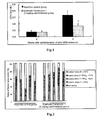
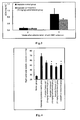
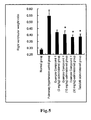


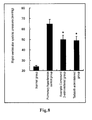


Classifications
-
- C—CHEMISTRY; METALLURGY
- C07—ORGANIC CHEMISTRY
- C07D—HETEROCYCLIC COMPOUNDS
- C07D211/00—Heterocyclic compounds containing hydrogenated pyridine rings, not condensed with other rings
- C07D211/04—Heterocyclic compounds containing hydrogenated pyridine rings, not condensed with other rings with only hydrogen or carbon atoms directly attached to the ring nitrogen atom
- C07D211/06—Heterocyclic compounds containing hydrogenated pyridine rings, not condensed with other rings with only hydrogen or carbon atoms directly attached to the ring nitrogen atom having no double bonds between ring members or between ring members and non-ring members
- C07D211/36—Heterocyclic compounds containing hydrogenated pyridine rings, not condensed with other rings with only hydrogen or carbon atoms directly attached to the ring nitrogen atom having no double bonds between ring members or between ring members and non-ring members with hetero atoms or with carbon atoms having three bonds to hetero atoms with at the most one bond to halogen, e.g. ester or nitrile radicals, directly attached to ring carbon atoms
- C07D211/60—Carbon atoms having three bonds to hetero atoms with at the most one bond to halogen, e.g. ester or nitrile radicals
-
- A—HUMAN NECESSITIES
- A61—MEDICAL OR VETERINARY SCIENCE; HYGIENE
- A61P—SPECIFIC THERAPEUTIC ACTIVITY OF CHEMICAL COMPOUNDS OR MEDICINAL PREPARATIONS
- A61P11/00—Drugs for disorders of the respiratory system
-
- A—HUMAN NECESSITIES
- A61—MEDICAL OR VETERINARY SCIENCE; HYGIENE
- A61P—SPECIFIC THERAPEUTIC ACTIVITY OF CHEMICAL COMPOUNDS OR MEDICINAL PREPARATIONS
- A61P13/00—Drugs for disorders of the urinary system
- A61P13/12—Drugs for disorders of the urinary system of the kidneys
-
- A—HUMAN NECESSITIES
- A61—MEDICAL OR VETERINARY SCIENCE; HYGIENE
- A61P—SPECIFIC THERAPEUTIC ACTIVITY OF CHEMICAL COMPOUNDS OR MEDICINAL PREPARATIONS
- A61P43/00—Drugs for specific purposes, not provided for in groups A61P1/00-A61P41/00
-
- A—HUMAN NECESSITIES
- A61—MEDICAL OR VETERINARY SCIENCE; HYGIENE
- A61P—SPECIFIC THERAPEUTIC ACTIVITY OF CHEMICAL COMPOUNDS OR MEDICINAL PREPARATIONS
- A61P9/00—Drugs for disorders of the cardiovascular system
- A61P9/12—Antihypertensives
-
- C—CHEMISTRY; METALLURGY
- C07—ORGANIC CHEMISTRY
- C07D—HETEROCYCLIC COMPOUNDS
- C07D401/00—Heterocyclic compounds containing two or more hetero rings, having nitrogen atoms as the only ring hetero atoms, at least one ring being a six-membered ring with only one nitrogen atom
- C07D401/02—Heterocyclic compounds containing two or more hetero rings, having nitrogen atoms as the only ring hetero atoms, at least one ring being a six-membered ring with only one nitrogen atom containing two hetero rings
- C07D401/06—Heterocyclic compounds containing two or more hetero rings, having nitrogen atoms as the only ring hetero atoms, at least one ring being a six-membered ring with only one nitrogen atom containing two hetero rings linked by a carbon chain containing only aliphatic carbon atoms
-
- C—CHEMISTRY; METALLURGY
- C07—ORGANIC CHEMISTRY
- C07D—HETEROCYCLIC COMPOUNDS
- C07D405/00—Heterocyclic compounds containing both one or more hetero rings having oxygen atoms as the only ring hetero atoms, and one or more rings having nitrogen as the only ring hetero atom
- C07D405/02—Heterocyclic compounds containing both one or more hetero rings having oxygen atoms as the only ring hetero atoms, and one or more rings having nitrogen as the only ring hetero atom containing two hetero rings
- C07D405/06—Heterocyclic compounds containing both one or more hetero rings having oxygen atoms as the only ring hetero atoms, and one or more rings having nitrogen as the only ring hetero atom containing two hetero rings linked by a carbon chain containing only aliphatic carbon atoms
Definitions
- the present invention relates to nipecotic acid derivatives and their pharmaceutical uses.
- Non-patent Document 1 a novel disease concept, chronic renal disease was proposed in 2002, and a wide range of renal diseases, ranging from the state where renal function is decreased but renal failure has not occurred to the state where renal failure is in the terminal stage, are now called chronic renal disease (Non-patent Document 1).
- angiotensin antihypertensive drugs such as angiotensin II receptor antagonists and angiotensin converting enzyme inhibitors are prescribed for patients with chronic renal disease for strict control of blood pressure, to thereby prevent the progression of chronic renal disease and the development and progression of cardiovascular diseases as complications (Non-Patent Document 2).
- pulmonary hypertension is a general term for disease states in which an increased pulmonary artery pressure is found. It is known that pulmonary hypertension remarkably deteriorates exercise tolerance and is progressive in most cases, and that the prognosis of pulmonary hypertension is poor. In healthy individuals, pulmonary artery pressure is kept lower than systemic blood pressure. However, in patients with pulmonary hypertension, the mean pulmonary arterial pressure is not less than 25 mmHg at rest (not less than 30 mmHg on exercise), and persistence of this condition for a long time may induce right ventricular hypertrophy or right heart failure, or may result in death in the worst cases.
- Non-Patent Document 3 Since pulmonary vasospasm has been considered to be a cause of development of pulmonary hypertension, treatment of pulmonary hypertension is carried out using a short-acting pulmonary vasodilator such as a prostacyclin derivative, endothelin receptor antagonist or phosphodiesterase inhibitor.
- a short-acting pulmonary vasodilator such as a prostacyclin derivative, endothelin receptor antagonist or phosphodiesterase inhibitor.
- EETs epoxyeicosatrienoic acids
- sEH soluble epoxide hydrolase
- sEH inhibitors soluble epoxide hydrolase inhibitors
- sEH inhibitors increase the EET level to exert an action to suppress elevation of blood pressure and an action to protect vascular endothelium
- Non-patent Document 8 and Patent Documents 1 and 2 compounds having an sEH-inhibiting action were reported, and these compounds were suggested to be useful for treatment of chronic renal disease and pulmonary hypertension in some cases.
- Non-patent Documents 9 to 11 it is also reported that there are also cases where even a compound having an sEH-inhibiting activity does not show a therapeutic effect in a spontaneously hypertensive rat model. None of the compounds having an sEH-inhibiting activity reported so far has a nipecotic acid diamide structure.
- Patent Document 3 a heteroaryl amide derivative in which a heteroaryl amine is condensed with nipecotic acid
- Patent Document 4 an amidine derivative
- Patent Document 5 a hydroxamic acid derivative
- angiotensin antihypertensive drugs alone is insufficient for preventing the progression of chronic renal disease, and there is a concern that these drugs may cause side effects such as coughing.
- therapeutic methods and prophylactic methods for pulmonary hypertension have not been established yet, and current drugs prescribed for treatment of pulmonary hypertension (prostacyclin derivatives, endothelin receptor antagonists, phosphodiesterase inhibitors and the like) may cause side effects such as headache, flushing and hepatotoxicity.
- the present inventors considered that, if a compound which strongly inhibits sEH to suppress a decrease in renal function and/or elevation of the pulmonary arterial pressure based on its action can be discovered, the compound can be predicted not to affect normal tissues in which expression of sEH is not increased, and therefore a safe pharmaceutical without the concern of the side effects can be created.
- the present invention aims to provide a compound having an sEH-inhibiting activity and to provide a pharmaceutical having a therapeutic effect and a prophylactic effect on chronic renal disease and pulmonary hypertension based on inhibition of sEH.
- novel nipecotic acid derivatives and pharmaceutically acceptable salts thereof show strong sEH-inhibiting activity, and have an excellent therapeutic effect and prophylactic effect on chronic renal disease and pulmonary hypertension based on this action, thereby completing the present invention.
- R 2 and R 3 each independently represents a hydrogen atom or C 1 -C 6 alkyl, or together represent -(CH 2 ) 1 -, with the proviso that R 2 and R 3 do not simultaneously represent a hydrogen atom;
- R 4 represents a substituent in the 2-position of the benzene ring; and
- R 5 represents a substituent in the 4-position of the benzene ring.
- R 4 represents a halogen atom, or C 1 -C 6 alkyl or alkyloxy;
- R 5 represents a halogen atom, cyano, or C 1 -C 6 alkyl or alkyloxy;
- R 6 represents a hydrogen atom.
- R 2 and R 3 together represent -(CH 2 ) 3 -;
- R 4 represents -OCF 3 ; and
- R 5 represents cyano.
- the present invention also provides a pharmaceutical comprising as an effective component the nipecotic acid derivative or a pharmaceutically acceptable salt thereof.
- This pharmaceutical is preferably an sEH inhibitor, more preferably a therapeutic agent or prophylactic agent for chronic renal disease or pulmonary hypertension.
- the nipecotic acid derivative or a pharmaceutically acceptable salt thereof of the present invention has a strong sEH inhibitory activity, and, based on this action, it can exert excellent therapeutic effects or prophylactic effects on chronic renal disease and pulmonary hypertension. Therefore, patients can be provided with a prescription appropriate for their symptoms, and side effects in the patients can be reduced thereby.
- C 1 -C 6 alkyl means a C 1 -C 6 linear, or C 3 -C 6 branched, saturated hydrocarbon group, and examples of the “C 1 -C 6 alkyl” include methyl, ethyl, 1-propyl, 2-propyl, 1-butyl, 2-butyl, 2-methyl-2-propyl (tert-butyl), 2-methyl-1-propyl, 2,2-dimethyl-1-propyl, 1-pentyl, 2-pentyl and 3-pentyl.
- C 1 -C 6 alkyloxy means a group in which the C 1 -C 6 alkyl is bound to an oxygen atom, and examples of the C 1 -C 6 alkyloxy include methoxy, ethoxy, 1-propyloxy, 2-propyloxy, 1-butyloxy and 2-butyloxy.
- C 3 -C 6 cycloalkyl means cyclopropyl, cyclobutyl, cyclopentyl and cyclohexyl.
- C 3 -C 6 cycloalkyloxy means cyclopropyloxy, cyclobutyloxy, cyclopentyloxy and cyclohexyloxy.
- C 2 -C 7 alkyloxyalkyl means a group having 2 to 7 carbon atoms, in which one hydrogen atom in an alkyl group is replaced by an alkyloxy group.
- Examples of the C 2 -C 7 alkyloxyalkyl include methoxymethyl, methoxyethyl, methoxypropyl, ethoxymethyl, propoxymethyl and isopropoxymethyl.
- C 4 -C 7 cycloalkylalkyl means a group having 4 to 7 carbon atoms, in which one hydrogen atom in an alkyl group is replaced by a cycloalkyl group.
- Examples of the C 4 -C 7 cycloalkylalkyl include cyclopropylmethyl, cyclopropylethyl, cyclopropylpropyl, cyclobutylmethyl, cyclopentylmethyl and cyclohexylmethyl.
- halogen atom means a fluorine atom, chlorine atom, bromine atom or iodine atom.
- heteroaryl having 5 ring-constituting atoms means a heteroaromatic group having 5 ring-constituting atoms, comprising 1 to 4 identical or different atoms each selected from the group consisting of a nitrogen atom, oxygen atom and sulfur atom.
- heteroaryl having 5 ring-constituting atoms include pyrrolyl, imidazolyl, pyrazolyl, triazolyl, oxazolyl, isoxazolyl, furanyl and thiazolyl.
- R 2 and R 3 each independently represents a hydrogen atom or C 1 -C 6 alkyl, or together represent -(CH 2 ) 1 -. More preferably, R 2 and R 3 each independently represents a hydrogen atom or C 1-3 alkyl (wherein, in the alkyl, one hydrogen atom may be substituted by hydroxy), or together represent -(CH 2 ) 2 - or-(CH 2 ) 3 -. Still more preferably, R 2 and R 3 each independently represents a hydrogen atom, methyl or 2-hydroxy-2-propyl, or together represent -(CH 2 ) 2 - or -(CH 2 ) 3 -. However, R 2 and R 3 do not simultaneously represent a hydrogen atom.
- R 4 is preferably a substituent in the 2-position of the benzene ring.
- R 4 is preferably a halogen atom, or C 1 -C 6 alkyl or alkyloxy; more preferably a halogen atom or alkyloxy; still more preferably alkyloxy.
- R 5 is preferably a substituent in the 4-position of the benzene ring.
- R 5 is preferably a halogen atom, cyano, C 1 -C 6 alkyl or C 1 -C 6 alkyloxy; more preferably a halogen atom or cyano.
- R 6 is preferably a halogen atom, and R 7 is preferably methyl or ethyl.
- 1 preferably represents 2 or 3; m preferably represents 2; and n preferably represents 2.
- the nipecotic acid derivative represented by the General Formula (I) (hereinafter referred to as the nipecotic acid derivative (I)) comprises at least one asymmetric carbon atom, and there exist optical isomers and diastereomers.
- the nipecotic acid derivative (I) is not limited to a single type of isomer, and examples of the nipecotic acid derivative (I) also include racemic mixtures and diastereomeric mixtures. In cases where rotational isomers exist, examples of the nipecotic acid derivative include all of the rotational isomers.
- Examples of the pharmaceutically acceptable salt of the nipecotic acid derivative (I) include acid addition salts such as hydrochloride, trifluoroacetate, sulfate, nitrate, hydrobromide, hydroiodide and methanesulfonate. Hydrochloride, sulfate, hydrobromide, hydroiodide and methanesulfonate are preferred.
- the starting material and reagents to be used for production of the nipecotic acid derivative (I) commercially available products may be used as they are, or the starting material and reagents may be synthesized by known methods.
- a nipecotic acid derivative (I-a) can be produced, as shown in the Scheme 1 below, by condensation reaction between an amine derivative (II) and a carboxylic acid derivative (III) in the presence of a base and a condensing agent.
- R 2 to R 6 are the same as defined above.
- the condensing agent to be used for the condensation reaction examples include cyclohexylcarbodiimide, N-ethyl-N'-3-dimethylaminopropylcarbodiimide hydrochloride, benzotriazol-1-yloxy-trisdimethylaminophosphonium salt (BOP reagent), 1-[bis(dimethylamino)methylene]-1H-benzotriazolium-3-oxide hexafluorophosphate (HBTU) and O-(7-azabenzotriazol-1-yl)tetramethyluronium hexafluorophosphate (hereinafter referred to as HATU). HATU is preferred.
- the equivalence of the condensing agent is preferably 1 to 10 equivalents, more preferably 1 to 3 equivalents.
- Examples of the solvent used for the condensation reaction include N,N-dimethylformamide (hereinafter referred to as DMF), tetrahydrofuran (hereinafter referred to as THF), dichloromethane, chloroform, diethyl ether and dimethyl ether. DMF and THF are preferred, and DMF is more preferred.
- the base to be used for the condensation reaction include organic bases such as diisopropylethylamine (hereinafter referred to as DIPEA), triethylamine (hereinafter referred to as TEA), pyridine and N-methylmorpholine; and organic acid salts such as potassium carbonate, sodium carbonate and sodium hydrogen carbonate. DIPEA and TEA are preferred.
- the equivalence of the base is preferably 1 to 100 equivalents, more preferably 1 to 10 equivalents with respect to the amine derivative (II).
- the equivalence of the carboxylic acid derivative (III) to be used for the condensation reaction is preferably 0.1 to 100 equivalents, more preferably 0.1 to 10 equivalents, still more preferably 0.8 to 2 equivalents with respect to the amine derivative (II).
- the reaction temperature during the condensation reaction is preferably -50°C to 100°C, more preferably 0 to 50°C, still more preferably 0 to 30°C.
- the reaction time of the condensation reaction is preferably 1 minute to 48 hours, more preferably 1 minute to 24 hours, still more preferably 10 minutes to 24 hours.
- the concentration of the amine derivative (II) at the beginning of the condensation reaction is preferably 0.01 to 100 M, more preferably 0.01 to 10 M, still more preferably 0.1 to 10 M.
- Examples of the solvent to be used for the condensation reaction with an acid chloride derivative (V) include dichloromethane, 1,2-dichloroethane, acetonitrile, DMF, THF, dioxane, diethyl ether and 1,2-dimethoxyethane.
- Dichloromethane, 1,2-dichloroethane, acetonitrile and THF are preferred, and dichloromethane and 1,2-dichloroethane are more preferred.
- the equivalence of the acid chloride (V) to be used for the condensation reaction with the acid chloride derivative (V) is preferably 0.1 to 10 equivalents, more preferably 1 to 3 equivalents, still more preferably 1 to 1.5 equivalents with respect to the amine derivative (IV).
- Examples of the base to be used for the condensation reaction with the acid chloride derivative (V) include organic bases such as DIPEA, TEA, pyridine and N-methylmorpholine. DIPEA and TEA are preferred.
- the equivalence of the base is preferably 1 to 100 equivalents, more preferably 1 to 10 equivalents with respect to the amine derivative (IV).
- the reaction temperature during the condensation reaction with the acid chloride derivative (V) is preferably -50 to 100°C, more preferably -20°C to 60°C, still more preferably 0 to 40°C.
- the reaction time of the condensation reaction with the acid chloride (V) is preferably 30 minutes to 24 hours, more preferably 30 minutes to 12 hours, still more preferably 30 minutes to 8 hours.
- the concentration of the amine derivative (IV) at the beginning of the condensation reaction with the acid chloride derivative (V) is preferably 0.01 to 100 M, more preferably 0.01 to 10 M, still more preferably 0.1 to 10 M.
- Examples of the solvent to be used for the sulfonamidation reaction include dichloromethane, 1,2-dichloroethane, acetonitrile, DMF, THF, dioxane, diethyl ether and 1,2-dimethoxyethane.
- Dichloromethane, 1,2-dichloroethane, acetonitrile and THF are preferred, and dichloromethane and 1,2-dichloroethane are more preferred.
- the equivalence of the sulfonic acid chloride derivative (VII) to be used for the sulfonamidation reaction is preferably 0.1 to 10 equivalents, more preferably 1 to 3 equivalents, still more preferably 1 to 1.5 equivalents with respect to the amine derivative (IV).
- Examples of the base to be used for the sulfonamidation reaction include organic bases such as DIPEA, TEA, pyridine and N-methylmorpholine. DIPEA and TEA are preferred.
- the equivalence of the base is preferably 1 to 100 equivalents, more preferably 1 to 10 equivalents with respect to the amine derivative (IV).
- the reaction temperature during the sulfonamidation reaction is preferably - 50 to 50°C, more preferably -30°C to 30°C, still more preferably -20°C to 20°C.
- the reaction time of the sulfonamidation reaction is preferably 30 minutes to 24 hours, more preferably 30 minutes to 12 hours, still more preferably 30 minutes to 8 hours.
- the concentration of the amine derivative (IV) at the beginning of the sulfonamidation reaction is preferably 0.01 to 100 M, more preferably 0.01 to 10 M, still more preferably 0.1 to 10 M.
- the amine derivative (IV) which is the starting material in the Schemes 2 and 3 shown above, can be produced, for example, as shown in the Scheme 4 below, by condensation reaction between an amine derivative (II) and a carboxylic acid derivative (VIII) in the presence of a base, followed by deprotection reaction for removal of a protecting group.
- R 2 to R 5 are the same as defined above, and R 8 represents a protecting group.
- the deprotection reaction after the condensation reaction can be carried out, for example, by the known method described in Protective Groups in Organic Synthesis 3rd Edition (Green et al., 1999, John Wiley & Sons, Inc. ).
- the protecting group can be removed by treatment with a strong acid such as trifluoroacetic acid.
- carboxylic acid derivative (VIII) in Scheme 4 a commercially available product may be used as it is, or the carboxylic acid derivative (VIII) may be produced by a known method.
- the amine derivative (II), which is the starting material in the Schemes 1 and 4 shown above, can be produced, for example, as shown in the Scheme 5 below, by condensation reaction between a benzyl amine derivative (IX) and a nipecotic acid derivative (X) in the presence of a base and a condensing agent, followed by deprotection reaction for removal of a protecting group.
- a benzyl amine derivative (IX) a nipecotic acid derivative (X)
- R 4 , R 5 and R 8 are the same as defined above.
- the deprotection reaction can be carried out under the same conditions as in Scheme 4.
- the condensation reaction in Scheme 5 can also be carried out in the presence of a base after conversion of the nipecotic acid derivative (X) to an acid chloride.
- Examples of the reagent to be used for converting the nipecotic acid derivative (X) to the acid chloride include oxalyl chloride and thionyl chloride.
- the reagent is preferably oxalyl chloride.
- the equivalence of the reagent is preferably 1 to 10 equivalents, more preferably 1 to 1.5 equivalents with respect to the nipecotic acid derivative (X).
- the solvent to be used for converting the nipecotic acid derivative (X) to the acid chloride include dichloromethane, chloroform, THF, 1,2-dichloroethane, acetonitrile, 1,4-dioxane and DMF.
- the solvent is preferably dichloromethane, THF or DMF, or a mixture of these solvents.
- the solvent is more preferably a mixture of dichloromethane and DMF, or a mixture of THF and DMF.
- the reaction temperature during the conversion of the nipecotic acid derivative (X) to the acid chloride is preferably -50 to 100°C, more preferably -30 to 30°C, still more preferably -20 to 0°C.
- the reaction time of the conversion of the nipecotic acid derivative (X) to the acid chloride is preferably 30 minutes to 24 hours, more preferably 30 minutes to 12 hours, still more preferably 30 minutes to 2 hours.
- the concentration of the nipecotic acid derivative (X) at the beginning of the reaction for converting the nipecotic acid derivative (X) to the acid chloride is preferably 0.01 to 100 M, more preferably 0.01 to 10 M, still more preferably 0.1 to 3 M.
- nipecotic acid derivative (I) and pharmaceutically acceptable salts thereof; and intermediates, material compounds and reagents to be used for production of the nipecotic acid derivative (I); may be isolated/purified as required by a method(s) such as extraction, distillation, chromatography and/or recrystallization.
- the pharmaceutical of the present invention contains as an effective component the nipecotic acid derivative (I) or a pharmaceutically acceptable salt thereof, and this pharmaceutical is preferably an sEH inhibitor, more preferably a therapeutic agent or prophylactic agent for chronic renal disease or pulmonary hypertension.
- sEH is an abbreviation of soluble epoxide hydrolase, which is a metabolic enzyme that catalyzes hydrolysis of an epoxide to convert it to the corresponding diol.
- the best-known substrates for sEH are EETs, which are hyperpolarizing factors derived from endothelial cells. sEH has an action to inactivate EETs by metabolizing them to DHETs.
- EETs is an abbreviation for epoxyeicosatrienoic acids
- DHETs is an abbreviation for dihydroxyeicosatrienoic acids.
- Examples of the EETs include 14,15-epoxyeicosatrienoic acid (hereinafter referred to as 14,15-EET).
- the DHETs include 14,15-dihydroxyeicosatrienoic acid (hereinafter referred to as 14,15-DHET).
- the "sEH inhibitory activity” means an activity to inhibit the action of sEH. Accordingly, the sEH inhibitory activity includes an activity that inhibits the enzyme reaction catalyzed by sEH in which EETs, which are substrates of sEH, are hydrolyzed.
- the "sEH inhibitor” means a compound having sEH inhibitory activity or a composition containing the compound as an effective component.
- the sEH inhibitory activity can be measured by reacting human sEH with its substrate EET in the presence of an sEH inhibitor, followed by comparing the amount of DHET produced thereby with the amount of DHET produced in the absence of the sEH inhibitor.
- the sEH inhibitory activity of an sEH inhibitor can also be measured by using a commercially available kit (Soluble Epoxide Hydrolase Inhibitor Screening Assay Kit; Cayman), or by the method described in a known document (e.g., Analytical Biochemistry, 2005, vol. 343, p. 66-75 ).
- the sEH inhibitory activity of an sEH inhibitor can also be measured by measuring, in the presence and absence of the sEH inhibitor, production of 4-nitrophenolate anions using, as the substrate of sEH, racemic 4-nitrophenyl-trans-2,3-epoxy-3-phenylpropylcarbonate, or by measuring production of 6-methoxy-2-naphthaldehyde using, as the substrate of sEH, cyano(6-methoxynaphthalen-2-yl)methyl 2-(3-phenyloxyran-2-yl)acetate.
- Inhibition of the metabolism of EET to DHET, or an increase in the amount of EET, by the pharmaceutical of the present invention can be confirmed by measuring the EET concentration, DHET concentration or EET/DHET ratio.
- the EET concentration, DHET concentration and EET/DHET ratio can be measured by, for example, using a commercially available assay kit (14,15-EET/DHET ELISA Kit; Detroit R&D).
- Chronic renal disease means the disease defined by The National Kidney Foundation-Kidney Disease Outcomes Quality Initiative (K/DOQI). That is, the chronic renal disease means: (1) a disease in which a renal disorder defined by structural or functional abnormality of a kidney continues for 3 or more months irrespective of whether the glomerular filtration rate (hereinafter referred to as GFR) is decreased or not; or (2) a disease in which GFR continues to be less than 60 mL/minute/1.73 m 2 for 3 or more months irrespective of whether a kidney is damaged or not.
- GFR glomerular filtration rate
- Renal disorder is found as abnormal urinary findings such as hematuria or proteinuria including microalbuminuria; abnormal imaging findings of a kidney such as unilateral cystic kidney or polycystic kidney; abnormality of a renal disorder marker detected by a blood test or urinalysis; and/or abnormal findings in histopathological diagnosis of a kidney such as renal biopsy.
- abnormal urinary findings such as hematuria or proteinuria including microalbuminuria
- abnormal imaging findings of a kidney such as unilateral cystic kidney or polycystic kidney
- abnormality of a renal disorder marker detected by a blood test or urinalysis abnormal findings in histopathological diagnosis of a kidney such as renal biopsy.
- GFR is recommended as an index of renal function.
- estimated GFR which is calculated based on the sCre level taking the age and sex into consideration.
- serum Cys-C level is also measured for evaluation of renal function.
- Inulin clearance and creatinine clearance are also used for evaluation of renal function.
- Glomerulonephritis is one of chronic renal diseases, and examples of glomerulonephritis include IgA nephropathy, minimal change nephrotic syndrome, focal segmental glomerulosclerosis, membranous nephropathy, membranoproliferative glomerulonephritis and crescentic nephritis.
- Diabetic nephropathy is also one of chronic renal diseases, and is a disease state whose progression is based on metabolic abnormality due to hyperglycemia. In diabetic nephropathy, abnormal urinary findings such as proteinuria including microalbuminuria; hypertension; and/or hyperglycemia; are found.
- Renal failure means a state or symptom in which renal function is decreased to less than 30% of that in the normal state.
- a state where glomerular function is decreased to not more than 60% is called renal failure, and a state where glomerular function is decreased to less than 10% corresponds to terminal renal failure, which requires dialysis.
- Renal failure is classified into acute renal failure and chronic renal failure.
- Chronic renal failure is one of chronic renal diseases, and regarded as terminal renal disease, which is the terminal state of chronic renal disease. The progression of glomerulonephritis or diabetic nephropathy leads to chronic renal failure.
- Chronic renal failure shows a common disease state irrespective of what the primary disease was. It progresses via the final common pathway, resulting in terminal renal failure. In renal failure, an increase in the sCre level and/or an increase in the serum Cys-C level is found.
- pulmonary hypertension means a state where the mean pulmonary arterial pressure during bed rest is not less than 25 mmHg, or, in cases of pulmonary disease, sleep apnea syndrome and alveolar hypoventilation syndrome, "pulmonary hypertension” means a state where the mean pulmonary arterial pressure at rest is not less than 20 mmHg (not less than 30 mmHg during exercise) ( Guidelines for Treatment of Pulmonary Hypertension (JCS 2006): Abridged Version, P2-P3 ). In pulmonary hypertension, increased right ventricular systolic pressure, right ventricular hypertrophy, pulmonary hypertrophy, thickened pulmonary arteries, pulmonary cell growth and/or myocardial hypertrophy is/are found.
- the therapeutic effect of the nipecotic acid derivative (I) or a pharmaceutically acceptable salt thereof on chronic renal disease can be evaluated using an animal model with artificially induced chronic renal disease.
- an animal model include anti-GBM antiserum-administered nephritis models using a mouse or rat (e.g., Kidney International, 2003, vol. 64, p. 1241-1252 ), renal failure models by 5/6 nephrectomy (e.g., Journal of the American Society of Nephrology, 2002, vol. 13, p. 2909-2915 ), and streptozotocin-administered diabetic nephropathy models (e.g., International Journal of Molecular Medicine, 2007, vol. 19, p.
- the renal functional abnormality can be confirmed by measuring the sCre level, serum Cys-C level or urinary albumin excretion.
- the high blood pressure can be confirmed by measuring the systemic systolic pressure.
- the hyperglycemia can be confirmed by measuring the plasma glucose level.
- sEH in lesions in the kidney can be confirmed by immunohistostaining of a renal tissue using an anti-sEH antibody.
- histopathological changes in the kidney can be confirmed by staining a renal tissue with hematoxylin and eosin (hereinafter referred to as HE) and periodic acid-Schiff (hereinafter referred to as PAS).
- HE hematoxylin and eosin
- PAS periodic acid-Schiff
- the therapeutic effect of the nipecotic acid derivative (I) or a pharmaceutically acceptable salt thereof on pulmonary hypertension can be evaluated using an animal model with artificially induced pulmonary hypertension.
- animal model examples include a monocrotaline-administered pulmonary hypertension model using a rat ( Journal of Pharmacological Sciences, 2009, vol. 111, p. 235-243 ).
- the increase in the pulmonary arterial pressure can be confirmed by measuring the right ventricular systolic pressure.
- the disease states of right ventricular hypertrophy and pulmonary hypertrophy due to pulmonary hypertension can be confirmed by measuring the right ventricular weight ratio (right ventricular weight / (septum weight + left ventricular weight) and the lung weight ratio (lung weight / body weight), respectively.
- pulmonary hypertension expression of sEH in the lesions in the lung can be confirmed by immunohistostaining of a lung tissue using an anti-sEH antibody.
- thickened pulmonary arteries can be confirmed by Elastica-van Gieson staining of a lung tissue.
- pulmonary cell growth can be confirmed by immunostaining of a lung tissue with an anti-proliferation cell nuclear antigen (hereinafter referred to as PCNA).
- PCNA anti-proliferation cell nuclear antigen
- myocardial hypertrophy can be confirmed by HE staining of the right ventricle.
- systemic blood pressure can be confirmed by the method described in Examples.
- nipecotic acid derivative (I) or a pharmaceutically acceptable salt thereof is used as a pharmaceutical
- it can be administered as it is, or as a pharmaceutical composition having an appropriate dosage form, to a mammal (e.g., mouse, rat, hamster, rabbit, dog, monkey, cow, sheep or human), orally or parenterally (by, for example, transdermal administration, intravenous administration, rectal administration, inhalation administration, intranasal administration or instillation administration).
- a mammal e.g., mouse, rat, hamster, rabbit, dog, monkey, cow, sheep or human
- parenterally by, for example, transdermal administration, intravenous administration, rectal administration, inhalation administration, intranasal administration or instillation administration.
- Examples of the dosage form for administration to a mammal include tablets, powders, pills, capsules, granules, syrups, liquids, injection solutions, emulsions, suspensions and suppositories, and known sustained-release formulations. These dosage forms can be produced by known methods, and contain a carrier commonly used in the field of pharmaceutical preparations. Examples of the carrier include vehicles, lubricants, binders and disintegrators for solid formulations; and solvents, solubilizers, suspending agents and soothing agents for liquid formulations. In addition, if necessary, additives such as isotonic agents, buffers, antiseptics, antioxidants, coloring agents, sweeteners, adsorbing agents, wetting agents and the like may be used.
- Examples of the vehicles include lactose, D-mannitol, starch, sucrose, corn starch, crystalline cellulose and light anhydrous silicic acid.
- lubricants examples include magnesium stearate, calcium stearate, talc and colloidal silica.
- binders examples include crystalline cellulose, D-mannitol, dextrin, hydroxypropyl cellulose, hydroxypropylmethyl cellulose, polyvinylpyrrolidone, starch, sucrose, gelatin, methyl cellulose and sodium carboxymethyl cellulose.
- disintegrators examples include starch, carboxymethyl cellulose, carboxymethyl cellulose calcium, croscarmellose sodium, sodium carboxymethyl starch and L-hydroxypropyl cellulose.
- solvents examples include water for injection, alcohol, propylene glycol, Macrogol, sesame oil and corn oil.
- solubilizers examples include polyethylene glycol, propylene glycol, D-mannitol, benzyl benzoate, ethanol, cholesterol, triethanolamine, sodium carbonate and sodium citrate.
- suspending agents examples include surfactants such as stearyl triethanolamine, sodium lauryl sulfate, lauryl aminopropionate, lecithin, benzalkonium chloride, benzethonium chloride and glycerin monostearate; and hydrophilic macromolecules such as polyvinyl alcohol, polyvinyl pyrrolidone, methyl cellulose, hydroxymethyl cellulose, hydroxyethyl cellulose and hydroxypropyl cellulose.
- surfactants such as stearyl triethanolamine, sodium lauryl sulfate, lauryl aminopropionate, lecithin, benzalkonium chloride, benzethonium chloride and glycerin monostearate
- hydrophilic macromolecules such as polyvinyl alcohol, polyvinyl pyrrolidone, methyl cellulose, hydroxymethyl cellulose, hydroxyethyl cellulose and hydroxypropyl cellulose.
- Examples of the soothing agents include benzyl alcohol.
- isotonic agents examples include glucose, sodium chloride, D-sorbitol and D-mannitol.
- buffers examples include phosphoric acid salts, acetic acid salts, carbonic acid salts and citric acid salts.
- antiseptics examples include paraoxy benzoic acid esters, chlorobutanol, benzyl alcohol, phenethyl alcohol, dehydroacetic acid and sorbic acid.
- antioxidants examples include sulfurous acid salts and ascorbic acid.
- the pharmaceutical described above preferably contains the nipecotic acid derivative (I) or a pharmaceutically acceptable salt thereof at preferably 0.001 to 99 wt%, more preferably 0.01 to 99 wt%.
- the effective dose and the number of doses of the nipecotic acid derivative (I) or a pharmaceutically acceptable salt thereof vary depending on the dosage form; the age and body weight of the patient; the state or severity of the symptoms to be treated.
- the nipecotic acid derivative (I) or a pharmaceutically acceptable salt thereof may be administered at a daily dose of usually 1 to 1000 mg, preferably 1 to 300 mg per adult in a single dose or several divided doses.
- the pharmaceutical described above may be administered alone, or, in order to complement or increase the prophylactic effect and/or therapeutic effect for the disease, or in order to decrease the dose, the pharmaceutical may be administered as a mixture with other drugs or in combination with other drugs.
- concomitant drugs examples include therapeutic agents for diabetes, therapeutic agents for diabetic complications, therapeutic agents for hyperlipidemia, antihypertensives, anti-obesity drugs, diuretics, chemotherapeutic agents, immunotherapeutic agents, antithrombotic agents and anti-cachexia agents.
- the timing of administration of the pharmaceutical and the concomitant drug is not limited, and these may be administered either at the same time or at different times to the subject to which these are to be administered.
- the concomitant drug may be a low-molecular-weight compound; macromolecule such as a protein, polypeptide or antibody; vaccine; or the like.
- the dose of the concomitant drug may be arbitrarily selected using as a standard the dose which is clinically used.
- the mixing ratio between the pharmaceutical and the concomitant drug may be arbitrarily selected based on, for example, the subject to which these are to be administered, administration route, disease to be treated, symptoms, combination of the pharmaceutical and the concomitant drug, and/or the like.
- the concomitant drug may be used at a mixing ratio of 0.01 to 99.99 with respect to the nipecotic acid derivative (I) or a pharmaceutically acceptable salt thereof.
- Examples of the therapeutic agents for diabetes include formulations of animal insulin extracted from bovine or pig pancreas; formulations of human insulin synthesized using E. coli or yeast by genetic engineering; insulin formulations such as zinc insulin, protamine zinc insulin, and fragments and derivatives of insulin; insulin sensitizers such as pioglitazone hydrochloride, troglitazone and rosiglitazone, and maleic acid salts thereof; ⁇ -glucosidase inhibitors such as voglibose, acarbose, miglitol and emiglitate; biguanides such as phenformin, metformin and buformin; insulin secretagogues such as tolbutamide, glibenclamide, gliclazide, chlorpropamide, tolazamide, acetohexamide, glyclopyramide, glimepiride, glipizide, glybuzole, repaglinide, nateglinide and mitiglinide, and calcium salt
- Examples of the therapeutic agents for diabetic complications include aldose reductase inhibitors such as tolrestat, epalrestat, zenarestat, zopolrestat, minalrestat and fidarestat; neurotrophic factors such as NGF, NT-3 and BDNF; production/secretion promoters of neurotrophic factors; AGE inhibitors; active oxygen scavengers such as thioctic acid; and cerebral vasodilators such as tiapride and mexiletine.
- aldose reductase inhibitors such as tolrestat, epalrestat, zenarestat, zopolrestat, minalrestat and fidarestat
- neurotrophic factors such as NGF, NT-3 and BDNF
- production/secretion promoters of neurotrophic factors such as AGE inhibitors
- active oxygen scavengers such as thioctic acid
- cerebral vasodilators such as tiapride and mexiletine.
- HMG-CoA reductase inhibitors such as pravastatin, simvastatin, lovastatin, atorvastatin, fluvastatin, lipanthyl, cerivastatin and itavastatin; fibrate compounds such as bezafibrate, beclobrate, binifibrate, ciprofibrate, clinofibrate, clofibrate, clofibric acid, etofibrate, fenofibrate, gemfibrozil, nicofibrate, pirifibrate, ronifibrate, simfibrate and theofibrate; squalene synthetase inhibitors; ACAT inhibitors such as avasimibe and eflucimibe; anion-exchange resins such as cholestyramine; nicotinic acid drugs such as probucol, nicomol and niceritrol; and phytosterol
- antihypertensives examples include angiotensin converting enzyme inhibitors such as captopril, enalapril and delapril; angiotensin II antagonists such as candesartan cilexetil, losartan, eprosartan, valsartan, telmisartan, irbesartan and tasosartan; calcium antagonists such as manidipine, nifedipine, nicardipine, amlodipine and efonidipine; potassium channel openers such as levcromakalim; clonidine; and aliskiren.
- angiotensin converting enzyme inhibitors such as captopril, enalapril and delapril
- angiotensin II antagonists such as candesartan cilexetil, losartan, eprosartan, valsartan, telmisartan, irbesartan and tasosartan
- anti-obesity drugs examples include central anti-obesity drugs such as dexfenfluramine, fenfluramine, phentermine, sibutramine, amfepramone, dexamfetamine, mazindol, phenylpropanolamine and clobenzorex; pancreatic lipase inhibitors such as orlistat; peptide appetite suppressants such as leptin and CNTF (ciliary neurotrophic factor); and cholecystokinin agonists such as lintitript.
- central anti-obesity drugs such as dexfenfluramine, fenfluramine, phentermine, sibutramine, amfepramone, dexamfetamine, mazindol, phenylpropanolamine and clobenzorex
- pancreatic lipase inhibitors such as orlistat
- peptide appetite suppressants such as leptin and CNTF (ciliary neurotrophic factor)
- diuretics examples include xanthine derivatives such as theobromine sodium salicylate and theobromine calcium salicylate; thiazide formulations such as ethiazide, cyclopenthiazide, trichlormethiazide, hydrochlorothiazide, hydroflumethiazide, benzylhydrochlorothiazide, penflutizide, polythiazide and methyclothiazide; anti-aldosterone formulations such as spironolactone and triamterene; carbonic anhydrase inhibitors such as acetazolamide; chlorobenzenesulfonamide formulations such as chlorthalidone, mefruside and indapamide; azosemide; isosorbide; etacrynic acid; piretanide; bumetanide; and furosemide.
- xanthine derivatives such as theobromine sodium salicylate and theobromine
- chemotherapeutic agents examples include alkylating agents such as cyclophosphamide and ifosfamide; antimetabolites such as methotrexate and 5-fluorouracil; antitumor antibiotics such as mitomycin and adriamycin; plant-derived anticancer agents such as vincristine, vindesine and taxol; cisplatin; oxaliplatin; carboplatin; and etoposide.
- immunotherapeutic agents examples include muramyl dipeptide derivatives, picibanil, lentinan, schizophyllan, Krestin, interleukin (IL), granulocyte colony-stimulating factor and erythropoietin.
- antithrombotic agents examples include heparin such as heparin sodium, heparin calcium and dalteparin sodium; warfarin such as potassium warfarin; antithrombin agents such as argatroban; thrombolytic agents such as urokinase, tisokinase,reteplase, nateplase, monteplase and pamiteplase; and platelet aggregation inhibitors such as ticlopidine hydrochloride, cilostazol, ethyl icosapentate and sarpogrelate hydrochloride.
- heparin such as heparin sodium, heparin calcium and dalteparin sodium
- warfarin such as potassium warfarin
- antithrombin agents such as argatroban
- thrombolytic agents such as urokinase, tisokinase, alteplase, nateplase, monteplase and pamitepla
- anti-cachexia agents examples include progesterone derivatives such as megestrol acetate; glucocorticoids such as dexamethasone; fat metabolism improving agents such as metoclopramide agents, tetrahydrocannabinol agents and eicosapentaenoic acid; growth hormone; IGF-1; and antibodies against TNF- ⁇ , LIF, IL-6 and oncostatin M, which are factors that induce cachexia.
- TFA trifluoroacetic acid
- Example Compound 1 (R)-N-(4-cyano-2-(trifluoromethoxy)benzyl)-1-(1-propionamidocyclobutanecarbonyl)piperidine-3-carboxamide (hereinafter referred to as Example Compound 1).
- Example Compound 2 (R)-N-(4-cyano-2-(trifluoromethoxy)benzyl)-1-(2-methyl-2-(methylsulfonamido)propanoyl)piperidine-3-carboxamide (hereinafter referred to as Example Compound 2).
- Example Compound 3 (R)-N-(4-cyano-2-(trifluoromethoxy)benzyl)-1-(1-(methylsulfonamido)cyclopropanecarbonyl)piperidine-3-carboxamide (hereinafter referred to as Example Compound 3).
- Example Compound 4 By performing the same reaction as in Example 1 [Step 9] except that 1-(trifluoromethyl)cyclopropanecarboxylic acid (0.054 g, 0.17 mmol) was used, 0.044 g (58%) of (R)-N-(4-cyano-2-(trifluoromethoxy)benzyl)-1-(1-(trifluoromethyl)cyclopropanecarbonyl)piperidine-3-carboxamide (hereinafter referred to as Example Compound 4) was obtained.
- Example Compound 5 By performing the same reaction as in Example 2 [Step 3] except that Reference Example Compound 10 (0.020 g, 0.047 mmol) was used, 0.017 g (71 %) of (R)-N-(4-cyano-2-(trifluoromethoxy)benzyl)-1-(1-(methylsulfonamido)cyclobutanecarbonyl)piperidine-3-carboxamide (hereinafter referred to as Example Compound 5) was obtained.
- Example Compound 6 By performing the same reaction as in Example 1 [Step 11] except that isobutyl chloride (0.0055 g, 0.052 mmol) was used, 0.022 g (95%) of (R)-N-(4-cyano-2-(trifluoromethoxy)benzyl)-1-(1-isobutylamidocyclobutanecarbonyl)piperidine-3-carboxamide (hereinafter referred to as Example Compound 6) was obtained.
- Example Compound 7 By performing the same reaction as in Example 1 [Step 11] except that pivaloyl chloride (0.0063 g, 0.052 mmol) was used, 0.017 g (72%) of (R)-N-(4-cyano-2-(trifluoromethoxy)benzyl)-1-(1-pivalamidocyclobutanecarbonyl)piperidine-3-carboxamide (hereinafter referred to as Example Compound 7) was obtained.
- Reference Example Compound 16 By performing the same reaction as in Example 1 [Step 10] except that Reference Example Compound 15 (0.13 g, 0.24 mmol) was used, 0.051 g (49%) of (R)-1-(1-aminocyclopentanecarbonyl)-N-(4-cyano-2-(trifluoromethoxy)benzyl)piperidine-3-carboxamide (hereinafter referred to as Reference Example Compound 16) was obtained.
- Example Compound 8 (R)-1-(1-acetamidocyclopentanecarbonyl)-N-(4-cyano-2-(trifluoromethoxy)benzyl)piperidine-3-carboxamide (hereinafter referred to as Example Compound 8).
- Example Compound 9 By performing the same reaction as in Example 8 [Step 3] except that Reference Example Compound 10 (0.020 g, 0.047 mmol) was used, 0.013 g (60%) of (R)-1-(1-acetamidocyclobutanecarbonyl)-N-(4-cyano-2-(trifluoromethoxy)benzyl)piperidine-3-carboxamide (hereinafter referred to as Example Compound 9) was obtained.
- Reference Example Compound 19 By performing the same reaction as in Example 1 [Step 6] except that Reference Example Compound 18 (2.4 g, 10 mmol) was used, 4.5 g (quantitative) of (R)-tert-butyl 3-((4-chloro-2-(2,2,2-trifluoroethoxy)benzyl)carbamoyl)piperidine-1-carboxylate (hereinafter referred to as Reference Example Compound 19) was obtained.
- Example Compound 10 (R)-N-(4-chloro-2-(2,2,2-trifluoroethoxy)benzyl)-1-(2-methyl-2-(methylsulfonamido)propanoyl)piperidine-3-carboxamide (hereinafter referred to as Example Compound 10).
- the organic layer was washed with saturated aqueous sodium hydrogen carbonate solution, and then dried over anhydrous sodium sulfate, followed by concentration under reduced pressure.
- Example Compound 11 By performing the same reaction as in Example 8 [Step 3] except that Reference Example Compound 23 (0.020 g, 0.047 mmol) was used, 0.018 g (83%) of (R)-1-((R)-2-acetamido-3-methylbutanoyl)-N-(4-cyano-2-(trifluoromethoxy)benzyl)piperidine-3-carboxamide (hereinafter referred to as Example Compound 11) was obtained.
- Example Compound 12 By performing the same reaction as in Example 2 [Step 3] except that Reference Example Compound 23 (0.020 g, 0.047 mmol) was used, 0.020 g (83%) of (R)-N-(4-cyano-2-(trifluoromethoxy)benzyl)-1-((R)-3-methyl-2-(methylsulfonamido)butanoyl)piperidine-3-carboxamide (hereinafter referred to as Example Compound 12) was obtained.
- Example Compound 13 (R)-N-(4-cyano-2-(trifluoromethoxy)benzyl)-1-(1-(ethylsulfonamido)cyclopropanecarbonyl)piperidine-3-carboxamide (hereinafter referred to as Example Compound 13).
- Example Compound 2 0.020 g, 0.041 mmol
- potassium carbonate 0.0028 g, 0.020 mmol
- DMF 0.38 mL
- Example Compound 14 (R)-N-(4-carbamoyl-2-(trifluoromethoxy)benzyl)-1-(2-methyl-2-(methylsulfonamido)propanoyl)piperidine-3-carboxamide (hereinafter referred to as Example Compound 14).
- Example Compound 15 By performing the same reaction as in Example 14 except that Example Compound 3 (0.025 g, 0.051 mmol) was used, 0.020 g (77%) of (R)-N-(4-carbamoyl-2-(trifluoromethoxy)benzyl)-1-(2-methyl-2-(methylsulfonamido)cyclopropanecarbonyl)piperidine-3-carboxamide (hereinafter referred to as Example Compound 15) was obtained.
- Example Compound 16 By performing the same reaction as in Example 1 [Step 9] except that 2-hydroxy-2-methylpropanoic acid (0.15 g, 0.46 mmol) was used, 0.12 g (62%) of (R)-N-(4-cyano-2-(trifluoromethoxy)benzyl)-1-(2-hydroxy-2-methylpropanoyl)piperidine-3-carboxamide (hereinafter referred to as Example Compound 16) was obtained.
- Example Compound 17 By performing the same reaction as in Example 1 [Step 11] except that Reference Example Compound 8 (0.15 g, 0.46 mmol) and pivaloyl chloride (0.066 g, 0.55 mmol) were used, 0.19 g (quantitative) of (R)-N-(4-cyano-2-(trifluoromethoxy)benzyl)-1-pivaloylpiperidine-3-carboxamide (hereinafter referred to as Example Compound 17) was obtained.
- the organic layer was washed with water and saturated aqueous sodium chloride solution, and dried over anhydrous sodium sulfate, followed by concentration under reduced pressure.
- Example Compound 18 By performing the same reaction as in Example 1 [Step 9] except that Reference Example Compound 26 (0.13 g, 0.67 mmol) was used, 0.17 g (60%) of (R)-N-(4-cyano-2-(trifluoromethoxy)benzyl)-1-(1-(N-methylmethylsulfonamido)cyclopropanecarbonyl)piperidine-3-carboxamide (hereinafter referred to as Example Compound 18) was obtained.
- Example Compound 19 (R)-N-(4-cyano-2-(trifluoromethoxy)benzyl)-1-(3-hydroxy-2,2-dimethylpropanoyl)piperidine-3-carboxamide (hereinafter referred to as Example Compound 19).
- an aqueous sulfuric acid solution (40 wt%, 5.6 mL) was added to an aqueous solution (5.6 mL) of cyclohexanone (3.0 g, 31 mmol) and potassium cyanide (2.2 g, 34 mmol).
- water was added thereto, followed by performing extraction with diethyl ether.
- the organic layer was washed with saturated aqueous sodium chloride solution, and dried over anhydrous sodium sulfate, followed by concentration under reduced pressure.
- concentrated hydrochloric acid 60 mL was added.
- Example Compound 20 (R)-N-(4-cyano-2-(trifluoromethoxy)benzyl)-1-(1-hydroxycyclohexanecarbonyl)piperidine-3-carboxamide (hereinafter referred to as Example Compound 20).
- Reference Example Compound 29 By performing the same reaction as in Example 1 [Step 10] except that Reference Example Compound 28 (0.47 g, 0.91 mmol) was used, 0.38 g (quantitative) of (R)-1-((R)-2-aminobutanoyl)-N-(4-cyano-2-(trifluoromethoxy)benzyl)piperidine-3-carboxamide (hereinafter referred to as Reference Example Compound 29) was obtained.
- Example Compound 21 By performing the same reaction as in Example 8 [Step 3] except that Reference Example Compound 29 (0.091 g, 0.22 mmol) was used, 0.085 g (85%) of (R)-1-((R)-2-acetamidobutanoyl)-N-(4-cyano-2-(trifluoromethoxy)benzyl)piperidine-3-carboxamide (hereinafter referred to as Example Compound 21) was obtained.
- Example Compound 22 By performing the same reaction as in Example 2 [Step 3] except that Reference Example Compound 29 (0.096 g, 0.23 mmol) was used, 0.090 g (79%) of (R)-N-(4-cyano-2-(trifluoromethoxy)benzyl)-1-((R)-2-(methylsulfonamido)butanoyl)piperidine-3-carboxamide (hereinafter referred to as Example Compound 22) was obtained.
- Example Compound 23 By performing the same reaction as in Example 1 [Step 9] except that 1-cyanocyclopropanecarboxylic acid (0.034 g, 0.31 mmol) was used, 0.081 g (63%) of (R)-N-(4-cyano-2-(trifluoromethoxy)benzyl)-1-(1-cyanocyclopropanecarbonyl)piperidine-3-carboxamide (hereinafter referred to as Example Compound 23) was obtained.
- the organic layer was washed with saturated aqueous sodium hydrogen carbonate solution, and dried over anhydrous sodium sulfate, followed by concentration under reduced pressure.
- morpholine (0.36 mL, 4.1 mmol
- Example Compound 24 (R)-1-((R)-2-acetamidopropanoyl)-N-(4-cyano-2-(trifluoromethoxy)benzyl)piperidine-3-carboxamide (hereinafter referred to as Example Compound 24).
- Example Compound 25 By performing the same reaction as in Example 2 [Step 3] except that Reference Example Compound 30 (0.10 g, 0.25 mmol) was used, 0.099 g (83%) of (R)-N-(4-cyano-2-(trifluoromethoxy)benzyl)-1-((R)-2-(methylsulfonamido)propanoyl)piperidine-3-carboxamide (hereinafter referred to as Example Compound 25) was obtained.
- Example Compound 26 By performing the same reaction as in Example 1 [Step 11] except that Reference Example Compound 14 (0.020 g, 0.049 mmol) and isobutyl chloride (0.0062 g, 0.058 mmol) were used, 0.017 g (71%) of (R)-N-(4-cyano-2-(trifluoromethoxy)benzyl)-1-(1-isobutylamidocyclopropanecarbonyl)piperidine-3-carboxamide (hereinafter referred to as Example Compound 26) was obtained.
- Example Compound 27 By performing the same reaction as in Example 1 [Step 11] except that Reference Example Compound 14 (0.020 g, 0.049 mmol) and pivaloyl chloride (0.0064 g, 0.058 mmol) were used, 0.018 g (73%) of (R)-N-(4-cyano-2-(trifluoromethoxy)benzyl)-1-(1-pivalamidocyclopropanecarbonyl)piperidine-3-carboxamide (hereinafter referred to as Example Compound 27) was obtained.
- the resulting reaction solution was heated to reflux for 48 hours with stirring, and then concentrated under reduced pressure to remove about a half of the solvent by evaporation.
- Example Compound 28 By performing the same reaction as in Example 2 [Step 3] under ice-cooling except that Reference Example Compound 34 (0.040 g, 0.088 mmol) was used, 0.024 g (5.1%) of (R)-N-(4-cyano-2-(trifluoromethoxy)benzyl)-1-(4-(methylsulfonamido)tetrahydro-2H-pyran-4-carbonyl)piperidine-3-carboxamide (hereinafter referred to as Example Compound 28) was obtained.
- Example Compound 29 By performing the same reaction as in Example 1 [Step 11] except that cyclopropanecarbonyl chloride (0.0059 g, 0.057 mmol) was used, 0.012 g (52%) of (R)-N-(4-cyano-2-(trifluoromethoxy)benzyl)-1-(1-(cyclopropanecarboxamide)cyclobutanecarbonyl)piperidine-3-carboxamide (hereinafter referred to as Example Compound 29) was obtained.
- the reaction solution was then stirred at 35°C for 3 hours, and water was added thereto, followed by performing extraction with ethyl acetate.
- the organic layer was washed with water and saturated aqueous sodium chloride solution, and dried over anhydrous sodium sulfate, followed by concentration under reduced pressure.
- the obtained crude product was dissolved in saturated aqueous sodium hydrogen carbonate solution, and washed with ethyl acetate.
- 3 N hydrochloric acid was added to make the layer acidic, and extraction with ethyl acetate was carried out.
- HATU (0.42 g, 1.1 mmol) was added to a solution of Reference Example Compound 8 (0.30 g, 0.92 mmol), Reference Example Compound 37 (0.24 g, 1.0 mmol) and DIPEA (0.35 mL, 2.0 mmol) in DMF (2.0 mL).
- 1 N hydrochloric acid was added thereto, followed by performing extraction with diethyl ether.
- the organic layer was washed with saturated aqueous sodium hydrogen carbonate solution and saturated aqueous sodium chloride solution, and dried over anhydrous sodium sulfate, followed by concentration under reduced pressure.
- Example Compound 30 ((R)-1-((R)-2-acetamido-3-hydroxy-3-methylbutanoyl)-N-(4-cyano-2-(trifluoromethoxy)benzyl)piperidine-3-carboxamide (hereinafter referred to as Example Compound 30).
- Example Compound 31 By performing the same reaction as in Example 1 [Step 11] except that Reference Example Compound 39 (0.0083 g, 0.019 mmol) was used, 0.0065 g (70%) of (R)-N-(4-cyano-2-(trifluoromethoxy)benzyl)-1-((R)-3-hydroxy-3-methyl-2-propionamidobutanoyl)piperidine-3-carboxamide (hereinafter referred to as Example Compound 31) was obtained.
- Example Compound 32 By performing the same reaction as in Example 2 [Step 3] except that Reference Example Compound 39 (0.040 g, 0.090 mmol) was used, 0.038 g (81%) of (R)-N-(4-cyano-2-(trifluoromethoxy)benzyl)-1-((R)-3-hydroxy-3-methyl-2-(methylsulfonamido)butanoyl)piperidine-3-carboxamide (hereinafter referred to as Example Compound 32) was obtained.
- Example Compound 33 By performing the same reaction as in Example 1 [Step 11] except that butyryl chloride (0.0060 g, 0.057 mmol) was used, 0.018 g (79%) of (R)-1-(1-butylamidocyclobutanecarbonyl)-N-(4-cyano-2-(trifluoromethoxy)benzyl)piperidine-3-carboxamide (hereinafter referred to as Example Compound 33) was obtained.
- Example Compound 34 By performing the same reaction as in Example 1 [Step 9] except that Reference Example Compound 10 (0.021 g, 0.049 mmol) and 2-cyclopropylacetic acid (0.0059 g, 0.058 mmol) were used, 0.0065 g (26%) of (R)-N-(4-cyano-2-(trifluoromethoxy)benzyl)-1-(1-(2-cyclopropylacetamido)cyclobutanecarbonyl)piperidine-3-carboxamide (hereinafter referred to as Example Compound 34) was obtained.
- Example Compound 35 By performing the same reaction as in Example 1 [Step 9] except that Reference Example Compound 14 (0.020 g, 0.049 mmol) and 2-cyclopropylacetic acid (0.0059 g, 0.058 mmol) were used, 0.0083 g (35%) of (R)-N-(4-cyano-2-(trifluoromethoxy)benzyl)-1-(1-(2-cyclopropylacetamido)cyclopropanecarbonyl)piperidine-3-carboxamide (hereinafter referred to as Example Compound 35) was obtained.
- Reference Example Compound 41 sodium 2-methyl-2-(1H-1,2,4-triazol-1-yl)propanoate
- Example Compound 36 By performing the same reaction as in Example 1 [Step 6] except that Reference Example Compound 41 (0.090 g, 0.51 mmol) was used, 0.12 g (54%) of (R)-N-(4-cyano-2-(trifluoromethoxy)benzyl)-1-(2-methyl-2-(1H-1,2,4-triazol-1-yl)propanoyl)piperidine-3-carboxamide (hereinafter referred to as Example Compound 36) was obtained.
- Reference Example Compound 43 sodium 2-methyl-2-(1H-pyrazol-1-yl)propanoate
- Example Compound 37 By performing the same reaction as in Example 1 [Step 9] except that Reference Example Compound 43 (0.090 g, 0.51 mmol) was used, 0.16 g (68%) of (R)-N-(4-cyano-2-(trifluoromethoxy)benzyl)-1-(2-methyl-2-(1H-pyrazol-1-yl)propanoyl)piperidine-3-carboxamide (hereinafter referred to as Example Compound 37) was obtained.
- Example Compound 38 By performing the same reaction as in Example 20 except that Reference Example Compound 45 (0.10 g, 0.35 mmol) was used, 0.030 g (24%) of (R)-N-(2,4-dichlorobenzyl)-1-(1-hydroxycyclohexanecarbonyl)piperidine-3-carboxamide (hereinafter referred to as Example Compound 38) was obtained.
- HATU (0.16 g, 0.42 mmol) was added to a solution of Reference Example Compound 37 (0.089 g, 0.38 mmol), Reference Example Compound 45 (0.10 g, 0.35 mmol) and DIPEA (0.20 mL, 1.1 mmol) in DMF (0.70 mL).
- 1 N hydrochloric acid was added thereto, followed by extraction with diethyl ether.
- the organic layer was washed with saturated aqueous sodium hydrogen carbonate solution, and dried over anhydrous sodium sulfate, followed by concentration under reduced pressure.
- Example Compound 39 ((R)-1-((R)-2-acetamido-3-hydroxy-3-methylbutanoyl)-N-(2,4-dichlorobenzyl)piperidine-3-carboxamide (hereinafter referred to as Example Compound 39).
- Example Compound 40 By performing the same reaction as in Example 1 [Step 11] except that Reference Example Compound 47 (0.020 g, 0.050 mmol) was used, 0.018 g (77%) of (R)-N-(2,4-dichlorobenzyl)-1-((R)-3-hydroxy-3-methyl-2-propionamidobutanoyl)piperidine-3-carboxamide (hereinafter referred to as Example Compound 40) was obtained.
- Example Compound 41 By performing the same reaction as in Example 2 [Step 3] except that Reference Example Compound 47 (0.020 g, 0.050 mmol) was used, 0.020 g (85%) of (R)-N-(2,4-dichlorobenzyl)-1-((R)-3-hydroxy-3-methyl-2-(methylsulfonamido)butanoyl)piperidine-3-carboxamide (hereinafter referred to as Example Compound 41) was obtained.
- Example Compound 42 By performing the same reaction as in Example 1 [Step 9] except that sodium (R)-2-hydroxypropanoate (0.019 g, 0.17 mmol) was used, 0.045 g (74%) of (R)-N-(4-cyano-2-(trifluoromethoxy)benzyl)-1-((R)-2-hydroxypropanoyl)piperidine-3-carboxamide (hereinafter referred to as Example Compound 42) was obtained.
- Example Compound 43 By performing the same reaction as in Example 1 [Step 9] except that (R)-2-hydroxybutanoic acid (0.017 g, 0.17 mmol) was used, 0.056 g (89%) of (R)-N-(4-cyano-2-(trifluoromethoxy)benzyl)-1-((R)-2-hydroxybutanoyl)piperidine-3-carboxamide (hereinafter referred to as Example Compound 43) was obtained.
- Example Compound 44 By performing the same reaction as in Example 1 [Step 9] except that (R)-2-hydroxy-3-methylbutanoic acid (0.018 g, 0.15 mmol) was used, 0.042 g (64%) of (R)-N-(4-cyano-2-(trifluoromethoxy)benzyl)-1-((R)-2-hydroxy-3-methylbutanoyl)piperidine-3-carboxamide (hereinafter referred to as Example Compound 44) was obtained.
- HATU (0.14 g, 0.37 mmol) was added to a solution of Reference Example Compound 8 (0.10 g, 0.31 mmol), N-acetylglycine (0.036 g, 0.31 mmol) and DIPEA (0.16 mL, 0.92 mmol) in DMF (5 mL).
- Tables 1-1 to 1-6 show physical data of Example Compounds 1 to 44;
- Table 2 shows physical data of Comparative Example Compounds 1 and 2;
- Tables 3-1 to 3-5 show physical data of Reference Example Compounds 1 to 49.
- N.D. represents "no data”.
- the solvent names in the 1H-NMR data represent the solvents used for the measurement.
- the 400-MHz NMR spectra were measured using a JNM-AL400 nuclear magnetic resonance apparatus (JEOL Ltd.).
- the chemical shifts were represented by ⁇ (unit: ppm) using tetramethylsilane as a standard, and each signal was represented by s (singlet), d (doublet), t (triplet), q (quartet), m (multiplet), brs (broad), dd (double doublet), dt (double triplet), ddd (double double doublet), dq (double quartet), td (triple doublet) or tt (triple triplet). All solvents used were those commercially available.
- a recombinant human sEH (final concentration, 0.026 ⁇ g/mL; Cayman) was incubated with each test compound in 25 mM Bis-Tris-HCl buffer (pH 7.0) supplemented with 0.1 mg/mL BSA at room temperature for 30 minutes. Thereafter, cyano(6-methoxynaphthalen-2-yl)methyl 2-(3-phenyloxiran-2-yl)acetate (final concentration, 6.25 ⁇ mol/L; Cayman) was added thereto as a fluorescent substrate, and the resulting mixture was incubated at room temperature for 20 minutes. The reaction was then stopped by addition of ZnSO 4 (final concentration, 0.2 mol/L), and the fluorescence intensity was measured (Fusion ⁇ (Packard); Excitation: 330 nm, Emission:485 nm).
- the fluorescence intensity observed with addition of neither sEH nor a test compound was regarded as the sEH enzymatic reaction rate of 0%, and the fluorescence intensity observed with addition of sEH but without addition of a test compound was regarded as the sEH enzymatic reaction rate of 100%. From the obtained fluorescence intensity, the sEH enzymatic reaction rate of each test compound was calculated to determine IC 50 . The results are shown in Table 4.
- Example IC 50 (nM) Example IC 50 (nM) Example Compound 1 1.1 Example Compound 24 2.5 Example Compound 2 2.1 Example Compound 25 1.8 Example Compound 3 3.5 Example Compound 26 5.8 Example Compound 4 1.0 Example Compound 27 2.2 Example Compound 5 1.0 Example Compound 28 2.3 Example Compound 6 1.0 Example Compound 29 1.7 Example Compound 7 0 . 8 Example Compound 30 1.4 Example Compound 8 1.7 Example Compound 31 1.3 Example Compound 9 6.1 Example Compound 32 1.0 Example Compound 10 2.6 Example Compound 33 2.4 Example Compound 11 0.5 Example Compound 34 0 .
- Example Compound 12 0.3 Example Compound 35 6.7 Example Compound 13 1.4 Example Compound 36 1.5 Example Compound 14 1.5 Example Compound 37 2.9 Example Compound 15 1.9 Example Compound 38 2 .
- Example Compound 16 2.4 Example Compound 39 0.7 Example Compound 17 1.1 Example Compound 40 0.7 Example Compound 18 1.6 Example Compound 41 1.1 Example Compound 19 1.3 Example Compound 42 3.5 Example Compound 20 0.7 Example Compound 43 1.2 Example Compound 21 0.9 Example Compound 44 0.5 Example Compound 22 0.5 Comparative Example Compound 1 >20.0 Example Compound 23 1.8 Comparative Example Compound 2 >30.0
- Example Compounds 1 to 44 showed much stronger inhibitory activities against the enzymatic reaction of human sEH compared to Comparative Example Compounds 1 and 2.
- nipecotic acid derivative (I) or a pharmaceutically acceptable salt thereof exhibits a strong inhibitory activity against the enzymatic reaction of human sEH.
- Rats (Wistar-Kyoto strain, male, 9 weeks old; Charles River Laboratories Japan, Inc.) with glomerulonephritis induced by administration of a rabbit anti-rat GBM antiserum prepared by methods described in documents ( Proceedings of the National Academy of Sciences of the United States of America, 2005, vol. 102, p. 7736-7741 ; European journal of pharmacology, 2002, vol. 449, p.167-176 ) into the tail vein were provided as "rats with induced nephritis”. On the other hand, rats to which the anti-GBM antiserum was not administered were provided as "normal rats".
- Example Compound 1 or 2 was administered to a rat anti-GBM antiserum-administered nephritis model ( Proceedings of the National Academy of Sciences of the United States of America, 2005, vol. 102, p. 7736-7741 ; European journal of pharmacology, 2002, vol. 449, p.167-176 ), and the therapeutic effect of the nipecotic acid derivative (I) or a pharmaceutically acceptable salt thereof on chronic renal disease with glomerulonephritis and renal failure was evaluated.
- Rats (Wistar-Kyoto strain, male, 8 weeks old; Charles River Laboratories Japan, Inc.) with nephritis induced by administration of a rabbit anti-rat GBM antiserum prepared by methods described in documents ( Proceedings of the National Academy of Sciences of the United States of America, 2005, vol. 102, p. 7736-7741 ; European journal of pharmacology, 2002, vol. 449, p.167-176 ) into the tail vein were provided as "group with induced nephritis". On the other hand, rats to which the anti-GBM antiserum was not administered were provided as "normal group".
- Example Compound 1 3 mg/kg-administered group.
- 0.5% aqueous methyl cellulose solution supplemented with 0.5% Tween 80 was similarly administered to rats in the group with induced nephritis, to provide "nephritis control group”.
- aqueous methyl cellulose solution supplemented with 0.5% Tween 80 was administered to the normal group.
- the sCre level was measured in the same manner as described above at Week 2 and Week 3 after the administration of anti-GBM antiserum.
- the serum Cys-C level was also measured at Week 5 after the administration of anti-GBM antiserum.
- the measurement of the serum Cys-C level was carried out using the antigen-antibody reaction.
- Five weeks after the administration of anti-GBM antiserum, the rats were euthanized under anesthesia. Kidneys were removed therefrom and immersed in formalin for storage. The formalin-fixed kidneys were embedded in paraffin, and sections were prepared. Histopathological specimens (HE- and PAS-stained) were prepared therefrom, and histopathological examination was carried out.
- Fig. 1 shows the results of measurement of the sCre level at Week 2 and Week 3 after the administration of anti-GBM antiserum.
- the symbol "*" in the figure represents statistically significant difference from the nephritis control group (t-test, p ⁇ 0.05).
- the results of histopathological examination of kidneys at Week 5 after the administration of anti-GBM antiserum are shown in Fig.
- the nephritis control group In terms of the sCre levels at Week 2 and Week 3 after the administration of anti-GBM antiserum, the nephritis control group continuously showed high levels from Week 2 after the administration of anti-GBM antiserum. Thus, it was shown that the nephritis control group exhibited pathological conditions of chronic glomerulonephritis and renal failure.
- Example Compound 1 The sCre level in the Example Compound 1 (3 mg/kg)-administered group at Week 3 after the administration of anti-GBM antiserum was statistically significantly lower than the sCre level in the nephritis control group ( Fig. 1 ).
- Example Compound 1 was shown to have a therapeutic effect on pathological conditions of chronic glomerulonephritis and renal failure.
- Example Compound 1 was also shown to have a therapeutic effect on pathological conditions of chronic renal disease with renal failure wherein an increased sCre level is found.
- Example Compound 1 was shown to have a therapeutic effect on pathological conditions of chronic glomerulonephritis and renal failure.
- Example Compound 1 was also shown to have a therapeutic effect on pathological conditions of chronic renal disease wherein an increased serum Cys-C level is found.
- the nephritis control group showed moderate to severe glomerular sclerosis, moderate to severe protein casts in the outer medulla, moderate dilatation of renal tubules, mild to moderate basophilic tubules and mild infiltration of mononuclear cells into the stroma.
- the Example Compound 1 (3 mg/kg)-administered group showed lower degrees and frequencies of these injurious changes (Table 5).
- Example Compound 1 As a result of scoring of the damaged area in glomeruli of each individual, suppression of glomerular injury in the Example Compound 1 (3 mg/kg)-administered group was shown ( Fig. 2 ). Thus, Example Compound 1 was shown to have a therapeutic effect on pathological conditions of chronic glomerulonephritis and renal failure.
- Rats (Wistar-Kyoto strain, male, 10 weeks old; Charles River Laboratories Japan, Inc.) with glomerulonephritis induced by administration of an anti-GBM antiserum into the tail vein were provided as "group with induced nephritis".
- the sCre level was measured by the same method as in 1) of Example 47 at Weeks 2 and 5 after the administration of anti-GBM antiserum.
- the sCre level observed 2 weeks after the administration of anti-GBM antiserum was 0.46 ⁇ 0.01 mg/dL.
- the sCre level was 0.25 to 0.28 mg/dL (see 1) of Example 47).
- the sCre level at Week 2 after the administration of anti-GBM antiserum was remarkably increased in the group with induced nephritis, compared to the sCre level in the normal rats. That is, in the group with induced nephritis, pathological conditions of glomerulonephritis and renal failure were found at Week 2 after the administration of anti-GBM antiserum.
- Example Compound 2 10 mg/kg-administered group.
- 0.5% aqueous methyl cellulose solution supplemented with 0.5% Tween 80 was similarly administered to rats in the group with induced nephritis, to provide "nephritis control group”.
- Fig. 3 shows the results of measurement of the sCre level at Weeks 2 and 5 after the administration of anti-GBM antiserum.
- the nephritis control group In terms of the sCre level at Week 5 after the administration of anti-GBM antiserum, the nephritis control group continuously showed high levels from Week 2 after the administration of anti-GBM antiserum. Thus, it was shown that the nephritis control group exhibited pathological conditions of chronic glomerulonephritis and renal failure.
- Example Compound 2 The sCre level in the Example Compound 2 (10 mg/kg)-administered group at Week 5 after the administration of anti-GBM antiserum was remarkably lower than the sCre level in the nephritis control group ( Fig. 3 ).
- Example Compound 2 was shown to have a therapeutic effect on pathological conditions of chronic glomerulonephritis and renal failure.
- Example Compound 2 was also shown to have a therapeutic effect on pathological conditions of chronic renal disease wherein an increased sCre level is found.
- Example Compound 1 was administered to a rat diabetic nephropathy model (International Journal of Molecular Medicine, 2007, vol. 19, p. 571-579 ; Hypertension, 1998, vol. 32, p. 778-785 ), and the therapeutic effect of the nipecotic acid derivative (I) or a pharmaceutically acceptable salt thereof on chronic renal disease with diabetic nephropathy was evaluated.
- Rats spontaneous hypertensive rat, male, 12 or 13 weeks old; Charles River Laboratories Japan, Inc.
- diabetic nephropathy induced by administration of an aqueous streptozotocin (Enzo Life Sciences, Inc.) solution (40 mg/kg) into the tail vein were provided as "group with induced diabetic nephropathy”.
- rats to which water for injection was similarly administered were provided as "untreated group”.
- urine was collected using a metabolic cage at room temperature for 24 hours.
- the urinary albumin concentration in the collected urine was measured by the ELISA method. From the urinary albumin concentration and the urine weight, the amount of urinary albumin excretion was calculated.
- Example Compound 1 (10 mg/kg) or a positive control compound imidapril (2 mg/kg) was orally administered once per day for 20 days from Day 8 after the administration of streptozotocin.
- the Example Compound 1 and imidapril were used as suspensions in 0.5% aqueous methyl cellulose solution supplemented with 0.5% Tween 80.
- the group in which Example Compound 1 was administered at a dose of 10 mg/kg was provided as "Example Compound 1-administered group”.
- the group in which imidapril was administered at a dose of 2 mg/kg was provided as "imidapril-administered group”.
- aqueous methyl cellulose solution supplemented with 0.5% Tween 80 was similarly administered to rats in the group with induced diabetic nephropathy, to provide "diabetic nephropathy control group".
- 0.5% aqueous methyl cellulose solution supplemented with 0.5% Tween 80 was administered in the untreated group.
- Example Compound 1 was shown to have a therapeutic effect on pathological conditions of chronic diabetic nephropathy.
- Example Compound 1 was shown to have a therapeutic effect on pathological conditions of chronic renal disease with diabetic nephropathy wherein an increased amount of urinary albumin excretion is found.
- the diabetic nephropathy control group exhibited pathological conditions of hyperglycemia.
- Example Compound 1 does not act on hyperglycemia in diabetic nephropathy.
- Example 46 From the results of Example 46, Example 47 1) and 2), and Example 48, it was shown that the nipecotic acid derivative (I) or a pharmaceutically acceptable salt thereof has a therapeutic effect on pathological conditions of chronic renal disease with glomerulonephritis and renal failure. It was also shown that the nipecotic acid derivative (I) or a pharmaceutically acceptable salt thereof has a therapeutic effect on pathological conditions of chronic renal disease with diabetic nephropathy.
- Example Compound 1 or 2 was administered to a rat monocrotaline-administered pulmonary hypertension model ( Journal of Pharmacological Sciences, 2009, vol. 111, p. 235-243 ), and the therapeutic effect of the nipecotic acid derivative (I) or a pharmaceutically acceptable salt thereof on pulmonary hypertension was evaluated.
- Rats (Wistar strain, male, 5 weeks old; JAPAN SLC, Inc.) with pulmonary hypertension induced by subcutaneous administration of an aqueous monocrotaline (Sigma Corporation) solution (60 mg/kg) to the back were provided as "group with induced pulmonary hypertension”.
- rats to which water for injection was similarly administered were provided as "normal group”.
- Example Compound 1 To rats in the group with induced pulmonary hypertension, Example Compound 1 (3, 10 or 30 mg/kg) or a positive control compound tadalafil (10 mg/kg) was orally administered once per day for 24 days from the day of administration of monocrotaline.
- the Example Compound 1 and tadalafil were used as suspensions in 0.5% aqueous methyl cellulose solution supplemented with 0.5% Tween 80.
- Example Compound 1 was administered at doses of 3, 10 and 30 mg/kg were provided as "Example Compound 1 (3 mg/kg)-administered group", "Example Compound 1 (10 mg/kg)-administered group” and “Example Compound 1 (30 mg/kg)-administered group", respectively.
- 0.5% aqueous methyl cellulose solution supplemented with 0.5% Tween 80 was similarly administered to rats in the group with induced pulmonary hypertension, to provide "pulmonary hypertension control group”.
- 0.5% aqueous methyl cellulose solution supplemented with 0.5% Tween 80 was administered in the normal group.
- the right ventricular systolic pressure, systemic systolic pressure and heart rate were measured.
- the measurement of the right ventricular systolic pressure and the systemic systolic pressure was carried out using an amplifier for blood pressure measurement (Nihon Kohden Corporation).
- the measurement of the heart rate was carried out using an instant heart rate meter unit (Nihon Kohden Corporation).
- the body weight, lung wet weight, and wet weights of the right ventricle, left ventricle and septum were measured to determine the right ventricular weight ratio (right ventricular weight / (septum weight + left ventricular weight)) and the lung weight ratio (lung weight / body weight).
- the lungs were stored by immersion in formalin after measurement of the wet weight.
- the formalin-fixed lungs were embedded in paraffin, and sections were prepared.
- Immunostained tissue samples were prepared using an anti-sEH antibody to study expression of sEH.
- Pathological specimens were prepared by Elastica-van Gieson staining to study thickening of pulmonary arteries.
- Immunostained tissue samples were prepared using an anti-PCNA antibody to study cell growth.
- the right ventricle was stored by immersion in formalin after measurement of the wet weight.
- the formalin-fixed right ventricle was embedded in paraffin, and sections were prepared.
- Pathological specimens were prepared by HE staining to study myocardial hypertrophy.
- the removed lungs were homogenized in a buffer, and 14,15-EET and 14,15-DHET were extracted.
- the extracted 14,15-EET was hydrolyzed for conversion to 14,15-DHET, and the 14,15-DHET concentration was measured by the ELISA method.
- the increase in the concentration of 14,15-DHET due to the hydrolysis was regarded as the 14,15-EET concentration, and the 14,15-EET/14,15-DHET ratio was determined.
- Figs. 4 to 6 show the results on the right ventricular systolic pressure, right ventricular weight ratio and lung weight ratio determined on the next day of the last administration of the test compound.
- the symbols "*" in the figures represent statistically significant difference from the pulmonary hypertension control group (Dunnett's test, p ⁇ 0.05).
- Example Compound 1 was shown to have a therapeutic effect on disease conditions of pulmonary hypertension wherein an increased pulmonary arterial pressure is found.
- Example Compound 1 was shown to have a therapeutic effect also on disease conditions of pulmonary hypertension wherein right ventricular hypertrophy is found.
- Example Compound 1 was shown to have a therapeutic effect also on disease conditions of pulmonary hypertension wherein pulmonary hypertrophy is found.
- Example Compound 1 acts on neither the heart rate nor systemic blood pressure in pulmonary hypertension.
- Example Compound 1 was shown to have a therapeutic effect also on disease conditions of pulmonary hypertension wherein thickening of pulmonary arteries is found.
- Example Compound 1 was shown to have a therapeutic effect also on disease conditions of pulmonary hypertension wherein cell growth in the lung is found.
- Example Compound 1 was shown to have a therapeutic effect also on disease conditions of pulmonary hypertension wherein myocardial hypertrophy is found.
- lungs of the pulmonary hypertension control group showed a lower 14,15-EET/14,15-DHET ratio, as compared to the 14,15-EET/14,15-DHET ratio in lungs of the normal group.
- the 14,15-EET/14,15-DHET ratio is decreased in lungs with pulmonary hypertension.
- lungs of the Example Compound 1 (10 mg/kg)-administered group showed a higher 14,15-EET/14,15-DHET ratio than the 14,15-EET/14,15-DHET ratio in lungs of the pulmonary hypertension control group.
- Example Compound 1 was shown to increase the 14,15-EET/14,15-DHET ratio in lungs with pulmonary hypertension.
- Rats (Wistar strain, male, 5 weeks old; JAPAN SLC, Inc.) with pulmonary hypertension induced by subcutaneous administration of an aqueous monocrotaline (Sigma Corporation) solution (60 mg/kg) to the back were provided as "group with induced pulmonary hypertension”.
- rats to which water for injection was similarly administered were provided as "normal group”.
- Example Compound 1 To rats in the group with induced pulmonary hypertension, Example Compound 1 (3 or 10 mg/kg) or a positive control compound tadalafil (10 mg/kg) was orally administered once per day. The administration of Example Compound 1 (3 or 10 mg/kg) was carried out for 18 or 19 days from Day 10 after the administration of monocrotaline. The administration of tadalafil (10 mg/kg) was carried out for 28 or 29 days from the day of administration of monocrotaline. The Example Compound 1 and tadalafil were used as suspensions in 0.5% aqueous methyl cellulose solution supplemented with 0.5% Tween 80.
- Example Compound 1 was administered at doses of 3 and 10 mg/kg were provided as "Example Compound 1 (3 mg/kg)-administered group” and “Example Compound 1 (10 mg/kg)-administered group", respectively.
- 0.5% aqueous methyl cellulose solution supplemented with 0.5% Tween 80 was similarly administered to rats in the group with induced pulmonary hypertension, to provide "pulmonary hypertension control group”.
- 0.5% aqueous methyl cellulose solution supplemented with 0.5% Tween 80 was administered in the normal group.
- the 14,15-DHET concentration and the sEH activity in the blood of the pulmonary hypertension control group were higher than the 14,15-DHET concentration and the sEH activity in the blood of the normal group.
- pulmonary hypertension is accompanied by an increased 14,15-DHET concentration and increased sEH activity.
- Fig. 7 shows the results on the right ventricular weight ratio determined on the last day of administration of the test substance.
- the symbol "*" in the figure represents statistically significant difference from the pulmonary hypertension control group (t-test, p ⁇ 0.05).
- the right ventricular weight ratio in the pulmonary hypertension control group was statistically significantly higher than the right ventricular weight ratio in the normal group (t-test, p ⁇ 0.05). Thus, it was shown that the pulmonary hypertension control group exhibited pathological conditions of right ventricular hypertrophy.
- the right ventricular weight ratio in the Example Compound 1 (10 mg/kg)-administered group was statistically significantly lower than the right ventricular weight ratio in the pulmonary hypertension control group (t-test, p ⁇ 0.05) ( Fig. 7 ).
- Example Compound 1 has a therapeutic effect on pathological conditions of pulmonary hypertension wherein right ventricular hypertrophy is found, even in cases where Example Compound 1 is administered from the advanced stage of pulmonary hypertension.
- Example Compound 1 was administered to monocrotaline-administered pulmonary hypertension model rats in a single dose, and the action of the nipecotic acid derivative (I) or a pharmaceutically acceptable salt thereof on the systemic blood pressure from immediately after the administration was evaluated.
- Pulmonary hypertension was induced in Rats (SD strain, male, 11 weeks old; Charles River Laboratories Japan, Inc.) by subcutaneous administration of an aqueous monocrotaline (Sigma Corporation) solution (60 mg/kg) to the back.
- Example Compound 1 was orally administered in a single dose of 10 mg/kg.
- the Example Compound 1 was used as a suspension in 0.5% aqueous methyl cellulose solution supplemented with 0.5% Tween 80.
- the group in which Example Compound 1 was administered was provided as "Example Compound 1-administered group".
- Example Compound 1 or 0.5% aqueous methyl cellulose solution supplemented with 0.5% Tween 80 were similarly administered to rats with induced pulmonary hypertension, to provide "pulmonary hypertension control group". From immediately after the administration of Example Compound 1 or 0.5% aqueous methyl cellulose solution supplemented with 0.5% Tween 80, the mean systemic blood pressure was measured at Hour 1, 2, 3, 4, 5 and 6 after the administration.
- Example Compound 1 does not act on the systemic blood pressure in pulmonary hypertension from immediately after administration.
- Example Compound 2 The effect of Example Compound 2 on the rat monocrotaline-administered pulmonary hypertension model was evaluated by the same method as in Example 49 1) except that the test compound was different.
- Example Compound 2 (10 mg/kg) or a positive control compound tadalafil (10 mg/kg) was orally administered once per day for 24 days from the day of administration of monocrotaline.
- the Example Compound 2 and tadalafil were used as suspensions in 0.5% aqueous methyl cellulose solution supplemented with 0.5% Tween 80.
- the group in which Example Compound 2 was administered at a dose of 10 mg/kg was provided as "Example Compound 2-administered group”
- the group in which tadalafil was administered at a dose of 10 mg/kg was provided as "tadalafil-administered group”.
- aqueous methyl cellulose solution supplemented with 0.5% Tween 80 was similarly administered to rats in the group with induced pulmonary hypertension, to provide "pulmonary hypertension control group".
- 0.5% aqueous methyl cellulose solution supplemented with 0.5% Tween 80 was administered in the normal group, in which monocrotaline was not administered.
- Example 49 1 the right ventricular systolic pressure, systemic systolic pressure and heart rate were measured on the next day of the last administration of the test compound.
- the body weight, lung wet weight, and wet weights of the right ventricle, left ventricle and septum were measured to determine the right ventricular weight ratio (right ventricular weight / (septum weight + left ventricular weight)) and the lung weight ratio (lung weight / body weight).
- Figs. 8 to 10 The results are shown in Figs. 8 to 10 .
- the symbols "*" in the figures represent statistically significant difference from the pulmonary hypertension control group (Dunnett's test, p ⁇ 0.05).
- Example Compound 2 was shown to have a therapeutic effect on disease conditions of pulmonary hypertension wherein an increased pulmonary arterial pressure is found.
- Example Compound 2 was shown to have a therapeutic effect also on disease conditions of pulmonary hypertension wherein right ventricular hypertrophy is found.
- Example Compound 2 was shown to have a therapeutic effect also on disease conditions of pulmonary hypertension wherein pulmonary hypertrophy is found.
- Example Compound 2 acts on neither the heart rate nor the systemic blood pressure in pulmonary hypertension.
- Example 49 From the results of Example 49 1), 2), 3) and 4), it became clear that the nipecotic acid derivative (I) or a pharmaceutically acceptable salt thereof has a therapeutic effect on pulmonary hypertension.
- the nipecotic acid derivative or a pharmaceutically acceptable salt thereof of the present invention shows strong sEH inhibitory activity, and can be used as a therapeutic agent or prophylactic agent for chronic renal disease and pulmonary hypertension in the medical field.
Landscapes
- Chemical & Material Sciences (AREA)
- Organic Chemistry (AREA)
- Health & Medical Sciences (AREA)
- General Health & Medical Sciences (AREA)
- Veterinary Medicine (AREA)
- General Chemical & Material Sciences (AREA)
- Medicinal Chemistry (AREA)
- Nuclear Medicine, Radiotherapy & Molecular Imaging (AREA)
- Bioinformatics & Cheminformatics (AREA)
- Pharmacology & Pharmacy (AREA)
- Life Sciences & Earth Sciences (AREA)
- Animal Behavior & Ethology (AREA)
- Engineering & Computer Science (AREA)
- Public Health (AREA)
- Chemical Kinetics & Catalysis (AREA)
- Cardiology (AREA)
- Heart & Thoracic Surgery (AREA)
- Pulmonology (AREA)
- Urology & Nephrology (AREA)
- Pharmaceuticals Containing Other Organic And Inorganic Compounds (AREA)
- Acyclic And Carbocyclic Compounds In Medicinal Compositions (AREA)
- Epoxy Compounds (AREA)
- Hydrogenated Pyridines (AREA)
- Plural Heterocyclic Compounds (AREA)
Abstract
Description
- The present invention relates to nipecotic acid derivatives and their pharmaceutical uses.
- Due to an increase in patients with renal diseases, dialysis patients are increasing worldwide, and the number of patients with renal diseases has increased not less than 10-fold during the last 30 years. Under such circumstances, a novel disease concept, chronic renal disease was proposed in 2002, and a wide range of renal diseases, ranging from the state where renal function is decreased but renal failure has not occurred to the state where renal failure is in the terminal stage, are now called chronic renal disease (Non-patent Document 1). This is because it has become clear that, even in cases where the symptom is merely a decrease in renal function, persistence of such a finding without treatment of the symptom is highly likely to cause progression of the symptom to renal failure, in which high levels of serum creatinine (hereinafter referred to as sCre) and serum cystatin C (hereinafter referred to as Cys-C) are found.
- In the terminal stage of renal failure, patients with chronic renal disease cannot survive without artificial dialysis or renal transplantation. Therefore, the quality of life of the patients is remarkably deteriorated. Examples of primary diseases that may cause renal failure requiring artificial dialysis include glomerulonephritis and diabetic nephropathy. Patients with chronic renal disease often develop a cardiovascular disease, which further increases mortality risk. Thus, also from the viewpoint of suppressing development of cardiovascular diseases as complications, treatment of chronic renal disease has been considered to be very important.
- Since, however, there is no effective therapeutic agent for chronic renal disease, angiotensin antihypertensive drugs such as angiotensin II receptor antagonists and angiotensin converting enzyme inhibitors are prescribed for patients with chronic renal disease for strict control of blood pressure, to thereby prevent the progression of chronic renal disease and the development and progression of cardiovascular diseases as complications (Non-Patent Document 2).
- On the other hand, pulmonary hypertension is a general term for disease states in which an increased pulmonary artery pressure is found. It is known that pulmonary hypertension remarkably deteriorates exercise tolerance and is progressive in most cases, and that the prognosis of pulmonary hypertension is poor. In healthy individuals, pulmonary artery pressure is kept lower than systemic blood pressure. However, in patients with pulmonary hypertension, the mean pulmonary arterial pressure is not less than 25 mmHg at rest (not less than 30 mmHg on exercise), and persistence of this condition for a long time may induce right ventricular hypertrophy or right heart failure, or may result in death in the worst cases.
- Since pulmonary vasospasm has been considered to be a cause of development of pulmonary hypertension, treatment of pulmonary hypertension is carried out using a short-acting pulmonary vasodilator such as a prostacyclin derivative, endothelin receptor antagonist or phosphodiesterase inhibitor (Non-Patent Document 3).
- Recently, epoxyeicosatrienoic acids (hereinafter referred to as EETs), which are hyperpolarizing factors derived from endothelial cells, were reported to have an action to suppress elevation of blood pressure and an action to protect vascular endothelium, and to have an action to protect organs in renal and pulmonary diseases (Non-patent Documents 4 and 5). EETs are deactivated by undergoing metabolism by soluble epoxide hydrolase (hereinafter referred to as sEH) into dihydroxyeicosatrienoic acids (hereinafter referred to as DHETs). It has been shown that soluble epoxide hydrolase inhibitors (hereinafter referred to as sEH inhibitors) increase the EET level to exert an action to suppress elevation of blood pressure and an action to protect vascular endothelium (Non-patent Documents 6 to 8 and Patent Document 1).
- Recently, compounds having an sEH-inhibiting action were reported, and these compounds were suggested to be useful for treatment of chronic renal disease and pulmonary hypertension in some cases (
Non-patent Document 8 andPatent Documents 1 and 2). However, it is also reported that there are also cases where even a compound having an sEH-inhibiting activity does not show a therapeutic effect in a spontaneously hypertensive rat model (Non-patent Documents 9 to 11). None of the compounds having an sEH-inhibiting activity reported so far has a nipecotic acid diamide structure. - As compounds having a nipecotic acid diamide structure, a heteroaryl amide derivative in which a heteroaryl amine is condensed with nipecotic acid (Patent Document 3), an amidine derivative (Patent Document 4) and a hydroxamic acid derivative (Patent Document 5) have been reported, but their association with sEH-inhibiting activity has been neither disclosed nor suggested.
-
- [Patent Document 1]
WO 2007/106525 - [Patent Document 2]
JP 2011-16742 A - [Patent Document 3]
WO 2010/096371 - [Patent Document 4]
WO 2000/017158 - [Patent Document 5]
WO 2002/028829 -
- [Non-patent Document 1] NKF-K/DOQI, American Journal of Kidney Disease, 2001, vol. 37 (suppl. 1), p. S182-S238
- [Non-patent Document 2] Yasuhiko Iino et al., "CKD Practice Guidelines 2009", Japanese Society of Nephrology ed., 2009, p. 58-68
- [Non-patent Document 3] Toru Sato, The Medical Frontline, 2010, vol. 65(8), p. 1698-1702
- [Non-patent Document 4] Lee et al., The Journal of the Federation of American Societies for Experimental Biology, 2010, vol. 24, p. 3770-3781
- [Non-patent Document 5] Dhanasekaran et al., AJP-Heart and Circulatory Physiology, 2006, vol. 291, H517-H531
- [Non-patent Document 6] Spector et al., Progress in Lipid Research, 2004, vol. 43, p. 55-90
- [Non-patent Document 7] Larsen et al., Trends in Pharmacological Science, 2006, vol. 28(1), p. 32-38
- [Non-patent Document 8] Imig et al., Pharmaceuticals, 2009, vol. 2, p. 217-227
- [Non-patent Document 9] Shen et al., Bioorganic and Medicinal Chemistry Letters, 2009, vol. 19, p. 3398-3404
- [Non-patent Document 10] Shen et al., Journal of Medicinal Chemistry, 2009, vol. 52, p. 5009-5012
- [Non-patent Document 11] Shen et al., Bioorganic and Medicinal Chemistry Letters, 2009, vol. 19, p. 5314-5320
- However, in treatment of chronic renal disease, blood pressure control by angiotensin antihypertensive drugs alone is insufficient for preventing the progression of chronic renal disease, and there is a concern that these drugs may cause side effects such as coughing. Moreover, therapeutic methods and prophylactic methods for pulmonary hypertension have not been established yet, and current drugs prescribed for treatment of pulmonary hypertension (prostacyclin derivatives, endothelin receptor antagonists, phosphodiesterase inhibitors and the like) may cause side effects such as headache, flushing and hepatotoxicity.
- Since chronic renal disease and pulmonary hypertension are severe diseases which may remarkably deteriorate the quality of life of patients, and since patients with these diseases have a mortality risk, creation, as soon as possible, of drugs that exert their beneficial effects based on the pathogenic mechanisms of the diseases has been demanded. Since, on the other hand, even a compound having an sEH-inhibiting activity does not necessarily show a therapeutic effect on hypertension (Non-patent Documents 10 to 12), it has been difficult to find sEH inhibitors having therapeutic effects on chronic renal failure and/or pulmonary hypertension.
- However, the present inventors considered that, if a compound which strongly inhibits sEH to suppress a decrease in renal function and/or elevation of the pulmonary arterial pressure based on its action can be discovered, the compound can be predicted not to affect normal tissues in which expression of sEH is not increased, and therefore a safe pharmaceutical without the concern of the side effects can be created.
- In view of this, the present invention aims to provide a compound having an sEH-inhibiting activity and to provide a pharmaceutical having a therapeutic effect and a prophylactic effect on chronic renal disease and pulmonary hypertension based on inhibition of sEH.
- As a result of intensive study to solve the above-described problems, the present inventors discovered that novel nipecotic acid derivatives and pharmaceutically acceptable salts thereof show strong sEH-inhibiting activity, and have an excellent therapeutic effect and prophylactic effect on chronic renal disease and pulmonary hypertension based on this action, thereby completing the present invention.
- That is, the present invention provides nipecotic acid derivatives represented by the General Formula (I) below, and pharmaceutically acceptable salts thereof:

- Preferably, in the nipecotic acid derivative, R2 and R3 each independently represents a hydrogen atom or C1-C6 alkyl, or together represent -(CH2)1-, with the proviso that R2 and R3 do not simultaneously represent a hydrogen atom; R4 represents a substituent in the 2-position of the benzene ring; and R5 represents a substituent in the 4-position of the benzene ring.
- Such cases are excellent since a stronger sEH inhibitory activity can be expected.
- More preferably, in the nipecotic acid derivative, R1 represents-N(R6)C(=O)R7 or -N(R6)S(=O)2R7; R4 represents a halogen atom, or C1-C6 alkyl or alkyloxy; R5 represents a halogen atom, cyano, or C1-C6 alkyl or alkyloxy; and R6 represents a hydrogen atom. Especially preferably, R1 represents-N(H)C(=O)CH2CH3; R2 and R3 together represent -(CH2)3-; R4 represents -OCF3; and R5 represents cyano.
- In such cases, a stronger sEH inhibitory activity can be expected, and excellent pharmacokinetics can be achieved. Therefore, better therapeutic effects can be expected in chronic renal disease and pulmonary hypertension.
- The present invention also provides a pharmaceutical comprising as an effective component the nipecotic acid derivative or a pharmaceutically acceptable salt thereof.
- This pharmaceutical is preferably an sEH inhibitor, more preferably a therapeutic agent or prophylactic agent for chronic renal disease or pulmonary hypertension.
- The nipecotic acid derivative or a pharmaceutically acceptable salt thereof of the present invention has a strong sEH inhibitory activity, and, based on this action, it can exert excellent therapeutic effects or prophylactic effects on chronic renal disease and pulmonary hypertension. Therefore, patients can be provided with a prescription appropriate for their symptoms, and side effects in the patients can be reduced thereby.
-
-
Fig. 1 is a diagram illustrating the action ofExample Compound 1 on the sCre level in a rat anti-glomerular basement membrane antiserum (anti-glomerular basement membrane; hereinafter referred to as GBM antiserum)-administered nephritis model. -
Fig. 2 is a diagram illustrating the action ofExample Compound 1 on the ratio of each lesion area score in a rat anti-GBM antiserum-administered nephritis model. -
Fig. 3 is a diagram illustrating the action ofExample Compound 2 on the sCre level in the rat anti-GBM antiserum-administered nephritis model. -
Fig. 4 is a diagram illustrating the action ofExample Compound 1 on the right ventricular systolic pressure in a rat monocrotaline-administered pulmonary hypertension model -
Fig. 5 is a diagram illustrating the action ofExample Compound 1 on the right ventricular weight ratio in a rat monocrotaline-administered pulmonary hypertension model. -
Fig. 6 is a diagram illustrating the action ofExample Compound 1 on the lung weight ratio in a rat monocrotaline-administered pulmonary hypertension model. -
Fig. 7 is a diagram illustrating the action ofExample Compound 1 on the right ventricular weight ratio in a rat monocrotaline-administered pulmonary hypertension model. -
Fig. 8 is a diagram illustrating the action ofExample Compound 2 on the right ventricular systolic pressure in a rat monocrotaline-administered pulmonary hypertension model. -
Fig. 9 is a diagram illustrating the action ofExample Compound 2 on the right ventricular weight ratio in a rat monocrotaline-administered pulmonary hypertension model. -
Fig. 10 is a diagram illustrating the action ofExample Compound 2 on the lung weight ratio in a rat monocrotaline-administered pulmonary hypertension model. - The nipecotic acid derivative or a pharmaceutically acceptable salt thereof of the present invention is represented by the General Formula (I) below:

- The "C1-C6 alkyl" means a C1-C6 linear, or C3-C6 branched, saturated hydrocarbon group, and examples of the "C1-C6 alkyl" include methyl, ethyl, 1-propyl, 2-propyl, 1-butyl, 2-butyl, 2-methyl-2-propyl (tert-butyl), 2-methyl-1-propyl, 2,2-dimethyl-1-propyl, 1-pentyl, 2-pentyl and 3-pentyl.
- The "C1-C6 alkyloxy" means a group in which the C1-C6 alkyl is bound to an oxygen atom, and examples of the C1-C6 alkyloxy include methoxy, ethoxy, 1-propyloxy, 2-propyloxy, 1-butyloxy and 2-butyloxy.
- The "C3-C6 cycloalkyl" means cyclopropyl, cyclobutyl, cyclopentyl and cyclohexyl.
- The "C3-C6 cycloalkyloxy" means cyclopropyloxy, cyclobutyloxy, cyclopentyloxy and cyclohexyloxy.
- The "C2-C7 alkyloxyalkyl" means a group having 2 to 7 carbon atoms, in which one hydrogen atom in an alkyl group is replaced by an alkyloxy group. Examples of the C2-C7 alkyloxyalkyl include methoxymethyl, methoxyethyl, methoxypropyl, ethoxymethyl, propoxymethyl and isopropoxymethyl.
- The "C4-C7 cycloalkylalkyl" means a group having 4 to 7 carbon atoms, in which one hydrogen atom in an alkyl group is replaced by a cycloalkyl group. Examples of the C4-C7 cycloalkylalkyl include cyclopropylmethyl, cyclopropylethyl, cyclopropylpropyl, cyclobutylmethyl, cyclopentylmethyl and cyclohexylmethyl.
- The "halogen atom" means a fluorine atom, chlorine atom, bromine atom or iodine atom.
- The "heteroaryl having 5 ring-constituting atoms" means a heteroaromatic group having 5 ring-constituting atoms, comprising 1 to 4 identical or different atoms each selected from the group consisting of a nitrogen atom, oxygen atom and sulfur atom. Examples of the heteroaryl having 5 ring-constituting atoms include pyrrolyl, imidazolyl, pyrazolyl, triazolyl, oxazolyl, isoxazolyl, furanyl and thiazolyl.
- In the nipecotic acid derivative, R1 in General Formula (I) is preferably-N(R6)C(=O)R7 or -N(R6)S(=O)2R7, more preferably acetylamidyl, propionamidyl or methane sulfonylami dyl.
- Preferably, R2 and R3 each independently represents a hydrogen atom or C1-C6 alkyl, or together represent -(CH2)1-. More preferably, R2 and R3 each independently represents a hydrogen atom or C1-3 alkyl (wherein, in the alkyl, one hydrogen atom may be substituted by hydroxy), or together represent -(CH2)2- or-(CH2)3-. Still more preferably, R2 and R3 each independently represents a hydrogen atom, methyl or 2-hydroxy-2-propyl, or together represent -(CH2)2- or -(CH2)3-. However, R2 and R3 do not simultaneously represent a hydrogen atom.
- R4 is preferably a substituent in the 2-position of the benzene ring. R4 is preferably a halogen atom, or C1-C6 alkyl or alkyloxy; more preferably a halogen atom or alkyloxy; still more preferably alkyloxy.
- R5 is preferably a substituent in the 4-position of the benzene ring. R5 is preferably a halogen atom, cyano, C1-C6 alkyl or C1-C6 alkyloxy; more preferably a halogen atom or cyano.
- R6 is preferably a halogen atom, and R7 is preferably methyl or ethyl.
- 1 preferably represents 2 or 3; m preferably represents 2; and n preferably represents 2.
- The nipecotic acid derivative represented by the General Formula (I) (hereinafter referred to as the nipecotic acid derivative (I)) comprises at least one asymmetric carbon atom, and there exist optical isomers and diastereomers. The nipecotic acid derivative (I) is not limited to a single type of isomer, and examples of the nipecotic acid derivative (I) also include racemic mixtures and diastereomeric mixtures. In cases where rotational isomers exist, examples of the nipecotic acid derivative include all of the rotational isomers.
- Examples of the pharmaceutically acceptable salt of the nipecotic acid derivative (I) include acid addition salts such as hydrochloride, trifluoroacetate, sulfate, nitrate, hydrobromide, hydroiodide and methanesulfonate. Hydrochloride, sulfate, hydrobromide, hydroiodide and methanesulfonate are preferred.
- As the starting material and reagents to be used for production of the nipecotic acid derivative (I), commercially available products may be used as they are, or the starting material and reagents may be synthesized by known methods.
- A nipecotic acid derivative (I-a) can be produced, as shown in the
Scheme 1 below, by condensation reaction between an amine derivative (II) and a carboxylic acid derivative (III) in the presence of a base and a condensing agent.
- Examples of the condensing agent to be used for the condensation reaction include cyclohexylcarbodiimide, N-ethyl-N'-3-dimethylaminopropylcarbodiimide hydrochloride, benzotriazol-1-yloxy-trisdimethylaminophosphonium salt (BOP reagent), 1-[bis(dimethylamino)methylene]-1H-benzotriazolium-3-oxide hexafluorophosphate (HBTU) and O-(7-azabenzotriazol-1-yl)tetramethyluronium hexafluorophosphate (hereinafter referred to as HATU). HATU is preferred. The equivalence of the condensing agent is preferably 1 to 10 equivalents, more preferably 1 to 3 equivalents.
- Examples of the solvent used for the condensation reaction include N,N-dimethylformamide (hereinafter referred to as DMF), tetrahydrofuran (hereinafter referred to as THF), dichloromethane, chloroform, diethyl ether and dimethyl ether. DMF and THF are preferred, and DMF is more preferred.
- The base to be used for the condensation reaction include organic bases such as diisopropylethylamine (hereinafter referred to as DIPEA), triethylamine (hereinafter referred to as TEA), pyridine and N-methylmorpholine; and organic acid salts such as potassium carbonate, sodium carbonate and sodium hydrogen carbonate. DIPEA and TEA are preferred. The equivalence of the base is preferably 1 to 100 equivalents, more preferably 1 to 10 equivalents with respect to the amine derivative (II).
- The equivalence of the carboxylic acid derivative (III) to be used for the condensation reaction is preferably 0.1 to 100 equivalents, more preferably 0.1 to 10 equivalents, still more preferably 0.8 to 2 equivalents with respect to the amine derivative (II).
- The reaction temperature during the condensation reaction is preferably -50°C to 100°C, more preferably 0 to 50°C, still more preferably 0 to 30°C. The reaction time of the condensation reaction is preferably 1 minute to 48 hours, more preferably 1 minute to 24 hours, still more preferably 10 minutes to 24 hours.
- The concentration of the amine derivative (II) at the beginning of the condensation reaction is preferably 0.01 to 100 M, more preferably 0.01 to 10 M, still more preferably 0.1 to 10 M.
- A nipecotic acid derivative (I-b) in which R1 is -N(H)C(=O)R7 can be produced, for example, as shown in the
Scheme 2 below, by condensation reaction between an amine derivative (IV) and an acid chloride derivative (V) in the presence of a base, or by condensation reaction between an amine derivative (IV) and a carboxylic acid derivative (VI) in the presence of a base and a condensing agent.
- Examples of the solvent to be used for the condensation reaction with an acid chloride derivative (V) include dichloromethane, 1,2-dichloroethane, acetonitrile, DMF, THF, dioxane, diethyl ether and 1,2-dimethoxyethane. Dichloromethane, 1,2-dichloroethane, acetonitrile and THF are preferred, and dichloromethane and 1,2-dichloroethane are more preferred.
- The equivalence of the acid chloride (V) to be used for the condensation reaction with the acid chloride derivative (V) is preferably 0.1 to 10 equivalents, more preferably 1 to 3 equivalents, still more preferably 1 to 1.5 equivalents with respect to the amine derivative (IV).
- Examples of the base to be used for the condensation reaction with the acid chloride derivative (V) include organic bases such as DIPEA, TEA, pyridine and N-methylmorpholine. DIPEA and TEA are preferred. The equivalence of the base is preferably 1 to 100 equivalents, more preferably 1 to 10 equivalents with respect to the amine derivative (IV).
- The reaction temperature during the condensation reaction with the acid chloride derivative (V) is preferably -50 to 100°C, more preferably -20°C to 60°C, still more preferably 0 to 40°C. The reaction time of the condensation reaction with the acid chloride (V) is preferably 30 minutes to 24 hours, more preferably 30 minutes to 12 hours, still more preferably 30 minutes to 8 hours.
- The concentration of the amine derivative (IV) at the beginning of the condensation reaction with the acid chloride derivative (V) is preferably 0.01 to 100 M, more preferably 0.01 to 10 M, still more preferably 0.1 to 10 M.
- On the other hand, the condensation reaction between the amine derivative (IV) and the carboxylic acid derivative (VI) can be carried out under the same conditions as in
Scheme 1. - A nipecotic acid derivative (I-c) in which R1 is -N(H)S(=O)2R7 can be prepared, for example, as shown in the
Scheme 3 below, by sulfonamidation reaction of an amine derivative (IV) and a sulfonic acid chloride derivative (VII) in the presence of a base.
- Examples of the solvent to be used for the sulfonamidation reaction include dichloromethane, 1,2-dichloroethane, acetonitrile, DMF, THF, dioxane, diethyl ether and 1,2-dimethoxyethane. Dichloromethane, 1,2-dichloroethane, acetonitrile and THF are preferred, and dichloromethane and 1,2-dichloroethane are more preferred.
- The equivalence of the sulfonic acid chloride derivative (VII) to be used for the sulfonamidation reaction is preferably 0.1 to 10 equivalents, more preferably 1 to 3 equivalents, still more preferably 1 to 1.5 equivalents with respect to the amine derivative (IV).
- Examples of the base to be used for the sulfonamidation reaction include organic bases such as DIPEA, TEA, pyridine and N-methylmorpholine. DIPEA and TEA are preferred. The equivalence of the base is preferably 1 to 100 equivalents, more preferably 1 to 10 equivalents with respect to the amine derivative (IV).
- The reaction temperature during the sulfonamidation reaction is preferably - 50 to 50°C, more preferably -30°C to 30°C, still more preferably -20°C to 20°C. The reaction time of the sulfonamidation reaction is preferably 30 minutes to 24 hours, more preferably 30 minutes to 12 hours, still more preferably 30 minutes to 8 hours.
- The concentration of the amine derivative (IV) at the beginning of the sulfonamidation reaction is preferably 0.01 to 100 M, more preferably 0.01 to 10 M, still more preferably 0.1 to 10 M.
- The amine derivative (IV), which is the starting material in the
Schemes 
- The condensation reaction between the amine derivative (II) and the carboxylic acid derivative (VIII) can be carried out under the same conditions as in
Scheme 1. - The deprotection reaction after the condensation reaction can be carried out, for example, by the known method described in Protective Groups in Organic Synthesis 3rd Edition (Green et al., 1999, John Wiley & Sons, Inc.). For example, in cases where the protecting group is tert-butoxycarbonyl, the protecting group can be removed by treatment with a strong acid such as trifluoroacetic acid.
- As the carboxylic acid derivative (VIII) in Scheme 4, a commercially available product may be used as it is, or the carboxylic acid derivative (VIII) may be produced by a known method.
- The amine derivative (II), which is the starting material in the
Schemes 1 and 4 shown above, can be produced, for example, as shown in theScheme 5 below, by condensation reaction between a benzyl amine derivative (IX) and a nipecotic acid derivative (X) in the presence of a base and a condensing agent, followed by deprotection reaction for removal of a protecting group.
- The condensation reaction between a benzyl amine derivative (IX) and a nipecotic acid derivative (X) can be carried out under the same conditions as in
Scheme 1. - The deprotection reaction can be carried out under the same conditions as in Scheme 4.
- The condensation reaction in
Scheme 5 can also be carried out in the presence of a base after conversion of the nipecotic acid derivative (X) to an acid chloride. - Examples of the reagent to be used for converting the nipecotic acid derivative (X) to the acid chloride include oxalyl chloride and thionyl chloride. The reagent is preferably oxalyl chloride. The equivalence of the reagent is preferably 1 to 10 equivalents, more preferably 1 to 1.5 equivalents with respect to the nipecotic acid derivative (X).
- The solvent to be used for converting the nipecotic acid derivative (X) to the acid chloride include dichloromethane, chloroform, THF, 1,2-dichloroethane, acetonitrile, 1,4-dioxane and DMF. The solvent is preferably dichloromethane, THF or DMF, or a mixture of these solvents. The solvent is more preferably a mixture of dichloromethane and DMF, or a mixture of THF and DMF. The ratio of the solvents in the mixture is, for example, in cases of a mixture of dichloromethane and DMF, dichloromethane : DMF = preferably 1 to 1000 : 1, more preferably 1 to 100 :1.
- The reaction temperature during the conversion of the nipecotic acid derivative (X) to the acid chloride is preferably -50 to 100°C, more preferably -30 to 30°C, still more preferably -20 to 0°C. The reaction time of the conversion of the nipecotic acid derivative (X) to the acid chloride is preferably 30 minutes to 24 hours, more preferably 30 minutes to 12 hours, still more preferably 30 minutes to 2 hours.
- The concentration of the nipecotic acid derivative (X) at the beginning of the reaction for converting the nipecotic acid derivative (X) to the acid chloride is preferably 0.01 to 100 M, more preferably 0.01 to 10 M, still more preferably 0.1 to 3 M.
- The thus obtained nipecotic acid derivative (I) and pharmaceutically acceptable salts thereof; and intermediates, material compounds and reagents to be used for production of the nipecotic acid derivative (I); may be isolated/purified as required by a method(s) such as extraction, distillation, chromatography and/or recrystallization.
- The pharmaceutical of the present invention contains as an effective component the nipecotic acid derivative (I) or a pharmaceutically acceptable salt thereof, and this pharmaceutical is preferably an sEH inhibitor, more preferably a therapeutic agent or prophylactic agent for chronic renal disease or pulmonary hypertension.
- "sEH" is an abbreviation of soluble epoxide hydrolase, which is a metabolic enzyme that catalyzes hydrolysis of an epoxide to convert it to the corresponding diol. The best-known substrates for sEH are EETs, which are hyperpolarizing factors derived from endothelial cells. sEH has an action to inactivate EETs by metabolizing them to DHETs. "EETs" is an abbreviation for epoxyeicosatrienoic acids, and "DHETs" is an abbreviation for dihydroxyeicosatrienoic acids. Examples of the EETs include 14,15-epoxyeicosatrienoic acid (hereinafter referred to as 14,15-EET). Examples of the DHETs include 14,15-dihydroxyeicosatrienoic acid (hereinafter referred to as 14,15-DHET).
- The "sEH inhibitory activity" means an activity to inhibit the action of sEH. Accordingly, the sEH inhibitory activity includes an activity that inhibits the enzyme reaction catalyzed by sEH in which EETs, which are substrates of sEH, are hydrolyzed.
- The "sEH inhibitor" means a compound having sEH inhibitory activity or a composition containing the compound as an effective component.
- For example, the sEH inhibitory activity can be measured by reacting human sEH with its substrate EET in the presence of an sEH inhibitor, followed by comparing the amount of DHET produced thereby with the amount of DHET produced in the absence of the sEH inhibitor. The sEH inhibitory activity of an sEH inhibitor can also be measured by using a commercially available kit (Soluble Epoxide Hydrolase Inhibitor Screening Assay Kit; Cayman), or by the method described in a known document (e.g., Analytical Biochemistry, 2005, vol. 343, p. 66-75).
- The sEH inhibitory activity of an sEH inhibitor can also be measured by measuring, in the presence and absence of the sEH inhibitor, production of 4-nitrophenolate anions using, as the substrate of sEH, racemic 4-nitrophenyl-trans-2,3-epoxy-3-phenylpropylcarbonate, or by measuring production of 6-methoxy-2-naphthaldehyde using, as the substrate of sEH, cyano(6-methoxynaphthalen-2-yl)methyl 2-(3-phenyloxyran-2-yl)acetate.
- Inhibition of the metabolism of EET to DHET, or an increase in the amount of EET, by the pharmaceutical of the present invention can be confirmed by measuring the EET concentration, DHET concentration or EET/DHET ratio. The EET concentration, DHET concentration and EET/DHET ratio can be measured by, for example, using a commercially available assay kit (14,15-EET/DHET ELISA Kit; Detroit R&D).
- "Chronic renal disease" means the disease defined by The National Kidney Foundation-Kidney Disease Outcomes Quality Initiative (K/DOQI). That is, the chronic renal disease means: (1) a disease in which a renal disorder defined by structural or functional abnormality of a kidney continues for 3 or more months irrespective of whether the glomerular filtration rate (hereinafter referred to as GFR) is decreased or not; or (2) a disease in which GFR continues to be less than 60 mL/minute/1.73 m2 for 3 or more months irrespective of whether a kidney is damaged or not.
- Renal disorder is found as abnormal urinary findings such as hematuria or proteinuria including microalbuminuria; abnormal imaging findings of a kidney such as unilateral cystic kidney or polycystic kidney; abnormality of a renal disorder marker detected by a blood test or urinalysis; and/or abnormal findings in histopathological diagnosis of a kidney such as renal biopsy.
- GFR is recommended as an index of renal function. However, since direct measurement of GFR is laborious and difficult, estimated GFR, which is calculated based on the sCre level taking the age and sex into consideration, is employed. In recent years, the serum Cys-C level is also measured for evaluation of renal function. Inulin clearance and creatinine clearance are also used for evaluation of renal function.
- "Glomerulonephritis" is one of chronic renal diseases, and examples of glomerulonephritis include IgA nephropathy, minimal change nephrotic syndrome, focal segmental glomerulosclerosis, membranous nephropathy, membranoproliferative glomerulonephritis and crescentic nephritis. "Diabetic nephropathy" is also one of chronic renal diseases, and is a disease state whose progression is based on metabolic abnormality due to hyperglycemia. In diabetic nephropathy, abnormal urinary findings such as proteinuria including microalbuminuria; hypertension; and/or hyperglycemia; are found.
- "Renal failure" means a state or symptom in which renal function is decreased to less than 30% of that in the normal state. A state where glomerular function is decreased to not more than 60% is called renal failure, and a state where glomerular function is decreased to less than 10% corresponds to terminal renal failure, which requires dialysis. Renal failure is classified into acute renal failure and chronic renal failure. Chronic renal failure is one of chronic renal diseases, and regarded as terminal renal disease, which is the terminal state of chronic renal disease. The progression of glomerulonephritis or diabetic nephropathy leads to chronic renal failure. Chronic renal failure shows a common disease state irrespective of what the primary disease was. It progresses via the final common pathway, resulting in terminal renal failure. In renal failure, an increase in the sCre level and/or an increase in the serum Cys-C level is found.
- Among disease states where an increase in the pulmonary arterial pressure, which is associated with sending of blood from the heart into the lungs, is found, "pulmonary hypertension" means a state where the mean pulmonary arterial pressure during bed rest is not less than 25 mmHg, or, in cases of pulmonary disease, sleep apnea syndrome and alveolar hypoventilation syndrome, "pulmonary hypertension" means a state where the mean pulmonary arterial pressure at rest is not less than 20 mmHg (not less than 30 mmHg during exercise) (Guidelines for Treatment of Pulmonary Hypertension (JCS 2006): Abridged Version, P2-P3). In pulmonary hypertension, increased right ventricular systolic pressure, right ventricular hypertrophy, pulmonary hypertrophy, thickened pulmonary arteries, pulmonary cell growth and/or myocardial hypertrophy is/are found.
- The therapeutic effect of the nipecotic acid derivative (I) or a pharmaceutically acceptable salt thereof on chronic renal disease can be evaluated using an animal model with artificially induced chronic renal disease. Examples of such an animal model include anti-GBM antiserum-administered nephritis models using a mouse or rat (e.g., Kidney International, 2003, vol. 64, p. 1241-1252), renal failure models by 5/6 nephrectomy (e.g., Journal of the American Society of Nephrology, 2002, vol. 13, p. 2909-2915), and streptozotocin-administered diabetic nephropathy models (e.g., International Journal of Molecular Medicine, 2007, vol. 19, p. 571-579; Hypertension, 1998, vol. 32, p. 778-785). The renal functional abnormality can be confirmed by measuring the sCre level, serum Cys-C level or urinary albumin excretion. The high blood pressure can be confirmed by measuring the systemic systolic pressure. The hyperglycemia can be confirmed by measuring the plasma glucose level.
- In chronic renal disease with glomerulonephritis and renal failure, expression of sEH in lesions in the kidney can be confirmed by immunohistostaining of a renal tissue using an anti-sEH antibody. In chronic renal disease with glomerulonephritis and renal failure, histopathological changes in the kidney can be confirmed by staining a renal tissue with hematoxylin and eosin (hereinafter referred to as HE) and periodic acid-Schiff (hereinafter referred to as PAS).
- The therapeutic effect of the nipecotic acid derivative (I) or a pharmaceutically acceptable salt thereof on pulmonary hypertension can be evaluated using an animal model with artificially induced pulmonary hypertension. Examples of such an animal model include a monocrotaline-administered pulmonary hypertension model using a rat (Journal of Pharmacological Sciences, 2009, vol. 111, p. 235-243). The increase in the pulmonary arterial pressure can be confirmed by measuring the right ventricular systolic pressure. The disease states of right ventricular hypertrophy and pulmonary hypertrophy due to pulmonary hypertension can be confirmed by measuring the right ventricular weight ratio (right ventricular weight / (septum weight + left ventricular weight) and the lung weight ratio (lung weight / body weight), respectively.
- In pulmonary hypertension, expression of sEH in the lesions in the lung can be confirmed by immunohistostaining of a lung tissue using an anti-sEH antibody. In pulmonary hypertension, thickened pulmonary arteries can be confirmed by Elastica-van Gieson staining of a lung tissue. In pulmonary hypertension, pulmonary cell growth can be confirmed by immunostaining of a lung tissue with an anti-proliferation cell nuclear antigen (hereinafter referred to as PCNA). In pulmonary hypertension, myocardial hypertrophy can be confirmed by HE staining of the right ventricle. In pulmonary hypertension, systemic blood pressure can be confirmed by the method described in Examples. By confirmation of these, therapeutic effects on pulmonary artery hypertension, pulmonary veno-occlusive disease, pulmonary capillary hemangiomatosis, pulmonary hypertension owing to left heart disease, pulmonary hypertension owing to lung disease and hypoxia, chronic thromboembolic pulmonary hypertension, and pulmonary hypertension of unknown cause owing to a combination of factors, can be evaluated.
- In cases where the nipecotic acid derivative (I) or a pharmaceutically acceptable salt thereof is used as a pharmaceutical, it can be administered as it is, or as a pharmaceutical composition having an appropriate dosage form, to a mammal (e.g., mouse, rat, hamster, rabbit, dog, monkey, cow, sheep or human), orally or parenterally (by, for example, transdermal administration, intravenous administration, rectal administration, inhalation administration, intranasal administration or instillation administration).
- Examples of the dosage form for administration to a mammal include tablets, powders, pills, capsules, granules, syrups, liquids, injection solutions, emulsions, suspensions and suppositories, and known sustained-release formulations. These dosage forms can be produced by known methods, and contain a carrier commonly used in the field of pharmaceutical preparations. Examples of the carrier include vehicles, lubricants, binders and disintegrators for solid formulations; and solvents, solubilizers, suspending agents and soothing agents for liquid formulations. In addition, if necessary, additives such as isotonic agents, buffers, antiseptics, antioxidants, coloring agents, sweeteners, adsorbing agents, wetting agents and the like may be used.
- Examples of the vehicles include lactose, D-mannitol, starch, sucrose, corn starch, crystalline cellulose and light anhydrous silicic acid.
- Examples of the lubricants include magnesium stearate, calcium stearate, talc and colloidal silica.
- Examples of the binders include crystalline cellulose, D-mannitol, dextrin, hydroxypropyl cellulose, hydroxypropylmethyl cellulose, polyvinylpyrrolidone, starch, sucrose, gelatin, methyl cellulose and sodium carboxymethyl cellulose.
- Examples of the disintegrators include starch, carboxymethyl cellulose, carboxymethyl cellulose calcium, croscarmellose sodium, sodium carboxymethyl starch and L-hydroxypropyl cellulose.
- Examples of the solvents include water for injection, alcohol, propylene glycol, Macrogol, sesame oil and corn oil.
- Examples of the solubilizers include polyethylene glycol, propylene glycol, D-mannitol, benzyl benzoate, ethanol, cholesterol, triethanolamine, sodium carbonate and sodium citrate.
- Examples of the suspending agents include surfactants such as stearyl triethanolamine, sodium lauryl sulfate, lauryl aminopropionate, lecithin, benzalkonium chloride, benzethonium chloride and glycerin monostearate; and hydrophilic macromolecules such as polyvinyl alcohol, polyvinyl pyrrolidone, methyl cellulose, hydroxymethyl cellulose, hydroxyethyl cellulose and hydroxypropyl cellulose.
- Examples of the soothing agents include benzyl alcohol.
- Examples of the isotonic agents include glucose, sodium chloride, D-sorbitol and D-mannitol.
- Examples of the buffers include phosphoric acid salts, acetic acid salts, carbonic acid salts and citric acid salts.
- Examples of the antiseptics include paraoxy benzoic acid esters, chlorobutanol, benzyl alcohol, phenethyl alcohol, dehydroacetic acid and sorbic acid.
- Examples of the antioxidants include sulfurous acid salts and ascorbic acid.
- The pharmaceutical described above preferably contains the nipecotic acid derivative (I) or a pharmaceutically acceptable salt thereof at preferably 0.001 to 99 wt%, more preferably 0.01 to 99 wt%. The effective dose and the number of doses of the nipecotic acid derivative (I) or a pharmaceutically acceptable salt thereof vary depending on the dosage form; the age and body weight of the patient; the state or severity of the symptoms to be treated. The nipecotic acid derivative (I) or a pharmaceutically acceptable salt thereof may be administered at a daily dose of usually 1 to 1000 mg, preferably 1 to 300 mg per adult in a single dose or several divided doses.
- The pharmaceutical described above may be administered alone, or, in order to complement or increase the prophylactic effect and/or therapeutic effect for the disease, or in order to decrease the dose, the pharmaceutical may be administered as a mixture with other drugs or in combination with other drugs.
- Examples of such drugs (hereinafter referred to as concomitant drugs) that may be mixed or used in combination include therapeutic agents for diabetes, therapeutic agents for diabetic complications, therapeutic agents for hyperlipidemia, antihypertensives, anti-obesity drugs, diuretics, chemotherapeutic agents, immunotherapeutic agents, antithrombotic agents and anti-cachexia agents.
- In cases where the pharmaceutical described above is used in combination with a concomitant drug, the timing of administration of the pharmaceutical and the concomitant drug is not limited, and these may be administered either at the same time or at different times to the subject to which these are to be administered. The concomitant drug may be a low-molecular-weight compound; macromolecule such as a protein, polypeptide or antibody; vaccine; or the like. The dose of the concomitant drug may be arbitrarily selected using as a standard the dose which is clinically used. The mixing ratio between the pharmaceutical and the concomitant drug may be arbitrarily selected based on, for example, the subject to which these are to be administered, administration route, disease to be treated, symptoms, combination of the pharmaceutical and the concomitant drug, and/or the like. For example, in cases where the subject to which these are to be administered is human, the concomitant drug may be used at a mixing ratio of 0.01 to 99.99 with respect to the nipecotic acid derivative (I) or a pharmaceutically acceptable salt thereof.
- Examples of the therapeutic agents for diabetes include formulations of animal insulin extracted from bovine or pig pancreas; formulations of human insulin synthesized using E. coli or yeast by genetic engineering; insulin formulations such as zinc insulin, protamine zinc insulin, and fragments and derivatives of insulin; insulin sensitizers such as pioglitazone hydrochloride, troglitazone and rosiglitazone, and maleic acid salts thereof; α-glucosidase inhibitors such as voglibose, acarbose, miglitol and emiglitate; biguanides such as phenformin, metformin and buformin; insulin secretagogues such as tolbutamide, glibenclamide, gliclazide, chlorpropamide, tolazamide, acetohexamide, glyclopyramide, glimepiride, glipizide, glybuzole, repaglinide, nateglinide and mitiglinide, and calcium salt hydrates thereof; amylin agonists such as pramlintide; phosphotyrosine phosphatase inhibitors such as vanadic acid; DPP-IV inhibitors such as sitagliptin, vildagliptin and alogliptin; GLP-1-like agents such as exenatide and liraglutide; glycogen phosphorylase inhibitors; glucose-6-phosphatase inhibitors; glucagon antagonists; and SGLUT inhibitors.
- Examples of the therapeutic agents for diabetic complications include aldose reductase inhibitors such as tolrestat, epalrestat, zenarestat, zopolrestat, minalrestat and fidarestat; neurotrophic factors such as NGF, NT-3 and BDNF; production/secretion promoters of neurotrophic factors; AGE inhibitors; active oxygen scavengers such as thioctic acid; and cerebral vasodilators such as tiapride and mexiletine.
- Examples of the therapeutic agents for hyperlipidemia include HMG-CoA reductase inhibitors such as pravastatin, simvastatin, lovastatin, atorvastatin, fluvastatin, lipanthyl, cerivastatin and itavastatin; fibrate compounds such as bezafibrate, beclobrate, binifibrate, ciprofibrate, clinofibrate, clofibrate, clofibric acid, etofibrate, fenofibrate, gemfibrozil, nicofibrate, pirifibrate, ronifibrate, simfibrate and theofibrate; squalene synthetase inhibitors; ACAT inhibitors such as avasimibe and eflucimibe; anion-exchange resins such as cholestyramine; nicotinic acid drugs such as probucol, nicomol and niceritrol; and phytosterols such as ethyl icosapentate, soysterol and gamma-oryzanol.
- Examples of the antihypertensives include angiotensin converting enzyme inhibitors such as captopril, enalapril and delapril; angiotensin II antagonists such as candesartan cilexetil, losartan, eprosartan, valsartan, telmisartan, irbesartan and tasosartan; calcium antagonists such as manidipine, nifedipine, nicardipine, amlodipine and efonidipine; potassium channel openers such as levcromakalim; clonidine; and aliskiren.
- Examples of the anti-obesity drugs include central anti-obesity drugs such as dexfenfluramine, fenfluramine, phentermine, sibutramine, amfepramone, dexamfetamine, mazindol, phenylpropanolamine and clobenzorex; pancreatic lipase inhibitors such as orlistat; peptide appetite suppressants such as leptin and CNTF (ciliary neurotrophic factor); and cholecystokinin agonists such as lintitript.
- Examples of the diuretics include xanthine derivatives such as theobromine sodium salicylate and theobromine calcium salicylate; thiazide formulations such as ethiazide, cyclopenthiazide, trichlormethiazide, hydrochlorothiazide, hydroflumethiazide, benzylhydrochlorothiazide, penflutizide, polythiazide and methyclothiazide; anti-aldosterone formulations such as spironolactone and triamterene; carbonic anhydrase inhibitors such as acetazolamide; chlorobenzenesulfonamide formulations such as chlorthalidone, mefruside and indapamide; azosemide; isosorbide; etacrynic acid; piretanide; bumetanide; and furosemide.
- Examples of the chemotherapeutic agents include alkylating agents such as cyclophosphamide and ifosfamide; antimetabolites such as methotrexate and 5-fluorouracil; antitumor antibiotics such as mitomycin and adriamycin; plant-derived anticancer agents such as vincristine, vindesine and taxol; cisplatin; oxaliplatin; carboplatin; and etoposide.
- Examples of the immunotherapeutic agents include muramyl dipeptide derivatives, picibanil, lentinan, schizophyllan, Krestin, interleukin (IL), granulocyte colony-stimulating factor and erythropoietin.
- Examples of the antithrombotic agents include heparin such as heparin sodium, heparin calcium and dalteparin sodium; warfarin such as potassium warfarin; antithrombin agents such as argatroban; thrombolytic agents such as urokinase, tisokinase, alteplase, nateplase, monteplase and pamiteplase; and platelet aggregation inhibitors such as ticlopidine hydrochloride, cilostazol, ethyl icosapentate and sarpogrelate hydrochloride.
- Examples of the anti-cachexia agents include progesterone derivatives such as megestrol acetate; glucocorticoids such as dexamethasone; fat metabolism improving agents such as metoclopramide agents, tetrahydrocannabinol agents and eicosapentaenoic acid; growth hormone; IGF-1; and antibodies against TNF-α, LIF, IL-6 and oncostatin M, which are factors that induce cachexia.
- The present invention is described below more concretely by way of Examples. However, the present invention is not limited to the Examples. Purification by column chromatography was carried out using a "HI-FLASH" column (Yamazen Corporation) and Purif-α2 (Shoko Scientific Co., Ltd.) unless otherwise specified.
- At -78°C, an n-butyllithium hexane solution (1.6 N, 86 mL, 0.14 mol) was added dropwise to a solution of 4-bromo-1-iodo-2-(trifluoromethoxy)benzene (25g, 68 mmol) in THF (0.40 L) for 1.5 hours. After stirring the resulting reaction solution at -78°C for 1 hour, DMF (11 mL, 0.14 mmol) was added dropwise thereto for 10 minutes. After stirring the resulting reaction solution at -78°C for 2 hours, an aqueous citric acid solution (0.25 M, 0.25 L, 63 mmol) was added thereto, followed by extraction with diethyl ether. The organic layer was dried over anhydrous sodium sulfate, and concentrated under reduced pressure, to obtain 16 g (87%) of 4-bromo-2-(trifluoromethoxy)benzaldehyde (hereinafter referred to as Reference Example Compound 1).
- At -10°C, sodium borohydride (2.4 g, 63 mmol) was added to a solution of Reference Example Compound 1 (16 g, 59 mmol) in methanol (0.23 L). After stirring the resulting reaction solution at -10°C for 10 minutes, acetone (10 mL) and 1 N hydrochloric acid (10 mL) were added thereto. The reaction solution was then concentrated under reduced pressure, and water was added to the obtained crude product, followed by extraction with ethyl acetate. The organic layer was dried over anhydrous sodium sulfate, and concentrated under reduced pressure. The obtained crude product was purified by silica gel column chromatography (eluent, hexane:ethyl acetate = 50:1 → 1:1) to obtain 15 g (91%) of (4-bromo-2-(trifluoromethoxy)phenyl)methanol (hereinafter referred to as Reference Example Compound 2).
- Under ice-cooling, methanesulfonyl chloride (0.93 g, 8.1 mmol) was added to a solution of Reference Example Compound 2 (2.0 g, 7.4 mmol) and TEA (1.2 mL, 8.9 mmol) in dichloromethane (20 mL). After stirring the resulting reaction solution at room temperature for 3 hours, water was added thereto, followed by extraction with dichloromethane. The organic layer was washed with saturated aqueous sodium chloride solution, and then dried with anhydrous sodium sulfate, followed by concentration under reduced pressure to obtain 2.6 g (quantitative) of 4-bromo-2-(trifluoromethoxy)benzyl methanesulfonate (hereinafter referred to as Reference Example Compound 3).
- Under ice-cooling, potassium phthalimide (2.1 g, 11 mmol) was added to a solution of Reference Example Compound 3 (2.6 g, 7.4 mmol) in DMF (20 mL). After stirring the resulting reaction solution at room temperature for 14 hours, water was added thereto. The precipitated solids were collected by filtration and washed with water, followed by drying the solids, to obtain 2.7 g (91%) of 2-(4-bromo-2-(trifluoromethoxy)benzyl)isoindoline-1,3-dione (hereinafter referred to as Reference Example Compound 4).
- At room temperature, hydrazine monohydrate (0.98 g, 19 mmol) was added to a solution of Reference Example Compound 4 (2.6 g, 6.5 mmol) in methanol (40 mL). After stirring the resulting mixture at 60°C for 2 hours, the precipitated solids were removed by filtration at room temperature. The filtrate was concentrated under reduced pressure, and the obtained crude product was dissolved in ethyl acetate, followed by washing with water and saturated aqueous sodium chloride solution. The organic layer was dried over anhydrous sodium sulfate, and concentrated under reduced pressure, to obtain 1.5 g (85%) of (4-bromo-2-(trifluoromethoxy)phenyl)methanamine (hereinafter referred to as Reference Example Compound 5).
- At room temperature, HATU (0.77 g, 2.0 mmol) was added to a solution of Reference Example Compound 5 (0.50 g, 1.9 mmol), (R)-1-(tert-butoxycarbonyl)piperidine-3-carboxylic acid (0.43 g, 1.9 mmol) and DIPEA (0.53 g, 4.1 mmol) in DMF (3.0 mL). After stirring the resulting reaction solution at room temperature for 15 hours, ethyl acetate was added thereto, and the organic layer was washed with saturated aqueous sodium hydrogen carbonate solution, water, and then saturated aqueous sodium chloride solution. The organic layer was dried over anhydrous sodium sulfate, and concentrated under reduced pressure, followed by purifying the obtained crude product by silica gel column chromatography (eluent, hexane:ethyl acetate = 9:1 → 1:1), to obtain 0.89 g (quantitative) of (R)-tert-butyl 3-((4-bromo-2-(trifluoromethoxy)benzyl)carbamoyl)piperidine-1-carboxylate (hereinafter referred to as Reference Example Compound 6).
- At room temperature, tetrakistriphenylphosphine palladium(0) (0.030 g, 0.026 mmol) was added to a solution of Reference Example Compound 6 (0.050 g, 0.10 mmol) and zinc cyanide (0.012 g, 0.10 mmol) in DMF (2.0 mL). After stirring the resulting reaction solution at 150°C for 30 minutes, water was added thereto at room temperature, and extraction with diethyl ether was performed. The organic layer was washed with water and saturated aqueous sodium chloride solution, and dried over anhydrous sodium sulfate, followed by concentration under reduced pressure. The obtained crude product was purified by silica gel column chromatography (eluent, hexane:ethyl acetate = 20:1 → 1:2), to obtain 0.017 g (39%) of (R)-tert-butyl 3-((4-cyano-2-(trifluoromethoxy)benzyl)carbamoyl)piperidine-1-carboxylate (hereinafter referred to as Reference Example Compound 7).
- Under ice-cooling, trifluoroacetic acid (hereinafter referred to as TFA) (35 mL, 0.45 mol) was added to a solution of Reference Example Compound 7 (6.9 g, 16 mmol) in dichloromethane(0.16 L). After stirring the resulting reaction solution at room temperature for 1 hour, the solution was concentrated under reduced pressure. The obtained crude product was dissolved in dichloromethane, and neutralized with saturated aqueous sodium carbonate solution, followed by extraction with dichloromethane. The organic layer was dried over anhydrous sodium sulfate, and concentrated under reduced pressure, to obtain 5.2 g (98%) of (R)-N-(4-cyano-2-(trifluoromethoxy)benzyl)piperidine-3-carboxamide (hereinafter referred to as Reference Example Compound 8).
- Under ice-cooling, HATU (0.28 g, 0.73 mmol) was added to a solution of Reference Example Compound 8 (0.20 g, 0.67 mmol), 1-((tert-butoxycarbonyl)amino)cyclobutanecarboxylic acid (0.15 g, 0.67 mmol) and DIPEA (0.24 mL, 1.3 mmol) in DMF (0.70 mL). After stirring the resulting reaction solution at room temperature for 86 hours, 1 N hydrochloric acid was added thereto, and extraction with diethyl ether was performed. The organic layer was washed with saturated aqueous sodium hydrogen carbonate solution, and then dried over anhydrous sodium sulfate, followed by concentration under reduced pressure. The obtained crude product was purified by silica gel column chromatography (manufactured by Fuji Silysia Chemical Ltd., amine silica gel DM1020; eluent, hexane:ethyl acetate = 7:3 → 4:6), to obtain 0.25 g (78%) of (R)-tert-butyl (1-(3-((4-cyano-2-(trifluoromethoxy)benzyl)carbamoyl)pyperidine-1-carbonyl)cyclobutyl)carbamate (hereinafter referred to as Reference Example Compound 9).
- Under ice-cooling, TFA (0.70 mL, 9.1 mmol) was added to a solution of Reference Example Compound 9 (0.25 g, 0.47 mmol) in dichloromethane (1.4 mL). After stirring the resulting reaction solution at room temperature for 3 hours, the solution was concentrated under reduced pressure. The obtained crude product was dissolved in dichloromethane, and neutralized with saturated aqueous sodium carbonate solution, followed by extraction with dichloromethane. The organic layer was dried over anhydrous sodium sulfate, and concentrated under reduced pressure, to obtain 0.18 g (90%) of (R)-1-(1-aminocyclobutanecarbonyl)-N-(4-cyano-2-(trifluoromethoxy)benzyl)piperidine-3-carboxamide (hereinafter referred to as Reference Example Compound 10).
- Under ice-cooling, propionyl chloride (1.8 g, 20 mmol) was added to a solution of Reference Example Compound 10 (7.6 g, 18 mmol) and TEA (5.5 mL, 40 mmol) in dichloromethane (54 mL). After stirring the resulting reaction solution under ice-cooling for 1 hour, water and 1 N hydrochloric acid were added to thereto, followed by extraction with dichloromethane. The organic layer was washed with saturated aqueous sodium hydrogen carbonate solution, and dried over anhydrous sodium sulfate, followed by concentration under reduced pressure. The obtained crude product was purified by silica gel column chromatography (eluent, chloroform:methanol = 99:1 → 95:5), to obtain 6.2 g (71%) of (R)-N-(4-cyano-2-(trifluoromethoxy)benzyl)-1-(1-propionamidocyclobutanecarbonyl)piperidine-3-carboxamide (hereinafter referred to as Example Compound 1).
- Under ice-cooling, HATU (4.9 g, 13 mmol) was added to a solution of Reference Example Compound 8 (3.5 g, 11 mmol), 2-((tert-butoxycarbonyl)amino)-2-methylpropanoic acid (2.6 g, 13 mmol) and DIPEA (4.1 mL, 24 mmol) in DMF (40 mL). After stirring the resulting reaction solution at room temperature for 1 hour, water and 1 N hydrochloric acid were added thereto, and extraction with diethyl ether was performed. The organic layer was washed with saturated aqueous sodium hydrogen carbonate solution, and then dried over anhydrous sodium sulfate, followed by concentration under reduced pressure. The obtained crude product was purified by silica gel column chromatography (manufactured by Fuji Silysia Chemical Ltd., amine silica gel DM1020; eluent, hexane:ethyl acetate = 9:1 → 4:6), to obtain 5.2 g (95%) of (R)-tert-butyl (1-(3-((4-cyano-2-(trifluoromethoxy)benzyl)carbamoyl)piperidin-1-yl)-2-methyl-1-oxopropan-2-yl)carbamate (hereinafter referred to as Reference Example Compound 11).
- Under ice-cooling, TFA (25 mL, 0.32 mol) was added to a solution of Reference Example 11 (5.2 g, 10 mmol) in dichloromethane (0.10 L). After stirring the resulting reaction solution at room temperature for 1.5 hours, the solution was concentrated under reduced pressure. The obtained crude product was dissolved in dichloromethane, and neutralized with saturated aqueous sodium carbonate solution, followed by extraction with dichloromethane. The organic layer was dried over anhydrous sodium sulfate, and concentrated under reduced pressure, to obtain 3.4 g (82%) of (R)-1-(2-amino-2-methylpropanoyl)-N-(4-cyano-2-(trifluoromethoxy)benzyl)piperidine-3-carboxamide (hereinafter referred to as Reference Example Compound 12).
- Under ice-cooling, methanesulfonyl chloride (0.97 g, 8.5 mmol) was added to a solution of Reference Example Compound 12 (2.3 g, 5.6 mmol) and TEA (1.6 mL, 11 mmol) in dichloromethane (15 mL). After stirring the resulting reaction solution under ice-cooling for 5 minutes, water and 1 N hydrochloric acid were added thereto, followed by extraction with dichloromethane. The organic layer was washed with saturated aqueous sodium hydrogen carbonate solution, and dried over anhydrous sodium sulfate, followed by concentration under reduced pressure. The obtained crude product was purified by silica gel column chromatography (eluent, chloroform:methanol = 99:1 → 95:5), to obtain 2.4 g (87%) of (R)-N-(4-cyano-2-(trifluoromethoxy)benzyl)-1-(2-methyl-2-(methylsulfonamido)propanoyl)piperidine-3-carboxamide (hereinafter referred to as Example Compound 2).
- Under ice-cooling, HATU (1.1 g, 2.5 mmol) was added to a solution of Reference Example Compound 8 (0.67 g, 2.0 mmol), 1-((tert-butoxycarbonyl)amino)cyclopropanecarboxylic acid (0.49 g, 2.4 mmol) and DIPEA (1.1 mL, 6.1 mmol) in DMF (5.0 mL). After stirring the resulting reaction solution at room temperature for 1 hour, water and 1 N hydrochloric acid were added thereto, and extraction with diethyl ether was performed. The organic layer was washed with saturated aqueous sodium hydrogen carbonate solution, and then dried over anhydrous sodium sulfate, followed by concentration under reduced pressure. The obtained crude product was purified by silica gel column chromatography (manufactured by Fuji Silysia Chemical Ltd., amine silica gel DM1020; eluent, hexane:ethyl acetate = 9:1 → 4:6), to obtain 0.92 g (88%) of (R)-tert-butyl (1-(3-((4-cyano-2-(trifluoromethoxy)benzyl)carbamoyl)piperidine-1-carbonyl)cyclopropyl)carbamate (hereinafter referred to as Reference Example Compound 13).
- Under ice-cooling, TFA (4.7 mL, 61 mmol) was added to a solution of Reference Example Compound 13 (0.92 g, 1.8 mmol) in dichloromethane (20 mL). After stirring the resulting reaction solution at room temperature for 1.5 hours, the solution was concentrated under reduced pressure. The obtained crude product was dissolved in dichloromethane, and neutralized with saturated aqueous sodium hydrogen carbonate solution, followed by extraction with dichloromethane. The organic layer was dried over anhydrous sodium sulfate, and concentrated under reduced pressure, to obtain 0.63 g (87%) of (R)-1-(1-aminocyclopropanecarbonyl)-N-(4-cyano-2-(trifluoromethoxy)benzyl)piperidine-3-carboxamide (hereinafter referred to as Reference Example Compound 14).
- Under ice-cooling, methanesulfonyl chloride (0.27 g, 2.3 mmol) was added to a solution of Reference Example Compound 14 (0.63 g, 1.5 mmol) and TEA (1.1 mL, 7.7 mmol) in dichloromethane (5.0 mL). After stirring the resulting reaction solution under ice-cooling for 1.5 hours, water and 1 N hydrochloric acid were added thereto, followed by extraction with dichloromethane. The organic layer was dried over anhydrous sodium sulfate, and concentrated under reduced pressure. The obtained crude product was purified by silica gel column chromatography (eluent, chloroform:methanol = 99:1 → 95:5), to obtain 0.56 g (74%) of (R)-N-(4-cyano-2-(trifluoromethoxy)benzyl)-1-(1-(methylsulfonamido)cyclopropanecarbonyl)piperidine-3-carboxamide (hereinafter referred to as Example Compound 3).
- By performing the same reaction as in Example 1 [Step 9] except that 1-(trifluoromethyl)cyclopropanecarboxylic acid (0.054 g, 0.17 mmol) was used, 0.044 g (58%) of (R)-N-(4-cyano-2-(trifluoromethoxy)benzyl)-1-(1-(trifluoromethyl)cyclopropanecarbonyl)piperidine-3-carboxamide (hereinafter referred to as Example Compound 4) was obtained.
- By performing the same reaction as in Example 2 [Step 3] except that Reference Example Compound 10 (0.020 g, 0.047 mmol) was used, 0.017 g (71 %) of (R)-N-(4-cyano-2-(trifluoromethoxy)benzyl)-1-(1-(methylsulfonamido)cyclobutanecarbonyl)piperidine-3-carboxamide (hereinafter referred to as Example Compound 5) was obtained.
- By performing the same reaction as in Example 1 [Step 11] except that isobutyl chloride (0.0055 g, 0.052 mmol) was used, 0.022 g (95%) of (R)-N-(4-cyano-2-(trifluoromethoxy)benzyl)-1-(1-isobutylamidocyclobutanecarbonyl)piperidine-3-carboxamide (hereinafter referred to as Example Compound 6) was obtained.
- By performing the same reaction as in Example 1 [Step 11] except that pivaloyl chloride (0.0063 g, 0.052 mmol) was used, 0.017 g (72%) of (R)-N-(4-cyano-2-(trifluoromethoxy)benzyl)-1-(1-pivalamidocyclobutanecarbonyl)piperidine-3-carboxamide (hereinafter referred to as Example Compound 7) was obtained.
- By performing the same reaction as in Example 1 [Step 9] except that 1-((tert-butoxycarbonyl)amino)cyclopentanecarboxylic acid (0.078 g, 0.34 mmol) was used, 0.13 g (77%) of (R)-tert-butyl (1-(3-((4-cyano-2-(trifluoromethoxy)benzyl)carbamoyl)piperidine-1-carbonyl)cyclopentyl)carbamate (hereinafter referred to as Reference Example Compound 15) was obtained.
- By performing the same reaction as in Example 1 [Step 10] except that Reference Example Compound 15 (0.13 g, 0.24 mmol) was used, 0.051 g (49%) of (R)-1-(1-aminocyclopentanecarbonyl)-N-(4-cyano-2-(trifluoromethoxy)benzyl)piperidine-3-carboxamide (hereinafter referred to as Reference Example Compound 16) was obtained.
- Under ice-cooling, acetic anhydride (0.0070 g, 0.068 mmol) was added to a solution of Reference Example Compound 16 (0.020 g, 0.046 mmol) and TEA (0.019 mL, 0.14 mmol) in dichloromethane (0.20 mL). After stirring the resulting reaction solution under ice-cooling for 1 hour, water and 1 N hydrochloric acid were added thereto, followed by extraction with dichloromethane. The organic layer was dried over anhydrous sodium sulfate, and concentrated under reduced pressure. The obtained crude product was purified by silica gel column chromatography (eluent, chloroform:methanol = 99:1 → 95:5), to obtain 0.014 g (62%) of (R)-1-(1-acetamidocyclopentanecarbonyl)-N-(4-cyano-2-(trifluoromethoxy)benzyl)piperidine-3-carboxamide (hereinafter referred to as Example Compound 8).
- By performing the same reaction as in Example 8 [Step 3] except that Reference Example Compound 10 (0.020 g, 0.047 mmol) was used, 0.013 g (60%) of (R)-1-(1-acetamidocyclobutanecarbonyl)-N-(4-cyano-2-(trifluoromethoxy)benzyl)piperidine-3-carboxamide (hereinafter referred to as Example Compound 9) was obtained.
- Under ice-cooling, sodium hydride (55 wt%, 0.67 g, 15 mmol) was added to a solution of 2,2,2-trifluoroethanol (1.5 g, 15 mmol) in THF (50 mL). The resulting mixture was stirred under ice-cooling for 10 minutes, and then stirred at room temperature for 30 minutes. Under ice-cooling, 4-chloro-2-fluorobenzonitrile (2.0 g, 13 mmol) was added to the reaction solution. The resulting reaction solution was stirred at room temperature for 1 hour, and 0.1 N hydrochloric acid was added thereto under ice-cooling, followed by performing extraction with ethyl acetate. The organic layer was washed with water and saturated aqueous sodium chloride solution, and dried over anhydrous sodium sulfate, followed by concentration under reduced pressure. The obtained crude product was purified by silica gel column chromatography (eluent, hexane:ethyl acetate = 10:0 → 3:1), to obtain 2.6 g (86%) of 4-chloro-2-(2,2,2-trifluoroethoxy)benzonitrile (hereinafter referred to as Reference Example Compound 17).
- Under ice-cooling, lithium aluminum hydride (1.0 g, 27 mmol) was added to a solution of Reference Example Compound 17 (2.5 g, 11 mmol) in diethyl ether (30 mL). After stirring the resulting reaction solution at room temperature for 4 hours, THF (20 mL), water (1.0 mL), 1 N aqueous sodium hydroxide solution (1.0 mL) and water (3.0 mL) were added thereto under ice-cooling. After filtering the reaction solution, the obtained filtrate was concentrated under reduced pressure, to obtain 2.4 g (94%) of (4-chloro-2-(2,2,2-trifluoroethoxy)phenyl)methanamine (hereinafter referred to as Reference Example Compound 18).
- By performing the same reaction as in Example 1 [Step 6] except that Reference Example Compound 18 (2.4 g, 10 mmol) was used, 4.5 g (quantitative) of (R)-tert-butyl 3-((4-chloro-2-(2,2,2-trifluoroethoxy)benzyl)carbamoyl)piperidine-1-carboxylate (hereinafter referred to as Reference Example Compound 19) was obtained.
- Under ice-cooling, concentrated hydrochloric acid (10 mL, 0.12 mol) was added to Reference Example Compound 19 (2.0 g, 4.4 mmol). After stirring the resulting reaction solution at room temperature for 3 hours, the solution was concentrated under reduced pressure. The obtained crude product was dissolved in dichloromethane(10 mL), and saturated aqueous sodium hydrogen carbonate solution(10 mL) was added to the resulting solution. The resulting reaction solution was stirred at room temperature for 30 minutes, and water was added thereto, followed by performing extraction with dichloromethane. The organic layer was washed with water and dried over anhydrous sodium sulfate, followed by concentration under reduced pressure, to obtain 1.4 g (87%) of (R)-N-(4-chloro-2-(2,2,2-trifluoroethoxy)benzyl)piperidine-3-carboxamide (hereinafter referred to as Reference Example Compound 20).
- By performing the same reaction as in Example 2 [Step 1] except that Reference Example Compound 20 (0.60 g, 1.7 mmol) was used, 0.77 g (84%) of (R)-tert-butyl (1-3-((4-chloro-2-(2,2,2-trifluoroethoxy)benzyl)carbamoyl)piperidin-1-yl)-2-methyl-1-oxopropan-2-yl)carbamate (hereinafter referred to as Reference Example Compound 21) was obtained.
- Under ice-cooling, TFA (10 mL) was added to Reference Example Compound 21 (0.83 g, 1.5 mmol). The resulting reaction solution was stirred at room temperature for 3 hours, and then concentrated under reduced pressure. The obtained crude product was dissolved in dichloromethane (10 mL), and saturated aqueous sodium hydrogen carbonate solution (10 mL) was added to the resulting solution. The resulting reaction solution was stirred at room temperature for 30 minutes, and water was added thereto, followed by performing extraction with dichloromethane. The organic layer was washed with water and dried over anhydrous sodium sulfate, followed by concentration under reduced pressure, to obtain 0.65 g (96%) of (R)-1-(2-amino-2-methylpropanoyl)-N-(4-chloro-2-(2,2,2-trifluoroethoxy)benzyl)piperidine-3-carboxamide (hereinafter referred to as Reference Example Compound 22).
- Under ice-cooling, methanesulfonyl chloride (0.023 g, 0.20 mmol) was added to a solution of Reference Example Compound 22 (0.080 g, 0.18 mmol) and pyridine (0.030 mL, 0.37 mmol) in dichloromethane (2.0 mL). After stirring the resulting reaction solution at room temperature for 10 hours, water was added thereto, and extraction with dichloromethane was carried out. The organic layer was washed with 0.1 N hydrochloric acid, water and then saturated aqueous sodium chloride solution, and dried over anhydrous sodium sulfate, followed by concentration under reduced pressure. The obtained crude product was purified by silica gel column chromatography (eluent, chloroform:methanol = 100:1 → 10:1), to obtain 0.030 g (32%) of (R)-N-(4-chloro-2-(2,2,2-trifluoroethoxy)benzyl)-1-(2-methyl-2-(methylsulfonamido)propanoyl)piperidine-3-carboxamide (hereinafter referred to as Example Compound 10).
- Under ice-cooling, HATU (0.30 g, 0.78 mmol) was added to a solution of Reference Example Compound 8 (0.21 g, 0.65 mmol), (R)-2-((((9H-fluoren-9-yl)methoxy)carbonyl)amino)-3-methylbutanoic acid (0.24 g, 0.72 mmol) and DIPEA (0.14 mL, 0.78 mmol) in DMF (3.5 mL). After stirring the resulting reaction solution at room temperature for 1 hour, water and 1 N hydrochloric acid were added thereto, followed by performing extraction with diethyl ether. The organic layer was washed with saturated aqueous sodium hydrogen carbonate solution, and then dried over anhydrous sodium sulfate, followed by concentration under reduced pressure. The obtained crude product was purified by silica gel column chromatography (eluent, hexane:ethyl acetate = 9:1 → 1:9), to obtain 0.30 g of a crude product. Under ice-cooling, morpholine (0.20 mL, 2.3 mmol) was added to a solution of the obtained crude product (0.30 g) in DMF (2.0 mL). After stirring the resulting reaction solution at room temperature for 2.5 hours, water was added thereto, and extraction with ethyl acetate was performed. The organic layer was dried over anhydrous sodium sulfate, and then concentrated under reduced pressure. The obtained crude product was purified by silica gel column chromatography (eluent, chloroform:methanol = 99:1 → 90:10), to obtain 0.18 g (2-step yield, 65%) of (R)-1-((R)-2-amino-3-methylbutanoyl)-N-(4-cyano-2-(trifluoromethoxy)benzyl)piperidine-3-carboxamide (hereinafter referred to as Reference Example Compound 23).
- By performing the same reaction as in Example 8 [Step 3] except that Reference Example Compound 23 (0.020 g, 0.047 mmol) was used, 0.018 g (83%) of (R)-1-((R)-2-acetamido-3-methylbutanoyl)-N-(4-cyano-2-(trifluoromethoxy)benzyl)piperidine-3-carboxamide (hereinafter referred to as Example Compound 11) was obtained.
- By performing the same reaction as in Example 2 [Step 3] except that Reference Example Compound 23 (0.020 g, 0.047 mmol) was used, 0.020 g (83%) of (R)-N-(4-cyano-2-(trifluoromethoxy)benzyl)-1-((R)-3-methyl-2-(methylsulfonamido)butanoyl)piperidine-3-carboxamide (hereinafter referred to as Example Compound 12) was obtained.
- Under ice-cooling, ethanesulfonyl chloride (0.017 g, 0.13 mmol) was added to a solution of Reference Example Compound 14 (0.050 g, 0.12 mmol) and DIPEA (0.043 mL, 0.24 mmol) in dichloromethane (3.0 mL). After stirring the resulting reaction solution at room temperature for 3 hours, pyridine (0.30 mL, 3.7 mmol) was added thereto. The reaction solution was then stirred at room temperature for 3 hours, and water was added thereto, followed by performing extraction with dichloromethane. The organic layer was washed with 0.1 N hydrochloric acid, water and then saturated aqueous sodium chloride solution, and dried over anhydrous sodium sulfate, followed by concentration under reduced pressure. The obtained crude product was purified by silica gel column chromatography (eluent, chloroform:methanol = 100:1 → 10:1), to obtain 0.0080 g (13%) of (R)-N-(4-cyano-2-(trifluoromethoxy)benzyl)-1-(1-(ethylsulfonamido)cyclopropanecarbonyl)piperidine-3-carboxamide (hereinafter referred to as Example Compound 13).
- Under ice-cooling, an aqueous hydrogen peroxide solution (30 wt%, 0.021 mL) was added to a solution of Example Compound 2 (0.020 g, 0.041 mmol) and potassium carbonate (0.0028 g, 0.020 mmol) in DMF (0.38 mL). After stirring the resulting reaction solution at room temperature for 18 hours, water was added thereto, followed by performing extraction with ethyl acetate. The organic layer was washed with an aqueous sodium thiosulfate solution, and then dried over anhydrous sodium sulfate, followed by concentration under reduced pressure. The obtained crude product was purified by silica gel column chromatography (eluent, chloroform:methanol = 99:1 → 85:15), to obtain 0.013 g (63%) of (R)-N-(4-carbamoyl-2-(trifluoromethoxy)benzyl)-1-(2-methyl-2-(methylsulfonamido)propanoyl)piperidine-3-carboxamide (hereinafter referred to as Example Compound 14).
- By performing the same reaction as in Example 14 except that Example Compound 3 (0.025 g, 0.051 mmol) was used, 0.020 g (77%) of (R)-N-(4-carbamoyl-2-(trifluoromethoxy)benzyl)-1-(2-methyl-2-(methylsulfonamido)cyclopropanecarbonyl)piperidine-3-carboxamide (hereinafter referred to as Example Compound 15) was obtained.
- By performing the same reaction as in Example 1 [Step 9] except that 2-hydroxy-2-methylpropanoic acid (0.15 g, 0.46 mmol) was used, 0.12 g (62%) of (R)-N-(4-cyano-2-(trifluoromethoxy)benzyl)-1-(2-hydroxy-2-methylpropanoyl)piperidine-3-carboxamide (hereinafter referred to as Example Compound 16) was obtained.
- By performing the same reaction as in Example 1 [Step 11] except that Reference Example Compound 8 (0.15 g, 0.46 mmol) and pivaloyl chloride (0.066 g, 0.55 mmol) were used, 0.19 g (quantitative) of (R)-N-(4-cyano-2-(trifluoromethoxy)benzyl)-1-pivaloylpiperidine-3-carboxamide (hereinafter referred to as Example Compound 17) was obtained.
- Under ice-cooling, methanesulfonyl chloride (1.4 g, 12 mmol) was added to a solution of ethyl 1-aminocyclopropanecarboxylate hydrochloride (2.0 g, 12 mmol) and DIPEA (6.3 mL, 36 mmol) in dichloromethane (35 mL). After stirring the resulting reaction solution under ice-cooling for 3 hours, 1 N hydrochloric acid was added thereto to make the solution acidic, and extraction with ethyl acetate was performed. The organic layer was washed with saturated aqueous sodium hydrogen carbonate solution, and then dried over anhydrous sodium sulfate, followed by concentration under reduced pressure. The obtained crude product was purified by silica gel column chromatography (eluent, hexane:ethyl acetate = 10:1 → 1:2), to obtain 2.3 g (60%) of ethyl 1-(methylsulfonamido)cyclopropanecarboxylate (hereinafter referred to as Reference Example Compound 24).
- Under ice-cooling, sodium hydride (55 wt%, 0.51 g, 12 mmol) was added to a solution of Reference Example Compound 24 (2.0 g, 9.7 mmol) in DMF (10 mL). The resulting mixture was stirred under ice-cooling for 10 minutes, and then at room temperature for 30 minutes. Under ice-cooling, methyl iodide (0.78 mL, 13 mmol) was added to the reaction solution. The resulting reaction solution was stirred at room temperature for 14 hours, and 0.1 N hydrochloric acid was added thereto under ice-cooling, followed by performing extraction with a mixed solvent of hexane and ethyl acetate (hexane:ethyl acetate=1:2). The organic layer was washed with water and saturated aqueous sodium chloride solution, and dried over anhydrous sodium sulfate, followed by concentration under reduced pressure. The obtained crude product was purified by silica gel column chromatography (eluent, hexane:ethyl acetate = 10:1 → 1:1), to obtain 1.8 g (84%) of ethyl 1-(N-methylmethylsulfonamido)cyclopropanecarboxylate (hereinafter referred to as Reference Example Compound 25).
- At room temperature, 1 N aqueous sodium hydroxide solution (12 mL, 12 mmol) was added to a solution of Reference Example Compound 25 (1.8 g, 7.9 mmol) in methanol (20 mL). The resulting reaction solution was stirred at 50°C for 3 hours, and 1 N hydrochloric acid was then added thereto at room temperature, followed by performing extraction with chloroform. The organic layer was washed with saturated aqueous sodium chloride solution, and dried over anhydrous sodium sulfate, followed by concentration under reduced pressure, to obtain 0.88 g (58%) of 1-(N-methylmethylsulfonamido)cyclopropanecarboxylic acid (hereinafter referred to as Reference Example Compound 26).
- By performing the same reaction as in Example 1 [Step 9] except that Reference Example Compound 26 (0.13 g, 0.67 mmol) was used, 0.17 g (60%) of (R)-N-(4-cyano-2-(trifluoromethoxy)benzyl)-1-(1-(N-methylmethylsulfonamido)cyclopropanecarbonyl)piperidine-3-carboxamide (hereinafter referred to as Example Compound 18) was obtained.
- At room temperature, 1 N aqueous sodium hydroxide solution (9.1 mL) was added to a solution of methyl 3-hydroxy-2,2-dimethylpropanoate (1.0 g, 7.6 mmol) in methanol (7.5 mL). After stirring the resulting reaction solution at room temperature for 4 hours, the solution was concentrated under reduced pressure. To the obtained crude product, 1 N hydrochloric acid was added, and the resulting mixture was concentrated under reduced pressure. Under ice-cooling, HATU (0.35 g, 0.93 mmol) was added to a solution of the obtained crude product (0.10 g) and DIPEA (0.30 mL, 1.7 mmol) in DMF (1.6 mL). After stirring the resulting reaction solution under ice-cooling for 15 minutes, Reference Example Compound 8 (0.28 g, 0.85 mmol) was added thereto. The reaction solution was stirred overnight at room temperature, and water was then added thereto, followed by performing extraction with diethyl ether. The organic layer was washed with water and saturated aqueous sodium chloride solution, and dried over anhydrous sodium sulfate, followed by concentration under reduced pressure. The obtained crude product was purified by silica gel column chromatography (eluent, hexane:ethyl acetate = 8:2 → only ethyl acetate), to obtain 0.24 g (2-step yield, 65%) of (R)-N-(4-cyano-2-(trifluoromethoxy)benzyl)-1-(3-hydroxy-2,2-dimethylpropanoyl)piperidine-3-carboxamide (hereinafter referred to as Example Compound 19).
- Under ice-cooling, an aqueous sulfuric acid solution (40 wt%, 5.6 mL) was added to an aqueous solution (5.6 mL) of cyclohexanone (3.0 g, 31 mmol) and potassium cyanide (2.2 g, 34 mmol). After stirring the resulting reaction solution at room temperature for 1 hour, water was added thereto, followed by performing extraction with diethyl ether. The organic layer was washed with saturated aqueous sodium chloride solution, and dried over anhydrous sodium sulfate, followed by concentration under reduced pressure. To the obtained crude product, concentrated hydrochloric acid (60 mL) was added. The resulting reaction solution was stirred at 80°C for 16 hours, and then concentrated under reduced pressure, to obtain 4.0 g of a crude product. Under ice-cooling, HATU (0.45 g, 0.60 mmol) was added to a solution of the obtained crude product (0.16 g), Reference Example Compound 8 (0.15 g, 0.46 mmol) and DIPEA (0.24 mL, 1.4 mmol) in DMF (1.0 mL). After stirring the resulting reaction solution at room temperature for 2 hours, water and 1 N hydrochloric acid were added thereto, and extraction with diethyl ether was performed. The organic layer was washed with saturated aqueous sodium hydrogen carbonate solution and saturated aqueous sodium chloride solution, and dried over anhydrous sodium sulfate, followed by concentration under reduced pressure. The obtained crude product was purified by silica gel column chromatography (manufactured by Fuji Silysia Chemical Ltd., amine silica gel DM1020; eluent, hexane:ethyl acetate = 7:3 → 4:6), to obtain 0.061 g (2-step yield, 29%) of (R)-N-(4-cyano-2-(trifluoromethoxy)benzyl)-1-(1-hydroxycyclohexanecarbonyl)piperidine-3-carboxamide (hereinafter referred to as Example Compound 20).
- Under ice-cooling, di-tert-butyldicarbonate (4.7 g, 21 mmol) was added to a solution of (R)-2-aminobutanoic acid (2.0 g, 19 mmol) and sodium hydrogen carbonate (1.6 g, 19 mmol) in a mixture of 1,4-dioxane and water (1,4-dioxane:water = 3:10, 26 mL). The resulting reaction solution was stirred at room temperature for 120 hours, and then concentrated under reduced pressure. The obtained crude product was dissolved in chloroform, and 1 N hydrochloric acid was added to the resulting solution, followed by performing extraction with chloroform. The organic layer was dried over anhydrous sodium sulfate, and concentrated under reduced pressure, to obtain 2.0 g (quantitative) of (R)-2-((tert-butoxycarbonyl)amino)butanoic acid (hereinafter referred to as Reference Example Compound 27).
- By performing the same reaction as in Example 1 [Step 9] except that Reference Example Compound 27 (0.20 g, 1.0 mmol) was used, 0.47 g (quantitative) of tert-butyl ((R)-1-((R)-3-((4-cyano-2-(trifluoromethoxy)benzyl)carbamoyl)piperidin-1-yl)-1-oxobutan-2-yl)carbamate (hereinafter referred to as Reference Example Compound 28) was obtained.
- By performing the same reaction as in Example 1 [Step 10] except that Reference Example Compound 28 (0.47 g, 0.91 mmol) was used, 0.38 g (quantitative) of (R)-1-((R)-2-aminobutanoyl)-N-(4-cyano-2-(trifluoromethoxy)benzyl)piperidine-3-carboxamide (hereinafter referred to as Reference Example Compound 29) was obtained.
- By performing the same reaction as in Example 8 [Step 3] except that Reference Example Compound 29 (0.091 g, 0.22 mmol) was used, 0.085 g (85%) of (R)-1-((R)-2-acetamidobutanoyl)-N-(4-cyano-2-(trifluoromethoxy)benzyl)piperidine-3-carboxamide (hereinafter referred to as Example Compound 21) was obtained.
- By performing the same reaction as in Example 2 [Step 3] except that Reference Example Compound 29 (0.096 g, 0.23 mmol) was used, 0.090 g (79%) of (R)-N-(4-cyano-2-(trifluoromethoxy)benzyl)-1-((R)-2-(methylsulfonamido)butanoyl)piperidine-3-carboxamide (hereinafter referred to as Example Compound 22) was obtained.
- By performing the same reaction as in Example 1 [Step 9] except that 1-cyanocyclopropanecarboxylic acid (0.034 g, 0.31 mmol) was used, 0.081 g (63%) of (R)-N-(4-cyano-2-(trifluoromethoxy)benzyl)-1-(1-cyanocyclopropanecarbonyl)piperidine-3-carboxamide (hereinafter referred to as Example Compound 23) was obtained.
- At room temperature, HATU (0.53 g, 1.4 mmol) was added to a solution of Reference Example Compound 8 (0.35 g, 1.1 mmol), (R)-2-((((9H-fluoren-9-yl)methoxy)carbonyl)amino)propanoic acid (0.37 g, 1.2 mmol) and DIPEA (0.56 mL, 3.2 mmol) in DMF (2.0 mL). The resulting reaction solution was stirred at room temperature for 30 minutes, and water and 1 N hydrochloric acid were then added thereto, followed by performing extraction with diethyl ether. The organic layer was washed with saturated aqueous sodium hydrogen carbonate solution, and dried over anhydrous sodium sulfate, followed by concentration under reduced pressure. The obtained crude product was purified by silica gel column chromatography (manufactured by Fuji Silysia Chemical Ltd., amine silica gel DM1020; eluent, hexane:ethyl acetate = 9:1 → 1:9), to obtain 0.53 g of a crude product. At room temperature, morpholine (0.36 mL, 4.1 mmol) was added to a solution of the obtained crude product (0.53 g) in DMF (4.0 mL). After stirring the resulting reaction solution at room temperature for 6 hours, water was added thereto, and extraction with ethyl acetate was performed. The organic layer was dried over anhydrous sodium sulfate, and then concentrated under reduced pressure. The obtained crude product was purified by silica gel column chromatography (manufactured by Fuji Silysia Chemical Ltd., amine silica gel DM1020; eluent, chloroform:methanol = 99:1 → 95:5), to obtain 0.29 g (2-step yield, 67%) of (R)-1-((R)-2-aminopropanoyl)-N-(4-cyano-2-(trifluoromethoxy)benzyl)piperidine-3-carboxamide (hereinafter referred to as Reference Example Compound 30).
- Under ice-cooling, acetic anhydride (0.032 g, 0.32 mmol) was added to a solution of Reference Example Compound 30 (0.10 g, 0.25 mmol) and TEA (0.11 mL, 0.14 mmol) in dichloromethane (1.0 mL). After stirring the resulting reaction solution under ice-cooling for 5 minutes, water and 1 N hydrochloric acid were added thereto, followed by performing extraction with dichloromethane. The organic layer was dried over anhydrous sodium sulfate, and concentrated under reduced pressure. The obtained crude product was purified by silica gel column chromatography (eluent, chloroform:methanol = 99:1 → 90:10), to obtain 0.11 g (quantitative) of (R)-1-((R)-2-acetamidopropanoyl)-N-(4-cyano-2-(trifluoromethoxy)benzyl)piperidine-3-carboxamide (hereinafter referred to as Example Compound 24).
- By performing the same reaction as in Example 2 [Step 3] except that Reference Example Compound 30 (0.10 g, 0.25 mmol) was used, 0.099 g (83%) of (R)-N-(4-cyano-2-(trifluoromethoxy)benzyl)-1-((R)-2-(methylsulfonamido)propanoyl)piperidine-3-carboxamide (hereinafter referred to as Example Compound 25) was obtained.
- By performing the same reaction as in Example 1 [Step 11] except that Reference Example Compound 14 (0.020 g, 0.049 mmol) and isobutyl chloride (0.0062 g, 0.058 mmol) were used, 0.017 g (71%) of (R)-N-(4-cyano-2-(trifluoromethoxy)benzyl)-1-(1-isobutylamidocyclopropanecarbonyl)piperidine-3-carboxamide (hereinafter referred to as Example Compound 26) was obtained.
- By performing the same reaction as in Example 1 [Step 11] except that Reference Example Compound 14 (0.020 g, 0.049 mmol) and pivaloyl chloride (0.0064 g, 0.058 mmol) were used, 0.018 g (73%) of (R)-N-(4-cyano-2-(trifluoromethoxy)benzyl)-1-(1-pivalamidocyclopropanecarbonyl)piperidine-3-carboxamide (hereinafter referred to as Example Compound 27) was obtained.
- Potassium cyanide (3.9 g, 60 mmol) was added to a solution of dihydro-2H-pyran 4(3H)-one (2.0 g, 20 mmol), ammonium carbonate (9.6 g, 0.10 mol) and TEA (2.8 mL, 20 mmol) in a mixture of water and methanol (water:methanol = 1:1, 60 mL) at room temperature. The resulting reaction solution was heated to reflux for 48 hours with stirring, and then concentrated under reduced pressure to remove about a half of the solvent by evaporation. The precipitated solids were collected by filtration, and washed with water, followed by drying, to obtain 1.4 g (41%) of 8-oxa-1,3-diazaspiro[4.5]decane-2,4-dione (hereinafter referred to as Reference Example Compound 31). Concentrated hydrochloric acid was added to the filtrate to make the filtrate acidic. The precipitated solids were collected by filtration, and washed with water, followed by drying, to obtain 0.80 g (24%) of Reference Example Compound 31.
- Calcium hydroxide (3.0 g, 41 mmol) was added to an aqueous solution (30 mL) of Reference Example Compound 31 (2.2 g, 13 mmol) at room temperature. The resulting reaction solution was heated to reflux for 48 hours with stirring, and then filtered through Celite, followed by washing of the filtered product with hot water. The filtrate was concentrated under reduced pressure, and the obtained crude product was dissolved in a mixture of water, 1,4-dioxane and methanol (water: 1,4-dioxane:methanol = 10:10:3, 23 mL). Di-tert-butyldicarbonate (3.4 g, 16 mmol) and sodium hydroxide (0.50 g, 13 mmol) were added to the reaction solution at room temperature. The reaction solution was stirred at room temperature for 15 hours, and then concentrated under reduced pressure. Dilute hydrochloric acid (15 mL) was added to the obtained crude product, and extraction was performed with a mixture of chloroform and methanol (chloroform:methanol = 10:1). The organic layer was dried over anhydrous sodium sulfate, and concentrated under reduced pressure, to obtain 2.6 g (82%) of 4-((tert-butoxycarbonyl)amino)tetrahydro-2H-pyran-4-carboxylic acid (hereinafter referred to as Reference Example Compound 32).
- By performing the same reaction as in Example 1 [Step 9] except that Reference Example Compound 32 (0.082 g, 0.34 mmol) was used, 0.10 g (62%) of (R)-tert-butyl (4-(3-((4-cyano-2-(trifluoromethoxy)benzyl)carbamoyl)piperidine-1-carbonyl)tetrahydro-2H-pyran-4-yl)carbamate (hereinafter referred to as Reference Example Compound 33) was obtained.
- By performing the same reaction as in Example 1 [Step 10] except that Reference Example Compound 33 (0.10 g, 0.19 mmol) was used, 0.050 g (58%) of (R)-1-(4-aminotetrahydro-2H-pyrancarbonyl)-N-(4-cyano-2-(trifluoromethoxy)benzyl)piperidine-3-carboxamide (hereinafter referred to as Reference Example Compound 34) was obtained.
- By performing the same reaction as in Example 2 [Step 3] under ice-cooling except that Reference Example Compound 34 (0.040 g, 0.088 mmol) was used, 0.024 g (5.1%) of (R)-N-(4-cyano-2-(trifluoromethoxy)benzyl)-1-(4-(methylsulfonamido)tetrahydro-2H-pyran-4-carbonyl)piperidine-3-carboxamide (hereinafter referred to as Example Compound 28) was obtained.
- By performing the same reaction as in Example 1 [Step 11] except that cyclopropanecarbonyl chloride (0.0059 g, 0.057 mmol) was used, 0.012 g (52%) of (R)-N-(4-cyano-2-(trifluoromethoxy)benzyl)-1-(1-(cyclopropanecarboxamide)cyclobutanecarbonyl)piperidine-3-carboxamide (hereinafter referred to as Example Compound 29) was obtained.
- Under ice-cooling, di-tert-butyldicarbonate (4.6 g, 21 mmol) was added to a solution of methyl (R)-2-amino-3-hydroxypropanoate (3.0 g, 19 mmol) and TEA (8.1 mL, 58 mmol) in methanol (50 mL). After stirring the resulting reaction solution at room temperature for 14 hours, dilute hydrochloric acid was added thereto. The reaction solution was then stirred at room temperature for 1 hour, and water was added thereto, followed by performing extraction with ethyl acetate. The organic layer was washed with saturated aqueous sodium hydrogen carbonate solution and water, and dried over anhydrous sodium sulfate, followed by concentration under reduced pressure. The obtained crude product was purified by silica gel column chromatography (eluent, hexane:ethyl acetate = 20:1 → 2:1), to obtain 4.1 g (97%) of methyl (R)-2-((tert-butoxycarbonyl)amino)-3-hydroxypropanoate (hereinafter referred to as Reference Example Compound 35).
- At -78°C, a solution of methyl magnesium bromide in diethyl ether (3 N, 30 mL, 91 mmol) was added to a solution of Reference Example Compound 35 (4.0 g, 18 mmol) in diethyl ether (0.12 L). After stirring the resulting reaction solution at room temperature for 1 hour, aqueous saturated ammonium chloride solution and water were added thereto under ice-cooling, and extraction with ethyl acetate was carried out. The organic layer was washed with 0.1 N dilute hydrochloric acid and water, and dried over anhydrous sodium sulfate, followed by concentration under reduced pressure. The obtained crude product was purified by silica gel column chromatography (eluent, hexane:ethyl acetate = 10:1 → 3:1), to obtain 2.8 g (84%) of (S)-tert-butyl (1,3-dihydroxy-3-methylbutan-2-yl)carbamate (hereinafter referred to as Reference Example Compound 36).
- At -35°C, an aqueous solution (5.0 mL) of sodium hypochlorite (0.8 g, 0.64 mmol) and an aqueous solution (10 mL) of chlorous acid (2.4 g, 27 mmol) were simultaneously, separately and slowly added to a solution of Reference Example Compound 36 (2.8 g, 13 mmol), 2,2,6,6,-tetramethylpiperidine 1-oxyl (0.40 g, 2.6 mmol) and standard neutral phosphate buffer (45 mL) in acetonitrile (50 mL). After stirring the resulting reaction solution at 35°C for 3 hours, acetic acid (1.0 mL) was added thereto. The reaction solution was then stirred at 35°C for 3 hours, and water was added thereto, followed by performing extraction with ethyl acetate. The organic layer was washed with water and saturated aqueous sodium chloride solution, and dried over anhydrous sodium sulfate, followed by concentration under reduced pressure. The obtained crude product was dissolved in saturated aqueous sodium hydrogen carbonate solution, and washed with ethyl acetate. To the aqueous layer, 3 N hydrochloric acid was added to make the layer acidic, and extraction with ethyl acetate was carried out. The organic layer was washed with water and saturated aqueous sodium chloride solution, and dried over anhydrous sodium sulfate, followed by concentration under reduced pressure, to obtain 2.5 g (84%) of (R)-2-((tert-butoxycarbonyl)amino)-3-hydroxy-3-methylbutanoic acid (hereinafter referred to as Reference Example Compound 37).
- At room temperature, HATU (0.42 g, 1.1 mmol) was added to a solution of Reference Example Compound 8 (0.30 g, 0.92 mmol), Reference Example Compound 37 (0.24 g, 1.0 mmol) and DIPEA (0.35 mL, 2.0 mmol) in DMF (2.0 mL). After stirring the resulting reaction solution at room temperature for 1 hour, 1 N hydrochloric acid was added thereto, followed by performing extraction with diethyl ether. The organic layer was washed with saturated aqueous sodium hydrogen carbonate solution and saturated aqueous sodium chloride solution, and dried over anhydrous sodium sulfate, followed by concentration under reduced pressure. The obtained crude product was purified by silica gel column chromatography (manufactured by Fuji Silysia Chemical Ltd., amine silica gel DM1020; eluent, hexane:ethyl acetate = 7:3 → 4:6), to obtain 0.44 g (89%) of tert-butyl ((R)-1-((R)-3-((4-cyano-2-(trifluoromethoxy)benzyl)carbamoyl)piperidin-1-yl)-3-hydroxy-3-methyl-1-oxobutan-2-yl)carbamate (hereinafter referred to as Reference Example Compound 38).
- Under ice-cooling, TFA (1.8 mL, 23 mmol) was added to a solution of Reference Example Compound 38 (0.44 g, 0.82 mmol) in dichloromethane (8.0 mL). The resulting reaction solution was stirred for 2 hours at room temperature, and then concentrated under reduced pressure. The obtained crude product was dissolved in dichloromethane, and neutralized with saturated aqueous sodium carbonate solution, followed by extraction with dichloromethane. The organic layer was dried over anhydrous sodium sulfate, and concentrated under reduced pressure, to obtain 0.20 g (58%) of (R)-1-((R)-2-amino-3-hydroxy-3-methylbutanoyl)-N-(4-cyano-2-(trifluoromethoxy)benzyl)piperidine-3-carboxamide (hereinafter referred to as Reference Example Compound 39).
- Under ice-cooling, acetic anhydride (0.010 g, 0.10 mmol) was added to a solution of Reference Example Compound 39 (0.040 g, 0.090 mmol) and DIPEA (0.035 mL, 0.20 mmol) in dichloromethane (0.30 mL). The resulting reaction solution was stirred under ice-cooling for 10 minutes, and water and 1 N hydrochloric acid were added thereto, followed by performing extraction with dichloromethane. The organic layer was dried over anhydrous sodium sulfate, and then concentrated under reduced pressure. The obtained crude product was purified by silica gel column chromatography (eluent, chloroform:methanol = 99:1 → 95:5), to obtain 0.029 g (66%) of ((R)-1-((R)-2-acetamido-3-hydroxy-3-methylbutanoyl)-N-(4-cyano-2-(trifluoromethoxy)benzyl)piperidine-3-carboxamide (hereinafter referred to as Example Compound 30).
- By performing the same reaction as in Example 1 [Step 11] except that Reference Example Compound 39 (0.0083 g, 0.019 mmol) was used, 0.0065 g (70%) of (R)-N-(4-cyano-2-(trifluoromethoxy)benzyl)-1-((R)-3-hydroxy-3-methyl-2-propionamidobutanoyl)piperidine-3-carboxamide (hereinafter referred to as Example Compound 31) was obtained.
- By performing the same reaction as in Example 2 [Step 3] except that Reference Example Compound 39 (0.040 g, 0.090 mmol) was used, 0.038 g (81%) of (R)-N-(4-cyano-2-(trifluoromethoxy)benzyl)-1-((R)-3-hydroxy-3-methyl-2-(methylsulfonamido)butanoyl)piperidine-3-carboxamide (hereinafter referred to as Example Compound 32) was obtained.
- By performing the same reaction as in Example 1 [Step 11] except that butyryl chloride (0.0060 g, 0.057 mmol) was used, 0.018 g (79%) of (R)-1-(1-butylamidocyclobutanecarbonyl)-N-(4-cyano-2-(trifluoromethoxy)benzyl)piperidine-3-carboxamide (hereinafter referred to as Example Compound 33) was obtained.
- By performing the same reaction as in Example 1 [Step 9] except that Reference Example Compound 10 (0.021 g, 0.049 mmol) and 2-cyclopropylacetic acid (0.0059 g, 0.058 mmol) were used, 0.0065 g (26%) of (R)-N-(4-cyano-2-(trifluoromethoxy)benzyl)-1-(1-(2-cyclopropylacetamido)cyclobutanecarbonyl)piperidine-3-carboxamide (hereinafter referred to as Example Compound 34) was obtained.
- By performing the same reaction as in Example 1 [Step 9] except that Reference Example Compound 14 (0.020 g, 0.049 mmol) and 2-cyclopropylacetic acid (0.0059 g, 0.058 mmol) were used, 0.0083 g (35%) of (R)-N-(4-cyano-2-(trifluoromethoxy)benzyl)-1-(1-(2-cyclopropylacetamido)cyclopropanecarbonyl)piperidine-3-carboxamide (hereinafter referred to as Example Compound 35) was obtained.
- At room temperature, cesium carbonate (5.0 g, 15 mmol) and
sodium - Under ice-cooling, 1 N aqueous sodium hydroxide solution (3.9 mL, 3.9 mmol) was added to a solution of Reference Example Compound 40 (0.65 g, 3.6 mmol) in ethanol (18 mL). The resulting reaction solution was stirred at room temperature for 1 hour, and then concentrated under reduced pressure, to obtain 0.67 g (quantitative) of sodium 2-methyl-2-(1H-1,2,4-triazol-1-yl)propanoate (hereinafter referred to as Reference Example Compound 41).
- By performing the same reaction as in Example 1 [Step 6] except that Reference Example Compound 41 (0.090 g, 0.51 mmol) was used, 0.12 g (54%) of (R)-N-(4-cyano-2-(trifluoromethoxy)benzyl)-1-(2-methyl-2-(1H-1,2,4-triazol-1-yl)propanoyl)piperidine-3-carboxamide (hereinafter referred to as Example Compound 36) was obtained.
- By performing the same reaction as in Example 36 [Step 1] except that 1H-pyrazole (0.42 g, 6.2 mmol) was used, 0.81 g (87%) of ethyl 2-methyl-2-(1H-pyrazol-1-yl)propanoate (hereinafter referred to as Reference Example Compound 42) was obtained.
- By performing the same reaction as in Example 36 [Step 2] except that Reference Example Compound 42 (0.81 g, 4.5 mmol) was used, 0.80 g of sodium 2-methyl-2-(1H-pyrazol-1-yl)propanoate (hereinafter referred to as Reference Example Compound 43) was obtained.
- By performing the same reaction as in Example 1 [Step 9] except that Reference Example Compound 43 (0.090 g, 0.51 mmol) was used, 0.16 g (68%) of (R)-N-(4-cyano-2-(trifluoromethoxy)benzyl)-1-(2-methyl-2-(1H-pyrazol-1-yl)propanoyl)piperidine-3-carboxamide (hereinafter referred to as Example Compound 37) was obtained.
- By performing the same reaction as in Example 1 [Step 6] except that 2,4-dichlorobenzylamine (1.5 g, 8.5 mmol) was used, 2.6 g (quantitative) of (R)-tert-butyl 3-((2,4-dich]orobenzyl)carbamoyl)piperidine-1-carboxylate (hereinafter referred to as Reference Example Compound 44) was obtained.
- By performing the same reaction as in Example 1 [Step 8] except that Reference Example Compound 44 (2.6 g, 6.7 mmol) was used, 1.8 g (95%) of (R)-N-(2,4-dichlorobenzyl)piperidine-3-carboxamide (hereinafter referred to as Reference Example Compound 45) was obtained.
- By performing the same reaction as in Example 20 except that Reference Example Compound 45 (0.10 g, 0.35 mmol) was used, 0.030 g (24%) of (R)-N-(2,4-dichlorobenzyl)-1-(1-hydroxycyclohexanecarbonyl)piperidine-3-carboxamide (hereinafter referred to as Example Compound 38) was obtained.
- Under ice-cooling, HATU (0.16 g, 0.42 mmol) was added to a solution of Reference Example Compound 37 (0.089 g, 0.38 mmol), Reference Example Compound 45 (0.10 g, 0.35 mmol) and DIPEA (0.20 mL, 1.1 mmol) in DMF (0.70 mL). After stirring the resulting reaction solution at room temperature for 1 hour, 1 N hydrochloric acid was added thereto, followed by extraction with diethyl ether. The organic layer was washed with saturated aqueous sodium hydrogen carbonate solution, and dried over anhydrous sodium sulfate, followed by concentration under reduced pressure. The obtained crude product was purified by silica gel column chromatography (eluent, hexane:ethyl acetate = 7:3 → 4:6), to obtain 0.15 g (82%) of tert-butyl ((R)-1-((R)-3-(2,4-dichlorobenzyl)carbamoyl)piperidin-1-yl)-3-hydroxy-3-methyl-1-oxobutan-2-yl)carbamate (hereinafter referred to as Reference Example Compound 46).
- Under ice-cooling, TFA (1.0 mL, 13 mmol) was added to a solution of Reference Example Compound 46 (0.70 g, 1.7 mmol) in dichloromethane (2.0 mL). The resulting reaction solution was stirred at room temperature for 2.5 hours, and TFA (1.0 mL, 13 mmol) was added thereto. The reaction solution was then stirred at room temperature for 1 hour, and concentrated under reduced pressure. The obtained crude product was dissolved in dichloromethane, and neutralized with saturated aqueous sodium carbonate solution, followed by extraction with dichloromethane. The organic layer was dried over anhydrous sodium sulfate, and concentrated under reduced pressure, to obtain 0.47 g (84%) of (R)-1-((R)-2-amino-3-hydroxy-3-methylbutanoyl)-N-(2,4-dichlorobenzyl)piperidine-3-carboxamide (hereinafter referred to as Reference Example Compound 47).
- Under ice-cooling, acetic anhydride (0.0056 g, 0.055 mmol) was added to a solution of Reference Example Compound 47 (0.020 g, 0.050 mmol) and TEA (0.014 mL, 0.099 mmol) in dichloromethane (0.15 mL). The resulting reaction solution was stirred under ice-cooling for 10 minutes, and water and 1 N hydrochloric acid were added thereto, followed by performing extraction with dichloromethane. The organic layer was dried over anhydrous sodium sulfate, and then concentrated under reduced pressure. The obtained crude product was purified by silica gel column chromatography (eluent, chloroform:methanol = 99:1 → 95:5), to obtain 0.021 g (96%) of ((R)-1-((R)-2-acetamido-3-hydroxy-3-methylbutanoyl)-N-(2,4-dichlorobenzyl)piperidine-3-carboxamide (hereinafter referred to as Example Compound 39).
- By performing the same reaction as in Example 1 [Step 11] except that Reference Example Compound 47 (0.020 g, 0.050 mmol) was used, 0.018 g (77%) of (R)-N-(2,4-dichlorobenzyl)-1-((R)-3-hydroxy-3-methyl-2-propionamidobutanoyl)piperidine-3-carboxamide (hereinafter referred to as Example Compound 40) was obtained.
- By performing the same reaction as in Example 2 [Step 3] except that Reference Example Compound 47 (0.020 g, 0.050 mmol) was used, 0.020 g (85%) of (R)-N-(2,4-dichlorobenzyl)-1-((R)-3-hydroxy-3-methyl-2-(methylsulfonamido)butanoyl)piperidine-3-carboxamide (hereinafter referred to as Example Compound 41) was obtained.
- • By performing the same reaction as in Example 1 [Step 9] except that sodium (R)-2-hydroxypropanoate (0.019 g, 0.17 mmol) was used, 0.045 g (74%) of (R)-N-(4-cyano-2-(trifluoromethoxy)benzyl)-1-((R)-2-hydroxypropanoyl)piperidine-3-carboxamide (hereinafter referred to as Example Compound 42) was obtained.
- By performing the same reaction as in Example 1 [Step 9] except that (R)-2-hydroxybutanoic acid (0.017 g, 0.17 mmol) was used, 0.056 g (89%) of (R)-N-(4-cyano-2-(trifluoromethoxy)benzyl)-1-((R)-2-hydroxybutanoyl)piperidine-3-carboxamide (hereinafter referred to as Example Compound 43) was obtained.
- By performing the same reaction as in Example 1 [Step 9] except that (R)-2-hydroxy-3-methylbutanoic acid (0.018 g, 0.15 mmol) was used, 0.042 g (64%) of (R)-N-(4-cyano-2-(trifluoromethoxy)benzyl)-1-((R)-2-hydroxy-3-methylbutanoyl)piperidine-3-carboxamide (hereinafter referred to as Example Compound 44) was obtained.
- Under ice-cooling, DMF (0.68 mL, 8.7 mmol) and oxalyl chloride (8.0 mL, 92 mmol) were added to a solution of (R)-1-(tert-butoxycarbonyl)piperidine-3-carboxylic acid (20 g, 87 mmol) in THF (1.0 L) such that the inner temperature did not exceed 5°C. The resulting reaction solution was stirred under ice-cooling for 30 minutes, and a solution of 2-amino-5-(trifluoromethyl)pyridine (15 g, 92 mmol) and pyridine (15 mL, 0.18 mmol) in THF (0.10 L) was added thereto at -25°C such that the inner temperature did not exceed -20°C. After stirring the reaction solution under ice-cooling for 3 hours, saturated aqueous sodium chloride solution was added thereto such that the inner temperature did not exceed 5°C, and extraction with dichloromethane was carried out. The organic layer was washed with saturated aqueous sodium chloride solution, and dried over anhydrous sodium sulfate, followed by concentration under reduced pressure. Hexane was added to the obtained crude product. The precipitated solids were collected by filtration, and the filtrate was concentrated under reduced pressure. The same purification operation was repeated twice. The obtained solids were combined to obtain 26 g (80%) of (R)-tert-butyl 3-((5-(trifluoromethyl)pyridin-2-yl)carbamoyl)piperidine-l-carboxylate (hereinafter referred to as Reference Example Compound 48).
- TFA (2.2 mL, 28 mmol) was added to a solution of Reference Example Compound 48 (1.5 g, 4.0 mmol) in dichloromethane (10 mL) under ice-cooling, and the resulting reaction solution was stirred at room temperature. Two hours later, saturated aqueous sodium hydrogen carbonate solution and water were added to the reaction solution, and extraction with dichloromethane was carried out. The organic layer was washed with saturated saline, and dried over anhydrous sodium sulfate, followed by concentration under reduced pressure, to obtain 0.95 g (87%) of (R)-N-(5-(trifluoromethyl)pyridin-2-yl)piperidine-3-carboxamide (hereinafter referred to as Reference Example Compound 49).
- Under ice-cooling, HATU (0.23 g, 0.60 mmol) was added to a solution of Reference Example Compound 49 (0.13 g, 0.46 mmol), 1-hydroxycyclohexanecarboxylic acid (0.079 g, 0.55 mmol) and DIPEA (0.24 mL, 1.4 mmol) in DMF (1.0 mL). After stirring the resulting reaction solution at room temperature for 1 hour, water and 1 N hydrochloric acid were added thereto, followed by extraction with diethyl ether. The organic layer was washed with saturated aqueous sodium hydrogen carbonate solution, and dried over anhydrous sodium sulfate, followed by concentration under reduced pressure. The obtained crude product was purified by silica gel column chromatography (manufactured by Fuji Silysia Chemical Ltd., amine silica gel DM1020; eluent, hexane:ethyl acetate = 9:1 → 3:7), to obtain 0.058 g (32%) of (R)-1-(1-hydroxycyclohexanecarbonyl)-N-(5-(trifluoromethyl)pyridin-2-yl)piperidine-3-carboxamide (hereinafter referred to as Comparative Example Compound 1).
- At room temperature, HATU (0.14 g, 0.37 mmol) was added to a solution of Reference Example Compound 8 (0.10 g, 0.31 mmol), N-acetylglycine (0.036 g, 0.31 mmol) and DIPEA (0.16 mL, 0.92 mmol) in DMF (5 mL). The resulting reaction solution was stirred at room temperature for 14 hours, and 1 N dilute hydrochloric acid was added thereto, followed by performing extraction with a mixed solvent of hexane and ethyl acetate (hexane:ethyl acetate = 1:2). The organic layer was washed with water and saturated aqueous sodium chloride solution, and dried over anhydrous sodium sulfate, followed by concentration under reduced pressure. The obtained crude product was dissolved in diethyl ether (1.0 mL), and hexane (4.0 mL) was added thereto. The precipitated gel-like substance was collected by filtration, to obtain 0.040 g (31%) of (R)-1-(2-acetamidoacetyl)-N-(4-cyano-2-(trifluoromethoxy)benzyl)piperidine-3-carboxamide (hereinafter referred to as Comparative Example Compound 2).
- Tables 1-1 to 1-6 show physical data of Example Compounds 1 to 44; Table 2 shows physical data of Comparative Example Compounds 1 and 2; and Tables 3-1 to 3-5 show physical data of Reference Example Compounds 1 to 49. In the tables, N.D. represents "no data".
- In the 1H-NMR data, proton integration values are non-integral in some cases because of the presence of a rotational isomer or the like.
- The solvent names in the 1H-NMR data represent the solvents used for the measurement. The 400-MHz NMR spectra were measured using a JNM-AL400 nuclear magnetic resonance apparatus (JEOL Ltd.). The chemical shifts were represented by δ (unit: ppm) using tetramethylsilane as a standard, and each signal was represented by s (singlet), d (doublet), t (triplet), q (quartet), m (multiplet), brs (broad), dd (double doublet), dt (double triplet), ddd (double double doublet), dq (double quartet), td (triple doublet) or tt (triple triplet). All solvents used were those commercially available. The ESI-MS spectra were measured using Agilent Technologies 1200 Series, G6130A (Agilent Technology).
[Table 1-1] Example Compound Structure 1H NMR MS(ESI) 1 
(400MHz DMSO-d6) [M+H]+ 0.99 (3H, t, J = 7.5 Hz), 1.21-1.37 (1H, m), 1.50-1.71 (3H, m), 1.73-1.94 (2H, m), 2.07 (2H, q, J = 7.5 Hz), 2.11-2.21 (2H, m), 2.22-2.33 (1H, m), 2.61-2.87 (4H, m), 3.82-3.99 (1H, m), 4.06-4.18 (1H, m), 4.35 (1H, dd, J = 5.0, 15.6 Hz), 4.40 (1H, dd, J = 5.0, 15.6 Hz), 7.56 (1H, d, J = 8.2 Hz), 7.78-7.85 (2H, m), 8.09 (1H, brs), 8.18 (1H, brs), 481 2 
(400MHz DMSO-d6) [M+H]+ 1.45 (8H, s), 1.45-1.71 (3H, m), 1.85-1.97 (1H, m), 2.34-2.52 (1H, m), 2.71-2.93 (2H, m), 2.94 (3H, 8), 4.31-4.53 (4H. m), 7.21 (1H, brs), 7.56 (1H, d, J = 8.2 Hz), 7.76-7.82 (2H, m), 8.14(1H, brs). 491 3 
(400MHz CDCl3) [M+H]+ 1.05-1.17 (1H, m), 1.19-1.37 (3H, m), 1.57-1.75 (2H, m), 1.87-2.01 (2H, m), 2.54-2.66 (1H, m), 2.99 (3H., s), 3.09-3.35 (1H, m), 3.42-3.52 (1H, m), 3.87-3.99 (1H, m), 4.05-4.14 (1H, m), 4.49 (1H, dd, J = 6.0, 15.7 Hz), 4.56 (1H, dd, J = 6.0, 15.7 Hz), 6.70 (1H, brs), 7.53-7.61 (3H, m), 489 4 
(400MHz CDCl3) [M+H]+ 0.99-1.13 (2H, m), 1.13-2.19 (6H, m), 225-2.49 (1H, m), 3.31-3.70 (2H, m), 3.71-4.45 (2H, m), 4.49 (1H, dd, J = 6.1, 15.9 Hz), 4.56 (1H, dd, J = 6.1, 15.9 Hz), 6.99 (1H, brs), 7.45-7.58 (3H. m). 464 5 
(400MHz CDCl3) [M+H]+ 1.57-2.15 (7H, m), 2.15-3.21 (5H, m), 3.21 (3H., s), 3.21-3.95 (2H, m), 4.01-4.19 (1H, m), 4.49 (1H, dd, J = 5.9, 15.9 Hz), 4.57 (1H, dd, J = 5.9, 15.9 Hz), 5.36 (1H, brs), 6.42-7.01 (1H, m), 7.47-7.67 (3H, m). 503 6 
(400MHz CDCl3) [M-H]- 1.03-1.17 (6H, m), 1.45-2.10 (7H, m), 2.10-3.01 (6H, m), 3.21-3.75 (2H, m), 3.93-4.18 (1H, m), 4.45-4.70 (2H, m), 5.80-6.09 (1H, m), 7.49-7.67 (3H, m), 7.84 (1H, brs). 493 7 
(400MHz CDCl3) [M-H]- 1.17 (9H, s), 1.45-2.31 (7H, m), 2.31-2.99 (4H, m), 3.09-3.18 (1H, m), 3.21-3.31 (1H, m), 4.01-4.11 (1H, m), 4.35-4.71 (3H, m), 5.91-6.01 (1H, m), 7.49-7.81 (3H, m), 7.84 (1H, brs), 507 8 
(400MHz CDCl3) [M-H]- 1.49-1.95 (12H, m), 1.95 (3H, s), 2.12-2.56 (3H, m), 3.40-3.98 (2H, m), 4.49 (1H, dd, J = 8.0, 18.0 Hz), 4.61 (1H, dd, J = 6.0, 16.0 Hz), 5.78 (1H, brs), 7.49-7.57 (3H, m), 7.84 (1H, brs). 479 9 
(400MHz CDCl3) [M+H]+ 1.57-1.96 (7H, m), 1.96 (3H., s), 2.15-3.20 (5H, m), 3.21-3.61 (1H, m), 3.61-3.99 (1H, m), 4.21-4.70 (3H, m), 6.42-7.01 (1H, m), 7.47-7.67 (3H, m). 467 10 
(400MHz CDCl3) [M+H]+ 1.57 (3H, s), 1.64 (3H, s), 1.50-1.73 (2H. m), 1.89-1.92 (2H, 2.59 (1H, brs), 3.05 (3H, s), 3.26-3.32 (1H, m), 4.33-4.47 (7H, m), 5.00 (1H, brs), 6.60-6.62 (1H, m), 6.83 (1H, d, J = 2.0 Hz), 7.00 (1H, dd, J = 2.0, 8.0 Hz), 7.24 (1H, d, J = 8.0 Hz). 514 [Table 1-2] Example Compound Structure 1H NMR MS(ESI) 11 
(400MHz CDCl3) [M+H]+ 0.89 (3H, d, J = 6.1 Hz), 0.95 (3H, d, J = 6.1 Hz), 1.33-2.22 (5H, m), 1.96 (0.9H, s), 2.01 (2.1 H, s), 2.22-2.31 (0.7H, m), 2.37-2.46 (0.3H, m), 2.55 (0.7H, t, J = 12.6 Hz), 3.14 (0.7H, t, J = 12.6 Hz), 3.45-3.61 (0.6H, m), 3.82-4.01 (0.3H, m), 4.32-4.41 (0.7 H, m), 4.43-4.65 (3H, m), 4.68 (0.7H, t, J = 8.9 Hz), 4.84 (0.3H, t, J = 7.4 Hz), 6.15 (0.3H, brs), 6.28 (0.7H, brs), 6.85 (0.3H, brs), 7.38 (0.7H, brs), 7.42-7.62 (3H, m), 469 12 
(400MHz CDCl3) [M+H]+ 0.87 (1.5H, d, J = 6.6 Hz), 0.94 (3H, d, J = 6.6 Hz), 1.05 (1.5H, d, J = 6.6 Hz), 1.40-2.20 (5H, m), 2.19-2.25 (1H, m), 2.57 (0.5H, t, J = 12.0 Hz), 2.94 (0.5H, t, J = 12.0 Hz), 2.85 (1.5H, s), 2.94 (1.5H, s), 3.19-3.34 (1.5H, m), 3.87-4.02 (1H, m), 4.15-4.32 (1H, m), 4.41 (0.5H, dd, J = 5.7, 16.0 Hz), 4.45 (0.5H, dd, J = 5.7, 16.0 Hz), 4.55-4.64 (1.5H, m). 5.45 (1H, brs), 6.55 (0.5H, brs), 6.84 (0.5H, brs), 7.50-7.60 (3H, m), 505 13 
(400MHz CDCl3) [M+H]+ 1.05-1.35 (4H, m), 1.30 (3H, t, J = 7.2 Hz), 1.60-1.75 (2H, m), 1.90-1.99 (2H, m), 2.61 (1H, brs), 2.85-3.40 (1H, m), 3.08 (2H, q, J = 7.4 Hz), 3.35 (1H, dd, J = 9.3, 13.4 Hz), 4.02-4.48 (2H, m), 4.46-4.59 (2H, m), 6.12 (0.4H, brs), 6.92 (0.7H, brs), 7.52-7.58 (3H, m). 503 14 
(400MHz CD3OD) [M+H]+ 1.40-1.60 (6H, m). 1.60-2.01 (4H, m), 2.49-2.71 (1H, m), 3.02 (3H, s), 2.21-3.21 (1H, brs), 4.39-4.63 (4H, m), 7.45-7.54 (1H, m), 7.72-7.86 (2H, m), 509 15 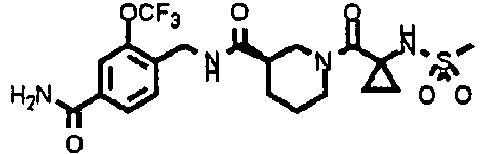
(400MHz CD30D) [M+H]+ 1.05-1.39 (4H, m), 1.59-1.99 (3H, m), 1.99-2.10 (1H, m), 2.49-2.71 (1H, m), 2.97 (3H, s), 297-3.25 (1H, brs), 4.23-4.35 (1H, m), 4.35-4.42 (1H, m), 4.46 (1H, d, J = 16.0 Hz), 4.51 (1H, d, J = 16.0 Hz), 7.50 (1H, d, J = 8.0 Hz), 7.81-7.86 (2H, m). 507 16 
(400MHz CDCl3) [M+H]+ 1.44 (3H, s), 1.58 (3H, s), 1.48-1.62 (1H, m), 1.65-1.80 (2H, m), 1.83-1.95 (1H, m), 1.97-2.16 (1H, m), 2.32-2.51 (1H, m), 3.40-3.63 (1H, m), 3.63-4.21 (3H, m), 4.52 (2H, d, J = 6.1 Hz), 8.93 (1H, brs), 7.48-7.60 (3H, m). 414 17 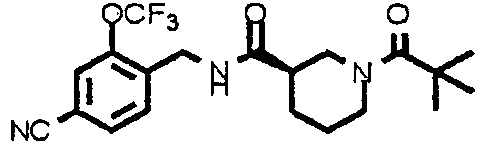
(400MHz CDCl3) [M+H]+ 1.23 (9H, s), 1.51-1.81 (2H. m), 1.78-1.99 (1H, m), 2.12-2.27 (1H, m), 2.42-2.52 (1H, m), 3.50-3.61 (1H m) 3.66-3.78 (2H, m), 3.80-3.91 (1H, m), 4.50 (1H, dd, J = 6.2, 16.0 Hz), 4.58 (1H, dd, J = 8.2, 16.0 Hz), 7.49-7.57 (3H, m). 412 18 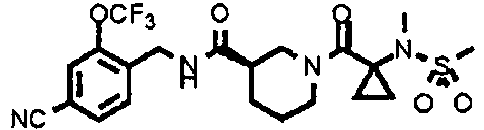
(400MHz CDCl3) [M+H]+ 0.95-1.02 (1H, m), 1.30-1.40 (2H, m), 1.45-1.53 (1H, m), 1.53-1.96 (4H, m), 2.47-2.55 (1H, m), 2.70-3.15 (2H, m), 2.79 (3H, s), 3.00 (3H, s), 4.34-4.38 (1H, m), 4.52 (2H, d, J = 6.1 Hz), 4.58-4.66 (1H, m), 6.89-6.93 (1H, m), 7.15-7.57 (3H, m). 503 19 
(400MHz CDCl3) [M+H]+ 1.20 (3H, s), 1.26 (3H, s), 1.50-1.60 (1H, m), 1.65-1.75 (1H, m), 1.85-2.00 (1H, m), 2.05-2.15 (1H, m), 2.38-2.47 (1H, m), 3.43 (1H, t, J = 8.0 Hz), 3.30-3.51 (2H, m), 3.59 (1H, t, J = 8.0 Hz), 3.80-4.05 (2H, m), 4.53 (2H, d, J = 4.0 Hz), 7.50-760 (3H, m). 428 [Table 1-3] Example Compound Structure 1H NMR MS(ESI) 20 
(400MHz CDCl3) [M+H]+ 1.19-1.95 (14H, m), 1.95-2.21 (2H, m), 2.41-2.51 (1H, m), 3.23-3.33 (1H, m), 3.50-3.67 (1H, m), 3.95-4.20 (1H, m), 4.52 (2H, d, J = 6.1 Hz), 7.10 (1H, brs), 7.49-7.58 (3H, m). 454 21 
(400MHz CDCl3) [M+H]+ 0.90 (3H, d, J = 7.3 Hz), 1.38-2.19 (6H, m), 1.97 (12H, s), 2.01 (1.8H, s), 2.22-2.33 (0.6H, m), 2.36-2.45 (0.4H, m), 2.55 (0.6H, t, J = 12.6 Hz), 3.16 (0.6H, t, J = 12.6 Hz), 3.40-3.50 (0.4H, m), 3.50-3.70 (0.6H, m), 3.96-4.05 (0.4H, m), 4.26-4.37 (0.6H, m), 4.43-4.62 (2.8H, m), 4.82-5.00 (1H, m), 6.26 (0.6H, d, J = 8.3 Hz), 6.32 (0.4H, d, J = 7.1 Hz), 6.78 (0.4H, brs), 7.24 (0.6H, brs). 7.45-7.65 (3H, m). 455 22 
(400MHz CDCl3) [M+H]+ 0.96 (1.5H, t, J = 7.4 Hz), 1.02 (1.5H, t, J = 7.4 Hz), 1.36-2.19 (6H, m), 2.31-2.50 (1H, m), 2.59 (0.5H, t, J = 13.2 Hz), 2.88 (1.5H, s), 2.97 (1.5H, s), 3.23 (0.5H, t, J = 13.2 Hz), 3.36-3.47 (0.5H, m), 3.47-3.64 (1H, m), 3.97-4.09 (1H, m), 4.21-438 (1H, m), 4.44 (0.5H, dd, J = 5.7, 16.3 Hz), 4.48 (0.5H, dd, J = 5.7, 16.3 Hz), 4.52-4.61 (1.5H, m), 5.28 (0.5H, d, J = 9.1 Hz), 5.41(0.5H, d, J = 9.1 Hz), 6.48 (0.5H, brs), 6.70 (0.5H, brs), 7.51-7.62 (3H, m). 491 23 
(400MHz CDCl3) [M+H]+ 1.40-1.70 (6H, m), 1.88-2.20 (2H, m), 2.60-2.80 (1H, m), 3.20-3.60 (2H, m), 4.00-4.20 (1 H, m), 4.40-4.60 (3H, m), 6.40-6.60 (1H, brs), 7.50-7.60 (3H, m). 421 24 
(400MHz CDCl3) [M+H]+ 1.31 (1.5H, d, J = 4.6 Hz), 1.32 (1.5H. d, J = 4.8 Hz), 1.41-1.96 (3H, m), 1.96 (1.5H, s), 1.99 (1.5H, s), 2.00-2.21 (1H, m), 2.22-2.35 (0.5H, m), 2.36-2.47 (0.5H, m), 2.56 (0.5H, td, J = 2.8, 13.0 Hz), 3.17 (0.5H, td, J = 2.8, 13.0 Hz), 3.36-3.45 (0.5H, m), 3.52-3.64 (0.5H, m), 3.97-4.05 (0.5H, m), 4.19-4.27 (0.5H, m), 4.45-4.61 (3H, m), 4.86-4.95 (0.5H, m), 4.95-5.05 (0.5H. m), 6.37 (0.5H. d, J = 8.5 Hz), 6.46 (0.5H. d, J = 6.3 Hz), 6.69 (0.5H, brs), 7.01 (0.5H, brs), 7.46-7.61 (3H, m). 441 25 
(400MHz CDCl3) [M+H]+ 1.37 (3H, d, J = 4.0 Hz), 1.37-1.75 (1H, m), 1.71-2.19 (3H, m), 2.31-2.52 (1H, m), 2.60 (0.5H, t, J = 12.5 Hz), 2.89 (1.5H, s), 2.98 (1.5H, s), 3.21 (0.5H, t, J = 13.2 Hz), 3.31-3.42 (0.5H, m), 3.42-3.52 (0.5H, m), 3.52-3.63 (0.5H, m), 3.99-4.15 (1H, m), 4.35-4.63 (3.5H, m), 5.47 (0.5H, d, J = 9.1 Hz), 5.59 (0.5H, d, J = 8.2 Hz), 6.51 (0.5H, brs), 6.68 (0.5H, brs), 7.49-7.62 (3H, m). 477 26 
(400MHz CDCl3) [M+H]+ 0.89-1.04 (1H, m), 1.04 (3H, d, J = 4.6 Hz), 1.06 (3H, d, J = 4.6 Hz), 1.20-1.53 (3H, m), 1.68-1.99 (4H, m), 2.12-2.39 (2H. m), 2.39-2.60 (1H, m), 2.78-3.13 (1H, m), 4.25-4.51 (1H, m), 4.53 (1H, dd, J = 5.7, 16.0 Hz), 4.60 (1H, dd, J = 5.7, 6.0 Hz), 5.25-5.60 (1H, m), 6.89 (1H, brs), 7.45-7.70 (3H, m), 8.05 (1H, brs). 481 [Table 1-4] Example Compound Structure 1H NMR MS(ESI) 27 
(400MHz CDCl3) [M+H]+ 0.89-1.11 (1H, m), 1.11 (9H, s), 1.21-1.55 (3H, m), 1.68-1.99 (4H, m), 210-2.29 (1H, m). 2.39-2.60 (1H, m), 2.78-3.13 (1H, m), 4.25-4.51 (1H, m), 4.53 (1H, dd, J = 5.6, 15.9 Hz), 4.59 (1H, dd, J =5.6, 15.9 Hz), 5.20-5.60 (1H, m), 6.77 (1H, brs), 7.45-7.69 (3H, m), 8.03 (1H. brs). 495 28 
(400MHz CDCl3) [M+H]+ 1.66-2.01 (8H, m), 2.10-2.31 (1H, m), 2.45-2.65 (1H, m), 2.66-2.83 (1H, m), 3.09 (3H, s), 3.55-3.70 (1H, m), 3.73-4.01 (5H, m), 4.42 (1H, dd, J = 5.5, 15.5 Hz), 4.60 (1H, dd, J = 5.5, 15.5 Hz), 4.69 (1H, brs), 8.88 (1H, brs), 7.521-7.59 (3H, m), 533 29 
(400MHz CDCl3) [M+H]+ 0.63-0.91 (4H, m), 1.23-2.21 (8H, m), 2.30-3.01 (4H, m), 3.25 (4H, m), 4.21-4.70 (2H, m), 6.16 (0.5H, brs), 6.49 (0.5H, brs), 7.45-7.58 (3H, m), 7.69 (1H, brs). 493 30 
(400MHz CDCl3) [M+H]+ 1.18 (2.7H, s), 1.21 (0.3H, s), 1.22 (2.7H, s), 1.25 (0.3H, s), 1.32-1.51 (0.9H, m), 1.61-1.97 (3.1H, m), 1.97 (0.3H, s), 2.04 (2.7H, s), 2.14-2.31 (0.9H, m), 2.31-2.47 (0.1H, m), 2.54 (0.9H, t, J = 12.2 Hz), 3.10 (0.9H, t, J = 12.2 Hz), 3.41-3.57 (0.1H, m), 3.95-4.01 (0.1H, m), 3.95-4.01 (0.1H, m), 4.05-4.19 (0.1H, m), 4.45-5.21 (4.8H, m), 6.43 (0.1H, brs), 6.69 (0.9H, brs), 7.49-7.65 (3H, m), 7.68 (1H, brs), 485 31 
(400MHz CDCl3) [M+H]+ 1.12 (3H, t, J = 7.6 Hz), 1.18 (3H, s), 1.24 (3H, s), 1.49-1.82 (4H, m), 2.12-2.21 (1H, m), 2.21-2.40 (2H, m). 2.55 (1H, td, J = 2.6, 12.9 Hz), 3.10 (1H, t, J = 12.9 Hz), 4.39-4.67 (5H, m), 5.63 (1H, brs), 6.65 (1H, d, J = 9.0 Hz), 7.50-7.64 (3H, m). 7.78 (1H, t, J = 5.6 Hz). 499 32 
(400MHz CDCl3) [M+H]+ 1.18 (3H, s), 1.29 (3H, s), 1.42-2.01 (4H, m), 2.37-2.48 (0.3H, m), 2.50-2.63 (1.4H, m). 2.92 (0.9H, s), 3.04 (2.1H, s), 3.20 (0.7H, t, J = 13.2 Hz), 3.49-3.89 (0.9H, m), 3.99-4.68 (4.7H, m), 5.63 (1H, brs), 6.66 (0.7H, brs), 6.75 (0.3H, brs), 7.50-7.59 (3H, m). 521 33 
(400MHz CDCl3) [M+H]+ 0.92 (3H, t, J = 7.3 Hz), 1.32-2.25 (14H, m), 2.32-2.61 (1H, m), 2.61-2.83 (1H, m), 2.83-2.99 (0.5H, m), 3.25-3.98 (2H, m), 4.37-4.71 (2.5H, m). 5.96 (0.5H. brs). 6.26 (0.5H, brs), 7.45-7.60 (3H, m), 7.78 (1H, brs). 495 34 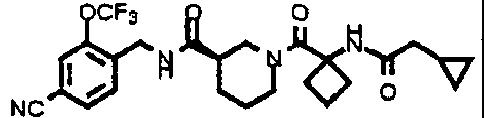
(400MHz CDCl3) [M-H]- 0.13-0.20 (2H, m), 0.50-0.65 (2H, m), 0.81-0.96 (1H, m), 1.39-2.10 (10H, m), 2.10 (2H, d, J = 6.8 Hz), 2.37-2.61 (1H, m), 2.81-2.83 (1H, m), 2.83-2.99 (0.5H, m), 3.22-3.98 (2H, m), 4.35-4.70 (2.5H, m), 6.31 (0.5H, brs), 6.42 (0.5H, brs), 7.46-7.57 (3H, m), 7.74 (1H, brs). 505 [Table 1-5] Example Compound Structure 1HNMR MS(ESI) 35 
(400MHz CDCl3) [M+H]+ 0.09-0.20 (2H, m), 0.48-0.60 (2H, m), 0.82-0.93 (1H, m). 0.92-1.03 (1H, m), 1.06-1.17 (1H, m), 1.22-1.42 (2H, m), 1.67-1.80 (2H, m), 1.80-1.95 (2H, m), 2.10 (2H, t J = 7.4 Hz), 2.19-2.34 (1H, m), 2.36-2.61 (1H, m), 2.88-3.09 (1H, m), 4.21-4.46 (1H, m), 4.55 (2H, d, J = 5.9 Hz), 5.19-5.71 (1H, m), 7.48-7.54 (3H, m), 8.01 (1H, brs). 493 36 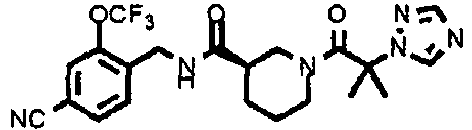
(400MHz DMSO-d6) [M+H]+ 1.09-1.16 (1H, m), 1.39-1.58 (2H, m), 1.72 (3H, s), 1.74 (3H, s), 1.80-1.83 (1H, m), 2.19-2.24 (1H, m), 2.55-2.62 (1H, m), 2.70-2.76 (1H, m), 3.57 (1H, brs), 3.85 (1H, brs), 4.34-4.38 (2H, m), 7.49 (1H, d, J=8.3 Hz), 7.84-7.86 (2H, m), 8.00 (1H,s), 8.27-8.30 (1H, m), 8.66 (1H, s). 465 37 
(400MHz DMSO-d6) [M+H]+ 1.08-1.17 (1H, m), 1.41-1.51 (2H, m), 1.67 (3H, s), 1.68 (3H, s), 1.78-1.80 (1H, m), 2.17-2.22 (1H, m), 2.32-2.54 (1H, m), 2.65-2.73 (1H, m), 3.55-3.83 (2H, m), 4.32-4.39 (2H, m), 6.31-6.32 (1H, m), 7.48-7.49 (2H, m), 7.76-7.76 (1H,m), 7.85-7.87 (2H, m), 8.22-8.26 (1H, m). 464 38 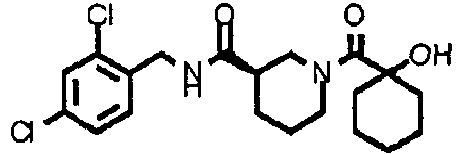
(400MHz CDCl3) [M+H]+ 1.15-1.30 (2H, m), 1.45-2.10 (12H, m), 2.37-2.43 (1H, m), 3.40-3.55 (2H, m). 4.00-4.15 (2H, m), 4.43 (1H, dd, J = 6.0. 15.0 Hz), 4.50 (1H, dd, J = 6.0, 15.0 Hz), 6.91 (1H, brs), 7.20 (1H, dd, J = 2.2, 8.2 Hz), 7.30 (1H, d, J = 8.2 Hz), 7.37 (1H, d, J = 2.2 Hz). 413 39 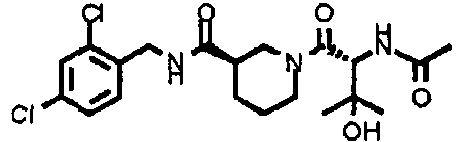
(400MHz CDCl3) [M+H]+ 1.19 (3H, s), 1.23 (3H, s), 1.35-1.95 (4H. m), 2.05 (3H, s), 2.21 (1H, tt, J = 4.1, 11.3 Hz), 2.55 (1H, td, J = 2.9, 12.9 Hz), 3.13 (1H, dd, J = 11.6, 12.9 Hz), 4.36-4.78 (5H, m), 5.63 (1H, brs), 6.63 (1H, d, J = 9.0 Hz), 7.21 (1H, d, J = 2.1, 8.2 Hz), 7.36 (1H, d, J = 8.2 Hz), 7.38 (1H, d, J = 2.1 Hz), 7.51 (1H, t, J = 5.9 Hz), 444 40 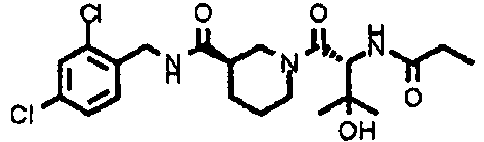
(400MHz CDCl3) [M+H]+ 1.11 (3H, t, J = 7.8 Hz), 1.18 (3H, s), 1.23 (3H, s), 1.35-1.95(4H, m), 2.12-2.21 (1H, m), 2.21-2.35 (2H, m), 2.55 (1H, td, J = 2.8, 12.9 Hz), 3.12 (1 H, dd, J = 11.8, 12.9 Hz), 4.35-4.78 (5H, m), 4.96 (1H, brs), 6.61 (1H, d, J = 9.0 Hz), 7.21 (1H, d, J = 2.1, 8.2 Hz), 7.35-7.49 (2H, m), 7.63 (1H, t, J = 5.4 Hz). 458 41 
(400MHz CDCl3) [M+H]+ 1.19 (3H, s), 1.30 (3H, s), 1.40-2.10 (4H, m), 2.31-2.43 (0.3H, m), 2.48-2.65 (1.4H, m), 2.90 (0.9H, s), 3.01 (2.1H, s), 3.22 (0.7H, t, J = 12.2 Hz), 3.32-3.47 (0.3H, m), 3.83-3.72 (0.3H. m). 3.78-3.91 (0.3H, m), 4.07-4.65 (4.7H, m), 5.51 (1H, brs), 6.41 (0.7H, brs), 8.50 (0.3H, brs), 716-7.42 (3H, m). 480 [Table 1-6] Example Compound Structure 1H NMR MS(ESI) 42 
(400MHz CDCl3) [M-H]- 1.26-1.27 (3H, m), 1.43-1.75 (2H, m), 1.97-2.09 (0.3H, m), 2.09-2.22 (0.7H, m), 2.24-2.38 (0.3H, m), 2.39-2.50 (0.7H, m), 2.63 (0.3H, t, J = 13.4 Hz), 3.21 (0.3H, t, J = 12.6 Hz), 3.23-3.37 (0.7H, m), 3.42-3.51 (0.7H, m), 3.59-3.65 (1.7H, m), 3.78-3.84 (0.3H, m), 3.95-4.02 (0.7H, m), 4.41-4.82 (3.3H, m), 8.08 (0.3H, brs), 8.78 (0.7H, brs), 7.45-7.61 (3H, m), 400 43 
(400MHz CDCl3) [M-H]- 0.97 (3H, t, J = 7.4 Hz), 1.40-1.51 (2H, m), 1.52-1.93 (2H, m), 1.97-2.07 (0.3H, m), 2.09-2.20 (0.7H, m), 2.25-2.36 (0.3H, m), 2.38-2.49 (0.7H, m), 2.61 (0.3H, t, J = 12.8 Hz), 3.21 (0.3H, t, J = 12.3 Hz), 3.25-3.35 (0.7H, m), 3.41-3.49 (0.7H, m), 3.52-3.70 (1.7H, m), 3.75-3.85 (0.3H, m), 3.94-4.02 (0.7H, m), 4.26-4.35 (1H, m), 4.42-4.63 (2.3H, m), 8.22 (0.3H, brs), 6.88 (0.7H, brs), 7.48-7.61 (3H, m), 414 44 
(400MHz CDCl3) [M-H]- 0.77 (0.9H, d, J = 6.8 Hz), 0.78 (2.1H, d, J = 6.8 Hz), 1.03 (0.9H, d, J = 6.8 Hz). 1.07 (2.1 H, d, J = 8.8 Hz), 1.48-1.61 (1H, m), 1.61-1.93 (2H, m), 1.98-2.03 (0.3H, m), 2.12-2.22 (0.7H, m), 2.23-2.35 (0.3H, m), 2.39-2.49 (0.7H, m), 2.60 (0.3H, t, J = 12.2 Hz), 3.23 (0.3H, t, J = 12.4 Hz), 3.41-3.49 (2.4H, m), 3.68-3.75 (0.7H, m), 3.78-3.85 (0.3H, m), 3.92-3.98 (0.7H, m), 4.21-4.28 (1H, m), 4.41-4.67 (2.3H, m), 6.16 (0.3H, brs), 6.95 (0.7H, brs), 7.48-7.62 (3H, m), 428 [Table 2] Comparative Example Compound Structure 1H NMR MS(ESI) 1 
(400MHz CDCl3) [M+H]+ 1.22-2.10 (15H, m), 2.45-2.57 (1H, m), 3.27-3.38 (1H, m), 3.42-3.62 (1H, m), 4.11-4.25 (1H, m), 4.36-4.47 (1H, m), 7.88 (1H, d, J = 8.8 Hz), 7.31 (1H, d, J = 8.8 Hz), 8.51 (1 H, s), 9.05 (1H, brs). 400 2 
(400MHz CDCl3) [M+H]+ 1.45-1.53 (1H, m), 1.70-2.05 (7H, m), 2.25-2.40 (1H, m), 2.74-4.41 (5H, m), 4.52-4.55 (2H, m), 6.28-6.60 (2H, m), 7.51-7.61 (3H, m). 427 [Table 3-1] Reference Example Compound Structure 1H NMR MS(ESI) 1 
(400MHz CDCl3) [M+H]+ 7.55 (1H, brt, J = 1.6 Hz), 7.60 (1H, dd, J = 1.5, 8.3 Hz), 7.85 (1H, brd, J = 8.3 Hz), 10.31 (1H, s). ND. 2 
(400MHz CDCl3) [M+H]+ 1.75 (1H, brs), 4.74 (2H, d, J = 5.4 Hz), 7.39-7.49 (3H, m). ND. 3 
(400MHz CDCl3) [M+H]+ 3.03 (3H, s), 5.25 (2H, s), 7.46-7.53 (2H, m), 7.43 (1H, d, J = 8.0 Hz). ND. 4 
(400MHz CDCl3) [M+H]+ 4.89 (2H, s), 7.23-7.32 (1H, m), 7.35-7.48 (2H, m), 7.70-7.96 (4H, m). ND. 5 
(400MHz CDCl3) [M+H]+ 1.43 (2H, s), 3.88 (2H, s), 7.33-7.47 (3H, m). N.D. 6 
(400MHz CDCl3) [M+H]+ 1.37-1.51 (10H, m), 1.57-1.67 (1H, m), 1.80-1.96 (2H, m), 2.27-2.35 (1H, m), 3.00-3.32 (2H, m), 3.62-3.89 (2H, m), 4.39-4.49 (2H, m), 6.25 (1H, brs), 7.28 (1H, d, J = 8.5 Hz), 7.38-7.41 (2H, m) ND. 7 
(400MHz CDCl3) [M+H]+ 1.42 (9H, s), 1.50-1.99 (4H, m), 2.27-2.32 (1H, m), 2.89-3.41 (2H, m), 3.48-3.92 (2H, m), 4.48 (1H, dd, J = 5.2, 15.0 Hz), 4.54 (1H, dd, J = 5.2, 15.0 Hz), 7.06 (1H, brs), 7.42-7.48 (3H, m). ND. 8 
(400MHz CDCl3) [M+H]+ 1.49-1.98 (5H, m), 2.45-2.52 (1H, m), 2.73 (1H, td, J = 2.9, 10.5 Hz), 2.91 (1H, dd, J = 3.2, 11.7 Hz), 2.92-2.99 (1H, m), 3.12 (1H, dd, J = 4.1, 11.7 Hz), 4.54 (1 H, dd, J = 4.3, 14.0 Hz), 4.59 (1H, dd, J = 4.3, 14.0 Hz), 7.51-7.59 (3H, m), 8.62 (1H, brs), 328 9 
(400MHz DMSO-d6) [M+H]+ 1.35 (9H, s), 1.48-1.69 (4H, m), 1.71-1.98 (2H, m), 2.01-2.22 (2H, m), 2.22-2.35 (1H, m), 2.45-2.85 (4H, m), 3.03-4.08 (1H, m), 4.09-4.22 (1H, m), 4.35 (1H, dd, J = 5.7, 16.5 Hz), 4.53 (1H, dd, J = 5.7, 16.5 Hz), 7.27 (1H, brs), 7.55 (1H, d, J = 8.2 Hz), 7.75-7.82 (2H, m), 8.18 (1H, brs), ND. 10 
(400MHz CDCl3) [M+H]+ 1.35-1.47 (1H, m), 1.47-1.61 (1H, m), 1.81-1.97 (5H, m), 2.35-2.46 (1H, m), 2.51-2.63 (1H, m), 2.79-3.01 (4H, m), 3.95-4.04 (1H, m), 4.10-4.18 (1H, m), 4.37 (1H, dd, J = 5.7, 17.0 Hz), 4.41 (1H, dd, J =5.7, 17.0 Hz), 7.56 (1H, d, J = 8.2 Hz), 7.77-7.83 (2H, m), 8.24 (1H, brs), 425 [Table 3-2] Reference Example Compound Structure 1H NMR MS(ESI) 11 
(400MHz CDCl3) [M+H]+ 1.41 (9H, s), 1.45 (6H, s), 1.72-2.27 (4H, m), 2.43-2.58 (1H, m), 3.39-4.25 (4H, m), 4.46 (1H, d, J = 5.7, 16.2 Hz), 4.58-4.77 (2H, m), 7.07 (1H, brs), 7.49-7.58 (3H, m). N.D. 12 
(400MHz CDCl3) [M+H]+ 1.38 (3H, s), 1.39 (3H, s), 1.48-1.59 (1H, m), 1.59-1.72 (1H, m), 1.80-1.91 (1H, m), 1.95-2.17 (3H, m), 2.35-2.50 (1H, m), 3.55-3.75 (2H, m), 3.95-4.21 (2H, m), 4.51 (2H, d, J = 6.1 Hz), 7.07 (1H, brs), 7.48-7.69 (3H, m). 413 13 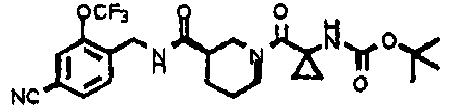
(400MHz DMSO-d6) [M+H]+ 0.76-0.91 (3H, m), 1.02-1.18 (1H, m), 1.36 (9H, s), 1.36-1.72 (3H, m), 1.86-1.98 (1H, m), 2.25-2.38 (1H, m), 2.74-2.91 (2H, m), 4.13-4.32 (2H, m), 4.35 (1H, dd, J = 6.3, 16.8 Hz), 4.41 (1H, dd, J = 6.3, 16.8 Hz), 7.21 (1H, brs), 7.56 (1H, d, J = 8.2 Hz), 7.78-7.83 (2H, m), 8.17 (1H, brs). N.D. 14 
(400MHz CDCl3) [M+H]+ 0.75-0.83 (2H, m), 0.83-0.94 (1H, m), 0.97-1.09 (1H, m), 1.50-1.81 (4H, m), 1.81-1.91 (1H, m), 2.10-2.22 (1H, m), 2.45-2.52 (1H, m), 3.55-3.82 (3H, m), 4.51 (2H, d. J = 4.0 Hz), 7.50-7.80 (3H, m). 411 15 
(400MHz CDCl3) [M+H]+ 1.41 (9H, s), 1.42-2.39 (12H, m), 2.39-2.53 (1H, m), 3.10-4.21 (4H, m), 4.50 (1H, dd, J = 5.4, 16.3 Hz), 4.55-4.78 (2H, m), 7.02 (1H, brs), 7.41-7.62 (3H, m). N.D. 16 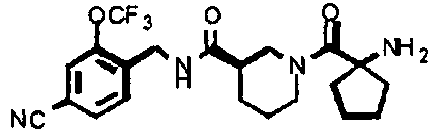
(400MHz CDCl3) [M+H]+ 1.49-2.35 (14H, m), 2.39-2.52 (1H, m), 3.25-4.11 (4H, m), 4.50 (2H, d, J = 5.9 Hz), 5.97 (1H, brs), 7.30-7.60 (3H, m), 439 17 
(400MHz CDCl3) [M+H]+ 4.49 (2H, q, J = 7.7 Hz), 7.01 (1H, d, J = 1.7 Hz), 7.15 (1H, dd, J = 1.7, 8.3 Hz), 7.56 (1H, d, J = 8.3 Hz). N.D. 18 
(400MHz CDCl3) [M+H]+ 3.83 (2H, s), 4.37 (2H, q, J = 8.0 Hz), 6.81 (1H, d, J = 1.9 Hz), 7.01 (1H, dd, J = 1.9, 8.1 Hz), 7.24 (1H, d, J = 8.1 Hz). 240 19 
(400MHz CDCl3) [M+H]+ 1.58-1.90 (13H, m), 2.26 (1H, brs), 2.60-3.30 (2H, m), 3.60-4.00 (2H, m), 4.38-4.44 (4H, m), 6.82 (1H, d, J = 1.6 Hz), 7.01 (1H, dd, J = 1.8, 8.0 Hz), 7.24 (1H, d, J = 8.0 Hz). 451 20 
(400MHz CDCl3) [M+H]+ 1.42-1.50 (1H, m), 1.60-1.76 (2H, m), 1.83-1.90 (1H, m), 2.35-2.39 (1H, m), 2.71-2.77 (1H, m), 2.83-2.88 (1H, m), 2.91 (1H, dd, J = 3.6, 12.0 Hz), 3.02 (1H, dd, J = 5.2, 12.0 Hz), 4.39 (2H, q, J = 8.0 Hz), 4.44 (2H, d, J = 6.0 Hz), 6.82 (1H, d, J = 1.8 Hz), 7.01 (1H, dd, J = 1.8, 8.1 Hz), 728 (1H, d, J = 8.0 Hz). 351 [Table 3-3] Reference Example Compound Structure 1H NMR MS(ESI) 21 
(400MHz CDCl3) [M+H]+ 1.40-1.43 (15H, m), 1.45-2.40 (5H, m), 3.00-4.84 (8H, m), 6.83 (1H, d, J = 2.0 Hz), 7.00 (1H, dd, J = 2.0, 8.0 Hz), 7.25 (1H, d. J = 8.0 Hz). 536 22 
(400MHz CDCl3) [M+H]+ 1.37 (3H, s), 1.38 (3H, s), 1.45-1.90 (3H, m), 2.10-2.20 (1H, m), 2.43-2.50 (1H, m), 3.65-4.00 (4H, m), 4.40-4.50 (4H, m), 6.83 (1H, d, J = 2.0 Hz), 7.00 (1H, dd, J = 2.0, 8.0 Hz), 7.25 (1H, d, J = 8.0 Hz). 436 23 
(400MHz CDCl3) [M+H]+ 0.89 (3H, d, J = 6.8 Hz), 0.97 (3H, d, J = 6.8 Hz), 1.61-2.25 (7H, m), 2.19-2.45 (1H, m), 3.41-3.50 (2H, m), 3.50 (1H, d, J = 5.4 Hz), 3.74 (1H, dd, J = 6.8, 13.9 Hz), 4.53 (2H, d, J = 5.9 Hz), 7.13 (1H, brs), 749-7.61 (3H, m). 427 24 
(400MHz CDCl3) [M+H]+ 1.27 (3H, t, J = 7.2 Hz), 1.49-1.57 (4H, m), 3.06 (3H, s), 4.19 (2H, q, J = 7.2 Hz), 5.42 (1 H, brs). ND. 26 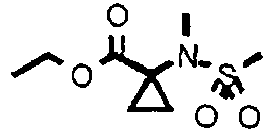
(400MHz CDCl3) [M+H]+ 1.26 (3H, t, J = 7.0 Hz), 1.30-1.90 (4H, m), 3.01 (3H, s), 3.05 (3H, s), 4.16 (2H, q, J = 7.0 Hz). N.D. 26 
(400MHz CD3OD) [M+H]+ 1.20-1.80 (4H, m). 2.95-3.00 (3H, m), 3.00-3.03 (3H, m). N.D. 27 
(400MHz CDCl3) [M+H]+ 0.97 (3H, t, J = 7.2 Hz), 1.45 (9H, s), 1.68-1.80 (2H, m), 1.81-1.99 (1H, m), 5.01 (1H, brs). N.D. 28 
(400MHz CDCl3) [M+H]+ 0.62-0.89 (3H, m), 1.37 (4.5H, s), 1.43 (4.5H, s), 1.43-2.03 (5H, m), 2.10-2.22 (0.5H, m), 2.23-2.32 (0.5H, m), 2.39-2.48 (0.5H, m), 2.54 (0.5H, t, J = 12.3 Hz), 3.14 (0.5H, t, J = 12.3 Hz), 3.48-3.57 (1H, m), 3.65-3.90 (1H, m), 4.24-4.32 (0.5H, m), 4.43-4.63 (4H, m), 5.20 (0.5H, d, J = 10.0 Hz), 5.26 (0.5H, d, J = 7.1 Hz), 7.00 (0.5H, brs), 7.13 (0.5H, brs), 7.43-7.61 (3H, m). ND. 29 
(400MHz CDCl3) [M+H]+ 0.96 (3H, t, J = 7.4 Hz), 1.39-2.21 (8H, m), 2.39-2.48 (1H, m), 3.36-3.47 (1H, m), 3.49-3.64 (2H, m), 3.64 (1H, dd, J = 3.8, 7.6 Hz), 3.93-4.21 (1H, m), 4.53 (2H, d, J = 6.1 Hz), 7.04 (1H, brs), 7.49-7.61 (3H, m). 413 30 
(400MHz CDCl3) [M+H]+ 1.25 (3H, d. J = 6.8 Hz), 1.50-2.18 (6H, m), 2.32-2.42 (1H, m), 3.31-3.42 (1H, m), 3.51-3.61 (2H, m), 3.75-3.89 (1H, m), 3.92-4.05 (1H, m), 4.53 (2H, d, J = 5.9 Hz), 6.89 (1H, brs), 7.48-7.51 (3H, m). N.D. [Table 3-4] Reference Example Compound Structure 1H NMR MS(ESI) 31 
(400MHz DMSO-d6) [M+H]+ 1.48 (2H, d, J = 13.2 Hz), 1.80-1.87 (2H, m), 3.60 (2H, dt, J = 2.5, 11.3 Hz), 3.81 (2H, dt, J = 3.9, 7.9 Hz), 8.58 (1H, s), 10.68 (1H, s), ND. 32 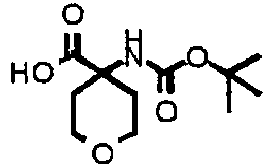
(400MHz CDCl3) [M+H]+ 1.45 (9H, s), 1.92 (2H, d, J = 13.9 Hz), 2.18-2.26 (2H, m), 3.66-3.75 (2H, m), 3.81-3.86 (2H, m). ND. 33 
(400MHz CDCl3) [M+H]+ 1.41 (9H, s), 1.45-1.92 (6H, m), 2.04-2.33 (2H, m), 2.41-2.58 (1H, m), 3.23-4.09 (8H, m), 4.44 (1H, dd, J = 5.5, 16.0 Hz), 4.55-4.72 (1H, m), 4.86 (1H, brs), 7.06 (1H, brs), 7.48-7.55 (3H, m). N.D. 34 
(400MHz CDCl3) [M+H]+ 1.42-1.80 (6H, m), 1.81-1.95 (1H, m), 2.01-2.11 (1H, m), 2.11-2.22 (2H, m), 2.38-2.48 (1H, m), 3.52-3.64 (2H, m), 3.64-3.80 (4H, m), 4.05-4.24 (2H, m), 4.48 (1H, dd, J = 6.2, 16.0 Hz), 4.54 (1H, dd, J = 6.2, 16.0 Hz), 7.06 (1H, brs), 7.49-7.62 (3H, m). 455 35 
(400MHz CDCl3) [M+H]+ 1.46 (9H, s), 1.79 (1H, brs), 2.54 (1H, brs), 3.79 (3H, s), 3.93 (2H, ddd, J = 3.8, 11.2, 14.8 Hz), 4.39 (1H, brs), 5.48 (1H, brs). N.D. 36 
(400MHz CD3OD) [M+H]+ 1.14 (3H, s), 1.22 (3H, s), 1.44 (9H, s), 3.49 (1H, dd, J = 4.2, 7.2 Hz), 3.59 (1H, dd, J = 7.2, 11.2 Hz), 3.79 (1H, dd, J = 4.2, 11.2 Hz). N.D. 37 
(400MHz CD3OD) [M+H]+ 1.25 (3H, s), 1.29 (3H, s), 1.45 (9H, s), 4.08 (1H, s). N.D. 38 
(400MHz CDCl3) [M+H]+ 123 (3H, s), 1.25 (3H, s), 1.38 (9H, s), 1.55-2.10 (4H, m), 2.18-2.32 (1H, m), 2.58 (1H, t, J = 12.0 Hz), 3.13 (1H, t, J = 12.0 Hz), 4.35-4.68 (5H, m), 5.75 (1 H , d, J = 9.1 Hz), 7.44 (1H, brs), 7.53-7.64 (3H, m). N.D. 39 
(400MHz CDCl3) [M+H]+ 1.18 (3.6H, s), 121 (2.4H, s), 1.45-1.95 (6H, m). 1.95-2.04 (0.4H, m), 2.12-2.25 (0.6H, m), 2.41-2.56 (1H, m), 2.65 (0.4H, td, J = 2.6, 12.6 Hz), 3.27 (0.4H, t, J = 13.8 Hz), 3.45 (0.4H, s), 3.47 (0.6H, s), 3.51-3.66 (0.6H, m), 3.72 (0.6H, dd, J = 7.3, 13.8 Hz), 3.91 (0.6H, dd, J = 3.5, 13.8 Hz), 4.03-4.22 (0.4H, m), 4.47-4.63 (2H, m), 6.27 (0.4H, brs), 7.03 (0.6H, brs), 7.50-7.61 (3H, m). 443 40 
(400MHz CDCl3) [M+H]+ 122 (3H, t, J = 7.1 Hz), 1.89 (6H, s), 4.18 (2H, q, J = 7.1 Hz), 7.96 (1H, s), 824 (1H, s). 184 [Table 3-5] Reference Example Compound Structure 1H NMR MS(ESI) 41 
(400MHz D2O) [M+H]+ 1.65 (6H, s), 7.92 (1H, s), 8.41 (1H, s). N.D. 42 
(400MHz CDCl3) [M+H]+ 1.12 (3H, t, J = 7.1 Hz), 1.86 (6H, s), 4.16 (2H, q, J = 7.1 Hz), 6.29-6.30 (1H, m), 7.56-7.57 (2H, m). 183 43 
(400MHz D2O) [M+H]+ 1.60 (6H, s), 6.24 (1H, s), 7.45 (1H, s), 7.64 (1H, s). N.D. 44 
(400MHz CDCl3) [M+H]+ 1.43 (9H, s), 1.45-1.86 (4H, m), 2.32 (1H, brs), 3.06-3.24 (2H, m), 3.69-3.89 (2H, m), 4.47 (2H, d, J = 5.9 Hz), 6.60 (1H, brs), 7.21 (1H, dd, J = 2.3, 8.3 Hz), 7.29 (1H, d. J = 8.3 Hz), 7.38 (1H, d, J = 2.3 Hz), N.D. 45 
(400MHz CDCl3) [M+H]+ 1.44-1.51 (1H, m), 1.60-1.77 (2H, m), 1.88-1.94 (1H, m), 2.40-2.44 (1H, m), 2.70-2.76 (1H, m), 2.89-2.93 (2H, m), 3.08 (1H, dd, J = 4.8, 12.0 Hz), 4.49 (2H, d, J = 6.3 Hz), 721 (1H, dd, J = 1.8, 8.3 Hz), 7.33 (1H, d, J = 8.3 Hz), 7.38 (1H, d, J = 1.8 Hz), 8.32 (1H, brs). 287 46 
(400MHz CDCl3) [M+H]+ 1.20 (3H, s), 1.22 (3H, s), 1.33 (9H, s), 1.58-1.99 (4H, m), 2.15-2.27 (1H, m), 2.54 (1H, td, J = 3.4, 13.0 Hz), 3.11 (1H, dd, J = 11.7, 13.0 Hz), 4.34-4.62 (6H, m), 5.69 (1 H , d, J = 9.3 Hz), 7.18-7.42 (3H, m). ND. 47 
(400MHz CDCl3) [M+H]+ 1.15-1.22 (6H, m), 1.45-1.95 (6H, m), 1.95-2.05 (0.4H, m), 2.05-2.20 (0.6H, m), 2.32-2.51 (1H, m), 2.66 (0.4H, td, J = 3.2, 13.0 Hz), 3.27 (0.4H, dd, J = 10.6, 13.0 Hz), 3.45 (0.4H, s), 3.49 (0.6H, s), 3.55-3.69 (0.6H, m), 4.00 (0.6H, dd, J = 3.5, 13.8 Hz), 4.02-4.12 (0.4H, m), 4.41-4.57 (2.6H, m), 6.16 (0.4H, brs), 6.74 (0.6H, brs), 7.14-7.42 (3H, m). 402 48 
(400MHz CDCl3) [M+H]+ 1.40-1.58 (10H, m), 1.68-1.78 (1H, m), 1.83-2.08 (2H, m), 2.49 (1H, m), 3.00 (1H, t, J = 10.9 Hz), 3.25 (1H, dd, J = 9.1, 13.6 Hz), 3.86 (1H, d, J = 9.5 Hz), 4.10 (1H, d, J = 12.7 Hz), 7.92 (1H, dd, J = 2.3, 8.6 Hz), 8.33 (1H, d, J = 8.8 Hz), 8.54 (1H, brs). N.D. 49 
(400MHz CDCl3) [M+H]+ 1.52-1.85 (3H, m), 2.02-2.12 (1H, m), 2.58-2.62 (1H, m), 2.74 (1H, ddd, J = 2.7, 2.7, 11.1 Hz), 2.96 (1H, dd, J = 3.2, 12.0 Hz), 3.16 (1H, d, J = 11.3 Hz), 3.33 (1H, d, J = 12.0 Hz), 7.90 (1H, dd, J = 2.3, 8.6 Hz), 8.39 (1H, d, J = 8.6 Hz), 8.55 (1H, d, J = 2.3 Hz), 11.5 (1H, s). 274 - According to the method described in a known document (Analytical Biochemistry, 2005, vol. 343, p. 66-75), the sEH inhibitory activity of each nipecotic acid derivative (I) or a pharmaceutically acceptable salt thereof was evaluated using human sEH.
- A recombinant human sEH (final concentration, 0.026 µg/mL; Cayman) was incubated with each test compound in 25 mM Bis-Tris-HCl buffer (pH 7.0) supplemented with 0.1 mg/mL BSA at room temperature for 30 minutes. Thereafter, cyano(6-methoxynaphthalen-2-yl)methyl 2-(3-phenyloxiran-2-yl)acetate (final concentration, 6.25 µmol/L; Cayman) was added thereto as a fluorescent substrate, and the resulting mixture was incubated at room temperature for 20 minutes. The reaction was then stopped by addition of ZnSO4 (final concentration, 0.2 mol/L), and the fluorescence intensity was measured (Fusion α (Packard); Excitation: 330 nm, Emission:485 nm).
- The fluorescence intensity observed with addition of neither sEH nor a test compound was regarded as the sEH enzymatic reaction rate of 0%, and the fluorescence intensity observed with addition of sEH but without addition of a test compound was regarded as the sEH enzymatic reaction rate of 100%. From the obtained fluorescence intensity, the sEH enzymatic reaction rate of each test compound was calculated to determine IC50. The results are shown in Table 4.
[Table 4] Example IC50 (nM) Example IC50 (nM) Example Compound 11.1 Example Compound 24 2.5 Example Compound 22.1 Example Compound 25 1.8 Example Compound 33.5 Example Compound 26 5.8 Example Compound 4 1.0 Example Compound 27 2.2 Example Compound 51.0 Example Compound 28 2.3 Example Compound 6 1.0 Example Compound 29 1.7 Example Compound 7 0.8 Example Compound 301.4 Example Compound 81.7 Example Compound 31 1.3 Example Compound 9 6.1 Example Compound 32 1.0 Example Compound 10 2.6 Example Compound 33 2.4 Example Compound 11 0.5 Example Compound 34 0.8 Example Compound 12 0.3 Example Compound 35 6.7 Example Compound 13 1.4 Example Compound 36 1.5 Example Compound 14 1.5 Example Compound 37 2.9 Example Compound 15 1.9 Example Compound 38 2.1 Example Compound 16 2.4 Example Compound 39 0.7 Example Compound 17 1.1 Example Compound 400.7 Example Compound 18 1.6 Example Compound 41 1.1 Example Compound 19 1.3 Example Compound 42 3.5 Example Compound 200.7 Example Compound 43 1.2 Example Compound 21 0.9 Example Compound 44 0.5 Example Compound 22 0.5 Comparative Example Compound 1>20.0 Example Compound 23 1.8 Comparative Example Compound 2>30.0 - As a result, Example Compounds 1 to 44 showed much stronger inhibitory activities against the enzymatic reaction of human sEH compared to Comparative Example Compounds 1 and 2.
- Thus, it was revealed that the nipecotic acid derivative (I) or a pharmaceutically acceptable salt thereof exhibits a strong inhibitory activity against the enzymatic reaction of human sEH.
- Expression of sEH in chronic renal disease with glomerulonephritis and renal failure was studied using kidneys of a rat anti-GBM antiserum-administered nephritis model (Proceedings of the National Academy of Sciences of the United States of America, 2005, vol. 102, p. 7736-7741; European journal of pharmacology, 2002, vol. 449, p.167-176).
- Rats (Wistar-Kyoto strain, male, 9 weeks old; Charles River Laboratories Japan, Inc.) with glomerulonephritis induced by administration of a rabbit anti-rat GBM antiserum prepared by methods described in documents (Proceedings of the National Academy of Sciences of the United States of America, 2005, vol. 102, p. 7736-7741; European journal of pharmacology, 2002, vol. 449, p.167-176) into the tail vein were provided as "rats with induced nephritis". On the other hand, rats to which the anti-GBM antiserum was not administered were provided as "normal rats".
- Seven weeks after the administration of anti-GBM antiserum, the normal rats and the rats with induced nephritis were euthanized under anesthesia. Kidneys were removed therefrom and immersed in formalin for storage. The formalin-fixed kidneys were embedded in paraffin, and sections were prepared. Immunostained tissue samples were prepared using an anti-sEH antibody (rabbit-derived; Cayman), and expression of sEH was studied.
- In the kidneys of the rats with induced nephritis, expression of sEH was found in the lesions. On the other hand, in the kidneys of the normal rats, expression of sEH was hardly found. Thus, it was shown that expression of sEH is promoted in lesions of the kidney in chronic renal disease with glomerulonephritis and renal failure.
-
Example Compound - Rats (Wistar-Kyoto strain, male, 8 weeks old; Charles River Laboratories Japan, Inc.) with nephritis induced by administration of a rabbit anti-rat GBM antiserum prepared by methods described in documents (Proceedings of the National Academy of Sciences of the United States of America, 2005, vol. 102, p. 7736-7741; European journal of pharmacology, 2002, vol. 449, p.167-176) into the tail vein were provided as "group with induced nephritis". On the other hand, rats to which the anti-GBM antiserum was not administered were provided as "normal group".
- Two weeks after the administration of anti-GBM antiserum, blood was collected from the tail vein or jugular vein of each rat, and the sCre level was measured. The measurement of the sCre level was carried out by the enzymatic method. Two weeks after the administration of anti-GBM antiserum, part of the rats were euthanized under anesthesia, and their kidneys were removed and immersed in formalin for storage. The formalin-fixed kidneys were embedded in paraffin, and sections were prepared. Pathological specimens (HE- and PAS-stained) were prepared therefrom, and histopathological examination was carried out.
- The sCre level observed 2 weeks after the administration of anti-GBM antiserum (mean ± standard error; n=12) was 0.47±0.01 mg/dL in the group with induced nephritis. This value was statistically significantly higher (t-test, p<0.05) than the sCre level in the normal group (0.27±0.01 mg/dL (mean ± standard error; n=3)). In the histopathological examination of kidneys that was carried out 2 weeks after the administration of anti-GBM antiserum, the group with induced nephritis showed mild to moderate glomerular sclerosis, mild protein casts in the outer medulla, mild dilatation of renal tubules, mild basophilic tubules and mild infiltration of mononuclear cells into the stroma (Table 5). That is, in the group with induced nephritis, pathological conditions of glomerulonephritis and renal failure were found at
Week 2 after the administration of anti-GBM antiserum.[Table 5] Animal Rat
(Wistar-Kyoto strain, male)Group name Normal group Group with induced nephritis Renal failure control TSI-623 3 mg/kg Number of weeks after administration of anti-GBM antiserum 5 2 5 5 Number of animals (individuals) 3 5 5 5 Histopathology of kidney Glomerular sclerosis Mild (number of individuals) 0 3 0 0 Moderate (number of individuals) 0 2 3 5 Severe (number of individuals) 0 0 2 0 Protein casts in outer medulla Mild (number of individuals) 0 5 0 1 Moderate (number of individuals) 0 0 2 4 Severe (number of individuals) 0 0 3 0 Dilatation of renal tubules Mild (number of individuals) 0 5 0 1 Moderate (number of individuals) 0 0 5 4 Basophilic tubules Mild (number of individuals) 0 5 1 2 Moderate (number of individuals) 0 0 4 3 Mild infiltration of mononuclear cells into the stroma (number of individuals) 0 5 5 5 - To rats showing pathological conditions of glomerulonephritis and renal failure in the group with induced nephritis, a suspension of
Example Compound 1 in 0.5% aqueous methyl cellulose solution supplemented with 0.5% Tween 80 was orally administered once per day at a dose of 3 mg/kg fromWeek 2 after the administration of anti-GBM antiserum until the end of the experiment. This group was provided as "Example Compound 1 (3 mg/kg)-administered group". In addition, for comparative control, 0.5% aqueous methyl cellulose solution supplemented with 0.5% Tween 80 was similarly administered to rats in the group with induced nephritis, to provide "nephritis control group". Similarly, 0.5% aqueous methyl cellulose solution supplemented with 0.5% Tween 80 was administered to the normal group. The sCre level was measured in the same manner as described above atWeek 2 andWeek 3 after the administration of anti-GBM antiserum. The serum Cys-C level was also measured atWeek 5 after the administration of anti-GBM antiserum. The measurement of the serum Cys-C level was carried out using the antigen-antibody reaction. Five weeks after the administration of anti-GBM antiserum, the rats were euthanized under anesthesia. Kidneys were removed therefrom and immersed in formalin for storage. The formalin-fixed kidneys were embedded in paraffin, and sections were prepared. Histopathological specimens (HE- and PAS-stained) were prepared therefrom, and histopathological examination was carried out. -
Fig. 1 shows the results of measurement of the sCre level atWeek 2 andWeek 3 after the administration of anti-GBM antiserum. The abscissa in the figure represents the number of weeks after the administration of anti-GBM antiserum, and the ordinate represents the sCre level (mean ± standard error, n=6). The symbol "*" in the figure represents statistically significant difference from the nephritis control group (t-test, p<0.05). The results of histopathological examination of kidneys atWeek 5 after the administration of anti-GBM antiserum are shown inFig. 2 , wherein the damaged areas in 30 to 40 glomeruli per individual were scored on a 4-point scale based on the ratio (%) of the lesion area (lesion area score: 1+, less than 25%; 2+, not less than 25% and less than 50%; 3+, not less than 50% and less than 75%; 4+, not less than 75%). Each individual corresponds to each bar, wherein the distribution of lesion area scores is shown. The ordinate in the figure represents the ratio of the lesion area score in each individual. - In terms of the sCre levels at
Week 2 andWeek 3 after the administration of anti-GBM antiserum, the nephritis control group continuously showed high levels fromWeek 2 after the administration of anti-GBM antiserum. Thus, it was shown that the nephritis control group exhibited pathological conditions of chronic glomerulonephritis and renal failure. - The sCre level in the Example Compound 1 (3 mg/kg)-administered group at
Week 3 after the administration of anti-GBM antiserum was statistically significantly lower than the sCre level in the nephritis control group (Fig. 1 ). Thus,Example Compound 1 was shown to have a therapeutic effect on pathological conditions of chronic glomerulonephritis and renal failure.Example Compound 1 was also shown to have a therapeutic effect on pathological conditions of chronic renal disease with renal failure wherein an increased sCre level is found. - In the nephritis control group, the serum Cys-C level (mean ± standard error, n=5) at
Week 5 after the administration of anti-GBM antiserum was 0.94±0.14 mg/L, which was statistically significantly higher (t-test, p<0.05) than the serum Cys-C level in the normal group (0.25±0.02 mg/L (mean ± standard error, n=3)). On the other hand, in the Example Compound 1 (3 mg/kg)-administered group, the serum Cys-C level (mean ± standard error, n=6) atWeek 5 after the administration of anti-GBM antiserum was 0.63±0.08 mg/L, which was lower than the serum Cys-C level in the nephritis control group. Thus,Example Compound 1 was shown to have a therapeutic effect on pathological conditions of chronic glomerulonephritis and renal failure.Example Compound 1 was also shown to have a therapeutic effect on pathological conditions of chronic renal disease wherein an increased serum Cys-C level is found. - In the histopathological examination of kidneys that was carried out 5 weeks after the administration of anti-GBM antiserum, the nephritis control group showed moderate to severe glomerular sclerosis, moderate to severe protein casts in the outer medulla, moderate dilatation of renal tubules, mild to moderate basophilic tubules and mild infiltration of mononuclear cells into the stroma. On the other hand, in the histopathological examination of kidneys that was carried out 5 weeks after the administration of anti-GBM antiserum, the Example Compound 1 (3 mg/kg)-administered group showed lower degrees and frequencies of these injurious changes (Table 5). As a result of scoring of the damaged area in glomeruli of each individual, suppression of glomerular injury in the Example Compound 1 (3 mg/kg)-administered group was shown (
Fig. 2 ). Thus,Example Compound 1 was shown to have a therapeutic effect on pathological conditions of chronic glomerulonephritis and renal failure. - Rats (Wistar-Kyoto strain, male, 10 weeks old; Charles River Laboratories Japan, Inc.) with glomerulonephritis induced by administration of an anti-GBM antiserum into the tail vein were provided as "group with induced nephritis".
- The sCre level was measured by the same method as in 1) of Example 47 at
Weeks - The sCre level observed 2 weeks after the administration of anti-GBM antiserum (mean ± standard error; n=6) was 0.46±0.01 mg/dL. When the experiment was carried out with normal rats by the same method as in the present Example, the sCre level was 0.25 to 0.28 mg/dL (see 1) of Example 47). Thus, the sCre level at
Week 2 after the administration of anti-GBM antiserum was remarkably increased in the group with induced nephritis, compared to the sCre level in the normal rats. That is, in the group with induced nephritis, pathological conditions of glomerulonephritis and renal failure were found atWeek 2 after the administration of anti-GBM antiserum. - To the rats showing pathological conditions of glomerulonephritis and renal failure in the group with induced nephritis, a suspension of
Example Compound 2 in 0.5% aqueous methyl cellulose solution supplemented with 0.5% Tween 80 was orally administered once per day at a dose of 10 mg/kg fromWeek 2 after the administration of anti-GBM antiserum until the end of the experiment, to provide "Example Compound 2 (10 mg/kg)-administered group". In addition, for comparative control, 0.5% aqueous methyl cellulose solution supplemented with 0.5% Tween 80 was similarly administered to rats in the group with induced nephritis, to provide "nephritis control group". -
Fig. 3 shows the results of measurement of the sCre level atWeeks - In terms of the sCre level at
Week 5 after the administration of anti-GBM antiserum, the nephritis control group continuously showed high levels fromWeek 2 after the administration of anti-GBM antiserum. Thus, it was shown that the nephritis control group exhibited pathological conditions of chronic glomerulonephritis and renal failure. - The sCre level in the Example Compound 2 (10 mg/kg)-administered group at
Week 5 after the administration of anti-GBM antiserum was remarkably lower than the sCre level in the nephritis control group (Fig. 3 ). Thus,Example Compound 2 was shown to have a therapeutic effect on pathological conditions of chronic glomerulonephritis and renal failure.Example Compound 2 was also shown to have a therapeutic effect on pathological conditions of chronic renal disease wherein an increased sCre level is found. -
Example Compound 1 was administered to a rat diabetic nephropathy model (International Journal of Molecular Medicine, 2007, vol. 19, p. 571-579; Hypertension, 1998, vol. 32, p. 778-785), and the therapeutic effect of the nipecotic acid derivative (I) or a pharmaceutically acceptable salt thereof on chronic renal disease with diabetic nephropathy was evaluated. - Rats (spontaneously hypertensive rat, male, 12 or 13 weeks old; Charles River Laboratories Japan, Inc.) with diabetic nephropathy induced by administration of an aqueous streptozotocin (Enzo Life Sciences, Inc.) solution (40 mg/kg) into the tail vein were provided as "group with induced diabetic nephropathy". On the other hand, rats to which water for injection was similarly administered were provided as "untreated group".
- Six weeks after the administration of streptozotocin, urine was collected using a metabolic cage at room temperature for 24 hours. The urinary albumin concentration in the collected urine was measured by the ELISA method. From the urinary albumin concentration and the urine weight, the amount of urinary albumin excretion was calculated.
- In the group with induced diabetic nephropathy, the amount of urinary albumin excretion (mean ± standard error; n=30) observed 6 days after the administration of streptozotocin was 1.39±0.05 mg/day, which was statistically significantly higher (t-test, p<0.05) than the amount of urinary albumin excretion observed in the untreated group 6 days after the administration of water for injection (0.83±0.10 mg/day (mean ± standard error; n=6)). That is, in the group with induced diabetic nephropathy, pathological conditions of diabetic nephropathy were found on Day 6 after the administration of streptozotocin.
- To rats showing pathological conditions of diabetic nephropathy in the group with induced diabetic nephropathy, Example Compound 1 (10 mg/kg) or a positive control compound imidapril (2 mg/kg) was orally administered once per day for 20 days from
Day 8 after the administration of streptozotocin. TheExample Compound 1 and imidapril were used as suspensions in 0.5% aqueous methyl cellulose solution supplemented with 0.5% Tween 80. The group in whichExample Compound 1 was administered at a dose of 10 mg/kg was provided as "Example Compound 1-administered group". The group in which imidapril was administered at a dose of 2 mg/kg was provided as "imidapril-administered group". In addition, for comparative control, 0.5% aqueous methyl cellulose solution supplemented with 0.5% Tween 80 was similarly administered to rats in the group with induced diabetic nephropathy, to provide "diabetic nephropathy control group". Similarly, 0.5% aqueous methyl cellulose solution supplemented with 0.5% Tween 80 was administered in the untreated group. - After the last administration of the test substance on Day 27 after administration of streptozotocin, urine was collected using a metabolic cage at room temperature for 24 hours. The urinary albumin concentration in the collected urine was measured by the ELISA method. From the urinary albumin concentration and the urine weight, the amount of urinary albumin excretion was calculated. In addition, on Day 18 after the administration of streptozotocin, the systemic systolic pressure was measured by the tail-cuff method. On Day 29 after the administration of streptozotocin, blood was collected from the abdominal aorta of each rat, and the plasma glucose concentration was measured. The measurement of the plasma glucose concentration was carried out by the Glu-DHUV method.
- In the diabetic nephropathy control group, the amount of urinary albumin excretion (mean ± standard error, n=6) on Day 27 after the administration of streptozotocin was 8.17±2.66 mg/day, which was remarkably higher than the amount of urinary albumin excretion in the untreated group on Day 27 after the administration of water for injection (1.91±0.29 mg/day (mean ± standard error, n=6)). In terms of the amount of urinary albumin excretion on Day 27 after the administration of streptozotocin, the diabetic nephropathy control group continuously showed high levels from Day 6 after the administration of streptozotocin. Thus, it was shown that the diabetic nephropathy control group exhibited pathological conditions of chronic diabetic nephropathy.
- On Day 27 after the administration of streptozotocin, the amounts of urinary albumin excretion (mean ± standard error; n=6) in the Example Compound 1-administered group and the imidapril-administered group were 5.41±1.13 and 5.66±0.91 mg/day, respectively, which were lower than the amount of urinary albumin excretion in the diabetic nephropathy control group. Thus,
Example Compound 1 was shown to have a therapeutic effect on pathological conditions of chronic diabetic nephropathy. Moreover,Example Compound 1 was shown to have a therapeutic effect on pathological conditions of chronic renal disease with diabetic nephropathy wherein an increased amount of urinary albumin excretion is found. - In the diabetic nephropathy control group, the systemic systolic pressure on day 18 after the administration of streptozotocin (mean ± standard error, n=6) was 223±3 mmHg, which was statistically significantly higher (t-test, p<0.05) than the systemic systolic pressure on day 18 after the administration of water for injection in the untreated group (179±7 mmHg (mean ± standard error, n=4)). Thus, it was shown that the diabetic nephropathy control group exhibited pathological conditions of hypertension. In the Example Compound 1-administered group, the systemic systolic pressure on day 18 after the administration of streptozotocin (mean ± standard error, n=6) was 199±6 mmHg, which was statistically significantly lower than the systemic systolic pressure in the diabetic nephropathy control group (t-test, p<0.05). Thus,
Example Compound 1 was shown to have a therapeutic effect on pathological conditions of diabetic nephropathy.Example Compound 1 was also shown to have a therapeutic effect on pathological conditions of diabetic nephropathy wherein hypertension is found. - In the diabetic nephropathy control group, the plasma glucose concentration (mean ± standard error; n=6) on Day 29 after the administration of streptozotocin was 690±35 mg/dL, which was statistically significantly higher (t-test, p<0.05) than the plasma glucose concentration on Day 29 after the administration of streptozotocin in the untreated group (210±5 mg/dL (mean ± standard error, n=6)). Thus, it was shown that the diabetic nephropathy control group exhibited pathological conditions of hyperglycemia. In the Example Compound 1-administered group, the plasma glucose concentration (mean ± standard error, n=6) on Day 29 after the administration of streptozotocin was 7004±35 mg/dL, which was not different from the plasma glucose concentration in the diabetic nephropathy control group. Thus, it was shown that
Example Compound 1 does not act on hyperglycemia in diabetic nephropathy. - From the results of Example 46, Example 47 1) and 2), and Example 48, it was shown that the nipecotic acid derivative (I) or a pharmaceutically acceptable salt thereof has a therapeutic effect on pathological conditions of chronic renal disease with glomerulonephritis and renal failure. It was also shown that the nipecotic acid derivative (I) or a pharmaceutically acceptable salt thereof has a therapeutic effect on pathological conditions of chronic renal disease with diabetic nephropathy.
-
Example Compound - Rats (Wistar strain, male, 5 weeks old; JAPAN SLC, Inc.) with pulmonary hypertension induced by subcutaneous administration of an aqueous monocrotaline (Sigma Corporation) solution (60 mg/kg) to the back were provided as "group with induced pulmonary hypertension". On the other hand, rats to which water for injection was similarly administered were provided as "normal group".
- To rats in the group with induced pulmonary hypertension, Example Compound 1 (3, 10 or 30 mg/kg) or a positive control compound tadalafil (10 mg/kg) was orally administered once per day for 24 days from the day of administration of monocrotaline. The
Example Compound 1 and tadalafil were used as suspensions in 0.5% aqueous methyl cellulose solution supplemented with 0.5% Tween 80. The groups in whichExample Compound 1 was administered at doses of 3, 10 and 30 mg/kg were provided as "Example Compound 1 (3 mg/kg)-administered group", "Example Compound 1 (10 mg/kg)-administered group" and "Example Compound 1 (30 mg/kg)-administered group", respectively. The group in which tadalafil was administered at a dose of 10 mg/kg was provided as "tadalafil-administered group". In addition, for comparative control, 0.5% aqueous methyl cellulose solution supplemented with 0.5% Tween 80 was similarly administered to rats in the group with induced pulmonary hypertension, to provide "pulmonary hypertension control group". Similarly, 0.5% aqueous methyl cellulose solution supplemented with 0.5% Tween 80 was administered in the normal group. - On the next day of the last administration of the test substance, the right ventricular systolic pressure, systemic systolic pressure and heart rate were measured. The measurement of the right ventricular systolic pressure and the systemic systolic pressure was carried out using an amplifier for blood pressure measurement (Nihon Kohden Corporation). The measurement of the heart rate was carried out using an instant heart rate meter unit (Nihon Kohden Corporation). On the same day, the body weight, lung wet weight, and wet weights of the right ventricle, left ventricle and septum were measured to determine the right ventricular weight ratio (right ventricular weight / (septum weight + left ventricular weight)) and the lung weight ratio (lung weight / body weight).
- The lungs were stored by immersion in formalin after measurement of the wet weight. The formalin-fixed lungs were embedded in paraffin, and sections were prepared. Immunostained tissue samples were prepared using an anti-sEH antibody to study expression of sEH. Pathological specimens were prepared by Elastica-van Gieson staining to study thickening of pulmonary arteries. Immunostained tissue samples were prepared using an anti-PCNA antibody to study cell growth. The right ventricle was stored by immersion in formalin after measurement of the wet weight. The formalin-fixed right ventricle was embedded in paraffin, and sections were prepared. Pathological specimens were prepared by HE staining to study myocardial hypertrophy.
- The removed lungs were homogenized in a buffer, and 14,15-EET and 14,15-DHET were extracted. The extracted 14,15-EET was hydrolyzed for conversion to 14,15-DHET, and the 14,15-DHET concentration was measured by the ELISA method. The increase in the concentration of 14,15-DHET due to the hydrolysis was regarded as the 14,15-EET concentration, and the 14,15-EET/14,15-DHET ratio was determined.
- In the study of sEH expression in pulmonary hypertension, lungs of the group with induced pulmonary hypertension showed higher expression of sEH in the lesions, as compared to lungs of the normal group. Thus, it was shown that expression of sEH is promoted in lesions in the lung with pulmonary hypertension.
-
Figs. 4 to 6 show the results on the right ventricular systolic pressure, right ventricular weight ratio and lung weight ratio determined on the next day of the last administration of the test compound. In these figures, the abscissa represents each group, and the ordinate represents each measured level (mean ± standard error; n=10). The symbols "*" in the figures represent statistically significant difference from the pulmonary hypertension control group (Dunnett's test, p<0.05). - Since the right ventricular systolic pressure in the pulmonary hypertension control group was statistically significantly higher than the right ventricular systolic pressure in the normal group (Aspin-Welch's t-test, p<0.05), it was shown that the pulmonary hypertension control group exhibited pathological conditions of pulmonary hypertension. The right ventricular systolic pressures in the Example Compound 1 (10 mg/kg)-administered group and the Example Compound 1 (30 mg/kg)-administered group were statistically significantly lower than the right ventricular systolic pressure in the pulmonary hypertension control group (Dunnett's test, p<0.05) (
Fig. 4 ). Thus,Example Compound 1 was shown to have a therapeutic effect on disease conditions of pulmonary hypertension wherein an increased pulmonary arterial pressure is found. - Since the right ventricular weight ratio in the pulmonary hypertension control group was statistically significantly higher than the right ventricular weight ratio in the normal group (Aspin-Welch's t-test, p<0.05), it was shown that the pulmonary hypertension control group exhibited pathological conditions of right ventricular hypertrophy. The right ventricular weight ratios in the Example Compound 1 (10 mg/kg)-administered group and the Example Compound 1 (30 mg/kg)-administered group were statistically significantly lower than the right ventricular weight ratio in the pulmonary hypertension control group (Dunnett's test, p<0.05) (
Fig. 5 ). Thus,Example Compound 1 was shown to have a therapeutic effect also on disease conditions of pulmonary hypertension wherein right ventricular hypertrophy is found. - Since the lung weight ratio in the pulmonary hypertension control group was statistically significantly higher than the lung weight ratio in the normal group (Aspin-Welch's t-test, p<0.05), it was shown that the pulmonary hypertension control group exhibited pathological conditions of pulmonary hypertrophy. The lung weight ratio in the Example Compound 1 (10 mg/kg)-administered group was statistically significantly lower than the lung weight ratio in the pulmonary hypertension control group (Dunnett's test, p<0.05) (
Fig. 6 ). Thus,Example Compound 1 was shown to have a therapeutic effect also on disease conditions of pulmonary hypertension wherein pulmonary hypertrophy is found. - On the other hand, the heart rate and the systemic systolic pressure in the Example Compound 1 (3 mg/kg)-administered group, Example Compound 1 (10 mg/kg)-administered group and Example Compound 1 (30 mg/kg)-administered group were not significantly different from the heart rate and the systemic systolic pressure in the pulmonary hypertension control group (Dunnett's test, p<0.05). Thus, it was shown that
Example Compound 1 acts on neither the heart rate nor systemic blood pressure in pulmonary hypertension. - In the study of thickening of pulmonary arteries, lungs of the pulmonary hypertension control group showed more thickened pulmonary arteries, as compared to lungs of the normal group. On the other hand, lungs of the Example Compound 1 (3 mg/kg)-administered group showed less thickened pulmonary arteries, as compared to lungs of the pulmonary hypertension control group. Thus,
Example Compound 1 was shown to have a therapeutic effect also on disease conditions of pulmonary hypertension wherein thickening of pulmonary arteries is found. - In the study of cell growth in pulmonary hypertension, lungs of the pulmonary hypertension control group showed more cell growth, as compared to lungs of the normal group. On the other hand, lungs of the Example Compound 1 (3 mg/kg)-administered group showed less cell growth, as compared to lungs of the pulmonary hypertension control group. Thus,
Example Compound 1 was shown to have a therapeutic effect also on disease conditions of pulmonary hypertension wherein cell growth in the lung is found. - In the study of myocardial hypertrophy in pulmonary hypertension, the right ventricle in the pulmonary hypertension control group showed more myocardial hypertrophy, as compared to the right ventricle in the normal group. On the other hand, the right ventricle in the Example Compound 1 (3 mg/kg)-administered group showed less myocardial hypertrophy, as compared to the right ventricle in the pulmonary hypertension control group. Thus,
Example Compound 1 was shown to have a therapeutic effect also on disease conditions of pulmonary hypertension wherein myocardial hypertrophy is found. - In the study of the 14,15-EET/14,15-DHET ratio in pulmonary hypertension, lungs of the pulmonary hypertension control group showed a lower 14,15-EET/14,15-DHET ratio, as compared to the 14,15-EET/14,15-DHET ratio in lungs of the normal group. Thus, it was shown that the 14,15-EET/14,15-DHET ratio is decreased in lungs with pulmonary hypertension. On the other hand, lungs of the Example Compound 1 (10 mg/kg)-administered group showed a higher 14,15-EET/14,15-DHET ratio than the 14,15-EET/14,15-DHET ratio in lungs of the pulmonary hypertension control group. Thus,
Example Compound 1 was shown to increase the 14,15-EET/14,15-DHET ratio in lungs with pulmonary hypertension. - Rats (Wistar strain, male, 5 weeks old; JAPAN SLC, Inc.) with pulmonary hypertension induced by subcutaneous administration of an aqueous monocrotaline (Sigma Corporation) solution (60 mg/kg) to the back were provided as "group with induced pulmonary hypertension". On the other hand, rats to which water for injection was similarly administered were provided as "normal group".
- To rats in the group with induced pulmonary hypertension, Example Compound 1 (3 or 10 mg/kg) or a positive control compound tadalafil (10 mg/kg) was orally administered once per day. The administration of Example Compound 1 (3 or 10 mg/kg) was carried out for 18 or 19 days from Day 10 after the administration of monocrotaline. The administration of tadalafil (10 mg/kg) was carried out for 28 or 29 days from the day of administration of monocrotaline. The
Example Compound 1 and tadalafil were used as suspensions in 0.5% aqueous methyl cellulose solution supplemented with 0.5% Tween 80. The groups in whichExample Compound 1 was administered at doses of 3 and 10 mg/kg were provided as "Example Compound 1 (3 mg/kg)-administered group" and "Example Compound 1 (10 mg/kg)-administered group", respectively. The group in which tadalafil was administered at a dose of 10 mg/kg was provided as "tadalafil-administered group". In addition, for comparative control, 0.5% aqueous methyl cellulose solution supplemented with 0.5% Tween 80 was similarly administered to rats in the group with induced pulmonary hypertension, to provide "pulmonary hypertension control group". Similarly, 0.5% aqueous methyl cellulose solution supplemented with 0.5% Tween 80 was administered in the normal group. - On the last day of administration of the test compound, blood was collected from the abdominal vena cava of each rat under anesthesia, and the rat was then euthanized, followed by removal of the heart for measurement of the wet weights of the right ventricle, left ventricle and septum to determine the right ventricular weight ratio (right ventricular weight / (septum weight + left ventricular weight)). The 14,15-DHET concentration in the collected blood was measured by the ELISA method. A predetermined amount of 14,15-EET was added to the collected blood, and the reaction was allowed to proceed at 37°C for 30 minutes, followed by measuring the production of 14,15-DHET by the ELISA method to determine the sEH activity in the blood.
- The 14,15-DHET concentration and the sEH activity in the blood of the pulmonary hypertension control group were higher than the 14,15-DHET concentration and the sEH activity in the blood of the normal group. Thus, it was shown that pulmonary hypertension is accompanied by an increased 14,15-DHET concentration and increased sEH activity.
-
Fig. 7 shows the results on the right ventricular weight ratio determined on the last day of administration of the test substance. In this figure, the abscissa represents each group, and the ordinate represents the right ventricular weight ratio (mean ± standard error; n=10). The symbol "*" in the figure represents statistically significant difference from the pulmonary hypertension control group (t-test, p<0.05). - The right ventricular weight ratio in the pulmonary hypertension control group was statistically significantly higher than the right ventricular weight ratio in the normal group (t-test, p<0.05). Thus, it was shown that the pulmonary hypertension control group exhibited pathological conditions of right ventricular hypertrophy. On the other hand, the right ventricular weight ratio in the Example Compound 1 (10 mg/kg)-administered group was statistically significantly lower than the right ventricular weight ratio in the pulmonary hypertension control group (t-test, p<0.05) (
Fig. 7 ). Thus, it was shown thatExample Compound 1 has a therapeutic effect on pathological conditions of pulmonary hypertension wherein right ventricular hypertrophy is found, even in cases whereExample Compound 1 is administered from the advanced stage of pulmonary hypertension. -
Example Compound 1 was administered to monocrotaline-administered pulmonary hypertension model rats in a single dose, and the action of the nipecotic acid derivative (I) or a pharmaceutically acceptable salt thereof on the systemic blood pressure from immediately after the administration was evaluated. - Pulmonary hypertension was induced in Rats (SD strain, male, 11 weeks old; Charles River Laboratories Japan, Inc.) by subcutaneous administration of an aqueous monocrotaline (Sigma Corporation) solution (60 mg/kg) to the back.
- On Day 7 after the administration of monocrotaline, the rats with induced pulmonary hypertension were anesthetized, and hair in the femoral region and the nape was removed, followed by disinfection of the operative field using Isodine solution. After incision of the skin in the femoral region and the nape, the muscle layer in the femoral region was bluntly incised using forceps to detach/expose the femoral artery, and a polyethylene tube was inserted and indwelled therein after small incision. On day 9 after the administration of monocrotaline, a blood pressure transducer was connected to the tube inserted in the femoral artery. The blood pressure was analyzed after amplification by Blood Pressure Amplifier, and the heart rate was analyzed via Heart Rate Counter using the pulse waveform as a trigger. The waveforms were obtained by a Power Lab system. The systemic blood pressure and the heart rate were confirmed to have become stable. After the confirmation of stable systemic blood pressure,
Example Compound 1 was orally administered in a single dose of 10 mg/kg. TheExample Compound 1 was used as a suspension in 0.5% aqueous methyl cellulose solution supplemented with 0.5% Tween 80. The group in whichExample Compound 1 was administered was provided as "Example Compound 1-administered group". In addition, for comparative control, 0.5% aqueous methyl cellulose solution supplemented with 0.5% Tween 80 was similarly administered to rats with induced pulmonary hypertension, to provide "pulmonary hypertension control group". From immediately after the administration ofExample Compound 1 or 0.5% aqueous methyl cellulose solution supplemented with 0.5% Tween 80, the mean systemic blood pressure was measured atHour - As a result, no significant difference was found in the mean systemic blood pressure between the Example Compound 1-administered group and the pulmonary hypertension control group. Thus, it was shown that
Example Compound 1 does not act on the systemic blood pressure in pulmonary hypertension from immediately after administration. - The effect of
Example Compound 2 on the rat monocrotaline-administered pulmonary hypertension model was evaluated by the same method as in Example 49 1) except that the test compound was different. - To rats in the "group with induced pulmonary hypertension" prepared by the same method as in Example 49 1), Example Compound 2 (10 mg/kg) or a positive control compound tadalafil (10 mg/kg) was orally administered once per day for 24 days from the day of administration of monocrotaline. The
Example Compound 2 and tadalafil were used as suspensions in 0.5% aqueous methyl cellulose solution supplemented with 0.5% Tween 80. The group in whichExample Compound 2 was administered at a dose of 10 mg/kg was provided as "Example Compound 2-administered group", and the group in which tadalafil was administered at a dose of 10 mg/kg was provided as "tadalafil-administered group". In addition, for comparative control, 0.5% aqueous methyl cellulose solution supplemented with 0.5% Tween 80 was similarly administered to rats in the group with induced pulmonary hypertension, to provide "pulmonary hypertension control group". Similarly, 0.5% aqueous methyl cellulose solution supplemented with 0.5% Tween 80 was administered in the normal group, in which monocrotaline was not administered. - In the same manner as in Example 49 1), the right ventricular systolic pressure, systemic systolic pressure and heart rate were measured on the next day of the last administration of the test compound. On the same day, the body weight, lung wet weight, and wet weights of the right ventricle, left ventricle and septum were measured to determine the right ventricular weight ratio (right ventricular weight / (septum weight + left ventricular weight)) and the lung weight ratio (lung weight / body weight).
- The results are shown in
Figs. 8 to 10 . In these figures, the abscissa represents each group, and the ordinate represents each measured level (mean ± standard error; n=10). The symbols "*" in the figures represent statistically significant difference from the pulmonary hypertension control group (Dunnett's test, p<0.05). - Since the right ventricular systolic pressure in the pulmonary hypertension control group was statistically significantly higher than the right ventricular systolic pressure in the normal group (Aspin-Welch's t-test, p<0.05), it was shown that the pulmonary hypertension control group exhibited pathological conditions of pulmonary hypertension. The right ventricular systolic pressure in the Example Compound 2-administered group was statistically significantly lower than the right ventricular systolic pressure in the pulmonary hypertension control group (Dunnett's test, p<0.05) (
Fig. 8 ). Thus,Example Compound 2 was shown to have a therapeutic effect on disease conditions of pulmonary hypertension wherein an increased pulmonary arterial pressure is found. - Since the right ventricular weight ratio in the pulmonary hypertension control group was statistically significantly higher than the right ventricular weight ratio in the normal group (Aspin-Welch's t-test, p<0.05), it was shown that the pulmonary hypertension control group exhibited pathological conditions of right ventricular hypertrophy. The right ventricular weight ratio in the Example Compound 2-administered group was statistically significantly lower than the right ventricular weight ratio in the pulmonary hypertension control group (Dunnett's test, p<0.05) (
Fig. 9 ). Thus,Example Compound 2 was shown to have a therapeutic effect also on disease conditions of pulmonary hypertension wherein right ventricular hypertrophy is found. - Since the lung weight ratio in the pulmonary hypertension control group was statistically significantly higher than the lung weight ratio in the normal group (Aspin-Welch's t-test, p<0.05), it was shown that the pulmonary hypertension control group exhibited pathological conditions of pulmonary hypertrophy. The lung weight ratio in the Example Compound 2-administered group was lower than the lung weight ratio in the pulmonary hypertension control group (
Fig. 10 ). Thus,Example Compound 2 was shown to have a therapeutic effect also on disease conditions of pulmonary hypertension wherein pulmonary hypertrophy is found. - On the other hand, the heart rate and the systemic systolic pressure in the Example Compound 2-administered group was not significantly different from the heart rate and the systemic systolic pressure in the pulmonary hypertension control group (Dunnett's test, p<0.05). Thus, it was shown that
Example Compound 2 acts on neither the heart rate nor the systemic blood pressure in pulmonary hypertension. - From the results of Example 49 1), 2), 3) and 4), it became clear that the nipecotic acid derivative (I) or a pharmaceutically acceptable salt thereof has a therapeutic effect on pulmonary hypertension.
- The nipecotic acid derivative or a pharmaceutically acceptable salt thereof of the present invention shows strong sEH inhibitory activity, and can be used as a therapeutic agent or prophylactic agent for chronic renal disease and pulmonary hypertension in the medical field.
Claims (6)
- A nipecotic acid derivative represented by the General Formula (I) below, or a pharmaceutically acceptable salt thereof:
 R1 represents hydroxy, cyano, C1-C6 alkyl or alkyloxy, C3-C6 cycloalkyl or cycloalkyloxy, C2-C7 alkyloxyalkyl, C4-C7 cycloalkylalkyl (wherein, in each of said alkyl, alkyloxy, cycloalkyl, cycloalkyloxy, alkyloxyalkyl and cycloalkylalkyl, 1 to 3 hydrogen atom(s) is/are each independently and optionally substituted by a halogen atom, hydroxy, cyano, -SR6, -S(=O)-R6 or -S(=O)2R6), -N(R6)C(=O)R7, -N(R6)S(=O)2R7, -C(=O)N(R6)R7 or heteroaryl having 5 ring-constituting atoms;R2 and R3 each independently represents a hydrogen atom, C1-C6 alkyl or C2-C7 alkyloxyalkyl (wherein, in each of said alkyl and alkyloxyalkyl, 1 to 3 hydrogen atom(s) is/are each independently and optionally substituted by a halogen atom, hydroxy or cyano), or together represent -(CH2)1- or -(CH2)m-O-(CH2)n-, with the proviso that R2 and R3 do not simultaneously represent a hydrogen atom;R4 and R5 each independently represents a hydrogen atom, halogen atom, cyano, C1-C6 alkyl or alkyloxy, C3-C6 cycloalkyl or cycloalkyloxy (wherein, in each of said alkyl, alkyloxy, cycloalkyl and cycloalkyloxy, 1 to 3 hydrogen atom(s) is/are each independently and optionally substituted by a halogen atom) or -C(=O)NH2, with the proviso that R4 and R5 do not simultaneously represent alkyloxy;R6 represents a hydrogen atom or C1-C6 alkyl;R7 represents C1-C6 alkyl, C3-C6 cycloalkyl, C2-C7 alkyloxyalkyl or C4-C7 cycloalkylalkyl (wherein, in each of said alkyl, cycloalkyl, alkyloxyalkyl and cycloalkylalkyl, 1 to 3 hydrogen atom(s) is/are each independently and optionally substituted by a halogen atom, hydroxy or cyano);1 represents an integer of 2 to 5; andm and n each independently represents 1 or 2].
 - The nipecotic acid derivative or a pharmaceutically acceptable salt thereof according to claim 1, wherein
R2 and R3 each independently represents a hydrogen atom or C1-C6 alkyl, or together represent -(CH2)l-, with the proviso that R2 and R3 do not simultaneously represent a hydrogen atom;
R4 represents a substituent in the 2-position of the benzene ring; and
R5 represents a substituent in the 4-position of the benzene ring. - The nipecotic acid derivative or a pharmaceutically acceptable salt thereof according to claim 1 or 2, wherein
R1 represents -N(R6)C(=O)R7 or -N(R6)S(=O)2R7;
R4 represents a halogen atom, or C1-C6 alkyl or alkyloxy;
R5 represents a halogen atom, cyano, or C1-C6 alkyl or alkyloxy; and
R6 represents a hydrogen atom. - A pharmaceutical comprising as an effective component the nipecotic acid derivative or a pharmaceutically acceptable salt thereof according to any one of claims 1 to 3.
- A soluble epoxide hydrolase inhibitor comprising as an effective component the nipecotic acid derivative or a pharmaceutically acceptable salt thereof according to any one of claims 1 to 3.
- A therapeutic or prophylactic agent for chronic renal disease or pulmonary hypertension, said agent comprising as an effective component the nipecotic acid derivative or a pharmaceutically acceptable salt thereof according to any one of claims 1 to 3.
Applications Claiming Priority (2)
| Application Number | Priority Date | Filing Date | Title |
|---|---|---|---|
| JP2012077333 | 2012-03-29 | ||
| PCT/JP2013/059534 WO2013147161A1 (en) | 2012-03-29 | 2013-03-29 | Nipecotic acid derivative and use thereof for medical purposes |
Publications (2)
| Publication Number | Publication Date |
|---|---|
| EP2832724A1 true EP2832724A1 (en) | 2015-02-04 |
| EP2832724A4 EP2832724A4 (en) | 2015-09-23 |
Family
ID=49260403
Family Applications (1)
| Application Number | Title | Priority Date | Filing Date |
|---|---|---|---|
| EP13767697.9A Withdrawn EP2832724A4 (en) | 2012-03-29 | 2013-03-29 | Nipecotic acid derivative and use thereof for medical purposes |
Country Status (11)
| Country | Link |
|---|---|
| US (1) | US20150065717A1 (en) |
| EP (1) | EP2832724A4 (en) |
| JP (1) | JPWO2013147161A1 (en) |
| KR (1) | KR20140140029A (en) |
| CN (1) | CN104185626A (en) |
| AU (1) | AU2013241028A1 (en) |
| BR (1) | BR112014024052A8 (en) |
| CA (1) | CA2868253A1 (en) |
| MX (1) | MX2014011648A (en) |
| TW (1) | TW201400457A (en) |
| WO (1) | WO2013147161A1 (en) |
Families Citing this family (5)
| Publication number | Priority date | Publication date | Assignee | Title |
|---|---|---|---|---|
| TW201601724A (en) * | 2013-09-26 | 2016-01-16 | Toray Industries | Therapeutic agent or prophylactic agent for pulmonary hypertension |
| JPWO2015046405A1 (en) * | 2013-09-26 | 2017-03-09 | 東レ株式会社 | Painkiller |
| CN109682909B (en) * | 2017-10-18 | 2020-11-10 | 中国科学院大连化学物理研究所 | A serum composition marker for evaluating the applicability of gliclazide in type 2 diabetes and its detection kit |
| CN109394748A (en) * | 2018-11-14 | 2019-03-01 | 上海市第十人民医院 | Application in injury of kidney drug caused by TPPU is fat in treatment preparation |
| CN111909067B (en) * | 2020-08-28 | 2022-03-15 | 浙江凯普化工有限公司 | Organic total synthesis method of D-penicillamine |
Family Cites Families (12)
| Publication number | Priority date | Publication date | Assignee | Title |
|---|---|---|---|---|
| US7745441B1 (en) | 1998-09-18 | 2010-06-29 | Wilex Ag | Urokinase inhibitors |
| US6797820B2 (en) * | 1999-12-17 | 2004-09-28 | Vicuron Pharmaceuticals Inc. | Succinate compounds, compositions and methods of use and preparation |
| WO2002028829A2 (en) * | 2000-09-25 | 2002-04-11 | Questcor Pharmaceuticals, Inc. | Peptide deformylase inhibitors |
| CH695999A5 (en) * | 2002-02-28 | 2006-11-15 | Wilex Ag | A process for preparing 3-amidinophenylalanine derivatives. |
| NZ571595A (en) * | 2006-03-08 | 2010-06-25 | Actelion Pharmaceuticals Ltd | New amines |
| AR059826A1 (en) | 2006-03-13 | 2008-04-30 | Univ California | UREA INHIBITORS CONFORMATIONALLY RESTRICTED OF SOLUBLE HYDROLASSE EPOXIDE |
| CN101535259A (en) * | 2006-10-20 | 2009-09-16 | 亚瑞特医疗公司 | Phenylurea compounds as soluble epoxide hydrolase inhibitors |
| US20080275085A1 (en) * | 2007-04-24 | 2008-11-06 | Junya Shirai | Piperidine derivative and use thereof |
| AU2008253519A1 (en) * | 2007-05-24 | 2008-11-27 | Merck Frosst Canada Ltd | Novel case of renin inhibitors |
| WO2010080183A1 (en) * | 2009-01-08 | 2010-07-15 | The Trustees Of Columbia University In The City Of New York | Potent non-urea inhibitors of soluble epoxide hydrolase |
| EP2398771B1 (en) * | 2009-02-18 | 2015-07-29 | Boehringer Ingelheim International GmbH | Heterocyclic compounds which modulate the cb2 receptor |
| JP2011016742A (en) * | 2009-07-07 | 2011-01-27 | Astellas Pharma Inc | Cyclic amino compound, or salt thereof |
-
2013
- 2013-03-29 US US14/389,169 patent/US20150065717A1/en not_active Abandoned
- 2013-03-29 MX MX2014011648A patent/MX2014011648A/en unknown
- 2013-03-29 JP JP2013514443A patent/JPWO2013147161A1/en active Pending
- 2013-03-29 TW TW102111319A patent/TW201400457A/en unknown
- 2013-03-29 BR BR112014024052A patent/BR112014024052A8/en not_active IP Right Cessation
- 2013-03-29 EP EP13767697.9A patent/EP2832724A4/en not_active Withdrawn
- 2013-03-29 KR KR20147025608A patent/KR20140140029A/en not_active Withdrawn
- 2013-03-29 CA CA 2868253 patent/CA2868253A1/en not_active Abandoned
- 2013-03-29 WO PCT/JP2013/059534 patent/WO2013147161A1/en not_active Ceased
- 2013-03-29 AU AU2013241028A patent/AU2013241028A1/en not_active Abandoned
- 2013-03-29 CN CN201380017734.4A patent/CN104185626A/en active Pending
Also Published As
| Publication number | Publication date |
|---|---|
| WO2013147161A1 (en) | 2013-10-03 |
| CN104185626A (en) | 2014-12-03 |
| CA2868253A1 (en) | 2013-10-03 |
| TW201400457A (en) | 2014-01-01 |
| EP2832724A4 (en) | 2015-09-23 |
| BR112014024052A8 (en) | 2017-07-25 |
| JPWO2013147161A1 (en) | 2015-12-14 |
| AU2013241028A1 (en) | 2014-10-16 |
| KR20140140029A (en) | 2014-12-08 |
| MX2014011648A (en) | 2014-10-24 |
| US20150065717A1 (en) | 2015-03-05 |
| BR112014024052A2 (en) | 2017-06-20 |
Similar Documents
| Publication | Publication Date | Title |
|---|---|---|
| AU769405B2 (en) | N-heterocyclic derivatives as NOS inhibitors | |
| US12103920B2 (en) | Cereblon binding compounds, compositions thereof, and methods of treatment therewith | |
| TWI510241B (en) | Phenyl-heteroaryl derivatives and methods of use thereof | |
| US7781428B2 (en) | Pyrazoline compounds | |
| JP5837482B2 (en) | Pyrazole oxadiazole derivative | |
| JPWO2006126676A1 (en) | Cyclic amine derivatives having substituted alkyl groups | |
| US9399623B2 (en) | Quinoline derivatives and their use in neurodegenerative diseases | |
| US20150065717A1 (en) | Nipecotic acid derivative and use thereof for medical purposes | |
| EP3212643A1 (en) | TRIFLUOROMETHYL ALCOHOLS AS MODULATORS OF RORyt | |
| WO2021097240A1 (en) | Compounds and uses thereof | |
| KR20220007845A (en) | Compounds and uses thereof | |
| JP2024544660A (en) | Substituted N-cyanopyrrolidines with activity as USP30 inhibitors | |
| TW202426450A (en) | Inhibitors of myeloperoxidase | |
| AU2015362700B2 (en) | Indole and azaindoles derivatives and their use in neurodegenerative diseases | |
| JPWO2013161980A1 (en) | Cyclohexanediamide derivative and pharmaceutical use thereof | |
| WO2023146809A1 (en) | Plasma kallikrein inhibitors | |
| WO2002022574A1 (en) | Tricyclic heterocyclic compound, process for producing the same, and use thereof | |
| SK114094A3 (en) | Peptides, method of their producing, their using and pharmaceutical preparation on their base | |
| TW201038562A (en) | Azetidines as histamine H3 receptor antagonists | |
| MXPA06001194A (en) | Benzylamine derivative. | |
| RU2854493C2 (en) | Plasma kallikrein inhibitors | |
| JP7820560B2 (en) | 1,4-Diheterocyclyl-substituted aromatic or heteroaromatic ring compounds and uses thereof | |
| JP2002155084A (en) | Tricyclic heterocyclic compound, method for producing the same and its use | |
| CA3206548A1 (en) | Factor xia inhibitors | |
| TW202606669A (en) | Arnt degrading compounds and uses thereof |
Legal Events
| Date | Code | Title | Description |
|---|---|---|---|
| PUAI | Public reference made under article 153(3) epc to a published international application that has entered the european phase |
Free format text: ORIGINAL CODE: 0009012 |
|
| 17P | Request for examination filed |
Effective date: 20141024 |
|
| AK | Designated contracting states |
Kind code of ref document: A1 Designated state(s): AL AT BE BG CH CY CZ DE DK EE ES FI FR GB GR HR HU IE IS IT LI LT LU LV MC MK MT NL NO PL PT RO RS SE SI SK SM TR |
|
| AX | Request for extension of the european patent |
Extension state: BA ME |
|
| DAX | Request for extension of the european patent (deleted) | ||
| RIC1 | Information provided on ipc code assigned before grant |
Ipc: A61K 31/445 20060101ALI20150813BHEP Ipc: A61K 31/453 20060101ALI20150813BHEP Ipc: A61K 31/454 20060101ALI20150813BHEP Ipc: A61P 9/12 20060101ALI20150813BHEP Ipc: A61P 11/00 20060101ALI20150813BHEP Ipc: A61P 13/12 20060101ALI20150813BHEP Ipc: A61P 43/00 20060101ALI20150813BHEP Ipc: C07D 211/60 20060101AFI20150813BHEP Ipc: C07D 401/06 20060101ALI20150813BHEP Ipc: C07D 405/06 20060101ALI20150813BHEP |
|
| RA4 | Supplementary search report drawn up and despatched (corrected) |
Effective date: 20150821 |
|
| RIC1 | Information provided on ipc code assigned before grant |
Ipc: A61P 11/00 20060101ALI20150817BHEP Ipc: C07D 405/06 20060101ALI20150817BHEP Ipc: A61K 31/445 20060101ALI20150817BHEP Ipc: A61K 31/454 20060101ALI20150817BHEP Ipc: C07D 401/06 20060101ALI20150817BHEP Ipc: A61K 31/453 20060101ALI20150817BHEP Ipc: A61P 9/12 20060101ALI20150817BHEP Ipc: A61P 43/00 20060101ALI20150817BHEP Ipc: C07D 211/60 20060101AFI20150817BHEP Ipc: A61P 13/12 20060101ALI20150817BHEP |
|
| STAA | Information on the status of an ep patent application or granted ep patent |
Free format text: STATUS: THE APPLICATION IS DEEMED TO BE WITHDRAWN |
|
| 18D | Application deemed to be withdrawn |
Effective date: 20161001 |