EP2831121B1 - A process of preparing an ester of a cellulose ether - Google Patents
A process of preparing an ester of a cellulose ether Download PDFInfo
- Publication number
- EP2831121B1 EP2831121B1 EP13724915.7A EP13724915A EP2831121B1 EP 2831121 B1 EP2831121 B1 EP 2831121B1 EP 13724915 A EP13724915 A EP 13724915A EP 2831121 B1 EP2831121 B1 EP 2831121B1
- Authority
- EP
- European Patent Office
- Prior art keywords
- water
- reaction product
- product mixture
- cellulose ether
- acid anhydride
- Prior art date
- Legal status (The legal status is an assumption and is not a legal conclusion. Google has not performed a legal analysis and makes no representation as to the accuracy of the status listed.)
- Not-in-force
Links
- 229920003086 cellulose ether Polymers 0.000 title claims description 76
- 238000000034 method Methods 0.000 title claims description 56
- 150000002148 esters Chemical class 0.000 title claims description 19
- XLYOFNOQVPJJNP-UHFFFAOYSA-N water Substances O XLYOFNOQVPJJNP-UHFFFAOYSA-N 0.000 claims description 120
- 239000000203 mixture Substances 0.000 claims description 77
- 239000007795 chemical reaction product Substances 0.000 claims description 75
- -1 aliphatic monocarboxylic acid Chemical class 0.000 claims description 59
- WFDIJRYMOXRFFG-UHFFFAOYSA-N Acetic anhydride Chemical compound CC(=O)OC(C)=O WFDIJRYMOXRFFG-UHFFFAOYSA-N 0.000 claims description 39
- 229920003088 hydroxypropyl methyl cellulose Polymers 0.000 claims description 30
- 239000001866 hydroxypropyl methyl cellulose Substances 0.000 claims description 29
- 235000010979 hydroxypropyl methyl cellulose Nutrition 0.000 claims description 29
- 238000005886 esterification reaction Methods 0.000 claims description 28
- 150000003628 tricarboxylic acids Chemical class 0.000 claims description 28
- 150000007933 aliphatic carboxylic acids Chemical class 0.000 claims description 27
- UFVKGYZPFZQRLF-UHFFFAOYSA-N hydroxypropyl methyl cellulose Chemical group OC1C(O)C(OC)OC(CO)C1OC1C(O)C(O)C(OC2C(C(O)C(OC3C(C(O)C(O)C(CO)O3)O)C(CO)O2)O)C(CO)O1 UFVKGYZPFZQRLF-UHFFFAOYSA-N 0.000 claims description 26
- 238000006243 chemical reaction Methods 0.000 claims description 22
- 230000032050 esterification Effects 0.000 claims description 17
- 229910052783 alkali metal Inorganic materials 0.000 claims description 13
- FALRKNHUBBKYCC-UHFFFAOYSA-N 2-(chloromethyl)pyridine-3-carbonitrile Chemical compound ClCC1=NC=CC=C1C#N FALRKNHUBBKYCC-UHFFFAOYSA-N 0.000 claims description 12
- 229940014800 succinic anhydride Drugs 0.000 claims description 12
- 239000003054 catalyst Substances 0.000 claims description 8
- 229920013820 alkyl cellulose Polymers 0.000 claims description 4
- 238000010008 shearing Methods 0.000 claims description 4
- LGRFSURHDFAFJT-UHFFFAOYSA-N Phthalic anhydride Natural products C1=CC=C2C(=O)OC(=O)C2=C1 LGRFSURHDFAFJT-UHFFFAOYSA-N 0.000 claims description 3
- JHIWVOJDXOSYLW-UHFFFAOYSA-N butyl 2,2-difluorocyclopropane-1-carboxylate Chemical compound CCCCOC(=O)C1CC1(F)F JHIWVOJDXOSYLW-UHFFFAOYSA-N 0.000 claims description 3
- 230000001376 precipitating effect Effects 0.000 claims description 3
- YHASWHZGWUONAO-UHFFFAOYSA-N butanoyl butanoate Chemical compound CCCC(=O)OC(=O)CCC YHASWHZGWUONAO-UHFFFAOYSA-N 0.000 claims description 2
- 229920013821 hydroxy alkyl cellulose Polymers 0.000 claims description 2
- 125000002768 hydroxyalkyl group Chemical group 0.000 claims description 2
- WYVAMUWZEOHJOQ-UHFFFAOYSA-N propionic anhydride Chemical compound CCC(=O)OC(=O)CC WYVAMUWZEOHJOQ-UHFFFAOYSA-N 0.000 claims description 2
- SRPWOOOHEPICQU-UHFFFAOYSA-N trimellitic anhydride Chemical compound OC(=O)C1=CC=C2C(=O)OC(=O)C2=C1 SRPWOOOHEPICQU-UHFFFAOYSA-N 0.000 claims description 2
- 229920000639 hydroxypropylmethylcellulose acetate succinate Polymers 0.000 description 80
- ZUAAPNNKRHMPKG-UHFFFAOYSA-N acetic acid;butanedioic acid;methanol;propane-1,2-diol Chemical compound OC.CC(O)=O.CC(O)CO.OC(=O)CCC(O)=O ZUAAPNNKRHMPKG-UHFFFAOYSA-N 0.000 description 76
- 238000001556 precipitation Methods 0.000 description 61
- QTBSBXVTEAMEQO-UHFFFAOYSA-N Acetic acid Chemical compound CC(O)=O QTBSBXVTEAMEQO-UHFFFAOYSA-N 0.000 description 34
- 239000000047 product Substances 0.000 description 28
- 239000000725 suspension Substances 0.000 description 26
- 239000002244 precipitate Substances 0.000 description 17
- 238000000926 separation method Methods 0.000 description 17
- VMHLLURERBWHNL-UHFFFAOYSA-M Sodium acetate Chemical compound [Na+].CC([O-])=O VMHLLURERBWHNL-UHFFFAOYSA-M 0.000 description 14
- 229960000583 acetic acid Drugs 0.000 description 14
- 239000001632 sodium acetate Substances 0.000 description 14
- 235000017281 sodium acetate Nutrition 0.000 description 14
- 239000011541 reaction mixture Substances 0.000 description 13
- 238000003756 stirring Methods 0.000 description 11
- 229940031704 hydroxypropyl methylcellulose phthalate Drugs 0.000 description 10
- 230000000052 comparative effect Effects 0.000 description 9
- 239000011521 glass Substances 0.000 description 9
- 229920003132 hydroxypropyl methylcellulose phthalate Polymers 0.000 description 9
- 238000004519 manufacturing process Methods 0.000 description 9
- 239000002245 particle Substances 0.000 description 9
- 229920000642 polymer Polymers 0.000 description 9
- 238000005406 washing Methods 0.000 description 9
- 239000012362 glacial acetic acid Substances 0.000 description 8
- 239000012429 reaction media Substances 0.000 description 8
- 238000005345 coagulation Methods 0.000 description 7
- 230000015271 coagulation Effects 0.000 description 7
- 239000010419 fine particle Substances 0.000 description 7
- 238000002156 mixing Methods 0.000 description 7
- 239000012535 impurity Substances 0.000 description 6
- 238000002955 isolation Methods 0.000 description 6
- 238000006467 substitution reaction Methods 0.000 description 6
- 239000008186 active pharmaceutical agent Substances 0.000 description 5
- 238000006073 displacement reaction Methods 0.000 description 5
- 229940079593 drug Drugs 0.000 description 5
- 239000003814 drug Substances 0.000 description 5
- 238000001035 drying Methods 0.000 description 5
- 239000012065 filter cake Substances 0.000 description 5
- 239000012530 fluid Substances 0.000 description 5
- 239000007921 spray Substances 0.000 description 5
- 239000001856 Ethyl cellulose Substances 0.000 description 4
- 125000003545 alkoxy group Chemical group 0.000 description 4
- 230000015572 biosynthetic process Effects 0.000 description 4
- 239000012153 distilled water Substances 0.000 description 4
- 229920001249 ethyl cellulose Polymers 0.000 description 4
- 235000019325 ethyl cellulose Nutrition 0.000 description 4
- 238000001914 filtration Methods 0.000 description 4
- 125000002887 hydroxy group Chemical group [H]O* 0.000 description 4
- 229920000609 methyl cellulose Polymers 0.000 description 4
- 239000001923 methylcellulose Substances 0.000 description 4
- 235000010981 methylcellulose Nutrition 0.000 description 4
- XNGIFLGASWRNHJ-UHFFFAOYSA-N phthalic acid Chemical compound OC(=O)C1=CC=CC=C1C(O)=O XNGIFLGASWRNHJ-UHFFFAOYSA-N 0.000 description 4
- 239000000376 reactant Substances 0.000 description 4
- 238000005507 spraying Methods 0.000 description 4
- 239000007858 starting material Substances 0.000 description 4
- FERIUCNNQQJTOY-UHFFFAOYSA-N Butyric acid Natural products CCCC(O)=O FERIUCNNQQJTOY-UHFFFAOYSA-N 0.000 description 3
- YMWUJEATGCHHMB-UHFFFAOYSA-N Dichloromethane Chemical compound ClCCl YMWUJEATGCHHMB-UHFFFAOYSA-N 0.000 description 3
- 229920002153 Hydroxypropyl cellulose Polymers 0.000 description 3
- 230000002378 acidificating effect Effects 0.000 description 3
- 150000008064 anhydrides Chemical class 0.000 description 3
- 229920002678 cellulose Polymers 0.000 description 3
- 239000001913 cellulose Substances 0.000 description 3
- 239000002552 dosage form Substances 0.000 description 3
- 239000001863 hydroxypropyl cellulose Substances 0.000 description 3
- 235000010977 hydroxypropyl cellulose Nutrition 0.000 description 3
- RPZANUYHRMRTTE-UHFFFAOYSA-N 2,3,4-trimethoxy-6-(methoxymethyl)-5-[3,4,5-trimethoxy-6-(methoxymethyl)oxan-2-yl]oxyoxane;1-[[3,4,5-tris(2-hydroxybutoxy)-6-[4,5,6-tris(2-hydroxybutoxy)-2-(2-hydroxybutoxymethyl)oxan-3-yl]oxyoxan-2-yl]methoxy]butan-2-ol Chemical compound COC1C(OC)C(OC)C(COC)OC1OC1C(OC)C(OC)C(OC)OC1COC.CCC(O)COC1C(OCC(O)CC)C(OCC(O)CC)C(COCC(O)CC)OC1OC1C(OCC(O)CC)C(OCC(O)CC)C(OCC(O)CC)OC1COCC(O)CC RPZANUYHRMRTTE-UHFFFAOYSA-N 0.000 description 2
- QTBSBXVTEAMEQO-UHFFFAOYSA-M Acetate Chemical compound CC([O-])=O QTBSBXVTEAMEQO-UHFFFAOYSA-M 0.000 description 2
- FAPWRFPIFSIZLT-UHFFFAOYSA-M Sodium chloride Chemical compound [Na+].[Cl-] FAPWRFPIFSIZLT-UHFFFAOYSA-M 0.000 description 2
- IYKJEILNJZQJPU-UHFFFAOYSA-N acetic acid;butanedioic acid Chemical compound CC(O)=O.OC(=O)CCC(O)=O IYKJEILNJZQJPU-UHFFFAOYSA-N 0.000 description 2
- 238000013019 agitation Methods 0.000 description 2
- 239000007864 aqueous solution Substances 0.000 description 2
- 239000007809 chemical reaction catalyst Substances 0.000 description 2
- 239000000084 colloidal system Substances 0.000 description 2
- XBDQKXXYIPTUBI-UHFFFAOYSA-N dimethylselenoniopropionate Natural products CCC(O)=O XBDQKXXYIPTUBI-UHFFFAOYSA-N 0.000 description 2
- 239000006185 dispersion Substances 0.000 description 2
- 230000000694 effects Effects 0.000 description 2
- 239000012467 final product Substances 0.000 description 2
- 125000005113 hydroxyalkoxy group Chemical group 0.000 description 2
- 229960003943 hypromellose Drugs 0.000 description 2
- TWNIBLMWSKIRAT-VFUOTHLCSA-N levoglucosan Chemical group O[C@@H]1[C@@H](O)[C@H](O)[C@H]2CO[C@@H]1O2 TWNIBLMWSKIRAT-VFUOTHLCSA-N 0.000 description 2
- 239000007791 liquid phase Substances 0.000 description 2
- 125000000956 methoxy group Chemical group [H]C([H])([H])O* 0.000 description 2
- GRVDJDISBSALJP-UHFFFAOYSA-N methyloxidanyl Chemical group [O]C GRVDJDISBSALJP-UHFFFAOYSA-N 0.000 description 2
- SCVFZCLFOSHCOH-UHFFFAOYSA-M potassium acetate Chemical compound [K+].CC([O-])=O SCVFZCLFOSHCOH-UHFFFAOYSA-M 0.000 description 2
- 239000000843 powder Substances 0.000 description 2
- 239000007787 solid Substances 0.000 description 2
- 239000002904 solvent Substances 0.000 description 2
- 210000002784 stomach Anatomy 0.000 description 2
- FERIUCNNQQJTOY-UHFFFAOYSA-M Butyrate Chemical compound CCCC([O-])=O FERIUCNNQQJTOY-UHFFFAOYSA-M 0.000 description 1
- 229920000896 Ethulose Polymers 0.000 description 1
- ZZSNKZQZMQGXPY-UHFFFAOYSA-N Ethyl cellulose Chemical compound CCOCC1OC(OC)C(OCC)C(OCC)C1OC1C(O)C(O)C(OC)C(CO)O1 ZZSNKZQZMQGXPY-UHFFFAOYSA-N 0.000 description 1
- 239000001859 Ethyl hydroxyethyl cellulose Substances 0.000 description 1
- 229920000663 Hydroxyethyl cellulose Polymers 0.000 description 1
- 239000004354 Hydroxyethyl cellulose Substances 0.000 description 1
- 229920001479 Hydroxyethyl methyl cellulose Polymers 0.000 description 1
- OFOBLEOULBTSOW-UHFFFAOYSA-N Malonic acid Chemical compound OC(=O)CC(O)=O OFOBLEOULBTSOW-UHFFFAOYSA-N 0.000 description 1
- XBDQKXXYIPTUBI-UHFFFAOYSA-M Propionate Chemical compound CCC([O-])=O XBDQKXXYIPTUBI-UHFFFAOYSA-M 0.000 description 1
- KDYFGRWQOYBRFD-UHFFFAOYSA-N Succinic acid Natural products OC(=O)CCC(O)=O KDYFGRWQOYBRFD-UHFFFAOYSA-N 0.000 description 1
- UTKBLLDLHPDWDU-ODZAUARKSA-N acetic acid;(z)-but-2-enedioic acid Chemical compound CC(O)=O.OC(=O)\C=C/C(O)=O UTKBLLDLHPDWDU-ODZAUARKSA-N 0.000 description 1
- GAMPNQJDUFQVQO-UHFFFAOYSA-N acetic acid;phthalic acid Chemical compound CC(O)=O.OC(=O)C1=CC=CC=C1C(O)=O GAMPNQJDUFQVQO-UHFFFAOYSA-N 0.000 description 1
- 239000002253 acid Substances 0.000 description 1
- 239000003513 alkali Substances 0.000 description 1
- KDYFGRWQOYBRFD-NUQCWPJISA-N butanedioic acid Chemical compound O[14C](=O)CC[14C](O)=O KDYFGRWQOYBRFD-NUQCWPJISA-N 0.000 description 1
- JEJBBWQXAMSBQT-UHFFFAOYSA-N butanedioic acid;propanoic acid Chemical compound CCC(O)=O.OC(=O)CCC(O)=O JEJBBWQXAMSBQT-UHFFFAOYSA-N 0.000 description 1
- 239000006227 byproduct Substances 0.000 description 1
- 125000004432 carbon atom Chemical group C* 0.000 description 1
- 150000007942 carboxylates Chemical class 0.000 description 1
- 230000015556 catabolic process Effects 0.000 description 1
- 238000005119 centrifugation Methods 0.000 description 1
- 239000003795 chemical substances by application Substances 0.000 description 1
- 238000007796 conventional method Methods 0.000 description 1
- 238000001816 cooling Methods 0.000 description 1
- 238000010908 decantation Methods 0.000 description 1
- 238000006731 degradation reaction Methods 0.000 description 1
- HKYGSMOFSFOEIP-UHFFFAOYSA-N dichloro(dichloromethoxy)methane Chemical compound ClC(Cl)OC(Cl)Cl HKYGSMOFSFOEIP-UHFFFAOYSA-N 0.000 description 1
- 239000003085 diluting agent Substances 0.000 description 1
- 238000004090 dissolution Methods 0.000 description 1
- 238000005516 engineering process Methods 0.000 description 1
- 239000012374 esterification agent Substances 0.000 description 1
- 235000019326 ethyl hydroxyethyl cellulose Nutrition 0.000 description 1
- 238000005243 fluidization Methods 0.000 description 1
- 239000008187 granular material Substances 0.000 description 1
- 239000012456 homogeneous solution Substances 0.000 description 1
- 230000002209 hydrophobic effect Effects 0.000 description 1
- 235000019447 hydroxyethyl cellulose Nutrition 0.000 description 1
- 230000002779 inactivation Effects 0.000 description 1
- 230000007794 irritation Effects 0.000 description 1
- 239000007788 liquid Substances 0.000 description 1
- VZCYOOQTPOCHFL-UPHRSURJSA-N maleic acid Chemical compound OC(=O)\C=C/C(O)=O VZCYOOQTPOCHFL-UPHRSURJSA-N 0.000 description 1
- FPYJFEHAWHCUMM-UHFFFAOYSA-N maleic anhydride Chemical compound O=C1OC(=O)C=C1 FPYJFEHAWHCUMM-UHFFFAOYSA-N 0.000 description 1
- 239000000463 material Substances 0.000 description 1
- 238000003801 milling Methods 0.000 description 1
- 230000004048 modification Effects 0.000 description 1
- 238000012986 modification Methods 0.000 description 1
- 230000000149 penetrating effect Effects 0.000 description 1
- XNGIFLGASWRNHJ-UHFFFAOYSA-L phthalate(2-) Chemical compound [O-]C(=O)C1=CC=CC=C1C([O-])=O XNGIFLGASWRNHJ-UHFFFAOYSA-L 0.000 description 1
- 235000011056 potassium acetate Nutrition 0.000 description 1
- 235000019260 propionic acid Nutrition 0.000 description 1
- 125000002572 propoxy group Chemical group [*]OC([H])([H])C(C([H])([H])[H])([H])[H] 0.000 description 1
- 238000000746 purification Methods 0.000 description 1
- IUVKMZGDUIUOCP-BTNSXGMBSA-N quinbolone Chemical compound O([C@H]1CC[C@H]2[C@H]3[C@@H]([C@]4(C=CC(=O)C=C4CC3)C)CC[C@@]21C)C1=CCCC1 IUVKMZGDUIUOCP-BTNSXGMBSA-N 0.000 description 1
- 229920006395 saturated elastomer Polymers 0.000 description 1
- 239000011780 sodium chloride Substances 0.000 description 1
- 239000012265 solid product Substances 0.000 description 1
- 238000003860 storage Methods 0.000 description 1
- KDYFGRWQOYBRFD-UHFFFAOYSA-L succinate(2-) Chemical compound [O-]C(=O)CCC([O-])=O KDYFGRWQOYBRFD-UHFFFAOYSA-L 0.000 description 1
- 238000003786 synthesis reaction Methods 0.000 description 1
- VZCYOOQTPOCHFL-UHFFFAOYSA-N trans-butenedioic acid Natural products OC(=O)C=CC(O)=O VZCYOOQTPOCHFL-UHFFFAOYSA-N 0.000 description 1
- 125000005591 trimellitate group Chemical group 0.000 description 1
Images




Classifications
-
- C—CHEMISTRY; METALLURGY
- C08—ORGANIC MACROMOLECULAR COMPOUNDS; THEIR PREPARATION OR CHEMICAL WORKING-UP; COMPOSITIONS BASED THEREON
- C08B—POLYSACCHARIDES; DERIVATIVES THEREOF
- C08B13/00—Preparation of cellulose ether-esters
-
- C—CHEMISTRY; METALLURGY
- C08—ORGANIC MACROMOLECULAR COMPOUNDS; THEIR PREPARATION OR CHEMICAL WORKING-UP; COMPOSITIONS BASED THEREON
- C08B—POLYSACCHARIDES; DERIVATIVES THEREOF
- C08B11/00—Preparation of cellulose ethers
- C08B11/20—Post-etherification treatments of chemical or physical type, e.g. mixed etherification in two steps, including purification
Definitions
- the present invention relates to an improved process for recovering an ester of a cellulose ether from a reaction product mixture.
- Esters of cellulose ethers their uses and processes for preparing them are generally known in the art.
- One process for producing cellulose ether-esters is described in U.S. Patent No. 3,435,027 .
- HPMCAS Hydroxypropyl methyl cellulose acetate succinate
- HPMCA hydroxypropyl methyl cellulose acetate
- HPPMCP hydroxypropyl methyl cellulose phthalate
- enteric polymers are those that remain intact in the acidic environment of the stomach. Dosage forms coated with such polymers protect the drug from inactivation or degradation in the acidic environment or prevent irritation of the stomach by the drug.
- esters of cellulose ethers such as HPMCAS, HPMCA or HPMCP
- cold water is poured to the reaction product mixture in order to initiate the precipitation of the product and to dilute and remove the impurities.
- HPMCAS and HPMCA in the form of a fine powder or granules cannot be obtained because inter-particle coagulation occurs to a very large extent.
- the inter-particle coagulation prevents water from penetrating between the particles, so that it becomes difficult to effectively remove impurities like acetic acid, sodium acetate, succinic acid, phthalic acid, unreacted hydroxypropyl methyl cellulose (HPMC) and others.
- additional milling or crushing of the product is required to obtain a granular product.
- U.S. Patent No. 4,226,981 discloses a process for preparing mixed esters of cellulose ethers, such as HPMCAS, by esterifying hydroxypropyl methyl cellulose with succinic anhydride and acetic anhydride in the presence of an alkali carboxylate, such as sodium acetate, as the esterification catalyst and acetic acid as the reaction medium. After completion of the esterification reaction, a large volume of water, specifically 10 times by volume of water, is added to the reaction product mixture so that the reaction product is precipitated. The precipitated product is then subjected to a thorough washing with water to remove impurities and dried to produce a mixed ester in the powdery or granular form.
- an alkali carboxylate such as sodium acetate
- HPMCAS and HPMCA polymers with a specific combination of substitution levels.
- HPMCAS and HPMCA polymers are useful for forming solid amorphous dispersions of hydrophobic drugs.
- the polymers allow high amounts of drug in the dispersion and still remain homogeneous upon storage, while providing enhanced concentrations of the dissolved drug in a use environment.
- HPMCAS and HPMCA are produced in a similar manner as described in U.S. Patent No. 4,226,981 . Once the reaction is complete, a large volume of water is added to the reaction product mixture so that HPMCAS or HPMCA is precipitated.
- HPMC hydroxypropyl methylcellulose
- European Patent Application EP 0 219 426 discloses a process for producing HPMCP or HPMCAS wherein 100 parts by weight of HPMC, 80 parts by weight of sodium acetate and 300 parts by weight of acetic acid are either reacted with 120 parts by weight of phthalic anhydride or a combination of 25 parts by weight of succinic anhydride and 38 parts by weight of acetic anhydride. Thereafter, 1200 parts by weight of water are added to the reaction product mixture and the precipitate formed in the mixture is collected by filtration and repeatedly washed with water until the washing precipitate is no longer acidic.
- esters of cellulose ethers such as HPMCAS, HPMCA and HPMCP tend to exhibit a very tacky nature in the presence of an aliphatic carboxylic acid, such as acetic acid, and an alkali metal carboxylate, such as sodium acetate.
- an aliphatic carboxylic acid such as acetic acid
- an alkali metal carboxylate such as sodium acetate.
- Even the use of large amounts of water for precipitating the HPMCAS, HPMCA or HPMCP from the reaction product mixture does not necessarily solve the problem of the tacky nature of these polymers.
- lumps or hard solids of HPMCAS, HPMCA or HPMCP are generated which are difficult to handle during the subsequent washing and drying procedure. After the drying procedure often a coarse solid product of the polymers is obtained which is somewhat hard and clotted and exhibits lumps. As a result crushing of final product becomes very difficult.
- US Patent Application Publication No. US 2004/0152886 addresses the need of preventing coagulation of HPMCP particles so that impurities like phthalic acid and acetic acid present between the particles can contact with water and be washed away.
- US 2004/0152886 suggests increasing the fluidity of the reaction product mixture by adding a fluidization solvent as a post-treatment process, and spraying it into water through a spray nozzle.
- This purification process is quite complex due to the required spray nozzle and the need for high pressure pumps to enable reliable spraying.
- the reaction product mixture has a high tendency to cause clogging of the spray nozzles.
- an object of the present invention is to provide a process for preparing an ester of a cellulose ether in which substantial coagulation of the particles of the esterified cellulose ether after precipitation can be prevented without the need of spraying the reaction product mixture through spray nozzles.
- Another object of the present invention is to provide a process for preparing an ester of a cellulose ether in which substantial coagulation of the particles of the esterified cellulose ether during the washing of the esterified cellulose ether can be prevented to improve its washability.
- Yet another object of the present invention is to provide a process for preparing an ester of a cellulose ether by which a non-tacky finely powdered ester of a cellulose ether can be obtained without the need of spraying the reaction product mixture through spray nozzles.
- one aspect of the present invention is a process for precipitating an esterified cellulose ether from a reaction product mixture obtained from a reaction of (a) a cellulose ether with (b) an aliphatic monocarboxylic acid anhydride or with a di- or tricarboxylic acid anhydride or with a combination of an aliphatic monocarboxylic acid anhydride and a di- or tricarboxylic acid anhydride in the presence of (c) an aliphatic carboxylic acid, wherein the process comprises the step of contacting the reaction product mixture with water and subjecting the combination of water and the reaction product mixture to a shear rate of at least 800 s -1 .
- Another aspect of the present invention is a process of preparing an ester of a cellulose ether wherein (a) a cellulose ether is reacted with (b) an aliphatic monocarboxylic acid anhydride or with a di- or tricarboxylic acid anhydride or with a combination of an aliphatic monocarboxylic acid anhydride and a di- or tricarboxylic acid anhydride in the presence of (c) an aliphatic carboxylic acid and the esterified cellulose ether is precipitated from the reaction product mixture in a process which comprises the step of contacting the reaction product mixture with water and subjecting the combination of water and the reaction product mixture to a shear rate of at least 800 s -1 .
- an esterified cellulose ether is precipitated as described further below from a reaction product mixture that has been obtained from a reaction of (a) a cellulose ether with (b) an aliphatic monocarboxylic acid anhydride or with a di- or tricarboxylic acid anhydride or with a combination of an aliphatic monocarboxylic acid anhydride and a di- or tricarboxylic acid anhydride in the presence of (c) an aliphatic carboxylic acid and optionally (d) an alkali metal carboxylate.
- the cellulose ether (a) used as a starting material for the esterification reaction preferably is an alkyl cellulose, hydroxyalkyl cellulose or hydroxyalkyl alkylcellulose.
- the hydroxyalkoxy groups are typically hydroxymethoxy, hydroxyethoxy and/or hydroxypropoxy groups. Hydroxyethoxy and/or hydroxypropoxy groups are preferred.
- the alkoxy groups are typically methoxy, ethoxy and/or propoxy groups. Methoxy groups are preferred.
- Illustrative of the above-defined cellulose ethers are methylcellulose, ethylcellulose, and propylcellulose; hydroxyethylcellulose, hydroxypropylcellulose, hydroxyethyl methylcellulose, ethyl hydroxyethylcellulose, hydroxymethyl ethylcellulose, hydroxypropyl methylcellulose, hydroxypropyl ethylcellulose, hydroxybutyl methylcellulose, and hydroxybutyl ethylcellulose. More preferably, the cellulose ether is a hydroxypropyl methylcellulose.
- the cellulose ether used as a starting material in the process of the present invention preferably has a viscosity of from 2.4 to 200 mPa ⁇ s, preferably from 2 to 100 mPa ⁇ s, more preferably from 2.5 to 50 mPa ⁇ s, in particular from 3 to 30 mPa ⁇ s, measured as a 2 weight-% aqueous solution at 20 °C according to ASTM D2363 - 79 (Reapproved 2006).
- the average number of hydroxyl groups substituted by alkoxy groups, such as methoxy groups, per anhydroglucose unit, is designated as the degree of substitution of alkoxy groups (DS).
- DS degree of substitution of alkoxy groups
- the cellulose ether is a hydroxypropyl methylcellulose with a DS methoxyl of from 1.1 to 2.1, more preferably 1.75 to 2.05 and an MS hydroxypropoxyl of from 0.05 to 1.1, more preferably from 0.15 to 0.4.
- the DS methoxyl and MS hydroxypropoxyl are determined according to United States Pharmacopeia and National Formulary, Hypromellose (hydroxproyl methyl cellulose).
- the cellulose ether (a) is reacted with (b) an aliphatic monocarboxylic acid anhydride or with a di- or tricarboxylic acid anhydride or with a combination of an aliphatic monocarboxylic acid anhydride and a di- or tricarboxylic acid anhydride.
- Preferred aliphatic monocarboxylic acid anhydrides are selected from the group consisting of acetic anhydride, butyric anhydride and propionic anhydride.
- Preferred dicarboxylic acid anhydrides are selected from the group consisting of succinic anhydride, maleic anhydride and phthalic anhydride.
- a preferred tricarboxylic acid anhydride is trimellitic anhydride.
- a preferred aliphatic monocarboxylic acid anhydride can be used alone; or a preferred di- or tricarboxylic acid anhydride can be used alone; or a preferred aliphatic monocarboxylic acid anhydride can be used in combination with a preferred di- or tricarboxylic acid anhydride.
- esterified cellulose ethers from the above-mentioned cellulose ethers, aliphatic monocarboxylic acid anhydrides and di- or tricarboxylic acid anhydrides is particularly preferred:
- HPMCAS Hydroxypropyl methylcellulose acetate succinate
- the esterification of the cellulose ether can be conducted in a known manner, for example as described in U.S. Patent Nos. 3,435,027 and 4,226,981 , in the International Patent Application WO 2005/115330 , or in European Patent Application EP 0 219 426 .
- the esterification of the cellulose ether is conducted in (c) an aliphatic carboxylic acid as a reaction medium, such as acetic acid, propionic acid, or butyric acid.
- the reaction medium can comprise minor amounts of other solvents or diluents which are liquid at room temperature and do not react with the cellulose ether, such as halogenated C 1 -C 3 derivatives, such as dichloro methane, or dichloro methyl ether, but the amount of the aliphatic carboxylic acid should generally be more than 50 percent, preferably at least 75 percent, and more preferably at least 90 percent, based on the total weight of the reaction medium. Most preferably the reaction medium consists of an aliphatic carboxylic acid.
- the esterification reaction is generally conducted in the presence of 100 to 2,000 parts by weight of an aliphatic carboxylic acid as the reaction medium per 100 parts by weight of the cellulose ether.
- the esterification reaction is generally conducted in the presence of (d) an esterification catalyst, preferably in the presence of an alkali metal carboxylate, such as sodium acetate or potassium acetate.
- an alkali metal carboxylate such as sodium acetate or potassium acetate.
- the amount of the alkali metal carboxylate is preferably 20 to 200 parts by weight of the alkali metal carboxylate per 100 parts by weight of the cellulose ether. If an aliphatic monocarboxylic acid anhydride and a di- or tricarboxylic acid anhydride are used for esterifying the cellulose ether, the two anhydrides may be introduced into the reaction vessel at the same time or separately one after the other.
- the amount of each anhydride to be introduced into the reaction vessel is determined depending on the desired degree of esterification to be obtained in the final product, usually being 1 to 10 times the stoichiometic amounts of the desired molar degree of substitution of the anhydroglucose units by esterification.
- the mixture is generally heated at 60 °C to 110 °C, preferably at 70 to 100 °C, for a period of time sufficient to complete the reaction, that is, typically from 2 to 25 hours, more typically from 2 to 8 hours.
- the cellulose ether as the starting material is not always soluble in the aliphatic carboxylic acid, but can only be dispersed in or swollen by the aliphatic carboxylic acid, especially when the degree of substitution in the cellulose ether is relatively small.
- the esterification reaction can take place even with such a dispersed or swollen cellulose ether and, as the esterification reaction proceeds, the cellulose ether under reaction generally dissolves in the reaction medium, to finally give a homogeneous solution.
- the resulting reaction product mixture comprises the esterified cellulose ether, an aliphatic carboxylic acid used as a reaction medium, typically a reaction catalyst, such as an alkali metal carboxylate, typically residual amounts of one or more esterification agents and by-products, such as an aliphatic monocarboxylic acid and/or a di- or tricarboxylic acid.
- a reaction catalyst such as an alkali metal carboxylate
- by-products such as an aliphatic monocarboxylic acid and/or a di- or tricarboxylic acid.
- the resulting reaction product mixture generally comprises from 3 to 60 weight percent of the esterified cellulose ether, from 20 to 90 weight percent of an aliphatic carboxylic acid, from 5 to 50 weight percent of a reaction catalyst, such as an alkali metal carboxylate, and from 0.1 to 30 weight percent of minor components, such as non-reacted anhydrides of an aliphatic monocarboxylic acid and/or of a di- or tricarboxylic acid.
- a reaction catalyst such as an alkali metal carboxylate
- the above-described reaction product mixture is contacted with water and the combination of water and the reaction product mixture is subjected to a shear rate of at least 800 s -1 , preferably at least 1500 s -1 , more preferably at least 3000 s -1 , most preferably at least 8000 s -1 .
- the shear rate is generally up to 600,000 s -1 , and typically up to 500,000 s -1 , more typically up to 100,000 s -1 and most typically up to 50,000 s -1 . Applying such shear rates in the process of the present invention is useful for providing esters of cellulose ethers which are non-tacky and of fine particle size upon precipitation and separation from the reaction product mixture.
- the above-mentioned shear rate can be obtained in a high shear device, such as a high shear mixer, also known as rotor-stator mixer or homogenizer, high shear mill or high shear pump.
- a high shear device commonly comprises a rotor in combination with a stationary part of the shear device, also referred to as "stationary", such as a stator or housing.
- the stationary creates a close-clearance gap between the rotor and itself and forms a high-shear zone for materials in this gap.
- the stationary can include single or multiple rows of openings, gaps or teeth to induce a kind of shear frequency and increased turbulent energy.
- Tip speed rotation rate of rotor ⁇ rotor circumference.
- the shear rate is based on the inverse relationship between the gap distance between the rotor and the stationary part of the shear device which is commonly referred to as the stator or housing
- the inner wall of a precipitation vessel serves as a stator.
- Shear rate Tip speed / gap distance between outer diameter of rotor and stationary .
- the process of the present invention is preferably conducted in a shear device running at a tip speed of at least 4 m/s, preferably at least 8 m/s, and more preferably at least 15 m/s.
- the tip speed is generally up to 320 m/s, typically up to 280 m/s, and more typically up to 30 m/s.
- a further shearing is induced by a velocity difference between the tip velocity of the fluid at the outside diameter of the rotor and the velocity at the centre of the rotor.
- High shear devices are also called high shear mixers and encompass different geometries such as colloid mills, toothed-devices, axial-discharge and radial-discharge rotor stator mixers ( Atiemo-Obeng, V. A. and Calabrese, R. V., 2004. "Rotor-stator mixing devices” in Handbook of Industrial Mixing: Science and Practice, E. L. Paul, V. A. Atiemo-Obeng and S. M. Kresta, John Wiley & Sons, Hoboken, New Jersey, USA .).
- the high shear device can be used in a continuous or batch operation.
- the reaction product mixture comprising the esterified cellulose ether and the aliphatic carboxylic acid can be fed as separate fluid streams or as a combined fluid stream to the high shear device.
- the reaction product mixture comprising the esterified cellulose ether and the aliphatic carboxylic acid generally has a temperature of from 60 °C to 110 °C. It can be contacted with the water without previous cooling of the reaction product mixture.
- the temperature of the water preferably is from 1 to 90 °C, more preferably from 5 to 40 °C.
- reaction product mixture is contacted with an amount of from 5 to 400, more preferably from 8 to 300, most preferably from 10 to 100, and particularly from 12 to 50 weight parts of water per weight part of cellulose ether used for esterification.
- the weight ratio [water / aliphatic carboxylic acid] is generally up to 300 / 1, preferably up to 200 / 1, more preferably up to 100 / 1 and most preferably up to 30 / 1. Generally the weight ratio [water / aliphatic carboxylic acid] is at least 3 / 1, typically at least 6 / 1, more typically at least 10 / 1.
- the weight ratio [water / reaction product mixture excluding water] is generally up to 10 / 1.0, preferably up to 5.0 / 1.0, more preferably up to 3.0 / 1.0.
- the weight ratio [water / reaction product mixture excluding water] is generally at least 1.0 / 1.0, preferably at least 1.4 / 1.0, more preferably at least 2.0 / 1.0.
- the preferred amount of water utilized in the precipitation process of the present invention can be expressed as the weight ratio [water / starting materials used for producing the esterified cellulose ether], specifically the weight ratio [water / (total weight of (a) cellulose ether, (b) aliphatic monocarboxylic acid anhydride and di- or tricarboxylic acid anhydride, (c) aliphatic carboxylic acid, and (d) esterification catalyst)].
- This weight ratio preferably is from [1.0 / 1.0] to [10.0 / 1.0], more preferably from [1.4 / 1.0] to [5.0 / 1.0], most preferably from [2.0 / 1.0] to [3.0 / 1.0].
- Fig. 7A represents a flowchart of a preferred embodiment of the precipitation process of the present invention, but the precipitation process of the present invention is not limited to it.
- the reactants (a) a cellulose ether, (b) an aliphatic monocarboxylic acid anhydride, a di- or tricarboxylic acid anhydride or a combination thereof, (c) an aliphatic carboxylic acid, and typically (d) an esterification catalyst, preferably an alkali metal carboxylate, are fed in combination or separately into a reaction vessel (1) via an inlet conduit (9).
- a separate precipitation vessel (2) is loaded with water (3).
- the precipitation vessel (2) is equipped with a central agitator (7) and recirculation loop (8) with an installed high-shear device (4). Water is circulated through the recirculation loop (8) and fed back into the precipitation vessel (2) via an outlet conduit (5) of the high-shear device (4).
- the reaction product mixture is fed from the reaction vessel (1) through a transfer pipe (6) into the continuous water flow circulating in the recirculation loop (8).
- the combination of the reaction product mixture and water is subjected to high shear in the high shear device (4) and passed from there to the precipitation vessel (2) via an outlet conduit (5) of the high-shear device (4).
- an additional amount of water is added to the precipitation vessel, preferably while agitating the contents of the precipitation vessel using the central agitator (7).
- the precipitated suspension is recirculated in the recirculation loop (8) by use of the high-shear device (4).
- the high-shear device (4) utilized in the process illustrated in Fig. 7A is a in-line high-shear device.
- a mixing head is contained in a housing driven through a seal with an inlet at one end and an outlet at the other end or on the circumference of the device.
- the esterified cellulose ether and water are preferably drawn through the mixing head in a continuous stream. Equilibrium mixing is typically achieved by passing the combination of water and the reaction product mixture comprising the esterified cellulose ether through the inline high-shear device more than once.
- the suspension is removed from the precipitation vessel (2) via an outlet pipe (not shown) and the dispersed ester of the cellulose ether can subsequently be separated from the remainder of the mixture in a known manner, such as by centrifugation or filtration or upon settling by decantation.
- the recovered ester of the cellulose ether can be washed with water to remove impurities and dried to produce a esterified cellulose ether in the form of a powder.
- Fig. 7B illustrates a modification of the precipitation process illustrated in Fig. 7A .
- the reactants (a) a cellulose ether, (b) an aliphatic monocarboxylic acid anhydride, a di- or tricarboxylic acid anhydride or a combination thereof, (c) an aliphatic carboxylic acid, and typically (d) an esterification catalyst, preferably an alkali metal carboxylate, are fed in combination or separately into a reaction vessel (1) via an inlet conduit (9).
- an esterification catalyst preferably an alkali metal carboxylate
- Water is not recycled from a precipitation vessel, but is continuously fed through a water conduit 10 into the high-shear device (4).
- the combined stream of water and reaction product mixture is fed into a precipitation vessel (not shown) via an outlet conduit (5) of the high-shear device (4).
- Fig. 7C represents a flowchart of another embodiment of the precipitation process of the present invention.
- the reactants (a) a cellulose ether, (b) an aliphatic monocarboxylic acid anhydride, a di- or tricarboxylic acid anhydride or a combination thereof, (c) an aliphatic carboxylic acid, and typically (d) an esterification catalyst, preferably an alkali metal carboxylate, are fed in combination or separately into a reaction vessel (11) via an inlet conduit (17) and from there through a transfer pipe (16) into a separate precipitation vessel (12) that has been loaded with water (13) and that is equipped with a high shear device (14), preferably with a high-shear mixer on a rotating shaft.
- the suspension can be removed from the precipitation vessel (12) and further processed as described with reference to Fig. 7A .
- Fig. 7D represents a flowchart of yet another embodiment of the precipitation process of the present invention.
- the reactants (a) a cellulose ether, (b) an aliphatic monocarboxylic acid anhydride, a di- or tricarboxylic acid anhydride or a combination thereof, (c) an aliphatic carboxylic acid, and typically (d) an esterification catalyst, preferably an alkali metal carboxylate, are fed in combination or separately into a reaction vessel (21) via an inlet conduit (22).
- the reaction vessel (21) is equipped with a high shear device (24), preferably with a high-shear mixer on a rotating shaft. During the esterification reaction the shear rate of the reaction mixture is not critical.
- the shear rate during the esterification reaction is less than 800 and the shear rate is increased to at least 800 for precipitation of the esterified cellulose ether. In another embodiment of the invention the shear rate is already 800 s -1 or more during the esterification reaction.
- water is fed into the reaction vessel (21) via a water inlet conduit (23) and the high shear device (24) is set to run at a speed to provide a shear rate of at least 800 s -1 .
- the HPMC had a viscosity of about 3.1 mPa•s, measured as a 2 % aqueous solution at 20 °C, a degree of methoxyl substitution, DS(methoxyl), of 1.92, and a hydroxypropoxyl substitution, MS(hydroxypropoxyl), of 0.26, measured according to the United States Pharmacopeia and National Formulary, Hypromellose (hydroxproyl methyl cellulose).
- Example 1 Sample No. 4 of U.S. Patent No. 4,226,981 .
- After esterification about 10 times by volume of distilled water was added within 3 minutes to the hot reaction product mixture to allow the reaction product to be precipitated.
- the content of the glass reactor was stirred by use of the above described MIGTM stirrer (outer blades diameter 120 mm) running at 150 rpm and a tip speed of 0.9 m/s.
- the resulting shear rate was 35 s -1 .
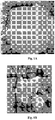
- the HPMCAS precipitate formed sticky lumps as shown in Fig. 1A . Stirring was continued for about 3 minutes without significant changes in the appearance of the precipitate. After stirring was terminated, lumps of HPMCAS continued to stick to the stirrer ( Fig. 1B ).
- the hot reaction product mixture of Example 1 was continuously added over a time period of 3 minutes into a 5 Liter beaker glass with a diameter of 170 mm which was filled with distilled water with about 10 times by volume of the transferred reaction product mixture.
- the content of the beaker glass was stirred using an Ultra-Turrax stirrer S50-G45 (rotor diameter 36 mm, inner stator diameter 38 mm) running at 5200 rpm and a tip speed of 9.8 m/s.
- the resulting shear rate was 9800 s -1 .
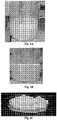
- the HPMCAS formed a finely dispersed precipitate as shown in Fig 2A .
- the product suspension was again stirred using the Ultra-Turrax stirrer S50-G45 running at 5200 rpm and a tip speed of 9.8 m/s.
- the resulting shear rate was 9800 s -1 .
- a fine precipitate of HPMCAS was formed as shown in Fig. 2B which didn't show a tacky behavior.
- a white granular non-sticking HPMCAS filter cake was obtained as shown in Fig. 2C which showed a good flowability and could be dispersed in water as fine particles without the formation of tacky lumps.
- the HPMCAS was dried at 50-55 °C for 10 hours to obtain a non-tacky product of fine particle size.
- Example 2 The hot reaction product mixture of Example 2 was continuously added over a time period of 3 minutes into a 5 Liter beaker glass with a diameter of 170 mm which was filled with 2.1 L of distilled water. During the addition of the hot reaction product mixture the content of the beaker glass was stirred using the same MIGTM stirrer as described in Example 1 by running at 150 rpm and a tip speed of 0.9 m/s. The resulting shear rate was 19 s -1 .
- the hot reaction product mixture of Example 2 was continuously added over a time period of 3 minutes into a 5 Liter beaker glass with a diameter of 170 mm which was filled with 2.1 L of distilled water. During the addition of the hot reaction product mixture the content of the beaker glass was stirred using the same Ultra-Turrax device as described in Example 1 by running at 5200 rpm and a tip speed of 9.8 m/s. The resulting shear rate was 9800 s -1 .
- the HPMCAS formed a finely dispersed precipitate as shown in Fig 4A .
- a white granular non-sticking HPMCAS filter cake was obtained as shown in Fig. 4C which showed a good flowability and could be dispersed in water as fine particles without the formation of tacky lumps.
- the HPMCAS was dried at 50-55 °C for 10 hours to obtain a non-tacky product of fine particle size.
- Fig. 7A Glacial acetic acid, acetic anhydride, HPMC, succinic anhydride and sodium acetate were fed into a reaction vessel (1) via an inlet conduit (9) as described above.
- the precipitation vessel (2) was equipped with a central agitator (7) and recirculation loop (8) with an installed high-shear device (4).
- the central agitator (7) was stirring at a rotational speed of about 75 rpm (corresponding to a tip speed of 2.4 m/s).
- the high-shear device (4) was operated at 2900 rpm and a tip speed of 14.9 m/s. This resulted in a shear rate of about 30,000 s -1 . Water was circulated through the recirculation loop (8) and fed back into the precipitation vessel (2) via an outlet (5) of the high-shear device (4) at a recirculation flow rate of about 15-20 m 3 /h.
- the above-described reaction product mixture was fed from a reaction vessel (1) through a transfer pipe (6) with a flow rate of about 15 1/h into the continuous water flow circulating in the recirculation loop (8) at about 15-20 m 3 /h.
- the combination of the reaction product mixture and water was subjected to high shear in the high shear device (4) and passed from there to the precipitation vessel (2) via an outlet conduit (5) of the high-shear device (4).
- the precipitation vessel was filled-up with additional 400 L of water while stirring with the central agitator (7) and recirculation of the precipitated suspension by use of the high-shear device (4).
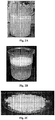
- Fig. 5A illustrates the resulting suspension and comprising the finely dispersed HPMCAS in the precipitation vessel (2).
- Fig. 5B illustrates the disperse character of the product after decanting the liquid phase of the suspension in the precipitation vessel (2).
- the suspension comprising the finely dispersed HPMCAS was removed from the precipitation vessel (2) and the precipitated product was separated from the suspension by washing and filtration of the precipitated product by use of about 10 m 3 of water.
- a white granular non-sticking HPMCAS filter cake was obtained as shown in Fig. 5C which shows a good flowability and could be dispersed in water as fine particles without the formation of tacky lumps.
- the HPMCAS was dried at 50-55 °C for 10 hours to obtain a non-tacky product of fine particle size.
- HPMCAS precipitate formed sticky lumps as shown in Fig 6A.
Landscapes
- Chemical & Material Sciences (AREA)
- Life Sciences & Earth Sciences (AREA)
- Engineering & Computer Science (AREA)
- Biochemistry (AREA)
- Materials Engineering (AREA)
- Health & Medical Sciences (AREA)
- Chemical Kinetics & Catalysis (AREA)
- Medicinal Chemistry (AREA)
- Polymers & Plastics (AREA)
- Organic Chemistry (AREA)
- Polysaccharides And Polysaccharide Derivatives (AREA)
Description
- The present invention relates to an improved process for recovering an ester of a cellulose ether from a reaction product mixture.
- Esters of cellulose ethers, their uses and processes for preparing them are generally known in the art. One process for producing cellulose ether-esters is described in
U.S. Patent No. 3,435,027 . - Hydroxypropyl methyl cellulose acetate succinate (HPMCAS), hydroxypropyl methyl cellulose acetate (HPMCA) and hydroxypropyl methyl cellulose phthalate (HPMCP) are useful in pharmaceutical dosage forms. HPMCAS is useful as an enteric polymer for pharmaceutical dosage forms. Enteric polymers are those that remain intact in the acidic environment of the stomach. Dosage forms coated with such polymers protect the drug from inactivation or degradation in the acidic environment or prevent irritation of the stomach by the drug.
- In a conventional method of preparing esters of cellulose ethers, such as HPMCAS, HPMCA or HPMCP, cold water is poured to the reaction product mixture in order to initiate the precipitation of the product and to dilute and remove the impurities. However, applying this method, HPMCAS and HPMCA in the form of a fine powder or granules cannot be obtained because inter-particle coagulation occurs to a very large extent. The inter-particle coagulation prevents water from penetrating between the particles, so that it becomes difficult to effectively remove impurities like acetic acid, sodium acetate, succinic acid, phthalic acid, unreacted hydroxypropyl methyl cellulose (HPMC) and others. Moreover, additional milling or crushing of the product is required to obtain a granular product.
-
U.S. Patent No. 4,226,981 discloses a process for preparing mixed esters of cellulose ethers, such as HPMCAS, by esterifying hydroxypropyl methyl cellulose with succinic anhydride and acetic anhydride in the presence of an alkali carboxylate, such as sodium acetate, as the esterification catalyst and acetic acid as the reaction medium. After completion of the esterification reaction, a large volume of water, specifically 10 times by volume of water, is added to the reaction product mixture so that the reaction product is precipitated. The precipitated product is then subjected to a thorough washing with water to remove impurities and dried to produce a mixed ester in the powdery or granular form. - International Patent Application
WO 2005/115330 discloses HPMCAS and HPMCA polymers with a specific combination of substitution levels. HPMCAS and HPMCA polymers are useful for forming solid amorphous dispersions of hydrophobic drugs. The polymers allow high amounts of drug in the dispersion and still remain homogeneous upon storage, while providing enhanced concentrations of the dissolved drug in a use environment. HPMCAS and HPMCA are produced in a similar manner as described inU.S. Patent No. 4,226,981 . Once the reaction is complete, a large volume of water is added to the reaction product mixture so that HPMCAS or HPMCA is precipitated. In one of the working examples 10 g of hydroxypropyl methylcellulose (HPMC) is reacted with 1.2 g of succinic anhydride and 41.4 g of acetic anhydride in 100 mL of glacial acetic acid in the presence of 10. 1 g of sodium acetate; the reaction product mixture comprising the HPMCAS is quenched with 700 mL of water to precipitate the HPMCAS. In the other working example 5 g of HPMC is reacted with 1.53 g of acetic anhydride in 50 mL (51.3 g) of glacial acid in the presence of 5.07 g of sodium acetate; the reaction product mixture comprising the HPMCA is quenched with 800 mL of water saturated with sodium chloride to precipitate the HPMCA. The precipitated product is then subjected to thorough washing with water to remove impurities. - European Patent Application
EP 0 219 426 discloses a process for producing HPMCP or HPMCAS wherein 100 parts by weight of HPMC, 80 parts by weight of sodium acetate and 300 parts by weight of acetic acid are either reacted with 120 parts by weight of phthalic anhydride or a combination of 25 parts by weight of succinic anhydride and 38 parts by weight of acetic anhydride. Thereafter, 1200 parts by weight of water are added to the reaction product mixture and the precipitate formed in the mixture is collected by filtration and repeatedly washed with water until the washing precipitate is no longer acidic. Unfortunately, esters of cellulose ethers, such as HPMCAS, HPMCA and HPMCP tend to exhibit a very tacky nature in the presence of an aliphatic carboxylic acid, such as acetic acid, and an alkali metal carboxylate, such as sodium acetate. Even the use of large amounts of water for precipitating the HPMCAS, HPMCA or HPMCP from the reaction product mixture does not necessarily solve the problem of the tacky nature of these polymers. Often lumps or hard solids of HPMCAS, HPMCA or HPMCP are generated which are difficult to handle during the subsequent washing and drying procedure. After the drying procedure often a coarse solid product of the polymers is obtained which is somewhat hard and clotted and exhibits lumps. As a result crushing of final product becomes very difficult. - US Patent Application Publication No.
US 2004/0152886 addresses the need of preventing coagulation of HPMCP particles so that impurities like phthalic acid and acetic acid present between the particles can contact with water and be washed away.US 2004/0152886 suggests increasing the fluidity of the reaction product mixture by adding a fluidization solvent as a post-treatment process, and spraying it into water through a spray nozzle. Unfortunately, this purification process is quite complex due to the required spray nozzle and the need for high pressure pumps to enable reliable spraying. The reaction product mixture has a high tendency to cause clogging of the spray nozzles. - Accordingly, an object of the present invention is to provide a process for preparing an ester of a cellulose ether in which substantial coagulation of the particles of the esterified cellulose ether after precipitation can be prevented without the need of spraying the reaction product mixture through spray nozzles.
- Another object of the present invention is to provide a process for preparing an ester of a cellulose ether in which substantial coagulation of the particles of the esterified cellulose ether during the washing of the esterified cellulose ether can be prevented to improve its washability.
- Yet another object of the present invention is to provide a process for preparing an ester of a cellulose ether by which a non-tacky finely powdered ester of a cellulose ether can be obtained without the need of spraying the reaction product mixture through spray nozzles.
- Surprisingly, it has been found that i) substantial coagulation of the particles of the esterified cellulose ether during or after precipitation can be prevented, ii) substantial coagulation of the particles of the esterified cellulose ether during the washing of the esterified cellulose ether can be prevented whereby its washability is improved and iii) a non-tacky finely powdered ester of a cellulose ether can be obtained, when a reaction product mixture comprising the esterified cellulose ether is contacted with water and the combination of water and the reaction product mixture is subjected to a shear rate of at least 800 s-1.
- Accordingly, one aspect of the present invention is a process for precipitating an esterified cellulose ether from a reaction product mixture obtained from a reaction of (a) a cellulose ether with (b) an aliphatic monocarboxylic acid anhydride or with a di- or tricarboxylic acid anhydride or with a combination of an aliphatic monocarboxylic acid anhydride and a di- or tricarboxylic acid anhydride in the presence of (c) an aliphatic carboxylic acid, wherein the process comprises the step of contacting the reaction product mixture with water and subjecting the combination of water and the reaction product mixture to a shear rate of at least 800 s-1.
- Another aspect of the present invention is a process of preparing an ester of a cellulose ether wherein (a) a cellulose ether is reacted with (b) an aliphatic monocarboxylic acid anhydride or with a di- or tricarboxylic acid anhydride or with a combination of an aliphatic monocarboxylic acid anhydride and a di- or tricarboxylic acid anhydride in the presence of (c) an aliphatic carboxylic acid and the esterified cellulose ether is precipitated from the reaction product mixture in a process which comprises the step of contacting the reaction product mixture with water and subjecting the combination of water and the reaction product mixture to a shear rate of at least 800 s-1.
-
-
Fig. 1A illustrates precipitation of HPMCAS from a first reaction mixture as described in Example 1, obtained by reacting HPMC with succinic anhydride and acetic anhydride in the presence of glacial acetic acid and sodium acetate, by contacting the reaction mixture with water according to a first comparative process applying a low shear rate. The HPMCAS precipitate formed sticky lumps. -
Fig. 1B illustrates the tacky HPMCAS sticking at the stirrer blades obtained according to the first comparative process after precipitation. -
Fig. 1C illustrates the HPMCAS product after re-suspension in water applying a low shear rate. The HPMCAS still formed sticky lumps. -
Fig. 1D illustrates the tacky HPMCAS sticking at the stirrer blades obtained even after removal of the first amount of water utilized for precipitation and re-suspension in water applying a low shear rate. -
Fig. 1E illustrates the tacky HPMCAS obtained according to the first comparative process after re-suspension in water and separation from water. -
Fig. 2A illustrates precipitation of HPMCAS from the same reaction mixture as described in Example 1 by transferring the reaction mixture into water according to the process of the invention at high shear rate. The HPMCAS formed a finely dispersed precipitate. -
Fig. 2B illustrates the HPMCAS product after re-suspension in water applying a high shear rate. After stirring was terminated, a fine precipitate of HPMCAS was formed. -
Fig. 2C illustrates the granular non-sticking HPMCAS filter cake obtained according to the process of the invention after re-suspension in water and separation from water. -
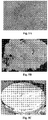
Fig. 3A illustrates precipitation of HPMCAS from a second reaction mixture as described in Example 2, obtained by reacting HPMC with succinic anhydride and acetic anhydride in the presence of glacial acetic acid and sodium acetate, by contacting the reaction mixture with water according to a second comparative process applying a low shear rate. One sticky chunk of HPMCAS was formed sticking to the stirrer. -
Fig. 3B illustrates the HPMCAS product after re-suspension in water applying a low shear rate. The HPMCAS formed one sticky chunk. -
Fig. 3C illustrates the tacky chunk of HPMCAS obtained according to the second comparative process after re-suspension in water and separation from water. -
Fig. 4A illustrates precipitation of HPMCAS from the same reaction mixture as described in Example 2 by transferring the reaction mixture into water according to the process of the invention at high shear rate. The HPMCAS formed a finely dispersed precipitate. -
Fig. 4B illustrates the HPMCAS product after re-suspension in water applying a high shear rate. After stirring was terminated, a fine precipitate of HPMCAS was formed. -
Fig. 4C illustrates the granular non-sticking HPMCAS filter cake obtained according to the process of the invention after re-suspension in water and separation from water. -
Fig. 5A illustrates precipitation of HPMCAS from a third reaction mixture as described in Example 3, obtained by reacting HPMC with succinic anhydride and acetic anhydride in the presence of glacial acetic acid and sodium acetate, by contacting the reaction mixture with water in a precipitation vessel according to the process of the invention as illustrated inFig. 7A . The HPMCAS formed a finely dispersed precipitate in the precipitation vessel. -
Fig. 5B illustrates HPMCAS after removal of the liquid phase from the finely dispersed precipitate illustrated inFig. 5A . -
Fig. 5C illustrates white granular non-sticking HPMCAS obtained after separation and isolation of the product from the suspension, followed by washing and filtration. -
Fig. 6A illustrates precipitation of HPMCAS from the same reaction mixture as in Example 3 by contacting the reaction mixture with water according to a third comparative process applying a low shear rate. The HPMCAS precipitate formed sticky lumps. -
Fig. 6B illustrates the same HPMCAS as inFig. 6A after washing with an additional amount of water and after separation from the liquor. The HPMCAS still formed sticky lumps. -
Figures 7A, 7B ,7C and 7D illustrate flow charts of embodiments of the process of the present invention. - According to the process of the present invention an esterified cellulose ether is precipitated as described further below from a reaction product mixture that has been obtained from a reaction of (a) a cellulose ether with (b) an aliphatic monocarboxylic acid anhydride or with a di- or tricarboxylic acid anhydride or with a combination of an aliphatic monocarboxylic acid anhydride and a di- or tricarboxylic acid anhydride in the presence of (c) an aliphatic carboxylic acid and optionally (d) an alkali metal carboxylate.
- The cellulose ether (a) used as a starting material for the esterification reaction preferably is an alkyl cellulose, hydroxyalkyl cellulose or hydroxyalkyl alkylcellulose. The hydroxyalkoxy groups are typically hydroxymethoxy, hydroxyethoxy and/or hydroxypropoxy groups. Hydroxyethoxy and/or hydroxypropoxy groups are preferred. Preferably a single kind of hydroxyalkoxy group, more preferably hydroxypropoxy, is present in the cellulose ether. The alkoxy groups are typically methoxy, ethoxy and/or propoxy groups. Methoxy groups are preferred. Illustrative of the above-defined cellulose ethers are methylcellulose, ethylcellulose, and propylcellulose; hydroxyethylcellulose, hydroxypropylcellulose, hydroxyethyl methylcellulose, ethyl hydroxyethylcellulose, hydroxymethyl ethylcellulose, hydroxypropyl methylcellulose, hydroxypropyl ethylcellulose, hydroxybutyl methylcellulose, and hydroxybutyl ethylcellulose. More preferably, the cellulose ether is a hydroxypropyl methylcellulose.
- The cellulose ether used as a starting material in the process of the present invention preferably has a viscosity of from 2.4 to 200 mPa·s, preferably from 2 to 100 mPa·s, more preferably from 2.5 to 50 mPa·s, in particular from 3 to 30 mPa·s, measured as a 2 weight-% aqueous solution at 20 °C according to ASTM D2363 - 79 (Reapproved 2006).
- The average number of hydroxyl groups substituted by alkoxy groups, such as methoxy groups, per anhydroglucose unit, is designated as the degree of substitution of alkoxy groups (DS). In the above-given definition of DS, the term "hydroxyl groups substituted by alkoxy groups" does not only include alkylated hydroxyl groups directly bound to the carbon atoms of the cellulose backbone, but also alkylated hydroxyl groups of hydroxyalkoxy substituents bound to the cellulose backbone. Most preferably, the cellulose ether is a hydroxypropyl methylcellulose with a DSmethoxyl of from 1.1 to 2.1, more preferably 1.75 to 2.05 and an MShydroxypropoxyl of from 0.05 to 1.1, more preferably from 0.15 to 0.4. The DSmethoxyl and MShydroxypropoxyl are determined according to United States Pharmacopeia and National Formulary, Hypromellose (hydroxproyl methyl cellulose).
- The cellulose ether (a) is reacted with (b) an aliphatic monocarboxylic acid anhydride or with a di- or tricarboxylic acid anhydride or with a combination of an aliphatic monocarboxylic acid anhydride and a di- or tricarboxylic acid anhydride. Preferred aliphatic monocarboxylic acid anhydrides are selected from the group consisting of acetic anhydride, butyric anhydride and propionic anhydride. Preferred dicarboxylic acid anhydrides are selected from the group consisting of succinic anhydride, maleic anhydride and phthalic anhydride. A preferred tricarboxylic acid anhydride is trimellitic anhydride. A preferred aliphatic monocarboxylic acid anhydride can be used alone; or a preferred di- or tricarboxylic acid anhydride can be used alone; or a preferred aliphatic monocarboxylic acid anhydride can be used in combination with a preferred di- or tricarboxylic acid anhydride.
- The production of the following esterified cellulose ethers from the above-mentioned cellulose ethers, aliphatic monocarboxylic acid anhydrides and di- or tricarboxylic acid anhydrides is particularly preferred:
- i) HPMC-XY and HPMC-X, wherein HPMC is hydroxypropyl methyl cellulose, X is A (acetate), or X is B (butyrate) or X is Pr (propionate) and Y is S (succinate), Y is P (phthalate), Y is M (maleate) or Y is T (trimellitate), such as hydroxypropyl methyl cellulose acetate phthalate (HPMCAP), hydroxypropyl methyl cellulose acetate trimellitate (HPMCAT), hydroxypropyl methyl cellulose acetate maleate (HPMCAM) or hydroxypropyl methylcellulose acetate succinate (HPMCAS); or
- ii) hydroxypropyl methyl cellulose phthalate (HPMCP); hydroxypropyl cellulose acetate succinate (HPCAS), hydroxybutyl methyl cellulose propionate succinate (HBMCPrS), hydroxyethyl hydroxypropyl cellulose propionate succinate (HEHPCPrS); and methyl cellulose acetate succinate (MCAS).
- Hydroxypropyl methylcellulose acetate succinate (HPMCAS) is the most preferred esterified cellulose ether.
- The esterification of the cellulose ether can be conducted in a known manner, for example as described in
U.S. Patent Nos. 3,435,027 and4,226,981 , in the International Patent ApplicationWO 2005/115330 , or in European Patent ApplicationEP 0 219 426 . The esterification of the cellulose ether is conducted in (c) an aliphatic carboxylic acid as a reaction medium, such as acetic acid, propionic acid, or butyric acid. The reaction medium can comprise minor amounts of other solvents or diluents which are liquid at room temperature and do not react with the cellulose ether, such as halogenated C1-C3 derivatives, such as dichloro methane, or dichloro methyl ether, but the amount of the aliphatic carboxylic acid should generally be more than 50 percent, preferably at least 75 percent, and more preferably at least 90 percent, based on the total weight of the reaction medium. Most preferably the reaction medium consists of an aliphatic carboxylic acid. The esterification reaction is generally conducted in the presence of 100 to 2,000 parts by weight of an aliphatic carboxylic acid as the reaction medium per 100 parts by weight of the cellulose ether. - The esterification reaction is generally conducted in the presence of (d) an esterification catalyst, preferably in the presence of an alkali metal carboxylate, such as sodium acetate or potassium acetate. The amount of the alkali metal carboxylate is preferably 20 to 200 parts by weight of the alkali metal carboxylate per 100 parts by weight of the cellulose ether. If an aliphatic monocarboxylic acid anhydride and a di- or tricarboxylic acid anhydride are used for esterifying the cellulose ether, the two anhydrides may be introduced into the reaction vessel at the same time or separately one after the other. The amount of each anhydride to be introduced into the reaction vessel is determined depending on the desired degree of esterification to be obtained in the final product, usually being 1 to 10 times the stoichiometic amounts of the desired molar degree of substitution of the anhydroglucose units by esterification. The mixture is generally heated at 60 °C to 110 °C, preferably at 70 to 100 °C, for a period of time sufficient to complete the reaction, that is, typically from 2 to 25 hours, more typically from 2 to 8 hours. The cellulose ether as the starting material is not always soluble in the aliphatic carboxylic acid, but can only be dispersed in or swollen by the aliphatic carboxylic acid, especially when the degree of substitution in the cellulose ether is relatively small. The esterification reaction can take place even with such a dispersed or swollen cellulose ether and, as the esterification reaction proceeds, the cellulose ether under reaction generally dissolves in the reaction medium, to finally give a homogeneous solution.
- The resulting reaction product mixture comprises the esterified cellulose ether, an aliphatic carboxylic acid used as a reaction medium, typically a reaction catalyst, such as an alkali metal carboxylate, typically residual amounts of one or more esterification agents and by-products, such as an aliphatic monocarboxylic acid and/or a di- or tricarboxylic acid. The resulting reaction product mixture generally comprises from 3 to 60 weight percent of the esterified cellulose ether, from 20 to 90 weight percent of an aliphatic carboxylic acid, from 5 to 50 weight percent of a reaction catalyst, such as an alkali metal carboxylate, and from 0.1 to 30 weight percent of minor components, such as non-reacted anhydrides of an aliphatic monocarboxylic acid and/or of a di- or tricarboxylic acid.
- In the process of the present invention the above-described reaction product mixture is contacted with water and the combination of water and the reaction product mixture is subjected to a shear rate of at least 800 s-1, preferably at least 1500 s-1, more preferably at least 3000 s-1, most preferably at least 8000 s-1. The shear rate is generally up to 600,000 s-1, and typically up to 500,000 s-1, more typically up to 100,000 s-1 and most typically up to 50,000 s-1. Applying such shear rates in the process of the present invention is useful for providing esters of cellulose ethers which are non-tacky and of fine particle size upon precipitation and separation from the reaction product mixture.
- The above-mentioned shear rate can be obtained in a high shear device, such as a high shear mixer, also known as rotor-stator mixer or homogenizer, high shear mill or high shear pump. A high shear device commonly comprises a rotor in combination with a stationary part of the shear device, also referred to as "stationary", such as a stator or housing. The stationary creates a close-clearance gap between the rotor and itself and forms a high-shear zone for materials in this gap. The stationary can include single or multiple rows of openings, gaps or teeth to induce a kind of shear frequency and increased turbulent energy.
- One metric for the degree or thoroughness of mixing is the shearing force generated by a mixing device with a high tip speed. Fluid undergoes shear when one area of fluid travels with a different velocity relative to an adjacent area. The tip speed of the rotor is a measure of the kinetic energy generated by the rotation according to the formula:

- The shear rate is based on the inverse relationship between the gap distance between the rotor and the stationary part of the shear device which is commonly referred to as the stator or housing In the case the high shear device is not equipped with a stator, the inner wall of a precipitation vessel serves as a stator.

- A further shearing is induced by a velocity difference between the tip velocity of the fluid at the outside diameter of the rotor and the velocity at the centre of the rotor.
- High shear devices are also called high shear mixers and encompass different geometries such as colloid mills, toothed-devices, axial-discharge and radial-discharge rotor stator mixers (Atiemo-Obeng, V. A. and Calabrese, R. V., 2004. "Rotor-stator mixing devices" in Handbook of Industrial Mixing: Science and Practice, E. L. Paul, V. A. Atiemo-Obeng and S. M. Kresta, John Wiley & Sons, Hoboken, New Jersey, USA.). The high shear device can be used in a continuous or batch operation.
- Water and the above described reaction product mixture comprising the esterified cellulose ether and the aliphatic carboxylic acid can be fed as separate fluid streams or as a combined fluid stream to the high shear device. The reaction product mixture comprising the esterified cellulose ether and the aliphatic carboxylic acid generally has a temperature of from 60 °C to 110 °C. It can be contacted with the water without previous cooling of the reaction product mixture. The temperature of the water preferably is from 1 to 90 °C, more preferably from 5 to 40 °C.
- Preferably the reaction product mixture is contacted with an amount of from 5 to 400, more preferably from 8 to 300, most preferably from 10 to 100, and particularly from 12 to 50 weight parts of water per weight part of cellulose ether used for esterification.
- The weight ratio [water / aliphatic carboxylic acid] is generally up to 300 / 1, preferably up to 200 / 1, more preferably up to 100 / 1 and most preferably up to 30 / 1. Generally the weight ratio [water / aliphatic carboxylic acid] is at least 3 / 1, typically at least 6 / 1, more typically at least 10 / 1.
- The weight ratio [water / reaction product mixture excluding water] is generally up to 10 / 1.0, preferably up to 5.0 / 1.0, more preferably up to 3.0 / 1.0. The weight ratio [water / reaction product mixture excluding water] is generally at least 1.0 / 1.0, preferably at least 1.4 / 1.0, more preferably at least 2.0 / 1.0. Alternatively, the preferred amount of water utilized in the precipitation process of the present invention can be expressed as the weight ratio [water / starting materials used for producing the esterified cellulose ether], specifically the weight ratio [water / (total weight of (a) cellulose ether, (b) aliphatic monocarboxylic acid anhydride and di- or tricarboxylic acid anhydride, (c) aliphatic carboxylic acid, and (d) esterification catalyst)]. This weight ratio preferably is from [1.0 / 1.0] to [10.0 / 1.0], more preferably from [1.4 / 1.0] to [5.0 / 1.0], most preferably from [2.0 / 1.0] to [3.0 / 1.0].
-
Fig. 7A represents a flowchart of a preferred embodiment of the precipitation process of the present invention, but the precipitation process of the present invention is not limited to it. The reactants (a) a cellulose ether, (b) an aliphatic monocarboxylic acid anhydride, a di- or tricarboxylic acid anhydride or a combination thereof, (c) an aliphatic carboxylic acid, and typically (d) an esterification catalyst, preferably an alkali metal carboxylate, are fed in combination or separately into a reaction vessel (1) via an inlet conduit (9). A separate precipitation vessel (2) is loaded with water (3). The precipitation vessel (2) is equipped with a central agitator (7) and recirculation loop (8) with an installed high-shear device (4). Water is circulated through the recirculation loop (8) and fed back into the precipitation vessel (2) via an outlet conduit (5) of the high-shear device (4). For precipitation of the esterified cellulose ether, the reaction product mixture is fed from the reaction vessel (1) through a transfer pipe (6) into the continuous water flow circulating in the recirculation loop (8). The combination of the reaction product mixture and water is subjected to high shear in the high shear device (4) and passed from there to the precipitation vessel (2) via an outlet conduit (5) of the high-shear device (4). After the total reaction product mixture has been transferred into the precipitation vessel (2), optionally an additional amount of water is added to the precipitation vessel, preferably while agitating the contents of the precipitation vessel using the central agitator (7). The precipitated suspension is recirculated in the recirculation loop (8) by use of the high-shear device (4). - Preferably the high-shear device (4) utilized in the process illustrated in
Fig. 7A is a in-line high-shear device. In an inline high-shear device, generally a mixing head is contained in a housing driven through a seal with an inlet at one end and an outlet at the other end or on the circumference of the device. The esterified cellulose ether and water are preferably drawn through the mixing head in a continuous stream. Equilibrium mixing is typically achieved by passing the combination of water and the reaction product mixture comprising the esterified cellulose ether through the inline high-shear device more than once. Known vendors for high shear devices such as rotor-stator mixers, high shear mills or high shear pumps are Herbst Maschinenfabrik GmbH, Germany (model series HI), Charles Ross & Son Company, USA (model series 400DL, 100LCI, 100, HSD, 700), IKA GmbH & Co. KG, Germany (model series Ultra-Turrax, UTL, DR, MK, colloid mills MK), Scott Turbon Mixer Inc., USA (models series L-HSM, HSM, IL, HSP, Scott top, bottom and floor mounted mixers), FrymaKoruma AG, Switzerland (model series DIL), and BWS Technology, Germany (?) (model series Supraton and Reflector). An example of a useful high shear device is disclosed inU.S. patent application 2011/0091360 . - The suspension is removed from the precipitation vessel (2) via an outlet pipe (not shown) and the dispersed ester of the cellulose ether can subsequently be separated from the remainder of the mixture in a known manner, such as by centrifugation or filtration or upon settling by decantation. The recovered ester of the cellulose ether can be washed with water to remove impurities and dried to produce a esterified cellulose ether in the form of a powder.
-
Fig. 7B illustrates a modification of the precipitation process illustrated inFig. 7A . Like in the precipitation process illustrated inFig. 7A , the reactants (a) a cellulose ether, (b) an aliphatic monocarboxylic acid anhydride, a di- or tricarboxylic acid anhydride or a combination thereof, (c) an aliphatic carboxylic acid, and typically (d) an esterification catalyst, preferably an alkali metal carboxylate, are fed in combination or separately into a reaction vessel (1) via an inlet conduit (9). For precipitation of the esterified cellulose ether, the reaction product mixture is fed from the reaction vessel (1) through a transfer pipe (6) into a high-shear device (4). Water is not recycled from a precipitation vessel, but is continuously fed through awater conduit 10 into the high-shear device (4). The combined stream of water and reaction product mixture is fed into a precipitation vessel (not shown) via an outlet conduit (5) of the high-shear device (4). -
Fig. 7C represents a flowchart of another embodiment of the precipitation process of the present invention. The reactants (a) a cellulose ether, (b) an aliphatic monocarboxylic acid anhydride, a di- or tricarboxylic acid anhydride or a combination thereof, (c) an aliphatic carboxylic acid, and typically (d) an esterification catalyst, preferably an alkali metal carboxylate, are fed in combination or separately into a reaction vessel (11) via an inlet conduit (17) and from there through a transfer pipe (16) into a separate precipitation vessel (12) that has been loaded with water (13) and that is equipped with a high shear device (14), preferably with a high-shear mixer on a rotating shaft. The suspension can be removed from the precipitation vessel (12) and further processed as described with reference toFig. 7A . -
Fig. 7D represents a flowchart of yet another embodiment of the precipitation process of the present invention. The reactants (a) a cellulose ether, (b) an aliphatic monocarboxylic acid anhydride, a di- or tricarboxylic acid anhydride or a combination thereof, (c) an aliphatic carboxylic acid, and typically (d) an esterification catalyst, preferably an alkali metal carboxylate, are fed in combination or separately into a reaction vessel (21) via an inlet conduit (22). The reaction vessel (21) is equipped with a high shear device (24), preferably with a high-shear mixer on a rotating shaft. During the esterification reaction the shear rate of the reaction mixture is not critical. In one embodiment of the invention the shear rate during the esterification reaction is less than 800 and the shear rate is increased to at least 800 for precipitation of the esterified cellulose ether. In another embodiment of the invention the shear rate is already 800 s-1 or more during the esterification reaction. After completion of the esterification reaction, water is fed into the reaction vessel (21) via a water inlet conduit (23) and the high shear device (24) is set to run at a speed to provide a shear rate of at least 800 s-1. - Some embodiments of the invention will now be described in detail in the following Examples.
- Unless otherwise mentioned, all parts and percentages are by weight.
- 250.0 g of glacial acetic acid, 60.0 g of acetic anhydride, 51.67 g (dry content 96.82%) of a hydroxypropyl methylcellulose (HPMC), 20.0 g of succinic anhydride and 50.0 g of sodium acetate (water free) were introduced into a glass reactor with a inner diameter of 147 mm and intensively mixed by use of a MIG™ stirrer (two blade axial flow impeller, company EKATO, Schopfheim, Germany) with a outer diameter of 120 mm. The HPMC had a viscosity of about 3.1 mPa•s, measured as a 2 % aqueous solution at 20 °C, a degree of methoxyl substitution, DS(methoxyl), of 1.92, and a hydroxypropoxyl substitution, MS(hydroxypropoxyl), of 0.26, measured according to the United States Pharmacopeia and National Formulary, Hypromellose (hydroxproyl methyl cellulose).
- The mixture was heated at 85° C and intensively mixed by agitation for 3 hours to effect esterification. The reaction was carried out as described in Example 1, Sample No. 4 of
U.S. Patent No. 4,226,981 . - The precipitation was carried out as described in Example 1, Sample No. 4 of
U.S. Patent No. 4,226,981 . After esterification, about 10 times by volume of distilled water was added within 3 minutes to the hot reaction product mixture to allow the reaction product to be precipitated. During the addition of the water the content of the glass reactor was stirred by use of the above described MIG™ stirrer (outer blades diameter 120 mm) running at 150 rpm and a tip speed of 0.9 m/s. The resulting shear rate was 35 s-1. The HPMCAS precipitate formed sticky lumps as shown inFig. 1A . Stirring was continued for about 3 minutes without significant changes in the appearance of the precipitate. After stirring was terminated, lumps of HPMCAS continued to stick to the stirrer (Fig. 1B ). - Even after displacement of the amount of water that had been used for precipitation by separation and re-suspension in 3.7 L of water while stirring at 150 rpm by use of the above described MIG™ stirrer a tacky product was obtained (
Fig. 1C ) that stuck to the stirrer as shown in Fig. ID. After separation and isolation of the re-suspended product from water, very tacky lumps of HPMCAS were isolated, as shown in Fig IE. Drying at 50-55 °C did not change the tacky appearance. - The hot reaction product mixture of Example 1 was continuously added over a time period of 3 minutes into a 5 Liter beaker glass with a diameter of 170 mm which was filled with distilled water with about 10 times by volume of the transferred reaction product mixture. During the addition of the hot reaction product mixture the content of the beaker glass was stirred using an Ultra-Turrax stirrer S50-G45 (rotor diameter 36 mm, inner stator diameter 38 mm) running at 5200 rpm and a tip speed of 9.8 m/s. The resulting shear rate was 9800 s-1.
- The HPMCAS formed a finely dispersed precipitate as shown in
Fig 2A . After displacement of the water, which had been utilized for precipitation, by separation and re-suspension in 3.7 L of water the product suspension was again stirred using the Ultra-Turrax stirrer S50-G45 running at 5200 rpm and a tip speed of 9.8 m/s. The resulting shear rate was 9800 s-1. - After stirring was terminated, a fine precipitate of HPMCAS was formed as shown in
Fig. 2B which didn't show a tacky behavior. After separation and isolation of the re-suspended product from water a white granular non-sticking HPMCAS filter cake was obtained as shown inFig. 2C which showed a good flowability and could be dispersed in water as fine particles without the formation of tacky lumps. The HPMCAS was dried at 50-55 °C for 10 hours to obtain a non-tacky product of fine particle size. - 314.7 g of glacial acetic acid was introduced into a glass reactor equipped with a MIG™ stirrer and placed into an oil bath set at 85 °C. 31.1 g of the same HPMC as in Example 1 and 30.32 g of sodium acetate (water free) were added and allowed to dissolve. Once complete dissolution of the HPMC occurred, 3.55 g of succinic anhydride was added and allowed to react for 2.5 hours 124.09 g of acetic anhydride was added and allowed to react for an additional 21 hours. The reaction was carried out as described in the International Patent Application
WO 2005/115330 , page 51 where the synthesis of HPMCAS polymers is generally described. - The hot reaction product mixture of Example 2 was continuously added over a time period of 3 minutes into a 5 Liter beaker glass with a diameter of 170 mm which was filled with 2.1 L of distilled water. During the addition of the hot reaction product mixture the content of the beaker glass was stirred using the same MIG™ stirrer as described in Example 1 by running at 150 rpm and a tip speed of 0.9 m/s. The resulting shear rate was 19 s-1.
- After stirring was terminated after about 3 minutes one sticky chunk of HPMCAS was formed sticking to the stirrer, as shown in
Fig. 3A . - Even after displacement of the amount of water that had been used for precipitation by separation and re-suspension in 2.1 L of water while stirring at 150 rpm by use of the above described MIG™ stirrer a tacky product was obtained that stuck to the stirrer. After displacement of the water, which had been utilized for precipitation, by separation and re-suspension in 2.1 L of water by using the MIG™ stirrer, the tackiness and appearance of the sticky mass did not change, as shown in
Fig. 3B . - After separation and isolation of the product from water tacky chunks of product were obtained, as shown in
Fig. 3C , which could not be easily dispersed in water. Drying at 50-55 °C did not change the tacky appearance. - The hot reaction product mixture of Example 2 was continuously added over a time period of 3 minutes into a 5 Liter beaker glass with a diameter of 170 mm which was filled with 2.1 L of distilled water. During the addition of the hot reaction product mixture the content of the beaker glass was stirred using the same Ultra-Turrax device as described in Example 1 by running at 5200 rpm and a tip speed of 9.8 m/s. The resulting shear rate was 9800 s-1. The HPMCAS formed a finely dispersed precipitate as shown in
Fig 4A . - After displacement of the water that had been used for precipitation by separation and re-suspension in 2.1 L of water the product suspension was again stirred using the Ultra-Turrax stirrer S50-G45 running at 5200 rpm and a tip speed of 9.8 m/s. The resulting shear rate was 9800 s-1.
- After stirring was terminated, a fine precipitate of HPMCAS was formed as shown in
Fig. 4B which did not show a tacky behavior. - After separation and isolation of the re-suspended product from water a white granular non-sticking HPMCAS filter cake was obtained as shown in
Fig. 4C which showed a good flowability and could be dispersed in water as fine particles without the formation of tacky lumps. The HPMCAS was dried at 50-55 °C for 10 hours to obtain a non-tacky product of fine particle size. - 123 kg of glacial acetic acid, 32 kg of acetic anhydride, 23.4 kg (dry content 97.5%) of the same HPMC as in Example 1.7 kg of succinic anhydride and 25 kg of sodium acetate (water free) were introduced into a 400 L horizontal plough share mixer and intensively mixed by use of the plough shares and an installed chopper (not shown). The mixture was heated to 85° C and intensively mixed by agitation for 3.5 hours at 85°C to effect esterification.
- The production of the reaction product mixture and the precipitation process were carried out as illustrated by
Fig. 7A . Glacial acetic acid, acetic anhydride, HPMC, succinic anhydride and sodium acetate were fed into a reaction vessel (1) via an inlet conduit (9) as described above. A separate precipitation vessel (2) with a volume of 1 m3 was loaded with 500 L of water (3). The precipitation vessel (2) was equipped with a central agitator (7) and recirculation loop (8) with an installed high-shear device (4). The central agitator (7) was stirring at a rotational speed of about 75 rpm (corresponding to a tip speed of 2.4 m/s). The high-shear device (4) was operated at 2900 rpm and a tip speed of 14.9 m/s. This resulted in a shear rate of about 30,000 s-1. Water was circulated through the recirculation loop (8) and fed back into the precipitation vessel (2) via an outlet (5) of the high-shear device (4) at a recirculation flow rate of about 15-20 m3/h. - For precipitation of the HPMCAS product, the above-described reaction product mixture was fed from a reaction vessel (1) through a transfer pipe (6) with a flow rate of about 15 1/h into the continuous water flow circulating in the recirculation loop (8) at about 15-20 m3/h. The combination of the reaction product mixture and water was subjected to high shear in the high shear device (4) and passed from there to the precipitation vessel (2) via an outlet conduit (5) of the high-shear device (4). After the total reaction product mixture was transferred into the precipitation vessel (2), the precipitation vessel was filled-up with additional 400 L of water while stirring with the central agitator (7) and recirculation of the precipitated suspension by use of the high-shear device (4).
-
Fig. 5A illustrates the resulting suspension and comprising the finely dispersed HPMCAS in the precipitation vessel (2).Fig. 5B illustrates the disperse character of the product after decanting the liquid phase of the suspension in the precipitation vessel (2). - After precipitation the suspension comprising the finely dispersed HPMCAS was removed from the precipitation vessel (2) and the precipitated product was separated from the suspension by washing and filtration of the precipitated product by use of about 10 m3 of water.
- After separation and isolation of the washed product from the suspension a white granular non-sticking HPMCAS filter cake was obtained as shown in
Fig. 5C which shows a good flowability and could be dispersed in water as fine particles without the formation of tacky lumps. The HPMCAS was dried at 50-55 °C for 10 hours to obtain a non-tacky product of fine particle size. - After esterification as described above, an amount of water corresponding about twice the volume of the reaction product mixture was added to the hot reaction product mixture to allow the reaction product to be precipitated. During the addition of the water the content of the reactor was stirred by use of the above described MIG™ stirrer (outer blades diameter 120 mm) running at 150 rpm and a tip speed of 0.9 m/s. The resulting shear rate was 35 s-1.
- After HPMCAS was removed from the liquor and washed with an additional amount of water corresponding to twice the original volume of the reaction product mixture, tacky chunks of product were obtained, as shown in
Fig. 6B , which could not be easily dispersed in water. Drying at 50-55 °C did not change the tacky appearance.
Claims (14)
- A process for precipitating an esterified cellulose ether from a reaction product mixture obtained from a reaction of (a) a cellulose ether with (b) an aliphatic monocarboxylic acid anhydride or a di- or tricarboxylic acid anhydride or a combination of an aliphatic monocarboxylic acid anhydride and a di- or tricarboxylic acid anhydride in the presence of (c) an aliphatic carboxylic acid, wherein the process comprises the step of contacting the reaction product mixture with water and subjecting the combination of water and the reaction product mixture to a shear rate of at least 800 s-1.
- The process of claim 1 wherein the reaction product mixture has been obtained from a reaction of (a) a cellulose ether with (b) an aliphatic monocarboxylic acid anhydride or a di- or tricarboxylic acid anhydride or a combination of an aliphatic monocarboxylic acid anhydride and a di- or tricarboxylic acid anhydride in the presence of a combination of (c) an aliphatic carboxylic acid and (d) an alkali metal carboxylate.
- The process of claim 1 or claim 2 wherein the combination of water and the reaction product mixture is subjected to a shear rate of at least 1500 s-1.
- The process of claim 3 wherein the combination of water and the reaction product mixture is subjected to a shear rate of at least 3000 s-1.
- The process of claim 3 wherein the combination of water and the reaction product mixture is subjected to a shear rate of at least 8000 s-1.
- The process of any one of claims 1 to 5 wherein shearing is conducted in a shear device running at a tip speed of at least 4 m/s.
- The process of claim 6 wherein shearing is conducted in a shear device running at a tip speed of at least 8 m/s.
- The process of any one of claims 1 to 7 wherein the reaction product mixture is contacted with 12 to 50 weight parts of water per weight part of cellulose ether.
- The process of any one of claims 1 to 8 wherein the reaction product mixture is contacted with water in a weight ratio [water / reaction product mixture excluding water] of from 1.0 / 1.0 to 5.0 / 1.0.
- The process of any one of claims 1 to 9 wherein the reaction product mixture is contacted with water in a weight ratio [water / aliphatic carboxylic acid] of from 3 / 1 to 30/1.
- The process of any one of claims 1 to 10 wherein the reaction product mixture has been obtained from the reaction of an alkyl cellulose, hydroxyalkylcellulose or hydroxyalkyl alkylcellulose with an aliphatic monocarboxylic acid anhydride selected from the group consisting of acetic anhydride, butyric anhydride and propionic anhydride alone or in combination with a di- or tricarboxylic acid anhydride selected from the group consisting of succinic anhydride, phthalic anhydride and trimellitic anhydride.
- The process of any one of claims 1 to 11 wherein the cellulose ether is hydroxypropyl methyl cellulose.
- A process of preparing an ester of a cellulose ether wherein (a) a cellulose ether is reacted with (b) an aliphatic monocarboxylic acid anhydride or a di- or tricarboxylic acid anhydride or a combination of an aliphatic monocarboxylic acid anhydride and a di- or tricarboxylic acid anhydride in the presence of (c) an aliphatic carboxylic acid and the esterified cellulose ether is precipitated from the reaction product mixture by contacting the reaction product mixture with water according to the process of any one of claims 1 to 12.
- The process of claim 13 wherein a mixed ester of a cellulose ether is produced in the presence of (c) a combination of an aliphatic carboxylic acid and (d) an alkali metal carboxylate and wherein after the esterification reaction the mixed ester of the cellulose ether is precipitated from the reaction product mixture by contacting the reaction product mixture and water at a weight ratio [water / (total weight of (a) cellulose ether, (b) aliphatic monocarboxylic acid anhydride and di- or tricarboxylic acid anhydride, (c) aliphatic carboxylic acid and (d) esterification catalyst)] of from [1.4 / 1.0] to [5.0 / 1.0].
Applications Claiming Priority (2)
| Application Number | Priority Date | Filing Date | Title |
|---|---|---|---|
| US201261616207P | 2012-03-27 | 2012-03-27 | |
| PCT/US2013/030394 WO2013148154A1 (en) | 2012-03-27 | 2013-03-12 | A process of preparing an ester of a cellulose ether |
Publications (2)
| Publication Number | Publication Date |
|---|---|
| EP2831121A1 EP2831121A1 (en) | 2015-02-04 |
| EP2831121B1 true EP2831121B1 (en) | 2018-10-10 |
Family
ID=48485417
Family Applications (1)
| Application Number | Title | Priority Date | Filing Date |
|---|---|---|---|
| EP13724915.7A Not-in-force EP2831121B1 (en) | 2012-03-27 | 2013-03-12 | A process of preparing an ester of a cellulose ether |
Country Status (6)
| Country | Link |
|---|---|
| US (1) | US9453081B2 (en) |
| EP (1) | EP2831121B1 (en) |
| JP (2) | JP2015512456A (en) |
| KR (1) | KR102041766B1 (en) |
| CN (1) | CN104245741B (en) |
| WO (1) | WO2013148154A1 (en) |
Families Citing this family (42)
| Publication number | Priority date | Publication date | Assignee | Title |
|---|---|---|---|---|
| WO2014133885A1 (en) | 2013-03-01 | 2014-09-04 | Hercules Incorporated | Pharmaceutical compositions with enhanced performance and improved processability |
| BR112015014065A2 (en) | 2013-03-07 | 2017-07-11 | Dow Global Technologies Llc | esterified cellulose ether, composition, solid dispersion, dosage form and capsule shell |
| US9617351B2 (en) | 2013-03-07 | 2017-04-11 | Dow Global Technologies Llc | Esterified cellulose ethers of very low viscosity |
| WO2014137777A1 (en) | 2013-03-07 | 2014-09-12 | Dow Global Technologies Llc | Novel esterified cellulose ethers of low viscosity |
| CN105829352B (en) | 2013-09-23 | 2018-04-10 | 陶氏环球技术有限责任公司 | Method for reclaiming esterified cellulose ether from mixture of reaction products |
| WO2015102265A1 (en) * | 2013-12-31 | 2015-07-09 | 삼성정밀화학(주) | Method for preparing hydroxypropyl methylcellulose acetate succinate (hpmcas) grains having controlled grain size distribution, and hpmcas powder |
| KR102286952B1 (en) * | 2013-12-31 | 2021-08-09 | 롯데정밀화학 주식회사 | Method of preparing hydroxypropyl methylcellulose acetate succinate particle with controlled particle size distribution, and HPMCAS powder prepared thereby |
| MX2016010140A (en) * | 2014-02-20 | 2016-11-15 | Dow Global Technologies Llc | Novel esterified cellulose ethers of high molecular weight and homogeneity. |
| JP7044550B2 (en) | 2014-08-27 | 2022-03-30 | ニュートリション アンド バイオサイエンシズ ユーエスエー 1,リミティド ライアビリティ カンパニー | Esterified cellulose ether with low acetone insoluble content |
| JP2017533324A (en) | 2014-10-31 | 2017-11-09 | ダウ グローバル テクノロジーズ エルエルシー | Process for preparing esters of cellulose ethers |
| KR101839294B1 (en) | 2014-10-31 | 2018-04-27 | 다우 글로벌 테크놀로지스 엘엘씨 | Process for producing a cellulose ether acetate succinate |
| CN107074978A (en) | 2014-10-31 | 2017-08-18 | 陶氏环球技术有限责任公司 | Prepare the effective ways of the ester of cellulose ether |
| MX359559B (en) | 2015-01-08 | 2018-10-02 | Dow Global Technologies Llc | Process for producing a water-soluble cellulose derivative having a reduced content of water-insoluble particles. |
| US20180030158A1 (en) | 2015-03-16 | 2018-02-01 | Dow Global Technologies Llc | Process for preparing an esterified cellulose ether in the presence of an aliphatic carboxylic acid |
| KR20170128350A (en) * | 2015-03-16 | 2017-11-22 | 다우 글로벌 테크놀로지스 엘엘씨 | An aqueous solution of esterified cellulose ether |
| EP3270971B1 (en) | 2015-03-16 | 2019-01-09 | Dow Global Technologies LLC | Water-soluble esterified cellulose ethers having a low degree of neutralization |
| CN107636019B (en) | 2015-03-16 | 2019-02-26 | 陶氏环球技术有限责任公司 | water-soluble esterified cellulose ether |
| MX2017011128A (en) | 2015-03-16 | 2017-11-28 | Dow Global Technologies Llc | Gelling esterified cellulose ethers. |
| WO2016148975A1 (en) | 2015-03-16 | 2016-09-22 | Dow Global Technologies Llc | A process for fractionating an esterified cellulose ether |
| EP3294776B1 (en) | 2015-05-15 | 2020-08-05 | Dow Global Technologies LLC | Process of preparing a high molecular weight esterified cellulose ether |
| US20180105608A1 (en) | 2015-05-15 | 2018-04-19 | Dow Global Technologies Llc | Process for producing esterified cellulose ethers of very high molecular weight and low viscosity |
| US20180273646A1 (en) | 2015-09-24 | 2018-09-27 | Dow Global Technologies Llc. | Process for preparing an ester of a cellulose ether in the presence of acetic acid and a reaction catalyst |
| CN108026184B (en) | 2015-10-02 | 2020-09-15 | 陶氏环球技术有限责任公司 | Aqueous composition comprising dispersed esterified cellulose ether |
| EP3386481A1 (en) | 2015-12-08 | 2018-10-17 | Dow Global Technologies Llc | Compositions comprising cellulose ethers and water-soluble esterified cellulose ethers |
| KR20170076965A (en) * | 2015-12-24 | 2017-07-05 | 롯데정밀화학 주식회사 | Hydroxypropyl methyl cellulose phthalate particle and method of preparing the same |
| WO2017146853A1 (en) | 2016-02-24 | 2017-08-31 | Dow Global Technologies Llc | Aqueous composition comprising water-soluble esterified cellulose ethers |
| BR112018074763A2 (en) | 2016-06-23 | 2019-03-06 | Dow Global Technologies Llc | esterified cellulose ethers comprising phthalyl groups |
| WO2017223018A1 (en) | 2016-06-23 | 2017-12-28 | Dow Global Technologies Llc | Esterified cellulose ethers comprising trimellityl groups |
| EP3504246B1 (en) | 2016-08-23 | 2020-07-22 | Dow Global Technologies LLC | Cellulose ether acetate phthalates |
| WO2018039214A1 (en) | 2016-08-23 | 2018-03-01 | Dow Global Technologies Llc | Esterified cellulose ethers comprising maleyl groups |
| JP6742197B2 (en) * | 2016-08-29 | 2020-08-19 | 信越化学工業株式会社 | Process for producing hypromellose phthalate ester |
| JP6644656B2 (en) * | 2016-08-29 | 2020-02-12 | 信越化学工業株式会社 | Method for producing hypromellose acetate succinate |
| WO2018075420A1 (en) | 2016-10-18 | 2018-04-26 | Dow Global Technologies Llc | Efficient process of preparing an esterified cellulose ether |
| WO2018170083A1 (en) | 2017-03-17 | 2018-09-20 | Dow Global Technologies Llc | Process for recovering an esterified cellulose ether from a reaction product mixture |
| KR20190125334A (en) | 2017-03-17 | 2019-11-06 | 다우 글로벌 테크놀로지스 엘엘씨 | Recovering esterified cellulose ether from the reaction mixture |
| KR20190126318A (en) | 2017-03-17 | 2019-11-11 | 다우 글로벌 테크놀로지스 엘엘씨 | Recovering esterified cellulose ether from the reaction mixture |
| JP7023197B2 (en) | 2018-07-25 | 2022-02-21 | 信越化学工業株式会社 | Method for producing hypromellose acetate succinic acid ester |
| WO2020117736A1 (en) | 2018-12-04 | 2020-06-11 | DDP Specialty Electronic Materials US, Inc. | Hydroxypropyl methylcellulose acetate succinates of very high molecular weight |
| WO2021118915A1 (en) | 2019-12-09 | 2021-06-17 | Nutrition & Biosciences Usa 1, Llc | Hydroxypropyl alkyl cellulose acetate succinate heteropolymers |
| EP4387732A4 (en) | 2021-08-19 | 2025-09-03 | Phenom Pharmaceuticals Inc | COMPOSITIONS AND METHODS FOR THE TREATMENT OF SARS COV-2 |
| JP2025019011A (en) | 2023-07-26 | 2025-02-06 | 信越化学工業株式会社 | Hydroxypropyl methylcellulose acetate succinate powder manufacturing method |
| EP4497760A1 (en) | 2023-07-26 | 2025-01-29 | Shin-Etsu Chemical Co., Ltd. | Hydroxypropyl methylcellulose acetate succinate powder, and method of producing the same |
Citations (8)
| Publication number | Priority date | Publication date | Assignee | Title |
|---|---|---|---|---|
| US2852508A (en) | 1956-03-20 | 1958-09-16 | Eastman Kodak Co | Precipitation of dicarboxylic acid esters of cellulose ethers and lower fatty acid esters |
| US3525735A (en) | 1961-10-27 | 1970-08-25 | Du Pont | Highly absorbent cellulose ethers |
| US4226981A (en) | 1977-09-28 | 1980-10-07 | Shin-Etsu Chemical Co., Ltd. | Ether-ester derivatives of cellulose and their applications |
| EP0219426A2 (en) | 1985-10-07 | 1987-04-22 | Shin-Etsu Chemical Co., Ltd. | A method for the preparation of an acidic dicarboxylic acid ester of cellulose ether |
| JPH05339382A (en) | 1992-06-11 | 1993-12-21 | Shin Etsu Chem Co Ltd | Method and apparatus for forming cellulose derivative particles |
| JPH05339301A (en) | 1992-06-05 | 1993-12-21 | Shin Etsu Chem Co Ltd | Method for producing carboxylic acid ester-based cellulose derivative |
| JPH07185354A (en) | 1993-12-27 | 1995-07-25 | Sumitomo Chem Co Ltd | Method for producing catalyst for producing methacrylic acid |
| WO2005115330A2 (en) | 2004-05-28 | 2005-12-08 | Pfizer Products Inc. | Pharmaceutical compositions with enhanced performance |
Family Cites Families (15)
| Publication number | Priority date | Publication date | Assignee | Title |
|---|---|---|---|---|
| US3435027A (en) | 1965-12-13 | 1969-03-25 | Hercules Inc | Cellulose ether-esters and process |
| US4365060A (en) | 1979-04-28 | 1982-12-21 | Shin-Etsu Chemical Co. Ltd. | Enterosoluble capsules |
| US5236713A (en) * | 1987-10-21 | 1993-08-17 | Teikoku Seiyaku Kabushiki Kaisha | Preparation for intermittently releasing active agent applicable to oral cavity |
| JPH0770203A (en) * | 1993-08-31 | 1995-03-14 | Shin Etsu Chem Co Ltd | Method for pulverizing cellulose derivative |
| JP3017412B2 (en) * | 1995-06-07 | 2000-03-06 | 信越化学工業株式会社 | Method for producing base for coating solid enteric preparation |
| US5925181A (en) * | 1996-04-08 | 1999-07-20 | Cook; Phillip Michael | pH-sensitive modified cellulose ester |
| KR100387126B1 (en) * | 2001-04-19 | 2003-06-12 | 삼성정밀화학 주식회사 | A purification method of hydroxypropylmethyl cellulose phthalate |
| JP4344914B2 (en) * | 2003-02-28 | 2009-10-14 | 信越化学工業株式会社 | Alkali-soluble carboxylic acid ester-based cellulose derivative and film comprising the derivative |
| US7919645B2 (en) | 2007-06-27 | 2011-04-05 | H R D Corporation | High shear system and process for the production of acetic anhydride |
| CN101225115A (en) * | 2007-12-20 | 2008-07-23 | 北京理工大学 | Improved precipitation method of cellulose-based solid enteric coating material |
| JP5371473B2 (en) * | 2008-06-30 | 2013-12-18 | 富士フイルム株式会社 | Cellulose derivatives, resin compositions, molded articles, and casings for electrical and electronic equipment |
| US20110098463A1 (en) | 2008-06-30 | 2011-04-28 | Fujifilm Corporation | Cellulose derivative and method for producing the same, cellulose resin composition, molded matter and method for making the same, and electrical and electronic equipment housing |
| JP2010241848A (en) * | 2009-03-31 | 2010-10-28 | Fujifilm Corp | Cellulose resin composition, molded article, and casing for electrical and electronic equipment |
| JP5514598B2 (en) * | 2010-03-23 | 2014-06-04 | 富士フイルム株式会社 | Cellulose derivative and method for producing cellulose derivative |
| JP5792807B2 (en) * | 2010-06-14 | 2015-10-14 | ダウ グローバル テクノロジーズ エルエルシー | Hydroxypropyl methylcellulose acetate succinate with improved substitution of acetate and succinate |
-
2013
- 2013-03-12 KR KR1020147030012A patent/KR102041766B1/en not_active Expired - Fee Related
- 2013-03-12 WO PCT/US2013/030394 patent/WO2013148154A1/en not_active Ceased
- 2013-03-12 JP JP2015503253A patent/JP2015512456A/en not_active Withdrawn
- 2013-03-12 US US14/384,220 patent/US9453081B2/en not_active Expired - Fee Related
- 2013-03-12 EP EP13724915.7A patent/EP2831121B1/en not_active Not-in-force
- 2013-03-12 CN CN201380016328.6A patent/CN104245741B/en not_active Expired - Fee Related
-
2018
- 2018-01-24 JP JP2018009643A patent/JP6506426B2/en not_active Expired - Fee Related
Patent Citations (8)
| Publication number | Priority date | Publication date | Assignee | Title |
|---|---|---|---|---|
| US2852508A (en) | 1956-03-20 | 1958-09-16 | Eastman Kodak Co | Precipitation of dicarboxylic acid esters of cellulose ethers and lower fatty acid esters |
| US3525735A (en) | 1961-10-27 | 1970-08-25 | Du Pont | Highly absorbent cellulose ethers |
| US4226981A (en) | 1977-09-28 | 1980-10-07 | Shin-Etsu Chemical Co., Ltd. | Ether-ester derivatives of cellulose and their applications |
| EP0219426A2 (en) | 1985-10-07 | 1987-04-22 | Shin-Etsu Chemical Co., Ltd. | A method for the preparation of an acidic dicarboxylic acid ester of cellulose ether |
| JPH05339301A (en) | 1992-06-05 | 1993-12-21 | Shin Etsu Chem Co Ltd | Method for producing carboxylic acid ester-based cellulose derivative |
| JPH05339382A (en) | 1992-06-11 | 1993-12-21 | Shin Etsu Chem Co Ltd | Method and apparatus for forming cellulose derivative particles |
| JPH07185354A (en) | 1993-12-27 | 1995-07-25 | Sumitomo Chem Co Ltd | Method for producing catalyst for producing methacrylic acid |
| WO2005115330A2 (en) | 2004-05-28 | 2005-12-08 | Pfizer Products Inc. | Pharmaceutical compositions with enhanced performance |
Non-Patent Citations (2)
| Title |
|---|
| ANONYMOUS: "Basic Dimensions of 10 kg/cm2 Ferrous Materials Pipe Flanges", JAPANESE INDUSTRIAL STANDARD (JIS) B2212-1977, 1977, pages 729 - 731, XP055624145 |
| PRIMIX: "T.K. Pipeline Homomixer", PRIMIX - TECHNICAL BROCHURE, November 2005 (2005-11-01), XP055624133 |
Also Published As
| Publication number | Publication date |
|---|---|
| JP2018087345A (en) | 2018-06-07 |
| JP2015512456A (en) | 2015-04-27 |
| US20150031873A1 (en) | 2015-01-29 |
| KR102041766B1 (en) | 2019-11-07 |
| KR20140141681A (en) | 2014-12-10 |
| WO2013148154A1 (en) | 2013-10-03 |
| EP2831121A1 (en) | 2015-02-04 |
| CN104245741B (en) | 2017-05-24 |
| CN104245741A (en) | 2014-12-24 |
| US9453081B2 (en) | 2016-09-27 |
| JP6506426B2 (en) | 2019-04-24 |
Similar Documents
| Publication | Publication Date | Title |
|---|---|---|
| US9453081B2 (en) | Process of preparing an ester of a cellulose ether | |
| EP3049446B1 (en) | A process for recovering an esterified cellulose ether from a reaction product mixture | |
| JP6166372B2 (en) | Process for preparing esterified cellulose ethers in the presence of alkali metal carboxylates and aliphatic carboxylic acids | |
| CN107793487B (en) | Hydroxypropyl methylcellulose phthalate and production method thereof | |
| EP3599252B1 (en) | Method for producing hypromellose acetate succinate | |
| JP7190392B2 (en) | Hypromellose phthalate and method for producing the same | |
| EP3596132B1 (en) | Process for recovering an esterified cellulose ether from a reaction product mixture | |
| CN106661130B (en) | Esterified cellulose ethers having a low acetone-insoluble content | |
| EP3596131B1 (en) | Process for recovering an esterified cellulose ether from a reaction product mixture | |
| WO2018170083A1 (en) | Process for recovering an esterified cellulose ether from a reaction product mixture | |
| KR20250017179A (en) | Hydroxypropyl methylcellulose acetate succinate powder, and method of producing the same |
Legal Events
| Date | Code | Title | Description |
|---|---|---|---|
| PUAI | Public reference made under article 153(3) epc to a published international application that has entered the european phase |
Free format text: ORIGINAL CODE: 0009012 |
|
| 17P | Request for examination filed |
Effective date: 20140922 |
|
| AK | Designated contracting states |
Kind code of ref document: A1 Designated state(s): AL AT BE BG CH CY CZ DE DK EE ES FI FR GB GR HR HU IE IS IT LI LT LU LV MC MK MT NL NO PL PT RO RS SE SI SK SM TR |
|
| AX | Request for extension of the european patent |
Extension state: BA ME |
|
| RIN1 | Information on inventor provided before grant (corrected) |
Inventor name: PETERMANN, OLIVER Inventor name: APPELL, ROBERT, BRUCE Inventor name: SPREHE, MATTHIAS |
|
| RIN1 | Information on inventor provided before grant (corrected) |
Inventor name: PETERMANN, OLIVER Inventor name: APPELL, ROBERT, BRUCE Inventor name: SPREHE, MATTHIAS |
|
| DAX | Request for extension of the european patent (deleted) | ||
| GRAP | Despatch of communication of intention to grant a patent |
Free format text: ORIGINAL CODE: EPIDOSNIGR1 |
|
| STAA | Information on the status of an ep patent application or granted ep patent |
Free format text: STATUS: GRANT OF PATENT IS INTENDED |
|
| INTG | Intention to grant announced |
Effective date: 20180418 |
|
| GRAS | Grant fee paid |
Free format text: ORIGINAL CODE: EPIDOSNIGR3 |
|
| GRAA | (expected) grant |
Free format text: ORIGINAL CODE: 0009210 |
|
| STAA | Information on the status of an ep patent application or granted ep patent |
Free format text: STATUS: THE PATENT HAS BEEN GRANTED |
|
| AK | Designated contracting states |
Kind code of ref document: B1 Designated state(s): AL AT BE BG CH CY CZ DE DK EE ES FI FR GB GR HR HU IE IS IT LI LT LU LV MC MK MT NL NO PL PT RO RS SE SI SK SM TR |
|
| REG | Reference to a national code |
Ref country code: GB Ref legal event code: FG4D |
|
| REG | Reference to a national code |
Ref country code: CH Ref legal event code: EP Ref country code: AT Ref legal event code: REF Ref document number: 1051121 Country of ref document: AT Kind code of ref document: T Effective date: 20181015 |
|
| REG | Reference to a national code |
Ref country code: IE Ref legal event code: FG4D |
|
| REG | Reference to a national code |
Ref country code: DE Ref legal event code: R096 Ref document number: 602013044828 Country of ref document: DE |
|
| REG | Reference to a national code |
Ref country code: NL Ref legal event code: FP |
|
| REG | Reference to a national code |
Ref country code: SE Ref legal event code: TRGR |
|
| REG | Reference to a national code |
Ref country code: NO Ref legal event code: T2 Effective date: 20181010 |
|
| REG | Reference to a national code |
Ref country code: LT Ref legal event code: MG4D |
|
| REG | Reference to a national code |
Ref country code: AT Ref legal event code: MK05 Ref document number: 1051121 Country of ref document: AT Kind code of ref document: T Effective date: 20181010 |
|
| PG25 | Lapsed in a contracting state [announced via postgrant information from national office to epo] |
Ref country code: LV Free format text: LAPSE BECAUSE OF FAILURE TO SUBMIT A TRANSLATION OF THE DESCRIPTION OR TO PAY THE FEE WITHIN THE PRESCRIBED TIME-LIMIT Effective date: 20181010 Ref country code: ES Free format text: LAPSE BECAUSE OF FAILURE TO SUBMIT A TRANSLATION OF THE DESCRIPTION OR TO PAY THE FEE WITHIN THE PRESCRIBED TIME-LIMIT Effective date: 20181010 Ref country code: HR Free format text: LAPSE BECAUSE OF FAILURE TO SUBMIT A TRANSLATION OF THE DESCRIPTION OR TO PAY THE FEE WITHIN THE PRESCRIBED TIME-LIMIT Effective date: 20181010 Ref country code: BG Free format text: LAPSE BECAUSE OF FAILURE TO SUBMIT A TRANSLATION OF THE DESCRIPTION OR TO PAY THE FEE WITHIN THE PRESCRIBED TIME-LIMIT Effective date: 20190110 Ref country code: PL Free format text: LAPSE BECAUSE OF FAILURE TO SUBMIT A TRANSLATION OF THE DESCRIPTION OR TO PAY THE FEE WITHIN THE PRESCRIBED TIME-LIMIT Effective date: 20181010 Ref country code: LT Free format text: LAPSE BECAUSE OF FAILURE TO SUBMIT A TRANSLATION OF THE DESCRIPTION OR TO PAY THE FEE WITHIN THE PRESCRIBED TIME-LIMIT Effective date: 20181010 Ref country code: IS Free format text: LAPSE BECAUSE OF FAILURE TO SUBMIT A TRANSLATION OF THE DESCRIPTION OR TO PAY THE FEE WITHIN THE PRESCRIBED TIME-LIMIT Effective date: 20190210 Ref country code: AT Free format text: LAPSE BECAUSE OF FAILURE TO SUBMIT A TRANSLATION OF THE DESCRIPTION OR TO PAY THE FEE WITHIN THE PRESCRIBED TIME-LIMIT Effective date: 20181010 |
|
| PG25 | Lapsed in a contracting state [announced via postgrant information from national office to epo] |
Ref country code: AL Free format text: LAPSE BECAUSE OF FAILURE TO SUBMIT A TRANSLATION OF THE DESCRIPTION OR TO PAY THE FEE WITHIN THE PRESCRIBED TIME-LIMIT Effective date: 20181010 Ref country code: PT Free format text: LAPSE BECAUSE OF FAILURE TO SUBMIT A TRANSLATION OF THE DESCRIPTION OR TO PAY THE FEE WITHIN THE PRESCRIBED TIME-LIMIT Effective date: 20190210 Ref country code: GR Free format text: LAPSE BECAUSE OF FAILURE TO SUBMIT A TRANSLATION OF THE DESCRIPTION OR TO PAY THE FEE WITHIN THE PRESCRIBED TIME-LIMIT Effective date: 20190111 Ref country code: RS Free format text: LAPSE BECAUSE OF FAILURE TO SUBMIT A TRANSLATION OF THE DESCRIPTION OR TO PAY THE FEE WITHIN THE PRESCRIBED TIME-LIMIT Effective date: 20181010 |
|
| REG | Reference to a national code |
Ref country code: DE Ref legal event code: R026 Ref document number: 602013044828 Country of ref document: DE |
|
| PLBI | Opposition filed |
Free format text: ORIGINAL CODE: 0009260 |
|
| PLAX | Notice of opposition and request to file observation + time limit sent |
Free format text: ORIGINAL CODE: EPIDOSNOBS2 |
|
| PG25 | Lapsed in a contracting state [announced via postgrant information from national office to epo] |
Ref country code: CZ Free format text: LAPSE BECAUSE OF FAILURE TO SUBMIT A TRANSLATION OF THE DESCRIPTION OR TO PAY THE FEE WITHIN THE PRESCRIBED TIME-LIMIT Effective date: 20181010 Ref country code: IT Free format text: LAPSE BECAUSE OF FAILURE TO SUBMIT A TRANSLATION OF THE DESCRIPTION OR TO PAY THE FEE WITHIN THE PRESCRIBED TIME-LIMIT Effective date: 20181010 Ref country code: DK Free format text: LAPSE BECAUSE OF FAILURE TO SUBMIT A TRANSLATION OF THE DESCRIPTION OR TO PAY THE FEE WITHIN THE PRESCRIBED TIME-LIMIT Effective date: 20181010 |
|
| 26 | Opposition filed |
Opponent name: SHIN-ETSU CHEMICAL CO., LTD. Effective date: 20190709 |
|
| PG25 | Lapsed in a contracting state [announced via postgrant information from national office to epo] |
Ref country code: SK Free format text: LAPSE BECAUSE OF FAILURE TO SUBMIT A TRANSLATION OF THE DESCRIPTION OR TO PAY THE FEE WITHIN THE PRESCRIBED TIME-LIMIT Effective date: 20181010 Ref country code: RO Free format text: LAPSE BECAUSE OF FAILURE TO SUBMIT A TRANSLATION OF THE DESCRIPTION OR TO PAY THE FEE WITHIN THE PRESCRIBED TIME-LIMIT Effective date: 20181010 Ref country code: EE Free format text: LAPSE BECAUSE OF FAILURE TO SUBMIT A TRANSLATION OF THE DESCRIPTION OR TO PAY THE FEE WITHIN THE PRESCRIBED TIME-LIMIT Effective date: 20181010 Ref country code: SM Free format text: LAPSE BECAUSE OF FAILURE TO SUBMIT A TRANSLATION OF THE DESCRIPTION OR TO PAY THE FEE WITHIN THE PRESCRIBED TIME-LIMIT Effective date: 20181010 |
|
| PG25 | Lapsed in a contracting state [announced via postgrant information from national office to epo] |
Ref country code: SI Free format text: LAPSE BECAUSE OF FAILURE TO SUBMIT A TRANSLATION OF THE DESCRIPTION OR TO PAY THE FEE WITHIN THE PRESCRIBED TIME-LIMIT Effective date: 20181010 Ref country code: MC Free format text: LAPSE BECAUSE OF FAILURE TO SUBMIT A TRANSLATION OF THE DESCRIPTION OR TO PAY THE FEE WITHIN THE PRESCRIBED TIME-LIMIT Effective date: 20181010 |
|
| REG | Reference to a national code |
Ref country code: CH Ref legal event code: PL |
|
| PLBB | Reply of patent proprietor to notice(s) of opposition received |
Free format text: ORIGINAL CODE: EPIDOSNOBS3 |
|
| GBPC | Gb: european patent ceased through non-payment of renewal fee |
Effective date: 20190312 |
|
| PG25 | Lapsed in a contracting state [announced via postgrant information from national office to epo] |
Ref country code: LU Free format text: LAPSE BECAUSE OF NON-PAYMENT OF DUE FEES Effective date: 20190312 |
|
| PG25 | Lapsed in a contracting state [announced via postgrant information from national office to epo] |
Ref country code: IE Free format text: LAPSE BECAUSE OF NON-PAYMENT OF DUE FEES Effective date: 20190312 Ref country code: LI Free format text: LAPSE BECAUSE OF NON-PAYMENT OF DUE FEES Effective date: 20190331 Ref country code: CH Free format text: LAPSE BECAUSE OF NON-PAYMENT OF DUE FEES Effective date: 20190331 Ref country code: GB Free format text: LAPSE BECAUSE OF NON-PAYMENT OF DUE FEES Effective date: 20190312 |
|
| PG25 | Lapsed in a contracting state [announced via postgrant information from national office to epo] |
Ref country code: FR Free format text: LAPSE BECAUSE OF NON-PAYMENT OF DUE FEES Effective date: 20190331 |
|
| PG25 | Lapsed in a contracting state [announced via postgrant information from national office to epo] |
Ref country code: TR Free format text: LAPSE BECAUSE OF FAILURE TO SUBMIT A TRANSLATION OF THE DESCRIPTION OR TO PAY THE FEE WITHIN THE PRESCRIBED TIME-LIMIT Effective date: 20181010 |
|
| PGFP | Annual fee paid to national office [announced via postgrant information from national office to epo] |
Ref country code: FI Payment date: 20200309 Year of fee payment: 8 Ref country code: NO Payment date: 20200310 Year of fee payment: 8 Ref country code: SE Payment date: 20200310 Year of fee payment: 8 Ref country code: NL Payment date: 20200312 Year of fee payment: 8 |
|
| PGFP | Annual fee paid to national office [announced via postgrant information from national office to epo] |
Ref country code: BE Payment date: 20200217 Year of fee payment: 8 |
|
| PG25 | Lapsed in a contracting state [announced via postgrant information from national office to epo] |
Ref country code: MT Free format text: LAPSE BECAUSE OF NON-PAYMENT OF DUE FEES Effective date: 20190312 |
|
| REG | Reference to a national code |
Ref country code: DE Ref legal event code: R082 Ref document number: 602013044828 Country of ref document: DE Representative=s name: FLEISCHER, ENGELS & PARTNER MBB, PATENTANWAELT, DE Ref country code: DE Ref legal event code: R081 Ref document number: 602013044828 Country of ref document: DE Owner name: NUTRITION & BIOSCIENCES USA 1, LLC, ROCHESTER, US Free format text: FORMER OWNER: DOW GLOBAL TECHNOLOGIES LLC, MIDLAND, MICH., US |
|
| PG25 | Lapsed in a contracting state [announced via postgrant information from national office to epo] |
Ref country code: CY Free format text: LAPSE BECAUSE OF FAILURE TO SUBMIT A TRANSLATION OF THE DESCRIPTION OR TO PAY THE FEE WITHIN THE PRESCRIBED TIME-LIMIT Effective date: 20181010 |
|
| PG25 | Lapsed in a contracting state [announced via postgrant information from national office to epo] |
Ref country code: HU Free format text: LAPSE BECAUSE OF FAILURE TO SUBMIT A TRANSLATION OF THE DESCRIPTION OR TO PAY THE FEE WITHIN THE PRESCRIBED TIME-LIMIT; INVALID AB INITIO Effective date: 20130312 |
|
| REG | Reference to a national code |
Ref country code: FI Ref legal event code: MAE |
|
| REG | Reference to a national code |
Ref country code: NO Ref legal event code: MMEP |
|
| PG25 | Lapsed in a contracting state [announced via postgrant information from national office to epo] |
Ref country code: FI Free format text: LAPSE BECAUSE OF NON-PAYMENT OF DUE FEES Effective date: 20210312 |
|
| REG | Reference to a national code |
Ref country code: NL Ref legal event code: MM Effective date: 20210401 |
|
| REG | Reference to a national code |
Ref country code: BE Ref legal event code: MM Effective date: 20210331 |
|
| PG25 | Lapsed in a contracting state [announced via postgrant information from national office to epo] |
Ref country code: SE Free format text: LAPSE BECAUSE OF NON-PAYMENT OF DUE FEES Effective date: 20210313 Ref country code: NO Free format text: LAPSE BECAUSE OF NON-PAYMENT OF DUE FEES Effective date: 20210331 Ref country code: NL Free format text: LAPSE BECAUSE OF NON-PAYMENT OF DUE FEES Effective date: 20210401 |
|
| PLBP | Opposition withdrawn |
Free format text: ORIGINAL CODE: 0009264 |
|
| PLBD | Termination of opposition procedure: decision despatched |
Free format text: ORIGINAL CODE: EPIDOSNOPC1 |
|
| REG | Reference to a national code |
Ref country code: DE Ref legal event code: R100 Ref document number: 602013044828 Country of ref document: DE |
|
| PGFP | Annual fee paid to national office [announced via postgrant information from national office to epo] |
Ref country code: DE Payment date: 20220203 Year of fee payment: 10 |
|
| PLBM | Termination of opposition procedure: date of legal effect published |
Free format text: ORIGINAL CODE: 0009276 |
|
| PG25 | Lapsed in a contracting state [announced via postgrant information from national office to epo] |
Ref country code: MK Free format text: LAPSE BECAUSE OF FAILURE TO SUBMIT A TRANSLATION OF THE DESCRIPTION OR TO PAY THE FEE WITHIN THE PRESCRIBED TIME-LIMIT Effective date: 20181010 |
|
| 27C | Opposition proceedings terminated |
Effective date: 20220321 |
|
| PG25 | Lapsed in a contracting state [announced via postgrant information from national office to epo] |
Ref country code: BE Free format text: LAPSE BECAUSE OF NON-PAYMENT OF DUE FEES Effective date: 20210331 |
|
| REG | Reference to a national code |
Ref country code: DE Ref legal event code: R119 Ref document number: 602013044828 Country of ref document: DE |
|
| PG25 | Lapsed in a contracting state [announced via postgrant information from national office to epo] |
Ref country code: DE Free format text: LAPSE BECAUSE OF NON-PAYMENT OF DUE FEES Effective date: 20231003 |