EP2831051B1 - Use of oxazolines as aroma/flavour precursors - Google Patents
Use of oxazolines as aroma/flavour precursors Download PDFInfo
- Publication number
- EP2831051B1 EP2831051B1 EP13710403.0A EP13710403A EP2831051B1 EP 2831051 B1 EP2831051 B1 EP 2831051B1 EP 13710403 A EP13710403 A EP 13710403A EP 2831051 B1 EP2831051 B1 EP 2831051B1
- Authority
- EP
- European Patent Office
- Prior art keywords
- oxazoline
- methyl
- compound
- methylpropyl
- compounds
- Prior art date
- Legal status (The legal status is an assumption and is not a legal conclusion. Google has not performed a legal analysis and makes no representation as to the accuracy of the status listed.)
- Not-in-force
Links
- 239000002243 precursor Substances 0.000 title claims description 49
- 239000000796 flavoring agent Substances 0.000 title claims description 39
- 235000019634 flavors Nutrition 0.000 title claims description 39
- 150000002918 oxazolines Chemical class 0.000 title description 7
- 150000001875 compounds Chemical class 0.000 claims description 113
- XLYOFNOQVPJJNP-UHFFFAOYSA-N water Substances O XLYOFNOQVPJJNP-UHFFFAOYSA-N 0.000 claims description 79
- 235000013305 food Nutrition 0.000 claims description 52
- 238000000034 method Methods 0.000 claims description 41
- YSDYXHUYWWYEGF-UHFFFAOYSA-N 5-methyl-2-(2-methylpropyl)-2,5-dihydro-1,3-oxazole Chemical compound CC(C)CC1OC(C)C=N1 YSDYXHUYWWYEGF-UHFFFAOYSA-N 0.000 claims description 39
- 235000012041 food component Nutrition 0.000 claims description 32
- 239000005417 food ingredient Substances 0.000 claims description 32
- MNPAVTUBFUQBSU-UHFFFAOYSA-N 5-methyl-2-(2-methylphenyl)-2,5-dihydro-1,3-oxazole Chemical compound N1=CC(C)OC1C1=CC=CC=C1C MNPAVTUBFUQBSU-UHFFFAOYSA-N 0.000 claims description 31
- 239000007788 liquid Substances 0.000 claims description 23
- YBDKWGPQFHFJIM-UHFFFAOYSA-N 2-butan-2-yl-5-methyl-2,5-dihydro-1,3-oxazole Chemical compound CCC(C)C1OC(C)C=N1 YBDKWGPQFHFJIM-UHFFFAOYSA-N 0.000 claims description 20
- 239000000203 mixture Substances 0.000 claims description 20
- UDPBRVUJGIOTHQ-UHFFFAOYSA-N 2,5-dimethyl-2,5-dihydro-1,3-oxazole Chemical compound CC1OC(C)N=C1 UDPBRVUJGIOTHQ-UHFFFAOYSA-N 0.000 claims description 16
- KKVAOGDHQOPAAL-UHFFFAOYSA-N 3-(5-methyl-2,5-dihydro-1,3-oxazol-2-yl)propan-1-amine Chemical compound CC1OC(CCCN)N=C1 KKVAOGDHQOPAAL-UHFFFAOYSA-N 0.000 claims description 16
- CMYFJFWJDBPWLS-UHFFFAOYSA-N 5-methyl-2-(2-methylsulfanylethyl)-2,5-dihydro-1,3-oxazole Chemical compound CSCCC1OC(C)C=N1 CMYFJFWJDBPWLS-UHFFFAOYSA-N 0.000 claims description 16
- 230000000694 effects Effects 0.000 claims description 16
- BCAREPUJRRXYDH-UHFFFAOYSA-N 4-(5-methyl-2,5-dihydro-1,3-oxazol-2-yl)butan-1-amine Chemical compound CC1OC(CCCCN)N=C1 BCAREPUJRRXYDH-UHFFFAOYSA-N 0.000 claims description 15
- 239000007858 starting material Substances 0.000 claims description 7
- 244000005700 microbiome Species 0.000 claims description 6
- 235000014106 fortified food Nutrition 0.000 claims description 5
- CIWBSHSKHKDKBQ-JLAZNSOCSA-N Ascorbic acid Chemical compound OC[C@H](O)[C@H]1OC(=O)C(O)=C1O CIWBSHSKHKDKBQ-JLAZNSOCSA-N 0.000 claims description 4
- 238000004519 manufacturing process Methods 0.000 claims description 4
- 238000002156 mixing Methods 0.000 claims description 4
- 150000001413 amino acids Chemical class 0.000 claims description 3
- 238000000855 fermentation Methods 0.000 claims description 3
- 230000004151 fermentation Effects 0.000 claims description 3
- 230000002194 synthesizing effect Effects 0.000 claims description 3
- SBJKKFFYIZUCET-JLAZNSOCSA-N Dehydro-L-ascorbic acid Chemical compound OC[C@H](O)[C@H]1OC(=O)C(=O)C1=O SBJKKFFYIZUCET-JLAZNSOCSA-N 0.000 claims description 2
- SBJKKFFYIZUCET-UHFFFAOYSA-N Dehydroascorbic acid Natural products OCC(O)C1OC(=O)C(=O)C1=O SBJKKFFYIZUCET-UHFFFAOYSA-N 0.000 claims description 2
- 235000010323 ascorbic acid Nutrition 0.000 claims description 2
- 239000011668 ascorbic acid Substances 0.000 claims description 2
- 229960005070 ascorbic acid Drugs 0.000 claims description 2
- 125000004122 cyclic group Chemical group 0.000 claims description 2
- 235000020960 dehydroascorbic acid Nutrition 0.000 claims description 2
- 239000011615 dehydroascorbic acid Substances 0.000 claims description 2
- 125000004989 dicarbonyl group Chemical group 0.000 claims description 2
- 150000002989 phenols Chemical class 0.000 claims description 2
- 150000008442 polyphenolic compounds Chemical class 0.000 claims description 2
- 235000013824 polyphenols Nutrition 0.000 claims description 2
- 125000002485 formyl group Chemical class [H]C(*)=O 0.000 claims 3
- RTZKZFJDLAIYFH-UHFFFAOYSA-N Diethyl ether Chemical compound CCOCC RTZKZFJDLAIYFH-UHFFFAOYSA-N 0.000 description 138
- YGHRJJRRZDOVPD-UHFFFAOYSA-N 3-methylbutanal Chemical compound CC(C)CC=O YGHRJJRRZDOVPD-UHFFFAOYSA-N 0.000 description 94
- OFBQJSOFQDEBGM-UHFFFAOYSA-N Pentane Chemical compound CCCCC OFBQJSOFQDEBGM-UHFFFAOYSA-N 0.000 description 90
- DTUQWGWMVIHBKE-UHFFFAOYSA-N phenylacetaldehyde Chemical compound O=CCC1=CC=CC=C1 DTUQWGWMVIHBKE-UHFFFAOYSA-N 0.000 description 62
- BYGQBDHUGHBGMD-UHFFFAOYSA-N 2-methylbutanal Chemical compound CCC(C)C=O BYGQBDHUGHBGMD-UHFFFAOYSA-N 0.000 description 48
- 150000001299 aldehydes Chemical class 0.000 description 44
- 244000299461 Theobroma cacao Species 0.000 description 43
- LFQSCWFLJHTTHZ-UHFFFAOYSA-N Ethanol Chemical compound CCO LFQSCWFLJHTTHZ-UHFFFAOYSA-N 0.000 description 36
- 235000019219 chocolate Nutrition 0.000 description 34
- 229940100595 phenylacetaldehyde Drugs 0.000 description 30
- 238000002474 experimental method Methods 0.000 description 21
- AMIMRNSIRUDHCM-UHFFFAOYSA-N Isopropylaldehyde Chemical compound CC(C)C=O AMIMRNSIRUDHCM-UHFFFAOYSA-N 0.000 description 19
- IMSODMZESSGVBE-UHFFFAOYSA-N 2-Oxazoline Chemical compound C1CN=CO1 IMSODMZESSGVBE-UHFFFAOYSA-N 0.000 description 18
- YGHRJJRRZDOVPD-DICFDUPASA-N 4,4-dideuterio-3-methylbutanal Chemical compound C(C(CC=O)C)([2H])[2H] YGHRJJRRZDOVPD-DICFDUPASA-N 0.000 description 15
- 238000006243 chemical reaction Methods 0.000 description 15
- DTUQWGWMVIHBKE-ARERNSRJSA-N 2-((1,2-13C2)cyclohexatrienyl)acetaldehyde Chemical compound [13C]1(=[13CH]C=CC=C1)CC=O DTUQWGWMVIHBKE-ARERNSRJSA-N 0.000 description 14
- 239000000523 sample Substances 0.000 description 14
- 238000002290 gas chromatography-mass spectrometry Methods 0.000 description 13
- 239000001893 (2R)-2-methylbutanal Substances 0.000 description 12
- YMWUJEATGCHHMB-UHFFFAOYSA-N Dichloromethane Chemical compound ClCCl YMWUJEATGCHHMB-UHFFFAOYSA-N 0.000 description 12
- PMZURENOXWZQFD-UHFFFAOYSA-L Sodium Sulfate Chemical compound [Na+].[Na+].[O-]S([O-])(=O)=O PMZURENOXWZQFD-UHFFFAOYSA-L 0.000 description 12
- 230000015572 biosynthetic process Effects 0.000 description 12
- 235000013339 cereals Nutrition 0.000 description 11
- 238000005259 measurement Methods 0.000 description 11
- 238000001184 proton transfer reaction mass spectrometry Methods 0.000 description 11
- 238000003786 synthesis reaction Methods 0.000 description 10
- 235000009470 Theobroma cacao Nutrition 0.000 description 9
- 239000012071 phase Substances 0.000 description 9
- 210000003296 saliva Anatomy 0.000 description 9
- HEDRZPFGACZZDS-MICDWDOJSA-N Trichloro(2H)methane Chemical compound [2H]C(Cl)(Cl)Cl HEDRZPFGACZZDS-MICDWDOJSA-N 0.000 description 8
- 239000007853 buffer solution Substances 0.000 description 8
- NKLCNNUWBJBICK-UHFFFAOYSA-N dess–martin periodinane Chemical compound C1=CC=C2I(OC(=O)C)(OC(C)=O)(OC(C)=O)OC(=O)C2=C1 NKLCNNUWBJBICK-UHFFFAOYSA-N 0.000 description 8
- YMWUJEATGCHHMB-DICFDUPASA-N dichloromethane-d2 Chemical compound [2H]C([2H])(Cl)Cl YMWUJEATGCHHMB-DICFDUPASA-N 0.000 description 8
- 238000005538 encapsulation Methods 0.000 description 7
- 235000013336 milk Nutrition 0.000 description 7
- 239000008267 milk Substances 0.000 description 7
- 210000004080 milk Anatomy 0.000 description 7
- 239000000843 powder Substances 0.000 description 7
- 238000003756 stirring Methods 0.000 description 7
- QTBSBXVTEAMEQO-UHFFFAOYSA-N Acetic acid Chemical compound CC(O)=O QTBSBXVTEAMEQO-UHFFFAOYSA-N 0.000 description 6
- 235000013361 beverage Nutrition 0.000 description 6
- 230000001055 chewing effect Effects 0.000 description 6
- 238000010828 elution Methods 0.000 description 6
- 239000011521 glass Substances 0.000 description 6
- 230000001953 sensory effect Effects 0.000 description 6
- 239000002904 solvent Substances 0.000 description 6
- 150000000499 3-oxazolines Chemical class 0.000 description 5
- KYJIFBPUZGVDLH-UHFFFAOYSA-N 5-methyl-2-propan-2-yl-2,5-dihydro-1,3-oxazole Chemical compound CC(C)C1OC(C)C=N1 KYJIFBPUZGVDLH-UHFFFAOYSA-N 0.000 description 5
- 238000003556 assay Methods 0.000 description 5
- 238000010790 dilution Methods 0.000 description 5
- 239000012895 dilution Substances 0.000 description 5
- 238000000622 liquid--liquid extraction Methods 0.000 description 5
- 239000012074 organic phase Substances 0.000 description 5
- 239000011541 reaction mixture Substances 0.000 description 5
- 229910052938 sodium sulfate Inorganic materials 0.000 description 5
- 235000011152 sodium sulphate Nutrition 0.000 description 5
- 238000000638 solvent extraction Methods 0.000 description 5
- 238000001644 13C nuclear magnetic resonance spectroscopy Methods 0.000 description 4
- 238000005160 1H NMR spectroscopy Methods 0.000 description 4
- HBAQYPYDRFILMT-UHFFFAOYSA-N 8-[3-(1-cyclopropylpyrazol-4-yl)-1H-pyrazolo[4,3-d]pyrimidin-5-yl]-3-methyl-3,8-diazabicyclo[3.2.1]octan-2-one Chemical class C1(CC1)N1N=CC(=C1)C1=NNC2=C1N=C(N=C2)N1C2C(N(CC1CC2)C)=O HBAQYPYDRFILMT-UHFFFAOYSA-N 0.000 description 4
- IJGRMHOSHXDMSA-UHFFFAOYSA-N Atomic nitrogen Chemical compound N#N IJGRMHOSHXDMSA-UHFFFAOYSA-N 0.000 description 4
- AGPKZVBTJJNPAG-WHFBIAKZSA-N L-isoleucine Chemical compound CC[C@H](C)[C@H](N)C(O)=O AGPKZVBTJJNPAG-WHFBIAKZSA-N 0.000 description 4
- ROHFNLRQFUQHCH-YFKPBYRVSA-N L-leucine Chemical compound CC(C)C[C@H](N)C(O)=O ROHFNLRQFUQHCH-YFKPBYRVSA-N 0.000 description 4
- COLNVLDHVKWLRT-QMMMGPOBSA-N L-phenylalanine Chemical compound OC(=O)[C@@H](N)CC1=CC=CC=C1 COLNVLDHVKWLRT-QMMMGPOBSA-N 0.000 description 4
- KZSNJWFQEVHDMF-BYPYZUCNSA-N L-valine Chemical compound CC(C)[C@H](N)C(O)=O KZSNJWFQEVHDMF-BYPYZUCNSA-N 0.000 description 4
- ROHFNLRQFUQHCH-UHFFFAOYSA-N Leucine Natural products CC(C)CC(N)C(O)=O ROHFNLRQFUQHCH-UHFFFAOYSA-N 0.000 description 4
- CDBYLPFSWZWCQE-UHFFFAOYSA-L Sodium Carbonate Chemical compound [Na+].[Na+].[O-]C([O-])=O CDBYLPFSWZWCQE-UHFFFAOYSA-L 0.000 description 4
- KZSNJWFQEVHDMF-UHFFFAOYSA-N Valine Natural products CC(C)C(N)C(O)=O KZSNJWFQEVHDMF-UHFFFAOYSA-N 0.000 description 4
- 238000004587 chromatography analysis Methods 0.000 description 4
- 150000002009 diols Chemical class 0.000 description 4
- 229910052739 hydrogen Inorganic materials 0.000 description 4
- 230000007062 hydrolysis Effects 0.000 description 4
- 238000006460 hydrolysis reaction Methods 0.000 description 4
- 229960000310 isoleucine Drugs 0.000 description 4
- AGPKZVBTJJNPAG-UHFFFAOYSA-N isoleucine Natural products CCC(C)C(N)C(O)=O AGPKZVBTJJNPAG-UHFFFAOYSA-N 0.000 description 4
- 150000002632 lipids Chemical class 0.000 description 4
- 238000001819 mass spectrum Methods 0.000 description 4
- COLNVLDHVKWLRT-UHFFFAOYSA-N phenylalanine Natural products OC(=O)C(N)CC1=CC=CC=C1 COLNVLDHVKWLRT-UHFFFAOYSA-N 0.000 description 4
- 238000002360 preparation method Methods 0.000 description 4
- 239000004474 valine Substances 0.000 description 4
- NHZLLKNRTDIFAD-UHFFFAOYSA-N 2,5-dihydro-1,3-oxazole Chemical compound C1OCN=C1 NHZLLKNRTDIFAD-UHFFFAOYSA-N 0.000 description 3
- GXCLVBGFBYZDAG-UHFFFAOYSA-N N-[2-(1H-indol-3-yl)ethyl]-N-methylprop-2-en-1-amine Chemical compound CN(CCC1=CNC2=C1C=CC=C2)CC=C GXCLVBGFBYZDAG-UHFFFAOYSA-N 0.000 description 3
- 239000012496 blank sample Substances 0.000 description 3
- 238000006114 decarboxylation reaction Methods 0.000 description 3
- 230000003647 oxidation Effects 0.000 description 3
- 238000007254 oxidation reaction Methods 0.000 description 3
- -1 phyenylacetaldehyde Chemical compound 0.000 description 3
- 238000012545 processing Methods 0.000 description 3
- 239000000243 solution Substances 0.000 description 3
- 238000003419 tautomerization reaction Methods 0.000 description 3
- HXKKHQJGJAFBHI-GSVOUGTGSA-N (2R)-1-aminopropan-2-ol Chemical compound C[C@@H](O)CN HXKKHQJGJAFBHI-GSVOUGTGSA-N 0.000 description 2
- CLUWOWRTHNNBBU-UHFFFAOYSA-N 3-methylthiopropanal Chemical compound CSCCC=O CLUWOWRTHNNBBU-UHFFFAOYSA-N 0.000 description 2
- ZCYVEMRRCGMTRW-UHFFFAOYSA-N 7553-56-2 Chemical compound [I] ZCYVEMRRCGMTRW-UHFFFAOYSA-N 0.000 description 2
- RZVAJINKPMORJF-UHFFFAOYSA-N Acetaminophen Chemical compound CC(=O)NC1=CC=C(O)C=C1 RZVAJINKPMORJF-UHFFFAOYSA-N 0.000 description 2
- 0 CCC(*C(*)=C1O)C1O Chemical compound CCC(*C(*)=C1O)C1O 0.000 description 2
- LYCAIKOWRPUZTN-UHFFFAOYSA-N Ethylene glycol Chemical compound OCCO LYCAIKOWRPUZTN-UHFFFAOYSA-N 0.000 description 2
- PEDCQBHIVMGVHV-UHFFFAOYSA-N Glycerine Chemical compound OCC(O)CO PEDCQBHIVMGVHV-UHFFFAOYSA-N 0.000 description 2
- 235000019486 Sunflower oil Nutrition 0.000 description 2
- 229940024606 amino acid Drugs 0.000 description 2
- 238000004458 analytical method Methods 0.000 description 2
- 238000013459 approach Methods 0.000 description 2
- 235000015496 breakfast cereal Nutrition 0.000 description 2
- 230000003139 buffering effect Effects 0.000 description 2
- 239000003153 chemical reaction reagent Substances 0.000 description 2
- 238000000576 coating method Methods 0.000 description 2
- 238000004440 column chromatography Methods 0.000 description 2
- 235000009508 confectionery Nutrition 0.000 description 2
- 230000006866 deterioration Effects 0.000 description 2
- 235000019264 food flavour enhancer Nutrition 0.000 description 2
- 239000004615 ingredient Substances 0.000 description 2
- 238000002347 injection Methods 0.000 description 2
- 239000007924 injection Substances 0.000 description 2
- 239000000543 intermediate Substances 0.000 description 2
- 229910052740 iodine Inorganic materials 0.000 description 2
- 239000011630 iodine Substances 0.000 description 2
- SYSQUGFVNFXIIT-UHFFFAOYSA-N n-[4-(1,3-benzoxazol-2-yl)phenyl]-4-nitrobenzenesulfonamide Chemical class C1=CC([N+](=O)[O-])=CC=C1S(=O)(=O)NC1=CC=C(C=2OC3=CC=CC=C3N=2)C=C1 SYSQUGFVNFXIIT-UHFFFAOYSA-N 0.000 description 2
- 229910052757 nitrogen Inorganic materials 0.000 description 2
- 239000003960 organic solvent Substances 0.000 description 2
- 239000005297 pyrex Substances 0.000 description 2
- 239000013074 reference sample Substances 0.000 description 2
- 235000020161 semi-skimmed milk Nutrition 0.000 description 2
- 235000011888 snacks Nutrition 0.000 description 2
- 229910000029 sodium carbonate Inorganic materials 0.000 description 2
- 239000000126 substance Substances 0.000 description 2
- 239000002600 sunflower oil Substances 0.000 description 2
- 238000005292 vacuum distillation Methods 0.000 description 2
- PPXGQLMPUIVFRE-ONEGZZNKSA-N (2e)-penta-2,4-dienal Chemical compound C=C\C=C\C=O PPXGQLMPUIVFRE-ONEGZZNKSA-N 0.000 description 1
- DNIAPMSPPWPWGF-GSVOUGTGSA-N (R)-(-)-Propylene glycol Chemical compound C[C@@H](O)CO DNIAPMSPPWPWGF-GSVOUGTGSA-N 0.000 description 1
- ZJTXJGWUZOLNKD-UHFFFAOYSA-N 2,5-dihydro-1,3-oxazole;5-methyl-2-(2-methylpropyl)-2,5-dihydro-1,3-oxazole Chemical compound C1OCN=C1.CC(C)CC1OC(C)C=N1 ZJTXJGWUZOLNKD-UHFFFAOYSA-N 0.000 description 1
- TZKMVTJUXVBSGN-UHFFFAOYSA-N 2,5-dihydro-1,3-oxazole;5-methyl-2-propan-2-yl-2,5-dihydro-1,3-oxazole Chemical compound C1OCN=C1.CC(C)C1OC(C)C=N1 TZKMVTJUXVBSGN-UHFFFAOYSA-N 0.000 description 1
- PHFHTSLUMSGATL-UHFFFAOYSA-N 2-(2-methylpropyl)-2,5-dihydro-1,3-oxazole Chemical compound CC(C)CC1OCC=N1 PHFHTSLUMSGATL-UHFFFAOYSA-N 0.000 description 1
- BYGQBDHUGHBGMD-CBTSVUPCSA-N 2-(dideuteriomethyl)butanal Chemical compound C(C(C=O)CC)([2H])[2H] BYGQBDHUGHBGMD-CBTSVUPCSA-N 0.000 description 1
- IUYLXPDWNVVONE-UHFFFAOYSA-N 2-butan-2-yl-5-methyl-2,5-dihydro-1,3-oxazole;2,5-dihydro-1,3-oxazole Chemical compound C1OCN=C1.CCC(C)C1OC(C)C=N1 IUYLXPDWNVVONE-UHFFFAOYSA-N 0.000 description 1
- 125000003504 2-oxazolinyl group Chemical group O1C(=NCC1)* 0.000 description 1
- PUMNXCBKSZYCMH-UHFFFAOYSA-N 4-(2-methyl-5H-1,3-oxazol-2-yl)butan-1-amine Chemical compound NCCCCC1(OCC=N1)C PUMNXCBKSZYCMH-UHFFFAOYSA-N 0.000 description 1
- DZQLQEYLEYWJIB-UHFFFAOYSA-N 4-aminobutanal Chemical compound NCCCC=O DZQLQEYLEYWJIB-UHFFFAOYSA-N 0.000 description 1
- SZBGXBOFCGNPEU-UHFFFAOYSA-N 5-aminopentanal Chemical compound NCCCCC=O SZBGXBOFCGNPEU-UHFFFAOYSA-N 0.000 description 1
- GIHIJVRWOQSJEJ-UHFFFAOYSA-N 5-methyl-2-(2-methylphenyl)-4,5-dihydro-1,3-oxazole Chemical compound O1C(C)CN=C1C1=CC=CC=C1C GIHIJVRWOQSJEJ-UHFFFAOYSA-N 0.000 description 1
- FKCKSFGTTYZTJE-UHFFFAOYSA-N 5-methyl-2-(2-methylpropyl)-2,5-dihydro-1,3-oxazole Chemical compound CC(CC1OC(C=N1)C)C.CC(CC1OC(C=N1)C)C FKCKSFGTTYZTJE-UHFFFAOYSA-N 0.000 description 1
- 241000894006 Bacteria Species 0.000 description 1
- 235000004936 Bromus mango Nutrition 0.000 description 1
- GOZLGEARZSEOAE-UHFFFAOYSA-N CC1=C(C=CC=C1)C1OC(C=N1)C.O1CN=CC1 Chemical compound CC1=C(C=CC=C1)C1OC(C=N1)C.O1CN=CC1 GOZLGEARZSEOAE-UHFFFAOYSA-N 0.000 description 1
- JGLMVXWAHNTPRF-CMDGGOBGSA-N CCN1N=C(C)C=C1C(=O)NC1=NC2=CC(=CC(OC)=C2N1C\C=C\CN1C(NC(=O)C2=CC(C)=NN2CC)=NC2=CC(=CC(OCCCN3CCOCC3)=C12)C(N)=O)C(N)=O Chemical compound CCN1N=C(C)C=C1C(=O)NC1=NC2=CC(=CC(OC)=C2N1C\C=C\CN1C(NC(=O)C2=CC(C)=NN2CC)=NC2=CC(=CC(OCCCN3CCOCC3)=C12)C(N)=O)C(N)=O JGLMVXWAHNTPRF-CMDGGOBGSA-N 0.000 description 1
- 238000006646 Dess-Martin oxidation reaction Methods 0.000 description 1
- 102000004190 Enzymes Human genes 0.000 description 1
- 108090000790 Enzymes Proteins 0.000 description 1
- 240000007228 Mangifera indica Species 0.000 description 1
- 235000014826 Mangifera indica Nutrition 0.000 description 1
- 238000012565 NMR experiment Methods 0.000 description 1
- WYNCHZVNFNFDNH-UHFFFAOYSA-N Oxazolidine Chemical compound C1COCN1 WYNCHZVNFNFDNH-UHFFFAOYSA-N 0.000 description 1
- 244000046052 Phaseolus vulgaris Species 0.000 description 1
- 235000010627 Phaseolus vulgaris Nutrition 0.000 description 1
- 240000004808 Saccharomyces cerevisiae Species 0.000 description 1
- 235000009184 Spondias indica Nutrition 0.000 description 1
- 238000007059 Strecker synthesis reaction Methods 0.000 description 1
- 244000269722 Thea sinensis Species 0.000 description 1
- IKHGUXGNUITLKF-XPULMUKRSA-N acetaldehyde Chemical compound [14CH]([14CH3])=O IKHGUXGNUITLKF-XPULMUKRSA-N 0.000 description 1
- 239000007900 aqueous suspension Substances 0.000 description 1
- QVGXLLKOCUKJST-UHFFFAOYSA-N atomic oxygen Chemical compound [O] QVGXLLKOCUKJST-UHFFFAOYSA-N 0.000 description 1
- OGBUMNBNEWYMNJ-UHFFFAOYSA-N batilol Chemical class CCCCCCCCCCCCCCCCCCOCC(O)CO OGBUMNBNEWYMNJ-UHFFFAOYSA-N 0.000 description 1
- 235000015895 biscuits Nutrition 0.000 description 1
- 235000015218 chewing gum Nutrition 0.000 description 1
- 229940112822 chewing gum Drugs 0.000 description 1
- 230000000052 comparative effect Effects 0.000 description 1
- 239000002131 composite material Substances 0.000 description 1
- 239000000470 constituent Substances 0.000 description 1
- 238000013270 controlled release Methods 0.000 description 1
- 238000004821 distillation Methods 0.000 description 1
- 239000012153 distilled water Substances 0.000 description 1
- 239000003995 emulsifying agent Substances 0.000 description 1
- 239000003623 enhancer Substances 0.000 description 1
- 238000006911 enzymatic reaction Methods 0.000 description 1
- 238000011067 equilibration Methods 0.000 description 1
- 239000003925 fat Substances 0.000 description 1
- 235000012631 food intake Nutrition 0.000 description 1
- 235000011389 fruit/vegetable juice Nutrition 0.000 description 1
- 235000011187 glycerol Nutrition 0.000 description 1
- 125000004435 hydrogen atom Chemical group [H]* 0.000 description 1
- 230000003301 hydrolyzing effect Effects 0.000 description 1
- WGCNASOHLSPBMP-UHFFFAOYSA-N hydroxyacetaldehyde Natural products OCC=O WGCNASOHLSPBMP-UHFFFAOYSA-N 0.000 description 1
- 238000011534 incubation Methods 0.000 description 1
- 230000003993 interaction Effects 0.000 description 1
- 150000002500 ions Chemical class 0.000 description 1
- 238000002955 isolation Methods 0.000 description 1
- 235000021577 malt beverage Nutrition 0.000 description 1
- 230000018984 mastication Effects 0.000 description 1
- 238000010077 mastication Methods 0.000 description 1
- 239000011159 matrix material Substances 0.000 description 1
- 238000013508 migration Methods 0.000 description 1
- 230000005012 migration Effects 0.000 description 1
- 239000003921 oil Substances 0.000 description 1
- 235000019198 oils Nutrition 0.000 description 1
- 150000002894 organic compounds Chemical class 0.000 description 1
- 150000002917 oxazolidines Chemical class 0.000 description 1
- 239000001301 oxygen Substances 0.000 description 1
- 229910052760 oxygen Inorganic materials 0.000 description 1
- 238000004806 packaging method and process Methods 0.000 description 1
- 150000003904 phospholipids Chemical class 0.000 description 1
- 239000002798 polar solvent Substances 0.000 description 1
- 238000004321 preservation Methods 0.000 description 1
- 150000003839 salts Chemical class 0.000 description 1
- 235000014102 seafood Nutrition 0.000 description 1
- 239000007787 solid Substances 0.000 description 1
- 235000021055 solid food Nutrition 0.000 description 1
- 230000006641 stabilisation Effects 0.000 description 1
- 238000011105 stabilization Methods 0.000 description 1
- 238000003860 storage Methods 0.000 description 1
- 238000012360 testing method Methods 0.000 description 1
- 238000001269 time-of-flight mass spectrometry Methods 0.000 description 1
- URAYPUMNDPQOKB-UHFFFAOYSA-N triacetin Chemical compound CC(=O)OCC(OC(C)=O)COC(C)=O URAYPUMNDPQOKB-UHFFFAOYSA-N 0.000 description 1
- 229960002622 triacetin Drugs 0.000 description 1
- 235000012431 wafers Nutrition 0.000 description 1
Images





Classifications
-
- C—CHEMISTRY; METALLURGY
- C07—ORGANIC CHEMISTRY
- C07C—ACYCLIC OR CARBOCYCLIC COMPOUNDS
- C07C45/00—Preparation of compounds having >C = O groups bound only to carbon or hydrogen atoms; Preparation of chelates of such compounds
- C07C45/56—Preparation of compounds having >C = O groups bound only to carbon or hydrogen atoms; Preparation of chelates of such compounds from heterocyclic compounds
-
- C—CHEMISTRY; METALLURGY
- C07—ORGANIC CHEMISTRY
- C07D—HETEROCYCLIC COMPOUNDS
- C07D263/00—Heterocyclic compounds containing 1,3-oxazole or hydrogenated 1,3-oxazole rings
- C07D263/02—Heterocyclic compounds containing 1,3-oxazole or hydrogenated 1,3-oxazole rings not condensed with other rings
- C07D263/08—Heterocyclic compounds containing 1,3-oxazole or hydrogenated 1,3-oxazole rings not condensed with other rings having one double bond between ring members or between a ring member and a non-ring member
- C07D263/10—Heterocyclic compounds containing 1,3-oxazole or hydrogenated 1,3-oxazole rings not condensed with other rings having one double bond between ring members or between a ring member and a non-ring member with only hydrogen atoms, hydrocarbon or substituted hydrocarbon radicals, directly attached to ring carbon atoms
- C07D263/12—Heterocyclic compounds containing 1,3-oxazole or hydrogenated 1,3-oxazole rings not condensed with other rings having one double bond between ring members or between a ring member and a non-ring member with only hydrogen atoms, hydrocarbon or substituted hydrocarbon radicals, directly attached to ring carbon atoms with radicals containing only hydrogen and carbon atoms
-
- C—CHEMISTRY; METALLURGY
- C07—ORGANIC CHEMISTRY
- C07D—HETEROCYCLIC COMPOUNDS
- C07D265/00—Heterocyclic compounds containing six-membered rings having one nitrogen atom and one oxygen atom as the only ring hetero atoms
- C07D265/04—1,3-Oxazines; Hydrogenated 1,3-oxazines
- C07D265/06—1,3-Oxazines; Hydrogenated 1,3-oxazines not condensed with other rings
-
- A—HUMAN NECESSITIES
- A23—FOODS OR FOODSTUFFS; TREATMENT THEREOF, NOT COVERED BY OTHER CLASSES
- A23L—FOODS, FOODSTUFFS OR NON-ALCOHOLIC BEVERAGES, NOT OTHERWISE PROVIDED FOR; PREPARATION OR TREATMENT THEREOF
- A23L27/00—Spices; Flavouring agents or condiments; Artificial sweetening agents; Table salts; Dietetic salt substitutes; Preparation or treatment thereof
- A23L27/20—Synthetic spices, flavouring agents or condiments
- A23L27/205—Heterocyclic compounds
- A23L27/2054—Heterocyclic compounds having nitrogen as the only hetero atom
-
- A—HUMAN NECESSITIES
- A23—FOODS OR FOODSTUFFS; TREATMENT THEREOF, NOT COVERED BY OTHER CLASSES
- A23L—FOODS, FOODSTUFFS OR NON-ALCOHOLIC BEVERAGES, NOT OTHERWISE PROVIDED FOR; PREPARATION OR TREATMENT THEREOF
- A23L27/00—Spices; Flavouring agents or condiments; Artificial sweetening agents; Table salts; Dietetic salt substitutes; Preparation or treatment thereof
- A23L27/20—Synthetic spices, flavouring agents or condiments
- A23L27/205—Heterocyclic compounds
- A23L27/2056—Heterocyclic compounds having at least two different hetero atoms, at least one being a nitrogen atom
-
- A—HUMAN NECESSITIES
- A23—FOODS OR FOODSTUFFS; TREATMENT THEREOF, NOT COVERED BY OTHER CLASSES
- A23L—FOODS, FOODSTUFFS OR NON-ALCOHOLIC BEVERAGES, NOT OTHERWISE PROVIDED FOR; PREPARATION OR TREATMENT THEREOF
- A23L27/00—Spices; Flavouring agents or condiments; Artificial sweetening agents; Table salts; Dietetic salt substitutes; Preparation or treatment thereof
- A23L27/20—Synthetic spices, flavouring agents or condiments
- A23L27/21—Synthetic spices, flavouring agents or condiments containing amino acids
-
- A—HUMAN NECESSITIES
- A23—FOODS OR FOODSTUFFS; TREATMENT THEREOF, NOT COVERED BY OTHER CLASSES
- A23L—FOODS, FOODSTUFFS OR NON-ALCOHOLIC BEVERAGES, NOT OTHERWISE PROVIDED FOR; PREPARATION OR TREATMENT THEREOF
- A23L27/00—Spices; Flavouring agents or condiments; Artificial sweetening agents; Table salts; Dietetic salt substitutes; Preparation or treatment thereof
- A23L27/88—Taste or flavour enhancing agents
-
- C—CHEMISTRY; METALLURGY
- C12—BIOCHEMISTRY; BEER; SPIRITS; WINE; VINEGAR; MICROBIOLOGY; ENZYMOLOGY; MUTATION OR GENETIC ENGINEERING
- C12P—FERMENTATION OR ENZYME-USING PROCESSES TO SYNTHESISE A DESIRED CHEMICAL COMPOUND OR COMPOSITION OR TO SEPARATE OPTICAL ISOMERS FROM A RACEMIC MIXTURE
- C12P17/00—Preparation of heterocyclic carbon compounds with only O, N, S, Se or Te as ring hetero atoms
- C12P17/14—Nitrogen or oxygen as hetero atom and at least one other diverse hetero ring atom in the same ring
-
- A—HUMAN NECESSITIES
- A23—FOODS OR FOODSTUFFS; TREATMENT THEREOF, NOT COVERED BY OTHER CLASSES
- A23V—INDEXING SCHEME RELATING TO FOODS, FOODSTUFFS OR NON-ALCOHOLIC BEVERAGES AND LACTIC OR PROPIONIC ACID BACTERIA USED IN FOODSTUFFS OR FOOD PREPARATION
- A23V2002/00—Food compositions, function of food ingredients or processes for food or foodstuffs
Definitions
- the present invention relates to oxazoline compounds as precursor molecules for controlled release of Strecker aldehydes.
- the present invention relates to food products enriched with such oxazoline compounds.
- Flavour (or aroma) is a quality attribute for food and beverages.
- Flavour can be increased or improved in food products by adding flavour active compounds or flavour enhancers.
- US 3 627 540 describes a method to improve the seafood flavour of food products by adding 2,4-pentadienal and optionally oxazoline as flavour active compounds or enhancers.
- flavour stability is a known issue and there is a need to develop concepts for flavour stabilization.
- Flavour stability might be solved by suitable packaging and/or encapsulation systems that prevent aroma compounds from deterioration due to chemical and enzymatic reactions. Depending on the flavour system and matrix environment, these approaches have serious limitations.
- Flavour deterioration may happen in a broad time span from minutes to years. It starts with food processing, storage, and the preparation event. The reasons leading to off-notes may also be very different (e.g. oxygen, temperature, moisture, light, etc.). Therefore, preserving desirable aroma is definitely a challenging task.
- Volatile flavour compounds can be selectively synthesized to be added as flavour enhancers in food products.
- synthetized 3-oxazolines have flavour characteristics, such as mango flavour, and can be used as active flavours or aroma compounds ( Favreau S. et al.: “Novel synthesis of 3-oxazolines", Tetrahedron Letters, vol. 41, no 50 (2000), pages 9787-9790 ).
- such synthetic flavours also have stability issues and moreover, release of aroma may not be controlled.
- flavour/aroma compounds would be advantageous, and in particular a more efficient and/or reliable way of releasing the flavour/aroma compounds would be advantageous.
- an object of the present invention relates to the provision of compounds which may release flavour and/or aroma compounds under mild and controlled conditions.
- the present invention solves the above stated problem by providing precursor compounds based on an oxazoline moiety which liberate Strecker aldehydes under mild and controllable conditions.
- one aspect of the invention relates to a compound selected from the group consisting of 2-(2-methylpropyl)-5-methyl-3-oxazoline, 2-(1-methylpropyl)-5-methyl-3-oxazoline, 2-(methylphenyl)-5-methyl-3-oxazoline, 2-(2-methylthioethyl)-5-methyl-3-oxazoline, 2,5-dimethyl-3-oxazoline, 2-(3-aminopropyl)-5-methyl-3-oxazoline, and 2-(4-aminobutyl)-5-methyl-3-oxazoline.
- Another aspect of the present invention relates to a method for obtaining a compound according to the invention comprising
- Yet another aspect of the present invention is to provide a food ingredient enriched with one or more compounds selected from the group consisting of 2-(2-methylpropyl)-5-methyl-3-oxazoline, 2-(1-methylpropyl)-5-methyl-3-oxazoline, 2-(methylphenyl)-5-methyl-3-oxazoline, 2-(2-methylthioethyl)-5-methyl-3-oxazoline, 2,5-dimethyl-3-oxazoline, 2-(3-aminopropyl)-5-methyl-3-oxazoline, and 2-(4-aminobutyl)-5-methyl-3-oxazoline.
- Still another aspect of the present invention is to provide a food product enriched with one or more compounds selected from the group consisting of 2-(2-methypropyl)-5-methyl-3-oxazoline, 2-(1-methylpropyl)-5-methyl-3-oxazoline, 2-(methyphenyl)-5-methyl-3-oxazoline, 2-(2-methylthioethyl)-5-methyl-3-oxazoline, 2,5-dimethyl-3-oxazoline, 2-(3-aminopropyl)-5-methyl-3-oxazoline, and 2-(4-aminobutyl)-5-methyl-3-oxazoline; or a food product enriched with a food ingredient according to the present invention.
- An aspect also relates to a method for producing a flavor/aroma enriched food product or food ingredient comprising
- a further aspect relates to the use of a compound selected from the group consisting of 2-(2-methylpropyl)-5-methyl-3-oxazoline, 2-(1-methylpropyl)-5-methyl-3-oxazoline, 2-(methylphenyl-5-methyl-3-oxazoline, 2-(2-methylthioethyl)-5-methyl-3-oxazoline, 2,5-dimethyl-3-oxazoline, 2-(3-aminopropyl)-5-methyl-3-oxazoline, and 2-(4-aminobutyl)-5-methyl-3-oxazoline. as a flavor/aroma precursor.
- Another aspect relates to the use of a compound selected from the group consisting of 2-(2-methylpropyl)-5-methyl-3-oxazoline, 2-(1-methylpropyl)-5-methyl-3-oxazoline, 2-(methylphenyl)-5-methyl-3-oxazoline, 2-(2-methylthioethyl)-5-methyl-3-oxazoline, 2,5-dimethyl-3-oxazoline, 2-(3-aminopropyl)-5-methyl-3-oxazoline, and 2-(4-aminobutyl)-5-methyl-3-oxazoline. in a Strecker aldehyde release system.
- Still another aspect relates to the use of a food ingredient according to the invention as a flavor/aroma precursor in food products.
- Yet an aspect relates to a method for releasing a Strecker aldehyde from a composition having a water activity in the range 0.01-0.7 and comprising one or more compounds selected from the group consisting of 2-(2-methylpropyl)-5-methyl-3-oxazoline, 2-(1-methylpropyl)-5-methyl-3-oxazoline, 2-(methylphenyl)-5-methyl-3-oxazoline, 2-(2-methylthioethyl)-5-methyl-3-oxazoline, 2,5-dimethyl-3-oxazoline, 2-(3-aminopropyl)-5-methyl-3-oxazoline, and 2-(4-aminobutyl)-5-methyl-3-oxazoline.
- the method comprising adding an aqueous liquid to the composition.
- the present invention relates to novel stable aroma precursors (in dry form) that can rapidly release key aroma molecules in the presence of water and/or hydrolytic enzymes.
- controlled aroma release under mild conditions just prior to or during the consumption event may be obtained. It also permits increasing aroma freshness and the characteristic authentic aroma of a given food or beverage. Aroma release may take place in the food preparation phase or even during the consumption event in the mouth.
- the invention relates to compounds selected from the group consisting of 2-(2-methylpropyl)-5-methyl-3-oxazoline, 2-(1-methylpropyl)-5-methyl-3-oxazoline, 2-(methylphenyl)-5-methyl-3-oxazoline, 2-(2-methylthioethyl)-5-methyl-3-oxazoline, 2,5-dimethyl-3-oxazoline, 2-(3-aminopropyl)-5-methyl-3-oxazoline, and 2-(4-aminobutyl)-5-methyl-3-oxazoline.
- Such compounds may be used in any of the aspects according to the present invention.
- 3-oxazoline is a synonym term for 2,5-dihydrooxazole and 2-oxazoline is a synonym term for 4,5-dihydrooxazole.
- Tautomers are isomers (structural isomers) of organic compounds that readily interconvert by a chemical reaction called tautomerization. This reaction commonly results in the formal migration of a hydrogen atom or proton, accompanied by a switch of a single bond and adjacent double bond.
- tautomerization This reaction commonly results in the formal migration of a hydrogen atom or proton, accompanied by a switch of a single bond and adjacent double bond.
- the concept of tautomerizations is called tautomerism. Because of the rapid interconversion, tautomers are generally considered to be the same chemical compound.
- the compounds according to the invention may be enantiomers, diastereomers, as well as tautomers of the compounds according to the invention.
- the compounds are enantiomers, diastereomers, or tautomers of the compounds according to the invention.
- the oxazoline compounds according to the present invention have the capacity to directly release Strecker aldehydes in the presence of an aqueous liquid (such as water) were identified on the basis of NMR experiments and MS techniques. Their structure was confirmed by synthesis as described in examples 1 and 2.
- Figure 8 provides further examples of synthetic routes used in the preparation of Strecker aldehyde precursors.
- Strecker aldehydes are stable in dry form (low water activity), but easily hydrolyse and liberate odour-active compounds (e.g. Strecker aldehydes), as there is no decarboxylation step required by the addition of an aqueous liquid. It has been demonstrated that the release of Strecker aldehydes from both isomers (diastereoisomers) show similar kinetics. As illustrated in example 3, about 75 % 2-(2-methylpropyl)-5-methyl-2,5-dihydro-oxazole (2-(2-methylpropyl)-5-methyl-3-oxazoline) was converted to Strecker aldehyde only 5 minutes after addition of water at 37°C.
- the hydrolysis may take place (i) by adding water to a food product or (ii) during food consumption in the mouth.
- the hydrolysis efficiency depends on the type of Maillard intermediate used, in particular on the rest R (see examples 3 to 6) as well as on the pH of the solution (examples 7 and 8).
- Lower hydrolysis speed can be compensated for by using hot water or longer hydrolysis time (e.g. chewing).
- Strecker aldehydes are key molecules generated during food processing. However, they may also be formed in the mouth during mastication. That means there may be specific stable precursor intermediates present in food (e.g. chocolate, cereal-based products, cocoa/malt-based products) that decompose by interaction with the saliva to the corresponding Strecker aldehyde. This statement is supported by the examples 12 and 13.
- the compounds according to the invention are selected from the group consisting of 2-(2-methylpropyl)-5-methyl-3-oxazoline, 2-(1-methylpropyl)-5-methyl-3-oxazoline, 2-(methylphenyl)-5-methyl-3-oxazoline, 2-(2-methylthioethyl)-5-methyl-3-oxazoline, 2,5-dimethyl-3-oxazoline, 2-(3-aminopropyl)-5-methyl-3-oxazoline, and 2-(4-aminobutyl)-5-methyl-3-oxazoline.
- the compounds according to the invention may release Strecker aldehydes by the addition of liquid.
- the compounds according to the invention are Strecker aldehyde precursors.
- the compounds according to the present invention are stable in dry form, which may be expressed as "water activity".
- Water activity or a w was developed to account for the intensity with which water associates with various non-aqueous constituents and solids. Simply stated, it is a measure of the energy status of the water in a system. It is defined as the vapor pressure of a liquid divided by that of pure water at the same temperature; therefore, pure distilled water has a water activity of exactly one.
- the compounds according to the present invention are stored in a dry state or in a state with low water activity.
- the compounds are stored in a state with a water activity in the range 0.01-0.7, such as in the range 0.01-0.6, such as 0.01-0.5, such as 0.01-0.4, such as 0.01-0.3, such as 0.1- 0.7, such as 0.2-0.7, such as 0.3-0.7, such as 0.4-0.7, or such as 0.5-0.7.
- a water activity in the range 0.01-0.7, such as in the range 0.01-0.6, such as 0.01-0.5, such as 0.01-0.4, such as 0.01-0.3, such as 0.1- 0.7, such as 0.2-0.7, such as 0.3-0.7, such as 0.4-0.7, or such as 0.5-0.7.
- Such low water activity may also be present if the compounds are stored in an organic solvent.
- the compounds according to the present invention may function as flavor/aroma precursors.
- the compound is a flavor/aroma precursor.
- flavor/aroma precursor relates to compounds which are able to liberate compounds which may be sensed both as a flavor and/or as an aroma.
- the compounds according to the present invention may be obtained by different methods.
- a method for obtaining a compound according to the present invention comprising
- the compound is synthetically produced.
- the starting materials may vary.
- the compound is synthesized from an amino acid or a Strecker aldehyde as an at least first starting material.
- the Strecker aldehyde is selected from the group consisting of acetaldehyde, phenylacetaldehyde, 3-metylthiopropanal, 2-methylpropanal, 2-methylbutanal, 3-methylbutanal, 4-aminobutanal, and 5-aminopentanal.
- the compound is synthesized from a second starting material selected from the group consisting of linear dicarbonyls, ascorbic acid, dehydroascorbic acid, cyclic enolones, oxidized phenolic compounds, polyphenols, chinones and any derivative thereof.
- cyclic enoles are selected from the group consisting of and
- the synthesized oxazolidine may be further oxidized to the respective oxazolines according to the present invention.
- the oxazolidines are oxidized to oxazolines.
- the oxidation is a Dess-Martin oxidation.
- the compound is synthesized from the first starting material in combination with the second starting material.
- the compound is synthesized in a non-aqueous system, such as in an organic solvent system such as in dichloromethane, propylenglycol, glycol, glycerine, triacetine, lipids (such as fats, oils, monoglycerides, diglycerides, and phospholipids).
- a non-aqueous system such as in an organic solvent system such as in dichloromethane, propylenglycol, glycol, glycerine, triacetine, lipids (such as fats, oils, monoglycerides, diglycerides, and phospholipids).
- the compounds according to the present invention may also be isolated from natural sources.
- the compound is isolated from a natural source selected from, for example, cocoa, cocoa beans, malt, malted cereals, roasted cereals and seeds.
- compound is isolated or enriched through thermal processing. For example, amino acids forming sensory relevant Strecker aldehydes (such as phenylalanine, leucine, valine, isoleucine) are mixed into a cocoa mass and the resulting mixture is heated at 130 to 150°C during 20 to 60 min. Then after the cocoa mass enriched with oxazolines is cooled down and ready for use.
- amino acids forming sensory relevant Strecker aldehydes such as phenylalanine, leucine, valine, isoleucine
- the compounds are to be produced in micro-organisms, different organisms may be selected.
- the micro-organism are bacteria or yeast strains.
- an aspect of the present invention relates to a food ingredient enriched with one or more compounds selected from the group consisting of 2-(2-methylpropyl)-5-methyl-3-oxazoline, 2-(1-methylpropyl)-5-methyl-3-oxazoline, 2-(methylphenyl)-5-methyl-3-oxazoline, 2-(2-methylthioethyl)-5-methyl-3-oxazoline, 2,5-dimethyl-3-oxazoline, 2-(3-aminopropyl)-5-methyl-3-oxazoline, and 2-(4-aminobutyl)-5-methyl-3-oxazoline.
- the food ingredient has a water activity in the range 0.01-0.7, such as in the range 0.01-0.6, such as 0.01-0.5, such as 0.01-0.4, such as 0.01-0.3, such as 0.01-0.2, such as 0.01-0.1, such as 0.1- 0.7, such as 0.2-0.7, such as 0.3-0.7, such as 0.4-0.7, or such as 0.5-0.7.
- the water activity is below 0.3 such as below 0.2.
- the concentration may vary.
- the food ingredient has a total concentration of one or more of the compounds in the range of 0.1 ppb to 10000 ppm.
- the food ingredient is selected from the group consisting of dry coffee powder, toppings, coatings, cocoa powder, malt, roasted/toasted cereals, and reaction flavours (as such or part of coatings).
- the compounds according to the present invention may also be part of food products which are ready to consumption, or food products which are ready to be consumed after addition of a liquid.
- a further aspect of the present invention relates to a food product enriched with one or more compounds selected from the group consisting of 2-(2-methylpropyl)-5-methyl-3-oxazoline, 2-(1-methylpropyl)-5-methyl-3-oxazoline, 2-(methylphenyl)-5-methyl-3-oxazoline, 2-(2-methylthioethyl)-5-methyl-3-oxazoline, 2,5-dimethyl-3-oxazoline, 2-(3-aminopropyl)-5-methyl-3-oxazoline, and 2-(4-aminobutyl)-5-methyl-3-oxazoline.
- the compounds may be added directly to the food product or be present through the presence of a food ingredient comprising the one or more compounds.
- the food product preferably have a low moisture content.
- the food product has a water activity in the range 0.01-0.7, such as in the range 0.01-0.6, such as 0.01-0.5, such as 0.01-0.4, such as 0.01-0.3, such as 0.01-0.2, such as 0.01-0.1, such as 0.1- 0.7, such as 0.2-0.7, such as 0.3-0.7, such as 0.4-0.7, or such as 0.5-0.7.
- the water activity is below 0.3 such as below 0.2.
- the concentration may vary.
- the food product has a total concentration of one or more of the compounds in the range of 0.1 ppb to 10000 ppm.
- the specific type of food product may vary. Possible products are powders and solid foods that are reconstituted before consumption by adding (hot) milk or water, i.e. dry culinary products, coffee mixes, breakfast cereals, chocolate, etc. Alternatively, the flavor-active molecules can be liberated during consumption using products that stay relatively long in the mouth, i.e. chocolate, confectionery products, cereal-based snacks.
- the food product is selected from the group consisting of dry culinary products, beverages (coffee, coffee mixes, cocoa malt beverages, tea), breakfast cereals, chocolate, confectionery products, and cereal-based products such as snacks, infant cereals, and all family cereals, biscuits, wafers, chewing gum and petfood. It is to be understood that such food products may also be considered as a food ingredient according to the present invention in the case that such food products forms part of a composite food product.
- the compound may be advantageous to have the compounds isolated from other parts of the food product to avoid early release of the Strecker aldehydes due to high moisture content in the remaining part of the food product.
- the compound is encapsulated in a compartment in the food product.
- the encapsulation has a water activity below 0.4, such as below 0.3, such as below 0.2. It may also be advantageous if the compound could be controllable released from the encapsulation.
- the encapsulation dissolves or disintegrates by the addition of an aqueous liquid.
- Such encapsulations may be made from different compositions.
- the encapsulation comprises a lipophilic phase.
- the encapsulation is made of a structured lipid phase comprising a polar solvent and a lipid plus an emulsifier (examples of such structured lipid phases are described in US2011189367 and WO201173035 ).
- the flavor/aroma enriched food products or food ingredients according to the present invention may be obtained by different methods.
- the invention relates to a method for producing a flavor/aroma enriched food product or food ingredient comprising
- the wording "assembling" relates to the situation where the food product and food ingredient are not mixed, but instead assembled, e.g. in the case the ingredient is a topping or part of a layered product.
- the compounds of the present invention may function as flavor/aroma precursors.
- an aspect of the present invention relates to the use of a compound selected from the group consisting of 2-(2-methylpropyl)-5-methyl-3-oxazoline, 2-(1-methylpropyl)-5-methyl-3-oxazoline, 2-(methylphenyl)-5-methyl-3-oxazoline, 2-(2-methylthioethyl)-5-methyl-3-oxazoline, 2,5-dimethyl-3-oxazoline, 2-(3-aminopropyl)-5-methyl-3-oxazoline, and 2-(4-aminobutyl)-5-methyl-3-oxazoline. as a flavor/aroma precursor.
- Still another aspect relates to the use of a compound selected from the group consisting of 2-(2-methylpropyl)-5-methyl-3-oxazoline, 2-(1-methylpropyl)-5-methyl-3-oxazoline, 2-(methylphenyl)-5-methyl-3-oxazoline, 2-(2-methylthioethyl)-5-methyl-3-oxazoline, 2,5-dimethyl-3-oxazoline, 2-(3-aminopropyl)-5-methyl-3-oxazoline, and 2-(4-aminobutyl)-5-methyl-3-oxazoline in a Strecker aldehyde release system.
- Strecker aldehyde release system is a food ingredient or a food product.
- the invention relates to the use of a food ingredient according to the present invention as a flavor/aroma precursor in food products.
- the invention may be used as precursors for the release of Strecker aldehydes.
- the invention relates to a method for providing a Strecker aldehyde from a composition having a water activity in the range 0.01-0.7 and comprising one or more compounds selected from the group consisting of 2-(2-methylpropyl)-5-methyl-3-oxazoline, 2-(1-methylpropyl-5-methyl-3-oxazoline, 2-(methylphenyl)-5-methyl-3-oxazoline, 2-(2-methylthioethyl)-5-methyl-3-oxazoline, 2,5-dimethyl-3-oxazoline, 2-(3-aminopropyl)-5-methyl-3-oxazoline, and 2-(4-aminobutyl)-5-methyl-3-oxazoline the method comprising adding an aqueous liquid to the composition.
- the composition is a food product or a food ingredient.
- liquid used to initiate the release of the aldehydes may vary.
- the liquid is water, an aqueous suspension, saliva, juice or milk.
- the liquid comprises sugar or salts.
- the temperature of the reaction may vary.
- the method is performed at a temperature in the range of 1-100°C, such as 1-40°C, such as 40-80°C or such as 80-100°C.
- Such temperatures may be advantageous if the product is to be consumed immediately or if the product is e.g. cereals where cold milk is used as the liquid.
- the temperature is in the range of 1-10°C.
- the compounds may also be present in e.g. coffee mixes which are mixed with hot water, the temperature may also be higher.
- the temperature is in the range of 80-100°C, such as 90-98°C.
- the compounds may also be released in the mouth during consumption due to the saliva.
- the temperature is in the range 30-40°C.
- the Strecker aldehydes may be released without a decarboxylation step.
- the method does not require decarboxylation of the one or more compounds.
- the pH of the reaction may be adjusted to control the release of the Strecker aldehydes from the compounds.
- the reaction goes faster at lower pH's, whereas it is slowed down if the pH is raised.
- the reaction is performed at pH 4-10, such as 4-6, such as 6-8, or such as 8-10.
- the pH may be controlled by the components in the food product or food ingredient or by the added liquid.
- the examples illustrate the release of flavour-active Strecker aldehydes and the sensory impact achieved by using such oxazoline precursors in food products.
- Leucine related precursor Elution was performed as following: • Fraction 1: 100 mL pentane/diethyl ether (100/0; v/v) • Fraction 2: 50 mL pentane/diethyl ether (95/5; v/v) • Fraction 3: 200 mL pentane/diethyl ether (95/5; v/v) • Fraction 4: 100 mL pentane/diethyl ether (95/5; v/v).
- Fraction 3 contained the respective 3-oxazoline 2-(2-methylpropyl)-5-methyl-3-oxazoline (present in two diastereomeric forms) and was used for re-chromatography using the same diol phase with the following elution: • Fraction 1: 100 mL pentane/diethyl ether (100/0; v/v) • Fraction 2: 50 mL pentane/diethyl ether (95/5; v/v) • Fraction 3: 50 mL pentane/diethyl ether (95/5; v/v) • Fraction 4: 50 mL pentane/diethyl ether (95/5; v/v) • Fraction 5: 50 mL pentane/diethyl ether (95/5; v/v).
- Figure 6A shows the synthesis of 2-(2-methylpropyl)-5-methyl-3-oxazoline and Figure 6B shows the mass spectra of 2-(2-methylpropyl)-5-methyl-3-oxazoline:
- Isoleucine related precursor Elution was performed as following: • Fraction 1: 100 mL pentane/diethyl ether (100/0; v/v) • Fraction 2: 150 mL pentane/diethyl ether ( 95/5; v/v) • Fraction 3: 20 mL pentane/diethyl ether ( 95/5; v/v) • Fraction 4: 50 mL pentane/diethyl ether ( 95/5; v/v) • Fraction 5: 100 mL pentane/diethyl ether (90/10; v/v).
- Fraction 2 contained the respective 3-oxazoline 2-(1-methylpropyl)-5-methyl-3-oxazoline (single isomer I) and fraction 4 and 5 contained the second isomer. No further re-chromatography was needed.
- Valine related precursor Elution was performed as following: • Fraction 1: 100 mL pentane/diethyl ether (100/0; v/v) • Fraction 2: 150 mL pentane/diethyl ether ( 95/5; v/v) • Fraction 3: 100 mL pentane/diethyl ether (90/10; v/v) • Fraction 4: 50 mL pentane/diethyl ether (90/10; v/v).
- Fraction 3 containing the respective 3-oxazoline (2-methylphenyl-5-methyl-3-oxazoline), was used for re-chromatography using the same diol phase with the following elution: • Fraction 1: 100 mL pentane/diethyl ether (100/0; v/v) • Fraction 2: 250 mL pentane/diethyl ether (90/10; v/v) • Fraction 3: 125 mL pentane/diethyl ether (90/10; v/v) • Fraction 4: 100 mL pentane/diethyl ether (80/20; v/v) • Fraction 5: 100 mL pentane/diethyl ether (80/20; v/v).
- Figure 7A shows the synthesis of 2-methylphenyl-5-methyl-3-oxazoline and figure 7B shows the mass spectra of 2-methylphenyl-5-methyl-3-oxazoline.
- Phenylalanine related precursor 2-methylphenyl-5-methyl-3-oxazoline
- the samples were directly subjected to HS-GC-MS.
- the samples were cooled in an ice bath and extracted with diethyl ether (3 x 15 mL; liquid-liquid extraction). The organic phases were combined, dried over anhydrous sodium sulphate, and the solvent was distilled off (20 °C, 500 mbar) to about 4 mL. An aliquot (2 ⁇ L) was used for the stable isotope dilution assays ((GC-) GC-MS).
- Table 1 The results shown in Table 1 below clearly indicate substantial release of 3-methylbutanal within few minutes after addition of water.
- Table 1 Kinetics of the release of the Strecker aldehyde 3-methylbutanal from 2-(2-methylpropyl)-5-methyl-3-oxazoline a Time (min) 3-methylbutanal (mol %) generated from b isomer I isomer II Control c 0.3 0.4 5 72.7 72.5 15 82.4 81.4 30 91.1 92.2 a) The precursor was stirred in water at 37 °C. b) In relation to the amount of precursor used. c) Control experiment without addition of water.
- the samples were directly subjected to HS-GC-MS.
- the samples were cooled in an ice bath and extracted with diethyl ether (3 x 15 mL; liquid-liquid extraction). The organic phases were combined, dried over anhydrous sodium sulphate, and the solvent was distilled off (20 °C, 500 mbar) to about 4 mL. An aliquot (2 ⁇ L) was used for the stable isotope dilution assays ((GC-) GC-MS).
- the samples were directly subjected to HS-GC-MS.
- the samples were cooled in an ice bath and extracted with diethyl ether (3 x 15 mL; liquid-liquid extraction). The organic phases were combined, dried over anhydrous sodium sulphate, and the solvent was distilled off (20 °C, 500 mbar) to about 4 mL. An aliquot (2 ⁇ L) was used for the stable isotope dilution assays ((GC-) GC-MS).
- Table 4 Kinetics of the release of the Strecker aldehyde methylpropanal from 2-(1-methylethyl)-5-methyl-3-oxazoline a .
- Control c 0.1 5 46.0 15 53.5 30 56.1 a) The precursor was stirred in water at 37 °C. b) In relation to the amount of precursor used. c) Control experiment without addition of water.
- the samples were directly subjected to HS-GC-MS.
- the samples were cooled in an ice bath and extracted with diethyl ether (3 x 15 mL; liquid-liquid extraction). The organic phases were combined, dried over anhydrous sodium sulphate, and the solvent was distilled off (20 °C, 500 mbar) to about 4 mL. An aliquot (2 ⁇ L) was used for the stable isotope dilution assays ((GC-) GC-MS).
- Cocoa-malt-based beverage (7.5 g) was weighted into a Pyrex bottle. The product was spiked with 2-(2-methylpropyl)-5-methyl-3-oxazoline (10 mg) and the sample was then reconstituted in 100 mL of cold (10 °C) or warm (60 °C) semi-skimmed milk. Samples without addition of oxazoline were prepared analogously and used as references. The impact of the addition of the oxazoline on the intensity of malty aroma (characteristic aroma of 3-methylbutanal) was evaluated by a sensory panel. Comparative profiling procedure was conducted using an 11-point scale ranging from -5 to +5. Assessors were asked to score the sample containing oxazoline against the reference. Reference product containing no added oxazoline was arbitrary positioned on the zero of the scale.
- the samples containing oxazoline were scored significantly higher (cold milk 3.6; hot milk 3.3) in malty note as compared to reference products.
- Coffee mix powder (16 g) was weighted into a Pyrex bottle. The product was spiked with 2-(2-methylpropyl)-5-methyl-3-oxazoline (10 mg) and the sample was then reconstituted in 130 ml of hot (80 °C) water. Sample without addition of oxazoline was prepared analogously and used as reference. The impact of the addition of the oxazoline on the intensity of malty aroma (characteristic aroma of 3-methylbutanal) was evaluated by a sensory panel as described in example 9. The sample containing oxazoline were scored significantly higher (3.5) in malty note as compared to reference product. To further substantiate the sensory results, the sample was analyzed by SPME-GCxGC-TOFMS.
- Cereal powder (12.5 g) was weighted into a plastic dish. The product was spiked with 2-(2-methylpropyl)-5-methyl-3-oxazoline (10 mg) and the sample was then reconstituted in 100 ml of warm (60 °C) water or semi-skimmed milk. Sample without addition of oxazoline was prepared analogously and used as reference. The impact of the addition of the oxazoline on the intensity of malty aroma (characteristic aroma of 3-methylbutanal) was evaluated by a sensory panel as described in example 9.
- the samples containing oxazoline were scored higher (water 1.7; milk 1.2) in malty note as compared to reference products.
- methylpropanal (2.5 ⁇ g), 3-methylbutanal (6.25 ⁇ g), phenylacetaldehyde (25 ⁇ g), [ 2 H 2 ]-3-methylbutanal (4.3 ⁇ g), and [ 13 C 2 ]-phenylacetaldehyde (20 ⁇ g) were added to sunflower oil (10 g) in an iodine flask (200 mL). Following parameters are used for PTR-MS measurement: inlet temperature 120 °C, chamber temperature 80 °C, inlet flow 70 mL/min.
- the GC-MS data permitted to demonstrate that the high release of mass trace m/z 73 observed by the PTR-MS was due to the release of methylpropanal and a yet not identified substance, which was generated in a higher amount compared to methylpropanal.
Landscapes
- Chemical & Material Sciences (AREA)
- Organic Chemistry (AREA)
- Life Sciences & Earth Sciences (AREA)
- Engineering & Computer Science (AREA)
- Health & Medical Sciences (AREA)
- Nutrition Science (AREA)
- Food Science & Technology (AREA)
- Polymers & Plastics (AREA)
- Proteomics, Peptides & Aminoacids (AREA)
- Zoology (AREA)
- Wood Science & Technology (AREA)
- Microbiology (AREA)
- General Health & Medical Sciences (AREA)
- Chemical Kinetics & Catalysis (AREA)
- Biotechnology (AREA)
- Biochemistry (AREA)
- Bioinformatics & Cheminformatics (AREA)
- General Engineering & Computer Science (AREA)
- General Chemical & Material Sciences (AREA)
- Genetics & Genomics (AREA)
- Heterocyclic Carbon Compounds Containing A Hetero Ring Having Nitrogen And Oxygen As The Only Ring Hetero Atoms (AREA)
- Seasonings (AREA)
- Tea And Coffee (AREA)
- Preparation Of Compounds By Using Micro-Organisms (AREA)
- Confectionery (AREA)
Description
- The present invention relates to oxazoline compounds as precursor molecules for controlled release of Strecker aldehydes. In particular the present invention relates to food products enriched with such oxazoline compounds.
- Flavour (or aroma) is a quality attribute for food and beverages. Flavour can be increased or improved in food products by adding flavour active compounds or flavour enhancers.
US 3 627 540 describes a method to improve the seafood flavour of food products by adding 2,4-pentadienal and optionally oxazoline as flavour active compounds or enhancers. However, flavour stability is a known issue and there is a need to develop concepts for flavour stabilization. Flavour stability might be solved by suitable packaging and/or encapsulation systems that prevent aroma compounds from deterioration due to chemical and enzymatic reactions. Depending on the flavour system and matrix environment, these approaches have serious limitations. - Flavour deterioration may happen in a broad time span from minutes to years. It starts with food processing, storage, and the preparation event. The reasons leading to off-notes may also be very different (e.g. oxygen, temperature, moisture, light, etc.). Therefore, preserving desirable aroma is definitely a challenging task.
- Complex flavours are composed of many aroma-active compounds. Amongst them, the so-called Strecker aldehydes play a pivotal role such as methylpropanal, 2-methylbutanal, 3-methylbutanal, phyenylacetaldehyde, and methional. In certain food systems, they may have the role of character impact compounds. These compounds are formed through the Strecker reaction in the course of the Maillard reaction cascade. As there are many competing reactions taking place, it is not obvious to find conditions favouring the formation of Strecker aldehydes compared to other compounds of less aroma significance. Thus, there is a need for more control in the aroma formation phase.
- Volatile flavour compounds can be selectively synthesized to be added as flavour enhancers in food products. For example, synthetized 3-oxazolines have flavour characteristics, such as mango flavour, and can be used as active flavours or aroma compounds (Favreau S. et al.: "Novel synthesis of 3-oxazolines", Tetrahedron Letters, vol. 41, no 50 (2000), pages 9787-9790). However, such synthetic flavours also have stability issues and moreover, release of aroma may not be controlled.
- Hence, improved precursor flavour/aroma compounds would be advantageous, and in particular a more efficient and/or reliable way of releasing the flavour/aroma compounds would be advantageous.
- Generation of authentic fresh aroma prior to or during the consumption event may be an alternative approach to aroma preservation in order to deliver desirable flavour notes. Flavour generation under mild and controlled conditions is a major challenge in the food industry.
- Thus, an object of the present invention relates to the provision of compounds which may release flavour and/or aroma compounds under mild and controlled conditions.
- The present invention solves the above stated problem by providing precursor compounds based on an oxazoline moiety which liberate Strecker aldehydes under mild and controllable conditions.
- Thus, one aspect of the invention relates to a compound selected from the group consisting of 2-(2-methylpropyl)-5-methyl-3-oxazoline, 2-(1-methylpropyl)-5-methyl-3-oxazoline, 2-(methylphenyl)-5-methyl-3-oxazoline, 2-(2-methylthioethyl)-5-methyl-3-oxazoline, 2,5-dimethyl-3-oxazoline, 2-(3-aminopropyl)-5-methyl-3-oxazoline, and 2-(4-aminobutyl)-5-methyl-3-oxazoline.
- Another aspect of the present invention relates to a method for obtaining a compound according to the invention comprising
- a) chemically synthesizing the compound; or
- b) isolating or generating an enriched fraction of the compound from a natural source; or
- c) providing the compound by fermentation of a micro-organism.
- Yet another aspect of the present invention is to provide a food ingredient enriched with one or more compounds selected from the group consisting of 2-(2-methylpropyl)-5-methyl-3-oxazoline, 2-(1-methylpropyl)-5-methyl-3-oxazoline, 2-(methylphenyl)-5-methyl-3-oxazoline, 2-(2-methylthioethyl)-5-methyl-3-oxazoline, 2,5-dimethyl-3-oxazoline, 2-(3-aminopropyl)-5-methyl-3-oxazoline, and 2-(4-aminobutyl)-5-methyl-3-oxazoline.
- Still another aspect of the present invention is to provide a food product enriched with one or more compounds selected from the group consisting of 2-(2-methypropyl)-5-methyl-3-oxazoline, 2-(1-methylpropyl)-5-methyl-3-oxazoline, 2-(methyphenyl)-5-methyl-3-oxazoline, 2-(2-methylthioethyl)-5-methyl-3-oxazoline, 2,5-dimethyl-3-oxazoline, 2-(3-aminopropyl)-5-methyl-3-oxazoline, and 2-(4-aminobutyl)-5-methyl-3-oxazoline; or
a food product enriched with a food ingredient according to the present invention. - An aspect also relates to a method for producing a flavor/aroma enriched food product or food ingredient comprising
- a) providing a food product or food ingredient;
- b) providing one or more compounds selected from the group consisting of 2-(2-methylpropyl)-5-methyl-3-oxazoline, 2-(1-methylpropyl)-5-methyl-3-oxazoline, 2-(methylphenyl)-5-methyl-3-oxazoline, 2-(2-methylthioethyl)-5-methyl-3-oxazoline, 2,5-dimethyl-3-oxazoline, 2-(3-aminopropyl)-5-methyl-3-oxazoline, and 2-(4-aminobutyl)---methyl-3-oxazoline; and
- c) mixing a) and b.
- A further aspect relates to the use of a compound selected from the group consisting of 2-(2-methylpropyl)-5-methyl-3-oxazoline, 2-(1-methylpropyl)-5-methyl-3-oxazoline, 2-(methylphenyl-5-methyl-3-oxazoline, 2-(2-methylthioethyl)-5-methyl-3-oxazoline, 2,5-dimethyl-3-oxazoline, 2-(3-aminopropyl)-5-methyl-3-oxazoline, and 2-(4-aminobutyl)-5-methyl-3-oxazoline.
as a flavor/aroma precursor. - Another aspect relates to the use of a compound selected from the group consisting of 2-(2-methylpropyl)-5-methyl-3-oxazoline, 2-(1-methylpropyl)-5-methyl-3-oxazoline, 2-(methylphenyl)-5-methyl-3-oxazoline, 2-(2-methylthioethyl)-5-methyl-3-oxazoline, 2,5-dimethyl-3-oxazoline, 2-(3-aminopropyl)-5-methyl-3-oxazoline, and 2-(4-aminobutyl)-5-methyl-3-oxazoline.
in a Strecker aldehyde release system. - Still another aspect relates to the use of a food ingredient according to the invention as a flavor/aroma precursor in food products.
- Yet an aspect relates to a method for releasing a Strecker aldehyde from a composition having a water activity in the range 0.01-0.7 and comprising one or more compounds selected from the group consisting of 2-(2-methylpropyl)-5-methyl-3-oxazoline, 2-(1-methylpropyl)-5-methyl-3-oxazoline, 2-(methylphenyl)-5-methyl-3-oxazoline, 2-(2-methylthioethyl)-5-methyl-3-oxazoline, 2,5-dimethyl-3-oxazoline, 2-(3-aminopropyl)-5-methyl-3-oxazoline, and 2-(4-aminobutyl)-5-methyl-3-oxazoline.
the method comprising adding an aqueous liquid to the composition. -
-
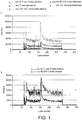
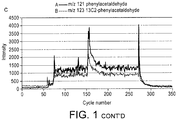
Figure 1
Figure 1 shows addition of water (5 mL; at cycle number: 155) labelled and unlabelled aroma-active compounds in sunflower oil (10 g) at 37 °C (reference sample).- A: Methylpropanal, sum of 2- and 3-methylbutanal, phenylacetaldehyde, [2H2]-3-methylbutanal, and [13C2]-phenylacetaldehyde;
- B: Sum of 2- and 3-methylbutanal and [2H2]-3-methylbutanal;
- C: Phenylacetaldehyde and [13C2]-phenylacetaldehyde.
-
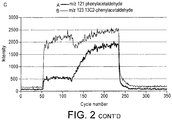
Figure 2
Figure 2 shows addition of water (5 mL; at cycle number: 120) to spiked chocolate (5 g) at 37 °C.- A: Methylpropanal, sum of 2- and 3-methylbutanal, phenylacetaldehyde, [2H2]-3-methylbutanal, and [13C2]-phenylacetaldehyde
- B: Sum of 2- and 3-methylbutanal and [2H2]-3-methylbutanal
- C: Phenylacetaldehyde and [13C2]-phenylacetaldehyde
-
Figure 3
Figure 3 shows addition of saliva (5 mL; at cycle number: 100-104) to spiked chocolate (5 g) at 37 °C.- A: Methylpropanal, sum of 2- and 3-methylbutanal, phenylacetaldehyde, [2H2]-3-methylbutanal, and [13C2]-phenylacetaldehyde.
- B: Sum of 2- and 3-methylbutanal and [2H2]-3-methylbutanal.
- C: Phenylacetaldehyde and [13C2]-phenylacetaldehyde.
-
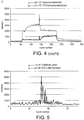
Figure 4
Figure 4 shows the release of 2- and 3-methylbutanal as well as phenylacetaldehyde from spiked chocolate.- A: Methylpropanal, sum of 2- and 3-methylbutanal, phenylacetaldehyde, [2H2]-3-methylbutanal, and [13C2]-phenylacetaldehyde.
- B: Sum of 2- and 3-methylbutanal and [2H2]-3-methylbutanal.
- C: Phenylacetaldehyde and [13C2]-phenylacetaldehyde.
-
Figure 5
Figure 5 shows the release of 3-methylbutanal from spiked chocolate. -
Figure 6
Figure 6 shows A) the synthesis of 2-(2-methylpropyl)-5-methyl-3-oxazoline and B) the mass spectra of 2-(2-methylpropyl)-5-methyl-3-oxazoline. -
Figure 7
Figure 7A shows A) the synthesis of 2-methylphenyl-5-methyl-3-oxazoline and B) the mass spectra of 2-methylphenyl-5-methyl-3-oxazoline. -
Figure 8
Figure 8 shows synthetic routes used in the preparation of 2-substituted-5-methyl-3-oxazolines. A: 2-(2-methylpropyl)- (2), B: 2-(1-methylpropyl)- (4), C: 2-(1-methylethyl)- (6) and D: 2-(methylphenyl)-5-methyl-3-oxazoline (8). E: 2-(2-methylpropyl)-3-oxazoline (10). - The present invention will now be described in more detail in the following.
- The present invention relates to novel stable aroma precursors (in dry form) that can rapidly release key aroma molecules in the presence of water and/or hydrolytic enzymes. Thus, controlled aroma release under mild conditions just prior to or during the consumption event may be obtained. It also permits increasing aroma freshness and the characteristic authentic aroma of a given food or beverage. Aroma release may take place in the food preparation phase or even during the consumption event in the mouth.
- In its most general aspect the invention relates to compounds selected from the group consisting of 2-(2-methylpropyl)-5-methyl-3-oxazoline, 2-(1-methylpropyl)-5-methyl-3-oxazoline, 2-(methylphenyl)-5-methyl-3-oxazoline, 2-(2-methylthioethyl)-5-methyl-3-oxazoline, 2,5-dimethyl-3-oxazoline, 2-(3-aminopropyl)-5-methyl-3-oxazoline, and 2-(4-aminobutyl)-5-methyl-3-oxazoline.
- Such compounds may be used in any of the aspects according to the present invention.
- In the context of this invention 3-oxazoline is a synonym term for 2,5-dihydrooxazole and 2-oxazoline is a synonym term for 4,5-dihydrooxazole.
- In the present context it is to be understood that the compounds according to the present invention also cover tautomers, enantiomers and diastereomers of the compounds. Tautomers are isomers (structural isomers) of organic compounds that readily interconvert by a chemical reaction called tautomerization. This reaction commonly results in the formal migration of a hydrogen atom or proton, accompanied by a switch of a single bond and adjacent double bond. The concept of tautomerizations is called tautomerism. Because of the rapid interconversion, tautomers are generally considered to be the same chemical compound.
- In the present context it is to be understood that the compounds according to the invention may be enantiomers, diastereomers, as well as tautomers of the compounds according to the invention. Thus, in an embodiment the compounds are enantiomers, diastereomers, or tautomers of the compounds according to the invention.
- Surprisingly, the oxazoline compounds according to the present invention have the capacity to directly release Strecker aldehydes in the presence of an aqueous liquid (such as water) were identified on the basis of NMR experiments and MS techniques. Their structure was confirmed by synthesis as described in examples 1 and 2.
Figure 8 provides further examples of synthetic routes used in the preparation of Strecker aldehyde precursors. - These novel class of precursors of Strecker aldehydes are stable in dry form (low water activity), but easily hydrolyse and liberate odour-active compounds (e.g. Strecker aldehydes), as there is no decarboxylation step required by the addition of an aqueous liquid. It has been demonstrated that the release of Strecker aldehydes from both isomers (diastereoisomers) show similar kinetics. As illustrated in example 3, about 75 % 2-(2-methylpropyl)-5-methyl-2,5-dihydro-oxazole (2-(2-methylpropyl)-5-methyl-3-oxazoline) was converted to Strecker aldehyde only 5 minutes after addition of water at 37°C.
- The hydrolysis may take place (i) by adding water to a food product or (ii) during food consumption in the mouth. The hydrolysis efficiency depends on the type of Maillard intermediate used, in particular on the rest R (see examples 3 to 6) as well as on the pH of the solution (examples 7 and 8). Lower hydrolysis speed can be compensated for by using hot water or longer hydrolysis time (e.g. chewing).
- Strecker aldehydes are key molecules generated during food processing. However, they may also be formed in the mouth during mastication. That means there may be specific stable precursor intermediates present in food (e.g. chocolate, cereal-based products, cocoa/malt-based products) that decompose by interaction with the saliva to the corresponding Strecker aldehyde. This statement is supported by the examples 12 and 13.
- The compounds according to the invention are selected from the group consisting of 2-(2-methylpropyl)-5-methyl-3-oxazoline, 2-(1-methylpropyl)-5-methyl-3-oxazoline, 2-(methylphenyl)-5-methyl-3-oxazoline, 2-(2-methylthioethyl)-5-methyl-3-oxazoline, 2,5-dimethyl-3-oxazoline, 2-(3-aminopropyl)-5-methyl-3-oxazoline, and 2-(4-aminobutyl)-5-methyl-3-oxazoline.
- The compounds according to the invention may release Strecker aldehydes by the addition of liquid. Thus, in an embodiment the compounds according to the invention are Strecker aldehyde precursors.
- The compounds according to the present invention are stable in dry form, which may be expressed as "water activity". Water activity or aw was developed to account for the intensity with which water associates with various non-aqueous constituents and solids. Simply stated, it is a measure of the energy status of the water in a system. It is defined as the vapor pressure of a liquid divided by that of pure water at the same temperature; therefore, pure distilled water has a water activity of exactly one. In an embodiment the compounds according to the present invention are stored in a dry state or in a state with low water activity. Thus, in an embodiment the compounds are stored in a state with a water activity in the range 0.01-0.7, such as in the range 0.01-0.6, such as 0.01-0.5, such as 0.01-0.4, such as 0.01-0.3, such as 0.1- 0.7, such as 0.2-0.7, such as 0.3-0.7, such as 0.4-0.7, or such as 0.5-0.7. Such low water activity may also be present if the compounds are stored in an organic solvent.
- As previously mentioned the compounds according to the present invention may function as flavor/aroma precursors. Thus, in a further embodiment the compound is a flavor/aroma precursor. In the present context the term "flavor/aroma precursor" relates to compounds which are able to liberate compounds which may be sensed both as a flavor and/or as an aroma.
- The compounds according to the present invention may be obtained by different methods. Thus, in an aspect of the present invention relates to a method for obtaining a compound according to the present invention comprising
- a) chemically synthesizing the compound; or
- b) isolating or enriching a fraction of the compound from a natural source; or
- c) providing the compound by fermentation of a micro-organism.
- In a preferred embodiment the compound is synthetically produced. When the compounds are chemically synthesized, the starting materials may vary. In another embodiment the compound is synthesized from an amino acid or a Strecker aldehyde as an at least first starting material. In a further embodiment the Strecker aldehyde is selected from the group consisting of acetaldehyde, phenylacetaldehyde, 3-metylthiopropanal, 2-methylpropanal, 2-methylbutanal, 3-methylbutanal, 4-aminobutanal, and 5-aminopentanal.
- In yet an embodiment the compound is synthesized from a second starting material selected from the group consisting of linear dicarbonyls, ascorbic acid, dehydroascorbic acid, cyclic enolones, oxidized phenolic compounds, polyphenols, chinones and any derivative thereof.
- In another embodiment the cyclic enoles are selected from the group consisting of


- As also described above, it is to be understood that the above list of compounds also covers tautomers, enantiomers and diastereomers of the compounds. The synthesized oxazolidine may be further oxidized to the respective oxazolines according to the present invention. Thus, in a further embodiment the oxazolidines are oxidized to oxazolines. In yet a further embodiment the oxidation is a Dess-Martin oxidation.
- Further details of chemical syntheses of the compounds according to the invention are presented in examples 1 and 2.
- In an additional embodiment the compound is synthesized from the first starting material in combination with the second starting material.
- Since the Strecker aldehydes are released in an aqueous liquid it may be an advantage to use a different solvent. Thus, in an embodiment the compound is synthesized in a non-aqueous system, such as in an organic solvent system such as in dichloromethane, propylenglycol, glycol, glycerine, triacetine, lipids (such as fats, oils, monoglycerides, diglycerides, and phospholipids).
- The compounds according to the present invention may also be isolated from natural sources. Thus, in an embodiment the compound is isolated from a natural source selected from, for example, cocoa, cocoa beans, malt, malted cereals, roasted cereals and seeds. In an embodiment compound is isolated or enriched through thermal processing. For example, amino acids forming sensory relevant Strecker aldehydes (such as phenylalanine, leucine, valine, isoleucine) are mixed into a cocoa mass and the resulting mixture is heated at 130 to 150°C during 20 to 60 min. Then after the cocoa mass enriched with oxazolines is cooled down and ready for use.
- If the compounds are to be produced in micro-organisms, different organisms may be selected. Thus, in an embodiment the micro-organism are bacteria or yeast strains.
- Since the compounds according to the present invention are able to liberate aroma-active aldehydes in the present of a liquid, such as water, the compounds may be incorporated in food ingredients. Thus an aspect of the present invention relates to a food ingredient enriched with one or more compounds selected from the group consisting of 2-(2-methylpropyl)-5-methyl-3-oxazoline, 2-(1-methylpropyl)-5-methyl-3-oxazoline, 2-(methylphenyl)-5-methyl-3-oxazoline, 2-(2-methylthioethyl)-5-methyl-3-oxazoline, 2,5-dimethyl-3-oxazoline, 2-(3-aminopropyl)-5-methyl-3-oxazoline, and 2-(4-aminobutyl)-5-methyl-3-oxazoline. Since the aroma-active aldehydes are released in the present of moisture, it may be advantageous to have the compounds present in low moisture ingredients. Thus, in another embodiment the food ingredient has a water activity in the range 0.01-0.7, such as in the range 0.01-0.6, such as 0.01-0.5, such as 0.01-0.4, such as 0.01-0.3, such as 0.01-0.2, such as 0.01-0.1, such as 0.1- 0.7, such as 0.2-0.7, such as 0.3-0.7, such as 0.4-0.7, or such as 0.5-0.7. Preferably the water activity is below 0.3 such as below 0.2.
- Depending on the specific type(s) of compound(s) which are present in the food ingredient and also depending on the type of food ingredient, the concentration may vary. Thus, in an embodiment the food ingredient has a total concentration of one or more of the compounds in the range of 0.1 ppb to 10000 ppm.
- In an embodiment the food ingredient is selected from the group consisting of dry coffee powder, toppings, coatings, cocoa powder, malt, roasted/toasted cereals, and reaction flavours (as such or part of coatings).
- The compounds according to the present invention may also be part of food products which are ready to consumption, or food products which are ready to be consumed after addition of a liquid. Thus, a further aspect of the present invention relates to a food product enriched with one or more compounds selected from the group consisting of 2-(2-methylpropyl)-5-methyl-3-oxazoline, 2-(1-methylpropyl)-5-methyl-3-oxazoline, 2-(methylphenyl)-5-methyl-3-oxazoline, 2-(2-methylthioethyl)-5-methyl-3-oxazoline, 2,5-dimethyl-3-oxazoline, 2-(3-aminopropyl)-5-methyl-3-oxazoline, and 2-(4-aminobutyl)-5-methyl-3-oxazoline.
or
a food product enriched with a food ingredient according to the present invention. Thus, the compounds may be added directly to the food product or be present through the presence of a food ingredient comprising the one or more compounds. - Similar to the food ingredient, the food product preferably have a low moisture content. Thus, in an embodiment the food product has a water activity in the range 0.01-0.7, such as in the range 0.01-0.6, such as 0.01-0.5, such as 0.01-0.4, such as 0.01-0.3, such as 0.01-0.2, such as 0.01-0.1, such as 0.1- 0.7, such as 0.2-0.7, such as 0.3-0.7, such as 0.4-0.7, or such as 0.5-0.7. Preferably the water activity is below 0.3 such as below 0.2.
- Depending on the specific type(s) of compound(s) which are present in the food product and also depending on the type of food product, the concentration may vary. Thus, in yet another embodiment the food product has a total concentration of one or more of the compounds in the range of 0.1 ppb to 10000 ppm.
- The specific type of food product may vary. Possible products are powders and solid foods that are reconstituted before consumption by adding (hot) milk or water, i.e. dry culinary products, coffee mixes, breakfast cereals, chocolate, etc. Alternatively, the flavor-active molecules can be liberated during consumption using products that stay relatively long in the mouth, i.e. chocolate, confectionery products, cereal-based snacks. Thus, in an embodiment the food product is selected from the group consisting of dry culinary products, beverages (coffee, coffee mixes, cocoa malt beverages, tea), breakfast cereals, chocolate, confectionery products, and cereal-based products such as snacks, infant cereals, and all family cereals, biscuits, wafers, chewing gum and petfood. It is to be understood that such food products may also be considered as a food ingredient according to the present invention in the case that such food products forms part of a composite food product.
- It may be advantageous to have the compounds isolated from other parts of the food product to avoid early release of the Strecker aldehydes due to high moisture content in the remaining part of the food product. Thus, in an embodiment the compound is encapsulated in a compartment in the food product. In another embodiment the encapsulation has a water activity below 0.4, such as below 0.3, such as below 0.2. It may also be advantageous if the compound could be controllable released from the encapsulation. Thus, in yet an embodiment the encapsulation dissolves or disintegrates by the addition of an aqueous liquid.
- Such encapsulations may be made from different compositions. In an embodiment the encapsulation comprises a lipophilic phase. In another embodiment the encapsulation is made of a structured lipid phase comprising a polar solvent and a lipid plus an emulsifier (examples of such structured lipid phases are described in
US2011189367 andWO201173035 - The flavor/aroma enriched food products or food ingredients according to the present invention may be obtained by different methods. In one aspect the invention relates to a method for producing a flavor/aroma enriched food product or food ingredient comprising
- a) providing a food product or food ingredient;
- providing one or more compounds selected from the group consisting of 2-(2-methylpropyl)-5-methyl-3-oxazoline, 2-(1-methylpropyl)-5-methyl-3-oxazoline, 2-methylphenyl-5-methyl-3-oxazoline, 2-(2-methylthioethyl)-5-methyl-3-oxazoline, 2,5-dimethyl-3-oxazoline, 2-(3-aminopropyl)-5-methyl-3-oxazoline, and 2-(4-aminobutyl)-5-methyl-3-oxazoline;
- b) mixing a) and b.
- Similar a food product may be obtained by
- a) providing a food product;
- b) providing a food ingredient according to the present invention;
- c) mixing or assembling a) and b).
- The wording "assembling" relates to the situation where the food product and food ingredient are not mixed, but instead assembled, e.g. in the case the ingredient is a topping or part of a layered product.
- As described previously the compounds of the present invention may function as flavor/aroma precursors. Thus, yet an aspect of the present invention relates to the use of a compound selected from the group consisting of 2-(2-methylpropyl)-5-methyl-3-oxazoline, 2-(1-methylpropyl)-5-methyl-3-oxazoline, 2-(methylphenyl)-5-methyl-3-oxazoline, 2-(2-methylthioethyl)-5-methyl-3-oxazoline, 2,5-dimethyl-3-oxazoline, 2-(3-aminopropyl)-5-methyl-3-oxazoline, and 2-(4-aminobutyl)-5-methyl-3-oxazoline.
as a flavor/aroma precursor. - Yet another aspect relates to the use of a compound selected from the group consisting of 2-(2-methylpropyl)-5-methyl-3-oxazoline, 2-(1-methylpropyl)-5-methyl-3-oxazoline, 2-(methylphenyl)-5-methyl-3-oxazoline, 2-(2-methylthioethyl)-5-methyl-3-oxazoline, 2,5-dimethyl-3-oxazoline, 2-(3-aminopropyl)-5-methyl-3-oxazoline, and 2-(4-aminobutyl)-5-methyl-3-oxazoline in a Strecker aldehyde release system. In an embodiment Strecker aldehyde release system is a food ingredient or a food product.
- In a further aspect the invention relates to the use of a food ingredient according to the present invention as a flavor/aroma precursor in food products.
- The compounds according to the present invention may be used as precursors for the release of Strecker aldehydes. Thus, in an additional aspect the invention relates to a method for providing a Strecker aldehyde from a composition having a water activity in the range 0.01-0.7 and comprising one or more compounds selected from the group consisting of 2-(2-methylpropyl)-5-methyl-3-oxazoline, 2-(1-methylpropyl-5-methyl-3-oxazoline, 2-(methylphenyl)-5-methyl-3-oxazoline, 2-(2-methylthioethyl)-5-methyl-3-oxazoline, 2,5-dimethyl-3-oxazoline, 2-(3-aminopropyl)-5-methyl-3-oxazoline, and 2-(4-aminobutyl)-5-methyl-3-oxazoline
the method comprising adding an aqueous liquid to the composition. In a further embodiment the composition is a food product or a food ingredient. - The type of liquid used to initiate the release of the aldehydes may vary. Thus, in an embodiment the liquid is water, an aqueous suspension, saliva, juice or milk. In yet an embodiment the liquid comprises sugar or salts.
- The temperature of the reaction may vary. Thus, in an embodiment the method is performed at a temperature in the range of 1-100°C, such as 1-40°C, such as 40-80°C or such as 80-100°C. Such temperatures may be advantageous if the product is to be consumed immediately or if the product is e.g. cereals where cold milk is used as the liquid. Thus, in yet an embodiment the temperature is in the range of 1-10°C. Since the compounds may also be present in e.g. coffee mixes which are mixed with hot water, the temperature may also be higher. Thus, in a further embodiment the temperature is in the range of 80-100°C, such as 90-98°C.
The compounds may also be released in the mouth during consumption due to the saliva. Thus, in an embodiment the temperature is in the range 30-40°C.
As previously mentioned the Strecker aldehydes may be released without a decarboxylation step. Thus, in an embodiment the method does not require decarboxylation of the one or more compounds. - The pH of the reaction may be adjusted to control the release of the Strecker aldehydes from the compounds. The reaction goes faster at lower pH's, whereas it is slowed down if the pH is raised. Thus, in an embodiment the reaction is performed at pH 4-10, such as 4-6, such as 6-8, or such as 8-10. The pH may be controlled by the components in the food product or food ingredient or by the added liquid.
- It should be noted that embodiments and features described in the context of one of the aspects of the present invention also apply to the other aspects of the invention. Especially the embodiment relating to the compounds, also relates to the other aspects of the invention wherein similar compounds are included.
- The invention will now be described in further details in the following non-limiting examples.
- The examples illustrate the release of flavour-active Strecker aldehydes and the sensory impact achieved by using such oxazoline precursors in food products.
- Syntheses of the 3-oxazolines derived from valine, leucine, and isoleucine.
- (R)-1-amino-2-propanol (20 mmol) was dissolved in dichloromethane (80 mL; dried over anhydrous sodium sulfate), the respective aldehyde (20 mmol; methylpropanal, 3-methylbutanal, or 2-methylbutanal) was added and the reaction mixture was stirred at room temperature for 12 h (yield: approximately 50 %). To an aliquot (20 mL; about 2.5 mmol of 3-oxazolidine), first dichloromethane (60 mL), and afterwards Dess-Martin periodinane (3.5 mmol) was added. Using freshly prepared Dess-Martin periodinane, the reaction to the corresponding 3-oxazolines was completed after 30 minutes. (If the oxidation reagent is not freshly prepared, more acetic acid might be present in the reaction mixture (detectable by human nose), and thus, sodium carbonate should added for buffering.) After addition of pentane (25 mL), the mixture was filtered and submitted to high vacuum distillation at about 50 °C (SAFE technique). The obtained distillate was evaporated to a volume of approximately 1 mL (oily residue). After addition of a pentane/diethyl ether mixture (3 mL; 70/30; v/v), the solution was applied onto a column chromatography (22 x 2 cm; starting conditions: 100 % of pentane) using a diol phase (Bakerbond, Baker,Griesheim, Germany).
- Leucine related precursor:
Elution was performed as following:• Fraction 1: 100 mL pentane/diethyl ether (100/0; v/v) • Fraction 2: 50 mL pentane/diethyl ether (95/5; v/v) • Fraction 3: 200 mL pentane/diethyl ether (95/5; v/v) • Fraction 4: 100 mL pentane/diethyl ether (95/5; v/v).
Fraction 3 contained the respective 3-oxazoline 2-(2-methylpropyl)-5-methyl-3-oxazoline (present in two diastereomeric forms) and was used for re-chromatography using the same diol phase with the following elution:• Fraction 1: 100 mL pentane/diethyl ether (100/0; v/v) • Fraction 2: 50 mL pentane/diethyl ether (95/5; v/v) • Fraction 3: 50 mL pentane/diethyl ether (95/5; v/v) • Fraction 4: 50 mL pentane/diethyl ether (95/5; v/v) • Fraction 5: 50 mL pentane/diethyl ether (95/5; v/v). - Isomer I of 2-(2-methylpropyl)-5-methyl-3-oxazoline was found in
fraction 3, a mixture of isomers I and II was found infraction 4, and isomer II was found infraction 5. - Figure 6A shows the synthesis of 2-(2-methylpropyl)-5-methyl-3-oxazoline and
Figure 6B shows the mass spectra of 2-(2-methylpropyl)-5-methyl-3-oxazoline:
Isoleucine related precursor:
Elution was performed as following:• Fraction 1: 100 mL pentane/diethyl ether (100/0; v/v) • Fraction 2: 150 mL pentane/diethyl ether ( 95/5; v/v) • Fraction 3: 20 mL pentane/diethyl ether ( 95/5; v/v) • Fraction 4: 50 mL pentane/diethyl ether ( 95/5; v/v) • Fraction 5: 100 mL pentane/diethyl ether (90/10; v/v). Fraction 2 contained the respective 3-oxazoline 2-(1-methylpropyl)-5-methyl-3-oxazoline (single isomer I) andfraction
Valine related precursor:
Elution was performed as following:• Fraction 1: 100 mL pentane/diethyl ether (100/0; v/v) • Fraction 2: 150 mL pentane/diethyl ether ( 95/5; v/v) • Fraction 3: 100 mL pentane/diethyl ether (90/10; v/v) • Fraction 4: 50 mL pentane/diethyl ether (90/10; v/v). -
Fraction - Leucine related precursor: 2-(2-methylpropyl)-5-methyl-3-oxazoline
- MS-EI; m/z (%): 84 (100), 57 (27), 54 (14), 41 (13), 56 (11), 85 (10), 43 (9), 70 (9), 82 (8), 39 (7), 71 (7), 83 (7), 99 (7), 97 (6), 42 (5), 140 ([M-H]+; 1), 141 (M+; tr).
- MS-CI; m/z (%): 142 ([M+H]+;100), 143 (11).
- 1H NMR [400 MHz; CD2Cl2]: 0.97 [d, J = 6.7 Hz, 6H, H-C(7,8)], 1.30 [d, J = 6.7 Hz, 3H, H-C(1)], 1.42-1.48 [m, 1H, H-C(5a)], 1.57-1.63 [m, 1H, H-C(5b)], 1.83-1.92 [m, 1H, H-C(6)], 4.69-4.74 [m, 1H, H-C(2)], 5.55-5.59 [m, 1H, H-C(4)], 7.36 [d, J = 2.6 Hz, 1H, H-C(3)].
- 13C NMR [400 MHz, CD2Cl2]: 19.75 [C(1)], 22.78 [C(7)], 23.80 [C(8)], 25.27 [C(6)], 46.80 [C(5)], 82.07 [C(2)], 105.61 [C(4)], 7,36 [C(3)].
- Isoleucine related precursor: 2-(1-methylpropyl)-5-methyl-3-oxazoline
- MS-EI; m/z (%): 84 (100), 56 (48), 57 (28), 112 (28), 85 (27), 54 (16), 41 (13), 43 (10), 70 (10), 82 (10), 71 (9), 83 (9), 39 (8), 97 (7), 113 (6), 140 ([M-H]+; 1), 141 (M+; tr).
- MS-CI; m/z (%): 142 ([M+H]+; 100), 143 (11).
- 1H NMR [400 MHz; CDCl3]: 0.92 [t, J = 7.4 Hz, 3H, H-C(7)], 1.16 [d, J = 7.0 Hz, 3H, H-C(8)], 1.30 [d, J = 6.2 Hz, 3H, H-C(1)], 1.42-1.54 [m, 1H, H-C(6a)], 1.61-1.72 [m, 1H, H-C(6b)], 2.33-2.42 [m, 1H, H-C(5)], 3.34-3.39 [m, 1H, H-C(3a)], 3.87-3.93 [m, 1H, H-C(3b)], 4,59-4,67 [m, 1H, H-C(2)].
- 13C NMR [400 MHz, CDCl3]: 11.65 [C(7)], 13.59 [C(8)], 18.33 [C(1)], 24.42 [C(6)], 40.18 [C(5)], 81.88 [C(3)], 109.38 [C(2)], 164.08 [C(4)].
- Valine related precursor: 2-(1-methylethyl)-5-methyl-3-oxazoline
- MS-EI; m/z (%): 84 (100), 56 (75), 57 (63), 70 (30), 112 (30), 85 (29), 83 (28), 68 (26), 110 (15), 55 (9), 41 (12), 43 (9), 39 (8), 127 (M+; 1).
- MS-CI; m/z (%): 128 ([M+H]+; 100), 129 (11).
- 1H NMR [400 MHz; CDCl3]: 0.93 [d, J = 6.8 Hz, 3H, H-C(8)], 0.96 [d, J = 6.8 Hz, 3H, H-C(9)], 1.29 [d, J = 6.7 Hz, 3H, H-C(6)], 1.91-1.99 [m, 1H, H-C(7)], 4.80-4.86 [m, 1H, H-C(5)], 5.56-5.59 [m, 1H, H-C(2)], 7.48 [d, J = 2.5 Hz, 1H, H-C(4)].
- 13C NMR [100 MHz, CDCl3]: 16.61 [C(8 or 9)], 17.26 [C(9 or 8)], 18.26 [C(6)], 33.52 [C(7)], 82.10 [C(5)], 110.25 [C(2)], 163.87 [C(4)].
- Syntheses of the 3-oxazolines derived from phenylalanine.
- (R)-1-amino-2-propanol (20 mmol) was dissolved in dichloromethane (200 mL; dried over anhydrous sodium sulfate), phenylacetaldehyde (20 mmol; freshly prepared by distillation) was added and the reaction mixture was stirred at room temperature for 30 min (yield: approximately 14 %). To the reaction mixture (about 2.8 mmol of 3-oxazolidine), Dess-Martin periodinane (3.5 mmol) was added. Using freshly prepared Dess-Martin periodinane, the reaction to the corresponding 3-oxazoline was completed after 30 minutes. (If the oxidation reagent is not freshly prepared, more acetic acid might be present in the reaction mixture (detectable by human nose), and thus, sodium carbonate should be added for buffering.) After addition of pentane (25 mL), the mixture was filtered and submitted to high vacuum distillation at about 50 °C (SAFE technique). The obtained distillate was evaporated to a volume of approximately 1 mL (oily residue). After addition of a pentane/diethyl ether mixture (3 mL; 70/30; v/v), the solution was applied onto a column chromatography (22 x 2 cm; starting conditions: 100 % of pentane) using a diol phase (Bakerbond, Baker).
- Elution was performed as following:
• Fraction 1: 100 mL pentane/diethyl ether (100/0; v/v) • Fraction 2: 200 mL pentane/diethyl ether (90/10; v/v) • Fraction 3: 150 mL pentane/diethyl ether (90/10; v/v) • Fraction 4: 50 mL pentane/diethyl ether (90/10; v/v). -
Fraction 3, containing the respective 3-oxazoline (2-methylphenyl-5-methyl-3-oxazoline), was used for re-chromatography using the same diol phase with the following elution:• Fraction 1: 100 mL pentane/diethyl ether (100/0; v/v) • Fraction 2: 250 mL pentane/diethyl ether (90/10; v/v) • Fraction 3: 125 mL pentane/diethyl ether (90/10; v/v) • Fraction 4: 100 mL pentane/diethyl ether (80/20; v/v) • Fraction 5: 100 mL pentane/diethyl ether (80/20; v/v). - Isomer I of 2-methylphenyl-5-methyl-3-oxazoline was found in
fraction 3, a mixture of isomers I and II was found infraction 4, and isomer II was found infraction 5. -
Figure 7A shows the synthesis of 2-methylphenyl-5-methyl-3-oxazoline and figure 7B shows the mass spectra of 2-methylphenyl-5-methyl-3-oxazoline. - Phenylalanine related precursor: 2-methylphenyl-5-methyl-3-oxazoline
- MS-EI; m/z (%): 84 (100), 91 (70), 92 (42), 57 (39), 65 (11), 77 (11), 104 (10), 39 (8), 41 (8), 103 (8), 131 (8), 130 (8), 44 (7), 40 (6), 51 (8), 56 (8), 78 (6), 85 (5), 174 (5), 175 (M+; 4).
- MS-Cl; m/z (%): 176 ([M+H]+; 100), 177 (12).
- 1H NMR [400 MHz; CD2Cl2]: 1.25 [d, J = 6.7 Hz, 3H, H-C(6)], 2.92 [dd, J = 13.8 Hz, 5.7 Hz, 1 H, H-C(7a)], 3.08 [dd, J = 13.8 Hz, 5.0 Hz, H-C(7b)], 4.67-4.70 [m, 1 H, H-C(5)], 5.95-5.98 [m, 1 H, H-C(2)], 7.22-7.33 [m, 5H, H-C(9, 10, 11, 12, 13)], 7.40 [d, J = 2.4 Hz, 1 H, H-C(4)].
- 13C NMR [100 MHz, CD2Cl2]: 18.43 [C(6)], 42.11 [C(7)], 82.39 [C(5)], 106.58 [C(2)], 126.75 [C(11)], 128.46 [C(9, 13)], 130.40 [C(10, 12)], 106.58 [C(8)], 164.70 [C(4)].
- Release of 3-methylbutanal from 2-(2-methylpropyl)-5-methyl-3-oxazoline.
- 2-(2-Methylpropyl)-5-methyl-3-oxazoline (dissolved in pentane/diethyl ether; 2 mL) was added to ethanol (0.5 mL). The pentane/diethyl ether was carefully evaporated, and finally made up to 5 mL with ethanol. An aliquot (0.5 mL) was added to water (5 mL) containing the isotopically labelled standard ([2H2]-3-methylbutanal) and stirred in closed glass vials for 5, 15 or 30 min at 37 °C. A control experiment was performed with 2-(2-methylpropyl)-5-methyl-3-oxazoline and the respective standard without adding water. For headspace measurements, the samples were directly subjected to HS-GC-MS. For liquid measurements, the samples were cooled in an ice bath and extracted with diethyl ether (3 x 15 mL; liquid-liquid extraction). The organic phases were combined, dried over anhydrous sodium sulphate, and the solvent was distilled off (20 °C, 500 mbar) to about 4 mL. An aliquot (2 µL) was used for the stable isotope dilution assays ((GC-) GC-MS).
- The results shown in Table 1 below clearly indicate substantial release of 3-methylbutanal within few minutes after addition of water.
Table 1: Kinetics of the release of the Strecker aldehyde 3-methylbutanal from 2-(2-methylpropyl)-5-methyl-3-oxazolinea Time (min) 3-methylbutanal (mol %) generated fromb isomer I isomer II Controlc 0.3 0.4 5 72.7 72.5 15 82.4 81.4 30 91.1 92.2 a) The precursor was stirred in water at 37 °C.
b) In relation to the amount of precursor used.
c) Control experiment without addition of water. - Release of phenylacetaldehyde from 2-methylphenyl-5-methyl-3-oxazoline.
- 2-Methylphenyl-5-methyl-3-oxazoline (dissolved in pentane/diethyl ether; 2 mL) was added to ethanol (0.5 mL). The pentane/diethyl ether was carefully evaporated, and finally made up to 5 mL with ethanol. An aliquot (0.5 mL) was added to water (5 mL) containing the isotopically labelled standard ([13C2]-phenylacetaldehyde) and stirred in closed glass vials for 5, 15 or 30 min at 37 °C. A control experiment was performed with 2-methylphenyl-5-methyl-3-oxazoline and the respective standard without adding water. For headspace measurements, the samples were directly subjected to HS-GC-MS. For liquid measurements, the samples were cooled in an ice bath and extracted with diethyl ether (3 x 15 mL; liquid-liquid extraction). The organic phases were combined, dried over anhydrous sodium sulphate, and the solvent was distilled off (20 °C, 500 mbar) to about 4 mL. An aliquot (2 µL) was used for the stable isotope dilution assays ((GC-) GC-MS).
- Similarly to example 3, substantial release of 2-phenylacetaldehyde was observed within few minutes after addition of water (Table 2).
Table 2: Kinetics of the release of the Strecker aldehyde phenyacetaldehyde from 2-methylphenyl-5-methyl-3-oxazolinea. Time (min) phenylacetaldehyde (mol %) generated fromb isomer I isomer II Controlc 0.2 0.3 5 16.6 17.2 15 23.1 32.2 30 42.5 46.5 a) The precursor was stirred in water at 37 °C.
b) In relation to the amount of precursor used.
c) Control experiment without addition of water. - Release of 2-methylbutanal from 2-(1-methylpropyl)-5-methyl-3-oxazoline.
- 2-(1-Methylpropyl)-5-methyl-3-oxazoline (dissolved in pentane/diethyl ether; 2 mL) was added to ethanol (0.5 mL). The pentane/diethyl ether was carefully evaporated, and finally made up to 5 mL with ethanol. An aliquot (0.5 mL) was added to water (5 mL) containing the isotopically labelled standard ([2H2]-2-methylbutanal) and stirred in closed glass vials for 5, 15 or 30 min at 37 °C. A control experiment was performed with 2-(1-methylpropyl)--5-methyl-3-oxazoline and the respective standard without adding water. For headspace measurements, the samples were directly subjected to HS-GC-MS. For liquid measurements, the samples were cooled in an ice bath and extracted with diethyl ether (3 x 15 mL; liquid-liquid extraction). The organic phases were combined, dried over anhydrous sodium sulphate, and the solvent was distilled off (20 °C, 500 mbar) to about 4 mL. An aliquot (2 µL) was used for the stable isotope dilution assays ((GC-) GC-MS).
- The results shown in Table 3 below indicate substantial release of 2-methylbutanal within few minutes after addition of water.
Table 3: Kinetics of the release of the Strecker aldehyde 2-methylbutanal from 2-(1-methylpropyl)-5-methyl-3-oxazolinea. Time (min) 2-methylbutanal (mol %) generated fromb isomer I / isomer II Controlc 1.1 5 14.6 15 33.3 30 55.6 a) The precursor was stirred in water at 37 °C.
b) In relation to the amount of precursor used.
c) Control experiment without addition of water. - Release of methylpropanal from 2-(1-methylethyl)-5-methyl-3-oxazoline.
- 2-(1-Methylethyl)-5-methyl-3-oxazoline (dissolved in pentane/diethyl ether; 2 mL) was added to ethanol (0.5 mL). The pentane/diethyl ether was carefully evaporated, and finally made up to 5 mL with ethanol. An aliquot (0.5 mL) was added to water (5 mL) containing the isotopically labelled standard ([2H6]-methylpropanal) and stirred in closed glass vials for 5, 15 or 30 min at 37 °C. A control experiment was performed with 2-(1-methylethyl)-5-methyl-3-oxazoline and the respective standard without adding water. The samples were directly subjected to HS-GC-MS.
- The results shown in Table 4 clearly indicate substantial release of methylpropanal within few minutes after addition of water.
Table 4: Kinetics of the release of the Strecker aldehyde methylpropanal from 2-(1-methylethyl)-5-methyl-3-oxazolinea. Time (min) methylpropanal (mol %) generated fromb isomer I / isomer II Controlc 0.1 5 46.0 15 53.5 30 56.1 a) The precursor was stirred in water at 37 °C.
b) In relation to the amount of precursor used.
c) Control experiment without addition of water. - Impact of pH value on the kinetics of the release of 3-methylbutanal from 2-(2-methylpropyl)-5-methyl-3-oxazoline.
- 2-(2-Methylpropyl)-5-methyl-3-oxazoline (dissolved in pentane/diethyl ether; 2 mL) was added to ethanol (0.5 mL). The pentane/diethyl ether was carefully
- evaporated, and finally made up to 5 mL with ethanol. An aliquot (0.5 mL) was added to the respective buffer solution (5 mL,
pH - The results (Table 5) indicate significantly faster release of 3-methylbutanal at
pH pH 9.Table 5: Impact of pH value on the kinetics of the release of 3-methylbutanal from 2-(2-methylpropyl)-5-methyl-3-oxazolinea Time (min) 3-methylbutanal (mol %) generated fromb pH 5pH 7pH 9Controlc 0.5 0.3 0.3 10 95.1 54.8 9.0 60 98.9 97.9 35.7 a) The precursor was stirred in the respective buffer solution at 37 °C.
b) In relation to the amount of precursor used.
c) Control experiment without addition of the respective buffer solution. - Impact of pH value on the kinetics of the release phenylacetaldehyde from 2-methylphenyl-5-methyl-3-oxazoline.
- 2-Methylphenyl-5-methyl-3-oxazoline (dissolved in pentane/diethyl ether; 2 mL) was added to ethanol (0.5 mL). The pentane/diethyl ether was carefully evaporated, and finally made up to 5 mL with ethanol. An aliquot (0.5 mL) was added to the respective buffer solution (5 mL,
pH - The results (Table 6) indicate significantly faster release of phenylacetaldehyde at
pH 5 as compared topH Table 6: Impact of pH value on the kinetics of the release of phenylacetaldehyde from 2-methylphenyl-5-methyl-3-oxazolinea Time (min) phenylacetaldehyde (mol %) generated fromb pH 5pH 7pH 9Controlc 0.4 0.3 0.3 5 41.2 7.7 4.9 15 72.1 18.0 7.1 30 87.7 30.2 14.3 a) The precursor was stirred in the respective buffer solution at 37 °C.
b) In relation to the amount of precursor used.
c) Control experiment without addition of the respective buffer solution. - Release of 3-methylbutanal from cocoa-malt-based beverage spiked with 2-(2-methylpropyl)-5-methyl-3-oxazoline.
- Cocoa-malt-based beverage (7.5 g) was weighted into a Pyrex bottle. The product was spiked with 2-(2-methylpropyl)-5-methyl-3-oxazoline (10 mg) and the sample was then reconstituted in 100 mL of cold (10 °C) or warm (60 °C) semi-skimmed milk. Samples without addition of oxazoline were prepared analogously and used as references. The impact of the addition of the oxazoline on the intensity of malty aroma (characteristic aroma of 3-methylbutanal) was evaluated by a sensory panel. Comparative profiling procedure was conducted using an 11-point scale ranging from -5 to +5. Assessors were asked to score the sample containing oxazoline against the reference. Reference product containing no added oxazoline was arbitrary positioned on the zero of the scale.
- Irrespectively on the temperature of the milk, the samples containing oxazoline were scored significantly higher (cold milk 3.6; hot milk 3.3) in malty note as compared to reference products.
- Release of 3-methylbutanal from coffee mix beverage spiked with 2-(2-methylpropyl)-5-methyl-3-oxazoline.
- Coffee mix powder (16 g) was weighted into a Pyrex bottle. The product was spiked with 2-(2-methylpropyl)-5-methyl-3-oxazoline (10 mg) and the sample was then reconstituted in 130 ml of hot (80 °C) water. Sample without addition of oxazoline was prepared analogously and used as reference. The impact of the addition of the oxazoline on the intensity of malty aroma (characteristic aroma of 3-methylbutanal) was evaluated by a sensory panel as described in example 9. The sample containing oxazoline were scored significantly higher (3.5) in malty note as compared to reference product. To further substantiate the sensory results, the sample was analyzed by SPME-GCxGC-TOFMS.
- The results (Table 7) indicate that the conversion of oxazoline to Strecker aldehyde is very high and reaches 77% in the analysed coffee mix sample (
incubation 60 °C/15 min).Table 7: Amounts of 3-methylbutanal in coffee mix before and after spike with 2-(2-methylpropyl)-5-methyl-3-oxazoline. 3-methylbutanal (ug/vial) Non-spiked reference sample 28 Sample spiked with oxazoline 215 Theoretical release from spike 244 Yield of conversion 77 % - Release of 3-methylbutanal from cereal based pap spiked with 2-(2-methylpropyl)-5-methyl-3-oxazoline.
- Cereal powder (12.5 g) was weighted into a plastic dish. The product was spiked with 2-(2-methylpropyl)-5-methyl-3-oxazoline (10 mg) and the sample was then reconstituted in 100 ml of warm (60 °C) water or semi-skimmed milk. Sample without addition of oxazoline was prepared analogously and used as reference. The impact of the addition of the oxazoline on the intensity of malty aroma (characteristic aroma of 3-methylbutanal) was evaluated by a sensory panel as described in example 9.
- The samples containing oxazoline were scored higher (water 1.7; milk 1.2) in malty note as compared to reference products.
- Release of methylpropanal, 2-methylbutanal, 3-methylbutanal, and phenylacetaldehyde from commercial chocolate.
- Commercial chocolate (50 % of cocoa content) was frozen in liquid nitrogen and ground to a powder using a mixer. An aliquote (50 g) was melted at 35 °C using a water bath and [2H2]-3-methylbutanal as well as [13C2]-phenylacetaldehyde were added. After stirring for 5 min, the chocolate was cooled to room temperature and used for all further PTR-MS experiments ("spiked chocolate").
- 5.0 g of spiked chocolate was weighed into an iodine flask (200 mL; sealed with a gastight septum) containing a stirring bar. The chocolate was melted at 37 °C for 5 min under stirring. Afterwards, the flask was connected to a PTR-MS instrument via a peek capillary (experiments were done at 37 °C). After defined time (details are given in the respective figures via number of cycles), water (5 mL, pH 4) or saliva (5 mL), respectively, was singly added through the septum via a syringe. As blank, methylpropanal (2.5 µg), 3-methylbutanal (6.25 µg), phenylacetaldehyde (25 µg), [2H2]-3-methylbutanal (4.3 µg), and [13C2]-phenylacetaldehyde (20 µg) were added to sunflower oil (10 g) in an iodine flask (200 mL). Following parameters are used for PTR-MS measurement:
inlet temperature 120 °C,chamber temperature 80 °C,inlet flow 70 mL/min. The mass traces and the dwell time used to monitor Strecker aldehydes are shown below:Compound Name Mass trace (m/z) Dwell time (msec) methylpropanal 73 200 2- and 3- methylbutanal 87 200 [2H2]-3- methylbutanal 89 200 phenylacetaldehyde 121 500 [13C2]- phenylacetaldehyde 123 500 - The results are summarised in
Figures 1 to 3 .
All monitored compounds (Strecker aldehydes and their corresponding labeled internal standards) showed a similar but only a small increase in blank sample after addition of water (Figure 1 ). On the other hand, the release of monitored Strecker aldehydes (methylpropanal, 2- and 3-methylbutanal, and phenylacetaldehyde) from spiked chocolate clearly increased after addition of water (Figure 2 ) or saliva (Figure 3 ) at 37 °C, whereas the respective standard revealed only a marginal increase. - To further confirm the PTR-MS data, all experiments are repeated using a headspace GC-MS system. Commercial chocolate (50 % of cocoa content) was frozen in liquid nitrogen and ground to a powder using a mixer. An aliquote (25 g) was melted at 35 °C using a water bath and [2H6]-methylpropanal, [2H2]-3-methylbutanal as well as [13C2]-phenylacetaldehyde were added. After stirring for 5 min, the chocolate was cooled to room temperature and used for all further headspace experiments ("spiked chocolate"). The newly spiked chocolate (2 g) was weighed into a headspace vial (10 mL; sealed with a gastight septum) containing a stirring bar. The chocolate was melted at 37 °C for 5 min under stirring. Then, the first injection (1 mL) was done at 37 °C used as blank sample. Afterwards, the sample was cooled to approx. 16 °C. After 30 min, saliva (2 mL) was added through the septum via a syringe, and the sample was again warmed to 37 °C under stirring. After a further 5 min, the second injection (1 mL) was done again at 37 °C ("release sample"). All experiments were done in triplicates. 2-Methylbutanal was quantified using [2H2]-3-methylbutanal. The short summary of the result is shown below:
Compound Name Concentration in blank sample (prior addition of saliva) Concentration in "release sample" (after addition of saliva) methylpropanal 25.4 µg/kg of chocolate 1103 µg/kg of chocolate 2-methylbutanal 354 µg/kg of chocolate 3009 µg/kg of chocolate 3-methylbutanal 502 µg/kg of chocolate 4456 µg/kg of chocolate phenylacetaldehyde < LoD (due to headspace analysis) < LoD (due to headspace analysis) - The GC-MS data permitted to demonstrate that the high release of mass trace m/
z 73 observed by the PTR-MS was due to the release of methylpropanal and a yet not identified substance, which was generated in a higher amount compared to methylpropanal. - Link between the release of Strecker aldehydes and the simultaneous decrease of the respective oxazoline.
- Samples were prepared as described in example 3 and 4. The results for 3-methylbutanal and 2-(2-methylpropyl)-5-methyl-3-oxazoline are summarised in Tables 8 and 9. Isomer I (Table 8) released huge amounts of 3-methylbutanal already after 5 min (73 %) increasing to > 80 % after 15 min and to > 90 % after 30 min, respectively. Interestingly, starting with purified isomer I (98 %), not only 3-methylbutanal was formed but also the corresponding isomer II (e.g., 5 % after 5 min).
- For isomer II (Table 9), nearly the same aroma release occurred. Also, the same tendency for isomeration was found, however, it seems that equilibration is somewhat slower.
Table 8: Formation of 3-methylbutanal from 2-(2-methylpropyl)-5-methyl-3-oxazoline (isomer I) in combination with the time course of isomer I in water at 37 °Ca. Time (min) 3-methylbutanal (mol %) generated from isomer Ib isomer I (unreacted) (mol %)b isomer II (formed) (mol %)b Controlc 0.3 98.1 1.9 5 72.7 16.2 5.1 15 82.4 8.4 10.2 30 91.1 2.9 4.3 a) The precursor was stirred in water at 37 °C.
b) In relation to the amount of precursor initially used.
c) Control experiment without addition of water.Table 9: Formation of 3-methylbutanal from 2-(2-methylpropyl)-5-methyl-3-oxazoline (isomer II) in combination with the time course of isomer II in water at 37 °Ca. Time (min) 3-methylbutanal (mol %) generated from isomer IIb isomer I (formed) (mol %)b isomer II (unreacted) (mol %)b Controlc 0.4 1.7 98.3 5 72.5 3.0 25.7 15 81.4 3.7 16.7 30 92.2 2.2 7.2 a) The precursor was stirred in water at 37 °C.
b) In relation to the amount of precursor initially used.
c) Control experiment without addition of water. - The results for phenylacetaldehyde and 2-methylphenyl-5-methyl-3-oxazoline are shown in Tables 10 and 11. Again, the Strecker aldehyde was liberated from isomer I already after 5 min (17 %) increasing to > 20 % after 15 min and to > 40 % after 30 min, respectively. Interestingly, the aroma release is much slower (17 % vs. 73 % after 5 min and 43 % vs. 91 % after 30 min for isomer I,
respectively) as compared to 3-methylbutanal. Again, starting with purified isomer I (98 %), not only phenylacetaldehyde but also the corresponding isomer II (e.g., 7 % after 5 min) were formed. For isomer II (Table 11), nearly the same aroma release occurred.Table 10: Formation of phenylacetaldehyde from 2-methylphenyl-5-methyl-3-oxazoline (isomer I) in combination with the time course of isomer I in water at 37 °Ca. Time (min) phenylacetaldehyde (mol %) generated from isomer Ib isomer I (unreacted) (mol %)b isomer II (formed) (mol %)b Controlc 0.2 98.0 2.0 5 16.6 31.8 7.1 15 23.1 31.1 6.3 30 42.5 22.3 5.8 a) The precursor was stirred in water at 37 °C.
b) In relation to the amount of precursor initially used.
c) Control experiment without addition of water.Table 11: Formation of phenylacetaldehyde from 2-methylphenyl-5-methyl-2-oxazoline (isomer II) in combination with the time course of isomer II in water at 37 °Ca. Time (min) phenylacetaldehyde (mol %) generated from isomer IIb isomer I (formed) (mol %)b isomer II (unreacted) (mol %)b Controlc 0.3 1.8 98.2 5 17.2 9.0 28.6 15 32.2 5.4 26.0 30 46.5 2.7 20.2 a) The precursor was stirred in water at 37 °C.
b) In relation to the amount of precursor initially used.
c) Control experiment without addition of water. - Release of 2-methylbutanal, 3-methylbutanal, and phenylacetaldehyde from spiked chocolate using a model mouth.
- The release of 2- and 3-methylbutanal as well as phenylacetaldehyde from spiked chocolate (1.5 g, prepared according to example 12) using model mouth at 37 °C is shown in
Figure 4 . The spiked chocolate was connected to model mouth. After defined time PTR-MS was connected to the mouth, and water (1.5 mL, pH 4) was added. The details are given below via number of cycles: - Cycle number 58: PTR-MS was connected to model mouth; piston was initially only rotating
- Cycle number 70: PTR-MS was connected to model mouth; piston is now rotating and moving up and down (simulating chewing process)
- Cycle number 145: PTR-MS was connected to model mouth; addition of water (1.5 mL); piston is still rotating and moving up and down (simulating chewing process)
- Cycle number 225: PTR-MS was disconnected from model mouth.
- The results clearly indicate release of targeted aldehydes after addition of water to the chocolate.
- In-mouth release of 3-methylbutanal from spiked chocolate.
- The release of 3-methylbutanal from spiked chocolate (2 g, prepared according to example 12) during chewing (mouth; swallow breath) is shown in
Figures 5 . PTR-MS was connected to the nose space of the test person duringcycle numbers 0 to 65. At given time (cycle number 35) spiked chocolate was taken into mouth, chewing was started including swallow breath. - The results showed clear increase of the ion m/z 87 (corresponding to the 3- and 2-methylbutanal) during chewing of the chocolate.
Claims (12)
- A compound selected from the group consisting of 2-(2-methylpropyl)-5-methyl-3-oxazoline, 2-(1-methylpropyl)-5-methyl-3-oxazoline, 2-(methylphenyl)-5-methyl-3-oxazoline, 2-(2-methylthioethyl)-5-methyl-3-oxazoline, 2,5-dimethyl-3-oxazoline, 2-(3-aminopropyl)-5-methyl-3-oxazoline, and 2-(4-aminobutyl)-5-methyl-3-oxazoline.
- A method for obtaining a compound according to claim 1 comprisinga) chemically synthesizing the compound; orb) isolating or enriching a fraction of the compound from a natural source; orc) providing the compound by fermentation of a micro-organism.
- The method according to claim 2, wherein the compound is synthesized from an amino acid or a Strecker aldehyde as a first starting material in combination with a second starting material selected from the group consisting of linear dicarbonyls, ascorbic acid, dehydroascorbic acid, cyclic enolones, oxidized phenolic compounds, polyphenols or chinones.
- A food ingredient enriched with one or more compounds according to claim 1.
- A food product enriched with one or more compounds according to claim 1;
or
a food product enriched with a food ingredient according to claim 4. - The food product according to claim 5, wherein the compound is encapsulated in a compartment in the food product.
- A method for producing a flavor/aroma enriched food product or food ingredient comprisinga) providing a food product or food ingredient;b) providing one or more compounds according to claim 1; andc) mixing a) and b.
- Use of a compound according to claim 1 as a flavor/aroma precursor.
- Use of a compound according to claim 1in a Strecker aldehyde release system.
- A method for releasing a Strecker aldehyde from a composition having a water activity in the range of 0.01-0.7 and comprising one or more compounds according to claim 1;
the method comprising adding an aqueous liquid to the composition. - The method according to claim 10, wherein the composition is a food product or a food ingredient.
- The method according to claims 10 or 11, wherein the water activity of the food product is in the range of 0.01-0.7, such as 0.01-0.5, such as 0.01-0.4, such as 0.01-0.3, such as 0.01-0.2, such as 0.01-0.1, such as 0.1- 0.7, such as 0.2-0.7, such as 0.3-0.7, such as 0.4-0.7, or such as 0.5-0.7.
Priority Applications (1)
| Application Number | Priority Date | Filing Date | Title |
|---|---|---|---|
| EP13710403.0A EP2831051B1 (en) | 2012-03-26 | 2013-03-19 | Use of oxazolines as aroma/flavour precursors |
Applications Claiming Priority (3)
| Application Number | Priority Date | Filing Date | Title |
|---|---|---|---|
| EP12161228.7A EP2644602A1 (en) | 2012-03-26 | 2012-03-26 | Use of oxazolines as aroma/flavour precursors |
| EP13710403.0A EP2831051B1 (en) | 2012-03-26 | 2013-03-19 | Use of oxazolines as aroma/flavour precursors |
| PCT/EP2013/055595 WO2013143904A1 (en) | 2012-03-26 | 2013-03-19 | Use of oxazolines as aroma/flavour precursors |
Publications (2)
| Publication Number | Publication Date |
|---|---|
| EP2831051A1 EP2831051A1 (en) | 2015-02-04 |
| EP2831051B1 true EP2831051B1 (en) | 2017-03-01 |
Family
ID=47901101
Family Applications (2)
| Application Number | Title | Priority Date | Filing Date |
|---|---|---|---|
| EP12161228.7A Withdrawn EP2644602A1 (en) | 2012-03-26 | 2012-03-26 | Use of oxazolines as aroma/flavour precursors |
| EP13710403.0A Not-in-force EP2831051B1 (en) | 2012-03-26 | 2013-03-19 | Use of oxazolines as aroma/flavour precursors |
Family Applications Before (1)
| Application Number | Title | Priority Date | Filing Date |
|---|---|---|---|
| EP12161228.7A Withdrawn EP2644602A1 (en) | 2012-03-26 | 2012-03-26 | Use of oxazolines as aroma/flavour precursors |
Country Status (8)
| Country | Link |
|---|---|
| US (1) | US20150044346A1 (en) |
| EP (2) | EP2644602A1 (en) |
| JP (1) | JP2015517986A (en) |
| CN (1) | CN104350044A (en) |
| AU (1) | AU2013242080A1 (en) |
| CA (1) | CA2868432A1 (en) |
| RU (1) | RU2014143026A (en) |
| WO (1) | WO2013143904A1 (en) |
Family Cites Families (12)
| Publication number | Priority date | Publication date | Assignee | Title |
|---|---|---|---|---|
| BE755397A (en) * | 1969-10-14 | 1971-03-01 | Int Flavors & Fragrances Inc | FLAVORING PROCESS AND PRODUCTS OBTAINED |
| GB1282665A (en) * | 1970-05-05 | 1972-07-19 | Pfizer | Novel alkyl-substituted 3-oxazolines |
| US3666494A (en) * | 1970-10-16 | 1972-05-30 | Gen Foods Corp | Earthy flavor composition comprising diacetyl and 2,4,5-trimethyl oxazole |
| US3892879A (en) * | 1971-06-07 | 1975-07-01 | Pfizer | Use of oxazoline flavoring agents and flavor extenders |
| US3769293A (en) * | 1971-06-07 | 1973-10-30 | Pfizer | Oxazoline flavoring agents and flavor extenders |
| US4141749A (en) * | 1975-01-06 | 1979-02-27 | Teepak, Inc. | Oxazoline wax impregnated sausage casing |
| US4207905A (en) * | 1977-06-16 | 1980-06-17 | International Flavors & Fragrances Inc. | Isobutyl substituted heterocyclic compounds for augmenting or enhancing the organoleptic properties of smoking tobaccos and smoking tobacco articles |
| US4191785A (en) * | 1978-03-17 | 1980-03-04 | International Flavors & Fragrances Inc. | Flavoring with mixtures of 2,4,6-triisobutyl-1,3,5-trioxane and 2-isobutyl-dialkyl oxazolines |
| US4260641A (en) * | 1979-08-17 | 1981-04-07 | International Flavors & Fragrances Inc. | Mixtures containing isobutyl substituted heterocyclic compounds and flavor use thereof |
| US5962057A (en) * | 1998-06-30 | 1999-10-05 | The University Of Bristish Columbia | Process for drying mango and pineapples |
| EP2296483B1 (en) | 2008-06-24 | 2015-11-11 | Nestec S.A. | Maillard flavor compositions and methods for making such compositions |
| BR112012014938A2 (en) | 2009-12-18 | 2015-08-25 | Nestec Sa | Maillard flavor compositions with polar solvents other than water and methods for producing such compositions |
-
2012
- 2012-03-26 EP EP12161228.7A patent/EP2644602A1/en not_active Withdrawn
-
2013
- 2013-03-19 CA CA2868432A patent/CA2868432A1/en not_active Abandoned
- 2013-03-19 US US14/388,004 patent/US20150044346A1/en not_active Abandoned
- 2013-03-19 WO PCT/EP2013/055595 patent/WO2013143904A1/en not_active Ceased
- 2013-03-19 EP EP13710403.0A patent/EP2831051B1/en not_active Not-in-force
- 2013-03-19 RU RU2014143026A patent/RU2014143026A/en unknown
- 2013-03-19 CN CN201380027347.9A patent/CN104350044A/en active Pending
- 2013-03-19 AU AU2013242080A patent/AU2013242080A1/en not_active Abandoned
- 2013-03-19 JP JP2015502203A patent/JP2015517986A/en active Pending
Non-Patent Citations (1)
| Title |
|---|
| FAVREAU S ET AL: "Novel synthesis of 3-oxazolines", TETRAHEDRON LETTERS, PERGAMON, GB, vol. 41, no. 50, 9 December 2000 (2000-12-09), pages 9787 - 9790, XP027242320, ISSN: 0040-4039, [retrieved on 20001209] * |
Also Published As
| Publication number | Publication date |
|---|---|
| RU2014143026A (en) | 2016-05-20 |
| JP2015517986A (en) | 2015-06-25 |
| AU2013242080A1 (en) | 2014-10-09 |
| WO2013143904A1 (en) | 2013-10-03 |
| US20150044346A1 (en) | 2015-02-12 |
| EP2644602A1 (en) | 2013-10-02 |
| CA2868432A1 (en) | 2013-10-03 |
| CN104350044A (en) | 2015-02-11 |
| EP2831051A1 (en) | 2015-02-04 |
Similar Documents
| Publication | Publication Date | Title |
|---|---|---|
| US6592884B2 (en) | Method of using alpha-keto enamine derivatives as ingredients and products incorporating same | |
| Xiao et al. | Generation of acetoin and its derivatives in foods | |
| Xiao et al. | Occurrence, formation, stability, and interaction of 4-hydroxy-2, 5-dimethyl-3 (2H)-furanone | |
| US3455702A (en) | Hydrofurans as strawberry-like flavorings for foodstuffs and beverages | |
| CN1160082A (en) | Process for preparing thiols | |
| JP2008048685A (en) | How to improve the fragrance of food or medicine | |
| JP6001031B2 (en) | Flavor modulator | |
| JP2004527639A (en) | Flavor and fragrance compositions | |
| US3222187A (en) | Flavoring composition | |
| US7485743B2 (en) | Oligomeric ketone compounds | |
| EP2644602A1 (en) | Use of oxazolines as aroma/flavour precursors | |
| JP2010041972A (en) | Method for enriching sphingolipid | |
| EP1157617A2 (en) | Use of alpha-keto enamine derivatives as ingredients | |
| EP3587407A1 (en) | Novel spirosesquiterpene compound, flavoring composition and food/drink containing said compound, and method for producing said food/drink | |
| JP2010022279A (en) | Sphingolipid-enriched malt and method for producing the same | |
| US4686307A (en) | Preparation of naturally-occurring C2 -C5 alkyl esters of C4 -C5 carboxylic acids by means of fermentation of C5 -C6 amino acids in the presence of C2 -C5 alcohols | |
| US4657862A (en) | Preparation of naturally-occurring C2-C5 alkyl esters of C4-C5 carboxylic acids by means of fermentation of C5-C6 amino acids in the presence of C2-C5 alcohols | |
| US20040052828A1 (en) | Consumable product including consumable component and alpha-keto enamine derivatives | |
| Liu et al. | Metagenomics analysis reveals flavors formation and AFB1 metabolic network of doubanjiang-meju microbiota in rotary drum fermenter of Unsteady Temperature Field | |
| JP6282369B1 (en) | Flavor improver | |
| AH et al. | Vanilla’s Chemistry | |
| JP7179431B2 (en) | Sulfur-containing compounds and flavoring agents | |
| JP2009062303A (en) | Method for producing optically active δ-lactone | |
| US20180319745A1 (en) | Peroxyhemiacetal profragrant and proflavor compounds | |
| Perwitasari et al. | Characterization of flavors-producing yeast strains from Indonesia culture collection |
Legal Events
| Date | Code | Title | Description |
|---|---|---|---|
| PUAI | Public reference made under article 153(3) epc to a published international application that has entered the european phase |
Free format text: ORIGINAL CODE: 0009012 |
|
| 17P | Request for examination filed |
Effective date: 20141027 |
|
| AK | Designated contracting states |
Kind code of ref document: A1 Designated state(s): AL AT BE BG CH CY CZ DE DK EE ES FI FR GB GR HR HU IE IS IT LI LT LU LV MC MK MT NL NO PL PT RO RS SE SI SK SM TR |
|
| AX | Request for extension of the european patent |
Extension state: BA ME |
|
| RIN1 | Information on inventor provided before grant (corrected) |
Inventor name: GRANVOGL, MICHAEL Inventor name: BLANK, IMRE Inventor name: SCHIEBERLE, PETER Inventor name: NOVOTNY, ONDREJ Inventor name: DAVIDEK, THOMAS |
|
| DAX | Request for extension of the european patent (deleted) | ||
| 17Q | First examination report despatched |
Effective date: 20150908 |
|
| GRAP | Despatch of communication of intention to grant a patent |
Free format text: ORIGINAL CODE: EPIDOSNIGR1 |
|
| RIC1 | Information provided on ipc code assigned before grant |
Ipc: C07D 263/12 20060101ALI20160902BHEP Ipc: C07D 265/06 20060101AFI20160902BHEP Ipc: A23L 27/21 20160101ALI20160902BHEP |
|
| INTG | Intention to grant announced |
Effective date: 20161005 |
|
| RAP1 | Party data changed (applicant data changed or rights of an application transferred) |
Owner name: NESTEC S.A. |
|
| GRAS | Grant fee paid |
Free format text: ORIGINAL CODE: EPIDOSNIGR3 |
|
| GRAA | (expected) grant |
Free format text: ORIGINAL CODE: 0009210 |
|
| AK | Designated contracting states |
Kind code of ref document: B1 Designated state(s): AL AT BE BG CH CY CZ DE DK EE ES FI FR GB GR HR HU IE IS IT LI LT LU LV MC MK MT NL NO PL PT RO RS SE SI SK SM TR |
|
| REG | Reference to a national code |
Ref country code: GB Ref legal event code: FG4D |
|
| REG | Reference to a national code |
Ref country code: CH Ref legal event code: EP Ref country code: AT Ref legal event code: REF Ref document number: 871147 Country of ref document: AT Kind code of ref document: T Effective date: 20170315 |
|
| REG | Reference to a national code |
Ref country code: IE Ref legal event code: FG4D |
|
| REG | Reference to a national code |
Ref country code: DE Ref legal event code: R096 Ref document number: 602013017935 Country of ref document: DE |
|
| REG | Reference to a national code |
Ref country code: FR Ref legal event code: PLFP Year of fee payment: 5 |
|
| REG | Reference to a national code |
Ref country code: NL Ref legal event code: MP Effective date: 20170301 |
|
| REG | Reference to a national code |
Ref country code: LT Ref legal event code: MG4D |
|
| REG | Reference to a national code |
Ref country code: AT Ref legal event code: MK05 Ref document number: 871147 Country of ref document: AT Kind code of ref document: T Effective date: 20170301 |
|
| PG25 | Lapsed in a contracting state [announced via postgrant information from national office to epo] |
Ref country code: NO Free format text: LAPSE BECAUSE OF FAILURE TO SUBMIT A TRANSLATION OF THE DESCRIPTION OR TO PAY THE FEE WITHIN THE PRESCRIBED TIME-LIMIT Effective date: 20170601 Ref country code: HR Free format text: LAPSE BECAUSE OF FAILURE TO SUBMIT A TRANSLATION OF THE DESCRIPTION OR TO PAY THE FEE WITHIN THE PRESCRIBED TIME-LIMIT Effective date: 20170301 Ref country code: LT Free format text: LAPSE BECAUSE OF FAILURE TO SUBMIT A TRANSLATION OF THE DESCRIPTION OR TO PAY THE FEE WITHIN THE PRESCRIBED TIME-LIMIT Effective date: 20170301 Ref country code: FI Free format text: LAPSE BECAUSE OF FAILURE TO SUBMIT A TRANSLATION OF THE DESCRIPTION OR TO PAY THE FEE WITHIN THE PRESCRIBED TIME-LIMIT Effective date: 20170301 Ref country code: GR Free format text: LAPSE BECAUSE OF FAILURE TO SUBMIT A TRANSLATION OF THE DESCRIPTION OR TO PAY THE FEE WITHIN THE PRESCRIBED TIME-LIMIT Effective date: 20170602 |
|
| PGFP | Annual fee paid to national office [announced via postgrant information from national office to epo] |
Ref country code: GB Payment date: 20170426 Year of fee payment: 5 Ref country code: FR Payment date: 20170427 Year of fee payment: 5 Ref country code: DE Payment date: 20170502 Year of fee payment: 5 |
|
| PG25 | Lapsed in a contracting state [announced via postgrant information from national office to epo] |
Ref country code: RS Free format text: LAPSE BECAUSE OF FAILURE TO SUBMIT A TRANSLATION OF THE DESCRIPTION OR TO PAY THE FEE WITHIN THE PRESCRIBED TIME-LIMIT Effective date: 20170301 Ref country code: AT Free format text: LAPSE BECAUSE OF FAILURE TO SUBMIT A TRANSLATION OF THE DESCRIPTION OR TO PAY THE FEE WITHIN THE PRESCRIBED TIME-LIMIT Effective date: 20170301 Ref country code: BG Free format text: LAPSE BECAUSE OF FAILURE TO SUBMIT A TRANSLATION OF THE DESCRIPTION OR TO PAY THE FEE WITHIN THE PRESCRIBED TIME-LIMIT Effective date: 20170601 Ref country code: ES Free format text: LAPSE BECAUSE OF FAILURE TO SUBMIT A TRANSLATION OF THE DESCRIPTION OR TO PAY THE FEE WITHIN THE PRESCRIBED TIME-LIMIT Effective date: 20170301 Ref country code: LV Free format text: LAPSE BECAUSE OF FAILURE TO SUBMIT A TRANSLATION OF THE DESCRIPTION OR TO PAY THE FEE WITHIN THE PRESCRIBED TIME-LIMIT Effective date: 20170301 Ref country code: SE Free format text: LAPSE BECAUSE OF FAILURE TO SUBMIT A TRANSLATION OF THE DESCRIPTION OR TO PAY THE FEE WITHIN THE PRESCRIBED TIME-LIMIT Effective date: 20170301 |
|
| PG25 | Lapsed in a contracting state [announced via postgrant information from national office to epo] |
Ref country code: NL Free format text: LAPSE BECAUSE OF FAILURE TO SUBMIT A TRANSLATION OF THE DESCRIPTION OR TO PAY THE FEE WITHIN THE PRESCRIBED TIME-LIMIT Effective date: 20170301 |
|
| RAP2 | Party data changed (patent owner data changed or rights of a patent transferred) |
Owner name: NESTEC S.A. |
|
| PG25 | Lapsed in a contracting state [announced via postgrant information from national office to epo] |
Ref country code: RO Free format text: LAPSE BECAUSE OF FAILURE TO SUBMIT A TRANSLATION OF THE DESCRIPTION OR TO PAY THE FEE WITHIN THE PRESCRIBED TIME-LIMIT Effective date: 20170301 Ref country code: EE Free format text: LAPSE BECAUSE OF FAILURE TO SUBMIT A TRANSLATION OF THE DESCRIPTION OR TO PAY THE FEE WITHIN THE PRESCRIBED TIME-LIMIT Effective date: 20170301 Ref country code: SK Free format text: LAPSE BECAUSE OF FAILURE TO SUBMIT A TRANSLATION OF THE DESCRIPTION OR TO PAY THE FEE WITHIN THE PRESCRIBED TIME-LIMIT Effective date: 20170301 Ref country code: CZ Free format text: LAPSE BECAUSE OF FAILURE TO SUBMIT A TRANSLATION OF THE DESCRIPTION OR TO PAY THE FEE WITHIN THE PRESCRIBED TIME-LIMIT Effective date: 20170301 Ref country code: IT Free format text: LAPSE BECAUSE OF FAILURE TO SUBMIT A TRANSLATION OF THE DESCRIPTION OR TO PAY THE FEE WITHIN THE PRESCRIBED TIME-LIMIT Effective date: 20170301 |
|
| REG | Reference to a national code |
Ref country code: CH Ref legal event code: PL |
|
| PG25 | Lapsed in a contracting state [announced via postgrant information from national office to epo] |
Ref country code: IS Free format text: LAPSE BECAUSE OF FAILURE TO SUBMIT A TRANSLATION OF THE DESCRIPTION OR TO PAY THE FEE WITHIN THE PRESCRIBED TIME-LIMIT Effective date: 20170701 Ref country code: PL Free format text: LAPSE BECAUSE OF FAILURE TO SUBMIT A TRANSLATION OF THE DESCRIPTION OR TO PAY THE FEE WITHIN THE PRESCRIBED TIME-LIMIT Effective date: 20170301 Ref country code: SM Free format text: LAPSE BECAUSE OF FAILURE TO SUBMIT A TRANSLATION OF THE DESCRIPTION OR TO PAY THE FEE WITHIN THE PRESCRIBED TIME-LIMIT Effective date: 20170301 Ref country code: PT Free format text: LAPSE BECAUSE OF FAILURE TO SUBMIT A TRANSLATION OF THE DESCRIPTION OR TO PAY THE FEE WITHIN THE PRESCRIBED TIME-LIMIT Effective date: 20170703 |
|
| REG | Reference to a national code |
Ref country code: DE Ref legal event code: R097 Ref document number: 602013017935 Country of ref document: DE |
|
| REG | Reference to a national code |
Ref country code: IE Ref legal event code: MM4A |
|
| PLBE | No opposition filed within time limit |
Free format text: ORIGINAL CODE: 0009261 |
|
| STAA | Information on the status of an ep patent application or granted ep patent |
Free format text: STATUS: NO OPPOSITION FILED WITHIN TIME LIMIT |
|
| PG25 | Lapsed in a contracting state [announced via postgrant information from national office to epo] |
Ref country code: LU Free format text: LAPSE BECAUSE OF NON-PAYMENT OF DUE FEES Effective date: 20170319 Ref country code: MC Free format text: LAPSE BECAUSE OF FAILURE TO SUBMIT A TRANSLATION OF THE DESCRIPTION OR TO PAY THE FEE WITHIN THE PRESCRIBED TIME-LIMIT Effective date: 20170301 Ref country code: DK Free format text: LAPSE BECAUSE OF FAILURE TO SUBMIT A TRANSLATION OF THE DESCRIPTION OR TO PAY THE FEE WITHIN THE PRESCRIBED TIME-LIMIT Effective date: 20170301 |
|
| 26N | No opposition filed |
Effective date: 20171204 |
|
| PG25 | Lapsed in a contracting state [announced via postgrant information from national office to epo] |
Ref country code: LI Free format text: LAPSE BECAUSE OF NON-PAYMENT OF DUE FEES Effective date: 20170331 Ref country code: IE Free format text: LAPSE BECAUSE OF NON-PAYMENT OF DUE FEES Effective date: 20170319 Ref country code: SI Free format text: LAPSE BECAUSE OF FAILURE TO SUBMIT A TRANSLATION OF THE DESCRIPTION OR TO PAY THE FEE WITHIN THE PRESCRIBED TIME-LIMIT Effective date: 20170301 Ref country code: CH Free format text: LAPSE BECAUSE OF NON-PAYMENT OF DUE FEES Effective date: 20170331 |
|
| REG | Reference to a national code |
Ref country code: BE Ref legal event code: MM Effective date: 20170331 |
|
| PG25 | Lapsed in a contracting state [announced via postgrant information from national office to epo] |
Ref country code: BE Free format text: LAPSE BECAUSE OF NON-PAYMENT OF DUE FEES Effective date: 20170331 |
|
| PG25 | Lapsed in a contracting state [announced via postgrant information from national office to epo] |
Ref country code: MT Free format text: LAPSE BECAUSE OF NON-PAYMENT OF DUE FEES Effective date: 20170319 |
|
| REG | Reference to a national code |
Ref country code: DE Ref legal event code: R119 Ref document number: 602013017935 Country of ref document: DE |
|
| GBPC | Gb: european patent ceased through non-payment of renewal fee |
Effective date: 20180319 |
|
| PG25 | Lapsed in a contracting state [announced via postgrant information from national office to epo] |
Ref country code: DE Free format text: LAPSE BECAUSE OF NON-PAYMENT OF DUE FEES Effective date: 20181002 |
|
| PG25 | Lapsed in a contracting state [announced via postgrant information from national office to epo] |
Ref country code: GB Free format text: LAPSE BECAUSE OF NON-PAYMENT OF DUE FEES Effective date: 20180319 |
|
| PG25 | Lapsed in a contracting state [announced via postgrant information from national office to epo] |
Ref country code: FR Free format text: LAPSE BECAUSE OF NON-PAYMENT OF DUE FEES Effective date: 20180331 |
|
| PG25 | Lapsed in a contracting state [announced via postgrant information from national office to epo] |
Ref country code: HU Free format text: LAPSE BECAUSE OF FAILURE TO SUBMIT A TRANSLATION OF THE DESCRIPTION OR TO PAY THE FEE WITHIN THE PRESCRIBED TIME-LIMIT; INVALID AB INITIO Effective date: 20130319 |
|
| PG25 | Lapsed in a contracting state [announced via postgrant information from national office to epo] |
Ref country code: CY Free format text: LAPSE BECAUSE OF FAILURE TO SUBMIT A TRANSLATION OF THE DESCRIPTION OR TO PAY THE FEE WITHIN THE PRESCRIBED TIME-LIMIT Effective date: 20170301 |
|
| PG25 | Lapsed in a contracting state [announced via postgrant information from national office to epo] |
Ref country code: MK Free format text: LAPSE BECAUSE OF FAILURE TO SUBMIT A TRANSLATION OF THE DESCRIPTION OR TO PAY THE FEE WITHIN THE PRESCRIBED TIME-LIMIT Effective date: 20170301 |
|
| PG25 | Lapsed in a contracting state [announced via postgrant information from national office to epo] |
Ref country code: TR Free format text: LAPSE BECAUSE OF FAILURE TO SUBMIT A TRANSLATION OF THE DESCRIPTION OR TO PAY THE FEE WITHIN THE PRESCRIBED TIME-LIMIT Effective date: 20170301 |
|
| PG25 | Lapsed in a contracting state [announced via postgrant information from national office to epo] |
Ref country code: AL Free format text: LAPSE BECAUSE OF FAILURE TO SUBMIT A TRANSLATION OF THE DESCRIPTION OR TO PAY THE FEE WITHIN THE PRESCRIBED TIME-LIMIT Effective date: 20170301 |