EP2831018B1 - Biotin stannane for hplc-free radioiodination - Google Patents
Biotin stannane for hplc-free radioiodination Download PDFInfo
- Publication number
- EP2831018B1 EP2831018B1 EP13712574.6A EP13712574A EP2831018B1 EP 2831018 B1 EP2831018 B1 EP 2831018B1 EP 13712574 A EP13712574 A EP 13712574A EP 2831018 B1 EP2831018 B1 EP 2831018B1
- Authority
- EP
- European Patent Office
- Prior art keywords
- biotin
- reaction mixture
- streptavidin
- avidin
- radioiodinated
- Prior art date
- Legal status (The legal status is an assumption and is not a legal conclusion. Google has not performed a legal analysis and makes no representation as to the accuracy of the status listed.)
- Active
Links
- 0 C*(C*C(CCCC[C@](*C[C@@]1N2)[C@]1NC2=O)=O)**(C)C*(*)(*)* Chemical compound C*(C*C(CCCC[C@](*C[C@@]1N2)[C@]1NC2=O)=O)**(C)C*(*)(*)* 0.000 description 1
Images


Classifications
-
- C—CHEMISTRY; METALLURGY
- C07—ORGANIC CHEMISTRY
- C07F—ACYCLIC, CARBOCYCLIC OR HETEROCYCLIC COMPOUNDS CONTAINING ELEMENTS OTHER THAN CARBON, HYDROGEN, HALOGEN, OXYGEN, NITROGEN, SULFUR, SELENIUM OR TELLURIUM
- C07F7/00—Compounds containing elements of Groups 4 or 14 of the Periodic Table
- C07F7/22—Tin compounds
- C07F7/2296—Purification, stabilisation, isolation
-
- C—CHEMISTRY; METALLURGY
- C07—ORGANIC CHEMISTRY
- C07B—GENERAL METHODS OF ORGANIC CHEMISTRY; APPARATUS THEREFOR
- C07B59/00—Introduction of isotopes of elements into organic compounds ; Labelled organic compounds per se
-
- C—CHEMISTRY; METALLURGY
- C07—ORGANIC CHEMISTRY
- C07F—ACYCLIC, CARBOCYCLIC OR HETEROCYCLIC COMPOUNDS CONTAINING ELEMENTS OTHER THAN CARBON, HYDROGEN, HALOGEN, OXYGEN, NITROGEN, SULFUR, SELENIUM OR TELLURIUM
- C07F7/00—Compounds containing elements of Groups 4 or 14 of the Periodic Table
- C07F7/22—Tin compounds
- C07F7/2208—Compounds having tin linked only to carbon, hydrogen and/or halogen
Definitions
- the present invention relates to radioiodinated vectors, especially radioiodinated radiopharmaceuticals and methods for their preparation.
- Radioiodinated vectors are valuable tools for therapeutic, medical diagnostic imaging and research.
- 123 I-labeled vectors are used for SPECT imaging
- 124 I-labeled vectors are used for PET imaging
- 125 I-labeled vectors are used for biological assays and therapy
- 131 I-labeled vectors are used for therapy.
- Radioiodination can be achieved by treatment of a vinyl or aryl-tin precursor with a radioisotope of iodide (e.g., an 123 I - species) under oxidative conditions to yield the desired radioiodinated product, together with a tin cleavage product.
- a radioisotope of iodide e.g., an 123 I - species
- aryl-tin precursor is used to ensure fast and efficient utilization of the radioactive iodide.
- HPLC is required to separate the desired radioiodinated product from the tin cleavage product and unreacted aryl-tin precursor.
- HPLC is time consuming, thus resulting in a loss of activity, and also generally requires significant investment, space and trained personnel.
- the first documented approach uses an insoluble resin or polymer as X (as depicted in Scheme 1).
- the precursor Prec consists of the vector attached to the resin via a tin linker.
- the desired radioiodinated I-Prod is released during reaction and can be separated from Prec and C via filtration. See, e.g., Culbert, P.A. et al., Reactive Polymers, 1993. 19(3): p. 247-253 ; Hunter, D.H. et al., Journal ofLabelled Compounds and Radiopharmaceuticals, 1999. 42(7): p. 653-661 and Kabalka, G. W.
- X is a fluorous phase tail, such as CF 3 (CF 2 ) 5 CH 2 CH 2 -.
- CF 3 (CF 2 ) 5 CH 2 CH 2 - a fluorous phase tail
- the desired I-Prod is isolated via elution through a fluorous-phase sep-pak on which Prec and C are retained because of the fluorous phase tail.
- the present teachings provide methods for the preparation and purification of radioiodinated vectors without the need for HPLC purification and novel precursors for use in such methods. Without wishing to be bound by any particular theory, it is believed that such methods would be advantageous, not only in saving time and cost, but also in maximizing the utilization of starting radioisotope and maintaining optimal radioactivity of the product.
- the present teachings provide a method of preparing a radioiodinated compound, the method comprising: contacting a biotin-containing tin precursor with a radioactive iodide and an oxidant to form a reaction mixture comprising a radioiodinated compound, unreacted precursor and reaction byproducts; and contacting the reaction mixture with avidin or streptavidin; thereby separating the radioiodinated compound from the precursor and the reaction byproducts.
- the present teachings provide a compound of formula (I): or a pharmaceutically acceptable salt thereof; wherein:
- n, p are each independently an integer from 0 to 10, wherein m + n + p ⁇ 2.
- R 2 and R 3 are both H.
- n, p are each independently an integer from 0 to 10, wherein m + n + p ⁇ 2 and R 2 and R 3 are both H.
- the present teachings provide a compound of formula (I): or a pharmaceutically acceptable salt thereof; wherein:
- Sensitivity in PET and SPECT based medical imaging is dependent upon the amount of radioactivity localized at the site of interest and consequently upon the radioactivity per dose of agent or "specific activity" of the agent. It is important to maximize the chemical purity of PET and SPECT imaging agents to ensure patient safety and to achieve high effective specific activity. Effective specific activity is defined as the moles of radiolabeled agent divided by the moles of all molecules with similar biological properties to the radiolabeled agent.
- Radioiodination can be achieved by treatment of a vinyl or aryl-tin precursor ("Prec") with a radioisotope of iodide (e.g., an 123 I - species) under oxidative conditions to yield the desired radioiodinated product ("I-Prod") and a tin cleavage product ("C").
- a radioisotope of iodide e.g., an 123 I - species
- C tin cleavage product
- aryl-tin precursor is used to ensure fast and efficient utilization of the radioactive iodide. Because an excess of precursor (“Prec”) is used in radioiodinations, unreacted Prec is the primary source of low specific activity. For the imaging of low-abundance receptors, unreacted Prec can saturate the receptor and reduce binding of the radiolabeled product I-Prod which results in poor image quality.
- the present teachings relate to novel precursors for radioiodination and methods to prepare and purify radioiodinated vectors using these precursors, e.g., for the purpose of research, diagnostic imaging and therapy.
- novel methods and precursors have many advantages over the art, including but not limited to: elimination of the need for HPLC to purify the radioiodinated vector from the precursor and cleavage product; easy preparation, ability to characterize and purify the precursors, as they are single compounds; utility toward a broad range of radioiodinated vectors, including large molecules such as peptides or antibodies where chromatographic differentiation of the precursor and radioiodinated vector is minimal; and compatibility of precursors with an aqueous reaction mixture.
- the present teachings provide methods for preparing or purifying a radioiodinated compound. Such methods generally include contacting a biotin-containing tin precursor with a radioactive iodide and an oxidant to form a reaction mixture comprising a radioiodinated compound, unreacted precursor and reaction byproducts; and contacting the reaction mixture with avidin or streptavidin to separate the radioiodinated compound from the precursor and the reaction byproducts. In at least one embodiment, the method further comprises contacting the reaction mixture with a solubility enhancing agent.
- the present teachings provide methods for preparing or purifying a radioiodinated compound. Such methods generally include contacting a biotin-containing tin precursor with a radioactive iodide, an oxidant and a solubility enhancing agent to form a reaction mixture comprising a radioiodinated compound, solubility enhancing agent, unreacted precursor and reaction byproducts; and contacting the reaction mixture with avidin or streptavidin to separate the radioiodinated compound from the precursor and the reaction byproducts.
- the present teachings provide methods for preparing or purifying a radioiodinated compound. Such methods generally include contacting a biotin-containing tin precursor with a radioactive iodide, and an oxidant to form a reaction mixture comprising a radioiodinated compound, unreacted precursor and reaction byproducts; and contacting the reaction mixture with a solubility enhancing agent and avidin or streptavidin to separate the radioiodinated compound from the precursor and the reaction byproducts.
- the present teachings provide methods for preparing or purifying a radioiodinated compound. Such methods generally include contacting a biotin-containing tin precursor with a radioactive iodide and an oxidant to form a reaction mixture comprising a radioiodinated compound, unreacted precursor and reaction byproducts; contacting the reaction mixture with a reductant to form a reduced reaction mixture; contacting the reduced reaction mixture with avidin or streptavidin to separate the radioiodinated compound from the precursor and the reaction byproducts. In at least one embodiment, the method further comprises the step of contacting the reaction mixture or the reduced reaction mixture with a solubility enhancing agent.
- the present teachings provide methods for preparing or purifying a radioiodinated compound. Such methods generally include contacting a biotin-containing tin precursor with a radioactive iodide, an oxidant and a solubility enhancing agent to form a reaction mixture comprising a radioiodinated compound, solubility enhancing agent, unreacted precursor and reaction byproducts; contacting the reaction mixture with a reductant to form a reduced reaction mixture; contacting the reduced reaction mixture with avidin or streptavidin to separate the radioiodinated compound from the precursor and the reaction byproducts.
- the present teachings provide methods for preparing or purifying a radioiodinated compound. Such methods generally contacting a biotin-containing tin precursor with a radioactive iodide and an oxidant to form a reaction mixture comprising a radioiodinated compound, unreacted precursor and reaction byproducts; contacting the reaction mixture with a reductant to form a reduced reaction mixture; contacting the reduced reaction mixture with a solubility enhancing agent and avidin or streptavidin to separate the radioiodinated compound from the precursor and the reaction byproducts.
- the residual unbound radioiodine is minimal.
- radioiodine is not completely consumed by the reaction it is understood that pre or post purification of the residual unbound radioiodine with solid phase extraction techniques or others would be obvious to someone skilled in the art. This may include but are not limited to ionic exchange, silica gel, alumina, reverse-phase resins etc.
- contact with the solubility enhancing agent can be made at any time during the methods described herein.
- the biotin-containing tin precursor can be contacted with a solubility enhancing agent during the formation of the reaction mixture, or alternatively, the reaction mixture may be formed as described above and after a period of time, the reaction mixture may be contacted with a solubility enhancing agent.
- the biotin-containing tin precursor can be contacted with a solubility enhancing agent during the formation of the reaction mixture and prior to contact with the reductant, or alternatively, the reaction mixture may be formed as described above and after a period of time, the reaction mixture may be contacted with a solubility enhancing agent and then the reductant or with the solubility enhancing agent and the reductant contemporaneously.
- the contact may occur before, contemporaneously, or after contact with avidin or streptavidin.
- radio iodinated compound refers to aromatic or vinylic compounds, which include a radioactive iodine substituent on an aromatic or vinylic portion of the compound.
- radioactive iodine substituents include 123 I, 124 I, 125 I and 131 I.
- the radioiodinated compound comprises an aryl moiety, such as an aryl acid.
- Exemplary radioiodinated compounds include, but are not limited to a radioiodinated benzoic acid, a radioiodinated benzamide, a radioiodinated benzylamine, and a radioiodinated benzylguanidine.
- biotin includes biotin, oxidation products of biotin, and biotin-like substituents, including, for example, biotin, oxybiotin, biotin sulfone and biotin sulfoxides, as well as stereoisomers thereof that bind to avidin or streptavidin.
- biotin-containing tin precursor refers to a tin complex which includes a biotin, oxidation products of biotin, or a biotin-like substituent, as well as an aromatic or vinylic group capable of being labeled with iodide at an aromatic or vinylic carbon and bind to avidin or streptavidin.
- the tin molecule is attached by direct bond to a carbon atom of at least one aromatic or vinylic carbon.
- the tin molecule is also attached, via direct bond or via a linker, to a biotin, an oxidation product of biotin, or biotin-like substituent.
- biotin-containing byproducts or “reaction byproducts” refers to products of the reaction of an iodide and a biotin-containing precursor as defined herein. This reaction generally causes cleavage of the tin moiety from the aromatic vector capable of being labeled with iodide.
- by-products typically include a tin moiety attached, either directly or via a linker, to a biotin or biotin-like substituent.
- the oxidant is selected from iodogen and peracetic acid.
- the oxidant can be a solid or in solution or suspension, or the oxidant can be pre-coated onto a tube or bead.
- the radioactive iodide is selected from 123 I, 124 I, 125 I and 131 I.
- solubility enhancing agents refers to molecules which enhance the solubility of organic molecules in water or mixtures of water and organic cosolvents. These typically are amphiphilic, containing a hydrophobic region and hydrophilic regions.
- Exemplary solubility enhancing agents include but are certainly not limited to: polysorbate 80 (Tween 80), cyclodextrins (for example ⁇ , ⁇ , ⁇ cyclodextrins), analogs of cyclodextrin such as hydroxypropyl- ⁇ -cyclodextrin, and sodium lauryl sulfates.
- reductant refers to an agent which reduces the added oxidant and any remaining unreacted electrophilic radioiodine species.
- exemplary reductants include but are not limited to sodium bisulfite, sodium thiosulfite or sodium metabisulfite.
- biotin-containing tin precursor is compound represented by formula (A): or a pharmaceutically acceptable salt thereof; wherein:
- biotin-containing tin precursor is a compound represented by formula (I): or a pharmaceutically acceptable salt thereof; wherein:
- an aromatic or vinyl group capable of being labeled with iodide means that the iodine moiety is attached to the aromatic (e.g. an aryl iodide) or vinylic group (e.g. vinyl iodide) to yield a therapeutic agent, a diagnostic agent or both.
- aryl iodide refers to an aromatic group directly bearing an iodide.
- vinyl iodide refers to a vinylic group directly bearing an iodide.
- the aromatic vector capable of being labeled with iodide comprises a five- to fourteen-membered aryl moiety or a five- to fourteen-membered heteroaryl moiety.
- the term "vector” refers to an aromatic or vinyl group, wherein one of the aromatic or vinylic carbons atoms is substituted with iodide.
- the phrase "aromatic vector” refers to a substance, e.g., a small molecule organic compound or a macromolecule, which includes at least one aromatic moiety.
- an "aromatic vector capable of being labeled with iodide” refers to an aromatic vector that is capable of exchanging at least one ring substituent with an iodide substituent.
- the phrase "vinylic vector” refers to a substance, e.g., a small molecule organic compound or a macromolecule, which includes at least one vinylic moiety.
- a "vinylic vector capable of being labeled with iodide” refers to a vinylic vector that is capable of exchanging at least one vinylic carbon substituent with an iodide substituent.
- the aromatic or vinylic vector capable of being labeled with iodide yields (i.e., upon labeling with iodide) a therapeutic agent, a diagnostic agent or both.
- therapeutic agent refers to a drug, medicament, or other substance capable of producing an effect on a body; for example, an agent that can be used to prevent cure, alleviate the onset and/or progression of a condition, pathological disorder or disease.
- Therapeutic agents include low molecular weight drugs, proteins, peptides, oligonucleotides, nucleic acids, polysaccharides and other macromolecules, each of which can be synthetic or naturally produced.
- drug includes small molecules, such as organic compounds, with a molecular weight of between about 50 and about 1000 Daltons.
- the term "diagnostic agent” refers to a substance which permits the detection or monitoring of a physiological condition or function; for example, an agent that can be used to detect, image and/or monitor the presence and/or progression of a condition, pathological disorder or disease.
- R 2 and R 3 in Formulae A, I and/or II are each independently selected from (C 1 -C 6 )alkyl, e.g., methyl, ethyl, propyl, butyl, pentyl or hexyl or alkoxyalkyl, e.g. methoxymethyl, ethyoxyethyl, methoxymethoxymethyl, -CH 2 CH 2 CH 2 OCH 2 CH 2 OCH 3 .
- R 2 and R 3 in Formulae A, I and/or II are each independently selected from methyl, ethyl, n-propyl or n-butyl.
- X is selected from O and NR 4 ; and R 4 is selected from H and (C 1 -C 6 )alkyl.
- X is selected from O and NH.
- Y is selected from O, S, SO, and SO 2 .
- Y is S.
- Y is SO 2 .
- Z is selected from -(C 1 -C 4 )alkylene-, -(C 1 -C 4 )alkylene-O-.
- Z is -(C 1 -C 4 )alkylene-O-.
- m, n and p are each independently an integer from 0 to 5.
- m and n are both 0 and p is an integer from 2 to 4.
- R 2 and R 3 are each independently selected from (C 1 -C 6 )alkyl;
- X is selected from O and NR 4 ;
- Y is selected from S, SO, and SO 2 ;
- Z is selected from -(C 1 -C 4 )alkylene-, and -(C 1 -C 4 )alkylene-O-;
- R 4 is selected from H and (C 1 -C 6 )alkyl; and
- m, n and p are each independently an integer from 0 to 5.
- R 2 and R 3 are each independently selected from methyl, ethyl, n-propyl or n-butyl;
- X is selected from O and NH;
- Y is SO 2 ;
- Z is -(C 1 -C 4 )alkylene-O-;
- m and n are both 0 and p is an integer from 2 to 4.
- R 2 and R 3 together with the Sn atom form a 3, 4, 5, 6, 7, or 8 membered ring that optionally includes one or more heteroatom selected from N, O, or S;
- X is selected from O and NR 4 ;
- Y is selected from S, SO, and SO 2 ;
- Z is selected from -(C 1 -C 4 )alkylene-, and -(C 1 -C 4 )alkylene-O-;
- R 4 is selected from H and (C 1 -C 6 )alkyl; and
- m, n and p are each independently an integer from 0 to 5.
- R 2 and R 3 together with the Sn atom form a 5 or 6 membered ring that optionally includes one or more heteroatom selected from N, O, or S;
- X is selected from O and NH;
- Y is SO 2 ;
- Z is -(C 1 -C 4 )alkylene-O-;
- m and n are both 0 and p is an integer from 2 to 4.
- the biotin-containing byproducts comprise at least one compound of formula (II): or a pharmaceutically acceptable salt thereof; wherein R 2 -R 6 , Z, X, Y, R a , R b , R c , m, n and p are as defined above for formula (I) and various embodiments thereof; and wherein R 1A is-OH and t is 1 or wherein R 1A is -O- and t is 2.
- contacting the reaction mixture or the reduced reaction mixture with avidin or streptavidin comprises at least one of the following:
- the present invention provides a radioiodinated compound in a level of purity comparable to that achieved by conventional HPLC methods.
- the high level of purity permits the use of the radioiodinated compounds prepared by the methods disclosed herein to be used as a diagnostic or therapeutic agent.
- such methods allow for the production of radioiodinated compounds having minimal impurities.
- the radioiodinated compound is in a composition comprising less than about 10%, less than about 5%, or less then about 1% biotin-containing precursors or biotin-containing byproducts.
- the radioiodinated compound is in a composition comprising less than about 0.9%, less than about 0.8%, less than about 0.7%, less than about 0.6%, less than about 0.5%, less than about 0.4%, less than about 0.3%, less than about 0.2%, less than about 0.1%, or even less than about 0.05% biotin-containing precursors or biotin-containing byproducts.
- the major contaminant resulting in the preparation of the radioiodinated compound is the unreacted biotin-containing precursor and/or the biotin-containing byproducts.
- the resulting radioiodinated compound is at least 90%, at least 95%, at least 99%, at least 99.1%, at least 99.2%, at least 99. 3%, at least 99.4%, at least 99.5%, at least 99.6%, at least 99.7%, at least 99.8%, at least 99.9% or at least 99.95% pure.
- alkyl refers to a saturated aliphatic straight-chain or branched monovalent hydrocarbon radical. Unless otherwise specified, an alkyl group typically has 1-6 carbon atoms, i.e. (C 1 -C 6 )alkyl. As used herein, a “(C 1 -C 6 )alkyl” group is means a radical having from 1 to 6 carbon atoms in a linear or branched arrangement.
- An "alkylene group” is a saturated aliphatic branched or straight-chain divalent hydrocarbon radical. Unless otherwise specified, an alkylene group typically has 1-6 carbon atoms, i.e., (C 1 -C 6 )alkylene.
- alkoxyalkyl refers to an alkyl, wherein non-adjacent carbon atoms are replaced with oxygen.
- alkoxyalkyl include, for example, methoxymethyl, ethyoxyethyl, propoxymethyl, or -CH 2 CH 2 CH 2 OCH 2 CH 2 OCH 3 .
- aryl refers to an aromatic hydrocarbon ring system.
- aryl may be used interchangeably with the terms “aryl moiety," “aryl ring” and “aryl group.”
- An aryl group typically has six to fourteen ring atoms.
- Aryl includes monocyclic rings and polycyclic rings, in which a monocyclic aryl ring is fused to one or more other aryl rings. Examples of aryl groups include, but are not limited to, phenyl, naphthyl, anthracenyl, 1,2-dihydronaphthyl, 1,2,3,4-tetrahydronaphthyl, fluorenyl, indanyl, indenyl and the like.
- a “substituted aryl group” is substituted at any one or more substitutable ring atom.
- Arylene refers to a bivalent aryl radical.
- heteroaryl refers to aromatic ring groups having typically five to fourteen ring atoms selected from carbon and at least one (typically 1 to 4, more typically 1 or 2) heteroatoms (e.g., oxygen, nitrogen or sulfur).
- heteroaryl includes monocyclic rings and polycyclic rings in which a monocyclic heteroaromatic ring is fused to one or more other aryl or heteroaryl rings.
- Examples of monocyclic heteroaryl groups include, but are not limited to, furanyl (e.g., 2-furanyl, 3-furanyl), imidazolyl (e.g., N-imidazolyl, 2-imidazolyl, 4-imidazolyl, 5-imidazolyl), isoxazolyl (e.g., 3-isoxazolyl, 4-isoxazolyl, 5-isoxazolyl), oxadiazolyl (e.g., 2-oxadiazolyl, 5-oxadiazolyl), oxazolyl (e.g., 2-oxazolyl, 4-oxazolyl, 5-oxazolyl), pyrazolyl (e.g., 3-pyrazolyl, 4-pyrazolyl), pyrrolyl (e.g., 1-pyrrolyl, 2-pyrrolyl, 3-pyrrolyl), pyridyl (e.g., 2-pyridyl, 3-pyridyl, 4-pyr
- polycyclic aromatic heteroaryl groups include carbazolyl, benzimidazolyl, benzothienyl, benzofuranyl, isobenzofuranyl, indolyl, benzotriazolyl, benzothiazolyl, benzoxazolyl, quinolinyl, isoquinolinyl, indazolyl, isoindolyl, acridinyl, or benzisoxazolyl.
- a "substituted heteroaryl group” is substituted at any one or more substitutable ring atom, which is a ring carbon or ring nitrogen atom bonded to a hydrogen.
- Heteroarylene refers to a bivalent hereteroaryl radical.
- cycloalkyl refers to a monocyclic or polycyclic saturated hydrocarbon ring system.
- a C 5 -C 7 cycloalkyl includes, but is not limited to cyclopentyl, cyclohexyl or cycloheptyl, each of which is optionally substituted.
- Cycloalkylene refers to a bivalent cycloalkyl radical.
- heterocycloalkyl refers to non-aromatic rings, generally with 3 to 10-members containing from 1-4 ring heteroatoms. Each heteroatom is independently selected from nitrogen, quaternary nitrogen, oxidized nitrogen (e.g., NO); oxygen; and sulfur, including sulfoxide and sulfone.
- Representative monocyclic heterocycloalkyl groups include morpholinyl, thiomorpholinyl, pyrrolidinonyl, pyrrolidinyl, piperidinyl, piperazinyl, hydantoinyl, valerolactamyl, oxiranyl, oxetanyl, tetrahydrofuranyl, tetrahydropyranyl, tetrahydropyrindinyl, tetrahydropyrimidinyl, tetrahydrothiophenyl, tetrahydrothiopyranyl, and the like.
- Heterocycloalkylene refers to a bivalent heterocycloalkyl radical.
- Arylstannanes bearing biotin or biotin sulfone units were designed and prepared. Vinylic stannanes may be prepared by similar methods. 3-Stannyl benzoic acid/ester was selected as the model system since the corresponding radiolabeled product (3-iodobenzoic acid/ester) can be conjugated to other diagnostic and therapeutic vectors via simple chemical reactions. Though other linkages are possible an ester linkage between biotin and the arylstannane was chosen because esters are sufficiently stable under slightly acidic labeling conditions and because the precursor for the ester linkage (i.e., an alcohol) is readily accessible via established and generally high yielding reactions, e.g. hydroboration or ozonolysis.
- alcohol 6 was esterified with biotin or biotin sulfone to yield arylstannanes 7 and 8 .
- the arylstannanes were treated with I 2 to produce Sn-I species, which were further reduced to the dimeric tin species 9 and 10 using a one-pot procedure.
- dimeric tin compounds 9 and 10 have also been prepared via esterification of 11 with biotin or biotin sulfone as shown in Scheme 4:
- ditin compound 11 was prepared using the procedure for the synthesis of compound 9 . Esterification was done as for compound 7 to produce ditin 9 and 10 in >90% yield.
- a PEG-chain modified precursor 22 was also prepared starting from Biotin-PEG-acid 21 and hydroxystannane 6 as shown in Scheme 8.
- Iodogen Test To an iodogen (20 ⁇ g) coated Eppendorf vial was added precursor (50 ⁇ g in 50 ⁇ L of MeOH containing 5% AcOH). The mixture was shaken gently at room temperature for 10 ⁇ 30 min then quenched with Na 2 S 2 O 5 (100 ⁇ L, 0.1 M, aq.). A small sample of the resulting clear solution was examined by LC-MS.
- Iodination Bead or Peracetic Acid Test To an Eppendorf vial containing precursor (50 ⁇ g in 50 ⁇ L of MeOH containing 5% AcOH), was added the oxidant (one iodination bead or 5 ⁇ L of 30% peracetic acid). The mixture was shaken gently at room temperature for 10 min ⁇ 120 min then quenched with Na 2 S 2 O 5 (100 ⁇ L, 0.1 M, aq.). A small sample of the resulting clear solution was examined by LC-MS.
- Biotin sulfone 18 is more stable towards oxidants; only minor oxidation products were observed (see Figure 2 ).
- 125 I Radioiodination (hot) Procedure with Iodogen To an iodogen (20 ⁇ g) coated Eppendorf vial was added precursor (50 ⁇ g in 50 ⁇ L of EtOH or MeOH with 5% AcOH) followed by Na 125 I (7.4 MBq [200 ⁇ Ci], in 10 ⁇ L 0.1 N NaOH). The mixture was shaken gently at room temperature for 10 min then quenched with Na 2 S 2 O 5 (100 ⁇ L, 0.1 M, aq.). A small sample of the resulting clear solution was examined by HPLC.
- 125 I Radioiodination (hot) Procedure with Peracetic Acid To an Eppendorf vial was added precursor (50 ⁇ g in 50 ⁇ L of EtOH or MeOH containing 5% AcOH) followed by Na 125 I (7.4 MBq [200 ⁇ Ci], in 10 ⁇ L 1 N NaOH) and peracetic acid (5 ⁇ L, 30% aq.). The mixture was shaken gently at room temperature for 10 min then quenched with Na 2 S 2 O 5 (100 ⁇ L, 0.1 M, aq.). A small sample of the resulting clear solution was examined by HPLC.
- Figure 4 shows the results of 125 I radioiodination of biotin sulfone 2 .
- Peracetic acid generated a small additional product (shown at 6 min on the UV spectrum) whereas iodogen generated no additional products on the UV chromatogram, though the reduced iodogen is evident.
- Both labeling reactions produced desired product 125 I-3 with excellent radiochemical purity (>95%).
- streptavidin resin Before attempting labeling studies, the ability of streptavidin resin to retain precursors, e.g., compound 15 , was evaluated. 1.0 mL of high-capacity streptavidin resin (dispensed as 2.0 mL of 50% slurry in water) was loaded onto a 1.5-mL empty cartridge and was washed with 10% EtOH in PBS (5 mL). A mixture of 3 and 15 was prepared in 10% EtOH/PBS (250 ⁇ L) and loaded (400 ⁇ L total volume) onto the prepacked high-capacity streptavidin agarose resin column. After 20 min incubation, the column was flushed with a mixture of EtOH/PBS (from 10%EtOH/PBS to 100% EtOH) and 1 mL fractions were collected.
- 1.0 mL of high-capacity streptavidin resin (dispensed as 2.0 mL of 50% slurry in water) was loaded onto a 1.5-mL empty cartridge and was washed with 10% EtOH in PBS
- biotin sulfone-streptavidin or biotin-streptavidin interaction is can be used in separating non-biotin containing molecules from biotin modified stannanes. Therefore, either biotin sulfone precursors, such as 2 and 18 , or biotin containing precursors, such as 15 , 19 and 22 , may be used in the methods described herein.
- the 125 I radiolabeling reaction mixture of 2 and iodogen was purified using a streptavidin resin column. Using previously developed conditions, such as those described above in Example 4, the labeling mixture was diluted with 10% EtOH/PBS and loaded onto a prepacked streptavidin resin column. After 20 minutes of incubation, the column was flushed with 10% EtOH/PBS (1 cv). As shown in Figure 5 , 99% activity was recovered and no residual 2 was detected by HPLC. Thus biotin sulfone-straptavidin technology may be readily used for HPLC-free radioiodination
- Radioiodination of hydrophobic benzyl ester precursor 4 to yield desired radioiodinated product 125 I-3IBABn did not yield significant product after passage through a streptavidin functionalized resin; nearly all the radioactivity was retained on the resin under previously described conditions.
- the addition 10%, 20% and 40% Hydroxypropyl- ⁇ -cyclodextrin (HP- ⁇ -CD) w/v after reaction improved the yield of purified 125 I-3IBABn to 93%.
- Radiolabeling procedure To an Eppendorf vial were added 56.6 ⁇ g precursor 4 (56.6 ⁇ L, 1.0 mg/mL, EtOH), 5 ⁇ L AcOH, Na 125 I (18.5 MBq or 500 ⁇ Ci, pH 8 ⁇ 11 in aqueous NaOH) and iodogen (50 ⁇ L, 0.2 mg/mL in EtOH), subsequently. The reaction mixture was allowed to sit at room temperature for 20 minutes, with occasional swirling. After quenching with 100 ⁇ L of Na 2 S 2 O 3 (0.1 M aq.), the mixture was diluted with 100 ⁇ L of EtOH then added to the binding buffer tested as described below.
Landscapes
- Chemical & Material Sciences (AREA)
- Organic Chemistry (AREA)
- Medicines Containing Antibodies Or Antigens For Use As Internal Diagnostic Agents (AREA)
- Medicines That Contain Protein Lipid Enzymes And Other Medicines (AREA)
- Organic Low-Molecular-Weight Compounds And Preparation Thereof (AREA)
- Heterocyclic Carbon Compounds Containing A Hetero Ring Having Oxygen Or Sulfur (AREA)
Description
- The present invention relates to radioiodinated vectors, especially radioiodinated radiopharmaceuticals and methods for their preparation.
- Radioiodinated vectors are valuable tools for therapeutic, medical diagnostic imaging and research. For example, 123I-labeled vectors are used for SPECT imaging, 124I-labeled vectors are used for PET imaging, 125I-labeled vectors are used for biological assays and therapy and 131I-labeled vectors are used for therapy.
- Radioiodination can be achieved by treatment of a vinyl or aryl-tin precursor with a radioisotope of iodide (e.g., an 123 I- species) under oxidative conditions to yield the desired radioiodinated product, together with a tin cleavage product. Excess aryl-tin precursor is used to ensure fast and efficient utilization of the radioactive iodide. Typically, HPLC is required to separate the desired radioiodinated product from the tin cleavage product and unreacted aryl-tin precursor. However, HPLC is time consuming, thus resulting in a loss of activity, and also generally requires significant investment, space and trained personnel.
- An HPLC-free process that works on a broad range of compounds including biomolecules like peptides and antibodies would be advantageous. See, e.g., Eersels, J.L.H. et al., Journal of Labelled Compounds and Radiopharmaceuticals, 2005. 48(4): p. 241-257 and Coenen, H.H. et al., Radioiodination Reactions for Pharmaceuticals 2006: Springer. p.101. The need for an HPLC-free process is recognized, however two reported solutions have significant drawbacks:

- The first documented approach uses an insoluble resin or polymer as X (as depicted in Scheme 1). The precursor Prec consists of the vector attached to the resin via a tin linker. Upon oxidative radioiodination, the desired radioiodinated I-Prod is released during reaction and can be separated from Prec and C via filtration. See, e.g., Culbert, P.A. et al., Reactive Polymers, 1993. 19(3): p. 247-253; Hunter, D.H. et al., Journal ofLabelled Compounds and Radiopharmaceuticals, 1999. 42(7): p. 653-661 and Kabalka, G. W. et al., Journal of Labelled Compounds and Radiopharmaceuticals, 2001. 44(13): p. 921-921 and
WO2004/035744 . However, this approach suffers from several drawbacks. For example, preparation, purification and characterization of the resin-bound precursor are difficult, particularly for a radiopharmaceutical where purity and sterility must be demonstrated to regulatory agencies in order to obtain approval. Additionally, chemistry on a resin is often not as facile as solution-phase chemistry and it is not clear that this approach would work for a sensitive large biomolecule, such as an antibody. - In a second approach, X (as depicted in Scheme 1) is a fluorous phase tail, such as CF3(CF2)5CH2CH2-. After radioiodination, the desired I-Prod is isolated via elution through a fluorous-phase sep-pak on which Prec and C are retained because of the fluorous phase tail. See, e.g., Donovan, A.C. et al., Nucl Med Biol, 2008. 35(7): p. 741-6; Donovan, A. et al., J Am Chem Soc, 2006. 128(11): p. 3536-3537; and
Valliant, J.F. et al., U.S. Pat. 7,335,347 B2 (2008 ). To maximize interaction with the fluorous phase the Sn bears 3 fluorous phase tails. However, this approach also suffers from several disadvantages. For example, if the vector is a large molecule, e.g., a peptide or antibody, it is unlikely that the precursor would be retained on the fluorous phase sep-pak because the chromatographic properties of the precursor would be dominated by the large vector, not the fluorous phase tails. - The present teachings provide methods for the preparation and purification of radioiodinated vectors without the need for HPLC purification and novel precursors for use in such methods. Without wishing to be bound by any particular theory, it is believed that such methods would be advantageous, not only in saving time and cost, but also in maximizing the utilization of starting radioisotope and maintaining optimal radioactivity of the product.
- In some embodiments, the present teachings provide a method of preparing a radioiodinated compound, the method comprising: contacting a biotin-containing tin precursor with a radioactive iodide and an oxidant to form a reaction mixture comprising a radioiodinated compound, unreacted precursor and reaction byproducts; and contacting the reaction mixture with avidin or streptavidin; thereby separating the radioiodinated compound from the precursor and the reaction byproducts.
- In some embodiments, the present teachings provide a compound of formula (I):

- R1 is an aromatic or vinyl group capable of being substituted at an aromatic or vinylic carbon with iodide;
- R2 and R3 are each independently selected from R1; alkyl or alkoxyalkyl, each substituted with 0-4 R5 groups; or R2 and R3, along with the Sn atom to which they are attached, form a 3 to 8-membered ring that optionally includes one or more heteroatom selected from N, O, or S;
- Z is selected from -(C1-C4)alkylene-, -(C1-C4)alkylene-O-, arylene, heteroarylene, cycloalkylene or heterocycloalkylene, provided that m is at least 1 when Z is arylene or heteroarylene;
- X is selected from -O-, and -NR4-;
- R4 is selected from H and alkyl, wherein the alkyl is substituted with 0-4 R6 groups;
- each R5 is independently selected from -H, -halogen, -CN, -NO2, -NRaRb, -ORc, -S(O)iRc, -C(=O)Rc, -C(=O)ORc and -OC(=O)Rc;
- R6 is selected from -H, -halogen, -CN, -NO2, -NRaRb, -ORc, -S(O)iRc, -C(=O)Rc, -C(=O)ORc and -OC(=O)Rc;
- Ra, Rb and Rc are each independently selected from -H and (C1-C6)alkyl; Y is selected from S, SO, SO2 and O;
- i is 0, 1 or 2; and
- m, n and p are each independently an integer from 0 to 10, wherein m + n + p ≥ 1.
- In a particular embodiment of Formula (I) or (A), m, n and p are each independently an integer from 0 to 10, wherein m + n + p ≥ 2.
- In a particular embodiment of Formula (I) or (A), R2 and R3 are both H.
- In a particular embodiment of Formula (I) or (A), m, n and p are each independently an integer from 0 to 10, wherein m + n + p ≥ 2 and R2 and R3 are both H.
- In some embodiments, the present teachings provide a compound of formula (I):

- R1 is an aromatic or vinyl group capable of being substituted at an aromatic or vinylic carbon with iodide;
- R2 and R3 are each independently selected from (C1-C6)alkyl or alkoxyalkyl; or R2 and R3, along with the Sn atom to which they attach, form a 4, 5 or 6-membered ring that optionally includes one or more heteroatom selected from N, O, or S;
- Z is -(C1-C4)alkylene-O-;
- X is selected from O and NH;
- Y is selected from S or SO2; and p is an integer from 2 to 4.
-
-
Figures 1A-1E are graphs demonstrating the stability of exemplary biotin precursors of the present teachings towards various oxidants used in radioiodination. -
Figures 2A-2C are graphs demonstrating the stability of exemplary biotin sulfone precursors of the present teachings towards various oxidants used in radioiodination. -
Figures 3A-3E are graphs demonstrating the ability of streptavidin resin to retain exemplary precursors of the present teachings at various solvent ratios. -
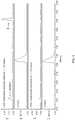
Figures 4 and5 depict UV and γ traces of an exemplary radioiodinated product of the present teachings, before and after purification. - Sensitivity in PET and SPECT based medical imaging is dependent upon the amount of radioactivity localized at the site of interest and consequently upon the radioactivity per dose of agent or "specific activity" of the agent. It is important to maximize the chemical purity of PET and SPECT imaging agents to ensure patient safety and to achieve high effective specific activity. Effective specific activity is defined as the moles of radiolabeled agent divided by the moles of all molecules with similar biological properties to the radiolabeled agent.
- Radioiodination (see Scheme 1, below) can be achieved by treatment of a vinyl or aryl-tin precursor ("Prec") with a radioisotope of iodide (e.g., an 123I- species) under oxidative conditions to yield the desired radioiodinated product ("I-Prod") and a tin cleavage product ("C"). Excess aryl-tin precursor is used to ensure fast and efficient utilization of the radioactive iodide.

- It is also important to maximize the chemical purity of a PET and/or SPECT imaging agent to ensure patient safety. Current approaches to enhance the chemical purity of radioiodinated compounds rely on HPLC purification which is time-consuming thus leading to decay of radioactivity, limited by the ability to chromatographically separate the radioiodinated product from the precursor and expensive. The present teachings describe a method for the preparation and purification of radioiodinated vectors without the use of HPLC purification that achieve a high chemical purity of the radioiodinated vector.
- The present teachings relate to novel precursors for radioiodination and methods to prepare and purify radioiodinated vectors using these precursors, e.g., for the purpose of research, diagnostic imaging and therapy. Without wishing to be bound by any particular theory, it is believed that such methods and precursors have many advantages over the art, including but not limited to: elimination of the need for HPLC to purify the radioiodinated vector from the precursor and cleavage product; easy preparation, ability to characterize and purify the precursors, as they are single compounds; utility toward a broad range of radioiodinated vectors, including large molecules such as peptides or antibodies where chromatographic differentiation of the precursor and radioiodinated vector is minimal; and compatibility of precursors with an aqueous reaction mixture.
- In at least one embodiment, the present teachings provide methods for preparing or purifying a radioiodinated compound. Such methods generally include contacting a biotin-containing tin precursor with a radioactive iodide and an oxidant to form a reaction mixture comprising a radioiodinated compound, unreacted precursor and reaction byproducts; and contacting the reaction mixture with avidin or streptavidin to separate the radioiodinated compound from the precursor and the reaction byproducts. In at least one embodiment, the method further comprises contacting the reaction mixture with a solubility enhancing agent.
- In at least one embodiment, the present teachings provide methods for preparing or purifying a radioiodinated compound. Such methods generally include contacting a biotin-containing tin precursor with a radioactive iodide, an oxidant and a solubility enhancing agent to form a reaction mixture comprising a radioiodinated compound, solubility enhancing agent, unreacted precursor and reaction byproducts; and contacting the reaction mixture with avidin or streptavidin to separate the radioiodinated compound from the precursor and the reaction byproducts.
- In at least one embodiment, the present teachings provide methods for preparing or purifying a radioiodinated compound. Such methods generally include contacting a biotin-containing tin precursor with a radioactive iodide, and an oxidant to form a reaction mixture comprising a radioiodinated compound, unreacted precursor and reaction byproducts; and contacting the reaction mixture with a solubility enhancing agent and avidin or streptavidin to separate the radioiodinated compound from the precursor and the reaction byproducts.
- In at least one embodiment, the present teachings provide methods for preparing or purifying a radioiodinated compound. Such methods generally include contacting a biotin-containing tin precursor with a radioactive iodide and an oxidant to form a reaction mixture comprising a radioiodinated compound, unreacted precursor and reaction byproducts; contacting the reaction mixture with a reductant to form a reduced reaction mixture; contacting the reduced reaction mixture with avidin or streptavidin to separate the radioiodinated compound from the precursor and the reaction byproducts. In at least one embodiment, the method further comprises the step of contacting the reaction mixture or the reduced reaction mixture with a solubility enhancing agent.
- In at least one embodiment, the present teachings provide methods for preparing or purifying a radioiodinated compound. Such methods generally include contacting a biotin-containing tin precursor with a radioactive iodide, an oxidant and a solubility enhancing agent to form a reaction mixture comprising a radioiodinated compound, solubility enhancing agent, unreacted precursor and reaction byproducts; contacting the reaction mixture with a reductant to form a reduced reaction mixture; contacting the reduced reaction mixture with avidin or streptavidin to separate the radioiodinated compound from the precursor and the reaction byproducts.
- In at least one embodiment, the present teachings provide methods for preparing or purifying a radioiodinated compound. Such methods generally contacting a biotin-containing tin precursor with a radioactive iodide and an oxidant to form a reaction mixture comprising a radioiodinated compound, unreacted precursor and reaction byproducts; contacting the reaction mixture with a reductant to form a reduced reaction mixture; contacting the reduced reaction mixture with a solubility enhancing agent and avidin or streptavidin to separate the radioiodinated compound from the precursor and the reaction byproducts.
- Under typical reaction conditions the residual unbound radioiodine is minimal. In the event that radioiodine is not completely consumed by the reaction it is understood that pre or post purification of the residual unbound radioiodine with solid phase extraction techniques or others would be obvious to someone skilled in the art. This may include but are not limited to ionic exchange, silica gel, alumina, reverse-phase resins etc.
- It is understood that contact with the solubility enhancing agent can be made at any time during the methods described herein. For example, the biotin-containing tin precursor can be contacted with a solubility enhancing agent during the formation of the reaction mixture, or alternatively, the reaction mixture may be formed as described above and after a period of time, the reaction mixture may be contacted with a solubility enhancing agent. Similarly, the biotin-containing tin precursor can be contacted with a solubility enhancing agent during the formation of the reaction mixture and prior to contact with the reductant, or alternatively, the reaction mixture may be formed as described above and after a period of time, the reaction mixture may be contacted with a solubility enhancing agent and then the reductant or with the solubility enhancing agent and the reductant contemporaneously. Similarly, when the reduced reaction mixture is contacted with a solubility enhancing agent, the contact may occur before, contemporaneously, or after contact with avidin or streptavidin. One of skill in the art is able to determine the appropriate timing of the above.
- As used herein the term "radio iodinated compound" or "isolated radioiodinated compound" refers to aromatic or vinylic compounds, which include a radioactive iodine substituent on an aromatic or vinylic portion of the compound. Examples of radioactive iodine substituents include 123I, 124I, 125I and 131I. Accordingly, in some embodiments, the radioiodinated compound comprises an aryl moiety, such as an aryl acid. Exemplary radioiodinated compounds include, but are not limited to a radioiodinated benzoic acid, a radioiodinated benzamide, a radioiodinated benzylamine, and a radioiodinated benzylguanidine.
- As used herein, "biotin" includes biotin, oxidation products of biotin, and biotin-like substituents, including, for example, biotin, oxybiotin, biotin sulfone and biotin sulfoxides, as well as stereoisomers thereof that bind to avidin or streptavidin. As used herein, the term "biotin-containing tin precursor" refers to a tin complex which includes a biotin, oxidation products of biotin, or a biotin-like substituent, as well as an aromatic or vinylic group capable of being labeled with iodide at an aromatic or vinylic carbon and bind to avidin or streptavidin. The tin molecule is attached by direct bond to a carbon atom of at least one aromatic or vinylic carbon. The tin molecule is also attached, via direct bond or via a linker, to a biotin, an oxidation product of biotin, or biotin-like substituent.
- As used herein, the term "biotin-containing byproducts" or "reaction byproducts" refers to products of the reaction of an iodide and a biotin-containing precursor as defined herein. This reaction generally causes cleavage of the tin moiety from the aromatic vector capable of being labeled with iodide. Such by-products typically include a tin moiety attached, either directly or via a linker, to a biotin or biotin-like substituent.
- In some embodiments, the oxidant is selected from iodogen and peracetic acid. For example, the oxidant can be a solid or in solution or suspension, or the oxidant can be pre-coated onto a tube or bead. In some embodiments, the radioactive iodide is selected from 123I, 124I, 125I and 131I.
- As used herein, the term "solubility enhancing agents" refers to molecules which enhance the solubility of organic molecules in water or mixtures of water and organic cosolvents. These typically are amphiphilic, containing a hydrophobic region and hydrophilic regions. Exemplary solubility enhancing agents include but are certainly not limited to: polysorbate 80 (Tween 80), cyclodextrins (for example α, β, γ cyclodextrins), analogs of cyclodextrin such as hydroxypropyl-β-cyclodextrin, and sodium lauryl sulfates.
- As used herein, the term "reductant" refers to an agent which reduces the added oxidant and any remaining unreacted electrophilic radioiodine species. Exemplary reductants include but are not limited to sodium bisulfite, sodium thiosulfite or sodium metabisulfite.
- In some embodiments, the biotin-containing tin precursor is compound represented by formula (A):

- R1 is an aromatic or vinyl group capable of being substituted at an aromatic or vinylic carbon with iodide;
- R2 and R3 are each independently selected from R1; alkyl or alkoxyalkyl, each substituted with 0-4 R5 groups; or R2 and R3, along with the Sn atom to which they are attached, form a 3 to 8-membered ring that optionally includes one or more heteroatom selected from N, O, or S;
- Z is selected from -(C1-C4)alkylene-, -(C1-C4)alkylene-O-, arylene, heteroarylene, cycloalkylene or heterocycloalkylene, provided that m is at least 1 when Z is arylene or heteroarylene and n = 1 to 9, and provided that p = 2-10 when Z is -(C1-C4)alkylene-O-;
- X is selected from -O-, and -NR4-;
- R4 is selected from H and alkyl, wherein the alkyl is substituted with 0-4 R6 groups;
- each R5 is independently selected from -H, -halogen, -CN, -NO2, -NRaRb, -ORc, -S(O)iRc, -C(=O)Rc, -C(=O)ORc and -OC(=O)Rc;
- R6 is selected from -H, -halogen, -CN, -NO2, -NRaRb, -ORc, -S(O)iRc, -C(=O)Rc, -C(=O)ORc and -OC(=O)Rc;
- Ra, Rb and Rc are each independently selected from -H and (C1-C6)alkyl;
- i is 0, 1, or 2;
- Y is selected from S, SO, SO2 and O;
- m, n and p are each independently an integer from 0 to 10, wherein m + n + p ≥ 1; and
- q and r are each individually an integer of 0 or 1; and s is an integer from 1 to 3, provided that q + r + s = 3.
- In other embodiments, the biotin-containing tin precursor is a compound represented by formula (I):

- R1 is an aromatic or vinyl group capable of being substituted at an aromatic or vinylic carbon with iodide;
- R2 and R3 are each independently selected from R1; alkyl or alkoxyalkyl, each substituted with 0-4 R5 groups; or R2 and R3, along with the Sn atom to which they are attached, form a 3 to 8-membered ring that optionally includes one or more heteroatom selected from N, O, or S;
- Z is selected from -(C1-C4)alkylene-, -(C1-C4)alkylene-O-, arylene, heteroarylene, cycloalkylene or heterocycloalkylene, provided that m is at least 1 when Z is arylene or heteroarylene, and n = 1 to 9, and provided that p = 2-10 when Z is -(C1-C4)alkylene-O-;
- X is selected from -O-, and -NR4-;
- R4 is selected from H and alkyl, wherein the alkyl is substituted with 0-4 R6 groups;
- each R5 is independently selected from -H, -halogen, -CN, -NO2, -NRaRb, -ORc, -S(O)iRc, -C(=O)Rc, -C(=O)ORc and -OC(=O)Rc;
- R6 is selected from -H, -halogen, -CN, -NO2, -NRaRb, -ORc, -S(O)iRc, -C(=O)Rc,-C(=O)ORc and -OC(=O)Rc;
- Ra, Rb and Rc are each independently selected from -H and (C1-C6)alkyl;
- Y is selected from S, SO, SO2 and O;
- i is 0, 1, or 2; and
- m, n and p are each independently an integer from 0 to 10, wherein m + n + p ≥ 1.
- As used herein, an aromatic or vinyl group capable of being labeled with iodide means that the iodine moiety is attached to the aromatic (e.g. an aryl iodide) or vinylic group (e.g. vinyl iodide) to yield a therapeutic agent, a diagnostic agent or both. The term "aryl iodide" refers to an aromatic group directly bearing an iodide. The term "vinyl iodide" refers to a vinylic group directly bearing an iodide. In one embodiment, the aromatic vector capable of being labeled with iodide comprises a five- to fourteen-membered aryl moiety or a five- to fourteen-membered heteroaryl moiety.
- As used herein, the term "vector" refers to an aromatic or vinyl group, wherein one of the aromatic or vinylic carbons atoms is substituted with iodide. As used herein, the phrase "aromatic vector" refers to a substance, e.g., a small molecule organic compound or a macromolecule, which includes at least one aromatic moiety. Thus, an "aromatic vector capable of being labeled with iodide" refers to an aromatic vector that is capable of exchanging at least one ring substituent with an iodide substituent.
- As used herein, the phrase "vinylic vector" refers to a substance, e.g., a small molecule organic compound or a macromolecule, which includes at least one vinylic moiety. Thus, a "vinylic vector capable of being labeled with iodide" refers to a vinylic vector that is capable of exchanging at least one vinylic carbon substituent with an iodide substituent. In some embodiments, the aromatic or vinylic vector capable of being labeled with iodide yields (i.e., upon labeling with iodide) a therapeutic agent, a diagnostic agent or both.
- As used herein, the term "therapeutic agent" refers to a drug, medicament, or other substance capable of producing an effect on a body; for example, an agent that can be used to prevent cure, alleviate the onset and/or progression of a condition, pathological disorder or disease. Therapeutic agents include low molecular weight drugs, proteins, peptides, oligonucleotides, nucleic acids, polysaccharides and other macromolecules, each of which can be synthetic or naturally produced. The term "drugs" includes small molecules, such as organic compounds, with a molecular weight of between about 50 and about 1000 Daltons.
- As used herein, the term "diagnostic agent" refers to a substance which permits the detection or monitoring of a physiological condition or function; for example, an agent that can be used to detect, image and/or monitor the presence and/or progression of a condition, pathological disorder or disease.
- In some embodiments, R2 and R3 in Formulae A, I and/or II are each independently selected from (C1-C6)alkyl, e.g., methyl, ethyl, propyl, butyl, pentyl or hexyl or alkoxyalkyl, e.g. methoxymethyl, ethyoxyethyl, methoxymethoxymethyl, -CH2CH2CH2OCH2CH2OCH3. In some embodiments, R2 and R3 in Formulae A, I and/or II are each independently selected from methyl, ethyl, n-propyl or n-butyl.
- In some embodiments, R2 and R3 in Formulae A, I and/or II, together with the Sn atom to which they are attached, form a 3 to 8 membered ring that optionally includes one or more heteroatom selected from N, O, or S. For example, the ring formed may be one of the following:


- In some embodiments of Formulae A, I and/or II, X is selected from O and NR4; and R4 is selected from H and (C1-C6)alkyl. For example, in some embodiments of Formulae A, I and/or II, X is selected from O and NH. In some embodiments, Y is selected from O, S, SO, and SO2. For example, in some embodiments of Formulae A, I and/or II, Y is S. In other embodiments of Formulae A, I and/or II, Y is SO2. In some embodiments of Formulae A, I and/or II, Z is selected from -(C1-C4)alkylene-, -(C1-C4)alkylene-O-. For example, in some embodiments of Formulas A, I and/or II, Z is -(C1-C4)alkylene-O-.
- In some embodiments of Formulae A, I and/or II, m, n and p are each independently an integer from 0 to 5. For example, in some embodiments of Formulas A, I and/or II, m and n are both 0 and p is an integer from 2 to 4.
- In some embodiments, R2 and R3 are each independently selected from (C1-C6)alkyl; X is selected from O and NR4; Y is selected from S, SO, and SO2; Z is selected from -(C1-C4)alkylene-, and -(C1-C4)alkylene-O-; R4 is selected from H and (C1-C6)alkyl; and m, n and p are each independently an integer from 0 to 5.
- In some embodiments of Formulae A, I and/or II, R2 and R3 are each independently selected from methyl, ethyl, n-propyl or n-butyl; X is selected from O and NH; Y is SO2; Z is -(C1-C4)alkylene-O-; m and n are both 0 and p is an integer from 2 to 4.
- In some embodiments, R2 and R3, together with the Sn atom form a 3, 4, 5, 6, 7, or 8 membered ring that optionally includes one or more heteroatom selected from N, O, or S; X is selected from O and NR4; Y is selected from S, SO, and SO2; Z is selected from -(C1-C4)alkylene-, and -(C1-C4)alkylene-O-; R4 is selected from H and (C1-C6)alkyl; and m, n and p are each independently an integer from 0 to 5.
- In some embodiments of Formulae A, I and/or II, R2 and R3, together with the Sn atom form a 5 or 6 membered ring that optionally includes one or more heteroatom selected from N, O, or S; X is selected from O and NH; Y is SO2; Z is -(C1-C4)alkylene-O-; m and n are both 0 and p is an integer from 2 to 4.
- For example, in some embodiments, the biotin-containing byproducts comprise at least one compound of formula (II):

- In some embodiments, contacting the reaction mixture or the reduced reaction mixture with avidin or streptavidin comprises at least one of the following:
- passage of the reaction mixture or the reduced reaction mixture down a column of avidin or streptavidin solid support;
- mixing an avidin or streptavidin solid support with the reaction mixture or the reduced reaction mixture followed by filtering;
- depositing the biotin-containing precursor on an avidin or streptavidin solid support, followed by contacting the biotin-containing precursor with the radioactive iodide and the oxidant, followed by eluting the radioiodinated compound;
- treating the reaction mixture or the reduced reaction mixture with soluble avidin or streptavidin followed by size separation of avidin- or streptavidin-bound complexes from the radioiodinated compound; or
- The present invention provides a radioiodinated compound in a level of purity comparable to that achieved by conventional HPLC methods. The high level of purity permits the use of the radioiodinated compounds prepared by the methods disclosed herein to be used as a diagnostic or therapeutic agent. In some embodiments, such methods allow for the production of radioiodinated compounds having minimal impurities. For example, in some embodiments, the radioiodinated compound is in a composition comprising less than about 10%, less than about 5%, or less then about 1% biotin-containing precursors or biotin-containing byproducts. In some embodiments, the radioiodinated compound is in a composition comprising less than about 0.9%, less than about 0.8%, less than about 0.7%, less than about 0.6%, less than about 0.5%, less than about 0.4%, less than about 0.3%, less than about 0.2%, less than about 0.1%, or even less than about 0.05% biotin-containing precursors or biotin-containing byproducts. Generally, the major contaminant resulting in the preparation of the radioiodinated compound is the unreacted biotin-containing precursor and/or the biotin-containing byproducts. As such, because the methods disclosed herein are effective in separating the desired radioiodinated compound from the unreacted biotin-containing precursor and/or the biotin-containing byproducts, the resulting radioiodinated compound is at least 90%, at least 95%, at least 99%, at least 99.1%, at least 99.2%, at least 99. 3%, at least 99.4%, at least 99.5%, at least 99.6%, at least 99.7%, at least 99.8%, at least 99.9% or at least 99.95% pure.
- As used herein, the term "alkyl" refers to a saturated aliphatic straight-chain or branched monovalent hydrocarbon radical. Unless otherwise specified, an alkyl group typically has 1-6 carbon atoms, i.e. (C1-C6)alkyl. As used herein, a "(C1-C6)alkyl" group is means a radical having from 1 to 6 carbon atoms in a linear or branched arrangement. An "alkylene group" is a saturated aliphatic branched or straight-chain divalent hydrocarbon radical. Unless otherwise specified, an alkylene group typically has 1-6 carbon atoms, i.e., (C1-C6)alkylene.
- As used herein, the term "alkoxyalkyl" refers to an alkyl, wherein non-adjacent carbon atoms are replaced with oxygen. Examples of alkoxyalkyl include, for example, methoxymethyl, ethyoxyethyl, propoxymethyl, or -CH2CH2CH2OCH2CH2OCH3.
- The term "aryl" refers to an aromatic hydrocarbon ring system. The term "aryl" may be used interchangeably with the terms "aryl moiety," "aryl ring" and "aryl group." An aryl group typically has six to fourteen ring atoms. "Aryl" includes monocyclic rings and polycyclic rings, in which a monocyclic aryl ring is fused to one or more other aryl rings. Examples of aryl groups include, but are not limited to, phenyl, naphthyl, anthracenyl, 1,2-dihydronaphthyl, 1,2,3,4-tetrahydronaphthyl, fluorenyl, indanyl, indenyl and the like. A "substituted aryl group" is substituted at any one or more substitutable ring atom. Arylene refers to a bivalent aryl radical.
- The terms "heteroaryl," "heteroaryl ring," "heteroaryl group" and "heteroaryl moiety" are used interchangeably herein to refer to aromatic ring groups having typically five to fourteen ring atoms selected from carbon and at least one (typically 1 to 4, more typically 1 or 2) heteroatoms (e.g., oxygen, nitrogen or sulfur). "Heteroaryl" includes monocyclic rings and polycyclic rings in which a monocyclic heteroaromatic ring is fused to one or more other aryl or heteroaryl rings. Examples of monocyclic heteroaryl groups include, but are not limited to, furanyl (e.g., 2-furanyl, 3-furanyl), imidazolyl (e.g., N-imidazolyl, 2-imidazolyl, 4-imidazolyl, 5-imidazolyl), isoxazolyl (e.g., 3-isoxazolyl, 4-isoxazolyl, 5-isoxazolyl), oxadiazolyl (e.g., 2-oxadiazolyl, 5-oxadiazolyl), oxazolyl (e.g., 2-oxazolyl, 4-oxazolyl, 5-oxazolyl), pyrazolyl (e.g., 3-pyrazolyl, 4-pyrazolyl), pyrrolyl (e.g., 1-pyrrolyl, 2-pyrrolyl, 3-pyrrolyl), pyridyl (e.g., 2-pyridyl, 3-pyridyl, 4-pyridyl), pyrimidinyl (e.g., 2-pyrimidinyl, 4-pyrimidinyl, 5-pyrimidinyl), pyridazinyl (e.g., 3-pyridazinyl), thiazolyl (e.g., 2-thiazolyl, 4-thiazolyl, 5-thiazolyl), isothiazolyl, triazolyl (e.g., 2-triazolyl, 5-triazolyl), tetrazolyl (e.g., tetrazolyl), and thienyl (e.g., 2-thienyl, 3-thienyl). Examples of polycyclic aromatic heteroaryl groups include carbazolyl, benzimidazolyl, benzothienyl, benzofuranyl, isobenzofuranyl, indolyl, benzotriazolyl, benzothiazolyl, benzoxazolyl, quinolinyl, isoquinolinyl, indazolyl, isoindolyl, acridinyl, or benzisoxazolyl. A "substituted heteroaryl group" is substituted at any one or more substitutable ring atom, which is a ring carbon or ring nitrogen atom bonded to a hydrogen. Heteroarylene refers to a bivalent hereteroaryl radical.
- The term "cycloalkyl" refers to a monocyclic or polycyclic saturated hydrocarbon ring system. For example, a C5-C7 cycloalkyl includes, but is not limited to cyclopentyl, cyclohexyl or cycloheptyl, each of which is optionally substituted. Cycloalkylene refers to a bivalent cycloalkyl radical.
- The term "heterocycloalkyl" refers to non-aromatic rings, generally with 3 to 10-members containing from 1-4 ring heteroatoms. Each heteroatom is independently selected from nitrogen, quaternary nitrogen, oxidized nitrogen (e.g., NO); oxygen; and sulfur, including sulfoxide and sulfone. Representative monocyclic heterocycloalkyl groups include morpholinyl, thiomorpholinyl, pyrrolidinonyl, pyrrolidinyl, piperidinyl, piperazinyl, hydantoinyl, valerolactamyl, oxiranyl, oxetanyl, tetrahydrofuranyl, tetrahydropyranyl, tetrahydropyrindinyl, tetrahydropyrimidinyl, tetrahydrothiophenyl, tetrahydrothiopyranyl, and the like. Heterocycloalkylene refers to a bivalent heterocycloalkyl radical.
-
- Ac:
- Acetyl.
- Bn:
- benzyl.
- DMAP:
- 4-(dimethylamino)pyridine.
- DMF:
- dimethylformamide.
- DMSO:
- Dimethylsulfoxide.
- EDC:
- N-(3-dimethylaminopropyl)-N'-ethylcarbodiimide hydrochloride.
- HPLC:
- High performance liquid chromatography.
- NMP:
- 1-Methyl-2-pyrrolidinone.
- PBS:
- phosphate-buffered saline.
- TFA:
- Trifluoroacetic acid.
- THF:
- tetrahydrofuran.
- TFP:
- Tetrafluorophenyl.
- Arylstannanes bearing biotin or biotin sulfone units were designed and prepared. Vinylic stannanes may be prepared by similar methods. 3-Stannyl benzoic acid/ester was selected as the model system since the corresponding radiolabeled product (3-iodobenzoic acid/ester) can be conjugated to other diagnostic and therapeutic vectors via simple chemical reactions. Though other linkages are possible an ester linkage between biotin and the arylstannane was chosen because esters are sufficiently stable under slightly acidic labeling conditions and because the precursor for the ester linkage (i.e., an alcohol) is readily accessible via established and generally high yielding reactions, e.g. hydroboration or ozonolysis.
- Key intermediate 6 was prepared in high yield from commercially available Bu2SnCl2 ( 1 ) in good yield as shown in Scheme 2:

- In brief, to a solution of dibutyltin dichloride (15.2 g, 50 mmol) in THF (50 mL) was added phenylmagnesium bromide (30 mL, 60 mmol, 2.0 M in THF) at 0°C. The resulting mixture was stirred at 0°C for 1 h, then quenched with NH4Cl (50 mL, sat. aq.) and extracted with Et2O (100 mL x 3). The combined organic extract was dried over Na2SO4 and concentrated. The oily residue was purified by flash column chromatography (silica gel, 100% hexanes) to afford compound 4 in 95% yield (18.4 g, 47.5 mmol).
- Compound 4 (1.94 g, 5.0 mmol) was taken up in Et2O (5.0 mL) and cooled to 0°C. An anhydrous solution of HCl in Et2O (2.5 mL, 5.0 mmol, 2.0 M) was added dropwise. The resulting clear solution was allowed to warm to room temperature for 30 min. The Grignard reagent (15 mL, 7.5 mmol, 0.5 M in THF or Et2O) was added at 0°C and the resulting suspension stirred for another 1 h. After quenching with NH4Cl (10 mL, sat. aq.) and extraction with Et2O (10 mL x 3), the combined organic extract was dried over Na2SO4 and concentrated. The oily residue was purified by flash column chromatography (silica gel, 100% hexanes) to afford compound 5 in 90% yield.
- To a solution of compound 5 (1.46 g, 4.0 mmol) in THF (4.0 mL) was added 9-BBN-H (6.0 mL, 6.0 mmol, 1.0 M in THF) at 0°C. The reaction solution was allowed to warm to room temperature for 1 h. H2O (10 mL) was added to the reaction mixture followed by NaBO3 (1.63 g, 20 mmol). The resulting suspension was stirred vigorously at room temperature for 12 h before extraction with diethyl ether (20 mL x 3). The combined organic extract was dried over Na2SO4 and concentrated. The oily residue was purified by flash column chromatography (silica gel, 1:1 hexanes/ethyl acetate) to afford compound 6 in 92% yield (1.41 g, 3.68 mmol).
- As shown in Scheme 3, alcohol 6 was esterified with biotin or biotin sulfone to yield arylstannanes 7 and 8 . The arylstannanes were treated with I2 to produce Sn-I species, which were further reduced to the
dimeric tin species 9 and 10 using a one-pot procedure.
- Briefly, to a solution of compound 6 (383 mg, 1.0 mmol) in DMF (2.0 mL) were added biotin (366 mg, 1.5 mmol) or biotin sulfone (414 mg, 1.5 mmol), EDC.HCl (287 mg, 1.5 mmol), DMAP (cat.). The resulting solution (suspension for biotin sulfone) was stirred at room temperature for 12 h and volatiles were removed in vacuo. Purification was accomplished by flash column chromatography (silica gel, 10% MeOH/CH2Cl2) to afford the desired ester 7 or 8 in 90∼95% yield.
- To a solution of ester 7 (305 mg, 0.5 mmol) in CH2Cl2 (2.0 mL) was added I2 (379 mg, 1.5 mmol) in portions at room temperature. The resulting brown solution was stirred at room temperature for another 30 min. NaBH4 (113 mg, 3.0 mmol) was added followed by the dropwise addition of MeOH (1.0 mL). After bubbles faded away, PdCl2 (0.9 mg, 0.005 mmol) was added to the colorless suspension. The resulting pale yellow suspension was stirred at room temperature for 1 h. Solvents were removed in vacuo and the residue was subjected to flash column chromatography (silica gel, 10% MeOH/CH2Cl2) to afford the desired ditin compound 9 (160 mg, 0.15 mmol, 60% yield) as a waxy solid.
Compound 10 was synthesized in a similar manner, albeit in lower yield (< 30%). - Alternatively,
dimeric tin compounds 9 and 10 have also been prepared via esterification of 11 with biotin or biotin sulfone as shown in Scheme 4:
- Specifically, the ditin compound 11 was prepared using the procedure for the synthesis of compound 9 . Esterification was done as for compound 7 to produce
ditin 9 and 10 in >90% yield. - With
species 9 and 10 in hand, Stille coupling conditions were explored using 12 and aryl iodide 13 as model compounds, as shown in Scheme 5. Excellent yields of model stannane 14 were observed with Pd(PPh3)2Cl2/KOAc/NMP.
- Specifically, to a degassed solution of 3-iodobenzoic acid 13 (49 mg, 0.2 mmol) in NMP (0.3 mL) were added KOAc (59 mg, 0.6 mmol) and Pd(PPh3)2Cl2 (7 mg, 0.01 mmol). The resulting pale orange solution was stirred for 10 min followed by the addition ofhexabutylditin 12 (290 mg, 0.5 mmol). After stirring at room temperature for 24 h, the dark red reaction mixture was diluted with diethyl ether (0.5 mL) and directly loaded on a silica gel column and flushed with 1:1 hexanes/ethyl acetate to afford the desired arylstannane 14 in 91% yield (75 mg, 0.182 mmol).
- These same Stille coupling conditions were applied to biotin containing dimer 9 and
biotin sulfone dimer 10 to yield theiodination precursors 15 and 2 in 60%∼65% yield (purification was done by semi-prep HPLC), as shown in Scheme 6.
- An alternative method of making aryl-tin bonds, involving nucleophilic addition of aryl Grignard reagents to tin-halogen species, was used to prepare benzyl protected tin-
biotin 19 and tin-biotin sulfone 18 precursors, as shown in Scheme 7.
- In brief, to a solution of arylstannane 5 (730 mg, 2.0 mmol) in Et2O was added anhydrous HCl (1.0 mL, 2.0 mmol, 2.0 M in Et2O) at 0°C. The clear reaction mixture was warmed to rt for 30 m. To this crude tin-chloride solution was then added Grignard solution (3.0 mmol in 10 mL of THF, freshly prepared from benzyl ester of 3-iodobenzoic acid and isopropylmagnesium chloride) at - 20°C. The resulting gray suspension was allowed to warm to 0°C for 2 h. NH4Cl (10 mL, sat. aq.) was used to quench excess Grignard reagent and the reaction mixture was extracted with Et2O (10 mL x 3). The combined organic extract was dried over Na2SO4 and concentrated. Purification was accomplished by flash column chromatography (silica gel, 10% EtOAc/hexanes) to afford the desired arylstannane 16 in 75% yield (748 mg, 1.5 mmol).
- Hydroboration of arylstannane 16 to yield alcohol 17 was done as for conversion of compound 5 to compound 6. Esterification of alcohol 17 was performed as for the syntheses of compounds 7 and 8 to produce compounds 19 (60%) and 18 (65%).
- A PEG-chain modified precursor 22 was also prepared starting from Biotin-PEG-acid 21 and hydroxystannane 6 as shown in Scheme 8.

Table A. 1H NMR data for compounds Compound Chemical shifts Solvent 2 7.99 (1 H, s, J Sn-C-C-H = 40.0 Hz), 7.83 (1 H, d, J = 7.6, Hz), 7.54 (1 H, d, J = 7.1 Hz, J Sn-C-C-H = 37.6 Hz), 7.37 (1 H, dd, J = 7.6, 7.1 Hz, J Sn-C-C-H = 9.5 Hz), 6.77 (1 H, s, br), 6.61 (1 H, s, br), 4.44 - 4.35 (2 H, m), 4.00 (2 H, t, J = 6.0 Hz), 3.31 (1 H, dd, J = 14.1, 6.9 Hz), 3.15 (1 H, q, J = 6.9 Hz), 3.02 (1 H, d, J= 14.1 Hz), 2.25 (2 H, t, J = 7.5 Hz), 1.70 - 0.82 (30 H, m) DMSO-d6 5 7.47 (2 H, d, J = 7.3 Hz, J Sn-C-C-H = 38.4 Hz), 7.36 - 7.28 (3 H, m), 5.89 (1 H, ddt, J = 16.7, 10.1, 6.3 Hz), 5.01 (1 H, dd, J = 16.7, 1.1 Hz), 4.93 (1 H, dd, J = 10. 1, 1.1 Hz), 2.32 (2 H, m), 1.63-0.84 (20 H, m). CDCl3 6 7.46 (2 H, d, J = 7.4 Hz, J Sn-C-C-H = 39.0 Hz), 7.35 - 7.27 (3 H, m), 3.64 (2 H, m), 1.70 - 0.85 (24 H, m) CDCl3 9 6.43 (2 H, s, br), 6.36 (2 H, s, br), 4.30 (2 H, dd, J = 7.5, 5.1 Hz, 1H), 4.12 (2 H, ddd, J = 7.5, 4.5, 1.8 Hz), 4.00 (4 H, t, J = 6.1 H), 3.08 (2 H, ddd, J = 8.6, 6.1, 4.5 Hz), 2.81 (2 H, dd, J = DMSO-d6 12.4, 5.1 Hz), 2.58 (2 H, d, J = 12.4 Hz), 2.26 (4 H, t, J = 7.5 Hz), 1.64 - 0.84 (60 H, m) 10 6.69 (2 H, s, br), 6.60 (2 H, s, br), 4.41 (2 H, dd, J= 10.2, 7.0 Hz), 4.41 (2 H, ddd, J = 10.2, 6.0, 1.8 Hz), 4.01 (4 H, t, J = 6.2 Hz), 3.30 (2 H, dd, J = 14.2, 7.0 Hz), 3.16 (2 H, q, J = 6.9 Hz), 3.02 (2 H, d, J = 14.2 Hz), 2.28 (4 H, t, J = 7.5 Hz), 1.72 - 0.82 (60 H, m) DMSO-d6 11 4.31 (2 H, t, J = 5.1 Hz), 3.37 (4 H, td, J = 6.5, 5.1 Hz), 1.60 - 0.80 (48 H, m) DMSO-d6 14 8.20 (1 H, s, J Sn-C-C-H = 38.0 Hz), 8.02 (1 H, d, J = 7.8, Hz), 7.69 (1 H, d, J = 7.1 Hz, J Sn-C-C-H = 35.5 Hz), 7.41 (1 H, dd, J = 7.8, 7.1 Hz, J Sn-C-C-C-H = 8.0 Hz), 1.53 (6 H, m, J Sn-C-C-C-H = 50.2 Hz), 1.33 (6 H, m), 1.09 (6 H, m, J Sn-C-H = 51.4 Hz), 0.88 (9 H, t, J= 7.3 Hz). CDCl3 15 8.01 (1 H, s, J Sn-C-C-H = 38.7 Hz), 7.84 (1 H, d, J = 7.7 Hz), 7.62 (1 H, d, J = 7.1 Hz, J Sn-C-C-H = 35.9 Hz), 7.42 (1 H, dd, J = 7.7, 7.1 Hz), 6.44 (1 H, s, br), 6.35 (1 H, s, br), 4.29 (1 H, dd, J = 7.6, 5.1 Hz), 4.12 (1 H, ddd, J = 7.6, 4.4, 1.4 Hz), 4.00 (2 H, t, J = 6.0 Hz), 3.07 (1 H, ddd, J = 8.4, 6.1, 4.4 Hz), 2.81 (1 H, dd, J = 12.4, 5.1 Hz), 2.57 (1 H, d, J= 12.4 Hz), 2.24 (2 H, t, J = 7.5 Hz), 1.63 - 0.80 (30 H, m) DMSO-d6 16 8.18 (1 H, s, J Sn-C-C-H = 38.7 Hz), 8.00 (1 H, d, J = 7.8 Hz), 7.65 (1 H, d, J = 7.1 Hz, J Sn-C-C-H = 36.2 Hz), 7.46 (2 H, d, J = 7.5 Hz), 7.42 - 7.32 (4 H, m), 5.86 (1 H, ddt, J= 16.6, 10.1, 6.4 Hz), 5.38 (2 H, s), 4.99 (1 H, dd, J= 16.6, 1.8 Hz), 4.90 (1 H, dd, J= 10.1, 1.8 Hz), 2.30 (2 H, td, J= 8.0, 6.4 Hz, J Sn-C-C- H = 52.6 Hz), 1.68 - 0.84 (20 H, m) CDCl3 17 8.17 (1 H, s, J Sn-C-C-H = 38.7 Hz), 7.99 (1 H, d, J = 7.8 Hz), 7.64 (1 H, d, J = 7.1 Hz, J Sn-C-C-H = 36.2 Hz), 7.45 (2 H, dd, J = 7.8, 7.1 Hz), 7.42 - 7.32 (4 H, m), 5.37 (2 H, s), 3.63 (2 H, m), 1.76 - 0.83 (24 H, m) CDCl3 18 8.07 (1 H, s, J Sn-C-C-H = 38.3 Hz), 7.92 (1 H, d, J = 7.8 Hz), 7.72 (1 H, d, J = 7.1 Hz, J Sn-C-C-H = 36.0 Hz), 7.49 (1 H, dd, J = 7.8, 7.1 Hz, J Sn-C-C-H = 8.6 Hz), 7.46 (2 H, d, J= 7.4 Hz), 7.40 (2 H, dd, J= 7.4, 7.3 Hz), 7.35 (1 H, t, J = 7.3 Hz), 6.69 (1 H, s), 6.60 (1 H, s), 5.35 (2 H, s), 4.41 (1 H, dd, J= 10.1, 7.1 Hz), 4.37 (1 H, ddd, J = 10.1, 6.1, 1.7 Hz), 3.99 (2 H, t, J = 5.9 Hz), 3.30 (1 H, dd, J = 14.1, 7.1 Hz), 3.15 (1 H, m), 3.02 (1 H, d, J = 14.1 Hz), 2.25 (2 H, t, J = 7.5 Hz), 1.71 - 0.79 (30H, m) DMSO-d6 19 8.07 (1 H, s, J Sn-C-C-H = 38.3 Hz), 7.92 (1 H, d, J = 7.9 Hz), 7.72 (1 H, d, J = 7.1 Hz, J Sn-C-C-H = 36.0 Hz), 7.48 (1 H, dd, J = 7.9, 7.1 Hz, J Sn-C-C-H = 8.6 Hz), 7.45 (2 H, d, J = 7.4 Hz), 7.39 (2 H, t, J = 7.4 Hz), 7.35 (1 H, t, J = 7.4 Hz), 6.42 (1 H, s), 6.36 (1 H, s), 5.35 (2 H, s), 4.28 (1 H, m), 4.11 (1 H, m), 3.98 (2 H, t, J = 5.8 Hz), 3.06 (1 H, ddd, J = 8.7, 6.1, 4.7 Hz), DMSO-d6 2.80 (1 H, dd, J = 12.4, 5.1 Hz), 2.57 (1 H, d, J = 12.4 Hz), 2.22 (2 H, t, J = 7.5 Hz), 1.64 - 0.77 (30 H, m) (t-Bu)-21 6.79 (1 H, s), 6.74 (1 H, s), 6.33 (1 H, s, br), 4.58 (1 H, dd, J = 7.8, 4.9 Hz), 4.39 (1 H, dd, J= 7.8, 4.6 Hz), 3.71 (2 H, t, J= 6.4 Hz), 3.66 - 3.53 (10 H, m), 3.44 (2 H, m), 3.19 (1 H, m), 2.94 (1 H, dd, J= 13.0, 4.9 Hz), 2.77 (1 H, d, J = 13.0 Hz), 2.50 (2 H, t, J= 6.4 Hz), 2.27 (2 H, m), 1.77 - 1.62 (4 H, m), 1.46 (2 H, m), 1.44 (9 H, s) CDCl3 22 8.07 (1 H, s, J Sn-C-C-H = 37.8 Hz), 7.92 (1 H, d, J= 7.9 Hz), 7.80 (1 H, t, J = 5.7 Hz), 7.72 (1 H, d, J = 7.2 Hz, J Sn-C-C-H = 36.3 Hz), 7.48 (1 H, dd, J = 7.9, 7.2 Hz, J Sn-C-C-C-H = 8.6 Hz), 7.45 (2 H, d, J = 7.6 Hz), 7.40 (2 H, t, J = 7.5 Hz), 7.35 (1 H, dd, J = 7.6, 7.5 Hz), 6.41 (1 H, s), 6.35 (1 H, s), 5.35 (2 H, s), 4.29 (1 H, dd, J = 7.6, 5.3 Hz), 4.11 (1 H, ddd, J = 7.6, 4.5, 1.9 Hz), 4.00 (2 H, t, J = 5.8 Hz), 3.58 (2 H, t, J= 6.2 Hz), 3.49-3.43 (8 H, m), 3.37 (2 H, t, J = 6.0 Hz), 3.17 (2 H, q, J = 5.9 Hz), 3.08 (1 H, ddd, J = 8.6, 6.2, 4.5 Hz), 2.81 (1 H, dd, J = 12.4, 5.1 Hz), 2.57 (1 H, d, J = 12.4 Hz), 2.47 (2 H, t, J = 6.2 Hz), 2.06 (2 H, t, J= 7.6 Hz), 1.64 - 0.80 (30 H, m) DMSO-d6 Note: NMR spectra were recorded on Bruker AVIII 700 MHz NMR spectrometer and calibrated using residual undeuterated solvent as an internal reference. The following abbreviations were used to explain the multiplicities: s = singlet, d = doublet, t = triplet, q = quartet, br = broad. In 1H NMR, averages of J117 sn-H and J119 sn-H were recorded due to severe overlapping of signals. - The stability of 18 and 19 with different oxidants used for radioiodination was explored without adding iodide to verify that biotin or biotin sulfone are compatible with oxidants used in radioiodination reactions.
- Iodogen Test : To an iodogen (20 µg) coated Eppendorf vial was added precursor (50 µg in 50 µL of MeOH containing 5% AcOH). The mixture was shaken gently at room temperature for 10∼30 min then quenched with Na2S2O5 (100 µL, 0.1 M, aq.). A small sample of the resulting clear solution was examined by LC-MS.
- Iodination Bead or Peracetic Acid Test : To an Eppendorf vial containing precursor (50 µg in 50 µL of MeOH containing 5% AcOH), was added the oxidant (one iodination bead or 5 µL of 30% peracetic acid). The mixture was shaken gently at room temperature for 10 min ∼ 120 min then quenched with Na2S2O5 (100 µL, 0.1 M, aq.). A small sample of the resulting clear solution was examined by LC-MS.
- It was observed that
biotin 19 was stable in 5% AcOH/MeOH; acid catalyzed hydrodestannylation was not observed after 72 h (seeFigure 1A ). Treating 19 in an iodogen-coated vial led to a complex product mixture; LC-MS showed that none of the new peaks are biotin sulfone or biotin sulfoxides (Figure 1B ). Iodobeads, a solid-supported chlorosulfonamide, reacted with 19 much more slowly (Figure 1C ). Peracetic acid on the other hand, oxidized 19 very cleanly to a mixture of biotin sulfone and biotin sulfoxides (Figures 1D and 1E ). -
Biotin sulfone 18 is more stable towards oxidants; only minor oxidation products were observed (seeFigure 2 ). - Iodination and 125I radioiodination of precursors, such as biotin sulfone 2, were investigated with iodogen or peracetic acid as oxidant. Exemplary radioiodination is shown below in Scheme 9.

- Iodination (cold/non-radioactive) Procedure : To an iodogen (20 µg) coated Eppendorf vial was added precursor (50 µg in 50 µL of EtOH or MeOH containing 5% AcOH) followed by NaI (5 µg in 10 µL H2O). The mixture was shaken gently at room temperature for 5 min then quenched with Na2S2O5 (100 µL, 0.1 M, aq.). A small sample of the resulting clear solution was examined by LC-MS to determine extent of reaction.
- Cold studies were performed on Waters Acquity UPLC system using a Waters Acquity Analytical UPLC column (100 x 2.1 mm, C18, 1.7 µm BEH). The Mobile Phase consisted of Solvent A (H2O, 0.1% TFA) and Solvent B (Acetonitrile, 0.1% TFA) at a flow rate of 0.30 ml/min. The amount of Solvent B varied over time as given below in Table 1.
Table 1 Time (mins) 0 8 12.5 13 15 %B 10 100 100 10 10 - 125 I Radioiodination (hot) Procedure with Iodogen : To an iodogen (20 µg) coated Eppendorf vial was added precursor (50 µg in 50 µL of EtOH or MeOH with 5% AcOH) followed by Na125I (7.4 MBq [200 µCi], in 10 µL 0.1 N NaOH). The mixture was shaken gently at room temperature for 10 min then quenched with Na2S2O5 (100 µL, 0.1 M, aq.). A small sample of the resulting clear solution was examined by HPLC.
- 125 I Radioiodination (hot) Procedure with Peracetic Acid : To an Eppendorf vial was added precursor (50 µg in 50 µL of EtOH or MeOH containing 5% AcOH) followed by Na125I (7.4 MBq [200 µCi], in 10 µL 1 N NaOH) and peracetic acid (5 µL, 30% aq.). The mixture was shaken gently at room temperature for 10 min then quenched with Na2S2O5 (100 µL, 0.1 M, aq.). A small sample of the resulting clear solution was examined by HPLC.
- HPLC studies were performed on Waters HPLC system using an X-Bridge Analytical HPLC column (100 x 4.6 mm, C18, 2.3 micron). The Mobile Phase consisted of Solvent A (H2O, 0.4% ammonium formate) and Solvent B (MeOH) at a flow rate of 0.8 ml/min. The amount of Solvent B varied over time as given below in Table 2.
Table 2 Time (mins) 0 6 15 16 20 %B 60 100 100 60 60 -
Figure 4 shows the results of 125I radioiodination of biotin sulfone 2 . Peracetic acid generated a small additional product (shown at 6 min on the UV spectrum) whereas iodogen generated no additional products on the UV chromatogram, though the reduced iodogen is evident. Both labeling reactions produced desired product 125 I-3 with excellent radiochemical purity (>95%). - Before attempting labeling studies, the ability of streptavidin resin to retain precursors, e.g.,
compound 15, was evaluated. 1.0 mL of high-capacity streptavidin resin (dispensed as 2.0 mL of 50% slurry in water) was loaded onto a 1.5-mL empty cartridge and was washed with 10% EtOH in PBS (5 mL). A mixture of 3 and 15 was prepared in 10% EtOH/PBS (250 µL) and loaded (400 µL total volume) onto the prepacked high-capacity streptavidin agarose resin column. After 20 min incubation, the column was flushed with a mixture of EtOH/PBS (from 10%EtOH/PBS to 100% EtOH) and 1 mL fractions were collected. HPLC traces of the eluent are shown inFigure 3 . As expected, 3 eluted with 10% EtOH/PBS, while 15 was retained on the column. Elution of biotin-tin acid 15 was only observed when in the 100% EtOH wash. Similar behavior was observed for biotin sulfone precursor 2 . - These results suggest that the biotin sulfone-streptavidin or biotin-streptavidin interaction is can be used in separating non-biotin containing molecules from biotin modified stannanes. Therefore, either biotin sulfone precursors, such as 2 and 18, or biotin containing precursors, such as 15, 19 and 22, may be used in the methods described herein.
- The 125I radiolabeling reaction mixture of 2 and iodogen was purified using a streptavidin resin column. Using previously developed conditions, such as those described above in Example 4, the labeling mixture was diluted with 10% EtOH/PBS and loaded onto a prepacked streptavidin resin column. After 20 minutes of incubation, the column was flushed with 10% EtOH/PBS (1 cv). As shown in
Figure 5 , 99% activity was recovered and no residual 2 was detected by HPLC. Thus biotin sulfone-straptavidin technology may be readily used for HPLC-free radioiodination - Radioiodination of hydrophobic benzyl ester precursor 4 to yield desired radioiodinated product 125 I-3IBABn did not yield significant product after passage through a streptavidin functionalized resin; nearly all the radioactivity was retained on the resin under previously described conditions. However, the
addition 10%, 20% and 40% Hydroxypropyl-β-cyclodextrin (HP-β-CD) w/v after reaction improved the yield of purified 125I-3IBABn to 93%.
- Radiolabeling procedure: To an Eppendorf vial were added 56.6 µg precursor 4 (56.6 µL, 1.0 mg/mL, EtOH), 5 µL AcOH, Na125I (18.5 MBq or 500 µCi, pH 8∼11 in aqueous NaOH) and iodogen (50 µL, 0.2 mg/mL in EtOH), subsequently. The reaction mixture was allowed to sit at room temperature for 20 minutes, with occasional swirling. After quenching with 100 µL of Na2S2O3 (0.1 M aq.), the mixture was diluted with 100 µL of EtOH then added to the binding buffer tested as described below.
- General procedure for the purification with streptavidin resin column in the presence of additives: A streptavidin resin column was packed using 1.6 mL of resin slurry (0.8 mL of actual resin) as described previously and washed with the appropriate binding buffer (4.0 mL, 5 cv). An 80 µL aliquot of the above radiolabeling mixture was diluted with the appropriate binding buffer (920 µL) and mixed for 10 minutes before loading onto streptavidin column. After incubation for 20 minutes, radiolabeled product was eluted off the column with binding buffer (three 0.5 mL fractions collected). All fractions (including a forerun fraction collected while loading the reaction mixture onto column) were subjected to HPLC analysis before being combined.
-
- 10% EtOH in PBS (control experiment)
- 10% (wt/v) HP-β-CD in PBS
- 20% (wt/v) HP-β-CD in PBS
- 40% (wt/v) HP-β-CD in PBS
| Eluent | % HP-CD in eluent |
Activity left on |
| 10% EtOH in PBS (control experiment) | 0% | 91% |
| PBS (HP-ß-CD, w/v) | 10% | 16% |
| 20% | 13% | |
| 40% | 7% |
Claims (14)
- A method of preparing a radioiodinated compound, the method comprising:(i) contacting a biotin-containing tin precursor with radioactive iodide and an oxidant to form a reaction mixture comprising a radioiodinated compound, unreacted precursor and reaction byproducts; wherein "biotin" includes biotin, oxidation products of biotin, and biotin-like substituents, including biotin, oxybiotin, biotin sulfoxide as well as stereoisomers thereof that bind to avidin or strepavidin; and(ii) contacting the reaction mixture from step (i) with avidin or streptavidin whereby said avidin or streptavidin binds to said precursor and byproducts to give avidin/streptavidin-bound precursor and avidin/streptavidin-bound byproducts;(iii) separating the radioiodinated compound from said avidin/streptavidin-bound precursor and avidin/streptavidin-bound byproducts.
- The method of claim 1, further comprising contacting the reaction mixture from step (i) with a reductant to form a reduced reaction mixture, and using the reduced reaction mixture in steps (ii) and (iii).
- The method of claim 1 or claim 2, further comprising either carrying out step (i) in the presence of a solubility enhancing agent, or contacting the reaction mixture obtained from step (i) with a solubility enhancing agent.
- The method of claim 1 or claim 2, further comprising contacting the reaction mixture with a solubility enhancing agent in step (ii).
- The method of any one of claims 1 to 4, wherein contacting the composition with avidin or streptavidin comprises at least one of the following:passage of the reaction mixture or the reduced reaction mixture down a column of avidin or streptavidin solid support;mixing an avidin or streptavidin solid support with the reaction mixture or the reduced reaction mixture followed by filtering;depositing the biotin-containing precursor on an avidin or streptavidin solid support, followed by contacting the biotin-containing precursor with the radioactive iodide and the oxidant, followed by eluting the radioiodinated compound;treating the reaction mixture or the reduced reaction mixture with soluble avidin or streptavidin followed by size separation of avidin- or streptavidin-bound complexes from the radioiodinated compound; orpassing the reaction mixture or the reduced reaction mixture over a streptavidin or avidin-coated surface.
- The method of any one of claims 1 to 5, wherein the radioiodinated compound comprises an aryl moiety.
- The method of any one of claims 1 to 5, wherein the radioiodinated compound comprises a vinyl moiety.
- The method of any one of claims 1 to 7, wherein the radioiodinated compound is selected from radioiodinated benzoic acid, a radioiodinated benzamide, a radioiodinated benzylamine, and a radioiodinated benzylguanidine.
- The method of any one of claims 1 to 8, wherein the biotin-containing tin precursor is a compound of formula (I):
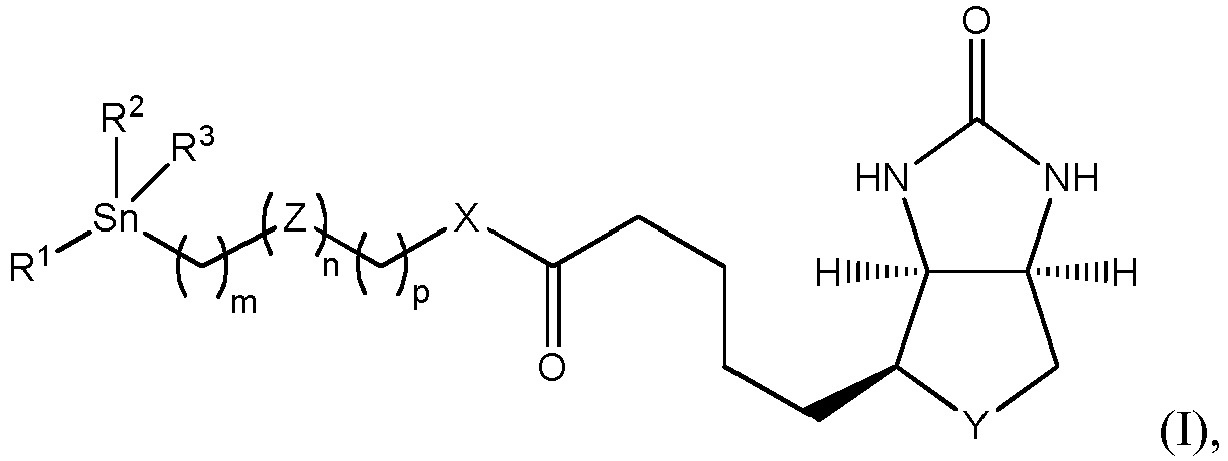 R1 is an aromatic or vinyl group capable of being substituted at an aromatic or vinylic carbon with iodide;R2 and R3 are each independently selected from R1; alkyl or alkoxyalkyl, each substituted with 0-4 R5 groups; or R2 and R3, along with the Sn atom to which they are attached, form a 3 to 8-membered ring that optionally includes one or more heteroatom selected from N, O, or S;Z is selected from -(C1-C4)alkylene-, -(C1-C4)alkylene-O-, arylene, heteroarylene, cycloalkylene or heterocycloalkylene, provided that m is at least 1 when Z is arylene or heteroarylene, and n = 1 to 9, and provided that p = 2-10 when Z is - (C1-C4)alkylene-O-;X is selected from -O-, and -NR4-;R4 is selected from H and alkyl, wherein the alkyl is substituted with 0-4 R6 groups;each R5 is independently selected from -H, -halogen, -CN, -NO2, -NRaRb, -ORc,-S(O)iRc, -C(=O)Rc, -C(=O)ORc and -OC(=O)Rc;R6 is selected from -H, -halogen, -CN, -NO2, -NRaRb, -ORc, -S(O)iRc, -C(=O)Rc,-C(=O)ORc and -OC(=O)Rc;Ra, Rb and Rc are each independently selected from -H and (C1-C6)alkyl;Y is selected from S, SO, SO2 and O;i is 0, 1, or 2; andm, n and p are each independently an integer from 0 to 10, wherein m + n + p ≥ 1.
 - The method of any one of claims 1 to 9, wherein the radioactive iodide is selected from 123I, 124I, 125I and 131I.
- The method of any one of claims 1 to 10, wherein the oxidant is selected from iodogen and peracetic acid.
- The method of claim 11, wherein the oxidant is pre-coated onto a tube or bead.
- A compound of formula (I):
 R1 is an aromatic or vinyl group capable of being substituted at an aromatic or vinylic carbon with iodide;R2 and R3 are each independently selected from R1; alkyl or alkoxyalkyl, each substituted with 0-4 R5 groups; or R2 and R3, along with the Sn atom to which they are attached, form a 3 to 8-membered ring that optionally includes one or more heteroatom selected from N, O, or S;Z is selected from -(C1-C4)alkylene-, -(C1-C4)alkylene-O-, arylene, heteroarylene, cycloalkylene or heterocycloalkylene, provided that m is at least 1 when Z is arylene or heteroarylene;X is selected from -O-, and -NR4-;R4 is selected from H and alkyl, wherein the alkyl is substituted with 0-4 R6 groups;each R5 is independently selected from -H, -halogen, -CN, -NO2, -NRaRb,-ORc,
-S(O)iRc, -C(=O)Rc, -C(=O)ORc and -OC(=O)Rc;R6 is selected from -H, -halogen, -CN, -NO2, -NRaRb, -ORc, -S(O)iRc,-C(=O)Rc,
-C(=O)ORc and -OC(=O)Rc;Ra, Rb and Rc are each independently selected from -H and (C1-C6)alkyl;Y is selected from S, SO, SO2 and O;i is 0, 1 or 2; andm, n and p are each independently an integer from 0 to 10, wherein m + n + p ≥ 1. - A compound according to claim 13, wherein:R1 is an aromatic or vinyl group capable of being substituted at an aromatic or vinylic carbon with iodide;R2 and R3 are each independently selected from (C1-C6)alkyl or alkoxyalkyl; or R2 and R3, along with the Sn atom to which they attach, form a 4, 5 or 6-membered ring that optionally includes one or more heteroatom selected from N, O, or S;Z is -(C1-C4)alkylene-O-;X is selected from O and NH;Y is selected from S or SO2; andp is an integer from 2 to 4.
Applications Claiming Priority (2)
| Application Number | Priority Date | Filing Date | Title |
|---|---|---|---|
| US13/435,142 US8927732B2 (en) | 2012-03-30 | 2012-03-30 | Biotin stannane for HPLC-free radioiodination |
| PCT/EP2013/056699 WO2013144292A1 (en) | 2012-03-30 | 2013-03-28 | Biotin stannane for hplc-free radioiodination |
Publications (2)
| Publication Number | Publication Date |
|---|---|
| EP2831018A1 EP2831018A1 (en) | 2015-02-04 |
| EP2831018B1 true EP2831018B1 (en) | 2016-12-28 |
Family
ID=47998468
Family Applications (1)
| Application Number | Title | Priority Date | Filing Date |
|---|---|---|---|
| EP13712574.6A Active EP2831018B1 (en) | 2012-03-30 | 2013-03-28 | Biotin stannane for hplc-free radioiodination |
Country Status (8)
| Country | Link |
|---|---|
| US (1) | US8927732B2 (en) |
| EP (1) | EP2831018B1 (en) |
| JP (1) | JP6159387B2 (en) |
| KR (1) | KR102005133B1 (en) |
| AU (1) | AU2013241704B2 (en) |
| CA (1) | CA2866223C (en) |
| ES (1) | ES2615270T3 (en) |
| WO (1) | WO2013144292A1 (en) |
Family Cites Families (20)
| Publication number | Priority date | Publication date | Assignee | Title |
|---|---|---|---|---|
| US5986076A (en) * | 1994-05-11 | 1999-11-16 | Trustees Of Boston University | Photocleavable agents and conjugates for the detection and isolation of biomolecules |
| NZ331042A (en) * | 1996-01-23 | 1999-10-28 | Rapigene Inc | Methods and compositions for detecting binding of ligand pair using non-fluorescent label |
| WO1997029114A1 (en) * | 1996-02-08 | 1997-08-14 | Board Of Regents Of The University Of Washington | Biotin-containing compounds, biotinylation reagents and methods |
| US7521531B2 (en) | 1996-08-28 | 2009-04-21 | Immunomedics, Inc. | Methods for the purification of stable radioiodine conjugates |
| CA2502358C (en) | 2002-10-18 | 2012-03-13 | John F. Valliant | Methods for purifying radiolabelled compounds |
| CA2551495A1 (en) * | 2004-01-07 | 2005-07-28 | Ambit Biosciences Corporation | Conjugated small molecules |
| GB0410448D0 (en) | 2004-05-11 | 2004-06-16 | Hammersmith Imanet Ltd | Purification methods |
| JP2009505947A (en) * | 2005-06-23 | 2009-02-12 | エモリー・ユニバーシティ | Imaging agent |
| GB0524851D0 (en) | 2005-12-06 | 2006-01-11 | Ge Healthcare Ltd | Radiolabelling method using polymers |
| WO2008027995A2 (en) | 2006-08-29 | 2008-03-06 | Beth Israel Deaconess Medical Center, Inc. | Radio-labeled materials and methods of making and using the same |
| WO2008110757A1 (en) | 2007-03-09 | 2008-09-18 | Ge Healthcare Limited | Separation process |
| WO2009113704A2 (en) * | 2008-03-11 | 2009-09-17 | Kyoto University | Fluorine-containing compound and method for detecting biomolecule using the same |
| EP2110367A1 (en) | 2008-04-14 | 2009-10-21 | Bayer Schering Pharma Aktiengesellschaft | Purification strategy for direct nucleophilic procedures |
| CA2729635A1 (en) | 2008-07-03 | 2010-01-07 | Ananth Srinivasan | Compounds and processes for production of radiopharmaceuticals |
| GB0819280D0 (en) * | 2008-10-21 | 2008-11-26 | Gen Electric | Imgaing and radiotherapy methods |
| US20100247461A1 (en) * | 2009-01-20 | 2010-09-30 | Signum Biosciences, Inc. | Anti-inflammatory complexes |
| WO2011061154A1 (en) * | 2009-11-17 | 2011-05-26 | Bayer Schering Pharma Aktiengesellschaft | Iodine-labeled homoglutamic acid and glutamic acid derivatives |
| GB0921573D0 (en) * | 2009-12-10 | 2010-01-27 | Ge Healthcare Ltd | Iodine radiolabelling method |
| WO2011095517A1 (en) * | 2010-02-03 | 2011-08-11 | Institut National De La Sante Et De La Recherche Medicale (Inserm) | Hypervalent radioactive astatine or iodine compounds, and preparation methods thereof |
| GB201012209D0 (en) * | 2010-05-31 | 2010-09-08 | Ge Healthcare Ltd | In vivo imaging agent |
-
2012
- 2012-03-30 US US13/435,142 patent/US8927732B2/en active Active
-
2013
- 2013-03-28 JP JP2015502352A patent/JP6159387B2/en active Active
- 2013-03-28 ES ES13712574.6T patent/ES2615270T3/en active Active
- 2013-03-28 WO PCT/EP2013/056699 patent/WO2013144292A1/en not_active Ceased
- 2013-03-28 KR KR1020147026933A patent/KR102005133B1/en active Active
- 2013-03-28 EP EP13712574.6A patent/EP2831018B1/en active Active
- 2013-03-28 CA CA2866223A patent/CA2866223C/en active Active
- 2013-03-28 AU AU2013241704A patent/AU2013241704B2/en active Active
Non-Patent Citations (1)
| Title |
|---|
| None * |
Also Published As
| Publication number | Publication date |
|---|---|
| CA2866223A1 (en) | 2013-10-03 |
| KR20140138220A (en) | 2014-12-03 |
| US8927732B2 (en) | 2015-01-06 |
| AU2013241704B2 (en) | 2017-04-13 |
| KR102005133B1 (en) | 2019-07-29 |
| US20130261311A1 (en) | 2013-10-03 |
| ES2615270T3 (en) | 2017-06-06 |
| JP2015514702A (en) | 2015-05-21 |
| EP2831018A1 (en) | 2015-02-04 |
| CA2866223C (en) | 2020-11-17 |
| WO2013144292A1 (en) | 2013-10-03 |
| CN104254510A (en) | 2014-12-31 |
| JP6159387B2 (en) | 2017-07-05 |
| AU2013241704A1 (en) | 2014-10-02 |
Similar Documents
| Publication | Publication Date | Title |
|---|---|---|
| CN101506128B (en) | High-speed methylation method, kit for preparing PET tracer, and method for manufacturing tracer for PET | |
| SG11202108109RA (en) | Psma binding dual mode radiotracer and therapeutic | |
| MX2011001406A (en) | Daa-pyridine as peripheral benzodiazepine receptor ligand for diagnostic imaging and pharmaceutical treatment. | |
| CN107522673B (en) | 1,2,4,5-tetrazine compound for bioorthogonal reaction and preparation method and application thereof | |
| US20230106083A1 (en) | Silicon-fluoride heteroaromatic systems for applications in positron emission tomography (pet) molecular imaging | |
| CN104910002A (en) | Dezocine key intermediate preparation method | |
| Garcia et al. | Synthesis and biological evaluation of tricarbonyl Re (I) and Tc (I) complexes anchored by poly (azolyl) borates: application on the design of radiopharmaceuticals for the targeting of 5-HT1A receptors | |
| Al Jammaz et al. | Novel synthesis of [18F]‐fluorobenzene and pyridinecarbohydrazide‐folates as potential PET radiopharmaceuticals | |
| JP5696281B2 (en) | Fast methylation method of heteroaromatic aryl and method for producing tracer for PET | |
| US8927732B2 (en) | Biotin stannane for HPLC-free radioiodination | |
| CN104254510B (en) | For without HPLC radioiodinated biotin stannane | |
| EP2891657A1 (en) | Ionic liquid supported organotin reagents for the manufacturing of radiopharmaceuticals compounds | |
| Koyama et al. | Highly efficient syntheses of [methyl-11 C] thymidine and its analogue 4′-[methyl-11 C] thiothymidine as nucleoside PET probes for cancer cell proliferation by Pd 0-mediated rapid C-[11 C] methylation | |
| EP2922836A1 (en) | New nucleophile-reactive sulfonated compounds for the (radio)labelling of (bio)molecules; precursors and conjugates thereof | |
| JP6037330B2 (en) | 11C-labeled thiamine and derivatives thereof, 11C-labeled fursultiamine, thiamine precursor, and probe for PET and imaging method using them | |
| CN113549052A (en) | 4-phenyl-1- (pyridine-4-ylmethyl) pyrrolidine-2-ketone derivative and preparation method and application thereof | |
| CN101775038A (en) | Marked cyclofenil derivative and referential compound and midbody thereof, and preparation method and application | |
| Henriksen et al. | Synthesis of [18F] fluoroalkyl esters of carfentanil | |
| Liu et al. | Design and synthesis of new agents for neuronal nicotinic acetylcholine receptor (nAChRs) imaging | |
| CN112341464A (en) | Halogen-substituted Latricinib compound | |
| RU2829029C1 (en) | Method of producing n-monofluoroalkyltropanes and use thereof | |
| Prante et al. | Synthesis and in vitro evaluation of iodine labelled pyrazolo [1, 5‐a] pyridines as highly selective dopamine D4 receptor ligands | |
| Gao et al. | 6-Chloro-3-(((1-[11C] methyl)-2-(S)-pyrrolidinyl) methoxy)-5-(2-fluoropyridin-4-yl) pyridine ([11C] JHU85270), a potent ligand for nicotinic acetylcholine receptor imaging by positron emission tomography | |
| WO2024120555A2 (en) | Prodrugs of benzodiazepine compound and uses thereof | |
| CN111138439B (en) | Fluoropyrrolopyrimidine compounds and their preparation method and application |
Legal Events
| Date | Code | Title | Description |
|---|---|---|---|
| PUAI | Public reference made under article 153(3) epc to a published international application that has entered the european phase |
Free format text: ORIGINAL CODE: 0009012 |
|
| 17P | Request for examination filed |
Effective date: 20140919 |
|
| AK | Designated contracting states |
Kind code of ref document: A1 Designated state(s): AL AT BE BG CH CY CZ DE DK EE ES FI FR GB GR HR HU IE IS IT LI LT LU LV MC MK MT NL NO PL PT RO RS SE SI SK SM TR |
|
| AX | Request for extension of the european patent |
Extension state: BA ME |
|
| DAX | Request for extension of the european patent (deleted) | ||
| 17Q | First examination report despatched |
Effective date: 20151014 |
|
| GRAP | Despatch of communication of intention to grant a patent |
Free format text: ORIGINAL CODE: EPIDOSNIGR1 |
|
| INTG | Intention to grant announced |
Effective date: 20160831 |
|
| GRAS | Grant fee paid |
Free format text: ORIGINAL CODE: EPIDOSNIGR3 |
|
| GRAA | (expected) grant |
Free format text: ORIGINAL CODE: 0009210 |
|
| AK | Designated contracting states |
Kind code of ref document: B1 Designated state(s): AL AT BE BG CH CY CZ DE DK EE ES FI FR GB GR HR HU IE IS IT LI LT LU LV MC MK MT NL NO PL PT RO RS SE SI SK SM TR |
|
| REG | Reference to a national code |
Ref country code: GB Ref legal event code: FG4D |
|
| REG | Reference to a national code |
Ref country code: CH Ref legal event code: EP |
|
| REG | Reference to a national code |
Ref country code: AT Ref legal event code: REF Ref document number: 857124 Country of ref document: AT Kind code of ref document: T Effective date: 20170115 |
|
| REG | Reference to a national code |
Ref country code: IE Ref legal event code: FG4D |
|
| REG | Reference to a national code |
Ref country code: DE Ref legal event code: R096 Ref document number: 602013015848 Country of ref document: DE |
|
| PG25 | Lapsed in a contracting state [announced via postgrant information from national office to epo] |
Ref country code: LV Free format text: LAPSE BECAUSE OF FAILURE TO SUBMIT A TRANSLATION OF THE DESCRIPTION OR TO PAY THE FEE WITHIN THE PRESCRIBED TIME-LIMIT Effective date: 20161228 |
|
| REG | Reference to a national code |
Ref country code: FR Ref legal event code: PLFP Year of fee payment: 5 |
|
| REG | Reference to a national code |
Ref country code: LT Ref legal event code: MG4D |
|
| PG25 | Lapsed in a contracting state [announced via postgrant information from national office to epo] |
Ref country code: GR Free format text: LAPSE BECAUSE OF FAILURE TO SUBMIT A TRANSLATION OF THE DESCRIPTION OR TO PAY THE FEE WITHIN THE PRESCRIBED TIME-LIMIT Effective date: 20170329 Ref country code: LT Free format text: LAPSE BECAUSE OF FAILURE TO SUBMIT A TRANSLATION OF THE DESCRIPTION OR TO PAY THE FEE WITHIN THE PRESCRIBED TIME-LIMIT Effective date: 20161228 Ref country code: NO Free format text: LAPSE BECAUSE OF FAILURE TO SUBMIT A TRANSLATION OF THE DESCRIPTION OR TO PAY THE FEE WITHIN THE PRESCRIBED TIME-LIMIT Effective date: 20170328 Ref country code: SE Free format text: LAPSE BECAUSE OF FAILURE TO SUBMIT A TRANSLATION OF THE DESCRIPTION OR TO PAY THE FEE WITHIN THE PRESCRIBED TIME-LIMIT Effective date: 20161228 |
|
| REG | Reference to a national code |
Ref country code: NL Ref legal event code: MP Effective date: 20161228 |
|
| REG | Reference to a national code |
Ref country code: AT Ref legal event code: MK05 Ref document number: 857124 Country of ref document: AT Kind code of ref document: T Effective date: 20161228 |
|
| PG25 | Lapsed in a contracting state [announced via postgrant information from national office to epo] |
Ref country code: HR Free format text: LAPSE BECAUSE OF FAILURE TO SUBMIT A TRANSLATION OF THE DESCRIPTION OR TO PAY THE FEE WITHIN THE PRESCRIBED TIME-LIMIT Effective date: 20161228 Ref country code: FI Free format text: LAPSE BECAUSE OF FAILURE TO SUBMIT A TRANSLATION OF THE DESCRIPTION OR TO PAY THE FEE WITHIN THE PRESCRIBED TIME-LIMIT Effective date: 20161228 Ref country code: RS Free format text: LAPSE BECAUSE OF FAILURE TO SUBMIT A TRANSLATION OF THE DESCRIPTION OR TO PAY THE FEE WITHIN THE PRESCRIBED TIME-LIMIT Effective date: 20161228 |
|
| REG | Reference to a national code |
Ref country code: ES Ref legal event code: FG2A Ref document number: 2615270 Country of ref document: ES Kind code of ref document: T3 Effective date: 20170606 |
|
| PG25 | Lapsed in a contracting state [announced via postgrant information from national office to epo] |
Ref country code: NL Free format text: LAPSE BECAUSE OF FAILURE TO SUBMIT A TRANSLATION OF THE DESCRIPTION OR TO PAY THE FEE WITHIN THE PRESCRIBED TIME-LIMIT Effective date: 20161228 |
|
| PG25 | Lapsed in a contracting state [announced via postgrant information from national office to epo] |
Ref country code: CZ Free format text: LAPSE BECAUSE OF FAILURE TO SUBMIT A TRANSLATION OF THE DESCRIPTION OR TO PAY THE FEE WITHIN THE PRESCRIBED TIME-LIMIT Effective date: 20161228 Ref country code: IS Free format text: LAPSE BECAUSE OF FAILURE TO SUBMIT A TRANSLATION OF THE DESCRIPTION OR TO PAY THE FEE WITHIN THE PRESCRIBED TIME-LIMIT Effective date: 20170428 Ref country code: SK Free format text: LAPSE BECAUSE OF FAILURE TO SUBMIT A TRANSLATION OF THE DESCRIPTION OR TO PAY THE FEE WITHIN THE PRESCRIBED TIME-LIMIT Effective date: 20161228 Ref country code: EE Free format text: LAPSE BECAUSE OF FAILURE TO SUBMIT A TRANSLATION OF THE DESCRIPTION OR TO PAY THE FEE WITHIN THE PRESCRIBED TIME-LIMIT Effective date: 20161228 Ref country code: RO Free format text: LAPSE BECAUSE OF FAILURE TO SUBMIT A TRANSLATION OF THE DESCRIPTION OR TO PAY THE FEE WITHIN THE PRESCRIBED TIME-LIMIT Effective date: 20161228 |
|
| PG25 | Lapsed in a contracting state [announced via postgrant information from national office to epo] |
Ref country code: AT Free format text: LAPSE BECAUSE OF FAILURE TO SUBMIT A TRANSLATION OF THE DESCRIPTION OR TO PAY THE FEE WITHIN THE PRESCRIBED TIME-LIMIT Effective date: 20161228 Ref country code: PT Free format text: LAPSE BECAUSE OF FAILURE TO SUBMIT A TRANSLATION OF THE DESCRIPTION OR TO PAY THE FEE WITHIN THE PRESCRIBED TIME-LIMIT Effective date: 20170428 Ref country code: PL Free format text: LAPSE BECAUSE OF FAILURE TO SUBMIT A TRANSLATION OF THE DESCRIPTION OR TO PAY THE FEE WITHIN THE PRESCRIBED TIME-LIMIT Effective date: 20161228 Ref country code: BG Free format text: LAPSE BECAUSE OF FAILURE TO SUBMIT A TRANSLATION OF THE DESCRIPTION OR TO PAY THE FEE WITHIN THE PRESCRIBED TIME-LIMIT Effective date: 20170328 Ref country code: SM Free format text: LAPSE BECAUSE OF FAILURE TO SUBMIT A TRANSLATION OF THE DESCRIPTION OR TO PAY THE FEE WITHIN THE PRESCRIBED TIME-LIMIT Effective date: 20161228 Ref country code: BE Free format text: LAPSE BECAUSE OF FAILURE TO SUBMIT A TRANSLATION OF THE DESCRIPTION OR TO PAY THE FEE WITHIN THE PRESCRIBED TIME-LIMIT Effective date: 20161228 |
|
| REG | Reference to a national code |
Ref country code: DE Ref legal event code: R097 Ref document number: 602013015848 Country of ref document: DE |
|
| REG | Reference to a national code |
Ref country code: CH Ref legal event code: PL |
|
| PLBE | No opposition filed within time limit |
Free format text: ORIGINAL CODE: 0009261 |
|
| STAA | Information on the status of an ep patent application or granted ep patent |
Free format text: STATUS: NO OPPOSITION FILED WITHIN TIME LIMIT |
|
| PG25 | Lapsed in a contracting state [announced via postgrant information from national office to epo] |
Ref country code: MC Free format text: LAPSE BECAUSE OF FAILURE TO SUBMIT A TRANSLATION OF THE DESCRIPTION OR TO PAY THE FEE WITHIN THE PRESCRIBED TIME-LIMIT Effective date: 20161228 Ref country code: DK Free format text: LAPSE BECAUSE OF FAILURE TO SUBMIT A TRANSLATION OF THE DESCRIPTION OR TO PAY THE FEE WITHIN THE PRESCRIBED TIME-LIMIT Effective date: 20161228 |
|
| 26N | No opposition filed |
Effective date: 20170929 |
|
| REG | Reference to a national code |
Ref country code: IE Ref legal event code: MM4A |
|
| PG25 | Lapsed in a contracting state [announced via postgrant information from national office to epo] |
Ref country code: LU Free format text: LAPSE BECAUSE OF NON-PAYMENT OF DUE FEES Effective date: 20170328 |
|
| PG25 | Lapsed in a contracting state [announced via postgrant information from national office to epo] |
Ref country code: CH Free format text: LAPSE BECAUSE OF NON-PAYMENT OF DUE FEES Effective date: 20170331 Ref country code: LI Free format text: LAPSE BECAUSE OF NON-PAYMENT OF DUE FEES Effective date: 20170331 Ref country code: IE Free format text: LAPSE BECAUSE OF NON-PAYMENT OF DUE FEES Effective date: 20170328 Ref country code: SI Free format text: LAPSE BECAUSE OF FAILURE TO SUBMIT A TRANSLATION OF THE DESCRIPTION OR TO PAY THE FEE WITHIN THE PRESCRIBED TIME-LIMIT Effective date: 20161228 |
|
| REG | Reference to a national code |
Ref country code: FR Ref legal event code: PLFP Year of fee payment: 6 |
|
| PG25 | Lapsed in a contracting state [announced via postgrant information from national office to epo] |
Ref country code: MT Free format text: LAPSE BECAUSE OF NON-PAYMENT OF DUE FEES Effective date: 20170328 |
|
| PG25 | Lapsed in a contracting state [announced via postgrant information from national office to epo] |
Ref country code: HU Free format text: LAPSE BECAUSE OF FAILURE TO SUBMIT A TRANSLATION OF THE DESCRIPTION OR TO PAY THE FEE WITHIN THE PRESCRIBED TIME-LIMIT; INVALID AB INITIO Effective date: 20130328 |
|
| PG25 | Lapsed in a contracting state [announced via postgrant information from national office to epo] |
Ref country code: CY Free format text: LAPSE BECAUSE OF FAILURE TO SUBMIT A TRANSLATION OF THE DESCRIPTION OR TO PAY THE FEE WITHIN THE PRESCRIBED TIME-LIMIT Effective date: 20161228 |
|
| PG25 | Lapsed in a contracting state [announced via postgrant information from national office to epo] |
Ref country code: MK Free format text: LAPSE BECAUSE OF FAILURE TO SUBMIT A TRANSLATION OF THE DESCRIPTION OR TO PAY THE FEE WITHIN THE PRESCRIBED TIME-LIMIT Effective date: 20161228 |
|
| PG25 | Lapsed in a contracting state [announced via postgrant information from national office to epo] |
Ref country code: TR Free format text: LAPSE BECAUSE OF FAILURE TO SUBMIT A TRANSLATION OF THE DESCRIPTION OR TO PAY THE FEE WITHIN THE PRESCRIBED TIME-LIMIT Effective date: 20161228 |
|
| PG25 | Lapsed in a contracting state [announced via postgrant information from national office to epo] |
Ref country code: AL Free format text: LAPSE BECAUSE OF FAILURE TO SUBMIT A TRANSLATION OF THE DESCRIPTION OR TO PAY THE FEE WITHIN THE PRESCRIBED TIME-LIMIT Effective date: 20161228 |
|
| P01 | Opt-out of the competence of the unified patent court (upc) registered |
Effective date: 20230529 |
|
| PGFP | Annual fee paid to national office [announced via postgrant information from national office to epo] |
Ref country code: ES Payment date: 20250401 Year of fee payment: 13 |
|
| PGFP | Annual fee paid to national office [announced via postgrant information from national office to epo] |
Ref country code: GB Payment date: 20260220 Year of fee payment: 14 |
|
| PGFP | Annual fee paid to national office [announced via postgrant information from national office to epo] |
Ref country code: DE Payment date: 20260219 Year of fee payment: 14 |
|
| PGFP | Annual fee paid to national office [announced via postgrant information from national office to epo] |
Ref country code: IT Payment date: 20260219 Year of fee payment: 14 |
|
| PGFP | Annual fee paid to national office [announced via postgrant information from national office to epo] |
Ref country code: FR Payment date: 20260220 Year of fee payment: 14 |