EP2830455B1 - Luggage apparatus - Google Patents
Luggage apparatus Download PDFInfo
- Publication number
- EP2830455B1 EP2830455B1 EP13720998.7A EP13720998A EP2830455B1 EP 2830455 B1 EP2830455 B1 EP 2830455B1 EP 13720998 A EP13720998 A EP 13720998A EP 2830455 B1 EP2830455 B1 EP 2830455B1
- Authority
- EP
- European Patent Office
- Prior art keywords
- moveable
- fixed portion
- luggage apparatus
- luggage
- fixed
- Prior art date
- Legal status (The legal status is an assumption and is not a legal conclusion. Google has not performed a legal analysis and makes no representation as to the accuracy of the status listed.)
- Active
Links
Images

Classifications
-
- A—HUMAN NECESSITIES
- A45—HAND OR TRAVELLING ARTICLES
- A45C—PURSES; LUGGAGE; HAND CARRIED BAGS
- A45C5/00—Rigid or semi-rigid luggage
- A45C5/14—Rigid or semi-rigid luggage with built-in rolling means
-
- A—HUMAN NECESSITIES
- A45—HAND OR TRAVELLING ARTICLES
- A45C—PURSES; LUGGAGE; HAND CARRIED BAGS
- A45C13/00—Details; Accessories
- A45C13/26—Special adaptations of handles
-
- A—HUMAN NECESSITIES
- A45—HAND OR TRAVELLING ARTICLES
- A45C—PURSES; LUGGAGE; HAND CARRIED BAGS
- A45C13/00—Details; Accessories
- A45C13/26—Special adaptations of handles
- A45C13/28—Combinations of handles with other devices
-
- A—HUMAN NECESSITIES
- A45—HAND OR TRAVELLING ARTICLES
- A45C—PURSES; LUGGAGE; HAND CARRIED BAGS
- A45C5/00—Rigid or semi-rigid luggage
- A45C5/14—Rigid or semi-rigid luggage with built-in rolling means
- A45C5/146—Rigid or semi-rigid luggage with built-in rolling means retractable
-
- A—HUMAN NECESSITIES
- A45—HAND OR TRAVELLING ARTICLES
- A45C—PURSES; LUGGAGE; HAND CARRIED BAGS
- A45C9/00—Purses, Luggage or bags convertible into objects for other use
-
- A—HUMAN NECESSITIES
- A45—HAND OR TRAVELLING ARTICLES
- A45C—PURSES; LUGGAGE; HAND CARRIED BAGS
- A45C9/00—Purses, Luggage or bags convertible into objects for other use
- A45C2009/002—Purses, Luggage or bags convertible into objects for other use into a seat
-
- A—HUMAN NECESSITIES
- A45—HAND OR TRAVELLING ARTICLES
- A45C—PURSES; LUGGAGE; HAND CARRIED BAGS
- A45C9/00—Purses, Luggage or bags convertible into objects for other use
- A45C2009/005—Purses, Luggage or bags convertible into objects for other use into a vehicle, e.g. scooter
-
- A—HUMAN NECESSITIES
- A45—HAND OR TRAVELLING ARTICLES
- A45C—PURSES; LUGGAGE; HAND CARRIED BAGS
- A45C13/00—Details; Accessories
- A45C13/26—Special adaptations of handles
- A45C13/262—Special adaptations of handles for wheeled luggage
- A45C2013/267—Special adaptations of handles for wheeled luggage the handle being slidable, extractable and lockable in one or more positions
Definitions
- the present invention relates to a luggage apparatus, particularly luggage apparatus suitable for use as cabin baggage.
- providing a child seat which, in the stowed position, can be fully contained within the apparatus body has distinct advantages.
- some forms of luggage such as cabin baggage
- the luggage apparatus of the present invention is suitable for use as a pram when the luggage apparatus is in the deployed position, allowing a child to be transported around the airport and onto the plane, and a suitcase in the stowed position.
- the apparatus can be configured such that, in the stowed position, it complies with the cabin baggage size restrictions. Such an arrangement permits the apparatus to be taken onto the aircraft, doing away with the need for a separate pram requiring stowing in the aircraft hold.
- the luggage apparatus is a suitcase.
- the luggage apparatus may be a cabin baggage sized suitcase.
- Airline companies provide information on the acceptable size of cabin baggage, most airlines adhering to a standard size. Manufacturing the luggage apparatus of the present invention to the standard size permits the apparatus to be treated as cabin baggage and therefore providing the user with a "pram" which the user can take onto the plane.
- the moveable portion may comprise an at least one storage compartment.
- the fixed portion may comprise an at least one storage compartment.
- both the moveable and fixed portions comprise an at least one storage compartment.
- the at least one storage compartment may be substantially rigid.
- the at least one storage compartment may comprise a resilient material.
- the storage provided by the apparatus is maximised increasing utility of the apparatus.
- the storage compartments do not need to be emptied to allow the "pram" to collapse. The movable portion is simply folded back into the stowed position.
- the/each movable and/or fixed portion storage compartment has at least two access points.
- One of the access points may be on a side of the apparatus. Providing multiple access points for each storage compartment allows the contents of the storage compartment to be accessed from different angles and particularly when the moveable portion is deployed. In such positions, the front and top surfaces of the apparatus may be hidden by the deployment of the moveable portion and/or a child sitting in the apparatus.
- the moveable portion may pivot with respect to the fixed portion.
- the moveable portion may pivot with respect to the fixed portion around a hinge.
- the moveable portion surface In moving from the stowed position to the deployed position, the moveable portion surface may pivot away from the fixed portion surface.
- the moveable portion may be connected with the fixed portion along an edge.
- the edge may extend the full width of the child's seat.
- the edge may comprise a hinge, particularly, the hinge maybe a living hinge.
- a living hinge can be utilised to eliminate pinch points.
- the moveable and fixed portion surfaces may be substantially opposed.
- the moveable and fixed portion surfaces are at least partially in contact. Having close contact between the surfaces reduces the amount of space the "pram" part of the luggage apparatus takes up, in some embodiments, increasing the availability of space.
- the movable and fixed portions are sealably connected to prevent ingress of water between the movable portion surface and fixed portion surface.
- the movable portion may define a section of an apparatus external surface.
- an apparatus body external surface is substantially defined by the movable portion and the fixed portion.
- the movable portion is deployed by applying a pull force to an external surface of the apparatus body.
- the movable portion may be releasably fixed in the stowed position.
- the movable portion may be releasably fixed in the stowed position by an interference fit, a clip, a snap fit or by any suitable method.
- the fixed portion surface may be adapted to receive a child's bottom.
- the fixed portion surface may be substantially contained within the apparatus body in both the stowed and deployed positions.
- the extending elements may act as armrests.
- the movable portion In the stowed position, the movable portion may be contained within the extending elements. Providing extending elements which can protect the movable portion in the stowed position, allows for a less rigid construction to be utilised for the movable portion making it easier to manipulate between the stowed and deployed positions.
- the apparatus may comprise a restraining member.
- the restraining member may, in the deployed position and in use with a child, prevent a child from sliding off or climbing out of the seat.
- the restraining member may be a harness and/or a barrier device.
- the barrier may, in the deployed position, be located adjacent an interface between the moveable and fixed portions.
- the barrier may be adapted to prevent, in use, the child sliding off the fixed portion surface.
- the barrier may be positionable between the child's legs.
- the barrier may be substantially perpendicular to the fixed surface.
- the barrier may define a "T" shape. Such an arrangement provides a horizontal bar, in use, for a child to grip onto.
- the barrier may be movable between a stowed position and a deployed position.
- the barrier may be pivotally movable between the stowed and deployed positions. In the stowed position, the barrier may lie between the moveable portion surface and the fixed portion surface. One or other of the surfaces may define a recess adapted to receive the barrier.
- the barrier may be adapted to be received within one or other of the moveable or fixed body portions.
- the moveable portion may comprise first and second sections.
- the first section may be movable with respect to the second section.
- the first section may be pivotable with respect to the second section.
- the first section may be connected to the second section by means of a hinge.
- the moveable portion surface may be adapted, in use, to support the child's legs.
- the moveable portion may include a support member adapted to support, in use, a child's feet.
- the support member may be a foot rest. Providing footrest gives a child using the seat something to press against which is beneficial for the child's development.
- the support member may be pivotally mounted to the moveable portion.
- the apparatus may further comprise a backrest.
- a backrest is provided to support a child, particularly when the apparatus is inclined.
- the backrest may be movable with respect to the apparatus body.
- the backrest may be movable such that in the stowed position, the backrest is contained within the apparatus body and in the deployed position the backrest extends from the apparatus body. In the deployed position, the backrest may provide a surface which is an extension of the fixed portion surface.
- the luggage apparatus may comprise a handle to allow the apparatus to be pushed or pulled around.
- the handle is of the conventional type in which the handle is stored within the apparatus body when not in use and may be pulled out when the luggage apparatus is to be moved.
- the handle may provide a support for the backrest in the deployed position.
- the luggage apparatus may comprise wheels. At least one of the wheels may also be deployable. There may be two fixed wheels and at least one deployable wheel. The at least one deployable will may be steerable. The at least one deployable wheel may be movable with respect to the apparatus body from a stored position to a usable position. In the usable position, the at least one deployable wheel may be arranged such that the luggage apparatus can be tilted to an angle and remain stable. The angle may be adjustable. In use, the user utilises the at least one deployable wheel to tilt the apparatus to an angle which allows the apparatus to be pushed around like a pram. The at least one deployable wheel keeps the apparatus stable.
- the luggage apparatus When the at least one deployable wheel is stored, intended for when the luggage apparatus is in the stowed position, the luggage apparatus can be wheeled around like a conventional cabin bag on the fixed wheels.
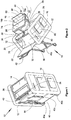
- FIG. 1 perspective views of a luggage apparatus, generally indicated by reference numeral 10, according to a first embodiment of the present invention.
- the luggage apparatus 10 comprises an apparatus body 12 having a moveable portion 14 and fixed portion 16, the moveable portion 14 being movable with respect to the fixed portion 16 between a deployed position ( Figure 2 ), in which a moveable portion surface 18 and a fixed portion surface 20 are arranged to define a seat 22 for a child, and a stowed position ( Figure 1 ) in which the moveable and fixed portion surfaces 18, 20 are substantially contained within the apparatus 10.
- the moveable portion 14 is connected to the fixed portion 16 by a hinge 26 extending the length of a moveable portion edge 28 and a fixed portion edge 30.
- the hinge 26 allows the moveable portion 14 to pivot with respect to the fixed portion 16 from the stowed position shown in Figure 1 to the deployed position shown in Figure 2 .
- the fixed portion surface 20 is shaped to receive a child's bottom and includes a curved surface section 32, providing a gradual transition through 90° from a fixed portion surface flat section 34 to an apparatus backrest 36.
- the apparatus backrest 36 when not in use is stored in a recess 38 defined by the apparatus body, 12, and in the deployed position shown in Figure 2 , is supported and reinforced by an apparatus handle 42, provided for pulling or pushing the luggage apparatus 10.
- the apparatus backrest 36 is curved across its width to provide a comfortable surface for the child to lean against, in use.
- the fixed portion 16 further comprises extendable sections 78 which have a number of purposes.
- the extendable sections 78 act as armrests for a child using the seat 22, extendable sections 78 assist in securing the child within the seat 22, and, together with the fixed portion surface 20, the extendable sections 78 define a recess 80 into which the movable portion 14 may be wholly contained in the stowed position.
- the extendable sections 78 form part of the side 82 of the fixed portion 16 which, in turn, defines the side profile of the luggage apparatus 10 when it is in the stowed position, and as usable as a suitcase.
- the apparatus 10 further comprises a barrier 70 which, in the deployed position, sits across and between the child's legs to resist, in use, the child climbing out of the seat 22 or sliding off the apparatus 10.
- the barrier 70 is pivotable from the position shown in Figure 2 to a position in which it lies against the fixed portion surface flat section 34.
- Barrier guide slots 72 are provided in the fixed portion extendable sections 78 to guide the barrier 70 as it pivots.
- the apparatus further comprises a set of wheels 40 which can be used to facilitate movement of the luggage apparatus 10 either in the stowed position shown in Figure 1 or the deployed position shown in Figure 2 .
- the wheels 40 comprise first and second fixed wheels 40a, 40b and a pair of stability wheels 40c.
- the stability wheels 40c are steerable and can be stored against the back surface 44 of the apparatus body 12 ( Figure 1 ) or be extended from the back surface 44 ( Figure 2 ) to provide stability for the luggage apparatus 10 in an inclined orientation which a child using the seat 22 may find more comfortable than the upright orientation of Figure 1 .
- the stability wheels 40c are however usable in both the stowed position or the deployed position of the movable portion 14. They are not restricted to use only in the deployed position of the movable portion 14.
- the moveable portion 14 comprises a first moveable portion section 14a and a second moveable portion section 14b.
- the first and second moveable portion sections being connected by a second hinge 46.
- the first movable portion section 14a also includes a footrest 48 which is hingedly connected to the first movable portion section 14a and can be lifted out of a footrest recess 50 when the movable portion 14 is deployed to provide a footrest for a child.
- the first movable portion section 14a defines a curved surface 52 which in the stowed position, is engaged with the curved surface section 32 of the fixed portion surface 20.
- This arrangement provides a usable movable portion surface 18 which is longer than the fixed portion surface 20 to provide a greater support area for the infant's legs.
- the first movable portion section 14a is pivoted away from the second movable portion section 14b around the second hinge 46 to the position shown in Figure 3b .
- the footrest 48 is pivoted out of the footrest recess 50 to complete the deployment of the movable portion 14 and convert the luggage apparatus 10 from a "suitcase” shown in Figure 1 to a "pram” shown in Figure 2 .
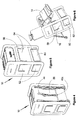
- Figure 4 shows the back surface 44 of the apparatus 10 and, particularly, shows the deployable wheels 40c in a stored position in which they sit in a recess 56 defined by the apparatus back surface 44.
- Figure 5 shows the front and side of the apparatus and particularly shows the fixed portion 16 has first and second storage compartments 58, 60.
- Each of these storage compartments 58, 60 have a side access 62 and a front access 64 facilitating quick and easy access to the storage compartments 58, 60.
- the side access is 62 is of greatest benefit when the movable portion 14 is in the deployed position (shown in Figure 6 ) in which accessing the storage compartments 58, 60 from the front may be restricted by the movable portion 14.
- harness may be provided to provide additional security for the child using the pram.
Landscapes
- Purses, Travelling Bags, Baskets, Or Suitcases (AREA)
- Vehicle Step Arrangements And Article Storage (AREA)
- Carriages For Children, Sleds, And Other Hand-Operated Vehicles (AREA)
Description
- The present invention relates to a luggage apparatus, particularly luggage apparatus suitable for use as cabin baggage.
- The increase in the popularity of air travel experienced in recent years has required the introduction of more stringent security procedures for passengers at airports and the standardisation of rules concerning what may or may not be permitted within an aircraft cabin.
- Travelling with young children makes complying with the rules and changes, described above, more demanding. A parent of a young child will generally prefer to have the child's pram with them at all times. However it is awkward to get the pram through security as the pram may have to be emptied and collapsed to be x-rayed, or if the pram does not pass through the x-ray, it will have to be visually inspected, causing delay.
- Usually, once the family reach the aircraft doors, the pram is taken away by airport staff and stored in the hold. This is time-consuming for the airport authorities and frustrating for the parent of the child as, when they arrived at their destination, they may not be reunited with their pram until they reach the baggage hall.
- Document
US5988657 discloses a luggage which can be reconfigured to form a seat on which a child can be seated. - According to a first aspect of the present invention there is provided a luggage apparatus according to claim 1.
- In at least one embodiment of the present invention, providing a child seat which, in the stowed position, can be fully contained within the apparatus body has distinct advantages. For example, some forms of luggage, such as cabin baggage, are subject to vigorously enforced size restrictions. The luggage apparatus of the present invention is suitable for use as a pram when the luggage apparatus is in the deployed position, allowing a child to be transported around the airport and onto the plane, and a suitcase in the stowed position. The apparatus can be configured such that, in the stowed position, it complies with the cabin baggage size restrictions. Such an arrangement permits the apparatus to be taken onto the aircraft, doing away with the need for a separate pram requiring stowing in the aircraft hold.
- In a preferred embodiment, the luggage apparatus is a suitcase. Particularly, the luggage apparatus may be a cabin baggage sized suitcase. Airline companies provide information on the acceptable size of cabin baggage, most airlines adhering to a standard size. Manufacturing the luggage apparatus of the present invention to the standard size permits the apparatus to be treated as cabin baggage and therefore providing the user with a "pram" which the user can take onto the plane.
- The moveable portion may comprise an at least one storage compartment.
- Additionally, or alternatively, the fixed portion may comprise an at least one storage compartment.
- In a preferred embodiment both the moveable and fixed portions comprise an at least one storage compartment. The at least one storage compartment may be substantially rigid. Alternatively or additionally the at least one storage compartment may comprise a resilient material. In such an arrangement, the storage provided by the apparatus is maximised increasing utility of the apparatus. Furthermore, unlike a conventional travel pram, the storage compartments do not need to be emptied to allow the "pram" to collapse. The movable portion is simply folded back into the stowed position.
- In a preferred embodiment the/each movable and/or fixed portion storage compartment has at least two access points. One of the access points may be on a side of the apparatus. Providing multiple access points for each storage compartment allows the contents of the storage compartment to be accessed from different angles and particularly when the moveable portion is deployed. In such positions, the front and top surfaces of the apparatus may be hidden by the deployment of the moveable portion and/or a child sitting in the apparatus.
- The moveable portion may pivot with respect to the fixed portion.
- The moveable portion may pivot with respect to the fixed portion around a hinge.
- In moving from the stowed position to the deployed position, the moveable portion surface may pivot away from the fixed portion surface.
- The moveable portion may be connected with the fixed portion along an edge.
- The edge may extend the full width of the child's seat.
- The edge may comprise a hinge, particularly, the hinge maybe a living hinge. A living hinge can be utilised to eliminate pinch points.
- In the stowed position, the moveable and fixed portion surfaces may be substantially opposed.
- In a preferred embodiment, in the stowed position, the moveable and fixed portion surfaces are at least partially in contact. Having close contact between the surfaces reduces the amount of space the "pram" part of the luggage apparatus takes up, in some embodiments, increasing the availability of space.
- In the stowed position, the movable and fixed portions are sealably connected to prevent ingress of water between the movable portion surface and fixed portion surface.
- The movable portion may define a section of an apparatus external surface.
- In a preferred embodiment, an apparatus body external surface is substantially defined by the movable portion and the fixed portion. Such an arrangement allows for quick deployment as the movable portion does not need to be first removed from, for example, inside the apparatus.
- In a preferred embodiment, the movable portion is deployed by applying a pull force to an external surface of the apparatus body.
- The movable portion may be releasably fixed in the stowed position.
- The movable portion may be releasably fixed in the stowed position by an interference fit, a clip, a snap fit or by any suitable method.
- The fixed portion surface may be adapted to receive a child's bottom.
- The fixed portion surface may be substantially contained within the apparatus body in both the stowed and deployed positions.
- In the deployed position, the extending elements may act as armrests. In the stowed position, the movable portion may be contained within the extending elements. Providing extending elements which can protect the movable portion in the stowed position, allows for a less rigid construction to be utilised for the movable portion making it easier to manipulate between the stowed and deployed positions.
- The apparatus may comprise a restraining member.
- The restraining member may, in the deployed position and in use with a child, prevent a child from sliding off or climbing out of the seat.
- The restraining member may be a harness and/or a barrier device.
- Where the restraining member is a barrier device, the barrier may, in the deployed position, be located adjacent an interface between the moveable and fixed portions. In such an embodiment, the barrier may be adapted to prevent, in use, the child sliding off the fixed portion surface. The barrier may be positionable between the child's legs. In such an embodiment, the barrier may be substantially perpendicular to the fixed surface.
- The barrier may define a "T" shape. Such an arrangement provides a horizontal bar, in use, for a child to grip onto.
- The barrier may be movable between a stowed position and a deployed position. The barrier may be pivotally movable between the stowed and deployed positions. In the stowed position, the barrier may lie between the moveable portion surface and the fixed portion surface. One or other of the surfaces may define a recess adapted to receive the barrier.
- In alternative embodiments, the barrier may be adapted to be received within one or other of the moveable or fixed body portions.
- The moveable portion may comprise first and second sections. The first section may be movable with respect to the second section. The first section may be pivotable with respect to the second section. The first section may be connected to the second section by means of a hinge.
- The moveable portion surface may be adapted, in use, to support the child's legs.
- The moveable portion may include a support member adapted to support, in use, a child's feet. The support member may be a foot rest. Providing footrest gives a child using the seat something to press against which is beneficial for the child's development. The support member may be pivotally mounted to the moveable portion.
- The apparatus may further comprise a backrest. A backrest is provided to support a child, particularly when the apparatus is inclined. The backrest may be movable with respect to the apparatus body. The backrest may be movable such that in the stowed position, the backrest is contained within the apparatus body and in the deployed position the backrest extends from the apparatus body. In the deployed position, the backrest may provide a surface which is an extension of the fixed portion surface.
- The luggage apparatus may comprise a handle to allow the apparatus to be pushed or pulled around. The handle is of the conventional type in which the handle is stored within the apparatus body when not in use and may be pulled out when the luggage apparatus is to be moved. The handle may provide a support for the backrest in the deployed position.
- The luggage apparatus may comprise wheels. At least one of the wheels may also be deployable. There may be two fixed wheels and at least one deployable wheel. The at least one deployable will may be steerable. The at least one deployable wheel may be movable with respect to the apparatus body from a stored position to a usable position. In the usable position, the at least one deployable wheel may be arranged such that the luggage apparatus can be tilted to an angle and remain stable. The angle may be adjustable. In use, the user utilises the at least one deployable wheel to tilt the apparatus to an angle which allows the apparatus to be pushed around like a pram. The at least one deployable wheel keeps the apparatus stable.
- When the at least one deployable wheel is stored, intended for when the luggage apparatus is in the stowed position, the luggage apparatus can be wheeled around like a conventional cabin bag on the fixed wheels.
- According to a second aspect of the present invention there is provided a method of configuring a luggage apparatus according to
claim 14. - It will be understood that preferred features of the first aspect may be equally applicable to the second aspect and have not been repeated for brevity.
- An embodiment of the present invention will now be described with reference to the accompanying drawings in which:
-
Figure 1 is a perspective view of a luggage apparatus shown in a stowed position according to a moveable embodiment of the present invention; -
Figure 2 is a perspective view of the luggage apparatus ofFigure 1 shown in a deployed position; -
Figure 3 , comprisingFigure 3a to 3c , is a series of side views of the apparatus ofFigure 1 showing the deployment of the movable portion -
Figure 4 is a rear perspective view of the apparatus ofFigure 1 showing the steerable wheels in a stored position; -
Figure 5 is a front perspective view of the apparatus ofFigure 1 in the stowed position; and -
Figure 6 is a front perspective view of part of the apparatus ofFigure 1 in the deployed position. - Reference is firstly made to
Figures 1 and 2 , perspective views of a luggage apparatus, generally indicated byreference numeral 10, according to a first embodiment of the present invention. - The
luggage apparatus 10 comprises anapparatus body 12 having amoveable portion 14 and fixedportion 16, themoveable portion 14 being movable with respect to the fixedportion 16 between a deployed position (Figure 2 ), in which amoveable portion surface 18 and a fixedportion surface 20 are arranged to define a seat 22 for a child, and a stowed position (Figure 1 ) in which the moveable and fixed portion surfaces 18, 20 are substantially contained within theapparatus 10. - The
moveable portion 14 is connected to the fixedportion 16 by ahinge 26 extending the length of amoveable portion edge 28 and a fixedportion edge 30. Thehinge 26 allows themoveable portion 14 to pivot with respect to the fixedportion 16 from the stowed position shown inFigure 1 to the deployed position shown inFigure 2 . - The fixed
portion surface 20 is shaped to receive a child's bottom and includes acurved surface section 32, providing a gradual transition through 90° from a fixed portion surfaceflat section 34 to anapparatus backrest 36. As can be seen, particularly fromFigure 1 , theapparatus backrest 36 when not in use is stored in arecess 38 defined by the apparatus body, 12, and in the deployed position shown inFigure 2 , is supported and reinforced by anapparatus handle 42, provided for pulling or pushing theluggage apparatus 10. Referring toFigure 2 , it will also be noted that theapparatus backrest 36 is curved across its width to provide a comfortable surface for the child to lean against, in use. - The fixed
portion 16 further comprisesextendable sections 78 which have a number of purposes. Theextendable sections 78 act as armrests for a child using the seat 22,extendable sections 78 assist in securing the child within the seat 22, and, together with the fixedportion surface 20, theextendable sections 78 define arecess 80 into which themovable portion 14 may be wholly contained in the stowed position. Theextendable sections 78 form part of theside 82 of the fixedportion 16 which, in turn, defines the side profile of theluggage apparatus 10 when it is in the stowed position, and as usable as a suitcase. - The
apparatus 10 further comprises abarrier 70 which, in the deployed position, sits across and between the child's legs to resist, in use, the child climbing out of the seat 22 or sliding off theapparatus 10. Thebarrier 70 is pivotable from the position shown inFigure 2 to a position in which it lies against the fixed portion surfaceflat section 34.Barrier guide slots 72 are provided in the fixed portionextendable sections 78 to guide thebarrier 70 as it pivots. When thebarrier 70 lies against the fixed portion surfaceflat section 34, themovable portion 14 can be moved to the stowed position, thebarrier 70 been received within arecess 74 defined by themovable portion surface 18. - The apparatus further comprises a set of
wheels 40 which can be used to facilitate movement of theluggage apparatus 10 either in the stowed position shown inFigure 1 or the deployed position shown inFigure 2 . Thewheels 40 comprise first and secondfixed wheels stability wheels 40c. Thestability wheels 40c are steerable and can be stored against theback surface 44 of the apparatus body 12 (Figure 1 ) or be extended from the back surface 44 (Figure 2 ) to provide stability for theluggage apparatus 10 in an inclined orientation which a child using the seat 22 may find more comfortable than the upright orientation ofFigure 1 . Thestability wheels 40c are however usable in both the stowed position or the deployed position of themovable portion 14. They are not restricted to use only in the deployed position of themovable portion 14. - The
moveable portion 14 comprises a firstmoveable portion section 14a and a secondmoveable portion section 14b. The first and second moveable portion sections being connected by asecond hinge 46. - The first
movable portion section 14a also includes afootrest 48 which is hingedly connected to the firstmovable portion section 14a and can be lifted out of afootrest recess 50 when themovable portion 14 is deployed to provide a footrest for a child. - The first
movable portion section 14a defines acurved surface 52 which in the stowed position, is engaged with thecurved surface section 32 of the fixedportion surface 20. This arrangement provides a usablemovable portion surface 18 which is longer than the fixedportion surface 20 to provide a greater support area for the infant's legs. - The deployment of the
movable portion 14 will now be described with reference toFigure 3 , comprisingFigure 3a to 3c , a series of side views of theapparatus 10 ofFigure 1 showing the deployment of themovable portion 14. - In
Figure 3a , thestability wheels 40c, thebackrest 36 and the apparatus handle 42 have been deployed. Themovable portion 14 is pivoted around thefirst hinge 26 by the application of a pull force to a knob 90 on the upper surface of the movable portion 14 (most clearly visible onFigure 1 ). - Once the
movable portion 14 is in the position shown inFigure 3a , the firstmovable portion section 14a is pivoted away from the secondmovable portion section 14b around thesecond hinge 46 to the position shown inFigure 3b . - Finally, referring to
Figure 3c , thefootrest 48 is pivoted out of thefootrest recess 50 to complete the deployment of themovable portion 14 and convert theluggage apparatus 10 from a "suitcase" shown inFigure 1 to a "pram" shown inFigure 2 . - Further features of the
luggage apparatus 10 are visible fromFigures 4, 5 and 6. Figure 4 shows theback surface 44 of theapparatus 10 and, particularly, shows thedeployable wheels 40c in a stored position in which they sit in arecess 56 defined by the apparatus backsurface 44. -
Figure 5 shows the front and side of the apparatus and particularly shows the fixedportion 16 has first and second storage compartments 58, 60. Each of these storage compartments 58, 60 have aside access 62 and afront access 64 facilitating quick and easy access to the storage compartments 58, 60. The side access is 62 is of greatest benefit when themovable portion 14 is in the deployed position (shown inFigure 6 ) in which accessing the storage compartments 58, 60 from the front may be restricted by themovable portion 14. - Various modifications and improvements may be made to the above described embodiment without departing from the scope of the invention. The sentence for example, harness may be provided to provide additional security for the child using the pram.
Claims (14)
- A luggage apparatus (10), the luggage apparatus comprising:an apparatus body (12) having a moveable portion (14) and a fixed portion (16), the moveable portion (14) being moveable with respect to the fixed portion (16) between a deployed position and a stowed postion, where in the deployed position in which a moveable portion surface (18) of the movable portion (14) and a fixed portion surface (20) of the fixed portion (16) are arranged to define a seat (22) for a child, the fixed portion surface (20) and the moveable portion surface (18) being adapted, in use, to co-operate to provide,for a child's legs, a greater support area than the support area provided by only the fixed portion surface (20); wherein in the stowed position the moveable and fixed portion surfaces (18, 20) are substantially contained within the luggage apparatus body (12), wherein the luggage apparatus (10) is a cabin baggage sized suitcase; characterised in that: the fixed portion (16) comprises extending elements (78) adapted, in the deployed position, to provide sides (82) for the seat.
- The luggage apparatus according to claim 1, wherein the moveable portion (14) comprises a moveable storage compartment and/or fixed portion storage compartment having at least two access points, wherein the moveable portion pivots with respect to the fixed portion, and wherein the moveable portion pivots with respect to the fixed portion around a hinge.
- The luggage apparatus according to claim 1, wherein, in the stowed position, the moveable (14) and fixed portions (16) are sealably connected to prevent ingress of water between the moveable portion surface (18) and fixed portion surface (20).
- The luggage apparatus according to any preceding claim, wherein the fixed portion surface (20) is substantially contained within the luggage apparatus body in both the stowed and deployed positions.
- The luggage apparatus according to any preceding claim, wherein in the stowed position, the moveable portion (14) is contained within the extending elements (78).
- The luggage apparatus according to any preceding claim, wherein the luggage apparatus comprises a barrier device restraining member (70) and wherein the barrier device (70), in the deployed position, is located adjacent an interface between the moveable and fixed portions (14, 16).
- The luggage apparatus according to claim 6, wherein the barrier device (70) is substantially perpendicular to the fixed surface (20).
- The luggage apparatus according to either claim 6 or claim 7, wherein the barrier defines a "T" shape.
- The luggage apparatus according to any preceding claims, wherein the moveable portion (14) comprises a first and a second section (14a, 14b).
- The luggage apparatus according to claim 9, wherein the first section (14a) is moveable with respect to the second section (14b).
- The luggage apparatus according to any preceding claim, wherein the moveable portion (14) includes a support member (48) adapted to support, in use, a child's feet.
- The luggage apparatus according to claim 11, wherein the support member (48) is pivotally mounted to the moveable portion (14).
- The luggage apparatus according to any preceding claim, wherein the luggage apparatus comprises a plurality of wheels (40, 40a, 40b, 40c), wherein at least one deployable wheel (40c) is steerable and arranged such that the luggage apparatus can be tilted to an angle and remain stable, and wherein the angle is adjustable.
- A method of configuring a luggage apparatus according to any of claims 1 to 13, the method comprising the steps of:providing a cabin baggage sized luggage apparatus in the form of a suitcase, the luggage apparatus having an apparatus body with a fixed portion and moveable portion;moving the moveable portion with respect to the fixed portion from a stowed position in which moveable and fixed portion surfaces are substantially contained within the apparatus body, to a deployed position in which the moveable portion surface and the fixed portion surface define a seat for a child, the fixed portion surface and the moveable portion surface being adapted, in use, to co-operate to provide, for a child's legs, a greater support area than the support area provided by only the fixed portion and thereby configuring the luggage apparatus substantially like a pram; andextending extending elements (78) of the fixed portion (16), in the deployed position, thereby providing sides (82) for the seat.
Applications Claiming Priority (2)
| Application Number | Priority Date | Filing Date | Title |
|---|---|---|---|
| GBGB1205514.1A GB201205514D0 (en) | 2012-03-28 | 2012-03-28 | Luggage apparatus |
| PCT/GB2013/000136 WO2013144545A1 (en) | 2012-03-28 | 2013-03-28 | Luggage apparatus |
Publications (2)
| Publication Number | Publication Date |
|---|---|
| EP2830455A1 EP2830455A1 (en) | 2015-02-04 |
| EP2830455B1 true EP2830455B1 (en) | 2020-09-30 |
Family
ID=46087307
Family Applications (1)
| Application Number | Title | Priority Date | Filing Date |
|---|---|---|---|
| EP13720998.7A Active EP2830455B1 (en) | 2012-03-28 | 2013-03-28 | Luggage apparatus |
Country Status (8)
| Country | Link |
|---|---|
| US (1) | US10212999B2 (en) |
| EP (1) | EP2830455B1 (en) |
| CN (1) | CN204796943U (en) |
| AU (1) | AU2013239480B2 (en) |
| ES (1) | ES2837649T3 (en) |
| GB (2) | GB201205514D0 (en) |
| NZ (1) | NZ631238A (en) |
| WO (1) | WO2013144545A1 (en) |
Families Citing this family (12)
| Publication number | Priority date | Publication date | Assignee | Title |
|---|---|---|---|---|
| GB2519297A (en) * | 2013-10-15 | 2015-04-22 | Khadeeja Sheikh | Child carrier |
| GB201405151D0 (en) * | 2014-03-22 | 2014-05-07 | Clarke Tom | Improved luggage apparatus |
| CN106473408B (en) * | 2016-12-09 | 2018-05-29 | 柳州市第十八中学 | A kind of device that luggage case can be allowed to possess perambulator function |
| US10492582B2 (en) * | 2017-03-26 | 2019-12-03 | Stephen Miles | Multifunction convertible suitcase system |
| EP3406523B1 (en) * | 2017-05-26 | 2020-11-18 | ETH Zürich | Seat and adaptor plate therefor |
| US20200253347A1 (en) * | 2017-11-12 | 2020-08-13 | Sophie Morris | Luggage arrangement with an infant seat |
| US10555588B2 (en) * | 2018-02-14 | 2020-02-11 | Tongsen Guo | Adjustable luggage trunk stroller having foldable seat |
| US10568400B2 (en) * | 2018-03-29 | 2020-02-25 | All Bond LTD | Rolling luggage article |
| US12185810B2 (en) * | 2019-09-18 | 2025-01-07 | Phil And Teds Design Limited | Multi-mode luggage apparatus and method |
| US20210114646A1 (en) * | 2019-10-17 | 2021-04-22 | Tadao Hashimoto | Suitcase and hand truck for ascending and descending stairs |
| WO2022187891A1 (en) * | 2021-03-09 | 2022-09-15 | Ternx Holdings Pty Ltd | Convertible suitcase stroller apparatus |
| TWI869298B (en) * | 2024-06-11 | 2025-01-01 | 中華學校財團法人中華科技大學 | Improvement of suit case structure with refrigerator |
Family Cites Families (27)
| Publication number | Priority date | Publication date | Assignee | Title |
|---|---|---|---|---|
| US751448A (en) * | 1904-02-09 | Folding go-cart | ||
| US1076087A (en) * | 1912-06-08 | 1913-10-21 | Andrew T Wannenwetsch | Folding child's carriage. |
| US1409312A (en) * | 1919-02-24 | 1922-03-14 | Camo Cart Company | Folding gocart |
| US1503714A (en) * | 1922-09-07 | 1924-08-05 | Schnipper Nathan | Folding baby carriage |
| US2068295A (en) * | 1935-11-26 | 1937-01-19 | Lyle L Kramer | Stroller |
| US2170227A (en) * | 1938-10-01 | 1939-08-22 | Weber Ernst | Collapsible baby carriage |
| US2221111A (en) * | 1940-01-13 | 1940-11-12 | Sayles William Raleigh | Folding gocart |
| US2560708A (en) * | 1945-03-22 | 1951-07-17 | Wilford E Titus | Slip-seat for high chairs |
| US2549958A (en) * | 1946-05-18 | 1951-04-24 | John P Bosk | Collapsible child's carrier and seat |
| US2693846A (en) * | 1952-01-12 | 1954-11-09 | Merrill J Luttio | Convertible ottoman |
| US3679223A (en) * | 1969-12-24 | 1972-07-25 | Koichi Sakal | Portable baby carriage |
| US4974870A (en) * | 1989-09-19 | 1990-12-04 | Jarke-Thorsen Products, Inc. | Lightweight, compact, erectable/collapsible wheeled seat |
| US5062557A (en) * | 1989-10-13 | 1991-11-05 | Mahvi A Pascal | Infant care bag |
| US5899467A (en) * | 1997-09-11 | 1999-05-04 | Henkel; Robert R. | Carry-on stroller case |
| AU3840899A (en) | 1998-05-28 | 1999-12-13 | Suzanne Dale Ackerman | Traveller's accessory comprising a travel case |
| KR100441380B1 (en) * | 2002-01-18 | 2004-07-23 | 황준호 | Suit case of cart type having baby seat |
| ITBO20020093U1 (en) * | 2002-09-27 | 2004-03-28 | Minganti Int Ltd | TROLLEY CASE THAT CAN BE USED EVEN WITH A TEMPORARY STROLLER FUNCTION, FOR THE TRANSPORT OF AN INFANT DURING TRAVELING IN AIRPORTS OR RAILWAY STATIONS |
| US6672659B1 (en) * | 2002-12-17 | 2004-01-06 | Mattel, Inc. | Convertible toy chair and vanity combination |
| GB0311256D0 (en) * | 2003-05-16 | 2003-06-18 | Bishop Gordon W | Case with seat |
| US20070089952A1 (en) * | 2005-10-21 | 2007-04-26 | Walter Herbst | Child carrying convertible suitcase |
| TW200801144A (en) | 2006-06-14 | 2008-01-01 | Daxon Technology Inc | Antistatic coating composition and antistatic film coated with the composition |
| FR2904921B1 (en) * | 2006-08-21 | 2008-12-26 | Noureddine Mahtali | A TROLLEY BAG WITH FOLDING WHEELS AND STORAGE SYSTEM |
| US9615638B2 (en) * | 2006-12-07 | 2017-04-11 | Max Moskowitz | Wheeled suitcase with auxiliary wheels on legs and undercarriage therefor |
| US7793970B2 (en) * | 2007-01-05 | 2010-09-14 | Fegler Daryne J | Convertible suitcase stroller apparatus and method |
| US20090289480A1 (en) * | 2008-05-23 | 2009-11-26 | Mcfarland David S | Combination child seat and travel safety vest for wheeled luggage |
| FR2933579B1 (en) * | 2008-07-11 | 2011-12-09 | Gilles Andre Yves Bhat | ANY TRANSFORMABLE SUITCASE IN FOUR-WHEEL PUSHCHAIR CASE INCORPORATING A REVERSIBLE CHILD SEAT ON THE FRONT PANEL AND A RETRACTABLE BACK TRAIN ON THE REAR FRONT |
| CN202664538U (en) * | 2012-05-16 | 2013-01-16 | 新秀集团有限公司 | Trolley case with seat function |
-
2012
- 2012-03-28 GB GBGB1205514.1A patent/GB201205514D0/en not_active Ceased
-
2013
- 2013-03-28 ES ES13720998T patent/ES2837649T3/en active Active
- 2013-03-28 EP EP13720998.7A patent/EP2830455B1/en active Active
- 2013-03-28 CN CN201390000374.2U patent/CN204796943U/en not_active Expired - Lifetime
- 2013-03-28 AU AU2013239480A patent/AU2013239480B2/en active Active
- 2013-03-28 GB GB1317125.1A patent/GB2502503B/en active Active
- 2013-03-28 US US14/387,525 patent/US10212999B2/en active Active
- 2013-03-28 NZ NZ631238A patent/NZ631238A/en unknown
- 2013-03-28 WO PCT/GB2013/000136 patent/WO2013144545A1/en not_active Ceased
Non-Patent Citations (1)
| Title |
|---|
| None * |
Also Published As
| Publication number | Publication date |
|---|---|
| US20150075933A1 (en) | 2015-03-19 |
| GB201317125D0 (en) | 2013-11-06 |
| GB2502503B (en) | 2014-05-28 |
| CN204796943U (en) | 2015-11-25 |
| HK1191527A1 (en) | 2014-08-01 |
| AU2013239480B2 (en) | 2016-10-06 |
| EP2830455A1 (en) | 2015-02-04 |
| WO2013144545A1 (en) | 2013-10-03 |
| GB2502503A8 (en) | 2014-01-22 |
| GB2502503A (en) | 2013-11-27 |
| NZ631238A (en) | 2016-10-28 |
| ES2837649T3 (en) | 2021-07-01 |
| AU2013239480A1 (en) | 2014-10-09 |
| GB201205514D0 (en) | 2012-05-09 |
| US10212999B2 (en) | 2019-02-26 |
Similar Documents
| Publication | Publication Date | Title |
|---|---|---|
| EP2830455B1 (en) | Luggage apparatus | |
| US8596670B2 (en) | Stroller | |
| EP3057846B1 (en) | Child carrier | |
| CN107207066B (en) | Luggage case | |
| US7334669B2 (en) | Rolling luggage with expandable compartment | |
| US6676140B1 (en) | Expandable stroller | |
| US4415177A (en) | Folding wheelchair | |
| EP3528658B1 (en) | Combination luggage and child carrier | |
| US7871099B2 (en) | Collapsible pushchair | |
| US10238195B2 (en) | Luggage apparatus | |
| US8602185B1 (en) | Travel bag that can serve as a walker | |
| CN1791341A (en) | Case with seat | |
| US20090159385A1 (en) | Travel bag with stowable seat | |
| EP3224112B1 (en) | Passenger transport carriers | |
| WO2015174966A1 (en) | Carrying case and method of using same | |
| WO2009126047A1 (en) | Collapsible pushchair | |
| CN118384003A (en) | Storage method of walking assisting equipment and walking assisting equipment | |
| CN221635192U (en) | Baby carriage device with convertible suitcase | |
| AU2018100173A4 (en) | Combination carry on luggage and child stroller | |
| CN222899633U (en) | Walking aid | |
| EP3395609B1 (en) | Child car seat | |
| GB2496408A (en) | Folding pushchair | |
| GB2495519A (en) | An item of luggage that is convertible into a booster seat | |
| HK40013592A (en) | Combination luggage and child carrier | |
| TWM512955U (en) | Portable box |
Legal Events
| Date | Code | Title | Description |
|---|---|---|---|
| PUAI | Public reference made under article 153(3) epc to a published international application that has entered the european phase |
Free format text: ORIGINAL CODE: 0009012 |
|
| 17P | Request for examination filed |
Effective date: 20141023 |
|
| AK | Designated contracting states |
Kind code of ref document: A1 Designated state(s): AL AT BE BG CH CY CZ DE DK EE ES FI FR GB GR HR HU IE IS IT LI LT LU LV MC MK MT NL NO PL PT RO RS SE SI SK SM TR |
|
| AX | Request for extension of the european patent |
Extension state: BA ME |
|
| DAX | Request for extension of the european patent (deleted) | ||
| 17Q | First examination report despatched |
Effective date: 20160823 |
|
| STAA | Information on the status of an ep patent application or granted ep patent |
Free format text: STATUS: EXAMINATION IS IN PROGRESS |
|
| GRAP | Despatch of communication of intention to grant a patent |
Free format text: ORIGINAL CODE: EPIDOSNIGR1 |
|
| STAA | Information on the status of an ep patent application or granted ep patent |
Free format text: STATUS: GRANT OF PATENT IS INTENDED |
|
| INTG | Intention to grant announced |
Effective date: 20190412 |
|
| GRAJ | Information related to disapproval of communication of intention to grant by the applicant or resumption of examination proceedings by the epo deleted |
Free format text: ORIGINAL CODE: EPIDOSDIGR1 |
|
| STAA | Information on the status of an ep patent application or granted ep patent |
Free format text: STATUS: EXAMINATION IS IN PROGRESS |
|
| GRAP | Despatch of communication of intention to grant a patent |
Free format text: ORIGINAL CODE: EPIDOSNIGR1 |
|
| STAA | Information on the status of an ep patent application or granted ep patent |
Free format text: STATUS: GRANT OF PATENT IS INTENDED |
|
| INTC | Intention to grant announced (deleted) | ||
| INTG | Intention to grant announced |
Effective date: 20190919 |
|
| GRAS | Grant fee paid |
Free format text: ORIGINAL CODE: EPIDOSNIGR3 |
|
| RBV | Designated contracting states (corrected) |
Designated state(s): AL AT BE BG CH CY CZ DE DK EE ES FI FR GR HR HU IE IS IT LI LT LU LV MC MK MT NL NO PL PT RO RS SE SI SK SM TR |
|
| GRAA | (expected) grant |
Free format text: ORIGINAL CODE: 0009210 |
|
| STAA | Information on the status of an ep patent application or granted ep patent |
Free format text: STATUS: THE PATENT HAS BEEN GRANTED |
|
| AK | Designated contracting states |
Kind code of ref document: B1 Designated state(s): AL AT BE BG CH CY CZ DE DK EE ES FI FR GR HR HU IE IS IT LI LT LU LV MC MK MT NL NO PL PT RO RS SE SI SK SM TR |
|
| REG | Reference to a national code |
Ref country code: CH Ref legal event code: EP |
|
| REG | Reference to a national code |
Ref country code: AT Ref legal event code: REF Ref document number: 1317856 Country of ref document: AT Kind code of ref document: T Effective date: 20201015 |
|
| REG | Reference to a national code |
Ref country code: DE Ref legal event code: R096 Ref document number: 602013072916 Country of ref document: DE |
|
| REG | Reference to a national code |
Ref country code: IE Ref legal event code: FG4D |
|
| REG | Reference to a national code |
Ref country code: SE Ref legal event code: TRGR |
|
| PG25 | Lapsed in a contracting state [announced via postgrant information from national office to epo] |
Ref country code: HR Free format text: LAPSE BECAUSE OF FAILURE TO SUBMIT A TRANSLATION OF THE DESCRIPTION OR TO PAY THE FEE WITHIN THE PRESCRIBED TIME-LIMIT Effective date: 20200930 Ref country code: BG Free format text: LAPSE BECAUSE OF FAILURE TO SUBMIT A TRANSLATION OF THE DESCRIPTION OR TO PAY THE FEE WITHIN THE PRESCRIBED TIME-LIMIT Effective date: 20201230 Ref country code: FI Free format text: LAPSE BECAUSE OF FAILURE TO SUBMIT A TRANSLATION OF THE DESCRIPTION OR TO PAY THE FEE WITHIN THE PRESCRIBED TIME-LIMIT Effective date: 20200930 Ref country code: NO Free format text: LAPSE BECAUSE OF FAILURE TO SUBMIT A TRANSLATION OF THE DESCRIPTION OR TO PAY THE FEE WITHIN THE PRESCRIBED TIME-LIMIT Effective date: 20201230 Ref country code: GR Free format text: LAPSE BECAUSE OF FAILURE TO SUBMIT A TRANSLATION OF THE DESCRIPTION OR TO PAY THE FEE WITHIN THE PRESCRIBED TIME-LIMIT Effective date: 20201231 |
|
| REG | Reference to a national code |
Ref country code: AT Ref legal event code: MK05 Ref document number: 1317856 Country of ref document: AT Kind code of ref document: T Effective date: 20200930 |
|
| PG25 | Lapsed in a contracting state [announced via postgrant information from national office to epo] |
Ref country code: LV Free format text: LAPSE BECAUSE OF FAILURE TO SUBMIT A TRANSLATION OF THE DESCRIPTION OR TO PAY THE FEE WITHIN THE PRESCRIBED TIME-LIMIT Effective date: 20200930 Ref country code: RS Free format text: LAPSE BECAUSE OF FAILURE TO SUBMIT A TRANSLATION OF THE DESCRIPTION OR TO PAY THE FEE WITHIN THE PRESCRIBED TIME-LIMIT Effective date: 20200930 |
|
| REG | Reference to a national code |
Ref country code: NL Ref legal event code: MP Effective date: 20200930 |
|
| REG | Reference to a national code |
Ref country code: LT Ref legal event code: MG4D |
|
| PG25 | Lapsed in a contracting state [announced via postgrant information from national office to epo] |
Ref country code: CZ Free format text: LAPSE BECAUSE OF FAILURE TO SUBMIT A TRANSLATION OF THE DESCRIPTION OR TO PAY THE FEE WITHIN THE PRESCRIBED TIME-LIMIT Effective date: 20200930 Ref country code: EE Free format text: LAPSE BECAUSE OF FAILURE TO SUBMIT A TRANSLATION OF THE DESCRIPTION OR TO PAY THE FEE WITHIN THE PRESCRIBED TIME-LIMIT Effective date: 20200930 Ref country code: RO Free format text: LAPSE BECAUSE OF FAILURE TO SUBMIT A TRANSLATION OF THE DESCRIPTION OR TO PAY THE FEE WITHIN THE PRESCRIBED TIME-LIMIT Effective date: 20200930 Ref country code: SM Free format text: LAPSE BECAUSE OF FAILURE TO SUBMIT A TRANSLATION OF THE DESCRIPTION OR TO PAY THE FEE WITHIN THE PRESCRIBED TIME-LIMIT Effective date: 20200930 Ref country code: PT Free format text: LAPSE BECAUSE OF FAILURE TO SUBMIT A TRANSLATION OF THE DESCRIPTION OR TO PAY THE FEE WITHIN THE PRESCRIBED TIME-LIMIT Effective date: 20210201 Ref country code: NL Free format text: LAPSE BECAUSE OF FAILURE TO SUBMIT A TRANSLATION OF THE DESCRIPTION OR TO PAY THE FEE WITHIN THE PRESCRIBED TIME-LIMIT Effective date: 20200930 Ref country code: LT Free format text: LAPSE BECAUSE OF FAILURE TO SUBMIT A TRANSLATION OF THE DESCRIPTION OR TO PAY THE FEE WITHIN THE PRESCRIBED TIME-LIMIT Effective date: 20200930 |
|
| PG25 | Lapsed in a contracting state [announced via postgrant information from national office to epo] |
Ref country code: AL Free format text: LAPSE BECAUSE OF FAILURE TO SUBMIT A TRANSLATION OF THE DESCRIPTION OR TO PAY THE FEE WITHIN THE PRESCRIBED TIME-LIMIT Effective date: 20200930 Ref country code: AT Free format text: LAPSE BECAUSE OF FAILURE TO SUBMIT A TRANSLATION OF THE DESCRIPTION OR TO PAY THE FEE WITHIN THE PRESCRIBED TIME-LIMIT Effective date: 20200930 Ref country code: IS Free format text: LAPSE BECAUSE OF FAILURE TO SUBMIT A TRANSLATION OF THE DESCRIPTION OR TO PAY THE FEE WITHIN THE PRESCRIBED TIME-LIMIT Effective date: 20210130 Ref country code: PL Free format text: LAPSE BECAUSE OF FAILURE TO SUBMIT A TRANSLATION OF THE DESCRIPTION OR TO PAY THE FEE WITHIN THE PRESCRIBED TIME-LIMIT Effective date: 20200930 |
|
| PG25 | Lapsed in a contracting state [announced via postgrant information from national office to epo] |
Ref country code: SK Free format text: LAPSE BECAUSE OF FAILURE TO SUBMIT A TRANSLATION OF THE DESCRIPTION OR TO PAY THE FEE WITHIN THE PRESCRIBED TIME-LIMIT Effective date: 20200930 |
|
| REG | Reference to a national code |
Ref country code: DE Ref legal event code: R097 Ref document number: 602013072916 Country of ref document: DE |
|
| PLBE | No opposition filed within time limit |
Free format text: ORIGINAL CODE: 0009261 |
|
| STAA | Information on the status of an ep patent application or granted ep patent |
Free format text: STATUS: NO OPPOSITION FILED WITHIN TIME LIMIT |
|
| PG25 | Lapsed in a contracting state [announced via postgrant information from national office to epo] |
Ref country code: DK Free format text: LAPSE BECAUSE OF FAILURE TO SUBMIT A TRANSLATION OF THE DESCRIPTION OR TO PAY THE FEE WITHIN THE PRESCRIBED TIME-LIMIT Effective date: 20200930 |
|
| 26N | No opposition filed |
Effective date: 20210701 |
|
| PG25 | Lapsed in a contracting state [announced via postgrant information from national office to epo] |
Ref country code: MC Free format text: LAPSE BECAUSE OF FAILURE TO SUBMIT A TRANSLATION OF THE DESCRIPTION OR TO PAY THE FEE WITHIN THE PRESCRIBED TIME-LIMIT Effective date: 20200930 |
|
| REG | Reference to a national code |
Ref country code: CH Ref legal event code: PL |
|
| PG25 | Lapsed in a contracting state [announced via postgrant information from national office to epo] |
Ref country code: SI Free format text: LAPSE BECAUSE OF FAILURE TO SUBMIT A TRANSLATION OF THE DESCRIPTION OR TO PAY THE FEE WITHIN THE PRESCRIBED TIME-LIMIT Effective date: 20200930 |
|
| REG | Reference to a national code |
Ref country code: BE Ref legal event code: MM Effective date: 20210331 |
|
| PG25 | Lapsed in a contracting state [announced via postgrant information from national office to epo] |
Ref country code: LI Free format text: LAPSE BECAUSE OF NON-PAYMENT OF DUE FEES Effective date: 20210331 Ref country code: LU Free format text: LAPSE BECAUSE OF NON-PAYMENT OF DUE FEES Effective date: 20210328 Ref country code: CH Free format text: LAPSE BECAUSE OF NON-PAYMENT OF DUE FEES Effective date: 20210331 |
|
| PG25 | Lapsed in a contracting state [announced via postgrant information from national office to epo] |
Ref country code: IS Free format text: LAPSE BECAUSE OF FAILURE TO SUBMIT A TRANSLATION OF THE DESCRIPTION OR TO PAY THE FEE WITHIN THE PRESCRIBED TIME-LIMIT Effective date: 20210130 |
|
| PG25 | Lapsed in a contracting state [announced via postgrant information from national office to epo] |
Ref country code: BE Free format text: LAPSE BECAUSE OF NON-PAYMENT OF DUE FEES Effective date: 20210331 |
|
| PG25 | Lapsed in a contracting state [announced via postgrant information from national office to epo] |
Ref country code: HU Free format text: LAPSE BECAUSE OF FAILURE TO SUBMIT A TRANSLATION OF THE DESCRIPTION OR TO PAY THE FEE WITHIN THE PRESCRIBED TIME-LIMIT; INVALID AB INITIO Effective date: 20130328 |
|
| PG25 | Lapsed in a contracting state [announced via postgrant information from national office to epo] |
Ref country code: CY Free format text: LAPSE BECAUSE OF FAILURE TO SUBMIT A TRANSLATION OF THE DESCRIPTION OR TO PAY THE FEE WITHIN THE PRESCRIBED TIME-LIMIT Effective date: 20200930 |
|
| P01 | Opt-out of the competence of the unified patent court (upc) registered |
Effective date: 20230526 |
|
| PG25 | Lapsed in a contracting state [announced via postgrant information from national office to epo] |
Ref country code: MK Free format text: LAPSE BECAUSE OF FAILURE TO SUBMIT A TRANSLATION OF THE DESCRIPTION OR TO PAY THE FEE WITHIN THE PRESCRIBED TIME-LIMIT Effective date: 20200930 |
|
| PG25 | Lapsed in a contracting state [announced via postgrant information from national office to epo] |
Ref country code: TR Free format text: LAPSE BECAUSE OF FAILURE TO SUBMIT A TRANSLATION OF THE DESCRIPTION OR TO PAY THE FEE WITHIN THE PRESCRIBED TIME-LIMIT Effective date: 20200930 |
|
| PG25 | Lapsed in a contracting state [announced via postgrant information from national office to epo] |
Ref country code: MT Free format text: LAPSE BECAUSE OF FAILURE TO SUBMIT A TRANSLATION OF THE DESCRIPTION OR TO PAY THE FEE WITHIN THE PRESCRIBED TIME-LIMIT Effective date: 20200930 |
|
| PGFP | Annual fee paid to national office [announced via postgrant information from national office to epo] |
Ref country code: SE Payment date: 20250326 Year of fee payment: 13 |
|
| PGFP | Annual fee paid to national office [announced via postgrant information from national office to epo] |
Ref country code: DE Payment date: 20250328 Year of fee payment: 13 |
|
| PGFP | Annual fee paid to national office [announced via postgrant information from national office to epo] |
Ref country code: IE Payment date: 20250326 Year of fee payment: 13 |
|
| PGFP | Annual fee paid to national office [announced via postgrant information from national office to epo] |
Ref country code: FR Payment date: 20250327 Year of fee payment: 13 |
|
| PGFP | Annual fee paid to national office [announced via postgrant information from national office to epo] |
Ref country code: ES Payment date: 20250401 Year of fee payment: 13 |
|
| PGFP | Annual fee paid to national office [announced via postgrant information from national office to epo] |
Ref country code: IT Payment date: 20250327 Year of fee payment: 13 |