EP2829516A1 - Production method for hematite for iron production - Google Patents
Production method for hematite for iron production Download PDFInfo
- Publication number
- EP2829516A1 EP2829516A1 EP20130764493 EP13764493A EP2829516A1 EP 2829516 A1 EP2829516 A1 EP 2829516A1 EP 20130764493 EP20130764493 EP 20130764493 EP 13764493 A EP13764493 A EP 13764493A EP 2829516 A1 EP2829516 A1 EP 2829516A1
- Authority
- EP
- European Patent Office
- Prior art keywords
- nickel
- sulfur
- leach
- hematite
- iron
- Prior art date
- Legal status (The legal status is an assumption and is not a legal conclusion. Google has not performed a legal analysis and makes no representation as to the accuracy of the status listed.)
- Granted
Links
Images
Classifications
-
- C—CHEMISTRY; METALLURGY
- C22—METALLURGY; FERROUS OR NON-FERROUS ALLOYS; TREATMENT OF ALLOYS OR NON-FERROUS METALS
- C22B—PRODUCTION AND REFINING OF METALS; PRETREATMENT OF RAW MATERIALS
- C22B3/00—Extraction of metal compounds from ores or concentrates by wet processes
- C22B3/20—Treatment or purification of solutions, e.g. obtained by leaching
- C22B3/22—Treatment or purification of solutions, e.g. obtained by leaching by physical processes, e.g. by filtration, by magnetic means, or by thermal decomposition
-
- C—CHEMISTRY; METALLURGY
- C01—INORGANIC CHEMISTRY
- C01G—COMPOUNDS CONTAINING METALS NOT COVERED BY SUBCLASSES C01D OR C01F
- C01G49/00—Compounds of iron
- C01G49/02—Oxides; Hydroxides
- C01G49/06—Ferric oxide [Fe2O3]
-
- C—CHEMISTRY; METALLURGY
- C01—INORGANIC CHEMISTRY
- C01B—NON-METALLIC ELEMENTS; COMPOUNDS THEREOF; METALLOIDS OR COMPOUNDS THEREOF NOT COVERED BY SUBCLASS C01C
- C01B17/00—Sulfur; Compounds thereof
- C01B17/48—Sulfur dioxide; Sulfurous acid
- C01B17/50—Preparation of sulfur dioxide
- C01B17/501—Preparation of sulfur dioxide by reduction of sulfur compounds
- C01B17/507—Preparation of sulfur dioxide by reduction of sulfur compounds of iron sulfates
-
- C—CHEMISTRY; METALLURGY
- C22—METALLURGY; FERROUS OR NON-FERROUS ALLOYS; TREATMENT OF ALLOYS OR NON-FERROUS METALS
- C22B—PRODUCTION AND REFINING OF METALS; PRETREATMENT OF RAW MATERIALS
- C22B23/00—Obtaining nickel or cobalt
- C22B23/04—Obtaining nickel or cobalt by wet processes
- C22B23/0453—Treatment or purification of solutions, e.g. obtained by leaching
- C22B23/0461—Treatment or purification of solutions, e.g. obtained by leaching by chemical methods
-
- C—CHEMISTRY; METALLURGY
- C22—METALLURGY; FERROUS OR NON-FERROUS ALLOYS; TREATMENT OF ALLOYS OR NON-FERROUS METALS
- C22B—PRODUCTION AND REFINING OF METALS; PRETREATMENT OF RAW MATERIALS
- C22B3/00—Extraction of metal compounds from ores or concentrates by wet processes
- C22B3/20—Treatment or purification of solutions, e.g. obtained by leaching
-
- C—CHEMISTRY; METALLURGY
- C01—INORGANIC CHEMISTRY
- C01P—INDEXING SCHEME RELATING TO STRUCTURAL AND PHYSICAL ASPECTS OF SOLID INORGANIC COMPOUNDS
- C01P2006/00—Physical properties of inorganic compounds
- C01P2006/80—Compositional purity
-
- Y—GENERAL TAGGING OF NEW TECHNOLOGICAL DEVELOPMENTS; GENERAL TAGGING OF CROSS-SECTIONAL TECHNOLOGIES SPANNING OVER SEVERAL SECTIONS OF THE IPC; TECHNICAL SUBJECTS COVERED BY FORMER USPC CROSS-REFERENCE ART COLLECTIONS [XRACs] AND DIGESTS
- Y02—TECHNOLOGIES OR APPLICATIONS FOR MITIGATION OR ADAPTATION AGAINST CLIMATE CHANGE
- Y02P—CLIMATE CHANGE MITIGATION TECHNOLOGIES IN THE PRODUCTION OR PROCESSING OF GOODS
- Y02P10/00—Technologies related to metal processing
- Y02P10/20—Recycling
Definitions
- the present invention relates to a production method for refining a leach residue obtained by hydrometallurgical refining of nickel oxide ore into hematite that can be used as an iron-making raw material and has low-grade sulfur.
- the iron oxide that is a raw material of the steel is a limited resource, and furthermore it is gradually hard to obtain high-quality iron ore required to maintain a quality of steel.
- nickel oxide ore such as limonite or saprolite is put into a pressure device such as an autoclave along with a sulfuric acid, and nickel is leached under high pressure and high temperature of about 240 to 260°C.
- the nickel leached into a solution of the sulfuric acid is used as nickel metal or a nickel salt compound by adding a neutralizer to neutralize a surplus acid, separating a leach residue by solid-liquid separation, separating impurities to recover the leach residue as an intermediate raw material in the form of hydroxide or sulfide, and further refining the intermediate raw material.
- HPAL high pressure acid leach
- nickel can be almost completely leached even from low-grade ore in which valuable metals intended for recovery are contained by not more than 1% to 2% by weight (hereinafter indicated by "%" with regard to a grade).
- the HPAL process has a feature of concentrating the valuable metals up to the same grade as a conventional raw material by producing an intermediate raw material from a leachate, and refining the nickel in a process similar to a conventional process.
- HPAL process may be applied to various types of ores such as nickel sulfide ore, copper sulfide ore, and copper oxide ore, in addition to the nickel oxide ore.
- a main component of the leach residue obtained by the HPAL process is iron oxide having the form of hematite. This is secondarily obtained because each of oxide ore and sulfide ore of nickel or copper used as a raw material contains iron of an amount far more than a content of nickel or copper.
- leach residues are created at a high temperature, and thus have the form of oxide that is chemically or environmentally stable.
- the leach residues have no special utility value, and have been scrapped to a residue disposal yard. For this reason, it has been a grave challenge how to secure the disposal yards for an enormous amount of leach residues generated along with the smelting.
- the leach residue of the HPAL process cannot be directly used for the aforementioned iron-making raw material.
- the reason is that the leach residue of the HPAL process contains gangue and impurities, particularly sulfur, in addition to the iron oxide and requires exhaust gas treatment, and thus is not suitable for the raw material used in the conventional iron-making process in common.
- a grade of sulfur in iron oxide usable for the iron-making raw material differs depending on facility capacity and an amount of production of individual ironworks, and generally needs to be suppressed to less than 1%.
- the sulfur is hardly contained in the original nickel oxide ore. Nevertheless, the sulfur contained in the leach residue by about 1 to 3% results from calcium sulfate (plaster) generated by reaction of sulfuric acid and limestone or slaked lime added as the neutralizer in order to neutralize free sulfuric acid remaining at the leach slurry.
- calcium sulfate plaster
- the neutralizer suitable for such application includes sodium hydroxide, potassium hydroxide, magnesium hydroxide, and magnesium oxide.
- Patent Document 1 discloses a method that includes stirring a jarosite-containing residual and a zinc sulfide inclusion in an autoclave at least under oxygen partial pressure of 1000 kPa at a temperature of 130 to 170°C along with a free sulfuric acid of 40 to 100 g/l, substantially dissolving iron and zinc fractions of a concentrate containing the residual and zinc sulfide, introducing the solution into a leach circulation passage for zinc electrolysis to settle iron in the form of hematite, and separating sulfur from the above solid, and supplying the residual for separate application.
- Patent Document 1 JP H03-176081 A
- the invention is intended to provide a production method for refining hematite, which has such a low sulfur component as to be used as an iron-making raw material, from a leach residue containing iron oxide produced by a high pressure acid leach (HPAL) process.
- HPAL high pressure acid leach
- a first aspect of the present invention provides a method for producing (high purity) hematite for ironmaking by a process of adding an oxidant and sulfuric acid to nickel oxide ore and then leaching nickel.
- the method further includes heating a leach residue, which is obtained after the nickel is leached, to 600°C or more.
- a second aspect of the present invention provides a method for producing (high purity) hematite for ironmaking by a process of adding an oxidant and sulfuric acid to nickel oxide ore and then leaching nickel.
- the method further includes heating a leach residue, which is obtained after the nickel is leached, to 800°C or more and 1400°C or less.
- the present invention is to heat a leach residue obtained when a mineral, such as nickel oxide ore, containing valuable metals and iron is subjected to high-pressure sulfuric acid leach, to separate sulfur, and to produce high-purity hematite that can be used as an iron-making raw material having a low sulfur content.
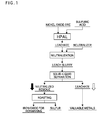
- Fig. 1 illustrates a flow for a recovery process of performing high-pressure sulfuric acid leach on a mineral, such as nickel oxide ore, containing valuable metals and iron to recover the valuable metals and a further flow for a refining process of a production method according to the present invention of producing hematite having low-grade sulfur from a leach residue obtained in association with the recovery process.
- the flow for the recovery process of the valuable metals is indicated by an outline arrow, and the flow for the refining process of the hematite according to the invention is indicated by a black arrow.
- a leach residue to be a starting raw material of the present process is obtained as sediment when a leach slurry, which is generated by neutralizing a leachate obtained in the event of high-pressure sulfuric acid leach as illustrated in Fig. 1 , is subjected to solid-liquid separation.
- the leach residue is formed in a state in which a reaction product of a neutralizer input in the neutralization process and a surplus acid is contained. Accordingly, limestone or slaked lime added as the neutralizer and sulfuric acid are reacted to neutralize a free sulfuric acid remaining in the leach slurry.
- the leach residue contains sulfur resulting from created calcium sulfate (plaster) by several percentage (%).
- the leach residue is heated on given conditions. That is, as illustrated in Fig. 1 , the iron oxide (hematite) for ironmaking which has low-grade sulfur is refined by roasting the leach residue and evaporating the sulfur component.
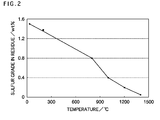
- Fig. 2 illustrates a relation between a heating temperature and the sulfur grade in the leach residue.
- a temperature at which the leach residue is heated is 600°C or more, preferably 800°C or more, which is an effective temperature in order to make the sulfur grade in the leach residue less than 1%. Further, when the heating temperature exceeds 800°C, the sulfur grade is sharply reduced, which is more preferable. When the heating temperature becomes 1300°C, the sulfur grade can be reduced up to 0.1% or less, which is more preferable, but when the heating temperature more preferably exceeds 1400°C, this gives no great difference, and is not very preferable in the aspect of facility investment such as an increase in heating energy or a need for heat resistance of a furnace wall material. Accordingly, the heating temperature is 600°C or more and 1400°C or less, and preferably 800°C or more and 1300°C or less.
- a heating time is affected by a furnace size and an amount of the residue, and thus may be adequately adjusted. Further, the heating is performed in an oxidizing atmosphere such as atmospheric air. Thereby, along with the heating, the sulfur is removed from the leach residue as sulfur dioxide, and the high-purity iron oxide (hematite) is formed.
- an oxidizing atmosphere such as atmospheric air.
- Nickel oxide ore having 1% nickel grade and 46 to 48% iron grade was adjusted to be a slurry of 30 to 40% by weight, and then was mixed with sulfuric acid of 64% by weight. Subsequently, the slurry was charged into a pressure device, heated to 240 to 250°C, and maintained for one hour, and a leachate was obtained by leaching nickel in the ore (HPAL).
- the leachate was cooled to about 70°C, and then slaked lime was added to neutralize a surplus acid (neutralization).
- the slurry containing a leach residue after the surplus acid was neutralized (hereinafter the leach residue after the neutralization is referred to as "neutralized residue') was subjected to solid-liquid separation using Nutsche and a filtering bottle, and was separated into the leachate and the neutralized residue (solid-liquid separation).
- the neutralized residue was equally divided into six parts, which were respectively raised to 30°C, 200°C, 800°C, 1000°C, 1200°C, and 1400°C, heated for one hour, and cooled.
- the sulfur grade is reduced up to about 1% at about 600°C, and that, when the temperature exceeds 800°C, the sulfur grade is sharply reduced, and the sulfur can be effectively separated.
- Table 1 results of measuring the iron and sulfur grades in the neutralized residue after the heating are illustrated.
- the iron and sulfur grades were measured by fluorescent X-ray analysis.
Landscapes
- Chemical & Material Sciences (AREA)
- Organic Chemistry (AREA)
- Engineering & Computer Science (AREA)
- Mechanical Engineering (AREA)
- Metallurgy (AREA)
- Manufacturing & Machinery (AREA)
- Materials Engineering (AREA)
- Inorganic Chemistry (AREA)
- General Life Sciences & Earth Sciences (AREA)
- Life Sciences & Earth Sciences (AREA)
- Environmental & Geological Engineering (AREA)
- Geochemistry & Mineralogy (AREA)
- Geology (AREA)
- General Chemical & Material Sciences (AREA)
- Chemical Kinetics & Catalysis (AREA)
- Manufacture And Refinement Of Metals (AREA)
- Compounds Of Iron (AREA)
Abstract
Description
- The present invention relates to a production method for refining a leach residue obtained by hydrometallurgical refining of nickel oxide ore into hematite that can be used as an iron-making raw material and has low-grade sulfur.
- In steel smelting, a method of charging iron ore containing iron oxide into a blast furnace along with a reductant such as coke, heating and melting the iron ore under a reducing atmosphere to obtain crude steel, and refining the crude steel in a converter to obtain desired steel has been used.
- The iron oxide that is a raw material of the steel is a limited resource, and furthermore it is gradually hard to obtain high-quality iron ore required to maintain a quality of steel.
- Meanwhile, with respect to nickel becoming a raw material of stainless steel, technology for smelting low-grade oxide ore as a raw material due to a tendency toward resource exhaustion of sulfide ore that has been used in the past has been developed and put to practical use.
- To be specific, nickel oxide ore such as limonite or saprolite is put into a pressure device such as an autoclave along with a sulfuric acid, and nickel is leached under high pressure and high temperature of about 240 to 260°C.
- The nickel leached into a solution of the sulfuric acid is used as nickel metal or a nickel salt compound by adding a neutralizer to neutralize a surplus acid, separating a leach residue by solid-liquid separation, separating impurities to recover the leach residue as an intermediate raw material in the form of hydroxide or sulfide, and further refining the intermediate raw material.
- In such a process called high pressure acid leach (HPAL), nickel can be almost completely leached even from low-grade ore in which valuable metals intended for recovery are contained by not more than 1% to 2% by weight (hereinafter indicated by "%" with regard to a grade). Further, the HPAL process has a feature of concentrating the valuable metals up to the same grade as a conventional raw material by producing an intermediate raw material from a leachate, and refining the nickel in a process similar to a conventional process.
- Further, the HPAL process may be applied to various types of ores such as nickel sulfide ore, copper sulfide ore, and copper oxide ore, in addition to the nickel oxide ore.
- Further, a main component of the leach residue obtained by the HPAL process is iron oxide having the form of hematite. This is secondarily obtained because each of oxide ore and sulfide ore of nickel or copper used as a raw material contains iron of an amount far more than a content of nickel or copper.
- These leach residues are created at a high temperature, and thus have the form of oxide that is chemically or environmentally stable. However, the leach residues have no special utility value, and have been scrapped to a residue disposal yard. For this reason, it has been a grave challenge how to secure the disposal yards for an enormous amount of leach residues generated along with the smelting.
- Furthermore, the leach residue of the HPAL process cannot be directly used for the aforementioned iron-making raw material. The reason is that the leach residue of the HPAL process contains gangue and impurities, particularly sulfur, in addition to the iron oxide and requires exhaust gas treatment, and thus is not suitable for the raw material used in the conventional iron-making process in common.
- Particularly, a grade of sulfur in iron oxide usable for the iron-making raw material differs depending on facility capacity and an amount of production of individual ironworks, and generally needs to be suppressed to less than 1%.
- The sulfur is hardly contained in the original nickel oxide ore. Nevertheless, the sulfur contained in the leach residue by about 1 to 3% results from calcium sulfate (plaster) generated by reaction of sulfuric acid and limestone or slaked lime added as the neutralizer in order to neutralize free sulfuric acid remaining at the leach slurry.
- Therefore, it is considered that what creates a soluble salt may be used as the added neutralizer, not the slaked lime or what forms insoluble sediment, such as the slaked lime, after the neutralization.
- For example, the neutralizer suitable for such application includes sodium hydroxide, potassium hydroxide, magnesium hydroxide, and magnesium oxide.
- However, these neutralizers are expensive, and have a limited amount of production. Thus, when a large quantity of neutralizer is required as in the HPAL process, it is industrially difficult to cover the whole quantity.
- For this reason, there has been no choice but to use a calcium-based neutralizer in whole or in part which forms the insoluble sediment after the neutralization as described above, and thereby mixing of the sulfur has been inevitable. As such, it has been impossible to process the leach residue created in the HPAL process into the hematite and to use it as the iron-making raw material.
- On the other hand, a method of separating sulfur in jarosite using a pressure device such as an autoclave is also known.
- For example, Patent Document 1 discloses a method that includes stirring a jarosite-containing residual and a zinc sulfide inclusion in an autoclave at least under oxygen partial pressure of 1000 kPa at a temperature of 130 to 170°C along with a free sulfuric acid of 40 to 100 g/l, substantially dissolving iron and zinc fractions of a concentrate containing the residual and zinc sulfide, introducing the solution into a leach circulation passage for zinc electrolysis to settle iron in the form of hematite, and separating sulfur from the above solid, and supplying the residual for separate application.
- However, this method requires an expensive device such as an autoclave, increases a facility cost, and further has a problem even in the aspect of productivity.
- Patent Document 1:
JP H03-176081 A - The invention is intended to provide a production method for refining hematite, which has such a low sulfur component as to be used as an iron-making raw material, from a leach residue containing iron oxide produced by a high pressure acid leach (HPAL) process.
- To solve the above problems, a first aspect of the present invention provides a method for producing (high purity) hematite for ironmaking by a process of adding an oxidant and sulfuric acid to nickel oxide ore and then leaching nickel. The method further includes heating a leach residue, which is obtained after the nickel is leached, to 600°C or more.
- A second aspect of the present invention provides a method for producing (high purity) hematite for ironmaking by a process of adding an oxidant and sulfuric acid to nickel oxide ore and then leaching nickel. The method further includes heating a leach residue, which is obtained after the nickel is leached, to 800°C or more and 1400°C or less.
- The present invention can bring about the following industrial significant effects:
- (1) It is possible to easily obtain hematite that has low-grade sulfur and can be used as an iron-making raw material;
- (2) Since a raw material that can be cheaply and stably procured is used, hematite with the low-grade sulfur can be inexpensively obtained;
- (3) Wastes such as a leach residue discharged in a refining process can be applied to the iron-making raw materials, and it is thus possible to remarkably reduce an amount of the scrapped leach residue and further reduce production costs by lowering an environmental risk, reducing scrapping costs, and reducing construction costs of a leach residue disposal yard; and
- (4) When hematite with the low-grade sulfur is produced, a special facility is not required, and thus establishment of its producing process is easy.
-
-
Fig. 1 is a flow chart showing a recovery process of performing high-pressure sulfuric acid leach on a mineral containing valuable metals and iron to recover the valuable metals, and further showing a refining process of hematite having low-grade sulfur which is associated with the recovery process; and -
Fig. 2 is a diagram illustrating a relation between a heating temperature and a grade of sulfur in a leach residue. - The present invention is to heat a leach residue obtained when a mineral, such as nickel oxide ore, containing valuable metals and iron is subjected to high-pressure sulfuric acid leach, to separate sulfur, and to produce high-purity hematite that can be used as an iron-making raw material having a low sulfur content.
-
Fig. 1 illustrates a flow for a recovery process of performing high-pressure sulfuric acid leach on a mineral, such as nickel oxide ore, containing valuable metals and iron to recover the valuable metals and a further flow for a refining process of a production method according to the present invention of producing hematite having low-grade sulfur from a leach residue obtained in association with the recovery process. - The flow for the recovery process of the valuable metals is indicated by an outline arrow, and the flow for the refining process of the hematite according to the invention is indicated by a black arrow.
- A leach residue to be a starting raw material of the present process is obtained as sediment when a leach slurry, which is generated by neutralizing a leachate obtained in the event of high-pressure sulfuric acid leach as illustrated in
Fig. 1 , is subjected to solid-liquid separation. As such, the leach residue is formed in a state in which a reaction product of a neutralizer input in the neutralization process and a surplus acid is contained. Accordingly, limestone or slaked lime added as the neutralizer and sulfuric acid are reacted to neutralize a free sulfuric acid remaining in the leach slurry. Thereby, the leach residue contains sulfur resulting from created calcium sulfate (plaster) by several percentage (%). - Therefore, as a method of separating a sulfur component from such a leach residue containing several percentage of sulfur, the leach residue is heated on given conditions. That is, as illustrated in
Fig. 1 , the iron oxide (hematite) for ironmaking which has low-grade sulfur is refined by roasting the leach residue and evaporating the sulfur component. -
Fig. 2 illustrates a relation between a heating temperature and the sulfur grade in the leach residue. - A temperature at which the leach residue is heated is 600°C or more, preferably 800°C or more, which is an effective temperature in order to make the sulfur grade in the leach residue less than 1%. Further, when the heating temperature exceeds 800°C, the sulfur grade is sharply reduced, which is more preferable. When the heating temperature becomes 1300°C, the sulfur grade can be reduced up to 0.1% or less, which is more preferable, but when the heating temperature more preferably exceeds 1400°C, this gives no great difference, and is not very preferable in the aspect of facility investment such as an increase in heating energy or a need for heat resistance of a furnace wall material. Accordingly, the heating temperature is 600°C or more and 1400°C or less, and preferably 800°C or more and 1300°C or less.
- A heating time is affected by a furnace size and an amount of the residue, and thus may be adequately adjusted. Further, the heating is performed in an oxidizing atmosphere such as atmospheric air. Thereby, along with the heating, the sulfur is removed from the leach residue as sulfur dioxide, and the high-purity iron oxide (hematite) is formed.
- Hereinafter, the invention will be described using examples.
- Nickel oxide ore having 1% nickel grade and 46 to 48% iron grade was adjusted to be a slurry of 30 to 40% by weight, and then was mixed with sulfuric acid of 64% by weight. Subsequently, the slurry was charged into a pressure device, heated to 240 to 250°C, and maintained for one hour, and a leachate was obtained by leaching nickel in the ore (HPAL).
- After the leaching, the leachate was cooled to about 70°C, and then slaked lime was added to neutralize a surplus acid (neutralization). The slurry containing a leach residue after the surplus acid was neutralized (hereinafter the leach residue after the neutralization is referred to as "neutralized residue') was subjected to solid-liquid separation using Nutsche and a filtering bottle, and was separated into the leachate and the neutralized residue (solid-liquid separation).
- In the neutralized residue, an iron grade was 49.9%, and a sulfur grade was 1.5%.
- Next, the neutralized residue was equally divided into six parts, which were respectively raised to 30°C, 200°C, 800°C, 1000°C, 1200°C, and 1400°C, heated for one hour, and cooled.
- The sulfur grade of the leach residues after the cooling were analyzed, and the analyzed results were illustrated in
Fig. 2 . - As illustrated in
Fig. 2 , it is found that the sulfur grade is reduced up to about 1% at about 600°C, and that, when the temperature exceeds 800°C, the sulfur grade is sharply reduced, and the sulfur can be effectively separated. - In Table 1, results of measuring the iron and sulfur grades in the neutralized residue after the heating are illustrated. The iron and sulfur grades were measured by fluorescent X-ray analysis.
-
[Table 1] Sample Sulfur grade [% by weight] Supply Neutralized residue 1.5 Heating 800°C 0.8 1000°C 0.4 1200°C 0.2 - With this use of the invention, it is possible to separate the sulfur from the HPAL leach residue, and to refine the hematite so as to be usable as the raw material for ironmaking.
-
-
Fig. 1 - 1: NICKEL OXIDE ORE
- 2: SULFURIC ACID
- 3: LEACHATE
- 4: NEUTRALIZER
- 5: NEUTRALIZATION
- 6: LEACH SLURRY
- 7: SOLID-LIQUID SEPARATION
- 8: NEUTRALIZED RESIDUE
- 9: ROASTING
- 10: IRON OXIDE FOR IRONMAKING
- 11: SULFUR
- 12: LEACHATE
- 13: VALUABLE METALS
-
Fig. 2 - 1: SULFUR GRADE IN RESIDUE
- 2: TEMPERATURE
Claims (2)
- A method of producing (high purity) hematite for ironmaking by a process of adding an oxidant and sulfuric acid to nickel oxide ore and then leaching nickel, the method further comprising;
heating a leach residue obtained after the leaching of nickel to 600°C or more. - A method of producing (high purity) hematite for ironmaking by a process of adding an oxidant and sulfuric acid to nickel oxide ore and then leaching nickel, the method further comprising;
heating a leach residue obtained after the leaching of nickel to 800°C or more and 1400°C or less.
Applications Claiming Priority (2)
| Application Number | Priority Date | Filing Date | Title |
|---|---|---|---|
| JP2012062794A JP5424139B2 (en) | 2012-03-19 | 2012-03-19 | Method for producing hematite for iron making |
| PCT/JP2013/050671 WO2013140837A1 (en) | 2012-03-19 | 2013-01-16 | Production method for hematite for iron production |
Publications (3)
| Publication Number | Publication Date |
|---|---|
| EP2829516A1 true EP2829516A1 (en) | 2015-01-28 |
| EP2829516A4 EP2829516A4 (en) | 2015-12-09 |
| EP2829516B1 EP2829516B1 (en) | 2018-12-26 |
Family
ID=49222305
Family Applications (1)
| Application Number | Title | Priority Date | Filing Date |
|---|---|---|---|
| EP13764493.6A Not-in-force EP2829516B1 (en) | 2012-03-19 | 2013-01-16 | Production method for hematite for iron production |
Country Status (8)
| Country | Link |
|---|---|
| US (1) | US20150050200A1 (en) |
| EP (1) | EP2829516B1 (en) |
| JP (1) | JP5424139B2 (en) |
| CN (1) | CN104203830B (en) |
| AU (1) | AU2013236727B2 (en) |
| CA (1) | CA2867672C (en) |
| PH (1) | PH12014502100B1 (en) |
| WO (1) | WO2013140837A1 (en) |
Cited By (1)
| Publication number | Priority date | Publication date | Assignee | Title |
|---|---|---|---|---|
| EP3048083A4 (en) * | 2013-09-18 | 2017-08-02 | Sumitomo Metal Mining Co., Ltd. | Production method for hematite for iron production |
Families Citing this family (3)
| Publication number | Priority date | Publication date | Assignee | Title |
|---|---|---|---|---|
| JP5622061B2 (en) * | 2013-03-26 | 2014-11-12 | 住友金属鉱山株式会社 | Method for producing hematite for iron making |
| JP5800255B2 (en) | 2014-02-27 | 2015-10-28 | 住友金属鉱山株式会社 | Method for producing hematite for iron making |
| CN106673071B (en) * | 2016-12-23 | 2019-01-11 | 天津理工大学 | A kind of method that lateritic nickel ore pickle liquor produces black iron oxide pigment simultaneously except iron |
Family Cites Families (30)
| Publication number | Priority date | Publication date | Assignee | Title |
|---|---|---|---|---|
| US2719082A (en) * | 1951-06-11 | 1955-09-27 | Int Nickel Co | Method for producing high grade hematite from nickeliferous iron sulfide ore |
| US3042498A (en) * | 1952-06-04 | 1962-07-03 | Int Nickel Co | Apparatus for roasting sulfides |
| US2796340A (en) * | 1954-02-04 | 1957-06-18 | New Jersey Zinc Co | Process for roasting sulfide ore concentrates |
| US2867506A (en) * | 1956-07-18 | 1959-01-06 | Dorr Oliver Inc | Producing sulphur dioxide gas |
| US3093559A (en) * | 1958-06-20 | 1963-06-11 | Merwin G White | Treatment of lateritic ores |
| US3232744A (en) * | 1961-11-16 | 1966-02-01 | Inst Noguchi | Process for producing iron oxide with a low silica content |
| US3671197A (en) * | 1970-02-05 | 1972-06-20 | Lummus Co | Treatment of pyrites |
| US3655364A (en) * | 1970-02-27 | 1972-04-11 | David J I Evans | Process for treating low-iron nickeliferous ores |
| US3854931A (en) * | 1970-04-20 | 1974-12-17 | Boliden Ab | Roasting, coarsening and hardening of iron sulfide materials |
| CA984614A (en) * | 1973-10-09 | 1976-03-02 | Falconbridge Nickel Mines Limited | Fluid bed roasting of metal sulphides at high temperatures |
| SE396968B (en) * | 1975-07-01 | 1977-10-10 | Boliden Ab | PROCEDURE FOR EXTRACTING NON-IRON METALS FROM SULPHIDY MATERIALS BY ROASTING AND LACHING |
| JPS58141346A (en) * | 1982-02-15 | 1983-08-22 | Dowa Mining Co Ltd | Collecting method of metal from industrial by-product |
| DE3935362A1 (en) | 1989-10-24 | 1991-04-25 | Ruhr Zink Gmbh | PROCESS FOR PREPARING JAROSITE-CONTAINING BACKPACKS |
| JP2001032002A (en) * | 1999-07-16 | 2001-02-06 | Sumitomo Metal Mining Co Ltd | Method for producing nickel oxide powder |
| US6428604B1 (en) * | 2000-09-18 | 2002-08-06 | Inco Limited | Hydrometallurgical process for the recovery of nickel and cobalt values from a sulfidic flotation concentrate |
| EP1727916B1 (en) * | 2004-03-25 | 2014-11-12 | Intec International Projects Pty Ltd | Recovery of metals from oxidised metalliferous materials |
| JP4525428B2 (en) * | 2004-05-13 | 2010-08-18 | 住友金属鉱山株式会社 | Method for hydrometallizing nickel oxide ore |
| US7604783B2 (en) * | 2004-12-22 | 2009-10-20 | Placer Dome Technical Services Limited | Reduction of lime consumption when treating refractor gold ores or concentrates |
| CN103352120A (en) * | 2005-02-14 | 2013-10-16 | Bhp比利通Ssm开发有限公司 | Process for enhanced acid leaching of laterite ores |
| JP5060033B2 (en) * | 2005-09-15 | 2012-10-31 | 大平洋金属株式会社 | Method for recovering nickel or cobalt |
| CA2639796A1 (en) * | 2005-12-23 | 2007-06-28 | Neoferric Technologies Inc. | Process for recovering iron as hematite from a base metal containing ore material |
| CN1858273A (en) * | 2006-06-02 | 2006-11-08 | 李智才 | Normal pressure leaching method for treating low iron nickel oxide ore |
| JP4206419B2 (en) * | 2006-09-15 | 2009-01-14 | 友宏 秋山 | Ore processing method, ore processing equipment, iron making method, and iron and steel making method |
| CN101338376A (en) * | 2008-08-15 | 2009-01-07 | 中南大学 | Method for Comprehensive Development and Utilization of Nickel-Cobalt, Iron and Magnesium in Laterite Nickel Ore |
| JP5446226B2 (en) * | 2008-09-19 | 2014-03-19 | 住友金属鉱山株式会社 | Method for hydrometallizing nickel oxide ore |
| CN101392321B (en) * | 2008-10-31 | 2010-07-28 | 东北大学 | Microwave Reduction Roasting-Hematite Precipitation Transformation Method for Treating Nickel-Containing Laterite Ore |
| US8052774B2 (en) * | 2009-03-31 | 2011-11-08 | Sumitomo Metal Mining Co., Ltd. | Method for concentration of gold in copper sulfide minerals |
| CN101886272B (en) * | 2010-01-08 | 2011-11-23 | 中南大学 | A method for extracting indium and producing iron oxide by wet smelting of zinc ore without iron slag |
| CN102041381B (en) * | 2011-01-17 | 2011-12-07 | 河南永通镍业有限公司 | Method for recovering nickel, cobalt, iron, manganese and magnesium from oxidized nickel ore |
| CN102130422B (en) * | 2011-01-28 | 2013-06-05 | 北京航空航天大学 | Nanowire surface plasma laser |
-
2012
- 2012-03-19 JP JP2012062794A patent/JP5424139B2/en active Active
-
2013
- 2013-01-16 WO PCT/JP2013/050671 patent/WO2013140837A1/en not_active Ceased
- 2013-01-16 AU AU2013236727A patent/AU2013236727B2/en not_active Ceased
- 2013-01-16 CA CA2867672A patent/CA2867672C/en not_active Expired - Fee Related
- 2013-01-16 US US14/386,222 patent/US20150050200A1/en not_active Abandoned
- 2013-01-16 EP EP13764493.6A patent/EP2829516B1/en not_active Not-in-force
- 2013-01-16 CN CN201380015130.6A patent/CN104203830B/en active Active
-
2014
- 2014-09-22 PH PH12014502100A patent/PH12014502100B1/en unknown
Cited By (1)
| Publication number | Priority date | Publication date | Assignee | Title |
|---|---|---|---|---|
| EP3048083A4 (en) * | 2013-09-18 | 2017-08-02 | Sumitomo Metal Mining Co., Ltd. | Production method for hematite for iron production |
Also Published As
| Publication number | Publication date |
|---|---|
| EP2829516B1 (en) | 2018-12-26 |
| US20150050200A1 (en) | 2015-02-19 |
| EP2829516A4 (en) | 2015-12-09 |
| AU2013236727A1 (en) | 2014-10-09 |
| CN104203830B (en) | 2016-11-16 |
| JP2013193923A (en) | 2013-09-30 |
| AU2013236727B2 (en) | 2016-06-30 |
| CN104203830A (en) | 2014-12-10 |
| CA2867672A1 (en) | 2013-09-26 |
| WO2013140837A1 (en) | 2013-09-26 |
| PH12014502100A1 (en) | 2014-12-10 |
| JP5424139B2 (en) | 2014-02-26 |
| PH12014502100B1 (en) | 2014-12-10 |
| CA2867672C (en) | 2017-08-15 |
Similar Documents
| Publication | Publication Date | Title |
|---|---|---|
| EP3112481B1 (en) | Method for producing hematite for iron production | |
| AU2013236726B2 (en) | Method for producing hematite for iron production | |
| EP2829516B1 (en) | Production method for hematite for iron production | |
| AU2013236602B2 (en) | Method for producing hematite for iron-making use | |
| US9890055B2 (en) | Method for producing hematite for ironmaking | |
| US10457565B2 (en) | Production method for hematite for iron production | |
| US9828256B2 (en) | Method for producing hematite for ironmaking |
Legal Events
| Date | Code | Title | Description |
|---|---|---|---|
| PUAI | Public reference made under article 153(3) epc to a published international application that has entered the european phase |
Free format text: ORIGINAL CODE: 0009012 |
|
| 17P | Request for examination filed |
Effective date: 20141016 |
|
| AK | Designated contracting states |
Kind code of ref document: A1 Designated state(s): AL AT BE BG CH CY CZ DE DK EE ES FI FR GB GR HR HU IE IS IT LI LT LU LV MC MK MT NL NO PL PT RO RS SE SI SK SM TR |
|
| AX | Request for extension of the european patent |
Extension state: BA ME |
|
| DAX | Request for extension of the european patent (deleted) | ||
| RA4 | Supplementary search report drawn up and despatched (corrected) |
Effective date: 20151105 |
|
| RIC1 | Information provided on ipc code assigned before grant |
Ipc: C01G 49/06 20060101AFI20151030BHEP Ipc: C22B 3/04 20060101ALI20151030BHEP Ipc: C22B 23/00 20060101ALI20151030BHEP Ipc: C01B 17/50 20060101ALI20151030BHEP |
|
| STAA | Information on the status of an ep patent application or granted ep patent |
Free format text: STATUS: EXAMINATION IS IN PROGRESS |
|
| 17Q | First examination report despatched |
Effective date: 20170510 |
|
| REG | Reference to a national code |
Ref country code: DE Ref legal event code: R079 Ref document number: 602013048832 Country of ref document: DE Free format text: PREVIOUS MAIN CLASS: C01G0049060000 Ipc: C22B0003200000 |
|
| GRAP | Despatch of communication of intention to grant a patent |
Free format text: ORIGINAL CODE: EPIDOSNIGR1 |
|
| STAA | Information on the status of an ep patent application or granted ep patent |
Free format text: STATUS: GRANT OF PATENT IS INTENDED |
|
| RIC1 | Information provided on ipc code assigned before grant |
Ipc: C22B 3/20 20060101AFI20180622BHEP |
|
| INTG | Intention to grant announced |
Effective date: 20180713 |
|
| GRAJ | Information related to disapproval of communication of intention to grant by the applicant or resumption of examination proceedings by the epo deleted |
Free format text: ORIGINAL CODE: EPIDOSDIGR1 |
|
| STAA | Information on the status of an ep patent application or granted ep patent |
Free format text: STATUS: EXAMINATION IS IN PROGRESS |
|
| GRAR | Information related to intention to grant a patent recorded |
Free format text: ORIGINAL CODE: EPIDOSNIGR71 |
|
| GRAS | Grant fee paid |
Free format text: ORIGINAL CODE: EPIDOSNIGR3 |
|
| STAA | Information on the status of an ep patent application or granted ep patent |
Free format text: STATUS: GRANT OF PATENT IS INTENDED |
|
| GRAA | (expected) grant |
Free format text: ORIGINAL CODE: 0009210 |
|
| STAA | Information on the status of an ep patent application or granted ep patent |
Free format text: STATUS: THE PATENT HAS BEEN GRANTED |
|
| INTC | Intention to grant announced (deleted) | ||
| AK | Designated contracting states |
Kind code of ref document: B1 Designated state(s): AL AT BE BG CH CY CZ DE DK EE ES FI FR GB GR HR HU IE IS IT LI LT LU LV MC MK MT NL NO PL PT RO RS SE SI SK SM TR |
|
| INTG | Intention to grant announced |
Effective date: 20181119 |
|
| REG | Reference to a national code |
Ref country code: GB Ref legal event code: FG4D |
|
| REG | Reference to a national code |
Ref country code: CH Ref legal event code: EP |
|
| REG | Reference to a national code |
Ref country code: AT Ref legal event code: REF Ref document number: 1081511 Country of ref document: AT Kind code of ref document: T Effective date: 20190115 |
|
| REG | Reference to a national code |
Ref country code: DE Ref legal event code: R096 Ref document number: 602013048832 Country of ref document: DE |
|
| REG | Reference to a national code |
Ref country code: IE Ref legal event code: FG4D |
|
| PG25 | Lapsed in a contracting state [announced via postgrant information from national office to epo] |
Ref country code: FI Free format text: LAPSE BECAUSE OF FAILURE TO SUBMIT A TRANSLATION OF THE DESCRIPTION OR TO PAY THE FEE WITHIN THE PRESCRIBED TIME-LIMIT Effective date: 20181226 Ref country code: NO Free format text: LAPSE BECAUSE OF FAILURE TO SUBMIT A TRANSLATION OF THE DESCRIPTION OR TO PAY THE FEE WITHIN THE PRESCRIBED TIME-LIMIT Effective date: 20190326 Ref country code: LV Free format text: LAPSE BECAUSE OF FAILURE TO SUBMIT A TRANSLATION OF THE DESCRIPTION OR TO PAY THE FEE WITHIN THE PRESCRIBED TIME-LIMIT Effective date: 20181226 Ref country code: LT Free format text: LAPSE BECAUSE OF FAILURE TO SUBMIT A TRANSLATION OF THE DESCRIPTION OR TO PAY THE FEE WITHIN THE PRESCRIBED TIME-LIMIT Effective date: 20181226 Ref country code: HR Free format text: LAPSE BECAUSE OF FAILURE TO SUBMIT A TRANSLATION OF THE DESCRIPTION OR TO PAY THE FEE WITHIN THE PRESCRIBED TIME-LIMIT Effective date: 20181226 Ref country code: BG Free format text: LAPSE BECAUSE OF FAILURE TO SUBMIT A TRANSLATION OF THE DESCRIPTION OR TO PAY THE FEE WITHIN THE PRESCRIBED TIME-LIMIT Effective date: 20190326 |
|
| REG | Reference to a national code |
Ref country code: NL Ref legal event code: MP Effective date: 20181226 |
|
| REG | Reference to a national code |
Ref country code: LT Ref legal event code: MG4D |
|
| PG25 | Lapsed in a contracting state [announced via postgrant information from national office to epo] |
Ref country code: AL Free format text: LAPSE BECAUSE OF FAILURE TO SUBMIT A TRANSLATION OF THE DESCRIPTION OR TO PAY THE FEE WITHIN THE PRESCRIBED TIME-LIMIT Effective date: 20181226 Ref country code: SE Free format text: LAPSE BECAUSE OF FAILURE TO SUBMIT A TRANSLATION OF THE DESCRIPTION OR TO PAY THE FEE WITHIN THE PRESCRIBED TIME-LIMIT Effective date: 20181226 Ref country code: GR Free format text: LAPSE BECAUSE OF FAILURE TO SUBMIT A TRANSLATION OF THE DESCRIPTION OR TO PAY THE FEE WITHIN THE PRESCRIBED TIME-LIMIT Effective date: 20190327 Ref country code: RS Free format text: LAPSE BECAUSE OF FAILURE TO SUBMIT A TRANSLATION OF THE DESCRIPTION OR TO PAY THE FEE WITHIN THE PRESCRIBED TIME-LIMIT Effective date: 20181226 |
|
| REG | Reference to a national code |
Ref country code: AT Ref legal event code: MK05 Ref document number: 1081511 Country of ref document: AT Kind code of ref document: T Effective date: 20181226 |
|
| PG25 | Lapsed in a contracting state [announced via postgrant information from national office to epo] |
Ref country code: NL Free format text: LAPSE BECAUSE OF FAILURE TO SUBMIT A TRANSLATION OF THE DESCRIPTION OR TO PAY THE FEE WITHIN THE PRESCRIBED TIME-LIMIT Effective date: 20181226 |
|
| PG25 | Lapsed in a contracting state [announced via postgrant information from national office to epo] |
Ref country code: IT Free format text: LAPSE BECAUSE OF FAILURE TO SUBMIT A TRANSLATION OF THE DESCRIPTION OR TO PAY THE FEE WITHIN THE PRESCRIBED TIME-LIMIT Effective date: 20181226 Ref country code: PL Free format text: LAPSE BECAUSE OF FAILURE TO SUBMIT A TRANSLATION OF THE DESCRIPTION OR TO PAY THE FEE WITHIN THE PRESCRIBED TIME-LIMIT Effective date: 20181226 Ref country code: PT Free format text: LAPSE BECAUSE OF FAILURE TO SUBMIT A TRANSLATION OF THE DESCRIPTION OR TO PAY THE FEE WITHIN THE PRESCRIBED TIME-LIMIT Effective date: 20190426 Ref country code: CZ Free format text: LAPSE BECAUSE OF FAILURE TO SUBMIT A TRANSLATION OF THE DESCRIPTION OR TO PAY THE FEE WITHIN THE PRESCRIBED TIME-LIMIT Effective date: 20181226 Ref country code: ES Free format text: LAPSE BECAUSE OF FAILURE TO SUBMIT A TRANSLATION OF THE DESCRIPTION OR TO PAY THE FEE WITHIN THE PRESCRIBED TIME-LIMIT Effective date: 20181226 |
|
| REG | Reference to a national code |
Ref country code: DE Ref legal event code: R119 Ref document number: 602013048832 Country of ref document: DE |
|
| PG25 | Lapsed in a contracting state [announced via postgrant information from national office to epo] |
Ref country code: SM Free format text: LAPSE BECAUSE OF FAILURE TO SUBMIT A TRANSLATION OF THE DESCRIPTION OR TO PAY THE FEE WITHIN THE PRESCRIBED TIME-LIMIT Effective date: 20181226 Ref country code: EE Free format text: LAPSE BECAUSE OF FAILURE TO SUBMIT A TRANSLATION OF THE DESCRIPTION OR TO PAY THE FEE WITHIN THE PRESCRIBED TIME-LIMIT Effective date: 20181226 Ref country code: RO Free format text: LAPSE BECAUSE OF FAILURE TO SUBMIT A TRANSLATION OF THE DESCRIPTION OR TO PAY THE FEE WITHIN THE PRESCRIBED TIME-LIMIT Effective date: 20181226 Ref country code: IS Free format text: LAPSE BECAUSE OF FAILURE TO SUBMIT A TRANSLATION OF THE DESCRIPTION OR TO PAY THE FEE WITHIN THE PRESCRIBED TIME-LIMIT Effective date: 20190426 Ref country code: SK Free format text: LAPSE BECAUSE OF FAILURE TO SUBMIT A TRANSLATION OF THE DESCRIPTION OR TO PAY THE FEE WITHIN THE PRESCRIBED TIME-LIMIT Effective date: 20181226 |
|
| REG | Reference to a national code |
Ref country code: CH Ref legal event code: PL |
|
| PG25 | Lapsed in a contracting state [announced via postgrant information from national office to epo] |
Ref country code: LU Free format text: LAPSE BECAUSE OF NON-PAYMENT OF DUE FEES Effective date: 20190116 |
|
| REG | Reference to a national code |
Ref country code: BE Ref legal event code: MM Effective date: 20190131 |
|
| REG | Reference to a national code |
Ref country code: IE Ref legal event code: MM4A |
|
| PG25 | Lapsed in a contracting state [announced via postgrant information from national office to epo] |
Ref country code: AT Free format text: LAPSE BECAUSE OF FAILURE TO SUBMIT A TRANSLATION OF THE DESCRIPTION OR TO PAY THE FEE WITHIN THE PRESCRIBED TIME-LIMIT Effective date: 20181226 Ref country code: DK Free format text: LAPSE BECAUSE OF FAILURE TO SUBMIT A TRANSLATION OF THE DESCRIPTION OR TO PAY THE FEE WITHIN THE PRESCRIBED TIME-LIMIT Effective date: 20181226 Ref country code: MC Free format text: LAPSE BECAUSE OF FAILURE TO SUBMIT A TRANSLATION OF THE DESCRIPTION OR TO PAY THE FEE WITHIN THE PRESCRIBED TIME-LIMIT Effective date: 20181226 Ref country code: DE Free format text: LAPSE BECAUSE OF NON-PAYMENT OF DUE FEES Effective date: 20190801 |
|
| PLBE | No opposition filed within time limit |
Free format text: ORIGINAL CODE: 0009261 |
|
| STAA | Information on the status of an ep patent application or granted ep patent |
Free format text: STATUS: NO OPPOSITION FILED WITHIN TIME LIMIT |
|
| PG25 | Lapsed in a contracting state [announced via postgrant information from national office to epo] |
Ref country code: BE Free format text: LAPSE BECAUSE OF NON-PAYMENT OF DUE FEES Effective date: 20190131 |
|
| 26N | No opposition filed |
Effective date: 20190927 |
|
| PG25 | Lapsed in a contracting state [announced via postgrant information from national office to epo] |
Ref country code: LI Free format text: LAPSE BECAUSE OF NON-PAYMENT OF DUE FEES Effective date: 20190131 Ref country code: CH Free format text: LAPSE BECAUSE OF NON-PAYMENT OF DUE FEES Effective date: 20190131 |
|
| PG25 | Lapsed in a contracting state [announced via postgrant information from national office to epo] |
Ref country code: IE Free format text: LAPSE BECAUSE OF NON-PAYMENT OF DUE FEES Effective date: 20190116 |
|
| PG25 | Lapsed in a contracting state [announced via postgrant information from national office to epo] |
Ref country code: SI Free format text: LAPSE BECAUSE OF FAILURE TO SUBMIT A TRANSLATION OF THE DESCRIPTION OR TO PAY THE FEE WITHIN THE PRESCRIBED TIME-LIMIT Effective date: 20181226 |
|
| PG25 | Lapsed in a contracting state [announced via postgrant information from national office to epo] |
Ref country code: TR Free format text: LAPSE BECAUSE OF FAILURE TO SUBMIT A TRANSLATION OF THE DESCRIPTION OR TO PAY THE FEE WITHIN THE PRESCRIBED TIME-LIMIT Effective date: 20181226 |
|
| PG25 | Lapsed in a contracting state [announced via postgrant information from national office to epo] |
Ref country code: MT Free format text: LAPSE BECAUSE OF NON-PAYMENT OF DUE FEES Effective date: 20190116 |
|
| PGFP | Annual fee paid to national office [announced via postgrant information from national office to epo] |
Ref country code: FR Payment date: 20201210 Year of fee payment: 9 |
|
| PG25 | Lapsed in a contracting state [announced via postgrant information from national office to epo] |
Ref country code: CY Free format text: LAPSE BECAUSE OF FAILURE TO SUBMIT A TRANSLATION OF THE DESCRIPTION OR TO PAY THE FEE WITHIN THE PRESCRIBED TIME-LIMIT Effective date: 20181226 |
|
| PGFP | Annual fee paid to national office [announced via postgrant information from national office to epo] |
Ref country code: GB Payment date: 20210106 Year of fee payment: 9 |
|
| PG25 | Lapsed in a contracting state [announced via postgrant information from national office to epo] |
Ref country code: HU Free format text: LAPSE BECAUSE OF FAILURE TO SUBMIT A TRANSLATION OF THE DESCRIPTION OR TO PAY THE FEE WITHIN THE PRESCRIBED TIME-LIMIT; INVALID AB INITIO Effective date: 20130116 |
|
| PG25 | Lapsed in a contracting state [announced via postgrant information from national office to epo] |
Ref country code: MK Free format text: LAPSE BECAUSE OF FAILURE TO SUBMIT A TRANSLATION OF THE DESCRIPTION OR TO PAY THE FEE WITHIN THE PRESCRIBED TIME-LIMIT Effective date: 20181226 |
|
| GBPC | Gb: european patent ceased through non-payment of renewal fee |
Effective date: 20220116 |
|
| PG25 | Lapsed in a contracting state [announced via postgrant information from national office to epo] |
Ref country code: GB Free format text: LAPSE BECAUSE OF NON-PAYMENT OF DUE FEES Effective date: 20220116 |
|
| PG25 | Lapsed in a contracting state [announced via postgrant information from national office to epo] |
Ref country code: FR Free format text: LAPSE BECAUSE OF NON-PAYMENT OF DUE FEES Effective date: 20220131 |