EP2829414A1 - Transfer film, transfer method, and inkjet recording device - Google Patents
Transfer film, transfer method, and inkjet recording device Download PDFInfo
- Publication number
- EP2829414A1 EP2829414A1 EP13764418.3A EP13764418A EP2829414A1 EP 2829414 A1 EP2829414 A1 EP 2829414A1 EP 13764418 A EP13764418 A EP 13764418A EP 2829414 A1 EP2829414 A1 EP 2829414A1
- Authority
- EP
- European Patent Office
- Prior art keywords
- layer
- transfer
- sublimation ink
- ink
- mask layer
- Prior art date
- Legal status (The legal status is an assumption and is not a legal conclusion. Google has not performed a legal analysis and makes no representation as to the accuracy of the status listed.)
- Withdrawn
Links
- 238000000034 method Methods 0.000 title claims description 59
- 238000000859 sublimation Methods 0.000 claims abstract description 202
- 230000008022 sublimation Effects 0.000 claims abstract description 202
- 239000011230 binding agent Substances 0.000 claims abstract description 79
- 239000000463 material Substances 0.000 claims abstract description 27
- 239000000853 adhesive Substances 0.000 claims description 18
- 230000001070 adhesive effect Effects 0.000 claims description 18
- 239000011347 resin Substances 0.000 claims description 8
- 229920005989 resin Polymers 0.000 claims description 8
- 239000012466 permeate Substances 0.000 claims description 4
- 239000004744 fabric Substances 0.000 description 29
- 230000001771 impaired effect Effects 0.000 description 9
- 230000008602 contraction Effects 0.000 description 3
- 238000010017 direct printing Methods 0.000 description 3
- RRHGJUQNOFWUDK-UHFFFAOYSA-N Isoprene Chemical compound CC(=C)C=C RRHGJUQNOFWUDK-UHFFFAOYSA-N 0.000 description 2
- 239000011248 coating agent Substances 0.000 description 2
- 238000009792 diffusion process Methods 0.000 description 2
- 239000000835 fiber Substances 0.000 description 2
- 238000010438 heat treatment Methods 0.000 description 2
- 238000007639 printing Methods 0.000 description 2
- JOYRKODLDBILNP-UHFFFAOYSA-N Ethyl urethane Chemical compound CCOC(N)=O JOYRKODLDBILNP-UHFFFAOYSA-N 0.000 description 1
- 238000007796 conventional method Methods 0.000 description 1
- 230000008878 coupling Effects 0.000 description 1
- 238000010168 coupling process Methods 0.000 description 1
- 238000005859 coupling reaction Methods 0.000 description 1
- 230000001419 dependent effect Effects 0.000 description 1
- 230000006866 deterioration Effects 0.000 description 1
- 230000000694 effects Effects 0.000 description 1
- 238000012986 modification Methods 0.000 description 1
- 230000004048 modification Effects 0.000 description 1
Images


Classifications
-
- B—PERFORMING OPERATIONS; TRANSPORTING
- B41—PRINTING; LINING MACHINES; TYPEWRITERS; STAMPS
- B41J—TYPEWRITERS; SELECTIVE PRINTING MECHANISMS, i.e. MECHANISMS PRINTING OTHERWISE THAN FROM A FORME; CORRECTION OF TYPOGRAPHICAL ERRORS
- B41J2/00—Typewriters or selective printing mechanisms characterised by the printing or marking process for which they are designed
- B41J2/005—Typewriters or selective printing mechanisms characterised by the printing or marking process for which they are designed characterised by bringing liquid or particles selectively into contact with a printing material
- B41J2/0057—Typewriters or selective printing mechanisms characterised by the printing or marking process for which they are designed characterised by bringing liquid or particles selectively into contact with a printing material where an intermediate transfer member receives the ink before transferring it on the printing material
-
- B—PERFORMING OPERATIONS; TRANSPORTING
- B41—PRINTING; LINING MACHINES; TYPEWRITERS; STAMPS
- B41J—TYPEWRITERS; SELECTIVE PRINTING MECHANISMS, i.e. MECHANISMS PRINTING OTHERWISE THAN FROM A FORME; CORRECTION OF TYPOGRAPHICAL ERRORS
- B41J2/00—Typewriters or selective printing mechanisms characterised by the printing or marking process for which they are designed
- B41J2/005—Typewriters or selective printing mechanisms characterised by the printing or marking process for which they are designed characterised by bringing liquid or particles selectively into contact with a printing material
- B41J2/01—Ink jet
-
- B—PERFORMING OPERATIONS; TRANSPORTING
- B41—PRINTING; LINING MACHINES; TYPEWRITERS; STAMPS
- B41J—TYPEWRITERS; SELECTIVE PRINTING MECHANISMS, i.e. MECHANISMS PRINTING OTHERWISE THAN FROM A FORME; CORRECTION OF TYPOGRAPHICAL ERRORS
- B41J31/00—Ink ribbons; Renovating or testing ink ribbons
-
- B—PERFORMING OPERATIONS; TRANSPORTING
- B41—PRINTING; LINING MACHINES; TYPEWRITERS; STAMPS
- B41M—PRINTING, DUPLICATING, MARKING, OR COPYING PROCESSES; COLOUR PRINTING
- B41M5/00—Duplicating or marking methods; Sheet materials for use therein
- B41M5/025—Duplicating or marking methods; Sheet materials for use therein by transferring ink from the master sheet
- B41M5/035—Duplicating or marking methods; Sheet materials for use therein by transferring ink from the master sheet by sublimation or volatilisation of pre-printed design, e.g. sublistatic
-
- B—PERFORMING OPERATIONS; TRANSPORTING
- B44—DECORATIVE ARTS
- B44C—PRODUCING DECORATIVE EFFECTS; MOSAICS; TARSIA WORK; PAPERHANGING
- B44C1/00—Processes, not specifically provided for elsewhere, for producing decorative surface effects
- B44C1/16—Processes, not specifically provided for elsewhere, for producing decorative surface effects for applying transfer pictures or the like
- B44C1/165—Processes, not specifically provided for elsewhere, for producing decorative surface effects for applying transfer pictures or the like for decalcomanias; sheet material therefor
- B44C1/17—Dry transfer
-
- D—TEXTILES; PAPER
- D06—TREATMENT OF TEXTILES OR THE LIKE; LAUNDERING; FLEXIBLE MATERIALS NOT OTHERWISE PROVIDED FOR
- D06P—DYEING OR PRINTING TEXTILES; DYEING LEATHER, FURS OR SOLID MACROMOLECULAR SUBSTANCES IN ANY FORM
- D06P5/00—Other features in dyeing or printing textiles, or dyeing leather, furs, or solid macromolecular substances in any form
- D06P5/003—Transfer printing
- D06P5/004—Transfer printing using subliming dyes
-
- B—PERFORMING OPERATIONS; TRANSPORTING
- B41—PRINTING; LINING MACHINES; TYPEWRITERS; STAMPS
- B41J—TYPEWRITERS; SELECTIVE PRINTING MECHANISMS, i.e. MECHANISMS PRINTING OTHERWISE THAN FROM A FORME; CORRECTION OF TYPOGRAPHICAL ERRORS
- B41J2/00—Typewriters or selective printing mechanisms characterised by the printing or marking process for which they are designed
- B41J2/005—Typewriters or selective printing mechanisms characterised by the printing or marking process for which they are designed characterised by bringing liquid or particles selectively into contact with a printing material
- B41J2/01—Ink jet
- B41J2002/012—Ink jet with intermediate transfer member
-
- B—PERFORMING OPERATIONS; TRANSPORTING
- B41—PRINTING; LINING MACHINES; TYPEWRITERS; STAMPS
- B41M—PRINTING, DUPLICATING, MARKING, OR COPYING PROCESSES; COLOUR PRINTING
- B41M2205/00—Printing methods or features related to printing methods; Location or type of the layers
- B41M2205/14—Production or use of a mask
Definitions
- the present invention relates to a transfer film, a transfer method and an inkjet recording apparatus for transferring an image to a transferred medium from a base member.
- Patent Literature 1 a method is described in which a printing medium is heated and sublimation dye ink is diffused and developed color on a surface of a medium main body to form an image.
- Patent Literature 1 Japanese Patent Laid-Open No. 2002-210943 (published on July 31, 2002 )
- the sublimation dye which is impregnated in an ink image receiving sheet is also diffused in a plane direction when an ink fixing layer is thick and the contour of an image becomes blurry. It is conceivable that diffusion in a plane direction of the sublimation dye is prevented by reducing the thickness of the ink fixing layer.
- an ink fixing layer is thin, in a case that a medium which is an object to be formed with an image is coarse material like a fabric, the ink fixing layer cannot be formed so as to straddle between fibers. Therefore, the image quality is deteriorated.
- an objective of the present invention is to form an image whose contour does not become blurry on a transferred medium even when a sublimation ink is used and an ink fixing layer is thick.
- a transfer film in accordance with the present invention includes a base member, a transfer binder layer provided on the base member, a sublimation ink layer which is provided on the transfer binder layer, the sublimation ink layer being a layer which forms an image for being transferred to a transferred medium by using a sublimation ink, and a mask layer which is provided in a preset region where the sublimation ink is not transferred to the transferred medium.
- the transfer binder layer is structured of material into which the sublimation ink is permeated through sublimation.
- the sublimation ink is permeated and diffused into the transfer binder layer and thereby the ink fixing layer is formed.
- the ink fixing layer is to be transferred to a transferred medium
- transfer of the sublimation ink which is blurred to the region is prevented by the mask layer.
- only the sublimation ink of the ink fixing layer in only a desired region is transferred on the transferred medium by the mask layer and thus the contour of an image is prevented from becoming blurry. Therefore, even when a sublimation ink is used and an ink fixing layer is set to be thick, an image whose contour does not become blurry can be formed on a transferred medium.
- a region transferred to the fabric becomes large and a texture of the fabric is impaired. For example, even if a fabric is attempted to expand and contract, the region where an image has been printed is large and expansion/contraction degree of the region is different from the fabric and thus it is hard to be expanded and contracted. This problem is further noticeable when the ink fixing layer becomes thick.
- the present invention is capable of preventing this problem, a texture of the fabric is not impaired. Further, since a background which is not originally needed is not transferred, a satisfactory color like a direct printing of an image on a fabric can be obtained. Therefore, a texture of the fabric is not impaired and a transferred medium having a satisfactory color can be obtained.
- the mask layer is provided on the transfer binder layer in a region where the sublimation ink layer is not provided.
- the mask layer is also formed while forming the sublimation ink layer on the transfer binder layer by inkjet and thus the transfer film can be produced easily. Further, an amount of the sublimation ink can be reduced in comparison with a case that the sublimation ink layer is solidly formed on the transfer binder layer. Further, in comparison with a case that the mask layer is formed on the sublimation ink layer, the ink concentration of the sublimation ink layer in a region where an image is formed can be increased. This is because that, when the mask layer is adjacently formed to the sublimation ink layer, the mask layer prevents diffusing and blurring of ink from the sublimation ink layer in a plane direction.
- adhesive strength between the transfer binder layer and the mask layer is stronger than adhesive strength between the transferred medium and the mask layer.
- the mask layer can be effectively peeled together with the transfer film while the image is left on the transferred medium.
- the mask layer is formed of ink including ultraviolet curing type resin.
- the mask layer is easily peeled from the transferred medium.
- a transfer method in accordance with the present invention is a transfer method for transferring an image to a transferred medium, the transfer method including a transfer binder layer forming process in which a transfer binder layer is provided on a base member, a sublimation ink layer forming process in which a sublimation ink layer is provided on the transfer binder layer, the sublimation ink layer being a layer which forms an image to be transferred to a transferred medium by using a sublimation ink, a mask layer forming process in which a mask layer is provided in a region where the sublimation ink is not transferred on the transferred medium, and a transfer process in which the sublimation ink layer and the mask layer are attached by pressure to the transferred medium to transfer the image.
- the transfer binder layer is structured of material into which the sublimation ink is permeated by applying heat.
- the sublimation ink is permeated and diffused into the transfer binder layer and thereby the ink fixing layer is formed.
- the ink fixing layer is to be transferred to a transferred medium
- transfer of the sublimation ink which is blurred to the region is prevented by the mask layer.
- only the sublimation ink of the ink fixing layer in only a desired region is transferred on the transferred medium by the mask layer and thus the contour of an image is prevented from becoming blurry. Therefore, even when a sublimation ink is used and an ink fixing layer is set to be thick, an image whose contour does not become blurry can be formed on a transferred medium.
- the transfer method in accordance with the present invention includes a mask layer curing process in which the mask layer is cured so that adhesive strength between the transfer binder layer and the mask layer is stronger than adhesive strength between the transferred medium and the mask layer.
- the mask layer can be effectively peeled from the transferred medium while the image is left on the transferred medium.
- the mask layer is formed of ink including ultraviolet curing type resin and, in the sublimation ink layer forming process and the mask layer forming process, the mask layer is formed while forming the sublimation ink layer by an inkjet recording apparatus.
- the sublimation ink layer and the mask layer are simultaneously produced by one inkjet recording apparatus. Therefore, a transfer film in accordance with the present invention can be easily produced in a further short period of time.
- the sublimation ink layer and the mask layer are attached by pressure to the transferred medium in the transfer process, the sublimation ink layer and the transfer binder layer are heated to permeate the sublimation ink into the transfer binder layer.
- the sublimation ink is permeated and diffused into the transfer binder layer located just above the sublimation ink and the ink fixing layer which is a transfer binder layer including the sublimation ink is formed and thereby a transfer image is formed.
- An inkjet recording apparatus in accordance with the present invention includes a first head which ejects a sublimation ink for forming an image to provide a sublimation ink layer, a second head which ejects mask material for providing a mask layer in a preset region where the sublimation ink is not transferred to a transferred medium, a first head control means which controls the first head so as to eject the sublimation ink based on image information representing the image, and a second head control means which controls the second head so as to eject the mask material to the preset region.
- the transfer film in accordance with the present invention can be produced easily.
- an image whose contour does not become blurry can be formed on a transferred medium.
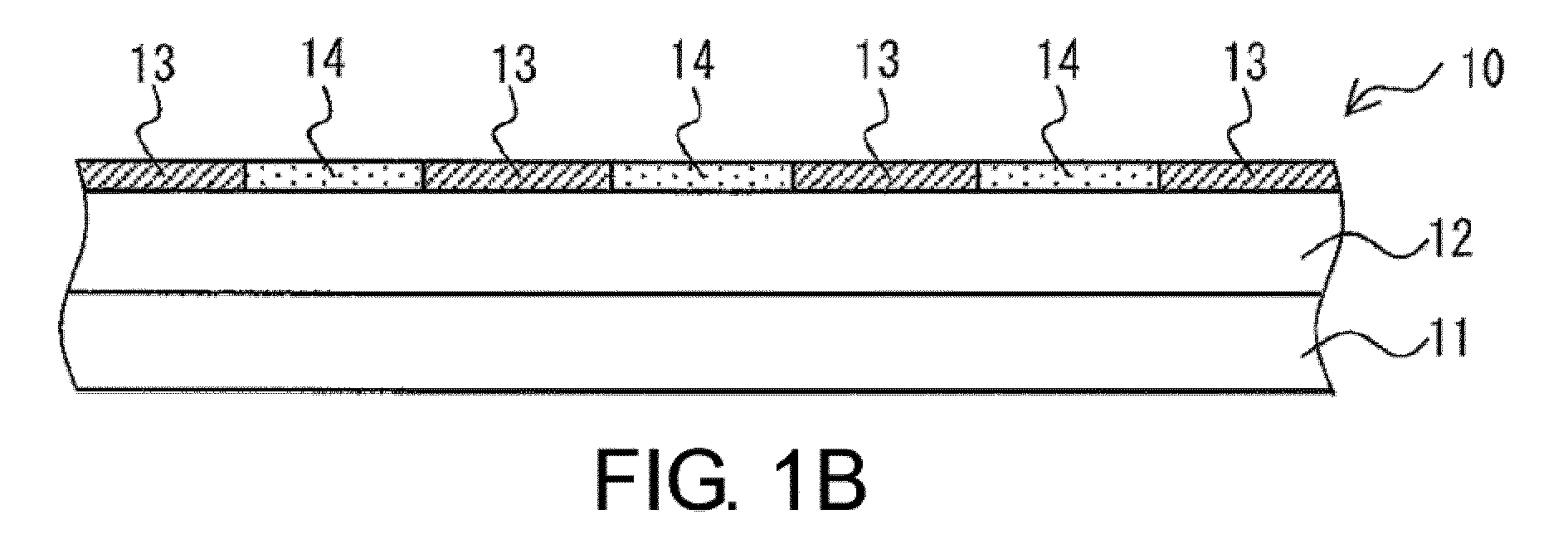
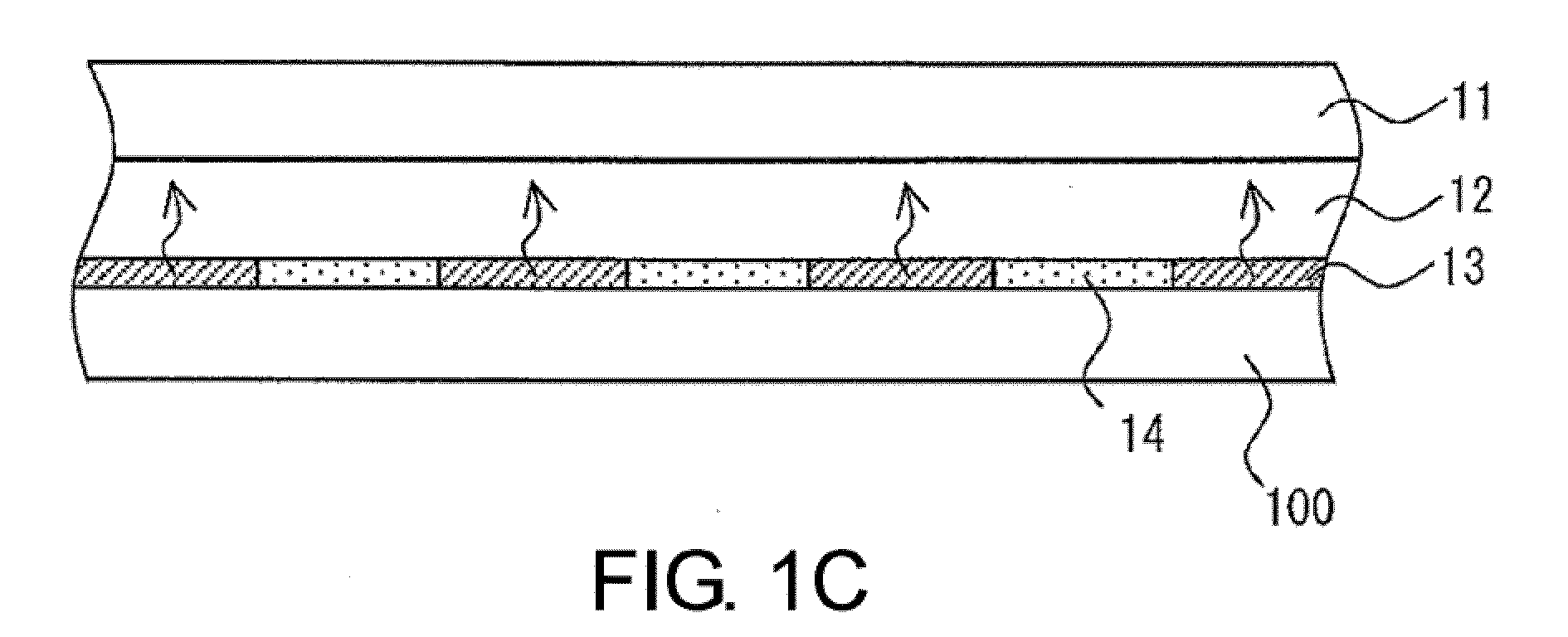
- FIGs. 1A through 1D are views showing a procedure of an embodiment of a transfer method in accordance with the present invention.
- a transfer film 10 is produced and then, a sublimation ink forming an image in the transfer film 10 is transferred to a medium (transferred medium) 100 to print the image on the medium 100.
- a fabric is preferably used.
- a transfer film in accordance with the present invention is further suitable for transferring to a fabric.
- an ink fixing layer is thick. This is because that deterioration of an image quality can be prevented by forming an ink fixing layer so as to straddle between fibers.
- a conventional technique has a problem that, when an ink fixing layer is set to be thick, a sublimation ink is diffused in a plane direction and the contour becomes blurry.
- the present invention is capable of solving the problem.
- the sublimation ink is diffused through permeation to a transfer binder layer 12 described below to form an ink fixing layer.
- the ink fixing layer is to be transferred to a medium 100
- a mask layer 14 even when the sublimation ink is diffused in a plane direction of the ink fixing layer, transferring of a blurred sublimation ink on the medium 100 is prevented by a mask layer 14.
- only the sublimation ink of the ink fixing layer in only a desired region is transferred on the medium 100 by the mask layer 14 and thus the contour of an image can be prevented from becoming blurry. Therefore, even when a sublimation ink is used and an ink fixing layer is set to be thick, an image whose contour does not become blurry can be formed on a transferred medium.
- a texture of a fabric is not impaired and a transferred medium having a good color can be obtained.
- a sublimation ink layer 13 described below is prevented from being transferred on the medium 100 solidly by the mask layer 14.
- a region transferred to the fabric becomes large and a texture of the fabric is impaired. For example, even if a fabric is attempted to be expanded and contracted, the region where an image is printed is large and expansion/contraction degree of the region is different from the fabric and thus it is hard to be expanded and contracted.
- the present invention is capable of preventing this problem, a texture of the fabric is not impaired. Further, since a background which is not originally needed is not transferred, a satisfactory color like a direct printing of an image on a fabric can be obtained.
- a transfer binder layer 12 is provided on a base film (base member) 11 (transfer binder layer forming process). It is further preferable that a coating agent for preventing exudation of ink from an ink fixing layer 15 described below is applied to a surface of the base film 11 beforehand. Since the coating agent covers the surface of the ink fixing layer 15 after having been transferred, exudation of the ink to the surface of a printed matter can be prevented.
- the transfer binder layer 12 is a layer for coupling the base film 11 to the sublimation ink layer 13 and the mask layer 14.
- the transfer binder layer 12 is structured of material into which the sublimation ink having been sublimated is permeated and diffused by sublimating the sublimation ink of the sublimation ink layer 13 described below.
- the transfer binder layer provided in the transfer film in accordance with the present invention may be structured of material such as urethane; rubber such as NBR, SBR or IP (isoprene), or the like.
- a method for sublimating the sublimation ink may be appropriately selected dependent on a type of the sublimation ink and, for example, the sublimation ink layer 13 may be heated or pressurized.
- the transfer binder layer 12 may be referred to as a layer for giving thickness to an image after transferred.
- a method for providing the transfer binder layer 12 is not limited specifically and, for example, material for the transfer binder layer 12 may be applied on the base film 11 by a conventionally known method.
- a sublimation ink layer 13 and a mask layer 14 are provided (sublimation ink layer forming process and mask layer forming process).
- the sublimation ink layer 13 is a layer including a sublimation ink and forms an image to be transferred to a medium 100.
- the sublimation ink is ink having sublimability and is sublimated by supplying heat.
- the sublimation ink is permeated and diffused into the transfer binder layer 12.
- the transfer binder layer 12 is changed to an ink fixing layer 15.
- the ink fixing layer 15 is a layer for fixing ink on a medium 100.
- the mask layer 14 is a layer provided in a predetermined region where a sublimation ink is not transferred on a medium 100. In a region where the mask layer 14 is provided, a sublimation ink (more specifically, sublimation ink diffusion layer 15 described below) is not transferred on the medium 100.
- the mask material structuring the mask layer 14 may sufficiently utilize material which prevents transferring of a sublimation ink and, for example, ink including ultraviolet curing type resin may be utilized.
- the mask layer 14 is provided on the transfer binder layer 12 in a region where the sublimation ink layer 13 is not provided. In other words, only a required image is printed by a sublimation ink and the background and the like are not printed and the mask layer 14 is provided in a surrounding area of the image and a space in a region of the image formed by the sublimation ink. As described above, since both of the sublimation ink layer 13 and the mask layer 14 are provided on the transfer binder layer 12, the transfer film 10 is easily produced. In other words, when both of a sublimation ink and mask material are ejected by inkjet, the mask layer 14 can be provided while providing the sublimation ink layer 13.
- a method for providing the sublimation ink layer 13 and the mask layer 14 is not limited specifically but it is further preferable to provide them through inkjet by an inkjet recording apparatus.
- an inkjet recording apparatus is provided with respective heads for ejecting a sublimation ink and mask material, the mask layer 14 can be formed while forming the sublimation ink layer 13 in the same pass. In this manner, the transfer film 10 can be easily produced in a further short period of time.
- the adhesive strength between the transfer binder layer 12 and the mask layer 14 becomes stronger than the adhesive strength between the medium 100 and the mask layer 14. This is because that, when the transfer film 10 is to be peeled after the transfer film 10 is attached by pressure, the mask layer 14 is easily peeled from the medium 100. In other words, since the mask layer 14 is bonded to the transfer binder layer 12 with a higher strength than to the medium 100, the mask layer 14 is easily peeled from the medium 100.
- the transfer film 10 is attached by pressure to the medium 100 to transfer an image (transfer process).
- the sublimation ink layer 13 and the mask layer 14 are attached by pressure to the medium 100
- the sublimation ink layer 13 and the transfer binder layer 12 are heated to permeate the sublimation ink into the transfer binder layer 12.
- the sublimation ink is diffused in the transfer binder layer 12 just above the sublimation ink layer 13 and the ink fixing layer 15 shown in FIG. 1D is formed.
- the sublimation ink may be blurred in a plane direction of the ink fixing layer 15 but the sublimation ink in the blurred region is not transferred on the medium 100 by the mask layer 14. Therefore, the contour of an image formed on the medium 100 does not become blurry.
- the temperature of heating may be appropriately set depending on materials structuring the sublimation ink and the transfer binder layer 12.
- the heating temperature for the transfer binder layer 12 and the sublimation ink layer 13 is not limited as long as the sublimation ink can be sublimated.
- the mask layer 14 is cured beforehand in the mask layer curing process and adhesive strength to the medium 100 is weaker than adhesive strength to the transfer binder layer 12. Therefore, the sublimation ink layer 13, in other words, the ink fixing layer 15 after having been heated is bonded to the medium 100, but the mask layer 14 is easily separated by peeling as described below.
- the transfer film 10 is peeled from the medium 100.
- the ink fixing layer 15 is left on the medium 100 to form an image.
- the adhesive strength between the mask layer 14 and the transfer binder layer 12 is stronger than the adhesive strength between the mask layer 14 and the medium 100 and thus, the mask layer 14 is not left on the medium 100 and is peeled together with the base film 11 and the transfer binder layer 12.
- the image is formed on the medium 100.
- a transfer film 20 includes a base film 11, a transfer binder layer 12, a sublimation ink layer 13 and a mask layer 14.
- the transfer film 10 and the transfer film 20 are different from each other in a region where the sublimation ink layer 13 and the mask layer 14 are formed.
- the mask layer 14 is formed in a gap space and on an outer side of the sublimation ink layer 13 which structures an image.
- the sublimation ink layer 13 is solidly formed on the transfer binder layer 12 and the mask layer 14 is formed on the sublimation ink layer 13 in a region where a sublimation ink is not transferred to the medium 100, so that the sublimation ink is not transferred.
- FIG. 3 is a view schematically showing a structure of an inkjet recording apparatus 200 which is an embodiment of an inkjet recording apparatus in accordance with the present invention.
- the inkjet recording apparatus 200 is an apparatus in which a sublimation ink and mask material are applied to a transfer film sheet 11' by inkjet to form a transfer film in accordance with the present invention.
- the transfer film sheet 11' is structured of the base film 11 and the transfer binder layer 12 described above and is mounted so that a sublimation ink and mask material are landed on the transfer binder layer 12.
- the inkjet recording apparatus 200 includes a carriage 201, a guide mechanism 204, a platen 205, a control section 210, a drive roller 206 and a driven roller 207.
- the carriage 201 includes a sublimation ink head (first head) 202 and a UV ink head (second head) 203.
- a moving direction of the carriage 201 is determined by the guide mechanism 204 and is reciprocatedly moved in the arrow "X" direction. In this manner, the carriage 201 scans on the transfer film sheet 11'.
- the sublimation ink head 202 is a head from which a sublimation ink for forming an image is ejected to provide a sublimation ink layer on the transfer film sheet 11'.
- a sublimation ink is ejected from the sublimation ink head 202 based on predetermined image information. Ejection of ink from the sublimation ink head 202 is controlled by a sublimation ink head control section (first head control means) 211 described below.
- the UV ink head 203 is a head from which a UV ink that is mask material is ejected so as to provide the mask layer in a preset region of the medium where the sublimation ink is not transferred.
- a UV ink is ejected from the UV ink head 203 based on predetermined image information. Ejection of ink from the UV ink head 203 is controlled by a UV ink head control section (second head control means) 212 described below.
- the "UV ink” is ink including ultraviolet curing type resin.
- the inkjet recording apparatus 200 may include an ultraviolet irradiation means for curing the UV ink.
- the sublimation ink head 202 which is a head for a sublimation ink
- the UV ink head 203 which is a head for mask material
- the mask layer can be formed while forming a sublimation ink layer on the transfer binder layer by ejecting a UV ink while ejecting a sublimation ink.
- a film in accordance with the present invention can be produced in an extremely short period of time in comparison with a case that the mask layer is formed after a sublimation ink layer has been formed.
- the guide mechanism 204 is a mechanism for determining a moving direction of the carriage 201.
- the carriage 201 is attached to the guide mechanism 204 so as to be capable of moving in the arrow "X" direction which is a length direction of the guide mechanism 204.
- the platen 205 is a base for placing a transfer film sheet 11' which is an object to be printed. A sublimation ink and a UV ink are ejected on the transfer film sheet 11' on the platen 205.
- the drive roller 206 is operated so as to move the transfer film sheet 11'. Further, the transfer film sheet 11' wound around the driven roller 207 described below is wound by the drive roller 206 and thereby the transfer film sheet 11' is moved.
- the driven roller 207 assists conveyance of the transfer film sheet 11' by the drive roller 206.
- the transfer film sheet 11' is wound around the driven roller 207 and the transfer film sheet 11' is supplied toward the carriage 201 through rotation of the driven roller 207.
- the control section 210 controls an operation of the inkjet recording apparatus 200.
- the control section 210 includes the sublimation ink head control section 211 and the UV ink head control section 212.
- the sublimation ink head control section 211 controls the sublimation ink head 202 so as to eject a sublimation ink based on image information representing an image to be formed on a transfer film sheet 11'.
- Image information may be, for example, obtained through input by a user or the like.
- the UV ink head control section 212 controls the UV ink head 203 to eject UV ink, so as to provide a mask layer in a region where a sublimation ink is not transferred to the media.
- a specific control method is not limited specifically. For example, it may be structured that a region where a sublimation ink is not printed is calculated based on information representing an image to be formed on the transfer film sheet 11' to prepare information representing a region for ejecting a UV ink and, based on the information, the UV ink head 203 is controlled so as to eject a UV ink. Further, it may be structured that information representing a region where a UV ink is to be ejected is directly inputted by a user or the like and, based on the information, the UV ink head 203 is controlled to eject a UV ink.
- the transfer film 10 includes the base film 11, the transfer binder layer 12 provided on the base film 11, the sublimation ink layer 13 which is provided on the transfer binder layer 12 and is a layer which forms an image by a sublimation ink for being transferred to a medium 100, and the mask layer 14 which is provided in a preset region where the sublimation ink is not transferred in the medium 100, and the transfer binder layer 12 is structured of material into which the sublimation ink is permeated through sublimation.
- the ink fixing layer 15 is formed by permeating and diffusing of the sublimation ink into the transfer binder layer 12. In a case that the ink fixing layer 15 is to be transferred to the medium 100, even when the sublimation ink is diffused in a plane direction of the ink fixing layer 15, the transfer of the sublimation ink which is blurred in the region is prevented by the mask layer 14. In other words, only the sublimation ink of the ink fixing layer only in the desired region is transferred on the medium 100 by the mask layer 14 and thus the contour of the image is prevented from becoming blurry. Therefore, even when a sublimation ink is used and the ink fixing layer 15 is set to be thick, an image whose contour does not become blurry is formed on a transferred medium.
- a region transferred to the fabric becomes large and a texture of the fabric is impaired. For example, even if a fabric is attempted to be expanded and contracted, the region where an image is printed is large and expansion/contraction degree of the region is different from the fabric and thus it is hard to be expanded and contracted. This problem is further noticeable when the ink fixing layer 15 becomes thick.
- the present embodiment is capable of preventing this problem, a texture of the fabric is not impaired. Further, since a background which is not originally needed is not transferred, a satisfactory color like a direct printing of an image on a fabric can be obtained. Therefore, a texture of the fabric is not impaired and a transferred medium having a satisfactory color can be obtained.
- the mask layer 14 is provided on the transfer binder layer 12 in a region where the sublimation ink layer 13 is not provided. Further, an amount of the sublimation ink can be reduced in comparison with a case that the sublimation ink layer 13 is solidly formed on the transfer binder layer 12. Further, in comparison with a case that the mask layer 14 is formed on the sublimation ink layer 13, the ink concentration of the sublimation ink layer 13 in a region where an image is formed can be increased. This is because that, when the mask layer 14 is adjacently formed to the sublimation ink layer 13, the mask layer 14 prevents diffusing and blurring of ink from the sublimation ink layer 13 in a plane direction.
- the mask layer 14 is capable of being formed while forming the sublimation ink layer 13 on the transfer binder layer 12 by inkjet and thus the transfer film can be produced easily.
- an adhesive strength between the transfer binder layer 12 and the mask layer 14 is stronger than an adhesive strength between the medium 100 and the mask layer 14.
- the mask layer 14 can be effectively peeled together with the transfer film 10 while the image is left on the medium 100.
- the mask layer 14 is formed of ink including ultraviolet curing type resin.
- the mask layer 14 is easily peeled from the medium 100.
- An embodiment of a transfer method in accordance with the present invention includes a transfer binder layer forming process in which a transfer binder layer 12 is provided on the base film 11, a sublimation ink layer forming process in which a sublimation ink layer 13 that is a layer of an image is formed on the transfer binder layer 12 by using a sublimation ink, a mask layer forming process in which a mask layer 14 is provided in a region where the sublimation ink is not transferred on the medium 100, and a transfer process in which the sublimation ink layer 13 and the mask layer 14 are attached by pressure to the medium 100 and thereby the image is transferred, and the transfer binder layer 12 is structured of material into which the sublimation ink is permeated by applying of heat.
- the ink fixing layer 15 is formed by permeating and diffusing of the sublimation ink into the transfer binder layer 12.
- the ink fixing layer 15 is to be transferred to the medium 100, even when the sublimation ink is diffused in a plane direction of the ink fixing layer 15, the sublimation ink which is blurred in the region is prevented from being transferred to the medium 100 by the mask layer 14.
- only the sublimation ink of the ink fixing layer only in the desired region is transferred on the medium 100 by the mask layer 14 and thus the contour of the image is prevented from becoming blurry. Therefore, even when a sublimation ink is used and the ink fixing layer 15 is set to be thick, an image whose contour does not become blurry is formed on a transferred medium.
- An embodiment of a transfer method in accordance with the present invention includes a mask layer curing process in which the mask layer 14 is cured so that adhesive strength between the transfer binder layer 12 and the mask layer 14 is stronger than adhesive strength between the medium 100 and the mask layer 14.
- the mask layer 14 can be effectively peeled from the medium 100 while the image is left on the medium 100.
- the mask layer 14 is formed by using ink including ultraviolet curing type resin and, in the sublimation ink layer forming process and the mask layer forming process, the mask layer 14 is formed while forming the sublimation ink layer 13 by the inkjet recording apparatus.
- the sublimation ink layer 13 and the mask layer 14 are simultaneously produced by one inkjet recording apparatus. Therefore, a transfer film in accordance with the present invention can be easily produced in a further short period of time.
- the sublimation ink layer 13 and the mask layer 14 are attached by pressure to the medium 100, the sublimation ink layer 13 and the transfer binder layer 12 are heated to permeate the sublimation ink into the transfer binder layer.
- the sublimation ink is permeated and diffused into the transfer binder layer located just above the sublimation ink and thus the ink fixing layer 15 which is a transfer binder layer including the sublimation ink is formed and thereby a transfer image is formed.
- the inkjet recording apparatus 200 includes the sublimation ink head 202 which ejects a sublimation ink for forming an image to provide the sublimation ink layer 13, the UV ink head 203 which ejects mask material for providing the mask layer 14 in a preset region where the sublimation ink is not transferred to a medium 100, the sublimation ink head control section 211 which controls the sublimation ink head 202 so as to eject the sublimation ink based on image information representing an image, and the UV ink head control section 212 which controls the UV ink head 203 so as to eject mask material to the region.
- the transfer film 10 can be produced easily.
- the present invention may be utilized in printing of an image to a fabric such as clothes and a bag.
Landscapes
- Engineering & Computer Science (AREA)
- Textile Engineering (AREA)
- Decoration By Transfer Pictures (AREA)
- Ink Jet Recording Methods And Recording Media Thereof (AREA)
- Impression-Transfer Materials And Handling Thereof (AREA)
- Coloring (AREA)
Abstract

Description
- The present invention relates to a transfer film, a transfer method and an inkjet recording apparatus for transferring an image to a transferred medium from a base member.
- In Patent Literature 1, a method is described in which a printing medium is heated and sublimation dye ink is diffused and developed color on a surface of a medium main body to form an image.
- [Patent Literature 1] Japanese Patent Laid-Open No.
2002-210943 (published on July 31, 2002 - The sublimation dye which is impregnated in an ink image receiving sheet is also diffused in a plane direction when an ink fixing layer is thick and the contour of an image becomes blurry. It is conceivable that diffusion in a plane direction of the sublimation dye is prevented by reducing the thickness of the ink fixing layer. However, when an ink fixing layer is thin, in a case that a medium which is an object to be formed with an image is coarse material like a fabric, the ink fixing layer cannot be formed so as to straddle between fibers. Therefore, the image quality is deteriorated.
- In view of the problem described above, an objective of the present invention is to form an image whose contour does not become blurry on a transferred medium even when a sublimation ink is used and an ink fixing layer is thick.
- A transfer film in accordance with the present invention includes a base member, a transfer binder layer provided on the base member, a sublimation ink layer which is provided on the transfer binder layer, the sublimation ink layer being a layer which forms an image for being transferred to a transferred medium by using a sublimation ink, and a mask layer which is provided in a preset region where the sublimation ink is not transferred to the transferred medium. The transfer binder layer is structured of material into which the sublimation ink is permeated through sublimation.
- The sublimation ink is permeated and diffused into the transfer binder layer and thereby the ink fixing layer is formed. In a case that the ink fixing layer is to be transferred to a transferred medium, even when the sublimation ink is diffused in a plane direction of the ink fixing layer, transfer of the sublimation ink which is blurred to the region is prevented by the mask layer. In other words, only the sublimation ink of the ink fixing layer in only a desired region is transferred on the transferred medium by the mask layer and thus the contour of an image is prevented from becoming blurry. Therefore, even when a sublimation ink is used and an ink fixing layer is set to be thick, an image whose contour does not become blurry can be formed on a transferred medium.
- Further, when the background of an image has been also printed solidly without providing the mask layer and then transferred to a fabric, a region transferred to the fabric becomes large and a texture of the fabric is impaired. For example, even if a fabric is attempted to expand and contract, the region where an image has been printed is large and expansion/contraction degree of the region is different from the fabric and thus it is hard to be expanded and contracted. This problem is further noticeable when the ink fixing layer becomes thick. However, since the present invention is capable of preventing this problem, a texture of the fabric is not impaired. Further, since a background which is not originally needed is not transferred, a satisfactory color like a direct printing of an image on a fabric can be obtained. Therefore, a texture of the fabric is not impaired and a transferred medium having a satisfactory color can be obtained.
- In the transfer film in accordance with the present invention, it is preferable that the mask layer is provided on the transfer binder layer in a region where the sublimation ink layer is not provided.
- The mask layer is also formed while forming the sublimation ink layer on the transfer binder layer by inkjet and thus the transfer film can be produced easily. Further, an amount of the sublimation ink can be reduced in comparison with a case that the sublimation ink layer is solidly formed on the transfer binder layer. Further, in comparison with a case that the mask layer is formed on the sublimation ink layer, the ink concentration of the sublimation ink layer in a region where an image is formed can be increased. This is because that, when the mask layer is adjacently formed to the sublimation ink layer, the mask layer prevents diffusing and blurring of ink from the sublimation ink layer in a plane direction.
- In the transfer film in accordance with the present invention, it is preferable that adhesive strength between the transfer binder layer and the mask layer is stronger than adhesive strength between the transferred medium and the mask layer.
- When the transfer film is to be peeled after the transfer film is attached by pressure to the transferred medium, the mask layer can be effectively peeled together with the transfer film while the image is left on the transferred medium.
- In the transfer film in accordance with the present invention, it is preferable that the mask layer is formed of ink including ultraviolet curing type resin.
- When ultraviolet rays are irradiated to cure the mask layer, in a case that the transfer film is to be peeled after the transfer film is attached by pressure to the transferred medium, the mask layer is easily peeled from the transferred medium.
- A transfer method in accordance with the present invention is a transfer method for transferring an image to a transferred medium, the transfer method including a transfer binder layer forming process in which a transfer binder layer is provided on a base member, a sublimation ink layer forming process in which a sublimation ink layer is provided on the transfer binder layer, the sublimation ink layer being a layer which forms an image to be transferred to a transferred medium by using a sublimation ink, a mask layer forming process in which a mask layer is provided in a region where the sublimation ink is not transferred on the transferred medium, and a transfer process in which the sublimation ink layer and the mask layer are attached by pressure to the transferred medium to transfer the image. The transfer binder layer is structured of material into which the sublimation ink is permeated by applying heat.
- The sublimation ink is permeated and diffused into the transfer binder layer and thereby the ink fixing layer is formed. In a case that the ink fixing layer is to be transferred to a transferred medium, even when the sublimation ink is diffused in a plane direction of the ink fixing layer, transfer of the sublimation ink which is blurred to the region is prevented by the mask layer. In other words, only the sublimation ink of the ink fixing layer in only a desired region is transferred on the transferred medium by the mask layer and thus the contour of an image is prevented from becoming blurry. Therefore, even when a sublimation ink is used and an ink fixing layer is set to be thick, an image whose contour does not become blurry can be formed on a transferred medium.
- It is preferable that the transfer method in accordance with the present invention includes a mask layer curing process in which the mask layer is cured so that adhesive strength between the transfer binder layer and the mask layer is stronger than adhesive strength between the transferred medium and the mask layer.
- When the transfer film is to be peeled after the transfer film is attached by pressure to the transferred medium, the mask layer can be effectively peeled from the transferred medium while the image is left on the transferred medium.
- In the transfer method in accordance with the present invention, it is preferable that the mask layer is formed of ink including ultraviolet curing type resin and, in the sublimation ink layer forming process and the mask layer forming process, the mask layer is formed while forming the sublimation ink layer by an inkjet recording apparatus.
- The sublimation ink layer and the mask layer are simultaneously produced by one inkjet recording apparatus. Therefore, a transfer film in accordance with the present invention can be easily produced in a further short period of time.
- In the transfer method in accordance with the present invention, after the sublimation ink layer and the mask layer are attached by pressure to the transferred medium in the transfer process, the sublimation ink layer and the transfer binder layer are heated to permeate the sublimation ink into the transfer binder layer.
- The sublimation ink is permeated and diffused into the transfer binder layer located just above the sublimation ink and the ink fixing layer which is a transfer binder layer including the sublimation ink is formed and thereby a transfer image is formed.
- An inkjet recording apparatus in accordance with the present invention includes a first head which ejects a sublimation ink for forming an image to provide a sublimation ink layer, a second head which ejects mask material for providing a mask layer in a preset region where the sublimation ink is not transferred to a transferred medium, a first head control means which controls the first head so as to eject the sublimation ink based on image information representing the image, and a second head control means which controls the second head so as to eject the mask material to the preset region.
- According to this structure, the transfer film in accordance with the present invention can be produced easily.
- According to the present invention, even when a sublimation ink is used and an ink fixing layer is set to be thick, an image whose contour does not become blurry can be formed on a transferred medium.
-
-
FIGs. 1A through 1D are views showing a procedure of an embodiment of a transfer method in accordance with the present invention. -
FIG. 2 is a view showing a structure of a modified embodiment of a transfer film in accordance with the present invention. -
FIG. 3 is a view schematically showing a structure of an embodiment of an inkjet recording apparatus in accordance with the present invention. - An embodiment of the present invention will be described in detail below. First, an embodiment of a transfer film and a transfer method in accordance with the present invention will be described below with reference to
FIGs. 1A through 1D. FIGs. 1A through 1D are views showing a procedure of an embodiment of a transfer method in accordance with the present invention. - In this embodiment, first, a
transfer film 10 is produced and then, a sublimation ink forming an image in thetransfer film 10 is transferred to a medium (transferred medium) 100 to print the image on themedium 100. - As a specific example of the
medium 100, for example, a fabric is preferably used. In other words, a transfer film in accordance with the present invention is further suitable for transferring to a fabric. In a case of a coarse medium like a fabric, it is preferable that an ink fixing layer is thick. This is because that deterioration of an image quality can be prevented by forming an ink fixing layer so as to straddle between fibers. On the other hand, a conventional technique has a problem that, when an ink fixing layer is set to be thick, a sublimation ink is diffused in a plane direction and the contour becomes blurry. However, the present invention is capable of solving the problem. For example, in this embodiment, the sublimation ink is diffused through permeation to atransfer binder layer 12 described below to form an ink fixing layer. In a case that the ink fixing layer is to be transferred to a medium 100, even when the sublimation ink is diffused in a plane direction of the ink fixing layer, transferring of a blurred sublimation ink on the medium 100 is prevented by amask layer 14. In other words, only the sublimation ink of the ink fixing layer in only a desired region is transferred on the medium 100 by themask layer 14 and thus the contour of an image can be prevented from becoming blurry. Therefore, even when a sublimation ink is used and an ink fixing layer is set to be thick, an image whose contour does not become blurry can be formed on a transferred medium. - Further, a texture of a fabric is not impaired and a transferred medium having a good color can be obtained. In other words, a
sublimation ink layer 13 described below is prevented from being transferred on the medium 100 solidly by themask layer 14. If the background of an image has been also printed solidly without providing themask layer 14 and then transferred to a fabric, a region transferred to the fabric becomes large and a texture of the fabric is impaired. For example, even if a fabric is attempted to be expanded and contracted, the region where an image is printed is large and expansion/contraction degree of the region is different from the fabric and thus it is hard to be expanded and contracted. However, since the present invention is capable of preventing this problem, a texture of the fabric is not impaired. Further, since a background which is not originally needed is not transferred, a satisfactory color like a direct printing of an image on a fabric can be obtained. - First, as shown in
FIG. 1A , atransfer binder layer 12 is provided on a base film (base member) 11 (transfer binder layer forming process). It is further preferable that a coating agent for preventing exudation of ink from anink fixing layer 15 described below is applied to a surface of thebase film 11 beforehand. Since the coating agent covers the surface of theink fixing layer 15 after having been transferred, exudation of the ink to the surface of a printed matter can be prevented. - The
transfer binder layer 12 is a layer for coupling thebase film 11 to thesublimation ink layer 13 and themask layer 14. Thetransfer binder layer 12 is structured of material into which the sublimation ink having been sublimated is permeated and diffused by sublimating the sublimation ink of thesublimation ink layer 13 described below. For example, the transfer binder layer provided in the transfer film in accordance with the present invention may be structured of material such as urethane; rubber such as NBR, SBR or IP (isoprene), or the like. A method for sublimating the sublimation ink may be appropriately selected dependent on a type of the sublimation ink and, for example, thesublimation ink layer 13 may be heated or pressurized. In this embodiment, a case that a sublimation ink is sublimated by being heated will be described. Since a sublimation ink is permeated to form an image after having been transferred, thetransfer binder layer 12 may be referred to as a layer for giving thickness to an image after transferred. - A method for providing the
transfer binder layer 12 is not limited specifically and, for example, material for thetransfer binder layer 12 may be applied on thebase film 11 by a conventionally known method. - Next, as shown in
FIG. 1B , asublimation ink layer 13 and amask layer 14 are provided (sublimation ink layer forming process and mask layer forming process). - The
sublimation ink layer 13 is a layer including a sublimation ink and forms an image to be transferred to a medium 100. The sublimation ink is ink having sublimability and is sublimated by supplying heat. In this embodiment, when sublimated, the sublimation ink is permeated and diffused into thetransfer binder layer 12. In this manner, thetransfer binder layer 12 is changed to anink fixing layer 15. Theink fixing layer 15 is a layer for fixing ink on a medium 100. - The
mask layer 14 is a layer provided in a predetermined region where a sublimation ink is not transferred on a medium 100. In a region where themask layer 14 is provided, a sublimation ink (more specifically, sublimationink diffusion layer 15 described below) is not transferred on the medium 100. The mask material structuring themask layer 14 may sufficiently utilize material which prevents transferring of a sublimation ink and, for example, ink including ultraviolet curing type resin may be utilized. - Further, as shown in
FIG. 1B , themask layer 14 is provided on thetransfer binder layer 12 in a region where thesublimation ink layer 13 is not provided. In other words, only a required image is printed by a sublimation ink and the background and the like are not printed and themask layer 14 is provided in a surrounding area of the image and a space in a region of the image formed by the sublimation ink. As described above, since both of thesublimation ink layer 13 and themask layer 14 are provided on thetransfer binder layer 12, thetransfer film 10 is easily produced. In other words, when both of a sublimation ink and mask material are ejected by inkjet, themask layer 14 can be provided while providing thesublimation ink layer 13. - In other words, a method for providing the
sublimation ink layer 13 and themask layer 14 is not limited specifically but it is further preferable to provide them through inkjet by an inkjet recording apparatus. When an inkjet recording apparatus is provided with respective heads for ejecting a sublimation ink and mask material, themask layer 14 can be formed while forming thesublimation ink layer 13 in the same pass. In this manner, thetransfer film 10 can be easily produced in a further short period of time. - Next, ultraviolet rays are irradiated to cure the mask layer 14 (mask layer curing process). As a result, the adhesive strength between the
transfer binder layer 12 and themask layer 14 becomes stronger than the adhesive strength between the medium 100 and themask layer 14. This is because that, when thetransfer film 10 is to be peeled after thetransfer film 10 is attached by pressure, themask layer 14 is easily peeled from the medium 100. In other words, since themask layer 14 is bonded to thetransfer binder layer 12 with a higher strength than to the medium 100, themask layer 14 is easily peeled from the medium 100. - In this manner, the
transfer film 10 as an embodiment of a transfer film in accordance with the present invention is produced. - Next, as shown in
FIG. 1C , thetransfer film 10 is attached by pressure to the medium 100 to transfer an image (transfer process). In this process, after thesublimation ink layer 13 and themask layer 14 are attached by pressure to the medium 100, thesublimation ink layer 13 and thetransfer binder layer 12 are heated to permeate the sublimation ink into thetransfer binder layer 12. As a result, the sublimation ink is diffused in thetransfer binder layer 12 just above thesublimation ink layer 13 and theink fixing layer 15 shown inFIG. 1D is formed. The sublimation ink may be blurred in a plane direction of theink fixing layer 15 but the sublimation ink in the blurred region is not transferred on the medium 100 by themask layer 14. Therefore, the contour of an image formed on the medium 100 does not become blurry. The temperature of heating may be appropriately set depending on materials structuring the sublimation ink and thetransfer binder layer 12. - The heating temperature for the
transfer binder layer 12 and thesublimation ink layer 13 is not limited as long as the sublimation ink can be sublimated. - Further, the
mask layer 14 is cured beforehand in the mask layer curing process and adhesive strength to the medium 100 is weaker than adhesive strength to thetransfer binder layer 12. Therefore, thesublimation ink layer 13, in other words, theink fixing layer 15 after having been heated is bonded to the medium 100, but themask layer 14 is easily separated by peeling as described below. - Next, as shown in
FIG. 1D , thetransfer film 10 is peeled from the medium 100. In this case, theink fixing layer 15 is left on the medium 100 to form an image. On the other hand, the adhesive strength between themask layer 14 and thetransfer binder layer 12 is stronger than the adhesive strength between themask layer 14 and the medium 100 and thus, themask layer 14 is not left on the medium 100 and is peeled together with thebase film 11 and thetransfer binder layer 12. - As described above, the image is formed on the medium 100.
- Next, a modified embodiment of a transfer film in accordance with the present invention which is different from the
transfer film 10 will be described below with reference toFIG. 2 . - A
transfer film 20 includes abase film 11, atransfer binder layer 12, asublimation ink layer 13 and amask layer 14. - The
transfer film 10 and thetransfer film 20 are different from each other in a region where thesublimation ink layer 13 and themask layer 14 are formed. In other words, in thetransfer film 10, themask layer 14 is formed in a gap space and on an outer side of thesublimation ink layer 13 which structures an image. On the other hand, in thetransfer film 20, thesublimation ink layer 13 is solidly formed on thetransfer binder layer 12 and themask layer 14 is formed on thesublimation ink layer 13 in a region where a sublimation ink is not transferred to the medium 100, so that the sublimation ink is not transferred. - As a result, even when a sublimation ink is diffused, transfer of the sublimation ink is prevented by the
mask layer 14 except a region where the transfer is desired and thus, similarly to thetransfer film 10, an image without blurring of its contour can be formed on the medium 100. - Next, an embodiment of an inkjet recording apparatus in accordance with the present invention will be described below with reference to
FIG. 3 . -
FIG. 3 is a view schematically showing a structure of aninkjet recording apparatus 200 which is an embodiment of an inkjet recording apparatus in accordance with the present invention. - The
inkjet recording apparatus 200 is an apparatus in which a sublimation ink and mask material are applied to a transfer film sheet 11' by inkjet to form a transfer film in accordance with the present invention. The transfer film sheet 11' is structured of thebase film 11 and thetransfer binder layer 12 described above and is mounted so that a sublimation ink and mask material are landed on thetransfer binder layer 12. - The
inkjet recording apparatus 200 includes acarriage 201, aguide mechanism 204, aplaten 205, acontrol section 210, adrive roller 206 and a drivenroller 207. - The
carriage 201 includes a sublimation ink head (first head) 202 and a UV ink head (second head) 203. - A moving direction of the
carriage 201 is determined by theguide mechanism 204 and is reciprocatedly moved in the arrow "X" direction. In this manner, thecarriage 201 scans on the transfer film sheet 11'. - The
sublimation ink head 202 is a head from which a sublimation ink for forming an image is ejected to provide a sublimation ink layer on the transfer film sheet 11'. In a case that thecarriage 201 is scanned on the transfer film sheet 11', a sublimation ink is ejected from thesublimation ink head 202 based on predetermined image information. Ejection of ink from thesublimation ink head 202 is controlled by a sublimation ink head control section (first head control means) 211 described below. - The
UV ink head 203 is a head from which a UV ink that is mask material is ejected so as to provide the mask layer in a preset region of the medium where the sublimation ink is not transferred. When thecarriage 201 is scanned on the transfer film sheet 11', a UV ink is ejected from theUV ink head 203 based on predetermined image information. Ejection of ink from theUV ink head 203 is controlled by a UV ink head control section (second head control means) 212 described below. The "UV ink" is ink including ultraviolet curing type resin. Theinkjet recording apparatus 200 may include an ultraviolet irradiation means for curing the UV ink. - As described above, two types of head, i.e., the
sublimation ink head 202 which is a head for a sublimation ink and theUV ink head 203 which is a head for mask material are provided and thus, in a transfer film in accordance with the present invention, an embodiment in which the mask layer is provided on the transfer binder layer in a region where a sublimation ink layer is not provided is preferably produced. - In other words, the mask layer can be formed while forming a sublimation ink layer on the transfer binder layer by ejecting a UV ink while ejecting a sublimation ink. A film in accordance with the present invention can be produced in an extremely short period of time in comparison with a case that the mask layer is formed after a sublimation ink layer has been formed.
- The
guide mechanism 204 is a mechanism for determining a moving direction of thecarriage 201. Thecarriage 201 is attached to theguide mechanism 204 so as to be capable of moving in the arrow "X" direction which is a length direction of theguide mechanism 204. - The
platen 205 is a base for placing a transfer film sheet 11' which is an object to be printed. A sublimation ink and a UV ink are ejected on the transfer film sheet 11' on theplaten 205. - The
drive roller 206 is operated so as to move the transfer film sheet 11'. Further, the transfer film sheet 11' wound around the drivenroller 207 described below is wound by thedrive roller 206 and thereby the transfer film sheet 11' is moved. - The driven
roller 207 assists conveyance of the transfer film sheet 11' by thedrive roller 206. The transfer film sheet 11' is wound around the drivenroller 207 and the transfer film sheet 11' is supplied toward thecarriage 201 through rotation of the drivenroller 207. - The
control section 210 controls an operation of theinkjet recording apparatus 200. Thecontrol section 210 includes the sublimation inkhead control section 211 and the UV inkhead control section 212. - The sublimation ink
head control section 211 controls thesublimation ink head 202 so as to eject a sublimation ink based on image information representing an image to be formed on a transfer film sheet 11'. Image information may be, for example, obtained through input by a user or the like. - The UV ink
head control section 212 controls theUV ink head 203 to eject UV ink, so as to provide a mask layer in a region where a sublimation ink is not transferred to the media. - A specific control method is not limited specifically. For example, it may be structured that a region where a sublimation ink is not printed is calculated based on information representing an image to be formed on the transfer film sheet 11' to prepare information representing a region for ejecting a UV ink and, based on the information, the
UV ink head 203 is controlled so as to eject a UV ink. Further, it may be structured that information representing a region where a UV ink is to be ejected is directly inputted by a user or the like and, based on the information, theUV ink head 203 is controlled to eject a UV ink. - The present invention is not limited to the above-mentioned embodiments and various changes and modifications will be included in a scope described in claims and embodiments obtained by appropriately combining technical means respectively disclosed in different embodiments are also included in a technical scope of the present invention.
- As described above, the
transfer film 10 includes thebase film 11, thetransfer binder layer 12 provided on thebase film 11, thesublimation ink layer 13 which is provided on thetransfer binder layer 12 and is a layer which forms an image by a sublimation ink for being transferred to a medium 100, and themask layer 14 which is provided in a preset region where the sublimation ink is not transferred in the medium 100, and thetransfer binder layer 12 is structured of material into which the sublimation ink is permeated through sublimation. - The
ink fixing layer 15 is formed by permeating and diffusing of the sublimation ink into thetransfer binder layer 12. In a case that theink fixing layer 15 is to be transferred to the medium 100, even when the sublimation ink is diffused in a plane direction of theink fixing layer 15, the transfer of the sublimation ink which is blurred in the region is prevented by themask layer 14. In other words, only the sublimation ink of the ink fixing layer only in the desired region is transferred on the medium 100 by themask layer 14 and thus the contour of the image is prevented from becoming blurry. Therefore, even when a sublimation ink is used and theink fixing layer 15 is set to be thick, an image whose contour does not become blurry is formed on a transferred medium. - Further, if the background of an image has been printed solidly without providing the
mask layer 14 and then transferred to a fabric, a region transferred to the fabric becomes large and a texture of the fabric is impaired. For example, even if a fabric is attempted to be expanded and contracted, the region where an image is printed is large and expansion/contraction degree of the region is different from the fabric and thus it is hard to be expanded and contracted. This problem is further noticeable when theink fixing layer 15 becomes thick. However, since the present embodiment is capable of preventing this problem, a texture of the fabric is not impaired. Further, since a background which is not originally needed is not transferred, a satisfactory color like a direct printing of an image on a fabric can be obtained. Therefore, a texture of the fabric is not impaired and a transferred medium having a satisfactory color can be obtained. - In the
transfer film 10, themask layer 14 is provided on thetransfer binder layer 12 in a region where thesublimation ink layer 13 is not provided. Further, an amount of the sublimation ink can be reduced in comparison with a case that thesublimation ink layer 13 is solidly formed on thetransfer binder layer 12. Further, in comparison with a case that themask layer 14 is formed on thesublimation ink layer 13, the ink concentration of thesublimation ink layer 13 in a region where an image is formed can be increased. This is because that, when themask layer 14 is adjacently formed to thesublimation ink layer 13, themask layer 14 prevents diffusing and blurring of ink from thesublimation ink layer 13 in a plane direction. - The
mask layer 14 is capable of being formed while forming thesublimation ink layer 13 on thetransfer binder layer 12 by inkjet and thus the transfer film can be produced easily. - In the
transfer film 10, an adhesive strength between thetransfer binder layer 12 and themask layer 14 is stronger than an adhesive strength between the medium 100 and themask layer 14. - When the
transfer film 10 is to be peeled after thetransfer film 10 is attached by pressure to the medium 100, themask layer 14 can be effectively peeled together with thetransfer film 10 while the image is left on the medium 100. - In the
transfer film 10, themask layer 14 is formed of ink including ultraviolet curing type resin. - When ultraviolet rays are irradiated to cure the
mask layer 14, in a case that thetransfer film 10 is to be peeled after thetransfer film 10 is attached by pressure to the medium 100, themask layer 14 is easily peeled from the medium 100. - An embodiment of a transfer method in accordance with the present invention includes a transfer binder layer forming process in which a
transfer binder layer 12 is provided on thebase film 11, a sublimation ink layer forming process in which asublimation ink layer 13 that is a layer of an image is formed on thetransfer binder layer 12 by using a sublimation ink, a mask layer forming process in which amask layer 14 is provided in a region where the sublimation ink is not transferred on the medium 100, and a transfer process in which thesublimation ink layer 13 and themask layer 14 are attached by pressure to the medium 100 and thereby the image is transferred, and thetransfer binder layer 12 is structured of material into which the sublimation ink is permeated by applying of heat. - The
ink fixing layer 15 is formed by permeating and diffusing of the sublimation ink into thetransfer binder layer 12. In a case that theink fixing layer 15 is to be transferred to the medium 100, even when the sublimation ink is diffused in a plane direction of theink fixing layer 15, the sublimation ink which is blurred in the region is prevented from being transferred to the medium 100 by themask layer 14. In other words, only the sublimation ink of the ink fixing layer only in the desired region is transferred on the medium 100 by themask layer 14 and thus the contour of the image is prevented from becoming blurry. Therefore, even when a sublimation ink is used and theink fixing layer 15 is set to be thick, an image whose contour does not become blurry is formed on a transferred medium. - An embodiment of a transfer method in accordance with the present invention includes a mask layer curing process in which the
mask layer 14 is cured so that adhesive strength between thetransfer binder layer 12 and themask layer 14 is stronger than adhesive strength between the medium 100 and themask layer 14. - When the
transfer film 10 is to be peeled after thetransfer film 10 is attached by pressure to the medium 100, themask layer 14 can be effectively peeled from the medium 100 while the image is left on the medium 100. - In an embodiment of a transfer method in accordance with the present invention, the
mask layer 14 is formed by using ink including ultraviolet curing type resin and, in the sublimation ink layer forming process and the mask layer forming process, themask layer 14 is formed while forming thesublimation ink layer 13 by the inkjet recording apparatus. - The
sublimation ink layer 13 and themask layer 14 are simultaneously produced by one inkjet recording apparatus. Therefore, a transfer film in accordance with the present invention can be easily produced in a further short period of time. - In an embodiment of a transfer method in accordance with the present invention, it is further preferable that, in the transfer process, after the
sublimation ink layer 13 and themask layer 14 are attached by pressure to the medium 100, thesublimation ink layer 13 and thetransfer binder layer 12 are heated to permeate the sublimation ink into the transfer binder layer. - The sublimation ink is permeated and diffused into the transfer binder layer located just above the sublimation ink and thus the
ink fixing layer 15 which is a transfer binder layer including the sublimation ink is formed and thereby a transfer image is formed. - The
inkjet recording apparatus 200 includes thesublimation ink head 202 which ejects a sublimation ink for forming an image to provide thesublimation ink layer 13, theUV ink head 203 which ejects mask material for providing themask layer 14 in a preset region where the sublimation ink is not transferred to a medium 100, the sublimation inkhead control section 211 which controls thesublimation ink head 202 so as to eject the sublimation ink based on image information representing an image, and the UV inkhead control section 212 which controls theUV ink head 203 so as to eject mask material to the region. According to this structure, thetransfer film 10 can be produced easily. - The present invention may be utilized in printing of an image to a fabric such as clothes and a bag.
Claims (9)
- A transfer film, comprising:a base member;a transfer binder layer provided on the base member;a sublimation ink layer which is provided on the transfer binder layer, the sublimation ink layer being a layer which forms an image for being transferred to a transferred medium by using a sublimation ink; anda mask layer which is provided in a preset region where the sublimation ink is not transferred to the transferred medium;wherein the transfer binder layer is structured of material into which the sublimation ink is permeated through sublimation.
- The transfer film according to claim 1, wherein
the mask layer is provided on the transfer binder layer in a region where the sublimation ink layer is not provided. - The transfer film according to claim 1, wherein
an adhesive strength between the transfer binder layer and the mask layer is stronger than an adhesive strength between the transferred medium and the mask layer. - The transfer film according to claim 1, wherein
the mask layer is formed of an ink including an ultraviolet curing type resin. - A transfer method for transferring an image to a transferred medium, comprising:a transfer binder layer forming process, in which a transfer binder layer is provided on a base member;a sublimation ink layer forming process, in which a sublimation ink layer is provided on the transfer binder layer, the sublimation ink layer being a layer which forms an image to be transferred to a transferred medium by using a sublimation ink;a mask layer forming process, in which a mask layer is provided in a region where the sublimation ink is not transferred on the transferred medium; anda transfer process, in which the sublimation ink layer and the mask layer are attached by pressure to the transferred medium to transfer the image;wherein the transfer binder layer is structured of material into which the sublimation ink is permeated by applying heat.
- The transfer method according to claim 5, further comprising:a mask layer curing process, in which the mask layer is cured so that an adhesive strength between the transfer binder layer and the mask layer is stronger than an adhesive strength between the transferred medium and the mask layer.
- The transfer method according to claim 5, wherein
the mask layer is formed of an ink including an ultraviolet curing type resin, and
in the sublimation ink layer forming process and the mask layer forming process, the mask layer is formed while forming the sublimation ink layer by an inkjet recording apparatus. - The transfer method according to claim 5, wherein
after the sublimation ink layer and the mask layer are attached by pressure to the transferred medium in the transfer process, the sublimation ink layer and the transfer binder layer are heated to permeate the sublimation ink into the transfer binder layer. - An inkjet recording apparatus, comprising:a first head which ejects a sublimation ink for forming an image to provide a sublimation ink layer;a second head which ejects a mask material for providing a mask layer in a preset region where the sublimation ink is not transferred to a transferred medium;a first head control means which controls the first head so as to eject the sublimation ink based on an image information that represents the image; anda second head control means which controls the second head so as to eject the mask material to the preset region.
Applications Claiming Priority (2)
| Application Number | Priority Date | Filing Date | Title |
|---|---|---|---|
| JP2012062720A JP6305675B2 (en) | 2012-03-19 | 2012-03-19 | Transfer film and transfer method |
| PCT/JP2013/056033 WO2013141019A1 (en) | 2012-03-19 | 2013-03-05 | Transfer film, transfer method, and inkjet recording device |
Publications (2)
| Publication Number | Publication Date |
|---|---|
| EP2829414A1 true EP2829414A1 (en) | 2015-01-28 |
| EP2829414A4 EP2829414A4 (en) | 2015-12-09 |
Family
ID=49222481
Family Applications (1)
| Application Number | Title | Priority Date | Filing Date |
|---|---|---|---|
| EP13764418.3A Withdrawn EP2829414A4 (en) | 2012-03-19 | 2013-03-05 | Transfer film, transfer method, and inkjet recording device |
Country Status (5)
| Country | Link |
|---|---|
| US (1) | US9688065B2 (en) |
| EP (1) | EP2829414A4 (en) |
| JP (1) | JP6305675B2 (en) |
| CN (1) | CN104203592A (en) |
| WO (1) | WO2013141019A1 (en) |
Families Citing this family (7)
| Publication number | Priority date | Publication date | Assignee | Title |
|---|---|---|---|---|
| CN106457880A (en) | 2014-04-07 | 2017-02-22 | 艾利丹尼森零售信息服务公司 | Thermal transfers and methods used on specific commercial articles for specific events |
| JP6587283B2 (en) * | 2015-10-29 | 2019-10-09 | 株式会社ミマキエンジニアリング | Dyeing method |
| JP6558801B2 (en) * | 2015-10-29 | 2019-08-14 | 株式会社ミマキエンジニアリング | Dyeing method |
| CN108475032B (en) | 2016-03-02 | 2021-07-02 | 惠普印迪戈股份公司 | selective printing |
| JP6260878B2 (en) | 2016-05-27 | 2018-01-17 | 株式会社アイエヌジー | Image transfer sheet, image transfer sheet manufacturing method, and image transfer method |
| JP6795474B2 (en) * | 2017-08-30 | 2020-12-02 | 株式会社ミマキエンジニアリング | Printed matter creation method and printed matter |
| JP2025163450A (en) * | 2024-04-17 | 2025-10-29 | 株式会社ミマキエンジニアリング | Image transfer method, non-transfer area forming device, printing system, and transfer medium management method |
Family Cites Families (29)
| Publication number | Priority date | Publication date | Assignee | Title |
|---|---|---|---|---|
| JPS4957189A (en) * | 1972-10-07 | 1974-06-03 | ||
| US4021591A (en) * | 1974-12-04 | 1977-05-03 | Roy F. DeVries | Sublimation transfer and method |
| JPS6024867B2 (en) * | 1978-06-15 | 1985-06-14 | 株式会社松井色素化学工業所 | Dye sublimation transfer printing method |
| JPH0410072Y2 (en) * | 1985-09-17 | 1992-03-12 | ||
| JPH02154083A (en) * | 1988-12-02 | 1990-06-13 | Toppan Printing Co Ltd | Method for coloring and embossing |
| JPH02171276A (en) * | 1988-12-23 | 1990-07-02 | Nichiwa Insatsu Kk | Sublimating transfer method for multi-kinds and small lot of materials |
| US5741387A (en) * | 1995-08-15 | 1998-04-21 | Riverside Industries, Inc. | Lithographic printing process and transfer sheet |
| JPH10315639A (en) * | 1997-05-16 | 1998-12-02 | Dainippon Printing Co Ltd | Receiving layer transfer sheet and card-shaped print |
| US6824639B1 (en) * | 1999-02-03 | 2004-11-30 | Contra Vision Ltd. | Partial imaging of a substrate with superimposed layers |
| US6486903B1 (en) * | 2000-09-27 | 2002-11-26 | Sawgrass Systems, Inc. | Transfer printing process |
| JP3846198B2 (en) * | 2001-01-22 | 2006-11-15 | セイコーエプソン株式会社 | Image forming method |
| JP2003063198A (en) * | 2001-08-24 | 2003-03-05 | Seiko Epson Corp | Imaging method and imaging device |
| WO2003061970A2 (en) * | 2002-01-23 | 2003-07-31 | Contra Vision Ltd. | Printing with differential adhesion |
| US6540345B1 (en) * | 2002-03-12 | 2003-04-01 | Sawgrass Systems, Inc. | Transfer printing process |
| TWI273991B (en) * | 2002-05-15 | 2007-02-21 | Kiwa Chemical Ind Co Ltd | Laminate for printing and printing method and printed matter using the same |
| US6832832B2 (en) * | 2002-09-04 | 2004-12-21 | Nu-Kote International, Inc. | Dye sublimation ink-jet ink and dye sublimation transfer process using the same |
| US6909444B2 (en) * | 2002-09-09 | 2005-06-21 | Dai Nippon Printing Co., Ltd. | Transfer ribbon, image expressing medium and method for production of them |
| US7393576B2 (en) * | 2004-01-16 | 2008-07-01 | High Voltage Graphics, Inc. | Process for printing and molding a flocked article |
| WO2005118948A2 (en) * | 2004-05-26 | 2005-12-15 | High Voltage Graphics, Inc. | Process for high and medium energy dye printing a flocked article |
| WO2006050013A2 (en) * | 2004-11-01 | 2006-05-11 | Johnson Polymer, Llc | Fast-drying, radiofrequency-activatable inkjet inks and methods and systems for their use |
| US20070022548A1 (en) * | 2005-08-01 | 2007-02-01 | High Voltage Graphics, Inc. | Process for heat setting polyester fibers for sublimation printing |
| CN101421114A (en) | 2006-02-03 | 2009-04-29 | 索格拉斯技术公司 | Image receiving medium and printing method |
| US20070181253A1 (en) | 2006-02-03 | 2007-08-09 | Ming Xu | Image receiver media and printing process |
| DE102006062446A1 (en) * | 2006-12-23 | 2008-06-26 | Öz, Bülent | Process for transfer printing and print templates for these purposes |
| JP2009248351A (en) | 2008-04-02 | 2009-10-29 | Miyakoshi Printing Machinery Co Ltd | Method for applying sealer in inkjet recorder |
| JP5114454B2 (en) * | 2009-06-04 | 2013-01-09 | 株式会社ミマキエンジニアリング | Ink, inkjet printer and printing method |
| JP2011068033A (en) | 2009-09-25 | 2011-04-07 | Fujifilm Corp | Method for checking valve operation of liquid supply device, liquid supply device, and ink jet recorder |
| FR2968241B1 (en) * | 2010-12-02 | 2012-12-21 | Corso Magenta | METHOD FOR MANUFACTURING AN ARTICLE ENABLING THE APPLICATION OF A FILM |
| US20120162332A1 (en) * | 2010-12-22 | 2012-06-28 | Hong Kong Applied Science and Technology Research Institute Company Limited | Sublimation inks for thermal inkjet printers using thermally stable dye particles |
-
2012
- 2012-03-19 JP JP2012062720A patent/JP6305675B2/en active Active
-
2013
- 2013-03-05 US US14/382,320 patent/US9688065B2/en not_active Expired - Fee Related
- 2013-03-05 WO PCT/JP2013/056033 patent/WO2013141019A1/en not_active Ceased
- 2013-03-05 CN CN201380014277.3A patent/CN104203592A/en active Pending
- 2013-03-05 EP EP13764418.3A patent/EP2829414A4/en not_active Withdrawn
Also Published As
| Publication number | Publication date |
|---|---|
| CN104203592A (en) | 2014-12-10 |
| US9688065B2 (en) | 2017-06-27 |
| WO2013141019A1 (en) | 2013-09-26 |
| US20150246528A1 (en) | 2015-09-03 |
| JP6305675B2 (en) | 2018-04-04 |
| JP2013193321A (en) | 2013-09-30 |
| EP2829414A4 (en) | 2015-12-09 |
Similar Documents
| Publication | Publication Date | Title |
|---|---|---|
| US9688065B2 (en) | Transfer film, transfer method and inkjet recording apparatus | |
| CN107856411B (en) | Method for indirect application of printing liquids to printing substrates | |
| US9254687B2 (en) | Printing method and printing device | |
| US20090207224A1 (en) | Printing apparatus and method | |
| JP5586082B2 (en) | Image transfer apparatus and image transfer method | |
| US20130000812A1 (en) | Laminated foil manufacturing apparatus and laminated foil manufacturing method | |
| JP5586081B2 (en) | Inkjet printer and printing method | |
| JPH01146750A (en) | inkjet printer | |
| US20070097196A1 (en) | Inkjet recording apparatus | |
| JP6390234B2 (en) | Image forming apparatus, image forming system, and method for producing printed matter | |
| JP5035036B2 (en) | Recording device | |
| JP6293151B2 (en) | Method for applying curable liquid and apparatus for performing the method | |
| JP6190628B2 (en) | Transfer object manufacturing method, inkjet printer, transfer film, and transfer object | |
| US10155374B2 (en) | Printing method, printing device, and printing system | |
| JP6384170B2 (en) | Image forming apparatus, image forming system, and method for producing printed matter | |
| JP5263427B2 (en) | Recording apparatus and recording method | |
| WO2021029003A1 (en) | Device and method for print transfer on cloth product | |
| KR20230002022A (en) | Printing device and printing method | |
| JP2025163450A (en) | Image transfer method, non-transfer area forming device, printing system, and transfer medium management method | |
| JP7316486B2 (en) | Inkjet printing device and inkjet printing method | |
| EP4606590A1 (en) | Method and printer for multi-layer ink jet printing and curing | |
| US10933655B2 (en) | Liquid ejecting apparatus | |
| JP7040135B2 (en) | Head cleaning device, device that discharges liquid | |
| JP6135325B2 (en) | Image forming apparatus and image forming method | |
| JP2026506693A (en) | Method for operating a printing device, printing device, and software product |
Legal Events
| Date | Code | Title | Description |
|---|---|---|---|
| PUAI | Public reference made under article 153(3) epc to a published international application that has entered the european phase |
Free format text: ORIGINAL CODE: 0009012 |
|
| 17P | Request for examination filed |
Effective date: 20141020 |
|
| AK | Designated contracting states |
Kind code of ref document: A1 Designated state(s): AL AT BE BG CH CY CZ DE DK EE ES FI FR GB GR HR HU IE IS IT LI LT LU LV MC MK MT NL NO PL PT RO RS SE SI SK SM TR |
|
| AX | Request for extension of the european patent |
Extension state: BA ME |
|
| DAX | Request for extension of the european patent (deleted) | ||
| RA4 | Supplementary search report drawn up and despatched (corrected) |
Effective date: 20151109 |
|
| RIC1 | Information provided on ipc code assigned before grant |
Ipc: B44C 1/17 20060101AFI20151102BHEP Ipc: B41J 31/00 20060101ALI20151102BHEP Ipc: B41J 11/00 20060101ALI20151102BHEP Ipc: D06P 5/00 20060101ALI20151102BHEP Ipc: D06P 5/28 20060101ALI20151102BHEP Ipc: B41M 5/00 20060101ALI20151102BHEP Ipc: B41J 2/21 20060101ALI20151102BHEP Ipc: B41J 2/005 20060101ALI20151102BHEP |
|
| STAA | Information on the status of an ep patent application or granted ep patent |
Free format text: STATUS: THE APPLICATION HAS BEEN WITHDRAWN |
|
| 18W | Application withdrawn |
Effective date: 20170728 |