EP2826881A1 - High-strength steel sheet and process for producing same - Google Patents
High-strength steel sheet and process for producing same Download PDFInfo
- Publication number
- EP2826881A1 EP2826881A1 EP13782226.8A EP13782226A EP2826881A1 EP 2826881 A1 EP2826881 A1 EP 2826881A1 EP 13782226 A EP13782226 A EP 13782226A EP 2826881 A1 EP2826881 A1 EP 2826881A1
- Authority
- EP
- European Patent Office
- Prior art keywords
- less
- temperature
- steel sheet
- group
- high strength
- Prior art date
- Legal status (The legal status is an assumption and is not a legal conclusion. Google has not performed a legal analysis and makes no representation as to the accuracy of the status listed.)
- Granted
Links
Images
Classifications
-
- C—CHEMISTRY; METALLURGY
- C22—METALLURGY; FERROUS OR NON-FERROUS ALLOYS; TREATMENT OF ALLOYS OR NON-FERROUS METALS
- C22C—ALLOYS
- C22C38/00—Ferrous alloys, e.g. steel alloys
- C22C38/60—Ferrous alloys, e.g. steel alloys containing lead, selenium, tellurium, or antimony, or more than 0.04% by weight of sulfur
-
- C—CHEMISTRY; METALLURGY
- C21—METALLURGY OF IRON
- C21D—MODIFYING THE PHYSICAL STRUCTURE OF FERROUS METALS; GENERAL DEVICES FOR HEAT TREATMENT OF FERROUS OR NON-FERROUS METALS OR ALLOYS; MAKING METAL MALLEABLE, e.g. BY DECARBURISATION OR TEMPERING
- C21D9/00—Heat treatment, e.g. annealing, hardening, quenching or tempering, adapted for particular articles; Furnaces therefor
- C21D9/46—Heat treatment, e.g. annealing, hardening, quenching or tempering, adapted for particular articles; Furnaces therefor for sheet metals
-
- C—CHEMISTRY; METALLURGY
- C21—METALLURGY OF IRON
- C21D—MODIFYING THE PHYSICAL STRUCTURE OF FERROUS METALS; GENERAL DEVICES FOR HEAT TREATMENT OF FERROUS OR NON-FERROUS METALS OR ALLOYS; MAKING METAL MALLEABLE, e.g. BY DECARBURISATION OR TEMPERING
- C21D8/00—Modifying the physical properties of ferrous metals or ferrous alloys by deformation combined with, or followed by, heat treatment
- C21D8/02—Modifying the physical properties of ferrous metals or ferrous alloys by deformation combined with, or followed by, heat treatment during manufacturing of plates or strips
- C21D8/0247—Modifying the physical properties of ferrous metals or ferrous alloys by deformation combined with, or followed by, heat treatment during manufacturing of plates or strips characterised by the heat treatment
- C21D8/0263—Modifying the physical properties of ferrous metals or ferrous alloys by deformation combined with, or followed by, heat treatment during manufacturing of plates or strips characterised by the heat treatment following hot rolling
-
- C—CHEMISTRY; METALLURGY
- C21—METALLURGY OF IRON
- C21D—MODIFYING THE PHYSICAL STRUCTURE OF FERROUS METALS; GENERAL DEVICES FOR HEAT TREATMENT OF FERROUS OR NON-FERROUS METALS OR ALLOYS; MAKING METAL MALLEABLE, e.g. BY DECARBURISATION OR TEMPERING
- C21D8/00—Modifying the physical properties of ferrous metals or ferrous alloys by deformation combined with, or followed by, heat treatment
- C21D8/02—Modifying the physical properties of ferrous metals or ferrous alloys by deformation combined with, or followed by, heat treatment during manufacturing of plates or strips
- C21D8/0278—Modifying the physical properties of ferrous metals or ferrous alloys by deformation combined with, or followed by, heat treatment during manufacturing of plates or strips involving a particular surface treatment
- C21D8/0284—Application of a separating or insulating coating
-
- C—CHEMISTRY; METALLURGY
- C21—METALLURGY OF IRON
- C21D—MODIFYING THE PHYSICAL STRUCTURE OF FERROUS METALS; GENERAL DEVICES FOR HEAT TREATMENT OF FERROUS OR NON-FERROUS METALS OR ALLOYS; MAKING METAL MALLEABLE, e.g. BY DECARBURISATION OR TEMPERING
- C21D8/00—Modifying the physical properties of ferrous metals or ferrous alloys by deformation combined with, or followed by, heat treatment
- C21D8/02—Modifying the physical properties of ferrous metals or ferrous alloys by deformation combined with, or followed by, heat treatment during manufacturing of plates or strips
- C21D8/04—Modifying the physical properties of ferrous metals or ferrous alloys by deformation combined with, or followed by, heat treatment during manufacturing of plates or strips to produce plates or strips for drawing, e.g. for deep-drawing
- C21D8/0447—Modifying the physical properties of ferrous metals or ferrous alloys by deformation combined with, or followed by, heat treatment during manufacturing of plates or strips to produce plates or strips for drawing, e.g. for deep-drawing characterised by the heat treatment
- C21D8/0463—Modifying the physical properties of ferrous metals or ferrous alloys by deformation combined with, or followed by, heat treatment during manufacturing of plates or strips to produce plates or strips for drawing, e.g. for deep-drawing characterised by the heat treatment following hot rolling
-
- C—CHEMISTRY; METALLURGY
- C21—METALLURGY OF IRON
- C21D—MODIFYING THE PHYSICAL STRUCTURE OF FERROUS METALS; GENERAL DEVICES FOR HEAT TREATMENT OF FERROUS OR NON-FERROUS METALS OR ALLOYS; MAKING METAL MALLEABLE, e.g. BY DECARBURISATION OR TEMPERING
- C21D8/00—Modifying the physical properties of ferrous metals or ferrous alloys by deformation combined with, or followed by, heat treatment
- C21D8/02—Modifying the physical properties of ferrous metals or ferrous alloys by deformation combined with, or followed by, heat treatment during manufacturing of plates or strips
- C21D8/04—Modifying the physical properties of ferrous metals or ferrous alloys by deformation combined with, or followed by, heat treatment during manufacturing of plates or strips to produce plates or strips for drawing, e.g. for deep-drawing
- C21D8/0478—Modifying the physical properties of ferrous metals or ferrous alloys by deformation combined with, or followed by, heat treatment during manufacturing of plates or strips to produce plates or strips for drawing, e.g. for deep-drawing involving a particular surface treatment
-
- C—CHEMISTRY; METALLURGY
- C22—METALLURGY; FERROUS OR NON-FERROUS ALLOYS; TREATMENT OF ALLOYS OR NON-FERROUS METALS
- C22C—ALLOYS
- C22C38/00—Ferrous alloys, e.g. steel alloys
-
- C—CHEMISTRY; METALLURGY
- C22—METALLURGY; FERROUS OR NON-FERROUS ALLOYS; TREATMENT OF ALLOYS OR NON-FERROUS METALS
- C22C—ALLOYS
- C22C38/00—Ferrous alloys, e.g. steel alloys
- C22C38/001—Ferrous alloys, e.g. steel alloys containing N
-
- C—CHEMISTRY; METALLURGY
- C22—METALLURGY; FERROUS OR NON-FERROUS ALLOYS; TREATMENT OF ALLOYS OR NON-FERROUS METALS
- C22C—ALLOYS
- C22C38/00—Ferrous alloys, e.g. steel alloys
- C22C38/002—Ferrous alloys, e.g. steel alloys containing In, Mg, or other elements not provided for in one single group C22C38/001 - C22C38/60
-
- C—CHEMISTRY; METALLURGY
- C22—METALLURGY; FERROUS OR NON-FERROUS ALLOYS; TREATMENT OF ALLOYS OR NON-FERROUS METALS
- C22C—ALLOYS
- C22C38/00—Ferrous alloys, e.g. steel alloys
- C22C38/005—Ferrous alloys, e.g. steel alloys containing rare earths, i.e. Sc, Y, Lanthanides
-
- C—CHEMISTRY; METALLURGY
- C22—METALLURGY; FERROUS OR NON-FERROUS ALLOYS; TREATMENT OF ALLOYS OR NON-FERROUS METALS
- C22C—ALLOYS
- C22C38/00—Ferrous alloys, e.g. steel alloys
- C22C38/02—Ferrous alloys, e.g. steel alloys containing silicon
-
- C—CHEMISTRY; METALLURGY
- C22—METALLURGY; FERROUS OR NON-FERROUS ALLOYS; TREATMENT OF ALLOYS OR NON-FERROUS METALS
- C22C—ALLOYS
- C22C38/00—Ferrous alloys, e.g. steel alloys
- C22C38/04—Ferrous alloys, e.g. steel alloys containing manganese
-
- C—CHEMISTRY; METALLURGY
- C22—METALLURGY; FERROUS OR NON-FERROUS ALLOYS; TREATMENT OF ALLOYS OR NON-FERROUS METALS
- C22C—ALLOYS
- C22C38/00—Ferrous alloys, e.g. steel alloys
- C22C38/06—Ferrous alloys, e.g. steel alloys containing aluminium
-
- C—CHEMISTRY; METALLURGY
- C22—METALLURGY; FERROUS OR NON-FERROUS ALLOYS; TREATMENT OF ALLOYS OR NON-FERROUS METALS
- C22C—ALLOYS
- C22C38/00—Ferrous alloys, e.g. steel alloys
- C22C38/08—Ferrous alloys, e.g. steel alloys containing nickel
-
- C—CHEMISTRY; METALLURGY
- C22—METALLURGY; FERROUS OR NON-FERROUS ALLOYS; TREATMENT OF ALLOYS OR NON-FERROUS METALS
- C22C—ALLOYS
- C22C38/00—Ferrous alloys, e.g. steel alloys
- C22C38/12—Ferrous alloys, e.g. steel alloys containing tungsten, tantalum, molybdenum, vanadium, or niobium
-
- C—CHEMISTRY; METALLURGY
- C22—METALLURGY; FERROUS OR NON-FERROUS ALLOYS; TREATMENT OF ALLOYS OR NON-FERROUS METALS
- C22C—ALLOYS
- C22C38/00—Ferrous alloys, e.g. steel alloys
- C22C38/14—Ferrous alloys, e.g. steel alloys containing titanium or zirconium
-
- C—CHEMISTRY; METALLURGY
- C22—METALLURGY; FERROUS OR NON-FERROUS ALLOYS; TREATMENT OF ALLOYS OR NON-FERROUS METALS
- C22C—ALLOYS
- C22C38/00—Ferrous alloys, e.g. steel alloys
- C22C38/16—Ferrous alloys, e.g. steel alloys containing copper
-
- C—CHEMISTRY; METALLURGY
- C22—METALLURGY; FERROUS OR NON-FERROUS ALLOYS; TREATMENT OF ALLOYS OR NON-FERROUS METALS
- C22C—ALLOYS
- C22C38/00—Ferrous alloys, e.g. steel alloys
- C22C38/18—Ferrous alloys, e.g. steel alloys containing chromium
- C22C38/24—Ferrous alloys, e.g. steel alloys containing chromium with vanadium
-
- C—CHEMISTRY; METALLURGY
- C22—METALLURGY; FERROUS OR NON-FERROUS ALLOYS; TREATMENT OF ALLOYS OR NON-FERROUS METALS
- C22C—ALLOYS
- C22C38/00—Ferrous alloys, e.g. steel alloys
- C22C38/18—Ferrous alloys, e.g. steel alloys containing chromium
- C22C38/28—Ferrous alloys, e.g. steel alloys containing chromium with titanium or zirconium
-
- C—CHEMISTRY; METALLURGY
- C22—METALLURGY; FERROUS OR NON-FERROUS ALLOYS; TREATMENT OF ALLOYS OR NON-FERROUS METALS
- C22C—ALLOYS
- C22C38/00—Ferrous alloys, e.g. steel alloys
- C22C38/18—Ferrous alloys, e.g. steel alloys containing chromium
- C22C38/40—Ferrous alloys, e.g. steel alloys containing chromium with nickel
- C22C38/42—Ferrous alloys, e.g. steel alloys containing chromium with nickel with copper
-
- C—CHEMISTRY; METALLURGY
- C22—METALLURGY; FERROUS OR NON-FERROUS ALLOYS; TREATMENT OF ALLOYS OR NON-FERROUS METALS
- C22C—ALLOYS
- C22C38/00—Ferrous alloys, e.g. steel alloys
- C22C38/18—Ferrous alloys, e.g. steel alloys containing chromium
- C22C38/40—Ferrous alloys, e.g. steel alloys containing chromium with nickel
- C22C38/44—Ferrous alloys, e.g. steel alloys containing chromium with nickel with molybdenum or tungsten
-
- C—CHEMISTRY; METALLURGY
- C22—METALLURGY; FERROUS OR NON-FERROUS ALLOYS; TREATMENT OF ALLOYS OR NON-FERROUS METALS
- C22C—ALLOYS
- C22C38/00—Ferrous alloys, e.g. steel alloys
- C22C38/18—Ferrous alloys, e.g. steel alloys containing chromium
- C22C38/40—Ferrous alloys, e.g. steel alloys containing chromium with nickel
- C22C38/46—Ferrous alloys, e.g. steel alloys containing chromium with nickel with vanadium
-
- C—CHEMISTRY; METALLURGY
- C22—METALLURGY; FERROUS OR NON-FERROUS ALLOYS; TREATMENT OF ALLOYS OR NON-FERROUS METALS
- C22C—ALLOYS
- C22C38/00—Ferrous alloys, e.g. steel alloys
- C22C38/18—Ferrous alloys, e.g. steel alloys containing chromium
- C22C38/40—Ferrous alloys, e.g. steel alloys containing chromium with nickel
- C22C38/48—Ferrous alloys, e.g. steel alloys containing chromium with nickel with niobium or tantalum
-
- C—CHEMISTRY; METALLURGY
- C22—METALLURGY; FERROUS OR NON-FERROUS ALLOYS; TREATMENT OF ALLOYS OR NON-FERROUS METALS
- C22C—ALLOYS
- C22C38/00—Ferrous alloys, e.g. steel alloys
- C22C38/18—Ferrous alloys, e.g. steel alloys containing chromium
- C22C38/40—Ferrous alloys, e.g. steel alloys containing chromium with nickel
- C22C38/50—Ferrous alloys, e.g. steel alloys containing chromium with nickel with titanium or zirconium
-
- C—CHEMISTRY; METALLURGY
- C22—METALLURGY; FERROUS OR NON-FERROUS ALLOYS; TREATMENT OF ALLOYS OR NON-FERROUS METALS
- C22C—ALLOYS
- C22C38/00—Ferrous alloys, e.g. steel alloys
- C22C38/18—Ferrous alloys, e.g. steel alloys containing chromium
- C22C38/40—Ferrous alloys, e.g. steel alloys containing chromium with nickel
- C22C38/54—Ferrous alloys, e.g. steel alloys containing chromium with nickel with boron
-
- C—CHEMISTRY; METALLURGY
- C23—COATING METALLIC MATERIAL; COATING MATERIAL WITH METALLIC MATERIAL; CHEMICAL SURFACE TREATMENT; DIFFUSION TREATMENT OF METALLIC MATERIAL; COATING BY VACUUM EVAPORATION, BY SPUTTERING, BY ION IMPLANTATION OR BY CHEMICAL VAPOUR DEPOSITION, IN GENERAL; INHIBITING CORROSION OF METALLIC MATERIAL OR INCRUSTATION IN GENERAL
- C23C—COATING METALLIC MATERIAL; COATING MATERIAL WITH METALLIC MATERIAL; SURFACE TREATMENT OF METALLIC MATERIAL BY DIFFUSION INTO THE SURFACE, BY CHEMICAL CONVERSION OR SUBSTITUTION; COATING BY VACUUM EVAPORATION, BY SPUTTERING, BY ION IMPLANTATION OR BY CHEMICAL VAPOUR DEPOSITION, IN GENERAL
- C23C2/00—Hot-dipping or immersion processes for applying the coating material in the molten state without affecting the shape; Apparatus therefor
- C23C2/02—Pretreatment of the material to be coated, e.g. for coating on selected surface areas
-
- C—CHEMISTRY; METALLURGY
- C23—COATING METALLIC MATERIAL; COATING MATERIAL WITH METALLIC MATERIAL; CHEMICAL SURFACE TREATMENT; DIFFUSION TREATMENT OF METALLIC MATERIAL; COATING BY VACUUM EVAPORATION, BY SPUTTERING, BY ION IMPLANTATION OR BY CHEMICAL VAPOUR DEPOSITION, IN GENERAL; INHIBITING CORROSION OF METALLIC MATERIAL OR INCRUSTATION IN GENERAL
- C23C—COATING METALLIC MATERIAL; COATING MATERIAL WITH METALLIC MATERIAL; SURFACE TREATMENT OF METALLIC MATERIAL BY DIFFUSION INTO THE SURFACE, BY CHEMICAL CONVERSION OR SUBSTITUTION; COATING BY VACUUM EVAPORATION, BY SPUTTERING, BY ION IMPLANTATION OR BY CHEMICAL VAPOUR DEPOSITION, IN GENERAL
- C23C2/00—Hot-dipping or immersion processes for applying the coating material in the molten state without affecting the shape; Apparatus therefor
- C23C2/02—Pretreatment of the material to be coated, e.g. for coating on selected surface areas
- C23C2/022—Pretreatment of the material to be coated, e.g. for coating on selected surface areas by heating
- C23C2/0224—Two or more thermal pretreatments
-
- C—CHEMISTRY; METALLURGY
- C23—COATING METALLIC MATERIAL; COATING MATERIAL WITH METALLIC MATERIAL; CHEMICAL SURFACE TREATMENT; DIFFUSION TREATMENT OF METALLIC MATERIAL; COATING BY VACUUM EVAPORATION, BY SPUTTERING, BY ION IMPLANTATION OR BY CHEMICAL VAPOUR DEPOSITION, IN GENERAL; INHIBITING CORROSION OF METALLIC MATERIAL OR INCRUSTATION IN GENERAL
- C23C—COATING METALLIC MATERIAL; COATING MATERIAL WITH METALLIC MATERIAL; SURFACE TREATMENT OF METALLIC MATERIAL BY DIFFUSION INTO THE SURFACE, BY CHEMICAL CONVERSION OR SUBSTITUTION; COATING BY VACUUM EVAPORATION, BY SPUTTERING, BY ION IMPLANTATION OR BY CHEMICAL VAPOUR DEPOSITION, IN GENERAL
- C23C2/00—Hot-dipping or immersion processes for applying the coating material in the molten state without affecting the shape; Apparatus therefor
- C23C2/02—Pretreatment of the material to be coated, e.g. for coating on selected surface areas
- C23C2/024—Pretreatment of the material to be coated, e.g. for coating on selected surface areas by cleaning or etching
-
- C—CHEMISTRY; METALLURGY
- C23—COATING METALLIC MATERIAL; COATING MATERIAL WITH METALLIC MATERIAL; CHEMICAL SURFACE TREATMENT; DIFFUSION TREATMENT OF METALLIC MATERIAL; COATING BY VACUUM EVAPORATION, BY SPUTTERING, BY ION IMPLANTATION OR BY CHEMICAL VAPOUR DEPOSITION, IN GENERAL; INHIBITING CORROSION OF METALLIC MATERIAL OR INCRUSTATION IN GENERAL
- C23C—COATING METALLIC MATERIAL; COATING MATERIAL WITH METALLIC MATERIAL; SURFACE TREATMENT OF METALLIC MATERIAL BY DIFFUSION INTO THE SURFACE, BY CHEMICAL CONVERSION OR SUBSTITUTION; COATING BY VACUUM EVAPORATION, BY SPUTTERING, BY ION IMPLANTATION OR BY CHEMICAL VAPOUR DEPOSITION, IN GENERAL
- C23C2/00—Hot-dipping or immersion processes for applying the coating material in the molten state without affecting the shape; Apparatus therefor
- C23C2/04—Hot-dipping or immersion processes for applying the coating material in the molten state without affecting the shape; Apparatus therefor characterised by the coating material
- C23C2/06—Zinc or cadmium or alloys based thereon
-
- C—CHEMISTRY; METALLURGY
- C21—METALLURGY OF IRON
- C21D—MODIFYING THE PHYSICAL STRUCTURE OF FERROUS METALS; GENERAL DEVICES FOR HEAT TREATMENT OF FERROUS OR NON-FERROUS METALS OR ALLOYS; MAKING METAL MALLEABLE, e.g. BY DECARBURISATION OR TEMPERING
- C21D2211/00—Microstructure comprising significant phases
- C21D2211/004—Dispersions; Precipitations
-
- C—CHEMISTRY; METALLURGY
- C21—METALLURGY OF IRON
- C21D—MODIFYING THE PHYSICAL STRUCTURE OF FERROUS METALS; GENERAL DEVICES FOR HEAT TREATMENT OF FERROUS OR NON-FERROUS METALS OR ALLOYS; MAKING METAL MALLEABLE, e.g. BY DECARBURISATION OR TEMPERING
- C21D2211/00—Microstructure comprising significant phases
- C21D2211/005—Ferrite
-
- Y—GENERAL TAGGING OF NEW TECHNOLOGICAL DEVELOPMENTS; GENERAL TAGGING OF CROSS-SECTIONAL TECHNOLOGIES SPANNING OVER SEVERAL SECTIONS OF THE IPC; TECHNICAL SUBJECTS COVERED BY FORMER USPC CROSS-REFERENCE ART COLLECTIONS [XRACs] AND DIGESTS
- Y10—TECHNICAL SUBJECTS COVERED BY FORMER USPC
- Y10T—TECHNICAL SUBJECTS COVERED BY FORMER US CLASSIFICATION
- Y10T428/00—Stock material or miscellaneous articles
- Y10T428/12—All metal or with adjacent metals
- Y10T428/12493—Composite; i.e., plural, adjacent, spatially distinct metal components [e.g., layers, joint, etc.]
- Y10T428/12771—Transition metal-base component
- Y10T428/12785—Group IIB metal-base component
- Y10T428/12792—Zn-base component
- Y10T428/12799—Next to Fe-base component [e.g., galvanized]
Definitions
- the present invention relates to a high strength steel sheet suitable for framework members, e.g., pillars and members of automobiles, reinforcing members, e.g., door impact beams of automobiles, and structural members of, e.g., automatic vending machines, desks, household electrical appliance, OA equipments, and construction materials.
- the present invention relates to an improvement in shape fixability of a high strength steel sheet.
- the term "high strength” here refers to the case where the yield strength YP is 1,000 MPa or more.
- the yield strength of the high strength steel sheet according to the present invention is preferably 1,100 MPa or more, and more preferably 1,150 MPa or more.
- a ferrite phase which is soft, easy to press form, and advantageous to ensure the shape and a martensite phase which is hard and advantageous to enhance the strength are combined and, thereby, a dual-phase steel sheet has been developed as a high strength steel sheet having good shape fixability and a high tensile strength in combination.
- this technology can enhance the tensile strength, there is a problem that the yield strength is reduced because of the presence of the soft ferrite phase.
- the microstructure has a very high percentage of martensite phase. But, as for the dual-phase steel sheet having such a microstructure, a new problem is induced that cracking occurs during press forming.
- Patent Literature 1 describes a high strength steel sheet having excellent shape fixability and stretch flangeability as the high strength steel sheet having improved shape fixability.
- the high strength steel sheet described in Patent Literature 1 has a chemical composition containing C: 0.02% to 0.15%, Si: more than 0.5% and 1.6% or less, Mn: 0.01% to 3.0%, Al: 2.0% or less, Ti: 0.054% to 0.4%, and B: 0.0002% to 0.0070% and further containing at least one of Nb: 0.4% or less and Mo: 1.0% or less on a percent by mass basis.
- the high strength steel sheet described in Patent Literature 1 has a microstructure in which the number of compound precipitates having a particle size of 15 nm or less is more than or equal to 60% of the total number of the compound precipitates, and at least one of the r value in the rolling direction and the r value in the direction at a right angle to the rolling direction is 0.8 or less. It is mentioned that according to the technology described in Patent Literature 1, a steel sheet having highly improved shape fixability and excellent hole expansion property is obtained by adjusting the precipitates and the texture at the same time.
- Patent Literature 2 describes a high yield strength hot rolled steel sheet.
- the hot rolled steel sheet described in Patent Literature 2 has a chemical composition containing C: more than 0.06% and 0.24% or less, Mn: 0.5% to 2.0%, Mo: 0.05% to 0.5%, Ti: 0.03% to 0.2%, V: more than 0.15% and 1.2% or less, and Co: 0.0010% to 0.0050% on a percent by mass basis.
- the hot rolled steel sheet described in Patent Literature 2 has a microstructure which is substantially a ferrite single phase and in which complex carbides containing Ti, Mo, and V and carbides containing V only are dispersed, where the total of the amount of Ti precipitated as complex carbides containing Ti, Mo, and V and the amount of V precipitated as carbides containing V only is more than 0.1000% and less than 0.4000% on a percent by mass basis. Also, the hot rolled steel sheet described in Patent Literature 2 has a high yield strength of 1,000 MPa or more.
- Patent Literature 2 a high yield strength steel sheet having highly improved bending property after working and a yield strength of 1,000 MPa or more is obtained because a very small amount of Co is contained, substantially a ferrite single phase is present, and complex carbides containing Ti, Mo, and V and carbides containing V only are dispersed.
- the compound (precipitate) particle size is large and the resulting yield strength is up to about 900 MPa. That is, according to the technology described in Patent Literature 1, it is difficult to further enhance the yield strength up to 1,000 MPa or more. Meanwhile, according to the technology described in Patent Literature 2, the bending property after working is improved, but the problem remains in that a predetermined shape fixability cannot be ensured.
- the yield strength YP of the high strength steel sheet is preferably 1,100 MPa or more, and further preferably 1,150 MPa or more.
- the thickness of the "steel sheet” is 2.0 mm or less, preferably 1.7 mm or less, more preferably 1.5 mm or less, and further preferably 1.3 mm or less.
- the present inventors performed intensive studies on various factors which exert influences on the shape fixability for the purpose of ensuring the compatibility between high yield strength and shape fixability. As a result, it was considered that ensuring of high strength through dispersion of fine precipitates and, in addition, proper adjustment of the size distribution of the precipitates were necessary to produce a high strength steel sheet having excellent shape fixability.
- a test piece for the microstructure observation was taken from each of the hot rolled steel sheets, a cross-section in the rolling direction (L cross-section) was polished, and corrosion with nital was performed. An observation was performed with an optical microscope (magnification: 500 times) and the area percentage of ferrite phase was determined. It was ascertained that a plurality of steel sheets having a microstructure in which the area percentage of ferrite phase was 95% or more were obtained.
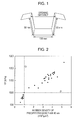
- a test piece (size: 80 mm ⁇ 360 mm) was taken from each of the hot rolled steel sheets, and press forming was performed, so as to produce a hat-shaped member as shown in Fig. 1 .
- the opening distance was measured, as shown in Fig. 1 , and the shape fixability was evaluated.
- a blank holder pressure was specified to be 20 tons and the die shoulder radius R was specified to be 5 mm.
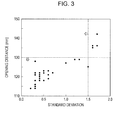
- Fig. 3 shows the relationship between the opening distance serving as an indicator of the shape fixability and the standard deviation of the natural logarithm values of particle sizes of the individual fine precipitates having a particle size of less than 10 nm with respect to steel sheets having a microstructure in which the area percentage of ferrite phase is 95% or more and the number density of precipitates having a particle size of less than 10 nm is 1.0 ⁇ 10 5 / ⁇ m 3 or more.
- the present inventors estimated that in the case where the standard deviation of natural logarithms of particle sizes of fine precipitates increased, that is, variations in particle sizes of fine precipitates increased, the large precipitates increased relatively and, thereby, dislocations were concentrated around the large precipitates easily, interactions occurred between dislocations, movements of dislocations were hindered, plastic deformation was suppressed, the degree of dependence of deformation on elastic deformation increased, springback occurred easily, and shape defect occurred easily.
- the present invention has been made on the basis of such findings and further studies. That is, the gist of the present invention is as described below.
- a high strength steel sheet having a yield strength of 1,000 MPa or more, excellent press formability, and shape fixability can be produced easily and stably. It can be said that this effect is an industrially remarkable.
- Mn contributes to lowering of the ferrite transformation start temperature during cooling after hot rolling. According to this, the precipitation temperature of carbides is lowered, and carbides can be made finer. Furthermore, Mn contributes to enhancement of the strength of the steel sheet through a function of making ferrite grains finer in addition to solid solution hardening. Also, Mn has a function of combining with harmful S in the steel as MnS to render S harmless. In order to obtain such effects, it is necessary that the Mn content be 0.1% or more. On the other hand, if the Mn content is more than 3.0%, ferrite transformation is suppressed, and transformation to bainite or martensite is facilitated, so that formation of fine V carbides in the ferrite phase is suppressed. Consequently, the Mn content is limited to the range of 0.1% to 3.0%. In this regard, the Mn content is preferably 0.3% to 2.0%, more preferably 0.5% to 2.0%, and further preferably 1.0% to 1.5%.
- P is an element which segregates at grain boundaries to degrade the ductility and the toughness. Also, P facilitates ferrite transformation, increases the ferrite transformation start temperature, increases the precipitation temperature of carbides, and precipitates coarse carbides during cooling after hot rolling. Therefore, it is preferable that the P content be minimized in the present invention. However, the P content of up to 0.10% is permissible. Consequently, the P content is limited to 0.10% or less. In this regard, the P content is preferably 0.05% or less, more preferably 0.03% or less, and further preferably 0.01% or less.
- S degrades the hot ductility considerably and, thereby, induces hot cracking, and degrades the surface quality considerably. Also, S hardly contributes to enhancement of the strength and, in addition, serves as an impurity element to form coarse sulfides and degrades the ductility and the stretch flangeability of the steel sheet. Such situation becomes remarkable if the S content is more than 0.030%. Consequently, the S content is limited to 0.030% or less. In this regard, the S content is preferably 0.010% or less, more preferably 0.003% or less, and further preferably 0.001% or less.
- Al facilitates ferrite transformation, increases the precipitation temperature of carbides through an increase in the ferrite transformation start temperature, and precipitates coarse carbides during cooling after hot rolling. Meanwhile, if the Al content is more than 0.10%, an increase in Al oxides is caused and the ductility of the steel sheet is degraded. Consequently, the Al content is limited to 0.10% or less. Also, the Al content is preferably 0.05% or less. In this regard, the lower limit is not necessarily specifically limited. Al functions as a deoxidizing agent, and in the case where 0.01% or more of Al is contained in a high strength steel sheet serving as an Al killed steel, there is no problem.
- N is combined with V at a high temperature to form coarse V nitrides.
- the coarse V nitrides hardly contribute to enhancement of the strength, so that an effect of enhancing the strength due to addition of V is reduced.
- the N content is limited to 0.010% or less.
- the N content is preferably 0.005% or less, more preferably 0.003% or less, and further preferably 0.002% or less.
- V 0.20% to 0.80%
- the above-described chemical composition is a basic one contained in the high strength steel sheet.
- the high strength steel sheet can further contain at least one group selected from the following Group A to Group F as selective elements in addition to the basic chemical composition.
- Group A Ti: 0.005% to 0.20%
- Group B at least one selected from Nb: 0.005% to 0.50%, Mo: 0.005% to 0.50%, Ta: 0.005% to 0.50%, and W: 0.005% to 0.50%
- Each of Nb, Mo, Ta, and W in Group B is an element to form fine precipitates and contribute to enhancement of the strength through precipitation hardening.
- the high strength steel sheet according to the present invention can contain at least one listed in Group B in accordance with necessity.
- a preferable content of each element is 0.005% or more as for Nb, 0.005% or more as for Mo, 0.005% or more as for Ta, and 0.005% or more as for W.
- the content of each of Nb, Mo, Ta, and W is more than 0.50%, the effect is saturated, and the effect commensurate with the content cannot be expected, so that there is an economic disadvantage.
- the Nb content be limited to the range of 0.005% to 0.50%
- the Mo content be limited to the range of 0.005% to 0.50%
- the Ta content be limited to the range of 0.005% to 0.50%
- the W content be limited to the range of 0.005% to 0.50%.
- B in Group C lowers the ferrite transformation start temperature and contributes to formation of finer carbides through lowering of the precipitation temperature of carbides during cooling after hot rolling. Also, B segregates at grain boundaries to improve resistance to secondary working embrittlement. In order to obtain such an effect, it is preferable that the B content be 0.0002% or more. On the other hand, if the B content is more than 0.0050%, a hot deformation resistance increases, and hot rolling becomes difficult. Consequently, in the case where B is contained, the B content in Group C is limited to the range of preferably 0.0002% to 0.0050%, more preferably 0.0005% to 0.0030%, and further preferably 0.0010% to 0.0020%.
- Group D at least one selected from Cr: 0.01% to 1.0%, Ni: 0.01% to 1.0%, and Cu: 0.01% to 1.0%
- Each of Cr, Ni, and Cu in Group D is an element to contribute to enhancement of the strength through forming fine grain microstructure.
- the high strength steel sheet according to the present invention can contain at least one listed in Group D, as necessary.
- a preferable content of each element is 0.01% or more as for Cr, 0.01% or more as for Ni, and 0.01% or more as for Cu.
- the Cr content is more than 1.0%
- the Ni content is more than 1.0%
- the Cu content is more than 1.0%
- the effect is saturated, and the effect commensurate with the content cannot be expected, so that there is an economic disadvantage.
- the Cr content be limited to the range of 0.01% to 1.0%
- the Ni content be limited to the range of 0.01% to 1.0%
- the Cu content be limited to the range of 0.01% to 1.0%.
- the high strength steel sheet according to the present invention has a microstructure including 95% or more of ferrite phase on an area percentage basis, in which precipitates having a particle size of less than 10 nm are dispersed having a distribution in such a way that the number density is 1.0 ⁇ 10 5 / ⁇ m 3 or more and the standard deviation of natural logarithm values of precipitate particle sizes is 1.5 or less.
- the number density of precipitates having a particle size of less than 10 nm is limited to 1.0 x 10 5 / ⁇ m 3 or more.
- the above-described number density is preferably 2.0 ⁇ 10 5 / ⁇ m 3 or more, more preferably 3.0 ⁇ 10 5 / ⁇ m 3 or more, and further preferably 4.0 ⁇ 10 5 / ⁇ m 3 or more.
- the high strength is ensured more easily as the particle size of precipitates decreases. Therefore, the particle size of precipitates is preferably less than 5 nm, and further preferably less than 3 nm.
- the standard deviation of natural logarithm values of precipitate particle sizes is calculated by the following formula (1).
- standard deviation ⁇ ⁇ ⁇ i ⁇ lnd m - lnd i 2 / n
- lnd m natural logarithm of average precipitate particle size (nm)
- lnd i natural logarithm of each precipitate particle size (nm)
- n the number of data
- the high strength steel sheet according to the present invention may be provided with a coating film or a chemical conversion film on the surface of the above-described steel sheet.
- coating film include the films coated by galvanization, galvannealing, and electrogalvanization.
- Heating temperature 1,100°C or higher
- Finish rough rolling temperature 1,000°C or higher
- the reduction ratio in a temperature range of 1,000°C or lower is limited to 96% or less.
- the reduction ratio in a temperature range of 1,000°C or lower is preferably 90% or less, more preferably 70% or less, and further preferably 50% or less.
- the finishing temperature of finish rolling becomes low, dislocations are accumulated, so that ⁇ transformation is facilitated during cooling after finish rolling, the carbide precipitation temperature increases, and large carbides (precipitates) are precipitated easily. Meanwhile, if the finishing temperature decreases to an ⁇ region, coarse carbides are precipitated because of strain-induced precipitation. Consequently, the finishing temperature is limited to 850°C or higher. In this regard, the finishing temperature is preferably 880°C or higher, more preferably 920°C or higher, and further preferably 940°C or higher.
- the steel sheet After the finish rolling (hot rolling) is completed, the steel sheet is cooled and is coiled into the shape of a coil at a predetermined coiling temperature.
- the precipitation behavior of carbides is influenced by the amount of V. Therefore, in the present invention, the cooling and the coiling temperature are adjusted in relation to the V content [V].
- the cooling after finish rolling is performed at an average cooling rate of (30 x [V])°C/s or more in a temperature range from the finishing temperature to 750°C and at an average cooling rate of (10 x [V])°C/s or more in a temperature range from 750°C to the coiling temperature, in relation to the V content [V].
- the average cooling rate from the finishing temperature to 750°C is limited to (30 ⁇ [V])°C/s or more in relation to the V content [V].
- the above-described average cooling rate is preferably (50 ⁇ [V])°C/s or more, more preferably (100 ⁇ [V])°C/s or more, and further preferably (150 ⁇ [V])°C/s or more.
- the upper limit of the average cooling rate from the finishing temperature to 750°C is not necessarily specifically limited.
- the upper limit of the above-described average cooling rate is preferably (500 ⁇ [V])°C/s or less from the viewpoint of restrictions on the equipment.
- Coiling temperature 500°C to (700 - 50 ⁇ [V])°C
- the particle size of produced carbides is changed by the coiling temperature. If the coiling temperature is high, coarse carbides are precipitated easily. Meanwhile, if the coiling temperature is low, precipitation of carbides is suppressed, and there is a strong tendency of a low-temperature transformation phase, e.g., bainite or martensite, to generate. Such a tendency becomes remarkable in relation to the V content [V] and, therefore, the coiling temperature is limited in relation to the V content [V].
- a low-temperature transformation phase e.g., bainite or martensite
- the coiling temperature is lower than 500°C, precipitation of carbides is suppressed, and a low-temperature transformation phase, e.g., bainite or martensite, is generated.
- a low-temperature transformation phase e.g., bainite or martensite.
- carbides become coarse. Consequently, the coiling temperature is limited to a range of 500°C to (700 - 50 ⁇ [V])°C.
- the above-described coiling temperature is preferably 530°C or higher and (700 - 100 ⁇ [V])°C or lower, more preferably 530°C or higher and (700 - 150 ⁇ [V])°C or lower, and further preferably 530°C or higher and (700 - 200 ⁇ [V])°C or lower.
- the hot rolled sheet may be further subjected to the coating annealing process composed of pickling and coating annealing treatment, so as to form a galvanization layer on the steel sheet surface.
- the coating annealing treatment is performed by heating the hot rolled sheet in a temperature range from 500°C to a soaking temperature of (800 - 200 ⁇ [C]), in relation to the C content [C] (percent by mass) at an average heating rate of (5 ⁇ [C])°C/s or more, holding the steel sheet for a soaking time of 1,000 s or less, cooling the steel sheet to a zinc coating bath temperature of 420°C to 500°C at an average cooling rate of 1°C/s or more, and dipping the steel sheet into the zinc coating bath.
- change in particle size of carbides in the coating annealing treatment is remarkably influenced by the C content [C] (percent by mass). Therefore, in the present invention, the average heating rate, the average cooling rate, and the soaking temperature in the coating annealing treatment are adjusted in relation to the C content [C].
- Soaking temperature (800 - 200 ⁇ [C])°C or lower
- Average cooling rate from the soaking temperature to a galvanizing bath temperature 1°C/s or more
- the reheating treatment is performed to alloy Zn in the coating film with Fe.
- the reheating temperature is higher than 600°C, alloying proceeds excessively and the coating film becomes brittle. Consequently, the reheating treatment temperature is limited to a range of 460°C to 600°C.
- the reheating treatment temperature is preferably 570°C or lower.
- the holding time is specified to be 1 s or more. However, precipitates become coarse by a long time of holding. The purpose can be achieved sufficiently by about 10 s or less of holding time. In this regard, the holding time is preferably 5 s or less.
- the tempering treatment may be applied after the hot rolling process or the coating annealing process is applied.
- a molten steel having a chemical composition shown in Table 1-1 and Table 1-2 was smelted in a converter, made into a slab (steel thickness was 250 mm) by a continuous casting method, and subjected to the hot rolling process or further subjected to the coating annealing process under the conditions shown in Table 2-1 and Table 2-2, so as to produce a steel sheet having a sheet thickness shown in Table 3-1 and Table 3-2.
- a thin film test piece was taken from the steel sheet, and was polished to prepare a thin film sample. Thereafter, the number density of precipitates having a particle size of less than 10 nm and the individual precipitate particle sizes were measured with a transmission electron microscope (TEM). The number density of precipitates less than 10 nm (number/ ⁇ m 3 ) was calculated by counting the number of precipitates less than 10 nm in the regions of the range of 100 ⁇ 100 nm 2 at ten fields and, in addition, determining the film thickness in the field of view by a convergent beam electron diffraction method.
- TEM transmission electron microscope
- a JIS No. 5 tensile test piece was cut from the steel sheet, where the tensile direction was the direction at a right angle to the rolling direction.
- a tensile test was performed in conformity with the specification of JIS Z 2241 and the yield strength YP, the tensile strength TS, and the total elongation El were determined.
- All invention examples are high strength steel sheets having a yield strength YP of 1,000 MPa or more and excellent shape fixability with a hat-shaped member opening distance of 130 mm or less.
- high strength steel sheets having a high strength and shape fixability in combination are not obtained, where the yield strength YP is less than 1,000 MPa and, therefore, the strength is low or the hat-shaped member opening distance is more than 130 mm and, therefore, the shape fixability is degraded.
Landscapes
- Chemical & Material Sciences (AREA)
- Engineering & Computer Science (AREA)
- Materials Engineering (AREA)
- Mechanical Engineering (AREA)
- Metallurgy (AREA)
- Organic Chemistry (AREA)
- Physics & Mathematics (AREA)
- Thermal Sciences (AREA)
- Crystallography & Structural Chemistry (AREA)
- Chemical Kinetics & Catalysis (AREA)
- Heat Treatment Of Sheet Steel (AREA)
Abstract
Description
- The present invention relates to a high strength steel sheet suitable for framework members, e.g., pillars and members of automobiles, reinforcing members, e.g., door impact beams of automobiles, and structural members of, e.g., automatic vending machines, desks, household electrical appliance, OA equipments, and construction materials. In particular, the present invention relates to an improvement in shape fixability of a high strength steel sheet. In this regard, the term "high strength" here refers to the case where the yield strength YP is 1,000 MPa or more. Also, the yield strength of the high strength steel sheet according to the present invention is preferably 1,100 MPa or more, and more preferably 1,150 MPa or more.
- In recent years, reduction in amount of carbon dioxide CO2 output has been desired ardently from the viewpoint of global environmental conservation. In particular, in the automobile field, reduction in weight of a car body has been required strongly in order to enhance the fuel economy and reduce the amount of CO2 output. Such circumstances are the same in the use of a steel sheet, and demands for reduction in the usage of a steel sheet which exhibits a large amount of CO2 output in production of the steel sheet have increased.
- In particular, as for a structural member, where deformation of a part should be avoided, reduction in thickness through enhancement of the yield strength of a steel sheet is effective from the viewpoint of reduction in the usage (mass) of the steel sheet. However, if the yield strength of the steel sheet is enhanced, there is a problem that shape defect occurs because of springback or the like in press forming. In the case where shape defect occurs, it is necessary that a press forming step be further added, so as to correct the shape by press forming into a predetermined shape. The shape correction increases the production cost and, in addition, particularly in the case of a high strength steel sheet having a yield strength of 1,000 MPa or more, it may become impossible to correct the shape up to a predetermined shape. Consequently, the impossibility of improving the shape fixability of the high strength steel sheet becomes a hindrance to an achievement of reduction in thickness of the high strength steel sheet.
- Then, a ferrite phase which is soft, easy to press form, and advantageous to ensure the shape and a martensite phase which is hard and advantageous to enhance the strength are combined and, thereby, a dual-phase steel sheet has been developed as a high strength steel sheet having good shape fixability and a high tensile strength in combination. However, although this technology can enhance the tensile strength, there is a problem that the yield strength is reduced because of the presence of the soft ferrite phase. In order to enhance the yield strength of the above-described dual-phase steel sheet, it is necessary that the microstructure has a very high percentage of martensite phase. But, as for the dual-phase steel sheet having such a microstructure, a new problem is induced that cracking occurs during press forming.
- For example, Patent Literature 1 describes a high strength steel sheet having excellent shape fixability and stretch flangeability as the high strength steel sheet having improved shape fixability. The high strength steel sheet described in Patent Literature 1 has a chemical composition containing C: 0.02% to 0.15%, Si: more than 0.5% and 1.6% or less, Mn: 0.01% to 3.0%, Al: 2.0% or less, Ti: 0.054% to 0.4%, and B: 0.0002% to 0.0070% and further containing at least one of Nb: 0.4% or less and Mo: 1.0% or less on a percent by mass basis. Also, the high strength steel sheet described in Patent Literature 1 has a microstructure in which the greater part of phase is ferrite or bainite, and a texture in which an average value of X-ray random intensity ratios of {001}<110> to {223}<110> orientation groups of a sheet face at the position one-half the sheet thickness is 6.0 or more, and an X-ray random intensity ratio of at least one of the {112}<110> orientation and the {001}<110> orientation among these orientation groups is 8.0 or more. Also, the high strength steel sheet described in Patent Literature 1 has a microstructure in which the number of compound precipitates having a particle size of 15 nm or less is more than or equal to 60% of the total number of the compound precipitates, and at least one of the r value in the rolling direction and the r value in the direction at a right angle to the rolling direction is 0.8 or less. It is mentioned that according to the technology described in Patent Literature 1, a steel sheet having highly improved shape fixability and excellent hole expansion property is obtained by adjusting the precipitates and the texture at the same time.
- Meanwhile,
Patent Literature 2 describes a high yield strength hot rolled steel sheet. The hot rolled steel sheet described inPatent Literature 2 has a chemical composition containing C: more than 0.06% and 0.24% or less, Mn: 0.5% to 2.0%, Mo: 0.05% to 0.5%, Ti: 0.03% to 0.2%, V: more than 0.15% and 1.2% or less, and Co: 0.0010% to 0.0050% on a percent by mass basis. Then, the hot rolled steel sheet described inPatent Literature 2 has a microstructure which is substantially a ferrite single phase and in which complex carbides containing Ti, Mo, and V and carbides containing V only are dispersed, where the total of the amount of Ti precipitated as complex carbides containing Ti, Mo, and V and the amount of V precipitated as carbides containing V only is more than 0.1000% and less than 0.4000% on a percent by mass basis. Also, the hot rolled steel sheet described inPatent Literature 2 has a high yield strength of 1,000 MPa or more. It is mentioned that according to the technology described inPatent Literature 2, a high yield strength steel sheet having highly improved bending property after working and a yield strength of 1,000 MPa or more is obtained because a very small amount of Co is contained, substantially a ferrite single phase is present, and complex carbides containing Ti, Mo, and V and carbides containing V only are dispersed. -
- PTL 1: Japanese Patent No.
4464748 - PTL 2: Japanese Unexamined Patent Application Publication No.
2008-174805 - However, according to the technology described in Patent Literature 1, the compound (precipitate) particle size is large and the resulting yield strength is up to about 900 MPa. That is, according to the technology described in Patent Literature 1, it is difficult to further enhance the yield strength up to 1,000 MPa or more. Meanwhile, according to the technology described in
Patent Literature 2, the bending property after working is improved, but the problem remains in that a predetermined shape fixability cannot be ensured. - It is an object of the present invention to solve the above-described problems in the related arts and provide a high strength steel sheet having a yield strength of 1,000 MPa or more and excellent shape fixability, and a method for manufacturing the same. In this regard, in the present invention, the yield strength YP of the high strength steel sheet is preferably 1,100 MPa or more, and further preferably 1,150 MPa or more. Here, the thickness of the "steel sheet" is 2.0 mm or less, preferably 1.7 mm or less, more preferably 1.5 mm or less, and further preferably 1.3 mm or less.
- In order to achieve the above-described object, the present inventors performed intensive studies on various factors which exert influences on the shape fixability for the purpose of ensuring the compatibility between high yield strength and shape fixability. As a result, it was considered that ensuring of high strength through dispersion of fine precipitates and, in addition, proper adjustment of the size distribution of the precipitates were necessary to produce a high strength steel sheet having excellent shape fixability.
- This is because in the case of size distribution in which most of precipitates have large sizes, dislocations are concentrated around the large precipitates during press forming, interactions occur between dislocations, and movements of dislocations are hindered, so that plastic deformation is suppressed. Consequently, it is estimated that the degree of dependence of deformation on elastic deformation increases, shape defect due to springback occurs easily, and the shape fixability is degraded. Then, the present inventors considered that adjustment of the size distribution of the precipitates to a specific size distribution in which small precipitates were increased was important to suppress concentration of dislocations during press forming and improve the shape fixability.
- To begin with, the experiment results which were obtained by the present inventors and which have been the basis of the present invention will be described.
- Various hot rolled steel sheets having a chemical composition containing C: 0.08% to 0.21%, Si: 0.01% to 0.30%, Mn: 0.1% to 3.1%, P: 0.01% to 0.1%, S: 0.001% to 0.030%, Al: 0.01% to 0.10%, N: 0.001% to 0.010%, V: 0.19% to 0.80%, and Ti: 0.005% to 0.20% on a percent by mass basis or further containing an appropriate amount of at least one of Cr, Ni, Cu, Nb, Mo, Ta, W, B, Sb, Cu, and REM were obtained under various hot rolling conditions. Test pieces were taken from these hot rolled steel sheets, and a microstructure observation, a tensile test, and a shape fixability test were performed.
- Initially, in the microstructure observation, a test piece for the microstructure observation was taken from each of the hot rolled steel sheets, a cross-section in the rolling direction (L cross-section) was polished, and corrosion with nital was performed. An observation was performed with an optical microscope (magnification: 500 times) and the area percentage of ferrite phase was determined. It was ascertained that a plurality of steel sheets having a microstructure in which the area percentage of ferrite phase was 95% or more were obtained.
- Also, a thin film sample was taken from each of the hot rolled steel sheets, and the size of precipitates (particle size) and the number density thereof were measured by using a transmission electron microscope. The precipitate was not spherical and, therefore, a maximum particle size was taken as the size thereof (particle size).
- Meanwhile, in the tensile test, a tensile test piece in conformity with JIS No. 5 was taken from each of the hot rolled steel sheets in such a way that the tensile direction was the direction at a right angle to the rolling direction (C direction). Subsequently, these test pieces were used, and the tensile test was performed in conformity with specifications of JIS Z 2241, so as to determine the yield strength (YP).
- Also, in the shape fixability test, a test piece (size: 80 mm × 360 mm) was taken from each of the hot rolled steel sheets, and press forming was performed, so as to produce a hat-shaped member as shown in
Fig. 1 . After the press forming, the opening distance was measured, as shown inFig. 1 , and the shape fixability was evaluated. In this regard, in the press forming, a blank holder pressure was specified to be 20 tons and the die shoulder radius R was specified to be 5 mm. - The obtained results are shown in
Fig. 2 andFig. 3 . - Among the obtained results,
Fig. 2 shows the relationship between the yield strength (YP) and the number density of precipitates having a particle size of less than 10 nm with respect to steel sheets having a microstructure in which the area percentage of ferrite phase is 95% or more. As is clear fromFig. 2 , in order to ensure the yield strength YP of 1,000 MPa or more, it is necessary that the number density of precipitates having a particle size of less than 10 nm is specified to be 1.0 × 10⁵/µm3 or more. - However, on the basis of further studies, the present inventors found that excellent shape fixability was not obtained by merely forming fine precipitates at a high number density. Also, the present inventors found that in order to ensure excellent shape fixability stably, reduction in particle size variation of fine precipitates was necessary.
- Then, in order to evaluate an influence of particle size variation of fine precipitates, natural logarithm values of particle sizes of the individual fine precipitates having a particle size of less than 10 nm were determined, and the standard deviation of those values was calculated.
- Among the obtained results,
Fig. 3 shows the relationship between the opening distance serving as an indicator of the shape fixability and the standard deviation of the natural logarithm values of particle sizes of the individual fine precipitates having a particle size of less than 10 nm with respect to steel sheets having a microstructure in which the area percentage of ferrite phase is 95% or more and the number density of precipitates having a particle size of less than 10 nm is 1.0 × 10⁵/µm3 or more. - As is clear from
Fig. 3 , there is a tendency of the opening distance to decrease as the standard deviation decreases. The present inventors found fromFig. 3 that in order to ensure excellent shape fixability with small springback, for example, the opening distance of less than 130 mm, adjustment of the standard deviation of natural logarithm values of particle sizes of the fine precipitates having a particle size of less than 10 nm to be 1.5 or less was necessary. - Consequently, the present inventors estimated that in the case where the standard deviation of natural logarithms of particle sizes of fine precipitates increased, that is, variations in particle sizes of fine precipitates increased, the large precipitates increased relatively and, thereby, dislocations were concentrated around the large precipitates easily, interactions occurred between dislocations, movements of dislocations were hindered, plastic deformation was suppressed, the degree of dependence of deformation on elastic deformation increased, springback occurred easily, and shape defect occurred easily.
- On the basis of the above-described facts, the present inventors found that a high strength steel sheet having a yield strength (YP) of 1,000 MPa or more and, in addition, excellent shape fixability was obtained by forming precipitates in a microstructure having an area percentage of ferrite phase of 95% or more, wherein a number density of precipitates having a particle size of less than 10 nm is specified to be 1.0 × 10⁵/µm3 or more, and a standard deviation of natural logarithm values of particle sizes of precipitates less than 10 nm is specified to be 1.5 or less.
- The present invention has been made on the basis of such findings and further studies. That is, the gist of the present invention is as described below.
- (1) A high strength steel sheet characterized by having a chemical composition comprising C: 0.08% to 0.20%, Si: 0.3% or less, Mn: 0.1% to 3.0%, P: 0.10% or less, S: 0.030% or less, Al: 0.10% or less, N: 0.010% or less, V: 0.20% to 0.80%, and the remainder composed of Fe and incidental impurities on a percent by mass basis, a microstructure which includes 95% or more of ferrite phase on an area percentage basis, in which precipitates having a particle size of less than 10 nm are dispersed having a distribution in such a way that the number density is 1.0 × 10⁵/µm3 or more and the standard deviation of natural logarithm values of precipitate particle sizes with respect to precipitates having a particle size of less than 10 nm is 1.5 or less, and a yield strength of 1,000 MPa or more.
- (2) The high strength steel sheet according to (1), characterized in that the above-described chemical composition further contains at least one group selected from the following Group A to Group F on a percent by mass basis; Group A: Ti: 0.005% to 0.20%, Group B: at least one selected from Nb: 0.005% to 0.50%, Mo: 0.005% to 0.50%, Ta: 0.005% to 0.50%, and W: 0.005% to 0.50%, Group C: B: 0.0002% to 0.0050%, Group D: at least one selected from Cr: 0.01% to 1.0%, Ni: 0.01% to 1.0%, and Cu: 0.01% to 1.0%, Group E: Sb: 0.005% to 0.050%, and Group F: at least one selected from Ca: 0.0005% to 0.01% and REM: 0.0005% to 0.01%.
- (3) The high strength steel sheet according to (1) or (2), characterized in that a coating layer is disposed on the steel sheet surface.
- (4) A method for manufacturing a high strength steel sheet, characterized by including the step of subjecting a steel having a chemical composition comprising C: 0.08% to 0.20%, Si: 0.3% or less, Mn: 0.1% to 3.0%, P: 0.10% or less, S: 0.030% or less, Al: 0.10% or less, N: 0.010% or less, V: 0.20% to 0.80%, and the remainder composed of Fe and incidental impurities on a percent by mass basis to a hot rolling process composed of heating, rough rolling, finish rolling, cooling and coiling into the shape of a coil at a predetermined coiling temperature, wherein the above-described heating is performed at a temperature of 1,100°C or higher for 10 min or more, the above-described rough rolling is performed at a finish rough rolling temperature of 1,000°C or higher, the above-described finish rolling is performed at a finishing temperature of 850°C or more, in which the reduction ratio in a temperature range of 1,000°C or lower is 96% or less, the reduction ratio in a temperature range of 950°C or lower is 80% or less, the above-described cooling after completion of the finish rolling is performed at an average cooling rate of (30 × [V])°C/s or more in relation to the V content [V] (percent by mass) in a temperature range from the finishing temperature to 750°C and at an average cooling rate of (10 × [V])°C/s or more in relation to the V content [V] (percent by mass) in a temperature range from 750°C to the coiling temperature, and the above-described coiling temperature is specified to be 500°C or higher and (700 - 50 × [V])°C or lower in relation to the V content [V] (percent by mass).
- (5) The method for manufacturing a high strength steel sheet according to the item (4), characterized in that the above-described chemical composition further contains at least one group selected from the following Group A to Group F on a percent by mass basis; Group A: Ti: 0.005% to 0.20%, Group B: at least one selected from Nb: 0.005% to 0.50%, Mo: 0.005% to 0.50%, Ta: 0.005% to 0.50%, and W: 0.005% to 0.50%, Group C: B: 0.0002% to 0.0050%, Group D: at least one selected from Cr: 0.01% to 1.0%, Ni: 0.01% to 1.0%, and Cu: 0.01% to 1.0%, Group E: Sb: 0.005% to 0.050%, and Group F: at least one selected from Ca: 0.0005% to 0.01% and REM: 0.0005% to 0.01%.
- (6) The method for manufacturing a high strength steel sheet according to (4) or (5), characterized in that in subjecting the hot rolled steel sheet to a coating annealing process composed of pickling and coating annealing treatment following the above-described hot rolling process, the above-described coating annealing treatment is performed by heating in a temperature range from 500°C to a soaking temperature at an average heating rate of (5 × [C])°C/s or more up to the soaking temperature of (800 - 200 × [C])°C or lower, in relation to the C content [C] (percent by mass), holding at the soaking temperature for a soaking time of 1,000 s or less, cooling to a zinc coating bath temperature of 420°C to 500°C at an average cooling rate of 1°C/s or more, and dipping into the zinc coating bath.
- (7) The method for manufacturing a high strength steel sheet according to (6), characterized in that after the above-described coating annealing process is applied, a reheating treatment is further applied by reheating to a temperature range of 460°C to 600°C and holding at the reheating temperature for 1 s or more.
- (8) The method for manufacturing a high strength steel sheet according to any one of (4) to (7), characterized in that after the above-described hot rolling process or the above-described coating annealing process, a tempering treatment is further applied by working at a thickness decrease ratio of 0.1% to 3.0%.
- According to the present invention, a high strength steel sheet having a yield strength of 1,000 MPa or more, excellent press formability, and shape fixability can be produced easily and stably. It can be said that this effect is an industrially remarkable.
-
- [
Fig. 1] Fig. 1 is an explanatory diagram schematically showing a rough shape of a hat-shaped member used for evaluating the shape fixability. - [
Fig. 2] Fig. 2 is a graph showing the influence of the number density of precipitates less than 10 nm on the yield strength YP. - [
Fig. 3] Fig. 3 is a graph showing the relationship between the opening distance after press forming and the standard deviation of natural logarithm values of precipitate particle sizes. - To begin with, reasons for the limitation of the chemical composition of the high strength steel sheet according to the present invention will be described. Hereafter "percent by mass" is simply expressed as "%".
- C: 0.08% to 0.20%
- In the present invention, C is combined with V to form V carbides and contributes to enhancement of the strength. Also, C has a function of lowering the ferrite transformation start temperature, lowers the precipitation temperature of carbides, and contributes to precipitation of finer carbides during cooling after hot rolling. Furthermore, C contributes to suppression of coarsening of carbides during cooling after coiling. In order to obtain such effects, it is necessary that the high strength steel sheet contains 0.08% or more of C. On the other hand, if the C content is more than 0.20%, ferrite transformation is suppressed, and transformation to bainite or martensite is facilitated, so that formation of fine V carbides in the ferrite phase is suppressed. Consequently, the C content is limited to the range of 0.08% to 0.20%. In this regard, the C content is preferably within the range of 0.10% to 0.18%, more preferably 0.12% to 0.18%, and further preferably 0.14% to 0.18%.
- Si: 0.3% or less
- Si has a function of facilitating ferrite transformation and increasing the ferrite transformation start temperature, increases the precipitation temperature of carbides and, thereby, precipitates coarse carbides during cooling after hot rolling. Also, Si forms Si oxides on the steel sheet surface in an annealing treatment and the like after hot rolling. The Si oxides have an adverse effect of hindering coatability considerably. For example, coating defect portions are generated in a coating treatment. Consequently, in the present invention, the Si content is limited to 0.3% or less. In this regard, the Si content is preferably 0.1% or less, more preferably 0.05% or less, and further preferably 0.03% or less.
- Mn: 0.1% to 3.0%
- Mn contributes to lowering of the ferrite transformation start temperature during cooling after hot rolling. According to this, the precipitation temperature of carbides is lowered, and carbides can be made finer. Furthermore, Mn contributes to enhancement of the strength of the steel sheet through a function of making ferrite grains finer in addition to solid solution hardening. Also, Mn has a function of combining with harmful S in the steel as MnS to render S harmless. In order to obtain such effects, it is necessary that the Mn content be 0.1% or more. On the other hand, if the Mn content is more than 3.0%, ferrite transformation is suppressed, and transformation to bainite or martensite is facilitated, so that formation of fine V carbides in the ferrite phase is suppressed. Consequently, the Mn content is limited to the range of 0.1% to 3.0%. In this regard, the Mn content is preferably 0.3% to 2.0%, more preferably 0.5% to 2.0%, and further preferably 1.0% to 1.5%.
- P: 0.10% or less
- P is an element which segregates at grain boundaries to degrade the ductility and the toughness. Also, P facilitates ferrite transformation, increases the ferrite transformation start temperature, increases the precipitation temperature of carbides, and precipitates coarse carbides during cooling after hot rolling. Therefore, it is preferable that the P content be minimized in the present invention. However, the P content of up to 0.10% is permissible. Consequently, the P content is limited to 0.10% or less. In this regard, the P content is preferably 0.05% or less, more preferably 0.03% or less, and further preferably 0.01% or less.
- S: 0.030% or less
- S degrades the hot ductility considerably and, thereby, induces hot cracking, and degrades the surface quality considerably. Also, S hardly contributes to enhancement of the strength and, in addition, serves as an impurity element to form coarse sulfides and degrades the ductility and the stretch flangeability of the steel sheet. Such situation becomes remarkable if the S content is more than 0.030%. Consequently, the S content is limited to 0.030% or less. In this regard, the S content is preferably 0.010% or less, more preferably 0.003% or less, and further preferably 0.001% or less.
- Al: 0.10% or less
- Al facilitates ferrite transformation, increases the precipitation temperature of carbides through an increase in the ferrite transformation start temperature, and precipitates coarse carbides during cooling after hot rolling. Meanwhile, if the Al content is more than 0.10%, an increase in Al oxides is caused and the ductility of the steel sheet is degraded. Consequently, the Al content is limited to 0.10% or less. Also, the Al content is preferably 0.05% or less. In this regard, the lower limit is not necessarily specifically limited. Al functions as a deoxidizing agent, and in the case where 0.01% or more of Al is contained in a high strength steel sheet serving as an Al killed steel, there is no problem.
- N: 0.010% or less
- In the present invention in which V is contained, N is combined with V at a high temperature to form coarse V nitrides. The coarse V nitrides hardly contribute to enhancement of the strength, so that an effect of enhancing the strength due to addition of V is reduced. Meanwhile, if much N is contained, slab cracking occurs during hot rolling, so that many surface flaws may be generated. Consequently, the N content is limited to 0.010% or less. In this regard, the N content is preferably 0.005% or less, more preferably 0.003% or less, and further preferably 0.002% or less.
- V: 0.20% to 0.80%
- Vanadium is combined with C to form fine carbides and contributes to enhancement of the strength of the steel sheet. In order to obtain such an effect, it is necessary that the V content be 0.20% or more. On the other hand, if the V content is more than 0.80%, ferrite transformation is facilitated, the precipitation temperature of carbides is increased through an increase in the ferrite transformation start temperature, and coarse carbides are precipitated during cooling after hot rolling. Consequently, the V content is limited to the range of 0.20% to 0.80%. In this regard, the V content is preferably 0.25% to 0.60%, more preferably 0.30% to 0.50%, and further preferably 0.35% to 0.50%.
- The above-described chemical composition is a basic one contained in the high strength steel sheet. Also, as necessary, the high strength steel sheet can further contain at least one group selected from the following Group A to Group F as selective elements in addition to the basic chemical composition.
- Group A: Ti: 0.005% to 0.20%
- Ti in Group A forms fine complex carbides with V and C to contribute to enhancement of the strength. In order to obtain such an effect, it is necessary that the Ti content be 0.005% or more. On the other hand, if the Ti content is more than 0.20%, coarse carbides are formed at a high temperature. Consequently, in the case where Ti is contained, the Ti content in Group A is limited to the range of preferably 0.005% to 0.20%, more preferably 0.05% to 0.15%, and further preferably 0.08% to 0.15%.
- Group B: at least one selected from Nb: 0.005% to 0.50%, Mo: 0.005% to 0.50%, Ta: 0.005% to 0.50%, and W: 0.005% to 0.50%
- Each of Nb, Mo, Ta, and W in Group B is an element to form fine precipitates and contribute to enhancement of the strength through precipitation hardening. The high strength steel sheet according to the present invention can contain at least one listed in Group B in accordance with necessity. In order to obtain such an effect, a preferable content of each element is 0.005% or more as for Nb, 0.005% or more as for Mo, 0.005% or more as for Ta, and 0.005% or more as for W. On the other hand, even in the case where the content of each of Nb, Mo, Ta, and W is more than 0.50%, the effect is saturated, and the effect commensurate with the content cannot be expected, so that there is an economic disadvantage. Consequently, in the case where at least one listed in Group B is contained, it is preferable that the Nb content be limited to the range of 0.005% to 0.50%, the Mo content be limited to the range of 0.005% to 0.50%, the Ta content be limited to the range of 0.005% to 0.50%, and the W content be limited to the range of 0.005% to 0.50%.
- Group C: B: 0.0002% to 0.0050%
- B in Group C lowers the ferrite transformation start temperature and contributes to formation of finer carbides through lowering of the precipitation temperature of carbides during cooling after hot rolling. Also, B segregates at grain boundaries to improve resistance to secondary working embrittlement. In order to obtain such an effect, it is preferable that the B content be 0.0002% or more. On the other hand, if the B content is more than 0.0050%, a hot deformation resistance increases, and hot rolling becomes difficult. Consequently, in the case where B is contained, the B content in Group C is limited to the range of preferably 0.0002% to 0.0050%, more preferably 0.0005% to 0.0030%, and further preferably 0.0010% to 0.0020%.
- Group D: at least one selected from Cr: 0.01% to 1.0%, Ni: 0.01% to 1.0%, and Cu: 0.01% to 1.0%
- Each of Cr, Ni, and Cu in Group D is an element to contribute to enhancement of the strength through forming fine grain microstructure. The high strength steel sheet according to the present invention can contain at least one listed in Group D, as necessary. In order to obtain such an effect, a preferable content of each element is 0.01% or more as for Cr, 0.01% or more as for Ni, and 0.01% or more as for Cu. On the other hand, even in the case where any one of the elements is contained in such a way that the Cr content is more than 1.0%, the Ni content is more than 1.0%, and the Cu content is more than 1.0%, the effect is saturated, and the effect commensurate with the content cannot be expected, so that there is an economic disadvantage. Consequently, in the case where at least one listed in Group D is contained, it is preferable that the Cr content be limited to the range of 0.01% to 1.0%, the Ni content be limited to the range of 0.01% to 1.0%, and the Cu content be limited to the range of 0.01% to 1.0%.
- Group E: Sb: 0.005% to 0.050%
- Sb in Group E is an element which segregates on the steel (slab) surface during hot rolling and has a function of preventing nitriding from the steel surface and suppressing formation of large nitrides. In order to obtain such an effect, it is preferable that the Sb content be 0.005% or more. On the other hand, even in the case where the Sb content is more than 0.050%, the effect is saturated, and the effect commensurate with the content cannot be expected, so that there is an economic disadvantage. Consequently, in the case where Sb is contained, it is preferable that the Sb content be limited to the range of 0.005% to 0.050%.
- Group F: at least one selected from Ca: 0.0005% to 0.01% and REM: 0.0005% to 0.01%
- Each of Ca and REM in Group F is an element having a function of controlling the form of sulfides and improving the ductility and the stretch flangeability. The high strength steel sheet according to the present invention can contain at least one listed in Group F, as necessary. In order to obtain such an effect, a preferable content of each element is 0.0005% or more as for Ca and 0.0005% or more as for REM. On the other hand, even in the case where any one of the elements is contained in such a way that the Ca content is more than 0.01% and the REM content is more than 0.01%, the effect is saturated, and the effect commensurate with the content cannot be expected, so that there is an economic disadvantage. Consequently, in the case where at least one listed in Group F is contained, it is preferable that the Ca content be limited to the range of 0.0005% to 0.01% and the REM content be limited to the range of 0.0005% to 0.01%.
- The remainder of the above-described chemical composition is composed of Fe and incidental impurities. In this regard, examples of incidental impurities include Sn, Mg, Co, As, Pb, Zn, and O. A permissible content of these elements in total is 0.5% or less.
- Next, reasons for the limitation of the microstructure of the high strength steel sheet according to the present invention will be described.
- The high strength steel sheet according to the present invention has a microstructure including 95% or more of ferrite phase on an area percentage basis, in which precipitates having a particle size of less than 10 nm are dispersed having a distribution in such a way that the number density is 1.0 × 10⁵/µm3 or more and the standard deviation of natural logarithm values of precipitate particle sizes is 1.5 or less.
- Ferrite phase: 95% or more on an area percentage basis
- The high strength steel sheet according to the present invention includes ferrite phase as a main phase. Here, the "main phase" refers to the case where the area percentage is 95% or more. As for a second phase besides the main phase, martensite phase or bainite phase is mentioned. In the case where the phase other than the main phase is included, the area percentage of the phase other than the main phase is specified to be preferably 5% or less in total. This is because if low-temperature transformation phase, e.g., bainite phase or martensite phase, is present as a second phase, a mobile dislocation is introduced because of transformation strain and the yield strength YP is reduced. Meanwhile, the microstructure percentage of ferrite phase serving as a main phase is preferably 98% or more, and more preferably 100% on an area percentage basis. In this regard, the area percentage is obtained on the basis of a measurement by the method described in the example.
- In the present invention, in order to ensure the predetermined high strength, large amounts of fine precipitates having a particle size of less than 10 nm and having a large influence on increase in the strength are dispersed in ferrite phase.
- Number density of precipitates having a particle size of less than 10 nm: 1.0 × 10⁵/µm3 or more
- Coarse precipitates hardly exert an influence on the strength. In order to ensure a high yield strength of 1,000 MPa or more, it is necessary that fine precipitates be dispersed. In the present invention, as shown in
Fig. 2 , the number density of precipitates having a particle size of less than 10 nm is specified to be 1.0 × 10⁵/µm3 or more (where the particle size is the maximum particle size of precipitate). If the number density of precipitates having a particle size of less than 10 nm is less than 1.0 × 10⁵/µm3, the predetermined strength (the yield strength YP is 1,000 MPa or more) cannot be ensured stably. Consequently, in the present invention, the number density of precipitates having a particle size of less than 10 nm is limited to 1.0 x 10⁵/µm3 or more. In this regard, the above-described number density is preferably 2.0 × 10⁵/µm3 or more, more preferably 3.0 × 10⁵/µm3 or more, and further preferably 4.0 × 10⁵/µm3 or more. Meanwhile, the high strength is ensured more easily as the particle size of precipitates decreases. Therefore, the particle size of precipitates is preferably less than 5 nm, and further preferably less than 3 nm. - Standard deviation of natural logarithm values of precipitate particle sizes with respect to precipitates having particle size of less than 10 nm: 1.5 or less
- If the standard deviation of natural logarithm values of precipitate particle sizes with respect to precipitates having a particle size of less than 10 nm increases to more than 1.5, that is, if variations in particle sizes of fine precipitates increase, the opening distance increases, as shown in
Fig. 3 , and the shape fixability is degraded. Consequently, in the present invention, the standard deviation of natural logarithm values of precipitate particle sizes with respect to precipitates having a particle size of less than 10 nm is limited to 1.5 or less. In this regard, the above-described standard deviation is preferably 1.0 or less, more preferably 0.5 or less, and further preferably 0.3 or less. - In this regard, the standard deviation of natural logarithm values of precipitate particle sizes is calculated by the following formula (1).

lndi: natural logarithm of each precipitate particle size (nm)
n: the number of data - In the case where the standard deviation of natural logarithm of precipitate particle sizes with respect to fine precipitates having a particle size of less than 10 nm increases, that is, variations in particle sizes of fine precipitates increase, the large precipitates increase relatively. Therefore, it is estimated that dislocations are concentrated around the large precipitates easily, interactions occur between dislocations, movements of dislocations are hindered, plastic deformation is suppressed, the degree of dependence of deformation on elastic deformation increases, springback occurs easily, and shape defect occurs easily. Consequently, reduction in the size distribution of fine precipitates less than 10 nm is important to improve the shape fixability.
- Meanwhile, the high strength steel sheet according to the present invention may be provided with a coating film or a chemical conversion film on the surface of the above-described steel sheet. Examples of coating film include the films coated by galvanization, galvannealing, and electrogalvanization.
- Next, a preferable method for manufacturing the high strength steel sheet according to the present invention will be described.
- A starting material is specified to be a steel (slab) having the above-described chemical composition. The method for manufacturing the steel is not necessarily specifically limited. For example, it is preferable that a molten steel having the above-described composition be smelted by a common smelting method, e.g., a converter, and a steel, e.g., a slab, be produced by a common casting method, e.g., a continuous casting method.
- Subsequently, the resulting steel is subjected to a hot rolling process or further subjected to a coating annealing process, so that a hot rolled steel sheet having a predetermined size is produced.
- In the hot rolling process, the steel is then subjected to the hot rolling process composed of rough rolling, finish rolling, cooling and coiling into the shape of a coil at a coiling temperature, in which the rough rolling is performed without heating the steel or after cooling once and heating the steel.
- Heating temperature: 1,100°C or higher
- The steel (slab or the like) is heated to a high temperature of 1,100°C or higher to dissolve carbide-forming elements. Consequently, the carbide-forming elements are allowed to be sufficiently dissolved and fine carbides can be precipitated during cooling after hot rolling or during cooling after coiling. If the heating temperature is lower than 1,100°C, the carbide-forming elements are not allowed to be sufficiently dissolved, so that fine carbides cannot be dispersed. Meanwhile, the heating temperature is specified to be preferably 1,150°C or higher, more preferably 1,220°C or higher, and further preferably 1,250°C or higher. In this regard, the upper limit of the heating temperature is not necessarily specifically limited. The upper limit of the heating temperature is preferably 1,350°C or lower, and more preferably 1,300°C or lower from the viewpoint of surface quality. For example, the surface quality is degraded because of melting of scale at a heating temperature of higher than 1,350°C. Also, the holding time at the heating temperature is specified to be 10 min or more. If the holding time is less than 10 min, the carbide-forming elements are not allowed to be sufficiently dissolved. In this regard, the holding time is preferably 30 min or more. Meanwhile, the upper limit of the holding time is not necessarily specifically limited. The upper limit of the holding time is preferably 300 min or less, more preferably 180 min or less, and further preferably 120 min or less because excessively long time of holding at a high temperature increases an energy cost.
- Initially, the heated steel is subjected to rough rolling in the hot rolling process. The finish rough rolling temperature is specified to be 1,000°C or higher.
- Finish rough rolling temperature: 1,000°C or higher
- If the finish rough rolling temperature is lower than 1,000°C, crystal grains of austenite become small. Consequently, grain boundaries serve as precipitation sites of precipitates and precipitation of coarse carbides is facilitated between completion of the rough rolling and completion of the finish rolling. Therefore, the finish rough rolling temperature is specified to be 1,000°C or higher. In this regard, the finish rough rolling temperature is preferably 1,050°C or higher, and further preferably 1,100°C or higher.
- Subsequently, the steel is subjected to finish rolling after the rough rolling. The reduction ratio of finish rolling is specified to be 96% or less in a temperature range of 1,000°C or lower and to be 80% or less in a temperature range of 950°C or lower. The finishing temperature is 850°C or higher.
- Reduction ratio in a temperature range of 1,000°C or lower: 96% or less
- If the reduction ratio in a temperature range of 1,000°C or lower increases to more than 96%, the average grain size of austenite (γ) decreases. However, the γ grains become coarse easily because of grain growth thereafter. As a result, the grain size distribution of the resulting γ becomes on the large grain size side easily. Then, in the cooling after finish rolling, ferrite (α) transformation from large γ is suppressed and occurs on the low temperature side, so that fine carbides are precipitated and carbides having small particle sizes increase. On the other hand, ferrite (α) transformation from small γ occurs on the higher temperature side, so that coarse carbides are precipitated easily. Consequently, if the reduction ratio in a temperature range of 1,000°C or lower increases to more than 96%, the size distribution of precipitates increases easily. Therefore, the reduction ratio in a temperature range of 1,000°C or lower is limited to 96% or less. In this regard, the reduction ratio in a temperature range of 1,000°C or lower is preferably 90% or less, more preferably 70% or less, and further preferably 50% or less.
- Reduction ratio in a temperature range of 950°C or lower: 80% or less
- If the reduction ratio in a temperature range of 950°C or lower increases to more than 80%, α transformation from unrecrystallized austenite (γ) is facilitated easily. The unrecrystallized γ is transformed to α at a high temperature during cooling after finish rolling and, thereby, the precipitation temperature of the carbides increases and carbides (precipitates) become large. According to this, the grain size distribution of precipitates (carbides) becomes large easily. Therefore, the reduction ratio in a temperature range of 950°C or lower is limited to 80% or less. In this regard, the reduction ratio in a temperature range of 950°C or lower is preferably 70% or less, more preferably 50% or less, and further preferably 25% or less. The reduction ratio of 80% or less in a temperature range of 950°C or lower includes the case where the reduction ratio is 0%.
- Finishing temperature: 850°C or higher
- As the finishing temperature of finish rolling becomes low, dislocations are accumulated, so that α transformation is facilitated during cooling after finish rolling, the carbide precipitation temperature increases, and large carbides (precipitates) are precipitated easily. Meanwhile, if the finishing temperature decreases to an α region, coarse carbides are precipitated because of strain-induced precipitation. Consequently, the finishing temperature is limited to 850°C or higher. In this regard, the finishing temperature is preferably 880°C or higher, more preferably 920°C or higher, and further preferably 940°C or higher.
- After the finish rolling (hot rolling) is completed, the steel sheet is cooled and is coiled into the shape of a coil at a predetermined coiling temperature.
- The precipitation behavior of carbidesis influenced by the amount of V. Therefore, in the present invention, the cooling and the coiling temperature are adjusted in relation to the V content [V].
- The cooling after finish rolling is performed at an average cooling rate of (30 x [V])°C/s or more in a temperature range from the finishing temperature to 750°C and at an average cooling rate of (10 x [V])°C/s or more in a temperature range from 750°C to the coiling temperature, in relation to the V content [V].
- Average cooling rate in a temperature range from the finishing temperature to 750°C: (30 × [V])°C/s or more
- In the case where the average cooling rate in a temperature range from the finishing temperature to 750°C is less than (30 x [V])°C/s, the ferrite transformation is facilitated, so that the precipitation temperature of the carbides (precipitates) is high and large carbides are precipitated easily. Consequently, the average cooling rate from the finishing temperature to 750°C is limited to (30 × [V])°C/s or more in relation to the V content [V]. In this regard, the above-described average cooling rate is preferably (50 × [V])°C/s or more, more preferably (100 × [V])°C/s or more, and further preferably (150 × [V])°C/s or more. The upper limit of the average cooling rate from the finishing temperature to 750°C is not necessarily specifically limited. The upper limit of the above-described average cooling rate is preferably (500 × [V])°C/s or less from the viewpoint of restrictions on the equipment.
- Average cooling rate in a temperature range from 750°C to the coiling temperature: (10 × [V])°C/s or more
- In the case where the average cooling rate in a temperature range from 750°C to the coiling temperature is less than (10 × [V])°C/s, the ferrite transformation proceeds slowly, so that transformation starting temperatures are different depending on the portions of steel sheet, there are large variations in particle size of carbides, and the size distribution of carbides increases. Consequently, the average cooling rate from 750°C to the coiling temperature is limited to (10 × [V])°C/s or more. In this regard, the above-described average cooling rate is preferably (20 × [V])°C/s or more, more preferably (30 × [V])°C/s or more, and further preferably (50 × [V])°C/s or more. The upper limit of the average cooling rate from 750°C to the coiling temperature is not necessarily specifically limited, although about 1,000°C/s or less is preferable and 300°C/s or less is more preferable from the viewpoint of easy control of the coiling temperature.
- Coiling temperature: 500°C to (700 - 50 × [V])°C
- The particle size of produced carbides is changed by the coiling temperature. If the coiling temperature is high, coarse carbides are precipitated easily. Meanwhile, if the coiling temperature is low, precipitation of carbides is suppressed, and there is a strong tendency of a low-temperature transformation phase, e.g., bainite or martensite, to generate. Such a tendency becomes remarkable in relation to the V content [V] and, therefore, the coiling temperature is limited in relation to the V content [V].
- In the case where the coiling temperature is lower than 500°C, precipitation of carbides is suppressed, and a low-temperature transformation phase, e.g., bainite or martensite, is generated. On the other hand, if the coiling temperature is higher than (700 - 50 × [V])°C, carbides become coarse. Consequently, the coiling temperature is limited to a range of 500°C to (700 - 50 × [V])°C. In this regard, the above-described coiling temperature is preferably 530°C or higher and (700 - 100 × [V])°C or lower, more preferably 530°C or higher and (700 - 150 × [V])°C or lower, and further preferably 530°C or higher and (700 - 200 × [V])°C or lower.
- After the above-described hot rolling process, the hot rolled sheet may be further subjected to the coating annealing process composed of pickling and coating annealing treatment, so as to form a galvanization layer on the steel sheet surface.
- The coating annealing treatment is performed by heating the hot rolled sheet in a temperature range from 500°C to a soaking temperature of (800 - 200 × [C]), in relation to the C content [C] (percent by mass) at an average heating rate of (5 × [C])°C/s or more, holding the steel sheet for a soaking time of 1,000 s or less, cooling the steel sheet to a zinc coating bath temperature of 420°C to 500°C at an average cooling rate of 1°C/s or more, and dipping the steel sheet into the zinc coating bath. In this regard, change in particle size of carbides in the coating annealing treatment is remarkably influenced by the C content [C] (percent by mass). Therefore, in the present invention, the average heating rate, the average cooling rate, and the soaking temperature in the coating annealing treatment are adjusted in relation to the C content [C].
- Average heating rate from 500°C to a soaking temperature: (5 × [C])°C/s or more
- In the case where galvanization is applied, if the average heating rate from 500°C to the soaking temperature is less than (5 × [C])°C/s, fine carbides (precipitates) precipitated in the hot rolling process become coarse. Consequently, the average heating rate from 500°C to the soaking temperature is limited to (5 × [C])°C/s or more. In this regard, the above-described average heating rate is preferably (10 × [C])°C/s or more. Meanwhile, the upper limit of the average heating rate is not specifically limited, although about 1,000°C/s or less is preferable because control of the soaking temperature becomes difficult as the average heating rate increases. In this regard, the upper limit of the above-described average heating rate is preferably 300°C/s or less, more preferably 100°C/s or less, and further preferably 50°C/s or less.
- Soaking temperature: (800 - 200 × [C])°C or lower
- If the soaking temperature increases, fine precipitates (carbides) which have been precipitated become coarse. Such a tendency becomes remarkable as the C content increases. Therefore, the soaking temperature is limited to (800 - 200 × [C])°C or lower in relation to the C content [C]. In this regard, the soaking temperature is preferably (800 - 300 × [C])°C or lower, and more preferably (800 - 400 × [C])°C or lower. Meanwhile, the lower limit of the soaking temperature is not specifically limited, although 420°C to 520°C, which is the galvanizing bath temperature, is enough in consideration of dipping into a galvanizing bath. In this regard, in the use where surface quality of the coating is required, the soaking temperature is specified to be preferably 600°C or higher, and more preferably 650°C or higher.
- Soaking time: 1,000 s or less
- If the soaking time is more than 1,000 s, fine precipitates (carbides) which have been precipitated become coarse. Consequently, the soaking time is limited to 1,000 s or less. In this regard, the soaking time is preferably 500 s or less, more preferably 300 s or less, and further preferably 150 s or less. Meanwhile, the lower limit of the soaking time is not specifically limited, although the object of the present invention can be achieved by holding for 1 s or more.
- Then, the hot rolled sheet soaked at the above-described temperature for the above-described time is dipped into a galvanizing bath to form a galvanization layer on the steel sheet surface.
- Average cooling rate from the soaking temperature to a galvanizing bath temperature: 1°C/s or more
- If the average cooling rate from the soaking temperature to a galvanizing bath temperature is less than 1°C/s, fine precipitates (carbides) which have been precipitated become coarse. Consequently, the average cooling rate from the soaking temperature to a galvanizing bath temperature is limited to 1°C/s or more. In this regard, the above-described average cooling rate is preferably 3°C/s or more, more preferably 5°C/s or more, and further preferably 10°C/s or more. Meanwhile, the upper limit of the average cooling rate is not specifically limited, although 100°C/s or less is sufficient from the viewpoint of restrictions on the equipment.
- In this connection, the coating bath temperature and the dipping time may be adjusted appropriately in accordance with the coating thickness and the like.
- Reheating treatment condition: holding at 460°C to 600°C for 1 s or more
- The reheating treatment is performed to alloy Zn in the coating film with Fe. In order to alloy the coating film, it is necessary that holding be performed at 460°C or higher. On the other hand, if the reheating temperature is higher than 600°C, alloying proceeds excessively and the coating film becomes brittle. Consequently, the reheating treatment temperature is limited to a range of 460°C to 600°C. In this regard, the reheating treatment temperature is preferably 570°C or lower. Meanwhile, it is necessary that the holding time is specified to be 1 s or more. However, precipitates become coarse by a long time of holding. The purpose can be achieved sufficiently by about 10 s or less of holding time. In this regard, the holding time is preferably 5 s or less.
- Meanwhile, the coating may be a composite coating of zinc and Al, a composite coating of zinc and Ni, an Al coating, a composite coating of Al and Si, and the like besides the zinc coating described above.
- Also, the tempering treatment may be applied after the hot rolling process or the coating annealing process is applied.
- In the case where the steel sheet is subjected to the tempering treatment which provides a light working after the hot rolling process or the coating annealing process, mobile dislocations increase and the shape fixability can be improved. For such a purpose, it is preferable that the tempering treatment is applied at a thickness decrease ratio (reduction ratio) of 0.1% or more. In this regard, the thickness decrease ratio is preferably 0.3% or more. If the thickness decrease ratio becomes more than 3.0%, dislocations do not move easily because of interactions between dislocations, so that the shape fixability is degraded. Consequently, in the case where the tempering treatment is applied, it is preferable to limit to a treatment at a thickness decrease ratio of 0.1% to 3.0%. In this regard, the thickness decrease ratio is preferably 2.0% or less, and further preferably 1.0% or less. Meanwhile, working may be working by a reduction roll, working by pulling, or composite working of rolling (cold rolling) and pulling.
- The present invention will be further described below with reference to examples.
- A molten steel having a chemical composition shown in Table 1-1 and Table 1-2 was smelted in a converter, made into a slab (steel thickness was 250 mm) by a continuous casting method, and subjected to the hot rolling process or further subjected to the coating annealing process under the conditions shown in Table 2-1 and Table 2-2, so as to produce a steel sheet having a sheet thickness shown in Table 3-1 and Table 3-2.
- Test pieces were taken from the steel sheet, and a microstructure observation, a tensile test, and a shape fixability evaluation test were performed. The test methods were as described below.
- A test piece for microstructure observation was taken from the steel sheet, a cross-section in the rolling direction (L cross-section) was polished, and corrosion with nital was performed. Thereafter, a microstructure observation was performed with an optical microscope (magnification of 500 times). A region in the range of 300 µm × 300 µm was observed, and the types of the microstructure and the area percentages thereof were determined.
- In addition, a thin film test piece was taken from the steel sheet, and was polished to prepare a thin film sample. Thereafter, the number density of precipitates having a particle size of less than 10 nm and the individual precipitate particle sizes were measured with a transmission electron microscope (TEM). The number density of precipitates less than 10 nm (number/µm3) was calculated by counting the number of precipitates less than 10 nm in the regions of the range of 100 × 100 nm2 at ten fields and, in addition, determining the film thickness in the field of view by a convergent beam electron diffraction method. Also, as for particle sizes of precipitates, the same thin film sample was used, the size di of each of 500 precipitates less than 10 nm was measured, the average particle size dm was determined by arithmetically averaging them. In addition, natural logarithms lndi of the particle sizes di were determined and the standard deviation σ of them was calculated. In this regard, the precipitate was not spherical and, therefore, a maximum particle size of the precipitate was taken as a particle size of each precipitate. The standard deviation σ was calculated on the basis of the following formula (1).

lndi: natural logarithm of each precipitate particle size (nm)
n: the number of data - A JIS No. 5 tensile test piece was cut from the steel sheet, where the tensile direction was the direction at a right angle to the rolling direction. A tensile test was performed in conformity with the specification of JIS Z 2241 and the yield strength YP, the tensile strength TS, and the total elongation El were determined.
- A test piece (size: 80 mm × 360 mm) was taken from the steel sheet, and press forming was performed, so as to produce a hat-shaped member as shown in
Fig. 1 . In this regard, in the press forming, a blank holder pressure was specified to be 20 tons and the die shoulder radius R was specified to be 5 mm. After the press forming, the opening distance was measured in the manner shown inFig. 1 . Meanwhile, as for some test pieces, warm press forming was employed, where the test pieces were heated to the press forming temperature shown in Table 3-1 and Table 3-2, and the press forming was performed. The obtained results are shown in Table 3-1 and Table 3-2.[Table 1-1] Steel No. Chemical component (percent by mass) Remarks C Si Mn P S Al N V Group A Group B Group C Group D Group E Group F Ti Nb,Mo,Ta,W B Cr,Ni,Cu Sb Ca,REM 1 0.14 0.01 1.5 0.01 0.001 0.04 0.003 0.30 0.10 - - - - - Compatible example 2 0.07 0.02 1.3 0.01 0.001 0.04 0.004 0.35 0.09 - - - - - Comparative example 3 0.08 0.02 0.5 0.01 0.002 0.05 0.005 0.35 0.14 - - - - - Compatible example 4 0.10 0.01 0.4 0.02 0.010 0.06 0.005 0.40 0.12 - - - - - Compatible example 5 0.12 0.01 0.6 0.01 0.002 0.01 0.004 0.45 - - - - - - Compatible example 6 0.16 0.05 0.8 0.03 0.003 0.02 0.004 0.35 0.08 - - Cr:0.02 - - Compatible example 7 0.18 0.03 1.0 0.02 0.001 0.08 0.007 0.25 0.05 - - Ni:0.02 - - Compatible example 8 0.20 0.01 1.2 0.01 0.001 0.04 0.005 0.20 - - - - - - Compatible example 9 0.21 0.01 0.9 0.01 0.002 0.05 0.006 0.40 0.11 - - - - - Comparative example 10 0.13 0.30 1.2 0.01 0.001 0.04 0.008 0.45 0.005 - - - - - Compatible example 11 0.15 0.10 0.4 0.02 0.004 0.10 0.005 0.38 0.09 - - - - - Compatible example 12 0.16 0.05 0.5 0.01 0.030 0.08 0.006 0.42 - - - Cu:0.02 - - Compatible example 13 0.15 0.01 0.1 0.01 0.010 0.05 0.004 0.50 0.11 - - Cr:0.02,Ni:0.02 - - Compatible example 14 0.15 0.02 0.3 0.01 0.003 0.06 0.010 0.60 0.09 - - - - - Compatible example 15 0.14 0.02 0.5 0.05 0.002 0.03 0.003 0.80 0.11 - - - - - Compatible example 16 0.12 0.03 1.0 0.10 0.010 0.04 0.004 0.45 0.12 - - Cr:0.02,Ni:0.02,Cu:0.02 - - Compatible example 17 0.16 0.01 2.0 0.01 0.020 0.04 0.003 0.33 0.15 - - - - - Compatible example 18 0.18 0.02 2.0 0.02 0.008 0.03 0.005 0.38 0.20 - - - - - Compatible example 19 0.15 0.01 3.1 0.01 0.005 0.04 0.004 0.41 0.11 - - - - - Comparative example 20 0.11 0.01 1.5 0.02 0.002 0.05 0.004 0.19 - - - - - - Comparative example 21 0.09 0.02 1.2 0.01 0.001 0.04 0.003 0.81 0.10 - - - - - Comparative example 22 0.14 0.01 1.2 0.01 0.001 0.05 0.003 0.35 - Nb:0.25 - - - - Compatible example 23 0.13 0.02 0.9 0.02 0.002 0.04 0.004 0.40 0.10 Mo:0.40 - - - - Compatible example 24 0.15 0.01 0.8 0.01 0.001 0.05 0.005 0.41 0.11 Ta:0.35 - - - - Compatible example 25 0.16 0.01 1.1 0.03 0.012 0.05 0.004 0.38 0.12 W:0.15 - - - - Compatible example 26 0.15 0.01 0.8 0.01 0.013 0.06 0.003 0.35 0.08 Nb:0.05,Mo:0.35 - - - - Compatible example 27 0.14 0.02 0.5 0.01 0.008 0.04 0.005 0.30 0.10 Nb:0.005,Mo:0.35,Ta:0.01,W:0.05 - - - - Compatible example 28 0.14 0.01 0.2 0.01 0.001 0.05 0.004 0.45 0.12 - 0.0015 - - - Compatible example 29 0.12 0.01 0.5 0.01 0.002 0.04 0.005 0.29 - - 0.0030 - - - Compatible example 30 0.15 0.02 0.6 0.01 0.001 0.04 0.004 0.36 - Mo:0.40 0.0005 - - - Compatible example [Table 1-2] Steel No. Chemical component (percent by mass) Remarks C Si Mn P S Al N V Group A Group B Group C Group D Group E Group F Ti Nb,Mo,Ta,W B Cr,Ni,Cu Sb Ca,REM 31 0.16 0.03 1.0 0.02 0.005 0.05 0.003 0.35 0.11 - - Cr:0.5 - - Compatible example 32 0.15 0.01 1.1 0.01 0.001 0.05 0.004 0.38 0.12 - - - 0.01 - Compatible example 33 0.15 0.01 0.9 0.02 0.001 0.06 0.005 0.30 0.30 - - - - - Ca:0,0005 Compatible example 34 0.16 0.01 0.8 0.01 0.001 0.05 0.004 0.42 0.10 Nb:0.02,Mo:0.10,Ta:0.10,W:0.10 0.0005 Cr:0.02,Ni:0.02,Cu:0.01 - Ca:0.0005,REM:0.0005 Compatible example 35 0.14 0.01 0.9 0.01 0.001 0.04 0.003 0.35 0.11 - - - - - Compatible example 36 0.13 0.02 1.2 0.02 0.001 0.05 0.004 0.30 - - - - - - Compatible example 37 0.11 0.01 0.5 0.01 0.002 0.04 0.003 0.28 - - - - - - Compatible example 38 0.15 0.02 0.6 0.02 0.008 0.03 0.005 0.36 - - - - - - Compatible example 39 0.18 0.01 0.8 0.01 0.005 0.06 0.006 0.38 - - - - - - Compatible example 40 0.19 0.02 0.7 0.01 0.006 0.07 0.003 0.60 0.11 - - - - - Compatible example 41 0.11 0.01 1.3 0.01 0.001 0.04 0.004 0.55 0.12 - - - - - Compatible example 42 0.12 0.01 1.5 0.01 0.002 0.05 0.005 0.35 - - - - - - Compatible example 43 0.18 0.02 1.5 0.01 0.007 0.03 0.002 0.31 - - - - - - Compatible example 44 0.09 0.01 0.6 0.01 0.011 0.05 0.003 0.42 - - - - - - Compatible example 45 0.13 0.02 0.5 0.02 0.015 0.06 0.004 0.45 - - - - - - Compatible example 46 0.09 0.01 0.3 0.03 0.012 0.04 0.002 0.35 0.11 - - - - - Compatible example 47 0.08 0.02 1.5 0.01 0.005 0.05 0.006 0.36 0.12 - - - - - Compatible example 48 0.12 0.01 1.5 0.01 0.006 0.02 0.005 0.35 0.10 - - - - - Compatible example 49 0.14 0.01 1.1 0.02 0.008 0.04 0.007 0.40 0.10 - - - - - Compatible example 50 0.13 0.01 0.6 0.01 0.004 0.06 0.005 0.41 0.10 - - - - - Compatible example 51 0.15 0.01 0.5 0.01 0.001 0.05 0.003 0.36 0.09 - - - - - Compatible example [Table 2-1] Steel sheet No. Steel No. Hot rolling process Coating annealing process Tempering Remarks Heating Rough rolling Finish rolling Cooling Coiling Heating Soaking Cooling Reheating treatment Reduction ratio (%) Temperature (°C) Holding time (min) Finishing temperature (°C) Reduction ratio (%) Finishing temperature (°C) Cooling rate (°C/s) Coiling temperature (°C) Heating rate*** (°C/s) Soaking temperature (°C) Holding time (s) Cooling rate**** (°C/s) Heating temperature (°C) Holding time (s) 1000°C or lower 950°C or lower to 750°C* to coiling temperature** 1 1 1250 30 1150 90 20 940 30 15 570 2.0 650 100 10 550 3 0.5 Invention example 2 2 1220 60 1120 88 30 930 35 12 560 1.5 660 30 2 560 2 0.2 Comparative example 3 3 1230 50 1100 80 40 918 25 10 553 3.5 711 30 8 540 3 0.1 Invention example 4 4 1220 60 1160 50 0 960 15 15 540 - - - - - - 0.5 Invention example 5 5 1100 10 1140 60 30 933 27 15 672 - - - - - - 0.6 Invention example 6 6 1250 10 1120 94 80 879 68 38 632 1.7 750 50 5 - - - Invention example 7 7 1250 60 1110 92 43 900 12 15 595 1.1 732 180 9 500 1 1.0 Invention example 8 8 1150 30 1050 94 50 910 50 25 570 3.5 680 120 7 560 4 0.8 Invention example 9 9 1230 50 1150 90 45 870 32 26 550 5.5 693 90 8 530 3 0.5 Comparative example 10 10 1250 300 1130 91 70 865 28 5 500 7.8 641 90 12 530 2 1.3 Invention example 11 11 1240 150 1120 92 80 850 36 18 523 15.2 627 60 5 520 3 1.5 Invention example 12 12 1210 80 1090 70 25 940 42 21 545 6.8 606 210 13 - - - Invention example 13 13 1240 30 1120 90 52 905 110 19 584 21.2 663 500 7 520 5 0.5 Invention example 14 14 1260 50 1130 91 61 912 200 17 565 5.4 638 1000 8 530 3 3.0 Invention example 15 15 1280 120 1100 88 33 936 28 19 542 - - - - - - 0.5 Invention example 16 16 1250 100 1120 92 20 948 26 21 625 8.5 669 120 1 520 2 2.0 Invention example 17 17 1270 30 1090 58 25 940 34 22 675 6.1 715 130 3 530 1 0.8 Invention example 18 18 1220 80 1120 80 50 888 36 16 635 9.2 705 155 15 550 2 0.5 Invention example 19 19 1240 90 1100 85 31 925 28 24 615 5.5 685 120 5 540 2 0.6 Comparative example 20 20 1230 60 1110 91 62 910 51 21 521 - - - - - - - Comparative example 21 21 1220 60 1090 86 29 936 80 26 564 3.8 695 160 6 530 2 0.5 Comparative example 22 22 1100 30 1000 96 56 907 29 22 532 1.2 745 230 13 520 3 0.5 Invention example 23 23 1200 20 1130 93 46 889 36 26 526 0.7 689 80 3 530 1 0.6 Invention example 24 24 1220 30 1120 87 35 936 48 20 584 3.9 645 300 6 - - 0.8 Invention example 25 25 1230 50 1130 68 21 945 27 14 593 17.6 658 60 8 540 2 0.4 Invention example 26 26 1200 60 1080 78 35 931 38 18 615 13.5 692 50 5 525 2 1.2 Invention example 27 27 1260 100 1170 90 50 896 36 4 621 22.1 736 90 12 535 1 1.2 Invention example 28 28 1240 120 1130 85 35 917 28 18 558 14.6 751 135 5 550 2 0.3 Invention example 29 29 1220 60 1150 40 0 972 24 16 542 8.2 775 160 8 545 4 0.2 Invention example 30 30 1220 300 1140 85 32 936 28 12 562 - - - - - - 0.2 Invention example *) average cooling rate from finishing temperature to 750°C
**) average cooling rate from 750°C to coiling temperature
***) average heating rate from 500°C to soaking temperature
****) average cooling rate from soaking temperature to coating bath temperature[Table 2-2] Steel sheet No. Steel No. Hot rolling process Coating annealing process Tempering Remarks Heating Rough rolling Finish rolling Cooling Coiling Heating Soaking Cooling Reheating treatment Reduction ratio (%) Temperature (°C) Holding time (min) Finishing temperature (°C) Reduction ratio (%) Finishing temperature (°C) Cooling rate (°C/s) Coiling temperature (°C) Heating temperature*** (°C/s) Soaking temperature (°C) Holding time (s) Cooling rate**** (°C/s) Heating temperature (°C) Holding time(s) 1000°C or lower 950°C or lower to 750°C* to coiling temperature** 31 31 1230 180 1130 88 28 942 34 15 573 2.8 685 125 12 535 2 0.5 Invention example 32 32 1230 120 1120 92 36 936 33 13 562 - - - - - - 0.6 Invention example 33 33 1220 50 1130 90 42 927 36 16 558 - - - - - - 0.2 Invention example 34 34 1250 60 1120 92 39 925 38 21 596 2.8 698 130 11 - - 0.8 Invention example 35 35 1090 30 1000 95 36 921 34 25 547 - - - - - - 0.6 Comparative example 36 36 1220 50 990 83 50 925 28 23 529 8.5 685 125 8 565 3 0.5 Comparative example 37 37 1230 80 1090 97 36 904 36 15 556 - - - - - - 1.1 Comparative example 38 38 1250 30 1150 95 81 883 39 12 584 - - - - - - 1.2 Comparative example 39 39 1230 50 1140 91 75 848 52 26 591 - - - - - - 0.3 Comparative example 40 40 1220 30 1130 90 30 935 17 15 608 - - - - - - 0.8 Comparative example 41 41 1230 60 1120 88 40 914 30 4 625 5.5 672 130 7 525 2 0.5 Comparative example 42 42 1250 50 1140 85 20 941 30 15 685 - - - - - - 0.5 Comparative example 43 43 1230 40 1130 75 23 943 32 15 495 - - - - - - 0.6 Comparative example 44 44 1240 80 1120 86 50 902 32 3 550 13.5 658 155 5 535 1 0.8 Comparative example 45 45 1230 70 1100 91 36 911 12 14 560 15.2 673 120 6 525 2 0.4 Comparative example 46 46 1210 60 1090 86 54 893 35 13 572 0.4 682 110 11 530 1 0.5 Comparative example 47 47 1250 50 1120 84 61 901 41 15 549 0.3 674 100 12 - - 0.5 Comparative example 48 48 1260 50 1150 87 54 892 29 15 563 3.3 778 125 5 525 3 0.6 Comparative example 49 49 1250 60 1130 92 25 936 30 14 582 5.2 775 135 4 520 2 0.8 Comparative example 50 50 1260 80 1120 89 26 941 31 13 549 2.4 666 1100 2 - - 0.7 Comparative example 51 51 1250 90 1140 75 38 921 29 17 555 8.5 672 75 0.4 535 2 0.8 Comparative example *) average cooling rate from finishing temperature to 750°C
**) average cooling rate from 750°C to coiling temperature
***) average heating rate from 500°C to soaking temperature
****) average cooling rate from soaking temperature to coating bath temperature[Table 3-1] Steel sheet No. Steel No. Sheet thickness (mm) Microstructure Tensile characteristics Shape fixability Remarks Matrix Precipitate** Yield strength YP(MPa) Tensile strength TS(MPa) Elongation El(%) Press forming temperature (°C) Opening distance (mm) Type* Fphase fraction (percent by area) Number density (×105/µm3) Average grain size (nm) Standard deviation 1 1 1.4 F 100 4.1 3.1 0.4 1150 1210 15 600 120 Invention example 2 2 1.4 F 100 0.9 3.5 0.6 980 1060 18 RT 126 Comparative example 3 3 2.0 F 100 3.9 3.5 0.3 1120 1180 16 500 118 Invention example 4 4 1.4 F 100 4.2 2.9 0.3 1160 1220 15 600 114 Invention example 5 5 1.3 F 100 4.5 6.2 1.5 1130 1210 15 700 125 Invention example 6 6 1.8 F 100 3.5 5.6 1.2 1085 1150 16 RT(room temperature) 129 Invention example 7 7 1.6 F+B 98 2.1 5.4 1.0 1060 1110 17 RT 127 Invention example 8 8 1.4 F+B 95 1.0 3.5 0.6 1000 1050 18 600 121 Invention example 9 9 1.6 F+B 93 4.5 3.5 0.5 990 1150 16 650 120 Comparative example 10 10 1.2 F 100 4.0 2.5 0.3 1160 1230 14 700 116 Invention example 11 11 1.4 F 100 3.6 2.6 0.3 1140 1200 15 650 115 Invention example 12 12 1.6 F+B 99 3.5 3.2 0.4 1150 1220 15 700 118 Invention example 13 13 1.4 F 100 3.8 3.3 0.3 1140 1200 14 550 115 Invention example 14 14 1.8 F 100 4.1 3.2 0.3 1165 1220 15 RT 121 Invention example 15 15 2.0 F 100 5.2 2.9 0.2 1250 1330 13 600 114 Invention example 16 16 1.5 F 100 3.8 3.2 0.3 1140 1230 15 700 115 Invention example 17 17 1.4 F 100 2.9 5.1 0.7 1080 1170 16 700 122 Invention example 18 18 1.2 F 100 3.2 4.6 0.6 1100 1180 16 650 123 Invention example 19 19 1.4 F+B 93 2.1 4.5 0.6 985 1250 15 650 121 Comparative example 20 20 1.6 F 100 0.9 4.1 0.5 970 1060 16 650 122 Comparative example 21 21 1.2 F 100 0.8 6.4 0.8 960 1060 17 700 121 Comparative example 22 22 1.2 F 100 3.2 2.6 0.4 1120 1180 15 700 121 Invention example 23 23 1.2 F 100 3.3 2.8 0.5 1130 1200 15 650 123 Invention example 24 24 1.4 F 100 3.6 3.3 0.5 1120 1200 15 650 122 Invention example 25 25 1.9 F+B 99 4.1 3.9 0.4 1165 1230 14 700 121 Invention example 26 26 1.4 F+B 99 3.8 3.4 0.3 1150 1210 14 550 118 Invention example 27 27 1.7 F 100 2.9 3.6 0.4 1080 1150 16 500 122 Invention example 28 28 1.4 F 100 4.1 3.3 0.3 1150 1200 15 RT 128 Invention example 29 29 1.4 F 100 2.5 3.0 0.3 1040 1110 16 600 122 Invention example 30 30 1.6 F 100 3.1 3.1 0.3 1115 1180 15 650 121 Invention example *)F: ferrite, B: bainite
**) precipitates less than 10 nm[Table 3-2] Steel sheet No. Steel No. Sheet thickness (mm) Microstructure Tensile characteristics Shape fixability Remarks Matrix Precipitate** Yield strength YP(MPa) Tensile strength TS(MPa) Elongation El(%) Press forming temperature (°C) Opening distance (mm) Type* F phase fraction (percent by area) Number density (×105/µm3) Average grain size (nm) Standard deviation 31 31 1.6 F+B 99 3.2 3.3 0.4 1120 1190 15 650 119 Invention example 32 32 1.6 F 100 3.6 3.2 0.5 1110 1210 15 700 118 Invention example 33 33 1.2 F 100 1.5 3.1 0.3 1040 1140 17 750 116 Invention example 34 34 1.4 F+B 98 4.2 3.8 0.6 1170 1250 14 700 119 Invention example 35 35 1.8 F 100 0.9 6.5 1.4 980 1050 17 600 128 Comparative example 36 36 2.0 F 100 0.8 6.3 1.2 965 1060 17 650 125 Comparative example 37 37 1.8 F 100 1.1 6.3 1.6 1020 1080 16 600 136 Comparative example 38 38 1.6 F 100 1.0 5.5 1.7 1025 1100 16 RT 142 Comparative example 39 39 1.4 F 100 0.6 7.2 1.3 920 990 18 RT 130 Comparative example 40 40 1.6 F 100 0.9 6.8 1.1 985 950 18 RT 129 Comparative example 41 41 1.6 F 100 1.0 5.9 1.6 1005 1085 16 700 135 Comparative example 42 42 1.4 F 100 0.9 7.6 1.3 955 1050 16 650 129 Comparative example 43 43 1.8 F+B 94 1.2 3.5 0.5 995 1200 14 600 126 Comparative example 44 44 2.0 F 100 1.1 5.8 1.7 1015 1105 15 750 136 Comparative example 45 45 1.8 F 100 0.8 6.2 1.3 960 1035 16 700 125 Comparative example 46 46 1.6 F 100 0.8 6.7 1.1 965 1040 16 600 128 Comparative example 47 47 1.6 F 100 0.7 6.8 1.2 955 1035 16 RT 130 Comparative example 48 48 1.4 F 100 0.5 7.8 1.1 855 960 18 650 123 Comparative example 49 49 1.4 F 100 0.4 8.1 1.4 835 965 18 600 122 Comparative example 50 50 1.4 F 100 0.8 7.1 1.2 950 1025 17 RT 126 Comparative example 51 51 1.2 F 100 0.9 6.2 0.9 985 1040 16 600 124 Comparative example *)F: ferrite, B: bainite
**) precipitates less than 10 nm - All invention examples are high strength steel sheets having a yield strength YP of 1,000 MPa or more and excellent shape fixability with a hat-shaped member opening distance of 130 mm or less. On the other hand, as for comparative examples out of the scope of the present invention, high strength steel sheets having a high strength and shape fixability in combination are not obtained, where the yield strength YP is less than 1,000 MPa and, therefore, the strength is low or the hat-shaped member opening distance is more than 130 mm and, therefore, the shape fixability is degraded.
- Also, it is clear that in press forming by using the steel sheet according to the present invention, warm press forming, e.g., press forming after reheating to about 500°C to 700°C can be applied.
Claims (8)
- A high strength steel sheet characterized by having:a chemical composition comprising C: 0.08% to 0.20%, Si: 0.3% or less, Mn: 0.1% to 3.0%, P: 0.10% or less, S: 0.030% or less, Al: 0.10% or less, N: 0.010% or less, V: 0.20% to 0.80%, and the remainder composed of Fe and incidental impurities on a percent by mass basis;a microstructure which includes 95% or more of ferrite phase on an area percentage basis,in which precipitates having a particle size of less than 10 nm are dispersed having a distribution in such a way that the number density is 1.0 × 10⁵/µm3 or more and the standard deviation of natural logarithm values of precipitate particle sizes (nm) with respect to precipitates having a particle size of less than 10 nm is 1.5 or less; anda high yield strength of 1,000 MPa or more.
- The high strength steel sheet according to Claim 1, characterized in that the chemical composition further contains at least one group selected from the following Group A to Group F on a percent by mass basis:Group A: Ti: 0.005% to 0.20%,Group B: at least one selected from Nb: 0.005% to 0.50%, Mo: 0.005% to 0.50%, Ta: 0.005% to 0.50%, and W: 0.005% to 0.50%,Group C: B: 0.0002% to 0.0050%,Group D: at least one selected from Cr: 0.01% to 1.0%, Ni: 0.01% to 1.0%, and Cu: 0.01% to 1.0%,Group E: Sb: 0.005% to 0.050%, andGroup F: at least one selected from Ca: 0.0005% to 0.01% and REM: 0.0005% to 0.01%.
- The high strength steel sheet according to Claim 1 or Claim 2, characterized in that a coating layer is disposed on the steel sheet surface.
- A method for manufacturing a high strength steel sheet, characterized by including the step of subjecting a steel having a chemical composition comprising C: 0.08% to 0.20%, Si: 0.3% or less, Mn: 0.1% to 3.0%, P: 0.10% or less, S: 0.030% or less, Al: 0.10% or less, N: 0.010% or less, V: 0.20% to 0.80%, and the remainder composed of Fe and incidental impurities on a percent by mass basis to a hot rolling process composed of heating, rough rolling, finish rolling, cooling, and coiling into the shape of a coil at a predetermined coiling temperature,
wherein the heating is performed at a temperature of 1,100°C or higher for 10 min or more,
the rough rolling is performed at a finish rough rolling temperature of 1,000°C or higher,
the finish rolling is performed at a finishing temperature of 850°C or higher, in which the reduction ratio in a temperature range of 1,000°C or lower is 96% or less, the reduction ratio in a temperature range of 950°C or lower is 80% or less,
the cooling after completion of the finish rolling is performed at an average cooling rate of (30 × [V])°C/s or more in relation to the V content [V] (percent by mass) in a temperature range from the finishing temperature to 750°C and at an average cooling rate of (10 × [V])°C/s or more in relation to the V content [V] (percent by mass) in a temperature range from 750°C to the coiling temperature, and
the coiling temperature is specified to be 500°C or higher and (700 - 50 × [V])°C or lower in relation to the V content [V] (percent by mass). - The method for manufacturing a high strength steel sheet according to Claim 4, characterized in that the chemical composition further contains at least one group selected from the following Group A to Group F on a percent by mass basis:Group A: Ti: 0.005% to 0.20%,Group B: at least one selected from Nb: 0.005% to 0.50%, Mo: 0.005% to 0.50%, Ta: 0.005% to 0.50%, and W: 0.005% to 0.50%,Group C: B: 0.0002% to 0.0050%,Group D: at least one selected from Cr: 0.01% to 1.0%, Ni: 0.01% to 1.0%, and Cu: 0.01% to 1.0%,Group E: Sb: 0.005% to 0.050%, andGroup F: at least one selected from Ca: 0.0005% to 0.01% and REM: 0.0005% to 0.01%.
- The method for manufacturing a high strength steel sheet according to Claim 4 or Claim 5, characterized in that in subjecting the hot rolled steel sheet to a coating annealing process composed of pickling and coating annealing treatment following the hot rolling process,
the coating annealing treatment is performed by heating in a temperature range from 500°C to a soaking temperature at an average heating rate of (5 × [C])°C/s or more up to the soaking temperature of (800 - 200 × [C])°C or lower, in relation to the C content [C] (percent by mass), holding at the soaking temperature for a soaking time of 1,000 s or less, cooling to a zinc coating bath temperature of 420°C to 500°C at an average cooling rate of 1°C/s or more, and dipping into the zinc coating bath. - The method for manufacturing a high strength steel sheet according to Claim 6, characterized in that after the coating annealing process is applied, a reheating treatment is further applied by reheating to a temperature range of 460°C to 600°C and holding at the reheating temperature for 1 s or more.
- The method for manufacturing a high strength steel sheet according to any one of Claims 4 to 7, characterized in that after the hot rolling process or the coating annealing process, a tempering treatment is further applied by working at a thickness decrease ratio of 0.1% to 3.0%.
Applications Claiming Priority (2)
| Application Number | Priority Date | Filing Date | Title |
|---|---|---|---|
| JP2012098548A JP5994356B2 (en) | 2012-04-24 | 2012-04-24 | High-strength thin steel sheet with excellent shape freezing property and method for producing the same |
| PCT/JP2013/002638 WO2013161231A1 (en) | 2012-04-24 | 2013-04-18 | High-strength steel sheet and process for producing same |
Publications (3)
| Publication Number | Publication Date |
|---|---|
| EP2826881A1 true EP2826881A1 (en) | 2015-01-21 |
| EP2826881A4 EP2826881A4 (en) | 2015-10-14 |
| EP2826881B1 EP2826881B1 (en) | 2018-02-21 |
Family
ID=49482578
Family Applications (1)
| Application Number | Title | Priority Date | Filing Date |
|---|---|---|---|
| EP13782226.8A Not-in-force EP2826881B1 (en) | 2012-04-24 | 2013-04-18 | High-strength steel sheet and process for producing same |
Country Status (8)
| Country | Link |
|---|---|
| US (2) | US9738960B2 (en) |
| EP (1) | EP2826881B1 (en) |
| JP (1) | JP5994356B2 (en) |
| KR (1) | KR101649061B1 (en) |
| CN (1) | CN104254632B (en) |
| IN (1) | IN2014MN01810A (en) |
| TW (1) | TWI480388B (en) |
| WO (1) | WO2013161231A1 (en) |
Cited By (4)
| Publication number | Priority date | Publication date | Assignee | Title |
|---|---|---|---|---|
| WO2018055098A1 (en) * | 2016-09-22 | 2018-03-29 | Tata Steel Ijmuiden B.V. | A method of producing a hot-rolled high-strength steel with excellent stretch-flange formability and edge fatigue performance |
| EP3412788A4 (en) * | 2016-03-25 | 2019-02-13 | JFE Steel Corporation | HIGH-STRENGTH HOT-DIP GALVANIZED STEEL SHEET AND METHOD FOR MANUFACTURING SAME |
| EP4245876A4 (en) * | 2020-11-13 | 2024-12-04 | POSCO Co., Ltd | HIGH STRENGTH STEEL SHEET WITH HIGH YIELD POINT RATIO AND EXCELLENT THERMAL STABILITY AND MANUFACTURING PROCESS THEREFOR |
| EP4600394A4 (en) * | 2022-11-22 | 2026-01-21 | Jfe Steel Corp | HIGH-STRENGTH HOT-ROLLED STEEL SHEET AND METHOD FOR PRODUCING IT |
Families Citing this family (12)
| Publication number | Priority date | Publication date | Assignee | Title |
|---|---|---|---|---|
| EP2980236B1 (en) | 2013-03-28 | 2018-06-06 | Nippon Steel & Sumitomo Metal Corporation | Steel sheet-pile and process for manufacturing same |
| JP6123693B2 (en) * | 2014-02-05 | 2017-05-10 | Jfeスチール株式会社 | High-strength steel sheet with excellent delayed fracture resistance on sheared surface and method for producing the same |
| TWI586834B (en) * | 2014-03-21 | 2017-06-11 | China Steel Corp | Method of Hot - dip Galvanizing for Si - Mn High Strength Steel |
| EP3276035B1 (en) | 2015-03-27 | 2020-05-06 | Nippon Steel Corporation | Steel sheet |
| JP6103160B1 (en) * | 2015-07-06 | 2017-03-29 | Jfeスチール株式会社 | High strength thin steel sheet and method for producing the same |
| CN105088067B (en) * | 2015-08-31 | 2017-10-24 | 武汉钢铁有限公司 | A kind of 380MPa grades of automotive frame coated steel and production method |
| KR101899674B1 (en) * | 2016-12-19 | 2018-09-17 | 주식회사 포스코 | High strength steel sheet having excellent burring property in low-temperature region and manufacturing method for same |
| KR102064962B1 (en) * | 2017-12-24 | 2020-02-11 | 주식회사 포스코 | Cold rolled steel sheet and hot dip zinc-based plated steel sheet having excellent bake hardenability and corrosion resistance, and method for manufacturing the same |
| JP6693607B1 (en) * | 2018-08-23 | 2020-05-13 | Jfeスチール株式会社 | Hot rolled steel sheet and method of manufacturing the same |
| KR102175575B1 (en) | 2018-11-26 | 2020-11-09 | 주식회사 포스코 | Hot rolled steel sheet having excellent ductility and strength and method of manufacturing the same |
| JP7173307B2 (en) * | 2019-04-24 | 2022-11-16 | 日本製鉄株式会社 | steel plate |
| CN111926252B (en) * | 2020-07-31 | 2022-01-18 | 马鞍山钢铁股份有限公司 | Hot-rolled pickled steel plate for deep drawing and production method thereof |
Family Cites Families (12)
| Publication number | Priority date | Publication date | Assignee | Title |
|---|---|---|---|---|
| US790A (en) * | 1838-06-19 | Improved mode of constructing the wrest-pin for forte pianos | ||
| US201A (en) * | 1837-05-22 | Improvement in the construction of water-wheels | ||
| CN101125473B (en) | 2001-06-06 | 2012-07-18 | 新日本制铁株式会社 | Hot-dip galvanized thin steel sheet, thin steel sheet processed by hot-dip galvanized layer, and a method of producing the same |
| JP4276482B2 (en) | 2003-06-26 | 2009-06-10 | 新日本製鐵株式会社 | High-strength hot-rolled steel sheet with excellent ultimate deformability and shape freezing property and its manufacturing method |
| JP4464748B2 (en) | 2004-07-06 | 2010-05-19 | 新日本製鐵株式会社 | High-strength steel sheet, high-strength hot-dip galvanized steel sheet, high-strength alloyed hot-dip galvanized steel sheet excellent in shape freezing property and stretch flangeability, and methods for producing them |
| BRPI0419185A (en) | 2004-11-03 | 2007-12-18 | Thyssenkrupp Steel Ag | steel plate or tape of superior strength, having twip properties, and process for its manufacture by direct strip casting |
| JP4581665B2 (en) * | 2004-12-08 | 2010-11-17 | 住友金属工業株式会社 | High-strength hot-rolled steel sheet and its manufacturing method |
| JP4899881B2 (en) | 2007-01-19 | 2012-03-21 | Jfeスチール株式会社 | High yield strength hot-rolled steel sheet and manufacturing method thereof |
| ES2678443T3 (en) * | 2007-03-27 | 2018-08-10 | Nippon Steel & Sumitomo Metal Corporation | High strength hot rolled steel sheet that is free of chipping and is excellent in surface and deburring properties and manufacturing process |
| JP5352963B2 (en) * | 2007-03-28 | 2013-11-27 | Jfeスチール株式会社 | High-tensile steel plate with excellent shape freezing property and manufacturing method thereof |
| JP5041084B2 (en) * | 2010-03-31 | 2012-10-03 | Jfeスチール株式会社 | High-tensile hot-rolled steel sheet excellent in workability and manufacturing method thereof |
| JP5609223B2 (en) * | 2010-04-09 | 2014-10-22 | Jfeスチール株式会社 | High-strength steel sheet with excellent warm workability and manufacturing method thereof |
-
2012
- 2012-04-24 JP JP2012098548A patent/JP5994356B2/en not_active Expired - Fee Related
-
2013
- 2013-04-18 CN CN201380021909.9A patent/CN104254632B/en not_active Expired - Fee Related
- 2013-04-18 US US14/396,924 patent/US9738960B2/en active Active
- 2013-04-18 KR KR1020147031230A patent/KR101649061B1/en not_active Expired - Fee Related
- 2013-04-18 EP EP13782226.8A patent/EP2826881B1/en not_active Not-in-force
- 2013-04-18 IN IN1810MUN2014 patent/IN2014MN01810A/en unknown
- 2013-04-18 WO PCT/JP2013/002638 patent/WO2013161231A1/en not_active Ceased
- 2013-04-23 TW TW102114293A patent/TWI480388B/en not_active IP Right Cessation
-
2017
- 2017-07-14 US US15/649,957 patent/US20170314108A1/en not_active Abandoned
Cited By (6)
| Publication number | Priority date | Publication date | Assignee | Title |
|---|---|---|---|---|
| EP3412788A4 (en) * | 2016-03-25 | 2019-02-13 | JFE Steel Corporation | HIGH-STRENGTH HOT-DIP GALVANIZED STEEL SHEET AND METHOD FOR MANUFACTURING SAME |
| WO2018055098A1 (en) * | 2016-09-22 | 2018-03-29 | Tata Steel Ijmuiden B.V. | A method of producing a hot-rolled high-strength steel with excellent stretch-flange formability and edge fatigue performance |
| CN109790595A (en) * | 2016-09-22 | 2019-05-21 | 塔塔钢铁艾默伊登有限责任公司 | A kind of preparation method of the hot-rolled high-strength steel with excellent outer Rolling and end-fatigue performance |
| US11242579B2 (en) | 2016-09-22 | 2022-02-08 | Tata Steel Ijmuiden B.V. | Method of producing a hot-rolled high-strength steel with excellent stretch-flange formability and edge fatigue performance |
| EP4245876A4 (en) * | 2020-11-13 | 2024-12-04 | POSCO Co., Ltd | HIGH STRENGTH STEEL SHEET WITH HIGH YIELD POINT RATIO AND EXCELLENT THERMAL STABILITY AND MANUFACTURING PROCESS THEREFOR |
| EP4600394A4 (en) * | 2022-11-22 | 2026-01-21 | Jfe Steel Corp | HIGH-STRENGTH HOT-ROLLED STEEL SHEET AND METHOD FOR PRODUCING IT |
Also Published As
| Publication number | Publication date |
|---|---|
| TWI480388B (en) | 2015-04-11 |
| JP5994356B2 (en) | 2016-09-21 |
| EP2826881A4 (en) | 2015-10-14 |
| EP2826881B1 (en) | 2018-02-21 |
| CN104254632A (en) | 2014-12-31 |
| JP2013227597A (en) | 2013-11-07 |
| WO2013161231A1 (en) | 2013-10-31 |
| IN2014MN01810A (en) | 2015-07-03 |
| KR20150002775A (en) | 2015-01-07 |
| KR101649061B1 (en) | 2016-08-17 |
| CN104254632B (en) | 2017-07-18 |
| US20150056468A1 (en) | 2015-02-26 |
| US9738960B2 (en) | 2017-08-22 |
| TW201343931A (en) | 2013-11-01 |
| US20170314108A1 (en) | 2017-11-02 |
Similar Documents
| Publication | Publication Date | Title |
|---|---|---|
| EP2826881B1 (en) | High-strength steel sheet and process for producing same | |
| US11193180B2 (en) | High-strength steel sheet and method for manufacturing the same | |
| EP3128023B1 (en) | High-yield-ratio high-strength cold rolled steel sheet and production method therefor | |
| EP3128027B1 (en) | High-strength cold rolled steel sheet having high yield ratio, and production method therefor | |
| CN102884218B (en) | High-strength steel sheet and method for producing same | |
| US10544474B2 (en) | High-strength cold-rolled steel sheet and method for producing the same | |
| EP3187613B1 (en) | High-strength cold-rolled steel sheet and method for producing same | |
| JP5967320B2 (en) | High strength steel plate and manufacturing method thereof | |
| JP5967319B2 (en) | High strength steel plate and manufacturing method thereof | |
| KR101618477B1 (en) | High-strength steel sheet and method for manufacturing same | |
| US11332804B2 (en) | High-strength cold-rolled steel sheet, high-strength coated steel sheet, and method for producing the same | |
| US11946111B2 (en) | Steel sheet, coated steel sheet, method for producing hot-rolled steel sheet, method for producing cold-rolled full hard steel sheet, method for producing heat-treated steel sheet, method for producing steel sheet, and method for producing coated steel sheet | |
| US20180119240A1 (en) | Hot rolled steel sheet and method of manufacturing same | |
| EP2527482B1 (en) | Process for producing a high-strength hot-dip galvanized steel sheet with excellent material stability and processability | |
| WO2017126678A1 (en) | High-strength steel sheet and manufacturing method therefor | |
| WO2019186989A1 (en) | Steel sheet | |
| KR20180031751A (en) | High strength thin steel sheet and method for manufacturing same | |
| CN105074037B (en) | High-strength hot-dip zinc-coated steel sheet and its manufacture method |
Legal Events
| Date | Code | Title | Description |
|---|---|---|---|
| PUAI | Public reference made under article 153(3) epc to a published international application that has entered the european phase |
Free format text: ORIGINAL CODE: 0009012 |
|
| 17P | Request for examination filed |
Effective date: 20141016 |
|
| AK | Designated contracting states |
Kind code of ref document: A1 Designated state(s): AL AT BE BG CH CY CZ DE DK EE ES FI FR GB GR HR HU IE IS IT LI LT LU LV MC MK MT NL NO PL PT RO RS SE SI SK SM TR |
|
| AX | Request for extension of the european patent |
Extension state: BA ME |
|
| DAX | Request for extension of the european patent (deleted) | ||
| RA4 | Supplementary search report drawn up and despatched (corrected) |
Effective date: 20150910 |
|
| RIC1 | Information provided on ipc code assigned before grant |
Ipc: C22C 38/12 20060101ALI20150904BHEP Ipc: C22C 38/00 20060101AFI20150904BHEP Ipc: B21B 3/00 20060101ALI20150904BHEP Ipc: C21D 9/46 20060101ALI20150904BHEP Ipc: C22C 38/60 20060101ALI20150904BHEP |
|
| 17Q | First examination report despatched |
Effective date: 20160907 |
|
| REG | Reference to a national code |
Ref country code: DE Ref legal event code: R079 Ref document number: 602013033402 Country of ref document: DE Free format text: PREVIOUS MAIN CLASS: C22C0038000000 Ipc: C21D0008020000 |
|
| GRAP | Despatch of communication of intention to grant a patent |
Free format text: ORIGINAL CODE: EPIDOSNIGR1 |
|
| RIC1 | Information provided on ipc code assigned before grant |
Ipc: C22C 38/04 20060101ALI20170825BHEP Ipc: C21D 8/04 20060101ALI20170825BHEP Ipc: C21D 8/02 20060101AFI20170825BHEP Ipc: C22C 38/12 20060101ALI20170825BHEP Ipc: C22C 38/02 20060101ALI20170825BHEP Ipc: C22C 38/00 20060101ALI20170825BHEP Ipc: C22C 38/14 20060101ALI20170825BHEP Ipc: C21D 9/46 20060101ALI20170825BHEP Ipc: C22C 38/06 20060101ALI20170825BHEP |
|
| INTG | Intention to grant announced |
Effective date: 20170927 |
|
| GRAS | Grant fee paid |
Free format text: ORIGINAL CODE: EPIDOSNIGR3 |
|
| GRAA | (expected) grant |
Free format text: ORIGINAL CODE: 0009210 |
|
| AK | Designated contracting states |
Kind code of ref document: B1 Designated state(s): AL AT BE BG CH CY CZ DE DK EE ES FI FR GB GR HR HU IE IS IT LI LT LU LV MC MK MT NL NO PL PT RO RS SE SI SK SM TR |
|
| REG | Reference to a national code |
Ref country code: GB Ref legal event code: FG4D |
|
| REG | Reference to a national code |
Ref country code: CH Ref legal event code: EP |
|
| REG | Reference to a national code |
Ref country code: AT Ref legal event code: REF Ref document number: 971794 Country of ref document: AT Kind code of ref document: T Effective date: 20180315 |
|
| REG | Reference to a national code |
Ref country code: IE Ref legal event code: FG4D |
|
| REG | Reference to a national code |
Ref country code: DE Ref legal event code: R096 Ref document number: 602013033402 Country of ref document: DE |
|
| REG | Reference to a national code |
Ref country code: NL Ref legal event code: MP Effective date: 20180221 |
|
| REG | Reference to a national code |
Ref country code: LT Ref legal event code: MG4D |
|
| REG | Reference to a national code |
Ref country code: AT Ref legal event code: MK05 Ref document number: 971794 Country of ref document: AT Kind code of ref document: T Effective date: 20180221 |
|
| PG25 | Lapsed in a contracting state [announced via postgrant information from national office to epo] |
Ref country code: FI Free format text: LAPSE BECAUSE OF FAILURE TO SUBMIT A TRANSLATION OF THE DESCRIPTION OR TO PAY THE FEE WITHIN THE PRESCRIBED TIME-LIMIT Effective date: 20180221 Ref country code: HR Free format text: LAPSE BECAUSE OF FAILURE TO SUBMIT A TRANSLATION OF THE DESCRIPTION OR TO PAY THE FEE WITHIN THE PRESCRIBED TIME-LIMIT Effective date: 20180221 Ref country code: NO Free format text: LAPSE BECAUSE OF FAILURE TO SUBMIT A TRANSLATION OF THE DESCRIPTION OR TO PAY THE FEE WITHIN THE PRESCRIBED TIME-LIMIT Effective date: 20180521 Ref country code: CY Free format text: LAPSE BECAUSE OF FAILURE TO SUBMIT A TRANSLATION OF THE DESCRIPTION OR TO PAY THE FEE WITHIN THE PRESCRIBED TIME-LIMIT Effective date: 20180221 Ref country code: NL Free format text: LAPSE BECAUSE OF FAILURE TO SUBMIT A TRANSLATION OF THE DESCRIPTION OR TO PAY THE FEE WITHIN THE PRESCRIBED TIME-LIMIT Effective date: 20180221 Ref country code: LT Free format text: LAPSE BECAUSE OF FAILURE TO SUBMIT A TRANSLATION OF THE DESCRIPTION OR TO PAY THE FEE WITHIN THE PRESCRIBED TIME-LIMIT Effective date: 20180221 Ref country code: ES Free format text: LAPSE BECAUSE OF FAILURE TO SUBMIT A TRANSLATION OF THE DESCRIPTION OR TO PAY THE FEE WITHIN THE PRESCRIBED TIME-LIMIT Effective date: 20180221 |
|
| PG25 | Lapsed in a contracting state [announced via postgrant information from national office to epo] |
Ref country code: LV Free format text: LAPSE BECAUSE OF FAILURE TO SUBMIT A TRANSLATION OF THE DESCRIPTION OR TO PAY THE FEE WITHIN THE PRESCRIBED TIME-LIMIT Effective date: 20180221 Ref country code: BG Free format text: LAPSE BECAUSE OF FAILURE TO SUBMIT A TRANSLATION OF THE DESCRIPTION OR TO PAY THE FEE WITHIN THE PRESCRIBED TIME-LIMIT Effective date: 20180521 Ref country code: SE Free format text: LAPSE BECAUSE OF FAILURE TO SUBMIT A TRANSLATION OF THE DESCRIPTION OR TO PAY THE FEE WITHIN THE PRESCRIBED TIME-LIMIT Effective date: 20180221 Ref country code: RS Free format text: LAPSE BECAUSE OF FAILURE TO SUBMIT A TRANSLATION OF THE DESCRIPTION OR TO PAY THE FEE WITHIN THE PRESCRIBED TIME-LIMIT Effective date: 20180221 Ref country code: GR Free format text: LAPSE BECAUSE OF FAILURE TO SUBMIT A TRANSLATION OF THE DESCRIPTION OR TO PAY THE FEE WITHIN THE PRESCRIBED TIME-LIMIT Effective date: 20180522 Ref country code: AT Free format text: LAPSE BECAUSE OF FAILURE TO SUBMIT A TRANSLATION OF THE DESCRIPTION OR TO PAY THE FEE WITHIN THE PRESCRIBED TIME-LIMIT Effective date: 20180221 |
|
| PG25 | Lapsed in a contracting state [announced via postgrant information from national office to epo] |
Ref country code: IT Free format text: LAPSE BECAUSE OF FAILURE TO SUBMIT A TRANSLATION OF THE DESCRIPTION OR TO PAY THE FEE WITHIN THE PRESCRIBED TIME-LIMIT Effective date: 20180221 Ref country code: RO Free format text: LAPSE BECAUSE OF FAILURE TO SUBMIT A TRANSLATION OF THE DESCRIPTION OR TO PAY THE FEE WITHIN THE PRESCRIBED TIME-LIMIT Effective date: 20180221 Ref country code: EE Free format text: LAPSE BECAUSE OF FAILURE TO SUBMIT A TRANSLATION OF THE DESCRIPTION OR TO PAY THE FEE WITHIN THE PRESCRIBED TIME-LIMIT Effective date: 20180221 Ref country code: AL Free format text: LAPSE BECAUSE OF FAILURE TO SUBMIT A TRANSLATION OF THE DESCRIPTION OR TO PAY THE FEE WITHIN THE PRESCRIBED TIME-LIMIT Effective date: 20180221 Ref country code: PL Free format text: LAPSE BECAUSE OF FAILURE TO SUBMIT A TRANSLATION OF THE DESCRIPTION OR TO PAY THE FEE WITHIN THE PRESCRIBED TIME-LIMIT Effective date: 20180221 |
|
| REG | Reference to a national code |
Ref country code: DE Ref legal event code: R097 Ref document number: 602013033402 Country of ref document: DE |
|
| PG25 | Lapsed in a contracting state [announced via postgrant information from national office to epo] |
Ref country code: DK Free format text: LAPSE BECAUSE OF FAILURE TO SUBMIT A TRANSLATION OF THE DESCRIPTION OR TO PAY THE FEE WITHIN THE PRESCRIBED TIME-LIMIT Effective date: 20180221 Ref country code: MC Free format text: LAPSE BECAUSE OF FAILURE TO SUBMIT A TRANSLATION OF THE DESCRIPTION OR TO PAY THE FEE WITHIN THE PRESCRIBED TIME-LIMIT Effective date: 20180221 Ref country code: SK Free format text: LAPSE BECAUSE OF FAILURE TO SUBMIT A TRANSLATION OF THE DESCRIPTION OR TO PAY THE FEE WITHIN THE PRESCRIBED TIME-LIMIT Effective date: 20180221 Ref country code: CZ Free format text: LAPSE BECAUSE OF FAILURE TO SUBMIT A TRANSLATION OF THE DESCRIPTION OR TO PAY THE FEE WITHIN THE PRESCRIBED TIME-LIMIT Effective date: 20180221 Ref country code: SM Free format text: LAPSE BECAUSE OF FAILURE TO SUBMIT A TRANSLATION OF THE DESCRIPTION OR TO PAY THE FEE WITHIN THE PRESCRIBED TIME-LIMIT Effective date: 20180221 |
|
| REG | Reference to a national code |
Ref country code: CH Ref legal event code: PL |
|
| REG | Reference to a national code |
Ref country code: BE Ref legal event code: MM Effective date: 20180430 |
|
| PLBE | No opposition filed within time limit |
Free format text: ORIGINAL CODE: 0009261 |
|
| STAA | Information on the status of an ep patent application or granted ep patent |
Free format text: STATUS: NO OPPOSITION FILED WITHIN TIME LIMIT |
|
| REG | Reference to a national code |
Ref country code: IE Ref legal event code: MM4A |
|
| 26N | No opposition filed |
Effective date: 20181122 |
|
| GBPC | Gb: european patent ceased through non-payment of renewal fee |
Effective date: 20180521 |
|
| PG25 | Lapsed in a contracting state [announced via postgrant information from national office to epo] |
Ref country code: LU Free format text: LAPSE BECAUSE OF NON-PAYMENT OF DUE FEES Effective date: 20180418 |
|
| PG25 | Lapsed in a contracting state [announced via postgrant information from national office to epo] |
Ref country code: CH Free format text: LAPSE BECAUSE OF NON-PAYMENT OF DUE FEES Effective date: 20180430 Ref country code: BE Free format text: LAPSE BECAUSE OF NON-PAYMENT OF DUE FEES Effective date: 20180430 Ref country code: SI Free format text: LAPSE BECAUSE OF FAILURE TO SUBMIT A TRANSLATION OF THE DESCRIPTION OR TO PAY THE FEE WITHIN THE PRESCRIBED TIME-LIMIT Effective date: 20180221 Ref country code: LI Free format text: LAPSE BECAUSE OF NON-PAYMENT OF DUE FEES Effective date: 20180430 |
|
| PG25 | Lapsed in a contracting state [announced via postgrant information from national office to epo] |
Ref country code: GB Free format text: LAPSE BECAUSE OF NON-PAYMENT OF DUE FEES Effective date: 20180521 Ref country code: FR Free format text: LAPSE BECAUSE OF NON-PAYMENT OF DUE FEES Effective date: 20180421 Ref country code: IE Free format text: LAPSE BECAUSE OF NON-PAYMENT OF DUE FEES Effective date: 20180418 |
|
| PG25 | Lapsed in a contracting state [announced via postgrant information from national office to epo] |
Ref country code: MT Free format text: LAPSE BECAUSE OF NON-PAYMENT OF DUE FEES Effective date: 20180418 |
|
| PG25 | Lapsed in a contracting state [announced via postgrant information from national office to epo] |
Ref country code: TR Free format text: LAPSE BECAUSE OF FAILURE TO SUBMIT A TRANSLATION OF THE DESCRIPTION OR TO PAY THE FEE WITHIN THE PRESCRIBED TIME-LIMIT Effective date: 20180221 |
|
| PG25 | Lapsed in a contracting state [announced via postgrant information from national office to epo] |
Ref country code: PT Free format text: LAPSE BECAUSE OF FAILURE TO SUBMIT A TRANSLATION OF THE DESCRIPTION OR TO PAY THE FEE WITHIN THE PRESCRIBED TIME-LIMIT Effective date: 20180221 Ref country code: HU Free format text: LAPSE BECAUSE OF FAILURE TO SUBMIT A TRANSLATION OF THE DESCRIPTION OR TO PAY THE FEE WITHIN THE PRESCRIBED TIME-LIMIT; INVALID AB INITIO Effective date: 20130418 |
|
| PG25 | Lapsed in a contracting state [announced via postgrant information from national office to epo] |
Ref country code: MK Free format text: LAPSE BECAUSE OF NON-PAYMENT OF DUE FEES Effective date: 20180221 |
|
| PG25 | Lapsed in a contracting state [announced via postgrant information from national office to epo] |
Ref country code: IS Free format text: LAPSE BECAUSE OF FAILURE TO SUBMIT A TRANSLATION OF THE DESCRIPTION OR TO PAY THE FEE WITHIN THE PRESCRIBED TIME-LIMIT Effective date: 20180621 |
|
| PGFP | Annual fee paid to national office [announced via postgrant information from national office to epo] |
Ref country code: DE Payment date: 20220302 Year of fee payment: 10 |
|
| REG | Reference to a national code |
Ref country code: DE Ref legal event code: R119 Ref document number: 602013033402 Country of ref document: DE |
|
| PG25 | Lapsed in a contracting state [announced via postgrant information from national office to epo] |
Ref country code: DE Free format text: LAPSE BECAUSE OF NON-PAYMENT OF DUE FEES Effective date: 20231103 |