EP2824969A1 - Network selection method in wireless communication network and wireless communication network system - Google Patents
Network selection method in wireless communication network and wireless communication network system Download PDFInfo
- Publication number
- EP2824969A1 EP2824969A1 EP13757361.4A EP13757361A EP2824969A1 EP 2824969 A1 EP2824969 A1 EP 2824969A1 EP 13757361 A EP13757361 A EP 13757361A EP 2824969 A1 EP2824969 A1 EP 2824969A1
- Authority
- EP
- European Patent Office
- Prior art keywords
- network
- terminal devices
- wireless communication
- minimum cost
- results
- Prior art date
- Legal status (The legal status is an assumption and is not a legal conclusion. Google has not performed a legal analysis and makes no representation as to the accuracy of the status listed.)
- Withdrawn
Links
Images



Classifications
-
- G—PHYSICS
- G06—COMPUTING OR CALCULATING; COUNTING
- G06F—ELECTRIC DIGITAL DATA PROCESSING
- G06F17/00—Digital computing or data processing equipment or methods, specially adapted for specific functions
- G06F17/10—Complex mathematical operations
-
- H—ELECTRICITY
- H04—ELECTRIC COMMUNICATION TECHNIQUE
- H04W—WIRELESS COMMUNICATION NETWORKS
- H04W48/00—Access restriction; Network selection; Access point selection
- H04W48/18—Selecting a network or a communication service
Definitions
- the present invention relates to a network selection method in a wireless communication network, and more particularly relates to a selection method of a destination network that optimizes fairness of throughput in terminal devices.
- Non-patent Literature 1 discloses research of a software wireless technology that can connect to different wireless interfaces to change to a different wireless system.
- Non-patent Literature 2 and 3 a peripheral technology being developed, such as research of a technology that seamlessly hands over a different wireless network (refer to Non-patent Literature 2 and 3) or the like.
- Wireless selection depending on the situation and the communication quality and fairness can be improved with the heterogeneous type cognitive wireless technology that actively uses a terminal that can connect to a different wireless network.
- a large scale empirical experiment that uses a cognitive wireless router is currently in progress. (Refer to Non-patent Literature 4).
- existing methods include a wireless terminal automatically selecting a base station or implementing a neural network.
- Patent Document 1 discloses a configuration of a wireless connection terminal connected to a wireless base station where neurons firing decisions are made in a neural network calculating device where neuronal firing is associated with selection of the wireless base station selection, in a wireless communication network system that automatically selects the wireless base station to which the wireless communication terminal connects.
- Patent Document 2 discloses a technology that distributes the load of the wireless network by switching the access point when the difference of the delay cost between the two access points and the cost when switching the access point are compared, and the former exceeds the cost of the latter.
- Non-patent Literature a decentralized base station selection architecture is disclosed in Non-patent Literature.
- Patent Document 3 is an example thereof, and proposes drafting a dynamic planning value of a water conveyance amount, a water supply amount, and a water storage amount by selecting each element of a water supply system as arcs and nodes, and formulizing to a minimum cost flow problem.
- an object of the present invention is to optimize fairness of throughput in terminal devices in a wireless communication network, and to provide a technique for selecting combinations of the terminal devices and wireless network access.
- the present invention use the following means to resolve the aforementioned problem.
- the present invention provides a method of selecting a wireless communication network of a connection target that optimizes throughput fairness of terminal devices in a wireless communication network system including a plurality of wireless access networks, and terminal devices that correspond to two or more wireless access networks (hereinafter referred to as "destination networks").
- the present invention is preferably applied in a cognitive wireless communication network where the plurality of terminal devices can be connected while switching different destination networks.
- This method includes modeling a problem combining terminal devices to be optimized and a destination network, as a minimum cost flow problem; calculating an exact solution of the minimum cost flow problem by computer operating means; and calculating the results of combining the terminal devices and the connection target network using network selection results operating means of a computer.
- the present invention can provide a selecting device for a wireless access network (hereinafter referred to as a destination network) that optimizes fairness of throughput of terminal devices in a wireless communication network system.
- a destination network a wireless access network
- the present invention provides a computer equation storing means that stores an equation for modeling a problem combining terminal devices and a destination network to be optimized, as a minimum cost flow problem; computer calculating means for calculating an exact solution of the minimum cost flow problem based on the equation, and network selection results outputting means of a computer that output the results of combining the terminal devices and the connection target network.
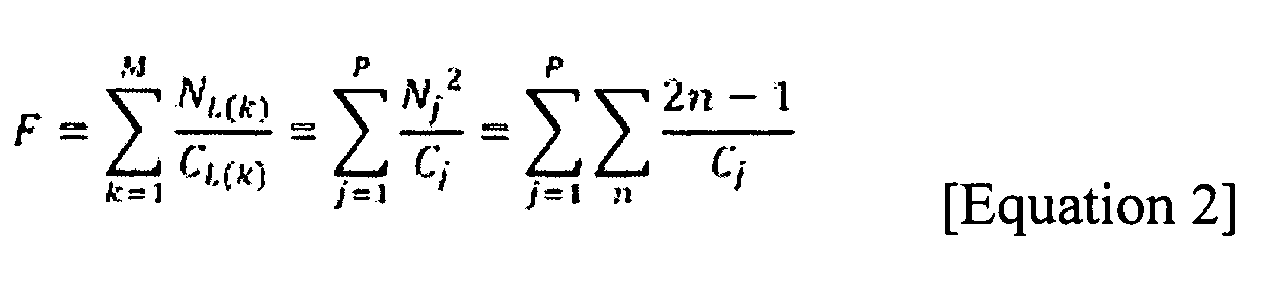
- the following equation can be used in the equation storing means of the network selecting device. If the communication capacity of a destination network L(k) connected to a terminal device k is C L(k) , and the number of terminal devices that are connected to the destination network L(k) is N L(k) , a target function F that optimizes the fairness of throughput when the number of terminal devices is M is defined by the aforementioned equation 1 and a problem that combines the terminal devices and the destination network shown by this target function is modeled as a minimum cost flow problem; and in order to perform this modeling, the equation is converted to the aforementioned equation 2 and stored.
- the computer operating means calculates an exact solution of the minimum cost flow problem; and the network selection results operating means of the computer calculates the results of combining the terminal devices and the destination networks.
- the present invention provides a wireless communication network system including a plurality of wireless access networks and a terminal device that corresponds to a plurality of types of wireless access networks, including: the network selecting device, wherein the terminal device and the wireless access networks are connected based on the output results of the network selecting device.
- the present invention provides the following effects by providing the aforementioned configuration.
- the optimization of the throughput fairness for the terminal can be achieved by this method.
- modeling was achieved as a minimum cost flow problem by considering a plurality of branches that have different costs in between a base station and the initial node, because a squared term cannot be used for the known solution method of the minimum cost flow problem.
- FIG. 1 is a block diagram of a wireless communication network according to the present invention. As illustrated, the embodiment is configured from a plurality of terminal devices (10) (11) (12) (13) (14), base stations (20) (21) (22), a higher network (30) such as the Internet connecting the base stations or the like, and a wireless network access (referred to hereinafter as RAN.) selection device (31) according to the present invention.
- terminal devices 10
- a higher network (30) such as the Internet connecting the base stations or the like
- RAN. wireless network access
- the terminal devices can connect to a plurality of various RAN even if the communication systems or the like are different. Communication is performed while switching the RAN to be connected based on the timing. A conventionally known method can be used as the method of switching the connection during communication.
- An example of the present invention describes one RAN and one base station that correspond, but a different RAN can be configured in one base station.
- the frequency and modulation method differ, and an RAN providing a difference in communication capacity for each channel can be used.
- FIG. 1 illustrates a state where terminal devices (10) (11) are connected to base station (20), terminal device (12) is connected to base station (22), and terminal devices (13) (14) are connected to base station (21).
- the base station has different communication capacity depending on various factors such as processing power, circuit with the upper network (30), or the like, and therefore, a base station with a high communication capacity can obtain sufficient throughput in each terminal even if simultaneously connected to a plurality of terminal devices, but there is a problem where the throughput is reduced when connected to a plurality when using a base station with low communication capacity.
- optimizing the throughput fairness of each terminal device is one solution for the RAN selection optimization problem of the network, and determining a solution by defining the objective function thereof is proposed by the present invention.
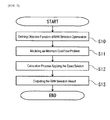
- FIG. 2 is a flow chart illustrating a network selection method in a wireless communication network according to the present invention. Descriptions are made below based on the flow chart.
- an objective function F of RAN selection optimization is defined.
- communication capacity C j of base stations j are provided, a description state where the throughput difference between the terminal devices is the smallest is determined.
- the base stations are assumed to evenly distribute radio resources to all connected terminal devices.
- M is the number of terminals
- L(k) is a base station to which terminal k connects.
- the function F is a minimum when T k are all equal.
- the problem is expressed as a combination optimization problem that determines a destination base station for each terminal.
- the target function of RAN selection optimization is defined as described above (S10).
- a minimum cost flow problem is modeled (S11).
- the objective is to convert the problem to a minimum cost flow problem where an exact solution exists because the RAN selection problem is an NP hard problem as described above.
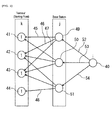
- a minimum cost flow problem is a problem of determining the allotment for the amount of flow to each branch in order to minimize the total cost, when the flow flows from a starting point (40) of the network to each end point (41) through (44) as illustrated in FIG. 3 .
- Non-patent Literature 8 also discloses the minimum cost flow problem.
- the RAN selection problem is modeled as the minimum cost flow problem, and strictly optimized.
- the terminal devices are connected by selecting any base station, and therefore, the capacity of the branches (45) (46) (47)... (48) between the base stations (49) through (51) and the terminal devices are all set as 1.
- Equation 1 The cost corresponding to the throughput reduction is assigned to each branch (52) through (54) between the base station and the starting point. Equation 1 is modified to a sum related to the base station j, and when adjusted, the equation becomes equation 3.
- P is the number of base stations.
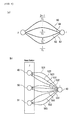
- the number of branches (60) to (63) is prepared for the maximum number of terminals that can be connected to a base station as illustrated in FIG. 4 (a) between each base station and a starting point, and each branch is assigned a cost of (2n-1)/C j .
- the squared term can be expressed by this sum.
- branches (521) through (543) as illustrated in FIG. 4(b) are taken into account.
- a major feature of the present invention is that the solution for the minimum cost flow problem can be used by modeling the RAN selection optimization problem using this improvisation.
- a branch with minimum cost is automatically selected, because the optimization algorithm is calculated from the smallest branch.
- FIG. 5 is a block diagram of a RAN selecting device (7) and a terminal device (8) according to the present invention.
- the RAN selection device (7) is connected to the upper network as illustrated in FIG. 1 , and is implemented using a conventionally known personal computer or the like. Furthermore, a calculation processing part (70) which is computing means, an RAN selection results outputting part (71) which is RAN selection results outputting means, and calculation equation storing part (72) which is calculation equation storing means are at least provided.
- the terminal device (8) is a conventionally known communication terminal such as a personal computer, mobile phone, smart phone, or the like, and provides an antenna (80), a wireless communication part (81), an RAN selection results receiving part (82), and an RAN switching part (83) for wirelessly communicating with the RAN.
- an antenna (80) When corresponding to wireless access networks with different frequencies, a plurality of antennas (80) can be provided corresponding thereto.
- a problem combining terminal devices to be optimized and a base station (connection target network) are modeled as minimum cost flow problems, and a calculation equation is stored in the calculation equation storing part (72) of the RAN selection device (7).
- the calculation processing part (70) an exact solution for the minimum cost flow problem is calculated in accordance with a conventionally known algorithm determining the aforementioned exact solution from the calculation equation. ( FIG. 2 , S12)
- results combining terminal devices and a base station to be calculated are output by the RAN selection results outputting part (71). (S13)
- the combination results are transmitted to the RAN selection results receiving part (82) of the terminal device (8) through the RAN during use with the upper network (30), and the RAN switching part (83) switches the base station destination base on the results.
- the RAN selection device (7) of the present invention calculates an exact solution for the RAN selection problem, and the terminal devices (8) can select the RAN based on the results.
- the exact solution optimizes the throughput fairness of the terminal devices in the overall system, and therefore, an optimized state is achieved as a result of switching base stations of the terminal devices (8).
- the exact solution of the minimum cost flow problem adopted by the present invention is capable of high speed processing, and contributes to a fast and accurate RAN selection.
- FIG. 6 is an alternative embodiment of the aforementioned, where the RAN selection device (7) transmits the RAN selection results to the base station (9), and the terminal device (8) connected to the base station is switched.
- the base station (9) is a router or the like corresponding to communication having an antenna (90) and wireless communicating part (91), and provides a terminal device selection results receiving part (92) and terminal device switching part (93).
- the aforementioned combination results is transmitted through the upper network (30) from the RAN selection results outputting part (71), and the terminal device selection results receiving part (92) receives the combination results.
- the terminal device switching part (93) switches the terminal device (8) to be connected based on the results.
- the throughput fairness of the terminal devices in the overall system is optimized in the same manner as described above.
- the capacity of the base station A (100) and base station B (101) is 54 Mbps
- the capacity of the base station C (102) is 21 Mbps
- the capacity of the base station D (103) is 11 Mbps.
- communication terminal 1 (110) can be connected to the base stations A and C, and of these, is shown to be connected to the base station A (100).
- the communication terminal 2 (111) can be connected to the base stations A and B, and is connected to the base station A (100). The same applies to others.
- four and five terminal devices are set to connect to the base station A (100) and base station B (101) respectively with large capacities, two are set to connect to the base station C (102) with the next smallest base station, and one was set to connect to the base station D (103) with the smallest capacity.
- the present invention optimizes the load distribution of the wireless communication network system, and is not restricted to the selection problem of the base station.
- the wireless access network is not restricted to corresponding to one base station as described above, and if a plurality of access network is configured in one base station, the wireless access network can be used as a selection problem.
Landscapes
- Engineering & Computer Science (AREA)
- Physics & Mathematics (AREA)
- Mathematical Physics (AREA)
- Theoretical Computer Science (AREA)
- Data Mining & Analysis (AREA)
- General Physics & Mathematics (AREA)
- Signal Processing (AREA)
- Computer Networks & Wireless Communication (AREA)
- Computer Security & Cryptography (AREA)
- Pure & Applied Mathematics (AREA)
- Databases & Information Systems (AREA)
- Software Systems (AREA)
- General Engineering & Computer Science (AREA)
- Computational Mathematics (AREA)
- Algebra (AREA)
- Mathematical Optimization (AREA)
- Mathematical Analysis (AREA)
- Mobile Radio Communication Systems (AREA)
Abstract
Description
- The present invention relates to a network selection method in a wireless communication network, and more particularly relates to a selection method of a destination network that optimizes fairness of throughput in terminal devices.
- Research related to recent cognitive wireless technology is being evaluated as a technology that efficiently uses a limited wireless resource. For example, Non-patent
Literature 1 discloses research of a software wireless technology that can connect to different wireless interfaces to change to a different wireless system. - Furthermore, a peripheral technology being developed, such as research of a technology that seamlessly hands over a different wireless network (refer to Non-patent
Literature 2 and 3) or the like. - Wireless selection depending on the situation and the communication quality and fairness can be improved with the heterogeneous type cognitive wireless technology that actively uses a terminal that can connect to a different wireless network. As a specific example, a large scale empirical experiment that uses a cognitive wireless router is currently in progress. (Refer to Non-patent Literature 4).
- The combinations of wireless access network selection problems that come with these systems, such as load distribution and the like, increases tremendously in conjunction with an increase in the number of terminals and base stations, and has become a NP difficult problem for which exact solutions cannot be attained within a realistic time period.
- Because of these problems, existing methods include a wireless terminal automatically selecting a base station or implementing a neural network.
- Furthermore, IEEE 1900.4, a standard specification that defines the basic architecture and functions and tries to use wireless resources optimally by distributing the decision-making to the network and the terminal, was disclosed on February 27, 2009. (Refer to Non-patent Literature 5)
-
Patent Document 1 discloses a configuration of a wireless connection terminal connected to a wireless base station where neurons firing decisions are made in a neural network calculating device where neuronal firing is associated with selection of the wireless base station selection, in a wireless communication network system that automatically selects the wireless base station to which the wireless communication terminal connects. -
Patent Document 2 discloses a technology that distributes the load of the wireless network by switching the access point when the difference of the delay cost between the two access points and the cost when switching the access point are compared, and the former exceeds the cost of the latter. - Furthermore, a decentralized base station selection architecture is disclosed in Non-patent Literature.
- On the other hand, there are general problems that are known regarding a flow network such as maximum flow problems, minimum cost flow problems, other various flow problems, circulation flow problems, and the like, and technology to resolve these problems by solution methods are being proposed as, for example, a network of a pipework of water pipes.
-
Patent Document 3 is an example thereof, and proposes drafting a dynamic planning value of a water conveyance amount, a water supply amount, and a water storage amount by selecting each element of a water supply system as arcs and nodes, and formulizing to a minimum cost flow problem. -
- [Patent Document 1]:
- Japanese Unexamined Patent Application
2009-55467 - [Patent Document 2]:
-
US Patent No. 8098637 - [Patent Document 3]:
- Patent No.
JP 3425160 -
- [Non-patent Literature 1]:
- H. Harada, "Software defined radio prototype toward Cognitive Radio Communication Systems," IEEE Dyspan 2005, Vol.1, pp. 539-547, 2005
- [Non-patent Literature 2]:
- G. Wu, P. Havinga and M. Mizuno, "MIRAI Architecture for Heterogeneous Networks," IEEE Comm. Mag., pp. 126-134, 2002
- [Non-patent Literature 3]:
- M. Inoue, K. Mahmud, H. Murakami, M. Hasegawa and H. Morikawa, "Novel Out-Of-Band Signaling for Seamless Inter-working between Heterogeneous Networks," IEEE Wireless Commun., Vol. 11, No. 2, pp. 56-63,2004
- [Non-patent Literature 4]:
- K.Ishizu et al., IEICE Trans., E93-B,3311-3322, 2010
- [Non-patent Literature 5]:
- "IEEE Standard for Architectural Building Blocks Enabling Network-Device Distributed Decision Making for Optimized Radio Resource Usage in Heterogeneous Wireless Access Networks," IEEE 1900.4-2009, Feb. 2009
- [Non-patent Literature 6]:
- Y.Fukuda, YOie, "Decentralized access point selection architecture for wireless LANs" IEEE VTC2004-Fall, pp.1103-1107, 2004
- [Non-patent Literature 7]:
- A.V.Goldberg, J.Algorithms, 22, 1-29, 1997
- [Non-patent Literature 8]:
- "Combinatorial Optimization - Theory and Algorithms," Springer-Verlag Tokyo, Nov. 2005
- In view of the foregoing, an object of the present invention is to optimize fairness of throughput in terminal devices in a wireless communication network, and to provide a technique for selecting combinations of the terminal devices and wireless network access.
- The present invention use the following means to resolve the aforementioned problem.
- In other words, the present invention provides a method of selecting a wireless communication network of a connection target that optimizes throughput fairness of terminal devices in a wireless communication network system including a plurality of wireless access networks, and terminal devices that correspond to two or more wireless access networks (hereinafter referred to as "destination networks").
- In particular, the present invention is preferably applied in a cognitive wireless communication network where the plurality of terminal devices can be connected while switching different destination networks.
- This method includes modeling a problem combining terminal devices to be optimized and a destination network, as a minimum cost flow problem; calculating an exact solution of the minimum cost flow problem by computer operating means; and calculating the results of combining the terminal devices and the connection target network using network selection results operating means of a computer.
- The configuration can be such that if the communication capacity of a destination network L(k) connected to a terminal device k is CL(k), and the number of terminal devices that are connected to the destination network L(k) is NL(k), a target function F that optimizes the fairness of throughput when the number of terminal devices is M is defined as

and a problem that combines the terminal devices and the destination network shown by this target function is modeled as a minimum cost flow problem; and in order to perform this modeling, the equation is converted to
and operating means of a computer calculates an exact solution of the minimum cost flow problem, and thereby network selection results outputting means output the results of the combination of the terminal devices and the destination network. - The present invention can provide a selecting device for a wireless access network (hereinafter referred to as a destination network) that optimizes fairness of throughput of terminal devices in a wireless communication network system.
- In other words, the present invention provides a computer equation storing means that stores an equation for modeling a problem combining terminal devices and a destination network to be optimized, as a minimum cost flow problem; computer calculating means for calculating an exact solution of the minimum cost flow problem based on the equation, and network selection results outputting means of a computer that output the results of combining the terminal devices and the connection target network.
- The following equation can be used in the equation storing means of the network selecting device. If the communication capacity of a destination network L(k) connected to a terminal device k is CL(k), and the number of terminal devices that are connected to the destination network L(k) is NL(k), a target function F that optimizes the fairness of throughput when the number of terminal devices is M is defined by the
aforementioned equation 1 and a problem that combines the terminal devices and the destination network shown by this target function is modeled as a minimum cost flow problem; and in order to perform this modeling, the equation is converted to theaforementioned equation 2 and stored. - Furthermore, the computer operating means calculates an exact solution of the minimum cost flow problem; and the network selection results operating means of the computer calculates the results of combining the terminal devices and the destination networks.
- The present invention provides a wireless communication network system including a plurality of wireless access networks and a terminal device that corresponds to a plurality of types of wireless access networks, including: the network selecting device, wherein the terminal device and the wireless access networks are connected based on the output results of the network selecting device.
- The present invention provides the following effects by providing the aforementioned configuration.
- In other words, a method of modeling that can be applied to a minimum cost flow problem was created by considering the selection problem of the wireless access network for the wireless network that has been an existing NP difficult optimization problem. An algorithm that calculates the known exact solution exists for the minimum cost flow problem, and the exact optimization of the selection problem is made possible by using this algorithm.
- The optimization of the throughput fairness for the terminal can be achieved by this method.
- In particular, modeling was achieved as a minimum cost flow problem by considering a plurality of branches that have different costs in between a base station and the initial node, because a squared term cannot be used for the known solution method of the minimum cost flow problem.
-
- FIG. 1
- is a block diagram of a wireless communication network according to the present invention;
- FIG. 2
- is a flow chart illustrating a network selection method in a wireless communication network;
- FIG. 3
- is an explanatory diagram of minimum cost problems according to the present invention;
- FIG. 4
- is an explanatory diagram related to modeling a minimum cost problems according to the present invention;
- FIG. 5
- is a block diagram of an RAN selection device and terminal device according to the present invention;
- FIG. 6
- is a block diagram of an RAN selection device and base station according to the present invention; and
- FIG. 7
- is an experimental example of an RAN selection method according to the present invention.
- An embodiment of the present invention is described below based on the examples illustrated in the drawings. Note that an embodiment is not restricted to the following.
-
FIG. 1 is a block diagram of a wireless communication network according to the present invention. As illustrated, the embodiment is configured from a plurality of terminal devices (10) (11) (12) (13) (14), base stations (20) (21) (22), a higher network (30) such as the Internet connecting the base stations or the like, and a wireless network access (referred to hereinafter as RAN.) selection device (31) according to the present invention. - For a wireless communication network system, the terminal devices can connect to a plurality of various RAN even if the communication systems or the like are different. Communication is performed while switching the RAN to be connected based on the timing. A conventionally known method can be used as the method of switching the connection during communication.
- An example of the present invention describes one RAN and one base station that correspond, but a different RAN can be configured in one base station. In other words, in some cases the frequency and modulation method differ, and an RAN providing a difference in communication capacity for each channel can be used.
-
FIG. 1 illustrates a state where terminal devices (10) (11) are connected to base station (20), terminal device (12) is connected to base station (22), and terminal devices (13) (14) are connected to base station (21). The base station has different communication capacity depending on various factors such as processing power, circuit with the upper network (30), or the like, and therefore, a base station with a high communication capacity can obtain sufficient throughput in each terminal even if simultaneously connected to a plurality of terminal devices, but there is a problem where the throughput is reduced when connected to a plurality when using a base station with low communication capacity. - From the perspective of the overall system, optimizing the throughput fairness of each terminal device is one solution for the RAN selection optimization problem of the network, and determining a solution by defining the objective function thereof is proposed by the present invention.
-
FIG. 2 is a flow chart illustrating a network selection method in a wireless communication network according to the present invention. Descriptions are made below based on the flow chart. - First, an objective function F of RAN selection optimization is defined. When communication capacity Cj of base stations j are provided, a description state where the throughput difference between the terminal devices is the smallest is determined. However, the base stations are assumed to evenly distribute radio resources to all connected terminal devices.
- In other words, if the number of terminals that are connected to j is Nj, the throughput of terminal k that is connected to the same base station j can be expressed as:

- Note that M is the number of terminals, and L(k) is a base station to which terminal k connects. The function F is a minimum when Tk are all equal. The problem is expressed as a combination optimization problem that determines a destination base station for each terminal.
- The target function of RAN selection optimization is defined as described above (S10).
- Next, a minimum cost flow problem is modeled (S11). The objective is to convert the problem to a minimum cost flow problem where an exact solution exists because the RAN selection problem is an NP hard problem as described above.
- A minimum cost flow problem is a problem of determining the allotment for the amount of flow to each branch in order to minimize the total cost, when the flow flows from a starting point (40) of the network to each end point (41) through (44) as illustrated in
FIG. 3 . When the cost costj of each branch, the capacity of each branch, and the amount of flow to flow to each end point k are provided, a flow xl is determined for each branch in order to minimize the sum of the cost F = Σ1 cost1 × x1. - Because there is an exact solution for the minimum cost flow problem, an exact solution can be achieved when reducing to the RAN selection problem of interest. An algorithm for determining the exact solution of the minimum cost flow problem is disclosed in cited
document 8 according to A.V Goldberg for example, and the present invention appropriately uses a conventionally known solution, and therefore, a description is omitted. - In this document, the difference in calculation speed by the algorithm was tested, but a CS (cost scaling) method that is generally capable of the fastest calculation was used in the present invention.
- Note that
Non-patent Literature 8 also discloses the minimum cost flow problem. - With the present invention, the RAN selection problem is modeled as the minimum cost flow problem, and strictly optimized. The terminal devices are connected by selecting any base station, and therefore, the capacity of the branches (45) (46) (47)... (48) between the base stations (49) through (51) and the terminal devices are all set as 1.
- The cost corresponding to the throughput reduction is assigned to each branch (52) through (54) between the base station and the starting point.
Equation 1 is modified to a sum related to the base station j, and when adjusted, the equation becomesequation 3. Herein, P is the number of base stations.
- Herein, the minimum cost flow problem cannot use squared terms. Therefore, the number of branches (60) to (63) is prepared for the maximum number of terminals that can be connected to a base station as illustrated in
FIG. 4 (a) between each base station and a starting point, and each branch is assigned a cost of (2n-1)/Cj. The squared term can be expressed by this sum. The target function is expressed as follows based on modification.
- When applied on a branch between the starting point and base station illustrated in
FIG. 3 , branches (521) through (543) as illustrated inFIG. 4(b) are taken into account. - A major feature of the present invention is that the solution for the minimum cost flow problem can be used by modeling the RAN selection optimization problem using this improvisation.
- A branch with minimum cost is automatically selected, because the optimization algorithm is calculated from the smallest branch.
-
FIG. 5 is a block diagram of a RAN selecting device (7) and a terminal device (8) according to the present invention; The RAN selection device (7) is connected to the upper network as illustrated inFIG. 1 , and is implemented using a conventionally known personal computer or the like. Furthermore, a calculation processing part (70) which is computing means, an RAN selection results outputting part (71) which is RAN selection results outputting means, and calculation equation storing part (72) which is calculation equation storing means are at least provided. - The terminal device (8) is a conventionally known communication terminal such as a personal computer, mobile phone, smart phone, or the like, and provides an antenna (80), a wireless communication part (81), an RAN selection results receiving part (82), and an RAN switching part (83) for wirelessly communicating with the RAN. When corresponding to wireless access networks with different frequencies, a plurality of antennas (80) can be provided corresponding thereto.
- Furthermore, a problem combining terminal devices to be optimized and a base station (connection target network) are modeled as minimum cost flow problems, and a calculation equation is stored in the calculation equation storing part (72) of the RAN selection device (7). With the calculation processing part (70), an exact solution for the minimum cost flow problem is calculated in accordance with a conventionally known algorithm determining the aforementioned exact solution from the calculation equation. (
FIG. 2 , S12) - Furthermore, results combining terminal devices and a base station to be calculated are output by the RAN selection results outputting part (71). (S13)
- The combination results are transmitted to the RAN selection results receiving part (82) of the terminal device (8) through the RAN during use with the upper network (30), and the RAN switching part (83) switches the base station destination base on the results.
- Base on the aforementioned configuration, the RAN selection device (7) of the present invention calculates an exact solution for the RAN selection problem, and the terminal devices (8) can select the RAN based on the results. The exact solution optimizes the throughput fairness of the terminal devices in the overall system, and therefore, an optimized state is achieved as a result of switching base stations of the terminal devices (8).
- The exact solution of the minimum cost flow problem adopted by the present invention is capable of high speed processing, and contributes to a fast and accurate RAN selection.
-
FIG. 6 is an alternative embodiment of the aforementioned, where the RAN selection device (7) transmits the RAN selection results to the base station (9), and the terminal device (8) connected to the base station is switched. - The base station (9) is a router or the like corresponding to communication having an antenna (90) and wireless communicating part (91), and provides a terminal device selection results receiving part (92) and terminal device switching part (93).
- Furthermore, the aforementioned combination results is transmitted through the upper network (30) from the RAN selection results outputting part (71), and the terminal device selection results receiving part (92) receives the combination results. The terminal device switching part (93) switches the terminal device (8) to be connected based on the results.
- With the present configuration, the throughput fairness of the terminal devices in the overall system is optimized in the same manner as described above.
- Finally, an experimental example is presented where an algorithm that can be strictly acquired for a load distribution optimization problem is modeled using the present invention.
- With the present experimental example, calculations are performed in an environment with four base stations (100) to (103) and twelve terminal devices (110) to (121).
- The capacity of the base station A (100) and base station B (101) is 54 Mbps, the capacity of the base station C (102) is 21 Mbps, and the capacity of the base station D (103) is 11 Mbps.
- Furthermore, an exact solution of the RAN selection problem according to the present invention was performed from inside the base station to which the terminals can connect, and a combination of the terminal devices and the base stations were calculated. Table 1 is shows the combination results.

- In Table 1, communication terminal 1 (110) can be connected to the base stations A and C, and of these, is shown to be connected to the base station A (100). The communication terminal 2 (111) can be connected to the base stations A and B, and is connected to the base station A (100). The same applies to others.
- In view of the foregoing, four and five terminal devices are set to connect to the base station A (100) and base station B (101) respectively with large capacities, two are set to connect to the base station C (102) with the next smallest base station, and one was set to connect to the base station D (103) with the smallest capacity.
- Based on these results, the combination where fairness of throughput in a communication terminal connected to the base stations is achieved can be confirmed.
- The present invention optimizes the load distribution of the wireless communication network system, and is not restricted to the selection problem of the base station. The wireless access network is not restricted to corresponding to one base station as described above, and if a plurality of access network is configured in one base station, the wireless access network can be used as a selection problem.
-
- 10 to 14
- Terminal Devices
- 20 to 22
- Base Stations
- 30
- Upper Network
- 31
- RAN Selection Device
Claims (5)
- A network selection method for a wireless communication network which is a method of selecting a destination network that optimizes throughput fairness of terminal devices in a wireless communication network system including a plurality of wireless access networks, and terminal devices that correspond to a plurality of types of wireless access networks (hereinafter referred to as "destination network"), comprising:modeling a problem combining terminal devices to be optimized and a connection target network, as a minimum cost flow problem;calculating an exact solution of the minimum cost flow problem by computer operating means; andcalculating the results of combining the terminal devices and the connection target network using network selection results operating means of a computer.
- The network selection method for the wireless communication network according to claim 1, wherein if the communication capacity of a destination network L(k) connected to a terminal device k is CL(k), and the number of terminal devices that are connected to the destination network L(k) is NL(k), a target function F that optimizes the fairness of throughput when the number of terminal devices is M is defined as

and a problem that combines the terminal devices and the destination network shown by this target function is modeled as a minimum cost flow problem; and in order to perform this modeling, the equation is converted to
and operating means of a computer calculates an exact solution of the minimum cost flow problem, and thereby network selection results outputting means output the results of the combination of the terminal devices and the destination network. - A network selection device for a wireless communication network which is a device of selecting a destination network that optimizes throughput fairness of terminal devices in a wireless communication network system including a plurality of wireless access networks, and terminal devices that correspond to a plurality of types of wireless access networks (hereinafter referred to as "destination network"), comprising:equation storing means of a computer that stores an equation for modeling a problem combining terminal devices to be optimized and a connection target network, as a minimum cost flow problem;operating means of a computer for calculating an exact solution of a minimum cost flow problem based on the equation; andnetwork selection result outputting means of a computer that outputs the results of combining the terminal devices and the connection target network.
- The network selecting device for the wireless communication network according to claim 3, wherein if the communication capacity of a destination network L(k) connected to a terminal device k is CL(k), and the number of terminal devices that are connected to the destination network L(k) is NL(k) in an equation storing means of the network selecting device, a target function F that optimizes the fairness of throughput when the number of terminal devices is M is defined as

and stored, and the operating means of a computer calculates an exact solution of the minimum cost flow problem, and thereby network selection results outputting means output the results of the combination of the terminal devices and the destination network. - A wireless communication network system including a plurality of wireless access networks and a terminal device that corresponds to a plurality of types of wireless access networks, comprising the network selecting device according to claim 3 or 4, wherein the terminal device and the wireless access networks are connected based on the output results of the network selecting device.
Applications Claiming Priority (2)
| Application Number | Priority Date | Filing Date | Title |
|---|---|---|---|
| JP2012048570A JP6008518B2 (en) | 2012-03-05 | 2012-03-05 | Network selection method in wireless communication network and wireless communication network system |
| PCT/JP2013/055306 WO2013133114A1 (en) | 2012-03-05 | 2013-02-28 | Network selection method in wireless communication network and wireless communication network system |
Publications (2)
| Publication Number | Publication Date |
|---|---|
| EP2824969A1 true EP2824969A1 (en) | 2015-01-14 |
| EP2824969A4 EP2824969A4 (en) | 2015-07-01 |
Family
ID=49116596
Family Applications (1)
| Application Number | Title | Priority Date | Filing Date |
|---|---|---|---|
| EP13757361.4A Withdrawn EP2824969A4 (en) | 2012-03-05 | 2013-02-28 | METHOD FOR SELECTING NETWORK IN A WIRELESS COMMUNICATION NETWORK AND WIRELESS COMMUNICATION NETWORK SYSTEM |
Country Status (4)
| Country | Link |
|---|---|
| US (1) | US20150032428A1 (en) |
| EP (1) | EP2824969A4 (en) |
| JP (1) | JP6008518B2 (en) |
| WO (1) | WO2013133114A1 (en) |
Families Citing this family (1)
| Publication number | Priority date | Publication date | Assignee | Title |
|---|---|---|---|---|
| US9635190B2 (en) * | 2014-08-07 | 2017-04-25 | Collision Communications, Inc. | Methods, systems, and computer program products for communicating data selectively via heterogeneous communication network links |
Family Cites Families (7)
| Publication number | Priority date | Publication date | Assignee | Title |
|---|---|---|---|---|
| JP3425160B2 (en) | 1992-05-29 | 2003-07-07 | 株式会社日立製作所 | Water supply operation planning method |
| US6314465B1 (en) * | 1999-03-11 | 2001-11-06 | Lucent Technologies Inc. | Method and apparatus for load sharing on a wide area network |
| US7225118B2 (en) * | 2002-10-31 | 2007-05-29 | Hewlett-Packard Development Company, L.P. | Global data placement |
| US8098637B1 (en) | 2003-03-28 | 2012-01-17 | Regents Of The University Of Minnesota | Load balancing in wireless local area networks |
| US20060172736A1 (en) * | 2005-02-01 | 2006-08-03 | Intel Corporation | Methods and apparatus for operating a wireless electronic device having a plurality of communication platforms |
| CN101287280A (en) * | 2007-04-11 | 2008-10-15 | 株式会社Ntt都科摩 | Method and device for selecting network in heterogeneous wireless network |
| JP2009055467A (en) * | 2007-08-28 | 2009-03-12 | National Institute Of Information & Communication Technology | Wireless communication network system and wireless base station selection method |
-
2012
- 2012-03-05 JP JP2012048570A patent/JP6008518B2/en not_active Expired - Fee Related
-
2013
- 2013-02-28 US US14/382,752 patent/US20150032428A1/en not_active Abandoned
- 2013-02-28 WO PCT/JP2013/055306 patent/WO2013133114A1/en not_active Ceased
- 2013-02-28 EP EP13757361.4A patent/EP2824969A4/en not_active Withdrawn
Also Published As
| Publication number | Publication date |
|---|---|
| WO2013133114A1 (en) | 2013-09-12 |
| JP2013187561A (en) | 2013-09-19 |
| US20150032428A1 (en) | 2015-01-29 |
| EP2824969A4 (en) | 2015-07-01 |
| JP6008518B2 (en) | 2016-10-19 |
Similar Documents
| Publication | Publication Date | Title |
|---|---|---|
| Hasegawa et al. | Optimization for centralized and decentralized cognitive radio networks | |
| JP7020691B2 (en) | Communication processing system, communication processing method, base station and its control program | |
| Divakaran et al. | Technical study on 5G using soft computing methods | |
| CN104105217B (en) | Method and apparatus for allocating resources for multiple device-to-device communications | |
| US8271522B2 (en) | Matching queries in a network | |
| CN109792613A (en) | Provided for radio resources management configures device and method | |
| CN104684095B (en) | Resource allocation methods based on genetic operation in a kind of heterogeneous network converged scene | |
| CN103731883A (en) | Load balancing method and device | |
| KR101777186B1 (en) | Method for Managing Access Points in Wifi Network | |
| US10285186B2 (en) | System and method for grouping and selecting transmission points | |
| Alablani et al. | Applying a dwell time-based 5G V2X cell selection strategy in the City of Los Angeles, California | |
| WO2024110047A1 (en) | Joint distributed learning of signaling and policies for radio resource allocation | |
| Park et al. | Kolkata paise restaurant game for resource allocation in the internet of things | |
| Taksande et al. | Optimal traffic splitting policy in LTE-based heterogeneous network | |
| US20180115977A1 (en) | Wireless communication system, base station device, wireless communication control device, and wireless communication control method | |
| KR102056894B1 (en) | Dynamic resource orchestration for fog-enabled industrial internet of things networks | |
| Han et al. | Cell-less offloading of distributed learning tasks in multi-access edge computing | |
| US20150032428A1 (en) | Network selection method in wireless communication network and wireless communication network system | |
| Wang et al. | Multi-agent reinforcement learning with pointer networks for network slicing in cellular systems | |
| EP3632028B1 (en) | Spatial hopping using antenna sets across multiple base stations | |
| CN114599063B (en) | Load balancing method, device and storage medium | |
| Johnston et al. | Controller placement in wireless networks with delayed CSI | |
| Guntuka et al. | IoT mobile device data offloading by small-base station using intelligent software defined network | |
| Dhivya et al. | Ingenious method for conducive handoff appliance in cognitive radio networks | |
| Daha Belghiti et al. | Scalable framework for green large cognitive radio networks |
Legal Events
| Date | Code | Title | Description |
|---|---|---|---|
| PUAI | Public reference made under article 153(3) epc to a published international application that has entered the european phase |
Free format text: ORIGINAL CODE: 0009012 |
|
| 17P | Request for examination filed |
Effective date: 20141006 |
|
| AK | Designated contracting states |
Kind code of ref document: A1 Designated state(s): AL AT BE BG CH CY CZ DE DK EE ES FI FR GB GR HR HU IE IS IT LI LT LU LV MC MK MT NL NO PL PT RO RS SE SI SK SM TR |
|
| AX | Request for extension of the european patent |
Extension state: BA ME |
|
| RIN1 | Information on inventor provided before grant (corrected) |
Inventor name: MATSUI, TAKUMI Inventor name: HASEGAWA, MIKIO |
|
| DAX | Request for extension of the european patent (deleted) | ||
| RA4 | Supplementary search report drawn up and despatched (corrected) |
Effective date: 20150602 |
|
| RIC1 | Information provided on ipc code assigned before grant |
Ipc: H04W 48/10 20090101ALI20150527BHEP Ipc: G06F 17/10 20060101ALI20150527BHEP Ipc: H04W 24/02 20090101ALI20150527BHEP Ipc: H04W 48/16 20090101AFI20150527BHEP Ipc: H04W 48/18 20090101ALI20150527BHEP |
|
| 17Q | First examination report despatched |
Effective date: 20170816 |
|
| STAA | Information on the status of an ep patent application or granted ep patent |
Free format text: STATUS: THE APPLICATION IS DEEMED TO BE WITHDRAWN |
|
| 18D | Application deemed to be withdrawn |
Effective date: 20180703 |