EP2824164A1 - Method for treatment of plant raw material pellets - Google Patents
Method for treatment of plant raw material pellets Download PDFInfo
- Publication number
- EP2824164A1 EP2824164A1 EP13004455.5A EP13004455A EP2824164A1 EP 2824164 A1 EP2824164 A1 EP 2824164A1 EP 13004455 A EP13004455 A EP 13004455A EP 2824164 A1 EP2824164 A1 EP 2824164A1
- Authority
- EP
- European Patent Office
- Prior art keywords
- pellets
- treatment
- biomass
- raw material
- plant raw
- Prior art date
- Legal status (The legal status is an assumption and is not a legal conclusion. Google has not performed a legal analysis and makes no representation as to the accuracy of the status listed.)
- Withdrawn
Links
Images

Classifications
-
- C—CHEMISTRY; METALLURGY
- C10—PETROLEUM, GAS OR COKE INDUSTRIES; TECHNICAL GASES CONTAINING CARBON MONOXIDE; FUELS; LUBRICANTS; PEAT
- C10L—FUELS NOT OTHERWISE PROVIDED FOR; NATURAL GAS; SYNTHETIC NATURAL GAS OBTAINED BY PROCESSES NOT COVERED BY SUBCLASSES C10G OR C10K; LIQUIFIED PETROLEUM GAS; USE OF ADDITIVES TO FUELS OR FIRES; FIRE-LIGHTERS
- C10L5/00—Solid fuels
- C10L5/02—Solid fuels such as briquettes consisting mainly of carbonaceous materials of mineral or non-mineral origin
- C10L5/34—Other details of the shaped fuels, e.g. briquettes
- C10L5/36—Shape
- C10L5/363—Pellets or granulates
-
- C—CHEMISTRY; METALLURGY
- C10—PETROLEUM, GAS OR COKE INDUSTRIES; TECHNICAL GASES CONTAINING CARBON MONOXIDE; FUELS; LUBRICANTS; PEAT
- C10L—FUELS NOT OTHERWISE PROVIDED FOR; NATURAL GAS; SYNTHETIC NATURAL GAS OBTAINED BY PROCESSES NOT COVERED BY SUBCLASSES C10G OR C10K; LIQUIFIED PETROLEUM GAS; USE OF ADDITIVES TO FUELS OR FIRES; FIRE-LIGHTERS
- C10L5/00—Solid fuels
- C10L5/40—Solid fuels essentially based on materials of non-mineral origin
- C10L5/44—Solid fuels essentially based on materials of non-mineral origin on vegetable substances
-
- C—CHEMISTRY; METALLURGY
- C10—PETROLEUM, GAS OR COKE INDUSTRIES; TECHNICAL GASES CONTAINING CARBON MONOXIDE; FUELS; LUBRICANTS; PEAT
- C10L—FUELS NOT OTHERWISE PROVIDED FOR; NATURAL GAS; SYNTHETIC NATURAL GAS OBTAINED BY PROCESSES NOT COVERED BY SUBCLASSES C10G OR C10K; LIQUIFIED PETROLEUM GAS; USE OF ADDITIVES TO FUELS OR FIRES; FIRE-LIGHTERS
- C10L5/00—Solid fuels
- C10L5/40—Solid fuels essentially based on materials of non-mineral origin
- C10L5/44—Solid fuels essentially based on materials of non-mineral origin on vegetable substances
- C10L5/445—Agricultural waste, e.g. corn crops, grass clippings, nut shells or oil pressing residues
-
- C—CHEMISTRY; METALLURGY
- C10—PETROLEUM, GAS OR COKE INDUSTRIES; TECHNICAL GASES CONTAINING CARBON MONOXIDE; FUELS; LUBRICANTS; PEAT
- C10L—FUELS NOT OTHERWISE PROVIDED FOR; NATURAL GAS; SYNTHETIC NATURAL GAS OBTAINED BY PROCESSES NOT COVERED BY SUBCLASSES C10G OR C10K; LIQUIFIED PETROLEUM GAS; USE OF ADDITIVES TO FUELS OR FIRES; FIRE-LIGHTERS
- C10L9/00—Treating solid fuels to improve their combustion
- C10L9/08—Treating solid fuels to improve their combustion by heat treatments, e.g. calcining
-
- Y—GENERAL TAGGING OF NEW TECHNOLOGICAL DEVELOPMENTS; GENERAL TAGGING OF CROSS-SECTIONAL TECHNOLOGIES SPANNING OVER SEVERAL SECTIONS OF THE IPC; TECHNICAL SUBJECTS COVERED BY FORMER USPC CROSS-REFERENCE ART COLLECTIONS [XRACs] AND DIGESTS
- Y02—TECHNOLOGIES OR APPLICATIONS FOR MITIGATION OR ADAPTATION AGAINST CLIMATE CHANGE
- Y02E—REDUCTION OF GREENHOUSE GAS [GHG] EMISSIONS, RELATED TO ENERGY GENERATION, TRANSMISSION OR DISTRIBUTION
- Y02E50/00—Technologies for the production of fuel of non-fossil origin
- Y02E50/10—Biofuels, e.g. bio-diesel
-
- Y—GENERAL TAGGING OF NEW TECHNOLOGICAL DEVELOPMENTS; GENERAL TAGGING OF CROSS-SECTIONAL TECHNOLOGIES SPANNING OVER SEVERAL SECTIONS OF THE IPC; TECHNICAL SUBJECTS COVERED BY FORMER USPC CROSS-REFERENCE ART COLLECTIONS [XRACs] AND DIGESTS
- Y02—TECHNOLOGIES OR APPLICATIONS FOR MITIGATION OR ADAPTATION AGAINST CLIMATE CHANGE
- Y02E—REDUCTION OF GREENHOUSE GAS [GHG] EMISSIONS, RELATED TO ENERGY GENERATION, TRANSMISSION OR DISTRIBUTION
- Y02E50/00—Technologies for the production of fuel of non-fossil origin
- Y02E50/30—Fuel from waste, e.g. synthetic alcohol or diesel
Definitions
- the present invention relates to the technology of plant raw material treatment for obtaining fuel.
- the closest known solution is the method for treatment of pellets of lignocellulosic biomass or various mixtures thereof by exposure to a high-frequency electromagnetic field at frequency in a range of 2.45 to 8 GHz.
- the method comprises a preliminary drying step at temperatures 353-373K with the decrease of moisture content to 3%, and then the exposure to a high-frequency electromagnetic field with the increase of a temperature up to 55-550K ( US20110179701 ).
- US20110179701 US20110179701 .
- special reference is made to the pre-treatment of the preliminary dried biomass by microwaves at temperature of 500-550K, when the rapid thermal decomposition of hemicelluloses and celluloses occurs.
- Torrefied biomass pellets are easy to handle, have a high heating value and are easy to grind, which is very important in thermal power stations that utilize powder-like fuel. At the same time, the realization of this method is relatively complicated; the implementation envisages several treatment steps and requires considerable energy costs.
- An object of this invention is to enhance the heating value of the fuel, simultaneously decreasing the energy costs.
- the object is achieved by exposure plant raw material pellets to a high-frequency electromagnetic field at frequency in a range of 13.5 MHz to 2.45 GHz during 90-300s, until the temperature of surface of pellets reaches 410-450K.
- the treatment of pellets is carried out at relatively low temperatures (up to 450K), when a thermal decomposition of hemicelluloses and celluloses still does not occur, but the moisture content in the pellets decreases, while increasing the rate of thermal decomposition of pellets, and increasing a heating value thereof, intensifying the burnout of volatile compounds and providing more complete combustion in a domestic heating boiler.
- the method is carried out in the following way.
- Pellets made From plant material are exposed to high-frequency electromagnetic field at frequency in the range of 13.5 MHz to 2.40 Gf-Iz to during 90-300s., until the temperature of surface of the pellets reaches 410-450K.
- the pre-treatment conditions depend on the composition and the initial moisture content of the pellets.
- the material of the cell wall of lignocellulosic biomass represents an interpenetrating spatial polymeric network, the main components of which are three types of natural polymers - cellulose, lignin and hemicelluloses.
- the intra- and inter-molecular bonds inside the lignocarbohydrate network are created through both chemical covalent bonds and hydrogen bonds, owing to the presence of polar hydroxyl groups in all components constituting thereof.
- the total energy of intra- and inter-molecular lignocarbohydrate bonds determines both mechanical and thermal properties of biomass.
- Flaming combustion and char combustion stages are exothermal ones and are accompanied by the release of heat energy, while for the removal of moisture, gasification of biomass and secondary condensation processes, it is necessary to provide an additional heat energy supply into biomass, and they can be characterized as endothermic ones.
- flaming combustion stage is the determinant one in overall energy balance - 70-85% of heat energy, which is obtained upon combusting of plant biomass, and is released as the result of combustion of gaseous products in biomass gasification.
- the decrease of the energy consumption for biomass gasification is an essential factor, which enhances the part of appropriately used heat in the overall energy balance.
- the proposed conditions of microwave pre-treatment of biomass at frequency 2,45GHZ and pre-treatment by exposure to a high-frequency electromagnetic field at frequency 13.5 MHz do not result in the heating of samples above 160 0 C and, hence, cannot initiate the process of the thermal destruction of biomass increasing the energy density of the pellets as a result of torrefaction.
- the pre-treatment of pellets within the proposed conditions decreases the specific consumption of the heat energy needed for the gasification of biomass and the transition to the more stable flaming combustion thereof.
- the consequences of the aforementioned are more rapid ignition of the pre-treated biomass, faster achievement of the maximum temperature in the combustion area, higher said temperature and more rapid combustion of biomass that is supported by the experimental data.
- the higher temperature in the burning area ensures complete combustion of products of gasification and carbonizate. Combination of all proposed factors allows enhancing the heat release when burning of pelletized plant biomass upon the treatment by exposure to a high-frequency electromagnetic field compared to non-treated pellets within the experimentally determined range.
- the activation of the thermal decomposition of pellets and the enhancement of heating value due to microwave pre-treatment may be used also to increase the gasifier capacity and the amount of the energy generated by the integrated gasifier and internal combustion engine.
Landscapes
- Chemical & Material Sciences (AREA)
- Oil, Petroleum & Natural Gas (AREA)
- Organic Chemistry (AREA)
- Life Sciences & Earth Sciences (AREA)
- Engineering & Computer Science (AREA)
- Combustion & Propulsion (AREA)
- Physics & Mathematics (AREA)
- Thermal Sciences (AREA)
- Agronomy & Crop Science (AREA)
- Environmental & Geological Engineering (AREA)
- General Life Sciences & Earth Sciences (AREA)
- Geochemistry & Mineralogy (AREA)
- Geology (AREA)
- Solid Fuels And Fuel-Associated Substances (AREA)
- Processing Of Solid Wastes (AREA)
Abstract
The present invention relates to the technology of plant raw material treatment for obtaining fuel. An object of this invention is to enhance the heating value of the fuel, simultaneously decreasing the energy costs.
According to the present invention, the object is achieved by exposure plant raw material pellets to a high-frequency electromagnetic field at frequency in a range of 13.5 MHz to 2.45 GHz during 120-200 s, until the temperature of surface of pellets reaches 410-450K.
In the proposed method, the treatment of pellets is carried out at relatively low temperatures (up to 450K), when a thermal decomposition of hemicelluloses and celluloses still does not occur, but the moisture content in the pellets decreases, while increasing the rate of thermal decomposition of pellets, and increasing a heating value thereof, intensifying the burnout of volatile compounds and providing more complete combustion in a domestic heating boiler
The activation of the thermal decomposition of pellets and the enhancement of heating value due to microwave pre-treatment may be used also to increase the gasifier capacity and the amount of the energy generated by the integrated gasifier and internal combustion engine
Description
- The present invention relates to the technology of plant raw material treatment for obtaining fuel.
- At present, a conversion of plant raw materials into feedstock for fuel by pyrolysis or torrefaction is well known. One of the most efficient torrefaction methods is the method of torrefaction of plant raw material (biomass) by exposure to a high-frequency electromagnetic field at frequency up to 9 GHz. Biomass treatment by exposure to a high-frequency electromagnetic field has been known relatively not long ago, namely, since the 1970s. This exposure to a high-frequency electromagnetic field results in a cleavage of bonds between cellulose and other components, and a raw material carbonization, with a high carbon content. The obtained products are used for production of fuel pellets (
US2011219679 ). Yet, this method is rather complicated, requires high energy consumption, and requires continuous temperature control so that the temperature shall not exceed 573K. Moreover, preparing of pellets from the obtained product involves some technological problems, in particular, the addition of various supplementary materials, and correspondingly, the increase ofenergy costs. - The closest known solution is the method for treatment of pellets of lignocellulosic biomass or various mixtures thereof by exposure to a high-frequency electromagnetic field at frequency in a range of 2.45 to 8 GHz. The method comprises a preliminary drying step at temperatures 353-373K with the decrease of moisture content to 3%, and then the exposure to a high-frequency electromagnetic field with the increase of a temperature up to 55-550K (
US20110179701 ). In said patent special reference is made to the pre-treatment of the preliminary dried biomass by microwaves at temperature of 500-550K, when the rapid thermal decomposition of hemicelluloses and celluloses occurs. - Torrefied biomass pellets are easy to handle, have a high heating value and are easy to grind, which is very important in thermal power stations that utilize powder-like fuel. At the same time, the realization of this method is relatively complicated; the implementation envisages several treatment steps and requires considerable energy costs.
- An object of this invention is to enhance the heating value of the fuel, simultaneously decreasing the energy costs.
- According to the present invention, the object is achieved by exposure plant raw material pellets to a high-frequency electromagnetic field at frequency in a range of 13.5 MHz to 2.45 GHz during 90-300s, until the temperature of surface of pellets reaches 410-450K.
- In the proposed method, the treatment of pellets is carried out at relatively low temperatures (up to 450K), when a thermal decomposition of hemicelluloses and celluloses still does not occur, but the moisture content in the pellets decreases, while increasing the rate of thermal decomposition of pellets, and increasing a heating value thereof, intensifying the burnout of volatile compounds and providing more complete combustion in a domestic heating boiler.
- The present invention is illustrated in the accompanying drawings, wherein:
-
Figs. 1-2 are the graphs of weight losses and temperature changes of pellets during the pre-treatment thereof by varying the microwave pre-treatment time. -
Figs 3-4 are the graphs of the effect of the pre-treatment of pellets on kinetics of wood pellet combustion process in a heating boiler. - The method is carried out in the following way.
- Pellets made From plant material are exposed to high-frequency electromagnetic field at frequency in the range of 13.5 MHz to 2.40 Gf-Iz to during 90-300s., until the temperature of surface of the pellets reaches 410-450K. The pre-treatment conditions depend on the composition and the initial moisture content of the pellets.
- To check the positive effect, the test experiments on the effect of the pre-treatment of the pellets on combustion process of commercial wood pellets and straw pellets in the domestic heating boiler AKGB-20, with the use of the average discrete batches of 3-3.5 kg, at an average duration of treatment - 165-180 s, an average power of the heating boiler - 8-10 kW, and an average maximum power- 14-17 kW, were carried out.
- Having compared an kinetic power readings of heating boiler in relation to treated and untreated pellets it has been found that the pre-treatment of pellets allowed achieving during the process of combustion of pellets more rapid increase of a power up to its maximum value (on the average, by 15-18%) increasing the maximum value of a power on the average by 6.6-7.5%, while the heating boiler average power - by 3-3.6%.
- Upon the pre-treatment of the pellet by exposure to a microwaves there has been achieved the increase of thermal energy in the equipment. It is shown in the tables below. Having studied the effect of pre-treatment it has been found that the heating effect of the domestic heating boiler decreases while increasing the duration of treatment ,since the increase in duration of treatment results in temperature and weight loss of pellets as the result of emission of volatile compounds during the pre-treatment process.
- The data on the treatment of pellets by exposure to a high-frequency electromagnetic field depending on the composition of pellets are shown in the following tables.

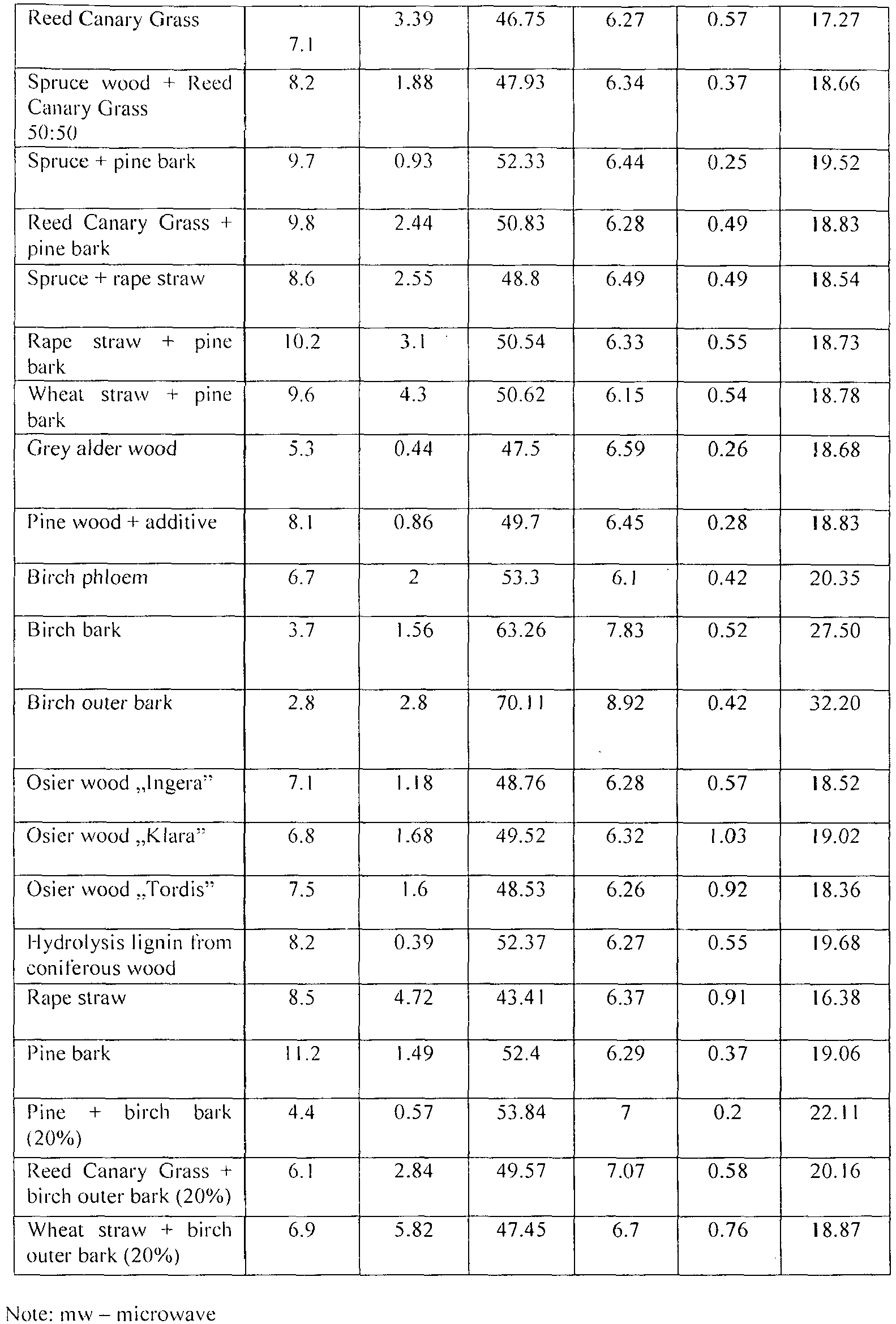


- The material of the cell wall of lignocellulosic biomass represents an interpenetrating spatial polymeric network, the main components of which are three types of natural polymers - cellulose, lignin and hemicelluloses. The intra- and inter-molecular bonds inside the lignocarbohydrate network are created through both chemical covalent bonds and hydrogen bonds, owing to the presence of polar hydroxyl groups in all components constituting thereof. The total energy of intra- and inter-molecular lignocarbohydrate bonds determines both mechanical and thermal properties of biomass.
- The process of plant biomass combustion is a complex physico-chemical process, consisting of several stages:
- the release of physically bound moisture,
- the gasification of biomass, which is associated with the thermal degradation of the biomass components and the emission of volatile products (CO, CnHm, H2, and more complicated organic compounds)
- the oxidation of gaseous products with air oxygen at elevated temperature (flaming combustion stage)
- the secondary condensation processes, the release of chemically bound water and the formation of a carbonizate
- the oxidation of the carbonizate with air oxygen in heterogeneous conditions at an elevated temperature (char combustion stage).
- Flaming combustion and char combustion stages are exothermal ones and are accompanied by the release of heat energy, while for the removal of moisture, gasification of biomass and secondary condensation processes, it is necessary to provide an additional heat energy supply into biomass, and they can be characterized as endothermic ones.
- For the initiation of gasification and biomass flaming combustion external heat energy source is used (according to the proposed method - a propane burner). Upon the ignition of biomass and switching-off of the external heat energy source, the energy, which is necessary for pre-heating, gasification and ignition of a new batch of fuel, comes from already combusted or still combusting biomass. Thus, there is an increase of specific yield of useful heat energy in case of a similar composition of fuel and irrespective the heat exchange loss, with the decrease of the energy consumption for biomass gasification and the increase of the completeness of combustion thereof. Hence, flaming combustion stage is the determinant one in overall energy balance - 70-85% of heat energy, which is obtained upon combusting of plant biomass, and is released as the result of combustion of gaseous products in biomass gasification. Thus, the decrease of the energy consumption for biomass gasification is an essential factor, which enhances the part of appropriately used heat in the overall energy balance. The proposed conditions of microwave pre-treatment of biomass at
frequency 2,45GHZ and pre-treatment by exposure to a high-frequency electromagnetic field at frequency 13.5 MHz do not result in the heating of samples above 1600C and, hence, cannot initiate the process of the thermal destruction of biomass increasing the energy density of the pellets as a result of torrefaction. - This is supported by a minor loss of mass of the pellets within the range of 1-9% upon microwave treatment (2450 MHz) (
Fig. 1 ) and the increase of heating capacity by 4.6-11.5% (Table 2) compared to those of untreated pellets. Said values of mass losses do not exceed the values of the pellets moisture content before the treatment. At the same time, the release of heat obtained upon the combustion of the pellets subjected to microwave treatment was higher by 6.5-25.6% than that of untreated pellets. That is, the increment in the amount of heat energy obtained upon the combustion of the pellets subjected to microwave treatment is 1.5 -3.5 times as much of the value of the increment of heating value of pellets achieved upon the removal of moisture from the biomass (Table 2). - The obtained results show that the microwave pre-treatment of pellets in the proposed conditions results in more complete combustion thereof in comparison with non-treated biomass that is manifested as the increment of the CO2 concentration, the decrease in the concentration of CO and the decrease in the excess of air in the combustion products (Table 3).
- The effect was observed for the pellets made from various types of plant raw materials - stem wood, herbaceous biomass, straw, lignin, wood bark, and mixtures thereof. The highest increment in the release of heat energy was observed in case of the pellets made from mixtures, one of the components of which was herbaceous biomass or straw (Table 3).
- Thus, the pre-treatment of pellets within the proposed conditions decreases the specific consumption of the heat energy needed for the gasification of biomass and the transition to the more stable flaming combustion thereof. The consequences of the aforementioned are more rapid ignition of the pre-treated biomass, faster achievement of the maximum temperature in the combustion area, higher said temperature and more rapid combustion of biomass that is supported by the experimental data. In turn, the higher temperature in the burning area ensures complete combustion of products of gasification and carbonizate. Combination of all proposed factors allows enhancing the heat release when burning of pelletized plant biomass upon the treatment by exposure to a high-frequency electromagnetic field compared to non-treated pellets within the experimentally determined range.
- These results show that the microwave pre-treatment of pellets can be used to activate the gasification and combustion process in pellet boilers, ensuring the faster and more intensive gasification of pellets and the burnout of volatile compounds.
- The activation of the thermal decomposition of pellets and the enhancement of heating value due to microwave pre-treatment may be used also to increase the gasifier capacity and the amount of the energy generated by the integrated gasifier and internal combustion engine.
Claims (3)
- A method for treatment of plant raw material pellets by exposure to a high-frequency electromagnetic field, characterized in that exposure to a high-frequency electromagnetic field is carried out until the temperature of surface of the pellets achieves 410-450K.
- A method according to claim 1, characterized in that the frequency of electromagnetic field is within a range of 13.5 MHz - 2.45 GHz.
- A method according to claim 1, characterized in that the duration of exposure to a high-frequency electromagnetic field is 90-300 s.
Applications Claiming Priority (1)
| Application Number | Priority Date | Filing Date | Title |
|---|---|---|---|
| LVP-13-101A LV14741B (en) | 2013-07-11 | 2013-07-11 | Plant raw material granules &cation; ē |
Publications (1)
| Publication Number | Publication Date |
|---|---|
| EP2824164A1 true EP2824164A1 (en) | 2015-01-14 |
Family
ID=49182043
Family Applications (1)
| Application Number | Title | Priority Date | Filing Date |
|---|---|---|---|
| EP13004455.5A Withdrawn EP2824164A1 (en) | 2013-07-11 | 2013-09-12 | Method for treatment of plant raw material pellets |
Country Status (2)
| Country | Link |
|---|---|
| EP (1) | EP2824164A1 (en) |
| LV (1) | LV14741B (en) |
Citations (3)
| Publication number | Priority date | Publication date | Assignee | Title |
|---|---|---|---|---|
| WO2009137437A1 (en) * | 2008-05-05 | 2009-11-12 | Coaltek, Inc. | Methods and systems for processing solid fuel |
| US20110179701A1 (en) | 2010-01-27 | 2011-07-28 | G-Energy Technologies, Llc | Torrefaction of ligno-cellulosic biomasses and mixtures |
| US20110219679A1 (en) | 2008-07-04 | 2011-09-15 | University Of York | Microwave torrefaction of biomass |
-
2013
- 2013-07-11 LV LVP-13-101A patent/LV14741B/en unknown
- 2013-09-12 EP EP13004455.5A patent/EP2824164A1/en not_active Withdrawn
Patent Citations (3)
| Publication number | Priority date | Publication date | Assignee | Title |
|---|---|---|---|---|
| WO2009137437A1 (en) * | 2008-05-05 | 2009-11-12 | Coaltek, Inc. | Methods and systems for processing solid fuel |
| US20110219679A1 (en) | 2008-07-04 | 2011-09-15 | University Of York | Microwave torrefaction of biomass |
| US20110179701A1 (en) | 2010-01-27 | 2011-07-28 | G-Energy Technologies, Llc | Torrefaction of ligno-cellulosic biomasses and mixtures |
Also Published As
| Publication number | Publication date |
|---|---|
| LV14741B (en) | 2014-03-20 |
| LV14741A (en) | 2013-10-20 |
Similar Documents
| Publication | Publication Date | Title |
|---|---|---|
| Poomsawat et al. | Analysis of hydrochar fuel characterization and combustion behavior derived from aquatic biomass via hydrothermal carbonization process | |
| US20110179701A1 (en) | Torrefaction of ligno-cellulosic biomasses and mixtures | |
| Huang et al. | A review on microwave pyrolysis of lignocellulosic biomass | |
| JP4331592B2 (en) | Biomass flash carbonization | |
| Tu et al. | The pelletization and combustion properties of torrefied Camellia shell via dry and hydrothermal torrefaction: a comparative evaluation | |
| US20110056125A1 (en) | Process for converting biomass to coal-like material using hydrothermal carbonisation | |
| Pyshyev et al. | State of the art in the production of charcoal: A review | |
| CN103339227B (en) | For the treatment of the method for biomass | |
| Yeoh et al. | Upgrading agricultural wastes using three different carbonization methods: Thermal, hydrothermal and vapothermal | |
| KR20130050281A (en) | Pyrolysis of biomass | |
| Ma et al. | Isoconversional kinetics and characteristics of combustion on hydrothermally treated biomass | |
| Leontiev et al. | Oxidative torrefaction of pine pellets in the quiescent layer of mineral filler | |
| Fan et al. | Combustion kinetics of biochar prepared by pyrolysis of macadamia shells | |
| Pasangulapati et al. | Characterization of switchgrass, cellulose, hemicellulose and lignin for thermochemical conversions | |
| JP2007332274A (en) | Method for producing molded charcoal for fuel | |
| Han et al. | Characterization and kinetics of iron oxide reduction by corn straw biochar prepared by pyrolysis using superheated steam atmosphere and hydrothermal processes | |
| Amaliyah et al. | Microwave-assisted pyrolysis of cashew nut shell | |
| Agung et al. | Microwave torrefaction technology in biochar production: A review | |
| US10428288B2 (en) | Process for converting a biomass into at least one biochar | |
| Rambli et al. | Characterization of sago-based biochar as potential feedstock for solid fuel | |
| EP2824164A1 (en) | Method for treatment of plant raw material pellets | |
| Lilian et al. | Hydrothermal carbonization of sawdust for hydrochar production to prepare solid fuels | |
| Yang et al. | Preparation of Biochar via Dry Torrefaction of Wood Meal in a Batch Reactor under Pressure and its Co-Combustion Behavior with Anthracite Coal. | |
| Ma et al. | Determination of combustion kinetic parameters and fuel properties of hydrochar prepared from hydrothermal carbonization of bamboo | |
| Singh et al. | Rice straw biomass conversion into biochar as a potential solid fuel with high heating value using microwave vacuum pyrolysis technology |
Legal Events
| Date | Code | Title | Description |
|---|---|---|---|
| 17P | Request for examination filed |
Effective date: 20130912 |
|
| AK | Designated contracting states |
Kind code of ref document: A1 Designated state(s): AL AT BE BG CH CY CZ DE DK EE ES FI FR GB GR HR HU IE IS IT LI LT LU LV MC MK MT NL NO PL PT RO RS SE SI SK SM TR |
|
| AX | Request for extension of the european patent |
Extension state: BA ME |
|
| PUAI | Public reference made under article 153(3) epc to a published international application that has entered the european phase |
Free format text: ORIGINAL CODE: 0009012 |
|
| STAA | Information on the status of an ep patent application or granted ep patent |
Free format text: STATUS: THE APPLICATION IS DEEMED TO BE WITHDRAWN |
|
| 18D | Application deemed to be withdrawn |
Effective date: 20150715 |